An Atlantic Transport Line steamship lay at its
pier in the city of Baltimore, on a November
day. There were indications, everywhere about,
that the hour of its departure for Europe was approaching.
A hum of excitement filled the air. Clouds of dark smoke,
ascending skyward from the steamer, threw a thin canopy
here and there over little groups of persons gathered upon
the pier to bid farewell to friends. Clerks and belated
messengers darted to and fro among them. An occasional
officer, in ship’s uniform, gave greeting to some acquaintance
and spoke hopefully of the voyage.
Among all these, a big, tall, broad-shouldered man,
whose face, florid and smiling, gave evidence of abundant
good spirits, stood, with one hand resting upon a boy’s
shoulder. A woman accompanied them, who now and
then raised a handkerchief to her eyes and wiped away a
tear.
[2]
“There!” exclaimed the man, suddenly, “do you
see that, Jack? You’d better come along with us. It isn’t
too late. Ma doesn’t want to leave you behind. If there’s
anything I can’t stand, it’s to see a woman cry.”
The boy, in return, gave a somewhat contemptuous
glance toward the steamship.
“I don’t want to go,” he said. “What’s the fun going
to sea in a thing like that? Have to dress up and look nice
all the time. If it was only a ship—”
He didn’t have a chance to finish the sentence.
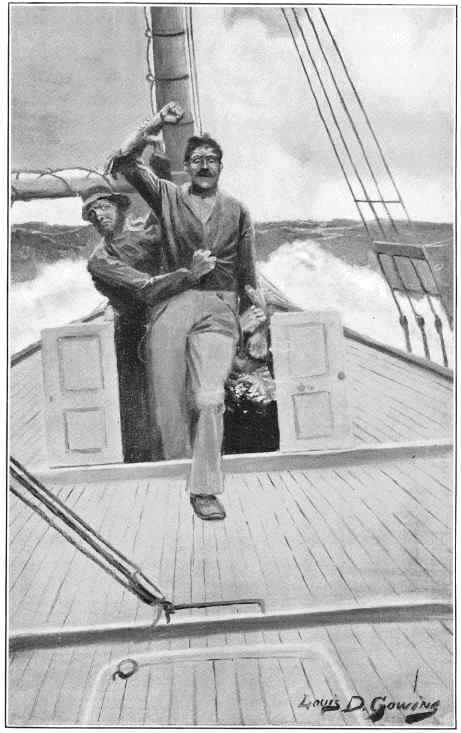
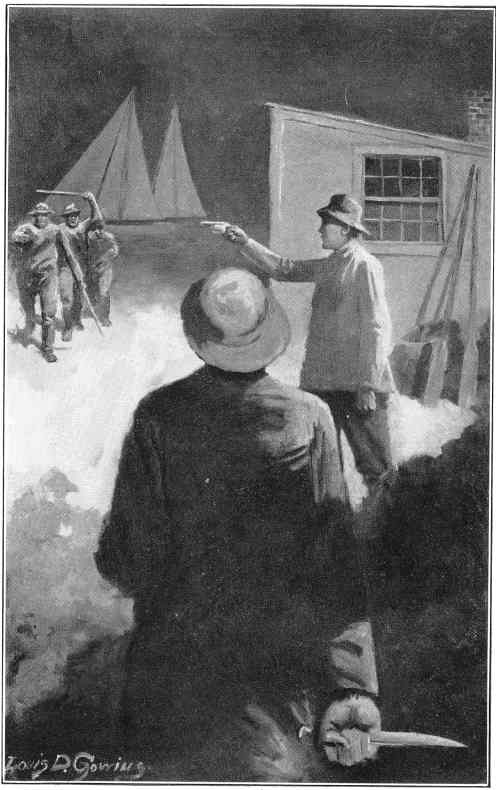
“Jack Harvey!” exclaimed his mother, eying him
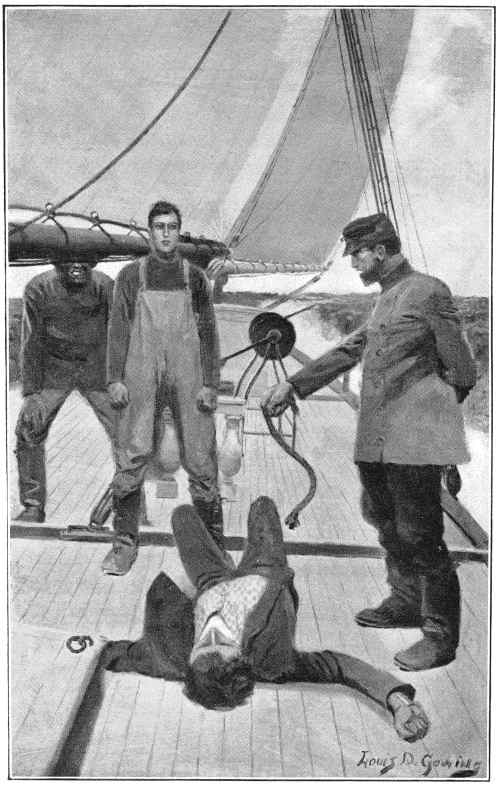
with great disapproval through her tears, “why did you
wear that awful sweater down here, to see us off? If you
only knew how you look! I’m ashamed to have folks see
you.”
Harvey’s father burst into a hearty roar of laughter.
“Isn’t that just like a woman?” he chuckled. “Crying
about leaving Jack, with one eye, and looking at his
clothes with the other. Why, Martha, I tell you he looks
fine. None of your milk-sop lads for me!” And he gave
his son a slap of approval that made even that stalwart
youth wince.
“Why, when I was Jack’s age,” continued the elder
Harvey, warming to the subject and raising his voice
accordingly, “I didn’t know where the next suit of clothes
was coming from.”
Mrs. Harvey glanced apprehensively over her shoulder,
to see who was listening.
[3]
“Guess I wasn’t much older than Jack,” went on the
speaker, thrusting his hands into his pockets and jingling
the coins therein, “when I was working in the mines
out west and wherever I could pick up a job.”
“Now, William,” interrupted Mrs. Harvey, “you
know you’ve told us all about that a hundred times—”
She, herself, was interrupted.
“You’ve got just a minute to go aboard, sir,” said one
of the pier employees, addressing Mr. Harvey. “You’ll
be left, if you don’t hurry.”
Jack Harvey’s father gave him a vigorous handshake,
and another slap across the shoulder. Mrs. Harvey took
him in her arms, despised sweater and all, and kissed him
good-bye. The next moment, the boy found himself alone
on the pier, waving to his parents, as the gang-plank was
hauled back.
The liner slowly glided out into the harbour, a cloud of
handkerchiefs fluttering along its rail, in answer to a
similar demonstration upon the pier.
Jack Harvey’s father, gazing back approvingly at his
son, strove to comfort and cheer the spirits of his wife.
“Jack’s all right,” said he. “Hang me, if I wasn’t just
such another when I was his age. I didn’t want anybody
mollycoddling me. He’ll take care of himself, all right.
Don’t you worry. He’ll be an inch taller in six months.
He knows what he wants, too, better than we do. He’ll
have more fun up in Benton this winter than he’d have
travelling around Europe. There he goes. Take a last
look at him, Martha. Confound the scamp! I kind of
wish he’d taken a notion to come along with us.”
[4]
If Jack Harvey had any such misgiving as to his decision
to spend the winter in Maine, with his boon companions,
Henry Burns and the Warren boys, and Tom Harris and
Bob White and little Tim Reardon and all the others, in
preference to touring Europe with his father and mother,
he showed no sign of it. He whistled a tune as the liner
went down the harbour, watched the smoke pour in black
clouds from its funnel, then turned and walked away
from the pier.
A glance at the sturdy figure, as he went along, would
have satisfied anyone of the truth of the assertion of
Harvey’s father, that he was able to take care of himself.
The black sweater, albeit it rested under the disapproval
and scorn of Mrs. Harvey, covered a broad, deep chest
that indicated vigorous health; his thick winter jacket hung
upon shoulders that were rounded and muscular. He
swung along with the ease and carriage that told of athletic
training. And the advantage of the sweater to one of
his active temperament was apparent, in that, although
the air had a somewhat icy tinge, he was unencumbered by
any overcoat—an economy of dress that afforded him
freedom.
Freedom! His was, indeed, freedom now in all things.
It came over him strongly, as he walked alone in the city in
which he was a total stranger, how free he was to act as he
pleased. His parents, who exercised little restraint over
him at the most, were now being borne swiftly down the
bay toward the ocean, and he should not see them again
for six long months. He, himself, was due to arrive back in
Benton as fast as trains would carry him; but the thought
of his absolute freedom for the time being exhilarated him
strangely. He felt like challenging the first youth he met
to box, or wrestle, or race—anything in which he could
exert his utmost strength and let loose his pent-up energies.
[5]
Harvey’s train was due to leave that evening. He spent
the afternoon vigorously, walking miles through streets,
exploring here and there, seeing the sights all new to him.
He was growing just a bit weary, and very hungry, and
was thinking of returning to the hotel for supper, when
he emerged from a side street upon a street that ran along
the water front.
A sight that made his pulses beat faster met his eyes.
Almost at his feet, a little more than the width of the street
away, lay a fleet of some thirty or forty fishermen, snuggled
all in together, close to a large float that intervened between
them and the wharf. Himself a good sailor of bay
craft, and fond of the water, the picturesqueness of these
boats attracted Harvey greatly.
They were of an odd type, for the most part, unlike
anything he had ever seen in Maine waters, or anywhere
else. They were long, shallow, light draft fellows, with no
bulwarks; so that as they lay, broadside to the float, one
might walk across from one to another, without difficulty.
Most of them were sharp at bow and stern. The masts
had a most extraordinary rake to them; and in the two-masters,
the rig was more like that of a yawl than the
schooners he was accustomed to seeing. In the case of
these, the after mast, or what would correspond to the ordinary
main-mast, was the smaller and shorter of the two;
and it raked aft at an angle that suggested to the eye of a
stranger that it was about to give way and go overboard
by the stern.
[6]
Jack Harvey had heard in the vaguest way of the Chesapeake
Bay oystermen; and he surmised at once that this
was a part of that fleet. There was little about them at the
moment, however, to indicate occupation of any sort.
Their decks, which were built flush fore and aft, broken
only by the hatches, were swept clean, and their equipment
for fishing, or dredging, had been carefully packed away.
And, as matter of fact, the vessels Harvey now saw were
probably for the most part the carriers for the fishing fleet,
that brought the oysters to market; and so carried no
dredging outfits.
Moreover, there was a pleasing suggestion of indolence
and coziness in the smoke that curled out of many funnels
from the cook stoves in the cabins, telling of preparations
for supper. A few men were idling about, talking together,
on this and that boat, in groups. There seemed
to be no one working. Not such a bad sort of existence,
thought Harvey.
The fishing boats made, indeed, a most attractive
picture. Their lines, though not as fine as yachts, were
sweeping and graceful; their rigging, simple and of few
ropes, formed a network of sharp angles as they lay, a
score deep, by the float; their sloping masts, small and
tapering, inclined now all in one direction, like bare trees
bending in a breeze. The light that yet remained in the
west brought them out in sharp relief against water and
sky.
[7]
As Harvey stood, watching them, interestedly, a slight
accident happened. A screw steamer, docked just at the
head of the float, began to revolve its propeller rapidly,
preparatory to moving in its berth. The swift current of
water excited by the propeller bore down strongly against
the bow of one of the fishermen; and, at that most inopportune
moment, the bow line by which the latter was
moored, frayed with much wear, parted. The bow swung
with the current, and the vessel threatened to crash into
another lying just below.
The veriest novice might almost have known what was
needed; but Harvey was no novice, and certainly did
know. He was, moreover, prompt to act. A coil of rope
lay at hand upon the float. Snatching up one loose end of
this, Harvey quickly gathered a few loops in either hand,
swung them and threw the end aboard the vessel to a man
that had run forward. Then he took a few turns with the
other end about a spiling, and held hard. The vessel
brought up, without harm.
“Good for you!” said a voice just behind Harvey.
“You saved ’em just in time.”
Harvey turned quickly.
The speaker was a thin, sallow youth, some years older,
apparently, than Harvey. His appearance, at first glance,
was not wholly prepossessing. His dress, which had a pretence
of smartness, was faded and somewhat shabby, but
was set off with a gaudy waistcoat and a heavy gold chain
adorning its front. His collar was wilted and far from
immaculate; but its short-comings found possible compensation
in a truly brilliant necktie, tied sailor-fashion,
with flying ends. A much worn derby hat was tilted sidewise
on the back of his head.
This youth, who was perhaps eighteen or nineteen years
of age, had a smart and presuming manner. He laid a
hand familiarly on Harvey’s shoulder, and addressed him
as though he had known him a life-time.
[8]
“You’re all right,” he continued. “You took a hitch
there like an old hand. Come on, we’ll step aboard and
look ’em over.”
Almost before he knew it, Harvey was being conducted
across the float to the deck of the first fisherman. He went
willingly enough, for that matter, for it was exactly what
he had been wishing—that he might inspect them closer.
Yet he knew, without any definite reason forming itself in
his mind, that his chance acquaintance was not congenial
to him.
“Will they let us go aboard?” he asked.
“Why, of course,” replied the stranger. “They don’t
care. I know a few of them, anyway. I’ll show you
around.”
From the first boat, they stepped across to the deck of
another, alongside.
“Stranger about here?” inquired the youth of Harvey,
casually, giving him a quick, sharp, sidelong glance, as he
spoke.
“Yes,” replied Harvey; “I am here only for the day.
My father and mother just went off on that liner for
Europe.”
“Is that so!” responded the other. At the same
moment he fell behind Harvey and gave him another
sharp, scrutinizing glance from head to foot. Then he
added, “So that leaves you all alone, to do as you please,
eh?”
Harvey assented. It was his turn to question now.
“You live about here?” he asked; and looked his
companion in the face. It was an uncertain glance that
met his. The small, dark eyes of the stranger gave him no
direct, answering glance, but shifted evasively.
[9]
“Oh, yes,” he responded; “lived here all my life.
We’re one of the old families here, but—” and he gave a
slighting look at his well worn clothing—“but we’ve had
financial embarrassments lately. The fact is, I’ve had to
drop out of college for a year—”
The youth was interrupted for a moment at this point.
He and Harvey, walking forward on the vessel, had come
upon two men who were sitting on the deck by the forecastle.
One of them, looking up, burst into a laugh.
Harvey turned, quickly.
Whatever it was that had amused the man was not
apparent. As Harvey turned and looked at him, he
stopped abruptly and pointed off across the water. Harvey,
led by his companion, started aft again.
As the two reversed their steps, the man who had laughed
pointed slyly at Harvey’s escort.
“He’s a slick one, is Artie,” he said. “Catches more of
’em, they say, than any runner along the front.”
“Got him, do you think?” inquired the other man,
nodding toward Harvey.
“Looks promising.”
“My name is Jenkins,” continued Harvey’s companion;
“and, as I was saying, I’m out of college for a year, earning
the money to keep on. Don’t know as that interests you
any—but never mind. What did you say? Queer rig,
these boats have?”
“Why, yes, it strikes me so,” replied Harvey. “It
looks odd to me to see big vessels like these with no gaffs
and these leg-o’-mutton sails.”
Again the youth gave Harvey one of those quick,
shrewd glances, that seemed to take in everything about
him from cap to shoes.
[10]
“Guess you know something about boats,” he remarked.
“Well, I own a sloop up in Samoset Bay, in Maine—that
is, another fellow and I own it together,” replied
Harvey, with a touch of pride.
“I knew you were a sailor, the minute I saw you heave
that line,” exclaimed the other. And Harvey felt just a
bit flattered. Perhaps Jenkins wasn’t such a bad sort,
despite his odd attire.
“Do you see that schooner?” inquired young Mr.
Jenkins, suddenly, pointing to a craft with a distinctive
schooner rig, the outermost of the vessels that comprised
the fleet.
Harvey nodded.
“Well,” continued Jenkins, “that’s Captain Scroop’s
boat. She’s the best one of them all, and he’s the most
obliging and gentlemanly captain that sails into Baltimore.
Come on, we’ll go over her.”
They walked across the decks to the side of the schooner,
and climbed aboard, over the rail. The schooner seemed
deserted, save the presence of a boy of about twelve, who
was engaged in chopping a block of stove-wood into kindlings,
near the afterhouse.
“Hello, Joe,” said Jenkins.
The boy looked up and nodded, sullenly. He seemed,
moreover, to eye Mr. Jenkins with some disfavour.
“Captain Scroop aboard?”
The boy shook his head.
“Well, we’re going to look about a bit,” said Mr. Jenkins,
easily.
[11]
He conducted Harvey about the deck, forward and aft,
explaining one thing and another; then showed the way
to the companion that led to the cabin. “Step down,” he
said to Harvey. “Nice quarters they have aboard here.”
Then, as Harvey descended, he added, “Make yourself
comfortable a moment. I’ll be right along.”
Seeing Harvey at the foot of the companion-ladder, he
turned quickly, stepped to the side of the boy and cuffed
him smartly over one ear.
“Here, you,” he said, “brace up and say something!
There’s a dollar in it for you if we land him. Come to life,
now!”
Then he darted after Harvey, down into the cabin.
[12]
CHAPTER II THE CABIN OF THE SCHOONER
Jack Harvey stood at the foot of the companionway,
for a moment, looking into the cabin, before he
entered. There was a lamp burning dimly, fastened
into a socket in a support that extended from the centre-board
box to the ceiling. Its light sufficed for Harvey to
see but vaguely at first, owing to a cloud of tobacco smoke
that filled the stuffy cabin. It was warm there, however,
for the cook-stove in the galley threw its comforting heat
beyond the limits of that small place; and the warmth was
decidedly agreeable to one coming in from the evening air.
Harvey entered and stood, waiting for his new acquaintance
to join him. He could see objects soon more plainly.
He perceived that the person who was emitting the volumes
of smoke was a short, thick-set man, who was occupying
one of the two wooden chairs that the cabin afforded. He
was huddled all up in a heap, with his head submerged
below the collar of his thick overcoat, out of which rim the
smoke ascended, as though from the crater of a tiny
volcano.
[13]
He seemed to have fallen almost into sleep there; and
it appeared to Harvey that he must be very uncomfortable,
bundled in his great coat, with the cabin hot and smoky.
Yet he was awake sufficiently to draw at the stem of his
pipe, and to glance up at Harvey as he entered. He even
made a jerky motion over one shoulder, with his thumb,
indicating a bunk that extended along the side of the cabin,
and mumbled something that sounded like, “Have a
seat.”
Harvey, however, turned toward the companion-way,
as young Mr. Jenkins entered and rejoined him.
“Now this is what I call comfortable for a vessel,” said
Mr. Jenkins, briskly; “not much like some of those old
bug-eyes, where they stuff you into a hole and call it a
cabin. We’ll have a bit more air in here, and then we’ll
sit down and have a bite with Joe. He wants us to. You’re
in no great hurry, are you?”
“No, I’m not,” responded Harvey, congratulating himself
that here was a chance at last to see life aboard a real
fisherman at close quarters.
Mr. Jenkins opened one of the ports on either side,
which cleared the cabin in a measure of the dense cloud of
smoke, and made it more agreeable. Then, stooping, he
lifted the leaf of a folding table, that was hinged to the side
of the centre-board box, turned the bracket that supported
it into place, and motioned to Harvey to draw up a chair.
He seated himself on a wooden box, close by.
“Joe’s got some steamed oysters ready, and a pot of
coffee and some corn bread,” he said, cheerfully. “You
don’t mind taking pot luck for once, do you, just to see
how they live aboard? Here he is now. Come on, Joe,
we’re hungry. Joe, this is Mr.—let’s see, did I get your
name?”
[14]
Harvey informed him, wondering at the easy familiarity
of his new acquaintance aboard the vessel, but somewhat
amused over it, and his curiosity aroused. The boy
nodded to Harvey. Stepping into the galley, he returned
directly, bringing two bowls filled with steamed oysters,
which he set before Harvey and Mr. Jenkins. The corn
bread and coffee arrived duly, and young Mr. Jenkins
urged Harvey to fall to and eat heartily.
Harvey needed no urging. His long walk about the city
had made him ravenously hungry. Moreover, although
the coffee was not much like what he had been accustomed
to, the oysters and corn bread were certainly delicious.
Harvey and Mr. Jenkins ate by themselves, waited on by
the youth, who declared he would eat later, with “him,”
pointing to the drowsy smoker, who had not stirred from
his original position, and with Captain Scroop, if the latter
should return to supper.
It was in the course of the meal that Harvey, to his
surprise, discovered that there was still another occupant
of the cabin, of whose presence he had not before been
aware. In the forward, farther corner of the cabin, what
had appeared to be a tumbled heap of blankets, on one of
the bunks, suddenly gave forth a resounding snore; and
the heap of blankets stirred slightly.
“Hello,” exclaimed Harvey; “what’s that?”
Mr. Jenkins glanced sharply at the sleeper, sprang up
and made a closer inspection, and then, apparently satisfied
with what he saw, resumed his seat.
“It’s one of the mates,” he said. “He’s had a hard cold
for a week; taken something to sleep it off with, I guess.”
[15]
Harvey went on eating. He might not have had so
keen a relish for his food, however, had he known that the
sleeper was not only not a mate, but that, indeed, he had
never been aboard a vessel before in all his life; that he
hadn’t known when nor how he did come aboard; that
he was utterly oblivious to where he now was; and that he
had been seized of an overpowering drowsiness shortly
after taking a single glass of grog with the same young
gentleman who now sat with Jack Harvey in the schooner’s
cabin. That had taken place at a small saloon just across
from the float.
Perhaps the suggestion was a timely one for Mr. Jenkins;
perhaps he did not need it. At all events, he said guardedly,
“Scroop sometimes opens that bottle for visitors; do you
want to warm up a bit against the night air?”
He pointed, as he spoke, to a half opened locker, in
which some glassware of a certain kind was visible.
“No, thanks,” replied Harvey, “never.”
“Nor I, either,” rejoined Mr. Jenkins, emphatically.
“A man’s a fool that does, in my opinion. But it’s
hospitality along here to offer it, so no offence.”
One might, however, have noted a look of disappointment
in his countenance; and he seemed to be thinking,
hard.
“Joe’s a good sort,” he remarked, presently. “I don’t
know why I should tell you, but it’s odd how I come to
know him. The fact is, when my folks had money—plenty
of it, too—Joe lived in a little house that belonged
to our estate, and I used to run away and play with him.
What’s more, now I’m grown up, I’m going to run away
with him again, eh, Joe?”
The boy nodded.
Harvey looked at Mr. Jenkins, inquiringly. The latter
leaned nearer to Harvey and assumed a more confidential
air.
[16]
“Why, the fact is,” he said in a low tone, “you might
not think it, perhaps, but I’m a college man—Johns
Hopkins—you’ve heard of that, eh?”
Harvey recalled the name, though the mere fact that
such an institution existed was the extent of his information
regarding it, and he nodded.
“Well,” continued Mr. Jenkins, “I’m working my way
through, and my folks are so proud they don’t want it
known. So I’m going a trip or two with Joe and Captain
Scroop, just as soon as they have a berth for me, because
it’s out of the way, where no one will know me, it’s easy
work, and the pay is high. Isn’t that so, Joe?”
One might have caught the suggestion of a fleeting
desire to grin, on the features of the boy addressed; but
he lowered his gaze and nodded.
“Why, how many more men do you have begging for
chances to ship, every voyage, than you have need of?”
inquired young Mr. Jenkins, looking sharply at the boy.
“Dunno,” answered Joe, doggedly. “Mebbe five or
six; mebbe more.”
“That’s it!” exclaimed Mr. Jenkins, “And the wages
are twenty-five dollars a month, and all the good food a
fellow can eat, eh?”
“More’n he can eat, mostly,” responded the boy.
“They gets too much to eat.”
“And when are you going to find that place for me to go
a voyage—and berth aft here with you and the captain
and mate, like a gentleman, and get my twenty-five a
month at easy work?”
“We’ve got it now,” said Joe.
[17]
Young Mr. Jenkins sprang from his chair, with an exclamation
of delight. He stepped up to the boy and
seized him by an arm.
“Say!” he cried; “you’re in earnest now—none
of your tricks—do you mean it, really?”
The boy nodded.
“We’ve got two chances,” he said.
Young Mr. Jenkins gave a whistle of amazement.
“Two chances open on the same voyage!” he exclaimed.
“I never knew of that before, and just before
sailing. How do you account for it—somebody taken
sick?”
“That’s it,” said the boy.
Young Mr. Jenkins walked slowly back to his seat,
looked sharply at Harvey from the comers of his eyes, and
spoke earnestly.
“Say, Mr. Harvey,” he said, “I’m not sure, but I
believe I could get that chance for you. You played in
great luck when I saw you throw that heaving line to the
vessel there, this afternoon. I’ll swear to Captain Scroop
that you’re all right, and I know you could make good.
Do you know I’ve taken a sort of liking to you; and I tell
you what, you and I’ll ship for one month and I’ll see you
through. Why, they’re all like brothers here, the captain
and his men. We’ll have a gorgeous time, see how the
fishing is done, come back in a month and have twenty-five
dollars apiece to show for it. And then you’ll have
had a real sea experience—something to talk about when
you get home. It’s the chance of a life-time.”
[18]
Taken all by surprise by the offer, and withal against
his better judgment, Jack Harvey found a strange allurement
in the suggestion. At no time in all his life could it
have been held forth so opportunely. He thought of his
father and mother, on the ocean, to be gone for six months.
He knew, too, what his father would say, when he should
tell him of it later; how the bluff, careless, elder Harvey
would throw back his head, and laugh, and vow he was
the same sort when he was a youth.
How strangely, too, events that had taken place in
Benton coincided favourably with his already half-formed
intention to take the chance. He recalled, in a flash, the
hour of leaving there, with his father and mother, for
Baltimore; how Henry Burns’s aunt, with whom he had
been boarding, had asked when he would return; how
Harvey’s mother had answered that she hoped yet to persuade
the boy to accompany them to Europe; and how
Miss Matilda Burns had said, then, she should expect him
when he arrived—no sooner—and had remarked,
smiling, that if he didn’t come back at all she should know
he had gone to Europe.
“It’s only for a month, you know,” suggested young
Mr. Jenkins, almost as though he had been reading
Harvey’s thoughts.
Harvey sat for a moment, thinking hard.
“Isn’t it pretty cold down there in the bay this time of
year?” he asked.
“Why, bless you, no,” replied Mr. Jenkins, laughing at
the suggestion. “Don’t you know you’re in the South,
now, my boy? This is the coldest day, right now, that
we’ll have till January. And if we have a touch of winter—which
isn’t likely—why, there’s a good, comfortable
cabin to warm up in.”
“Are we sure to get back in a month?”
[19]
“Joe, when are you due back here?” called Mr.
Jenkins.
“Middle of December,” came the reply.
“I’m most inclined to try it,” said Harvey, hesitatingly.
Mr. Jenkins slapped him on the back, then shook his
hand warmly.
“You’re the right sort,” he said. “We’ll have a lark.”
And Harvey knew from that moment that, for better or
worse, be it a foolish venture or not, he was in for it.
“What do I need to get for the trip?” he asked.
“Guess I’d better step up into the town and buy some
boots and oil-skins.”
A look of determination came into the face of Mr.
Jenkins. It was as if he had made up his mind that
Harvey should have no opportunity now of backing out.
“No, you don’t need to,” he said. “The captain’s got
all that stuff, and he buys at wholesale, and you can get it
cheaper of him. Wait till to-morrow, anyway, and if he
can’t fit you, we’ll go ashore.”
Harvey gave a start of surprise. He hadn’t counted on
spending this night aboard the schooner.
“Do you mean to stay here to-night?” he asked.
“Why, sure,” responded young Mr. Jenkins. “Good
chance to try it on and see how you like it. We’ll just roll
up here, and you’ll swear you were never more comfortable
in all your life.”
“Well,” answered Harvey, “I’ll try it. You’re sure
the captain will ship us, though?”
“Oh, you can take what that boy Joe says for gospel,”
answered young Mr. Jenkins. “He knows.”
[20]
“Then I’ll step out on deck and bring down that little
hand-bag of mine,” said Harvey. “I left it forward by
the rail when I came aboard. It’s got a comb and brush
and a tooth-brush and a change of underwear in it.”
Harvey ascended the ladder and walked out on deck.
It was a glorious night, the sky studded with thousands
of stars. The air was chilly, but Harvey was warmly
dressed, and the crisp air was invigorating after his stay
in the cabin. He went forward, wondering, in his somewhat
confused state of mind, what his chums in Benton
would think of it if they could know where he was, and
what he contemplated doing.
“I only wish Henry Burns was going along,” he thought.
“Well, I’ll have something to tell him next time I see
him.”
He little thought under what strange circumstances they
would next meet.
Hardly had Harvey left the cabin, when young Mr.
Jenkins sprang into the galley, leering at the boy Joe, and
digging that stolid youngster facetiously in the ribs.
“Oh, that’s rich!” he chuckled. “What do you say,
Joey—a pretty hair-brush and comb and a tooth-brush
aboard an oyster dredger? You’ll have to tell old Haley
to get a mirror—a French-plate, gold-leaf mirror—for
Mr. Harvey. Oh, he’d do it, all right. He’ll—ah, ha,
ha—oh jimminy Christmas! Isn’t that rich?”
The boy, Joe, turned toward Mr. Jenkins, somewhat
angrily.
“You think you’re smart,” he muttered. “You’ll get
come up with, one of these days. What did you get him
for? He ain’t the right sort. He’s got folks as will make
trouble. I’ll bet the old man won’t stand for him.”
[21]
“Look here, you,” exclaimed Mr. Jenkins, seizing the
boy, roughly, “you shut up! Who asked you to tell me
what to do? Don’t I know my business? Don’t I know
old Scroop, too, as much as you do? Of course he’ll stand
for him—when I tell him a few things. You leave that
to me, and don’t you go interfering, or I’ll hand you something
you’ll feel for a week.”
The boy shrank back, and relapsed into stolid silence.
“Where’s that pen and ink?” inquired Jenkins.
The boy pointed to a locker.
Taking a faded wallet from his pocket, Mr. Jenkins produced
therefrom a paper which he unfolded and spread
upon the table. It seemed to be a form, of some sort or
other, partly type-written. He got the rusty pen and a
small bottle of ink, laid them beside it, and waited for
Harvey’s return. Harvey soon reappeared.
“We’ll just sign this agreement,” remarked Mr. Jenkins
carelessly. “Scroop had some aboard here. They don’t
mean much, with a good captain like him, for he does
better than he’s bound to, anyway. I’ll just run it over, so
you can get an idea of it.”
Talking glibly, Mr. Jenkins ran his finger along the
lines, whereby Harvey, by the dim light, got a somewhat
hazy idea of them: to the effect that he, Jack Harvey,
twenty-one years of age, was bound to serve for one month
aboard the fisherman, Z. B. Brandt, whereof the master
was Hamilton Haley, on a dredging trip in Chesapeake
bay and its tributaries. Together, with divers conditions
and provisions which Mr. Jenkins dismissed briefly, as of
no account.
“But I’m not twenty-one years old,” said Harvey.
“That’s wrong.”
[22]
“Oh, that don’t amount to anything,” responded Mr.
Jenkins. “I knew you weren’t quite that, but it’s near
enough. It’s all right. No one ever looks at it. We’ll
sign, and it’s all over. Then we’ll turn in, and see the
captain in the morning. He’s going to be late, by the looks.”
“But I thought you said the captain’s name was
Scroop,” suggested Harvey, puzzled.
“So it is,” replied Mr. Jenkins. “This is an old contract,
but it’s just as good. Haley used to be captain, and
they use the old forms. It don’t matter what the captain’s
name is, so long as he’s all right, and he’s got a good boat.”
Harvey, following the example of his companion, put
his name to the paper.
It might have been different had he had opportunity to
take note, on coming aboard, that the schooner, in the
cabin of which he now sat, bore no such name on bow and
stern as the “Z. B. Brandt.” It might have been different
had he seen, in his mind’s eye, the real Z. B. Brandt,
pitching and tossing in the waters of Chesapeake Bay,
seventy odd miles below where the schooner lay in her
snug berth. But he knew naught of that, nor that the
schooner in which he was about to take up his quarters for
the night was no more like the Z. B. Brandt than a Pullman
is like a cattle-car.
It was with his mind filled with a picture of the voyage
soon over and done, and a proud return to Henry Burns
and his cronies, that Harvey turned in shortly, on one of
the bunks, wrapped himself snugly in a good warm blanket,
and went off to sleep. The creaking of rigging, as some
craft moved with the current, the noise of some new arrival
coming in late to join the fleet at moorings, the tramp of an
occasional sailor on the deck of a neighbouring craft, and
the swinging of the schooner, did not disturb his sound
slumbers. Wearied with the doings of a busy day, he did
not move, once his eyes had closed in sleep.
[23]
Some time after eleven o’clock, Mr. Jenkins arose
softly and stepped cautiously over to where Harvey lay.
There was no mistaking the soundness of Harvey’s slumbers.
Mr. Jenkins slipped out of the cabin, upon deck.
A row-boat soon attracted his attention, coming toward
the schooner from somewhere below. There were three
figures in it. As the boat came alongside, Mr. Jenkins
stepped to the rail and spoke to the man in the stern.
“Hello, Scroop,” he said. “I’ve got another for you.
He wouldn’t drink, but he’s a sound sleeper.”
The captain nodded. With the assistance of his companion
in the boat, whom Mr. Jenkins called mate, and of
Mr. Jenkins, himself, another man was lifted from the
small craft to the deck of the schooner. He seemed half
asleep, and walked between them like one that had been
drugged. They did not take him aft, but assisted him
down into the forecastle, and returned presently, without
him.
“All right, captain?” queried Mr. Jenkins.
“Yes, cast us off.”
Mr. Jenkins sprang over the rail, to the deck of the craft
alongside. He cast off the lines, forward and aft, that had
moored the schooner to the other vessel. The captain and
mate ran up one of the jibs. Mr. Jenkins pushed vigorously,
and the bow of the schooner slowly swung clear.
The current aided. The light night breeze caught the jib.
The schooner drifted away, with Captain Scroop at the
wheel.
[24]
Mr. Jenkins, standing on the deck of the vessel to which
the schooner had been moored, watched the latter glide
away. After a little time the foresail was run up. The
schooner was leaving the harbour of Baltimore.
Mr. Jenkins did a little shuffle, thrust his hands into
his pockets, and walked briskly across the decks to shore.
“That’s ten dollars easy money for me and Scroop,” he
muttered. Then he stopped once and chuckled. “A
comb and brush and a tooth-brush aboard old Haley’s
bug-eye!” he said. “Oh, my! That’s a good one.”
[25]
CHAPTER III DOWN THE BAY
Jack Harvey’s father, awakening next morning in his
comfortable state-room aboard the liner, would have
been not a little astounded had he known how
strangely the facts belied his remark to Mrs. Harvey that
Jack must, by this time, be well on his way north. By no
possible stretch of fancy could the vision of their son,
lying asleep in the crazy cabin of the old schooner, appear
to the minds of Harvey’s parents. In blissful ignorance of
his strange adventure, they sailed away. Miles and miles
behind, the schooner followed in the liner’s wake.
Jack Harvey was a good sleeper. The sun came up out
of the bay and shed its light far and wide upon hundreds
of craft, borne lightly by the wind and tide. It penetrated,
even, the cabin of the dingy schooner, and it lighted the
way for the youthful sleeper to come back from dreams
to consciousness.
For some moments, as Harvey lay with half opened
eyes, he wondered where he was. Then it all came back
to him in a flash: the Baltimore water-front; the
picturesque fishermen; the strange young man—and
then, the remembrance that he had signed for a month
aboard the schooner. For an instant he almost regretted
that act, and the thought brought him up quickly on one
elbow, to look about him.
[26]
One resolve he made at the moment. He would not
back out now. He might find that impossible, anyway,
since he had signed the paper. But he would send a line
to Miss Matilda Burns, letting her know what he was
doing. It was no more than fair to her.
The next moment, Jack Harvey leaped to his feet. He
was fully awake now. Dressed, as he was,—for he had removed
only his shoes and coat,—he sprang to one of the
ports. He had sailed too much not to know that the vessel
was under weigh, although, on a perfectly smooth sea
and with no swell, there was but slight perceptible motion
to the schooner.
One glance told him the truth. He waited no longer,
but ran up the companion-way on deck. Amazed, he
looked about him. Far astern, some fifteen miles, the
outlines of the city showed. The nearest shore was a mile
away. The schooner, foresail and main-sail set, and
winged out, was slowly gliding before the wind down the
bay.
Jack Harvey gave a whistle of astonishment. Then a
feeling of resentment toward young Mr. Jenkins arose in
his breast.
“That’s a cool trick!” he exclaimed. “Why didn’t
he tell me we were going to sail so soon? He said we’d
have time to get a few things in the shops before we sailed.
I’ll tell him what I think of it.”
Without waiting to speak to anyone on deck, or scarce
take notice of who was there, Harvey darted down the
companion-way and hastened to the bunk where he had
seen Mr. Jenkins turn in, the night before.
It was empty.
[27]
Strangely puzzled, Harvey made his way out on deck.
A tall, keen-eyed man, smooth-shaven save for a light
blond moustache, sat astride the wheel box, steering.
Harvey turned to him, somewhat excitedly.
“Where’s that fellow Jenkins?” he asked.
Coolly surveying Harvey, with a pair of steady, blue
eyes, the man replied, “You call me ‘Mr. Blake,’ young
feller; I’m mate.”
Harvey’s face flushed, angrily. A feeling that he had
been somehow tricked came over him. Ignoring the man’s
order, he stepped nearer to him.
“I want to see that chap, Jenkins,” he repeated. “He
didn’t tell me we were going to sail this way in the night.
Where is he?”
The lines about the mouth of Mr. Blake, mate, tightened
as he looked the boy over from head to foot. Later experience
enlightened Harvey as to what would have happened
to him had they been well down the bay. But, as it was,
the man merely uttered something softly under his breath.
“I’ll leave you for Haley to deal with,” was what he said.
And he added, in a mollifying tone, addressing Harvey:
“Why, it’s too bad about that young feller, Jenkins.
You see he got left. He slipped up town for some stuff,
early this morning—about three o’clock, I guess, and
didn’t show up when the tide served for starting. Scroop
wouldn’t wait, and you can’t blame him. But he left
word for Jenkins to come down on that boat that lay alongside
us. She starts to-morrow. We’ll pick him up down the
bay. It’ll be all right. You’re the young feller that Joe
told about, eh—going a trip with us?”
[28]
The man’s manner, changing thus suddenly from sharp
to kindly, was surprising—and a bit comforting, too.
Without a companion, even though Jenkins were a
chance acquaintance, the venture seemed to have taken
on a somewhat different and less pleasing aspect to
Harvey.
“Yes,” he said, in answer to the mate’s query, “I’m
going one trip, just for a month.”
“I see,” said the mate, quietly. “Well, you’ll like it.
You’re the right sort. I can tell that. Ever shipped before?”
Harvey shook his head, as he explained that he had done
some bay sailing. He was about to explain further under
what circumstances, but something made him pause.
Under the same sudden impulse—he knew not the reason
for it, but obeyed it—he became reticent when Mr. Blake,
mate, plied him with questions concerning himself and
where he was from.
“I’m just knocking around a bit,” he replied, and kept
his own counsel. A fortunate thing for him, perhaps, in
the light of subsequent events.
The conversation was abruptly broken off. Up from
the forecastle there burst three men, clinching in a confused,
rough-and-tumble fashion, and struggling together.
Had Jack Harvey been on deck the night before, and
observed the man who had been carried, sleeping, from
the cabin to the forecastle, he might perhaps recognize
him now as one of these three.
“UP FROM THE FORECASTLE THERE BURST THREE MEN.”
Somewhat recovered from his condition of stupefaction
was he; sufficient to gaze about him wildly, wrestle with
the two men who attacked him, strike at them furiously,
and cry out several times that he was up to their tricks,
that he couldn’t be trapped like a dog and shanghaied
down the bay—and let them come on, if they dared.
[29]
That they did dare was quite apparent; for they
rushed him almost off his feet the next moment. And then,
to Harvey’s surprise, he found himself suddenly at service
aboard the schooner.
Leaping to his feet, the mate exclaimed, hastily, “Here,
you, hold that wheel a minute.”
Harvey obeyed. The mate made a few bounds across
the deck, took advantage of the opening that offered as the
strange man’s back was turned to him, and dealt him a
blow behind one ear that felled him, half stunned. The
next moment, Harvey saw the three lift the vanquished
fighter by head and heels and carry him below again.
Harvey’s heart sank a little. It was hardly an auspicious
beginning of a cruise on a strange craft.
Mr. Blake was back again in a few minutes. He was
as cool as though nothing unusual had taken place.
“No, you keep the wheel a moment, while I light my
pipe,” he said, as Harvey started to relinquish the post.
Then he laughed, drew forth his pipe and a piece of
tobacco, and proceeded to cut a pipeful with his knife.
“That’s Tom Saunders,” he said. “Gets foolish
drunk the minute he steps on shore; never’s sober
except when he’s afloat. Comes aboard a-boilin’ every
trip, fights, and makes a mess about being carried off
against his will. He’ll straighten out tomorrow and be the
best man in the crew.”
[30]
Harvey felt a bit easier. There had come over him, as
he watched the struggle, a feeling that perhaps he, too,
had been trapped aboard here. It was strange, certainly:
the disappearance of Mr. Jenkins, and the words the man
had just uttered about being shanghaied. However, he
was in for the cruise; and come what would, Harvey
resolved to make the best of it.
There came aft, presently, the man Scroop, captain of
the schooner, whom Harvey eyed curiously, when the mate
addressed him.
“Well?” inquired Mate Blake.
Captain Scroop gave vent to a vigorous expletive.
“We’ve fixed him!” he said. “He’ll shut up for a
while. Hullo, who’s this?”
“A friend of Jenkins,” replied the mate, giving a sly
wink as he spoke.
Captain Scroop looked at Harvey keenly. Harvey
eyed him, eagerly, in return. What he saw was not wholly
favourable. Scroop, a hard-featured, shifty-eyed man of
middle stature, had not been rendered more prepossessing
by his recent encounter. A swelling under one eye showed
where the stranger’s fist had landed heavily. His woollen
shirt was torn open at the neck, wherein the veins were
distended from wrath and excitement. He gave one quick,
shifting glance at Harvey and said abruptly, “All right.
Get below now and tell Joe to give you breakfast.”
Harvey went below.
Captain Scroop turned angrily upon the mate.
“Who got him aboard?” he asked.
“Jenkins—who do you suppose?”
Captain Scroop’s face darkened, and he shook a clenched
fist in the direction of Baltimore.
[31]
“Won’t he never tell the truth, nohow?” he exclaimed.
“Lied to me last night, up and down. Twenty-five years
old, or near that, was what he swore. Haven’t I told him
not to get these boys? That’s a kid—if he’s seventeen
he’s doin’ better’n I think. He’s got to go, though. I’ll
put him through, now. But wait till we get back. Won’t
I settle with somebody? They’ll have the law on us some
day.”
“Pooh! You’ve said all that a million times,” replied
the mate, coolly. “What’s the odds? Aren’t we taking
chances, every trip we make? Haven’t we had boys
before? Look at the lot of ’em we’ve had from New
York. What’s it to us? Leave Haley to work it out. And
don’t you go to getting down on Artie Jenkins. He knows
his lay. He wouldn’t have shipped this fellow unless he
knew it was all right. He’s no fonder of trouble than we
are.”
Jack Harvey, the innocent subject of the foregoing remarks,
was, in the meantime, getting into a better frame
of mind. There was no great fault, surely, to be found
with the grub aboard the schooner. Nothing that he had
ever cooked and eaten at his camp by the shore of Samoset
Bay tasted better than the corn flap-jacks handed out from
the galley by the boy, Joe. Smeared with a substance,
greasy and yellow, but that never was nor ever could be
suspected of being butter, and sticky with a blackish
liquid that was sweet, like molasses, they were still appetizing
to a hungry youth who had never known the qualms
of sea-sickness. A muddy compound, called by extreme
courtesy coffee, warmed Harvey to the marrow and put
heart in him. A few slices of fried bacon tasted better
than the best meal he could have had aboard the ocean
liner.
[32]
Eating heartily, despite his disappointment to find himself
forsaken by Mr. Jenkins, Harvey essayed to draw the
boy, Joe, into conversation; but the latter was sullen, and
chary of his words.
Would Jenkins surely be down by the next vessel?
The boy nodded, somewhat blankly. He guessed so.
Where would they begin fishing, and how? Harvey
would see, later. And so on. There was clearly little to
be gotten from him.
Once there came down into the cabin the same, odd
individual who had sat, huddled in the cabin, smoking,
the afternoon before. He got a dish of the flap-jacks and
a pail of the coffee, and started out again. Harvey fired
a question at him, as the man waited a moment to receive
his grub.
“How do we fish, down the bay, anyway?” asked
Harvey.
The man turned a little, stared at Harvey in a surly
manner for a moment, and then—apparently not all in
sympathy with methods aboard the schooner and in the
trade generally—answered, “Hmph! You breaks
yer back at a bloody winder.” And with this somewhat
enigmatical reply, went about his business.
“Say,” said Harvey, turning to the boy, once more,
“what’s a winder?”
“Why, it’s a—a—winder,” responded the boy.
“That’s just what I thought,” said Harvey, smiling in
spite of his perplexity. “And what’s it for?”
“You get oysters with it,” replied the boy. “You
heaves the dredge overboard, and you winds it in
again.”
[33]
“Oh, I see,” said Harvey, enlightened by this lucid explanation.
“It’s a sort of windlass, eh?”
Joe nodded.
“Hard work?” continued Harvey.
“Naw—easy.”
But Harvey had his misgivings. And again he comforted
himself with the thought, at worst, the cruise
would be over and done in a month.
“I guess I’m good for that,” he muttered; and went
out on deck again.
The schooner’s course had been changed a little, and
they were now sailing almost directly south, down Chesapeake
bay. The schooner was no longer winged out, but
had both booms off to port, getting the wind on the quarter.
Fore-staysail and jib and main gaff top-sail, as well, were
set, and the old craft was swinging southward at a fair clip.
The wind had begun to increase.
This was action after Harvey’s own heart, and he
walked forward, toward the gruff sailor, who was stationed
near the forecastle. He observed, as he advanced, that
there was still another man forward by the jibs; and that
these two sailors, the captain and mate and the boy, Joe,
were apparently the only ones aboard the vessel, besides
himself.
Harvey glanced at the man forward. He was almost
dwarfish in stature, thick-set, with unusually broad
shoulders. Clearly, this was not the man that Harvey
had seen asleep, amid the bundle of blankets, in the cabin.
Harvey had not seen the face of the sleeper, but he had
noted once, when the man had stirred, that he was a tall
man; that the figure stretched out at length took up an
unusual amount of room.
[34]
It flashed over Harvey that the man he had seen asleep
in the cabin, the night before, was missing from there now.
Harvey was certain he had not seen him, as he sat eating.
To make sure, he went back and looked. The man was
not there.
“That’s odd,” said Harvey to himself, as he came on
deck again. “I wonder if they’ve lugged him down into
the forecastle, too. They must have done it in the night.
By jimminy! I wonder how many they’ve got stowed
away down there, anyway.”
Somewhat startled at the idea that there might be other
men held there, and curious to see for himself, Harvey
approached the companion. As he did so, the surly seaman
barred his way.
“Keep out ’er there,” he said, roughly. “You can’t go
below now. Them’s my orders.”
Harvey stepped back, in surprise. There was a mystery
to the forecastle, then, sure enough. He hazarded one
question:
“What’s the matter? What’s down there?”
The man made no reply.
Harvey went forward to where the other man stood.
“Say, what’s there to do aboard here?” he asked.
The fellow turned and eyed Harvey for a moment,
curiously.
“Nothin’ now,” he replied, finally. “Nothin’ till we
get down the bay. We all takes it easy like, till then.”
But further than this, he, too, became uncommunicative
when Harvey questioned him about the cruise. It was
discouraging, and Harvey gave it up. He seemed likely
to have little companionship, if any, aboard the schooner,
and the thought was not pleasing. Again he wondered
at the strange disappearance of Mr. Jenkins, and hoped it
might be true that the young man would rejoin them down
the bay.
[35]
The day passed somewhat monotonously for the most
part. The schooner was holding an almost straight course
down the bay, along the western shore. Harvey, having
an eye for safety, noted that the coast was almost unbroken
for miles and miles, affording no harbour in case of
storm. He spoke of it once to the sailor by the forecastle.
“Plenty of harbours down below,” replied the man.
“We’re goin’ well; reckon we’ll lie in the Patuxent tonight.
There’s harbour enough for you.”
It was a positive relief to Harvey when, some time in the
afternoon, it came on to blow very fresh, and the foresail
and mainsail were both reefed. He lent a hand at that,
tieing in reef points with the other two. They seemed
surprised that he knew how to do it.
But, with the freshening of the wind, it altered its
direction and blew up finally, towards evening, from the
eastward; so that they made slower progress, running
now on the wind, close-hauled. Rain began falling at
twilight, and a bitter chill crept into the air. Harvey
thought of the oil-skins he had intended buying in Baltimore,
and wished he had them. There was nothing for
him to do on deck now, however, and he gladly went
below.
[36]
He ate his supper alone, for all hands were on deck.
The schooner pitched and thrashed about in the short,
rough seas. It was gloomy in the dimly lighted cabin,
and the boy Joe, at work in the galley, positively declined
to enter into conversation. Jack Harvey, left to himself,
mindful of his strange situation, of the mysterious forecastle
with its imprisoned men, and depressed by the
wretched night, didn’t dare admit to himself how much
he wished himself ashore. The confinement of the cabin
made him drowsy, not long after he had eaten, and he was
glad enough to roll up in a blanket on one of the bunks
and go off to sleep.
While he slept, the schooner thrashed its way in past a
light-house on a point of land on the western shore, and
headed up into the mouth of a broad, deep river. They
sailed into this for something like half a mile, Scroop at the
wheel, and the mate and two seamen forward, peering
ahead through the rain.
Presently the mate rushed aft.
“There she lies,” he said, pointing, as he spoke, to
where a lantern gleamed in the fore-mast shrouds of a
vessel at anchor.
“I see her,” responded Scroop.
The old schooner, under the guiding hand of Scroop,
rounded to and came up into the wind a few rods astern
of the other vessel. And now, lying astern, the light from
the other’s cabin shone so that the forms of three men
could be distinguished vaguely, standing on the deck.
The schooner’s anchor went down, the foresail was
dropped, and, the jibs having already been taken in, the
craft was soon lying snug, with her mainsail hauled flat
aft, to steady her. A small boat was launched from the
deck, and made fast alongside.
Mr. Blake, mate, pointing toward the cabin, inquired
briefly, “Take him first?”
[37]
“No,” said Scroop. “Clear out the forecastle. He’ll
make a fuss, I reckon. When we drop him, I want to get
out and leave him to Haley.”
Advancing hastily across the deck, the four men, captain
and mate and the two sailors, disappeared into the forecastle.
They reappeared shortly, bearing an unconscious
burden between them, much as they would have carried a
sack of potatoes; which burden, however, showed some
sign of animation as the rain fell upon it, and muttered
something unintelligible. They deposited the burden in
the bottom of the small boat.
Another disappearance into the forecastle, and a repetition
of the performance; another and similar burden
being laid alongside the first in the boat.
Then five men emerged from the forecastle, the fifth
man walking upright, held fast by the others. It was the
man that Harvey had seen struggling with the two sailors
that morning. But he went along quietly now, the reason
being apparent in the words of Scroop.
“You go along or you go overboard,” he said. “The
first yip out of you and you get that belayin’ pin in the
head.”
The boat, with its conscious and unconscious cargo,
rowed by the two sailors and guided by Scroop in the
stem, put away from the schooner and was soon alongside
the other vessel.
“Hello,” said a voice.
“Hello, Haley.”
“How many?”
“Three here and one to come; good men, too—sailors,
every one of ’em.”
[38]
A snort of incredulity from the man on deck.
“Let you tell it!” he exclaimed. “I’m in luck if
there’s one of ’em that hasn’t been selling ribbon over a
counter. Well, fetch ’em on.”
A hatch-way forward received the three men; a short,
thick-necked, burly individual—the same being Hamilton
Haley of the bug-eye Brandt—eying them with evident
suspicion as they were taken below. After which, the two
worthy captains repaired together to the cabin of the bug-eye,
and partook of something in the way of refreshment,
which was followed by the transfer of forty dollars in
greasy bills, from a chest in the cabin to the wallet of
Captain Scroop.
“Dredging good?” inquires Scroop.
“Not much. Lost a man day before yesterday—took
sick and died. Went overboard in the chop,
down below, and I couldn’t get him.”
“Wasn’t near time for his paying off, eh?” suggests
Scroop, leering skeptically.
“Never you mind what it was near. It couldn’t be
helped, and the mate will swear to it.”
This asserted by Haley, red of face, wrathful of
manner, and bringing a heavy fist down hard on the
chest.
Some time later, Jack Harvey awoke suddenly from
sound sleep. Someone was shaking him. Dazed and
hardly conscious of where he was, he recognized the
mate.
“What’s the matter?” he asked.
The mate shook him again.
[39]
“Get up!” he said. “Get up. We’re going to
row ashore. Hurry now, jump into your boots and
coat.”
Harvey, blinking and drowsy, did as he was ordered.
Escorted by the mate, he went out into the drizzle on deck.
It was almost like an unpleasant night-mare, the act of
stumbling down into the boat, the short, pitching ride in
the rainy night. Then, all at once, the side of the other
vessel loomed up. Another moment, Harvey found himself
lifted roughly aboard, and, before he knew hardly
what had happened, the rowboat was going away and
leaving him.
“Here!” he cried, thoroughly frightened. “What
are you doing? What are you leaving me here for? This
isn’t ashore. Here, you, keep your hands off me.”
But there was no hope for Jack Harvey. In the grasp
of two stalwart sailors, seeing in a flash the truth of what
had befallen him, knowing, all too late, that he had been
tricked and trapped aboard a strange vessel, he found
himself dragged across the deck. He was half carried,
half thrown down the companion-way. He found himself
in a stuffy, ill-smelling forecastle, not much bigger than
a good sized dog-kennel. It was already crowded with
men; but there, by lying at close quarters with this forsaken
lot of humanity, he might sleep out the rest of the
night, if he could.
And thus Jack Harvey was to begin his adventures
aboard Hamilton Haley’s bug-eye. Nor would it matter,
as he should find, that the satchel containing the articles
which had occasioned so much hilarity on the part of
young Mr. Jenkins, had been left behind, in the confusion.
Jack Harvey surely would not need them aboard the Z.
B. Brandt.
[40]
CHAPTER IV ABOARD THE BUG-EYE
Jack Harvey stood at the foot of the short ladder
leading down into the forecastle, looking anxiously
about him. A boat-lantern, wired for protection in
handling, hung by the bulkhead, affording a gloomy view
of the place. Harvey had, in the course of much roughing
it, lived at times in tents, in log cabins, and in odd sorts of
shacks, and slept in the cabins of the fishing boats of
Samoset Bay in Maine. But never in all his experience
had he found himself in such dismal, cramped and forbidding
quarters as these.
On either side of the forecastle nearest the ladder was
a narrow, shallow bunk, raised a little above the floor,
sufficient to tuck a few odds and ends of clothing under;
directly above each was a similar bunk, of equal dimensions.
All four of these had scarcely any head-room at all—an
arrangement whereby one, springing quickly up
into a sitting posture, would give his head such a bump
as would remind him unpleasantly of the economy of
space.
[41]
In the lower of these bunks there now lay two men, at
least asleep if not resting. They breathed heavily, moaning
as though in some unnatural condition of slumber.
It was evident to Harvey that they were under the influence
of something like a drug; and the recollection flashed
through his mind of the offer of young Mr. Jenkins in the
cabin of the schooner—which he had fortunately refused.
If he were, indeed, a captive, he was at least in no such
senseless condition as these men.
The upper bunks held two more occupants. These
two slept quietly, even through the disturbance that had
been made so recently. Perhaps they were not unused to
such occurrences. It was apparent they were sailors, and
their sleep was natural. In all likelihood, the two lower
bunks had been left vacant for new recruits, the old seamen
taking the upper ones.
All this Jack Harvey took in with a few quick glances.
What he saw next gave him something of a start.
Forward of the four bunks described were yet two
others, the space in the forecastle being arranged “to
sleep” six men. These bunks were, if such a thing could
be possible, even less comfortable than the others. Curving
with the lines of the bows of the vessel, they had scarce
length enough for a good sized man to stretch out in. In
part compensation for which, however, there being no
upper bunks, there was head-room enough so that one
could sit upright with some degree of comfort.
In the starboard bunk there sat a man, huddled up,
with one arm bracing him from behind, and a hand,
clutching one knee. He was staring at the new-comer
Harvey, with a look of abject despair.
Harvey, surprised and startled to find himself thus confronting
someone who was clearly in his proper senses,
returned the man’s gaze, and the two stared wonderingly
at each other for a moment, in silence.
[42]
With a groan, the man swung himself down to the floor
and advanced a step.
“Hullo,” he said, “how in the Dickens did they get
you?”
“Same to you,” said Harvey, by way of reply. He had,
at the sight of this companion in misery, regained his
composure a little. Unconsciously, the fact that here was
someone with whom he could share misfortune had raised
his courage. For Harvey had taken in the appearance of
the man at once. He was well dressed. His clothes were
of fine material and of a stylish cut—albeit they were
wrinkled and dusty from his recent experiences. A torn
place in the sleeve of his coat told, too, of the rough
handling he had received. His collar was crumpled and
wilted, his tie disarranged. A derby hat that he had worn
lay now on the floor, in one corner, with the crown
broken. On the little finger of his left hand he wore a
ring.
Instinctively, Jack Harvey and the stranger extended
arms and grasped hands, with the warmth of sudden
friendship born of mutual sympathy.
“Well, I’ll be hanged, if they’re not a lot of scoundrels!”
exclaimed the man, surveying Harvey with astonishment.
“Why, you’re only a boy. How on earth did they get
you? Didn’t drug your drink, did they?”
“No, I don’t drink,” said Harvey. “I signed for a
cruise, all right, but not on this craft. I signed to go a
month on that schooner that brought me down. Cracky,
but it looks as though I’d made a mess of it. A chap named
Jenkins got me into this—”
[43]
“Jenkins!” cried the man, bursting out in a fury.
“Jenkins, was it? Slim, oily chap, flashy waistcoat and
sailor tie?”
Harvey nodded.
The man clenched his fist and raised it above his head.
“Told you he was going to Johns Hopkins when he
earned the money—nice family but poor—and all that
sort of rot?”
“That’s the chap,” said Harvey.
The man dropped his fist, put out a hand to Harvey,
and they shook once more. The man’s face relaxed into a
grim smile.
“Well, I’m another Jenkins recruit,” he said. “I’m
an idiot, an ass, anything you’re a-mind to call me. There’s
some excuse for you—but me, a man that’s travelled
from one end of this United States to the other, and met
every kind of a sharper between New York and San
Francisco—to get caught in a scrape like this!”
“Why, then your name is not Tom Saunders,” exclaimed
Harvey, who now recognized in his new acquaintance
the man he had seen struggling with the men of the
schooner. “They said you were a sailor.” The man
made a gesture of disgust. “I hate the very smell of the
salt water!” he cried.
There was a small sea chest next to the bulk-head at
the forward end of the forecastle, and Harvey and the
stranger seated themselves on it. The man relapsed for a
moment into silence, his elbows on his knees, his face
buried in his hands. Then, all of a sudden, he sat erect,
and beat his fist down upon one knee.
“This ends it!” he cried, earnestly. “Never again
as long as I live and breathe.”
[44]
Harvey stared at him in surprise.
“I mean the drink,” cried the man, excitedly. “Mind
what I say, and I mean it. Never another drink as long
as I live. I’ve said, before, that I’d stop it, but this ends it.
Say, what’s your name, anyway?”
“Jack Harvey.”
“Well, my name’s Edwards—Tom Edwards. Now
look here, Harvey, I mean what I say; if you ever see
Tom Edwards try to take another drink, you just walk up
and hit him the hardest knock you can give him. See?”
Harvey laughed, in spite of the other’s earnestness.
“I won’t have any chance for some time, by the looks
of things,” he said. “You won’t need to sign any pledge
this month. I reckon there’s no saloon aboard this vessel.”
“I’m glad of it,” exclaimed Edwards. “I wouldn’t
walk into one now, if they were giving the stuff away.
Look what it’s got me into. Say, how did our Johns
Hopkins friend catch you?”
Harvey quickly narrated the events that had followed
the departure of his parents for Europe, and the meeting
with young Mr. Jenkins. Mr. Edwards, listening with
astonishment, eyed him with keenest interest.
“That’s it,” he exclaimed, as Harvey recounted the
engaging manner in which Jenkins had assured him he
would return in one short month, with a nautical experience
that should make him the envy of his boy companions;
“put it in fancy style, didn’t he? Regular Tom Bowline
romance, and all that sort of thing, eh?”
Mr. Edwards’s eyes twinkled, and he was half smiling,
in spite of himself.
[45]
“Well,” he continued, noting Harvey’s athletic figure,
“I guess you can stand a month of it, all right, and no
great hurt to you. And, what’s best, your folks won’t
worry. But I tell you, Harvey, it’s going to be tough on
me, if I can’t force this bandit to set me ashore again. I’m
in an awful scrape. My business house will think I’ve
been murdered, or have run away—I don’t know what.
And when it comes to work, if we have much of that to do,
I don’t know how I’m going to stand it. You see, my
firm pays my expenses, and I’m used to putting up at the
best hotels and living high. So, I’m fat and lazy. Billiards
is about my hardest exercise, and my hands are as soft as
a woman’s. See here.”
Mr. Edwards stretched out two somewhat unsteady
hands, palms upward; then slapped them down upon
his knees. As he did so, he uttered a cry of dismay and
sprang to his feet, sticking out his little finger and staring
at it ruefully.
“The thieves!” he cried, angrily. “The cowardly
thieves! See that ring? They’ve got the diamond out of
it. Worth two hundred dollars, if ’twas worth a cent. They
couldn’t get the ring off, without cutting it, and I suppose
they couldn’t do that easily; so they’ve just pried out
the stone.”
Harvey looked at the hand which Edwards extended.
The setting of the costly ring had, indeed, been roughly
forced, and the stone it had contained, extracted.
“I wouldn’t care so much,” said Edwards, “if it
hadn’t been a gift from the men in the store.” Impulsively,
he turned to Harvey and put a hand on his shoulder.
“Say, Harvey,” he exclaimed, “when you and I get
ashore again—if we ever do—we’ll go and hunt up this
young Mr. Jenkins.”
[46]
“All right,” replied Harvey; “but it may not be quite
so bad as you think. We’ll get through some way, I guess.”
Oddly enough, either by reason of the lack of responsibility
that weighed on the spirits of the man, or because of
a lingering eagerness for adventure, in spite of the dubious
prospects, the boy, Harvey, seemed the more resolute of
the two.
“Well,” responded Edwards, “I’m sorry you’re in a
scrape; but so long as you’re here, why, I’m glad you’re
the kind of a chap you are. We’ll help each other. We’ll
stand together.”
And they shook hands upon it again.
“Now,” said Edwards, “here’s how I came here. I’m
a travelling man, for a jewelry house—Burton & Brooks,
of Boston. I was on the road, got into Washington the
other night, and sold a lot of goods there. But one of my
trunks hadn’t come on time, and I was hung up for a day
with nothing to do. Never had been in Baltimore, and
thought I’d run down for a few hours.
“I got dinner at a restaurant and went out to look
around. I went along, hit or miss, and brought up down
by the water-front. This chap, Jenkins, bumped into me
and apologized like a gentleman; we got to talking, and
he invited me into one of those saloons along the front.
Beastly place, and I knew it; but I was off my guard.
He certainly was slick, talked about his family and Johns
Hopkins, and pumped me all the time—I can see it
now—till he found I wasn’t stopping at any hotel, but
had just run in to town for the day.
[47]
“That was all he wanted. Saw the game was safe,
and then he and the fellow that ran the place must have
fixed it up together. I’ll bet he stands in with most of
these places on the water-front. He apologized for the
place, I remember; said it was rough but clean, and the
oysters the best in Baltimore. Well, I don’t remember
much after that, until I woke up in that hole on the schooner
that brought us down here. I know we had something to
drink—and that, so help me, is the last that anyone ever
gets Tom Edwards to take. Shake on that, too.”
He had a hearty, bluff way of talking, and a frankness
in declaring himself to be the biggest simpleton that was
ever caught with chaff, that compelled friendship.
Harvey again accepted the proffered hand, smiling a
little to himself, and wondering if it were a habit of the
other’s profession to seal all compacts on the spot in that
fashion.
“So here I am,” concluded Mr. Edwards, “in the
vilest hole I ever was in; sick from the nasty pitching of
this infernal boat; the worst head-ache I ever woke up
with—thanks to Mr. Jenkins’s drug—robbed of $150
in money, that I had in a wallet, a diamond that I wouldn’t
have sold at any price—and, worst of all, my house won’t
know what’s become of me. You see, I’m registered up in
Washington at a hotel there. I disappear, they find my
trunk and goods all right, and my accounts are straight.
Nobody knows I came to Baltimore. I’m not registered
at any hotel there. There’s a mystery for ’em. Isn’t it a
fix?”
Harvey whistled expressively.
“You’re worse off than I am, a million times,” he said.
“Besides, I’ve got a little money, if it will help us out any.
It’s twenty-five dollars I had for fare back to Benton, and
pocket-money.”
[48]
“Where’s that—where’d you say you were going?”
asked Mr. Edwards, quickly.
“Benton.”
“Benton, eh? Well, that’s funny. I’ve been there;
sold goods in Benton lots of times. You don’t happen to
know a man by the name of Warren there, do you? He’s
got three boys about your age, or a little younger—nice
man, too.”
Harvey gave an exclamation of surprise and delight.
“Know him? I guess I do,” he cried. “And the
Warren fellows, well rather. Hooray!”
It was Harvey’s turn to offer the hand of fellowship this
time; and he gave Mr. Edwards a squeeze that made that
gentleman wince.
“You’ve got a pretty good grip,” said he, rubbing his
right hand with the other. “I guess you can stand some
hard work.” Then they reverted to the subject of Benton,
once more, and it brought them closer together. There
was Bob White’s father, whom Mr. Edwards knew, and
several others; and Jack Harvey knew their sons; and
so they might have shaken hands at least a half dozen
times more, if Mr. Edwards had been willing to risk the
experiment again.
“Now, to get back to the money,” said he, finally;
“you’ve got to hide that twenty-five dollars, or you’ll
lose it. Here, I can help you out.”
He drew forth from a pocket a rubber tobacco pouch,
and emptied the contents into an envelope in one of his
inside coat pockets.
[49]
“I don’t see how they happened to leave me this,” he
said, “but they did, and it’s lucky, too. It’s just what
you need. We’ll tuck the bills in this, fold it over and over,
wrap a handkerchief about it, and you can fasten it inside
your shirt with this big safety-pin. Trust a travelling man
on the road to have what’s needed in the dressing line. It
may save you from being robbed. What are you going to
do with that other five? Don’t you want to save that,
too?”
Harvey had taken from a wallet in his pocket twenty
dollars in bills, letting one five dollar bill remain.
“I’m going to use that to save the rest with,” replied
Harvey. “Supposing this brute of a captain asks me if
I’ve got any money, to buy what I’ll need aboard here, or
suppose I’m robbed; well, perhaps they’ll think this is all
I’ve got, and leave me the twenty.”
“You’re kind of sharp, too,” responded Mr. Edwards,
smiling. “You’d make a good travelling man. We’ll
stow this secure, I hope.”
He enfolded the bills handed to him by Harvey in the
rubber tobacco pouch, wrapped the boy’s handkerchief
about that, and passed it, with the pin thrust through, to
Harvey. Harvey, loosening his clothing, pinned the parcel
of bills securely, next to his body.
“That’s the thing,” said Mr. Edwards, approvingly.
“That’s better than the captain’s strong-box, I reckon.
I’m afraid we’ve struck a pirate. Whew, but I’d give five
hundred—oh, hang it! What’s the use of wishing?
We’re in for it. We’ll get out, I suppose some way. I’ll
tackle this captain in the morning. I’ve sold goods to
pretty hard customers before now. If I can’t sell him a
line of talk that will make him set me ashore, why, then
my name isn’t Tom Edwards. Guess we may as well turn
in, though I reckon I’ll not sleep much in that confounded
packing-box they call a berth. Good night, Harvey, my
boy. Here’s good luck for to-morrow.”
[50]
Mr. Edwards put forth his hand, then drew it back
quickly.
“I guess that last hand-shake will do for to-night,” he
said. “Pretty good grip you’ve got.”
Harvey watched him, curiously, as he prepared to turn
in for the night. Surely, an extraordinary looking figure
for the forecastle of a dingy bug-eye was Mr. Tom Edwards.
He removed his crumpled collar and his necktie, gazed at
them regretfully, and tucked them beneath the edge of
the bunk. He removed his black cut-away coat, folded it
carefully, and stowed it away in one end of the same. He
likewise removed a pair of patent leather shoes.
It was hardly the toggery for a seaman of an oyster-dredger;
and Harvey, eying the incongruous picture,
would have laughed, in spite of his own feeling of dismay
and apprehension, but for the expression of utter anguish
and misery on the face of Tom Edwards, as he rolled in on
to his bunk.
“Cheer up,” said the latter, with an attempt at assurance,
which the tone of his voice did not fully endorse,
“I’ll fix that pirate of a captain in the morning, or I’ll
never sell another bill of goods as long as I live.”
“I hope so,” replied Harvey.
But he had his doubts.
They had made their preparations not any too soon.
A voice from the deck called out roughly, “Douse that
lantern down there! Take this ere boat for an all-night
dance-hall?”
[51]
Harvey sprang from his bunk and extinguished the
feeble flicker that had given them light, then crept back
again. He was young; he was weary; he was hopeful.
He was soon asleep, rocked by the uneasy swinging and
dipping of the vessel. Mr. Thomas Edwards, travelling
man and gentleman patron of the best hotels, envied him,
as he, himself, lay for hours awake, a prey to many and
varied emotions.
But he, too, was not without a straw to cling to. He had
his plans for the morrow; and, as tardy slumber at length
came to his weary brain, he might have been heard to
mutter, “I’ll sell that captain a line—a line—a line of
talk; I’ll make him take it, or—or I’ll—”
His words ceased. Mr. Thomas Edwards had gone
upon his travels into dreamland. And, if he could have
seen there the face and figure of Captain Hamilton Haley
of the bug-eye, Z. B. Brandt, and have listened to that
gentleman engaged in the pleasing art of conversation,
he might not have been so hopeful of selling him a “line
of talk.”
[52]
CHAPTER V THE LAW OF THE BAY
The bug-eye, Z. B. Brandt, lay more easily at anchor
as the night wore away and morning began to come
in. The wind that had brought the rain had
fallen flat, and, in its stead, there was blowing a gentle
breeze straight out the mouth of the river, from the west.
The day bade fair to be clear. Still, with the increasing
warmth of the air upon the surface of the water, a vapour
was arising, which shut out the shore in some degree.
To one looking at it from a little distance, the vessel
might have presented a not unpleasing appearance. Its
lines were certainly graceful—almost handsome—after
the manner of that type of bay craft. The low free-board
and sloping masts served to add grace to the outlines.
The Z. B. Brandt was a large one of its class, something
over sixty feet long, capable evidently of carrying a large
cargo; and, at the same time, a bay-man would have
known at a glance that she was speedy.
Built on no such lines of grace and speed, however,
was her skipper, Captain Hamilton Haley, who now
emerged from the cabin, on deck, stretched his short,
muscular arms, and looked about and across the water,
with a glance of approval and satisfaction at the direction
of the wind. He was below the medium height, a lack of
stature which was made more noticeable by an unusual
breadth of chest and burliness of shoulders.
[53]
Squat down between his shoulders, with so short and
thick a neck that it seemed as though nature had almost
overlooked that proportion, was a rounded, massive head,
adorned with a crop of reddish hair. A thick, but closely
cut beard added to his shaggy appearance. His mouth
was small and expressionless; from under heavy eye-brows,
small, grayish eyes twinkled keenly and coldly.
Smoke pouring out of a funnel that protruded from the
top of the cabin on the starboard side, and a noise of dishes
rattling below in the galley, indicated preparation for
breakfast. Captain Haley, his inspection of conditions of
wind and weather finished, went below.
A half hour later, there appeared from the same companion-way
another man, of a strikingly different type.
He was tall and well proportioned, powerfully built, alert
and active in every movement. His complexion showed
him to be of negro blood, though of the lightest type of
mulatto. His face, smooth-shaven, betrayed lines that
foreboded little good to the crew of any craft that should
come under his command. His eyes told of intelligence,
however, and it would have required but one glance of a
shrewd master of a vessel to pick him out for a smart seaman.
Let Hamilton Haley tell it, there wasn’t a better
mate in all the dredging fleet than Jim Adams. Let
certain men that had served aboard the Brandt on previous
voyages tell it, and there wasn’t a worse one. It was a
matter of point of view.
[54]
Captain Hamilton Haley having also come on deck,
and it being now close on to five o’clock of this November
morning, it was high time for the Brandt to get under way.
Captain Haley motioned toward the forecastle.
“Get ’em out,” he said curtly.
The mate walked briskly forward, and descended into
the forecastle. The two seamen in the upper bunks,
sleeping in their clothes, tumbled hastily out, at a word
from the mate, and a shake of the shoulder. The men in
the two lower bunks did not respond. Angrily raising one
foot, shod in a heavy boot, Jim Adams administered
several kicks to the slumberers. They stirred and groaned,
and half awoke. Surveying them contemptuously for a
moment, the mate passed them by.
“I’ll ’tend to you gentlemen later on, I reckon,” he
muttered. Jack Harvey, aroused by the stirring in the
forecastle, had scrambled hastily out, and was on his feet
when the mate approached. The latter grinned, showing
two rows of strong, white teeth.
“Well done, sonny,” he said. “Saved you’self gettin’
invited, didn’t you? Just be lively, now, and scamper
out on deck. Your mammy wants ter see you.”
“All right,” answered Harvey, and stooped for his
shoes. To his surprise, he felt himself seized by the powerful
hand of the mate, and jerked upright. The mate was
still smiling, but there was a gleam in his eyes that there
was no mistaking.
“See here, sonny,” he said, “would you just mind bein’
so kind as to call me ‘mister,’ when you speaks to me?
I’m Mister Adams, if you please. Would you just as lieves
remember that?”
Jack Harvey was quick to perceive that this sneering
politeness was no joke. He answered readily, “Certainly,
Mr. Adams; I will, sir.”
[55]
The mate grinned, approvingly.
“Get along,” he said.
Pausing for a moment before the bunk in which Mr.
Tom Edwards was still sleeping, the mate espied the black
tailor-made coat which the owner had carefully folded
and stowed in one corner before retiring. From that and
the general appearance of the sleeper, it was evident Jim
Adams had gathered an impression little favourable to
the occupant of the bunk.
“Hmph!” he muttered. “Reckon he won’t last
long. Scroop’s rung in a counter-jumper on Haley.
Wait till Haley sees him.”
His contempt for the garment, carefully folded, did not
however, prevent his making a more critical inspection of
it. Drawing it stealthily out of the bunk, the mate quickly
ran through the pockets. The search disappointed him.
There was a good linen handkerchief, which he appropriated;
an empty wallet, which he restored to a pocket;
and some papers, equally unprofitable. Tossing the coat
back into the bunk, the mate seized the legs of the sleeper
and swung them around over the edge of the bunk; which
being accomplished, he unceremoniously spilled Mr.
Tom Edwards out on the floor.
There was a gleam of triumph in his eyes as he did so;
a consciousness that here, in these waters of the Chesapeake,
among the dredging fleet, there existed a peculiar
reversal of the general supremacy of the white over the
black race; a reversal growing out of the brutality of
many of the captains, and the method of shipping men
and holding them prisoners, to work or perish; in the
course of which, captains so disposed had found that there
was none so eager to brow-beat and bully a crew of
recalcitrant whites as a certain type of coloured mates.
[56]
Tom Edwards, awakened thus roughly, opened his eyes
wide in astonishment; then his face reddened with
indignation as he saw the figure of the mate bending over
him.
“Would you just as lieve ’blige me by gettin’ your coat
on an’ stepping out on deck?” asked the mate, with mock
politeness.
Tom Edwards arose to his feet, somewhat shaky, and
glared at the spokesman.
“I want to see the captain of this vessel,” he said.
“You fellows have made a mistake in your man, this
time. You’d better be careful.”
“Yes, sir, I’m very, unusual careful, mister,” responded
the mate, grinning at the picture presented by the unfortunate
Mr. Tom Edwards, unsteady on his legs with the
slight rolling of the vessel, but striving to assert his dignity.
“Jes’ please to hustle out on deck, now, an’ you’ll see the
cap’n all right. He’s waiting for you to eat breakfas’ with
him, in the cabin.”
Tom Edwards, burning with wrath, hurriedly adjusted
his crumpled collar and tie, put on his shoes and coat, and
hastened on deck. Glancing forward, he espied Harvey
engaged at work with the crew.
“Here, Harvey,” he cried, “come on. I’ll set you
right, and myself, too, at the same time. I’ll see if there’s
any law in Maryland that will punish an outrage like
this.”
[57]
Somewhat doubtfully, Jack Harvey followed him.
Jim Adams, leering as though he knew what would be the
result, did not stop him. The two seamen, also, paused
in their work, and stood watching the unusual event.
Captain Hamilton Haley, standing expectantly near the
wheel, eyed the approaching Mr. Edwards with cold unconcern.
Perhaps he had met similar situations before.
Under certain conditions, and amid the proper surroundings,
Mr. Thomas Edwards might readily have made a
convincing impression and commanded respect; but the
situation was unfavourable. His very respectable garments,
in their tumbled and tom disarrangement, his legs
unsteady, from recent experiences and from weakness, his
face pale with the evidence of approaching sea-sickness,
all conspired to defeat his attempt at dignity. Yet he was
determined.
“Captain,” he said, stepping close to the stolid figure
by the wheel, “you have made a bad mistake in getting
me aboard here. I was drugged and shipped without my
knowing it. I am a travelling man, and connected with a
big business house in Boston. If you don’t set me ashore
at once, you’ll get yourself into more kinds of trouble than
you ever dreamed of. I’m a man-of-the-world, and I can
let this pass for a good joke among the boys on the road,
if it stops right here. But if you carry it any farther, I
warn you it will be at your peril. It’s a serious thing, this
man-stealing.”
Captain Hamilton Haley, fortifying himself with a
piece of tobacco, eyed Mr. Thomas Edwards sullenly.
Then he clenched a huge fist and replied.
[58]
“I’ve seen ’em like you before,” he said. “They was
all real gentlemen, same as you be, when they come aboard,
and most of ’em owned up to bein’ pickpockets and tramps
when they and I got acquainted. I guess you’re no great
gentleman. When a man goes and signs a contract with
me, I makes him live up to it. You’ve gone and signed
with me, and now you get for’ard and bear a hand at that
winch.”
“That’s an outrageous lie!” cried Tom Edwards,
shaking his fist in turn at Captain Haley. “I never
signed a paper in my life, to ship with you or anybody else.
If they’ve got my signature, it’s forged.”
“Look here, you,” answered Haley, advancing a step,
“don’t you go an’ tell me as how I lie, young feller. Ain’t
I seen the contract with my own eyes? Didn’t Scroop
show it, along with the contract of that other young chap
there? Don’t you go telling me I ain’t doin’ things legal
like. I’ll show you some Chesapeake Bay law.”
“Well, Chesapeake Bay law is the same as the law for
the rest of Maryland, I reckon,” exclaimed Tom Edwards
hotly. “You’ve got no law on your side. I’ve got the law
with me, and I’ll proceed against you. You’ll find Chesapeake
Bay law and State law is much the same when you
get into court.”
For a moment something like a grin overspread the dull
features of Captain Hamilton Haley. Then he raised
his arm, advanced another step forward, and shook his
fist in the other’s face.
“I reckon you ain’t had no experience with Chesapeake
Bay law,” he cried angrily. “But it’s easy to larn, and it
don’t take no books to teach it. Do you see that fist?”
He brandished his huge, red bunch of knuckles in Tom
Edwards’s face.
[59]
“Do you see that fist?” he cried again, his own face
growing more fiery. “That’s the law of the Bay. That’s
the law of the dredging fleet. There ain’t no other. Any
man that goes against that law, gets it laid down to him
good and hard. There it is, and you gets your first lesson.”
With a single blow of his arm, planting the aforesaid
digest and epitome of dredging law full in the face of Tom
Edwards, he stretched him sprawling on the deck, dazed
and terrified.
Captain Hamilton Haley, having thus successfully
demonstrated the might and majesty of dredging-fleet
law, according to his own interpretation of its terms, proceeded
now to expound it further. His anger had increased
with his act of violence, and the veins in his neck and on
his forehead stood out, swollen.
“See here you, young fellow,” he cried, advancing
toward Harvey, threateningly, “don’t you go starting
out uppish, too. Don’t you begin sea-lawyerin’ with me.
I know the law. There it is, and I hand it out when
needed. There ain’t no other law among the dredgers
that I knows of, from Plum Point down to the Rappahannock.
Some of ’em larns it quick, and some of ’em
larns it slow; and them as larns it quickest gets it lightest.
Now what have you got to say?”
Jack Harvey, thus hopelessly confronted, thought—and
thought quickly.
“I signed for a cruise, all right,” he replied, returning
the infuriated captain’s gaze steadily, “and I’m ready to
go to work.”
[60]
“Then you get for’ard, lively now, and grab hold of
that winch. You loafers get back and yank that anchor
up. This ain’t a town meetin’. Get them men to work
again, mate. Take him along, too.”
The captain pointed, in turn, to Harvey, to the sailors
who had edged their way aft, to watch proceedings, and
to the unfortunate Mr. Edwards, who had arisen from the
deck and stood, a sorry, woe-begone object, unable physically
to offer further resistance.
“Shake things up now, Jim Adams, shake ’em up,”
urged Haley. “Here we are losing good wind over a lot of
tramps that costs ten dollars apiece to get here, and little
good after we’ve got ’em. How’s a man goin’ to make
his livin’ dredging, when he pays high for men an’ gets
nothin’ to show for his money? I’d like to get that fellow,
Jenkins, out here once, himself. I’d show him this isn’t
a business for school-boys and counter-jumpers. I’d get
ten dollars’ worth of work out of him, and a good many
more ten dollars’ worth that he’s got out of me, or he’d
know the reason why.”
Thus relieving his mind of his own troubles, Captain
Hamilton Haley, in a state of highly virtuous indignation,
watched with approval the actions of the mate. The
latter, seizing Tom Edwards, hurried him forward unceremoniously
and bade him take hold at the handle of
the winch and help raise the anchor. Tom Edwards
weakly grasped the handle, as directed, in company with
one of the sailors. Jack Harvey and the other seaman
worked at the opposite handle.
[61]
Two men could have done the job easily, and the four
made quick work of it. By the time the anchor chain was
hove short, the mate and Haley had got the main-sail up.
One of the seamen left the windlass and set one of the jibs;
the anchor was brought aboard and stowed. The bug-eye,
Brandt, began to swing off from its mooring, as the wind
caught the jib, which was held up to windward. Easily
the craft spun ’round, going before the wind out of the
harbour and running across the bay, headed for the
Eastern shore.
[62]
CHAPTER VI THE WORKING OF THE LAW
“Shake out the reefs and get the foresail on her,”
called Haley. “Lively, now, we’ve lost time.”
The mate repeated the order; the two available
seamen began untying the reef-points, which had been
knotted when sail had been shortened in the breeze of the
previous day. It was simple enough work, merely the
loosening and untying of a series of square knots. Harvey
had done the like a hundred times aboard his own sloop.
He hastened to assist, and did his part as quickly as the
other two. Jim Adams, somewhat surprised, eyed him
curiously.
“You’re a right smart youngster, ain’t you?” he said,
patronizingly. “Reckon you’ll be so mightily pleased
you’ll come again some time.”
There was something so insolent in the tone, so sheer
and apparent an exulting in his power to compel the
youth to do his bidding, that the blood mounted in Harvey’s
cheeks, and he felt his pulses beat quicker. But he
went on soberly with his work, and the mate said no more.
Ignorant of all things aboard a vessel, and too weak to
work if he had been skilled at it, Tom Edwards stood
helplessly by. The humiliation of his repulse at the hands
of the captain, and his dismay at the dismal prospect,
overwhelmed him. He gazed at the receding shore, and
groaned.
[63]
The foresail was run up, and with that and the mainsail
winged out on opposite sides, the bug-eye ran before the
wind at an easy clip. She responded at once to the increased
spread of canvas. Her evident sailing qualities
appealed to Harvey, and lifted him for the moment out
of his apprehension and distress.
“Now you get your breakfas’,” said Jim Adams, and
the two sailors shuffled aft, followed by Harvey and Tom
Edwards. Harvey was hungry, with the keen appetite of
youth and health, and he seated himself with a zest at the
table in the cabin. But the place would have blunted the
appetite of many a hungry man.
It was a vile, stuffy hole, reeking, like the forecastle,
with a stale fishy odour, uncleanly and shabby. A greasy
smell of cooking came in from the galley. A tin plate and
cup and a rusty knife and fork set for each seemed never
to have known the contact of soap and water. Jack
Harvey recalled the praise which his absent friend, Mr.
Jenkins, had bestowed upon the quarters of the schooner,
and that young gentleman’s disparagement of the comparative
accommodations of a bug-eye; and he endorsed
the sentiments fully. Compared with the cabin of the
schooner, the cabin of the Z. B. Brandt was, indeed, a
kennel.
[64]
There was little comfort, either, apparently, in the
association of the two sailors. The fellow directly opposite
Harvey, whom the mate had addressed once that
morning as “Jeff,” stared sullenly and dully at the youth,
with a look that was clearly devoid of interest. He was a
heavy set, sluggish man of about thirty-five years, for
whom hard work and ill usage had blunted whatever
sensibilities he may have once possessed. Evidently he
was willing to bear with the treatment, and the poor food
aboard the vessel, for the small wages he would receive at
the winter’s end.
The other man was slightly more prepossessing, but
clearly at present not inclined to any sociability. He
had a brighter eye and a face of more expression than his
companion; though he, too, under the grinding labour
aboard the oyster dredger, had come to toil day by day
silently, in dumb obedience to the captain and mate. He
was one Sam Black, by name, somewhat taller and larger
than his comrade.
These two paid little heed to the new arrivals. It is
doubtful if they really took notice of their being there, in
the sense that they thought anything about it. Life was a
drudgery to them, in which it mattered little whether
others shared or not. They scarcely spoke to each other
during the meal, and not at all to Harvey or Tom Edwards.
Presently there stepped out of the galley an uncouth,
slovenly appearing man, who might have passed as a
smaller edition of Captain Hamilton Haley, by his features.
He was, in fact, of the same name, Haley, and there was
some relationship of a remote degree between them, which
accounted for his employment aboard the vessel. He was
not so stout as his kinsman, however, and more active in
his movements.
Whatever may have been the latent abilities of Mr.
George Haley in the art of cooking, they were not in evidence,
nor required aboard the bug-eye. Jack Harvey
and Tom Edwards were now to behold the evidence of
that fact.
[65]
The cook bore in his hands a greasy wooden box, that
had once held smoked fish, and set it down on the table.
Just what its contents consisted of was not at first apparent
to Harvey. When, however, the two sailors reached over
with their forks, speared junks of something from the box
and conveyed them to their plates, Harvey followed their
example.
He looked at the food for a moment before he made out
what it was. It proved to be dough, kneaded and mixed
with water, and a mild flavouring of molasses, and fried
in lard. Harvey gazed at the mess in dismay. If it should
prove to taste as bad as it looked, it must needs be hard
fare. But he observed that the sailors made away with it
hungrily; so he cut off a piece and tasted it. It was,
indeed, wretched stuff, greasy and unpalatable. There
was nothing else of food forthcoming, however, and he
managed to swallow a few more mouthfuls.
The cook came to his aid in slight measure. He reappeared,
bringing a pail of steaming, black liquid, the
odour of which bore some slight resemblance to coffee.
It was what passed for coffee aboard the bug-eye, a sorry
composition of water boiled with several spoonfuls of an
essence of coffee—the flavour of which one might further
disguise, if he chose, with a spoonful of black molasses
from a tin can set out by the cook.
Harvey filled his cup with alacrity, hoping to wash
down the mess of fried bread with the hot coffee. He made
a wry face after one swallow, and looked with dismay at
his companion in misery.
[66]
“It’s awful,” he said, “but it’s hot. You better drink
some of it. It will warm you up.”
Tom Edwards put out a shaky hand and conveyed a
cup of the stuff to his lips. He groaned as he took a
swallow, and set the cup down.
“Beastly!” he exclaimed; and added, “I never did
like coffee without cream, anyway.”
Harvey laughed, in spite of his own disgust. “The
cream hasn’t come aboard yet, I guess,” he said. “But
you drink that down quick. You need it.”
Like one obeying an older person, instead of a younger,
Tom Edwards did as Harvey urged. He drained the cup
at a draught. Then he staggered to his feet again.
“I can’t eat that mess,” he said. “Oh, but I’m feeling
sick. I think I’ll go out on deck. It’s cold out there,
though. I don’t know what to do.”
He was not long in doubt, however; for, as Harvey
emerged on deck, the mate approached.
“You tell that Mister Edwards,” he said, “he can
jes’ lie down on one of them parlour sofas in the fo’-castle
till we gets across to Hoopers. Then we’ll need
him.”
Harvey did the errand, and the unhappy Tom Edwards
made his way forward once more, and threw himself
down in the hard bunk, pale and ill. Harvey returned on
deck. The morning was clear, and not cold for November,
but the wind sent a chill through his warm sweater, and
he beat himself with his arms, to warm up.
“Didn’t get you’self any slickers, did you, ’fore you
came aboard?” inquired the mate.
[67]
“No, sir,” replied Harvey, remembering how the man
had cautioned him to address him; “I didn’t have a
chance. They sailed off with me in the night.”
The mate grinned. “That was sure enough too bad,”
he said, mockingly. “Well, you see the old man ’bout
that. He sells ’em very cheap, and a sight better than they
have ashore in Baltimore. Awful advantage they take of
poor sailors there. Mr. Haley, he’ll fit you out, I reckon.”
They stepped aft, and the mate made known their
errand.
Haley nodded. “He’ll need ’em sooner or later,” he
assented. “May as well have ’em now, as any time.
Take the wheel.”
The mate assumed the captain’s seat on the wheel box,
and Captain Haley nodded to Harvey to follow him below.
He fumbled about in a dark locker and finally drew forth
two garments—the trousers and jacket of an oil-skin
suit. They were black and frayed with previous wear,
their original hue of yellow being discoloured by smears
and hard usage.
“There,” said Haley, holding up the slickers approvingly,
“there’s a suit as has been worn once or twice,
but isn’t hurt any. As good as new, and got the stiffness
out of it. Cost you seven dollars to get that suit new in
Baltimore. You’ll get it for five, and lucky you didn’t buy
any ashore. There’s a tarpaulin, too, that you can have
for a dollar. I oughtn’t to let ’em go so cheap.”
Harvey hardly knew whether to be angry or amused.
He had not shipped for the money to be earned, to be sure,
and the absurd prices for the almost worthless stuff excited
his derision. But the gross injustice of the bargain
made him indignant, too. He had bought oil-skins for
himself, before, and knew that a good suit, new, could be
had for about three dollars and a half, and a new tarpaulin
for seventy-five cents. But he realized that protest would
be of no avail. So he assented.
[68]
“There’s a new pair of rubber boots, too,” continued
Haley, producing a pair that were, indeed, much nearer
new than the oil-skins. “Those will cost you five dollars.
They’re extra reinforced; not much like that slop-shop
stuff.”
The boots thereupon became Harvey’s property; likewise
a thin and threadbare old bed quilt, for the bunk in
the forecastle, at an equally extortionate price. Then a
similar equipment was provided for Harvey’s friend,
Tom Edwards, the captain assuring Harvey that they
would surely fit Edwards, and he could take them forward
to him.
Suddenly the captain paused and looked at Harvey
shrewdly, out of his cold gray eyes.
“Of course I provide all this for a man, in advance
of his wages,” he said, “when he comes aboard, like the
most of ’em, without a cent; but when he has some money,
he has to pay. Suppose he gets drowned—it’s all dead
loss to me. You got any money?”
Harvey thanked his stars for Tom Edwards’s precaution.
“I’ve got some,” he said, and began to feel in his
pockets, as though he were uncertain just how much he
did have. “Here’s five dollars—and let’s see, oh, yes,
I’ve got some loose change, sixty-three cents.” He brought
forth the bill and the coins. Haley pounced on the money
greedily. He eyed Harvey with some suspicion, however.
[69]
“Turn your pockets out,” he said. “I can’t afford to
take chances. Let’s see if you’ve been holding back any.”
Harvey did as he was ordered.
“All right,” muttered Haley. But he was clearly disappointed.
“Can that fellow, Edwards, pay?” he asked.
“He told me he hadn’t a cent,” answered Harvey,
promptly. “He was robbed after they got him
drugged.”
Haley’s face reddened angrily.
“He wasn’t drugged—nor robbed, either,” he cried.
“Don’t you go talking like that, or you’ll get into trouble.
Leastwise, I don’t know nothin’ about it. If he was fixed
with drugs, it was afore he came into my hands. I won’t
stand for anything like that. Get out, now, and take that
stuff for’ard.”
Harvey went forward, carrying his enforced purchases.
An unpleasant sight confronted him as he neared the
forecastle.
The two men that had been brought aboard the bug-eye,
stupefied, had been dragged out on deck, where they
lay, blinking and dazed, but evidently coming once more
to their senses. The mate gave an order to one of the
sailors. The latter caught up a canvas bucket, to which
there was attached a rope, threw it over the side and drew
it back on deck filled with water.
“Let’s have that,” said the mate.
[70]
He snatched it from the sailor’s hand, swung it quickly,
and dashed the contents full in the face of one of the
prostrate men. The fellow gasped for breath, as the icy
water choked and stung him; he half struggled to his
feet, opening his eyes wide and gazing about him with
amazement. He had hardly come to a vague appreciation
of where he was, putting his hands to his eyes and rubbing
them, to free them of the salt water, before he received a
second bucket-full in the face. He cried out in fright and,
spurred on by that and the shock of the cold water, got
upon his feet and stood, trembling and shivering. Jim
Adams laughed with pleasure at the success of his treatment.
“Awful bad stuff they give ’em in Baltimore, sometimes,”
he said, chuckling, as though it were a huge joke;
“but this fetches ’em out of it just like doctor’s medicine.
You got ’nuff, I reckon. Now you trot ’long down into
the cabin, and get some of that nice coffee, an’ you’ll feel
pretty spry soon.”
The fellow shambled away, led by one of the crew.
Jack Harvey, his blood boiling at the inhumanity of it,
saw Jim Adams’s “treatment” applied with much the
same success to the other helpless prisoner; and this
man, too, soon went the way of the other, for such comfort
and stimulus as the cabin and coffee afforded. Harvey
deposited his load of clothing in the forecastle, and returned
to the deck.
In the course of some seven miles of sailing, as Harvey
reckoned it, they approached a small island which he
heard called out as Barren island. Still farther to the
eastward of this, there lay a narrow stretch of land, some
two or three miles long, lying lengthwise approximately
north and south. Off the shore of this, which bore the
name of Upper Hooper island, the dredging grounds now
sought by the Brandt extended southward for some ten
miles, abreast of another island, known as Middle Hooper
island.
[71]
Preparations were at once begun to work the dredges;
and Harvey watched with anxious interest. Here was the
real labour, that he had by this time come to look forward
to with dread. He recalled the utterance of the dismal
sailor aboard the schooner, “You breaks yer back at a
bloody winder;” and he saw a prospect now of the fulfilment
of the man’s description of the work.
In the mid-section of the bug-eye, on either side, there
were set up what looked not unlike two huge spools.
Wound around each one of these was fathom upon fathom
of dredge line. Each spool rested in a frame that was
shaped something like a carpenter’s saw-horse, and, in
the process of winding, was revolved by means of a crank
at either end, worked by men at the handles. The frame
was securely bolted to the deck at the four supports.
Connected with each dredge line, by an iron chain, was
the dredge. This consisted, first, of four iron rods, coming
to a point at the chain, and spread out from that in the
form of a piece of cheese cut wedge-shaped, and rounded
in a loop at the broad end. Fastened to this was a great
mesh of iron links, made like a purse, or bag, This metal
bag was a capacious affair, made to hold more than a
bushel of oysters. There were two larger iron links in the
mesh, by which it could be hooked and lifted aboard,
when it had been wound up to the surface of the water.
There was a locking device on the end of the support,
so that the spool would hold, without unwinding, when
the handles were released.
[72]
The huge spools were set up lengthwise of the vessel.
On either side of the craft were rollers; one of these was
horizontal, to drag the dredge aboard on; one was perpendicular,
for the dredge-line to run free on, as it was
paid out, or drawn in, while the vessel was in motion.
Captain Haley, at the wheel, gave his orders sharply.
The sailors and Jim Adams, lifting the dredges, threw
them overboard on either side, and the work was begun.
The bug-eye, with sheets started, took a zig-zag course,
laterally across the dredging ground.
Obeying orders, Harvey took his place at one of the
handles of a winder; one of the sailors at the other.
Presently appeared Jim Adams, followed by the disconsolate
Tom Edwards. The latter, pale and sea-sick,
seemed scarcely able to walk, much less work; but the
mate led him along to the handle of the other winder.
Tom Edwards was not without making one more feeble
attempt as resistance, however.
“See here,” he said, addressing Adams, “you’ve got
no right to force me to work here. I’m a business man,
and I was brought down here by a trick, drugged. You’ll
pay dear for it. I warn you.”
Jim Adams grinned from ear to ear, his expansive
mouth exhibiting a shining row of white teeth. He put a
big, bony hand on Tom Edwards’s shoulder.
“Don’t you go worrying ’bout what I’ll get, mister,”
he answered; and there was a gleam of fire in his eyes
as he spoke. “I reckon you might as well know, first as
last, that I don’t care where we get you fellows, nor how
we gets yer; nor I don’t care whether you come aboard
drugged or sober; nor whether you’ve got clothes on, nor
nothin’ at all. All I cares is that you’s so as you can turn
at this ere windlass. That’s all there is ’bout that. Now
you jes’ take a-hold of that handle, and do’s you’re told,
or you’ll go overboard; and don’t you forget that.”
[73]
Tom Edwards was silent. He stood, hand upon the
windlass, shivering.
“You’ll be warm ’nuff soon, I reckon,” was Jim
Adams’s consolation.
They got the order to wind in, presently, and the men
began to turn the handles. It was hard work, sure enough.
The huge iron bags, filled with the oysters, torn from the
reefs at the bed of the bay, were heavy of themselves;
and the strain of winding them in against the headway
of the bug-eye was no boys’ play.
Harvey and his companion at their winder were strong
and active, and presently the dredge was at the surface,
whence it was seized and dragged aboard. There it was
emptied of its contents, a mass of shells, all shapes and
sizes. Then followed the work of “culling,” or sorting and
throwing overboard the oysters that were under two inches
and a half long, which the law did not allow to be kept and
sold.
“You need a pair of mittens,” volunteered Harvey’s
working comrade, as Harvey started in to help, with bare
hands. “You’ll get cut and have sore hands, if you
don’t,” he added. “The cap’n sells mittens.”
The mittens, at a price that would have made the most
hardened shop-keeper blush, were provided, and Harvey
resumed work.
The seriousness of the situation had developed in
earnest. It was drudgery of the hardest and most bitter
kind.
[74]
“Just wait till the month is up,” said Harvey, softly;
“I’ll cut out of this pretty quick. A sea experience, eh?
Well, I’ve got enough of it in the first half hour.”
Spurred on by the harsh commands of the mate, Tom
Edwards managed to hold out for perhaps three quarters
of an hour. Then he collapsed entirely; and, seeing that
nothing more could be gotten out of him for the rest of
the day, the mate suffered him to drag himself off to the
forecastle.
“But see that you’re out sharp and early on deck here
to-morrow morning,” said Jim Adams. “We don’t have
folks livin’ high here for nothin’. You’ll jes’ work your
board and lodgin’, I reckon.”
Thus the day wore on, drearily. The exciting sea
experience that Jack Harvey had pictured to himself was
not at present forthcoming; only a monotonous winding
at the windlass—hard and tiring work—and the culling
of the oysters, and stowing them below in the hold from
time to time. He was sick of it by mid-day; and, as the
shades of twilight fell, he was well nigh exhausted.
“And only to think of this for nearly four weeks more,”
he groaned. “Next time—oh, hang it! What’s the use
of thinking of that? I’m in for it. I’ve got to go through.
But won’t I scoot when the month is up!”
Toward evening, they ran up under the lee of Barren
island, in what the mate said was Tar Bay, and anchored
for the night. Almost too wearied to eat, too wearied to
listen to the commiseration of Tom Edwards, who lay
groaning in his bunk, Jack Harvey tumbled in with his
clothes on, and was asleep as soon as he had stretched
himself out.
[75]
CHAPTER VII DREDGING FLEET TACTICS
Jack Harvey was a strong, muscular youth,
toughened and enured to rough weather, and even
hardship, by reason of summers spent in yachting
and his spare time in winter divided between open air
sports and work in the school gymnasium. But the steady,
laborious work of the first day at dredging had brought
into action muscles comparatively little used before, and
moreover overtaxed them. So, when Harvey awoke, the
following morning, and rolled out of his bunk, he felt
twinges of pain go through him. His muscles were stiffened,
and he ached from ankles to shoulders.
He awoke Tom Edwards, knowing that if he did not,
the mate soon would, and in rougher fashion. The
companionship in misfortune, that had thus thrown the
boy and the man intimately together, made the difference
in their ages seem less, and their friendship like that of
long standing. So it was the natural thing, and instinctive,
for Harvey to address the other familiarly.
“Wake up, Tom,” he said, shaking him gently; “it’s
time to get up.”
Tom Edwards opened his eyes, looked into the face of
his new friend and groaned.
[76]
“Oh, I can’t,” he murmured. “I just can’t get up.
I’m done for. I’ll never get out of this alive. I’m going
to die. Jack, old fellow, you tell them what happened to
me, if I never get ashore again. You’ll come through,
but I can’t.”
Harvey looked at the sorry figure, compassionately.
“It’s rough on you,” he said, “because you’re soft and
not used to exercise. But don’t you go getting discouraged
this way. You’re not going to die—not by a good deal.
You’re just sea-sick; and every one feels like dying when
they get that way. You’ve just got to get out, because
Adams will make you. So you better start in. Come on;
we’ll get some of that beautiful coffee and that other stuff,
and you’ll feel better.”
By much urging, Harvey induced his companion to
arise, and they went on deck.
It was a fine, clear morning, and the sight that met their
eyes was really a pretty one. In the waters of Tar Bay
were scores of craft belonging to the oyster fleet. They
were for the most part lying at anchor, now, with smoke
curling up in friendly fashion from their little iron stove
funnels. There were vessels of many sorts and sizes; a
few large schooners, of the dredging class, bulky of build
and homely; punjies, broader of bow and sharper and
deeper aft, giving them quickness in tacking across the
oyster reefs; bug-eyes, with their sharp prows, bearing
some fancied resemblance, by reason of the hawse-holes
on either bow, to a bug’s eye, or a buck’s eye—known
also in some waters as “buck-eyes”—clean-lined craft,
sharp at either end; also little saucy skip-jacks, and the
famous craft of the Chesapeake, the canoes.
[77]
These latter, known also as tonging-boats, were remarkably
narrow craft, made of plank, about four feet
across the gunwales and averaging about twenty feet
long. Some of them were already under weigh, the larger
ones carrying two triangular sails and a jib. It seemed to
Harvey as though the sail they bore up under must
inevitably capsize them; but they sailed fast and stiff.
A few of these craft were already engaged in tonging
for oysters, in a strip of the bay just south of Barren
Island, where the water shoaled to a depth of only one
fathom. The two men aboard were alternately raising
and lowering, by means of a small crank, a pair of oyster
tongs, the jaws of which closed mechanically with the
strain upon the rope to which it was attached.
To the southward, other vessels were beginning to come
in upon the dredging grounds, until it seemed as though
all of Maryland’s small craft must be engaged in the
business of oyster fishing.
With an eye to the present usefulness of his men, more
than from any compassion upon their condition, Captain
Hamilton Haley had ordered a better breakfast to be
served. There was fried bacon, and a broth of some sort;
and the coffee seemed a bit stronger and more satisfying.
Harvey urged his comrade to eat; and Tom Edwards,
who had rallied a little from his sea-sickness, with the
vessel now steady under him, in the quiet water, managed
to make a fair breakfast.
They made sail, shortly, and stood to the southward,
following the line of the island shores, but at some distance
off the land. The hard, monotonous labour of working
the dredges began once more. Jack Harvey, lame and
stiff in his joints, found it more laborious than before.
[78]
Tom Edwards, somewhat steadier than on the previous
day, but in no fit condition to work, was forced to the task.
He made a most extraordinary, and, indeed, ludicrous
figure—like a scarecrow decked out in an unusually
good suit of clothes. He had no overcoat left him, but
had sought relief from the weather by the purchase of
an extra woollen undershirt from Captain Haley’s second-hand
wardrobe. His appearance was, therefore, strikingly
out of keeping with his surroundings.
In him one would have beheld a tall, light complexioned
man; with blond moustache, that had once been trimly
cut and slightly curled; clad in his black suit, with cut-away
coat; his one linen shirt sadly in need of starching,
but worn for whatever warmth it would give; even his
one crumbled linen collar worn for similar purpose; and,
with this, a bulky pair of woollen mittens, to protect his
hands that were as yet unused to manual labour.
Watching him, as he toiled at the opposite winch, Harvey
could not restrain himself, once, from bursting into
laughter; but, the next moment, the pale face, with its
expression of distress, turned his laughter into pity. It
was certainly no joke for poor Tom Edwards.
Mate Adams brought on the other two recruits, after
a time, and they took their places at the winders. They
were not strong enough to work continuously, however,
and the two and Tom Edwards “spelled” one another
by turns.
The wind fell away for an hour about noon, and there
was a respite for all, save for the culling of the oysters
that had been taken aboard; and Jack Harvey found
opportunity to speak with the two newcomers.
[79]
Theirs was the old story—only too familiar to the
history of the dredging fleet.
“My name is Wallace Brooks,” said one of them, a
thick-set, good-natured looking youth of about twenty
years. “I come from up Haverstraw way, on the Hudson
river—and I thought I was used to hard work, for I’ve
worked in the brick-yards there some; but that’s just play
compared to this.
“Well, I went down to New York, to look for work, and
I fell in with this chap. His name’s Willard Thompson.
He’s a New Yorker, and has knocked around there all
his life. I’m afraid he won’t stand much of this work
here. He was a clerk in a store, but always wanted to
take a sea voyage.”
Willard Thompson, standing wearily by the forecastle,
did not, indeed, present a robust appearance, calculated
to endure the hardships of a winter on Chesapeake Bay.
He was rather tall and thin and sallow, dressed more
flashily than his friend, Brooks, and was of a weaker
type.
“We fell in with a man in South street, one day,”
continued Brooks, “and he told us all about what a fine
place this bay was; how it was warm here all winter, and
oyster dredging the easiest work there is—‘nothing to
do but watch the boat sail, dragging a dredge after it,’
was the way he put it. He didn’t say anything about this
everlasting grind of winding at the machines. Said the
pay was twenty-five a month, and live like they do at
the Astor House.
[80]
“He fooled us, all right, and we signed with him in
New York, and he sent us down to Baltimore. They put
us into a big boarding-house there, with a lot of men.
Well, we found out more what it was going to be like,
and we were going to back out and get away; but they
were too smart for us—drugged our coffee one night—and,
well, you know the rest. We’ve waked up at last.
Whew, but’s tough! I wish I was back in the brick-yard,
with a mile of bricks to handle. Isn’t old Haley a pirate?”
They were ordered to work again, soon, and the conversation
ended.
Working that afternoon with the sailor, Sam Black, at
the winch, Harvey got a further insight to the devious ways
and the shrewdness of the dredgers, of the type of Hamilton
Haley.
There sailed up, after a time, a smaller bug-eye, which
ran along for some miles abreast of the Brandt, while the
two captains exchanged confidences.
“Ahoy, Bill,” called Haley; “what d’yer know?”
“The Old Man’s looking for you,” returned the other.
“What’s he want of me?”
“Wants to see your license.”
“Well, I’ve got it, all right.”
Haley glanced, as he spoke, at his license numbers, displayed
on two of the sails.
“Where is he now?”
“Down below Smith’s Island.”
“Has he boarded you?”
“Yes, looked us all over. We’re all clear.”
“Then,” continued Haley, “I’ll run alongside at
sundown; where’ll you be?”
“Just around the foot of the island.”
[81]
“What does he mean?” inquired Harvey. “Who’s
the Old Man?”
“Oh, he means the captain of the police tub,” replied
Sam Black, grinning. “They’ll look us over, by and by,
just to see if everything’s straight. It’s one of the state’s
oyster navy.”
Harvey’s heart gave a jump. Might not here be a
chance for liberty? But, the next moment, his hopes were
dashed.
“Don’t you go reckoning on it, though, youngster,”
continued Sam Black, “for ’twon’t do you a bit of good.
There’s no police as slick as Ham Haley, nor the rest of
his crowd. What’s the good of two old police steamers
and a few schooners in goodness knows how many hundred
square miles of bay, with hundreds of harbours to run to
and hide, and islands to dodge ’round, and a score of
pirates like Haley to help each other dodge? And any
captain in the fleet willing to tell where the police tub is?”
“I tell you, it ain’t often they catch a captain napping,
no matter what he’s done. Let ’em swear out a warrant,
up in Baltimore, for a captain that has been beating up
his men. Well, I dunno how it does come, hardly; but,
all the same, the news gets down the bay and spreads all
through the fleet like a field of grass afire. Pshaw! By
the time they gets him, that cap’n has got half a new crew,
and there isn’t a man aboard as saw the beating done,
except the cap’n and his mate; and if they’ve done any
beating up, you bet they’ve clean forgotten it.”
Harvey’s face looked blanker than before. “Then
there isn’t much hope in the law, no matter what happens,”
he said.
[82]
“Haley and the rest of ’em have got the law,” responded
Black. “Haley showed that fellow, Edwards, the law.
Don’t you get in the way of it. That’s my advice.”
“All the captains alike?” asked Harvey.
“About a score or so of ’em are downright pirates,”
replied Sam Black. “They’re the kind I’ve fell in with,
mostly. There’s good ones, too, I suppose—or not so
bad.”
For all the sailor said, Jack Harvey was not without
some faint hope, as the afternoon wore away and the bug-eye
headed for the foot of lower Hooper Island, that the
expected visit of the police boat might afford him and
Tom Edwards the opportunity for escape. He gave the
news to Tom Edwards, at supper time, and that weary
unfortunate beamed with renewed hope.
“It’s our chance,” he said. “Won’t I fill that navy
captain full of what that brute Haley has done aboard
here!”
They rounded the foot of Hooper Island, after a time,
and anchored in a bight of the north shore. Presently the
craft that had hailed the Brandt bore up; and, shortly
after, still another. The two came alongside, with their
sails fluttering—but they did not let them run.
“There’s two for each of you for the night, and till I
get an overhauling from the Old Man,” called Haley to
the captains of the other craft.
A moment later, Jack Harvey and Tom Edwards found
themselves hustled from the deck of the Brandt aboard
one of the strange bug-eyes. Likewise, the men, Thompson
and Brooks, found themselves similarly transferred.
Forewarned, Harvey and his companion made neither
inquiry nor protest. They knew it would be of no avail.
But one of the others had ventured to know the reason.
[83]
“You jes’ please shut up, and ask no questions,” was
the satisfaction gained from Jim Adams.
The two strange craft made sail again, and stood to
the southeast, through Hooper Strait.
And so, when, next morning, Jack Harvey, looking from
the deck of his new prison, saw a small steamer go by,
with the smoke pouring from its funnel, he knew full well
the significance of it; he realized the opportunity for
freedom that was so near, and yet beyond reach. He was
no coward, but a lump rose in his throat that half choked
him. Tom Edwards gazed, with eyes that were moistened.
That day, toward noon, a steamer lay alongside the
Brandt; and a captain, eying Haley with stern disapproval,
said, “Oh, yes, you’ve got your license, all right, Haley,
but you’re short-handed as usual. I know—it’s the same
old story. Looking for men, and can’t get them. Now I
know you dredge with more, so you needn’t lie. I suspect
it’s lucky for you that I haven’t time to follow you up.
But I warn you, there have been complaints, and some
day you’ll fetch up short, if you don’t treat your men
right.”
“And ain’t that just what I do?” demanded Haley,
highly injured. “Don’t I treat ’em better’n half the
captains down the bay? Good grub and easy work—why,
they’re too fat to wind, half the time.”
The captain’s face relaxed into a smile that was half
amusement, half contempt.
[84]
“I just warn you; that’s all,” he repeated; and went
aboard the steamer. Haley watched his departure with
a chuckle.
“Get her under weigh again, Jim,” he said. “We’ll
pick up our crew.”
By noon, the Brandt had run in to the small harbour
where the two bug-eyes were waiting; and, that afternoon,
Harvey and the others were back at work, under the abuse
of Jim Adams, hounded on by him, to make up for lost
time.
[85]
CHAPTER VIII A NIGHT’S POACHING
The days that followed were bitter ones for dredging.
There came in fog, through which they drifted,
slowly, while it wrapped them about like a great,
frosty blanket, chilling and numbing them. When the
wind was light, the fog would collect for a moment in the
wrinkle at the top of a sail; then, with a slat, the sail
would fill out, sending down a shower of icy water, drenching
the crew at their work. But the mate drove them on,
with threats and the brandishing of a rope’s end.
To make matters worse, the yield of the reefs was
disappointing. Bad luck seemed to be with the Brandt;
and, though it was the beginning of the season, and
they should have been getting a cargo rapidly, the day’s
clean-up was often less than twenty bushels; which
brought a storm of abuse from Haley, as though it were
the fault of the men.
He took his chances with the law, for several days,
and ran down into Tangier Sound, hidden in the fog, on
that part of its great extent where dredging was forbidden,
and only smaller craft with scrapers allowed. But the
Brandt went aground, late one afternoon, on a bar off a
dreary marsh that extended for miles—the most lonesome
and forbidding place that Harvey had seen in all his life.
[86]
They were half the night getting clear from here, having
to wait for the flood tide, and the Brandt springing a leak
that kept them toiling at the pump till they were well nigh
exhausted. The upshot was, that, early one morning, with
the lifting of the fog, the Brandt, followed by the craft
that had taken Harvey and Tom Edwards aboard, stood
off from the Eastern shore, heading northwest for the
mouth of the Patuxent.
To Jack Harvey and his friend, sick and weary of the
life they were leading, every new move, every change of
ground, keyed them up to renewed hope. They watched
eagerly the distant shore toward which they were pointing,
and rejoiced, in some small degree, that they were going
back to where they had started from. It seemed as though
there must be greater opportunity for relief in that river,
with its more friendly appearing banks, than amid the
wilderness of the marshy Eastern shore, to which winter
gave a touch of indescribable dreariness.
For a day or two, however, following their arrival at
the entrance to the river, there was little change from the
life they had been leading, save that the fog had been
blown out to sea, and the bitter cold had abated. They
dredged southward from the lower entrance to the river,
along an inward sweep of the shore, returning to the river
at night for anchorage.
Then there came a day, overcast but yet favourable,
during all of which, to Harvey’s surprise, they did no work,
but lay at anchor in the river. Also, the craft that had
accompanied them likewise rested, alongside, and the
two captains visited and drank together in the cabin of
the Brandt.
[87]
What was coming? Haley was not the man to lie idle
to no purpose. There was mystery in the air, and in the
manner of the men and the mate. Once, Jim Adams had
looked in at the forecastle, where the crew had been suffered
to remain at ease, and said, grinning broadly, “Youse
gentlemen of leisure, ain’t you? Well, you get something
to keep you busy bimeby. So don’t none of you please go
ashore.”
“Go ashore!” It was no joke to them. Harvey and
Tom Edwards had gazed longingly at the banks, with
their houses here and there—a tantalizing sight, so near
and yet so hopelessly far away.
“What’s the matter? What’s up?” Harvey inquired
once of Sam Black.
The other winked an eye, knowingly.
“I reckon the captain’s going to try to change the luck,”
he said. “There’s easy dredging up yonder, if you don’t
get caught at it.”
“How’s that?” continued Harvey.
“Why, running the river, that’s what I guess,” replied
the sailor. “It’s jail, if the law gets you; but he’s done
it before and got clear. Take it easy while you can,
that’s my advice. There’ll be no turning in to-night, I
reckon.”
Sam Black thereupon set the example, by stretching out
in his bunk and falling soundly to sleep.
“Well, all I can say,” exclaimed Tom Edwards to
Harvey, “is that I hope we get caught right quick and put
into jail, or anywhere else out of this infernal hole. I’d
go to jail in a minute, if I could see Haley go, too. Wouldn’t
you?”
[88]
Harvey smiled. “I’d rather be outside the bars looking
in at Haley,” he answered.
Tom Edwards impulsively put out his hand.
“Shake on that!” he cried. “Jack, my boy, we’ll put
him there yet. We’ll sell him a line of goods some day,
eh?”
The two shook hands with a will.
That evening they fared better than ordinarily aboard
the Brandt. There were pork scraps, fried crisp, with
junks of the bread browned in the fat, and potatoes; and
plenty of the coffee. They made a hearty meal, and went
on deck, at the call, feeling better and stronger than for
days.
The night was not clear, yet it was not foggy; the moon
and stars were nearly obscured by clouds. It was comparatively
mild, too, and the wind blowing from the East
across the river did not chill them, as in the preceding
days. Opposite where they lay, the gleam of Drum Point
lighthouse shone upon the water; while, out to the Eastward,
another, on Cedar Point, twinkled, more obscured.
An island of some considerable size lay to the northwest,
from which there came across the water the sound of
voices, and of dogs barking. There were sounds of life,
too, from the nearer shore, coming out from a lone farmhouse.
The captain of the other vessel came aboard presently,
and he and Haley stood together, earnestly conversing.
“She’s up just the other side of Spencer’s wharf, I
tell you,” said the strange captain, once. “We can hug
the other shore and slip past.”
[89]
Harvey turned inquiringly to the sailor, Sam Black,
with whom, somehow, he had struck up an intimacy
that was almost friendly, despite the man’s evident contempt
for the green hands.
“He means the old Folly, the police boat,” said the
sailor, softly. “She’s just a big schooner. She’s got no
power in her. The Brandt can beat her, on a pinch, I
reckon.”
The captain returned to his vessel, shortly, and the
order was given to make sail. Harvey sprang to the
halyards with a will. If it were a poaching venture, it
was not his fault—and the best that could happen for
him would be capture. The anchor was got aboard, and
the Brandt ran quickly across to the Eastern bank of the
river followed by the other vessel.
They passed close to Solomon’s Island and skirted as
near the shores of that and the land northward as they
could go. The wind was almost directly abeam, and they
made fast way of it. Clearly, the course was as plain as
a man’s door-yard to Hamilton Haley; for he passed at
times so close to land, that it seemed, in the darkness,
to be near enough for one to jump ashore. Jim Adams,
in the bow, kept sharp watch, however; and now and
again, rather than run the risk of calling out, he ran back
to the wheel and pointed ahead, where the water shoaled.
Just to the north of the wharf which they had termed
Spencer’s, the river made a bend, and a thin peak of land
jutted out. They followed the curving of the shore, peering
across the water toward Spencer’s.
“There she lies,” said Adams, darting aft to where
Haley stood. “Listen, they’re getting up anchor.”
[90]
Hamilton Haley, after one quick glance, put the helm
down and brought the bug-eye up into the wind. The
other bug-eye drew abreast. Haley pointed in toward
the schooner, barely discernible, and showing a light in
its rigging.
“They’re coming out,” he called softly.
The two vessels headed off again and went on, rounding
the point and running up the river. Haley, picking his
course, with accuracy, gazed astern again and again,
with an anxious eye. Presently he uttered an exclamation
of anger. The schooner Folly had, indeed, put forth
from its mooring and, with all sail spread, was taking a
diagonal course across the river, following in the wake of
the two poachers.
The shore of the river made a bend to the eastward,
at this point, however, and the river broadened to the width
of something like a mile and a half. So that, by following
closely the inward curve of the shore, instead of setting
a straight course up stream, the two bug-eyes could put
the point of land between them and the schooner for a
time. It would, moreover, afford them proof, when the
schooner should have passed the point, whether or not
they really were being followed. If the police boat were
merely proceeding on its patrol up river, it would not hug
the eastern bank, and might, indeed, go up on the other
side.
The vessels were not left long in doubt, however; for,
as the two skippers peered back through the night, they
discerned, after a time, the schooner heading in north by
east, having turned the point.
[91]
“Haul her a little closer by the wind, and give her a
bit more centre-board,” ordered Haley, noting with a
keen eye the more northerly slant of the wind, as they
sailed. “It’s good for us; we can leave her, if this holds.
Curse the luck! There’s no dredging to-night, with her
on our heels—at least, there can’t but one of us work.”
The mate repeated the orders, and the bug-eye heeled
a bit more as a flaw struck her. She was flying fast, and
Haley’s face relaxed into a smirk of satisfaction, as he
perceived the schooner was dropping somewhat more
astern.
For a distance of about four miles the chase proceeded,
when the Brandt suddenly swung into the wind again and
waited a moment for its companion, slightly less swift,
to come up. There was a hurried conference, and then
the two went on again. The schooner, by this time, was
only to be made out with difficulty.
The result of the conference was soon apparent; for,
as they neared a point on the eastern bank, a broad creek
opened up; and into this the Brandt steered, leaving the
other craft to go on up the river alone.
Proceeding only a little way within the confines of this
creek, Haley guided his vessel with consummate skill into
one of its sheltering harbours, ordered all sail dropped,
and everything made snug. The bug-eye was, indeed,
completely hidden; with every appearance, moreover,
of lying by for the night, in case their course should be
followed and, by any chance, they were discovered.
[92]
Launching the small boat, Haley ordered Harvey and
the sailor, Jeff, into it. He took his seat in the stern at
the steering-oar, and was rowed by them cautiously toward
the mouth of the creek, skirting close to the bank, not to
be seen. Again the thought of escape flashed through the
mind of Jack Harvey; but, perhaps with the same contingency
in view, Hamilton Haley drew from his pocket a
revolver and laid it before him on a thwart. If the hint
were intended for Harvey, it was sufficient. He resigned
himself once more to the situation and to the duty before
him.
It was soon evident that the manœuvre had deceived the
Folly, and had been successful. Through the darkness,
it had not been perceived by the pursuer that the quarry
had separated and taken different courses. Resting on
their oars, at a word from Haley, the three watched. The
schooner, almost ghost-like in the shades of night, swept
along past the creek, following the other vessel, which
showed only a faint white blurr far ahead.
Hamilton Haley motioned for the two to turn back,
while his small eyes twinkled; and he said, smiling grimly,
“She’s got the right name, sure. The Folly, eh? Well,
she won’t catch us, nor she won’t catch Bill. Come, shake
it up there with those oars! Ain’t yer learned to row
yet?”
Within a half hour, the Brandt was stealing out of the
mouth of the creek and heading for the opposite shore.
The river was broad here, but the wind was free and
they were soon across.
And now began the work for which they had come; for
which they had risked capture at the hands of the police
boat; and for which they would now risk the penalty of
imprisonment, or, as it might appear, even death, itself.
[93]
It was very dark, the density of the clouds increasing
as the night wore on; and the shore showed a vague, dark
smear as they turned and went up the river. But it was
all clear to Hamilton Haley. Born in a little settlement
farther up the river, it was an open book to him by night
or day. There was not an eddy, a cross-current, a deepening
or a shoaling of all its waters for fifty miles that he
could not have told you, offhand. A blur on the landscape
defined itself to his eye as with the clearness of sunlight,
bred of familiarity and long experience. He knew when
to stand in close to shore; where to make a détour to
avoid the long wharves that made out from the warehouses.
He knew where seed oysters had been planted,
by the owners that planned to tong for them when they
should have grown to sufficient size. He knew when the
beds had been planted, and which to leave untouched,
and which would afford fat dredging.
There were no long waits between the winding here, as
in many of the places down the bay. When the dredge
went down, it was filled almost instantly. It was wind
in and wind again, and the oysters, big and small, went
into the hold almost as fast as they came aboard.
Harvey and his companions, drenched to the skin with
perspiration, sore and lame, toiled on, driven by the
threats of Jim Adams. There was no waiting for rest—only
once in the night, when the cook brought out a pail of
coffee, to keep them up to their work.
There was a ruthless, brutal disregard of the rights and
precautions of the owners of the beds. Stakes and branches
of brush, that had been carefully stuck down to mark the
boundaries of this and that planter, were over-ridden and
torn away. The Brandt was reaping a rich harvest,
dodging in and out from shore here and there, making up
for the time lost in the reefs off Hooper Island.
[94]
The hours passed, and a steamer, delayed by freight
on its trip from Baltimore, passed along up the river.
To Harvey, toiling away at the winch, in a sheltered sweep
of the shore, this boat presented a strange and mysterious
picture. Its lights, gleaming through the mists and the
blackness, made a pretty spectacle. Its white wake looked
like a scar on the dusky bosom of the water. It seemed,
with its life and noise aboard, like a living thing.
A little way up the river, the steamboat drew in to a
pier at the end of a long wharf. Harvey saw the doors of
the warehouse on the shore and of the one on the pier
open, and emit a glow of light from several lanterns; and,
through the mingled lights and shadows, figures passed
vaguely to and fro. Wagons rattled up along the country
road, and the cries of the negro stevedores added to the
noise.
All work had been stopped aboard the Brandt, and
Harvey stood and watched the landing made by the
steamer. The sounds told of business and of home life;
passengers going ashore; once, the voices of young folks
in laughter. Harvey gazed, with eyes that moistened.
Hamilton Haley, also, gazed, but with an earnestness
of a different nature. He had not meant to be here, at the
passing of the steamer. He had planned differently, but
the steamer had been late and—well, the dredging at
that moment when he had heard the distant whistle had
been particularly fruitful, and he had waited and taken
the chance. Now he wondered if that one sweep of the
steamer’s search-light, as it passed, had found him out.
Had he been espied by the watchful eye of the captain,
keen for river poachers? At all events, he would lose no
time in getting away from the place, once the steamer had
gone.
[95]
The steamer went on its way, and Haley pointed his
vessel up river after it. A mile above, he resumed his
unlawful dredging.
The captain of the river steamer, bound for the port of
Benedict, some fifty miles up from the mouth of the river,
and already having lost much time, had urged the engineer
to force all speed between the landings. The steamer’s
funnel belched forth clouds of black smoke and sparks,
as the craft churned its way noisily along. But the captain,
eager as he was to end his long run, had something else
on his mind; and the search-light now shot its shaft
far ahead up river, now darted to the left or right, lighting
up the banks and hidden places, so that objects along
shore seemed to leap forth of a sudden as if surprised into
life.
Then, as they sailed, and the search-light pointed a
long ray far up the river, like a giant finger, the glare fell
on a white object flitting down stream like the ghost of a
vessel. The rays of the light were thrown full upon it,
and the schooner Folly was revealed, returning from its
unsuccessful pursuit of the poacher.
A single bell jingled in the engine-room, and the steamer
slowed down; then, as the schooner came close, another
bell, and the steamer lay motionless in the river.
The captain leaned far out of the pilot-house, as the
schooner came within hailing distance.
“There’s a fellow poaching just below Forrest’s,” he
called. “I saw him with the light, as I came up. I’m sure
he was dredging. You may pick him up on the way down.
I couldn’t see who he was, though.”
[96]
The captain of the Folly uttered an exclamation of
disgust.
“It’s one of the two I chased, coming up, I guess,” he
replied. “That’s the way they work it. The other fellow
dodged me, too, up the river here, somewhere. I suppose
he’s turned and gone down again by this time. I tell you
we can’t do much with one vessel against that crowd.
Much obliged, captain; I’ll have an eye out going
down.”
Some time after midnight, the bug-eye Brandt, poaching
near the mouth of a small creek, was doing great harvesting.
It was easy work; for the oysters, planted with care, came
up clean and fat, and free from waste shells. The crew
sweated at the winders. Jim Adams, alternating between
one and the other winch, kept the tired men up to their
work. Hamilton Haley, losing somewhat of caution with
the richness of the yield, and assisting in the stowing
away of the ill-gotten harvest, had relaxed a little of his
usual vigilance.
It was nearly fatal to him. Out of the blackness of the
river bank, there poured suddenly a thin stream of fire,
and immediately another. A rifle bullet passed so close
to Haley’s head that for an instant it dazed him. The
bullet chipped a piece out of the main boom and went,
zing, across the river. The other bullet struck the hull
of the bug-eye and bedded itself in the oysters, near the
deck. At the same time, a volley of imprecations came
from the thicket on shore, from the angry owners of the
oyster bed.
[97]
And now a strange coincidence added to the excitement
and to the peril of Haley and his craft. Almost immediately
following the firing from shore, there came another
shot from the direction of up the river. Captain Hamilton
Haley, taken all by surprise, and giving one quick, frightened
glance to where the third shot had come from,
beheld, to his consternation, the vague outlines of the
schooner Folly bearing down upon him at full speed.
Haley was all things bad; but he had his merits as a
sailor, and he had the qualities of command that should
have won him success in better employment. Now he
showed what he was made of. Darting across the deck, he
seized Jack Harvey by the shoulder, spun him around
and sent him flying toward the wheel.
“Grab that wheel,” he cried. “Keep her straight down
stream.”
Harvey sprang aft.
“Jim,” cried Haley, in the next breath, “get the boys
on to the sheets, there—quick, for your life, or we’re
good for doing time. Trim her! Trim her! We’ve got
to jump her, if we ever did. Curse that Folly!”
The next moment, Haley was among the crew with a
bound, knocking them like ten-pins away from the winders,
and bidding them jump for the fore and main sheets, if
they valued their lives. Snatching a sheath-knife from
his belt, Haley darted for the nearest dredge-line. With
an exclamation of rage at the loss he was inflicting upon
himself, he cut it with a single slash, leaving the dredge
behind in two fathoms of water. In a moment, he was
at the other side. Another stroke of the keen knife and
the second dredge-line was severed.
[98]
As the bug-eye, cleared of the weight of the heavy
dredges, gathered headway, the sheets were hauled in,
under the command and with the assistance of the mate.
The craft heeled to the breeze and sped away.
And for all this, but for the loyalty of Jack Harvey
toward a friend, Captain Hamilton Haley would have
lost his vessel and his freedom. A bit of heroism had
been done that he knew naught of—never would
know.
When Tom Edwards, in the first excitement, had seen
his friend, Harvey, dart aft, he had slipped away in the
confusion, and followed. With him, the idea ever was that,
come what would, they should stick together—and so
they had sworn. Jack Harvey found Tom Edwards by
his side, as he sprang to the wheel and, obeying orders,
held the vessel on its course down the river.
The next instant, the thought of freedom flashed again
into Harvey’s mind.
“Tom,” he said, “strip off that slicker as quick as
ever you can. I’m ready. I’ll swing her into the wind
when you say the word. Then we’ll jump and swim for
it. That’s the Folly. She’ll pick us up, and catch Haley,
too. We’ve got to jump the second I swing her, though,
or Haley’ll shoot us both. We’ve got only a minute. Say
when you’re ready.”
Tom Edwards, the vision of freedom opening before
his eyes in one brief instant, gave a groan of dismay and
disappointment.
“I can’t do it, Jack, old boy,” he said. “I can’t swim
ten strokes without my heart hammering like a threshing-machine.
You go, and I’ll stay. You can tell them what’s
doing aboard here, and they’ll hunt Haley down and get
me.”
[99]
Harvey shook his head, while he ground his teeth with
chagrin.
“No, no,” he said. “I won’t go, if you can’t. They’d
kill you if I got away, and they didn’t get caught. We’ll
try it another time. Get out of here, forward, now, quick.
If Haley catches you up here, you’ll get hurt.”
Jack Harvey stood resolutely at the wheel, and held the
bug-eye to her course. He saw, with some hope, the Folly
creep up through the night upon the fleeing Brandt. He
heard the commands for them to come to, and surrender.
Bullets whizzed past him, from the shore and from the
pursuing schooner. They went through the canvas of
the bug-eye and did no other harm.
He saw, next, with a great sinking of heart, the fast
craft upon whose deck he stood gather headway rapidly
and eat its way through the night, gaining on its pursuer.
The wind came sharp in flaws from the bank. The Brandt
heeled over till the deck was awash. Hamilton Haley,
springing to the wheel and displacing Harvey, uttered a
cry of exultation.
“Get along for’ard; you’ve done well, boy,” was his
way of bestowing praise.
The Folly fell astern, and the chase was lost.
That was a night never to be forgotten by Jack Harvey;
the sudden flush of hope; its swift vanishing, amid the
thin fire of rifles; the cries of disappointed men, and the
quick flaws of wind upon the sails. There was a thrill—even
if one laden with disappointed hopes—in the rapid
flight of the poacher, Brandt, and its wild course down
the river, past the black, shadowy shores.
[100]
Dazed and disheartened, however, with the passing of
the hours, Jack Harvey and his comrade, by whom he
had stuck manfully, turned in, at the word, and laid their
weary bodies down in the forecastle bunks. The bug-eye,
laden with its spoils, sailed away out of the Patuxent,
heading across the bay for the shelter of the Eastern
Maryland shore.
Doomed to disappointment, then. Doomed to disappointment
even more bitter, on a day soon succeeding.
The Brandt was in luck at last. A few days of dredging
along Hoopers, and, by the early part of December, she
was fully laden. There were a thousand and more
bushels of good oysters in her hold. The time for the
ending of the first trip was nigh.
Jack Harvey slapped his friend, Edwards, on the
shoulder.
“We’ve stuck it out, old chap,” he said, “and we’re
alive to tell the tale, in spite of Haley. We’ll get back
inside of the month. There’s one thing that that scoundrel,
Jenkins, didn’t lie about. Hooray! Why, you’re a better
man than when you came aboard, Tom Edwards. You’re
stronger, if we have had awful grub.”
“All the same, I’ll make it hot for old Haley, when I
get ashore,” exclaimed Tom Edwards. “I’ll have the
law on him for this.”
Thus they talked and planned, but said naught to the
others, lest word of their contemplated revenge should get,
by chance, to Haley’s ears. And then, one evening, another
bug-eye hove in sight as they lay at anchor, and came
alongside.
“All hands out, to unload,” called Haley.
[101]
“Look alive here,” repeated Jim Adams; “’spects
we’ve got an all night job before us.”
Taken by surprise, Harvey and Tom Edwards obeyed
the summons. The work they were next called upon to
do dumbfounded and appalled them. With a tackle
and fall attached to the mast, the work of unloading the
cargo of the Brandt and transferring it to the hold of the
other vessel was begun.
“What does this mean? What are they going to do?
Aren’t we going up to Baltimore with our load?” inquired
Harvey, falteringly, of Sam Black.
“Why, you fool, of course not,” was the reply. “Did
you think you were going to quit so soon as this? Think
old man Haley lets a man go when he once gets him,
with men so hard to catch? Didn’t you know you were
booked for all winter? Baltimore, eh? Well, when you
see Baltimore, my boy, it will be when the Brandt knocks
off for the season. Don’t worry, though, you’ll come
through. You can stand it.”
Jack Harvey and Tom Edwards, gazing into each
other’s faces with the blankness of despair, shook hands
silently. They could not speak.
[102]
CHAPTER IX FACES THROUGH THE TELESCOPE
It was after school hours in the little city of Benton,
on a day near the middle of December, and a party
of youths, with skates under their arms, were walking
toward the bank of Mill stream. A huge fire, of pieces of
logs and brush-wood, blazed cheerily by the shore, and
welcomed their approach. The frozen surface of the
stream, swept clean by high winds of previous days,
shone like polished ebony, and stretched away to the
northward for a mile before it became lost to view amid
high banks, on its winding course.
The sun, a great red ball, nearing the western horizon,
sent a rose-tinged pathway across the black ice from shore
to shore. A score or more of skaters, some engaged in
cutting fancy figures, others swinging along on the outward
roll, others having an impromptu race, made the
air ring with their shouts of hearty enjoyment.
Seated on a log, by the fire, one of the party of boys
addressed his nearest comrade.
“Say, Henry Burns,” he asked, “have you heard
anything from Harvey, yet?”
[103]
Henry Burns, a rather slight but trimly built and active
youth, apparently a year or two younger than the boy
who had spoken, paused in the adjustment of the clamp
of his skate, and looked puzzled.
“No,” he answered, “and, what’s more, I don’t expect
to, now. Jack Harvey rather take a licking than
write a letter, anyway. And, another thing, he’s having
too much fun, I suppose, to stop to write.”
“Still, it’s queer,” he continued. “I didn’t think he’d
go off the way he did. He told me he wouldn’t go, no
matter how much his folks urged him. Said he knew he’d
have more fun here with us this winter than poking ’round
Europe with his father and mother; said his mother
wouldn’t let him wear his sweater in art galleries and in
stores—rather skate, and fish through the ice, than dress
up and go around looking at things in shop windows and
museums.”
“Well, they must have got him to go, after all,” said
the first boy.
“Too bad,” commented Henry Burns, standing up on
his skates. “He’s missing lots of fun. It scared my aunt,
too, for a few days. She thought he might have got lost.
Just as though Jack couldn’t take care of himself. But
she remembered they said if he didn’t come back she
could know he’d gone on the steamer to Europe. So she’s
feeling all right now. I’d like to know what they offered
Jack, to get him to go, though.”
Henry Burns’s companion, George Warren, having
adjusted his skates, arose and glided down the bank to
the ice.
[104]
“Come on, Arthur,” he said, calling to a brother, a
year or two younger, who was still lingering by the fire;
“we’ll give Henry a race up to the bend. He thinks he
knows how to skate.”
The brothers started off, with Henry Burns soon in
swift pursuit; the three went rapidly up the stream, the
keen edges of their skates cutting the glare ice with a
crisp, grinding hum. Henry Burns caught the two by
the time they had gone half a mile, for he was a youth
whose wiry muscles seemed never to tire; and the three
linked arms and went on together.
Presently a still younger boy came hurrying down to
the shore, in a state of activity that had left him short of
breath. He was smaller, but heavier of build than the
others who had gone before, with a plumpness of cheeks
that told of evident enjoyment of good dinners; also, his
was a temperament, one would have guessed, that was
more inclined to ease than to any great exertion. But
now he fastened on his skates hastily and joined the
party of skaters in mid-stream.
“Seen George and Arthur?” he inquired of a group of
boys.
“Gone up-stream with Henry Burns,” was the reply.
The boy started off, bending forward and making his
best time. Some fifteen minutes later, the three, returning,
saw him coming.
“There’s Joe,” said George Warren. “Looks as though
he was skating for a dinner. He’ll get thin if he doesn’t
take care. Let’s give him a surprise.”
[105]
The three quickly hid themselves behind some alder
bushes and cedars that fringed the bank. Young Joe
Warren came on, unconscious of their presence. He
realized it presently as he came abreast. A snow-ball,
thrown with accuracy by Henry Burns, neatly lifted his
cap from his head; one from George Warren attached
itself in fragments to his plump neck; the third smashed
against his shoulder. The combined effect of which, with
the surprise, so disturbed the equilibrium of the skater
that his feet suddenly flew out from under him, and he
came down with a thump, seated on the ice, and slid
along in a sitting posture for nearly a rod.
“Too bad, poor old Joey,” said George Warren,
sympathetically, gliding out to his brother’s assistance;
“somebody threw a snow-ball and hit you, I guess. Get
up on your feet and we’ll all go after him.”
Young Joe, angry at first, was not wholly unmindful of
the humour of the situation, as viewed from the position
of the group that now tenderly offered their assistance.
Moreover, he had had a taste of this sort of thing before.
“That’s all right,” he said, “never you mind about
helping me up. I don’t need any help. I’ll pay that fellow
off some other time.” He reached a hand in his coat
pocket and drew forth an envelope, eagerly.
“You don’t deserve this, George,” he said, “and like
as not you wouldn’t get it until you got home, if I didn’t
want to see what’s in it. Gee! fellows, what do you think?
It’s a letter from Jack Harvey. Oh, I haven’t read it,
George. It’s for you. But I know it’s from Jack, because
it’s from Baltimore. That’s the post-mark.”
“Baltimore!” exclaimed Henry Burns. “Then there’s
something the matter. Why, he ought to have left Baltimore
weeks ago. Whew! You don’t suppose he’s got
hurt, after all?”
[106]
“And say,” he added, wonderingly, “what’s he writing
to you for? Why didn’t he write to me or my aunt? Perhaps
someone is writing for him.”
The boys, in a high state of excitement, gathered close
to George Warren while he tore open the envelope, which
was, sure enough, stamped with the Baltimore post-mark,
and was addressed in a bold, plain hand to George Warren.
George Warren gave a whistle of surprise the next
moment; Henry Burns, an exclamation of mingled relief
and disappointment.
“It isn’t from Jack, nor about him,” they cried almost in
the same breath. And George Warren added, buoyantly,
“Say, it’s all right. Fellows, Cousin Ed wants us to
come down for the holidays and visit him. My! But I’m
glad there’s nothing the matter with Jack. Here’s what
Ed says:
“Dear Cousin George:—Isn’t it about time you
youngsters made me that visit you’ve been promising?
You’ve never been here, and you ought to see the place,
though it isn’t what it used to be in the old days. This
isn’t just the time to see the country at its best, of course,
but it’s a dull time with me, and I won’t have anything
to do but give you youngsters a good time.
“I’m all alone for the next two months, except Old
Mammy Stevens to keep house for me. She can cook a
turkey so it will just jump right down your throat; and
corn fritters, the way she fries ’em, just melt in your
mouth—”
Young Joe interrupted with a squeal of approval.
“Let’s go, George,” he exclaimed.
[107]
“Shut up! Joe, and let George go on,” admonished
his brother, Arthur. George Warren continued:
“We’ve got plenty of room for you and Arthur, and if
Joe should come, why he could sleep out in the stable
with the cattle—”
A howl of indignation from Young Joe.
“Let’s see,” he cried, reaching for the letter. “He
doesn’t say any such thing, I’ll bet.”
“Well, perhaps not,” admitted George Warren.
“Here’s what it is.” He began again:
“There’s plenty of room in the old house for you three,
and anybody else you’ve a mind to bring. I’ll be glad to
see any friend of yours. We’ll shoot some rabbits and
have a high old Christmas. Make Uncle George let you
chaps all come for the winter vacation. I’ll look out for
you. I’m going back home from the city to-morrow.
“Affectionately your cousin,
“Edward Warren,
“Address, Millstone Landing,
“St. Mary County, Maryland.”
“Whee!” yelled Young Joe. “I’m going to put for
home, and ask father. Say, I wonder what kind of syrup
they have on those corn fritters.”
“Tobacco syrup,” replied George Warren, solemnly.
“That’s what they raise on all the farms down there. It’s
awful bitter, too, at first, but you get used to it, so they
say.”
[108]
“You think you’re funny, don’t you?” said Joe. “It’s
corn syrup; that’s what it is. I want to go, don’t
you?”
“Well, perhaps so,” replied George Warren. And,
turning to his companion, asked, “What do you say,
Henry?”
“Why, I’m not invited,” replied Henry Burns.
“Oh, yes, you are, isn’t he, fellows? Ed said bring
anybody we wanted. Well, we want you.”
The brothers chimed in, heartily.
“Why, I’d like to go, first rate, if I can,” said Henry
Burns.
“Then we’ll do it,” said George Warren—“that is, if
the folks will let us. You’ll like Ed. He’s older than we
are—about twenty; but he likes fun as much as we do.
It’s a big old farm house, with open fire-places and things.
We’ll make the place hum. Come on, let’s go home.”
There was little peace in the Warren household that
night until the matter had been duly discussed in all its
phases, and the coveted permission granted; whereupon,
there was a departure in force for the home of Miss Matilda
Burns. There, however, the resistance was stronger.
Henry Burns’s aunt did not yield consent without
reluctance nor without a struggle. There was Jack Harvey,
she said, who went to Baltimore and never came
back. Goodness knew where he might be. She didn’t
believe in boys going off without someone to look after
them.
There was, in reply, positive assurance from all hands
that Jack Harvey was all right and having the finest
time of his life, travelling about Europe.
[109]
It was an unequal contest, and the opposition was
finally overcome.
“See that you don’t run off to Europe—or anywhere
else, though, except to Mr. Warren’s,” Miss Matilda
added, smiling. “And, Henry, you’ve got to write me
twice a week.”
Henry Burns groaned, but promised.
“She didn’t say how much to write,” he commented,
inwardly, with a vision of a sheet of paper bearing the
words, “Dear Aunt, I’m all right,” in his mind.
With which successful turn of affairs, the four let out
such a series of shrieks of triumph that poor Miss Matilda
Burns nearly fell out of her chair.
Four days later, there arrived in Baltimore four smiling
youths, vastly elated at their freedom; vastly puffed up
with the importance of being travellers at large, without
a guardian.
It was a sharp, crisp winter morning, of the 15th of
December, to be precise; the old river boat of the Patuxent
line lay in its berth at Light street, making its own hearty
breakfast off soft coal, and pouring out clouds of black
smoke from its funnel, with vigour and apparent satisfaction.
The cabins were warming up, and the last of a
huge pile of freight was being stowed away below. The
four boys, shortly before half past six—the early hour of
departure—made their way aboard.
There was a jingling of bells, the lines were cast off,
the gang-planks drawn in, and the steamer was on its
way down Chesapeake Bay.
[110]
The day passed pleasantly, for it was all new to them,
and the bay, with its peculiar craft, presented many
attractions. They were hungry as tigers, too, as they
seated themselves at the cabin table for dinner.
“You’ve got the wrong side of the cabin, young gentlemen,”
said the coloured waiter, politely. “That other
side’s the one for white folks.”
They changed places, accordingly.
“Wonder what would happen to us, if we sat over
there?” remarked Arthur Warren.
“Perhaps we’d turn black,” said Henry Burns.
“Well, Joe always eats till he’s black in the face when
he gets a good dinner,” said George Warren.
Young Joe sniffed, contemptuously.
After dinner they strolled about the boat. There were
not a great number of passengers aboard, and the four
kept their own company. The only exception for the
afternoon was in the case of a young man, who accosted
the party as they happened to pause for a moment in front
of the open door of his state-room. He was a youth of
about nineteen years, but with the manner of a man of the
world. He sat, with his feet up on the foot of the bed,
smoking a cigar and filling the room with clouds of smoke.
A derby hat was perched rakishly on the back of his head.
His dress was smart in appearance, though not new, and
his coat thrown back revealed a waist-coat of brilliant hue
and flaring design.
“How’d do,” he said, removing his cigar, and waving
a hand rather patronizingly to them. “Step in. Strangers
down this way, I see. Have a smoke?”
He motioned to a table on which there was a box of
the cigars.
“No, thanks,” replied George Warren. “Don’t smoke.”
[111]
They would have passed on, but the young man was
not to be wholly denied. He had a free and easy flow of
conversation, which would not be stopped for the moment,
and which culminated in the offer—indicating his design
from the first—of a game of cards with them, which, he
assured them, should not cost them but little, if anything,
with the alluring alternative that they might be fortunate
enough to win his money.
“Say,” interrupted Henry Burns at this point, “why
don’t you fix your neck-tie?”
The youth, surprised at the interruption, paused and
laid down his cigar on the edge of the table. He put both
hands to the tie, a gaudy one tied sailor fashion, and turned
to Henry Burns.
“Why, what’s the matter with it?” he asked, in a tone
of wonderment. “Isn’t it all right?”
“Why, yes, it looks so,” replied Henry Burns, coolly
and without changing countenance; “but I thought
perhaps you might like to untie it and tie it over again.
Come on, fellows.”
The consciousness that he had been made game of by
the youth flashed upon the stranger, as the boys moved
on. He half arose from his seat, while a flush of anger
spread over his sallow face. A person on the threshold
accosted him at this moment. He looked into the face of
a tall man, who was smiling in at him.
“Why, hello, Jenkins,” said the man. “What’s up?
You look as though your dinner didn’t set right. What
are you doing down this way?”
Mr. Jenkins returned the man’s smile with a scowl.
[112]
“Nothing’s the matter,” he said, surlily. “Come in
and have a smoke. I’m going up the river for a week.
I used to live up that way, you know. Business is dull,
and I’m going up to the old place for Christmas. Shut
that door, and we’ll have a talk.”
The four boys from Benton had had their first meeting,
brief and fleeting, with Arthur Jenkins.
It was still daylight when the steamer turned the Drum
Point light-house and headed into the Patuxent river. It
was a picturesque sight that the four boys looked upon.
Scattered here and there over the water, and coming into
harbour for the night, was a fleet of dredging vessels.
Some of them, rivals in speed, were racing, with all sail
set, heeling far over and throwing up little spurts of water
at their bows. The sight captivated Henry Burns, and
he gazed with interest.
“My! but I’d like to be aboard that fellow,” he cried,
as a fleet bug-eye crept up on a rival craft and swept
proudly and gracefully past.
“Not much you wouldn’t,” exclaimed a voice beside
him.
Henry Burns turned. The genial, kindly face of the
steamboat captain met his gaze.
“It looks very pretty and all that, young man,” said the
captain; “but it’s a hard life they lead aboard the
dredgers. It’s knock-down and drag out all winter long,
with bad food and little to show for it in wages when the
winter’s done—that is, for the most of them. It’s not
much like what you think it is, I reckon. But they do
look pretty coming in; that’s a fact.”
[113]
The dredger, Z. B. Brandt, coming in from down along
shore, may have, with others of its kind, presented a
pretty sight as viewed from the deck of the river steamer.
Most assuredly, the steamer, viewed from the deck of
the dredger, looked good and inviting to the weary crew
of the sailing vessel. To them, watching its approach,
it represented all that they longed for—comfort, good
food, freedom from abuse; and was a thing that would
transport them home—if they could only, some day,
reach it.
“PRESENTED A PRETTY SIGHT AS VIEWED FROM THE DECK OF THE RIVER STEAMER.”
Hamilton Haley, eying the steamer from a distance,
suddenly uttered an exclamation of amazement. A figure
that, in dim outline, suggested someone whom he had
seen before, stood out against the sky, as the person
leaned against the steamer’s rail.
“I’m blest if I wouldn’t swear that ere was young
Artie Jenkins!” exclaimed Haley. “It’s him or his
ghost. I’ll have a look at the chap. Here you, Harvey,
skip down into the locker, starboard, forward, and fetch
me up that glass. Lively now. I want it quick.”
Jack Harvey, who had long ere this learned the necessity
of quick obedience aboard the dredger, hastened to
obey. He brought the telescope and handed it to Captain
Haley.
The latter, adjusting it to suit his eye, gave one long,
careful look through the glass, then took it from his eye
with another muttered exclamation.
“Well, I swear!” he said. “I knew it was him the
minute I clapped my eye on him. I’d know his rakish
rig anywhere. I wonder what mischief he’s up to down
here.”
[114]
And he added, as he looked angrily at the steamer,
“Wouldn’t I like to have you aboard here, young feller!
Wouldn’t I have it out of you, for some of the counter-jumpers
you’ve made me pay high for.”
Jack Harvey, watching Haley with curiosity as the
captain surveyed the steamer and as his face wrinkled
with anger, wondered what he had seen aboard to excite
his wrath. It could not be anybody that Harvey had ever
known, but still he had a curiosity, an over-mastering
desire, to take a look for himself. As the glass was returned
to him by Haley, he paused a moment and asked, “May
I have a look, sir?”
Haley nodded.
“Handle that glass easily, though,” he snarled. “Break
that, and you’ll wish you’d never been born.”
Harvey raised the glass to his eye, and levelled it at
the deck of the steamer. He had never looked through a
large telescope before, and it was wonderful how clear
it brought out the figures aboard. He seemed to be looking
into the very faces of men and women—all strangers to
him.
Strangers? Strangers? The telescope, as it was slowly
moved in Harvey’s hand, so that his glance took in the
row of faces from one end of the boat to the other, rested
once on a group of four boys standing close by the rail.
For a moment Jack Harvey stood, spell-bound. The next
moment he forgot where he was; forgot the presence
of the wrathful Haley; forgot all caution. Taking the
glass from his eye, he brandished it in the air, and yelled
at the top of his voice:
“Henry Burns! George Warren! Hello, it’s—”
[115]
The sentence was unfinished. Hamilton Haley, springing
from the wheel-box, was upon him in an instant. He
snatched the telescope from Harvey’s hand and, stooping,
laid it on the deck. The next instant he had dealt Harvey
a blow in the face that knocked him off his feet. Harvey
fell, rolled over, half slid off the deck into the water; but
he clutched at the inch of plank that was raised at the
edge, held on, and Haley dragged him aboard again.
“DEALT HARVEY A BLOW IN THE FACE THAT KNOCKED HIM OFF HIS FEET.”
Holding him at the edge of the vessel, Haley shook him
like a half drowned dog.
“Another cry out of you, and down you go!” he
said. “I’d put you under now, if you hadn’t made good,
up the river the other night. You get below, and don’t
you let me hear a yip out of you. What’s the matter
with you—crazy?”
Jack Harvey, half out of his wits with amazement,
dazed from the blow, and chilled with the sting of the icy
water that had wet him to the shoulders, stumbled below,
without reply.
And aboard the steamer, Henry Burns turned to the
captain, in dismay. Neither he nor his companions had
distinguished the cry sent forth to them from the deck
of the bug-eye, but they had seen a strange thing happen
aboard the vessel they were watching.
“Captain,” said Henry Burns, his face flushing with
indignation, “I guess what you said about rough treatment
aboard those vessels is true. Why, I just saw the
man at the wheel strike some one and knock him
down.”
“The brute!” exclaimed the steamer’s captain. “I
told you so. But it’s nothing new. It happens every
day.”
[116]
“I’m sorry for the chap that got it,” remarked Henry
Burns. “I hope he gets square with the captain, some
day.”
And for half that night, Jack Harvey, tossing in his
bunk, unable to sleep, wondered if what he had seen could
have been true; wondered if his eyes had deceived him;
wondered, even, if his brain was going wrong under his
hard treatment.
Once he got up and roused Tom Edwards.
“Tom,” he said, “have you noticed anything queer
about me lately?”
Tom Edwards sat up and looked at his friend in astonishment.
“Queer!” repeated Tom Edwards. “Of course I
haven’t. You’ve been just the same as ever. Why, what’s
the matter, Jack? Are you sick?”
“I guess perhaps I am,” replied Harvey, dully. “I’ve
heard about sailors seeing mirages and things that didn’t
exist. I saw something on a steamer, as we came in, that
couldn’t have been true. I thought I saw some friends of
mine that live way up in Benton in the state of Maine.
They can’t be down here in winter—hold on, though.
They might be, after all. Yes, sir, perhaps they’ve come
to look for me. I’ll bet that’s it!”
“But,” he added, ruefully, “I don’t see how that can
be, either. They’d have come long before this, if they
were looking for me. But I saw them. I saw them, Tom
Edwards, just as clear as I see you now.”
“Well, you don’t see me very clear in this dark forecastle,
Jack, old chap,” replied Tom Edwards. “Turn
in and go to sleep, and see what you can make out of it
to-morrow.”
[117]
CHAPTER X FLIGHT AND DISASTER
When Jack Harvey awoke, the next morning, it
was in a confused state of mind that he turned
out of his bunk. The reason for this was at once
apparent. A heavy south-easter was on, and a rough sea
was tumbling in between the two projections of land that
marked the entrance to the river from the bay—Drum
Point and Hog Point. Lines of white breakers were
foaming and crashing about the light-house.
The bug-eye, Brandt, lying well out in the river, and
exposed to the sea, had been tossing about violently,
although Haley had given the anchor-rode good scope, in
order to ease the strain. The unconscious sleepers in
the forecastle had been thrown about against the hard
wooden sides of the bunks in which they lay; and Harvey
found himself bruised and lame. He put his head out of
the companion-way just as a sea sprayed over the vessel,
wetting him. He rubbed the salt water from his eyes and
hair, and looked out into the bay beyond.
It was certainly rough, outside. As far as he could see,
the broad expanse of water was rioting in high frolic.
Seas leaped and tumbled in wild confusion. The sharp
flaws of the south-easter whipped the white caps from the
curling breakers and sent the scud and spindrift flying.
[118]
Far out, a few stray vessels, close reefed and rolling
heavily as they ran, were making for the harbour; the ends
of their lean booms, with sails tied in, looked like bare
poles. Jack Harvey noted one thing, with especial
satisfaction. Not a single craft in all the harbour fleet was
going out, or making any preparation therefor. Harvey
gave a sigh of relief, as he went below again.
“Tom,” he said, as he stepped to his comrade’s bunk
and roused him, “Tom, we’re in luck. It’s blowing a
gale outside. No dredging to-day. Hooray!”
Tom Edwards sat up, and groaned.
“Oh, but I’m lame,” he said. “What with that tough
day’s work, yesterday, and this confounded slatting about,
I’m just about done for. Haley’ll kill us yet, if we don’t
get away.”
Tom Edwards, erstwhile travelling man and frequenter
of good hotels, stepped stiffly out on to the floor and
proceeded to rub his arms and joints, to limber them up.
“Jack,” he said, “I’m sorry now that you didn’t take
the chance up the river, that night, and swim for it. You’d
have got away, and they’d be after us all by this time.
Jack, I tell you, we’ve got to get out of here pretty soon,
or there’ll be no Tom Edwards left to go anywhere. I
can’t stand this much longer.”
Harvey stepped to the side of his friend, and whispered
softly.
“Neither can I, Tom,” he answered, “and what’s
more, I don’t intend to. We’ll get away. We’ll escape.”
To their surprise, the conversation was interrupted by
the sharp call of the mate for them to hustle out and help
get the bug-eye under weigh. They looked at each other
in astonishment, for one moment. Then Harvey reassured
his friend.
[119]
“It’s all right,” he said. “We can’t be going out.
Haley wants a snugger berth. We’re getting too much of
the sweep here.”
Harvey’s conjecture proved correct. They were lying
at a bad anchorage for a south-easter, and Haley, to his
chagrin, had observed the signs of wind and sky and knew
the weather was growing heavier instead of clearing.
The anchor was hove short and brought up to the bow,
while a jib and the main-sail, both reefed, were set. The
Brandt, with Haley at the wheel, stood in nearer to the
southern shore of the river, within a quarter of a mile
of the bank. The anchor went down again, and sails
were once more made snug.
They lay more comfortably here, in the bight of the
southern river bank. But it was a tantalizing sight to the
prisoners on the Brandt—the near and friendly looking
shore, with an occasional house in the distance, the smoke
of hearths blown from the chimney tops, and now and
then a traveller going on up a country road.
And to what mad act Jack Harvey might have been
wrought, could he have seen, in his mind’s eye, the interior
of one of these same houses, and a certain one of these
hearths, encircled by a certain group of boys, is beyond
all conjecture. But he only gazed longingly in ashore, and
wished he were there.
There was more definiteness to his thoughts when, an
hour or two later, following the wretched breakfast served—all
the meaner and more wretched because there was
no work to be gotten out of the crew for the day—he
saw Haley and the mate launch the small skiff, bring it
alongside and get in and row away.
[120]
Not that there was any immediate purpose of escape in
his mind. For, just before his departure, Haley had
designated where he was going—a small shed just back
from shore was his object, where a man kept some trifling
supplies that he wanted.
“And I’ll be in sight of this vessel from start to finish,”
Haley had added, and winked significantly at Jim Adams.
But the small boat and its possibilities was imprinted
on Harvey’s brain as he watched it toss flimsily about,
while the captain and mate sculled ashore. He had
thought of it before, but no good opportunity had offered.
There had been chances, to be sure, down along the
marshy intricacies of the eastern shore. Once, when they
had lain in Honga river over night, inside Middle Hooper
island, he had thought strongly of rousing Tom Edwards
and attempting flight to shore. But the country around
had been too forbidding. Wild salt marshes bordered
the eastern coast of Hooper’s, and across on the land to
the east it was so shelterless, with salt marshes on shore
and a great fresh water marsh inland, that he had given
over the project for the time.
Occasionally, on a Saturday night, when the bug-eye
lay in the Patuxent, it was the habit of Haley and Jim
Adams to take the skiff and go ashore. Sometimes they
spent the night, and were back again Sunday morning.
Sometimes they passed the greater part of Sunday back
inland. There lay Harvey’s hope. Yet he hardly knew
how to work out a plan of escape. To attempt to make
sail on the bug-eye and run her either to shore or up the
bay, would, he discovered, be useless. It would involve
making a prisoner of the cook and the man, Jeff, and,
possibly, Sam Black, also; though Harvey looked for no
great interference from him.
[121]
The cook and the sailor, Jeff, he found, had a certain
dogged loyalty to Haley. The former surely would stand
by the vessel under all circumstances; the latter, it was
certain, would not compromise himself with the authorities
of the state by any attempt to take possession of the craft
in Haley’s absence.
But, with the mate and Haley away, there must be some
means, surely, of gaining one of the shores of the river.
In milder weather, Harvey would have thought nothing
of swimming the distance, even of a mile, from the middle
of the wide part of the river; but the weather and the icy
cold water precluded that way of flight now. At least,
Harvey did not care to venture it, especially as, once on
land, he would know not where to seek shelter; for he
knew that, bound by many mutual ties of interest, the
dredgers and the settlers along shore—unless the latter
had oyster beds to be robbed—worked for each other’s
interests.
“Tom,” said Harvey, quietly, indicating the skiff with
a glance, “that’s the way you and I are going ashore one
of these nights, and take our chances when we get there.
And,” he added, eagerly, “isn’t it lucky you warned me
to hide that money? That will help us out, when we do
escape.”
Tom Edwards glanced at the bobbing skiff, that looked
to his eyes about as substantial as a child’s toy boat, and
shrugged his shoulders.
[122]
“I’ll try it, if we get the chance,” he said, somewhat
dubiously; “but I don’t like the looks of it.”
Harvey laughed. “You’re a landsmen, sure enough,”
he said. “Why, that’s an able little boat as a man might
want, in a river like this. Look how nicely it rides the
waves.”
“Oh, I’d go on a bunch of shingles, if it would only
take me out of this,” exclaimed Tom Edwards—“that
is, I think I would now. But you’ll have to run the thing.
I’ll confess, I don’t know one end of a boat from another,
except what that brute, Jim Adams, has ground into
me.”
Harvey’s hopes, which had been raised by the shifting
of the anchorage of the vessel nearer land, were dashed
late that afternoon, with the return of Haley and the
mate. Rain mixed with sleet poured down in torrents,
and drove laterally across the vessel. It was as much as
one could do to keep his footing on the slippery deck,
even with one hand clutching a rope. The sleet stung as
it struck Harvey’s face, and made it smart as though
from a volley of small pebbles. He was only glad to seek
shelter below, even in the dreary forecastle. He learned,
that night, how all circumstances are relatively good or
harsh. From the boisterous night outside, the forecastle
of the Brandt was a refuge that seemed almost cheery.
The next morning, it was apparent that the strength of
the storm was wearing away. Moreover, there was a
sudden peculiar change in the weather. The wind had
swung around more to the southward; and, with that,
there had come a decided moderation of the temperature.
But the change was of no immediate advantage to Haley,
for there rolled in a heavy fog, and a dense mist also rose
up from the surface of the river.
[123]
Again Haley gave the order to make sail and raise the
anchor. Once more the bug-eye got under weigh, stood
out toward the middle of the river and cast anchor again,
just beyond the path of any passing steamer. Captain
Haley, ever watchful, ever suspicious, was taking no
chances. His rule was invariable, in any kind of smooth
water—to lie for the night beyond swimming distance
from shore. At least, to offer little chance for that. He
had known desperate, venturesome men to attempt it,
even then.
He was in a bad humour, was Haley, that day. There
was nothing to eat, for the crew, but the bread, or dough,
fried, and a few scraps of pork mixed with it. It was
Saturday, and, about the middle of the afternoon, he and
Jim Adams took the skiff again and went ashore. They
were out of sight in the fog before they had gone two rods,
but the wind sufficed to give them their direction for the
distance they had to go.
“Tom,” said Jack Harvey that night, as they turned
in, “keep your shoes on, and don’t go to sleep.”
Tom Edwards looked at his young companion, in
surprise.
“We’ve got a chance,” explained Harvey, “as good
as we’ll ever get, perhaps. We’ve got to break away
from here some time. The sooner the better.”
“In this beastly fog?” interrupted Tom Edwards.
[124]
“Of course,” replied Harvey. “It’s just what we want.
The wind’s southerly and will take us across to the Drum
Point shore. We can’t help hitting that, or Solomon’s
Island. We’ll have the chance, too. I heard Jim Adams
say we’d put out of here early to-morrow morning, if the
fog lifts. Haley’s lost so much time, he won’t stay ashore
Sunday. They’ll be back with the skiff late to-night, or
toward morning. We’ll give them just time to go off to
sleep and then make a try for it.”
The crisis thus suddenly facing Tom Edwards, he
pulled himself together.
“Good for you!” he said. “I’ll go, if we have to row
across the Chesapeake. Anybody with us?”
“Not a soul,” said Harvey. “The skiff will hold only us two. And we
can do it better alone. Now you sit up first, will you, and let me
get two hours sleep, and then
you wake me and I’ll keep watch, because—because—”
Tom Edwards laughed good-naturedly.
“I know,” he said. “You’re afraid that I’d fall asleep
later on, and we’d miss the chance.”
“Well,—well,” stammered Harvey, “you are an awful
sound sleeper when you get a-going, you know. I didn’t
mean anything—”
“You’re all right,” exclaimed Tom Edwards, softly,
but with heartiness. “You turn in. Let me have your
watch. I’ll wake you, say, at eleven.”
Jack Harvey’s nerves were good, and he was not one
to worry over coming events. He turned in, and, in
ten minutes, was sound asleep. Tom Edwards, sitting
uncomfortably in his bunk, counted the minutes as they
dragged away, drearily. It was a lonesome vigil, with
only the sleeping crew for company. He started up now
and again, as some sound in the night outside seemed to
his active fancy a warning of the returning skiff.
[125]
Ten o’clock came, and then eleven; he arose and
awakened Harvey.
“Too bad, old chap,” he said, “but it’s your turn.”
Harvey roused and turned out, sleepily.
“Tom,” he said, “I had the queerest dream. I
dreamed we were chasing that fellow, Jenkins, through
miles of swamps, and every time we’d get near him, he’d
turn into Henry Burns and laugh at us. Then we’d see
him again a little way ahead.”
“You’re thinking of that chap you thought you saw
through the telescope, eh,” suggested Tom Edwards.
“He’s on my mind sure enough,” replied Harvey. “I
can’t quite make it out, though, whether I saw him or
not.”
Tom Edwards rolled into his bunk, and Harvey,
stretching and yawning, began his watch. He didn’t dare
tell Tom Edwards till long afterward; but he went off
soundly to sleep once, some time later, and woke with a
fearful start. What if he had been the one, after all, to
upset their plans by his carelessness!
He stole cautiously out on deck, and tip-toed aft. He
breathed a sigh of relief when there was no sign of the
skiff. He hurried back to the forecastle and struck a
match, to read the face of his watch. It was half-past
twelve o’clock. He dared not trust himself, then, to return
to his bunk, but crouched down at the foot of the companion
ladder, with the sting of the night air in his face.
Suddenly a steady, creaking sound came to his ears.
He started up and crawled to the top of the ladder. It
was the sound of an oar. Then his heart gave a bound,
as he heard voices through the fog.
[126]
“There she lies,” came the words in the voice of the
mate. “I tells you, Mister Haley, I’s pretty extra good
on findin’ my way ’bout this river. We’re goin’ to get a
good day, all right, too. This wind be shiftin’ right;
swingin’ round with the sun to the west by mornin’, sure’s
you born.”
They came indistinctly into view of the boy, as he
crouched in the companion-way, just peering over so he
could see across the deck. The skiff scraped alongside.
The two men sprang out, shaking the fog and wet from
their coats. Harvey, still as though frozen to the spot,
noted with joy that they did not fetch the skiff aboard,
but made the painter fast near the stern. They hurried
below, and a light gleamed in the cabin. It burned a
few minutes, only. Then the vessel was in darkness again,
save for the lantern in the foremast shroud, to warn any
chance craft where they lay.
Harvey waited. The minutes seemed like hours.
Fifteen minutes were ticked off by his silver time-piece;
then fifteen more. It was a quarter past one o’clock
when he stole back, shivering, and awoke Tom Edwards.
“Sh-h-h!” he warned. “Don’t speak. They’re here;
turned in half an hour ago. Come on.”
They had no belongings to gather up; only their coats
to button about them. They crept out on deck and stood
for a moment, waiting and listening. There was no
sound aboard the bug-eye. They darted quickly aft.
Tom Edwards stepped nervously into the little skiff,
Harvey following. Harvey cast off, took his seat astern,
pushed away and began sculling.
[127]
Two rods off from the bug-eye, they could discern the
thin lines of its masts and a dull blur that was its hull.
Harvey gave a little murmur of exultation, and paused
in his sculling. But the next moment he uttered a cry of
surprise and alarm. He rose from his seat, and peered
anxiously through the fog.
“What’s the matter? What is it, Jack?” asked Tom
Edwards, almost breathless.
“Something’s coming!” exclaimed Harvey. “Don’t
you hear that rushing sound? Oh, hang this fog! If it
would only lift a little.”
Suddenly Harvey dropped to his seat and began plying
the single oar in the scull-hole, with desperation. Then
he sprang up again and gave a warning call as loud as he
dared.
It was too late. Out of the fog and mist there rushed
a craft—so swiftly that it was upon them before they
had half seen it. It was a long, narrow canoe, with full
sail set, the wind on its quarter, flying for the mouth of the
river. Harvey had one fleeting glimpse of a man in the
stern of the craft, springing up and uttering an exclamation
of rage and fright. Then Harvey jumped from his
own seat, literally tumbling over Tom Edwards.
The man at the stern of the fleeing canoe had jammed
the helm hard down, at his first sight of the little skiff.
But he could not clear it wholly. There was a crash and
a splintering of wood; the skiff half upset, and took in
nearly half a barrel of water. The main boom of the
canoe swept across the skiff, knocking both its occupants
into a heap.
[128]
The next thing they knew, the man at the stern of
the canoe and another by the foremast were standing up,
uttering maledictions upon the unfortunate victims of the
collision.
“Help us! Don’t leave us! We’re sinking!” called
Harvey, in desperation, as the canoe kept on its course.
The only answer was a wrathful shake of his fist from the
skipper of the canoe. Another moment, and it was gone.
Harvey and his companion, ankle-deep in water,
scrambled up, and Harvey turned anxiously to the stern
of the skiff. There was a hole there, and the boat seemed
to be sinking under them. They stripped off their outer
jackets, prepared to swim for their lives. But Harvey
quickly reassured his comrade.
“It isn’t coming in very fast,” he said. “We can
get back to the bug-eye, if we work lively. You take your
hat and bail. I’ll jump her all I can.”
He gave a cry of dismay as he seized the oar, which
was floating in the bottom of the skiff. The blow from
the canoe had broken half the blade away. It was still
of some use, but he could not make fast time with it.
Heartbroken and fearful of what awaited them, they
turned the skiff in the direction whence the wind was
blowing, and toiled with desperate energy. The water
leaked steadily into the little craft, but Tom Edwards
dashed it out by hat-fulls, as he had never worked in all
his life—not even at the dredges under the eye of Jim
Adams.
The bug-eye came more plainly into view. They neared
it with quaking hearts. Already they could seem to hear
the torrent of imprecation that awaited them from Haley
and the mate, and could feel the hurt and pain of “dredging
fleet law.”
[129]
To their amazement, silence reigned aboard the vessel.
That silence was unbroken as they struggled up alongside.
With not a sound aboard, they grasped the foot of a
shroud and Harvey sprang noiselessly to the deck. Tom
Edwards followed. Harvey took a quick turn with the
painter. The half submerged skiff was made fast, where
it had been before.
They fled along the deck, and down into the forecastle,
on the wings of fear. Wet and exhausted, they tumbled
into their bunks. It was some moments before either of
them could find breath to speak.
“Oh, the brutes!” murmured Tom Edwards, after
a time. “How could any human being do a thing
like that? They left us to drown, Jack, and didn’t
care.”
“Of course they did,” answered Harvey, “and good
reason. I know why. Don’t you? Did you see the load
they had aboard? They’d been lifting an oyster dump.
Some fellow’ll find his week’s tonging of oysters gone,
when he looks for them. They were poachers. They’d
have killed us in a minute if we’d stood between them and
getting away. Cheer up, old Tom. We’re in the greatest
luck we’ve ever been in all our lives. Is your back cold?
Well, how would it feel, think, if Haley had caught us?
Did you ever hear Sam Black tell how he’s seen men
rope’s-ended for trying to run away? Wait till Haley
sees that skiff in the morning. You’ll be glad you’re alive.
Never mind. We’ll escape yet. I’m going to sleep when
I get these boots off.”
[130]
Captain Hamilton Haley, standing by the wheel, some
hours later, when the sun had risen and the fog was lifting
over the river, was not a pleasing object to behold. What
he had to say about poachers and their ways and habits
and carelessness would have warmed the water under
the bug-eye, if it hadn’t been in the dead of winter. To
have heard his outburst of indignation, over the evils of
poaching and night sailing, would almost have convinced
a listener that he was the most averse to that habit of any
man in Chesapeake Bay. Also he berated Jim Adams, as
much as he thought that gentleman would stand, for not
bringing the skiff aboard.
Haley bargained for a new skiff that day, and gave Jim
Adams another dressing down,—and Jim Adams took
it out of the crew, for which Harvey and Tom Edwards
were sorry—although they got their share. And so
their night adventure passed into the history of the cruise;
and there even came a time, long afterward, when the two
laughed at it—that is, when they thought of Haley. The
remembrance of their own fright remained, to dream of,
for many a night.
Two days afterward, there happened one of those
sudden, mysterious changes that told of the comradeship
of a certain clique of the dredging captains, and of their
facility for dodging trouble.
[131]
Down along the western shore a strange craft sailed up,
and Haley took a man aboard from it; though not without
some warm words with the strange captain. He seemed
not to welcome the recruit. But he took him, and exchanged
one of his own crew, the sailor, Sam Black, for
the man. This latter recruit was a swarthy man, tall and
muscular. His face was discoloured, as though by blows;
and a long scar, freshly made, showed on the back of one
hand and wrist. He obeyed Haley’s and the mate’s orders
sullenly. Why he was aboard, none knew except the
mate and captain. But it was plain enough, the captain
of the other craft had wanted him out of the way.
[132]
CHAPTER XI HARVEY SENDS A MESSAGE TO SHORE
Henry Burns and the Warren brothers, arriving
at Millstone Landing on the evening when Jack
Harvey had seen a strange vision through Haley’s
telescope, found a young man on the wharf awaiting them.
He hailed them with a hearty shout of welcome the moment
the steamer came to its landing. He was a tall, somewhat
spare man, but with broad, muscular shoulders, and a
general build that told of unusual strength. He had a
mop of short, almost curly hair, under a soft felt hat, a
dark, clear complexion, brown eyes that twinkled with
fun, and an expression of geniality that won the heart of
Henry Burns at first glance.
The young man nodded smilingly to the river captain,
and swung himself aboard before the steamer had its
gang-plank out; and he was up the stairs and in the cabin
in a twinkling, where he grasped George Warren and the
brothers, one after another, and welcomed them heartily.
“And this is our friend, Henry Burns,” said George
Warren, introducing his comrade.
[133]
“I’m right glad to meet him, too,” responded Edward
Warren. “He’s just as welcome as you are—and that’s
saying all anybody could. Well, I’d know you youngsters
anywhere. You haven’t changed much since I was up
north, four years ago—except you’ve grown some.
There’s Joe—my, but he’s growing like a corn-stalk!
Don’t it almost make your bones ache, to grow so fast,
Joey?”
Edward Warren was, all the while, assisting them with
their bags and bundles of coats and luggage, and steering
them across the gang-plank to the wharf, like a drove of
frisky young cattle.
“Joe wants to know if you’ve brought any of those corn
fritters down with you, Cousin Ed?” said George Warren.
“No,” laughed Edward Warren, “but there’s a stack
of them up in the oven, keeping hot, as high as your head,
almost. Here, sling your stuff into this wagon, and Jim
will take it up. Anybody that wants to ride, too, can
jump aboard. But I’m going to walk. It’s only about a
mile, and I’d rather walk a night like this, anyway.”
“Well, I’ll ride up and be making the acquaintance
of Mammy Stevens,” said Joe, grinning broadly, and
springing up on the seat beside the coloured driver. The
others elected to walk, with Edward Warren.
He set off at a brisk pace along the road that skirted
the shore, bordered much of its way by ponds extending
some distance inland. He had spoken of a mile walk
as though it were the merest trifle, and the pace he set
for his younger companions indicated that he so regarded
it. But they were good for it, too, although he had them
breathing hard by the time they had gone half a mile;
and the four made quick time of it up from the landing.
[134]
“You chaps are pretty good walkers,” he said, laughing
quietly and slowing down a little. “Thought I’d see how
city life agreed with your wind and legs. You’re sound in
both wind and limb, as we farmers say of a good horse.
We’ll take the rest of it a little easier.”
There yet lingered in the mind of Henry Burns an
indignation born of the act he had seen on the passing
vessel.
“Say, Mr. Warren,” he began, as they walked
along along—
“Don’t call him ‘Mr. Warren.’ Call him ‘Ed,’” interrupted
George Warren.
“Yes, that’s right,” responded Edward Warren, good-naturedly.
“I saw a man knocked down on a vessel as we sailed
into the harbour,” continued Henry Burns. “Isn’t it a
shame to treat men like that?”
Edward Warren paused, and clenched a big, strong
fist. He raised it and gestured like a man striking someone
a blow.
“Shame!” he repeated. “It’s downright wicked, the
way those dredging captains—or a good many of them—treat
the men. Why, we get them on shore here, through
the winter, half starved, and half clad, begging their way
back to Baltimore. If a man is taken sick out aboard, and
isn’t fit to work any more, why, the captain takes him
ashore, to gather wood, or something of that sort. Then
he cuts and leaves him to starve or freeze, or get back to
town the best way he can. And sometimes, they don’t take
even that trouble, if they’re safe down the bay—just
let a man slump overboard—accidentally, of course,—and
that’s the last seen of him.”
“Don’t his friends ever get track of him?” asked
Henry Burns.
[135]
“Not often,” replied Edward Warren. “They’re
almost always poor chaps, without any friends that can
do them any good; fellows that are reduced to poverty in
the cities, or men who have been dissipating and gone to
the bad. And those don’t last long with the life they lead
aboard the dredgers.”
“Well, that poor chap that I saw knocked down would
have one friend if I could help him,” exclaimed Henry
Burns.
“He needs it, I’ve no doubt,” said Edward Warren.
“And they make the men do their underhand work for
them, too—the captains that go poaching. Why, I took
a shot at a craft, just the other night, up above Forrests,
myself. I was up to Wilkes’s place, over night, and we
caught a fellow poaching in on the beds. Gave him a close
call, too. We had him between us and the Folly for a
few minutes; but he was smart and got away.”
The lights of the old farm house were gleaming by this
time, and in a moment or two they were within its hospitable
walls. It was a pleasant, old-style house, with some
pillars at the front, and a broad verandah; the main house
of two stories in height, and a series of rambling extensions,
of a story and a half, extending in the rear; stables and
two barns not far away—in all, an air of comfort and
prosperity, if not of great means. The land on which the
house stood overlooked the river, now gleaming with the
harbour lights of many vessels, and some small ponds
along shore.
They entered at the big front door, stepping into a wide
hall that ran the entire length of the first floor of the main
part. The hall ended in a wall in which a huge open fireplace,
built of the stones taken from the land, now gave
forth a blazing welcome.
[136]
But they did not linger long before this inviting blaze,
for old Mammy Stevens had them all out in the dining-room
before many minutes. This room was equally
cheery, with a hearth fire snapping and singing there,
also; and there sat young Joe, gloating in anticipation
over an array of good things, including the heaped up
platter of corn fritters, with a pitcher of syrup squatted
agreeably close by.
They fell to and ate till Mammy Stevens’s face lighted
up and shone like a piece of polished ebony; and she
laughed and chuckled till she was almost white to see young
Joe tuck away corn fritters and country sausage. And all
the while they were making merry and enjoying comfort
and warmth, Jack Harvey, not far away, on the bug-eye,
Brandt, was climbing into his bunk, wet from his drenching,
and sore from the blow Haley had given him.
A vessel, seen from the old farmhouse, anchored in
near shore the following afternoon, but it had no special
interest in the eyes of the newcomers, nor had it as it
sailed away again when the fog had lifted.
“Cap’n,” queried Jim Adams, removing his pipe from
his mouth and pointing the stem of it forward in the
direction of the stranger who stood by the foremast,
“what’s happened? What have we got him for?”
Haley shrugged his shoulders and squinted one eye,
significantly. “Bill’s in trouble again,” he answered.
“This fellow and a pardner tried to get away. The
pardner got it a bit hard—Bill had to put him ashore
below in St. Mary’s. This one goes, too, when we get a
good chance to land him where he’ll be a long time walking
up to Baltimore. Oh, it’s all right, so long as the two
don’t get together. The pardner can’t make any more
trouble by himself.”
[137]
Jim Adams, rightly construing Haley’s remarks to mean
that the “pardner” had been badly hurt, perhaps crippled—or
worse—and had been landed in some convenient
spot away from any town, resumed his pipe, and asked no
more questions. But he added, as he surveyed the muscular
frame of the man forward, “He’s a sure enough
good man at the winders, I reckon. I’ll make him earn
his board and lodgin,’ if he stays.”
Jim Adams grinned, and showed his fine, white teeth.
“You’re the boy to do it,” commented Haley.
It was afternoon, and the bug-eye, Brandt, was coming
up to the Patuxent for a night’s harbour. Jack Harvey
and Tom Edwards, eyeing the stranger, who remained
sullenly by himself, felt a depression of spirits as they
noted the appearance of the man. His bruises and the
fresh scar, and indeed the very fact of his being there,
were evidence to them of the cause that had brought him
aboard. They had become familiar enough with the ways
of the dredging fleet to know what it meant.
What the stranger thought of them, no one would ever
know. But theirs was perhaps not altogether a favourable
appearance by this time. There was less of incongruity
in the dress of Tom Edwards now than when he had
begun work. Daily toil at the dredges, drenching in icy
spray, the wear and tear of the life aboard the Brandt, had
wholly obliterated whatever of newness and stylishness
there had been to his clothing. He had taken on the
shabby, rough, wretched characteristics of the ordinary
dredger. His one collar had long ago been discarded.
He looked the part into which his ill fortune had cast
him.
[138]
Nor had Harvey fared better. His clothes were torn
and worn and discoloured by the salt water. His face,
like that of Tom Edwards, was reddened and roughened
and weather-beaten. His hands were roughened and
scarred from hard work, with the broadening and flattening
at the finger tips acquired through handling the
heavy iron dredges and through knotting ropes.
The two friends were still depressed with the disappointment
of their failure to make their escape, but
they were not hopeless. They talked of it whenever they
dared, and planned for another attempt when opportunity
should offer.
The bug-eye ran up into the mouth of the river, and
came to anchor off the northern shore, that being the lee
with the wind from the northwest. It lay about half a
mile out from the Drum Point shore and about the same
distance to the eastward of Solomon’s Island. There
was little sign of life or habitation on the land about the
light-house, save that Harvey noticed one large house
which set up on the hill, overlooking the surrounding
country. But the many lights on Solomon’s Island and
the many small craft at their moorings close to its shore
indicated that there was quite a settlement there. Later in
the evening, there came out to him, once or twice, with
the wind, the sounds of jigging music, as from banjos and
fiddles; and once he thought he heard, faintly, the sound
of a piano, played noisily.
[139]
These suggestions of freedom and of merriment, though
borne to him all indistinctly, filled Harvey’s mind with
the old longing to escape. He could seem to see the
interior of the town hall, perhaps, whence the sounds
came; the lamps about the sides of the room; the fishermen’s
daughters waiting for partners for the dance; the
fiddler at the end of the hall, calling off the numbers.
He had seen the like away up in Samoset bay, and had
taken part in the fun.
He looked down at the side of the vessel, where the black
water of the bay tossed gently, and away off to shore,
indistinct save where a light gleamed here and there.
There was the icy sting and nip of winter in the air. The
water looked forbidding. It was out of the question to
think of swimming—and, besides, there was Tom
Edwards whom he could not desert. But, for all that,
Harvey turned in for the night with greater reluctance
than ever before; and he lay for a long time, uneasy,
not able to sleep.
It could not have been very late in the night, though
he knew not the time, when he roused up from a light
slumber. Something had awakened him. The picture
he had fancied of the dance hall ashore leaped into his
mind, and something seemed to impel him to turn out
and take another look.
Then he thought he heard some slight sound over his
head on deck. Grumbling at himself at his seeming folly,
he stepped out on to the forecastle floor and went softly
up the companion ladder to the deck.
[140]
He was dressed, for he had turned in with his clothes
on, as usual. But the night air chilled him, and he shivered
as he crept out and looked off toward the land. He
turned his collar up about his throat, and stepped over
to the side of the vessel.
An instant, and he was conscious of someone near. He
turned just as a figure leaped out at him from the shadow
of the forecastle. Harvey was quick and strong. Realizing
a sudden peril—he knew not what—he darted to one
side as the figure sprang toward him, and struck out at
the same moment with his left arm.
He was not a second too soon. There was disclosed to
him the tall, swarthy stranger they had taken aboard
that afternoon. The man, his arm uplifted and holding
an open knife in that hand, made a lunge at him.
The blow missed Harvey, and his own blow, aimed at
random, caught the man’s shoulder and stopped his rush.
At the same moment, the man recognized the boy and stood
still and silent, peering at him, wondering and surprised.
Harvey, alert to the situation, thought quickly and
spoke—in a half whisper.
“Don’t strike me,” he said. “If you want to escape,
I’ll help you. I’m not to blame for your being here.”
The man did not reply, but he seemed to understand.
Yet he was not taking all for granted. He stepped to
Harvey’s side, holding the knife threateningly. He put
a hand on the boy’s shoulder and peered into his face.
Then he put a finger to Harvey’s lips and raised the knife
again.
Harvey nodded. “I’ll keep quiet,” he whispered.
“What are you going to do, swim?”
The man clearly did not understand what Harvey had
said, but he caught at the one word.
[141]
“Swim,” he repeated, and nodded. “Swim. I swim.”
And he made a sweeping gesture with one arm.
Harvey nodded his head vigorously, as if to indicate
his sympathy with the attempt, and further emphasized
it with a shake of his fist in the direction of the captain’s
cabin. The man seemed assured. His lips parted in a
half smile, which changed to an expression of anger and
fierceness as he in turn shook the hand that clutched the
knife in the direction of Haley’s quarters. Then he thrust
the knife back into his belt.
Another thought came swiftly to Harvey then. If he
could only get a message ashore by the man—that is,
if the stranger should succeed in what seemed an almost
hopeless attempt. But how could he make the foreigner
understand? He stepped close to him, stretched out his
left hand and made the motions of writing upon the palm
of it. Then he pointed to himself, to the man and to the
shore.
“Take a letter for me,” said Harvey. “A letter,” and
he again made the motions of writing.
To his surprise and delight, the man repeated the word
“letter” plainly, and himself made the motions of writing
with his right fore-finger upon the palm of his left hand.
“Yes, that’s it,” said Harvey. “Take a letter ashore
for me?” And he pointed again toward shore.
The man nodded. Harvey pointed to the forecastle,
repeated the gesture of writing and looked at the man
inquiringly. The man nodded once more. But again he
drew forth the knife, put a finger to his lips and made a
significant gesture. Harvey understood. He stepped
forward, put out his right hand to the man, and the
stranger grasped it. It was a compact he understood.
Harvey stole softly down into the forecastle.
[142]
He roused Tom Edwards, who asked drowsily what was
wanted.
“Tom,” said Harvey softly, “be quick. Find that
little order-book with the pencil in it that you had when
you came aboard. You stuck it up in the bunk somewhere,
weeks ago. The man we took aboard this afternoon
is going to swim for shore. Hurry, Tom, he may be
gone while I’m below here.”
Tom Edwards fumbled about and produced the book—one
of the few things that had been left to him in the
rifling of his pockets—left to him as a thing of no value
to the men who had trapped him. Harvey seized it eagerly
and ran up on deck again. The man was still there.
There was no light to write by, but there was no time to
be lost. Harvey tore a page from the book, took the little
pencil from its leather socket, laid the paper down on
top of the forecastle house and held his face close down to
it. The white patch was sufficiently discernible against
the wood to enable him to scrawl a few words. He wrote:
“I am trapped out aboard the bug-eye Z. B. Brandt
by Capt. Haley. Send word to Benton, Maine.
“Jack Harvey.”
[143]
He folded the scrap of paper and handed it to the
swarthy stranger. The man took it, held it for a moment
as though deliberating, then removed the cap he wore,
tucked the paper within the lining and replaced the cap
on his head. He had taken off his heavy shoes, which he
proceeded to tie across his back, with a line passed across
one shoulder and under the other arm-pit. He had
stripped off his coat and held it now in one hand, doubtfully.
He looked across to shore, shook his head as if to say
that the distance was too great to encumber himself with
the weight of the garment, even though tied across his
shoulders. He threw it on the deck with a gesture of disappointment,
and stepped to the side of the vessel.
Harvey followed, and again put out his hand. The man
grasped it, and they shook hands warmly. Harvey would
have given half his store of hidden money at that moment
to have been able to wish him good luck in a tongue that
the man could understand. But he slapped him on the
shoulder, and the man understood that. He made a
sweeping gesture of farewell, swung himself off noiselessly
into the icy water and began swimming away, with long,
powerful strokes.
Instinctively, Harvey reached down and put his hand
into the water. Its coldness fairly stung him, hardened
as he had become, with work at the dredges. He stood,
shivering, with the cold of the night intensified by his
excitement. It seemed as though no human being could
live to get to shore in that water. But the man kept on.
“He must be a fish,” muttered Harvey. “I hope he
sticks it out, but how can he?”
[144]
The stars twinkling coldly overhead gave little light
upon the water. But the figure moving slowly away was
discernible some distance. Harvey watched it until the
tiny black speck where the man’s cap showed faded away
and was lost to view. Harvey’s teeth was chattering.
His eyes smarted and watered with the strain of peering
through the darkness. He longed to call out, to know if
the swimmer still lived. But he turned and crept back
to his bunk, giving the news to Tom Edwards, who
shivered at the very thought of it.
“Poor chap, he’ll never get to shore,” he murmured.
“But he’ll die game.”
Up in the big house that overlooked the Drum Point
lighthouse, in a chamber room, a young man of about
thirty sat reading before a fire. A clock ticking in one
corner indicated the time of night as half-past eleven.
The man paused in his reading, yawned and stretched
comfortably, arose and stepped to a window facing the
harbour.
“What a glorious night!” he said.
He stepped back and sat down again.
A strange thing, unseen by him, had happened down
at the shore toward which he had looked. Something
moved, like a great fish, in the water, a rod out from the
land. It sank once almost out of sight, then thrashed the
water and struggled in desperately. A man, feeling the
solid earth under his feet, stepped out upon the shore
and staggered as though about to fall; caught himself;
then fell; but arose and walked unsteadily in the direction
of the light from the window.
The young man who was reading suddenly sprang up
from his chair and listened. There was a muffled rapping
at the door below. The man threw up the window and
put his head out.
“Who’s that? What do you want?” he called.
[145]
A reply, unintelligible, came up to him. He closed
the window and turned toward the door of the chamber.
“It’s the same old story,” he said, with a touch of
indignation in his voice. “Some poor chap from the
dredging fleet, I suppose—beaten up, half starved,
and trying to get back to Baltimore.”
He descended the stairs, lighted a lamp and went to
the door. When the lamp-light fell upon the figure that
stood before him, he started back, thunderstruck. A
man, drenched to the skin, ghastly pale, shivering, almost
speechless, his tangled, dripping hair falling about his
eyes, stood there. He stretched forth an arm, appealingly,
and almost fell.
The man with the lamp caught him with one arm and
assisted him within; half dragged him out into an old-fashioned
kitchen, where the man slumped all in a heap
before the fire. The man of the house, setting down the
lamp on a table, went to the closet and brought out a cup;
filled it with coffee from a pot that set back on the stove,
knelt by the stranger’s side and, rousing him up, held
the cup to his lips and made him drink.
The man shivered, sat up a little and uttered the one
word, “Swim.”
The other uttered an exclamation of anger.
“It’s a shame! A cruel shame to treat men so they’d
rather die than lead the life they do aboard the dredgers,”
he cried. “How far did you swim?”
The man shook his head, indicating he did not understand.
[146]
“Well, no matter,” said the other, compassionately.
“I’ll fix you up. But you’ve just come through,
and that’s all. You’re pretty near being a dead
man.”
An hour later, the stranger, wrapped in warm blankets,
his ragged garments drying by the fire, dozed, while the
man of the house stood, watching him.
“Well, he’s all right now,” he said. “I’ll turn in and
let him sleep there for the night.”
But the man suddenly moved, sat up on one elbow
and then struggled into a sitting position. He fumbled
at his head and said something in a foreign tongue. He
gesticulated, and pointed down toward the shore.
The young man laughed.
“Well, I declare if you aren’t worrying about a cap,” he
cried. “I know what you mean—lost your cap, eh?
Well, you ought to thank your stars you didn’t lose your
life. We’ll get the cap to-morrow, if it’s down by the
shore. To-morrow, see?”
The man repeated the word “to-morrow,” and shook
his head as vigorously as he could. “No to-morrow,”
he repeated. And he struggled to his feet. Wrapping the
blanket about him, he started doggedly toward the door.
“Well, confound you for an obstinate mule!” exclaimed
the young man. “I don’t wonder you got ashore, with
all that stubbornness. Go lie down again. Hang it, if
you’re so worried as all that about your old cap, I’ll go
look for it.”
Half angry, half amused, he took down a lantern from
a hook, lighted it, and went out into the darkness. In a
few minutes, he reappeared. In his hand he held a
bedraggled, shabby fur cap, that bore more resemblance
to a drowned cat than any article of wear.
[147]
“There’s your cap, you mule!” he exclaimed, and
threw the wet object down upon the floor.
To his surprise, the man caught it up eagerly and,
turning it inside out, felt within the lining. He uttered a
little cry of disappointment as he drew forth a piece of
wet, torn paper. He dropped it on the floor and drew out
two other pieces. Then he shrugged his shoulders and
looked up at his rescuer, helplessly.
The young man stooped and picked up the pieces of
paper.
“Aha! I see,” he said. “There was a method in your
stubbornness after all. Let’s look.”
He held up the pieces of paper and turned them in
his hand. He took them to the table and placed them on
an earthen platter, with the torn edges joining. Then he
whistled with surprise. The paper, wet and torn, still
bore, blurred and barely readable, written words. He
made out the message:
“I am trapped aboard the bug-eye Z. B. Brandt by
Capt. Haley. Send word to Benton.
“Jack Har—”
The remainder of the last name had been torn away.
They searched for it, but it was not to be found.
“Whew!” exclaimed the young man. “Another case
of shanghaiing. Well, there’s enough to work on. I’ll
have to look into it, though I suppose it’s not much use.
When a man gets out there, it’s hard finding him. I’ll
save the paper, though, and dry it out.”
[148]
And then he added, eying the stranger with a different
expression, “You’re a good sort, after all. You’re a
true blue comrade to somebody. Hang it! I wish you
could talk the United States language.”
[149]
CHAPTER XII ESCAPE AT LAST
The old Warren homestead, alight with many
lamps from parlour to kitchen, presented a cheery
and genial aspect to whoever might be passing
by along the road, on the night of December 24. The
shades, half drawn in the front room, revealed the glow
of a big hearth fire, reddening the light of the lamps, and
adding its cheer and welcome to the general atmosphere
of comfort within. From the kitchen there came the
sound of banjos tinkling, and the laughter from a merry
company of coloured servants, the Christmas eve guests
of Jim and Mammy Stevens. The whole house, in fact,
was keeping holiday.
But if the appearance, viewed from the exterior, was
one of brightness and Christmas warmth, it was doubly
so within. The large room, that fronted on the bay and
commanded a view from its windows of Drum Point
lighthouse and a sweep of the river, was a comfortably
furnished, old-fashioned affair; with quaint, polished
furniture; mirrors that reflected the dancing fire-light;
a polished oak floor that shone almost as bright as the
mirrors; and, in one corner, a tall clock, that ticked away
in dignified and respectable fashion, as befitting a servant
that had belonged to the Warren family for a hundred
years, and had descended, as a precious heirloom, from
father to son.
[150]
From the upper panelling of the walls there hung, in
festoons, some trailing vines, ornamented with bright
berries, gathered from the woods back on the farm; and
sprigs of holly also decorated the mirrors and a few
portraits of one-time members of the household.
Edward Warren, stretched comfortably before the fire
in a big chair, gazed about the room approvingly, and
then at his younger companions.
“Well,” he exclaimed, heartily, “you’ve saved me
from spending a dull Christmas, sure enough. What
with the folks away, I don’t know what I’d have done
without you. Say, can’t you young fellows give us a
song? We don’t want to let them make all the noise out
in the kitchen.”
“Go ahead on Old Black Joe, Henry,” said George
Warren. “We’ll all join in.”
So Henry Burns led off on the plantation melody, and
the brothers joined in with a will. Edward Warren came
in with a fine bass effect, and altogether they did Old
Black Joe in a way that almost made the faces in the oil
paintings on the wall smile.
Then, on the second verse, the banjos in the kitchen,
and a guitar that had been added to the group, took up the
refrain, and all the darkey melody in that part of the
house concentrated itself on the same tune. So that the
old house fairly rang from one end to the other with the
plantation music, and the sounds floated off on the crisp
night air far and around.
[151]
In the midst of which, it was suddenly discovered by
the others that young Joe had disappeared from the
front room, and a hurried search was begun for the
missing youth. It resulted in his discovery, in a pantry
off the dining-room, gloating over the contents of the
Christmas box that had been sent from home to the
brothers. From this young Joe had abstracted a generous
slice of nut cake, which was rapidly disappearing down
his throat.
Howls of wrath from George and Arthur Warren were
united with yells of dismay from Young Joe, as he was
dragged from his hiding place, still holding a piece of the
cake in his hand, loth even then to part with the evidence
of his guilt.
“Ow, wow!” yelled George Warren. “Pilfering from
to-morrow’s feast, are you, Joey? Say, what’ll we do
with him, Arthur?”
“Invite him out into the kitchen and make him eat
some of those raw oysters that Mammy Stevens has to
stuff to-morrow’s turkey,” replied Arthur Warren, who
always had some original idea in a matter of this kind.
Young Joe gave another howl of dismay, and made a
bolt for a side door that led out into the yard. The mere
thought of raw oysters caused him to drop the slice of
cake and consider nothing but flight. The brothers and
Henry Warren darted after him, but he slipped the catch
of the door, opened it—and, with head down, butted all
unexpectedly into a thick, short, burly man, who had been
about to knock for admittance at the very moment.
The result was, that the stranger lost his balance and
fell off the stoop, rolling over and over on the ground. He
was unhurt, for he sprang up quickly, shook his fist at
the surprised youth, and roared out in a hoarse sea
voice.
[152]
“Confound you, for a clumsy, butting young lubber!”
he cried, rubbing the pit of his stomach, and glaring at
Young Joe. “What kind of a way is that to treat folks
as comes to your door? Ain’t you got eyes? If you has
’em, why doesn’t you use ’em, and not be a ramming heads
into other folks’s stomachs?”
The man, in his wrath and excitement, spoke as though
there had been several Young Joes and at least a half dozen
of himself, engaged in a most extraordinary encounter—all
of which did not tend to abate the mirth of Young Joe
and his companions, who also had caught a glimpse of
the man rolling over on the lawn.
“He has a habit of doing that,” spoke up Henry Burns,
in a quiet, serious tone. “We haven’t been able to break
him of it ever since he was a kid. We keep him chained
up most of the time, but he just got loose.”
The man, flushing redder, turned an angry eye on Henry
Burns.
“Who asked you what was the matter?” he demanded.
“You’d get chained up, if I had you out aboard. You
wouldn’t be talking so smart to folks as has their stomachs
run into by a crazy, June-bug booby of a boy. I reckon
the end of a jib halliard would teach you some manners.”
The man’s reply surprised Henry Burns, and interested
him. He looked at the squat, chunky figure, the big,
round head with its shock of reddish hair, and the dull
gray eyes that glinted angrily at him. His retort was, on
its part, a surprise to the man.
[153]
“Do you knock your crew down?” he asked, in a
matter-of-fact way, as though he had been merely inquiring
the time of day.
The stranger was too taken aback for a moment to reply.
It was a new type of boy to him—one who could put a
query of that kind as calmly and dispassionately as though
he were a lawyer, trained to keep his temper. Then the
man advanced, with hand raised threateningly.
“Get out of my way, you young rascals!” he said.
“Where’s the man as lives in this ere house? His name’s
Warren, isn’t it—where is he?”
Edward Warren, who had remained in the background,
amused at the unusual situation, now stepped to the door
and inquired what the man wanted.
“I want to do some trade,” replied the man. “At
least, that’s what I came for, when that boy, he comes out
at me like a crazy steer. I hear you have some potatoes
to sell. My name is Haley, and I’m lying off shore there.”
He pointed with a jerk of his thumb out toward the
river, evidently intending to convey the idea—somewhat
different from his words—that it was his vessel, and not
himself, that was “lying off shore.”
“Well,” answered Edward Warren, “it’s a time I
don’t usually do business, on Christmas eve, but since
you’ve come up, I guess you can have them. I’ve got two
or three barrels in the cellar. Come on out.”
Captain Hamilton Haley, muttering a retort that
Christmas eve was as good a time for buying potatoes as
any other, so far as he knew, so long as he had a chance
to come and get them, followed Edward Warren away. A
third man, who had remained in the background, went
along with them. It was Jim Adams, the mate.
[154]
The bargain was made, Haley saying that he would be
back the day after Christmas for the potatoes; whereupon
he and the mate went on again up the country road.
Edward Warren returned to the house.
“That’s a rough customer, that man Haley,” he
remarked, as he resumed his seat by the fire. “He’s a
specimen of the dredging captain that gives the fleet a hard
name.”
“The kind that knocks his men down,” remarked
Henry Burns.
“That seems to have made a great impression on your
mind,” said Edward Warren, turning to the boy. Henry
Burns’s face was serious, and he spoke with unusual
demonstrativeness for him, for he doubled up his fist
and struck the arm of his chair with it.
“Ever since I saw that fellow knocked down,” he
replied, “I’ve wanted to tell one of those captains what I
think of it. I’d have done it to-night, if he hadn’t said he
came to trade with you.”
Edward Warren laughed. “You could have told him
anything you liked, for all of me,” he said. “But you
chaps better turn in pretty soon. We’re going after rabbits,
to-morrow forenoon, you know. Mammy Stevens makes
a rabbit saddle roast that beats turkey.”
“Great!” murmured Young Joe.
[155]
The darkness that enveloped the old Warren homestead,
when, one by one, its lights went out and the household
sank into stillness, was illumined by brilliant starlight in the
heavens. It was a glorious Christmas eve, clear, frosty,
cold—just the night a traveller on the road, warmly
dressed and well fed, might enjoy to the utmost. The
wind had died down and the night was very still. The
vessels in the Patuxent swung lazily with the tide. Now
and then the sound of an untiring banjo, or guitar or
accordion, or a snatch of song, came across the black water
to those that lay nearer the Solomon’s island shore. Across
on the western shore, all was still, save for the occasional
barking of a dog in some farmyard.
The bug-eye Brandt, for the convenience of its owner in
going up country after some supplies, lay nearer the latter
bank of the river, though with the usual discretion in the
matter of distance—greater even than customary, following
the escape of the mulatto seaman. There was no other
craft near by. All aboard were apparently asleep, and not
even a light showed in the fore-rigging, to warn others
where she lay.
Down in the dingy forecastle, however, two persons were
astir. They moved about quietly, not to disturb the other
sleepers, though the latter slumbered heavily and would
not be easily aroused.
“Well, Jack,” said the taller of the two, buttoning his
coat and proceeding to thrust his legs into a pair of oil-skin
trousers, “this is the night we celebrate, eh?”
Jack Harvey turned a face, set with determination,
toward his companion, and answered, huskily, “Tom,
old man, I’m going ashore to-night, if I have to swim for
it. Celebrate! You bet I’m going to celebrate—and
so are you. We can do it, too. I’ve watched and watched,
and it’s our chance. Haley and Jim Adams both gone,
and no one here to stop us.”
“Except the cook,” interrupted Tom Edwards.
[156]
“Let him try it!” exclaimed Jack Harvey, his face
flushing angrily at the mere suggestion. “Just let him
try it! I tell you I’m going ashore to-night, Tom Edwards,
and there isn’t any George Haley in Maryland that can
stop me.”
Tom Edwards slapped the boy on the shoulder.
“That’s the way to look at it, when we once start,” he
said. “My muscles aren’t so soft, either, as when I came
aboard. I guess I could do something on a pinch. But
he’s got a revolver, probably.”
Harvey shrugged his shoulders.
“He can’t stop us this time,” he said. “I tell you it’s
Christmas eve, and we’re in luck. Haley’s left us a
Christmas present of that old float and junks of fire-wood
and odds and ends of stuff, in the hold; and we’ll sail
ashore on it like sliding down hill. Come on.”
They went cautiously out on deck.
“My! but it’s chilly,” muttered Tom Edwards, turning
the collar of his slicker up about his neck. “If we didn’t
have these oil-skins we’d pretty nearly freeze to death.”
“We’ll warm up when we get to work,” replied Harvey.
The two proceeded to the main hatch, through which
the most of the oysters were put into the hold, and lifted
it a little. It was a huge affair, and so heavy it took their
united strength to stir it and drag it away, so they could
have access to the hold.
“We’ve got to have that lantern,” said Harvey, and he
went and got the one from the forecastle. Then he sprang
down into the hold.
“I’ll pass the stuff up to you,” he said, “and you set it
down on the deck. But look out and don’t drop any.”
[157]
Hanging the lantern so he could see to work, Harvey presently
passed a piece of timber out to Tom Edwards. This
was followed by several pieces of planking, exceedingly
heavy, bits of board and even some long sticks of firewood—branches
of oak that had been picked up by the crew
down along shore. It was all more or less soggy with the
dampness of the hold; some of it seemed to be completely
soaked through. It nearly proved their undoing.
Tom Edwards, disregarding Harvey’s admonition to
wait till he could assist in carrying the wood to the side
of the vessel, started with a stick of the timber. Of a
sudden, a rotted edge of it crumbled and broke away in
his hands. The heavy stick slipped from his grasp and
slammed down upon the deck. The next moment Harvey
leaped out on deck, in alarm.
“Tom, that made an awful racket!” he said, anxiously.
“Listen. By Jove! we’re in for it now. There’s somebody
stirring—it’s in the cabin. Tom, you get down
into that hold quicker’n scat; and if Haley comes, you talk
to him, but don’t let him see you. I’ll take care of him.”
It was an odd situation, that the positions of man and
boy should be reversed at the crisis. But Tom Edwards
was not the equal of Jack Harvey in strength, and he knew
it. Years of activity, at baseball, swimming, yachting
and the like, had developed Harvey into an athlete of no
mean proportions, as the muscles that played beneath
his sweater denoted; Tom Edwards had been flabby and
easily winded when he came aboard the dredger, and he
had had little chance to gain strength with the bad food
that Haley provided. Now he obeyed Harvey, without a
question. He sprang into the hold, and Harvey darted
back and hid behind the shadow of the forecastle.
[158]
They were not much too soon, nor had Harvey been
deceived in the sounds he had heard. The cook, awakened
by the noise, and mindful of the parting injunction of
Hamilton Haley that the vessel and crew were in his keeping,
stepped out of the companion and looked forward.
In his right hand he held Haley’s revolver.
He started, as his eye fell upon the mass of wood heaped
at the edge of the hatchway. He advanced quickly,
holding his weapon ready. At the edge of the hatchway,
he stopped and listened. Then he aimed the revolver into
the lantern light and called out, “Here you, who’s down
there? You’re caught. I’ll shoot the first man that tries
to escape.”
The answering voice of Tom Edwards came from the
hold.
“I’m down here—Tom Edwards. I’ll come out, all
right. Don’t shoot. I’m wedged in here, though. I
can’t be quick.”
“Well, the lubber!” exclaimed Haley, in surprise.
“You’re the last one I’d have expected—” He broke
off and stooped, to peer into the hold.
The next moment, the cook felt himself thrown violently
backwards on the deck. The revolver was wrenched
from his hand, and Jack Harvey stood over him.
“Don’t you make any cry,” muttered Harvey, “or
you’ll get hurt. Come on out, Tom, I’ve got Mr. Haley.”
The cook, lifting himself to a sitting posture and gazing
at the two in astonishment, still sought to intimidate
them.
[159]
“Don’t you go trying to escape,” he said. “You’ll
get the worst of it. Haley’ll make trouble, and you’ll be
back here again inside of a week, and you’ll get it worse
than ever. Besides, you can’t get ashore on that stuff.”
He changed his tone to a wheedling, mollifying one.
“Just you go back now, like good fellows,” he said,
“and I’ll promise Haley I won’t say a word about it.
And I’ll promise you the best grub you ever tasted, all
the rest of the season. There won’t be anything too good
for you two.”
Harvey laughed softly.
“It’s no use,” he replied. “You’ll have to settle with
Haley when he finds us gone. I hope he takes it out of
you, too, for the stuff you’ve made us eat. Get up, now,
and march aft.”
Haley, whimpering, threatening and begging by turns,
obeyed orders. They escorted him back to the cabin. In
five minutes, Harvey had him tied up as ship-shape and
as securely as ever a captive was bound. They laid him
down on a bunk and left him.
With the revolver in their possession, there was no
longer need of caution or quietness. Boldly they worked
away, with the stuff from the hold, hitching it with bits of
rope and making a raft of it alongside the vessel. They
laid a flooring of the stuff and Harvey stepped on to it.
To his chagrin, the raft sank under his weight.
“It’s water-soaked!” he exclaimed to Tom Edwards,
as he scrambled aboard again. “Well, we’ll lay a cross-flooring
and see what that will do.”
They threw over the rest of the planks and wood,
cross-wise, on the raft they had made. Harvey again
stepped on to it.
[160]
It was, alas, little better than before. The wood, rotten
and water soaked, had scarce sufficient buoyancy to float
itself, let alone support two of them. Of its own weight,
it sank so that the upper tier of wood floated clear of the
lower.
Jack Harvey and Tom Edwards looked at each other,
silently. Harvey’s face was drawn with disappointment.
“Tom,” he cried, desperately, “I’ll take an axe and
chop the old cabin of the Brandt apart before I’ll give up.
Come on, we mustn’t lost time.”
Tom Edwards, whose wits had been trained in years
of successful business, proved more resourceful.
“What’s the matter with using that hatch cover?” he
said, pointing to it.
Harvey stopped short and gave a roar of delight. “Tom
Edwards,” he cried, “you’re a daisy. I’m a simple-minded,
brainless, wooden-headed, thick-skulled land-lubber.
I never thought of that hatch, and there it was
all ready to use. Here we’ve been working like dogs, and
that old hatch will float us ashore like a ship. Come on.
In with it.”
It cost them some effort, for the hatch was a big one.
But it floated buoyantly when they had dragged it overboard;
and it scarcely sank at all under Harvey’s weight;
and it held him and Tom Edwards when the latter had
stepped cautiously off on to it. They made it fast alongside,
with a piece of rope cut from dredging gear. Then they
ran joyously for the cabin.
[161]
The cook met them with a flood of protestations, but
they shut him up in short order. With the lantern light,
they helped themselves to the meagre stores of the Brandt,
and stuffed their pockets with biscuit and corn bread,
baked for Haley and the mate. They also took matches,
and they exchanged their ragged oil-skins for better ones.
They had earned them ten times over, and they were
leaving without a penny of wages for all the hard labour
they had done.
“Say good-bye to Haley for me,” said Tom Edwards,
pausing a moment before the helpless captive. “And tell
him I hope to meet him again some day. And if I do,
he’ll be sorry.”
They carried the cook into his galley, and shut him in.
Then they found an extra pair of oars, stepped aboard
the inverted hatch, the finest craft in all the world to them,
and pushed for shore.
It was not easy, sculling the clumsy hatch, but Harvey
made fair work of it, after he had cut a scull-hole in the
combing, with his knife; and Tom Edwards aided by
paddling on either side, making up with energy what
he lacked in skill. The work warmed them, and they
threw off their oil-skin coats.
The tide was running up the river and carried them some
distance out of the course they had tried to make; but
they came in to land finally and sprang out on shore.
Harvey stooped and picked up a handful of the coarse
dirt and gravel, and handed it gravely to Tom Edwards.
“Merry Christmas, Tom Edwards,” he said. “It’s
the real thing—the shore—the dry land once more.
Isn’t it bully?”
Tom Edwards threw his arms about his stalwart companion
and fairly hugged him.
[162]
“Harvey,” he said, “you’re a comrade worth having.
You’ve stood by through thick and thin, and you’ve lost
chances to escape in order to stand by me. I won’t forget
it.”
Harvey, freeing himself from his friend’s grasp, offered
his hand and they shook heartily. They started off, but
Harvey turned back once and, seizing one of the oars,
shoved the hatch out into the stream. Then he threw
the oars after it.
“We owe Haley that much,” he said—“and more.
He’ll have to follow the tide up river some time before he
finds that stuff. Now, Tom, what shall we do? We’re
ashore—by Jove! there was one time I began to think
we’d never get here. And now we’re here, I’m blest if I
know what to do next.”
“Well, we’ll stop and hold a council of war,” said Tom
Edwards. So they paused at the top of the little bank
they had ascended, adjusted their oil-skins once more,
and looked off on to the river and the vessel that they
had left behind.
Harvey whistled a tune and looked at his comrade,
jubilant in spite of their perplexity.
“It’s a regular jim-dandy Christmas eve!” he exclaimed.
“I’ll remember it as long as ever I live,” replied Tom
Edwards.
[163]
CHAPTER XIII HENRY BURNS MAKES A DISCOVERY
It was after eleven o’clock when Harvey and Tom
Edwards paused to rest and consider what they
should do. The night was very still and clear, and,
with the approach of Christmas day, there was already a
perceptible change in the temperature. It was growing
milder. With that, and the relief from their long oppression,—the
sensation of being once more free—they
felt a great buoyancy of spirit.
“I could sit right here all night,” exclaimed Harvey,
breathing deep and looking off exultantly at the river.
“There’s the old Brandt—bad luck to her! You can
see the masts against the water, as she swings. Whew!
But we’ve had a time of it. I’d like to see Haley when
he finds us gone, and his hatch missing.”
“Well, you are young and tough and you may not want
a place to sleep, to-night,” replied Tom Edwards; “but
I don’t mind saying that I do, and I want it soon as I can
get it. I’m dead tired, and I’m dead sleepy. I wonder
which one of these houses we’d better try.”
“That’s what bothers me,” answered Harvey. “Sam
Black told me once that a good many of these people
along shore own shares in some of the dredgers, and they’d
give a sailor up, if he ran away.”
[164]
“I don’t believe it,” said Tom Edwards.
“I’m not so sure he wasn’t trying to keep me from
trying to escape,” admitted Harvey. “I dare say some of
these folks would be glad to see us get away. Let’s try
that little house over there, through the trees.”
He pointed to a house a few rods up on a road that
led from the shore, and they proceeded towards it. It was
all in darkness, and, indeed, seemed almost deserted.
They passed in through a half tumbling gateway, with
rotting posts on either hand, and Tom Edwards knocked
at the door.
There was no answer, and he knocked again. They
heard some one stirring within. Presently a chamber
window was thrown up, and an old woman poked her head
cautiously out.
“What do you want, this time of night?” she asked.
“Madam, we want a night’s lodging,” replied Tom
Edwards, removing his tarpaulin, and making as polite
an appearance as his fisherman’s oil-skins would permit.
“Hey?”
“A night’s lodging, madam. We have left the vessel,
and we haven’t any place to stop.”
“Oh, you be sailor men, eh—but you talk like a man
as tried to sell me a sewing machine once—sort of smooth
like. Well, I’m a lone woman, and I haven’t any lodgings
for anyone. You’ll have to go along.”
“We can pay,” ventured Harvey.
The woman shook her head.
[165]
“I’ve heard they do beat ’em dreadful on the dredgers,
oftentimes,” she said, “and I don’t know as I blame you
for running off, if that’s what you’ve been doing. But
you’ll have to try somewhere’s else. I guess you couldn’t
pay much, by the looks of you.”
Harvey and Tom Edwards looked at each other. Tom
Edwards shook his head.
“It’s no use, Jack,” he said. “She won’t let us in.”
Then he turned to the window once more and made a
sweeping bow, with his greasy tarpaulin in hand.
“Allow us to wish you a Merry Christmas, madam,”
he said.
“Hey?”
“A Merry Christmas, I say.”
The old woman suddenly withdrew her head from the
window, and they started to go away; but she reappeared
and called to them.
“Here,” she said, “catch this.” And she tossed
something out of the window.
A coin fell at Harvey’s feet, and he stooped and picked
it up. It was a quarter of a dollar.
“If that will do you any good, you are welcome,” she
said. “It’s all the Christmas I can afford to give you.”
Then she shut the window.
Harvey and Tom Edwards, amused and disappointed,
passed out of the gateway and went on.
“Well, we’re a quarter better off,” laughed Harvey,
untying his oil-skins and stowing the coin away in a
trousers’ pocket.
“Oh, hang the quarter!” exclaimed Tom Edwards,
sleepily. “I’d give ten dollars for a good night’s lodging,
a bath and a shave—that is, if I had the ten,” he added.
“What shall we do, Jack?”
[166]
“I know,” replied Harvey, promptly. “I’ve seen a big
old farmhouse, with a lot of barns and hen-houses and
cattle sheds and things, when we’ve been lying off shore,
and it looked mighty comfortable and home-like. It’s
down the shore a piece. Let’s go there. We won’t ask
for lodgings, though. We’ll get into one of the barns,
and make ourselves comfortable. They can’t find us
until morning, anyway.”
“Go ahead. I’m with you,” said Tom Edwards.
Harvey led the way, across the open country, through
a series of little hills and hollows, to the eastward of where
they had landed. Tom Edwards, wearied and burdened
with the weight of the cumbersome oil-skins, followed
doggedly, nearly falling asleep as he walked.
They came presently to the outskirts of a farm of some
considerable size, fenced in, and skirted with small trees
and bushes. From the shelter of these, they could look
across some ploughed land, with the old stubble of corn-stalks
showing, to the farmhouse and out-buildings.
There were, as Harvey had noted, several of these.
“I wonder if there are any dogs,” muttered Harvey,
as he surveyed the prospect. “If there are, we’re done
for—unless we have better luck than we did before.”
He gave a low whistle, not to be audible far, but which
might carry in the still night air to the buildings. Then
they waited anxiously. There was no answering bark.
They stole quickly across the open fields and came within
the shadow of one of the barns. There they paused again,
listening intently for any sound that might come from the
house. The place was silent, save for the stirring of some
cattle within the barn.
[167]
This barn was one of the larger ones, evidently built
for storing hay, with a part of it used for cattle. It was
nearest the farmhouse—only a few rods distant. They
made the round of three sides of it, keeping close within
the shadow of its walls, looking for a possible means of
entrance. To their disappointment, there were no windows
large enough to admit of the passage of even a boy—only
some small ones, high up, that admitted light and air
for the cattle.
At the farther end, however, they discovered two doors;
the larger one on the ground floor, used for teams and
farm wagons, and, high above that, a smaller door that
opened on to the second floor, used for hoisting in hay.
The smaller door they perceived to be slightly ajar—evidently
through the oversight of some farm hand.
Tom Edwards pointed to the door, half-heartedly.
“Isn’t that tantalizing?” he said. “Of course, it’s the
door that’s out of reach that’s open.”
“We’ll make it,” replied Harvey. “Whoever heard
of a farm without a ladder of some sort?”
They found one, after a cautious hunt, lying alongside
another shed. In a twinkling, they had raised it to the
upper window, ascended, and were inside.
There was absolutely no way of telling where they were,
save that they were in some sort of a hay-loft, with a
window at the farther end, through which the stars gave
scarcely any light at all. They ventured to strike one
match, but it gave them only a transient, shadowy view
of their surroundings; and they dared not repeat the
experiment amid the dry hay.
[168]
There were cattle and perhaps other stock on the floor
below, judging by the sounds. There was hay scattered
all about them, and a huge mow of it on one side. There
was a bucket filled with sand that Harvey discovered by
bumping his shins against it. A rope went up from this
to the beam above. Harvey knew the contrivance, for
he had seen the like in barns at home. The rope ran
through a big block fastened to a beam overhead, and
passed down again from that pulley through a hole in
the floor, to the room below. There it connected, he knew,
with a barred door, like a large gate, that was used in
summer nights, instead of the regular sliding doors, to
admit of a free supply of air into the barn. The rope connected
with it like a window cord, and the bucket of
sand answered for the weight. This much of their surroundings
was apparent. All the rest was hidden in
darkness.
Tom Edwards unbuttoned his oil-skin coat, removed
it, and dropped upon a little pile of hay, using the coat
to cover him.
“It’s gorgeous! Jack, my boy,” he exclaimed. “It
beats any bed in the Parker House in Boston. Turn in.
There’s room for two, and not a cent to pay. My, but I’m
tired!”
“I’m with you,” answered Harvey, “but I’ll just close
that door a bit more. We haven’t got much bed-clothing.”
He stepped to the door and shut it almost tight. Then
he started back, for where Tom Edwards lay. It was
dark, and he could not see his way. He took a few steps,
when something impelled him to stop abruptly. The next
moment he discovered he was at the top of a pair of stairs
leading down to the lower floor.
[169]
“Jimminy! Tom,” he cried softly, “I came near taking
a flying trip that time. Here’s a pair of stairs.”
He retraced his steps a little, and stumbled against a
pitchfork, that was leaning against the side of the barn.
“Tom,” he laughed, “where are you, anyway? This
is the easiest place to get lost in I ever saw.”
Before Tom Edwards had opportunity to reply, Harvey
had taken a few more steps in the darkness. Then Tom
Edwards heard him utter a startled, frightened, half-smothered
cry. There was a queer, scraping sound, and
a heavy thud somewhere on the floor below.
Tom Edwards sprang to his feet, in alarm.
“Jack,” he cried, “what’s the matter? What’s happened?”
There was no answer. He groped his way across the
floor.
“Jack,” he called again, anxiously, “where are you?
What’s happened? Are you hurt?”
He peered into the darkness, and listened. Then he
heard the frightened whinny of a horse, followed by a
clatter of hoofs on the barn floor. Tom Edwards made
his way in the darkness to the top of the stairs.
“Jack, Jack,” he called.
To his inexpressible relief, the voice of Harvey came up
to him; then the vague figure of Harvey, himself, ascending
the stairway. He was limping, but taking two stairs at a
jump.
Tom Edwards seized him by an arm as he arrived at
the top.
“Good gracious, my boy, what happened?” he asked.
Harvey gasped.
[170]
“I’m more scared than hurt, I guess,” he said, panting
for breath. “Cracky! How I did go. Dropped down
one of the chutes that they feed the hay down into the
stalls through. It was all over in a minute. I thought I
was going clear to China, and then I struck and landed in a
manger. Scared? You bet! But the horse in that stall
was scared worse than I was. He gave a snort and jumped
to his feet, broke his halter and cleared out of that stall
quicker than scat. There he goes about the stable, making
a racket to wake the whole farm. I’ve done it, I expect.
Say, Tom, we’ve got to hide, and hide quick.”
“Where’ll we go—down the ladder and make a run
for it?” asked Tom Edwards.
“I can’t do it,” answered Harvey. “I’ve got a bad
ankle. I know what. Where’s that pitchfork?”
He groped his way cautiously to the side of the barn,
and had the good fortune to put his hand on the handle
of the fork.
“Lie down there again, Tom,” he said. “I’ll heap
the hay over you. Here, take my coat, too. I’ll cover
you, and then I’ll go up the rope. I can climb, if I can’t
run.”
[171]
Tom Edwards, confused by the sudden turn of affairs,
obeyed instructions. Harvey hurriedly pitched a quantity
of the loose hay over the form of his friend, pressed it
down until Tom Edwards begged for mercy, vowing he
should smother, then tossed the pitchfork aside. Grasping
the rope, Harvey went rapidly up, hand-over-hand, until
he could seize the beam. He drew himself up, caught one
leg over the beam and swung himself astride of it. Then
he stretched himself out at length upon the beam, holding
to the block for safety. It was an easy accomplishment for
him. He had done a similar feat in the gymnasium at
home a hundred times; and the fear of discovery now lent
him strength which made little account of the extra weight
of clothing that encumbered him. It was dusty and uncomfortable
on the great beam, but he could stick.
Sometime after midnight, Henry Burns and young Joe
Warren, asleep in that corner room of the old Warren
house that was nearest the big barn, awoke suddenly. Of
one accord, the two sat bolt upright in bed and wondered
if the house were tumbling down about their heads. Then
they realized that the noise was outside the house—a
most extraordinary racket, as of a stampede of cattle, or a
horse galloping through a covered bridge at full speed.
They sprang out of bed and ran to the window.
Henry Burns laughed.
“It’s all right, Joey,” he said. “It isn’t an earthquake
nor a cyclone. I thought we were all going in a heap for
a moment, though. It’s out in the barn—one of the
horses got loose, I guess.”
They heard sounds of stirring in the room opposite,
and presently Edward Warren called out to them.
“Don’t be scared, boys,” he said. “It’s old Billy, got
loose, somehow. Funny, too, I hitched him all right last
night. What on earth is the matter with him? He’s
scared at something, sure. I reckon it isn’t thieves, for
they don’t steal horses around here. I’ll have a look
pretty quick, though. There’s something wrong.”
“Come on, Joe,” said Henry Burns. “Let’s see what’s
the matter.”
[172]
But Young Joe was not eager. He yawned and returned
to bed. Henry Burns dressed and hurried out into the
hall. A few moments later, Edward Warren, carrying a
lantern, and George and Arthur Warren and Henry Burns
made their way out of the back door and entered the barn
at the door facing the house.
As they threw open the sliding door and entered, with
the lighted lantern, the whinny of a horse greeted them.
Then old Billy, recognizing his master’s voice, came
ambling up and thrust his nose into Edward Warren’s
hand.
Edward Warren gave an exclamation of surprise.
“That’s queer,” he said. “Look at that halter. If
he hasn’t broken it short off. I never knew him to do that
before. What’s the matter, Billy—had bad dreams?”
“You don’t think anybody has broken into the barn?”
suggested George Warren, peering into the dancing
shadows cast by the lantern.
“Oh, no,” replied Edward Warren. “I never knew
that to happen here. This door was fastened, and so is
the one at the farther end.” He held the lantern aloft
and threw the light across the barn. “That’s fastened up
tight,” he said.
“Come on, Billy,” continued Edward Warren, “I’ll
hitch you up again. Confound you, old scamp, what do
you mean by acting this way?”
The horse, led by his master, followed quietly; but at
the entrance to the stall he stopped and danced about,
trembling. It was with difficulty that he was dragged to
the manger and hitched up.
[173]
“That’s queer, sure enough,” said Edward Warren.
“There’s something about that manger he acts afraid of.
I’ll just step up-stairs, pitch him down a feed of hay, and
quiet him.”
He took the lantern and ascended to the floor above,
leaving the boys in darkness.
Jack Harvey, stretched at length on the beam, heard
the footsteps, with alarm. Peering down, he caught the
gleam of the lantern. He clung rigidly on his perch, till
every bone and muscle in his body seemed to be aching.
He saw the man hunt for his pitchfork, heard him remark
impatiently when he did not see it in its place against the
wall; saw him pick it up from another part of the loft,
on the floor. Then, to his dismay, he saw the man turn
toward the pile of hay that he had thrown over Tom
Edwards.
But the man stopped, gathered up a fork-full from the
floor and thrust it down the chute.
“That will be enough to quiet the old boy,” he muttered,
and departed down the stairs. Harvey felt a
shiver of relief run through him.
“Lucky I closed that door,” he muttered. “If he’d
gone to that and seen the ladder, we’d have been done
for.”
A few minutes later, the little party from the house had
shut and locked the barn door again and returned to their
beds. Harvey, stiff in every joint, managed to slide down
the rope into the arms of Tom Edwards. A moment
more, and they were both snug in the hay, exhausted but
thankful.
[174]
Sleep soon overtook them, and they rested till the morning
light came in through the window. Then they aroused
and scurried down the ladder, setting off on as brisk a
run as Harvey could manage with his lame ankle, across
the fields to the woods, without stopping to remove the
ladder.
“That was a close call, Tom,” gasped Harvey, as they
rested a half hour later. “Supposing they had caught us?
We’d be in the town lock-up, like as not.”
Later that morning, a group of boys stood with Edward
Warren, gazing at the ladder raised to the upper barn door.
“And only to think there was somebody in there all
the time,” said Henry Burns. “Too bad you didn’t
catch them, Mr. Warren. What do you suppose they
wanted?”
“Tramps,” replied Edward Warren, “and old Billy
didn’t like ’em.”
Christmas day came in warm and genial. It was a
wonderful day for winter, even in Maryland. The party
went into the woods and fields in the morning, and returned
with game for Mammy Stevens to roast. The
Christmas dinner followed. Young Joe dragged himself
from the dinner table, fairly groaning with his cargo of
good things. The others were hardly better off. They
stood together on the Warren verandah.
“Well, what shall it be?” inquired Edward Warren.
“Anything you chaps say, you know. Got enough
gunning?”
They demurred.
“Couldn’t walk half a mile after that dinner,” said
George Warren.
Even Henry Burns declared himself unequal to so much
activity, though he was ever the last to tire or balk at
exertion, being slight and wiry and surprisingly strong.
[175]
“How about a sail?” ventured Edward Warren.
To his surprise, a shout of approval answered him.
“Oh, I forgot you chaps were sailors,” he said. “I
didn’t think you’d venture it on a winter day. You sail
up in your bay, summers, don’t you?”
“I should say we did,” answered George Warren.
“Jack Harvey and Henry here own a fine yacht together.
Jack Harvey’s gone to Europe this winter. And we
fellows have a craft of our own, too. We keep them going
lively in summer. We’d just like to try that canoe of
yours, Ed. Do you mean it?”
“Why, certainly,” said Edward Warren. “She’s all
ready; nothing to do but get sail on, and go. I keep her
moored in the cove, to run over to Drum Point occasionally
in, and to Solomon’s Island. It’s a fine afternoon for
a sail, if you get some oil-skins on. They keep the cold
wind out.”
Edward Warren had made the proposal half in fun;
but the opportunity for a sail on a Christmas day such
as this was not to be lost by the Warren brothers and
Henry Burns, who were, indeed, enthusiastic yachtsmen.
The novelty of a sail in winter, too, appealed to them.
They lost no time in equipping themselves with oil-skins
and heavy jackets, provided by Edward Warren, and
soon the entire party was down by the shore.
“She’s no fancy yacht,” said Edward Warren, pointing
to the canoe drawn in to the bank and moored with a line
carried up and hitched to a tree, “but she can go some.
She’s won many a touch-and-go race up and down this
river with different fleets of tong-men, if she hasn’t got
any silver cups to show for it.”
[176]
The canoe, a craft of about twenty feet in length and
narrow, after the type of canoe common to Chesapeake
Bay and its rivers, and carrying two leg-o’-mutton sails
and a jib, was not exactly a handsome boat, to be sure.
It was built of planking and finished up rather roughly,
for use in oystering; but it had, for all that, lines that
denoted speed, and the boys were eager to be off in it.
They scrambled aboard, got up sails on the slender, raking
masts, and, with Edward Warren at the tiller, darted
across the river.
It was remarkable, in the eyes of the youths accustomed
to a type of craft altogether different, how the narrow,
crank looking canoe stood up so stiffly, withstood the
wind flaws and sailed so well. Some tongmen came down
the river presently, and Edward Warren joined their
little fleet, stood along with them, and drew ahead of
them all. It was evident, as he had said, that he had a
fast canoe.
“How would she behave out in the bay?” asked Henry
Burns.
“Fine as a ship,” answered Edward Warren. “The
men around here cross the bay in them in pretty rough
weather. We’ll go out and take a few seas, and let you see
how cleverly she rides.”
They headed out toward the mouth of the river, passed
beyond the lighthouse, into the open waters of the bay.
It was not rough, but there was some sea running. The
canoe weathered it all surprisingly. They followed up
the shore of the bay for a mile or two.
[177]
Time passed quickly, and it was late in the afternoon
when they left the light on their starboard hand in running
back again. Edward Warren looked at his crew and
laughed.
“You stood it well,” he said. “But you’re a frozen
looking lot, for all that. Winter’s a chilly time for yachting,
at its best. I tell you what we’ll do. Do you see that house
up on the hill? My old friend, Will Adams, lives there all
alone. He’ll be pleased enough to see us. We’ll just
stand in and land and make him a call, get some coffee
and thaw out by his fire before we run home.”
He turned the canoe in and ran up to a little landing
not far from the Drum Point lighthouse; they disembarked
and walked briskly up the hill. A young man of
about thirty, standing in the doorway of the big house
they were approaching, hailed them as they drew near.
“Hello, Ed,” he called cheerily, “I saw you out on
the river. Got a crew with you, eh? Pretty cold yachting
for a raw crew, isn’t it? Come in, I’m glad to see you.
There’s a good fire going. Cousins, you say, and Henry
Burns—all from Maine. I’m glad to meet you all.
Take off your duds. You’ll stay to supper with me, you
know. It’s a dull life I lead here, and I’m glad to have
company.”
There was no doubt of the heartiness and sincerity of
his welcome. There was cordiality in his voice, and a
genial smile on his face. He was a large, powerfully built
man, hearty and free in all his actions and words. The
boys threw off their outer garments, and gathered about
the open fire in the sitting-room.
[178]
Edward Warren was for getting home before dark, but
Will Adams wouldn’t hear of it. He started the two
servants on an early supper, and his guests sat down to
table with him, an hour later, enjoying the best that his
house afforded.
“I don’t have much company, nowadays,” he explained,
as he sat offering them his hospitality in the cheery dining-room.
“I lead rather a lonely life, in fact. About the
only strangers that come to my door are a few poor fellows
from off the dredgers—got clear by hook or crook, and
coming begging, rousing me up at all hours of the night,
asking a night’s shelter or a dollar to get up the bay with.”
Henry Burns listened eagerly.
“Are there many that get away when they’re beaten?”
he asked.
Will Adams paused a moment, while his face darkened.
“There’s some that get away,” he answered, “who
never come farther ashore than just beyond the reach of
the tide. Down on that shore yonder there’s eight of the
poor chaps buried. They were washed ashore, and we
found them. Some of them had the marks that showed
they had been knocked overboard—beaten—abused
shamefully. That’s the way some of them escape.
“Others do get away, with never a cent in their pockets,
half starved and half clad. I help a few of them along.
“Sometimes in the still summer nights, I hear a man
crying for mercy out aboard a dredger. I know what’s
happening to him—tied up to the mast and getting a
lashing. Sometimes an entire vessel’s crew is beaten up,
by the captains and mates of four or five vessels that work
together. Hard life? Well, it’s about the hardest I know
of.
[179]
“You wouldn’t think a man would swim ashore on a
winter night, half a mile or more, in water you could hardly
bear your hand in? Well, I’ve known them to do that.
Had one come the other night. He was nearly dead when
he got here—say, that was the queerest of all. He brought
a note ashore, in his cap, and lost the cap down by the
shore; and I had to go out with a lantern and find the
cap for him, to keep him from going back, half dead as
he was. I’m going to give that note to the authorities.
I’ll show it to you, if you’ve any curiosity.”
Will Adams arose and went to a desk, took therefrom
a sheet of paper on which he had pasted three other torn
pieces, and handed it to Edward Warren. The latter
took it, ran his eye over it hastily, then sat up and read it
again slowly.
“Well, that’s queer,” he exclaimed. “What does that
say? ‘Send word to Benton,’—Benton! Why, that’s
where these youngsters come from. What is this—a
joke? Look at that, Henry. Come around here, George.
It’s a joke, or it’s the oddest thing that ever happened.”
Henry Burns took the sheet and deciphered the message.
He held it for a moment, as though he could not believe
what he read. Then he handed it to George Warren and
said, calmly and deliberately, “It’s from Jack Harvey,
George. He hasn’t gone to Europe. He’s out on that
man Haley’s dredger.”
One unacquainted with Henry Burns might have
thought, by his voice and his deliberation, that he was
strangely unmoved at his astounding discovery. George
Warren, who had known him for years, knew by that
same unusual deliberation, by the set look of his face,
and by his eyes, that something extraordinary had aroused
him.
[180]
George Warren gave one glance at the paper, and
uttered a cry that rang through the rooms:—
“Jack Harvey! Carried off on a dredger, Arthur.
What do you think of that? Why, he’s our friend, Mr.
Adams. He’s from Benton, where we live. We’ve got
to hunt for him? What’ll we do?”
“Haley, Haley,” repeated Edward Warren, “where
have I seen him? Why, of course, that fellow that came
for the potatoes. You fellows remember him. His vessel
was off shore. Will, I think we can get that fellow to-night.
What do you say?”
“No, you can’t—not to-night,” said Henry Burns, in
a tone of deep disappointment; “I saw him get under
weigh from Solomon’s Island just as we came back into
the river, not more than two hours ago. He’s gone down
the bay somewhere. I know the craft. I took notice of
it this morning, on account of that trouble at the house
the night before, when Joe ran into him.”
“George,” he added, “don’t things happen queer,
though? Jack out aboard a dredger—and we close by,
all the time he’s been off there. And we thought he was
in Europe! And to think that he’s been trapped by the
very man we fell in with—that brute, Haley.”
Henry Burns turned to Edward Warren and Will Adams.
“What can you do?” he asked. “We’ve got to get Jack
off quick. How are we going to do it?”
“Well, sit down here,” answered Will Adams. “We’ll
talk it over.”
[181]
CHAPTER XIV HARVEY MEETS WITH A LOSS
Jack Harvey and Tom Edwards had made good
their escape—escape from their own friends.
Alas, they knew not how near they had been to
the end of all their troubles. As it was, now that they
were out of sight and sound of the farmhouse, the whole
adventure seemed amusing. Harvey leaned against a
tree and roared with laughter.
“You’re a sight!” he exclaimed to his companion.
“I’d like to see you walk into a store now and try to sell
a man some goods. Oh, but I’m winded. How we did
scoot.”
Tom Edwards was, indeed, nearly used up, from
the dash across the fields. His shabby garments were
covered with wisps of hay and straw; his very hair was
filled with it. His face was stained with the dust of the
hay-mow and the exertion of running. Altogether, he
looked not unlike some huge fowl, half plucked, with
short feathers sticking out here and there. His shoes,
much worn and breaking through, were miry with the
soil of the corn field. He looked himself over, as Harvey
spoke, and a grim smile overspread his face.
[182]
“I nearly died under all that hay,” he said. “And
when that chap came into the mow and walked toward
me, I had to hold in with might and main to keep from
letting out the biggest yell I ever gave in my life. I
expected that pitchfork to go into my leg every minute.
If it had, there’d have been one scared farmer in Maryland,
I tell you.”
Harvey roared again. Then his face grew serious.
“Poor old Tom!” he exclaimed. “You’ve had the
hardest time of it right along. I thought, one time, you
wouldn’t stand the winter at the dredges. Well, we’re
through now, though. Lucky I saved that money. We’ll
get down to the shore, and find out about the boat. Then,
hooray for Baltimore!”
“And after Haley!” added Tom Edwards, emphatically.
“I’m going to put him where he belongs.”
“And I’m going to put this where it belongs,” remarked
Harvey, drawing forth a biscuit, from his pocket. “I’m
hungry enough to eat some of that hay, back in the barn.
Here’s a piece of corn bread, too. It’s good, if George
Haley did cook it. It wasn’t meant for the crew, that’s
why.”
Tom Edwards producing other of the food taken from
the Brandt, they made a breakfast in the open, without
stopping to build a fire; and they quenched their thirst
from the water of a little stream that trickled down through
the wood.
[183]
“This will do well enough for now,” said Tom Edwards,
as he bolted a piece of biscuit, hungrily; “but just you wait
till we get into civilization once more, Jack, old fellow.
I’m going to take you to Boston with me, and we’ll go
to the best hotel there, and I’ll order a big sirloin steak
as thick as your two hands, and we’ll sit and eat till we
choke.”
“Hooray!” mumbled Harvey, biting into a piece of
corn bread; “isn’t it good to be free?”
When they had eaten, they started back into the
country, on a long détour to avoid the farmhouse, to make
their way to the shore in the neighbourhood of the steamboat
landing. They walked across a somewhat uneven
country, broken here and there by little streams that
flowed down into the creeks that cut into the shore line.
Some of these were frozen so as to bear their weight;
others had open water, so they were forced to walk some
distance in order to find a crossing place. Once they
ascended a hill of perhaps a hundred feet, from which
they could see the surrounding country and the river,
plainly.
There were several smaller hills lying to the eastward of
this, between one of which a stream of some considerable
size ran down into a large creek above Millstone landing.
They could see the farmhouse from this hill; and, with
the coming in of the morning, they saw a sight that
thrilled them—that made them burn with exultation—the
bug-eye Brandt, making sail and going across the
harbour to Solomon’s Island. They watched the craft
with satisfaction for a long time. Then they slowly
descended the hill in the direction of the landing.
[184]
Crossing more uneven country, Harvey and Tom
Edwards came finally into a road that trended down
toward the shore. They followed that for about three
quarters of a mile, till another road crossed it at right
angles. At this point, they espied, coming down the road
that intersected the one they were on, a man, carrying a
gunny sack over one shoulder. They halted, and waited
for him to come up.
The man was ill favoured, roughly dressed, stooping
and almost stealthy in his gait, looking about him from
side to side. As he approached, he eyed them slyly out
of the corners of a pair of sharp, black eyes, turning his
head and giving them no direct glance. He would have
passed them without speaking, but Tom Edwards hailed
him.
“Can you tell us what time the boat will go up the
river to-day, sir?” he asked.
The man stopped, lowered his sack to the ground, and
stood, darting glances at them, without replying for a
moment. Then he answered, curtly, “’Twon’t go up
at all to-day.”
Tom Edwards and Harvey looked at each other, with
keenest disappointment on their faces.
“When will it go up?” continued Tom Edwards.
“Day after to-morrow—it will, if the weather’s right.
If it isn’t, it won’t. Where d’yer want to go?”
“We want to go to Baltimore,” replied Tom Edwards;
and added, by way of explanation, “we’ve come ashore
from a vessel.”
“Hmph!” ejaculated the stranger. “Reckon you’ll
stay right here to-day.” He eyed them shrewdly for a
moment, in silence. Then he said, “Off a vessel, eh?
You ain’t flush with money, then. Couldn’t pay for a
night’s lodging, I suppose.”
[185]
“Yes, we can,” answered Harvey, promptly. “We
haven’t got much money, but we can pay for that, and
for a dinner, too. Do you know where we can get
it?”
The man’s appearance bespoke poor hospitality that
he might have to offer; but they had met with ill success,
in seeking shelter, and anything would be better than a
night in the fields.
“Hm! What might you be willing to pay for keeping
you over a night, with meals?” inquired the man, casting
doubtful glances at their shabby, mud-stained clothing.
Harvey looked at Tom Edwards. The latter made
answer.
“We’ll give you a dollar for dinner, supper, night’s
lodging and a breakfast to-morrow,” he said. “Then
we’ll see about what we’ll do.”
The man’s eyes twinkled shrewdly.
“Make it two, and it’s a bargain,” he said.
“All right,” said Harvey.
“Well, I’m going down to the shore,” said the man,
“and I’ll be back this way. You can come along, or wait
for me here. I won’t be gone long.”
“We’ll wait for you,” replied Tom Edwards.
The man shambled off down the road toward the
landing.
“It doesn’t look very inviting,” said Tom Edwards, as
their new-found host went on his way, “but we’ve got to
take what we can get. We’ll make up for it when we get
to Baltimore.”
[186]
The man’s promise to be back soon was not fulfilled,
for it was more than an hour before they saw him returning.
He was burdened, however, with the weight of the sack,
which he had evidently been to the warehouse to fill. He
set it down as he came up to them, and Harvey offered
to carry it a way for him—an offer which was accepted
promptly.
“I’m not so spry as I used to be,” he remarked; “and
you’re young and rugged.”
He started up along the road he had first come, and the
two followed, Harvey carrying the sack, which proved to
be filled with potatoes. They proceeded for about half a
mile, when Harvey, wearied with his load, inquired how
much farther they had to go.
“Oh, just a leetle piece,” responded the man, cheerfully.
He did not offer to relieve Harvey of the sack, however.
The “leetle piece” proved to be fully a half mile more,
when the man turned from the road and followed a wheel
track through the fields. They proceeded along that for
about a quarter of a mile.
“I guess I’ll stop and rest for a minute,” said Harvey
presently. “This sack is pretty heavy.”
“Sho!” exclaimed the man. “You’ve been carrying it
a long way, haven’t you? I’ll take it the rest of the way.”
He gave a grin, as he spoke, the reason for which was
soon apparent. They had gone on for only a rod or two
more when they espied, in a clump of trees, a dingy,
weather-beaten house. It was of one story in height,
leaning over at an angle that threatened its complete
collapse at no distant day. The hearts of Tom Edwards
and Jack Harvey sank. It was not a pleasant prospect
for Christmas.
[187]
Throwing open the door, the man invited them to enter.
They found themselves within a shabby room, bare of
furnishing, save a wooden table, some chairs, strengthened
with pieces of board, and a horse hair sofa in one corner,
the springs of which had broken through and were touching
the floor.
“You’re welcome, misters,” said the man, “to such as
it is. It ain’t nothing to boast of, but it’s a sight better
than some dredgers I’ve seen. Had breakfast?”
Harvey nodded. The place left him little appetite.
It was some time before the man spoke again. He
seemed to be considering something. Then he said, somewhat
hesitatingly, “Misters, I know as how you are all
right, by the looks of you—sailors, eh, but not such as
would take advantage of a poor man. But bein’ as you
are strangers, why it will have to be pay in advance—and
no offence intended. Besides, I don’t keep much on
hand, as I live alone; and I’ll have to go along up the
road a piece, and buy a bit of meat.”
Harvey was prepared for it. In the absence of the man
on his errand to the warehouse, he had carefully withdrawn
four one dollar bills from the money pinned into his
clothing, and now he had the two dollars ready. He
handed them over.
The man snatched the money greedily, while his eyes
twinkled. He took down his slouch hat from a peg, and
prepared to be off again.
“Will you make yourselves at home, misters,” he said,
more deferentially than before. “I’ll be after a bit of
meat for dinner. The old house isn’t much to look at,
but it don’t leak rain, and it’s warm. You keep the fire
going, and I’ll promise you’ll have a dinner that beats
dredgin’ grub by a long sight.”
[188]
He went out and left them alone. They sat for a
moment in silence. Then Harvey laughed, as he surveyed
the dingy room.
“Merry Christmas! Tom,” he said.
It was Tom Edwards’s turn to smile now.
“The same to you, Jack, old boy,” he exclaimed,
heartily. “I guess the old cove is right, after all. It does
beat Haley’s dredger—but not by such a big margin.”
They explored the ramshackle house, together. There
was a room opening off the one they were in, a sleeping
room, with a rough cot in it that might accommodate
two, on a pinch. A wood-shed led off from the first room,
also. That was the extent of the cabin. They returned
to the living room, which, with a small cook-stove set up
in it, answered for dining-room, parlour, and kitchen in
one. They replenished the fire-pot with wood, from a
box, and stretched themselves out at length on the floor
beside the fire. The room was at least warm, and they
were still weary from lack of sleep.
The hours passed, and it was near noon when they
heard the returning footsteps of their host. He came in
and busied himself with preparations for dinner, setting
out a coffee pot on top of the stove and cutting some strips
of bacon to fry in a pan. He took from a closet a few cold
boiled potatoes, and sliced these into the pan, with the
bacon.
That was their Christmas dinner; but they were hungry,
and ate heartily. Toward the end of the meal, their host
eyed them slyly, but critically. He noted their clothing,
their shoes, even the wisps of hay still clinging to their
hair. He arose and pretended to be busy about the fire,
but cast sidelong glances at them.
[189]
“I heard that there were tramps got into Warren’s barn,
over yonder, last night,” he said, in a matter-of-fact tone.
“We don’t have much of that around here. Neighbour
Darrell says Warren would give a dollar, and perhaps
more, to catch them. But I says, ‘Probably the poor
fellows didn’t have nowheres else to go, and I wouldn’t
tell on ’em, if I knew where they were.’”
Again the man stole a stealthy glance at his guests.
“I wouldn’t take money for that,” he added, “though I
reckon it would be worth a dollar to the chaps, themselves,
to keep out of the lock-up.”
Harvey, and Tom Edwards exchanged significant
glances. It was only too clear what their host was driving
at. But Harvey waited for some time before he yielded.
It was half an hour later, when they had finished dinner
and were sitting by the fire, that he met the sly demand.
“Look here,” he said, suddenly, as though the thought
had just struck him, “you’re giving us the best you can,
and we haven’t paid you enough. Here’s another dollar.
I’d give more than that, if we could afford it.”
He held out the dollar. The man took it, eyed it
avariciously and stuffed it into a pocket.
“I wouldn’t take it if I wasn’t as poor as poverty,” he
said.
Late that afternoon, he took down his hat and said he
would go “up the road” again, and be back shortly.
They watched him till he was out of sight. Then Tom
Edwards turned to Harvey, his face clouded with anger.
[190]
“Jack,” he said, “we’ve got to get out of here, and
now’s our chance. I wouldn’t trust that old rascal another
minute. He may be lying about the lock-up he spoke of—I
don’t believe there’s one for miles around. But he’d
sell us to the first captain that came along. What do you
think?”
Jack Harvey nodded, wearily.
“You’re right,” he said. “It’s a beastly shame, though.
I want a night’s sleep. But we can’t get away from here
any too soon, I’m thinking. Come on. Let’s bolt.”
They started off, running along the wheel track, and
thence down the road they had come before. It was
already growing dark, and their hearts sank, as they
hurried on, wondering anxiously where they should spend
the night.
They followed the road down to the landing, because
they knew not where else to go. They came finally to
the wharf, with its warehouse at the farther end. This
was shut fast, and no sign of life about it. They sat down
for a moment, to rest.
“Well?” queried Harvey, “what do you think?”
“Try another farmhouse?” suggested Tom Edwards.
“I’m scared to do it,” replied Harvey. “There’s an
old barn, or factory of some sort over yonder, however,
that looks deserted. Anything will do for a night. Let’s
go and see.”
They made their way over to the eastward of the wharf,
for a distance of several rods, and came up to an old
canning factory, which had been some time out of use and
was closed. They forced the shutter of a window and
entered, finding themselves almost in darkness.
[191]
What sort of a place they were in, what it consisted of,
and whatever accommodations it might afford them for
a night’s lodging, they had no means of finding out. They
had only a few matches, and these would serve them but
little. They feared to wander about, lest some rotten
timbers should let them through to the cellar, or whatever
might be beneath. The single match they lighted sufficed
to show them all they needed.
The little patch of light fell upon a litter of old straw,
as though from packing boxes of some sort. Tired and
sleepy, they crept into this, devoured the remaining
biscuits they had in their pockets from the Brandt’s cabin,
and fell sound asleep.
Both awoke shivering, the following morning, for there
had been scant covering to their bed, and the building
was cold. They hastened out into the sunshine, going
around to the southern exposure of the cannery, where the
warmth was greatest. Again, Harvey took the precaution
of dividing the money in his small and very private bank,
drawing on the account pinned to his undershirt, for three
dollars, leaving fourteen thus secured.
He had hardly accomplished this transfer when they
heard voices, and three men came past the corner of the
old cannery, going off to the right in the direction of a
great creek. Harvey halted them, with a call, and they
turned in surprise. They were negroes, and evidently
oystermen of some sort.
“Hello, what be you two doing here?” inquired one of
them, who seemed by his manner to be the leader of the
three.
“We want to get to Baltimore,” replied Harvey.
The man shook his head.
“Boat don’t go to-day,” he said.
[192]
“We want something to eat,” said Tom Edwards.
“You fellows got anything to sell?”
“Mebbe a little bread, and sure enough some oysters,”
answered the man. “They’s down ’board the boat,
though. You’ll have to come and get ’em.”
The three negroes started on again, Tom Edwards and
Harvey following. The three apparently paid no more
attention to Harvey and his companion—at least, they
did not arouse the suspicion of the two. Nevertheless,
one by one, as they walked along, the three turned and
looked the strangers over. Then they conversed together,
softly, but with more than ordinary interest.
Arrived at the creek, there appeared a great canoe drawn
up to shore, with perhaps a bushel of oysters lying in a
heap in the bottom. It was a canoe of unusual size, at
least twenty-four feet long, and broad of beam. The man
who had spoken handed over to Tom Edwards half a
loaf of bread, while another of the men began shucking
some of the oysters. He passed these to them, and they
devoured them hungrily.
“You want to go to Baltimore right away?” asked the
negro, suddenly, turning to Tom Edwards.
“Quick as we can get there.”
“Jim,” said the man, addressing one of his companions,
“what time this afternoon does that Potomac river steamer
get ’round to Otter Point?”
“About five o’clock,” answered the man promptly.
“You know Otter Point?” asked the first man, of
Tom Edwards.
The latter shook his head.
“I know,” said Harvey. “It’s a long way down.”
[193]
“’Bout eighteen miles,” said the negro. “Good offshore
wind this fo’noon; take you down in ’bout three
hours, you catch the afternoon steamer, get you into
Baltimore to-morrow mo’ning.”
“How much will you charge?”
“Guess it’s worth ’bout a dollar.”
“What do you say, Tom?” asked Harvey.
“I say, let’s go,” answered Tom Edwards.
“All right,” said Harvey. “When will you start?”
“Jes’ as soon as you get aboard,” replied the negro.
Harvey handed a dollar to the man, and they stepped
into the canoe. The men shoved off, the sails were set
and the canoe glided out of the creek, through a narrow
opening, into the bay. There was a smart breeze coming
up, off the land; and the canoe, with the wind about
abeam, headed down along shore. It was fast, and they
made good time. Some three hours later, at about eleven
o’clock in the forenoon, they ran between two points of
land, into a creek that spread out broadly for over a mile
in width, and extended northward for some three miles.
They ran for something like a mile northwesterly, and
turned into one of the numberless coves, to where a small
cabin stood, a little way back from shore. The country
round about was desolate. There was not another sign
of habitation in sight.
They went up to the cabin, with the three negroes, and
entered. It was a mere fisherman’s shack, with some bunks
on two sides, filled with hay for bedding. A cook stove
warmed it. There was a table in the middle of the floor,
with some empty boxes to serve as seats.
[194]
Despite the barrenness of it, however, Harvey and Tom
Edwards made a good dinner, about two hours later, of
fried fish and bread and hot coffee.
They were in good spirits, when they stood, at a quarter
to five that afternoon, at Otter Point, awaiting the steamer.
But there was no wharf there—nothing but a rude
framework of poles, at which a small boat might moor.
Harvey turned to their one companion, in surprise.
“A steamer can’t land here,” he exclaimed.
The leader of the three negroes, who had accompanied
them from the cabin, answered, with assurance.
“The landing was over yonder,” he said. “It was
carried away, and they just puts folks ashore and takes
them on here. We has to send a boat off.” He took out
a pipe and began smoking stolidly.
Five o’clock came—and six—and there was no
steamer. Night had settled down. The negro answered
their questions by asserting that “something mus’ have
hap’nd; that boat was always on time befo’.”
They waited a little while longer, with fast dying hopes.
It was all guesswork to them. They could not know that,
at six o’clock in the evening, by its schedule, the Potomac
river steamer bound for Baltimore was twenty miles back
on its course, coming out of St. Mary River, into the
Potomac; that it never did stop at the creek where they
were anxiously waiting, and that it would go by sometime
in the night. At half-past six o’clock they gave it up and
rowed back with the negro, in a skiff, to the cabin.
“Jack,” said Tom Edwards, as they turned in for the
night, in bunks, one above the other, “I’m afraid they’ve
played a trick on us, though I don’t know what for. I
don’t like the looks of this place.”
[195]
“Nor I,” said Harvey. “I’m going to keep awake for
an hour or two, and watch. I’ve got Haley’s revolver.”
He took it from his pocket and hid it in the straw under
his head. “We’ll be ready for them, anyway,” he muttered.
But they had reckoned without their weariness. In less
than an hour, they were both fast asleep.
Nothing evil befell throughout the night, however. The
morning found them undisturbed. The negroes were
stirring, and the odour of cooking brought them to their
feet, hungry and refreshed.
That day seemed endless. There would be no boat up river until
to-morrow, they were now assured. They
could only wait. They were suspicious—alarmed. The
place was so out of the way, and so dreary. But they
decided to wait the one more day, and then, if no boat
came, to strike off across country for themselves.
Harvey slept soundly that next night, for several hours.
Then something—he knew not what—roused him. He
stirred sleepily, half awoke and turned in his bunk. A
figure stole away from him, in the darkness, toward the
door. It is probable that Harvey would have relapsed into
sound slumber once more had he not felt cold. He awoke,
shivering, and felt a draft of cold night air blowing in on
him. Then he saw a patch of moonlight streaming in
through the half-opened door.
Harvey, fully dressed, as he had turned in, rolled out
of the bunk and stepped to the door. Some distance away,
two men were going down to the shore. The next thing
he saw sent the blood leaping through his veins. Out in
the creek, the moonlight was reflected on the sail of a bug-eye.
It was rounding to, coming up into the wind. Harvey
darted back into the cabin and awoke Tom Edwards,
shaking him vigorously.
[196]
“Tom, get up, quick!” he said; and dragged him from
where he lay.
“There’s a vessel coming in, Tom,” he cried, “and the
men from here are going down to meet it. They’re after
us—that’s what. Tom, we’ll be sold again to a dredger
if we don’t get out of here. That’s what they got us down
for.”
They had, fortunately, no clothing to put on, for they
had turned in dressed, even to their shoes. They waited
only for a moment, snatching up some pieces of dry bread
that remained on the table from the supper. Then they
hurried out of the door.
They were not a moment too soon. Perhaps the third
man had been about the cabin somewhere and had given
the alarm. As they stepped outside, the three negroes
came plainly into sight, in the moonlight, armed with
short poles which they brandished as clubs, running
back toward them and crying out for them to halt.
There was a sharp surprise for the three, however.
Tom Edwards, made desperate by the crisis, had drawn
a fish knife that he had taken from the cabin of the Brandt;
Jack Harvey stood coolly in his tracks, holding Haley’s
revolver.
“Stand back there, or I’ll shoot,” he cried.
“‘STAND BACK THERE, OR I’ll SHOOT,’ HE CRIED.”
The negroes stopped short and stood, holding their
clubs in hand. They were clearly taken all by surprise.
The leader, balked of his prize money for two able-bodied
men for the dredger, was not to be beaten, off-hand, however.
His eyes flashed with anger, as he advanced a step.
[197]
“That thing isn’t loaded,” he asserted. “You can’t
fool us. It won’t shoot.”
“Won’t it?” said Harvey. “Let’s see.” He raised the
weapon, aiming it over the man’s head, and pulled the
trigger. The report of the weapon sounded afar in the
still night air, ringing out across the water. The man
sprang back, in terror, and, the next moment, the three
started running for the shore toward the vessel.
“Tom,” cried Jack Harvey, “get your wind for a run
now. We’ve got to get out of here before they bring the
captain and mate and his men after us. We’ll have to run
and trust to luck.”
They started off across country, away from the shore,
as hard as they could run. The moonlight, fortunately,
showed them the ground over which they ran—though
they knew not whither they were travelling.
All that night they proceeded, coming to a road, after a
time, that went northward. They followed along that.
Not until daybreak did they pause to rest.
Poor Tom Edwards was groaning, and gasping like a
fish out of water.
“The luck’s against us, Jack, old boy,” he murmured.
“Here we are, twenty miles worse off than we were before—and,
only to think, that other boat goes up to-morrow
from Millstone, and we won’t be there in time.”
“Never mind,” said Jack Harvey, stout-heartedly,
“we’ll get out of it some way. We’ll follow the road, and
we won’t starve. I’ve got the money to pay for food along
the way.”
[198]
He thrust his hand under his waistcoat, as he spoke—and
uttered a cry as he did so.
“Tom,” he shouted, “I haven’t got the money. I’ve
been robbed! It’s gone!”
He felt through his clothing, feverishly. He drew forth
from one pocket a single dollar bill and a small amount of
change. It was all he had left. The money that had been
pinned to his clothing had been taken, pin and all, while
he slept. The dollar left to him had been in the trousers
pocket, protected by his body.
They were too poor now to pay their fare up the river.
They were worse off than before against the cold or any
storm that might arise; for they had left their oil-skins
back in the cabin, in their flight.
[199]
CHAPTER XV HENRY BURNS IN TROUBLE
Will Adams, stirring the coals in the fireplace
of his cheery dining-room, added two sticks of
oak to the blaze, resumed his seat and addressed
his guests.
“I’ve been wishing for years,” he said, “that I could
have a chance to catch one of these dredging pirates that
misuse their men so. Why, I’ve lain in bed on summer
nights and heard those poor fellows out aboard begging
for mercy—and I couldn’t do anything to help them. It’s
hard to catch a captain in the act of beating a man, and
they have all kinds of tricks to escape; the worst ones
stand together and help one another out. But we’ll get
this man, Haley, because he comes into the river, you say.
I don’t remember him, at all, but I think I know the
boat, as you describe it.”
“We’ll get a warrant for him, the first thing,” said
Edward Warren.
“Well, that’s what we’ll have to depend on,” replied
Will Adams; “but that’s a slow process, and we may be
able to do better, in the meantime, ourselves. We want
to get young Harvey, right off, before he has any more
of Haley’s rough handling.
[200]
“I’ll tell you what we’ll do, Ed. You take the boat,
day after to-morrow, for Baltimore, swear out the warrant,
and get back here as quick as ever you can. That will
start the authorities after the fellow. But I warn you,
they’re rather slow. They’ll have to put a steamer on
Haley’s trail, to make sure.
“You see, news has a way of leaking out up in Baltimore.
I don’t know how they do it—politics, I suppose.
But as soon as a warrant is out, somebody gets word of
it on the water-front and then the news travels down the
bay like wildfire. One captain passes it along to another.
Why, the chances are, Haley might have young Harvey
out of the way aboard some other craft, or set ashore down
in the Eastern shore swamps, before any police captain
came up with him.
“That’s why I say I hope we can get the boy off, ourselves,
in the meantime. Now I’ve got a sloop up in the creek
back of Solomon’s Island, that I can fit out and have ready
by to-morrow afternoon. She’s a good one, too, is the old
Mollie. She’s fast, and she can go across the bay in anything
that ever blew; thirty-seven feet long; a good,
roomy cabin that will sleep six of us easy, and seven on a
pinch, by making up some beds on the cabin floor. She’ll
carry sail, too, and if it comes to a brush between us and
Haley’s craft, why the Mollie will show up surprisingly.
He’d have hard work to give us the slip, altogether, unless
night came on.
“Yes, sir,” exclaimed Will Adams, arising and squaring
his broad shoulders, “we’ll fit out the Mollie like a regular
sloop-of-war. I’ve got three shot-guns and any number
of revolvers, and you’ve got a good rifle, Ed. Why, we
could show enough force to capture a Malay pirate, let
alone Haley. We may get him easier than that, right here
in the river—and then again we may not. We’ll be ready
for anything. What do you say?”
[201]
“Well,” said Edward Warren, “I’m for capturing the
man wherever he shows himself, if we can; but I’m
not so sure that I ought to let these youngsters run the risk
of getting into a fight like that.”
Will Adams smiled.
“Perhaps I put it a little bit strong,” he said. “I don’t
really think there would be very much fight about it.
Haley is a coward, I’ll venture to say, if it comes to a
pinch. Most bull-dozing men like that are. We won’t
give him a chance to fight, if we can help it; just take him
of a sudden, and he’ll give up.”
“Don’t you worry about us, Cousin Ed,” said George
Warren. “We are old enough to take care of ourselves.
We don’t mind running some risk, if we can only get Jack
out of his scrape.”
“Well,” replied Edward Warren, “you fit up the Mollie,
Will, and wait till I get back from Baltimore before you
start off anywhere. Then we’ll see.”
“I wish we could start to-night,” said Henry
Burns.
It was surprising, the change that had come over this
usually coolest and most deliberate of the boys. He and
Jack Harvey had not always been friends; but now that
circumstances had brought them together, and they had
cemented their friendship by a summer together and a
partnership in a fishing enterprise, they were loyal comrades.
Henry Burns would have set out on the moment,
for Solomon’s Island and the sloop Mollie, and have
worked all night to get her ready, if Will Adams had only
said the word.
[202]
But there was, plainly, nothing to be done until morning;
and so, with a hearty handshake all round, the boys and
Edward Warren left the big house on Drum Point and
headed homeward across the river in the canoe.
There was no time lost, on the following morning, however.
They were up and across the river at an early hour;
and, taking Will Adams into the canoe, they all went
along by the shore into the creek where the Mollie lay at
her mooring. She was stripped of her sails and some of
her rigging, out of commission for the winter season.
The young yachtsmen recognized her for what she was,
a smart sea boat; and they went to work with a will to
assist in getting her ready for cruising. From a loft on
Solomon’s Island they carried down the big main-sail
and the jibs and a single topsail. They lugged the big
anchor-rode and two anchors, including a spare one,
carried for emergency, down to the shore, and rowed the
stuff out aboard. They assisted in bending on the sails;
lacing them to boom and gaff; in reeving rigging; splicing
a rope here and there; trying the pump and putting on
a fresh leather to the sucker rod; greasing the foot of the
mast, where the hoops chafed; putting aboard water jugs
and spare rigging—in short, the score and more things
that went to make the craft fit and safe for winter
cruising.
[203]
By early afternoon, the sloop, Mollie, was spick and
clean and ship-shape, with a brand new main-sheet and
topping-lift, that would stand a winter’s squall; her ballast
stowed in, as some of it had been taken ashore. Everything
was in readiness for the cruise, even to the starboard
and port lights, for use at night, and some charts of
the bay provided by Will Adams. They locked the cabin,
and went back in the canoe, first to Will Adams’s landing
and then across to the other shore. George Warren held
the tiller, in the absence of Edward Warren, who had
remained at home, preparing for his trip to Baltimore the
following morning.
Through all that afternoon and until darkness settled
over the river, there was not a half hour that did not find
Henry Burns either at a window or out in the dooryard,
gazing off through Edward Warren’s spy-glass. He
looked longingly for the sight of a craft, the image of which,
with its exact lines and the cut of its sails, was clear and
distinct in his mind.
George Warren pointed out at him, once, and called
Edward Warren to look.
“He’s all cut up about poor Jack,” he said. “I never
saw him so worked up about anything. You’d better
hurry back from Baltimore, Cousin Ed, or he’ll be sailing
off alone in the Mollie after Haley’s bug-eye.”
Edward Warren laughed.
“I’ll risk that,” he said. “Don’t you boys worry; we’ll
get Haley, all right. We’ll have young Harvey ashore here
before many days, or I miss my guess.”
That very afternoon, the bug-eye, Z. B. Brandt, was
coming slowly up the coast, heading for Cedar Point, the
lighthouse on which marked the turning-point for vessels
bound into the Patuxent. Hamilton Haley, sitting gloomily
at the wheel, turned a sour face upon the mate, as the
latter stepped near.
[204]
“I never did see such all-fired mean luck since I took
to dredging!” he burst out, glowering at the mate, as
though Jim Adams were in some way at fault. “First
it’s that sneaking foreigner, that we took to help Bill out,
that gets away. Who’d have thought he’d ever swum for
it, a night like that, and all that way from shore? I hope
he drowned! I hope he drowned and the dog-fish ate
him. That’s what.”
“He’d make pow’ful bad eatin’, I reckon,” suggested
Jim Adams.
“Yes, but he could have turned a handle of the winch
like a soldier,” said Haley. “And he’s a dead loss, being
as I’m bound by the law as we make ourselves, and
swear to, to leave Sam Black aboard Bill’s boat, so long
as I’ve gone and lost Bill’s man.”
“I didn’t think that youngster, Harvey, and that business
chap, Edwards, had the nerve to do what they did,”
said Jim Adams.
Hamilton Haley snorted. The subject was like a match
to gun-powder.
“’Twas that young rascal, Harvey, that did it!” he
cried. “I didn’t beat him up enough. I wish as how
I had him lashed up for’ard there now. ’Tother chap
wouldn’t have gone and done it. ’Twas the youngster’s
work. And p’raps it didn’t cost me a penny!”
Haley pointed, with high indignation, to a new hatch
which replaced the one on which Harvey and Tom Edwards
had floated to shore.
[205]
“Seven dollars for that!” he exclaimed, “to say nothing
of the time it took to make it. And ten dollars apiece to
Artie Jenkins for the two of ’em that’s gone. And Sam
Black worth as much more. I tell you it ain’t right for a
poor dredger, as earns his money by hard work and tends
to business, to get such luck as that dealt out to him.”
Haley was half whining. From his view-point, the fates
had, indeed, been unkind.
“There’s someone coming down,” remarked the mate.
Haley took a long look ahead, at a craft visible nearly a
mile away.
“It’s Tom Noyes’s boat,” he said, finally. “I’d know
his masts anywhere.”
The other craft, a bug-eye somewhat smaller than the
Brandt, came dead on toward them. The distance between
them rapidly diminished, and they came presently within
hailing distance. The other craft did not merely hail,
however. It came up into the wind and lowered a boat.
Haley brought the Brandt into the wind, also, and the
small boat came alongside. A man stepped aboard and
said something to Haley. The latter jumped as though
a shot had been fired at him. A grin of satisfaction overspread
his dull face.
“You don’t mean it, Tom!” he cried. “Hooray! I’d
rather get him than ten bushels of oysters in one heap.
Come below. Jim, you take the wheel.”
The two captains descended into the cabin, leaving
Jim Adams to hold the bug-eye into the wind. They
remained below some minutes, conversing earnestly;
and when they reappeared Haley was in a good humour
that made Jim Adams stare.
[206]
“Jim,” he said, slapping the mate on the shoulder
with a jocularity all unusual to him, “you’re a right good
mate. We’re going up the river to-night—away up.
We’re going to ship a good man—a right good man, Jim.
You never saw such a rare fellow at a winder as he’ll be.
Ho! Ho! I reckon the rest of ’em won’t have to work at
all with him aboard. Good-bye, Cap’n Tom. I’ll see
you down on the Eastern shore. We’re going to quit
around here. The reefs seem all played out. Good
luck!”
Haley, seeing his guest off, turned to Jim Adams and
proceeded to impart to him a piece of information that
brought a broad smile to his features, also. The two had
emerged thus suddenly from the depths of gloom and
discouragement into a feeling almost of hilarity. The bug-eye
was brought by the wind once more, and they went on
up the bay.
The night falling, Henry Burns, up at the old farmhouse,
gave over looking for any sail and went in to supper. It
was a serious looking party at table that night. The next
few days might mean much to them, or little, according as
fortune favoured. The boys urged upon Edward Warren
to lose no time in returning to them.
“And you look out for yourselves, while I’m away,”
he cautioned. “If you see anything of Haley, just take
the canoe and scoot for Drum Point. Then let Will Adams
handle the thing. He’s careful and he knows everybody
around here, and just what to do.”
“We will,” replied George Warren. “We’ll be all
right. Don’t you worry.”
They were off to bed in good season, though Henry
Burns would have sat up and gone down to the shore from
time to time. He was persuaded by Edward Warren that
it were better to turn out at daybreak and look for the
vessel, before she should get under weigh, if she should
happen to come in during the night.
[207]
Henry Burns was usually the soundest of sleepers. He
had a way of dismissing care for a night, when he knew
there could be nothing affected by lying awake. He
could have slept at sea in the hardest of storms, once
satisfied that the vessel was staunch and weathering the
gale. But to-night it was different. He had at first suggested
that they watch through the night, by turns; but
Edward Warren had not approved. His mind was set on
the warrant and the action by the authorities.
Therefore, Henry Burns was restless. Once he arose
and sat for a time by the window, Young Joe slumbering
peacefully in the bed. The moon was beginning to show
above the horizon, and it made a fine sight. But Henry
Burns thought of Jack Harvey out aboard Haley’s bug-eye,
and the night had little of beauty in it for him. He
turned in and slept, lightly, for an hour or two. Then the
impulse to arise again was too strong. He crept out of
bed, wrapped a blanket about him, and seated himself
in a big armchair by the window.
Sleep overtook him as he sat there, with the picture of
the moonlight, lying across the river in a great flooding
pathway, before his eyes as they closed.
Again he awoke. The picture was still there. The
moon had risen higher, however, and the pathway of
silver light across the river was more diffused. The river
rippled and danced beneath the mellow flood. But the
picture was not just the same, either. There was something
in it which he had not seen before—the masts and
rigging of a vessel, clearly outlined in the moonlight.
Henry Burns gave one look, rubbed his eyes to convince
himself that he was really awake, then sprang to his feet.
[208]
“It’s the Brandt,” he said, softly. “I can’t be mistaken.
I’ll just slip down and make sure.”
It was, indeed, Haley’s bug-eye, anchored for an hour,
for Haley to pick up some stuff he had left up on the
bank—a bit of rigging and a small anchor he had bought—for
he would not stop on his way down the river, but
would make all sail for the Eastern shore.
Henry Burns dressed himself hurriedly, but quietly,
without waking Young Joe. He would make sure, before
arousing the household. If he should get them up and
then prove to be mistaken, he knew what Edward Warren
would think. He was warmly clad, but he found a short
reefer, which was a thick, warm overcoat, on the rack in
the hall below, and he put that on, for the night was sharp.
Cautiously, he slipped the bolt of the front door and
stole out of the house, closing the door gently after him.
Then he set off for the shore at a rapid pace.
He came to the bank overlooking the river, shortly, and
crouched down by some bushes, looking off at the vessel
carefully. He was sure he could not be mistaken in her.
She lay not over quarter of a mile off shore, and he could
see her lines and rig sharply defined.
“I’d stake my half of the Viking on its being the
Brandt,” he murmured. “I’d like just one glimpse of
her name, though, to make sure.”
[209]
As he spoke the words, there flashed into his mind the
idea of going out to see. It was easy. There was the skiff
that went with the canoe, on long trips. It lay at a stake,
just a few feet from the canoe. He knew where the sculling
oar was hidden, under a log at the foot of the bank. Henry
Burns arose and stole quickly down to the shore, a short
distance up river from where he had been hiding. In a
moment more, he was seated in the skiff.
He was no novice in small boat handling. It was the
work of but a few minutes for him to be close upon the
bug-eye. He waited a moment, a few rods away, listening
intently. There was no sound aboard. There was no
light showing. He drew nearer, and drifted alongside.
There was no mistaking the craft now. There, in dull and
worn lettering, but plainly to be read, was the name on
the bow, “Z. B. Brandt.”
It was an exciting moment for Henry Burns. Two ideas
met in conflict in his brain. One was, to hasten ashore and
alarm the Warren household; the other, to slip aboard the
vessel and see if he could not arouse Harvey in the forecastle,
and carry him off triumphantly then and there.
The second idea overmastered him. It was too tempting
to be resisted. Think of appearing in one brief half-hour
at the old house, presenting Jack Harvey to their astonished
gaze and saying, proudly, “Here he is—and without a
warrant.”
Henry Burns, cool enough at a crisis, made his skiff
fast forward, and climbed aboard. Another moment,
and he had stepped to the companion-way and slipped
below.
At the same moment, two figures on the shore, who
had been watching his manoeuvres, in astonishment and
wrath, stepped into another skiff and one of them sculled
harder than he had ever sculled before, for the bug-eye.
[210]
Henry Burns, groping down into the forecastle, called
softly, “Jack, Jack Harvey. Jack, old boy, where are
you?” There was no response, only a stir in one of the
bunks and a murmur from some drowsy sleeper. The
sailors of the Brandt, worn out with work, were seizing
the short stop on the way up the river for a snatch of sleep,
and were slumbering as only tired sailors can.
Henry Burns felt through his pockets and produced a
match, which he lighted and held to the faces of three of
the sleepers in turn. No Jack Harvey! The match burned
out, and he lighted another, and yet one more. When he
had seen the last match flicker out on the face of the one
remaining man in the forecastle, and that one was not
Jack Harvey, Henry Burns felt his heart drop clear down
till it seemed to leave his body. A sense of disappointment
and alarm overpowered him. His legs were weak. There
was no Jack Harvey in the forecastle! What had become
of him?
Henry Burns, his brain in a whirl, climbed the companion
steps weakly. He put his hand on the side of the
hatch at the top and took one step on deck. As he did so,
a rough hand grasped his wrist; another seized upon his
throat so he could utter no sound, while the hoarse voice
of Hamilton Haley sounded in his ears, “You little thief!
Stealing, eh? I know you young shore-rats, always looking
for a chance to run off with stuff. You won’t get away so
easy this time. You’ll get a bit of dredging for this.
Hang you! You can cull oysters, if you give out at the
winders. Take that, and stay below till you’re called for.”
[211]
The heavy fist of Hamilton Haley shot out. Henry
Burns, sent spinning down the companion way by the
blow, landed in a heap on the forecastle floor, stunned,
senseless. A moment more, and he was tossed into a
bunk like a sack of dunnage. There was a call for the
crew to turn out.
The bug-eye, Brandt, was going on up the river—not
secretly this time, under cover of fog, but boldly in the
full moonlight, in the middle of the river, getting the
benefit of the flood tide, coming in with the rising moon.
Captain Hamilton Haley had nothing to hide—not
now. He was merely going after another recruit. And
he had gained still another, all unexpectedly. Luck seemed
to be turning.
[212]
CHAPTER XVI ARTIE JENKINS COMES ABOARD
Early in the afternoon, on the day of the events
just related, a bug-eye had turned in at a little
cove at a place some ten miles up the Patuxent
river called Sotterly. The sails were dropped and a boat
was lowered. A tall, sharp featured, keen-eyed man, who
had been giving orders, called out to one of the sailors.
“Get into this skiff, Sam Black,” he said; “I want you
to row me ashore.”
“Aye, aye, Cap’n Bill,” responded the man. He
shuffled to the side of the vessel, stepped into the boat
alongside, and took his seat at the oars.
When the skiff had reached shore and had been drawn
up on land, “Cap’n Bill” tossed an empty gunny sack
to the sailor.
“Going back up to Hollywood,” he remarked. “I
reckon you won’t cut and run on me, eh?”
“I reckon not, with the season’s wages coming to me
from Haley,” responded the sailor, and added, gruffly,
“It’s the third winter I’ve been oystering with Haley.
He and I get along. He don’t bother me none. When he
growls at me, I give it back to him, I do. That’s the way
to get along with him. There ain’t many as dares do it,
though.”
[213]
Captain Bill gave a chuckle.
“You’re shrewder than you look,” he said. “But
you’re all right. Ham Haley says you’re the best man
he’s got aboard. When you get sick of the Brandt, you
come and sign with me. Good men are sure enough
scarce.”
“I reckon we’d get along, too,” assented Sam Black.
With this somewhat unusual exchange of cordiality,
captain and sailor went on together up the road leading
back inland from the shore. After walking about a mile,
they turned off on a cross-road that led more to the southward,
and proceeded along that for a distance of some
three miles. They passed a score of houses on either side
of the road, and came at length to a settlement comprising
about twenty houses at the junction of cross-roads.
Fetching up at a building which, by its display of
dusty boxes seen through still more dusty windows,
proclaimed itself to be a country store, Captain Bill entered,
followed by Sam Black. The latter, seating himself on
an up-ended cracker box at the farther end of the store,
proceeded to solace himself with a black, short-stemmed
pipe, while Captain Bill entered into conversation with the
proprietor.
Their negotiations were interrupted presently by the
entrance of a young man, who sauntered in, with an air
of importance as befitting one who was evidently from the
city and impressed with his own superior worldliness.
His dress, though of a flashy character and glazed by wear
at elbows and knees, was yet distinctly of a city cut, and
he displayed certain tawdry jewelry to the most advantage.
He nodded patronizingly to the keeper of the store.
[214]
“How’d do, Artie,” said the storekeeper. “When
are you going back?”
“About as soon as I can get there now, Ben,” replied
the youth, yawning. “I like to come up and see the
folks, all right, but it’s deadly dull here. I want a little
bit more of the electric lights and something going on
at night. Not much like Baltimore down here.”
“No, I guess not,” admitted the other. “I hear you’re
doing pretty well up there—let’s see, what is it you’re
in?”
The youth paused a moment, then replied, “Oh, I’m
running things for a contractor. Expect I’ll go in with
him some day, when I get a couple of thousand more put
away.”
Captain Bill, turning to observe the youth who was
speaking, gave a start of astonishment. He turned away
again, but cast several sharp glances at the young man
from the corners of his eyes.
“Well, I’m blest if it isn’t Artie Jenkins,” he muttered.
“The measly little crimp!”
Which term, be it known, is that applied to those
engaged in that peculiar calling in which young Artie
Jenkins was a bright and shining light—the trapping of
unfortunate victims and selling them to the dredgers and
such other craft as could make use of them.
Some time later, Captain Bill followed the youth outside
the store and hailed him, as the latter was walking
away.
“Hello,” he said, “wait a minute.”
The young man turned and stared at the stranger in
surprise.
[215]
“You don’t know me, I reckon,” ventured Captain
Bill, extending a hand, which the other took carelessly.
“Can’t say I do,” was the reply.
“Well, I know you, just the same,” continued Captain
Bill. “You’re name’s Jenkins, if I’m not mistaken.
The fact is, Jenkins, you may not remember it, but you
did a little business for me once in your line up in Baltimore,
and I may say, I never did see such good fellows as
you shipped down to me—every one of them good for
dredging and willing enough to work, when they got used
to the business.”
Artie Jenkins’s manner became more friendly. It was
not his fortune to meet, usually, with a captain who had
a good word of this kind to say to him. He smiled affably.
“Well, I try to suit my clients, the captains, as best I
can, and be fair and square with them,” he said. “But
I can’t say as I remember you.”
“It was some time ago that we did business,” explained
Captain Bill. He made an inward comment, also, that it
was a bargain he had never forgotten, in which three men
already ill had been shipped down to him by the clever
Mr. Jenkins, causing him a total loss of thirty dollars,
besides the trouble of getting rid of the men again, before
they all died aboard.
“See here, Jenkins,” he went on, “I’m right glad I
fell in with you. Here’s a chance for you to turn a dollar
down here. I need a man. Can you get him for me?”
Artie Jenkins’s eyes lighted up with cunning; then an
expression of doubt overcast his face.
[216]
“I sort of hate to do it down here,” he said. “They
all know me, and most of ’em know what the dredgers
are like. I might do something if a stranger happened
along, but that isn’t very likely this time of year. Still,
I’ll be on the lookout; something might turn up. You’re
down at Sotterly, eh? Be there till to-morrow noon?
All right, I’ll look around, anyway. If I do anything I’ll
be down. Will fix you, anyway, soon as I get back to
Baltimore. Good day.”
“Good day,” responded Captain Bill.
Watching until he saw Artie Jenkins turn off on the
road and disappear, Captain Bill returned to the store,
and beckoned to Sam Black. The sailor came forward.
“Did you see that young chap I was talking to?”
inquired Captain Bill.
Sam Black nodded. “The little dude,” he said, contemptuously.
“Did he get a look at you, think?” asked Captain
Bill.
“Why, no, he didn’t see me, I reckon,” said the
sailor, with surprise.
“Good!” exclaimed Captain Black. “Pick up that
sack and come on. I’ll tell you what I want, on the
way.”
Sam Black shouldered the sack, and they started back
in the direction of the shore.
“That little rascal, Artie Jenkins, is the meanest crimp
in Baltimore!” exclaimed Captain Bill. “Fools us, right
along,” he added, with virtuous indignation. “What’s the
use of crimping a man as won’t be any good when he’s
down the bay? That’s what I want to know. He does
it right along. I say as how it’s a shame to knock a man
out and use him like they do, unless he’s going to be
some good to us, when we get him. That’s why Ham
Haley and I have got it in for Artie Jenkins.”
[217]
“Now,” continued Captain Bill, “I’m going to send
you back there again, to ship with him aboard my bug-eye.
Do you understand? He’ll come down with you
here to-night, and we’ll attend to the rest. You don’t
know anything about me nor my dredger—understand?”
Sam Black grinned.
“I’ll fix him,” he said. “I’m against all crimps.”
It was three o’clock when captain and man went aboard
the dredger at Sotterly. A half-hour later, there emerged
from the cabin an individual resembling Sam Black only
in face and form; he was dressed in “shore” clothes,
furnished from the captain’s own supply. Save for a bit
of a roll in his gait, he might have passed for a farmhand.
He went rapidly, with long strides, up the road he
had come shortly before.
At five o’clock that afternoon, Artie Jenkins stepped
from a dooryard in the town and walked slowly down the
road in the direction of the store. He toyed with a lighted
cigarette, and seemed thinking, deeply.
“I’m afraid I can’t make it,” he murmured. “My
own town, too. Still business is business—there’s Tom
Carver—no, I couldn’t get him. Hang the luck—”
He was interrupted, unexpectedly. A man suddenly
appeared from the side of the road, and waited for him
to come up. It was dusk, but Artie Jenkins perceived that
the man was a stranger in the town. He noted his appearance.
Could this be a stroke of luck?
“What might the name of this place be?” inquired the
stranger.
[218]
“Hollywood,” replied Artie Jenkins. “Never ’round
these parts before?”
“No,” said the man. “I come from up yonder, Hillville.
Lost my job on a farm there. Nothing doing now.
Know of anyone that would like a good man to work
around a place?”
Artie Jenkins puffed at his cigarette, while his sallow
cheeks, unhealthy and pale, showed a tinge of colour. He
turned to the man and put a hand on his shoulder, patronizingly.
“Well, if you’re not in luck!” he cried. “You hit on
the one man in all Hollywood that can help you out.
There isn’t a job in town for a farm hand now, but I can
get you a nice, easy berth on an oysterman for the rest
of the season. Ever on one?”
“Never was off land but once on a steamer,” replied the
man. “Always thought as how I’d like to go a voyage,
too. Kind of hard work, though, isn’t it?”
“A sight easier than farming,” answered Artie Jenkins.
“Easiest in the world, if you get the right captain. Funny
how you happened along. Why, it wasn’t but a few hours
ago that I met a captain I know, that wanted a man.
He’ll pay twenty-five a month, and everyone says Captain
Bill feeds his men like aldermen. Fresh meats and
vegetables and a bit extra on Sundays and holidays.”
“He does that, eh, this ere Cap’n Bill you speaks
of?” said the stranger.
“That’s his reputation,” assured Artie Jenkins.
The man turned his head away, to hide a grin.
“I guess I’ll try it,” he said, “if you’ll go along and
fix it up for me.”
[219]
“Sure,” said Artie Jenkins. “I like to oblige a man
when I see he’s in hard luck. You wait down there at the
store for me, till I get my big coat. I’ll be along soon. By
the way, what’s your name?”
“Sam Black,” replied the stranger.
Sam Black, seating himself discreetly outside the store,
on a step, not to be observed from within, allowed his grin
to expand and give vent in a hoarse guffaw, as Artie
Jenkins was lost to view.
“Reckon I’ll like them extras on Sundays and holidays,”
he muttered, and roared again. “And p’raps
somebody else will like ’em too—if he gets ’em.”
Half an hour later, Artie Jenkins and his prize went
along down the road in the dark of early nightfall, in the
direction of Sotterly landing. It was nearly eight o’clock
when they arrived at the shore of a cove some distance
across from the wharf, and made out the masts and hull
of the bug-eye. It lay a little off from shore, with a lantern
in the fore-shrouds.
Artie Jenkins put his fingers to his lips and gave forth
several shrill whistles. The figure of a man presently
appeared, in the light that gleamed from the cabin, and
stepped on deck.
“Hello, hello, Captain Bill,” called Artie Jenkins.
The man replied; they saw him step into a small skiff
alongside and row toward them. He drew the skiff to
shore, a few minutes later, and approached.
“Good evening, Mr. Jenkins,” he said. “Who’s
this—somebody that wants to ship?”
[220]
“Yes, and a good man, too,” replied Artie Jenkins.
“He’s been farming, and thinks he’d like oystering with
you better. I’ve known him two years; he’s been at
work up in Hillville. His name is Sam Black.”
Captain Bill’s chuckle was unheard by Artie Jenkins.
“You’ll know him a lot better,” he said to himself; and
added, aloud, “All right. Kind of you to fetch him down.
Come out aboard and have something.”
The three got into the skiff, and Captain Bill rowed
them out to the bug-eye.
“I’ll see you in a minute or two,” he said to Sam
Black, motioning to him to go forward. “Come on down,
Mr. Jenkins;” and he whispered, “I’ve got the ten
dollars ready for you, and a drop of something for the
cold.”
The two descended into the cabin.
A moment later, Captain Bill’s mate quietly drew the
anchor off bottom, took a turn with the rope about the
bitts, then stepped to the halyards and raised the foresail
a little. The bug-eye drifted out into the current, caught
the tide and was carried a way up-stream. The foresail
was run up till it was all set. Sam Black had crept
cautiously aft to the wheel, and the craft now turned,
under headway, and began creeping downstream, slowly.
“Here’s the money,” said Captain Bill, fumbling
about in a wallet that he had produced. ”Sit down.
Make yourself at home. You’ve had a long walk—”
Artie Jenkins suddenly sprang to his feet.
“You’re drifting, aren’t you, Captain Bill?” he said.
“You’re dragging your anchor, I think.”
“No, I guess not,” replied the other. “Sit down.
I’ll ask the mate, anyway.”
He stepped to the companion and called out.
[221]
“Give her a bit more scope, mate,” he cried. “Guess
she is dragging a bit.”
“Aye, aye, sir,” responded the mate, and went on
cautiously and quietly raising the foresail. The bug-eye
was nearly in mid-stream.
Artie Jenkins suddenly sprang from his seat again, and
started for the companion. A powerful hand on his
shoulder restrained him.
“Let me go!” he cried, fiercely. “What kind of a
trick do you call this?” He wrenched, to free himself
from the other’s grasp; but he was drawn back. Captain
Bill seized him by the throat and forced him down on one
of the bunks.
“You’re not going ashore this trip,” he said, sharply.
“Captain Ham Haley and I have got a bone to pick with
you.”
Trapped at last, Artie Jenkins fought with all his
strength; but he was no match for the stalwart captain.
Exhausted, battered and thoroughly terrified, he sank
back on the bunk and begged for mercy.
“It isn’t right, Bill,” he pleaded. “You ain’t playing
the game fair. How are you going to get men, if you go
and nab a man that’s in the business with you? Nobody
ever did that before? Haven’t I always used you right?”
“No, you haven’t,” exclaimed Captain Bill; “and
you’re going down the bay. Now you just keep below
and stay quiet. You know what they get if they holler.”
Captain Bill, with this parting injunction, went on
deck. The bug-eye’s sails were all set and she was going
down the river.
[222]
Several hours later, a forlorn figure appeared at the
companion-way, cautiously, ready to dodge a blow from
Captain Bill’s boot.
“Bill,” said Artie Jenkins, plaintively, “Haley won’t
stand for this. He knows it isn’t the way to play the
game.”
“No?” queried Captain Bill, contemptuously, “you
can ask Haley, yourself. Here he comes now.”
The bug-eye, Brandt, was indeed coming up the
river, near at hand, standing out from behind a point of
land. The two vessels were soon side by side, drifting
for a moment up with the tide.
[223]
CHAPTER XVII ARTIE JENKINS AT THE DREDGES
Captain Hamilton Haley, stepping eagerly
aboard the other bug-eye, accosted Captain Bill.
“Have you got him?” he asked.
“Reckon I have,” said Captain Bill; “and he’s been
squealing like a baby. Just like those chaps as are
always trapping other chaps; once they get it, themselves,
they go all to pieces. You met Tom Noyes, then, all
right? I sent word down by him. I thought I’d get
Artie.”
“Yes, and I’ve got another one, too,” said Haley.
“He’s stowed in for’ard; I haven’t got a good look at him
yet. Caught him trying to rob the men in the forecastle;
he’d sneaked out from shore. I reckon he won’t be any
great hand at the dredges, but I’ll make him work his
passage, all right. Bill, you’ve done me more good catching
that little crimp, Artie Jenkins, than it would to find
a brand new reef that no dredger had ever touched before.
Get ’em to fetch him aboard.”
[224]
Jim Adams escorting him, with a big, black hand at
the scruff of his collar, and Sam Black walking alongside,
grinning at the success of his part of the plot—admonishing
the youth as to what would befall him should he utter
a cry—there appeared Artie Jenkins, his knees wabbling
under him, the drops of perspiration standing out on his
forehead. They marched him down into the cabin, where,
a moment later, descended Captain Hamilton Haley.
The other bug-eye cast off, and the two vessels resumed
their course down the river at full speed.
Hamilton Haley, standing with arms akimbo, his great
round head thrust forward, his gray eyes twinkling
with a cruel light, surveyed the young man before him,
much as a spider might eye a fly that had become entangled
in its web. A look of intense satisfaction overspread his
face.
“Well,” he said, hoarsely, “thought you’d come
aboard, did you, Artie?”
Artie Jenkins, the heart all taken out of him, trembling
and weak-kneed, essayed a feeble smile, which made his
sallow face take on a more unprepossessing expression
than ever.
“I say, Haley,” he said in a shaking voice, “this is a
beastly joke you and Bill are playing—a joke I don’t
like. It’s got on my nerves. You wouldn’t lug me off down
the bay—you know you wouldn’t, Haley. ’Twouldn’t
be the square thing. Nobody ever did a trick like that.
Come on, old man, say you’re going to put me off down
below. I’ll stand for the joke all right. Just say it’s a
joke, will you?”
The tears were rolling down Artie Jenkins’s cheeks,
and he was begging like a child. Hamilton Haley eyed
him with a contempt that could not be expressed in words.
But there was no suggestion of relenting in his gaze.
[225]
“Of course it’s a joke, Artie,” he said, sneeringly.
“It’s a joke, all right, and it’s what I call a downright
good one. Ha! ha! A joke, eh? Well, if it isn’t a joke,
I’d like to know what they call one.” Then his voice
grew louder and more threatening as he continued. “It’s
a joke like some of those jokes you’ve been a-playing
on Bill and me for the last eight years.”
Haley clenched his fist and shook it at the cowering
youth. “That’s the sort of a joke it is,” he continued;
“it’s like them ere jokes of yours as have been costing
me and Bill ten dollars apiece. Good, able-bodied,
rugged men for dredging that we’ve paid for in honest,
hard-earned money—and what have they turned out to
be when we gets ’em down the bay? A lot of counter-jumpers
and boys that get sick on us with a week’s work
at the winders. That’s what!
“Now you get up and quit snivelling and go for’ard;
and don’t you make any fuss, or you’ll never get back to
Baltimore, as sure as my name’s Haley. Here, Jim, show
him where he’ll bunk.”
Jim Adams, seizing the shrinking form of Artie Jenkins
by the convenient collar, dragged him forth from the
cabin. True to his method, Jim Adams assumed his
customary mock politeness.
“Be jes’ so kind as to walk for’ard, Mister Jenkins,”
he said, and turned the young man toward the forecastle.
A recklessness, inspired by desperation, seized upon Artie
Jenkins. He wrenched violently at the hand that held
him, and for a moment freed himself.
“I won’t go down into that dirty forecastle,” he cried.
“You can’t make me.”
[226]
Jim Adams’s bony hand again grasped him and spun
him around till his head swam. At the same time, a short
piece of rope swung by the mate sang in the air, and Artie
Jenkins felt the sharp sting of it across his shoulders. A
series of blows followed, mingled with the scoffing words of
the mate.
“Won’t you please ’blige me by stepping down into
that fo’castle, Mister Jenkins?” he said. “I’s sorry to
trouble you, but I wish you’d jes’ step down to ’blige
me.”
Artie Jenkins, under the merciless lash of the mate,
lost little time in obeying. Cringing and crying, he darted
down into the dark, damp forecastle and stowed himself
away in the first available bunk. The taunting words of
the mate sounded in his ears for a moment: “Thank
you, Mister Jenkins; I’m much ’bliged to you, sah.
You saves me the trouble of using force to carry out the
orders of Cap’n Haley, sah.”
The bug-eye, Brandt, with its companion craft, skimmed
down the Patuxent like a bird. Captain Haley, with a
huge satisfaction in his heart, turned into his own bunk,
leaving the wheel to Jim Adams, and slept the sleep of the
just. The night had been satisfactory. Life was not all
one disappointment. He could sleep well.
The bug-eye, with its trim lines, its picturesque rake
of masts, its sails filled with the smart breeze that made
the vessel heel gracefully, and the now waning moonlight
casting a faint gleam on its sails, made a pretty
picture as it glided down the river. One standing on the
Drum Point shore, as the vessel went by in the early hour
before dawn, would have admired the sight. Jim Adams
hummed a jolly rag-time tune as the Brandt passed out
by the lighthouse, into the open bay, and headed for
Tangier Sound.
[227]
Some time later, a shaft of sunlight streaming down the
companion-way awoke Henry Burns. Once asleep, he
had slept soundly, the blow he had received having only
stunned him and done him no great harm. The bug-eye
was pitching in a heavy chop-sea, and a youth in the
bunk near him was groaning; but Henry Burns, accustomed
at home to bay sailing, felt no ill effects from the
thrashing of the boat.
For a moment he wondered what was the matter with
the old Warren farmhouse. Then the memory of the
events of the night came back in a flash. Henry Burns
sprang up and darted out on deck. It was all too true.
He was a prisoner aboard the bug-eye; they were leaving
Drum Point far astern.
Henry Burns shrugged his shoulders and seated himself
on the forecastle hatch. He was in for it—whatever
might happen—and it was not in his make-up to worry
over what he could not help.
A step on the deck, as a man emerged from the cabin,
caused him to look up. The figure that his eyes rested
upon gave him a start of surprise. Where had he seen
the man before? Then he remembered. It was the man
whom Young Joe had butted in the stomach in darting
out of the Warren door—the Captain Haley, of whom
he had an unpleasant recollection. Henry Burns gave a
low whistle of evident concern.
Seeing the boy sitting, watching him, Hamilton Haley
strode forward. When he had approached near, he, too,
stopped and eyed him with surprise. Then his face
darkened.
[228]
“Well, I’m jiggered!” he exclaimed. “It’s you, is
it, Young Impertinence? What sent you sneaking aboard
here in the night? Confound you, if I’d a-known it was
you, I’d just have chucked your overboard neck and
crop.”
For once, Hamilton Haley seemed perplexed. Here was
someone he evidently didn’t want. He glanced back
toward the harbour, as if estimating how far they had come
from land. Then he shook his head. To Henry Burns’s
surprise, Captain Haley turned abruptly, without another
word, and went back to the wheel, where Jim Adams was
seated, yawning.
The two men talked together, earnestly. It was clear
Haley did not wholly favour the idea of carrying off a boy
from the Patuxent harbour, from people that would make
trouble. It was risky business; there was bound to be
trouble. Jim Adams seemed not to encourage it, either;
but the bug-eye was miles out from the river now, and the
breeze was favourable. After further conversation with
the mate, Haley went forward again.
“See here, youngster,” he said, “I’m a man as does an
honest business of dredging, and I don’t kidnap boys for
the work. But here you are, come aboard, and it ain’t
my fault. You know that for yourself. Hang me, if I
didn’t take you for one of them little rats as steal stuff
when they gets a chance. I’d have chucked you overboard
quick, if I’d a known it was you—what were you doing
out here, anyway? That’s what I’d like to know.”
[229]
Henry Burns thought quickly. To say that he had
come to look for Jack Harvey would be to reveal the fact
that he was aware of Haley’s character; that he was a
witness who would appear against Haley when the time
came; that his very existence was a danger and a menace
to Haley, who was now bound for the wilderness of the
Eastern shore.
“I was just looking around,” he said.
“You’re a little, meddlesome fool!” cried Haley. “I
don’t want you here, confound you! But you’re here.
You came aboard, yourself. I didn’t carry you off. You’ve
got to stay now. I won’t turn back, if I go to jail for it.
But I tell you what I will do; I’ll fetch you back the first
time I come. You’ll fare no worse than the rest of the
crew. But you’ll work your passage, mind you. This is
no free lodging house. Go on and get something to
eat.”
“Better set me back,” said Henry Burns, calmly.
“No, I’m busted if I will!” cried Haley. “You’ll go
the trip now, though if I hadn’t cut your skiff loose I’d
set you adrift in it. It’s your own fault.”
Henry Burns saw it was useless to argue. He went aft,
as indicated by Haley, and ate his breakfast. It was
sorry stuff, but he was hungry and he ate what was set
before him.
Henry Burns was not a youth to remain inactive,
although carried off against his will. Having finished
breakfast, he went on deck and walked forward, to where
Jim Adams was at work with a piece of rigging, attempting,
at the same time, to explain to two sailors what he was
doing.
“You unlay that strand,” he was saying, “and you lead
him back, so fashion. Then you picks up that ere strand,
and you lays him up in the place where t’other strand came
from. See?”
[230]
The two men looked on, blankly. It was evident the
process was blind to them.
“Why, hello, sonny,” remarked Jim Adams, as Henry
Burns came up. The mulatto, tireless and hardened to
the life, after three hours’ sleep on relief from the wheel,
happened to be in a good humour. He continued,
“Reckon you’s the new boarder at our hotel, eh? Ha!
ha! Specs you never saw nothin’ like that befo’?” He
held up the work he was doing.
“Oh, yes,” replied Henry Burns, “you’re putting a long
splice in that halyard so it will reeve through that block.
You’ve parted your throat halyard.”
Jim Adams dropped his work, put both hands on his
knees and stared at Henry Burns, while a broad grin
overspread his face.
“Sho now,” he exclaimed, “I jes’ wonder what Boss
Haley he’ll say when he finds he’s got another cap’n aboard
here. I guess you’ll get my job pretty quick an’ I won’t
be first mate no mo’. Where you larn all that, sonny?”
Henry Burns smiled. “I picked it up, yachting,” he
said.
“That’s a smart little kid,” said the mulatto. “Reckon
you might go and finish up that splice, eh?” He held up
the rope, half skeptically, to Henry Burns. The youth
took it, seated himself on the deck, removed a pair of
heavy gloves he wore, and took up the splicing where Jim
Adams had left off. He found it hard work, in the chilling
winter air, and his hands were nearly numbed before he
had finished. But he beat them against his body until they
tingled, went on with the work, divided his strands neatly
at the finish, cut the ends and handed back the piece of
rigging, neatly spliced.
[231]
Jim Adams burst into a roar of laughter.
“That sho’ is the funniest thing I ever saw,” he said.
“Why, youse nothin’ but a little kid.”
Henry Burns had at least found some favour in the
mate’s eyes. Some time later, he was accosted by one of
the men that had been standing by.
“I wish you’d show me some of those tricks,” said the
fellow. “I’m having it pretty rough aboard here. I can’t
understand when that mate shows us a thing. He does
it so quick, you can’t see how it’s done; and then he
curses us for not understanding. Maybe if I learned a
few things like that, I’d get treated better.”
Henry Burns looked at the speaker, and found him
a young man of about twenty years, thick set, a good-natured
expression, somewhat dulled and set by rough
usage at Haley’s and the mate’s hands.
“My name’s Wallace Brooks,” continued the young
man. “I got carried off, too, from Baltimore. I can stand
the winter out, I guess, because I’m tough; but it’s the
hardest work I ever did.”
“I’ll show you anything I know,” replied Henry Burns,
“and I’ll be glad to do it. I guess I’ll need a friend to
stand by me. I don’t know how I’ll last at this sort of
work.”
They shook hands on the friendship.
Henry Burns saw another side of the mate’s nature, not
long after. There was a commotion in the forecastle,
and there emerged Jim Adams dragging Artie Jenkins by
the scruff of the collar. He threw him sprawling on the
deck, caught up a canvas bucket, with a line attached,
threw the bucket overboard, drew it in half-filled with
sea water, and dashed it in the face of the prostrate
youth.
[232]
“You mustn’t go gettin’ balky, Mister Jenkins,” he
said. “Youse goin’ to work, like the rest of the folks.
Won’t you please jes’ go down and get you’ breakfas’ now,
cause I want you pretty soon on deck, when we get off
Hooper’s.”
Artie Jenkins, bellowing with rage and fright, scrambled
to his feet and fled as fast as his legs would carry him for
the cabin. The mate gave a grin of delight.
“They sho’ can’t fool me,” he said. “Reckon I knows
when a man is seasick and when he’s shamming.”
They arrived at the dredging grounds within two hours,
and the work began. Henry Burns was not set at the
winders at first. There seemed to be some understanding
between Haley and the mate that he should not be treated
too harshly. He was put at the work of culling the
oysters that were taken aboard—a dirty and disagreeable
task, but not so laborious as the winding.
Artie Jenkins got his first taste of the work, however.
He was driven to it by the threats and blows of Jim Adams.
He was a sorry sight. Clad in oil-skins too big for his lank
figure, a flaming red necktie showing above the collar,
and a derby hat out of keeping with the seaman’s clothes,
he presented a picture that would have been ludicrous
if it had not been miserable.
The mate suffered him not to lag; nor did he cease to
taunt him.
[233]
“Youse a sho’ ’nuff born sailor, Mister Jenkins,” he
said, and repeated it over several times, as the unwilling
victim worked drearily. “You looks jes’ like one of them
able-bodied seamen that you been sending down from
Baltimore.”
Artie Jenkins groaned, and toiled, hopelessly. He gave
out, some time in the afternoon, and Henry Burns was
made to take his place. At dusk they stowed away the
gear and ran for harbour, in through Hooper strait.
The next day, unusual in the winter season, there fell
a dead calm. There was no getting out to the grounds,
and the day was spent in overhauling the gear, wrapping
parts that were worn with chafing, etc. It was some
time that forenoon that Henry Burns, getting a good look
at Artie Jenkins, recognized him. It was the young man
he had seen on the river steamer, and whose invitation
he had resented. Something about the youth repelled
him more than before, and he made no attempt to renew
that brief acquaintanceship. Yet, observing the treatment
Artie Jenkins was receiving, he was sorry for him.
“What makes them so hard on that chap, Jenkins, I
wonder?” he asked of Brooks, as they stood together, that
afternoon. “It makes my blood boil, but I don’t dare say
anything.”
“Hmph!” exclaimed Brooks. “Don’t you let your
blood boil for him. He’s getting what he deserves, all
right. Didn’t you hear what Jim Adams called him?
He’s a crimp.”
“A what?”
[234]
“A crimp. Don’t you know what that is? It’s a fellow
that drugs men up in Baltimore, and ships ’em down here
for ten dollars apiece, when they don’t know it. They
wake up aboard here. That happened to me, though this
chap didn’t do it. He did the trick, though, for two men
that got away the other day. I heard them say it was a
fellow named Artie Jenkins that trapped them. One was
named Edwards; he was a travelling man of some sort.
My, how he did hate the winders. T’other was a young
chap; Harvey was his name.”
Henry Burns gave a cry of astonishment.
“Then Jack was aboard here—and he got away, do
you say?”
It was the other’s turn to be surprised.
“Why, yes, Jack Harvey was his name,” he said. “Did
you know him?”
Henry Burns briefly told of his friendship and his hunt
for his missing friend. “I thought there must be some
mistake,” he said, “when I didn’t find him aboard here.
But tell me, how did he get away?”
Wallace Brooks related the circumstances of the escape,
as George Haley, the cook, had told of it; of the flight to
shore on the hatch, and of Haley’s rage at losing both men
and property.
Henry Burns smiled at that part of the adventure,
despite his chagrin. Then he grew serious.
“I’ll bet it was poor old Jack and Edwards who slept
in Edward Warren’s barn,” he said. “There were two
strangers seen about the landing the next day. Where
could Jack have gone to? Up river, I suppose, on
a steamer—and here I am in his place! Isn’t that a
mess?”
That same afternoon, Artie Jenkins, in passing Henry
Burns, remembered that his face seemed familiar. He
halted and stared for a moment. Then his face lighted up
with a certain satisfaction in the other’s plight.
[235]
“Hello,” he said, “so you landed here, too, eh? I
reckon you’re not quite so smart as you thought you were,
coming down the river.”
“Yes, I’m here,” answered Henry Burns, coolly; “too
bad you didn’t make ten dollars out of it; now wasn’t
it?”
“What’s that to you?” snarled Artie Jenkins, angrily.
“I don’t know what you mean, anyway.”
“Oh, yes, you do,” replied Henry Burns. “I know
what you are, and so do the crew. It’s almost worth while
being here, to see a crimp work at the dredges.”
Artie Jenkins, furious at the reply, and observing that
the speaker was younger and smaller than himself, darted
at Henry Burns and struck out at him. Henry Burns easily
warded off the blow and, unruffled, returned one that sent
Artie Jenkins reeling back. The next moment Jim Adams
rushed between them.
“What’s all this about—fighting aboard here?” he
cried.
But Captain Hamilton from the other end of the vessel
had likewise observed the quarrel. He came forward now,
blustering, but with a shrewd twinkle in his eyes.
“Let ’em fight, Jim,” he said; “let ’em have it out.
Peel off those oil-skins, you young rascals. I’ll teach you
both to disturb the peace and quiet aboard this ere respectable
and law-abidin’ craft. You’ll fight now, till one
or t’other of you gets his licking. Rip ’em off, I say.”
But Artie Jenkins, having felt the force of Henry
Burns’s blow and noted his skill in avoiding his own, was
not so eager for the fray.
[236]
“I don’t care about fighting a boy smaller than I am,”
he stammered, fumbling at the strings of his slicker. “I
don’t want to hurt him.”
Haley bawled in derision. “Oh, you don’t, eh?” he
cried. “Well, you look out he don’t hurt you. Do you
see that piece of rope?” He dangled an end of rigging in
his hand. “Well, the first one of you that tries to quit,
gets a taste of that.”
Henry Burns had not expected to be drawn into a fight
with Artie Jenkins, but he had no fear of him. He had
observed the youth’s cheeks pale as he returned his blow.
He knew he was cowardly. He thought of Jack Harvey,
tricked into the slavery of dredging at Artie Jenkins’s
hands. He threw off his oil-skins and waited for the word.
He looked Haley squarely in the eyes and remarked,
calmly, “If you see me quitting, just lay it on good and
hard.”
“You bet I will!” blustered Haley; but he knew,
full well, there would be no need.
Artie Jenkins was cornered and desperate. He dared
not wait till his courage should cool, but made a rush at
Henry Burns the moment he had divested himself of the
heavy oil-skins. They struggled for a moment, exchanging
blows at short range. They were both hurt and stinging
when they broke away, to regain breath. The difference
was, however, that Henry Burns was smiling in the most
aggravating way at his antagonist. The blows meant
little to him. He was avenging Jack Harvey—and he
had a most extraordinary control of his temper. Artie
Jenkins was smarting and furious.
“Get to work there,” bawled Haley, swinging the rope.
[237]
They were at it again in earnest. But the advantage even
now was with Henry Burns. He was wiry and athletic;
a strong runner, and a baseball player; and he had boxed
with George Warren and Tom Harris by the hour, in
the barn they used as a canoe club in Benton. Artie
Jenkins’s training had consisted largely of loafing about
the docks, smoking cigarettes.
Seeing that his adversary was no longer strong enough
to rush him, Henry Burns tried tactics to tire him out.
He darted in, delivering a quick blow, and stepping back
out of reach of the other’s arm. He warded off the other’s
wild blows, and left him panting and bewildered. Worse
than all, he continued to smile at him, provokingly.
In an unfortunate moment, Artie Jenkins rushed in,
clinched and tried to throw his smaller adversary. It was
the worst thing he could have attempted. A moment
more, and he lay, flat on his back, half stunned.
Henry Burns waited for him to arise; but Artie Jenkins
lay still. He had had enough.
“Get up there; you’re quitting!” cried Haley, standing
over him and brandishing the rope’s end. But Artie
Jenkins only half sat up and whined. “I can’t go on,” he
whimpered; “I’m hurt.”
“‘GET UP THERE; YOU’RE QUITTING!’ CRIED HALEY.”
Haley swung the rope and brought it down across
Artie Jenkins’s shoulders. The youth howled for
mercy.
“Get up and fight, or you’ll get more of it!” cried
Haley.
[238]
Artie Jenkins suddenly scrambled to his feet. But he
did not face Henry Burns, who was waiting. Beaten and
thoroughly humbled, Artie Jenkins sought relief in flight.
Dodging the uplifted arm of Haley, he darted for the forecastle,
tumbled down the companion and dived into a
bunk.
Hamilton Haley, undecided for a moment whether to
follow or not, finally turned and walked aft. There was
a hard smile of satisfaction on his face.
The next day was as wild as the preceding had been
calm and placid. The wind came up from the east with
a rush, in the early morning, and the bay was tossing and
white-capped as the crew of the dredger came on deck.
There would be no work that day, they thought. But
they were disappointed. Haley ordered sail made, and
the bug-eye, with reefs in, bore up under the lee of Hooper
island.
It was cruel work at the dredges that day. The men
toiled by turns till exhausted, when Haley allowed them
a reluctant refuge, to thaw out, by the cabin fire. Then
he drove them to work again. The storm brought mingled
sleet and snow. It caught in the folds of the sails and
came down upon their heads in little torrents with the
slatting of the canvas. Sleet and snow drove hard in their
faces. But the work went on.
Artie Jenkins shivered at the winders, even as the perspiration
was wrung from him with the unusual exertion.
He suffered so that Henry Burns and the crew pitied him;
but Haley and the mate showed no mercy. They had seen
men suffer before—men that they had paid ten dollars
apiece to Artie Jenkins for. He gave out by afternoon,
however, and the mate had fairly to drag him below. He
moaned that he was sick, but they did not believe him.
[239]
That night he ran out of the forecastle on deck, delirious,
and wakened Haley out of sleep. Haley saw that he was
really ill, and gave him something to take, from a chest of
patent stuff he had aboard. Artie Jenkins fell in a heap
on the cabin floor, and Haley let him lie there the rest of
the night.
The next morning, Haley and the mate, standing over
Artie Jenkins, looked troubled. The sufferer lay moaning
and feverish. Jim Adams bent over and examined him.
“He’s bad—downright bad, boss,” he said, looking up
at Haley. The other scowled, but with some anxiety in
his face. “He’ll come around all right, won’t he?” he
asked. “Specs he may,” replied the mate; “but I’ve
seen ’em like that, feverish, before, and it’s a bad sign down
here.”
“Hang him!” exclaimed Haley. “What’ll we do with
him?”
“Well,” replied Jim Adams, “if he was mine, I’d let
him go, seeing as he didn’t cost any money. Tom’s going
across to t’other shore to-day. Why not let him have him
and leave him? We don’t want to land him down here.”
Haley grumbled, but acquiesced.
“Take him out,” he said. “He’s no good, anyway.
I’ve got square. That’s what I wanted.”
Jim Adams lifted Artie Jenkins bodily and carried
him out of the cabin.
[240]
A bug-eye that ran across from the eastern shore that
afternoon carried the unfortunate Artie Jenkins as a
passenger. He lay asleep in the cabin. Toward dusk the
bug-eye reached the other shore, and anchored near land.
A skiff left the side, with Artie Jenkins in the bottom of
it. It landed, and two men carried the youth up to an old
deserted shanty by the shore of a small creek in St. Mary
County, some five or six miles above Otter Point. They
left him there, alone, threw some mouldy blankets over
him, and departed.
Artie Jenkins’s dredging experience was over.
[241]
CHAPTER XVIII THE BATTLE OF NANTICOKE RIVER
The morning after Artie Jenkins was shipped away
across the Chesapeake, Haley’s bug-eye lay in
Hooper strait, discharging her cargo of oysters
into another craft alongside. Four other craft waited near
by; and, when the Brandt had finished, they, likewise,
unloaded the oysters they had, aboard the carrying vessel.
“What’s Haley unloading now for?” asked Wallace
Brooks of the sailor, Jeff, as they were swinging a basket
of the oysters outboard. “He’s got only half a cargo,
anyway.”
“How do I know?” was the somewhat gruff reply.
“Reckon we’ll see when the time comes. There’s something
up, though, like as not,” he added; “I heard Haley
ask Jim Adams how he thought the Brandt sailed best—with
a quarter of a cargo in her, or a little more. That’s
just so much more ballast, you know. So I guess that
when Haley wants to sail his best, he expects someone
to follow; and if someone follows, I reckon he’ll want to
get away as slick as he can. Do you see?”
Wallace Brooks nodded.
“Going to dredge some more at night, eh?” he said.
[242]
“Well, you know as much as I do about it,” replied
the sailor. “All I wish is, that I was bullet-proof,” and
he shrugged his shoulders.
The surmise of the seaman was perhaps correct; for,
as soon as the last bug-eye had cast loose from the carrying
vessel, the four swung in together, drifted along, and the
four captains gathered in Haley’s cabin. There were,
besides Haley, Tom Noyes, Captain Bill and another whom
Haley addressed as Captain Shute. The latter bore in
one hand a chart which he spread out on the cabin table
before them. It was a large sheet, covering a wide area
of that part of the bay, much worn, and marked by many
lines where cross-bearings had been taken and partly
erased.
“There’s Nanticoke,” he said, laying a thick, stubby
finger on the chart. “It’s buoyed out for some ten miles,
and there’s good water clear to Vienna; that’s twenty odd
miles up.”
“Stow the chart, Shute,” said Haley, impatiently.
“I tell you Jim Adams knows the river better than any
figuring can cover it. He ran it for three years, canoeing
and tonging in the fog”—Haley winked significantly.
“He’ll put us up there. The question is, will you
go?”
“I’ve said as how I would go, once, and I sticks by my
word,” answered Captain Bill forcibly. “The others will
go, too. I’d follow Jim Adams’s wake and be sure of good
water, anywhere.”
[243]
“And we stick it out, steamer or no steamer,” said
Haley, looking at the others, earnestly. The captains
nodded. Haley leered, as though gratified at the decision.
“There’s no police tub can hurt us, if we stick together
and fight,” he exclaimed; “and like as not we’ll get clear
without it.”
There was some further conference, following which
the three visiting captains returned to their vessels and
the lines that held them together were cast off.
The day passed easily for the crews. There was but
little dredging, though Haley and the others would not
have them wholly idle. They worked in desultory fashion
along the foot of Hooper island throughout the day, and
toward evening sailed in slowly through the strait.
There had been no definite orders given to anybody
aboard the Brandt, yet it was known to all that there
was something on foot for the night. The let-up in the
work of the day indicated that; furthermore, there was
an air of mystery, of something impending, throughout the
craft, that was felt and understood.
With the coming of night there rose up a mist from the
surface of the water that dimmed the vision, though the
stars showed clear in the sky. A thin fog gave an indefiniteness
to the shore lines and made distant lights here and
there twinkle vaguely.
The four vessels, the Brandt leading, sailed eastward
as night fell, passing through the strait across the head
of Tangier Sound. Jim Adams held the wheel and Haley
gave orders to the crew, trimming the sails or easing off
as the course varied.
Jim Adams, evidently glorying in the adventure, which
defied the law that he despised, noted the points along the
course with a series of chuckles.
[244]
“There’s old Sharkfin,” he called jubilantly, as the
gleam from the lighthouse on the shoal of that name
showed ahead. “We just goes east-no’th-east, sah, after
we leave old Sharkfin Shoal a half mile to the eastward,
and then we goes up between Nanticoke Point Spit and
Clay Island Shoal like walkin’ up a meetin’ house aisle.”
Haley gazed ahead through the light mist.
“I’ve only been up the Nanticoke twice,” he said.
“There’s buoys, I know, for some ten miles up, and then
it takes a native born to find the rest of the way.”
Jim Adams chuckled. “I don’ need ’em,” he said,
“not ’round this river. I can feel my way up; an’ they
can paint the spars all black and it wouldn’t fool me, not
a bit.”
Passing the lighthouse and leaving it astern some miles,
the four bug-eyes took a more northerly course, entering
the river. They carried no lights, and the cabin and forecastle
lamps had been put out, so that no gleam showed
from the ports. A fresh breeze from the west, blowing
almost directly across the river, carried them up at a fair
clip.
“There’s land close aboard, off the starboard,” said
Haley, after they had gone some three miles up.
“Yessah,” responded the mate; “that’s Roaring Point,
for shuah. You look sharp, Mister Haley, and you’ll see
the buoy, a red spar when the sun shines, but I reckon it’s
pretty black to-night. Couple of miles above that, and I
specs there’s some pow’ful nice oysters a-sittin’ up and
waitin’ for us to call.”
[245]
Jim Adams pointed, as he spoke, to where there showed
the low sand spit of Roaring Point on the right as they
sailed, with some trees growing, back from the shore. A
landing made out from the south bank of the point, and
a thin sprinkling of houses was scattered here and there
in the vicinity. The vessels sailed noiselessly and darkly
past these, and went up the river, turning the
point.
Not long after, the order given by Haley for all hands
to make ready told that the business of the night was
about to be begun in earnest. On the eastern bank of
the river were extensive oyster beds, private property,
carefully planted and nursed, and rich in their yield.
Hamilton Haley, engaged in his favourite pursuit of
poaching, was in rare good humour. Moreover, he had
cause for self congratulation in that he had regained his
man, Sam Black, from Captain Bill’s bug-eye, and yet
another man, Captain Bill having taken on two men from
Hooper island.
Soon the cry of the winch and the clank of the dredging
chain broke the stillness of the night, as the Brandt, with
sheets started, drifted slowly in a zig-zag course along the
river bank. The other vessels worked likewise. There
was no rest for anyone then. They worked like galley
slaves under the whip. The dredge was hardly down before
the command came to wind. It came up heavy with the
ill-gotten spoil from the beds. Henry Burns found no
favour in the eyes of Haley this night. He toiled with the
others, now turning wearily at the winch, now helping
to drag aboard the dredge, now sweating in the foul hold,
stowing away the plunder.
[246]
Some time in the night, as he turned, with back and
arms aching, at the handle of the winder, a strange humming,
singing sound filled his ears. It was like an angry
wasp darting about his head. Then a sharp report came
from the neighbouring bank. It was followed by others.
The sound as of wasps filled the air as a dozen bullets
passed harmlessly over the heads of the crew of the Brandt.
Haley gave a cry of surprise and anger.
“They’ve found us,” he said, and ran for the cabin. He
reappeared quickly, carrying a rifle in either hand.
“Here, you, Sam Black,” he called, “take this wheel,
smart now. Let those sheets run way off there—no
skulking into the forecastle, you men, or you’ll get a shot
from me. Jim, here’s a gun; you’re a good shot. Give
’em an answer. Let her go along easy, Sam. We’ll show
’em we can play at shooting as well as they.”
Haley, issuing his commands in short, angry sentences,
and seeing the vessel running as he wished, called to the
crew to lie flat on the deck, but to be ready to jump at
his word. Then he and the mate, reinforced by the cook,
likewise armed with a rifle, proceeded to return the fire
from the shore from the shelter of the after-house.
The other craft had swung into line of battle, similarly,
and one of them, Captain Bill’s bug-eye, had already
opened fire on the party ashore.
A running fight now ensued. The dredgers, emboldened
by their numerical strength, had no thought of quitting
the reefs. The attacking party, on the other hand, seemed
to be constantly recruited in numbers, and the fire from
the river bank grew in volume. The dredgers, with booms
far out, kept barely under steerage way, following one
another closely.
[247]
Coming up under the lee of a promontory of the river
bank called Ragged Point, the leading vessel headed into
the wind; the sheets were hauled aft and the craft came
about, heading down stream once more, to return into
better range of the enemy. The others followed, in
turn.
An unexpected thing happened, however, just as the
Brandt was swinging into the wind, with Haley hauling
on the main sheet. A chance bullet, whistling across the
stern, clipped the sheet fairly in two; Haley, straining at
the rope as it parted, was sent sprawling on the deck,
rolling over and over.
He sprang up in a great fury, but equal to the emergency.
Still holding the end of the sheet in one hand, he
darted to the stern, untied the painter of the skiff that was
towing and drew the skiff alongside.
“Here you, youngster,” he called to Henry Burns, who
happened to be nearest, “jump in there! Take this sheet
and make it fast around the end of that boom. Lively
now!”
Henry Burns obeyed, in lively fashion, as ordered.
Making the end of the rope fast to the thwart in front of
him, he sculled the skiff a few strokes, seized hold of the
swinging boom, loosed the sheet again, took a clove hitch
around the boom and was back on deck in a twinkling.
Haley growled an approval, as he hauled the boom aft
and the bug-eye went off the wind a little to make headway
so as to come about.
The accident, however, had caused the vessels to
separate for the time, the three other bug-eyes having
already gone down stream some little distance. With
this a new peril confronted the Brandt. Seeing the craft
thus cut off from its allies, the party ashore had resolved
on a bold venture. A half-dozen small boats suddenly
darted out from the shadow of the bank, making straight
for the Brandt, rowed by strong arms.
[248]
The situation was one of danger to the Brandt. The
leading row-boat, propelled by two oarsmen, and with
two other men crouched in the bottom, armed with rifles,
were already near. Yet the Brandt must keep on its course
for a minute longer, to enable it to come about, and not
mis-stay. To do so, brought it still nearer the approaching
boat.
Hamilton Haley, leaping down into the cabin and
emerging with a horn in one hand, gave several blasts with
it. Then he sprang to the wheel and took it from the hands
of Sam Black. His eyes twinkled with cunning, as he
threw the bug-eye still further off the wind, directing it
now full against the approaching boat. The manœuvre
was all unexpected. The rowers vainly tried to swing
their boat out of the way. They were too late. Striking
the small craft with its sharp bow, the bug-eye smashed
it clean in two, riding over the halves and submerging the
occupants. The next moment, the Brandt had swung into
the wind, come about and headed down stream.
The fleet of row-boats paused to rescue the struggling
and half-drowned men from the icy water; the other bug-eyes,
alarmed by Haley’s signal, had turned and come
up to meet the Brandt. The four vessels opened fire on
the row-boat fleet, even as they were engaged in the work
of rescue. Defeated in their plan to cut off the single
bug-eye, the rowboats put back to shore and the party
scrambled into hiding.
[249]
Warned by this attempt, however, the captains of the
poaching fleet now resolved to make sure against any
similar boarding party. Taking a position in the river
where the fire was hottest, and the owners of the oyster
beds seemed to be gathered in greatest numbers, judging
by the fire, the bug-eyes drew close together, side by side;
an anchor was dropped from the one farthest down-stream,
Captain Bill’s vessel, and lashings were passed to hold
them together. This position, as the decks were flush,
would allow the united crews of the four to concentrate
on any single deck to resist boarders.
Hitherto, the dredgers had escaped serious harm; but
now a rifle bullet, landing in a number of men bunched
on the second dredger, wounded two of them and they
fell to the deck, uttering cries of pain. Another bullet
cut the cheek of Sam Black, who had resumed the wheel
of the Brandt; but he held to his post, with a handkerchief
bound about his head. The party on shore gave no
evidence of the injuries they may have received.
That the attacking owners were being driven from their
position by the concentrated fire from all four vessels was
apparent, however. Gradually the fire from shore grew
less and less. The dredgers, after discharging a few more
volleys and waiting for a quarter of an hour, without
being fired on, cast loose once more and resumed their
dredging.
But they were not suffered to work unmolested for
more than an hour. At the end of about that time, the
river bank was illumined again with a line of flashes, and
the crack of rifles smote upon the air. But now the fight
was even more uncertain and the firing still more a matter
of chance. For the wind was drawing around to the southward
and a fog was slowly drifting up the river, blown at
first in detached patches which blotted out the shore one
moment, then left it partly cleared.
[250]
The dredgers resumed their position, lashed together
and at anchor, so as not to lose sight of one another in the
fog, and directed their fire more by the sound of the
enemy’s firing than by sight. The weird, uncertain battle
made a strange picture, with the streams of rifle fire penetrating
the fog and the smoke of powder arising through
the fog banks.
And then, amid a momentary lull in the firing, there
came suddenly out of the fog in the direction of down the
river, the unmistakable jingle of a bell. They knew the
sound. It came from an engine-room. Some steamer
was approaching. The captains waited apprehensively.
There could be little doubt of the nature of the
craft.
If doubt there was, however, it was soon dispelled.
There came a flash in the mist, a ball from a one-pounder
hummed through the rigging and tore away a main-mast
shroud. The report of the piece, mounted in the bow of
the police steamer, followed. Then a voice came through
a megaphone, “Ahoy there! I’ll give you captains just
two minutes to launch your skiffs and come aboard here,
or I’ll sink you.”
Captain Hamilton Haley, raising his rifle to his shoulder,
aimed deliberately and fired in the direction of the voice.
The bullet must have gone close to the captain of the
steamer, for there came a sound as of shattered glass. The
shot had hit the window of the pilot-house.
[251]
There ensued a silence of a moment, and then there
came a heavy rifle fire from the steamer, mingled with the
heavier crash of the one-pounder. The bug-eyes took up
the firing; and the air was alive with bullets. Moreover,
the party ashore, jubilant at the reinforcement through
the strong arm of the navy, sent up an exultant shout and
poured a volley from their ambush.
For a half-hour the battle waged, the steamer alternately
drawing near enough to be clearly seen through the
fog, and then backing water as it was met by a staggering
fire from the four vessels. It seemed as though the fight
might even be won by the sailing captains, outnumbering
as they did the crew aboard the steamer.
Hamilton Haley, aroused to fury by the desperate position
in which he found himself, no longer sought concealment
behind house or mast. His craft lay farthest
up-stream in the line of vessels, but he had crossed decks
to that of the nearest bug-eye and stood boldly erect,
firing steadily whenever a flash from the fog gave indication
of a possible mark.
Again, he was not unmindful of the fate of his own vessel;
and, as the fire slackened for a time, he returned to the
deck of the Brandt. Perceiving his advantage at the end of
the line, he ordered the lashings made ready for easy
slipping.
“Here, you youngsters,” he said to Henry Burns and
Wallace Brooks, who were lying flat on the deck, “you
get aft there, ready to give Sam Black a hand if he needs
it. He’s hit, and may peter out. You jump on to that
wheel if I call, or I’ll know why. And one of you be
ready to tend sheet.”
[252]
Haley brandished his rifle as he spoke, and the two
youths made haste to obey, taking up their positions aft.
The captain returned to the side of Jim Adams on the
deck of the bug-eye of Captain Bill.
Again the firing from the steamer ceased abruptly and
the sound of the engines was stilled. The captains and
their mates ceased firing also, and waited for action on
the part of the steamer. They were wearied by the strain
of the conflict and were glad of the respite. They were
making a successful fight, however, it seemed, although
they had had by this time six men wounded in some way
or another.
“We’re beating him off, I reckon,” said Captain Bill,
seating himself on the deck, with his rifle laid beside him.
“We’re too many for him; but it gravels me how we’re
going to get out of this ere river, with him below us.”
“We’ll get out,” declared Haley, confidently. “Only
wait till the wind blows up a bit more. It’s coming around
square to the south’ard, and the fog’s getting thicker every
minute. We’ll slip past him by and by, when he gets
enough of trying to shoot holes through the sky—hello,
there’s a bell. He’s coming up again, I guess.”
A single bell in the engine-room of the police steamer
had given the signal for her to move ahead slowly. They
knew the steamer was coming toward them, although as
yet she was not visible. Then, to their astonishment,
there came the jingle of another bell.
Hamilton Haley and Captain Bill called to their men to
be ready.
“He means business sure enough this time,” muttered
Haley. “He’s given him the speed bell. He’s coming
on the run.”
[253]
The words were hardly uttered when the steamer
rushed forth into view from the fog. She was, indeed,
coming on at full speed, without firing a gun. Not until
she was almost upon them did the bug-eye captains
realize what was intended. They had sent a volley at
her, to which she paid no heed, but was coming silently
and swiftly on.
Gathering speed as she came, the smoke pouring in
black clouds from her funnel, the steamer rushed directly
at the nearest bug-eye which lay broadside in her path.
“Get back! Jump, boys! The rascal’s going to ram
us!” shouted Haley, darting back across the decks to his
own vessel.
The crews scattered, and the deck of the bug-eye was
cleared. They were not a minute too soon. On came the
steamer, tearing through the fog, with the sparks flying
from its stack, lighting up the black smoke. There was
a crash that could be heard far ashore as its iron bow
splintered the side of the bug-eye, buried itself in the
yielding planks and cut the craft half in two.
The bug-eye reeled under the shock and groaned as if
in mortal agony. The steamer’s bell jangled twice and
the craft backed away, leaving a great hole through which
the water poured in a torrent. Another bell, and the
steamer was going astern at full speed. Some distance
away she reversed again, and once more came on. Into
the same gap she steered; her iron bow once more rent
and tore the planking asunder. Again she backed away.
The vessel, rapidly filling, broke from the lashings that
held it to its companion and sank to the bottom of the
river.
[254]
Thrown into the utmost confusion and dismay at this
unexpected turn of affairs, the captains now thought only
of safety in flight. The seamen of the foundered vessel
scattered through the three remaining ones; there was a
frantic rush to lashings and halyards; knives were drawn
and lashings cut when that was easier and quicker. Sails
were run up and orders shouted hoarsely amid the confusion.
The two anchors were slipped, and left. There
was no time to get them aboard.
There seemed to be no escape, however, for at least one
other of the bug-eyes—the one that lay nearest the
steamer. The latter craft was even now manœuvring
to reach a point from which to ram the bug-eye, only the
sunken vessel that lay between preventing her from
repeating her success at once. Tom Noyes, in command
of the imperiled vessel, was driving his men to their
utmost to get sail on before he should be cut down.
But for the fog he would have had little chance. The
steamer worked cautiously out into the river and turned,
heading for Tom Noyes’s bug-eye just as she began slowly
to make headway, under foresail and jib. The steamer
gave the signal to go ahead, slowly, then another for full
speed. The bug-eye was standing slowly in toward the
bank, endeavouring to put the wreck once more between
itself and its foe.
[255]
At this critical moment, Hamilton Haley, whose craft
was already under weigh and standing across to the
opposite shore, could not resist taking a parting shot at
his enemy, even though it might imperil his own chances.
He raised his rifle and fired in the direction of the steamer’s
pilot-house. It was a chance shot, for he was even then
losing sight of the steamer in the fog. Yet, with the report,
there came a cry of pain from the steamer. Haley bawled
exultantly. He knew not what he had done, but the sound
told him of some success of his shot. It had, indeed,
struck the arm of the pilot, inflicting a wound that caused
him to drop the wheel and fall back, fainting.
The steamer, now at full speed, veered in its course.
Before the captain could signal for the engines to slow
down or could right the steamer on its course, the police
boat had run afoul of the wreck and had become entangled,
its bottom resting on the after-house of the sunken bug-eye.
The next moment, Haley passed exultantly down stream.
Tom Noyes, rounding the wreck inshore, went on his way;
the other bug-eye slipped past the steamer, and the fog
hid them from view.
Yet they were not to get off scot free. Even as he stood,
chuckling at their success, a bullet from the farther shore
grazed the head of Jim Adams; and, stunned, he lurched
and went overboard. Henry Burns, seeing him fall, and
springing to the side as the negro’s body was swept astern,
caught a hand in his clothing and held on. Haley, running
to the rescue, seized the mate’s arm, and, together, they
dragged him aboard. Jim Adams had had a close call.
The bullet had stunned him. An inch more and it had
gone through his head. He came to, a half-hour later
as they went down stream, groping their way in the fog;
and, in half an hour more, was able to “feel” the way,
as he called it, out to the mouth of the river.
The escape was made. They were free. But Captain
Bill had lost a vessel.
[256]
CHAPTER XIX SURPRISES FOR JACK HARVEY
Jack Harvey and Tom Edwards, standing in the
middle of the road that extended drearily northward
before them through St. Mary county, on
the cold winter morning of December 28, gazed at each
other ruefully. They were aching from the exertions of
their escape and of the night spent without sleep, wandering
across country. They were lame, foot-sore, and
hungry, and the cold now began to penetrate their garments,
unprotected, as they were, for lack of oil-skins or
heavy coats. The discovery that they were also now almost
penniless, and in an out-of-the-way and sparsely settled
section of Maryland, was well-nigh appalling. They cast
anxious glances over the fields and low rolling hills, to
see if they could discover shelter.
Off to the left of the highway, there wound a thin
ribbon of frozen stream, going down to the southwest,
through some irregular ridges; twenty rods away, on the
southern bank of this stream, the roof of a small house
showed, with a chimney sending up a light coil of smoke.
Harvey and his companion left the road and made their
way toward the house.
[257]
The occupant of this dwelling, whoever he might be,
would not be taken unawares by their coming, surely, for
there bounded out toward them three dogs, barking.
Harvey and Tom Edwards halted, then proceeded slowly.
The dogs did not offer to molest them, but ran close by
their side, as a sort of escort.
A man appeared in the doorway, warned by the dogs,
and called to the three to come away. Then he gave a
greeting to the two travellers.
“Don’t mind the dogs,” he called; “they’re not savage.
We’re not accustomed to seeing travelers often, though,
and it makes them excited.”
The speaker was a middle-aged, well-built man, of
medium height, bronzed by sun and wind, with an expression
and bearing that told of a condition in life above
that of the poor settler. He spoke, too, in accents different
from what they had been accustomed of late to hear. He
eyed them shrewdly, as they came to the door.
“THE SPEAKER WAS A MIDDLE-AGED, WELL-BUILT MAN.”
“Come inside,” he said, holding the door ajar for
them. “You’re fishermen by your dress—and you’re
not. Am I right? If I were to guess, I’d take you to be
northerners, though what you’re doing away down in this
lonesome place is what puzzles me. You’ve been on the
bay, perhaps, but you don’t look like bay men.”
All the while he spoke, his keen, brown eyes were bent
critically upon them, as if the two afforded him an interesting
study.
“You’re right, sir,” answered Tom Edwards, “we
have been fishermen, but we’re not now; and what’s more,
I hope we never shall be again. We’ve escaped from a
dredger. And, sir, if you will allow me, you don’t look
like a man that toils hard for a living. You’ve got a
business hand.”
[258]
The man smiled and nodded. “You and I are regular
Sherlock Holmeses,” he said. “Sit down by the fire.
No, I’m not a resident here. I’m an invalid. Do I look
it?”
He threw out his chest and laughed heartily.
“You certainly do not,” answered Tom Edwards.
“Well, I was,” continued the stranger. “My name is
Phillips, and I live in New York. I’m a lawyer, and I’m
taking a year off for my health. I had spent many vacations,
shooting and fishing about the Chesapeake, and
when I had to give up work for a year, I came down here
with my dogs and gun and rod. I hired this old house
and set up as monarch of all I survey—including an old
darkey servant who does my work and cooking. I’m a
pretty lusty invalid, I can tell you. Now where did
you come from?”
“It’s a long story,” said Tom Edwards, stretching out
comfortably in his armchair before the hearth fire, “but
I’ll make it brief.” And he sketched rapidly the adventures
that had befallen himself and Harvey since their
captivity aboard the dredger. Their host listened intently.
“That’s a strange story, sure enough,” he said, when
Tom Edwards had finished; “but I’ve heard of cases
like it before. It’s a bad state of affairs. I’d like to help
prosecute that man, Haley. What a rascal he must be!”
Mr. Phillips arose, stepped to a closet and produced
from a shelf a bottle and a glass.
“Mr. Edwards,” he said, “I won’t offer this to your
young companion, but you look played out. I keep it on
hand, for cases just like this.”
[259]
So saying, he poured the glass partly full and handed it
to Tom Edwards. The latter took it, arising from his
chair as he did so, and started to raise it to his lips. To his
utter astonishment, and that of the host, Jack Harvey
stepped to the side of his elder companion, drew back his
right arm and planted a blow on Tom Edwards’s shoulder
that nearly sent him off his feet, knocked the glass from
his hand and sent it crashing to the floor.
Tom Edwards recovered his balance, flushed angrily
and turned on Harvey, who stood, chuckling at the effect
of his unexpected blow.
“Look here,” cried Tom Edwards, confronting his
friend, threateningly, “what kind of tom-foolery do you
call that? What’s the matter with you? Have you gone
crazy?”
Mr. Phillips, seeing the fate of his liquor and his glass,
had also flushed with resentment and stood glaring at
Harvey. Harvey laughed.
“You asked me to do it, Tom,” he said.
“What’s that!”
“I did it just to oblige you,” insisted Harvey. “Don’t
you remember the first night we met in that beastly old
forecastle of the Brandt? You said if I ever saw you try
to take a drink again to punch you good and hard. Well,
I did the best I know how. Truly, though, Tom, I’m
sorry if you’re angry. I just happened to remember it,
and I did it for fun, right off quick. Say you’re not mad,
will you?”
Tom Edwards, thus confronted with his own words,
stood, open-mouthed with surprise. Then a smile overspread
his face. He turned to his host, somewhat embarrassed;
the expression on his face became serious.
[260]
“Mr. Phillips,” he said, “the boy is right. I asked
him to do it. And what’s more—though I owe you an
apology, sir—I’m glad he did it.”
He turned to Harvey and extended his hand.
“Jack, old chap,” he said, “you did just right. Upon
my word, I forgot. I meant that, when I said it aboard
the Brandt, and I did intend to stick to it, upon my word.
The fact is, Mr. Phillips, if it hadn’t been for that stuff,
I never should have been caught in this plight. I swore
I’d never touch another drop; and if you’ll excuse me,
sir, I’ll start all over again. Jack, here’s my hand on it.
I’ll stick to it this time, as long as I live.”
Mr. Phillips, seating himself in his chair, doubled up
with laughter.
“Excuse you, why, of course,” he roared. “Bless me,
if that wasn’t the most effective temperance lesson I ever
saw in my life. Young fellow, if you can convert ’em as
quick as that, you ought to go into the business.”
“I was only in fun,” said Harvey, apologetically. “I
thought it would surprise Tom, to give it to him, just as
he said.”
“Surprise!” roared Mr. Phillips, “I never saw such
a surprised man in all my life.” And the lawyer leaned
back in his chair and roared again.
“Well,” he said, finally. “I’ll try you on the food
question. You’re both hungry enough, I dare say. Just
make yourself comfortable and I’ll have my man start
breakfast.”
[261]
Harvey and Tom Edwards settled back in their chairs,
warm and grateful. It seemed too good to be true, to
be comfortably housed and with the prospect of a good
breakfast, after the hardships they had gone through.
And when they sat down to the table some time later,
with coffee and eggs and bacon and hot rolls and crisp
fried potatoes arrayed appetizingly before them, they
could hardly believe they were not dreaming. Hope
and courage grew anew within them, and already their
troubles seemed at an end.
They were glad enough, when they had finished, to
accept the proffered hospitality of a bed; and they went
off to sleep, wearied and worn but vastly content in the
consciousness that they were safe, and might rest unmolested.
They slept the most of that day, and roused up
at evening only, to partake of a bit of supper and then turn
in again, for a long night of sleep and rest.
The next day, the easterly storm blew up that had made
life miserable aboard the dredger, Brandt, away across
the bay on the eastern shore. How far from their minds
was the thought that, while they sat, comfortably sheltered
against the snow and sleet, the youth, Artie Jenkins, who
had brought all their troubles upon them, was, himself,
toiling miserably and wretched, at the winch aboard the
Brandt. By no stretch of the imagination could Harvey
have pictured his friend, Henry Burns, under bondage
to Haley, as he himself had been.
Harvey and Tom Edwards, urged to remain until they
were fully refreshed, and until the weather softened to
admit of their travelling without danger or great hardship,
gladly accepted. They remained that day and the next
under the roof of their good host. He, on his part, was
glad of their company, and would have had them remain
even longer.
[262]
On the fourth day, however, the weather moderating
and not enough snow having fallen to make the road impassable,
Harvey and his companion determined to set
out. They were in high spirits, for their generous host
had lent them money for their passage to Baltimore and
to purchase what they might need on the way. Moreover,
he had given them the name of a man at a small settlement
called Trap, a mile or two up the road, who owned a
horse, and who, he thought, would drive them northward.
In the forenoon, then, they started, with a cordial farewell
and wishes for good luck.
Lawyer Phillips had been a generous and thoughtful
friend. The shabby, sea-worn clothing that the two had
worn on their arrival at his home had been replaced by
garments from his own wardrobe—second-hand, to be
sure, but far better and warmer than what they had. Over
his shoulder Harvey carried a small sack which contained
half a boiled ham, two loaves of bread, some corn biscuit
and a big bottle of coffee. They were rested and had been
well fed; and they went along the icy road in high spirits.
In a little more than an hour they had reached the
settlement to which they had been directed, consisting of
some three or four houses. They went in to the door of
one of these, and knocked. A man opened the door.
“We are looking for Mr. Stanton,” said Tom Edwards.
“That’s my name,” responded the man; “what’s
wanted?”
They told him Mr. Phillips had sent them, and informed
him of their errand. The man shook his head.
[263]
“I’d do anything for Mr. Phillips,” he said, “but my
horse can’t travel clear to Millstone and back over this
road, this time of year. But I tell you what I will do; I’ll
take you by water. My canoe is down at the creek yonder.
We can run up in four hours, I guess; and I’ll put you up
with friends of mine when we get there, and you can stay
till the boat comes. How will that suit you?”
“Suit us!” exclaimed Tom Edwards, “nothing ever
suited us half so well in this world. When can you start?”
“Right away, as soon as I throw a few things into a
bag.”
Five minutes later, the three were going along a road
that led off from the highway to the right, diagonally
toward the shore. Their guide and new acquaintance, a
small, undersized man, led the way at a brisk pace. The
entrance to the creek, a quite extensive sheet of water,
bordered by salt marshes, was about two miles distant.
When they had come to within a quarter of a mile of this,
a small cabin could be seen, squatted down among the
reeds by the shore.
Suddenly their guide stopped short, gazed off to the
side of the road, and uttered an exclamation of surprise.
Then he pointed to an object a short distance away, and
ran toward it. Harvey and Tom Edwards followed.
What they saw was the figure of a man, or youth, lying on
a little patch of underbrush, where he had evidently fallen.
The heavy breathing of the person told the three, as
they bent over him, that he still lived; but he seemed to
be in a sort of stupor. Mr. Stanton turned him over and
looked at his face.
[264]
“I knew it,” he said. “He’s a stranger; some poor
chap from a dredger, sure as you live. He’s not the first
one that’s been put ashore down here. We’ve got to get
him into the cabin and give him something hot pretty
quick, or we won’t save him.”
“Lift him up on my shoulders, and I’ll carry him,”
said Harvey. “It isn’t far, and he doesn’t weigh much.”
They lifted the youth up and Harvey started toward the
cabin, carrying him over his shoulder, while the others
steadied the swaying figure. He was, as Harvey had said,
not heavy—a youth of about twenty, perhaps, slender
and sickly looking. His face seemed swollen, as though
from blows or from being frost-bitten. As Harvey, strong
and athletic, carried him over the uneven ground, he
groaned and muttered something unintelligible. The
jolting had roused him partly from his stupor.
The cabin proved to be a rough affair of boards—with
wooden bunks on either side, and a sheet-iron stove in
one corner—used merely as an occasional shelter by
tong-men. Harvey laid his burden down and made haste
to start a fire. Tom Edwards produced the coffee from
the bag, and poured some into a tin can that he found in
one corner of the cabin, in order to heat it on the stove.
The man, Stanton, began untying the shoes and loosening
the clothing of the unknown youth, who now stirred
slightly and half opened his eyes. There were two tattered
blankets by the doorway, and Mr. Stanton spread these by
the stove, where Harvey soon had a fire roaring, and they
laid the youth down on them.
“It’s just as I thought,” exclaimed Stanton, indignantly,
turning down the youth’s coat and shirt, so that a
part of his bare shoulder was exposed; “he’s been beaten
with a rope’s end. It’s a disgrace, the way they treat
men.”
[265]
Harvey’s face flushed, as he looked.
“We know how to sympathize with the poor fellow,” he
said. “We know what dredging is like, eh, Tom?”
“Well, I rather think we do,” responded Tom Edwards.
“We’ve got some scores of our own to settle with a few
men, when we get back to Baltimore.”
Tom Edwards advanced now with the coffee.
“Hold him up, Jack,” he said. “This will warm
him.”
Harvey put his hand under the youth’s head, raised him
to a sitting position, and Tom Edwards held the tin to his
lips. The youth opened his eyes and looked them in the
face. As he did so, Harvey fairly gasped and nearly let
him fall back.
“Tom,” he exclaimed, “look! See who it is!”
Tom Edwards set the tin down on the floor.
“Why, I’ve seen him before,” he cried. “He’s the
chap I met in Baltimore, or his twin brother. How can
that be, though? Jack, what do you say? Who is
he?”
“Artie Jenkins!” exclaimed Harvey. “I’d know him,
no matter where he was. He’s the chap that trapped me—and
of all places to find him! Say, you’re Artie Jenkins,
aren’t you?”
He looked the youth in the eyes and shook him. The
youth nodded, feebly.
“Yes,” he whispered.
“Well,” said Tom Edwards, lifting the tin again, “you
get the coffee, just the same—but hang me if I ever
thought I’d do that much for you. Hold him up, Jack.
Here, drink this.”
[266]
Artie Jenkins, choking and breathing hard between
his efforts, drank the tin-full of hot coffee, and they laid
him down again. They rubbed his legs and arms till
they were warmed with renewed vitality. Then they
rolled him in the blankets and let him lie by the fire.
“He’s all right, I guess,” said Stanton, “but he had
a close call. Another hour out there in the cold and he
never would have waked up. It’s funny, though, that you
know him; how did it happen?”
“Yes, he’s an old friend of ours,” said Tom Edwards,
smiling; “we’re sort of old Johns Hopkins chums, he
and Harvey and I. We went to school with him—on the
Baltimore water front.” And he narrated the story of their
acquaintance with Artie Jenkins. “Jack and I had a
score to settle with him,” he said in conclusion; “but it
looks to me as though someone had settled it for us.
Judging by the looks of our friend, I guess he’s had
enough, eh, Jack?”
Harvey nodded.
“I guess we’ll call it even,” he replied. “But what
puzzles me is, what are we going to do with him?” Harvey
looked at Mr. Stanton, inquiringly. The latter did not
answer, but started suddenly toward the door.
“There’s a sloop coming to anchor just outside,” he
said. “Perhaps they know something about him. Just
keep close, now. There’s a skiff coming in, with two in it.
I’m a justice of the peace. I reckon this revolver will be a
good argument for them to stop. I’ll hold them until
that chap, Jenkins, is able to sit up again. If he identifies
them as the ones that brought him in here, I’ll put them
under arrest. Have you got a weapon?”
[267]
Harvey produced Haley’s revolver.
“Good!” exclaimed Mr. Stanton, “keep it handy
and stand by. When I step out, you follow.”
Peering through the doorway, they saw the skiff come
in to shore and two persons step out—one a large, powerfully
built man, the other a youth of about Harvey’s age.
The two came up a path leading from the shore, toward
the cabin. Their boots crunched the ice just outside the
door when Mr. Stanton, motioning to Harvey, stepped
quickly outside. Harvey followed.
“Hold up there,” cried Mr. Stanton, “I put you two
under arrest till I find out—”
He stopped abruptly and jumped with surprise when
Jack Harvey, uttering a whoop and a yell, darted past
him.
“George Warren!” bawled Harvey, rushing up to the
astounded youth; “where did you come from? How in
the world did you ever get here? Any more of the fellows
with you? Is Henry Burns out aboard? I was right. I
saw you weeks ago through Haley’s telescope. Tom,
come on out. They’ve come for us. Hooray!”
Mr. Stanton, wide-eyed with wonder, lowered his
weapon and bowed to the man with George Warren.
“The arrest is off,” he said. “I apologize, sir. Come
inside and I’ll explain.”
George Warren, embracing his friend Harvey, was
almost too dumfounded to speak. But Harvey continued
to ply him with questions.
“How did you happen to come to look for me?” he
asked.
[268]
“We didn’t,” replied George Warren, while an expression
of anxiety overspread his face; “we are looking for
Henry Burns.”
“For Henry Burns!” repeated Harvey. “Why, what’s
become of him—you don’t mean he’s been carried off,
too? Say, it’s making my head swim. Come in and
explain.”
The four entered the cabin where Artie Jenkins lay
sleeping by the fire. George Warren introduced his companion
as Will Adams. Then he turned to Harvey.
“Who’ll explain first, you or I?” he asked.
“Why,” replied Harvey, “you know about us, or you
wouldn’t be here—you got the note I sent ashore, I
suppose. It’s a long story, all that’s happened. I want to
know about Henry Burns. Is he lost?”
George Warren recounted the events leading up to the
disappearance of their friend; and then, how they had
discovered, on the morning of the 27th of December,
that Henry Burns was missing; how they had found the
skiff adrift in the Patuxent; how they had learned, by
questioning the river men, that Haley’s bug-eye had been
seen that night in the Patuxent; and how they had set
out in the sloop, Mollie, to hunt for him, after notifying
the authorities. There were, out aboard the sloop, the
other two Warren boys and Edward Warren, their cousin.
“And you’ll have to make room for two more,” cried
Jack Harvey. “Tom Edwards and I can tell Haley’s old
bug-eye a mile away. You won’t find him on this shore,
though. He’s on the Eastern shore, among the islands.”
“That’s what we thought most likely,” said Will Adams,
“but we thought we’d clean up this side first, to make sure.
We saw your smoke and ran in to inquire—”
[269]
He stopped abruptly and turned to Tom Edwards.
“Say, was it you two that slept in Warren’s barn?” he
asked.
“I guess it was his barn, sure enough,” replied Tom
Edwards; “and wasn’t it a piece of hard luck that he
didn’t catch us? We’d all be home by this time,—and
they wouldn’t have lost the other boy. What a shame!”
“Things do happen queerly, sure enough,” said Will
Adams. “But who’s this man asleep here?”
Tom Edwards turned and pointed to Artie Jenkins,
shaking his finger at the sleeping figure.
“That chap,” he said, “is the cause of it all. Isn’t it
a queer situation, that he should be here too?”
He told the story of their experience with Artie
Jenkins.
“And what are you going to do with him?” asked Will
Adams.
Tom Edwards knelt by the sleeper and turned down his
shirt collar.
“Take a look here,” he said, pointing to the red marks
upon the youth’s shoulder. “When I was out aboard
Haley’s bug-eye,” he continued, “I used to spend hours
thinking what I’d like to do to this fellow, if I ever found
him. I had nine hundred and ninety-nine different ways
all thought out of making him pay for my troubles. But”—Tom
Edwards arose and folded his arms—“I think
he’s had his punishment. Somebody put him just where
he put us—aboard a dredger; and he must have struck
a Tartar as bad as Haley. I think we’ll let him go. That
is, if we can. Mr. Stanton, what do you say? We shall
not need your help now, to get to Millstone. We’re going
with this sloop to the Eastern shore; but we can’t leave
this fellow, Jenkins, here, deserted.”
[270]
“Leave him to me,” replied Mr. Stanton. “He won’t
be the first one we’ve had on our hands. I’ll go back and
hitch up the horse and take him to the settlement, and
we’ll ship him up the bay the first chance we get. But
you ought to prosecute him. Ten to one, if he ever gets
his health again, he’ll go back to the business.”
Tom Edwards shook his head vigorously.
“No, he won’t,” he said; “I’d stake my last dollar that
he’s had enough of it. He’s been beaten, and he’s had
the heart all taken out of him. He hasn’t got the nerve
left to try it again.”
And Tom Edwards was right.
They shook hands with Mr. Stanton, took a last look
at the unhappy object by the fire, and went down the path
to the landing. Soon the sloop Mollie, with her new recruits
aboard, was standing away from the creek, tossing the
spray as the search for Haley’s bug-eye and for Henry
Burns was resumed.
[271]
CHAPTER XX THE PURSUIT OF THE BRANDT
There was a warm welcome for Harvey aboard the
sloop, although Arthur and Joe Warren could
hardly believe their eyes at first, when they saw
him step over the rail on deck. When they did recognize,
in the weather-beaten, bronzed and rough-looking figure,
their comrade of Benton, they fell upon him and dragged
him below into the cabin, followed by Tom Edwards and
Will Adams.
And as they sailed across the Chesapeake a little later,
on their long course, east by north in the direction of
Hooper strait, Harvey recounted his adventures—assisted
by Tom Edwards, who filled in the parts which
Harvey omitted, recounting in glowing terms how Harvey
had stood by him through thick and thin, refusing to
desert his friend when the opportunity had offered for him
to escape, alone.
Edward Warren looked serious, as Harvey described
the life aboard the Brandt, and the treatment of the men
at Haley’s hands.
[272]
“I wouldn’t have had young Burns taken off on that
craft for all the money in Maryland,” he said, gravely.
“I feel somehow to blame for it, too,” he added, “though
I hadn’t the least idea he would attempt to leave the house
at night. Give her all the sail she’ll stand, Will,” he called
to Will Adams, who, with George Warren, had returned on
deck; “let’s get across as quick as we can.”
“She’s making good time,” replied George Warren,
hurrying down below again, to hear the story; “we’ll
be in the strait by early afternoon.”
The old Mollie was, indeed, doing her prettiest, and
carrying a “bone in her teeth” under a fresh westerly
breeze.
George Warren vowed vengeance on Haley, for his hard
treatment of Harvey and Tom Edwards. Young Joe
groaned in sympathy as Harvey told of the food served to
the crew of the Brandt.
“There’s a big chicken pie, over in that locker, Jack,”
he said, with a longing look in the direction indicated.
“No, thanks, Joe,” laughed Harvey; “we had a good,
square meal before we set out this morning; and we’ve
been making up for what we lost, these last few days.”
“No use, Joe, you’ll have to wait till dinner time
before you get any more of that pie,” said Arthur Warren,
slyly.
Young Joe scowled in high indignation.
“I didn’t want any,” he declared.
“Well, I’ve done all I can,” said Edward Warren.
“I’ve put the authorities on the track, and a police boat
will pick up Haley, I expect, before we do. We’ll have
some news as soon as we get over among the dredging
fleet.”
[273]
“I’m not so sure about Haley’s being caught right off,”
returned Will Adams. “It all depends upon whether he
thinks he’s being hunted or not. This bay is a mighty big
sheet of water, and there are a thousand and one places
to run to for hiding. And as I say, these fellows have a
way of warning one another. We may get word of him
soon, or we may not. We’ll have to wait and see.”
They ran in through Hooper strait that afternoon,
in company with quite a fleet of oyster fishermen; a score
of bug-eyes, picturesque and spirited under full sail;
several sharp-stern punjies; and, in Tangier Sound, other
smaller craft. Harvey, on deck, as lookout, watched
eagerly, using Will Adams’s telescope now and then, for
the familiar rig of the Brandt. Will Adams, at the wheel,
rejoiced in the acquisition of one who would know the
craft at a distance, instead of their having to trust to
chance report of the vessel from some passing skipper.
But there was no Brandt to be seen that afternoon.
They came to anchor in Tangier Sound at dusk, and made
ready for the night, impatient to resume the search upon
the morrow.
“Not much like the Brandt, old fellow, is it?” remarked
Harvey to Tom Edwards, as they turned in on some blankets
on the cabin floor.
Tom Edwards gave a yawn and a murmur of satisfaction.
“It’s fine and comfortable,” he said—“but I won’t
be sorry to be back in old Boston once more—if we ever
get there. I wasn’t cut out for a sailor.”
[274]
They started out again in good time, the following
morning, following the track of the dredging fleet, cruising
in and out among the vessels. Perhaps their appearance
cruising thus, apparently idle, with no fishing equipment,
may have excited some suspicion. Certain it is, they got
little assistance from the captains they hailed, as Will
Adams had feared.
“Hello, ahoy there!” Will Adams would call, through
a big megaphone.
“Ahoy, the Mollie!”
“Seen anything of the Z. B. Brandt?”
“No.”
The answer would come short and sharp.
Sometimes they would sail along with a dredger, as it
heaved and wound in its dredges, making inquiries; but,
despite the fact that someone in these waters, of whom they
asked, must, it would seem, have known a craft that was
a regular dredger thereabouts, no one could, or would,
enlighten them.
That evening, however, as they sought a berth for
the night, in company with some dozen other craft, in a
cove at the upper end of Bloodsworth Island, they got a
hint of what seemed like a clue. They had come to anchor
and night had fallen. Smoke was pouring out of the
funnels of a cluster of oystermen some few rods away,
and light shone cheerily from cabin companions. Will
Adams lifted his megaphone to his lips and called out his
inquiry if anyone had seen the Brandt. The reply came
“Who are you?” Will Adams answered. The response
to this was vague and unintelligible, but the tone was one
of contempt. Yet, amid a confusion of voices, Will
Adams caught this remark:
“Reckon Haley’s gone up the Nanticoke again, where
it’s easy dredging.”
This was followed by a chorus of rough laughter.
[275]
By the light of the cabin lamp, that night, the yachtsmen
aboard the Mollie studied the Nanticoke river on
their chart. Edward Warren and Will Adams looked at
Harvey, inquiringly.
“We never went up there while I was aboard,” said
Harvey. “Haley did most of his poaching in the Patuxent
and Tangier Sound; but it’s not an unlikely place. We
might get word of him there.”
They sailed northeast from Bloodsworth island next
day, and started up the Nanticoke river, running by the
buoys half-way to Roaring Point. Some tong-men in
their canoes were at work in the chilling water, on the east
bank at a bend of the river, and the Mollie was swung into
the wind for a word with them.
The occupant of one of the canoes straightened up, at
their inquiry, and eyed them shrewdly.
“You needn’t look fer no Brandt up this river,” he
replied, in a drawling tone; “they do say as she was one
of them as had the fight up above here, with the patrol;
but if she was, she got away, all right. At any rate, she
was going south, by Deal Island, the last I heard of her.
If you’re after her, I hope you get her—and bad luck to
the skipper that runs her, being as he’s a poacher by reputation
in these parts.”
The Mollie headed back down the river, almost due
south into Tangier Sound. They had struck the trail at
last. But the trail was a winding one. It led some nine
miles southward, and then through a great stretch of bay
off to the eastward, skirting countless acres of salt marshes,
whither they were directed by a passing vessel. The
captain knew Hamilton Haley, and added gratuitously
that he knew no good of him; by which it seemed Haley
had his enemies in the bay, as well as friends.
[276]
Then the trail led away in a great sweep, some ten miles
to the southwest, toward Smith Island, where the bug-eye
had been seen heading. They made this island on the
forenoon of the next day. There they got trace again of
a bug-eye answering the description of the Brandt; but
it had made sail that morning to the eastward. They
followed, in turn, across six miles of Tangier Sound to
the shore of another broad extent of salt marsh, called
Janes Island. They sailed southward along that, about
dusk. Below them, by the chart, lay a good anchorage
for the night, Somers Cove, at the mouth of a river.
Already, in the gathering darkness, a mile ahead, there
gleamed the rays of Janes Island lighthouse, marking
the entrance to the harbour.
A half-mile ahead of them, making for this same light,
sailed a vessel. They had had a glimpse of it before dusk
set in, but not clear enough to make it out.
Then, as they sailed, the faint cry of someone in distress
came to their ears—a startling, puzzling cry, that seemed
to come up from the very depths of the dark waters.
[277]
Hamilton Haley, running his vessel out of the mouth
of the Nanticoke, on the night of the disastrous fight with
the police steamer, was at first about equally divided in
mind between exultation and anger. He smiled grimly
as he thought of the battle that had been waged with the
owners of the oyster beds, and of the several score bushels
of oysters plundered before the arrival of the steamer.
He chuckled as he pictured again the escape in the fog,
from the victorious steamer. But he muttered maledictions
on the head of the skipper that had sunk the bug-eye,
and who might have surmised, or might now be able
to discover who the confederates of the unfortunate
captain had been. He crowded on sail, once clear of the
river, and went flying southward, in the early morning
hours, along the shores of Deal Island.
The bug-eye turned the southern point of Deal Island
and passed in through a narrow stretch of water called
the Lower Thoroughfare, which ran between Deal Island
and a smaller one, known as Little Island. Threading
this thoroughfare, Haley sailed east and then northward,
into a harbour called Fishing Creek. Here he
dropped sail, came to anchor and prepared to lie snug,
to rest and reflect upon what course to take.
In spite of his successful escape, Haley was worried—almost
alarmed; and, as he considered the situation,
throughout the day, his anxiety increased. There were
several things that worried him; and, now that troubles
began to press, he thought of them all at once, as impending
and immediate dangers. Perhaps, unconsciously, he had
lost nerve. He thought of possible pursuit from the
steamer. He thought of a hunt that might have been set
on foot for Henry Burns, the youth he had carried off from
the Patuxent. He thought of Harvey and his companion,
safely ashore, and perhaps long ere this having set on foot
a search of reprisal.
[278]
Several times during the day, as Haley encountered
Henry Burns about the deck, he stopped abruptly and
seemed to be lost in thought. It would have disturbed the
calmness of even that youth, could he have read Haley’s
mind; could he have known that, of all his troubles,
Captain Hamilton Haley regarded Henry Burns as the
one that most menaced his safety. But it was so. Other
things might be denied. The evidence would be hard to
gather; but here was the stolen youth, evidence in himself
of Haley’s act.
What Haley decided as best for his safety was expressed
by Haley, himself, in answer to a question by Jim Adams,
that afternoon.
“I’m going south—farther south,” he said, “down
into Virginia waters, across the line. The police tubs won’t
follow below that. We’ll stay for a while. I don’t know
how long—till the trouble has had time to blow over, anyway.”
Nevertheless, when sail was made again, that afternoon
on the bug-eye, the course was not southward, but off to the
east, following the shore line of the great sweep of bay
leading into a wide river; and Jim Adams, mate, wondered.
He was free with Haley, for he had come to be
well-nigh indispensable to him; and he made bold to ask
the reason for Haley’s change of mind. Haley’s eyes
flashed with a hard light.
“That’s my business,” he answered, shortly.
Twilight came early; they had run in past St. Pierre
island, rounded a point on the eastern bank of the river,
and come to, in a small cove. Haley gave the wheel to
Jim Adams.
[279]
“Hold her where she is,” he said. He went to the stem,
and drew the skiff down alongside. “Come here,” he
called to Henry Burns and the sailor Jeff. They came aft,
in surprise.
“Get in there!” Haley commanded, roughly. “We’re
short of wood. I want you two to come with me and get
some.”
It was a strange hour for wood gathering; it was already
beginning to grow heavy with the dusk. Furthermore,
there was no wood-land in sight. The shore seemed lined
with marshes, and barren. But the two started to obey,
and Haley prepared to enter the skiff with them. A most
unexpected thing happened, however. Jim Adams left
the wheel and stepped to the side of the bug-eye.
“Come here, Mister Haley, if you please,” he said,
still simulating a politeness of address and manner, but
with an insolent expression on his face. “Come back here,
Mister Haley, I want to speak with you.”
Haley, glaring at him, ignored his words and started
to cast off the line. Jim Adams sprang and caught it.
“You jes’ got to come back here a moment, Mister Haley,”
he said.
With an exclamation of wrath, Haley sprang back on
deck and advanced upon Jim Adams.
“What do you mean, interfering with me, you nigger?”
he cried.
Jim Adams, mysteriously beckoning him to follow,
retreated across the deck, to the side of the after-house.
“Mister Haley,” he said, softly, “I got something to
say to you. I know what you come in here for now. There
don’t no wood grow hereabouts. You thinks this would be
a mighty fine place to leave that youngster that came from
the Patuxent. But I ain’t goin’ to let you do it, Mister
Haley—leastways not yet. I reckon Jim Adams wouldn’t
be here now if it wasn’t for that youngster hauling him
back aboard when he came out of the Nanticoke.”
[280]
Haley, taken utterly by surprise, glared at the mate
for one moment without being able to find words to reply.
Then he cried out that he would knock him overboard,
and raised his fist for a blow. The agile mate caught his
wrist and held it in a grip that Haley could not shake off.
They struggled for a moment, and then Haley, breaking
loose, stood, trembling with rage.
“Jim Adams,” he said, huskily, “what ails you—have
you gone crazy? You’ve always been a good mate.
Don’t be a fool now. Don’t you know the boy’s a danger
to us, here? Do you want to go to jail on account of
him?”
“Sho’ no, I don’t at all, Cap’n Haley,” answered the
mate, with assurance. “See here,”—and he assumed a
more civil, urgent tone,—“I want to get clear of that
young chap just as bad as you do, Mister Haley; but I
jes’ don’t like to see him go ashore now, cause there ain’t
nothin’ but ma’sh land hereabouts, and I know he’d starve
to death, or drown. And I reckon Jim Adams owes him
that much, to see as he’s put ashore where he can get
away, somehow. That’s all I want. Wait till we get down
into Virginny, Mister Haley, and I won’t make no trouble—but
I guess you and I will fight pretty bad if he has to
go here.”
The mate’s manner was both threatening and wheedling.
Clearly, he had no fear of Haley. It was man against man.
Haley waited some moments, eying the mate as if to read
his mind. Evidently what he saw, in the snapping eyes
that returned his gaze, convinced him that Jim Adams
was not to be turned aside without a struggle.
[281]
“All right,” he said, “but I’ll get square for it. Let
your anchor go. Come aboard here, you men. We’ll
get our wood down yonder. Drop those sails and turn
in.”
Sullenly, leaving the mate to make all snug, Haley
went below. Jim Adams, turning his eyes upon Henry
Burns as the boy slipped down into the forecastle, muttered
softly to himself. He had a queer kind of cold-blooded
logic, had Jim Adams.
“There,” he said, “you and I am square, young fellow.
You saved my life, and now I’ve saved yours. That makes
us even, I reckon. The next time, I guess you’ll have to
go ashore.”
Into this bay and out again, the course of the Brandt
now continued, as the sloop Mollie traced it later. A
vessel that passed here and there, despite Haley’s precautions,
sufficed to give the clues he fain would have hid.
There is fate in all things, and it was Haley’s now to
leave an open trail where he sought concealment. He
ran to Smith Island, and the Mollie got trace of him there.
He sailed southward, and the Virginia line was not so
many miles away. Of an evening, as darkness was shutting
down, he perceived far astern a sloop coming in his wake.
He noticed it, but gave it little thought. He had one other
idea in his mind, and that overshadowed all else. The
boy that was a peril to him must be gotten rid of.
[282]
The Brandt was running free, with the wind directly
astern—a fresh evening breeze that was sending her
along at a fair clip. Hamilton Haley had the wheel. Jim
Adams was below. Sam Black was on deck, forward.
Henry Burns was on deck. Wallace Brooks was on deck.
Haley watched and waited. By and by, Brooks stepped
to the companion and went below. Haley called to Henry
Burns. There was a tangle of gear near the after-house.
“Here you, youngster, straighten out that line and
coil it up neat,” ordered Haley. Henry Burns went to
work. Haley stood silently by the wheel. The minutes
passed, and Henry Burns worked on. His back was toward
the captain.
The booms were out on the starboard side. Watching
the boy sharply, Haley stooped and grasped the main-sheet,
and drew it in a little. The main-sail shivered, as the
breeze caught it slightly aback. Cautiously, Haley put
the helm up a trifle; the bug-eye headed more to the
starboard, and the sail shivered still more. Henry Burns,
intent upon his work, however, failed to notice the
manœuvre.
Then the main-sheet slackened suddenly in Haley’s
hand, as the boom started to swing inboard. Haley
dropped the sheet and put the helm hard up. Swiftly the
heavy boom jibed across the stern. Haley ducked his
head as it swung past. The change of motion in the vessel
was now apparent to Henry Burns. One glance, and he
saw the shadow of the sail as the boom crashed upon him,
with a swiftness he could not evade. He had barely
time to dodge when the boom caught him, grazing the top
of his head and hurling him overboard into the icy water.
He had saved his life, but he was momentarily stunned—and
the bug-eye, Brandt, was disappearing in the darkness
when he came to his senses, choking, and stinging with
the slap of the winter seas.
[283]
The bug-eye swerved and laid over, with the jibing of
the booms. But the wind was not heavy; the sheets held,
and Haley had her on her course in another moment.
Henry Burns’s smothered cry was unheard save by
Haley. It was not until another hour, when the Brandt
rounded to in Somers cove, that the boy’s loss was discovered.
Jim Adams, hardened as he was, faced Haley
solemnly.
“Mister Haley,” he said, “I’ve seen you pay two men
the wages that was due them, with that ere main-boom,
since I’ve been aboard this craft, and they was not much
account; but sure I think we’ll have bad luck now, ’cause
we could have got rid of that youngster without that.”
For better or worse luck, however, the bug-eye Brandt
made snug for the night. There was a good berth to lie
in; it was a quiet night, with only a gentle breeze blowing.
A lantern was set in the shrouds, and all hands turned.
Henry Burns, knocked overboard by the blow of the
boom, sank in the chilling water, then rose again. He
was not badly injured, but was choking with the water he
had swallowed. He had strength enough to cry out only
feebly. There was no salvation in that. He husbanded
his strength and struck out, to keep himself afloat. Fortunately,
he was not encumbered with oil skins, or he would
have sunk.
[284]
Terror seized him; there seemed to be no chance for
life in the darkness. Yet he struggled to keep afloat.
Then the shadow of some object came before his eyes.
It was a small cask, rolled off the deck of the Brandt as
she had heeled with the jibing of the boom. Henry Burns
grasped it, as it floated close, and clasped his arms over
it. It sufficed to float him, with the most of his body under
water. It was a forlorn hope, yet he clung with desperation.
Minutes that seemed like hours passed. His hold
slipped, as his fingers became numbed. He gave a cry
of despair, struggled with all his strength and regained
his hold. Again he clung for what seemed to him hours.
But his strength was waning. The cold was robbing him
of strength—of life. In despair, he cried aloud again
and again, over the waste of waters. He could not hold out
longer.
Then, out of the blackness there came a rushing sound,
as of some large body moving through the waves—and
then—an answering call.
A cry from the blackness of the sea! Will Adams, at
the wheel of the Mollie, felt his hair rise on end. Jack
Harvey, forward, on watch, felt the cold perspiration stand
out all over him. It seemed something unearthly—impossible.
But the cry came again, and again. The sloop headed
in the direction of the sound, and there came into view
the vague figure, floating, clinging to the cask. They
drew the castaway aboard presently—and then Jack
Harvey set up a shout that almost reached to Haley’s
bug-eye.
“Henry Burns!”
[285]
They had him down in the warm cabin in a twinkling,
and between blankets, with hot drink to restore his
strength. Edward Warren fairly wept for joy and relief
from anxiety. The Warrens and Jack Harvey tried hard
to keep the tears from their eyes, but didn’t all succeed.
Will Adams stood by the wheel, but called for news every
moment from the rescued one, and fairly shouted with
exultation when Henry Burns gave the tidings that the
Brandt was just ahead, making for Somers Cove.
They turned the point and stood into the harbour.
The sight that greeted their eyes made their blood tingle.
Under the lee of Long Point, there lay a vessel at anchor,
betrayed by its harbour light.
“It’s the Brandt,” exclaimed Harvey, as they neared it.
But, even as they spilled the wind from their sails,
luffing, to consider their plan of attack, there came voices
from the Brandt, and two men appeared on deck. So,
to avoid suspicion, the Mollie ran in past the Brandt for
some rods, and came to anchor ahead of her. Quickly,
sails were made snug and lights doused in the cabin, a
single small lantern being set for a harbour light. Then
the crew of the Mollie gathered for a conference in the
cabin.
Jack Harvey, eager to be avenged for his wrongs, was
for standing over boldly and attacking the bug-eye then
and there; but Will Adams and Edward Warren, older
and wiser, were for waiting.
“We’ll never let him sail away,” said Will Adams,
reassuringly; “depend on that. But every minute we
wait, saves a blow. They may be suspicious for a while,
but they’ll not watch all night.”
[286]
“But how can we reach them without giving warning?”
asked Tom Edwards. “They’ll hear us if we try to make
sail, and one small skiff won’t hold us all.”
Will Adams pulled out his watch and noted the time.
“In two hours it will be easy,” he answered. “In
two hours the tide will begin to ebb out of the river. We’re
above the Brandt. When the tide turns, we’ll just start
the anchor off bottom and drop back on her. Get out
the guns and make ready—but be quiet.”
They worked silently, and watched the hands of Will
Adams’s watch move slowly around the dial. It seemed as
though an hour would never go. Sixty more long minutes,
and, as Will Adams had foretold, the vessels were swinging.
Now their bows were no longer pointing out of the cove,
but up-river.
Will Adams, in stocking feet, crept cautiously out on
deck and extinguished the harbour light in the shrouds.
“We’ll see if they take notice of that,” he whispered,
as he crept back again.
There was no sound of life aboard the Brandt, which
swung idly at its mooring.
Gathering his force now, Will Adams instructed them
in the parts each should play. He sent Jack Harvey astern
to the wheel.
“You know how to steer her when she’s going astern?”
he asked—“Just the reverse of the usual way.”
“Sure, I know,” replied Harvey, and crept to his post.
[287]
Edward Warren, armed with a rifle, and the others,
carrying the equipment of shot-guns, took up their positions
on the companion stairs, ready to rush out at the
word. At the top, a dangerous post, crouched George
Warren, holding a coil of rope, one end of which had been
made fast to the foremast. Will Adams stole forward and
slowly hauled in on the anchor-rode. The Mollie went
ahead, leaving a greater distance between herself and
the Brandt.
All at once, however, she began to drift slowly back
again. Will Adams had the anchor off bottom. Harvey
turned the wheel slightly, this way and that. The Mollie
was dropping down upon the Brandt.
Gently the stern of the sloop grazed along the side of
the bug-eye. George Warren leaped upon the deck of
the Brandt and made fast the line about its foremast.
Will Adams, running aft, snatched up a boat-hook, and,
with that in his right hand and holding a revolver in his
left, stepped aboard the Brandt. The boys, under orders,
ranged themselves quickly on the deck of the sloop,
crouching low, holding the shot-guns.
Almost at the moment, there came darting from the
cabin of the Brandt a lithe, powerful figure, while the
voice of Jim Adams called to Haley to follow him. But
he was a moment too late. Will Adams, swinging the
boat-hook, felled the negro with a single blow, stunning
him.
Capt. Hamilton Haley, tumbling up from the cabin,
half dressed, found himself staring into the muzzle of
Edward Warren’s rifle. He dropped the weapon he
carried, at the sharp command, seeing himself covered.
The crew of the Brandt, not over-loyal to Haley at
best, showed no inclination to fight, under the range of
fire from a battery of shot-guns. They called out, in fear,
that they would give up.
[288]
They came forward, one by one, and submitted to being
bound by Jack Harvey, who performed that function in
good sailor fashion.
But when it came to Hamilton Haley, Harvey found
himself pushed aside. Tom Edwards stood before
him.
“Jack, old fellow,” said Tom Edwards, blithely, “let
me have the satisfaction of tying up that brute that made
me slave at the dredges.”
“But you don’t know how,” protested Harvey.
“Don’t I, though!” exclaimed Tom Edwards, smiling.
“Why, I used to tie up a hundred bundles a day when I
worked in a dry-goods store in Boston. Put out your
wrist, captain, I’ll show you what a counter-jumper can
do.”
And Tom Edwards, with vast satisfaction, did up
Hamilton Haley like a package for the express.
They had not fired a shot—and the bug-eye was
theirs. The cruise of the Brandt was at an end.
Next day, with Henry Burns recovered sufficiently to
be about and on deck, the two craft started northward,
keeping close in touch with each other. The skipper of
the Z. B. Brandt was Jack Harvey; and he had a mixed
crew, made up of one or two of the Brandt’s men that could
be trusted, and Edward and George Warren. The Mollie
still obeyed her helm directed by stalwart Will Adams.
Back they went over the waters they had travelled,
running by daylight only, until they reached the upper
waters of Tangier Sound. There a welcome police-boat
relieved them alike of the Brandt and her former skipper
and mate and crew.
[289]
A week later, there filed into a court-room in Baltimore
a sun-burned, weather-beaten looking party, conspicuous
among which were Jack Harvey and Henry Burns and
Tom Edwards, and consisting otherwise of the Warrens
and Will Adams. They confronted two men there, long
notorious for wrong-doing among the dredging fleet. It
was the beginning of the end for Captain Haley and for
Jim Adams, mate. They were held for trial. That trial,
months later, had its natural conclusion. The doors of
the state prison closed upon the pair for a long term of
years.
And, in the meantime, two days following the preliminary
hearing in court, a train rolled into Benton, bearing
a party of youths at once joyous and serious. One of
these, Jack Harvey, had parted for the time being from a
friend whom he had met in adversity and whom he had
come to love as an elder brother. That friend was Tom
Edwards, no longer clad in oil-skins and weary of life,
but well dressed and well fed, and eager to be back to
the world of business from which he had been so rudely
spirited away. And it may be truly said that there were
tears in the eyes of Tom Edwards, as Jack Harvey, grasping
his hand to say good-bye, gave it a grip as though he
were turning the handle of Haley’s winch.
There was someone at the train to meet Henry Burns,
as well as the parents of the Warrens. It was a slender
spinster, Miss Matilda Burns, who had the care of the
youth. She wiped her eyes with a lace-trimmed handkerchief,
as she tried to look sternly at her nephew.
[290]
“Henry Burns,” she said, “where on earth have you
been all this time? You haven’t written me those two
letters a week that you promised. I believe you’ve been
off somewhere, away from that farmhouse of Mr. Warren’s,
where you were going.”
“Yes’m, I have,” responded Henry Burns.
THE END.
[291]
BOOKS FOR YOUNG PEOPLE
THE LITTLE COLONEL BOOKS (Trade Mark)
By ANNIE FELLOWS JOHNSTON
Each 1 vol., large 12mo, cloth, illustrated, per vol. $1.50
“The books are as satisfactory to the girls, who find
them adorable, as for the mothers and librarians, who
delight in their influence.”—Christian Register.
The Little Colonel Stories.
(Trade Mark)
Being three “Little Colonel” stories in the Cosy Corner
Series, “The Little Colonel,” “Two Little Knights of
Kentucky,” and “The Giant Scissors,” put into a single
volume.
The Little Colonel’s House Party.
(Trade Mark)
The Little Colonel’s Holidays.
(Trade Mark)
The Little Colonel’s Hero.
(Trade Mark)
The Little Colonel at Boarding School.
(Trade Mark)
The Little Colonel in Arizona.
(Trade Mark)
The Little Colonel’s Christmas Vacation.
(Trade Mark)
The Little Colonel, Maid of Honour.
(Trade Mark)
The Little Colonel’s Knight Comes Riding.
(Trade Mark)
These nine volumes, boxed as a nine-volume set $3.50
The Little Colonel.
(Trade Mark)
Two Little Knights of Kentucky.
The Giant Scissors.
Big Brother.
Special Holiday Editions
Each one volume, cloth decorative, small quarto, $1.25.
New plates, handsomely illustrated with eight full-page
drawings in color, and many marginal sketches.
In the Desert of Waiting:The Legend of Camelback Mountain.
The Three Weavers:A Fairy Tale for Fathers and Mothers as Well as for Their Daughters.
Keeping Tryst.
The Legend of the Bleeding Heart.
The Rescue of Princess Winsome.A Fairy Play for Old and Young.
Each one volume, tall 16mo, cloth decorative. $0.50 Paper boards .35
There has been a constant demand for publication in
separate form of these five stories, which were originally
included in five of the “Little Colonel” books.
Joel: A Boy of Galilee. By Annie Fellows Johnston. Illustrated by L. J. Bridgman.
New illustrated edition, uniform with the Little Colonel
Books, 1 vol., large 12mo, cloth decorative. $1.50
A story of the time of Christ, which is one of the author’s
best-known books.
Asa Holmes; or, At the Cross-Roads. A sketch of Country Life and Country Humor. By Annie Fellows Johnston. With a frontispiece by Ernest Fosbery.
Large 16mo, cloth, gilt top $1.00
“‘Asa Holmes; or, At the Cross-Roads’ is the most
delightful, most sympathetic and wholesome book that
has been published in a long while.”—Boston Times.
The Rival Campers;or, The Adventures of Henry Burns. By Ruel Perley Smith.
Square 12mo, cloth decorative, illustrated $1.50
Here is a book which will grip and enthuse every boy
reader. It is the story of a party of typical American lads,
courageous, alert, and athletic, who spend a summer
camping on an island off the Maine coast.
The Rival Campers Afloat;or, The Prize Yacht Viking. By Ruel Perley Smith.
Square 12mo, cloth decorative, illustrated $1.50
This book is a continuation of the adventures of “The
Rival Campers” on their prize yacht Viking. An accidental
collision results in a series of exciting adventures.
The Rival Campers Ashore. By Ruel Perley Smith.
Square 12mo, cloth decorative, illustrated $1.50
“The Rival Campers Ashore” deals with the adventures
of the campers and their friends in and around the town of
Benton.
Jack Harvey’s Adventures;or, The Rival Campers Among the Oyster Pirates. By Ruel Perley Smith.
Illustrated $1.50
In “Jack Harvey’s Adventures,” Mr. Smith has shifted
the scene of his story from the Maine coast to the shores
of Chesapeake Bay; and has chosen for its main theme
the evil deeds of the notorious oyster pirates of that region.
How Jack Harvey is kidnapped by pirates, and how
Henry Burns, the Ellison Boys, “little Tim” and the
others effect his rescue, furnishes plenty of exciting adventure.
Prisoners of Fortune: A Tale of the Massachusetts Bay Colony. By Ruel Perley Smith.
Cloth decorative, with a colored frontispiece $1.50
“There is an atmosphere of old New England in the
book, the humor of the born raconteur about the hero,
who tells his story with the gravity of a preacher, but with
a solemn humor that is irresistible. The austerity of life
under Cotton Mather is in sharp contrast to the brilliant
details of the pirates’ habits and
adventures.”—Louisville Courier-Journal.
Famous Cavalry Leaders. A book for boys. By Charles H. L. Johnston.
Large 12mo. With 24 illustrations $1.50
Biographical sketches, with interesting anecdotes and
reminiscences of the heroes of history who were leaders
of cavalry.
From the time of Attala the Hun to the exploits of
Stuart, Wheeler, Custer and Sheridan,—what thrilling
stories are uncovered to the eager eyes of the boy reader
in these accounts of forced marches, dashing raids and
glorious charges.
Billy’s Princess. By Helen Eggleston Haskell.
Cloth decorative, illustrated by Helen McCormick Kennedy $1.25
Billy Lewis was a small boy of energy and ambition, so
when he was left alone and unprotected, he simply started
out to take care of himself.
“Boy and girl readers will find entertainment in the
story which is cleverly imagined and skilfully written.”—Boston
Transcript.
Tenants of the Trees. By Clarence Hawkes.
Cloth decorative, illustrated in colors. $1.50
Mr. Hawkes has made a close study of animal and
bird life since his childhood.
“A book which will appeal to all who care for the
hearty, healthy, outdoor life of the country. The illustrations
are particularly attractive.”—Boston Herald.
Transcriber’s Notes
Silently corrected a few typos (but left nonstandard spelling and dialect as is).
Rearranged front matter (and moved illustrations) to a more-logical streaming order.
Replaced one reference to "Tom Adams" with "Tom Edwards"