The surface of the wide, empty river rang with
it like a sounding-board, and the undisturbed
hills gave it back, the gay song of a deep-chested
man. The musical execution was not remarkable,
but the sound was as well suited to the big
spaces of the sunny river as the call of a moose to the
October woods, or the ululation of a wolf to a breathless
winter's night. The zest of youth and of singing
was in it; to that the breasts of any singer's hearers
cannot help but answer.
"Oh! pretty Polly Oliver, the pri-ide of her sex;
The love of a grenadier he-er poor heart did vex.
He courted her so faithfu-ul in the good town of Bow,
But marched off to foreign lands a-fi-ighting the foe."
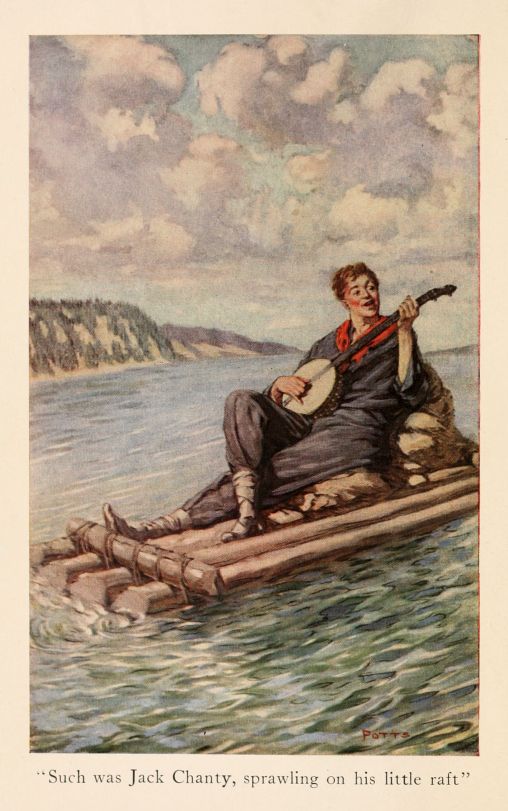
The singer was luxuriously reclining on a tiny raft
made of a single dry trunk cut into four lengths
laced together with rope. His back was supported
by two canvas bags containing his grub and all his
worldly goods, and a banjo lay against his raised
thighs. From afar on the bosom of the great
stream he looked like a doll afloat on a shingle. The
current carried him down, and the eddies waltzed
him slowly around and back, providing him agreeable
views up and down river and athwart the noble hills
that hemmed it in.
"I cannot live si-ingle, and fa-alse I'll not prove,
So I'll 'list for a drummer-boy and follow my love.
Peaked ca-ap, looped jacke-et, whi-ite gaiters and drum,
And marching so manfully to my tru-ue love I'll come."
Between each verse the banjo supplied a rollicking
obbligato.
His head was bare, and the waves of his thick,
sunburnt hair showed half a dozen shades ranging
between sienna and ochre. As to his face, it was
proper enough to twenty-five years old; an abounding
vitality was its distinguishing character. He was
not too good-looking; he had something rarer than
mere good looks, an individuality of line and colouring.
It was his own face, suggesting none of the recognized
types of faces. He had bright blue eyes under
beautifully modelled brows, darker than his hair. One
eyebrow was cocked a little higher than the other,
giving him a mocking air. In repose his lips came
together in a thin, resolute line that suggested a
hard streak under his gay youthfulness.
He was wearing a blue flannel shirt open at the
throat, with a blue and white handkerchief knotted
loosely away from it, and he had on faded blue overalls
tucked into the tops of his mocassins. These mocassins
provided the only touch of coxcombry to his costume;
they were of the finest white doeskin elaborately
worked with silk flowers. Such footwear is not for
sale in the North, but may be surely construed as a
badge of the worker's favour.
Such was Jack Chanty, sprawling on his little
raft, and abandoning himself to the delicious sunshine
and the delights of song. It was July on the Spirit
River; he was twenty-five years old, and the blood
was coursing through his veins; inside his shirt he
felt the weight of a little canvas bag of yellow gold,
and he knew where there was plenty more to be had.
Is it any wonder he was filled with a sense of
well-being so keen it was almost a pain? Expanding his
chest, he threw back his head and relieved himself
of a roaring fortissimo that made the hills ring again:
"'Twas the battle of Ble-enheim, in a ho-ot fusillade,
A poor little drummer-boy was a prisoner made.
But a bra-ave grenadier fou-ought hi-is way through the foe,
And fifteen fierce Frenchmen toge-ether laid low.
"He took the boy tenderly in his a-arms as he swooned,
He opened his ja-acket for to search for a wound.
Oh! pretty Polly Olive-er, my-y bravest, my bride!
Your true love shall nevermore be to-orn from your side!"
By and by the raft was carried around a wide bend,
and the whitewashed buildings of Fort Cheever stole
into view down the river. Jack's eyes gleamed, and
he put away the banjo. It was many a day since
he had hobnobbed with his own kind, and what is
the use of gold if there is no chance to squander it?
Sitting up, he applied himself to his paddle. Edging
the raft toward the left-hand bank, he left the main
current at the head of an island, and, shooting over
a bar, paddled through the sluggish backwater on
the shore of which the little settlement lay. As he
came close the buildings were hidden from him by the
high bank; only the top of the "company's" flagpole
showed. The first human sound that struck on his
ears was the vociferous, angry crying of a boy-child.
Rounding a little point of the bank, the cause of
the commotion was revealed. Jack grinned, and held
his paddle. The sluggish current carried him toward
the actors in the scene, and they were too intent to
observe him. A half-submerged, flat-bottomed barge
was moored to the shore. On the decked end of it a
young girl in a blue print dress was seated on a box,
vigorously soaping an infant of four. Two other
ivory-skinned cupids, one older, one younger, were
playing in the warm water that partly filled the barge.
Their clothes lay in a heap behind the girl.
She was a very pretty girl; the mere sight of her
caused Jack's breast to lift and his heart to set up a
slightly increased beating. It was so long since he had
seen one! Her soft lips were determinedly pressed
together; in one hand she gripped the thin arm of
her captive, while with the other she applied the soap
until his writhing little body flashed in the sun as if
burnished. Struggles and yells were in vain.
The other two children played in the water, callously
indifferent to the sufferings of their brother. It was
clear they had been through their ordeal.
The girl, warned of an approaching presence, raised
a pair of startled eyes. Her captive, feeling the vise
relax, plunged into the water of the barge with incredible
swiftness, and, rapturously splashing off the hated
soap, joined his brothers at the other end, safely out
of her reach. The girl blushed for their nakedness.
They themselves stared open-mouthed at the stranger
without any embarrassment at all. The fat baby
was sitting in the water, turned into stone with
astonishment, like a statue of Buddha in a flood.
Something in the young man's frank laugh reassured
the girl, and she laughed a little too, though blushing
still. She glowed with youth and health, deep-bosomed
as Ceres, and all ivory and old rose. Her
delicious, soft, roundness was a tantalizing sight to a
hungry youth. But there was something more than
mere provoking loveliness—her large brown eyes
conveyed it, a disquieting wistfulness even while she
laughed.
He brought his raft alongside the barge, and, rising,
extended his hand according to the custom of the
country. Hastily wiping her own soapy hand on her
apron, she laid it in his. Both thrilled to the touch,
and their eyes quailed from each other. Jack quickly
recovered himself. Lovely as she might be, she was
none the less a "native," and therefore to a white
man fair game. Naturally he took the world as he
found it.
"You are Mary Cranston," he said. "I should
have known if there was another like you in the
country," his bold eyes added.
The girl lowered her eyes. "Yes," she murmured.
Her voice astonished him, and filled him with the
desire to make her speak again. "You don't know
who I am," he said.
She glanced at the banjo case. "Jack Chanty,"
she said softly.
"Good!" he cried. "That's what it is to be
famous!" Their eyes met, and they laughed as at a rich
joke. Her laugh was as sweet as the sound of falling
water in the ears of thirst, and the name he went by as
spoken by her rang in his ears with rare tenderness.
"How did you know?" he asked curiously.
"Everybody knows about everybody up here,"
she said. "There are so few! You came from across
the mountains, and have been prospecting under
Mount Tetrahedron since the winter. The Indians
who came in to trade told us about the banjo, and
about the many songs you sang, which were strange to
them."
The ardour of his gaze confused her. She broke off,
and, to hide her confusion, turned abruptly to the
staring ivory cupids. "Andy, come here!" she
commanded in the voice of sisterly authority. "Colin!
Gibbie! Come and get dressed!"
Andy and Colin grinned sheepishly, and stayed where
they were. The smile of Andy, the elder, was toothless
and exasperating. As for the infant Buddha, he
continued to sit unmoved, to suck his thumb, and to stare.
She stamped her foot. "Andy! Come here this
minute! Colin! Gibbie!" she repeated in a voice
of helpless vexation.
They did not move.
"Look sharp, young 'uns!" Jack suddenly roared.
Of one accord, as if galvanized into life, they
scrambled toward their sister, making a detour around the
far side of the barge to avoid Jack.
Mary rewarded him with a smile, and dealt out
the clothes with a practised hand. Andy, clasping
his garments to his breast, set off over the plank to
the shore, and was hauled back just in time.
"He has to have his hair cut, because the steamboat
is coming," his sister explained; "and I don't see how
I can hold on to him while I am dressing the others."
"Pass him over here," said Jack.
Andy, struck with terror, was deposited on the raft,
whence escape was impossible without passing the big
man, and commanded to dress himself without more
ado.
Mary regarded the other two anxiously. "They're
beginning to shiver," she said, "and I can't dress both
at once."
Jack sat on the edge of the barge with his feet on
the raft. "Give me the baby," he said.
"You couldn't dress a baby," she said, with a
provoking dimple in either cheek.
"Yes, I can, if he wears pants," said Jack serenely.
"There's no mystery about pants."
"Besides, he'd yell," she objected.
"No, he won't," said Jack. "Try him and see."
And in sooth he did not yell, but sat on Jack's
knee while his little shirt was pulled over his head and
buttoned, sucking his thumb, and staring at Jack
with a piercing, unflinching stare.
"You have a way with babies," the girl said in the
sweet, hushed voice that continually astonished him.
He looked at her with his mocking smile. "And
with girls?" his eyes asked boldly.
She blushed, and attended strictly to Colin's buttons.
Colin, fully attired in shirt, trousers, and moccasins,
was presently dismissed over the plank. He lingered
on the shore, shouting opprobrious epithets to his elder,
still in captivity. At the same time the baby was
dressed in the smallest pair of long pants ever made.
He was as bow-legged as a bulldog. Jack leaned
back, roaring with laughter at the figure of gravity
he made. Gibbie didn't mind. He could walk, but
he preferred to sit. He continued to sit cross-legged
on the end of the barge, and to stare.
Next, Andy was seated on the box, while Mary,
kneeling behind him, produced her scissors.
"If you don't sit still you'll get the top of your
cars cut off!" she said severely.
But sitting still was difficult under the taunts
from ashore.
"Jutht you wait till I git aholt of you," lisped the
toothless one, proving that the language of unregenerate
youth is much the same on the far-off Spirit
River as it is on the Bowery.
Jack returned to the raft and unstrapped the banjo
case. "Be a good boy and I'll sing you a song," he
said, presumably to Andy, but looking at Mary meanwhile.
At the sound of the tuning-up the infant Buddha
in long pants gravely arose stern foremost, and reseated
himself at the edge of the barge, where he could
get a better view of the player.
Jack chose another rollicking air, but a new tone had
crept into his deep voice. He sang softly, for he had
no desire to bring others down the bank to interrupt
his further talk with Mary.
"Oh, the pretty, pretty creature!
When I next do meet her
No more like a clown will I face her frown,
But gallantly will I treat her,
But gallantly will I treat her,
Oh, the pretty, pretty creature!"
The infant Buddha condescended to smile, and to
bounce once or twice on his fundament by way of
applause. Andy sat as still as a surprised chipmunk.
Colin was sorry now that he had cut himself off from
the barge. As for the boy's big sister, she kept her
eyes veiled, and plied the scissors with slightly
languorous motions of the hands. Even a merry song
may work a deal of sentimental damage under certain
conditions. And the sun shone, and the bright river
moved down.
"Thank you," she said, when he had come to the end.
"We never have music here."
Jack wondered where she had learned her pretty
manners.
The hair-cutting was concluded. Andy sprang up
looking like a little zebra with alternate dark and light
stripes running around his head, and a narrow bang
like a forelock in the middle of his forehead. Jack
put away the banjo, and Andy, seeing that there was
to be no more music, set off in chase of Colin. The
two of them disappeared over the bank. Mary gathered
up towels, soap, comb, and scissors preparatory
to following them.
"Don't go yet," said Jack eagerly.
"I must," she said, but lingering. "There is much
to be done before the steamboat comes."
"She's only expected," said Jack of the knowledge
born of experience. "It'll be a week before she comes."
Mary displayed no great eagerness to be gone.
A bold idea had been making a covert shine in
Jack's eyes during the last minute or two. It suddenly
found expression. "Cut my hair," he blurted out.
She started and blushed. "Oh, I—I couldn't
cut a man's hair," she stammered.
"What's the difference?" demanded Jack with a
great parade of innocence. "Hair is just hair, isn't
it?"
"I couldn't," she repeated naïvely. "It would
confuse me so!"
The thought of her confusion was delicious to him.
He was standing below her on the raft. "Look,"
he said, lowering his head. "It needs it. I'm a
sight!"
Since in this position he could not see her face, she
allowed her eyes to dwell for a moment on the tawny
silken sheaves that he exhibited. Such bright hair
was wonderful to her. It seemed to her as if the sun
itself was netted in its folds.
"I—I couldn't," she repeated, but weakly.
He swung about and sat on the edge of the barge.
"Make out I am your other little brother," he said
insinuatingly. "I can't see you, so it's all right.
Just one little snip to see how it goes!"
The temptation was too great to be resisted. She
bent over, and the blades of the scissors met. In
her agitation she cut a wider swath than she intended
and a whole handful of hair fell to the deck.
"Oh!" she cried remorsefully.
"Now you'll have to do the whole thing," said
Jack quickly. "You can't leave me looking like
a half-clipped poodle."
With a guilty look over her shoulder she drew up the
box and sat down behind him. Gibbie, the youngest
of the Cranstons, was a solemn and interested spectator.
Jack thrilled a little and smiled at the touch
of her trembling fingers in his hair. At the same time
he was not unaware of the decorative value of his
luxuriant thatch, and it occurred to him he was running
a considerable risk of disfigurement at her hands.
"Not so short as Andy's," he suggested anxiously.
"I will be careful," she said.
The scissors snipped busily, and the rich yellow-brown
hair fell all around the deck. Mary eyed it
covetously. One shining twist of it dropped in her
lap. He could not see her. In a twinkling it was
stuffed inside her belt.
Meanwhile Jack continued to smile with softened
eyes. "Hair-cutting was never like this," he
murmured. He was tantalized by the recollection of her
voice, and he cast about in his mind for something
to lead her to talk more freely. "You were not here
when I came through two years ago," he said.
"I was away at school," she said.
"Where?"
"The mission at Caribou Lake."
"Did you like it there?"
He felt the shrug in her finger-tips. "It is the
best there is," she said quietly.
"It's a shame!" said Jack. There was a good deal
unspoken here. "A shame you should be obliged to
associate with those savages," he implied, and she
understood.
"Have you ever been outside?" he asked.
"No," she said.
"Would you like to go?"
"Yes, with somebody I liked," she said in her
simple way.
"With me?" he asked in the off-hand tone that may
be taken any way the hearer pleases.
Her simplicity was not dullness. "No," she said
quickly. "You would tell me funny lies about everything."
"But you would laugh, and you would like it,"
he said.
She had nothing to say to this.
"Outside they have regular shops for shaving and
cutting hair," he went on. "Barber-shops they are
called."
"I know," she said offended. "I read."
"I'll bet you didn't know there was a lady barber
in Prince George."
"Nice kind of lady!" she said.
The obvious retort slipped thoughtlessly off his
tongue. "I like that! What are you doing?"
Her eyes filled with tears, and the scissors faltered.
"Well, I wouldn't do it for—I—I wouldn't do it
all the time," she murmured deeply hurt.
He twisted his head at the imminent risk of impaling
an eye on the scissors. The tears astonished him.
Everything about her astonished him. In no respect
did she coincide with his experience of "native" girls.
He was vain enough for a good-looking young man of
twenty-five, but he did not suspect that to a lonely
and imaginative girl his coming down the river might
have had all the effect of the advent of the yellow-haired
prince in a fairy-tale. Jack was not imaginative.
He reached for her free hand. "Say, I'm sorry,"
he said clumsily. "It was only a joke! It's mighty
decent of you to do it for me."
She snatched her hand away, but smiled at him
briefly and dazzlingly. She was glad to be hurt if he
would let that tone come into his mocking voice.
"I was just silly," she said shortly.
The hair-cutting went on.
"What do you read?" asked Jack curiously.
"We get newspapers and magazines three times a
year by the steamboat," she said. "And I have a few
books. I like 'Lalla Rookh' and 'Marmion' best."
Jack, who was not acquainted with either, preserved
a discreet silence.
"Father has sent out for a set of Shakespeare for
me," she went on. "I am looking forward to it."
"It's better on the stage," said Jack. "What fun
to take you to the theatre!"
She made no comment on this. Presently the
scissors gave a concluding snip.
"Lean over and look at yourself in the water," she
commanded.
Obeying, he found to his secret relief that his
looks had not suffered appreciably. "That's out of
sight!" he said heartily, turning to her. "I say, I'm
ever so much obliged to you."
An awkward silence fell between them. Jack's
growing intention was clearly evident in his eye, but
she did not look at him.
"I—I must pay you," he said at last, a little
breathlessly.
She understood that very well, and sprang up, the
scissors ringing on the hollow deck. They were both
pale. She turned to run, but the box was in her way.
Leaping from the raft to the barge, he caught her in
his arms, and as she strained away he kissed her round
firm cheek and her fragrant neck beneath the ear. He
roughly pressed her averted head around, and
crushed her soft lips under his own.
Then she got an arm free, and he received a
short-arm box on the ear that made his head ring. She
tore herself out of his arms, and faced him from the
other side of the barge, panting and livid with anger.
"How dare you! How dare you!" she cried.
Jack leaned toward her, breathing no less quickly
than she. "You're lovely! You're lovely," he
murmured swiftly. "I never saw anybody like you before.
I'll camp quarter of a mile down river, out of the way.
Come down to-night, and I'll sing to you."
"I won't!" she cried. "I'll never speak to you
again! I hate you!" She indicated the unmoved
infant Buddha with a tragic gesture. "And before the
baby, too!" she cried. "Aren't you ashamed of yourself?"
Jack laughed a little sheepishly. "Well, he's too
young to tell," he said.
"But what will he think of me?" she cried despairingly.
Stooping, she swept the little god into her arms,
and, running over the plank, disappeared up the bank.
"I'll be waiting for you," Jack softly called after
her. She gave no sign of hearing.
Jack sad down on the edge of the barge again.
He brushed the cut hair into the water, and watched
it float away with an abstract air. As he stared
ahead of him a slight line appeared between his
eyebrows which may have been due to compunction.
Whatever the uncomfortable thought was, he
presently whistled it away after the manner of youth,
and, drawing his raft up on the stones, set to work to
take stock of his grub.
The Hudson Bay Company's buildings at
Fort Cheever were built, as is customary,
in the form of a hollow square, with one side
open to the river. The store occupied one side of
the square, the warehouse was opposite, and at the
top stood the trader's house in the midst of its
vegetable garden fenced with palings. The old
palisade about the place had long ago disappeared,
and nothing military remained except the flagpole
and an ancient little brass cannon at its foot, blackened
with years of verdigris and dirt. The humbler store
of the "French outfit" and the two or three native
shacks that completed the settlement lay at a little
distance behind the company buildings, and the whole
was cropped down on a wide, flat esplanade of grass
between the steep bare hills and the river.
To-day at the fort every one was going about his
business with an eye cocked downstream. Every
five minutes David Cranston came to the door of the
store for a look, and old Michel Whitebear, hoeing
the trader's garden, rested between every hill of
potatoes, to squint his aged eyes in the same direction.
Usually this state of suspense endured for days,
sometimes weeks, but upon this trip the river-gods
were propitious, and at five o'clock the eagerly listened
for whistle was actually heard.
Every soul in the place gathered at the edge of
the bank to witness the arrival. At one side, slightly
apart, stood the trader and his family. David
Cranston was a lean, up-standing Scotchman, an imposing
physical specimen with hair and beard beginning to
grizzle, and a level, grim, sad gaze. His wife was
a handsome, sullen, dark-browed, half-breed woman,
who, unlike the majority of her sisters, carried her age
well. In his grim sadness and her sullenness was
written a domestic tragedy of long-standing. After all
these years she was still a stranger in her own house, and
an alien to her husband and children. Their children
were with them, Mary and six boys ranging from Davy,
who was sixteen, down to the infant Buddha.
A small crowd of natives in ragged store clothes,
standing and squatting on the bank, and spilling over
on the beach below, filled the centre of the picture,
and beyond them sat Jack Chanty by himself, on a
box that he had carried to the edge of the bank.
Between him and Mary the bank made in, so that
they were fully visible to each other, and both
tinglingly self-conscious. In Jack this took the form of an
elaborately negligent air. He whittled a paddle with
nice care, glancing at Mary from under his lashes.
She could not bring herself to look at him.
While the steamboat was still quarter of a mile
downstream, the people began to sense that there
was something more than usual in the wind, and a
great excitement mounted. We of the outside world,
with our telegrams and newspapers and hourly posts,
have forgotten what it is to be dramatically surprised.
Where can we get a thrill like to that which animated
these people as the magic word was passed around:
"Passengers!" Presently it could be made out that
these were no ordinary passengers, but a group of
well-dressed gentlemen, and finally, wonder of wonders!
what had never been seen at Fort Cheever before, a
white lady—no, two of them!
Mary saw them first, two ladies, corseted, tailored,
and marvellously hatted like the very pictures in the
magazines that she had secretly disbelieved in. In
another minute she made out that one of them, leaning
on the upper rail, smiling and chatting vivaciously with
her companions, was as young as Mary herself, and
as slender and pretty as a mundane fairy.
Mary glanced swiftly at Jack. He, too, was looking
at the deck of the steamboat and he had stopped
whittling his paddle. A dreadful pang transfixed
Mary's breast. Her hands and feet suddenly became
enormous to her, and her body seemed like a coarse and
shapeless lump. She looked down at her clean, faded
print dress; she could have torn it into ribbons. She
looked at her dark-browed mother with eyes full of a
strange, angry despair. The elder woman had by
this time seen what was coming, and her lip curled
scornfully. Mary's eyes filled with tears. She slipped
out of the group unseen, and, running back to the
house, cast herself on her bed and wept as she had
never wept.
The steamboat was moored alongside the half-submerged
barge. She came to a stop with the group
on the upper deck immediately in front of Jack and a
little below him. True to the character of indifference
he was fond of assuming, he went on whittling his
paddle. At the same time he was taking it all in. The
sight of people such as his own people, that he thought
he had put behind him forever, raised a queer confusion
of feelings in him. As he covertly watched the
dashing, expensive, imperious little beauty and three men
hanging obsequiously on her words, a certain hard brightness
showed briefly in his eyes, and his lips thinned.
It was as if he said: "Aha! my young lady, I know
your kind! None of you will ever play that game
again with me!"
Consequently when her casual glance presently fell
on the handsome, young, rough character (as she would
no doubt have called him) it was met by a glance even
more casual. The young man was clearly more
interested in the paddle he was making than in her.
Her colour heightened a little and she turned with an
added vivacity to her companions. After a long time
she looked again. The young man was still intent
upon his paddle.
The first to come off the boat was the young purser,
who hurried with the mail and the manifests to David
Cranston. He was pale under the weight of the
announcement he bore.
"We have his honour the lieutenant-governor and
party on board," he said breathlessly.
Cranston, because he saw that he was expected to
be overcome, remained grimly unconcerned. "So!"
he said coolly.
The youngster stared. "The lieutenant-governor,"
he repeated uncertainly. "He's landing here to make
some explorations in the mountains. He joined us
without warning at the Crossing. There was no way
to let you know."
"We'll do the best we can for his lordship," said
Cranston with an ironic curl to his grim lips. "I will
speak to my wife."
To her he said under his breath, grimly but not
unkindly, "Get to the house, my girl."
She flared up with true savage suddenness. "So,
I'm not good enough to be seen with you," she snarled,
taking no pains to lower her voice. "I'm your lawful
wife. These are my children. Are you ashamed
of my colour? You chose me!"
Cranston drew the long breath that calls on patience.
"'Tis not your colour that puts me to shame, but your
manners," he said sternly. "And if they're bad,"
he added, "it's not for the lack of teaching. Get
to the house!"
She went.
The captain of the steamboat now appeared on the
gangplank, ushering an immaculate little gentleman
whose salient features were a Panama hat above price,
a pointed white beard, neat, agile limbs, and a trim
little paunch under a miraculously fitting white waistcoat.
Two other men followed, one elderly, one young.
Cranston waited for them at the top of the path.
The captain was a little flustered too.
"Mr. Cranston, gentlemen, the company's trader here,"
he said. "His Honour Sir Bryson Trangmar, the
lieutenant-governor of Athabasca," he went on.
"Captain Vassall"—the younger man bowed; "Mr. Baldwin
Ferrie"—the other nodded.
There was the suspicion of a twinkle in Cranston's
eye. Taking off his hat he extended an enormous
hand. "How do you do, sir," he said politely.
"Welcome to Fort Cheever."
"Charmed! Charmed!" bubbled the neat little
gentleman. "Charming situation you have here.
Charming river! Charming hills!"
"I regret that I cannot offer you suitable hospitality,"
Cranston continued in his great, quiet voice.
"My house is small, as you see, and very ill-furnished.
There are nine of us. But the warehouse shall be
emptied before dark and made ready for you. It is
the best building here."
"Very kind, I'm sure," said Sir Bryson with off-hand
condescension—perhaps he sensed the twinkle,
perhaps it was the mere size of the trader that annoyed
him; "but we have brought everything needful. We
will camp here on the grass between the buildings
and the river. Captain Vassall, my aide-de-camp,
will see to it. I will talk to you later Mr.—er?"
"Cranston," murmured the aide-de-camp.
Cranston understood by this that he was dismissed.
He sauntered back to the store with a peculiar smile
on his grim lips. In the free North country they have
never become habituated to the insolence of office, and
the display of it strikes them as a very humorous thing,
particularly in a little man.
Sir Bryson and the others reconnoitred the grassy
esplanade, and chose a spot for the camp. It was
decided that the party should remain on the steamboat
all night, and go into residence under canvas next day.
They then returned on board for supper, and nothing
more was seen of the strangers for a couple of hours.
At the end of that time Miss Trangmar and her
companion, Mrs. Worsley, arm in arm and hatless,
came strolling over the gangplank to enjoy a walk
in the lingering evening. At this season it does not
become dark at Fort Cheever until eleven.
Jack's raft was drawn up on the beach at the steamboat's
bow, and as the ladies came ashore he was disposing
his late purchases at the store upon it, preparatory
to dropping downstream to the spot where
he meant to camp. In order to climb the bank the
two had to pass close behind him.
At sight of him the girl's eyes brightened, and, with a
mischievous look she said something to her companion.
"Linda!" the older woman remonstrated.
"Everybody speaks to everybody up here," said
the girl. "It was understood that the conventions
were to be left at home."
Thus Jack was presently startled to hear a clear
high voice behind him say: "Are you going to travel
on the river with that little thing?"
Hastily straightening his back and turning, he
raised his hat. Her look took him unawares. There
was nothing of the insolent queenliness in it now. She
was smiling at him like a fearless, well-bred little
girl. Nevertheless, he reflected, the sex is not confined
to the use of a single weapon, and he stiffened.
"I came down the river on it this morning," he said
politely and non-committal. "To-night I'm going just
a little way to camp."
She was very like a little girl, he thought, being so
small and slender, and having such large blue eyes,
and such a charming, childlike smile. Her bright
brown hair was rolled back over her ears. Her lips
were very red, and her teeth perfect. She was
wearing a silk waist cunningly contrived with lace, and
fitting in severe, straight lines, ever so faintly
suggesting the curves beneath. In spite of himself
everything about her struck subtle chords in Jack's
memory. It was years since he had been so close
to a lady.
She was displeased with the manner of his answer.
He had shown no trace either of the self-consciousness
or the eager complaisance she had expected from a
local character. Indeed, his gaze returned to the
raft as if he were only restrained by politeness from
going on with his preparations. He reminded her of a
popular actor in a Western play that she had been to
see more times than her father knew of. But the
rich colour in Jack's cheek and neck had the advantage
of being under the skin instead of plastered on top.
Her own cheeks were a thought pale.
"How do you go back upstream?" she asked with an
absent air that was intended to punish him.
"You travel as you can," said Jack calmly. "On
horseback or afoot."
She pointedly did not wait for the answer, but
strayed on up the path as if he had already passed
from her mind. Yet as she turned at the top her eyes
came back to him as if by accident. She had a view
of a broad back, and a bent head intent upon the
lashings of the raft. She bit her lip. It was a
disconcerting young man.
A few minutes later Frank Garrod, the governor's
secretary, who until now had been at work in his
cabin upon the correspondence the steamboat was
to take back next day, came over the gangplank
in pursuit of the ladies. He was a slim and
well-favoured young man, of about Jack's age, but with
something odd and uncontrolled about him, a young
man of whom it was customary to say he was "queer,"
without any one's knowing exactly what constituted
his queerness. He had black hair and eyes that made
a striking contrast with his extreme pallor. The eyes
were very bright and restless; all his movements were
a little jerky and uneven.
Hearing more steps behind him, Jack looked around
abstractedly without really seeing what he looked at.
Garrod, however, obtained a fair look into Jack's face,
and the sight of it operated on him with a terrible,
dramatic suddenness. A doctor would have recognized
the symptoms of what he calls shock. Garrod's
arms dropped limply, his breath failed him, his eyes
were distended with a wild and inhuman fear. For
an instant he seemed about to collapse on the stones,
but he gathered some rags of self-control about him,
and, turning without a sound, went back over the
gangplank, swaying a little, and walking with
wide-open, sightless eyes like a man in his sleep.
Presently Vassall, the amiable young A.D.C.,
descending the after stairway, came upon him leaning
against the rail on the river-side of the boat, apparently
deathly sick.
"Good heavens, Garrod! What's the matter?" he cried.
The other man made a pitiable attempt to carry it
off lightly. "Nothing serious," he stammered. "A
sudden turn. I have them sometimes. If you have
any whiskey——"
Vassall sprang up the stairway, and presently
returned with a flask. Upon gulping down part of the
contents, a little colour returned to Garrod's face, and
he was able to stand straighter.
"All right now," he said in a stronger voice. "You
run along and join the others. Please don't say
anything about this."
"I can't leave you like this," said Vassall. "You
ought to be in bed."
"I tell you I'm all right," said Garrod in his jerky,
irritable way. "Run along. There isn't anything you
can do."
Vassall went his way with a wondering air; real
tragedy is such a strange thing to be intruding upon
our everyday lives. Garrod, left alone, stared at the
sluggishly flowing water under the ship's counter with
the kind of sick, desirous eyes that so often look over
the parapets of bridges in the cities at night. But
there were too many people about on the boat; the
splash would instantly have betrayed him.
He gathered himself together as with an immense
effort, and, climbing the stairway, went to his
stateroom. There he unlocked his valise, and drawing out
his revolver, a modern hammerless affair, made sure
that it was loaded, and slipped it in his pocket. He
caught sight of his face in the mirror and shuddered.
"As soon as it's dark," he muttered.
He sat down on his bunk to wait. By and by he
became conscious of a torturing thirst, and he went out
into the main cabin for water. Jack, meanwhile, having
loaded his craft, had boarded the steamboat to see if he
could beg or steal a newspaper less than two months
old, and the two men came face to face in the saloon.
Garrod made a move to turn back, but it was too
late; Jack had recognized him now. Seeing the look
of amazement in the other's face, Garrod's hand stole
to his hip-pocket, but it was arrested by the sound
of Jack's voice.
"Frank!" he cried, and there was nothing but gladness
in the sound. "Frank Garrod, by all that's holy!" He
sprang forward with outstretched hands. "Old
Frank! To think of finding you here!"
Garrod stared in stupid amazement at the smile and
the hearty tone. For a moment he was quite
unnerved; his hands and his lips trembled. "Is
it—is it Malcolm Piers?" he stammered.
"Sure thing!" cried Jack, wringing his hand.
"What's the matter with you? You look completely
knocked up at the sight of me. I'm no ghost, man!
What are you doing up here."
"I'm Sir Bryson's secretary," murmured Garrod,
feeling for his words with difficulty.
Jack's delight was as transparent as it was
unrestrained. The saloon continued to ring with his
exclamations. In the face of it a little steadiness
returned to Garrod, but he could not rid his eyes of
their amazement and incredulity at every fresh display
of Jack's gladness.
"You're looking pretty seedy," Jack broke off to
say. "Going the pace, I expect. Now that we've
got you up here, you'll have to lead a more godly and
regular life, my boy."
"What are you doing up here, Malcolm?" asked
Garrod dully.
"Easy with that name around here, old fel'," said
Jack carelessly. "I left it off long ago. I'm just
Jack Chanty now. It's the name the fellows gave me
themselves because I sing by the campfires."
"I understand," said Garrod, with a jerk of
eagerness. "Good plan to drop your own name, knocking
around up here."
"I had no reason to be ashamed of it," said Jack
quickly. "But it's too well known a name in the
East. I didn't want to be explaining myself all the
time. It was nobody's business, anyway, why I came
out here. So I let them call me what they liked."
"Of course," said Garrod.
"Knock around," cried Jack. "That's just what
I do! A little river work, a little prospecting, a little
hunting and trapping, and one hell of a good time!
It beats me how young fellows of blood and muscle
can stew their lives away in cities when this is open
to them! New country to explore, and game to
bring down, and gold to look for. The fun of it,
whether you find any or not! This is freedom, Frank,
working with your own hands for all you get, and
beholden to no man! By Gad! I'm glad I found
you," he went on enthusiastically. "What talks we'll
have about people and the places back home! I
never could live there now, but I'm often sick to hear
about it all. You shall tell me!"
A tremor passed over Garrod's face. "Sure," he
said nervously. "I can't stop just this minute,
because they're waiting for me up on the bank. But I'll
see you later."
"To-morrow, then," said Jack easily; but his eyes
followed the disappearing Garrod with a surprised and
chilled look. "What's the matter with him?" they
asked.
Garrod as he hurried ashore, his hands trembling,
and his face working in an ecstasy of relief, murmured
over and over to himself. "He doesn't know! He
doesn't know!"
Jack was sitting by his own fire idly strumming
on the banjo. Behind him was his canvas
"lean-to," open to the fire in front, and with a
mosquito bar hanging within. All around his little
clearing pressed a thick growth of young poplar,
except in front, where the view was open to the river,
moving smoothly down, and presenting a burnished
silver reflection to the evening sky. The choice of a
situation, the proper fire, and the tidy arrangements
all bespoke the experienced campaigner. Jack took
this sort of thing for granted, as men outside ride
back and forth on trolley cars, and snatch hasty meals
at lunch counters.
The supper dishes being washed, it was the easeful
hour of life in camp, but Jack was not at ease. He
played a few bars, and put the banjo down. He
tinkered with the fire, and swore when he only succeeded
in deadening it. He lit his pipe, and immediately
allowed it to go out again. A little demon had his
limbs twitching on wires. He continually looked and
listened in the direction of the fort, and whenever he
fancied he heard a sound his heart rose and beat thickly
in his throat. At one moment he thought: "She'll
come," and confidently smiled; the next, for no reason:
"She will not come," and frowned, and bit his lip.
Finally he did hear a rustle among the trees. He
sprang up with surprised and delighted eyes, and
immediately sat down again, picking up the banjo with
an off-hand air. Under the circumstances one's pet
affectation of unconcern is difficult to maintain.
It was indeed Mary. She broke into the clearing,
pale and breathless, and looked at Jack as if she was
all ready to turn and fly back again. Jack smiled and
nodded as if this were the most ordinary of visits. The
smile stiffened in his face, for another followed her into
the clearing—Davy, the oldest of her brothers. For
an instant Jack was nonplussed, but he had laid it down
as a rule that in his dealings with the sex, whatever
betide, a man must smile and keep his temper. So,
swallowing his disappointment as best he could, he
greeted Davy as if he had expected him too.
What Mary had been through during the last few
hours may be imagined: how many times she had sworn
she would not go, only to have her desires open the
question all over again. Perhaps she would not have
come if the maddeningly attractive young lady had not
appeared on the scene; perhaps she would have found
an excuse to come anyway. Be that as it may, she
had brought Davy. In this she had not Mrs. Grundy's
elaborate code to guide her; it was an idea out of her
own head—or an instinct of her heart, rather. Watching
Jack eagerly and covertly to see how he took it, she
decided that she had done right. "He will think
more of me," she thought with a breath of relief.
She had done wisely of course. Jack, after his first
disappointment, was compelled to doff his cap to her.
He had never met a girl of the country like this. He
bestirred himself to put his visitors at their ease.
"I will make tea," he said, reaching for the copper
pot according to the ritual of politeness in the North.
"We have just had tea," Mary said. "Davy will
smoke with you."
Mary was now wearing a shawl over the print
dress, but instead of clutching it around her in the
clumsy native way, she had crossed it on her bosom
like a fichu, wound it about her waist, and tucked
the ends in. Jack glanced at her approvingly.
Davy was young for his sixteen years, and as slender
as a sapling. He had thin, finely drawn features, and
eyes that expressed something of the same quality
of wistfulness as his sister's. At present he was very
ill at ease, but his face showed a certain resoluteness
that engaged Jack's liking. The boy shyly produced
a pipe that was evidently a recent acquisition, and filled
it inexpertly.
Jack's instinct led him to ignore Mary for the present
while he made friends with the boy. He knew how.
They were presently engaged in a discussion about
prairie chicken, in an off-hand, manly tone.
"Never saw 'em so plenty," said Davy. "You only
have to climb the hill to bring back as many as you
want."
"What gun do you use?" asked Jack.
The boy's eyes gleamed. "My father has a Lefever
gun," he said proudly. "He lets me use it."
"So!" said Jack, suitably impressed. "There are
not many in the country."
"She's a very good gun," said Davy patronizingly.
"I like to take her apart and clean her," he added
boyishly.
"I'd like to go up on the prairie with you while I'm
here," said Jack. "But I have no shotgun. I'll have
to try and put their eyes out with my twenty-two."
This sort of talk was potent to draw them together.
They puffed away, ringing all the changes on it.
Mary listened apart as became a mere woman, and
the hint of a dimple showed in either cheek. When
she raised her eyes they fairly beamed on Jack.
Jack knew that the way to win the hearts of the
children of the North is to tell them tales of the
wonderful world outside that they all dream about. He
led the talk in this direction.
"I suppose you've finished school," he said to Davy,
as man to man. "Do you ever think of taking a
trip outside?"
The boy hesitated before replying. "I think of it
all the time," he said in a low, moved voice. "I
feel bad every time the steamboat goes back without
me. There is nothing for me here."
"You'll make it some day soon," said Jack heartily.
"I suppose you know Prince George well?" the boy
said wistfully.
"Yes," said Jack, "but why stop at Prince George?
That's not much of a town. You should see Montreal.
That's where I was raised. There's a city for you!
All built of stone. Magnificent banks and stores
and office buildings ten, twelve, fourteen stories high,
and more. You've seen a two-story house at the
lake; imagine seven of them piled up one on top of
another, with people working on every floor!"
"You're fooling us," said the boy. His and his
sister's eyes were shining.
"No, I have seen pictures of them in the
magazines," put in Mary quickly.
"There is Notre Dame Street," said Jack dreamily,
"and Great St. James, and St. Catherine's, and
St. Lawrence Main; I can see them now! Imagine miles
of big show-windows lighted at night as bright as
sunshine. Imagine thousands of moons hung right
down in the street for the people to see by, and you
have it!"
"How wonderful!" murmured Mary.
"There is an electric light at Fort Ochre," said the
boy, "but I have not seen it working. They say when
the trader claps his hands it shines, and when he claps
them again it goes out."
Mary blushed for her brother's ignorance. "That's
only to fool the Indians," she said quickly. "Of
course there's some one behind the counter to turn it
off and on."
Jack told them of railway trains and trolley cars;
of mills that wove thousands of yards of cloth in
a day, and machines that spit out pairs of boots all
ready to put on. The old-fashioned fairy-tales are
puerile beside such wonders as these—think of eating
your dinner in a carriage that is being carried over
the ground faster than the wild duck flies!—moreover,
he assured them on his honour that it was all true.
"Tell us about theatres," said Mary. "The magazines
have many stories about theatres, but they do
not explain what they are."
"Well, a theatre's a son-of-a-gun of a big house with
a high ceiling and the floor all full of chairs," said
Jack. "Around the back there are galleries with more
chairs. In the front there is a platform called the
stage, and in front of the stage hangs a big curtain
that is let down while the people are coming in, so
you can't see what is behind it. It is all brightly
lighted, and there's an orchestra, many fiddles and
other kinds of music playing together in front of
the stage. When the proper time comes the curtain
is pulled up," he continued, "and you see the stage
all arranged like a picture with beautifully painted
scenery. Then the actors and actresses come out on
the stage and tell a story to each other. They dance
and sing, and make love, and have a deuce of a time
generally. That's called a play."
"Is it nothing but making love?" asked Davy.
"Don't they have anything about hunting, or having
sport?"
"Sure!" said Jack. "War and soldiers and shooting,
and everything you can think of."
"Are the actresses all as pretty as they say?" asked
Mary diffidently.
"Not too close," said Jack. "But you see the
lights, and the paint and powder, and the fine clothes
show them up pretty fine."
"It gives them a great advantage," she commented.
Mary had other questions to ask about actresses.
Davy was not especially interested in this subject,
and soon as he got an opening therefor he said,
looking sidewise at the leather case by the fire:
"I never heard the banjo played."
Jack instantly produced the instrument, and, tuning
it, gave them song after song. Brother and sister
listened entranced. Never in their lives had they
met anybody like Jack Chanty. He was master
of an insinuating tone not usually associated with
the blatant banjo. Without looking at her, he sang
love-songs to Mary that shook her breast. In her
wonder and pleasure she unconsciously let fall the
guard over her eyes, and Jack's heart beat fast at
what he read there.
Warned at last by the darkness, Mary sprang up.
"We must go," she said breathlessly.
Davy, who had come unwillingly, was more
unwilling to go. But the hint of "father's" anger was
sufficient to start him.
Jack detained Mary for an instant at the edge of
the clearing. He dropped the air of the genial host.
"I shall not be able to sleep to-night," he said swiftly.
"Nor I," she murmured. "Th—thinking of the
theatre," she added lamely.
"When everybody is asleep," he pleaded, "come
outside your house. I'll be waiting for you. I want
to talk to you alone."
She made no answer, but raised her eyes for a moment
to his, two deep, deep pools of wistfulness. "Ah, be
good to me! Be good to me," they seemed to plead
with him. Then she darted after her brother.
The look sobered Jack, but not for very long.
"She'll come," he thought exultingly.
Left alone, he worked like a beaver, chopping and
carrying wood for his fire. Under stress of emotion
he turned instinctively to violent physical exertion
for an outlet. He was more moved than he knew.
In an hour, being then as dark as it would get, he
exchanged the axe for the banjo, and, slinging it
over his back, set forth.
The growth of young poplar stretched between
his camp and the esplanade of grass surrounding the
buildings of the fort. When he came to the edge of the
trees the warehouse was the building nearest to him.
Running across the intervening space, he took up his
station in the shadow of the corner of it, where he could
watch the trader's house. A path bordered by young
cabbages and turnips led from the front door down to
the gate in the palings. The three visible windows of
the house were dark. At a little distance behind the
house the sledge dogs of the company were tethered
in a long row of kennels, but there was little danger of
their giving an alarm, for they often broke into a
frantic barking and howling for no reason except the
intolerable ennui of their lives in the summer.
There is no moment of the day in lower latitudes that
exactly corresponds to the fairylike night-long summer
twilight of the North. The sunset glow does not
fade entirely, but hour by hour moves around the
Northern horizon to the east, where presently it
heralds the sun's return. It is not dark, and it is
not light. The world is a ghostly place. It is most
like nights at home when the full moon is shining
behind light clouds, but with this difference, that
here it is the dimness of a great light that embraces
the world, instead of the partial obscurity of a lesser.
Jack waited with his eyes glued to the door of the
trader's house. There was not a breath stirring.
There were no crickets, no katydids, no tree-toads
to make the night companionable; only the hoot of
an owl, and the far-off wail of a coyote to put an edge
on the silence. It was cold, and for the time being
the mosquitoes were discouraged. The stars twinkled
sedulously like busy things.
Jack waited as a young man waits for a woman at
night, with his ears strained to catch the whisper of
her dress, a tremor in his muscles, and his heart
beating thickly in his throat. The minutes passed
heavily. Once the dogs raised an infernal clamour,
and subsided again. A score of times he thought he
saw her, but it was only a trick of his desirous eyes.
He became cold to the bones, and his heart sunk.
As a last resort he played the refrain of the last song
he had sung her, played it so softly none but one
who listened would be likely to hear. The windows of
the house were open.
Then suddenly he sensed a figure appearing from
behind the house, and his heart leapt. He lost it
in the shadow of the house. He waited breathlessly,
then played a note or two. The figure reappeared,
running toward him, still in the shadow. It loomed
big in the darkness. It started across the open space.
Too late Jack saw his mistake. He had only time to
fling the banjo behind him, before the man was upon
him with a whispered oath.
Jack thought of a rival, and his breast burned.
He defended himself as best as he could, but his
blows went wide in the darkness. The other man
was bigger than he, and nerved by a terrible, quiet
passion. To save himself from the other's blows Jack
clinched. The man flung him off. Jack heard the
sharp impact of a blow he did not feel. The earth
leapt up, and he drifted away on the swirling current
of unconsciousness.
What happened after that was like the awakening
from a vague, bad dream. He had first the impression
of descending a long and tempestuous series of rapids
on his flimsily hung raft, to which he clung desperately.
Then the scene changed and he seemed to be floating
in a ghastly void. He thought he was blind. He
put out his hand to feel, and his palm came in contact
with the cool, moist earth, overlaid with bits of twig
and dead leaves, and sprouts of elastic grass. The earth
at least was real, and he felt of it gratefully, while
the rest of him still teetered in emptiness.
Then he became conscious of a comfortable emanation,
as from a fire; sight returned, and he saw that
there was a fire. It had a familiar look; it was the
fire he himself had built some hours before. He felt
himself, and found that he was covered by his own
blanket. "I have had a nightmare," he thought
mistily. Then a voice broke rudely on his vague
fancies, bringing the shock of complete recollection
in its train.
"So, you're coming 'round all right," it said grimly.
At his feet, Jack saw David Cranston sitting on a log.
"I've put the pot on," he continued. "I'll have a
sup of tea for you in a minute. I didn't mean to
hit you so hard, my lad, but I was mad."
Jack turned his head, and hid it in his arm. Dizzy,
nauseated, and shamed, he was as near blubbering at
that moment as a self-respecting young man could
let himself get in the presence of another man.
"Clean hit, point of the jaw," Cranston went on.
"Nothing broke. You'll be as right as ever with the
tea."
He made it, and forced Jack to drink of the scalding
infusion. In spite of himself, it revived the young
man, but it did not comfort his spirit any.
"I'm all right now," he muttered, meaning: "You
can go!"
"I'll smoke a pipe wi' you," said Cranston
imperturbably. "I want a bit of a crack wi' you." Seeing
Jack's scowl, he added quickly: "Lord! I'm not
going to preach over you, lying there. You tried
to do me an injury, a devilish injury, but the mad
went out wi' the blow that stretched ye. I wish to
do you justice. I mind as how I was once a young
sprig myself, and hung around outside the tepees
at night, and tried to whistle the girls out. But I
never held by such a tingle-pingle contraption as
that," he said scornfully, pushing the banjo with
his foot. "To my mind it's for niggers and
Eyetalians. 'Tis unmanly."
Jack raised his head. "Did you break it?" he
demanded scowling.
"Nay," said Cranston coolly. "I brought it along
wi' you. It's property, and I spoil nothing that is
not my own."
There was a silence. Cranston with the greatest
deliberation, took out his pipe and stuck it in his
mouth; produced his plug of tobacco, shaved it nicely,
and put it away again; rolled the tobacco thoroughly
between his palms, and pressed it into the bowl with a
careful forefinger. A glowing ember from the fire
completed the operation. For five minutes he smoked
in silence, occasionally glancing at Jack from under
heavy brows.
"Have ye anything to say?" he asked at last.
"No," muttered Jack.
There was another silence. Cranston sat as if he
meant to spend the night.
"I don't get too many chances to talk to a white
man," he finally said with a kind of gruff diffidence.
"Yon pretty fellows sleeping on the steamboat, they
are not men, but clothespins. Sir Bryson Trangmar,
Lord love ye! he will be calling me 'my good man'
to-morrow. And him a grocer once, they say—like
myself." There was a cavernous chuckle here.
Jack sensed that the grim old trader was actually
making friendly advances, but the young man was
to sore, too hopelessly in the wrong, to respond right
away.
Cranston continued to smoke and to gaze at the fire.
"Well, I have something to say," he blurted out
at last, in a changed voice. "And it's none too
easy!" There was something inexpressibly moving in the
tremor that shook his grim voice as he blundered on.
"You made a mistake, young fellow. She's too good
for this 'whistle and I'll come to ye, my lad,' business.
If you had any sense you would have seen it for
yourself—my little girl with her wise ways! But no
offence. You are young. I wouldn't bother wi'
ye at all, but I feel that I am responsible. It was I
who gave them a dark-skinned mother. I handicapped
my girl and my boys, and now I have to be
their father and their mother too."
A good deal less than this would have reached
Jack's sense of generosity. He hid his face again,
and hated himself, but pride still maintained the
ascendency. He could not let the other man see.
"It is that that makes you hold her so lightly,"
Cranston went on. "If she had a white mother, my
girl, aye, wi' half her beauty and her goodness, would
have put the fear of God into ye. Well, the consequences
of my mistake shall not be visited on her head if I
can prevent it. What does an idle lad like you know
of the worth of women? You measure them by their
beauty, which is nothing. She has a mind like an
opening flower. She is my companion. All these
years I have been silenced and dumb, and now I have
one to talk to that understands what a white man
feels!
"She is a white woman. Some of the best blood
of Scotland runs in her veins. She's a Cranston.
Match her wi' his lordship's daughter there, the
daughter of the grocer. Match her wi' the whitest lilies
of them all, and my girl will outshine them in beauty,
aye, and outwear them in courage and steadfastness!
And she's worthy to bear sons and daughters in turn
that any man might be proud to father!"
He came to a full stop. Jack sat up, scowling
fiercely, and looking five years younger by reason
of his sheepishness. What he had to say came out
in jerks. "It's damn hard to get it out," he stuttered.
"I'm sorry. I'm ashamed of myself. What else
can I say? I swear to you I'll never lay a finger of
disrespect on her. For heaven's sake go, and let me
be by myself!"
Cranston promptly rose. "Spoken like a man, my
lad," he said laconically. "I'll say no more.
Good-night to ye." He strode away.
Morning breaks, one awakes refreshed and
quiescent, and, wondering a little at the
heats and disturbances of the day before,
makes a fresh start. Mary was not to be seen about
the fort, and Jack presently learned that she and
Davy had departed on horseback at daybreak for
the Indian camp at Swan Lake. He was relieved,
for, after what had happened, the thought of having
to meet Mary and adjust himself to a new footing
made him uncomfortable.
Jack's self-love had received a serious blow, and he
secretly longed for something to rehabilitate himself
in his own eyes. At the same time he was not moved
by any animosity toward Cranston, the instrument
of his downfall; on the contrary, though he could not
have explained it, he felt decidedly drawn toward
the grim trader, and after a while he sheepishly entered
the store in search of him. He found Cranston quite
as diffident as himself, quite as anxious to let bygones be
bygones. There was genuine warmth in his handclasp.
They made common cause in deriding the
gubernatorial party.
"Lord love ye!" said Cranston. "Never was an
outfit like to that! Card-tables, mind ye, and
folding chairs, and hanging lamps, and a son-of-a-gun
of a big oil-stove that burns blue blazes! Fancy
accommodating that to a horse's back! I've sent out to
round up all the company horses. They'll need half
a regiment to carry that stuff."
"What's the governor's game up here?" asked Jack.
"You've got me," said Cranston. "Coal lands in
the canyon, he says."
"That's pretty thin," said Jack. "It doesn't
need a blooming governor and his train to look at a
a bit of coal. There's plenty of coal nearer home."
"There's a piece about it in one of the papers the
steamboat brought," said Cranston.
He found the place, and exhibited it to Jack, who
read a fulsome account of how his honour Sir Bryson
Trangmar had decided to spend the summer vacation
of the legislature in touring the North of the province,
with a view of looking into its natural resources;
that the journey had been hastily determined upon,
and was to be of a strictly non-official character,
hence there were to be no ceremonies en route beyond
the civilities extended to any private traveller; that
this was only one more example of the democratic
tendencies of our popular governor, etc.
"Natural resources," quoted Jack. "That's the
ring in the cake!"
"You think the coal they're after has a yellow shine?"
suggested Cranston.
Jack nodded. "Even a governor may catch that
fever," he said. "By Gad!" he cried suddenly,
"do you remember those two claim-salters—Beckford
and Rowe their names were—who went out after
the ice last May?"
"They stopped here," said Cranston. "I remember
them."
"What if those two——" suggested Jack.
"Good Lord!" cried Cranston, "the governor himself!"
"If it's true," cried Jack, "it's the richest thing that
ever happened! A hundred years from now they'll
still be telling the story around the fires and splitting
their sides over it. It's like Beckford, too; he was
a humourist in his way. This is too good to miss.
I believe I'll go back with them."
From discussing Sir Bryson's object they passed
to Jack's own work in the Spirit River Pass. No
better evidence of the progress these two had made
in friendship could be had than Jack's willingness to
tell Cranston of his "strike," the secret that a man
guards closer than his crimes.
"I don't mind telling you that I have three good
claims staked out," said Jack. "In case I should be
stopped from filing them, I'll leave you a full description
before I go. I'll leave you my little bag of dust too,
to keep for me."
"You're serious about going back with them, then?"
said Cranston.
Jack nodded. "I ought to go, anyway, to make
sure they don't blanket anything of mine."
In due course Jack produced his little canvas bag,
which the trader sealed, weighed, and receipted for.
"There's another thing I wanted to talk to you
about," said Jack diffidently. "I can't hold these
three claims myself. I want you to take one."
"Me?" exclaimed Cranston in great astonishment.
"Yes," stammered Jack, still more embarrassed.
"For—for her, you know—Mary. I feel that I
owe it to her. I want her to have it, anyway. She
needn't know it came from me. It's a good claim."
Cranston would not hear of it, and they argued
hotly.
"You're standing in your own daughter's light,"
said Jack at last. "I'm not giving you anything.
It's for her. You haven't any right to deprive her
of a good thing."
Cranston was silenced by this line; they finally
shook hands on it, and turned with mutual relief to
less embarrassing subjects. Jack had the comfortable
sensation that in a measure he had squared himself
with himself.
"Who's running the governor's camp?" asked Jack.
"They brought up Jean Paul Ascota from the Crossing."
"So!" said Jack, considerably interested. "The
conjuror and medicine man, eh? I hear great tales
of him from all the tribes. What is he?"
Cranston exhibited no love for the man under
discussion. "His father and mother were half-breed
Crees," he said. "He has a little place at the Crossing
where he lives alone—he never married—but most
of the time he is tripping; long hikes from Abittibi to
the Skeena, and from the edge of the farming country
clear to Herschel Island in the Arctic, generally alone.
Too much business, and too mysterious for an Indian,
I say. He's a strong man in his way, he has a certain
power, you wouldn't overlook him in a crowd; but I
doubt if he's up to any good. He's one of those
natives that plays double, you know them, a white
man wi' white men, and a red wi' the reds. Much
too smooth and plausible for my taste. Lately he
has got religion, and he goes around wi' a Bible in his
pocket, which is plumb ridiculous, knowing what you
and I know about his conjuring practices among the
tribes."
"I've heard he's a good tripper," said Jack.
"Oh, none better," said Cranston. "I'll say that
for him; there's no man knows the whole country like
he does, or a better hand in a canoe, or with horses,
or around the camp. But, look you, after all he's
only an Indian. Here he's been with these people
a week, and already his head is turned. They don't
know what they're doing, so they defer to him in
everything, and consequently the Indian's head is
that swelled wi' giving orders to white men his feet
can hardly keep the ground. Their camp is at a
standstill."
"Hm!" said Jack; "it's a childish outfit, isn't it?
It would be a kind of charity to take them in hand."
A little later Jack ran into the redoubtable Jean Paul
Ascota himself, whom he immediately recognized from
Cranston's description. As the trader had intimated,
there was something strongly individual and peculiar
in the aspect of the half-breed. He was a handsome
man of forty-odd years, not above the average in
height, but very broad and strong, and with regular,
aquiline features. Though Cranston had said he was
half-bred, there was no sign of the admixture of any
white blood in his coppery skin, his straight black
hair, and his savage, inscrutable eyes. He was dressed
in a neatly fitting suit of black, and he wore "outside"
shoes instead of the invariable moccasins. This
ministerial habit was relieved by a fine blue shirt with
a rolling collar and a red tie, and the whole was
completed by the usual expensive felt hat with flaring,
stiff brim. A Testament peeped out of one side-pocket.
But it was the strange look of his eyes that set
the man apart, a still, rapt look, a shine as from
close-hidden fires. They were savage, ecstatic, contemptuous
eyes. When he looked at you, you had the feeling
that there was a veil dropped between you, invisible
to you, but engrossed with cabalistic symbols that
he was studying while he appeared to be looking at
you. In all this there was a certain amount of affectation.
You could not deny the man's force, but there
was something childish too in the egregious vanity
which was perfectly evident.
He was sitting on a box in the midst of the camp
disarray, smoking calmly, the only idle figure in
sight. Tents, poles, and miscellaneous camp impedimenta
were strewn on one side of the trail; on the other
the deck-hands were piling the stores of the party.
Sidney Vassall, with his inventory, assisted by Baldwin
Ferrie, both in a state approaching distraction, were
pawing over the boxes and bundles, searching for
innumerable lost articles, that were lost again as
soon as they were found.
Vassall was not a particularly sympathetic figure
to Jack, but the sight of the white men stewing while
the Indian loafed was too much for his Anglo-Saxon
sense of the fitness of things. His choler promptly
rose, and, drawing Vassall aside, he said:
"Look here, why do you let that beggar impose on
you like this? You'll never be able to manage him
if you knuckle down now."
Vassall was a typical A.D.C. from the provinces,
much better fitted to a waxed floor than the field.
The hero of a hundred drawing-rooms made rather a
pathetic figure in his shapeless, many-pocketed "sporting"
suit. His much-admired manner of indiscriminate,
enthusiastic amiability seemed to have lost
its potency up here.
"What can I do?" he said helplessly. "He says
he can't work himself, or he won't be able to boss
the Indians that are coming."
"Rubbish!" said Jack. "Everybody has to work
on the trail. I'll put him to work for you. Show
me how the tents go."
Vassall gratefully explained the arrangement. There
was a square tent in the centre, with three smaller
A-tents opening off. Jack measured the ground and
drove the stakes. Then spreading the canvas on the
ground, preparatory to raising it, he called cheerfully:
"Lend a hand here, Jean Paul. You hold up the
poles while I pull the ropes."
The half-breed looked at him with cool, slow insolence,
and dropping his eyes to his pipe, pressed the
tobacco in the bowl with a delicate finger. He caught
his hands around his knee, and leaned back with the
expression of one enjoying a recondite joke.
Jack's face reddened. Promptly dropping the
canvas, he strode toward the half-breed, his hands
clenching as he went.
"Look here, you damned redskin!" he said, not
too loud. "If you can't hear a civil request, I've a
fist to back it up, understand? You get to work,
quick, or I'll knock your head off!"
The native deck hands stopped dead to see what
would happen. Out of the blue sky the thunderbolt
of a crisis had fallen. Jean Paul, the object of their
unbounded fear and respect, they invested with
supernatural powers, and they looked to see the white
man annihilated.
The breed slowly raised his eyes again, but this
time they could not quite meet the blazing blue ones.
There was a pregnant pause. Finally Jean Paul
got up with a shrug of bravado, and followed Jack
back to the tents. He was beaten without a blow on
either side. A breath of astonishment escaped the
other natives. Jean Paul heard it, and the iron entered
his soul. The glance he bent on Jack's back glittered
with the cold malignancy of a poisonous snake. It
was all over in a few seconds and the course of the
events for weeks to come was decided, a course
involving, at the last, madness, murder, and suicide.
On the face of it the work proceeded smartly,
and by lunch time the tents were raised, the furniture
and the baggage stowed within, and Vassall's vexatious
inventory checked complete. His effusive gratitude
made Jack uncomfortable. Jack cut him short,
and nonchalantly returned to his own camp, where he
cooked his dinner and ate it alone.
Afterward, cleaning his gun by the fire, he reviewed
the crowded events of the past twenty-four hours in
the ever-delightful, off-hand, cocksure fashion of youth
that the oldsters envy, while they smile at it. His
glancing thoughts ran something like this:
"To be put to sleep like that! Damn! But I
couldn't see what I was doing. If it hadn't been
dark! ... At any rate, nobody knows. It's
good he didn't black my eye. Cranston'll never tell.
He's a square old head all right. I suppose it was
coming to me. Damn! ... I like Cranston,
though. He's making up to me now. He'd like me
to marry the girl. She'd take me quick enough. Nice
little thing, too. Fine eyes! But marriage! Not
on your cartridge-belt! Not for Jack Chanty! The
world is too full of sport. I haven't nearly had my
fill! ... The governor's daughter! Rather a
little strawberry, too. Professional angler. I know
'em. Got a whole bookful of fancy flies for men.
Casts them prettily one after another till you rise,
then plop! into her basket with the other dead fish.
You'll never get me on your hook, little sister... I
can play a little myself. If you let on you don't care,
with that kind, it drives 'em wild.... Shouldn't
wonder if she had old Frank going.... Rum
start, meeting him up here. What a scared look he
gave me. I wonder! ... He's changed....
Very likely it's politics, and graft, and getting on
in the world. Doesn't want to associate too closely
with a tough like me, now.... Oh, very well!
These big-bugs can't put me out of face. I can show
them a thing or two.... I put that Indian down
in good shape. I have the trick of it. He's a queer
one. They'll have trouble with him later. Women
with them, too. Hell of an outfit to come up here,
anyway."
Jack's meditations were interrupted by Frank
Garrod, who came threading his way through the
poplar saplings. Jack sprang up with a gladness only a
little less hearty than upon their first meeting the
night before.
"Hello, old fel'!" he cried. "Glad you looked me
up! We can talk off here by ourselves."
But it appeared that Frank had come only for
the purpose of carrying Jack back with him. Sir
Bryson had expressed a wish to thank him for
his assistance that morning. Jack frowned, and
promptly declined the honour, but upon second
thought he changed his mind. There was a plan
growing in his head which necessitated a talk with
Sir Bryson.
They made their way back together, Frank making
an unhappy attempt to appear at his ease. He had
something on his mind. He started to speak, faltered,
and fell silent. But it troubled him still. Finally
it came out.
"I say," he said in his jerky way, "as long as you
want to keep your real name quiet, we had better
not let on that we are old friends, eh?"
Jack looked at him quickly, all his enthusiasm of
friendliness dying down.
"We can seem to become good friends by degrees,"
Garrod went on lamely. "It need only be a matter
of a few days."
"Just as you like," said Jack coolly.
"But it's you I'm thinking of."
"You needn't," said Jack. "I don't care what people
call me. You needn't be afraid that I'll trouble
you with my society."
"You don't understand," Garrod murmured miserably.
However, in merely bringing the matter up he had
accomplished his purpose, for Jack never acted quite
the same to him afterward.
A little to one side of the tents they came upon a
group of finished worldliness such as had never before
been seen about Fort Cheever. From afar, the younger
Cranston boys stared at it awestruck. Miss Trangmar
and her companion sat in two of the folding chairs,
basking in the sun, while Vassall and Baldwin Ferrie
reclined on the grass at their feet, the former, his
day's work behind him, now clad in impeccable
flannels. The centre of the picture was naturally
the little beauty, looking in her purple summer dress
as desirable, as fragile, and as expensive as an orchid.
At the sight of her Jack's nostrils expanded a little
in spite of himself. Lovely ladies who metamorphosed
themselves every day, not to speak of several times
a day, were novel to him.
As the two men made to enter the main tent she
called in her sweet, high voice: "Present our
benefactor, Mr. Garrod."
Garrod brought Jack to her. Garrod was very much
confused. "I——I"—he stammered, looking
imploringly at Jack.
"They call me Jack Chanty," Jack said quietly,
with his air of "take it or leave it."
"Miss Trangmar, Mrs. Worsley," Garrod murmured
looking relieved.
Jack bowed stiffly.
"We are tremendously obliged," the little lady said,
making her eyes big with gratitude. "Captain
Vassall says he would never have got through without
you."
A murmur of assent went round the circle. Jack
would not out of sheer obstinacy make the polite and
obvious reply. He looked at the elder lady. He
liked her looks. She reminded him of an outspoken
cousin of his boyhood. She was plain of feature
and humorous-looking, very well dressed, and with an
air of high tolerance for human failings.
"In pleasing Miss Trangmar you put us all under
heavy obligations," said Baldwin Ferrie with a simper.
He was a well-meaning little man.
"By Jove! yes," added Vassall; "when she's
overcast we're all in shadow."
Everybody laughed agreeably.
"Mercy!" exclaimed Linda Trangmar, "one would
think I had a fearful temper, and kept you all in fear
of your lives!"
There was a chorus of disclaimers. Jack felt
slightly nauseated. He looked away. The girl stole
a wistful glance at his scornful profile, the plume of
fair hair, the cold blue eyes, the resolute mouth. All
of a sudden she had become conscious of the fulsome
atmosphere, too. She wondered what secrets the
proud youthful mask concealed. She wondered if
there was a woman for whom the mask was dropped,
and if she were prettier than herself.
Meanwhile Jack felt as if he were acting like a
booby, standing there. He was impelled to say
something, anything, to show them he was not
overcome by their assured worldliness. He addressed
himself to Vassall.
"You have had no trouble with the Indian, since?"
"None whatever," Vassall said. "He's gone off
now with some of the people here."
Garrod took advantage of the next lull to say: "Sir
Bryson is waiting for us."
Jack bowed again, and made a good retreat.
"I told you he was a gentleman," said Linda to
Mrs. Worsley.
That lady had been impressed with the same fact,
but she said cautiously, as became a chaperon: "His
manner is rather brusque."
"But he has manner," remarked Linda slyly.
"We know nothing about him, my dear."
"That's just it," said Linda. "Fancy meeting a
real mystery in these matter-of-fact days. I shall
find out his right name."
"They say it's not polite to ask questions about a
man's past in this country," suggested Vassall with a
playful air.
"Nor safe," put in Mrs. Worsley.
"Who cares for safety?" cried Linda. "I came
North for adventures, and I mean to have them! Isn't
he handsome?" she added wickedly.
The two men assented without enthusiasm.
Within the main tent Sir Bryson was seated at a
table, looking the very pink of official propriety.
There were several piles of legal documents and
miscellaneous papers before him, with which he
appeared to be busily occupied. It was noticeable
that his chief concern was to have the piles
arranged with mathematical precision. He never
finished shaking and patting them straight. At
first he ignored Jack. Handing some papers to
Garrod, he said:
"These are now ready to be sent, Mr. Garrod.
Please bear in mind my various instructions
concerning them."
Garrod retired to another table. He proceeded
to fold and enclose the various documents, but from
the tense poise of his head it was clear that he followed
all that was said.
Sir Bryson now affected to become aware of Jack's
presence with a little start. He looked him up and
down as one might regard a fine horse he was called on
to admire. "So this is the young man who was of
so much assistance to us this morning?" he said with
a smile of heavy benignity.
Jack suppressed an inclination to laugh in his face.
"We are very much obliged to you, young sir—very,"
said Sir Bryson grandly.
"It was nothing, sir," said Jack, smiling suddenly.
He knew if he caught Garrod's eye he would burst out
laughing.
"I now desire to ask you some questions relative to
the big canyon," continued Sir Bryson. "I am told
you know it."
"I have just come from there," said Jack.
"Is there a good trail?"
"I came by water. But I know the trail. It is
well-travelled. There are no muskegs, and the
crossings are easy."
"You know the canyon well?"
"I have been working above it for three months."
Sir Bryson favoured Jack with a beady glance.
"Um!" he said. And then suddenly: "Are you free
for the next month or so?"
Garrod raised his eyes with a terrified look.
"That depends," said Jack.
"Are you prepared to consider an offer to guide
our party?"
Garrod bit his lips to keep back the protest that
sprang to them.
"If it is sufficiently attractive," said Jack coolly.
Sir Bryson opened his eyes. "Three dollars a
day, and everything found," he said sharply.
Jack smiled, and shook his head. "That is the
ordinary pay of a white man in this country," he
said. "This is a responsible job. I'd expect five at
least."
Sir Bryson made a face of horror. "Out of the
question!" he exclaimed.
"I'm not at all anxious for it at any price," said
Jack. "It will be difficult. You are very badly
provided——"
"We have everything!" cried Sir Bryson.
"Except necessities," said Jack. "Moreover, men
should have been engaged in advance, good packers,
boatmen, axemen. We can't get good material on
the spur of the moment, and I have no wish to be
blamed for what goes wrong by others' doing."
Sir Bryson puffed out his cheeks. "You take a
good deal on yourself, young man," he said heatedly.
"Let me ask you a few questions now if you please.
What is your name?"
"I am known throughout the country as Jack Chanty."
"But your real name."
"I do not care to give it."
A long breath escaped slowly from between
Garrod's clenched teeth, and he wiped his face.
The little governor swelled like a pouter pigeon.
"Tut!" he exclaimed. "This is preposterous. Do
you think I would entrust myself and my party to a
nameless nobody from nowhere?"
Sir Bryson, pleased with the sound of this phrase,
glanced over at Garrod for approval.
"I'm not after the job, Sir Bryson," said Jack
coolly. "You opened the matter. I am known
throughout the country. Ask Cranston."
Garrod, seeing his chief about to weaken, could no
longer hold his peace. "Wouldn't it be as well to let
the matter go over?" he suggested casually.
Sir Bryson turned on him very much annoyed.
"Mr. Garrod, by your leave," he said crushingly. "I
was about to make the suggestion myself. That will
be all just now," he added to Jack.
Jack sauntered away to talk the matter over with
Cranston.
Sir Bryson spoke his mind warmly to his secretary
concerning the latter's interference. Garrod, however,
relieved of Jack's presence, recovered a measure of
sang-froid.
"I'm sorry," he said smoothly, "but I couldn't
stand by and listen to the young ruffian browbeat
you."
"Browbeat nothing," said the irate little governor.
"Bargaining is bargaining! He stands out for as
much as he can."
Garrod turned pale. "You're surely not thinking of
engaging him!" he said.
"There's no one else," said Sir Bryson.
"But he's more insolent than the Indian," said
Garrod nervously. "And who is he? what is he?
Some nameless fugitive from justice!"
"You overlook the fact that he doesn't care whether
I engage him or not," said Sir Bryson. "Our
assurance lies in that."
"A shallow pretence," cried Garrod.
Sir Bryson turned squarely in his chair. "You seem
to be strangely set against hiring this fellow," he
said curiously.
Garrod was effectually silenced. With a gesture,
he went on with his work.
Later he sought out Jack again. They sat on
a bench at the edge of the bank, and Garrod
suffered himself to answer some painful questions
first, in order that he might not appear to
be too eager to broach the subject that agitated his
mind.
At last he said with an assumed heartiness in which
there was something very painful to see: "I
tell you it did me good to hear you giving the
old man what for this afternoon. He leads me a
dog's life!"
"Oh, that was only in the way of a dicker," said
Jack carelessly. "He expected it. Any one could see
he loves a bargain."
"Don't let yourself in for this one," said Garrod
earnestly. "You'll repent it if you do. He'll
interfere all the time, and insist on his own way, then
blame you when things go wrong."
"The trouble with you is you're in awe of him
because he's the Big Chief outside," said Jack. "That
doesn't go up here."
"Then you mean to come?" faltered Garrod.
"If he accepts my terms," said Jack. "I don't
mean to let myself go too cheap."
Garrod's head drooped. "Well—don't say I
didn't warn you," he said in an odd, flat tone.
Jack was subsequently engaged as chief guide
to Sir Bryson's party. Days of strenuous
preparation succeeded. For one thing the stores
of the expedition had to undergo a rigid weeding-out
process; the oil-stove, the bedsteads, the white
flannels, and the parasols, etc., were left behind. There
was a shortage of flour and bacon, which the store
at Fort Cheever was in poor shape to supply. Last
winter's grub was almost exhausted, and this winter's
supply had not arrived. The Indians, who are the
store's only customers, live off the land during the
summer. Cranston stripped himself of what he had,
and sent a messenger down the river with an urgent
order for more to be sent up by the next boat.
Jack was hampered by a lack of support from his
own party. Vassall and Baldwin Ferrie were willing
enough but incapable. Garrod blew hot and cold,
and altogether acted in a manner inexplicable to Jack.
Only the man's obvious suffering prevented the two
from coming to an open quarrel. Jack dismissed him
with a contemptuous shrug. The little governor
issued and countermanded his orders bewilderingly
and any malcontent was always sure of a hearing from
him. But Jean Paul Ascota, from whom Jack had
most reason to expect mischief-making, gave him no
trouble at all. This in itself might have warned him
of danger, but he had too many other things to think
about.
It cannot be said that Jack bore all his hindrances
with exemplary patience. However, he had an effective
weapon in his unconcern. When matters came to a
deadlock he laughed, and, retiring to his own little
camp, occupied himself with his banjo until some one
came after him with an olive branch. They were
absolutely dependent on him.
On the eighth day they finally got away. Mounting
his horse, Jack took up a position on a little mound by
the trail, and watched his company file past. For
himself he had neglected none of the stage-trappings
dear to the artistic sense of a young man. His horse
was the best in the company and the best accoutred.
He had secured a pair of shaggy bearskin chaps
and from his belt hung a gigantic .44 in a holster.
He wore a dashing broad-brimmed "Stetson," and
a gay silk handkerchief knotted loosely around his
throat. The sight of him sitting there, hand on hip,
with his scornful air, affected little Linda Trangmar
like a slight stab. She bit her lip, called herself a
fool, and spurred ahead.
Jean Paul Ascota rode at the head of the procession.
Jack had seen the wisdom of propitiating him with
this empty honour. The Indian had likewise seen
to it that he obtained a good horse, and he rode like
a careless Centaur. Passing Jack, his face was as
blank as paper, but out of Jack's range of vision the
black eyes narrowed balefully, the wide nostrils dilated,
and the lips were tightly compressed.
Sir Bryson's party followed: the spruce little governor,
an incongruous figure on his sorry cayuse; the two
ladies, Garrod, Vassall, and Baldwin Ferrie. At the
very start Sir Bryson objected to riding at the tail of
Jean Paul's horse, and Jack was obliged to explain to
him that there are certain rules of the trail which even a
lieutenant-governor may not override. The place
at the head belongs to him who can best follow or
make a trail.
The two ladies wore khaki divided skirts that they
had been obliged to contrive for themselves, since
side-saddles are unknown in the country. In regard
to Miss Trangmar and Mrs. Worsley, Jack had strongly
urged that they be left at Fort Cheever, and in this
matter Garrod had almost desperately supported him,
volunteering to stay behind to look after them. His
activity booted him nothing with his little mistress.
When she heard of the suggestion she merely smiled
and waited until she got her father alone. As a
result here they were.
There was one more white member of the expedition
of whom some explanation must be given: this was
Thomas Jull, lately cook on the steamboat, and now
transferred to the position of camp cook. The whole
design of the journey had been threatened with
extinction at Fort Cheever by the discovery that a cook
had been forgotten. There was of course nothing of
that kind to be obtained at the fort. Jull's cooking
had all been done on stoves, but Jack, promising to
initiate him into the mysteries of campfires, had
tempted him to forsake his snug berth.
He was a fat, pale, and puffy creature of indeterminate
age, who looked as if his growth had been forced
in a cellar, but he was of a simple, willing nature, and
he had conceived an enormous admiration for Jack,
who was so different from himself. He had already
acquired a nickname in the country from his habit
of carrying his big head as if in momentary expectation
of a blow. Humpy Jull he was to be henceforth.
Four Indian lads completed the party. This was
barely sufficient to pack the horses and make camp,
but as Jack had explained to Sir Bryson the best he
could get were a poor lot, totally unaccustomed to
any discipline, and a larger number of them would
only have invited trouble. They must be worked hard,
and kept under close subjection to the whites, he
said. There were twenty laden horses, and five spare
animals.
They climbed the steep high hill behind Fort Cheever
and Jack, watching the train wind up before him,
thrilled a little with satisfaction under his mask of
careless hardihood. Notwithstanding all his
preliminary difficulties, it was a businesslike-looking
outfit. Besides, it is not given to many young men
in their twenties to command a lieutenant-governor.
This was not really a hill, but the river-bank proper.
From the top of it the prairie stretched back as far
as the eye could reach, green as an emerald sea at
this season, and starred with flowers. Here and there
in the broad expanse grew coverts of poplar saplings
and wolf-willow, making a parklike effect. The
well-beaten trail mounted the smooth billows, and
dipped into the troughs of the grassy sea like an
endless brown ribbon spreading before them.
The progress of such a party is very slow. The
laden pack-horses cannot be induced to travel above
a slow, slow walk. Twice a day they must be unladen
and turned out to forage; then caught and carefully
packed again. On the first day a good deal of
confusion attended these operations. Little by little
Jack brought order out of chaos.
As the pack-train got under way after the first
"spell" on the prairie, Jack, not generally so observant
of such things, was struck by the look of weariness
and pain in Garrod's white face. It was the face
of a man whose nerves have reached the point of
snapping. Jack did not see as far as that, but: "The
old boy's in a bad way," he thought, with a return
of his old kindness. After all, as youths, these two had
been inseparable.
"I say, wait behind and ride with me," he said to
Garrod. "We've scarcely had a chance to say anything
to each other."
Garrod's start and the wild roll of his black eyes
suggested nothing but terror at the idea, but there
was no reasonable excuse he could offer. They rode
side by side in the grass at some distance behind the
last Indian.
"Do you know," said Jack, "I've never heard a
word from home since the night I cleared out five years
ago. Tell me everything that's happened."
"That's a large—a large order," stammered Garrod.
"So many little things. I forget them. Nothing
important. I left Montreal myself soon after you
did."
"Why did you never answer my letter?" asked
Jack. "You know I had no one to write to but you."
"I never got a letter," said Garrod quickly.
"That's funny," said Jack. "Letters don't often
go astray."
"Don't you believe me?" demanded Garrod sharply.
Jack stared. "Why, sure!" he said. "What's biting
you? You're in a rotten state of nerves," he went
on. "Better chuck the life you're leading, and stay
up here for a year or two. What's the matter with
you?"
Garrod passed the back of his hand across his
weary eyes. "Can't sleep," he muttered.
"Never heard of a man up here that couldn't do
his eight hours a night," said Jack. "You'd better
stay."
Garrod made no answer.
"You're not still hitting the old pace?" asked Jack.
Garrod shook his head.
"Gad! what a pair of young fools we were! Trying
to cut a dash on bank-clerks' salaries! That girl
did me a mighty good turn without meaning it when
she chucked me for the millionaire. What's become
of her, Frank?"
"She married him," Garrod said; "ruined him,
divorced him, and married another millionaire."
Jack laughed carelessly. "Logical, eh? And that
was what I broke my young heart over! Remember
the night I said good-bye to you in the Bonaventure
station, and blubbered like a kid? I said my life was
over, 'member?—and I wasn't twenty-one yet. You
were damn decent to me, Frank. You didn't laugh."
Garrod kept his head averted. His lips were very
white.
"We went through quite a lot for a pair of kids,"
Jack went on. "We always stood by each other,
though we were such idiots in other respects. What
we needed was a good birching. It takes a year or
two of working up here to put an only son straight
with himself. Life is simple and natural up here;
you're bound to see the right of things. Better stay,
and get your health back, old man."
Garrod merely shook his head again.
"My uncle is dead," Jack went on. "I saw it
in a paper."
"Yes," said Garrod.
"And left his pile to a blooming hospital! That's
what I lost for clearing out, I suppose. Well, I
don't regret it—much. That is, not the money.
But I'm sorry the old boy passed out with a grouch
against me. I thought he would understand. He
had a square head. I've often thought there must
have been something else. You were quite a favourite
of his, Frank. Was there anything else?"
All this time Garrod had not looked at Jack. At
the last question a wild and impatient look flashed
in his sick eyes as if some power of endurance had
snapped within him. He jerked his head toward the
other man with desperate speech on his lips. It
was never uttered, for at the same moment an exclamation
broke from Jack, and clapping heels to his horse,
he sprang ahead. One of the packs had slipped, and
the animal that bore it was sitting in the trail like
a dog.
After the pack had been readjusted, other things
intervened, Garrod regained his own place in the
procession, and Jack for the time being forgot that his
question had not been answered.
Jack's dignity as the commander of the party often
sat heavily upon him, and he was fond of dropping
far behind in the trail, where he could loll in the saddle,
and sing and whistle to his heart's ease. His spirits
always rose when he was on the move, and the sun
was shining.
Jack had a great store of old English ballads. On
one such occasion he was informing high heaven of the
merits of "Fair Hebe," when upon coming around a
poplar bluff he was astonished to see Linda Trangmar
standing beside her horse, listening with a smile of
pretty malice. She had a bunch of pink flowers that
she had gathered. Jack sharply called in the song,
and blushed to his ears.
"Don't stop," she said. "What did Reason tell
you about Fair Hebe?"
Jack made believe not to hear. Our hero hated
to be made fun of. "It's dangerous to be left behind
by the outfit," he said stiffly.
"I knew you were coming," she said coolly. "Besides,
I got off to pick these flowers, and I couldn't
get on again without being helped." She thrust
the flowers in her belt. "Aren't they lovely?
Like crushed strawberries. What are they called?"
"Painter's brush," said Jack laconically.
He lifted her on her horse. She was very light. It
was difficult to believe that this pale and pretty little
thing was a woman grown. She had a directness
of speech that was only saved from downright
impudence by her pretty childishness.
"Now we can talk," she said as they started their
horses. "The truth is, I stayed behind on purpose to
talk to you. I wish to make friends."
Jack, not knowing exactly what to say, said nothing.
She darted an appraising look at him. "Mr. Vassall
says it's dangerous to ask a man questions
about himself up here," she went on. "But I want
to ask you some questions. May I? Do you
mind?"
This was accompanied by a dazzling smile. Jack
slowly grew red again. He hated himself for being
put out of countenance by her impudence, nevertheless
it cast him up high and dry.
She took his assent for granted. "In the first
place, about your name," she chattered; "what am
I to call you? Mr. Chanty would be ridiculous, and
without the Mister it's too familiar."
"You don't have to bother about a handle to my
name," he said. "Call me Jack, just as you speak
to Jean Paul or Charlbogin, or any of the men about
camp."
"That's different," she said. "I do not call
Mr. Garrod, Frank, nor Captain Vassall, Sidney. You
can make believe what you choose, but I know you
are my kind of person. If you are a Canadian, I'm
sure we know heaps and heaps of the same people."
Jack began to find himself. "If you insist on a
respectable name call me Mr. 'Awkins," he said lightly.
"Pshaw! Is that the best you can invent?" she said.
It was a long time since Jack had played conversational
battledore and shuttlecock. He found he
liked it rather. "'Awkins is an honorable name,"
he said. "There's Sir 'Awkeye 'Awkins of 'Awkwood
'All, not to speak of 'Enery 'Awkins and Liza that
everybody knows about. And over on this side there's
Happy Hawkins. All relatives of mine."
The girl approved him because he played the foolish
game without grinning foolishly, like most men.
Indeed his lip still curled. "You do not resemble the
'Awkinses I have known," she said.
It appeared from this that the little lady could
flatter men as well as queen it over them. Jack was
sensible that he was being flattered, and being human,
he found it not unpleasant. At the same time he
was determined not to satisfy her curiosity.
"Sorry," he said. "For your sake I wish I would
lay claim to Montmorenci or Featherstonehaugh. But
'Awkins is my name and 'umble is my station. I don't
know any of the Vere de Veres, the Cholmondeleys or
the Silligers here in Canada, only the toughs."
She did not laugh. Abandoning the direct line,
she asked: "What do you do up here regularly?"
"Nothing regularly," he said with a smile. "A
little of everything irregularly. I have horses across
the mountains, and I make my living by packing
freight to the trading posts, or for surveyors or
private parties, wherever horses are needed. When I
get a little ahead of the game like everybody else, I
do a bit of prospecting. I have an eye on one or
two things——"
"Gold?" she said with shining eyes. "Where?"
"That would be telling," said Jack, flicking his pony.
"Do you know anybody in Toronto?" she asked
suddenly.
He smiled at her abrupt return to the main issue,
and shook his head.
"In Montreal?"
His face changed a little. After a moment he
said slyly: "I met a fellow across the mountains
who was from Montreal."
"A gentleman?"
"More or less."
"What was his name?" she demanded.
"Malcolm Piers."
She looked at him with round eyes. "How exciting!"
she cried.
"Exciting?" said Jack, very much taken aback.
"Why, yes," she said. "There can't be more than
one by that name. It must have been Malcolm
Piers the absconder."
Her last word had much the effect of a bomb
explosion under Jack's horse. The animal reared
violently, almost falling back on his rider. Linda was not
sufficiently experienced on horseback to see that
Jack's hand had spasmodically given the cruel Western
bit a tremendous tug. The horse plunged and violently
shook his head to free himself of the pain. When
he finally came back to earth, the actions of the horse
seemed sufficient to account for the sudden grimness
of Jack's expression. His upper lip had disappeared,
leaving only a thin, hard line.
"Goodness!" said Linda nervously. "These horses
are unexpected."
"What did you call him?" asked Jack quietly.
"Absconder," she said innocently. "Malcolm Piers
was the boy who stole five thousand dollars from the
Bank of Canada, and was never heard of afterward.
He was only twenty."
He looked at her stupidly. "Five thousand
dollars!" he repeated more than once. "Why that's
ridiculous!"
"Oh, no," she said eagerly. "Everybody knows
the story. He disappeared, and so did the money.
I heard all the particulars at the time, because my
room-mate at Havergal was the sister of the girl
they said he did it for. She wasn't to blame, poor
thing. She proved that she had sent him about his
business before it happened. She married a
millionaire afterward. She's had heaps of trouble."
Jack's horse fretted and danced, and no answer
was required of him.
"Fancy your meeting him," she said excitingly.
"Do tell me about him. They said he was terribly
good-looking. Was he?"
"Don't ask me," said Jack gruffly. "I'm no judge
of a man's looks." He scarcely knew what he was
saying. The terrible word rang in his head with a
clangour as of blows on naked iron. "Absconder!"
"Do tell me about him," she repeated. "Criminals
are so deadly interesting! When they're gentlemen.
I mean. And he was so young!"
"You said everybody knows what he did," said
Jack dully. "I never heard of it."
"I meant everybody in our world," she said. "It
never got in the newspapers of course. Malcolm
Piers's uncle was a director in the bank, and he made
the shortage good. He died a year or so afterward,
leaving everything to a hospital. If Malcolm Piers
had only waited a little while he wouldn't have had
to steal the money."
"Then he would have been a millionaire, too,"
said Jack, with a start of harsh laughter.
She didn't understand the allusion. She favoured
him with a sharp glance. "Funny he should have told
you his real name."
"Why not?" said Jack abstractedly. "He didn't
consider that he had done any wrong!"
How ardently Jack wished her away so that he could
think it out by himself. Little by little it was becoming
clear to him, as if revealed by the baleful light of a
flame. So that was why his uncle had cut him off?
And Garrod had not answered his question. Garrod
knew all about it. Garrod was the only person in the
world who knew in advance that he had been going
to clear out, never to return. Garrod was deep in
debt at the time. Garrod had access to the bank's
vault. This explained his strange, wild agitation at
the time of their first meeting, and his actions ever
since.
"What's become of him now?" Linda desired to
know. She had to ask twice.
Jack heard her as from a great distance. He
shrugged. "You can't keep track of men up here."
"Did he tell you his story?"
He nodded. "It was different from yours," he
said grimly.
"Tell me."
"It is true that he was infatuated with a certain
girl——"
"Yes, Amy——"
"Oh, never mind her name! It was difficult for
him to keep up the pace she and her friends set,
but she led him on. Finally she made up her mind
that an old man with money was a better gamble
than a young one with prospects only, and she coolly
threw him over. It broke him all up. He was fool
enough to love her. Everything he had known up to
that time became hateful to him. So he lit out. But
he took nothing with him. Indeed, he stripped
himself of every cent, sold even his clothes to pay his
debts around town before he went. He came West
on an emigrant car. Out here he rode for his grub,
he sold goods behind a counter, he even polished
glasses behind a bar, until he got his head above
water."
This was a long speech for Jack, and in delivering
it he was betrayed into a dangerous heat. The girl
watched him with a sparkle of mischievous excitement.
"A likely story," she said, tossing her head. "I
know that old Mr. McInnes had to put up the money,
and that he altered his will." She smiled provokingly.
"Besides, it's much more interesting to think that
Malcolm Piers took the money. Don't rob me of
my favourite criminal."
Jack looked at her with his handsome brows drawn
close together. Her flippancy sounded incredible to
him. He hated her at that moment.
A horseman dropped out of his place in the train
ahead and came trotting back toward them. It was
Garrod. Seeing him, a deep, ugly red suffused Jack's
neck and face, and a vein on his forehead stood out.
But he screwed down the clamps of his self-control.
Pride would not allow him to betray the secrets of his
heart to the light-headed little girl who was angling
for them. They were riding around another little
poplar wood.
"Look!" he said in as near his natural voice as he
could contrive. "In the shade the painter's brush
grows yellow. Shall I get you some of those?"
"No, thank you," she said inattentively. "I like
the others best. Tell me about Malcolm Piers——"
Garrod was now upon them. His harassed eye
showed a new pain. He looked at Linda Trangmar
with a dog's anxiety, and from her to Jack. Jack
looked abroad over the prairie with his lips pursed
up. His face was very red.
"Oh, Mr. Garrod, what do you think!" cried the
girl. "This man met Malcolm Piers across the
mountains. The boy who absconded from the Bank of
Canada, you know. You used to know him, didn't
you?"
There was a pause, dreadful to the two men.
"Oh, the little fool! The little fool!" thought Jack.
Out of sheer mercifulness he kept his head averted
from Garrod.
"What's the matter?" he heard her say sharply.
"Help him!" she said to Jack.
This was too much. Making sure only that Garrod
was able to keep his saddle, Jack muttered something
about having to speak to Jean Paul, and rode away.
His anger was swallowed up a pitying disgust. His
passing glance into Garrod's face had revealed a depth
of despair that it seemed unfair, shameful, he—the
man's enemy—should be allowed to see.
They camped for the night on a grassy terrace
at the edge of a deep coulee in the prairie,
through which a wasted stream made its
way over a bed of round stones toward the big river.
The only full-sized trees they had seen all day grew
in the bottom of the coulee, which was so deep that
nothing of the branches showed over the edge.
The horses were herded together, and unpacked
in a wide circle. Each pack and saddle under its
own cover was left in its place in the circle, against
loading in the morning. As fast as unpacked the horses
were turned out to fill themselves with the rich buffalo
grass. The old mares who had mothered most of the
bunch were hobbled and belled to keep the band together.
Jack, Jean Paul, and the Indian lads saw to the
horses. Jack also directed Vassall's and Baldwin
Ferrie's inexpert efforts with the tents, and between
times he showed Humpy Jull how to make a fire.
Sir Bryson, Linda, and Mrs. Worsley, in three of
the folding chairs which were the object of so much
comment in the country, looked on at all this.
"I feel so useless," said Linda, following Jack's
diverse activities, without appearing to. "Don't you
suppose there is something we could do, Kate?"
"It all seems like such heavy work, dear," said
Mrs. Worsley.
Sir Bryson, folding his hands upon his comfortable
centre, beamed indulgently on the busy scene.
"Nonsense, Linda," he said. "They are all paid for their
exertions. You do not concern yourself with household
matters at home."
"This is different," said Linda, a little sulkily.
She was sorry she had spoken, but Sir Bryson would
not let the matter drop so easily.
"How different?" he inquired.
"Oh! up here things seem to fall away from you,"
said Linda vaguely. "You get down to rock bottom."
"Your metaphors are mixed, my dear," said Sir
Bryson pleasantly. "I don't understand you."
"It doesn't matter," she said indifferently.
"Now, for my part, I think this the most agreeable
sight in the world," Sir Bryson went on. "All these
people working to make us comfortable, and dinner
coming on presently. It rests me. Fancy seeing one's
dinner cooked before one's eyes. I hope Jull has
washed his hands. I didn't see him do it."
Sir Bryson had no intention of making a joke, but
Mrs. Worsley laughed.
"Speaking of dinner," continued Sir Bryson, "I
hope there won't be any awkwardness about our guide."
"Jack Chanty?" said Linda quickly. "What about him?"
"My dear! I wish you wouldn't be so free with his
vulgar name! Do you suppose he will expect to sit
down with us?"
"Why not?" said Linda warmly. "It's the custom
of the country. The whites eat together, and the
Indians. Can't you see that things are different up
here? There are no social distinctions."
"Then it is high time we introduced them," said
Sir Bryson with the indulgent smile of one who closes
the matter. "I shall ask Mr. Garrod to drop him
a hint."
"You'll only make yourself ridiculous if you do,"
said Linda.
Mrs. Worsley spoke but seldom, and then to some
purpose. She said now: "Do you know, I think the
matter will probably adjust itself if we leave it alone."
And she was right. Nothing was further from
Jack's desires than to sit down with the party in the
big tent. Apart from other considerations he knew
which side his bread was buttered on, and he chummed
with the cook. Jack and Humpy slung their little
tents side by side behind the fire, and Jack waited to eat
with Humpy after the others were through.
It was Humpy Jull's debut as a waiter, and Sir
Bryson was thereby likewise provided with a new
experience. Humpy was very willing and good-natured.
He was naturally a little flustered on this occasion,
and with him it took the form of an increased flow of
speech. To his simplicity, waiting on the table
obligated him to play the host.
"Walk in, people," he said genially. "Sit down
anywheres. You'll have to excuse me if I don't do
things proper. I ain't had no experience at the table
with ladies. I never did have no face, anyway.
A child could put me out."
Sir Bryson became turkey red, and looked at his
aide-de-camp. Vassall made believe not to see.
"I'll just set everything on the table," Humpy went
on innocently, "and you dip right in for yourselves.
The bannock ain't quite what it ought to be. I didn't
have the time. When we get a settled camp I'll
show you something better."
"How far have we made to-day?" Sir Bryson asked
pointedly of Vassall to create a diversion.
Humpy took the answer upon himself. "Eighteen
miles, Governor," he said. "We would have stopped
at Mooseberry Spring two miles back, but Jack said
there was no firewood thereabout. So we're late
to-night."
"We have everything, thank you," said Sir Bryson
icily. "You needn't wait."
"I don't mind, Governor," said Humpy heartily.
"Jack and me ain't going to eat till you are through.
I want to make sure you folks gets your fill."
"I think the bannock is very good, Mr. Jull," said
Linda wickedly. "The raisins are so nice."
"I had 'em and I thought I might as well put 'em
in," said Humpy, highly pleased. "Some finds it
hard to make good baking-powder bannock, but it
come natural to me. Jack, he baked it for me."
Sir Bryson ceased eating. It was Jack who
prevented an explosion. Possibly suspecting what was
going on within the tent, he called Humpy. Linda
pricked up her ears at the sound.
Humpy ducked for the door. "If there's anything
you want don't be afraid to sing out, Governor,"
he said.
Sir Bryson slowly resumed his normal colour. He
made no reference to what had happened except to
say severely: "Belinda, I'm surprised at you!"
"Oh! don't be stuffy, father," returned his daughter,
inelegantly.
The members of Sir Bryson's suite were accustomed
to these little passages.
When they issued from the tent Jack Chanty and
Humpy were to be seen supping cheek by jowl beside
the fire, and Linda said with a flash of intuition:
"I'll be bound, they're having a better supper than
we had!"
She was only guessing, but as a matter of fact, in
the case of a party as large as this, there are bound to
be tidbits, such as a prairie-chicken, a fish or a rabbit,
not sufficient to furnish the general table, and these
naturally fall to the share of the cook and his chum.
Afterward, while the Indians washed the dishes,
Jack smoked and Humpy talked. Humpy was the
kind of innocent braggart that tells tall tales about
nothing at all. He was grateful to Jack for even the
appearance of listening, and Jack in turn was glad of
the prattle that enabled him to keep his face while
he thought his own thoughts.
"Last winter when the steamboat was laid up,"
said Humpy Jull, "I was teaming for the company
down to Fort Ochre. Say, it's wild country around
there. The fellers advised me not to leave my gun
behind when I druv into the bush for poles. One
day I was eatin' my lunch on a log in the bush when
I hear a grizzily bear growl, right behind me. Yes,
sir, a ding-gasted grizzily. I didn't see him. I
didn't wait. I knew it was a grizzily bear because
the fellers say them's the on'y kind that growls-like.
Say, my skin crawled on me like insec's walkin' on my
bare bones. I never stop runnin' till I get back to the
fort. The hosses come in by themselves. Oh, I
let 'em laugh. I tell you I wa'n't takin' no chances
with a grizzily!"
Meanwhile Jack, for the first time in his life, was
obliged to face a moral crisis. Other threatening
crises hitherto he had managed to evade with youth's
characteristic ingenuity in side-stepping the
disagreeable. The first time that a young brain is held up
in its happy-go-lucky career, and forced to think, is
bound to be a painful experience.
Up to now Jack had taken his good name for granted.
He had run away when he felt like it, meaning to go
back when he was ready. Now, when he found it
smirched he realized what an important thing a
good name was. He raged in his mind, and justly at
the man who had destroyed it; nevertheless a small
voice whispered to him that it was partly his own fault.
For the first time, too, he realized that his name was
not his exclusive property; his father and mother
had a share in it, though they were no longer of the
world. He thought too of the streets of the city that
was so dear to him, now filled with people who believed
that Malcolm Piers was a thief.
The simplest thing was not to think about it at all,
but go direct to Frank Garrod, and "have it out"
with him. But Jack was obliged to recognize that
this was no solution. Every time he had drawn near
to Frank since the afternoon, Frank had cringed and
shown his fangs like a sick animal, disgusting Jack,
and making it impossible for him to speak to Frank in
any connection. A look in Frank's desperate eyes
was enough to show the futility of an appeal to his
better feelings. "Besides, I couldn't beg him to set
me right," Jack thought, his hands clenching, and the
vein on his forehead swelling.
Force then suggested itself as the only recourse, and
the natural one to Jack's direct nature. This was
no good either. "He's a sick man," Jack thought.
"He couldn't stand up to me. If I struck him——" A
cold fear touched his heart at the thought that he
had no way in the world of proving himself honest,
except by means of a free and voluntary statement
from a man who was obviously breaking, and even
now scarcely sane.
The problem was too difficult for Jack to solve.
He found himself wishing for an older head to put it to.
More than once his thoughts turned to the wiser and
older lady in Sir Bryson's party, to whom he had not
yet spoken. "I wish I could make friends with her,"
he thought.
The second day on the trail was largely a repetition
of the first. The routine of making and breaking
camp proceeded more smoothly, that was all. On this
day as they rose over and descended the endless
shallow hills of the prairie, the snow-capped peaks
of the Rockies rose into view off to the west.
Jack and Frank Garrod held no communication
throughout the day. Garrod showed an increased
disorder in his dress, and a more furtive manner.
On the trail there were no secretarial duties to perform,
and he kept out of the way of the other white members
of the party. He had always been considered queer,
and his increased queerness passed unnoticed except
by Jack, who held the clue, and by Jean Paul Ascota.
The half-breed watched Jack, watched Garrod, and
drew his own conclusions.
Jean Paul on the face of things was turning out an
admirable servant, capable, industrious, and respectful.
The white men, including Jack, would have been greatly
astonished could they have heard the substance of
his low-voiced talk to the Indian lads around their
own fire.
"I held my hand," he said in Cree, "because the
time is not come to strike. One must suffer much and
be patient for the cause. But I have not forgotten.
Before I am through with him, Jack shall be kicked
out of camp, and then he shall die. My medicine
works slowly, but it is very sure.
"Jack is only one white man," he went on. With an
ignorant, easily swayed, savage audience Jean Paul
was superb in his effect of quiet intensity. "I will
not let him spoil my plans against the race. The time
is almost ripe now. I have visited the great tribe
of the Blackfeet in the south. They are as many
as the round stones in the bars when the big river
is low. I have talked with the head men. They are
ready. I have visited the Sarcees, the Stonies, the
Bloods, and the Piegans; all are ready when I give
the word. And are we not ready in the North, too? the
Crees, the Beavers, the Sapis, the Kakisas, and
all the peoples across the mountain. When Ascota
sends out his messengers a fire shall sweep across
the country that will consume every white man to
soft ashes!"
Thus it went night after night. The four lads listened
scowling, a hot sense of the wrongs of the red race
burning in each breast. But it was like a fire in the
grass, blazing up only to expire. They fell asleep
and forgot all about it until Jean Paul talked again.
Perhaps they sensed somehow that Jean Paul talked
to them largely for the satisfaction he got out of his
own eloquence.
To-night Jean Paul was watching Garrod. By and
by Garrod wandered away from the campfires, and
Jean Paul followed. Garrod mooned aimlessly around
the tents with his head sunk on his breast, zigzagging
to and fro in the grass, flinging himself down, only to
get up and walk again. For a long time Jean Paul
watched and followed him, crouching in the grass in
the semi-darkness. Finally Garrod sat down at the
edge of the coulee, and Jean Paul approached him
openly.
"Fine night," he said with an off-hand air.
Garrod murmured an indistinguishable reply.
"Me, I lak' to walk in the night the same as you,"
Jean Paul went on in a voice indescribably smooth and
insinuating. He sat beside the other man. "I lak'
sit by one black hole lak' this and look. It is so deep!
You feel bad?" he added.
"My head," murmured Garrod. "It gives me no rest."
"Um!" said Jean Paul. "I cure you. With my
people I what you call doctor."
"Doctors can't do me any good," Garrod muttered.
"Me, I not the same lak' other doctors," said Jean
Paul calmly. "First, I tell you what's the matter.
Your body not sick; it's your, what you call, your soul."
Garrod looked at him with a start.
Jean Paul lowered his voice. "You hate!" he
hissed.
"What damn nonsense is this?" said Garrod tremblingly.
"What's the use to make believe?" said Jean Paul
with a shrug. "I doctor—conjuror they call me.
I know. You know what I know."
Garrod weakened. "Know what?" he said. "How
do you know?"
"I know because same way I hate," said Jean Paul
softly.
Garrod breathed fast.
"Shall we put our hates together?" murmured
Jean Paul.
But there was still life in Garrod's pride of race.
"This is foolishness," he said contemptuously. "You're
talking wild."
Jean Paul shrugged. "Ver' good," he said. "You
know to-morrow or some day. There is plentee time."
"Keep out of my way," said Garrod. "I don't
want to have anything to say to you."
The darkness swallowed Jean Paul's smile. He
murmured velvetly: "Me, I t'ink you lak' ver' moch
sleep to-night. Sleep all night."
Garrod partly broke down. "Oh, my God!" he
murmured, dropping his head on his knees.
"You got your pipe?" asked Jean Paul. "Give me,
and I fill it."
"What with?" demanded Garrod.
"A little weed I pick," said Jean Paul. "No hurt
anybody."
"Here," said Garrod handing over his pipe with a
jerk of bitter laughter; "if it does for me, so much
the better!"
Jean Paul drew a little buckskin bag from an inner
pocket, and filled the pipe with herb leaves that
crackled as he pressed them into the bowl. Handing
it back, he struck a match. Garrod puffed with an
air of bravado, and a subtle, pungent odour spread
around.
"It has a rotten taste," said Garrod.
"You do not smoke that for taste," said Jean Paul.
For several minutes nothing was said. Garrod
nursed the pipe, taking the smoke with deeper, slower
inhalations.
"That's good," he murmured at length. There
was unspeakable relief, relaxation, ease, in his voice.
Jean Paul watched him narrowly. Garrod's figure
slowly drooped, and the hand that carried the pipe
to his mouth became uncertain.
"You got enough," said Jean Paul suddenly. "Come
along. You can't sleep here."
Garrod protested sleepily, but the half-breed jerked
him to his feet, and supporting him under one arm,
directed his wavering, spastic footsteps back to the
tents. Garrod shared a small tent with Vassall and
Baldwin Ferrie. One end opened to the general
tent, the other was accessible from outdoors. Jean
Paul looked in; it was empty, and the flap on the inner
side was down. In the big tent they were playing cards.
Garrod collapsed in a heap. Jean Paul deftly
undressed him, and, rolling him in his blanket, left
him dead to the world. Before leaving the tent he
carefully knocked the ashes out of the pipe, and dropped
it in the pocket of Garrod's coat. Immediately afterward
Jean Paul in his neat black habit showed himself
in the light of the fire. Sitting, he was seen to gravely
adjust a pair of rimmed spectacles (his eyes were like
a lynx's!) and apply himself to his daily chapter
of the Testament before turning in.
In the morning Garrod awoke with a splitting head
and a bad taste in his mouth. However, that seemed
a small price to pay for nine hours of blessed
forgetfulness.
There followed another day of prairie travel. Sir
Bryson, when he wished to communicate with Jack,
made Garrod his emissary, so that the two were
obliged to meet and talk. On the approach of Garrod,
Jack merely sucked in his lip, and stuck closely to the
business of the day. These meetings were dreadful to
Garrod. Only an indication of what he went through
can be given. In the condition he was in he had to
avoid the sharp-eyed Linda, and he was obliged to
stand aside and see her ride off with Jack out of sight
of the rest of the train. By nightfall his nerves were in
strings again.
On this night after supper Jean Paul took pains
to avoid him. Garrod was finally obliged to go to
the Indians' fire after him.
"Look here, Jean Paul, I want to speak to you,"
he said sullenly.
Jean Paul, closing the book and taking off the
spectacles with great deliberation, followed Garrod
out of earshot of the others.
"I say give me another pipeful of that dope, Jean
Paul," Garrod said in a conciliatory tone.
The half-breed had dropped his smooth air. "Ha!
You come after it to-night," he sneered.
"Hang it! I'll pay you for it," snarled Garrod.
"My medicine not for sale," replied Jean Paul.
"Medicine?" sneered Garrod. "I'll give you five
dollars for the little bagful."
Jean Paul shook his head.
"Ten! Twenty, then!"
Jean Paul merely smiled.
A white man could not possibly humble himself
any further to a redskin. Garrod, with a miserable
attempt at bravado, shrugged and turned away.
Jean Paul stood looking after him, smiling. Garrod
had not taken five paces before a fresh realization of
the horrors of the night to come turned his pride to
water. He came swiftly back.
"You said you were a doctor," he said in a breaking
voice. "Good God! can't you see what it means to
me! I've got to have it! I've got to have it! I
can't live through another night without sleep!"
"Las' night you tol' me to kip away from you,"
drawled Jean Paul.
"Forget it, Jean Paul," begged Garrod. "I'll give
you all the money I have for it. A pipeful for God's
sake!"
Jean Paul continued to smile, and, turning, went
back to the fire, and took out his Testament.
Garrod did live through the night, and the day that
followed, but at the approach of another night, white
man as he was, he delivered himself over to Jean Paul
Ascota, the half-breed, body and soul.
Toward the end of the fourth day the
pack-train wound down a hill to Fort Geikie, and
they saw the great river again, that they had
been following all the way, but at some distance from
the bank. Fort Geikie was no more than a couple
of log shacks maintained during the winters as an
outpost for trading with the Indians. At present the
shacks were boarded up, and the Indians ranging
away to the north and the west.
The prairie came to an abrupt end here, and
immediately before them rose the steep foothills, with
the mountains proper looking over their heads
behind. Around a point off to the left the river issued
foaming from between grim, hewn walls of rock. Up
and down river it was called significantly, "Hell's
Back door." "Hell's Opening," it followed, was at
the other end of the canyon. For upward of twenty
miles between the river roared down in unchecked
fury, grinding the drift-logs to shreds.
The log shacks stood in the middle of another grassy
esplanade, but here elevated high above the river.
The party camped on the edge of the steep bank, with
a lovely prospect visible from the tent openings. The
river was swifter and much narrower here; far below
them lay a thin island, and beyond, the river stretched
away like a broad silver ribbon among its hills, the
whole mellowed and glowing in the late sunshine.
As soon as the horses were turned out Jack made
his way to Sir Bryson.
The governor led him into the tent. "Well?" he
said, seating himself, and carefully matching his
finger-tips.
"My instructions were to take you to the big canyon,"
said Jack. "Here we are at the lower end of it.
Do you want to make a permanent camp here, or to
push farther on?"
"Let me see," said Sir Bryson. Producing a paper
from his pocket, he spread it on the table. Jack saw
that it was a handmade map. "The lower end of the
canyon," he repeated to himself. "That will be
here," and he put his finger on a spot.
Jack's natural impulse was to walk around the
table, and look at the map over Sir Bryson's shoulder.
As he did so, Sir Bryson snatched it up, and held
it against his breast like a child whose toy is threatened
by another child.
Jack, with a reddening face, retired around the table
again. "I beg your pardon," he said stiffly. "I
didn't know it was private."
Sir Bryson reddened too, and murmured something
indistinguishable.
Suddenly it came to Jack that he had seen the map
before, and a smile twitched the corners of his lips.
Since Sir Bryson wished to make a great secret of it,
all right—he, Jack, was not obliged to tell all he knew.
Sir Bryson did not see the smile. He was studying
the map again. "How far is it to the top of the
canyon?" he asked.
"Twelve miles," said Jack. "The trail, as you see,
cuts across a bend."
"Is there a good place to camp?"
"Better than here. First-rate water, grass, and
wood."
"Can we cross the river if we wish to?"
"There are any number of boats cached along the
shore. Everybody bound downstream has to leave
his boat there."
"Very well," said Sir Bryson. "Let's move on
to-morrow."
When Jack joined Humpy Jull he said briefly:
"I was right. The old boy is travelling by Beckford
and Rowe's map."
"Did you tell him what they were?" asked Humpy,
all agog.
"No," said Jack coolly. "He wouldn't have thanked
me. He'll find it out himself in a couple of days."
"The nerve of it," said Humpy, tremendously
impressed, "to play the governor himself for a sucker!
There'll be the deuce to pay when it all comes out!"
It was impossible for Jack's spirits to remain
permanently depressed. To-night, after a long silence,
the banjo and the insinuating baritone were heard for
a while by the fire. At the sound, Linda, in the big
tent, changed colour. The ladies still dressed for
dinner as far as they could, and Linda, with her
elaborate hair arrangement, the pearls in her ears, and the
rings on her fingers, made an odd urban figure to
be here on the lonely plains.
Her attention wandered, and finally she committed
the capital crime of bridge.
"You've revoked!" cried Sir Bryson aghast, "when
the game and the rubber were ours!"
She was not much cast down by her parent's reproaches.
"Kate, take my hand," she said cajolingly.
"I've no head for the game to-night."
They changed places, and Linda carried her chair
outside the door of the tent. The cook-fire was only
some twenty paces distant, and she saw Jack in his
favourite attitude, the small of his back supported
against a log, and the banjo across his thighs. The
admiring Humpy Jull sat on the other and of the log,
whittling a stick.
Jack saw her come out, and he felt the call that she
sent him. He drew in his upper lip a little, and stayed
where he was. He would have been glad enough to go
of his own volition, but the hint of coercion made him
stubborn. Linda was finally obliged to retire beaten.
Next morning the pack-train climbed the steep hill
that barred the way, traversed the ancient portage
around the canyon, and finally camped beside the
river again in a little clearing that has been a
camping-place since before the white men found America.
Looking across to the left, a smooth wall of rock seemed
to bar the river's progress; an ominous hoarse roar
issued from its foot. All around them rose moderate
mountain heights green to their summits; farther
upstream were the first-class peaks.
After lunch a riding-party to High Rock, down the
canyon, was talked about. Long afterward Jack
remembered that it had first been suggested by Jean
Paul, who volunteered to put the camp in order while
they were away. All the whites set out except
Humpy Jull. Garrod accompanied the others.
A change had come over Garrod, a comfortable daze
taking the place of the wild, harassed look in his eyes.
He rode apparently without seeing or caring where.
He and Jean Paul had ridden together all morning,
and it was observable that the white's man eyes
followed all the movements of the Indian in a mechanical
way. The two were rapidly becoming inseparable. No
thought of danger to himself from this connection
occurred to Jack. By this time he had forgotten the
scene at Fort Cheever.
They first visited "Hell's Opening" on foot, having
to climb over a tangle of great trunks cast high on the
rocks by the freshets. One of the great sights of
earth rewarded them. The mighty river, a thousand
feet wide above, plunged through a cleft in the rock that
a child could have tossed a stone across, and, pent
within its close, dark walls, swept down with a deep,
throaty roar.
The beholders remarked upon it according to their
several natures.
"Very pretty," said Sir Bryson. "Let's get on."
"By Jove!" said Sidney Vassall.
"Tertiary rocks of the Cambrian period," said
Baldwin Ferrie, or whatever they were.
Garrod looked with lack-lustre eyes, and said
nothing.
Linda looked at Jack. Seeing that he was genuinely
moved by the sight, familiar as it was to him, she
began to enthuse. It sounded overdone to Jack,
and he turned on his heel.
Mrs. Worsley looked at it with shining eyes, and
said nothing.
As they rode on it commenced to rain softly, and
Sir Bryson was for returning. His daughter opposed
him, and all the others rallied to her support. Garrod
in particular, though he seemed to have no interest
by the way, was dead set against giving up the
expedition. They rode through a magnificent, untouched
forest. The cool gloom, the slow drip of the leaves,
and the delicious fragrance of the wet greenery created
an effect the impressionable ones in the party were
not soon to forget. Sir Bryson grumbled.
In one of the various rearrangements of the party
Jack found that Mrs. Worsley was riding next behind
him. Swinging around, he talked to her, hanging
sideways over his saddle.
"No one has passed this way this year," he said,
glancing at the trail.
"I don't see how you know the path at all," she
returned. "I can see nothing."
Jack explained the blazes on the trees. "Beyond
the next creek I blazed a trail myself last year," he
said. "The old trail was too steep for white men's
horses."
"You know the country well."
"I feel as if this bit was my own," he said, with a
look around.
Crossing a little stream he pointed out the remains of
a sluice and cradle, and explained their uses to her.
"Joe Casey had his camp on that little hill two years
ago," he said.
"What luck did he have?" she asked.
Jack shook his head. "But we all know the stuff's
somewhere about," he said.
Kate Worsley was able in turn to tell Jack something
about the showy plants they passed, and a bird or
two. Jack's knowledge of the flora and fauna was
limited strictly to what would serve a man for fuel
or food.
"I believe this life would suit you, too," he said,
approving her strongly.
"I believe it would," she said with a smile, "if
there was any place for such as I."
"You would soon make a place," he said.
Linda, following Mrs. Worsley in the trail, wondered
jealously why Jack never unbent with her like that.
Though they were never out of hearing of its
thunderous voice, they had no sight of the canyon again
until they suddenly issued out on the High Rock,
five miles from camp. A superb view arrested them.
The trail came out on a flat, overhanging table rock
two hundred feet above the water. The spot was
in the middle of a wide bend in the walls of the canyon,
and they could therefore see both up and down, over
the ragged white torrent in the bottom.
This was their destination. To dismount they had to
cross the rock to a stretch of grass beyond. They
instinctively lingered first for a look. Jack,
Mrs. Worsley, Linda, Vassall, Sir Bryson, and Baldwin
Ferrie lined up in that order, taking care to hold their
horses in a safe eight or ten feet back from the naked
edge. Looking down river afforded the finest prospect;
here the steep, brown walls fell back a little, and in the
middle of the torrent rose a tall rock island, like a tower,
crowned with noble spruce trees.
Garrod, who had dropped behind the others, now
came out from among the trees on to the flat rock.
His horse appeared to be fretting.
"Better dismount and lead him across," Jack flung
over his shoulder.
If Jack had looked squarely at Garrod the look in
the man's eyes would surely have caused him to draw
back himself and dismount. But he was intent at
the moment in pointing out a seam of coal in the face
of the rock opposite.
None of them could ever tell exactly what happened
after that. Garrod did not dismount, but attempted
to ride across behind the others through the narrow
space between their horses and the thickly growing
trees. Jack was sitting loose in his saddle with
an arm extended. Suddenly his horse shrank and
quivered beneath him. With a snort of pain and
terror the animal sprang forward, reared on the edge of
the rock, attempted desperately to turn on his hind
legs—and, with his rider, disappeared.
They heard breaking branches below, and a moment
later a dull crash on the rocks far beneath. No sound
escaped from any member of the party. The awful
silhouette of the rearing horse on the edge of nothing
had frozen them into grotesque attitudes of horror, and
they looked at the empty place as if they saw it still.
Finally Vassall swore in a strange, soft voice, and Sir
Bryson began to babble. Their horses, infected by
the terror of their riders, suddenly turned of one accord,
and shouldered each other off the rock to the grassy
terrace at one side. Garrod slipped out of his saddle
and lay inert. The horses that followed jumped over
his body.
One by one the others half-rolled, half-slipped out of
their saddles. Linda Trangmar was the first to reach
the ground, and it was she who crawled back over the
rock like a lithe little animal, and looked over the
hideous edge. She saw that several spruce trees grew
out obliquely from a ledge beneath the rock, and that
horse and rider had fallen through the tops of these.
Far below she saw the lump of dead horseflesh on
the rocks. It had struck, and rolled down a steep
incline to the water's edge.
The three men watched her, trembling and helpless.
Sir Bryson's legs failed him, and he sat abruptly in the
grass. Kate Worsley crawled toward Linda on her
hands and knees, and attempted to draw her back.
"Come away, come away," she whispered. "It's
too horrible!"
"Let me be!" said Linda sharply. "I haven't found
him yet!"
Suddenly a piercing scream broke from Linda. Kate,
by main force, snatched her back from the edge of
the rock.
"He's safe!" cried Linda. She clung to Kate,
weeping and laughing together.
They thought it was merely hysteria. Vassall,
extending his body on the rock, looked over. He got
up again, and shook his head.
High Rock was the highest point of the cliff on
the side where they stood. The stretch of grass where
the horses were now quietly feeding inclined gently
down from the flat table.
"There he is!" screamed Linda, pointing.
Following the direction of her finger, they saw Jack's
head and shoulders rise above the edge of the grass.
Pulling himself up, he came toward them. He sat
in the grass and wiped his face. He was terribly
shaken, but he would never confess it. His pallor he
could not control. All this had occurred in less than
a minute.
The men gathered around him, their questions
tumbling out on each other.
"I am not hurt," said Jack, steadying his speech
word by word. "I slipped out of the saddle as we
went over, and I caught a spruce tree. I had only to
climb down the trunk and walk along the ledge to the
grass."
Their questions disconcerted him. He got up, and
coolly throwing himself down at the edge of the rock,
looked over.
"Come back! Come back!" moaned Linda.
"Poor brute!" Jack said, turning away.
As he came back, Linda, straining away from Kate's
encircling arms, bent imploring eyes on him. Jack
looked at her and stopped. Instead of the worldly
little coquette he had thought her up to now, he saw a
woman offering him her soul through her eyes. The
sight disturbed and thrilled him. It came at a moment
of high emotional tension. He gave her his eyes back
again, and for moments their glances embraced,
careless of the others around. Had it not been for
Kate's tight clasp, Linda would have cast herself into
his arms on the spot.
"What could have startled your horse?" Sir Bryson
asked for the dozenth time, breaking the spell.
Jack shrugged. "Where's Garrod?" he said suddenly.
Garrod had completely passed out of their minds.
They found him lying in the grass a little to one side.
He had fainted. It provided a distraction to their
shaken nerves, and gradually a measure of calmness
returned to them all. Kate Worsley and Vassall
worked over Garrod. Jack, who felt a strong
repugnance to touching him, rode back for water to the
last stream they had crossed.
When Garrod returned to consciousness the shock
to his confused faculties of seeing Jack standing in
front of him, and his mingled remorse and relief, were
all very painful to see. He babbled explanations,
apologies, self-accusations; none of them could make out
what it all amounted to.
"Don't," said Jack turning away. "I don't blame
you. I should have made everybody dismount at
once. It was my own fault."
At the time he honestly believed it.
It was a very much sobered procession that wound
back to camp. As they climbed the side of one of the
steep gullies, leading their horses, Jack and Linda found
themselves together.
"I tell you, it gives you a queer start to fall through
space," said Jack with a grim smile. "I never lived
so fast in my life. Down below I saw every separate
stone that was waiting to smash me. And in that one
second before I grabbed the tree I remembered
everything that had happened to me since I was a baby."
"Don't talk about it," she murmured, turning away
her head. At the same time a little spring of gladness
welled in her breast, for it was the first time that he
had ever dropped his guard with her.
"Do you care?" he said, off-hand. "I thought you
were the kind that didn't."
She flashed a look at him. "Would you have me the
same to everybody?" she said.
He lifted her on her horse in the way that had
suggested itself to him as most natural. It was not
according to the fashionable conventions of riding, but
Linda liked it. Her hand fell on his round, hard
shoulder under the flannel shirt, and she bore upon it
heavier than she need. They rode on with beating
hearts, avoiding each other's eyes.
It signified only that their combined ages made
something less than fifty, and that each was highly
pleasing in the eyes of the other sex. His scornful
air had piqued her from the first, and he had seen her
hard eyes soften for him at a high-pitched moment.
Young people would be saved a deal of trouble if the
romantic idea were not so assiduously inculcated that
these feelings are irrevocable.
In camp after supper they found each other again.
"Too bad about the mosquitoes," said Jack a
little sheepishly.
"Why?" she asked, making the big eyes of innocence.
"There's no place we can go."
"Let's sit under your mosquito bar."
Jack gasped a little, and looked at her with sidelong
eyes. True, his tent had no front to it and the
firelight illumined every corner, still it was a man's
abode. Linda herself conceived a lively picture of the
consternation of Sir Bryson and his suite if they knew,
but they were good for an hour or more at the
card-table, and, anyway, this was the kind of young lady
that opposition, even in prospect, drives headlong.
"Humpy Jull will chaperon us," she said demurely.
"You can sing to me."
"All right," he said.
Linda sat in the middle of the tent, with a man on
either hand, and the fire glowing before them. Jack
reclined on the end of his spine as usual, with the banjo
in his lap. The spirit of at least one of his hearers
was lifted up on the simple airs he sung. An instinct
prompted him to avoid the obviously sentimental.
"Exact to appointment I went to the grove
To meet my fair Phillis and tell tales of love;
But judge of my anguish, my rage and despair,
When I found on arrival no Phillis was there."
Between songs Linda, in the immemorial way of
women, made conversation with the man of the two
present in which she was not interested.
"Don't you like to look for pictures in the fire,
Mr. Jull?"
"Sure, I like to look at pitchers," returned Humpy
innocently. "But there ain't never no pitchers in
camp. I like the move-'em pitchers best. When I
was out to the Landing last year I used to go ev'y
night."
Jack was partly hidden from Humpy by Linda.
Tempted by the hand that lay on the ground beside
him, he caught it up and pressed it to his lips. When he
sang again, the same hand, while its owner looked
innocently ahead of her, groped for and found his curly
head. At the touch of it Jack's voice trembled richly
in his throat.
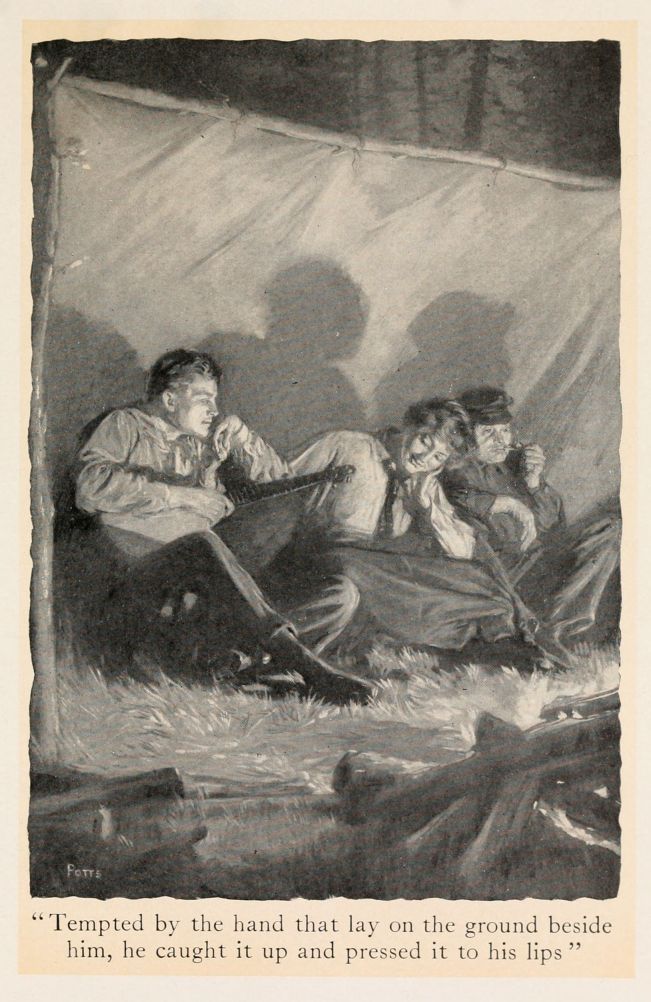
"Tempted by the hand that lay on the ground beside him,
he caught it up and pressed it to his lips"
When she thought the rubber of rubbers would be
nearing its end Linda made Jack take her back. Walking
across the narrow space their shoulders pressed
warmly together. They walked very slowly.
"I ought to have told you my name," murmured
Jack uncomfortably.
"I know it, Malcolm, dear," she breathed.
"Who told you?" he demanded, greatly astonished.
She twined her fingers inside his. "I guessed, silly."
"Well, I didn't take the money," he said.
"I don't care if you did," she murmured.
"But I didn't," he said frowning.
"All right," she said, unconvinced and uncaring.
"What are we going to do?" he said.
"Oh, don't begin that," she said swiftly. "This
is to-night, and we're together. Isn't that enough?"
They had reached the tents. Of one accord they
turned aside, and in the shadow of the canvas she
came naturally into his arms, and he kissed her,
thrilling deliciously. The delicate fragrance of her
enraptured his senses. It was light love, lightly
sealed.
"Kiss me again," she murmured on her deepest
note. "Kiss me often, and don't bother about the
future!"
Jack turned in filled with a nagging sense of
discomfort. He felt dimly that he ought to
have been happy, but it was very clear that
he was not. It was all very well for her to say:
"Don't bother about the future," but his stubborn
mind was not to be so easily satisfied. It was true he
had not committed himself in so many words, but with
girls of Linda's kind he supposed a kiss was final. So
the future had to be considered. It was now more
than ever imperative that his name be cleared. She
didn't seem to care much whether he were honest or
not. There was the rub. He scowled, and rolled over
to woo sleep on the other side.
In the end he fell asleep, and dreamed a fantastic
dream. He was King David, wearing a long gray
beard and a white gown. He was at sea in a motor-sailboat
of extraordinary construction, having a high,
ornate cabin, over which the boom had to be lifted
whenever they came about. There was a beturbaned
lascar at the tiller, whom he, King David, treated with
great contumely. Linda was along, too, also clad
in biblical costume with a silver band around her
brow. She was strangely meek, and she plucked
continually at his sleeve.
A great storm came up; the waves tossed, the boat
was knocked about, and he couldn't get a spark in his
engine. He suspected that the lascar knew much better
than he what to do, but out of sheer, kingly wilfulness
he went contrary to everything the brown man
suggested. Nor would he heed the insistent plucking
at his sleeve.
Then suddenly a mermaid uprose beside the boat,
and the sea was miraculously stilled. Her long, black,
silky hair hung before her face, and streamed over
her deep bosom and her lovely arms. All would be
well if he could but distinguish her face, he felt. He
leaned farther and farther over the rail, while the
fretful plucking at his sleeve continued. He implored
the mermaid to push back her hair.
Then he awoke. Some one was pulling at his sleeve,
and a voice was whispering: "Jack, wake up!"
He sprang to a sitting position, throwing out his
arms. They closed around a bony little frame encased
in a rough coat. He recoiled.
"It's only me," said the small voice.
The fire had burned down to dull embers, and Jack at
first could see nothing. "Who are you?" he demanded.
"Davy Cranston."
"Davy Cranston?" repeated Jack. It was a moment
or two before his dream-muddled brain conceived
the identity that went under this name. "What
does this mean? What do you want? How did you
get here?" he demanded in great surprise.
"It was Mary said we had to come," the boy replied
abashed.
The girl's name had the effect of ringing a bell in
Jack's understanding. "Mary? Where is she?" he
asked quickly.
"We're camped up on the bench," the boy replied.
"She's waiting for us. Come to our camp, and we
can talk."
Jack was ready in a moment, and they set off. The
afterglow was under the north star, and by that Jack
knew it was midnight. The camp was wrapped in
perfect stillness. When they got clear, and began to
climb the trail, a little fiery eye beckoned them ahead.
In answer to Jack's further questions the boy could
only reply that "Mary had a warning," which only
heightened the questioner's wonder and curiosity.
The camp was pitched on the edge of the low bench
above the river-flat, and they saw her, from a little
distance, crouching by the fire that made a little
crimson glory under the branches. She was listening with
bent head to hear if there was one pair of footsteps
approaching or two. Behind her the two little A-tents
were pitched side by side, their open doors like mouths
yawning in the firelight.
As they came within radius of the light she lifted
her face, and Jack without knowing why he should
be, was staggered by the look in her deep eyes, an
indescribable look, suggesting pain proudly borne, and
present gladness.
"You're all right?" she murmured, searching for
what she might read in his face.
"Surely!" said Jack wonderingly. Further speech
failed him. The sight of her threw him into a great
uneasiness that he was at a loss to account for. She
was nothing to him, he told himself a little angrily.
But he could not keep his eyes off her. She had
changed. She looked as if her spirit had travelled a long
way these few days and learned many difficult lessons
on the road. She had an effect on him as of something
he had never seen before, yet something he had been
waiting for without knowing it. And this was only
Mary Cranston that he thought he knew!
"There was a danger," she said quietly. "I did not
know if we would be in time to save—to help you."
"Danger? Save me?" Jack repeated, looking at her
stupidly. "Good God! How did you know that?"
he presently added.
Mary's agitation broke through her self-contained air.
To hide it she hastily busied herself picking up the
dishes, and packing them in the grub-box. Fastening
the box with its leather hasp, she carried it into her
tent. She did not immediately reappear.
"Where have you come from?" Jack demanded of Davy.
"Swan Lake."
"Have you been there ever since you left the fort?"
The boy nodded. "Tom Moosehorn's three children
got the measles," he explained. "They are pitching
at Swan Lake. Tom came to the fort to ask my father
for medicine, and when Mary heard that his children
were sick, she said she would go and nurse them, because
Tom's wife is a foolish squaw, and don't know what
to do for sickness. And I went to take care of Mary."
"Where is Swan Lake?" asked Jack.
"Northwest of the fort, two days' journey," said
Davy. "We were there a week, and then the kids
got well. On the way back home Mary had a warning,
She said she felt a danger threatening you." Shyness
overcame the boy here. "You—you were friendly
to us," he stammered. "So we wanted to come to
you. We didn't know where you were, but Mary said
the warning came from the south, so we left the trail,
and hit straight across the prairie till we came to the
river trail. There we found your tracks, and followed
them here."
"A warning!" said Jack, amazed. "What do you mean?"
"I don't know," the boy said simply. "Mary has them."
Mary returned to the fire with a composed face. All
three of the youngsters were embarrassed for speech.
How could they find words to fit the strange feelings
that agitated them.
Jack, gazing at Mary's graceful pose, on her knees
by the fire, suddenly exclaimed: "Why, it was you,
all the time!"
"What was?" asked Mary.
"The mermaid."
"What's a mermaid?" Davy wanted to know.
Mary answered before Jack could. "An imaginary
creature, half woman, half fish."
"Why, how did you know?" asked Jack unthinkingly.
"Do you think I know nothing?" she said, with the
ghost of a smile.
He had the grace to redden.
They made Jack tell them his dream. They laughed,
and the tension was relieved. They were all grateful
for something else to talk about. There was one thing
in the dream that Jack left out.
"Who was the woman who kept pulling at your
sleeve?" asked Mary.
Jack lied. "Nobody I know," he said lightly.
"One of King David's five hundred wives, I suppose."
Davy laughed, but Mary looked affronted. "You're
confusing David with Solomon," she said coldly.
Jack looked at her uneasily. This was she whom he
had dismissed merely as one of the girls of the country!
"And he sat up and hugged me as if I was a girl,"
Davy put in with relish.
Jack and Mary looked away from each other and
blushed, but for different reasons.
They could not long keep away from the subject
that filled their minds. "Blest if I can understand
it," murmured Jack.
They knew to what he referred. "Nobody can,"
said Mary.
"You must have had this warning several days ago."
"Three days," said Mary.
"Nothing happened to me three days ago. Nothing
until to-day——"
"Ah!" she said sharply.
"That was an accident," said Jack. "My horse
shied on High Rock, and jumped over the ledge. I
caught on a tree."
Mary's eyes brooded over him, and her hands went
to still her breast. "Was there any one behind you?"
she asked quickly.
"Yes, Garrod."
"Perhaps it was no accident."
Jack stared at the fire. "Perhaps not," he said
slowly. After a while he added. "Still I don't
understand."
"Many of the people have such warnings," Mary
said quietly.
Jack frowned. "You are not a savage," he said.
"We are one fourth Indian," Mary said with a kind
of relentless pride. "It is silly to make-believe that
we're not."
Jack went on to tell them in detail what had
happened during the day, suppressing, however, all that
related to Linda. One thing led to another; he could
hardly have explained how it came about, but Mary's
eyes drew out what he had believed was locked deep
in his heart, the story of his early days, and of Garrod's
treachery that he had just found out. Sister and
brother had little to say to the story, but their shining
eyes conveyed unquestioning loyal assurance to him.
It needed no words to tell him they knew he was no
thief. Jack experienced a sense of relief such as he
had not felt since the moment of his making the ugly
discovery. When he considered the net of circumstance
that bound him round sometimes he was almost
ready himself to doubt his honesty.
"I knew there was something behind," Mary murmured.
"It was the day you found him out that I had
my warning. I'm glad we came. Maybe we can help
you"—she looked at him questioningly—"if you will
let us stay."
"As long as you like," said Jack. "It's my idea
we'll all be turning back in a couple of days. In the
meantime Davy can help with the horses. We're
short-handed."
"Couldn't we camp here by ourselves?" asked Mary
quickly.
Jack shook his head. "It would look queer,"
he said. "You had better ride into our camp in the
morning as if you'd just come."
Mary presently sent him home. The fire had paled,
and the trees began to rise out of the graves of darkness
at the touch of the ghostly wand of dawn. The
youngsters' pale and slightly haggard faces had a
strange look to each other like things that had been
left over from yesterday by mistake, and were
hopelessly out of place this morning.
Jack lingered awkwardly. "Look here," he blurted
out, "I haven't thanked you for coming. I don't
know how. But you know what I feel!"
Sister and brother looked exquisitely uncomfortable,
and absurdly alike. "There's nothing to be thanked
for," murmured Mary. "Of course we came! That's
what I had the warning for."
They shook hands. Mary's hand lay for an instant
in Jack's passive and cold. But later she pillowed her
cheek on that hand because he had touched it.
The permanent camp, that Sir Bryson had graciously
permitted to be called Camp Trangmar, had been
laid out with considerably more care than their nightly
stopping-places. The main tent, with its three little
wings, was erected at the top of the clearing,
facing the river. A canvas had been stretched in front
to make a veranda. On the right-hand side of the
open square was Humpy's cooking outfit under another
awning, with Humpy's tent and Jack's lean-to beyond.
Across the square was Jean Paul's little tent and the
ragged brown canvas that sheltered the Indians. The
camp was ditched and drained according to the best
usage, and around the whole was stretched a rope
on poplar posts, to keep the straying horses from
nosing around the tents in their perpetual search
for salt.
After breakfast next morning Sir Bryson issued a
command for Jack to wait upon him. As Jack
approached, Linda and Mrs. Worsley were sitting under
the awning, each busy with a bit of embroidery.
Jack, who had been for a swim in the river, looked as
fresh as a daisy. As he passed inside Linda smiled at
him with a frankness that disconcerted him greatly.
If she was going to give the whole thing away to
everybody like this! However, Mrs. Worsley gave no sign
of having seen anything out of the ordinary.
It transpired that Sir Bryson wished to make a little
exploration up the river. He inquired about a boat,
and Jack offered him his own dugout that he had
cached at this point on his way down the river. Sir
Bryson was very much concerned about the speed of
the current, but Jack assured him the Indians were
accustomed to making way against it.
Sir Bryson cast a good deal of mystery about his
little trip, and made it clear that he had no intention of
taking Jack with him. Jack, who had a shrewd idea
of his object, had no desire to be mixed up in it. He
swallowed a grin and maintained a respectful air.
He had discovered that there was more fun to be had
in playing up to the little governor's grand airs than
in flouting him. Afterward he would enact the scene
by the fire, sure of an appreciative audience in Humpy
Jull.
It was arranged that Sir Bryson should start in an
hour, and that his party should take a lunch against
an all-day trip.
As Jack came out Linda rose to meet him. "We will
have the whole day to ourselves," she said softly.
Jack was nonplussed. Somehow, such a frank
avowal dampened his own ardour. He glanced at
Mrs. Worsley to see if she had heard, and his face
stiffened. At this moment a diversion was created
by the sound of horses' hoofs on the trail.
They looked around the tent to see Mary and Davy
trotting down the little rise that ended at the camp,
followed by two pack-ponies. Linda had not seen
Mary before. Her eyes widened at the sight of another
girl, and a very pretty one, riding into camp, and
quickly sought Jack's face. A subtle and unbeautiful
change passed over her at what she fancied she read
there.
Sir Bryson, attracted by the sound, came out of the
tent. "Who are they?" he asked Jack.
"The son and the daughter of the trader at Fort
Cheever."
"Very pretty girl," said Sir Bryson condescendingly.
"Pray bring them to me that I may make them
welcome," he said as he went back.
Jack vaulted over the fence, and the three youngsters
shook hands again with beaming smiles. Jack forgot
that in order to keep up their little fiction he should
have appeared more surprised to see them. Linda
looked on with darkening eyes. Jack led the horses
around the square to the place next his own tent, where
they were unpacked, unsaddled, and turned out. He
then brought Mary and Davy back. Linda was not in
evidence.
Within the tent Sir Bryson welcomed them as
graciously as a king. "Very glad to see you," he said.
"Which way are you travelling?"
Davy's adolescence was painfully embarrassed in the
presence of the great man, but as the man of his party
he blushed and faced him out. "We are going home,"
he said. "My sister has been nursing some sick Indians
at Swan Lake."
Sir Bryson did not know of course that Camp
Trangmar was not on the direct road between Swan Lake
and Fort Cheever. "Ah!" he said, "most worthy of
her, I'm sure. I trust you will remain with us a few
days before you go on."
"If I can help around," said Davy. "Jack Chanty
said you were short-handed."
"Excellent! Excellent!" said Sir Bryson.
Jack made a move toward the door, and Davy and
Mary promptly followed. Sir Bryson fussed among his
papers with an annoyed expression. As much as
anything pertaining to his official position he enjoyed
dismissing people. Consequently when they left before
they were sent he felt a little aggrieved.
Outside, Sidney Vassall and Baldwin Ferrie were now
with the two ladies. Linda was reclining
languorously in the folding chair, with her little feet crossed
in front of her. She was pale and full of fine lady
airs. Any one but Jack would have known that there
was trouble brewing.
"Introduce your friends," she said to Jack in a clear,
high voice.
Jack was only conscious of an extreme discomfort.
He was oppressed by a sense of guilt that he resented.
The air seemed full of electricity ready to discharge
on some one's head. He looked very stiff and boyish
as he spoke the names all round: "Miss Cranston, Davy
Cranston; Miss Trangmar, Mrs. Worsley, Captain
Vassall, Mr. Ferrie!"
They all smiled on the embarrassed newcomers,
and made them welcome. In particular Linda's
smile was overpoweringly sweet. Without changing
her position she extended a languid little hand to
Mary.
"So nice of you to come and see us," she drawled.
"I hope you will remain with us until we go back."
To Jack this sounded all right. He felt relieved.
Even yet he did not see what was coming. Mary's
perceptions were keener. With a slightly heightened
colour she stepped forward, took the hand with dignity,
and let it fall.
"Thank you," she said quietly. "Not more than
a day or two."
"But we need you," Linda insisted, "both of you.
Your brother can help the men who are nearly worked
to death, and if you would only help Mrs. Worsley and
me with our things, you know, and other ways——"
Mrs. Worsley looked quickly at Linda, astonished
and indignant, but Linda affected not to see. As Jack
realized the sense of what she was saying, a slow, dark
red crept under his skin, and his face became as hard
as stone.
Mary took it smilingly. Her chin went up a little,
and she drew a slow breath before she answered. "I'm
sorry," she said quietly, "but I have no experience
with ladies' things."
There was a faint ring of irony in the last two words,
and excepting Jack, who was too angry to see anything,
it was evident to the others that Mary had returned
just a little better than she got. Linda evidently
felt so, for naked malice peeped out of her next speech.
"We would be so glad to teach you, wouldn't we,
Kate? And it would be so useful for you to know!"
Mrs. Worsley bent over her work, blushing for her
young friend.
Mary continued to look at Linda steadily, and it was
finally Linda's eyes that were obliged to stray away.
"Thank you," said Mary, "but we will be expected
at home in a few days."
"Oh, sorry," said Linda casually. She nodded at
Mary, and smiled the inattentive smile that women
mean to stab with. "Kate, do show me this next
stitch," she said, affecting a sudden absorption in her
work.
Mrs. Worsley ignored the question. Her face was
now almost as red as Jack's. What passed between
these two ladies when they presently found themselves
alone may be guessed.
Jack, Mary, and Davy crossed the little square.
There was a commotion going on inside Jack that he
could not in the least analyze. He was furiously
angry, but his sidelong glances at Mary dashed his
anger, and made him fall to wondering if he had rightly
understood what had happened. For Mary, instead of
being humiliated and indignant as one might suppose,
was actually smiling. She carried her head high, and
the shine of triumph was in her eye. What was a man
to make of this? Jack could only long in vain for a
head to knock about.
The explanation was simple. "How silly I was to
be so afraid of her," Mary was thinking. "To give
herself away like that! She's a poor thing! I'm
a better woman than she, and she knows it now. She
can be jealous of me after this." Behind these thoughts
another peeped like an elf through a leafy screen,
but since the maiden herself refused to see it in its
hiding-place it is not fair to discover it to the world.
Mary refused to refer in any way to what had
happened, and Jack was therefore tongue-tied. All he
could do was to show his sympathy in the ardour of his
muscular efforts on her behalf. He put up their two
tents, and stowed their baggage; he cut a wholly
unnecessary amount of balsam for Mary's bed, and
chopped and carried wood for their fire, until she
stopped him. All this was observable to Linda
watching from afar under her lashes, and in the
meantime Kate was not sparing her.
Jack forgot all about Sir Bryson's order until a
peremptory message recalled it. After he had embarked
the governor, Baldwin Ferrie, and three Indians in the
dugout, he swung an axe over his shoulder, and set off
up the trail to chop down a tree or two, and "think
things out," as he would have said. The operations
of the human consciousness that go under the name
of thinking differ widely in the individual.
Meanwhile it should be mentioned that Jean Paul and
Garrod had started on horseback with the object of
finding a camp of Sapi Indians that was said to be
not far away. They were gone all day. Jack hardly
thought of them.
In a grove of pines beside the trail Jack swung his
axe, and the blows rang. His design was to make a
flagstaff for the centre of the camp. There was an
immense satisfaction in stretching his muscles and
planting the blade true. The blood coursed through
his veins, and he tingled to his finger-tips. He felt
so much better that he thought he had solved his
problems. This was what Jack called "thinking things
out."
He was engaged in chopping the limbs from a trunk
with the stern air of concentration that was characteristic
of him, when something caused him to look up,
and he saw Linda standing near with an appealing
aspect. He frowned and went on chopping. Linda sat
down on a stump and looked away with an unsuccessful
attempt at unconcern. How astonished Vassall
or Baldwin Ferrie would have been could they
have seen their imperious little mistress then.
There was a long silence except for the light strokes
of Jack's axe as he worked his way up the stem. Jack
enjoyed a great advantage because he was busy.
It was Linda who was finally obliged to speak.
"Haven't you anything to say?" she murmured.
"No," said Jack promptly. The light branches did
not offer him a sufficient outlet for his pent-up feelings,
and he wantonly attacked the bole of the biggest tree
in sight. Linda watched the swing of his lithe body
with a sort of stricken look. There was another silence
between them.
"Jack, I'm sorry," she said at last in a small voice.
Jack was not so easily to be appeased. "You
shouldn't come away from camp alone with me like
this," he said. "Followed me," was what he had in
mind, but he spared her pride that.
"I don't care what anybody thinks," she said
quickly.
"I do," said Jack.
"Afraid of being compromised?" she asked with a
little sneer.
"That's a silly thing to say," he answered coolly.
"You know what I mean. I don't intend to give your
father and the other men a chance to throw 'thief'
in my teeth. When I've cleared myself I'll walk with
you openly."
"I was sorry," she said like a child. "I couldn't
rest until I had told you."
Jack was silent and uncomfortable. Whenever
she sounded the pathetic and childlike note, the male
in him must needs feel the pull of compassion and he
resented it.
"Don't you care for me any more?" she murmured.
Jack frowned, and aimed a tremendous blow at the
tree.
Real terror crept into her voice. "Jack," she
faltered.
"I don't take anything back," he said stubbornly.
"I'll tell you when I feel like telling you, but I won't
have it dragged out of me."
He returned to his tree, and she prodded the pine
needles with the toe of her boot. After a while she
returned to the charge.
More like a child than ever, she said: "Jack, I acted
like a little beast. But I said I was sorry."
"That's all very well," said Jack, "but you can't
expect to make me so mad I can't see straight, and then
have it all right again just for the asking."
"You're ungenerous," she said, pouting.
"I don't know what you mean," he said obstinately.
"I have to be what I am."
There was another silence. They were just where
they had started. Indeed no progress was possible
without an explosion and a general flare-up. It was
Jack who brought it on by saying:
"It's not to me you should be saying you're sorry."
Linda sprang up pale and trembling, and the flood
gates of invective were opened. It is no advantage
to a jealous woman to be a governor's daughter.
Linda in a passion lacked dignity. Her small face
worked like a child's preparing to bawl, and her
gestures were febrile. What is said at such moments is
seldom worth repeating. Jack did not hear the words;
it was her tone that stung him beyond endurance.
But at last a sentence reached his understanding.
"How dare you bring her here, and install her under
my eyes?"
"Bring her here? What do you mean?" he
demanded in a voice that forced her to attend.
"Oh, you know very well what I mean!" she cried.
"You knew she was coming this morning. I saw it in
your face. You didn't even pretend that you were
surprised. And you took her part against me all the
way through."
There was enough truth in this to make Jack
furiously angry in turn. His voice silenced hers.
"I did take her part!" he cried. "And I'd do it
again. What have you got to complain of? Just
like a girl to fly into a rage and blame everybody all
around, just to cover her own tracks! What did you
mean by offering to engage her as your maid? You
don't want a maid. You only did it to insult her! I
was ashamed of you. Everybody was ashamed of you.
If you're suffering for it now, it's no more than you
ought."
Under all this and more she sat with an odd, still look
from which one would almost have said she enjoyed
having him abuse her.
And so they both emptied themselves of angry
speech, and the inevitable moment of reaction followed.
Both Linda and Jack began to feel that they had said
too much.
"I'm sorry," she said humbly. "It's true, I was only
jealous of her, because you seemed so glad to see
her."
"If it's any good to you to hear it," said Jack
sheepishly, "she's nothing to me—that way." Even
as he said it his heart accused him.
"Besides," said Linda irrelevantly, "she's mad about
you."
"That's nonsense!" said Jack. Nevertheless he
quickly turned to pick up his axe in order to hide the
telltale red that crept into his face.
"It's all right now, isn't it?" said Linda coaxingly.
"Come and kiss me."
He obediently went, and, stooping, kissed her
upturned lips. But for both of them the delicious
sweetness had flown. Jack could not forget how ugly her
face had looked in a passion, and Linda remembered
how he had worked for Mary.
"You didn't do it like that last night," she said,
pouting.
"I felt differently last night," said Jack doggedly.
"How can I get up any enthusiasm when you make me
do it?"
Her breast began to heave again. "You said you
had forgiven me," she said.
"Oh, don't let's begin that again," said Jack with a
dismayed look. "I haven't anything to forgive you.
If you want to make things really all right, you can do
it in a minute!"
She sprang up again. "I won't! I won't!" she
cried passionately. "It's her coming that has made the
difference since last night! How dare you suggest
that I apologize to her! I'd die rather! I hate you!
Don't ever speak to me again!"
Of a sudden she was gone like a little tempest among
the trees. Jack sat down on the trunk he had cut,
and rested his chin in his palms, terribly troubled in
his mind. This sort of thing was new to him, and it
seemed of much greater moment than it was.
Pretty soon she came flying back again, and casting
herself in his arms, clung to him like a baby, weeping
and whimpering.
"Take care of me, Jack! I don't know what I'm
doing or saying!"
His arms closed about her, and he patted her shoulder
with an absurd, sheepish, paternal air of concern.
What else could he do? "There, it's all right!" he
said clumsily. "Don't distress yourself. It'll be all
right!"
"And you won't make me apologize to her?" she
implored.
"No," he said with a shrug. "I don't suppose it
would do any good if you did."
Linda lay perfectly still. A sense of sweet satisfaction
stole into her breast. It had been a hard fight,
but she had made him do what she wanted.
"Hanged if I know what's going to become of us,"
thought Jack gloomily.
The fiction that coal was the objective of Sir
Bryson Trangmar's expedition was scarcely
maintained; indeed, once they got away from
Fort Cheever the word was never heard again.
On the other hand, a little word that resembled
it circulated continually with a thrilling intonation.
Stories of gold and gold-hunters were told over the
fires in English and Cree. Baldwin Ferrie, the
geologist, kept the subject agitated by cracking every
likely looking stone he came to with his little hammer,
and by studying the composition of the mountain
tops all day with his powerful glasses.
We are told that the essence of comedy lies in the
exposure of pretentiousness. That being so, the
comic spirit is highly developed up North. In
town pretentiousness is largely a matter of give and
take; we are all pretending to something, and we are
obliged to seem to allow the pretences of our neighbours
in order to get them to allow ours. But up North
they are beholden to no man, and, sardonic jesters that
they are, they lie in wait for pretentiousness. Woe to
the man who goes up North and "puts on side."
One like Sir Bryson was therefore bound to be
considered fair game. His official position was no
protection to him. There is a story current about a
governor-general, and another about an actual prince
of the blood, who did not escape. All of which is to
say that Jack, notwithstanding his perplexities in other
directions, was looking forward with keen relish to
the return of Sir Bryson's "exploring-party." He
only regretted that there was none at hand but Humpy
Jull with whom to share the joke.
They landed toward the end of the day, Sir Bryson
and Baldwin Ferrie looking very glum. Jack was sent
for. He found Sir Bryson alone at his table, looking
more than usually important and puffy.
"Do you know two men called Beckford and Rowe?"
he asked.
Jack adopted an innocent-respectful line. "Yes,
sir," he said. "They were working in the pass here
at the same time I was."
"Are you, or have you ever been, associated with them?"
Jack shook his head. "I'm on my own," he said.
"Always."
"What kind of a reputation do these men bear?"
asked Sir Bryson.
"Bad," said Jack.
Sir Bryson frowned, and squeezed his pointed beard.
"How, bad?" he wanted to know.
"Confidence men. They were square enough up
here. They had to be. They saved their game to
work outside."
"How do you know all this?" demanded Sir Bryson.
"It's no secret," said Jack. "Beckford bragged
about what he'd do."
"And did no one take any steps to stop them?"
"It was none of our business," said Jack. "And
if it had been we couldn't very well follow them all
over, and warn people off, could we?"
Sir Bryson snorted. "Where have they staked out
claims?" he demanded.
"Oh, all over," said Jack. "Anything good they
keep dark, of course."
"Did you ever hear of Dexter's Creek?"
Jack bit his lip. "Oh, yes," he said with an innocent
stare. "Those were what they called their sucker
claims."
Sir Bryson swelled like a turkey-cock, and turned an
alarming colour, but he said nothing. What could he say?
Your Northern humourist is merciless. Jack was not
nearly through with him. He went on full of solicitude:
"I hope you didn't fall for anything on Dexter Creek,
Sir Bryson. If you'd only mentioned it before, I could
have warned you, and saved all this trip!"
"I have nothing to do with Dexter's Creek,"
said Sir Bryson quickly. "I have other objects. I
merely promised the attorney-general of the province
to do a little detective work for him."
Jack could appreciate quick wits in a victim. "Well
turned," he thought, and waited for Sir Bryson's
next lead.
"Well, well," said the little man testily. "Explain
what you mean by—by this vulgar expression."
"Sucker claims?" said Jack wickedly. It really
pained him that there was no one by to benefit by this.
"You needn't repeat the word," snapped Sir Bryson.
"It is offensive to me."
"It's this way," said Jack: "Most of the prospectors
in the country are staked by bankers and business men
outside. And when they at last make a strike, after
years of failure, maybe, their backers generally step
in and grab the lion's share. Consequently the men up
here are sore on the city fellows; they have none of the
hardships or the work they say; they just sit back
comfortably and wait for the profits.
"Beckford said that he and his partner had been
done a couple of times in this way, and they were out
to get square with the bankers. When they found
anything good they kept it dark, and went outside and
sold some fake claims to raise the coin to work the
good ones. Beckford said it was just as easy to sell
fake claims as good ones, if you went about it right.
"I said," Jack went on, "they'll set the police after
you. Beckford said: 'They can't. We don't make
any misrepresentations. We're too smart. We make a
mystery of it, and the sucker gets excited, and swallows
it whole. We do the innocent game,' he said; 'we're
the simple, horny-handed sons of soil from the North
that ain't on to city ways. We make 'em think they're
putting it all over us, and we sell out cheap. Two of
us can work it fine!"
"I said," Jack continued, "'I don't see how you can
get anybody to shell out real money unless you offer
to come back and show them the place.' 'We always
do offer to come back,' Beckford said, 'and we get all
ready to come. But at the last moment one of us is
took real sick, and the other refuses to leave his
dyin' pardner. By that time the come-on is so worked
up he comes across anyway!'"
During this recital Sir Bryson's face was a study.
A kind of shamed chagrin restrained him from a violent
explosion. Jack "had" him, as Jack would have said.
The little beard was in danger of being plucked out
bodily.
"You can go now," he said in an apoplectic voice.
"There was one thing more," Jack said at the door.
"Beckford said that if you picked your man right there
was no danger of a prosecution. 'Choose one of these
guys that sets an awful store on his respectability,'
he said, 'and he'll never blow on himself.'"
A deeper tinge of purple crept into Sir Bryson's
puffing cheeks.
Jack lingered for a parting shot. "Any man who did
get let in for such a game," he said with a great air of
innocence, "hardly deserves any sympathy, does he,
Sir Bryson?"
Sir Bryson was now beyond speech. He got to his
feet; he pulled at his collar for more air, and he pointed
mutely to the door.
Jack embraced Humpy Jull by the fire, and moaned
incoherently. No amount of laughter could ease his
breast of the weight of mirth that oppressed it. Never
was such a joke known in the North.
During the rest of the evening Jack was in momentary
expectation of an order to break camp and turn back,
but none came. On the contrary, Humpy reported,
from the scraps of conversation he had overheard at
the dinner-table, that Sir Bryson, being convinced
there was gold somewhere in the pass, was determined,
with Baldwin Ferrie's assistance to do a little hunting
on his own account. Jack smiled indulgently at the
news. It was not long, however, before he had to change
his superior attitude.
Early on the following morning he was fishing in
the backwater below camp, while Baldwin Ferrie sat
on a projecting point of the bank above, patiently
searching the mountainsides with his glasses.
"I say," Ferrie suddenly called out, "how far is that
peak over there, the pointed one?'
"About nine miles in a line from here," said Jack.
"Fifteen, up the river and in."
"What's it called?"
"Tetrahedron," said Jack. "A surveyor named it."
"Do you know it at all?" asked Ferrie.
"Pretty well," said Jack, off-hand.
"The slope on this side," asked the geologist, "I
suppose there is a stream that drains it? Could you
take us to it?"
Jack looked at him hard, and reeled in his line before
he answered. "There is a little stream," he said,
approaching Ferrie. "It has no name. It empties
into Seven-Mile Creek above here. Anybody could find
it. Why do you ask?"
Ferrie was an amiable soul, and not at all secretive,
like his master. He went into a detailed explanation
of the geological formation of Tetrahedron peak.
"You see, it's different from the others," he said,
offering Jack the glasses. "There's a good chance of
finding free gold in the bed of the creek that drains
the slope on this side."
Jack whistled in his mind, as one might say, and
looked with a new respect at Baldwin Ferrie and his
field glasses. For it was on that very little stream he
had washed his gold, and there his claims were situated.
It had taken him months of strenuous labour to find
what the geologist had stumbled on in half an hour
sitting still.
Baldwin Ferrie toddled off to report to his master,
and Jack sat down to do some quick thinking. This
discovery came of the nature of a thunderclap. The
possibility of their finding his claims had occurred to
him, but he had counted at least on having time to
prepare against it, and here it was only the third day.
Jack had made sure of the choicest claim on Tetrahedron
Creek for himself, and that, of course, they could
not touch. But the two adjoining claims, practically
as rich, were still vacant, and Jack meant to have at
least the bestowal of those himself.
Sir Bryson presently ordered Jean Paul to get the
dugout ready for another all-day trip. In excluding
Jack from any share in the preparations he saved that
young man from an embarrassing position, for had
he been officially informed of the destination of the
river party, Jack would have had to make explanations
on the spot.
As it was, even before Sir Bryson was ready, he
became busy on his own account. Finding Davy, he said:
"Catch two horses, and saddle them for you and Mary.
You've got to do something for me, and for her to-day.
There's not a minute to lose. While you're saddling
up, I'll explain everything to Mary."
Davy, who would have gone through Hell's Opening
itself at Jack's command, raced away to find the
horses.
Mary was at the door of her tent sewing. At the
sound of Jack's step she lifted her quiet eyes. There
was something in the uplift of Mary's eyes that stirred
Jack queerly, seeing that he was as good as engaged to
another girl, but he put that aside for the present.
Before he could speak she asked quickly: "What's
the matter?"
He sat beside her on the ground. "Something doing,"
he said, "something big! Listen hard, and don't give
it away in your face. Go on sewing as if I was just
passing the time of day."
"I'm listening," she said quietly.
"You know I told you I'd been prospecting," Jack
began. "Well, I made a rich strike on the little creek
that comes down from Tetrahedron peak. I staked
my claim there, and two claims adjoining mine for
whoever I might want to go in with me on it. The
names and dates aren't entered on the two stakes yet,
and of course if these people find them they have a
right to enter their own names. Baldwin Ferrie has
doped it out that there's gold on that creek, and that's
where they're off to now. You and Davy must get
there first."
"But how can we?" she said. "They're starting."
"It will take them three hours to make the mouth
of Seven-Mile Creek against the current," he said.
"You can ride it in one. Davy is getting the horses.
If you can get yourselves across the river before they
come up, the claims are saved."
Mary went on with her quick, even stitches without a
break. "Tell me exactly how to go," she said.
"Six miles west by the Fort Erskine trail, and then
down to the river. You leave the trail where it turns
to the north, under three big pines that stand by the
themselves on the bench. Look sharp and you will
find a trail that I blazed down to the river. At the
end of it I left a little raft for crossing back and forth.
If it has been washed down you'll have to knock
another one together. Cross the river, and land at the
lower side of Seven-Mile Creek. You'll find my landing-place
there, and a good trail back to the little creek,
and my old camp. The first square post is a hundred
feet upstream from the campfire. You can't miss it.
Keep on going until you come to the second post, and
the third one."
"What must we do when we find the posts?" she
asked.
"Read the notice on the first one, and that will show
you. It reads: 'I, Malcolm Piers, hereby give notice
of my intention to file a claim,' and so forth. And signed
and dated at the bottom. The inscriptions are all
written on the other two. All you have to do is to fill
in your name on the second one, 'I, Mary Cranston,'
and so on, and on the third post Davy writes, 'David
Cranston, Junior.'"
Mary stopped sewing. "My name," she said, "and Davy's?"
"The second claim is yours in your own right," said
Jack. Seeing her expression, he hastily added: "It
was a deal that I made with your father before we
started. As to the other, Davy can sign that back to me."
"So will I sign mine," said Mary quickly. "I
couldn't take it."
"We can argue that out when you come back," said
Jack. "There's not a minute to lose. Davy's got
the horses. Make sure you have a lead pencil to write
on the posts. After you've signed them get back
without running into the governor's party if you can. I
don't want the storm to break until I am there to
receive it."
Ten minutes after Sir Bryson with Baldwin Ferrie
and three Indians, had pushed off from the bank,
Mary and Davy Cranston sauntered inconspicuously
away from camp, and, mounting their horses outside,
set off at a dead run west on the Fort Erskine trail.
Jack set about to fill his anxious day as full as
possible with small tasks. Along the shore toward
the mouth of the canyon he found another dugout
sticking out from among the bushes, and he pulled it
out to put it in repair in case a second boat should
be required. It needed new cross-pieces to hold the
sides from spreading.
While he was seated on a boulder whittling his little
braces out of snowy poplar, Garrod came shambling
over the stones toward him. Jack, seeing the
high-powered rifle he carried, turned a little grim, and while
apparently going on with his work, watched the other
man narrowly. His ideas covering Garrod had taken
a new direction since he had talked with Mary.
Garrod came slowly, pausing, starting jerkily,
fluctuating from side to side. When he thought Jack's
eyes were upon him he turned his back like a child, and
made believe to look off up the river. His eyes were
blank and lustreless, but close-hid under the thickened
lids glimmered a mean furtive sentence. There was
no striking change in him; the canvas suit was still in fair
condition; he shaved every morning from force of habit;
and when he was spoken to he could still answer with
sufficient intelligence. But any one experienced in
diseased mental states would have recognized at once
that this man was in no condition to be trusted at
large with a gun.
Among the members of Sir Bryson's party there
existed an entire absence of formality together with an
entire absence of intimacy. They were not curious
about each other, consequently Garrod's state excited
no remark. True, Mrs. Worsley wondered a little, but
she had always felt an antipathy to Garrod; as for
the others, they merely said, "Queerer than ever,"
and dismissed him with a shrug.
Jack, watching the wavering figure approaching
him now, thought of the reckless, hawk-eyed youth of
five years before, and was made thoughtful by the
change. "Gad! Life has had him on the toaster,"
he thought.
When Garrod came close enough to be heard he
stammered, avoiding Jack's eyes: "I—I want to
talk to you, Malcolm."
"Put down the gun," said Jack coolly. "Out of
reach."
Garrod immediately laid it on the stones. "You
don't think that I——" he mumbled.
"I don't think anything," said Jack, "but I'm taking
no chances."
Garrod's eyes strayed everywhere, and his voice
maundered. "I suppose you think I'm an utter cur.
I know it looks bad. But not that—— Maybe
you think that I—your horse—on the cliff——"
"I'm not accusing you," said Jack.
Garrod sat down near him. "I—want to talk
to you," he said, forgetting that he had said it before.
"All that you and I have to say to each other can be
put in one question and answer," said Jack. "Are
you going to square me?"
"I—I'd like to," stammered Garrod.
Jack looked up surprised. There was more in the
answer than he had expected. "You will?" he cried,
bright-eyed. "You've come to tell me that! By
Gad! that would be a plucky thing to do after all these
years. I didn't think you had it in you!"
"I—I'd like to," murmured Garrod, as before.
"Easy enough if you want to," said Jack. "You
only have to speak the truth."
"That wouldn't do you any good," said Garrod.
"What do you mean?" Jack demanded.
"It's not what you think," said Garrod. "I
didn't take the money."
"Who did then?"
"The bank was robbed," said Garrod. "The morning
after you went away. Three men broke in during
the night, and hid until morning. When Rokeby and
I opened the safe, they overpowered us and got away
with the money. We had no business to open up
until the others came, and we were afraid to tell. I
thought it wouldn't do you any harm as long as you
were away. If you had come back I would have
told."
There was a glib tone in all this that caused Jack's
lip to curl. "Well, what's to prevent your telling
now?" he asked.
"They wouldn't believe me," said Garrod. "They'd
think I was just trying to shield you, my old friend."
"But there's Rokeby to back you up!"
"He's dead," muttered Garrod.
A harsh note of laughter broke from Jack.
"I suppose you don't believe me," said Garrod.
"Hardly," said Jack. "It fits in a bit too well."
Garrod's voice rose shaky and shrill: "It's true!
I swear it! Three men; French, they were. I can
see them now! One was young; he had a scar across
his forehead——'
"Oh, cut out the fine touches," said Jack
contemptuously. "Any fool could see you were
lying." He went on whittling his brace.
Garrod's voice sunk to a whimper. "It's true!
It's true!"
Jack began to perceive that it was scarcely a reasonable
being he had to deal with. He took a different
line. "I guess you've led a dog's life these last few
years," he said quietly.
Garrod looked at him queerly. "Oh, my God,"
he said in a flat voice. "Nobody knows."
"I suppose you know what's the matter with you,"
said Jack. There was no answer.
"It's what the story-books call remorse," said Jack.
"You can't go to work and ruin your best friend without
having bad dreams afterward."
"I never took the money," Garrod murmured.
Jack ignored it. "Your friend," he repeated with
a direct look. "Do you remember, as we stood waiting
for my train to pull out, you put your arm around my
shoulders, and said: 'Buck up, old fel'! We've
got in many a hole together, and we always saw each
other out! Count on me—until death!' Do you
remember that?"
"Yes," murmured Garrod.
"And next morning you took the money to pay your
debts, to get you out of your hole, knowing they would
put it off on me. You pushed me into a hole as deep
as hell, and left me to rot there."
Garrod put up a trembling hand as if to fend off
a blow. "I didn't take it," he murmured still.
"Look me in the eyes, and swear it," demanded
Jack.
He could not.
"Now, look here," said Jack. "You're in a bad
way. You can't stand much more. There's going
to be a grand show-down to-night. Do you think you
can go through with that?"
"Eh?" asked Garrod, dully and anxiously.
"Listen to me, and try to understand," said Jack
impatiently. "Sir Bryson has gone to look at my
claims. He will read the name Malcolm Piers written
on the post, and when he comes back he will know who
I am, and there'll be the deuce to pay. Do you think
you're in any state to face me down? Why, man, the
very look of you is enough to give you away!"
Garrod merely looked at him with dull, frightened
eyes. "Suppose you could face me down," Jack
continued, "what then? You can't face yourself
down. You were born a decent fellow at heart, Frank,
and you can't get away with this sort of thing. It's
got you. And every new lie you tell just adds to the
nightmare that's breaking you now. You've reached
the limit. Anything more, and you'll go clean off
your head."
"You'll tell Sir Bryson everything," muttered
Garrod.
"When I am accused I defend myself," said Jack.
"I couldn't go through with it. I couldn't," Garrod
said like a frightened, stupefied schoolboy.
"Sure, you couldn't," urged Jack, pursuing his
advantage. "Make a clean breast of it before Sir
Bryson comes home, and you won't have to face him
at all. By Gad! think what a load off your mind!
You'd be cured then; you'd sleep; you'd be a man
again!"
But Garrod murmured again: "I didn't take the
money."
Jack fought hard for his good name. His need
lent him an eloquence more than his own. In all this
he never stooped by so much as a word to plead for
himself. "Why shouldn't you tell the truth?" he
persisted. "What good is this life you're leading to
you? It'll kill you in a month. Chuck it all, and stay
in this country, and win back your health, and your
brains, and your self-respect."
Garrod wavered. He half turned to Jack with a more
human look. "Would—would you be friends with
me again?" he murmured.
"I'd stand by you," said Jack quickly. "I've
got my start up here, and I could give you a good one.
As long as I stood by you no one could rake up old
scores. But it couldn't be just the same as it used
to be," his honesty forced him to add.
Jack waited with his eyes fixed compellingly on the
other man. Garrod's eyes struggled to escape them,
and could not. Suddenly he broke down, and buried
his head in his arms. "I'll do it!" he sobbed.
Jack sprang up. "Good!" he cried with blazing
eyes. "The whole truth? You took the money,
and spent it, and let them fasten the theft on me?"
"I took the money, and spent it, and let them fasten
the theft on you," repeated Garrod.
Jack drew a long breath, and, sitting again, wiped
his face. Not until he felt the sense of relief that
surged through him did he realize how much this had
meant to him. He could look almost kindly on the
stricken figure in front of him now, and the sobs
inspired him with none of the disgust he would have
felt at any other time. He waited patiently for Garrod
to recover himself. When the man at last became quiet
he said, not unkindly:
"Are you ready now?"
"For what?" asked Garrod, lifting a terrified face.
"Let us go back to camp. Vassall is there. You
can tell him."
Garrod desperately shook his head. "Linda—Miss
Trangmar is there. I couldn't—I couldn't
have her hear me!"
"But we could take Vassall away."
"No," he said. "Don't you understand? Vassall
is after her. He'll be glad of this. I couldn't tell
him."
"What if he knew about Linda and me," thought
Jack with a sidelong look. "Gad! but life's a rum go!"
"I'd rather face Sir Bryson," stuttered Garrod.
"Wait till Sir Bryson comes back. I swear I'll tell
him the whole truth, and you shall be there."
"You're right, I'll be there," said Jack grimly.
He considered, frowning. It might be better to
confront Sir Bryson with Garrod direct, but Sir Bryson
would not be back for five or six hours, and who could
tell what contradictions of mood would pass over this
half-insane man in the interval.
As if reading his mind, Garrod said: "I won't take
anything back. You needn't be afraid—if you let
me stay with you. You're my only hope. Let me
stay with you. Give me something to do all day."
Jack rubbed his chin in perplexity. "Will you write
out a confession?" he finally asked.
Garrod eagerly nodded his head.
"Wait here, then," commanded Jack.
Jack ran to his tent, where he got a pen and his
note-book, and returned to the dugout. He was gone
but two minutes, nevertheless as he sprang down the
bank he saw that Garrod was no longer alone. Jean
Paul had joined him.
It did not occur to Jack that the half-breed had
any concern in this affair, but he was annoyed by his
intrusion just at this minute. He looked at him sharply.
Jean Paul stood idly chewing a grass-stalk, and looking
out over the river with a face as expressionless as brown
paper. Garrod was sitting as Jack had left him, looking
at Jean Paul. A change had passed over his eyes.
Jack's temper got a little the better of him. "What
do you want here?" he demanded.
Jean Paul turned with an air of mild surprise.
"Not'ing," he said. "Wat's the matter? I saw you
and Garrod here, and I came. I got not'ing to do."
"Go find something," said Jack. "Clear out!
Make yourself scarce! Vamoose!"
Jean Paul, with a deprecatory shrug, walked slowly
on up the beach.
"I have pen and paper," Jack said eagerly to Garrod.
Garrod's dazed eyes were following Jean Paul's
retreating figure. He paid no attention. It was only
too evident that his mood had changed.
Jack's face grew red. "Have you gone back on it
already?" he said with an oath.
"I must go," muttered Garrod, struggling to rise.
Jack thrust him back. "You stay where you are!"
But as soon as Jack took his hands off him Garrod
endeavoured to get up and follow Jean Paul, who by this
time had climbed the bank. Garrod's wasted strength
was no match for Jack's but Jack could hardly see
himself sitting there holding the other man down until
Sir Bryson returned. He looked around for inspiration.
There was a length of rope fastened to the bow
of the dugout. Cutting off a piece of it, he tied Garrod's
wrists and ankles, and let him lie.
Jack sat down and filled his pipe, watching Garrod
grimly meanwhile, and trying to puzzle out a solution.
The man spoke no articulate word except to mutter
once or twice that he must go. Occasionally he
struggled feebly in his bonds like a fish at the last gasp.
Still it did not occur to Jack to connect this new phase
of his sickness with the appearance of the half-breed.
Jack's heart was sore. "Of what use was the confession
of a man in such a state?" he thought. In Jack's
simple system of treatment there was but one remedy
for all swoons or seizures, viz., cold water. Upon
thinking of this he got up and, filling his hat in the river,
dashed the contents in Garrod's face.
It had the desired effect. Garrod gasped and shivered,
and looked at Jack as if he saw him for the first.
He ceased to struggle, and Jack untied the ropes.
Garrod sat up, a ghastly figure, with the water
trickling from his dank hair over his livid face.
"I'm all wet," he said, putting up the back of his
hand. Without expressing any curiosity as to what
had happened, he dried his face and neck with his
handkerchief.
"Do you remember what we were talking about?"
asked Jack, concealing his anxiety.
"You wanted me to write something," Garrod
said dully.
"Are you willing?"
Garrod nodded, and held out his hand for the pen
and the little book.
Jack breathed freely again. The blade of a paddle
served Garrod for a writing table. The man was
entirely submissive.
"But do you know what you're doing?" demanded
Jack frowning.
Garrod nodded again. "You want me to write out
a confession," he said. "What shall I write."
Jack dictated: "I, Francis Garrod, desire to state
of my own free will that on the morning of October
ninth, nineteen hundred and six, I took the sum of
five thousand dollars from the vault of the Bank of
Canada, Montreal. I knew that Malcolm Piers had
gone away, and I allowed the theft to be fixed on
him."
He signed the page, and dated it. Taking the book,
Jack slipped it in the breast pocket of his flannel shirt.
Jack was genuinely moved. It was borne in on him
dimly that though he was technically the injured
party, it was the other man who showed the wound.
"You'll feel better now," he said gruffly.
Garrod lay back on the stones, and covered his face
with his arm. "I suppose you loathe me, Malcolm,"
he muttered.
"You've gone a long way to make it up," Jack
said, in the keenest discomfort. "Just give me a little
time."
Garrod's thoughts strayed in another direction.
"What will she say?" he whispered.
Considering everything, this was a poser for Jack.
"You've got no business to be thinking about girls
in your state," he said frowning. "Put her out of
your mind, man, and go to work to win back what
you've lost."
Garrod reverted to the night five years before.
"I didn't mean to take the money," he murmured.
"I couldn't sleep after you went, that night, and
all night I played with the idea as if it was a story.
Supposing I did take the money, you know, how I
would cover my tracks, and so on. But I never meant
to. And next morning when I went to the bank I
was alone in the vault for a moment, and I slipped
the package in my pocket just to carry out the idea,
and Rokeby came in before I could put it back. Then
the money was counted, and the shortage discovered.
I had plenty of other chances to put it back, for the
money was counted twenty times, but I was always
afraid of being seen, and I kept putting it off, and at
last the alarm was given and it was too late. They were
old bills and they couldn't be traced.
"I don't know how I lived through the time that
followed. I was afraid to put it back then, because
the fellows talked about my changed looks, and I
knew if the money turned up they would suspect me.
As it was, they thought I was grieving on your account.
I was, too, but not the way they thought. I set a
store by you, Malcolm. I didn't mean to injure you.
I just drifted into it, and I was caught before I knew.
The thought of meeting you brought the sweat pouring
out of me. I thought you would come back. I bought
a revolver, and carried it always. If I had come face
to face with you it would have nerved me to turn it
on myself, which I couldn't do alone.
"You didn't come. The thing was quickly hushed
up. I left the bank, and my life went on like
anybody's. I didn't think about the money any more.
But something had changed in me. I was nervous and
cranky without knowing why. I couldn't sleep nights.
I was full of silly terrors, always looking around corners,
and over my shoulder. And it kept getting worse."
Garrod's voice never varied from the toneless
half-whisper that was like a man talking in his sleep.
"Then I came up here," he went on, "and ran into
you without any warning. It was like a blow on the
temple. It all came back to me. Then I knew what
was the matter. I didn't kill myself on the spot,
because I found you didn't know. I wish I had.
I've died a thousand deaths since. It was like little
knives in my brain thrusting and hacking. I could
have screamed with it——"
Jack's increasing discomfort became more than he
could bear. "For heaven's sake, don't tell all this,"
he burst out. "At least not to me. I'm the one you
injured. Pull yourself together!"
"It is a relief to get it out," Garrod murmured with
a sigh. "I can sleep now."
Jack got up. "Sleep, that's what you need," he
said. "Come back to your tent, and lie low for the
rest of the day."
"I—I don't want to be alone," stammered Garrod.
"Well, stretch out here in the grass," suggested Jack.
"You won't go away without waking me?" Garrod
said anxiously.
"All right," said Jack.
Above the stones of the beach extended a narrow
strip of grass, shaded from the sun by thickly springing
willows. Behind and above the willows the trail
skirted the escarpment of the bank. Garrod crawled
into the shade and stretched himself out. Once or
twice he started up to look rather wildly if Jack were
still there; finally he slept.
Meanwhile Jack, returning to the dugout, took up
his poplar braces again, with the instant concentration
on the job in hand of which he was capable. Jack's
highly practical temperament was at once the source
of his strength and his weakness. On the one hand,
he conserved his nervous energy by refusing to worry
about things not immediately present; on the other
hand, his refusal to track these same things down in
his mind often left him unprepared for further
eventualities. At this moment, while his attentive blue
eyes directed his sure hands, he had not altogether
ceased to think of the strange things that had
happened, but it was only a subconscious current. There
was evidence of it in the way his hand occasionally
strayed to the pocket of his shirt to make sure the
little book was still there.
Jack had pushed the dugout partly into the water.
The stern floated in a backwater on the lower side
of a little point of stones that jutted out. On this
point impinged the descending current, which was
deflected out, straight for the opening in the wall of
rock, a thousand feet or so downstream. Little could
be seen of this opening from above; the first fall hid
the white welter below, and the bend in the walls of
rock closed up the prospect. It was as if the river
came to an end here in a round bay with a stony beach,
and rich, green-clad shores. Only the deep, throaty
roar from under the wall of rock gave warning that
this was really "Hell's Opening."
Jack thought of no reason for watching Garrod now,
and his back was turned to him as he worked. He therefore
did not notice that the leaves of the willows above
Garrod's head were occasionally twitched on their
stems in a different way from the fluttering produced
by a current of air. Only a sharp and attentive eye
could have spotted it, for the movement was very
slight, and there were long pauses between. After a
while the leaves low down were parted, and for an
instant a dark face showed, bright and eager with evil.
It was Jean Paul. Marking Jack's position and
Garrod's, he drew back. Garrod was immediately
below him.
More minutes passed. The patience of a redskin
is infinite.
Finally Garrod began to twitch and mutter in his
sleep, and presently he rolled over on his back, wide
awake. Jack threw him a careless glance, and went
on working. As Garrod lay staring at the leaves over
his head, a change passed subtly over his face; the
lines of his flesh relaxed a little, a slight glaze seemed to
be drawn over his eyes. In the end he slowly raised
himself on one elbow, and looked at Jack with an exact
reproduction of the cunning, hateful expression Jean
Paul had shown. He quickly dropped back, and
lay, waiting.
Presently, Jack having finished the shaping of his
braces, picked up hammer and nails, and with another
off-hand glance at the apparently sleeping Garrod,
climbed into the dugout. He put in the stern thwart
first, sitting on his heels in the bottom of the dugout,
with his back toward the shore.
Garrod raised his head again, and seeing Jack's
attitude, drew himself slowly up, and came crawling
with infinite caution down over the stones. Back among
the leaves a fiery pair of eyes was directing him. This
was where Jack's faculty of concentration proved his
undoing. Driving the nails as if his soul's fate rested
on the accuracy of his strokes, he never looked around.
Garrod covered the last five yards at a crouching run.
Seizing the bow of the dugout, and exerting all his
strength, he heaved the craft out into the stream.
The force and the suddenness of the shove threw
Jack flat on his back. By the time he recovered himself,
the dugout fairly caught in the current and, gradually
gaining way, was headed straight for Hell's Opening.
If Jack allowed the moment to take him unawares, it
must be said he wasted no time when it came. His
faculties leaped in the presence of danger. His
bright, wary, calculating eyes first sought for the paddle,
but it lay back on the stones where Garrod had used it.
He looked at Garrod. The man had picked up his
gun, and was running toward him. He kept pace with
the moving dugout along the edge of the stones.
Not more than fifty feet separated the two men. Jack
measured the distance to the backwater. Ten
swimming strokes would have carried him to safety.
"If you jump overboard I'll shoot," Garrod
murmured huskily. "I'll get you easy in the water!"
Jack saw that it was madness he had to deal with,
and he wasted no words with him. Garrod, crouching,
stumbling over the stones, with his strained, inhuman
eyes fixed on Jack, was an ugly sight. He muttered
as he went:
"I've got to kill you. I can't help it. I've got to!"
Jack stood up in the canoe. The blue eyes were
steady, and the thin line of his lips was firm, but the rich
colour slowly faded out of his sunburned face, leaving
it like old ivory. All this had happened in a moment;
the dugout was not yet fully under way, though it
seemed to Jack as if it were flying down. The
harbouring backwater still stretched between him and the
shore. He had a minute or longer to make his choice.
The roaring canyon that ground its great tree-trunks
into shreds was vividly present before his eyes; on the
other hand, he could jump overboard and make his
bobbing head a mark like a bottle for a madman to
shoot at. A minute to decide in, and there he was
tinglingly alive, and life was very sweet.
A woman's frightened voice rang out: "Jack! what
are you doing out there? Come ashore!"
He looked and saw Linda standing in the trail by
the bank's edge. Garrod was hidden from her by the
intervening bushes. She came flying down, regardless.
Garrod heard the voice, and, turning toward it, stopped
dead. His muscles relaxed, and the butt of the gun
dropped on the stones.
Jack laughed, and jumped overboard. Half a
dozen strokes carried him into the backwater; twenty
landed him hands and knees on the stones. Rising
face to face with Garrod, he snatched the gun from his
nerveless hands and sent it spinning into the bushes.
Without looking at the girl he ran and caught up the
paddle, ran back along the stones, plunged in and,
heading off the dugout, wriggled himself aboard.
It became a question then of his strength against the
sucking current. The dugout hung in the stream as if
undecided. Finally it swung around inch by inch,
swept inshore, and grounded with perhaps five yards
to spare.
As he landed the second time Linda cast herself
weeping and trembling on his dripping bosom. "What
did you frighten me like that for?" she cried, beating
him with her small fists.
Jack laughed, and held her off. "It's a good boat,"
he said; "besides, the hammer was in it, the only one we
have."
"How did you get adrift?" she demanded.
Jack looked at Garrod with a hardening eye. Garrod
still stood where he had stopped. His eyes were blank
of sense or feeling. Linda flew toward him, her slight
frame instinct and quivering with menace.
"You coward!" she hissed.
Jack held her off. "Let him alone," he said. "His
wits are clean gone!"
He started to lead Garrod, unresisting, back to camp.
Suddenly he remembered the note-book, and his hand
flew to his pocket. It was gone.
Sidney Vassall, wondering what had become
of Linda, wandered about camp covertly looking
for her. The amiable young aide-de-camp
had his dull heartache too, these days. An instinct
warned him that the humble attitude he displayed
toward her would never succeed in focussing the little
beauty's attention on himself, but he was unable to
change it. He was the victim of his own amiability.
Coming to the edge of the bank, he met the odd little
procession coming up; Garrod with his wild, blank
stare; Jack with his hand twisted in Garrod's collar,
and Linda following at a little distance, pale, angry,
and frightened.
Vassall's jaw dropped. "What's the matter?" he
stammered.
Jack let go his hold on Garrod, and scowled at him,
angry and perplexed. "He's mad," he said shortly.
"Clean daft!"
Vassall fell back a step. "Easy, for God's sake,"
he murmured. "She'll hear you."
"Oh, she knows," Jack said carelessly. "The
question is, what are we to do with him?"
The first command in Vassall's highly artificial
code was: "Keep it from the women!" Turning
to Linda with a shaky imitation of his polite smile,
he said: "Mrs. Worsley has been wondering where
you were. You'll find her in the big tent."
To which Linda's impatient rejoinder was: "Don't
be silly."
"This is no place for you," Vassall went on earnestly;
"I beg that you will go to Mrs. Worsley, and let us
attend to this."
"No place for me?" Linda burst out. "What do
you think I am, a doll? I can be as much help to Jack
as you can!"
Vassall turned pale at the sound of the familiar
name on her lips.
Garrod stood motionless, apparently neither seeing
nor hearing.
"He's quiet enough now," said Jack rubbing his
chin; "but you can't tell when he may break out again.
A tent is no place to keep a madman. We'll have to
tie him up, Vassall."
"Oh, we can't do that," murmured the other man.
He all but wrung his hands. "This is too dreadful!
Miss Linda, I beg of you! What will Sir Bryson say?"
Linda's eyes passed contemptuously over him.
"What is there I can do?" she asked Jack.
"Find Jean Paul," he said.
As if evoked by the sound of his name, the half-breed
issued at that moment from among the trees on
their left, and approached them. If his designs had
miscarried, he gave no sign of it. One could hardly
have guessed that he harboured designs. His face
was as smooth as velvet, his manner calm, respectful,
inquiring.
"Wat's the matter?" he asked. He looked at
Garrod and appeared to comprehend with a start.
"Ah, weh-ti-go!" he said, using the Cree word for
madness. He shook his head in sober compassion. "I
t'ink so me, before; many days he is act fonny."
It was perfection, and Jack was completely taken
in. It seemed good to him to find some one quiet and
capable. "He will have to be tied up and watched,"
said Jack. "He tried to launch me into the canyon."
"Wah! Wah!" exclaimed Jean Paul, holding up
his hands at the thought. "I put him in my tent,"
he went on. "You and I all time watch him."
Thus Garrod was given in charge of Jean Paul, as
Jean Paul had designed. He led him away, looking
rather amused. White men were so easy to fool.
Jack went back for the gun, and to search up and
down in case he might have dropped the precious
note-book on the shore. Linda tagged after him, and
Vassall followed Linda, because he could not support his
bewilderment and dismay alone.
"What are you looking for?" Linda kept asking.
"Something I lost out of my pocket," Jack said;
"a note-book." He could not bring himself to tell her
more.
It was not there of course. The canyon had it long
before this. When they returned to camp Humpy Jull
was carrying lunch into the big tent. Linda commanded
Jack to change his clothes and come and eat with them.
He shook his head.
She stamped her foot. "You must come! Kate
has to be told. We need you to hold us together.
Kate!" she called out. "Make him come and have
lunch with us."
Mrs. Worsley nodded and smiled from the door of
the tent.
"Very well," said Jack. "One minute."
Then Linda perversely frowned and bit her lip
because Kate could bring him with a nod, where she
was unable to command.
It was not a cheerful meal that followed. Jack told
Mrs. Worsley briefly what had happened, Vassall
supplying a lamentable chorus. Mrs. Worsley took
it with raised eyebrows and closed lips. Afterward
Jack relapsed into silence. He had difficult matters
of his own to think of. None of them knew of his
intimate connection with Garrod, and it was impossible
for him to speak to them of what concerned him so
closely. Meanwhile the three talked as people always
talk, of Garrod's strange behaviour during the last
few days, and how anybody could have seen what was
going to happen, if anybody had thought.
After they had come out of the tent, Jack saw Mary
stroll through the trees on the westerly side of camp.
His eye brightened. Since they were back so soon they
must have been successful. Mary quietly set to
work to prepare their dinner. In a little while Davy
appeared dragging the saddles.
"What have they been up to?" Linda said curiously.
"They've been gone all morning."
"I suppose they have their own matters to attend
to," Mrs. Worsley said, relieving Jack of the necessity
of answering.
When a decent interval had elapsed Jack strolled
over to the Cranston's fire. "Were you in time?" he
asked casually.
Mary raised a face as controlled as his own. "Yes,"
she said. "We did what you told us."
"Did you meet the other party?" he asked anxiously.
She shook her head. "We found your raft," she
said; "so we had plenty of time. We landed above
Seven-Mile Creek, so they could not see the raft when
they came up. After we had marked the posts we
crossed the little stream, and came back on that side,
as they went up the other. We heard them. The
Indians would see our tracks of course, but Sir Bryson
pays no attention to them."
"Good!" said Jack. "That has turned out all
all right, anyway."
Mary searched his face, and a flash of anxiety
appeared in her quiet eyes. "Something has happened
here?" she said.
Jack nodded. His constricted breast welled up.
Here was somebody he could tell. He did not reflect
on the ambiguity of the situation. He only knew
instinctively that he needed help, and that help was to
be had in those deep eyes. However, he stuck to the
bare facts of his narrative.
"There's a good deal beneath that," said Mary.
"Yes," he said. "I'll tell you when I can."
"You must let me help you," she said earnestly.
"I understand the people so much better than you can."
"The people?" he said surprised.
"The natives," she said. "I think that Jean Paul is
at the bottom of this."
Jack stared at her. This was quite a new thought to
him. It required consideration.
Their further talk was prevented by the customary
shrill hail from up river, announcing the return of the
boat party. Travelling downstream, they were able
to make ten miles an hour, consequently they arrived
close on the heels of the Cranstons, who had left
Seven-Mile Creek an hour before them.
Jack went back to the others at the door of the
big tent. Linda received him sulkily, but he made
believe not to be aware of it.
"Who will tell Sir Bryson?" murmured Vassall.
"I will," said Jack firmly. "I have to talk to him
anyway."
"What about?" demanded Linda.
"Mining claims," said Jack "and other things!
There has to be a general showdown to-night." He
spoke with affected carelessness, nevertheless his
heart was beating at the thought of what he must go
through with.
They looked at him questioningly.
"You may as well all know it," said Jack. "I am
Malcolm Piers."
Before Mrs. Worsley and Vassall had time to recover
from their stupefaction at this announcement, Sir
Bryson and Baldwin Ferrie came striding from the
river-bank. It appeared as if all Sir Bryson's river
expeditions were doomed to disappointment. Again he
was in a furious temper, and trying without success
to conceal it. He passed inside the tent without
noticing anybody. Baldwin Ferrie followed him.
Jack, without waiting for a command, went in after
them.
Sir Bryson flung himself into a chair, and opened up
on Jack without any preliminaries. "You say you
have worked up and down this pass," he said. "Did
you ever hear the name Malcolm Piers?"
"Yes, sir," he said.
Sir Bryson leaned forward in his chair, and peered at
Jack through squeezed-up eyes in a way that he
intended to be magisterial and intimidating. "Where is
this fellow now?" he barked.
Jack smiled a little grimly. "He is before you,"
he said quietly. "I am Malcolm Piers."
Sir Bryson fell back in his chair, and puffed. He
appeared to have suffered a sudden loss of motive
power. "Well, well, I knew that," he said flatly.
"But I didn't expect you to have the assurance to
admit it to my face."
"I have no reason to conceal my name," said Jack.
Sir Bryson gradually worked himself up again.
"No reason?" he cried. "You young blackguard!
It was an honourable name until it descended to you!
I ought to have guessed the truth from your intimacy
with the details of these swindling operations. No
reason? We'll see what the law has to say to that!"
"The law?" said Jack, quickly. "The money which
I did not take has been paid into the bank. What has
the law to do with it?"
Sir Bryson smiled disagreeably. "Apparently you
do not know," he said, "that you are under indictment
for grand larceny, and that your uncle, Mr. McInnes,
directed his executors to see that you were prosecuted
whenever you should be found."
This was a staggerer for Jack.
"Aha! that touches you!" said Sir Bryson. "That
shakes your impudence, eh? Moreover, I do not
think the province of Athabasca, of which I have the
honour to be chief executive, will raise any obstacles
to giving you up to the province of Quebec!"
Jack felt a little sick with helpless rage. He drew
the mask of obstinacy over his face, and held his tongue.
What could he say? It would only draw down their
ridicule for him to confess that the only witness to his
innocence was an insane man.
He submitted to receive a long moral lecture in Sir
Bryson's best vein. "Do you realize," the governor
said in conclusion, "that as the head of this province
it is my duty to put you under arrest, and hand you
over to the authorities?"
Jack by this time had been goaded pretty far. "And
so prevent me from filing my claim?" he said with a
dangerous light in his eyes.
Sir Bryson swelled and puffed. "Tut!" he said.
"Naturally the government does not intend that its
valuable mining privileges shall fall into the hands of
felons."
"I am not yet a felon," said Jack quietly; "and the
three claims are not yet yours."
It was Sir Bryson's turn to grow red. There were no
papers handy, and he fussed with his watch charm.
"As to the other two claims," he said finally, "you
have overreached yourself there. The notices on the
posts are dated to-day, and it will be easy to prove
that your friends could not have got there before
we did to-day."
Jack found a momentary pleasure in describing to Sir
Bryson how it had been done.
Naturally Sir Bryson was infuriated. "So it appears
I have been harbouring a conspiracy!" he shouted.
"Nothing of the kind," said Jack. "The three claims
were staked out before you came into the country.
Isn't the rest of the creek enough for you? There's
plenty of pay dirt. I have worked for five years to
find this place, and the best of it belongs to me by right."
"Hold your tongue!" cried Sir Bryson tremblingly.
"Don't attempt to bandy words with me! You can
go until I decide what is to be done with you!"
It occurred to Jack dimly that he was scarcely acting
the part of prudence in thus exasperating his judge to
the highest degree, and he cooled down. So they were
not going to put him under restraint immediately.
It would have been rather difficult anyway. With
all his anger there was an uncandid look in the little
governor's eye. Jack wondered what he was getting
at. Suddenly the idea went through his mind that
Sir Bryson hoped he might ride out of camp that night,
and never show his face again. In other words, the
unspoken proposal was: his liberty in exchange for his
claims. Jack smiled a little at the thought, his
fighting smile.
"What are you waiting for?" demanded Sir Bryson.
"I have something to tell you," Jack said, mildly.
"Garrod——"
"What about him?"
"He is very sick. He appears to have gone out of
his mind."
"What nonsense is this?" puffed Sir Bryson.
"Mad, insane, crazy; whatever word you like,"
said Jack.
The little governor was startled out of his pomposity.
He turned to Baldwin Ferrie, plucking at his beard.
For the moment he forgot his animosity against Jack,
and asked him innumerable questions.
"Set you adrift?" he said, when Jack had told his
tale. "What could have led him to do that?"
This was the moment Jack had been dreading.
He drew a long breath, and, looking Sir Bryson in the
eye, told him the whole story of himself and Frank
Garrod. Sir Bryson, as Jack expected, sneered and
pooh-poohed it throughout. On the face of it, it was
a fantastic and improbable tale, but a disinterested
person seeing Jack's set jaw and level eyes, and hearing
his painstakingly detailed account, could scarcely
have doubted he was telling the truth. Baldwin
Ferrie was impressed, and he was not altogether
disinterested.
"Lost the note-book, eh?" sneered Sir Bryson.
"And you expect me to believe this on your
unsupported word! Garrod's life has been exemplary!"
"Miss Trangmar saw me when I was cast adrift,"
said Jack patiently. "As to the rest, I think Garrod will
bear me out, if he ever comes to his right senses. Why
not have him in here now, and look him over? He
may be better."
Sir Bryson was very much excited. He called Vassall
into the tent, and the three men held a whispered
consultation. Presently Linda came in, pale and
charged with emotion. She headed directly for Jack.
He fended her off with a look.
"If you give anything away, it will queer me for
good with this crowd," he swiftly whispered.
She could not but perceive the force of this. A
spasm passed over her face. Turning, she sat in a
chair near the door, doing her best to look unconcerned.
When Sir Bryson saw her, he said: "We have
important matters to discuss, my dear."
"It's only a tent," said Linda. "You can hear every
word outside anyway."
"My dear——" began Sir Bryson.
"I'm going to stay," said Linda tempestuously,
and that was the end of it.
The upshot of the consultation was that Jack should
be confronted with Garrod. Sir Bryson was opposed
to it, but the other two overruled him. Vassall went
off to get Garrod, and they waited.
Sir Bryson's table was toward the top of the tent, and
as he sat he faced the door. He frowned, and tapped
on the table and pulled his beard. Occasionally, in
spite of himself, his eyes bolted. It was as if a horrible
doubt kept recurring to him that the situation was
getting too much for him; that he had stirred up more
than he was able to settle. Jack stood to the right of
the table, with his upper lip drawn in, his face as
hard as a wall. Poor Jack had no ingratiating ways
when he was put on the defensive. Mrs. Worsley stole
into the tent, and, sitting beside Linda, took her
trembling hand. Baldwin Ferrie bent over them, and
with a pale face whispered soothing things that they
made no pretence of listening to.
At last Vassall pulled the tent flap back, and Garrod
came in. He was well-brushed and tended. He
walked without assistance, and his face was composed.
Manifestly another change had taken place in him
during the last few hours, a change for the better. Jack's
heart began to beat more hopefully. There was still
something queer about Garrod's eyes. Jean Paul
Ascota and Vassall followed him in.
The half-breed constituted himself the sick man's
nurse. Seeing a chair, he placed it for him at Sir
Bryson's left, and Garrod sat down. Garrod had not
greeted anybody on entering. Jean Paul stood over
him watchful and solicitous. Mary's warning
occurred to Jack, but what was he to do? The
half-breed's attitude was irreproachable.
"I am sorry to hear that you have been very sick,
Mr. Garrod," Sir Bryson began.
"Yes, sir," said Garrod composedly. "My head has
been troubling me very much."
There was a curious, stiff quality in Garrod's voice,
but that might easily have been accounted for by what
he had been through. In spite of the man's apparent
recovery, a dull anxiety that he could not explain,
began to shape itself in Jack's breast.
"You are quite yourself again?" continued Sir
Bryson.
"Yes, sir," said Garrod.
"Do you remember what happened this morning?"
"Yes, sir, up to a certain point. I had a shock."
"Um!" said Sir Bryson. "This man," pointing to
Jack, "accuses you of setting him adrift in the current.
Is it true?"
There was a slight pause before each of Garrod's
answers. This time his hearers held their breaths.
"There is some mistake," he said composedly. "He
was working in the boat, and it must have drifted off.
I was asleep."
The pent-up breaths escaped. Jack turned a little
paler, and set his teeth. He was not surprised;
something had warned him of what was coming. Sir
Bryson looked at his daughter.
"Linda, I understand that you were present," he
said. "Did you see Mr. Garrod push the boat off?"
"He did it," she began excitedly. "I know he did it."
"I asked you if you saw him do it?" Sir Bryson said
severely.
"No," she said sullenly. "It was already adrift
when I came."
Sir Bryson, with a satisfied air, turned back to
Garrod. "Do you know this man?" he asked.
"Yes, sir," said Garrod. "It is Malcolm Piers.
We were friends years ago, before he ran away."
Jack looked at him with a kind of grim surprise.
"He claims," continued Sir Bryson, "that you were
the only person who knew of his intention to leave
Montreal for good, and that after he had gone you took
the money and let the theft be fastened on him. Is
that true?"
There was the same tense pause while they waited for
the answer.
"It is not true," said Garrod. "I knew he was
going away, but I knew nothing about the money until
the shortage was discovered." There was a pause,
and then Garrod went on in his level, toneless voice,
"I never accused him of taking it. I was the only
one who stood up for him. You can ask anybody who
worked in the bank."
A note of bitter laughter escaped from Jack.
Sir Bryson frowned. "He says," he went on,
"that you wrote a statement this morning confessing
that you took the money."
There was a longer pause before Garrod spoke.
"Before or after the accident of the boat?" he asked.
Sir Bryson looked at Jack.
"Before," said Jack indifferently.
"It is not true," said Garrod. "I remember everything
that happened up to that time."
Sir Bryson appealed to the company at large. "Surely
we have heard enough," he said. "We have laid
bare an impudent attempt on the part of this young man
to fasten his crime on one whom he thought incapable
of defending himself." He looked at Jack with the
most terrible air he could muster. "Have you anything
to say for yourself now?" he barked.
Jack screwed down the clamps of his self-control.
"No," he said.
"Take Mr. Garrod back to your tent, then, Jean
Paul," Sir Bryson said graciously. "Tend him well,
and we will all be grateful."
Before any move was made the company was electrified
by a new voice: "May I speak if you please,
Sir Bryson?" They turned to see Mary Cranston
standing within the door, resolute in her confusion.
Linda half rose with an exclamation. At the touch
of Kate's hand she sank back, twisting her handkerchief
into a rag, her lips trembling, her pained eyes darting
from Mary's face to Jack's and back again.
Sir Bryson sneered. "Eavesdropping?" he said.
"I was listening," said Mary firmly. "It is good
that I was. You are all blind!"
"Indeed!" said Sir Bryson jocularly, looking all
around to share the joke. "Is it possible?"
Nobody laughed, however. Mary was not put out
by his sneers. She pointed at Garrod. "He doesn't
know what he's saying," she said. "His lips are speaking
at the command of another mind! It is hypnotism!
If you don't believe, look at him!"
The seven faces turned toward Garrod with a
simultaneous start. Jean Paul's astonishment was
admirably done.
"See by his eyes, his voice, the whole look of him!"
Mary went on. "He doesn't even hear what I am
saying now!"
None of those who looked could help but be struck
by Garrod's extraordinary apathy. He sat, as he had
continued to sit since he came in, looking before him
with eyes devoid of all expression.
"Garrod!" said Sir Bryson sharply.
After the usual pause Garrod replied like an automaton
without moving his eyes: "Yes, Sir Bryson?"
The governor was very much shaken. "Well, well,"
he stammered. "If it's hypnotism, who's doing it?"
Mary looked squarely at the man she accused. "Ask
Jean Paul Ascota, the wonder-worker, the conjurer,
the medicine man!"
Jean Paul started, and looked at her with a deprecating
smile. From her he looked at Sir Bryson with the
hint of a shrug, as much as to ask him to excuse her for
what she was saying. It was almost too well done.
Mary's eyes clung to him steadily, and any one who
looked hard enough could have seen uneasiness behind
the man's smiling mask. Sir Bryson, however, wished
to be deceived.
He puffed and blew. "Preposterous!" he cried,
casting his eyes around the little circle for support.
"Send Jean Paul away out of sight and hearing, and
we will see if I am right," said Mary.
"I'll do no such thing," said Sir Bryson irritably.
"We all know what your interest is in this case, my
young lady. You are one of the beneficiaries of this
young rascal's generosity!"
Jack suddenly came to life. He turned red, and
leaned threateningly over Sir Bryson's table. "Sir
Bryson——" he began with glittering eyes.
"Stop!" cried Mary in a voice that silenced Jack's
own. "It is nothing to me what he thinks of me.
I only want to see the truth come out!"
Only Kate Worsley's restraining arm kept Linda
from jumping up. She was trembling all over.
"If there is any justice here you can't refuse to do
what I ask," Mary continued, with her eyes fixed on
Sir Bryson. It appeared that the quiet eyes could
flash at need.
The little governor desired strongly to refuse. He
pished, and pshawed, and fussed with his watch-chain,
avoiding the disconcerting eyes. But the others in
the tent were dead against him. They were of
Anglo-Saxon stock, and an appeal to justice had been made.
Sir Bryson could not support the silent opposition of
his whole party.
"Very well, I suppose we must go through with the
farce," he said pettishly. "Jean Paul, will you oblige
me by stepping outside for a moment?"
"He must go as far away as the river bank," said
Mary. "And some one must go with him."
"I'll go," said Vassall.
The two men went out.
"Now ask him questions," said Mary.
Garrod's eyes looked after Jean Paul uneasily. He
half rose as if to follow. There was something inhuman
in his aspect. Baldwin Ferrie laid a restraining hand
on his shoulder. All their hearts were beating fast as
they watched and listened.
"Garrod, can—can you remember what happened
this morning?" stammered Sir Bryson.
"I want to go," muttered Garrod.
"Frank, don't you know me?" asked Jack.
No reply.
"Frank, didn't you tell me you took the money?"
Jack persisted.
Garrod's fingers pulled at his hanging lip, and the
vacant eyes remained turned toward the door.
"Garrod, can't you hear me?" demanded Sir Bryson
sharply.
"I must go," muttered Garrod.
It was a painful exhibition. The beholders were
a little sickened, and none of them wished to prolong
it. Baldwin Ferrie went to the opening to call Vassall
and Jean Paul back.
"Are you satisfied?" asked Mary of Sir Bryson.
"Satisfied of nothing!" he snapped. "The man is
out of his wits. I knew that before. We are just where
we started!"
Mary's cheeks reddened with generous indignation.
"Not quite," she said quickly. "You were going to
believe what he said before. I have shown you that he
was irresponsible then as well as now. Let me take
care of him," she pleaded. "Perhaps I can nurse him
back to his senses."
"Thank you," said Sir Bryson with a disagreeable
smile, "but I will see that Mr. Garrod has disinterested
care."
Mary's eyes widened with alarm. "Not Jean Paul!
After what I have shown you!"
Jean Paul had come in, and was bending solicitously
over Garrod.
Sir Bryson glanced at them. "You have shown me
nothing to his discredit," he said.
"You won't see anything but what you wish to see!"
cried Mary indignantly. "Is this your justice, your
disinterestedness?"
Sir Bryson lost his temper. "That will do!" he
snapped rapping on the table. "I am the master here
and I will do as I see fit. The truth is clear to all
reasonable people," he went on, his eyes travelling around the
circle again. "Of course I understand that to you and
your lover——"
He got no further. Linda sprang up like a released
bowstring. "It's a lie!" she cried, her small white
face working with passion.
"Linda! Linda!" implored Mrs. Worsley, following
her aghast.
Linda thrust her away with a strength more than her
own. "Let me alone!" she cried. "I won't be quiet
any longer! I can't stand it!" She ran across the
grass, and clung to Jack's arm, facing Mary. Gone
were all the pretty affectations and refinements; this
was the primitive woman. "He's not hers!" she
cried hysterically. "He's mine! He's mine! She's
trying to take him from me by making believe to defend
him. I can defend him as well as she can. I don't
believe he's guilty either. I don't care if he is or not.
I love him, and he loves me!"
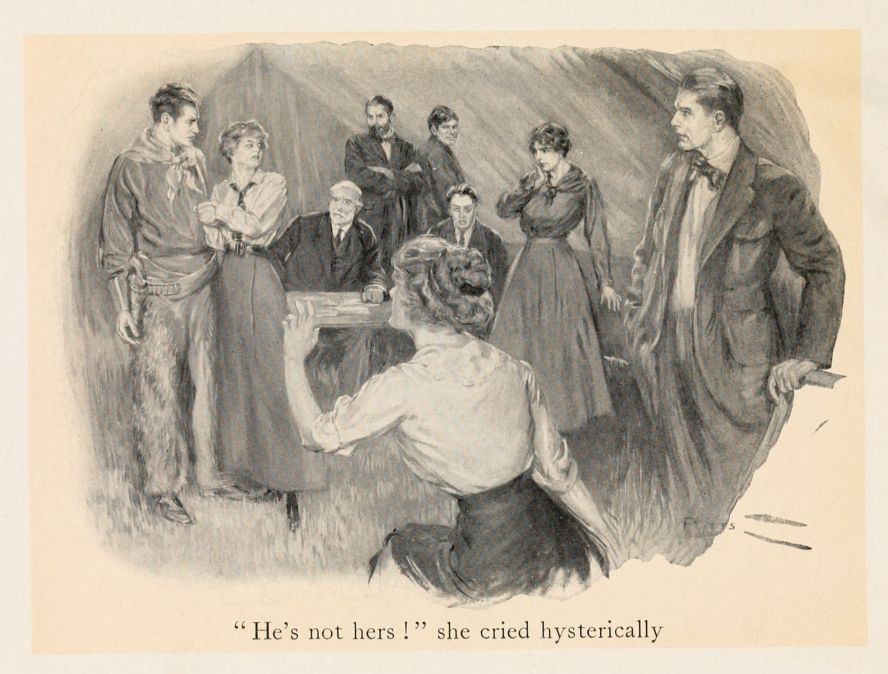
"He's not hers!" she cried hysterically.
A dreadful silence in the tent succeeded this
outburst, broken only by Linda's tempestuous sobs. She
hid her face on Jack's shoulder. His arm was around
her; a man could do no less. Vassall and Ferrie
turned away their heads, shamed and sick at heart to
see the lady of their dreams so abase herself.
Mrs. Worsley sank back in her chair, and covered her face
with her hands.
Mary Cranston, just now all alive, and warm and
eager, turned to ice where she stood. Jack was fiery
red and scowling like a pirate. For a second his eyes
sought Mary's imploringly. Seeing no hope there, he
stiffened his back, and drew on the old scornful,
stubborn mask, letting them think what they chose.
If he had had a moustache he would have twirled it
in their faces. Sir Bryson was staring at his daughter
clownishly.
Mary broke the silence. "I am sorry," she said,
smoothly and clearly, "that the young lady has
misunderstood my reasons for mixing myself in this.
She need not distress herself any further. Malcolm
Piers is nothing to me, nor I to him. If she still thinks
I have any share in him, I cheerfully give it to her
here and now."
With that she was gone. David Cranston would have
been proud of her exit. Not until after she had gone
did any of those present realize the wonder of it,
that as long as she had remained in the tent this
native girl of less than twenty years had dominated
them all.
Sir Bryson's faculties were completely scattered.
His eyes were almost as blank as Garrod's; his hands
trembled; his breathing was stertorous. Whatever his
absurdities and weaknesses, at that moment the little
man was an object worthy of compassion. Gradually
his voice returned to him.
"Linda! How can you shame me so!" he murmured
huskily. Then in a stronger voice: "Leave that
man!" He turned to Kate Worsley. "Take her away."
The storm of Linda's passion passed with the
departure of the other woman. She was now terrified
by what she had done. She allowed herself to be led
away, weeping brokenly.
Sir Bryson turned to Jack. "As for you, you young
blackguard," he said tremulously, "you needn't expect
to profit by this. If she persists in her infatuation
she is no daughter of mine. But I'll save her
if I can."
Jack's chin stuck out. He said nothing.
Jean Paul had listened to all this, outwardly shocked,
but with the hint of a smirk playing around the corners
of his lips. Fate was unexpectedly playing into his
hands! He now looked at Sir Bryson for orders,
and Sir Bryson, as if in answer, rose and said:
"Jean Paul, I order you to arrest this man. Secure
him, and keep him under guard until we can reach the
nearest police post. Mr. Vassall and Mr. Ferrie will
assist you."
The other two men who, up to the moment of Linda's
avowal, had been well enough disposed toward Jack,
now turned hard and inimical faces against him, and
hastened to lend Jean Paul their aid. All this while
Garrod sat in his chair staring dully before him.
Jack's hands clenched, and his eyes shot out cold
sparks. "Keep your hands off me," he said. "All
of you!"
Jean Paul with an air of bravado motioned Vassall
and Ferrie back. To outward appearances he was
fully Jack's match. Lacking an inch or two of his
height, he more than made it up in breadth of trunk, and
length of arm. He slowly approached the white man,
alert and smiling evilly. For a moment they measured
each other warily, Jean Paul crouching, Jack upright.
Then the half-breed sprang forward. Jack drew off,
and his fist shot out. There was the crack of bone on
bone, and Jean Paul measured his length on the grass.
He twisted a few times, and lay still.
"Good God!" cried Vassall and Ferrie, falling back.
They were not muscular men.
"He's not dead," said Jack off-hand. "A bucket of
water will bring him to."
Jack walked to the door with none to hinder. Holding
up the flap, he faced them. "You needn't think
that I'm going to run," he said. "I don't mean to do
anything that would suit you so well. I'm going to
fight for my good name, and my claims, and my girl,
and the whole government of Athabasca can't stop me!"
Dinner-time came and went at Camp Trangmar
without any one's feeling much interested
except the four Indian lads who ate largely,
to the accompaniment of chatter and laughter by
their own fire. It was nothing to them what high
words were passed, and what tears were shed in the
big tent. They were making the most of such a
time of plenty as had never come their way before,
and was not likely to be repeated.
By the cook-fire Humpy Jull exerted himself to
tempt his hero's appetite—not wholly without
success, it must be said; for what had happened could not
check the coursing of the blood through Jack's veins.
Twenty-five years old must be fed though the heavens
fall. Gabriel's trumpet had better not be sounded
for the young until after dinner. Jack ate silently
and scowlingly. To one of his nature it was galling
when there was so much to be overcome, not to be
up and doing, not to be able to strike a blow.
Afterward the trees up the trail suffered for his
wrath. Having eased his breast a little, he sat down
to find a way out. Here, being a hewer instead of a
thinker, he was at a disadvantage. He was conscious
of an anomaly somewhere. He was in perfect condition;
to fill his chest, and to stretch his muscles afforded
him a keen sting of pleasure, but wind and limb availed
him nothing against the subtle moral complications
that beset him. It was one thing to defy the government
of Athabasca in a bold voice, and another thing
to find a vulnerable spot to hit the creature.
He was sitting with his chin in his palms, considering
this, when Kate Worsley approached him from behind,
and spoke his name. He sprang up, scowling. Linda
was waiting a little way off. "Good heavens!" he
thought. "Another scene to go through with!"
Mrs. Worsley was always simple in manner, and
direct of speech. "Jack," she said at once, "Linda
has told me everything that has happened between you,
and I do not blame you as much as I did at first."
"Thanks," he said, looking away, and speaking
gruffly as he was obliged to do when he was moved. "I
value your good opinion, Mrs. Worsley. I don't
think of you like the others."
"I am taking you into my confidence," she went on.
"I am in a difficult position. Linda is terribly
distressed by what has happened. She begged so to be
allowed to see you for a moment, that I was afraid if I
refused—well, I have brought her on my own
responsibility. You will not say anything to her to make
me sorry I brought her, will you?"
"You needn't be afraid," said Jack. "Nor Sir
Bryson. I can't say it properly, but I shall not have
anything to do with her until I can come out in the
open."
"I knew you felt that way," she said quietly. "Of
course it's no use telling Sir Bryson in his present
state of mind."
"He hates me," said Jack frowning. "His kind
always does. He won't give me a chance, and I say
things that only make matters worse." He rubbed
his furrowed forehead with his knuckle. "It's a rotten,
mixed-up mess, isn't it?" he said with an appealing
look.
Her eyes softened. His strength and his weakness
appealed alike to the woman in her. Her hand went
out impulsively. "You boy!" she said. "It's no
wonder!"
Jack, wondering what was no wonder, grabbed her
hand, and pressed it until she winced.
"If I can help you, come to me," she said.
"Thanks, anyway," he said. "But nobody can, I
suspect."
"Now talk to Linda," she said. "Be gentle with her."
Jack frowned. "I told her not to say anything,"
he began.
"I know, I know," she said cajolingly. "But
you are strong; be merciful with her weakness. Make
allowances for women's nerves and emotions. It was a
terrible scene on us all; most of all on her. She was
foolish; but there was a kind of bravery, too, in
avowing you before them all. Think of that!"
"If she only had your sense," said Jack.
Kate smiled and turned away. "What do you
expect?" she said over her shoulder. "I'm thirty-eight
years old, and I was always plain! Linda!"
she called. "Three minutes only, remember." She
walked away.
Linda came running, and cast herself in Jack's arms,
weeping, protesting, scarcely coherent. "Oh, Jack!
I had to see you! I was terrified, thinking of your anger!
That woman enrages me so! I can't think! What did
you give her a mining-claim for? If you'd only love
me more, I wouldn't be so jealous of her. I didn't
mean to injure you! You know I'd never do that!
Don't be angry with me. I've disgraced myself
forever with them, and if you go back on me too, what
will I do?"
What was he to do with the helpless, contrite little
thing but comfort her? His arms closed around her.
"Who says I'm going back on you?" he muttered
gruffly.
"It's no more than I deserve after disobeying you,"
she went on. "I was such a fool! I'm so sorry! Say
you forgive me, Jack. I'll do better after this!"
"I can't forgive you right away," he said with his
awkward honesty. "But I'm not going back on anything.
Don't distress yourself like this. Everything
will come right."
"But love me a little," she begged, lifting her
tear-stained face.
He put her away not ungently. "We mustn't,"
he said.
"Why?" she asked, gripping his arm.
"I promised Mrs. Worsley."
"What did you promise?"
"Oh, you know," he said uncomfortably. "Don't
you see that if there is any—well, love-making between
us, it makes me out a villain to them?"
"No, I don't see it," she said. "Not if I make you."
Jack began to sense that father and daughter had
an exasperating trait in common, the inability to see a
thing they did not wish to see. "I should be blamed,
anyway," he said.
"But I'll tell everybody the truth," she said. "I'm
not ashamed of you. They shall see that I have chosen
you of my own free will."
"You have done harm enough," said Jack grimly.
"Better not say anything more."
"I don't care," she whimpered. "I've got to love
you."
Jack's face became hard. "I do care," he said.
"Understand, we have got to cut all this out. No one,
not even a woman, can make me do what I don't
choose to do."
"Jack, don't speak to me like that," she murmured
terrified.
"You brought it on yourself," he said miserably.
"You always seem to make me stubborn and hateful."
"But you do love me?" she said desperately.
He inwardly groaned. "I'm not going back on
anything," he said lamely.
"That's not enough," she said, beginning to tremble
again. "It would kill me if you didn't. They'll
never have anything to do with me again. I have no
one but you. You must love me. You do love me,
don't you?"
"Of course I love you," he said with a strange
sinking of the heart.
"Then I'll do whatever you tell me," she said
submissively.
"No more talks off by ourselves," said Jack. "And
around camp you must treat me exactly the same as
the other men."
"But if you shouldn't succeed in proving——"
she began.
"I will," said Jack.
"Time's up, Linda," said Kate, coming back.
Linda kissed him in spite of himself, and hurried
away. Jack breathed a sigh of relief, and took up his
axe again.
At the top of the bench a few hundred yards from
where Jack was working, the trail from over the portage
divided. One branch came down to Camp Trangmar
and the river; the other turned west along the edge
of the bench, and became the Fort Erskine trail.
A mile or two up the valley the latter was joined by the
trail that led directly west from Camp Trangmar.
As Jack stood breathing himself after a spell of
chopping, he became aware of the sound of horses'
footfalls coming along the Fort Erskine trail. There
was no sound of a bell. Struck by this fact, he bent
his head to listen attentively. It is exceptional for
the horses to stray away from the one of their number
who is belled. Moreover, to Jack's experienced ears,
these had the sound of laden horses. He could not guess
who it might be, but Indians or whites, they would
hardly ride so near to Camp Trangmar without coming
in, unless they had a reason to avoid observation. He
therefore dropped his axe, and ran up the hill to
intercept whoever was coming, and make them account
for themselves.
At the forks of the trail to his astonishment he came
face to face with Mary and Davy mounted, and leading
their two pack-horses. The bell of the leading horse
had been silenced with a wisp of grass. At the sight
of Jack they pulled up in obvious embarrassment.
Jack's heart went down like a stone in deep water.
"You're pulling out?" he faltered.
"What else was there for us to do?" said Mary
coldly.
"Without telling me?" cried Jack reproachfully.
"I didn't want to," put in Davy eagerly. "Mary
said we had to."
Pride, indignation, and exquisite discomfort struggled
in Mary's face. "It seemed easier," she said. "I'm
sorry we met you. There's nothing to say!"
"But Mary—Mary!" urged Jack, scarcely knowing
what he said, but filled with his need of her. "Not
like this! Wait until to-morrow. Who knows what
may happen to-morrow!"
"What can happen?" said Mary. "More humiliating
scenes?"
Jack caught her bridle rein. "I swear to you," he
said, "if Sir Bryson or any of the men——"
"I'm not thinking of them," Mary interrupted.
"You can't stop her tongue. You've given her the
right to speak that way."
Jack hung his head. Like a man under the
circumstances he muttered: "You're pretty hard on
a fellow."
"Hard?" cried Mary sharply. "What do you
think I——" She checked herself with an odd smile.
Jack was determined to be aggrieved. "It's
unfriendly," he burst out; "stealing out of camp by a
roundabout way like this and even muffling your bell."
"That's what I said!" put in Davy.
Mary flashed a hurt look at Davy that forgave him
while she accused. That he should take sides against
her at such a moment—but of course he was only a
child. She was silent. Swallowing the lump in her
throat, she looked away over the little valley and the
river for support. All three of them looked at the
lovely scene below them, softened and silvered in the
creeping twilight, each wondering miserably what had
happened to the joy of life.
At last Mary said quietly: "It wasn't easy to decide
what to do. I have to think of myself. I have to
think of father, what he would like. There is nothing
else. I am sorry. You and I cannot be friends. We
might as well make up our minds to it."
"Why can't we be?" demanded Jack.
"Because you have chosen a girl that will not allow
you to have another woman for a friend," she said.
This was unanswerable. Jack could only hang his
head again.
"I will not be friends with you secretly," Mary went
on. "Nor can I lay myself open to her abuse. So
we must not see each other any more."
"I need you!" Jack blurted out. His pride was
hauled down. It was the first appeal for help that
had passed his lips.
"I—I'm sorry," she faltered, but without
relenting. "Watch Jean Paul well," she went on. "He
can't keep the man hypnotized always. Get Garrod
away from him if you can."
Jack scarcely heard. "I'm under arrest," he said.
"You're leaving me without a friend in camp."
"You have her," said Mary softly, with an
indescribable look; compassion, reproach or
disdain—or all three.
"Mary!" he burst out.
She jerked her bridle rein out of his hand, and
clapped heels to her horse's ribs. "This does no good,"
she muttered. "And it hurts! Come, Davy." She
loped out of sight among the trees.
Davy lingered. Leaning out of the saddle he put
his arm around Jack's shoulders. The boy was near
tears. "Jack, what's the matter?" he begged to know.
"I want to stay. I feel so bad about it. I don't
understand. Why can't we be friends like we were before?
Mary won't tell me anything. We think such a
heap of you, Jack. The other girl—she's nothing
to you, is she? Mary's worth a dozen of her. There's
nobody like Mary. Why can't you and Mary——"
This was like a knife turned in Jack's breast. "Get
along with you!" he said harshly. "You don't know
what you're talking about." Disengaging himself from
the boy's arm, he clapped the horse's haunch, and the
animal sprang ahead. The pack-horses lumped after.
When they were out of sight Jack flung himself
full length in the grass with his face in his arms. Now
he knew. This pain in his breast was the thing they
called love. Blind fool that he had been, he had
dismissed her with the light term "native girl," and
had not seen that it was a woman in a thousand, the
woman his manhood had always been unconsciously
yearning for, generous, true and lovely. She rode
away, dragging his heart after her. He was tied fast.
The pain of it was insupportable.
"Good God! how did I ever get into it!" he groaned.
"What a price to pay for a kiss in the dark!"
Two days passed at Camp Trangmar. There
was little outward evidence of the several
storms that agitated the breasts of the
company. The men left Jack severely alone, and
Jack for his own part took care to keep out of
Linda's way. He made it his business to watch
Garrod, visiting him night and day in Jean Paul's
tent, careless of the owner. There was no change in
Garrod's condition. Jean Paul sheered off at Jack's
approach like the wary animal he was. Meanwhile
Sir Bryson, Baldwin Ferrie, and the Indians were busy
staking out additional claims along Tetrahedron creek.
On the third morning the camp was plunged into a
fresh agitation. Jack and Humpy Jull were breakfasting
by the cook-fire, Jack looking like a sulky young
Olympian in the morning sunlight, and Humpy
naïvely trying to cheer him up.
"Gosh!" he said. "If I had your looks and figger
I wouldn't care about nothin'."
Jack, who disdained the false modesty that disclaims
such tributes with a simper, merely held out
his plate for porridge.
Suddenly Vassall came quickly across the grass.
His face was pale and streaked from the effects of
nervous emotion.
"Sir Bryson wants you," he said to Jack.
Jack continued to eat leisurely. "What about?"
he asked, coolly. "I've no mind to stand up and be
abused again."
"Garrod is gone," said Vassall.
Jack's indifference vanished like sleight of hand.
He sprang up. "Gone!" he echoed.
He headed straight for the big tent, Vassall following,
and Humpy Jull looking after them both with round eyes.
The inside of the big tent presented evidences of
confusion. Breakfast was spread on the two little
tables pushed together, and Linda, Mrs. Worsley,
and Baldwin Ferrie were seated, playing with their
food. Sir Bryson's chair was pushed back, and his
napkin lay on the grass. The little man was
agitatedly walking up and down. Jean Paul stood by with
a deferential air.
This time Linda gave no sign at Jack's entrance
except for an access of self-consciousness.
"What do you know about this?" Sir Bryson
immediately demanded.
"I know nothing," Jack said. "I have come to find
out."
"Garrod has escaped," said Sir Bryson.
"Why not?" said Jack bitterly. "He ought to
have been secured."
Jean Paul spoke up. "I get no order to tie him,"
he said smoothly. "He all time ver' quiet. I mak'
him sleep inside me, and I tie a buckskin lace from him
to me. If he move a little I wake. This morning
when I wake, the lace cut and him gone."
"Did you let him keep a knife, too?" asked Jack,
sneering.
Jean Paul looked confused. "He got no knife
w'en I look on him," he said.
"It sounds fishy," said Jack scornfully.
"Do you mean to imply——" began Sir Bryson.
"Jean Paul sleeps like a cat," Jack went on. "If
so much as a stick turns in the fire he wakes and looks
to see. Follow it out for yourselves. He can't keep
the man hypnotized forever. And once Garrod comes
to his senses, the truth comes out!"
"These are empty accusations," puffed Sir Bryson.
"The poor fellow has wandered away in his distraction."
"Or been carried," Jack amended.
"By whom?" said Sir Bryson. "We're all here."
"There are Sapi Indians a few miles west," said
Jack. "Jean Paul is a power in the tribe."
"Excuse me, your excellency," purred Jean Paul,
"if I do this, I not stay be'ind myself me, to get your
punishment."
"Make you mind easy, Jean Paul," said Sir Bryson
graciously. "This fellow attempts to twist everything
that happens, to his own advantage. I commend
your ingenuity, young sir," he added sarcastically.
"We're wasting time!" cried Jack with an impatient
gesture. "He's got to be found! Whatever you choose
to think of me, you can safely leave that in my hands.
It means more to me than to any one else. It means
everything to me to find him."
"Jean Paul says the horses have strayed——"
Sir Bryson began.
"The horses, too?" cried Jack. The half-breed's
eyes quailed under the fiery question that Jack's
eyes bent on him. Without another word Jack turned
and ran out of the tent.
In half an hour he was back—with a grim face.
The occupants of the big tent were much as he
had left them, but Jack sensed from the increased
agitation of their faces, and from Jean Paul's
sleekness, that the half-breed had not failed to improve
the interval.
"It's true," said Jack shortly. "They've been driven
off."
It had a terrifying sound to them. They looked at
him with wide eyes.
"I found their tracks on the Fort Erskine trail,"
Jack went on. "They were travelling at a dead run.
The tracks were six hours old."
Sir Bryson stopped his pacing. "Driven off?"
he said agitatedly. "Are you sure? Couldn't they
have run off by themselves?"
"They could," said Jack, "but they didn't. Five
of the horses were hobbled when we turned them out.
The hobbles had been removed."
"Well, well," stammered Sir Bryson, "what are
we to do?"
"Let me take ten days' grub from the store," said
Jack. "I'll undertake to bring Garrod back, and at
least some of the horses."
"You'd follow on foot?" Linda burst out.
Jack answered to Sir Bryson. "They can't travel
fast with their families and baggage."
It was not Jack's safety that Sir Bryson was
concerned about. "But—but, leave us here without
horses?" he faltered.
Jack smiled a little. "What good am I to you?
I'm under arrest. Jean Paul has your ear. Why won't
he do?"
Sir Bryson gave no sign of hearing this. "We must
return," he said nervously. "We can't stay
here—without horses."
Jack's heart sank. "What have the horses got to
do with it?" he asked. "You're safe here. You've
grub enough for months."
Sir Bryson looked at the half-breed. "Jean Paul
says perhaps it is the Indians," he said. "He thinks
they may have driven off the horses as a preliminary
to attacking us."
"I not say that, me," put in Jean Paul quickly.
"I jus' say best to be ready."
"So that's his game," cried Jack scornfully. "He's
fooling you! It's an old redskin trick to drive off the
horses to prevent pursuit. But as to standing up to
white men—well, I'm willing to go and take my
man and my horses away from the whole village
of them."
Sir Bryson violently shook his head. Jack saw that
the fate of Garrod had little weight with him. "We
are quite defenceless!" he cried. "And with the women
to look after! It is my duty to start back!"
Jack's lip curled.
Sir Bryson's voice scaled up shrilly. "How will
we ever get back?" he cried.
"That's easy," said Jack. "Twelve miles walk over
the portage to Fort Geikie, then by raft down the
river. We'll make it in two days."
"Can we start this morning?"
Jack flushed. "No!" he cried. "Abandon our
outfit! That would be disgraceful. It would be the
joke of the country. I won't be a party to it! We'll
cache the stuff to-day, and you can start to-morrow."
"Very well," said Sir Bryson nervously. "In the
meantime we must keep a sharp lookout!"
Before Jack left him he made another appeal to be
allowed to go after Garrod. He might as well have saved
his breath. Sir Bryson and those with him, except
perhaps Mrs. Worsley, were in the grip of panic. It
was futile to try to reassure those whose notions of
Indians had been gathered from the Wild West fiction
of a preceding generation.
Jack came out of the tent sore all the way through.
Taking them down to the Fort would cost him five
precious days. True, he could get horses there, and
perhaps assistance if he needed it, but the waste of
five days was maddening.
Jack thought for a moment of defying Sir Bryson,
and going anyway. But he put it from him. Any
white man who abandoned a party that he had
bound himself to guide, no matter what the
circumstances might be, would be disgraced forever in the
North. It is a situation which simply does not admit
of argument. This sense of guide-responsibility is strong
among white men, because the natives are without it.
They are prone to shuffle off disagreeable burdens on
the slightest provocation.
Jack set to work with a sullen will. He took out his
soreness in hard work and in making the Indian lads
work. Hard and long-continued exertion was a
disagreeable novelty to them; before many hours had
passed they were sullen too.
An axe party was immediately dispatched into the
bush, and by noon enough stout poplar logs were cut
and trimmed and drawn into camp to make a small
shack. By supper-time the walls were raised, and the
roof of poles laid and covered with thick sods. The
remaining hours of daylight were occupied in storing
everything they possessed inside. It was ten o'clock
before they knocked off work. Meanwhile Sir
Bryson, to Jack's scornful amusement, had insisted
on posting Vassall and Ferrie as outposts against
a surprise.
Next morning the governor was plunged into a fresh
panic by the loss of the four Indian lads. No one saw
them go. They melted out of camp, one by one, and
were seen no more. Jack was not greatly surprised;
he had seen premonitory symptoms the day before.
It was additional evidence to him that the other
Indians were still in the neighbourhood, and he was
more than ever chagrined to be obliged to retreat
without even an attempt to recover Garrod.
Jack kept out of Sir Bryson's way. In spite of
themselves, however, the white men leaned on Jack more
and more. Their imaginary redskin peril strengthened
the race feeling, and Jack's energy and resourcefulness
were indispensable to them. They came to him
sheepishly for aid, but they came.
"What do you make of this desertion?" Vassall
asked anxiously.
"Nothing serious," said Jack. "I don't think Jean
Paul has a hand in it, because it's his game to get us
out as quickly as he can. They probably vamoosed
of their own accord. When we lost the horses, they
saw the end of their good times. They've been fed
too high. It makes 'em beany, like horses."
"But what'll we do without them?" Vassall asked.
Jack guessed that the question came from Sir Bryson.
"Tell the old gentleman to keep his shirt on," he said.
"They're no great loss. It means that we'll all have
to carry a little more across the portage, that's all."
After breakfast the tents were taken down and stored
with the last of the camp impedimenta in the cache.
When everything had been put inside, the door was
fastened with a hasp and staple removed from one of
the boxes, and Jack pocketed the key. The loads
were then apportioned and packed, a long job when
six of the eight were totally inexperienced. Sir Bryson
was still looking over his shoulder apprehensively.
At eleven o'clock they finally set out.
It was a quaintly assorted little procession that
wound in single file along the firmly beaten brown trail
through the willow scrub and among the white-stemmed
poplars. There was a lieutenant-governor carrying a
pack, and striving ineffectually to maintain his dignity
under it; and there was his daughter likewise with a
blanket strapped on her shoulders, and an olive-wood
jewel-case in her hand, with a gold clasp. Jack smiled
a little grimly at the idea of a jewel-case being toted
through the bush.
Everybody carried a pack conformable to his
strength. Since the two women and Sir Bryson could
take so little, the others were fairly well laden. Jean
Paul at the head, and Jack bringing up the rear, toted
the lion's share. Besides blankets, the outfit consisted
of food sufficient for five days, cooking and eating
utensils, guns, ammunition, and axes. Jack had a
coil of light rope to aid in building his raft.
Jack put Vassall next behind Jean Paul, with a word
in his ear to watch the half-breed. Jack felt, somehow,
that no serious harm was likely to befall Garrod so
long as he had Jean Paul safely under his eye. After
Vassall the others strung along the trail, with Humpy
Jull, the oddest figure of all, marching in front of Jack,
looking like an animated tinware shop with his pots
and pans hanging all over him.
They started in good enough spirits, for the sun was
shining, and the packs felt of no weight at all. But
on the little hills their legs inexplicably caved in; their
breath failed them, and the burdens suddenly increased
enormously in weight. It was a long time since hard
labour had caused Sir Bryson to perspire, and the novel
sensation afforded him both discomfort and indignation.
Two miles an hour was the best they could do, counting
in frequent pauses for rest. The twelve miles
stretched out into an all-day affair.
Once, toward the end of the afternoon, they came
to the bank of a small stream, and throwing off their
burdens, cast themselves down in the grass beside it,
all alike and equal in their weariness. Sir Bryson was
no longer a knight and a governor, but only the smallest
man of the party, rather pathetic in his fatigue. They
were too tired to talk; only Jack moved about restlessly.
The slowness of the pace had tired him more than the
seventy-five pounds he carried.
As Jack passed near Kate and Linda the latter said
petulantly: "I'm tired, Jack. I want to talk to you."
Jack's heart sank, but nothing of it showed in his
face. The little thing's look of appeal always
reproached him. To a man of his type there is something
shameful and wrong in not being able to give a woman
more than she looks for. "Lord! it's not her fault,"
he would tell himself; and "As long as I'm going through
with it, I must make a good job of it!" So he plumped
down beside her.
"Go as far as you like," he said with a kind of hang-dog
facetiousness. "Everybody can see, and Mrs. Worsley
is standing guard."
"But I'm tired," she repeated. "I want to put my
head on your shoulder." She looked at the spot she
had chosen.
Jack became restive. "Easy there," he said
uncomfortably. "You're forgetting the compact!"
Linda's eyes slowly filled with tears. "Hang the
compact," she said. "I'm tired."
"I'll carry your blanket the rest of the way,"
Jack said gruffly.
"I won't let you," she said. "You've got a perfectly
enormous load already."
"Pshaw! that featherweight won't make any difference,"
he said, and tied it to his pack.
"My feet hurt me," wailed Linda.
Jack frowned at the elegant little affairs Linda called
her "sensible" shoes. "No wonder," he said. "Trying
to hit the trail on stilts. Put out your foot."
His axe lay near. Firmly grasping her ankle, with
a single stroke he guillotined the greater part of the
elevating heel. Linda and Kate both screamed a
little at the suddenness of the action, and Linda
looked down horrified, as if she expected to see the
blood gush forth. Jack laughed, and performed
a like operation on the other foot. For the next
hundred yards she swore she could not walk at all,
but the benefit of the amputation gradually became
apparent.
Never was such a long twelve miles. Finally, when
most of them had given up hope of ever making an
end to this journey, they debouched on the grassy
esplanade surrounding the shacks of Fort Geikie.
Humpy Jull set about getting dinner, while Jack and
Jean Paul cut poplar saplings and constructed a leafy
shelter for Linda and Kate. The business of camp had
to be carried on; no one seeing these people travelling,
and eating together, and sleeping around the same
fire, could have guessed how their hearts were divided.
They were ready for sleep immediately after eating.
Linda and Kate disappeared, and the men rolled up
in their blankets, Sir Bryson grumbling. He felt that
another little shelter should have been made for him.
He found it very trying to be obliged to snore in public
among his servants.
Sir Bryson insisted that a watch be maintained
throughout the night, and Jack, who would have
laughed at any other time, fell in with the idea, because
he had a notion that Jean Paul might try to slip away.
Jack arranged therefore that the half-breed keep the
first watch, and, at no little pain and difficulty, he
remained awake himself to watch Jean Paul. At eleven
Jean Paul wakened Humpy Jull; at one, Vassall took
Humpy's place.
Jack had left instructions that he was to be roused at
three. It was already broad day at this hour. Upon
Vassall's touch he staggered to his feet under the
burden of sleep and walked blindly up and down until he
had shaken it off. He went to the edge of the bank to
take a prospect, Vassall at his elbow. A better
understanding was coming about between these two. Vassall
made no pretence that he had forgiven Jack for
burglarizing Linda's affections, as he thought, but
granting that, he, Vassall, was doing all he could do to
bear his share of their common burden.
A lovely panorama of river, islands, and hills lay
before them in the cool, pure, morning light.
"I'm going to cross to the island," Jack said, pointing.
"In the drift-pile on the bar there, there's dry
wood enough for a dozen rafts."
"How will you get over there?" asked Vassall.
"Swim," said Jack.
"I'll go along, too."
Jack stared at the slender, pale young city man.
"You!" he said with a not very flattering intonation.
"Hang it, I'm not going to let you do everything,"
Vassall said, frowning. "I can swim. It's one of the
few things I can do that is useful up here."
"It's not so much of a swim," said Jack. "The
current carries us. I'll tow the axe on a stick or
two. But the water's like ice."
"I can stand if it you can," Vassall said doggedly.
Jack looked at him with a gleam of approval.
"Come on and feed then," he said off-hand.
They wakened Baldwin Ferrie to stand the last
watch, and sat down to the cold victuals Humpy had left
for them. In front of them the other men still slept,
an odd sight, the three of them rolled up like corpses
in a row in the morning light: lieutenant-governor,
half-breed, and cook, as much alike as three trussed
chickens.
While Jack ate, he issued his instructions to Ferrie:
"Wake Humpy at five, and tell him to get a move on
with breakfast. As soon as Vassall and I knock the
raft together, we'll cross back to this side, but the
current will carry us down about a third of a mile.
When the rest of you have finished eating, pack up
and come down to the shore. You'll have to walk
along the stones to the first big point on this side.
Bald Point, they call it, because of the trees being
burned off. Lose no time, because we must be started
by eight, if we mean to make Fort Cheever by dark."
Jack and Vassall, clad only in shirt, trousers, and
moccasins, scrambled down the steep bank to the
water's edge. Vassall looked at the swirling green
flood with a shiver.
"Tie your moccasins around your neck," Jack said.
"Leave your other things on. They'll soon dry as
we work around. Head straight out into midstream,
and you'll find the current will ground you on the
point of the bar below."
The water gripped them with icy fingers that squeezed
all the breath out of their lungs. Vassall set his teeth
hard, and struck out after Jack. They were both livid
and numb when they finally landed, and Jack forced
Vassall to run up and down the bar with him, until
the blood began to stir in their veins again. Then
they attacked the tangled pile of drift logs.
Eight bleached trunks as heavy as they could pry
loose and roll down to the water's edge provided the
displacement of the raft. Jack chopped them to an
equal length, and laced them together with his rope.
On these they laid several cross-pieces, and on the
cross-pieces, in turn, a floor of light poles, the whole
stoutly lashed together. The outfit was completed
by two roughly hewn sweeps and a pair of clumsy
trestles in which to swing them. They were greatly
handicapped by the lack of an auger and of hammer and
nails, and the result of their labour was more able than
shipshape. Four strenuous hours went to the making
of it.
"She'll hold," said Jack at last, "if we don't hit
anything."
They pushed off, and each wielding a sweep, pulled
her back toward the shore they had started from.
They both watched her narrowly, not a little proud
of their handiwork. At least she floated high and
dry, and answered, though sluggishly, to the sweeps.
Their common feeling made Jack and Vassall quite
friendly for the moment.
The little group was already waiting for them on the
stones, with the slender baggage. Apprehension is
quicker than the physical senses. Before he could see
what was the matter, Jack sensed that something had
happened, and a sharp anxiety attacked him. As he
and Vassall drew near the shore he scanned the waiting
group closely; he counted them, and then it became
clear! There were only five waiting instead of six!
"Where's Jean Paul?" he cried out.
The people on the shore looked at each other
uncomfortably. There was no answer until the raft grounded
on the stones. Then Sir Bryson drew himself up
and puffed out his cheeks.
"He asked my permission to remain to search for
poor Garrod," he said in his most hoity-toity manner.
"And I thought best to accede to his request."
Jack's jaw dropped. For an instant he could not
believe his ears. Then he slowly turned white and
hard. So this was what he got for spending his
strength in their service! This was what he had to
deal with: folly and self-sufficiency that passed belief!
He was angrier than he had ever been in his life before.
He was much too angry to speak. He stepped ashore,
and walked away from them, struggling with himself.
Sir Bryson strutted and puffed and blew for the
benefit of all observers. His secret dismay was none
the less apparent. None looked at him. They were
gazing fearfully at Jack's ominous back.
He came back with a set, white face. "Sir Bryson,"
he said in a voice vibrating with quiet, harsh scorn, "I
say nothing about myself. Apart from that I've
shown you clearly, and these people are witnesses
to it, that this half-breed means Garrod no good. So
be it. If he does for him now, it will be on your head."
In spite of his bluster, Sir Bryson began to look like
a frightened small boy.
Linda was weeping with anger and fright. "I told
him," she said, "but he wouldn't listen to me."
Kate, fearful of another outburst, laid a restraining
hand on her.
"Here's your raft," Jack went on harshly. "All
you have to do is to sit on it and keep it in the middle
of the river and you'll be at Fort Cheever before
dark. After letting the breed go, the least you can do
is to let me stay and watch him."
They all cried out against this, even Kate and
Vassall, whom Jack thought he could count on a little.
They all spoke at once in confused tones of
remonstrance and alarm. "What would we do without you?
We don't know the river. We can't handle a raft,"
and so on.
Above all the others Sir Bryson's voice was heard
trembling with alarm and anger: "Would you desert
us here?"
The word brought the blood surging back into Jack's
face. "Desert nothing," he said. "I asked your
permission. I do not desert. Get aboard everybody,
and hand on the bundles!"
They scrambled at his tone, a good deal like sheep.
Jack launched the raft with a great heave of his back,
running out into the water, thigh deep. Clambering
on board, he picked up a sweep, and brought her around
in the current. Sir Bryson and the others stole
disconcerted sides glances at his hard and bitter face.
There is something very intimidating in the spectacle
of a righteous anger pent in a strong breast. The
spectator is inclined to duck his head, and wonder
where the bolt will fall.
Jack propelled the raft into the middle of the
current, and, taking the sweep aboard, sat down
on the end of it with his back to the others,
and nursed his anger. They sat or lay on the poles
in various uneasy positions. Sir Bryson, who, until the
the day before, had probably not been obliged to sit in
man's originally intended sitting position for upward
of thirty years, felt the indignity keenly.
Every one's nerves were more or less stretched out
of tune. Linda, watching Jack's uncompromising
back with apprehensive eyes, was exasperated past
bearing by her father's fretful complaints.
"What do you want?" she burst out. "A padded
chair? Don't be ridiculous, father!"
Sir Bryson swelled and snorted. "That is no way
to speak to your father, Belinda. Because you see me
robbed of my outward and visible dignity is no reason
for your forgetting the respect you owe me. I am
surprised at you."
Linda's muttered reply was forcible and inelegant.
None of the others paid any attention. Sir Bryson,
feeling perhaps that a magisterial air accorded ill
with his tousled hair and his cross-legged position,
made a bid for sympathy instead.
"My feet are going to sleep," he said plaintively.
Jack, overhearing, was reminded again of the
resemblance between father and daughter. "You don't
have to sit still," he said, speaking over his shoulder.
"You can move about as long as you don't all get
on the same side at the same time."
Sir Bryson, who would not have been robbed of his
grievance for any consideration, continued to sit and
suffer dramatically.
Vassall's head was heavy. Stretching himself out,
and watching Linda wistfully, he finally fell asleep.
Humpy Jull, up at the bow—if a raft may be said to
have a bow—constructed a fishing line out of a bent
pin and a moccasin lace, and baiting it with a morsel
of bacon, fished for hours with the trusting confidence
of a child. Discouraged at last, he fell asleep beside
Vassall.
Thus the morning passed. Left to its own devices,
the raft swung around and back in the eddying current,
and a superb panorama was ceaselessly and slowly
unrolled for any who cared to see. The river moved
down through its vast trough in the prairie, and an
ever-changing vista of high hills, or seeming hills,
hemmed them in. On the southerly side the hills
were timbered for the most part. On the northerly side,
where the sun beat all day, the steep slopes were bare,
and the rich grass made vivid velvety effects darkened
in the hollows and touched with gold on the knolls.
The whole made a green symphony, comprising every
note in the scale of green from the sombre spruce boughs
up through the milky emerald of the river water to
the high verdancy of the sunny grass and the delicate
poplar foliage.
Of them all only Kate Worsley watched it as if the
sight was enough to repay one for the discomfort
of sitting on poles. Her quiet eyes were lifted to the
hills with the look of one storing away something to
remember.
Now and then a momentary excitement was created
by the sight of a bear grubbing about the roots of the
poplar saplings, homely, comical beasts with their
clumsy ways and their expression of pretended cuteness.
Something still wild in the breasts of domesticated
creatures like ourselves never fails to answer
to the sight of a real wild thing at home in his own
place. Since they had no time to go ashore in case
of a hit, no shots were fired.
Once in the middle of the day they landed long enough
for Jack to build a hearth of flat stones on Humpy's
end of the raft, and cover it with clay. Then, gathering
a little store of wood, they pushed off again, and
Humpy built his fire, and boiled his kettle while they
floated down.
After lunch Jack's anger was no longer sufficient
to keep his neck stiff. He had been up since three
that morning, and in spite of himself he began
to nod. Vassall volunteered to keep watch while
he slept.
"There's nothing to do as long as she keeps the
middle of the stream," Jack said. "If she drifts to
one side or the other wake me."
He stretched himself out, and in spite of the cobbly
nature of his bed, immediately fell asleep. Linda
watched him with the tears threatening to spring.
He had not spoken to her since they started, and indeed
had scarcely seemed to be aware of her. She glanced
at the others with rebellious brows. If it were not
for them, she thought, the tawny head might be
pillowed in her lap.
Another hour dragged out its slow length. Kate
Worsley out of pity for Sir Bryson's increasing peevishness
proposed a game of bridge. It was hailed with
alacrity. A sweater was spread for a cloth; Sir Bryson,
Kate, Baldwin Ferrie, and Vassall squatted around
it, and the cards were dealt.
"Fancy!" exclaimed Vassall, looking around.
"Rather different from a game in the library at
Government House, eh?"
"And different looking players," suggested Kate
with a smile.
"I feel it very keenly, Mrs. Worsley," said Sir
Bryson tearfully. "I have always attached great
importance to the little details of one's personal
appearance. Perhaps it is a weakness. But that is the
way I am."
"We're all in the same boat—I mean raft," said
Mrs. Worsley cheerfully. "Look at me!"
"I will make it no trumps," said Baldwin Ferrie.
Linda, seeing the others fully occupied, moved nearer
to Jack, and lay down where, making believe to be
asleep herself, she could watch his face, calm and glowing
in sleep, the lashes lying on his cheeks, the thin nostrils,
the firm, red line of his lips. If he had only slept with
his mouth open, or had snored, it might have broken
the spell that held her, and a deal of trouble been saved.
Unfortunately he slept beautifully; and if that was not
enough, once he smiled vaguely like a sleeping baby,
and changed his position a little with a sigh of content.
The sight of her strong man in his helplessness affected
the girl powerfully; when he moved, her heart set up
a great beating, and the alarmed blood tingled to her
finger-tips.
During this time but an indifferent watch was kept.
Humpy Jull had fallen asleep again. There seemed
little need to watch on such a voyage. True, they
had passed little reefs and stretches of broken water
where the swift current met obstructions inshore,
but there had been no disturbance that extended
out into midstream. The raft was carried down
squarely in the middle of the channel.
Once when it came to Vassall's turn to be dummy,
he stood up to stretch his legs and look about him.
A short distance ahead he saw that the invariably
earthy slope of the hills was broken by an outcropping
of rock on either side. The band of rock evidently
crossed the river, for in the middle a ragged islet of
rock stuck its head out of the water.
Vassall debated on which side of the rock they
ought to pass with the raft. To a riverman the "middle
of the stream" means the main sweep of the current
of course. Vassall was not a riverman and he did not
observe that the greater body of water made off to
the left and around that side of the island. The
channel on the right-hand side stretched straight
ahead of them, wide and apparently smooth, and to
Vassall this looked like the "middle of the stream." If
he had left the raft alone the current of its own accord
would have carried it around to the left, but he ran
out a sweep and pulled her to the other side. He
saw no occasion for waking Jack.
A new hand was dealt and he returned to the game.
It was a critical hand, and the attention of all four
of the players was closely fixed on the cards until the
last trick was taken. Not until then did they become
aware of the grumble of broken water ahead. They
had heard the sound before on the reefs they had passed.
Vassall, looking up, saw only a kind of smudge like a
thumb-mark drawn across the smooth face of the
river ahead. The next time he looked he saw darkish
spots here and there between the island and the shore.
The noise became louder. Finally he got up, and
in the act of rising the ominous white leaped into his
view. It was a reef extending all the way across.
The dark spots were rocks covered by an inch or two
of water.
For an instant Vassall looked at it stupidly. The
others were arranging their cards in ignorance of any
danger. Before Vassall could wake Jack, the hoarse
roar of the reef reached the subconsciousness of the
sleeping man, and he sprang up, all standing. A
glance told him everything.
"What are we doing on this side?" he cried.
He ran out one sweep, and motioned Vassall to
the other. They pulled with a will. The others
watched, not fully understanding the nature of the
danger yet, but alarmed by Jack's grimness. He
was heading the raft for the main channel. They had
not reached the island yet, but Jack soon saw that
at the rate they were being carried down he could not
make the other side, nor could he land his clumsy
craft on the shore above the reef.
"Save your strength," he said to Vassall. "We'll
have to chance it. Everybody sit still and hold on."
A breathless few minutes succeeded. Jack steered
for the widest space he could see between the rocks.
Those who were sitting down still could not see much
of what was ahead, but the roar of the water was now
sufficiently terrifying. Moving of a piece with the
current as they were, it seemed as if they were not
moving, but that the broken rocks were striding to
meet them, not very fast, but inexorably. It was
hard to sit and wait.
Then as they came close they saw how the water
slipped silkily over the reef with the dark shadows
showing like teeth beneath, and boiled up below.
The women cried out sharply, and the men turned
pale. It suddenly became evident how fast the heavy
raft was moving.
"Throw yourselves flat and hang on!" Jack shouted.
They obeyed. There was a dreadful moment of
waiting, while the roar of the water filled their ears.
Then she struck. One side of the raft slid up on a
submerged shelf, the floor tilted at a steep angle,
and the current surged over the lower side, sweeping
everything movable off. Jack stood up to his knees
in the torrent, pushing desperately at the heavy sweep.
He budged her inch by inch.
"Lie still!" he shouted. "For your lives! We'll
make it yet!"
But panic seized upon his passengers. Somebody
scrambled for the high side of the raft, and the rest
followed. The strain was too great for the lashings.
A rope parted somewhere, and the floor instantly
heaved up beneath them. There was a brief, wild
confusion of thrashing, tangled logs and feeble human
bodies. Then the whole thing, logs, bodies, baggage,
and playing cards was swept over into the deep, rough
water below.
When Jack came to the surface he had a confused
impression of bobbing heads and logs on every
side. He seized the nearest log, and unstrapping
the cartridge belt and the gun that were drowning
him, buckled it on. Meanwhile, he was looking
for the long hair of the women. He reached one
of them in six strokes. A pair of clutching arms
reached for him, but he dived, and seizing her by the
collar, towed her to the nearest log. It was Linda.
Leaving her supported, he trod water looking for
Kate. He saw more streaming hair not far away,
and reached the spot as she rose again. There was
sterner stuff here; her face was white and wild, but
her arms were under control. She put her hands on
Jack's shoulders as he commanded, and he brought
her likewise to a log. A little brown box came bobbing
by, Linda's jewel-case. Kate coolly put out her hand
and secured it.
All this had taken but a minute. Jack looked about
him. Everything was being carried down of a piece
with the current, and they were all close together.
It seemed to Jack as if the whole face of the river was
littered with playing cards. He had a particular
impression of the deuce of clubs. Vassall was helping
Baldwin Ferrie to a log, and Humpy Jull had secured
the log that bore Jack's cartridge belt. Only Sir
Bryson was missing. Farther out Jack saw a feeble
commotion, and no log near.
"See to the women!" he called to Vassall. "There's
a backwater inshore. Humpy, save that belt as you
value your life!"
The struggling figure sank before he reached it.
Jack swam about the spot. It rose again, but out of
his reach. He dived for it. They came together,
and a pair of frantic arms closed about Jack's neck.
They sank together, Jack struggling vainly. They
rose, Jack got a breath, and broke the hold. The
struggling ceased.
Swinging the inert figure over his back, Jack struck
out for the shore. It was a desperately hard pull.
They had been carried too far to obtain any advantage
from the backwater. The logs he passed were of no
aid to him, because the current tended to carry them
into midstream. For a long time the shore seemed only
to recede as he struggled toward it. More than once
fear touched him and he was on the point of going
down. He rested, breathing deep, and set to it again.
Finally he ceased to think or to feel, but he continued
to struggle automatically, and he still clung to his
burden.
It was with a kind of surprise that he finally felt
the stones under his feet. He staggered ashore, and
putting down the limp figure he carried, flung himself
on the shore utterly exhausted. How long he lay there
he hardly knew. As soon as a little strength began to
stir in him, with the man-of-the-wilds instinct he set
to work collecting sticks to make a fire.
He had been carried nearly a mile below the reef.
By and by, far up the shore he saw some wavering,
uncertain little figures. He was able to count five of
them, so he knew all were safe. He hailed them shrilly
after the way of the country. After his little fire sprang
up, he could see that they were coming toward him
slowly, the men helping the women.
They came, a distressed little company, drenching
wet, silent and dazed. They moved like automatons,
as if their limbs were independent of them, and they
looked at each other dully, as if not with full recognition.
Reaching Jack, they stood around in an uncertain
way; none of them spoke. It was as if they had lost
the faculty of speech also. Linda was roused by the
sight of her father; with a cry, she cast herself on his
body.
"He's not drowned," Jack said quickly. "Only
stunned a little."
The helplessness of the others had the effect of rousing
Jack to an ardour of activity that transformed him.
His gnawing anger was forgotten; his black looks were
flown. Their situation was well-nigh desperate, but
here the opposing forces were purely physical, such as he
thoroughly understood, and loved to attack. His
exhaustion passed, and his eyes became bright.
"Has anybody dry matches?" he sang out.
The dazed ones looked a little amazed at his spirits.
It appeared that no one's match-safe was waterproof
but Jack's own.
"Spread 'em out to dry on a rock," he said. "They
may work. I have seventeen good ones. That's
enough at a pinch. Everybody scatter for dry wood.
Keep on the move, and get your circulation going.
Humpy, you build another fire behind the willows for
the ladies. Light it from this one. We can have all
the fire we want, anyway. Vassall, help me here with
Sir Bryson. We must take his wet things off." He
glanced up at the sun. "Rest for an hour," he said;
"then on the march! Red Willow Creek to-night;
Fort Cheever to-morrow afternoon!"
"But how are we going to support life on the way?"
stammered Baldwin Ferrie.
Jack pointed to the belt Humpy Jull had brought
along. His gun and his hunting-knife hung from it.
This, with Linda's jewel-case, was the sum total of
what they had saved from the wreck.
"We have the cannon," Jack said with a laugh.
"About forty cartridges, and the seventeen matches.
We'll make out."
An hour later they started to climb the steep, high
hill to the prairie. They took it very slowly on account
of Sir Bryson, who was still white and shaky. But he
complained no more. Jack's example had had its
effect on all, and a more cheerful feeling pervaded
the party. They were at least dry and warm again.
The men still regarded Jack's high spirits a little
askance. It did not fit their settled convictions about
him; they resented it slightly while forced to admire.
"Where are we heading for?" Vassall asked.
"There's a trail down this side of the river as well as
on the other," Jack said. "I've never been over it,
but if we strike straight back we must hit it."
"How will we get back across the river?"
"Nothing easier," said Jack. "When we arrive
opposite the fort, if it's daylight, we'll wave a shirt;
if it's night, we'll build a fire, and they'll send a canoe
over for us."
Once having accomplished the difficult hill it was
easy enough going over the prairie. Taking his bearings
from the sun, Jack led them in a line at right angles
back from the river. Linda walked beside him.
Vassall and Ferrie helped support Sir Bryson. Half an
hour's walking brought them to a trail, as Jack had
promised, and their hearts rose. It was a less
well-beaten track than the main route on the north side
of the river, but easy enough to follow.
Jack called a halt. "Here we are," he said. "The
first good water that I know of is Red Willow Creek.
I've camped on the river at the mouth of it. It will
be about seven miles. Are you good for it?"
They said they were. No one dreamed of opposing
Jack now. They hung on him like defenceless merchant-men
on their man-o'-war convoy.
"Vassall, you lead the way from here," Jack went on.
"You'll find the creek in a big coulee. We'll camp for
the night in the bottom of it. If by any chance you
should lose the trail before you get there, just climb to
the highest place you see, and sit down and wait till
I come along."
"But where are you going?" they demanded.
"To hunt for our supper," said Jack.
He issued two of the precious matches to Humpy
to make a fire on arrival. "There ought to be berries
in the coulee," he said. "Collect all you can."
Linda clung to him. "Can't I go with you?" she
begged.
He shook his head. "The hunter must hunt alone."
"Don't be long. Be very careful. If we lost you
we'd simply lie down and die."
"Easy!" he said uncomfortably.
Linda glanced at the others. "Why should I hide
it now?" she said. "I'm proud of you. They know
now why I chose a man like you, a real man."
Jack had the feeling that additional turns of rope were
being taken around his body. He blushed and scowled
together. "Linda! for heaven's sake!" he burst out.
Under his breath, "Wait until I pull you out of this
before you begin to talk." He turned and fled.
A word of sympathy may be dropped here for Vassall
and Ferrie. It is hard to have to stand by while your
rival has the opportunity to save the lives of all and
sundry, including your own, just because he is in
his own element and you are out of yours. And then
to be publicly scorned by the girl in the case—for
that is what Linda's speech amounted to. Linda had
no mercy for men; that is why, if you look into it far
enough, she was bound to suffer on her own account.
It was much to their credit that the two men took
it generously.
It was four hours before they saw Jack again. They
had reached the rendezvous some time before, and
Humpy had built a fire on the shore of the creek,
around which they sat in silence, trying not to look as
hungry as they felt, and trying to conceal the common
anxiety that gnawed at each breast: "What will we do
if he doesn't come!"
But at last his hail came over the hill, and Jack
himself came running and sliding down the grassy slope,
covered with feathers it appeared. They sprang up
with glad cries. Never did man receive a more
heartfelt welcome. They were like his hungry children
waiting to be fed and cheered. It is sweet to be so
necessary to one's fellow-beings, but indeed it was a
startling transformation. At one bound Jack had
risen in their estimation from a disgraced felon to the
saviour and preserver of them all. Jack felt this, and
it was his revenge.
He kissed Linda—he had to—and flung his burdens
down. "Prairie chicken," he said. "Sorry to keep
you waiting so long, but I hated to come in until
I had got one all round, and I couldn't take any chances.
They're too expensive, anyway; a shell apiece and two
misses. To-morrow I'll try to bring in something more
substantial."
Thus they dined off roasted prairie chicken and
saskatoon berries, strictly after Nature's first intention
without artificial aids. And when one wanted a drink
he had to scoop it out of the creek in his hand. It
was remarkable how easy all this came to them, even
to a lieutenant-governor when he was hungry and
thirsty.
The night was harder. Jack built a sort of lean-to,
or wind-break, of poplar, with a long fire close across
in front. The heat was partly reflected down by
the sloping roof, and in this pleasant oven they lay
in a row on heaped spruce boughs. The men arranged
to take turns in keeping up the fire throughout the
night. But the ground was cold, and there was not
much sleep to be had. Jack sat up and told cheerful
yarns of worse nights that he had managed to live
through.
At sun-up he was away again. An hour's patient
waiting at the edge of a berry thicket two miles up the
coulee brought him what he sought, a young black
bear. He brought the hams into camp. The women
looked askance at his prizes, and elected to breakfast
off berries alone. But baked in its hide in a pit
with hot stones the meat was not to be despised,
and after a few miles on the trail they were all glad
to share it.
All that day Jack convoyed his little company slowly,
with many a rest beside the trail. They had about
twenty miles to cover. Alone, Jack would have made
it in five hours, but he saw that it would be a great
feat for some of the others if they got through at all that
day. In spite of what he could do, in the middle of
the afternoon Linda gave out, and Sir Bryson was on
his last legs. The indefatigable Jack then contrived
a litter out of two poplar poles thrust through three
buttoned coats, and Linda and her father took turns
in riding the rest of the way.
Jack was considerably embarrassed by Sir Bryson's
attitude toward him during this day. The little
gentleman, as has been said, was much chastened. He
was quiet; he issued no orders, nor uttered complaints,
and was unaffectedly grateful for whatever was done
for him. Here was a change indeed! Whenever Jack
approached him his confusion became visible and acute.
At the same time he often sought Jack out, and
began conversations which petered out to nothing.
Manifestly he had something on his mind that his
tongue balked at uttering.
It came out at last. During one of the rests they
were all sitting in the grass, Jack among the others,
busily intent upon cleaning the precious "cannon"
with a sleeve of his shirt that he had sacrificed to
the purpose. Sir Bryson suddenly moved closer to
him.
"Young man," he began, and his lofty tone could not
hide the genuine feeling, "they tell me you saved my
life yesterday. I don't remember much about it myself."
Jack looked up, alarmed and frowning. "That's
all right," he said hurriedly. "Everybody did what
he could."
"And Linda and Mrs. Worsley too," Sir Bryson went
on. "It was very gallantly done."
"Vassall would have done it, only I was nearer,"
Jack said gruffly. "Please don't say anything more.
It makes me feel like a fool!"
"It must be spoken of," Sir Bryson persisted.
"But it's difficult—I hardly know——"
Jack did not perceive the exact nature of the old
gentleman's difficulty. He got up. "It was all in
the day's work," he said awkwardly. "You don't
need to feel that it changes the situation at all."
Sir Bryson rose too. All tousled, creased and bedraggled
as he was, the little governor was never more
truly dignified. "You do not understand me," he said.
"I—I am very grateful. Moreover, I am sorry for
things I said. I desire to acknowledge it here before
our friends who were present when I said them."
Jack looked away in acute embarrassment. "Very
handsomely said, Sir Bryson," he muttered.
This ended the incident for the present. The air
was much cleared by it. However, it gave rise to
something it was necessary for Jack to unburden
himself of. He waited until he could get Sir Bryson
away from the others.
"Sir Bryson," he said doggedly. "I wanted to tell
you that I understand my being useful to you doesn't
clear my name, doesn't make me any more a desirable
suitor for your daughter."
Sir Bryson made a deprecating gesture.
"Under the circumstances," Jack continued, "I
don't want her any more than you want me. It is
agreed between Miss Linda and I that we are to have
nothing to do with each other until I succeed in clearing
myself."
They shook hands on it. Later Vassall and Baldwin
Ferrie took opportunity to follow in the lead of their
master and ask to shake Jack's hand. For the rest
of the day Jack moved in an atmosphere warm with
their gratitude and admiration. It was not unpleasant
in itself of course, but somehow he felt as if everything
that happened tended to tighten little by little the
coils in which he found himself. Mile by mile as they
neared the end of the journey, and the obstacles
retreated, his spirits went down. He was elevated into
Sir Bryson's good graces, but not into his own. This
was his ingenious difficulty: that the girl he didn't want
was attached as a rider to the good name he had to
have.
At the day's close he led his bedraggled and dead
weary little company stumbling down the hill to the
river bank opposite Fort Cheever. There, a fire built
on the shore, with its mounting pillar of smoke, soon
brought over Davy in a dugout to investigate. Great
was the boy's astonishment at the sight of them.
Jack burned with a question that he desired to ask
him, but he could not bring his tongue to form Mary's
name. His heart began to beat fast as they
approached the other shore. He wondered if he would
see her. He hoped not, he told himself, and all the
while desiring it as a desert traveller longs for water.
Mary was not in evidence around the fort.
Jack spent half the night talking things
over with David Cranston in the store. In
the sturdy Scotch trader he found a friend according
to his need. He experienced an abounding relief in
unburdening himself to a man who merely smoked
and nodded understandingly, without making any fuss.
"You don't have to explain to me that you're no
thief," Cranston said coolly.
That was all to be said on the subject. As to
the feminine element in his difficulties, Jack was
necessarily silent.
"If my sons were a year or two older," Cranston said
strongly. "As it is I am tied here hand and foot!"
Jack swore at him gratefully. "This is my fight,"
he said. "I couldn't let you give up your time to it."
"I suppose you'll take some of the men out of Sir
Bryson's party back with you," said Cranston.
Jack shook his head. "Humpy Jull's all right,
but he can't ride, and I have to ride like sin.
Vassall's a square head too, in his way, but either one of
them would only weaken me. They don't know the
people. They couldn't face them down. They couldn't
walk into their tepees and tell the beggars to go to
hell."
Cranston smiled grimly. "Is that what you calculate
to do?"
"You know what I mean. It's a way of putting it."
Cranston considered a moment. "Take Davy,"
he said. "The boy has pluck. He would be wild to go."
Jack was more moved than he cared to show. "Damn
decent of you, Cranston," he growled. "I won't do
it," he added aloud. "It's too much of a responsibility.
Jean Paul is clever enough to see that he could
always get at me through the boy."
"What's the alternative then?" asked Cranston.
"I'm going it alone," said Jack doggedly.
Cranston struck the counter with his fist. "No,
by Gad!" he cried. "I'm the boss around here. You
know as well as I that it's foolhardy for a man to
ride alone at any time—the police don't do it—let
alone into a village of redskins in an ugly mood.
That's tempting them to murder you. And if they did,
how could we convict them?"
Jack's face hardened. "They wouldn't murder me,"
he said, "because I'm not afraid of them."
"That's all right. It's too big a chance."
"You'd think nothing of taking it yourself."
"Never you mind that. I'm the boss here, and I
forbid it!"
"You're not my boss," muttered Jack.
"Just the same, I can prevent you, my lad," said
Cranston grimly. "You'll get no outfit from me for
such a purpose."
Jack shrugged, and appeared to let the matter go.
Cranston might have taken warning from his tight lips,
but the trader thought, as he said, that he commanded
the situation.
"We'll talk to Sir Bryson in the morning," Cranston
went on.
"Pshaw! Sir Bryson!" muttered Jack.
"I'll get him to send Vassall down to the Crossing in
a canoe with a letter to the police. I'll send my boy
Angus and an Indian along. The steamboat will be
up in a few days, and they can bring back the police
on her. If she leaves the Crossing before they get
there, the captain will turn back for the policemen.
With luck they'll all be back in a week."
"A week!" thought Jack. "What would I be
doing all that time? Biting my thumbs?"
By morning Jack had made his plan. He was only
prevented from putting it into instant execution by
his great desire to see Mary, though he would not
acknowledge to himself that that was the reason he
hung about the fort all morning. He waited until after
the middle of the day, thinking that Cranston would
surely ask him home to dinner, but the invitation was
not forthcoming. Jack did not know it, but the trader
for many years past had been obliged to give up
dispensing hospitality at his own board. Mrs. Cranston
seized on such occasions to assert her most savage and
perverse self.
Meanwhile Jack showed himself assiduously in
front of the trader's windows. The ladies of Sir
Bryson's party did not appear all morning out of the
warehouse where they were quartered, so Jack
was at least spared Linda's surveillance. His
pertinacity was in vain; Mary never once showed herself.
By afternoon he had worked himself up to a towering,
aggrieved anger. "She might at least have a word
of welcome for a white man," he thought bitterly,
choosing to forget her side of the case, that she had made
plain to him. At last he gave up in a passion, and
strode away from the fort.
Taking care that he was not observed by Cranston,
Jack headed for the Indian village, which lay on the
river-flat, a half mile west of the fort. Reaching it,
he sought out the head man, and by degrees brought the
talk around to the subject of horses. Presently a
deal was in progress, and in an hour Jack found himself
the owner of two fairish ponies, with a saddle for one and
a pack-saddle for the other. Some of the Indians had
been trading with Cranston, and by going from tepee
to tepee and offering a premium on the company's
prices, Jack was able to collect the grub he required,
together with blankets and a Winchester and
ammunition. He paid for all this with an order on
Cranston, and with the order he sent back a note:
DEAR CRANSTON: I hope you won't lay this up against me. I
feel as if you are the only friend I have, and I don't want to make
you sore, but I've got to go. If I had to hang around the fort
doing nothing for a week I'd go clean off my nut. You needn't
bother your head about me. I know exactly what I'm going to do,
and I'm not going to get murdered either. I'll bring you back
your horses in a few days, also Garrod and Jean Paul, unless I have
to bury them.
Tell Sir Bryson and his people.
Remember me to Mary.
JACK.
By nine o'clock he had ridden fifty miles, and he
camped then only because his grass-fed beasts could
go no farther. He turned them out, and ate, and
crawled between his blankets by the fire; but not, in
spite of his weariness, to sleep. He found that he
had not succeeded in galloping away from the ache in his
breast: "Mary! Mary! Mary!" it throbbed with
every beat.
Wakefulness was a novel sensation to Jack. Cursing
at himself, he resolutely closed his eyes and counted
sheep, but in vain. He got up and replenished his
fire. He lit his pipe, and, walking up and down in the
grass of the prairie, gazed up at the quiet stars for
peace. If he could have inspired his horses with some
of his own restlessness he would have ridden on, but
the poor beasts were standing close by with hanging
heads, too weary to eat.
He did fall asleep at last, of course, only to be
immediately wakened, it seemed to him, by a distant
thudding of hoofs on the earth. It is a significant sound
in a solitude, and, sitting up, he listened sharply.
By the movement of the stars he saw that several hours
had passed since he fell asleep. It could not be his
own horses, because they were hobbled. In any case
there were more than two approaching. They were
coming from the direction of the fort. Jack,
frowning, wondered if Cranston would go so far as to
attempt to prevent him from carrying out his
purpose. With instinctive caution he drew back from
his fire and crouched in the shadow of a clump of
willows.
Four horses came loping up. Jack's two came
hobbling toward them out of the darkness, whinnying a
welcome. The fire blazed between Jack and the new-comers,
and he could not see them very well. He sensed
that there were two riders, and as they slipped out
of the saddles it appeared that one of them was skirted.
For a moment they stood outlined against the dim light
of the eastern sky, and Jack's heart began to thump
against his ribs. Surely there could be but one such
graceful head poised on such beautiful shoulders, but
he couldn't believe it. Then they approached his fire,
and he saw for sure: it was Mary and Davy.
She saw his tumbled blanket by the fire, and looked
across toward where he crouched, with the firelight
throwing up odd, strong shadows on her wistful face.
"Jack!" she called softly. The voice knocked on his
naked heart.
His hardihood failed him then. He came slowly
toward them, trembling all over, ashamed of his
trembling, and horribly self-conscious. "What are you
doing here?" he asked in a shaky voice.
"We are going with you," murmured Mary. Her
voice, too, was suffocated as if her heart was filling her
throat.
There was a little pause. Jack looked at her like
an unworthy sinner, who nevertheless sees Heaven
opening before him.
"Aren't you glad to see us?" demanded Davy, coming up.
Glad! Jack was quite unable to speak. Suddenly
flinging an arm around the boy's shoulders he squeezed
him until Davy cried out. It was meant for Mary.
She saw. Dropping to the ground, she made a great
business of building up the fire.
They fell to babbling foolishly without any one's
caring how foolishly; they laughed for no reason,
and asked the same questions over again without heeding
the answers. Jack sprang to unpack and unsaddle
their horses. When they were finally hobbled and
turned out, he came back to Mary. She was setting
out the grub-box and making tea. Davy went away
to cut poles for their two little tents.
"You do wish to be friends?" Jack said pleadingly;
"after what you said!"
Mary had recovered her self-possession. "I
couldn't let you go alone," she parried. "That is
such a foolish thing to do. I couldn't have slept
or sat still for thinking of it. Other things are not
changed at all."
"But you came!" murmured Jack a little triumphantly,
and moving closer to her.
She drew away. "You shouldn't say that," she
murmured stiffly. "It wasn't easy for me to come.
And it may cost me dear."
Jack wondered like a man why she was offended.
"I know," he said, "and I'm not going to let you come.
But I'm glad you wanted to."
This made matters worse. "I didn't want to,"
she threw back at him sharply. "I came because I was
the only one who could help you. I know the Indians;
they like me; they're a little afraid of me. And you
can't make us go back. We have our own outfit.
If you won't let us ride with you, we'll follow after!"
Jack stared, perplexed and wondering at her hurt
tones. Certainly girls were beyond his comprehension.
Though so different in other respects, it seemed they
were alike in this: their perfect inconsistency. He tried
another tack.
"Did your father let you come?"
"No," she said unwillingly. "He was very angry
with you."
"He offered to let Davy come," Jack said idly.
"That's different," she said, wondering at men's
stupidity.
Jack's brain moved only about a third as fast as
hers. He frowned at the fire. "If you lit out without
telling him," he began, "he'll think that I—what will
he think of me! After I promised."
It was Mary's turn to be surprised. "Promised what?"
Jack turned stubborn. "I can't tell you," he said.
"But something that concerns me," said Mary.
"I think I have a right to know it."
Jack merely pulled in his upper lip. "You do lots of
things without explaining them to me. I have the
same right."
Mary dropped the inquiry. "You needn't be
anxious about what father is thinking," she said coldly.
"I left a letter for him, telling where we were going,
and I told him you didn't know we were coming."
They were silent. Jack stared at the fire, wondering
unhappily what was the matter. After they had come,
and he had been so glad to see them, to be near a
quarrel already! To heal this inexplicable breach he
put out his hand, and took Mary's.
She snatched it away with astonishing suddenness.
"Don't you dare to touch me!" she muttered, low
and quivering.
He was blankly surprised. "Why, Mary! What
did you come for then?"
"Not for that!" she cried, with eyes full of anger
and pain. "You asked me to be friends with you.
All right. Nothing else!"
"Friends shake hands, don't they?" muttered
Jack sulkily. "One would think I had the leprosy!"
"You know what I mean," said Mary more quietly.
Jack scowled at the fire. "I don't see how a man
and a woman—if they're young—like you and I,
can be just friends."
"They can," said Mary eagerly. "I'll show you."
Jack looked at her, eager, wistful, self-forgetful as
she was, and a great irresponsible longing surged up in
him. Passion darkened his eyes; his breast began to
heave. "I couldn't," he said hoarsely, "not with you,
Mary!"
She avoided him warily. "Then I must go back,"
she said sadly.
Jack forgot that he had intended to send her. "No!
Not now," he said sharply.
She looked at him with the extraordinary look she
had for him, proud, pitying, and relentless all at once.
"Listen," she commanded quietly. "Somebody has
got to speak plainly. I will do it. I like you very
much"—her voice faltered here—"I—I wish to
be friends with you—very much. But if you are so
weak and dishonourable as to make love to me when
you are bound to another woman, I shall despise
you, and I shall have to go!"
Jack recoiled as if she had struck him, and sat
staring at her, while the two hideous words burned their
way into his soul. In all his life he had never been
hurt like this. She had dealt a blow at the twin gods
of his idolatry: Strength and Honour. It is true
he did not distinguish very clearly between physical
strength and moral. Strength, none the less, was
the word that made his breast lift up, and Honour,
scarcely less. Honour to Jack meant telling the
truth.
The worst of the hurt was that he knew she was right.
It was very true that some one had to speak plainly.
This was the disconcerting thought he had been
thrusting out of sight so determinedly. Now that
it had been put into harsh speech it could never be
ignored again.
Mary was busying herself with shaking hands among
the supper things. Obviously she could scarcely see
what she was doing. Davy came back with his poles.
"Go, go help him," she murmured tremulously.
Jack obeyed.
They ate as dawn began to break over the prairie,
supper or breakfast, whichever it was. Davy's
light-hearted chatter kept the situation from becoming
acute again. There was no further suggestion of their
going back. Afterward they turned in for a few hours
to let the horses rest out.
Jack took refuge from the mosquitoes in Davy's
tent. He could not talk, and he turned his back on the
boy, but Davy, creeping close, wound an arm over
Jack's shoulder, and, like an affectionate spaniel,
thrust his head in Jack's neck.
"Say, I'm glad I'm here," he murmured sleepily.
"Everything's all right again. I'd rather be with you
than anybody, Jack. Say, I'm glad I'm a friend of
yours. You and I and Mary, we'll make a great team,
eh? What a good time we'll have!"
He fell asleep. Meanwhile Jack lay staring through
the mosquito netting at the prairie grass in the ghostly
light, and the low-hung, paling stars, thinking of how
a woman had been obliged to remind him of Strength
and Honour.
Admitting the justice of it, he took his punishment
like a man. It was a much-chastened Jack that issued
from the tent into the early sunshine. And although
he did not know it, he was tenfold more in love with
the hand that had chastised him. His glance sought
hers humbly enough now. And Mary? There was
none of the disdain he feared; on the contrary, her
telltale eyes were lifted to his, imploring and contrite
for the hurt she had dealt him.
They looked at each other, and the skies cleared.
Nothing was said; nothing needed to be said. It was
enough for Jack that Mary did not despise him, and
it was enough for Mary that he did not hate her. They
were together, and the sun was shining on a sea of
green grass. Their spirits soared. Troubles and
heartaches vanished like steam in the sunshine.
Breakfast became a feast of laughter, and Davy was
enraptured.
"Blest if I can understand you two," the boy said
with an unconscious imitation of his hero's casual
manner that made Mary laugh again. "One minute
you're as dumb as owls in the daytime, and the next
you're laughing like a pair of loons at nothing at all."
They justified it by laughing afresh. "Oh, the
loon's a much-abused bird, Mr. Davy," sang Jack.
"He's not nearly as loony as his name. I think I'll
adopt a loon for my crest."
"What's a crest?" Davy wanted to know.
"Oh, it's what you have on your note-paper,"
Jack said vaguely. "And they carve it on rings for
you to seal your letters with."
Davy looked blank.
"It's a gentleman's private sign," said Mary.
"His totem."
"Sure," said Jack with a surprised look. "How
clever you are!"
Mary blushed to the eyes.
They packed and rode on, a cheerful trio on the
trail. Jack to all appearances was his old, off-hand
self, but he had stored away his lesson, and he never
looked, or seemed never to look, at Mary. From her
glance at him when she was unobserved one would
have said she was sorry he obeyed her so well.
Mary and Davy rode with the unconscious ease of
those who are born to the saddle. Mary, who had never
seen a riding-habit, had contrived a divided skirt for
herself, as she contrived everything for herself,
cunningly. With it she wore a blue flannel shirt out
of the store, that she had likewise adapted to her own
figure. She had a man's felt hat, but, except when it
rained, it was hanging by its thong from her saddle-horn.
Her plentiful dark hair was braided and bound
close round her head. Tied to her saddle she carried
a light rifle, which upon occasion she used as handily
as Jack himself.
Thus she was totally without feminine aids and
artifices. With that firm, straight young figure, that
well-set head and those eyes, she was finer without.
For all he was making believe not to look at her, she
stirred Jack's deepest enthusiasm, like the sight of
distant hills at evening, or a lake embowered in
greenery, or anything wholly beautiful and unspoiled from
the hand of Nature.
The slender Davy showed none of his sister's trimness.
Davy was a little nondescript. He possessed
"Sunday clothes," but he detested them, and was only
truly happy in his ragged trousers, his buttonless
shirt, and his blackened apologies for moccasins.
Davy was apparently insensible to cold, and it was
all one to him whether he was wet or dry.
At ten o'clock they rode past the little boarded-up
store at Fort Geikie. Two hours later they reined
in at the edge of the bench on the other side of the
portage. This was the spot where they had parted
so unhappily. No one referred to that now.
Casting his eyes over the valley, Jack pointed to a
number of dark objects in the river meadows to the
west.
"The horses," said Davy.
One of the little objects reared, and moved forward
in a way that was familiar to them.
"And hobbled again," said Jack with a laugh.
"Of course as soon as you went away they would
drive them back," said Mary. "They wouldn't want
to be found with company horses in their camp."
Riding down the hill they made their noon spell
on the site of Camp Trangmar. Jack opened the
cache for an additional supply of grub, and what
else he needed: his cherished leather chaps, his
canvas lean-to, and mosquito bar.
"You won't need that," Davy said. "Sleep with me."
"For Garrod," said Jack. "We can't let the
mosquitoes eat the poor devil."
Davy caught sight of the banjo inside. "Bring that,"
he begged.
Jack shook his head. "No time for tingle-pingling
on this trip," he said, unconsciously using the trader's
word.
Davy begged hard. "I'll look after it myself,"
he said.
Jack hesitated. His fingers itched for the strings.
"Do you think we had better take it?" he asked
Mary.
Mary was only human. "Why not?" she said.
One could not always be dwelling on one's troubles.
The banjo was brought out, and while Mary, with
veiled eyes, busied herself mixing bannock, and Davy
listened with his delighted mouth open, Jack filled his
chest and gave them "Pretty Polly Oliver."
"That's great!" said Davy with a sigh of pleasure.
Mary said nothing.
"Do you like it?" Jack asked, very off-hand.
"Very pretty," she said.
"Would you dress up as a drummer-boy and
follow your lover to the wars, like Polly did?" Jack
asked.
"No," she said promptly.
"Why not?" he demanded, taken aback.
"She was a poor thing," said Mary scornfully.
"She couldn't live single, she said. When she did get
to the wars she was only in the way, and put him to the
trouble of rescuing her; but it makes a pretty song
of course."
"You're not very romantic," grumbled Jack.
Mary smiled to herself, and attended to the bannock.
After a long time, when Jack had forgotten all about
Polly, she said: "I think romances are for people
who don't feel very much themselves."
After lunch, leaving Mary and Davy to finish
packing, Jack circled wide over the river-meadows to
round up the horses, and reconnoitre generally. Mary
and Davy were to follow him. He found that two of the
horses were still missing; the others were in good
condition. Riding on up the trail, he dismounted at a
little stream to read what was to be seen in the tracks.
He saw that the horses had been driven back two days
before, and that none of them was hobbled when they
crossed the stream.
At this moment all Jack's senses were suddenly
roused to the qui vive by the sound of the hoof-beats
of two horses approaching along the trail from
up the valley. Here was a new factor entering the
situation. Quickly mounting, he held his horse quiet
under the bushes beside the trail. The newcomers
trotted around a bend; all the horses whinnied, and
Jack found himself face to face with Jean Paul Ascota.
The breed betrayed no surprise, and Jack
reflected that he must have seen the smoke of
their fire from up the valley. He was riding one
of the missing horses, and the other followed with
a light pack. He smiled blandly, and, bringing his
horse close to Jack's, held out his hand.
"I glad you come back," he said. "I need help, me."
Jack ignored the hand. "We're not friends, Jean
Paul," he said grimly, "and we won't make believe."
Jean Paul shrugged like an injured and forgiving
person.
"You've got to give an account of yourself," Jack
went on.
A spark shot sidewise out of Jean Paul's black eyes.
"To you?" he asked.
"To me," said Jack coolly, and the blue eyes faced
the black ones down.
Jean Paul thought better of his threatened defiance.
"You all time think bad of me," he said deprecatingly.
"I work for you. I get the horses back."
Jack laughed in his face. "You're not dealing
with Sir Bryson now. You know as well as I do that
the Indians are not stealing company horses. They
might be persuaded to drive them away, but they'd
be glad enough to drive them back when they thought
it over. The horses are nothing to me. Where's
Garrod?"
Jean Paul shrugged again. "I don't know," he
said. "I no can find!"
"That's a lie," said Jack. "You can find anything
that you wish to find in this country."
"Maybe you tell me 'ow?" Jean Paul returned with
an ill-concealed sneer.
"We'll find him, with or without you," Jack said.
The horses whinnied again, and presently Jack's
little train was heard approaching along the trail.
Jean Paul started. Apparently he had supposed that
Jack was alone. "Who you got?" he asked sharply.
Jack ignored the question. Jean Paul watched the
bend in the trail, lynx-eyed. When Mary and Davy
rode into view his angry chagrin peeped out. He
immediately put on the ordinary redskin mask, but Jack
had had a look beneath.
"A boy and girl!" sneered Jean Paul.
"Exactly," said Jack. "The boy and the girl speak
the native talk as well as you do. They will
interpret for me."
As Mary and Davy joined them, Jean Paul greeted
them politely, shaking hands with each, according
to custom. Mary's face was as bland and polite as
Jean Paul's own. Jack frowned to see her put her
hand into the breed's, but he said nothing.
"What we do now?" asked Jean Paul of all and sundry.
Thus he gracefully adopted himself into their
party.
"Where is the Sapi camp?" asked Jack.
The breed pointed west. "One day," he said,
"thirty mile."
"We'll sleep there to-night."
Jean Paul shrugged. "My horses tire'."
"Change 'em," said Jack. "We'll wait for you."
Jean Paul rode after the horses, and Jack sent
Davy back to the cache for the half-breed's tent.
"Wouldn't it be better if we didn't let him see we
were suspicious," Mary suggested.
"He'll give us the slip again, if I don't watch him."
She shook her head decisively. "Not now. He'll
never let us talk to the Sapis without his being there."
Jack frowned. "My stomach rises against him!
I can't hide it!"
"It would be better," she said gently.
"You're always right," he grumbled. "I'll try."
Jean Paul and Davy came back and they proceeded.
Their pack-animals were but lightly laden, and they
rode hard all afternoon with very little speech. Twelve
miles from Camp Trangmar they came on the site of
the abandoned Indian camp. At this point the Fort
Erskine trail, leaving the Spirit River valley, turned
northwestward to ascend beside a small tributary, the
Darwin River. This stream came down a flat and
gently ascending valley, heavily timbered for the most
part, and hemmed in by mountains wooded almost
to their summits. It was a gloomy way, for they could
see but little through the trees. Now and then from a
point of vantage they had a glimpse of the
magnificent bulk of Mount Darwin blocking the valley at
the top.
They spelled once to eat and to rest the horses.
Riding on, Mary kept asking Jean Paul how far it was.
At length he said: "Two miles."
They rode a little farther, and came to a brook.
"Let's us camp here," said Mary suddenly. "I'm
tired."
Jack stared and frowned. Mary tired! "It's less
than a mile," he began. "We have plenty of time
to ride in and see this thing through before dark——" He
was stopped by a look from Mary. He was learning
to answer quickly to suggestions from that quarter.
"Oh, well, if you're tired," he said hastily.
When he had a chance apart with her he asked:
"What's the game?"
"Don't let's be seen talking together," she said
swiftly. "It's nothing much, only I think maybe he
will steal away to the tepees to-night to tell them what
to say to us. If he does I'll follow and listen."
Jack looked his admiration. "Good for you!"
he said.
The invariable routine of camping was gone through
with, the horses unpacked and turned out, the little
tents pitched, the supper cooked and eaten. Jack
pitched his own little lean-to, because lying within it
he could still see all that passed outside. After eating
they sat around the fire for a while, and Jack sang
some songs, that Jean Paul might not get the idea they
were unduly on the alert. The half-breed complimented
Jack on his singing.
Afterward Jack lay within his shelter, one arm over
his face, while he watched from beneath it. When it
became dark he saw Jean Paul issue boldly out of
his tent and move around as if inviting a challenge.
None being forthcoming, he went back. A moment
later Jack saw a shadow issue from behind the little
A-tent, and steal away into the bushes.
He waited a minute or two, and got up. He met
Mary outside. "I'm going too," he announced.
"It will double the risk," she objected. "There's
no need. Nothing can happen to me."
"You're wasting time," he said. "I'm going."
Arousing Davy, and putting him on watch, they set
off on the trail. Crossing the stream, they plunged
anew into the fragrant forest of old pines. It was a
close, still night; the sky was heavily overcast, and
it became very dark for that latitude. The trail
stretched ahead like a pale ribbon vanishing into the
murk at half a dozen paces. In the thicker places they
had literally to feel for it with their feet. They had not
very far to go. After about fifteen minutes' walking
the stillness was suddenly shattered by a chorus of
barking from a few hundred yards ahead.
"That will be Jean Paul getting into camp," Mary
said.
The forest ended abruptly, and they found themselves
at the edge of a natural meadow reaching down
to the Darwin River. Below them was a quadrangle
of tepees, faintly luminous from the little fires within,
as if rubbed with phosphorous. The dogs were still
barking fitfully.
"Wait for me here," Mary commanded.
He unconsciously put out his hand toward her.
"Mary——"
She lingered. "Well—Jack?"
"Let me go instead. I can't stay quiet here."
"You must. You don't know their talk as well as
I do. Nothing can happen to me. If they do find
me out, they are my friends."
"But the dogs——"
"They bark at nothing. No one minds them."
Her eyes beamed on him softly, like stars through
the night; her soft voice was of the night too; and so
brave and tender! She was adorable to him. He
abruptly flung himself down in the grass to keep from
seizing her in his arms.
"Go on," he said a little thickly. "Hurry back."
Hours passed, it seemed to him; it was perhaps
half of one hour. The dogs barked and howled, and
finally fell silent. A partridge drummed in the depths
of the forest, and an owl flew out from among the
trees with a moan that rose to a shriek of agony.
Down the valley a fox uttered his sharp, challenging
bark, and the dogs returned with a renewed infernal
clamour. A band of horses stampeded aimlessly up
and down between the tepees. It was a heavy,
ominous night, and every creature was uneasy.
At last quite suddenly he saw her crouching and
running up the grassy slope toward him. His heart
bounded with relief.
"Be quick," she whispered. "Jean Paul has started
back."
They set off at a run through the black forest, with
warding hands outstretched in front of them. Their
flying feet gave little sound on the thick carpet of
needles. In a few minutes she slowed down, and
caught Jack's arm.
"All right now," she said. "He'll take his time.
He suspects nothing yet."
"What did you learn?" Jack asked.
Following him in the trail, she put her hand on his
shoulder to keep in touch with him in the dark. The
light contact warmed Jack through and through.
"Jean Paul came to Etzeeah, the head man, to tell
him what to say to us to-morrow. I listened outside
with my ear at the bottom of the tepee. They spoke
softly. I couldn't hear everything. It seems Jean
Paul's talk is always for the people to stand together
and drive the white men out of their country."
"The old story," said Jack.
"He is clever and they are simple. He tells them
my father cheats them, and gets their furs for nothing.
He says all the redmen are ready to rise when he gives
the word. He makes them think he is not a man like
themselves, but a kind of spirit. They are completely
under his influence. They are excited and ugly,
like bad children."
"What about Garrod?"
"Nothing," she said sadly. "I think they know,
but I heard nothing."
"One thing is certain," said Jack; "if we wish to
get anything out of them to-morrow, we'll have to
leave Jean Paul behind."
"How can we prevent him from coming with us?"
"I'll have to think about that," Jack said grimly.
Next morning Jean Paul issued out of his tent as
demure and smooth-faced as a copper-coloured saint.
Looking at him they were almost ready to believe that
he had never left it. He did his full share of the work
about camp, did it cheerfully and well. He even had
the delicacy—or whatever the feeling was—to
retire with his breakfast to a little distance from the
others, that they might be relieved of the constraint
of his company.
"He's a wonder," Jack said to Mary with a kind
of admiration.
When they had finished eating, Jack spoke a word to
Davy, and the two of them got a tracking line out of
the baggage, a light, strong cord that Jack had included
because of the thousand uses to which it lends itself.
He gave the coil to Davy to carry, and they returned
to Jean Paul. Jack covertly made sure that his
six-shooter was loose in its case. The half-breed,
having finished eating, was sitting on the ground,
lighting his pipe. Jack stood grimly waiting until he
got it going well. Jean Paul flipped the match away
with an air of bravado, and a sidelong sneer.
"Put your hands behind you!" Jack suddenly
commanded.
Jean Paul sprang up astonished. Jack drew his gun.
"Don't move again," he harshly warned him. "Put
your hands behind you."
Jean Paul slowly obeyed, and Davy twisted the
cord around his wrists.
"Wat you do?" Jean Paul protested, with an eye
on the gun and an admirable air of astonished innocence.
"I your man, me. I all time work for you. You
always moch bad to me. No believe no'ting."
"Next time you leave camp at night tell us where
you're going," said Jack with a hard smile.
It did not feaze Jean Paul. "Mus' I tell w'en I go
to see a girl?" he demanded, highly injured.
Jack laughed. "Very clever! But the girl was
Etzeeah, and I know all you said."
Jean Paul fell suddenly silent.
"Kneel down," commanded Jack. "Tie his ankles
together, Davy, with his wrists between."
Jack finished the job himself, going over all the
knots, and taking half a dozen turns around Jean
Paul's body, with a final knot on his chest, out of
reach of both hands and teeth. He and Davy then
picked him up and laid him inside his own tent. His
pipe dropped out of his mouth in transit. Jack, with
grim good-nature, picked it up and thrust it between
his teeth again. Jean Paul puffed at it defiantly.
Jack fastened the tent flaps back, affording a clear
view of the interior.
"I'll have to leave him to you while we're gone,
Davy. Keep away from him. Don't listen to
anything he says. Above all, don't touch him. I don't
see how he can work loose, but if he should"—Jack
raised his voice so it would carry into the
tent—"shoot him like a coyote. I order you to do it. I
take the consequences."
Jean Paul lay without stirring. His face was
hidden.
"God knows what poisonous mess is stewing inside
his skull," Jack said to Mary, as they rode away.
When the two of them cantered into the quadrangle
of the tepees, with its uproar of screaming children,
yelping curs, and loose horses, it needed no second
glance to confirm the report that the redskins were in
an ugly temper. An angry murmur went hissing down
the line like the sputtering of a fuse. Every one
dropped what he was doing; heads stuck out of all
the tepee openings; the little children scuttled inside.
Men scowled and fingered their guns; women laughed
derisively, and spat on the ground.
Jack and Mary pulled up their horses at the top of
the quadrangle, and coolly looked about them. Filth
and confusion were the keynotes of the scene. This was
the home-camp of this little tribe, and the offal of
many seasons was disintegrating within sight. All
their winter gear, furs, snowshoes and sledges, was
slung from vertical poles out of harm's way. Between
the tepees, on high racks out of reach of the dogs, meat
was slowly curing.
As for the people, they were miserably degenerate.
Their fathers, the old freebooters of the plains, would
have disowned such offspring. The mark of ugliness
was upon them; pinched gray cheeks and sunken chests
were pitifully common; their ragged store clothes
hung loosely on their meagre limbs. A consciousness
of their weakness lurked in their angry eyes; in spite
of themselves the quiet pose and the cold, commanding
eyes of the whites struck awe into their breasts. They
saw that the man and the girl had guns, but they hung
in buckskin cases from the saddles, and they made no
move to reach for them. They saw the two speak
to each other quietly. Once they smiled.
It was upon Jack's calling Mary's attention to the
absurdity of it, this little company of tatterdemalions
seeking to defy the white race. There were eighteen
tepees, small and large, containing perhaps ninety
souls. It was absurd and it was tragic. Remote and
cut-off even from the other tribes of their own people,
they had never seen any white men except the traders
at Fort Cheever and Fort Erskine, and the rare travellers
who passed up and down their river in the summer.
"I'm sorry for them," Mary murmured. "They
don't know what they're doing."
"Don't look sorry for them," Jack warned. "They
wouldn't understand it."
An old man issued from the largest tepee, and
approached them, not without dignity. He was of
good stature, but beginning to stoop. He wore a
dingy capote, or overcoat made out of a blanket,
and to keep his long, uncombed gray hair out of his
face, he had a dirty cotton band around his forehead.
Not an imposing figure, but there was a remnant of
fire and pride in his old eyes.
"Etzeeah, the head man," Mary whispered to Jack.
Etzeeah concealed his feelings. Approaching Jack's
horses he silently held up his hand.
Jack's eyes impaled the old man. He ignored the
hand. Jack had enough of their talk for his purpose.
"I do not shake hands with horse thieves," he said.
Etzeeah fell back with an angry gesture. "I am no
horse thief," he said. "All the horses you see are
mine, and my people's!"
"You drove away the governor's horses," said Jack.
"And drove them back after he had gone. They are
company horses. It was a foolish thing to do."
"It is Ascota who speaks me ill," cried Etzeeah with
a great display of anger. "He comes here, and he
makes trouble. He calls us thieves and bad men.
What do I know of white men, and white men's
horses?"
"This is what Jean Paul told him to say," Mary
murmured in English. "They were going to make
believe to quarrel before us."
"Since when has the chief of the Sapis learned to
lie?" demanded Jack coldly.
"I, no liar!" cried Etzeeah, taken aback.
"You told a different tale when Ascota came to your
lodge last night."
Etzeeah was silenced. His jaw dropped, and his
black eyes looked old and furtive.
"I have come for the sick white man, Garrod,"
said Jack. "Where is he?"
"I have seen no sick white man," muttered Etzeeah.
"Ascota ask me already."
"Your women hear you lie," said Jack scornfully.
"They are laughing behind you. I have had enough
lies. Call everybody out of the tepees!"
Etzeeah stood motionless and scowling.
"Call them out!" repeated Jack, "or I will pull
them out by the hair."
Etzeeah raised his voice in sullen command, and
the rest of the women and the children issued out of
the tepees, the little children scurrying madly to
hide behind their mothers, and clinging to their
skirts.
Jack pointed to the bottom of the square. "All
stand close together!" he ordered.
The men scowled and muttered, but obeyed. There
was no reason why any one of them should not have
put a bullet through Jack's breast, sitting on his horse
before them empty-handed—no reason, that is,
except the terrible blue eyes, travelling among them
like scorching fires. Many a little man's soul was
sick with rage, and his fingers itching for the trigger,
but before he could raise his gun the eyes would fall
on him, withering his breast. It was the white man's
scorn that emasculated them. How could one fire at
a being who held himself so high?
"Go through the tepees as quickly as you can,"
Jack said to Mary. "I will hold your horse and
watch them."
Dismounting, she made her way to Etzeeah's lodge.
A hundred pairs of black eyes watched their every
movement. Etzeeah made to edge back toward the
crowd.
"Stand where you are!" Jack commanded. "I
am not through with you."
Etzeeah lowered his eyes, and stood still.
"Etzeeah, you are a fool," said Jack, loud enough
for all to hear. "Ascota feeds you lies, and you swallow
them without chewing. Do you think you can fight
all the white men with your eighteen lodges? To
the south there are more white men than cranes in
the flocks that fly overhead in the spring. When your
few shells are spent, where will you get more bullets
to shoot the white men?"
"Ascota will give us plenty shells!" cried a voice in
the crowd.
"Why isn't Ascota here now to help you?" asked
Jack quickly. "He said he would be here to show you
how to fool me? Why? Because I tied him like a
dog in his tent, with a boy to watch him."
They looked at each other and murmured.
"If you did drive the white men away," Jack went
on, "how would you kill the moose for food without their
powder? Who would buy your furs? Where would
you get flour and tea and tobacco, and matches to
light your fires? Wah! You are like children who
throw their food down and tread on it, and cry for it
again!"
What effect this had, if any, could not be read in
the dark, walled faces that fronted him.
Mary returned to Jack, bringing a gun, which she
handed him without comment. He recognized it.
It was a weapon that had lately been aimed at him.
"This is the sick man's gun," he said, looking hard
at Etzeeah.
The chief threw up his hands. "A Winchester
thirty-thirty, like all our guns," he protested. "There
are twenty here the same."
Other men held up their weapons to show. Jack
merely turned the gun around, and pointed to initials
neatly scratched on the stock.
"F. G.," he said grimly; "Francis Garrod."
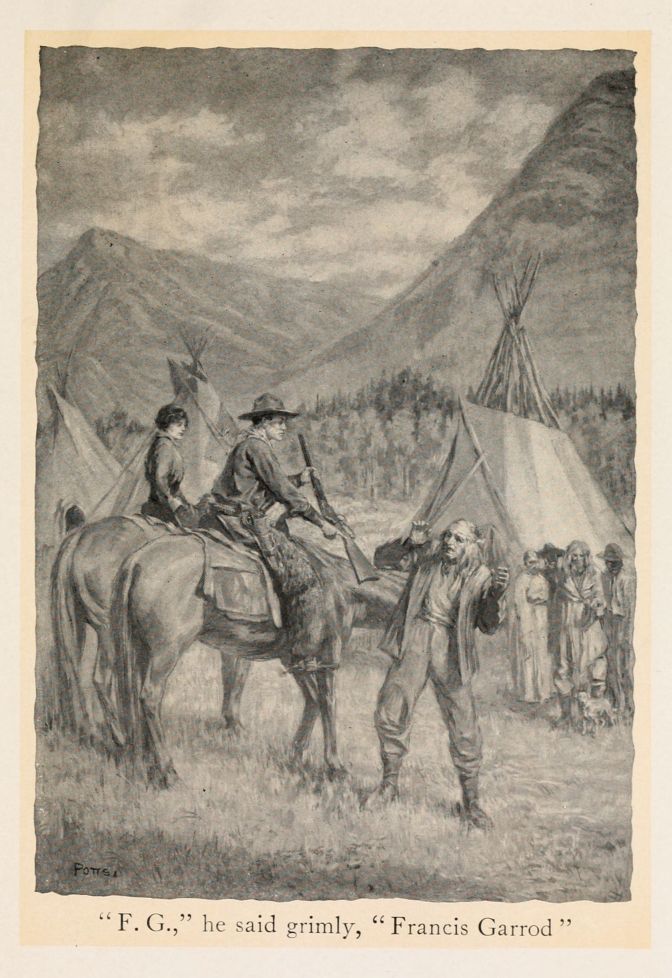
"F. G.," he said grimly, "Francis Garrod"
"How do I know?" said Etzeeah excitedly. "I have
no letters. If it is the white man's gun, Ascota left it."
"Ascota does not leave a gun," said Jack. "Where
is Garrod?"
"I don't know," muttered Etzeeah. "I have not
seen him."
"You are lying," Jack said coldly. "For the last
time I ask you, where is Garrod?"
Etzeeah fell back on a sullen, walled silence.
Jack turned to Mary. "Is there a woman or a child
that he sets great store by?" he asked swiftly in
English.
"Etzoogah, his son, the pretty boy yonder," she
answered.
Following her glance, Jack had no difficulty in
picking out the one she meant. He was a handsome,
slender boy, a year or so younger than Davy. Where
the other children were in rags, he was wearing an
expensive wide-brimmed hat from the store, a clean
blue gingham shirt, new trousers, and around his
waist a gay red sash. Moreover, he had the wilful,
petulant look of the spoiled child; plainly the apple
of the old man's eye.
"Get me a horse and a rope bridle," Jack whispered
to Mary.
There were several horses picketed within the
square, handy to their owners' uses, and Mary made
for the nearest.
"You take my horse?" Etzeeah demanded, scowling.
"It is for your son to ride," Jack said with a grim
smile. "Etzoogah, come here!" he commanded.
The boy approached with an awed, scared air.
Etzeeah started to his side, but Jack coolly separated
them by moving his horse between. Mary returned
with the other horse, and the boy fell into her hands.
She smiled at him reassuringly.
"Get on," she said. "Nobody's going to hurt you.
Come with us to our camp. Davy is there."
All the children knew Mary and Davy. Moreover,
there were always good things to eat in a white
man's camp. The boy was well pleased to obey.
Etzeeah shrilly commanded him to dismount, but
the apple of his eye merely laughed at him. The old
man began to break. His eyes dulled with anxiety;
his hands trembled.
"What you do with my boy?" he demanded. "We
shoot if you take him."
Jack laughed. "A red man can't shoot a white
man," he said. "His hand shakes too much. We
will take the boy to our camp. We will keep him until
you bring the sick white man to us. If you don't
bring him back, well, maybe we will send the boy
outside and make a white man of him."
Jack gave him a moment. There was no sign from
Etzeeah, except his trembling.
"Ride on," Jack said to Mary.
They wheeled their horses, and Etzeeah broke down.
His hand went to his throat. "Stop!" he muttered
thickly. He did not cry out or protest. He merely
shrugged. "So be it," he said stoically. "I will
find Garrod if I can. Ascota took him away from
camp two days ago, and came back without him."
"Killed him?" cried Jack.
Etzeeah shook his head. "He was mad. Madmen
are not harmed. He took him into the bush and left
him."
"Left him to starve?" cried Jack. "Good God!"
"He was mad," repeated Etzeeah. "The beasts
and the birds will bring him food."
Jack shrugged impatiently. "Very well," he said.
"I'll have no more lies. You come back and show
me the place now, or I take the boy."
"I come," he said. "Etzoogah, get down. Get
my blanket!"
The boy obeyed, none too willingly, and Etzeeah
mounted in his place. "You feed me?" he asked.
"There is plenty," said Jack. To Mary he said in
English. "Make him ride ahead of you out of camp.
I'll stay and hold the crowd. Sing out when you reach
the trees, and I'll come."
In spite of herself, fear for him transfixed her eyes.
"Jack," she murmured.
He frowned. "No weakness. You must do as I say."
Etzeeah got his blanket, and he and Alary rode out
of the square. The Indians stirred and muttered
angrily, but the blue eyes still held them chained.
When Mary's "All right!" reached his ears, Jack turned
his horse, and, swinging himself sidewise with a
thigh over the saddle, walked out of the square,
watching them still. The theatrical instinct of a
young man suggested rolling a cigarette to him.
Slipping his arm through the bridle rein, he got out
the bag of tobacco and the papers.
At a hundred yards distance the spell that held
the Indians began to break, and they moved forward
between the tepees, cursing Jack, and brandishing
their arms. Jack's horse started forward; pulling
him in, he moistened the cigarette, watching them
still. Guns were raised at last—and fired. Still
Jack walked his horse. He could see that as yet the
gun-play was merely to save themselves in the eyes of
their women. No bullets came in his direction. But
he could not tell how long—— He lit his cigarette.
A bullet whined overhead. Another ploughed up
a little cascade of earth alongside, and his horse sheered
off. A chorus of maniacal yells was raised behind him.
It was only fifteen yards to the trees. Jack threw away
the cigarette, and gave the horse his head. They gained
the forest, with the bullets thudding deep into the
trunks on either side.
When Etzeeah caught sight of the little tents
through the trees, he pulled up his horse.
Extending a trembling forefinger, he asked
hoarsely:
"Ascota, is he there?"
"Yes," said Jack. "He can't hurt you. He's tied up."
Etzeeah slipped from his horse. "I wait here," he
said. "I not go where he is."
"Are you afraid?" asked Jack with curling lip.
Etzeeah had turned pale; his eyes darted from side
to side, and he moistened his lips. "I am afraid,"
he muttered doggedly. "He is more than a man.
He has made the beasts speak to me; the porcupine,
the bear, the beaver, each after his own nature. He
has made men mad before my eyes, and brought their
senses back when it pleased him. He mastered the
white man, and made him kneel before him, and bring
him his food. This I saw. The like was never known
before. Who would not be afraid? What if he is
tied? He will wither me with his eyes!"
Jack and Mary looked at each other in perplexity.
"Blindfold Jean Paul," Mary suggested.
"Good," said Jack with clearing brow. "Watch
him," he added in English, "and come over when I
wave my hand."
Jack led his horse across the brook. Here another
evidence of Jean Paul Ascota's evil power awaited him.
Davy at sight of Jack sprang up with an odd, low cry,
and came running to meet him, running waveringly
as if his knees were sinking under him. He cast
himself on Jack, trembling like aspen leaves.
"Oh, Jack!" he gasped. "I'm glad—oh, Jack!
Jean Paul—"
"He's safe?" demanded Jack.
"He's safe. Oh, Jack!—he said—he's a devil,
Jack. He made me want to let him go! He said—oh! it's
horrible! He said—oh! I can't tell you!
Jack!——"
The boy's agonized voice trailed off; he sighed, and,
his slender frame relaxing, hung limply over Jack's
arm. Jack let his horse go, and waving to Mary to
keep back, he bent, and dashed the cold brook water
in Davy's face.
He revived in a moment or two, and clung to Jack.
"Oh, Jack!" he murmured, "I thought you'd never
come! I was near crazy. He said—oh! I can't
tell you!"
"Never you mind, old boy," said Jack gruffly.
"Forget it! Mary and I are both here. It's all right
now."
He carried him up the bank, and put him down by the
fire. A sip from Jack's flask further restored him.
Then Jack turned with grim eyes and clenched fists
toward Jean Paul's tent.
"You devil!" he muttered. It was the word they
all used.
"I want to smoke," Jean Paul said impudently.
"Lie there and want it, damn you!" said Jack.
He had much ado to restrain himself from kicking the
beast. As it was he flung him over none too tenderly,
and taking the handkerchief from the breed's neck,
tied it tight round his eyes.
"There's somet'ing you don't want me to see,
huh?" sneered Jean Paul.
Jack was a little staggered by his perspicacity.
He waved his hand to Mary. She brought Etzeeah
across, and flew to comfort and restore Davy. They
never did learn exactly what Jean Paul had said to him.
At any mention of the subject the boy's agitation
became painful to see.
Etzeeah after coming into camp never once opened
his mouth. He regarded Jean Paul's tent as nervously
as if its flimsy walls confined a man-eating grizzly.
He sat down at some distance, and at the side of the
tent where Jean Paul could not have seen him even
had his eyes not been blindfolded.
Jack brought wood, and Mary started to prepare
a meal for them all, before taking to the trail again.
At a moment when there was comparative silence a
loud voice suddenly issued from the tent, speaking
the Sapi tongue.
"Etzeeah is there!"
They all started violently. It was uncanny.
Etzeeah paled, and sprang up. Jack laid a heavy hand
on his shoulder.
"I smell him!" the voice of Jean Paul went on,
full of mocking triumph. "Nothing can be hidden
from me! Etzeeah has betrayed me! Bound and
helpless though I am, don't think you can escape me,
old Etzeeah! My medicine travels far! Your son,
your fine boy Etzoogah, shall pay. He's paying now!
He falls and twists on the ground with the frothing
sickness—the fine boy! He curses his father!"
Jack was struggling with the frantic father. "For
God's sake, stop his mouth!" he cried to Mary. "A gag!"
She flew to the tent, and presently the voice was
stilled. The last sound it uttered was a laugh, a
studied, slow, devilish laugh, frightful to untutored
ears. We are accustomed to such tricks on our
stage.
Etzeeah lay moaning and wailing, clawing up handfuls
of earth to put on his matted gray head. Jack arose
from him white and grim, and with a new light in
his eyes.
"We've had about enough of this," he muttered
between his teeth.
Mary, divining what was in his mind, flew to him.
"Jack! Not that! Not that!" she gasped, breathless
with horror.
"I'm not going to do it here," Jack said harshly.
"I'll take him away. What else can I do? Look at
Davy! Look at the Indian! This breed is like a
pestilence among us! He'll have us all stark mad
if I don't—"
"No! No!" she implored, clinging to him. "You
and I are strong enough to stand it, Jack. We'll
come through all right. But we never could forget"—her
voice sunk low—"not his blood, Jack!"
His purpose failed him. He caught up her hand
and pressed it hard to his cheek with an abrupt, odd
motion. Dropping it, he turned away. "All right,"
he said shortly. His eyes fell on Etzeeah. "Get
up!" he cried scornfully. "This is old woman's
talk! If he can send sickness through the air, why
doesn't he strike me down, who bound him, and
blinded, and gagged him?"
Etzeeah, struck by the reasonableness of this, ceased
his frantic lamentations.
In an hour they were ready for the trail again.
Jack sent Mary and Davy on ahead with Etzeeah and
the pack-horses. It was arranged that as soon as
they reached the site of the former Indian camp,
where Etzeeah said Jean Paul had turned Garrod
adrift, they were to drop the baggage and go in search
of the missing man.
As soon as the others had ridden out of sight, Jack
removed the blind and the gag from Jean Paul and
cut the cord that bound his ankles and his wrists
together. He freed his wrists; his ankles he left
bound. The half-breed stretched out, and rolled on
the ground in an ecstacy of relief. Finally he sat up,
and Jack put the food that had been left for him
where he could reach it. Jack stood back, watching
him grimly, a hand on the butt of his revolver.
"Are you goin' to shoot me?" Jean Paul demanded
coolly.
"I wouldn't waste good food on you if I were,"
returned Jack. "Hurry up and put it away."
"You not got the nerve to shoot me," sneered Jean
Paul.
"Try to hypnotize me and you'll see," Jack said with
a hard smile. "I'd be glad of an excuse."
"Why don' you shoot me now?" Jean Paul persisted,
with a look like a vain and wilful child, experimenting
to see how far he can go against a stronger
force.
"I'd rather see you hang," said Jack.
"The police can't touch me. I do not'ing against
the law, me."
"There's a thing called treason in this country,"
said Jack. "You can hang for that."
Jean Paul laughed. "Fort Cheever long way,"
he said. "You not bring me there, never."
"Then I'll bury you on the way," said Jack with his
grim start of laughter.
When Jean Paul had eaten, Jack bound his hands
in front of him this time, and liberated his feet.
"Get on," he said, pointing to the horse.
"You can't make me," Jean Paul said with his
sidelong look.
"Shan't try," said Jack coolly. "You can run
along at my horse's tail if you'd rather."
Jean Paul scowled at the suggested indignity, and
climbed on without more ado. Jack tied his hands to
the saddle horn.
It was seventeen miles down the forested valley
back to the site of the former Indian camp. This,
the ancient route between Forts Cheever and Erskine,
was a good trail, and they covered the distance without
stopping. Jean Paul rode ahead, Jack following
with his revolver loose in its holster. It may be
said that he almost hoped the breed would try to
escape, to give him a chance to use it, but perhaps Jean
Paul guessed what was in his mind. At any rate he
rode quietly.
Issuing out of the forest at last, the Spirit River
valley was spread before them, with the big stream
winding among its wide, naked bars. The abandoned
camp lay below them, a village of bare tepee poles
in a rich meadow surrounded by an open park of
white-stemmed poplars. As they approached it a
fresh anxiety struck at Jack's breast, for he saw
the three pack-horses picketed to the trees with their
packs on their backs. He knew that only an emergency
would have taken Mary and Davy away without
unloading them. The animals had been rolling, to
the no small detriment of their baggage. Jean Paul
laughed at the sight.
Jack had no recourse but to possess his soul in
patience until they came back. Meanwhile he unpacked
the horses, and pitched their four little tents,
two on each side of the fire. He bound Jean Paul
securely as before, and put him in his own tent. He
hung the gag from the ridge-pole with significant action.
Jean Paul's lips were already bruised and blue as a
result of the previous application.
Not until late afternoon was Jack's anxious breast
relieved by the sight of the three horses single-footing
it across the meadow. Davy rode first, then Etzeeah,
looking crestfallen and sullen, and Mary bringing up
the rear, her rifle across her arm, and determination
making her girl's face grim. Evidently there had
been trouble; but the three of them, and uninjured!
Jack could have shouted with relief.
"He ran away," Mary explained briefly. "Davy
and I had hobbled two of the riding horses, when he
suddenly jumped on the third and headed north.
He got a couple of minutes' start before we could get
the hobbles off and after him. When he got in the
timber, he turned the horse adrift, and we lost more
time following its tracks. But I guessed he would
make back to the trail as soon as you had passed, so
we patrolled it, and we nabbed him at last."
"Good work!" said Jack briefly. It did not occur
to him that there was something rather extraordinary
in a mere girl and boy bringing in the headman of the
Sapi Indians by themselves. He expected it of their
white blood.
There seemed to be nothing for it now but to bind
Etzeeah hand and foot also, and to convert Jack's
tent into a cell for him. The two prisoners lay in
their separate shelters on one side of the fire, while
their captors watched them from the other. Jack
was to sleep with Davy, and except for Mary's rifle, all
the weapons in camp were stowed in that tent. The
long-threatened rain set in steady and cold, and the
night threatened to be as dark as winter.
They ate their supper inside Davy's tent, while the
fire sputtered and sulked in the rain. A heavy silence
prevailed; for one thing, they were dead weary, and
their difficulties were pressing thick upon them. The
rain did not lighten them. Jack, looking at Mary and
Davy, thought with softening eyes:
"They're clear grit! But if I only had another man!"
The instant they had finished eating he ordered
the two youngsters to bed. "I'll feed the two of
them," he said, nodding across the fire, "and clean
up. It will help keep me awake."
"You need sleep more than either of us," Mary
objected.
"If I once let myself go I'd never wake," he said
with a laugh. "I'll call you at midnight." It was
tacitly understood between them that Davy was not
to keep watch.
His work done, Jack sat down inside the door of
Davy's tent to smoke, and if he could, to keep the fire
going in spite of the rain. He found that it required
too great a blaze to be proof against the downpour.
He had not nearly enough wood to last throughout
the night, so he let it out in order that Mary might
enjoy what remained of the fuel. When the fire went out
he could no longer see into Jean Paul's tent, so he crossed
over and sat down beside him. Throughout the weary
hours he sat smoking to keep himself awake, until
his mouth was raw. From the adjoining tent issued
the reassuring sound of Etzeeah's snores; Jean Paul,
too, never stirred, and his breathing was deep and slow.
Midnight had passed before Jack had the heart to
waken Mary. He first took advantage of a lull in
the rain to start the fire again. As he threw back
the curtain of her little tent, the firelight shone in her
face, rosy and serene in sleep, her cheek pillowed on
her round arm. The sight stirred him to the very
core of his being. He knelt, gazing at her breathlessly.
He forgot everything, except that she was lovely.
He suddenly bent over her with a guilty air, and lightly
kissed her lips.
She opened her eyes. He sprang away in a panic
at the thought of her scorn. But she awoke with an
enchanting smile. "Jack I dreamed——" she began,
as if it were the sweetest and the most natural thing
in the world for her to find him bending over her at
night—and caught herself up with a burning blush.
Jack hastily retreated outside. Neither of them
referred to it again.
Jack was asleep as soon as he stretched himself
beside Davy. The next thing he knew, something
had happened, what it was he could not tell. He
staggered to his feet, and out into the open, drunken,
paralyzed with sleep, and fighting for consciousness.
"Jack, he's gone!" cried Mary.
That awakened him. He saw her on her knees before
Jean Paul's tent, and ran to her. The tent was empty.
The rain poured down on their heads unheeded.
The fire was out.
Mary was in great distress. "My fault," she said.
"It rained harder than ever, and the fire went out.
I could not bear to sit beside him as you did. It made
me sick to be so near him! I thought I could watch
from my tent. The wind came up and it was hard
to see. He fixed the blanket to look as if he was still
under it. He must have slipped out of the back!"
"But tied hand and foot!" cried Jack.
"The cords are here," she said, displaying them.
"But how?" demanded Jack.
Mary's searching hand found two small stones
in the blanket that she showed Jack; one had a sharp,
jagged edge, and the explanation was clear. Throughout
the hours when Jack sat beside him, and he seemed
to be so sound asleep, the wily breed had been patiently
rubbing at the cords until they frayed apart.
"No more your fault than mine," said Jack grimly.
Simultaneously the thought of Etzeeah occurred
to them, and they sprang to look under the adjoining
shelter. At first glance in the darkness, the Indian
seemed to be safely there, but when Jack put out his
hand the puffed-up blanket collapsed, and there was
nothing under it. At that, for the first, their strong
young breasts were shaken by awe.
"Good God!" Jack gasped. "He's got him, too!
How could he? With you not twenty feet away. And
not a sound. Is it a man or a devil?"
The pegs that held down the back of Jack's lean-to
were drawn, showing how Jean Paul had entered, and
how he had removed his prey.
"Etzeeah—" said Mary tremblingly, "do you
suppose Jean Paul has—
"He would hardly take him alive," said Jack grimly,
"without a sound."
"But he had no weapon, we know that."
"His hands!"
They were silent.
"But if he did," faltered Mary, "why would he
take—take the body away?"
Jack shook his head. "They are always mysterious,"
he said.
"He may be near," whispered Mary. "What's to
be done?"
"He's not dangerous to us until he gets a weapon,"
said Jack. "Wake Davy, and you two watch our
guns. I'll bring in the horses."
It was near four, and beginning to be light. The rain
ceased, and a thick white mist clung to the
river-meadows. It was not easy to find the horses. Jack
satisfied himself that two of them were missing. Why
two? he thought. He did not find the body of Etzeeah,
as he half expected.
He had to wait for better light before he could look for
tracks. He found them at last, leading back up the
Darwin valley, the fresh hoof-prints of two horses
superimposed on the confusion of tracks they had made
coming and going. The horses had been ridden at a
gallop. Jack returned to tell Mary.
"He's gone all right," he said. "And alive or dead,
he's taken Etzeeah with him. The second horse carried
a load too. He's gone back to the Sapis for grub and
a gun."
Mary searched Jack's face with a poignant anxiety to
see what he intended to do. "Let him go," she
suggested. "We know that Garrod is near here
somewhere."
Jack stood considering with bent brows and clenched
hands. He finally shook his head. "He could come
back to-night, and pick us off one by one around our
fire. We'll have no peace or security until I get him,
Mary. I'll have to leave Garrod to you and Davy.
You know how much finding him means to me!"
"But you," she faltered, her eyes wide with terror
for him, "you can't go back alone to the Sapis. They
shot at you!"
Jack's uncertainty was gone. He raised a face,
transfigured.
"Pshaw! That mongrel crew!" he cried. "They're
the least of my difficulties. I'll drop on them before
Jean Paul can work them up to mischief. I've got
to get that breed! No murder can be done in my camp,
and the murderer get away! No redskin shall ever
live to brag of how he bested me! I'll get him if
I have to ride to hell and drag him out!"
Two hours later Jack rode into the Sapi village
for the second time, and flung himself off
his tired and dripping mount. The horse stood
with hanging head, and feet planted wide apart,
fighting for breath. This time Jack's arrival created
little visible sensation. The people were otherwise
and terribly preoccupied. A strange silence prevailed,
extending even to the children and the dogs. Many
of the people were gathered around the entrance
to Etzeeah's lodge. They merely turned their heads
with a scowl, and the men drew on the walled look
they affect in the presence of whites. In the faces of
the women and children awe and terror were painted.
"Ascota, where is he?" Jack demanded.
Hands were silently pointed up the valley.
"How long?"
"Half an hour," one said.
Outside the square Jack saw two more dead weary
horses still wet from their punishing ride.
"Where is Etzeeah?" he asked.
There was no answer. All the heads turned as one
toward the tepee.
Jack threw back the blind that hangs over the
entrance, and, stooping, entered. He was prepared for
what he saw. The body of the old man sprawled on
its back beside the fire. All around the tepee squatted
his wives and his sons in attitudes of sullen mourning.
Etzoogah, the best-beloved, eyed the body askance
with scared eyes, and chewed the tassel of his red
sash. Etzeeah was not a comely sight. Death was
in his face, but none of the majesty of death. His
grimy, wrinkled skin was livid and blackened. The
marks on his scrawny throat showed how he had
met his end.
Stooping, Jack picked up his hand, and let it fall.
It was significantly cold and stiff. He decently
composed the dead man's limbs, and signed to one of the
women to cover the body with her shawl.
Rising, he looked grimly around the circle. "This
is murder!" he said.
None showed in any way that they heard.
"Who will ride with me to catch the murderer?"
he demanded.
None moved. The faces of the women showed a
start of terror.
Jack went outside again, and looked over the silent
crowd. Seeing Charlbogin, one of the deserters, among
them, he went to him.
"Did Ascota speak?" he demanded.
The sulky boy could not resist the command.
"Ascota throw Etzeeah on the ground, so!" he said
with a striking gesture. "He say: 'This is a man
who betrayed me! Bury him!'"
A shudder passed through the crowd. Children
wailed and whimpered.
"Then what?" asked Jack.
"He take a gun and a blanket, and moose meat from
the fire; he catch a horse and ride west."
"And you let him go!" exclaimed Jack.
"Ascota is not a man like us," the young man
muttered. "He does what he likes."
"More woman's talk!" cried Jack. "Are there any
men among you? Come with me, and I'll show you
stronger magic than Ascota's."
Some of the men affected to smile contemptuously
as at an idle boaster. None moved to follow him.
The obstinacy of their terror faced Jack like a wall, and
he saw the futility of trying to move it.
He cursed them roundly. "I'll go alone then," he
cried. "Bring me the best horse there is. I'll pay."
They shrugged as much as to say: "Let him, as
long as he pays." One went to get the horse. In five
minutes Jack was pounding the trail again.
Beyond the village the valley narrowed, and the
roar of the plunging stream rose from the bottom of
it. The bordering hills rapidly became steeper and
higher. The trail did not follow the course of the
river, but found an easier route along the face of the
hills a hundred feet or so above. The sides of the hills
had been burned over, here, and the forest was only a
wilderness of naked, charred sticks. Many of these
had fallen in the trail, making slow going for the horse.
Occasionally the little river paused for a while in its
headlong descent to wander back and forth through a
green meadow. The trail came down to cross these
easy places, and it was only here that Jack could extend
his horse.
The plain tracks of Jean Paul's horse led him on.
Jack could read that the breed was riding recklessly and
distancing him steadily mile by mile, but he would not
on that account risk his own horse's legs through the
down timber. "I'll get him," he said to himself coolly,
with the terrible singleness of purpose of which he was
capable. In such a mood he was no longer a man,
but an engine.
Jack had come across the mountains from Fort
Erskine by this trail, and he knew it well. It was
evidently for Fort Erskine, where he was not well known,
that Jean Paul was making. Ahead, through the
forest of bare sticks that hemmed him in, Jack could
see the gateway to the mountains, the magnificent
limestone pile of Mount Darwin on the right. He had
worked around the base of Darwin, and all this was
familiar ground.
It was about noon when Jack and his horse, rounding
a spur of the hill, were brought up all standing by
the sight of a dark body lying in the trail ahead.
Dismounting, and tying his trembling animal to a tree,
Jack went forward to investigate. It was a horse, Jean
Paul's horse, with a broken foreleg, and abandoned to
its fate. Jack's heart beat high with hope; the end of
this thing was in sight now. The poor brute raised
agonized eyes to him. Jack could not put a bullet
through its head without betraying his whereabouts, but
he mercifully cut its throat.
He proceeded warily. He was covered from above
by the very steepness of the hill and the impenetrable
barriers of the fallen timber. The prints of Jean Paul's
moccasins led him ahead. The trail dropped steeply
to a little stream that he knew well; it drained the
easterly slope of Mount Darwin. It marked the
edge of the burned-over tract, and on the other side the
trail plunged into virgin forest again.
Jack went forward as cautiously as an Indian, taking
advantage of every scrap of cover. At the brook he
lost Jean Paul's tracks. It was clear the breed had
waded either up or down. Jack was pretty sure he
would not be far away, for the redskin of Jean Paul's
type has no love for long journeys afoot. But it
promised to be a somewhat extended stalk and his horse was
no use to him. He therefore went back, cached his
saddle, and turned the beast out hobbled, trusting that
it would find its way back to the last river-meadow
they had passed. Blanket and grub Jack strapped on
his back, and his gun he carried under his arm.
He spent an hour searching up and down the shores
of the creek for tracks, without success. Neither
was there any evidence of Jean Paul's having returned
to the trail farther along. If Jack was well skilled in
reading tracks, the breed was adept in hiding them.
Jack's only recourse was to climb. There is a little
eminence abutting on the base of Mount Darwin and
on the top of it a knoll of naked rock that overlooks the
valley for miles up and down. Knowing the natives'
deep-rooted aversion to drinking cold water, Jack
guessed that Jean Paul would have to build a fire, and
from this point of vantage a fire, however small, would
almost surely betray his whereabouts.
Taking his bearings, he made a beeline up the steep
slope through the heavy, old timber that reached up
from the valley, and through a dense light growth of
poplar above. This part of the mountain offered no
special difficulties in climbing, and in half an hour he
threw himself down on the flat top of the knoll, with
the valley spread before him.
Mount Darwin reaches a long promontory down the
valley it has given its name to. The promontory consists
of seven little peaks in a row, each one rising over
the head of the one in front, and the seventh is the
actual summit of the mountain. It was on number one
of these little summits that Jack now lay, looking down
the valley up which he had ridden that morning. A
mile or so away was a patch of green with a black dot
upon it, that he guessed was his horse.
Off to his left, hidden in the forest, the creek came
tumbling down from the snows above; on his right hand
the river washed the rocky base of the monarch. The
easiest way to the summit is right on up over the
succeeding peaks; indeed on this side there is a mountain
goat trail direct to the top. Darwin can also be climbed,
but not so easily, by ascending the creek for a couple
of miles, thence up a steep slide to a long hogback
that leads back to the sixth peak. On the river side
the rocky cliffs tower six thousand feet into the air,
sheer and unscalable. Such was the theatre of the
pursuit of Jean Paul Ascota.
In all the wide space opened to Jack's eye there was
not a sign of life, except the black pin-point that he
supposed was his horse, and a pair of eagles, sailing
and screaming high above the forest. Nowhere in
the brilliantly clear air was there the least sign of
smoke. He ate some of his bread and meat while he
watched, and smoked his pipe. He marked a place
around to the right below where the trail passed over a
rocky spur. On the other side it was open to him
through the down timber; so that Jean Paul could not
pass either way on the trail without his seeing him.
It was hard on the engine of retribution to be
obliged to sit and wait. When his pipe went out he
moved restlessly up and down his little plateau or
shelf of rock. Behind him, the forest grew close and
high, hiding the rest of the mountain. He never knew
quite how it happened, but at one end of the rock, near
the place where he had come up, he suddenly found
himself staring at the perfect print of a moccasined foot
in a patch of moss! His breast swelled with
satisfaction at the sight; at the same time he frowned with
chagrin to think of the valuable time he had wasted
sitting within twenty feet of Jean Paul's trail.
Jean Paul's path up through the thickly springing
poplar saplings was not more than two yards from
Jack's own. Such are the caprices of the Goddess of
Chance! He had crossed the rock, and continued on
up the mountain by the mountain goat trail, which
first became visible here. Evidently believing that
he had shaken off pursuit, and that no one would dream
of looking for him on the mountain, he was no longer
taking any care to cover his tracks.
Jack hastened after, as keen and determined as a
high-bred hound whom nothing short of a cataclysm
could divert from his purpose. The rough track
followed the top of a stony ridge, which dropped steeply
to the river on one side, and sloped more gradually into
a forested hollow on the other. A thick growth of
pines afforded him perfect cover. Like all animal paths,
the trail wound like a tangled string among the trees.
The growth ended abruptly on the edge of a shallow
rocky cut athwart the ridge. On the other side of the
cut rose the steep face of the second little peak in the
series.
Jack paused within the shelter of the trees to reconnoitre.
The great slope of rock opposite, with its wide,
bare ditch, made a well-nigh perfect natural
fortification. He watched the top of it lynx-eyed, and
presently he was rewarded by the sight of a wisp of
smoke floating over the edge. Jack drew a long breath
and grimly smiled. So that was where he was!
He had chosen admirably. The growing timber
ended at the spot where Jack was, but up above there
was enough down timber to keep the breed in fire until
the judgment day, if he wished to stay, and his fire
would be invisible from any point in the valley. For
water, all the ledges and hollows on the northerly side
were heaped with snow; for food there were mountain
goats and ptarmigan; for defence he had only to roll a
stone down on the head of any one who tried to climb
to his aerie.
While Jack watched, carefully concealed, Jean Paul
suddenly showed himself boldly on the edge of the
cliff. The distance was about three hundred yards, a
possible shot, but at a difficult angle. Jack held
his hand. It was all important not to put the
half-breed on his guard just yet. Jean Paul carelessly
surveyed the approaches to his position, and went
back out of sight.
Any attack from in front was out of the question.
Only one thing suggested itself to Jack: to climb the
mountain by the other possible route, and come down
on Jean Paul from above. As soon as it occurred to him
he started to retrace his steps, without giving a thought
to the enormous physical exertion involved. This way
was beset with difficulties; the bed of the creek was
heaped with the tangled trunks brought down by the
freshets. But Jack set his teeth doggedly, and
attacking these obstacles, put them behind him one after
another.
The sun was three hours lower before he stood at
the edge of the timber line on the other great spur of the
mountain. He hesitated here. Above him extended
a smooth, steep slide of earth and stones at least two
thousand feet across, and without so much as a bush or
a boulder for cover. At the top of this slide was the
hogback that led back to the sixth peak. If Jean Paul
was watchful he could scarcely fail to see Jack mounting
the naked slope. True, nearly half a mile separated
them, but a moving black spot, however small, would
arrest his attention if he saw it. He would not mistake
it for an animal, for the only animal on the upper slopes
is the snowy mountain goat.
However, Jack had to chance it. His principal fear
was that Jean Paul, seeing him, might climb down from
his rock and gain a long start of him to the valley.
But he reassured himself with the thought that the
Indian could not guess but that there were others
waiting below. It would require a stout heart to climb
down that rock in the face of possible fire from the
trees.
Jack started his climb. Occasionally he could see
Jean Paul moving around on his distant rock. Sometimes
he thought the black spot seemed to stand and
watch him, but this was his fancy. However, when he
was halfway up, he saw him without doubt begin to
climb the face of the third peak, and Jack knew that he
had been discovered. Jean Paul was going up instead
of down. "I'll get him now," Jack told himself.
Thus began a strange and desperate race for the
summit of the mountain. Until near the end it was
anybody's race; Jean Paul was the nearer, but he had the
steeper way to go; he was also the fresher of the
two, but Jack was insensible of fatigue. The Indian
kept himself out of sight for the most part, but occasionally
the configuration of the rocks obliged him to show
himself, and Jack marked his progress keenly. Meanwhile
his own climb was nearly breaking his heart. He
found that it was only a heart after all, and not a
steam-chest. One cannot run up a mountain with impunity.
Jean Paul mounted the fourth peak about the same
time that Jack reached the hogback, and threw himself
down to ease his tortured breast for a moment. Jack
had now to turn at right angles, and every step brought
them nearer to each other. Jack had cover behind
the summit of the ridge all the way to the foot of the
last climb. It was impossible for either to guess the
outcome. Jean Paul was still the nearer, but Jack was
making better time. He ran along the slope on a level
line and gained a hundred yards.
When he looked over the top again he was encouraged
to see that Jean Paul was labouring hard. He had
often to throw himself down in full sight to give his
heart a chance. Meanwhile they were coming very
close. They were already within gunshot when the
peak they were both striving for intervened between
them. The breed was aiming for one side, Jack for
the other. Jack wondered, should their heads rise
over the top simultaneously, which would have the
strength to lift his gun.
Toward the base of the peak of rock the ridge became
steep and broken. Excruciating pains attacked Jack's
legs, and his sinews failed him. He dropped to his
hands and knees, and crawled on. He had almost
reached the little peak, when suddenly a dark face
looked down on him from over the top, and he had
just time to drop behind a jutting shoulder of rock
to escape the bullet that whistled overhead. The
race had gone to Jean Paul.
Jack lay debating his next move. Meanwhile it was
grateful to rest, and to feel the strength steal back.
His case was not yet hopeless, he decided. The
rounded cone of rock that Jean Paul held was easily
accessible from any point of the arc visible to Jack, and
from the speed with which the breed had gained
the summit, he guessed that it must be even easier
from the other side. With darkness to aid him he
ought to be able to surprise his enemy. The sun was
setting now. At close quarters Jack's revolver would
give him an advantage.
But this same train of reasoning must have passed
through the breed's mind, for later, upon peeping
around his rock, Jack saw that Jean Paul had retreated
from his peak, and was running off to the right across
the flat battlement that connected it with the slightly
higher cone that was the true summit of Mount Darwin.
He had started to scramble up the face of the rock.
Springing up, Jack fired at him, but it was too far,
and there was cover behind the jutting ledges. Jean
Paul gained the top in safety.
Jack promptly seized the position he had abandoned.
Rising cautiously over the side farthest from Jean Paul,
he built himself, stone upon stone, a little parapet
upon the summit, behind which he could lie and watch
his enemy through the interstices. Presently he saw
that Jean Paul was following suit, covering himself
behind his wall while he raised it. A shot or two
was exchanged, but without effect, and as if by mutual
consent they left off. Their lead was too precious to
be splashed on the rocks.
So they watched, each holding alone, as it were, a
heaven-piercing tower of the same castle, with the
battlement between. It was a dizzy perch. The
whole world was spread beneath them, a world of
confused gray, and brown mountain peaks like vast
stalagmites pointing fingers toward heaven. It was like a
nightmare sea suddenly petrified with its waves
upheaved. In the whole vast wilderness there was no
suggestion of mankind or of life. Up there the thin,
cold air sharpened the senses; one seemed to become
aware of the great roll of our planet to the east, and
instinctively clung to the rock to keep from being
flung off into space.
About two hundred yards separated the white man
and the breed. Jean Paul's position was some fifty
feet higher than Jack's, and Jack had therefore to
build the higher parapet. Nevertheless Jack's heart
beat strong; he had him trapped now. At the same
time it was a well-defended trap, and there he might sit
watching him until starvation took a hand in the fight.
Jack had only full rations for one day more; he
suspected Jean Paul might be better provided. A red man
starves slower than a white. Each could reach plenty
of snow to quench his thirst, but there was nothing to
burn up there. Jack looked through his peepholes,
and considered how he might bring matters to an issue.
On his right in the corner between the hogback and
the final peak there was a bowl a thousand feet deep or
more, with a little lake in the bottom of a colour between
sapphire and emerald. The sides of the bowl were steep
slopes of rubble. Jack could not see all this from where
he lay, but he had marked it on the way up. After
dark he thought it might be possible to crawl around
the rim of the bowl to the base of Jean Paul's tower of
rock, and scale it from that side. This he could see,
and he scanned it hard. It was a staggering climb—say,
two hundred feet of precipitous limestone. But
it was scarred and ridged and cracked by centuries of
weather; and it was not absolutely perpendicular. It
might be done.
Having made up his mind, he coolly rolled up in his
blanket to sleep behind his parapet until dark. Small
chance of Jean Paul's venturing across the battlement.
When he awoke it was as dark as it would get.
He fortified himself with bread and meat washed down
by snow-water. He left his gun rolled in the
blanket—the revolver would serve better—and he propped
his hat an a stone so that the crown would peep above
his little wall. If it should become light before he
reached him, it might serve to occupy Jean Paul's
attention for a little. If he succeeded in knocking it off its
stone, so much the better.
The passage around the rim of the bowl offered no
special difficulty, except the danger of starting a
miniature avalanche down the slope, and putting the breed
on his guard. He took it a foot at a time. In an hour
he drew himself up the first steps of his rocky tower,
with the stars looking over his shoulder. Stars, too,
seemed to be glancing up at him out of the depths of
the black gulf. He would not let himself look down.
With the faculty he had, he closed his brain to any
thought of failing or of falling. "I'm going to get him!
I'm going to get him!" it beat out like a piston, to the
exclusion of everything else. Darkness aided him in
this, that it prevented the awful hazard from forcing
itself on him through his eyes.
His hands had to serve him for eyes, groping, feeling
for the ledges and cracks like the antennae of an insect.
He gave himself plenty of time; he did not wish to
arrive at the top until there was light enough to make
sure of his man. He had it figured out in his odd,
practical way: three hours, a hundred and eighty
minutes; a foot and a half a minute was ample. He
could afford to rest and to steady himself on every
wide enough ledge.
The face of the rock unrolled itself like a map under
the eyes of his hands, and he remembered each foothold
as he put it behind him. When he came, as he did
more than once, to a smooth, blind face of rock that
barred further progress, he patiently let himself down
again, and hit off at another angle. His aim was to
work himself gradually around to the back of Jean Paul's
tower of rock, and fall on him squarely from the rear.
He became aware of the approach of dawn through
a slight change of colour in the rock on which his eyes
were stubbornly fixed. He could not tell how far he
had yet to climb, but he had confidence in his calculations.
Only once was his nerve shaken. A ptarmigan
suddenly flew out from a cranny above his head with
a soft whirring of wings. He wavered for a second, and
the sweat sprung out all over his body. But he gripped
the rock hard, and grimly forced the rising tide of
hysteria down. "Twenty feet more and I'll have him!"
he told himself.
At last, above his head, the face of the rock receded
under his exploring hand, and he knew he had come to
the top. This was the difficult moment, for how was
he to know upon drawing himself over the edge that
he would not find himself looking into the grinning
face of his enemy. A little push back would be enough!
He paused for a while, listening. Suddenly his heart
was gladdened by the sound of a shot. Jean Paul had
fallen into his trap, and was popping at the hat. Jack
called on all the forces of his body, and with a great
effort drew himself silently over the rounded edge
of the rock.
Jean Paul was ten yards away, and a few feet above
him. His back was turned. He was exposing himself
boldly over the top of his parapet, wondering perhaps
why his shots had drawn no reply. Against the vast
expanse of sky the silhouette still had the neat and
ministerial outline; the Testament still peeped out of the
side pocket. Jack sprang over the rock. Jean Paul
turned, and Jack had an impression of blank eyes, fixed
as by a blinding flash at night. Jack's rush bore him
down before he could raise his arms; the gun exploded
in the air. Jack wrenched it out of the man's hands
and sent it spinning over the edge. They never heard
it fall.
Drawing his revolver, Jack got up from the breed.
Jean Paul lay motionless. Jack watched him warily.
It was dimly borne in on him that after all he had been
through his difficulties were only now beginning. He
had got his man and so kept his vow to himself; but,
richly as he deserved death, he couldn't shoot him
disarmed. What was he to do with him then?
"Get up," he said harshly, "and over the wall with you."
Jean Paul raised himself to a sitting position. He
had not yet fully recovered from the shock of surprise.
He stared at Jack with a kind of stupid wonder. "In
a minute," he muttered.
Jack was willing enough to take the breathing-space
himself. Both men were near the point of physical
exhaustion. After the excitement of the chase the
actual capture was tame.
"Well, 'ere we are," said Jean Paul with an odd
start of laughter. "W'at you goin' to do?"
"I've told you," said Jack. "I'll take you to the
fort or bury you on the way. I keep my word."
There was a silence between them. They were
motionless on their little platform of rock, remote in
the great spaces of the upper air. Jean Paul looked
straight ahead of him with his hard, flat black eyes,
in which there lurked something inhuman and inexplicable,
and he idly plucked bits of moss from between
the stones. What thoughts were passing through his
head only God who made the redskins knows. When
he turned his eyes again to Jack, it was with the old vain,
childish, sidelong look.
"You t'ink you one brave man, huh, to climb up
the rock las' night?"
"Never mind that," said Jack coolly. "You don't
know yet what white men can do."
Jean Paul sprang up with an extraordinary display
of passion. "White men!" he cried, flinging up his
arms. "You are not the only men! I am a man as
much as you! I am half white and I hate the whites!
My fathers were white as well as yours. They beget
us and they spit on us. Is it my fault that my blood
is mixed? Am I your brother? No, your dog that
you kick! Very well. I will do something no pure
white man ever did. You go back and tell them!"
On the side of the river, the rock they were on ran
up and ended in a row of jagged points like the jaw of a
steel trap, overhanging a well nigh bottomless void.
With his last words Jean Paul ran out on one of these
points of rock, and stood there, with arms flung up,
like a diver before he makes his cast.
Jack's heart contracted in his breast. "Come back!"
he gasped.
"Come and get me, white man!" cried Jean Paul
over his shoulder. Exaltation was in his face.
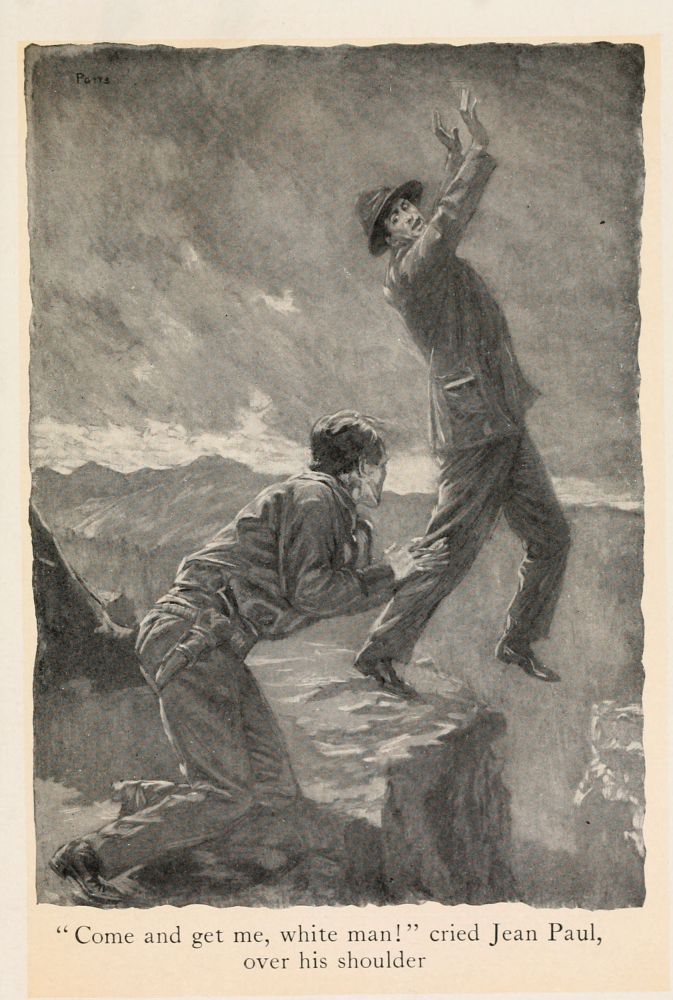
"Come and get me, white man!" cried Jean Paul, over his shoulder
Jack put up his revolver and, crouching, made to
seize the man's legs. Jean Paul, with a strange, loud
cry, stepped off, and was no more. No sound of any
fall came up. Jack had not the stomach to look over.
Four hours later he found the thing below. He had
no tools to dig a grave, and he heaped a cairn of stones
over it. On the face of a great boulder that overlooked
the cairn he scratched an epitaph with the point of
his knife:
JEAN PAUL ASCOTA
Killed by leaping from the summit
of Mount Darwin
August — 19—
A bad man and a brave one.
Then Jack lay down and slept around the clock.
Drawing near to the Sapi village on his return,
Jack first came upon a group of children picking
wild strawberries in the meadow, who fled
screaming in advance of him into the compound. There,
every task was dropped, and every dark face turned
toward him. Fairly startled out of their affectation
of stolidity, they streamed toward him from under
the sun shelters and from out of the tepees with cries
of astonishment. Jack was not deceived by the
apparent warmth of their welcome; they were not glad to
see him, only amazed that he should have come back
at all.
He pulled up his horse in the centre of the square,
and remembering the last time he had addressed them,
looked them over with a kind of grim scorn. Just
now he was unable to feel any of the kindness
for these feather-brained children of the woods
that Mary had. He knew the value of scant
speech with them, and he made them wait for his
announcement.
At last he said: "Ascota is dead!"
They stirred, and softly exclaimed, but one man
laughed. His example was infectious; incredulity
showed openly in their faces.
"Big talk!" one said insolently. "Where's the
proof?"
Jack quietly untied a little bundle from the back of
his saddle, and unrolling the flour bag in which he had
carried his grub, produced a little book and held it
up. It was Jean Paul's Testament, that they all knew.
There was a dark and swollen blotch on the leather
cover. The absolute silence with which it was received
was more impressive than their cries.
Jack handed it to the man who had spoken. It
opened in his hands. There was a crimson stain
around the edges of the printed page—wet crimson.
The man who held it started back, and those looking
over his shoulders gasped. The book was passed
among trembling hands. Finally it came back to Jack.
"I will tell you where his body is hidden," said Jack.
"A mile beyond the crossing of the creek out of Mount
Darwin there is a big spruce on the right-hand side of
the trail. On it I made a blaze with the sign of the
cross in it. One hundred and ten paces from that
tree as you walk toward the mountain he lies under
a pile of stones. There is a big rock above, with his
name and his story cut upon it."
It was very clear that none of them had any desire to
seek out the spot; indeed, from that time the Fort
Erskine trail was closed to the Sapis by reason of
Ascota's grave being upon it.
"Who is the head man now?" Jack demanded.
They turned toward Etzeeah's eldest son, a sullen
broad-shouldered brave, the best physical specimen
among them.
"Take warning," said Jack clearly, "you and your
people! Ascota was a bad man, a big mouth, a trouble-maker,
who tried to stir you to evil, while he kept
himself clear. He dared to speak against the great
white father across the sea. It was the chickadee piping
at the eagle. He is dead. We are all the children of
the white father; his children and his servants. His
police are now at the fort. You will do well to ride in
and make your peace, before they come to punish you.
That is all I have to say."
One silently brought him the horse he had left there,
and, leading it, he rode through the quadrangle and
away by the trail, without looking back. There was
no demonstration against him now. The awe that
Ascota had inspired in them was transferred to the man
who had brought about his death.
Three hours later, as Jack's horse sidled down the
hill into the Spirit River valley, his rider looked with a
beating heart for the four little tents he had left in the
meadow below. They were not there. A great
disappointment filled him, and a sharp anxiety. What he
had been through had made greater inroads on his
reserve forces than he knew, and in Mary's deep eyes
his weary spirit was unconsciously seeking harbourage.
However, as he rode up to the ashes of their fire he
saw that he had not been forgotten. In the forks of
two little sticks driven into the ground was laid a
peeled wand roughly shaped like an arrow, and pointing
northeast. On it had been printed with a piece of
charcoal: "7 miles."
Riding in the direction it pointed he found a freshly
blazed trail through the trees. It led him among the
poplars along the foot of the bench to the opening of a
coulee, up which it turned. It took him north through
a narrow valley wooded with great spruce trees.
Through openings in the trees on either hand he could
see the steep, naked, uncouth forms of the foothills
that hemmed the valley in. A trickle of water flowed
musically in the bottom of it.
It was difficult going for the horses over the fallen
and rotting trunks of the untrodden forest, with its
treacherous, moss-hidden pitfalls. The seven miles
seemed to stretch out into thrice that distance before
he came to the end of his journey. He smelled the
smoke of a campfire long before he could see it. Finally
the trail turned at right angles, and started to climb.
He issued out of the trees, and there on a terrace of
grass above him he saw the little tents and the fire;
he saw Mary turning toward him with harassed,
expectant face.
A little cry escaped her, and she came flying to meet
him. Jack slipped off his horse. A little way from him
she caught herself up, and her body stiffened. The
action brought to Jack's mind all that he had forgotten,
and he turned a dull red. It had been in his heart to
seize her in his arms. A horrible constraint descended
on them both. They did not touch hands; they could
not meet each other's eyes; speech was very difficult
and painful.
"You are all right?" she murmured. "Not hurt?"
"Not a scratch."
"And Jean Paul?"
"He is dead."
She started with horror, and in spite of herself glanced
at Jack's hands.
"He killed himself," Jack added quickly.
Her hands betrayed a movement of relief. There
was a silence.
"What about you?" mumbled Jack, scowling.
"What are you doing up here? Where is Davy?"
"I have something to show you," she said, with a
strange look.
He followed her up the slope. He wondered why
there were three tents pitched. The third was Jean
Paul's A-tent. Mary threw back one of the flaps, and
he saw a blanketed form inside.
"The kid!" he murmured, full of anxious concern.
But even as he said it, he saw that it was not Davy.
Stooping, and looking farther within, he saw a gaunt
travesty of the face of Frank Garrod. The eyes were
closed.
Something clutched at Jack's heart. He fell back.
"Good God!" he muttered. "You've got him! Is
he dead?"
She shook her head. "Sleeping," she said. "Come
away a little."
They sat on the other side of the fire. "Davy has
gone back to the cache," she said, taking care to
avoid Jack's eyes, "for milk powder, if there is any,
and whiskey, and any medicines he can find. He will
be back before dark."
"Has he said anything?" asked Jack, looking toward
the tent.
Mary shook her head. "Nothing you could understand.
He is very low. We will not get him back to
the fort. He was four days in the bush. He had only
berries."
"Then it's too late after all," said Jack apathetically.
"Who can tell?" said Mary. "They say often they
get their full senses back for a little while before they
die."
Jack shrugged. "Who would believe what he said
at such a time?"
Mary was silent. Her capacity for silence was greater
perhaps than Jack's.
"Tell me about finding him," Jack said.
"We started out as soon as you left," she said,
carefully schooling her voice. "It was clear Jean Paul
would take him among the hills to lose him, so we
struck up the coulee at once. Too many days had
passed for us to find their tracks, and it had rained. But
I was sure we would find him in the valley. The hills
were too steep; besides, even a madman stays by the
water. We looked all day without finding anything
until near dark. Then we came on some tracks in the
mud by the stream. We camped right there the first
night. There were many coyotes on the hills, both
sides, and I thought he must be near and they
were—waiting." She shuddered.
"In the morning we found him," she went on in a
low voice. "Just below here. He had fallen down
beside the water. His face was in the mud, but the
mosquitoes had not left him. So I knew he was not
dead. Davy and I carried him up here where it was
dry. I fed him a little bread soaked in water. Davy
went back for the other horses and the dunnage,
and to leave a sign for you. That was yesterday.
This morning Davy went to the cache."
"Oh, Mary! what a woman you are!" Jack murmured
out of the deeps of his heart.
She rose with an abrupt movement, and went to
look at the sick man. She came back presently with a
pale, composed face, and quietly set to work mixing
dough for their evening meal. There was a long and
sufficiently painful silence.
"It's a funny situation, isn't it?" said Jack at last,
with a bitter note of laughter.
"Better not talk about it," she murmured. "Let us
just wait and see."
Being forbidden to talk about it, the desire to do so
became overmastering. "Suppose he doesn't say
anything," he began.
"It won't make any difference to your friends," she
said. "They know you're not a thief."
"It's a queer business this having a good name and
not having one," Jack went on, plucking blades of
grass. "As if anybody cared who took the money."
Mary offered no comment.
"I'd lose my claims," Jack went on. "I couldn't
go out to file them. But the governor would never put
the police on to me, now. He'd be too jolly glad to get
rid of me."
Mary refused to raise her eyes from the dough.
Jack thought she hadn't understood what he was
driving at. "You see it would let me out there," he
went on. "This would be my country for ever and
ever, and the people up here my only friends."
There was another silence. He looked at her
hungrily. The hard young face was soft enough now.
"Mary," he murmured hoarsely at last; "I don't
give a damn if he never speaks."
The dough-pan was dropped at last. She lifted a
tortured face. "Don't," she murmured low and swiftly.
"Don't you see what it means? Don't you see
how you're hurting me? You mustn't wish it. Maybe
our thoughts are influencing his sick brain this minute.
He must speak! He must tell the truth and clear you.
Nothing else matters. You must be able to go wherever
you choose. You must be able to look any man in the
face. I couldn't bear anything else."
Jack scowled, very much hurt—and a little ashamed
perhaps. "I didn't think you were so anxious to send
me outside," he muttered.
She threw him the look of pity and despair that
women have for the men they love who will not
understand them, and, springing up, went to look at her
patient again.
By and by Davy arrived. His greeting to Jack
supplied the warmth that Mary's had lacked. Jack
hugged the boy with a sidelong look at his sister.
Afterward Jack briefly and baldly told his story by the
fire. Our hero had no talent for description.
"I slept until dark, and then just crawled around
the edge of the slide below the ridge, and climbed up
the back of the rock."
Davy's and Mary's eyes were big. "Climbed up the
back of the summit at night?" murmured Mary.
"Sure," said Jack. "I took it slow and easy. As
soon as I got light enough I dropped on him from
behind. That was one surprised redskin!"
"Then what happened?" demanded Davy, breathlessly.
Jack frowned. "He jumped off," he said shortly.
"Jumped?" they cried. "Was he killed?" asked Davy.
"Quite," said Jack grimly. "And some to
spare." That was all they could get out of him.
They ate their supper, and the sun went down. Mary,
leaving the boys smoking by the fire, took up her vigil
within the door of the little A-tent. Davy chattered
about the prairie chicken that had flown across the
trail, about the squirrels that had broken into the
cache, about the moose he had seen swimming the
river. Jack with an unquiet breast sat listening for a
sign from Mary.
Suddenly she came out of the tent, dropping the
flaps behind her. "Jack!" she whispered breathlessly.
He sprang to her.
Her clenched hands were pressed hard to her breast.
"He's awake," she murmured.
"Is he—sane?"
"I—I don't know," she said a little wildly. "He
looked at me so strangely. Oh, Jack!"
He took her trembling hand in his firm one. There
was no selfish passion in him now. "Steady, Mary,"
he said deeply. "We've done the best we could.
Whatever will happen, will happen. Better go away
for a little."
She gave his hand a little squeeze, and shook her
head. "I'm all right," she murmured. "I must know."
Jack threw back the flaps, and, stooping, entered.
"Hello, there!" he said quietly.
The sick man turned his head. His eyes were
unnaturally bright, and a feverish colour suffused his
face; his lips were swollen. "Macgreegor," he
whispered. He passed a hand across his eyes. "It is
Macgreegor, isn't it?"
Something melted in Jack's breast at the sound of the
old boyish nickname. "Sure thing," he said, kneeling
beside him.
Garrod reached out his hand, and Jack took it.
"Thank God, you're here," he murmured in the soft,
hurried accents of the fever patient. "I'm going,
Macgreegor. I've made a rotten mess of it, haven't
I? I'll be glad to go if I can square myself with you
first. Where are we? It doesn't matter. Can
anybody take down what I want to say?"
Mary's eyes were big with tears. She produced the
pencil Jack had given her, but it appeared there was
not a scrap of blank paper in the outfit, not a scrap
of paper except the little Testament with its ugly stains.
Davy handed it to her. On the fly leaves, with their
damp, red borders, Mary prepared to write as Garrod
dictated.
"Lift me up a little, Macgreegor," Garrod said.
"I can breathe easier. Your arm under my shoulders.
That's good. It's like the day at Ste. Anne's when I
fell out of the tree. We were seventeen then. You
were always holding me up one way and another,
Macgreegor. You never knew what you were to me.
It was quite different from your feeling for me. I can
say it now, anyway. I was a bit cracked about you."
"You'll wear yourself out talking," said Jack with
gruff tenderness.
"It won't take me long," Garrod said. "I'll have
time."
He expressed no further curiosity as to where he was,
or how Jack had come there. He referred to no
recent happening. His attention was fixed on the
all-concealing gray curtain ahead, through which he must
presently pass, and he hurried to get what must be
said, said in time. There was something uncanny in
the perfect clearness of his thoughts, after what had
passed.
"You wonder how I could do as I did if I felt like
that toward you," he went on. "Well, sometimes I
hated you too. I was jealous of you, you were so much
cooler and stronger than I, so much more of a man.
I don't suppose you understand. We're not supposed
to be like that. I guess I was born with a queer streak."
On the other side of Garrod sat Mary, ready with
the pencil and the book. Davy, large-eyed and solemn,
filled the doorway.
"I, Francis Garrod, being about to die, do desire to
make my peace with God if I may, and with my friend
Malcolm Piers, whom I have deeply wronged. It was
I who took the money from the Bank of Canada that
he was accused of stealing. None but I knew
before-hand that he was going away, nor his reasons for
going. The morning after he went the sight of the
money in the vaults tempted me. He had influential
friends and relatives, and I knew there would be no
scandal. I took the money in old bills that could not
be traced. I have not known a minute's peace since
then. It drove me mad by degrees, and it is the cause
of my death.
"Should any doubt be cast on this confession, it
is easy to verify it. Within a month of the theft I
opened accounts in the following banks and branches
of banks in Montreal." A list of the banks followed.
"In each I deposited a small sum. The total will be
about forty-five hundred dollars. The rest I kept by
me. Furthermore, among the papers in my desk will
be found a letter from Malcolm Piers dated from
Winnipeg a few days after his disappearance. The post-mark
is intact. In every sentence of this letter there is
proof that the writer had no theft on his conscience
when he wrote it, and no money. So help me God!"
Garrod signed the page with a sufficiently firm hand,
and Davy and Mary wrote their names beneath for
witnesses. Jack gave Mary the grim little volume to
keep for him, and she and Davy went away.
"That's done," murmured Garrod with a sigh.
His fictitious strength seemed to ebb with the sigh.
He slipped down on Jack's arm a little. "Don't leave
me, Macgreegor," he murmured. "It's all right with
us now, isn't it?"
"Sure, I won't leave you," said Jack.
The voice came in a whisper now with many breaks
and pauses. "The lights of Ste. Catherine's street,
Macgreegor, on a Saturday night, and the crowds,
and the stairs up to the gallery of the old Queen's,
how they echoed under our feet! We saw the 'Three
Musketeers!' ... 'Member the rink in the
winter? And the old Park Slide? ... And Ste. Anne's,
with the sun shining on the river? There's
another pair of kids winning the tandem paddles
now, eh? ... How good it is to have you here,
old fel'! 'Member the first day I came to work at
the bank! You blacked Husky Nickerson's eyes
because he blotted my ledger. We nearly all got
fired, but you saved us with your pull. Husky, too!
How I admired you, with your crooked eyebrow, and
your curly hair, and your straight back!
"Well, it's all over for me, old fel' ... and
nothing to show! I'll be twenty-six next month....
Life's a sad thing ... and empty! ... I
wish—I wish I had done differently.
It's good to feel your arm, Macgreegor! ... What
time is it, old fel'? Pretty near
closing-time? ..."
Three days later Jack, Mary, and Davy rode into
Fort Cheever in the evening. On the fourth horse was
lashed a significant looking bundle neatly wrapped in
canvas, the canvas of the other dead man's tent.
A heartfelt welcome awaited them. David Cranston
showed no anger at his children. He only looked from
Mary to Jack and back again with a kind of wistful,
inquiring scowl.
During the interval of their absence the steamboat
had arrived, and after waiting twenty-four hours, had
returned down river only that morning, taking Sir
Bryson and his party. Since nothing could be guessed
of the probable return of Jack, the captain had not felt
justified in waiting. Jack guessed, furthermore, that
Sir Bryson had not exerted his authority to delay the
steamer. The lieutenant-governor had had his fill of
the North. The steamboat had brought up Sergeant
Plaskett of the mounted police, and a trooper from
the Crossing.
Garrod was buried at dusk on the hillside behind the
fort. Sergeant Plaskett read the burial service.
Afterward Jack told his story, and at daybreak the
policemen started west to interview the Sapi Indians.
Before noon they had returned with Ahcunazie, the
eldest son of Etzeeah, and the members of his immediate
family. He was on his way in to make peace with
the authorities, as Jack had advised.
David Cranston learned something more from Mary,
and something from Jack. The situation was too
much for the honest trader. He shook his head
dejectedly, and had nothing to offer. Measles broke out
again among the Indians at Swan Lake—at least
Mary said it had. At any rate, she rode away with
Angus, Davy's next younger brother, the following day,
and Jack did not see her again.
Cranston had a letter for Jack. Thus it ran, the
paper blistered with tears, and the headlong words
tumbling over each other:
MY OWN JACK: You are mine, aren't you? I am nearly crazy.
I don't know where you are or what has happened, and they're
taking me away! How could you go without saying a word to me?
How can you be so hard? As soon as you get this, come to me!
Come to me wherever you are, or whatever has happened! I'll
bring father around! Only come! I can't live unless you come!
When I think of your failing me, I am ready to do anything!
I have no one but you. They all look at me coldly. I am
disgraced. Only you can save me. I love you! I love you! I
love you! ...
And so on for many pages. Older heads can afford
to smile, but to the inexperienced Jack it was terrible.
The police hearing was concluded two days later.
At evening that day Jack, declining a lift down the river
in Plaskett's canoe, pushed off alone on the same little
raft that had brought him to Fort Cheever a month
before.
Mr. Malcolm Piers stood before the mirror
tying a white bow at the top of an effulgent
shirt bosom. It was a room in Prince
George's best hotel, and it had been his room for six
weeks. His brown ruddiness had paled a little, and
his face looked harder and older than the wear of only
two months warranted. Unhappiness or perplexity, or
indeed any emotion, caused Jack to look like a hardy
young villain. Only the eyes told a tale; a profound
discontent lurked in their blue depths.
He finished dressing and took down his overcoat and
topper. Evening dress became him well, and he knew
it, and took a certain satisfaction in the fact, for all
that the world was going badly. His abounding health
and his hardness marked him out from the usual
dancing man. Hunching into his overcoat, he put out the
light, and with the act the night out-of-doors leaped into
being. Struck by it, he went to the window and
flung it up.
The stars were like old friends suddenly brought to
mind. So they shone over his own country where there
were no grosser lights to outface them impudently; so
they shone nights he had lain well-wrapped on the
prairie, counting them while he waited for sleep; so
they shone through the spruce branches in the valleys.
The town of Prince George is built on top of the bench,
and his window looked into the deep valley of the
river. It brought to mind his own river, the serene
Spirit; his and Mary's; Mary's whose eyes were as deep
and quiet and healing as the stars.
Leaning against the window-frame, he lost count of
time. He thought of the nights he had careered over
the prairie on horseback under the stars. He had
called his new horse Starlight, a thoroughbred. How
the beast would love the prairie! How his knees
ached for him this minute, to bear him away from all
this back to her! How her eyes would shine at the
sight of Starlight! Never had such a horse been seen
north of the Landing. How he would love to give
him to her! How fine she would look on Starlight!
He fell to picturing her under all the different
circumstances he remembered. Sweetest and most painful
was the recollection of how he had kissed her sleeping in
the light of the fire, and how her soft, warm lips had
smiled enchantingly under the touch of his.
He was brought back to earth by the ringing of the
telephone bell in the room behind him, and a summons
from below. He went down stairs cursing himself.
"You fool! To let yourself get out of hand! What
good does it do?"
It was the night of the hospital ball in Prince George.
The provincial parliament had reassembled, the courts
were sitting, and the little western capital was thronged
with visitors more or less distinguished. The ball was
held under the largest roof in town, that of the armory;
the band had been imported all the way from Winnipeg,
and the decorations and the gowns of the women would
have done credit to Montreal itself. To the women the
particular attraction of the occasion was the presence
of an undoubted aristocrat, Lord Richard Spurling,
seeing Canada on his grand tour.
Linda was radiant, the greatest little lady there!
There was nothing here to suggest the frightened child
who had left such a desperate note for Jack. Her
world had not turned its back on her; on the contrary,
she had made a grand reéntrée with the halo of
adventure around her pretty head. She was wearing a dress
of rose-madder satin straight from Paris, a marvel of
graceful unexpectedness, hanging from her thin,
alluring shoulders by a hair, and clinging about her
delicate ankles. She was wearing all the pearls that
had shared her adventures, besides some new ones,
and a jewelled aigrette in her dark hair. A whole
company of cavaliers dogged her footsteps, including
the lordling himself, a handsome and manly youngster,
irrespective of the handle to his name.
Jack was not one of the company that surrounded her.
Jack and Linda had been leading a kind of cat and dog
life the past few weeks. Their engagement was
admitted, but had not been announced. Jack did not
shine in Linda's world; glumness is the unpardonable sin
there. Moreover, Jack was a perpetual reminder of
things she was ashamed of now. And there were so
many other men! At the same time she kept a tight
hold on him by the means that such little ladies know
so well how to employ.
Jack kept out of her way until it was time for the
first of the two dances she had vouchsafed him. As
he approached her she could not but acknowledge his
good looks, she was a connoisseur, but a good-looking
thundercloud! The dance was not a success; they
were out of harmony; they stepped on each other's
toes!
"Let's stop," said Linda fretfully.
As soon as they were out of earshot of the crowd she
opened on him: "You haven't been near me all
evening!"
"You know I'm at your disposal," Jack said stiffly.
"But I will not make one of that train of young asses
that follow you around."
"You don't have to," retorted Linda. "And you
needn't be rude. Follow whoever you please around,
but for heaven's sake don't stand against the walls with
a face like a hired mute!"
This stung. Nevertheless, Jack doggedly admitted
the justice of it to himself, and "took a brace," as he
would have said. "I'm sorry, Linda," he said
manfully; "I'm a bit off my feed to-night. You know
I'm no good at this sort of thing."
She was merciless. "It's not only to-night. It's
all the time; ever since you've been here. It's not very
flattering to me to have you go round with me as if
you were dragged against your will."
Jack pulled in his lip obstinately. He had made his
apology; she had rebuffed him; very well. Linda,
glancing sideways under her lashes, saw that she would
get no more out of him in this connection. She made
another lead.
"Take me to the north end of the gallery," she
drawled. "I promised to meet Lord Richard there
at the end of this dance."
Jack obeyed without comment.
"He's an awfully good sort, isn't he?" she went on,
with another sidelong glance at Jack. "I was surprised
to find out how well he dances. Englishman, you know!
He likes Canada better every day, he says. He's going
to stay over for the golf tournament if I will let him.
He is looking for a ranche somewhere near town."
Jack woke up. "First-rate head," he said heartily.
"We've talked a lot about the North. He wants to
make a trip with me."
Linda bit her lip.
Later Jack sought out Kate Worsley, with whom he
had a dance. These two had made great progress in
intimacy.
"Shall we dance?" she said.
"No, please," said Jack. "Linda says I dance like
her grandfather. One gets rusty in five years!"
"To sit out then," said Kate. "Let's get in the
first row of the gallery, where we can hang over and
watch the giddy young things!"
Their conversation did not flourish. The night
outside still had Jack by the heartstrings; loping over
the prairie under the stars, the far-off ululation of a
wolf, a ruddy campfire in the dark, and beside it, Mary!
"You're not exactly garrulous to-night," remarked
Kate.
Jack turned a contrite face to her. "I'm sorry.
I wouldn't be rude to you, Kate!"
"Bless your heart! you don't have to talk unless
you are moved to it. I don't like to see a pal looking
so down, that's all."
"Down?" said Jack with a laugh. "I'm living in
hell, Kate!"
"Tell me about it, old man. You can, you know."
He shook his head. "I can't talk about it. I only
sound like a fool. It only makes matters worse to
talk about it."
Kate knew her men. "Change the subject then,"
she said cheerfully. "How are business matters going?"
"All right," said Jack. "I have sold my claim and
the other one to Sir Bryson's company for twenty-five
thousand—a fair price."
"Cash or stock?" asked Kate.
"Cash. I have no talent for business. I don't want
to be in the company."
"The other claim?" she asked.
"Miss Cranston's?" he said self-consciously:
"I thought there were three."
"The third belongs to Linda."
"Well, what are you going to do now?" she asked.
He looked at her in surprise. "What do you mean?"
"You're too good a man to hang on here in town,"
she said off-hand.
"Do you think I'm staying because I want to?"
he burst out. "Good heavens, I'm mad to get away!
I hate all this! I'm fighting myself every minute!"
She looked at him inscrutably. "My young friend,
you're blind!"
"You don't understand," muttered Jack miserably.
"Don't I?" she said, wistful and smiling. "I've
thought quite a lot about your case, but I wasn't
sure that I had the right to speak."
"Oh, Kate!" he said turning to her quickly; "you
know I'd take anything from you!"
She smiled at the way he put it. "I'm not going to
abuse you. My advice to you is simply—to go!"
Jack stared at her.
"Go!" she repeated. "Ride away! Ride back to
your own work in your own country, the place you
suit, and that suits you. You'd never be any good here.
Look at Linda in her finery! This is the breath of her
nostrils. She has her eye on Montreal—London
eventually. How could you two ever hope to pull
together? Mind you, I'm her friend too, and I believe
that I'm doing her a service in advising you to ride.
Girls get carried away temporarily like men, though
they're not supposed to. Girls often get hysterical,
and write much more than they mean. Letter-writing
between the sexes ought to be made a felony."
"She has my word," muttered Jack.
Kate shrugged. "There's the man of it! It is
a fetich! Would you spoil Linda's life for the sake of
keeping your word, not to speak of your own life
and—perhaps a third!"
Jack's face was obstinate. "I'll see Linda and put
it straight to her," he conceded.
Kate's eyebrows went up. "These men!" she said
helplessly. "You ought to know her a little by this
time. That will do no good. Much better go without.
It's a thing that ought to be broken off. What matter
who does it, or how it's done? The result will be good."
"I couldn't go unless she releases me," Jack said.
Kate got up smiling. "We must go back," she said.
"A man must do as he will. You are an awfully nice
boy, Jack. I believe I love you for your very
mulishness. Write to me sometimes out of the North."
"I haven't gone yet," he said grimly. "You must
promise to forget every word that has been said if I
ask you to."
"I promise, dear old man."
For Jack to think of a thing was to put it into instant
execution. He set off in search of Linda. One of the
likeliest places to find her was on the balconies. There
was a suite of rooms across the front of the armory,
the officers' club, with a long narrow balcony overhanging
the street. For the occasion of the ball, potted palms
had been placed at intervals down the balcony, making
a series of little nooks, each with two chairs, and each
reached through its own window. The largest of the
rooms with the balconies outside had been set apart
for Sir Bryson and his party.
Dancing was in full swing below, and Jack found the
room empty. None of the little nooks outside were
occupied. In one of them Jack sat down to wait for
the end of the dance. Almost immediately two people
entered the next bower to his. Their voices were
pitched low, and at first he did not recognize them.
"Now for a cigarette," said the man.
"Lucky man," said the girl. "I'm dying for a puff!"
"Have one," he said. "I'll take it from you, if any
one comes."
There was a silence, and the striking of a match.
Then a long-drawn feminine "Ah-h!" which was
undoubtedly Linda's. Jack stood up to speak to her over
the dividing palms. It was not a thing to do, but Jack
was a man of one idea at a time; he had to speak to her,
and his other dance was at the tail of the evening. He
wished merely to make an appointment to speak with
her later.
As his head rose over the palms he was just in time
to see the blond head of the English boy and Linda's
darker, bejewelled head draw close together, and their
lips meet and linger. They did not see him.
Jack dropped back as if he had been shot, blushing
and furious with himself. To be a peeping Tom! a
thing he loathed. He silently cut across the room
within the balconies, praying that they might not hear
him. Wild horses would never have dragged any
admission from him of what he had seen.
But when he got his breath again, as one might say,
oh! but he found his heart was beating blithely! He
felt as if he had burst out of a hateful chrysalis. Life
was full of joy after all! A little song rang in his ear:
"It's all right! It's all right!" Laughter trembled
in his throat.
He waited about on the stairs for Linda to come down.
She finally appeared, cool and scornful, her heels tapping
on the stairs, the thing in her hair nodding and
sparkling. Who would ever guess that her little Mightiness
had just been kissed! The spring of laughter bubbled
up inside Jack. He presented a bland face to her, but
he could not hide the shine in his eyes, nor the smirk
about the corners of his lip.
"What is it?" asked Linda, staring at the change in him.
"Whom have you the next dance with?"
She named a name.
"I know him," said Jack. "Wait for me upstairs,
and I'll see if I can't make an exchange. I want to
talk to you."
Linda's curiosity was aroused, and she went back
upstairs with Lord Spurling. In five minutes Jack
had rejoined her, and the two of them went out on the
balcony again, in the same nook Linda had shared with
the Englishman.
"Well, what is it?" she asked.
"Linda," he said, "we've done nothing but quarrel
since I came. Let's cry quits!"
"It hasn't been my fault," she said, all ready for
another.
"Never mind whose fault," he said. "Let's cut
it out!"
"What's come over you?" she asked curiously.
"Look here," he said, "up North I promised that I'd
come and claim you as soon as I cleared myself. Well,
I came, and I've been here long enough to show us both
that it's no go. We're not suited to each other. We
only get on each other's nerves. Give me my word
back again, Linda. Let's shake hands on it, and say
good-bye!"
Linda started, and looked at him with big eyes.
"Jack!" she murmured. "You'd desert me? You
can't mean it? What would I do?"
She got no further. The great eyes, the plaintive
tremulo, the threatened tears, all the old tricks after
what he had just seen, struck Jack as too funny! His
laughter broke its bonds. He threw back his head,
and gave it way. There was nothing mocking or
bitter in it; it was pure laughter from the relief of his
heart. He laughed and laughed. He had had no
laughter in weeks. He was obliged to lean against
the window-frame and hold his ribs as at a vulgar
farce.
Linda's expression graduated from amazement to pale
fury. She sprang up. The jewelled aigrette fairly
bristled with rage. "How dare you!" she cried.
"Shut up! I hate you! You make me feel like a
perfect fiend! I'd like to scratch your eyes out! Go
back to your squaw! It's all you're fit for. I was going
to speak to you myself. Understand, I'm throwing
you over! I despise you!" She stamped her foot.
"Go back to her, and be damned to you both!"
She vanished. Such was the end of that affair.
Jack went in search of Kate, and found her on a man's
arm bound supperward. "Could I have a word with
you urgent and private?" he whispered.
Kate looked at his happy eyes and nodded. "Front
balcony, five minutes," she murmured back.
The balcony again.
"Kate, I'm off!" he cried. "This very night. In
an hour I'll be pounding the North trail on Starlight.
I'm so happy I can't keep the ground. If the boats
have stopped running, I'll ride the whole way through.
Kate, dear, you've been a powerful good friend to me.
I'd like to kiss you good-bye."
"You may," she said, smiling and lifting her face.
"There!" he said. "There! and there! and there!"
"Mercy!" said Kate. "I'll have to retire to the
dressing room for repairs! Good-bye, and God
bless you!"
After the family had gone to bed, Mary and Davy
Cranston stole back into the living-room, and quietly
blowing up the fire, put on fresh sticks. They sat down
before it, nursing their knees. Nowadays there was a
stronger bond than ever between Mary and Davy. In
that disorganized household in the winter this was the
only chance they had to talk together.
"What do you suppose he's doing to-night?" said Davy.
"Who knows?" said Mary. "A party of some kind,
or the theatre."
"If father had let me go out with him," said Davy,
"I could have written and told you everything he
did."
"Father was right," said Mary. "He'll let you go
when the time comes. But that sort of thing would
only unsettle you. We're not society people."
"I don't see why you're not," said Davy stoutly.
"It's too complicated to explain," she said in a level
voice. "Anyway, I wouldn't like it."
"Whatever Jack does is all right, isn't it?" demanded
Davy.
"He was born to it," said Mary. "That makes
the difference. Besides——"
"Well?"
"I don't think he likes it either. But it's necessary
for him just at present."
"I wish I could see him!" cried Davy.
Mary was silent.
"I mean to be just like him," Davy went on. "Do
you think I'll ever be as strong as that?" he asked
anxiously.
"It doesn't matter," said Mary, staring into the
fire. "You can be as brave and honourable."
There was a knock at the front door. Brother and
sister looked at each other in surprise.
"A sick Indian," said Mary.
Davy went to see. He closed the door of the room
after him. Presently Mary heard a little cry, quickly
smothered. Davy came in again breathless, and with
shining eyes.
"There's—there's some one wants to see you!"
he said shakily. "Oh, Mary!"
She ran out into the hall. The front door was open,
and he stood there, broad-shouldered and bulky with
much clothing, dark against the field of snow. He
was bareheaded, and the moonshine was making a
little halo around the edges of his curly pate. He
held out his arms, and in a twinkling she was in them.
"Mary! My love!" he murmured. "I nearly
went out of my mind wanting you. I've come back
for you! Never to leave you again!"
Their lips met, and their tears ran together. Mary
was the only woman who ever saw those hard blue
eyes fill and overflow.
THE END
THE COUNTRY LIFE PRESS
GARDEN CITY, N.Y.