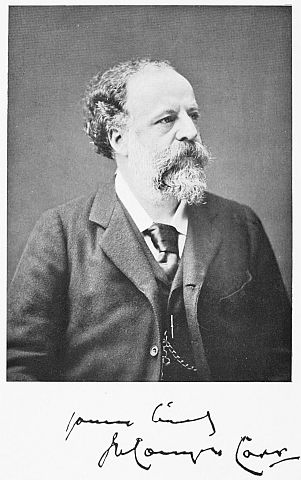
FISHING HOLIDAYS
I had not known my husband six months before I
knew him for an enthusiastic fisherman. He tells
in his Reminiscences of the first teaching he had
from a reprobate old peasant in the Lake Country,
and the passion for it never left him; the happiest
of his summer days were spent in the pursuit of it
and, from the time when I—set to watch a float
while he threw a line further down the stream—allowed
the fish to escape, to an evening towards the
close of his life when I helped his unsteady steps
to the bank of the Windrush at Burford, his
characteristic grey felt hat stuck full of flies and the
graceful gesture with which his long line was flung
back and forward and then laid softly on the water
of some quiet stream, are among the things which
I often recall.
I can see him now, on that first holiday, stumbling
with his swaying rod down the rocky bed of the
Dove with the sunset behind him, while I sat waiting
on a grassy bank eager to know what sport he had
had as soon as he was within earshot. He was a
most expert angler; and that was the beginning of
many happy fishing trips—in Derbyshire and Westmoreland,
on the Tweed at Peebles and the lochs
and rivers of Perthshire, Argyllshire and Sutherland;
but most notably on the stretch of a Hertfordshire
stream which he rented for some years with other
friends, and where he could best exercise his skill
with the dry fly.
A tiny cottage, just big enough for three men or for me and the
children, stood on the edge of the water, which was crossed by a
plank bridge. Sometimes, when there was no one else, I would be
allowed—most alarming of experiences!—to use the landing
net, and I think any of his angling comrades—A. E. W. Mason,
Seymour Hicks, Sam Sothern and others—would sympathise with my
terror over the responsibility.
I think there were no happier days in my husband’s life than
those spent in that Hertfordshire cot, and there is no frame into which
his figure fits more familiarly than the sedgy bank of that sunlit
river, hemmed by boldly contrasting forget-me-not and marshmallow,
with the May-fly flitting over the sparkling ripples and the shaded
pools.
And nothing so helped his periods of creative
work as this rural recreation.
It was on the shores of Loch Rannoch that he
wrote the first Acts of his King Arthur for Henry
Irving, and on the banks of the Lea that he saw the
barge bearing the body of the Fair Elaine. The
Black Mount at the foot of the loch may have stood
for the rugged rocks around Camelot, and the limpid
stream dividing emerald meadows at eventide, for
the river that circled Arthur’s Halls.
He was wont whimsically to declare that the
“gaslights of Piccadilly” were more satisfying to
him than a country life unless enhanced by the
pleasure of sport; but no one saw the beauties
of Nature in the intervals of sport more sympathetically
than he did, as he tells for himself in Coasting
Bohemia:
“I sometimes think,” he writes, “that those
who haunt the country, without conscious sense of
its many beauties, are apt to learn and love its
beauties best. How often the memory of a day’s
shooting is indissolubly linked with the pattern of
a fading autumn sky, when we have stood at the
edge of a stubble field wondering whether the growing
twilight will suffice for the last drive. And if this
is true of other forms of sport, it is everlastingly
true of fishing. There is hardly a remembered day
on a Scotch loch, or beside a southern stream, which
has not stamped upon it some unfading image of
landscape beauty. It was not for that we set forth
in the morning, for then the changing lights in a
dappled sky counted for no more than a promise
of good sport; during those earlier hours there is no
feeling but a feeling of impatience to be at work;
and the splash of a rising trout, before the rod is
joined and ready and the line run through its rings,
is heard with a sense of half-resentment lest we
should have missed the favourable moment of the
day. But as the hours pass, the mind becomes
more tranquilly attuned to its surroundings. The
keenness of the pursuit is still there, but little by
little the still spirit of the scene invades our thoughts,
and as we tramp home at nightfall the landscape
that was unregarded when we set forth upon our
adventure now seems to wrap itself like a cloak
around us with a spell that it is impossible to resist.
A hundred such visions, born of an angler’s wanderings,
come back to me across the space of many
years. I can see the reeds etched against a sunset
sky, as they spring out of a little loch in the hills
above the inn at Tummel. And then, with a
changing flash of memory, the broad waters of
Rannoch are outspread, fringed by its purple hills.
And then, again, in a homelier frame, I can see
the willows that border the Lea, their yellow leaves
turned to gold under the level rays of the evening
sun; and I can hear the nightingale in the first
notes of its song as I cross the plank bridge that
leads me homeward to the cottage by the stream.”
By which it will also be seen that his “love of
laziness” did not hinder him in the pursuit of sport.
Exercise for its own sake he resolutely refused
to take, and when my Alpine-enthusiast father
dragged him up a Piz—the last bit with his eyes shut—he
said: “I shall never climb anything again!”
But Seymour Hicks could tell a different tale of
a memorable evening on which he hooked a big
trout in the dusk—Joe teasing him as to its poor
weight—and when they stayed so late beside a
Scottish tarn to land it that their friends below
came up the mountain with lanterns to the rescue.
In Peeblesshire, too, he had gay hours with a
Captain Fearon, known to our children as Plum-bun,
because of a rhyme with which he teased them.
This fine old sportsman—though he must have
been sixty at the time—walked twenty miles after a
day’s sport so as to let Joe have the only spare
seat on a buggy that he might catch the night
express to town for work on the morrow. I can
see the tall handsome old man now on the moorside,
gaily waving adieu to Joe with a champagne
bottle which he had seized from the picnic basket
to cheer him on the road.
Joe had many days with him on the Tweed;
one of them, following such a big spate that an old
countryman wading in front of them was never seen
more after they had warned him against imprudently
breasting the swirl of the water where the river
made an abrupt bend ahead.
The gloom of this incident was partly mitigated
by their being told that the man was a drunkard
whose fate had often been so prophesied to him;
but they fished no more in a spate on the Tweed.
Fun was oftener their portion. I fancy it was to
Fearon that Joe made the bon-mot current in the
Garrick Club, where he represented himself as
lunching with Noah on the Ark.
“You must have good spate fishing here, Mr.
Noah,” he reports himself as saying while they sat
smoking on the balcony overlooking the Flood.
“It would be good,” replied the host, “but
unluckily, you see, I have only two worms.”
He writes himself of his fishing on Loch Awe;
and later, on Loch Etive, as the guest of our charming
friend Alec Stevenson, whose cheery voice would
ask of his keeper after breakfast: “Is it fishin’
or shutin’ the day, Duncan?” But there is no
mention of a happy six weeks in Sutherlandshire
where we were chiefly fed by the guests “killing”
of the daily trout, proudly displayed at even upon
a large tray in the hall.
I think it was here that Joe had trudged for three
hours up a mountain with his fly-rod set up, to find—when
he reached the tarn at the top—that his
top joint had fallen off on the road; as he was alone
only the midges heard his remarks, for he had not
even his fourteen-year old son with him—the happy
companion of his later angling days. It was into
just such a tarn, that that boy fell off the boat
one day, when landing a trout, and was advised by
his father to run about in the natural state on the
moor while his clothes dried on a sun-baked rock.
A lovely place is Inchnadamph on blue Loch
Assynt; the great mountain that guards the
valley towards Lochinver can be golden in the long,
northern twilight, when the water that has been as
a sapphire before the sunset, becomes purple in the
gloaming; but oh! the midges! Useless to tie
our heads in bags and grease our faces: they penetrated
everywhere and “bit like dogs.” They
almost deterred Joe from his evening hour on the
water because of the landing afterwards, when the
pony would not stand for him to step into the
cart.
But nothing really deterred Joe from fly-fishing—neither
heat nor cold nor rain nor wind; he only
regarded the weather at those times from the point
of view of its influence on the sport. Even when
it was too bad for fishing he couldn’t keep away
from the water. But he could never keep away
from water—he said it was the life of a landscape
as the blood is the life of the human body. In our
early days, when we were too poor for Highland
trips, visits to friends on the Thames afforded him
his best access to it; and, though he was not perhaps
a perfect oarsman, as may be proved by a “stroke’s”
petition that he would not “go so deep,” to which
he replied: “Ah, I never leave a stone unturned!”—he
loved the “noble river.” Though for perfect
satisfaction he chose more swiftly running waters.
I came across some passages in one of Stopford
Brooke’s letters which strangely call to mind Joe’s
passion for a free stream.
“There is no companion like a quick stream,”
writes the older man; “full, but not too full, capable
of shallows and water-breaks, with deep pools
when it likes and with a thousand shadows acquainted
with all the tales of the hills....”
And once more: “Running water surely is the
dearest and best-bred thing in the world. And a
great workman and a great artist.... Nor is there
any Singer, any Poet, any Companion so near and
dear as it is when it shapes itself into a mountain
stream in a quiet country.”
Often have I seen Joe beside such streams, and
though it so chanced that the last happy holiday we
had together was spent beside lakes rather than
rivers, the sense of moving water remains associated
in my mind with him through all the earlier days of
our life.
It was in Ireland—his motherland, though he had
never seen it till then—that we passed those last
unforgetable weeks of autumn.
Even as we landed at Rosslare there seemed to
fall upon him an unnameable affinity with the country
of his blood; as we travelled slowly—very slowly—over
her truly emerald bosom, he sat in a dream
watching the little black cattle, that we afterwards
learnt to beware of for “cross bastes,” as they
cropped the sedgy meadows, his eyes wandering from
them to the tender Irish sky and then waking into
fun as he saw a peasant at a small station trip a
boy up unawares and cuff him soundly, laughing as
he did it.
And when we reached Waterford—only a dirty
town to me—he plunged at once among his people
and laughed joyously at the retort of a begging
urchin, whose pathetic plea of hunger he had pretended
to rail at: “That’s where ye’re wrong, yer
honour,” the cheery little villain had cried: “A
man may be fat and hungry too.”
The horse races were going on, and the inn was in
an uproar, which he sat up most of the night to
watch.
But the next day sleepy ways prevailed once more,
and it took us a long time to get off at the station,
where I recollect his amusement at the porter’s
instruction: “This way to America.”
We reached Killarney without trunks, and the
conveyance sent to meet us broke down on the way
to the hotel; but he would meet no contretemps
save with a smile, and it was borne in on me that it
was because he was an Irishman that Italian happy-go-luckiness
had never ruffled him. So we fell in
with the leisurely ways of the land, and were fain to
“enjoy the soft rain” at that romantic spot and
watch for the beautiful shapes of the hills to appear
out of the mists on the lake.
Next morning, however, that unique green-blue
sky, washed with rain and dappled with wisps of
cloud, smiled on us in faint sunshine, and from that
hour our journey was one passing from fair to fairer
scenes.
In a short time our train was climbing, or burrowing,
through perilous cliffs of granite, crowned with
lonely moors and, presently swooping down on
the glorious coast-line, that makes for Valencia
Island.
This we left on one side, and at Lough Caragh we
also did not halt, tempting as it was; for our
destination was Waterville, where we had rooms
booked at the charming Great Southern Hotel for
the fishing season; and after an hour or so more of
leisurely travel we reached Cahirciveen, where a
ramshackle trap waited to carry us over the moors
to the village that lies twixt sea and lough.
The whole journey, and the last of it not least,
was a revelation to him of which I think he was
proud to talk to me, and I certainly had formed no
notion of the beauties of The Kingdom of Kerry.
The rough road across the wild heather-moor was
bordered almost continuously with hedges of the
small purple-red fuchsia in full bloom, and the
cabins—white or pink-washed, with thatched roofs—that
we passed at rare intervals, were shaded with it
and covered with honeysuckle.
“You live in a fair country,” said Joe to an old
man standing one day at the door of his tiny hovel;
and I—looking beyond him to the dim range of the
Macgillicuddy Reeks—added, “and with beautiful
hills.”
“The visitors say ’tis fair, but I’ve seen it arl
me life,” replied the proprietor, with a quaint smile.
And then to me—“but sure the Reeks are illigant
in winter wi’ the darlin’ snaws upon them.”
But that was later. That day we were silent with
contented fatigue till the muffled boom of the great
Atlantic breakers began to fall as distant thunder
on our ears: then suddenly Ballinskelligs’ Bay lay
before us with the massive headlands of Bolus and
Hog’s Head guarding it from the Ocean.
The shore is wild and desolate with the sense
of the vast Atlantic ever present; but soon we
turned inland again towards the mountains of the
“deep Glenmore,” and there, under the purple
shadow of Mount Knockaline, lay a long, grave
Lough with a tiny deserted islet in its midst upon
which one of the ancient beehive cells stands under
the eaves of a ruined church. It is Lough Currane,
and we drove under overhanging fuchsias, to the
Great Southern Hotel on its shore.
We had two more beautiful drives while we were
in the Kingdom of Kerry: one along the perilous
Irish Cornice, known as the Coomakista Pass, where
one prayed one might not meet the coach, to Park-na-Silla;
the other from Kenmare over a rocky
road to Glengariff.
The Cornice drive beggars description, and I
never knew Joe to be so enthusiastic over a view.
Shallow little coves fringed with brilliant golden
seaweed—upon which herons stand feeding at times—indent
the shore itself; but the Sound is studded
with numberless islets—some clad with heather,
others with semi-tropical shrubs, and faintly ringed
with the silver foam of a streaked and gentle sea.
In an opal haze beyond them, the opposite shore of
County Cork lies as a dream; but the two great
guardian cliffs of Ballinskelligs’ Bay with their
outriders—the Bull and Cow Rocks—stand in firm
and grand outline away whence we came where the
Sound joins the Ocean.
The coach driver draws up when he reaches the
best point, and tells us all about it, and points out
the Great Skellig Rock—twelve miles out to sea,
and close at hand the bridle path by which O’Connell
rode over the mountains to his home at Darrynane.
As we near that Bay and its multitude of tiny
islets, upon one of which stands the ruined Monastery
of St. Finnan, he shews us the “Liberator’s” very
house and then we turn inland again among undulating
moors—our road fenced with the fuchsia and
every variety of fern, till of a sudden the beautiful
bridge and square church tower of Sneem village seem
to beckon us into the very heart of a fiery sunset.
Our second drive from Kenmare was again quite
different and not without incident. In the first place
Irish unpunctuality caused us to start two hours
late, and in the second, when the carriage arrived at
last, the harness had to be tied up with cord before
we could proceed, a beginning which filled me with
alarm though it reminded me of youthful days in
Italy: but to Joe it only afforded opportunity for
pleasant raillery with his compatriot, and I only wish
I could remember all the bon-mots with which they
capped one another.
The last part of the ascent was very wild, but
when we emerged from the tunnel that pierces the
topmost granite cliff, the view that burst upon us—though
wild still in its freedom from the intrusion
of human interest, was soft and tender with all the
glamour of the South. Range upon range of finely-chiselled
hills stood crossing and re-crossing one
another with gentle valleys between, and the glint
of water here and there made visible by the golden
splash of sunset; and presently the hills—so soft
and so solemn upon the mellow evening sky—were
cleft to their base, and Bantry Bay lay spread in
the distance beneath us.
The road went down in sharp turns and, the
driver cheerfully remarking that we should have to
pass a motor-roller on the way, my heart jumped
into my mouth. But Joe administered a little
salutary chaff together with a cup of tea at the
wayside inn, where we changed drivers, and a pretty
girl assured me that “Faith,” I had “no need to
fear, for the lad was the coolest whip on arl the
mountain-side.”
So he was, but he went a fine pace, and the waiter
at the inn, who told us he was the girl’s brother,
told us also that that cool lad was her lover, so
perhaps he was eager to show his prowess.
At Glengariff our weather was hot and fine, and
the water of that land-locked end of the Bay was so
calm that the pleasure boats round the jetty, and
indeed every tree on the shore and on the near
island, would lie reflected on its surface in the rosy
dawns or the golden sunsets as they do on the
Italian lakes. But out beyond the island the breeze
would freshen, and thither Joe hied him with a
friendly fisherman every morning to lie in wait for
the bass and the mackerel.
Our friends—Mr. and Mrs. Annan Bryce—owned
the beautiful island at the mouth of the bay, and
there we spent happy afternoons wandering over the
heather and gazing afar from the old castle’s ruined
battlements; but Joe’s mornings were his own,
and he would go even further out to sea than the
island, to where the seals sunned themselves on the
rocks, unscared by the approach of man, but scuttling
under water when the fishing-reel ran out, the old
ones calling their young to safety with an eerie
cry.
Perhaps Glengariff was the most lovely spot that
we saw, but the hothouse atmosphere of it made a
prolonged stay too trying, hence we enjoyed Waterville
and Lough Currane best, where the more
invigorating air of the open Atlantic in our wake
kept even the moisture of the valleys freshened
with soft breezes.
Also it is here that Joe rejoiced in the only branch
of angling that he really loved; sunshine, mist or
rain he was off on the lough with his faithful gillie,
his trout-rod set up, his old hat well-adorned with
every likely fly and, if necessary, his oilskins about
him.
It took him all his time—easy as it usually was
with him to make friends—to make them with that
gillie: a curiously sad and silent lad, whose rage at
the “lack of pride” in a besotted old poacher
who would hang about the landing-stage, knew no
bounds.
But Joe would only laugh, and give the old
beggar the “tanner” that he begged “for the
love of God,” with a willing heart.
“Don’t be too hard on him,” he would say to the
young boatman. But the boy had been in America,
and, as it presently appeared, was ashamed of the
lazy ways of his countrymen.
“Home Rule might be arl right,” he would say—adding
shrewdly—“if it don’t keep the visitors”
(generally meaning the English) “away. But,
begorra, let us work for it!”
Few held such wide views even in that day, and Joe
could rarely get any one to talk on that favourite
topic of his; but he made various pleasant little
discoveries, one of which was that Catholic and
Protestant children worked together at school
without trouble; but then most of the latter were
fathered by English experts working at the Cable
Station and were ranked as “visitors.”
His chief enjoyment when not fishing, was in the
cabins—when he could find excuse for entrance.
There was a weaver of the frieze not far from our
inn, and there we went to buy a length for a gift.
We were rewarded for a wet walk. The weaver
was out—but his wife sat by the peat-fire with a
new-born baby in her arms.
As we opened the door the cow that was in the
yard thrust in a soft nose to hold it ajar, and lo,
we beheld a sow within, rise slowly up and waddle
out, followed by ten wee sucking pigs: then the
cow stepped over the threshold beside us.
The woman rose asking us our errand, while I
edged away from the cow and tried to get out again.
“She’ll not harm ye, lady,” said she with a smile,
“It’s her milkin’ time, and sure she knows I’d not
take the darlin’ babe out in the rain.”
But it was not often that Joe spared time from
serious business for calling and sight-seeing. Once
we went to the Cable Station and learned, in an
amazing short time, from America, that the weather
was fine and dry; and on two occasions I went
with him to Lough Coppul (The Horse) away up in
the “deep Glenmore”; but that was only allowed
so that I might see the sleepy beauty of that tiny,
lonely lake, where the water is peat-brown even in
the sunlight; here I was introduced to two lovely
children with gold-red hair and deep eyes, who dwelt
in the schoolhouse of four districts, and were Joe’s
special friends. This treat was a great favour
granted to me, nor was I admitted into the boat
even then, but had to roam about the shores while
work was done. Luckily it was fine and warm, and
the midges are not nearly so fierce in Ireland; and,
with the children’s tales of the plights of scholars
coming over the mountains in winter and a shy
admission, warily coaxed out of them, as to the
presence of fairy horsemen there on All Hallowe’en,
many an hour went by like a dream, till the gloaming
called us home.
But my lot was more often to sit reading or writing
on the terrace of the hotel watching for the boats
to round the point of Church Island, as they came
in with their catch to meals.
Whether anglers are men or women—and most
of the women in the Hotel were anglers—they mind
nothing but meals, and rarely the hours of those;
so that I was mostly alone, but the excitement of
the “basket” was an event each time, and Joe’s
was often the heaviest.
Through the gap in the fuchsia hedge, whose
tassels lay blood-red upon the lough’s blue background
on a fine morning, I would first distinguish
his boat in the offing, and walk down to the landing-stage
to watch it nearing me between the shallows,
where those coal-black little “cross” bullocks stood
knee-deep on the emerald marshland. I can see
him, skilfully throwing his line on the water to the
last instant; then turning towards me with the
welcoming smile on his face always, though I
generally knew, before he had stepped ashore,
whether he had had good luck or not.
Yet the weather was not by any means always
fine, and many a day I sat in our little parlour,
not even seeing the fuchsia hedge, and certainly not
the water.
One wet day comes specially to my mind. It
had rained steadily, and out of the soft, white mist
that shrouded the lough, the sound of a tolling bell
had come eerily to me all the afternoon. I knew
of no church within two miles save the ruined one
on the Island, and at last I asked the chambermaid
what it might mean.
“Sure, it’ll be a buryin’ on St. Finnan’s Isle,”
said she, crossing herself, after listening for a minute.
“The family will still have the right of it, and they
keep a bell in the broken tower. But the corpse
will have come from far, poor sowl!”
She went her way, and soon the bell ceased, and
almost at the same time the mist began to clear and
the shapes of the black cattle to appear again on the
sedgy marshes, browsing as usual; then I saw
black boats—like phantom things—stealing away
in the distance and—behind them—a streak of
gold struck across the wet mountain-side and all the
mist shrank away, and the purple ridge was set
against that tender blue-green Irish sky, crossed with
bars of rosy light.
I went out and down the wet path to the landing-stage,
and there was Joe’s boat pulling towards the
shore, and he standing up in it with a smile upon
his face.
That was our last holiday.
We were often out of London again, and in lovely
spots: in summer, at Studland in Dorset, at Broadway
and Burford in Oxon, at Ditchling in Sussex;
in winter, at Hastings and Bournemouth. But it
was always in search of health and to escape the
nerve-racking air-raids of War—never again in the
boyish spirit of holiday.
Yet let it not be supposed that Joe was ever
dismal. “Comyns Carr is a good fellow and a boon
fellow,” George Meredith wrote of him to another
old friend, and so he was to the last. Depressed now
and then, but hopeful again till near the end, and
always thankful for every bright moment and for
every kindness received. “Grumbling is so dull,”
he would say; and when I was dismayed at the
contretemps of travel lest they should affect his
comfort, he would beg me to “bridge it over”—as
he did.
As we drove away from the house at Bournemouth
on our last journey he said to the landlady: “I’ve
never been so comfortable in any lodgings”; yet
he had suffered much there, and had often lacked
luxuries unprocurable in war-time. Sometimes in
those days, after a long silence, I would ask him
what he was thinking of, and he would answer
simply: “Nothing, dear!” By which I am sure
he meant nothing troublous—and truly to the
wearying, harassing thoughts which beset many of
us he was a stranger—for he would sometimes add:
“I’ve plenty to remember.”
And then, to the last, he worked part of every
day. His hand had not been able to write for long,
but he would dictate to a shorthand typist; the
whole of his Ideals of Painting, posthumously
published, was so written, and his precision never
flagged, as he instructed me over the correction of
those proofs—whether in regard to the letterpress
or to the re-production of the illustrations; the photogravure
after Rembrandt’s Mill had been delayed,
and on the last day of his life he asked me if it had
come and if it “looked well.”
Reading over his own words upon the waning of
his old friend, Sir John Millais’ life, they seem to me
unconsciously, yet so fitly, to describe himself, that
I shall end this effort to preserve some sort of a
portrait of him by quoting them.
“I never heard from him,” he writes, “however
great the dejection of spirit he must have suffered,
a single sour word concerning life or nature. His
outlook on the world was never tainted by self-compassion,
never clouded by any bitterness of
personal experience, and one came to recognise then—as
his life and strength gradually failed and waned—that
the spirit of optimism ... was indeed a
beauty deeply resident in his character, which even
the shadow of coming death was powerless to cloud
or darken.”
So I think of Joe as he stepped out of the boat on
Currane, with the smile upon his face.