The South Kensington museum is rich in ivory statuettes: many of them
are very beautiful, although none is equal to a large sitting figure of
the Virgin in the British museum or to two or three of the finest in
the collections at Paris. Almost all of these statuettes represent the
Virgin and Child; naturally, this would be a subject most frequently in
demand for private oratories. Almost always the Virgin bears the tokens
of her spiritual glory and privileges. To adopt the words of a French
writer on another class of ivory carvings, “La Vierge mère et reine
porte glorieuse les trois signes de son incomparable grandeur; la fleur
de sa pureté immaculée, le fruit béni qui, loin de flétrir, a embelli
sa fleur; et la couronne qui a consommé ses privilèges en couronnant ses vertus.”
Generally speaking, the statuettes of the latter part of the thirteenth
and throughout the fourteenth century are pure and religious in style,
with an admirable expression of love and reverence in the figures,
perfectly natural. There are two or three examples in the collections
at South Kensington and the British museum, which may well claim all
the praise which M. Labarte gives to a group of the coronation of the
Virgin and to a Virgin and Child, both now preserved in the Louvre.
He speaks of the simplicity of the composition; the refinement and
truthfulness of the forms; the appropriate inflexions of the body and
limbs; the imitation of real life; the just expression given to the
faces; and the natural development and treatment of the draperies. So,
again, we may quote his exact words, and say of more than one statuette
in these great collections: “Quelle pureté dans le dessin, quelle
noblesse dans la pose, quelle finesse dans le modèle, quelle ampleur
et quelle élégance dans la disposition de la draperie! Cette statuette
montré à quel haut degré de perfection était parvenue la sculpture
chrétienne à la fin du [quatorzième] siècle.”
The seals attached to mediæval deeds are important illustrations
of the mode of treatment of the subject of the Virgin and Child, so
common in the statuettes of the thirteenth and fourteenth centuries.
Take, for instance, some in the Bodleian library. The seal of the
prior and convent of Wyrmeseye (Wormegay) in Norfolk, attached to a
deed of 1347, has a seated Virgin suckling the Child, her right hand
uplifted. Another of the convent of Castle Acre, 1290, a similar
subject. Another, of one of the parties to a deed of the archbishop of
Canterbury, 1376, has the Virgin sitting, facing, and holding the Child
standing on her lap, a sceptre in her right hand; another, showing the
peculiar twist of the figure (presently to be noticed) is on the seal
of the convent of West Acre, in Norfolk.
There are several also in the British museum: especially a very fine
seal of Southwick Priory, early fourteenth century; the Virgin sitting
and suckling the Infant, under a canopy of a single arch; another, the
same subject, thirteenth century, of Oseney abbey; another, same date,
of Elsing Spittle priory, the Virgin standing with the child under a
rich canopy.
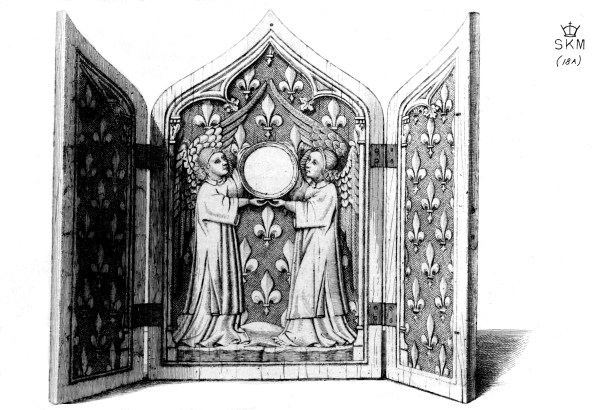
Sometimes ivory statuettes are still found placed under canopies and
with shutters or wings to fold round them, so as either to make shrines
for an oratory or, portable, to be carried by the owners on their
journeys. More often, examples of this kind are not finished in the
back or are still left attached to the ground of the block of ivory,
carved however in very high relief. The shrine no. 4686, is a good
specimen. When so treated, the shutters are richly decorated on the
inside with scenes from the gospels, usually relating to the Nativity
or to the Passion of our Lord.
Of this style were the shrines or triptychs at Lincoln, in 1536:
“A tabernacle of two leaves, gemmels [hinges] and lock of silver,
containing the coronation of our Lady;” and “item, a tabernacle of
ivory standing upon four feet with two leaves, with one image of our
Lady in the middle, and the salutation of our Lady in one leaf, and the
nativity of our Lady in the other.”
There are two remarkable and important illuminations in the manuscript
psalter of queen Mary, which has been more than once referred to (p. 74).
In one is a shrine, open, with the decorations usual early in the
fourteenth century. The centre is divided into two compartments. Above
is the Annunciation; the Blessed Virgin and an angel; each under a
pointed arch, cusped and crocketed. Below, is the Visitation; Elizabeth
and the Virgin meet under a gateway and embrace. The wings are filled
with saints, each standing under a pointed arch. This illumination
precedes the psalter, following the calendar, after the Old Testament
history. The other represents a triptych: in the middle is the Virgin
and Child; she is sitting and giving Him the breast; two angels stand
by, swinging censers; in each wing is an angel with a candlestick.
The mediæval artist may have drawn these with examples now in the South
Kensington museum before him as his models.
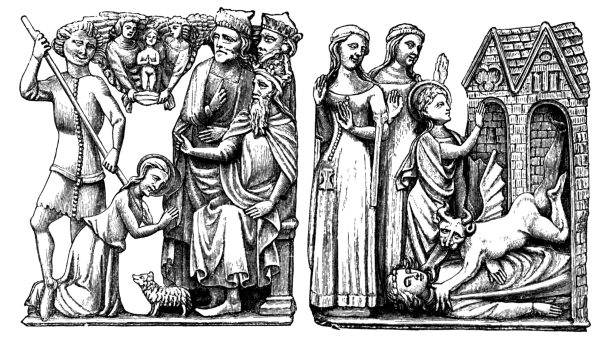
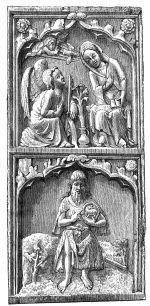
Figures carved in such deep relief as almost to be statuettes
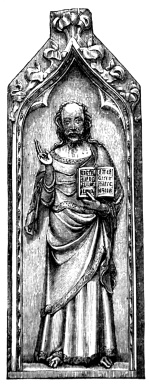
occasionally but very rarely occur in diptychs. A remarkable specimen
was in the Meyrick collection; an illustration is given (p. 100)
of one of the leaves. Probably no diptych exists in any collection equalling
this in the depth to which the figures have been cut in relief. Each is
brought out from the background three quarters of an inch. On the other
leaf is the Virgin and Child. An inscription is incised upon the book
which our Lord holds in His left hand: “Ego su. dns. ds tuus Ic. xpc.
qi. creavi redemi & salvabo te.” Both figures have great grace and
dignity; and the draperies are arranged with unusual simplicity
and breadth.
There was also another very curious mode of carving statuettes of the
Virgin, of which extant specimens are extremely rare, and none (it is
believed) is to be found in England. There is one, well known, in the
gallery of the Louvre, engraved in the useful book of M. Viollet le
Duc, dictionnaire de mobilier Français. It is a sitting figure of
our Lady, who is holding the Infant on her knees. The front part is
divided down the middle and two wings fall back on hinges, leaving a
centrepiece and forming a triptych of the usual character. There are
scenes from the Passion on the wings, and the Crucifixion is carved
upon the centre. The date of the ivory is early in the fourteenth
century; but the fashion of this kind of statuette can be traced to a
much earlier time. An entry in an inventory of the church of Notre Dame
at Paris in 1343 mentions one: “quædam alia ymago eburnea valde antiqua
scisa per medium et cum ymaginibus sculptis in appertura, que solebat
poni super magnum altare.”
Occasionally statuettes are mentioned in English inventories; thus in
the inventory of Roger de Mortimer, a coffer is included, containing
with other things “j parvam imaginem beatæ Virginis de ebore.” Again,
“a lityll longe box of yvery with an ymage of our lady of yvery therein
closyd” is named among the goods belonging in 1534 to the guild of St.
Mary the Virgin at Boston, in Norfolk.
A very fine statuette of English work, more than nine inches in
height, has been for some years on loan to the South Kensington
museum; it belonged to the late Mr. Hope Scott, and was formerly
Lord Shrewsbury’s. The Virgin is in a sitting position and holds a
large flower in her right hand. She wears a crown under which is the
veil, and her drapery falls over her knees to the feet in heavy and
deeply-carved folds. The face of the Virgin is very beautiful and full
of affectionate expression; the head also of the Child is unusually
good. The ends of the throne are carved in relief, each with a figure
of a female saint sitting under a bold decorated canopy. Many portions
of the original gilding remain upon the hair and on the borders of the
vestments.
The largest known statuette was in the possession of the late Mr.
Alexander Barker; and this is not only remarkable for its size and
height but is graceful in design, and from the hand of a good artist.
It is French, probably of the Burgundian school, and of the fourteenth
century. The Blessed Virgin is standing, carrying the Child; both hold
in one hand a fruit, perhaps an apple. The figures are vested much in
the same manner as the statuette no. 4685 at South Kensington, and the
draperies have gilded borders with a running scroll; the linings of the
robes of both are painted dark blue. The hair of the Virgin and of the
Infant has been gilded. The perpendicular height of this statuette is
twenty-three inches, and the extreme width at the base six inches. The
figure is hollow as far as the tusk was so, and slopes to the left in
accordance with its natural growth. The height to the girdle is fifteen
inches, and the Infant sitting on His mother’s arm measures seven and
a half inches. From the chin to the top of the head of the Virgin is
three inches. The tusk curves inwards at the waist two inches from a
line falling from the back of the head to the lowest part of the
drapery which covers the feet.
Every one must have remarked the bend or twist so often given to
statues, carved from stone, of the Virgin and of female saints which
fill the niches of churches and cathedrals built in the thirteenth
and fourteenth centuries. The necessity which obliged the workman in
ivory to follow the natural form of the tusk in all statuettes of such
a size, or of nearly so great a size, as that which has been just
described, certainly did not press upon sculptors whose material was
stone and comparatively unlimited. But the position had perhaps become,
as it were, a fashion, and the style conventional and pleasing to eyes
accustomed daily to see statues so leaning aside in their own oratories.
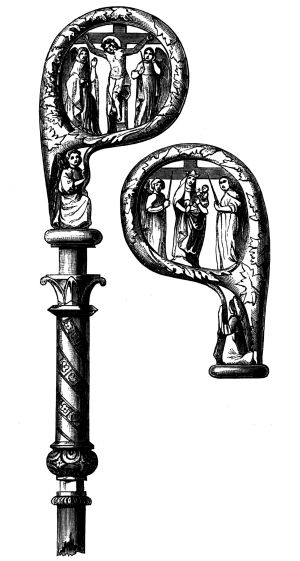
The same slope or twist is to be seen often in the figure of the Virgin
in the centre of the volute of the head of a pastoral staff; where, so
far as abundance of material was concerned, there was not the least
necessity for any deviation from an upright into an unnatural attitude.
Again, in statuettes in silver or other metal: as, for example, in the
silver Virgin and Child in the South Kensington museum; and in another,
also silver, standing on the cover of an oblong reliquary, and said
to represent Jeanne d’Evreux, queen of France. This last is among the
collections of the Louvre.
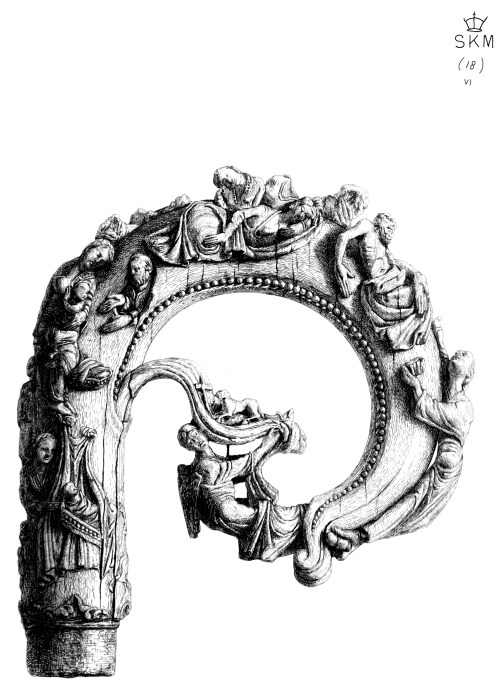
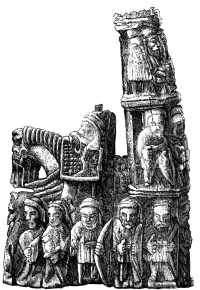
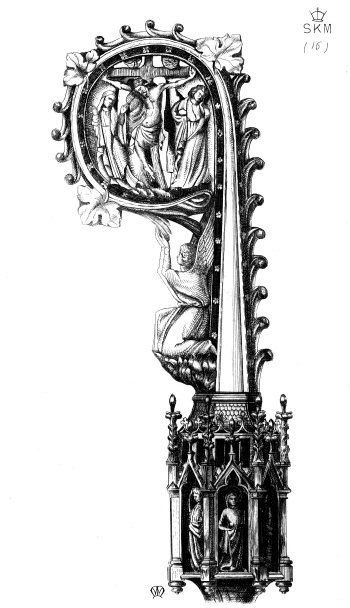
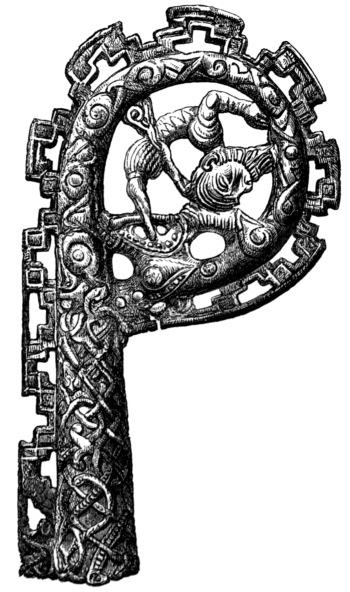
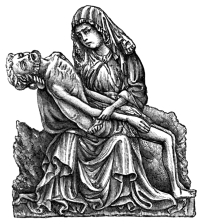
Before we pass on to another question, it is impossible not to make a
few remarks upon one of the most beautiful and affecting of all the
works in ivory which have come down to us from mediæval times. This is
a piece, small in size and carved upon both sides, which has probably
been in the volute of a bishop’s pastoral staff. On one side is a group
of our Lord in the garden of Gethsemane, praying in His agony, and with
the apostles lying asleep below. On the other is a second group, a
Pietà; the blessed Virgin seated and holding the dead body of our Lord
upon her lap. A woodcut is given of this important sculpture.
Perhaps there are few works of Michael Angelo which have been more
praised, or which have excited more enthusiasm than his group of the
same subject in St. Peter’s. We will listen for a minute to two or
three writers who have especially drawn attention to his famous Pietà.
One says: “The celebrated Pietà now adorns the first right-hand chapel
on entering the great door of St. Peter’s. It consists of two figures,
the Virgin Mother, seated in a dignified attitude, and supporting
on her knees a dead Christ, Whom she regards with inexpressible
reverence, tenderness, and grief.... Its touching pathos, its dignified
conception, and its masterly execution, are incontestable.”
A French critic writes: “Cette Pietà fut la première œuvre de Michel
Ange qui l’éleva au premier rang et apprit son nom à tous les échos du
monde civilisé;” and the same author further speaks of the group as
having been “the conception” of the artist, and “a creation” of his
imagination.
Another writes: “When this group was finished it was universally
admired,” and goes on to state that “one of the great sculptors of the
present day, our fellow-countryman Gibson, expressed himself in terms
of high admiration.”
Once more; a writer upon the Tuscan school: “In this admirable group
the dead body of our Lord lies upon the lap of the Madonna, while her
left hand is half opened and slightly turned back, with a gesture which
carries out the pitying expression of her face. The Christ shows a
purity of style and deep feeling, combined with a grandeur which Michel
Angelo drew from himself alone.” The same writer tells us a few pages
before: “Michael Angelo, who was an enemy to tradition in art, as
well as to a positive imitation of nature, took a path diametrically
opposed to that followed by the conventionalists, the realists, and the
worshippers of the antique.”
We entirely dissent from the unmeasured laudation here given to
the famous statue at St. Peter’s. Let the praise of originality of
conception, as well as of merit of execution (so far as the size of
his material would permit) be given where it is due, to the sculptor
of the fourteenth century, who died a hundred years before Michael
Angelo was born. Nay, more than this; an unprejudiced comparison will
show that where the work of the great Italian differs from the earlier
Pietà, it differs for the worse. In the ivory the position of the head
and the cold stiffness of the limbs are more death-like and more solemn
than in the marble. In the ivory also the Mother seems to be thinking
more of the past pains and sufferings of her Divine Son than of her
own sorrows: tenderly she supports the Saviour’s head with her right
hand, and, as it were, still clings to Him and draws Him to her with
the other; not, as in the marble at Rome, stretching out and opening
her hand as if to show her misery and the terrible extent of her
bereavement. The mediæval artist remembered that the sad cry of the
prophet in the book of Lamentations referred not to His mother but to
Christ: “Was there ever any sorrow like unto my sorrow?”
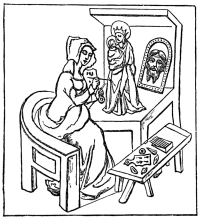
It was a common practice in the middle ages to colour statuettes and,
indeed, also other things, such as triptychs, diptychs, and the covers
of writing-tablets. Traces of this colouring are still visible on
many examples. The robes and vestments were painted red or blue, with
borders of a different colour and often diapered with patterns in gold.
The interesting illustration (opposite) of a painter at work upon a
statuette, an illumination in a French manuscript of the fifteenth
century, is copied from M. Labarte’s work on the industrial arts.
Modern taste runs generally, with regard to this question, in
opposition to the old; but we are not, therefore, hurriedly to decide
against colour as altogether barbarous or improper. Sculpture, people
thought in former days, gained an improved effect by such additional
help, and certainly the use of colour was an attempt to give a more
real appearance and more true to nature. The carvers in ivory could
moreover (if they had known the fact) have appealed to the best period
of the Greek school; to the works of Phidias and Praxiteles. The
chryselephantine statues in the temples of Athens and Olympia had the
same character of ornament and variety of material.
Writers on art who hold that the legitimate province of sculpture is
simply to represent by form are inclined to condemn any addition of
colour as interfering with that definition. They say that if sculpture
be painted it is a mixture of two arts: as it is also if a picture
be relieved or raised in any part; after the manner of the Byzantine
pictures by Italian painters of the twelfth and thirteenth centuries.
But it by no means follows that such a mixture is necessarily false in
taste; rather it must be left to the judgment and decision of the time
and of the country for which the sculptures are made.
A recent contributor to an art periodical, writing of imitation of
nature in statues by colour, dogmatises without doubt or hesitation and
even goes so far as to say that such statues are “not to be regarded as
sculpture. Nor can those representations of the human form which are
made to counterfeit life itself, and dressed it may be in the actual
attire of the person pourtrayed, be spoken of as sculpture. Regarded
from the sculptor’s point of view, such productions can only be
regarded in the light of tricks, or, at the best, of clever forgeries
of nature.” Criticism such as this seems to want the right quality of
discretion.
Although it is quite true that the works of the Greek sculptors,
during the two or three hundred years of the greatest perfection to
which the art of sculpture has ever reached, are not to be praised
as the greatest and most successful of all statues because they were
coloured or otherwise made to imitate reality; yet the intention was
good, and in obedience to the universal demand and feeling of a people
wonderfully fitted by nature, education, and experience to come to a
right conclusion on the matter. We are unaccustomed in our own days
to statues except those which, whether draped or undraped, are left
in the original pure whiteness of the ivory or marble; we think that
nothing is to be so much approved as what we call simplicity. We may
be right, not only as to what we hold to be pleasing to ourselves, but
as to what ought to be pleasing to and held to be correct by every one
and in every age. On the other hand, we may not be right after all;
and a little more caution and hesitation might be advisable before we
condemn, merely as a matter of abstract taste, a practice which seems
to have recommended itself to almost every people of the world, as in
some way in accordance with the common sentiment of humanity itself;
which was accepted by highly civilised nations from the days of the
Egyptian and Assyrian kings down to the fifteenth century of the
Christian æra; and which can appeal in its support to artists whose
works have ever been acknowledged to be the masterpieces of the world.
It has just been said that the great works of Phidias and his pupils are
not to be praised merely because they were coloured nor because no
mode of enrichment, gold or jewels or ivory or enamelling, was grudged
as being too costly in order to adorn them. So, again, the use of
colours is not to be condemned because the statues of some very ancient
nations are coarse and rude, or because the idols of the old Mexicans
or of the savages of Africa and New Zealand are made by it even more
hideous than they would otherwise be. The wide-spread observance of the
practice is the point to be considered; and the fact that it rests upon
some deep-seated and universal feeling in the mind of all men, of all
countries, and of almost every age.
Regarded as a mode of handing down to future generations the memory of
much which would have been lost for want of it, who can complain of
the careful colouring of mediæval tombs and monuments? We are indebted
to it for exact details of dresses and jewelry and armour: about which
there can therefore be no longer any dispute, and which give the answer
at once to many difficulties and many interesting subjects of inquiry.
Nowadays we should almost shudder at a statue painted and coloured
to imitate the muslins and silks worn in Hyde Park by women, and the
various coats and trowsers of the men. But five hundred years hence
some of our descendants would be grateful if, in spite of our own
prejudices, we had given them even one statue among the many of our
Queen or of the prince Consort, not left in the bare uncoloured silence
of the marble.
Crucifixes in ivory of the middle ages are extremely rare; they may
remain still in use in some churches abroad, but whether abroad or at
home they are seldom found in the collection of any museum. There is
one, although a fragment yet very beautiful, in the South Kensington
collection: no. 212. The figure is represented after death; but the
still suffering expression of the drooping head, the strained muscles
across the breast showing the ribs, and, as it were, the struggle of
the legs contracted in the last agony, are admirably given. The eyes
are closed, the forehead drawn with pain, the mouth open. The body
is clothed with a garment crossed in white folds over the loins and
falling to the knees. It is greatly to be regretted that this beautiful
figure has been so mutilated. The conception of the artist is full
of true feeling and devotion, and his treatment of the subject an
excellent example of the right union of conventionality with enough of
what is real. As with regard to the heads of pastoral staffs, so also
it is not easy to say why mediæval crucifixes should be so uncommon:
for, although there must have been hundreds wilfully destroyed and
broken in England in the sixteenth century, the same reason does not
apply to other countries, where the demand and the supply both for
the churches and for private use must have been continual and almost
without limit.
There are numerous records still remaining in our public offices and
in the muniment-rooms of many dioceses, which leave us in no doubt as
to the extent and completeness of the destruction of the furniture
and goods of English churches and cathedrals from the year 1550 to
1570. In the very valuable series of returns made by the commissioners
for the county of Lincoln, the lists of items are generally summed
up, “with the rest of the trash and tromperie wch appertaynid to the
popish service.” Even with respect to objects for which one would have
supposed that some slight reverence would have still been felt, such as
crucifixes and altars, we have entries like the following in one parish
alone: “Item ij altar stones; which is defacid and layd in high waies
and sarveth as bridges for sheepe and cattall to go on;” in another,
“Item, iij altar stones broken and defacid, thone [the one] solde vnto
Thomas Woodcroft, who turned it to a cestron bottom, thother aboute the
mending of the church wall and the thirde sett in a fire herthe.”
An unusually good and large ivory crucifix is preserved in the Catholic
chapel in Spanish Place, London. It was given to the chapel about
thirty years ago but for some time retained by the late cardinal
Wiseman, by whose permission it was shown in the Great Exhibition of
1851. The date is, perhaps, late in the seventeenth century; Spanish
work; about a foot in height; and the arms of the suspended body are
less extended than in the mediæval times. The figure is coloured with
great care to imitate life; blood flows from the wounds, and the
streams where they meet are jewelled with small rubies. The flesh of
the knees is broken and mangled.
Excellent as this crucifix is as a mere work of art, it utterly fails
in calling forth expression of pure religious sentiment. The reality of
treatment in the figure of our dying Lord is too near truth, and is at
the same time untrue. So far as it has left the old type it has lost
power to influence devotion. The earlier conventional crucifix, which
left all to the imagination and never aimed at perfectly representing
a man dying on a cross, was immeasurably more fitting and more
reverential.
The diptychs of the middle ages for public and private devotion have
been already spoken of. But besides these, two leaves occur not
unfrequently which are strictly diptychs and were used for the same
purpose as the pugillares in the old days of imperial Rome. Single
plaques are very common, and not only are they usually small in size
but may almost always be distinguished from diptychs of the religious
class by the form of the reverse or inside page of each leaf. This
has been hollowed out to a slight depth, leaving a narrow raised rim
or border; and wax was spread over the depressed portion, for writing
upon with a pointel or stylus; the other end of which was flattened to
erase with. We thus find brought down through fifteen hundred years the
practice of the days of Ovid:
“Et meditata manu componit verba trementi;
Dextra tenet ferrum, vacuam tenet altera ceram.
Incipit, et dubitat: scribit, damnatque tabellas:
Et notat, et delet, etc.”
The subjects sculptured on the outside of diptychs of this kind
generally also give another and a sufficient distinction, being perhaps
some domestic scene or a story from a romance, as upon combs or mirror
cases. But this is not always so: for writing-tablets occasionally are
found with subjects taken from the Holy Scriptures.
A few examples of these writing-tablets have been preserved which have
several leaves of ivory inside; although in most instances the plain
leaves have been lost and the covers alone remain. A very fine and
complete set, of the fourteenth century, with four inner leaves is
engraved by Montfaucon (in his great work L’Antiquité expliquée) from
his own collection, which had scenes carved on it from the romance of
Alexander. Montfaucon describes them carefully: “Notre cabinet en a de
cette dernière matière (d’ivoire), dont les deux couvertures out des
bas-reliefs d’un goût barbare. Les bords des tabletes sont relevez de
tous les côtez: ces bords relevez laissent un petit creux pour y placer
une cire préparée, laquelle élevant un peu le page rendoit une face
unie et de niveau avec les bords; on appelloit ces tabletes tabellæ
ceratæ. On gravoit sur cette cire préparée ce qu’on vouloit écrire, et
l’on effaçoit ce qu’on avoit ecrit, ou en y passant fortement dessus
l’autre côté du style, quand la matière étoit plus gluante. C’est ce
que les anciens appelloient stylum vertere, etc.” Judging from the
engraving in Montfaucon’s own book, it would seem that these tablets
were the work of a good artist and of the best time of that particular
style; and that it was hard to speak of them as “d’un goût barbare.”
Ivory writing-tablets were used in the middle ages in England by people
of all ranks, and are mentioned in inventories and wills. Chaucer tells
us of the preaching friar’s companion:
“His felaw had a staff tipped with horn,
A pair of tables all of ivory,
And a pointel ypolished fetishly,
And wrote alway the names, as he stood
Of alle folk that gaue hem any good—
—Or geve us of your braun, if ye have any,
A dagon of your blanket, leve dame,
Our suster dere, lo here I write your name.”
A characteristic illustration occurs in Shakespeare, in the second part
of King Henry the fourth. The archbishop of York says:
“ ... the king is weary
Of dainty and such picking grievances;
And therefore will he wipe his tables clean,
And keep no tell-tale to his memory.”
It is to be observed that in these quotations both Chaucer and
Shakespeare call these diptychs by the name “tables,” a word which had
several meanings formerly in England. We have seen already that the
game of draughts was so called, and it was also frequently applied in
the fourteenth and fifteenth centuries to carvings in alabaster or
to paintings on boards in churches. In 1458 money was bequeathed to
the church of Dunwich in Suffolk, “ad novam tabulam de alabastro de
historia sanctæ Margaretæ,” and a “table of St. Thomas of Ynde” was
left in 1510 by Robert Clerk to Batfield church, in Norfolk.
An interesting paper in the Archæologia, read before the Society of
antiquaries in 1843 by Mr. Albert Way, on the famous golden Tabula
of Basle may also be referred to. The writer concludes by expressing his
wish that such a monument, then in private hands, “could be deposited
in a national collection,” and he complains that “England alone, of
all the countries of western Europe, possesses no national collection
which exhibits a series of specimens illustrative of the character and
progress of the arts of the middle ages, and of the taste and usages of
our ancestors.” Happily, this is a complaint which cannot be made now.
Chaplets of ivory beads for private devotion were very common in the
middle ages, and are often mentioned in letters and other documents.
Some good examples still exist in various collections. The woodcut on
the next page represents a set, and a girdle with ivory clasps, in the
collection of M. Achille Jubinal.
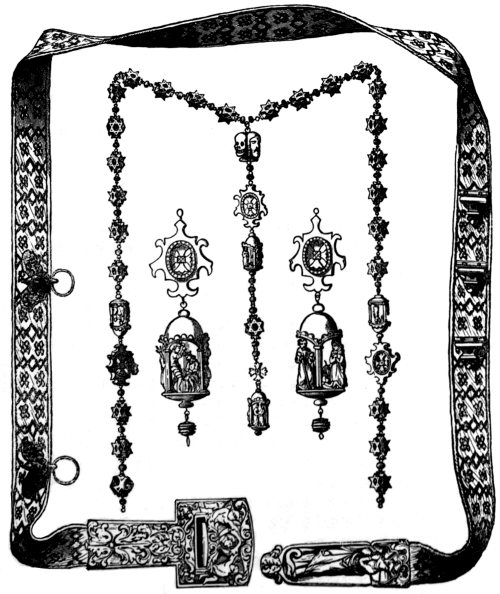
CARVED IVORY CHAPLET OF BEADS AND GIRDLE OF AN ABBESS:
SIXTEENTH CENTURY.
Another class of small works in ivory was to be found in England from
an early period, namely seals. Some have been preserved. One is in the
Ashmolean at Oxford; oval, of the archdeaconry of Merioneth, in the
thirteenth century; another, walrus ivory, of the abbey of St. Alban is
in the British museum.
Robert Fabyan the chronicler, in his will dated 1511 leaves to one of
his sons “that other signet of gold, with my puncheon of ivory and silver.”
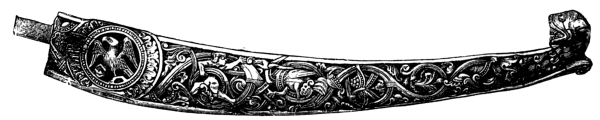
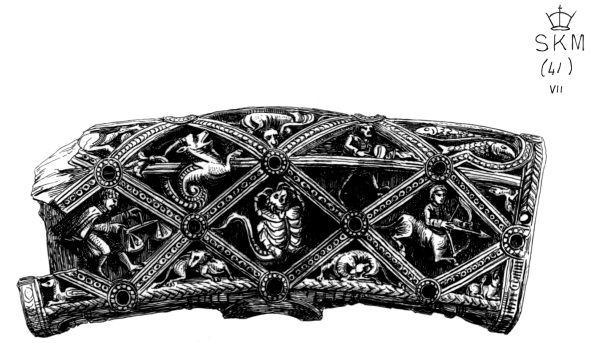
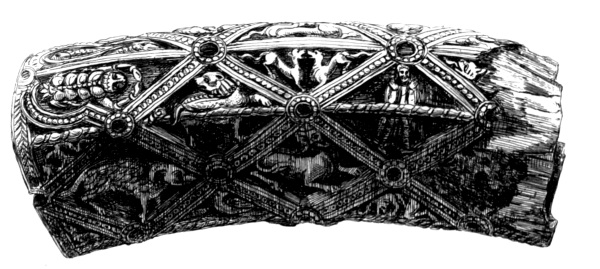
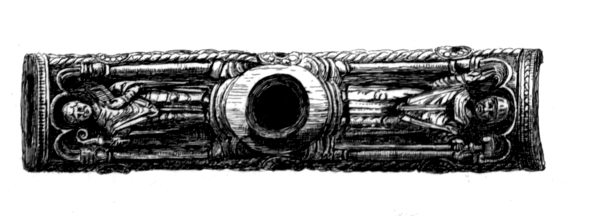
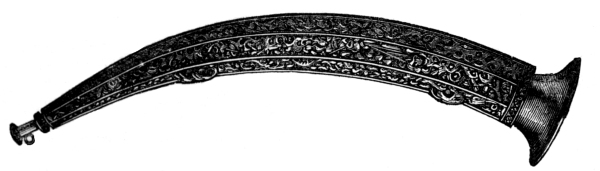
There are several very fine horns in the South Kensington collection,
more especially no. 7954, engraved in the accompanying woodcut, and
which is unequalled by any other of its kind known. The style and
workmanship are rare; one, probably by the same hand, was lately in
the possession of a noble English family. The horns which we find
frequently mentioned in mediæval wills and inventories are hunting
horns. For example, Sir John de Foxle in 1378 leaves to the king his
great bugle horn, ornamented with gold. “The ivory horn of St. Oswald
the king” was preserved at Durham in the year 1383. Near the end of the
thirteenth century there were two ivory horns kept in the treasury of
St. Paul’s: “Item, cornu eburneum gravatum bestiis et avibus, magnum.
Item, aliud cornu eburneum planum et parvum.”
A common term anciently in England for these horns was “olifant,”
from the name then usually given to the elephant; for instance, the
amusing story in the old life of St. Clement in Caxton’s Golden Legend:
“When Barnabe came to Rome prechynge ye fayth of Jesu Christ,
the philosophers mocked hym and despysed hys predicacyon and in scorne put
to hym this questyon sayenge, What is ye cause ye
culex whyche is a lytell beest hath vj. feet and two wynges and an
olyphaunte whyche ys a grete beest hath but foure feete and no wynges,”
etc. St. Barnabas replied that it was a foolish question and needed
no answer—the more especially as they knew not the Creator and must
necessarily, therefore, be ignorant about his creatures.
There is only one horn at South Kensington which can be regarded as
having been a tenure horn. It is possible that no. 7953 (see the
etching) may have been a horn of that kind. Several of these tenure
horns are still preserved in England and were shown in the loan
exhibition of 1862. Among them the most famous are the horn of Ulphus,
in the treasury at York; the horns given by Henry the first to the
cathedral at Carlisle; and the Pusey horn. The ivory hunting horn
(so-called) of Charlemagne is kept at Aix la Chapelle; and another said
to have been Roland’s in the cathedral at Toulouse.
It will be observed by those who examine the catalogue of the ivories
in the South Kensington museum that more are attributed to the
fourteenth century than to any other, and this would be correct with
regard also to the collection in the British museum, or at Liverpool,
or abroad. Sculpture in ivory was very general and greatly patronised
at that time; and, with the exception of a very few examples of Roman
art under the emperors, there are no carvings existing which equal
those made from about the year 1280 to 1350, either in truth and
gracefulness of design or in excellence of workmanship.
We find also in carvings of that period the best examples of the very
beautiful open or pierced work which has been already spoken of: and
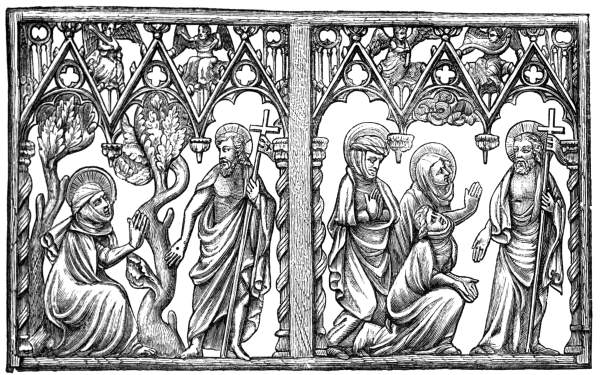
an illustration has before been given (p. 64) from a series
of small panels in the Meyrick collection. No apology will be required for
adding here two more woodcuts from ivories of the same character.
Both are engraved of the exact size of the originals.
One of these contains two compartments from the splendid plaque, no.
366, in the South Kensington collection.
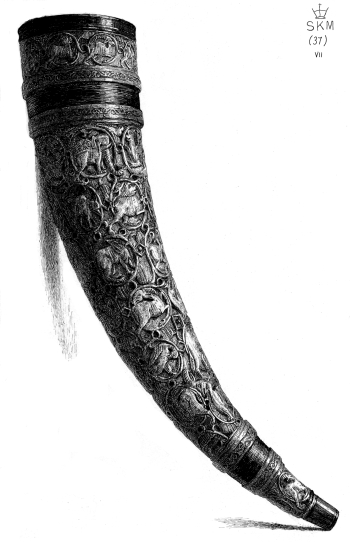
HORN OR OLIPHANT. IVORY. BYZANTINE. 11TH CENT.
25 IN. DIAM. 5½ IN. (SOLTIKOFF COLL.) S. K. M. (No 7953.-’62.)
A. A. BRADBURY. FECIT.
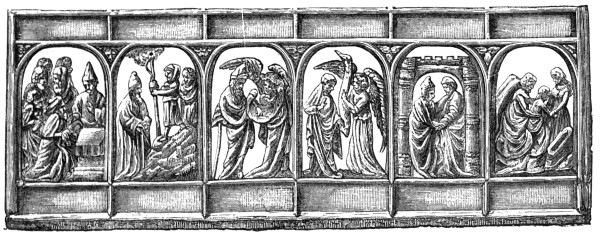
The other is a complete row from a book cover in the British museum:
divided into thirty compartments, each an inch by three quarters of
an inch. It is impossible in a woodcut to do more than attempt to
give some idea of the marvellous delicacy and excellence of the panel
itself, which is beyond all comparison the very finest ivory existing
of its peculiar school. Small, even minute, as the divisions are, they
plainly tell the story which each is intended to convey; although in
some of them there are as many as seven or eight figures, finished with
admirable distinctness and perfection. The subjects in this row are the
offering of St. Joachim; his departure into the desert; the message of
the angel to St. Joachim; the message to St. Anne; the meeting of St.
Joachim and St. Anne at the gate; and the birth of the Blessed Virgin.
The etching represents some beautiful panels in open work, at South
Kensington.
Nothing is more difficult than the determination of the particular
country in which many of the ivories of mediæval times were carved. All
acknowledge this, and they the most readily who have had the widest
experience and the best opportunities of examination. It has long
been a custom to set down almost every ivory of the thirteenth and
fourteenth centuries as Flemish or French, leaving but few except the
Italian marriage caskets to the credit of other countries. But (not
to speak of Germany) there can be no question that carvings in ivory
were then much sought after and bought in England, and that there must
have been numerous English artists. Two unquestionable examples of the
English school of the fourteenth century are in the British museum:
a triptych which was carved for Grandison, bishop of Exeter; and one
leaf of a diptych which was also made for the same great prelate, and
still retains slight traces of the painting of his coat of arms. A
woodcut is given (p. 117) of the single leaf. Generally, we
may agree with Sir Digby Wyatt, who says in the very interesting and able lecture
to which reference has been already made (p. 5), that “a peculiar
nez retroussé, a dimpled, pouting, and yet smiling mouth, a general
gentillesse of treatment, and a brilliant yet rapid mode of technical
execution, stamp the French work with an almost unmistakable character.
To the English style may be assigned a position midway between the
French and the second Italian manner. It does not exhibit the gaiety
and tenderness of the former, nor has it quite the grandeur of the
latter, but it is marked by a sober earnestness of expression in
serious action which neither of those styles possesses.” We may further
observe that the English school had less of the monotony and mannerism
which are the derogatory features of continental examples of the same
period; in fact, English gothic ivories have both a purity and a
variety of treatment on a par with the admirable characteristics of
contemporary architecture in this country.
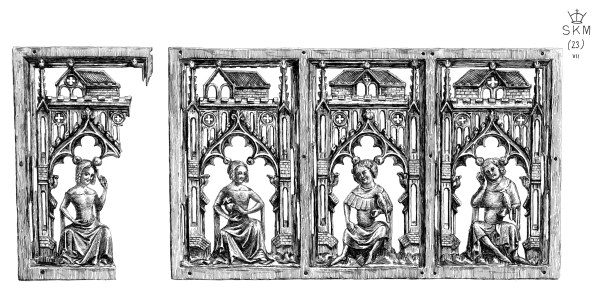
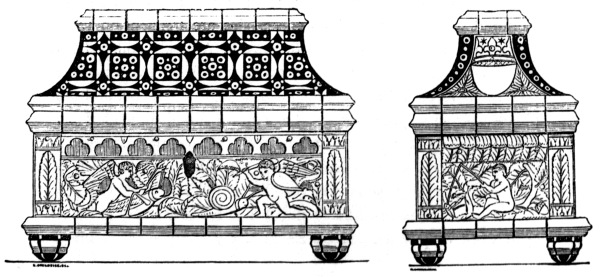
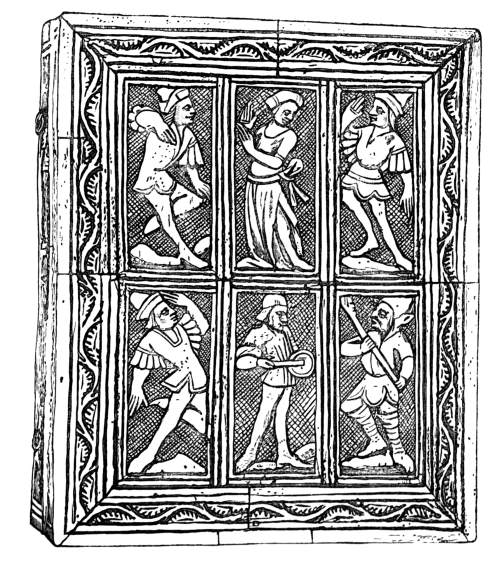
PLAQUES OR PANELS OF A CASKET, ONE A FRAGMENT, IVORY, FRENCH, 14th CENT.
S.K.M (N’284’342’67)F. A. SLOCOMBE FECIT.
The names of mediæval artists in ivory are almost entirely unknown.
Sir Digby Wyatt and Labarte say that they have been able to meet with
the name of one only, that of Jean Lebraellier, who was carver to
Charles V. of France, and is mentioned in the inventory of that monarch
as having executed “deux grans tableaux d’yvoire des troys Maries.”
We may venture to add the name of one other, the carver of a pax in
the British museum, Jehan Nicolle; whose work, unlike the “tables” of
Lebraellier, fortunately still exists. His name is incised upon the pax
in capital letters; there is also a shield, bearing a hammer behind two
crossed swords.
Very few Spanish ivories of the middle ages can be referred to, and
those which we possess have a very distinct Moorish or Arabic character
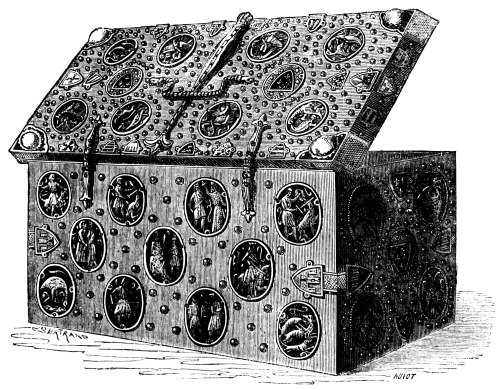
about them. They are generally caskets or boxes (see the etching), and
some are still to be found in the treasuries of churches in Spain.
Strangely enough, it is said that there are more remaining in the north
and north-west of Spain, where the Moors did not obtain any permanent
footing, than in the south; in Andalusia or Granada. Probably this
is owing not only to the circumstance that when taken to other parts
of the country they were regarded as valuable curiosities, but also
more especially because of the natural prejudice in the south against
keeping works of Moorish art and manufacture as reliquaries or pyxes,
or for any religious use. In the north of Spain there seems to have
been no obstacle in the way of enclosing relics of a Christian saint
in coffers upon which Arabic inscriptions had been carved in honour of
Allah and his prophet. But we must remember that these inscriptions
were in an unknown language.
Some of the ancient Spanish ivories are as old as the days of the
Cordovan caliphs in the ninth and tenth centuries; a fact which we
are now able to decide from the Arabic inscriptions. But where such
evidence is wanting there is scarcely any guide to direct us in fixing
the date: the ivories may have been carved at almost any time down to
the conquest of Granada by Ferdinand and Isabella. Moorish art, like
the Egyptian or Chinese, changed but little from age to age; the old
process and the old patterns were handed down, unaltered, from father
to son; and ivory carvings may have been made in various parts of Spain
by Moorish workmen as late even as the end of the sixteenth century.
It can scarcely be out of place, before we end, to add one word
of warning with regard to forgeries of ivory carvings. These are
sometimes so well done that even experienced persons might be deceived.
Generally, the period chosen for imitations is what is commonly called
the Carlovingian, or a little earlier; for not only are genuine pieces
rare and valuable, but being often coarse and rude in style are more
easily to be executed. Forgeries of consular diptychs have been
frequently made; and with regard to one of these it is well to place on
record the following facts which have been kindly supplied by Mr. A. W.
Franks, of the British museum.
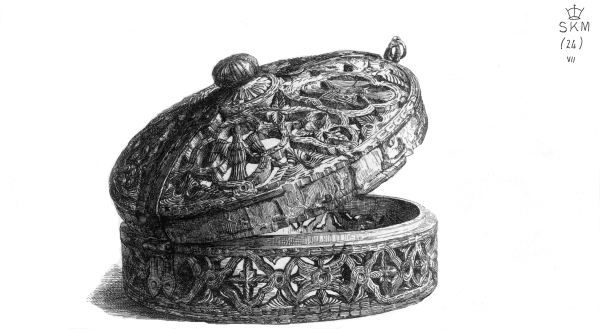
CARVED IVORY BOX, WITH ARABIC INSCRIPTION.
HISPANO-MORESCO. H 3 DIAM: 4 IN: ABOUT 961.
S.K.M.(No 217:65.)M. SULLIVAN FECIT.
“The leaf of the diptych of the consul Anastasius, now in the South
Kensington museum, was exhibited to the Society of antiquaries, March
10, 1864, and described by me in the proceedings of the society (2nd
series, vol. 2, p. 364) as the diptychon Leodiense. The
other leaf was known to have been for some years in the museum at Berlin.
It was therefore with considerable surprise that in the course of the
summer of 1864, I found exhibited in the Musée de la Porte de Hal
at Brussels a large ivory diptych purporting to be the diptychon
Leodiense. Having been asked by a friend at Brussels my opinion on the
recent acquisition of the Belgian government, I ventured to express
some doubts in the presence of a gentleman who proved to be at the head
of the commission, at whose recommendation the purchase had been made.
“I advised that the ivories should be taken out of the wooden frames
into which they were fixed, and that the inscriptions known to have
been on the genuine diptych should be sought for. On this being done,
the falsity of the diptych became evident, the ivory at the back being
fresh and not hollowed out for the reception of wax.
“An action was thereupon brought against the vendor, a dealer at Liége,
and after some delay the amount paid by the Belgian government (£800)
was recovered. The diptych had been copied from the engraving in
Wilthem’s work, and not from the original leaves, and this accounted
for various errors in the details.”
It seems strange that the Belgian authorities should have bought at so
great a sum ivories fixed in wooden frames, without some suspicion or
at least without examination. The Liége dealer, however, is not the
only one who has attempted impositions of this kind. About ten years
ago there were four or five large ivories, of splendid appearance,
in the hands of some London dealers. One was a triptych; another a
diptych; a third a comb; and a fourth was a huge shrine with folding
shutters and a tall richly decorated canopy, like the spire of a
cathedral, covering a statuette of the Virgin and Child. (The statuette
was probably genuine.) These ivories purported to be of the fourteenth
century but were all new, and out of one shop or manufactory. The
forgery in some respects was successful; but in every piece there was
a distinct character and manner of execution—the same exactly in all
of them—which proved their falseness. Several were traced back to a
dealer at Amiens; and it is not now known what has become of any of
them. The great shrine having been sold to an English collector for
£500 was returned; and not very long ago was still to be seen in a shop
window in the Strand and said to be, as if to make confusion worse
confounded, an ivory carving of the tenth century. This, whilst it
would show perhaps ignorance on the part of the possessor, would be an
argument that he might be innocent of knowledge of the forgery.
The public institutions in England in which important ivories may be
found are the British museum, the Ashmolean and Bodleian at Oxford, and
the museum given to the town of Liverpool with noble liberality by Mr.
Joseph Mayer. It is worthy of remark that scarcely any addition has
been made to the ivories in the Ashmolean since the time when they were
originally collected by Elias Ashmole nearly two hundred years ago; and
they are of especial interest and value, though not many in number,
because they can reasonably claim with scarcely an exception to be of
English workmanship. A very large proportion of the other three great
collections had also been gathered together before they became the
property of the nation. The Liverpool ivories were chiefly obtained
from the representatives of the late Gabriel Fejérváry; and, in like
manner, the South Kensington museum—begun about the year 1853 and
gradually enriched by the acquisition of some rare Spanish ivories
and some of the best pieces from the Soltikoff collection, selected
with excellent judgment by Mr. J. C. Robinson—has received from time
to time during the last four or five years many large and important
additions from the collection made by John Webb, Esq. More than
two-thirds of the ivories in the British museum, and certainly a large
number of the most valuable, had also been previously collected by a
private person.
THE END.
- PAGE
- Abbreviations of legends, 30
- Æsculapius and Hygieia, 32
- All large plaques not originally diptychs, 42
- Angel, on leaf of diptych, in British museum, 35
- Arm of chair, 82
- Artists in ivory, in middle ages, 117
- Ashmole collection, 120
- Assyrian ivories, 15
- Bardolph, hanged for stealing a pax, 92
- Becker’s Lycoris, 34
- Bellerophon, 21
- Book cover of ninth century, 48
- Casket of Arabic work, 57
- ” from Memphis, 14
- ” Runic, in British museum, 52
- ” from Veroli, 55
- ” in inventories, 60
- Caxton, “playe of the chesse”, 76
- Chair of St. Peter at Rome, 56
- ” at Ravenna, 41
- Chalice, &c., of ninth century, 48
- Charlemagne, his patronage of Greek artists, 45
- Chessmen, in chronicles and poems, 78
- ” earliest date, 78
- ” date of invention, 76
- ” in inventories, 79
- ” found in Lewis, 80
- Chryselephantine statues, 18
- ” of the duc de Luynes, 19
- ” conjectural restoration, 19
- Civilisation of ancient nations, 8
- Coffer, sent by Eginhard, 47
- ” in inventories, 57
- Colour in sculpture, 104
- Combs, domestic, 67
- ” in inventories, 71
- ” pontifical, 69
- Consul, decline of the office, 31
- ” the last, 31
- Consular diptychs, 23, &c.
- Costume in early Greek ivories, 44
- Crucifixes, 107
- ” in Spanish Place, 108
- Cup, or vase, in British museum, 46
- Cushions, the meaning in consular diptychs, 25
- David and Bathsheba on combs, &c., 67
- Decline of art in the first four centuries, 21
- ” after Constantine, 26
- ” after sixth century, 44
- Destruction of religious objects in the sixteenth century, 108
- Diptych of Boethius, 29
- ” at Brescia, 32
- ” of Compiegne, 30
- ” ecclesiastical, 37
- ” ecclesiastical—their purpose, 40
- ” with Greek inscriptions, 38
- ” mutilated and palimpsest, 39
- ” of Justinian, 38
- ” found in Transylvania, 23
- Domestic scenes, 67
- ” works in ivory, 52
- Draughtsmen, 81
- Dress and decorations of consuls on diptychs, 25
- Ecclesiastical works in ivory, 47
- Egyptian ivories, 14
- English ivories, 116, 120
- Etruscan ivories, 19
- “Familia” of chessmen, 79
- Feast of Fools, 33
- Fejérváry collection, 121
- Flabellum in inventories, 95
- ” of Theodolinda, 95
- ” its use, 94
- Forgeries in ivory, 118
- Fossil ivory, 2
- Grecian ivories, 16
- Handle of fan, 86
- ” of holy water sprinkler, 96
- ” of whip, 96
- Horns, for hunting, 113
- ” tenure, 114
- Iconoclast fanatics, 44
- Identification of consular diptychs, 26
- Importance of works in ivory, 22
- Improvement in art after seventh century, 45
- Ivory, African and Asiatic, 3
- ” its characteristics, 1
- ” mode of softening, 4
- ” much employed in 14th century, 114
- ” variations of colour, 5
- Jehan Nicolle, 117
- Jewish ivories, 13
- Jupiter, at Olympia, 19
- Ladies riding, 75
- Legends on consular diptych, coloured red, 26
- List of consular diptychs, 28
- Lycoris, described, 34
- Mammoth ivory, 2
- Manumission of slaves, 25
- Marriage caskets, 64
- Meyer collection, 120
- “Meyne,” its meaning, 79
- Minerva, of the Parthenon, 18
- Mirrors, 71
- ” in illuminations, 73
- Moorish ivories, 118
- Morris dancers, 68
- Nineveh ivories restored, 6
- Oliphant, explained, 113
- Open-work in ivory, 63
- ” other examples, 115
- Pastoral staff, with inscription, 88
- ” not used by the Pope, 89
- ” of great rarity, 90
- ” of St. Bernard, ordered in Sarum pontifical, 89
- ” of wood, 87
- Pausanias, account of Greek statues, 17, 18
- ” believed ivory to be horn, 19
- Pax inscriptions, 93
- ” inventories, 93
- ” late use in England, 94
- ” ordered in Sarum missal, 91
- ” its use, 91
- ” why disused, 93
- ” of wood, 93
- Pietà, of Michael Angelo, 103
- ” in British museum, 102
- Plaques of ivory, large size, 3
- ” not originally diptychs, 42
- Prehistoric ivories, 6
- Pugillares, 109
- Pyx, in inventories, 57
- ” of St. Mennas, 60
- ” various uses, 60
- Ravenna chair, 41
- Retable of Poissy, 65
- Roman ivories, 21
- ” ivory sculptors exempt from certain obligations, 21
- Romance of the Rose, 63
- ” subjects, 62
- Seals in British Museum, 111
- ” illustrating statuettes, 98
- Serpent, as an emblem, 85
- Shrine, explained, 51
- ” in illuminations, 99
- Siege of the Castle of Love, 74
- Spanish ivories, 118
- Statuette, coloured, 105
- Statuette in inventories, 100
- ” the largest known, 101
- ” opening on hinges, 100
- ” under canopies, 98
- ” very fine examples, 97
- Style of English art, 116
- “Symmachorvm,” the omitted word, 35
- Tabernacles, at Lincoln, 99
- Tables explained, 111
- Tablets of Moutier, 34
- ” of Sens, 32
- ” for writing on, 109
- “Tan-tabl,” its meaning, 81
- Tau, explained, 84
- ” rarity, 85
- Toreutic, its meaning, 17
- Triptychs explained, 51
- ” in illuminations, 99
- ” mentioned by Anastasius, 51
- Tusks, size and weight, 4
- Veroli casket, probable date, 55
- Volute, with double subject, 87
- Webb collection, 121
- Whip-handles, 96
CHARLES DICKENS AND EVANS,
CRYSTAL PALACE PRESS.
Transcriber's Notes:
The cover image was created by the transcriber, and is in the public domain.
Antiquated spellings or ancient words were not corrected.
The illustrations have been moved so that they do not break up
paragraphs and so that they are next to the text they illustrate.
Typographical errors have been silently corrected but other variations
in spelling and punctuation remain unaltered.
The "LIST OF FULL PAGE PLATES" was added by the transcriber it is not
part of the original text.