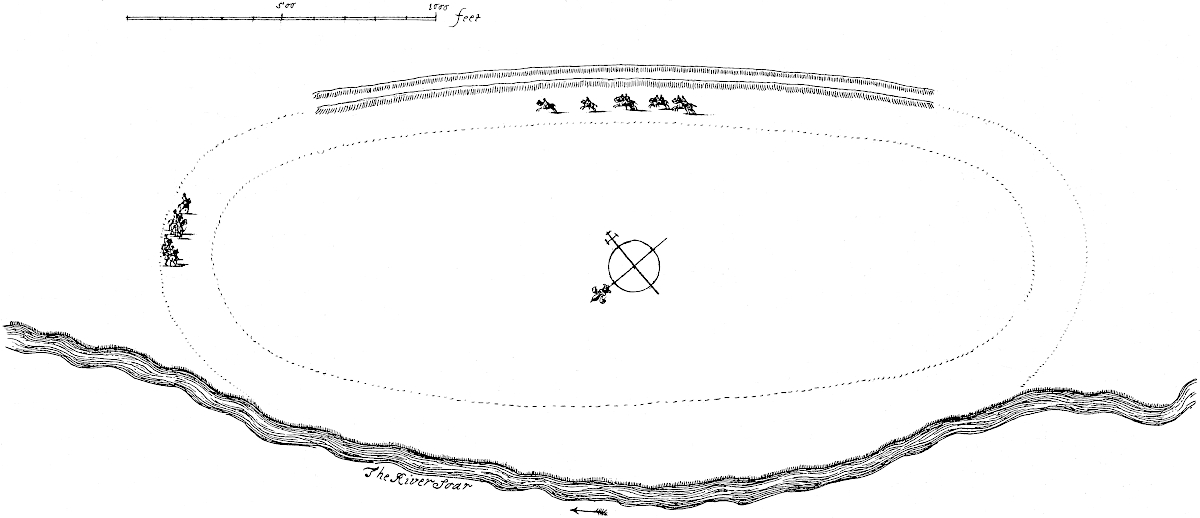
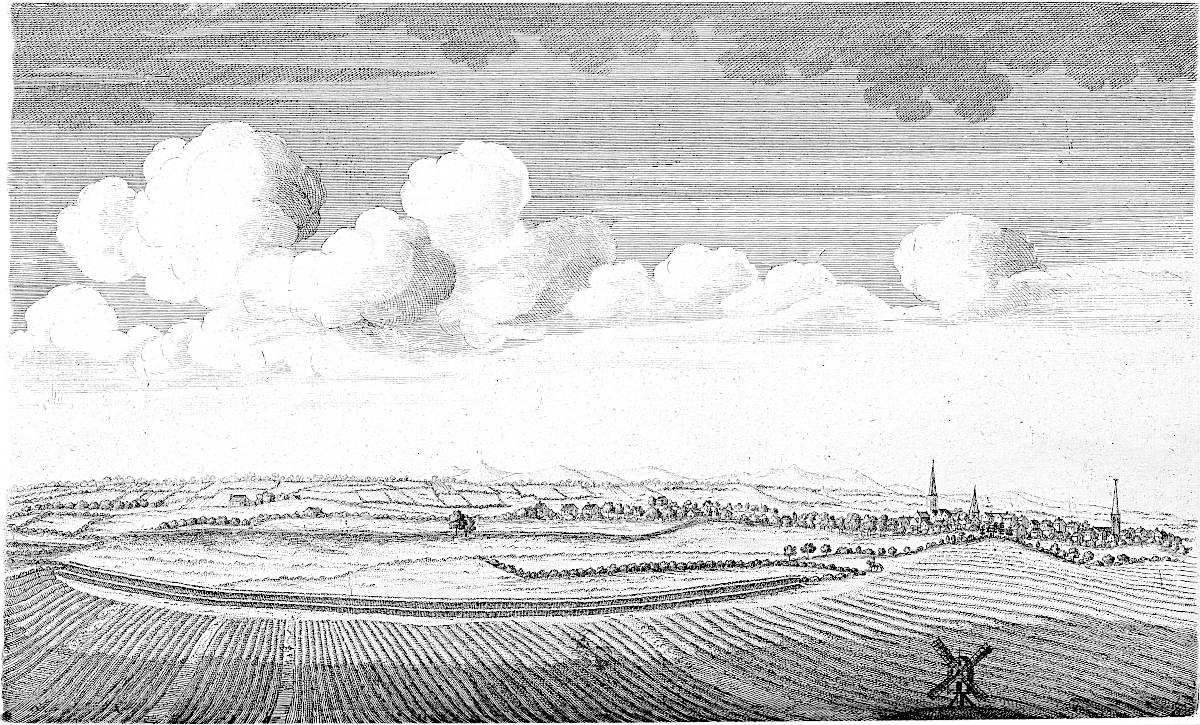
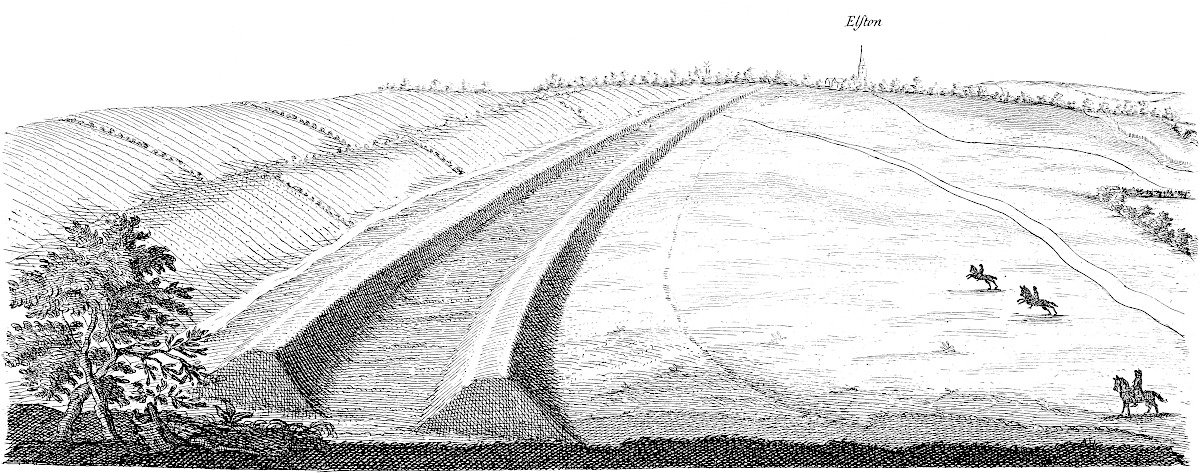
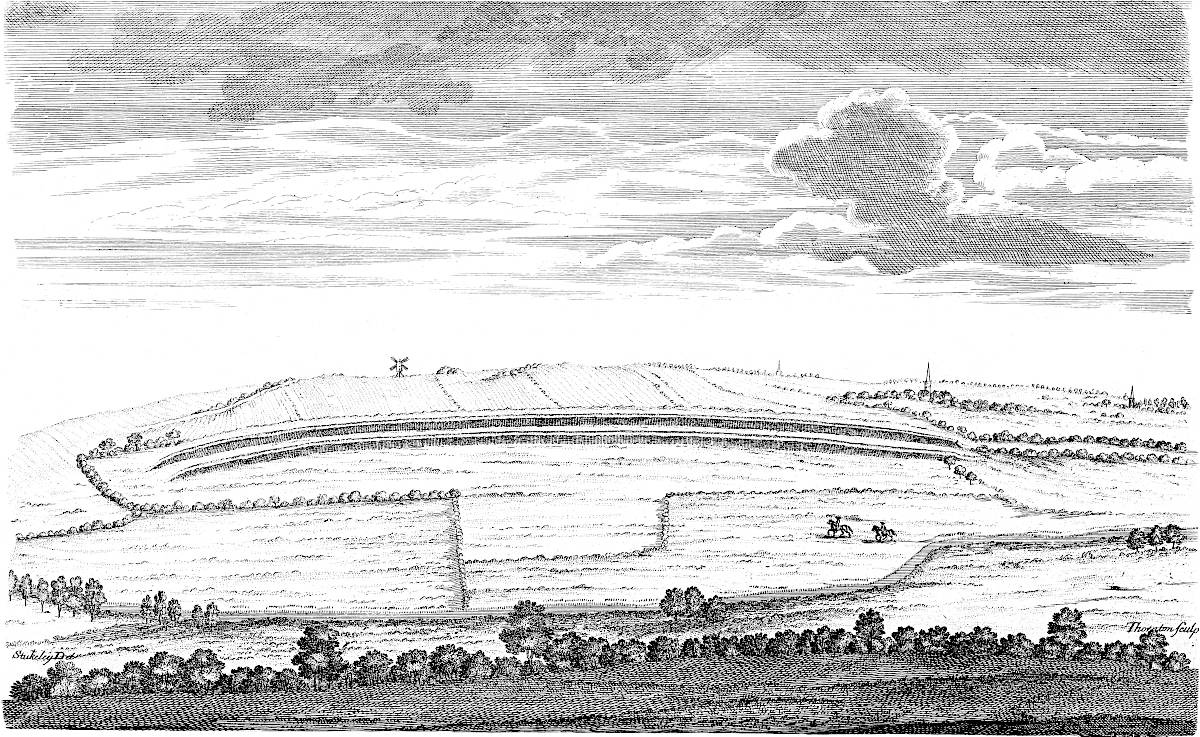
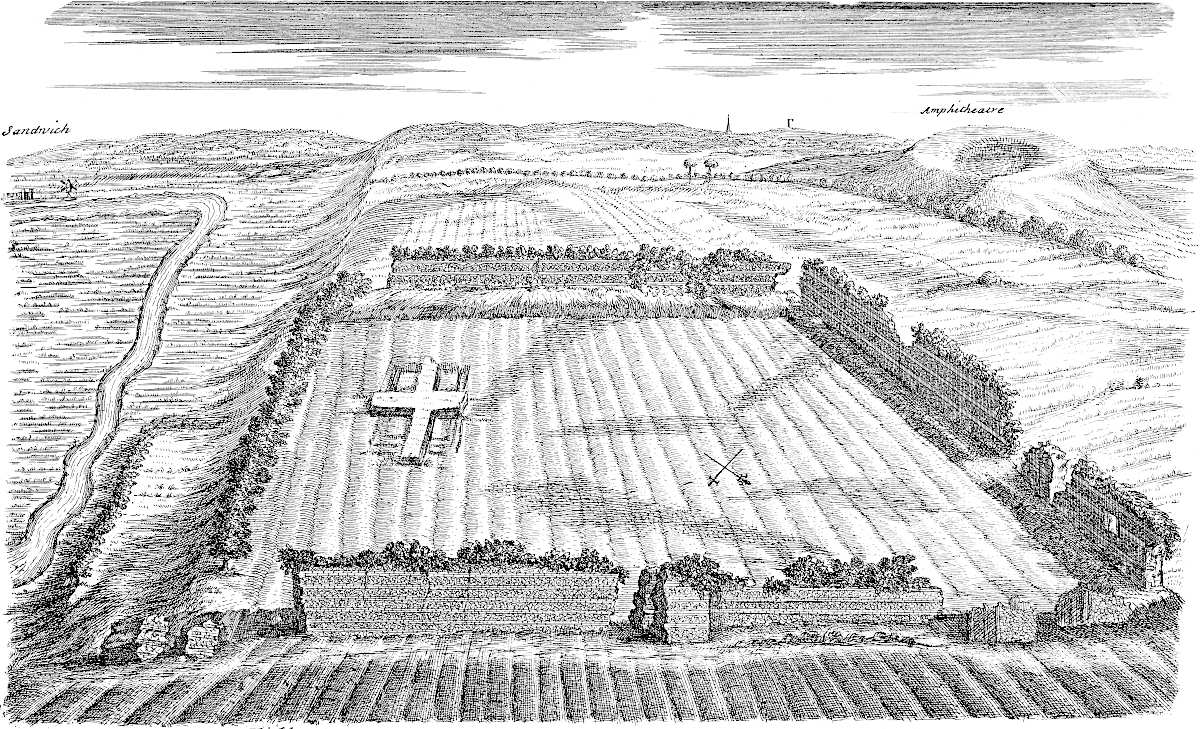
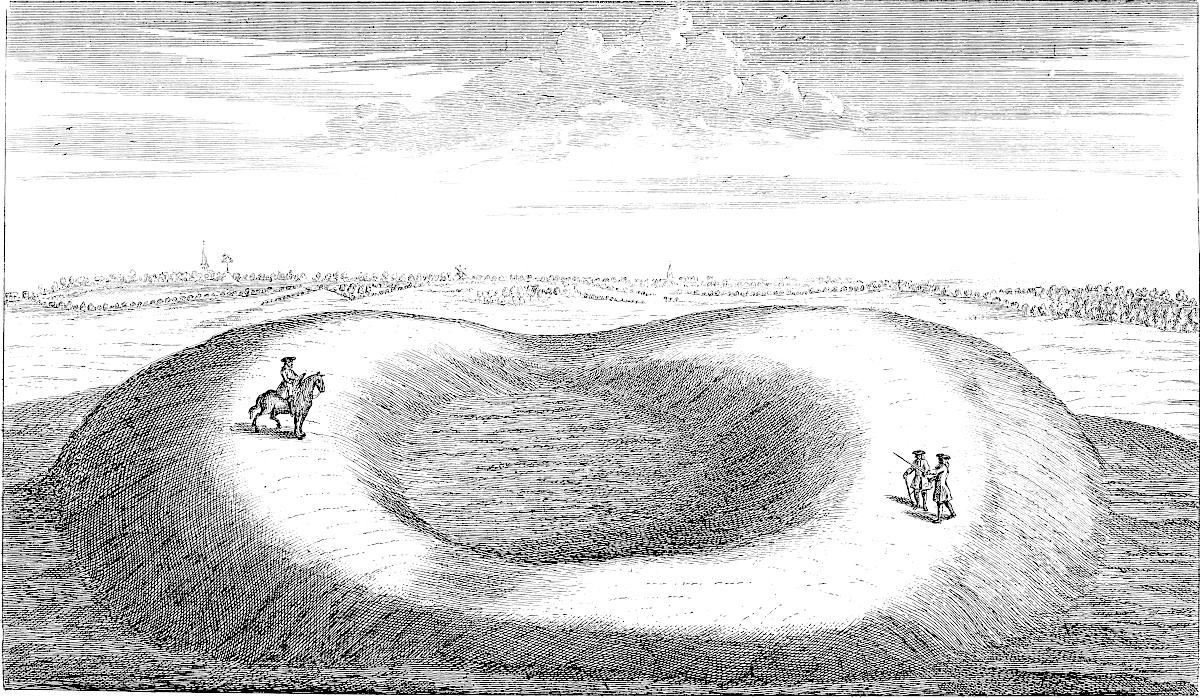
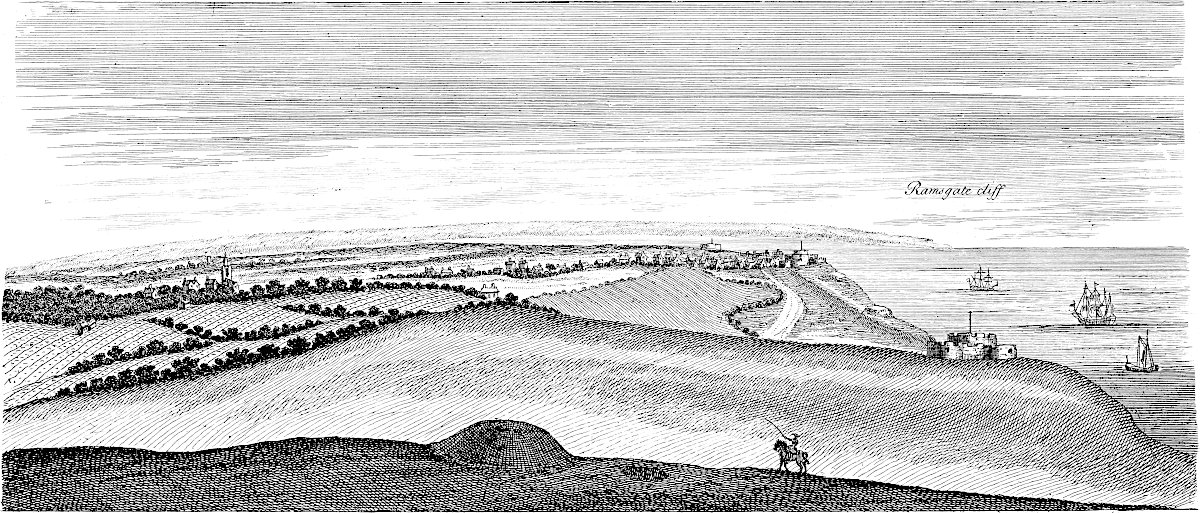
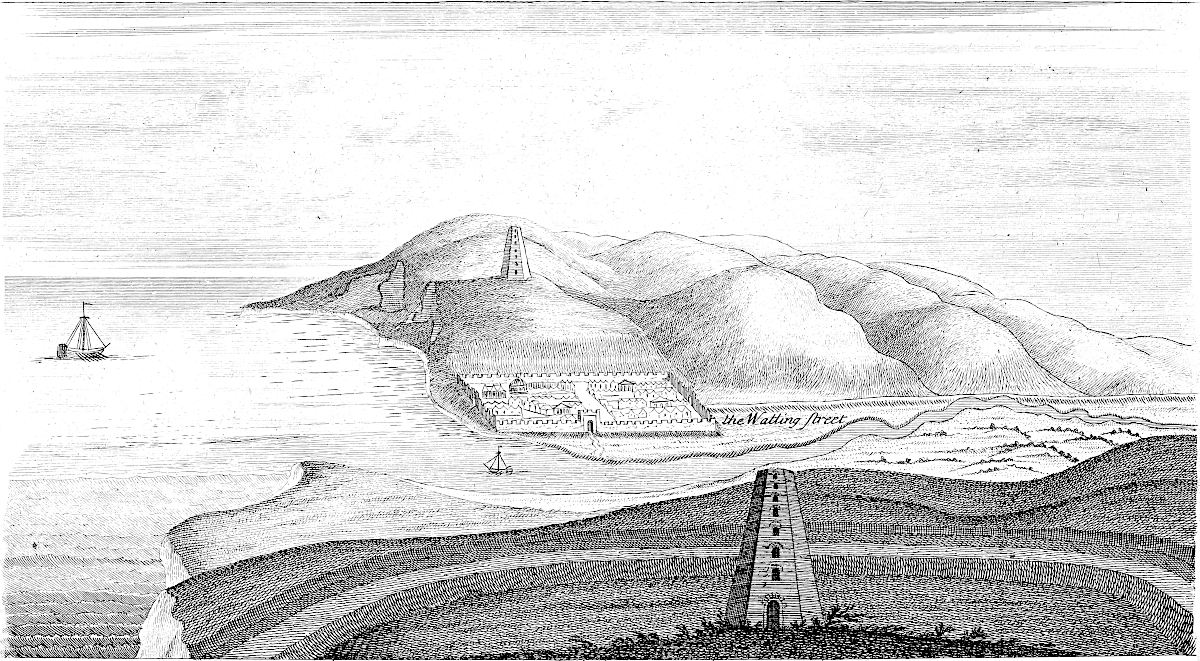
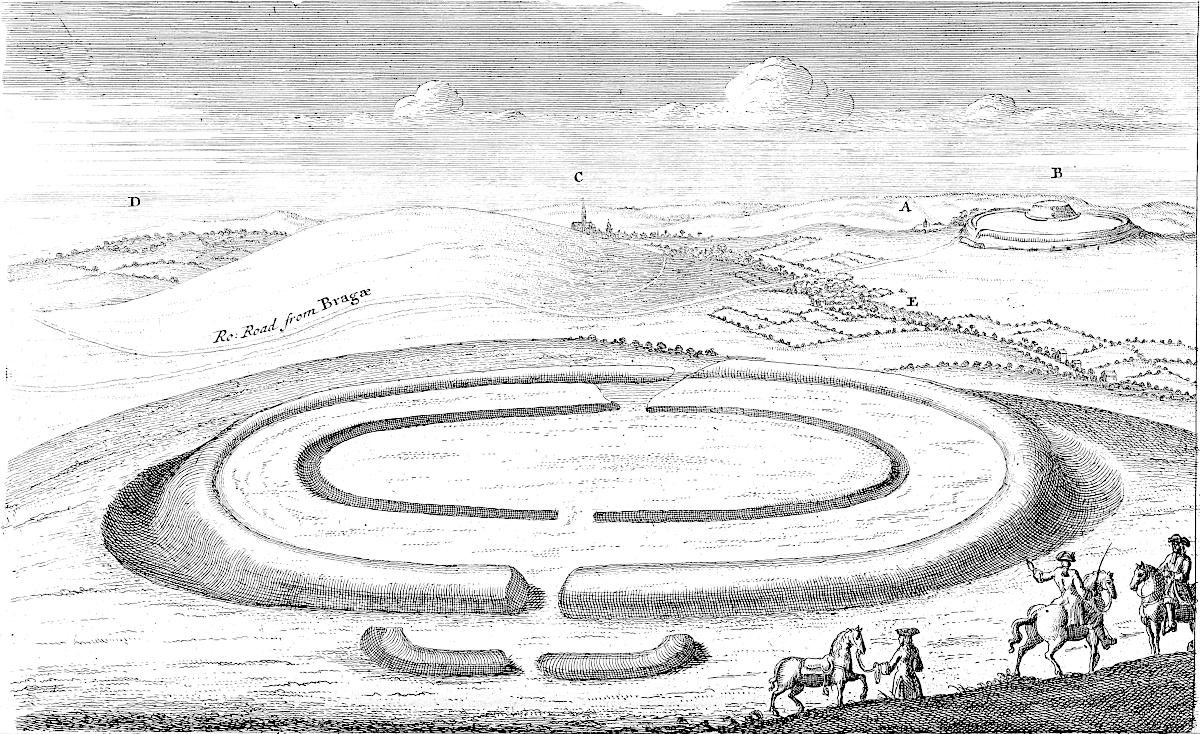
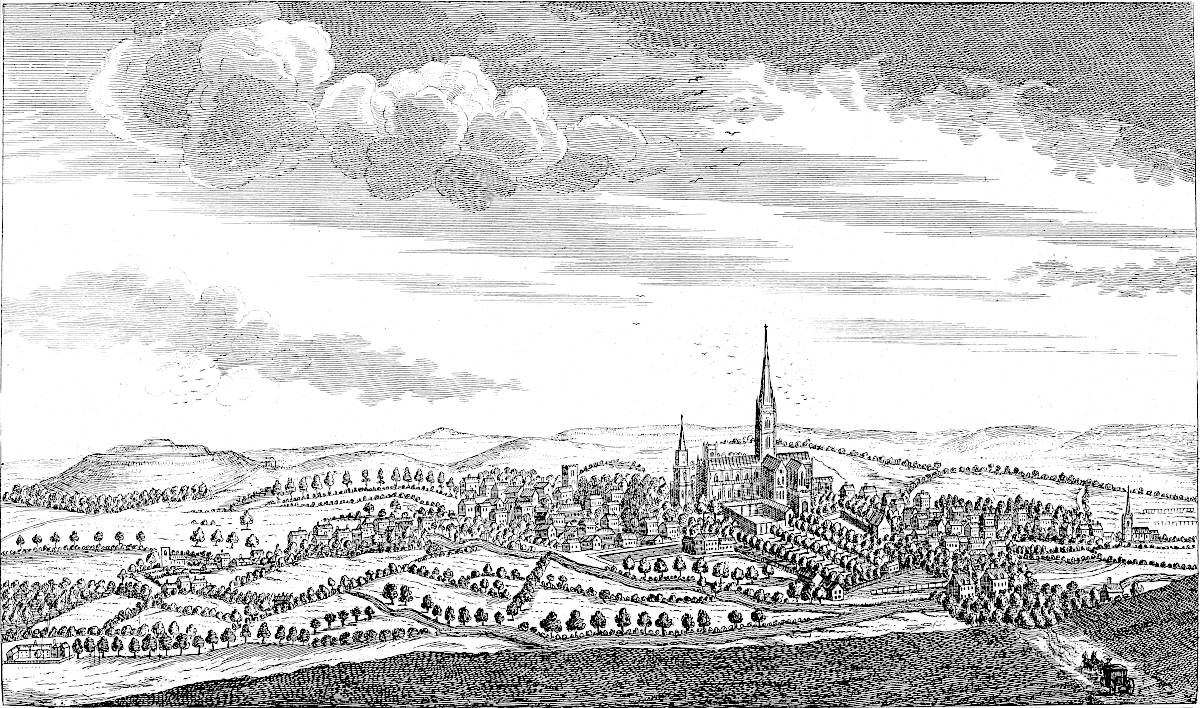
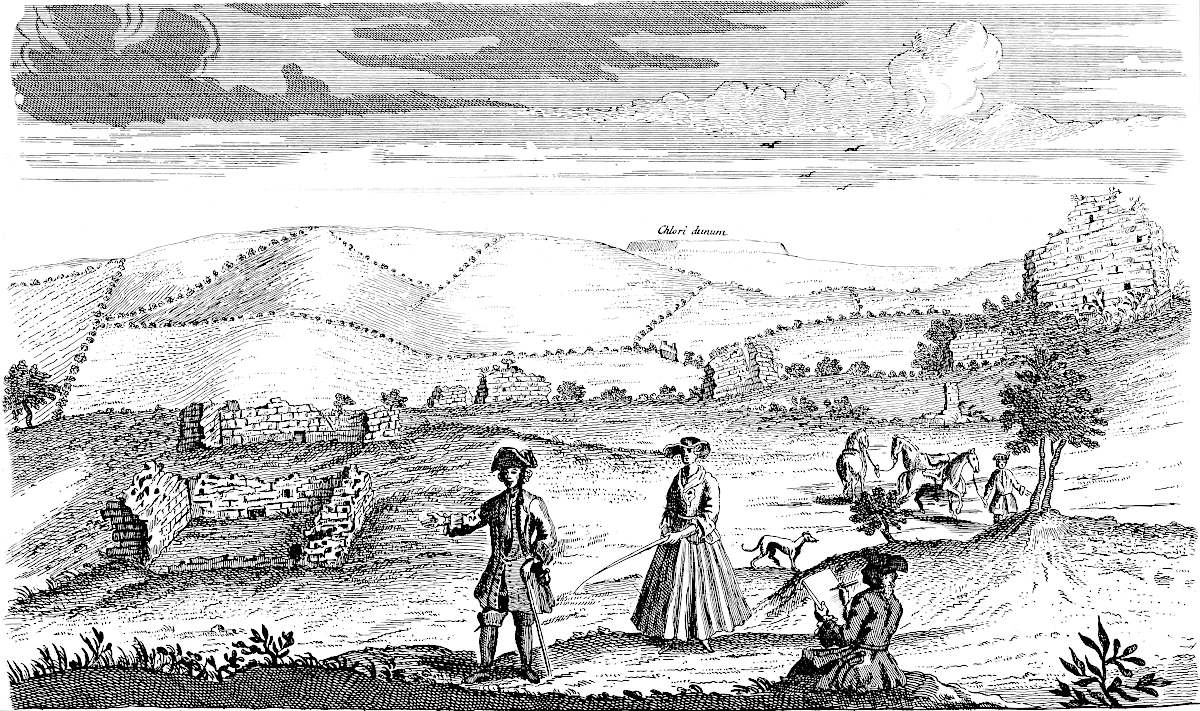
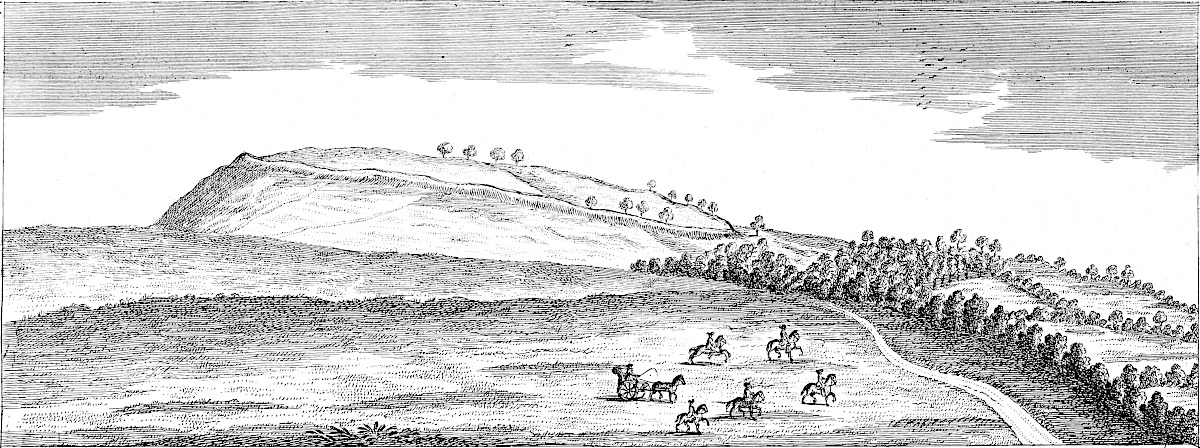
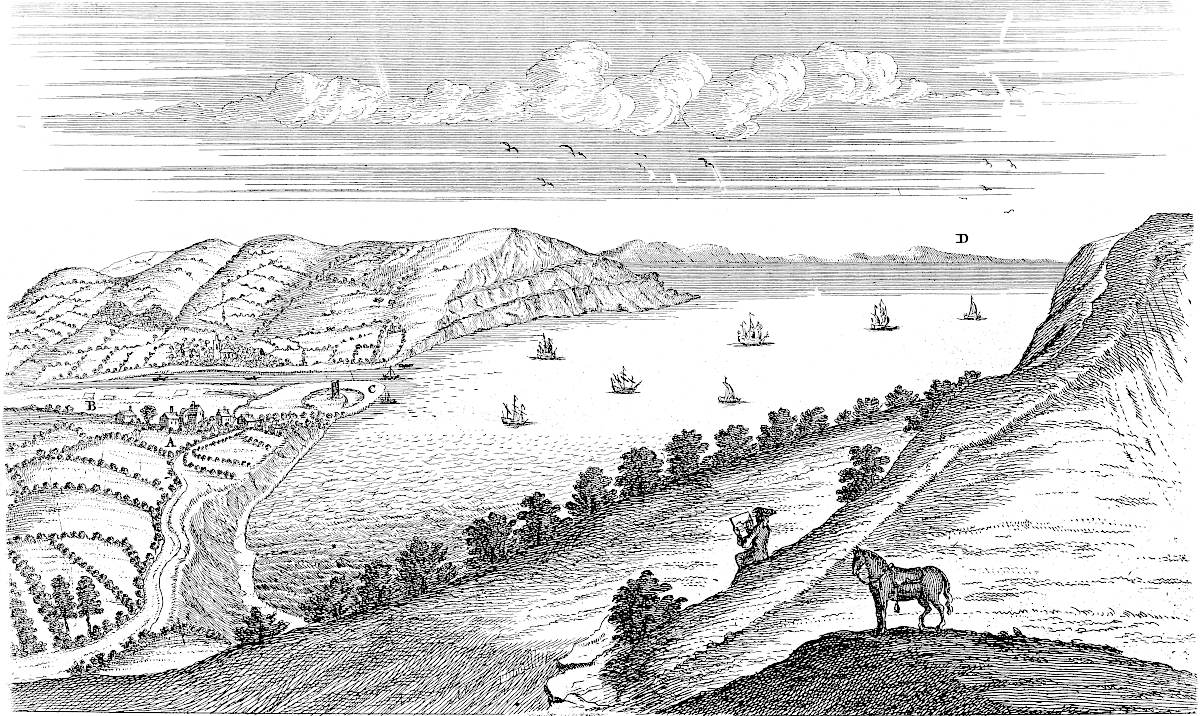
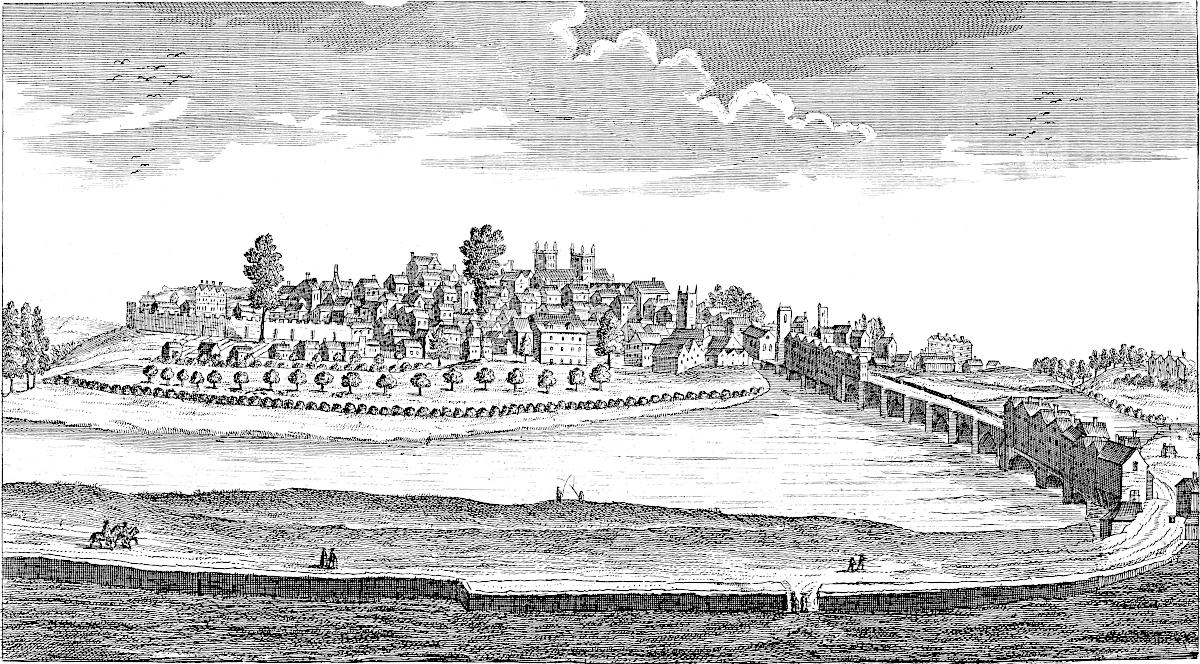
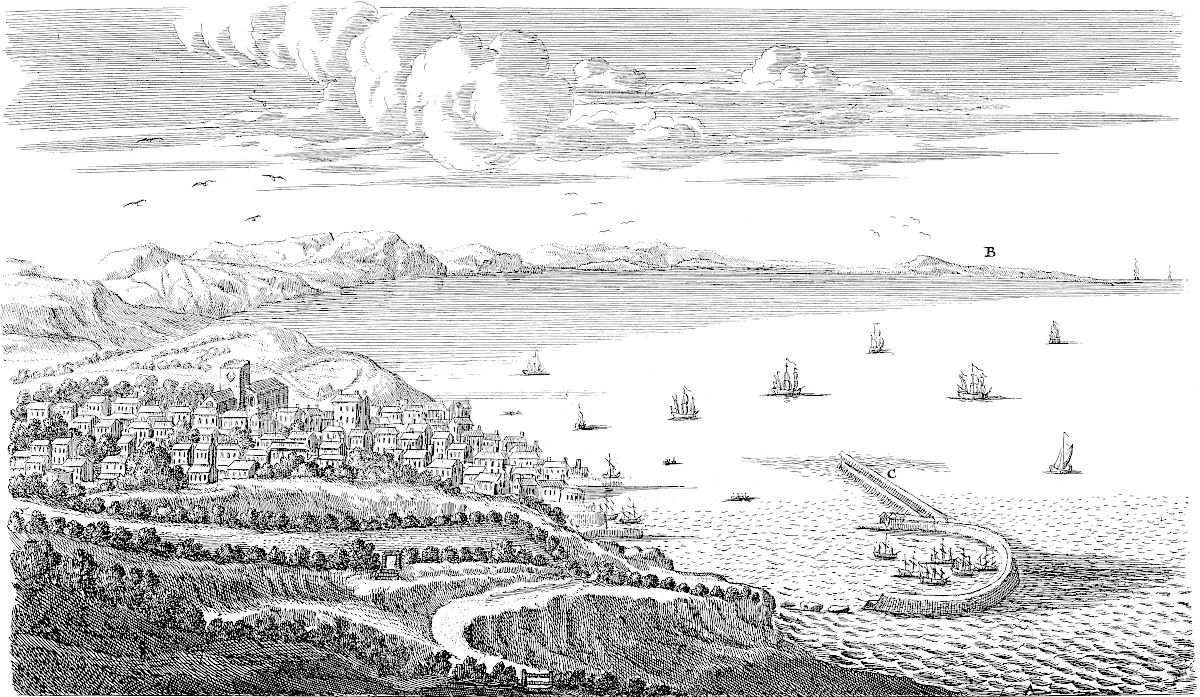
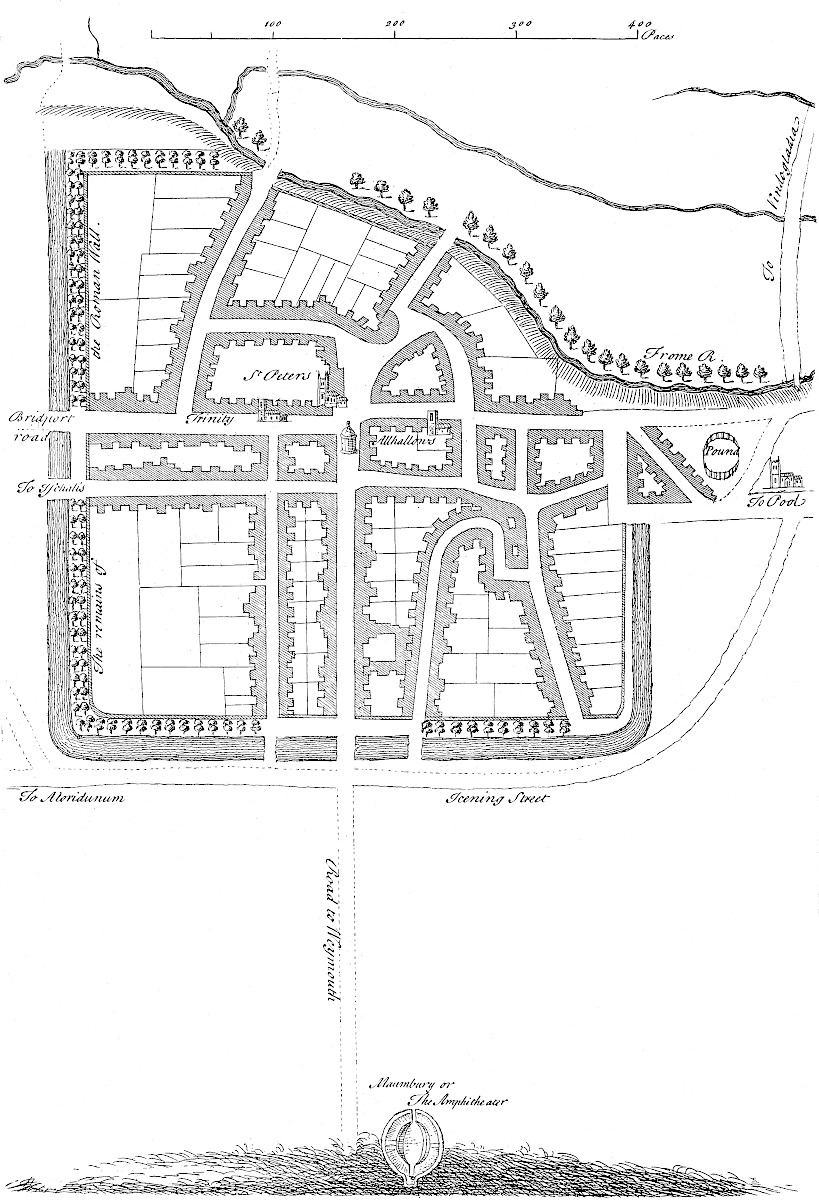
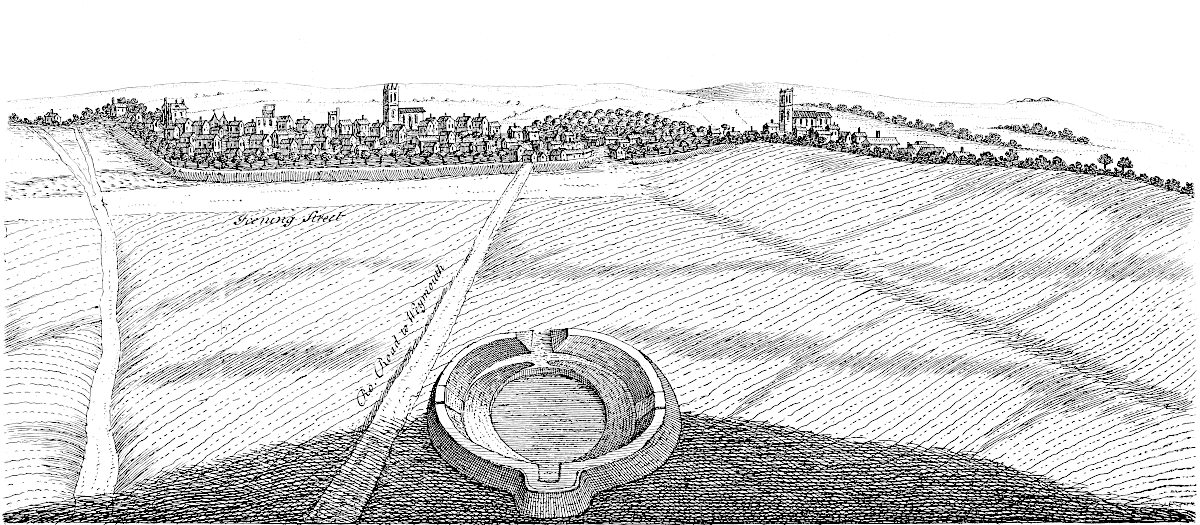
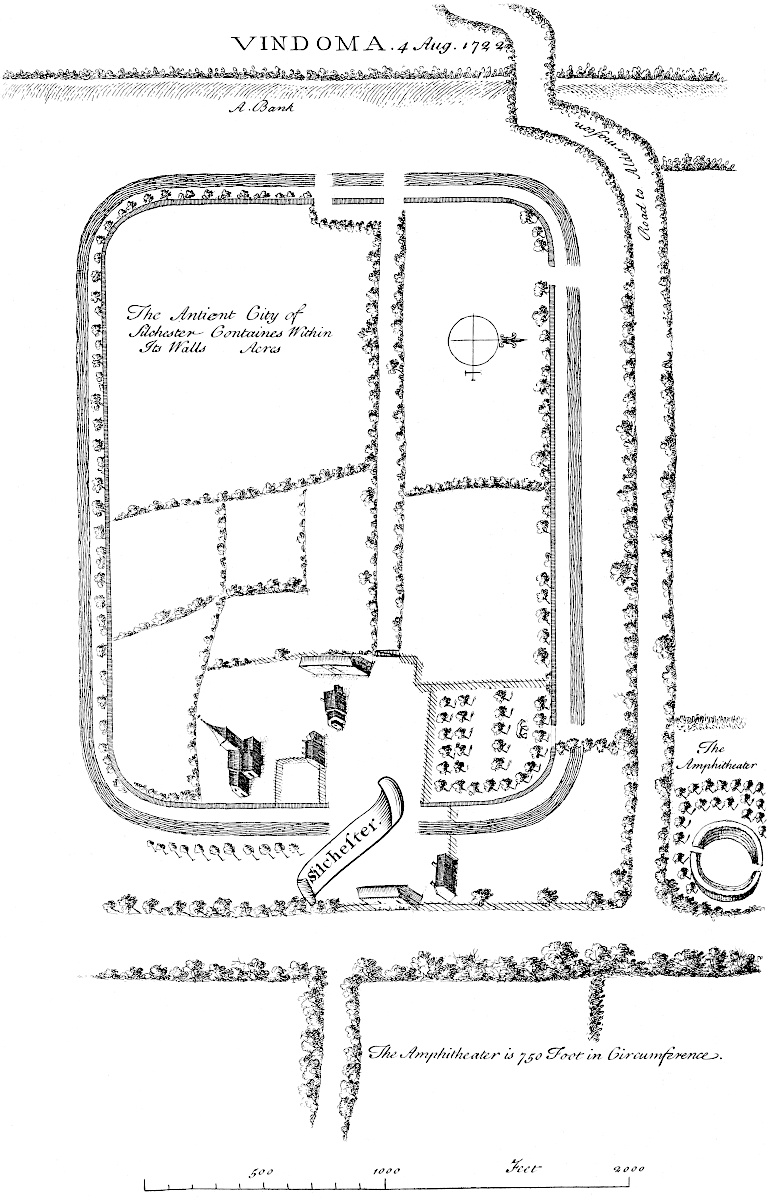
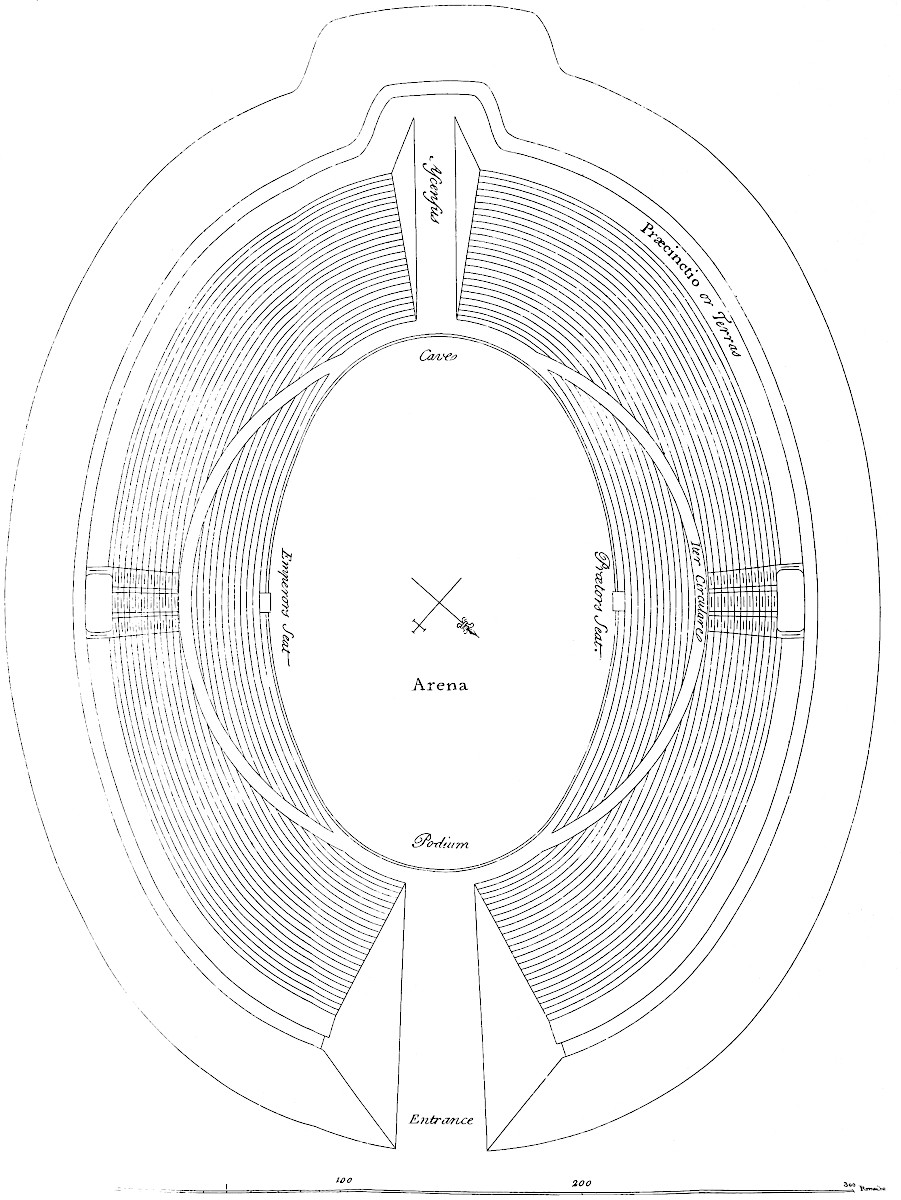
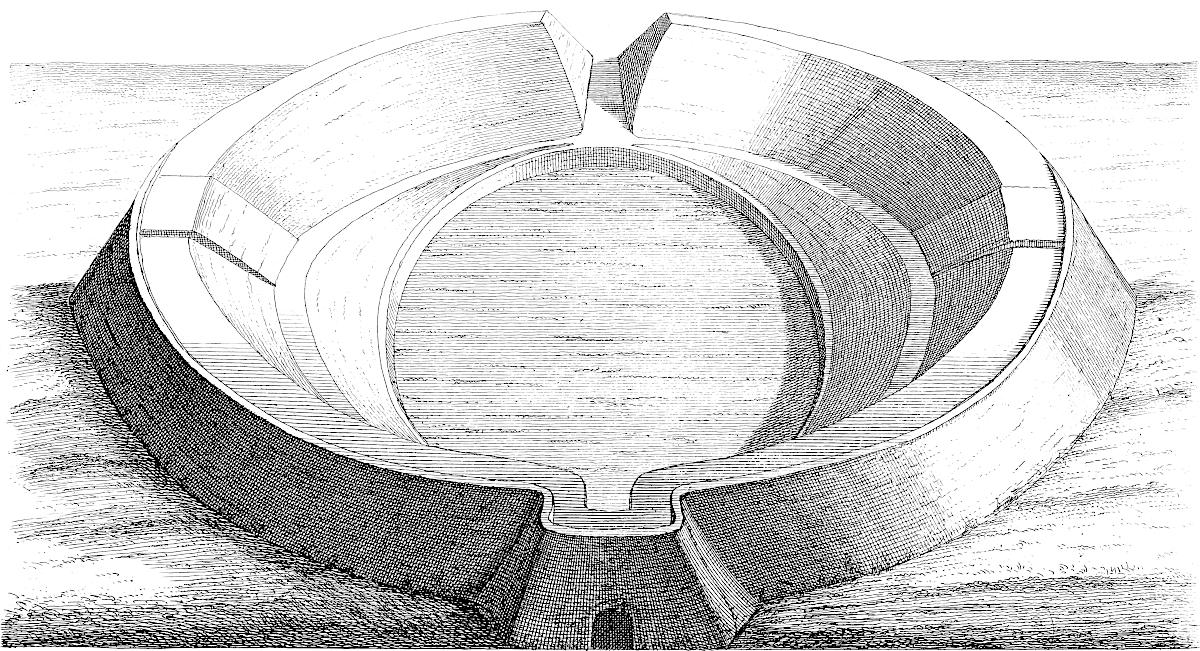
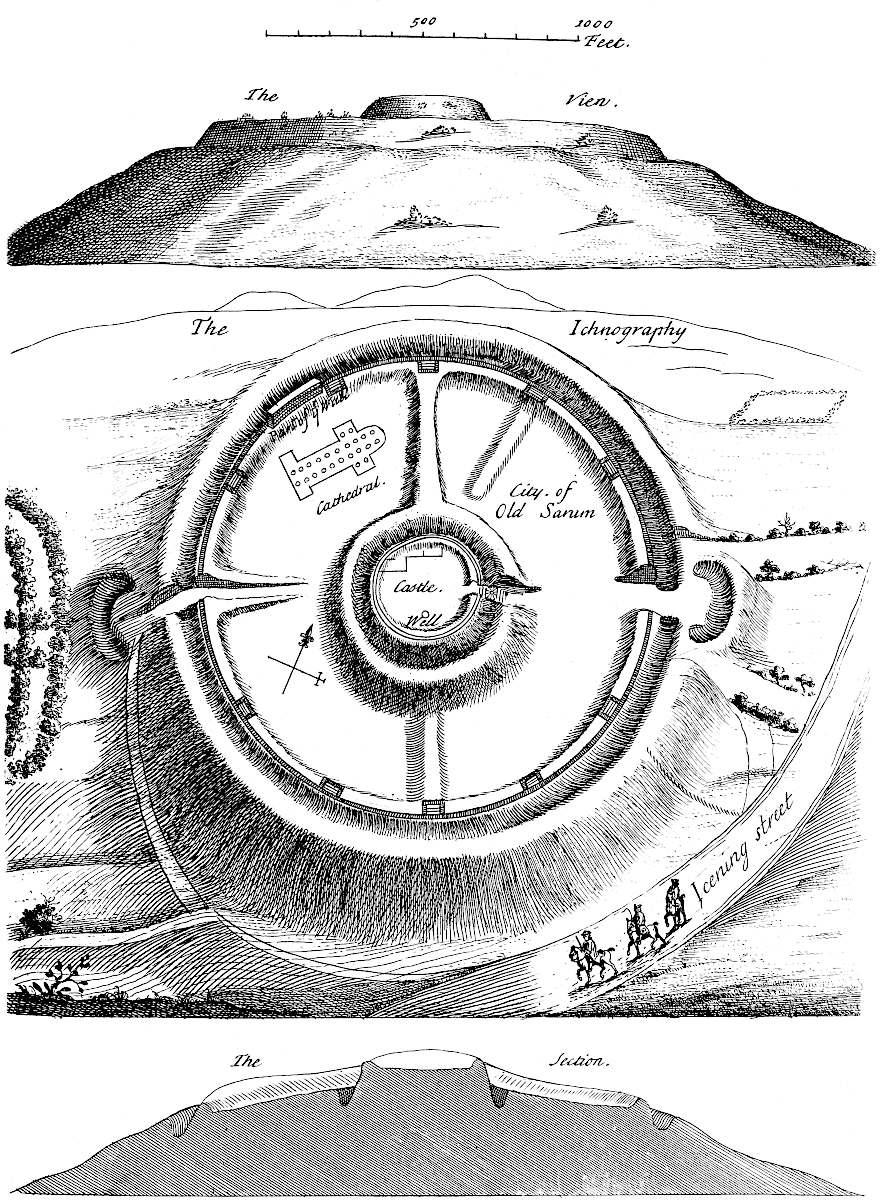
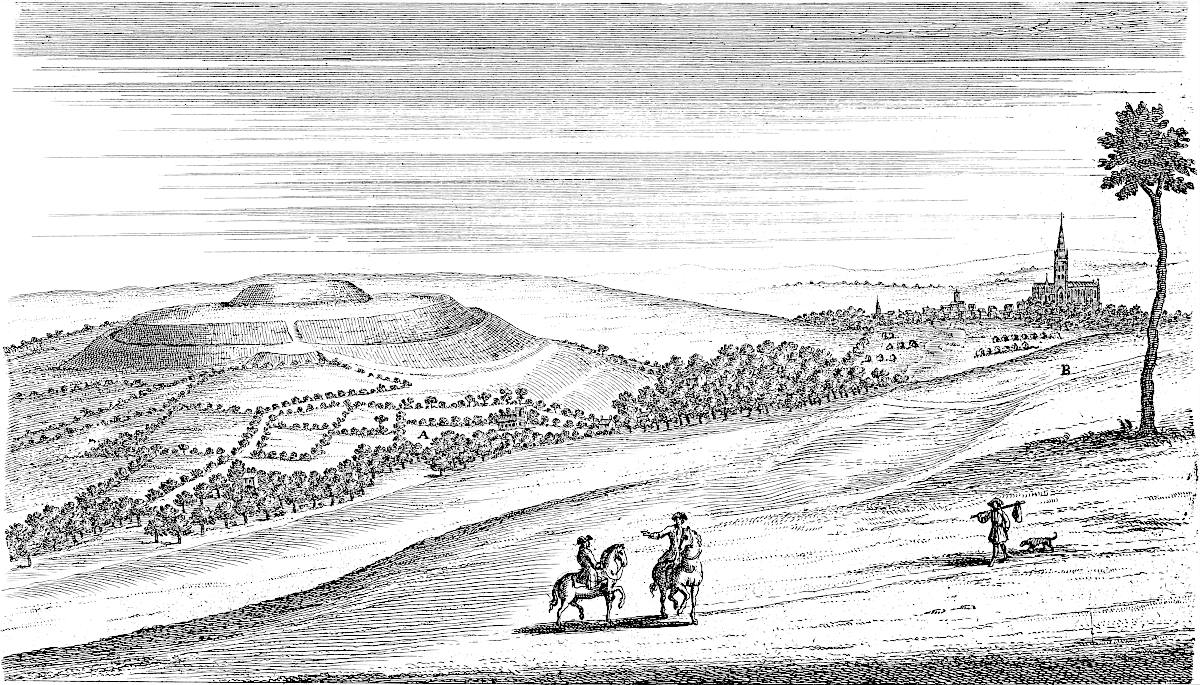
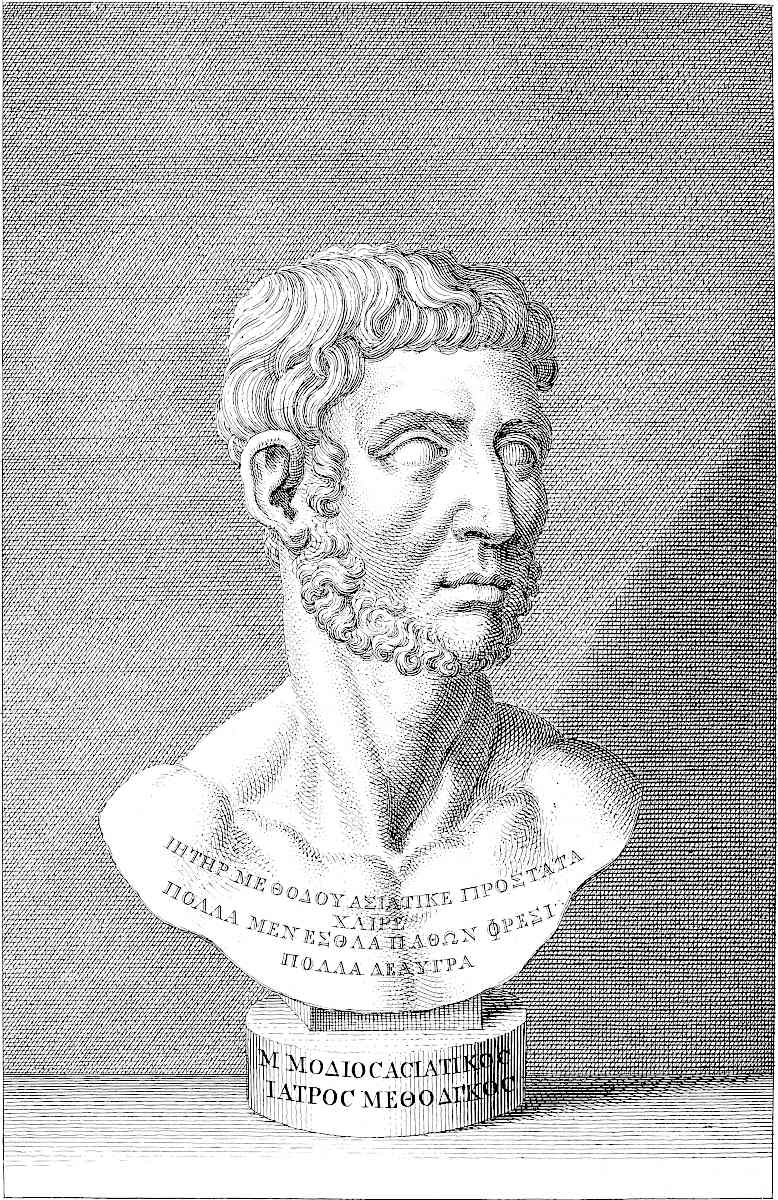
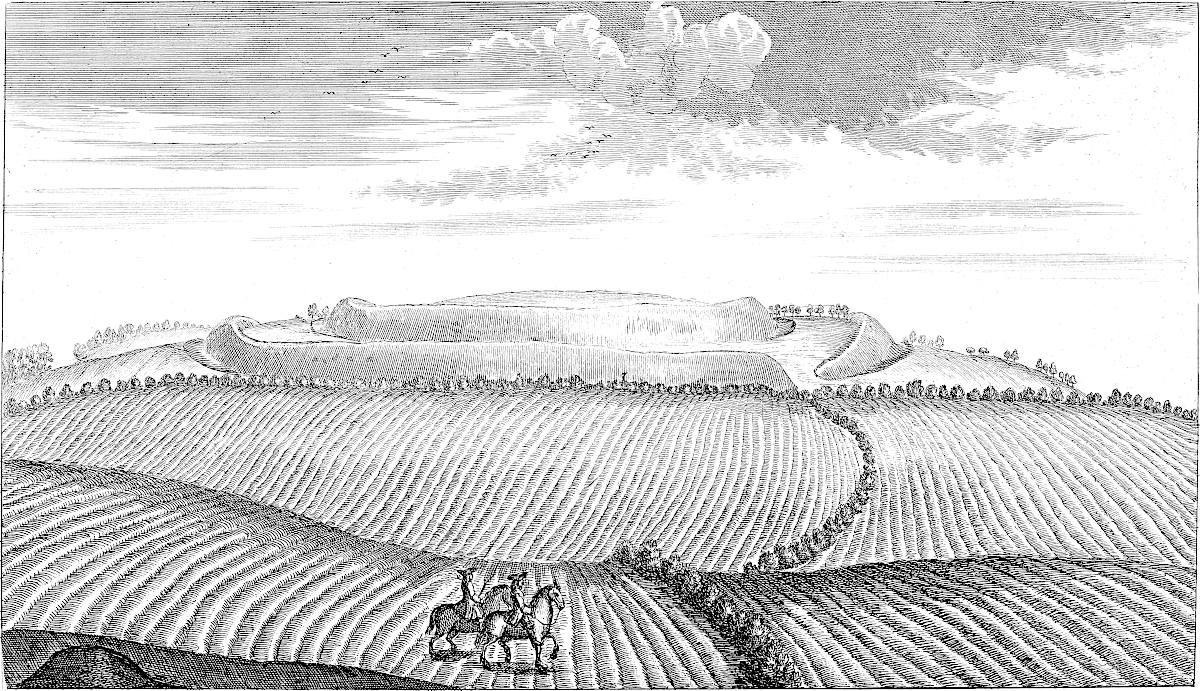
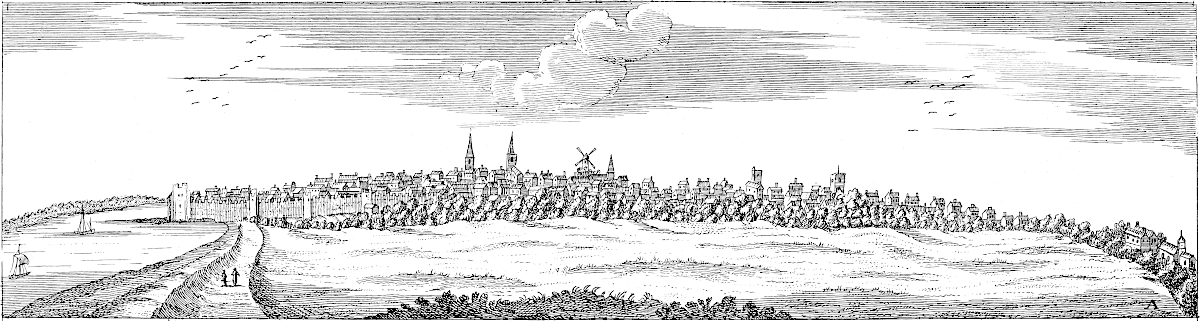
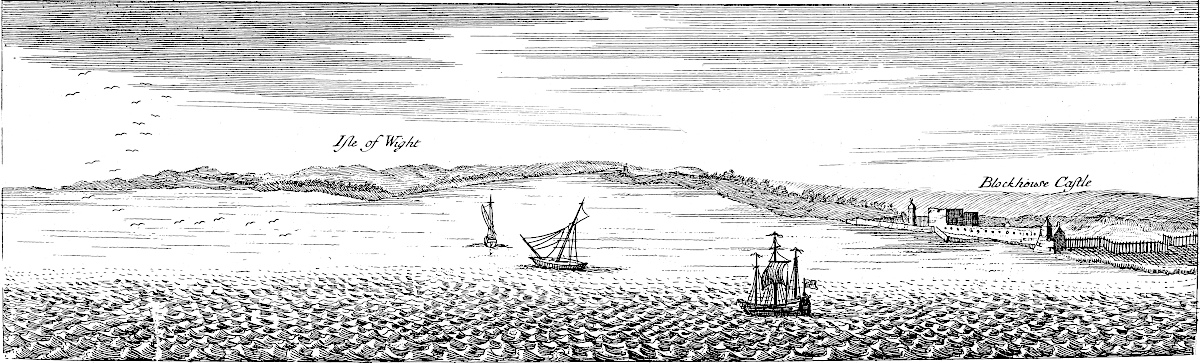
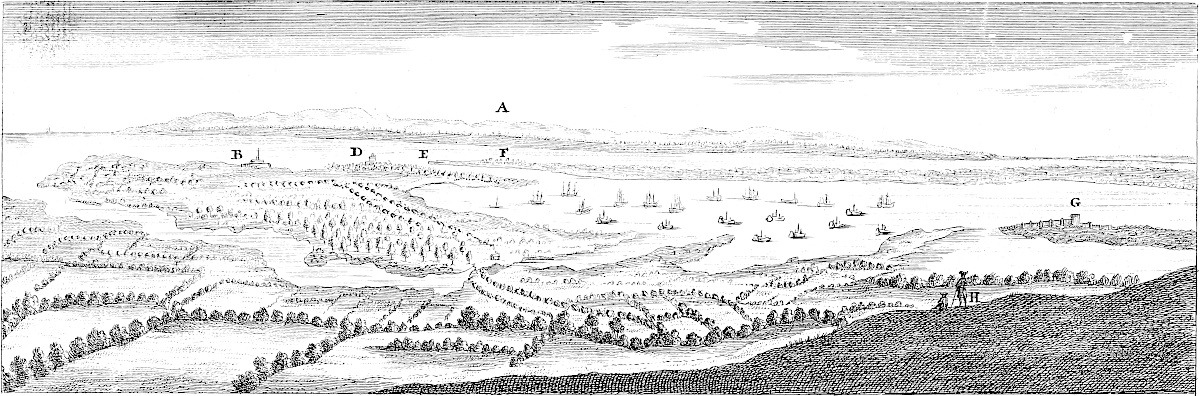
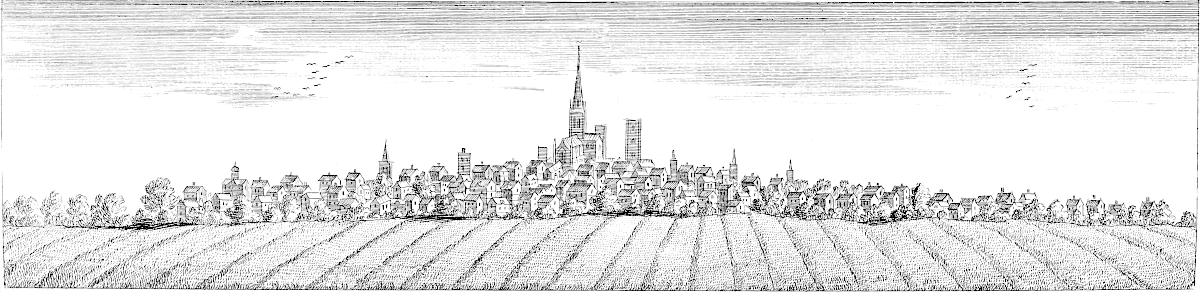
ITINERARIUM CURIOSUM : OR , AN ACCOUNT OF THE ANTIQUITIES , AND REMARKABLE CURIOSITIES IN NATURE OR ART , OBSERVED IN TRAVELS THROUGH GREAT BRITAIN . — Table of Contents. — PREFACE .
Transcriber’s Notes:
A table of contents has been added.
Blank pages have been removed.
Obvious typographical errors have been silently corrected.
Font 'Old English Text MT' is recommended to view blackletter text.
Some illustrations with internal text have "See transcription" links to the text at the end of the book.
Family tree illustrations have "See transcription" links to tables with the transcribed text, in approximate arrangement.
Errata from Vol. II. have been applied.
There is no plate #56.
Stukeley delin.
Itinerarivm. Cvriosvm. Centvria. i.
ILLUSTRATED WITH COPPER PLATES.
CENTURIA I.
THE SECOND EDITION, WITH LARGE ADDITIONS.
By WILLIAM STUKELEY, M.D. F.R. & A.S.
O Patria, O Divûm domus, Albion, inclyta bello!
O quam te memorem, quantum juvat usque morari
Mirarique tuæ spectacula plurima terræ!
LONDON:
Printed for Messrs. Baker and Leigh,
in York-Street, Covent-Garden. M.DCC.LXXVI.
THE intent of this Treatise is to oblige the curious in the Antiquities
of Britain: it is an account of places and things from inspection, not
compiled from others’ labours, or travels in one’s study. I own it is a
work crude and hasty, like the notes of a traveller that stays not long
in a place; and such it was in reality. Many matters I threw in only
as hints for further scrutiny, and memorandums for myself or others:
above all, I avoided prejudice, never carrying any author along with
me, but taking things in the natural order and manner they presented
themselves: and if my sentiments of Roman stations, and other matters,
happen not to coincide with what has been wrote before me; it was
not that I differ from them, but things did not so appear to me. The
prints, beside their use in illustrating the discourses, are ranged in
such a manner as to become an index of inquiries for those that travel,
or for a British Antiquary. I shall probably continue this method at
reasonable intervals. The whole is to invite Gentlemen and others in
the country, to make researches of this nature, and to acquaint the
world with them: they may be assured, that whatever accounts of this
sort they please to communicate to me, they shall be applied to proper
use, and all due honour paid to the names of those that favour me with
a correspondence so much to the glory and benefit of our country, which
is my sole aim therein.
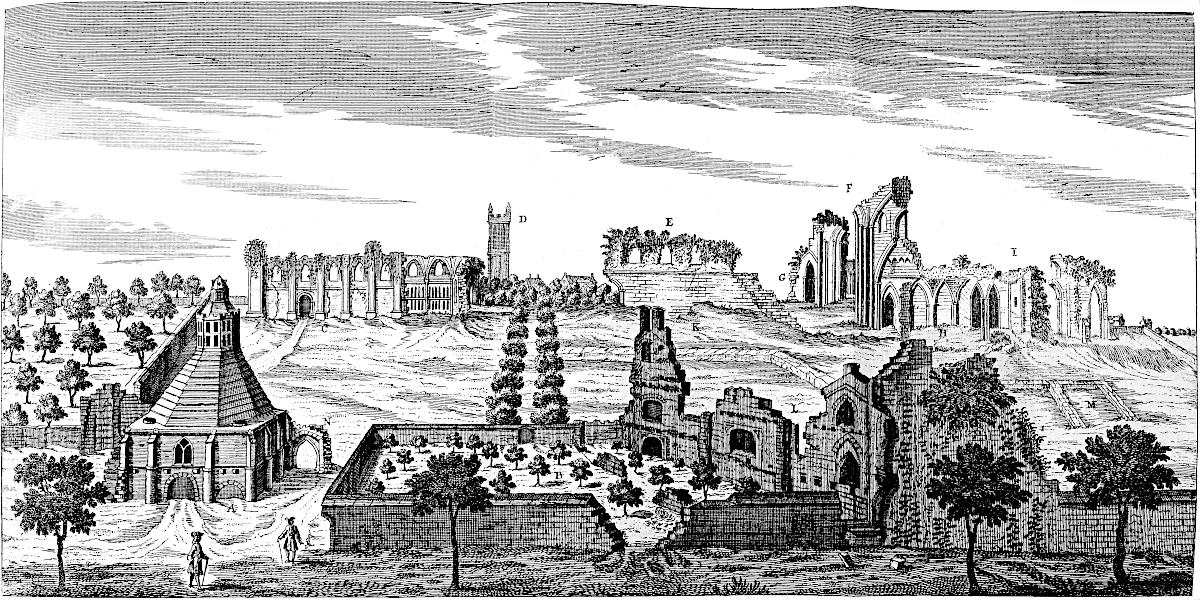
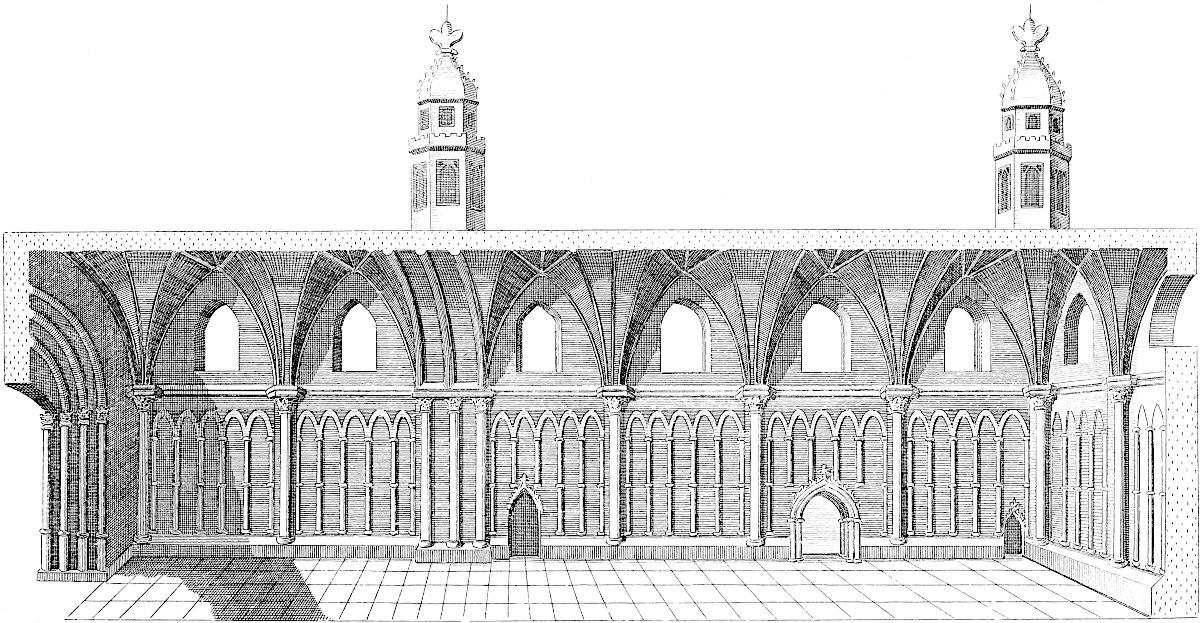
It is evident how proper engravings are to preserve the memory of
things, and how much better an idea they convey to the mind than
written descriptions, which often not at all, oftener not sufficiently,
explain them: beside, they present us with the pleasure of observing
the various changes in the face of nature, of countries, and the
like, through the current of time and vicissitude of things. These
embellishments are the chief desiderata of the excellent Mr.
Camden’s Britannia, and other writers of this sort, whose pens
were not so ready to deliver their sentiments in lines as letters: and
how hard it is for common artificers to draw from mere description,
or to express well what they understand not, is obvious from our
engravings in all sciences. I am sensible enough, that large allowances
must be made for my own performances in this kind, and some for the
artificers parts therein, who, for want of more practice in such works,
cannot equal others abroad. I know not whether it will be an excuse, or
a fault, if I should plead the expedition I used in the drawing part;
but I may urge, that a private person, and a moderate fortune, may want
many useful assistants and conveniences for that purpose. It is enough
for me to point them out; to show things that are fine in themselves,
and want little art to render them more agreeable, or that deserve to
be better done; or any way to contribute toward retrieving the noble
monuments of our ancestors; in which case only, we are behind other
the learned nations in Europe. It is not that we have a less fund of
curiosities than they, were the description of them attempted by an
abler hand, and more adequate experience.
Two or three of the plates are inserted only as heads, being not
referred to in the discourse, as Tab. VIII. the ground-plot of the
ruins of Whitehall. I myself never saw the palace, but was pleased
that I chanced to take this draught of its ruinous ichnography, but
the very week before totally destroyed. Thus much I thought owing to
the venerable memory of that name, which is ever the word at sea with
British ships, and which makes the whole world tremble. Tab. X. is an
ancient seal of the bishops of Norwich.[1] This plate the learned and
curious Mr. le Neve, Norroy king at arms, lent me out of his good will
to promote the work: the seal is remarkable for having letters upon the
edge, represented in the empty ringlet; the manner of it is like our
milled money; but how it was performed in wax, is not easy to say. Tab.
XV. was likewise lent me by Mr. Norroy abovesaid. I design always, in
these collections of mine, to insert one plate in a hundred, of some
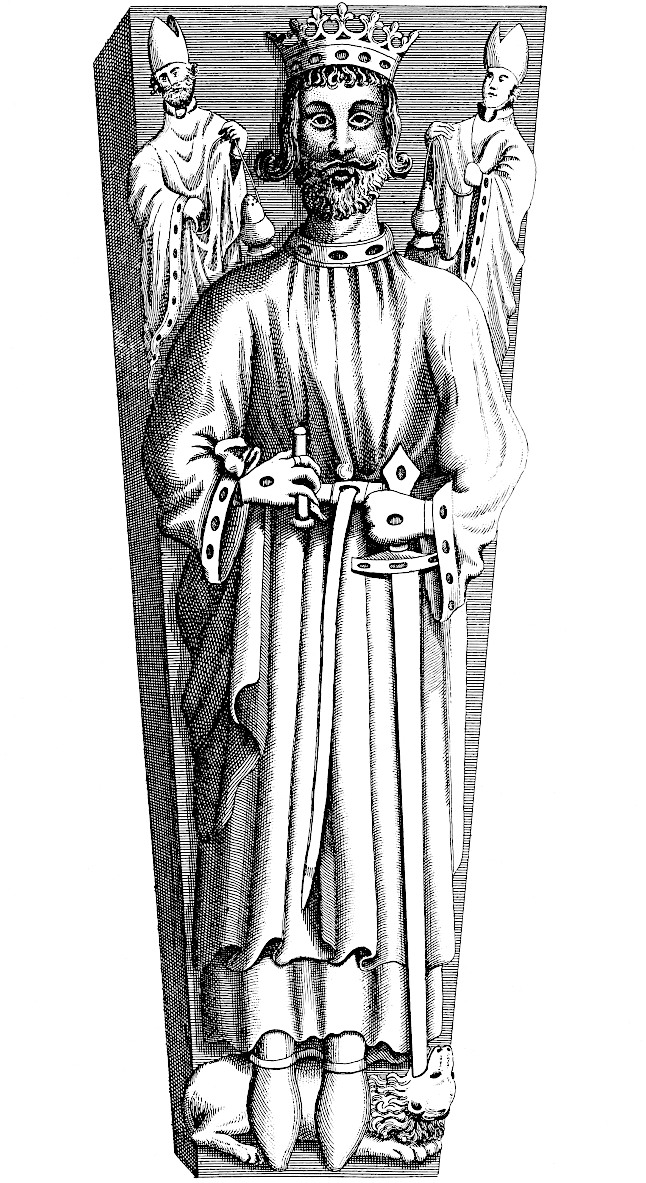
person’s effigies that has deserved well of the antiquities of
Britain: it is but a just piece of gratitude to their
memory. Tab. XL. (the Greek view at Athens) I took from an original
drawing in Mr. Talman’s collection. I have some more of that sort:
though they relate not to Britain, I do not fear the reader will be
displeased with me on that account. How much rather ought we to lament
the scarcity of such! What noble monuments of Greece are sunk into
eternal oblivion, through want of Drawing in travellers that have been
there in great numbers, or for want of encouragement to those that
are able! With what regret do I mention that most beautiful temple of
Minerva in the citadel of Athens, without dispute the finest building
upon the globe, anno 1694! that year it was casually blown up
with gunpowder, and not a drawing of it preserved.
15
Guil: Faithorne Sculp:
HENRICUS SPELMANNUS. Eques Auratus.
8
Palaces.
Stukeley del.
JVder Gucht Sculp
The Groundplot of the Ruins of Whitehall June 14. 1718.
10
I. Harris sculpt.
Ex autographo penes Maiorem et Com̃unitat. Villæ Lenne Regis in Com Norff.
40
A View at Athens.
Stukeley del.
I. Harris sculp
Ex collectionᵉ Johis Talman Ar.
101·2d.
A View of the Temple of the Winds at Athens.A Lyon Cast in brass standing by ye Port of Athens.
102. 2d.
The Temple of Minerva at Syracuse.
The Ichnography of the same Temple.
Stukeley del.
100
Insignis Synodus quinq, Planetarum Anno 1722, Mense Decembrifacta ad ho:7 .matutinas.
Gradus Sigittary.
Celeberrimo Hallejo Astronomo Regio tabulam reddit L. M. Ws. Stukeley.
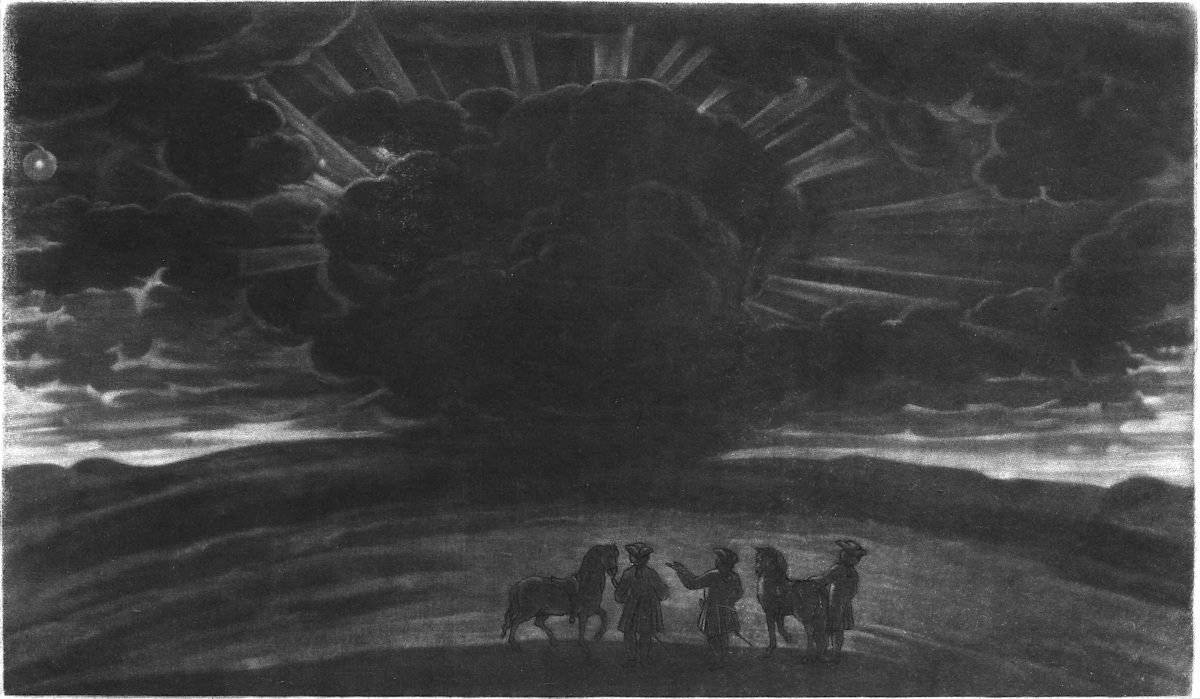
The last plate, of the great conjunction of the five planets, I added
as an æra of my book. This memorable appearance, because it
affected not the vulgar like a solar eclipse, was almost neglected
by the learned. I had a mind to do it justice by printing the type
of it from the diagram sent me by the great Dr. Halley. For my part,
I congratulate myself for living in an age fruitful of these grand
phænomena of the celestial bodies, and am pleased, that beside the
total eclipse 1715, we have in the space of two years this great
conjunction, a transit of Mercury across the sun, a comet, the last
eclipse of the sun, and in March next another great conjunction.
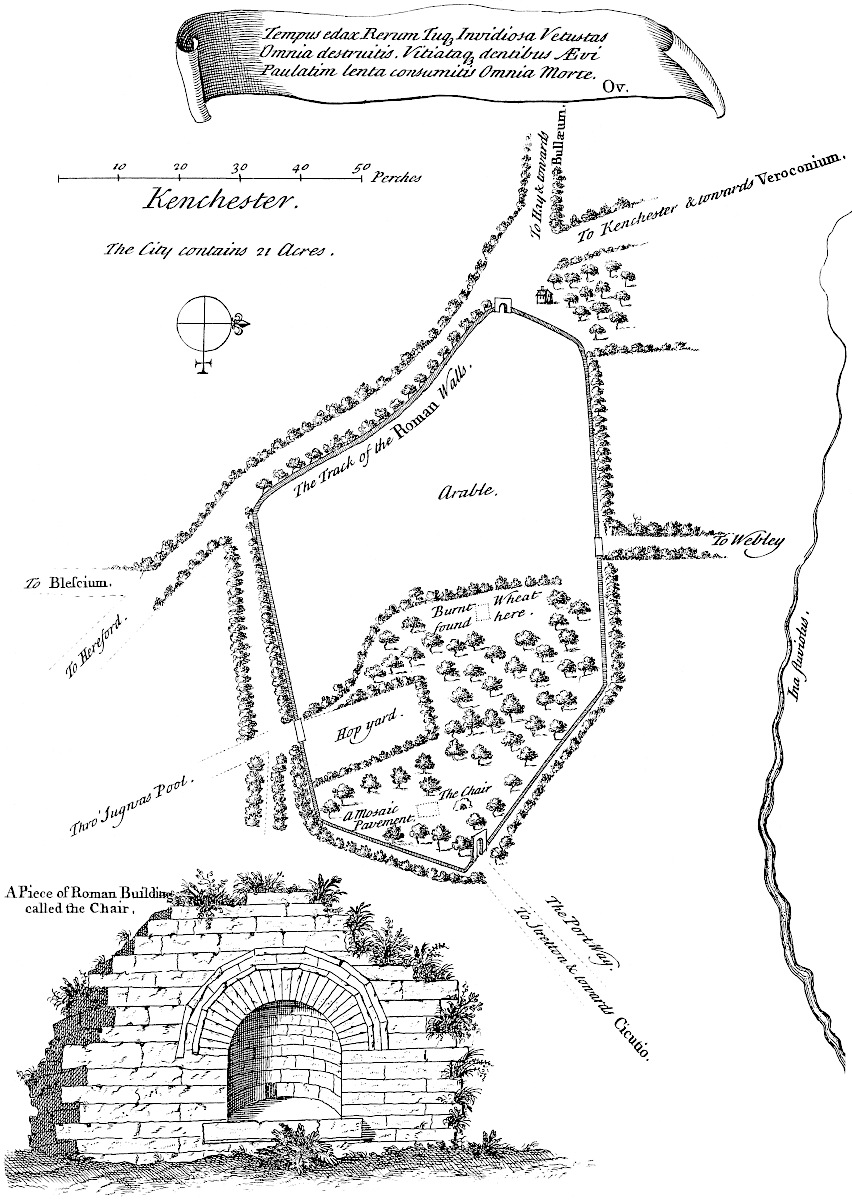
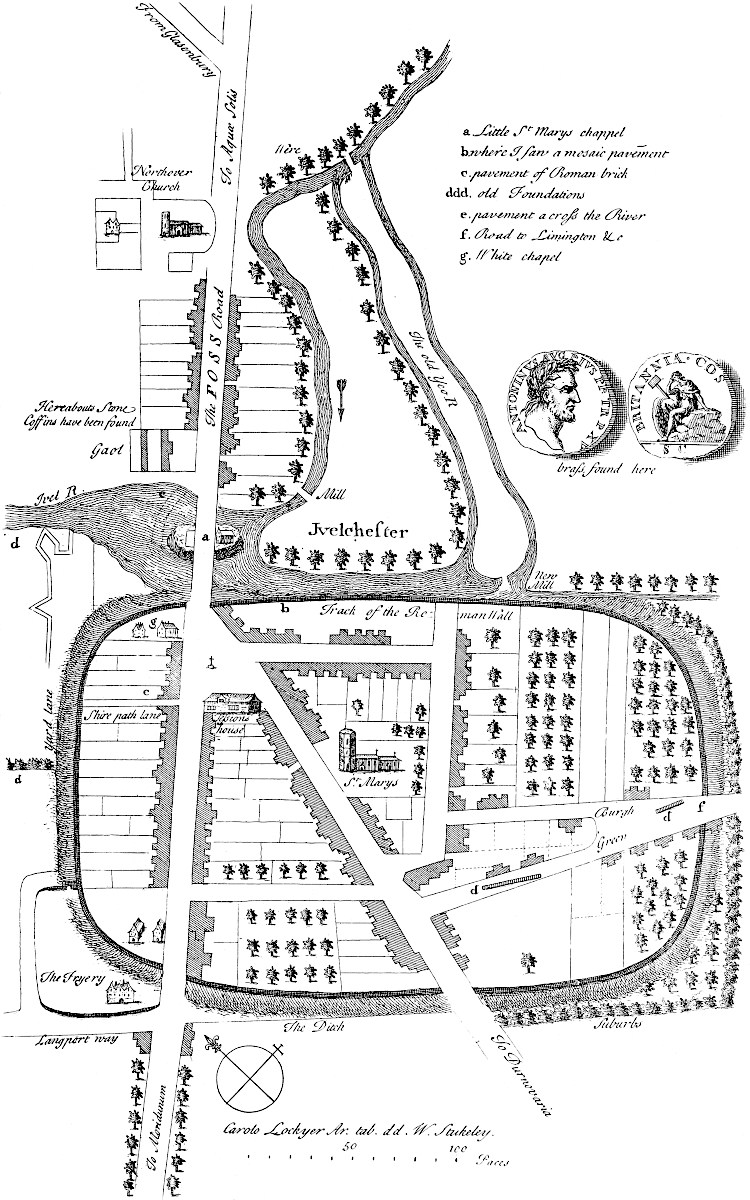
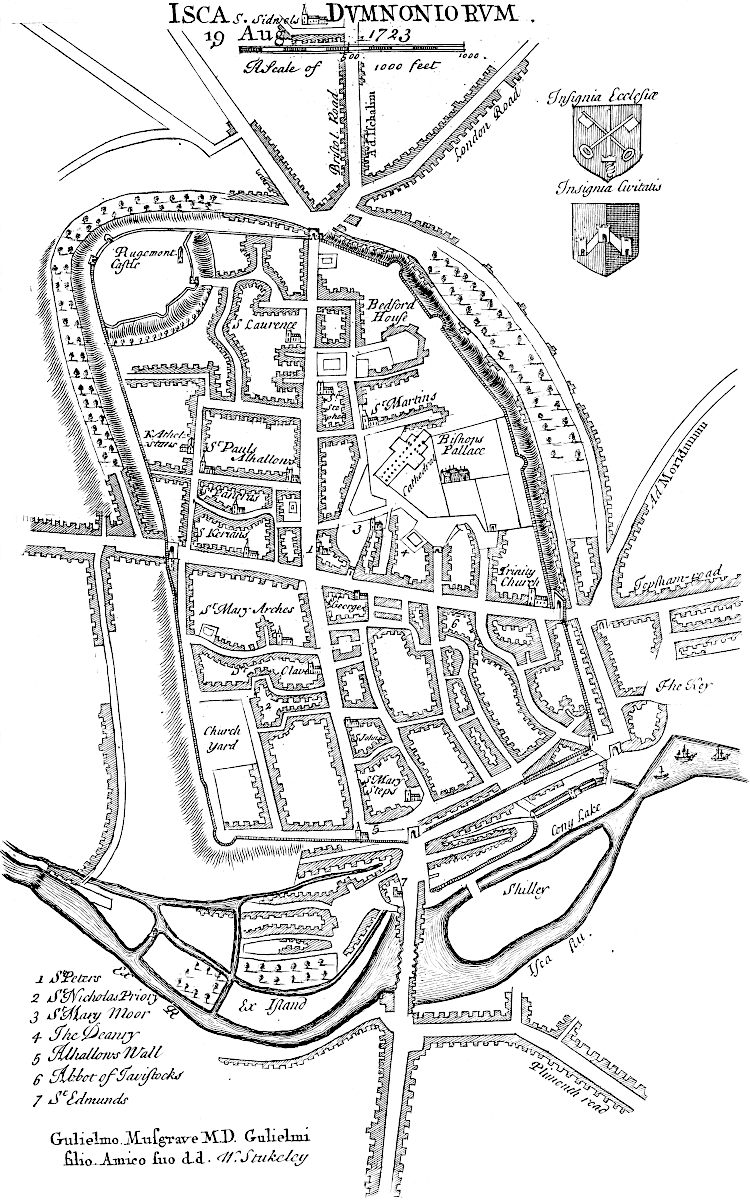
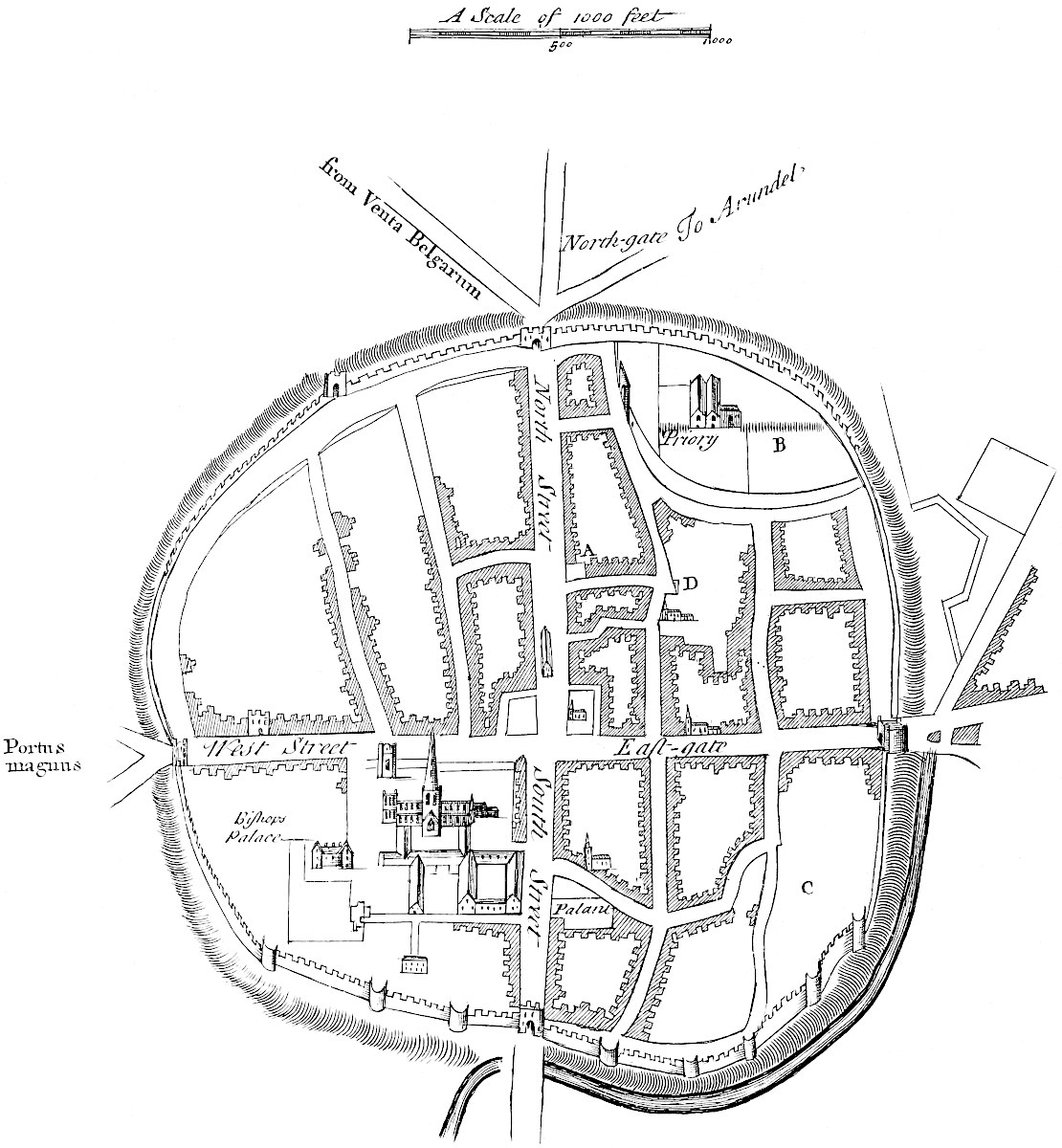
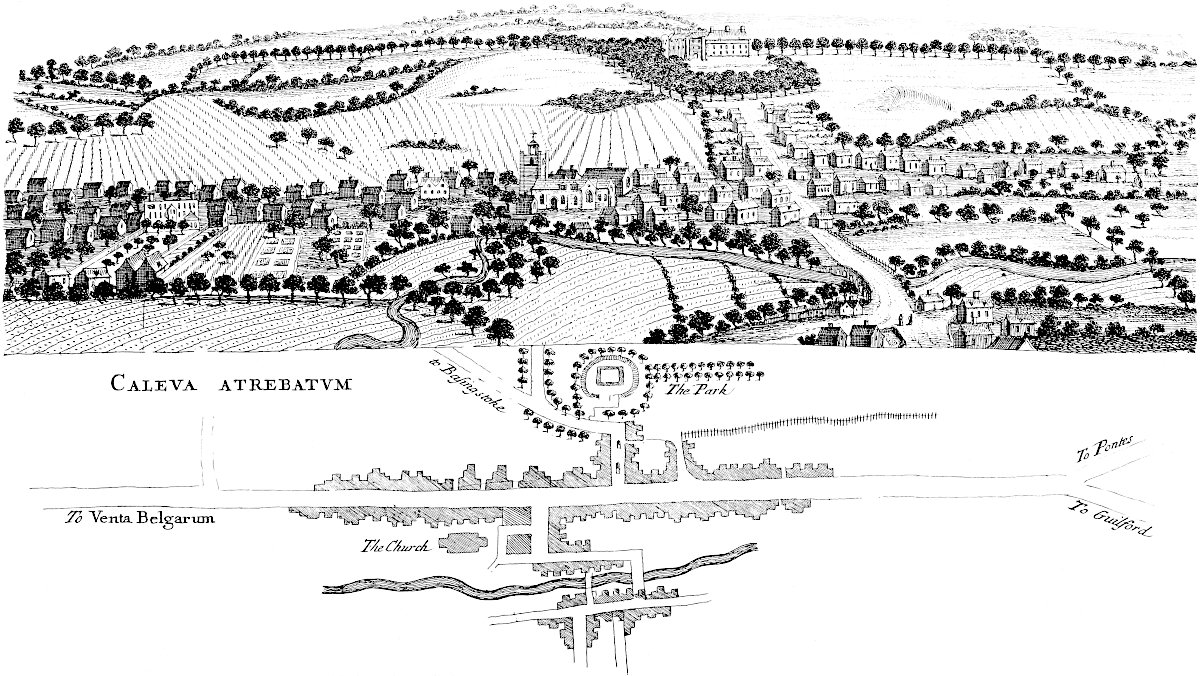
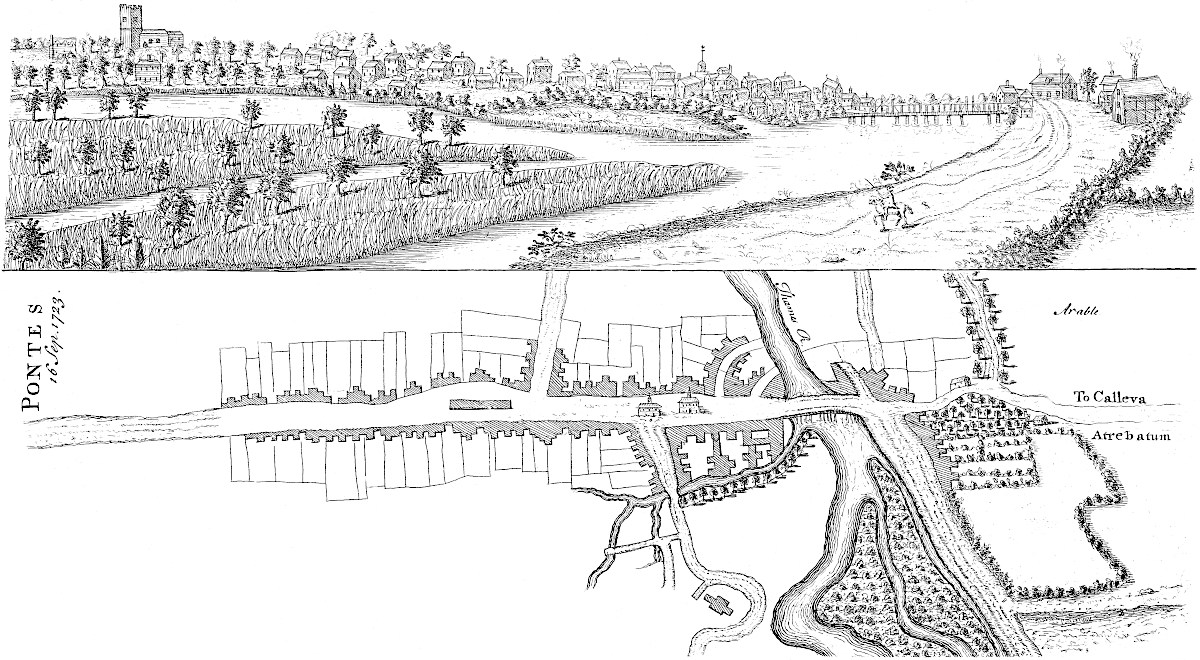
The numerous plates I have given the reader, of ground-plots and
prospects of Roman cities, I thought contributed much towards fixing
their site, and preserving their memory: they may be useful to curious
inhabitants, in marking the places where antiquities are found from
time to time, and in other respects. There are some few errors of the
press escaped me, notwithstanding all my care; but none, I think, of
any consequence. I have taken care to make the Index as instructing
as I could. The title of Roman roads belongs to such as are
anonymous, or not commonly taken notice of: that of Roman coins
points to such places as are not Roman towns, or particularly
described. Etymology includes only such words as are scattered
casually in the work, or matters that are not comprehended under any
other head; and so of the rest.
One general observation I have made within the short space of time
my travels were limited to, that husbandry, grazing, cultivation of
waste lands, all sorts of trades and manufactures, towns and cities,
are hugely improved; and especially the multitude of inhabitants is
increased to a high proportion: the reason of it is not difficult to be
guessed at.
What I shall next trouble the reader withall, will be my intended work,
of the history of the ancient Celts, particularly the first inhabitants
of Great Britain, which for the most part is now finished. By what I
can judge at present, it will consist of four books in folio. I. The
history of the origin and passage of the Celts from Asia into the west
of Europe, particularly into Britain; of their manners, language, &c.
II. Of the religion, deities, priests, temples, and sacred rites, of
the Celts. III. Of the great Celtic temple at Abury in Wiltshire, and
others of that sort. IV. Of the celebrated Stonehenge. There will be
above 300 copper plates of a folio size, many of which are already
engraven; and many will be of much larger dimensions. Upon account,
therefore, of the vast expence attending this work, I shall print no
more than are subscribed for; the money to be paid to me only. Thus
much I thought fit to advertise the friendly reader.
Ormond-street, 26 Dec. 1724.
GULIELMO STUKELEY, M. D. Amicus Amico, &c.
LUbrica Romani dum Tu monumenta pererras
Nominis, & tacito saecula lapsa pede:
Docte opifex, variis seu vim sermonibus addas,
Seu placet artifici pagina picta manu;
Quanta vetustatis summae miracula promis,
Obrutaque indigno moenia celsa situ!
Vindice Te, fossas video procedere longas.
Per loca constratum devia ducit iter.
Nunc via sublimi conscendit vertice montes,
Flumina declivis nunc per aperta ruit.
Castra quot immenso retegis constructa labore?
Et tua non sinit ars oppida posse mori.
Hic mira antiquae pendent compagine portae,
Hic tremulo fulget lumine grata pharos.
Celsior exsurgit chartis Romana potestas
Clara tuis; ultro est fassa ruina decus.
Ecce iterum ingenti pandunt curvamine sedes,
Et plausu resonant amphitheatra novo.
Roma triumphato jamdudum languida mundo
Nequicquam invictam se superesse dolet.
Nec te dira cohors morborum sola tremiscit,
Ast tempus medicas sentit inerme manus.
Quantum Roma tibi, quantum Brittannia debet.
O ingens patriae, Romulidumque decus!
Accipe Phoebea merito dignissime lauro,
Sint, quæ das aliis, saecula sera tibi.
I. S.
GULIELMO STUKELEY, M. D. &c.
NEC sola est medicina Tui, sed Apolline dignam
Artem omnem recolis, mente, manuque potens.
Non modo restituis senio morbisque gravatos,
Ad vitam reddis sæcla sepulta diu.
Te Lindensis ager gestit celebrare nepotem,
Quæque dedit, patriæ lumina grate refers.
GEOR. LYNN, Interior. Templ. Soc.
In Itinerarium Curiosum amici sui charissima viri doctissimi & Cl.
Domini Gulielmi Stukeleii M. D. CML. SRS. & Antiquar.
Secretar.
O Jane bifrons! Temporis inclyte
Vindex remoti, de superis videns
Post terga solus, nunc adesto et
Egregium tueare amicum
Opusque. templi janua sit tui
Serata, dum ex bis nostra quietior
Discat juventus, quid avorum
Indomitæ potuere dextræ.
Quicquid Britannus ferre recusans
Servile collo Romulidum jugum,
Terra sua contentus egit,
Artibus ingenitis beatus.
Quicquid Quirites gentibus asperis
Cultu renidens tradere providi:
Victoriam, Musasque & artes,
Arma simul rapiente dextra.
Nec vestra omittit pagina Saxonem
Sicâ timendum, relligionibus
Valde revinctum: bellicosis
Horribilemve Dacum carinis.
Nec tu recondis facta silentio
Præclara Normanni immemor inclyti;
Quorum omnium est imbutus Anglus
Sanguine, moribus, & vigore.
Quæ mira doctus condidit artifex
Excelsa prisci mœnia seculi,
Quæ strata, pontes, templa, castra,
Amphitheatra, asarota, turres!
Plaudit sibi jam magna Britannia
Antiqua splendet gloria denuo.
Chartis resurgit Stivecleji
Celsa canens iterum triumphos.
MAUR. JOHNSON, J. C.
Interioris Templi Soc. MDCCXXIV.
In Stukelejanas Antiquitates.
DEperditorum restitutor Temporum
Et veritatis in tenebris abditæ
Scrutator eruditus, arte quâ mirâ valet!
Retegit vetustum quicquid obscuro sinu
Abscondit Ævum. Tempus, hic aciem tuæ
Falcis retundit invidam: frustra omnia
Comples ruinis. jam tuæ pereunt minæ.
Ipsæ perire nam ruinæ nesciunt. M. M.
Ad Itinerarii Curiosi auctorem.
QUantum Roma tibi, et Romana Britannia debet,
Ingenui Vates, Vir celebrande, canant.
Me nec Roma modos suaves, nec Celtica tellus
Argutæ docuit stringere fila lyræ.
Muneris hoc igitur vani cur hybrida tentem
Normannus, Cimber, Saxo, Britannus ego?
Musa negat, Natura negat, sed suggerit unus
Qualiacunque potest carmina noster Amor.
Gratulor inceptum tibi nobile, gratulor illis,
Inter quos nomen glorior esse meum:
Qui patriæ priscas arteis, loca, nomina, & ipsas
Relliquias sancta relligione colunt;
Quo brevis ostendis conclusus limite campi,
Limite quam nullo clauditur ingenium.
Quòque tuos sensus permulcet amore Vetustas,
Qui nullos casus, ardua nulla fugis.
Per salebras asp’ras, per tortas ambitiones,
Et cæcos calles, improbe, carpis Iter.
Stagna lacúsque inter, limosáque pascua Lindi,
Romanæ explorans avia strata viæ.
Hic ubi sorte dolens, pelagi tot jugera rector
Æquoris herbosi non sua, rapta tenet.
Plura quidem tenuit, sed jussit Jupiter acres
Martigenas patrui vim cohibere sui.
Haud secus ac jussi faciunt, partémque receptam
Terreni, ut par est, æquoris esse jubent.
Cætera raptori quæ nunc manet Ennosigæo,
Si quibus est armis, est repetenda tuis.
Qui terræ pelagíque adeo declivia monstras,
Et quò præcipites Nereus urget equos;
Tanta mathematicis se tollit gloria vestra
Artibus; at numeris grandior illa meis.
Me rapit addictum veterum admiratio rerum,
Plenáque deliciis pagina quæque suis.
Tu monumenta pius, monumentis adstruis ipsis,
Perdita quæ fuerant, posse perire vetans.
Quid referam quantum tibi debet Classicus auctor,
Qui priscas urbes, castràque prisca doces?
Mercator siccis quærens adamantas in oris,
Non tam conductam versat avarus humum,
Quam tu cum nummos, urnas, & cætera signa
Antiquæ effodias indubitata notæ.
Nomina, quæ fuerant olim, Romana reducis,
Perdita restituens, obsolefacta novans.
Nec te, antiquarum tam mira peritia vocum est,
Fallunt Teutonici, barbaricique soni.
Historiam quantum decoras, si dicere vellem,
Historiam videar scribere, non literas.
Tu das præteritis veluti præsentibus uti,
Et redeunt scriptis secula lapsa tuis.
Detrahis ancipiti Jano mirabile monstrum,
Et recta facie cernere cuncta jubes.
Sed dum commendo tua, carmine digna Maronis.
Ingenii culpâ detero, scripta, mei.
Macte tua virtute esto, patriamque quotannis
Quo pede cæpisti demereare. Vale.
R. AINSWORTH.
To Dr. Stukeley, upon his Itinerarium Curiosum.
HAIL, Baxter lives! in each descriptive page
Are seen the labours of the Roman age:
What ere the sons of Rome or Albion knew,
We here discern at one compendious view.
Thus taught we pass the Caledonian flood,
Or fertile plains that smile from Cimbric blood:
Where Vaga’s streams glide murmuring near the tomb,}
(Darksome recess) where mighty Chiefs of Rome
Have slumber’d ages in its silent gloom:
Where airy lamps the distant sailor guide,
Or where the labour’d arch deceives the tide:
Where Geta kept the Belgic youth in awe,
Or where Papinian gave the Roman law.
Pleas’d I behold Sabrina’s silver stream,
Or hear the murmurs of the doubtful Teme.
With you, methinks, from Cred’nil I survey
Th’ important conflict of the furious day:
See, see! Frontinus fierce in armour shine,
Where the war burns upon the vale of Eigne.
Here on the plains of Aricon we learn
Life’s various period from the peaceful urn.
Yon hoary Druids pray celestial aid,
Where sacred oaks diffuse a solemn shade;
Each branch aspiring to the blest abode
Lifts up the vows of Britain to the God.
Go on, my friend! the curious theme pursue,}
The mystic scenes of early time review,
And tell Britannia, Baxter lives in you.
JAMES HILL, J. C. Middle-Temple, London, Dec. 1. 1724.
ToMAURICE JOHNSON, Jun. Esq. Barrister at Law of the Inner-Temple.
THE amity that long subsisted between our families giving birth to an
early acquaintance, a certain sameness of disposition, particularly a
love to antient learning, advanced our friendship into that confidence,
which induces me to prefix your name to this little summary of what has
occurred to me worth mentioning in our native country, HOLLAND,
in Lincolnshire; but chiefly intended to provoke you to pursue a full
history thereof, who have so large a fund of valuable papers and
collections relating thereto, and every qualification necessary for
the work. That these memoirs of mine are so short, is because scarce
more time than that of childhood I there spent, and when I but began to
have an inclination for such enquiries: that the rest which follow are
grown to such a bulk as to become the present volume, is owing to my
residence at London. Great as are the advantages of this capital, for
opportunities of study, or for the best conversation in the world, yet
I should think a confinement to it insupportable, and cry out with the
poet,
Invideo vobis agros, formosaque prata.Virg.
I envy you your fields and pastures fair.
which engages me to make an excursion now and then into the country:
and this is properly taking a review of pure nature; for life here
may be called only artificial, especially when fixed down to it;
like the gaudy entries upon a theatre, where a pompous character is
supported for a little while, and then makes an exit soon forgotten.
My ancestors, both paternal and maternal, having lived, from times
immemorial, in or upon the edges of our marshy level, perhaps gave me
that melancholic disposition, which renders the bustlings of an active
and showy life disagreeable. The fair allurements of the business of
a profession, which have been in my road, cannot induce me wholly to
forsake the sweet recesses of contemplation, that real life, that
tranquillity of mind, only to be met with in proper solitude; where I
might make the most of the pittance of time allotted by Fate, and if
possible doubly over enjoy its fleeting space. I own a man is born for
his country and his friends, and that he ought to serve them in his
best capacity; yet he confessedly claims a share in himself: and that,
in my opinion, is enjoying one’s self; not, as the vulgar think, in
heaping up immoderate riches, titles of honour, or in empty, irrational
pleasures, but in storing the mind with the valuable treasures of the
knowledge of divine and human things. And this may in a very proper
sense be called the study of Antiquities.
Of the study ofAntiquities.
I need not make an apology to you for that which some people of
terrestrial minds think to be a meagre and useless matter; for
truly what is this study, but searching into the fountain-head of
all learning and truth? Some antient philosophers have thought that
knowledge is only reminiscence. If we extend this notion no further
than as to what has been said and done before us, we shall not be
mistaken in asserting that the past ages bore men of as good parts as
we: enquiry into their thoughts and actions is learning; and happy for
us if we can improve upon them, and find out things they did not know,
by help of their own clue. All things upon this voluble globe are but
a succession, like the stream of a river: the higher you go, the purer
the fluid, less tainted with corruptions of prejudice or craft, with
the mud and soil of ignorance. Here are the things themselves to study
upon; not words only, wherein too much of learning has consisted. If
we examine into the antiquities of nations that had no writing among
them, here are their monuments: these we are to explore, to strike
out their latent meaning; and the more we reason upon them, the more
reason shall we find to admire the vast size of the gigantic minds
of our predecessors, the great and simple majesty of their works,
and wherein mainly lies the beauty and the excellence of matters of
antiquity. But more especially it is not without a happy omen, that
the moderns have exerted themselves in earnest, to rake up every dust
of past times, moved by the evident advantages therefrom accruing, in
the understanding their invaluable writings, which have escaped the
common shipwreck of time. It is from this method we must obtain an
accurate intelligence of those principles of learning and foundations
of all science: it is from them we advance our minds immediately to the
state of manhood, and without them the world 5000 years old would but
begin to think like a child. Nothing more illustrates this than looking
into the comments that were wrote upon them 200 years ago, voluminous
enough, but barbarous, poor, and impertinent, when compared to the
solid performances of learned men since, whose heads were enriched with
an exact search into the customs, manners and monuments of the writers.
Hence it is, that history, geography, mathematics, philosophy, the
learned professions, law, divinity, our own faculty, and the muses in
general, flourish like a fresh garden richly watered and cultivated,
weeded from rubbish of logomachy and barren mushrooms, gay with
thriving and beautiful plants of true erudition, inoculated upon the
stocks of the antients.
OfBritain.
If ruminating upon antiquities at home be commendable, travelling at
home for that purpose can want no defence; it is still coming nearer
the lucid springs of truth. The satisfaction of viewing realities has
led infinite numbers of its admirers through the labours and dangers
of strange countries, through oceans, immoderate heats and colds, over
rugged mountains, barren sands and deserts, savage inhabitants, and a
million of perils; and the world is filled with accounts of them. We
export yearly our own treasures into foreign parts, by the genteel and
fashionable tours of France and Italy, and import ship-loads
of books relating to their antiquities and history (it is well if we
bring back nothing worse) whilst our own country lies like a neglected
province. Like untoward children, we look back with contempt upon our
own mother. The antient Albion, the valiant Britain, the renowned
England, big with all the blessings of indulgent nature, fruitful
in strengths of genius, in the great, the wise, the magnanimous,
the learned and the fair, is postponed to all nations. Her immense
wealth, traffic, industry; her flowing streams, her fertile plains,
her delightful elevations, pleasant prospects, curious antiquities,
flourishing cities, commodious inns, courteous inhabitants, her
temperate air, her glorious show of liberty, every gift of providence
that can make her the envy and the desirable mistress of the whole
earth, is slighted and disregarded.
You, Sir, to whom I pretend not to talk in this manner, well know that
I had a desire by this present work, however mean, to rouse up the
spirit of the Curious among us, to look about them and admire their
native furniture: to show them we have rarities of domestic growth.
What I offer them is an account of my journeyings hitherto, but little
indeed, and with expedition enough, with accuracy no more than may be
expected from a traveller; for truth in every particular, I can vouch
only for my own share, strangers must owe somewhat to informations. I
can assure you I endeavoured as much as possible not to be deceived,
nor to deceive the reader. It was ever my opinion that a more intimate
knowledge of Britain more becomes us, is more useful and as worthy a
part of education for our young nobility and gentry as the view of any
transmarine parts. And if I have learnt by seeing some places, men and
manners, or have any judgment in things, it is not impossible to make a
classic journey on this side the streights of Dover.
Thus much at least I thought fit to premise in favour of the study of
antiquities. And with particular deference to the society of British
Antiquaries in London, to whom I remember with pleasure you first
introduced me: since for some time I have had the honour of being their
secretary; to them I beg leave to consecrate the following work. To
the right honourable the Earl of Hartford the illustrious and worthy
President, the right honourable the Earl of Winchelsea, Peter le Neve,
esq; Roger Gale, esq; the illustrious and worthy Vice-presidents, and
to the learned Members thereof. Then, lest I should fall under my own
censure passed upon others, that know least of things nearest them, I
shall deliver my thoughts about the history of Holland before
mentioned, which may serve as a short comment upon the map of this
country which I published last year, with a purpose of assisting the
gentlemen that are commissioners of sewers there, though it is of such
a bulk as cannot conveniently be inserted into this volume.
If we cast our eyes upon the geography of England, we must observe that
much of the eastern shore is flat, low ground, whilst the western is
steep and rocky. This holds generally true throughout the globe as to
its great parts, countries or islands, and likewise particularly as to
its little ones, mountains and plains. I mean, that mountains are steep
and abrupt to the west,[2] especially the north-west, and have a gentle
declivity eastward or to the south-east, and that plains ever descend
eastward. I wonder very much that this remark has never been made. I
took notice of it in our own country, almost before I had ever been
out of it, in the universal declivity of that level eastward, in those
parts where it did not by that means regard the ocean; particularly in
South Holland, or the wapentake of Elho: the natural descent of water
therein is not to the sea, as the rivers run, but directly eastward,
and that very considerable. Beside, the current of every river is lower
as more eastward: thus the Welland is higher in level than the Nen,
the Nen than the Ouse; and probably at first both emptied themselves
by the Ouse or Lyn river as most eastward. I observed in June 1732,
that the Peterborough river Nen would willingly discharge itself into
Whitlesea mere, and so to the Ouse at Lyn, if it were not hindered by
the sluice at Horsey bridge by the river Nen. I see no difficulty to
attribute the reason of it to the rotation of the globe. Those that
have gone about to demonstrate to us that famous problem of the earth’s
motion, have found out many mathematical and abstracted proofs for
that purpose, but neglected this which is most sensible and before our
eyes every minute. It is a property of matter, that when whirled round
upon an axis, it endeavours to fly from the axis, as we
see in the motion of a wheel, the dirt and loose parts are thrown the
contrary way in a tangent line. This is owing to the natural inactivity
of matter, which is not easily susceptible of motion. Now at the time
that the body of the earth was in a mixt state between solid and fluid,
before its present form of land and sea was perfectly determined, the
almighty Artist gave it its great diurnal motion. By this means the
elevated parts or mountainous tracts, as they consolidated whilst yet
soft and yielding, flew somewhat westward, and spread forth a long
declivity to the east: the same is to be said of the plains, their
natural descent tending that way, and, as I doubt not, of the superfice
of the earth below the ocean. This critical minute is sublimely
described by the admirable poet and observer of nature,
Namque canebat, uti magnum per inane coacta
Semina terrarumque, animæque, marisque fuissent,
Et liquidi simul ignis. Ut his exordia primis
Omnia, & ipse tener mundi concreverit orbis.
Tum durare solum & discludere nerea ponto
Cœperit, & rerum paulatim sumere formas.Virg. Ecl. VI.
which may thus be englished.
He sang, how from the mighty void, in one
Large space, collected were the fluid seeds
Of earth, air, sea and fire; from these came all.
The callow world became one massive globe;
The ocean by the hard’ning ground disjoin’d,
New forms surpris’d the beauteous face of things.
The truth of this observation I have seen universally confirmed in all
my travels, and innumerable instances of it will occur to the reader
throughout these discourses. I design another time professedly to
treat of it in a philosophical way. But consequent to this doctrine it
is that we have so large a quantity of this marshland in the middle
of the eastern shore of England, seeming as if made by the washings
and eluvies of the many rivers that fall that way, such as the
Welland, the Witham, the Nen, the Ouse great and little, together
with many other streams of inferior note. These all empty themselves
into the great bay formed between the Lincolnshire wolds and cliffs
of Norfolk, called by Ptolemy Mentaris æstuarium, as rightly
corrected by Mr. Baxter, seeing it is composed of the mouths of so
many rivers; Ment, or Mant, signifying ostium in
the British language. Beside the great quantity of high and inland
country that discharges its waters this way, even as far as Fritwell
in Oxfordshire; all the level country lies before it, extending itself
from within some few miles of Cambridge south, to Keal hills near
Bolingbroke in Lincolnshire north, about sixty miles long, known by the
names of the Isle of Ely, Holland and Marshland. This country, since
the flood, I believe was much in the same state as at present, and for
its bulk the richest spot of ground in the kingdom; once well inhabited
by gentry, especially the religious. I apprehend the more inland part
of it, the Isle of Ely, Deeping Fen, &c. was not in distant ages in so
bad a condition as now, because the natural drainage of it was better,
before the sea had by degrees added so much solid ground upon the
coasts.
Holland, its name.
In this country I have observed abundance of old Welsh words left among
us; and I am persuaded that the name of Holland is derived from that
language, though now terminated by a later word, as is frequent enough.
It signifies no more than salt or marsh land, such as is gained from
the sea; and to this day we call the marshes adjoining to, and sometime
overflowed by the sea, salt marshes. Likewise upon the sea shore
they formerly made salt in great abundance. The hills all along upon
the sea bank, the remains of such works, are still called salt hills:
such are at Fleet, Holbech, Gosberton, Wainflet,[3] &c. Many names
of rivers and roads, thence derived, remain still, such as Salters
Lode, Salteney Gate, &c. Hallt in the British is salsus,
salt, as ἅλς in the Greek is mare, the sea; and most evidently
borrowed from the British, because of its most notorious quality. The
adjoining part of this country in Norfolk, is called marsh land, in the
very same sense: so is Zeland and Holland at the mouth of the Rhine,
where our Cimbric ancestors once lived. In the Cimbric Chersoness, now
Denmark, is Halland, a division of the country by the Saxons called
Halgo land. Vid. Spelman’s Glassary, voce Sciringes heal.
Holsatia, Holstein, &c. and our Holderness in Yorkshire, must thus be
understood. Hence the isle of Ely too is denominated, the very word
heli being salsugo in the British. This, in the most
antient British times, was as much marsh land as our wapentake of Elho
is now, which acknowledges the same original; hoe signifying a
parcel of high ground.
First Inhabitants theBritons.
We may be assured that this whole country was well inhabited by the
antient Britons, and that as far as the sea coasts, especially the
islets and higher parts more free from ordinary inundations of the
rivers, or though not imbanked above the reach of the spring tides;
for the nature of this place perfectly answered their gusto, both as
affording abundant pasturage for their cattle, wherein their chief
sustenance and employment consisted, and in being so very secure from
incursion and depredations of war and troublesome neighbours, by the
difficult fens upon the edge of the high country. Here I have not been
able to meet with any remains of them, except it be the great quantity
of tumuli, or barrows, in all these parts; scarce a parish
without one or more of them. They are generally of a very considerable
bulk, much too large for Roman; nor has any thing Roman been discovered
in cutting them through; though, a few years ago, two or three were
dug quite away near Boston, and another at Frampton, to make brick of,
or to mend the highways. I guess these were the high places of worship
among our Cimbrian predecessors, purposely cast up, because there
are no natural hills in these parts; and we know antiquity affected
places of elevation for religious rites. No doubt, some are places
of sepulture, especially such as are very frequent upon the edges of
the high countries all around, looking down upon the fens. Hither
seem to have been carried the remains of great men, whose habitations
were in the marshy grounds, who chose to be buried upon higher ground
than where they lived; as is the case all over England; for the
tumuli are commonly placed upon the brink of hills hanging over
a valley, where doubtless their dwellings were.
Romans.
But when the Romans had made considerable progress in reducing this
island into the regular form of a province, and began the mighty work
of laying down the great military ways; then I suppose it was, that
they cast their eyes upon this fertile and wide-extended plain, and
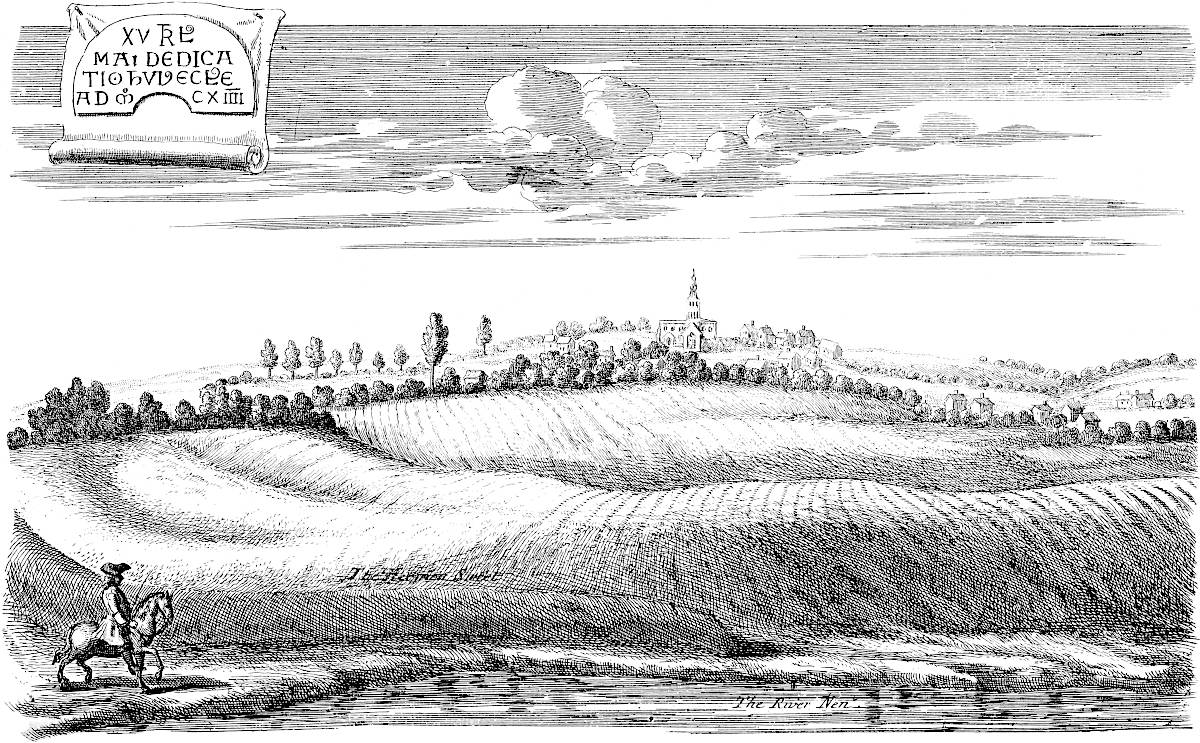
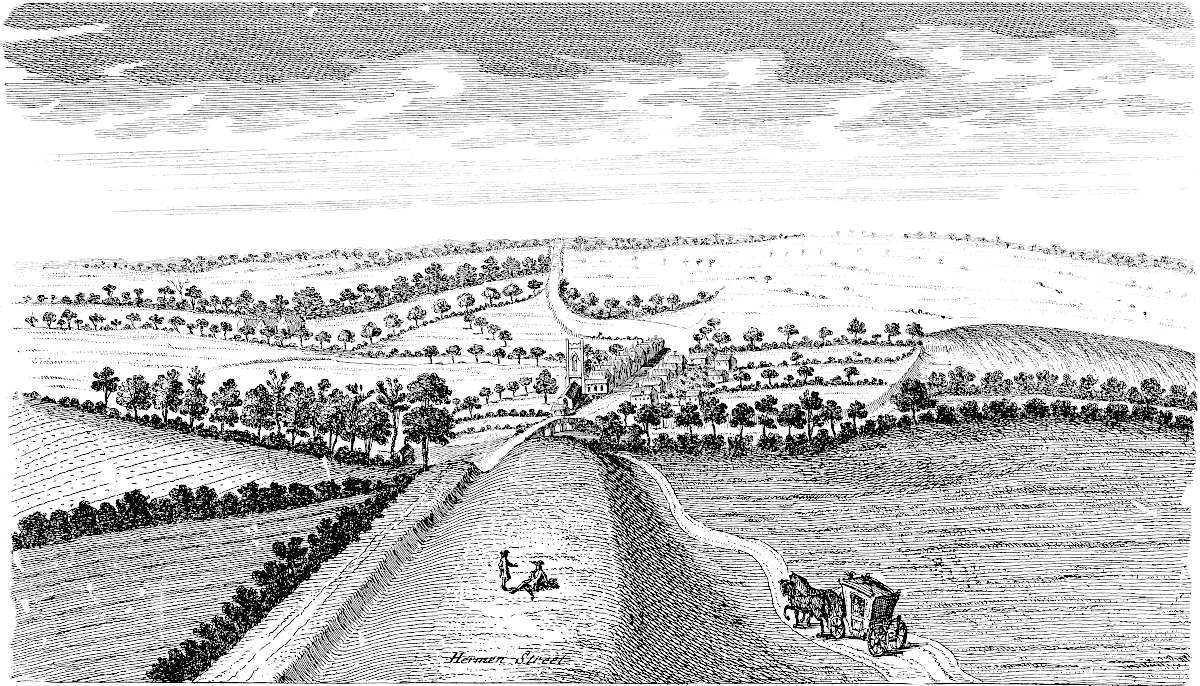
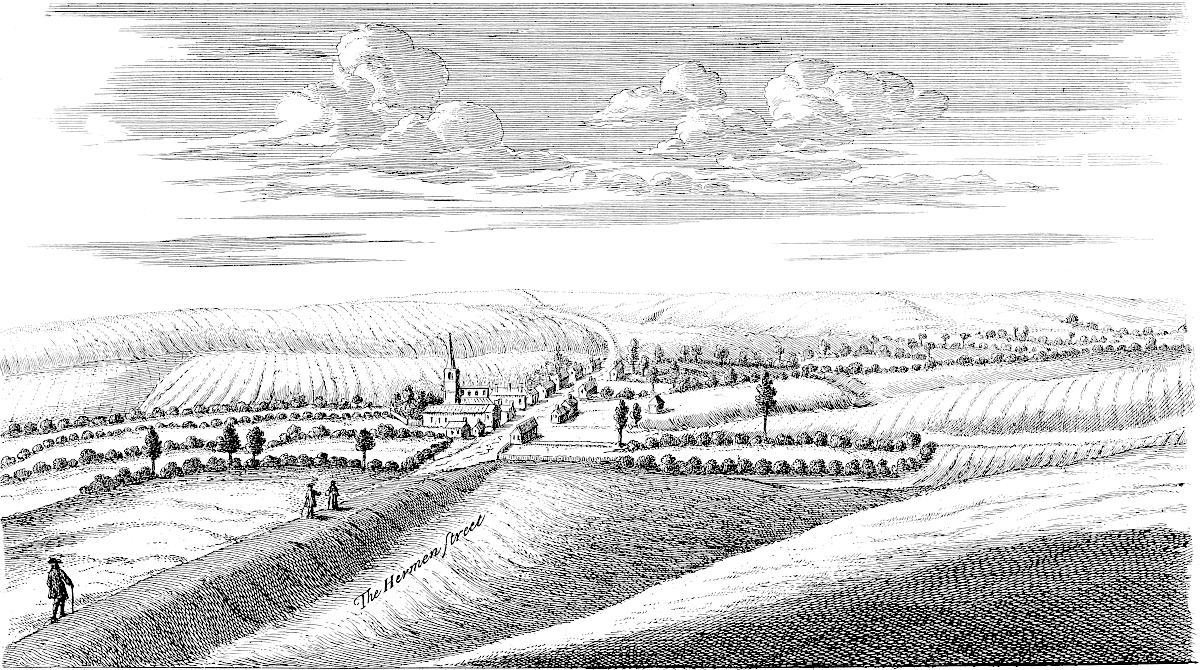
projected the draining it. TheHermen Street.In the reign of Nero, in all probability,
they made the Hermen Street,[4] as now called by a Saxon word
equivalent to the Latin via militaris. That this was the first,
seems intimated by the name, in that it has retained κατ’ εξοχην, what
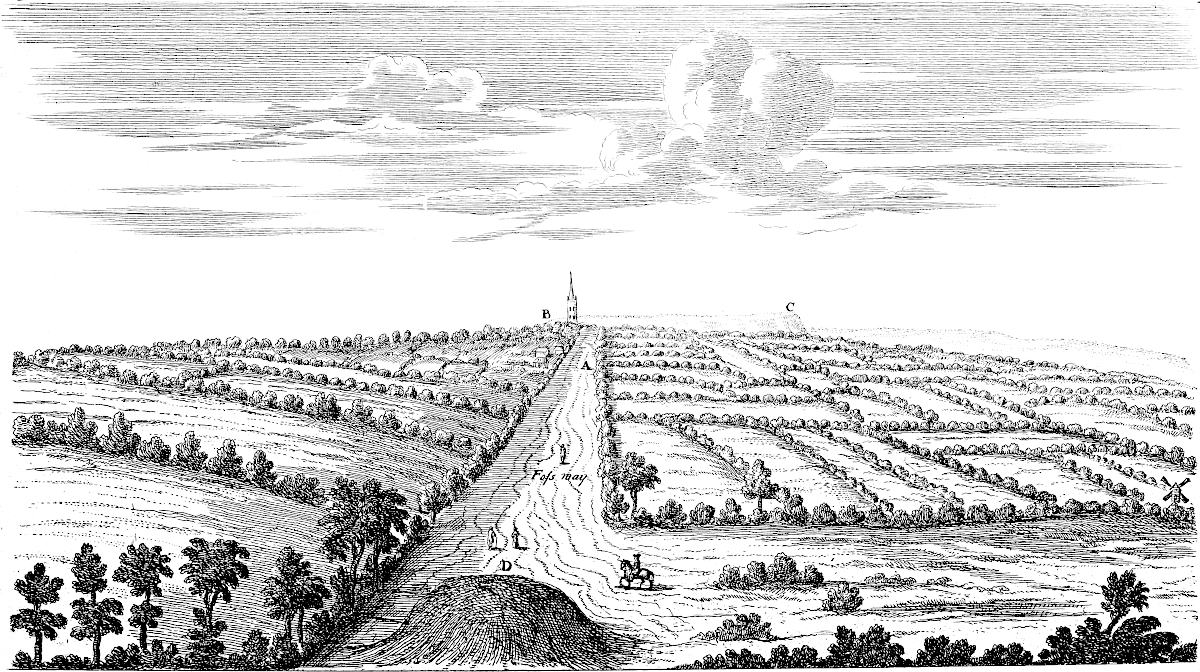
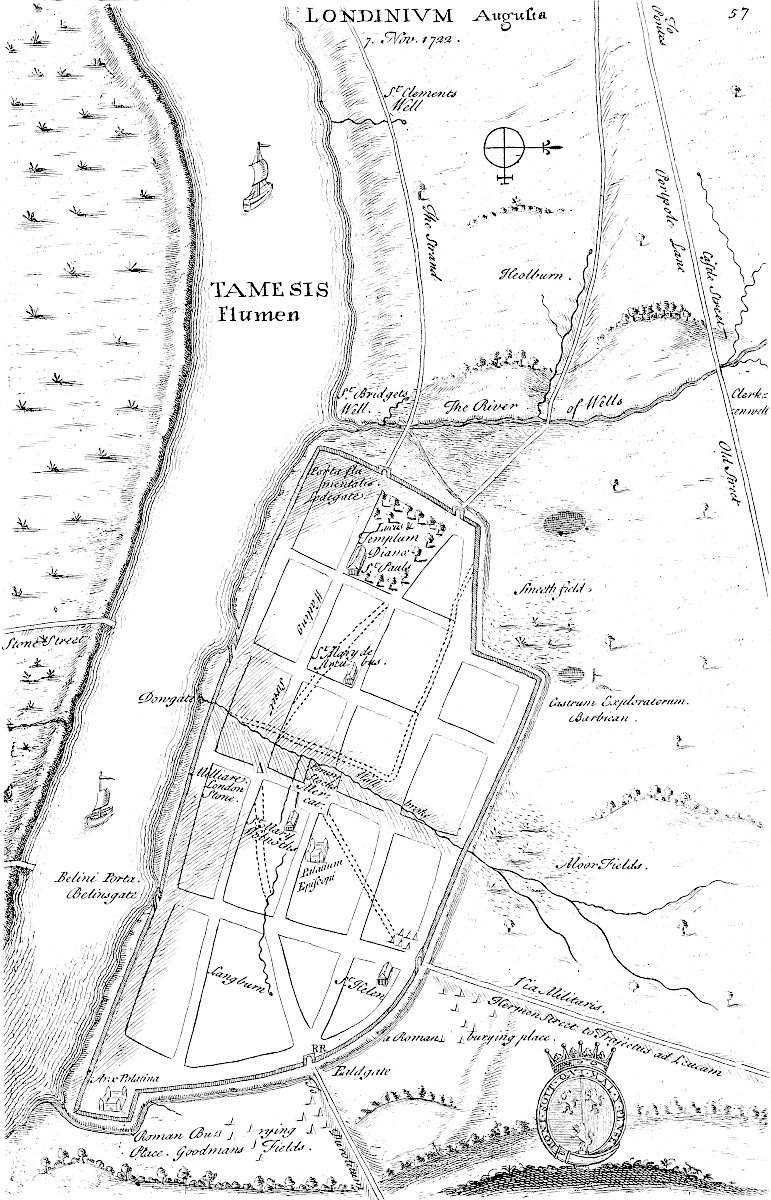
is but a common appellative of such roads. TAB. LVI.This noble work, taking
in the whole of it, was intended to be a meridian line running from
the southern ocean, through London, to the utmost bounds of Scotland.
This may be inferred from the main of it, which runs directly north
and south. And another argument of its early date, drawn from three
remarkable particularities, I have observed in travelling upon it,
and which show it was begun before that notable people had a thorough
knowledge of the geography of the island. One is, its deviation
westward as it advances towards these fens from London: another is,
the new branch, drawn a little beyond Lincoln westward into Yorkshire,
out of the principal stem going to the Humber: a third is, that it is
double in Lincolnshire. Of these I shall speak again when we come to
the following Iter Romanum. Now we will only consider such part
of it as has relation to the country we are upon; and that is the road
going from Caster by Peterburgh to Sleford in this county, which is
undoubtedly Roman, and which first occasioned the draining this fenny
tract, and surely more antient than that which goes above Stanford,
and along the heathy part of the county to Lincoln. My reasoning
depends upon the manner of the road itself, and upon that other great
work which accompanies it, called the Cardike, equally to be
ascribed to the same authors. This road is nearer the first intention
of a meridian line than the other: but, when they found it carried them
through a low country, where it perpetually needed reparation, and that
they must necessarily decline westward to reach Lincoln, they quitted
it, and struck out a new one, more westerly, that should run altogether
upon better ground. This, if we have leave to guess, was done after
the time of Lollius Urbicus, lieutenant under Antoninus Pius, who with
great industry and courage had extended and secured the whole province
as far as Edinburgh. Then it was they had time and opportunity to
complete the work in the best manner, being perfect masters of the
country, and of its geography: and this road was for the ready march of
their armies and provisions to succour those northern frontiers. But it
seems as if they had long before that time brought the Hermen Street
as far as Lincolnshire,[5] especially that eastern branch, or original
stem, of which we are treating, and that as early as the reign
of Nero, and at the same time made the Cardike. I shall give you my
further reasons for this conjecture, and nothing more than conjecture
can be expected in such matters.
42·2d.
OldHermen Street.
The road which we suppose the original stem of the Hermen Street
goes in a direct line, and full north and south from Durobrivæ, or
Caster, to Sleford; and there, for aught I know, it terminates. It is
manifest, that if it had been carried further in that direction, it
would have passed below Lincoln heath, and arrive at the river where
it is not fordable. It parts from the present and real Hermen Street
at Upton, a mile north of Caster; but this is continued in a strait
line, which demonstrates that it is the original one: the other goes
from it with an angular branching. This traverses the river Welland at
Westdeeping, and is carried in a high bank across the watery meadows
of Lolham bridges.[6] These are numerous and large arches made upon
the road, to let the waters pass through, taken notice of by the great
Camden as of antiquity; and no doubt originally Roman: then it crosses
the Glen at Catebridge, (whereabouts it is now called King’sgate,
via regia) to Bourn, (where Roman coins are often found, many
in possession of Jos. Banks, jun. esq.) so to Fokingham and Sleaford.
It is now called Longdike. All along parallel to this road runs a
famous old drain, called TheCardike.Cardike.[7] Mr. Morton has been very
curious in tracing it out through his county, Northamptonshire. I am
sorry I have not yet had opportunity to pursue his laudable example,
in finishing the course of it through Lincolnshire: but as far as I
have observed it, it is marked in the map. This is a vast artificial
canal drawn north and south upon the edge of the fens, from Peterburgh
river to Lincoln river, about fifty mile long, and by the Romans
without all peradventure. It is taken notice of by serjeant Callis,
our countryman, in his readings on the sewers. That wise people, with
a greatness of thought peculiar to themselves, observed the great use
of such a channel, that by water carriage should open an inland traffic
between their two great colonies of Durobrivæ and Lindum, or Lincoln,
without going round the hazardous voyage of the Estuary: just such was
the policy of Corbulo in Tacitus, Annal. xi. Ne tamen miles otium
indueret inter Mosam Rhenumque trium & viginti millium spatio fossam
produxit, qua incerta oceani evitarentur. And lest the soldiery
should be idle, he drew a dike for the space of three and twenty miles
between the Maese and the Rhine, whereby the dangers of the ocean are
avoided; which is exactly a parallel case with ours. Besides, it is
plain that by intercepting all the little streams coming down from
the high country, and naturally overflowing our levels, it would much
facilitate the draining thereof, which at this time they must have had
in view. This canal enters Lincolnshire at Eastdeeping, proceeding
upon an exact level, which it takes industriously between the high and
low grounds all the way, by Langtoft and Baston: passing the river
Glen at Highbridge, it runs in an uninterrupted course as far as
Kyme: beyond that I have not yet followed it; but I suppose it meets
Lincoln river near Washenburgh, and where probably they had a fort
to secure the navigation, as upon other proper intermediate places,
such as Walcot, Garick, Billingborough, Waldram-hall, Narborough,
Eye antiently Ege, agger; and I imagine St. Peter’s de Burgo
hence owes its original: and a place called Low there, a camp ditched
about, just where the Cardike begins on one side the river: another
such fortification at Horsey bridge on the other side the river: all
these names point out some antient works. It is all the way threescore
foot broad, having a large flat bank, on both sides, for the horses
that drew their boats. Roman coins are frequently found through its
whole length, as you well know, who are possessed of many of them of
different emperors. Now it seems to me highly probable that Catus
Decianus, the procurator in Nero’s time, was the projector both of this
road and this canal, two notable examples in different kinds of Roman
industry and judgment; and the memorial of the author of so great a
benefit to the country is handed down to us in several particulars; as
that of Catesbridge before mentioned upon the road, and of Catwater, a
stream derived from this artificial channel, at the very place where
it begins, to the Nen at Dovesdale bar: likewise at Dovesdale bar
comes in another stream from the north, from a place by Shephey bank,
called Catscove corner; and this was first hinted to me by our deceased
friend, the learned and reverend Mr. John Britain, late schoolmaster
of Holbech: to which we may add Catley, a town near Walcot upon the
Cardike beyond Kyme; and Catthorp, a village near Stanfield, upon the
road. We may likewise upon the same grounds conjecture that Lollius
Urbicus repaired this work; whence it seems that his name, though
corrupted, is preserved in Lolham bridges; for there is no town of that
kind near it. Vid. Gale’s Itinerar. pag. 28. Lowlsworth upon the
Hermen Street without Bishops-Gate, in Spittle-Fields. Certainly this
is a good hint for our imitation, had we a like public spirit. Now this
road thus accompanying the canal, was of great service to the traders,
who might have an eye upon their vessels all the while. And even after
the projection of the other branch which goes to Lincoln upon the
higher ground, the navigation here was undoubtedly continued in full
perfection, till the Romans left the island; for such is its advantage
of situation, that it could never want water, nor ever overflow: that
stream of Catwater seems to be cut on purpose, at least scoured up,
to preserve these uses in drawing off the floods of Peterburgh river
into the Nen, if its proper channel was not sufficient. The meaning of
the word Cardike is no more than Fendike: we use the word still
in this country, to signify watery, boggy places: it is of British
original.
I doubt not but that the Romans likewise made that other cut, between
Lincoln river and the Trent, called the Foss: the name seems to
indicate it, as well as the thing itself; for it is but a consequent of
the Cardike, and formed on the same idea: so that I suppose it was not
originally cut, but scoured by Henry I. as Hoveden mentions: then the
navigation was continued by land from Peterborough quite to York, and
this was very useful to the Romans in their northern wars. The other
way they might come from Huntingdon.
The 20th of October, 1726, I traced the Cardike round the out-skirts of
Sir William Ellys’s park of Nockton: it runs near the site of the old
priory, whose ruins are just visible: it bounds the park entirely on
the fen side, and is very perfect thereabouts; the high-country streams
from Dunston, and others, running along it. We saw where it crossed a
marshy valley, and reached the opposite high ground in its course to
Washenburgh. A well of the old priory is well preserved, remarkably
good water.
That part of the Cardike between Lincoln and the Trent was begun to be
cleansed by bishop Atwater, but he died before completed. It is highly
probable that the Romans called our Cardike Fossa, which happens
to be preserved only on that part between Lincoln and the Trent.
The Fossdike in being in Edward the Confessor’s time. Vide Camden,
Nottingham.
Cardike runs close by Thurlby town end.
The marquis of Lindsey gave me an exceeding fair Maximinus; the
reverse, GENIO POP. ROM. found at Grimsthorp.
Mrs. Tichmus of Stamford told me she once had many Roman coins, from a
great parcel found at or near Sleford.
The 18th of October, 1728, I travelled on the Roman road, the eastern
branch of the Hermen Street from Sleford, for about three miles
southward. I observed that it went not to Sleford town directly, but to
the old house of Sir Robert Carr’s, formerly Lord Hussey’s (attainted
for treason in time of Henry VIII.) called Old Place. We saw by the
way, on the east side the road, a mile or more south of Sleford, an old
work, square, ditched about, large, with an entry from the road; the
earth of the vallum thrown on both sides.
But it was not enough for the Romans thus to provide for commerce
and travelling, without they set proper stations or mansions for the
reception of negociators and the like. Accordingly we find the distance
between Caster and Lincoln, about 40 miles, has two towns upon it at
proper intervals for lodging; these are Sleaford and Stanfield: the
original names of them are in irrecoverable silence, but the eternity
of the Romans is inherent. Sleaford Ro. town.At Sleaford they have found many Roman
coins, especially of the Constantine family and their wives, about the
castle and the spring-head a little above the town. It is probable that
Alexander, the bishop of Lincoln, built his work upon the site of a
Roman citadel. Beside, at Sleaford comes in the other Roman road from
the fen country by Brig-end causeway, and at the intersection of these
two roads the old town stood. At Stanfield,Stanfield Ro. town. which is a little village
near Burn, they find daily the foundations of buildings, innumerable
coins and other antiquities, of which yourself and our friend Mr. John
Hardy have a good quantity. These are chiefly dug up in a close called
Blackfield, from the extraordinary richness of the ground. It stands
half a mile off the road upon elevated ground, whence you may see
Spalding, Boston, and the whole level: it is now only of some note for
a good chalybeat spring.
I shall rehearse a few things I have noted hereabouts, and then we
will descend into Holland. The following antient part of the genealogy
of the inheritors of Brun, or Bourn, contains several antiquities
hereabouts. The spring-head at Bourn, near the castle belonging to
them, is remarkable for its largeness and quickness.
There were other collateral branches of this family about 1244. such as
Thomas Wake, who held lands in Stoke and Irthingbure under the abbot
of Peterburgh. Wydo Wac held half a knight’s fee in Deping, Beresham
and Stow, of the heirs of Hugh Wake the same year. Hugo Wac, Roger Wac,
witnesses to a charter 1152. Rymer’s Fœdera, I. p. 12. From Sir
Tho. Wake, that married the daughter of Sir John Pateshul, is descended
his grace the present archbishop of Canterbury.
Not long since some British instruments of brass called celts,
arrow-heads, and bits of bridles of the same metal, were found at Aye
near the Cardike. The 19th of November, 1731, I saw four celts and a
brass spear-head found at Ege, or Aye: the celts were of the female
or recipient kind: they were bought by bishop Kennet, and are now in
the gentlemen’s society at Peterborough. The Druids buried them there,
when the Romans drove them northward: there has been some great work
of the Druids there, as I take it. At Jernham was found an old brass
seal, a man blowing a horn, the legend John de Sodeburi, now in
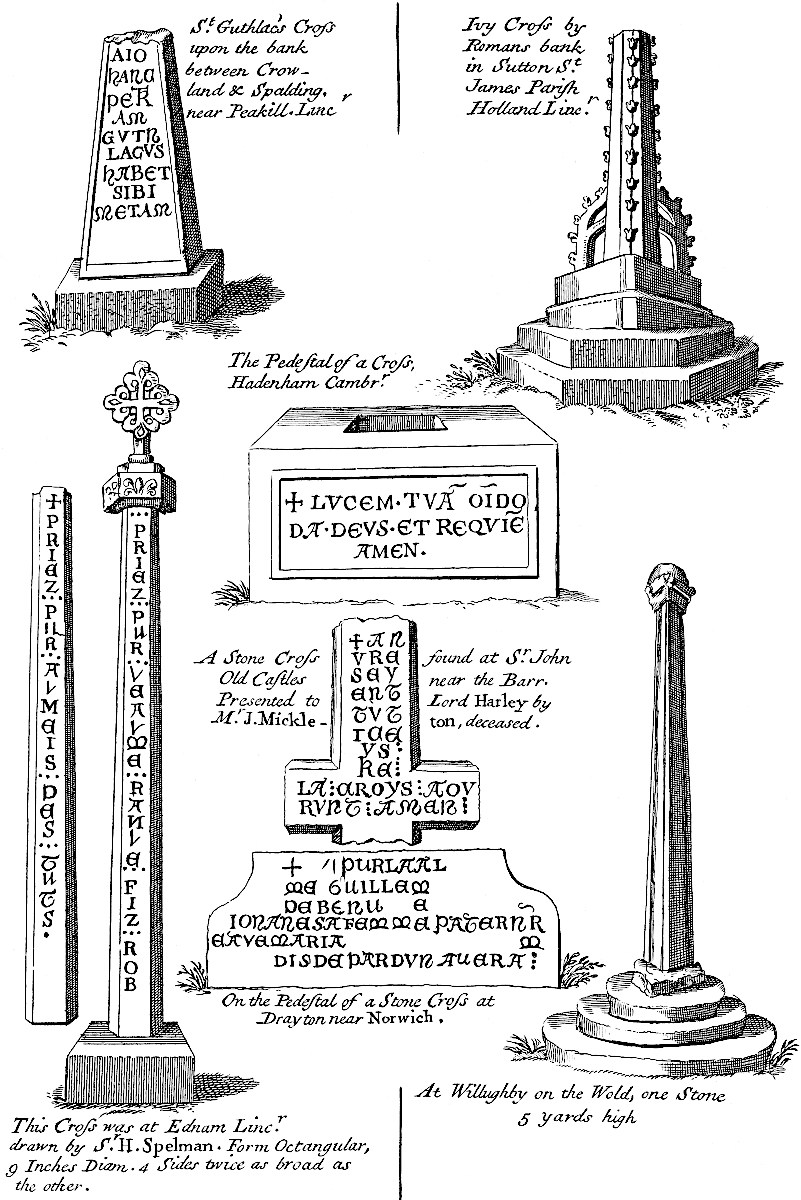
the hands of Mr. Richards of Stanford. At Edenham was a stone cross
now demolished: the inscription on it I have inserted in the TAB. XI.Plate of
Crosses: I saw the stump of it remaining not long since: hard by has
been an old castle at Bitham. Grimsthorp, the pleasant seat of the
Duke of Ancaster: the park is very large and beautiful; in the middle
of it stood Vaudy abbey in a vale, founded by Wil. de Albemarle 1147.
some small ruins of it are left: the lawn there, whereon is an annual
horse-race, is extremely delightful.[13] In Hakunby church upon a stone
I read this inscription,
Iste fuit Rector Thomas de Brunn vocitatus.
Sempringham abbey founded by St. Gilbert lord of the place, and author
of the Gilbertin order, where men and women lived together in holy
community: now an old ruinous seat of the earls of Lincoln.
Trekingham, so called, as some will have it, from a fanciful story of
three Danish kings there buried: round the font in the church is this
inscription, + Ave maria gratia p. d. t. Upon a tombstone in the
church-yard this,
HIC INTVMVLATVR JOHANNES
QVONDAM DN̅S DE TRIKINGHAM.
St. Saviour’s chapel at the end of Brig-end causeway is still left,
turned into a mansion house, founded by George of Lincoln, endowed
with lands to maintain the causeway: a legacy highly to be commended.
At Ranceby near Sleford on a hill, many Roman antiquities found, of
which an account in Leland’s Itinerar. Hale Parva, Hale Magna, so
called from the hall or seat of the lord of the manor: in the former is
Helpringham, which I suppose no more than Hale parva ingham, the
termination being very common in towns hereabouts.
Hollandimbanked by the Romans.
Having given an account of the preparation made by the Romans towards
gaining this vast tract of fen-land, the Lincolnshire levels, by
securing it from the fresh water of the high countries in that noble
cut called Cardike; we must imagine their next care was to render
it safe from the flux of the Ocean, by making a great bank all along
upon the sea coasts: this was done as to the wapentake of Elho by what
we call the Old Sea-dike, which by the people at this day is said to
be made by Julius Cæsar and his soldiers; as if they had knowledge
of its being a Roman work: at the mouths of all the rivers no doubt
they made gotes and sluices as at present, which was an invention of
Osiris, the great king of Egypt, as Diodorus Siculus tells us, I. 19.
We may well suppose it was performed after the time of Lollius Urbicus,
scarce fully accomplished before: possibly in Severus his time, which
seems not obscurely hinted at by Herodian, III. Sed in primis curæ
habuit pontibus occupare paludes, ut stare in tuto milites possint
atque in solido præliari. Siquidem Britanniæ pleraque loca frequentibus
oceani alluvionibus paludescunt. Per eas igitur paludes barbari ipsi
natant excursantque ad ilia usque demersi. But he had it in his
particular care to make passes over the fens, that the soldiers might
stand firm and fight upon hard ground; for many places in Britain are
marshy through the frequent overflowings of the ocean, over which the
inhabitants will swim, and walk though up to the middle in water. To
which description no place so well corresponds.
That the Romans thoroughly inhabited this fertile plain, the
following instances will sufficiently evince. About 1713, at Elm near
Wisbech, an urn full of Roman brass money was taken up, not far from
a tumulus of which the common people have strange notions,
affirming that they frequently see a light upon it in dark winter
nights. Dr. Massey has many of the coins; they are of the later
empire. There is another piece of high ground near it, where have been
buildings. Dr. Massey says there is a Roman altar in a wall there. At
Gedney hill several Roman coins have been found; some of Antoninus are
in your collection. In the same hamlet, about two mile north of Southea
bank, is a pasture called the High Doles, being a square doubly moted,
where ancient foundations have been dug up, and some Roman coins.
Another like square so moted is in the parish of St. Edmund’s, about
the same distance from the said bank, where the like matters have been
discovered. Aswic grange in Whaplodedrove parish is a high piece of
ground, square and moted about: in this and near it many Roman coins
have been dug up, and urns, which I have seen; some coins in your
collection. This is near Catscove corner; and it was Mr. Britain’s
notion that Catus made this work among many others as castella
to secure the possession of the country: these lie as it were in a
line, on the most southerly part of Elho. In the parish of Fleet near
Ravensclow, about 1698,[14] upon a piece of high ground where buildings
have been, Mr. Edward Lenton dug up a large urn with letters round it,
full of Roman coins,[15] about the quantity of three pecks, covered
with an oak board: the urn he broke in pieces: they were of brass piled
edgeways, mostly about the time of Gallienus and the thirty tyrants as
called, Tetricus, Claudius Gothicus, Victorinus, Carausius, Alectus,
&c. I have seen vast numbers of them, and have some by me: many are in
your collection. Near this place runs a low channel, quite to Fleet
haven, which probably then was the chief outlet of the waters into
the sea. Mr. Lenton found some ship-timber upon it with rusty nails,
probably of some Roman barge. None of these coins were lower than the
Tetrici, which proves the imbankation was made before their time. In
the same latitude, and in the next parish, Holbech,[16] in a pasture
called Anytofts, in my tenure, is a like square of high ground, where
rubbish of buildings and coins have been found; it is moted likewise:
not long since a labourer, scouring up a pit in the mote, took up an
urn now in my possession. At Giggleshurn, in casting up a ditch, were
many Roman coins found: we may reasonably conjecture Moulton hall was
such another place originally: and in a Held not far from thence,
called Woods, near Ravens-bank, three mile south of Moulton church,
upon plowing, several Roman urns and vessels were found, of fine white
and red earth; some of them were brought to Mr. Hardy. At Spalding,
Roman antiquities have been found, particularly cisterns; of which
some accounts in the Acts of the Royal Soc. No 279. and there was a
Roman castle there, as I conjecture, on the north side of the town, not
far from the river on the right hand of the great road to Bolton, the
square form of the ditch yet remaining. These places, with some other
of like nature, make another line of fortresses through the middle of
the country, parallel to the present towns. I have been told that at
Theophilus Grant’s house in Whaplode, near Gorham’s holt, aqueducts
of clay, one let into another, have been dug up;[17] and that in the
seadike bank, between Fleet and Gedney, a brass sword was lately found,
which seem to be Roman. Thus far in South Holland. At Boston, about
1716, they dug up an old Roman foundation beyond the school-house: near
it some hewn stones formed a cavity, in which was an urn with ashes,
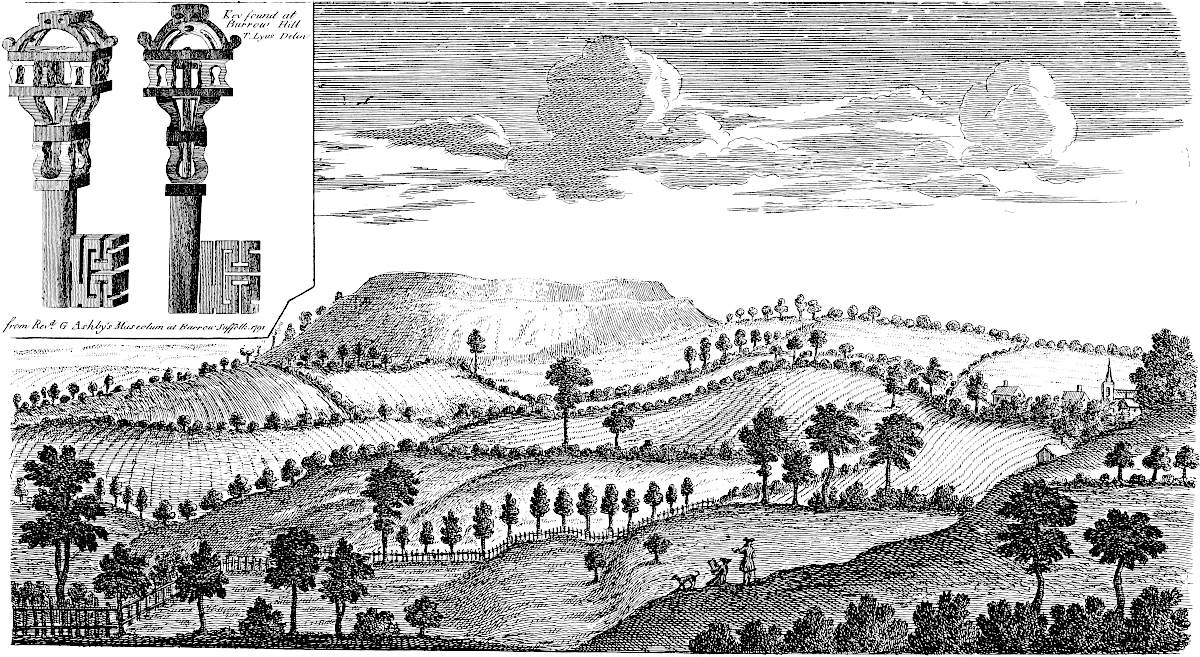
another little pot with an ear, and an iron key of an odd figure, in
my possession. Some time before then, in Mr. Brown’s garden at the
Green poles, they dug up an urn lined with thin lead full of red earth
and bones. A like one I have seen now in Sir Hans Sloan’s museum,
unquestionably Roman.
Romanroads there.
As the Romans had thus intirely taken in and inhabited the country, no
doubt but according to their custom they drew several roads across it:
but I fear it will be very difficult to give an exact account of them:
such is the nature of the ground, having no solid materials, that they
would be presently wore away without more constant reparations than the
inhabitants practise: yet I have little doubt in supposing one of their
ways was drawn from the northern high country about Bolingbroke by
Stickford, Stickney, Sibsey, and so to Boston river about Redstonegote,
where it passed it by a ferry. I have fancied to myself that several
parcels of it are plainly Roman, by the straitness and by the gravelly
bottom: from thence to Kirkton it is indubitably so, being laid with a
very large bed of gravel: and just a mile from the river is a stone,
now called the Mile-stone, standing in a quadrivium; it is
a large round stone like the frustum of a pillar, and very
properly a lapis milliaris. From Kirkton I imagine the road went
to Donington, where it met the great and principal road of the country,
which is drawn from Ely to Sleaford in a line not much different from a
strait one. It is certain that there is such a road from Grantchester,
which was a Roman town a mile above Cambridge, to Ely by Stretham:
thence another goes across the depth of the fens by Upwell and Elme
towards Wisbech; and it was near this road that the urn with coins
first mentioned was found: and anno 1730 a Roman urn full of coins
was found at the same place; they were of silver, and very fair. Mr.
Beaupre Bell, a curious gentleman, has many Roman coins found near this
Roman road by Emney; several of Carausius undescribed. Wisbech probably
was a Roman station, and their castle founded upon an older foundation.
I suppose this road passed over Wisbech river above the town towards
Guyhurn chapel, then went to Trokenholt and Clowscross, there entering
our country: from thence that it went in a strait line to Spalding, by
which means most of those square forts we have mentioned in Elho, where
Roman antiquities were discovered, together with most of the southern
hamlets, will be found to be situate near or upon it; such as St.
Edmund’s chapel, the moted place there, Gedneyhill chapel, Highdoles
there, Holbech chapel, Whaplodedrove chapel, Aswic grange, St.
Katherine’s, and Moulton chapel: whether any traces of it can now be
found or no, I cannot say; but the villages thereabouts seem strongly
to favour the conjecture. Supposing it fact, I should not be surprised
if it now be laid perfectly level with the surface of this fenny soil,
seeing I have observed the like appearance of a Roman road when carried
across a meadow in the high countries, and which was composed of a bed
of gravel 100 foot broad, particularly at the Roman city of Alauna by
Bicester, of which I shall in a following page give an account: and
this of ours I suppose only made of the earth of the country thrown
into a bank, because it was impossible to get more durable materials.
From Spalding, according to my sentiments, this road went towards
Herring bridge (the word retaining some semblance of antiquity) upon
Surflet river, so along the division between the wapentakes of Kirton
and Aveland, near Wrigbolt and Cressy-hall, to the end of Brig-end
causeway at Donington. Here, Holland brig or Brig-end causeway has all
the requisites that can ascertain it to be a Roman work, being strait
and laid with a solid bed of stone: the present indeed is repaired
every year, but we have much reason to think the first projection of it
through this broad morass was no less than Roman. From thence it went
to Sleford; then it seems to have gone across the heath, and to have
fallen in with the great Hermen street at a remarkable place called
Biard’s leap: from thence possibly it was carried, or was designed to
be, by Stretleythorp and Brentbroughton over the Witham to Crocolana
upon the foss-way; then over the Trent into Nottinghamshire, where
it answers in a line with the road to Tuxford and Worksop; and so on
perhaps to the Irish sea, whereby it would become a great parallel
to the Watling street running across the kingdom, as it does, from
south-east to north-west. At Sleaford I am inclinable to think another
road came from Banovallum, or Horn castle, to the east of the river
Bane southward by les Yates, and so crossed the Witham by Chapelhill
and the Cardike somewhere about Kyme: or else crossed the Witham at the
Hermitage, so went by Swinshed north end to Donington: this principal
road we speak of on the other end seems to go from Ely by Soham and
Bury to the German ocean. I am not ashamed to offer my conjecture to
the curious, however slender its foundation may be, if only as a hint
for a future search: but it seems to me very probable, that if it
was not fully executed by the Romans, they intended it, and have in
part manifestly done it. I conceit it crosses the Icening street at
Ikesworth near Bury, then goes to Bretenham, the Combretonium; but with
that country of Suffolk I am at present perfectly unacquainted. Return
we to Holland.
Besides this great road, I think we need not scruple to assert that
now called Ravensbank to be another, going east and west, through the
heart of the country, from Tid St. Mary’s to Cowbit. I have rode some
miles upon it, where it is now extremely strait and broad. We have
been informed that it is actually in some old writings called Romans
Bank: it is well known the Welsh pronounced Roman Rhuffain, and
our English word ruffian is from this fountain. Among the Welsh
the letters m and v are equivalent, to which f
is perfectly alike: maur and vaur is great, and many
more: so that Roman, raven, and ruffen, is the
same word; and hence no doubt came rambling, roving,
and roming, as an ignominious appellative of such as thought
every country better than their own; for such to our ancestors seemed
the Romans, that scarce left any corner of the known world impervious
to their all-conquering eagles, carrying arts and arms along with
them as an impetuous torrent, with a most glorious and invincible
perseverance. Further, it is not unlikely that the upper road running
east and west nearer the sea bank, now called Old Spalding gate, is
originally Roman: in some places, as about Fleet, it retains the name
of Haregate, which is equivalent to via militaris when spoken
by our Saxon progenitors. Thus the main road and these two lesser
ones seem sufficiently to answer this purpose as to Elho: it seems to
me, that when the Romans made the many forts all along the eastern
shore, to guard against the Saxons, that this bay was provided for
by five, two upon the edges of the high country, and three upon the
rivers; Brancaster in Norfolk, Burgh on Lincolnshire side; Wisbech,[18]
Spalding, and Boston, upon each river of the fenny tract.
Having given you then all the authentic or conjectural memoirs that
have in general occurred to my reflection upon the most ancient state
of this country, I shall proceed to other particularities, nearer
our own times, through every parish; only first take notice in short
of a wonderful appearance in nature all over this country, and which
is common to all such like upon the globe, as far as my informations
reach: that is, Antediluvian trees.the infinite quantities of subterraneous trees, lying
three or four foot deep, of vast bulk and different species, chiefly
fir and oak, exceeding hard, heavy and black: many times the branches
reach so near day as to break their ploughs, for so I have heard
them complain about Crowland: about Kyme and Billingay they have dug
up some boats or canoos made of hollowed trunks of trees.[19] Many
people will think that this is nothing but the effect of particular
floods, and that this country was once a forest, and not long since
disafforested. This country was once taken into the forest of Kesteven
by the Norman kings, (as you have told me) only with a political view
of extending their power, and disafforested soon after at the instance
of the prior of Spalding: yet it is true of Nassaburg hundred only,
in Northamptonshire. But in my apprehension, as to the matter before
us, such confine their notions to very scanty bounds: an universal
phænomenon requires a more dilated solution, and no less than that
of the Noachian deluge. But upon this I hope for an occasion to
be more copious another time: at present I remember a passage in
Pausanias’s Attics toward the end; speaking of an ebeny statue
of Archigetes, “I have heard, (says he) from a man of Cyprus very
skilful in medicinal herbs, that ebeny bears no leaves, no fruit, nor
has it any stock exposed to the sun, only roots in the earth, which the
Ethiopians dig up. Some of them are particularly skilful in finding
them out.” I doubt not but our author speaks of subterranean trees, and
that our people might use this timber to better use than burning it.
Most writers, and particularly Mr. Camden, and most strangers, have an
injurious opinion of this country, and apply that to the whole which
is true but of part of it: for in the main the land is admirably good,
hard, and dry; produces excellent corn and grass; feeds innumerable
sheep and oxen of a very large size, and good flesh and wool; bears
wood extremely well, has several large woods in it, some intirely of
oak of considerable size; is full of hedge-rows and quicksets, and
in summer time looks like the garden of Eden: it is level, and most
delightful to travellers, whether on horseback, or in a coach. The air
indeed is moist, as being near the sea, and bordering upon the fens
of the isle of Ely: as to the first, it is the same upon every sea
coast; as to the latter, they are chiefly on the south side, whence
the sun for the most part draws off the vapours from this country.
Indeed this inconvenience accrues from such vicinity, the production
of gnats; to which Angelus Politianus has done so much honour in that
beautiful Greek epigram you showed me; and is well guarded against
by the gentry in the use of netted canopies hung round their beds,
which was an invention of the Ægyptians living in a like country.
Vide Brown’s Garden of Cyrus, p. 30. But all things necessary for the
comfort of life are here in great plenty; and visitants ever go away
with a better opinion of it than they bring. That great soul king
Charles I. himself undertaking the glorious talk, and others under him,
had projected and made such stately works of sewers, as would
have rendered this country before now, for trade and beauty, the rival
of its name-sake beyond sea; but the licentious times that succeeded,
gave the unthinking mob (incited by his avowed adversary in all things,
Cromwell) an opportunity to destroy them. I have often considered and
admired the length, breadth, and depth of their canals, the vastness of
their gotes and sluices: indeed I think they made many more than were
useful, and might have laid out the whole in a better manner. I would
not, like the Trojan Prophetess, prognosticate ill to my own country;
but it is not difficult to foresee, that unless some project be taken
in hand, like that which my friend Mr. Kinderley published some time
ago, this vast and rich tract must be abandoned to eels and wild ducks.
A thing of this nature is not to be done but by the senate of the
kingdom taking the matter intirely into their own hands; and if I have
any judgement, whatever new works are made, ought always to be carried
eastward only, for reasons I inculcated before: therefore, instead of
deriving the Welland into the Witham, as was his notion, I would have
it brought to the Nen, and both into the Ouse at Lynn, as it was in its
original and natural state.
Since the time of the Romans, beyond their first bank have been many
intakes, by successive banks, of the best ground in the world left
by the sea, which contracts its own limits by throwing up banks of
sand out of the estuary: so that, from time to time, the land-owners
upon these frontiers gain several thousands of acres. It is observed,
the land so imbanked is ever higher in level than that left behind
it; and I doubt not but some time the whole bay between Lincolnshire
and Norfolk (being one of our great sovereign’s noblest chambers in
his British dominions over the sea, vide Seld. Mar. claus.)
will become dry land. By this means the parishes hereabouts increase
to a huge bulk. Holbech from Dovesdale bar, where it joins to
Cambridgeshire, to the limits of the salt marshes, is near twenty miles
long. The cattle bred on this ground are very large; the sheep never
have horns. Smithfield market, as now much supported, was chiefly set
up by the inhabitants here, as I have been told, particularly by Mr.
William Hobson, brother to the famous Cambridge carrier, and Mr. Cust;
the London butchers, before then, commonly going into the country to
buy cattle.
In every parish formerly were many chapels, it being impracticable
for people to come so far to one church, though now most of them
are demolished, at what time I cannot imagine. No part of England
boasts of so many beautiful churches, having generally lofty spires
of fine squared stone, fetched from Barneck pits, which are a coarse
rag full of petrified shells of all kinds of small fish, and not, as
some think, from Norway. And in no very distant times, not a parish
without great numbers of gentry, lords, knights, and great families,
who made a figure in the world: now scarce any remains of them, but
the site of their houses moted round, their tombs in the churches,
their arms in the painted windows, where they have by chance escaped
the fury of fanatic zeal. Many religious houses formerly there; and
nearly the whole country was got into their hands, as appears by the
old terriers, or town-books. The only houses of note are at present
Dunton hall, in Tyd St. Mary’s parish, lately rebuilt magnificently
by Sigismund Trafford, esq. who has likewise inclosed a considerable
park with a brick wall; and Cressy hall in Surflet parish, the seat
of Henry Heron, esq. in which the lady Margaret, mother to Hen. VII.
was once entertained. The house was handsomely rebuilt by the present
possessor’s father, Sir Henry Heron, knight of the Bath; but the chapel
is old, built, or licensed at least, anno 1309, as an inscription over
the door tells us. In it is an old brass eagle with an inscription
round it.[20]
Formerly, there is reason to suppose, the gentry had many parks
near their seats. Records in your possession show that the prior of
Spalding, about 1265, compelled Thomas lord Moulton to compound with
him for the venison in his park at Moulton; and in Holbech, about a
mile south of the church, are lands in my tenure, called the Park. That
fish and fowl is here plentiful, no one will wonder; but particularly
the pigeons are noted for large and fine.
Decoys.
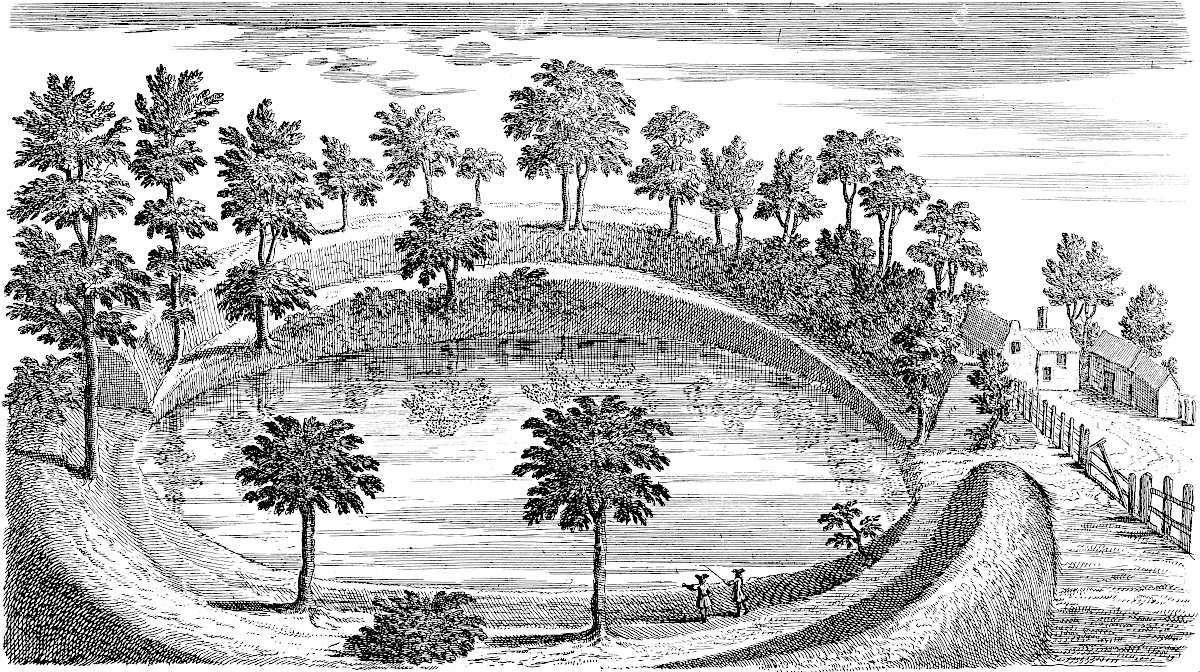
TAB. II.
In the out-skirts of it are great numbers of decoys, places so called
where they take an incredible quantity of wild ducks,[21] mostly sent
up to London: they are large pits dug in the fens, with five canals
shooting from them, each ending in a point after one angle made, well
planted with willows, fallows, osiers, and such underwood. I have given
a drawing of one. The method of catching fowl in short is this: the
decoy-man coming down to the angle of the pipe, or canal, which is
covered with nets and over-shadowed with trees, peeps through the holes
in the reedy sheds, disposed like the scenes at the play-house, and
joined by the others with holes at the bottom, about as high as a man’s
breast: when he sees a sufficient quantity of wild ducks in the mouth
of the great pond, by whistling softly, the tame ducks wing-stocked,
and brought up for that purpose, swim into the pipe covered with the
nets, to feed upon the corn he throws over the sheds into the water:
this tempts the wild ducks in to partake of the bait: in the mean time
a dog they teach runs round the half-sheds, in and out at the holes in
the bottom, which amuses the fowl so that they apprehend no danger:
when he has brought them far enough into the pipe, stooping he goes
along the scenes, till he is got beyond the ducks, and rising up shows
himself at the half-scenes, which frightens the wild ducks only, the
opposite way into the narrow end of the pipe, which terminates in a
fatal net: and all this is done without any noise or knowledge of the
rest of the wild ducks in the great pond; so that the decoy-man having
dispatched one pipe, goes round to execute the same game at all the
rest, whereby infinite quantities are catched in a year’s time at one
of these places only.
2
The Form of the Decoys in Lincolnshire.
Richardo M. Masfey M.D. tabulam d.d. Wˢ. Stukeley
In running over what few remarkables I have observed in this country,
I shall exclude Marsh-land, because in Norfolk, observing only that
their churches are very beautiful, numerous, large, and stately; that
here are, too, many such of the tumuli. You will indulge me the
liberty of giving the etymology of places all along: Cicero likes that
method; Acad. Quæst. 1. 8. verborum explicatio probatur,
i. e. qua de causa quæque essent ita nominata quam etymologiam
appellabant: and though there be often more of pleasant subtlety
than reality in such matters, yet it serves to find out and preserve
some old words in a language that otherwise are in danger of oblivion.
TheWashes.
I shall begin with the Washes so much talked of, and so terrible to
strangers, though without much reason; if they take a guide, which
is highly adviseable. The meaning is this: they are the mouths of
the river Welland, called Fossdike Wash, and the river Ouse, called
Cross-Keys Wash, running into the sea, and inclosing this country
almost round. Wase Sax. lutum, oose. Twice in a day, six hours
each time during the recess of the tide, they are fordable and easy
to be passed over: the intermediate six hours they are covered with
the flux of the ocean. Mr. Merret, of Boston, son to Dr. Merret, has
given a table in the Philos. Trans. which I improved for the benefit
of travellers, and is graven on a handsome copperplate by my friend,
Mr. John Redman: but I would have passengers not to trust too far to
the minutes in the table, because at some times of the year the tides
will anticipate a few minutes, at others will be retarded, and at all
times (not to say any thing of the difference of clocks and watches)
south-east winds make the tides flow earlier than ordinary, north-west
protract them; so that a wise traveller, in this and all other cases,
will take time and tide by the forelock. Formerly people travelled what
they call the Long Wash, between Lynn and Boston, intirely upon the
sands or skirts of the ocean, but now quite disused and impracticable:
there it was, that king John lost all his carriages among the creeks
and quicksands. The memory of it is retained to this day, by the corner
of a bank between Cross-Keys Wash and Lynn, called now King’s Corner.
Lutton.
In Lutton was born the famous Dr. Busby, master of Westminster school,
who has beautified the church, and founded a school there: he owes his
education to the Welbys, an ancient family in this country. I suppose
the town has its name from the general drainage of the country, which
was here in one channel united: they call such Lades, or Lodes, to this
day: this probably is as ancient as any town in Holland. South from
it (and therefore)Sutton. Sutton church is of an ancient make, especially
the stone work of the steeple: the upper part of the church has been
built of brick in the memory of man. John of Gaunt owned Sutton, and
other vast manors and townships in this country. At Tyd St. Giles,
Nicholas Breakspear was curate, who afterwards became pope Adrian IV.
St. James’s chapel is built of a large sort of brick, such as I have
seen no where else; not Roman.TAB. XI. Near it is Ivy-Cross, of stone, in a
quadrivium; a curious piece, upon Ravensbank.
Gedney.
Gedney church is very beautiful, built, I believe, chiefly by the
abbots of Croyland, who had a house, no doubt, very stately, on the
north side of the church, and large possessions in the parish: the
upper part of the tower is of the same date with the church, built
upon older work; probably both the work of the abbots, together with
contributions of the rich families that formerly lived here. In the
chancel window a religious in his habit. There is an old monument of
the Welbys, and upon the south door is this inscription:
PAX XPISIT HUIC DOMUI
ET OMNIBUS HABITANTIBUS
IN EA HIC REQUIES NOSTRA.
The town seems to be derived from Gaden-ea, aqua ad viam:
Ea is a watering place properly for cattle, and roads we still
call gates in this country.
Fleet.
The next parish, Fleet, from the Anglo-Saxonic Fleot,
æstuarium, fluxus, still called Fleet-Haven, is
remarkable for the steeple standing at a distance from the church: from
this place the family of the Fletes come, who have made a considerable
figure in the country ever since we have any written memorials.
Holbech.
Holbech (the Salt-Beech) church is very large, and well built, a
strong tower and lofty steeple, dedicate to all saints: formerly there
were organs and fine painted glass, with many coats of arms, but none
left except the Holbeches: Vert, six escallops argent, three, two,
one.TAB. XXI. There is a fine monument of the Littleburys, an ancient and
flourishing family in these parts:TAB. I. 2d Vol. upon his shield is his coat, Argent,
two lions passant gardant gules: there is a brass inscription of a
lady of the Welby family, wife to Sir Richard Leake, knight. Orate
pro anima Johanne Welby quondam filiae Richardi Leake militis nuper
uxoris Littlebury que obiit xviii die mensis decembris anno domini
mccclxxxviii. cujus anime propitietur deus Amen. Here was born
Henry Rands, alias de Holbech, bishop of Lincoln, who was one of the
compilers of the Liturgy: here formerly flourished the ancient families
of Fleet, Dacres, Harrington, Barrington, Welby, Multon.
In the year 1696, in digging at Mr. Adlard Stukeley’s gardens, they
found an old brass seal, which I gave to Sir Hans Sloan; a man in
long robes, with two escutcheons, on one three cocks, on the other a
portcullis; the legend, +SOVRABLA DEUS OLER. In the year 1698,
an iron spur with a very long shank was found: in my possession. A
remarkable rarity in nature I met withal, an admirable ossification in
the omentum of a sheep, white and solid as ivory. Mr. Cheselden
has printed a cut of it in the second edition of his Anatomy. I gave it
to Dr. Mead.
From the ancient churchwardens’ accounts, before the time of the
Reformation, from anno 1453, many curious remarks may be made, in
relation to prices of things, wages, superstitious customs, old
families, and the like: a specimen whereof I have here annexed.
ss. A Boake of the Stuffe in the Cheyrche of Holbeche
sowld by Chyrchewardyns of the same according to the injunctyons
of the Kynges Magyste.
s.
d.
An. dni. M. ccccc. xlviio. First to Antony
Heydon the trynite with the tabernacle
ii.
iiii.
It. to Wm. Calow thelder the tabernacle of Nicholas and Jamys
vi.
viii.
It. to Wm. Davy on tabernacle of our lady of pytye
iiii.
It. to Wm. Calow the younger on other tabernacle of our lady
iii.
vi.
It. to Antony Heydon the ymage of the Antony
xx.
It. to Humphry Hornesey on sygne
vi.
It. to Antony Heydon on other synge and a lytyl tabernacle
xx.
It. to Wm. Calow the younger the tabernacle of Thomas Bekete
iiii.
viii.
It. to Wm. Davy the sygne whereon the plowghe did stond
xvi.
It. to John Thorpe a chyst in St. Jamys chapell
ii.
It. to Lincone howld woode
iiii.
It. to Nicholas Foster the banke that the George stoode on
iiii.
It. to Antony Heydon ij alters
ii.
viii.
It. to Wm. Stowe ij lytyll tabernacles
viii.
It. to Henry Elman on lytyll tabernacle
ii.
It. to John Thorpe for Harod’s coate
xviii.
It. to Wm. Calow the younger all thapostyls coats and other raggs
viii.
iiii.
It. to Henry Elman for vii baner clothes
ix.
iiii.
It. to Antony Heydon on blewe clothe
ix.
It. to Smithes on pece of howlde saye
iii.
It. to Richerd Richerson the crosse and other gydys
ii.
iii.
It. to Mr. Byllysby ij tablys
iiii.
iiii.
It. to Antony Heydon for the coats of the iij kyngs of Coloyne
v.
iiii.
It. to Humphry Hornesey the canypye that was born over the sacrament
xx.
It. to Wm. Calow thelder and John Thorpe iiij owlde pantyd clothes
vi.
viii.
It. to Antony Heydon on wood candlestyke
iiii.
It. to Wm. Calow the younger on lytyll bell
vi.
It. to Antony Heydon on other lytyll bell
vi.
It. to Wm. Davy for the tabernacles that stode at the end of the hy alter
viii.
l.
s.
d.
Sm.
iiii.
ii.
iiii.
A. D. m. ccccc xlvii.
It. to Wm. Calow the younger on rod of iyron
iiii.
It. to Robt. Gyffon for ij barrs of iyron
v.
It. to Antony Heydon xx score and x hund. of latyn at ii s. and xi d. the score
lxix.
xi. ob.
It. to Richerd Richerson ij lytyll tabernacles
viii.
It. of John Suger for the chyrche lond
ii.
viii.
It. of the burial of Mr. Byllysby
iii.
iiii.
It. of John Mays wyffe for the Dracon
iii.
It. of Alys Boyds debt to xps corpys gilde
ii.
It. for on belll. xviii.
ii.
It. for seyten vestments and trashe in the chest in trinete quere sold to Davy
xxxiii.
iiii.
It. of Wm. Burnit for pilows
xvi.
It. of Wm. Calow the younger for eyrne
xx.
l.
s.
d.
Sm. totalis
xxviii.
iiii.
iiii. ob.
21
Ecclesiam de HOLBECH in Agro Linc. Lucio HenricoHibbins Arm. d.d. W. Stukeley 1722
Stukeley delin.
I. Harris sculp
1·2d.
Littlebury in Holbech Church
More superstitious ornaments of the church were sold in queen
Elizabeth’s time, 1560.
From this book I extracted the following catalogue of the Ministers
of the parish.
In 1529, a new organ cost 3l. 6s. 8d. The organ in the church was
taken down 1568. Anno 1453, Wm. Enot, of Lynn, epi. and Henry Nele of
Holbech, gave the saints bell. Another guild of St. Thomas; another
of our Lady. The vestry on the south side of the choir was taken
down 1567. There was formerly a chapel dedicated to the Virgin Mary
at Holbech hurn, near the ancient seat of the Littleburys; standing
1515: another chapel thereabouts, dedicated to St. Nicholas: another
in Wignal’s gate, near Holbech hall, by the river side, dedicated to
St. Peter. About 1719, I saw many corpses dug up in the yard at making
a ditch there. Another in the fen ends. An ancient guild of Corpus
Christi stood near Barney pit, where is now a house once belonging to
Moses Stukeley, who owned the estate thereof. An hospital founded by
John de Kirkton, in his own messuage, by licence of king Ed. III dat.
Nov. 16, for a warden, chaplain, and fifteen poor people: he endowed it
with several lands in Holbech, which he held of the abbot of Croyland,
who by licence permitted the same to be annexed to this hospital of All
Saints in Holbech, for which he paid 20l. This stood, as I imagine,
where now is the Chequer inn, over against the church. I remember the
old stone-work arched doors and windows with mullions, pulled down
when rebuilt by my father, and many of the carved stones were laid in
the foundation of the houses he built by the river side at the bridge.
See Dugdale’s Monasticon. A free-school was founded here, about
1669, by George Farmer, esq. who endowed it with lands, which with
others since given are now worth about 50l. per annum; which I am bound
in gratitude not to forget. A. D. 1699, there were belonging to the
fifty-four bounds of this parish,
paying rates, acres 6234; in the marsh, acres 6532; and since added
for the last intake, acres 170. The old cross in the market-place was
pulled down 1683. 1253, Thomas de Multon, lord Egremont, obtained
a market and fair toTAB II. 2d Vol. Holbech, 31 Oct. 37 Hen. III. at Windsor, and
probably built that cross.
2·2d.
Holbech Cross Lincolnshire
Ob amorem erga Solum Natale, Temporum Ignorantia direptam restituit
Ws. Stukeley 1722
Whaplode.
Quaplode, called anciently Capellade, i. e. Capella ad Ladam s.
fluvium, has a very ancient church, founded by the abbots of
Croyland: the tower stands on the south side. In the upper and south
windows are these coats of arms. Barry of six azure and argent; Azure,
a bend gules, charged with three roses argent; Argent, two lions
passant gardant gules, Littlebury. In the east window of the
north chapel, Littlebury, and Or, a fesse between two chevronels
gules; and Sable, a fret argent, Harrington: Azure, on a bend
gules, three roses argent, as before. I have a copy of the foundation
of this church. Here is a large monument of the Irbys.
Moulton, or Multon, probably has its name from a mill, which anciently,
perhaps, were not so common as now. There is a good church, and very
fine spire; as also a good free-school of near 100l. per ann. value in
lands. Moulton hall, whose last ruins I have seen, was the seat of
Thomas de Multon, lord Egremont, a great man in these parts. His hand
is among the barons at Magna Charta. Between these two parishes,
in a green lane northwards, stands a little stone called Elho stone,
whence the name of this hundred is derived: it is about the middle
thereof, and was formerly the main road across the country, now called
Old Spalding Gate. Old men tell us, here was kept in ancient times an
annual court; I suppose a convention, sub dio, of the adjacent
parts, to treat of their general affairs. A wood hard by is called
Elhostone wood.
Weston.
Weston, because west from the last town. Here is the stately chapel of
Wykeham, the villa of the rich priors of Spalding, built by Clement de
Hatfield, prior, who died anno 1318. In 1051, Spalding priory made by
Thorold, sheriff of Lincoln, out of his own manor-house. Many places
near the old sea-bank are called hurns, signifying an angle.
Here is a little leam called the Wik: Mr. Camden, in Bucks,
says it signifies the winding of a river, as Cowhurn hard by.
Spalding.
Spalding has been famous for its ancient and rich priory founded before
the Conquest, and for the residence of Ivo Tailbois, the lord of this
country, by gift of William the Conqueror, the site of whose castle is
on the north-east part of the town. The town-hall was built by William
Hobson. But of this place we expect from you, sir, a more particular
account.
Pynchbek.
In Pynchbek church-windows are the arms of Ogle, of Fleet; Argent,
on two bars sable, six escallops of the first, empaled with De la
Launde. Pyncebeck seems to come from the Cimbrian pinken,
lucere, from the clearness of its water.
Many towns, on both sides Deeping Fen, end in ington,
ingham, as lying upon the Mead. Donington.Donington is very hilly, full of
elevations or dunes. Thomas Cowley, esq. of Donington, who died about
1718, left all his estate, which was considerable, to the poor of every
parish where it lay, whereof 400l. per ann. to Donington, where he
built a school-house, and endowed it.
Algarkirk.
Algarkirk has a fine church, in which are some water-bougets carved
on the oak seats in escutcheons. They say here lived the famous count
Algar,[23] commander of the Holland men in many battles against the
Danes, of whom they show an image in stone in the church-yard. I found
there this inscription,
Sis testis Xpe, quod non jacet hic lapis iste
Quisquis es si transeas sta perlege plora
Corpus ut ornetur sit lapis ut memoretur.
Sum quod eris fueramque quod es pro me precor ora.
Wiberton.
Wiberton, they say, has its name from Guibertus, a great man here
formerly. There is a place called Multon hall, which belonged to the
aforementioned Thomas de Multon. Here is likewise Titton hall: the
chapel is now converted into a stable.
Frampton.
Hard by is Frampton, probably from the Anglo-Saxonic Faran,
trajicere: for here they passed over the river in a ferry,
before Boston bridge was built; as at Framton, in Gloucestershire,
upon the Severn, and Framilode passage. Farnton by Newark, where
now is the ferry over the Trent. Gosberton, from Gosbèrt, or
Gosbright, I suppose lord of the town before the Conquest.
Fossdike seems to be Fordsdike, where we pass over the Washes.
Skirbeck.
Skirebec doubtless has its name from the Saxon, scire, division,
because here the river parts the hundreds. Here was an hospital of
knights of St. John of Jerusalem, now intirely demolished, though the
church was standing within memory of man. There was another religious
house near the church: the remains of it is now the parsonage-house.
Such names of towns as Fishtoft, Butterwick, Swineshead, Cowbyte, and
the like, seem easy enough.
Sibsey.
Sibsey church has very handsome pillars and circular arches, somewhat
after the Roman mode. The top of the steeple is added upon the old
work; perhaps from its watery situation; sipan, to steep.
Leverton.Leverton, Leofrici oppidum: he was a potent man thereabouts at
the time of the Normans coming, and gave to the town much common: his
deed of gift is now in possession of the reverend and worthy vicar, Mr.
William Falkner, which I have seen.
Frieston.
Frieston, a frith, æstuarium; so Ald Friston in Sussex,
near Cuckmere haven. Here was an opulent monastery founded by Guy de
Croun, whose genealogy I shall not think much to recite, because it
relates to the antiquities of this country, and in some measure shows
the reason of what my friend Mr. Becket, surgeon, much wondered at
when he searched the old repository of wills at the Prerogative Office
in London, where he observed more of this country than any other in
England.
Of the Craons, Credon, Crodon, Croun, the
most illustrious family of Anjou, and one of the most illustrious
in France, which came into England with William the Conqueror. The
barony of Craon is the first and most considerable in Anjou: it is
a small city in that province upon the river Oudon near Bretagne,
encompassed with walls.[24]
The site of Roushall, where the barons Ros lived, is in the parish of Fishtoft.
Vainona.
In Wainfleet church, the bishop of Winchester, whose name was Patten,
founder of Magdalen college, Oxford, erected a marble monument for
his father, where are his coats of arms in the windows. In the town
he built a handsome chapel of brick, and endowed it with a pretty
good revenue, to pray for his and his ancestors souls. Now it is
made a free-school house. This place still retains its ancient name;
for I am certain it is the Vainona mentioned by the famous author of
Ravenna, who has happily preserved so many of our old British
cities. The learned Mr. Baxter, in his Glossary of British Antiquities,
with a sagacity peculiar to himself, has corrected this from Navione.
The sea has added much ground to this place since the Roman times, and
then their city stood higher up by the churches, which is a mile off
the present town. The haven was near St. Thomas church, now called
North-holm: it is still very deep thereabouts, and appears to have been
broad, being a pretty good river, whilst the waters of the east fen
ran through it, and kept it open: it was thirty foot wide a mile above
the churches, as appears by the old cloughs there; for they had wisely
contrived by that means to keep out the salt water and heighten the
fresh, which no doubt would have preserved the haven to this day, had
they not foolishly suffered the east-fen water to be carried to Boston.
It is apparent the natural course of water here (as we before observed
of other parts of the level) is eastward: the east fen is lower than
the west fen. At Nordike bridge anciently were four arches: the edge of
the piers which cut the water was westward; which shows that the water
originally run eastward, and the whole level was drained that way,
though now most currents run to Boston. The inhabitants have a constant
tradition, that this was a great town; but when the haven was filled
up, Boston became the sea-port: likewise they say there is a road
across the east fen, called Salter’s road, which probably was the Roman
road; and there are people now alive who knew such as had remembered
it. Doubtless this was a place where the Romans made their salt of the
sea water, to supply all this province; and it is not improbable that
this road led to Banovallum, Lindum, &c. Many salt hills are visible
from Wainfleet to Friskney. The king is still lord of the soil of this
old Roman city.
Burgh, a Ro. fort.
Three miles north, and as much from Skegness and the sea, is Burgh, a
market-town, whose name drew my attention. I found it to be a Roman
castrum to guard the sea-coasts, probably against the Saxon
rovers: it is a piece of very high ground, partly natural, partly
raised by Roman labour, overlooking the wide extended marshes, perhaps
in those times covered with salt water, at least in spring tides. There
are two artificial tumuli, one very high, called Cock-hill. In
St. Mary’s church-yard, now demolished, Roman coins have been found. I
saw a very fair and large Antoninus Pius in brass, cos. iiii.
in possession of Tho. Linny. In the yards and gardens about the town
they frequently dig up bodies. St. Peter’s church is large and good.
There appear no Roman ways, vallum, or ditch, to inclose the
town, which is a sort of knoll, or rising ground.
I was told of a Roman aqueduct of earth, found at Spilsby. In Halton
church hard by is this inscription on a flat stone. + SIRE WATER
BER GIST ICY DE SA ALME DEUS EIT MERCI. Another, a cross-legged
knight: on his shield a lion rampant. At Hagnaby, a religious house
founded by Agnes de Orreby. Well, by Ralf de Hauvile. Near Well, on a
chalky heath, are three curious Celtic barrows contiguous and joined
one into another, composed of chalk: the chalk in Lincolnshire by
Alford answers to that in Norfolk. Tateshall collegiate church founded
by Ralf Cromwell. Many tumuli hereabouts, as at Hagnaby and
other places, but none so remarkable a curiosity as those by the broad
road upon the descent of the high country, overlooking the vast level
towards Boston. At Revesby, by the seat of Joseph Banks, esq; there
is an oval inclosed with a broad ditch: the longest diameter, which
is somewhat above 300 foot, is precisely east and west; the other a
little above 100: the entrance to it is on the middle of the south
side: within, at each end of the length, is a large tumulus
100 foot in diameter: they are equal in shape and similar positure, a
large vacuum of 100 foot lying between: it is very regularly formed:
the length of the oval ditch that incloses the two tumuli is
equal to thrice the breadth: the tumuli are large and high:
that rising on the north side, without the ditch, is of an odd figure,
but similar. It seems to have been a place of sepulture; perhaps two
British kings were there buried; and the height on the north side
was the place whereon they sacrificed horses, or the like, to the
manes of the deceased. Or is it a place of religious worship
among the old Britons? and the two hills may possibly be the temples
of the Sun and Moon. I am inclined to think it ancient, because of the
measure: the breadth is equal to 100 Celtic feet, as I call them; the
length to 300.
Banovallum.
Horncastle was undoubtedly the Banovallum in Ravennas:
the latter part of the word is Latin, so that it signifies the
fortification upon the river Bane. TAB. LXXXIX.It is of a low situation, placed
in the angle of the two brooks meeting here, the Bane and Waring;
whence the modern name Horncastle, which signifies an angle, all this
country over, as you know in your neighbouring Cow-hurn, Holbech-hurn,
Guy-hurn, &c. I will not venture to conceit it came from the ancient
way of painting rivers horned, from their windings and turnings; of
which we may find a hint in Burton’s Comment. on Antoninus’s Itinerary,
pag. 56. and they that please may consult Bochart’s Phaleg, II.
22. where are many proofs of the ancients expressing an angle by the
term horn. Skinner in his Etymologicon rightly affirms
it comes from the Saxon word hyrn; and Ælfricus expounds it by
the word cornu. It is probable the Romans were induced to make
a station here at first from its convenient situation, easily rendered
defensible by a vallum drawn across the aperture from one river
to the other; and thence came the Roman name. Afterwards they built
the indissoluble stone wall, whole vestigia are manifest the
whole compass round, and in some places pretty high, as three or four
yards, and four yards thick. It serves for sides of gardens, cellars,
out-houses, &c. as chance offers, inclosing the market-place, church,
and good part of the town. It is a perfect parallelogram, composed of
two squares: at the angles have been square towers, as they report:
the gates were in the middle of three sides, and I suppose a postern
into the meadows called the Holmes at the union of the two rivulets. I
suspect originally the river Bane ran nearer to the wall in that part,
and behind the manor-house: the garden there has been heightened, and
the river pushed farther off, and turned with a larger bow to favour
the people who live in Far-street, and especially the tanners, who
are very numerous there: both rivers probably were wider and deeper
than now, as the Celtic name of Bane altus intimates, which at
present is conformable to reality lower down. Some do not scruple to
affirm it was a sea-port, that is, navigable. The Waring arises but
a mile or two off. The field across it south of the town is called
the Thowng and Cagthorp, and probably was its pomæria, from
the Saxon word pang, campus, ager. Here they
find a great number of Roman coins. I saw a brass coin of Vespasian;
reverse, an eagle, CONSECRATIO; dug up from under the walls
of Banovallum: Mr. Hograve of the place has it now: but Horncastle was
not built in the time of Vespasian. I saw, in possession of Mr. Terry
of Lincoln, a silver Vespasian found here; reverse, a sitting Genius
with a sympulum in her hand, and DN. MA. In 1734, a girl
digging sand by the road side going from Les Yates to Horncastle, and
near Horncastle, dug up an earthen urn full of Roman coins, rings, &c.
Mr. Terry collector gave me some of them. Near the walls upon digging
cellars they sometimes find bodies buried. A rivulet called Temsford
runs into the Bane. The school lands were given by private persons,
and it was incorporated by queen Elizabeth: their seal is a castle and
hunting-horn: and a horn is the brand for the town cattle upon the
common. It is dubious whether Bowbridge has its name from the arch of
the bridge, or from its being the entrance into the town from Lindum
through the gate called formerly a Bow. This way is the maypole-hill,
where probably stood an Hermes in Roman times. The boys annually keep
up the festival of the Floralia on May day, making a procession
to this hill with May gads (as they call them) in their hands:
this is a white willow wand, the bark peeled off, tied round with
cowslips, a thyrsus of the Bacchanals: at night they have a
bonfire and other merriment; which is really a sacrifice, or religious
festival. The king formerly had this whole town in his possession,
until it was bestowed on the bishop of Carlisle. Near the conflux
of the two brooks was lately a pleasant garden, and a place called
Julian’s Bower, much talked of.
89
Banovallum. Sept. 1. 1722.
Josepho Banks de Revesby Ar. Romanorum hæc Vestigia d.d. W. Stukeley.
Stukeley. Del.
19
Amicissimo Henrico Pacey Ar.
Prospectum Bostoniæ Suæ d.d. W. Stukeley
Aug. 29. 1722.
Leak signifies a watery marshy place. Wrangle an
ab A. S. Wear lacus, and hangel arundo,
lacus arundinibus obsita? Return we toBoston. Boston, Fanum Sti.
Botulphi, the saint of sea-faring men. St. Botulf (the bishop)
his body lay in St. Edmund’s monastery at Bury. Wm. Malmsb. p. 137.
This seems to have been the last bounds northward of the Iceni
in most antient times; therefore its old name was Icanhoe,
or Icenorum munimentum, as Mr. Baxter interprets it in his
Glossary. I guess the first monastery founded here was on the south
of the present church; for I saw vast stone walls dug up there,
and a plain leaden cross taken up; in my possession. Many were the
religious houses here in superstitious times, whose lands were given
to the corporation by Hen. VIII. as likewise the estate of the lord
Hussey, beheaded then at Lincoln for rebellion: he lived in one of
the houses where is a great square tower of brick, called now Hussey
tower. There are many such in this country, as that now called Rochford
and sometimes Richmond tower, which is very high. Queen Mary was a
great benefactress to this corporation, and gave them lands called
Erection-lands, to pay a vicar, a lecturer, and two school-masters:
they have now a revenue of a thousand pounds per annum. In the
parsonage-house is a scutcheon with a pastoral staff behind it thus: a
fess charged with a fish and two annulets between three plates, each
charged with a cross fitché. TAB. XIX.The church, I think, is the largest parish
church (without cross ailes) in the world: it is a hundred foot wide
and three hundred foot long within the walls: the roof is handsomely
cieled with Irish oak supported by four and twenty tall and slender
pillars: many remains of fine brasses in the church, none so perfect
as this in the south aile. Under the figures of the man and woman this
inscription,
Ecce sub hoc lapide henricus Mete sistit humatus
vi mortis rapida generosus semper vocitatus
hic quisquis veneris ipsum precibus memoraris.
sponsam defunctam simul aliciam sibi junctam
anno mil C quater quadragenoque deno
marcia quarto dies, extat ei Requies.
The tower is the highest (100 yards) and noblest in Europe, flattering
a weary traveller with its astonishing aspect even at ten miles
distance. It is easily seen forty mile round this level country, and
farther by sea: the lantern at top is very beautiful, and the thinness
of the stone-work is admirable. There was a prodigious clock-bell,
which could be heard six or seven miles round, with many old verses
round it: about the year 1710 they knocked it in pieces, without taking
the inscription. Twenty yards from the foundation of this tower runs
the rapid Witham, through a bridge of wood. On the south side of the
church-yard was, some few years ago, a curious monument[25] (as they
say) of one of the builders of the church, in stone, of arched work,
but now intirely demolished; and in the market place in my memory was
an old and large cross, with a vault underneath, TAB. III. 2d vol.steps all around
it, and at top a stone pyramid of thirty foot high, but at this time
quite destroyed. I found here an old brass seal of William Chetwynd,
with his coat of arms, A fesse lozengé between three mullets, which I
gave to the honourable gentleman of that name. Several frieries here,
black, white and grey; of which little remains. Oliver Cromwell, then a
colonel, lay in Boston the night before he fought the battle of Winceby
near Horncastle, Oct. 5. 1643. In North Holland they have a custom of
pulling geese twice a year; which has not escaped Pliny’s notice, X.
22. There is nothing left of the adjacent Swineshed abbey, founded by
Rob. Greisly, but a yew-tree and a knightly tomb fixed in the wall
of the new house. Here king John sickened in his journey to Sleeford
castle and Newark castle, where he died.
East of Boston was a chapel called Hiptoft, and in the town a church
dedicated to St. John, but demolished. Here was a staple for wool and
several other commodities, and a vast foreign trade: the hall was
pulled down in my time. The great hall of St. Mary’s Guild is now
the place of meeting for the corporation and sessions, &c. Here was
born the learned John Fox the martyrologist. Queen Elizabeth gave the
corporation a court of admiralty all over the sea-coast hereabouts.
Abundance of rare sea-plants grow near this coast: many species of
sea-wormwoods, scurvy-grass, crithmum marinum,
atriplex marinum, &c. of which we may expect a good
account from Dr. Blair of Boston; as also of many rare fishes caught
hereabouts, Raja, needle-fish, star-fish, &c. and
of the stickle-back oil is made in very large quantities, the
invention of the Ichtyophagi, Pliny XV. 7. Carum vulgare,
Caraway, grows plentifully in the pastures all about Boston.
Sambucus foliis variegatis baccis albis, Elder-tree with gilded
leaves and white berries, in Boston Fen-ends: a gilded ivy in
Mr. Pacey’s garden. Apium palustre Italicum, Selery vulgo
dictum, in all the ditches of Holland. Paronychia folio
rutaceo, Rue-leaved whitlow-grass, on the north side of walls and
houses. A barberry-tree without stones, in Alderchurch parish.
Asparagus sylvestris, wild asparagus, in Gorham wood, Whaplode.
Many rare plants in the east fen, such as stratiotes azoides,
fresh water fengreen. In the boggy grounds about Tattersall,
Trifolium palustre, ros solis, virga aurea,
myrtus brabantica, pinguicula, asphodelus,
adianthum aureum. In the park, androsæmum, tutsan:
in the ditches hard by, valeriana sylvestris: in the heaths,
many sorts of erica: solanum lethale about Cowhurn.
Kirton.
Pass we from Boston by Kirkton, famous for apples, denominated from its
fair church built by Alexander, that magnificent bishop of Lincoln,
after the manner of a cathedral with a transept. It has a handsome
tower standing upon four pillars in the middle of the cross, with a
noble ring of five large bells. I observe, this building is set upon
the ruins of a former church, part whereof is visible at the
west end: and in most of the churches in this country the same may be
discovered, from the different manner of the architecture; the most
ancient having small windows arched semicircularly; what is additional,
to be known by the pointed Gothic arches. This church is very neat both
within and without: upon the font is this inscription:
+ Orate pro anima alani burton qui fontem istum fieri fec. a. d.
mccccii.
Against the north wall is the monument of a person in armour, and round
it this inscription,
+ Orate pro anima Iohannis de Meres.
The family of the Meres has flourished much hereabouts.
3·2d.
Boston Cross
Stukeley del.
I Harris Sculp
4·2d.
The Remains of Crowland Abby. 14. July. 1724.
Stukeley del
I Harris Sculp
Upon the edge of Lincolnshire, in the middle of a vast fenny level,
Crowland.Crowland is situate, memorable for its early religion and the ruins
of an opulent monastery, which still makes a considerable prospect.
The abbey presents a majestic view of ruins; founded a thousand years
ago, by Athelbald king of the Mercians, in a horrid silence of bogs
and thorns;TAB. IV. made eminent for the holy retirement of his chaplain
Guthlac, who changed the gaieties of the court for the severities of
an anchorite. The king endowed it with a profuse hand, and all the
land for several miles round the church belonged to it. The foundation
is laid on piles of wood drove into the ground with gravel and sand,
and they have found several of them in tearing up the ruins of the
eastern part of the church; for what remains now is only part of the
west end; and of that only one corner in tolerable repair, which is
their parish-church at present. It is not difficult at this time to
distinguish part of the very first building of this church, from that
which was built by Ingulphus.[26] In the middle of the cross stood once
a lofty tower and a remarkably fine ring of bells, of which there is a
proverb in this country still remaining: one prodigiously great bell
was sacred to Guthlac: they are said to have been the first peal of
bells in the county, perhaps England.[27] From the foundation of this
tower to the west end, is somewhat left, but only the walls, pillars,
with passages or galleries at top, and stair-cases at the corners. The
roof, which was of Irish oak finely carved and gilt, fell down about
twenty years ago: you see pieces of it in every house. The pavement is
covered with shrubs for brass inscriptions, and people now at pleasure
dig up the monumental stones, and divide the holy shipwreck for their
private uses; so that, instead of one, most of the houses in the town
are become religious. The painted glass was broke by the soldiers in
the rebellion, for they made a garrison of the place. All the eastern
part of the body of the church is intirely razed to the foundation;
and the ashes as well as tombs of an infinite number of illustrious
personages, kings, abbots, lords, knights, &c. there hoping for repose,
are dispersed, to the irreparable damage of English history. The great
Waltheof, earl of Northumberland and Huntingdon, was one of the saints
here: he was beheaded by the Norman conqueror. The monastic buildings,
cloysters, hall, abbot’s lodgings,[28] and the like, which no doubt
were very fine, are absolutely demolished; no trace thereof left,
whereby their extent might be guessed at. In the north-west corner
of the church stands a strong tower with a very obtuse spire, and a
pleasant ring of small bells. Over the west gate are the images of
divers kings, abbots, &c. among the rest St. Guthlac with a whip and
knife, as always painted: they were cut in a soft kind of stone, and
drawn over in oil colour with gilding.
Not far off the abbey eastward, upon a hillock, is the remnant of a
little stone cottage, called Anchor Church-house: here was a chapel
over the place where St. Guthlac lived a hermit, and where he was
buried.[29] Over-against the
TAB. VII.west end of the abbey is the famous
triangular bridge: it is too steep to be commonly rode over; horses and
carriages go under it: it is formed upon three segments of a circle
meeting in one point; they say each base stands in a different county.
The rivers Nyne and Welland here meet. On one side sits an image of
king Athelbald with a globe in his hand. St. Guthlake’s cross, between
Spalding and Crowland, near Brother-house and Cloot-bar, stands upon
the side of the bank, almost buried under earth: it is a boundary of
the church lands: TAB. XI.of great antiquity.[30]
ITER OXONIENSE . II.
Sed prior hæc hominis cura est cognoscere terram.Virg.
To Mr.JOHN HARDYof Nottingham.
IT is commonly remarked, that impressions of any sort made upon
youthful minds last long; and, like a cut in the bark of tender sprigs,
grow deeper and more apparent with advancing years.
Crescent illæ crescetis amores.Virg.
The many hours I have spent with you when I first began to cast my eyes
upon the scenes of the world, and consider things about me, recur to my
mind with pleasure. I should be ungrateful then, (to which my temper
is most abhorrent) and I should deny myself a particular satisfaction,
did I not acknowledge the remembrance of a friendship now mature:
therefore to you I offer the earliest fruits of it, this small account
of the first pleasurable journey I can reckon to myself, where I had
opportunity for satisfying my growing curiosity. It is no wonder that
your learning, your taste of antiquities, and all endearing qualities,
made me fond of cultivating your acquaintance; and perhaps to you in
great measure do I owe what may not be discommendable in amusements of
the following kind, since our converse and our journeying sometimes
together, to visit the remains of venerable antiquity, in my first
years, gave me the love and incitement to such pursuits. I am not
concerned to make an excuse for the meanness of this present: were
it not juvenile, it would not be genuine. As when first with you, so
since it has been my method, to put into writing what little remarks I
made in travelling: at length I had collected so much, that with some
drawings of places and things taken at the same time, it was judged not
unworthy of publication: my consent was grounded upon hopes that by
this means I might give some account of every part of my time, and that
my own pleasures might not be altogether unuseful; especially thinking
it was no hard task to equal somewhat of this sort lately done, and
well received of the public. It is to be wished this branch of learning
should revive among us, which has lain dormant since the great Camden;
so that either in discoursing on it, or journeying, we might find some
entertainment worthy of men of letters.
7
Croyland Bridge Lincolnshire.
W. Stukeley f. 1721. & Jonathan Sisson Mathematico, Conterraneo suo
ut Amicitice pignus offert.
Stanford.
Passing the fenny counterscarps of Holland, we begin our journey at
Stanford, which stands in a mild air and pleasant country abounding
with noblemen’s seats. Many religious houses have been at Stanford,
and once a college founded there, of which they boast much; but of
all these things we expect shortly an exact and full account from the
reverend Mr. Peck. About 1708, a brass seal was dug up, in the castle
at Stanford, of Thomas bishop of Elphin in Ireland; in possession
of Ralf Madyson, esq. Burghley, the earl of Exeter’s, is worth a
traveller’s view: the rooms are finely painted by Seignior Varrio:
abundance of curious pictures from Italy, collected by my lord’s
grandfather. At St. Martin’s church are the monuments of that noble
family.
Foderinghay.
Through a pleasant and woody country, we went to Foderinghay castle,
situate on a branch of the river Nyne, overlooking the adjacent country
and wide-extended meadows. The castle seems to have been very strong:
there was a high mount, or keep, environed with a deep ditch: the
space around it is guarded by a wall, double ditch, and the river: it
is mostly demolished, and all the materials carried off. They pretend
to show the ruins of the hall where Mary queen of Scots was beheaded.
Some say king James I. ordered this fortress to be destroyed out of
indignation: it was the seat of Edmund of Langley, duke of York,
buried in the collegiate church here, a very neat building, founded by
Edward duke of York, and here likewise interred: their monuments in
the chancel (which was intirely demolished at the suppression) were
restored by queen Elizabeth: the windows of the church are filled with
very handsome painted glass, representing the images of cardinals,
arch-bishops, abbots, &c. such as St. Denis with his head in his hand,
St. Guthlac of Croyland, Richard Scrope arch-bishop of Canterbury, &c.
these were saved in the late civil war, by the then minister of the
parish, with a little money given to the soldiers that came to execute
the harmless saints. We met with these uncouth verses upon the wall,
showing the poetry of those times:
In festo Martyrii processus Martiniani,
Ecclesiæ prima fuit hujus petra locata,
Anno Christi primum centum ac mille
Cum deca quinta H. V. tunc imminente 2da.
On the north side of the church are the remains of the college, and the
meadow under it retains its name: the steeple has an octagonal tower
at the top, somewhat like that of Boston; at the bases of which are
the images of bears and ragged staffs, cognisances (I suppose) of the
founders; as the falcon and fetterlock often painted in the glass. They
have a very ancient MS. book here, of the affairs of the parish. There
is a school in the town, erected by Hen. VII. worth about 30l. per
ann. over the door is wrote, Disce aut discede. A stone bridge
over the river was built by queen Elizabeth anno 1555. shown by an
inscription on the wall, a monument of the spite of the soldiers, who
cut out with their swords, as they passed by, one line of it, God
save the queen.
Oundale.
Oundale, or Avondale, is remarkable for a drumming well, much talked
of by the superstitious vulgar: no doubt it is owing to the passage of
the water, and air upon certain conditions, through the subterraneous
chinks; for, as Virgil says, in his fine poem called Ætna,
Secta est omnis humus penitusque cavata latebris, &c.
and that it is done by intervals or pulses as it were, is but
consentaneous to many of Nature’s operations. Here are two long
bridges of stone. Louick church, on the side of a hill, is very fine,
founded by John de Drayton, anno 1125: the windows are full of coats
of arms. There is a picture of the founder in armour, on his knees,
presenting his church to God: here is his monument, of the Veres too,
and Staffords earls of Wiltshire, and others who intermarried with his
family: there is a modern one of the late Dutchess of Norfolk, who was
married, after her divorcement, to the present owner of the family
seat, called Drayton house, Sir John Germayn, who has for the most part
new-built it.
Boughton.
From hence we went to Boughton, the seat of the duke of Montagu,
magnificent for building, painting and gardens: the stables are large
and stately, well calculated for the designed grandeur of the house;
for it is not yet finished: the hall is a very noble room: on the
cieling is a convocation of the gods admirably painted, as are many
suites of rooms and apartments, stair-cases, galleries, &c. beside
the great numbers of portraits and other curious pictures, part of
the furniture: the gardens contain fourscore and ten acres of ground,
adorned with statues, flower-pots, urns of marble and metal, many very
large basons, with variety of fountains playing, aviaries, reservoirs,
fish-ponds, canals, admirable greens, wildernesses, terraces, &c. the
cascade is very fine: a whole river, running through the length of the
gardens, is diversified very agreeably to complete its beauty.
Geddington.
A mile off is Geddington, where in a trivium stands one of
the stone crosses[31] built by king Edward I. in memory of his queen
Eleanor, who died at Hareby near Bolingbroke, in Lincolnshire, 1291.
It is formed upon a triangular model, of pretty Gothic architecture
to suit its station. Her bowels were buried by the high altar in
the Lady’s chapel of Lincoln minster; and in her journey thence to
Westminster, where ever her herse rested, the king erected one of these
magnificent crosses, as a monument of his great love: upon them are
the arms of England, Castile, Leon and Poictou. These are the places,
as far as I am at present informed, Lincoln, Grantham, Stamford,[32]
Geddington, Northampton, Stony Stratford, Dunstable, St. Alban’s,
Waltham, Cheapside over against Wood-street, Charing-cross. Near this
place is Boughton, having a petrifying spring, which forms itself a
canal of stone as it runs, consolidating the twigs, moss, and all
adventitious bodies. We saw near the road a spring-head, with a statue
of Moses in the middle of the water, belonging to Boughton house.
12
The West View of Waltham Cross 11 Jul. 1721.
Petro Le Neve Ar. Norroy. tab. d.d. Ws. Stukeley
Stukeley delin.
J. Harris Sculp.
Eltabona.Through Kettering we went to Northampton, the most elegant town
in England: which, being wholly burnt down, is rebuilt with great
regularity and beauty. There is a spacious square market-place, a fine
assize-house of Corinthian architecture. Allhallow’s church is built
after a pretty model, with a cupola and a noble portico before it of
eight lofty Ionic columns: upon the balustrade a statue of king Charles
II. There is an inscription of John Bailes, aged above 126: his sight,
hearing and memory, intire; buried 1706. One of the old churches, St.
Sepulchre’s, seems to have belonged to the Knights Hospitalers of St.
John of Jerusalem, of a circular form: there has been another tacked to
it of later date, with a choir and steeple, as to that at Cambridge of
the same name and figure: another such I am told is at Guildford, which
are all of this sort that I know of in England. I suspect these are
the most ancient churches in England, and probably built in the later
times of the Romans for Christian service, at least in the early Saxon
reigns. Westward are the ruins of the castle, by the river side, built
by Simon Silvanect I. earl of Northampton, who founded here likewise
St. Andrew’s abbey: his son Simon Silvanect II. earl of Northampton
and Huntingdon, founded St. Mary de Près abbey here about 1150. This
probably is a Roman town arising from one of the forts built upon this
river, as that great people proceeded northward in the conquest of the
island; and being mentioned by Ravennas between Leicester and Stoney
Stratford, it is very likely the Eltabona there, meaning ael,
supercilium, and Avon, the river. Roman coins have been found
on the other side the river: there are likewise the footsteps of the
fortifications round the town, thrown up with bastions in the time of
the civil wars. Under those on the south side, descending into a stone
quarry which has abundance of intricate turnings, I saw a piece of oak
wood, as big as both one’s hands, lie between the strata of
solid stone: though petrified, the ligneous fibres when split would
burn in a candle. I suppose it to have been lodged there in the deluge.
A little way from the town, about Sprotton, are the pits where they dig
up tobacco-pipe clay. Near Billing, about three miles from Northampton,
not far from the earl of Twomond’s seat, was lately found a mine of
copper, and coal, and marble, as they told me.
From Northampton, over the river, by a large stone bridge where is an
old religious house, half a mile off in the London road, is another of
queen Eleanor’s stone crosses, called Queen’s cross, with her images
and arms. It stands on a hill in the open country upon eight steps, in
form much like that of Waltham, of which I have given a print.TAB. XII. On the
other side of the town, about three miles distance, is Holdenby house,
which lies in noble ruins: here king Charles I. was kept prisoner.
A little way off is Naseby,[33] where the bloody and fatal battle
happened between his forces and those of the parliament, upon a fine
plain where at present stands a windmill: the marks of several great
holes appear, where the slain were buried. This town, as near as may
be, is the navel of England. Near isGuildsborough. Roman Camp.
Guildsborough, so named from a
Roman camp of a square form, and deep ditch, called the Burrows. I
was told of several more thereabouts, which I suppose those made in
the time of Ostorius about the heads of the rivers here; which all
together made a sort of fortification between the north and south parts
of the kingdom, especially between the Avon and Severn. A long barrow
at Pesford, called Longman’s hill. We saw Althorp, a curious seat of
the earl of Sunderland’s, elegantly furnished: there is a fine gallery
adorned with good pictures, and a noble library.
Eston.
My lord Lemster’s seat, now earl of Pomfret, near Towcester, is
a stately building, and stands pleasantly, encompassed with good
plantations of wood, visto’s and agreeable prospects. In the grand view
to the back front, beyond the garden, is a large and long canal: in the
house are several curious pictures; an original, of Sir Paul Ricot; of
a pillar of Persepolis, one of those sixty foot high; Perseus loosing
Andromeda, by Gioseppi Cari; a copy of Galatea, from Raphael: but what
highly inhances the glory of this seat, is the vast number of Roman
and Greek marbles, statues, busto’s, bas reliefs, &c. part of the most
noble collection of the great earl of Arundel. My lord has it in his
thoughts to build a large room, or gallery, to receive this invaluable
treasure; at present they are for the most part exposed to the weather
in the garden. I shall cursorily name them all with the haste of a
traveller, though each single piece merits a serious view, and a long
description.
At the end of the side terrace in the garden, and near the house,
stands an intire column of marble in two pieces, fluted, taken from
among the ruins of the temple of Apollo at the isle of Delos, where
many now lie: this is set upon a proper base and pedestal made
purposely for it: the capital is unusual, but very beautiful, and
seems perfectly to answer that description which Vitruvius gives
us, IV. 1. of the origin of the Corinthian capital from the conceit
of Callimachus, who was pleased with the appearance of a basket
covered with a tile, and luckily set upon the middle of a root of
acanthus, or brank ursin, which shot up its curled leaves
around it in a delicate and tender manner: upon it stands a statue,
the upper part naked. In the niches of that wall along the walk are
several broken statues of goddesses, naked or in fine drapery, where
the mind is divided between the pleasure of seeing what remains and
the grief for what is lost. Upon the stairs that descend into the
garden are a great many whole and broken statues, pieces of basso
relievo, altars, urns, tombs, &c. such as the destruction of Troy,
represented in the Trojan horse, the merriment of the Trojans, the
slaughter of Priamus, Achilles driving his chariot with Hector tied
to it: there is another bas-relief of a battle; a figure recumbent at
dinner; two figures in procession, but covered over with moss; four
figures, two with Phrygian bonnets; good pieces of cornice-work, with
mouldings of ovolo’s, bead-moulds, &c. a tomb, the husband and wife
with the son between; a piece of Bacchanalians; the end of a tomb, or
vase; a mask and revelling figures; an horseman and footman engaging.
Most of these antiquities seem of the highest Greek times. Before the
steps upon pedestals are two Egyptian sphynges mitred, and two
Muses sitting: other things thereabouts are a sea-horse in basso; a man
carrying another; a capital of a pillar made of a horse’s head, with
branches coming out of his mouth like them at Persepolis, a dog’s head
on one angle, and lions on the other: upon it are busts and heads: over
that is a portal of a monumental stone, with a woman and two children,
the tomb of some player, with fine bassos of masks, the busto of the
deceased; four Genii; two lions devouring horses, finely cut: over it
a priestess by the side of a temple: eight round altars or pedestals
adorned with bulls heads, festoons, &c. which stand upon the piers of
the stairs: upon and about them are other antiquities, such as the
bottom part of Scylla; three monsters like dogs devouring three men; a
receiver for an urn. Cupid asleep lies upon this.
On the north side the front of the house, a tomb; another capital of
a horse’s head, &c. over it a basso of Venus riding on a sea-horse, a
Cupid driving; a lion over it; two Cupids, alto relievo: some
busts over the windows; a young Nero, Faunus, &c.
At the south end of the house, on the ground, an old headless statue;
upon the basement, a tomb of a boy wrought in channel-work, his busto
in basso upon it: over the windows a small statue; a woman with a child
in her arms; a tomb; another capital from the temple of Apollo at
Delos; a Greek mask.
Next let us descend into the garden along the middle walk. In the
parterres about the fountain stand four Greek statues very intire,
bigger than the life, of most admirable art: they are dressed in
matron-like robes, or outer garments, in most comely folds, yet cut
so exquisitely, that the folds of the inner drapery appear, and the
whole shape of the body, as if transparent: they cannot be sufficiently
commended. Between them and the house on the south side, is that
celebrated statue of Cicero intire, with his sudarium in his
right, and a scroll in his left hand: the sight of the eyes is cut
hollow. I could not possibly excuse my self half a quarter of an hour’s
serious view of this master-piece, frequently going round it: where so
much seeming simplicity of the carver, has called forth all the fire
of that divine genius that could make statues hear, as this artist has
made them speak, and left an eternal monument of contention between
him and the great orator: it grieved me to think it should stand a
day longer in the open air. Answering to this on the left, is another
statue of more robust shape and workmanship: his left hand holds a
scroll, his right is laid in a passionate manner upon his breast: if
sinewy muscles denote one that worked on the anvil, it may possibly
be Demosthenes. The two next that correspond beyond the fountain, are
Scipio Africanus and Asiaticus, in an heroic dress. Beyond, on each
side the steps going down to the lower garden, are two colossi,
Fabius Maximus the cunctator, and Archimides with a square in his
hand. At each end of this cross-walk, or terrace, which terminates the
middle or principal one, is built a handsome stone-work with niches
and pediment supported with pilasters, contrived on purpose to receive
other pieces: in that on the left hand, or north side, is the tomb
of the famous Germanicus, adorned with carving of bas-relief: upon
it two admirable busts of him and Agrippina his wife. Between these
upon the tomb stands an altar-like pedestal with a small and ancient
statue of Jupiter sitting. In the pediment over the arch is a curious
piece of marble, whereon is raised the upper part of a man with his
arms and hands extended, and the impression likewise of a foot: this
I suppose the original standard of the Greek measure. Upon the
apex of the pediment is a fine statue of Apollo with the right
arm naked, the other covered with a mantle: below the hips it ends in
a terminus; so that it is an Hermapollon. In two niches
here, are two large and curious trunks, as fine as the loquacious
Pasquin or Marforio at Rome. Upon the two outermost pilasters are
two other beautiful trunks. At the corner of this terrace is an
altar. At the other end of this cross walk, under the stone-work is a
marble chair with an inscription on the back of it, denoting that it
belonged to the high-priest of Isis, as said; for it is obliterated:
it is remarkably easy to sit on: the sides are embossed with winged
sphynges. On each side of it are two sitting fragments. Upon
the top of this stone-work is a very large and curious Greek statue of
Pallas, coloss proportion, naked arms, a plumed helmet on her head, the
Gorgonian Ægis on her breast: the very marble is not without its
terror.
We shall now pass through the house. The hall is a fine lofty room:
in the niches are several statues; a Greek lady with her arms folded
under the drapery, which with that of the under garment are perfectly
seen through the robe; Caius Marius in a senatorial habit; Cupid
asleep, leaning on his torch: M. Antony, a naked figure; all these as
big as the life: over the chimney-piece, a little Hercules tearing
the lion; seven bustos, an excellent one of Pindar; one said to be
of Olympias, I fancied it Lucretia. By the great stairs, painted in
fresco by Sir James Thornhill, two bustos, one of the Grecian
Venus. In niches upon the stairs, six statues as big as the life: Diana
in a hunting-habit, a tuck’d-up coat, buskins of skins; a lady in
Greek drapery; the Venus de Medicis; Paris with a mantle, the Phrygian
bonnet, and odd stockings of the Dacian mode; (this is a statue of
great antiquity;) a nymph with a long flowing garment tied under the
breast, a fine turn of the body; a man, the right shoulder naked. In
the little dining-room, over the chimney, an antique marble vase. In
the green-house I saw these following: a Flora, the upper part lost;
most inimitable drapery to show the naked, like the celebrated one at
Rome: a coloss head of Apollo, from the collar bone to the crown of the
head three foot; the body is said to lie among many more under Arundel
house in London: the trunk of Camilla, both arms: a young Bacchus.
Towcester Roman.
Towcester is a pretty town, of Roman antiquity: through it in a strait
line runs the Watling-street. Edward the elder built the mount called
Berry hill when he fortified the town against the Danes. Roman coins
have been oft found at this place.[34] The inhabitants here, both old
and young, are very busy in a silken manufacture, and making of lace.
This town has been ditched about on the west side; every where else
guarded by the rivers.
Buckingham.
From hence we went through spacious woods to Buckingham. There was a
castle before the Conquest, but now scarce to be known. The church is
well built, particularly the chancel: they showed us a place called St.
Rumbald’s shrine, where his coffin was taken up. St. John Baptist’s
chapel, built, as said, by archbishop Becket, is now a free school.
From this place we travelled upon a Roman road.
Alauna.
Entering Oxfordshire, we saw on our right the park called Caversfield,
which antiquaries say was the place where Allectus slew Carausius.
TAB. V. VI. 2d Vol.This is near Bicester, which I visited big with expectation of finding
somewhat considerable from a conflux of towns’ names that promised
much. I observed Lawnton hard by, which seemed to confirm Mr.
Baxter’s conjecture of Alauna hereabouts. Chesterton, Aldchester, and
Wandlebury, were specious marks for enquiry; but I find they all depend
upon Aldchester, where was the undoubted Alauna of Ravennas, mentioned
thus in that valuable author. Next to London, Tamese, Branavis, Alauna;
of all which I shall give an account in this journey.
5·2d.
Prospect of Aldchester near Bicester. Alauna.
Stukeley delin.
E. Kirkall sculp.
6·2d.
Alavna.
Stukeley del.
E. Kirkall sculp.
Akeman-street.South of Bicester about a mile, two Roman roads cross one another
at right angles, in the middle of a large and beautiful meadow; the
Akeman-street running east and west, and another directly north and
south: the first comes out of Buckinghamshire, I imagine from Fenny
Stratford through Winslow; passes by here at Longford, over Bicester
river, under the north side of Gravenhall hill; so proceeds by
Aldchester, Kirklington, to Woodstock park, and so to Cirencester: the
other crosses it at Aldchester, running directly through the middle of
the city; then through the southern meadow belonging to Wandlebury,
where it is visible enough to a nice eye, the grass being poor, and
much abates of the verdure for its whole breadth: then entering a
pasture, it is very plain, being elevated into a ridge of a hundred
foot breadth, and two little ditches all along the sides: it leaves
Marton on the east and Fencot, making fords over the brooks, paved
with great broad stones its whole breadth; then proceeds the length
of Ottmore, a spacious level, marsh or meadow, two or three miles
together, where its ridge is plain, though broken by many sloughs; then
through Beckly by the park wall; then under Shotover hill, and so, I
suppose, passes the Thames at Sandford below Oxford. Northward from
Alauna it proceeds through the northern meadow belonging to Chesterton
and Bicester, where the stones it is composed of may be seen in the
little ditches they have dug upon each side; then it enters the lane,
and goes on the west side of Bicester town, at some little distance,
and strait forwards on the east of Caverfield park by Stretton Audley,
where many Roman coins have been found; and so to Radley by Buckingham,
being now the great high road between the two towns, of which we may
say, in the poet’s words,
Scilicet hæc ævi stravit longinqua vetustas,
Heu nimis ex vero nunc ea strata jacent!
The city called now Aldchester is a parcel of ploughed field, on the
south side of the Akeman way, a mile at least south of Bicester:
it stands in the middle of the meadow, which is very level, more
especially stretching itself north and south of the city. I know not
whether the ground which is the site of the city be naturally higher,
or raised by the ruins and rubbish thereof: but, if any, this deserves
to be called urbs pratensis. I can scarce believe that this
meadow was so subject to inundations as now, at the time of setting
the city here; and I never observed the like position elsewhere,
when there is higher ground near enough: it may be thought rather a
city of pleasure than strength. A very little way off to the east
is Gravenhall hill, a copped hill curiously covered with wood and
hedge-rows: beyond it is Berry hill, or vulgarly the Brill, guarded
at top with one of their camps. A little brook comes from Chesterton,
a mile off, and runs on the south side of the city; for between that
and the Akeman way is it placed. When I came upon the spot, I soon
found it by the prodigious blackness and richness of the earth, as
they were ploughing; and this shows it to have been once in a very
flourishing condition and populous; for the fund of nitrous particles
and animal salts lodged in this earth are inexhaustible. The site of
this city is a common, belonging to the inhabitants of Wandlebury,
and every one has a certain little portion of it to plough up; whence
we may well imagine the land is racked to the last extremity, and
no great care taken in the management of it: yet it bears very good
crops of wheat. As I traversed the spot, at every step I saw pieces
of pots and vessels, of all sorts of coloured earth,[35] red, green,
and some perfectly of blue clay, that came from Aynhoe: I picked up
several parcels, thinking to have carried them away, till I perceived
them strown very thick over the whole field, together with bits of
bricks of all sorts: the husbandmen told me they frequently break their
ploughs against foundations of hewn stone and brick; and we saw upon
the spot many paving stones with a smooth face, and laid in a very good
bed of gravel, till they draw them all up by degrees, when the plough
chances to go a little deeper than ordinary. Infinite numbers of coins
have been found, and dispersed over the adjacent villages without any
regard; and after a shower of rain now, they say, sometimes they find
them: I got two or three of Tetricus jun. &c. A good while ago, they
dug up a glass urn full of ashes, laid in a cavity cut out of a stone:
I went to see the stone, used as a pig-trough, at Wandlebury, in which
office it has served ever since Dr. Plot’s time; for I find he mentions
it, page 329: it is squarish, the cavity is roundish, nine inches deep,
and a foot diameter; but the urn was broke and lost. I heard likewise,
by enquiry, that they have found brass images, lares, and all
sorts of antiquities, which I encouraged them to preserve for the
future. This city was fenced with a bank and ditch quite round: it is a
square of one thousand foot each side, standing upon the four cardinal
points: the vallum and ditch are sufficiently visible, though
both have met with equal change; the vallum, from the plough,
which levels it to a certain quantity every year; and the inundation of
the meadow raises the ditch: these are most easily discernible at the
corners, for there they are still pretty perfect, and so notoriously,
that the country people tell you in those places were four towers to
defend the city. This little brook, that runs on the southern ditch,
encompassed the city quite round originally: the track of the way that
passes the city in the middle from south to north, is still very high
raised, and another street crossed it the contrary way in the middle,
and so went eastward, meeting the Akeman in its way to Langford: these
were the two principal streets, and doubtless there were others; and
great foundations are known to be all around in the meadows, especially
northward and eastward upon both sides the Akeman. On the west side
of the city, a little distance from the ditch, is an artificial hill
in the very middle of the meadow which they call the Castle hill,
and is full of Roman bricks, stone, and foundations. I attentively
considered this place: the circuit of it is very plain and definable;
it was a square of two hundred foot: I guess it originally to have been
some considerable building in the middle of an area, or court;
whether a pretorium, or a temple, might probably be ascertained
upon digging: the edge of the area is very distinct upon the
meadow, by the difference in the colour of the grass, the one gray,
the other green; but the main body of the building reached not so
far, but lies in a great heap of rubbish, much elevated, and of much
less extent: before it, to the south, has been another area,
paved with a bed of gravel, at least above a hundred foot broad: I
doubt not but a curious person, that will be at the expence of digging
this plot, would find it well worth his while. This is the sum of
what I observed at the place: whether the present name be Alcester,
as retaining any thing of the Latin, or Aldcester, signifying the old
city, I dispute not; but think it has no manner of relation to Allectus
that slew the brave Carausius. The name of Akeman way I am fit to think
a vulgar error, as commonly imagined from going to the Bath:[36] more
probably it is ag maen, the stony agger, or ridge; this
is confirmed by the people calling the other road too, that goes north
and south, by the same name, Akeman-street. There has been a religious
house at Bicester near the church, a priory of St. Eadburg, founded by
Gilbert Basset. This town is famous for excellent malt liquor, of a
delicate taste and colour.
7·2d.
Stukeley delin.
E. Kirkall sculp.
Prospect of Tame.Tamese.14 Sept. 1724.
From hence we journeyed by Aynhoe, where is a vein of stiff clay,
exceeding blue: at Souldern is a curious barrow, neatly turned like a
bell, small and high; I believe it Celtic. Then climbing for a long
while together, we ascended Bury-hill Ro. camp.Bury hill, a village upon the highest
copped mountain in the country: it is vulgarly called the Brill, as Mr.
Camden takes notice: this has a vast prospect over Bernwood, Ottmore,
and the whole country, bounded only by the superior Chiltern, seven
miles off, which hence has a most notable aspect, and ends insensibly
at the eastern and western horizon, diminishing regularly all the way:
at the top of the Brill, by the church, I saw parcels of the old Roman
camp, which has been modernised with additional bastions in the civil
wars. Before the Conquest, here was a palace of Edward the Confessor.
Much Roman coin has been found hereabout.
Tamese.
TAB. VII. 2d Vol.
Below here, two or three miles off, stands Tamese, now Tame, upon the
side of a meadow; a pleasant town, consisting of one long and broad
street, running north-east and south-west: behind lie the smiling
arable fields: it is almost encompassed with rivulets. This was called
a burg in the time of Edward the elder, anno 921, who besieged
the Danes here, and took the burg, or castle. I saw infinite quantities
of the cornu ammonis, a foot and half or two foot diameter,
laid in the roads among rubble stone to mend them: all the quarries
hereabouts abound with them of all dimensions. Here is a fine large
church in form of a cross: in it many brasses and old monuments: some I
transcribed.
Thome de Grey filii Roberti dni. de Grey Retherfeld militis obiit
anno dni. millesimo ccc. Another thus.
O certyn deth that now hast overthrowe
Richard Quatremayns squier and Sibil his wyf that ly her now full lowe
That with rial prinses of councel was true and wise famed
To Richard duke of Yorke and after with his sone king Edward IIII named
That founded in the chyrche of Tame a chantrye six pore men and a fraternity
In the worship of St. Christofere to be relieved in perpetuitye
They that of their almys for their sowles a pater noster and ave devoutly wul seye
Of holy fadurs is granted them pardun of days xl alway.
Which Richard and Sibil out of this world passed in the yer of our lord
M. cccclx. upon their sowles jhu have mercy amen. Another thus.
Orate pro animabus Galfredi Dormer mercatoris Stapile ville Calis
& Margere & Alicie uxoris ejus qui quidem Galfridus ob. 9 Mar. 1502.
quorum animabus propicietur deus amen. There are the images
of twenty-five children upon this stone.
John lord Williams of Tame baronet, baron of Tame, ob. 14 Oct. 1559.
Here lyeth Sir John Clerk of Northweston knight which tuke Lovys of
Orleance duke of Longuevill and marquis of Rotelin prysoner at the
journy of Bomy by Tyrvain the xvi day of August in the v yer of the
reign of the noble and victorious king Henry viii. which John decesed
the v day of April 1539.
There is an abbot (I suppose) in stone in the church wall of the south
transept within side: near the church are the ruins of a priory built
by Alexander bishop of Lincoln. At Notely, not far off, is another. A
pot of Roman money was found at Sherburn in this neighbourhood last
year.
Islip.
Islip is memorable for the birth of Edward the Confessor. The font
which stood in the king’s chapel, as still called, where he was
baptised, is removed: but that font in Dr. Plot seems not of such
antiquity. There are some remains of an ancient palace.
Oxford.
Oxford requires a more elaborate description than a stranger can
possibly give; and indeed so numerous are the colleges and halls, that
one can scarce get a tolerable idea of them in the three days I staid
here. The prospect of this place from Shotover hill is very inviting,
nor is our expectation frustrated when in the place. The bridge over
the Cherwel is a stately work, twice as broad as London bridge.
Magdalen college, the legacy of our countryman, William of Wainflet,
which he endowed with a princely hand, deservedly is thought one of the
noblest foundations in Europe: the old oak is still left, nigh which
he ordered it to be built. A vast tract of ground is inclosed with a
castellated wall for gardens. On the other side the river is a park
too, with long shady walks, but too near the water, wherein likewise
more resembling those of Academus by Athens. The chapel is large and
magnificent: the tower is a lofty strong work, in it a fine ring of
bells: the whimsical figures in the quadrangle, over the buttresses,
amuse the vulgar; they are the licentious inventions of the mason.
Over-against this is the physic garden, whose curiosities Mr. Bobart
showed us, and his own: since his death, its purpose is not so well
executed. Here are remarkably fine greens in all the gardens at Oxford,
especially in yew: the two piers here, with flower-pots on them, are
thought to exceed; but the two yew men (as one waggishly called them)
that guard the door, are ridiculous; the architecture of these gates
is, I suppose, of Inigo Jones: two sphynges at the entrance
are properly placed: these are without the city walls. University
college has a new quadrangle built by legacy of Dr. Radcliffe; but I
think uniformity, in this and other structures in the university, no
sufficient reason for using the old manner of building. Queen’s college
over-against it is of a good taste, improved to its present splendor
under the auspices, and in great degree at the charge, of the late Dr.
Lancaster. The library, the hall, and chapel, are beautiful. The old
gatehouse has a pretty cieling over it of stone; they say it was the
chamber of Harry the Vth’s uncle and tutor. Behind it is New college; a
large chapel, a good visto to the garden, in which is a pleasant mount:
this was the foundation of William of Wickham, bishop of Winchester:
it stands in an angle of the old city walls. At All Souls a new court
is building, but in the anachronism of the Gothic degenerate taste:
the new library is a spacious room, the legacy of colonel Coddrington:
the chapel is very elegant; the altar, entirely of marble, was made at
the charge of George Clark, esq. one of the fellows. Christ church,
the magnificent work of cardinal Wolsey: the stone cieling over the
entrance to the hall is very pretty; the new quadrangle, designed by
the learned Dr. Aldrich, is beautiful. St. John’s college has two
handsome quadrangles, the portico’s built by archbishop Laud: two
fine statues, in brass, of king Charles I. and his queen, probably
designed by Inigo Jones. But it is impossible for me to run through
the whole of this splendid university, which I leave as a fitter task
for some of her own learned sons. The school is a large building: the
Bodleian library, an immense store-house of most valuable books and
manuscripts, the donation of archbishop Laud, the earl of Pembroke, O.
Cromwell, Selden, Digby, Bodley, and other great names: over it is a
spacious gallery, adorned with pictures of founders, benefactors, and
others, and with the antique marbles which were the learned part of
the inexhaustible collection of the earl of Arundel: these have been
illustrated with the accurate comments of Selden and Prideaux. Here
are some of the most valuable Greek monuments now in the world. Over
the porch, upon a handsome pedestal of black marble, stands the brass
effigies of the earl of Pembroke, their noble and generous chancellor,
given by the present earl: this was moulded by Rubens. Here is likewise
a very large collection of Greek, Roman, British, Saxon, English, and
other coins, presented by several hands. The divinity schools, finished
by Humphry the good duke of Gloucester, have a very curious stone
roof. The Ashmolean repository, beside some good books, papers and
MSS. of the founder, has a large collection of rarities in antiquity,
nature and art, &c. such as original pictures of famous men, marbles
of old Egyptian carving in figures and hieroglyphics, a fine marble
inscription in Arabic, which was over the door of a school at Tangier;
an Egyptian mummy, being a man dressed like orus Apollo; the
cradle of Henry VI. the hat of Bradshaw plaited with steel within,
under which he sat in judgment upon king Charles I. a vast fund of
precious and other stones, &c. which it is impossible to enumerate.
Here is, beside, a choice apparatus of instruments for chymistry and
experimental philosophy under the direction of Mr. Whiteside. The
printing-house is a good building with a bold portico, but next the
schools disgraced with a wretched statue of my lord Clarendon. Between
these two last and the schools stands the Sheldonian theatre, the
first piece of architecture of Sir Christopher Wren, a spacious and
well-proportioned room: it is worth while to go upon the top of it,
to see the carpentry of the roof, and the fine prospect of the city
and country thence. Before Baliol college they showed us the stone in
the street which marks the place of the barbarous martyrdom of the
venerable archbishop Cranmer and bishop Ridley, then upon the banks of
the ditch without the walls of the city, which went along where the
theatre now stands. Beyond the river, amongst meadows encompassed with
rivulets, stood Oseney abbey, founded by Robert D’oyley 1129.[37] upon
the bridge is a tower called Friar Bacon’s Study, from that famous and
learned monk, who in dark ages had penetrated so far into the secrets
of nature. Oxford, no doubt, means no more than the passage over the
river Ox, Ouse, or Isis, which are equivalents. Over another bridge of
the Isis we went to see Ruleigh abbey, where some ruins and parcels
still remain, turned to a common brew-house: a disjointed stone in
a partition wall preserves this monumental inscription, Elae de
Warwik comitissae viscera sunt hic. This Ela was daughter of Wil.
Longspee earl of Salisbury, and wife of Thomas de Newburgh the last
earl of Warwick of that name: she died on Sunday the fifth of the ides
of February, 26 Ed. I. 1297. she gave lands to this abbey, and founded
a chapel here, as appears by an inscription dug up 1705. her body was
buried before the high altar at Oseney, her heart in this place. Of the
castle there is a square high tower remaining by the river side, and a
lofty mount or keep walled at top, with a stair-case going downward:
this seems to have been a very strong place, built by Robert de Oili in
the time of William the Conqueror. If there was a town here in Roman
times, it seems to have been in this quarter. The White-friars was a
royal palace; and near a green called Beaumonds, they showed us the
bottom of a tower upon the ground where the valiant Richard I. Cœur
de lion, was born. Without the town on all sides may be seen the
remains of the fortifications raised in the time of the civil wars.
It is in vain to pretend in this paper to enumerate the particular
remarkables of every college, which are eighteen in number, and seven
halls: these for beauty, grandeur, and endowment, no doubt, exceed any
thing: their chapels, halls, libraries, quadrangles, piazzas; their
gardens, walks, groves, and every thing, contribute to make the first
university in the world. As to the city, though the colleges make up
two thirds of it, and are continually eating it away, in buying whole
streets for enlargement; yet it is large, regular, and crouds itself
out proportionably: the streets are spacious, handsome, clean, and
strait; the whole place pleasant and healthful; the inhabitants genteel
and courteous: the churches are many and elegant enough, especially
Allhallows, a neat fabric of modern architecture, with a very handsome
spire. St. Peter’s in the east is venerable for its antiquity: the east
end by its fabric appears prior to the time of the Conquest.
Leaving this famous repository of learning, we saw on our left hand, on
the other side of the river, the last ruins of Godstow nunnery, placed
among the sweet meadows: here fair Rosamond, the beloved mistress of
Henry II. had a tomb remarkably fine; but before the dissolution,
scarce could her ashes rest, whose beauty was thought guilty even after
death.
Woodstock.
At Woodstock we saw part of the old palace, and her famous labyrinth,
which is since destroyed: her bathing-place, or well (as called) is
left, a quadrangular receptacle of most pure water, immediately flowing
from a little spring under the hill, and over-shadowed with trees:
near it some few ruins of walls and arches. King Ethelred called a
parliament here; it has been a royal seat from most ancient times:
Henry I. inclosed the park. A-cross this valley was a remarkably fine
echo, that would repeat a whole hexameter, but impaired by the removal
of these buildings. A stately bridge from hence now leads along the
grand approach to the present castle: one arch is above a hundred foot
diameter: a cascade of water falls from a great lake down some stone
steps into the canal that runs under it.
The new palace is a vast and magnificent pile of building; a royal gift
to the high merit of the invincible duke of Marlborough; the lofty
hall is painted by Sir James Thornhill; the salon by la Guerre: the
rooms are finely enriched with marble chimney-pieces and furniture, but
more by the incomparable paintings: many of Rubens’s best and largest
pieces; that celebrated one of himself, his wife, and child, among
others; Vandyke’s king Charles I. upon a dun horse, of great value;
and the famous loves of the Gods, by Titian, a present from the king
of Sardinia. The gallery I admired beyond any thing I have seen, lined
with marble pilasters and whole pillars of one piece, supporting a most
costly and beautiful entablature, excellent for matter and workmanship:
the window frames of the same, and a basement of black marble quite
round. Before it is stretched out a most agreeable prospect of the fine
woods beyond the great valley: it is indeed of an admirable model:
this, and what is of the most elegant taste in the whole house, is of
the duchess’s own designing. The chapel is not yet finished, and which
I doubt not will be equal to the rest. The garden is a large plot of
ground taken out of the park, and may still be said to be part of it;
well contrived by sinking the outer wall into a foss, to give one a
view quite round, and take off the odious appearance of confinement
and limitation to the eye, and which quite spoils the pleasure and
intention of a garden: within, it is well adorned with walks, greens,
espaliers, and visto’s to diremarkable objects that offer
themselves in the circumjacent country. Over the pediment of this
front of the house is a curious busto in marble of the French king,
bigger than life, taken from the gate of the citadel of Tournay. The
orangery is a pretty room. At the entrance hither from the town, her
grace has erected a noble triumphal arch to the memory of the duke, and
has projected a vast obelisk to be set in the principal avenue in the
park, whereon is to be inscribed an account of his great actions and
ability in council, and in war. Near the gate is the house where our
famous Chaucer was born: methinks there was somewhat poetical in the
ground that first gave him birth, and produced these verses, which I
ask pardon for inserting, upon a subject which his genius only could be
equal to:
Fame, like the optic artist, wont to swell
The object larger to the armed eye,
Sing on, and mighty Marlborough’s actions tell:
Secure from flattery in words abound,
And let thy trumpet diapasons sound;
Speak but enough of him, ’tis all reality.
Through the park we crossed again the Akeman-street, which runs all
along with a perfect ridge made of stone, dug every where near the
surface: it bears between north-east and east: it is a foot-path still
through the park with a stile, and a road beyond it by which it passes
to Stunsfield, Ro. town.Stunsfield,
where are marks of an intrenched work, once a Roman
station: and in the place they found (the 25th Jan. 1712.) a most
curious tesselated pavement, for bulk and beauty the most considerable
one we know of: it was a parallelogram of thirty-five foot long and
twenty foot wide, a noble room, and no doubt designed for feasting and
jollity: in one of the circular works was Bacchus represented in stones
properly coloured, with a tiger, a thyrsus in his hand enwrapped
with vine leaves. This admirable curiosity deserved a better owner;
for the landlord and tenant quarreling about sharing the profits of
showing it, the latter maliciously tore it in pieces. When the earth
was first laid open upon its discovery, they found it covered a foot
thick with burnt wheat, barley and pease: so that we may guess upon
some enemy’s approach it was covered with those matters to prevent its
being injured, or was turned into a barn and burnt.
We crossed a foss called Grimesditch, the vallum eastward: it
goes by Ditchley wood and house, which takes its name from it. Dr.
Plot does not sufficiently distinguish this from a Roman road: it was
doubtless some division of the ancient Britons: the country is all a
rock of rag-stone. Many good seats of the nobility hereabouts; Cornbury
lord Clarendon’s, Ditchley lord Litchfield’s, duke of Shrewsbury’s at
Hathorp, new built of stone very beautiful. Juniper grows plentifully
hereabouts. At Chadlington is a square Roman camp. At Enston is a
pretty curiosity in water-works, cascades falling down artificial rocks
overgrown with waterplants, chirping of birds imitated, many pipes of
water, secretly to dash the spectators, and fancies of that kind.
Chipping-norton.
Chipping-Norton must have been a great trading town by the number of
merchants, as they are there called, buried in the church under brasses
and inscriptions: others of alabaster: and the name of the place
signifies it, as our Cheapside, equivalent to market, to buying or
cheapening. There are marks of a castle by the church, which probably
was demolished in the time of king Stephen. Lord Arundel, beheaded in
the barons wars, lived in it: a place called the Vineyards near it.
Roman coins are frequently found here. The church is a good building of
a curious model, the south porch hexagonal, and a little roof over it
supported by a stone arch: under the choir is a charnel-house full of
the ruined rafters of mortality. A priory was here near Chapel on the
heath: the Talbot inn was religious: stories of subterraneous passages
thence to the priory. A well lately found in the ploughed fields at
Woodstock hill, a mile south of this place, and more such like in the
fields. Hereabouts they call camps barrows, meaning boroughs.
Rowldrich. Br. temple.
Hence we rode to see Rowldrich stones, a very noble monument; the first
antiquity of this sort that I had seen, and from which I concluded
these works to be temples of the ancient Britons. I crave leave to
reserve its description for another work. In the clay upon these
hills they dig out cornua ammonis, small, but very prettily
notched: they are nothing but clay hardened in the shell. Further on,
in Tadmerton parish, we rode through a large round camp on the top of
a hill doubly intrenched, able to contain a great army. Bloxham has a
very fine church, the steeple of an odd make, but pretty enough. At
Broughton near Banbury is the seat of the lord Say and Seal.
Branavis.
TAB. VIII. 2d Vol.
Banbury was a Roman station, called Branavis. That master
builder the bishop of Lincoln, Alexander, built the castle anno 1125,
I doubt not but upon the Roman fortification: he enlarged it and built
it after the mode of those times, taking in a huge space of ground
with a wall, towers and ditch: within he made another work upon one
side, where were the lodgings, chapel, &c. A small part of the wall of
this is only now left, of good hewn stone; but the ditch went along
the middle of the adjacent street, and houses are built by the side
of it, out of its ruins, as people now alive remember: in the civil
wars it received new additional works, for there are plain remains
of four bastions; a brook running without them. Many Roman coins and
antiquities have been found here. There is an inn called the Altarstone
inn, from an altar which stood in a nich under the sign: this had a ram
and fire carved on it, as they say: part of the stone is still left:
I imagine this was originally a Roman altar: they tell us William the
Conqueror lay at this inn. The town is a large straggling place and
dirty, though on a rock with sufficient descent: one would think it
was walled about in most ancient times. Here are three gates, though
of later make. The tower of the church, they say, was much higher than
at present: the church is of great compass: three rows of pillars, but
of too slender a manner, which makes them all lean awry, and different
ways: many additions have been made to it: a touch-stone monument of
the family of Cope: other old monuments ruined. The bridge is long,
consisting of many arches. Branau supercilium aquæ seems well
to answer the etymology of the Roman name, as Mr. Baxter has it:
The stone of this country is mixed with sand. Black gloves is a great
manufacture here. Kenric the West-Saxon king, anno 540, routed the
Britons at this place.
8·2d.
Prospect of Banbury.Branavis.13. Sept. 1724.
Stukeley delin.
E. Kirkall sculp.
9·2d.
Prospect of WarwickJuly 7th. 1725
Stukeley del.
Fletcher Sculp.
PRAESIDIUM
We went over the vale of Red-horse and Edghill, which presents us with
a most extensive prospect, steep to the north: on the top of it, at
Warmleighton, is a large and strong intrenchment of a circular but
irregular form, said to be Danish by the inhabitants, but seemingly
more ancient and British. Descending the hill for a mile, we rode
through Radway, and over the field between it and Kyneton, where the
famous battle of Edghill was fought: we were shown some of the graves
of the slain. At Tellisford we crossed the Foss-way.
Præsidium. Warwick.
Warwick is situate on a rock, a fine new-built town, having been almost
wholly burnt down in 1694. The church and lofty tower is new built,
except the east end, which is old and very good work: there are a many
fine brass monuments of the earls of Warwick and others, as the earl of
Essex; TAB. IX. 2d Vol.many chapels and confessionaries, with other remains of ancient
superstition: in the chapter-house on the north side is a tomb of the
lord Brook. The castle stands upon the river Avon, over which is a
stone bridge with a dozen arches: across is a large stone-work dam,
where the water falls over it as a cascade, under the castle wall,
which is built on a rock forty foot above the water. It overlooks the
whole town and country, being delicately situate for pleasure and
strength, fenced with a deep mound and strong embattled double walls
and lofty towers: there are good apartments and lodgings next the
river, the residence of the lord Brook: on one side of the area is a
very high mount: we were shown the sword and other gigantic reliques
of Guy the famous earl of Warwick. The priory on the north-east side
of the town overlooks a pleasant woody vale: there are a great many
curious original pictures, by Vandike and other good hands, of kings,
queens, famous statesmen, persons of learning both at home and abroad.
A mile out of town, on the side of a hill, is a pretty retired cell,
called Guy-cliffe: in an old chapel there is a statue of Guy eight foot
high: the fence of the court is intire rock, in which are cut stables
and out-houses. We saw the rough cave where they say Guy died a hermit.
Coventry.
Coventry is a large old city: it was walled about: the gates are
yet standing. It is adorned with a fine and very large church and
beautiful spire a hundred yards high. There is another good church in
the same yard. The cross is a beautiful Gothic work, sixty six foot
high: in niches are the statues of the English kings. At the south end
of the town stands a tall spire by itself, part of the Grey Friers’
conventual church. The town-house is worth seeing: the windows filled
with painted glass of the images of the old earls, kings, &c. who have
been benefactors to the town. Here the famous lady Godiva redeemed the
privileges thereof almost at the expence of her modesty, the memory
whereof is preserved by an annual cavalcade. These verses are wrote in
the town-house.
Auxiliis olim stetit alma Coventria regum
Dum fortuna fuit. Magnos colit hinc Edoardos
Henricosque suos, urbs non ingrata patronos.
Jamque adeo afflictis crescit spes altera rebus
Elizabetha tuis princeps mitissima sceptris.
Lætior illuxit nullo pax rege Britannis.
Ergo age diva tuis sis fœlix civibus usque,
Exuperans patrias & avitas æmula laudes.
Princeps ille niger (niveis cui vertice pennis
Crista minax, victi regis cæsique Bohæmi
Exuviis) heros Edoardus magnus in armis,
Hic sedem posuit. Sic dicta est principis aula.
Hoc authore fuit libertas civibus aucta,
Muneribusque ornata suis, res publica crevit.
Hinc depicta, vides, passim sua penna per urbem
Testatur magni monumentum & pignus amoris.
Labentes fatis (quid enim perdurat in ævum?)
Fortunas urbis tandem miseratus agrorum
Extendit fines, Northumbrius ille Johannes.
Cumque fuit bello dux invictissimus, armis
In mediis coluit pacis, vir providus, artes;
Exemploque suum vocat ad pia facta Robertum.
Non tantum meruit Leofricus Cestrius olim
Nec conjux Godiva, pii dux fœmina facti.
Godiva ab turpi quæ lege coacta mariti
Fertur equo, diffusa comas nudata per urbem.
Asseruitque suos, culpent utcunque minores!
Vicit amor patriæ libertatisque cupido:
Quantum hodie patrem referens Leicestrius heros
Retro sublapsam qui nostram restituit rem,
Sustinet in pejus ruituram urbisque salutem.
I modo quo virtus te fert, sic itur ad astra.
Et quibus insistis fœlix, procede paternis
Auspiciis, maneatque tuos hæc cura nepotes.
Holbech, May 1712.
ITER CIMBRICUM . III.
———quid virtus & quid sapientia possit
Utile proposuit nobis exemplar Ulyssem.
Qui domitor Trojæ, multorum providus urbes
Et mores hominum inspexit——— Hor.
To RICHARD MYDDLETON MASSEY of Wisbech, M. D.
TO you of right I inscribe this journey, to which your company and my
inclination to see somewhat of the world allured me. I had conceived
great notions of the old Britons betimes, and longed to hear at least
a language spoke soon after the deluge; and I then prided myself as
much as Cæsar formerly in making this small inroad into their country.
I willingly take this occasion of recognizing how I ought to esteem
it a happiness, that you chanced to be seated in a place so near that
of my nativity, and presented to me a subject of imitation, in all
the commendable qualifications that may conduce to the felicity and
ornament of life. Your deep insight into the materia medica, the
theory and practice of physic, your great knowledge of antiquities,
natural history, and all polite learning, and the excellence of your
hand in designing, were as so many spurs to me in my young years, when
we are most apt at imitation: and that the latter exercise of the pen
is of importance to all the others, is too notorious, and universally
allowed by all, to need any solemn proof. Who sees not that the defeats
and confusion in anatomy and botany, and every part of philosophy,
is owing to the want of drawing? when the innumerable labours of so
many ages are either lost to posterity, or imperfectly transmitted,
for that reason. How well does this range and distinguish ideas, and
imprint them in one’s own mind, as well as make them known to others?
It is not to be disputed but a person that understands it, sees much
farther into things than others: the beauties of art and nature are
open to him. Indeed every body is pleased with perfection and beauty,
though they know not why: as suppose that of a fine statue, they are
hugely delighted with it, though they understand not that it is owing
to the proper disposition and contrast of the limbs, to the attitude,
the grace of the posture, the expression of the action, the light and
shade, and a thousand other requisites, as well as the particular
delicacy and outline of the parts and members: and these things are
only to be learnt and gathered from Nature’s self, from copying and
observing it; for she is the grand exemplar of all fine strokes in
drawing; as Aristotle formed his Art of Poetry from the great genius
of Homer, and he from the force of Nature.
Grantham.
Grantham was certainly a Roman town. Burton in his Commentaries on
Antoninus’s Itinerary relates, that a great stone trough, covered
with a stone, was dug up there, full of Roman coins, p. 216.[38] The
street that runs on the east of the church is called Castle-street:
between it and the river have been dug up foundations of a castle,
as they say.[39] I have a piece of glass with enamel upon it, ground
with an engine; which is curious, and I take it for Roman: it was
found in the Grange garden. Here is a spacious church and fine spire,
much noted: it is a hundred yards high, equalled by another in this
county, Louth, besides the tower of Boston: under the south wall of
this church are two tomb-stones, said to be of the founders; one in old
French, the date only legible, 1362; the other, hic jacent ricard
de calceby et margareta vx ejus m ccclxii. On a stone in a wall in
Church-lane this inscription (the orate pro anima seems to have
been cut out by order of some zealot) Iohis Goldsmyth mercatoris
de Grantham, a coat of arms, quarterly; in the sinister upper
quarter a mullet. There were many religious houses here, some reliques
of them left: in one just by the market-place is a very pretty little
chapel, or oratory, adorned with imagery. The Angel inn was once a
commandery. Here is a good free-school, erected by Richard Fox bishop
of Winchester, where Sir Isaac Newton received the first principles of
literature, under the famous William Walker then school-master.[40]
Belvoir, the seat of the dukes of Rutland, stands on a high hill with a
very fine prospect: you may see Nottingham castle and Lincoln minster,
and all around you, below, many towns and lordships the demesnes of
this noble family. Here is a perfect pattern of the true old English
hospitality. In the fine gallery are many ancient and modern family
pictures and others; the original one of king Charles I. as he sat at
his trial. This place was the possession of Robert de Totney,[41] a
great man who came in with William the Conqueror: he built a priory
near it. I imagine originally here was a Roman camp; for coins have
been found about it.[42] Upon the edge of Lincolnshire we visited the
tombs of the duke of Rutland’s family at Bottesworth, which are worth
seeing.
Nottingham.
Nottingham we arrived at after crossing the Roman road called Foss:
it is a pleasant and beautiful town. They have a great manufacture
here for stockings, which they weave in looms from the invention of
a neighbouring clergyman. Their ale is highly valued for softness
and pleasant taste: the cellars in the town are hewn out of
the rock two or three story deep, to fourscore steps sometimes. The
castle is a goodly building on a high perpendicular rock; seems to
have been modelled after some of Inigo Jones’s draughts: many good
pictures there: it commands a vast prospect. The south side of the
rock is altogether inaccessible: a winding stair-case along it to the
bottom, which they call Mortimer’s hole: there are vast subterraneous
grottos cut underneath. St. Mary’s church is a fine old lightsome
building, with a good ring of eight bells. We saw Mr. Hurst’s gardens,
late Pierpoint’s, which are very pretty; in the middle a copy of the
Dalmatian slave in metal. One may easily guess Nottingham to have
been an ancient town of the Britons: as soon as they had proper tools
they fell to work upon the rocks, which every where offer themselves
so commodiously to make houses in; and I doubt not that here was a
considerable collection of colonies of this sort: that which I have
described in Plate 39.TAB. XXXIX. will give us an idea of them; it is in the
duke of Newcastle’s park. What is visible at present is not of so old
a date as their time; yet I see no doubt but that it is formed upon
theirs: this is a ledge of perpendicular rock hewn out into a church,
houses, chambers, dove-houses, &c. The church is like those in the
rocks at Bethlehem and other places in the Holy Land: the altar is
natural rock, and there has been painting upon the wall; a steeple,
I suppose, where a bell hung, and regular pillars. The river here
winding about makes a fortification to it; for it comes to both ends
of the cliff, leaving a plain before the middle. The way to it was by
gates cut out of the rock, and with oblique entrance for more safety.
Without is a plain with three niches, which I fancy their place of
judicature, or the like: there is regularity in it, and seems to
resemble that square called the Temple in the Pictish castle, Plate
38.TAB. XXXVIII. in Scotland. The wild cherry-tree grows upon this place,
and many curious plants, liver-worts, lychnis sylvester.
9. clus. ruta muraria, rosa pimpinellæ folio odorata,
capillus veneris, umbilicus veneris. Between this and the
castle is an hermitage of like workmanship. The butchers shambles is
an old edifice built for a granary. Clifton near here is a good seat,
with pretty gardens and a noble prospect: in the church are many old
brasses of the family of this name. Three miles from Nottingham is
Woolaton hall, the seat of my lord Middleton; which is a good piece
of old building: there is a pretty summer-house panelled and cieled
with looking-glass, which produces a pleasant effect: underneath is a
water-house with grotesque work of shells, &c. A little beyond, in the
road, upon the brow of the hill, is a high rugged piece of rock, called
Hemlock-stone, seen at a good distance: probably it is the remains of a
quarry dug from around it. Beyond this we entered Derbyshire. There are
some few ruins of Dale abbey seated in a valley, and the east end of
the choir over-grown with ivy: the mullions of the windows are knocked
out (I suppose for sake of the iron:) it is overlooked by a near and
high hill covered with oaks. In the ascent, out of the rock is cut a
cell, or little oratory, called the Hermitage:TAB. XIV. on one side the door and
windows, at the east end, a square altar and a step up to it of the
same quarry, little niches cut in the wall, and a bench to sit on all round.
39
BRYTTISH.
Illus trissimo Principi
Iohi Duci de Novo Castro &c.
Antiquitatis in Vivario Suo
Juxta Nottingham Tabula Sacra.
Rudera Coloniæ Troglodyticæ juxta. Nottingham.
38
Pictish
Caves of Hawthornden, Scotland.
Stukeley delin.
I. Harris sculp.
DerbyDerby. has five churches; the tower of one is very fine. The new-erected
silk manufacture is a remarkable curiosity: the house is of a vast
bulk, five or six stories high: the whole furniture is one machine
turned by a single water-wheel, which communicates its power through
the whole, and actuates no less than 97–746 several wheels or motions,
and still employs three or four hundred hands to over-look and act
in concert with it. Mr. Loom the owner brought the design of it from
Italy.[43] The waters that run here, whether from the lead mines or
coal, are apt to cause the bronchocele in the fair sex.
Burton.
Beyond Derby, along the Ricning way is Burton upon the Trent, where
is a bridge of thirty-seven arches. Here was an old abbey: they are
pulling down the ruins to build a new church.
Derventio.
TAB. LXXXVI.
A mile below Derby, upon the river Derwent, stood the old Roman city
Derventio, now called Little Chester. I traced the track of the wall
quite round, and in some places saw under ground the foundation of it
in the pastures, and some vaults along the side of it: they dig it up
daily to mend the ways with. Mr. Lord’s cellar is built on one side of
the wall three yards thick: it is of a square form, standing between
the Roman way called the Ricning street and the river. Within the walls
are foundations of houses in all the pastures; and in the fields round
the castle (as they call it) you may see the tracks of the streets
laid with gravel: in a dry summer the grass over them is very bare.
Divers wells are found, some still remaining, square, curbed with good
stone. Brass, silver, and gold Roman coins have been found in great
abundance; earthen pipes, aqueducts, and all kinds of antiquities.
Towards the river they have dug up human bones, brass rings, and the
like. There was a bridge over the river, for it was too deep and rapid
for a ford: they can feel the foundations of it with a staff. In Mr.
Hodgkin’s cellar a stag’s head with horns was dug up; probably a temple
thereabouts: a square well in his garden three foot and a half one way,
and four another.
Ricning-way.
A little further northward upon the Ricning street,[44] which seems to
take its name from the Saxon rige, dorsum, is Horreston
castle, whose ruins on a hoary rock are nearly obliterated; and out of
it they cut great quantities of rubstones to whet scythes withal. We
are now got into the very Peak of Derbyshire, the British Alps, where
the odd prospects afford some entertainment to a traveller, and relieve
the fatigue of so tedious a road. Now you pass over barren moors, in
perpetual danger of slipping into coal-pits and lead-mines; or ride for
miles together, on the edge of a steep hill, on solid slippery rock or
loose stones, with a valley underneath, where you can scarce discover
the bottom with your eye; which brought into my mind that beautiful
in Virgil,
Saxa per & scopulos & depressas convalles.
Instead of trees and hedges, they fence in their poor meadow or arable
with walls of loose stones picked up from beneath their feet. The
extended sides of the mountains are generally powdered over as it were
with rocks, streams of water dribbling down every where; and now bolder
cataracts diversify the romantic scene.
At the smelting-mills they melt down the lead ore, and run it into a
mould, whence it becomes pigs as they call it: the bellows continually
are kept in motion by running water. We were complemented to be let
down two hundred yards deep into the mines, if we pleased. We came to
a monstrous parcel of gigantic rocks, seemingly piled one a-top of
another as in the wars of the gods, called the Torr: there were a few
inhabitants at bottom, in little cottages, who durst trust themselves
under so ruinous a shelter: it was fitly represented by those verses of
the poet,
Stabat acuta silex, præcisis undique saxis,
Speluncæ dorso insurgens, altissima visu.
Dirarum nidis domus opportuna volucrum!Virg. viii. Æn.
86
DERVENTIO 31 Sept. 1721.
Simon Degg Ar. Castrum Romanum jam suum d.d. W. Stukeley
I took the pains to clamber on hands and knees almost to the top, and
entered another hermit’s cell, who had a mind, if possible, to get
quite out of the world: it is hewn in the rock, with a most dreary
prospect before it: on one end is a crucifix and a little niche, where
I suppose the mistaken zeal of the starved anchorite placed his saint,
or such trinket. Over-against it, about half a mile off, is another
such cliff; but by the care of a gentleman that lives underneath (Mr.
Ashe) it is reduced into a more agreeable form: there is an easy ascent
up to it by steps hewn out of the rock, and abundance of alcoves,
grots, summer-houses, cellars, pinacles, dials, balustrades, urns, &c.
all of the same materials: earth is carried to the top, and fine grassy
walks with greens planted along them, upon this hanging terrace, whence
you have a free view over many a craggy mountain. I was highly pleased
with so elegant a composure, where Art and industry had so well played
its part against rugged Nature.
Chatsworth.
We went through Wirksworth, and over the rapid Derwent, whilst on a
sudden (like the advantageous change of a scene) we were surprised at
the sight of Chatsworth, the famous seat of the duke of Devonshire,
deservedly reckoned one of the wonders of the Peak, as remarkable for
its situation in so wild a place as its curious fabric and ornaments.
The river here for a while puts on a smooth aspect, and glides gently
by, as unwilling to leave so glorious a place: between it and the house
is a fine venerable walk of trees, retaining the name of that great
philosopher Hobbes, who studied frequently under its shade. A noble
piece of iron-work gates and balusters exposes the front of the house
and court, terminated at the corners next the road with two large stone
pedestals of Attic work, curiously adorned with trophies of war, and
utensils of all the sciences, cut in basso relievo. This face
of the building is Ionic, the whole being a square of a single order,
but every side of a different model: a court in the middle, with a
piazza of Doric columns of one stone each overlaid with prodigious
architraves. The stone is of an excellent sort, veined like marble,
hewn out of the neighbouring quarries, and tumbled down the adjacent
hill: it is introduced into the work in very large sizes, finely
jointed. In the anti-room to the hall are flat stones, of fourteen
foot square, laid upon the heads of four pillars, and so throughout:
in the hall stairs the landing or resting steps of the same dimension:
the doors, chimneys, window-cases, stairs, &c. of marble; the sashes
very large, gilt; the squares two foot broad: the cielings and walls
of all the apartments charged with rare painting of Varrio and other
famous hands: the bath-room all of marble curiously wrought. The
chapel is a most ravishing place: the altar-end and floor marble, the
seats and gallery cedar, the rest of the wall and cieling painted. The
gardens abound with green-houses, summer-houses, walks, wildernesses,
orangeries, with all the furniture of statues, urns, greens, &c. with
canals, basons and water-works of various forms and contrivance,
sea-horses, drakes, dolphins, and other fountains that throw up the
water: an artificial willow-tree of copper spouts and drops water from
every leaf: a wonderful cascade, where, from a neat house of stone like
a temple, out of the mouths of beasts, pipes, urns, &c. a whole river
descends the slope of a hill, a quarter of a mile in length, over
steps, with a terrible noise and broken appearance, till it is lost
under ground. Beyond the garden, upon the hills, is a park, and that
overlooked by a very high and rocky mountain: here are some statues and
other antiquities.
Buxton.
Hence we went by Bakewel, and left Haddon-house belonging to the duke
of Rutland on our left hand, in a pleasant and fruitful valley. We
travelled ten miles over a perfect desert to Buxton, encompassed with
waste and boggy mountains and naked cliffs: the tops of the hills
hereabouts are quagmires, or springs, furnishing numerous rivers
running hence all manner of ways. Nature seems to have thrown these
precipicious heights into the middle of the island on purpose for her
limbeck, to distil the liquid sources of springs by some unknown power.
The valleys are the firmest ground, made of the gritty washings of
the mountains: we were every moment diverted with the appearance of
curious plants, but no tree to be seen. At Buxton are the admirable
warm springs, which invite numbers of strangers yearly, especially
from the northern countries. The duke of Devonshire has built a large
and convenient house for their reception: the bath-room is arched over
head, and the whole made handsome, convenient, and delightful. This
collection of tepid waters, exceeding clear, will receive twenty people
at a time to walk and swim in: the temper thereof, equal to new milk,
or that of one’s own blood, procures a moderate perspiration: its
effect is remarkable for giving that gentle relaxation of the solids,
which takes off the weariness and fatigue of a journey, and refreshes
immediately: it is useful physically in many cases, and may be indulged
more than the hot baths of Somersetshire, which frequently do harm for
that reason, through an imprudent use. Such a one as this was imitated
by the sumptuous bagnios of the Roman emperors. Sir Tho. Delves, who
received a cure here, gave the pump and a pretty stone alcove over the
drinking-spring in the yard: the water may be raised to what height you
please. Philosophers have long sought for a solution of the cause of
these hot springs: the chymists know many mixtures will produce a flame
and effervescence, particularly steel filings and sulphur, when water
is poured thereon; but that these could continue the same course and
quantity of water, and this regular heat, through all ages and seasons,
is worthy of admiration. Indulgent Nature indeed has made some amends
to the inhabitants of this barren region by this inestimable gift.
We found in one of the rooms these verses, wrote upon the wall by a
physician that formerly frequented the place:
Corpore debilior Grani se proluit undis,
Quærit aquas Aponi, quem febris atra necat.
Ut penitus renem purget cur Psaulia tanti,
Vel quæ Lucinæ gaudia, Calderiæ?
Sola mihi Buxtona placet, Buxtona Britannis
Undæ Grani, Aponus, Psaulia, Calderiæ.
About half a mile off is that stupendous cavern called Pool’s Hole,
under a great mountain: the entrance at the foot thereof is very low
and narrow, so that you must stoop to get in: but immediately it
dilates into a wide and lofty concavity, which reaches above a quarter
of a mile end-wise and farther, as they tell us: some old women with
lighted candles are guides in this Cimmerian obscurity: water drops
from the roof every where, and incrusts all the stones with long
crystals and fluors: whence a thousand imaginary figures are shown you,
by the name of lions, fonts, lanterns, organs, flitch of bacon, &c. At
length you come to the Queen of Scots pillar, as a terminus of
most people’s curiosity. A stream of water runs along the middle, among
the fallen rocks, with a hideous noise, re-echoed from all sides of the
horrid concave: on the left hand is a sort of chamber, where they say
Pool, a famous robber, lived. We may very well apply these verses to
the place:
At specus & Caci detecta apparuit ingens
Regia, & umbrosæ penitus patuere cavernæ:
Non secus ac si qua penitus vi terræ dehiscens
Infernas reseret sedes & regna recludat
Pallida, diis invisa, superque immane barathrum
Cernatur——Virg. Æn. viii.
Within appears old Pool’s tremendous cave,
With glimmering lights redoubled horror shown;
Yawning, as earth by strong convulsions torn
Opens the caverns of the Stygian king
Dire, hateful to the gods, and the black pit
Discloses wide——
We entered the pleasanter country of Cheshire at Lyme, the seat of
Mr. Leigh: here are curious gardens, lakes, cascades, fountains,
summer-houses. This is a fine level, woody, and rich county, abounding
with lakes of water called meres: the towns stand but thin, and it
being mostly inclosure, there are paved causeways for horses along
the clayey roads: many ancient seats and parks, but most ruinous and
decayed. We were entertained by the worthy Sir Francis Leycester at his
seat, Nether Tabley, by Knutsford, upon the Roman way from Mancunium
to Deva: this house stands in the midst of a mere: here is a good
library completed by the curious possessor, with a vast addition to his
ancestors’ store, of all the English history especially. In cleansing
this mote some time since they found an old British axe, or some such
thing, made of large flint, neatly ground into an edge, with a hole in
the middle to fasten into a handle: it would serve for a battle-axe.
Rotherston church stands upon a hill, and commands a lovely prospect
across a mere, a mile and half in length and a mile over, where
amongst great variety of fish are smelts found, properly inhabitants
of the sea. There is a floating island, formed from turf, sustained by
implication of the roots of alnus nigra baccifera growing on it,
which the wind wafts over from one side to the other. On the south side
of the steeple is this inscription:
Orate pro anima domini willmi hardwicke vicarii istius ecclesiae
et pro animabus omnium parochianorum qui hoc sculpt.
Out of the church-yard you see to the Yorkshire hills beyond
Manchester. By the church-porch were lately dug up three large stone
coffins. In the church are abundance of coats of arms. Among other
curious plants grow hereabouts calamus aromaticus and ros
solis. The Roman road from Manchester to Chester passes the Mersey
river at Stretford, through Altringham, to the north of Rotherston
mere; then by Chapel in the street, by Winingham, to Northwich; then by
Sandy way, the Chamber or Edesbury, it passes the river at Stanford, so
called from the stony ford, to Chester.
Condate.
We were at Northwich, which I take to be Condate, as all distances
persuade me. It is still, among others hereabouts, famous for
brine-springs, whence they make great quantities of finest salt, by
boiling the water in large iron pans of small depth: as fast as the
salt crystallises, they rake it out and dry it in conic wicker baskets:
the duty paid by it amounts to a great sum of money. About thirty years
ago on the south side of the town they discovered immense mines of
rock salt, which they continually dig up, and send in great lumps to
the maritime parts, where it is dissolved and made into eating-salt.
We were let down by a bucket a hundred and fifty foot deep to the
bottom of the salt quarry, a most pleasant subterraneous prospect: it
looks like a large cathedral, supported by rows of pillars and roof
of crystal, all of the same rock, transparent and glittering from the
numerous candles of the workmen, labouring with their steel pick-axes
in digging it away: this rock-work of salt extends to several acres
of ground. There is a very good church in the town: the end of the
choir is semicircular: the roof of the church is very fine, whereon
are carved several of the wicker baskets before mentioned; whence they
report it was built out of the profits of the salt works. At Lawton
Yates they bore for the salt spring to sixty yards deep; lower down, at
Hassal, it is forty seven; at Wheeloc, eighteen; about Middlewich it is
less; at Northwich it arises to open day; which seems to intimate that
the salt spring runs between layers of the earth in an horizontal line:
upon boring, it rises with great impetuosity, so that the workmen have
scarce time to get out of the wells. This is all along the side of a
brook that comes from a remarkable hill called Mawcop, upon the edge
of Staffordshire, so that the ground rises above the true level in the
mentioned proportion.
Mancunium.
Manchester, in Lancashire, is the Mancunium of the Romans,
the largest, most rich, populous, and busy village in England. There
are about two thousand four hundred families. The site of the Roman
castrum, between Sir John Bland’s and Manchester, is now called
Knock Castle. They have a fabulous report of Turquin a giant living
there, killed by Sir Lancelot de Lake, a knight of king Arthur’s: in it
was found a Saxon ring, mentioned in Hickes’s Thesaurus, now in
possession of Sir Hans Sloan. A Roman altar dug up here, described by
Dr. Lister, Philos. Trans. N. 155. p. 457. and a large gold Roman ring.
The Castle field, as sometime called, is about as big as Lincoln’s-Inn
square, the foundation of the wall and ditch remaining. Some call it
Man-castle: its name comes from the British maen, lapis,
meaning its rocky soil. The old church, though very large, having
three rows of neat pillars, was not capable of containing the people
at divine service; whence they raised, by voluntary subscriptions, a
new edifice after the London models, finished last year: the choir
is alcove-fashion, and the pilasters painted of lapis-lazuli
colour. There is a fine new street built to the north. Their trade,
which is incredibly large, consists much in fustians, girth-web,
tickings, tapes, &c. which is dispersed all over the kingdom, and to
foreign parts: they have looms that work twenty-four laces at a time,
which was stolen from the Dutch. The college has a good library for
public use, endowed with 116l. per ann. to buy more books, and a salary
for the librarian. There is a free-school maintained by a mill upon the
river, which raises 300l. per annum. On the same river, for the space
of three miles upwards, there are no less than sixty water-mills. The
town stands chiefly on a rock; and across the river is another large
town, called Salthorp. Dr. Yarburgh, son to him late of Newark, showed
me a great collection of old Greek, Persian, Tartarian, and Punic coins
brought from Asia. About a mile off, at the seat of Sir John Bland, is
a Roman altar, lately dug up thereabouts: in the mosses, as they call
them in this country, they often find reliques of antiquity, such as
arrow-heads, celts, pick-axes, kettles, &c. of brass; many are in the
repository of the library: likewise subterraneous fir-trees, as in most
other countries in the like sort of ground. French wheat grows commonly
hereabouts, much used among the poor people, of very different species
from ours: they have likewise wheat with long beards like barley, and
barley with four rows of grain on an ear, and great plenty of potatoes.
We passed through Delamere forest, upon the Roman road, in our way
to Chester. They say here was formerly an old city, now called the
Chamber on the Forest; I suppose, some fort or camp to secure the road.
From hence you have a fine prospect to the Welsh mountains, such a
noble scene of nature as I never beheld before. Beeston castle is on
our left, built upon a rocky precipice.Deva. Chester is a fine old city,
and colony of the Romans, the residence some time of the legio
vicesima victrix: a hypocaust was lately found, lined with bricks
made by that legion. I need not repeat what other authors say of the
antiquities at this place. The rows or piazzas are singular, through
the whole town giving shelter to foot people. I fancied it a remain
of the Roman porticos. Four churches beside the cathedral, which is
a pile venerable indeed for age and almost ruin: there are shadows
of many pictures on the walls, madonnas, saints, bishops, &c.
but defaced. At the west end are some images of the earls Palatine
of Chester in niches. The adjoining abbey is quite ruined. The walls
round the city are kept in very good repair at the charge of the
corporation, and serve for a pleasant airy walk. The Exchange is a neat
building, supported by columns, thirteen foot high, of one stone each:
over it is the city-hall, a well-contrived court of judicature. The
castle was formerly the palace, and where the earls assembled their
parliaments, and enacted laws independent of the kings of England,
and determined all judicial trials themselves. Abundance of Roman and
British antiquities are found hereabouts. At Stretton, Roman coins,
and a camp-kettle of copper dug up at Codington: near it divers other
antiquities. The old Watling-street way from Dover came originally
hither through Stretton and Aldford; though I suppose in after-times of
the Romans they turned it off more southward into Wales, for sake of
the many towns seated on the Severn.
Wales.
Next we entered Wales, and came to Wrexham in Flintshire. Here is a
good church, and the finest tower-steeple I ever saw, except Boston:
it is adorned with abundance of images. There is a new town-house
built like that at Chester. The common people speak the Welsh. The
gentry are well-bred, hospitable, generous and open-hearted: the
females are generally handsome. I took a great deal of pleasure in
hearing the natives talk in their own language, and remarked a great
many words among them still retained in our country of Lincolnshire
Holland: it is probable enough that our fens and morasses might be
a long security to us against the Saxons, as it had been to them
against the Romans. I shall give instances of a few words. When we
put oatmeal into water-gruel or milk, we call it lithing the
pot: the same is signified by the Welsh word llith. Davis
thinks the English slide comes from the British llithro,
labi: we call it slither. A bull-beggar, or
boggleboe, is manifestly the British bwbach, with all
its synonymes. A top we call a whirligig, purely British. We
say a whisking fellow, dexterous, ready: British gwisgi,
To whyne; British gwynio. Very many such like occur in
Dr. Skinner’s Etymologicum, which he would fain persuade us
the Welsh learnt from the Saxons, Bonium.but without reason. We passed by
the valley upon the river Dee, where was the famous British monastery
in early times, whereof Pelagius was abbot, whose British name was
Morgan; but no remains discernible. What some talk concerning it,
probably the vestiges of the Roman city; for many foundations, coins,
and antiquities have been dug up; and not long since two gates of the
city were left. We entered Shropshire, passing by Ellsmere and Wem
to Newport, where is a noble foundation for a school well endowed
by William Adams esq; to the value of 7000l. over the door is this
distich, in fundatorem:
Scripsisti heredem patriam tibi quæ dedit ortum,
Scriberis ergo tuæ, jure, pater patriæ.
he gave 550l. towards building the town-house.
Presently entering Staffordshire, we came into the Watling-street, laid
very broad and deep with gravel not yet worn out, where it goes over
commons and moors. It is raised a good height above the soil, and so
strait, that upon an eminence you may see it ten or twenty miles before
you, and as much behind, over many hill-tops answering one the other as
a visto of trees. Here and there, between one Roman town and another,
you meet with the remains of an old fort or guard-place. We lodged
at an inn called Ivesey bank, on the borders between Staffordshire
and Shropshire. About a mile off, in a large wood, stands Boscobel
house, where the Pendrils lived, who preserved king Charles II. after
Worcester fight, and famous for the Royal Oak.Royal Oak. The grand-daughter of
that William Pendril still lives in the house. The floor of the garret
(which is a popish chapel) being matted, prevents any suspicion of a
little cavity with a trap-door over the stair-case, where the king was
hid: his bed was artfully placed behind some wainscot that shut up very
close. A bow-shot from the house, just by a horse-track passing through
the wood, stood the Royal Oak into which the king, and his companion
colonel Carlos, climbed by means of the hen-roost ladder, when they
judged it no longer safe to stay in the house; the family reaching them
victuals with the nut-hook. It happened (as they related it to us)
that whilst these two were in the tree, a party of the enemy’s horse,
sent to search the house, came whistling and talking along this road:
when they were just under the tree, an owl flew out of a neighbouring
tree, and hovered along the ground as if her wings were broke, which
the soldiers merrily pursued without any circumspection. The tree is
now inclosed within a brick wall, the inside whereof is covered with
laurel; of which we may say, as Ovid did of that before the Augustan
palace, mediamque tuebere quercum. The oak is, in the middle,
almost cut away by travellers whose curiosity leads them to see it:
close by the side grows a young thriving plant from one of its acorns.
The king, after the restoration, reviewing the place, carried some of
the acorns, and set them in St. James’s park, or garden, and used to
water them himself: he gave this Pendril an estate of about 200l. per
annum, which still remains among them. Over the door of the inclosure I
took this inscription cut in marble.
Felicissimam arborem quam in asylum
potentissimi regis Caroli II. Deus O. M.
per quem reges regnant hic crescere
voluit, tam in perpetuam rei tantæ memoriam,
quam specimen firmæ in reges
fidei, muro cinctam posteris commendant
Basilius & Jana Fitzherbert.
Quercus amica Jovi.
Entering Staffordshire, we went along the Watling-street by
Stretton and Water-Eaton: where a brook crosses the road was the
Pennocrucium.Pennocrucium of the Romans, as mentioned in the Itinerary of
Antoninus. A little way off is Penkridge, which no doubt retains
somewhat of the ancient name.
Litchfield.
Litchfield is a city neat enough. The cathedral is a very handsome
pile, with numerous statues in niches at the front, which appears very
majestic half a mile off, there being two high spires, and another
higher in the middle of the cross. The rebels intirely ruined all the
ornament of the inside, with the brass inscriptions, tombs, &c. and
were going to pull down the whole fabric for sale. It is built in the
middle of a bog for security, and held out some fierce attacks for
king Charles I. This was made a metropolitical see by the potent king
Offa. St. Ceadda lived an eremitical life here by the spring near Stow
church. This town arose from the ruin of the Roman Etocetum.Etocetum,
a mile off, where the Rickning and Watling streets cross, now called
Chesterfield wall, from some reliques of its fortifications: it stands
high: the Rickning street is very visible southward, passing within a
mile of Fotherby, and so to a park in Sutton Colfield, Warwickshire;
thence to Bromicham. Castle hill, two miles hence above Stone hall,
is a camp, the port eastward. A mile and half from Wall is West-wall,
a camp; and Knaves-castle, near the Watling-street, probably a guard
upon the road: it is a circle of twenty yards diameter, with a square
in the middle, three or four yards broad, with a breast-work about it:
the whole is inclosed with three ditches: it stands in a large common.
This Rickning is all along called by Dr. Plot Icknilway, but
injuriously, and tends only to the confusion of things; I suppose,
to favour his Iceni in this country; which notion is but
chimerical. We passed through Tamworth, pleasantly situated in a
plain watered by the river Tame, which divides it into two counties:
it was the residence of the Mercian kings, and has been secured by a
vallum and ditch quite round. Here died the noble lady Elfleda,
daughter of king Alfred, queen of the Mercian kingdom, anno 919. This
town, by William the Conqueror, was given to the Marmyons, who built
the castle here, hereditary champions to the kings of England; from
whom that office descended to the Dymokes of Lincolnshire. We went
through Bosworth over the field where Henry VII. won the kingdom by a
bold and well-timed battle.
Boston, Dec. 1713.
ITER SABRINIUM . IV.
O mitte mirari beatæ
Fumum, & opes, strepitumque Romæ.Hor.
To TANCRED ROBINSON, M. D. &c.
TO you, Sir, that have visited the boasted remains of Italy, and
other transmarine parts, it would seem presumptuous to offer the
trifle of the following letter, were I not sufficiently apprized of
your great humanity and candour, which prompts you to encourage even
the blossoms of commendable studies. You, that have made an intimate
search, and happily obtained a thorough insight into Nature, consider
that she proceeds regularly by successive gradations from little
things to greater. The acquisition of any part of science is owing
to a conversation with its elements and first principles, whose very
simplicity renders them not disagreeable.
These pages were memoradums I took in a summer’s journey with our
friend Mr. Roger Gale. This being my first expedition since I came
to live at London, I design as early as possible to commemorate the
felicity I enjoyed thereby of your acquaintance, and the opportunity of
observing the noble character you sustain, of possessing all the wisdom
that ancient or modern learning can give us without vanity, and that
the physician, the scholar, and the gentleman, meet in you.
Bibroci.
I observe, in Berkshire, a river called Ock, running in the north side
of the county by Abingdon into the Thames, which in the Celtic language
signifies sharp or swift, or perhaps water in general: this is in Oke
hundred. In the south side of the county is the town of Okeingham.
These seem plainly remnants of the old name of the inhabitants of
this country, Bibroci, not yet observed. Near Reading is
Laurence-Waltham, which has been Roman: there is a field called
Castle-field, and vast numbers of coins found. By it is Sunning, once
an episcopal see. From London to Maidenhead it is a gravelly soil; then
a marly chalk begins.
Reading.
Reading is a large and populous town upon the fall of the Kennet into
the Thames; in the angle of which it stands upon a rising ground,
overlooking the meadows, which have a fine appearance all along the
rivers. There are three churches, built of flint and square stone in
the quincunx fashion, with tall towers of the same. Arch-bishop
Laud was born here. The abbey stood in a charming situation: large
ruins of it still visible, built of flint; the walls about eight
foot thick at present, though the stone that faced them be pillaged
away: the remainder is so hard cemented, that it is not worth while
to separate them: many remnants of arched vaults a good height above
ground, whereon stood, as I suppose, the hall, lodgings, &c. there
is one large room about sixteen yards broad, and twenty-eight long,
semi-circular towards the east end, with five narrow windows,
three doors towards the west, and three windows over
them: it was arched over, and seems to have supported a chapel, in
which we fancy king Henry I. was buried with his queen: he founded
this abbey upon an old one, that had been formerly erected by a TAB. XXVI.Saxon
lady. There are the remains of bastions, part of the fortifications,
when garrisoned by the parliament army in the civil wars: TAB. XXIII.the abbey
gate-house is yet pretty intire. Here was a famous old castle, but
long since demolished, perhaps originally Roman. Near the trench the
Danes made between the river Kennet and the Thames, is Catsgrove hill,
a mile off Reading: in digging there they find first a red gravel,
clay, chalk, flints, and then a bed of huge petrified oysters five
yards thick, twenty foot below the surface: these shells are full of
sea sand.[45] Dr. Plot, in Oxfordshire, p. 119. who supposes
these appearances only the sports of Nature, solves this matter after
a way that will induce one to think his cause reduced to extremity. On
the right hand, just beyond Theal, is Inglefield, where king Ethelwolf
routed the Danes.
26
Ruins of Reding Abby Augt. 14. 1721.
Neustrius Henricus situs hic, Inglorius urna
nunc jacet ejectus, tumulum novus advena quærit Frustra——
I. Vder. Gucht Sculp.
Stukeley delin.
23
GATEHOUSES
Reading Abby Gatehouse. 14 Aug 1721
The College Gate at Worcester. 30 Aug 1721
Stukeley delin.
I. Harris sculp.
60
Ad SPINAS
Icening Street.
Donington Castle.
Way to Winchester.
Speen.
Prospect of Newberry from the South between Winchester
and Silchester Road Iun. 28, 1723.Stukeley del:
10·2d.
Spinae Iun 28 1723
Stukeley delin.
Parker Sculpt.
62
Cunetio Castrum 6 July. 1723.
Algernonio Com de Hartford d.d. W. Stukeley.
Stukeley delin.
63
Prospect of Marlborough from the South. 29 Iun 1723.CVNETIO.
A. Marlborough Mount. B. the Road to Kennet. C. the
Castle. D. St. Peters Church. E. St. Marys.
F. the Road to Ramsbury. G. the Kennet. H. the remains of
the Roman Castrum. I. Lady Winchilseas. K. Preshute.
Stukeley, del.
11·2d.
Cunetio 29 Iun. 1723
Stukeley delin.
Parker Sculpt.
A little west of NewberryAd Spinam. is a village called Speen; which has given
antiquarians a reasonable hint of looking for the town, in Antoninus
called TAB. LX.ad Spinas, hereabouts; and doubtless it was where now
stands the north part of the town of Newberry, still called Spinham.TAB. X. 2d Vol.
At this place the great Icening-street road, coming from the Thames
at Goring, and another Roman road running hence through Speen to
Hungerford, and so to Marlborough, crosses the Kennet river. Newberry
has derived itself and name from the ruins of the old one; and the
grounds thereabouts are called Spinham lands. Dunington castle was
once in the possession of Geffrey Chaucer. A remarkable large oak,
venerable through many ages, because it bore his name, was felled in
the civil wars. The Kennet, still called by the country people Cunnet,
near Hungerford, parts the soil, that on the north side being a red
clay gravel, that on the south a chalk. I have often wished that a map
of soils was accurately made, promising to myself that such a curiosity
would furnish us with some new notions of geography, and of the theory
of the earth, which has only hitherto been made from hypotheses.
This brings into my mind a remarkable passage in Sir Robert Atkins’s
Glocestershire: “Lay a line (says he) from the mouth of the
Severn to Newcastle, and so quite round the terrestrial globe, and
coal is to be found every where near that line, and scarce any where
else.”[46]
Cunetio.
From Newberry the Roman road (I believe coming from Silchester) passes
east and west to Marlborough, the RomanTAB. LXII. LXIII.Cunetio,[47] named
from the river. This town consists chiefly of one broad and strait
street, and for the most part upon the original ground-plot; nor does
it seem unlikely that the narrow piazzaTAB. XI. 2d vol. continued all along the sides
of the houses is in imitation of them: the square about the church in
the eastern part one may imagine the site of a temple fronting this
street: to the south are some reliques of a priory: the gate-house is
left: on the north has been another religious house, whereof the chapel
remains, now turned into a dwelling-house. Where now is the seat of my
lord Hartford was the site of the Roman castrum, for they find
foundations and Roman coins; I saw one of Titus in large brass: but
towards the river, and without my lord’s garden-walls, is one angle of
it left very manifestly, the rampart and ditch intire: the road going
over the bridge cuts it off from the limits of the present castle: the
ditch is still twenty foot broad in some part: it passed originally on
the south of the summer-house, and so along the garden-wall, where it
makes the fence, to the turn of the corner: the mark of it is still
apparent broader than the ditch, which has been repaired since, but of
narrower dimension: then I suppose it went through the garden by the
southern foot of the mount, and round the house through the court-yard,
where I have marked the track thereof with pricked lines in Plate 62.
There is a spring in the ditch, so that the foss of the castrum
was always full of water. I suppose it to have been five hundred Roman
feet square within, and the Roman road through the present street of
Marlborough went by the side of it. Afterward, in Saxon or Norman
times, they built a larger castle, upon the same ground, after their
model, and took in more compass for the mount; which obliged the road
to go round it with a turn, till it falls in again on the west side
of the mount at the bounds of Preshute parish. Roman coins have been
found in shaping the mount; which was the keep of the later castle,
and now converted into a pretty spiral walk, on the top of which is an
octagonal summer-house representedTAB. I. Tab. I. This neighbouring village,
Preshute, has its name from the meadows the church stands in, which
are very low: in the windows upon a piece of glass is written, DNS
RICHARDUS HIC VICARIUS, who I believe lived formerly in a little house
at Marlborough, over-against the castle, now an ale-house, where his
name is cut in wood in the same old letters over the door.
Leucomagus.
Great Bedwin I take to be the Leucomagus of Ravennas; for that
and the present name signify the same thing, viz. the white town,
the soil being chalk: he there places it just before Marlborough,
cunetzione. We saw near it the continuation of Wansdike.TAB. LXIV. This
town is an old corporation: in it the famous Dr. Tho. Willis, the
ornament of our faculty, was born. In the church lies the monument of a
knight cross-legged; on his shield, barry of six argent and gules, an
orle of martlets sable; over all three escallops of the first on a bend
of the third. Upon a stone in brass in the choir,
Bellocampus eram graja genetrice semerus
Tres habui natos, est quibus una soror.
Here lyeth the body of John Seymour, son and heyre of Sir John Seymour
and of Margery oon of the doughters of Henry Wentworth knyght, which
decesed the xv day of July the yer of our lord M. D. X. on whose soul
Ihu have mercy, and of your charity say a pater nostr and a ave.
Hic jacet dns Thomas Dageson quondam vicarius istius ecclesie qui
obiit 7. die Decemb. Ao dni. M.D.I. cujus anime propitietur
deus amen. on a brass in the middle aile.
Roger de Stocre chev. ici gycht deu de sa alme eyt merci. in the
south transept.
The town arms are, a man standing in a castle, with a sword in his
hand. Castle copse, south-east from the town about half a mile, as much
from Wansdike, containing about fourteen acres, seems the old Roman
castle. Howisdike I suppose a camp upon an eminence and in an angle
made by the Wansdike. They showed us a brass town gallon, from the
Winchester standard, given by my lord Nottingham. In the east window
of this church some time since was the picture of a priest with
two crutches, a cup in his hand, and a cann standing by him, with
this inscription, which Mr. le Neve Norroy gave me: he transcribed it
out of an old MS. now in the library of Holkham in Norfolk, formerly
Sir Ed. Coke’s book; and for its antiquity I think it not unworthy of
mentioning.
1
Rural Curiosity.
Marlborough Mount
Cascade at Wilton.
Dedicated to the Right Honorable the Lady Hartford.
3
B. St. Peters.
A. the scite of the Roman Castrum
View of Lord Hartfords House at Marlborough 29 Iun. 1723.
Stukeley del:
64
View of Great Bedwin & Wansdike 2 Iuly.
1723.Leucomagus.
Stukeley del.
G SU PERIS APELE VIKERE DE SET EGLISE
SU MA POTENTE SU APUE TOT EN TELE GYSE
MON HANAP AY EN POYNE E BEVEREI SANS FEINTISE
MON POT A MON DERER MISS E LA NOVELE GYISE
DE MON POT E MON HANAP SEREY JUSTICE
KE NUL NI BEYVE SANS NE Y AY M ATENTE MISE.
G su Peris apele vikere de set eglise
Su ma potente su apue tot en tele gyse
Mon hanap ay en poyne e beverei sans feintise
Mon pot a mon derer miss e la novele gyise
De mon pot e mon hanap serey justice
Ke nul ni beyve sans ne y ay m atente mise.
In modern French,
Je suis Peris appellé vicaire de cette eglise
Sur ma potence suis appuié tout en tell guise
Mon hanap enpoigne & boirai sans feintise
Mon pot a mon derriere mis a la nouvelle guise
De mon pot & mon hanap serai justice
Que nul ne boive sans que n’y ai m’autant mis.
In English,
I am Peris call’d, vicar of this church,
Upon my crutches leaning just in this wise;
My pouch in my fist, and I’ll drink without guile;
My pot at my back set after the new mode:
To my pot and my pouch I will have justice done,
For none shall drink without putting in as much again.
We were entertained at Wilton, the noble seat of the great earl of
Pembroke; and deservedly may I style it the School of Athens. The
glories of this place I shall endeavour to rehearse in a separate
discourse.
Crekelade, probably a Roman town upon the Thames; for from this a
very plain Roman road runs to Cirencester. Much has been the dispute
formerly about a fancied university in this place, and the little town
in its neighbourhood Latin, which it would be senseless only
to repeat. The word Crekelade is derived from the cray-fishes
in the river: Lade is no more than a water-course, but more
especially such a one as is made by art;[48] and we here find the
river pent up for a long way together by factitious banks, in order
the better to supply their mills: so Latin is no more than
ladeings, or the meadows where these channels run. Ledencourt,
near Newent, Glocestershire, I suppose, acknowledges the like original;
and many more. The town of Lechelade falls under the same predicament:
leche signifies a watery place subject to inundations; as Leach,
a town near Boston before mentioned, anciently written Leche:
as Camden says of Northleach, p. 240. and Litchfield hence fetches its
etymology from the marshy bog that environs the church, rather than the
superstitious notion there current. Not far hence are two towns called
Sarney and Sarncote, from the Roman causeway; sarn in Welsh
importing a paved way. There is another upon the same road between
Cirencester and Glocester.
Corinium. Dobunorum
Cirencester was anciently the Corinium of the Romans, a great
and populous city, built upon the intersection of this road we have
been traveling, and the great Foss road going to the Bath: it was
inclosed with walls and a ditch of a vast compass, which I traced quite
round. Under the north-east side of the wall runs the river Churn,
whence the names of the town: the foundation of the wall is all along
visible; the ditch is so where that is quite erased.
————sic omnia fatis
In pejus ruere ac retro sublapsa referri.Virg. G. i.
A great part of the ground comprehended within this circuit is now
pasture, corn-fields, or converted into gardens, beside the site of
the present town. Here they dig up antiquities every day, especially
in the gardens; and in the plain fields, the track of foundations of
houses and streets are evident enough. Here are found many Mosaic
pavements, rings, intaglia’s, and coins innumerable, especially in one
great garden called lewis grounds, which signifies in British
a palace, llys. I suppose it was the prætorium, or head
magistrate’s quarters. Large quantities of carved stones are carried
off yearly in carts, to mend the highways, besides what are useful in
building. A fine Mosaic pavement dug up here Sept. 1723. with many
coins. I bought a little head which has been broke off from a basso
relievo, and seems by the tiara, of a very odd shape, like
fortification work, to have been the genius of a city, or some of
the deæ matres, which are in old inscriptions, such like in
Gruter, p. 92. The gardener told me he had lately found a fine little
brass image, I suppose one of the lares; but, upon a diligent
scrutiny, his children had played it away. Mr. Richard Bishop, owner
of the garden, on a hillock near his house, dug up a vault sixteen
foot long and twelve broad, supported with square pillars of Roman
brick three foot and a half high; on it a strong floor of terras: there
are now several more vaults near it, on which grow cherry-trees like
the hanging gardens of Babylon. I suppose these the foundations of a
temple; for in the same place they found several stones of the shafts
of pillars six foot long, and bases of stone near as big in compass
as his summer-house adjoining (as he expressed himself): these, with
cornices very handsomely moulded and carved with modilions, and the
like ornaments, were converted into swine-troughs: some of the stones
of the bases were fastened together with cramps of iron, so that they
were forced to employ horses to draw them asunder; and they now lie
before the door of his house as a pavement: capitals of these pillars
were likewise found, and a crooked cramp of iron ten or twelve foot
long, which probably was for the architraves of a circular portico.
A Mosaic pavement near it, and intire, is now the floor of his
privy vault. Mr. Aubury in his MS. coll. says an hypocaust was here
discovered; and Mr. Tho. Pigot, fellow of Wadham, wrote a description
thereof. Sometimes they dig up little stones, as big as a shilling,
with stamps on them: I conjecture they are counterfeit dies to cast
money in.
32
The White Fryers in Glocester Aug. 24. 1721.
Stukeley delin.
E. Kirkall sculp:
Browne Willys Ar. Reliquias sacras d. d. Ws. Stukeley.
12·2d.
Glevvm
We saw a monumental inscription upon a stone at Mr. Isaac Tibbot’s, in
Castle-street, in very large letters four inches long:
D M IVLIAE CASTAE CONIVGIVIX ANN XXXIII.
It was found at a place half a mile west of the town, upon the north
side of the Foss road, called Quern from the quarries of stone
thereabouts. Five such stones lay flatwise upon two walls in a row,
end to end; and underneath were the corpses of that family, as we
may suppose. He keeps Julia Casta’s skull in his summer-house; but
people have stole all her teeth out for amulets against the
ague. Another of the stones serves for a table in his garden: it is
handsomely squared, five foot long and three and a half broad, without
an inscription. Another of them is laid for a bridge over a channel
near the cross in Castle-street. There were but two of them which had
inscriptions: the other inscription perished, being unluckily exposed
to the wet in a frosty season: probably, of her husband. Several urns
have been found thereabouts, being a common burying place: I suppose
them buried here after christianity. In the church, which is a very
handsome building of the style of St. Mary’s at Cambridge, are a great
many ancient brass inscriptions and figures: the windows are full of
good painted glass: there is a fine lofty tower. Little of the abbey
is now left, beside two old gate-houses neither large nor good: the
circuit of it is bounded for a good way by the city walls. East of the
town about a a quarter of a mile, is a mount or barrow called Starbury,
where several gold Roman coins have been dug up, of about the time of
Julian, which we saw: some people ploughing in the field between it and
the town, south of the hill, took up a stone coffin with a body in it
covered with another stone. West of the town, behind my lord Bathurst’s
garden, is another mount, called Grismunds or Gurmonds, of which
several fables are told: probably raised by the Danes when they laid
siege to this place.
Glevum.
Hence our journey lay by Stretton over the continuation of the Roman
road from Crekelade, which appears with a very high ridge and very
strait for eight miles, to Birdlip hill, prodigiously steep and rocky
to the north-west, till we came to Glocester, a colony of the Romans.
The old proverb, TAB XXXII.“As sure as God’s at Glocester,” surely meant the vast
number of churches and religious foundations here; for you can scarce
walk past ten doors but somewhat of that sort occurs. TAB. XII. 2d Vol.The western part
of the cathedral is old and mean; but from the tower, which is very
handsome, you have a most glorious prospect eastward through the choir
finely vaulted at top, and the Lady’s chapel, to the east window, which
is very magnificent: here, on the north side, lies that unfortunate
king, Edward II. and out of the abundance of pious offerings to his
remains, the religious built this choir: before the high altar in the
middle thereof lies the equally unfortunate prince Robert, eldest
son of William the Conqueror, after a miserable life: but he rests
quietly in his grave; which cannot be said of his younger brother,
Henry I. before spoken of at Reading abbey: he has a wooden tomb over
him, painted with his coats of arms, and upon it his effigies, in
Irish oak, cross-legged like a Jerusalem knight. The cloysters in this
cathedral are beautiful, beyond any thing I ever saw, in the style of
King’s-college chapel in Cambridge. Nothing could ever have made me so
much in love with Gothic architecture (as called); and I judge, for
a gallery, library, or the like, it is the best manner of building;
because the idea of it is taken from a walk of trees, whose branching
heads are curiously imitated by the roof. There are large remains of
several abbeys of black and white friers, &c. I saw this distich cut in
wood over an old door of a house:
Cum ruinosa domus quondam quam tunc renovavit
Monachus Urbanus Osborn John rite vocavit.
This city abounds much with crosses and statues of the kings of
England, and has a handsome prospect of steeples, some without a
church. Here are several market-houses supported with pillars; among
the rest a very old one of stone, Gothic architecture, uncommon and
ancient, now turned into a cistern for water. A mile or two distant
from the city is a very pleasant hill, called Robin Hood’s: I suppose
it may have been the rendezvous of youth formerly to exercise
themselves in archery upon festivals, as now a walk for the citizens.
By this city, the Glevum of the Romans, the Ricning-street way
runs from the mouth of the Severn into Yorkshire. I have nothing new as
to its Roman antiquities; and since that is out of dispute, I hasten to
Worcester.
Branonium.
It was anciently called Branonium, which the Welsh corrupted
into Wrangon, prefixing Caer, as was their method; and
thence our Worcester: it signifies the city ad frontem
aquæ. The commandery here, formerly belonging to St. John’s of
Jerusalem, is now possessed by the hospitable My. Wylde: it is a fine
old house of timber in the form of a court: the hall makes one side
thereof, roofed with Irish oak: the windows adorned with imagery and
coats armorial of stained glass: built for the reception of pilgrims:
it stands just without the south gate of the city in the London road,
where the heat of the famous battle happened between king Charles II.
and Oliver Cromwell. Digging in the garden they frequently find the
bones of the slain. Above, in the park, is to be seen a great work,
of four bastions, called the Royal Mount, whence a vallum
and ditch runs both ways to encompass this side of the city. Here I
suppose the storm began, when the Royalists were driven back into the
city with great slaughter; and the king escaped being made a prisoner
in the narrow street at this gate (as they say) by a loaded cart of
hay purposely overthrown; by that means he had time to retire at the
opposite gate to an old house called White Ladys, being formerly a
nunnery in possession of the family of Cookseys, where he left his
gloves and garters, which a descendant of that family, of the same
name, now keeps. The chapel of this nunnery is standing, and has some
painted saints upon the wall of one end. A mile and half above the
south gate, on the top of the hill, is the celebrated Perry wood, where
Oliver Cromwell’s army lay.
TAB. XVIII.
The collegiate church is stately enough: in it is buried the restless
king John; not where now his monument stands in the choir before the
high altar, but under a little stone before the altar of the eastermost
wall of the church; on each side him, upon the ground, lie the effigies
of the two holy bishops and his chief saints Wolstan and Oswald, from
whose vicinity he hoped to be safe from harm: the image of the king
likewise I suppose formerly lay here upon the ground, now elevated
upon a tomb in the choir as aforesaid. There is a large and handsome
stone chapel over the monument of prince Arthur, son of Henry VII. on
the south side of the high altar. The cloysters are very perfect, and
the chapter-house is large, supported, as to its arched roof, with
one umbilical pillar: it is now become a library well furnished,
and has a good many old manuscripts. There is a large old gate-house
standing, and near it the castle, with a very high artificial mount or
keep nigh the river. We met here with an odd instance of a prodigious
memory, in a person the powers of whose soul are run out (as we may
speak) intirely into that one; for otherwise his capacity is very weak:
if we name any passage in the whole Bible, he will immediately tell you
what book, chapter, and verse, it is in; a truly living concordance.
Here are a great many churches, and in good repair: one steeple is
octangular, another is remarkable for its lofty spire. A large bridge
of six arches over the beautiful Severn, enriched on both sides with
pleasant meadows. This is a large city, very populous and busy, and
affords several fine prospects, particularly from Perry wood. No doubt
but this was a Roman city; yet we could find no remains, but a place in
it called Sidbury, which seems to retain from its name some memorial of
that sort.
18
King Johns Monument before the Altar in Worcester Choir.
Præhonorabili Dno. Eduardo
cultori & fautori
Dno. Harley bonarum Artium
Tabula votiva.
J. Pine sculp.
W. Stukeley designat
85
ARICONIVM 9th. Sept. 1721.
Tempus edax Rerum Tuque Invidiosa Vetustas
Omnia destruitis. Vitiataque dentibus Ævi
Paulatim lenta consumitis Omnia Morte. Ov.
Kenchester.
The City contains 21 Acres.
Jacobo Hill Ar. J. C. Vicinæ Civitatis formam consecrat W. Stukeley.
Stukeley delin.
A Roman road goes hence along the river to Upton, where antiquities
are dug up, (I take it for Ypocessa.Ypocessa of Ravennas) and so to
Tewksbury, where it meets with the Ricning-street way. A little below
Worcester a river called Teme falls into the Severn; and many other
synonymous rivers there are in England, beside the great Thames,
which shows it a common name to rivers in the old Celtic language,
and the same with the Greek Ποταμος, the first syllable cut off. A
little above, a river called Saltwarp falls into the Severn from
Droitwich, a Roman town, which occurs too in Ravennas under the name
of Salinis.Salinis; and they still make salt at the place. From hence
I made an excursion to Malvern.Great Malvern, a considerable priory at the
bottom of a prodigious hill of that name: the church is very large and
beautiful, with admirable painted glass in all the windows, and several
old monuments: upon a stone now in the body of the church, but taken
from without the south side in a garden, which was anciently the south
wing, this.
PHILOSOPHVS DIGNVS BONVS ASTROLOGVS LOTHERING,
VIR PIVS AC HVMILIS MONACHVS PRIOR HVIVS OVILIS
HAC IACET IN CISTA GEOMETRICVS AC ABACISTA
DOCTOR WALCHERVS FLET PLEBS DOLET VNDIQ. CLERVS
HVIC LVX PRIMA MORI DEDIT OCTOBRIS SENIORI
VIVAT UT IN CELIS EXORET QVISQ. FIDELIS M. C. XXXV.[49]
there is a carved stone image, by the south wall of the choir, of
very rude and ancient workmanship: it is a knight covered with mail
and his surcoat; in his right hand a halbert like a pick-axe, in his
left a round target. Here are many coats of arms and cognizances upon
a glazed sort of brick; such I have seen at other places. A handsome
gate-house is left, and from the houses in the town you command a very
noble prospect over Worcester, as far as Edghill, as they tell us: it
is thought the Malvern has metals in its bowels. We diverted ourselves,
as we rode through Dean forest, with a house after the primitive style,
built round an oak tree, whose branches are still green with leaves.
Vide Vitruv. L. II. C. I. Two thousand years ago, one would have
suspected it to be a Druid’s.
The city of Hereford probably sprung up from the ruin of the Roman
Ariconium.Ariconium, now Kenchester, three miles off, higher up the
river Wye, but not very near it; which may be a reason for its decay.
TAB. LXXXV.Ariconium stands upon a little brook called the Ine, which thence
encompassing the walls of Hereford falls into the Wye. Two great
Roman ways here cross each other: one called the Port-way comes
from Bullæum, now Buelt, in Radnorshire; passing eastward
by Kenchester, through Stretton, over the river Lug, to Stretton
Grantham upon the Frome, it goes to Worcester: the other road comes
from the south, and Abergavenny, Gobannium, by Old town formerly
Blescium; so by Dowre a-cross the Golden vale and Archenfield
to the river Wye, which it passes at Eaton, where is a Roman camp for
security, and a bridge for convenience of the passage: thence it goes
to Kenchester, so northwards by Stretford: this Archenfield seems to
retain the name of Ariconium. Nothing remaining of its splendour, but
a piece of a temple probably, with a niche which is five foot high
and three broad within, built of Roman brick, stone, and indissoluble
mortar: the figure of it is in the fore-mentioned plate. There are
many large foundations near it. A very fine Mosaic floor a few years
ago was found intire, soon torn to pieces by the ignorant vulgar.
I took up some remaining stones of different colours, and several
bits of fine potters ware of red earth. Mr. Aubury in his manuscript
notes says, anno 1670, old Roman buildings of brick were discovered
under-ground, on which oaks grew: the bricks are of two sorts; some
equilaterally square, seven or eight inches, and one inch thick; some
two foot square, and three inches thick. A bath was here found by Sir
John Hoskyns about seven foot square: the pipes of lead intire; those
of brick were a foot long, three inches square, let artificially one
into another: over these I suppose was a pavement. This is an excellent
invention for heating a room, and might well be introduced among us
in winter time. In another place is a hollow, where burnt wheat has
been taken up: some time since colonel Dantsey sent a little box full
of it to the Antiquarian Society. All around the city you may easily
trace the walls, some stones being left every where, though overgrown
by hedges and timber trees. The ground of the city is higher than the
level of the circumjacent country. There appears no sign of a foss
or ditch around it. The site of the place is a gentle eminence of a
squarish form; the earth black and rich, overgrown with brambles,
oak trees, full of stones, foundations, and cavities where they have
been digging. Many coins and the like have been found. Mr. Ja. Hill,
J. C. has many coins found here, some of which he gave to the said
society. Colonel Dantsey has paved a cellar with square bricks dug
up here: my lord Coningsby has judiciously adorned the floor of his
evidence-room with them. This city is overlooked and sheltered towards
the north with a Credonhill. Br. camp.prodigious mountain of steep ascent crowned at the
top with a vast camp, which ingirdles its whole apex with works
altogether inaccessible: it is called Credon hill, seemingly British:
if you will take the pains to climb it, you are presented with a
most glorious and extensive prospect, as far as St. Michael’s mount
in Monmouthshire; bipartite at top, Parnassus-like, and of especial
fame and resort among the zealots of the Roman creed, who think this
holy hill was sent hither by St. Patrick out of Ireland, and has
wonderful efficacy in several cases. On the other hand you see the vast
black mountain separating Brecknockshire from this county: the city
Ariconium underneath appears like a little copse. On the other side
of the Wye you see Dinder hill, whereon is a Roman camp: and upon the
Lug are Sutton walls. Ro. camp.Sutton walls, another vast Roman camp upon a hill overtopping
a beautiful vale, the royal mansion of the most potent king Offa,
but most notorious for the execrable murder of young king Ethelbert,
allured thither under pretext of courting his daughter, and buried in
the adjacent church of Marden, situate in a marsh by the river side:
hence his body was afterwards conveyed to Hereford and enshrined; but
the particular place we cannot find. I suppose this martyr’s merits
were obliterated by the succeeding saint, Cantilupe, the great
miracle-monger on this side the kingdom, as his tutor and namesake
Thomas Becket was in Kent.
Hereford.
In the north wing of the cathedral of Hereford is the shrine where
Cantilupe was buried, and which wing he himself built: his picture
is painted on the wall: all around are the marks of hooks where the
banners, lamps, reliques, and the like presents, were hung up in his
honour; and, no doubt, vast were the riches and splendor which filled
this place; and it is well guarded and barricadoed to prevent thieves
from making free with his superfluities: the shrine is of stone, carved
round with knights in armour; for what reason I know not, unless
they were his life-guard. I saw a book, printed at St. Omar’s, of no
little bulk, which contained an account of his miracles. The church
is very old and stately, the roof, ailes, and chapel, have been added
to the more ancient part by succeeding bishops, as also the towers,
cloysters, &c. The most beautiful chapter-house of a decagonal form,
and having an umbilical pillar, was destroyed in the civil wars. I
saw its poor remains, whence I endeavoured to restore the whole in
drawing as well as I could, from the symmetry and manner of the fabric,
which I guess to be about Henry the Sixth’s time: there are about four
windows now standing, and the springing of the stone arches between, of
fine rib-work, which composed the roof; of that sort of architecture
wherewith King’s-college chapel at Cambridge is built: two windows were
pulled down, a very little while ago, by bishop Bisse, which he used
in new fitting up the episcopal palace: under the windows in every
compartment was painted a king, bishop, saint, virgin, or the like;
some I found distinct enough, though so long exposed to the weather.
Here are the greatest number of monuments of the bishops I ever saw,
many valuable brasses and tombs, one of Sir Richard Penbrug, knight of
the garter, which I drew out for Mr. Anstis: in our Lady’s chapel, now
the library, a fine brass of Isabella the wife of Richard Delamare, ob.
1421. Between the cathedral and episcopal palace is a most venerable
pile, exceeding it in date, as I conjecture from its manner of
composure; built intirely of stone, roofed with stone: it consists of
two chapels, one above the other: the ground-plot is a perfect square,
beside the portico and choir: four pillars in the middle, with arches
every way, form the whole: the portico seems to have a grandeur in
imitation of Roman works, made of many arches retiring inwards: two
pillars on each side consist of single stones: the lowermost chapel,
which is some steps under ground, is dedicated to St. Catharine, the
upper to St. Magdalen, and has several pillars against the wall, made
of single stones, and an odd eight-square cupola upon the four middle
pillars: there have been much paintings upon the walls: the arched roof
is turned very artfully, and seems to have a taste of that kind of
architecture used in the declension of the Roman empire.
The city of Hereford stands upon a fine gravel, encompassed with
springs and rivulets, as well as strong walls, towers, and lunettes;
all which, with the embattlements, are pretty perfect, and enabled them
to withstand a most vigorous siege of the Scots army under general
Lesley. The castle was a noble work, built by one of the Edwards
before the Conquest, strongly walled about, and ditched: there is
a very lofty artificial keep, walled once at top, having a well in
it faced with good stone: by the side of the ditch arose a spring,
which superstition consecrated to St. Ethelbert: there is a handsome
old stone arch erected over it. Without the walls are the ruins of
Black Friers monastery, and a pretty stone cross intire; round which
originally were the cloysters built, as now the cloysters of the
cathedral inclose another such. These crosses were in the nature of
a pulpit, whence a monk preached to the people sub dio, as is
now practised once a year in the cloysters of some colleges in the
universities; and I suppose Paul’s cross in London was somewhat of this
sort. There was likewise an opulent priory, dedicated to our country
saint, Guthlac of Crowland, now intirely ruined: the situation of it in
a marshy place best suited him. White Friers on the other side the town
is intirely ruined: a gate-house and several other parts were seen by
many now living. All these religious conventions (as tradition goes)
had subterraneous passages into the city under the ditch, that the holy
fraternities might retire from the fury of war, upon occasion.
In our way from Hereford to Leominster we ascended with some difficulty
the mighty Dynmaur hill, the meaning of which appellation is the great
hill: it makes us some amends for the tediousness of climbing, by the
extensive and pleasant prospect it affords us from its woody crest
commanding a vast horizon.
Leominster.
Leominster is a town of brisk trade in manufactures of their admirable
wool, in hat-making, leather, and many others; it lies in a valley
luxuriant above measure. Three rivers of very swift current go
through the town, besides others very near: nor will the industrious
inhabitants suffer the water-nymphs that preside over the streams to be
idle: for with mills, and machinery of various contrivance, they make
them subservient to many uses in the way of their trades. Here was a
considerable priory on the north-side of the church, two ailes of which
are very ancient, and I suppose belonged to the priory: two other ailes
of more lightsome work have been added. The mayor, who invited us to
attend him thither, had a long black caduceus to walk withall,
tipped with silver. TAB. XXII.There are some poor remains of the priory, chiefly
a little chapel, which I imagine belonged to the prior’s family:
underneath it runs a pretty rivulet, which used to grind his corn,
now converted to a fulling-mill: near are very large ponds for fish,
to furnish the monks on fasting days. There was a fine gate-house,
pulled down not long since, near the Ambry close, denominated from the
place (Almery) in which they gave their scraps away to poor people at
the gate, as I have observed at several other religious houses: this
is reckoned a great argument of their charity, whilst idle folks lost
their time in waiting for it. Round the cross built of timber I saw
this inscription, Vive deo gratus, toti mundo tumulatus, crimine
mundatus, semper transire paratus, and some more stuff of that
sort. In this town the soil is luxuriant above measure: trees of all
sorts flourish prodigiously: we were surprised at the extravagant bulk
of plants, leaves of dock as big as an ordinary tea-table, comfry
leaves as long as my arm. Mr. Gale and I disputed a good while about
borage quite grown out of cognizance.
We were entertained by my lord Coningsby at his seat of Hampton-court,
three miles off: at dinner time, one of the ancient bards in an
adjacent room played to us upon the harp, and at proper intervals threw
in many notes of his voice, with a swelling thrill, after a surprising
manner, much in the tone of a flute. This is a fine seat, built by our
countryman Harry of Bolingbroke, afterwards Henry the Fourth: it is,
castle like, situate in a valley, upon a rapid river under coverture
of Dynmaur: the gardens very pleasant, (the finest greens I ever saw)
terminated by vast woods covering all the sloping side of the hill;
whose wavy tops, when agitated by the wind, entertain the eye with a
most agreeable spectacle, and verdant theatric concavity, as high,
and as far, as you can well see. Here is a great command of water,
on all sides of the house, for fountains, basons, canals: within are
excellent pictures of the earl’s ancestors, and others, by the best
hands; Holbein, Dobson, Van Dyke, Sir P. Lely, &c. there is an original
of the founder, Henry the Fourth, of queen Elizabeth, of the duchess
of Portsmouth, &c. The windows of the chapel are well painted, some
images of the Coningsbys: here are two new stone stair-cases after a
geometrical method, with a view, I suppose, of security from fire: the
record-room is at top of a tower arched with stone, paved with Roman
brick; an iron door. From the top of the house goes a stair-case,
which they say has a subterraneous conveyance into Dynmaur wood;
which was the method of ancient times to escape the last extremity of
a siege. After dinner my lord did us the honour to ride out with us
into the park, which for beauty, diversity, and use, is very fine: it
is eight miles in circumference, and has all the variety of scenes
you can imagine; about 1200 head of deer in it: there are extensive
prospects, on one side reaching into Wiltshire; on another, over the
Welsh mountains; lawns, groves, canals, hills and plains. There is a
pool three quarters of a mile long, very broad, included between two
great woods: the dam that forms it across a valley, cost 800l. and
was made in a fortnight by 200 hands. There is a new river cut quite
through the park, the channel of which for a long way together is
hewn out of the rock: this stream enriches with derivative channels
vast tracts of land that before was barren. Here are new gardens and
canals laid out, and new plantations of timber in proper places to
complete its pleasures; warrens, decoys, sheep-walks, pastures for
cattle, and the like, intirely supply the house with all necessaries
and conveniences, without recourse to a market. His lordship showed us
in his study four or five vast books in manuscript, being transcripts
out of the record-offices, relating to his manors, royalties, estates
and muniments, which cost him 500l. in writing and fees: many of his
galleries and passages are adorned with the genealogy of his family,
their pictures, arms, grants, history, &c. The Roman road from
Ariconium to Uriconium lies west of Lemster by Stretford; then passes
over the Arrow, the Oney, the Lug; so through Biriton, two miles north
of Lemster, where they dig up the pavement of it, as it runs through
the grounds, made of squarish rag-stone.
22
Religious Ruins
Remnant of the Priory of Leominster Sep. 14. 1722.
Black Fryers in Glocester. Aug. 24. 1721.
Stukeley delin.
E. Kirkall sculp.
& Nobilissimo Thomæ Comiti de Coningsby DD.
Ludlow.Our next expedition was to Ludlow, a place of fame and antiquity, the
residence of the lords presidents of Wales under the prince. In the
way hither we found the euonymus pannonicus in the hedges. This
town is walled quite round, and pretty strong, having five gates,
situate upon a hill-top, running from south-east with an ascent towards
north-west, on which, precipitous to the north and west, stands the
castle. On the south side runs the Teme, fettered with numerous dams
across, in nature of cataracts; by which means abundance of mills are
turned: the superfluous water pours over them, cascade-like, with a
mighty noise. Here is a very good church and handsome tower, with a
pleasant ring of six bells in the cross thereof: the windows are full
of painted glass pretty intire: there are some old monuments of the
lords presidents, &c. and an inscription upon the north wall of the
choir relating to prince Arthur, who died here: his bowels were buried
in this place: one told me they took up his heart not long since in a
leaden box. In the eastern angle of the choir is a closet, anciently
called the God-house, where the priests locked up their roods,
wafers, and such things: it has a window strongly barred outward. This
church is consecrated to St Laurence: and in the market-place is an
hexagonal cistern, or conduit, like a cross; on the top of which is a
long stone cross, bearing a niche with an image of that saint in it.
West of the church was a college, now converted to a dwelling-house,
whose owner showed us a pretty collection of pictures, one by Holben.
There was a rich priory out of the town on the north side; small ruins
now to be seen, except a little adjoining church once belonging to it:
about the same place an arched gate-way went cross the street, but
now demolished. The TAB. IV. V.greatest rarity of Ludlow is the noble and strong
castle and palace, placed on the north-west angle of the town upon a
rock, commanding a delightful prospect northward; but on the west,
where runs the river, it is overlooked by a high hill. It is strongly
environed by embattled walls of great height and thickness, with
towers at convenient distances: that half which is within the walls
of the town is secured moreover with a deep ditch; the other founded
on the solid rock. It is divided into two separate parts; the castle,
properly so speaking, wherein the palace and lodgings; and the green,
or out-work, what I suppose they call the Barbican: the first is in
the strongest or north-west corner, and has likewise walls and ditch
hewn out of the rock towards the green: this was the residence of the
lords presidents: it was a noble structure, but now, alas! only groans
out with its last breath the glories of its ancient state. A chapel
here has abundance of coats of arms upon the panels; so has the hall,
together with lances, spears, firelocks and old armour; but the present
inhabitants live upon the sale of the timber, stone, iron, and other
materials and furniture, which dwindles away insensibly. Here died
prince Arthur. The green takes in a large compass of ground, wherein
was formerly the court of judicature and records, the stables, garden,
bowling-green and other offices; all which now lie in ruins, or are let
out at rack-rents to those that pilfer what they can: over several of
the stable-doors are queen Elizabeth’s arms, the earls of Pembroke’s,
and others.
Hence we went along the river Teme to Tenbury. In a niche in the
chancel is a stone, a yard long, of a child of lord Arundel’s of
Sutton-house, as they say, dressed like a knight, cross-legged: another
knight cross-legged under the south wall of the church; on his shield
a chevron between three stars pierced. In the meadow, upon the river,
a tumulus covered with old oaks, called Castle-mead bower, or burrow.
Bewdley.
Bewdley is a pleasant town by sweet meadows upon the Severn, which is
the most delightful river I have seen. Here, upon a hill over-looking
the town, is Tickenhall, built by Henry VII. for his son prince
Arthur; part of the old palace is standing, of timber-work: here was
a park too, part of Wire forest. This is a thriving town. A mile off
is Ribsford, the seat of the lord Herbert of Cherbury, pleasantly
encompassed with woods. Here is a good picture of William I. earl
of Pembroke: the ends of the hills toward the river are generally
rocks. Blackston hill has an hermitage cut out of it, TAB. XIII. XIV.with a chapel
and several apartments, which I have represented in prospect and
ground-plot: near it is a pretty rock upon the edge of the water,
covered with Nature’s beautiful canopy of oaks and many curious
plants: near the water, upon the rock, liver-wort grows
plentifully. They dig up coal hereabouts, about twelve yards under
ground. Kederminster is but two miles off: in the church a cross-legged
monument of Sir Tho. Acton. In Wulverhampton church are several old
monuments; a brass statue of Sir Richard Leveson, who fought the
Spaniards under Sir Francis Drake: there is a very old stone pulpit,
and a very old stone cross in the church-yard. Was I to chuse a country
residence for health and pleasure, it would be undoubtedly on the west
side of the island, not far from this river, and where it is most
distant from the sea; for natural reasons, which I need not mention to you.
Bewdley, 17 Sept. 1721.
4
The North Prospect of Ludlow Castle.
Stukeley delin.
I. Harris Sculp.
The Ichnography of Ludlow Castle.
5
The West prospect of Ludlow Castle. Sep. 16. 1721.
Robto Cornwall Barrtto. d.d. W. Stukeley
13
View of Blackston Cave. River Severn & Ld.
Herberts house near Bewdley Sep. 23. 1721.
Stukeley delin.
E. Kirkall sculp:
14
HERMITAGES.
The Groundplot & Section of an Hermitage near Bervdley.
W Stukeley Del
The Hermitage at Dale Abby
ITER ROMANUM . V.
Salve magna parens frugum Britanica tellus,
Magna virum! tibi res antiquæ laudis & artis
Ingredior. Sanctos ausus recludere fontes,
Antiquum repeto Romana per oppida cursum.Virg.
Nam quid Britannum cœlum differre putamus.Lucret. vi.
To my Lord WINCHELSEA.
THE journey I here present your lordship is intirely Roman; for I went
from London full northward to the banks of the Humber, upon the famous
Hermen-street road, passing through Lincoln: then coasting about a
little, at Lincoln again I took the Foss way to its intersection of the
Watling-street in Warwickshire: upon that I returned back to London,
and pursued it to the sea-coasts of Kent: likewise some part of the
Icening-street, as it crosses the others, where it lay not too far
out of my main route, was the subject of my enquiry: so that in this
account is somewhat of all these four great roads of Britain, which our
old monkish writers make a considerable harangue about, but are scarce
able fully to distinguish them, and of the reason of their names say
but little to our satisfaction: but the ways themselves, as drawn quite
a-cross the island in different directions, are sufficiently manifest
to a traveller of common sagacity. Though my discoveries herein are
mean enough, yet I reckon this an happy æra of my life, because,
the very day before I undertook it, I had the good fortune to be
known to your lordship, and at the end of it enjoyed the pleasurable
repose of your delightful seat at Eastwel, but what is more, your own
conversation: since then your many favours, like all other felicities
in life, give me uneasiness in the midst of joy, as sensible of my own
little merit. I have no hope indeed of retaliating; and I know that
great minds like yours imitate Providence, expecting no return from its
beneficiaries: but it is consentaneous to human nature to endeavour at
it, and offer tokens of gratitude, however unequal. The delight you
take in rescuing the monuments of our ancestors, your indefatigable
zeal in collecting them, your exquisite knowledge in the Greek, Roman,
and British antiquities, and especially your great love for those of
your own country, which you continually commit to writing in your
private commentaries, add a reputation to these studies, and make the
Muses hope for a sunshine, when men of your lordship’s noble birth
entertain them with that familiarity and condescension which was one
great glory of the Augustan age.
Roman roads.
For arts military and civil, that became a most wise government, the
Romans beyond compare exceeded all nations; but in their roads they
have exceeded themselves: nothing but the highest pitch of good sense
and public spirit could prompt them to so immense a labour: it is
altogether astonishing to consider how they begirt the whole globe,[50]
as it were, with new meridians and great circles all manner of ways; as
one says,
Magnorum fuerat solers hæc cura Quiritum
Constratas passim concelebrare vias.
As well as use, they studied eternity in all their works, just opposite
to our present narrow souls, who say, It will serve our time well
enough. For this reason they made few bridges, as liable to decay;
but fords were laid with great skill and labour, many of which remain
firm to this day without any reparation. No doubt but the Romans
gave names to these roads from the commanders under whose government
and direction they were laid out, as was their custom elsewhere: but
because they generally held their posts here but for a short time, and
perhaps scarce any finished one road intirely; therefore, whilst each
endeavoured to stamp his own name upon them, so it fell out that they
were all forgotten. The present appellatives seem to be derived either
from the British or Saxon: William the Conqueror calls them Chemini
majores in confirming the laws of St. Edward about these four ways.
All misdemeanours committed upon them were decided by the king himself.
Though there was no need of paving or raising a bank in some places,
yet it was done for a perpetual direction; and every where I suppose
stones were set at a mile’s distance, many of which are still left.
Of these four celebrated ways, the Foss and Icening-street traverse
the kingdom from south-west to north-east, parallel to one another:
the Watling-street crossed them quite the contrary way, with an equal
obliquity: the Hermen-street passed directly north and south: and
besides these are very many more. I purpose not to give a full history
of them here, any farther than I travel upon them, reserving that till
I am better able.
Hermen-street.
Somewhat on the Hermen-street is said already in my first letter
about Lincolnshire, where it divides itself into two, which we may
call the old and the new branch. TAB. LVI.Here I design to search it up to
its fountain-head. As to its name, we have no reason to seek any
farther than the Saxon language, where Here signifies an army;
Hereman, a soldier or warriour:[51] the Hermen-street then is
the military street, in the same propriety the Romans used it. It
begins at Newhaven, at the mouth of the river Ouse in Sussex, and
passes on the west side the river through Radmil, probably taking its
name thence; so through Lewis by Isfield: then it seems to pass over
the river at Sharnbridge, as we may guess by its name, and so proceeds
to East Grinsted, but I suppose lost in passing through the great
woods: then through Surrey it goes by Stane-street, Croydon, Stretham,
and, by its pointing, we may suppose was designed originally to pass
the Thames at the ferry called Stangate by Lambeth, where it coincides
with the Watling-street. Of this I can say nothing yet, having not
travelled it. There I apprehend the road went before London became
very considerable; but when the majesty of the place suddenly arose to
great height, this road, and all others directed this way, deflected a
little from their primitive intention, to salute the Augusta
of Britain, destined to be the altera Roma; and this has
rendered them all obscure near the city. It is generally thought the
Hermen-street goes hence through Bishopsgate, and along the northern
road; but I apprehend that to be of much later standing than the
original one, which goes more on the west. By the quotation I mentioned
in my first letter, when upon this road, out of Mr. Gale’s Itinerary,
of Lowlsworth near Bishopsgate, it seems as if it was done in Lollius
Urbicus his time. The original one perhaps passes through unfrequented
ways near Enfield and Hermen-street, seeming to retain the old name: on
the eastern side of Enfield chace, by Bush hill, is a circular Br. camp.British
camp upon an eminence declining south-west; but our ancient road
appears upon a common on this side of Hertford by Ball’s park, and so
passes the river below Hertford; then goes through Ware park, and falls
into the present road on this side Wadesmill,[52] and so to Royston.
Here must have been several stations upon it, but I see no hope of ever
retrieving their names: that Hertford is one is reasonable to think, it
having been ever in the royal demesne, and passing a river at a proper
distance from London: but in the assignment of Durocobrovis
here, I take leave to dissent from Camden and other learned men; it
by no means answers the distances in the Itinerary, or the import of
the name; the Red Ford, or the Ford of Harts, are fancies without
foundation: either trajectus militaris is the meaning, or it is
the passage of the river Ard, now the Beane: Ardley at the spring-head
of it: ardh in British is altus.
Icening-street.
At Royston the Icening-street crosses the Hermen-street, coming from
Dunstable going into Suffolk: this about Baldock appears but like a
fieldway, and scarce the breadth of a coach, the farmers on both sides
industriously ploughing it up: between Baldock and Icleford it goes
through an intrenchment, taking in the top of a hill of good compass,
but of no great elevation: it consists of a vallum only,
and such a thing as I take to be properly the remains of a British
oppidum: it is called Wilbury. Br.Wilbury hill, and is said to have been
woody not intirely beyond memory: this street, quite to the Thames in
Oxfordshire, goes at the bottom of a continued ridge of hills called
the Chiltern, being chalk, the natural as well as civil boundaries
between the counties of Hertford and Bedford, very steep northward.
Ickleford retains the name of the street, which at this place passes a
rivulet with a stoney ford wanting reparation. Near Periton church has
been a castle of Saxon or Norman times, with a keep. These high chalk
hills, having a fine prospect northward, are covered with a beautiful
turf like the Wiltshire downs, and have such like barrows here and
there, and indeed are but a continuation of them quite a-cross the
kingdom. Near Hexton is a square Ro. camp.Roman camp upon a lingula, or
promontory, just big enough for the purpose: it is very steep quite
round, except at a narrow slip where the entrance is; double ditched,
and very strong, but land-locked with hills every way, except to
the north-east, and that way has a good prospect: under it is a fine
spring: it seems made by the Romans when they were masters of all the
country on this side, and extending their arms northward. On High downs
is a pleasant house by a wood, where is a place called Chapel close: in
this wood are barrows and dikes, perhaps of British original. Liliho
is a fine plot of ground upon a hill steep to the north-west, where a
horse-race is kept: from under it goes the Icening-street by Stretley
to Dunstable. North of Baldoc we visited the camp by Ashwel, taken
notice of in Camden, called Harbury Banks. Br.Harbury banks: it is of a theatrical form,
consisting wholly of an agger: though Roman coins have been
found in it, I am inclinable to think it is earlier than their times.
Between Calcot and Henxworth, two miles off, several Roman antiquities
have been dug up this year; many in the custody of my friend Simon
Degg, esq; he gave me this account of it: some workmen, digging gravel
for the repair of the great northern road, struck upon some earthen
vessels, or large urns, full of burnt bones and ashes, but rotten:
near them a human skeleton, with the head towards the south-east, the
feet north-west: several bodies were found in this manner not above a
foot under the surface of the earth, and with urns great or small near
them, and pateras of fine red earth, some with the impression
of the maker on the bottom: there were likewise glass lachrymatories,
ampullas, a fibula of brass, six small glass rings, two
long glass beads of a green colour, and other fragments.
Salinæ.
Northward still upon a high sandy hill, by the bank of the river Ivel,
is a Roman camp called Chesterton: under it lies the town called
Sandy, or Salndy, the Salinæ of the Romans in Ptolemy, where
great quantities of Roman and British antiquities have been found,
and immense numbers of coins, once a brass Otho, vases, urns,
lachrymatories, lamps. Mr. Degg has a cornelian intaglia, and a British
gold coin dug up here, Tascio upon it. Thomas Bromsal esq. has
a fine silver Cunobelin found here, of elegant work; others of
Titus, Agrippina, Trajan, Hadrian, Augustus, Antoninus Pius, Faustina,
Constantius Chlorus, Constantinus Magnus, Carausius, Alectus, Tetricus,
and many more.[53] His great grandfather, high-sheriff of this county,
preserved the invaluable Cottonian library from plunder in the time of
the commonwealth, whilst it was at Stratton in this county, about anno
1650. The soil here is sand, perfectly like that on the sea shore. I
imagine a Roman road passed by this place westward from Grantchester by Cambridge.
Return we to Royston again. Going upon the Icening-street the other
way, just upon the edge of Cambridgeshire, we come to Chesterford upon
the river going to Cambridge, near Icleton and Strethal. Camboritum.In July, 1719,
I discovered the vestigia of a Roman city here: the foundation
of the walls is very apparent quite round, though level with the
ground, including a space of about fifty acres: TAB. LIX.great part of it serves
for a causeway to the public Cambridge road from London: the Crown inn
is built upon it:[54] the rest is made use of by the countrymen for
their carriages to and fro in the fields: the earth is still high on
both sides of it: in one part they have been long digging this wall up
for materials in building and mending the roads: there I measured its
breadth twelve foot, and remarked its composition of rag stone,
flints and Roman brick: in a little cottage hard by, the parlour is
paved with bricks; they are fourteen inches and an half long, and nine
broad. In the north-west end of the city,[55] the people promised to
show me a wonderful thing in the corn, which they observed every year
with some sort of superstition. I found it to be the foundation of a
Roman temple very apparent, it being almost harvest time: here the
poverty of the corn growing where the walls stood, defines it to such
a nicety, that I was able to measure it with exactness enough: the
dimensions of the cell, or naos, were fifteen foot in breadth,
forty in length; the pronaos, where the steps were, appeared
at both ends, and the wall of the portico around, whereon stood the
pillars. I remarked that the city was just a thousand Roman feet in
breadth, and that the breadth to the length was as three to five, of
the same proportion as they make their bricks: it is posited obliquely
to the cardinal points, its length from north-west to south-east;
whereby wholesomeness is so well provided for, according to the
direction of Vitruvius. The river Cam runs under the wall, whence its
name; for I have no scruple to think this was the Camboritum
of Antoninus, meaning the ford over this river, or the crooked ford:
in Lincolnshire we called a crooked stick, the butchers use, a
cambril.[56] They have found many Roman coins in the city or
Borough field, as they call it: I saw divers of them. In this parish,
they say, has been a royal manor: not far off, by Audlenhouse, upon
an eminence is a great Roman camp.Roman camp called Ringhill; a hunting tower of
brick now stands upon it. Beyond this the Icening-street goes toward
Icleworth in Suffolk, TAB. XLV.parting the counties of Cambridge and Essex
all the way; and almost parallel to it runs a great ditch, viz. from
Royston to Balsham, called Brentditch, where it turns and goes to the
river below Cambridge, there called Flightditch. I imagine these to
be ancient boundaries of the Britons, and before the Roman road was
made, which naturally enough would have served for a distinction by
the Saxons, as at other places, had their limits lain hereabouts. Two
miles both ways of Royston is chalky soil:[57] about Puckeridge it is
gravelly. On Bartlow hills there is a camp too, castle camps, and Roman
antiquities found: I am told of three remarkable barrows thereabouts,
where bones have been dug out. At Hadstok they talk of the skin of a
Danish king nailed upon the church-doors.
59
Camboritvm. 21. Aug. 1722.
Thomæ Bawtre Conterraneo Suo Tabula votiva.
Stukeley delin.
45
The Hunting Tower in the Ro. Camp near Littlebury Aug. 21. 1722.
View of Silchester Walls from the N.E. corner Aug. 5. 1722. Ro. Brick & Flint.
Stukeley delin:
E. Kirkall sculp:
& Amico Peregrino Bertie Ar. vovet.
Now we shall take along with us the Itinerary of Antoninus in his fifth
journey; for after he has gone from London toward Colchester, and
part of Suffolk, he turns into this Icening-street at Icianis,
which seems to be Icesworth beyond St. Edmundsbury; from whence to
this Camboritum is thirty-five miles: from thence to Huntingdon
is just twenty-five, as they are noted; but it is to be supposed that
the Itinerary went along the Icening-street to Royston, then took the
Hermen-street; for so the miles exactly quadrate.
Royston. Ro. town.
Royston, as being seated upon the intersection of these two roads, no
doubt was a Roman town[58] before Roisia[59] built her religious house
here, and perpetuated her own name upon the Roman, which is now lost;
and this very year they found Roman coins near there: but there seems
to be the stump of her cross still remaining at the corner of the inn
just where the two roads meet. The Hermen-street now coincides all the
way with the common northern road. At Arminton, denominated from it,
passes another branch of the river going to Cambridge in Armingford
hundred; so by Caxton, which was probably a baiting-place: there are
some old works without the town. A red clay begins now. Anno 1721,
near this road my lord Oxford, digging canals at Wimpole, found many
bodies, and pieces of iron rusty, the remains of some battle. Wimpole
is now improved and honoured with his residence, and the noble Harleian
library.
Durocinonte.
At Godmanchester, or Gormanchester, on this side Huntingdon river,
the name chester ascertains the Roman castrum to have
been; nor is there any dispute of it, however critics vary about its
name, whether Durosiponte or Durocinonte; whether there
was a bridge, a ferry, or a ford, in most ancient times: no doubt but
the Romans inhabited both sides of the river, and probably rather at
Huntingdon, being a much better situation; therefore, as to antiquities
here found, I hold myself more excusable if at present I have nothing
to say. Mr. Camden tells us Roman coins have been frequently ploughed
up at Gormanchester, and Henry of Huntingdon says it has been a noble
city: but I took notice of a wooden bridge over a rivulet between the
two towns, which ought not to be forgot, as a grateful and public
charity, having this inscription.
ROBTUS COOK EMERGENS AQUIS HOC VIATORIBUS
SACRUM DD. 1636.
In Huntingdon is the house where Oliver Cromwell was born: though it is
new-built, yet they preserved that room in its first state.[60]
Stukeley.
From hence the Hermen-street goes in a strait line through Great and
Little Stukeley, so called from the soil, and most anciently written
Styvecle, signifying a stiff clay.[61] I should be ungrateful
to my ancestors, not to mention that hence they had their name and
large possessions in both towns, and many others hereabouts. I have
the genealogy of them from Herebert be Styvecle, mentioned in Madox
Hist. Scaccar. cap. xiv. fol. 382. mag. rot. 12.
H. II. rot. 6. Cant. & Hunt. which shows that they had lands
here before. His descendants of this place have been high sheriffs
of the counties of Huntingdon and Cambridge more than thirty times,
and knights of the shire in parliament more than forty times: but I
remember Lucan says,
————perit omnis in illo
Nobilitas, cujus laus est in origine sola.
In Great Stukeley church is a font of a very ancient make, and in
the north aile a monumental brass of Sir Nicholas Styvecle: the legend
round the verge of the stone was kept for some time in the town chest,
when it was taken off being loose, but now lost: the effigies being
in the same condition, we carried it to be hung up in the hall now
belonging to James Torkington esq; whose ancestors married the heiress
of the family, and now enjoys the estate.
17
Inclytus Ailwinus Totius Angliæ Aldermanus
Fundator Abbatiæ de Ramsey, (In Lapide. 1719.)
& Amicissimo S. Gale Ar. D.D.
W. Stukeley delin.
E. Kirkall sculp.
The Hermen-street hence becomes notorious by the name of Stangate;
whence we may conjecture that it was originally paved with stone:
a mile beyond Little Stukeley it turns somewhat to the right, and
then proceeds full north and south: near Stilton some parts appear
still paved with stone: it passes through great woods between the two
Saltrys, where was a religious foundation of Simon Silvanect II. earl
of Huntingdon and Northampton; among whose ruins lie buried Robert
Brus, lord of Anandale in Scotland, and of Cleveland in England, with
Isabel his wife, from whom the Scottish branch of our royal family is
descended. Near the road-side Roman urns have been dug up. I thought
it piety to turn half a mile out of the road, to visitConington. Conington, the
seat of the noble Sir Robert Cotton, where he and the great Camden
have often sat in council upon the antiquities of Britain, and where
he had a choice collection of Roman inscriptions, picked up from all
parts of the kingdom. I was concerned to see a stately old house
of hewn stone large and handsome lie in dismal ruin, the deserted
lares and the genius of the place fled: by it a most
beautiful church and tower; in the windows is fine painted glass, but
of what sort I know not: a poor cottage or two seem to be the whole
town, once the possession of the kings of Scotland.[62] From those
woods aforementioned, standing on high ground, you see all over the
level of the fens, particularly that huge reservoir of water called
Whitlesey-mere, full of fish, and a very pleasant place in summer
time, where the gentry have little vessels to sail in for diversion:
upon this hill Sir Robert Cotton, digging the foundation of a house,
found the skeleton of a fish twelve foot long. A little to the right
lies Ramsey.Ramsey, famous for a rich abbey, where every monk lived like
a gentleman: there is little of it left now, but a part of the old
gate-house. TAB. XVII.In the yard I saw the neglected statue of the famous Alwyn
the founder, called alderman of all England, cousin to king Edgar: I
take this to be one of the most ancient pieces of English sculpture
which we knew of: the insignia he has in his hand, the keys and
ragged staff, relate to his office. Anno 1721 many pecks of Roman coins
were found there. Probably from the name we may conjecture it was a
Roman town. Near it is Audrey causeway: at the south end of it, in the
parish of Willingham, a camp of a circular form, large, called Belsar’s
hills, thought that of William the Conqueror, or his general Belasis,
when busied in the reduction of the isle of Ely, or Odo Balistarius. A
Roman pavement found at Ramsey.
Stilton, or Stickleton, analogous to Stivecle, is famous for
cheese, which they sell at 12d. per pound, and would be thought equal
to Parmesan, were it not too near us. Beyond here the road is perfect,
with a ridge upon the open fields, for a long way together: it goes
pretty near north and south about Stangate; but now it takes a turn
to the left a little, to avoid the vast fens full before our view. I
cannot but take notice of the great stones, set at every mile from
Grantham hither by Mr. Boulter, which he designed to have carried on
to London. Any thing that assists or amuses travellers is most highly
commendable: hence the good understanding of the ancients prompted them
to set their funeral monuments by the road side, not crouded round
their temples: they knew the absurdity of filling the mind with ideas
of melancholy, at such times as they approached the sacred altars:
there nought but what is beautiful and great ought to appear, as most
besuiting the place where we seek the Deity. With them Mercury was
the god of ways, and the custos manium. I have often wondered
that the cheap and easy method of setting up posts with directions at
every cross road is so little practised; which methinks deserves to be
enforced by a law: it would teach the carpenters that make them, and
the country people, to read, with much more emolument to the public
than some other methods now in vogue: of other uses I need say nothing.
All the country between Huntingdon river and Peterborough river is
clay, sand, and gravel; but beyond that to the Humber is stone. At
Gunwath ferry over Peterborough river is a new bridge, where boats too
pay a toll; such is the modern way of encouraging trade and navigation.
The people of Peterborough are ato having their river made
navigable, out of an absurd notion that it will spoil their trade.
Durobrivis.
TAB. XIII. 2d Vol.
The imperial Itinerary makes 35 miles between the last station,
Durocinonte, and Durobrivis;[63] but a decimal too much
is put into the number, for 25 is full enough: it is indeed 25 measured
miles from Huntingdon river to the Nen at Caster: there is no dispute
but Chesterton by Caster is the place. Dornford retains somewhat of the
old name, where the road traversed the river by a bridge (of brass,
the common people say.) At Chesterton on this side is a large tract
of ground, called the Castle field, with a ditch and rampart around
it:[64] the Roman road runs directly through it, and still retains
its high ridge. I observe every where near the fenny country great
precaution and strength employed; which seems owing to the incursions
of the Britons from that part, who, no doubt, retired into these
fastnesses as their last refuge, when the Roman arms shined all around
them: and that reason must induce the Romans very early to think of
draining the country, and rendering it provincial, which was the only
means of preventing that inconvenience. The Hermen-street beyond the
river runs for some space along the side of it upon the meadow, then
turns up with an angle, and proceeds full north. Caster[65] is above
half a mile from it, upon the hill. I espied a bit of the foundation of
the wall of the Roman castrum in the street to the north-west
corner of the church, under the wall of the house where the minister
lives: it is easily known by the vast strength of the mortar, built
of the white slab-stone of the country: this castrum then went
round the church-yard, and took in the whole top of the hill, facing
the mid day sun. Underneath it lay the city; for below the church-yard
the ground is full of foundations and Mosaics: I saw a bit of a
pavement in the cellar of the ale-house (the Boot.)
———varias ubi picta per artes
Gaudet humus, suberantque novis asarota figuris.Stat. Silv.
13·2d.over the Quire door in Castor chh.
Prospect of Castor, Durobrivis. 11. July. 1724.
Stukeley delin.
E. Kirkall sculp.
They know of many such: particularly at Mr. Wright’s, and in the
landlord’s garden, is an intire one untouched. Roman coins are found in
great abundance: I have before me a long and particular catalogue of
many I have seen of all times, from the consular to the later emperors,
in brass and silver, but think it a nauseous formality to print them: a
few I will repeat of the silver.
M. poblic
℞
— nus imp.
Ant. III. vir
leg. VI.
Sabin
l. titur. the rape of the Sabins.
Augustus divi fil.
imp x act.
Cæsar Augustus pater patriæ.
Augusti f. cos. design. princ. juvent. [exergue] Cl. Cæsaris
Augustus Cæsar
a comet. idus jun.
Cæsar
l. juli l. f. a chariot drawn by cupids.
Hadrian Cos. III.
Ægyptos, a recumbent figure with the sistrum.
Theodosius
virtus romanorum tr. p. s.
Silanus
l. f. roma.
These among more are in the possession of Monsieur Baillardeau.[66] In
the ploughed fields between the town and the river, toward Ford-green,
they are often found, with earthen pipes, bricks, and all sorts of
antiquities: in that field is a tract running quite through, whereon
corn grows very poorly, which is nothing but a street or road laid
with a deep bed of gravel: the vulgar have a foolish story about it,
as at other places, and say that lady Kyneburg cursed it; by whom
they mean the abbess that built a religious house here, which stood
eastward of the church: some part of it is still left. This meadow is
called Norman-gate field, or more properly Dorman-gate, some corrupted
memorial of the ancient name of the town, which extended itself hither;
and foundations are found all about here, and innumerable coins, which
they call Dorman pence: part of this is Berrysted, where antiquities
are dug up every day. Higher up toward Peterborough is Mill-field:
Mosaic pavements are there dug up, and other things; and seems to have
been a little citadel belonging to the town. Part of the church is of
an ancient fabric, but new modelled: there is a curious inscription
upon a stone over the choir door thus: (the letters are raised.)
XVo. KLs MAI. DEDICATIO HVIs ECLEs A. D. M.o CXIIII.
it is wrong transcribed in Camden. The steeple stands in the middle
of the church: the tower is a fine piece of ancient architecture with
semi-circular arches; I judge the spire of later date. The square well
by the porch no doubt is Roman; it is curbed with hewn stone: though
it stands on a hill, yet the water is very high: at the east end of
the church is a very old cross. Mr. Morton is very copious upon this
station, in his curious history of Northamptonshire; the inquisitive
reader will consult him: I only recite such things as I saw, and fear
being tedious upon such places as admit of no doubt among antiquaries.
A little higher up the river, near Wansford bridge,[67] a gold British
coin was found, in the possession of Mr. Maurice Johnson, J. C. Anno
1720, at Thorp, the seat of Sir Francis St. John, by Peterborough, a
Mosaic pavement was found: this was undoubtedly a villa of some great
Roman. In the garden here are some fine antique statues of marble,
but suffering more from the weather, in this moist situation, than
from age: in the middle is a Livia of coloss proportion, the wife
of Augustus: in the four quarters are Diana, Amphion, an orator, a
gladiator: upon the terrace, an admirable Hercules killing Hydra: in
the court are two equestrian figures in copper, Henry IV. of France,
and Don John of Austria: within the house over most of the doors are
placed busts, Bassianus, Caracalla, &c. these antiquities were of the
Arundel collection.
Hence I travelled upon the Roman road all the way to Stanford. As it
rises from the water-side of Peterborough river, and passes over the
corn-fields, it appears in a lofty ridge called Norman-gate, i. e.
Dorman-gate; only here and there they have dug great holes in it for
its materials: it goes forwards to Lolham bridges, by the name of
Long-ditch, which we treated of before, being its oldest and directest
road, full north and south. In the reign of Nero all the southern
part of the island was conquered, and the Brigantes were fast
friends; so that in his time we may conclude the Hermen-street was made
as far as Sleford by Catus Decianus the procurator, as we suggested in
the first letter. But now our journey is by the left-hand new branch,
and which goes out of the other with an angle in the parish of Upton,
called the Forty-foot way: almost at Southorp, it is inclosed in a
pasture; but beyond that you find it again, going by Walcot inclosures,
then through Bernack fields, winding a little to the left hand till
it enters Burleigh park: its true line from Walcot corner would pass
through Tolethorp wood, but the river below Stanford was too broad; so
it passes through Burleigh park, where its gravel is transferred to
make walks in the gardens: at Wothorp park-wall it appears again with a
very high ridge and agreeable sight, descending the valley to Stanford
river, which it passes a little above the town between it and Tynwell;
then rises again upon the opposite hill, entering Lincolnshire, with
its broad and elated crest, till it goes to Brigcasterton: it is
composed all the way of stone, gravel, and hard materials, got near at
hand: the common road leaves it intirely from Peterborough river to
Brigcasterton, crossing it at Wothrop park-wall.[68]
Brigcasterton. Ro. town.
TAB. XIV. 2d vol.
Brigcasterton happened most convenient for a station, being ten miles
from the last, or Durobrivis; but the Itinerary mentions not its name;
for the distances between them, and likewise to Lincoln, impugn Mr.
Camden and such as place Causennis here: however, it was fenced about
with a deep mote on two sides, the river supplying its use on the other
two; for it stands in an angle, and the Romans made a little curve
in the road here on purpose to take it in, as it offered itself so
conveniently, then rectified the obliquity on the other side of the
town: it consists of one street running through its length upon the
road: this great ditch and banks are called the Dikes. I saw many coins
that are found here; and one pasture is called Castle-close at the
corner: they say the foundation of a wall was dug up there.[69]
14·2d.
Prospect of Brig casterton from the Hermen Street S. of the Town. 13. July 1724.
Hence the road goes by Stretton, then leaves a little on the left hand
Colsterworth, highly memorable for being the birth-place of that vast
genius Sir Isaac Newton, the darling of Nature, who with a sagacity
truly wonderful has penetrated into the secret methods of all her great
operations; of whom Lincolnshire may justly boast: and we may say of
him, with Lucretius, I.
Ergo vivida vis animi pervicit, & extra
Processit longe flammantia mœnia mundi,
Atque omne immensum peragravit mente animoque.[70]
On the north wall of the chancel is this monument. Heic jacent
Gulielmi Walkeri particulæ obiit 1 aug. anno domini 1684. ætat. 61.
Causennis.
Thirty lesser miles from Durobrivis you come to Paunton,[71] which must
needs be Causennis: it is indeed twenty seven measured miles,
the Hermen-street accompanying. This village is at present under the
hill where the road goes near the spring of the Witham, to which I
suppose its name alludes, as the present to pant avon: both
signify the valley of the river in British: perhaps the most ancient
name of the river was Cavata; whence that part of the country
that is watered by it assumed the name of Kestevon,[72] importing the
river Cavata, Cavaut avon; as Lindsey from Lindum: the
present name Witham, or Guithavon, signifying the separating
river, as it principally divides these two. Many Roman coins are found
here, and all the neighbourhood round, and Mosaic pavements, Roman
bricks, urns and the like, of a curious composition. Mr. Burton speaks
of a musive pavement.
Ancaster. Ro. town.
TAB. XV. 2d Vol.
The Hermen-street, now called High-dike road, goes along the heath,
which preserves it from being worn away; and it is a sight highly
entertaining. The next town it comes to is Ancaster:[73] what was its
Roman name I know not; but it has been a very strong city, intrenched
and walled about; as may be seen very plainly for the most part, and
perceived by those that are the least versed in these searches. The
bowling-green behind the Red-lion inn is made in the ditch: when they
were levelling it, they came to the old foundation. At this end of the
town, where a dove-cote stands, is Castle close, full of foundations
appearing every where above ground: the ditch and rampire encompass
it. Here are prodigious quantities of Roman coins found; many people
in the town have traded in the sale of them these thirty years: they
are found too in great plenty upon all the hills round the town,
especially southward, and toward Castle-pits; so that one may well
persuade one’s self, that glorious people sowed them in the earth like
corn, as a certain harvest of their fame, and indubitable evidence of
their presence at this place. After a shower of rain the school-boys
and shepherds look for them on the declivities, and never return empty.
I saw an Antoninus Pius, of base silver, found that morning I
was there: likewise I saw many of Faustina, Verus, Commodus, Gallienus,
Salonina, Julia Mæsa, Constantius Chlorus, Helena, Maximiana Theodora,
Constantine the Great, Magnentius, Constans, Tetricus, Victorinus,
&c.[74] The town consists of one street running north and south along
the road: there is a spring at both ends of the town, and which, no
doubt, was the reason of their pitching it at this place; for no more
water is met with from hence to Lincoln. There is a road on the west
side of the town, which was for the convenience of those that travelled
when the gates were shut. On a stone laid upon the church wall I read
this inscription, in large letters of lead melted into the cavities.
PRIEZ: PUR
LE: ALME
SIRE: JOHN
COLMAN
CHIVALER
In the church-yard are two priests cut in stone. This has been a
populous place; for here are great quarries about it, and the rock lies
very little under the surface. Mr. Camden speaks of vaults found here;
and W. Harrison, in his description of Britain, II. 17. mentions Mosaic
pavements.[75] The road seems to bend somewhat in this part, which I
conjecture was with an intent to take in the springs.
15·2d.
Stukeley delin.
E. Kirkall sculp.
Prospect of Ancaster. Iuly 20. 1724.
Hunington.
Ro. camp.
A mile and half off to the west, in the parish of Hunnington, upon
a hill surveying a lovely prospect, both toward the sea-coast, and
into Nottinghamshire, is a summer camp of the Romans, or a castrum
exploratorum, of a square form and doubly trenched, but of no great
bulk: the entrance seems to have been on the east side. Not long ago,
in this place, have been dug up, in ploughing, bits of spears, bridles
and swords, and two urns full of coins: I saw a large brass one of
Agrippa, and Julia daughter to Augustus, with many more, in possession
of the Rev. Mr. Garnon of North Witham: his daughter gave me a score of
them at Newark, Dec. 1728. Mr. Banks, 1735, digging for his new house
at Ancaster, found much Roman antiquity.
All the way from this road, upon Ancaster heath, we have a view of
the sea, and the towering height of Boston steeple. A little further
we come to a place, of no mean note among the country people, called
Byard’s Leap, where the Newark road crosses the Roman: here is a
cross of stone, and by it four little holes made in the ground: they
tell silly stories of a witch and a horse making a prodigious leap,
and that his feet rested in these holes, which I rather think the
boundaries of four parishes: perhaps I may be too fanciful in supposing
this name a corruption of vialis lapis. I mentioned before,
that here I apprehended the Roman road from the fen country passed
down the hill toward Crocolana. Upon our road there are many
stones placed; but most seem modern, and like stumps of crosses, yet
probably are mile-stones: it would be of little use to measure the
intervals; for one would find that the whole distance between two towns
was equally divided by such a number of paces as came nearest the
total. Over-against Temple-Bruer is a cross upon a stone, cut through
in the shape of that borne by the knights Templars, and I suppose a
boundary of their demesnes: some part of their old church is left, of a
circular form as usual. Bruer in this place signifies a heath.
The Hermen-street hereabout is very bold and perfect, made of stone
gathered all along from the superficial quarries, the holes remaining.
I observed, whenever it intercepts a valley of any considerable
breadth, whose water must necessarily drain past it, there is an
intermission left in the road; for otherwise their work would be vain:
and the ends of the road are flaunted off neatly for that purpose,
laying perhaps a small quantity of solid materials to vindicate the
track, and not hinder the voidance of the rain: it goes perfectly
strait from Ancaster to Lincoln full north, butting upon the west side
of Lincoln town. A tumulus some time upon the centre of it: it
is notorious from hence that the intent of these roads was chiefly
to mark out the way to such places in the march of their armies; for
there can be no need of a causeway for travellers, the heath being
so perfectly good; and that our English word highway is hence
derived, and applied to public ways. When we come to the towns upon the
cliff side, they have ploughed up this barren ground on both sides the
road, and basely lowered it for miles together, by dragging the plough
a-cross it at every furrow; so that every year levels it some inches,
and, was it not a public road, it would soon be quite obliterated.
Here are six villages on the left hand, at a mile distance each, and a
little off the road, which make an agreeable prospect. Just descending
Lincoln hill, I saw the true profile of the road broke off by the
wearing away of the ground: it is about thirty foot broad, made of
stone piled up into an easy convexity: there is likewise generally a
little trench dug in the natural earth along both sides of the road,
which is of great use in conducting the water that falls from the
heavens into the vallies upon the long side of the road both ways, and
prevents its lodging and stagnating against the side of their work: the
turf that came out of those trenches they threw upon the road to cover
it with grass: thus had they all the curious and convenient ways for
beauty, use, and perpetuity.[76]
Below the hill the Hermen-street meets with the Foss, which now united
march directly up to the city, across a great vale where the river
Witham runs, by Mr. Baxter thought the Victius of Ravennas: Mr.
Leland calls it Lindis. As it descends towards Boston, it is
besieged, as it were, by religious houses, planted at every mile; such
as Nocton priory, founded by Robert D’arci, lord of the place, 1164.
now the elegant seat of Sir William Ellys, bart. Kyme priory, founded
by Philip and Simon de Kyme, knts. to which the Tailboyses added, who
married the heiress; Barlings abbey, founded by Ralph de Hay, and his
brother Richard; Stanfield, the seat now of Sir John Tyrwhit, bart.
Bardney abbey built by king Ethelred, who was buried here anno 712.
much added by Remigius bishop of Lincoln; Tupholm, founded by Rob. de
Novavilla; Stikeswold priory of the Benedictine nuns; TAB. XXVIII.Kirksted abbey,
by Hugh de Breton, whose ichnography is discoverable from its ruins;
Revesby abbey, by William de Romara.
I think it not worth while, in a Roman journey, to dwell upon these
places, and haste up hill to Lincoln,[77] a great and most famous city
of theirs, graced with the title and privilege of aLindum. colony; therefore
called Lindum colonia; a bold and noble situation upon a TAB. LXXXVIII.high
hill, which we may think no less than five cities united into one; of
all which I shall give a short account in their order, as to what I
observed, without transcribing such matters as the reader will find
better delivered in authors. My business is to illustrate the 88th
Plate, which I made by pacing as I walked about the city, intended to
give the idea of the place as formed originally by the Romans, and of
their roads leading to and from it. 1.Below the hill, and westward of
the city, the river throws itself into a great pool, called Swan pool
from the multitude of swans upon it. All around this place the ground
is moory, and full of bogs and islets, called now Carham, which means
a dwelling upon the car, that is, the fen. Now here, without
question, was the British city in the most early times, where they
drove their cattle backwards and forwards, and retired themselves into
its inaccessible securities; and from thence I apprehend the name
of caer, signifying a fortification or inclosure in all the
most ancient languages, came in this country to be retained in these
morasses: this was its name as a dwelling, or a collection of native
inhabitants; but the pool in their language was called lhyn,
and that denominated the Roman city Lindum, being the hill
hanging over this pool. From this Carham you have a pleasant view of
the west front of the cathedral. The shape of the pool is thought very
much to resemble a 2.map of England, when you survey it from the top of
the cathedral. The Romans, pleased with this notable eminence, placed
their city upon it, which they first built in the form of a large
square, the southern wall standing upon the precipice or edge of the
hill, and wanted no other external fence: quite round the other three
sides they carried a deep trench too, which still remains, except on
the south-east angle. This city was divided into four equal parts, by
two cross streets that cut it quite through upon the cardinal
points: the two southern quarters were taken up, one by the castle,
the other by the church which Remigius built; but, when Alexander the
bishop projected a structure of much larger dimensions, they carried
the sacred inclosure beyond the eastern bounds of the city, and so
built a new wall farther that way, as it is now, with battlements
and towers. The north and south Roman gates of this part of the city
remain; the one intire, the other pulled down about fifteen years ago
by Mr. Houghton: the northern, called Newport gate,TAB. LIV is the noblest
remnant of this sort in Britain, as far as I know. Upon the first sight
of it I was struck with admiration, as well of its noble simplicity,
as that hitherto it should not have been taken notice of: it is a vast
semicircle of stones of very large dimensions, and, by what I could
perceive, laid without mortar, connected only by their cuniform shape.
This magnificent arch is sixteen foot diameter, the stones four foot
thick at bottom: from the injuries of time, but worse of hands, it
is somewhat luxated, yet seems to have a joint in the middle, not a
key-stone: on both sides, towards the upper part, are laid horizontal
stones of great dimensions, some ten or twelve foot long, to take off
the side pressure, very judiciously adapted. This arch rises from
an impost of large mouldings, some part of which, especially on the
left-hand side, are still discoverable: below on both sides was a
postern, or foot passage, made of like stones; but against that on the
left side is a house built, and when I went down into the cellar I
found a chimney set before it. The ground here in the street has been
very much raised, and the top of the wall is of a later workmanship:
it is indeed a most venerable piece of antiquity, and what a lover of
architecture would be hugely delighted withall. They that look upon
a gate among the vestiges of the forum of Nerva at Rome, will
think they see the counterpart of this; but, of the two, this has the
most grandeur in aspect: the drawing supplies any further harangue
about it. From this gate eastward, some part of the old Roman wall
is to be seen by a pasture, made of stone and very strong mortar:
thereabout too are some arches under ground. The west gate toward the
gallows was pulled down, not beyond memory: that on the south side,
which I spoke of, still shows one jamb from between the houses, and
two or three stones of the same make as the former, just above the
springing of the arch: if you go up stairs in the adjoining house
within the city, you may see the postern on the east side, which is big
enough for a bed to stand in. I doubt not but there is, or was, another
answerable on the other side; but this street is much contracted from
its original breadth by the subsequent populousness of the place; and
the ground here, being upon the edge of the hill, is much worn down,
as the first is heaped up, from the condition of former ages. But by
Newport gate before described, is another large and curious remnant of
Roman workmanship: this is called the Mint wall, and stands in a garden
in the north-west quarter of the city: it is still sixteen foot high,
above forty foot long, and turned again with an angle: on the left-hand
side behind it are houses built and marks of arches. What it was
originally cannot now be affirmed; the composition of it is thus: upon
squared stone of the common sort, but a little decayed through age, is
laid a triple course of Roman brick, which rises one foot in height;
the bricks seem to be a Roman foot long, and our seven inches broad:
above this three courses of stone, which rise about a foot more; then
three layers of brick, as before; upon that twelve courses of stone,
then brick and stone to the top: the scaffold-holes are left all the
way: the mortar is very hard, and full of little pebbles.
28
RELIGIOVS.
Remains of the Church at Kirsted Abbey Linc. 1716.
The Gate house of Tupholm Abbey Linc.
The Ichnography of the Monastery of Kirsted Linc.
Stukeley delin.
88
LINDVM Colonia. 4 Sep. 1722.
Josepho Banks Jun. Ar. Tabulam D.D. Ws. Stukeley.
Stukeley del.
54
Worth Gate (a Roman Work) Canterbury 6. Oct. 1722.
Newport Gate at Lincoln
Sept. 3. 1722. The Arch of Roman Work
Stukeley delin. & Amicissimo Conterraneo Mauritio Johnson Ar.
Interioris Templi J.C. offert.
3.
But this city being happily seated for navigation of the river, and the
chief thoroughfare to the north, soon increased to that degree, that
the Romans were obliged to add another to it as big as the former: this
they did southward upon the declivity of the hill, and so tallied it to
the other, that the new side-walls answered in a parallel to the old,
and the most southern lay upon the river. Eastward the ditch without
is turned into a broad street called the Beast-market, and there below
Claskgate a great part of the old Roman wall is left, made of stones
piled sideways, first with one direction, then with another, as was
a common method with them: one piece of it is now eighty foot long,
eighteen high; a little bit of it lower down is twelve foot long, as
much high: between that gate upwards and the old city-wall, by the
Greestone stairs, is the old ditch to be seen, much talked of, but not
understood: it is called Weredyke. The people have a notion that the
river came up here, and that these stairs were a landing-place from
the water-side, and denominated from I know not what Grecian traders:
but this is utterly impossible in nature. To the west the ditch and
foundation of the wall is still left, though many times repaired and
demolished in the frequent sieges this town has sustained, especially
in the wars of Maud the empress: at the bottom of it, towards the
water, is a round tower called Lucy tower, and famous in her history.
This then was the state of this place in Roman times: the Foss and
Hermen-street entered the city at Stanbow, or the stoney arch; there
they parted: the Hermen-street went directly up the hill, and so full
north through Newport; the Foss, according to its natural direction,
ascended it obliquely on the eastern side without the ancient city, and
so proceeded to the sea coast north-east.
4.
But still here were two more great additions to the length of this
city, and which stretched it out to an enormous bulk; the first
northwards above the hill: it is called Newport, or the new city,
500 paces long. This I apprehend to have been done in the reign of
the Saxon kings: it lies on both sides the Hermen-street, and was
fenced with a wall and ditch hewn out of the rock: at the two farther
corners were round towers and a gate, the foundations of which remain:
there were several churches and religious houses in this place; and
I suppose it was chiefly inhabited by Jews, who had settled here in
great numbers, and grown rich by trade: there is a well still called
Grantham’s well, from a child they ludicrously crucified and threw into
that well.
5.
[78]After the Norman conquest, when a great part of the
first city was turned into a castle, I apprehend they added the last
intake southward in the angle of the Witham, and made a new cut, called
Sinsil dike, on the south and east side, for its security. The city
then being of this huge compass, gave occasion for that prophecy, as
they call it, and fancy to have been fulfilled in the year 1666:
Lincoln was, London is, and York shall be
The fairest city of the three.
It is observable that the Normans could not well pronounce
Lincoln, but called it Nichol, as we find it in some
old writers; and to this day a part of swan pool is called
nichol pool: in some places of Lincolnshire the vulgar pronounce
little, nickle, and some other words of that sort. Though
this place is much declined since those times, yet of late it begins
to flourish again very considerably. The meaning of grecian
stairs I suppose borrowed from the Normans, importing only stone steps
(grees) as they appear at this day, a commodious descent from
the minster yard. Within this two years, two new churches, large and
fair, have been built at the charge of the inhabitants, and a great
many handsome dwelling-houses: trades and manufactures too reflourish.
[79]In this last part of the city, on both
sides the Roman road, were many funeral monuments of the old Romans;
some of which they now dig up, and doubtless much more when they first
built upon this ground. I saw a pit where they found a stone with an
inscription, this summer: through age and the workmen’s tools it was
defaced, only small remains of D. M. & VIX. ANN. XXX. such letters as
showed its intent, with carvings of palm-trees, and other things: this
is behind the house where the lord Hussey was beheaded for rebellion in
the time of Henry VIII. the great bow window through which he came upon
the scaffold was taken down this year: it stands over-against another
stone building, of an ancient model, said to be the palace of John
of Gaunt, duke of Lancaster, who lived here in royal state, and had
the privilege of coining: his arms are here carved in stone. Upon the
steeple of St. Mary’s church they have placed in the wall an ancient
monumental stone, with this imperfect inscription:
DIS MANIBVS
NOMINI SACRI
BRVSCI FILI CIVIS
SENONI ET CARIS
UNAE CONIVGIS
EIUS ET QVINTIE.
There is another obscure inscription upon the upper part of the stone,
but has been added since, and is christian. Upon the church-wall lies
an old stone by the conduit, which Leland takes notice of, and says is
Ranulf de Kyme. Immense are the Roman antiquities dug up about this
famous colony: nor has the perpetual turning up the ground exhausted
them. The late Dr. Primrose had a great collection: I remember to have
seen a fine glass urn in his possession, now with Martin Folkes, esq;
found near Newport gate; also a very large silver seal of one of the
Quincys earls of Lincoln, now with Nevil King, esq. Wm. Pownal, esq;
has many coins very well preserved, particularly a Carausus with his
wife on the same coin, which is a great rarity. I am in hopes he will
some time favour the learned with an accurate account of this place,
as it highly deserves. Upon the Roman road eastward are some barrows:
many urns, and the like, have been dug up about them, especially near
the stone pits, with earthen aqueducts, and all kinds of antiquities.
Mr. Pownal showed me a brass armilla, found with a corpse
which possibly was British.[80] Upon the road going to Staynton, is
an hospital of St. Giles, built by Remigius; and behind it are great
cavities in the rock under ground, which people fancied to be Roman
catacombs, and affirmed they had seen earthen and brazen pots,
inscriptions and the like, with many other strange stories: to search
this matter thoroughly, provided with torches, we traced them to the
utmost corners, but found them only quarries. Let us now survey the
cathedral. It is far more magnificent than any I have yet seen: there
are two great gate-houses or entrances to it from the west: the lower
part of the front, and of the two towers, are of Remigius his building,
as is easily discoverable by the colour of the stones, and by the
manner of architecture: but Alexander built the additions upon it, the
body of the cathedral, the choir and St. Mary’s tower, which once had a
very lofty spire upon it; a prodigious work for a single man, and that
not the only one, as appears by what we have mentioned of him. St. Hugh
the Burgundian built the east end, orTAB. XXIX. St. Mary’s chapel, where he had a
shrine; and the chapter-house cieled with a beautiful stone roof, one
pillar in the middle. The cloysters and the library are fine: here are
many books and manuscripts, and an old leaden inscription of William
d’Agincourt, cousin to Remigius, already printed. Here are many bells,
particularly one remarkably large, called Tom of Lincoln, which
takes up a whole steeple to itself; probably consecrated to that great
champion of the church, St. Thomas of Canterbury, the first cathedral
mentioned in Bede; I suppose an humble building, and contained within
the ancient walls. Two Catharine-wheel windows, as called, at the ends
of the larger transepts, are remarkably fine for mullion-work and
painted glass. Here are great numbers of ancient brasses and monuments:
one I have engraven from a drawing procured by Browne Willys, esq;
TAB. XVI.Tab. 16. the stone only is left near the west door. To set down the
particularities of the church would require a volume. South of it, upon
the very brow of the hill, is the bishop’s palace, built by Robert
de Chesney, who gave two great bells likewise: bishop Bek and other
successors enlarged it to a magnificence equal with the cathedral: it
stands just south of the Roman wall; a very expensive work, for the
foundations of it reach, as it were, below hill: over this hung many
large bow windows of curious workmanship, looking over the tops of the
lower city into Nottinghamshire: the kitchen had seven chimneys in it:
the hall was stately: the gate-house remains intire, with coats of arms
of the founders. This palace was ruined in the time of the civil wars:
good part of it might be handsomely rebuilt without an extravagant expence.
In Leland’s time one of the stone crosses of queen Eleanor was here
standing in the market place: it were endless to enumerate the
religious houses, gates, and old buildings, that croud up every part
of the streets. Here were originally fifty two churches. I never saw
such a fund of antique speculations in any town in England: I heard
continually of coins and urns found all the country over, as at
Cathorp, Methringham, Nocton, &c. I found this inscription on a stone
in the stable wall of the Rein-deer inn.
+RANDOLF: DE: BORTON: GYT: ICY: DEUI: DE: SA: ALME: AYT: MERCY: AMEN.
This castle of William the Conqueror’s is a large place, and
exceedingly strong with walls, ditches, keep, and towers: over against
it westward is an intrenchment made by king Stephen.
Through the whole length of Lincolnshire, from north to south, in
a strait line runs a ledge of hills, that is, from Stanford to
Winteringham: the Romans, observing this, carried their road upon
it, and left the original stem of Fokingham. This high ground is
similar all along, having a steep descent westward, overlooking
Nottinghamshire, and is a rock of rag-stone quite through; the
stone is white, and rises in strata, thicker as deeper: the
surface is heathy. The river Witham, which rises on the west of this
ridge, must have run into the Humber, had not Nature, by her propensity
of drawing it eastward, as her declivities generally run, broke it off
in the middle by that great valley under Lincoln, and made a passage
for it into the estuary. Hence it is that the stone upon this western
cliff is full of sea-shells; for, when the great and universal deluge
had carried those inhabitants of the ocean into the mediterranean
parts, by the weight of their shells they were unapt to retire again
along with the waters, so were intercepted against this cliff, and
received into the nascent stone.[81] A remarkable antediluvian
curiosity I procured for the repository of the Royal Society, from
these parts; being the real skeleton of a crocodile, or some such
animal, inclosed in a broad flat stone. But now it is time to proceed.
29
The Shrine of St. Hugh the Burgundian
Bishop of Lincoln. In the South Isle of the Cathedral there behind the Choir.
The Hermen-street going northward from Lincoln is scarce diminished,
because its materials are hard stone, and the heath on both sides
favours it: three miles off, near a watering-place, a branch divides
from it with an obtuse angle to the left, which goes towards Yorkshire.
We suppose the Romans at first had an erroneous idea of the island of
Britain, and thought its northern parts in a more easterly longitude
than by experience they found; and thus in Ptolemy’s maps the length
of Scotland is represented running out enormously that way: but when
Agricola, in his conquests northward, had discovered that mistake,
and that the passage over the Humber was very incommodious for the
march of soldiers, he struck out this new road, as another branch of
the Hermen-street, by way of Doncaster, from thence observing its
natural direction northward. When we turn ourselves here, and look
back to Lincoln, we see the road butts upon the western spires of the
cathedral: and when from thence you survey the road, it is an agreeable
prospect; your eye being in the middle line of its whole length to the
horizon. I had a mind to pursue this branch through Lincolnshire as far
as the first station, Agelocum: this ridge is likely to be of
an eternal duration, as wholly out of all roads: it proceeds directly
over the heath, then descends the cliff through the rich country at
bottom, between two hedge-rows, by the name of Tilbridge lane. When you
view it on the brink of the hill, it is as a visto or avenue running
through a wood or garden very strait, and pleasanter in prospect than
when you come to travel it; wanting a Roman legion to repair it. You
pass through Stretton and Gate-Burton, so called from the road, and by
a ferry cross over the Trent, which lands you at
Agelocum.
TAB. LXXXVII.
Littleborough, Agelocum, or, as by later times corrupted, with
a sibilus, into Segelocum.[82] This is a small village
three miles above Ganesborough, just upon the edge of the water,
and in an angle. Agel auk, frons aquæ, is a pertinent
etymology: it seems only to have been environed with a ditch, and of a
square form, and the water ran quite round it; for to the west, where
White’s bridge is, a watery valley hems it in: so that it was a place
sufficiently strong. The church stands upon the highest ground. The
Trent has washed away part of the eastern side of the town. Foundations
and pavements are visible in the bank. Mr. Roger Gale, passing by,
once found an urn there, with a coin of Domitian’s: great numbers of
coins have been taken up in ploughing and digging: they called them
swine-pennies, because those creatures sometimes root them up, and
the inhabitants take little care to save them. I saw a few there: the
reverend Mr. Ella, vicar of Rampton hard by, has collected several, and
some valuable, such as the following, of which he sent me an account.
A consecration piece of Vespasian. Cos. IIII.
IMP CAES NERVAE TRAIANO AVG GER DAC PMTRP COSVPP ℞ SPQR OPTIMO
PRINCIPI. The mole at Ancona.
IMP CÆS NER TRAIANO OPTIMO AVG GER DAC ℞ SENATVS POPVLVSQ ROMANVS.
Fortune sitting with a cornucopia in one hand, a rudder in the
other, FORT RED SC.
IMP CAES. &c. as the second. ℞ SPQR. a genius sitting on trophies, with
a spear in the left hand, a victoriola in its right.
IMP CAESAR TRAIANVS HADRIANVS ℞ PONT. MAX. TRP. Britannia sitting with
a shield, a spear in her left hand, a laurel in her right, the right
foot upon a rock BRITANNIA SC.
Several of those struck about Constantius’s time with a galeate head
on one side, and URBS ROMA ℞ a wolf suckling Romulus and Remus:
others, CONSTANTINOPOLIS: many more, of Aurelius, Faustina, Gallienus,
Tetricus, Victorinus, Carausius, Constantine, Constantius, Crispus,
Allectus, and the lower Empire. About forty years ago, when the
inclosures between the town and bridge were ploughed up, abundance of
these coins were found, many intaglias of agate, cornelian, the finest
coral-coloured urns and patera’s, some wrought in basso relievo,
the workman’s name generally impressed on the inside of the bottom: a
discus with an emperor’s head embossed. In 1718, they dug up
two altars, handsomely moulded, which are set as piers in a wall on
the side of the steps that lead from the water-side to the inn: on one
is the remnant of an inscription, LIS ARAM DD. these are of the course
grit-stone. Many very little coins are found here, like flatted pease;
they call them mites. Mr. Hardy has a large urn with the face of a
woman on the out-side. In this same field near White’s bridge are great
foundations of building: coins are often found too at the lowest edge
of the water, when the tide is gone off, and in dry seasons. On the
east side of the river has been a camp. Returning by Tilbridge lane,
upon the top of the heath is a spring, which they say flows and abates
with the tide in the Trent, though five miles off: the like is reported
of divers others hereabouts.
From the place where the roads branch out, before spoken of, I
proceeded on the Hermen-street, northward, to Spittle on the street.
There are milliary stones set upon the road all the way: it is very
delightful riding, being wholly champaign, or heath. Of these stones I
believe some are Roman, others later crosses, perhaps to supply their
place: some tumuli scattered here and there. This place no doubt
was a mansion, because a little beck runs through it, arising hard by:
and it is ten miles from Lincoln; a convenient distance. I took the
bearing of the road just north and south. Here is an hospital, said to
be founded 1308, and great foundations all around, some of which are
probably Roman. At present the village consists of two farm-houses, a
chapel, an inn, and a sessions-house: three or four tumuli near
the town. Upon the chapel is a silly Latin inscription:
fui anno domini
1398
dom. dei & pauperum
non fui
1594
sum
1616
Qui hanc Deus hunc destruet.
16·2d.
The Scite of the Roman town at Wintringham. 24. Iuly 1724.Abontrvs.
Stukeley delin.
Upon the sessions-house,
Hæc domus odit, amat, punit, conservat, honorat,
Equitiam, pacem, crimina, jura, bonos. 1620.
Underneath, a coat palè of six, on a bend three annulets, with the
arms of Ulster: over the door, Fiat justitia 1619. All this
whole country is a quarry just beneath the surface. Beyond Spittle
woodland begins: by Broughton, a vein of deep sand well planted with
coneys. At all these towns upon the Roman road, coins and antiquities
are found; Hibberstow, Gainsthorp, Broughton, Roxby, &c. at Sandton
has been a Roman pottery: between Scalby and Manton is a Roman camp:
in Appleby is a place called Julian’s Bower: at Kirton, John of Gaunt
had a seat: twenty-nine towns round about held of him in socage. I take
Broughton to be another station, because of its name, and that a brook
runs through it; so that the interval between Lincoln and Wintringham
is conveniently divided into three parts, ten miles each, by Spittle
and Broughton, the whole being thirty Roman miles. Thornholm, a mitred
priory: there is but another in England, Spalding. Risby and Gokewell,
two nunneries; some small remains of both. To the left is Normanby,
where the late duke of Buckingham was born, and whence his title.
We kept the road all the way, though sometimes it passes over little
bogs, and at last about Winterton is inclosed: it terminates in some
arable, where it is well nigh lost a mile south of Wintringham Ro. town.Wintringham.
Upon a rising ground at the end of the Roman road, a little to the
right, and half a mile east of the present Wintringham, stood the old
Roman town, of which they have a perfect knowledge, and ploughed up
great foundations within memory: TAB. [i XVI]. 2d Vol.it is now a common, skirted by the
marshes upon the Humber: the soil hereabouts is clay. This site of Old
Wintringham, as called, was almost inclosed with water in its first
condition, having only a slip of land towards the Roman road as an
entrance: the valley westward between it and the town is now called
the Old Haven, where three elm-trees stand: the east is bounded by the
mouth of the Ankham, which I suppose is ang in British, broad,
avon, river, from its broad marshes. The city was ploughed
up six years ago, and great numbers of antiquities found, now lost;
great pavements, chimney-stones, &c. often breaking their ploughs:
in several places they found streets made of sea-sand and gravel. It
is a peninsula between the Humber and Ankham, and had most
opportunely a fine spring on the east side, which no doubt was embraced
by the Romans: it is likewise a great rarity in nature, arising so
near the sea in a clayey marsh: there is stone-work left round it, and
an iron ladle to drink at, which is done frequently by travellers,
as with a religious necessity. Several intakes have been made beyond
this city in memory of man, which drives the Humber farther off, and
increases the marsh: it is half a mile between it and old town. The old
haven-mouth is called Flashmire. This place is over-against Brough,
the Roman town on the Yorkshire shore; but it is rather more eastward:
so that with the tide coming in they ferried over very commodiously
thither, and even now they are forced to take the tide. Buck-bean
trefoil grows upon all the bogs hereabouts. The bearing of the end
of the Roman way is precisely north and south, as at Lincoln; so that
it is a true meridian line from the west end of the cathedral. The
present Wintringham is a dirty poor place, but still a corporation;
and the mayor is chosen only out of one street, next the old town,
where was a chapel: the bell of it now hangs in a wooden frame by the
pillory, and makes a most ridiculous appearance. Here is still a ferry
from a small creek kept open by some freshes; it was ill judged of
travellers to desert the old Roman way and ferry, and turn the road to
Barton, (where the Humber is much broader and very dangerous) for no
other reason but because it is somewhat nearer and over-against Hull:
but the saving three miles riding does not compensate for the time or
hazard of so uncouth a passage. I am persuaded the old name of this
station was Abontrus, the same as the name of the river, whence
they have formed the mimic Wintringham. Here is a vast jaw-bone or rib
of a whale, that has lain time out of mind, like that at St. James’s.
Wintringham church stands on the end of the Lincolnshire Alpes.
Well may the Humber take its name from the noise it makes: my landlord,
who is a sailor, says in a high wind it is incredibly great and
terrible, like the crash and dashing together of ships. The Roman way
beyond the Humber at Brough is continued in Yorkshire; but of its
progress that way I can say nothing at present, this being the northern
boundary of my expeditions.
From the termination of the Hermen-street, just by the knoll of old
Wintringham, and the hedge on the side of a common, a lesser vicinal
branch of a Roman road goes directly west to Aukborough, passing over
Whitton brook. All the ground hereabouts terminates at the Humber in
longitudinal ridges going north and south, and all steep like a cliff
to the west, plain and level eastward. Aukborough I visited, because
I suspected it the Aquis.Aquis of the Romans, in Ravennas, and I was
not deceived; for I presently descried the Roman castrum.[83]TAB. XVII. 2d Vol.There are two little tumuli upon the end of the road entering
the town. The Roman castle is square, three hundred foot each side, the
entrance north: the west side is objected to the steep cliff hanging
over the Trent, which here falls into the Humber; for this castle is
very conveniently placed in the north-west angle of Lincolnshire, as a
watch-tower over all Nottinghamshire and Yorkshire, which it surveys.
Hence you see the Ouse coming from York, and downward the Humber mouth,
and all over the isle of Axholm. Much salt-marsh is gained from all
these rivers, though now and then they reclaim and alter their course.
Then they discover the subterraneous trees lodged here at the Deluge
in great abundance, along the banks of all the three rivers: the wood
is hard and black, and sinks like a stone. Here are likewise other
plentiful reliques of the Deluge in the stones, viz. sea-shells of all
sorts, where a virtuoso might furnish his cabinet: sometimes a
stone is full of one sort of shell, sometimes of another; sometimes,
of little globules like the spawn of fishes: I viewed them with great
pleasure. I am told the camp is now called Countess Close, and they
say a countess of Warwick lived there; perhaps owned the estate;[84]
but there are no marks of building, nor I believe ever were. The
vallum and ditch are very perfect: before the north entrance is
a square plot called the Green, where I suppose the Roman soldiers lay
pro castris: in it is a round work, formed into a labyrinth,
which they call Julian’s Bower. The church is of good stone, has a
square tower, but the choir ruinous, excluded by a wooden partition:
between it and the way to the marshes, a good spring rising out of the
cliff. I dare say no antiquary ever visited this place since the Romans
left it; for the people were perfectly ignorant of any matters we could
inquire about; and as to finding coins, &c. they would make us no other
answer than laughing at us: but I heard since, from other good
hands, that they have been found here in great numbers.
17·2d.
Prospect of Aukborough Aquis of the Romans 24. July 1724.
Stukeley delin.
E. Kirkall sculp.
Julian’s Bower.
Because I have frequently found these places called Julian’s
Bower, both at Roman towns and others, but especially very common
in Lincolnshire, I considered what should be the meaning of them, and
shall here give my thoughts about it. They are generally upon open
green places, by the side of roads or rivers, upon meadows and the like
near a town: the name often remains, though the place be altered and
cultivated; and the lovers of antiquity, especially of the inferior
class, always speak of them with great pleasure, and as if there were
something extraordinary in the thing, though they cannot tell what:
very often they are called Troy town. What generally appears at
present is no more than a circular work, made of banks of earth, in
the fashion of a maze or labyrinth; and the boys to this day divert
themselves with running in it one after another, which leads them by
many windings quite through and back again.
Upon a little reflection I concluded that this is the ancient Roman
game; and it is admirable that both name and thing should have
continued through such a diversity of people; though now it is well
nigh perished, since the last age has discouraged the innocent and
useful sports of the common people, by an injudicious and unnecessary
zeal for religion, which has drove them into worse methods of
amusement. I imagine too this was a practice of the ancient Britons,
many of which were of Phrygian extract, coming from the borders of
Thrace; therefore derived it from the same fountain as the Romans:
this was upon their maii campi; but I shall not speak of them
here: and the Turks, I apprehend, learnt it hence; for it is their
diversion too. As to the name bower, it signifies not an arbor,
or pleasant shady retirement, in this place; but borough, or
any work made with ramparts of earth, as camps and the like: and it is
my thoughts, many works, which have been taken for camps, were only
made for this purpose; whereof two I met with in this journey, that
at Ashwel, and Maiden Bower near Dunstable. The name of Julian
undoubtedly refers to Julus the son of Æneas, who first brought
it into Italy, as is admirably described by Virgil in his V. Æneid. and
kept up by the Romans with great pomp and annual festivity: Augustus
was particularly fond of it, and took it as a compliment to his family.
That they call these places Troy town, proves the same. Hear the
poet:
Hunc morem hos cursus atque hæc certamina primus
Ascanius, longam muris cum cingeret Albam
Rettulit, & priscos docuit celebrare Latinos.
Quo puer ipse modo, secum quo Troia pubes.
Albani docuere suos, hinc maxima porro
Accepit Roma & patrium servavit honorem:
Trojaque nunc pueri Trojanum dicitur agmen.
This game long since, this martial exercise
Ascanius brought, when Alba’s walls he rear’d.
Whence the old Latins celebrate the same,
As he a lad, with him the Trojan youth.
The Albans taught it theirs: from them great Rome
Learnt it, and to their country’s honour call
The game Troy town, the boys the Trojan band.
I conceive this game was of two sorts; that performed on foot; that
on horse-back, or in chariots: the intent of both was to exercise
the youth in warlike activity, for it was a sort of mock fight:
that on foot was the Pyrrhic dance. Suetonius says, lusus
ipse quem vulgo Pyrrhicum appellant Troja vocatur. If we carry
it up to its first original, we must affirm it was invented by
the Corybantes, Idei dactyli, Curetes, whose
institution, when confirmed among the Romans, was continued by
the priests called Salii, dancing in armour, and clashing
their weapons together with some sort of concert. Likewise the real
soldiers had the same festival, which they called armilustrium,
celebrated on the 19. Octob. of which Varro gives us an account de
lingua Lat. Suetonius mentions it in Tiberio, c. 72. This,
whether performed on foot or horse-back, by children, priests or
soldiers, was manifestly the same thing: their gestures, turnings,
returnings, knots and figures, their assaults, retreat, and the like,
were aptly represented by mazes and labyrinths; which very comparison
Virgil uses.
Ut quondam Cretâ fertur labyrinthus in altâ,
Parjetibus textum cæcis iter, ancipitemque
Mille viis habuisse dolum, qua signa sequendi
Falleret indeprensus & irremeabilis error.
Such was in Crete the labyrinth of yore,
In crooked tracks immur’d, a thousand ways
Doubtful and dark: whence the return obscure,
Inextricable, in endless mazes lost.
It is likely these works of ours, made in the turf, were cast up, in
order to teach the children the method of it. That on foot is elegantly
described by Claudian de VI. consul. Honorii, v. 622.
Armatos hic sæpe choros, certaque vagandi
Textas lege fugas, inconfusosque recursus,
Et pulchras errorum artes, jucundaque Martis
Cernimus: insonuit cum verbere signa magister.
Mutatosque edunt pariter tot pectora motus,
In latus allisis clypeis, aut rursus in altum
Vibratis. grave parma sonat mucronis acuti
Murmure, & umbonum pulsu modulante resultans
Ferreus alterno concentus clauditur ense.
Here have I seen the armed rings revolve
In artful flights, in order then advance,
Attack, retire in all the forms of war,
Their eye still on the signal of the chief;
Then face about, ringing their brazen shields
Against their corslets, or uplifted high
Threaten the ecchoing skies; whilst steely blades
Harsh murmur, and the clanging targets sound
Alternate struck, the martial concert close.
The equestrian games of this denomination required more room and
apparatus for spectators: therefore probably they fenced
in a larger space of ground, of a circular or oval form, with a
vallum, to keep the spectators at proper distance, and upon
which they might more commodiously behold the sport. This I suppose was
provided for by those bowers or burroughs mentioned, where there was
no ditch behind; for that would be dangerous, if the people crouding
one another, as is natural on those occasions, should thrust the
outermost from such an elevation: so that they were a larger sort of
amphitheatres, or circs: and this seems expressly intimated by the
great Mantuan in those verses,
Munera principio ante oculos circoque locantur
In medio ————
Et tuba commissos medio canit aggere ludos.
These games on horseback he thus describes:
Olli discurrere pares, atque agmina terni
Diductis solvere choris, rursusque vocati
Convertere vias, infestaque tela tulere.
Inde alios ineunt cursus aliosque recursus
Adversis spatiis, alternosque orbibus orbes
Impediunt, pugnæque cient simulachra sub armis.
Et nunc terga fugâ nudant; nunc spicula vertunt
Infensi, factâ pariter nunc pace feruntur.
They ride by pairs: the martial cavalcade
Triple battalions form, which open first
With adfront, and show of dreadful fight.
Then new careers they take, wheeling about
In various circles and self-ending orbs,
In all the mazy arts and forms of war;
Now turn their backs, and now afresh attack:
At length in peaceful order all march off.
It seems that our tournaments, so much in fashion till queen
Elizabeth’s time, are remainders of these warlike diversions; and the
triple order, by which they were conducted, may possibly be imitated in
some degree by the common figure in dancing, called the hedge,
or the hay; both which I suppose are derived from the Saxon
hæg, perhaps from the Latin agger.
We passed by the spring of old Wintringham and the Marsh at the mouth
of the Ankham, which is a vast tract of land left by the sea; and came
to Feriby sluice, a stately bridge of three arches, with sluices for
voidance of the water into the sea, but now broken down and lying in
dismal ruins by the negligence of the undertakers: whence travellers
are obliged to pass the river in a paltry short boat, commanded by a
little old deaf fellow with a long beard: into this boat you descend,
by the steep of the river, through a deep mirey clay, full of stones
and stakes; nor is the ascent on the other side any better, both
dangerous and difficult. This, with the hideous ruins of the bridge,
like the picture of hell gates in Milton, and the terrible roar of the
water passing through it, fitly represented Virgil’s description of
Charon’s ferry: nor would a poet wish for a better scene to heighten
his fancy, were he to paint out the horrors of the confines of hell.
Hinc via Tartarei quæ fert Acherontis ad undas.
Turbidus hic cœno vastaque voragine gurges
Æstuat, atque omnem Cocyto eructat arenam.
Portitor has horrendus aquas & flumina servat
Terribili squallore Charon, cui plurima mento
Canicies inculta jacet ————Æn. vi.
Hence the way leads to Fereby forlorn,
Where Ankham’s oozy flood with hideous roar
Tears up the sands and sluices ruin’d vaults.
A squalid Charon the dread ferry plies
In leaky scull, whose furrow’d cheeks lie deep
With hoary beard insconc’d———
When we had mounted the precipice again from the water, and paid our
naul to the inexorable ferryman, we had several clayey lakes to ride
over, unpassable in winter. Two roads[85] lead you to the town, a sorry
ragged place, where upon the stocks is wrote, Fear God, honour the
King. The church is set respecting no points of the compass, and
just under the side of a precipice, so that you may almost leap from it
upon the steeple: when we climbed the hill, it was a long while before
we could find the way to Barton; and scarce could the people direct
us to it, though but two miles off: at length, after wandering some
time backward and forward, we hit upon the road, and, as men escaped
the Stygian pool, with pleasure surveyed Barton, riding all the way
through corn-fields, overlooking the Humber and Hull. Barton from hence
makes a pretty prospect, having two churches, several mills, and the
houses pleasantly intermixed with trees. This hill is wholly chalk, and
answered on the opposite shore by another of the same nature. This is
at present the passage across the Humber to Yorkshire, and we pleased
ourselves at this time only with the distant view of it, and the
neighbouring Hull: we could see the flag upon the castle.
Barrow. British temple.
At Barrow we were surprised with a castle, as the inhabitants call it,
upon the salt marsh: upon view of the works I wondered not that they
say it was made by Humber when he invaded Britain, in the time of the
Trojan Brutus; for it is wholly dissonant from any thing I had seen
before: but after sufficient examen I found it to be a temple of
the old Britons, therefore to be referred to another occasion. A little
eastward hence we visited Thornton college, a great abbey founded by
William le Gros earl of Albemarle 1139, the gate-house is very perfect;
a vast tower, TAB. XVIII. 2d Vol.or castle, wherein all methods of Gothic architecture for
offence and defence are employed: there is a great ditch before it,
across which a bridge with walls on each hand, and arches that support
a broad battlement to defend the access: before it two low round
towers: this stands oblique to the building, like the bridge at the
tower-gate, the better to keep off assailants by arrows shot through
many narrow loop-holes: there was a portcullis at the great gate, and
behind it another gate of oak: there are no windows in front: over it
are three old clumsy statues in as ordinary niches: a woman seeming a
queen, or the virgin Mary: to the right, a man with a lamb; I suppose,
St. John baptist: to the left, a bishop or abbot with a crosier: the
lamb is introduced in several other places: in the battlements above
the gate are the figures of men cut in stone, as looking down: on both
sides this tower goes a strong wall embattled, supported by internal
arches, with towers at proper distances: along the ditch within the
gate are spacious rooms and stair-cases of good stone and rib-work
arches. Upon taking down an old wall there, they found a man with a
candlestick, table and book, who was supposed to have been immured.
When you enter the spacious court, a walk of trees conducts you to the
ruins of the church: part of the south-east corner is left between the
choir and transept, and behind that some of the chapter-house, which
was octagonal: the whole plan of the church is easily discoverable,
and round about it the foundations of a quadrangle, and lodgings, to
the south of which now stands a dwelling-house, which I suppose was
the abbot’s lodge: here are great moats and fish-ponds, subterraneous
vaults and passages; the whole monastery being encompassed by a deep
ditch and high rampart, to secure the religious from robbers, because
near the sea. A mile east of Thornton are the ruins of another great
castle, called Kelingholme. In Goswel parish northward is Burham,
a chapel now become a farm-house, which belonged to the monastery: in
the same parish, near the Humber, is Vere court, which belonged to the
ancient family of that name. Good land hereabouts, well wooded: they
find Roman coins all about. Two miles west of Thornton is a great Roman
camp, called Yarborough. Ro. town.Yarborough, which surveys the whole hundred denominated
from it, and all the sea-coast. Vast quantities of Roman coins have
been found here: Mr. Howson, of Kenington hard by, has pecks of them,
many of Licinius.[86]
18·2d.
Inside view of Thornton College gate house July 26 1724
Stukeley delin.
I Harris Scul.
19·2d.
Stukeley del.
E. Kirkall sculp:
Prospect of Caster Lincolnshr:July 26 1724.A Roman Town. A. a piece of the Roman wall of the castle.
B. the Spring. C. another piece of the Roman wall.
Hence we journeyed to Caster, upon another ridge of the downs, running
north and south, slaunting off eastward to the sea, and steep all the
way westward, reaching from the Humber to the Witham below Lincoln: a
vein of sand again, and alike stocked with rabbets, answering to that
on the other side the Ankham at Sandton, but a little more southward.
From the hill just above Caster you have an admirable prospect both
east and west; this way to the mouth of the Humber, the Spurnhead
promontory, the Sunk island, and the whole country of Holderness in
Yorkshire; that way, all the sea-coast of Lincoln stretched out in a
long bow, jutting into the sea, full of creeks and harbours: south and
west the whole county of Lincoln lies under the eye; but the height of
Lincoln minster particularly pleases, which is here seen by the edge of
the cliff south of Caster, and presents a very romantic landscape.
Caster. Ro. town.
The town of Caster is half way down this western steep; and in nothing
more, that I have seen, did the Romans show their fine genius for
choice of a station, than this:TAB. XIX. 2d Vol. there is a narrow promontory juts
forward to the west, being a rock full of springs, level at top; and on
this did they build their town. One may easily guess at the original
Roman scheme upon which it was founded, and now in the main preserved:
this whole town takes in three squares of full 300 feet each, two of
which are allotted to the castle, the third is an area lying
to the east before it, between it and the hill, which is still the
market-place: the streets are all set upon these squares, and at right
angles: at each end are two outlets, going obliquely at the corners
to the country round about, two above, two descending the hill thus
distributed: the north-east to the Humber mouth, south-east to Louth,
north-west to Wintringham, south-west to Lincoln. What is the meaning
of this place being called Thongcaster,[87] among some others
in England, I know not; one in Kent: but it gave occasion to the same
fanciful report of its original, as queen Dido’s founding Carthage
upon as much ground as she could incompass with an ox’s hide cut into
thongs; and a person in the town told me there was an history
of the building Caster in Virgil, and offered to show it me.
I should not have thought this worth mentioning, had not Mr. Camden
spoke of it, as if he believed it to be true: but there can be no
doubt that this castle was built long before Hengist’s time; for I saw
enough of the old Roman wall to evince its founders: one great piece
stands on the verge of the church-yard; another by a house: there are
more behind the school-house in the pastures, and I have met with many
men that have dug at its foundations in several other places: it is
built of white rag-stone laid sometimes sideways, sometimes flat, in
mortar exceedingly hard, full of pebbles and sand; nor is it mixed to
any fineness: so that I conjecture it was the method of the Romans
to pour the mortar on liquid, as soon as the lime was slaked: thus
the heat and moisture, struggling together, created a most strict
union or attraction between the lime and stone, the motion favouring
their approximation; and the lime, no doubt, being made of the same
stone, promoted a more intimate union between the cement and the hard
materials by similitude of parts. I suppose this narrow tongue of land
was thus encompassed with a wall quite to the market-place, objecting
only its end to the plain before the hill, the rest standing upon the
stoney precipice. From under theTAB. XX. 2d Vol. castle-walls almost quite round rise
many quick springs; but Syfer spring is most famous, having now four
fluxes of water from between the joints of great stones laid flat like
a wall; and joined together with lead, probably first by the Romans,
for it is under their wall; shaded over with trees very pleasantly:
this is the morning and evening rendezvous of the servant-maids, where
consequently intelligence is given of all domestic news: they say,
within memory it ran much quicker, so that the water projected three
or four foot from the wall; others say, that originally it ran in one
stream like the sheet of a cascade. Syfer spring, no doubt, is the
Saxon syfer, pure, clean, as the stream here deserves to be
called. There is a place by the fold, south-west of the church, still
called Castle-hill, where many bodies have been dug up. I am inclinable
to think the meaning of Thong-castle to be fetched from Thane
Degen, Saxonicè, miles, præfectus, analogous to the
Latin comes.[88] Here it is likely our Saxon ancestors placed a
garrison of troops to secure this country, as they conquered from the
Roman Britons. In the church is a monumental effigies, in stone,
of a knight of the name of Hundon; another, of a lady; another, of a
knight of St. John of Jerusalem, cross-legged.
In Snarford church some fine monuments, in alabaster, of the family of
St. Paul’s. Return we now to Lindum.
Sol medium cœli conscenderat igneus orbem
Cum muros arcemque procul & rara domorum
Tecta vides, modo quæ Romana potentia cœlo
Æquavit————Virg. Æ. viii.
A mile north upon the Foss is a tumulus of hard stone, called
the Castle.
From hence I determined to proceed to London all the way on the Roman
road, which perhaps has not been so scrupulously travelled upon for
this thousand years: the intent, which I executed, was to perform the
whole sixth journey in Antoninus his Itinerary; of which I shall give
as complete an account as can be expected, considering how totally most
of the stations here are erased, and that I was resolved so far to
imitate an ancient traveller, as to dine and lie at a Roman town all
the way if possible, and sometimes in danger of faring as meanly as a
Roman soldier: nor could I always readily say,
Longum iter hic nobis minuit mutatio crebra,
Mansio sub noctem claudit ubique diem.
Add to this, that the whole was new to me; that I had almost every
place to find out; that I was alone, and had no other guide than what
Mr. Gale has pointed out to us, who is the first that hit upon the true
notion of this road: and I doubt not but the reader’s candour will
overlook the errors or imperfections of this simple narration, of what
I could observe myself, and fish out from the uncouth relations of
the country people, who, for one half of the way, had never heard of
enquiries of this sort since any memory, and were too apt to be morose
upon that occasion, thinking I had some design upon their farms in my
inquisitiveness.
20·2d.
Syfer Spring at Caster in Lincolnshr. July 26. 1724. (a Roman Work.)
Stukeley delin.
E. Kirkall fe.
21·2d.
Prospect of Crocolana from Potter hill. Sept. 7. 1722. A. Brough the Roman City. B. Newark. C. the cliff by the Trent. D. Potter hill.
Stukeley delin.
E. Kirkall sculp.
ThisFoss road. journey proceeds from Lincoln upon the great Foss road, as it
tends to the Bath quite through Nottinghamshire and Leicestershire (but
most terribly defaced) till it meets with and crosses (having gone
sixty miles) the great Watling-street coming from Chester, and going
to Dover, at High-cross in Warwickshire: hence to London, about ninety
miles more, I went upon this Watling-street, which completes that
journey of the Itinerary.
I apprehend the Foss is the name transmitted through the
British, which comes from digging, as being an artificial
road; whence they are often called dikes, a word of contrary
significations, as the Latin altus.[89] Descending southwards,
where the Foss parts with the Hermen-street below Lincoln, by the abbey
without the most southern gate, and passing over the river Witham
by Bracebridge, before it comes to Lincoln; I soon perceived myself
upon the Foss road, by its strait ridge carried over the barren moory
ground, by a mill near Stickham. Hard by lies a stone cross of good
height, of one piece, vulgarly called Robin Hood’s Whetstone upon the
Foss, and is called sometimes the three-mile stone. The elevation of
the road is still preserved, the common road going round about: it
is much overgrown with goss, and the moor but thinly so; its strait
length easily distinguishable for that reason: it butts a good deal
to the east of Lincoln. Between Bracebridge and its union with the
Hermen way, some pavement is left of flag-stone set edgewise: the
road beyond the moor goes through the inclosures of Hikeham and
Thorp, then enters Morton lane, very pleasantly set on both sides
with woods full of game.[90] And so journeying to the space of about
twelve Roman miles, I found Collingham on my right hand: there is a
high barrow or tumulus called Potters hill, where they say was
a Roman pottery: it stands upon an eminence commanding a prospect
both ways upon the road. Half a mile farther is Brough, the undoubted
Crocolana.Crocolana of the Romans: it is three miles North of Newark.
Great plenty of wild Saffron grows hereabouts; whence I once thought
the name came, signifying the saffron field, from the Celtic word, a
field or inclosure (lhan.)TAB. XXI. 2d Vol. In the later times of the empire,
when they shortened words, it was called Colana; and some critic
restoring Croco to it, doubled the second syllable; whence it
is found in Antoninus his Itinerary, Crococolanum: but I judge
Mr. Baxter’s derivation of it is right, ericetum pulchrum: the
ground is very woody and pleasant, and full of goss or heath, in Welsh
grûg. From Colana, Collinghams, two miles off, probably
had their name,[91] springing up from its ruins, as well as Newark, the
Saxons approaching nearer the water side; the Trent and the Foss road
being neglected, which supported the Roman town by travellers chiefly.
Collinghams stand upon a mere or rivulet, abounding with springs called
the Fleet, running into the Trent. The lands at Collingham belong
to Peterborough church; probably the gift of some king:[92] they
have a report, that one arch of South Collingham church came from
Brough, which is probably true of the whole: they say Collingham was a
market-town before Newark; and that Brough was a famous place in time
of the Danes, who destroyed it in Edmund Ironside’s days. Danethorp is
hard by, the seat lately of lady Grey.
At Brough no Roman token visible, but the remarkable straitness of all
the roads and by-lanes thereabouts: the city has been most perfectly
levelled by the plough, so that the mark of ridge and furrow remains
in the very road: the hedge-rows were planted since. Were it not for
many distinguishing tokens, one may be apt to conclude as Floras did,
laborat annalium fides ut Veios fuisse credamus. They say here
was a church upon a place called chapel-yard, and a font was once taken
up there. The old landlady at the little ale-house, which is the only
house there, till Thomas Cope’s and another were lately built, says,
that where her fire-place is, the cross once stood; and that the whole
is fairy ground, and very lucky to live on. There have been many Roman
coins dug up here, and all the way between it and Newark:[93] I bought
a large brass Faustina junior, lately found in the corn-field
over-against the ale-house: in digging too they find great foundations,
for half a mile together, on each side the road, with much rusty iron,
iron ore and iron cinders; so that it is probable here was an eminent
Roman forge. Across the road was a vast foundation of a wall, and part
still remains: out of one hole they showed me, has been dug up ten or
fifteen load of stone; so that it should seem to have been a gate: the
stones at the foundation are observed to be placed edgewise, and very
large ones, but not of a good sort: this was the method the Romans
justly thought most convenient, in this springy soil; for the springs
rise here, all about, within two foot of the surface. They told me some
very large copper Roman coins have been found here, and silver too, and
many pots, urns, bricks, &c. they call the money Brough pennies. The
earl of Stanford is lord of the manor, and all is copy-hold, probably
originally in the crown. The country people have a notion that the Foss
road is the oldest in England, and that it was made by William the
Conqueror. This is all that I could learn of this city, which I thought
no contemptible gleaning from the shipwreck of time; for
Jam seges est ubi Troja fuit——
is true of all the stations of this whole journey, more or less; and I
was glad when any part of the harvest might be applied to the gathering
of antiquities. From hence the road goes extremely strait to Newark
between hedge-rows, having the steeple before us as a visto: but, much
to their disgrace, it is in very ill repair; nay, in some places they
dig the very stone and gravel out of it to mend their streets.
Newark.
Newark was certainly raised from the neighbouring Roman cities, and has
been walled about with their remains: the northern and eastern gate,
still left, are composed of stones seemingly of a Roman cut; and not
improbably the Romans themselves had a town here; for many antiquities
are found round about it,[94] especially by the Foss side, which runs
quite through the town. My friend the reverend Mr. Warburton, of this
place, gave me a coin or two dug up here; and likewise this further
information, that lately a gentleman (Mr. Holden) digging to plant some
trees by the Foss road side, discovered four urns lying in a strait
line, and at equal distances: they were soon broke in pieces by the
workmen, imagining to find treasure therein: in one there was only a
rude piece of brass, about the bulk of a small walnut, half melted
down, with a bit of bone and some of the ashes sticking in the surface
thereof, amidst the other burnt bones and ashes: he conjectured that
it was a fibula belonging to the habit of the dead: there were
square earthen beads in others, which seem to be British: in another
was a small brass lar about an inch and half long, but much
consumed by rust: he told me likewise a pot of Roman money was found at
Carlton-scrope near them. There are two fine stone crosses at Newark:
the market-place is a spacious square: the church is very large and
handsome, with a very high steeple.[95]
90
A Prospect of Ad Pontem upon the Eminence. A Mile South on the Foss. Sep. 7. 1722.
W. Stukeley delin.
E. Kirkall sculp.
a. Old work Spring. b. the Foss c. a Tumulus RR. the Roman City.
From Newark the Foss passes by Queen’s Sconce, one of the great forts
erected in the civil wars, and so along the Trent side by Stoke, famous
for a battle, and an inn called the Red inn. We arrived, at about six
miles distance south of Newark, to the station of the Romans called
Ad Pontem.Ad pontem. East Bridgford lies near a mile to the right upon
the river Trent:TAB. XC. doubtless there was the bridge over the river, which
created the denomination, in the Roman times, as being the passage from
the eastern parts to those beyond the Trent: and as to this particular
station upon the road, perhaps a bridge was the sign of the inn, that
travellers might know where to turn out for that purpose, for I cannot
suppose here was a bridge at the road. At Bridgford they told us there
were formerly great buildings and cellars on the right as you descend
to the Trent, and a quay upon the river for vessels to unlade at.[96]
The Roman station upon the Foss I found to be called Boroughfield,
west of the road: here a spring arises under the hedge, called Oldwork
spring, very quick, running over a fine gravel; the only one hereabouts
that falls eastward, not directly into the neighbouring Trent, towards
Newton. Hereabouts I saw the Roman foundations of walls, and floors
of houses, composed after the manner before spoken, of stones set
edgewise in clay, and liquid mortar run upon them: there are likewise
short oaken posts or piles at proper intervals, some whereof I pulled
up with my own hands. Dr. Batteley tells us of oak very firm, found
at Reculver, under the Roman cisterns: the earth all around looks
very black: they told us that frequently the stones were laid upon
a bed of pease-straw and rush-rope or twisted hay, which remained
very perfect. Houses stood all along upon the Foss, whose foundations
have been dug up, and carried to the neighbouring villages. They told
us too of a most famous pavement near the Foss way: close by, in a
pasture, Castle-hill close, has been a great building, which they say
was carried all to Newark. John Green of Bridgeford, aged 80, told me
that he has taken up large foundations there, much ancient coin, and
small earthen pipes for water: his father, aged near 100, took up many
pipes fourscore yards off the castle, and much fine free-stone: some
well cut and carved: there have been found many urns, pots, and Roman
bricks; but the people preserved none of them; and some that had coins
would by no means let us see them, for fear we were come from the lord
of the manor. About a mile farther is a tumulus upon an eminence
of the road beyond Bingham lane, a fine prospect to Belvoir castle,
Nottingham, the Trent, &c. whence I took a small sketch of the road we
had passed, regretting the oblivion of so many famous antiquities.
In my journey forwards, upon the declension of a stiff clayey hill,
near the lodge upon the wolds, an inn under a great wood. The pavement
upon the road is very manifest, of great blue flag-stones laid edgewise
very carefully: the quarries whence they took them are by the side
of the hill: this pavement is a hundred foot broad, or more; but all
the way thence it has been intirely paved with red flints, seemingly
brought from the sea-coasts: these are laid, with the smoothest face
upwards, upon a bed of gravel over the clayey marl, which reaches
beyond Margidunum; that we may well say,
O quantæ pariter manus laborant!
Hi cædunt nemus, exuuntque montes.
Hi ferro scopulos trabesque cædunt, &c.Stat. Sylv. iv.
This pavement is very broad, and visible where not covered with dirt,
and especially in the frequent breaches thereof. They preserve a report
still, that it was thus paved all the way from Newark to Leicester,
and that the Foss way went through Leicester shambles: the yard of the
lodge in the wold is paved with these same stones plundered from the
road. June 15, 1728, Mr. L. Hurst, of Grantham, told me he saw at Mr.
Gascoign’s, a goldsmith in Newark, a large gold ring weighing 42s.
lately brought him by a countryman, which he found upon the Foss-way.
There was a seal upon the gold; a fox (he thought) engraved under a
tree. Afterward I bought the seal: it is a wolf under a tree. Perhaps
Norman. AD PONTEM.
Margidvnvm.
TAB. XCI.
Willughby brook is the next water. When arrived over-against Willughby
on the wold on the right, Upper and Nether Broughton on the left, you
find a tumulus on Willughby side of the road, famous among
the country people: it is called Cross hill: upon this they have an
anniversary festival: the road parts the two lordships; but the name
of Broughton set me to work to find the Roman town, among the people
getting in harvest. After some time I perceived I was upon the spot,
being a field called Henings, by which I suppose is meant the ancient
meadows: this is upon the brow of the hill overlooking Willughby brook,
rising in Dalby lordship, and playing in pretty meanders along a valley
between corn-fields, with a moderate water unless raised by rains.
Here they said had been an old city, called Long Billington: it is
often called the Black field in common discourse, from the colour and
excessive richness of the soil, so that they never lay any manure upon
it. Here is a place called Thieves, and on the other side of the valley
a place called Wells, near where now a barn stands: and all this length
they say the city reached, and that there was a church on the top of
Wells; but the city was mostly on Willughby side; for the land on the
other side in Broughton lordship is poor, whilst this is luxuriant to
the last degree; so that a farmer once happening to set his sheep-fold
here, it rotted the corn upon the spot; and often he has been
forced to mow the blade before it spindled (in their way of talking.)
The soil is perfectly black, though all the circumjacent land be red,
especially north of the valley upon the edge of the hill, and where
most antiquities are found; which certainly was the true place, whence
the Roman name, signifying a marly hill. Richard Cooper, aged 72, has
found many brass and silver coins here: there have been some of gold.
They have a notion of great riches being under ground, and a vulgar
report that one balk, or mere, (i. e. a division between the ploughed
fields) has as much money under it, as would purchase the whole
lordship: but people have been frighted from digging it by spirits;
and several pleasant stories are told thereupon. They have likewise
a tradition that the city was destroyed by thieves, perhaps
from the place so called. Many Mosaic pavements have been dug up: my
landlord Gee of Willughby says, he has upon ploughing met with such
for five yards together, as likewise coins, pot-hooks, fire-shovels
and the like utensils, and many large brass coins, which they took for
weights, ounces and half-ounces, but upon trial found them somewhat
less. Broad stones and foundations are frequent upon the side of the
Foss: several found at Wells. The ground naturally is so stiff a marl,
that at Willughby town they pave their yards with stones, fetched from
the Foss way even to the slope of their pits, for the cattle to drink
at. At Over and Nether Broughton, and Willughby too, the coins are so
frequent, that you hear of them all the country round. There is a fine
prospect from Wells hill every way, whence I drew a little view of the
place.TAB. XI. In Willughby town is a handsome cross of one stone, five yards
long: in the time of the reforming rebellion the soldiers had tied
ropes about it to pull it down; but the vicar persuaded them to commute
for some strong beer, having made an harangue to show the innocence
thereof. Richard Cooper likewise told me of a pot of Roman money found
at Wilford near Nottingham.
91
Prospect of Margidunum from Wells hill by ye Barn
upon Foss Sept. 8. 1722. Nobilissimo Principi Duci Kingstoniæ &c.
In passing forwards towards Leicester, between here and the river Wrek,
I found the Foss road began to be very obscure, not only where it
has been ploughed up in some places, but where it goes over a grassy
common: the reason is, travellers have quite worn it away, because of
the badness of the roads; and the negligence of the people so far from
repairing it, that they take away the materials. Moreover, you are oft
in danger of losing it through the many intersections of cross roads;
and sometimes it is inclosed with pastures, or passes under the sides
of a wood: therefore upon every hill-top I made an observation of some
remarkable object on the opposite high ground, which continued the
right line; so that by going strait forwards I never failed of meeting
it again. I observed too, that at such a time of the day exactly, the
sun was perpendicular to the road; for it continues the same bearing
throughout: this I tried by the compass soon after I left Lincoln,
and when I came to High-cross, where it crosses the Watling-street,
and at intermediate places; finding it always butted upon the same
degree, to surprising exactness. At Abketilby in the vale of Belvoir,
and thereabouts, in the quarries is a vein of rag-stone wholly made of
shells, covered with a thin vein of good hewing stone: this is in one
corner of that great vale, under the Lincolnshire Alpes.
Shipley-Hill Br barrow.
At Cossington (just before I came to the river Wrek, parting the
counties) is a vast barrow, 350 foot long, 120 broad, 40 high or near
it: it is very handsomely worked up on the sides, and very steep: it
seems to have lost some of its length at both ends, especially the
northern, a torrent running close by: it stands exactly north and
south, upon the very edge of the ings; and in wet times it must be
almost incompassed with water: they call it Shipley hill, and say a
great captain called Shipley was buried there. I doubt not but this is
of great antiquity, and Celtic, and that the intent of it is rightly
preserved by the country people; but as to the name of him I can say
nothing. On the top are several oblong double trenches cut in the
turf, where the lads and lasses of the adjacent villages meet upon
Easter-Monday yearly, to be merry with cakes and ale. I observed upon
the Foss, all along, that in almost every parish were such like tables,
for the same purpose; and such a one I formerly found at Rowldrich
stones in Oxfordshire. Near this place, at Radcliff, so called from the
road, it seems that the Foss road passes over this brook, and filling
up its cavity, made it necessary to cut a new channel, that the road
might run strait, and like the Roman terminus give place to
nothing. Having passed the river, it proceeds over the meadows: just
beyond them is a large round tumulus, which I suppose Roman:
then the road goes strait through Thumarton, and ends full upon the
east gate of Leicester. But before we speak of this station, we must
with the Itinerary make an excursion to take in Vernometum.
Vernometum.
TAB. XXII 2d Vol.
There seems to be no Roman way between Ratæ and
Vernometum;[97] but coming from Margidunum, you turn out
of the road by Sison over-against Radcliffe before mentioned. This
place is Borough, or Erdborough, i. e. the earthy camp, in Gartre
hundred east of Leicester. It is a very great Roman camp upon a very
high hill, the north-west tip of a ridge of hills, and higher than any
other part of it, of a most delightful and extensive prospect, reaching
as far as Lincoln one way: the fortification takes in the whole summit
of the hill; the high rampire is partly composed of vast loose stones
piled up and covered with turf: it is of an irregular figure, humouring
the form of the ground, nearly a square, and conformed to the quarters
of the heavens: its length lies east and west, the narrowest end
eastward: it is about 800 foot long, and for the most part there is a
ditch besides the rampire, to render the ascent still more difficult
to assailants: the entrance is south-west at a corner from a narrow
ridge: here two rampires advance inwards, like the sides of a gate,
for greater strength: within is a rising hill about the middle, and
they say that vaults have been found thereabouts. Antiquarians talk
of a temple, which possibly may have been there, and in the time of
the Britons: thus the old Fanum of Apollo at Delphos was in a
concavity on the top of a hill. The name of Vernometum signifies
a sacred plain, as they tell us from authority. It contains about
sixteen acres: several springs rise from under the hill on all sides,
and I observed the rock thereof is composed intirely of sea-shells:
they frequently carry away the stones that form the rampires, to mend
the roads with. The town itself is now but a small village. There is
another Roman castle southward near Tilton, but not so big as Borough
hill: a petrifying spring near it, and a Roman road, as thought,
called Long Hedges. I am not without suspicion that the true name is
Verometum, and must be sought for somewhere near a river.
Ratæ Coritanorum.
TAB. XCII.
Leicester is the Ratæ Coritanorum of the Romans. The trace
of the Roman wall quite round is discoverable without difficulty,
especially in the gardens about Senvy gate: there was a ditch on the
outside, very visible in the gardens thereabouts: it
is 2500 Roman feet long, and as much broad towards the south-east, 2000
Roman feet broad to the north-west: this was repaired by Edelfleda,
a noble Saxon lady, anno 914. but the stories in Mr. Camden, of the
piles it stood on, and the indissoluble tenacity of the mortar, seem
meant of the Roman work. The streets run in the manner we observed
of Camboritum, the length of the city being from north-west
to south-east. There is a Roman musive pavement in a cellar, in part
remaining, of a person standing by a deer, Cupid drawing his bow,
delineated in differently-coloured small stones as usual.[98] The
old work called Jewry wall is composed of rag-stone and Roman brick:TAB. LV.
several fragments and foundations are in all the houses hereabouts of
this building, whatever it were, as well as in the adjacent church,TAB. XXIII. 2d Vol.
which seems to be built in the very area of it, and out of its
ruins. Not far off is a place called Holy Bones, where abundance of
bones of oxen have been dug up, the exuvia of their sacrifices:
this is however a most noble piece of Roman antiquity, and I lament
it should be so much abused. Many Roman coins are found at Leicester:
at the entrance into White Friers a pot full dug up about five
years ago, and many great foundations. At St. Mary de Pree’s abbey
they dug up a body, about three years ago, which they supposed to
be cardinal Wolsey’s: in this abbey is nought worth seeing, but a
pleasant terrace-walk, supported by an embattled wall, with lunettes
hanging over the river and shadowed with trees. The little remains of
the old building are new modelled by later hands, and scarce to be
distinguished: it was made a dwelling-house since the Dissolution; and
that is now spoiled of floors, roof, and windows; and the naked walls
are left to daily ruin and pillage: the spot of the abbey is turned
into a garden: they show us a place in it, where has been much search
for the famous cardinal’s body; but it did not seem to me a likely
place. The church, though wholly erased, did not probably come out
so far toward the river: indeed there is thorough work made of all
the religious houses at Leicester, and scarce one stone left in its
original site. St. Margaret’s church was a bishop’s see in the time of
the Saxon kings. Within the castle is a collegiate hospital, founded
by Henry earl of Lancaster, who with his son Henry duke of Lancaster
lie buried in the chapel: the church was very fine, demolished in the
Suppression. Here, say some, was buried Richard III. this castle was
built by Simon de Montfort. There is a very pretty arch reaching across
the river, called Bowbridge, at Black Friers, under which they have a
notion that king Richard III. was buried; which seems to allude to the
British romance that tells of king Lear being buried here. Half a mile
southward from Leicester, upon the edge of the meadows is a long ditch
called Rawdikes:Rawdikesa Br. cursus. upon view of the place I found it to be a British
cursus. King Charles I. when besieging Leicester, lay at the
vicarage-house at Elston;TAB. XXIV. XXV. XXVI. XXVII. 2d Vol. and during the storm of the town, when his
men took and pillaged it, he stood, as they report, upon the banks of
this Rawdikes. About February 1721–2. a tesselated pavement was found
the other side the river, about Wanlip, with coins of Constantine,
broken urns, a human scull, &c. a foundation by it, doubtless of the
house that covered it.
Prospect of Burrow hill from the Leicester
road. Sept. 8. 1722.Vernometvm.
Key found at Burrow Hill T. Lyus Delin.
from Revd. G Ashby’s Museolum at Barrow Suffolk. 1791
Stukeley delin.
E. Kirkall sculp.
Willo: Cheselden Chirurgo peritissimo, Amico Tab. dd. W. Stukeley.
92
RATÆ Coritanorum. 8. Sep. 1722.
Stukeley delin.
55
The Roman Building commonly called the Temple of Janus at Leicester.
Ne tantam Ruinam absorbeat Inimica Ætas aq. forti fecit. Ws.
Stukeley & Sami Gale Ar. consecratā voluit. 1722.
23·2d.
The west side of the roman building atLeicesterSept: 8. 1722.
Stukeley delin.
E. Kirkall sculp.
24·2d.
Stukeley delin.
E. Kirkall sculp.
25·2d.
A Prospect of the British Cursus near Leicester, call’d Raw Dikes from the hills above. September 10. 1722.
26·2d.
The Side View of the British Cursus at Leicester Sep. 10. 1722.
Stukeley del.
I. Vder. Gucht Sculp.
27·2d.
A Prospect of the British Cursus at Leicester call’d Rawdikes from the other side
of ye River by the Foss road Sep. 9. 1722.
Soon after you go from Leicester, taking the Foss at Bronstongate, you
come to some inclosures and troublesome gates across the road: here
they have fenced it out into a narrow scantling, scarce the breadth
of a coach, to the shame as well as the detriment of the country,
suffering so scandalous an incroachment. I travelled by Narborough
on the west side of the river, and a very wet journey under foot for
one that was resolved to keep upon the road: sometimes I rode half
a mile up to the horse’s belly in water upon the Roman pavement.
The river Soar running near its east side, it is carried over many
bogs, quags, and springs, for miles together, with a visible pavement
of great round coggles by Sharnford, so called from the causeway:
approaching High-cross it enters inclosures again, and is crossed by
some more lakes scarce passable. Just upon the edge of Leicestershire
and Warwickshire, at High-cross, I met the Watling-street, my future conductor.
Benonis.
TAB. XCIII.
Benonis stands in the intersection of the two great Roman roads that
trathe kingdom obliquely, and seems to be the centre of England,
and highest ground; for from hence rivers run every way. The Foss
went across the back-side of the inn, and so towards Bath. The ground
hereabouts, the site of the ancient city, is very rich; and many
antiquities, stones, Roman bricks, &c. have been dug up: Roman coins
were found when they ploughed the field west of the cross.[99] Much
ebulus grows here, sought for in cure of dropsies. Claybroke
lane has a bit of an old quick-set hedge left across it, betokening one
side of the Foss: the bearing of the Foss here is exactly north-east
and south-west, as upon the moor on this side Lincoln. In the garden
before the inn was a tumulus lately taken away: under it they
found the body of a man upon the plain surface, as likewise under
several others hereabouts upon the Watling-street. Foundations of
houses have been frequently dug up along the street here, all the
way to Cleycester. Here is a cross of handsome design, but of a
mouldering stone, through the villainy of the architect, one Dunkley,
built at the charge of the late earl of Denbigh, and the gentlemen in
the neighbourhood: it consists of four Doric columns regarding the
four roads, with a gilded globe and cross a-top upon a sun-dial: on
two sides, between the four Tuscan pillars, that compose a sort of
pedestal, are these inscriptions.
Vicinarum provinciarum Vervicensis
Scilicet & Leicestrensis ornamenta
Proceres patriciique auspiciis
Illustrissimi Basilii comitis de
Denbigh hanc columnam statuendam
curaverunt in gratam pariter
& perpetuam memoriam Jani tandem
a serenissima Anna clausi.
A. D. MDCCXII.
Si veterum Romanorum vestigia
quæras, hic cernas viator. Hic enim
celeberrimæ illorum viæ militares
sese mutuo secantes ad extremos usque
Britanniæ limites procurrunt, hic
stativa sua habuerunt Vennones & ad
primum abhinc lapidem castra sua
ad stratam & ad fossam tumulum
Claudius quidam cohortis præfectus
habuisse videtur.
Cloudbury-hill, two thorn-bushes upon a tumulus on the
Foss, supposed the sepulchre of one Claudius. The city probably
was of a square form, humouring the crossing of the roads, and had
consequently four streets and four quarters. Many foundations are dug
up along all the roads. It commands a charming prospect to Ratæ,
Vernometum, Coventry, &c. and quite round. You go through a gate
by the cross to regain the Foss: at the length of a pasture it meets
the true old road.
93
Bennonis. Sept. 9. 1722.
Stukeley del:
I. Vder. Gucht Sculp.
Thomæ Bacon Ar Relliquias Romanas dd. Ws. Stukeley.
Coins found near High-Cross
High Cross. A.D. 1618.
High Cross, 1722. Bonnonis Sept. 9. 1722.
Watling-street.
TAB. LVI.
Being now got upon the Watling-street, I made this remark of it, that
it is the direct road to Rome: for take a ruler, and lay it in a map
of Europe from Chester through London and Dover, and it makes a strait
line with Rome: so the great founders had this satisfaction when they
travelled upon it, that they were ever going upon the line that led
to the imperial Capitol. Our antiquarians are much at a loss, after
torturing of words and languages, to find out the reason of the name
of this street, which is so notorious, that many other by-roads of the
Romans, in different parts of the kingdom, have taken the same, and it
became almost the common appellative of such roads. My judgment of it
is this: it is natural to denominate great roads from the places they
tend to, as the Icening-street from the Iceni: the Akeman-street is
said to come from Akemancester: in Wiltshire, and other places, the
way to Exeter they call the Exeter road, though a hundred mile off:
so the London road is every where inquired for as the most remarkable
place: thus Watling-street, tending directly to Ireland, no
doubt was called the Irish road, that is the Gathelian road,
Gathelin-street; whence our present word Wales from
Gauls, warden from guardian, &c. Scoti qui &
Gaidelii says ogygia extera. Whether there be any thing
in the story of Gathelus, as founder of the Irish, I do not concern
myself at present; but their language is called Gaothela: so
Mr. Camden says the true genuine Scots own not that name, but call
themselves gaoithel, gaiothlac, as coming from Ireland;
and that they glory in this name: and there is no dispute but this is
the ancient appellative of the Irish,[100] which the learned Mr. Edward
Lluyd has turned into Gwydhelians: and this name, which has
superseded that which the Romans gave it, (whatever it was) seems to
show there was such a road in the ancient times of the Britons, as the
track of the trade between Ireland and the continent; yet it must be
owned nought but Roman hands reduced it to the present form.
Hence-forward we turn our course upon the Gathelin-street directly for
London along with the Itinerary. The road is now altogether between
hedge-rows, very clayey and bad, full of lakes and mires, through the
intolerable negligence of the inhabitants: here and there they have
stupidly mended it, by making a ditch in the middle of the road to
raise a bank of earth; for which they ought rather to be punished than
commended.
I turned out of the road to the west, through some inclosures, to see
Cester-over, induced by the name. I found a house in a little square
deeply intrenched upon the side of a hill, but the earth rather thrown
outward than inward as a vallum, and the level within much
lower than the field around it. I perceived it was a religious house;
some part of the building left; and without the ditch a fine chapel,
built of brick with good stone coins and mullioned windows, converted
into a barn: and a-cross a valley hard by I saw dams, or stanks, for
fish-ponds. The people within could give me no manner of intelligence,
having but lately come thither. I fancied it to have been a nunnery,
and that it was called Sister-over, to distinguish it from
other neighbouring towns; as Church-over, Browns-over,
&c. but afterwards I learnt from other hands that there is a
close called Old-town, where they dig up foundations, being very rich
land (said to have been a city) lord Brook possessor.
Tripontium.
TAB. XCIV.
Thence passing a rivulet, from Bensford bridge[101] I came to
Tripontium, placed in a sweet little valley, but the sides
pretty steep: the road on the opposite hill looks perfectly like a
perspective scene at the play-house. This is the next Roman station,
which is rightly placed at Dovebridge upon the Avon, running by Rugby
to Warwick. The stream here divides into two, with a bridge over
each: upon one a stone inscription, very laconic, showing the three
counties that repair it. The first syllable of Tripontium has
relation to the old British word tre, a town or fortification:
the remainder is generally thought to signify a bridge; but it is not
to be imagined the Romans would make a bridge over this rill, or one
so eminently large as to denominate the town: indubitably it comes
from the British word pant, a little valley as this is, and
remarkably so; which the Britons pronouncing broad, created the Latin
Tripontium. Here are no manner of remains of antiquity, but the
distances on each hand ascertain this the place: hard by antiquities
have been found both at Cathorp and Lilburn, one on the north, the
other on the south of the river; so that the Roman city stood on both
sides. Castle hills, a place at Lilburn, where are some old walls:
Camden speaks of it. Mr. Morton has treated largely on this station, to
whom I refer the reader. The neighbouring Newton probably succeeded it,
and then Rugby.
Yet rolling Avon still maintains its stream,
Swell’d with the glories of the Roman name.
Strange power of fate, unshaken moles must waste,
While things that ever move for ever last!
With this reflection of the poet leave we the name of
Tripontium, made immortal in the imperial Itinerary.
94
Johi Bridges Ar. Romanæ Stationis in Comitatu Suo. delineationem d.d. Ws. Stukeley.
Dowbridg TRIPONTIUM 9 Sep. 1722
Stukeley delin.
E. Kirkall sculp.
When we mount the next hill there is a lovely prospect as far as
Watford-gap, four miles off, a great vale or rather level meadow lying
between, a-cross which the road is drawn: and hereabouts the ridge of
it is very high for miles together: the nature of the way, on both
sides being stoney, has spared it. Several tumuli upon the road;
bodies found under them: this shows the Romans did not travel upon
them on horse-back. Watford-gap is a convenient inn for antiquaries
to supply the mansion of Tripontium, which I think proper to
advertise them of: it has a pleasant prospect of the road northwards:
it is a high hill, and a rock of stone six foot under the surface,
which is softish; then a bed of clay; under that a blue hard stone of
good depth: below this rock it is springy, and at the bottom by the
meadows are many quick springs. At Legers Ashby near here has been
another old town, as they say, destroyed by the Danes: there are great
ditches, causeways, and marks of streets. Catesby owned the town, who
hatched the powder-plot. I went out of the road through Norton to see
a great camp calledBurrow hill. Ro. camp. Burrow hill, upon the north end of a hill covered
over with fern and goss: here is a horse-race kept; and the whole
hill-top, which is of great extent, seems to have been fortified: but
the principal work upon the end of it is squarish, double ditched, of
about twelve acres: the inner ditch is very large, and at one corner
has a spring: the vallum is but moderate: a squarish work
within, upon the highest part of the camp, like a prætorium.
They say this was a Danish camp; and every thing hereabouts is
attributed to the Danes, because of the neighbouring
Daventre, which they suppose to be built by them: the road
hereabouts too being overgrown with dane-weed, they fancy it
sprung from the blood of the Danes slain in battle, and that, if upon
a certain day in the year you cut it, it bleeds. As to the camp, I
believe it to be originally Roman; but that it has been occupied by
some other people, and perhaps the Danes, who have new modelled it,
and made new works to it. Consult Mr. Moreton, who has discoursed very
largely about it. Much cotyledon and ros solis grow in
the springs hereabouts: the stone is red and sandy, and brim-full of
shells. I saw a fine cornu ammonis lie neglected in Norton town
road, too big to bring away, and where they have fresh mended the
Watling-street with this stone; it was an amusement for some miles to
view the shells in it. Hereabouts the road is overgrown with grass and
trefoil, being well nigh neglected for badness, and the trade wholly
turned another way, by Coventry, for that reason. Between the head of
the Leam and this Avon isArbury Hill. Ro. camp. Arbury hill in view, another Roman camp, upon
a very high hill; notoriously made for a guard between the two rivers.
The next station the Watling-street leads us to is Weedon on the
street; beyond dispute Benavona.Benavona, as surely it ought to be
wrote, being situate on the head of the Aufona, running to
Northavonton, or Northampton.TAB. XXVIII. 2d Vol. This too affords but little matter
for the antiquary. The old town seems to have been in two pastures west
of the road, and south of the church, called Upper Ash-close and Nether
Ash-close, or the Ashes; in which are manifest vestiges of the ditch
and rampart that surrounded it, and many marks of great foundations:
they show you the site of king Wolfhere’s palace, the Saxon kings
of this province having their seat here. The Ashes was the Roman
castrum: here was a chapel of St. Werberg, daughter of king
Wolfhere, abbess to the nunnery in this place: there has been dug up
abundance of very fine stone, and many Roman coins. Now Weedon consists
of two parishes, and has been a market-town. There is a large Roman
camp a little higher toward the river-head, southward a mile, as much
from Watling-street, called Castledikes.Castledikes, probably one of those made by
P. Ostorius Scapula, proprætor under Claudius. Roman coin and
pavements have been found there. I visited the place: it is of a very
pleasant and healthful situation, being in a wood on the top of a dry
hill: probably it was a Roman villa, afterwards rendered Saxon: a house
stands by it. Another of these camps of Scapula I mentioned before,
at Guildsborough. At Nether Hayford, on the other side the road, anno
1699, a Roman Mosaic pavement was found, of which Mr. Moreton gives us
a drawing, but in too small a compass.
Lactorodum.
Towcester is a considerable town between two rivulets; but what
its Roman name, time has envied us, the Itinerary passing it by.
Lactorodum is the next station, being Old Stretford, on the
opposite side of the Ouse to Stony Stretford: many Roman coins have
been found in the fields thereabouts, and queen Eleanor’s cross stood
a little north of the Horse-shoe inn, pulled down in the rebellion;
which shows that the town was on this side the bridge in the time of
Edward I. Mr. Baxter says, the name imports the ford over the water. My
friend Browne Willys esq; who lives in the neighbourhood, has inquired
into the antiquities of this place, and gives us an account of them in
his curious Treatise of Burroughs, which it is to be wished he would
continue. A little on this side Stretford, to the west, upon very high
ground stands Whaddon hall, Mr. Willys’s seat; it has a most delicate
prospect: this manor formerly belonged to the lords Grey; one, a knight
of the garter, lies buried in the church. Spencer the poet lived here,
and the learned duke of Bucks. Here is the original picture of Dr.
Willys: I saw many of his MSS. letters, consultations, lectures, and
other works unprinted.
Still higher stands Stukeley, a very large parish, on the same sort
of soil as that in Huntingdonshire. This is the oldest church, and
most intire, I ever saw, undoubtedly before the Conquest, in the plain
ancient manner, being a parallelogram of four squares: two are allotted
to the church; one covered by the steeple, which stands between it and
the choir, carried across the church upon two round arches; one square
to the choir, which is vaulted over with stone: the windows are small,
with semi-circular arches, and few in number: at the west end are three
arches, the door in the middlemost: the whole of a very good manner of
symmetry.
28·2d.
Prospect of Benavona July 6th. 1725.
Stukeley delin.
Fletcher sculp.
Thus far we have gone through Northamptonshire and Bucks: now we
enter Bedfordshire, and arrive at Magiovinium.Magiovinium, or Dunstable.
The road hither from Fenny Stretford is deep sand (and comes from
Salinæ, or sandy) till you arrive at the bottom of
the chalk-hills, or chiltern, which arise very steep on this
side, as being north-west, conform to my assumption, p. 4. The town
stands upon this chalk; whence its Roman name, importing the white
town:[102] it consists of four streets, intersecting at right angles,
but oblique to the cardinal points, because such is the direction of
the Icening and Watling-street, which here meet. In the centre stood
one of those beautiful crosses of queen Eleanor; but fanatic zeal has
robbed the town of this ornament. This being a high situation, and no
running water near, they are forced to draw up their water, from very
deep wells, by machinery of great wheels. Kingsbury, the royal seat
over-against the church, is now a farm-house. The church is composed of
many parts tacked together, some very old: it was part of the priory:
arch-bishop Cranmer was the last prior here. In Dunstable church is
this inscription,
Hic iacent Nicholaus Lane quondam presidens frat’nitat’
sci Johannis Baptiste De Dunstable qui obiit ii die mens’ Decembr
anno Dm Mo CCCCo lir Et Agnes ur. eio quorum animabus propicietur
Deus amen.
Maiden Bower. British.
I visited Maiden-Bower,[103] mentioned by Mr. Camden, but cannot think
its name has any relation to that of the town: though Roman coins
have been found here, I am persuaded it is a British work, like that
at Ashwell, at like distance from the Chiltern, and of like form, but
more circular: it stands upon a plain, but not far from the edge of a
lesser eminence of these hills, about a little mile from Dunstable: the
rampire is pretty high, but very little sign of a ditch; nor do I think
there ever was much more: it incloses about nine acres: the ground
round it is ploughed: this chalk yields good wheat. Between here and
the town is a long barrow called the Mill-hill, no doubt from a mill
which was afterwards set upon it; the ends of it ploughed somewhat: it
stands east and west: I have no scruple in supposing it Celtic. Tumuli British.A high
prominence of the Chiltern overlooks all, called the Five Knolls, from
that number of barrows, or Celtic tumuli, round, pretty large,
and ditched about upon the very apex of the hill. Close by are
two round cavities, as often observed in Wiltshire. The Icening-street
runs under the bottom. These chalk hills have frequently veins of
strong clay intermixed, and the like between these hills and the sand
more northward. This great tract of chalk comes from the eastern
sea, and traverses the kingdom much in a like direction with the
Icening-street.
At Woburn is some fullers earth. There was a noble abbey, now the seat
of the duke of Bedford; in it several valuable works of Inigo Jones
left, particularly a curious grotto.
From Dunstable the Itinerary leads us out of the road, going strait to
Verolam, and takes in another station by the way, Durocobrivis.Durocobrivis;
which demonstrates it was made not so much for travellers, as for
the soldiery or officers that were to visit the garrisons, therefore
comprehends as many as could conveniently be taken into that route.
About this station antiquaries have been much divided, when it
certainly ought to be placed at Berghamsted, commonly Barkamstead,
in TAB XXIX. 2d Vol.Hertfordshire, which well suits the assigned distances from
Magiovinium, and the subsequent Verolanium, and has
evidently been a Roman town, as its name imports; and probably the
castle there stands upon a Roman foundation. It is certain Roman coins
are frequently dug up there: my friend Mr. Browne Willys has a Roman
coin, found there: young Mr. Whitfield, brother to the major at St.
Alban’s, has many Roman coins, great and small, found in the castle
at Berghamsted. The inside, within the walls where the lodgings were,
is about two acres: the entrance was not at the corner, where now,
but in the front of the south side: many chimneys remain in the wall,
of the lodgings which extended quite round, leaving a spacious court
within; and all the windows looked inward: the ground of the court is
distinguishable, being good soil, and there they find the Roman coins;
the rest is rubbish and foundations; so that the Saxon castle was made
upon the Roman: the chapel seems to have stood against the west wall,
where be signs of a stair-case: the walls are of flints gathered from
the highlands, very thick, and laid with strong mortar. This town fully
answers the distance in the Itinerary, and remarkably the import of
the name, according to Mr. Baxter’s derivation, though he erroneously
places it at Woburn, civitas paludosi profluentis; for here is
a large marsh, or bog, wherein the ancient British oppidum was
placed: it is most sweetly surrounded with high, hard, and pleasant
ground all around, full of hedge-rows, pastures, and arable: the castle
was set very judiciously in the north side, upon a piece of dry ground,
incompassed with springs, by the Saxons made exceedingly strong. The
town is upon the south side of the marsh, stretching itself a good
length in handsome buildings, and a broad street: the church is a large
handsome building, a monumental effigies of a knight and a lady;
upon his coat a bend or belt, and in the sinister chief a martlet; a
lion his crest under his feet: it is full of chapels and monuments old
and new. This town has been an old corporation; the kings of Mercia
resided here; Wightred, king of Kent and Mercia, anno 697, held a
parliament here; and here king Ina’s laws were published: all which
further confirm its being the place we assert.[104]
Near is Ashridge, an abbey, now the seat of the duke of Bridgewater;
a park finely wooded, especially with tall beech-trees full of mast.
Hereabouts I observed many great stones composed wholly of little
pebbles; others, of larger pebbles or flints petrified together
exceeding hard. Near Ricmeresworth, at Moor park, Mr. Styles, digging a
hill away, found veins of sea-sand with mussels in them, and many other
curious particulars.
Verolanium.
TAB. XCV.
We come again into the Watling-street at Verolanium. I need say
little here, after Mr. Camden, Chancey, Weaver, and others. This was
the famous municipium of the Romans, destroyed by Boadicia. The
form of the city is depicted in plate 95. in one part the ditch is
double, but irregularly formed. I imagine the outermost was the only
fence of the first city, which Boadicia destroyed before the walls
were built, and these reduced it into a more square form; to which
the inner ditch belonged. In some measure the track of the streets is
visible, when the corn first comes up, or is nearly ripe: three years
ago good part of the wall was standing; but ever since, out of
wretched ignorance, even of their own interest, they have been pulling
it up all around, to the very foundations, to mend the highway; and
I met hundreds of cart-loads of Roman bricks, &c. carrying for that
purpose, as I now rode through the old city, though they may have
stone cheaper, because of the prodigious strength of the mortar, so
that they cannot get up one whole brick in a thousand. The composition
of the Roman wall is three foot layers of flint, and one foot made up
of three courses of Roman brick: there are round holes quite through
the wall, at about eight yards distance, in that corner still left by
St. German’s chapel: another great piece of the wall is left by the
west gate, called Gorham Block; it is always twelve foot thick. I saw
a little brass lar, or genius alatus; another curious
antiquity, of a brass knife-handle with odd faces and figures on it,
now in possession of Sir Robert Cornwall, baronet; a little urn of
white earth two inches and quarter high: part of a great wine-jar,
20 inches high, two foot diameter, in St. Michael’s vestry; another
such in St. Alban’s church. In St. Michael’s church sleeps the great
naturalist Bacon, who first revived the experimental way of philosophy:
his mansion-house or manor was at Gorhambury, hard by, where is a
statue of Henry VIII. and several things worth seeing: it is now the
seat of my lord Grimstone. Infinite are the antiquities of all sorts
that have been, and frequently are, dug up at Verolam. When I
was making an ichnography of it, I could have taken several pecks of
remainders of Mosaic pavements out of a little ditch near St. German’s
chapel; and there is one or two intire yet under ground. As you walk
along the great road that runs north and south through the city from
St. Michael’s church, you see foundations of houses and streets,
gutters, floors, &c. under the hedge-rows. The ancient part of the
monastic church and the steeple are intirely built of Roman brick,
fetched by the abbots from the old city. March 1718–9 a Mosaic pavement
was found. The Roman bricks are generally eighteen inches long, twelve
broad, one and a half thick. I measured one in the south-wall of the
school-house, by the east end of the abbey church, twenty-three inches
long, three thick, which probably was made for hypocausts. Upon the
walls of old Verulam grows the bee orchis, a very curious
plant. Many are the monuments, brasses, tombs, and inscriptions, in
the abbey church: the vault of Humphry duke of Glocester was lately
discovered: the high altar is a curious piece of Gothic work, which I
have represented in two plates. Hard by is Sopwell nunnery, TAB XXX XXXI.where they
say Henry VIII. was married to Anna Bolen: part of it is standing.
But to say any thing particular of religious antiquities, would be
too tedious: they have lately been working hard at pulling up the old
foundations of the abbey, and it is now levelled with the pasture, when
three years ago one might make a tolerable guess at the ichnography
of the place. In the heart of the town of the adjoining corporation
stood another of queen Eleanor’s crosses, which they likewise intirely
demolished, not considering that such kind of antiquities invite many
curious travellers to come thither. This very year they pulled down
the stone tower or gate-house on the north side of the abbey, within a
month after I had taken a sketch of it. In St. Peter’s church I found
this old inscription on a stone,
EDITHE : LE : UINETER : GIST : ICI : DIEU : DE
SA : ALME : EIT : MERCI.
I shall add no more, than that my notion of the derivation of this
town, and several others compounded of like words, is, a fair
habitation, Vrolân, as it justly merits.
29·2d.
Prospect of Berghamsted 14. Sept. 1724.Dvrocobrivis.
Stukeley delin.
E. Kirkall sculp.
95
Verolanivm
Martino Folkes Ar. observantiæ ergo d. W. Stukeley
Stukeley delin.
Parker Sculp.
To Suellaniacis
The Monastrey
Sopwell a Nunnery
St Stephens
Q. Elenors-cross
St Michaels
A Bell-tower
St Marys chap:
30
Stukeley d.
The high Altar at St. Albans. 28. Dec 1720.
31
Stukeley d.
The back side of the high altar at St. Albans
The Watling-street seems to have passed directly through the Roman
city, a little southward of St. Michael’s church and St. Mary’s chapel,
so by St. Stephen’s: nevertheless there is a road round about, without
the south side of the city-walls, for those that had no occasion to
go through the city: it goes by St. Julian’s, once an hospital; then
by Colney-street and Radway; thence almost disused, and scarce known
but from its straitness: it continues direct, but very narrow, the
hedges having incroached upon it on both sides, till we arrive at our
next station, Suellaniacis.Suellaniacis, upon Brockley hill, a little south
of Elstre, and near Stanmore. From this eminence, where Mr. Philpot’s
summer-house stands, is a sweet prospect across the Thames into Surrey:
this is by Kendale wood, where formerly they found an old flint wall
laid in terrace-mortar as they call it, meaning its strength, so hard
that they could not possibly dig it up with pick-axes: they found
an oven in the same place. Mr. Philpot, when digging his canal and
foundations for his buildings, which are upon the site of the old city,
found many coins, urns, and other antiquities. They have a proverb here,
No heart can think, nor tongue can tell,
What lies between Brockley-hill and Penny-well;
meaning the coins found thereabouts. In the wood over-against the
house, great quantity of Roman bricks, gold rings, and coins, have been
found in digging; many arched vaults of brick and flints under the
trees: the whole top of the hill is covered with foundations. Pennywell
is a parcel of closes across the valley beyond Suellaniacis,
where foundations are discernible: here likewise they say was a city:
two or three years ago they dug privately, in hopes of finding treasure
at this place. I am of Mr. Baxter’s opinion, that the name of this
station has some reference to the famous British king Suellan,
or Cassibelan, general of the Britons against Cæsar, and that his town
was in this neighbourhood; which I shall consider more particularly
upon another occasion. By the road side is a barrow lately dug away.
Hence the road goes through Edgworth; and so at Paddington, by Tyburn,
it crosses the other Roman road, called now Oxford-street, which was
originally continued to Old-street, going north of London one way;
the other way it proceeds by the back side of Kensington, and through
an unfrequented path, till it falls into the present great road to
Brentford, Stanes, &c. and it is a Roman road all the way, going pretty
nearly east and west: therefore our Watling-street must cross it with
an oblique angle; and by observation I found it to be about forty-five
degrees. Higden takes notice the Watling-street ran to the west of
Westminster, over the Thames, so through the middle of Kent: from
Tyburn I judge it goes over part of Hyde-park,[105] and by May-fair,
through St. James’s park, to the street by Old Palace-yard called the
Wool-staple, to the Thames. Here has been an old gate; one part of
the arch is still left, but not Roman. On the opposite side of the
river is Stane-gate ferry, which is the continuation of this street
to Canterbury, and so to the three famous sea-ports, Rutupiæ,
Dubris, and Lemanis. This Oxford road was originally
carried north of London, in order to pass into Essex, because London
then was not considerable; but in a little time became well nigh
lost; and Holborn was struck out from it, as conducting travellers
thither, directly entering the city at Newgate, originally called
Chamberlain’s gate, and so to Londonstone, the lapis milliaris
from which distances are reckoned: and hence the reason why the name
of Watling-street is still preserved in the city, though the real
Watling-street goes through no part of it, but through Southwark; or,
if we please, we may call this a vicinal branch of the Watling-street.
According to method I should speak of Londinium here: but
because the great deal that may be said thereupon will make a discourse
by itself, we content ourselves at present with giving the plan of
it, as we suppose it might appear in the times of the Romans; and so
continuing our tour into Kent, will finish the whole continuation of
the Watling-street with what few memoirs I could pick up at that time.
As Old-street went on the north of London, so the proper Watling-street
we have been upon, since High-cross in Warwickshire, went on the
south; from Stane-gate ferry across St. George’s fields, so south of
the Lock hospital to Deptford and Black heath: a small portion of the
ancient way pointing to Westminster abbey is now the common road on
this side the nearest turnpike; but the continuation of it is quite
lost since the bridge was made, and all roads meet at that centre
as so many radii. When London became considerable, the ferry
over-against it, from being better attended, rendered that at Stangate
almost useless; so passengers went through the city by Canon-street,
Watling-street, and Holborn: hence so little appears of it between
Tyburn and the Lock hospital; and probably its materials were long
since wholly dug away to mend the highways. Upon this way in Southwark
many Roman antiquities have been found, particularly a Janus
of stone, in possession of Dr. Woodward: but our business shall be to
prosecute the end of the second journey and the whole third and fourth
of Antoninus.
From Shooters hill the direction of the road is very plain both ways: a
mile westward from the bottom of the hill you find vestiges of it just
upon the common: some part of the agger is left, made of gravel
near at hand: from the top of Shooters hill you see it butts upon
Westminster abbey, where it passes the Thames; and this demonstrates
its original direction, and that it was begun from the east; for the
turn of the river at Greenwich intercepts it, though not observed in
maps: so the way is forced to deflect a little southward there, and
then recovers its point: beyond that hill it is very strait as far as
the ken reaches. On Black heath a vast tumulus, now used as a
butt for archers, hereabouts in great request till Henry the
VIIIth’s time: and hence the name of Shooters hill.
It is to be noted that in the second journey of Antoninus,
Madviacis, Maidstone, and Durobrovis, Rochester, are
transposed; therefore in the whole between London and Rochester it is
twenty-eight miles, as in both the next journeys called twenty-seven,
(but more rightly the former:) so that, as the Watling-street leads
directly over Shooters hill between London and Rochester, and seeing
the whole distance is answerable to fact, we need be in no pain for
finding out the intermediate station, Noviomagus.Noviomagus: doubtless it
was about Wellend or Crayford,[106] as Mr. Somner judges, where the
respective distances on each side point it out: notwithstanding, as to
matters of antiquity, we have nothing to say. So with good reason Dr.
Plot settles Pennocrucium at Stretton in Staffordshire, because
it is upon this same Watling-street, and answers the distances, though
no Roman antiquities are there discovered; and the like must we do
of other places. No doubt there were two stations between London and
Rochester, though only one mentioned in the Itinerary:
Northfleet. Ro. town.Northfleet
seems to be the other, where many antiquities are found. I heard much
talk of an old town at Plumsted, nearer the Thames, and to which
they say the river came up originally: if true, perhaps this was the
Noviomagus, and the Trinobantum, or Trenowydh of
the Britons, i. e. the town of the Novii or Novantes,
of which their old writers make a din, and would affix it to London:
they say there are much ruins there. East of Crayford, all along
upon the heath, as well as on the other side from Shooters hill, the
ridge of the Watling-street is very visible; but beyond Dartford the
common road leaves it quite on the south side, which induced me to
follow the Roman: it becomes a lane presently, and passes in a very
strait line, for five or six miles, through little valleys, woods, and
inclosures; and about that distance I lost both it and myself in a wood
by Southfleet; which obliged me to endeavour again to recover the great
road: by the quantity of ground I went for that purpose, I guess this
is a branch of the main road directly to Maidstone, for the convenience
of such as intended to go strait to Lemanis by Durolenum.
The soil from London to Dartford is gravel, but the highest ground has
sand: beyond to Rochester it is chalk full of flints and gravel: the
flints lie in strata, very black, and squeezed flat like mortar
in the course of a wall; and above the chalk is pure sand.
Durobrivis.
The river Medway at Rochester is very broad and rapid, foaming most
violently: there is a stately bridge built across it: below bridge lie
about fifty of our biggest first rate men of war unrigged, such as
the Royal Sovereign, Britannia, Barfleur, &c. The Roman city was very
strong, being walled about and ditched:[107] near that angle below the
bridge, TAB. XXX. 2d Vol.incompassed by the river, is a large piece of Roman building
of the wall, made of rubble-stone laid sloping side-ways, here and
there Roman bricks: houses are built upon it, and it is broke through
for a passage; in the inside much flint. Dr. Thorp has great numbers
of antiquities found hereabouts. This city stands in an angle of the
river: it seems to have been of a square form, the Watling-street
running directly through it: most of the walls still remain, but
repaired. TAB. VI.The castle was built out of one angle by William the
Conqueror, which together with the cathedral has altered the regular
ground-plot of the city, as at Lincoln: the walls of the great tower
now left are four yards thick. The body of the cathedral is of the
original structure before the Conquest, repaired by bishop Gundulf an
architect, who likewise built the castle: the great tower is now called
Gundulf’s tower. The chalky cliff under the castle-wall next the river
is a romantic sight: the rapidity of the river wastes it away; and then
huge tracts of the wall fall down: in some places you see the bottom of
the broad foundation, and which in others is carried down to the water.
On the north side of the north-west tower of the church is Gundulf’s
effigies.[108] The front of the church is of the old work, but a
new window put in the middle. The eastern gate of the city was pulled
down not long ago: I saw many of the stones distributed among the
adjacent buildings, being of a Roman cut.
Vaginacis.
TAB. XXXI. XXXII. XXXIII. XXXIV. 2d Vol.
We must now, according to the Itinerary, leave the Watling-street, and
go to Maidstone. The road hither passes by that famous British monument
called Kits-coty-house. It cannot be disputed but that Maidstone is the
next Roman station. Mædwæg I apprehend signifies the meadows
upon the river Vaga, which are here beautiful: whether the
Latin word be Madviacis, or Vagniacis, I
see no difficulty in forming it from the British.[109] The archbishop
of Canterbury had a palace here, founded by John Ufford, finished by
Simon Islip: a college or hospital was erected by A. B. Boniface, and
a chantry by Thomas Arundel, now the free-school. About 1720, they dug
up several canoos, made of hollowed trees, in the marshes of the river
Medway above Maidstone: one is used for a boat to this day. I saw, in
the hands of Dr. Dodd, a British coin of electrum, found at
Addington near Malling, anno 1720, in the foundation of a stone wall:
on the concave side a British horse, rude enough; the convex was plain.
30·2d.
Stukeley delin.
Toms Sculp.
A Piece of the Roman Wall at Rochester 7. Oct. 1724.
6
Rochester Castle 4 Oct. 1722.
Dno J. ohi Elwill Bar.tto dd. W. Stukeley.
31·2d.
A Prospect of Kits Coty:house Kent Oct: 15. 1722.
E. Kirkall sculp.
Illustrissimo Heneagio Comiti Winchilsea Animi fortitudine &
eruditione singulari plusquam titulis nobili, Antiquitatem hanc D. Ws. Stukeley.
32·2d.
Kits Coty house 15. Oct. 1722. The N. E. Prospect.
The lower Coty house
Stukeley delin.
E. Kirkall sculp.
33·2d.
A Prospect of the Country from Kits Coty house 15 Oct. 1722.
34·2d.
View of the Ruins of the Lower Coty house. A. The Upper Coty house.
27
Dno. Samueli Lennard Barr. to Tabula Votiva.
Stukeley delin.
E. Kirkall sculp.
5 Oct. 1722. Prospect of the Remains of Feversham Abby where K. Stephen was buried.
Durolenum.
From thence the Itinerary leads us to Durolenum. The learned
Talbot first guessed it to be Charing; and to me he seems to be in
the right. It is upon a spring of the river Len. The present name
is derived from the British Caer, as they called all Roman
towns in after-times: anciently it was wrote Cering with a
Saxon termination, intimating the meadows it stands upon. Roman
antiquities are found all about, but nothing I have yet met withal,
that particularly fixes the spot the Roman city stood upon. Near is a
manor called Broughton; Chart[110] is the name of the hundred, from
two little adjoining villages: but at this place the distances answer
well, and the roads in many parts appear: that from hence to Canterbury
passed by Chilham; so over the river Stour by Sharnford, which retains
the British name of a causeway. The archbishops of Canterbury had a
castellated palace at Charing, probably given them by some of the first
Saxon kings, as a royal demesne of theirs: there are large ruins of
it still left. Here was a chantry founded by Sir John Burley. All the
ground upon the river Len at the bottom of the great ridge of hills
is sand, sometimes exceeding white; between that and the bottom of
the hills it is flinty: the hills themselves are pure chalk. All Kent
consists of large tracts of ground gradually rising from the east to a
western ridge steep that way, so succeeded by another of like manner;
but any of these tracts are made up of little hills and short valleys,
quite of a different nature from those on the west side of the island:
and Mr. Camden has observed this before us, as to the northern part
of the island, p. 533. Britannia. We may gather an idea of
the natural reason of it from what we spoke at first, of the ground
hardening upon the instant of the earth’s rotation.
After we have made this excursion with Antoninus, to take in these
two stations, which seems to have been done to conduct travellers the
nearest way to the portus Lemanis, we return again to Rochester,
that we may finish the progress of the Watling-street.
Feversham.
From Rochester the Watling-street continues very strait to Canterbury,
by Feversham, whither I went to visit the remains of the monastery
founded by king Stephen, and where he was buried with his family. At
present nothing left but TAB. XXVII.two gate-houses, and they of mean structure:
the hall was standing intire within this forty year; but now the whole
monastery is level with the ground, and converted into orchards, so
that I could not so much as guess at the place where the church was.
They have a report still, that at the dissolution of abbeys they took
up the coffin of lead wherein the king was buried, and sold it: as
for his corpse, they threw it into the Thames. Here king Ethelstan
enacted laws, anno 903. At Newington.Newington seems to have been another
station: many Roman coins and antiquities have been found Ro. town.there. Vide
large accounts thereof in Burton’s Itinerary, p. 181. and Casaubon’s
translation of Antoninus Philos. Beyond Broughton, which seems to have
been another,[111] you come to a very high hill, steep on the west. The
Watling-street here first presents the tower of the cathedral in its
line, and both together make a fine show:
Apparet rursum moles operosa viarum,
Consurgit stratis agger ubique suis.
Durovernum.
Canterbury is deservedly famous for religious as well as Roman
antiquity, being the place where christianity first made its entrance
among our Saxon ancestors. Here are many remains of Roman buildings,
many made of TAB. XCVI.Roman materials in the Saxon times: many antiquities found
in digging about the hop-grounds; your lordship has quantities of them.
The city is strongly walled about, and many lunettes or towers at due
intervals; a deep ditch close underneath, and a great rampart of earth
within. The original ground-plot here, as in many other cities, is
spoiled by churches built in the middle of streets. To the south is an
old obscure gate, called TAB. LIV.Worth gate, partly walled up: it is under the
castle. This is intirely a Roman work: the semi-circular arch is of
Roman brick, beautifully turned; the piers of stone; the thickness of
it is three Roman feet. I suppose this the original gate of the Roman
city, and from hence went the road which presently divides itself into
two: the one goes by Chilham to Durolenum, over the river at
Sharnford, as we said; the other goes in a very strait line, by the
name of Stone-street, to the port of Lemanis. The castle built
here in William the Conqueror’s time, extending its limits beyond
this gate, was the occasion of blocking it up; and so Winchup gate
was built a little further eastward, to supply its use. The castle is
much of the same form as that at Rochester, and the walls of the same
thickness. A little further within the walls is a very high mount,
called Dungeon hill: a ditch and high bank inclose the area
before it: it seems to have been part of the old castle. Opposite to it
without the walls is a hill, seeming to have been raised by the Danes
when they besieged the city. The top of Dungeon hill is equal to the
top of the castle, and has a fine prospect over the city and country.
The materials of the city-walls are chiefly flint. Next to this, where
the Watling-street comes,[112] is Riding-gate, built by a mayor of
the city, but evidently in the place of the Roman one; for there is
part of the Roman arch, and the pier of one side, still visible, but
much lower than the present gate: and in a yard close by is part of
the arch of a postern, or foot-gate, by the side of it: these arches
are of Roman brick, and there are in the wall here and there some more
fragments of the Roman work. The draught of it I have given in the
plate of the city ground-plot, 96. Hence the Watling-street passes
directly to Dover, over Barham downs. Next to East-gate is another
gate, opposite to what they call St. Ethelbert’s tower: this is the way
to the port of TAB. XXV.Rutupium. Here is the famous monastery of St.
Augustin, the first metropolitan, built, as they say, near the palace
of the converted king Ethelbert: two gates remain next the city, and
both very stately: perhaps one belonged to the palace, the other to the
monastery, which doubtless as magnificent as richly endowed; and
such its ruins demonstrate, and the great compass of ground it took
up, incircled with a very high wall. Great vying was ever here between
the religious of St. Austin and of Tho. à Becket, both very rich and
contentious. At the west end of this church, as I conjecture, were two
great towers: half of one is still remaining, called TAB. XXIV.Ethelbert’s tower:
all the whole stones and pillars about it are skinned off as far as
they can reach; and every year a buttress, a side of an arch, or the
like, passes sub hasta. There is part of the other standing,
if it can be so said, that is only not fallen; I call it muro
torto: it is a vast angular piece of the tower, about thirty foot
high, which has been undermined by digging away a course at bottom,
in order to be thrown down; but it happened only to disjoint itself
from the foundation, and leaping, as it were, a little space, lodged
itself in the ground in that inclining state, to the wonderment of the
vulgar who do not discern the meaning of it, though the foundation
it came from is sufficiently visible: thus happening to be equally
poized, it is a sight somewhat dreadful, and forbids a too near
approach on any side, with the apprehension of its falling that way.
Under St. Ethelbert’s tower is the porch where St. Augustin and his six
successors, as Bede tells us, were interred: the arched roof is left,
but ready to fall: the pavement is gone, in the middle of which was an
altar. The adjacent close is full of religious ruins and foundations,
one great part turned into a stable near the almery: all over they
are busy in pulling it up, to sell the stones; which generally pays
the rent, and yet the tenants of such places thrive never the more.
TAB. XXV.In one corner of this field are the walls of a chapel, said to have
been a christian temple before St. Augustin’s time, and reconsecrated
by him to St. Pancras: a great apple-tree and some plum-trees now
grow in it: the lower part of it is really old, and mostly made of
Roman brick, and thicker walls than the superstructure: there is an
old Roman arch on the south side toward to altar, the top of it about
as high as one’s nose; so that the ground has been much raised: the
present east window is a pointed arch, though made of Roman brick,
later than St. Austin’s time: near it a little room, said to have been
king Ethelbert’s pagan chapel: however it be, both these and the wall
adjoining are mostly built of Roman brick: the breadth of the mortar is
rather more than the brick, and full of pebbles; but the mark of the
devil’s claws, there observed by the vulgar, is fantastical. The garden
and orchard adjoining seem to lie in their ancient form: there is a
large square mount close by the wall, which it equals in height, and
gives a prospect into the fields. Your lordship has a huge water-pipe
dug up among many other antiquities in a Roman bath discovered at
Canterbury: it is five inches and a half diameter at the smaller end,
seventeen long, seven in diameter at the broad end: they were fastened
into one another with strong terrace cement. The great number of other
antiquities of all sorts, found at and about this city, make part of
your fine collection.
96
DVROVERNVM. 5 Oct. 1722
Stukeley delin.
I. Harris sculp.
Collegæ charissimo Johi Gray M. D. Civitatē svā dd. W. Stukeley.
24
The Ruins of St. Augustins Church
in the Porch of which the English Apostle
was bury’d, now called Ethelberts tower at Canterbury Oct. 6. 1722.
Dedicated to her Grace the Dutchess of Ancaster.
Stukeley delin.
I.V.der Gucht Sculp.
25
A View in St Austins Monastery Canterbury
St Gregorys Chappel
The Heathen chappel of Ethelbert. 6 Oct. 1722
Stukeley delin.
Harris sculp.
Eastward of this, and farther out of the city, is the church of
St. Martin, said to be the christian place of devotion, where king
Ethelbert’s queen used to go, and St. Austin’s first see: it is built,
for the most part, of Roman brick: in the middle is a very large
old-fashioned font, supposed that where the king was baptised. North
of the city is a very small remnant of St. Gregory’s chapel, founded
probably by Austin to the honour of his patron.
The cathedral of Canterbury is very stately, but neither in length,
breadth, nor height, especially in front, equal to Lincoln, in my
judgement: it is intirely vaulted with stone, and of a very pretty
model of building, but much too high for its breadth, as all Gothic
buildings were. I believe they got this ill taste from building upon
the old foundations, the ancient churches being much narrower and lower
than in the succeeding times: when greater riches flowed in upon them,
they carried their walls and roofs to an unseemly height. The place
where Thomas à Becket’s shrine stood, is sufficiently known by the mark
of the devoted knees quite around it, which have left deep impressions
in the hard coarse marble. The Black Prince has a noble monument of
brass: that of Henry IV. is a good tomb, and there is a pretty chapel
hard by, to say mass for him. There is an old picture of arch-bishop
Becket’s martyrdom, as called; and upon the wall an old painting of the
siege of Jerusalem, in our old habits. Here are several monuments of
the bishops. The metropolitan chair is of grey marble, standing behind
the high altar: the cloysters are pretty good, and a very large chapel
near them, called Sermon-house, wainscotted with Irish oak. The reason
of the ancient name of this British city seems intimated in this verse
of Virgil,
Divinosque lacus & averna sonantia silvis.Æn. iii.
The poor derivation of the commentators thereon ought to be referred to
Tuscan original, to which our Celtic is a-kin.
Rutupiæ.
TAB. XXXV. 2d Vol.
Leaving Canterbury,[113] I journeyed to find out Rutupiæ. At
Wingham I saw a very large barrow, of Celtic make, by the road side,
called the Mount: upon enquiry I found there were several more in
the parish, and that a lane here is called Port-lane; doubtless the
Roman road, for here the common road goes more southward. The Roman
city and port without peradventure was the place now called Stonar,
or Stanar, as they pronounce it, from the stony foundations I
chuse to think; over-against Sandwich, or rather half a mile lower upon
the river coming from Canterbury, and almost incompassed by it. This
river at first discharged itself into the sea by Ebbesflete, north of
the Roman city, till the sand, pouring so directly upon it, obliged
the stream to slide under the cliff by Richborough castle, and so by
Sandwich: then, coming in obliquely by the weight of its waters, it
maintains its passage. I conceit the etymology of Rhutupium,
about which the learned contend much, is to be sought for in this
Ebbesflete; and that this water was originally called
Ube, or Tyvi: rhyd tyf or tyvi, is the
passage over it: the Saxons called it Reptacester, a contraction
only from Rhutupicester: and so our Ebbe at present came
from them; Ruptimuth anciently. Hence you see far into the isle
of Thanet and Ramsgate cliff, named from the Romans, thrusting its
chalky promontory into the sea. This was the chief port for the Roman
navy.[114] At present there is only a farm-house or two, standing on
an elevation in the marshes: they informed me that here had been a
great city, and that they can discover all the streets when the corn
is on the ground; and those streets are nothing but pure gravel laid
very deep: innumerable stones and foundations have been dug up, but now
mostly evacuated; and no doubt Sandwich was built out of it. The river
runs close by it, with difficulty preserving its current to the sea;
but no doubt originally it was an open beach, or port: perhaps the city
itself was an island. The old mouth of the river is now filled up by
the astonishing quantity of small pebbles thrown into this bay by the
roll of the ocean: you see here a hundred acres of this flat
ground covered over with them six or seven foot deep, and looking blue
like the water. I fancied the people that lived here, in like danger
with those that travel the sandy deserts of Africa, or Arabia. Here
are two elevations, where they say two churches stood: upon one, where
an elder-tree grows, much rubble and stone is left, but no part of any
building; nor is it easy to distinguish what it was originally.
35·2d.
View of Portus Rutupiæ from Sandwich. 7. Oct. 1722.
Stukeley delin.
E. Kirkall sculp.
South West view of Richborough Castle.
97
Stukeley delin.
Richborow Castle of the Romans 7 Oct. 1722. Auspiciis Doctissimi D. Tancred Robinson M. D. &c.
36·2d.
The Remains of the Castrensian Amphitheater at Richborough Castle. Oct. 7. 1724.
Stukeley delin.
E. Kirkall sculp.
TAB. XCVII.Richborough castle, as now called, was the fort as it were to this
city, and station of the garrison, which was to watch and defend the
port and sea-coast hereabout; or rather one of those castles built upon
the littus Saxonicum, in the time of Theodosius: it is a mile
off Stanar and Sandwich, situate upon the highest elevation near hand,
and being the only small part of a bold shore in all this bay: the
river runs at the foot of it,
———— arvaque & urbem
Littore diductam angusto interluit æstu.Virg. Æn. iii.
It is a most noble remnant of Roman antiquity, where in later times
of their empire the Legio II. Aug. was quartered: the
walls on three sides are pretty intire, and in some places still about
twenty-five or thirty foot high, without any ditch: the side next the
sea being upon a kind of cliff, the top of the wall is but level with
the ground: beside, at the east angle the wall descends to another
slope just upon the river, which seems to have been in the nature of an
outwork, or gradual ascent into the castle: the ground on the inside
is pretty much raised. In the middle of the north-east side there is
a square work jutting out from the wall, which seems to have been an
oblique[115] gate to enter at, for those that came from the water side;
and it is not unlikely that gap on the north-west side was another
gate: it was a square CV. paces one way, CL. the other; according
to the Roman method of making camps, a third part longer than their
breadth. There is a foundation within, which has caused many words
among the Kentish antiquaries; seems to have been a Pharos,
or lodging for the commanding officer, a prætorium: there are
foundations of several apartments, the walls monstrously thick and
strong. It is manifest to any one that seriously contemplates the ruins
of the walls in divers places, that this castle was destroyed by great
violence and industriously; I guess, by the Saxons immediately after
the Romans left the island, when they could more boldly make descénts
upon the coast: the reason why, is evident from the intent of these
castles: upon the eastern corner, especially, great piles of wall lie
one upon another like rocks: in other places cavities are hewn out of
its thickness, that would make good lodging-rooms: the manner of the
composition of the walls is seven courses of small hewn stone, which
take up four Roman feet: then two courses of Roman brick, which are
white, like the brick in the isle of Ely. I observe all the brick
about Sandwich to be of the same colour, made of whitish clay. The
walls are twelve foot thick: the inward body thereof is made of flint
and excessive hard mortar. Sandwich bears directly south. Dr. Holland
talks of a carved head over one of the gates; but I could find no such
thing now. In the way thither, upon an eminence is the carcass of a
castrensian Amphitheatreamphitheatre made of turf; I suppose, for the exercise
and diversion of the garrison: the soil of it is gravel and sand, and
has been long ploughed over,TAB. XXXVI. 2d Vol. that we need not wonder it is so level.
There are three Roman tumuli before Sandwich west gate; one a
windmill stands on: it is not easy to assign which Contentus was buried
under:
Contentum tellus quem Rutupina tegit.Auson.
South of Sandwich, as we go along upon the sea-shore, are six large and
broad Celtic tumuli, equidistant: the second from the town has
been dug away, to raise a little fort upon the road: they all stand in
a line east and west.[116] This flat coast is fenced against the ocean
by the sand-downs, which in Lincolnshire we call meals: but
within the memory of man, as they told me, the sea has commenced a new
method of guarding against its own violence, by covering the shore, for
a great depth and height, with the pebbles afore mentioned; which is an
odd mutation in nature; and it is observable that these pebbles come
from the south. I rode from Sandwich as far as Hithe, upon the brink
of the shore or cliff, in sight of France all the way; and nothing
could be more entertaining in this autumnal season, when the weather is
generally clear, serene and calm. Much sea tithymal grows here,
and a very pretty plant, papaver cornutum flore luteo, rock
samphire feeding upon petroleum, a most excellent pickle, and
many more.[117] The murmur of the ocean has a noble solemnity in it, as
Homer says, when latinised,
Eructante salo raucam dant littora vocem.
More copiously expressed in Virgil,
Et gemitum ingentem pelagi, pulsataque saxa,
Audimus longe, fractasque ad littora voces.
Exsultantque vada atque æstu miscentur arenæ.Æn. iii.
which is an exact idea of this place. By listening attentively I
observed this noise of the ocean is by fits, at short but equal
intervals; which I believe gave occasion to that fancy of the ancients,
that every tenth wave was the largest; of which Ovid has a distich.
Sandown castle is composed of four lunettes of very thick arched
work of stone, with many port-holes for great guns: in the middle
is a great round tower, with a cistern at top; underneath an arched
cavern, bomb-proof: a foss incompasses the whole, to which there is
a passage over a draw-bridge. Deal castle and Walmer castle are of
the same nature, all built by Harry VIII. to guard this naked level
coast: moreover, lines are drawn along between castle and castle, and
at proper intervals round bastions with a ditch and parapet of earth,
where cannon may be planted, as in the infancy of fortification. These
are what Camden calls Rome’s works, and fancies to be remnants
of Cæsar’s ship-camp: the neighbours with as little truth affirm they
were thrown up by Oliver Cromwell, for reduction of these castles:
one is close by the north side of Deal, and two between Deal castle and
Walmer castle. At Walmer castle the cliff begins for about half a mile
southward with a gentle rise to a hill, whereon is a tumulus:
then the shore is plain again in a valley till you come to Kings-wold,
which is half a mile’s space. TAB. XXXVII. 2nd Vol.Between Walmer castle and Deal I take to
be the spot where Cæsar landed in his first expedition, because it is
the first place where the shore can be ascended north of Dover, and
exactly answers his assigned distance of eight miles: probably in his
second expedition, when he came with many more ships, and had a perfect
knowledge of the country, he went a little farther in the downs,
whereabouts now is Deal, a town lately sprung up from the mariners. As
for his sea-camps, it is vain to expect a sight of them; they are many
ages since absorpt by the ocean, which has so long been exercising its
power, and wasting the land away. Even since Harry the VIIIth’s time it
has carried off the sea-ward esplanades of the three castles,
and one half of two of the three circular forts. Indeed, of late years,
the providential ejectment of those pebbles has put a stop to it in
some measure; and it is amazing to see how it by degrees fills up these
fosses and trenches, and sometimes flies over the banks a good way up
into the land, with a power well expressed by the poet,
Aut vaga cum Tethys Rutupinaque littora fervent.Lucan. vi.
But of this affair of Cæsar’s I reserve to myself another opportunity
of speaking, when I shall expresly treat of his expedition hither. At
Deal castle is a very good well, though close by the sea.
37·2d.
Stukeley delin.
Toms Sculp.
A Prospect towards Deal from ye Barrow South of Walmer Castle.
38·2d.
Stukeley delin.
Toms Sculp.
The Appeareance of the Roman DVBRIS
Now my journey lay intirely upon the edge of the cliffs, whose
precipicious height, with the noble prospect at sea, and most awful
roaring of the waves, filled the mind with a sense of Nature’s majesty.
About St. Margaret’s on cliff, near the light-houses, I saw in two
places a great number of little tumuli, of unequal bulk, close
by one another; and the like I found frequently about Barham downs,
and between Hardres[118] and Chilham, and other places. I know not
that such have ever been taken notice of: the people say they were
burying-places of the Danes; probably digging into them might give us
some satisfaction. I believe them Celtic, because I saw many sorts of
them, and such as appear on Salisbury plain.
Dubris Portus.
Dover is a most romantic situation: it is a great valley, and the only
one about this coast where water is admitted inwards of the cliff, here
very high; and a running brook discharges itself into the sea:[119] the
water formerly came a good way higher up, and made a large port; and
they have found anchors above the town. TAB. XXXVIII. 2nd Vol.The Roman city of Dubris
was to the south of the river: the Watling-street enters it at Bigin
gate, coming very strait from Canterbury over Barham down, where it
is very perfect:[120] butting directly upon the great tower of the
cathedral, it bears a little more northerly than north-west. This city
was an oblong square, and some of the walls are left: the churches
are of a very antique make: that of St. Martin is collegiate, founded
by Wightred king of Kent; it is a venerable ruin: the east end seems
to have terminated in three semi-circular works: it was built in
form of a cross, as to its main body. Much remains of the priory,
now a farm-house. The maison dieu over-against it is become a
store-house: here the knights Hospitallers or Templars lodged, coming
into, or going out of, the kingdom. The piers that form the haven, or
large bason, are costly and great works: above is a fort with four
bastions of modern date. The broad beach which lies at the mouth
of this great valley, and was the harbour in Cæsar’s time, is very
delightful: it is no little part of the diversion, in walking there,
to observe the odd produce of the ocean thrown up under your feet, and
the sea-plants that grow there; theTAB. XXXIX. XL. 2d Vol.umbelli, star-fishes,
many curious fossils and shells; the eringo, sea-lungs,
sea-weed, or ood as called, &c. One long street here
is named Snare-gate, from the most tremendous rocks of chalk hanging
directly over the houses; as Cnarsborough in Yorkshire, says Mr.
Camden, p. 715.
Dover Castle.
The castle is the strongest place in the world, of old fortification;
it takes up thirty acres of ground: it is an amazing congeries
of walls, ditches, arches, embattlements, mounts, and all imaginable
contrivances to render it impregnable after the old mode: but with
highest regret I beheld this most noble and memorable fortress, once
thought the key of Britain, and that has divers times had the honour to
save the kingdom from conquest and slavery, now become a common prey
to the people that belong to it: in the late wars with France they
kept 1500 prisoners in the great castle; but within this twelvemonth
they have carried away the timbers and floors, disabling it even for
that use. Thus much I think out of gratitude is its due; let it stand
a monument of antiquity, or sink slowly by its own ruin. The brass gun
called Queen Elizabeth’s Pocket-pistol is a great curiosity, twenty-two
foot long: it requires fifteen pound of powder, and carries a ball
seven miles (as the gunner told me;) it is excellently well wrought. I
saw two very old keys, and a brass horn, which seem to be the ensigns
of authority belonging to the constable of the castle, or lord warden
of the cinque ports. One part of the fortifications consists of a large
circular work, in which stands the old church, said to have been built
by Lucius, an ancient king of the Britons, and first christian. Bishop
Stillingfleet thinks he is no romantic person, but reigned in Kent and
Sussex: however that be, I believe this church is as ancient as the
time assigned him. There is not much doubt to be made, that upon this
hill was a castrum of the Romans, like that at Richborough, to
guard this haven. It is somewhat surprizing that our Saxon ancestors
should take great pains to demolish Roman works, though they wanted
such in the same places, and were forced to build them again. I look
upon it as an argument that they had no thoughts of conquering the
island at first, and destroyed these bulwarks, that such might not
hinder their depredations; but espying the nakedness of the land,
thoroughly evacuated of its youth and men of arms by the Romans, they
found a conquest practicable: then were they obliged to
repair these castles. The church we are speaking of was built, in the
first times of christianity, out of part of the Roman ruins, whence
there are huge quantities of Roman bricks laid into the work: the
arches are intirely turned with them; the corners and many parts, both
within and without, are built up therewith; and the remainder is of
stone originally cut by the Romans: it is in form of a cross, and has
a square tower in the middle. I have represented the drawing of it in
TAB. XLVIII.plate 48. The stone windows of this church are of later date than the
building; they have been put in long since: but the greatest curiosity
here is the Roman.Pharos.Pharos, or Roman watch-tower, standing at the west
end of the church: notwithstanding it is so much disfigured by new
daubing with mortar, casing and mending, I discovered its primary
intention the first minute I saw it; and sent the three prints of
it, which I here present the reader, to monsieur Montfaucon, at the
instances of my most honoured lord, the archbishop of Canterbury. I was
in hopes they would have been more useful to that celebrated author;
for therein at least he might have found, that the building which he
first took for a Pharos, and whereof he gives us four views, is
only the tower of the church we were talking of. The description of
this curious work, which I believe the most perfect of any left, in
short is thus.
39·2d.
Stukeley delin.
Toms sculp.
The Prospect of DOVER 9 Oct. 1724.
40·2d.
Stukeley delin.
Toms sculp.
The Appearance of Dover at the time of Cæsar’s Landing.
48
ROMANO-SAXONIC.
Stukeley delin.
I. Harris sculp.
The Old Church & Roman Pharos in Dover Castle. 8. Oct. 1722.
St. Martins Church near Canterbury where K. Ethelberts Queen us’d to goe to Christian Service.
Erudito viro et Amicissimo Johi Hardy de Nottingham. Tabulam hanc vovet W. Stukley
47
The Ichnography & Section of the Roman
PharosinDoverCastle.
Tabulam Architectonicam Dno. Jacobo Thornhil-Equiti, ad Rem Pictoriam Servienti
Regio. D.D. Ws. Stukeley.
Stukeley delin.
I.Vder. Gucht Sculp.
46
The Roman Pharos in Dover Castle 8 Oct. 1722.
Quæ olim Romanis navigantibus facem præbuit
Pharon in Castro Dubriensi Rogo. Gale Arm. consecratum posuit Ws. Stukeley 1722.
Stukeley delin.
E. Kirkall sculp.
TAB. XLVII.In the 47th plate we have shown the ground-plot upon which it is
formed, and a section of the work; whence we may readily observe that
the design is simple, but admirably contrived for its use and purpose:
the base is octagonal without, within a square; but the sides of the
square and octagon are equal, viz. fifteen Roman feet, which reduces
the wall to the thickness of ten feet. In this manner it was carried
up to the top, which was much higher than at present; but it retires
inward continually from all sides, with much the same proportion as
an Egyptian obelus. Upon four of these sides there are windows
narrow, handsomely turned with a semi-circular arch of Roman brick six
foot high, so that the outside of it appears as in our TAB. XLVI.46th plate. The
door to it is on the east side, about six foot wide, very well turned
over head, with an arch made of a course of Roman brick and stone
alternately, fourteen foot high. All the stones of this work are of
a narrow scantling; and the manner of the composure, throughout, is
perfectly the same with that lately described at Richborough castle:
there are first two courses of this brick, which is level with the
bottom of the windows; then seven courses of hewn stone, which mount up
to the top of the windows; then two courses of brick, seven of stone
alternately, to the top; every window by this means reaching to a stage
or story. There are five of these stages left: the windows are visible
enough to a discerning eye, though some be stopt up, others covered
over, others have modern church-like windows of stone put in. I suppose
the inside was intirely filled up with a stair-case: the height of what
is left is forty foot; I believe there was twenty foot more originally;
and the whole number of windows on a side was eight. This building
was made use of as a steeple, and had a pleasant ring of bells in it,
which Sir George Rook procured to be carried away to Portsmouth. Since
then the office of the ordnance, under pretext of savingness, have
taken away the lead that covered it, and left this rare piece of art
and masonry to struggle with the sea, air and weather. Mr. Degg gave
me a coin of Dioclesian, found here. The Erpinghams arms are patched
up against one side of the Pharos, being two bars and a canton;
so that I suppose it was repaired in Henry the Fifth’s time, lord
Erpingham then warden of Dover castle. In the Roman castle here the
Tungrican soldiers had their station. I have heard there is another
such Pharos at St. Andrew’s in Scotland.[121]
On the other high cliff opposite to this, beyond the town, has been
another Pharos: some part of the bottom part of it is still
left, called The Devil’s Drop, from the strength of the mortar: others
call it Bredonstone. Here the new constable of the castle is sworn.
If we consider the ancient state of Dover, we must imagine that the
little river ran directly into the sea, and left a harbour close to the
walls of the town; but in process of time, as the sea threw up that
vast beach which lies between the town and it, the river was forced by
an oblique passage to creep along the shore under the southern cliff,
and there vent itself where now is the harbour. This is what Nature
practises in the microcosm in innumerable instances, as the passage
of the gall and pancreatic juice into the intestines, in the duct of
the urine from the ureters into the bladder, of the chyle into the
torrent of the blood, insinuating themselves for some space between
the membranes. And this caution may be of service in forming harbours;
as in that costly work of the French king’s before Dunkirk, where two
banks or piers projected for half a mile through the sands directly,
which ought rather to have gone downwards a little towards the fall of
the tide. The cliffs here are of solid chalk to the very bottom, full
of the blackest flints; and those at Calais seem perfectly like them;
and no doubt a long vein of chalk is continued from one to the other
under the sea, and perhaps through many countries: but that these two
places were ever contiguous, or joined by an isthmus, is chimerical.
Though the mariners have much mathematics on board, and in all their
tackle and machinery, yet here I had occasion of observing a gross
error, that has not been thought on, in the shape of their oars; where
the extremity of that fan-like part, which opposes the water in rowing,
is broadest. Now this is quite contrary to Nature’s method, who is the
best geometrician in like cases: in the shape of a single feather,
or in the wings of birds, the extremity is always pointed, and the
broadest part is nearest the joint where the power lies, analogous to
the fulcrum of leavers; therefore is drawn off to a narrower
scantling, as the part recedes from it, and the effect of the moving
force: thus it is even in the wings of butterflies, and all other
insects, as well as birds; and so in the water-beetles that row with
oars. Though the broad part resists the water more as farther distant
from the fulcrum, yet it requires more proportionable strength;
and in my judgment, therefore, oars ought to be made quite the contrary
way, and drawn off into a point, the broadest part nearest the hand;
and I doubt not but equal strength will then out-row the other,
cæteris paribus.[122]
Beyond Dover southward the cliff is exceedingly high to Folkstone.
In the road two great Roman barrows, which will be eaten away in a
few years by the sea. Here this larger track of cliff ends, as to the
ocean, and slaunts off westward towards Wye in a long ledge very steep
all the way to the west. The whole county of Kent consists of three
or four of these parcels, lying parallel, and running nearly north
and south: they rise gently from the east as a reclining plain, and
then end suddenly on the western side with a quick descent: at bottom
begins another such plain, and it ends in like manner after it has
gone its proper distance, to be alike succeeded, as we said before.
Beyond this we are upon, southward is a lesser ledge of high ground
sandy and rocky, but good land, especially in the valleys, and full
of wood. This is terminated by Romney marsh, such another country as
our Lincolnshire Holland. To the right of us is Eleham, seated in a
pleasant concavity: there has been a religious house. Upon one end of
our upper chalk-hills, near Folkstone, is a camp called Castle hill.
98
Stukeley d, & Nobilissimo Comiti
Winchilsea d. d.
View of Folkston —— Lapis titvli.
Lapis Tituli.
Now descending, Folkstone[123] offers itself, still standing on a
cliff, but not so high as the former, and of a rocky composure,
the other being chalk: it was anciently called Flostane, a
lesser rock, or cliff of stone; so that it probably was the TAB. XCVIII.lapis
tituli of the Romans. Here is a copious spring runs through the
town. Near the church, upon the sea side, is a square plain, like that
I observed at Burgh in Lincolnshire, and was of the same use. I saw two
pieces of old wall hanging over the terrible cliff, seemingly of Roman
work: here are some old guns, one of iron of a very odd cast, no doubt
as old as Henry the Eighth’s time. Many Roman coins have been found
here. A nunnery was built by Eanswide, a religious daughter of Eadbald
king of Kent.
I passed by Sandgate castle, another of those built by Henry VIII.
in a little valley where the shore is plain: then we enter upon the
beach. Here are many springs which come down from the higher ground,
and sink immediately into this beach, rendering it a little boggy: this
I thought very odd. You ride through a wood of sea-poppy, which is a
fine variety in nature, casting all the numerous seeds into a long
pod, instead of the common globular head: the leaves look hoary, like
sea-ragwort, and are finely crisped; the flowers of a most delicate
yellow, taken notice of by the poet,
Ore floridulo nitens
Alba parthenice velut
Luteumve papaver.Catull.
HytheHythe. stands on the edge of this lesser ridge, but the marsh has
intercepted it from the sea. They talk much of their charnel-house full
of human bones, said to have been the massacred Danes; but I thought it
not worth going to see, nor believed their report of it. They say this
has been a great city, and reached as far as West Hythe, where is an
old ruinous chapel: they mean undoubtedly the city of Lemanis.
Here were two hospitals, St. Bartholomew’s, and St. Leonard’s.
I visited Saltwood castle, in hopes to find somewhat Roman, as is
reported: it is a very strong seat of the archbishop’s: the outer wall
has towers and battlements, and a deep ditch: within, and on one side,
stands the main body of the place: two great and high towers at the
gate of this, over which are the founder’s arms, archbishop Courtney,
in two escutcheons; the first impaled with those of the see; the other
plain, a label over three plates. This inner work has a stronger and
higher wall, with a broad embattled parapet at top: within is a court,
but the lodgings are all demolished: the floor of the ruinous chapel is
strongly vaulted: in the middle of the court is a large square well,
which is the only thing I saw that looked like Roman. It is said that
hereabouts anchors are dug up; which, if true, is not owing to the
sea’s coming so high, as the vulgar think, for that is impossible; but
to an iron forge of the Romans, conveniently placed, where so much wood
grows, so near the sea, and so many ports. They say too that Roman
coins are found at Newington, not far off here.
Lemanis Portus.
A little way further, at the end of the Stane-street,[124] the Roman
road from Canterbury; and at a proper distance from thence is the port
of Lemanis.TAB. XCIX. I am surprized that some Kentish antiquaries should,
by pretended corrections of the Itinerary, send it farther off to the
southern coasts. As soon as I came to Limne church, looking from the
brow of the hill to the subjacent marshes, I descried the tattered
Roman walls, situate on this southern decline, almost at the bottom.
One would imagine the name came from the Stone-street; for such
it literally signifies, via lapidea: this is a solid rock of
stone laid out in a strait line between here and Canterbury. Thus in
Yorkshire another Roman road is called Leming-lane, from its
stony composure. Lhe signifies a way in British; maen,
a stone. Its present appellation of Studfal castle gives
occasion to some uncouth etymologies: without any difficulty I think
it derived from stæd-weall, the sea-shore, in Saxon; so that
it signifies no more than castrum littoreum. This fine remnant
of Roman work, and which was the garrison of the Turnacensian band,
hangs as it were upon the side of the hill; for it is pretty steep
in descent: the walls include about twelve acres of ground, in form
somewhat squarish, without any ditch: a pretty brook, arising from
the rock west of the church, runs for some space on the east side of
the wall; then passes through it, and so along its lowermost edge by
the farm-house at bottom. The composition of the wall is similar to
that of Richborough; but instead of hewn stone and regular courses, as
there, the interval between the three layers of Roman brick is made of
rag-stone: the brick too is of the same whitish kind, but remarkably
thin. I suppose the clay shrank much in burning. This interval of stone
is four feet of Roman standard: the walls are twelve foot thick, and
have some round holes at equal spaces, that run quite through, as we
observed at Sorbiodunum and Verolanium perhaps to let
the air in for drying the wall, being of so great a thickness. Here
are several of the circular, or rather elliptic buttments, as thick as
the wall, like those at the castle of Garionenum, near Yarmouth
in Norfolk, in TAB. LVIII.plate 58. which my worthy and learned friend Mr. Hare
gave me from his own mensuration. It is a piece of masonry, I must own,
unaccountable to me: they are like round towers or bastions, but solid;
and some scarce join to the wall at the sides, but go quite through
to the inside. The circuit of this wall is manifest enough on three
sides, but that southward is levelled to the ground: every where else,
where not standing, it lies sideways, flat, close by, in prodigious
parcels; or where standing, cracked through the whole solid thickness,
as if Time was in a merry humour, and ruined it in sport: but I believe
it is the effect of design and much labour, as I said of Richborough:
probably the Saxons or Danes thus dismantled it, to render it useless
against their incursions. Where this wall is standing, it is ten foot
high or more, made with excellent cement: on the eastern side is such
another gate, formed by the return of the wall, as at the place last
mentioned. Geo. Hunt, an old man, living in the farm-house, told me
he has found coins here: he says, once the sea-bank broke, and
his house with all the adjacent marshes was floated: for the level of
the ocean is higher than this place; but it has fenced itself out by
raising the ground continually near the shore, as it does in other
like marshes. Whether the sea reached this lower wall, even in the
time of the Romans, I cannot determine; for I do not believe this was
the very port, but the castle belonging to it: that, I rather think,
was somewhat more eastward, about West Hithe; and there, the town
that belonged to it: for they find old foundations frequently under
the side of the hill, laid in strong terrace mortar. The rev. Mr.
Bagnal, minister of the place, informs me, that the field, of about
sixteen acres of ground, adjoining to the church-yard of Limne, is to
this day called the Northern town: nor do they know that it ever had
any other name; which intimates that the Roman town was thereabouts,
lying upon the slope of the hill, as the castle does, and to the east
of it. This port is now called Ship-way, where the limenarcha,
or lord warden of the cinque ports, was anciently sworn; where their
courts were kept, and all the pleas relating to these ports: since the
decay thereof, that ceremony is transferred to Dover. This Ship-way too
denominates the lathe, or division of the country. Leland says,
the people of Limne had an horn and mace, remaining ensigns of their
authority.
99
Dno. Hans Sloan Barrtto.M.D.Tabulam d.d. W
Stukeley.
LEMANIS Portus 9 Oct. 1722.
Stukeley Delin.
58
GARIONENVM
The Manner of the Wall
Henrico Hare Armo. GARIONENVM sua manu dimensum consecrat W. Stukeley.
Thus have we conducted our journey, for the space of 500 miles, all
upon Roman roads, to these three famous ports on the eastern shore,
where commonly the great Roman emperors and generals landed from the
continent; and in which we have run over such notices as occurred to us
in thirty-five Roman stations, many camps, and other things of highest
antiquity. The season of the year for expeditions being far spent, it
is time to release your lordship’s patience, and retire into harbour,
concluding with the great Roman wit, in his poetical voyage,
Lemanis longæ finis chartæque, viæque.
10 Octob. 1722.
ITER DUMNONIENSE . VI. — Of the ROMAN AMPHITHEATRE at Dorchester.
I Have sometimes in travelling been apt, within my own mind, to make a
comparison between the excellence of the study of Philosophy, and that
commonly called Antiquity, that is, ancient history. The beauties and
the advantage of natural inquiries I cannot but be highly sensible of;
yet I must needs give the preference to the latter, as it more nearly
concerns the rational part of the creation, for whom the whole was
made: it is a comment upon the wonderful volumes of divine wisdom, and
the conduct of providence in the management of its supreme workmanship.
God has given us indeed a large manuscript of his power, and other
adorable attributes, in his wide-extended products, the furniture of
the world; but in man, a more correct epitome of himself; a delegated
immaterial particle of his spirituality, a self-moving principle of
free agency, from the very fountain of all existence. As he is the
great master-wheel and primum movens; so we are the subordinate
executors of his mighty purposes, by his direction and superintendence
carrying on the regular government and unseen operations thereof.
Whoever declaims against this, ought to be looked upon as one of a
poor, narrow way of thinking, and who does not deserve so much as that
noble faculty of the soul, reminiscence or memory, which is the same
to a single man, as ancient history is to the whole community: such a
one no more claims the name of a scholar, than he that knows but the
letters of the Alphabet, or whose study consists only in Gazettes. It
is the knowledge of antiquity that can give us a maturity in judgement,
either in persons or things; and how unfit such a one is, that is
destitute of it, in the executing the great offices of life, I need not
inculcate.
But nothing I can say in favour of this subject, can be so great a
panegyric to it, as your lordship’s illustrious name prefixed. The
glorious ardour for this kind of learning, that kindled in your
younger years, and that through a long cultivation of it has produced
a boundless extent of knowledge, with the deepest penetration, the
strongest judgement, the fire of the soul, and all sublimest qualities
which the world admires in your lordship; bears down all opposition to
the study of antiquities, wherein you preside most worthily; wherein no
one dares to be rival, or hopes to be equal. We see the fruits of it in
the best-chosen library of ancient authors, in the best collection of
most ancient coins, statues, busto’s, and learned marbles, which the
world can show. You, my lord, by treading in the steps of the great
Arundel, have brought old arts, Greece and Rome, nay Apollo and all his
Muses, to Great Britain: Wilton is become tramontane Italy.
Every part of learning is your lordship’s province, and sure of your
protection. But I have a particular happiness in laying before you
the following account of this summer’s journey, because the greatest
part of it was by your own direction, and as excursions I made whilst
at your lordship’s most delightful seat at Wilton. I shall begin with
what I observed in my tour about it, and proceed to my more western
perambulation through a country pregnant of antiquities, and the
greatest curiosities in the world.
The Belgæ, the ancient inhabitants of this country, were a brave
and warlike people, when on their original continent; and we have no
reason to think, after transplantation on the British soil, they abated
aught of their courage and valour, natural to its inhabitants. These
were one of those powerful nations, whose conquest gave opportunity
to the emperor Vespasian highly to signalize his conduct when he
first made a figure in arms. Hence it is that we find so many camps
hereabouts, from the sea side to the midland parts; many of which were
made by him, and others by his undaunted opposers. The road from Wilton
to Shaftesbury, called the Ten-mile Course, is a fine ridge of downs,
continued upon the southern bank of the river Nader, with a sweet
prospect to the right and left, all the way, over the towns and the
country on both sides: a traveller is highly indebted to your lordship
for adding to his pleasure and advantage, in reviving the Roman method
of placing a numbered stone at every mile, and the living index of a
tree to make it more observable; which ought to be recommended as a
laudable pattern to others: thus C. Gracchus planted a stone at every
mile, with the distance inscribed, says Plutarch; and thus Rutilius,
Itinerar. II.
Intervalla viæ fessis præstare videtur,
Qui notat inscriptus millia crebra lapis.
Between No 5. and 6. is a pretty large camp, calledChiselbury. Chiselbury, upon
the northern brow of the hill: it is single ditched and of a roundish
form: before the chief entrance is an half-moon, with two apertures
for greater security: there is a ditch indeed goes from it downward
to the valley on both sides, but not to be regarded. This I imagine
relates not to the camp; for I observed the like across the same road
in many places between little declivities, and seem to be boundaries
and sheep-walks made since, and belonging to particular parishes. I
fancy this name imparted from some shepherd’s cot, anciently standing
hereabouts, in Saxon Ccsol. It seems to be a Roman camp, but
of later date. At the end of this course, when you come to the great
chalk-hill looking towards Shaftesbury, are three or four Celtic
barrows, one long and large, pointing east and west: in this hill is a
quarry of stone, very full of sea-shells. Not far off, in the parish
of Tisbury, near Warder castle, is a great intrenchment in a wood,
which was probably a Br. oppidum.British oppidum, and near the river before
mentioned.
Returning, we see upon the highest eminence that overlooks Wilton,
and the fertile valley at the union of the Nader and Willy, the
famous King-barrow, as vulgarly called: it is a round Carvilii tumulus.tumulus,
of a most ancient form, flat at top, and without any ditch. Your
lordship rightly judges it in situation to be one of the highest
barrows in England, being, by exact observation from the water-level
and calculation, at least four hundred foot above the surface of the
ocean. This, questionless, is a Celtic tumulus: and the very
name, inherent through long revolutions of time, indicates it to be
the grave of a king of this country of the Belgæ, and that
Wilton was his royal residence, which for goodness of air, of water
and soil, joined with the most delightful downs all around it, must
highly magnify his judgement in choice of a place second to none for
all the conveniences and delicacies of life. If we reflect a little
upon the matter, it appears a supposition far from improbability,
that this is the very monument of Carvilius mentioned by Cæsar, who,
joining with the other kings along the country on the sea-side from
hence to Kent, attacked his sea-camp on the Rutupian shore: and this
was to make a diversion to the great Roman general, pressing hard upon
Cassibelan; for, as the late learned and sagacious Mr. Baxter observes
in his Glossary, where should Carvilius live, but among the
Carvilii? as Segonax, one of his confederates, among the
Segontiaci; that is, Segontium, or Caersegont,
as the Britons call it; which is now Silchester. And it seems to
have been the fashion of that time for kings to be denominated from
the people or place they governed; as Cassibelan was in name
and fact king of the Cassii; and many other instances I might
bring of like nature. Where then should Carvilius live, but
at Carvilium, now Wilton; or where be buried, but in the most
conspicuous place near his palace? and no other barrow competitor to
leave any doubt or scruple. It is natural to suppose that the very spot
where his residence was, is the same where king Edgar’s queen spent
the latter part of her life in a religious house she built near your
lordship’s seat, being a hard dry soil, gravelly, and incompassed with
two fine rivers, which in early times added much to the security of
the place, and much sought for by the Britons. We took notice, when
with particular pleasure we visited his tumulus, and paid our
respects to the illustrious manes of the royal defunct, that,
among other views of great distance, we could see Long-barrow beyond
Stonehenge, and all the long ridge of Martinsal hill, St. Ann’s hill,
and Runwayhill beyond that; upon which goes the great Wansdike, which I
take to be the northern boundary of the Belgic kingdom. I question not
but one purpose of this interment was to be in sight of the holy work,
or temple, of Stonehenge. Here then may we conclude rest the ashes of
Carvilius, made immortal by Caæsar for bravely defending his country;
now resting in the possessions of a successor, master of both their
great qualities; who, when wielding the British trident, in a fleet
infinitely superior to Cæsar’s, could assert a more universal empire.
In you, my lord, the memory of Carvilius flourishes again, in your
eminent love for your country’s honour, and in your care for preserving
his monument, and adorning it with fresh verdure; by planting four
trees round its edge,[125] and introducing it as a terminus, in
one of the visto’s, to the admirable equestrian statue of M. Aurelius,
in the middle of the principal star of your park. Thus, according to
ancient usage, was the tumulus of Diomedes planted with the
platanus brought from Asia for that purpose; as Pliny informs us
in book XII. cap. i.
41
Chlori Imp. Castrum vulgo Clorendon Aug. 25. 1723.
Stukeley del:
A. Icening Street. B. Old Sarum. C. New Sarum. D.
Clarendon Park. E. Ford.
67
View from Harnham hill Aug 26. 1723.
Stukeley del.
From hence riding along the hare-warren and end of the park, we are
entertained with the landscape of no less than five rivers, four
retaining the old British names: the villages on each side of them are
so thick, that they seem to join and form long cities in woods. About
the union of these rivers are three cities and three cathedrals within
a triangle, whose sides are less than three miles; Wilton, Old and New
Sarum. The Nadre signifies a snake or adder, metaphorically
drawn from its winding current: it rises by the end of the Ten-mile
course above described, and passes by a pleasant village belonging
to your lordship, Chilmark, famous for its quarries; of a very good
stone, white, and that rises in any dimensions: there is now a single
stone, lying over the mouth of the quarry like an architrave, full
sixty foot long, twelve foot thick, and, as the workmen have assured
me upon examination, perfectly without flaw: sometimes here are found
great petrified oyster-shells. The Willy rises about Warminster,
taking in a little brook, the Dyver, passing under ground, runs by
Yarnbury. Ro. camp.Yarnbury, a vast Roman camp, where some think is Vespasian’s name; a
great semi-circular work at the entrance: several Roman coins have been
found here. Not far off is a ditch called Chiltern, which seems to be
some division of the hundreds. There is another camp on the other side
the Willy: then it runs by Grovely, a great wood of your lordship’s:
it admits another stream coming on the west side of Stonehenge from
Orcheston, remarkable for a long kind of grass, which without good
proof I should scruple relating, for it is commonly twenty-five foot
in length, much coveted by cattle; by Mr. Ray called gramen caninum
supinum longissimum: he says they use to fatten hogs with it. This
Willy, that gives name to Wilton, passes chiefly on the north side
of the town, makes the canal before the front of the house, and then
joins the Nadre, coming on the south side of the town and through the
gardens, at the end of the avenue. The Avon arises from under the great
ridge of hills that divides Wiltshire into north and south, crowned
with the Wansditch: it passes southward through innumerable villages
to Amsbury.Ambsbury, the pagus Ambri famous for a monastery built by
one Ambrus, which the monks and fabulous writers have wrested into
Ambrosbury; then for a celebrated nunnery of noble-women, great
numbers of whom, against the institution of Nature and Providence,
were here veiled: it is now the seat of my lord Charlton, built by
Inigo Jones, and deservedly to be admired: some new works are added
to it under the direction of my lord Burlington, possessor of his
spirit, and a noble collection of his designs. The famous old city of
Sorbiodunum may be said to stand upon this river: it meets with
the other two just before it passes through Salisbury, and beyond it
receives the Bourn, which has dropped its proper name: but I guess it
to have been Colin or Colinity, the same as Clun;
for at its fountain-head is Colinburn: all these rivers are
called burns, Willyburn, Adderburn, &c. below
Salisbury enters another, I suppose called Ebbesburn. From
Harnham hill we have a view of TAB. LXVII.both Sarums: the old city, with its
high-crested triple fortifications, threatens all the circumjacent
country: the new justly boasts of its lofty spire, as wonderful for the
slenderness of its foundation, as its great height, being 450 foot,
making one of the visto’s to the front of Wilton-house. To the east
is Chloridunum.Clarendon, which your lordship first observed, from old writings,
ought to be called Clorendun, from the famous Roman campTAB. XLI. half
a mile off the park near the Roman road: this was made or repaired by
Constantius Chlorus, father of Constantine the Great; it was he that
slew Allectus, after he had basely murdered the valiant Carausius.
Constantius lived at the neighbouring Sorbiodunum: he was of
British extract, the husband of Helena, a famous British princess.
This camp therefore, properly written, is Chloridunum, being a
beautiful fortification of a round form upon a dry chalk hill: within
is a circular ditch, having two entrances answering to the entrances of
the camp, and leaving a large space between it and the vallum. I
suppose this ditch was a lesser camp before, inlarged by Chlorus, for
keeping his legions as in a summer-camp before the city: this they did
by carrying away all the earth of the old vallum to the new;
for it is evident the present rampart is of much larger quantity than
could be taken out of the subjacent ditch. TAB. IX.Chlorendon park is a sweet
and beautiful place: here king John built him a palace, where several
Parliaments have been held: part of the building is still left, though
they have been pulling it down many years: it is chiefly of flint, and
was a large place upon the side of a hill, but no way fortified. This
palace of king John answers directly to the front visto of Wilton house
over the length of the great canal, and is called the King’s Manor:
they say here is a subterraneous passage to the Queen’s Manor. Between
the camp and the park runs a Roman road, which has not been taken
notice of, from Sorbiodunum to Winchester full east and west.
As we go from Wilton to Stonehenge, between Grovely wood and Woodford
runs a ditch across the plain, with a high rampart southward: the
ditch is broad, and goes east and west. I take it to be one of the
boundaries of the Belgæ, which I call the third: the reason will
hereafter appear. On the east side of the Avon, by Great Dornford, is
a very large camp covering the whole top of a hill, of no determinate
figure, as humouring the height it stands on: it is made intirely
without any ditch, the earth being heaped up very steep in the nature
of a parapet, when dug away level at the bottom. Aukbury. Br. oppidum.I doubt not but
this was a camp of the Britons, and perhaps an oppidum, where
they retired at night from the pasturage upon the river, with their
cattle: within it are many little banks, carried strait and meeting one
another at right angles, square, oblong parallels and some oblique,
as the meres and divisions between ploughed lands; yet it seems
never to have been ploughed: and there is likewise a small squarish
work intrenched, no bigger than a large tent: these to me seem the
distinctions and divisions for the several quarters and lodgements of
the people within; for I have, upon the downs in Dorsetshire, often
remarked the like, of too small a compass to be ploughed fields. This
camp has an aspect very old; the prominent part of the rampart in
many places quite consumed by time, though the steep remains perfect;
one being the natural earth, the other factitious: it certainly has
so much of the manner of Vespasian’s camp, as induces one to think
it an imitation. I know not whether we ought to derive the name of
it from the British Og, signifying the hurdles and pens they
fence their cattle in with, which perhaps stood upon those meres, or
little banks, to distinguish every man’s property. Vespasian’s camp
is within sight of it, a little higher up the river, and on the other
side: it is a famous camp, properly and by universal consent attributed
to him, called the Walls. Vespasian’s camp.Walls; well chose, being a high piece of ground
at a flexure of the river, which closes in an end and a side of it:
the other side has a broad and very deep valley along it, and at the
other end is the entrance: the whole hangs over the town of Amsbury:
the manner of this camp too consists mostly in a rampire, but much
more operose than that last mentioned; the form oblong: the road to
the town goes quite through it: it is high in the middle, and has a
barrow inclosed, but partly level; this I suppose originally Celtic, on
account of its vicinity to Stonehenge, therefore elder than the
camp. The east side of Vespasian’s camp is sufficiently guarded by the
precipice of the river. Further northwards, in the road from Ambsbury
to Marlborough, is the remain of another round camp, extremely old,
and almost obliterated: this is between Collinburn and Burbich, upon
a rising ground, seemingly British: and on the west side of the river
Avon, over-against it, is another, called too Cheselbury.Cheselbury, and said to
have a fair prætorium in it. These camps so contiguous, with a
river between, seem still remains of Vespasian’s conquests; and that he
got the country by inches.
9
Stukeley delin.
Ruins of King Johns Palace at Clarendon Aug. 3. 1723.
44
Prospect of Martinsal hill, a Roman Camp 6 July 1723.
A Prospect in Somersetshire 19. Aug. 1723.
Stukeley del:
a. Mountagu hill. b. a Camp. c. the Foss Road.
Martinshal Hill. Ro. camp.
North of these is Martinsal hill, a vast stationary Roman camp, upon
a high hill steep to the east, which is seldom observable. I measured
it quite round, in company with lord Hertford and lord Winchelsea:
it is conspicuous at a great distance, and within sight of all the
camps in the country. I take it to haveTAB. XLIV. been made when the Romans
were thoroughly possessors of the kingdom, and one of their chief
fortresses, whence they might give or receive signals all around, in
case of distress, by fire or smoke. On two sides the precipice is
dreadfully steep. Lord Winchelsea has a brass Alexander Severus
found here; on the reverse, Jupiter fulminans, with PM. TR.
P. COS. On the west side, upon the top of the hill, without the camp
is a round pit full of good spring water, always to the brim but
never overflowing in the driest summers; which at those seasons is of
greatest service to the country round, and thousands of cattle are
driven every day from a considerable distance to drink there. I am
told there is another such upon the top of Chute hill, south east from
hence, very high, and no water within some miles of it. So provident
has Nature been in subliming, by some unknown powers, the liquid
element to these barren heights, that every part of her works should
not be without its graces and use. The prospect from Martinsal must
needs be exceeding fine. Salisbury steeple, twenty miles off, bears
south-west and by west: the port of this camp is north-east.
Martinalia.
I take the name of this hill to come from the merriments among the
northern people, called Martinalia, or drinking healths to the
memory of St. Martin, practised by our Saxon and Danish ancestors.
I doubt not but upon St. Martin’s day, or Martinmass, all the young
people in the neighbourhood assembled here,[126] as they do now upon
the adjacent St. Ann’s hill upon St. Ann’s day. The true word is
Martinsheil, heyl signifying health; and the Germans call
a bowl, or drinking-vessel, schale: likewise hali in the
Saxon signifies holy; whence our hallow; and the Washeyl
bowl at Christmass, full of spiced ale, which they carry about, singing
of carols in the streets. Monsieur Keysler speaks of these matters
largely in his Antiquitates Septentrionales, p. 358. and that
the German gilds, or societies, were obliged to keep drinking festivals
to St. Mary, St. Martin, St. Nicholas, &c. p. 487. he says, at a
village in tractu Albino, the married women upon St. Martin’s
day pay 4 d. to the questor: and the Spring upon this hill still
further favoured their ceremonies. So beneficial a bason in heathen
times merited divine honours; and the people, not willing to part with
a holy-day, blended their rites into christian. The English took the
opportunity of the day after this great festival of St. Martin, much
observed by the Danes, to commit that universal massacre upon them
drunken, which totally extirpated them. This was anno 1002, upon the
13th of November, the feast day of St. Brittius, says Chron. Joann.
Alb. Petriburg. on Hock Tuesday, which Spelman says had its
denomination thence.
In the fields about Chute are bones dug up very plentifully, in a
place called Blood-field especially: they likewise found there a stone
coffin with a skeleton inclosed, and an arrow or spear-head of brass,
as described to me: there was a horse found buried about three yards
from the body. Whether this was Roman or British, I cannot affirm: I am
inclinable to think the latter: but it seems that a battle was fought
here between them.
Barbury. Ro. camp.
Full north from hence, upon the Barbury hills, the next ridge
overlooking the north part of Wiltshire, is another camp, called
Barbury, in the parish of Ogburn St. George. The noble lords late
mentioned assisted in measuring it: it is double ditched quite round,
the inner very deep, and rampart high, of a circular form; an entrance
upon the east, and another on the west diameter, which is 2000 Roman
foot long: at the west the inmost rampire retires inwards a little,
to make a port with jambs: eastward the outer ditch turns round with
a semi-circular sweep, leaving two passages through it obliquely to
the main entrance, like our modern half-moons: both these methods I
have often seen practised.[127] This mighty camp stands on one of the
western eminences of this ridge, running east and west; very steep
to the north and west, separating the high ground or downs from the
fertile country below, which belonged to the Dobuni, and lies
under the eye like a map, as far as the Welsh hills beyond the Severn;
whose lovely prospect would naturally animate the Britons in its
defence, as the Romans in its conquest: it is indeed a fine scene of
woods, towns, pastures, rivers and valleys. A little beyond, upon the
same ridge, is Badbury.Badbury camp; and the whole is well planted with stout
camps and frequent, the eye-sore and terror of the plain: hence you see
Martinsal camp and many more.
Ro. road toBath. via Badonica.
Having recited these matters as preliminary, I shall begin my journey
from Marlborough, the Roman Cunetio. I forbear speaking of the
infinite number of Celtic monuments I have found in this country,
designing them for a particular treatise, to be honoured with your
lordship’s illustrious name; and from Marlborough pursue the Roman
road, which we have before traced from Newbury hither, and lately
discovered its whole progress toward the Bath, which for distinction
sake we may call Via Badonica: its course is east and west:
it goes hence all along the north side of the Kennet river, between
it and the high grounds; and is the present road, but highly wants a
Roman hand to repair it. When we have rode about a mile, over-against
Clatford, at a flexure of the river, we meet with several very great
stones, about a dozen in number, which probably was a Celtic temple,
and stood in a circle: this form in a great measure they still
preserve. I guess the Romans buried them in the ground under their
road, because directly in its passage: the materials throughout have
since been worn away, or sunk into the ground, being in this place
meadow, and so has restored their huge bulk to day-light. Hence
it proceeds directly up to the famous Overton hill, where I first
discovered its ridge, when surveying the beautiful circle of stones
there, belonging to the majestic temple of the old Britons at Abury:
this ridge is a little to the north of the present road, somewhat
higher up the hill; it points directly east and west, one end to
Marlborough, the other to Silbury hill: and this shows a defect in
our maps, which place Abury too much to the south: it is perfect for
some space over the down; but upon descending the hill westward, they
have ploughed it up, and found several Roman coins near it, some of
which I have by me.[128] At the bottom, by the corner of the hedge,
it meets again the common road near the White-hart ale-house; and so
they go together above West Kennet to Silbury-hill: this was the post
and coach road to the Bath, till, for want of reparation, they were
forced to find a new one, more northward upon the downs, and farther
about, through the town of Abury: when on the south side of Silbury
hill, it goes very strait and full west through the corn-fields on
the south of Bekhamton, where it is sufficiently known by the name of
the French way; for what reason I cannot imagine. They have of late
endeavoured to exclude travellers going upon it, by inclosing it at
both ends with ditches; but the badness of the lower road has defeated
their purpose, and made people still assert the public right. Beyond
Bekhamton it again enters the downs, and marches up the hill in a very
plain ridge, and beautiful to behold; the pits and cavities whence the
earth was taken, on both sides, being conspicuous all the way: besides,
the Romans have defaced a druid’s barrow, and another Celtic one near,
which saved them some labour: a proof they were there before the Roman
road; but this is not a proper place to enlarge upon it. When it has
gained the summit of the hill, it leaves Oldbury. Ro. camp.Oldbury castle a little to the
north: this is a great and strong TAB. XLII.Roman camp on the north-west point
of the hill, overlooking Calne: the precipice on those two sides is
altogether inaccessible, falling down in narrow cavities or ribs, as
it were the great roots of a tree, with an odd and tremendous aspect;
and that way there was need but of very slender work for its security:
but on the other sides it is double ditched, having but one entrance
to the east, and that fortified with a return of the outer ditch and
inner rampire, very artificially: there is a ditch likewise across the
middle, as if it had been inlarged with an additional intake westward:
it is in the main of a squarish form, and has a very fine prospect.
On the northern limit, in the highest part, seems to have been a
prætorium. On this hill, which is wholly a chalky down, with a
most delicate turf (and softer to walk upon than a Turky carpet) about
a foot or two under the superficial earth, they dig great quantities
of flints to mend the highways withal: one would imagine they had
been spewed out of the hardening chalk at the creation, as extraneous
bodies, though of greater specific gravity than itself.
42
Oldbury Castle 11 Iuly. 1723.
Stukeley del.
Return we to the Roman road, which proceeds across another valley, and
so towards Runway hill, the highest in all these parts. This was famous
for a battle in the late civil wars; and they oft find the bullets,
when digging for the pebbles as afore mentioned; and below the hill
they plough up the bones of the slain: but much more is Runway eminent
for two mighty works of antiquity, this Roman way, and Wansdike. The
most lovely prospect here will tempt even a hasty traveller to cast
his eyes about him, and see all the country far beyond the Bath,
and so proportionably quite around. I am not doubtful that it takes
its name from the Roman way, which here has an unusual and the most
curious appearance of any I have seen. I took pleasure in examining
the particularity of it more than once; and it is a masterstroke of
skill to conduct it down the north side of this long and steep hill
(as I have so often remarked to be the condition of northern heights)
to render it easy, or even practicable. When from the top of this hill
you look towards Marlborough, which is full east, you may discern
that the road curves a little northward, not discernible but in the
whole: the reason is to be attributed to the river Kennet, thrusting
it out somewhat that way; otherwise the true line should have lain a
little more to the south of Silbury. To the right you see Wansdike.Wansdike,
creeping all along from south of Marlborough (about two mile) upon the
northern edge of the great ridge of hills, parting North and South
Wiltshire, till it descends St. Ann’s hill; and makes several right
angles to humour the edges of the other hills: the vallum is
always on the south side, and the higher ground behind it: then it
mounts up to the highest apex of Runway hill. But the method
of the Roman road is this: it goes along the northern side of this
hill, preserving itself upon the level, being cut like a terrace-walk,
with a parapet before it next the precipice; and that winding in and
out, as the curvatures of the hill require: it passes just by Calston
lime-kiln, and is defaced by it; for the workmen make no scruple to
dig through it for their materials, and this practice has been so old
as to denominate the town lying beneath. Soon after, it meets with the
Wansdike, descending the hill just by the gibbet: here it enters full
into it, and very dexterously makes use of it, all along to the bottom,
on a very convenient shelf, or spurn of the hill: at the place of union
is a flexure of the Wansdike, so that the Roman road coincides with it
directly; and in order to raise it from a ditch into a road, the Roman
workmen have thrown in most part of the rampire, still preserving it as
a terrace to prevent the danger, and the terror of the descent on one side.
I shall mention, upon another occasion, some other observations
I have made long since, that overthrow the notion of those that
imagine Wansdike was cast up by the Saxons, as a limit of the West
Saxon and Mercian kingdoms, or that its name is derived from their
god Woden: but here we have a most incontestable proof that
it was in being before the Roman times; and its very name shows
it, signifying, in the old British language, the division dike,
guaban, distinctio, separatio: it is indeed the
work of the Belgæ, their fourth and last boundary. These two,
the Roman road and Wansdike, go together after this manner, till they
enter the inclosures a little north of Hedington town below Runway
hill. At Calston is a most famous spring, or cataract of water,
coming out of the chalk-hill, and much talked of. Wansdike was made
by the people of the south, to cover their country, as the mode of it
sufficiently testifies, and, as we said before, was the most northern
bounds of the Belgic kingdom. When from the top of these hills you view
the Roman road, towards the west you see it butts full upon the Bath,
or that great chink between Lansdown and the banks of the river Avon
going to Bristol.
Verlucio.
TAB. LXVIII.
I had no sooner traced out this road, but I found a fair opportunity
presented of setting the antiquaries right, as to part of the XIVth
journey of Antoninus his Itinerary, in which they have hitherto
been much perplexed. I found no manner of difficulty in settling
Verlucio at Hedington; Hedda’s town, Heddan
genitivo. This town is but small at present, lying at the bottom of
this great hill in a rich marly country. The inhabitants are not
surprised when you inquire for antiquities; they assert it to have been
a very old and great city: infinite quantities of antiquities are found
here: handfuls of coins brought home every time they plough, (madam
Whitlock has many) and the streets and foundations of houses found for
a great length, sufficiently evince it.[129] Reuben Horsal, clerk
of Abury, told me, he had seen a gallon of Roman coin taken up at a
time in Hedington field, in an urn covered with a stone. I suppose
its original name was Verolucio, as Verolanium, &c. and
then it signifies, in the old Celtic, the white habitation, vrô
llug; llug denoting splendid, as Lugdunum, a white
hill; the same as the Greek Λευκος albus: if lug imports
pure water, then it must relate to Calston spring, breaking forth like
a cascade: if we take the word gloyii, limpidus, it is
all one. It must be noted, that both the XIIIth and XIVth journeys of
Antoninus his Itinerary are abominably corrupted, and want a healing
hand as much as any throughout: and being both one journey by a
different route, I shall undertake thus to restore them.
68
Prospect of Hedington. 18 July 1723.
Verlvcio
Stukeley del.
ITER XIII. Ab Isca CallevamM. P. CXXXIX. sic
Isca leg. II. Aug.
Caerleon
Burrium
Usk
IX
Blescium
Old town
XI
Ariconium
Kenchester
XI
Glevum colonia
Glocester
XXXV
Durocorinium
Cirencester
XIV
Cunetio
Marlborough
XIX
Spinas
Newberry
XV
Vindoma
Silchester
X
Caleva Atrebatum
Farnham
XV.
toto CXXXIX.
In the copies the sum total is set down CIX. miles; when, if you cast
up the particulars, it amounts to no more than XC. so that no less than
nineteen in the original is lost: this shows plainly that some station
is dropped out, and geography itself indispensably demonstrates it. Mr.
Fulk was sensible of some deficiency, by his adding Gobannium,
though thereby he hit not the white: in truth, both stations and
numbers are wanting; for it is notorious that the distance between
Ariconium and Glevum, places sufficiently known, and
about which we have no contest, is much too little, when set down only
XV. mile; and XX. must unavoidably be added. Though I am as cautious
as any man living in laying hand upon these venerable remains, and
altering them; yet, where nature and reason absolutely require it,
I have not the least fear in adding two stations, which are quite
slipped out from the original: between Cirencester and Newberry
it is evident Cunetio must be interposed, or the distance
heightened to twice as much: the truth is, one station is intermitted,
Cunetio: and the like between Spinas and Calleva;
for Vindoma, or Silchester, must be added, beyond which is our
Calleva, or Farnham; all in a strait line, and upon a Roman road
from Aricomum. Cast up the whole account, it comes to CXXXIX.
instead of CIX. then all the difficulties that have hitherto obscured
this journey, vanish: they that compare William Harrison’s first copy
with the others of this journey, will not be surprised at the effects
of negligent transcribers, when, out of seven names in other books, he
has missed two; and so frequently in other journeys. In the next place
I offer this as the true reading of the fourteenth journey of Antoninus.
ITER XIIII. Alio itinere ab Isca CallevamM. P. CIII. sic
Isca leg. II. Aug.
Caerleon
Venta silurum
Caerguent
IX
Trajectus
Old-bury
IX
Abone
Henbury
IX
Aquæ solis
Bath
VI
Verlucio
Hedington
XX
Cunetio
Malboro
X
Spinas
Newberry
XV
Vindoma
Silchester
X.
Caleva Atrebatum
Farnham
XV
toto CIII.
This journey leads us to Calleva another way. Mr. Gale has
observed Trajectus and Abone transposed. The sum total
here likewise is invariably in all copies CIII. when the particulars
amount but to ninety-eight; whence we likewise infer a station is
dropped out, as before, viz. Silchester, with the number X. annexed.
Now it happens that number was not lost, though the station was; but
was erroneously placed to Marlborough, being XX. instead of X. seeing
the distance between the Bath and Marlborough is notoriously too much.
Setting then X. mile to Cunetio, its real distance from our
Verlucio, Hedington; it remains further to correct the number
annexed to Verlucio, XX. for XV. the letter X being easily
corrupted into an V. then we answer the distances on all hands, having
a Roman road accompanying us, and complete the sum total set at top
precisely CIII. and restore the whole to its ancient purity. When we
reflect a little, that, take the matter how we will any other way, the
difficulties are unsurmountable, I am thoroughly satisfied in these
corrections.
Much rusty old iron is dug up at the quarries by Brunham, probably of
the Romans: it is a mile off Hedington.
Upon the hedge of the hill which overlooks Hedington, as it bends a
little southward, is another pretty little Roman camp, in an angle of
the hill, of a square form, and as if not finished, or made for but
a small time of abode upon an expedition; for neither vallum
nor ditch of any great strength: it is situate on a very convenient
promontory, or rather peninsula of high ground, the steepness
whereof is a guard to three sides of it; the other has the slender
vallum made chiefly of the surface of the earth thrown up a
little. From the edge of these hills is an indefinite prospect over the
country of the Dobuni, the Belgæ, and Durotriges:
the descent to it, as being on the west side of the hill, is very
steep. I think this place is called Bagdon hill.
Punctuobice.
TAB. LXIX.
Under it, to the left, is the Devises: this I take to be the
Punctuobice of Ravennas, which he mentions by parcels thus:
Leucomagus, Bedwin, (Cimetzone for) Cunetione
in the ablative case, Marlborough; Punctuobice, the Devises:
then he begins a new period of cities in Wales, Venta Silurum,
&c. I suppose here is a remnant of the former part of the word
Punctuobice in Poulsholt, a little village hard by; Potern
another, Potern-wood, and the name of the hundred Potern, taken, in
the first times of their division, from such a corrupt appellation
of this place: the last syllable bice subsists in the present
name Devises, vulgarly vies. This town is excellently situated,
about two miles from the bottom of the hills, which keep off the
eastern winds, and in a rich soil.[130] Under the hill at Runway is an
excellent spring, which the inhabitants have not yet found means to
convey thither, though it runs but a little way off the town, where
they want water. It is a very large old town, consisting chiefly of
two long parallel streets; the houses for the most part of timber, but
of a very good model: they value themselves for one of the best weekly
markets in England, and for being tenants to the king. It was inclosed
by the Romans with a vallum and ditch, which I presently found
out: they have made a road of the ditch in most parts round the town;
but in several places both that and the vallum are visible
enough, and it took in the castle: this castle was Roman originally,
finely chosen upon a natural fortification, but in after-times made in
a manner impregnable by Roger a bishop of Salisbury; though now it is
ignobly mangled, and every day destroyed by people that care not to
leave a wall standing, though for a fence to their garden. Here are two
churches; the choir of St. Mary’s, of a very old model; the steeple,
choir, and both wings of St. John’s, the same, to which parcels have
since been tacked all round, and new wide windows put in with pointed
arches, instead of the ancient narrow semi-circular ones. Just out of
town is a pretty plain, called the Green, with another handsome church
and steeple, suburbs to the old town. Here William Cadby, a gardener,
dug up his collection of gods, which he carried about for a show:
they were found in a garden, in a cavity inclosed with Roman brick:
the Venus is of an excellent design; and the Vestal Virgin, as
they call it, a fragment of Corinthian brass; it is of very curious
drapery: Vulcan is as lame as if made at a forge: the rest equal
in designing with the lares of the Ostiaques, and not
at all mended in the plate published by Dr. Musgrave: he had several
coins found thereabouts, and a brass Roman key which my lord Winchelsea
bought. Roman antiquities are found here every day. My lord Winchelsea
has one brass Probus; on the reverse, Victoria Germ.
with a trophy: and a great fund of such antiquities is to be met with
all around the country. At Calne incredible numbers of Roman coin dug
up; so at Studley, in the way to Bath, once a seat of the Saxon kings:
I have seen and bought some of these: my lord Winchelsea has many found
there.
69
Pvnctvobice. July 17. 1723.
From hence towards Trubridge is Steeple-Aston, upon the bottom of the
downs of Salisbury plain: it is a most excellent church and tower of
stone, and had a famous spire of lead upon it, but twice thrown down by
thunder and tempest, which absolutely discouraged the inhabitants from
setting it up again.
Return we to the Roman Bath road, which we left at Hedington; whence
it goes much as the common road to Bath, and all along upon the south
division of Chipenham hundred: I could discern its bank now and then
upon the road, though much worn away and defaced in defect of necessary
repairs: it passes the Avon at Lacock, where has been a great religious
house, so by a chapel south of Haselbury: then it descends a hill
for two miles together, till it meets, over-against Bathford, the
Foss-way, which comes in a strait line hither through Cirencester,
from Benonis or High-cross in Warwickshire, where I left it
last year: then our road goes round the crook of the river by Walcot
to the Bath. This turn it is that swells the distance between Bath
and Verlucio to XX. Roman miles, as we before corrected it.
The Wansdike runs still not far off this road, but a little north of
it through Spy park; so by Ditchbridge, which has its name from it;
then to the Shire stones, at the division between Gloucestershire,
Wilts, and Somerset. As to the nature of the soil, when we have left
the chalky downs at Hedington, it is intirely sand to the river Avon,
whence the name of Sandy lanes: from thence to the Bath it is rocky.
There is a vast descent from the Downs quite to Bath, and every great
ridge is very steep westward.
Aquæ Solis.
The Bath is a place so celebrated, and so well known, that I need say
but little upon it; nor can much be expected from the small time I
rested here:TAB. LXX. LXXI. its history and antiquities have been copiously handled
by several gentlemen of our own faculty. It is indeed a spot of ground
which we Britons may esteem as a particular boon of Nature: it lies
in a great valley surrounded with an amphitheatrical view of hills;
and its situation on the west side of the island does not a little
contribute to its pleasures; for such is ever less subject to violent
and enormous alterations of the air by winds and tempest, heat and
cold: but the Romans were prudently induced to make a station here, by
the admirable hot springs, so wonderful in themselves, and so justly
regarded. The walls round the city are for the most part intire, and
perhaps the old Roman work, except the upper part, which seems repaired
with the ruins of Roman buildings; for the lewis holes are still left
in many of the stones, and, to the shame of the repairers, many Roman
inscriptions: some sawn across, to fit the size of the place, are
still to be seen, some with the letters towards the city, others on
the outside: most of those mentioned in Mr. Camden and other authors
are still left; but the legend more obscure. The level of the city
is risen to the top of the first walls, through the negligence of
the magistracy, in this and all other great towns, who suffer idle
servants to throw all manner of dirt and ashes into the streets: these
walls inclose but a small compass, of a pentagonal form: four gates
on four sides, and a postern on the other: from the south-west angle
has been an additional wall and ditch carried out to the river; by
which short work the approach of an enemy on two sides is cut off,
unless they pass the river. The small compass of the city has made
the inhabitants croud up the streets to an unseemly and inconvenient
narrowness: it is handsomely built, mostly of new stone, which is
very white and good; a disgrace to the architects they have there.
The cathedral is a beautiful pile, though small; the roof of stone
well wrought; much imagery in front, but of a sorry taste. Here they
suppose (with probability) stood the Roman temple of Minerva, patroness
of the Baths.[131] Before it was a handsome square area, but
lately deformed with houses encroaching: on the south side are the
justly-renowned hot springs, collected into a square area called
the King’s Bath. The corporation has lately erected a pretty handsome
building before it, called the Drinking-room, for the company to meet
in that drink the waters drawn hither by a marble pump from the bottom
of the springs, where it is near boiling hot. This water is admirably
grateful to the stomach, striking the roof of the mouth with a fine
sulphureous and steely gas, like that of the German Spa or
Pyrmont: though you drink off a large pint glass, yet it is so far
from creating a heaviness, or nausea, that you find yourself
brisker immediately, by its agreeable sensation on the membranes of the
stomach: at first it operates by stool, and especially urine: it
is of most sovereign virtue to strengthen the bowels, to restore their
lost tone through intemperance or inactivity, and renews the vital
fire by its adventitious heat and congenial principles. Hither let the
hypochondriac student repair, and drink at the Muses’ spring: no doubt
the advantages obtained here in abdominal obstructions must be very
great. The King’s Bath is an oblong square; the walls full of niches,
perhaps the Roman work: there are twelve on the north side, eight on
the east and west; about four larger arches on the south: at every
corner are the steps to descend into it, and a parapet or balustrade
with a walk round it: in the middle is set an aukward timber-work, like
a cross, adorned with crutches, the trophies of its wonderful cures:
around that emerge the boiling springs very plentifully: upon the south
wall is the fanciful image of king Bladud, with a silly account of his
finding out these springs, more reasonably attributed to the Romans:
they no doubt separated them first from common springs, and fenced them
in with an eternal wall. The people have a notion, and probable enough,
of subterraneal canals of their making, to carry off the other waters,
lest they should mix and spoil the heat of these. It is remarkable
that at the cleansing of the springs, when they set down a new pump,
they constantly find great quantities of hazle-nuts, as in many other
places among subterraneous timber. These I doubt not to be the remains
of the famous and universal deluge, which the Hebrew historian tells
us was in autumn, Providence by that means securing the revival of the
vegetable world. In this bath the people stand up to the chin, men and
women, and stew, as we may properly call it; for the most part, in the
way of gallantry, and as at a collation. I should judge the method used
at Buxton preferable, where the sexes go in separately and privately,
where they have liberty to swim about and stir the limbs, and exercise
the lungs; whence the whole body will better receive the full force and
benefit of the warmth: and this will more effectually put the humours
in motion, that should be exterminated at the opened pores: this
exercise of the solids sets the glands to work, and every secretion
is promoted. Many are the diseases and calamities which here find a
happy period, when judiciously applied, which, as a traveller, I need
not discourse upon. This brings innumerable people to the salutiferous
streams; especially in the summer time, which likewise seems an error
owing to custom and fashion; for I doubt not they are equally, if
not more beneficial, both internally and externally, in winter than
summer. The carrying the water to distant places to drink, seems only a
splendid fallacy.
Aquæ Solis Iuly 21. 1723. From the top of the Southern hill.
Stukeley del.
Cl. Richardo Mead M.D. tab. d.d. Ws. Stukeley.
I observe the whole country hereabouts is a rock of good lime-stone,
which is the minera of the water’s heat and virtue: but how that
comes to be calcined; by what refined chymistry of Nature sulphur and
steel are mixed with it; by what means it acquires and conserves with
so much constancy this equable and mighty focus, together with
the reason of fountains in general; I profess, in my sentiments, is one
of the great arcana in philosophy hitherto inscrutable.
Behind the southern wall of the King’s Bath is a lesser square, called
the Queen’s Bath, with a tabernacle of four pillars in the midst: this
is of more temperate warmth, as deriving its water at second-hand from
the other. There are likewise pumps and pumping-rooms, for pouring hot
streams on any part of the body; which in many cases is very useful,
to dissolve sizy concretions about the joints and the like, and
recovers the natural elasticity in the relaxed fibres of the solids.
The area before this bath and front of the cathedral, is in
the centre of the pentagon, upon which the city is formed.
Why the Romans made it of this unusual figure, I cannot tell: nothing
appears from the manner of the ground and situation; but I observe
the same of Aix in France. One would be apt to suspect they had a
regard to the sacred symbol and mystical character of medicine, which
in ancient times was thought of no inconsiderable virtue: this is a
pentagonal figure, formed from a triple triangle, called by the name
of Hygeia, because to be resolved into the Greek letters that
compose the word. The Pythagoreans used it among their disciples as a
mystical symbol, denoting health; and the cabalistic Jews and Arabians
had the same fancy: it is the pentalpha, or pentagrammon,
among the Egyptians; the mark of prosperity. Antiochus Soter, going
to fight against the Galatians, was advised in a dream to bear this
sign upon his banner; whence he obtained a signal victory. This would
make one believe a physician had a hand in projecting this city. Dr.
Musgrave thinks it was Scribonius, who accompanied Claudius hither.
In the south-west part of the town are two other baths, not to be
disregarded: for in any other place who would not purchase them at
the greatest price? The Hot bath is a small parallelogram, not much
inferior in heat to the King’s bath: it has a stone tabernacle of four
pillars in the middle. The Cross bath, near it, is triangular, and had
a cross in the middle; which now is a very handsome work, in marble,
of three Corinthian pillars, erected by the lord Milford, in memory
of king James the Second’s queen conceiving, as it is said, after the
use thereof. Hard by is an hospital built and endowed by a bishop of
this see. The water in these two places rises near to the level of the
streets, because I suppose in this part of the town the earth is not
so much heightened. On the south side of the cathedral are some parts
of the abbey left, and the gate-house belonging to it. Not long ago,
by money contributed, they made a cold bath, at a spring beyond the
bridge, that nothing of this sort might be wanting for the benefit of
the infirm.
Since Mr. Camden’s time two inscriptions have been set in the eastern
wall of the cathedral, fronting the walks: but this is as imprudently
done as those in the city-walls; for, besides the rain and weather,
they are exposed to the boys, who throw stones at them: one is that of
Julius Vitalis, published by Dr. Musgrave; the other, which he calls a
basso relievo of Geta, seems to have been the top of a monumental stone
over some common horseman. TAB. XLIX.Harrison’s house, they say, is built against
some basso’s and inscriptions. In the 49th plate I have given the whole
TAB. XLI. 2d Vol.stone and inscription, now in the wall near the north gate.
At Walcot has been a camp, and many Roman antiquities are frequently
found. Lord Winchelsea has an urn, a patera, and other things,
found in a stone coffin, wherein was a child’s body, half a mile off
the Bath.
Riding upon Lansdown, I saw the monument, lately erected by lord
Lansdown, in memory of his grandfather Bevil Granvile, slain here in
a battle with the parliament forces. Hence, it being a north-west
precipice, is a prospect of Bristol, the Severn, &c. This road seems
to be the Ricning-street, called Langridge, going to the passage over
the Severn, the ancient Trajectus and so along the east side
of the Severn, and into Yorkshire. The ground hereabouts is very red,
covering a solid rock of stone, which lies in thin layers parallel to
the horizon, with as much exactness as if hewn for courses in a wall:
this stone is full of little shells; and of this sort is the monument
of Julius Vitalis: between the strata are crystallizations or
fluors of petrifying juices: all the stone in this country abounds
with curious fossils. As you walk along a new paved road, it is
very common to find very great cornua ammonis, two foot
diameter, laid in among the rest; and, though formed with such
admirable curiosity, yet the country people walk carelessly over them,
as I observed, whilst a horse will startle at so unusual an appearance:
the first I saw in the Foss road, going up the hill south of Bath, I
took for the image of the Sun, which I remembered to have seen prints
of, as it was in basso relievo in the city-walls, with his hair
flowing round like rays; and this was well enough represented in a
stone that had been worn a little: but I was soon undeceived, when I
found great numbers of the same sort further on.[132]
49
Roman Inscriptions Honorabili Johĩ Clerke Baroni Scaccar. in Scotia tab. d.d. Ws. Stukeley.
TheWeddings. Br. Temple.
From the Bath I went to visit the famous Celtic temple called the
Weddings, in company with John Strachey, esq; who lives near there,
a person well versed in natural history and antiquities, and fellow
of the Royal Society. I shall describe this memorable curiosity upon
another occasion. In the way hither, about Twyfordton, I found a
Marsburyfield.fallow field with but little quantity of earth upon the rock: this
was as full of fossil shells as possible, let into a softish stone,
which had preserved their very natural colour of blue and white
as perfectly as at first. Near Stanton Drue, in a trivium,
is an old elm-tree made infamous for the bloody trophies of judge
Jeffrys’s barbarity, in the duke of Monmouth’s rebellion; for all its
broad-spreading arms were covered over with heads and limbs of the
unfortunate countrymen. In Chu parish is Bowditchcamp.Bowditch, a large camp on a
hill trebly fortified, whence you may behold the isles of Flatholm
and Steepholm in the sea. I suppose the word means the circular form
of the place. Here is a petrifying spring. This country abounds with
coal-pits: the slates that lie upon it, and have not received their due
quantity of sulphur, so as to make perfect coal, are most curiously
marked with impressions of plants, capillary ones especially, and more
particularly those of fern; all which grew in exceeding plenty in this
country, and gave their forms to this soft matter at the Deluge. This
is indeed a rock, and full of springs, very bad road for travelling,
short and steep valleys, narrow lanes, intricate, dark and hard: so
no wonder harts-tongue, liver-wort, maiden-hair,
navel-wort, and the like moist plants, thrive here. The ground
in these valleys is very rich: much wood grows upon it; though in some
roads you ride upon the superfice of a rock lying flat in great slabs,
as if artificially placed with good joints. Many wood-plants grow about
here, such as wood-sorrel, strawberries, tutsan or
park-leaves, &c. The neatness of the houses even of the poorer
sort of people is remarkable, being generally whited over, and with
pretty little gardens, which in pure and unartful nature is a necessary
adjunct in the happiness of life.
Camps.
There is a camp overlooks Stanton Drue, called Mizknoll; another at
Elm, two miles west from Frome: in 1691 a pot of Roman coin found
there, most of Constantine junior: it is upon the end of a precipice,
and severed from the rest of the hill by a vallum on one side
only: south of it runs a rivulet. Masbury castle upon Mendip hills,
half a mile from the Foss, a mile north of Shipton-Mallet, of a round
form, 150 paces diameter: the two entrances opposite: the environing
ditch on one end laps over with a semi-lunar turn, rendering the
passage to it oblique. Hereabouts are many camps, whose ditches are
hewn out of the solid rock: that above Bristol has four trenches,
as many vallums, and but one entrance: one would think it
impregnable to any thing but hunger. A camp cut out of the rock at
Churchill with a single trench. There is a cave equal to that of
Ochey-hole at Dolebury. These are from information of Mr. Strachey.
In this county of Somersetshire are three remarkable hills, that make
an exact triangle twelve mile each side, much talked of by the country
people; Camalet castle, Glassenbury torr, and Montacute. They have a
notion that king Arthur obtained from some saint, that no serpent or
venomous creature should ever be found in this compass, though frequent
all around it. I shall rehearse to your lordship what occurred to me
at the places. All this country, though to the eye very pleasant with
woods and prospects yet is very disagreeable to travel, for the reasons
I just mentioned.
Colomeæ.
Camalet is a noted place, situate on the highest ground in this
county, on the edge of Dorsetshire. TAB. XLIII.The country people are ignorant
of this name, which has generally obtained among the learned: they
call it Cadbury castle, from the village of North-Cadbury, in which
it is: this caution is useful to those that go to enquire for it.
Hereabouts rise the rivers of Somersetshire, which run into the
Severn sea westward; and that in Dorset, which goes eastward, through
Sturminster, into the southern ocean. It is a noble fortification of
the Romans, placed on the north end of a ridge of hills separated from
the rest by nature; and for the most part solid rock, very steep and
high: there are three or four ditches quite round, sometimes more: the
area within is twenty acres at least, rising in the middle:
its figure is squarish, but conforms to the shape of the hill. There
is a higher angle of ground within, ditched about, where they say was
king Arthur’s palace: it was probably the prætorium and might
be king Arthur’s too. who lived in this place: the country people
refer all stories to him. The whole has been ploughed over since the
memory of man, and much stone has been taken from the surface, which
has altered it. The rampart is large and high, made chiefly of great
stones covered with earth, and perhaps, in some parts where it was
necessary, laid with mortar: here is only one entrance from the east.
It is not unlikely there were buildings erected in the later British
times, being of so great strength, and a perfect watch-tower, surveying
the country round to an incredible distance. The prospect is woody,
and very pleasant; here and there little hills, lofty and steep,
peeping up with their naked heads: you reach all the Mendip hills and
Black-down in Devonshire. In this camp they find many pebble-stones
exactly round, half a peck at a time; whereas there are none such in
the country: they suppose them stones to sling withal, fetched from
the sea, or perhaps shot in cross-bows. Roman coin in great plenty
has been found here, and all the country round: I saw vast numbers
of Antoninus and Faustina, about that time and after. The entrance
here is guarded with six or seven ditches: on the north side, in the
fourth ditch, is a never-failing spring, called King Arthur’s well:
over it they have dug up square stones, door-jambs with hinges, and
say there are subterraneous vaults thereabouts. Selden, in his notes
on Polyolbion, writes it was full of ruins and reliques of old
buildings. At top they told me many pavements, and arches have been dug
up, hand-grindstones, and other domestic or camp utensils. They say
there is a road across the fields, that bears very rank corn, called
King Arthur’s Hunting-causeway.
43
Prospect From St. Roc’s hill Sept. 15. 1723.
Stukeley del.
Prospect of Camalet Castle.15. Aug. 1723.
33
Ichnography of the Abby of Glasenbury. 17. Aug. 1723.
The Street
I. Vdr. Gucht Scul.
Stukeley delin.
Cadbury.The church and tower of Cadbury is neat and small, built of stone.
In this place they call walnuts Welsh-nuts. To the southward,
on the opposite hill, corpses have been dug up: there was lately an
urn full of Roman money found at Wincaunton. A little above Sutton,
toward Beacon-Ash, in inclosing ground, half a peck of the same coin
was found; I saw some of Tetricus. Roman pateras, a knife, and
other antiquities, taken up thereabouts, sent to madam Thyns, now in
lord Winchelsea’s custody. Many are the British stories told of
Camalet, of the knights of king Arthur’s round table, of the solemn
justings and tournaments there, &c. It seems, when the castle for
its security was turned into a city, this was the Colomeæ of
Ravennas, (as Mr. Baxter has corrected it) in the later times of the
Romans; unless Quincamel, not far off, can better put in its claim, to
which this might be the garrison. At Long-Leat, in my lord Weymouth’s
library, is a piece of lead weighing fifty pound, one foot nine inches
long, two inches thick, three and an half broad, found in the lord
Fitzharding’s grounds near Bruton in Somersetshire, and was discovered
by digging a hole to set a gate-post in: upon it this memorable
inscription, which I suppose was some trophy; communicated by lord
Winchelsea.
IMP DVOR AVG ANTONINI
ET VERI ARMENIACORVM.
Hence let us go, as in pilgrimage, to the famous Glassenbury; for it is
a very rough and disagreeable road, over rocks and the heads of rivers:
but that is much alleviated by the many natural curiosities such places
afford: several times I saw gilded ivy grow in the hedges, as
yellow as gold; great plenty of viorna, purging-thorn,
prim-print, and the banks every where over-grown with
fox-gloves. Kyneton village, for half a mile together, is paved
naturally with one smooth broad rock, the whole breadth of the road;
so that it looks like ice. Great quarries of stone hereabouts, of the
slab kind: all the uppermost layers are incredibly full of sea-shells,
and would make admirable pannels to wainscot a virtuoso’s
summer-house, grotto, or the like, and of any dimensions; not inferior,
in true value, to those brought from Italy, but too cheap. I frequently
took notice that the course of the vein of the stone quarry runs
north-east and south-west.
Crossing the Foss road at Lyteford you enter upon a flat moorish
country, full of artificial cuts and drains, like the levels in
Lincolnshire. Not far before I came to Glassenbury, I observed a great
bank, crossing the road, which seemed to be a Roman road. I guess there
was a Roman road went from Bristol, through Axbridge, Bridgewater,
Taunton, parallel to the Foss, and nearer the ocean. I have been told,
between the two last places it is very fair, and paved with stone. With
much labour I climbed to the top of the Torr, hanging over the town of
Glasenbury TorrGlassenbury. This hill, with that called Werial hill, is a long rib of
elevated ground in the midst of this vast level or isle of TAB. XXXVII.Avalon. I
observed, in its several breaks or gradations, a steepness westward.
Here upon the narrow crest of the Torr, which is much the highest, the
abbots built a church to St. Michael, of good square stone: the tower
is left, though ruinous; and it is an excellent sea-mark: it probably
cost more to carry the stone up to this apex, than to erect the
building. There is a spring half way up it. It is certainly higher than
any ground within ten miles of the place. They say here is a passage
hence under ground to the abbey.
Glasenbury.
This great monastery in superstitious times held the first place for
fame and sanctity. Here the christian doctrine first found admittance
in Britain, or early tradition has amused us: it is not unlikely the
fact may be true, TAB. XXXIII.though the persons and circumstances invented:
however, it is not to be doubted but king Ina built their church; as
one of the most ancient, so the most wealthy and magnificent, loaded
with revenues by the Saxon kings, and perhaps the British before
them. Truly the abbot lived in no less state than the royal donors: no
wonder, when his revenue was equivalent to 40,000l. per ann. he could
from the Torr see a vast tract of this rich land his own demesnes,
and seven parks well stored with deer belonging to the monastery. It
is walled round and embattled like a town, a mile in compass: as yet
there are magnificent ruins; but within a lustrum of years, a
presbyterian tenant has made more barbarous havock there, than has
been since the Dissolution; for every week a pillar, a buttress, a
window-jamb, or an angle of fine hewn stone, is sold to the best
bidder: whilst I was there they were excoriating St. Joseph’s chapel
for that purpose, and the squared stones were laid up by lots in the
abbot’s kitchen: the rest goes to paving yards and stalls for cattle,
or the highway. I observed frequent instances of the townsmen being
generally afraid to make such purchase, as thinking an unlucky fate
attends the family where these materials are used; and they told me
many stories and particular instances of it: others, that are but half
religious, will venture to build stables and out-houses therewith, but
by no means any part of the dwelling-house. The abbot’s lodging was a
fine stone building, but could not content the tenant just mentioned,
who pulled it down two or three years ago, and built a new house out of
it; aukwardly setting up the arms and cognisances of the great Saxon
kings and princes, founders, and of the abbots, over his own doors and
windows: TAB. XXXVII.my friend Mr. Strachey had taken a drawing of it very luckily
just before, TAB. XXXIV.which I have put in its proper place, plate 37. Nothing
is reserved intire but the kitchen, a judicious piece of architecture:
it is formed from an octagon included in a square; four fire-places
fill the four angles, having chimneys over them: in the flat part of
the roof, between these, rises the arched octagonal pyramid, crowned
with a double lantern, one within another: there are eight curved ribs
within, which support this vault, and eight funnels for letting out
the steam through windows; within which, in a lesser pyramid, hung the
bell to call the poor people to the adjacent almery, whose ruins are
on the north side of the kitchen: the stones of the pyramid are all
cut slaunting with the same bevil to throw off the rain. They have a
report in the town, that king Henry VIII. quarrelling with the abbot,
threatened to fire his kitchen: to which he returned answer, That he
would build such a one as all the timber in his forest should not burn.
TAB. XXXVI.
The church was large and magnificent: the walls of the choir are
standing, twenty-five fathom long, twelve broad: there is one jamb
at the east end of the high altar left: hereabouts were buried king
Edgar, and many of the Saxon kings, whose noble ashes ought to have
protected the whole: two pillars of the great middle tower are left
next the choir: on the north side is St. Mary’s chapel, as they told
me; the roof beat down by violence, and a sorry wooden one in its
place, thatched with stubble to make it serve as a stable: the manger
lies upon the altar and niche where they put the holy water. St.
Edgar’s chapel is opposite to it; not much left of it, beside the
foundations: the north and south transepts are quite demolished. They
say king Arthur was buried under the great tower. A small part of the
south side wall of the body of the church remains, which made one side
of the cloysters; and the arch at the west end, leading to the chapel
of Joseph of Arimathea, the patron and asserted founder of the whole.
This they say was the first christian church in Britain. The present
work is about the third building upon the same spot:TAB. XXXV. it is forty-four
paces long, thirty-six wide without: it is so intire, that we could
well enough draw the whole structure, as in plate 35. the roof
is chiefly wanting: two little turrets are at the corners of the west
end, and two more at the interval of four windows from thence, which
seem to indicate the space of ground the first chapel was built on: the
rest between it and the church was a sort of anti-chapel. Underneath
was a vault now full of water, the floor of the chapel being beaten
down into it: it was wrought with great stones. Here was a capacious
receptacle of the dead: they have taken up many leaden coffins, and
melted them into cisterns. Hence is the subterraneous arched passage
to the Torr, according to their notion. The roof of the chapel was
finely arched with rib-work of stone: the sides of the walls are full
of small pillars of Sussex marble, as likewise the whole church; which
was a little way of ornamenting in those days: they are mostly beaten
down: between them the walls are painted with pictures of saints, as
still easily seen. All the walls are overgrown with ivy, which is the
only thing here in a flourishing condition; everything else presenting
a most melancholy, though venerable aspect. On the south side the
cloysters was the great hall. The town’s people bought the stone ofTAB. XXXVII.
the vaults underneath to build a sorry market-house, contributing to
the ruin of the sacred fabric, and to their own: what they durst not
have done singly, they perpetrated as a body, hoping vengeance would
slip between so many: nor did they discern the benefit accruing to
the town from the great concourse of strangers purposely to see this
abbey, which is now the greatest trade of it, as formerly its only
support; for it is in a most miserable decaying condition, as wholly
cut off from the great revenues spent among them. There are many
other foundations of the buildings left in the great area, but
in the present hands will soon be rooted up, and the very footsteps
of them effaced, which so many ages had been erecting. Though I am
no encourager of superstitious foppery, yet I think, out of that
vast estate, somewhat might have been left, if only to preserve old
monuments for the benefit of our history. The abbot’s hall I have been
told was curiously wainscoted with oak, and painted with coats of arms
in every pannel. The mortar of these buildings is very good, and great
rocks of the roof of the church lie upon the ground, consisting chiefly
of rubble stone untouched by the fanatical destroyers, who work on the
hewn stone of the outside, till a whole wall falls when undermined a
little. Throughout the town are the tattered remains of doors, windows,
bases, capitals of pillars, &c. brought from the abbey, and put into
every poor cottage.
37
The Prospect of Glasenbury Abby.
Stukeley del.
A. St. Josephs chappel. B. The Abby Church. C. St.
Marys chappel. D. Edgars chappel. E. The high Alter. F. The Cloysters.
G. The Hall. H. The Abbots kitchin. I. The Abbots Lodging.
34
The Orthography Section & Groundplot of the Abbot of Glasenburys Kitchin. Aug. 17. 1723.
Celeberrimo Viro Humfredo Wanleio d.d. W. Stukeley.
36
A Prospect of the Ruins of Glasenbury Abby Aug. 17. 1723.
Stukeley del.
E. Kirkall scul:
A. The Abbots Kitchin. B. His Lodgings. C. St Iosephs Chappel.
D. The Town Church. E. the Abby Church. F. the Tower. G. St Marys Chappel.
H. Edgars Chappel. I. the Choir. K. the Cloysters. L. the Hall.
M. the Monks Lodgings. N. the Almery.
35
The Inside Section of St. Joseph of Arimathea’s Chapel at Glasenbury. Tho. Tanner D.D. Sacra Tabula.
G. Vder. Gucht. Scul.
Stukeley delin.
In the town are two churches; the upper a handsome fabric, with a fine
tower of good design, adorned with figures in niches: at the east end
of the church-yard is a curious old tomb inscribed with ancient English
letters, but so worn with trampling on, that I could make little out
of it, except the name of the interred Alleyn. The George inn is an
old stone building, called the Abbot’s inn, where chiefly the pilgrims
were lodged that came strolling hither, and idling their time away for
sanctity: stone and timber are liberally bestowed on it: a coat of arms
of the kings of England, supported by a lion and a bull, over the gate,
and many crosses: the bed I lay in was of large timber, with great
embossed gilt pannels, and seemed to have been the abbot’s.
When I left this place, I passed through a great gate built across
the road under the abbey wall, with a lesser portal by the side of
it; which I suppose was some boundary of the abbey-lands, and part of
their extravagance; for the abbot’s revenues being inconsumable in
their way of life, they prodigally threw it away in building, as one
method of perpetuating their name: another they had which was very
useful, the making great and high causeways, along this moory country,
for facilitating travelling and commerce; the remains of which I saw
here and there, and wished they had been in better repair. I passed by
the side of Werial hill, where grew the famous hawthorn that blossomed
at Christmas; I suppose, an early blooming white-thorn: but that it
so strictly observed Christmas day to an hour, nay a minute, as they
here assert, I believe no more than the vulgar derivation of the hill,
with more of the dregs of monkery. Somerton is an old town, that gives
name to the whole county, once the royal seat of the West-Saxon kings:
the steeple is octangular: probably it was a Roman town. I saw a camp
upon a great copped high hill on the right hand, as I travelled. At
Ilchester town end I fell into the Foss road again.
Ischalis.
TAB. LXXII.
This station of the Romans is situate on the south side of the river
Ivel, or Yeovil, the Velox of Ravennas. Pillbridge, a little
lower, seems to retain the name: it is the Uzella of Ptolemy. I
perceived immediately that this place had been originally encompassed
with a wall and ditch, and traced out the manifest vestigia
thereof quite round: it was an oblong square 300 paces in length, 200
in breadth, standing upon the oblique points of the compass, conform
to the Foss way, which passes through the town exactly from north-east
to south-west: the north-east side of the city lay against the river,
where I saw foundations of the wall here and there, and took up several
Roman bricks in searching for it in the gardens: the ditch on the
north-west side is become a road, called Yard-lane, as going behind
the yards and gardens: then it runs through the friery garden; for the
religious had extended their bounds beyond the city, and turned the
road on the outside: then it goes along the road on the back of Mr.
Lockyer’s garden: it is now visible between the Yeovil road and the
southern angle; then runs through another garden, being for the most
part levelled by the gardener, who showed me the track of it, and had
by times, in digging, taken up remainders of the wall, with many coins,
bricks, tiles, and other antiquities. I bought some coins of him, among
which the brass one of Antoninus Pius depicted in the plate; on the
reverse, Britannia sitting on a rock with a military ensign. Sir Philip
Sydenham has a great quantity of coins found here, and the minister of
the parish gave many to the learned Mr. Coke of Norfolk. This gardener
showed me many square paving bricks in the floor of his house, and told
me he dug up a great brass coin, as big as half a crown, under the
foundation of the wall, which doubtless would have discovered to us
the area of its building. Crossing the Sherburn and Limington
road, we find the ditch again, turning up to the river-side, on the
eastern angle, conformable to the scheme; where it is again inclosed
into gardens and pastures: the occupier of the gardens there informed
me too, that he had frequently dug up the like antiquities, together
with the foundations of the wall. The quickset-hedge that fences in
the garden stands on the edge of the ditch, and observes its turn at
that angle of the city: by the new mill it meets the river. In all the
gardens hereabouts, by the Borough-green, they find foundations of old
houses; and some run across the present streets, now visible above
ground. This ditch, when perfect, admitted the water of the river quite
round. Mr. Lockyer’s house is built upon subterraneous arches. They say
here have been sixteen parish-churches, and foundations are to be found
all the town over; and that the suburbs extended southward, especially
on the Yeovil road, which formerly had a gate: it is not to be doubted
but that there were gates at the passage of all the other streets. They
say the bishop of Bath and Wells has a manuscript relating to the
ancient state of this town. They have the same tradition as in many
other places, that the old city was set on fire by matches tied to the
tails of sparrows, let fly from a place called Stannard-cross hill. As
soon as I came into the inn, (the Swan) I saw a great parcel of the
little stones of a tesselated pavement, found but two days before, in a
garden over the way near the river: a croud of people came immediately
out of curiosity to see it, and tore it up: I saw some of the remainder
in situ, about two foot deep, laid in strong mortar upon a hard
gravelled floor: I made the owner melancholy with informing him what
profit he might have got by preserving it, to show to strangers. The
Foss-way retains its name, and makes the principal street: the pavement
thereof, or the original ford across the river, may be seen on the
west side of the bridge, made with great flag stones. Upon the bridge
is an old chapel, called Little St. Mary’s: at the foot of the bridge
within the town is another, called White-chapel; both converted into
dwellings. Foundations of houses, chimney-pieces, and the like, have
been dug up in the meads on the west side the town, and on both sides
the river, with stone coffins and other funeral apparatus. The
head of the mayor’s staff or mace is a piece of great antiquity in cast
brass: there are four niches with four images, two kings, a queen, and
an angel: it seems to have been the crosier of some religious house:
round the bottom is wrote, in two lines, + JESU DE DRUERJE + NEME
DUNETMJE. In the northern angle beyond the old ditch of the city,
towards the river, have been some bastions and modern fortifications,
of the time of king Charles I.
Beyond the river is a village adjoining, called North-over, with a
church; at Mrs. Hoddle’s, hard by, I saw a grey-hound bitch, from whose
side a skewer of wood seven inches long had worked itself out from the
stomach: we have some such rare cases in medicinal histories. They talk
of a castle standing where now is the gaol, and that the tide came
formerly up hither, though now it reaches not beyond Langport. West of
this, some time since, they dug up some bones in a leaden case, as big
as a band-box, laid in a hollowed stone; and near it, under a tree, was
a vault of stone, where a body was found lying at full length. Langport
is moted about, as they tell me, and probably was a Roman town. These
were all the remarkables I met with at Ischalis, where I staid
but half a day.
Foss road.
Hence I continued my journey along the Foss, which I observed paved
with the original work in many parts: it is composed of the flat
quarry-stones of the country, of a good breadth, laid edgewise, and
so close that it looks like the side of a wall fallen down, and
through the current of so many ages is not worn through: a glorious
and useful piece of industry, and, to our shame, not imitated; for
small reparation from time to time would have preserved it intire,
and where it is so much wanted in a dirty country. As I rode, on my
left hand I saw the pleasant view of Montacute hill, a copped round
eminence incompassed at bottom with a broad verge of wood, so that it
looks like a high-crowned hat with a fringed hat-band: here has been
a castle and chapel at top, and below it a religious house built by
the earl of Moriton in the time of William the Conqueror.[133] Another
hill near it, much of the same figure. Between them and the Foss,
upon the same hilly ridge, is a Roman camp called
Hamden-hill. Ro. camp.Hamden hill, with
a double ditch about it; to which leads a vicinal Roman way from the
Foss through Stoke. The Foss is very plain and strait hither, and to
Petherton bridge near South Petherton, once the palace of king Ina:TAB. XLIV.
here was formerly a wooden bridge, but ruinous, where two children were
drowned, as they say; whereupon their parents rebuilt it of stone, and
caused their effigies to be cut upon a stone which lies at the
foot of the bridge. In a field not far off, two years ago a pot full
of Roman coin, to the quantity of six pecks, was dug up. Beyond this
the Foss grows intricate and obscure, from the many collateral roads
made through the badness and want of reparation in the true one; yet
it seems to run through Donington, which stands on a very high hill,
and, when mounted, presents us with a vast scene of Devonshire. I
suppose this Foss went on the east side of Chard, and so by Axminster
and Culliton, to Seaton or Moridunum, where properly it begins;
whence if we measure its noble length to the sea-coast in Lincolnshire,
at Grimsby or Saltfleet, where I imagine it ends, it amounts to 250
Roman miles in a strait line from north-east to south-west. Your
lordship presented me with an oyster, found a little northward of
Axminster, where the very fish appears petrified with its cartilaginous
concretion to the shell, all in their proper colours.
Chard.
The street of Chard runs directly east and west, where formerly was
kept a large market on Sundays. Beyond this to Honiton is a very bad
road of stones and sand, over brooks, spring-heads, and barren downs.
From the hill-tops about Stockland I first had sight of the southern
ocean; a most solemn view, a boundless extent of water thrown into a
mighty horizontal curve. Beyond Honiton the scene of travelling mended
apace, and the fine Devonshire prospects entertained the eye in a
manner new and beautiful; for here the hills are very long and broad,
the valleys between proportional, so that the vastly-extended concavity
presented an immense landscape of pastures and hedge-rows distinct,
like a map of an actual survey, and not beyond ken: these are full of
springs, brooks, and villages, copses and gentlemen’s seats; and when
you have passed over one hill, you see the like repeated before you,
with Nature’s usual diversity. They told me of a great kairn, or heap
of stones, on Black down, called Lapper-stones; probably a sepulchral monument.
Isca Dumnoniorum.
TAB. LXXIII.
Exeter is the famous Isca Dumnoniorum of the Romans, the last
station this way in Antoninus his Itinerary; pen cair of the
Britons, the capital: it is a large and populous city, built upon
a pleasant eminence on the eastern bank of the river Ex, or
Isca when latinised. I suppose the original word signifies no
more than waters, like the French eaux, a collection of them,
or several rivers, or branches of rivers, running parallel; and that
whether it be wrote Ax, Ex, Ix, Ox, or
Ux; of which many instances all over England. This river is
navigable up to the city, but the tide comes not quite so high. The
walls take in a very great compass, being a parallelogram of 3000
Roman feet long, 2000 broad; having a gate on every side: it lies
oblique to the cardinal points of the compass, and objects its main
declivity to the south-west. What adds to its wholesomeness and
cleanliness, is that the ground is higher in a ridge along the middle
of its length, declining on both sides: further, on the south-west
and north-west sides it is precipicious: so that, with the river,
the walls, the declivity of ground and ditch without side, it was a
place of very great strength, and well chose for a frontier against
the ancient Corinavii: it was built with a good omen, and has
been ever in a flourishing condition. The walls are in pretty good
repair, having many lunettes and towers, and make a walk round the
city, with the advantage and pleasure of seeing the fine country on
the opposite hills, full of wood, rich ground, orchards, villages
and gentlemen’s houses. The beauty of the place consists mainly of
one long street, running the length of the parallelogram, called
High-street, broad and strait: the houses are of a very old, but good
model, spacious, commodious, and not inelegant: this street is full of
shops well furnished, and all sorts of trades look brisk. The people
are industrious and courteous: the fair sex are truly so, as well as
numerous; their complexions, and generally their hair likewise, fair:
they are genteel, disengaged, of easy carriage and good mien. At Mr.
Cole’s the goldsmith I saw an old ground-plot of this city in queen
Elizabeth’s time: there has been since a vast increase of buildings
within and without the city: the situation renders it of necessity
clean, dry and airy. The soil hither from Honiton was rather sandy
than stony, whence it must needs be very healthful; and it is of a
convenient distance from the sea. They drive a great trade here for
woollen manufacture in cloths, serges, stuffs, &c. all along the
water-side innumerable tenters or racks for stretching them. Here is
a good face of learning too; many booksellers’ shops: I saw a printed
catalogue of an auction of books to be sold there. I saw the coloss
head of the empress Julia Domna dug up near Bath, in Dr. Musgrave’s
garden, which his father calls Andromache: the head-dress is
like that of her times, and her bust at Wilton; nor is the manner and
carving despisable: the graver has not done it justice. It is the
noblest relique of British antiquity of this sort that we know: it is
twenty-one inches from the top of the attire to the chin, and belonged
to a statue of twelve foot proportion, set upon some temple or palace
originally. In the same place is the inscription of Camillus published
by him: I saw his library, a very good collection of books, coins and
other antiquarian supellex; likewise a treatise, ready for
publication, of the original gout, which he wrote thirty years ago,
before his other two. The doctor had made this distemper his particular
view through his long practice; and this country remarkably abounds
with patients of that sort, which he attributes in a great measure to
the custom of marling the lands with lime, and the great use of poor,
sweet cyder, especially among the meaner people.
In the northern angle of the city, and highest ground, is Rugemont
castle, once the royal residence of the West-Saxon kings, then of
the earls of Cornwall: it is of a squarish figure, not very large,
environed with a high wall and deep ditch: there is a rampire of earth
within, equal in height to the top of the wall at present, and makes
a terrace-walk overlooking the city and country. In the morning, the
air being perfectly serene, and the sun shining, I observed from this
place all the country southward, between the sea and Exeter, covered
with a very thick fog; the west side of the city and country beyond it
very clear. In this place is the assize-house and a chapel. In the wall
of this castle is a narrow cavity quite round, perhaps for conveyance
of a sound from turret to turret. Dr. Holland supposes this to have
been a Roman work originally; and it is not unlikely that it was their
prætorium, or garrison. Beyond the ditch is a pleasant walk of
trees, and a little intrenched hill, called Danes castle.
The cathedral is a good pile of building: two old towers stand on
the north and south transept of the most ancient part: the organ is
remarkably large; the diapason pipes fifteen inches diameter, and
set against the pillars of the church: the west front of the church
is full of old statues. Many religious foundations in the city are
converted into streets and houses, full of numerous families and
thriving inhabitants, instead of lazy monks and nuns. King Edward I. in
the Saxon times founded the monastery of Exeter, anno 868: Athelstan
enlarged it for the Benedictines in 932: Edward Confessor translated
those monks to Westminster, and made this an episcopal see; not Edward
III. as Mr. Camden says. Leofricus a Briton was the first bishop, and
founder of the cathedral: he was chaplain to king Edward the Confessor,
anno 1046: he gave his lands at Bampton in Oxfordshire to this church:
he has a monument in the southern transept. Warewast, the third bishop,
began to build the choir, 13 Henry I. Bishop Brewer created the dean
and prebends in the time of Henry III. Bishop Quivel built the body of
the church to the west end, 13 Edward I. he instituted the sub-dean and
singing-men. Bishop Grandison lengthened the cathedral by two arches,
and is buried in a little chapel in the west end: bishop Lacy began
the chapter-house; bishop Nevil finished it: bishop Courtney built the
north tower, or rather repaired it, and gave that large bell called
Peter: the dean and chapter built the cloysters. St. Mary’s
chapel, at the end of the choir, is now turned into a library: this,
I suppose, is what bishop Leofric built. The bishop’s throne in the
choir is a lofty Gothic work. Here are many monuments of bishops in the cathedral.
The present deanery, they say, was a nunnery. The monastery of St.
Andrew at Cowic was founded by Thomas Courtney earl of Devon; a cell
to Bec abbey in Normandy: it was dissolved in the time of Edward III.
Roger Holland, I suppose duke of Exeter, lived in it in the time
of Edward VI. St. Nicholas’ priory was a cell to Battle abbey: St.
John’s was of Augustine friers: Polesloe, a mile off, dedicate to St.
Catharine, a nunnery of the Benedictine order: Marsh was a cell to
Plympton: Cleve was a monastery of Black canons; St. James’ priory,
of Cluniac monks: Grey friers, without South-gate, were Franciscans;
Gold-hays, without West-gate, Black friers: the Bear inn was the abbot
of Tavistock’s house; the Blacklion too was a religious house; Lathbier
another, near the new river below Radford mount. Thus had these holy
locusts well nigh devoured the land.
In Corry lane, over-against St. Paul’s church, is a little old house
called King Athelstan’s, said to have been his palace, built of large
square stones, and circular arches over the doors: it seems indeed to
have been originally a Roman building, though other later works have
been added to the doors and windows: over the door in the street is a
very small niche crouded into the wall, as if it had been converted
into a religious house: in the yard a winding stone stair-case is
added. One arch of South-gate seems to be Roman. No doubt the walls of
the city are upon the Roman foundation for the most part, and great
numbers of antiquities have been found here. In digging behind the
guild-hall in Pancras-lane, they found a great Roman pavement of little
white square stones eight foot deep. A pot of Roman coin of two pecks
was dug up, two years ago, near St. Martin’s church: I saw some of
them in Dr. Musgrave’s possession, of Gordian, Balbinus, Philippus,
Julia Mæsa, Geta, Gallienus, and the like. Mr. Loudham, surgeon in this
city, has many of them among his curious collection of antiquities,
manuscripts, &c. Mr. Reynolds the schoolmaster is a great collector
and preserver of such learned remains. St. Mary Arches church, and St.
Stephen’s Bow, by their names seem to have been built out of Roman temples.
75
MORIDVNVM Aug. 20 1723.
Stukeley del.
A. Seaton. B. Salt pans. C. Watch tower. D.
Portland.
74
Prospect of Exeter 19 Aug. 1723. ISCA Dumnoniorum.
Stukeley del.
TAB. LXXIV.
The bridge over the Isca is of great length, and has houses on
both sides and both ends; a considerable void space in the middle:
there is a church upon it with a tower-steeple. In the Guild-hall
are the pictures of general Monk, and the princess Henrietta Maria,
born at Bedford-house, a palace in this city, during the civil wars.
The composition of the stone of this country is intirely made of
little black pebbles, incrusted in a sandy matter of a red colour and
mouldering nature.
Moridunum.
TAB. LXXV.
Leaving Exeter, my farthest western longitude at present, I steered my
course back again along the sea-side, inwrapped in contemplation with
the poet,
Undæ quæ vestris pulsatis littora lymphis,
Littora quæ dulces auras diffunditis agris!Virg.
Nor could I think myself alone, when so much new entertainment was
presented to me every minute. Much rock-samphire grows upon these
cliffs. The Roman road seems to have crossed the Otter at Hertford. At
Woodbury is a camp. I passed by Sidmouth, and came to Seaton, a little
village upon the mouth of the river Ax. This Mr. Camden conjectures
to have been the Roman Moridunum, and with reason: it has been
a great haven and excellent port, of which they still keep up the
memory: the river runs in a large valley, having high ground on each
side: the shore is rocky, high and steep, consisting of the ends of
hills which here run north and south: the ground at bottom under the
rocks is marly; the waves wash it down perpetually, undermining the
strata of stone, which from time to time fall down in great
parcels. At present this haven mouth, which is a good half-mile over,
is filled up with beach, as they call it; that is, coggles, gravel,
sand, shells, and such matter as is thrown up by the roll of the
ocean: so that the river water has but a very narrow passage on the
east side under the cliff. The beach was covered over with papaver
luteum corniculatum, now in blossom: the people in the isle of
Portland call it squat maw, i. e. bruise herb, and use it in
that case, no doubt with good success, where both intentions are
answered, of dissolving the coagulated blood, and easing pain. On the
west side, near Seaton, upon a little eminence is a modern ruined
square Pharos built of brick; they remember it sixteen foot
high; and two guns lie there. They say there were formerly many great
foundations of houses visible nearer the sea than the present town, but
now swallowed up; and in all likelihood there stood the Roman city.
More inward toward the land, beyond the great bank of beach, is a
marsh which the sea has made, landing itself up when its free flux was
hindered: this is full of salt-pans, into which they take the sea-water
at high tides. When they dig these places they find innumerable keels
and pieces of vessels, with nails, pitch, anchors, &c. six or eight
foot deep, because it was formerly part of the haven: anchors have
been found as high as Axminster, and beyond it, though now there is no
navigation at all: so great a change has Time produced in the face of
Nature, upon these confines of the two great elements always opposing each other.
Sic volvenda ætas commutat tempora rerum.Lucr. V.
Half a mile off, upon higher ground,Honey-Ditches.a Camp. on the western side is a castle
in a pasture, but formerly tilled, called Honey Ditches: it is moted
about, and perhaps walled; for they dig up much square stone there. The
place is an oblong square, containing about three acres: I guess it to
have been the garrison of the port. Just by the present haven-mouth is
a great and long pier or wall, jutting out into the sea, made of great
rocks piled together to the breadth of six yards. They told me it
was built many years ago by one Courd, once a poor sailor, who, being
somewhere in the Mediterranean, was told by a certain Greek, that much
treasure was hid upon Hogsdon hill near here, and that this memorial
was transmitted to him by his ancestors: Courd, upon his return digging
there, luckily found the golden mine, which enriched him prodigiously;
so that at his own expence he built this wall, with an intent to
restore the harbour. The people hereabouts firmly believe the story,
and many have dug in the place with like hopes; and as an argument of
its truth, they say some of his family are still remaining, that live
upon their estate got by him.
A mile higher on the same western side of the river is Cullyford, where
was the ancient road from London to Exeter passing over at Axbridge,
which is now a stony ford, with two bridges that trathe valley
and the river, once a haven. Here have been many inns and houses, and a
considerable town. They talk of great stone vaults being found; so that
it probably arose from the destruction of Moridunum, as Culliton
adjacent, from it. Further, it was a corporation, and they now keep up
their claim by an annual choice of a mayor, who has a mace too, but I
suppose not of great elegance.
Londinis.
Lyme.
TAB. LXXVI.
Lyme lies upon the sea-side, in the cavity between two mountains, the
Londinis of Ravennas according to Mr. Baxter. Here is a bold
stony shore, the ridges of the hills jutting out into the sea; but
broken off continually, and wasted away, by the waves as before: the
ground too is clay and stone. Their method of opposing its violence
is to throw out a wall of huge dry stones, which by time gathers the
beech, and consolidates to a greater breadth. Besides, here is a great
artificial pier, called the Cobb, extended to the length of 1000 foot
with a bow into the ocean, where ships lie secure from the impetuous
surges. Here are two little forts, one with five, another with three
guns. A large sort of sea horse-tail grows plentifully upon these
clayey cliffs; and many little springs issue thereout in the face
of the briny deep, which loosen the earth, and hasten its continual
downfall. I took notice that the declivity of the hills, with the veins
of stone and different strata of earth in these cliffs, is ever
north-west, just as is the appearance of the Isle of Portland hence,
and with the same angle. The town of Lyme has a pretty good appearance.
A small river runs in a rocky alveus through the middle of it
into the sea. Most of their buildings are of a rag-stone, blue, not
very durable. The duke of Monmouth landed at this place just by the
pier with only twelve men: many of his party were executed on the spot
afterwards, their limbs hung up in the town. Before that time the duke
of Tuscany came here on shore in his visit to Britain. This is called Lime-Regis.
Here entering Dorsetshire, I journeyed along the coast, in view of
the ocean, and Portland isle growing more and more distinct, till
I came to Bridport, a large town upon a little river. Ascending a
high hill, I found myself upon the great downs of chalk like those
at Salisbury, and, much to my surprize, infinitely fuller of Celtic
barrows than your lordship’s celebrated plains. What matters of that
sort I discovered shall be referred to another discourse. A little
north of Bridport I found the great Icening-street.Icening-street of the Romans going
to Dorchester, which I accompanied with no small pleasure. I imagine
it goes a little farther up the country than I had travelled, and
hereabouts may properly be said to begin, probably meeting the Foss
at Moridunum. The road from Moridunum westward through
Exeter I think ought not to be denominated either from the one or the
other, because of a different direction, which with reasonable
allowance I esteem essential: but this road we are upon, which is the
parallel and sister to the Foss, from Seaton to Yarmouth in Norfolk,
extends to the like quantity of 250 Roman miles. In this place it is
called the Ridge-way, both as it rises in an artificial ridge, and as
it takes a high ridge all the way between here and Dorchester, having
many valleys on both sides. The composition of the road is wholly
of flints gathered off the lands, or taken from near the surface:
these were laid in a fine bank, and so covered with turf. As I road
along I found it frequently makes great curves to avoid passing over
valleys, and industriously keeps on the highest ground, and commands
the prospect of the country every where: it goes to Aggerdon.Eggardon hill, as
they tell me, north of Bridport; and here I suppose is a camp, whence
the whole hundred is denominated: whether from this camp, or from
this road, it is plain the old Latin word is retained, agger;
therefore aggerdon, as it ought to be wrote, is the hill
intrenched, or the down where the high road runs.
76
Prospect of Lyme 21 Aug. 1723. LONDINIS.
Where the Duke of Monmouth Landed
Portland
The Peer.
Stukeley del.
77
Dvrnovaria Aug. 22. 1723
Stukeley del.
78
Augst: 22. 1723 Prospect of Dorchester from the Amphitheater.
Stukeley del.
The Icening-street derives its name not from beginning, but ending, at
the Iceni, via ad Icenos. They say hereabouts it was cast up
in a night’s time by the devil, referring to a supernatural agent the
effect of Roman wisdom and industry. It enters the city of Dorchester
by the north of Winterburn at West-gate. In divers places they have
mended it where wore out, by a small slip of chalk and flints, with a
shameful and degenerate carelessness; so that we may well pronounce the
Romans worked with shovels, the moderns with tea-spoons: besides, it
is mostly inclosed and obstructed with perpetual gates across it, to
the great hindrance of travellers, to whom public ways ought to be laid
open and free; and the authors of such nusances may well be declared
sacrilegious. An endless fund of Celtic as well as Roman inquiries
hereabouts, and no where less regarded.
Durnovaria.
Dorchester, the Roman Durnovaria, meaning the passage over
the river, is a good regular town, standing conformable to the four
cardinal points, with the river on its north side: TAB. LXXVII.it had four gates
in the middle of each side, was encompassed with a strong wall and
ditch, if not two; for so it seems, though now levelled into arable, to
which the inhabitants hereabout are extremely prone. On the west side
great part of the old Roman wall is standing, twelve foot thick, made
of rag-stone, laid side by side and obliquely, then covered over with
very strong mortar: the next course generally leans the contrary way:
now and then three horizontal ones for binding, for much flint is used
withal. I saw the foundation of it in a saw-pit laid upon the solid
chalk: it is yet twelve foot high, broke through and battered every
where, as if the sight of it was obnoxious: this is a strong manner of
building, and very expeditious. Much more of this wall remained within
memory. It would surprise one to think why the very ruins of it should
be pulled down, which must be done with great labour, and frequently
a mud wall erected in its place. The foundations appear quite round
the town; but eastward a street is built upon it, and the ditch filled
up: it is still called The Walls; for that way the town is swelled out
into a considerable village, with a church and handsome tower, called
Fordington, corruptly Farington. Here are three churches in the town
beside it. TAB. LXXVIII.On the south and west side, without the walls, a handsome
walk of trees is planted, looking pleasantly into the fields; but the
sort of them being common sycamores, are incommodious by harbouring
flies. The winding of the river on the north spoils the square of the
town that way; and there is an area of a castle, out of the
ruins of which the grey friers built their convent: but now all the
works are wholly obliterated, religious and military. The banks of the
river here are steep, for the town stands on high ground. Beyond the
river are meadows and warm sandy lands; on this side, the fine chalky
downs, pleasant for riding, and profitable in excellent grain. The air
must needs be wholesome and pure, the climate warm, and a sufficient
distance from the sea; so that we need not wonder if the Romans were
fond of this place. The level of the old city was much lower than the
present; for antiquities, which are found in great number, always
lie deep. Some farmers were levelling another great barrow; but the
people of Fordington rose in arms and prevented them with a laudable
animosity. All this land is of the prince’s fee. I took notice of a
particularity in the stone they use here: it is fetched from a quarry
southward in the way to Weymouth; a flag-stone, rising in large
dimensions, but not very thick: the superfice of it is curiously and
regularly indented or waved, like a mat made of cables, and that very
regularly: it much resembles the face of the sands upon the sea shore,
just after the tide is gone off: it is very convenient for paving, and
those natural undulations prevent slipperiness, being nevertheless
level enough: they make fences for their grounds with it in many
places, setting them up edgewise in a pretty method. The Roman money
dug up here are called dorn-pennies, or king Dor’s money: the
reverend Mr. Place, living here, showed me a great collection of them.
Much opus tessellatum has been found. As this town, so Wareham
below from its ford derives its name. In Lincolnshire we call them
still warths.
From Dorchester many Roman roads disperse themselves, beside the
Icening-street, passing directly over the meadows to Walton: one goes
by the amphitheatre southward to Weymouth; another by Poundbury,
Stretton, to Yeovil and Ischalis; another probably to Wareham.
Poundburya Ro. Camp.
Poundbury, I am intirely persuaded, was a camp of Vespasian’s, when
he was busy hereabouts in the conquest of the Belgæ, therefore
ancienter than the adjacent Roman city: the situation, the bulk, and
the manner of it, so much resembling that by Ambsbury, engages me into
that sentiment: it stands half a mile west of Dorchester, upon the
brink of the river, which is very steep, in form square: the rampart
high, but the ditch inconsiderable, except at the angle by the river;
the reason is, because standing on high ground, they dug the earth
clear away before it, and threw it intirely into a vallum; so
that its height and steepness, wherein its strength consists, is the
same as if a regular ditch was made in level ground. The chief entrance
was on the south side: there seems likewise to have been an entrance
next the river, but made with great art; for a narrow path is drawn
all along between the edge of the precipice and the vallum,
so that it was absolutely impossible to force an entry that way:
beside, I observe, beyond the camp, for a long way, a small trench is
cut upon the said edge, which seems designed to prevent the ascent
of cavalry, if they should pass the river: the ground of the camp
rises in the middle, as was usual among the Romans in their choice.
There is a tumulus too, which I imagine is Celtic, and extant
before the camp was made: this levelled a little might serve for the
prætorium. A very good prospect from hence all around. The name
is taken from its inclosure as a pound; for here they call a circle of
stones round a tumulus, a pound.
Maiden Castle.a Ro. Camp.
The other camp, called Maiden Castle, was undoubtedly the Æsiiva
of the Durnovarian garrison:[134] it is of a vast extent, and
prodigiously strong, apparently of much later date than the
foregoing, its manner savouring of inferior times of the empire:
it has every where a double ditch of extraordinary depth, and a
double rampire, in some places treble or more: it takes in the whole
summit of a great hill: within it seems as if two camps, a ditch and
vallum running across, with each its entry of very perplexed
work; several ditches with cross entries lapping over one another, as
we may well express it; especially westward, where their number may be
affirmed half a score. Certainly, for healthful air and prospect, a
most delightful place;
Heic Veneris vario florentia serta decore,
Purpureo campos quæ pingit avena colore.
Hinc auræ dulces, hinc suavis spiritus agri.Virg.
and, for sight of barrows, I believe not to be equalled in the
world; for they reach ten miles. What further remains to be said of
Dorchester, is the noble amphitheatre, of which your lordship first
gave me the hint; therefore most justly are you intitled to the
following description of it.
THERE was no kind of civil edifice, or public work, more frequent among
the Romans, in Italy or the conquered provinces, than such as related
to sports and games; for that brave and wise people both judged and
found that method well calculated to bring over the nations to their
own language and customs, being agreeable contrivances that seemed
rather pleasure and delight than compulsion. Such were theatres,
circs, amphitheatres, stadia, and the like. There were three
amphitheatres in the city of Rome; that of Vespasian, the Castrense,
and of Statilius Taurus: and, though we find them not so particularly
taken notice of elsewhere in historians, yet we behold the things
themselves, whose immense bulk and weighty materials have generally so
long out-faced time and weather. We may affirm, there was scarce any
colony or free city, of considerable note, in their extensive empire,
that wanted these places of public pastime; and scarce any province
now, where their footsteps at least are not visible, and many almost
intire, particularly what we are now treating upon, amphitheatres:
yet I believe it will appear a novelty to most people, when we shall
talk of such curious antiquities in Britain. TAB. LXI. XCVII.But since this time
twelve-months, I have seen three, one at Silchester, another at
Richborough castle in Kent, and this at Dorchester in Dorsetshire. I
have been told of one with six tire of seats, three mile off Redruth
in Cornwall. Sir Christopher Wren is the first person that I know of
who gave this hint of inquiry, in discovering this, many years ago,
in his journeys to the isle of Portland, when he began to build St.
Paul’s cathedral. Great pity it is that he did not take an exact
description of it at that time, when in greater perfection, before
the gallows were removed hither by an unlucky humour of the sheriff;
since when the parapet at top is on that side much beaten down, by the
trampling of men and horses at executions; but especially because his
great skill might have done it exact justice, and by means of his pen
it might have shared in the duration of his works. In defect of such
illustration, I hope the reader will accept of my mean endeavours to
preserve so valuable a piece of architecture, which, notwithstanding
the damage above mentioned, and that the area of it has been
ploughed up these many years, will still give a spectator a fine notion
in the structures of this sort abroad, deservedly the admiration of
travellers; and will present a person of understanding, the pleasure of
observing the noble and great genius of the Romans in every production
of their hands. Nor does the meanness of its materials debase, but
rather inhance, its value and its art; for, though less costly and
lasting than stone and marble, of which others are generally built, yet
for the same reason less liable to rapine, and the covetous humour of
such as plunder them for other uses: therefore I believe, in the main,
it is as perfect as most abroad, if not so alluring to the eye; whence
we may suppose it has so long escaped common observation, though close
by a great town and road.
An amphitheatre is properly a double theatre, or two theatres joined
together. A theatre is a semicircle wherein are the seats of the
spectators; the apparatus of the actors, or scenes, filling
up the diameter before it. But if we would be more exact, we shall
observe, it is half as long again as the radius; for they cut
off the fourth part of a circle, then the rest became the form of their
theatres. Now two such as these joined together, throwing away the
scenic part, constituted an amphitheatre; taking its name from circular
vision, and because the seats were continued quite round, the faces of
the people being all directed to the centre of its excentricity: so its
use required, different from that of the theatre, where the company
look all one way toward the stage. But then, as Lipsius takes notice
in discoursing upon this topic, the lines, at the ends where they are
conjoined, must be drawn outward a little, approaching more to strait
lines, than it becomes a true oval, well expressed by Cassiodorus;
“for, (says he) the area includes the figure of an egg, which
affords due space for combatants, and more advantage to spectators to
see every thing by its long curvity or relaxed circle.” These were
not put in practice at Rome till the end of the commonwealth, and
appropriated to the hunting and fighting of wild-beasts, to gladiators
and the like; and at last to sea engagements, represented in gallies
floating upon the water, which they introduced for that purpose.
First of all, they made them pro tempore of timber, being two
theatres, each fixed upon a wonderful axis, and so contrived,
that when they pleased they could turn both together, with all the
people on their seats, and make an amphitheatre; of which Pliny, xxxv.
15. speaks with a note of astonishment, as it really was. This was
done by C. Curio, one of Cæsar’s party. It is worth while to read the
great naturalist’s descant upon it. This I suppose gave occasion to
the building of regular amphitheatres, of which Cæsar made the first
in the Campus Martius, but of wood, when he was dictator. The
first of stone was erected in Augustus his time, by Statilius Taurus,
in the place of the former, which was the only one till Vespasian,
whose work was the monstrous Colissæum, but finished by his son
Titus. This has afforded materials for many public buildings in Rome,
and still boasts its immense ruins, as one of the greatest prodigies of
the imperial city.
Vitruvius mentions nothing of amphitheatres; therefore he probably
published his book before that of Taurus was built: as for Cæsar’s, it
belonged not to masonry, being carpenter’s work; in which he was a very
great master, as in every thing else: so that we must form our notions
of these things from the works themselves, and the ruins that time
has spared. The parts of an amphitheatre are these: the arena
or space within, the scene of action; the euripus, or river
that generally encompassed the verge of it; the podium, or
parapet at bottom; the itinera, or viæ, which were the
walks between certain series of seats; the ascensus, steps or
stairs; the pulpita or tribunalia, a sort of covered
chair of state, where the emperor, his legate, the prætor or chief
magistrate of a city, sat; the cathedræ, where the senators,
foreign ambassadors, and great personages, sat; the gradus, or
common seats; the præcinctiones, which I suppose balustrades;
the aditus or vomitoria, being the passages from the
stairs withinside to the seats, a metaphorical name, from the people
pouring themselves through them with violence; the cunei, which
were the space of seats comprehended between two of those passages, so
called from their wedge-like shape; the porticus, or galleries
within, partly for magnificence, and partly for convenience: all these
particulars are easily apprehended from inspection of schemes and
sections of these works in many authors. Some of them could not, others
need not to be in our work; therefore I shall occasionally enlarge
upon those pertinent to this subject, as they fall in our way in the description.
50
The Geometrical Groundplot of the Roman Amphitheatre at Dorchester Aug. 22. 1723.
Stukeley designr.
TAB. LXXVII.The amphitheatre at Dorchester is situate on a plain in the open
fields about a quarter of a mile (being just 300 of my paces) or 1500
foot south-west from the walls of the town, delicately ascending all
the way, close by the Roman road running from thence to Weymouth. The
vulgar call it Maumbury, but have no notion of its purpose, though
it is a common walk for the inhabitants, and the terrace at top is a
noted place of rendezvous, as affording a pleasant circular walk, and
a prospect of the town and wide plain of corn fields all around, much
boasted of by the inhabitants for most excellent grain. Westward of the
town we see the Roman camp called Poundbury, and southward the most
famous one Maiden castle, both before described. More southerly all the
hill-tops, as far as the eye reaches, are covered with an incredible
number of Celtic barrows. It stands upon the very edge of that part of
the fields which declines gently northward, or toward the town, upon a
chalk, and which without doubt at first was perfect down, like that of
Salisbury plain, or the neighbouring downs in the way to Bridport. One
may in fancy imagine the beauty of its prospect, and the pleasantness
of the walk hither upon that fine carpet, when all was in its first
perfection; but at present it is ploughed up to the very skirt of the
amphitheatre, both within and without: TAB. LXXVIII.so foolishly greedy are the
country people of an inch of ground, that they have levelled several
barrows lately in the neighbourhood, which cost more than the spot they
covered will pay in fifty years. This work of ours is raised of solid
chalk upon the level, without any ditch about it. I have endeavoured to
delineate, as exactly as I could by mensuration, the true and original
ground-plot thereof, or architectonic design upon which it is formed,
from what is left by the injuries of age, of the plough, of men and
beasts; and that in its first and genuine scale the Roman foot, which
is about an eleventh part less than ours. The TAB. L.plate No 50, represents
the amphitheatre as covered with the subsellia, and as in its
primitive perfection; for we may well suppose age has diminished it on
all dimensions: and in truth it requires a great deal of thought and
judgement to attempt to measure it. It is obvious thence to observe,
in the general, its conformity with other works of this sort abroad,
as far as its different materials will allow; and the great judgement
of the architect in varying his scheme thereto, so as fully to answer
the proposed end. It is to be noted that half this work is above,
and half below the surface of the ground, asTAB. LIII. visible in a section;
so that great part of the matter was dug out of the cavea in
the middle; for it is a solid bed of chalk, and the rest fetched from
elsewhere. I believe the method of building it, was to join solid chalk
cut square like stones, and that mortar made of burnt chalk was run
into the joints; and probably all the outside was neatly laid with
scantlings of the same, but with the natural turf on: so that it is not
much inferior in strength to those of stone, though infinitely less
expensive; but for use and convenience there is very little difference;
and as to beauty, as far as relates to the seats, and what was visible
on the inside, our work no doubt was very handsome, and even now is a
very pleasant sight. It is observed of most amphitheatres abroad, that
they are placed without the cities for wholesomness, and upon elevated
ground for benefit of the air, and perflation; a thing much recomended
for theatres in Vitruvius; as that of Bourdeaux, 400 paces without
the city. Besides, this is very artfully set upon the top of a plain,
declining to the north-east; whereby the rays of the sun, falling upon
the ground hereabouts, are thrown off to a distance by reflection, and
the upper end of the amphitheatre, for the major part of the day, has
the sun behind the spectators.
When you stand in the centre of the entrance, it opens itself with all
the grandeur that can be imagined: the jambs are wore away somewhat,
and the plough encroaches on its verge every year, especially the
cheeks below: never did I see corn growing, which of itself is an
agreeable sight, with so much indignation as in this noble concavity,
where once the gens togata, and majesty of imperial Rome, used
to show itself. The conjugate, or shortest diameter externally, is to
the longest as 4 to 5; that of the area within, as 2 to 3: this
is the same proportion as of the amphitheatre at Lucca, which is 195
brachia in length, 130 broad: a brachium is about 23½ of
our inches: it is 25 high. In ours therefore the two centres upon the
transdiameter, or longest that form it, are 100 feet distant:
the ends of the oval are struck with a radius of 60 feet set
upon each of those centres. The centres that describe the side-lines
are formed by setting off 85 feet on each side the diameter, from the
centre of excentricity. Thus from these four centres only the whole
is delineated, and that most easily and naturally; whence I suspect
Desgodetz, in laying down his plot of the Coliseum, has without
necessity employed no less than eight centres, which is an operation
of great perplexity: but still we except the circle in the middle,
which so remarkably distinguishes this from all other works, and which
gives so great a beauty to the scheme: this is that artful contrivance
supplying the place of portico’s, stair-cases, vomitoria, and
all the costly work in the grander amphitheatres, for ready conveyance
of the spectators in and out to their proper places: it is described
from the common centre of the whole, and in the ground-plot is a
true circle; but upon the place becomes a walk of eight foot broad,
gradually ascending, from the ends upon the long diameter, to its
highest elevation in the middle upon the short diameter, where it
reaches half-way up the whole series of seats of the spectators, who
marching hence distribute themselves therein from all sides without
hurry and tumult. On the top is a terrace twelve feet broad at least,
beside the parapet outwardly five feet broad, four high. There are
three ways leading up to this; at the upper end of the work, over the
cave, one; and one on each side upon the shortest diameter, going from
the elevated part of the circular walk: horses very conveniently,
several a-breast, may go upon this, and frequently do, ascending by
the ruin of the cave, but not on the outward steep. The parapet is now
three or four foot high, but much ruined on that side next the gallows
since last year, at an execution: not only so, but I saw a mixen heap
laid under it on that side; and some vile fellow had been digging down
part of the amphitheatre to lay among it for compost. There is some
enormity, if one examines this work in mathematical strictness without
proper judgement: because it stands on a declivity, some parts
of the out-side are higher than others, not only as to the same side,
but as to the same part on different sides: the plain on which it
stands, declines to the north-east: hence the outer side of the work
is higher there than in other places; therefore in my sections and
ground-plot I endeavour to reduce it to a medium, and the measure which
seems to have been the primary intent of the architect.
52
A view of Dorchester Amphitheatre from the South West.
Stukeley Del. Aug. 1723.
53
The Side View of Dorchester Amphitheater.
Stukeley delin.
51
A View of Dorchester Amphitheatre from the Entrance.
The cave, or receptacle of the gladiators, wild beasts, &c. I suppose
to have been at the upper end, under the ascent to the terrace, being
vaults under that part of the body of the work: whether they were of
the same chalk, or timber, or whether they were arched with brick
or stone, or what other matter, I cannot say; but the ruin thereof
seems to be the reason of the present deformity at that end; so that
it is not easy to guess at its original profile. We may observe that
the parapet and terrace go back there, and, taking a new sweep, fall
beyond the line of the outer oval; for two reasons, as I conceive:
1st, Because by that means there is a greater length obtained for the
ascent to the terrace, which makes it more gradual and easy: 2dly,
Thereby more space is procured for the apartments of the prisoners
under ground. TAB. LIII.By the section lengthwise, it is easily understood that
I suppose a passage quite through, or subterraneous gallery upon that
end of the longest diameter,TAB. XLII. 2d Vol. under the ascent to the terrace, from
the out-side into the area: this must open at the bottom of
the podium, as was practised in other works of like nature,
with a squarish door, as Varro tells us, de re rustica. “The
door (says he) ought to be low and narrow, of that sort which they
call a cochlea, as is wont to be in the cave where the bulls
are shut up for fight.” The entrance to this place might be from
without-side the amphitheatre: here is no want of room for the door
within; for the level of the area was at least twelve feet
lower than the podium, like our pit at the play-houses; and it
is probable there was a descent of the whole level this way, to draw
off the rain into some subterraneous passage: the podium in the
castrensian amphitheatre is monstrously high. Our area,
no doubt, is exceedingly elevated by manuring, ploughing, and ruins:
yet it preserves a dish-like concavity, through innumerable injuries;
for the descent from the entrance is very great, and you go down as
into a pit. I conjecture the middle part of the area is now
ten foot lower than the level of the field: but the field itself,
especially about the entrance, is much lowered by ploughing, because
the end of the circular walk there, which should be even with the
ground, is a good deal above it. The dens and caves of the wild beasts
at the great circ in Rome were only of earth and wood, till Claudius
the emperor built them of marble. This ruin at the upper end is very
considerable; for it has so filled the arena thereabouts, that
the cattle plough up to the very præcinctio. On the out-side is
a large round tumour, a considerable way beyond the exterior verge,
and regular in figure, which certainly has been somewhat appertaining
to the work: I could wish that a careful person had liberty of digging
into it. Moreover, this podium had a parapet of earth, if not
a balustrade, as was usual in others: behind this, upon the lowermost
seat, was the place of the senators and chief persons, who often had
chairs or cushions: this was the best place for seeing and hearing, as
being nearest the arena; whence Juvenal says,
—————— generosior & Marcellis,
Et Catulis Paulique minoribus et Fabiis &
Omnibus ad podium spectantibus.———
So Suetonius, in Augusto, says, the senate made an order, that
the first or lowest seat at public spectacles should be left for them:
probably this was broader than any other seat, with a greater space
between the podium and next seat, for more ease. The chair of
state for the prætor was on one side, and probably another
opposite to it for the emperor, or his legate, which was reserved
empty, for state, in their absence; or for the editor of the
shows, who was generally thus distinguished: and it is remarkable
that a little prominence is still left in these very places. These
were set in the middle of the podium, on each side, upon the
shortest diameter, and were covered with canopies like a tabernacle.
This podium had, for greater safety, grates, nets, and lattice
work of iron, or more costly metal, supported by pillars, and the like:
beside, there were rollers of wood or ivory length-wise, which hindered
the beasts from climbing up, by their turning round, as is particularly
described by Calpurnius. And, moreover, in greater amphitheatres,
there was a ditch full of water under it, called euripus, first
introduced by Julius Cæsar. In the early times of these buildings,
the people sat all together promiscuously; but after the emperors,
the places were distinguished according to the degrees of quality,
senators, knights, or common people. The knights seats were next to the
senators, fourteen deep in number; so that gradus quatuordecim
became a phrase for the equestrian order. We may suppose these two
degrees filled all the seats in our amphitheatre under the circular
walk or ascent. The common people possessed the remainder, or the whole
concavity above the circular walk, taking the best places as they came
first: but the uppermost seats were reserved particularly for the
women; and one reason of their distance was, I suppose, because the
gladiators were naked. And that no routs and confusions should disturb
the order of these solemnities, there were proper officers appointed,
that took care none should presume to sit out of the seats suitable to
his degree.
I imagine the terrace at top in our work was designed for the men
of arms: for they are by no means to be excluded, seeing one of the
primary intents of these diversions was to inure them, as well as the
people, to blood and murder. Hence, before they went upon any great
expedition, or foreign war, these feasts and butcheries were publicly
celebrated: and in my opinion, the two rising plots, that are squarish
on each side upon the shortest diameter, were for the officers. These
are above the level of the walk, or terrace, and might possibly have a
tent set upon them for that purpose. I call them pavilions: they are
of a handsome turn, and capable each of holding two dozen of people
commodiously: their side-breadth is fifteen foot; their length, i. e.
north and south, twenty: they are somewhat nearer the upper end, not
standing precisely upon the shortest diameter, and four foot above the
level of the terrace. I considered with care that seeming irregularity
of the terrace on both sides the lower end; for it is higher within
side than without, yet so as to produce no ill effect below, either
within or without, but the contrary. I find it is a master-piece of
skill, and am surprised that it has not been more defaced in so long
time. The matter is this: the work standing on a declining plain, this
artifice was necessary to render its appearance regular; for when you
stand in the centre within-side, the whole circuit of the terrace
seems and is really of one level: but on the out-side the verge of
the north-easterly part is sloped off gradually toward the entrance
where the declivity is, conformably with it; whence the whole exterior
contour appears of an equal height too: and this could not otherwise
have been obtained, since within it was necessary to keep a true level,
without regard to the outer plain. As to the seats, which I have
supposed in plate 50, they were contrived to be twice as broad as
high: their height was but a small matter more than a foot, and their
breadth not above two feet and a half; half that space being allotted
for the seat of the lowermost, and the other half for the feet of the
uppermost. The declivity of these gradus is justly made within
an angle of thirty degrees, the third part of a quadrant: but this is
more exact at the ends; for in the middle, or towards the shortest
diameter over the elevated part of the circular walk, the upper
series of seats has a somewhat more obtuse angle; the reason
of which is obvious, to overlook the breadth of the circular walk.
This is most plainly seen in the sections, and is done with judgement,
because by that means the upper edge of the amphitheatre is in a right
line with the declivity. As to the disposition of these seats, their
method is as new as curious: it is so contrived, that the circular
walks cut the whole breadth in two equal parts upon the shortest
diameter; therefore an equal number of seats is above and under it:
hence the middle seat at each extremity is in the same level with the
elevated part of the walk. Though these seats in other amphitheatres
abroad were made of stone or marble, yet they were generally covered
with boards, because more wholesome; and that sometimes covered with
cushions for the better sort. Dion Cassius tells us, this piece of
nicety was first brought in by Caligula, who gave cushions to the
senators seats, that they might not sit upon the bare boards, and
Thessalic caps to keep them from the sun. The vulgar had mats
made of reeds. I think we may well infer from hence, that the seats in
our amphitheatre were covered too with plank, if not made wholly of
it. The præcinctiones, or, as Vitruvius sometimes calls them in
Greek, diazomata, which commentators make a difficulty about,
to me seem only balustrades, because he orders them to be as high as
the breadth of the walk along them: beside that upon the podium,
here might possibly be one upon the inner edge of the terrace which
separated between the soldiers and the women.
The area in the middle was commonly called arena, from
the sand it was strown over with, for the better footing of the
combatants, and to drink up the blood: this again by intervals was
fresh strown, or raked over, to prevent slipperiness; for if, instead
thereof, the pavement had been brick or stone, it would have proved
highly inconvenient. Hence this word became a common appellation
of an amphitheatre, and most of those beyond sea are still called
arena. As for the present name of Maumbury, perhaps it
comes corrupted from the old British word mainge, signifying
scamnum, scabellum, the same as our bench, from the
multitude of seats therein; the remains of which in former times might
very plausibly give occasion to such an appellation. Or is it not
equivalent to the heathen bury, from the memory of these pagan
sports therein celebrated? as our ancestors used to call heathenism by
the general name of maumetry, corrupted from mahometism:
of this my friend Robert Stephens, esq; J. C. first gave me the hint.
Thus in Trevisa’s translation of Polychronicon, XIV. 18. p. 175.
“Julianus had commaunded that crysten knyghtes sholde do sacrefyce
to mawmettes,” meaning heathen idols. Or is it from the
old-fashioned games of mummings, so frequent among us, derived
from Mimus or Momus? The Mimi were frequently
introduced into all shows, at theatres, amphitheatres, circs, &c. Or
perhaps in the same sense it is to be understood as in Oxfordshire
they call land maum, consisting of a mixture of white clay and
chalk, Plot’s hist. p. 240. The area was originally about 140
feet diameter the shortest way, 220 the longest; wherein it falls not
much short of the compass of the most considerable ones. The famous
amphitheatre at Verona but 233, and 136; and the vast Colisæum
at Rome is but 263, 165; but, I believe, as reckoned by a larger
measure, the French foot. That at Perigusium is less than ours, being
180 one way, 120 the other. I find the amphitheatre at Silchester is of
the same dimension with ours here, and built of the same materials and
form, as far as I could discern, but more ruinous.
These places, though of absolute necessity open at top, where usually
sheltered from rain in some measure, and from the sun effectually, by
great sail-cloths spread along the top from masts and ropes, which
were managed by the soldiers of the marine affairs, who were more
skilful in such work: a fashion first invented by Q. Catulus when he
was Ædile. The places where these poles were let through the cornices
of the upper order, and rested on corbels, are still visible in the
great amphitheatres. This probably was done in ours by masts and poles
fastened into the ground without-side, and leaning along the outside
bank; which would give them a very advantageous turn in hanging over
the top of the theatre; for the slope of the agger externally
is with an angle of forty five degrees, being half a right angle, the
most natural and commodious for beauty and force to oppose against
the side weight: or they might erect them in the solid work on the
top of the terrace, seeing it has abundantly strength enough. But in
the particularity of these modes no certainty is at this time to be
expected. However, by the situation of the place, the architect has
taken great care, according to Vitruvius his rules about theatres, to
obviate the inconvenience of the sun-beams as well as possible; and
that in three respects. 1st, As he has set it upon a plain declining
northwards, and upon the higher part of the plain; upon the very tip
where the declivity begins. 2dly. By taking the bearing of it exactly,
I found the opening, or entrance thereto, is to the north-east precise:
hence it is very plain and easy to conceive, that from nine o’clock
in the morning till sun-set, in the longest day of the year, the sun
will be on the backs of the spectators, upon the upper or south-west
half of the building; which contrivance is worthy of notice: and that
this is not done upon account of the city of Dorchester lying that way,
but as a thing essential, is plain from the like in the amphitheatre
of Silchester, which opens upon the same point, though directly the
farthest from the city. 3dly, The breadth of the opening or entrance,
level with the surface, and opposite to the falling beams of the sun,
must produce a very great rebatement of the heat thereof, reflected
into this vast concave, and prove a convenience the other amphitheatres
are wholly destitute of: and this purpose is so much regarded, that,
if we consider it with a scrupulous eye, we shall find that the
western side of this upper half of the terrace and the pavilion there
is somewhat broader, and nearer the upper end of the long diameter,
than the eastern. In the midway of the terrace between the pavilions
on both sides and the cavea, are still to be seen two round
holes, which seem to be places where they set poles to oppose against
those others leaning on the out-side that bear the sail-cloths. The
section or profile of this work is contrived with exquisite judgement
in proportioning its parts; for the eye of a man standing at the most
retired part of the terrace next the parapet is in the right line of
the declivity within side; of a man standing in the middle of it, his
eye sees the heads of the spectators sitting under him on the upper
subsellia, even with the line of the circular walk; the eye of
him standing on the edge of the terrace, sees the heads of those on the
lowermost subsellia, even with the edge of the podium,
and commands the whole area: therefore we may conclude none
were permitted to stand on the circular walk, for that would have
obstructed the sight, but it was left open for passage. I took notice
before, that on both sides, the terrace at the top of the lower half
seemed to me narrower than that at the other and principal half:
whether so originally, and for sake of any advantage to be had in this
respect, and that the meanest of the people stood here, or that it has
happened to have been more wasted away since, I cannot be positive;
but I judged it not material enough to be regarded in the scheme: for,
in the main, I found the breadth of the side of the work, or solid,
taken upon the ground-plot, is equal to half the longest diameter
of the area, or a fourth of the whole longest diameter. Its
perpendicular altitude, from the top of the terrace to the bottom of
the area, is a fourth of the longest diameter of the area.
In the middle of each side we may observe a cuneus, or parcel of
the seats, of near thirty feet broad, just over the most elevated part
of the circular work, and reaching up to the terrace, which swells out
above the concavity of the whole, and answering to the rising ground
in the middle of the terrace, which we call the pavilions, and have
assigned for the seats of the officers among the soldiery. This is upon
the shortest diameter, and over the tribunalia of the emperor
and prætor; and consequently cuts each side of the upper series
of seats above the circular walk into two equal parts. I have guessed
only at these reasons for it, which I leave to better judgements. One
might possibly be, to give a greater beauty to the range of seats over
the circular walk by its break, which is a thing not practised at all
in other amphitheatres, unless we suppose this effect produced by their
vomitoria: or is it not more necessary here, because of the
circular walk, which causes the series of seats above them to
be broader at the extremity than in the middle, and therein different
from the aspect of common amphitheatres? Or was not this division
useful in distinguishing the great length of that series into
separate compartments for two different sort of plebeians? Or is it
necessary to distribute the three orders of people; the senators under
the circular walk to the podium, whose place in general was
called orchestra; that half of the upper seats on the upper or
south side of this protuberant part, to the equestrian order; that on
the lower or north side, to the people or vulgar? But there seems to
be another likely reason, that every seat here was divided into two
(at least some part of it) in the nature of steps, as was practised
in particular places of all other amphitheatres: and perhaps there
were three of these ranges of steps, one in the middle, and one on
each side: that in the middle was for the officers to ascend from the
circular walk to their tribunals, or tents, set upon the raised part of
the terrace, whilst the common soldiers went up by the ascent over the
cave, at the upper end. The steps on each side led to the respective
halves of the upper series of seats above the circular walk. All
which uses to me appear convenient and necessary for ease, regularity,
and decency. In the upper or south-west half of the internal slope have
been some deformities, caused by the inner edge of the terrace in some
places cut or fallen down, which spoils the curve a little: and, as the
lower terraces diminish gradually from the pavilions to the entrance,
that on the western end has received great damage over and above; for
the inward verge of it has been thrown down intirely: as for that
north-easterly half of the terrace, which we said was narrower, more
exposed to the sun, and for that reason allotted to the last rabble,
we leave them to scramble up with somewhat more labour over the whole
series of the seats at that end, which we may reasonably judge
were last filled by the spectators.
These noble buildings, which were of a fine invention, and well
calculated for their uses, were most frequently called, from their
hollow figure, cavea; of which there are many quotations to
be had out of the old poets, and other writers: and originally it
was inherent to theatres; in which sense commonly used by Cicero and
others, but at length passed chiefly to amphitheatres, as the greater
works. The matter of some was brick, as that near Trajecto in the
Campania of Italy; another at Puteoli; others stone, and others solid
marble; as that famous one at Capua, another at Athens, and that at
Verona. The amphitheatre which is still in part to be seen at Pola in
Istria, was of stone and wood too; for the whole frame of the seats
was made of timber, the portico’s only, or external part, of stone.
The wit of man could not find out a fitter scheme for commodiousness
of seeing and hearing: and in some respect, I conceit, they had an eye
to the form of their harps, fiddles, and such instruments of music,
as modulate sounds in a roundish cavity: the oval turn thereof, and
the solidity of the materials, had all the requisites of receiving and
returning the vibrations of the air to greater advantage. Vitruvius
advises, in this case, that the place, as well as the stuff, wherein
these buildings are set, and of which they are composed, must not be
what he calls surd, such as deaden the sound, but make smart
repercussions, and in just space of time; which is of great consequence
in the philosophy of echoes: for if the voice strike upon a solid
that is not harmonious in its texture, that is, whose parts are not
of a proper tone or tenseness, not consentaneous to the vibrations of
musical notes; or if this solid be too near, or too far distant, so
that it reverberates too quick, or too slow, as a room too little, or
too great; all the main business of hearing and sounds is disturbed.
Vitruvius is very large upon this head, to whom I refer the reader.
Now I suppose the ancients learnt by experience and trial, as well
as by reasoning upon the nature of things, that such a capacity and
compass, and of such extent, was best for this end: whence we find,
that all their amphitheatres are much about the same bulk, and executed
upon nearly the same proportions. A thing of this kind deceives the
eye without strict consideration; for it is bigger than it seems, and
a person in the middle of it, to one upon the terrace, looks lesser
than one would imagine. It is true indeed, that ours is not made of
so solid materials as brick, stone or marble; but yet it is possible
there may be as much an error in one extreme as the other, and nature
affects a mediocrity. One shall scarce doubt that a convallis,
or proper convexity between two mountains, will give as fine an echo
as any artificial work that can be contrived. I can say, however, in
favour of the subject we are upon, that in effect it has a very fine
and agreeable sound, (as I purposely several times tried) and seems
to want nothing of the compactness of matter, or closeness of the
place, though doubtless much deficient in the original depth, which
would improve it. An echo here is not to be expected, the return being
too quick; but after the voice you hear a ringing, as of a brass pot,
or bell; which shows the proportion well adjusted: and perhaps, if
we consider the great numbers of the stair-cases and openings, or
what they call vomitoria, in the other amphitheatres, for the
people to come in and go out at, which are intirely wanting here; we
may not be far to seek for the reason of it, or scruple thinking ours
to be the better model: the sides being perfectly uniform, and free
from those frequent apertures, seem better adapted for the rolling,
concentring, and retorting the voice. It is not unlikely that some
may think the great gap and discontinuity of our entrance an obstacle
in the case; but to such I would propose a quære, Whether
that single break, which bears so small a proportion to the whole, in
account of those best skilled in the doctrine of acoustics, be
not by far more inconsiderable in that point, than the multiplicity
of those other passages which we see in all drawings of this kind?
Or whether again it be not a real advantage to the sound? as is the
hole in the sounding-board of a fiddle, harp, harpsichord, or the
like instrument; or when two holes are made, as frequently; but, if
there were twenty instead thereof, probably it would be injurious,
though of less bulk when all put together. Perhaps the air intirely
pent up in this great hollow, without any collateral aperture, may be
obstructed in the varieties of its necessary motions and reflections,
so as to delight the ear: and I must profess myself of this opinion,
which seems confirmed by Nature’s abhorrence of such figures, in the
constant outlets of valleys some way or other. It is certain, whatever
effect the entrance has as to the sound, it must be highly useful in
cooling the place, in admitting the breezes of the north-easterly air
from over the meadows to refresh them; and the side of the opposite
hill beyond the town, diversified with hedge-grows, presents a
beautiful scene to the better spectators: nor is the present town
deficient in contributing to the landscape: for, as you advance from
the arena toward the entrance, the two handsome towers of the
churches appear very agreeably at each cheek of the entrance.
But we have reason to content ourselves with the plain matter of
fact, and need not enter into a dispute, whether necessity or choice
determined the Romans here to use the present materials, or whether the
entrance was originally of the manner we see it: it is certain, that in
all the places where I have seen these amphitheatres, the Roman walls
that incompassed the towns are still left, built with ranges of brick,
stone, flint, and indissoluble mortar; so that ignorance of building
cannot be laid to their charge. Nor is this practice wholly confined
to our island, and without parallel; for there is now in France an
amphitheatre, not improperly to be reckoned of this sort, whereof
Lipsius gives us a large account: it is at a place called Doveon, near
Pont du sey, upon the river Loire, as you go from Anjou to Poictou; a
place where the Druids are said to have had a seat: this is cut out
of a mountain of stone, but of a very soft kind, and, I suppose, not
much better than our chalk: it is not near so big as ours, and much
inferior in beauty and convenience: here are chambers hewn out of the
rock for the caves; and the area is but very small. The seats
of the theatre of Bacchus at Athens are still visible, cut out of the
natural rock. It is not much to be doubted, that in many places in
France, and other provinces of the Roman empire, where the same chalk
is the soil, there are such as ours, though as little regarded: and
we may reasonably think, in the beginning of the commonwealth, before
art, luxury, and magnificence had got to its highest pitch, that the
Romans themselves were contented with such of grassy turf. The people
of Rome originally stood at the games. Cicero, de Amicit. c.
7. says, stantes plaudebant in re ficta. So Tac. Annal.
XIV. 20. “If you look back to customs of antiquity, the people stood
at the shows; for if they had been accommodated with seats, they would
have idled the whole day away at the theatre.” Valer. Max. XI. 4. says,
“it was ordered by the senate, that no one should set benches for
shows in the city, nor within a mile of it, or should see the games
sitting, that the manly posture of standing, the peculiar note of the
Roman nation, should be observed even at diversions.” If any one had
rather think, that ours never had any seats, but that the people stood
upon the plain grassy declivity, I shall not be ato it, and the
rather because it is your lordship’s opinion: yet it seemed to me,
viewing the sides very curiously, when the sun shone upon them with a
proper light and shade, that I could see the very marks of the poles
that lay upon the slopes, whereon the benches were fastened. Ovid,
de arte amandi, speaking of theatres, says the seats were turf.
In gradibus sedet populus de cespite factis,
Qualibet hirsutas fronde tegente comas.
On grassy seats of turf the people sate,
And leaves of trees Thessalic caps supply.
This of ours seems to be a better method than that in the amphitheatre
at Pola; and, if it is readily owned much inferior to those at Rome,
yet even those were exceeded by the noble Greek architects, especially
by that most admirable theatre near the temple of Æsculapius in
Epidaurus, of which Pausanias, an eye-witness of both, speaks in
argolicis: “for, though it is not so big as some others, yet for
the art of it, the nicety of its constituents, and for beauty, who dare
contend with Polycletus, who was the architect of it?” says he.
As it is not my intent to write a complete history of amphitheatres,
or further than what is necessary to our present purpose, and to give
a clear understanding of our work; so I forbear saying any thing of
the manners, times, qualities, and circumstances, of the games here
practised, but suppose them much the same in all points with those used
at Rome, and other places, and with suitable grandeur and magnificence;
whether in relation to hunting or fighting of wild beasts, of the same
or different kinds, with one another, or with men; of the gladiators,
wrestlings, of the pageants called by the ancients pegmata,
whence our word seems derived; of the showers of saffron water to
refresh the spectators; of the gods these places were dedicated to,
and their festivals: the whole of these matters, by those that have
a mind to make themselves acquainted therewith, is best learnt from
authors who have largely and professedly handled the subject; such as
the learned Lipsius before quoted, Donatus, and many more Pitiscus
will inform us of in his Lexicon. It is not to be questioned, that the
Romans, who had so firmly settled themselves here for the space of 400
years, were for elegance and politeness much upon the level with those
of the continent. But amongst other shows and diversions of beasts,
we may safely imagine that our British bull-dogs bore a part, since
the Romans brought them up for the use of the Italian amphitheatres.
Claudian speaks of them thus,
Magnaque taurorum fracturi colla Britanni.
But see a large and learned account of them from ancient authors in Mr.
Camden’s Britannia, Hampshire, pag. 119.
I shall give the reader a plain calculation of the number of people,
that might commodiously be present at the solemn sports and diversions,
made generally upon holy-days and great festivities of their gods.
The people hereabouts told me, that once they executed a woman for
petit-treason, in the middle of the area, by burning; which
brought all the country round to the sight, and filled the whole place:
they by a gross guess supposed there might be 10,000. But if we allow
a foot and half for each person sitting, and the number of seats, as
I have delineated it, 24; then one side of the building spread in
plano will form a conic frustrum 440 feet long at top, 280
at bottom; taking the medium number 360, multiplying it by 24, it
gives us 8640 feet; from which take off a fourth part, to reduce it to
single places of a foot and half, there remain 6480 places on one half
of the amphitheatre; double this for the other side, and you produce
12,960 single places for spectators upon the whole range of seats. For
fear of exceeding the truth, I omit all that might occasionally stand
on the terrace at top, the ascent up to it, and on the entrance.
It would be vain to talk of the exact time, or the persons concerned
in building this amphitheatre: but my friend Mr. Pownall of Lincoln,
before spoken of, has a silver coin of Philippus, ploughed up in the
very place. imp. m. jul. philippus aug. ℞ lætit. fundat.
a Genius with a garland in his right, the helm of a ship in his left
hand: the legend of the reverse, I must own, seems strongly to intimate
he made or repaired this work, or that some solemn sports were here
performed in his time; notwithstanding his melancholy and cynical
nature, which Sext. Aurelius gives us an account of, or that he was
a christian. He reigned about A. D. 240. yet I chuse to think it is
of a higher date. Tacitus tells us, so early as the time of Agricola
in Titus his reign, they began to introduce luxury among the Britons;
for he exhorted them privately, and publicly assisted them, to build
temples, places of public resort, and fine houses; and by degrees
they came to those excitements to debauchery, portico’s, baths, and
the like, of which we frequently find the ruins. Therefore we may
suppose amphitheatres were not forgotton; and probably this was not
later than that time, so near the southern coast, (which among the
Britons themselves was the most civilised) so rich and fine a country:
for Titus his father Vespasian, partly under Claudius the emperor,
and partly under Aulus Plautius his lieutenant, conquered all the
parts hereabouts (as we mentioned in the beginning of this letter)
where he fought the Britons thirty times, subdued two of their most
potent nations, took above twenty of their towns, and the whole Isle
of Wight. No doubt but the people, inhabitants of this country, the
Durotriges, and the town of Dorchester, Durnovaria, were
included in his conquests; and they, whatever reign it was in, for
their entertainment, erected this noble work; of which, in comparison
of our modern bear-gardens, and places of prize-fighting, I shall
venture to give it as my sentiment,
Hunc homines dicant, hos statuisse feras.
7 Nov. 1723.
ITER SEPTIMUM ANTONINI AUG. VII. — To Dr. Edmund Halley . — An Account of a ROMAN INSCRIPTION found at Chichester. By Roger Gale , Esq.
Adde tot egregias urbes, operumque laborem.
Tot congesta manu præruptis oppida saxis,
Fluminaque antiquos subterlabentia muros.Virg. Geor. II.
To ROGER GALE, Esq;
THE reasons I have to address the following journey to you, are
both general and particular: of the first sort, the title affixed
to it could not but put me in mind of your claim to these kind of
disquisitions from any hand, whose excellent commentary on Antoninus’s
Itinerary has deservedly given you the palm of ancient learning, and
rendered your character classic among the chief restorers of the Roman
Britain. But I am apprehensive it will be easier to make these papers
of mine acceptable to the world, than to yourself, both as the most
valuable part of them is your own, and as I purpose by it to remind
you of favouring the public with a new edition of that work, to which
I know you have made great additions; and in this I am sure they will
join with me. The honour you have indulged me of a long friendship,
the pleasure and advantage I have reaped in travelling with you, and
especially a great part of this journey, are particular reasons, or
rather a debt from myself and the world, if any thing of antique
inquiries I can produce that are not illaudable, if what time I spend
in travelling, may not be wholly a hunting after fresh air with the
vulgar citizens, but an examination into the works of nature, and of
past ages. I have no fears, that aught here will be less acceptable to
you, because perhaps in some things I may differ from your sentiments:
the sweetness of your disposition, and your great judgement, I know,
will discern and applaud what is really just, and excuse the errors:
difference of opinions, though false, is often of great service in
furthering a discovery of the truth: to think for one’s self is the
prerogative of learning; and no one, but a tyrant in books, will
persecute another for it. It is certain, Antoninus his Itinerary is an
endless fund of inquiry. I doubt not but in future researches I shall
be induced as much to vary from myself as now from others; and, after
our best endeavours, succeeding writers will correct us all.
Via Trinovantica.
The last summer I travelled this whole Seventh Journey, and in the
order of the Itinerary; but I took in several other places by the way,
which relate to the clearing some parts of other journeys. Parallel to
the great Icening-street, runs another Roman road from south-west to
north-east, through London, beginning at the sea-coast in Hampshire by
Rumsey, and ending at the sea-coast in Suffolk about Aldborough. The
name of it is utterly lost: if I might have the liberty of assigning
one, it should be via Trinovantica, as it tends to the country
of those people; and names are necessary to avoid confusion. The lower
part of it, or that comprehended between London and Ringwood upon the
edge of Dorsetshire, is the subject of this journey; but because I have
already given an account of several towns that relate to the XIIIth
and XIVth journeys of Antoninus, which have some connexion with this,
and that I conceive they are considerably faulty in the original, I
shall run through some few more I had opportunity to see, and offer my
conjectures towards the restitution of those journeys.
Upon the great moor between Bagshot and Okingham, near East-Hamsted
park, we saw a large camp upon a hill doubly ditched, commonly called
Cæsar’s camp, as many more without any reason: there has been a well
in it, and both Roman and British coins have been found there, one of
Cunobelin in silver: its figure is not regular, but conformable to the
top of the hill: near it are two large barrows, Ambury and Edgebury.
At Berkham by Okingham I bought a very elegant British coin of gold,
dug up by a woman in her garden: it is of the most ancient kind, and
without letters. I saw a British gold coin found near Old Windsor;
another dug up, 1719, at Hanmer hill, between Guildford and Farnham.
Vindoma.
TAB. LXI.
All the country hereabouts, and to Silchester, is clay, moor, sand,
gravel by spots, much boggy, springy land, much good land, but more
bad: the water is blackish every where. Silchester is a place that
a lover of antiquity will visit with great delight: it stands upon
the highest ground thereabouts, but hid with wood, which grows very
plentifully all about it. Many were the Roman roads that met here,
though now scarce any road; which is the reason it is so little known:
it is likewise inconvenient for travellers, because no inns are near
it; and it may be serviceable to tell the curious, that Aldermaston is
the nearest town where lodging is to be found, three miles off; for at
the place we may truly say,
Rarus & antiquis habitator in urbibus errat.
The walls of this city are standing, more or less perfect, quite
round; perhaps the most intire of any in the Roman empire, especially
the whole north side of the wall, which is a most agreeable sight.
The composition is chiefly flint for the space of four foot high,
then a binding of three layers of rag-stone laid flat: in many places
five of these double intervals remain for a great length. There was
a broad ditch quite round, and now for the most part impassable, and
full of springs. Here and there Roman bricks are left in the walls.
Though on the out-side they are of this considerable height, yet the
ground within is so raised as nearly to be equal to the top, and that
quite round crowned with oaks and other timber-trees of no mean bulk,
and which Mr. Camden takes notice of in his time. Not long since,
lady Blessington cut 500l. worth of timber from thence. Gildas says,
Constantius the son of Constantine the Great built it, and sowed corn
in the track of the walls, as an omen of their perpetuity:[135] indeed,
now the whole city is arable; and among the fields Roman bricks, bits
of pots, rubbish of buildings, are scattered every where, and coins
are picked up every day. It is a parallelogram whose shortest side
to the longest is as 3 to 4; its length about 2600 feet, its breadth
2000; standing conformable to the four cardinal points: it had two
gates upon its length opposite. There is only one farm-house within
it, and the church. To the east, by that house, the foundation of
the gate is visible, and several Roman bricks thereabouts. All the
yards here are like a solid rock, with rubbish, pavements and mortar,
cemented together. The late Rev. Mr. Betham, minister of this place,
a learned, curious and worthy person, had collected a vast number of
coins and antiquities found here: he is buried under the north wall
of the chancel without side: within is another monument of a person
of quality: it is remarkable that a wall only divides them in their
graves, who both met a sad and disastrous fate at different times
in the same place, being drowned in Fleet-ditch. Onion-hole, in the
middle of the southern wall, is a place much talked of here by the
ignorant country people, which is only an arch in the foundation for
the issue of a sewer: they have a like story here of this city being
taken by sparrows. I saw a silver coin of Philippus, and a brass one
of Constantine, and many more. A spring arises from under the wall at
the church-yard. The streets are still visible in the corn. Rings with
stones in them are often found, among inscriptions and all sorts of
other antiquities.
Amphitheatre.
TAB. XLIII. 2d Vol.
Five hundred foot without the city, on the north-east corner I espied
another great curiosity, which the people think was a castle: I
presently discerned it to be an amphitheatre: it is in bulk, in shape,
and all points, the same as that at Dorchester, but not built of so
solid materials; for it is chiefly clay and gravel: it stands in a
yard by the road side, near a ruinous house and barn, upon a sloping
piece of ground: eastward toward the road there is a pit: there it is
sixty foot high on the out-side. The whole area or arena
within is now covered with water, but they say it is not much above
three foot deep: the bottom of it, and the work, must certainly be
exceeding solid, and well compared, to retain the water so many years
without draining through: it is a most noble and beautiful concave, but
intirely over-grown with thorn-bushes, briars, holly, broom, furze,
oak and ash trees, &c. and has from times immemorial been a yard for
cattle, and a watering-pond; so that it is a wonder their trampling has
not defaced it much more. I examined this fine antiquity with all the
exactness possible: the terrace at top, the circular walk, the whole
form, is not obscure: it is posited exactly as that before described,
with its longest diameter from north-east to south-west; its entrance
north-east, though farthest from the city. There is an ascent to it
from the entrance side, that being upon the lowest ground: at the upper
end, the level of the ground is not much below the top of the terrace,
and vastly above that of the arena; so that I conceive the
better sort of the people went that way directly from the city into
their seats: there is such a gap too in that part, from the ruin of
the cave where the wild beasts were kept. An old house standing there
with an orchard has forwarded its ruin from that quarter; and they
have levelled some part of the terrace for their garden. Surveying the
whole could not but put me in mind of that piece of Roman magnificence,
when the emperors caused great trees to be taken up by the roots, and
planted in the amphitheatres and circs, pro tempore, to imitate
forests wherein they hunted beasts; which here is presented in pure nature.
Riding along the road on the north side of Silchester, I left it with
this reflection: Now a person of a moderate fortune may buy a whole
Roman city, which once half a kingdom could not do; and a gentleman may
be lord of the soil where formerly princes and emperors commanded. To
the west of the place, but at some distance, runs a high bank overgrown
with trees seemingly north and south: they say there is another
such, south of the city: which would make one suspect they were raised
by some besiegers. Farther on I crossed a great Roman road coming
from Winchester: they call it Long-bank and Grimesdike. I have very
often found this name applied to a road, a wall, a ditch of antiquity;
which would make one fancy it is a Saxon word signifying the witches
work; for the vulgar generally think these extraordinary works made by
help of the devil. They told me it goes through Burfield and Reading.
Towards Winchester I could see it as far as the horizon, perfectly
strait, ten miles off. We may say with the poet,
Tellus in longas est patefacta vias.Tibull.
Near it they talk of a stone thrown by an imp from Silchester walls, a
mile off, which I suppose a mile-stone. Mr. Camden says a Roman road
runs westward from Silchester, which I imagine goes to Andover. From
Aldermaston is a fine view of the country hanging over the Kennet,
lately made navigable. Going from Aldermaston to Kingsclere, where
once was a palace of the Saxon kings, I passed over Brimpton common:
here are many very fine Celtic barrows:Barrows Br. the soil is a moor full of
erica, which they dig up for fewel; underneath it is sand: at
Kingsclere the mighty chalk-hills begin. Upon the top of a very high
promontory is a square Roman camp, in a park. From hence to Andover is
an hard way and open country. Just before I descended the continuation
of this great ridge of hills overlooking Andover, I crossed a ditch
like Wansditch, hanging upon the edge of the hills, which I suppose
some division among the ancient Britons: it extended itself both ways
as far as I could see: the foss is not very large, though the bank is:
the foss is northward.
43·2d.
Stukeley delin.
E. Kirkall sculp.
The Side view of the Amphitheater at Silchester. May 8. 1724.
Andaoreon.
Andover is (not to be questioned) the Andaoreon of Ravennas:
the name signifies the watery habitation; annedh, habitatio;
dur, aqua. It stands on the slope of a hill just by the springs
of the river Tees, or t’isca: they arise here northward of the
town very plentiful, and are carried in a thousand rills through all
the meadows, till they unite and pass under the bridge. The church is
an aukward old building; the west door, of an ancient circular make.
They are now pulling down the timber market-house to build a new one
of stone: the market-place is a broad street. Upon a very high hill
to the south-west is a large Roman camp, seeming to be admirably well
fortified: it is called Bury-hill Ro. Camp.Bury hill. Between this and Stockbridge is
Dunbury hill, a circular camp, doubly intrenched with various works at
the entrance.
I travelled along a fine downy country, ’till passing the river Bourn
in Wiltshire I came to the Icening-street near Haradon hill; where I
intended to observe the great eclipse of the sun, which was to be on
the next day; of which memorable phænomenon I judge it will not
be disagreeable if I repeat what I wrote of it.
ACCORDING to my promise, I send you what I observed of the solar
eclipse, though I fear it will not be of any great use to you. I was
not prepared with any instruments for measuring time, or the like,
and proposed to myself only to watch all the appearances that Nature
would present to the naked eye on so remarkable an occasion, and which
generally are overlooked, or but grosly regarded. I chose for my
station a place called Haradon hill, two miles eastward from Amsbury,
and full east from the opening of Stonehenge avenue, to which it is as
the point of view. Before me lay the vast plain where that celebrated
work stands, and I knew that the eclipse would appear directly over
it: beside, I had the advantage of a very extensive prospect every
way, this being the highest hill hereabouts, and nearest the middle of
the shadow. Full west of me, and beyond Stonehenge, is a pretty copped
hill, like the top of a cone lifting itself above the horizon: this is
Clay hill, near Warminster, twenty miles distant, and near the central
line of darkness, which must come from thence; so that I could have
notice enough before-hand of its approach. Abraham Sturgis and Stephen
Ewens, both of this place and sensible men, were with me. Though it was
very cloudy, yet now and then we had gleams of sun-shine, rather more
than I could perceive at any other place around us. These two persons
looking through smoaked glasses, while I was taking some bearings
of the country with a circumferentor, both confidently affirmed the
eclipse was begun; when by my watch I found it just half an hour after
five: and accordingly from thence the progress of it was visible,
and very often to the naked eye; the thin clouds doing the office of
glasses. From the time of the sun’s body being half covered, there was
a very conspicuous circular iris round the sun, with perfect
colours. On all sides we beheld the shepherds hurrying their flocks
into fold, the darkness coming on; for they expected nothing less than
a total eclipse, for an hour and a quarter.
When the sun looked very sharp, like a new moon, the sky was pretty
clear in that spot: but soon after a thicker cloud covered it; at which
time the iris vanished, the copped hill before mentioned grew
very dark, together with the horizon on both sides, that is, to the
north and south, and looked blue; just as it appears in the east at
the declension of day: we had scarce time to tell ten, when Salisbury
steeple, six mile off southward, became very black; the copped hill
quite lost, and a most gloomy night with full career came upon us. At
this instant we lost sight of the sun, whose place among the clouds
was hitherto sufficiently distinguishable, but now not the least trace
of it to be found, no more than if really absent: then I saw by my
watch, though with difficulty, and only by help of some light from
the northern quarter, that it was six hours thirty-five minutes: just
before this the whole compass of the heavens and earth looked of a
lurid complexion, properly speaking, for it was black and blue; only
on the earth upon the horizon the blue prevailed. There was likewise
in the heavens among the clouds much green interspersed; so that the
whole appearance was really very dreadful, and as symptoms of sickening
nature.
Now I perceived us involved in total darkness, and palpable, as I may
aptly call it: though it came quick, yet I was so intent that I could
perceive its steps, and feel it as it were drop upon us, and fall on
the right shoulder (we looking westward) like a great dark mantle, or
coverlet of a bed, thrown over us, or like the drawing of a curtain on
that side: and the horses we held in our hands were very sensible of
it, and crouded close to us, startling with great surprise. As much
as I could see of the men’s faces that stood by me, had a horrible
aspect. At this instant I looked around me, not without exclamations of
admiration, and could discern colours in the heavens; but the earth had
lost its blue, and was wholly black. For some time, among the clouds,
there were visible streaks of rays, tending to the place of the sun as
their centre; but immediately after, the whole appearance of the
earth and sky was intirely black. Of all things I ever saw in my life,
or can by imagination fancy, it was a sight the most tremendous.
Stukeley del.
E. Kirkall sculp.
The appearance of the Total Solar eclipse from
Haradon hill May 11, 1724.
Toward the north-west, whence the eclipse came, I could not in the
least find any distinction in the horizon between heaven and earth, for
a good breadth, of about sixty degrees or more; nor the town of Amsbury
underneath us, nor scarce the ground we trod on. I turned myself round
several times during this total darkness, and remarked at a good
distance from the west on both sides, that is, to the north and south,
the horizon very perfect; the earth being black, the lower part of
the heavens light: for the darkness above hung over us like a canopy,
almost reaching the horizon in those parts, or as if made with skirts
of a lighter colour; so that the upper edges of all the hills were as a
black line, and I knew them very distinctly by their shape or profile:
and northward I saw perfectly, that the interval of light and darkness
in the horizon was between Martinsal hill and St. Ann’s hill; but
southward it was more indefinite. I do not mean that the verge of the
shadow passed between those hills, which were but twelve miles distant
from us: but so far I could distinguish the horizon; beyond it, not
at all. The reason of it is this: the elevation of ground I was upon
gave me an opportunity of seeing the light of the heavens beyond the
shadow: nevertheless this verge of light looked of a dead, yellowish
and greenish colour: it was broader to the north than south, but the
southern was of a tawny colour. At this time, behind us or eastward
toward London, it was dark too, where otherwise I could see the hills
beyond Andover; for the foremost end of the shadow was past thither: so
that the whole horizon was now divided into four parts of unequal bulk
and degrees of light and dark: the part to the north-west, broadest
and blackest; to the south-west, lightest and longest. All the change
I could perceive during the totality, was that the horizon by degrees
drew into two parts, light and dark; the northern hemisphere growing
still longer, lighter, and broader, and the two opposite dark parts
uniting into one, and swallowing up the southern enlightened part.
As at the beginning the shade came feelingly upon our right shoulders,
so now the light from the north, where it opened as it were: though
I could discern no defined light or shade upon the earth that way,
which I earnestly watched for; yet it was manifestly by degrees, and
with oscillations, going back a little, and quickly advancing further;
till at length upon the first lucid point appearing in the heavens,
where the sun was, I could distinguish pretty plainly a rim of light
running along-side of us a good while together, or sweeping by at our
elbows from west to east. Just then, having good reason to suppose the
totality ended with us, I looked on my watch, and found it to be full
three minutes and a half more: now the hill-tops changed their black
into blue again, and I could distinguish a horizon where the centre
of darkness was before: the men cried out, they saw the copped hill
again, which they had eagerly looked for: but still it continued dark
to the south-east; yet I cannot say that ever the horizon that way was
undistinguishable: immediately we heard the larks chirping and singing
very briskly for joy of the restored luminary, after all things had
been hushed into a most profound and universal silence: the heavens and
earth now appeared exactly like morning before sun-rise, of a greyish
cast, but rather more blue interspersed; and the earth, as far as the
verge of the hill reached, was of a dark green or russet colour.
As soon as the sun emerged, the clouds grew thicker, and the light was
very little amended for a minute or more, like a cloudy morning slowly
advancing. After about the middle of the totality, and so after the
emersion of the sun, we saw Venus very plainly, but no other star.
Salisbury steeple now appeared. The clouds never removed, so that we
could take no account of it afterward, but in the evening it lightened
very much. I hasted home to write this letter; and the impression was
so vivid upon my mind, that I am sure I could, for some days after,
have wrote the same account of it, and very precisely. After supper I
made a drawing of it from my imagination, upon the same paper I had
taken a prospect of the country before.
I must confess to you, that I was (I believe) the only person in
England that regretted not the cloudiness of the day, which added so
much to the solemnity of the sight, and which imcomparably exceeded,
in my apprehension, that of 1715, which I saw very perfectly from the
top of Boston steeple in Lincolnshire, where the air was very clear:
but the night of this was more complete and dreadful. There indeed
I saw both sides of the shadow come from a great distance, and pass
beyond us to a great distance; but this eclipse had much more of
variety and majestic terror: so that I cannot but felicitate myself
upon the opportunity of seeing these two rare accidents of nature, in
so different a manner: yet I should willingly have lost this pleasure
for your more valuable advantage of perfecting the noble theory of
the celestial bodies, which last time you gave the world so nice a
calculation of; and wish the sky had now as much favoured us for an
addition to your honour and great skill, which I doubt not to be as
exact in this as before.Ambsbury, Wilts, May 10, 1724.
Return we to matters of antiquity. Upon this very hill-top are great
pits dug lately by order of my lord Charlton for clay, which they find
here of a very stiff sort, by nature let in like veins among clefts of
the solid chalk: the workmen here, whilst they have been busy in taking
it up, have found many Romans coins, silver and brass, some very deep
in the earth, as they say; several of which I have now by me. I saw
likewise a very fair gold Constantius; the reverse, two Genii
holding a shield, vot. xxx. victoria Augg. It seems as if
the Romans, with their wonted sagacity, had been occupied here in the
same way, to make pottery ware, and not neglected to leave proof of it
according to their method. I took notice likewise of one side of the
summit being covered with oyster-shells loose upon the surface; and how
they came there I could get no information.
Icening-street.
The Icening-street runs between this hill and the Bourn river, coming
from Newberry, as I suppose, through Chute forest, where vulgarly
called Chute causeway: at Lurgishal it makes a fine terrace-walk in
the garden of Sir Philip Medows; then passes the Bourn river about
Tudworth, and so by this place to the eastern gate of Old Sarum, the
Roman Sorbiodunum.Sorbiodunum, where it runs most precisely north-east
and south-west, as we said before. TAB. LXV.This city is perfectly round, and
formed upon one of the most elegant designs one can imagine: probably
a fortress of the old Britons, and I fancy somewhat like the famous
Alesia in Gaul, memorable for the ancient Hercules, its founder, and
for the siege of the great Cæsar; which only his genius could have
taken in his circumstances. The prospect of this place is at present
very august, and would have afforded us a most noble sight when in
perfection: such a one will not be difficult to conceive when we have
described it. It fills up the summit of a high and steep hill, which
originally rose equally on all sides to an apex: the whole work
is 1600 foot diameter, included in a ditch of a prodigious depth:
it is so contrived that in effect it has two ramparts, the inner and
outer, the ditch between: upon the inner, which is much the higher,
stood a strong wall of twelve foot thick, their usual standard, which
afforded a parapet at top for the defendants, with battlements quite
round: upon still higher ground is another deep circular ditch, of 500
foot diameter; this is the castle or citadel. Upon the inner rampire of
this was likewise another wall, I suppose of like thickness: so that
between the inner ditch and the outer wall, all around, was the city.
This is divided into equal parts by a meridian line: both the banks are
still left; one to the south, the other to the north; and these had
walls upon them too: the traces of all the walls are still manifest,
and some parts of them left; but we may say with the poet of the whole,
————lapsis ingentia muris
Saxa jacent, nulloque domus custode tenetur.Lucan. I.
In the middle of each half, toward the east and west, is a gate,
with each a lunette before it, deeply ditched, and two oblique
entries; that to the east is square, to the west round: the hollow
where the wall stood is visible quite round, though the materials
are well-nigh carried away to New Sarum: in every quarter were two
towers, the foundations plainly appearing: then, with those that
were upon the cardinal points, the gates and the median rampart, as
it must necessarily be understood, there were twelve in the whole
circumference; so that, supposing it about 5000 feet in circumference,
there was a tower at every 400. Hence we may imagine the nature of
the city was thus: a circular street went round in the middle between
the inner and outer fortifications, concentric to the whole work; and
that cross streets, like radii, fronted each tower: then there
were twenty-four islets of building for houses, temples, or the like.
Now such is the design of this place, that if one half was taken by
an enemy, the other would still be defensible; and at last they might
retire into the castle. The city is now ploughed over, and not one
house left. In the angle to the north-west stood the cathedral and
episcopal palace: the foundations are at present so conspicuous, that I
could easily mark out the ground-plot of it, as in the 65th plate: near
it is a large piece of the wall left, made of hewn stone with holes
quite through at equal spaces. One would imagine the Romans, in laying
down the area of this city, had Plato’s rules in view,[136] in
his fifth dialogue of laws. Many wells have been filled up, and, no
doubt, with noble reliques of antiquity: they must have been very deep,
and especially that in the castle, and dug out of the solid chalk.
Of the castle-wall a good deal of huge fragments and foundations are
left: a double winding stair-case led up to the gate, where bits of
arch-work and immense strength of stone and mortar remains; and within,
many foundations and traces of buildings. In the north-east corner of
the city there is another rampart upon a radius, including a
squarish piece of ground; probably for some public edifice, but what
in particular, is now hard to say. TAB. LXVI.Certainly, for strength, air, and
prospect over the lovely downs, and for salubrity, this place was well
calculated, and impregnable to any thing but death and hunger. The
river Avon runs near the bottom of the hill. The history of its glory,
its strange vicissitudes, and its ruin by removal of the church to
New Sarum, may be learnt from Camden, Burton, and other authors; my
business being chiefly to describe things: but the very sight of such a
carcass would naturally from a traveller extort such an expostulation:
Is this the ancient episcopal see, and the seat of warlike men, now
become corn-fields, and pasture for sheep? Is this the place where
synods have been held, and British parliaments; where all the states of
the kingdom were summoned to swear fealty to William the Conqueror; the
palace of the most potent British and Saxon kings, and Roman emperors?
and conclude with Rutilius,
Non indignemur mortalia corpora solvi,
Cernimus exemplis oppida posse mori.
Nor grieve at our own fate, since here we see
That towns themselves must die as well as we.
Before the eastern gate of Sorbiodunum, a branch of the Roman way.Roman
way proceeds eastward to Winchester, which has never yet been observed:
upon this goes part of the XVth imperial journey in these words;
Venta Belgarum, Brige, Sorbiodunum. This way passes the river
Bourn at Ford: the ridge of it is plain, though the countrymen have
attacked it vigorously on both sides with their ploughs: we caught
them at the sacrilegious work, and reprehended them for it: then it
goes between Clarendon park, and the camp of Chlorus before described:
on the whole length of Farley common it is very conspicuous, made of
hard matter dug up all along on both sides; then ascends the hills
at Winterslow, which signifies the white hill; then through Buckholt
forest, where with good heed the course of it may be followed, though
through by-ways, pastures, woods and hedges; sometimes running the
length, sometimes crossing it: a little northward of West Titherley it
goes close by a farm-house and large barn upon a rising ground, and at
the edge of a wood. This is the proper distance of eight miles from
Sorbiodunum, and was the ancient Brige.Brige; and Roman antiquities
are often found here: the British name imports a town upon the top of
the hill; brege, cacumen.
Nunc situs informis premit & deserta vetustas.Hor.
All this country being part of the Conqueror’s new forest, this colony
of the Romans shared in that great depopulation he made for his
diversion. It is near the brink of that woody hill, called Horseshoe
wood from its being upon a hill, overlooking Broughton upon the river
Wallop, where Mr. Camden places the Brige. A little way farther upon
the same brink, on an apex of the hill, stands a large Celtic
barrow, ditched about, called Bols turret:[137] there are several
other barrows thereabouts, and probably some Roman; for the Roman
road, here called the Cause-way, proceeds upon this edge to the river
at Bossington, though sometimes intercepted by corn-fields, where the
common road goes about, and then falls into it again: it passes over
the river at Bossington, then marches directly to Winchester west gate.
65
SORBIODVNVM. 1. Aug. 1722.
The View.
The Ichnography.
The Section.
Stukeley designavit.
Antiquæ Urbis Cadaver in Æs transtulit Joħes Pine Chalcographus.
66
Stukeley del.
A. Stratford B. the Icening Street.
Prospect of Old Sarum Aug. 1. 1723.
75·2d.
MARCVS MODIVS MEDICVS. In Marmore Apud Illustrissimum Comitem Penbrokiæ, In Villa Carviliana.
Stukeley delin:
G. Vdr. Gucht Sculp.
Having described this road, let us return to Sorbiodunum,
in order to pursue the Icening-street: but first give me leave to
impart to the reader somewhat of the pleasure you and I reaped at the
neighbouring Wilton.Wilton. I shall only at this time give a catalogue of my
lord Pembroke’s most noble collection of ancient marbles, which may
be of use to the curious, in knowing the particulars of that glorious
Musœum, or that have a mind to view them.
The BUSTO’S are in number 133. The STATUES 36. The BASSO RELIEVO’S 15. MISCELLANIES 9.
I. Of the BUSTO’S. 1. Those made with eyes of different matter from
the bust. A Sibyl, the whole cavity of the eyes hollowed: Ariadne,
with agate eyes: A Greek Cupid, with agate eyes: Drusus, Germanicus;
these two are in copper, finely performed, with silver eyes.—2. Learned
persons. Hesiod: Homer, brought from Constantinople, seems by its high
antiquity to have been the first model of the father of the poets:
Sappho, the inimitable in poetry; this is of the ivory marble, the last
perfection of Greek sculpture: Pythagoras: Anacharsis, of an admirable
character: Socrates, by the roguish carver dressed like a Satyr, with
sharp ears: Plato, very ancient, and of a most venerable aspect:
Aristotle: Aristophanes: Apollonius Tyanæus, a most valuable antiquity,
with the right hand and arm: Marcus Modius, an Athenian physician,
of excellent Greek work: Epicurus, a little bust of the great atomic
philosopher:TAB. XLIV. 2d Vol. Posidonius, preceptor to Cicero: Sophocles: Aspasia,
who taught Socrates rhetoric: Isocrates: Cato major: Cicero, of
touch-stone: Horace, as some think; a young busto of speckled porphyry;
I am inclined to believe it Ovid: Seneca: Persius the Satyrist: Titus
Livius.—3. Of coloss proportion. Arsinoe mater: Ahenobarbus, the bad
father of the worse Nero: Julia Domna, wife of Severus: Geta when
young, their son.—4. Persons of Greece before the Roman empire: Cecrops
and his wife represented as Janus: Tmolus, a most ancient founder of
a colony: Ganymede, with the Phrygian bonnet, very beautiful: Dido:
Arsinoe filia: Phædra, wife of Theseus: Damas, the learned daughter
of Pythagoras: Olympias, mother of Alexander: Alexander magnus:
Lysimachus: Berenice mater: Berenice filia: Ptolemy, brother to
Cleopatra: Cleopatra, wife to Antipater: Ammonius Alexandrinus, one
of the Olympic victors: Iotape, wife of Antiochus Comagenes king of
Syria.—5. Consular persons: Lucius Junius Brutus, who slew Tarquin:
M. Junius Brutus, who slew Cæsar: P. Cornelius Scipio Africanus:
Scipio Asiaticus: P. Cornelius Scipio Nasica: one of the brothers of
the Horatii: Marcellus: Marius: Sulpicius Rufus: Dolabella: Cneius
Pompeius magnus: Sextus Pompeius.—6. Emperors, Empresses, Cæsars and
Augustæ, beside Geta and Julia Domna already mentioned. Julius Cæsar,
of oriental alabaster, the only original: Augustus: Julia, daughter
to Augustus, incomparably fine: Cajus Cæsar: Lucius Cæsar: Marcellus:
Drusus senior: Germanicus: Agrippina senior: Antonia, of curious
marble: Tiberius, of small brass: Caligula: Cæsonia, wife of Caligula:
Claudius, the conqueror of Britain: Drusilla: Messalina: Nero: Sabina
Poppæa, his wife, a naked busto: Octavia, his wife: Marcia: Galba:
Otho: Vitellius: Lucius Vitellius, brother to the emperor: Vespasian:
Titus: Julia, daughter of Titus: Domitian: Vespasianus novus, the
adopted son of Domitian: Nerva: Trajan: Hadrian: Sabina: Antinous,
Hadrian’s favourite: Antoninus Pius: Faustina senior: M. Aurelius
Antoninus Philosophus: Annius Verus: Lucius Verus: Commodus: Lucilla,
wife of Ælius: Lucilla junior, wife of Verus: Pertinax: Didius
Julianus: Crispina, wife of Commodus: Septimius Severus: Plautilla,
wife of Caracalla: Julia Paula: Macrinus: Annia Faustina, wife of
Heliogabalus: Julia Mammæa, wife of Verus: Julia Moesa: Lucilla junior:
Alexander Severus: Gordianus Cæsar: Balbinus: Sabina Tranquillina, wife
of Antonius Gordianus, emperor: Marcia Otacilla; Q. Herennius, a boy:
Hostilianus: Volusianus: Valerianus, a boy: Constantinus magnus the
Briton, of better work than was commonly in that age, as a few of his
medals were.—7. Divinities. Jupiter: Pallas: Apollo, a fine large bust:
Diana: Venus, like that of Medicis: Bacchus: Faunus: Fauna: Libera:
Libertas: Mercury Pantheon, made of different faces.
II. STATUES. A queen of the Amazons defending herself from a horseman
in battle: Cupid, a man, breaking his bow: Clio, the muse, sitting: a
Faunus: these are of most admirable workmanship. Five statues reckoned
as ancient as any in the several parts of the world. Egypt, Isis
with her husband Osiris in Theban iron stone. Thrace, Jupiter Ammon
from the temple built by Sesostris, with a ram on his shoulders; it
is a very venerable piece. Asia Minor, Diana of Ephesus; the head,
hands and feet black, the rest of white marble. Phrygia, Cupid tied
to a tree; a Phrygian cap on his head. Lydia, Hercules wrestling
with Achelous. Paris with the Phrygian bonnet and shepherd’s coat of
skins. Saturn with an infant in his arms. The Egyptian Bacchus, of a
fine shape, carrying the young fat Greek Bacchus on his shoulder. A
shepherd playing on the flute. A Greek Bacchus. Flora. Silenus drunk,
with a club in his hand, fancying himself Hercules, supported by a
younger; a piece of most incomparable art. A boy dancing and playing
on music. Cupid holding the golden apple. A young Bacchus smiling.
Marcus Aurelius on horseback, made at Athens, small. The river Meander,
recumbent. A boy in an eager posture, catching at some live thing
on the ground. A coloss Hercules, six Attic cubits high, with three
apples in one hand. Cleopatra giving suck to Cæsarion her son, sitting.
Julia Pia Domna, wife of Septimius Severus, sitting. Livia, the wife
of Augustus, sitting. Manlia Scantilla, sitting. Attys the Phrygian,
engraved by Montfaucon without the head, which is here restored. Mark
Antony, a crocodile at his feet. Apollo. Ceres. Pomona. Andromeda.
Young Hercules with the serpents. Hercules, old, with his club. The
dwarf of Augustus.
III. BASSO RELIEVO’S. The Story of Niobe, alto relievo, very
ancient: there are twenty figures; the marble is 2400 weight; seems to
have been a pannel in some temple of Apollo, or Diana. The story of
Meleager, being the side of a sarcophagus, seventeen figures,
mezzo relievo, 1500 weight, of an admirable taste. Curtius on
horseback, leaping into the gaping cavern, of most excellent work. M.
Aurelius and Faustina, adversa capita, fine work. Caracalla,
a three-quarters relievo. The three Graces. One on horseback,
cutting at a soldier defending himself under the horse. The ancient
manner of eating, Jupiter served by Hebe: he is accumbent. A frize of
a sea-triumph, small figures. Cleopatra with the asps in a covered
vase, alto relievo. Part of a frize from a temple of Neptune,
Naiades and Tritons. A basso from a temple of Bacchus, the
thyrsus, &c. A basso relievo on porphyry of Roemitalces
king of Thrace. A child stealing fruit from the altar through a mask.
IV. MISCELLANIES. A nuptial vase, representing the ceremonies of
marriage. Ara Hammonis, a cube of white marble, on front the symbol
of Jupiter Hammon on a circular piece of the old Theban marble. Two
black porphyry pillars brought from Rome by the earl of Arundel. The
column of Egyptian granite, weighing near 7000 weight, from the ruins
of the temple of Venus genetrix, built by Julius Cæsar: this my lord
has set up in the front of the house. A very ancient altar of Bacchus,
adorned with basso relievo’s. An altar table of red Egyptian
granite, large, and four or five inches thick. An antique pavement,
four sorts of marble, of gradual light and shade. The antique picture
from the temple of Juno: it is in thick stucco. The sarcophagus
of Epaphroditus intire, finely carved with the history of Ceres. The
front of Claudia’s sepulchre, sister of Probus the emperor: her head is
joined with his. Eighty-five termini of antique marbles, busto’s
on seventy-two of them.
Icening-street.
From the gate of Sorbiodunum the Icening-street goes from
north-east to south-west, by the name of Port lane, over the river Avon
at Stretford; then ascends the hill, and passes the united Nadre and
Willy near Bemerton, where the stony ford is still very perfect: then
it goes across my lord Pembroke’s horse-race course and hare-warren,
making a visto to M. Aurelius his equestrian figure in the park. If
the spirits and genii of the ancient Romans travel this way, no
doubt they will be surprised to find themselves so near the Capitol.
Then it traverses the brook at Fenny-Stretford, and so along the great
downs toward Cranburn chace: here it delights one to turn and survey
its direction towards Sorbiodunum, a sweet prospect; whether we
regard what share of it is due to nature, or what to art; and of the
latter sort, what is owing to the road, or what to the old city. As
it enters the chace there is a most remarkable diverticulum,
and which notoriously demonstrates it was begun from the south: for
here, as it came from thence across the woods, where its ridge is very
perfect, made of stone, it butts full upon the end of a vast valley,
very deep and of steep descent; where it was absolutely impracticable
to carry the road on in a strait line: the Roman surveyor therefore
wisely gave way to nature, turned the road side-ways along the end of
the valley, then with an equal angle carried it forward upon the upper
side of that valley in full direction to Old Sarum. That great and
wise people, though ignorant of submission, knew nature might be drawn
aside, but not directly opposed, especially in works that are to be
lasting: hence my intent was, to pursue this noble road as far as it
would carry me; and the pleasure one perceives in such a concomicant
is not to be imagined by any one but those that experience it: to
observe their methods in the conduct of such works, their artifices
and struggles between industry and the difficulties and diversities of
ground, of rivers, &c. and the continual presentment of somewhat worthy
of remark by the way, renders it short, and vastly entertaining; nor
is the mind ever at a loss for learned amusement. When it has passed
through the woods of Cranburn chace, and approaches Woodyates, you see
a great dike and vallum (Venndike) upon the edges of the hills
to the left by Pentridge, to which I suppose it gave name: this crosses
the Roman road, and then passes on the other side, upon the division
between the hundred. The large vallum here is southward, and it
runs upon the northern brink of the hills; whence I conjecture it a
division or fence thrown up by the Belgæ before Cæsar’s time.
I call this the second boundary of the Belgæ; two others are
already mentioned. I pleased myself with the hopes of observing the
Roman road running over it, as doubtless it did originally: but just
at that instant both enter a lane, where every thing is disfigured
with the wearing away and reparations that have been made ever since.
Its high ridge is then inclosed within a pasture just at Woodyates,
then becomes the common road for half a mile, but immediately passes
forward upon a down, the road going off to the right. I continued
the Roman road for two or three mile, where it is rarely visited:
it is very beautiful, smooth on both sides, broad at top, the holes
remaining whence it was taken, with a ditch on each hand: it is made of
gravel, flint, or such stuff as happened in the way, most convenient
and lasting. There are vast numbers of Celtic barrows upon these
downs, just of such manner and shapes as those of Salisbury plain:
at the first and more considerable group I came to, there was a most
convincing evidence of the Roman road being made since the barrows:
two instances of this nature I gave in the last letter. One form of
these barrows, for distinction sake, I call Druids (for what reasons I
shall not stand here to dispute:) they are thus. A circle of about 100
foot diameter, more or less, is inclosed with a ditch of a moderate
breadth and depth: on the outside of this ditch is a proportionate
vallum; in the centre of this inclosure is a small tump, where
the remains of the person are buried, sometimes two, sometimes three.
Now so it fell out, that the line of direction of the Roman road
necessarily carried it over part of one of these tumuli, and
some of the materials of the road are dug out of it: this has two
little tumps in its centre.
It was now my business to look out for the station in Antoninus called
Vindogladia, mentioned in the last journey to be twelve mile
from Sorbiodunum. By this time I was come to a proper distance:
accordingly I found, at the end of this heath, the road which is all
along called Iclingdike, descended a valley where a brook crosses it,
from two villages called Gliffet. At All-Saints, or Lower Gliffet,
there was a small ale-house, and the only one hereabouts (the Rose:)Vindogladia.
my old landlady, after some discourse preparatory, informed me that
at Boroston, a mile lower upon the river, had been an old city; and
that strangers had come out of their way on purpose to see it; that
ruins and foundations were there; that it had seven parish-churches,
which were beaten down in the war time; that many old coins had been
ploughed up when she was a girl, which the children commonly played
withal; but the case at present was plainly the same with that of old
Troy, described in the ballad upon her wall, where she showed me these
passionate verses,
Waste lie those walls that were so good,
And corn now grows where Troy towers stood.
This account, so natural, satisfied me that Vindogladia must
here be fixed, and Wimbornminster be robbed of that honour, where the
tide of antiquarians have hitherto carried it, for no other reason but
name sake; the distances and road being repugnant. I suppose the name
signifies the white river, or vale; vint, white; gladh,
a river; whence our glade, or valley where a river runs. This place
being not capable of affording me a proper mansion, I left the more
particular scrutiny of it for another opportunity.
Hence I pursued the road on the opposite chalk-hill, where they have
dug it away to burn for lime, but much degenerate from Roman mortar in
strength: it was not long before I absolutely lost it in great woods
beyond Long Crechil; but by information I learnt that it passes the
Stour at Crayford bridge below Blandford, where I was obliged to take
up my nightly quarters. I was glad to gain the downy country again
westward of it, and still full of barrows of all sorts by clusters or
groups. I frequently observed on the sides of hills long divisions,
very strait, crossing one another with all kinds of angles: they
look like the balks or meres of ploughed lands, and are really made
of flint over-grown with turf: they are too small for ploughed lands,
unless of the most ancient Britons, who dealt little that way; but just
such like have I seen in what I always imagine British camps. Above the
town of Blandford is an odd intrenchment on a hill, a squarish work,
with others like the foundation of small towers: a barrow near it.
Vol. I. p. 81
A Roman Camp near Bere Regis (Ibernium) Dorsr 9 Iun 1724.
Stukeley delin.
E. Kirkall sculp.
Blandford.
Blandford is a pretty town, pleasantly seated in a flexure of
the river, before charming meadows, and rich lands. Wood thrives
exceedingly here: indeed this country is a fine variety of downs,
woods, lawns, arable, pasture, and rich valleys; and an excellent air:
the dry easterly winds, the cold northern, and the western moisture,
are tempered by the warm southern saline breezes from the ocean, and
nearest the sun. The incredible number of barrows that over-spread
this country from the sea-side to North Wiltshire, persuade me a great
people inhabited here before the Belgæ, that came from Spain,
which we may call the Albionites: but it is not a time to
discourse of that. This year, wherever I travelled, I found the bloom
of the hedge-rows, and indeed all trees whatever, excessively luxuriant
beyond any thing I ever knew. In this part the buck-thorn, or
rhamnus catharticus, is very plentiful; and a traveller, if he
pleases, may swallow a dozen of the ripe berries, not without use. Near
the passage of the Icening-street at Crayford is Badbury, a vast Roman
camp, where antiquities have been found.
Wansdike.
About three mile beyond this I found another ditch and rampart, which
I believe to be the first of the colony of the Belgæ; it has
indeed a rude ancient look; so that they made four of these boundaries
successively as their power enlarged, the last being Wansdike,
between North and South Wiltshire. By what I could see or learn, in
travelling over this intricate country, the Roman road passes upon a
division between Pimpern and Bere hundred to Bere; and that I reckon
a convenient distance for a station between Vindogladia and
Dorchester, being near the middle: on one side it is about thirteen
mile, on the other nine. Now in the last journey of Antoninus before
mentioned, immediately after Ibernium.Vindogladia follows Durnovaria
M. P. IX. Dorchester being very truly nine mile off this town Bere,
and which is a market-town too, but far otherwise as to Wimbornminster;
I doubt not but this is the true place designed in the Itinerary; but
that a town is slipped out of the copies. I think I have fortunately
discovered it in the famous Ravennas, by which we may have hopes of
restoring this journey to its original purity. That author mentions a
town next to Bindogladia, which he calls Ibernium: this
verily is our Bere. Mr. Baxter corrects it into Ibelnium, and
places it at Blandford, for no other reason, as I conceive, but because
he imagined it must necessarily be hereabouts. I was not a little
pleased when I found my notion highly confirmed by a great and elegant
Ro. Camp.Roman camp upon a hill near Bere, I think it is called Woodbury, where
a yearly fair is kept: TAB. XLV 2d Vol.this is between Bere and Milburn upon the
river: it is doubly intrenched, or rather a double camp one within
another. This town of Bere denominates the hundred too. In this case,
where a Roman camp, a road, and all distances concur, which in the
others are very abhorrent from reality, I imagine the reader will find
little difficulty in passing over to my sentiments. The town is called
Bere Regis, and the camp is the Æstiva to the town. Of
Dorchester I have spoken already, beyond which is the original of the
Icening-street: from thence I travelled along the southern coasts, in
order to come to the beginning of this seventh journey.
Moriconium.
Wareham is denominated from the passage or ford over the two rivers
between which it is situate, where now are bridges: this has been a
Roman town. A great square is taken in, with a very high vallum
of earth, and a deep ditch: there has been a castle by the water-side,
west of the bridge, built by William the Conqueror, perhaps upon the
Roman. It is an old corporation, now decayed, the sands obstructing the
passage of vessels; and Pool, being better seated, from a fisher’s town
has rose to be a rich flourishing sea-port, robbing this place. They
say here have been many parish-churches, and a mint. This is probably
the Moriconium of Ravennas, as Mr. Baxter asserts. I heard of
Roman coins being found here. This country is sandy for the most part,
as commonly toward the sea-coasts. I saw a ruinous religious house as
I came by the side of the river Frome. This haven is of a vast extent,
like a sea, having a narrow entry; an indulgent formation of Nature to
her beloved island of Great Britain. I saw vast stones lying loose upon
this sand, in some places, like the Wiltshire grey weathers. It is a
melancholy unpleasant view hereabouts for travellers, when they come
from the other delightful scenes of the better parts of Dorsetshire:
it is moory for the most part, full of ling or heath, as on all the
sea-coasts here, from the chalk-hills in Dorsetshire to those in
Sussex. Two rocks about Corf castle have an odd appearance hence.
Alauna.
Wimburnminster is a small place, of no great trade: a large old church
with two towers; the middle one in the cross very old, and most of the
church before the time of the Conquest: this middle steeple had a spire
which fell down. The river Stour runs a little way south of the town,
through a large bridge; sdour, a sibilus put to the old
Celtic word. The river Alen in several divisions runs through the town,
which makes me think it to be the Alauna of Ravennas, put next
to Bolnelaunium.Bolnelaunium, which I conjecture to be Christ’s-church by the
sea-side, that being subsequent to Moriconium: that it was not
Pool, as Mr. Baxter places it, is plain from a reason just mentioned,
Pool being an upstart. Wimburnminster stands in a large extended
fruitful vale like a meadow, with much wood about it. These rivers
abound with fish. Here was a nunnery built anno 712, by Cuthburga
sister to king Ina. King Etheldred was buried here.
From hence I went to Ringwood upon the river Avon, over a deep sandy
moor; which has ever been thought the Regnum.Regnum in the Itinerary,
and begins the Iter septimum of Antoninus.TAB. XLVI. 2d Vol. It is a large
thriving place, full of good new brick houses, seated by the side of a
great watery valley, the river dividing itself into several streams,
and frequently overflowing large quantities of the meadow: it seems
well calculated to have been an old British town: they deal pretty
much in leather here, and woollen manufactures of stockings, druggets,
narrow cloth. Roman discoveries I could make little; but the name and
distances seem to establish the matter: so I hastened through New
Forest, where I found it necessary to steer by the compass, as at sea.
They tell us at Wattonsford the memory of Tyrrel is still preserved,
as passing over there when he unawares shot William Rufus. The soil
is sand, gravel, stone, clay by parcels: these are pleasant solitudes
for a contemplative traveller, did not the intricacies of the roads
give one uneasiness. Here are whole acres of the most beautiful
fox-gloves that one can see, rising upon a strong stem, adorned
with numerous bell-flowers as high as one’s horse. Mr. Baxter has a
right notion of this name, signifying lemurum manicæ, from the
supposed fairies. I take these names, and foxes bells, and the like,
to be reliques of the Druids, who did great cures by them; for this
is a plant of powerful qualities, when prudently administered,
in a constitution that will bear it. I observe we derive the names of
very many plants from the old Celtic language, as I believe the Greeks
and Latins did likewise. The king’s house, as called still, was at
Lyndhurst: the duke of Bolton has a hunting-seat thereabouts. I rode
through an old camp in the midst of the forest: it is overgrown with
wood, seems to have been round: at bottom is a spring: no doubt but it
is a British Br. oppidum.oppidum. You may see Southampton from thence. They
say the king was killed hereabouts. Here is a great plantation of young
oaks, for the use of the crown: a great deal of fine oak-timber left;
but the beech-trees are very stately and numerous.
46·2d.
Stukeley del.
E. Kirkall sculp.
Prospect of Ringwood 14 June 1724 Regnum.
83
Stukeley del.
Prospect of Winchester from the South 9 Sep. 1723. VENTA Belgarum.
Romsey was unquestionably a Roman town, and its present name shows as
much. The church is a noble old pile of architecture, arched with stone
in the form of a cross, with semi-circular chapels in the upper angles.
These churches, hereabouts called minsters, were doubtless built by
the Saxon kings as soon as they became christian: the manner of their
structure is much like those built by queen Helena in Palestine: at
the west end of it is a bit of an old wall, perhaps belonging to the
nunnery built here by king Edgar. I heard of a silver Roman coin found
here. This town is an old corporation, in situation extraordinary
pleasant, having woods, corn-fields, meadows, pastures, around it in
view: the river and rivulets, which are many, have a rapid course.
Venta Belgarum.
Two miles before I came to Winchester, the downs of chalk begin
again with barrows upon them. I saw several double ones. The walls
of Winchester inclose a long square about 700 paces one way, 500 the
other: it stands on the western declivity of a hill,TAB. LXXXIII. the river running
below on the east. Many branches, and cuts of it too, pass through the
midst of the city, and render their gardens very pleasant: the walls
and gates, as repaired in times long after the Roman, and chiefly of
flint, are pretty intire; no doubt, built upon the old Roman. In the
higher part of the city is the castle, which overlooks the whole:[138]
here is a famed round table, where king Arthur’s knights used to sit. I
saw some great ruins still left of the walls and towers that belonged
to it; but the main of it was pulled down when Sir Christopher Wren
projected the king’s palace there in king Charles the IId’s reign:
it fronts the west end of the cathedral. The houses in the town were
bought in order to make a street between both, which would have had a
noble effect. This palace is a large pile of building, and beautiful,
yet with all the plainness that was necessary to save an extravagant
expence, or that became a royal retirement: it fills up three sides
of a large square, so that the opening of the wings or front looks
over the city: three tier of windows, twenty-six in a row, fill up
every side externally, besides the fronton in the middle of each side,
composed of four Corinthian pilasters: a handsome balustrade runs
quite round the top: the inside of this open court is more elegant,
and enriched with portico’s, &c. the late duke of Tuscany gave some
fine marble pillars towards the adorning it. A great bridge was to
have been built across the foss in the principal front; and a garden,
park, &c. were to have been made before the back front: the citizens
entertain great hopes, that since the happy increase of the royal
family, this palace will be finished: it is of plain brick-work, but
the window-cases, fascias, cornice, &c. of good Portland stone. There
is a great old chapel near it. This place was the residence of the
potent kings of the West Saxons.
The cathedral is a venerable and large pile: the tower in the middle
and transept are of ancienter work than the choir and the body. Inigo
Jones has erected a delicate screen of stone-work before the choir.
Here was the burial-place of many Saxon and Norman kings, whose remains
the impious soldiers in the civil wars threw against the painted glass:
they show too the tomb of king Lucius. Queen Mary was here married to
Philip of Spain: the chair used in that ceremony is still preserved.
In the body of the church is a very ancient font, with odd sculptures
round it. In the city is a pretty cross of Gothic workmanship, but ill
repaired. Without the southern gate is a stately fabric, the college,
erected and endowed by William of Wickham, bishop here, for education
of youth. There is good painted glass of imagery in the chapel windows:
in the middle of the cloysters is a strong stone building, the library,
well contrived to prevent fire: the school is a more modern structure,
handsome, with a very good statue of the founder over the door, made
by Cibber. This country is intirely chalk, whence I suppose the name
of Venta: the city is a genteel and pleasant place, and abounds
with even the elegancies of life. Beyond the river eastward is a high
hill, called St. Giles’s, from an hospital once there; now only some
ruins of it to be seen, and a church-yard, seeming to have been a
camp, beside the marks of bastions, and works of fortifications in the
modern stile. Here Waltheof, earl of Northumberland and Huntingdon, was
beheaded, by order of William I. whose body was carried to Crowland,
and asserted to have miraculous virtues.
In digging the foundation of a house near the college, in a stone
coffin was found a stone set in a gold ring, with this inscription in
very old characters, supposed about the sixth century.
Duce domino comite fidele meo.
A mile to the south of Winchester is a magnificent hospital, called
Holy Cross, founded by bishop Blois: the church is in the form of a
cross, and has a large square tower. Over it, on the other side the
river, hangs a camp upon St. Catharine’s hill, with a brachium
reaching down to the water side, for convenience of that element. The
way between Winchester and Southampton we perceived plainly to be a
Roman road, especially as far as the chalk reached: then we came to a
forest where the soil is gravelly all the way.
Southampton.
Southampton was strongly walled about with very large stones, full of
those little white shells, like honey-combs, that grow upon the back
of oysters: this is a sort of stone extremely hard, and seems to be
gathered near the beach of the sea. These walls have many lunettes, and
towers, in some places doubly ditched; but the sea encompasses near
half the town: it was built in the time of king Edward III. I observe
they have a method of breaking the force of the waves here, by laying a
bank of sea-ore, as they call it: it is composed of long, slender, and
strong filaments, like pilled hemp, very tough and durable; I suppose
it is thrown up by the ocean: and this performs its work better than
walls of stone, or natural cliff. At the south-east corner, near the
quay, is a fort with some guns upon it, called the Tower: on one we saw
this inscription,
Henricus VIII. Anglie, Franciæ & Hiberniæ rex,
fidei defensor invictissimus f. f.
MD. XXXXII. HR. VIII.
In the north-west corner was a strong castle with a mount, walled
about at top, as a keep: upon this a round stone tower, with a
winding ascent: the Anabaptists are about pulling it down, to build
a meeting-house. The main of this town consists of one broad street,
running through its length: there are many old religious ruins,
and great warehouses, cellars, store-houses, &c. but with their trade
gone to decay. It was a great sea-port not long since, and had the
sole privilege, by charter, of importing wine from France, till they
foolishly sold it to the city of London.
80
Portvs Magnvs12 Sep. 1723. Portchester
Stukeley d.
View in the Port.
79
Prospect of Southampton from the East Sep 11. 1723. Travsantvm
A. St Mary’s where the old Trausantum Stood
Stukeley d.
Prospect from Portsmouth
Trausantum.
The old Roman city stood more eastward, upon the banks of the river
Itching coming from Winchester, where now is a hamlet called St.
Mary’s. There is a handsome new churchTAB. LXXIX. built upon the ruins of an old
one, which they say was burnt in some French wars: it is near the
present ferry and opposite to Bittern. Many antiquities have been found
upon the site of the old city. Likewise at Bittern was an old Roman
castle, surrounded by a ditch, into which the sea-water flowed: many
antiquities likewise have hence been produced, of which Mr. Camden
gives us an account. Perhaps the buildings on both sides the river
were comprehended under one name of Trausantum; therefore this
river must have been the Antona: it was ruined in the Danish
wars, and Southampton arose from its ashes. This is the place memorable
for the famous experiment of king Canute, who sitting upon the banks
of the river, crowned and in regal robes, commanded the tide not to
approach his footstool; but the ocean, like an unlimited monarch, was
as regardless of his menaces, as the Hellespont, of Xerxes his bridles
and fetters.
Leaving this lesson of the perishing glory of monarchs and cities too,
we journeyed to Portsmouth, an entertaining sight of the maritime
majesty of Great Britain, in this point excelling the ancient Roman
grandeur. Over a moory common we passed by Fareham, and by Portchester,
a castle made out of a Roman city. We have little reason to doubt that
this is the Portus Magnus.portus magnus of Ptolemy, as it deserves to be
called, where a thousand sail of the biggest ships may ride secure: the
mouth of it is not so broad, as the Thames at Westminster, and that
secured by numerous forts; on Gosport side, TAB. LXXX.Charles fort, James fort,
Borough fort, which name seems to intimate a Roman citadel formerly
there; Blockhouse fort, which has a platform of above twenty great guns
level with the water: and on the other side, by Portsmouth, Southsea
castle, built by Henry VIII. of a like model with those I saw near Deal
upon the Kentish shore.
Portsmouth is the most regular fortification, of the modern manner,
which we have in England;TAB. LXXIX. a curious sight to those that have not been
out of it. The government has bought more ground lately for additional
works, and no doubt it is capable of being made impregnable; for
a shallow water may be brought quite round it. Here is one of the
greatest arsenals for the royal navy: above thirty men of war of the
highest rates lie here, capable of being fitted out in less than a
fortnight; among them, the Royal William, that can play off at once 120
battering-rams of brass, infinitely more forceable than that famous
one Titus used against the walls of Jerusalem. The yards, the docks,
the store-houses, where all their furniture is laid up in the exactest
order, so that the men can go in the dark and fetch out any individual,
is a sight beyond imagination. The immense quantities of cables,
masts and tackle, of great guns, bullets, bombs, carcasses, mortars,
granado’s, &c. these of all sorts and sizes, and the regular methods
they are reposited in and distinguished by, are prodigious, and no
where to be equalled but in England; for when I was informed that this
place is outdone, in all the particulars, both at Chatham and Plymouth,
there was no more room left for wonder. The Royal William’s mast is a
noble piece of timber 124 foot long, and this is only the bottom part
of the main mast; it is 36 inches diameter, clear timber: its lantern
is like a summer-house: its great anchor and all accoutrements are
equally astonishing. The rope-house is 870 foot long, one continued
room, almost a quarter of a mile: we chanced to have the pleasure of
seeing a great cable made here; it requires 100 men to work at it, and
so hard the labour, that they can work but four hours in a day. The
least complement of men continually employed in the yard is a thousand,
and that but barely sufficient ordinarily to keep the naval affairs
in good repair. But I have talked enough of matters so much out of my
sphere. I was sorry to leave this amazing scene of naval grandeur, with
the shocking sight of a wretched statue of king William, gilt indeed in
an extraordinary manner; but of all the bad works in this fort, I have
seen, it is the very last. From Portsmouth there is a fine prospect of
the isle of Wight, famous for Vespasian’s first attempts in subduing
the southern parts of Britain: its beautiful elevations, some woody,
some downy, its towns, havens and white cliffs, at this distance, seem
to persuade one it is an epitome of Great Britain, as that of the
world; or that Nature made it as an essay, or copy, of her greater and
more finished work. Before I leave Portsmouth I shall set down this
catalogue of the British fleet as it stands this present year, given
me by an officer; by which some people, fond of magnifying the mimic
endeavours of some other powers, may calculate, if they please, when
such will come up to rival it.
Rates.
Guns.
No of each rate.
Complement of men to each.
1st.
100
7
780
2d.
90
13
680
3d.
80
16
520
70
24
440
———
60
———
4th.
60
18
365
50
46
280
———
124
———
5th.
40
24
190
30
4
155
———
152
———
6th.
20
27
130
———
———
179
3540
———
———
The whole complement of men 55720.
Fire-ships
3
Bombs
3
Sloops
13
Yachts
12
Hoys
11
Smacks
2
Hulks
7
Store-ships
1
Hospital-ships
1
———
232
82
Prospect of Portsmouth, the Isle of Wight Gosport, Portchester &c. Sep. 13. 1723.
A. The Isle of Wight. B. Southsea Castle. D. Portsmouth. E. Landgard fort.
F. Gosport. G. Portchester. H. Portsdown hill.
Stukeley del.
Prospect of Chichester Sep. 14. 1723.
81
Mantantonis Sep. 14. 1723.
Where the Roman Temple stood
Grey-fryers
Black fryers
St. Marys Hospital
Stukeley Delin.
Parker Sculpt.
I observed, the great quantity of water and ditches about this place
is apt to render it aguish. The reader will excuse me from giving
any description of the fortifications here, for the same reason that
I did not offer to draw any thing; but passing by draw-bridges,
bastions, gates, fosses, counterscarps, &c. we repeated our steps to
the Ports-down hills, which are of chalk, and at a reasonable distance
from the shore extend themselves into Sussex; leaving to the south a
less elevated, woody, and rich country. Here we turned to admire the
delightful view of the ground we had passed, and that we were going to:
the ports, creeks, bays, the ocean, the castles fixt, and those moving
on the water, the isle of Wight in its full extent, all lay before us,
and under the eye, as in a map: Portchester, Gosport, which is a very
considerable town, Portsmouth, Southampton, Chichester, and all the
sea-coast from Portland isle to the TAB. LXXXII.Sussex coasts, were taken in at one
ken. I took a little sketch of it in passing, in plate 82.
We found some of the Roman way upon this ridge, which I suppose went
through Fareham and Havant, between Trausantum and Chichester,
with a vicinal turning out to Portchester: it goes east and west.
We passed by a large long barrow. We were led to Chichester by the
fame of a most ancient inscription lately discovered there, whereof
transcripts were handed about, that appeared not exact enough: this has
revived the lustre of Chichester; for, though the termination of its
name, and a Roman road called Stane-street coming to it, is evidence
sufficient of its being a Roman city, yet none has positively affirmed
it, because we have not hitherto been able to assign it a name. Mr.
Camden satisfied himself that it owed its name and foundation to Cissa,
the South-Saxon king. It is probable the city was destroyed soon after
the Romans evacuated this kingdom, either in the wars between the
Britons and first Saxons, or by the plundering Danes, who ravaged all
the sea-coasts; so that its name was utterly forgot: but Cissa becoming
master of this country, and there chusing to fix his seat, repaired
the ancient castle or walls, whose vestigia were of too lasting
materials wholly to have lost the appearance of their workmanship: then
it was natural enough to prefix his name to this Roman termination, by
which the Saxons always called castles of the Romans: or it might be
simply called caster, chester, as was frequent in other
places, till he restored it; and then it took his name, importing
Cissa’s chester: but had it been originally founded by him, it
would never have assumed that adjunct.
TAB. LXXXI.
I doubt not but the walls of the present city are built upon the
old Roman foundations chiefly. It is of a roundish form, the river
running under part of the walls. Two principal streets cross it at
right angles upon the cardinal points, where stands a curious cross
erected by bishop Read. The church takes up one of these quadrants: it
is remarkable for two side-ailes on both sides, and the pictures of
all the kings and queens of England since Cissa, which are hung upon
the wall of the southern transept; all the bishops on the opposite
wall. Eastward of the cathedral is a place called the Pallant,
which seems derived from the Latin palatium. In the middle
of North-street was dug up this memorable inscription, which I have
printed in plate 49. To your explication of it nothing can be added:
the reader and myself will be obliged to you for the leave you have
given me here to insert it. It was happy we took great care in
transcribing the letters; for, since it has been in the possession
of the duke of Richmond, I hear a workman, who pretended to set the
fragments together, has defaced it.
TAB. XLIX.
THIS inscription, as curious as any that has yet been discovered in
Britain, was found, the beginning of last April, at Chichester, in
digging a cellar under the corner house of St. Martin’s lane, on the
north side, as it comes into North-street. It lay about four foot
under ground, with the face upwards: by which it had the misfortune
to receive a great deal of damage from the picks of the labourers, as
they endeavoured to raise it; for, besides the defacing of several
letters, what was here disinterred of the stone was broke into four
pieces: the other part of it, still wanting, is, in all probability,
buried under the next house, and will not be brought to light till
that happens to be rebuilt. The inscription is cut upon a grey Sussex
marble, the length of which was six Roman feet, as may be conjectured
by measuring it from the middle of the word TEMPLVM to that end of it
which is intire, and is not altogether three foot English, from the
point mentioned: the breadth of it is 2 and ¾ of the same feet; the
letters beautifully and exactly drawn; those in the two first lines
three inches long, and the rest 2¼.
Being at Chichester in September last with Dr. Stukeley, we took an
accurate view of this marble, which is now fixed in the wall under
a window within the house where it was found; and, that we might be
as sure of the true reading as possible, wherever the letters were
defaced, we impressed a paper with a wet sponge into them, and by that
means found those in the fifth line to have been as we have expressed
them above, and not as in other copies that have been handed about of
this inscription.
The only letter wanting in the first line is an N before EPTVNO, and
so no difficulty in reading that. As to the second, though it was more
usual, in inscriptions of this nature, to express the donation by the
word SACRVM only, referring to the temple, or altar,
dedicated; yet we have so many instances, in Gruter’s Corpus
Inscriptionum, of TEMPLVM and ARAM also cut on the stones, that
there is not the least occasion to say any thing farther upon that
point.
The third line can be no other way filled up, than as I have done it by
the pricked letters: I must own, however, that I have had some scruple
about the phrase of DOMVS DIVINA, the same thing as DOMVS AVGVSTA, the
imperial family; which I cannot say occurs, with any certainty
of the time it was used in, before the reign of Antoninus Pius, from
whom, down to Constantine the Great, it is very frequently met with in
inscriptions. This kept me some time in suspence, whether this found
at Chichester could be of so early a date as the time of Claudius: but
as we find several inscriptions in Gruter with those words in them,
or I. H. D. D. In Honorem Domus Divinæ, which is much the same
thing, without any mark of the time when they were cut, they may have
been before the reign of Antoninus Pius, and then only came into more
general use; and as the time that Cogidunus lived in, will not let
this be of a later standing, I think we may offer it as an authority
for the use of this piece of flattery to the emperors long before that
excellent prince came to the purple.
The third line, as I believe, was EX AVCTORITATE. TIB. CLAVD. and
the fourth COGIDVBNI. R. LEG. &c. that is, Ex auctoritate Tiberii
Claudii Cogidubni regis, legati Augusti in Britannia; for the
following reasons: we are informed by Tacitus, in vita Agricolæ,
cap. 14. that after Britain had been reduced to a Roman
province by the successful arms of Aulus Plautius, and Ostorius
Scapula, under the emperor Claudius, Quædam civitates Cogiduno
Regi erant donatæ, is ad nostram usque memoriam fidissimus remansit,
vetere ac jam pridem recepta Populi Romani consuetudine ut haberet
instrumenta servitutis & Reges. This Cogidunus seems to be
the same person as Cogidubnus in our inscription, the letter
B in the third syllable making little or no difference in the word,
especially if pronounced soft, as it ought to be, like a V consonant.
It is so well known to have been the custom of the Roman Liberti
and Clientes, to take the names of their patrons and
benefactors, it would be wasting of time to prove the constant usage of
that practice. Now, as this Cogidubnus, who in all probability
was a petty prince of that part of the Dobuni which had
submitted to Claudius, and one that continued many years faithful to
him and the Romans, (vide Tacit. ut supra) had given him the
government of some part of the island by that emperor, nothing could be
more grateful in regard to Claudius, nor more honourable to himself,
after he was romanised, than to take the names of a benefactor
to whom he was indebted for his kingdom, and so call himself TIBERIVS
CLAVDIVS COGIDVBNVS.
I suppose him to have been a Regulus of the Dobuni;
because we are told by Dion Cassius (in lib. lx.) that Aulus
Plautius having put to flight Cataratacus and Togodumnus,
sons of Cunobelin, part of the Boduni (the same people as the
Dobuni) who were subject to the Catuellani, submitted
to the Romans; and the name Cogidubnus, or Cogiduvnus,
Coc o Dubn, or Duvn, (vid. Baxteri Glossar. in
verbis Cogidumnus, & Dobuni) signifying expresly in the British
language PRINCEPS DOBVNORVM, seems to put the matter out of all doubt.
How far his territories extended, it is impossible to define. Bishop
Stillingfleet, Orig. Britan. p. 63. supposes them to have
lain in Surrey and Sussex. Sussex certainly was part of them, since
the temple mentioned in this inscription was erected in it by his
authority; and it is not unlikely, that besides the Regni,
who were the people of those two counties, he might have that part
of the Dobuni which had submitted to the Romans, and seems to
have been his own principality, together with the Ancalites,
Bibroci and Segontiaci, whose countries lay between
the Dobuni and the Regni, bestowed upon him; the words
civitates quædam, in Tacitus, not importing no more than some
few towns, but several people; the word civitas
always signifying a people in that historian.
Before I proceed any farther, it will not be amiss to observe, that
Togodumnus and Cogidubnus, though their names are so
much alike, were two distinct persons: the first was son of Cunobelin,
king of the Trinobantes, vanquished and killed in battle by
Aulus Plautius; the second, a prince that submitted to Ostorius
Scapula, and continued in his fidelity to the Romans, in nostram
usque memoriam, says Tacitus, who was born at the latter end of
Claudius’s reign; so that Togodumnus was probably dead before
Cogidubnus had his government conferred upon him.
I call it his government; for though, by the letter ·R· standing in the
inscription with a point both before and after it, by which it plainly
denotes an intire word of itself, it may seem that it was intended for
COGIDVBNI REGIS, and I believe was so in respect of his quondam
dignity, yet it is evident, that he had condescended to take the title
of LEGATVS AVGVSTI IN BRITANNIA from Claudius: and that too must have
been only over those people that he had given him the government of;
Aulus Plautius, Ostorius Scapula, Didius Gallus, Avitus Veranius,
and Suetonius Paullinus, having the supreme command successively
about this time in this island, the second and last of which are
called expresly Legati by Tacitus, lib. xii. Ann.
cap. 23. & Vit. Agric. cap. 15. The Legati Cæsaris,
or Augusti, were those qui Cæsaribus subditas regebant
Provincias.
The sixth line has lost at the beginning the letters COLLE; but so much
remains of the word, as makes it to have been indubitably, when intire,
COLLEGIVM; and the following letters are an abbreviation of FABRORVM.
These colleges of artificers were very ancient at Rome, as ancient as
their second king Numa Pompilius, if we may believe Plutarch (in
vit. Numæ) who tells us, that the people were divided by him into
what we at this day call Companies of Tradesmen, and mentions
the Τέκτονες or Fabri among them; though Floras (lib.
i. cap. 6.) says, that Populus Romanus a Servio Tullio
relatus suit in Censum, digestus in Classes, Curiis atque
Collegiis distributus. But as the power of the Romans extended
itself, it carried the arts of that great people along with it, and
improved the nations that it subdued, by civilizing, and teaching
them the use of whatever was necessary or advantageous among their
conquerors; from which most wise and generous disposition, among other
beneficial institutions, we find these Collegia to have been
established in every part of the empire, from the frequent mention
of them in the inscriptions collected by Gruter, Spon, and other
antiquaries.
Several sorts of workmen were included under the name of Fabri,
particularly all those that were concerned in any kind of building;
whence we meet with the Fabri Ferrarii, Lignarii,
Tignarii, Materiarii, Navales, and others: the
last named may have been the authors of dedicating this temple to
Neptune, having so near a relation to the sea, from which the city
of Chichester is at so small a distance, that perhaps that arm of it
which still comes up within two miles of its walls, might formerly
have washed them. The rest of the fraternity might very well pay the
same devotion to Minerva, the Goddess of all arts and sciences, and
patroness of the Dædalian profession.
As no less than five letters are wanting at the beginning of the sixth
line, there cannot be fewer lost at the beginning of the seventh,
where the stone is more broke away than above; so that probably there
were six when it was perfect. What we have left of them is only the
top of an S: I will not therefore take upon me to affirm any thing
as to the reading of them, which is so intirely defaced: perhaps
it was A. SACR. S. a sacris sunt; perhaps it was HONOR. S.
Honorati sunt: as to the former, we find these Collegia
had their Sacerdotes; therefore Qui a sacris sunt, which
is found in inscriptions, (vid. Grut. Corp. xxix. 8. cxxi.
i. dcxxxii. i.) would be no improper term to express them;
or it might have been SACER. S. sacerdotes sunt, since we find
such mentioned in the following inscriptions. Spon. Miscell. Erud.
Antiq. p. 58.
MAVORTI SACRVM
HOC SIGNVM
RESTIT _ _ _ _ _
COLL. FABR. ARI
CINORVM ANTIQVISS.
VETVSTATE
DILAPSVM ET
REFECER. CVR. L. LVCILIVS
LATINVS PROC. R. P. ARIC.
ET T. SEXTIVS MAGGIVS
SACER. COLL. EIVSD.
Mavorti sacrum hoc Signum restituit Collegium Fabrorum
Aricinorum Antiquissimum, vetustate dilapsum, & refecerunt. Curabant
Lucius Lucilius Latinus, Procurator Reipublicæ Aricinorum, & Titus
Sextius Maggius Sacerdos Collegii ejusdem,
Ibid. p. 64.
L. TERTENI AMANTI
SACER. COLL. LOTORVM
IIVIR. C. SARTIVS C. F.
ITERINVS ET L. ALLIVS
PETELINVS D. D.
Lucius Tertenius Amantius Sacerdos Collegii Lotorum, Duumviri
Caius Sartius, Caii Filius, Iterinus, & Lucius Allius Petelinus
Dedicaverunt.
As to the latter, those members of the college that had passed through
the chief Offices of it, as that of Præfectus, or Magister
quinquennalis, had the title of HONORATI conferred upon them: you
have several of these HONORATI mentioned in Gruter, particularly a
long catalogue of them in Collegio Fabrorum Tignariorum, p.
cclxviii. i. and in Reinesius’s Syntagma, p. 605. there
is an inscription,
EPAGATHO TVRANNO
HONORATO COLLEGI
FABRVM TIGNARIORVM
ROMANENSIVM &c.
So that the vacuity in our inscription may very well have been filled
up with one or other of these words; and the three next letters that
follow them, D. S. D. de suo dedicaverunt, will agree with
either of them, and what precedes them.
The last line has been PVDENTE PVDENTINI FILio: but there must have
been a letter or two of the prænomen at the beginning of it,
unless it was shorter than the rest at that, as well as at the latter
end of it: and from what I have said, the whole may be read as follows:
Neptuno & Minervæ Templum pro Salute Domus Divinæ, ex Auctoritate
Tiberii Claudii Cogidubni Regis, Legati Augusti in Brittanniâ,
Collegium Fabrorum, & Qui in eo a Sacris [or Honorati] sunt, De suo
Dedicaverunt, Donante aream Pudente Pudentini Filio.
Chichester, by this inscription found at it, must have been a town of
eminence very soon after the Romans had settled here, and in process
of time seems to have been much frequented, by the Roman roads, still
visible, that terminate here from Portsmouth, Midhurst, and Arundel;
though, what is very strange, we have no Roman name now for it. I once
thought it might have put in its claim for Anderida, which our
antiquaries have not yet agreed to fix any where, being situated, very
near, both to the Sylva Anderida, and the southern Coast
of the island, the two properties of that city: vid. Camb. Brit.
and Somner’s Roman Ports and Forts. But Henry of Huntingdon, who lived
in the time of Henry II. telling us, that the Saxons so destroyed
Andredecester, that Nunquam postea reædificata fuit, & locus
tantum quasi nobilissimæ urbis transeuntibus ostenditur desolatus,
pag. 312. (Vid. Dr. Tabor’s Discourse of Anderida,
Philos. Transact. No 356.) it could not be Chichester; for that was
not only rebuilt before his time, but was a place of such note, that
when the bishops, soon after the Conquest, anno Dom. 1076. removed
their churches from small decayed towns, where several of them were
then seated, in urbes celebriores, Stigand, then bishop of
Selsey, settled his episcopal chair at that place.
I shall conclude with observing, that when this inscription was dug
up, there were also two walls of stone discovered close by it, three
foot thick each, one running north, the other east, and joining in an
angle, as the North-street and St. Martin’s lane now turn, which, in
all probability, were part of the foundations of the temple mentioned
on the marble.
October 31. 1723.
To this judicious elucidation of the inscription I have nothing to
add, but that it seems to me probable enough, that Pudens, mentioned
therein to have given the ground upon which the temple was built, was
that Aulus Pudens who married the famous British lady Claudia Rufina,
celebrated for her wit, beauty and eloquence. There is room enough in
the stone to suppose the letter A at least, as his prænomen was
in that part which is lost. Moncæius de incunab. regiis eccles.
christ. vet. Britann. thinks Claudia, mentioned by St. Paul,[139]
2 Tim. iv. 21. was daughter of the renowned Caratacus, converted to
christianity by him, and married to this Pudens, a Roman Senator. But
this may be judged rather too early, on account of the time of St.
Paul’s death, and that wherein Martial lived, who wrote two elegant
epigrams upon her; and we may with more likelihood conclude her to be
the daughter of our Cogidunus, who lived to Tacitus his time,
which was the same as Martial’s: and there is equal reason for the name
of Claudia to be given her in honour of Claudius the emperor, as for
the king her father taking the same upon himself, as appears in this
inscription. Martial’s first epigram upon her is the 13th in his IV.
L. thus,
Claudia, Rufe, meo nupsit peregrina Pudenti
Macte esto tædis o hymenæe tuis &c.
We may well imagine this was wrote in the reign of Domitian, by the
first epigram in that book being in honour of that emperor’s birth day;
and sixteen years at least must have passed between that and the time
of St. Paul’s death, which happened the last year of Nero. The other
epigram is the 54th of XI. L.
Claudia cœruleis cum sit Rufina Britannis
Edita, cur Latiæ pectora plebis habet?
Quale decus formæ! Romanam credere matres
Italides possunt, Atthides esse suam.
Dî bene, quod sancto peperit fæcunda marito
Quot sperat generos, quotque puella nurus.
Sic placeat superis, ut conjuge gaudeat uno,
Et semper natis gaudeat illa tribus.
We may conclude, that if she had been of age sufficient to be converted
by St. Paul, she would about this time have been too old to have
children, and be accounted beautiful. But times and all circumstances
conspire sufficiently to make her the daughter of Cogidunus.
Famous was the contest between Neptune and Minerva in naming the city
of Athens, which they referred to the umpire of Apollo: he, to avoid
the odium of appearing partial on either side, left it to the
decision of mortal men, as Varro tells us: howsoever, these two deities
are happily reconciled in a joint partnership of the dedication of this
temple. The antiquaries are still at variance about the ancient name
of this city. Therefore, Sir, that I may not be wholly an unworthy
fellow-traveller, passibus etsi longe inequalibus, I shall
venture, if Minerva is not averse, to offer my thoughts towards a
recovery of the Roman denomination of Chichester, which appears plainly
to have been an eminent and early station: though the journey of
Antoninus reaches it not, yet it would be strange if Ravennas should
have passed it by, who is very particular in this part of the island.
I observe the river this city stands upon is called Lavant.
There are three towns synonymous higher up, East, West, and Middle
Lavant; whence I think we may conclude, that the true and original
name of the river was Antona, not an uncommon appellative of
such in the Celtic dialect: Mr. Baxter, voce Anderida, calls
it Ant. Likewise a town called Hampnet stands upon
it, which seems some corruption of Antona. Now there are two
rivers of this name falling into the southern ocean; that which we
spoke of lately, the Itchin, running by Trausantum; and this
we are upon: therefore it appears natural and necessary that they
should some way or other be distinguished from one another: the former
Trausantum, Mr. Baxter, voce Antona, says signifies
the farther Antona; and in this same sense, but in a later
manner, Ninius calls it Trahannon; as our monk Ravennas,
Onna, by a softer pronunciation. Our river then must be the
hither or nearer Antona, however actually distinguished;
which we must find out. Looking into that author generally called
Anonymus, though I suppose his true name is Ravennas, as
born there, (it being at that time the method of the ecclesiastics to
take the sirname of their native towns) he thus mentions some cities
hereabouts: Caleba Atrebatum, Anderesio, Miba,
Mantantonis.Mutuantonis, Lemanis, Dubris, &c. Now I
imagine Mutuantonis is the place here sought for. TAB. LXXXI.This author
probably transcribed these names from inspection of a map, sometimes
casting his eye along a road, sometimes a river, sea-coast or the like,
and sometimes per saltum: when he has been reciting many names
of cities in the inland parts as far as Corinium Dobunorum,
or Cirencester, he returns to the south-east part of the island, and
begins a new period, as above. Directly in his way to the sea-coasts
is Caleba, or Farnham, as I shall show in proper place: next
is Anderida; which cannot be this place, for the reason you
brought out of Henry of Huntingdon: no doubt it is somewhere upon the
Sussex coast; but its particular site I shall not take upon me now to
determine. Miba is with good reason thought to be Midhurst;
then very naturally follows Mutuantonis, our Chichester: hence
he takes his route eastward towards Lemanis, Dubris,
&c. in Kent. In short, the evidence is this: the author is
plainly describing these parts; and where should Mutuantonis
stand, but upon the river Antona? and it does not appear, that
any other river hereabouts is so called; or, if it did, Anderida
may very well thither be referred, which cannot possibly to this place.
I take the name of lavant, or mutuant, to be synonymous
words in the British language, to distinguish it, as we said, from
trausant;, for llafar signifies sonorous,
loquax; and mwth is citus, velox; either of
which, prefixed to Antona, describe this rapid or noisy river;
and in effect we find it remarkably so. Dr. Holland in his notes at
the bottom of Mr. Camden expresly observes, that this river, though
sometimes quite dry, at others, and that very often in the midst of
summer, is so full as to run very violently: this, no doubt, is owing
to its rise in the neighbouring high grounds to the north; for from
them it must needs fall with an impetuous torrent. Further, it may
possibly be derived from the British llai minor, signifying the
lesser Antona, from its short course; the consonant v,
or f which is its equivalent, being interposed euphoniæ
gratia: or if Mr. Baxter’s correction of Mantantonis be
thought just, then it signifies the mouth of the river Antona;
and Chichester now stands very near its inlet into the sea, and
formerly nearer. What way soever we take it, it seems reasonable to
conclude this is the place. Though it was not properly a sea-port town,
yet it is plainly near enough for the establishment of the collegium
fabrorum here; and the vast plenty of wood from the adjoining
forest favoured their work, whether of timber or the forge. Since
this inscription, there was found a Mosaic pavement in Mrs. Downes’s
garden; and when that was pulled in pieces as usual, a brass coin was
discovered under it of Nero and Drusus Cæs. on one side, represented
on horseback; on the other, C. Cæsar Divi aug. pron. aug. p. m. tr.
p. IIII.pp. which no doubt was there deposited to
show the æra of that work.
A little way out of the city northward, we passed by a Roman camp,
called Brill, I suppose Bury hill, in Ogilby’s maps called Beauty’s
bank: the Roman road called Stone-street causeway, goes directly
north-east from hence through this country, and by Darking church-yard
in Surrey; TAB. LXXXII.then falls into the Hermen-street at Woodcote.
St. Roc’s hill is a fine elevation, with a spacious circular camp
on the top, of a round form, a castrum æstivum, belonging to
Mantantonis. Here is a foundation of a chapel, or a beacon,
perhaps both: the reader may gather an idea of the view here from
TAB. XLIII.plate 43. At Midhurst is a fine old seat called Cowdrey, belonging
to the Browns viscount Montacute: it stands in a valley incompassed
with lawns, hills and woods, thrown into a park, the river running
underneath. It is a large house of stone, consisting of one court:
the hall is cieled of Irish oak after the ancient manner; Mida.the walls
painted with architecture by Roberti, the statues by Goupé, the
stair-case by Pelegrini: the room at the end of the hall is of
Holbein’s painting, where that famous old artist has described the
exploits of Henry VIII. before Bulloign, Calais, his landing at
Portsmouth, his magnificent entry into London, &c. In the other rooms
are many excellent pictures of the ancestors of the family, and other
history-painting of Holbein’s, relating to their actions in war. The
whole circuit of rooms above stairs are stately and well furnished,
adorned with many pictures: there is a long gallery with the twelve
apostles as big as the life; another very neat one, wainscotted with
Norway oak, where are many ancient whole-length pictures of the family
in their proper habits, which is a very elegant notion: there are four
history pieces; two copies of Raphael’s marriage of Cupid and Psyche;
several old religious and military paintings from Battle-abbey. The
road to Midhurst to us appeared Roman, and therefore strengthens the
supposition of its being Mida.
St. Roc’s hill is upon the chalky down running east and west: north
of it to Farnham it is sandy, full of erica; but the valleys
are rich, warm and woody. The heaths between Farnham and Godalmin are
full of barrows. Ferndon hill in the way to Godalmin is very steep
northwards, and of an hour’s descent; which you rise to insensibly: it
runs east and west.
Calleva Atrebatum.
TAB. XLIV. 2d Vol.
At Farnham is the bishop of Winchester’s palace, a magnificent ancient
structure of the castle-form, deeply moted, and strongly walled about,
with towers at proper distance: it stands upon the edge of a hill,
where is a fine park. One large and broad street of the town, below
hill, fronts the castle; the main of the rest of the town consists of
a long strait street crossing it at right angles, which is the Roman
road coming from Winchester: the river runs parallel to it on the
south: this is a fine rich soil with much sand in it, and has an
extraordinary propriety for the growth of hops. This place I take to
be the Caleva Atrebatum;[140] which because it is a notion of
my own advancing, it requires that I should a little enlarge upon it,
and propose it to your discerning judgement. This has been hitherto
matter of dispute among antiquaries, and I think cannot otherwise
be settled than in fixing it at this place: it will make this VIIth
journey of Antoninus and some more very clear, that otherwise labour
under insuperable difficulties: therefore this I propose to be the true
scheme of that journey.
ITER VII. a Regno Londinium M. P. XCVI. sic
Regnum
Ringwood
Trausantum
Southampton
XX
Venta Belgarum
Winchester
X
Caleva Atrebatum
Farnham
XXII
Pontes
Stanes
XXII
Londinium
London
XXII
———
toto,
XCVI.
We have no difference in the copies, but in the sum total at top, which
is owing only to a transposition of the letters C and X. therefore all
we have to do is to find out the towns; the particular numbers being
indisputably right, and rightly cast up in the Suritan edition;
and all the places that admit any question, are only Calleva
and Pontes, which in this manner mutually prove one another,
as being absolutely conformable to geography, and the nearest way one
should chuse to go at this day, and having from Southampton a Roman
road accompanying all the way. This summer I rode through Winchester
and Farnham, through Alresford and Alton, and observed in many places
signs sufficient of that nature; though it is horridly out of repair,
and even in the midst of summer very bad, notwithstanding such plenty
of materials every where to mend it: this has obliged coaches and
horsemen frequently to make excursions for their ease and safety. Mr.
Aubury likewise pronounces it a Roman road long since in his manuscript
collections. Between Farnham and Alton the bank is visible, in several
places between Alresford and Alton: the right reverend author of the
additions to Camden takes notice of it. The distance is twenty two
miles, as in the Itinerary; but to Wallingford, where Mr. Camden places
it, it is thirty; to Henley somewhat more: beside, from the one you
must cross the Thames three times, from the other twice in the way
to London; a thing the Romans would certainly avoid, if possible:
but from Farnham by way of Stanes is the direct road, and distances
correspondent as before.
44·2d.
Prospect of Farnham Sep: 16. 1723. Caleva atrebatvm
Stukeley del.
E. Kirkall sculp.
Calleva is again mentioned in the XIIIth and XIVth journeys,
both which I have already corrected; and they mutually confirm one
another, and take away all difficulties when they are considered
together. Lastly, Calleva is mentioned in the XVth journey of
Antoninus: I shall exhibit it in this form, which I conceive to be its
original one. We have cleared all the other parts of it before, where
it differs from this in the printed copies.
ITER XV. a Caleva Atrebatum, Iscam Dumnoniorum M. P. CXXXXI. sic
Caleva Atrebatum
Farnham
Vindoma
Silchester
XV
Venta Belgarum
Winchester
XXI
Brigæ
by Broughton
XI
Sorbiodunum
Old Sarum
VIII
Vindogladia
Boroston
XII
Ibernium
Bere regis
XIIII
Durnovaria
Dorchester
IX
Moridunum
Seaton
XXXVI
Isca Dumnoniorum
Excester
XV
————
CXXXXI
Perhaps the last X in the sum total was corrupted into a V after the
station was dropped out. The first part of it here establishes the site
of Calleva in respect to Venta Belgarum; as in the XIIIth
and XIVth journeys in respect to Spina; so that it is proved
from different points of a triangle, and as it were by mathematical
demonstration.
I imagine the occasion of over-sight in this matter is owing to Mr.
Camden’s settling the Atrebates in Berkshire; and his authority,
no doubt, with every one is of the greatest weight deservedly: yet I
suppose his only reason for it is because he thought Wallingford the
Calleva Atrebatum, as having some resemblance to his supposed
Gallena. In his Roman map he has set these Atrebates
partly north of the Thames in Oxfordshire, where himself puts the
Ancalites, and partly south, where rightly he fixes the
Bibroci in Berkshire: this is in my judgement too far northward.
I doubt not but the Bibroci inhabited Berkshire intirely to the
Thames, as I proved in a former letter; to which we may add, that if,
as he says, this country was called by the Saxons Berrocscyre,
there can be no difficulty in asserting the word derived from
Bibroci. The Atrebates came undoubtedly from Gallia
Belgica, where were a people of the same name upon the sea-coasts;
and if we place them here in Surrey about this their capital, they
may with some propriety with Mr. Camden be said here in Britain to
live over-against their own country, where Ptolemy places them in
the maritime parts upon the Sein; but not if he sends them up to the
top of the Thames: nor is it probable they should have penetrated so
far up the country, even beyond their brethren the Belgæ, by
all allowed the most powerful colony of transmarine people at that
time. The Segontiaci as well as Bibroci, on this side
the Thames, would confessedly oppose such passage; therefore, if we
give Sussex to the Regni, we must reserve Surrey for these
Atrebates, and Farnham their capital; and this is agreeable to
Ptolemy, who places them next the Cantii.
A little without Farnham eastward, the road divides into two branches
with an acute angle: one goes to Guildford and Darking, where it
meets the Stane-street coming from Chichester; the other to Stanes,
which I prosecuted to Farnborow, probably a station or inn, or camp
to secure the road over this wild country; for it is deep sand from
Farnham to Egham: but where in particular the Roman road went is not
easy to define, because of the extraordinary sandiness of the whole
country:[141] but at Frimley,
near here, about sixteen year ago, an
urn with Roman coins and intaglia’s was found: Mr. Titchburn had them.
This is directly in the way to Farnbarow. I suppose there was a Roman
way from Silchester through Stretley, Hartley row, Harford bridge,
which signifies trajectus militaris, but from the mooryness of
the soil is quite worn away. I take this road to be a continuation of
that coming from the Bath by Marlborough;[142] but at Stanes I saw
our road very evidently go through the fields west of the bridge, and
directly over-against it;TAB. LVI. for it must be understood that the Romans
drew a road, as I said before, under the Icening-street, and parallel
to it, which went from Regnum to London. This is what we have
been upon, and composes this VIIth Iter: From thence it passed
through Colchester to the sea-coasts of Suffolk. Now between Stanes
and London it is notorious, being the common road at present, till you
come to Turnham green:[143] there the present road through Hammersmith
and Kensington leaves it; for it passes more northward upon the common,
where to a discerning eye the trace of it is manifest; then it goes
over a little brook called from it Stanford-bridge, and comes into the
Acton road at a common, and a bridge, a little west of Camden house, so
along Hyde-park wall, and crosses the Watling-street at Tyburn, then
along Oxford-road. But of this part of it, going to Old-street, north
of London, I spoke before.
84
Prospect of Stanes Sept. 16. 1723. Pontes 16 Sep. 1723.
Between Oxford-street and Stanes, this Roman road was originally drawn
through Brentford, which undoubtedly was a mansion between them; and
this is a very strait line: I rode the broken part of it between Acton
road and Turnham green: it is still a narrow strait way, keeping its
original direction, but full of dangerous sloughs, being a clayey soil
and never repaired: it butts full upon Stanes bridge, and then beyond
it passes forward in a strait line through gardens and yards into the
corn-fields, where its ridge is still left, the highest part of all the
field, though they plough close to it on both sides; and it is now a
road for three quarters of a mile; then it enters a narrow lane, and
at last degenerates into a foot-path toward Thorp-lea, in the way to
Farnham; the common road leaving it all this while in the way to Egham.
So that undoubtedly Stanes was the Pontes.Pontes of Antoninus;[144]
the distances of 22 miles on both sides answering the fact, and the
TAB. LXXXIV.Itinerary; with which I shall at present conclude mine in the words of
the poet,
Hic labor extremus, longarum hæc meta viarum.Virg. Æn. III.
[1] The late John Ives, Jun. Esq; of Great Yarmouth, F. R. &
A. S. who was possessed of these Plates, kindly lent that of Sir Henry
Spelman for this Edition: the other was re-engraved before the Editor
knew in whose possession they were.
[2] Cum perpetui ferè & asperrimi montes sint versus
occasum.—Baxteri Glossarium, voce Otodini.
[3] At Hall, by Inspruck, salt-rocks, says Mr. Addison in his
Italian Travels.
[4] Cæsar calls Arminius a German general, whose proper name
was Harman, or Herman, which signifies in that language
the General of an Army.
[5] The 6th of August, 1733, I went to meet Mr. Roger Gale
coming from Peterborough. I staid at the Roman road, on that high hill,
they have lately afresh plowed up some of the heath. It is surprizing
to see how thick the fossil shells lay just under the surface, turned
to stone; cockles, muscles, bivalves, whilks, and many more. I measured
the adventitious turf grown over the Roman road: at a breach, it is
almost six inches.
[6] Lolham and Torphall, two royal manors belonging to
Margaret countess of Richmond, who lived at Colliweston, a great old
house at Lolham, which has been moted about. At Torphall the foundation
of an antient tower forty foot square.
Mr. Samuel Parker gave me, 1735, a silver Antoninus found by the
Cardike on the back of Peterborough minster: the reverse, COS. III.
DES. IIII. Many Roman coins found in digging in the ruins of the
minster.
At Moreton upon the Cardike, much Roman coin found.
[8] Oslac, ambassador from Athelwolf, king of the West Saxons,
anno 851, to Bertulf, king of Mercia, witness to a charter of Bertulf’s
to Croyland abbey, Ingulf, p. 490. This was done at a parliament held
at Kingsbury, a manor of the kings of Mercia, near Verolanum, and near
where Offa had built the monastery to St Alban. I suppose Oslac, often
mentioned in charters about 966, in Ingulf and others, to be Oslac, in
the time of king Edgar, partner with earl Osul in the government of
Northumberland, by king Edred constituted. His hand is at king Edred’s
charter to Croyland, anno 948; to that of king Edgar, in 966; and to
that of king Edgar to Peterborough, 970. Roger de Hoveden, p. 243.
Oslac, butler to Athelwolf, was a Goth by origin, says Rog. de Hoveden,
descended from Stuf and Withgar, two earls and brothers, who received
the Isle of Wight from their uncle, king Cerdie, and Cinvic his son,
their cousin.
[9] Ralf, or Radinus Scalre, son to Goda, sister to king
Edward: he is buried at Peterborough. Leofric, lord of Brun, was
cousin to him. Earl Rodulf was son to Goda. William Malmsbury, p. 45.
b. Earl Rolf was one of king Edward’s admirals against earl Godwin.
[10] Morcar had these manors following, in the time of
Domesday book: Colstewrde (Colsterworth) Basingheham, Shillington,
Cherchebi (Kirkby) Chime (Kime) Bodebi, Wellingoure, Castre, Cotes,
Barewe, Stroustone, Nort Stoches, Carletune, Bredesthorp, Wes-Bitham,
Bortone, Brune, and Stapleford.
Bodebi belonged of right to Crowland.
[11] Morchar, or Macher, as William Malmsbury calls him, son
of Elgar, or Algar, p. 46. b. was made earl of Northumberland;
Tostin, son of Earl Godwin, losing it for his severity: and at the end
of king Edward’s life, Tostin coming out of Flanders to invade the
coasts of Northumberland in a piratical manner, was repelled by the
forces of Morcar, and his brother Edwin. Tostin goes into Scotland,
there meets Harold Harfag, the Norwegian, with three hundred ships
upon an invasion: they agree to join forces, land in Northumberland,
surprise the two brothers overjoyed at their late victory, and shut
them up in York city till king Harold relieved them.
Tostin, son of earl Godwin, was earl of Northumberland, and turned out,
by instigation of his brother, at the end of Edward the Confessor’s
life, and Morchar made earl in his stead. Morcar, and his elder brother
Edwin, lived there very lovingly together, and when Harold the king was
slain by William the Conqueror, offered themselves to the people, who
might chuse one of them for their king. Harold and they were cousins;
and they were at London at the time of the battle of Hastings: but
William the Conqueror’s fortune prevailed both in getting the battle,
and in getting the kingdom. Afterwards they disturbed the Conqueror by
little inroads and vexations, and were sometimes taken prisoners; yet
he pardoned them, and married them to his relations. At length they
were slain perfidiously by their own men, and the king was much grieved
at their death.
[13] The Duke of Ancaster, 1726, showed me a large brass
Hadrian, but defaced, dug up in his garden, near the tumulus at
the end: he says more coins have been found about the stone pits in
the park. That tumulus perhaps was the burial-place of Grime,
who denominated the place Grimsthorp, or Grime’s farm, probably some
great Saxon, or Dane. I observe there are a few more tumuli upon
hills hereabouts, as one on the heath by Corby. I think the country
hereabouts extremely fine and delightful: an excellent kind of stone is
dug up in Grimsthorp park; and here and there a vein of good marble of
a darkish colour: the blueish marble lies uppermost in a bed of about
four foot; then a bed of twenty foot thick, of an excellent whitish
stone, with reddish veins where they can cut blocks of any dimensions.
Anno 1731, in digging in the court yard, they found an old brass seal,
a coat of arms, two bars ermine; the epigraphe, as well as I could make
it out, thus:
[15] At Grantford, by March, 1732, several Roman urns found.
[16] Holbech seems to have been Holbergh, as Wisbech
Wousbergh.
[17] Anno 1727, at Walpole, by the side of Wisbech river,
abundance of Roman aqueducts were dug up, and Roman bricks, &c. and Mr.
Colburn, minister there, sent me an aqueduct.
[18] Wisbech is called Wiseberch, i. e. burgh, in king
Wulfhere’s charter to Peterburgh. Mr. Peck’s Ant. Stanf. p. 21. Many
Roman aqueducts dug up at Wisbech castle, when they built the present
structure, as Mr. Beaupre Bell tells me; such as were found at Walpole,
whereof I have one. William the Conqueror built a castle upon the Roman work.
[19] No less than eight canoos were found in draining
Martin mere. Dr. Leigh’s Lancaster. A moss-deer’s skeleton
found fourteen foot under ground in the fens by the river Witham,
Lincolnshire. I saw part of a moss-deer’s horn at the Society in
Peterborough, found in the fens there.
[20] The bed wherein Margaret lay, has since been removed to a
farm-house by the fen-side, called Wrigbolt, where I have seen it. It
is a very old-fashioned oak bed with panels of odd embossed work, like
many we see in old country houses.
[21] Pliny says they eat ducks in Britain as a great delicacy.
[22] Radulfus de Holbech officium custod. resignat, & resumit
locum focii ap. Æd. Petri Cant. 1349.
[23] Algar the Count, called the Younger, with his two
stewards, Wibert and Leofric, who gave names to these three towns,
Algarkirk, Wiberton, Leverton, with other warriors, obtained a great
victory over the Danes, anno 870. (Chron. Joan. Abb. S. Petri de Burgo,
ed. a Spark, p 15. from Ingulf) but were slain the next day. 9 Ed. I.
Ranulf de Rye obtained of the king a licence for a market every week,
on the Monday, at his manor of Gosberchurch, and free warren there,
as at his lands at Swinflete, Quadavering, Donington, Iwardby, and Housthorp.
[24] Thoroton’s Hist. of Nott. gives part of this Pedigree, p. 174.
[25] That monument in the church-yard was probably that of St.
Botulphus, who was buried in this town, and famous for miracles before
and after death.
[26] The old church, built after the Danish devastation in
870, was of Turketil’s raising, who died 975. The new part of Crowland
abbey was built in 1114.
[27] The names of Croyland bells are mentioned by Ingulf,
p. 505. b. The first was made by Turketil, Guthlac the
greatest: the five others were made by his successor, abbot Egelric;
Bartholomew, Bettelin, Turketyl, Tatwin,
Pega and Bega.
[28] The abbot of Croyland’s chair is at Mr. Dove’s seat
at Upton by Peterborough, a descendant of bishop Dove’s: upon it,
BENEDICITE FONTES DN̄O. I suppose the abbot’s name was
Fountain.
[29] St. Guthlake’s hermitage ruins pulled down about 1720.
[30] The triangular bridge of Croyland is mentioned in the
time of king Edred, anno 948. St. Guthlake’s cross, Plate XI. was
set up by abbot Thurketil a little before that time.—Ingulf, p. 497. b.
[31] Of these crosses thus Walsingham, Hist. Angl. anno 1291.
Dura (rex) finibus Scotiæ, &c.
[32] Grantham and Stamford were two stages. Mr. Howgrave says
there was a queen’s cross at Stanford; and the like is affirmed of
Grantham, and that it stood in the open place in the London road: and
I saw a stone, carved with foliage work, said to be part of it; and
I believe it, seeming of that sort of work: if so, then Newark and
Leicester must be left out, and they travelled with the queen’s corpse
by way of Oundle to Geddington from Stanford, I suppose the present
London road from Stanford being unpassable, or not having at that time
royal seats, manors, or abbeys, by the way, sufficient to entertain
the cavalcade. Mr. Peck, in his Stanford Antiquities, asserts Grantham
and Stanford two of the stages, and where crosses were erected, no
doubt, that at Grantham flood in the open London road before my
neighbour Hacket’s house, called Peter-church hill; and the people have
some memory of it. Mr. Peck puts in Woburn between Dunstable and St.
Alban’s; upon what authority I know not.—Geddington was a manor of the
king’s, V. Regist. Hon. Richmond, p. 280.—Camden in his Remains, p.
208, who doubtless had seen them, inserts Grantham and Stanford, V. p. 116.
[33] At Naseby, round the font an inscription, ΝΙΨΟΝ
[34] The Rev. Mr. Bertie of Uffington gave me 1735, several
Roman coins found in this city; a very fair silver Hadrian, IMP.
CÆSAR TRAIAN HADRIANVS AVG. reverse, a sitting figure. PM TRP COS. III.
[35] Jan. 1718, between Broadwel and Stow in the Wold,
Gloucestershire, a countryman digging a ditch to divide a pasture,
found an urn of a green colour: at top it had foliage work; in it
thirty pound weight of copper Roman coin, which he sold for six-pence
per pound. About a dozen were sent to Dr. Mead, of Constans,
Constantine, and Magnentius.
[37] The countess of Warwick was abbess here. Tiber. B.
XIII. 5. Bibl. Cotton. is her elegium.
[38] Holinshed, in his Hist. Engl. p. 92. says a stone trough
full of Roman coin was found at Grantham forty years before: he there
gives an account of the golden helmet, &c. found at Harlaxton.
[39] The castle was in the close by the river east of the
church: people alive remember foundations of it being dug up. I saw
this year, 1726, a large brass Antoninus coin, found near Slade mill,
in possession of Mrs. Vincent. Some think the castle was at Captain
Hacket’s house, and that it was John of Gaunt’s castle, who had a manor
here: however, great foundations are at the place, and arches have been
taken up by the Captain; whether belonging to that manor house, castle,
or the adjoining St. Peter’s church, now demolished, I know not.
[40] It is a mistake I was led into by the vulgar opinion of
the people of Grantham: Mr. Stokes was master of the school in Sir
Isaac’s time.
[41] 1726, I saw the tomb-stone of this Robert new dug up, in
a stable where was the priory chapel:
wrote in large letters with lead cast in them.
[42] I have a brass Claudius, found in Grantham, reverse,
ceres avgvsta, struck on occasion of that universal dearth
mentioned by St. Luke. Josephus takes notice of it, Ant. Jud. III. 18.
[43] It contains 26,586 principal wheels, any one of which
may be stopped separately, and independent of the rest: one regulator
governs the whole work. It works 73,728 yards of silk every time the
water-wheel goes round, which is thrice in a minute; 318,504,960 yards
of silk in a day and night. A girl of eleven years old does the work of
thirty-five persons. One chimney conveys warm air into every room.
[44] Walter Laci gave to the canons of Lanthony the whole
valley where the abbey was situate, viz. from Kenentesset and
Askareswey, by the Rudgewey, to Antefin, and from Haterell, from
the land of Sesil Fitzgilbert, by the Ruggewey, to the bounds of Talgarth.
[45] An account of these shells in Phil. Trans. p. 427. V. II.
Mr. collector Terry tells me they find here vast quantities of
antediluvian fir-trees, and peat very deep in the earth: amongst it,
a large hollow gold ring, an inch and a half diameter; and a broad
thick coin of base gold, full of strange unknown characters on both
sides, sold to a goldsmith there; probably an invaluable curiosity.
[46] At Frilsham, a Roman villa by ad Spinam, a Roman
altar dug up, dedicated to Jupiter, 1730, in the earl of Abingdon’s grounds.
[47] At Froxfield, south of Ramesbury, upon the via
Trinobantica, a Roman villa discovered anno 1724. under a wood
two Mosaic pavements. Lord Winchelsea has the drawings of them. Many
antiquities found here.
Howhill near here.
[48]Lod and Lud, &c. is a general name for
rivers. The river Loddon runs into the Thames between Reading
and Henley. Loddon, the name of a town upon a rivulet running
into the Yare near Yarmouth, Norfolk. Lutton, in Holland,
Lincolnshire, where all the drains of the country meet. Ludlow,
and Ludford near it, from the river. Lidston, in
Devonshire, and Lidford, anciently a large town upon the
river Lid, a branch of the Tamar. Lidbury, upon the
river Liden, Herefordshire. River Lid, in Cumberland.
Lidesdale, Loder, in Westmoreland. Luda river and
town (Louth) Lincolnshire. Ludham, upon a river in Norfolk.
Lug, in Herefordshire, a river of note. Loghor, a
river in Glamorganshire. Hence Luguballia, Lugotitia,
Ludgate, &c.
[49] Wm. of Malmsbury, p. 65 tells a story he had from this Walkerius.
In longas orbem qui secuere vias.Ovid. Amor. II. 16.
[51] Among the old Egyptians, Herodotus tells us,
(Euterpe) one sort of soldiers was called Hermotybiæ;
latui arma.
[52] The Roman station between London and Hertford (I suppose
they had one every ten miles, if conveniently it could be) was probably
at Cheshunt, anciently Cestrehunt; and it is likely there was a
fortification there. Wadesmill retains the name of Vadum.
It is very easy to discern where the old Roman road becomes the present
road northward, by the alteration of its direction, near a little rill
between Wadesmill and Ware. Wadesmill was a Roman ford, vadum,
wath; whence its name: and from hence the Roman road is the
common one, or post road, to Chesterton, or Durobrivæ, upon the
river Nen.
K. Edward senior, in 909, the 9th year of his reign, built a castle
there, says H. Hunt; where it is printed Herefordiam instead of
Hertfordiam. Castrum non immensum, sed pulcherrimum, inter
Beneficiam (the Bean) & Mimera & Luge flumina, &c.
Cestrehunt, Cheshunt, is via ad castrum. Huynt,
hynt, is in Welsh a gang, or road, a by-road, short road.
[53] Vast quantities of coins found at Gamlingay, as I am told
by Mr. Peck.
[54] June 11, 1729, Mr. Welby of Denton tells me, Gardiner,
who keeps the Crown inn at Camboritum, lately found many Roman
coins there, and sells them for four pence a piece.
[55] Dr. Brady, in his History of England, p. 48. mentions
this city. Hollingshed, p. 92. b. of his History of England,
says a gate of it was standing in his time.
[56]Et camuris hirtæ sub cornibus aures.Virg. G. III.
[57] The chalk ends about two miles north of Baldoc and Royston.
[58] The market-place at Royston is a large square area,
seemingly of Roman design.
[59] Probably Roisia, wife to Pagan de Beauchamp, Baron 3d
of Bedford, who built the castle of Bedford about the time of the Conquest.
[60] May 15, 1732, I rode between Huntingdon and Cambridge,
and discovered evidently that it was a Roman road all the way, pointing
strait from Godmanchester to Cambridge castle. When I told this to
Mr. Roger Gale, then at Cotenham, he said, he had observed that Roman
road which lies on Gogmagog hills to point likewise upon Cambridge
castle; so that the ford at Cambridge river is originally Roman: and
undoubtedly there was a Roman town at Cambridge, for the conveniency
of passengers and armies between the Iceni and the northern
parts beyond Huntingdon. I apprehend Chesterton and Grantchester were
Roman forts and repositories of corn from this country, to be sent to
Peterborough, and so by the Cardike into the north: and from the bridge
at Cambridge, Bridge street and St. Andrew’s street are continuations,
in a very strait line and direction, of the Roman road.
July, 1742, Mr. collector Collins showed me several Roman coins,
curious and fair, both silver and large brass, found lately at
Gormanchester; Hadrian, Antoninus, Severus.
[61] The Saxon word stiff seems to be the same
with the Greek στιβαρος, from στιβειν, to stiffen, durare,
roborare; στυφεω to stiffen, cogere, constringere:
but which is the primitive, I shall not determine. There are many large
tumuli, by the road-side, at Little and Great Stukeley: so one
at the town-end of Stilton northwards, and another on the top of the
next hill northward by the road.
[62] Sir Robert Cotton bought the whole room from Foderinghay
castle, wherein Mary queen of Scots was beheaded, and set it up here.
[63] Durobrivis was at that Roman work by the river side
in Chesterton parish. Allerton, hard by, was anciently wrote
Aldwalton, Aldwarkton.
[64] The Castle field was walled about: perhaps this was
originally one of the forts upon the Antona, built by A.
Plautius before the Roman road was made.
[65] Castre is called a royal manor, Ingulf, p. 497.
It seems likely to me that Kimbolton was the town where Boadicia lived;
Kiseni pant, the Icenian valley; as she was making homewards,
she was met by the Romans at Ravensden, or the Roman valley, where
the battle was fought; and that they buried her at Reynold, where
the circular antiquity is, by the road side between Bedford and St.
Neot’s. It lies near the meadow, and seems to be a British place for
celebration of sports.
[66] Mr. Parker, supervisor of excise, gave me a silver
Domitian found at Castor; reDIANA, as usual. I
saw a good brass Galba found there.
I have a silver Hadrian found at the true Durobrivis,
Chesterton; reCOS. III.
Anno 1731 the people of Bernac dug up some urns, with coins in them,
near the Roman road passing through that parish. Mr. Archdeacon Payn
showed me a brass Magnentius: there were many urns, coins, a
brass fibula, tweezers, &c. dug up. I suppose it was a family
burying-place of the Roman villa at Walcot.
Mr. Terry, collector, gave me a good brass Vespasian, reverse
AVGVSTI, found at Uffington.
[68] Many Roman coins found at Wilsthorp, upon the old
Hermen-street: it was a Roman station, being the same distance from
Durobrivis on the old street, as Brigcasterton on the new.
[69] I have several brass coins, found in the fields by
Ryhall, in the neighbourhood of Brigcasterton; particularly a large
Nero, of Corinthian brass; reverse, VICTORIA AVGVSTI:
another; reverse, a victory S. C. a Trajan, of
Corinthian brass; reverse, CERES. S. C.Maximian,
reverse, GENIO POP. ROM.Constantinus Aug. reverse,
PRINCIPI JUVENTUT. exergue PLN. percussa Londini Constans
Felix temp. repar. Nerva. Trajan; reverse, COS. IIII. P.
P.Claud Gothicus.
Mr. Beaupre Bell gave me a fair Sev. Pertinax, middle brass,
found in Tickencote lane.
I saw a silver denarius of Pompey, found in Castreton field,
1733, the first in second plate of Patin’s famil. Rom. Pompeia.
I have a middle-sized brass coin of Nero, found at Brigcasterton, S
P Q R stamped on the neck. I saw a large Severus Pertinax,
brass, found there, Mr. Foden’s. Dec. 7, 1731. Lord Ganesborough showed
me a fair large brass Divo Antonino, reverse, the Antonine
column, dug up in Exton church-yard.
Pickworth church, to the right, was burnt down, together with the then
populous town, by the rebels in Henry the Seventh’s time; and all now
lies in ruins. At the same time Hornfield and Hardwick demolished.
Pickworth steeple, a very fine spire, and seen all round the country,
was taken down about A. D. 1728, to build a sorry bridge at Wakerley. I
saw the lower part of the steeple anno 1731, when it was pulled down to
build a bridge by Casterton. There was a pretty church and an ancient
one at Ingthorp, now turned into a dwelling-house.
[70] Sir Isaac was born at Wolsthorp, a hamlet of
Colsterworth. Some part of the high dike remains perfect enough in the
fields over-against Colsterworth.
[71] A silver Trajan, found by the high dike in
ditching near the Woodnolk in Little Paunton parish, was sent by Madam
Eyre, of Eastwell, to Lady Oxford.
Many Roman coins found at Strawston, in possession of my neighbour
Andrew Hacket, esq. and vaults dug up there: it is near Paunton.
William de Vesci gave the church of Ancaster to the nuns at Walton; to
the knights Templars he gave the churches of Cathorp and Normanton;
to the canons of Sempringham, and nuns of Ormsby, the hermitage at
Spaldingholme.
[72] The name of Kesteven undoubtedly came from
Causennis; but Brigcasterton is really out of that division:
Paunton is in the midway of it. Many arched vaults under ground about
Paunton Magna: in one of them some coiners lodged for some weeks.
[73] Mrs. Woodward gave me a silver Antoninus upon his
consecration, found at Ancaster: she says, one morning she was there, a
labourer brought home a dozen Roman coins just then found.
[74] Roman coins are found at Thistleton, near Post Witham,
and at Market Overton: two large tumuli in a valley, near a
division-dike, on that beautiful plain called Saltby heath.
I saw a fine brass Alexander, Roman; reverse,
PROVIDENTIA, a Genius with a cornucopia and ear of corn.
A mile off Stretton, between Stamford and Grantham, between Stretton
and Market Overton, is a place called the Holmes, where they find vast
quantities of Roman coins. Mr. Parker, supervisor, gave me several, of
the low empire: after a shower of rain, on the ploughed ground, they
find them plentifully. No doubt but this was a Roman town. I viewed
it with Mr. Baron Clark, of Scotland, May 30, 1733: it is a villa, or
shepherd’s town, upon a delightful plain: there is an old well, which
is new scoured, and the foundation of a wall that inclosed a kind of a
court: it is near Thistleton.
Mr. William Annis gave me a brass Magnentius, found at
Honington; reFELICITAS REIPUELICÆ.
[75] A Roman Mosaic pavement found in the fields above Denton,
February 1727–8, of which I sent an account to the Royal Society.
[76] I saw in possession of Mr. Terry of Lincoln, found at
Ledenham, a Corinthian brass coin obliterated, with three holes bored in it.
Over the parson’s gate of Ledenham an inscription of the famous John Dee, minister here.
[77] Ninnius says, Vortimer the British prince was buried here.
[78] The castle of Lincoln was made by the Saxon kings,
repaired by William the Conqueror.
[79] Captain Pownal gave me a brass Fausta, wife of
Constantine, found in a barrow near Lincoln, SPES.
Mr. S. Buck gave me a Crispus Nob. C. brass, found in the rubbish of a
house, reverse, BEATA TRANQUILLITAS P L C. struck at Lincoln.
Captain Pownal told me they found coins, scatteringly, as they dug up a
Roman tumulus near Lincoln, anno 1727.
Sept. 2, 1731, I accompanied Mr. Roger Gale, in his journey to
Yorkshire, as far as Lincoln, (Dr. Knight of Bluntsham with us) just
before they had dug up the foundation of the Roman east gate toward
Banovallum: the stones exceeding large, cramped with iron. Lord
Burlington was present.
This summer they found two Roman tombs by the quarries on the same
Banovallum road; four great stones set together like a coffin, and
one on the top: there were in it the bones of a man, with urns,
lacrymatories, and coins.
[81] All the fields about Allington, Fosston, &c. are covered
over with petrified shells of a particular kind of oyster; they call
them there crow-stones.
[82] So Sedetani, a people of Spain, in Silius are
called Hedetani; by Ptolemy, Segesta, a town in Sicily,
Egesta, &c.
[83] I saw a coin found here, brass, of Claudius; reverse, a
soldier with a shield throwing the pile.
[84] The countess of Warwick, whose maiden name was Wray, gave
the manor to Magdalen college, Cambridge.
[86] June 7. 1732, Mr. John Ash showed me some Roman coins
found at Ludford by Market Raisin, where he says they find very many:
it is fourteen miles from Lincoln, and probably a Roman station upon
the Fossway going toward the sea: the coins were of Constantius Cl.
Gothicus, &c.
[87] In Bede it is called Tunnaceaster, from Tunna the
owner, a Saxon, IIII. 22.
[88] The Thane was a count, or minister of the
king. Tong castle, in Shropshire, upon the head of the Severn.
[89] Near Stanford, in old writings, the Hermen street is
sometimes called the Foss.
[91] Godfrid abbot of Peterborough built a new roof and chapel
at Collingham, which cost him 57l. 15s. 1d. says Walter Whittlesey,
[p. 162]. this was about 1316. July 10, 1729, the reverend Mr. Welby
of Scaleford gave me a coin or two, Roman, found near the Foss at
Crocolana; one remarkably corroded, seemingly of Corinthian brass.
I saw two Roman coins found at Crocolana, 28. Apr. 1728. There is a
long old wall.
[93] April 28, 1728, I saw at Newark two Roman coins, lately
found at Brough: they say there is a long old wall there.
[94] Mr. Twells of Newark sent me four Roman coins dug up in
the fields by Newark; a Magnentius, pretty fair; reverse, P. Antoninus
Pius; two large Trajans, but defaced.
I guess Newark was built in the later Roman times, for its
commodiousness upon the Trent, and exhausted the neighbouring Brough:
both being destroyed by the plundering Danes, perhaps were repaired in
after-ages, and called Newark.
My cousin, Edmund Dickenson esq. gave me a large brass Verus found in
Newark fields, 1729, obliterated; an Hadrian found there.
Oct. 7. 1731, I satisfied myself that this was the long-sought-for
episcopal see called Sidnacester.
I saw a gold Gratian, reverse, VICTORIA AUG. G. found at
Thoroton; in my brother Collins’s possession. The rev. Mr. Guy, of Long
Benington, says they find Roman coins in the fields thereabouts.
[95] Newark castle built by Alexander bishop of Lincoln.
[96] April 17, 1730, I heard, in the neighbourhood,
of Roman pavements dug up there, and coins. Burton, in his
Leicestershire, speaks of antiquities found here.
Upon the Foss-way hereabouts was found a large and fine medallion of
Corinthian brass inclosed with wax: among other coins, the head of the
emperor M. ANTONINUS AUG. TRP. XXVII. reverse, the head of his
son COMMODUS CÆS. GERM. ANTONINI AUG. GERM. FIL. it is of that
kind of medals called contorniati. I think it was found in an
urn, with a coin or two more.
[97] At this camp of Vernometum, as in divers others,
the two brachia advancing inwards of the gate, verge a little to
the left: the design of it, as I apprehend, is to expose so much the
more the right side of an enemy entering, who have their shields on
their left.
[98] A Roman pavement found, 1721, at Medburn cum Holt, near
Harborough, Leicestershire.
[99] Mr. Lee of Leicester informs me of a Roman urn, in his
possession, found at High-cross; digging for a vault in the church, for
the late lord Denbigh, they found a dozen of them covered with Roman bricks.
[100]Cincl squit, natio Guidelia, the Irish nation: so
they now call themselves.
[101] Near Bensford bridge and Lutterworth, a vast quantity
of silver Roman coins found anno 1725, now in possession of Mr. Walter
Reynolds, steward to lord Denbygh of Lutterworth. I saw many of Trajan,
Hadrian, Nerva, Vespasian, two large brass Trajans. Feb. 9. 1726, I saw
the following in silver.
Vespasianus Aug.
reverse, Judæa. A prisoner under a trophy
————————
pon. max. tr. p. cos. v.A caduceus.
Vesp. Aug. imp. Cæsar
pontif. maxim. A caduceus.
Imp. Cæs. Vesp. Aug. Cen.
pontif. max sedens cum hasta in dex. flore in læva
Vespasianus Cæsar
a sow and three pigs. imp. iii.
Imp. Cæs. Ner. Trajan optm. Aug. Ger. &c.
rev. p. m. tr. p. cos. S. p. q. r. A genius of plenty
Imp. Cæs. Nerva Trajan Aug. Germ.
pont. max. tr. pot. cos. ii. Genius sedens
Imp. Cæs. Nerva Trajan Aug. Germ.
p. m. tr. p. cos. iiii. p. f. A genius of plenty
Imp. Cæs. Trajan
p. m. tr. p. cos. ii. justitia. Genius sedens
Trajano Aug. Ger. Dac.
S. p. q. r. opt. principi. Genius of plenty.
Imp. Trajano Aug. Ger. Dac. p. m. tr. p.
cos. v. p. p. s. p. q. r. opt. princ. Genius cum pavone
Trajano Aug. Ger. Dac. p. m. tr. p. cos. ii. p. p.
S. p. q. r. optimo principi. Mars gradivus
Imp. Trajano Aug. Ger. Dac. p. m. tr. p. cos. v. p. p.
S. p. q. r. optimo principi. Genius sacrificans
Imp. Trajano Aug. Ger. Dac. p. m. tr. p. cos. vi. p. p.
S. p. q. r. optimo principi. Columna Trajana
ANTXAICNETPAIANOCCEBTEPM
4 ΔΗΜΕΣ iiiii 0 0
Imp. Trajano Aug. Ger. Dac. p. m. tr. p. cos. v. p. p.
S. p. q. r. optimo principi. Genius cum bilance
Imp. Trajano Aug. Ger. Dac. p. m. tr. p. cos. vi. p. p.
S. p. q. r. optimo principi. Genius cum puero
Imp. Trajano Aug. Ger Dac. p. m. tr. p.
cos. vi. p. p. s. p. q. r. opt pr. Vesta sed. cum victoriola
Imp. Trajano Aug. Ger. Dac. p. m. tr. p.
cos. v. p. p. s. p. q. r. opt. pr. Genius stans cum prora
Imp. Cæsar Trajan Hadrianus Aug.
p. m. tr. p. cos. iii. Genius cum caduceo
Imp. Cæsar Trajan Hadrianus Aug.
p. m. tr. p. cos. iii.A female in the posture of imploring
Hadrianus Aug. cos. m. p. p.
salus Aug. Hygeia
Hadrianus Augustus
cos. iii. Genius armatus sedens
Imp. Cæsar Trajan Hadrianus Aug.
p. m. tr. p. cos. iii.a genius with two bustos in her hands
Hadrianus Aug. cos. iii. p. p.
Africa Genia Nili procumbens
Imp. Cæsar Trajan Hadrianus Aug.
p. m. tr. p. cos. iii. Genius sedens sacrificans
Imp. Cæsar Trajan Hadrianus Aug.
p. m. tr. p. cos. Fortuna sedens cum prora
Imp. Cæsar Trajan Hadrianus Aug.
p. m. tr. p. cos. iii. Genius nudus sacrificans
Hadrianus Augustus
cos. iii. Hercules sedens cum victoriola
—————————
————Victoria sedens
Imp. Cæsar Trajan Hadrianus Aug.
p. m. tr. p. cos. iii. Fortuna stans
Hadrianus Aug. cos. iii. p. p.
moneta Aug. Genius cum bilance
Imp. Cæsar Trajan Hadrianus Aug.
p. m. tr. p. cos. iii. salus. Hygeia sedens
————————————————————
—————Genius nudus sacrificans
Antoninus Augustus p. p.
reverse, cos. pulvinar cum fulmine
ælius Cæsar
tr. pot. cos. ii. Concord. victoria sedens
Faustina
Vesta pulvinar
Sabina Augusta
Concordia Aug. genia stans cum patera
These being all of the higher empire, and many excellently well cut,
indicate that they were hid early, and perhaps about this time, that
the Watling-street was made: they were found in a hole in the fields
between Loughborow and the Watling-street, with about a dozen more than
here described.
Wickliff lived at Lutterworth, his picture in the parsonage. Mr. Button
of Kimcote, near here, a curious man. Wickliff’s pulpit still left. A
petrifying spring at Lutterworth.
[102]Magus rather signifies originally a field,
or plain, and where probably the old Britons had their religious
ceremonies, sports, and races, &c. the barrows too hereabout indicate
here has been an ancient British temple, and I suppose the name of
Long Meg and her daughters, at the British temple in Cumberland,
only the remains of the original name Magus.
[103] In Speed’s History of England, p. 261. Maiden Bower
by the sea-coast in Norfolk, where Hunstanton was built. This was
undoubtedly a Roman camp there.
[104] At the same time and place, the king, and Bertuald
archbishop of Canterbury, held a council and enacted canons.
K. Henry I. kept his court here, 1122. as Hen. Hunt says, p. 218. b.
[105] A brass Roman lar dug up about Grosvenor square
(in possession of Mr. Beaupre Bell) near where the Roman road ran, the Watling-street.
[106] May place, west of Crayford, seems Noviomagus.
Oct. 1722, many Roman coins found in an urn near Croydon.
[107] Rochester was a very strong place, and the water went
quite round it.
[109] The river Medvacus runs through Vicenza, a city in
Italy, built by the Gauls. I suppose our present Britons, or Welsh,
are Gauls, the same as Cæsar conquered; that the oldest Britons
are the Irish, who are much of Phœnician original, and part of the
shepherds banished Africa, and who came along with Hercules Ægyptus,
Assis, Melcartus, who built Carteja or Cadiz, and civilized the Celtic
nations, remembered by the Gauls under the name of Hercules Ogmius.
[110] I find in this country, that the word Chart
generally imports some works of antiquity. Chartway from E. Sutton to Munchilsey.
[112] The name of Watling-street, as it passes through
the city, is almost lost by the negligence of the inhabitants, who generally of late call it Beer-cart lane.
[113] The ground east of Canterbury is sandy, and favourable for hops.
[114] In this port landed St. Augustin, the apostle of our
Saxon ancestors.
[115] Vitruvius directs the gates of cities to be made
oblique. This was called Madan gate, from the figure of a
woman over it, as the vulgar fancy.
[116] There are a great number of large barrows about
Sandwich; one at Winsborough, with a tree upon it; so it is called by
the vulgar, but the learned make it Wodnesborough: between that and
Sandwich is another, called Marvil hill.
[117] Among the sand-hills by Sandwich I found a curious
plant, which I take to be the satyrium abortivum, or bird’s-nest
of Gerard: it has a bulbous root of a red colour; the stem sometimes
a foot long, whitish like young asparagus, and almost naked; a
great spike of white flowers, of the cucullate sort, with a black
apex: they are exceeding odoriferous. I found much eryngo
there, which smells pleasantly when broke; and on all the banks of the
ditches hereabouts garden-fennel grows in great plenty.
Sandwich is in a miserable, decayed condition, following apace the
downfall of its mother Rutupium: it might easily be made the
best harbour on this coast, by cutting a new channel for the river
about a mile and half through the sand-hills south easterly; for the
water of the river Stour would sufficiently scour it, did it run
strait, and with that direction. All the walls and bulworks of the town
are dismantled, the gates tumbling down; and a few cannon lie scattered
here and there. This town likewise might be made very strong; for,
besides the river Stour, another rivulet runs through it, that would
keep the ditches always full.
[118] At Hardres place, the seat of Sir William Hardres, lay
king Henry VIII. when going upon his expedition at Boloign: he left
his picture here, and an old dagger, very broad, and about as long as
a Roman sword: the handle is of silver gilt and enamelled, with mottos
on it. The old gates of this seat were the gates of Boloign, brought
thence at that siege by Sir William’s ancestor, who accompanied the king.
[119] By St. Margaret’s are many natural cavities in the chalk
cliffs, and an admirable large spring arising from the beach with great force when the tide is out.
[120] To Dover from Canterbury the Watling-street is still
the common way: it is left intire over Barham downs, with a high ridge
strait pointing to Canterbury cathedral tower: as soon as it enters
the downs it traverses a group of Celtic barrows, then leaves a small
camp of Cæsar’s: further on it has been basely inclosed through two
fields, and levelled with ploughing: then it passes by a great single
barrow, whereon stood the mill, which is now removed higher up: then
it ascends the hill to a hedge corner, where are three barrows, a
great one between two little ones, all inclosed with a double square
intrenchment of no great bulk: I fancy them Roman, because parallel to,
and close by, the Roman road: the great barrow has a cavity at top, and
an entrance eastward; whether casually, or with design, I know not.
At Lyddon the Watling-street falls into that noble valley of Dover,
made of two huge ridges of chalk, which divide themselves into lesser
valleys, dropping into the great one at regular distances, as the
little leaves of plants meet at the main stem: this valley, when viewed
from the end, looks like a landscape on scenes lessening, according
to perspective, to Dover, between the two Phari and the sea at
the end, inclosed between them. The street slides along the northern
declivity, crosses the rivulet which wanders through the midst of the
valley at Buckland, so to Biggin gate, where is its termination, by the
side of the old port, having now run from Chester about 250 miles. Many
barrows on the sides of those hills.
[121] Such a Roman Pharos at Damiata in Egypt, the view
of it in Le Brun, plate 70. letter A.
[122] I suppose likewise that the sails of ships ought to be
narrower at top, where they are fastened to the yard’s arm, broader at
bottom, like a cloke; and so they are ordinarily made in some measure.
[123] At Folkstone the famous Dr. Harvey was born, ob. 1657.
[124] The seat of Ostenhanger, through the park whereof the
Stone-street runs to Limne, was a noble building: they sold it lately
for 1000 pounds to a mason, who pulled it all down. An inscription of
the chapel there is now made a stone step in the house of Mr. Smith of
Stanford; thus copied by Mr. Godfrey:
IVIL. V. ET. XX A LINCARNATION NOSTRE CHRIST ET LE XII. ANNE DV TRES
HAULT ET TRES SANT ET TRES EXCELLENT PRINCE NOSTRE ET ROY
HERY VIII A LE HONEVR DV DIEV ET DE LA GLORIEUSE VIERGE
MARIE FVT FAICTE ET ACHEVEE CESTE CHAPELLE PAR MESSIRE EDOVARD POYNINGS
CHEVALIER DE LA NOBLE ORDRE DV GARTIER ET CONTRE ROYLER DE LA MASON DV
ROY CVY DIEV DDINT SA GRACE ET BONNE VIE ET LONGVE ET PARADIS A LA FIN AMEN.
[125] Asclepiades says Boreas, a king of the Celts, planted an
unknown tree on the tumulus of his daughter Cyparissa;
whence the name of it, and its funeral use. Trees planted on
Protesilaus’s sepulchre, Pliny, XVI. 44. So an oak on Illus’s
tumulus, ibid. so on the tomb of Amycus king of the Bebrycians, ibid.
[126] St. Martin’s day, in the Norway clogs, is marked with
a goose; for on that day they always feasted with a roasted goose:
they say St. Martin, being elected to a bishoprick, hid himself, but
was discovered by that animal. We have transferred the ceremony to
Michaelmas. Sumner’s glossary, voce ᵹe-beoꞃꞅciꞃe, mentions
the alæ of the northern people, meaning such a religious
ceremony as we have been speaking of: and, if one consults Skinner’s
Etymologicon for the derivation of our word ale, we may
be apt to suspect it is most reasonable to refer it to this custom,
from the incongruity of his.
[127] This work on the outside of the gates is called
titulus by Hyginus: he orders it to be sixty foot distant from
the gate. The word and thing, whether round or square, is analogous to
our modern priest-cap, as called: perhaps it should be tutulus.
[128] Captain Madox sent me some Roman coins; a Maximian
pretty large, LON ; with an instrument of brass.
[129] In Weekfield, much foundations of houses, coins, &c.
[130] Divitiacus, king of the Gauls, had a great command in
Britain, in Belgium, and seems to have given his name to the Devizes, upon his frontier.
Wells remains of the Belgæ.
[131] A most noble busto in brass found at the Bath, anno
1727. Mr. Gale says it is not easy to know whether it be a man’s or a
woman’s: I suppose it is the Genius of the city, buried there for luck
sake. Such another found in the middle of Paris, very deep, with a
mural crown on; and such a one had ours, the holes being visible where
it was fastened.
[132] In the public papers, Jan. 1722–3, at Corton,
Somersetshire, a small Roman urn full of coins, Valerian, Gallienus,
Aurelian, in the hands of Mr. Tho. Nash, rector there.
[133] Some have had a notion that Joseph of Arimathea was
buried at Montague hill, not at Glasenbury; but if Joseph ever was in
Britain, it is most likely he was buried really at Glasenbury: and
probably it is Simon the Zealot, or Canaanite, one of our Saviour’s
apostles, that is buried at Montague; the two stories being confounded,
and perhaps two made of one: for that Simon preached in Britain,
wrought miracles here, was martyred and buried in Britain, we have the
express testimony, and very ancient, of Nicephorus, Dorotheus, the
Greek Monologies, wherein he is said to be crucified and buried there.
[134] A broad Roman sword found here, 1688. Here is a spring.
[135] Alexander, at building Alexandria, marked the track of
the walls with bread-corn.
[136] Urbs primum in medio regionis maximè condatur, delecto
in loco qui cæteras quoque opportunitates complectatur, quas &
concipere & designare minimè difficile est; deinde in partes duodecim
distributio fiat, ut Vestae prima Jovique atque Minervæ consecretur; &
illa urbis pars Arx nuncupetur, & septo diligenter muniatur: & ex eo
urbem & regionem in duodecim partes distribuant: vici præterea in 12
partes erunt distribuendi, sicuti & cæteræ civium facultates ut ex 12
partium constitutione cursuum lustrationes commodius peragi possint:
12 quoque partes 12 diis erunt deinceps attribuendæ; & unaquæque pars,
ex ejus dei nomine cui illa obtigerit, erit nuncupanda, ut tribus ipsa
sit suo & tutelari deo cognominata; sed ut 12 urbis membra, sicuti in
reliqua regione factum est, singulatim in duas habitationes fuerunt
dividenda, quarum una circa medium sit, altera circa extremum; &
habitationis quidem ordo & ratio hunc in modum conformetur.—All this
Plato learnt from the Jewish œconomy.
[137] It pleases me to inquire the names of these old things,
however aukward. Quære, Whether it means the name of the person buried
there, or the god worshipped there, Baal, Belinus; or
that it signifies only an eminence, bal, fal?
[139] Eubulus greeteth thee, and Pudens, and Linus, and
Claudia, and all the brethren.—See Fuller’s Church History, and Usher.
[140] Mr. Terry of Lincoln tells me, at Tangham near Farnham,
innumerable Roman coins, urns, and antiquities, are dug up every
where in hedge-rows: vast quantities of them, which he got, he gave
to Oxford. This perhaps was the site of Calleva. Many pillars,
pilasters, capitals, bases, marble tables, &c. dug up there continually;
many in possession of George Woodroff, esq. late owner of the estate:
he had many pecks of coins found there.
[141] A large parcel of it, a quarter of a mile long, is
still perfect to the east of the brook, where the powder mills are on
Hounslow heath, where the common road goes southward to pass it.
Thurfrida, vit. Hereward. This Hereward was the hero of his time, and
did many notable exploits. He was nephew to Brando, abbot of Peterburgh. Vid. Dugdale’s Imbanking.
Hugh Evermue, lord of Deping and Brun.
Thurfrida heiress. Ingulph. p. 67.
Richard de Rulos
only daughter. Ingulph. anno 1114. and Petr. Blesens.
Baldwin Fitz-Gilbert, earl of Glomery, founder of Deping priory, ob. 1171, Monast. Anglican.
Vol. I. p. 469. Vol. II. p. 23. York’s Heraldry, 191.
Adheldis anno 1138.
Hugh de Wac
Emma, daughter and heir of Baldwin earl of Glocester. Monast. Angl. Vol. I. p. 462. Vol. II. 236.
Rogerus.
Baldwin lord Wake he founded the abbey of Brun, 1140. He gave the priory of Deeping to Thorney abbey,
ob. 1156, and was buried at Thorney abbey. Dugdale’s Baronage.
Baldwin, lord Wake and Lydel, in Cumberland: he died the 20th of July, 1224, buried at Harombel, a castle in Gascoign.
1 Alicia
2 Joscelyn de Styvecle, lord of Great Styvecle, com. Hunt. Inquisit. 38. H. III 2. Vincent ABC, N. 43. p. 891.
Baldwin lord Wake: he died 1213. Dugdale’s Baronage.
Isabella, daughter and heir of Wil. Bruer lord of Torbay, son of Henry de Bruer.
Beatrix de Vanne, concubine of Reginald earl of Cornwall.
Hugh Wake, lord of Wake, Lydel and Brun: he died 1233.
1 Johanna, heiress of Nicholas d’Estotvil lord of Cotingham, who died 1220: she died on St. Ambrose’s day 1260.
Mon. Angl. Vol. II. p. 348.
2 Hugh Bigod lord justice of England.
Baldwin, lord of Wake, Brun, Lydel and Cotingham, died prid. non. Feb. 1281, mentioned in Rymer’s Fœdera I. p. 777.
Hugh Wake. Rymer’s Fœd. I. p. 493.
Elinor, daughter of Sir John Montgomery.
Sir Hugh de Wake, his father, gave him the manors of Deeping and Blisworth, Northamptonshire.
John de Wake: he died 4 Ap. 1304.
Johanna
St. John lord St. John = Mirabella = Thomas Aspal.
Sir Tho. Wake, knight
Alice, daughter and coheir of Sir John Pateshul, knight.
Edmund Plantagenet of Woodstock, earl of Kent, third son of king Ed. I.
Margaret, sister and heir.
Thomas de Wake ob. 4 july 1343. he founded the abbey of Hautemprise, in Yorkshire, then removed it to
Cotingham 1322. The original seal of that abbey is in the hands of John Warburton, esq. Somerset herald,
and was engraven by the Antiquarian society, London.
Blanch, daughter of Henry Plantagenet, Earl of Lancaster.
John L. Wake, ob. s.p.
Sir Thomas Holland, one of the founders of the order of the Garter.
Andrew de Craon, lord of Craon, of Bruslon, and of Loches. lozengé o. & g.
Agnes, daughter of Fulk, the good count of Anjou, and lord of Loches.
Lisois the elder, lord of Craon: he lived in the time of Nerra, earl of Anjou.
Artus de Craon, chambrier de l’abbay de St. Aubin d’Angers.
Suhard de Craon the elder, lord of Craon.
Lisois de Craon the younger, author of the elder or English house of Craon: he was lord of Mordelles. V. Histoire de Sablé, p. 109, 110.
Guerin de Craon, lord of Craon. He doing homage for his baronage to Conan II. duke of Britany, instead of Geffrey
Martel, earl of Anjou, who claimed that service, it was confiscated; whereupon he waged war, but was wounded therein, and died.
Suhard de Craon the younger.
Robté de Craon, heiress
Robert de Vitré, lord of Vitré.
Robert de Nevers, sirnamed the Burgundian, or Allobrog.
Avis de Sablé.
Hildeberg married to Herbert Marquis of
Inogen de Vitré.
Reynold the Burgundian, lord of Craon.
Authors of the second house of Craon, of special note in France. He founded the abbey of Roé,
in the neighbourhood of Craon, 1096. His Cri d’Arms was Cleriau.
Geffry, first prior to the abbey of St. Evron in Normandy, after abbot of Croyland, ob. 1124.
Guy de Croun, baron Croun of Frieston, near Boston, Lincolnshire, given him by William
the Conqueror, with whom he came into England. He had another seat at Burton Crown, near (Sleaford) so called
from him, as now Pedwardyn from his descendants: he had much land in Ashby, Ravendale, Wade, and Bliton, com. Linc. 20 W. I.
as appears in Domesday. He possessed no less than sixty lordships. He gave to the priory of Spalding, refounded about this time by his
countryman, Ivo Talbois, one carucat of land in that town, anno 1081. Histoir. de Sablé, p, 138. thus says the charter of donation.
Guy de Croun, in obedience to the divine inspiration, out of his ability, gave a certain parcel of his estate to GOD and St. Nicholas,
for the soul of William the king, and Maud the queen, and for the soul of William the First, that the Lord would grant him success in
his reign, and bring him to a good end; one carucat of land in Spaldingue, with the appurtenances; his wife, all his sons and
daughters, and brothers, consenting thereto, for the good of his soul.——He likewise gave ten carucats of land in Pynchbeck to
the abbey of Croyland, and two carucats in Spalding to the same.
Robert, monk of St. Evron, was afterwards abbot of Thorney.
Godfrey de Croun, first prior of Frieston.
Emme.
Roger de Croun.
William de Crown.
Alan de Croun Baron Croun. He was in highest favour with king Hen. I. to whom he was great steward of the houshold.
Petrus Blesensis says he was dear to the king above all other barons of the court, and whose
counsel he valued most. He so far excelled in industry, honesty, wisdom, and sanctity, that he
was called the King’s God, by the soldiery. In his country at Frieston, he was called AlanOpen-doors, because he kept so great a house, says Leland in his Itinerary, Vol. VII. p. 126.
He owned Southwarnburn, com. Southampt. He founded the priory of Frieston for Benedictin
monks, subject to the abbot of Croyland, anno 1142: he was buried at Croyland abbey, on the
south side of the high altar. See the Monasticon, and History of Ingulfus and Continuation, and Dugdale’s Baronage.
Muriel.
Matilde.
1150. Maurice de Craon, baron Croun. He was made keeper of the castle of Ancennis by
Hen. II. and governor of the provinces of Anjou and Main: he was one of the plenipotentiaries
on the part of the king, in the treaties between him and Philip the August, king of France.
Clarice, sister to Henry III. vid. liberat. 35 Hen. III. m. 3. and Claus. 45 Hen. III.
m. 13. she was after married again to the duke of Burgundy, 33 Hen. III. 39 Hen. III. p. 2. m. 2.
Maurice de Croun, nepos regis & nepos Almerici de Croun, cui manerium de Burn
restituitur post mortem Almerici de Croun.—Pat. 55. Hen. III. p. 1. m. 28.
Guy de la Val, qui habuit in liberio maritagio quasdam terras in Walttun com. Surr.
sed forisfecit illas adherendo baronibus contra Ric. I. v. Lib. Feod. Milit. f. 16. b.
Ralf de Croun.
Peter de Croun habet Hamma, Waletun & Ewell, cum. Surr. Pat. 17 Hen. I. m. 24.
1180. Guy de Crown, baron Crown He accompanied Richard I. in his voyage to the Holy Land, 1192; was present at the treaty
between him and Tancred, king of Sicily, recited by Hoveden, annal. He confirmed, to the
nuns of Haverholm, pasture for ninescore sheep in Bloxam fields, even to the bounds between
them and the abbot of Grelle.—V. lib. R. Dodsworth, vocat. petigrees, tom. i. f. 94. b.
Isabel.
Walter to Langtot
Matildis.
Ranulf de Langtot
There were lands in Sutton held of the
honour of Croun,—Inquis. Wap. Elhou. 1 Ed. III. feod. milit. 42. offic. armor, p. 32.
Robert de Vallibus came into England with William the Conqueror.
Agnes.
William de Vaux
Robert de Vaux
1. William Longchamp 2. Henry de Mara. Gules, a fesse between three water-budgets ermine.
Petronilla.
3 Oliver de Vaux. Chequy argent and gules.
Sir Henry de Longchamp: he died March 1274, and was buried at Swynshed abbey; his heart at Burton Pedwardin, as called
from his son in-law, before the altar in the chapel of the Virgin Mary. Or, three crescents gules, charged each with a mullet argent.
There is a great Fe gatery’d about Bostone parts by the name of Petronille de la Corone dowghter
by Lykelehode de la Corone foundar of Frieston priorye, and buried at Croyland. This fe is
now paid to the lord Rosse, but the Richmount fe is greater there. There is also anoder fee
cauld Pepardyne; and that the lord Linsey had: and the owners of these fees be lords
of the town of Boston.—Leland’s Itin. Vol. VIII. p. 124.—Petronil had lands in Holbech
and Quaplode.—Inquis. Elho, 1 Ed. III. feod. milit. 42. offic. arm. p. 32. and
in Weston, p. 33, 20, 21, &c. Juratores dicunt quod Petronilla de vallibus tenetde domino rege in capite manerium de Warnburn com. Southampton & in com. Lincoln 22.feod. mil. & dimid. per Baronium & quod Henricus de Longo Campo est ejus propinquiorheres & ætat. 50. & amplius.—Escaet. 46 Hen. III. N. 5.
Sibilla, daughter of Sir Thomas Heringande, com. Suff. Az. six herrings argent.
John de Vaux owned the manor of Frieston, and certain lands in Boston by gift of his mother, in
of his mother, infeodo talliata, ob. 1288.
Roger Penwardyn.
Alice: she died 15 May, 1330, was buried in the north side of the chapel of the Virgin Mary, in Burton Pedwardin,
where I saw her tomb-stone, with this inscription, 1714.
Gules, two lions regardant argent.
DAME ALIS. DE. PETTEWARDIN. GYT. ITY. DEU. DE. SA. ALME GYT. MERCI.
Petronil
Sir William de Nereford.
Matilda, ob. S. P.
William de Roos, lord of Hamlake, Gules, three water-budgets argent.
Maud, heiress.
William de Ros.
Margery, one of the coheiresses of Giles de Badlismere, lord of Chillham. Their descendants
were barons Ros; and the Manors’s, earls of Rutland, married an heiress.
Thangharat, sister to Thelwell Llewellin, prince of Wales.
1 Wallter Pedwardin, alias Lloyd, lived in the castle of Brampton, in Wigmorland, in the
marches of Wales, called Waugher Thleud by reason of his white hairs.
2 Maud, daughter of Sir John Lyngain.
anno 1340. Roger Pedwardin II. he built entirely new the church of Burton
Pedwardin and St. Mary’s chapel there, being on the north side; but the south aile, together with the chapel
of St. Nicholas, wasrebuilt at the same time by the parishioners.
Alice, daughter of Henry Longchamp.
Sir Roger Pedwardin: he died 10 Feb. 1368,
buried at Burton: he obtained a bull for 530 days pardon to all benefactors towards the church and chapels there.
Agnes, daughter of Philip Darcy, sister and coheiress of Norman D’arcy, lord Darcy
of Nocton, Azure, semée de cross croslets or, three cinquefoils ar.
John de Markham, J. C. Az. on a chief ar. a demi-lion.
daughter of Nicholas Bottomsell.
Brian de Pedwarin, esc. 11 E. III. N. 4. Lincoln.
Robert de Markham
daughter of Caunton.
Alice = John de Warbelton.
Sir Walter Pedwardin, ob. 11 June, 1405.
Isabel, daughter and coheiress of Sir Rob. Hilton, and Margaret, daughter and coheir of Marmaduke Tweng, knt.
2 Milicent daughter of Beckerin.
Sir John Markham, justic. de Banco.
1 Eliz. daughter and coheiress of Hugh de Cressy.
Sir John Markham, of Nottingham: he was lord chief justice, 10 Hen. IV. buried in Sidbrook
church, near Grantham. That manor continued in his family till Sir George Markham lately sold it to Sir John Thorold.
Margaret, coheiress of Simon Leek.
Walter de Pedwardin.
Catharine = David, son of Sir Daniel Fletwick.
1430. Sir Robert Pedwarin, ob. 26. April, 1432. fines prim. mich. 8 Hen. IV. Linc.
Elizabeth, daughter to Sir Edmund Pierpoint, knight.
2 Walter Pedwardin, esq. ob. 4. Aug. 1429, 9 Hen. VI. Ecc. N. 7.
1 Katharine daughter of Ingilby of Ripley, near Knaresburgh.
1 Matthew Leak. 2 John de Fleet of Framton,esq. a lawyer. Ar. two bars sable,
each charged with three scallops of the first.
Katharine.
Beatrice Leak.
Roger Pedwardin.
Thomas Pedwardin.
Christopher Pedwardin, of Brompton, Salop, son and heir, released all his right
to the manor of Burton Pedwardin, Claus. 7. Ed. IV. m. 8 Linc.
Magno NEUTONO Ecclesiam Parochiæ Ipsius Natalibus celebris Summæ
Observantiæ Monumentum quam pusillum humillime consecrat Conterraneus
suus Ws. Stukeley, 1722
Sub marmore isto tenet hic tumulus ossa venerabilis in Christo patris
et dñi Wiꝉꝉi Smith quondm̃ Coventrens et Lichfeldens ac deinde
Lincolnien presulis qui obiit secundo die mentis Januarii anno dñi
millesimo quingentessimo trio decimo cuj̃ aĩe ppicietur qĩ pius et
misicors in die tribulat peccata remittit
Cestrensis presul post Lincolniensis Amator
Cleriuam multos cis mare transqꝫ aluit.
Qui utriusqq fuit prefectus Principis aulæ
Fundavitqꝫ duas perpetuando Scholas.
Aulaqꝫ sumptu hujus renovata est Enea Chrste
hic situs est Anime parce benigne sue.
L · TERENTIO
M · F · QVIR · RVF
PRAEF · COH · VI · BRITTON
· LEG · I · M · P · F · DON · DON · AB
IMP · TRAIAN O · BEL · DAC ·
P · P · LEG · XV · APOLL
TRIB · COH · II · VIC
D · D
At Bath
D M
SVCC · PETRONIAE · VIX
ANN · III · M · IIII · D · IX · V RO
MVLVS · ET · VICTS ARINA
FIL · KAR · FEC
At Chichester
NEPTVNO · ET · MINERVAE
TEMPLVM
PRO · SALVTE · DOMVS · DIVINAE
EXAVCTORITATE TIB CLAVD ·
CO GIDVBNI · R · E GATAG · N · BRIT ·
COLLEGIVM · FABROR · ET QVI · IN · EO
S · PP · S · D · S · D · DONANTE · AREAM
PVDENTE · PVDENTINI · FIL ·
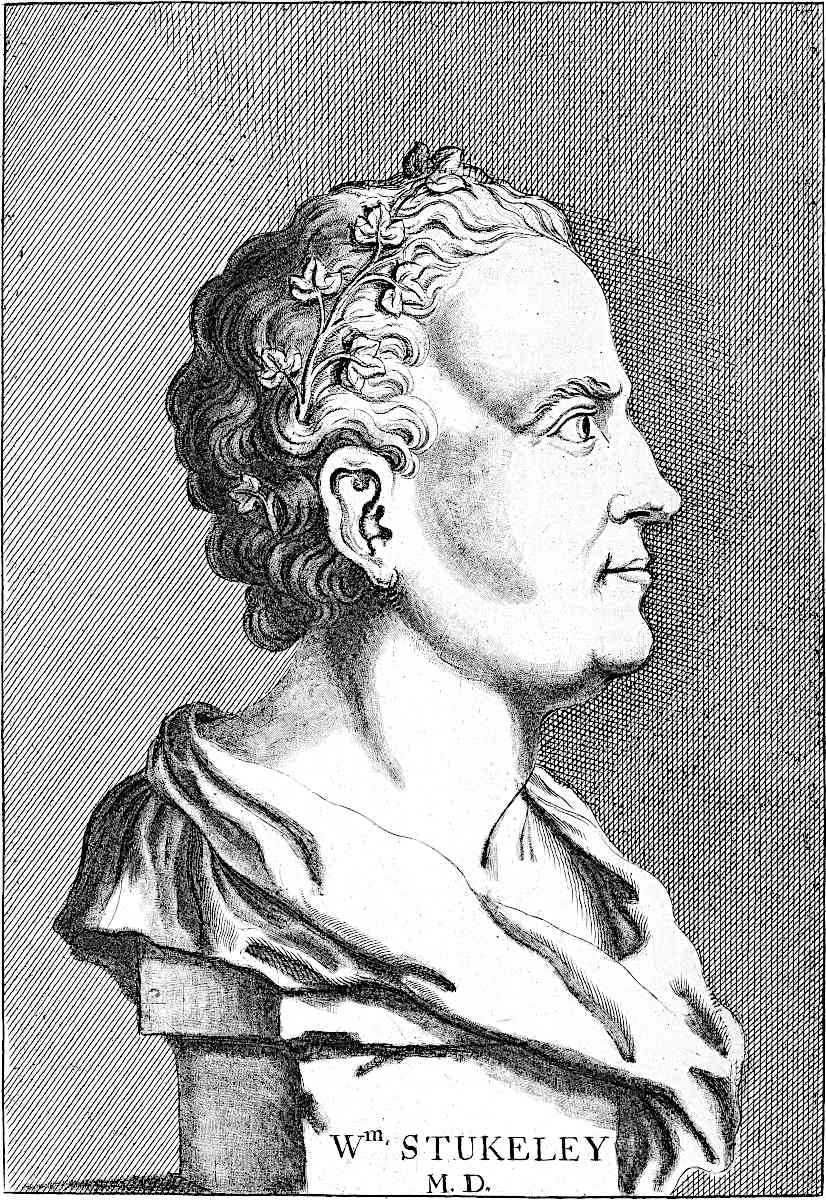

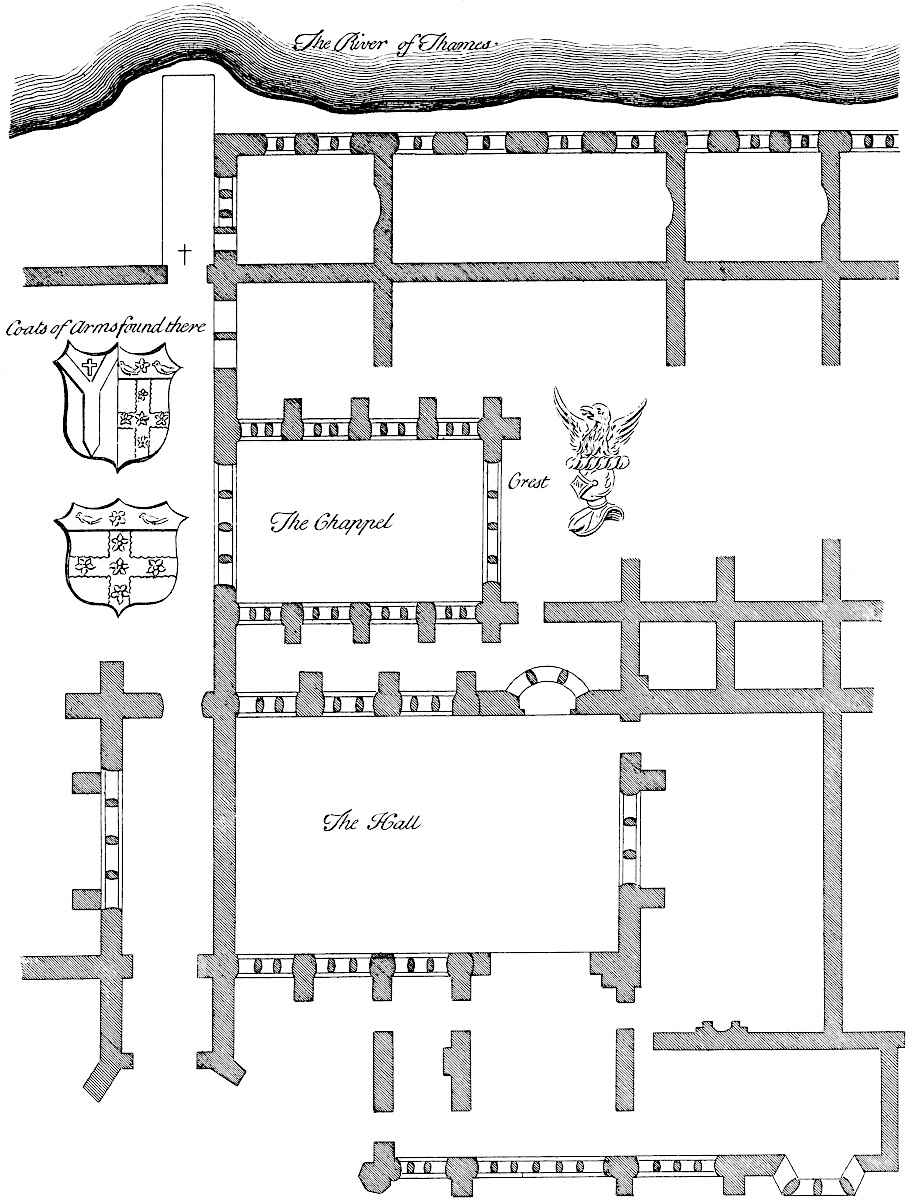
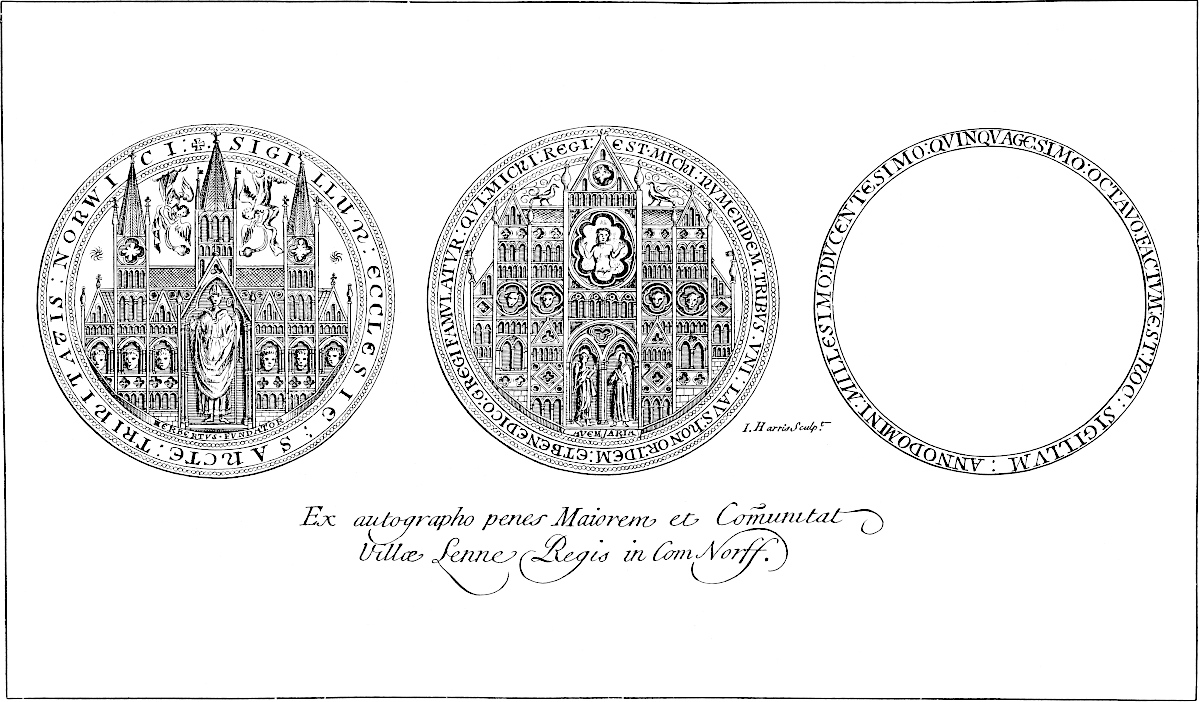
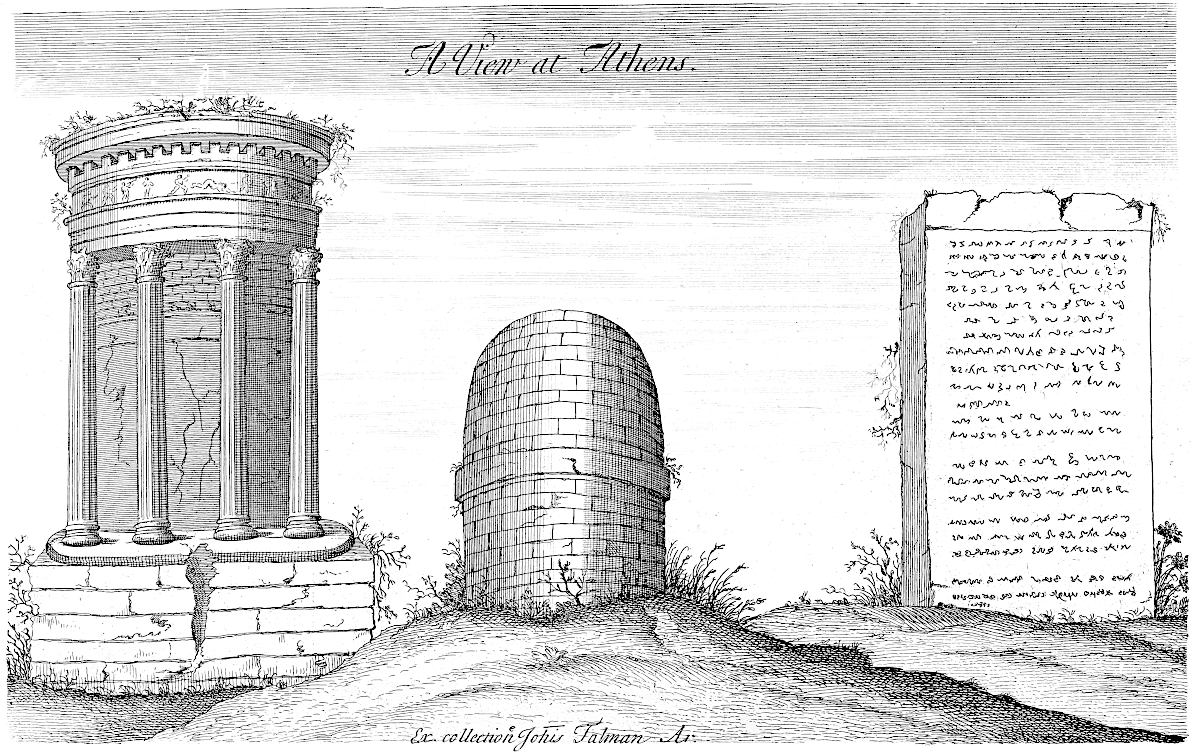
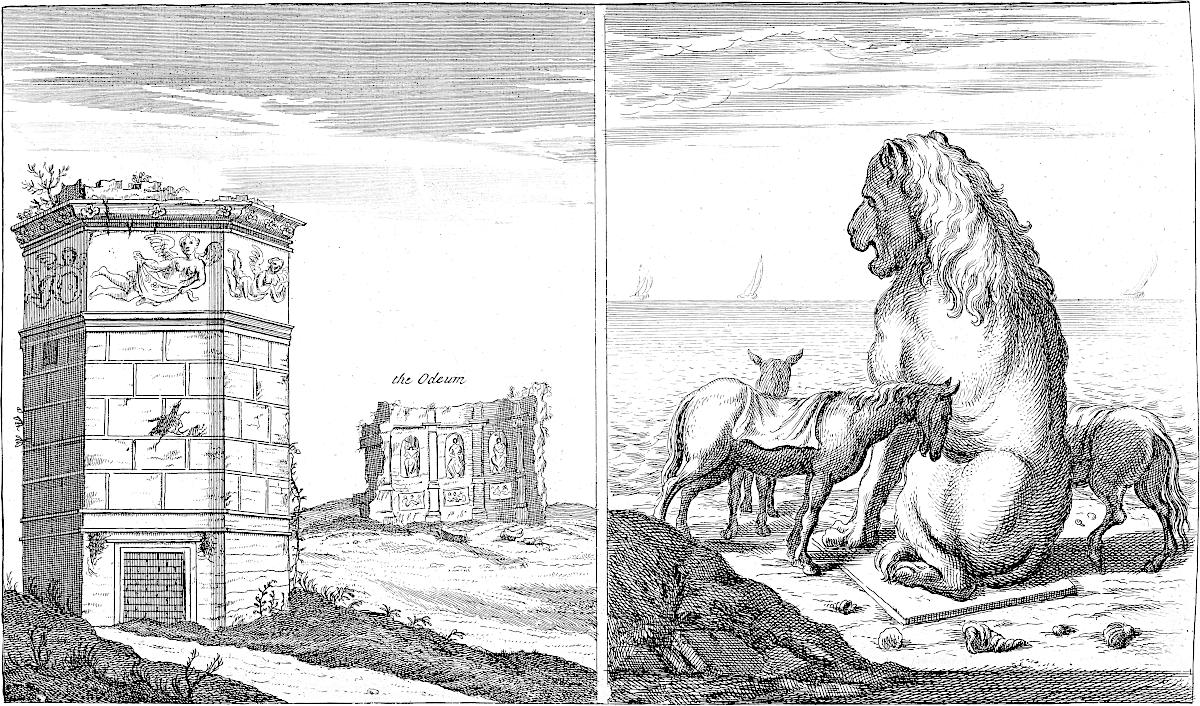
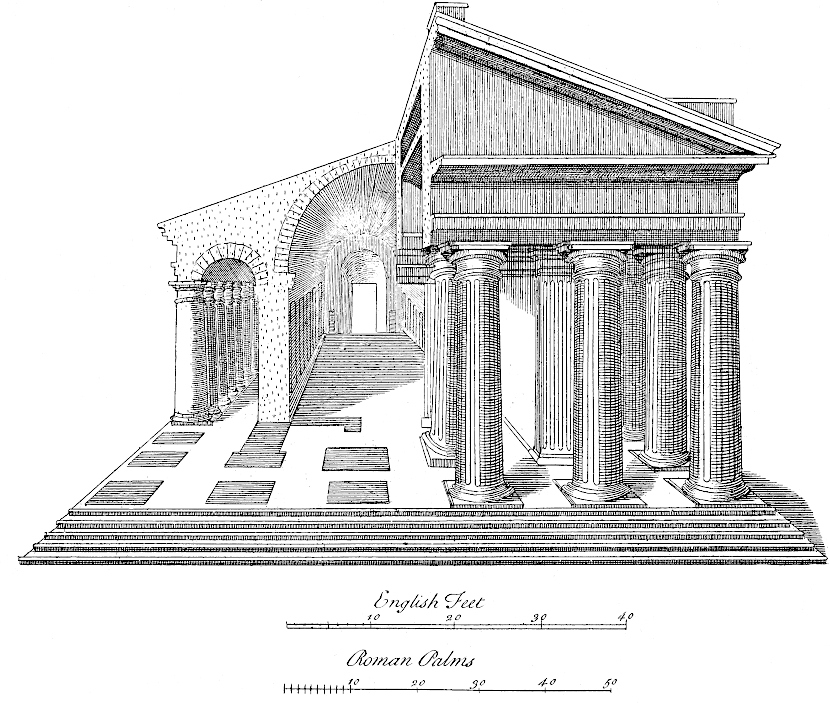
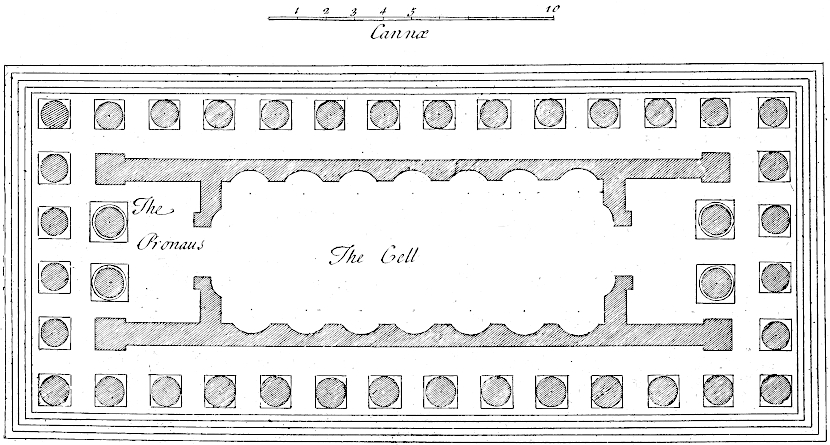
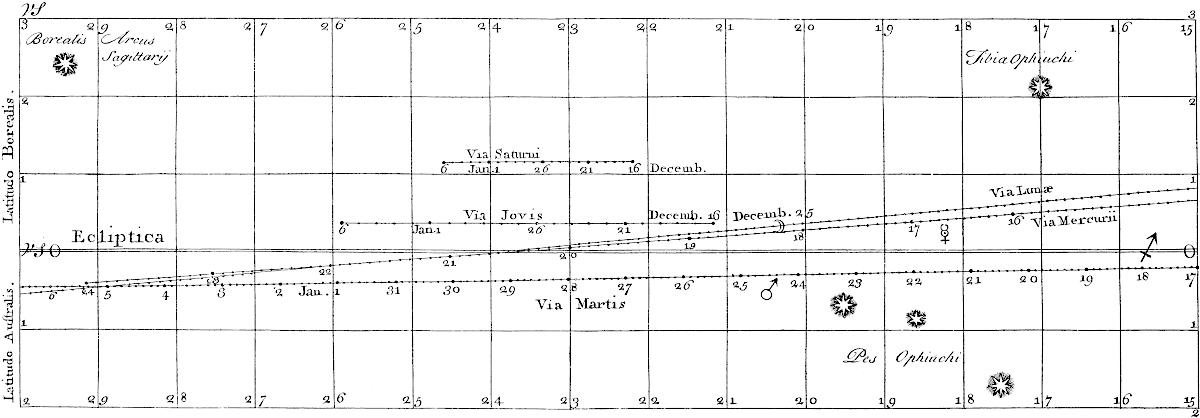
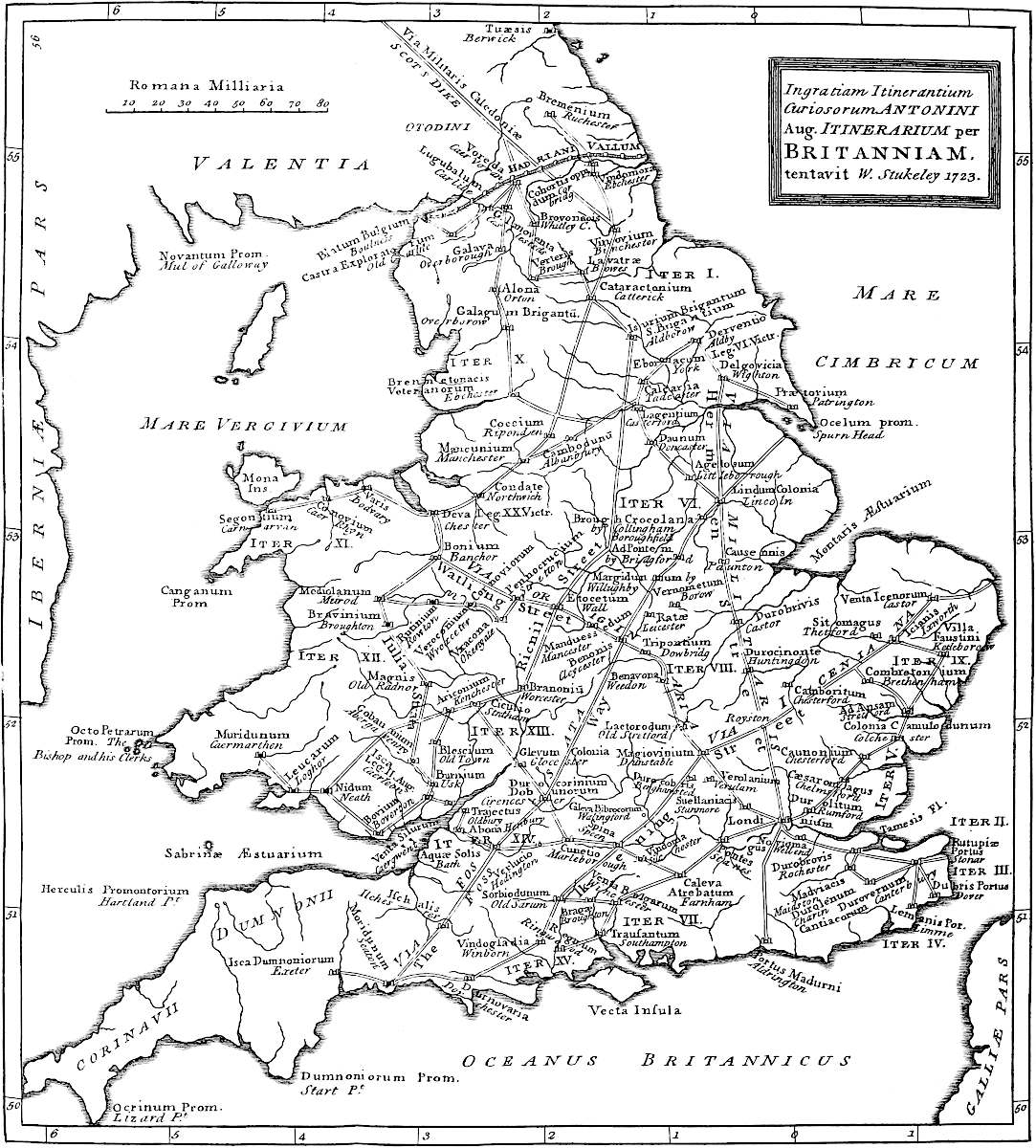
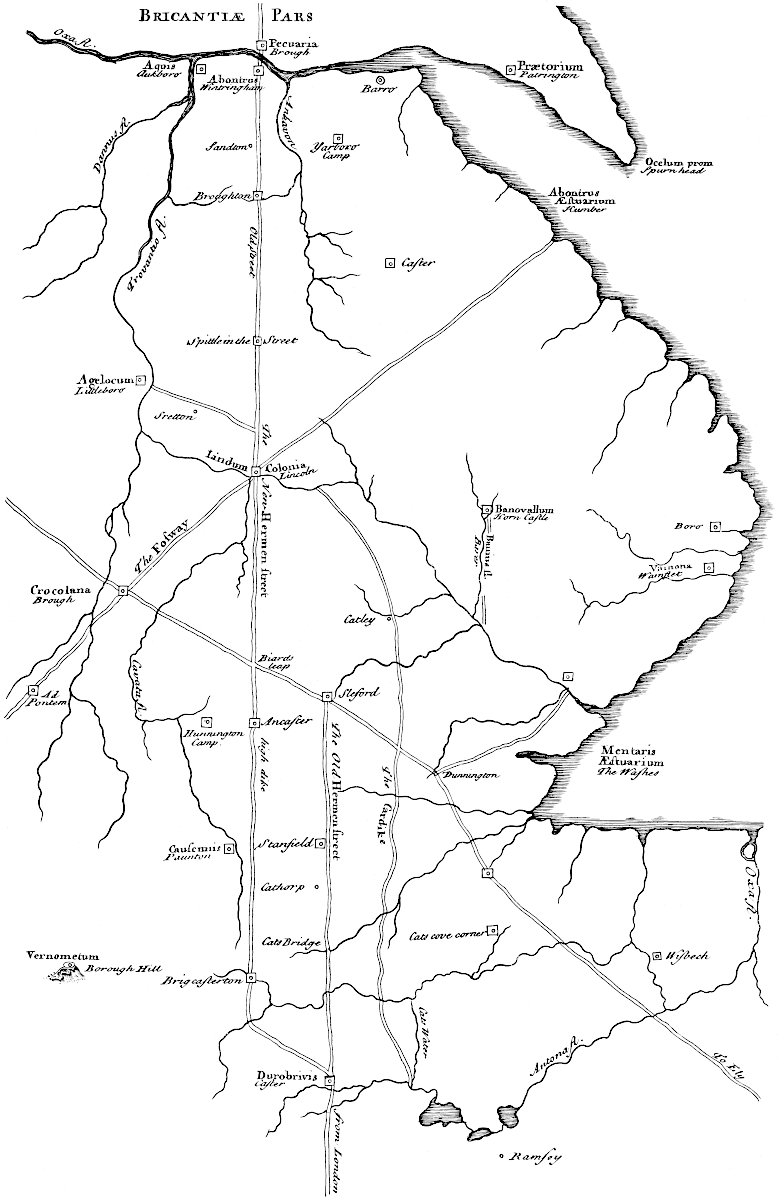
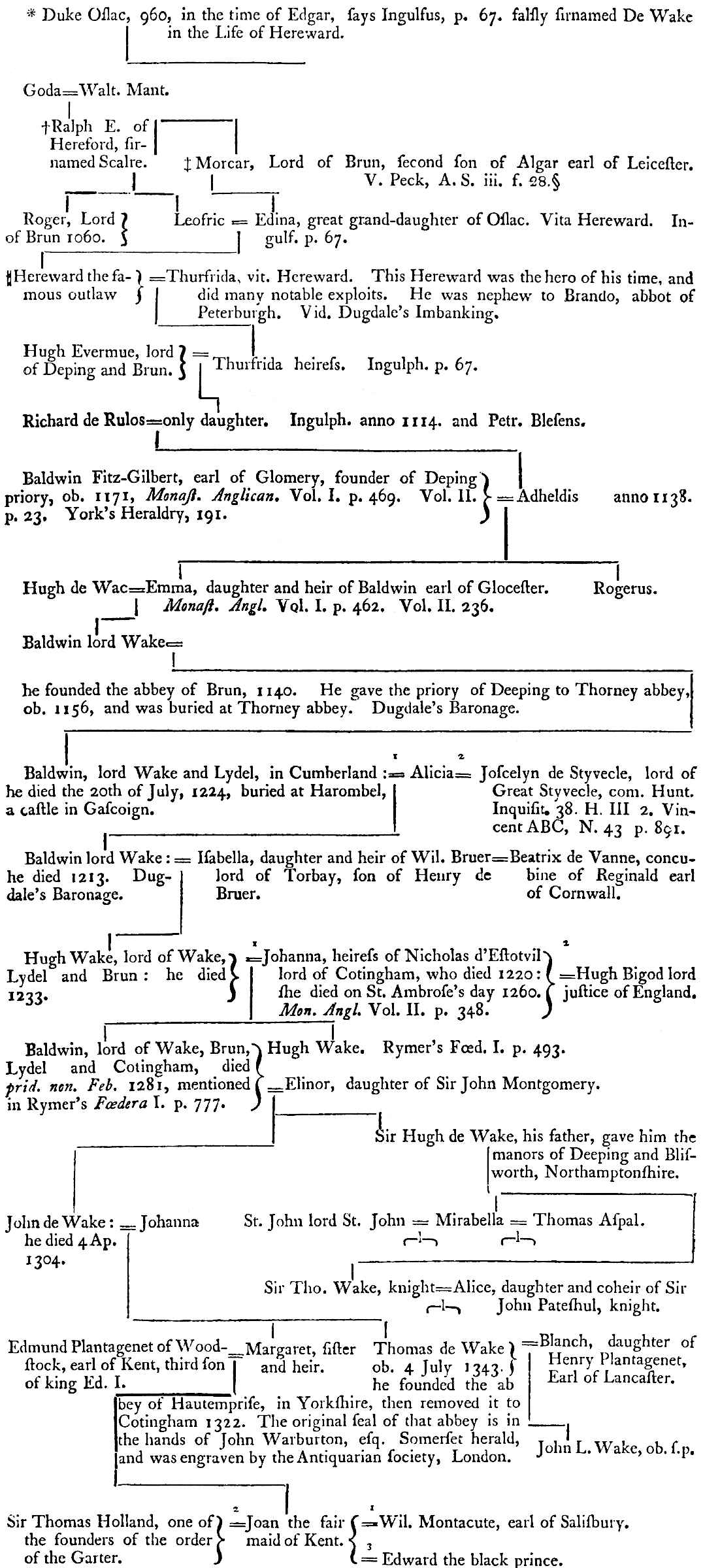
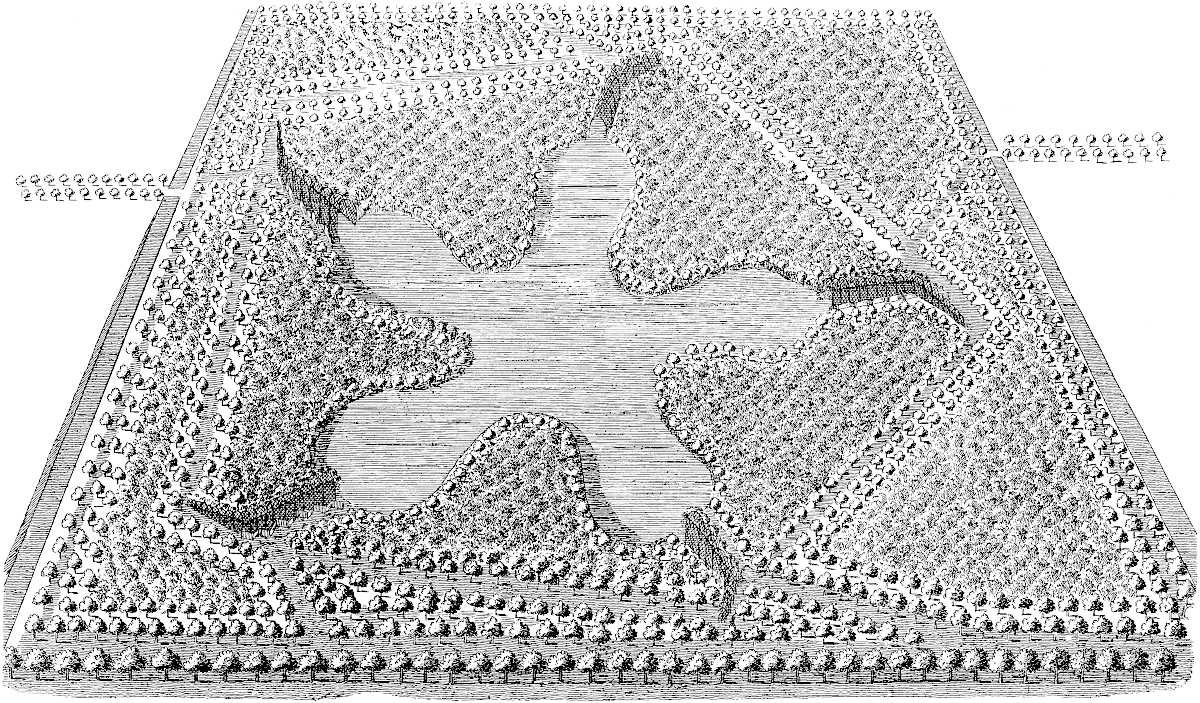
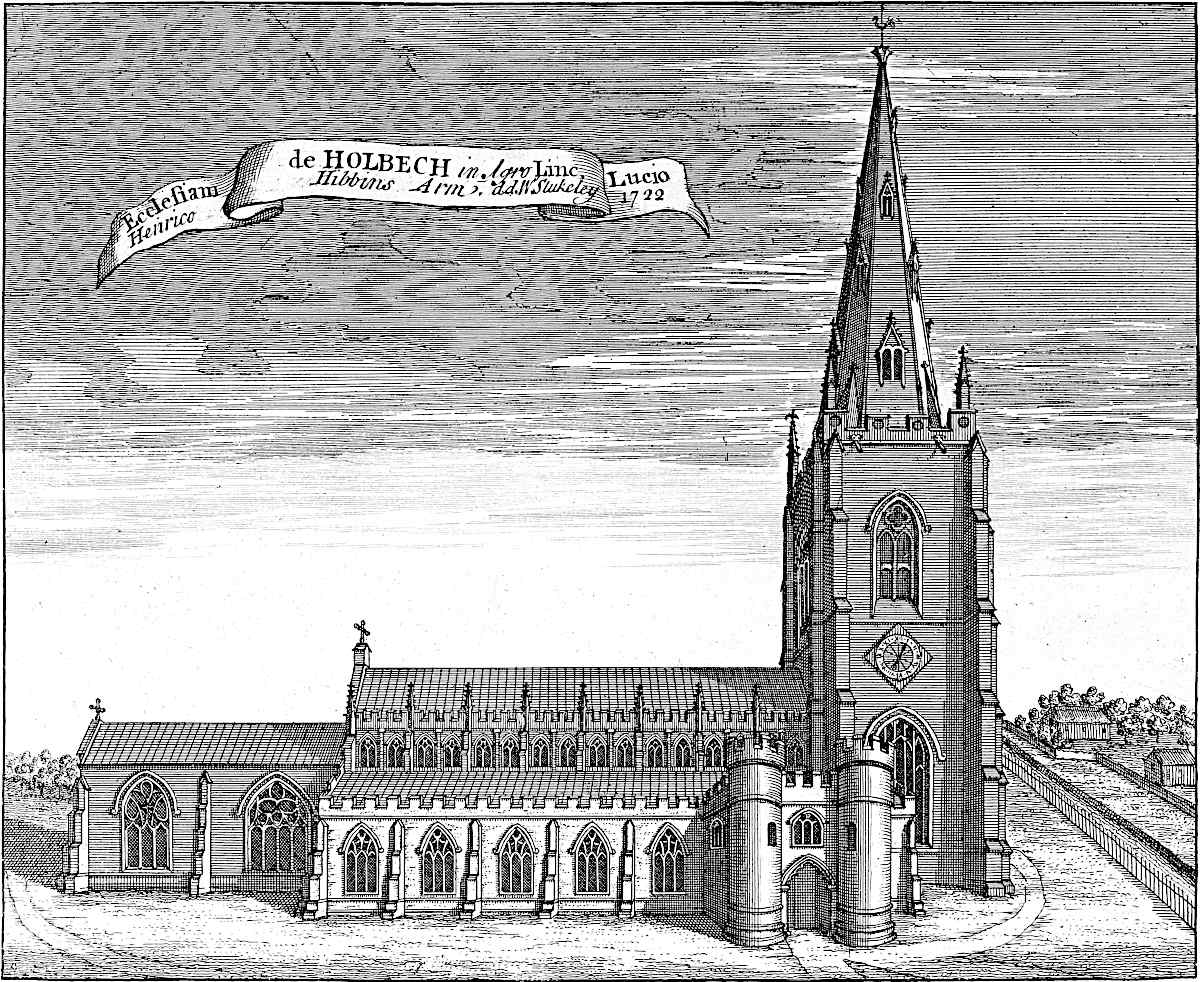
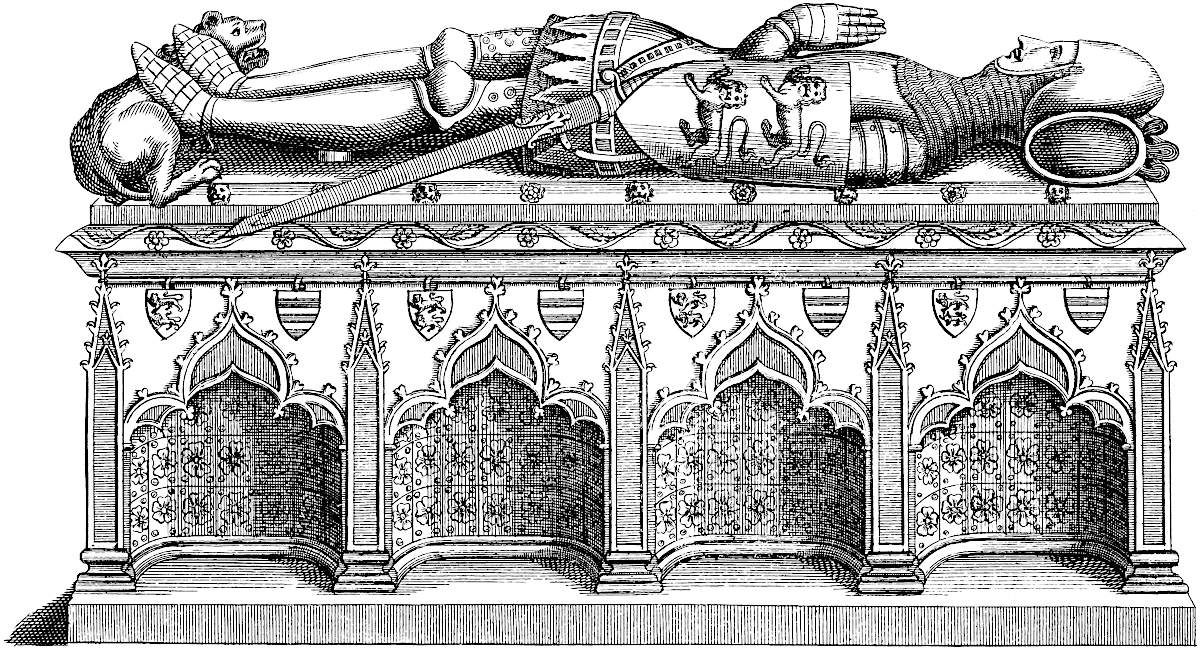
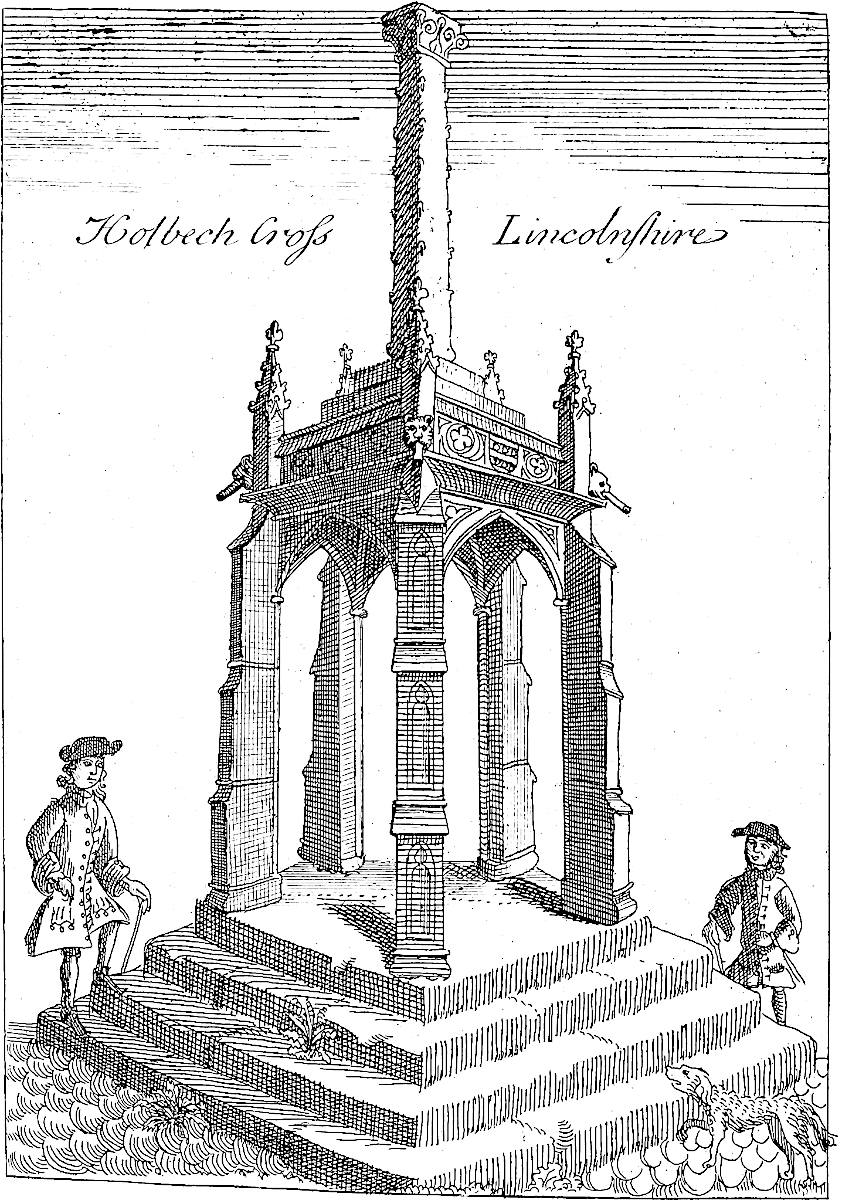
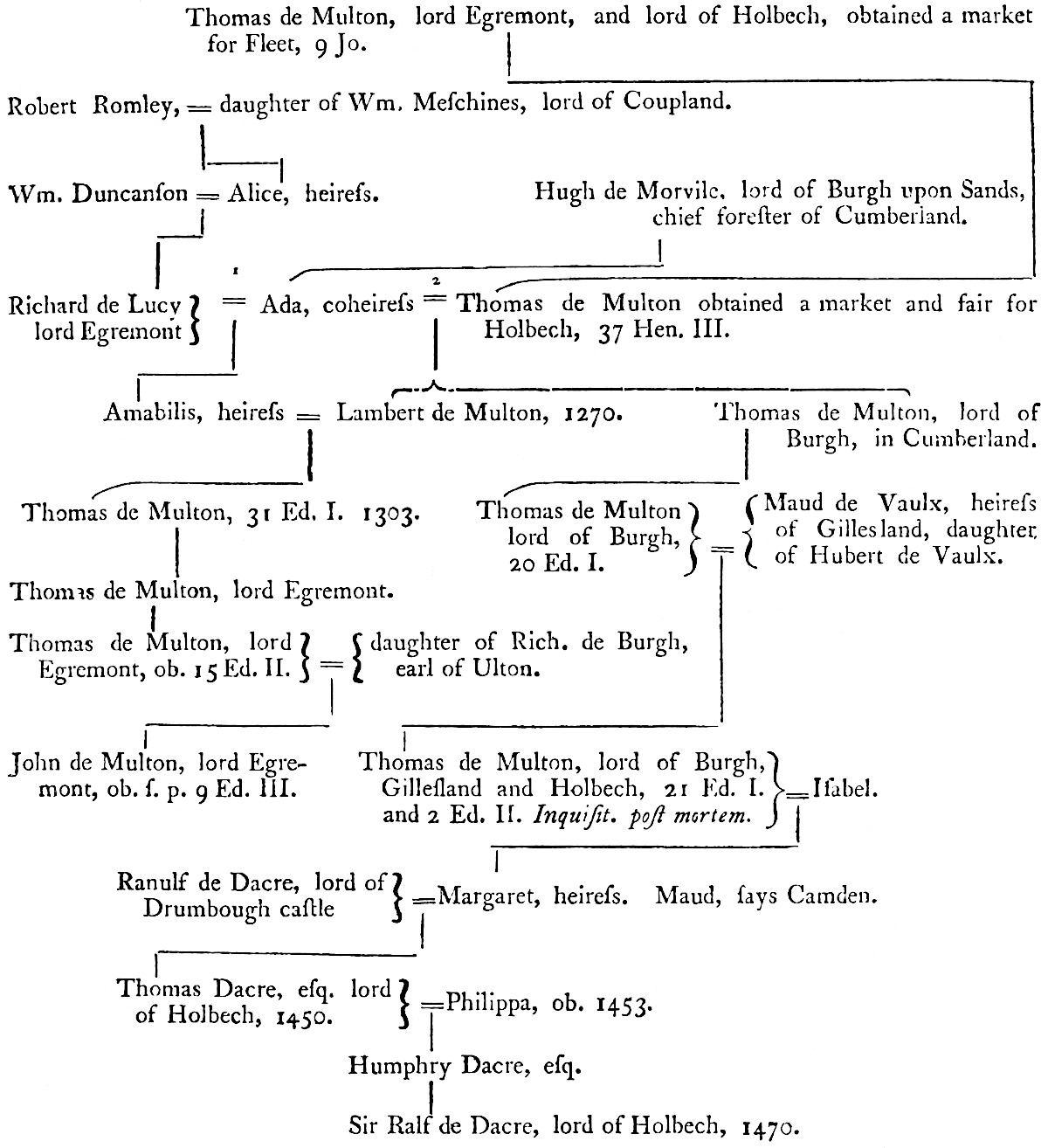
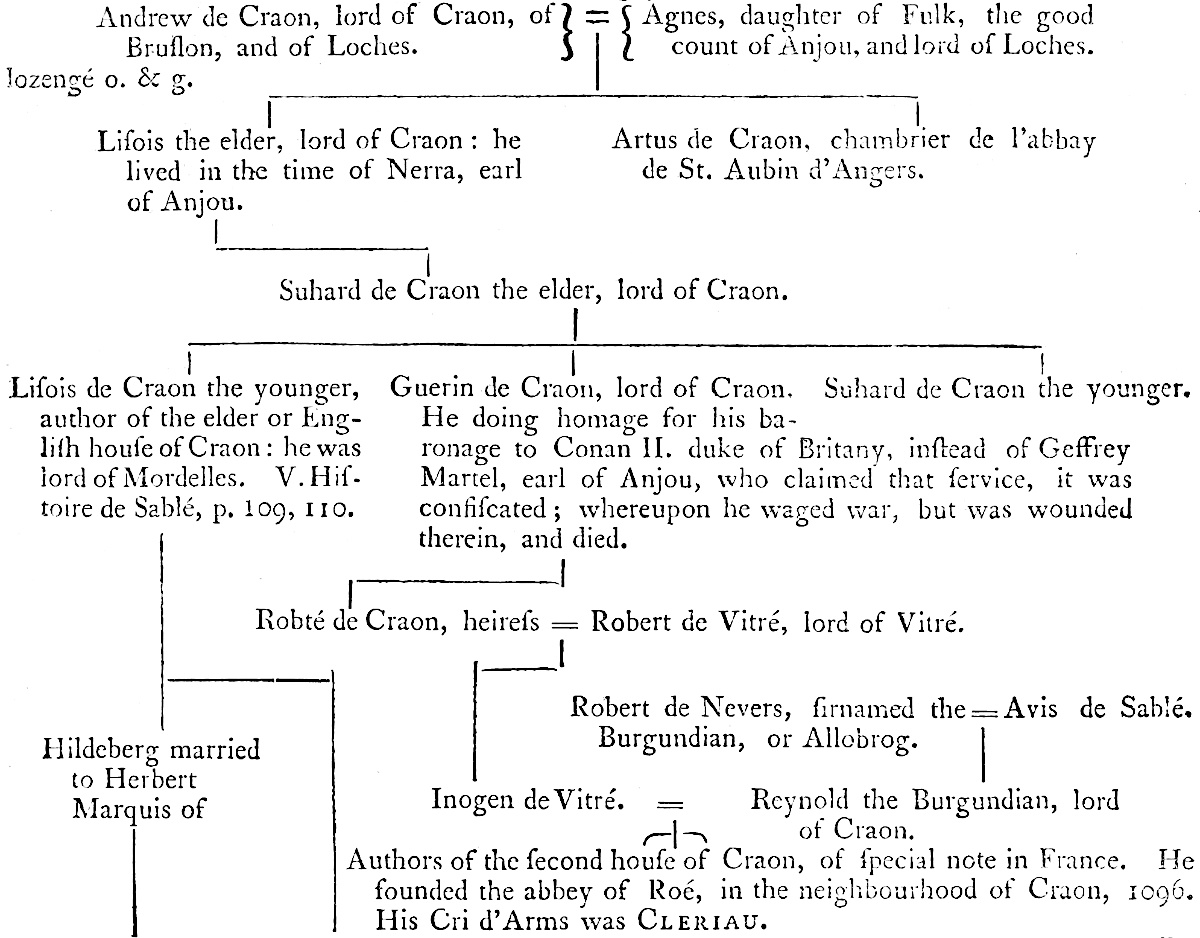
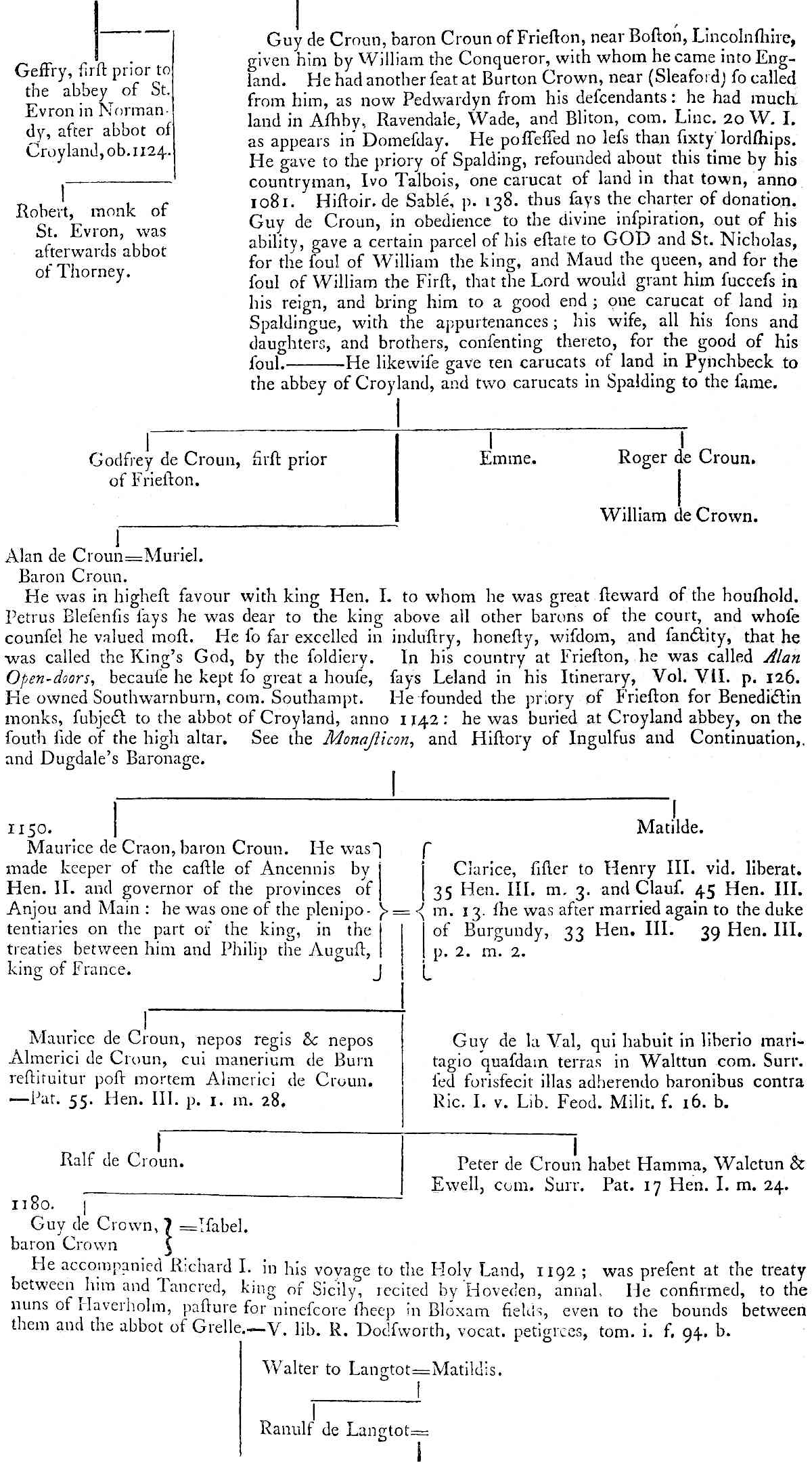
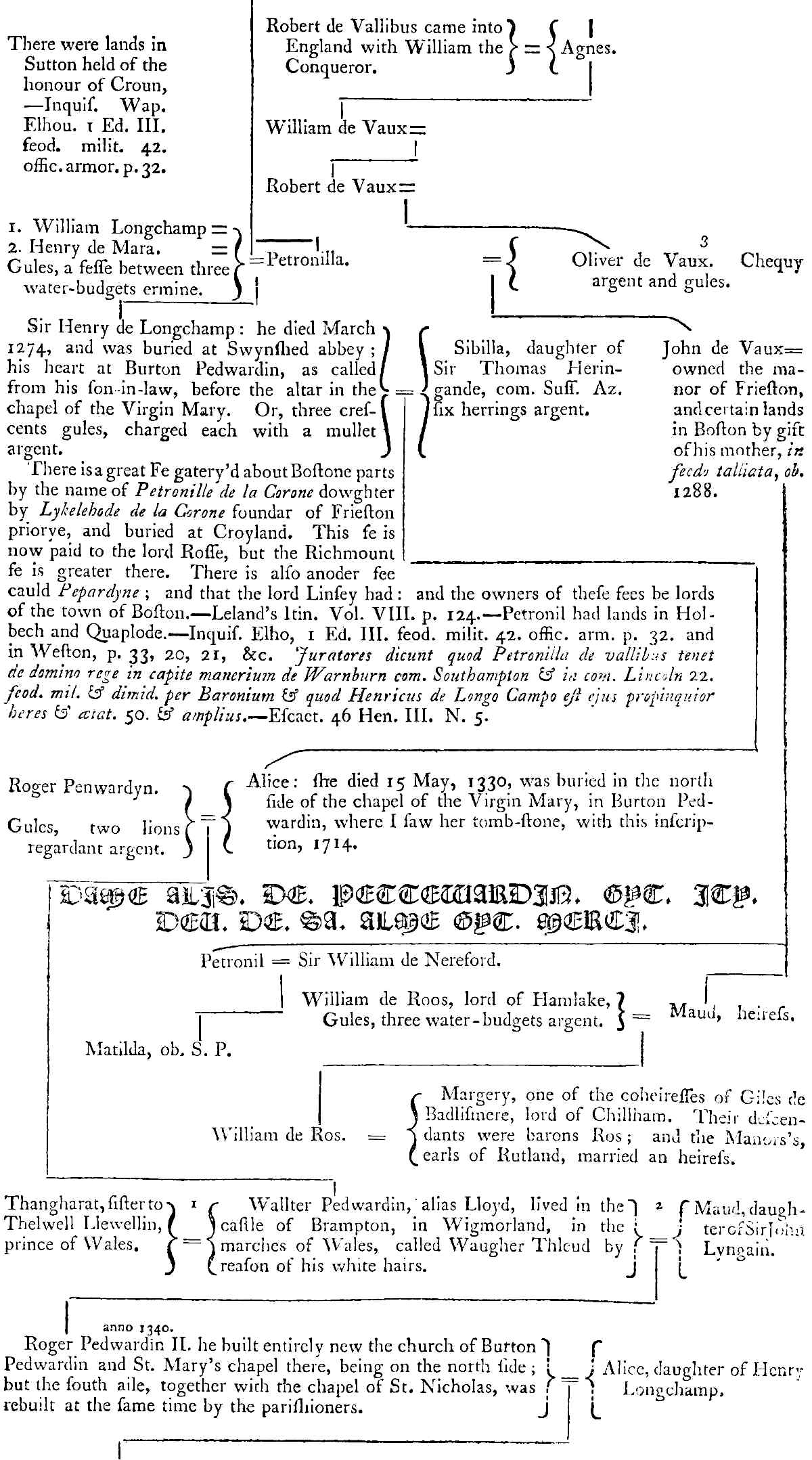
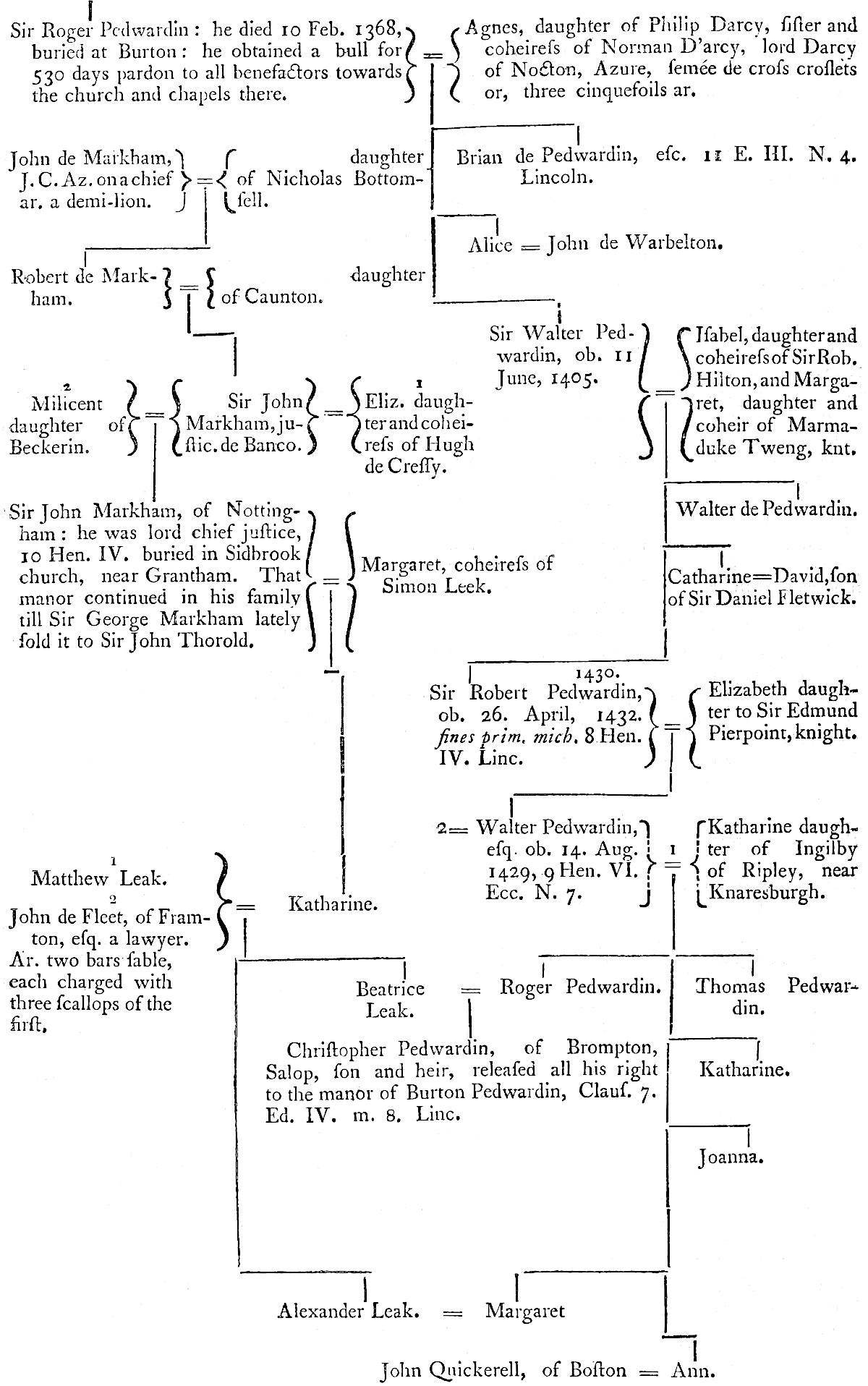
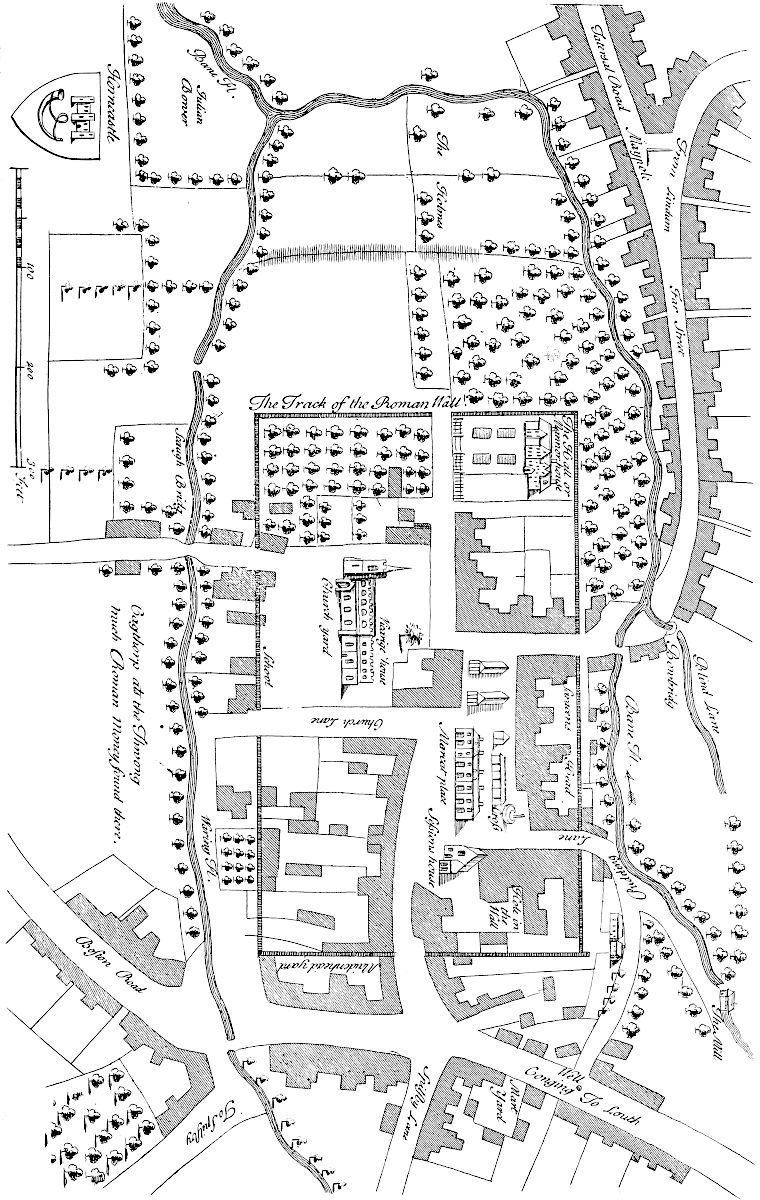
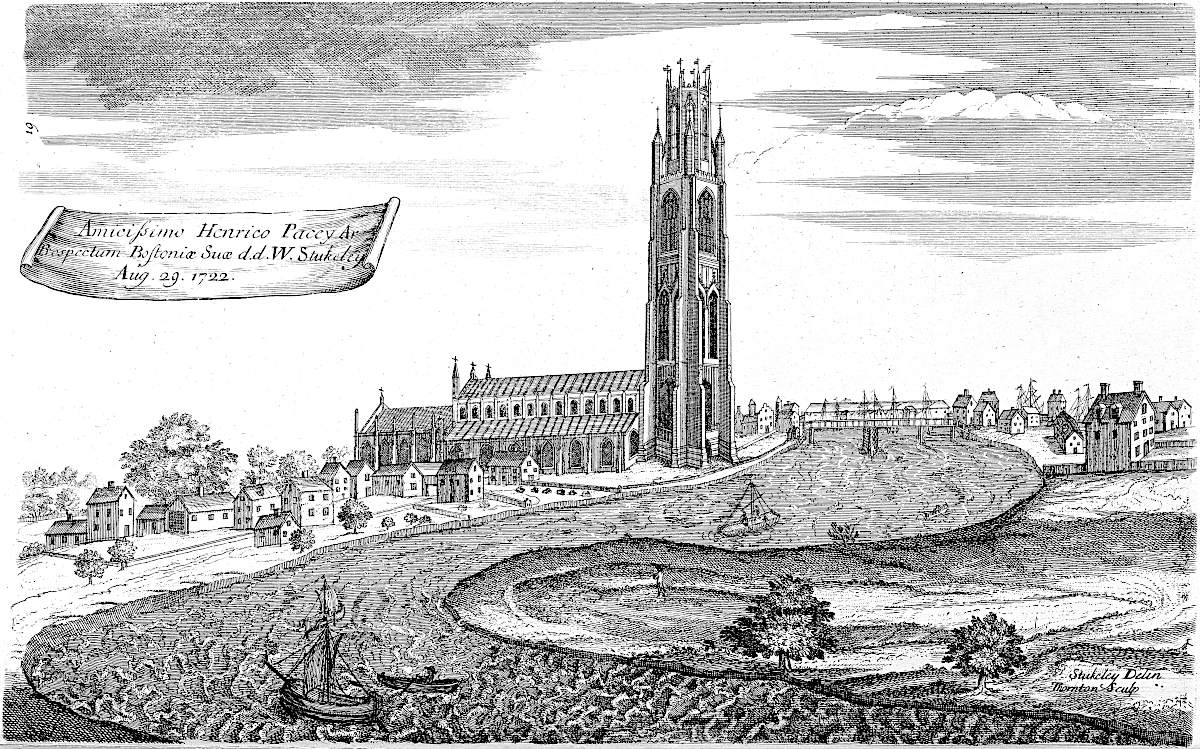
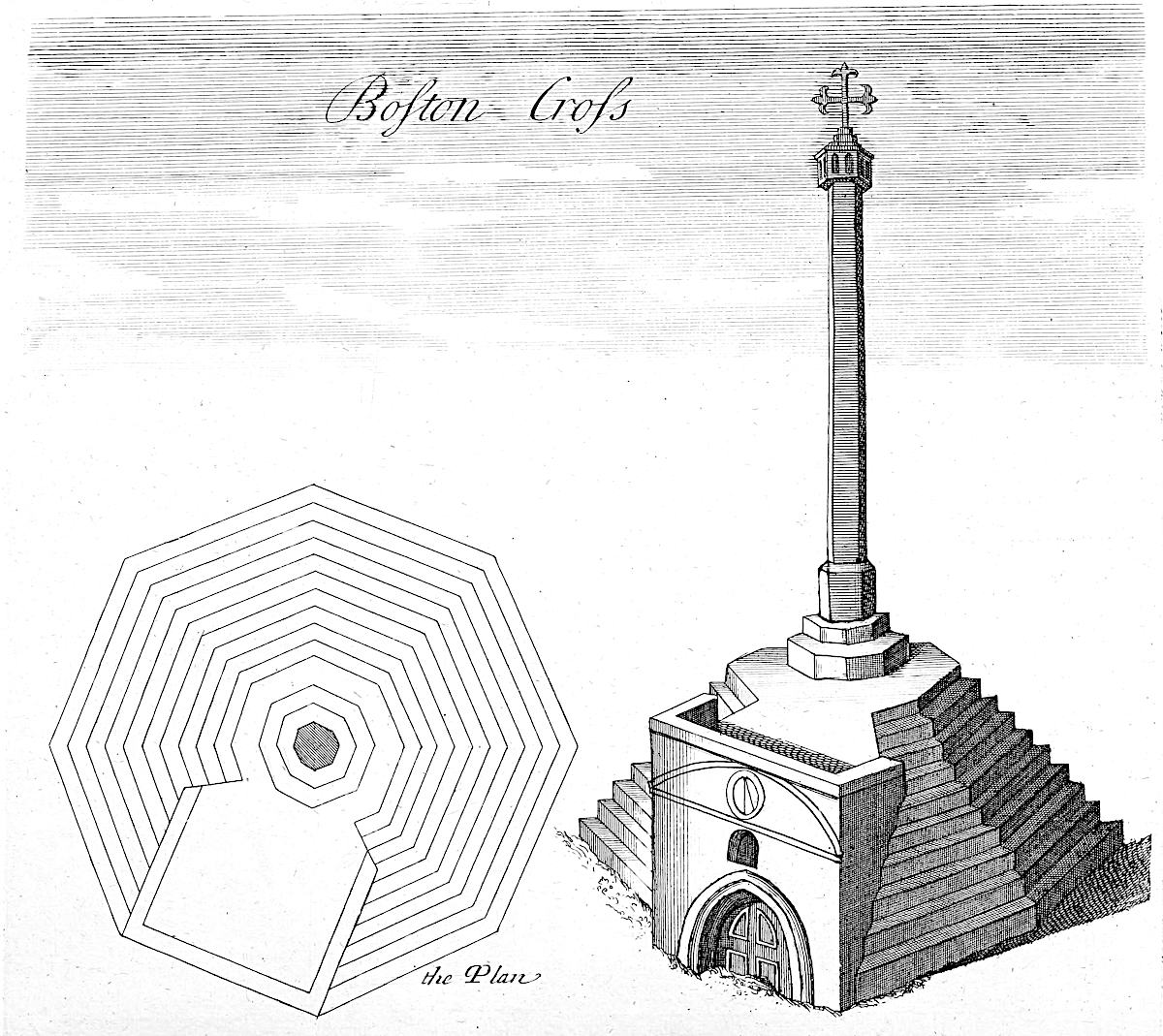
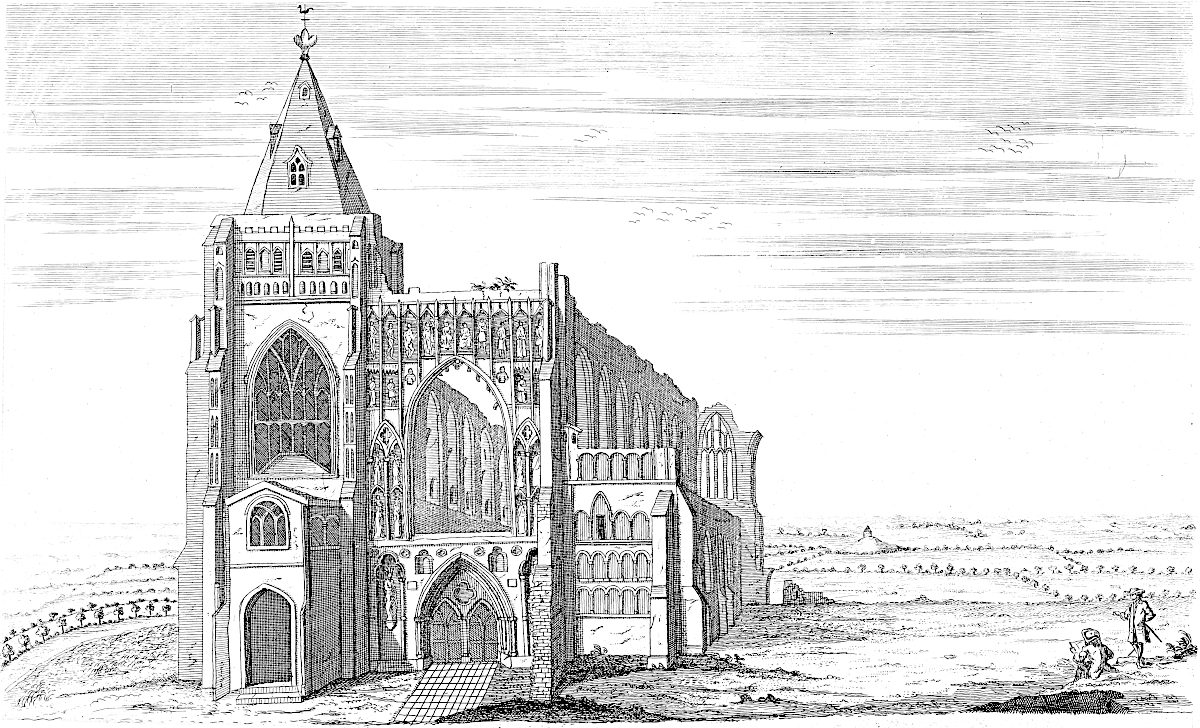
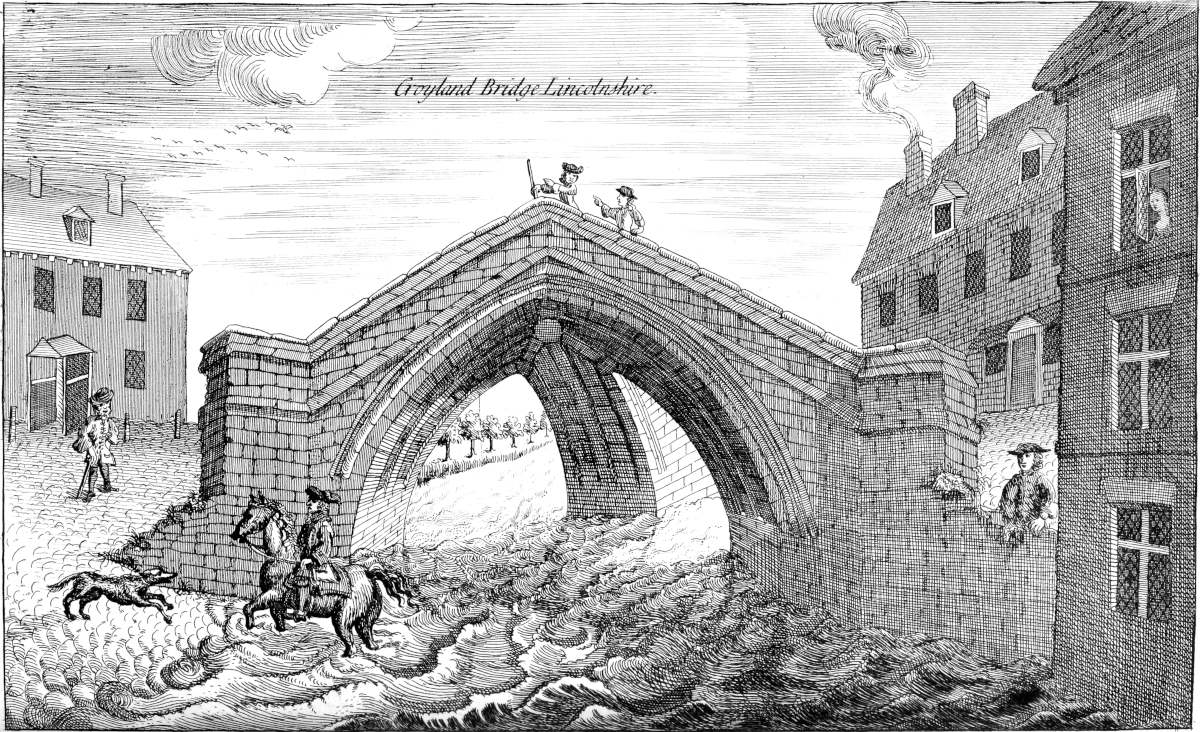
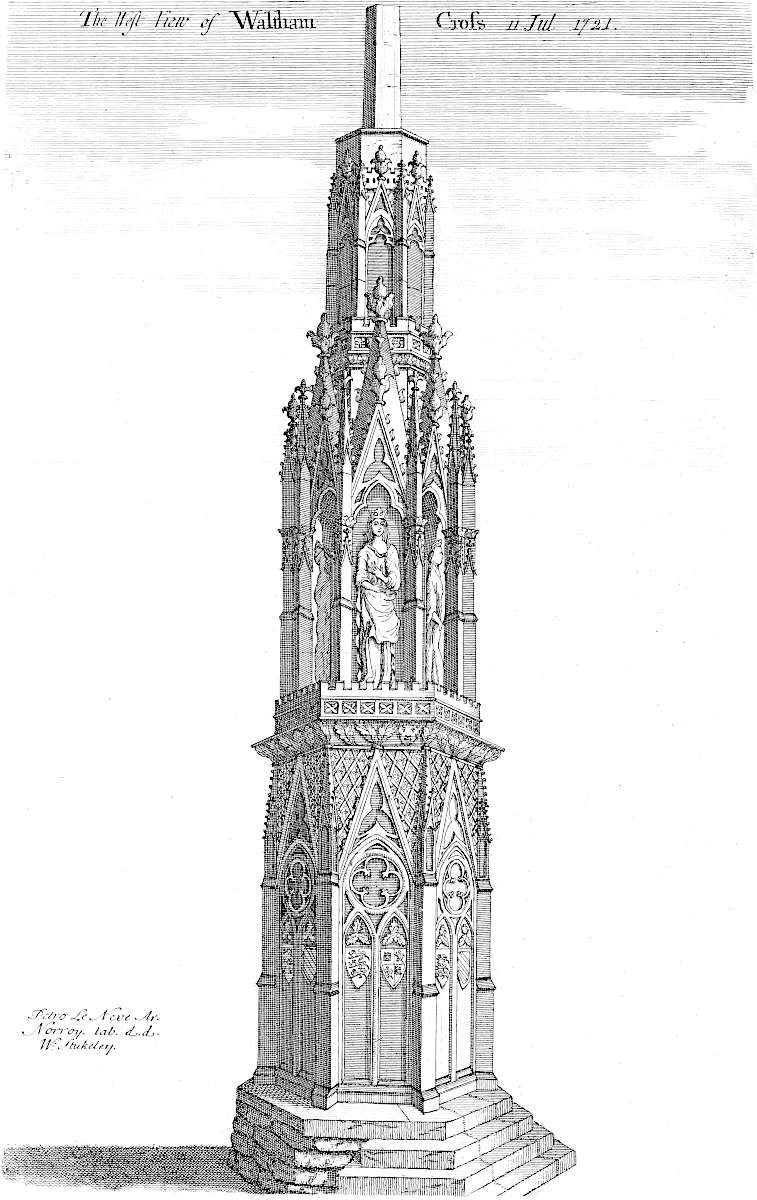
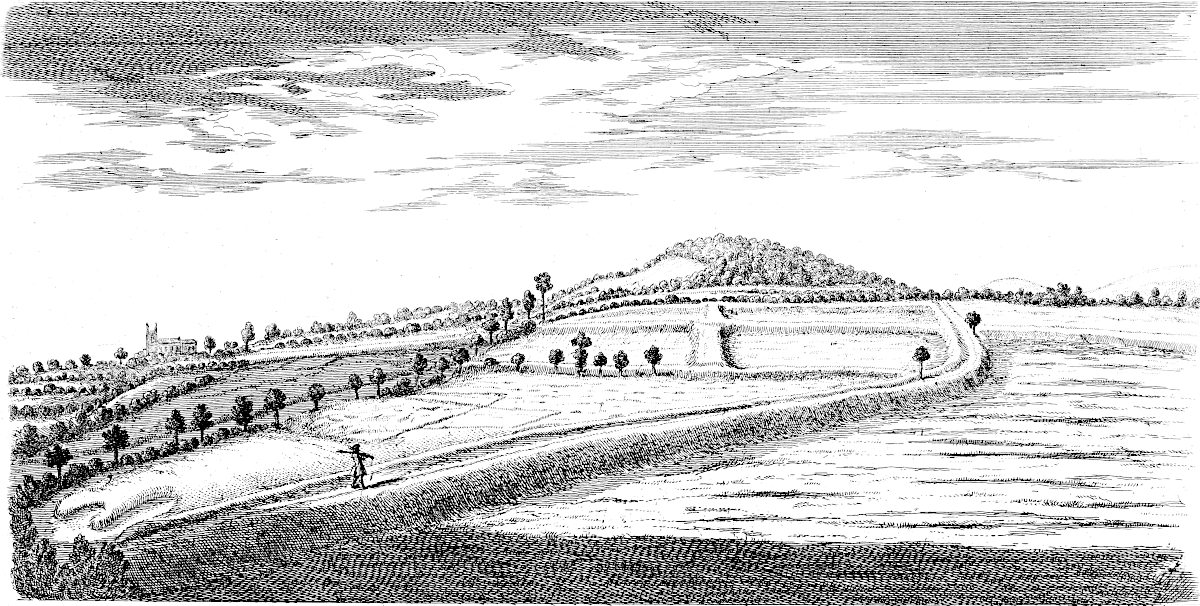
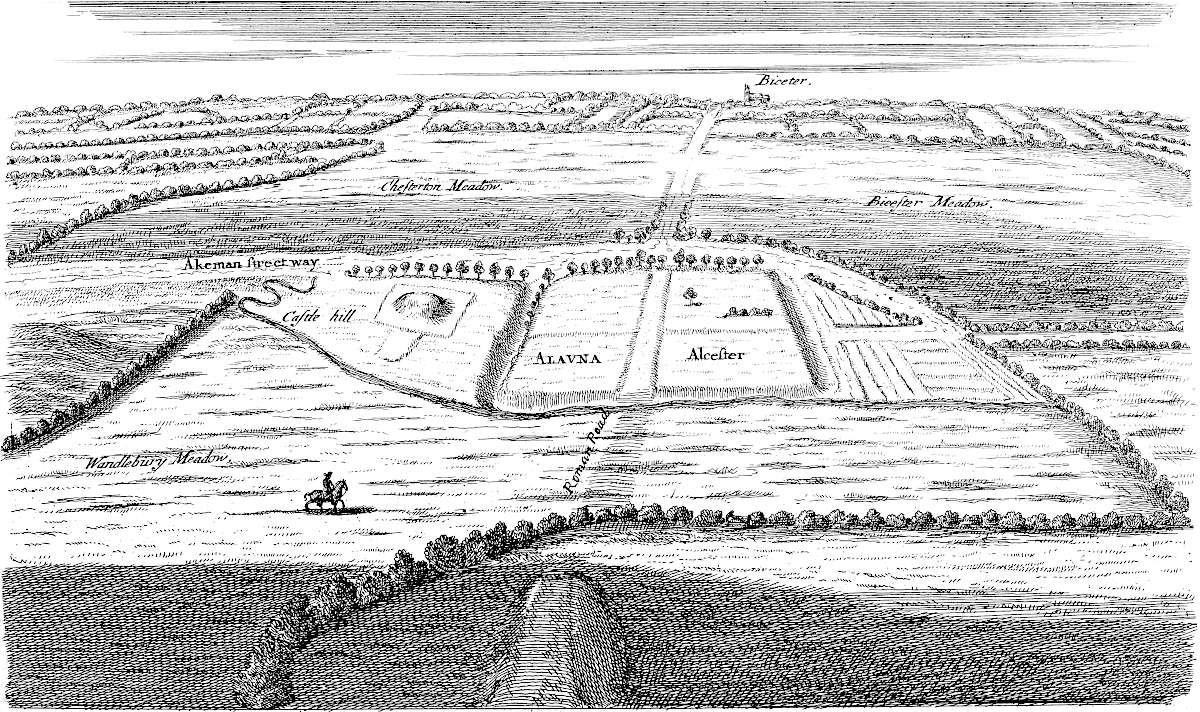
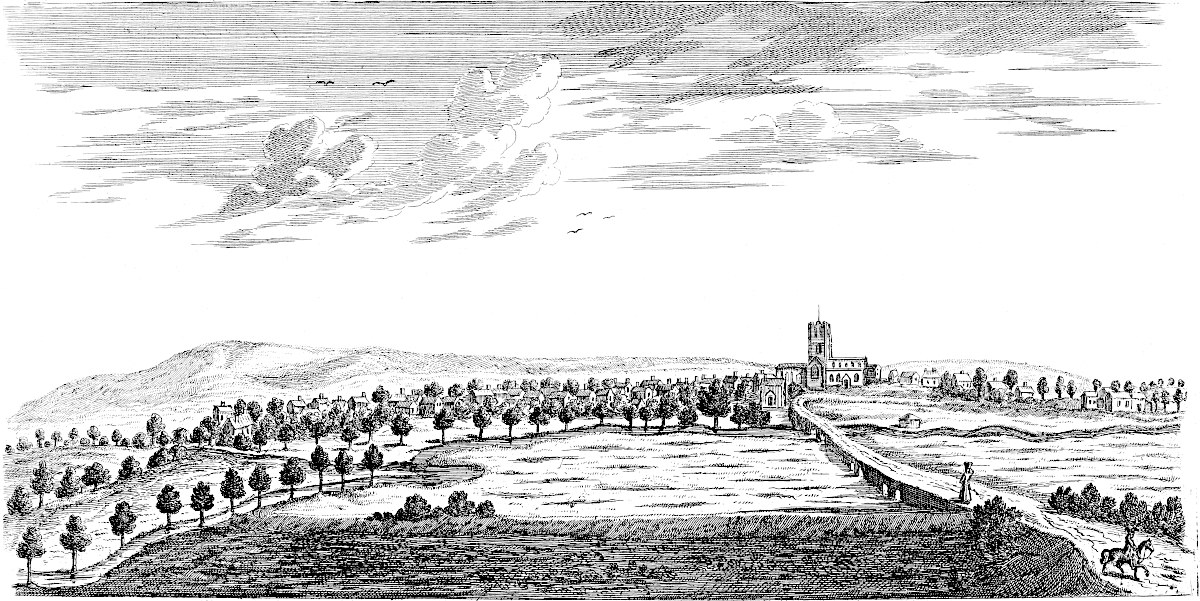
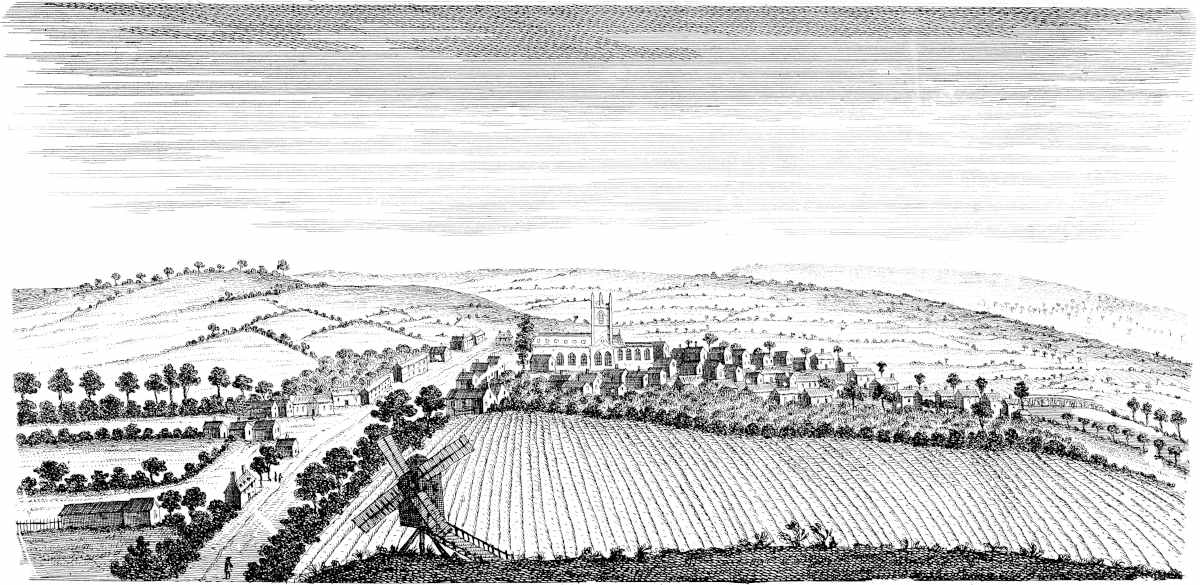
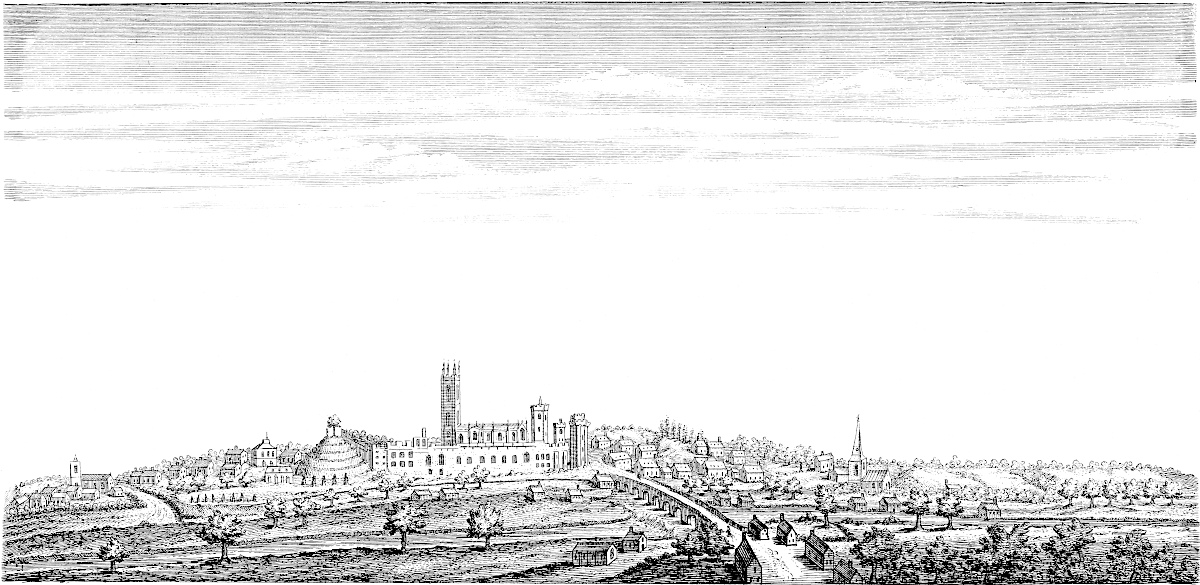
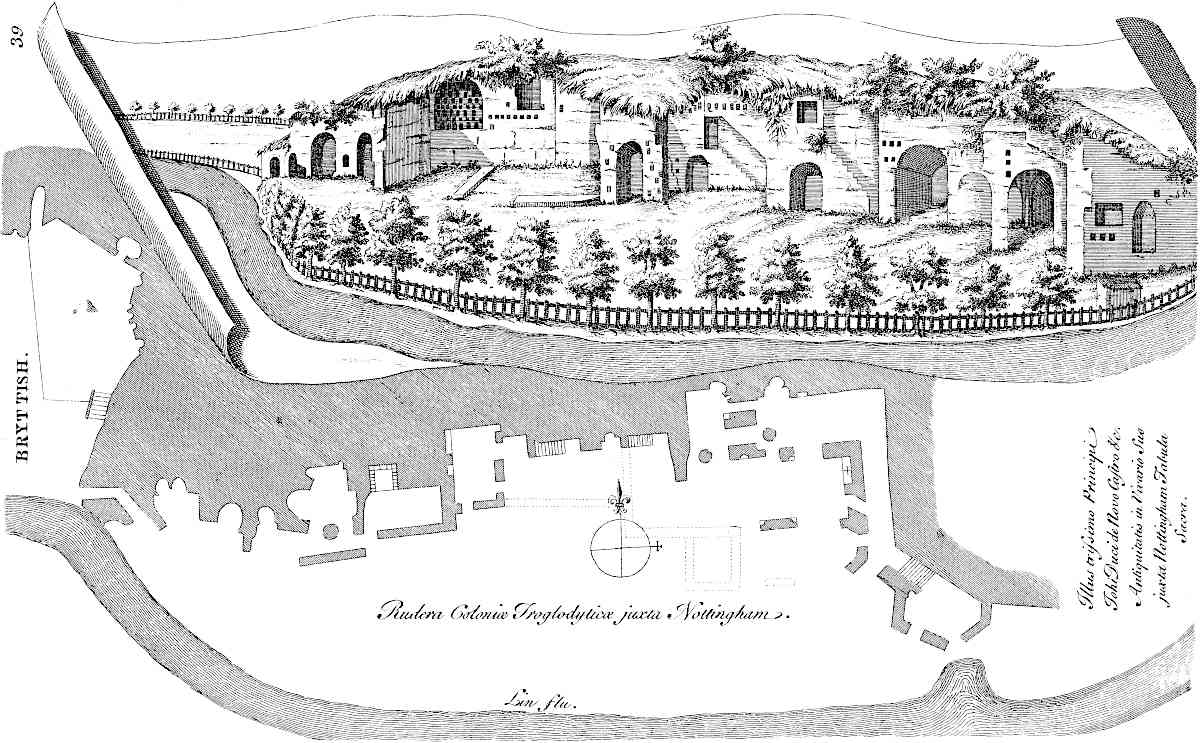
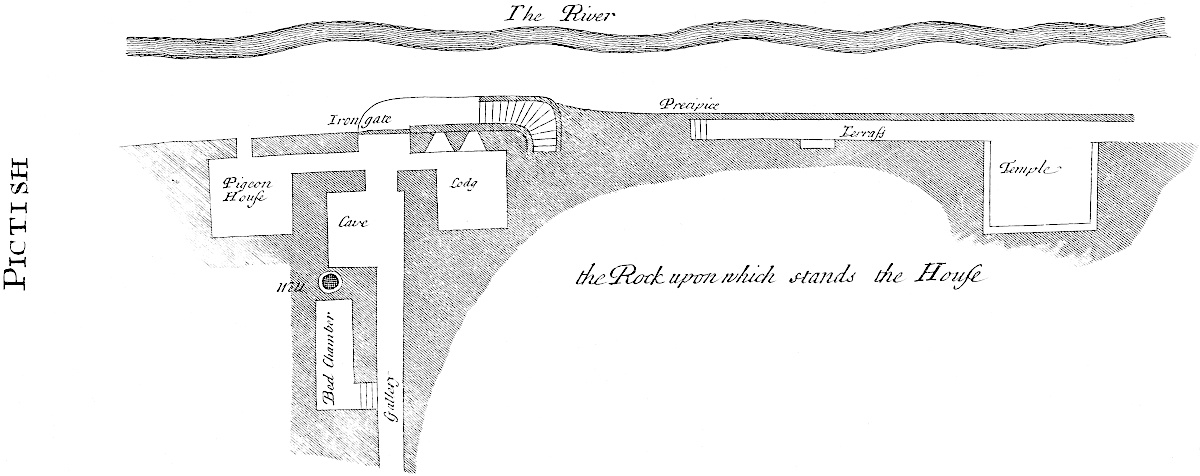
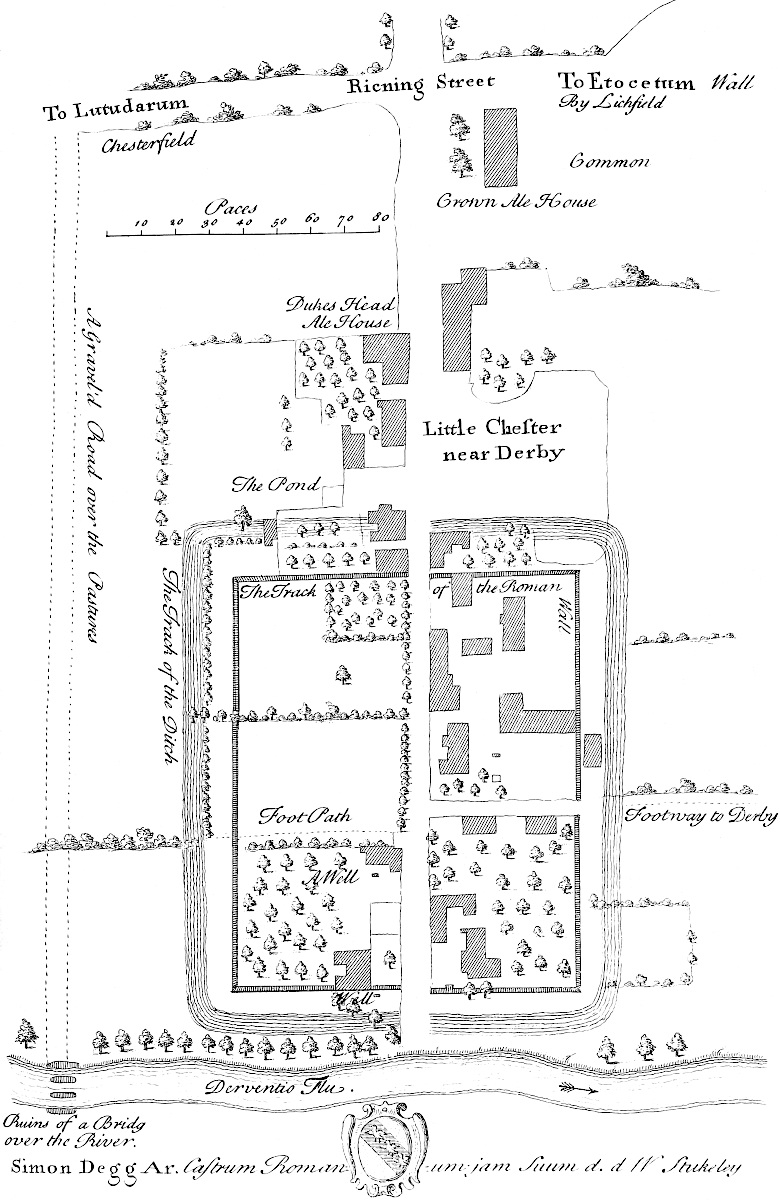
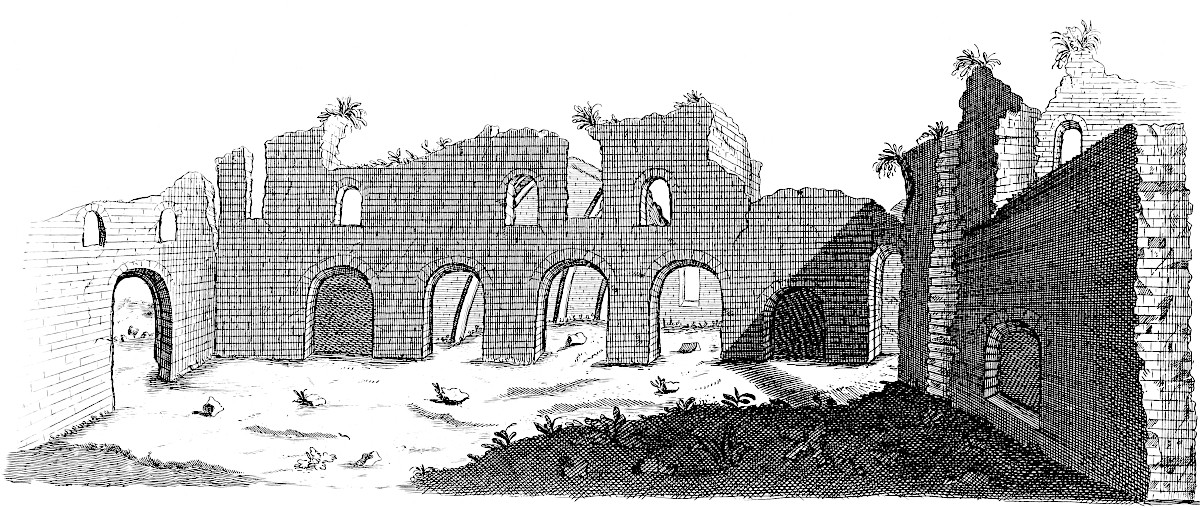
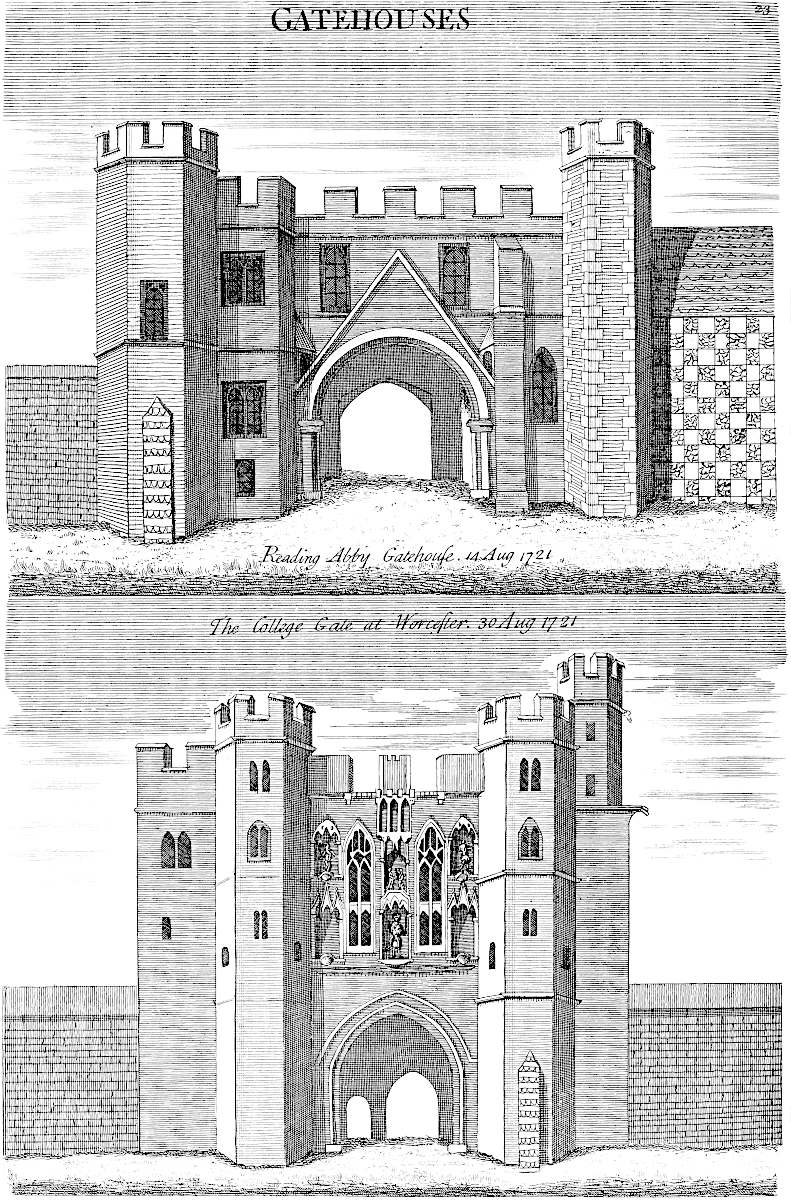
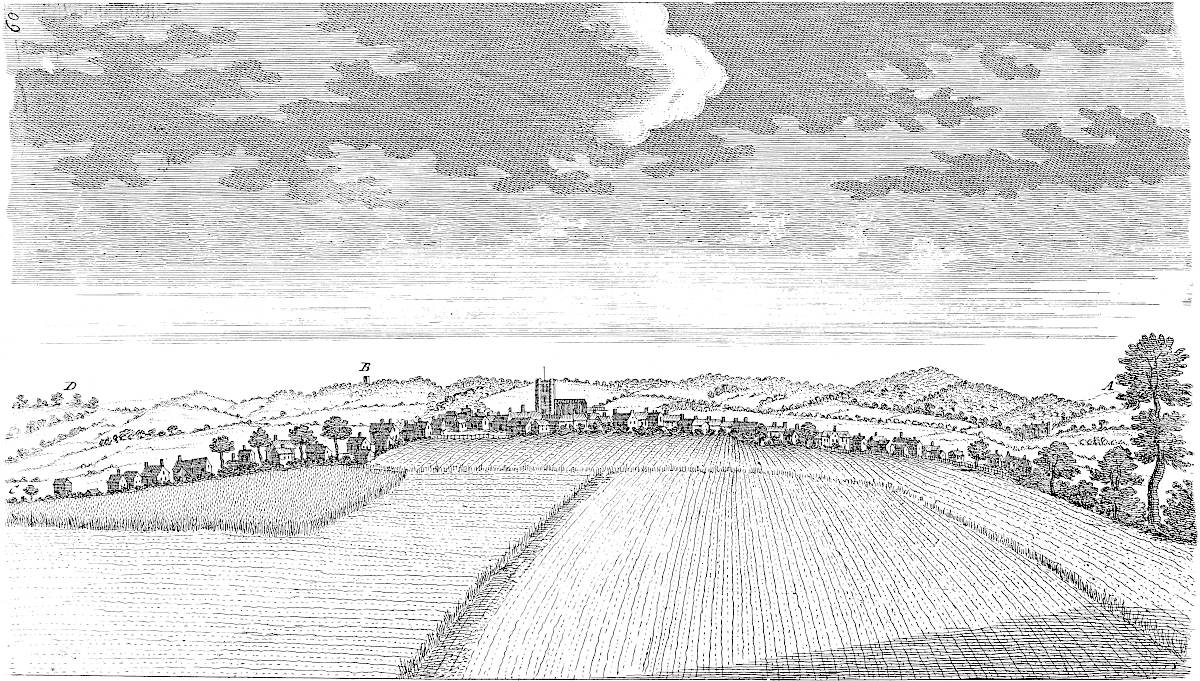
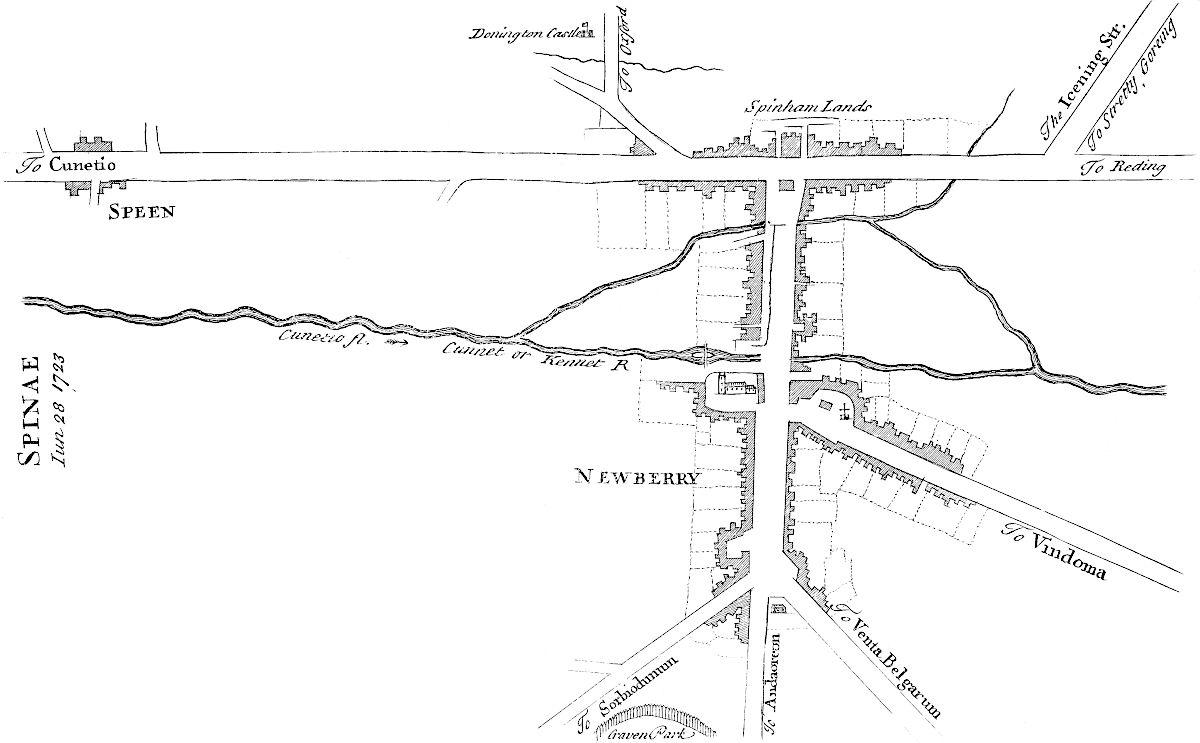
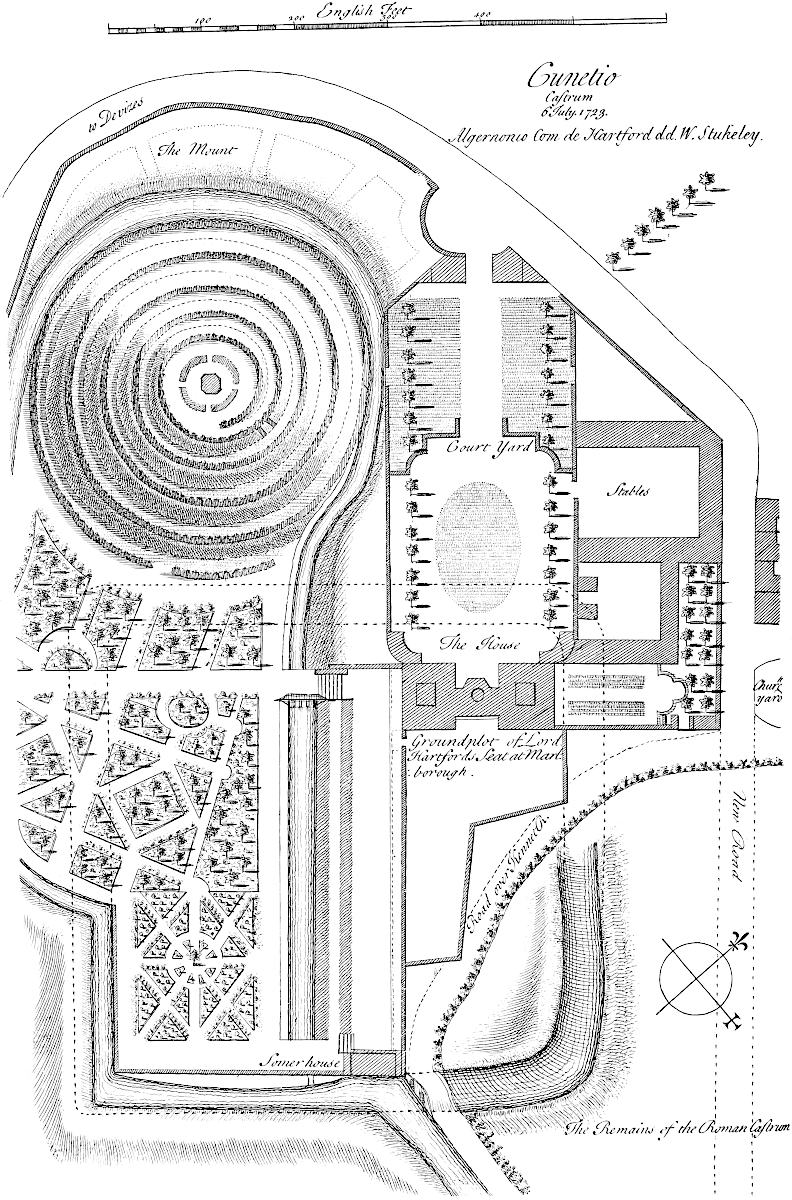
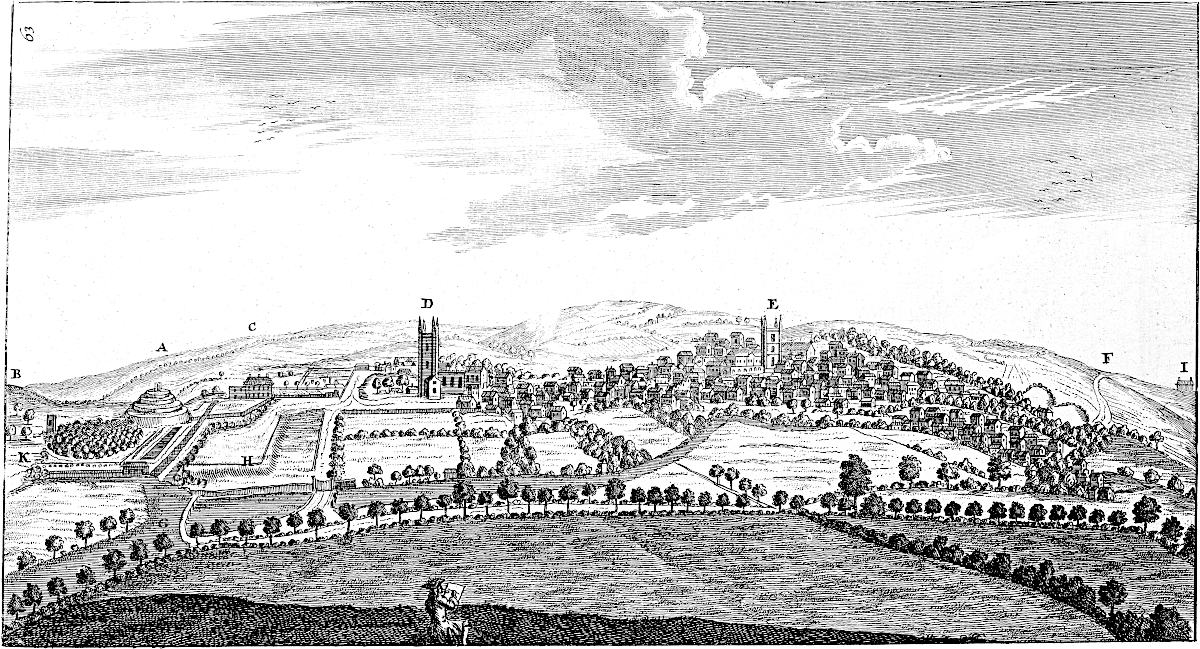
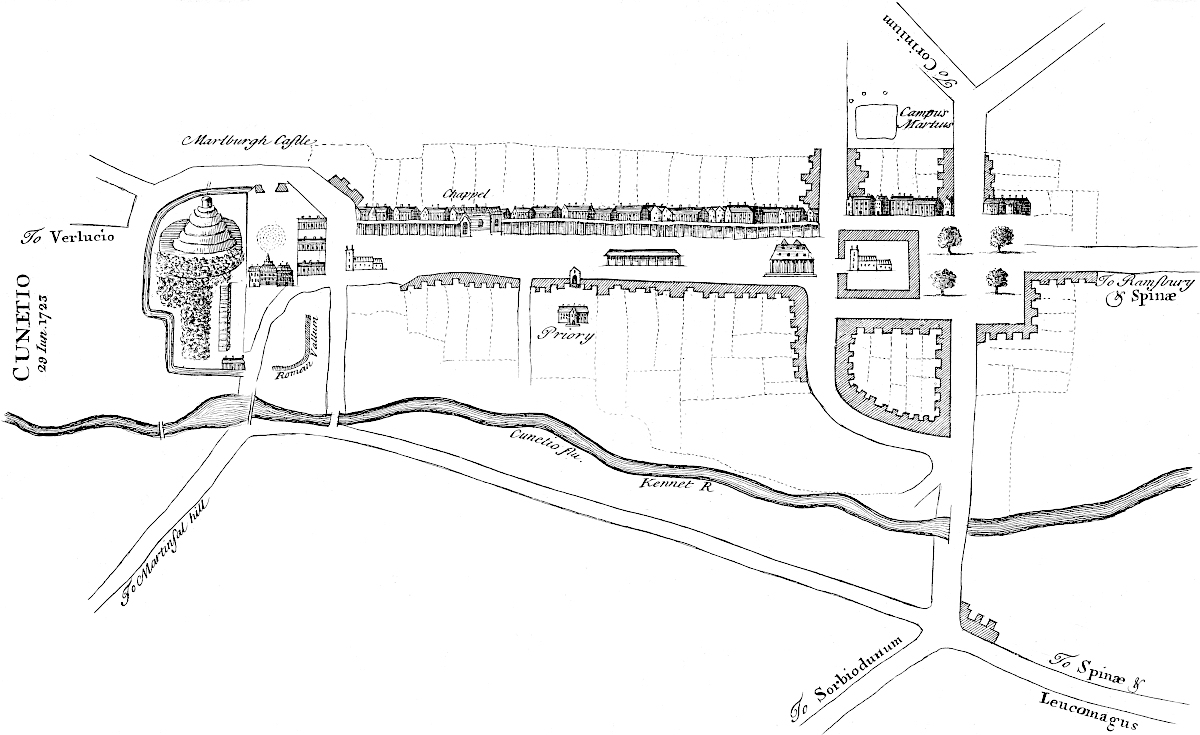
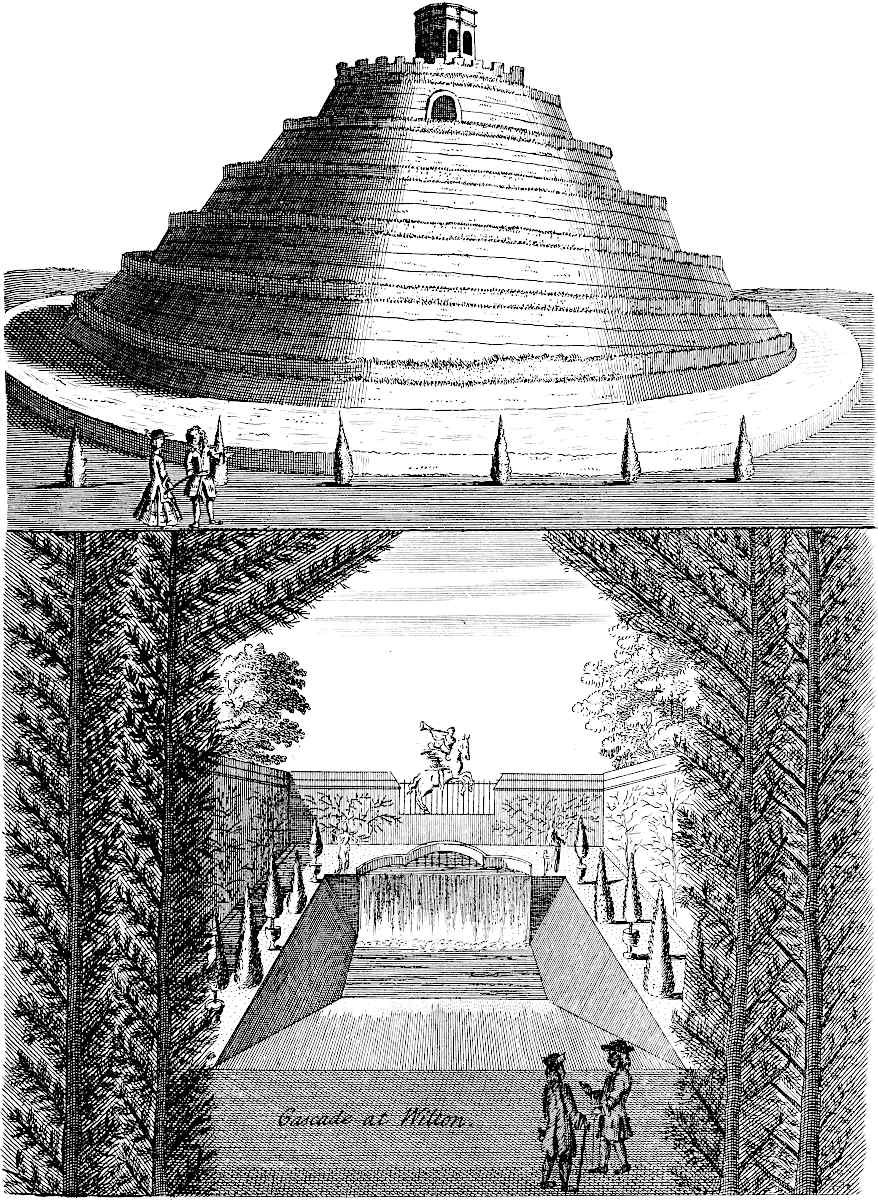
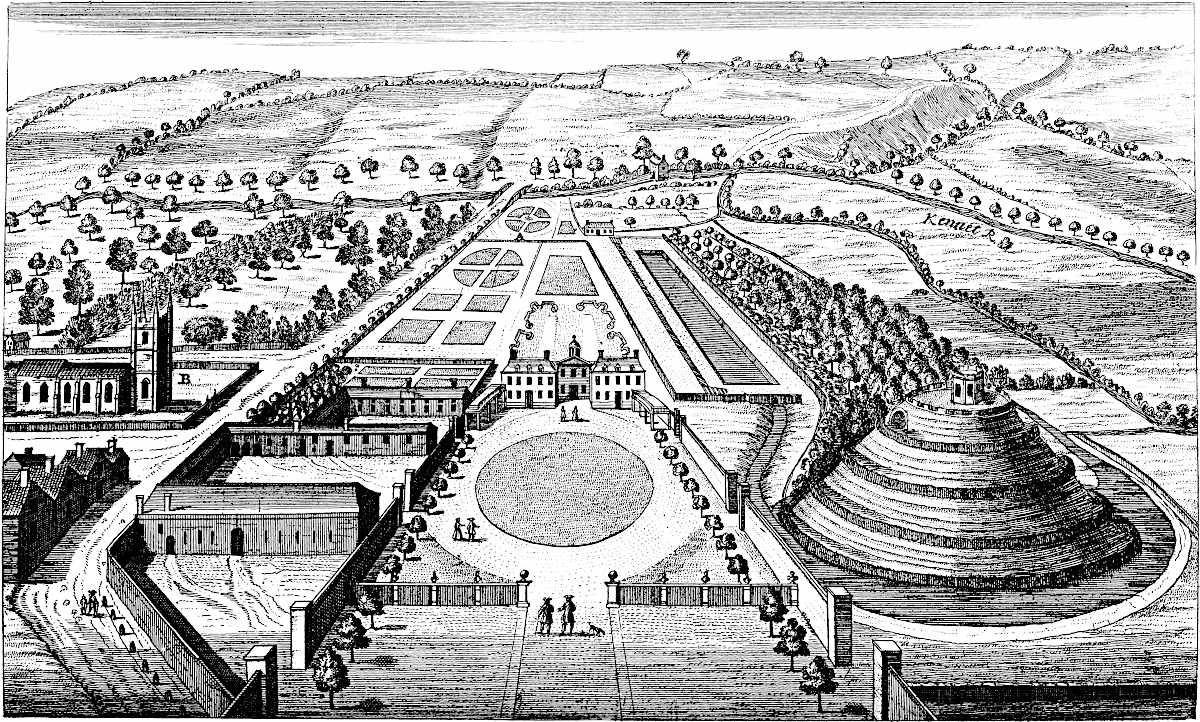
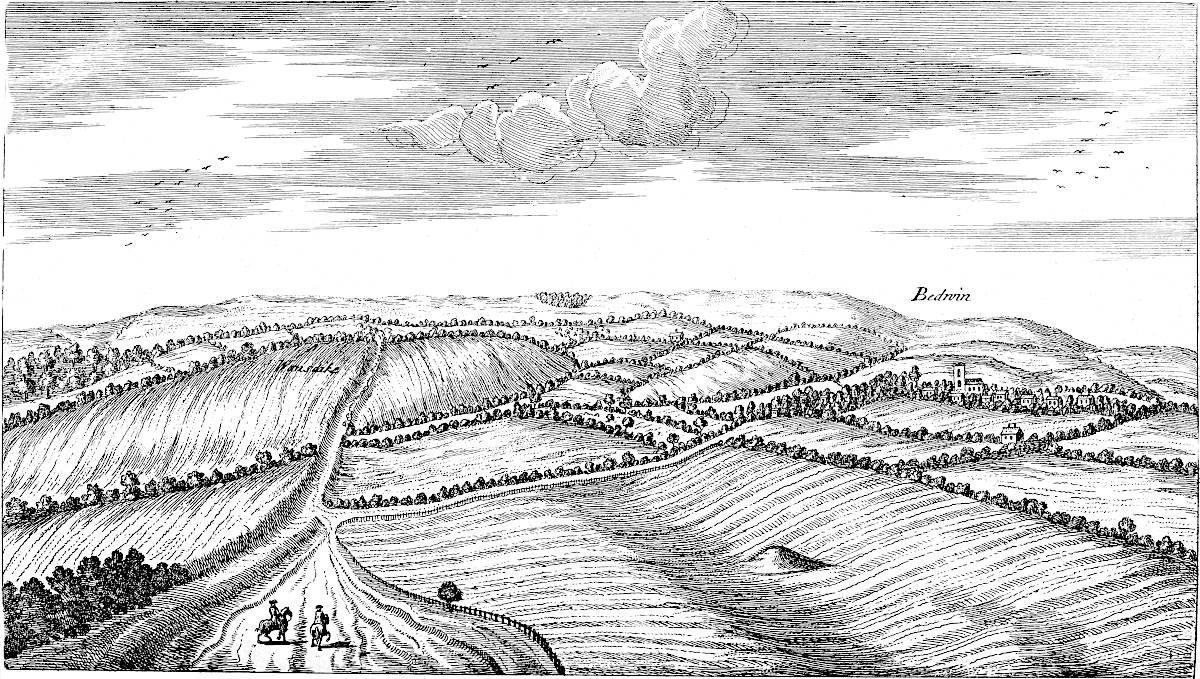
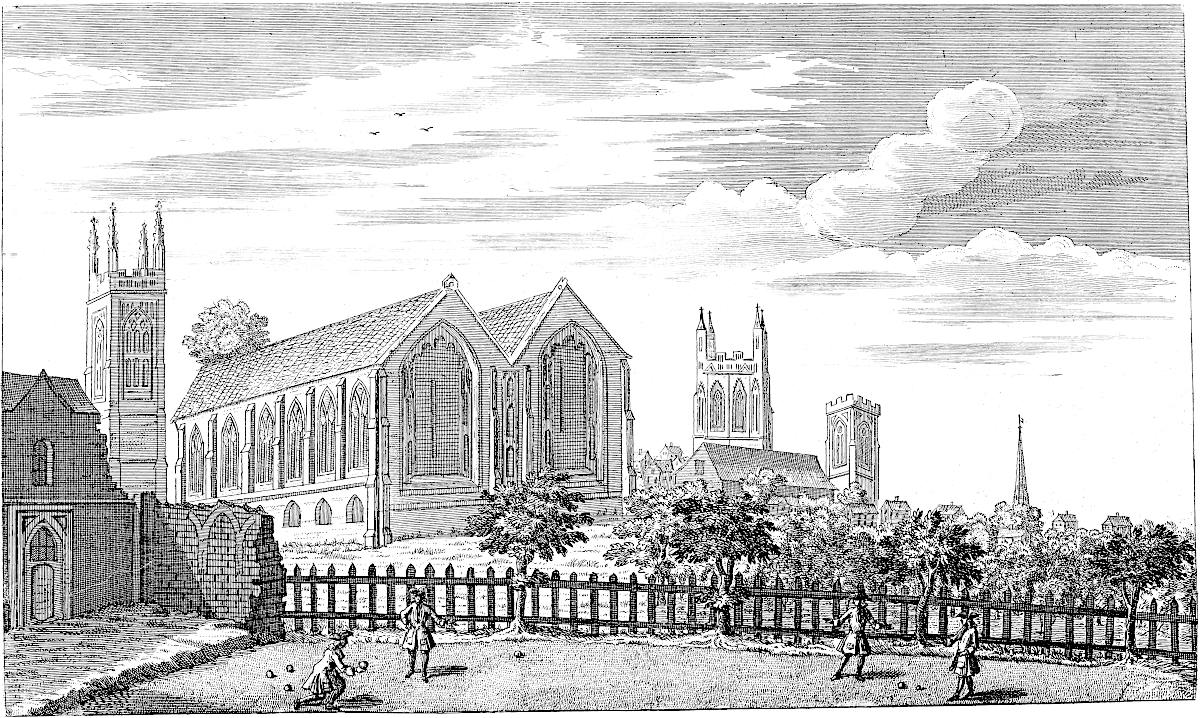
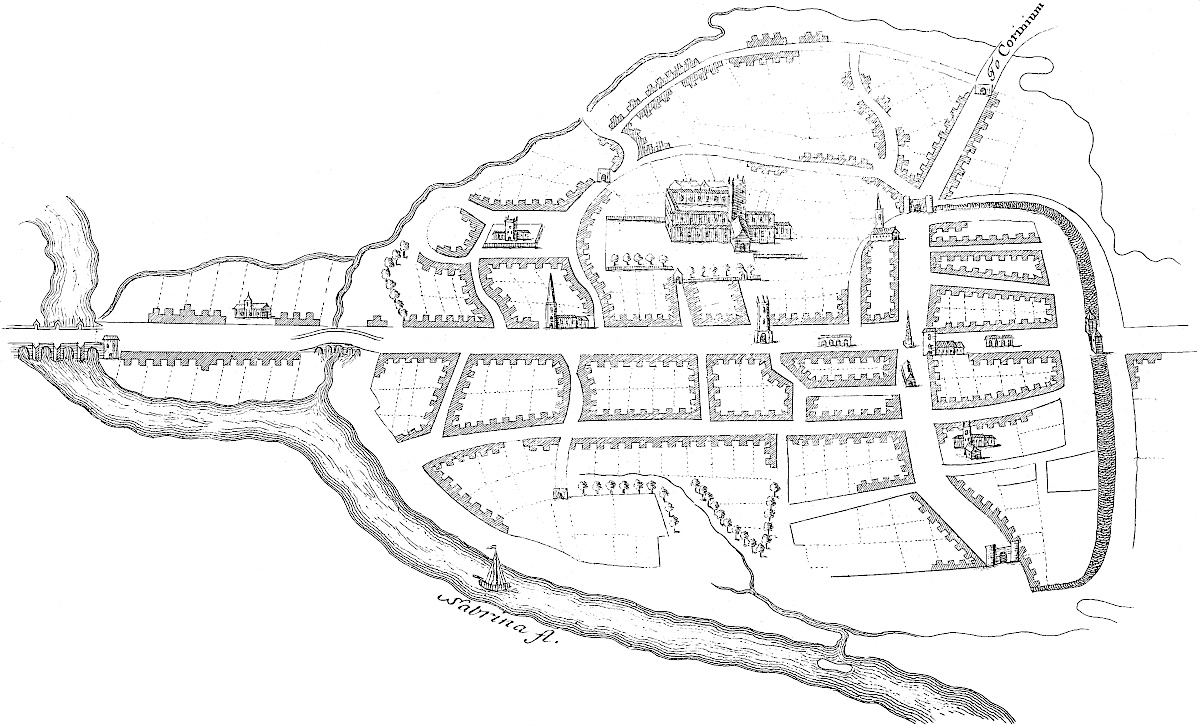
 M