ITINERARIUM CURIOSUM : OR , AN ACCOUNT OF THE ANTIQUITIES , AND REMARKABLE CURIOSITIES IN NATURE OR ART , OBSERVED IN TRAVELS THROUGH GREAT BRITAIN . — Table of Contents.
Transcriber’s Notes:
A table of contents has been added.
Blank pages have been removed.
Obvious typographical errors have been silently corrected.
Font 'Old English Text MT' is recommended to view blackletter text.
Errata have been applied.
MAPPA BRITTANIÆ FACIEI ROMANÆ
SECVNDVM FIDEM MONVMENTORVM PERVETERVM DEPICTA
Tabulam hanc Geographicam Antiquitatis Patriæ Cimelium
celeberrimo viro Gulielmo Stukeley M.D., C.L.M., F.R.S. cet
observantiæ testandæ ergo D. D. Carolus Bertramus 1755.
C. Bertramus ipse delin: ab Orig: & sculpsit.
ILLUSTRATED WITH COPPER PLATES.
CENTURIA II.
TO WHICH IS ADDED, The Itinerary of Richard
of Cirencester, MONK of WESTMINSTER. With an ACCOUNT of that AUTHOR and his WORK.
By WILLIAM STUKELEY, M.D. F.R. & A.S.
O Patria, O Divûm domus, Albion, inclyta bello!
O quam te memorem, quantum juvat usque morari
Mirarique tuæ spectacula plurima terræ!
LONDON: Printed for Messrs. Baker and
Leigh, in York-Street, Covent-Garden. M.DCC.LXXVI.
THAT Dr. Stukeley had altered the plan of his intended History of the
antient Celts, &c. mentioned in the Preface of the former part of
this work, plainly appears by his publishing Stonehenge and
Abury separately: but, as many of the Plates he left unpublished
were undoubtedly intended for that Work, and others for a Second Volume
of the Itinerarium, neither of which were ever completed; the
Editor hopes it will give pleasure to the Learned to see those Plates,
together with such of his Tracts as relate to them, collected into
one Volume, and that they will be found not altogether unworthy of
their attention;—sensible however that the many defects which must
unavoidably happen in publishing a Posthumous Collection from loose
papers, and notes carelessly thrown together, will stand in need of
their candid indulgence.
The Itinerary of Richard of Cirencester, together with Dr. Stukeley’s
Account of, and Observations upon it, were thought by some Friends of
the Doctor a very proper addition. It is a tract truly valuable for the
new light it has thrown on the study of British Antiquities, and being
out of print is now become very scarce.
It may be expected that some account should in this place be given of
the Author, and his Works. A Catalogue of those which have appeared in
print we subjoin; and for his Life we refer the reader to Mr. Masters’s
History of Benet College, Cambridge, printed in quarto, 1753; adding
only, that he died March 3d, 1765, in his 78th year, and was buried in
the church-yard of East-Ham in Essex, having ordered by his will that
no memorial of him should be erected there.
A CATALOGUE of Dr. STUKELEY’s Printed WORKS.
4to.
An Account of Arthur’s Oon and the Roman Vallum in Scotland
1720
Fol.
Lecture on the Spleen
1722
Fol.
Itinerarium Curiosum
1724
12mo.
A Treatise on the Cause and Cure of the Gout
1734
4to.
An Explanation of a Silver Plate found at Risley in Derbyshire
1736
4to.
Palæographia Sacra, No. 1. or Discourses on the Monuments of Antiquity that relate to Sacred History
1736
Fol.
Stonehenge, a Temple restored to the British Druids
1740
4to.
A Sermon preached before the House of Commons, 30 Jan. 1741
1741
Fol.
Abury, a Temple restored to the British Druids
1743
4to.
Palæographia Britannica, No. 1. or Discourses on Monuments of Antiquity that relate to British History
1743
4to.
Palæographia Britannica, No. 2.
1746
A Philosophic Hymn on Easter-Day
1748
Verses on the Death of the Duke of Montagu
1749
4to.
A Sermon before the College of Physicians, 20 Sept.
1750
4to.
Palæographia Britannica, No. 3.
1751
An Account of Lesnes Abbey, read before the Antiquarian Society, 12 April, 1753, and published in the Archæologia
An Account of the Eclipse predicted by Thales, published in Phil. Trans. Vol. 48
An Account of the Sanctuary at Westminster, published in the Archæologia
1755
12mo.
The Philosophy of Earthquakes, 2 parts
1755
4to.
Palæographia Britannica, No. 3.
4to.
Medallic History of Carausius, Emperor in Britain, part 1.
1757
4to.
Medallic History of Carausius, part 2.
1759
4to.
Palæographia Sacra, No. 2.
1763
4to.
A Letter from Dr. Stukeley to Mr. Macpherson on his publication of Fingal and Temora, with a Print of Cathmor’s Shield
1763
Several Moral Papers in the Inspector.
He was also engaged, at the time of his death, in a work entitled the
Medallic History of the antient Kings of Britain; and had engraved 23
Plates of their Coins, which were published by his Executor; but the
Manuscript was too imperfect to be given to the Public.
61·2d.
CAESAR’S Camp called the Brill at PANCRAS.
Stukely desig. dec 1758
MANY and large volumes have been written on the celebrated city of
London, which now, beyond doubt, for magnitude, splendor, riches,
and traffic, exceeds every city upon the globe: the famous Pekin
of China only boasts itself to be larger. London, then called
Trinobantum, was a considerable trading emporium in
British times, and before Cæsar’s arrival here. But the greatest
curiosity of London, and what renders it highly illustrious, has never
been observed by any writer: to give some account of it, is the purpose
of this paper.
When I resided in London in the former part of my life, I proposed
to myself, as a subject of inquiry, for my excursions now and then
on horseback round the circuit of the metropolis, to trace out the
journeyings of Cæsar in his British expeditions. This I account the
æra from whence we derive the certain intelligence of the state
and affairs of our native country. I was pretty successful therein,
and made many drawings of his camps, and mansions; several of which I
then engraved with a design of printing the copious memoirs I had wrote
concerning them.
No subject concerning our own country antiquities could be more noble.
But what I mean to speak of at this time, is a camp of his, which I
have long since observed no farther off than Pancras church.
In all my former travels, I ever proposed an entertainment of the mind,
in inquiries into matters of antiquity, a former state of things in my
own country: and now it is easy to imagine the pleasure to be found
in an agreeable walk from my situation in Queen’s Square, through the
fields that lead me to the footsteps of Cæsar, when, without going to
foreign parts, I can tread the ground which he trod. By finding out
several of his camps, I was enabled, off-hand, to distinguish them; and
they are very different from all others we meet withal.
It was the method of Roman discipline, to make a camp every night,
though they marched the next morning; but in an expedition like
Cæsar’s, in a new and unknown country, he was to trust to his own head,
and the arms of his troops, more than to banks and ditches: yet, for
the sake of discipline, a camp must be made every night; it was their
mansion, and as an home; where was the prætorium, or general’s
tent, and the Prætorian cohorts, as his guards; it was the residence
of the majesty of the Roman genius, in the person of the commander;
it was as a fixed point, subservient to order and regular discipline
military; where and whence every portion and subdivision of an army
knew their regular appointment and action.
This camp was very small; designed but for a night’s abode, unless the
exigence of affairs required some stay: but the third part of the army
lying under arms every night, prevented the danger of a surprise.
Cæsar, led on by divine Providence, entered our country in the year
before the vulgar æra of Christ 54. the second time, about the middle
of the month of July, as we now reckon, in his own Julian kalendar. I
shall not recapitulate what I have observed of the footsteps of this
great man in Kent; I hesitate not in believing that Carvilius, one of
the four kings, as called, who attacked his camp while he was on this
side the Thames, lived at Guildford; the name of the place shows it;
the river was called Villy, or Willy, a common British name
for rivers; so that Carvilius was a local title of honour, as was
the British custom, like that of our present nobility: so Casvelhan,
Cæsar’s opponent, was king of the Cassii, Cogidubnus of the
Dobuni, Togodumnus of the Dumnonii, Taeog being
Dux in British. It was the method of the British princes thus to
take the names of towns, and of people, as it was the method of their
ancestors the Midianites; of which we find an instance in Josephus,
Antiq. IV. 7. Rekam, a king there, of the same name as his
city, the capital of all Arabia; now Petra.
Cæsar passed the Thames at Coway stakes, notwithstanding the stakes:
the town of Chertsey preserves a memorial of his name, as Cherburg in
France: he pursued the Britons along the bank of the Thames as far as
Sheperton, where the stakes were placed, and there pitched his camp
with the back of it upon the Thames. At his camp on Greenfield common,
near Staines, a splendid embassy came to him from the Londoners;
desiring his alliance and protection, and that he would restore their
prince Mandubrace, who was then in his retinue. To his little camp, or
prætorium, on this account he orders another to be drawn round
it, for reception of these ambassadors, and their prince, together with
forty hostages which he demanded, and corn for his army.
Upon this, ambassadors came to him from the Cenimani, people of
Cambridgeshire; the Segontiaci, Hampshire; Ancalites,
Buckinghamshire; Bibroci, about Berkshire; and Cassii, of
Hertfordshire; submitting themselves to him. For them he orders another
appendix to his camp, to receive them.
When business was done with them, he moves forward to attack Casvelhan,
who was retreated into his fortified town at Watford. One of his camps
thitherward, is to be seen very fair on Hounslow heath, in the way to
Longford; which I showed to lord Hertford then president, and to lord
Winchelsea vice-president, of the Antiquarian Society, in April, 1723;
who measured it, and expressed the greatest pleasure at the sight.
His next camp was at Kingsbury: it is now the church-yard, and still
visible enough: its situation is high, and near the river Brent: the
church stands in the middle of it.
From hence he went, and forced Casvelhan’s military oppidum at
Watford, and Rickmansworth; a gravelly island of high ground, sylvis
paludibusque munitum, as he expresses it; and by this he brought
Casvelhan to submit. It is not my present purpose to speak largely on
these particulars; but from hence he advanced towards London,
effectually to settle his friend and ally Mandubrace, whose protection
he had undertaken, in the kingdom of the Trinobantes; and
reconcile him to his subjects, and to his uncle Casvelhan. Mandubrace
was the son of Immanuence, commonly called Lud in the British story,
which signifies the brown; who was killed by his ambitious
brother Casvelhan, too near a neighbour to London; his residence being
at Harrow on the hill, and Edgeware called Suellaniacis from
him: he likewise forced Mandubrace to fly to Cæsar in Gaul, to implore
his aid: the great Roman was not averse to so favourable an opportunity
of advancing his glory, by invading Britain, a new world.
58·2d.
Stukeley delin.
Toms Sculp.
Prospect of Cæsars Camp at Sheparton Oct: 28 1723
A. Way to Domsday bushes & Chertsey B. Way to Littleton &
Greenfield Common C. Lords bridge DD. Plain Works of the
Outer Ditch EE. of the Inner F. a Canal dug this year
G. the Antient Course of Ashford Brook
60·2d.
CAESARS Camp on Hounslow heath. 18 Apr. 1723.
62·2d.
W Stukeley delin 20 Sept 1767
CAESAR’S Camp at Kingsbury, the Church built of Roman Bricks
from the City ofVERULAM.63·2d.
Ravensbury a Roman Camp near Hexton Bedfr. 10 Iuly 1724.
Stukeley delin.
E. Kirkall Sculp.
Simoni Degg Ar. d.d. W. Stukeley
It was not suitable to his honour, or his security, to quarter in the
city of London; but he pitched his camp, where now is Pancras church:
his prætorium is still very plain, overagainst the church, in
the foot-path, on the west side of the brook; the vallum and the
ditch visible: its breadth from east to west forty paces; its length
from north to south sixty paces.
This was his prætorium, where his own tent was pitched in
the centre; the prætorian cohorts around it. There was no great
magnificence in Cæsar’s tent, here placed; it was not his manner. L.
Aurunculeius Cotta, who was here present, in his commentaries writes,
when Cæsar was in Britain, although he had acquired the highest fame by
his great actions, yet was he so temperate in his manner of life, such
a stranger to pomp, that he had only three servants in his tent. Cotta
was killed the next year in Gaul. When I came attentively to consider
the situation of it, and the circumjacent ground, I easily discerned
the traces of his whole camp: a great many ditches, or divisions of
the pastures, retain footsteps of the plan of the camp; agreeable to
their usual form, as in the plate engraved: and whenever I take a walk
thither, I enjoy a visionary scene of the whole camp of Cæsar, as
described in the Plate before us; a scene as just as if beheld, and
Cæsar present.
His army consisted of about 40,000 men, four legions with their horse.
After long debate of authors concerning the quantity of a Roman legion,
I infer, from Josephus so very often using the expression of ten
thousand, many ten thousands, and the like, that the usual and general
number of soldiers in a legion was ten thousand.
Authors generally state a legion at 6666 men; but they must mean
strictly the soldiery, without officers or horse: so that I conclude a
complete legion of foot and horse to be 10,000. Polibius, Vol. 2. book
iii. writes, in the war of Hannibal, each legion consisted of 5000,
besides the auxiliaries, together with 900 horse; and therefore we may
well judge, a legion with its officers should be reckoned 10,000.
Romans
5000
Auxiliaries
4000
Horse
900
Officers
100
———
10,000
Strabo writes, the Romans generally had their horses from Gaul.
Cæsar had now no apparent enemy; he had leisure to repose his men,
after their military toil. He was in the territory of a friend and ally
of the Roman state, whom he had highly obliged in restoring him to his
paternal kingdom: nor was it his purpose to abide here for any time:
he therefore did not fortify his whole camp with a broad ditch and
vallum for security; but the army was disposed in its ordinary
form and manner: it might be bounded by a slight ditch and bank, as
that of the whole length of the camp on the west side, (the foot-path
from the bowling-green accompanying; or it might be staked out with
pallisado’s called valli) which returns again on part of the
north side, at the porta decumana, till it meets the ditch
that passes on the west of Cæsar’s prætorium, and so continued
downward, to the houses at the Brill.
This last-mentioned ditch runs on the line that separated the column
of the horse from the Triarii, on the west side of the camp;
the foot-way from the Brill accompanying it all the way. The porta
decumana is left open in the back of the camp. The same of
the porta prætoria; but the bounds of the camp here at the
south-west corner are visible in two parallel banks remaining; the
upper surface of the earth between them, has been dug away for making
bricks.
The oddness of the present division of the north-west pasture, inclosed
by that of the postica castrorum, preserves evident tokens
of the camp: the elbow to the west, concurring with a ditch on the
eastern border of the whole camp, preserves the track of the via
sagularis; here the baggage and carriages were placed: it extended
itself behind the prætorium. Pancras church stands upon this way.
The north-west field before specified is bounded by a ditch,
which marks out the street, that runs along the front of the
prætorium; along which were set the tents of the officers, the
præfecti of the horse, and tribunes of the foot; along with the
ensigns and standards of the horse and foot, which were pitched in a
line in the ground.
On the west side of the prætorium, in this pasture, was the
open place, a square area, comprehended between the via
principalis, or principia, and the via sagularis,
called the questorium: this was the quarters of the quæstor, M.
Crassus; a promising young man, who afterwards fell with his father,
the triumvir, in Parthia. Pompey married his widow. Hither the soldiers
repaired to receive their allowance of pay and provision: on the west
side of it was the quæstor’s tent, the military chest, the stores: just
beyond, northward was the station of Comius of Arras, auxiliary to
Cæsar, with the Gaulish troops under his command; likewise the tents of
the Gaulish princes, which Cæsar brought over with him to prevent their
revolting in his absence; among whom was the son of Indutiomarus prince
of the Treviri.
Come we to the via prætoria, or principal street of the camp,
extending along the middle line from the prætorium to the houses
at the Brill; where is the porta prætoria at the frons
castrorum. The gate between the two houses at the Brill, leading
into the pasture there, which pasture was the station of the horse, is
in the very line of the via prætoria. The front of the camp is
bounded by a spring with a little current of water, running from the
west, across the Brill, into the Fleet brook: the lane out of the great
road, along this spring, terminates in the frons castrorum, as
an avenue to it; and may be ancienter than the road along the valley,
where the river runs, to Pancras. This Brill was the occasion of the
road directly from the city originally going along the side of the
brook by Bagnigge; the way to Highgate being at first by Copenhagen
house, which is the strait road thither from Gray’s-inn lane, and
before that of the valley to Pancras, called Longwich in Norden’s
Speculum.
It is not a little remarkable, that the name of Brill should
through so many ages preserve the sure memorial of this most
respectable monument of Julius Cæsar’s camp. Camden, the Pausanias of
Britain, a genius great in his way as Julius Cæsar, takes notice, in
Buckinghamshire, “of the ancient Roman burgh, where much Roman money is
found, called the Brill; which was afterward a royal village of
Edward the Confessor’s; and, instead of Bury-hill, is by contraction
called Brill.”
In the additions to Camden’s Britannia, Sussex, thus we read:
“Hard by Chichester, toward the west, there has been a large Roman
camp, called the Brile, of an oblong form, four furlongs and
two perches in length, two furlongs in breadth: it lies in a flat low
ground, with a great rampire and single graff; probably Vespasian’s
camp, after his landing.” And the like must be said of the Brill in the
Netherlands, probably too one of Cæsar’s camps.
This camp at Pancras has the brook running quite through the middle
of it: it arises from seven springs on the south side of the hill
between Hampstead and Highgate, by Caen wood: there it forms several
large ponds, passes by here, by the name of Fleet, washes the west
side of the city of London, and gives name to Fleet-street. This brook
was formerly called the River of Wells, from the many springs above,
which our ancestors called Wells: and it may be thought to have been
more considerable in former times, than at present; for now the major
part of its water is carried off in pipes, to furnish Kentish-town,
Pancras, and Tottenham court: but even now, in great rains, the valley
is covered over with water. Go a quarter of a mile higher toward
Kentish-town, and you may have a just notion of its appearance at that
time, only with this difference, that it is there broader and deeper
from the current of so many years. It must further be considered,
that the channel of this brook, through so many centuries, and by its
being made the public north road from London to Highgate, is very
much lowered and widened since Cæsar’s time. It was then no sort of
embarrassment to the camp, but an admirable convenience for watering,
being contained in narrow banks, not deep: the breadth and depth is
made by long tract of time. The ancient road by Copenhagen, wanting
repair, induced passengers to take this gravelly valley, become much
larger than in Cæsar’s time. The old division runs along that road
between Finsbury and Holborn division, going in a strait line from
Gray’s-inn lane to Highgate: its antiquity is shown it its name,
Madan-lane.
Let us pass the brook, and consider the eastern half of the camp; only
remarking, that a ditch at present dividing the two pastures, which
was the station of the horse, is continued across the brook and road,
to that eastern half of the camp, and marks, when properly continued,
the two gates on the west and east side of the camp, called porta
quæstoria and porta principalis sinistra: below it is the
other cross road of the camp, called via Quintana.
To the east of the prætorium was a square plot, analogous to the
questorium: this was called the forum; this at present
includes the church-yard to its eastern fence, with the houses, the
grove and kitchen garden precisely. To the east of the forum was
the quarter of the legates. Sulpitius Rufus, whose coin I have given
above, we may justly suppose one of them: he is mentioned by Cæsar as
his legate in the civil war; all the time with him in Gaul: and we can
have no scruple in thinking he was with him in Britain too. The coin is
in Goltzius’s Julius Cæsar, but reversed, Tab. ix. 1. he gives
no explication of it: it is in gold, but imperfect, here supplied.
Publius Sulpitius Rufus, mint-master to Cæsar, here celebrates a naval
expedition of the emperor’s; and not unlikely his British. Cæsar on
a galley with the eagle in his hand: the Genius of Rome follows him.
It is said, he was the first of the Romans that leaped on the British
shore: finding the soldiers slack in landing, he took a standard in his
hand, and went before them. Cæsar himself says the standard-bearer of
the tenth legion did so.
The coin was struck by him, when governor of some province under Cæsar,
probably Spain, where at Carthagena, in the Franciscan monastery,
remains his monument, thus in Gruter. MCCCCXXIII.
P. SVLPICIVS Q. F. Q. N. COL.
HIC SITVS EST ILLE PROBATVS
IVDICIEIS MVLTEIS COGNATIS
ATQVE PRIVIGNEIS.
C. Trebonius was another legate, a commander of horse, mentioned B. G.
V. 17.
North of the church-yard is a square moted about, in length north and
south forty paces, in breadth east and west thirty; the entrance to
the west: it was originally the prætorium of Mandubrace, king
of London, and of the Trinobantes. The ditches have been dug
deep to make a kitchen-garden for the rector of the church, from whom
I suppose in after-times it has been alienated. All the ground of the
camp beyond the via sagularis was ever allotted to auxiliary
troops, and allies.
This honour of a prætorium was allotted to Mandubrace, now
confirmed in his kingdom, an associate of Cæsar’s, and friend declared
to the Roman commonwealth; and to give him more authority with his own
people.
Hither Casvelhan was sent for, and reconciled to his nephew, enjoined
not to injure him, as an ally of Rome; assigned what tribute he should
annually pay, what number of hostages he should send to him into
Gaul: for now he was upon returning, having accomplished all that he
proposed, and the time of the autumnal equinox approaching. It was now
September, and 54 years before the vulgar Christian æra.
To the north of the eastern half of the camp, a bank and ditch marks
the outward bound there, in a strait line, and becomes crooked as it
goes eastward, just where ends the original northern bound of the
camp. To the south, where was the frons castrorum at the houses
of the Brill, one would reasonably suppose, there might formerly
remain much more evident marks of the camp, as it is so far distant
from the prætorium: there might have been a more considerable
vallum and ditch quite around the camp, than now any where
appears; and then it is natural to think, the name of the camp, as
called by our Saxon ancestors, the Brill, would be fixed to the
habitable part, the houses, as now.
In the first field of the duke of Bedford’s, by Southampton row, the
vallum and ditch runs, which was drawn quite round London and
Southwark in the civil wars: they afterwards levelled it, and it is now
scarce discernible, which is but 100 years ago; Cæsar’s 1800.
54·2d.Cæsars passage over the Stour by Chilham and Julabers grave. drawn 10 Oct 1722.
W. Stukeley delin.
E. Kirkall Sculp.
55·2d.View from a Roman tumulus upon the Watlin street by the Mill on Barham downs. 10. Oct. 1722.
W. Stukeley delin.
E. Kirkall Sculp.
56·2d.Prospect of Iulabers grave 11 Oct 1724.
Stukeley delin.
E. Kirkall Sculp.
57·2d.
Stukeley delin.
E. Kirkall Sculp.
Prospect of Julabers grave from Chilham. May 24. 1725. This drawing is taken from the Woolpack Inn.
A. Julabers grave.
59·2d.
Cæsars Camp on Greenfield Common, between Ashford and Lalam, near
Stanes. Oct. 27. 1723. Lalam Church bears 10d. W. of South, a Brook to
the East, but farther off than here exprest. This Brook runs into ye
Thames by his Camp at Sheperton.
Cæsar in his Commentaries, B. Gall. iv. 27. writes, the Britons, in
asking peace after being vanquished, brought some hostages according to
Cæsar’s command, and promised to bring the rest in a few days, as to be
fetched from more distant parts: in the mean time they disbanded their
armies; the princes of the country came from all quarters, recommending
themselves and their principalities to Cæsar. Hence it is obvious, he
staid here many days.
A bank is visible in the pasture between the Brill and end of
Copenhagen road, in the south-east pasture, the boundary of the camp:
we may discern, it is somewhat oblique, not in a true line with the
rest of the frons castrorum; but I suppose this owing to the
curve of the river eastward to Battle-bridge: they therefore made this
bank in a square to the river.
We may observe a portion still visible of the original boundary of the
camp eastward, in that part called latera prætoria, being at
present a watery ditch; and further downward, the foot-path between
two banks observes the like direction; and the ground of the porta
principalis, between them, is open and unfenced.
I judge, I have performed my promise, in giving an account of this
greatest curiosity of the renowned city of London; so illustrious a
monument of the greatest of the Roman generals, which has withstood the
waste of time for more than eighteen centuries, and passed unnoticed,
but half a mile off the metropolis. I shall only add this observation,
that when I came to survey this plot of ground, to make a map of it,
by pacing, I found every where even and great numbers, and what I have
often formerly observed in Roman works: whence we may safely affirm,
the Roman camp-master laid out his works by pacing. To give some
particulars.
The measure is taken from the inside of the ditch, or the line
between the vallum and the ditch: the space of ground, which
the camp-master paces, the workmen throw inward to compose the
vallum.
The camp on Barham downs contains in breadth thirty paces, length
sixty. The camp at Wrotham, in breadth thirty paces, in length forty.
At Walton by the Thames, it is a square of fifty paces. The foss here
is converted into a mote, as here the prætorium of Mandubrace:
so the camp at Sheperton is a square of the same dimensions, and
the foss turned into a mote, and made an orchard: we observe here
at Sheperton the prætorium is made on the bank of the river
Thames; the postica castrorum, beyond the via sagularis,
neglected. While Cæsar was pitched here, the turn of the auxiliaries to
be in arms all night, with the other part of the troops, whose duty it
was, came on: and the general’s intention was but to stay one night in
this place; so there was no need to mark out their places in the camp.
The stakes placed here in the river, by the Britons against Cæsar, were
now a sufficient security behind him. Cæsar practised the same method
when he fought the Belgæ: passing the river Axona, he placed his
camp with the river behind him, that he might not be attacked from that
quarter.
Cæsar’s camp on Greenfield common is forty paces broad, sixty long.
Here he received the ambassadors of the Trinobantes, desiring
their prince Mandubrace to be restored: they bring forty hostages
and bread-corn for the army. For their reception another camp is
made around this, which is 80 paces broad, 100 long. Another day
came in ambassadors from the Cenimani, Segontiaci,
Ancalites, Bibroci, and Cassii. This obliged
the camp-master to add the appendix to the camps, which was of the
breadth of 100 paces, equal to the length of the last; 130 in length,
stretching out to the east: but in the ground-plot of that camp we see
an egregious proof of my position, that they went by paces in marking
out their camps; and sometimes by guess-work, in the square; which
obliged the camp-master to carry his 130 paces beyond the angle of the
former camp. Concerning the method of adding new occasional works to
a former camp, we observe a like instance in that camp of Chlorus’s
between Clarendon palace and Old Sarum; made, we may well presume, on
the states of Britain sending their ambassadors hither to him, with
submission to his government after the destruction of Allectus.
Cæsar’s camp on Hounslow heath is very perfect, sixty paces square. His
camp at Kingsbury is thirty paces broad, and forty in length.
Come we now to our work at Pancras. The prætorium is forty paces
broad from east to west, fifty paces long from north to south: the
prætorium of Mandubrace is thirty paces long from east to west,
forty from north to south: thereby it accommodated itself to that part
of the camp, that was called retentura.
The breadth of the whole camp was 400 paces, not reckoning the
valley of the brook: the length of the whole is 500 paces. Examine
the intermediate parts, they fall into whole numbers: the breadth
of the pasture, comprehending the station of the Hastati and
Triarii, on the west side of the camp, is 150 paces: that of
the horse is forty broad: the correspondent, or eastern part of the
camp, is likewise 150 paces broad, comprehending the station of the
Triarii and Hastati; so that, subducting the space of the
valley where the brook runs, the whole breadth of the camp, where the
tents are pitched, contains 340 paces: a space beyond, on each side,
of thirty paces wide, is supposed to be left between the tents and the
vallum, where a camp is fortified: and then the camp contains
just 400 paces broad.
The camp is in length 500 paces: the thirty paces beyond, for the way
between the tents and vallum, (where a vallum is made)
amounts to 560; so that the proportion of length to breadth is as 3 to
2; where strength and convenience is well adjusted, and is often the
proportion of Roman cities. This space of ground was sufficient for
Cæsar’s army, according to Roman discipline; for, if he had 40,000 men,
a third part of them were upon guard.
The recovery of this most noble antiquity will give pleasure to a
British antiquary; especially an inhabitant of London, whereof it is a
singular glory: it renders the walk over the beautiful fields to the
Brill doubly agreeable, when, at half a mile distance, we can tread in
the very steps of the Roman camp-master, and of the greatest of the
Roman generals.
We need not wonder that the traces of this camp, so near the
metropolis, are so nearly worn out: we may rather wonder, that so much
is left, when a proper sagacity in these matters may discern them; and
be assured, that somewhat more than three or four sorry houses, is
commemorated under the name of the Brill: nor is it unworthy
of remark, as an evident confirmation of our system, that all the
ditches and fences now upon the ground, have a manifest respect to the
principal members of the original plan of the camp.
In this camp at Pancras, Cæsar made the two British kings friends;
Casvelhan, and his nephew Mandubrace: the latter, I suppose,
presented him with that corslet of pearls, which he gave to Venus in
the temple at Rome, which he built to her, as the foundress of his
family.—Pliny and Solinus.
Mr. White of Newgate-street has a gold British coin, found in an urn in
Oxfordshire, together with a gold ring set with a pearl.
When Cæsar returned, he found letters to him, acquainting him with his
daughter Julia’s death. Plutarch.
I shall conclude with this observation, that on Cæsar’s return to the
continent, the Morini, inhabiting the opposite shore, lay in
wait for his men, hoping to obtain great spoils. This was in his first
expedition: it shows Britain was not so despicable a country as authors
generally make it: much more might they have expected it in return from
his second expedition, when the nations of the Cattichlani,
Bibroci, Ancalites, Trinobantes, Cenimani,
Segontiaci, sent ambassadors to him, seeking his favour; all
charged with magnificent gifts: and, beyond doubt, the Londoners were
not slack, for so great a favour as protecting them from the insults of
Casvelhan, and restoring to them their king Mandubrace.
Cæsar, having accomplished his purposes here, returned by Smallbury
green, in order to pass the Thames again at Chertsey. Smallbury
green was then an open place as now, and has its name from his
prætorium, like this at the Brill: the road lately went round it
on the north side; and gravel had long been dug from it, to mend the
road; yet I could discern part of it, till, three years ago, they made
a new road across the green, and totally ruined the prætorium.
There is a spring arises at the place.
It is fit we should say somewhat of the city of London, the
glory of Britain. Cæsar calls the inhabitants of this country
Trinobantes: it comprehends Middlesex and Essex on this side the
river; Surry on the other. The name of Trinobantes is derived
from Trinobantum, the most ancient name of London: it signifies
the city of the Novii, or Novantes, the original name
of the people called Trinobantes by Cæsar. Tri, or
Tre, in the very old British dialect, imports a fortified city.
Many names of this kind still remain, in Cornwall especially.
Noviomagus most certainly is Croydon in Surry. Magus in
British signifies a city on a down, or heath. Newington on the South of
London, and Newington on the north, retain evident remains of the name
of the Novantes.
In many coins of the great king Cunobeline, nephew of our prince
Mandubrace, we have inscribed TASCIO NOVANTVM, meaning the tribute of
the Londoners, and of the people Novantes, dependent on them,
called by Cæsar Trinobantes.
The Novii, or Novantes, the original people of this
country, knew how to take the proper advantage of the noble river
Thames, and built this their fortified city of Trinobantum
upon a most convenient situation, celebrated by all writers. The
inhabitants of this potent city carried on a very considerable trade
with the continent, and were rich and flourishing, as those numerous
coins of Cunobeline are evidences beyond all exception. Londinium
copia negotiatorum & commeatuum maxime celebre, says Tacitus. These
coins are in gold, silver, copper: I have engraved twenty-three plates
of them. Nor, in my opinion, have we reason to doubt of Billings-gate
being built by him, as his royal custom-house; and why Ludgate should
not take name from Immanuence Lud, father of our prince Mandubrace,
I see not. The business of a society of antiquaries is to separate
truth from fable, by evidence, by reason, and judgement. Authors
are certainly mistaken in thinking our British ancestors a rude and
barbarous people. Need we a further testimony of our continental trade,
Cæsar speaks of the Gaulish merchants who traded hither: he convened
them together to inquire concerning the nature of the country; and I
have the strongest reasons in the world to induce me to believe, that
Britain was peopled before the opposite continent, by a great and
polite nation; and that our British coins are the oldest of any in
Europe.
Cunobeline, very young, was carried to Rome by his uncle Mandubrace,
four years after Cæsar’s expedition here, and his restitution to the
kingdom of the Trinobantes. Cunobeline became well acquainted,
and even intimate with Augustus, in the dawning of his power; being
about the same age. Augustus entertained a great kindness for him; and
he bore a share in his warfare, being præfect of a Roman legion, the
XX. VV. called Cretica, as Richard of Cirencester informs us;
which is the reason that he so often struck the figure of a boar on
his British coins, that being the ensign and cognisance of the legion.
After he returned, and was king of Britain, he kept up a friendship
and correspondence with Augustus, during his whole, and that a very
long life. He struck many coins in honour of Augustus, and the plainest
imitations of the coins of Augustus. He sent him magnificent presents,
paid a tribute to him, built the city Cæsaromagus in compliment to him.
He celebrated the Actiac games like those done by Agrippa at Rome, by
Herod at Cæsarea, and many other states of the Roman empire. By these
means he staved off, for his life, an actual subjection of Britain to
the Romans.
I cannot agree with my late learned friend Mr. Baxter in his derivation
of Trinobantum, that it is of Belgic original. The word
Tri or Tre of the old Cornish, prefixed, sufficiently
confutes the notion: here is none of the Belgic pronunciation, as in
the west of England. Cæsar’s assertion of the supereminent power of
the Trinobantes, shows they were an aboriginal people: they
had indeed been under some sort of subjection to the Cassii,
or Cattichleuni; but that may have been recent, when Casvelhan
invaded them, and slew their king, his brother Immanuence, father to
our Mandubrace, as Cæsar tells us.
The very name of their neighbours, Cattichleuni, confirms our
opinion; signifying the clan of the Cassii; a most ancient
word of the Britons, equivalent to the Latin civitas, used by
Cæsar; still in use in Scotland. Baxter owns the Cassii to be of
Frisian, or British origin.
This word Frisian puts us in mind of the British stories of
Trinobantum being Troja nova, built by the wandering
Trojans: so deep rooted among our ancestors is the notion of a
Trojan original. I know several foundations that may be assigned for
this notion: one seems to come from the utmost source of antiquity,
the founder of the British nation, APHER, grandson of ABRAHAM: for
which I can bring very large proofs, not so much pertaining to this
place. He is the Greek Phryxus, a near relation to Melicerta or
Melcartus, the Tyrian Hercules: he founded the Phrygians; he gave
name to Africa, and Britain; so that Phrygii, Frisones,
and Bryges, Britones, Brigantes, are all words
in different pronunciation meaning the same. Of it I say no more
at present, than that it further illustrates my opinion of the
Trinobantes being most ancient, an aboriginal people here;
and that their city was fenced about, whether with a wall, or with a
vallum, and ditch, I cannot pretend to say, any more than when
it was first called Londinium: and it is not my humour to carry
conjectures beyond what they will reasonably bear. But I think I am
not distant from truth, when I judge the Novii to be the same
as the Nubæ of Africa, on the west side the Nile; neighbour to
the Troglodites, says Strabo: these were neighbours too to the
Arabians; the Red sea between them: natural navigators they must needs
be. And Josephus makes the children of ABRAHAM by Keturah to be settled
by him in Trogloditis, and Arabia the Happy, upon the Red sea.
Antiq. i. 15. The colony of these people at Cadiz is always said
to come from the Red sea. Pliny mentions the Nubæi, a people of
Arabia Deserta.
Further, Novantæ are a people in the west of Scotland, now
Galloway. Novantum promontorium, the Mull, Chersonesus,
and Novaritæ; and the city Novantia, north of Severus’s
wall. The river Nid, in Scotland, is called Novius. No reason
to think either one or the other of Belgic original, but undoubtedly a
colony of our Trinobantes.
Josephus, in his xiv. of the antiquities of the Jews, gives us the
decree of the senate and people of Pergamus, in favour of the Jews;
setting forth, “Since the Romans, following the conduct of their
ancestors, undertake dangers for the common safety of mankind, and are
ambitious to settle their confederates and friends in happiness, and in
firm peace—”
The decree proceeds as at large set forth by Josephus, and well worthy
perusal; concluding, “That the Jews would remember, their ancestors
were friendly to the Jews, even in the days of ABRAHAM, who was the
father of the Hebrews; as we have also found it set down in our public
records.” Many useful observations may be made from this testimony.
1. We learn hence, mankind at that time, which was but about forty
years before the vulgar Christian æra, had the same notion of
the Romans, as I have enlarged upon in chap. 1. of the Medallic History
of Carausius. The Romans, for their valour, virtue, fortitude and
temperance, were the nation chosen by divine Providence to conquer,
polish, and set free, all the world, to prepare for the advent of
Messiah.
2. These Phrygians were a colony of the defendants of ABRAHAM by
Keturah. At Pergamus the ancient and famous physician Æsculapius had
a shop, and practised physic, as Lucian testifies. Midian, the father
of Phryxus, APHER, was a great physician, and no other than the Greek
Chiron; as I have shown elsewhere: so our Druids, the people of APHER,
were famous for medicine. The Genius of physic remained at the place:
the famous Galen was born here.
3. These people assert, what they say is written in their public
records; so that they had an early use of letters, from the Abrahamic
family: our Druids likewise had the use of letters from the same
fountain.
4. What they say is confirmed by the Lacedemonians claiming like
kindred to the Jews; as we read in Maccabees, xii. 19. 23. and
Josephus, xii. 4. 10. Mr. Whiston mentions, on this occasion, the
testimony of the Armenian writer, Moses Chorenensis; affirming that
Arsaces, founder of the Parthian empire, was of the seed of ABRAHAM,
by Keturah: and thus we find this posterity of the great patriarch,
from Britain by sea, to Parthia by land; the extent of the habitable
world: and Josephus often mentions his countrymen the Jews exceeding
numerous, in after-times, in every country and city throughout the
habitable world; which is true to this very day, both in respect to
Jews, properly speaking, by Sarah, as well as the Arabians by Hagar,
and Keturah: for by these latter all Asia and Africa are at this day
peopled: the signal favour of God to the greatest of all men, ABRAHAM.
Return we to the city of Trinobantum. I shall mark out the
original form, which we may conceive it to have been of, in the
time we are writing of. If we look on the plan of London, which I
engraved long ago in my Itiner. Cur. we discern, the original
ground-plot of the oldest part of the city is comprehended, in length,
from Ludgate to the present Walbroke; in breadth, from Maiden-lane,
Lad-lane, Cateaton-street, to the Thames. This makes an oblong square,
in proportion as 2 to 3: I have there made it to be composed of two
principal streets, crossing two other principal streets; which makes
nine principal quadrangular spaces, for the habitations, area’s,
and public buildings.
I have reason still to acquiesce in this disposition of the most
ancient city of London; as we must suppose it in the time of
Immanuence, father to Cæsar’s ally Mandubrace, whom he now resettled
therein. I am very much confirmed in my opinion, by the ground-plot
I have lately made of Cæsaromagus, now Chelmsford, built by
Mandubrace’s nephew, the great king Cunobeline, to the honour of
Augustus, his great friend and ally; for that city was exactly of the
same form and disposition.
Hence then we gather, the oldest London was bounded on the west by
Ludgate, and the wall there; on the east, by the current or rivulet
called Walbroke, coming from the morass of Moorfields; which morassy
ground extended to Smithfield, and guarded the whole north side of
the city; as the Thames on the south: it is well known, that the
Mansion-house stands on a great and deep morassy ditch; that the
foundation of it cost a very great sum, in driving piles, and the
like, to set the building upon. The city of London is situate much as
Alexander projected for Alexandria, between a morass and the sea.
Here was a natural and good boundary on all sides. To the west was a
steep cliff hanging over the rivulet of Fleet: its steepness is very
considerable now, as may be seen about the Old Bailey, where is at
present a flight of steps, through the old wall: in former days it
was much more considerable: the other sides had the river and water;
so that the spot pitched upon for the city must be reckoned very
judicious: the soil a hard and dry gravel.
There is the strongest confirmation for this assignment, deducible
from observing three principal roads leading from the gate of
Walbroke, at the end of the Poultry, at Stocks market, or the
Mansion-house: Cornhill was the great road directly into Essex:
Lombard-street conducted to Cunobeline’s custom-house, Billingsgate:
Threadneedle-street and Broad-street went obliquely toward the
north-east, and the present Bishops-gate, and so in later times to the
great Roman road called Hermen-street, crossing the Thames where London
bridge now is; making a meridian line through the length of the island.
By collating several old plans of London, I discern there were four
principal streets running from west to east. 1. The Watling-street,
from Ludgate. 2. Thames-street, the boundary toward the river: this
on the right hand of Watling-street. 3. On the left hand, Cheapside,
Pater-noster row being originally part thereof: at the end of it,
beyond the Poultry was the eastern gate of the city. 4.
That called Maiden-lane, and Cateaton-street, which was the northern
boundary of the city, and running along the original wall of it.
47·2d.
Caesaromagus Chelmsford built by King Cunobeline
P. Benazech Sculp.
48·2d.
CAMVLODVNVM Colonia.
49·2d.
G. V.ᵈʳ Gucht Scul. C. JVLIVS CAESAR. In marmore penes Cl. Ric Mead M.D. sui tabulam dicat Wm. Stukeley. 1722.50·2d.The Carpentry of Cæsars bridg over the Rhine.
Stukeley delin.
51·2d.The Side view of Cæsars bridg.
Stukeley delin.
52·2d.
Cæsars camp at Deal, in his first Expedition into Britain. Illustrissimo Heneagio Comiti Winchilsea Militiæ Cæsareæ Specimen d. d. Guliel. Stukeley
Stukeley design.
Toms Sculp.
53·2d.Cæsars Camp upon Barham Down. drawn 10. Oct. 1722.
W. Stukeley delin.
E. Kirkall sculp.
This being the first form of the city, its proportion of length to
breadth was as 3 to 2. Now, for the cross streets, I conceive one to
have been that of St. Martin’s lane from Aldersgate continued downward
to Paul’s wharf; the next was from Aldermanbury and Bow-lane, to
Queenhithe: the other, Walbroke to Dowgate, or Watergate, being the
outfall of the rivulet; boundary of the eastern wall of the original
city, as in in the time of Mandubrace. The street which accompanied the
western wall, on the inside Ludgate, is quite absorbed by houses at
present.
There might then have been many lesser cross streets both ways, of
which we cannot now take any account, our purpose being to consider it
only in the great; but there are many collateral indications of the
justness of our assignment: it would be a trifling minuteness to push
conjectures farther, than to observe the gate on the south side was at
Queen-hithe.
Thus we see a great conformity between old London and Cunobeline’s
Cæsaromagus, especially as to the general distribution and
design; the four gates of the sides corresponding to different streets
obliquely.
Afterwards, when the Romans became possessed of the island, and
made the great roads across the kingdom, three of them had respect
to this metropolis, but none went precisely through it; and such
was often their method. The Watling-street, from Chester to Dover,
came by Tyburn, crossed the Thames at Stanegate, by Lambeth, and
so to Shooters’ hill: this is crossed at Tyburn by another equally
strait, but unnoticed by any writer, reaching across the kingdom from
Chichester to Dunwich in Suffolk: I call it via Iceniana: it
goes by Old-street north of the city, and is the high road of Essex to
Colchester; but, when the Romans found it useful to enlarge this city
by a new wall, they made a branch to proceed from St. Giles’s, which we
call Holborn, and so built a gate at Newgate, and continued the road to
Cheapside.
A third road is the Hermen-street from the sea-side in Sussex
to Scotland: it went by Bishops-gate, but on the eastern and
outside of the city, till its enlargement; and that enlargement
was done by Constantine the Great, or by his mother the empress
Helena, our country-woman: and we may well credit the reports of
the Britons concerning this matter. Then it acquired the title of
Londinium Augusta: then it was that the Tower was built;
an armamentarium, as the castle of Colchester, of the same
manner and model of building, Roman brick and stone; a chapel with a
semicircular window, as Colchester, and dedicated to St. Helena. This
in after-times; but in regard to the age we are treating on, that of
Cæsar and our aboriginal Britons, it is a just enquiry, after we have
given the plan of primitive London of the Novantes, Where may
we suppose their temple to have been? for assuredly we must pronounce,
that, whenever the ancients built a city, they certainly took care to
erect a temple for divine worship.
In answer to this enquiry, we are to reflect, that the Britons
were under the ecclesiastic regimen of the Druids, who were of the
patriarchal religion, the religion indeed of ABRAHAM: for they came
from him. We find in sacred writ, wherever he removed from one country
to another, “there builded he an altar to Jehovah, and invoked in
the name of Jehovah,” who sometimes personally appeared to him:
consequently we must infer Jehovah to be the Messiah, or Son of
God, in an angelic form.
Other times ABRAHAM removed into a country abounding with groves of
oak; sometimes he planted a grove of oak for religious purposes, as a
temple. All these things the Druids did; they built such open temples
as the great patriarch; they used oak-groves, or planted oak-groves as
temples: we cannot say that Jehovah appeared personally to them; yet we
may well think they were sometimes vouchsafed the spirit of prophecy,
and particularly in regard to Messiah, who they knew was to be born of
a virgin, and likewise was to be born at the winter solstice, whence
their famous misleto solemnity.
Moreover, at Chartres in France, which was the place of the principal
meeting of the Gaulish Druids, there is now a magnificent church, built
upon the spot where then was that most celebrated open temple: for the
Druids very easily passed over into christianity; the transition was
but natural. This church is dedicated to the Mother of God, as they
there style the virgin Mary: there is under it a chapel cut in the
rock, with a flight of stairs descending to it: on the door of the
frontispiece is this inscription in Latin,
“To the Virgin who bears the Child.”
I apprehend this to be analogous to the caves of Mithras in Persia;
for Mithras is Mediator, or Messiah; and they say there, that
Mithras was born in such a rocky cave; and they worship him therein.
Both the ancient Persians and the Druids, who were of the same
patriarchal religion, had the same notion of the Messiah to be born in
the rocky stable at Bethlehem.
We have many instances of Druid men and women endowed with the spirit
of prophecy. I shall mention but one, out of Josephus, Antiq. xviii.
The Jewish Agrippa fell into the displeasure of Tiberius, who put
him in bonds. As he stood leaning against a tree before the palace,
an owl perched upon that tree: a German Druid, one of the emperor’s
guards, spoke to him to be of good cheer, for he should be released
from those bonds, and arrive at great dignity and power; but bid him
remember, that when he saw that bird again, he should live but five
days. All this came to pass: he was made king by Caligula; St. Paul
preached before him: Josephus speaks of his death, agreeable to the
prediction. But concerning the Druids, I have before now opened my mind
largely, in some papers read at the Antiquarian Society; wherein I
have sufficiently vindicated them from the imputation of paganism and
idolatry.
As to the temple belonging to the city of Trinobantum, or
London, we may be assured, they erected no temple within the city.
When the Romans became masters here, they built a temple of their
own form, to Diana, where now St. Paul’s stands: they placed it
in the open space, then the forum; but the British temple,
appropriate to the city, was upon the open rising ground to the west,
where now is Knave’s-acre. The name of the place both gives a very
good foundation to my opinion, and also at the same time acquaints
us with the particular form of the temple: for the Druids, as I have
shown, had three kinds of temples, of the patriarchal mode. 1. The
round, or circular work of upright stones, innumerable to be seen.
2. The serpentine temple, or a snake transmitted through a circle;
as those of Abury and Shap. 3. The alate, or winged temple, composed
of a circle and wings: and this was the sort of temple here placed;
of which the name of Knaves-acre is a sure memorial. This was
made only of mounds of earth, in Latin agger, thrown out of the
ditch camp-fashion: this word is corrupted into acre. The word
knave is oriental, canaph, volavit; the Kneph
of the Egyptians; by which they meant the Deity, in the most ancient
times, before idolatry prevailed.
The form of our alate temple here exactly corresponds with that
now to be seen on Navestock common, Epping forest; which name of
Navestock preserves its memorial, meaning the sacred tree by the
alate temple: it is composed of mounds of earth and ditch; as ours was
at Knaves-acre.
Observe, the word agger remains at Edgeware, the
Suellanacis of our king Casvelhan, uncle to Mandubrace: it is
the Roman road called Watling-street. Egham by Stanes acknowledges the
like derivation, being upon the via Trinobantica at Stanes, the
Ad Pontes of the Romans. Many more like instances I could give.
These sort of temples were properly dedicated to the Divine Spirit, the
author of motion, which moved upon the face of the new-created matter,
as Moses writes, and were more particularly assigned to the religious
festivity celebrated at the summer solstice, when the pigeon was the
first and peculiar sacrifice of the season. I shall not speak more
about them here: but besides this temple, the Britons had a magnificent
cursus, or place for sports and races on foot, in chariots, on
horseback, when they celebrated their public sacrifices and religious
observances on the solstices and equinoxes.
These cursus’s were likewise made of mounds of earth thrown up
in two parallel lines: such a one is that at Leicester in the meadow
near the river; it is called Rawdikes, from the ancient name of
the city, Ratæ, capital of the Coritani; such another
there is, called Dyke-hills, in the meadow of Dorchester,
Oxfordshire, where the Tame and the Isis unite; Dobuni.
Exactly such another, belonging to our Trinobantum, is that we
call Long-acre, or agger; which, we may be confident,
was originally two parallel banks, the whole length of that street,
and breadth: it has the same gentle sweep, or curve, as those other
cursus’s: it then commanded a beautiful prospect over the
present Covent-garden to the Thames, and an extensive view, both upward
and downward, of the river, and into Surrey. The banks were designed
for the spectators, and admirably well adapted to the purpose.
So that we may justly conclude, Knave’s-acre was the proper temple to
the city of Trinobantum, and Long-acre their solemn place of
races, accompanying the religious celebrations of the ancient citizens
here, in the time of Cæsar. Long-acre is 1400 English feet in length,
which is exactly 800 Druid cubits, two furlongs of the east, two
stadia.
Give me leave to mention my fancy or conjecture of the founder of this
alate temple and cursus, viz. ELI, father of Immanuence, and of
Casvelhan: there was his tumulus on Windmill-street edge, at
the end of Piccadilly: a windmill was erected on it in after-times.
From it descends the street called Hedge-lane, from agger, the
tumulus. I suppose the name of Piccadilly may be from
its elevation, a Hybrid word composed from peak cad Eli, the
tumulus ducis Eli. Cad is a common name of the Welsh
kings.
Westminster, in Druid times, was a great wood, called afterward
Thorney-isle, where they celebrated the autumnal Panegyre. Mr. Denman,
a brass-founder, told me of three brass Celts dug up very low in the
foundation of the Sanctuary at Westminster, which he melted; they were
of whitish metal: also two more of the like, dug up in the bottom of
the Thames, on digging the foundation of Westminster bridge, which he
melted.
I shall only add a few observations, more than what is already done,
concerning the plan of the oldest city of London. Where now is St.
Paul’s was the forum, or market-place, comprehending the square
area between Cheapside, the Old ’Change, Watling-street, and
where now is the west end of St. Paul’s. The highest end of the
city was the north-west corner, guarded by a steep precipice, where
Madan-lane is, which imports as much. The north side of the city had
a deep ditch, always filled with water from the morass of Moorfields
and Smeethfield, now Smithfield. From hence the name of Lade-lane;
for lade, in Saxon, is an artificial ditch, or drain: and this
discharges the vulgar opinion of Ludgate taking its name from the river
Flete, as if porta flumentana. Now we may well assert Dowgate to
be truly such, the water-gate.
Our Saxon ancestors had some remembrance of the enlargement of London
walls, by their naming of Aldgate, and Aldersgate, as sensible of the
priority of one in date. It was A. D. 450, that they beat the Scots
at Stamford, which is but little more than 100 years from the time
of Constantine the Great, when these walls were built, and the title
of Londinium Augusta commenced. That the city-walls were made
by the empress Helena, is strongly confirmed by the history of the
recovery of Britain to the Roman empire by Constantius Chlorus: for
Asclepiodotus his general fought the Britons under the dominion of
Allectus, under the old walls of London, at Walbrook, then the eastern
boundary of the city, as historians particularly recite; and we may
easily believe Cornhill to have been originally without the city, where
the waggons stood that brought it. The historians likewise tell us,
that the first palace of the British kings was in the south-west corner
of the city, where afterwards Baynard’s castle stood, which likewise
became a palace of our kings, before Bridewell was built: but when
the empress Helena built the walls of the enlarged city, which walls
for the most part now remain, the palace was then the present tower.
Lastly, I apprehend, the oldest city which we are describing was walled
about; for I cannot allow the Britons to be any wise inferior to the
Gauls in art, either military or civil. When the city was enlarged and
incompassed with new walls, the three roads beyond the east gate were
converted into streets, as at present, Threadneedle-street, Cornhill
and Lombard-street; as well as the Roman road, Gracechurch-street.
IN the year 1725, I travelled over the western and northern parts of
England, in company of Mr. Roger Gale, a gentleman well known to the
learned world; as his father, Dr. Thomas Gale, dean of York. I was
requested, by some lovers of antiquity, to transcribe those notes
which I wrote day by day during our journey; and though I had visited
several of the places, through which we passed, in my former journeys,
yet a second view (especially in company of a person so well versed in
antiquities) gave me an opportunity of making some farther remarks,
which I flatter myself may be of use to those who are fond of studying
the antiquities of our own country.
I shall begin with Dunstable, the MAGIOVINIVM of the Romans. Many large
brass coins, and many silver, are found in ploughing the fields here,
and when digging in the ruins of the old priory by the church: I got a
Nero of Corinthian brass, and a Faustina. The downs here are but a rib
or narrow ridge of chalk; or northward is sand or clay.
Madan castle is circular, perhaps oval: the space within is a fine
plain: the vallum is small, and the ditch much smaller; so that
I am persuaded it was made rather for spectacle than defence. Tethill
castle is a little further westward, a strong little camp upon one of
the many north-west precipices of chalk exceeding steep: a village
underneath, and springs of water: it is a double camp, both square; in
one a round keep, or large tumulus ditched about, which shows it
is a Saxon work.
The prospect all along the steep northern sides of the Chiltern hills
is lovely; the Icening-street goes at the bottom; it is corn-field for
the most part. These hills are all steep westward and northward.
Brick hill, or more properly Brink hill, stands on a very high sandy
hill, steep north-west: the Watling-street, just before it arrives
here, winds a little eastward, to avoid a deep valley, and passes above
it.
Stone begins beyond Brick hill; and we enter a country of long-extended
ridges, with large valleys and rivulets at bottom.
The country here, which is probably the highest in England, is a quarry
of reddish stone, in small strata; the uppermost very full of
shells, especially belemnites. The air must needs be exceeding
good, as in the centre of England; the soil is a reddish clay. This
is a neat pleasant town, well situate: two springs of the Avon run
close by it. Eastward the great hill whereon is Borough-hill camp: a
very pretty spring arises in the inner ditch, probably the highest in
England; it is on the north-east side, which way the hill declines.
This camp is on that end of the hill which it fills up, and conforms
to its shape; double ditched, but toward the entrance the ditches
separate, and meet at the entrance obliquely, after a manner I have
not seen elsewhere. All round the mid-way of the hill it is boggy
and springy: the whole hill is stone. Upon it are many more works
of great compass; I suppose, some later camps of the Danes, Saxons,
or Britons against them: there seem to have been some entrenchments
round that part of Daventry town where the church stands: the inner
ditch of the first-mentioned camp is very broad, and the vallum
proportionable. Spellwell is the name of the spring on Borough hill; it
looks blue: they say it is good for sore eyes, and is a great dryer.
It is a stony and clayey soil all the way from Daventry to Warwick: the
country is open and full of corn-fields. The river divides countries of
different nature; for on the other side it is a very good sort of large
rocks: the country is very woody.
There seem to be signs of a camp on the east side of the river,
over-against the castle, in a close where is an old chapel now become
a barn: a spring riles a little above it: if so, then this was the
garrison before the Romans built the city on the west side. Warwick is
a very neat and beautiful town; many fine houses and public buildings
of good stone, dug up at hand. The old castle is very perfect, and a
noble seat: many fine pictures of the Greville family, and others,
particularly an original of Sir Philip Sidney: the whole length of
the place is one suite of rooms very magnificent; one wainscotted
with cedar: they all look over the river. One may see here much of
the ancient manner of fortification: their methods of defence, two
gates, two portcullices at the entrance; with hole to drop down poles,
and an immense strength of stone-work: before the towers at the gates
are iron hooks fastened into the wall, which they told us were for
hanging wool-sacks on in a siege: a tower in the corner of each wing,
very high; that at the corner next the river they call Cæsar’s tower,
made of three circular segments; that at the corner next the town is
twelve-angled, called Guy’s tower: the keep is very high, now made
with a circular walk to the top. At the priory, in two galleries
which seem to be part of the first building, are some paintings on
glass, of religious stories. The chapel at Guy’s cliff is double,
having two arches within, that divide its length into two ailes or
chapels. Under the castle-walls, by the river side, upon the rock grows
much liver-wort, thriving in so agreeable a place. I observed the
lowermost rocks are perpetually dripping, which gathering together in
a channel underneath, makes a small rivulet. This seems to indicate,
that fountains are the effect of exudation from the most elevated
protuberances into some internal cavity; which though by drops only,
yet the sum amounts to enough to make a spring run perpetually; as the
alembic distills the vapors. Now the tops of the hills are kept always
moist by the natural ascent of the water below. I know nothing against
this doctrine, but springs arising in very large quantity from narrow
apexes, and where no other higher ground is near, if any such springs
there be: but we want sufficient number of instances and data
to determine this great question. People since the creation have been
very negligent, or very injudicious, in making observations for this
purpose. This is not an useless inquiry; for if we found out Nature’s
method in this affair, it would assist in making artificial springs, or
finding out natural ones, to the great enrichment of barren lands, and
watering all in a dry season; water being the universal instrument of
all increase and nutrition.
Warwick bridge has twelve arches. The potamogeiton majus grows
in the river; a large yellow flower, tripetalous, with an apple like
the Egyptian lotus.
Dr. Philemon Holland, who translated Camden’s Britannia, is
buried in the choir of Trinity church. In the window is a piece of
painted glass of Leofric earl of Chester, lord of this place, and
Godiva his wife: he holds a charter in his hand with this writing, I
Luryche for love of thee grawnte Covetre tol fre. Stichell, a
mile south of Coventry, has its name from the clays. The road here is
paved very broad for a great length. St. Michael’s church is a very
stately and magnificent building: the spire is very fine, and the
highest of any I have seen for its base, but built of a mouldering
stone. Over-against it is the town-house, a large stone building, and
old, like a church: a very old wooden chair there, said to be that
wherein king John was crowned; much old rusty armour; pictures of
several kings of England, and other benefactors; and many inscriptions,
Latin and English, relating to them. A vintner bought some ground north
of St. Michael’s, and built a house upon it: he dug up great ruins of
the old convent, and many coffins, and among the rest (as they say)
that of Leofric and Godiva. This is a very large and populous city,
but narrow irregular streets; and the houses chiefly of wood, and very
old, hanging over the streets. The gates are many and stately: no doubt
the walls were answerable, but now demolished for the most part, after
the rebellion: in some places, where parcels are left, it is very
thick, and so strong, that they only undermined it, and threw it down
flat; as particularly in the meadows north of St. Michael’s, where it
passed over the brook by an arch. Between that and the church stood the
priory, founded by Leofric before the Conquest: some old walls of it
remain. Here have been many elegant brasses in the churches, but broke
up. The famous Cross is of a pretty model, but of perishing stone.
The basis of St. Michael’s steeple is but twelve yards from outside
to outside of the buttresses. Every road hence is paved with a broad
high-raised causeway, from every gate a mile.
Griff coal-works here, forty ells deep, of vast compass. No sort of
fossils found in them. Griff, from grave, grooff,
digging. The soil sandy from Coventry hither, then black earth. The
coal-mine runs from Coventry to Tamworth in a line: here are such
breaches that intercept the strata, and such trapping and
dipping as in Somersetshire: the fissures, upon breaking the track and
parallelism of the strata, make them diverge generally. Great
old toads are often found in the solid coal, leaving a cavity of their
own shape. They draw away the water from the mines by an invention
originally of the earl of Worcester, improved by Captain Savery and
others: it works with a vast power from the atmosphere pressing into
a receiver exhausted of air, by vapor, and then condensed. I saw the
ruined chapel of Nuneaton. Many religious houses thereabouts, and
remains of camps, castles, &c. and nothing else can make amends for the
badness of the roads.
Dugdale says, divers Roman coins of brass and silver have been found
here. It stands on the river Anker. The first syllable of the name
remains, Man-castle or ’cester. At Oldbury a square fort of
thirty acres, with very high rampires, situate on an eminence: this, no
doubt, was a camp: to the north of it have been found frequently flint
axes of the old Britons, about four inches and a half broad, ground to
an edge: there are no flints within forty miles of the place. Either
our maps are wrong, or the Roman road goes very much winding, perhaps
to avoid the great Arduen forest. The name of this forest left in
divers places, Weston in Arden, Henly in Arden, Ardbury, &c.
I called on Mr. Henry Beighton, an ingenious gentleman, who is making
a map of this county; and we visited this station. South a little of
the bridge, under which the Anker passes the Watling-street, I found
the old city: it lies on both sides the road, and is of a square
form: the road passes exactly through the middle of its length, which
is 600 foot, its breadth 200, on each side the road. The field in
Leicestershire is called Old-field banks; that in Warwickshire, Castle
banks. The ditch is very perfect quite round, and the bank whereon
stood the wall. The people know of great stones, and mortar work
exceeding strong, being dug up; much Roman brick, iron, and great
numbers of coins brass and silver, and some gold: in sinking wells the
like things found. Several vaults go quite through, and cattle have
sometimes dropt into them. A spring at the north-east gate. Oldbury
is a great camp upon a high hill, west of the place; whence a most
delightful prospect. The hill whereon stands the church of Mancester,
which is a field or two off the bridge, seems to have been a camp too:
it is intrenched very deeply, but I cannot say with so much regularity,
as to its present appearance, that will ascertain it to the Romans:
it is in the way to Oldbury. The houses reached from the castle to
the bridge; for in the ploughed piece between, called the Furlong,
foundations have been discovered, and many bridges. A great family has
lived at Mancester, and of that name, who probably made, or altered,
the ditches there. Geo. Astley esq. of Wolvey, near High-cross, has a
great collection of coins found at High-cross, and all the neighbouring
places; as Monks Kirby, where urns and ashes have been often found. The
prospect from Oldbury is exceeding extensive all over the country; the
camps of Shugbury, Arbury, and Borough, all in view, and the country
that way, where the Watling-street runs, as far as Watford gap; so all
into Nottinghamshire, and westward to a great distance. Withersley, and
several villages round, parish to Mancester as their mother-church.
The church there is a pretty large building with a tower-steeple. The
country there is all a rock, and abounds with springs: the rock is
of very hard stone, and dips westward, as the adjacent coal-mines.
Mancester stands on much higher ground than the road and old city. More
coal-mines about Dudley, Wolverhampton in Staffordshire. Sometimes the
ends of the coal at those breaches bend the contrary way: this shows
the breaches were made before the coal was perfectly hardened. When the
damps exanimate a man at these coal-pits, they draw him up instantly,
and make a round hole in the earth, put his head in, and cover it with
fresh mold, which infallibly restores him. Between Wormleighton and
Stanton they found, in a pit, a trunk of a tree hewn into a coffin,
with bones in it; and many coins, particularly of Constantine. At
Wolfencote, upon the Leam, in sinking a well they came to a vault with
urns and coins: in digging at the priory at Coventry they found the
old cloysters, with many grave-stones of monks; and in the old walls,
which were very thick, bones and skulls with teeth, &c. were laid in,
as fillings-up, from ruins of the older monastery.
A large rich town, the very shop of Vulcan. The vicinity of the
coal-mines has made it the chief place in England for all sorts of
iron work, sent hence throughout the whole world, in great abundance:
it is a pleasant, woody, plentiful country hereabouts: they have
repaired an old church, and built a new one: the streets are large and
good buildings: there is a pretty square, inclosed and planted like
Soho: the town lies on a declivity. In the old church are tombs, in
alabaster, of a Jerusalem knight, two other knights, and some others.
Deritend chapel built of timber, 5 R. II. by the river side. Here is a
large school-house founded by Edward VI. not long since rebuilt: they
have marked out large tracts of ground on the hill round the new church
for buildings.
I find the Rigning-street way comes from Alcester, directly north and
south, by Moseley, over a heath where the road appears now very broad,
on the east side of the rivulet Rea: it descends Camp hill, and passes
the river by the present bridge, and the valley where the low and
old part of the town stood: it makes an angle in order to pass this
broad meadow, directly as the Icening-street does at Newbury, or ad
Spinas. No doubt but here was a station in the time of the Romans,
because a convenient distance, ten miles from Etocetum: but of
its name I know no footsteps. I imagine the present name derived from
the great quantity of broom growing all round. Ingham signifies
the dwelling upon the meadows; for the town has advanced itself but
by degrees up the hill. When the Roman road has passed the valley, it
turns up the first street on the right hand (Park street) to take the
most convenient rise up hill, and at the end of the town falls into the
present road, with its former direction to Etocetum. Probably
upon Camp hill has been a camp, being by the road side, and having a
fine prospect: what with the deep roads to Coventry and Warwick, here
meeting the Ricning; and the inclosures, and digging for brick and
tile, I could discern no signs of it. At this town is a considerable
manufacture for thread. Beyond Birmingham, the Rigning-way runs upon
the division between the counties of Stafford and Warwick, by Aldston.
In the forges here, three men beat together with successive strokes;
which brought into my mind Virgil’s
Brontesque, Steropesque, ac nudus membra Pyracmon.
A little to the west of where the Rigning crosses the Watling-street,
south-west of Litchfield stands a little village, called Wall; south of
that a quarter of a mile is Chesterfield. This is said to be the oldest
city in England, by the inhabitants; and the Watling-street the oldest
road. The Itinerary of Antoninus sufficiently evinces the place to be
Etocetum. Part of the Rigning-way, northward hence, is very
fair, with a high strait bank; part very mirey and bad. The country is
sandy, clay, and full of round coggles, of which the road was composed.
The Watling-street eastward hence about half a mile is inclosed in
fields; but westward it appears very strait and broad. They call the
Rigning the Hickling street at this place; and likewise Port-lane: it
goes to Burton upon Trent. Many Roman coins found here, both great
and small. Mr. Quintin, living here, has many: he owns the field
called the Butts, where I saw great ruins of walls equidistant twelve
foot, and twelve high, like square cellars. I saw bits of pavement
there, Irish slate, Roman bricks, some pieces thus marked
.
The walls are a yard thick, of strong mortar, rubble stone,
&c. The Watling-street parts the two villages, Chesterfield south,
and Wall north. By the side of a road going northward thence to Pipe
hill, I immediately espied the Roman walls, notorious by the manner
of their structure; of rag-stone, a course laid sloping this way, a
course that way, with very strong and white mortar: this lies under
a hedge, and the roots of old oak-trees for the length of a hundred
yards, till intercepted by a dwelling-house. They say the building in
Butt’s close was a temple; and probably they are not mistaken. The
Watling-street at this old city goes precisely east and west: some
mile-stones found by the brook running west of the city: a pretty
spring there; ruins upon digging all the fields round: the brook has a
broad marsh along it westward. A little below the temple, we saw the
crown of a subterraneous arch in the hedge. They showed me where the
Rigning-way went through a corn-field south of the castle, and passed
the river west of Shenston: it is a field way still southward, and an
open road north. The castle stood in the north-west angle, between the
Watling and another road, going to Litchfield, upon a gentle southern
declivity: the old walls are founded upon the solid rock, and much
more of them was left within memory: now they pull them down to build
withal. There is a gate crosses the Watling-street at the castle end,
by the side of the other road. That called the Temple is upon the
western declivity, much lower in elevation than the castle, which is
upon the highest ground in the neighbourhood, and somewhat raised
above the common level, by heaps of rubbish, and foundations, which
I could discern above ground in the orchard. The place of this old
city is an elevation, and has a good prospect, especially southward:
Oldbury castle and Mancester are in view. Wm. Milner, at the Swan,
is an antiquary, and knows the old name of the place: he showed me a
Roman wall in his cellar, and says it goes far backward by the garden.
No doubt there were houses all the way, on both sides the road, from
the castle to the brook, which is a sweet descent westward. There was
a Roman coin of gold found near Hales-Owen. Many floors, pots, and
other antiquities, found on the south side the Watling-street, in
the ploughed fields called Chesterfield Crofts; and a very fine red
earthen ware, with figures of bucks upon them. The circumference of the
castle is hardly to be found; the ground has not been dug in the yards
hereabouts. The Rigning-way goes by Lyn-lane, and so passes the river
west of Shenston, at Shenston nether town. This country lies upon a
rock here and there interspersed, but not a good stone; but there is
a quarry of good free-stone, of a brown colour, by Swinfield. I saw a
Nero of Corinthian brass, and some square Roman pavements found there.
The Rigning runs on the east side of an eminence called Mawcop hill,
as it passes northward hence. The building in Butts close is level at
top with the pasture, except toward the declivity, where they have dug
away the earth, and the great wall that ran along it. Two miles beyond
Etocetum, on the top of a hill is Knave’s castle, on the south
side the Watling-street: it is a large tumulus inclosed within
three ditches; an entrance on the south side: it has been hollowed at
top. This is in a vast moor, or common full of heath, as the nature of
the soil is all the way. The Watling is very fair and strait, and in
many places the ridge is perfect for a great length. A little west of
the bridge, under which the river Penk crosses the Watling, are a few
houses belonging to Stretton, upon an eminence. This is thought to be
the
And, no doubt, it was hereabouts, to answer the miles in the Itinerary.
The village of Stretton lies a little to the north of the road; and
a mile south is Brewood, another village, which they say has been an
old city: it lies upon the Penk. Upon ploughing the fields they find
Roman coins frequently, and much other antiquities. In that great old
city, king John kept his court. A little brook runs a pasture or two
below the road, and parallel to it, into the Penk, called Horse brook:
it is a very full river, and the bridge is broad it runs through.
The Watling-street is here east and west. Three large stone bridges
cross the river in two miles. The old Roman city, no doubt, was by the
road-side somewhere near here, and perhaps by Horse brook. Brewood
may have been a Roman town, but it is too far out of the road for
the convenience of travellers; and Penkridge is two miles and a half
off, so that it can put in no claim. This town must have borrowed its
name from the river, as that from the Roman city. Penkridge stands by
the side of a large marsh made by the river: the church is built of
good stone; a remarkable stone cross in the street. The healthiness
of this country favours Mr. Baxter’s conjecture of the derivation of
Pennocrucium.
The prospect hence southward is noble, and very comprehensive. Dudley
castle, and many of the steep summits of the hills in Worcestershire,
are in view; together with the mighty height of the Wrekin, which, from
a plain, rises like a sugar-loaf to a narrow tip, and of very difficult
ascent. The Watling-street runs under it. It is good land here, warm
and woody, being just beyond the moor.
The castle here to the north west, a mile and half off, stands on a
tip of rising ground very steep to the north-west; on which they have
raised a keep, or high mount of earth: on that stood a square tower of
stone, part of which remains. Here is the most magnificent prospect
quite round, that one can imagine; the Malvern, the Wrekin, and many
Welsh mountains, lift up their narrow heads beyond the utmost horizon,
and above the clouds, as it seems. To the eastward is room for the
castle, fenced too with a deep ditch. This was the work of Edward the
elder, in the Saxon times; or rather his sister, the virago Elfleda,
A. D. 913. A little church stands near the castle, called the Castle
church, with a house or two near it. The situation of Stafford is low,
in a broad marshy vale, where several rivers meet; and it has been
fortified quite round, the waters of the rivers favouring that purpose.
Two miles directly eastward is Beacon hill, a large parcel of rocks
laid upon a level eminence, and covered with grass, having a steep
ascent on every side, like a camp: it has a very pleasant prospect.
The town-house here is a handsome large building. Upon St. Amor heath,
under Beacon hill, a battle was fought in the civil wars.
We passed through Uttoxeter, where I could find nothing Roman,
notwithstanding its name, cester; only heard of three gold coins
found by the river side, not far off, some time since: it stands in
a very fine country, watered by the Dove, a fruitful river, running
through large meadows. Thence, in our way to Derby, we saw several
large, flat Celtic barrows, upon a common at Sidbury. We rode over
the meadows under Tutbury castle, famous for the bull-running on Aug.
10. where the people of two counties meet according to ancient usage,
and contend for the honour of their counties, sometimes to bloodshed.
The castle, once the seat of the dukes of Lancaster, stands on a very
high precipice, looking north and west, strong by nature and art; very
probably a Roman camp originally, as its name, bury, imports:
it is not far from the Rigning-way. Tot signifies an eminence.
Underneath it we went through Hilton. The lord of the manor there held
of the dukes, by a ridiculous appearance before him, on the day after
Christmas, whilst Jack of Hilton blowed the fire. Of this, of the
king of the fidlers, of the bull-running, &c. see a large account in
Dr. Plot. Mr. Gale says, this Jack of Hilton was a Saxon idol, called
Pouster: it was made of brass, hollow, with a little hole, which
when filled with water, and set before the fire, as an æolipile, vented
its contents in vapor, rarified with great force. This was a good
philosophical trick to delude the vulgar, and would appear like magic
to them, ignorant of the cause.
Mr. Prescot of Chester showed us the impression of an intaglia
found at Uttoxeter.
A mile and half off Derby we fell into the Rigning-street coming
from Burton; which, leaving Derby a little on the east, passes over
Nun-green to Derventio: there it crossed the river on a bridge,
and thence went to Chesterfield.
I find the Rigning proceeds over the common, by the mill and brook at
the west end of Derby, and falls into a valley, which gives a gentle
descent to the river side, every where else steep, over-against the
old city: this, no doubt, is the reason why the Romans placed it
in that very spot. The river is very broad and deep, equal to the
Medway at Maidstone; the sides steep, so that a ford was not at all
practicable: it is six or seven foot deep here at least. Darley slade
is the name of the valley where the descent of the road is: they call
the road the Foss hereabouts; which shows that no more is meant by
the name, than that it is an artificial work: the Foss and Rigning
therefore are but synonymous terms. A little up the river, beyond the
city, was the bridge: in time of a frost, when there is clear ice,
they can see the foundation of the piers very plainly, and a piece of
one is still left. Thence the road proceeds over the pasture, where,
after a fortnight’s dry weather in summer, they can distinguish it by
the parched grass: it goes up the valley north of Bradsal, by Priory
Hall, so to Chesterfield. Another such way, they say, went up the hill
directly from the street of the city by Chadsden: part of it has been
dug up near the town by the Crown ale-house, and its ridge is still
visible. In the pasture over-against the house two square Roman wells
were opened by a violent flood in Sir Simon Degg’s time: they were
made of very broad flat stones, let into one another, and were paved
at bottom with bricks set edge-wise, as they tell me. Roman coins are
found in every road, foot-path, and ditch, about the town: they never
dig in the gardens, or pastures, but they find them, together with
rings and other antiquities. A man who kept the Duke’s-head ale-house
found seven score at a time in digging a hole to set a post in but they
are all dispersed. The city of Derventio is in possession of the
deanery of Lincoln: the city walls were dug up in great quantities to
mend the ways with but they were so strong, they were forced to blow
them up with gunpowder. There is much painted glass in Morley church, a
mile beyond Bradsal, and tombs of the Sacheverels. A piece of the wall
of Derventio is left under Mr. Hodgkinson’s garden-house. I saw
a piece of a vase of coral-coloured earth found there, also several
pieces of pillars; and they meet with foundations wherever they dig.
Mrs. Hodgkinson showed us a gold Anastasius, victoria aug. g. g.
said to be found near Leicester and a silver Arcadius. I saw a large
brass coin, found at Derventio, Diva Faustina. I find this city
is exactly of the same dimensions as Manduessedum, 120 paces
long, 80 broad.
I rode to the hill south of Littleover, upon the Rigning-way, which
lies in a strait line under the eye as far as Etocetum, and the
hills beyond it. Litchfield cathedral appears a little to the west
of it. The valley of the Trent, by Burton, is bounded on each hand
by great heights. Repton, the burial-place of Ethelbald and other
Mercian kings, is in view. From the other side of the hill, north of
Littleover, the road butts upon the valley of Bradsal, by Priory hall,
directly over Derventio. The Rigning is the common road from
Burton to Derby, till a little north of Littleover it descends the hill
to the left of the common road, which there is drawn to the right on
account of Derby. I saw a great number of coins found here; Trajan,
Carausius, pax aug. Victorinus, Magnentius, Dioclesian, Valens,
&c. Mr. Hodgkinson gave me a Constantine, soli invicto comiti,
struck at London. I measured the castrum with exactness: it is
600 foot long, 500 broad. We saw the wall on the outside Mr. Lord’s
house: the mortar is full of pebbles as big as nuts, but excessively
hard. Darley Slade is a fine descent for the road. We saw the admirable
silk-looms again: there is a large additional building to them. The
five churches here have all tower-steeples: the new one, a spacious and
neat pile; the tower belonging to it, of old work, is stately. There
is an old chapel on the bridge. A weak chalybeat water was found out
lately, two miles off. The market-place is a pretty square.
Entering the Peak country, where the rocks begin, we saw two
tumuli on the edges of two opposite hills. We came by the
great rock called Radcliff, where the hermitage is: these and the
neighbouring rocks have a frightful appearance: on the back of them
are some stones set upright, two and two, as if the remains of a
Celtic avenue. All around, the hills are big with lead ore. The
cattle drinking the water here are liable to a distemper called the
belon: it is owing to the mercury that falls in the smoak of the
smelting-mills: they become asthmatic, and frequently run mad. Cats,
dogs, and poultry, are seized with it.
This town seems to be Roman, and possibly its name was Braciaca,
because of the inscription found near here in Camden, DEO MARTI
BRACIACAE. There is a large tall stone in the church-yard, raised on a
pedestal, as a cross, with engravings, very ancient, of George and the
dragon, a crucifix and other things, with flower-work: it is eight foot
high, besides the pedestal. The church is a large handsome building,
but in very bad repair; a spire-steeple upon an octagonal tower, and
that set on a square one; the whole in the middle of the church; the
choir large: an alabaster tomb before the altar, of one of the family
of Vernon: the south transept has, in a large chapel, many tombs of
the Vernons, and Manners’s, ancestors of the duke of Rutland, but in a
ruinous condition: many other old tombs; a knightly one of Colepepper,
one of Foljamb, &c. a very ancient font with images, as rudely cut as
those on the cross. The church stands much higher than the town. The
Wye is a very rapid river; it never overflows, so great is the descent
from it. The castle is a square plot of high ground, with a large
tumulus hollow at top. I cannot affirm there is any thing Roman.
This town stands in a flat valley, where the river passes in meanders;
and the prospect every way is very romantic. A cold bath at the Angel
inn, arched over, and made very convenient. Derbyshire marble wrought
here, very beautiful, bears a good polish, full of belemnites
and other curious shells petrified together.
We reviewed this noble seat of the duke of Devonshire’s. The front of
the house is a fine design; the colour of the stone agreeably overcast
with a faint redness. Several antique marbles: upon the pedestal of a
busto this inscription, P. Ælius Aug. libertus. Lycus fecit Solusæ
libertæ suæ. a sepulchral urn.
Another, Dis manibus Ti. Claudi thalliani Vix. Ann. XX. dieb.
XX. Claudia felicula Mater filio piissimo.
The canal hewn out of the rock is made where a great hill was: now
it opens a beautiful prospect towards Winster: it is 325 yards long,
25 broad: the hill was 44 foot high: the cascade is 212 yards long,
with 23 breaks. There is an admirable antique Plato in the duke’s
library, like that at Wilton; and a cast of Hobbes from the life: also
an antique ram’s head. The painting about the house is by Verrio, la
Guerre, Thornhill: the gallery is a curious room, painted by Cheron.
Vast quantities of Derbyshire marble, of all colours, and beautiful.
Just before we come to this place, on the right hand is a square
vallum, ditch inward; both small, about fifty feet each side:
eastward adjoins a roundish space, marked out in the same manner. There
are barrows upon the tips of the hills hereabouts. We found infinite
quantities of shells among the stone: but the belemnites are
most frequent; they are dropped as it were into the superficies of
the stone, while soft, with the points downwards. The soil of this
country is sandy and rock: the whole superficies of it is a rock, whose
strata lie every where parallel to the declivity of the ground:
it is lime-stone, like that at Bath; but the layers of it are much
thicker. One may guess hence, that this sort of stone by some means
procures the warmth of the waters.
We saw Mam Torr from hence seven miles; a steep huge rock elevated
above the hills. There is a great yawning between two rocks split as it
were from top to bottom: on the precipice of one jaw is an old castle,
whence the adjacent town Castleton. Between it is the great cavern
called the Devil’s Arse. A few little houses under the very rock. This
country is fruitful in what we may call the magnalia naturæ. By
these wonders of the Peak, and the warm waters, people are tempted to
visit these wild wastes. At a place called Hope I learnt there are some
stones, called Marvel-stones, which cannot be numbered: I guess them to
be a Celtic temple. I could not hear of those at Chelmerton, though I
fancy there must be such, because of some barrows on the hills looking
that way: it requires some time, labour, and hazard, to hunt them out,
by reason of the rockiness of the country. The sides of the hills,
where the villages are, are divided into closes by stone walls, as in
other places by hedges.
We went into Pool’s Hole again. This cavern rises, as we go farther in,
with the hill: the stones within are covered over with petrifaction,
from the water distilling down: some of the icicles are three or four
yards long, hanging from the roof; the slow accretion of ages: the
springs dribble down every where, as draining through the strata
into this cavity. I fancy there are such in most rocky hills, and they
cause springs: for we may conceive that after the harder shell of a
hill was condensed, and first, as being outermost and more exposed to
the external heat, in the infant globe; the internal parts, when they
came to harden afterwards, by attraction of so much solidity, cracked
and shrunk (as we see clay does in the open air) and so left casual
fissures every where: the water then by degrees found or made an outlet
from many meeting together; and this created fountains, most commonly
toward the bottom of hills. This reasoning is strengthened by springs
running in less quantity in summer than winter, because the sun exhales
the dew and moisture, not suffering it so freely to sink down into the
earth.
Escaped from this Stygian cave, I revisited the antiquity called the
Round Fold, by the road side from Chelmerton hither, at Stadon; and
under the hill called Stadon Hoe. I take it to be a curious Celtic
antiquity, much of the nature of those which in Anglesey and Wiltshire
we call Druids houses: so in Dorsetshire circles of stones they call
Folds. The country people say it was cast up in war-time long since.
It consists of a square vallum, 100 feet each side: the ditch
whence it came is on the inside: eastward from this is a circle of 160
feet diameter, of like manner: the whole stands on an open plain, which
declines northward: the square is upon a level; but the circular part
declines gently from thence: on that point of the circle farthest from
the square is a little semicircular cove of earth, like the place of a
tabernacle. It is hard to say whether it was for a private use, or for
judicature, or religious affairs; but in the pasture behind it is a
barrow, and several more barrows in view, on the hill-tops. At Stadon
I saw a large square intrenchment, now divided into pastures; and upon
the top of the hoe, where the hawthorn stands, seem to have been some
works. This circle of ours, by sinking the ditch within, seems well
contrived for shows: five or six tire of people may stand commodiously
round it, and look over one another’s heads. Both vallum and
ditch are but small, much inferior to that of a camp.
In the field by the garden at Buxton are two springs close together,
one hot, the other cold. Little flint arrow-heads of the ancient
Britons, called Elfs arrows, are frequently ploughed up here. Roman
plaster found here, mentioned in Thoresby’s Ducat. Leodiens. p.
558. A Roman road is said to go hence to Burgh, beyond Elden park.
Journeying hence over the remainder of these Alpine regions, we come to
Goyt house, in the very centre of desolation. The most western of these
hills are more barren and difficult than the others, and fuller of
springs. At length we entered the pleasant country of Cheshire, as into
a new world; wondering that people are found who can content themselves
with the poverty and horror of the Peak, so near riches and delight.
Is a pretty large and pleasant town, sheltering itself from eastern
blasts by its vicinity to these high hills: it stands upon an eminence,
and is famous for manufactures of silk twisting, mohair, making
buttons, &c. The church is placed upon the edge of the hill. South is a
large chapel of the ancient family of Rivers (Ripariis) another
of the Leighs, where, for saying a small number of Ave-marys and
Paternosters, we obtain 26,000 years and odd days of pardon:
to such a degree of extravagance was the superstitious folly of our
ancestors advanced!
Stockport is built on a hill of rock. The church is spacious. A place
called the Castle-yard, walled in. The Tame, Mersey, and other rivers,
meet here, falling from the Derbyshire hills: united they pass swiftly
through a rocky channel under a bridge of a single arch, large and well
turned: they cut themselves houses in the rock here, as at Nottingham.
Sometimes the floods reach the top of the bridge.
The Roman castrum was on the west side of the Roman road going
from Chester, by Stretford, and on the northern bank of the river
Medloc. It is a small piece of level ground, somewhat higher than that
around it: it does not cover the whole piece, but is a square, 500
foot one way, 400 the other: nor can it well be said to be ditched
about; but the ground near it, for some distance, is manifestly
removed into the castle, and spread along its verge, not as a regular
vallum, but sloping inward: by this means the area of
it is higher on the sides than middle, and the external ground is
lowered all around, to the foot of the castle, which is steep like
the side of a vallum. Upon this edge there has been a wall
quite round: the foundations of it are to be discerned almost every
where; in some places large parcels of it left, but not above ground.
Now they call it the Castle croft. The river Medloc runs near it, but
is no security to it, as being not close enough: nor are its banks
steep hereabouts, though its channel is rock, as is the whole country
near. This is a quarter of a mile from the present town of Manchester.
The Irwell river, coming through the town, runs on the west side the
castle, and there the Medloc joins it. I look upon Manchester to be no
ancient town; and even the hundred is denominated from Saltford, the
village on the other side the bridge, therefore older: but Manchester
is a much better situation, as higher; placed too between two rivers,
having rocky and precipicious banks, with a good prospect: it is a very
pleasant, large, populous, and thriving town; new buildings added
every day: the roads are mending about it, and the river is making
navigable; which will still contribute to its prosperity. The old
church is very spacious and handsome, and enlarged still with numbers
of large chapels and oratories; but the monuments, which were many,
are destroyed and obliterated: a priest, of the name of Huntingdon,
lies before the altar. It is a collegiate church, and the stalls in the
choir are of very good carved work in the old manner.
This country is very woody, and affords a fine prospect every where,
bounded by high and distant hills. A conflux of the many roads at this
place gave origin to the town. Saltford is a large town; a broad and
very strait street leading to Warington, probably Roman: a very good
bridge over the river. Ten yards west from the castle is a natural
precipice, which the Romans disregarded, trusting to their walls, but
more to their own valour. A cavity cut in the rock by the river, under
the south-west angle. The natural track of this road is north-east,
but towards Manchester it trends a little more northward; I suppose,
with an intent to come to the bridge, where it met the road from
Veratinum.
I saw the altar at Holm house, lady Bland’s: it is 16 Roman inches
broad, one front; a foot on the sides; 28 inches high: it is now
removed out of the garden into coverture. They call the castle the
Giant’s castle. Probably there was a town at the river Medloc in Roman
times: an annual fair is still kept there. The castle stands parallel
to the road. The river Irke comes in here under the college-walls: the
castle-walls were pulled up to mend and build the churches and bridges.
I find the Roman road went across the church-yard originally, and so by
the common street to the bridge over the Irke, called Scotland bridge:
then it ascends the hill, and proceeds with its original direction
north-east to Rochdale, which way the old Coccium was. Edward
the elder by our monkish authors is said to have built a castle here,
which probably was by the church and college; and the church may be
founded on its ruins: this drew the town that way: the meeting of
the two rivers there, and the steep rocks upon them, rendered it a
convenient situation for such a work.
The college founded by Chetham, a tradesman, has a very good library,
and good salary: here are about fifty boys maintained.
Mr. Prescot of Chester has a gold Otho found here. I saw a Celt found
in the mosses.
We rode all the way upon the Roman road from Manchester to this place:
it is the common road throughout, except a little near Altringham:
that market-town has caused it to be left, by a common; but we recover
it again at Bowden hill, whence we had the prospect of it a long way
before us, in a strait line: it leaves Altringham a little to the
east, passes west of Rotherston mere, close on the west of North
Tabley house, and so directly to Northwich, which therefore must be of
necessity the Condate of Antoninus. The Britons called these
wiches, or places of salt-works, Hellath, from heli,
salsugo: the last syllable seems to be in Condate: then it will
signify the principal salt-work, cond, caput. Part of the road
hither, by the Bollin river, they call Wash-way, from its wateriness;
which shows the derivation of our country washes. This town stands in
an angle made by the Weaver river and the Dane, both which are passed
by bridges, sometimes overflow with great fury. South of the bridge,
upon the high ground by the Chester road, is a great tumulus, or
keep, of Saxon work, called the Castle. This is a pretty large town,
but meanly built, depending intirely upon the salt trade: here are the
strongest springs of brine, and the wonderful mines or rocks of salt,
60 yards under ground, which they work like coal-mines: how far they
extend, is not known. I doubt not but there are many more all over this
country: these are found out by chance, not many years since: they
carry it into Ireland, Wales, and other places; and boil it up afresh
with seawater. It is a most liberal gift of Nature, a compendious way
of making salt; these springs being stronger than the ocean: the rock
salt stronger than they; for it is perfect salt, transparent like
crystal: it lies not in veins, or strata, as other minerals,
or metals; but a solid rock, of unknown dimensions, which they hew
away with steeled pick-axes, leaving pillars and spaces, as big as a
cathedral. Poplar-trees are plentiful in this country: they all lean
eastward, as continually pressed by the west winds from the sea.
The country from Northwich to Chester is intirely sand, and very
deep: a barren view; once a forest. They dig up the turf every where
for fewel; which prevents for ever its being capable of cultivation,
otherwise not impracticable: the oaks are all gone. Mid-way is the
Chamber in the forest, as called, upon a very high hill of sandy stone.
Here they say Edelfleda, the great Mercian princess, built a city;
I rather believe, a fortress, and that probably one of the Romans
originally, to guard this road. We can scarce affirm any thing of the
Roman way is visible, except at first setting out from Northwich, and
near Chester, where it falls into the original Watling-street, half
a mile off the city, by the river side: but there can be no manner
of doubt but that a Roman way was drawn here, to that we rode on
before: how it was done by that people, I cannot guess; for it was
impracticable to raise a bank; and it would be wholly vain in this
sand, unless they dug it away to the bottom, which is impossible: I
suppose it was by stones set on both sides at proper distances, for a
direction only, which are since carried away, or buried by the sands;
for now and then we saw a stone seeming to be milliary. There is a
horse-race, with a very good course; which shows the turf is well
consolidated, where not skimmed off for the purposes aforesaid. When we
draw near to Chester, we see on the left the Welsh mountains: on one,
which is a very steep precipice on all sides, stands Beeston castle:
before us, they rise one above another, and leave the clouds below
their summits. Mr. Gale gives us several instances of Condate,
and the like words, signifying a place where is the union of some
rivers: and such is the situation of Northwich, where the Dane and
the Weaver meet at the town; and the Pever a little below it, by the
salt-rock. At Tarvin, where the road passes over a river approaching to
Chester, is Stanford, so called from it.
This is a noble old city, the work of the victorious 20th Legion, the
conquerors of these western regions. It is manifest at first sight,
that they regarded, in the plan of it, the known form of their camps:
it is a parallelogram set to the four quarters of the heavens; the
longest side north and south: suburbs are extended eastward, and a new
gate called the bars, where the Watling-street, and the road from Condate,
enters: the Roman walls take in exactly the space of 10,000 foot, or
two miles. The soil is sandy, upon rock of a red colour and sandy
composure, with small pebbles intermixed. The soil has been more or
less sandy ever since we left the Chiltern hills at Dunstable.
65·2d.The outside Front of the Roman Gate of the Watling-street call’d
East Gate at Chester, as standing 2. Aug. 1725.
The Ichnography.
Stukeley delin.
Sturt sc.
TAB. LXV.Riding under the gate where the Watling-street enters, I observed
immediately two arches of Roman work. I was overjoyed at sight of so
noble an antiquity, which has never been mentioned. It was a square of
twenty foot within; for so far are they distant from each other, and
of so much diameter: they are exactly of the same manner as those at
Lincoln; the stones not quite so large, nor so good: the breadth is
2½ foot. On each side was a portal, of a lesser arch, and lower, for
foot-passengers; for part of the arch is left, and people now alive
remember them open quite through; though now both these, and part of
the great arch, are taken up by little paltry shops: or, rather, the
lesser ones are quite pulled down, and even the great ones are in
the utmost danger of falling; for the occupants of those places cut
away part of the bottom of the semicircle to enlarge their shops. The
portals answered to the Rows (as they call them) so remarkable in
this city, being portico’s quite through on both sides the streets,
undoubtedly continued in a manner from the Roman times. It is admirable
that these vast arches, made of stones of so large dimensions, and
laid without mortar, can stand at all when their proper butment is
destroyed: that which regards the city has a key-stone: in both, below
the lowest stone of the arch, the two next courses downward project a
little inward, in nature of imposts; and over the crown of the arches
runs a course of projecting stones moulded a little, but coarsely:
the stones are artfully, though rudely cut; to which it is owing that
they are not fallen, as depending wholly on their own principles, and
the manner of their masonry, or geometry. Here terminates the famous
Watling-street, whose beginning in Dover valley I walked over in May
last. The road is here preserved, going by the river side to Aldford.
The ancient subterraneous canals are perfect still; their outlets into
the river under the city-walls are visible; and they say that they
are so high, that a man may walk upright their whole length. Wherever
they dig, they find subterraneous vaults and arches, and all manner
of antiquities; many of which were collected by the late Mr. Prescot,
prebend of the cathedral here, and now remain in the hands of his son.
The city is commodiously placed in an angle of the river, which washes
and protects two sides of it. As I said, it is an oblong square,
600 paces one way, 400 the other; that is, 3000 feet by 2000. Two
principal streets run its length at equal distances from the walls
and each other: one may be called Principium, having the gates
at each end; the other is Quintana: they are crossed in the
middle by the via prætoria, where are the gates Decumana
and Prætoria. Another principal street runs on each side it,
equidistant from it, and the walls of the ends: these may be called
strigæ. Other lesser streets, or hemistrigæ, subdivide
some of the squares made by the principals. Thus must the original
scheme be understood, when the military and civil citizens first
founded and inhabited the place. The little difference now is caused
by the cathedral and the castle: the castle, the seat of Hugh Lupus,
count palatine, and his successors, is built, for the most part, beyond
the limits of the Roman walls, in that angle next the flexure of the
river; consisting of a great court, and keep, strongly walled, and
fenced with a ditch: the city-wall carried still round without it. To
the north of the castle is some small remnant of a nunnery. The meadow
between the walls and the river here is called Rood-eye, from a cross
there, the stump whereof remains: upon this they keep a horse-race.
The city-walls are carefully repaired by the corporation, and make an
agreeable walk quite round: they are founded intirely on the rock. The
churches have every where, as in other places, deformed the streets,
which are originally the most noble and spacious I have seen. The whole
city has a descent every way from the centre. The castle is rendered
strong as the nature of the place will allow of: here the earls called
their courts of parliament, and administered all affairs of state and
judicature with regality.
Last year, digging in the chapter-house, they found the bodies of some
of the old earls palatine, wrapped up in leather sewed; but within
that, they were laid in woolen, like what we call wadding: the bones
are pretty perfect, but the flesh is gone. They showed us one, thought
to be Randulf Demeschin, the last earl, laid in a stone coffin; a place
left for his head: he lies on the right hand of Hugh Lupus, the first
earl.
They have built a large handsome exchange over-against the front of the
cathedral, with pillars of one stone. The city is not set precisely
east and west, though pretty near it. The ancient Roman gate at the
Watling-street was larger than the rest, because of the entrance of the
Roman ways there from Condate, Bonium, and the greatest
part of the kingdom; likewise for readier passage of the soldiers upon
occasion, most requisite that way; two of the other gates being fenced
by the river: therefore this extends in front to 80 foot. This city in
Roman times must have appeared admirably beautiful, with such spacious
streets: the tradesmens shops and houses I suppose then to have been
next the piazza’s of the streets; the soldiers tenements backwards,
with gardens into the squares, as it is at present. The river, which
once washed the city-walls, is now thrown off to some considerable
distance by salt-marshes: a dam too is made across it by the bridge,
for the sake of the mill; and by other mismanagements it grows worse
every day, so that ships cannot come up near the place; whence the only
little trade they have accruing from the passage into Ireland, is in
danger.
TAB. LXVI.I saw at Mr. Prescot’s the Roman altar of Flavius Longus: it is
very intire, and very prettily ornamented. On the top where the
discus usually is, is cut the head of a Genius within a garland:
on one side is a Genius with a cornucopia; on the other, a
flower-pot with leaves of brank-ursin. It was found under a house by
east-gate. He has more fragments of antiquity; Roman bricks, square for
paving, a foot each side ; some marked LEG. XX. V. two inches and an
eighth high; some hollow bricks with a double cavity for hypocausts.
He has likewise a curious statue of the god Mithras with the Phrygian
bonnet, and a torch in his hands, standing cross-legged: it was found
under a niche of the wall, between east-gate and the river. Some of the
bricks are thus marked, LEG. XX. V. V. which demonstrates they mean the
legio vicesima valeria victrix. The altar has a square pedestal
of one stone, which it stood on: the back of the altar is carved with
drapery, and a festoon. Along with it was found a little earthen pot
like a lamp; a brass winged Genius, small; two brass fibula’s;
all in Mr. Prescot’s possession: he has likewise a brass camp-kettle,
with two rings, 21 Roman inches high, found near here. The other
inscription, which his father had, of PRAESENGVNTA, is sent to
Oxford. He has also a very large collection of coins, brass, silver,
and gold, most found at Chester. A golden British bracelet weighing 19
guineas, found lately in Wales, was melted down by a goldsmith here.
66·2d.The Roman Altar at ye Revd. Mr Prescots, Chester. 4
Aug. 1725. found there under a house by Eastgate.
Stukeley design.
Sturt sc.
67·2d.A Roman carving on a rock by the bridg at Chester. 3 Aug. 1725.
Stukeley delin.
68·2d.Found at Risingham.
Stukeley del.
Walking beyond the river, I found the Roman way going to Bonium:
it answers precisely to the great street of the city, which I call
principia, and is extremely strait: it goes through Eccleston,
Easton, &c. Examining where it passed down by the bridge on the west
side, I was led to visit a rock hard by, over-against the castle:
there I discovered a Roman carving of a goddess,TAB. LXVII. in a tabernacle, with
an altar: it was not in the least difficult to see the traces of a
Roman hand, through so many years, rubbing of cattle, and ill usage.
There is a seat hollowed out close by it, and which has taken away
part of a pillar, supporting the pediment. It is a figure of Pallas,
with a shield on her left arm: a belt from her left shoulder holds a
sword tied under her right arm, after the Roman mode: she has a spear
supporting her right hand: her under garments reach down to her feet.
The altar stands against one of the pillars, and has a little hole at
top of it. I wonder it has escaped ruin so long, placed so near a great
city, and so low that it is subject to all manner of injuries.
This city is of a most charming situation; the prospect around it
every way is august. The walls were repaired by queen Edelfleda. They
talk of king Egbert’s palace by St. John’s. Between Eastgate and the
river the Roman wall is pretty perfect for 100 yards together, made of
squarish-cut stones, the length inwards, with little mortar appearing
on the outside: I suppose they run it in along the inside liquid. This
was an admirable contrivance for strength: as the wall of the gate was
but one stone in thickness throughout; so by this means the city-wall
consisted of few stones in thickness. Mr. Prescot showed us some urns,
great and small, many fragments of patera’s of fine red earth,
found here; some with embossed work of flowers, animals, &c. some
with the potters’ marks at the bottom, particularly MACRINV
and CARAIED OFF. likewise many horns of little deer and other
animals found by the altar.
The village beyond the bridge is called Henbury, denoting its
antiquity. Many fragments, seemingly of pillars and capitals, set
for sitting-stones before the doors about the city, particularly in
Parson’s lane.
To the east of the cloisters is the building called the Chapter-house,
from the use it was put to; but I suppose it a mausolæum of the
earls of Chester: it is on the north side of the choir; it is of an
odd and ancient kind of building: there is a vestibulum to it,
of a very pretty model, which I have not seen elsewhere: the pillars
are cabled, without capitals, so that they resemble palm-trees. In the
gateway between this and the mausolæum they showed us a coffin
of stone, or rather vault, of the length of a man, and proper depth
(about six foot): at the head was cut a cross; in the bottom lay the
skeleton; probably the first abbot made by the earls: they guess that
to be Hugh Lupus’s remains, which are buried in the very middle of the
place. There were found seven of these graves, correspondent to the
number of earls. Bishop Ripley, who built the body of the church, lies
under a brass in St. Mary’s chapel: behind the clock is a painting
of him, with Christ, St. Peter, and other figures, and much writing
in Latin verse, but defaced. St. Werburg’s shrine, foundress of the
cathedral, was an elegant structure of stone carved: little niches
with gilt statues of saints, men and women of the Saxon nobles, their
names wrote upon each, some still legible, all defaced, their heads
broke off, &c. the bishop’s throne is built upon it. There has been
an ancient monastery at St. John’s, much ruins of which remain. The
cloysters have been built since the mausolæum. They have a
report that king Edgar’s palace was upon that rock, by the river side,
where the image of Pallas is cut; but I think erroneously: it seems to
have been a Roman villa and gardens of some learned commander.
There are but two chief streets of the city wanting, as plotted by
the founders; on one stands the cathedral: that answering it, on the
opposite side of the city, at present is but a foot-path, and lane
across gardens, which have encroached upon it on both sides. There are
some Roman bricks in the wall of the Friery, as observed by Mr. Gale.
In one quadrangle by the cloysters is a wall with Gothic arches, very
much pointed, like that at Peterburgh, engraven by Mr. Sparkes, V. p.
130. Edesburg was the name of the Chamber in the Forest. At the great
house over-against the shambles is a hypocaust of the Romans, made of
bricks all marked with the twentieth legion. It is now the floor of the
cellar.
Leaving this famous seat, and the antique monuments of the renowned
twentieth legion, we directed our course northward through the
Chersonese, between the mouths of the Dee and the Mersey; a flat,
sandy, clayey country, not much unlike the best part of the
Lincolnshire levels. To the east of the old church of Bevington is
added a spacious choir, and side-ailes. We ferried over the great
bay to Leverpool. In the visto upward, the huge mountain whereon
stands Beeston castle is very entertaining: it appears, though at the
distance of above twenty miles, as a great rock emerging from the
water. The novelty of Leverpool forbad us to hope for antiquities: it
is a large, populous, busy town, placed upon the edge of the water,
in a sandy soil, and open country, arisen from the commodiousness of
its situation, with a spacious harbour. Quarry hill, a delf of stone
of the red sort, and sandy, but not a brown red; so that in building
it has a pleasant colour; and that fetched deep is lasting, and a
good sort of stone: the new church is built of it; a neat building,
by a good architect. I observed in this quarry, that the workmen
make for themselves artificial springs at pleasure; for, though the
strata here are very close together, and of a considerable
breadth, yet there is a small dripping between some of them, especially
those not far from the ground: here they cut a little bason, which is
never empty. This confirms my former sentiments about springs.
Near the new church is a most magnificent charity-school. Here was a
great castle, or tower, which they are pulling down; and a new church
is building upon its ruins. The wet dock is a most capacious bason,
with a broad street round it: the custom-house, a very neat building,
fronts the dock. This town seems to be as big as Manchester; and they
are building new streets every where. The process of the delf ware made
here is very curious. There is a scarcity of good water here. From this
place I first beheld the Irish sea.
We paid a visit to lord Derby at his seat at Knowsley, who may be truly
said to be a person antiquæ fidei, grown old in wisdom: he has
left the vanities of courts and cities for a retirement, which his
lordship diversifies and makes still more agreeable with the greatest
judgement. This is one of his seats: it stands on very high ground
with a delicate prospect, and abounds with canals and fish-ponds: it
has a park ten miles in circumference. The whole is newly refitted and
adorned by my lord, and rendered very delightful. There is a great
range of new building, with fine apartments full of admirable pictures,
of antique marbles, and good furniture. The pictures are by the most
celebrated masters, as M. Angelo, Caravagio, Veronese, Luca Jordano;
a fine stag-hunting by Snyders, engraved by Sympson; sea-pieces by
Vandeveld: many of Vandyke, Rubens, (one painted on paper, as Dr.
Mead’s) and the story of Ulysses and Achilles; the Triumph of Industry,
the original sketch of which I have: many of Salvator Rosa, and two
great drawings of his upon boards; Titian, Carlo Maratti, and an
infinity more. The bustoes are, young Geta; a coloss one of Faustina;
a lesser one of the same, with one breast naked, very beautiful;
Caligula; Gallienus; Alba Terentia, Otho’s mother; one that seems to
be Pompey when young, or one of his sons: a brass head, said to be
Michael Angelo; a lesser bust of Flora; a fine bust of Homer in Parian
marble, of curious Greek work; another, a philosopher, of like work
and materials; with several more. A statue of Hercules, two foot and a
half high; two fine statues of Venus rising from the sea, somewhat less
than life; a little statue of a Faunus; one of Bacchus; a lesser one of
Ceres; another Venus with a dolphin, and a Mercury, both less than life.
Among the portraits, that of the famous countess of Richmond and
Derby, foundress of St. John’s and Christ’s colleges in Cambridge; a
full-length picture of a man born near here, called the Child of Hale,
11 foot high.
My lord has in his library a great collection of drawings, particularly
the whole collection of the late Cheron, after Raphael; one of Hans
Holbein, Henry VII. Henry VIII. &c. the original of the painting at
Whitehall.
Near Knowsley are coal-pits. From the summer-house on the top of the
hill in the park may be seen six counties in England, three in Wales;
the Wrekin. The tower at Liverpool, by the water-side, was built by Sir
John Stanley, ancestor to my lord.
West-Derby, near here, is the place whence the title of the earldom.
The trees here universally bend very much to the east, owing to the
continual breezes from the Irish sea. This country is observed to have
much rain all the year round, owing to the same cause; and were it not
so, it would be very barren, as confiding wholly of sand upon solid
rock, as all this western country is.
Ormskirk is said to be named from a church built by one Orme in
former times: one of his name, still left, is wrote upon the font as
churchwarden. This belongs to lord Derby; and here is the burial-place
of the family, a deep vault filled up to the very church-floor with
coffins: some old fragments of alabaster monuments of the family
of Stanley; others of the Scaresbricks. The church consists of two
buildings at different times; and two steeples, one a spire, the other
a large square tower; and both are crowded together in an unseemly
manner.
From thence we travelled toward Preston, over a boggy, flat and black
level, called a Moss. On the right, at a distance, we saw Houghton
castle upon a high hill; before us, the vast Lancashire mountains, on
the tops of which the clouds hung like fleeces; till we forded the
famous Belisama, now the Ribel; I suppose, Rhe bel, the
river Bel. Vide Selden de diis Syris.
I went to view this old station: it is prettily seated on a rising
knoll upon the river; at some distance all round inclosed with higher
ground, well clothed with wood and hedge-rows: beyond which the barren
mountains, or Fells, as they generally call them here, from the Cimbric
fala. The soil hereabouts is gravel with clay and sand by spots.
The river Rible is very broad at this place, rapid and sonorous,
running over the pebbles, and, what is much to be lamented, over
innumerable Roman antiquities; for in this long tract of time it has
eaten away a third part of the city. I traced out the old ground-plot,
and where the wall and ditch went round it: it lay in length east and
west along the north side of the river, upon its brink, 800 foot long,
500 broad: originally, I apprehend, two streets ran along its length,
and three crossed them on its breadth. This place has been long famous
for old monuments found therein; and some fragments still remaining I
had a sight of. At the door of the Red-lion ale-house I saw the base of
a pillar, and a most noble shaft, seven foot long, handsomely turned;
which was fished out of the river: it is undoubtedly Roman originally,
though the base has, I guess, been used as the stump of a later cross,
in which this country abounds: there is a scotia and two torus’s
at the bottom, though not very elegantly formed; perhaps it was never
finished: the whole piece is 2½ foot high, 22 inches in diameter:
the frustum of the column lay in the ale-house yard, where
the weather, and other accidents, have obliterated an inscription
consisting of three or four lines, towards the top: it is 17 inches
diameter at top. One corner of this house is a Roman partition-wall,
built of pebbles and hard mortar, as usual. This house now is by the
brink of the river, leaving only a scanty road between; but within
memory a great many houses opposite, and among them the chief inn of
the town, were washed away. Farther on, down the river, a great part of
an orchard fell down last year; and the apple-trees still grow in their
own soil at bottom. Viewing the breach of the bank exposed thereby,
I saw the joists and boards of a floor of oak, four foot under the
present surface, with many bits of Roman bricks, potsherds, and the
like; and such floors are to be seen along the whole bank, whence most
antiquities are found in the river. The late minister of this place,
Mr. Ogden, collected all the coins, intaglia’s, and other antiquities,
found here in great quantities; but his widow, as far as I could learn,
disposed of them to Mr. Prescot of Chester: I was shown the top of a
great two-handled amphora, or wine-jar, taken out of the river,
of whitish clay: I saw another like fragment; and among antiquities he
took up a very large piece of corallium tubulatum, bigger than
a man’s head; an admirable curiosity of nature. By symmetry I find
the whole channel of the river, at present, lies within the precincts
of the old city: the original channel on the other side being filled
up with the city-walls, and rubbish; for it bends with a great elbow
toward the city. The eastern limit of the city, or that upward of the
river, lies against a brook there falling in; and the two streams
playing against that angle, have carried it away, and still threaten
them. At the western end of the city, or down the stream, a whole road,
and some houses too, by a barn, are absorbed; and great quantity of
ashler, the remains of the wall, has been carried off for building:
much remains in the ground, and on the edge of the stream. Farther up
the land, and all along the west side of the church-wall, the ditch
is perfect, and the rampire where the wall stood pretty high, and the
foundation of the wall a little apparent. They tell me the ashler stone
still lies its whole length. They call this Anchor hill; and, when
digging by the house that stands upon part of it, they found anchors,
and great quantities of iron pins, of all sizes, for ships or barges;
for they say this river was navigable so high formerly, at least for
smaller vessels. The north-west angle of the city is manifest, and
where the northern wall turned round the north side of the church: a
little way down a lane at that angle, a great bank runs westward, made
of stone, like a Roman road. There is a lane goes down, north of the
city, to the brook, called the Strand; which confirms their having
some sort of navigation here. At the end of this lane is the street
which is the Roman road, running directly northward up the fell, called
Green gate: it passes over Langridge, a great mountain so named from
it, so through Bowland forest: it appears green to the eye. In this
street, over-against the Strand, is an old white house, where they say
Oliver Cromwell lay, when going to Preston in pursuit of the Scots,
after the battle of Marston-moor. The eastern wall over the brook stood
likewise on a sort of precipice. I saw a large coin of Domitian, of
yellow brass, very fair, found in the river, Imp. cæs. domit. aug.
germ. cos. xvi. cens. per pp. reverse, Jupiter sitting in
a curule chair, the hasta pura in his left, an eagle on his
right hand, Jovi victori; exergue S. C. another pedestal of a
pillar found in the river. Just under the Red-lion a subterraneous
canal comes into the river, so high that one may walk upright in it,
paved at the bottom. Many urns have been found hereabouts, but all
lost and disregarded since Mr. Ogden died, who collected such things.
They know the track of the Roman road all the way over the hills. In a
garden by the Unicorn’s head a gold finger was found, and another brass
finger as large as a man’s; two intaglia’s of Mercury with wings on his
feet, the caduceus, &c. found near Anchor hill: much ashes and
bones found about the city. Up the river, eight miles off, is Pendle
hill, a vast black mountain, which is the morning weather-glass of the
country people: upon it grows the cloud-berry plant. Digging in the
church-yard, silver coins have been frequently turned up. The river
hither is open and deep; but at Salesbury, a mile higher, rocks begin:
therefore it is likely this place was chosen by the Romans because at
the extent of navigation. Half of one longitudinal street, and of two
latitudinals, are consumed. Horses and carriages frequently fall down
the steep from the street, because it is narrow, and but factitious
ground.
Panstones, up the hill, by the Green-moor lane, or Roman road,
is a place much talked of; but they know not for what. I suppose
it is either some Roman building, or a road eastward, or some
terminus. They told me of an altar thereabouts with an
inscription, axes, and the like, carved on it: it is on Duttonley,
by Panstones. Haughton tower is within view; a great castle upon a
precipicious hill.
Many are the inscriptions found here from time to time: Dr. Leigh has
seen them all. Now they are removed, lost, or spoiled: one great altar
they told me was carried to Dunkin hall, the seat of lady Petre, with
an inscription, a ram, and a knife; many taken away by the family of
Warrens, living lately at Salesbury hall. I saw the fragment of a
stone, in the corner of a house by the mill, cut with very fair large
letters: under the next house is the frustum of a pillar, 20
inches diameter, made into a horse-block: I saw another flat stone at
the town’s end, laid over a gutter, with a monumental moulding upon it.
Above the town half a mile is a noble bridge of four very large arches,
built lately by the country: over this I went to Salesbury; but all the
inscriptions are carried away, probably to Mr. Warren’s other seat,
near Stockport in Cheshire. I found a large stone in the corner of
the house, which has been a Roman monumental stone, foolishly placed
there for the sake of the carving: there are three large figures upon
it, sweetly performed, and good drapery, though half worn way by time;
a man and woman holding hands, both half naked; somewhat roundish in
the woman’s hand: at the end is Apollo resting on his harp, his head
leaning on his hand, as melancholy for the loss of a votary; for such
we may guess the deceased, either a poet, physician, or musician:
probably there was more carving on those sides within the wall. This
has been a very large seat, with a park. They told me there were some
carved stones at Dinkley, another seat of Mr. Warren’s, a mile farther;
but I found they were all carried elsewhere, save two altars, both
obliterated, but well cut: one stood in a grass-plot in the garden,
covered over with moss and weeds; another used in the house as a
cheese-press. This is a romantic place, hanging over the river purling
across the rocky falls, and covered with wood. The late Mr. Warren was
very careful of these learned remnants. They told me that Ribchester
was destroyed by the Scots. These are all the memoirs I could pick up
in about five hours I staid there, & antiquum tenuerunt flumina
nomen. Ovid. Met.
Dr. Leigh, in Lancaster, says a Roman way goes from Manchester
to Ribchester by strange ways towards Bury: he gives a cut of a
ruby found here; on it a soldier with spear and shield. I take the
two altars I saw at Salesbury to be those described in Dr. Leigh’s
Lancaster.
At Langho, Ardulf king of Northumberland gained a victory, anno 798.
Between Preston and this place we had the vast hills that part
Yorkshire and Lancashire, all the way on our right. This is all sandy
country to within three miles of Lancaster; then rock begins: the other
has rock under it, but red and sandy; this is white. Where the castle
and church stand is a high and steep hill, length east and west: this
was the Roman castrum. I found a great piece of the wall at the
north-east, in the garden of Clement Townsend; and so to Mr. Harrison’s
summer-house, which stands upon it: it is made of the white stone of
the country, and very hard mortar, and still very thick, though the
facing on both sides is peeled off for the sake of the squared stone,
which they used in building. A year or two ago a great parcel of it was
destroyed with much labour. This reached quite to the bridge-lane, and
hung over the street at the head of the precipice in a dreadful manner:
from the summer-house it went round the verge of the close north of
the church, and took in the whole circuit of the hill. The ditch on
the outside of it is now to be seen. I suppose it originally inclosed
the whole top of the hill where the church and castle stand, which is
steep on all sides, and half inclosed by the river Lune; so that it was
an excellent guard to this part of the sea-coast, and commands a very
great prospect both by sea and land. Here was this great convenience
too in the situation, that on the south side of the castle walls, under
the tower, is a spring. All the space of ground north of the church
is full of foundations of stone buildings, Roman, I believe; and much
stone has been taken up there. To the west of the church is part of
a partition wall left, of that time. This is a navigable river. The
castle built since on this spot has been very strong; it suffered in
the civil wars. The prospect hence takes in all the western sea, and
sometimes reaches the isle of Man. The Cumberland and Westmorland hills
are of such a nature as I never saw before: I took them for clouds at
first, not only from their height, but figure; consisting not of long
ridges, but pens, or sugar-loaves, suddenly breaking off. Eastward is
Ingleborough, a very strange hill, having a flat place at top, like a
table: they say there are some works upon it, and some stones placed
like a bower: Camden takes notice of it as rising gradually eastward.
Upon some of these hills it was that George Fox ascended to converse
with the Holy Ghost, as he pretended; which he revealed to Nailor, and
so began the sect of the Quakers, about sixty years ago.
There is a friery in the town, and the church of it was standing within
memory. When they pulled down the Roman wall, they found many great
toads alive in the thickness of it, and where in all appearance there
could be no passage for them from without. The town of Lancaster lies
upon the eastern declivity, before the castle.
Through a very hard road, but not an unpleasant country, we entered
Westmorland. The river Can is very rapid, and full of cataracts, as
running chiefly over the rock, and having a great descent. It is
strange that the salmon coming up these rivers from the sea to lay
their spawn, when obstructed by these places, leap over them with a
surprizing force; and there they lie in wait to catch them with nets
laid on the upper edge. A mile below Kendal this river takes a circling
course, and makes a sort of peninsula, called Water-crook, where I
found the old city: its name signifies the valley upon the water Can.
It is a fine large valley, and very pleasant. Either with a cut, or
by nature, the river ran quite round the city. Mr. Tho. Guy is the
possessor of it. As soon as I came into the yard, I saw a large altar
placed by some steps: I believe it dedicate to Bacchus, because of
grapes and festoons on it: it is above three foot high: the festoons
are on three sides; the back is plain. All the house and out-houses
are built of Roman stone, dug up in the old city. The top of an altar
is put into a corner of that stable where the altar stands. At the end
of the house is a large statue or bas relief of Cupid: the gavel end
fell down some time ago, and knocked off his head and arms; but it is
well cut. In the garden, at the end of an out-house, is a very long
inscription on a stone. He showed me a little portable altar, but 7-1/4
Roman inches high: the dedicatory inscription is obliterated by using
it as a whet-stone; but it is prettily adorned, has two scrolls and the
discus at top. Innumerable antiquities have been found here;
great arches and ruins of buildings: they never plough but somewhat is
found. The father of Mr. Guy saved many, which are since lost: this
gentleman found many brass, silver, and gold coins here; but all are
dispersed, except a large brass Faustina: he showed me an intaglia of
Mercury set in gold for a ring: another with three faces to a head; the
foremost, Mars with a helmet on; a woman’s face on each side: a paste
of a light onyx colour, with a head: a sepulchral lamp. He told me of a
large brass urn with bones in it found here: it had two ears to it, and
was used forty years ago, in the family, as a kettle, and is now at his
sister’s, Mrs. Herring, at Wall near Hexam.
The town of Kendal is very large, lying under a great hill to the
west; the river to the east. Upon the rise of the hill is a place
called Castle-low hill, which has been a castle raised in Saxon times,
fortified with a ditch where not naturally steep, and a keep or
artificial mount; a sorry way of encampment: the keep is narrow at top,
and cannot contain above forty people: they are much too high to offend
an enemy, and have no ground to defend. Above this are great scars, or
mountains, of a hard kind of stone like porphyry, that will yield to no
tool: they break it up in small shivers, for building, by the force of
a heavy gaveloc and sledge-hammer. I saw several pretty springs running
out of little hollows of the rock, especially toward the upper part;
and most of the strata thereabouts drip continually: the workmen
told me, that those cracks where the springs are go a great length
into the mountain; and that the strata all round the hill lie
declining with the side of the hill; that some strata are soft
and porous, which lets the water strain through them; whilst others by
their hardness stop it, and turn it all into the cracks and fissures;
that these springs run very sparingly in dry weather: this shows that
they are made only of the rain and dews falling upon the hill, and
collected into these channels, which being generally perpetual, and
in sufficient quantity one time with another, render the springs so.
There is a spring on the top of Penigent hill, the highest in these
parts. In this country vast stones like the grey weathers in Wiltshire,
lie upon the surface, and by the sides of the hills, which are no part
of the quarry, being of a different stone. On the other side of the
town eastward, and over the river, is Kendal castle; a large stone
building on a solitary apex, but not extraordinary high: it is
fenced with a wall and ditch: they report that queen Catharine Parr
was born here. This town has been built mostly with pent-houses and
galleries over them all along the streets, somewhat like Chester. The
carts or carriages of this country are small machines, with two wheels
each, made of three pieces of timber, fastened to a cross axle-tree,
which turns with the wheels: the cart is laid upon these wheels
pro tempore, kept from slipping off the axle-tree by two pins
underneath: they are drawn by one horse.[1] They say these carriages,
of a light burthen and with one horse, answer better in this stony
country than heavier, which are shook to pieces presently: hence Nature
makes the horses of this country small in bulk. Here is an anchorite’s
house with a very fine spring: near was a chapel of St. Mary, Abbot’s
hall, and some other ruins of religious places. The church is a
handsome and very large structure, consisting of five ailes: a good
organ: several ancient chapels in it, with the tombs of the founders;
one of Roos. The parishes of this country are generally of great
extent, having several chapels of ease. This was, I believe, the
county-town before Appleby, as rising immediately after the destruction
of the Roman city. In the church is a monument of a judge, who died at
the Assizes here in queen Elizabeth’s time.
The city of Concangios is much better situate than Kendal in
several respects; because good land for a considerable way quite round
it, as far as the valley reaches: the river, which may well be called
spumosus, incompasses it like a horse-shoe: it is deeper,
broader, and smoother, here than any where else: it is indeed a place
incomparably well chosen for a small city: the ground is sufficiently
high, even in floods; but floods render it an island, for it is low
ground before the entrance, but not marshy. Across the entrance there
are plain marks of a ditch north of the house; and Mr. Guy told me
there was a wall all along, an apparent rampire on the inside of it;
that his father dug up vast quantities of stone there: he showed me a
place in the city, where a hypocaust was found, all arched with Roman
brick, and paved with square bricks; that they covered it up again
without demolishing it. I saw a brass Antoninus, found here; and a
stone, somewhat like the capital of a small pillar, hexangular. Beyond
the low ground which lies before the entrance of the city, is a Roman
tumulus. Upon a slope of high ground, and in a pasture behind
it, is another very large hill, partly natural, and partly artificial,
by cutting away the roots of it, and rendering it more steep, as
it appeared to me: there is an ash-tree planted on it: when it was
ploughed, they discovered stones with mortar on them. I conjecture
there was a building upon it; probably an outguard, or lodge, for the
soldiers that stood upon the watch: for here was placed the numerus
vigilum in the Notitia; and this place takes in a larger
view than the city, as being higher. The city contains about 14 acres
of ground, or more: it consists of two closes, one of twelve acres,
another of four; but the fortified part took not in intirely the twelve
acres: the ditch goes along the partition-fence visibly enough; the
remainder was suburbs to the castle, which was 500 foot one way, 600
another. The inscription I spoke of at the end of the barn has not yet
been described. Thus Mr. Gale read it.
Publius Ælius Publii filius Sergio Basso Decurioni legionis
vicesimæ valeriæ Victricis vixit annos et privatus
libertis et herm miles emeritus legionis sextæ victricis fecerunt. Si
quis sepulchro alium mortuum intulerit mulctam ferat fisco Dominorum
nostrorum, &c.
A great woollen manufactory at Kendal, especially of such stuffs as
are proper for hangings. Winander meer, near here, is ten miles long,
remarkable for a fish called char, which they pot, and send all
over the kingdom. This country is exceedingly obnoxious to rain, and
some of the hill-tops on one side or other are perpetually covered
with clouds: I imagine the vast solidity of the stone that composed
them attracts the clouds big with water at some considerable distance,
and then the winds break and dash them into rain. This is another
furtherance of hills being supplied with fountains.
The city of Concangios is placed on the highest plot of the
Chersonese: the four acres westward are more meadow-like, but far from
low. A great ridge of hills runs north and south-eastward of this
place, called Hag-fell, of a fine downy nature, and good riding on
the southern point of it. About a mile and half off the city was the
castrum exploratorum, or watch-tower: it is a mere tip of very
high ground, like a narrow tongue, and very steep, especially side
ways: it is called Castle-steed: it is sixty foot broad, 120 long: the
sides being thus steep needed no ditch; but on the south end are two
ditches, on the north three: I suppose it was walled about: it is of
the common cliff of the country; and in one place the ditch has been
cut through the rock. At the bottom of this hill is a large spring,
which immediately falls into a cavity of the earth again, and so I
suppose rises lower in another place. From hence is a fine prospect
to the mouths of the rivers Can and Lune, and all over this coast.
The Westmorland hills raise themselves into a new and more romantic
appearance than before, and the place well answered the purpose of an
espial.
About a mile north of Kendal is a cave in the rock near a wood, called
Hells-fell Nab, or the Fairy-hole: they talk of organs, pillars,
flitches of bacon, and the like matters here, as at Poole’s Hole in
Derbyshire.
On the south side of the town of Shap, six miles south of Penrith, we
saw the beginning of a great Celtic avenue, on a green common. This is
just beyond the horrid and rocky fells, where a good country begins.
This avenue is seventy foot broad, composed of very large stones, set
at equal intervals: it seems to be closed at this end, which is on
an eminence, and near a long flattish barrow, with stone works upon
it: hence it proceeds northward to the town, which intercepts the
continuation of it, and was the occasion of its ruin; for many of the
stones are put under the foundations of houses and walls, being pushed
by machines they call a betty, or blown up with gunpowder.
Though its journey be northward, yet it makes a very large curve, or
arc of a circle, as those at Abury, and passes over a brook too. A
spring likewise arises in it, near the Greyhound inn. By the brook is
a little round sacellum, composed of twelve stones, but lesser
ones, set by one great stone belonging to the side of the avenue: the
interval of the stones is thirty-five foot, half the breadth of the
avenue: the stones, no doubt, did all stand upright, because three or
four still do; but they were not much higher then, than now as fallen,
because of their figure, which is thick and short: they are very large,
and prodigiously hard, being nothing else but a congeries of
crystals of very large sizes, of a flakey nature. Houses and fields
lie across the track of this avenue, and some of the houses lie in the
inclosure: it ascends the hill, crosses the common road to Penrith, and
so goes into the corn-fields on the other side of the way westward,
where some stones are left standing; one particularly remarkable,
called Guggleby stone. The people say these were set up by enchantment:
and the better sort of folks, as absurdly affirm, they are made by art.
I doubt not but they are gathered somewhere off the surface, among
the fells, and that here was a great temple of the old Britons, such
as that at Abury, which it resembles very much, as far as I can judge
at present; for the rainy weather, which in this country is almost
perpetual, hindered me from making at this time a thorough disquisition
into it. The ground it runs over consists of gentle risings and
fallings, but in general declines toward the west: it is here, and for
a great way further north, east and west, a very fine downy turf, and
pleasant hills; or at least they seemed so after the rugged and barren
views and roads we had just passed: but the country under this turf is
a lime-stone, quite different from the stones of the avenue. In our
journey hither the country is far worse than the peaks of Derbyshire,
and nothing to entertain the eye but the numerous and rare cataracts;
whole rivers, and the whole continuance of them, being nothing else;
the
water every where running among the rocks with great
violence and rapidity: even the springs burst out of the ground,
and rise into the air with a surprising push: therefore the Britons
erected this laborious work very conveniently, beyond that uncultivated
frontier, and in a country where they might range about in their
chariots at pleasure. I guess, by the crebrity and number of the stones
remaining, there must have been two hundred on a side: near them in
several places are remains of circles to be seen, of stones set on
end; but there are no quantity of barrows about the place, which I
wonder at. Though these stones are not of such a flat form as those at
Abury, nor so big as some there; yet they are very large, and as heavy
as any of those in the avenues there. The site of the place is pretty
much bounded eastward by the hill that way adjacent; but there is a
large prospect west ward, and the country descends that way to a great
distance. At a place called in the maps Stone-heaps, we saw a cairn or
barrow made of stones: all the tops of the fells, I am told, abound
with these crystallised stones.
90·2d.The Devils arrows near Burrowbridg. 14 Sep.tr 1725.
Stukeley Desig.
Hulett Sculp.
89·2d.
GER CHAW
This about 3 yards long, 2 broad, having 2 supporters ds about 40 yᵈˢ. in circumference.
about 3 bow shoots from the upper
The Mount of New Grangein the County of
East Meath, no far from Drogheda. There are 4 other Mounts near this,
3 lesser & the 4th. as big as this.
The Circle is also in the same field.
88·2d.
near Roeschild in the way to Fredrickburgh.Prope vicum Hobish veteris Marchiæ.
A Monument in Seland near the Highway to the Village of Birke. Stukeley delin.
87·2d.
Near Na Hottre a Village in the County of Mayow
On a hill above the upper end of Loch Kreigness in Argileshire
At Klochlynach in Dynfarri near Benbwysken Stukeley delin.Harris sculp.86·2d.
Celtic Monuments in Germany
In Drent
near Helmstad
near Bulke in Halsatia
Doctissimo Viro Joħi Keysler Amico plurimum æstimando Tabulam Jure &
Lubentissime d. d. W:m Stukeley
Stukeley delin.
Tom’s Sculp.
85·2d.The 6 Barrows near Stevenage 10 July 1724.
Stukeley del.
I. V.der Gucht Sculp.
84·2d.Celtic Temples.
These Circles are within a stones cast of each other, about half a
mile off King in a field on the right side of the road, as you go to
Ballinrope in the County of Mayow.
The 9 maids in the Parish of S.t Colomb.
At the conflux of the rivers Louther and Eimont there is a remarkable
curiosity, that illustrates the method of the religious solemnities
of the old Britons, as much as any I have seen. Upon the edge of the
Louther, where the bridge now passes it, is a delicate little plain,
of an oblong form, bounded on the other side by a natural declivity:
this is used to this day for a country rendezvous, either for sports or
military exercises, shooting with bows, &c. On this plain stands the
antiquity commonly called King Arthur’s Round Table, and supposed to be
used for tilts and tournaments: it is a circle inclosed with a ditch,
and that with a vallum. At first sight we may see that it was
intended for sports, but not on horseback, because much too little: the
vallum on the outside lies sloping inward with a very gradual
declivity, on purpose for spectators to stand around it; and it would
hold at least 10,000 people. The outside of the vallum is pretty
steep: it was high originally, as may be seen now in some parts; but
it is worn down, as being by the side of the common road; and the
inhabitants carry it away to mend the highways withal. There are two
entrances into the area, north and south, or nearly so: one end
is inclosed into a neighbouring pasture: the area had a circle
within, somewhat higher in elevation than the other. The outer verge
of the vallum is a circle of 300 foot: the composition of it is
intirely coggles and gravel, dug out of the ditch. Upon part of the
plain are marks of the tents of the Scots army, that accompanied King
Charles II. in his way to Worcester: they encamped here for some time,
and drew a small line across part of the southern circle: this was done
within memory.
Just 400 foot from the verge of the south entrance is another
circle, 300 foot in diameter, made contrarywise to the former: the
vallum is small, and the ditch whence it was taken is outermost.
Thus these two circles and the interval make 1000 foot in length; and
there is just room enough without them, next the river and next the
bank, for a circus or foot-race, according to the old manner of
the Grecian, which were always celebrated by the sides of rivers.
Centum ego quadrijugos agitabo ad flumina currus, &c. Virg. and
probably British chariots had here their courses. On the southern end
it is manifest they contrived it just to leave room enough for the
turn; and it required good skill to drive a chariot so as not to fall
there, or into the river. It must be understood, that the bridge at
present, and another of wood formerly a little below it, have impaired
the banks by the more southern circle. This is the most delightful
place that can be imagined for recreation: the rapid river Louther
runs all along the side of it; the Eimot joins it a little way off, in
view: beyond is a charming view of a vast wood, and of Brougham castle;
beyond that, the ancient Roman city, and the Roman road going along
under the high hill whereon is the beacon. But these are things later
in time than our antiquity.
Though upon first sight of the place I knew its purport, yet I was
more fully convinced thereof when I went to see Mayborough, as called,
which is a little higher up the hill, on an eminence higher than any
near it, and full west from this place, or circus: it is a vast
concavity, of the same diameter as the circles just mentioned, viz.
300 foot: it is made with an artificial vallum of loose stones,
without any ditch, carried with great labour from some other place, and
here orderly piled up, so as to make a rampart as high and as broad
as that at Abury: in some places the turf, with which it was covered
originally, is peeled off: it slopes inward with a gentle descent on
account of spectators; outwardly it is as steep as the nature of the
materials would suffer, and now covered over with great timber-trees:
the entrance is wide, and opens full east, and to the circus.
Within this fine plain, which is now ploughed up, have been two circles
of huge stones; four remaining of the inner circle till a year or two
ago, that they were blown to pieces with gunpowder: they were of a hard
black kind of stone, like that of the altar at Stonehenge: one now
stands, ten foot high, seventeen in circumference, of a good shapely
kind; another lies along: this inner circle was fifty foot in diameter.
One stone, at least, of the outer circle remains, by the edge of the
corn; and some more lie at the entrance within side, others without,
and fragments all about. Just by the entrance, along the road runs a
spring, full eastward.
This I suppose to be a great British temple, where the country met
on solemn days to sacrifice. After the religious duties were over,
they went down to the circus to celebrate their games: and
I could not but admire the fine genius of these people in chusing
places for their sports; for upon the verge of the acclivity, along
the circus, an infinite number of people might stand to see
the whole without the least inconvenience, besides those in the plain
between the two circles; and these two circles admirably well executed
the intent of the meta’s, but much better than those in the
Roman circus’s. In ploughing at Mayborough they dug up a brass
Celt. On the other side of the Eimot, upon a high ground overlooking
all, is a very fine round tumulus, of a large size, and set
about with a circle of stones: this in all probability was the funeral
monument of the king that founded the temple and circus.
Somebody has lately been digging away part of the barrow, and carried
off some of the stones, and demolished others.
There is another Celtic monument in the fields beyond the Louther,
and south-east of Countess pillar, upon a fine dry spot of ground
near the moors: this is in sight of the temple. It consists of many
burial-places, marked out with stones set at equal distances. One
points eastward, and is what I take to be an arch-druid’s; being above
100 foot long, not a raised tumulus, but a pyramidal form
designed by two sides of stones like an avenue. A little way above the
head of this is another longish burial, and on a sort of barrow: it
points differently from the former. Farther on is the arc of a circle,
consisting of four large stones equidistant, opening south: I believe
this to be part of another: one of the stones is of the same nature
as those at Shap. Further on is one side of another long burial, like
the first. There are many more such-like hereabouts, but ruinous; for
the stones are carried away for building the adjacent moor-houses and
walls. In the pasture on the eastern bank of the Louther, in the way to
Clifton, are several cairns, or carracks, as the Scotch call them, made
of dry stones heaped together; also many other monuments of stones,
three, four, five, set upright together. They are generally by the
country people said to be done by Michael Scot, a noted conjuror in
their opinion, who was a monk of Holm abbey in Cumberland: they have
a notion too that one Turquin, a giant, lived at Brougham castle; and
there is a tower there, called Pagan tower; and Sir Lancelot de Lake
lived at Mayborough, and slew him. Near Clifton is a famous spring,
where the people go annually on May-day to drink, by a custom beyond
all remembrance: they hold it an earnest of good luck the ensuing year,
to be there and drink of the water before sun-rise. This, no doubt, has
been continued from the British times, and is a remain of the great
quarterly festival of the vernal equinox. So at Sidbury, on Palm Sunday.
Old Penrith is Petrianis, on the river Peterel: it signifies the
warth over the river Petria; so that Penrith, its successor, is
but a corruption of Petterith.
The Roman city lies on the east side of the Louther, just by Brougham
castle, whose walls, and those of the park, are for part built of
the stones from the old city, being manifestly of a Roman cut. The
trace of the place is very easily discovered, where the ditch went
between the Roman road and the river. I saw many fragments of altars
and inscriptions at the hall nearer the bridge, all exposed, in the
court-yard, to weather, and injuries of every sort. In the wall by the
Roman road beyond Brougham castle, and near the countess of Pembroke’s
pillar, is a pretty busto, part of a funeral monument; the bulla
of the mantle most conspicuous, though much injured. Farther on, in
the same dry wall, nearer the corner, is another basso relievo,
but so defaced, that I could not make any thing of it. The Roman road
coming from Carlisle, very apparent as they tell me, passes above or
north of the town of Penrith, under the beacon-hill; then passes the
river just under the castle; then went by the south side of the city,
where its pavement is now firm and good; then where Countess pillar now
stands: here it is visible as far as the horizon in a very strait lane,
going full east to Appleby. Vast quantities of Roman stone, taken up in
the city, have been burnt into lime. Coins, Mosaic floors, and every
sort of antiquity, are daily found: they cannot strike a stroke into
the ground but inscriptions, pillars, and some sort or other of ancient
remains, appear. The site of the city is an elevated piece of ground
by the river side; a woody country about it: a vast hill, or fell, of
an immense height, goes all along the partition of this county from
Durham, in sight here; and by the side of it, three remarkable lesser
hills, or pikes, as they call them deservedly; being extremely sharp
and conical, and very regularly so.
On the corner of Clifton house is an inscription with carving on it:
it is an admirable fine stone, or rather two joined together in the
middle; placed at the very top of a gable end: two winged Victories,
with garlands and palm-branches in their hands, stand on their sides.
I saw at Lowther, the seat of lord Lonsdale, an ugly brass figure with
wings, and somewhat like a laurel-garland about his head, found in the
Picts wall near Drumburg castle.
The square plot of the city is very perfect, on the south side of
Brougham castle: it had a broad ditch round it. The castle stands on
the north end of it, and was built of its wall; the track of which is
visible upon the edge of the vallum. The high ground by Countess
pillar, where most of the inscriptions were found, seems to have been
the site of the city, and this the castle or fort; the Roman road lying
between. A good way farther on the road toward Kirkby, there is a
hawthorn-tree with a buck’s horns fastened upon it: this stands by one
of great note and antiquity, now decayed, where was a brass plate of
“Hercules kill’d Hart of Greece,
And Hart of Greece kill’d Hercules.”
They say the bark of the tree had covered the bottom of the horns for a
great many inches.
In the church-yard of Penrith is a monument of a giant, Sir Owen
Cæsarius, a knight, I suppose, of their king Arthur; two pyramidal
stones with rude carvings and letters on them, seemingly Runic. This
church is new built, and fitted up very handsomely. Selden speaks of an
image at Lowther. There is a castle at Penrith in the upper part of the
town. Over-against Brougham is Isanparles, an odd rock.
The Madan-way goes over Cross-fell very perfect: an inscription on
the side of a house built upon it: it goes to Barwic on the Wall.
Cross-fell is the highest ground hereabouts; they can see the Irish sea
from thence. A fine meadow by the river side over-against the Roman
castrum. The stones of the city are of a different sort from
those of the country.
Mr. Gale says there is such a work as the round table near his house in
Yorkshire, with many barrows near it. Mayborough is finely incircled
by the river Eimot, which is very deep. Dr. Hugh Todd, minister of
Penrith, has a great collection of antiquities.
Many Roman inscriptions have been found lately at Netherhall, by the
sea side near Workington, which are placed on the stable-wall at lord
Lonsdale’s there. The fine inscription at the end of Clifton house has
been there for 300 years, exposed to the rain and weather; so that the
inscription is worn away; only it seems that imper. legat. aug. in
Africa, is just visible. Another inscription is on the inside of
the barn there. Some Roman carvings on the quarry whence the pillars of
Penrith church were taken. I saw a Roman vessel of copper found near
Clifton: it is deep, with a handle to it like a skillet, on which is
stamped the maker’s name, TALIOF: within this is placed a cullender,
and within that another: the use of it, I guess, was to carry lighted
charcoal in, at the sacrifices. The spring below Clifton is a pretty
grotto, much talked of, where, as I said, the anniversary meeting is on
May-day. The great barrow incompassed with stones, by the Eimot side,
is called Haransley hill.
Mr. Patten and I went to view that famous monument of antiquity called
Long Meg and her Daughters, in the parish of Addingham, between Little
Salkeld and Glasenby. It stands upon a barren elevated plain of high
ground, under the vast hill called Cross-fell, to the east. This plain
declines to the east gently, or rather north-east, for that I find to
be the principal line observed by the founders. It is a great Celtic
temple, being a circle of 300 foot diameter, consisting of 100 stones:
they are of unequal bulk; some are of very large dimensions: many are
standing, but more fallen, and several carried away; but lately they
have destroyed some by blasting, as they call it, i. e. blowing them in
pieces with gunpowder; others they have sawed for mill-stones: but the
major part remaining, gives one a just idea of the whole; and it is a
most noble work. The stones are not all of the same kind; some made of
square crystallisations, of the same sort as those at Shap; and I saw
many of that sort of stone scattered about the country; others of the
blue, hard, flaky sort, like those of the temple at Mayborough. The
intervals are not exactly equal, but judiciously adapted to the bulks
of the stones, to preserve as much as possible a regular appearance.
This large ring, thus declining north-east, is now parted through by
a ditch; so that the larger half lies in an inclosure, the other in
a common; and the road lies by the side of it, that goes from Little
Salkeld to Glasenby. South-west from it, seventy foot, stands a very
great and high stone, called Long Meg, of a reddish girt, seeming to
have been taken from the side of some quarry of the country: I think it
leans a little north-east: it is about fifteen foot high. In the middle
of the circle are two roundish plots of ground, of a different colour
from the rest apparently, and more stony and barren; which probably
were the immediate places of burning the sacrifices, or the like. Not
far hence toward Glasenby is a very fine spring; whence, no doubt,
they had the element of water, used at their religious solemnities:
and higher up the field is a large spring, intrenched about with a
vallum and foss, of a pretty great circumference, but no depth.
Full south-west from this work, in the next inclosure and higher
ground, is another circle of lesser stones, in number twenty: the
circle is fifty foot diameter; and at some distance above it is another
stone placed, regarding it, as Meg does the larger circle. In that
part of the greater circle next the single stone called Meg, are two
stones standing beyond the circle a little, and another fallen; which I
believe were a sort of sacellum, perhaps for the pontifex
to officiate in: and westward is another stone or two, perhaps of a
like work; but the ruinous condition of the work would not admit of any
certainty about it.
We continued our journey through this rough country, and passed half
round the bottom of the famous Skidhaw, a high mountain named from its
fancied likewise to a shoe (yscyd.) Penruddoc, a town near it,
with a Welsh name. These desolate and hilly regions were the retiring
places of the Britons from the power of the Romans; which perhaps is
the reason of the great number of temples scattered throughout the
country; for a mile before we came to Keswick, on an eminence in the
middle of a great concavity of those rude hills, and not far from the
banks of the river Greata, I observed another Celtic work, very intire:
it is 100 foot in diameter, and consists of forty stones, some very
large. At the east end of it is a grave, made of such other stones, in
number about ten: this is placed in the very east point of the circle,
and within it: there is not a stone wanting, though some are removed
a little out of their first station: they call it the Carsles, and,
corruptly I suppose, Castle-rig. There seemed to be another larger
circle in the next pasture toward the town.
The ascent to this hill (Skidhaw) is from the east; for the west side
of it is exceeding steep, and drawn down into frightful ribs, like the
roots of a tree. There is a place on the top called Skidhaw maen; a
kind of sea-mark, by what information I could get: it seems to be a
kist-vaen. Cnut-berries grow a-top of it, a delicious fruit.
There is no doubt, that when the globe of the earth received its
motion round its axis, all the solid parts of metals, minerals
and stone, flew to the outward parts at farthest distance from the
centre, contrary to the assumption of our theorists, and the laws
of Nature; for which reason we find the most hard materials on the
highest mountains: these by time, and the heat of the external air,
consolidated, and left great cavities lower down, when the matter
underneath came closer together, and could not bring down these
arch-like bodies: at length, when the parts of the globe became
accustomed to this motion, the remainder of its internal matter I will
allow to sink according to its specific gravity; and questionless the
central constituents are heavier than that between it and the present
surface; and probably this is fluid. Supposing then the matter of
iron-stone fell to the centre, it formed a great magnet, according
to Dr. Halley’s hypothesis, and may have a liberty of turning
round itself with a slow motion, the intermediate fluid giving it
that liberty; though, as to a subterraneous world, as that famous
mathematician would suggest, I cannot believe the least of it: but this
internal magnet, being not fastened to the whole earth, will naturally,
as he supposes, have a motion of its own, somewhat different from that
of the earth, and retain a regular revolution of that motion; which
solves the famous variation of the magnetic needle.
Keswick is placed in a narrow bottom, under these vast mountains, which
seem to hang over our heads. There is a place called Castle-head, a
great rock, which has, no doubt, been a castle, I fancy in British
times, and called a caer, whence the name of the town,
Caerswic, as Keston in Kent, from the camp there,
originally Caerston. Here are variety of mines hereabouts;
some of lead, some of copper, and others of black-lead, which is no
contemptible manufacture: there are scarce any other black lead mines,
but what are here; they use it for glasing pots: it lies pretty much
above ground. In our way hither we had sight of that vast receptacle
of water called Ulles lake; and, when going hence to Cockermouth, we
rode all along the side of a great lake upon the river Derwent. These
collections of fluid element are owing to the rocks, which suffer not
the water thoroughly to drain out of the valleys. When one stands at
the end of these lakes, the prospect: is exceeding delightful; the
mountains on each side rising to a great height, one behind another
the whole length, and broke off into short ones, like the scenes at a
playhouse: nor need a painter go to Italy for variety and grandeur of
prospects. Though the sides of these hills are very stony, and even
rocks of marble, yet the valleys every where look very green,
and produce great crops, in years when they have a reasonable share of
dry weather: but that, I believe, is not very frequent; for the hills
will scarce suffer any clouds to pass over from any quarter, but dash
them in pieces; so that the frequency of springs and cascades, and the
rapidity and force of the brooks and rivers, is wonderful.
70·2d.The roman Altar found at Elenborough now at Whitehaven in the seat
of James Louther Esqr
Stukeley. delin.
71·2d.The back view of the Altar at Mr Louthers, Whitehaven.
Stukeley. delin.
72·2d.Two basso relievo’s in the house wall at Elenborough.
Stukeley delin.
73·2d.
Roman Monuments found at Elenborough now in the house of
Humphry Senhouse Esqr.
Stukeley delin.
Sturt sc
At this place they manufacture cotton yarn for candlewicks. It owes
its name to the river Cocker, here emptying itself into the Derwent.
The castle belonging to the dukes of Somerset stands in the angle of
union, and very pleasantly: the valley is rich ground: it was a stately
building, and strong in the old manner; but now they daily pull it
down for the sake of its materials. They report that the earth of the
vallum on the outside the walls was fetched from Ireland, whence
no venomous creature can pass over it. A fine vault here, which they
call the Chapel.
Going toward this Roman station, we passed the river Derwent, and over
a moor not far from the sea, where are coal-mines. Elenborough is a
little village on the river Elen, the daughter of a great Roman city,
which has produced a copious and instructive harvest of antiquities; as
may be seen in Mr. Camden, p. 826. I quote Dr. Gibson’s first edition;
for his second does disgrace this most excellent author, by mixing the
notes with his masterly text. Here that great genius of old Britain,
with Sir Robert Cotton, was entertained by the ancestor of the present
possessor, Humphrey Senhouse, esq; who inherits a true love for these
studies. His seat is on the other side the river: the walls of the
house are incrusted over,TAB. LXIII. as we may say, with inscriptions, carvings,
and bas reliefs, taken from the ruins of the Roman city. The first
cohort of the Dalmatians, the first cohort of the Spaniards, and the
first cohort of the Bœtasians, here kept garrison; as appears by the
inscriptions.
TAB. LXX.LXXI.That noble altar now at Sir James Lowther’s, at Whitehaven, belongs
to this place; the grandest yet seen in Britain: it is five foot and
a half high: on the back, VOLANTI VIVAS import a sacred wish for the
prosperity of his friend Volantius, hoping to see him again. Mr. Gale
has observed several of this sort in Gruter.
In the wall of Mr. Senhouse’s dwelling is a curiosity seldom to be met
with; a very large stone, whereon a man on horseback is designed to be
carved, but left unfinished: it is a pleasure to see only the sketch
of a Roman artist; and we are not to suspect these works here are so
barbarous as our authors make them, for want of proper skill in drawing.
TAB. LXXII.There is another relievo of a lady sacrificing, which by the
compartment of the inscription at bottom, though worn out, seems
to have been fixed upon a temple by the founders. A most stately
altar is placed in the middle of the garden, with a sun-dial on the
discus. Some are somewhat more securely set up within the porch:
many given away; as, one to the bishop of the Isle of Man; another,
to Wm. Kirkby esq; at Ashlec in Kirkby, Lancashire: two altars lately
found are placed upon a farm-house, which is now commonly known by the
name of Volantium, falsely fixed upon this station: this is by
the sea-side in Mr. Senhouse’s demesnes. It is much to be lamented that
these fine remains should now be exposed to the weather.[2]
The castrum is just 400 foot square, two ditches about it,
and three entrances: it had likewise a stone wall on the high
vallum. On the north side of this castrum lay the city
OLENACVM, of a great extent, as is plain from the ruins of it, but dug
up all about. The family of the Senhouses, and the Eaglesfields whose
heiress they married, have been continually digging here; and the ruins
are still inexhaustible: the dwelling-house and all the out-houses are
built from it, as from a quarry: hundreds of cart-loads of hewn stone
now lie there.
One may trace many square plots of the houses, and of the streets,
paved with broad flag-stones, that are visibly worn with use. All
the walls that divide the pastures are made of these squared stones:
I saw innumerable of them upon the spot, with mouldings on them of
various sorts, gutter-stones, architraves, cornices, &c. The faces
of the squared stones are generally not perfectly smoothed, but have
the mark of the axe upon them; and I see many such sort of masonry in
the old gates of London. Coins innumerable have been found formerly,
now but seldom; urns, and other antiquities, which it is endless to
particularise.
Mr. Senhouse told me there is a paved military way, besides the streets
of the city, going hence northward along the sea-coast; another, to
Papcastle by Cockermouth. Most of the inscriptions are found in the
city and precincts; bits of altars, and fragments. In the castle are
many vaults still left. The altar at Sir James Lowther’s was found in
the north-west angle of the castle, on the vallum.
Here is a most magnificent prospect of the Scotch coast of Galway, and
of the great sea between the two kingdoms. In the evening, when the sun
shines, and it is clear weather, the lights and shadows of those lofty
hills are extremely entertaining. The Isle of Man appears perfectly.
The river Elen did not empty itself, formerly, directly into the ocean,
as at present, but went northward under the cliff, till it came under
the castle: the old channel of it is visible: the sea has eaten away
a large quantity of marsh and high ground between it and the castle.
To this elbow of land, which made the mouth of the river, is the name
OLENACVM owing. They talk likewise of anchors being found thereabouts:
many Roman hand-mill stones found at Elenborough. I imagine this river
is one of the Alaunas. Toward Cockermouth the western roots of the
Cumbrian hills being very steep, exhibit a most curious spectacle; the
declining sun shining on them from over the Irish sea; so that we need
not travel to the Alps for magnificent views of this nature.
A mile off Cockermouth, on the north side of the river, lies this
Roman station. The river water is very clear, according to its name,
notwithstanding the floods here, owing to its running through rocky
ground. The Roman castrum lies upon the top of the hill, above
the village. I soon traced out its whole circumference, though the
inhabitants had not the least notion of where it stood, supposing it
to be lower down. I saw a bit of the Roman wall, which they wonder at,
because it strikes fire when struck upon with a pick-axe, by reason of
the hardness of the mortar: it lies by the road-side going to Wigton;
and there the ditch is plainly visible, though half filled up with the
rubbish of the wall. The whole town, and perhaps Cockermouth castle
and town, are built out of it; likewise the walls of all the pastures
and corn-fields adjoining. Free-stone cut is very common, which they
say must have been fetched a good way off, because there is none such
in the neighbourhood; and a great deal of ashler is still left in
the ground. The field upon the top of the hill, the highest part of
the castrum, is called the Boroughs. A man told me he found a
hand mill-stone about the bulk of his hat, which he admired for its
prettiness: he found a Roman coin too of Claudius, and others; but they
are lost. Several other people told me they found coins upon the side
of the hill; and the children pick them up after a shower of rain. Mr.
Senhouse showed me a silver Geta, pont. reverse, princeps
juventutis, among others found here. The famous font, now at
Bridekirk, was taken up at this place, in the pasture south of the
south-east angle of the city, by the lane called Moor-went. In the same
place lately they found a subterraneous vault, floored with free-stone,
of very large dimensions; the top of it made with the same sort of
stone, all brought a distance off. The name of Boroughs includes both
closes where the old city, or rather castrum, stood; for they
find stones and slates with iron pins in them, coins, and all other
matters of antiquity, upon the whole spot below the castrum,
toward the water side. This was a beautiful and well-chosen place, a
south-west side of a hill, a most noble river running under it, and a
pretty good country about it, as one may judge by the churches; for
that I find generally a good criterion of the goodness of a country,
as Mr. Senhouse observed, who accompanied me hither. On the side of
the hill are many pretty springs: at one of them we drank a bottle of
wine, to the memory of the founders; then poured some of the red juice
into the fountain-head, to the Nymph of the place. A person told us
he had dug up, in the Boroughs, the foundation of a wall where the
stones were laid slanting side by side, and liquid mortar poured upon
them, as was often the Roman method; likewise several floors made of
cement. The kind of slates dug up here, are brought too a good way off.
Mr. Senhouse says he can trace the remains of the Roman road between
this place and Elenborough in many places. This certainly was a town
thoroughly peopled; and perhaps its name was Derventio, because
standing upon this river Derwent. Fitz-house is on the south side of
the river. Mr. Gilpin of Whitehaven has seen many Roman coins found at
Papcastle, especially of Adrian.
This is a new sea-port town, standing in a little bay, sprung up from
its conveniency for the coal-mines hard by. There are many salt-works
upon this coast. Rock-samphire grows here. This western country, left
beyond the monstrous hills, is sand and clay. Skidhaw is in view from
hence, and with the rest deceives one exceedingly in its distance; for
one of these hills, which we should be apt to compute a mile off, is
seven; the eye judging according to the angle it makes from the horizon
in such objects as it has been accustomed to. Here is but a small
rivulet, which is a detriment to the haven, for want of scowering. They
transport great quantities of coals to Ireland and other places. We
walked two miles in these coal-works, the stratum of pure coal
being all the way about ten foot thick, declining gradually, about
one foot in five, till we got 300 foot below the surface; a rock of
stone over head all along. Their method of digging is generally to
run the grooves in a strait line, others going out on both sides at
right angles; so that square pillars of coal are left to support the
incumbent rock: hence some roads are made along the descent, the others
parallel to its declivity. There are trappings now and then, but not
very frequent, nor great; and those are both along the declivity, and
sideways. Their methods of conveying the coal to the shafts where they
are drawn up, and of conveying air from one passage to the other, to
prevent damps and stagnations, and of drawing up the water from one
height to another, are very dextrous, and worth seeing. At last the
famous fire-engine discharges the water, which is a notable piece of
machinery working itself intirely: it creates a vacuum by first
rarifying the air with hot steam, then condenses it suddenly by cold
water; whence a piston is drawn up and down alternately, at one end of
a beam: this actuates a pump at the other end, which, let down into the
works, draws the water out: it makes about 14 strokes in a minute; so
that it empties 140 hogsheads in an hour, with moderate working. With
this quantity of declivity it goes toward the sea, and below its level
at present; and so, no doubt, proceeds under the sea as far as the
outward shell of the globe reaches. From this it is most indisputable,
that the convex thereof is formed into a spiral figure of layers of
different materials; and it must be owing to the first rotation of the
earth upon its own axis.
Here is likewise a great copperas work, which is effected by laying a
great quantity of sulphurous and ferruginous earth into a great yard,
walled about. This stuff is partly got out of the coal-mines, and out
of the adjacent hills; in long tract of time the rains falling here,
and passing through this earth, drain into a receptacle; into that
they put all the old iron they can get, which it eats up presently:
this is boiled to a proper degree of evaporation, then is let into
leaden cisterns, where it crystallises against the sides of the vessels
in pure copperas: it shoots into figures of regular surfaces, some
triangular, others hexangular, &c.
Moresby, a mile north of Whitehaven. Here is a Roman castrum,
notorious enough, at some distance, by its elevation above the plain of
the field it stands in. This is one of the castles built at convenient
intervals along this coast, to guard against the depredations of the
Scots by sea: it lies upon a piece of high ground in a valley, bounded
by higher all around, except seaward. Parton haven, where they are now
making a new pier, is on one side; and a large creek, or little bay,
on the other. The wall that stood on the edge of the vallum was
just 400 foot square, as that at Elenborough. There is a great dry
wall of stones now stands in its place, the stones taken originally
from it: they are all squared: the stones of all the pastures, fences,
and houses round about, and the stones of Mr. Brome’s house, and the
churches, are most evidently taken thence; being of the Roman cut, as
the inhabitants take notice, and wonder at it: they own the stone is of
a different grit from that of the place.
The site of the Roman castle has been ploughed up. Many coins and
urns found about the place; stones in great quantities still within
the place: I saw one squarish, of a very large bulk. A reddish sort
of slate to cover houses is dug here; they do not know of any such
nearer than Scotland: such was the indefatigable labour of the Romans.
There is no ditch about this castle; but the vallum is pretty
high quite round. The church stands on the east side of it: in the
church-yard is an ash-tree, that bends eastward fifty foot from the
stem, by the force of the westerly winds continually pressing on it.
The new front of the hall is of an excellent model; I doubt not but it
is from some of the admirable Inigo Jones’s designs: the inside is of
the same relish. The Isle of Man is very clearly discerned from this
place; and the Scotch coast quite to the mull of Galway: it is about
thirty miles off.
In some pastures a little east of the place I saw a flat stone set
upright by the road-side, and converted into a stile: it was a
monument of some young Roman, but pretty much worn: he is robed with a
toga, and holds a scroll in his right hand, to denote his being
a scholar, perhaps a pleader, a disciple of the famous Papinian. I
could not see to the bottom of it, where probably is an inscription.
The man that rents the ground says it was found in the ditch, under the
hedge, a little lower down.
At the next stile of the same pasture is another monumental stone of
an old man; for such seems to be the head cut in the tympanum
above. The inscription upon it is scarce legible: it was poorly cut
at first, and has been thus long exposed with the face upwards; and
because it is somewhat broader than the wall, and was apt to fall down,
the man knocked off all one side of it: he has been courted with money
and fair words to part with it, but in vain. Thus, as well as I can
judge, the inscription should be read:
Dis Manibus sacrum Mertio Maximo, militum phractariorum equestori,
stipendiorum decem, vixit triginta quinque annos.
There are evident signs of a Roman road from Morbium to
Papcastle all the way, especially over the moor. The soil all along to
the west of the Cumbrian hills, between them and the sea, is sandy,
with rock underneath, sometimes lime-stone, sometimes of the red stone.
Morbium, in the Notitia, is said to be the station of the
numerus cataphractariorum; and the inscription above proves it.
There were six Roman castles against this western shore in Cumberland;
a cohort in each took up half a legion to garrison: they are ten
miles distant from each other; Mawborough, ten miles from Boulness;
Elenborough; Morbium; another at Egremont; Maglove,
Ravenglass. I suppose they were made by Stilico, who is celebrated for
it in Claudian.
Me quoque vicinis pereuntem gentibus inquit,
Munivit Stilico totam cum Scotus Hiernem
Movit & infesto spumavit remige Thetis.
Illius effectum curis, ne bella timerem
Scotica; nec Pictum tremeres ne littore toto
Prospicerem dubiis venientem Saxona ventis.
He was general to Theodosius.
Now called Old Carlisle; a mile off Wigton, upon an eminence: the
fairest show of foundations I ever yet saw: one might almost draw
an intire plan of it, and of every dwelling. The castrum was
double-ditched, 500 foot from south-east to north-west, 400 the other
way: the wall has been dug up to the foundations; but the hollow where
it stood on the edge of the rampart appears quite round, and the track
of all the streets and buildings obvious. A street of forty foot wide
quite round the inside of the wall. From the north-east entrance two
Roman roads depart; one full north, as far as we could see, paved with
coggles; on each side of it are the square plots of houses: the other
road marches north-east, paved in like manner; it passes over two
great moors, and there it is very apparent: we travelled along it to
Carlisle. I saw a group of barrows near it. Many antiquities have been
found at Old Carlisle, and inscriptions; one on the side of a house a
mile off Wigton, as Mr. Gilpin told me: others are at Ilkirk.
There are several springs all round the bottom of the hill, and
quarries; and an extensive prospect, especially toward the sea-shore.
Some coal-works in our journey from Cockermouth hither. I doubt not but
the Romans had knowledge of this subterraneous treasure, though they
neglected it, because there was wood enough in their time: but Solinus
mentions it among the wonders of Britain, that they burnt globos
saxeos into ashes. I saw a silver Antoninus Pius found here;
reverse, rector orbis.
Latius arctoi præconia persequar amnis.
Addam urbis tacito subterlaveris alveo
Mœniaque antiquis te prospectantia muris.
Addam præsidiis dubiarum condita rerum.
Ausonius.
At the gates are guard-houses of stone, built by Cromwell from the
demolished cathedral; and in the middle of the market-place, a fort
with four bastions, roofed like a house, with holes for the gunners
to shoot out at with small arms. At the south-east end of the city
is a citadel built by Henry VIII. as is plain from its conformity to
Deal, Walmer, &c. In levelling the ground of the fish-market they
found many coins, which we saw in Mr. Goodman’s hands: he has an altar
found in the river Irthing, by the Picts wall: also in Mr. Stanwix’s
summer-house wall is an inscription of the sixth legion, and a pretty
altar, but the inscription worn out. Fragments of Roman squared stones
appear in every quarter of the city, and several square wells in the
streets, of Roman workmanship. A great quantity of Roman coin dug up
under St. Cuthbert’s church. Probably the city stood chiefly on that
spot where the castle now is, as the highest ground, but did not reach
so far eastward as the present city. One may walk about the walls of
this city, as at Chester: there was a double ditch round it.
There are many hollowed stones found hereabouts, much like the marble
mortars of apothecaries, with a notch in them. I take them to be the
hand-mills of the Roman soldiers, wherein they ground their corn with
a stone, and sometimes perhaps became their urns; making their chief
instrument in sustentation of life, their inseparable companion in
death.
This is a very pleasant and fertile country, rendered more sightly
to us by passing so long through the mountainous stoney tracts of
Lancashire, Westmorland, and Cumberland. About this country we observe
many mud-wall houses, thatched with flat sods or hassocks shaved off
the moors; which I suppose the old British custom continued. Here too
they use the little carts, as about Kendal.
We saw, in Mr. Gilpin’s hands, a silver Otho, found here; reverse,
SECVRITAS R. P. also a middle brass of C. Marius; reverse, VICTORIA
CIMBRICA: together with many more, which his father collected. In the
cathedral are many remains of the tombs of bishops, I suppose, between
the pillars of the choir; every one of which was a little chapel, but
now pulled in pieces. A large brass of bishop Bell is left in the
choir. The bottom of the steeple, and the west end of what remains of
the structure, is of William Rufus’s time: the choir is later.
The road to Bramton is manifestly Roman, by reason of its straightness;
and in two places, as I walked up the first hill, I saw the original,
made of a bed of stone: it goes precisely south-east; and looking
towards Carlisle, I saw it passed through the citadel, and along a
narrow street; so through the cathedral to the castle-gate; all in a
strait line. To the castle-gate the road over the river Eden came: that
from the wall on the west came to the same point; into which falls that
from castrum exploratorum.
The military virtue of the Romans outlived the spirit of their
learning, or excelled it, seeing there is no author that deservedly
celebrates this stupendous work of theirs in Britain: they just mention
it: no coins struck upon it. I am not afraid to set it in competition
with the wall of China, which necessarily occurs to our thoughts upon
this occasion: that we readily acknowledge to be a structure of
greater bulk and length, which we esteem the least part of the wonder
in ours: the Romans intended no more, by their walls around their forts
and castles than to prevent a sudden surprise: their strength lay in
a living arm and head: in the open field they never refused fighting,
without much regard to opposite numbers; the additional security of a
little wall was all they asked, against emergencies.
Therefore the beauty and the contrivance of this wall consisted mostly
in the admirable disposition of the garrisons upon it, at such proper
stations, distance, strength and method, that even in times of profound
peace, as well as war, a few hands were sufficient to defend it against
a most bold and daring people, redundant in numbers, strong and hardy
in body, fierce in manners, as were the old North Britons, who refused
subjection and a polite life.
The Romans, tired out with the untractable disposition of these people,
whose country they judged not worth while wholly to conquer, resolved
to quit their strengths northward, and content themselves with the
desirable part of Britain, and, by one of the greatest works they ever
did, seclude the Caledonians, and immortalise their own name by an
inexhaustible fund of monuments, for posterity to admire. These people,
who had the true spirit of military discipline, did not lie idle under
arms, but were ever at work, even whilst they lay pro castris;
making and repairing public roads; setting up milliary pillars;
building and repairing castles, cities, temples, and palaces; erecting
altars, inscriptions; striking medals, and the like works, which we
here find in such surprising quantities.
If we consider the great numbers of their works now to be seen, more
that have been lost and destroyed, or put into new buildings of our
own, most that are still left for future times to rake out of their
vestiges, we may entertain a true notion of their genius, which subdued
the fiercest and most populous nations in the world. Worthily may we
propose them for examples of virtue and public spirit. This is no
little use and advantage of disquisitions of this sort.
Alliances, treaties, and negotiations, are of small value to a nation
always in arms, and ready to meet an injurious enemy; who strengthen,
fortify, and enrich themselves at home, protect the people, and make
the expences of government sit easy upon them; encourage industry,
frugality, temperance, virtue; a few plain easy laws; administer
justice with expedition, and without expence; but especially encourage
a due sense of religion and morality: and how much easier and more
effectually that is to be done now, than possibly could be done by
the Romans, will appear notorious, when we consider, that under the
Christian dispensation we make a much stronger impression on the
hearts and minds of people, than before: the full certainty, which
all reasonable consciences must now have, of a future retribution and
account to be made before an omniscient judge, lays an infinitely
greater restraint on our actions, than possibly can be had from the
terror of rods and axes.
The Roman wall is called by the people Pights wall, with a
guttural pronunciation, which we of the south cannot imitate; and which
the Romans called Picti; but not from any fancied painting of
their bodies, though it gave a handle to it.
At Stanwick, which hence has its name, just over-against Carlisle
beyond the river, I saw the ditch very plain: the blacksmith there,
told me he had taken up many of the stones of the foundation of the
wall: it passes the river over-against Carlisle castle. At Stanwick
was an arched gate through the wall: Mr. Goodman showed us a cornelian
intaglia found there, of Jupiter sitting. I followed the wall
to Taraby, where, a little beyond, it makes an angle, going more
south-east; so to Draw-dikes, which was a fort, about 100 foot square:
it is on the edge of the meadows, and moist in situation. Here I found
an inscription upon the house-wall.
In building the wall, I observed evidently, the intent of the
projectors was to conduct it, all along, upon the northern edge of the
high ground, as near as might be. All about Carlisle, this most noble
monument of Roman power and policy is pulled up; first, perhaps, by
William Rufus, when he built the castle; then for the cathedral: and
I suppose all the church walls of the city, and houses of it, and the
villages near it, are of the pillage: hence most of the churches along
the wall are set upon it, for the convenience of having stone near at
hand, ready cut. The farmers and inhabitants are daily taking away the
small remains.
The track of the ditch on the north side of the wall is visible enough
all the way, though sometimes corn grows in it. The line where the wall
stood, is generally a foot-path. The valley between the end of the wall
at Stanwick, and the castle of Carlisle, is not above 300 yards broad,
and is guarded too by the stream of the river Cauda. Westward, on the
south side of the river Eden, it went toward Drumburgh, and ended at
Boulness. Why the Romans carried it so far, on the south side the bay,
was because of its being a flat shore, where an enemy might land in
boats. It goes up the hill at Newton, from Carlisle; and so marches
in a strait line up the next hill, to Beaumont, one of the old forts.
All this way it is turned into a street: the ridge of the wall is the
foundation of it, as a pavement; the ditch pretty much filled up by
rubbish. Mr. Goodman says, he remembers two forts near Carlisle, now
demolished, and ploughed over; one on the north side the river; the
other on the south. I cannot suppose the stone work of the wall
went across the meadow; rather a wood work with towers, which made up
the communication between the two ends of the wall, over the
river.
The fort on the north side of the river was on the high plat of ground,
between the road up to Stanwick, and the wall. At the place
where the ditch ends over the river, has been some little fortification
work; and thereabouts is a pretty little spring, faced with stone, and
having a stone bason. Hitherto the wall was carried; because
directly opposite to the union of the Cauda and Eden rivers, running
close under the bank; and directly opposite to the western steep of
Carlisle castle, which was the Roman castrum, but somewhat
larger than this castle of William Rufus: perhaps it took in most of
the present city. In a tower of the walls of Carlisle castle, on the
outside, between it and the Irish gate, I saw a Roman carving of a
boar, which was the cognisance of the legion here in garrison, and that
built it.
We visited Scaleby castle, Mr. Gilpin’s seat, about half a mile from
the wall, and built of its stones. This was a strong place
with a circular mote, well beset with wood, which is not very common
hereabouts. In the garden we copied many Roman altars: they showed us
two Roman shoes, found in the bog hereabouts. The church too of this
place was built out of the wall. Mr. Gilpin says, in taking up
the foundation of the wall at a boggy place, they found a frame
of oak timber underneath, very firm.
From hence, over a most dismal boggy moor, an uncultivated desert, we
travelled to Netherby. We passed by a Roman fort upon the river Leven,
where antiquities have been found. They tell us, that, for sixty miles
further up northward, there is scarce a house or tree to be seen, all
the way. This was the march, or bound, between the two kingdoms. The
land might be drained and cultivated, and how much a greater argument
of national prudence would it be to have it done, by those we transport
to America!
The foundations of the Roman castrum at Netherby appear round
the house, or present castle: it stood on an eminence near the river.
Many antiquities are here dug up every day. The foundations of houses,
and the streets, are visible. They pretend, most of the space between
the vallum and ditch is vaulted. A little lower down has been
some monumental edifice, or burial-place, where they find many urns
and sepulchral antiquities.
In the garden here, are some altars; and a carving of a female head, in
a lion’s skin; I suppose, Omphale; and an admirable carving of a
Genius sacrificing. We saw a gold Nero found here: a cornelian
with a woman’s head, flowing hair. This valley by the river side is
very good land, with some shadow of Nature’s beautiful face left; but
every where else about us, is the most melancholy dreary view I ever
beheld, and as the back-door of creation; here and there a castellate
house by the river, whither at night the cattle are all driven for
security from the borderers: as for the houses of the cottagers, they
are mean beyond imagination; made of mud, and thatched with turf,
without windows, only one story; the people almost naked.
We returned through Longton, a market-town, whose streets are wholly
composed of such kind of structure: the piles of turf for firing are
generally as large and as handsome as the houses.
Quanta Calydonios attollet gloria campos
Cum tibi longævus referet trucis incola terræ
Hic suetus dare jura parens: hoc cespite turmas
Affari: nitidas speculas, castellaque longe
Aspicis? Ille dedit, cinxitque hæc mœnia fossa
Belligeris hic dona deis, hæc tela dicavit
Cernis adhuc titulos: hunc ipse vacantibus armis
Induit: hunc regi rapuit thoraca Britanno.
Statius V. Sylvar.
After this excursion northward, we set out from Carlisle eastward,
withinside of the Roman vallum. Warwick, thought a Roman
station, upon the river Eden, pleasantly seated in a little woody
valley. We left the Roman road going strait from the citadel of
Carlisle to Petrianis. To the right a little is Corby castle,
where are many monuments of antiquity preserved; as likewise at
Caercaroc near it.
Upon the river Gelt, a little before we came to Bramton, we went up
the river to see a Roman inscription, cut upon the natural rock; a
most odd and melancholy place: the river runs through a canal of rock
all the way. Upon the great ridge of fells coming hither from Cross
fell by Penrith, are many circles of stones, and circular banks of
earth, the temples of the Druids of the patriarchal mode. There are
likewise square works set round with stones, which were their places of
judicature.
Beyond Bramton, just over the town, is a keep ditched about, called
the Mount, on the top of a hill. Hence to Thirlwal castle we rode upon
the foundation of the wall, the river Irthing accompanying us.
We visited Knaworth castle. Near here is a great house of the Howard
family, built of stone, and castellated: among many family pictures,
the great earl of Arundel’s, the reviver of learned curiosity among
us; a library once well stored with books and manuscripts: here is the
famous Glassonbury-abbey book, or rather screen, for it is big enough;
an account of the saints buried in that place. In the garden are many
altars and inscriptions: I copied all those tolerably fair: with much
regret I saw these noble monuments quite neglected and exposed; some
cut in half to make gate-posts. A fine park here, and much old timber.
The country hereabouts good land and pleasant. Above the house upon a
hill, a circular work double trenched; the outer ditch broadest.
About Thirlwall we rode along the side of the wall: here was a
gate through the wall, for the great Roman road called Madan-way. The
name Thirlwal retains a memory of the gate here; foramen: we
use it now to drill, and nostrill. All the fences of the inclosures,
the houses, church, and Thirlwal castle, built out of the ravage of the
wall. At the castle was a head of Roman carved work, which they
have put into the blind wall of a little ale-house.
A little upon the south side of the wall was a great Roman city
and castle. We traversed the stately ruins: it stood on a piece of high
ground, about 400 foot square; had a wall and ditch; vestiges of houses
and buildings all over, within and without. We observed the Madan-way
coming over the fells from the south, where it passes by a work, or
labyrinth, called Julian’s bower. We saw too the Roman road passing
eastward along the wall. The country hereabouts is a wild moory
bog; and the wall itself climbs all along a crag, and is set
upon the southern edge of it; the steepness of the cliff northward
performing the part of a foss. Near Haltwistle is Baliol castle,
corruptly Belister castle, said to be founded by a king of Scotland.
I suppose this wall, built by Severus, is generally set upon the same
track as Hadrian’s wall or vallum of earth was; for, no doubt,
they then chose the most proper ground: but there is a vallum
and ditch all the way accompanying the wall, and on the south side
of it; and likewise studiously chusing the southern declivity of
rising ground. I observe too the vallum is always to the north.
It is surprising, that people should fancy this to be Hadrian’s
vallum: it might possibly be Hadrian’s work, but must be called
the line of contravallation; for, in my judgement, the true intent both
of Hadrian’s vallum and Severus’s wall was, in effect, to
make a camp extending across the kingdom; consequently was fortified
both ways, north and south: at present the wall was the north side of
it; that called Hadrian’s work, the south side of it: hence we may well
suppose all the ground of this long camp, comprehended between the wall
and the southern rampire, was the property of the soldiery that guarded
the wall.
I remarked, that where the wall passes over a little rivulet, the
foundation of it is laid with broad, flat stones, square, having
intervals between, sufficiently large for the passage of the water.
At Haltwistle I got an altar of, DEO SOLI INVICTO. We took the wall
again at Chester on the Wall, about two miles east from Caer
voran, Wall town, lying between the Roman way paved with broad
stones, which led us over the low boggy ground up to the castle. It is
a square of 400 foot close to the wall, which makes one side of it; 350
foot less than those on the east and west. Great marks of buildings
all over it, and even side-walls of houses left. At the south entrance
were two round towers within side, and the cheeks of the gates. Last
year one of the iron hinges taken away. All around this castle were
houses built. An altar lies in the fields a little way off, but quite
obliterated.
The Picts wall continues still on the southern verge of the cliff.
Eastward hence we saw, here and there, the vestiges of the square
towers, built on the inside of the Wall, and close to it: that called
Hadrian’s ditch runs still on the southern verge of the hill, with a
large vallum on the north.
We came again upon the Roman road, which goes on the inside of the
wall, but not near it, chusing the best ground and shortest cut all the
way through this boggy waste country. Upon it is the compass of an
inn, or little station for lodging of travellers or soldiers. This road
continues very strait and bold to Little Chester, the next station, on
a brook, and somewhat better land. A mile before we came to it, on a
hill stands a great stone, and a little one, called the Mare and Foal.
A little west of that, over-against Chester, is a barrow which Mr.
Warburton dug through, and found bits of urns, ashes, and other like
marks of its being British. A little farther westward is a large group
of British barrows.
Before we come to Little Chester is a most noble column, or milestone,
set upon the road: it is of a large bulk and height, with an
inscription, but only not quite defaced. Mr. Gale thought he could read
TVNG. upon it: it is the finest stone of this sort I have seen, and
would have informed us who made the road.
TAB. LXXV.We saw the castrum here, of a square figure, hanging on a
precipice over a little river on the south side of the Roman road,
and at some distance from the Wall: it had been walled about, as
others: great vestigia of buildings, altars, carved stones and
antiquities innumerable, have been found here, but now dispersed and
gone. We saw the mouths of vaults with great stones lying over them.
The fences of the pastures are made of the stones of the castle-wall.
The man who lives here showed us a few fragments of Roman work;
a pine-apple, which had been a pinacle on the top of a circular
tholus; a piece of an inscription within a civic garland,
finely cut; a brick, with LEG. VI. V. He has found many coins; but his
children threw them away.
In a corner of a field below, by the side of the brook, and as the
military way turns, up the hill, is another such milliary stone, but no
inscription legible.
The moory country hereabouts has coal under it. Upon the tops of the
hills are several cairns, or sepulchral heaps of stones, made by the
old Britons.
A little eastward of Great Chester, where the ditch ends, at the bottom
of a cliff, we saw the foundation of the Wall, which the country people
are digging up for building: we measured the true breadth of it, just
seven Roman feet.
TAB. LXXVI.The next station we visited, about two miles from the former, and by
the Wall, is deservedly called Housesteeds, from the vestigia of
the houses therein, which are as easy to be seen and distinguished as
if ruined but yesterday. Approaching the farmer’s house there, I saw
a mill or two, i. e. the recipient stones of the hand-mills which the
Roman soldiers used to grind their corn with; likewise some tops of
altars: over the door of the house, a large carved stone, but defaced.
Going a little further, in a corner of a dry wall is a large stone that
has been curiously cut, but now broken and much injured: three figures
in it, in high relievo; two with sacrificing cups in their hands: I
believe it has belonged to some temple, and means the Genii of
three cities: it is in my learned friend Mr. Horsley’s 20th table, but
poorly represented: they seem to stand before steps. Near it, in the
wall, is the bottom part of a very large altar, or pedestal of a
pillar, a yard square: near that a long carved stone, somewhat like the
shaft of our later crosses.
75·2d.Prospect of Chester on the Wall & the Picts Wall. Septr. 1. 1725.
Stukeley delin.
76·2d.A Cumulus of Roman Antiquitys at Housteads.
Stukeley delin.
74·2d.INSCRIPTIONVM Syllogen hanc ꝓpe Vallũ Picticũ in Scotia a Gente
Victrice positarũ Comiti Penbrochiæ Mentis Magnitudine Virtutũ
Ejusdẽ Æmulo & Antiquitatis Fautori egregio D.L.M. Wilhs.
Stukeley qui fec. aq. for. 1720.
Above the house, upon the Picts wall is an altar; the legend gone.
As for fragments of pillars, or rollers, as they call them, they lie
scattered all over the place. A large part of a Doric capital lies
by the door, consisting of two thori, or swelled mouldings in
architectonic language.
But when we were led lower down into the meadow, we were surprised
with the august scene of Romano-British antiquities, in the most
neglected condition: a dozen most beautiful and large altars; as many
fine basso relievo’s, nearly as big as the life, all tumbled
in a wet meadow by a wall side, or one on the top of another, to make
up the wall of the close: the basso relievo’s, some with their
heads down the hill; particularly an admirable image of Victory, both
arms knocked off: one large soldier, a sepulchral stone, with his short
sword hanging at his right side, the man told us, was condemned to make
a pig-trough on; but some gentlemen, full timely, with a small sum,
for the present reprieved him: many soldiers with heads broke off;
mutilated by the middle: three ladies sitting close together, with
globes in their hands; their heads all gone.
Mr. Gale and I laboured hard at the inscriptions, and made out what
we could of them under all disadvantages. Along the same wall, as we
walked on further, we found more altars and carved stones of various
sorts: but at length the farmer carried us up to a knoll in the middle
of the meadow called Chapel-steed, where undoubtedly was the Roman
temple: there we saw three or four most beautiful altars; and a little
further, under another wall, a pretty sepulchral carving of an old
soldier’s upper part in a niche.
With great regret we left the place, deserving to be accounted the
Tadmor of Britain. The inscriptions being mostly of the captains of the
first cohort of the Tungrians, shows they were chiefly stationed here;
and then they had piety enough generally to erect such an altar, when
they took possession of their post.
We passed through Newborough. Just before the church, on the middle of
the street, stands an altar; but the legend vanished. I am informed,
that where the Roman wall passes the north Tyne, it is by a wonderful
bridge of great art, made with very large stones linked together with
iron cramps, fastened with molten lead.
We do not wonder at the great quantity of antiquities here to be seen,
when all the workmen of the Romans were generally got into Britain: as
is evident from the Panegyrist to Maximian, sub finem.
Devotissima civitas Heduorum ex hac Britannicæ facultate victoriæ
plurimos quibus illæ provinciæ redundabant, accepit artifices, et
nunc extructione veterum domorum, et refectione operum publicorum et
templorum instauratione resurgit.
Two remarks are naturally inferred from this testimony. 1. How fond the
Romans were of this island; whence the cities, castles, roads, temples,
altars, sculptures, and in general the whole face of the country
here, vastly exceeded that of the continent. 2. When I returned home
from this journey, and compared my drawings of the antiquities here
exhibited, taken from the things themselves, with those that have been
published before or since, by Mr. Alexander Gordon, or Mr. Horsley; it
grieved me that, for want of a tolerable skill in design, they have
given us such poor and wretched pictures of these elegant antiquities;
so that the reader may not wonder when he views them both together:
and indeed it gives foreigners a mean idea of the Roman works in our
island; but very injuriously. I have therefore caused a good many of
these to be engraven, to show the just difference.
At Chesters an admirably carved stone was dug up lately, very large:
the tenant of the farm caused it to be planed and turned into a
grave-stone for himself; and it is now laid over him at the parish
church.
Hexham has a fine appearance every way; stands on a hill in a pleasant
woody vale by the river Tyne; once a bishop’s see: the church dedicate
to St. Andrew by the great Wilfred, who was the occasion of bringing my
native country of Mercia to embrace christianity: he founded the priory
of St. Leonard’s, between Stamford and Uffington, the first of the
kingdom of Mercia: part of the church of his building remains, though
turned into a barn: he built St. Peter’s church in Stamford, the first
church there.
By Mr. Gale’s persuasion I wrote the whole primordia of
Stamford, which I have by me. At Tickencote, hard by, is the most
venerable church antiquity extant, the intire oratory of prince Peada,
who founded Peterborough abbey. But return we to Hexam.
The cathedral is a large, lofty structure; but the body or west end,
and the two towers, are intirely demolished: it was collegiate: a
great building, called the College. Between it and the church are
cloisters, now a garden. In the choir two knightly monuments of stone
cross-legged; by the arms on their shields, Vernon and Umfrevile; they
either went a warfare into the Holy Land, or vowed it: a tomb of one of
the Northumbrian kings: two oratories over sepultures unknown: a tomb
of a woman with a veil over her eyes.
Here has been much old-fashioned painting, upon wainscot and stucco,
of bishops, saints, kings and queens; but, to the loss of history,
defaced. This town was undoubtedly Roman. We judged the castrum
was where the castellated building now stands, east of the
market-place; which is the brow of a hill, and has a good prospect. The
market-place, which is a square, lies between this and the cathedral.
On the site of the cathedral once stood a Roman temple. Digging for a
foundation of a buttress to be built on the west side of the steeple,
they opened a vault, which descends under the church to a subterraneous
oratory, like that under the cupola of St. Peter’s at Rome, called
limina apostolorum. Here I suppose were kept the reliques of
saints. This place is built out of the ruins of the temple. Over the
inward entrance to the vault is laid flat a fine Roman inscription;
the report of which led us down thither, though the passage to it was
as bad as that of Poole’s hole, Derbyshire. We found it a noble large
stone of the emperors Pertinax and Aurelius: we could not transcribe
the whole, because part of it is still within the wall. Over the next
door lower down, a large stone is set perpendicular, and half of it cut
away, in nature of an arch: the mouldings likewise chopped off; the
whole so defaced, that nothing to any purpose could be made out of it,
all the words being imperfect. Upon the walls of the crypt we saw many
Roman fragments of mouldings, and carved work, with bits of fluted and
cabled pilasters.
In searching about the oratory we found a very fine altar almost
intire, laid sideways into the very foundation. We dug away the earth
and bones underneath, and discovered thereby a new Legatus Augusti
Q. Calpurnius Concessinius; and a new troop of horse in Britain, of
which he was the captain, the equites Cæsareani Corionototarum.
The ground-plot of this town is much like that of Caster in
Lincolnshire; four streets going diagonally from the angles of the
market-place. Some silver and other Roman coins were found not long
since near the church. This church is a very venerable and noble Saxon
structure, and may serve for a specimen of the manner of raising those
fabrics at that time of day. The workmen were but lately then brought
from Rome, by the great Benedict bishop of Weremouth, who may truly be
called the Arundel of that time: he was a nobleman of Northumberland,
minister to king Oswy: he travelled to Rome twice, some say five times;
and brought home a fine collection of books, of which the venerable
Bede made so good use: he also brought hither architects and artificers
in building, carving, painting on glass, and the like; so injurious
are the notions of some modern antiquaries, who think we had no stone
buildings before the Norman kings.
Our Wilfred was likewise a great genius: he travelled first to Rome
in Benedict’s retinue: he was a great promoter of building cathedrals
and religious houses: besides this of Hexam, he rebuilt that of
York, before raised by Paulinus: he built a cathedral in the old
Roman city of Cambodunum, Almondbury, in Yorkshire: he built
Rippon cathedral: he had a great hand in founding the cathedrals of
Peterborough, Ely, Litchfield, Leicester, and Chichester. He died in a
good old age, 12 Oct. anno Dom. 709, in his little monastery at Oundle,
Northamptonshire: the room still remains, and the church in ruins, but
later than his time.
The Corionototarum, in the inscription, is probably the
Coriolopocarium in anonymus Ravennas; as Mr. Gale
conjectures: and I add, probably it was the neighbouring Corbridge.
The Roman castle was situate near the present Corbridge westward, and
on the northern banks of the river: it is called Corchester. They tell
us with some sort of wonder, that it is the richest and best hereabouts
for ploughing: they discern not that it is owing to the animal salts
left in a place that had been long inhabited. Corbridge is built out of
its ruins, which are scattered about there in every house. Before the
doors we saw many mills, pieces of shafts of pillars, capitals, bases,
many pieces of basso relievo, and carvings: a fine large picture of
Victory, holding a great parma, which belonged to the horse: two
carvings of lions tearing bulls; their heads knocked off: several bits
of inscriptions. The foot of the cross in the market-place is an intire
Roman altar, of a large size; the inscription worn out: on one side,
the head of a goat; a pitcher on the other. In the outer wall of the
chancel is a fragment of the fourth cohort of the second legion. In the
church-yard is the remarkable altar, in Greek character, to the Tyrian
Hercules: another imperfect one set up for a grave-stone.
In Mr. Tod’s house a fragment of a most noble inscription of the
emperor M. Aurelius, cut in very large and handsome letters: the date
of the tribunicia potestas lost. I have endeavoured to do
justice to these elegant sculptures; whereas they are generally by
others so very ill done, as to be disgraceful both to Romans, and to
Britons, and to antiquity in general.
Over the door of a house, is a poor carving of a Northumbrian king,
with a sceptre in his hand, of the same style as their coins. There is
a fine bridge here over the river. From hence we travelled all along
upon the Roman road, on the northern banks of the Tyne, to Newcastle.
We saw Prudhoe castle on the other side of the river, standing on an
eminence; and a green mount, keep or tumulus, by the church of
Ryton. In the choir upon the ground lies the sepulchral monument of the
founder, probably; a lion at his feet; in his hands a square piece like
a book, with an eagle upon it.
At Newburn, as we passed, I saw a stone over a stable-door, next to
the sign of the boat; a tablet of the Roman fashion, ansated, cut in,
but the inscription worn out, as being exposed to the weather over the
river side.
The Roman wall leaves the common road about a mile east of Newburn,
and passes northward to recover the northern edge of the high ground;
the counter-guard ditch, called Hadrian’s, accompanying it pari
passu. I saw some more carved stones at Newburn, not worth reciting.
We leave Benwell on our right hand, a Roman station. The road two or
three miles west of Newcastle is very broad and strait, and enters the
west gate directly.
At East Denton, three miles west of Newcastle, is an inscription, in a
stable-wall, of the eighth cohort of the second legion.
This is a very large and populous town. The Picts wall ran along by the
north side of the road from Corbridge hither, upon a northern declivity
all the way, and in a strait line, on the north side of Newcastle. The
present castle was built where the Roman castrum was, and the
Roman bridge: that and the walls of the town, the churches, and oldest
houses, are raised from the plunder of the Roman wall, which ought to
have been preserved as the noblest monument in Europe: it seems to have
gone across the present town, from the west gate to Pandon gate; and
lately, about the meeting-house, they dug up foundations of it: near
Pandon gate was found a seal-ring, now in Mr. Warburton’s possession.
One of the church steeples in this town is of a very ingenious model,
the original of one near London bridge. The bridge here is very long,
has houses on it: the arches and piers are rather larger than those of
London bridge. There is a ground-plot of this town lately made by an
artist. In some parts of this country, the ordinary people make a good
sort of ale called hather, that is, ling ale, by boiling the
tops of the Hather plant to a wort: then I suppose they put wormwood to
it, and ferment it.
The coal in this country, and which is universally diffused through
it, dips many ways, as the falls of valleys, or ducts of rivers,
occasionally divert its primary bent; but the main dip of it is to
the south-east. Sometimes here are fissures, or interruptions of some
considerable quantity, being coaled strata, stone, and other
materials jumbled together: this proves that there has been such a
partial disruption of the strata of the earth, as we all along
suppose was effected by the Deluge; but not such a hotch-potch, or
total mixture and confusion, as others would pretend. It is objected
against our scheme, that the fishes in this deluge would be destroyed,
and so the renewal of them prevented; for, whether the water of the
flood was salt or fresh, or compound, yet this consequence must follow:
and indeed I allow it; but I suppose the eggs of these fishes renewed
the species, which, like the seeds of plants, would in an immense
quantity escape the storm, and provide for the succeeding world.
Immense are the quantities of coals transported from this focus
of the kingdom; and the trade thereof is a perpetual source of seamen
for our navy. They speak very broad; so that, as one walks the streets,
one can scarce understand the common people, but are apt to fancy one’s
self in a foreign country. The perpetual clouds of smoke hovering in
the air makes every thing look black, as at London; and the falling of
it down must needs inrich all the ground round about.
It is an old proverb in this country, “As old as Pandon gate;” which
shows that there were formerly some ancient remains thereabouts; and
I believe the Picts wall went from thence, or rather somewhat above
it, i. e. north of it, directly across the town, to West gate; though
now the town is enlarged beyond it: nor was the old city, which stood
within the Wall, so broad to the east and west, as the present town,
but only filled up one of the eminences on which it now stands, having
deep valleys with brooks running through them on the sides. Again,
it may be inferred, there was a city or castrum at Newcastle,
because the Wall on both sides runs in toward a point somewhat this
way; otherwise they ought to have carried it on by a straiter line
north of the town, and above it at some distance, and where it would
better the northern side of a declivity than at present; which was
not so very necessary when there was a city or castle here, beside
Gabrocentum on the other side of the water. Further, the ferry
over the river here would naturally erect a city for travellers
northward.
Thus I conceive the intention and management of this famous work, the
Roman wall. It reaches 90 Roman miles: this is distributed into nine
parts by one of the largest castles, or cities: that interval has six
lesser castles. The names of the larger, till I am better informed,
are thus: 1. Blatum Bulgium, Boulness; 2. Drumabon,
Drumburg castle; 3. Luguvallum, Carlisle; 4. Amboglauna,
Castlesteeds; 5. Voreda, Caer Voran; 6. Borcovicus,
Housesteeds; 7. Procolitia, Caerhaw brough; 8. Hunnum,
Portgate; 9. Vindolana, Ruchester; 10. Banna, Newcastle.
The great castles were generally 400 foot square: these held a cohort;
the lesser held a maniple, or century: the first consisted of 600,
the other of 120 men; for the Romans, in their military affairs
especially, reckoned by dozens. Thus the great castles contained a
full legion, 6000 men; the lesser, or centuries, a legion and half:
the cohorts were the standing garrison; the centuries were the watch:
for the Romans did not, as at present, set a single man to watch over
an army; but they watched by centuries, whence we have got the word of
standing century, without the thing. This I suppose the primary
disposition, whence it was provided that two legions and a half should
be a sufficient force to render this wall impregnable; and no doubt it
was so, as long as the Romans continued here. Further, upon the mouths
of the rivers were the fleets and galleys, to prevent the enemy from
passing them in their boats, as the Cohors Ælia classica at
Tunnocelum, or Tynmouth, as the Notitia Imperii in the
last times informs us. As also, of the disposition of the other troops
along the Wall, and castles adjacent at that time. Notwithstanding
the foregoing method of planting these castles, as the regular and
primary intention of the Romans, in such regular distances that they
may relieve one another as occasion requires; yet it must be understood
with allowance, and accordingly we find it so: they were not so strict
as to plant their castles at the alligned distances indiscriminately,
for that would be ridiculous; but chose out all along the nearest
ground to those distances, which by situation, on hills and the like,
best suited the end, for strength, prospect, water, and all other
conveniencies: they likewise placed them thinner, or more frequent, as
the more or less defensible parts of the Wall required.
I pursued the Picts Wall beyond Pandon gate to Baker-mill hill, two
miles off eastward: it is very plain thither from Sandgate mill, both
the ridge of the wall, and ditch, the common road going beside it, and
many stones in the foundation left: it passes a very deep valley at
Euxburn, so ascends the opposite western hill very steep; a rivulet
running now in the ditch. Having mounted the hill, a coal-shaft is
sunk in the very ditch, and here is a square fort left upon the Wall:
some of the foundation of the wall of the fort, and of the Picts
Wall, is visible. This is upon an eminence, and sees from Newcastle
one way beside Benwell hill beyond it, where was another fort; and to
Baker-mill hill the other way, where no doubt was another; but a mill
and some farmhouses, standing thereon, have obliterated it. Between
here and Baker-mill hill both wall and ditch are very plain, the ditch
being deep, with a rivulet running along it: the present common road to
Tynmouth passes on its north side. The foundation of the wall is yet
intire within the pastures, and a considerable ridge of it is left.
Without the ditch is a coal-work lately set on fire, which vomits out
smoke continually, like a volcano: many more coal-works all about it.
From Baker-mill hill I observe it goes still forward eastward, in
a right line, upon the northern verge of the hills, as it has done
hitherto, till it comes pretty near the Tyne.TAB. LXXVII. From this hill I took a
prospect of its course Newcastle-ward; and the rather, because in all
probability, if, not from the fired coal-work at present, yet from some
others hereabouts, the country being intirely undermined, it may some
time or other sink, and disorder the track of this stately work.
Afterward I pursued the Wall westward out of west gate. As soon as I
passed the houses, I espied the ditch on my left hand, and the bank
whereon stood the Wall: the common road goes all the way on its north
side. I followed it for two miles up the hill by Eswic, going along the
road side as before. Many shafts of the coal-mines are sunk upon it.
When we are got into the closes, the foot-way goes along that called
Adrian’s ditch; both bank and ditch plainly visible, the bank north.
It runs parallel to the Wall, but upon the declining ground south, as
the other north: this confirms me in my suspicion, that both works
were made at the same time, and by the same persons, and with intent
that this should be a counter-guard to the other, the whole included
space being military ground. When arrived at the highest ground,
is Benwell hill, a military work, one of the larger castra;
being 400 foot along the wall, i. e. east and west; not quite so much
north and south, 350: this is intrenched with a foss, and had a stone
wall, the vestiges whereof are sufficiently distinguishable; as also
great tracks of buildings within it, as at the others. It commands
a great prospect every way: I doubt not but they could see hence to
the next castrum westward; to the east, over Newcastle to
the late-mentioned little fort beyond Euxborn; so to Baker-mill hill:
southward is a most delightful prospect up two fine valleys over the
Tyne; so up the hills south of Gabrocentum, or Gateshead: the
eye reaches too the sea-coast to Tunnocelum, or Tynmouth, and
the mouth of the river. The village of Benwell subjacent was built out
of the ruins of this place, and great quantity of stone is still left.
I saw much fragments of Roman bricks, pavings, and gutter-tiles. Two
urns were dug up near here; sent to Durham college. I transcribed some
altars too, found in this place, at Mr. Shaftoe’s of Benwell tower.
77·2d.View of the track of the Picts wall, Newcastle Ward, from baker mill hill. 4 Sept. 1725. West.
Stukeley delin.
It was a refined piece of management, and great knowledge of things,
the Romans showed in the method of this wall; and a matter worthy of
remark, that they chose all along to raise this work on the north
side of the two rivers, that partly cross the island hereabouts,
the Eden and Tyne. Many are apt to wonder at it, and think it was
injudicious, imagining the rivers, with a very slender work on the
south side of them, would have been sufficient security, and saved
them much labour: but, if we consider this matter, we must confess
it was not done without great consideration, and a master-stroke of
military policy; for by this means the Romans took in all the fine rich
ground lying upon the rivers for the sustentation of their troops,
encouraged thereby to cultivate it, and build towns near, and make
possessions to themselves and families, that they might live easy, and
think themselves at home in these distant regions: here too trade and
navigation might be carried on, and supplies of corn, wood, and other
materials, conveyed from garrison to garrison; and in the times of the
perfection of this work it must be looked upon as the best planted spot
of ground in the island: and we may imagine the glorious show of towns,
cities, castles, temples, and the like, on the south side of this Wall,
by contemplating the prodigious quantities of their ruins and memorials
beyond that of any other part of Europe, scarce excepting imperial
Rome: and we have reason to think this will continue to be a
source of entertainment for the curious and learned, when that
is exhausted. Hither let the young noblemen and gentry travel, to
admire the wonders of their native country, thick sown by that great,
wise and industrious people, and learn with them how to value it.
Cæsar tells us the warlike nation of the Germans, the Suevi,
gloried most in laying waste all the bordering countries around them,
in destroying every thing that might administer sustenance to an enemy
in approaching to their quarters. It was certainly equally political
in the Romans to leave on the north side of the Wall that huge tract
of waterless and dismal moor, a great barren solitude, where in some
places you may walk sixty miles endwise without meeting with a house,
or a tree: to ride it is impracticable. Thus, as much as in them lay,
without the horror of barbarity did they remove the barbarians from
their territories; whilst within the Wall, either naturally or by their
industry, all things smiled like the garden of Eden: and indeed, toward
both sea-coasts, about Carlisle and Newcastle, it is a very desirable
and delightful country: and even in the midland moory tracts, by their
great roads made every where, it was very good travelling; and in the
worst parts, where their castra stood, and upon the valleys, it
is now tolerably good, and was much better in their days, in the hands
of those who could almost conquer Nature herself.
One of the Benwell inscriptions is plainly to be filled up at top thus;
Jovi O. M. Dolicheno & numinibus Aug. Mr. Gale says, there is an
inscription in Gruter, with Jovi Dolicheno ubi ferrum nascitur:
there is another inscription, to Jovi Dolicheno, found in
Wales: whence he infers with verisimilitude, that Dolichenus signifies
not a topical deity; rather, some that presided over iron-works:
but I cannot imagine what language it is. In the town I found three
more inscriptions, though endeavoured to be concealed from me with a
rudeness I never met before, even among the most unbred rustics. The
fort at Benwell hill goes north of the road too, with an equal bulk;
so that the Wall takes a circuit northward to inviron it: it is full
of ruins too; so that it was really a city, induced probably by the
extreme pleasantness of the place. A well was lately filled up there.
I find very plainly that the Picts wall, east of the town, came from
Red Barns all along the street, so to Pandon gate, there being a great
declivity, and a brook running without: then it crossed the valley
within the town, where the brook runs, and went up the next hill to
All-Saints church, which no doubt stands upon the Wall, out of which
it was built: here is still a descent, where Silver-street is; and
northward then it went directly to the lane called Panter-haugh,
(probably from the old name, Panna, corrupted) with a descent
still northward; so to the brow of the hill where the castle stands:
here it met the Wall coming from West gate; and no doubt the site of
the present castle was the ancient Panna, and this castle was
built out of the ruins of the old one, and the adjacent parts of the
Wall together. I suspect much, that a piece of the outer wall of the
present castle, which stands on the west side in a tattered condition,
may be Roman, at least built with Roman stone: this going upon the
slope of the hill, the courses of the stone slope too, parallel with
the declivity: but, be that as it will, at the foundation of it, a
little lower, I saw a bit of the true old Roman wall, and indubitably
so, made of white lime-stone, with mortar prodigiously hard, and
ringing like a bell when struck upon. This castle has a great precipice
eastward over Sand hill, and southward toward the river.
In the fields eastward, between Pandon gate and Red Barns, the
counter-guard as I call that (vulgarly Adrian’s vallum) is
plain, running all along parallel to the Wall; which method it observes
where the ground leaves it that liberty. I suppose the city that
belonged to this castle of Panna lay about Sand hill, at the
end of the ferry. The south-west part of the town-wall to the postern
was built on the counter-guard of that side. This town stands on three
lingulas sloping toward the river. Probably William Rufus rebuilt this
castle too, as that at Carlisle, and with the same purpose, as a guard
against the pillaging Scots.
The manner of conveying the coals down to the river side from the
pits, is very ingenious: a cart-way is made by a frame of timber, on
which the wheels of the carts run without horses, with great celerity;
so that they are forced to moderate their descent by a piece of wood
like a lever applied to one of the wheels. The manner of rowing their
great barges here is also very particular, and not unworthy of remark:
four men manage the whole; three to a great and long oar, that push
it forward; and one to another such a-stern, that assists the other
motion, but at the same time steers the keel, and corrects the biass
the other gives it. They observe that horses kept under ground in the
coal-mines for two or three years, as sometimes they do, have their
hair very fine and sleek, and as short almost as that of a mouse.
We saw Col. Lyddal’s coal-works at Tanfield, where he carries the
road over valleys filled up with earth, 100 foot high, 300 foot broad
at bottom: other valleys as large have a stone bridge laid across:
in other places hills are cut through for half a mile together; and
in this manner a road is made, and frames of timber laid, for five
miles, to the river side, where coals were delivered at 5s. the
chaldron.
We were conducted down the river, by the officers of the customs, to
North Sheels, at the mouth of the river, the Tunnocelum of the
Romans. This is a very pleasant open river, and broad: sometimes 300 or
400 sail of ships lie here. Tinmouth castle, no doubt, was the Roman
castle, standing high on the northern promontory. Clifford’s fort is a
small insignificant fort upon the edge of the water. The shore of the
river for the most part is rocky, and in some places pleasantly covered
with wood. We saw Tarrow to the southward, famous for the birth-place
of the most learned monk, venerable Bede.
Some of the coal-works here dip full East: it is plain south-east is
the natural dip in general; those at Whitehaven, inclining south-west,
I suppose receive a counter-bias, as being on the west side of the
island. Sometimes they set green poles of alder and the like within
the works, to support a weak part of the rock over-head; and then
it is observed the juices in the tree will work upwards, and spread
themselves upon the rock in a branch-like efflorescence.
Ravensworth castle was moated about, and castellated; but I could hear
of no Roman antiquities found there. It stands under a very pleasant
wood, and in a fine vale extending itself into Yorkshire, as they say,
and farther; perhaps through the whole kingdom. Above this house to the
west, upon the top of the fell, toward Tanfield is a most extensive
prospect, over a great part of the Roman wall; so to the Cheviot
hills toward Scotland, to Tinmouth castle, the sea, Lumley castle,
and quite round; that it is very probable somewhere hereabouts was a
Roman castle, and this might be the Ravonia Mr. Baxter places at
Ravensworth.
The fund of coal in this country is inexhaustible; for the whole
country is a mine of coal quite across the kingdom, in the moors, and
so to Scotland: and this will be an eternal source of seamen in the
kingdom. Going up the hill toward Benwell, I find the counter-guard
goes just 300 foot off the wall, which was sufficient for the march
of the detachments from place to place. The eastward part of the wall
joined the castle where the stairs now are. A good part of the friery
is standing, being a court: the chapel is converted into a hall for the
smiths. Nothing of the nunnery left, but the jambs of the gate-house
next the street.
Was Gateshead, as its name imports in British, I suppose, from the
sign of some inn: a Goat still stands upon a sign of the Golden
Lion, crowned. I guess this was a fortified town in the times of the
Romans, where a ferry was for passage northward; but by reason of the
buildings no traces of it are left: it stands on a deep rocky descent
Westward. The Roman road here, which is the true Hermen-street coming
from Sussex, coming down Gateshead fell, passes in a strait line to
the bridge. I saw several Roman stones here, the recipient part of
their hand-mills. In this place, in the time of the Notitia,
lay the second cohort of the Thracians in garrison. There is an odd
mausoleum in the church-yard.
Lord Hertford’s workmen, digging up the Roman city by Marlborough,
found a piece of brass with an inscription in Romano-barbarous
letters, a quarter of an inch high, thus:
ʌ.MʌIS.ʌBALLʌVʌ.VXELODVM.CʌMBOGLʌNS.BʌNNʌ;
which I interpreted, being the names of
five Roman stations: it was upon the edge of a cup. The castle at
Newcastle was built by Robert son of William I. after his return from
the expedition against Malcolm king of Scots.
Lumley castle has a fine appearance hence. The Hermen-street is very
plain, being in a strait line hither when we descend from Gateshead
fell. I think Bede mentions this station, as called Concester,
which retains part of the Roman name. Great coal-works too hereabouts.
The first wing of the Astures made this their garrison, as the
Notitia tells us, being ad lineam valli; for, though
it be not upon the Wall, it is reasonable to think his expression is
not to be strictly taken: it was convenient that some of the forces
that guarded the wall should be quartered at some suitable distance,
that they might have room of country for their maintenance. Here was
a collegiate church founded by Anthony Bec, bishop of Durham; and
here lived the Lindisfarn bishops, with the celebrated body of St.
Cuthbert, before they settled at Durham. At Lumley castle is a curious
old picture of Chaucer, said to be an original. Egelric monk of
Peterborough, after bishop, built a church here in the time of William
I. in digging the foundation he found an infinite deal of money,
(Roman, I suppose,) with which he repaired the church at Burgh, and
made a causeway through the fens between Spalding and Deeping.
Extremely well seated in a bend of the Vedra. The neck of the
peninsula is guarded by a strong castle, with a great tower upon a
keep, or mount: it is now the bishop’s palace: all beyond that is the
abbey-ground. The city lies before the castle, and on both sides the
river: this being very high ground, the back side of every street
has gardens, with a fine prospect over the river. It would be very
strange if the Romans missed so fine and strong a situation, so near
the great road; yet I do not hear of any antiquities found here: but
eastward over the river, upon another peninsula of high ground, I saw
a camp, called Maidencastle, which I judge to be theirs: it is almost
incompassed too by a rivulet falling into the river from the east:
it is of an oblong form, 500 foot long, very steep on three sides;
the neck is guarded by a rampart, and without that, at some little
distance, with a ditch. The prospect is large, more especially eastward.
69·2d.
Roman Monuments now in Durham Library.
Stukeley delin.
Sturt. sc
The church antiquities of this place are capable of a large history,
if pursued thoroughly by a judicious hand: it would give one a good
idea of the ancient manner and magnificence of our great abbeys: there
are no where such remains of that kind left among us. The revenues
hereof are very great; which enables them to keep every thing in good
repair, and to live very splendidly: indeed the whole city is supported
only by the church. The cathedral is a very large and majestic
pile, of the Saxon manner of building intirely, and all of a piece,
except the east end transept and middle tower, and some later windows
of mullion-work put into the old frames. I call that the Saxon manner
which was in use among us at the time of the Conquest; being somewhat
Roman degenerate, with semicircular windows, and arches, and great
round pillars; the walls very thick, without buttresses: these, I
suppose, together with pointed arches, slender pillars, and the like,
which we call the Gothic, came from France. Very few monuments are left
here: one of a bishop, under the bishop’s throne: in the choir the
largest one, of a bishop, I ever saw; it is upon the ground, composed
of two huge flat stones: the brass of it, which was proportional, is
pulled off. Here are many of the ancient original copes, very richly
embroidered, in which they officiate at the sacrament service; a custom
here only preserved. The screen at the high altar is of stone, with
pinacle work, somewhat like that at St. Alban’s; with many niches for
images: behind is the stone under which lies the body of St. Cuthbert,
and upon which stood his shrine. The eastern wall of the church is one
intire transept, as long as the cross transept (I think,) and called
the Nine Altars, from so many there placed. Much painted glass of
saints, &c. Two images, among others left, are those of St. Cuthbert,
and venerable Bede. The dome under the middle tower is very high,
with a handsome balustrade of ancient manner within side. At the west
end, built upon a high wall from the edge of the river, is a place
called the Galilee, consisting of five ailes supported with handsome
pillars: the use of it, and the meaning of the name, I know not; but
the middlemost seems to have been an oratory, to pray for the soul of
the founder of it, whose tomb stands at the east end: his arms are,
Palé of ten, a mullet for difference. Near it, under a plain
black tomb, lies the great Bede, the light of learning in darkest
times; the first and the last among the monks. The cloisters are large
and handsome; so is the chapter-house. The dean’s lodging is that of
the prior’s; for the most part preserved in its primitive state; the
hall, the parlour, large and stately; the prior’s lodging-room well
cieled, and roofed with Irish oak, which Mr. Gale conjectures as old as
Richard the Second’s time, by the chained white-harts carved therein:
the prior’s kitchen is intire; a curious piece of geometry in stone,
and vies with that of the abbot of Glastonbury; octagonal, with square
outlets at the corners. The prebend’s houses are all very good. A large
and handsome library, founded by dean Subden; his picture at full
length at the end of it. Here is an excellent and large collection of
old manuscripts; a very fine Latin Bible in three volumes; a psaltery
wrote by Bede; a collection of Roman and others coins. Sir George
Wheeler, a prebend here, gave his intire collection of Greek and
other coins, which he collected in his travels; together with some
natural curiosities, particularly the impressions of fishes, and other
antediluvian matters, upon slate. Here are a great many Roman altars,
inscriptions, basso relievo’s, &c. belonging to our own country;TAB. LXXIV.
which they got from about the Picts Wall, Lanchester, &c. We were
particularly favoured with a sight of the treasury as called, being a
very numerous repository of the charters, bulls, inspeximus’s,
and muniments, belonging to the church, from the kings of England,
Scotland, popes, bishops, &c. digested into lockers: among others, an
original Magna Charta. We saw likewise the old dormitory of the
monks.
In the minster-yard are some monumental stones of knights, and a
lady on the ground, with others of flower-work: among them I saw a
Roman altar set for a grave-stone, but no inscription left. Likewise
Dr. Hunter showed me a Roman head in a garden-wall: if I be not
mistaken, it is of Marcus Aurelius. The doctor has a great collection
of antiquities. On a coral-coloured patera the potter’s mark,
AMANDVS: many of these vessels curiously wrought with lions, flowers,
&c. found at Binchester, Vinovium: the clay is there met
withall, and there was a great pottery. He showed us a pretty onyx,
found at Piercebridge: I think it is Psyche. He says there was an
aqueduct at Lanchester: many inscriptions broke there, just before he
went. He has a recipient celt, found with some others, and an odd piece
of cast brass, at Weremouth near Sunderland, by the sea-side: the edge
of the celt is turned up at both ends, and confirms my notion of the
use of them, being designed for no great force: it is three inches and
a half long, pretty much worn, but sharp yet.
There was a Roman city at Pierce bridge: remains of the castle-ditch.
Cunscliff, a mile off, was the place they had their stone from; and
there the inscription was found; whence some would fix Condate
at this place, though it is plainly Dis Manibus Condati, &c.
and refers to a man, not a city. There is an old chapel on the bridge.
They call the Roman road here the Watling-street. A brass Jupiter
fulminans, and a genius alatus, found at Lanchester, at Dr.
Hunter’s. A golden inscription to Hercules, in the library at Durham.
From Pierce bridge we entered immediately upon the Roman road, which
comes to the river a little lower down than the present bridge: it is a
broad, very strait, and hard road at this day; the great ridge of stone
originally laid, being not worn out through so many ages, though broken
and in great need of reparation. Several mile-stones by the way. Upon
a moor we saw a branch run from it north-west, which goes to Bowes,
Lavatræ, and other stations towards Carlisle.
Brough, on the south banks of the Swale, was a castle: much Roman
coins and antiquities found thereabouts. The town Catteric, which so
evidently retains the name, is a mile off.
——sic toties versa est fortuna locorum.Ovid. Met.
Thornborough, the old city, stands a little above the bridge and
road: it is a farm-house only, on a high ground, and on the edge of
the river, being steep. Foundations of the old walls left, and much
antiquity dug up.
The Hermen-street continues southward by the British name of
Leming-lane, all composed of stone, and paved with large
coggles, which the neighbouring inhabitants take away to build withal,
and pave their yards, &c. This is a ridge of ground that was originally
down: on both sides lie the most delightful plains of Yorkshire,
bounded by distant hills both ways: it is a rich country, admirably
watered, and well planted with wood, thronged with towns, and Roman
antiquities; for that people knew how to set a just value on it. Mr.
Gale showed me, at his pleasant seat of Scruton, his admirable library,
where are no fewer than 430 choice manuscripts, collected by his
father, many finely illuminated; many ancient classics of great value;
a Priscian, wrote by a disciple of his.
We travelled along the Roman road, strait and perfect, till we turned
out to Rippon. The market-place is a square, spacious enough: in the
middle of it an obelisk is erected: had it been of large stones, of
a good kind, and of a good proportion, it would have been a real
ornament to the place. The cathedral here is a large strong building,
handsome enough: there is an entrance from the west part of the great
tower within, to go under ground, exactly like that we saw at Hexham,
and made for the same intent: here is a chapel to St. Wilfrid, where
I suppose his bones lie; and a place called his Needle, a passage
the vulgar amuse themselves with. Hence we went by Newby, a new seat
of Sir Edward Blackett’s, in a rich country. So we fell into the
Roman road again at Boroughbridge. We visited Aldborough, a mile off,
the Isurium Brigantum. Here was a great city walled about:
the church and present town, which is a borough by prescription, is
inclosed within it. We saw the foundation of the Wall, where they
have long been digging it up, as the common quarry for stone, when
they want it: it was curious to observe their method of laying the
foundation of it in clay: above that the stones are laid in mortar.
This same manner I found used at the Picts wall, where I saw the
foundation of it, by Chester. We saw and heard of many antiquities at
this place: coins of Antoninus, Constantine, Tetricus, and many more;
some of which I purchased: intaglia’s are very frequent here; for
such, together with coins, are commonly taken up after rain; and the
people customarily look for them as they walk through the town. There
has been some very great building in the street before the church;
for many stones were taken up there, many remain. We saw some at the
church-yard gate, and at people’s doors; among which, two pieces of
pillars; the hypotrachelion on one; and several foundations of
a gate, in which were the iron hinges. I saw the stones; they were of
a large size. Many square stones, with a square hole in the middle,
lie at the ale-house door over-against the church, all manifestly of
a Roman cut; and the whole town abounds with them. The man at the
ale-house says the earth all about is exceeding rich, quite black, is
never manured; that coins rusted together are found perpetually, and
pavements, &c. In his sisters house, west of the church, we were highly
delighted with a great part of a Mosaic pavement, perfectly preserved,
and covered with a roof: the remainder is now under the causeway of the
street: it was laid with stones, red, blue, and white, of excellent
colour: some part is also under the adjacent barn-floor. The late Rev.
Mr. Morris, minister here, collected much: Mr. Wilkinson, the duke
of Newcastle’s steward, collects now. Slates are sometimes ploughed
up, (none such near;) many silver coins, some of which were bought
by Sir James Dalrymple. In the church wall are many Gothic remains
of basso relievo’s, figures of animals, much like lord Winchelsea’s
Sark antiquities. A figure of Pan in the vestry-wall of Aldborough:
an intagliate cornelian was found there; an eagle, a signum
militare, a cornucopia cut on it.
Rippon monastery was founded by Wilfrid, the Saxon bishop, about anno
Dom. 670, the same who founded St. Leonard’s priory by Stamford; and
likewise that at Hexam, which afterwards became a bishoprick. Wilfrid
died at Oundle, and was buried at Rippon.
The stones,TAB. XC. as much famed by the name of the Devil’s Arrows, as
misrepresented by writers, stand in some fields, half a mile west
of the Roman road south of Boroughbridge. Some think them Roman,
though they regard not any Roman work hereabouts: some say they are
factitious, though plain stone as possible. They are stones of very
large dimensions, and have been hewn pretty square, much as those at
Stonehenge; but silly people have knocked off the edges: their height
is very great: they were very taper and well-shaped, and much of an
obelisk form; but the tops are decayed, and long furrows worn down
on all sides along the tenderest part of the grain of the stone. I
remarked, that they all lean somewhat southward. The stone is entirely
composed of small white crystals, unperishable by weather: they are
certainly natural, and brought about ten miles off, from the west,
where more such lie above ground in great plenty. Three now stand; one
was taken away, as all report, to make a bridge over the bec a little
eastward. The cross near the church is of the same stone. These stones
stood 200 foot asunder, pretty near in a line north and south: the
first stone westward is not so high as the other, but broader much,
and stands square, or perpendicular to the line of direction; it is
8½ foot broad, 4½ thick, 23 foot about: the second in the next
pasture is square each side, but not precisely; it is 5 foot broad,
4 foot thick, 18 foot square: the next is twice as far distant, and
beyond the road, of a figure much like the former, but rather higher,
as that is higher than the first; this is 5 foot by 4: the two last are
very beautiful obelisks, and their height about 25 foot, as I guess.
The ground this fine monument stands on is high, and declines every
way a little from it: the great river, the brook, and some low ground
to the south, hem it in as it were. Mr. Gale, and the beforementioned
clergyman, some time since dug under one to the foundation, and found
that it was about five foot under ground, and fastened into its
seat by stones laid in clay, quite around it, as a wall: they put
four half-pence, in a leaden box underneath, of queen Anne,
Vigo, &c. and filled it up again. I could not commend them for
it, as it could only tend to mislead the curious of future times.
IMP. CÆS. DOMITIANO. AVG. COS. VII.
Two of these found on lead; BRIG. on the side. AVG. 833, the year of
Jul. Agricola coming hither.
We went upon a Roman way till we came to the river Nidd, half-way
to York, where moor begins. At Ackham we saw the hill called Severs
hill, with much reason thought to be that on which was performed
the consecration of Severus the emperor; and, no doubt, with great
magnificence: it is a large round hill, and the highest ground near
York, about two miles distance from it: there seemed to be a long
barrow west of it. York is a very large city, but old, and narrow
streets. I saw the multangular tower in the city-wall, just by St.
Mary’s abbey, which was built by the Romans, as to the bottom part: the
upper has been added; it was originally of twelve sides: the stones
are of squared faces, four Roman inches high; the inside, rubble, and
excessive hard mortar: it seems within side as if a seat had been
carried round it: three of the sides are gone: it is on the west side
of the city. I went to see the two statues on St. Laurence church-wall,
thought to be Roman; but they are not so: they
are monumental tomb-stones of founders of churches laid just above
ground somewhere, and removed hither: they are very ancient; I believe,
about king John’s time. TAB. XCVIII.The cathedral here is a noble building; but,
except that the side-walks are somewhat broader, and are carried on the
west side of the transepts, it is exceeded in every thing by Lincoln
minster; as, for instance, in the manner of approach on the west,
in the front for breadth and height, in the stone roof, the towers,
the cloisters, and in general the magnificence of the whole: the
chapter-house here is only vaulted with wainscot; that at Lincoln with
stone. The river Ouse divides the city in two. The walls on the west
side are in good repair, and may be walked round. All the walls here
are low, but built upon a huge agger of earth; I suppose, the
Roman manner. There are two figures of Ulphus’s horn in the cathedral.
In the west end of the steeple of St. Martin’s church, Micklegate, is
the remnant of a fine funeral monument, Roman; a man and his wife, with
their son, a child, in their habits: near it a piece of flower-work,
perhaps belonging to the frize of some magnificent building. There are
twenty four parish-churches here. The bridge over the Ouse, commonly
magnified to strangers, is a very ordinary thing, and exceeded by most
of the bridges in the county.
91·2d.The great Temple & Grove of the Druids at Trerdrew in Anglesey ________.
W. Stukeley delin.
I. Harris fecit
92·2d.
Stukeley delin.
A Celtic Temple at Winterburn 22. Aug. 1723. 6 pa. diam 10. stones of a very hard sort full of flints, the tallest to W. 8 f. h. the N. 7 broad 6 high.93·2d.Kromlechen
Near Bondruse
Stukeley delin.
I. Harris fecit
94·2d.Celtic Sepultures
Eglwys Glominog on the top of Arennig Vaur in Llanykil Parish Merionydshire.
Karnedhan Hengum above a quarter of a Mile South East of Dynas Gortyn,
both in the Parish of Lhan Aber Meir.
Coeten Arthur.
95·2d.
CELTIC Sepulture
On the Roadside between Rwnahyrin & Clochau Cantyre
Karn Maur
Stukeley delin.
I. Harris fecit.
96·2d.Brass Celts
97·2d.
Stukeley delin.
Toms Sculp.
The Court of Malling Abby 17. Oct. 1724.
98·2d.
A Chori Eccl: Cath: Ebor: Arcus Australis.
B Cornu Ulphi
G. V.dr. Gucht Sculp.
99·2d.
E. Kirkall Sculp.
The Prospect of Kirkleys Abby, where Robin Hood dyed from the
Footway leading to Heartishead Church, at a quarter of a mile
distance. A. The New Hall. B. The Gatehouse of the
Nunnery. C. The Trees among which Robin Hood was buryed.
D. The way up the Hill where this was drawn. E. Bradley
Wood. F. Almondbury hill. G. Castle Field. Drawn by Dr. Johnston among his Yorkshire Antiquitys. P. 54. of the
Drawings.100·2d.
RELIGIOVS
Remnant of Ramsey Abby Gatehouse 1713.
Tower on ye Moor near
Tatershal Lincr.
Capella ruinosa Spiritus apud Basingstroke.
Henrico Torkington de Stukely mag. Ar. Tabula Votiva.
Of Severus thus writes Herodian III. Antoninus, and Geta his brother,
governed the empire jointly: they sailed from Britain, and went to Rome
with their father’s reliques; for his body being burnt, they carried
thither his ashes, put into an alabaster urn with gums and sweets, that
they might be reposed in the sacred monuments of the princes.
There were two reasons why the Roman Emperors residing here chose to
make York their imperial seat. 1. Because of its vicinity to the Scotch
frontiers, where they were perpetually upon their guard upon the Wall
against their incursions. 2. Because it is in a fruitful country,
upon a navigable river; but more because they could bring hither corn
from the southern countries of Northamptonshire, Huntingdonshire,
Cambridgeshire, &c. all the way by water carriage, from the river Ouse
or Nen at Peterborough, up the Cardike, the Witham to Lincoln, the
Fossdike (undoubtedly a work of theirs) the Trent, across the Humber,
up the Ouse to York; a particular not yet taken notice of. The old arch
in the bar leading to Micklegate is said to be Roman.
We still kept on the Roman road all the way hither. A great sconce a
little way off York, called the Mount, consisting of four bastions
raised in the civil wars. It is a most delicious country, overflowing
with plenty. The Roman castrum here is now called the
Castle-field; it was square, about 400 foot, and had walls round: it
stands north of the town, near the church and river: its ground within,
and rampires are high; but it must be understood withall, that the
place has been altered, and made into a castle of later form, with
a keep or mount. I heard of coins being found here; but at Newton
Kyme, a mile off, vast quantities of antiquities are discovered. The
castle at Tadcaster is called Kelkbar; a remnant of the ancient name.
This country is a lime-stone quarry, and, by reason of its convenient
rivers, was a trading place in that commodity in the time of the
Romans; whence its name. Many barrows are to be seen hereabouts, for I
suppose it was formerly a down.
Here the Hermen-street passes the river Aire, remarkable for its smooth
face and gentle current: it is broad and deep withall; navigable
hither: thus the river Arar, synonymous in Gaul. The place where the
Roman ford was, is a little above the cascade: the stones are in great
part left, but the mill-dam lays it too deep under water. Hence the
paved road goes up the bank to the east side of the church, and forward
through the fields, where innumerable coins are ploughed up: one part
is called Stone-acre. A man told us he had formerly ploughed up a dozen
Roman coins in a day: urns are often found: there are stone pavements,
foundations, &c. South of the church is a pasture, called Castle garth:
here were buildings of the city; but the Roman castrum was
where the church now stands, built probably out of its ruins: it is
very high ground, and included the parsonage-house, gardens, &c. the
low ground of the ditch that incompassed it is manifest. The country
people have a notion of its being an old city, and of the Roman road
crossing the meadows by this ford; and of great seats and palaces
having been here formerly. Here is a sweet meadow, north of the river,
of great extent. There is a ditch a little west of the old castle,
which I take to be some later work. Great coal-works here. The Romans
ran the Hermen-street through this country as much to the west as they
reasonably could, to obtain fords over the numerous rivers; because
they avoided ferries and bridges, as troublesome, and wanting frequent
reparation. Much dane-weed, or wild elder, grows here.
Just before we came to Robin Hood’s well, we met the Hermen-street
with a very high and perfect ridge coming from Castle-ford; it bears
north-west and south-east precisely: presently after, it makes an
angle, and goes southward. Robin Hood’s well stands upon the road in
a valley: there is a new cover made to it lately by Sir John Vanbrug.
Then the Roman road leaves us on the right a little, till at Doncaster
town-end. At the marsh-gate is an old chapel and a cross of stone,
triangular, with three niches. Doncaster church and steeple is large
and beautiful: at the east end is an old chapel, now converted to
secular uses. Near the market-place another older chapel, of St.
Magdalen, which the corporation use for their place of assembly. I
believe the Roman castrum was by the river side, where the
church and parsonage-house stand. Coming out of the town is another
cross upon the road, where they fable a Roman emperor was buried. The
Roman road a little farther is very apparent, going over a fine heath,
so to Bawtry, upon the river Idle, slowly conducting its waters through
a large level moor to the Humber. Probably here was a camp formerly.
They have some trade here in lead from Derbyshire, mill-stones, and
Roch-abbey stone of a good kind. Hither comes the Hermen-street, which
I call the new branch, from Agelocum. We passed over a deep
valley at Went, beyond Robin Hood’s well: the northern precipice of it
is rocky, as that of Gateshead.
Having brought this journal to the edge of Nottinghamshire and
Lincolnshire, of which parts I gave my observations in former
Iters, I conclude this with the following reflections. The
amazing scene of Roman grandeur in Britain which I beheld this
journey, the more it occurred with pleasure to my own imagination,
the more I despaired of conveying it to the reader in a proper light
by a rehearsal. It is easy for some nations to magnify trifles, and
in words gild over inconsiderable transactions till they swell to the
appearance of an history; and some moderns have gone great lengths that
way: but if in any people action has outdone the capacity of rhetoric,
or in any place they have left historians far behind in their valour
and military performances, it was in our own country; and we are as
much surprised in finding such infinite reliques of theirs here, as
that we have no history of them that speaks with any particularity of
the last 300 years that the Romans dwelt in Britain, and rendered it
perfectly provincial. The learned memoirs are very short; and it is
well they were guided with such a spirit, as left monuments sufficient
to supply that defect, when handled as they deserve: though I have no
hope of coming up to that, yet I hold myself obliged to preserve, as
well as I can, the memory of such things as I saw; which, added to
what future times will discover, will revive the Roman glory among us,
and may serve to invite noble minds to endeavour at that merit and
public-spiritedness which shine through all their actions. This tribute
at least we owe them, and they deserve it at our hands, to preserve
their remains.
RICARDI MONACHI WESTMONASTERIENSIS COMMENTARIOLI GEOGRAPHICI De situ BRITTANIÆ Et Stationum quas ROMANI ipsi in ea Insula ædificaverunt LIBER PRIMUS . — CAPUT I. — CAPUT II. — CAPUT III. — De Re Militari Brittonum. — CAPUT IV. — CAPUT V. — CAPUT VI. — De CALEDONIA . — CAPUT VII. — DIAPHRAGMATA . — FINIS ITINERARIORUM . — CAPUT VIII. — EXPLICIT FELICITER ,
FINIS erat orbis ora Gallici littoris, nisi Brittania insula, non
qualibet amplitudine, nomen pene orbis alterius mereretur.
octingentis enim & amplius millibus passuum longa porrigitur: ita ut
eam in Caledonicum usque promuntorium metiamur.
II. Veteres Britanniam, ab albis rupibus, primùm Albionem,
postea, vocabulo gentis suæ, BRITTANIAM cognominaverunt, cum BRITTANICÆ
vocarentur omnes, de quibus mox paulò dicemus.
III. Inter Septemtriones & occidentem locata est, Germanice, Galliæ,
Hispaniæ, maxumis Europæ partibus magno intervallo adversa, oceano
Athlantico clauditur.
IV. Habet ipsa Brittania à meridie Galliam Belgicam, cujus proximum
littus transmeantibus civitas aperit, quæ Rhutupis portus dicitur, hic
abest à Gessoriaco Morinorum, Brittanicæ gentis portu, trajectu millium
L. sive, ut quidam scripsere, stadiorum CCCCL. illinc conspiciuntur
BRITTONES quos
———penitus toto divisos orbe———
canit Virgilius Maro in Eclogis.
V. Agrippa, vetus orbis descriptor, latitudinem ejus CCC. m. p. credit.
Beda verò rectiùs CC. exceptis duntaxat prolixioribus diversorum
promuntoriorum tractibus quibus efficitur ut circuitus ejus quadragies
octies septuaginta quinque millia passuum compleat. Marcianus author
Græcus mecum mdiↄↄlxxv. milliaria habet.
ALBION, quæ Brittania Magna à Chrysosthomo authore Græco dicitur,
natura, ut refert Cæsar, triquetra & Siciliæ maxume similis est, cujus
unum latus est contra Galliam Celticam, hujus lateris alter angulus,
qui est ad Cantium, ad orientem solem; inferior, qui est ad Ocrinum
promuntorium apud Damnonos, ad meridiem & Hispaniam Tarroconensem
spectat. hoc latus tenet circiter millia passuum D.
II. Alterum latus vergit ad Hiberniam & occidentem solem, hujus est
longitudo lateris, ut fert Veterum opinio, DCC. m. p.
III. Tertium est contra Septemtriones cui parti nulla est objecta
terra, præter insulas; sed ejus angulus lateris maxumè ad Germaniam
Magnam spectat, huic à Novanto chersoneso per Taixalorum regionis
angulum Cantium promuntorium usque millia passuum DCCC. in longitudinem
esse existimatur. Ita omnes insulam computabant in circuitu vicies
centena millia passuum, sed errant, nam à Cantio Ocrinum usque m. p.
est distantia CCCC. inde Novantum M. deinde Cantium MMCC. totusi insulæ
circuitus, ut supra, MMMCCCCCC. millia passuum est.
IV. Formam totius Brittaniæ Livius & Fabius Rusticus, veterum
doctissimi authores. oblongæ scutulæ vel bipenni assimilavere, &
ut annalium conditor Tacitus, est ea facies citra Caledoniam, unde
& in universam fama est transgressa; sed immensum & enorme spatium
procurrentium extremo jam littore terrarum, velut in cuneum tenuatur,
sed Cæsar, inclutissimus Dictator, cum Mela Romanorum nobili scriptore,
pluribus eam triquetræ dixere similem. de quo supra.
V. Si Ptolemæo, orbis terrarum descriptori egregio, aliisque, coævis
illi scriptoribus habenda fides, litteram Z, sed inversam, repræsentat
hæc insula, nec tamen ex omni parte exacte quadrare hoc simile
sufficienter præbet recentiori ævo descriptarum mapparum inspectio.
Triquetra tamen figura soli Angliæ quodammodo videtur conveniens.
CÆTERUM Brittaniam qui mortales initio coluerint, indigenæ an advecti,
ut inter nationes cæteras, parum compertum. Solis quippe Judæis, &
per ipsos finitimis quibusdam gentibus, hoc contigit felicitatis,
ut à primo inde mundi exordio gentis suæ originem continua serie ex
infallibilibus deducere possint monumentis.
II. Habitus corporum varii, atque ex eo argumenta. namque rutulæ
Caledoniam habitantium comæ, magni artus, Germanicam originem
asseverant; Silurum colorati vultus, & torti plerumque crines, & positu
contra Hispaniam, ut author est Tacitus, Iberos veteres trajecisse,
easque & in Hybernia sedes occupasse fidem faciunt. Proximi Gallis &
similes sunt, seu durante originis vi, seu procurrentibus in diversa
terris, positio cœlo corporibus habitum dedit.
III. Heic, si luberet indulgere fabulis, notare possem Venetos ope
commercii navalis incolas religionesque his terris primùm intulisse,
imò non desunt scriptores qui Herculem huc quoque pervenisse, regnumque
constituisse, referunt; his verò tam altè reconditis antiquitatibus,
fabulis hinc inde refertis, immorari vix operæ pretium videtur.
IV. In universum tamen estimanti, Gallos vicinum solum occupasse
credibile est. eorum sacra deprehendas, superstitionum, ait Tacitus,
persuasionem. sermo haud multum diversus. pro ulteriori signo inservit
Druidum traditio, unà cum nominibus civitatum, quæ verò omnes iis
nominibus appellabantur, quibus gentes, ortæ ex Galliæ civitatibus, quæ
eò pervenerunt, atque agros colere ceperunt.
V. Hominum est, inquit Cæsar, infinita multitudo, creberrimàque
ædificia, ferè Gallicis consimilia, pecora sine numero.
VI. Omnium tamen humanissimi, qui Brittaniam austrinam incolebant,
neque multum à Gallis differebant consuetudine; ulteriores plerique
frumenta non serebant, sed lacte, fructu & carne vivebant, lanæ iis
usus ac vestium ignotus erat, & quanquam continuis frigoribus utebantur
pellibus, tamen cervinis aut ovinis vestiti erant, & lavabantur in
fluminibus.
VII. Omnes verò se Brittones olim vitro infecerunt, quod cœruleum
efficit colorem, atque, refert Cæsar, hoc horribiliore sunt in pugna
adspectu. capilloque sunt, ut ait Romanorum Dux, promisso, atque omni
parte corporis rasa præter caput & labrum superius.
VIII. Uxores habebant Brittones deni duodenique inter se communes,
& maxume fratres cum fratribus, parentes cum liberis; sed, si qui
erant ex his nati, eorum habebantur liberi, à quibus primùm virgines
quæque ductæ erant. sua quemque mater uberibus alit, nec ancillis, nec
nutricibus delectantur.
IX. Utebantur aut nummo æreo, aut annulis ferreis, ad certum pondus
examinatis, pro nummis, ut author est Cæsar Dictator.
X. Leporem & gallinam & anserem gustare Brittones fas non putabant, hæc
tamen alebant animi voluptatisque causa.
XI. Erant autem margaritæ, frena heburnea, & armillæ, & electrina atque
vitrea vasa, & gagates lapides, &, quod cæteris excellit, stannum,
magna copia merces.
XII. Utebantur & navibus, quarum carinæ primùm ac statumina ex levi
materia fiebant, reliquum corpus navium ambitus viminibus contextus
coriis bubulorum integebatur. quantocunque tempore cursus tenebant, ut
author est Solinus, navigantes, escis abstinent.
XIII. Fert ipsa Brittania populos Regesque populorum, ut Mela lib. III.
scripsit, sed sunt inculti omnes, atque ut longiùs à continenti absunt,
ita aliarum opum ignari, magis tantum pecore ac finibus dites; causas
autem & bella contrahunt, ac se frequenter invicem infestant. maxume
imperitandi cupidine studioque ea prolatandi, quæ possident. solitum
quidem, Brittones fœminarum ductu bellasse, neque sexum in imperiis
discrevisse.
XIV. Dimicabant Brittones non solum equitatus peditatusque modo, sed
etiam bigis et curribus, Gallicè armati, covinos, essedas verò more
vulgari, vocabant, quorum falcatis axibus utebantur.
XV. Equitum genus est, iis, quum est usus, atque aliquod bellum
incidit, ut Cæsar est author, quod antè Romanorum adventum ferè
quotannis accidere solebat, uti aut ipsi injurias inferrent, aut
illatas propulsarent. omnes in bello versantur, atqui eorum, ut quisque
est genere copiisque amplissimus, ita plurimos circum se ambactos
clientesque habet. hanc unam gratiam potentiamque noverunt.
XVI. In pedite erat Brittonum robur, prœliantur autem telis &
ingentibus gladiis & brevibus cetris. erant Brittonum gladii, ut ait
Tacitus, sine mucrone.
XVII. Genus hoc erat ex essedis pugnæ, ut Cæsar in IV. narrat. primo
per omnes partes perequitant. & tela conjiciunt, ac ipso terrore
equorum, & strepitu rotarum, ordines plerumque perturbant: & quum
se inter equitum turmas insinuavere, ex essedis desiliunt & pedibus
dispari prœlio contendunt. Aurigæ interim paululum è prœlio excedunt,
atque ita se collocant, ut, si illi à multitudine hostium premantur,
expeditum ad suos receptum habeant. ita mobilitatem equitum,
stabilitatem peditum in prœliis præstant; ac tantum uso quotidiano, &
excercitatione efficiunt, ut in declivi, ac præcipiti loco incitatos
equos sustinere, & brevi moderari, ac flectere, et per temonem
percurrere, & in jugo insistere, & inde se in currus citissimè recipere
consueverint.
XVIII. Equestris autem prœlii ratio, & cedentibus & insequentibus par
atque idem periculum inferebat. accedebat huc, ut nunquam conferti,
sed rari, magnisque intervallis prœliarentur, stationesque dispositas
haberent, atque alios alii deinceps exciperent, integrique & recentes
defatigatis succederent. utebantur & telis.
XIX. Formam regiminis Brittanici, antè advectos in hanc insulam
Romanos, determinare haud facile: hoc certum, quod nullum ibi antè
hæc tempora Monarchici imperii vestigium, sed Democraticum fuisse,
potiùs videtur, nisi fortè Aristocratiam æmulari videtur. Druidem in
rebus maxumi momenti authoritas non exigua. commemorantur quidem in
antiquissimis eorum monumentis Principes nonnulli, hi verò brevioris
plerumque imperii, nec, nisi ingruente eximio quodam periculo, & more
Dictatorum Romanorum ex tempore creati videntur. nec desunt inter
ipsos, apud alias fortes gentes, rarissima exempla, electi ab illis in
futurum antisignanum ipsius hostium Duces, ut pro illis in posterum
militaret, quem nuper hostem habuerant.
XX. Proceritate corporis Gallos æque ac Romanos vincunt Brittones,
ita ut visos sibi Romæ juvenes nondumque adultos Brittones Strabo
Philosophus, orbis terræ descriptor antiquissimus, affirmet, qui
solitam Gallorum Romanorumque staturam non levi momento excedebant.
XXI. Ditiores australis Brittaniæ incolæ aureo digitorum sinistræ
medium annulo ornare in more habuerunt, aurea verò è collo suspensa
torques à vilioris conditionis hominibus discernebat optimatum
eminentiores. Septentrionales verò (hi veteres erant regni indigenæ)
vestium usus sicuti ac à longo inde tempore avi abavique, tantum non
ignari, ventrem & cervicem ferreo cingunt, ut fert Herodianus, nobilis
Græcorum scriptor, annulo. ornamentum id esse ac divitiarum argumentum
existimantes, accedente in usum potiùs quam ornatum scuto angusto,
& lancea, gladioque è nudis & pictis corporibus dependente. loricam
interim galeamque, futura nempe paludes transeuntibus impedimento,
rejiciunt atque contemnunt.
XXII. Inter cætera autem fuit & hoc Brittanicæ consuetudinis, ut
viatores & mercatores etiam invitos consistere cogerent, & quod
quisque eorum de una alterave re apud exteros memorabile audierit, aut
cognoverit, quærerent, & mercatores peregre advenientes in oppidis
vulgus circumsisteret; quibus ex regionibus veniant; quasque ibi res
cognoverint, pronunciare cogentes, his rumoribus atque auditionibus
permoti, de summis sæpe rebus consilia ineunt, quorum eos è vestigio
pœnitere necesse est, quum incertis rumoribus serviant, & plerique ad
voluntatem eorum ficta respondeant.
XXIII. Funera eorum sunt magnifica & sumptuosa, omniaque, quæ vivis
cordi fuisse arbitrantur, in ignem inferunt, etiam arma & animalia.
sepulchrum tumulus ex cespitibus erigit.
NATIO Brittonum fuit omnis, ut Gallorum, admodum dedita religionibus;
atque ob eam causam qui gravioribus affecti morbis, quique in prœliis
periculisque versabantur, aut pro victimis homines immolabant, aut se
immolaturos vovebant.
II. Ad peragenda crudelia hæc sacra, Druidum utebantur ministerio;
nec credebant placari posse Deos nisi hominis cædes humano sanguine
pensaretur. hinc instituta publicè istiusmodi sacrificia, oblataque, ut
gratissima Diis hostia, qui in furto, latrocinio, aliave graviori culpa
deprehensi, his verò deficientibus, ad innocentium quoque mactationem
descendebant, ut quocunque demum modo Dii placarentur.
III. Nisi adfuerint Druides, res sacra rite celebrari non credebatur.
hinc publica non minus quam privata sacra procurandi negotium illis
unicè incumbebat. erat penes hoc religionis cura, æque ac mysteriorum
interpretatio, corporis quoque & sanitatis sive tuendæ, sive
restituendæ curam habebant, continuò medicinæ peritissimi.
IV. Inter Deos ipsis præcipuè colebatur Mercurius, cujus plurima
prostabant simulachra. post hunc Justitiam, quæ Brittonibus Adraste
dicebatur. hinc Apollinem, Martem, qui etiam Vitucadrus appellabatur.
Jovem, Minervam, Herculem, Victoriam, Andatem vocatam, Dianam, Cybelem
& Plutonem venerabantur, eandem ferè de his Numinibus ac quidem aliæ
gentes opinionem amplexi.
V. A Dite autem, ut & Galli, gentis suæ originem deducere allaborabant
Brittones. antiquissimam hanc venditantes Druidum traditionem, eam
ob causam quælibet temporum spatia, non dierum, sed noctium numero
definiebant, dieique mensis & anni natalis initia ita numerare
consueverunt, ut capto à nocte initio dies subsequeretur, quæ
consuetudo omnino convenit cum antiquissima illa, quæ Gen. I. habetur
noctium ac dierum computatione.
VI. Ad Druides magnus disciplinæ causa confluebat adolescentium
numerus, hi quippe in magno erant apud ipsos honore, nam ferè de
omnibus controversiis, publicis privatisque, constituebant, & si quod
admissum erat facinus, si cædes facta, si de hæreditate, de finibus
controversia erat, iidem decernebant. præmia pœnasque constituerunt, si
quis aut privatus aut publicus eorum decreto non stetit, sacrificiis
interdicebant. hæc exclusionis pœna apud eos erat gravissima. quibus
ita interdictum, ii numero impiorum ac sceleratorum habebantur. iis
omnes decedebant, aditum eorum sermonemque defugientes, ne quid ex
contagione incommodi acciperent: neque iis petentibus jus reddebatur,
neque honos habebatur ullus.
VII. His autem omnibus Druidibus præerat unus, qui summam inter eos
potestatem habebat & authoritatem. hoc mortuo, successor dabatur, qui
inter reliquos excellebat dignitate. at si plures essent dignitate
pares, suffragio Druidum res committebatur; nonnunquam etiam de
Principatu armis contendebant.
VIII. Druides à bello abesse solebant, neque tributa una cum
reliquis pendebant, militiæ vacationem, omniumque rerum habebant
immunitatem. tantis excitati præmiis, & sua sponte multi in disciplinam
conveniebant, & à propinquis parentibusque mittebantur.
IX. Magnum ibi numerum versuum ediscere solebant. quod unicum apud eos
memoriæ & annalium genus: itaque nonnulli annos vicenos in disciplina
permanebant. neque fas esse existimarunt eam litteris mandare, quum
tamen in reliquis ferè rebus, publicis privatisque rationibus,
Græcis litteris uterentur. Id mihi duabus de causis, inquit D.
Julius, instituisse videntur; quod neque in vulgus disciplinam
efferri velint; neque eos, qui discunt, litteris confisos, minus
memoriæ studere. quod ferè plerisque accidit, ut præsidio litterarum,
diligentiam in perdiscendo, ac memoriam remittant.
X. Inprimis hoc persuadere allaborabant, non interire animas, sed ab
aliis post mortem transire ad alios: atque hoc maxumè ad virtutem
excitari putabant, metu mortis neglecto. multa præterea de syderibus
atque eorum motu, de mundi & terrarum magnitudine, de rerum natura, de
Deorum vi ac potestate disputabant, & juventuti tradebant sollicitè.
XI. Non est omittenda de Visco admiratio. nihil habebant Druides visco
& arbore, in qua gignatur (si modo sit robur) sacratiùs. jam per se
roborum eligebant lucos. nec ulla sacra sine ea fronde conficiebant, ut
inde appellati quoque interpretatione Græca possint Δρυιδες
(Druides) videri. enimverò quicquid adnascatur illis, è cœlo missum
putabant, signumque esse electæ ab ipso Deo arboris. est autem id rarum
admodum inventu, & repertum magna religione petitur, & antè omnia sexta
luna, quæ principium mensium annorumque bis facit, et seculi, post
tricesimum annum; quia jam virium abunde habebat. nec tamen sit sui
dimidia. Omnia sanantem appellantes suo vocabulo. sacrificia epulisque
rite sub arbore præparatis duos admovebant candidi coloris tauros,
quorum cornua tunc primùm vinciantur. Sacerdos candida veste cultus
arborem scandebat, falce aurea dimetiens. candido id excipiebatur sago.
tunc demum victimas immolant, præcantes, ut suum donum Deus prosperum
faceret, his, quibus dederant, fœcunditatem eo poto dari cuicunque
animali sterili arbitrabantur, contraque venena omnia, esse remedio.
tanta gentium in rebus frivolis plerumque religio fuerat!
XII. Druidarum disciplina in nostra Brittania reperta, atque inde in
Galliam translata esse existimatur. unde Plinius eleganter declamat
lib. XXX. his verbis: Sed quid ego hæc commemorem in arte Oceanum
quoque transgressa, & ad naturæ inane pervecta? Brittania hodieque
eam attonitè celebrat tantis ceremoniis, ut dedisse Persis videri
possit. idem Julius Cæsar affirmat in Ephemeridis. Et nunc, qui
diligentius eam rem cognoscere volunt, plerumque illo, discendi caussa,
proficiscuntur.
XIII. Druides certo anni tempore in finibus Brittaniæ, in insulæ
Monæ luco consecrato, considebant. huc omnes undique, quos inter
controversia, conveniebant, eorumque judiciis decretisque acquiescebant.
XIV. Præter Druides apud Gallos atque Brittones erant Bardi poetæ, qui
Deûm Heroumque res gestas heroicis expositas versibus, cum dulcibus
lyræ modulis cantitabant.
XV. De his ambobus ita cecinit Lucanus vates his versibus, quibus hoc
caput finiam.
Vos quoque, qui fortes animas, bellóque peremptas
Laudibus in longum, vates! dimittitis ævum,
Plurima securi studuistis carmina Bardi.
Et vos barbaricos ritus, moremque sinistrum.
Sacrorum, Druidæ, positis repetistis ab armis.
Solis nosse Deos, & cœli Numina vobis,
Aut solis nescire datum: nemora alta remotis
Incolitis lucis. vobis authoribus, umbræ
Non tacitas Erebi sedes, Ditisque profundi
Pallida regna petunt; regit idem spiritus artus
Orbe alio: longæ, canitis, si cognita, vitæ
Mors media est. certe populi, quos despicit Arctos,
Felices errore suo, quos ille timorum
Maxumus, haud urget Lethi metus: inde ruendi
In ferrum mens prona viris, animæque capaces
Mortis: & ignavum redituræ parcere vitæ.
OPTIMA frugibus atque arboribus insula, & alendis apta pecoribus ac
jumentis. vincas etiam quibusdam in locis germinans. sed & avium
ferax terra marique generis diversi. fluviis quoque multum piscosis,
ac fontibus præclara copiosis, & quidem præcipuè Isicio abundat &
anguilla.
View of the Circus of the Brittons on ye Bank of ye Louther near
Perith. Aug. 15th. 1725.
Stukeley delin.
II. Capiuntur autem sæpissimè & vituli marini, & delphines, nec non &
ballenæ, de quo apud Satyricum mentionem inveniamus:
Quanto delphinis ballena Brittanica major?
III. Exceptis autem variorum generibus conchyliorum, in quibus sunt &
musculi, quibus inclusam sæpè margaritam, omnis quidem coloris optimam
inveniunt, id est, & rubicundi, & purpurei, & hyacinthini, & prasini,
sed maxumè candidi, ut scripsit venerabilis Beda in prima Eccl. hist.
ad Regem Confulfum.
IV. Sunt & cochleæ, satis superque abundantes, quibus tinctura coccinei
coloris conficitur, cujus rubor pulcherrimus, nullo unquam solis
ardore, nulla valet pluviarum injuria pallescere; sed quò vetustior
est, eò solet esse venustior.
V. Habet fontes salinarum & fontes calidos, & ex eis fluvios balnearum
calidarum, omni ætati & sexui per distincta loca, juxta suum cuique
modum accommodatos.
VI. Nascitur ibi plumbum album in mediterraneis regionibus, in
maritimis ferrum; sed ejus exigua est copia. ære utuntur importato.
gignit & aurum, & argentum. fert & lapidem gagatem plurimum optimumque.
est autem nigrogemmeus & ardens igni admotus, incensus serpentes fugat,
adtritu calefactus adplicita detinet æque ut succinum.
VII. Et quia Brittania propè sub septentrionali vertice mundi jacet,
lucidas æstate noctes habet; ita ut medio sæpè tempore noctis in
questionem veniat intuentibus, utrum crepusculum adhuc permaneat
vespertinum, an jam advenerit matutinum? utpote nocturno sole non longè
sub terris ad orientem boreales per plagas redeunte. unde etiam plurimæ
longitudinis habet dies æstate, sicut et noctes contra in bruma, sole
nimirum tunc in Lybicas partes secedente, id est, horarum X & VIII.
ut author est Cleomedes. plurimæ item brevitatis nocte æstate & dies
habet in bruma, hoc est, VI. solummodo æquinoctialium horarum: cum
in Armenia, Macedonia, Italia, cæterisque ejusdem lineæ regionibus
longissima dies sive nox XV. brevissima VIIII. compleat horas.
VIII. Sed de Brittania Brittonibusque in genere satis prolixè
commemoravi. res ipsa requirit ad particularia tandem descendere,
atque, in sequentibus, statum fatumque diversarum, quæ hanc insulam
incoluerunt, nationum, quæ eandem nobilitarunt, civitates, cet.
quales sub ditione Romana erant, ex ordine depingere mei jam erit
propositi.
BRITTANIA, secundum accuratissima veterum, quæ propiùs fidem sunt,
monumenta, erat omnis divisa in partes septem; quarum sex alio atque
alio tempore imperio Romano adjectæ fuerunt, septima verò sub solis
barbaris Caledoniis.
II. Supra dictæ Brittaniæ partes erant Brittania Prima, Secunda,
Flavia, Maxima, Valentia & Vespasiana. quarum ultima non diu stetit
in manibus Romanorum, ex his Brittaniam Primam à Flavia Thamesis
flumen, à Brittania Secunda mare dividit. Flavia initium capit à
mari Germanico, continetur Thamesi fluvio, Sabrina à finibus Silurum
Ordovicumque, vergit ad Septemtriones & Brigantum regionem. Maxima ab
extremis Flaviæ finibus oritur pertinet ad inferiorem partem muri, qui
totam ex transverso percurrit insulam, spectatque in Septemtriones.
Spatium inter ambos, hunc & alium, qui ab Imperatore Antonino Pio inter
Bdoram & Clyddam exstructus est, murum occupat Valentiana.
Vespasiana autem à Bdoræ æstuario ad civitatem Alcluith, unde linea
ad ostium fluminis Vararis ducta. terminos ostendit. Secunda ad eam
partem Oceani, quæ ad Hyberniam pertinet, spectat inter occasum &
Septemtriones. sed de provinciis satis.
III. Necessarium verò ducimus, antequam ad accuratiorem nos conferamus
descriptionem, Regiminis in hisce Provinciis constitutionem paucis
attingere, deprehendimus adeoque, totam antiquissimis temporibus,
plurimum Regulorum Statuumque arbitrio divisim paruisse Brittaniam,
quorum nonnulli, etiam post occupatam à Romanis Provinciam, superfuisse
commemorantur, sed vix umbra Regiæ dignitatis istis Principibus
relicta, contrarium nempe dissuadente politicâ illâ, quâ Romani olim,
præ cultissimis etiam quibusque gentibus, inclaruerunt prudentia.
Victricibus Romanorum armis subjugatæ imperitoriâ authoritate
constitutus præerat LEGATUS, ipsa Brittania verò Provincia
erat PROCONSULARIS. per plures hæc Imperii constitutio
duravit ætates, licet in plures interim ipsa insula divisa fuerit
partes. primùm nempe in superiorem & inferiorem,
deinceps verò, uti antea demonstravimus, in septem dispertita
Provincias, mutatâ regiminis formâ. deinde diu paruit, ut
imperitoria sedes, hæc insula Carausio, eisque, quos in societatem
adsciverat, Tyrannis. gloria & præsidium Christianismi Constantinus
Magnus creditur Maximam & Valentiam CONSULARES, Primam,
Secundam & Flaviam PRÆSIDIALES fecisse, toti verò insulæ
præpositus est VICARIUS vir perspicabilis sub dispositione
viri illustris Domini Præfecti Prætorii Galliæ. præter quem in vetusto
quodam volumine circa eadem tempora commemoratur aliquis eximiæ
dignitatis vir, titulô COMITIS BRITTANIARUM insignis, alius
itidem, COMES LITTORIS SAXONICI, tertius præterea DUX
BRITTANIÆ dictus, aliique plures, magnis præfecti muneribus, quæ,
cum distincta eorum notitia, injuria temporis, impetrari non potuerit,
cogimur taciti præterire.
IV. Prolixum nunc tandem iter ingredior, totam non minus insulam, quam
singulasque ejus partes curiosa lustraturus indagine, pressurusque
optimorum in hoc negotiô authorum vestigia. fiat verò ab extremâ Primæ
provinciæ orâ initium, cujus littora Galliæ objiciuntur. tres verò
laudatissimos validissimosque Status, Cantianum nempe, Belgicum &
Damnonicum complectitur hæc provincia, de quibus eâ, quâ fieri poterit,
curâ nobis sigillatim agendum. Cantium primò lustremus.
¶ V. Ad extremam Brittaniæ Primæ orientalem oram remotam CANTIUM,
Cantiis quondam habitatum, civitatibus Durobrobi & Cantiopoli, quæ
eorum metropolis. hic sepultus est D. Augustinus Anglorum Apostolus.
Dubræ, Lemanus & Regulbium, præsidiô à Romanis munita, eorumque
Primarium Rhutupi, deducta eô Coloniâ, Metropolis factam, portusque
classi Romanorum, quæ Oceano Septentrionali dominabatur, recipiendæ
factus idoneus. tanti nominis fuit hæc civitas, ut littora vicina ex ea
dicta sint Rhutupina, de quibus Lucanus poeta:
Aut vaga cum Thetis Rhutupinaque littora fervent.
inde quoque ingentia & grati saporis ostrea Romam translata, ut author
est Juvenalis Satyricus his verbis:
—————Circeis nata forent, an
Lucrinum ad saxum, Rhutupinóve edita fundo
Ostrea, callebat primo deprendere morsu.
Statio etiam fuit sub dispositione viri spectabilis Comitis littoris
Saxonici legionis secundæ Augustæ.
VI. Quam plurimis hoc Cantiorum regnum fluminibus rigatur, quorum
celebriora: Madus, Sturius, Dubris & Lemanus, qui Cantios à Bibrocis
discernebat.
VII. Inter tria ista præcipua Brittaniæ promuntoria, eminet illud, quod
à Cantio nomen habet, ibi Oceanus in angulum quasi redactus cursum ita
promovet, fluxionemque suam donec, ut Veteres tradunt, fretum istud
Oceani, quod jam Brittaniæ format insulam, effecerit.
VIII. A Cantio vasta illa, quæ Anterida nonnullis, aliis Caledonia
dicta sylva latè extenditur ad CL. milliaria per Bibrocorum ac
Segontiacorum terras ad Heduorum usque fines excurrens, de hac sylva
ita cecinit Lucanus:
Unde Caledoniis fallit turbata Brittanos.
IX. Cantiis proximi, et ut putant nonnulli, subjecti Bibroci, qui &
aliis Rhemi dicuntur: natio in monumentis non penitus ignota, quibus
habitatum Bibroicum, Regentium, Noviomagumque metropolis. Anderidam
verò occupatam tenuerunt Romani.
X. Confines illis apud ripam Thamesis habitabant Attrebates, quorum
urbs primaria Caleba.
XI. Infra hos, proprius flumen Cunetium, habitabant Segontiaci, quorum
caput fuit Vindonum.
XII. Ad Oceanum, Bibrocis affines, inferius habitabant, sic dicti,
Belgæ, quorum urbes primariæ Clausentum, quod nunc Sotheamptona
dicitur, Portus Magnus, omniumque præcipua Venta, nobilissima civitas
ad flumen Antonam sita. Sorbiodunum verò tenebat præsidium Romanorum.
Omnes enim Belgæ Allobroges sunt, & suam à Celtis Belgisque originem
traxere, hi, non multis ante Cæsaris adventum in hanc insulam seculis,
relictâ patriâ Galliâ, à Germanorum Romanorumque populis infestatâ,
atque devictâ, illi, qui, trajecto flumine Rheni, eorum expugnatas
occupavere regiones, de quo autem prolixius M. Dictator Cæsar, sedem
heic sibi elegerunt.
XIII. Omnes regiones, quæ Thamesi, versus meridiem, adjacent, olim, uti
vetera monumenta declarant, à bellicosa Senonum gente fuerunt occupatæ;
qui, sub ductu & auspicio decantatissimi Regis Brenni, peragratâ
Galliâ, Alpibusque, adhuc inviis, sibi patefactis, Romam fastu elatam
ista incursione vastam solo facile æquassent, nisi Rempublicam Romanam,
quam more nutricis in sinu quasi gestare (dum infra destinatum ab
illis fastigium agebat) videbantur Fata, cladem aversura Manlium
clangore anseris excitassent, qui, circa montem unum pendentes, & nocte
subeuntes, Barbaros à summo Capitolio dejecit. huic eadem Numinum cura
Camillum postea auxilio misit, qui abeuntes à tergo aggressus ita
cecidit, ut Senonici sanguinis inundatione omnia incendiorum vestigia
deleret, urbemque ita ruinæ proximam ab interitu vindicaret. Senones
autem ob valentissimam hanc expeditionem natale solum, ut cultoribus
vacuum, ita prædâ refertissimum alienæ genti, quam Belgas supra
nominatos, fuisse, satis liquet, concesserunt.
XIV. Ad Sabrinam, Thamesi inferius, habitabant Hedui, urbes eorum
Ischalis & Avalonia. Thermæ, quæ & Aquæ Solis nuncupabantur, Romanorum,
qui hanc Brittaniæ oram tenebant, factæ colonia & perpetua sedes. urbs
nominatissima hæc erat, ad flumen Abonam sita, ibique fontes callidi,
opiparo exsculpti apparatu, ad usus mortalium; quibus fontibus præsules
erant Apollinis & Minervæ Numina, in quorum ædibus perpetui ignes
nunquam labascunt in favillas, sed ubi ignis tabuit vertitur in globos
saxeos.
XV. Infra Heduorum terras siti erant Durotriges, qui & Morini aliàs
vocantur. Metropolin habebant Durinum & promuntorium Vindeliam. in
horum finibus sensim coarctatur Brittania, & immensum efformare videtur
brachium, quod irruptionem minitantem commodè repellit Oceanum.
XVI. In hoc brachio, quæ intermissione Uxellæ amnis, Heduorum regioni
protenditur, sita erat regio Cimbrorum, utrúmne verò modernum
Walliæ nomen dederint, an verò antiquior sit Cimbrorum origo? non
æque constat. urbes illis præcipuæ Termolus & Artavia. visuntur
hic, antiquis sic dictæ, Herculis columnæ, & non procul hinc insula
Herculea. sed à fluminis Uxellæ finibus continuum procurrit montium
jugum, cui nomen Ocrinum, extremumque ejus ad promuntorium ejusdem
nominis extenditur.
XVII. Ultra Cimbros extremum insulæ angulum incolebant Carnabii,
unde forsitan, quod hodieque retinet nomen, obtinuit Carnubia. urbes
habebant Musidum & Halangium. cum verò has olim desertas propemodum &
incultas Brittaniæ partes Romani nunquam salutaverint, minoris omnino
momenti urbes eorum fuisse videntur, & Historicis propterea neglectæ,
Geographis tamen memorantur promuntoria Bolerium & Antivestæum.
XVIII. Memoratis modo populis in littore Oceani austrum versus affines
ad Belgas-Allobroges sedem habebant Damnonii, gens omnium validissima,
quæ ratio movisse videtur Ptolemæum, ut totum hunc terræ tractum, qui
in mare brachii instar prætenditur, illis adscripserit. urbes habebant
Uxellam, Tamaram, Volubam, Ceniam omniumque matrem Iscam, fluvio
cognomini imminentem. fluvii apud ipsos præcipui memorati modo Isca,
Durius, Tamarus atque Cenius. ora eorum maritima promuntoria exhibet
tria, de quibus mox paulò dicemus. hanc regionem, utpote metallis
abundantem, Phænicibus, Græcis & Gallis mercatoribus probe notam fuisse
constat. hi enim ob magnam, quam terra ferebat, stanni copiam eò sua
frequenter extendebant negotia; cujus rei præcipua sunt documenta
supra nominata tria promuntoria Helenis scilicet, Ocrinum &
Κριοῦ μέτωπον ut & nomina civitatum, Græcam Phœniciamque originem
redolentia.
XIX. Ultra brachium in Oceano sitæ sunt insulæ Sygdiles, quæ etiam
Oestrominides & Cassiterrides vocabantur, dictæ.
XX. Cum prænominatis Damnoniis Belgisque conjunctis XXX. prœlia
commisisse narratur valentissimus ille Imperator Vespasianus. decem
hi ad australes Thamesis & Sabrinæ ripas habitantes populi, à Romanis
sensim subacti, eorumque regiones in provinciæ formam redactæ, quæ
BRITTANIA PRIMA fuit appellata, cum hic fuerit in istis terris primus
Romanorum victoriæ fructus.
¶ XXI. Succedit ordine BRITTANIA SECUNDA quæ à prioribus, interfluente
Sabrina amne, discernitur. à provincia autem Flavia, tum memoratus
amnis, tum Deva fluvius eandem sejungit, reliquum cingitur à mari
Interno. Hæc erat celebrata illa regio Silurum, tribus validissimis
habitata populis, quos inter præ reliquis celebres Silures propriè sic
dicti, quam ab ora relicta turbidum Sabrinæ fretum distinguit. cujus
homines, ut eruditissimus Solinus est author, etiam nunc custodiunt
morem vetustum, nundinas ac nummum refutant, dant res & accipiunt;
mutationibus necessaria potiùs, quam pretiis parant. Deos percolunt,
scientiam futurorum pariter viri ac fœminæ ostendunt.
XXII. Civitates Silurum, Sariconium, Magna, Gobaneum & Venta, eorum
caput, fuerunt. Iscæ verò, flumini imminentem urbem cognominem,
tenebat Romanorum Colonia, ibique per annos plures secunda legio, quæ
Augusta aliàs vocabatur, stationem habebat, donec Valentiam & Rhutupin
transferebatur. hæc erat provinciæ Secundæ primaria Romana.
XXIII. Olim ac diu potens erat hæc Silurum regio, sed, cum eam regno
Charaticus tenuit, longe potentissima. hic continuis novem annis,
omnia Romanorum arma pro ludibrio habita, sæpe evertit, donec de illo,
conjunctis viribus Romanos aggressuro, triumphavit Legatus Ostorius.
Charaticus enim, prœlio evadens, auxiliumque à vicinis Regibus petens,
per astutiam matronæ Romanæ Carthismandvæ cum Rege Brigantiæ Venutio
nuptæ, Romanis deditus est. post id temporis masculè tantum suam ipsius
ditionem idem ille populus defendit usque dum à Varionio spoliatus, ac
tandem à Frontino devictus in formam Romanæ, cui BRITTANIA SECUNDA, ut
supra meminimus nomen erat, provinciæ suum redigi pateretur imperium.
XXIV. Duæ aliæ sub Siluribus gentes fuere, primum Ordovices, qui in
septentrionali versus insulam Monam: & deinde Dimeciæ, qui in extrema
versus occidentem partem degebant, ubi promuntorium quod Octorupium
nuncupatur, unde in Hyberniam transitus XXX. milliarium. Dimeciarum
urbes Menapia, & primaria Muridunum. Lovantium verò sibi habitandum
vendicaverant Romani. ultra hos & Silurum terminos siti Ordovices,
quorum urbes Mediolanum & Brannogenium. Sabrina in montibus illorum
oriunda majoribus tribus Brittaniæ fluviis meritò accensetur, addito
nempe Thamesi & Tavo. elucet imprimis in historia nomen Ordovicum ob
sumtam de inclutissimi ipsorum Regis captivitate vindictam. hinc enim
toties redactum in angustias exercitum Romanorum tam misere vexarunt,
ut de illorum ferè imperio in hac regione actum fuisset, ni in tantæ
cladis vindictam postea surrexisset Dux Agricola, qui, victricia
circumferens arma, totam quoque hanc gentem subjugavit, maximamque
partem ferro delevit.
XXV. Huc quoque referendum illud, quod à septentrione Ordovicum situm,
ab Oceano alluitur, territorium, cum illorum regimini aliquandiu
fuerit subjectum, hoc certo constat, quod illum Cangiani quondam
inhabitaverint tractum, quorum urbs unica Segontium, promuntorio
Cangano vicina. incluta hæc erat civitas, freto Meneviaco, contra
Monam, religiosissimam insulam, ubi olim Druides habitâre, adjacet. in
hac insula plurima sita erant oppida, tota autem insula in circuitu
LX. m. p. ferè complectitur, atque, ut refert Plinius, à Camaloduno
colonia CC. m. p. abest. fluvii apud ipsos Tosibus, qui & Canovius;
pro terminis verò erat utraque Deva. in hac vero regione mons Eriri
celsissimus maxumusque invenitur. Ordovicia una cum Cangiorum
Carnabiorumque regionibus, ni fama me fallit, nomine Genaniæ sub
Imperatoribus post Trajani principatum inclarescebat.
¶ XXVI. Ordo jam ad illam nos deducit provinciam, quæ FLAVIA Romanis
vocata, unde verò hoc nomen acceperit, utrum à matre Constantini Magni
Flavia Julia Helena, ex his terris oriunda? an verò à Romanorum familia
Flavia? quominus determinari possit, obstat injuria temporum, quæ nobis
invidet genuina quæ huc facerent antiquitatis monumenta.
XXVII. Ad fluvium Devam primò siti erant Carnabii, quibus habitatæ
fuerunt Benonæ, Etocetum, Banchorium, monasterium totius insulæ
celeberrimum, quod in contentione Augustini eversum, non postea
resurrexit, & reliquarum mater Uriconium, quæ, inter Brittaniæ
civitates maxumas, nomen possidebat. in extremo hujus terræ angulo
flumini Devæ imminebat cognominis Romanorum colonia Deva, opus
vicesimæ legionis, quæ Victrix dicebatur, & olim illius erat regionis
tutela. hæc eadem esse existimatur quæ jam West-Chester vocatur.
XXVIII. Infra nominatos regnum Cassium à Rege Ptolemæo Catieuchlani
appellatum extendebatur, aut Respublica potius, quæ ex binis gentibus
coaluerat. harum, quæ Sabrinæ proxima, vocabatur Dobuni, vel, ut Dio
celeberrimus scriptor annalibus inseruit, Boduni. apud hos oritur
flumen Thamesis & deinde longo spatio per fines Heduorum, Attrebatum,
Cassiorum, Bibrocorum, Trinobantum, & Cantiorum citatus fertur, &
Oceanum Germanicum influit, urbes Dobunorum erant Salinæ, Branogena, ad
sinistram Sabrinæ ripam, Alauna, & cui reliquiæ nomen laudemque debent,
Corinum, urbs perspicabilis, opus, ut tradunt, Vespasiani Ducis.
Glevum verò, in extremo regni contra regionem Silurum situm, Romana
tenebat colonia, quam deduxit Claudius Cæsar, ut scriptores de istis
temporibus affirmant. finitimi illis Cassii, quorum urbes Forum Dianæ
& Verulamium. cum verò hæc ad municipiam dignitatem à Romanis evecta,
ejus præ aliis urbibus eminentia illis omnino adscribenda. his natus
erat D. Albanus Martyr. hæc civitas ruina Camaloduni, Londiniique,
in seditione à Bondvica excitata, cujus in annalibus mentionem facit
eruditissimus Tacitus, involuta erat. hi Cassii olim, præ cæteris
insulæ gentibus, caput extulere, atque cum inclutissimo eorum Rege
Cassibellino (cui non paucæ nationes fuere tributariæ) Dictator Cæsar
multos eosdemque gravissimos, sub readventum ipsius in hanc insulam,
habuit conflictus, sed ab eadem ille gente cum Siluribus conjuncta
fugatus, unde & emendatissimus Lucanus:
Territa quæsitis ostendit terga Britannis.
adventante autem ipso Imperatore Claudio, omnes cum vicinis fracti
sunt, eorumque regio in formam Romanæ provinciæ redacta, nomineque,
CÆSARIENSIS, & postea FLAVIA, nuncupata.
XXIX. Juxta Cassios, ubi se Oceano Thamesis propinquavit, regio
Trinobantum sita erat. natio quæ non modo sponte in Romanorum concessit
amicitiam, sed illis quoque ut colonias ibi ponerent metropolim
suam Lundinum & Camalodunum ad mare sita obtulerunt. in hac urbe
Flavia Julia Helena, piissima conjux Constantini
Chlori, materque Constantini Magni, è sanguine Regum Brittanicorum
nasci memoriæ proditum dicunt. prima autem hæc Romanorum in Brittania
coloniarum erat, templo Claudii, imagine Victoriæ, cum aliis diversis
ornamentis insignis. Lundinum enim mundo cognita civitas erat & erit.
primùm Trinovantum, postea Londinium, dein Augusta, & nunc Londona
rursum. urbe Roma secundum chronicorum fidem, sanè antiquior est, super
ripam Thamesis fluminis posita, & ipsa multorum emporium populorum,
terra marique venientium, hæc à piissima illa Imperatrice Helena.
S. S. Crucis inventrice, circumvallata, atque, si fides sit penes
traditiones, quæ non semper erroneæ sunt, nominata est Augusta, tota
autem Brittania Romana insula.
XXX. Limes huic populo ad septentrionem flumen Surius, ultra quem
habitabant Iceni, celeberrima natio, in duas gentes divisa, quarum
prior, Cenomanni habitans ad septentrionem Trinobantes & Cassios, ad
orientem Oceanum spectabat. horum urbes Durnomagus & caput regionis
Venta. Romanorum colonia erat Camboricum. in mare orientem versus
procurens lingula dicitur Flavia extrema. fluminum notissima sunt
Garion, Surius & Aufona in sinum Metorin sese exonerans, ex altera
parte ad Aufonam incolebant, Carnabiis Brigantibus & Oceano vicini,
Coitanni, in tractu sylvis obsito, qui, ut aliæ Brittonum sylvæ,
Caledonia fuit appellata. de hac autem III. mentionem facit historicus
ille Florus. civitas primaria Coitannorum erat Ragæ, & præter hanc
Romanorum colonia Lindum, in extrema ad orientem provinciæ ora. totam
verò regionem bifariam secat fluvius Trivona. Hæc Icenorum gens, quæ,
utpote ferocissima bellique post hominum memoriam studiosissima,
omissis tam rusticis quam civilibus artibus, sua sponte in Romanorum
societatem accesserat, non tantum mox defecerat, sed ad sui quoque
imitationem alios quam plurimos excitaverat, ab Ostorio Duce primùm sub
jugum missa est, aliquot post annos, quum Rex ipsorum, & animo & opibus
valentissimus, Prasutagus moriens Cæsarem ejusdemque posteros heredes
fecerat. Romani autem Icenorum sic abutentes amicitia, ut nulli non se
luxuriæ dederint, ab iisdem postea sociisque, sub ductu bellicosissimæ
Bonduicæ, vidua Regis supra nominati, ita infesti ipsis sunt redditi,
ut combustis deletisque ipsorum coloniis ac municipio, civium denique
Romanorum LXXX. M. ferro miserè sint trucidati; sed postea ad officium
redegit Suetonius Legatus, multis prudentiæ nominibus suspiciendus.
¶ XXXI. Ad septentrionalem hujus regionis plagam Oceano occurrit
fluvius Abus, quondam terminorum provinciæ MAXIMÆ unus, uti alter
Seteja. dicta quoque hæc provincia fuit Brigantiæ Regnum scilicet
ejusdem nominis regionem complexa, tribusque habitata nationibus, in
extrema orientali plaga, ubi promuntoria Oxellum & Brigantum extrema
in mare procurrunt, habitabant Parisii, quorum urbes Petuaria & Portus
Felix.
XXXII. Supra hos, uti & ad latus, siti erant propriè sic dicti
Brigantes, gens numerosissima, toti olim provinciæ leges præscribens.
his cultæ civitates, Epiacum, Vinovium, Cambodunum, Cataracton,
Galacum, Olicana, & primaria Isurium. Eboracum verò, ad Urum fluvium,
caput provinciæ. primùm colonia nomine Sextæ à Romanis factum, sextæque
deinde legionis, quæ Victrix dicebatur, sedes. deinceps verò plurium
Imperatorum præsentia illustrior factum, municipii quoque auctum
prærogativis.
XXXIII. Totam in æquales ferè partes provinciam dividunt montes Alpes
Penini dicti. hi, ad Icenorum Carnabiorumque fines ad fluvium Trivonam
surgentes, continua serie per CL. milliaria septentrionem versus
decurrunt.
XXXIV. Populi, ad occidentalem hujus jugi partem habitantes, sunt
Volantii Sistuntiique arctiori, ut videtur, fœdere conjuncti. urbes
habebant Rerigonum, Coccium & Lugubalium, quarum tamen posteriores
binas Romanorum tenebant præsidia.
XXXV. Septentrionales hujus terræ limites tegebat murus iste stupendæ
molis, à Romanis per Isthmum ad longitudinem LXXX. milliarium extensus,
cujus altitudo XII. crassities verò IIX. pedes æquabat, turribusque
ornatus, murus erat.
XXXVI. Gentem hanc, ab Imperatore Claudio primùm infestatam, deinde
ab Ostorio Legato devictam, postea à Cereali fractam & magnam partem
debellatam, ex historia colligitur. cum verò sponte se Agricolæ
dedisset, pacem illi datam esse percepimus. Famam hujus gentis in
historiis precipue delêrunt turpia Reginæ ipsorum gesta inauditaque
perfidia. ipsa harum potentium nationum progenies erat, quæ novas
electura sedes, ultimùm ultrò, patriæ, inter Alpes, Danubium & Rhodanum
jacenti, valedicebat. ex his in Hyberniam postea nonnulli, sedem ibi
fixuri, transierunt, ut ex documentis constat.
¶ XXXVII. His borealiores erant nationes istæ validissimæ olim sub
nomine Maætarum venientes, à quibus, mortuo patre, fratricida iste
Bassianus suam turpiter pacem emit. regiones, quas tenuêre, sequentes
erant, in orientem Ottadinia, inde Gadenia, post hanc Selgovia, deinde
Novantia, supra hos etiam Damnia.
XXXVIII. Muro proximi habitabant Gadeni, quorum metropolis Curia. ad
Oceanum verò proprius siti Ottadini, eorumque caput Bremenium, ac apud
hos fluvii Tueda, Alauna, & utraque Tina, infra murum decurrentes.
XXXIX. His occidentaliores ad Oceanum siti erant Selgovæ, eorumque
urbes Corbantorigum, Uxellum & Trimontium, quam tamen sat diu tenuit
præsidium Romanorum, quod antiqua memorant monumenta. hujus regionis
fluvii præcipui fuerunt Novius, Deva &, ex parte, Ituna.
XL. Ultra Devam, nuper dictam, ad Oceani quoque oram in extrema insulæ
parte, Hyberniam versus, Novantes siti erant. apud quos celebris illa
Novantum chersonesus, Hybernia distans milliaria XXVIII. hæc inter
cuncta Brittaniæ promuntoria maxumè borea antiquis credebantur, juxta
verò, æque ac illi, causam non video. metropolis horum Lucophibia,
aliàs Casæ candidæ. fluvii verò Abrasuanus, Jena &, ad orientem
regionis terminus, Deva.
XLI. Supra Novantes, Selgovas & Gadenos, interveniente montium
Uxellorum serie, habitabant Damnii, prævalens quidem natio, sed quæ
condito muro non parvum regionis suæ tractum amisit, à Caledoniis
subjugatum & spoliatum. præter illud quod murum tuebatur præsidium
Vanduarium tenebat Romanus miles.
XLII. Hic Brittania, rursus quasi amplexu Oceani delectata, angustior
evadit, quam alibi, idque ob duo ista rapidissima, quæ infunduntur,
æstuaria Bodotriam scilicet & Clottam. contractus hic Isthmus ab
Agricola Legato primùm præsidio munitus erat. alium murum, in historiis
nobilissimum, erexit imperator Antoninus, ad XXXV. circiter milliaria
protensum; ut hoc medio barbarorum sisteret incursiones, qui & ab
Ætio Duce demum reparatus est, undecimque firmatus turribus. has verò
regiones pro illa habeo provincia, quæ per victoriosam Romanorum aciem
sub Imperatore Theodosio revocata, atque in honorem Imperatoris, tunc
ad clavum imperii sedentis, VALENTIANA dicta putatur.
¶ XLIII. Extra murum sita provincia VESPASIANA. hæc est Caledonia
regio, à Romanis nimiùm quantum & desiderata militibus, & incolis
valde defensa. negotium, cujus amplam historiæ Romanæ, aliàs nimis
de istiusmodi rebus silentes, mentionem faciunt. hic fluvium Tavum
conspicere licet, qui longo cursu regionem in duas quasi partes
dissecare videtur. hic quoque arduum atque horrendum jugum Grampium
offendimus, quod provinciam istam bifariam secabat. atque hæc eadem
erat regio, quæ, à commisso inter Agricolam & Galgacum prœlio,
Romanis utilissimo, famam in annalibus habet insignem. hi vires eorum
veteresque castramentationes hodieque magnitudo ostendit mœnium, nam
in loco ubi ingens supradictum prœlium habitum erat, quidam ordinis
nostri, hanc viam emensi, affirmant, se immania vidisse castra, aliaque
argumenta Taciti relationem confirmantia.
XLIV. Nationes verò, Romanis hic subjectæ, ordine jam sequentur.
ultra Isthmum, atque ad Tavum, gens erant Horrestii, quorum urbes,
post prætenturam quidem exstructam, prius enim Damniis accensebantur,
fuerunt Alauna, Lindum, &, re non minus quam nomine reliquis
gloriosior, Victoria, ab Agricola ad flumen Tavum XX. milliaria ab
ejusdem in mare exitu ædificata, memoriæ proditum dicunt.
XLV. Supra hos ultra Tavum, qui limites constituit, erant Vecturones,
sive Venricones, quorum urbs primaria Orrea, fluvii verò Æsica & Tina.
XLVI. Oceani littus, ultra horum fines, accolebant Taixali, his urbium
princeps Divana, fluvii autem Deva & Ituna. pars Grampii montis, quæ,
ut promuntorium, late se in Oceanum, quasi in Germaniæ occursum,
extendit, ab illis nomen mutuatur.
XLVII. His contermini ad occidentem, interveniente montium Grampiorum
serie, exstitêre Vacomagi, qui amplissimam regionem tenebant, quorum
urbes Tuessis, Tamea & Banatia. Romanorum autem statio, simulque
provinciæ urbs primaria, erat, ad ostium fluvii Varar in littore situm,
Ptoroton. notiores hujus regionis fluvii præter Vararem, qui provinciam
terminabat, fuerunt Tuesis & Celnius.
XLVIII. Infra Vacomagos Tavumque habitabant Damnii-Albani. gentes parum
notæ, & intra lacuum montiumque claustra plane reconditæ.
XLIX. Inferius adhuc Clottæ ripas accolebant Attacoti, gens toti
aliquando olim Brittaniæ formidanda, maxumus hic visitur lacus, cui
nomen olim Lyncalidor, ad cujus ostium condita à Romanis urbs Alcluith,
brevi tempore à Duce Theodosio nomen sortita, qui accupatam à barbaris
provinciam recuperaverat; cum hac comparari potuit nulla, utpote quæ,
post fractas cæteras circumjacentes provincias, impetum hostium ultimo
sustinuit.
L. Hæc provincia dicta est, in honorem familiæ Flaviæ, cui suam
Domitianus Imperator originem debuit, & sub quo expugnata, VESPASIANA.
&, ni fallor, sub ultimis Imperatoribus nominata erat THULE, de qua
Claudianus vates his versibus facit mentionem;
——incaluit Pictorum sanguine Thule
Scotorum cumulos flevit glacialis Hierne.
sed non tam diu sub aquila suopte tenuerent Romani, ut posteritati
innotescerent ejusdem & nomina & subjectio. cursorio hucusque oculo,
qualis sub Romanorum Imperio erat, Brittaniam lustravimus. restat ut
parili compendio Caledoniorum terras lustremus.
LI. Licet tota ultra Isthmum prædictum Brittania non improprie dici
posset Caledonia, ipsi tamen Caledonii ultra Vararem sedem habuêre,
unde ducta linea terminum Romani in Brittaniam imperii accuratè satis
ostendit. citerior verò insulæ pars alio atque alio tempore ab illis
possessa fuit, reliqua, ut supra meminimus, à Brittonibus barbaris
occupata. hucusque & proficiscentibus lumen aliquod fœnerant antiqua
historiarum monumenta. trajicientes autem Varar flumen, extincto
lumine, in obscuro quasi versamur, & quamvis non nobis ignotum sit,
exstructas ibi pro limitibus Imperii Romani fuisse aras, Ulyssemque,
tempestate fluctibusque jactatum heic vota persolvisse, siquidem
condensæ arboribus sylvæ cum perpetuis montium saxetis ab ulteriori nos
scrutatione prohibent. relationem sequentem à mercatoribus Brittonibus
fugitivis acceptam posterisque relictam, ut sufficientem æstimemus,
necesse est.
LII. Ad occidentem igitur Vararis habitabant Caledonii proprie sic
dicti, quorum regionis partem tegebat immensa illa Caledonia sylva.
LIII. Littus incolebant minores quidam populi, ex quorum numero ultra
Vararem & erectas supradictas aras ad Loxam fluvium habitabant Cantæ,
in quorum finibus promuntorium Penoxullum.
LIV. Huic ordine proximus est fluvius Abona ejusdemque accolæ Logi.
hinc Ila fluvius & ad illum siti Carnabii Brittonum extremi, qui ab
Ostorio Proprætore subjugati jugum Romanum indigne ferentes, adscitis
in societatem Cantiis, ut referunt traditiones, trajectoque mari ibi
sedem eligunt. in varia heic promuntoria sese extendit Brittania,
quorum primum antiquis dictum Vinvedrum, tum Verubrium, aut extremitas
Caledoniæ.
LV. Post illos Cantini. deinde, interiores Logisque proximi, Mertæ siti
sunt. in his oris promuntorium Orcadum positum. cui adjacebant Orcades
insulæ. ulterius manabat Nabæus fluvius, qui terminus erat Carnabicæ
jurisdictionis.
LVI. Ad inferiorem hujus regionis partam habitabant Carnonacæ, in
quorum finibus promuntorium Ebudum, ad cujus extrema eximium Oceanus
sinum efformat, qui olim Volsas appellatus. ad inferiorem istius
sinus ripam tendebant Cerones, & infra Ityn Creones ad Longum usque
procurrit. inde Oceanum inter & sinum Lelanum dictum ab incolis Epidiis
promuntorium.
LVII. Provectus jam ultra flumen Vararis, idem illud remetiri non
possum, quin in transgressu admirer Romanos, aliàs satis expertos
judicio atque experientia, heic quasi destitutos tam perabsurda
opinione laborasse, ut istam Brittaniæ partem, quæ jam armis ipsorum
intacta quiescebat, reliquam jam subactum atque possessam longe
majori & longitudine & latitudine metirentur. (quam tamen eos fovisse
opinionem satis superque constat.) qui enim ea, qua par est, mente
insignem Romanorum ambitionem atque insatiabilem regnandi cupidinem
consideraverit, & quo hostem vix ira ipsorum & notitia, nedum timore
dignum excluderent stupenda ista, quæ totum orbem in admirationem sui
facile trahunt, opera erexisse. in hoc ut in cæteris quam plurimis
magnam summi Numinis merito providentiam veneremur, cui ut omnia
subjecta sunt regna, ita & sempiterna ab incolis gloria debetur & erit,
Amen.
LUSTRATIS ita pro instituti ratione cursim terris Brittanicis,
necessarium videtur, antequam ad insularum descriptionem aggrediar,
dubio à non nemine moto occurrere; ubinam, inquit ille, earum
quas tu nobis commemoras urbium nominumque vestigia? habentur
nulla! Licet vicissim quærere, ubinam hodie sint Assyrii, Parthi,
Sarmatæ, Celtiberi? at qui has celeberrimas gentes exstitisse neget,
impudentem satis spero futurum neminem, nonne inveniuntur hodienum
regiones urbesque permultæ eisdem, quæ ante duo vel plura annorum
millia habuerunt, quæ compellantur, nominibus? Judæa, Italia,
Gallia, Brittania, non hodie minus, quam priscis illis temporibus
nota. Londinum hodieque lingua vernacula sono non adeo discrepante
London appellatur. Incuria majorum & in colligendis ac
conservandis illis, quæ huc facere & tunc temporis non difficulter
haberi poterant monumentis negligentia si attendatur, non adeo quidem
graviter illa videtur increpanda, vel ut hujus defectus unica &
primaria causa censenda, vix enim præter illos, qui ordini sacrorum
se dederant, operam libris scribendis commodabant. hi verò à sacro
alienum censuerunt munere profanis istiusmodi, ut vocabant, negotiis
operam suam impendere. Crediderim potius nos sine periculo scire,
& sine piaculo ad posteros transmittere posse illa, quæ de prisco
regnorum statu sedula veterum monumentorum perlustratio & accuratius
scrutinium poterit investigare. ad aliud verò sentiendum me ferè
compulisset bonus ille Antistes, ita me compellare visus: tune solus
ignoras quam breve, nobis in hoc orbe, temporis spatium sit exigendum
omnesque nostros etiam laboriosissimos conatus ab inutilium servorum
nomine nos non posse reddere immunes? omniaque nostra studia proximi
usum pro scopo debent habere? hæc! cui unquam sunt usui? bullatis
istiusmodi nugis mundum deludi! His merito reponimus. an ergo prohibita
nobis simul omnis honesta delectatio? nonne eximiæ divina providentiæ
documenta produnt istiusmodi narrationes? indene patet, quomodo
Evangelia de morte & merito Christi concio universum collustraverit &
vicerit orbem gentilibus ante superstitionibus obnoxium? obvertenti
porro, non incongrue fortè Chronologiæ istiusmodi res in compendio
tractari. denuo repono. nec ergo nimium quidquam est novisse, majores
nostros non, ut nonnulli fabulantur, Autochtones fuisse è terra
prosilientes. Deum potius naturæ librum aperuisse, ut ex illo constarer
magni opificis omnipotentia, qualis in Mosis voluminibus eadem
descripta proponitur. Denique forte respondenti, operibus, authori apud
posteros nomen laudemque parituris, exploratorium ignem esse subeundem,
hæc inquam dicenti, & in his subsistendi gratus profiteor tantum his
verbis efficaciæ fuisse, ut etiam suborta michi nonnumquam fuerit cœpti
hujus laboris pœnitentia. Ex altera proinde hujus opusculi parte præter
Chronologicam rerum commemorationem amplius quidquam exspectare nolit
Benevolus Lector, quem adeo benevolentiæ tutelæque Divinæ, paria ab
ipso michi promittens, devotus commendo, sperans, ut me simul cœlesti
Patri, qui misericors & condonationis plenus, commendet.
Ex fragmentis quibusdam à Duce quodam Romano consignatis & posteritati
relictis sequens collectum est itinerarium, ex Ptolemæo & aliunde
nonnullis ordinem quoque, sed quod spero in melius, mutatum hinc inde
deprehendes.
FUERUNT olim apud Brittones XCII. urbes, earum verò celebriores &
præ reliquis conspicuæ XXXIII. Municipia scilicet II. Verolamium &
Eboracum. VIIII. Coloniæ sc. Londinium Augusta, Camalodunum
Geminæ Martiæ, Rhutupis ... Thermæ Aquæ Solis, Isca
Secunda, Deva Getica, Glevum Claudia, Lindum
... Camboricum ... Et civitates Latio jure donatæ X. sc. Durnomagus,
Catarracton, Cambodunum, Coccium, Lugubalia, Ptoroton, Victoria,
Theodosia, Corinum, Sorbiodunum. deinde XII. stipendiariæ minoresque
momenti, scilicet: Venta Silurum, Venta Belgarum, Venta Icenorum,
Segontium, Muridunum, Ragæ, Cantiopolis, Durinum, Isca, Bremenium,
Vindonum, & Durobrovæ. At præter allatas modo urbes plures in
Brittaniis non habuisse Romanos ne quis temere credat, celebriores
enim tantum commemoravi, quis enim dubitet, illos, ut orbis terrarum
Dominatores, pro lubitu elegisse sibique vindicasse, quæ suis usibus
commoda intelligebant loca? plerumque aliàs in castris, quæ condiderant
ipsi, degebant.
RHUTUPIS prima in Brittania insula civitas versus Galliam apud Cantios
sita à Gessoriago Bonnoniæ portu, unde commodissimus in supradictam
insulam transitus obtingit, CCCCL. stadia, vel ut alii volunt XLVI.
mille passuum remota, ab eadem civitate ducta est via Guethelinga
dicta, usque in Segontium per m. p. CCCXXIIII. plus minus sic:
Cantiopoli quæ & Duroverno m. p. X. Durosevo XII. Duroprovis XXV.
deinde m. p. XXVII. transis Thamesin intrasque provinciam Flaviam
& civitatem Londinium, Augustam. Sulo Mago m. p. VIIII. Verolamio
municipio XII. unde fuit Amphibalus & Albanus Martyres. Foro Dianæ
XII. Magio Vinio XII. Lactorodo XII. Isanta Varia XII. Tripontio XII.
Benonis VIIII. hic bisecatur via alterutrumque ejus brachium Lindum
usque, alterum versus Viriconium protenditur sic, Manduessedo m. p.
XII. Etoceto XIII. Pennocrucio XII. Uxaconia XII. Virioconio XI.
Banchorio XXVI. Deva colonia X. fines Flaviæ & Secundæ, Varis m. p.
XXX. Conovio XX. Seguntio XXIIII.
Iter II. à Seguntio Virioconium usque m. p. LXXIII. sic,
Heriri monte m. p. XXV. Mediolano XXV. Rutunio XII. Virioconio XI.
Iter III. à Londinio Lindum coloniam usque, sic: Durosito m.
p. XII. Cæsaro Mago XVI. Canonio XV. Camaloduno colonia VIIII. ibi erat
templum Claudii, Arx triumphalis & imago Victoriæ Deæ. ad Sturium amnem
m. p. VI. & finibus Trinobantum Cenimannos advenis Cambretonio m. p.
XV. Sito Mago XXII. Venta Cenom. XXIII. . . . . . . . . . . . . Camborico colonia
XX. Durali ponte XX. Durno Mago XX. Isinnis XX. Lindo XX.
Iter IIII. à Lindo ad Vallum usque sic: Argolico m. p. XIIII.
Dano XX. ibi intras Maximam Cæsariensem, Legotio m. p. XVI. Eboraco
municip. olim colonia sexta m. p. XXI. Isurio XVI. Cattaractoni XXIIII.
ad Tisam X. Vinovio XII. Epiaco XVIIII. ad Murum VIIII. trans Murum
intras Valentiam. Alauna amne m. p. XXV. Tueda flumine XXX. ad Vallum
. . . . . . . . . .
Iter V. à limite Præturiam usque sic: Curia m. p. . . . . . . . . ad
Fines m. p. . . . . . . Bremenio m. p. . . . . . . . . Corstopolio XX. Vindomora
VIIII. Vindovio XVIIII. Cattaractoni XXII. Eboraco XL. Derventione VII.
Delgovicia XIII. Præturio XXV.
Iter VI. ab Eboraco Devam usque sic: Calcaria m. p. VIIII.
Camboduno XXII. Mancunio XVIII. finibus Maximæ & Flaviæ m. p. XVIII.
Condate XVIII. Deva XVIII.
Iter VII. à Portu Sistuntiorum Eboracum usque sic: Rerigonio
m. p. XXIII. ad Alpes Peninos VIII. Alicana X. Isurio XVIII. Eboraco
XVI.
Iter VIII. ab Eboraco Luguvalium usque sic: Cattaractoni m.
p. XL. Lataris XVI. Vataris XVI. Brocavonacis XVIII. Vorreda XVIII.
Lugubalia XVIII.
Iter VIIII. à Luguballio Ptorotonim usque sic: Trimontio m.
p. . . . Gadanica m. p. . . . . . . Corio m. p. . . . . . ad Vallum m. p. . . . .
incipit Vespasiana. Alauna m. p. XII. Lindo VIIII. Victoria VIIII. ad
Hiernam VIIII. Orrea XIIII. ad Tavum XVIIII. ad Æsicam XXIII. ad Tinam
VIII. Devana XXIII. ad Itunam XXIIII. ad montem Grampium m. p. . . . . . .
ad Selinam m. p. . . . . . . Tuessis XVIIII. Ptorotone m. p. . . . . . . . . . . .
Iter X. ab ultima Ptorotone per mediam insulæ Isca Damnonorum
usque sic: Varis m. p. VIII. ad Tuessim XVIII. Tamea XXVIIII. . . . . . .
. . . . . . . . . . . . . . . . . . . . . . . . . . . . . . .
m. p. XXI. in Medio VIIII. Orrea VIIII. Vittoria XVIII. ad Vallum
XXXII. Luguballia LXXX. Brocavonacis XXII. ad Alaunum m. p. . . . . . . . Coccio
m. p. . . . . . . . . Mancunio XVIII. Condate XXIII. Mediolano XVIII. Etoceto m. p.
. . . . . . . . . . . . . . . . . . . . . . . . . Salinis m. p.
. . . . . . . . . . . . . . . . . . . . . . . . . . . . . . . . . . . . . Glebon
colonia m. p. . . . . . . . Corino XIIII.
Aquas Solis m. p. . . . . . . . . . . . . . . . . . . . . . . . . ad Aquas XVIII. ad Uxellam amnem m. p. . . . . . . . Isca
m. p. . . . . . . .
Iter XI. ab Aquis per viam Juliam Menapiam usque sic: ad
Abonam m. p. VI. ad Sabrinam VI. unde trajectu intras in Brittaniam
Secundam & stationem Trajectum m. p. III. Venta Silurum VIII. Isca
colonia VIIII. unde fuit Aaron Martyr. Tibia amne m. p. VIII. Bovio XX.
Nido XV. Leucaro XV. ad Vigesimum XX. ad Menapiam XVIIII. ab hac urbe
per XXX. m. p. navigas in Hyberniam.
Iter XII. ab Aquis Londinium usque sic: Verlucione m. p. XV.
Cunetione XX. Spinis XV. Calleba Attrebatum XV. Bibratte XX. Londinio
XX.
Iter XIII. ab Isca Uriconium usque sic: Bultro m. p. VIII.
Gobannio XII. Magna XXIII. Branogenio XXIII. Urioconio XXVII.
Iter XIIII. ab Isca per Glebon Lindum usque sic: Ballio m.
p. VIII. Blestio XII. Sariconio XI. Glebon colonia XV. ad Antonam XV.
Alauna XV. . . . . . . . . . . . . . . . . . . . . . Vennonis XII. Ratiscorion XII. Venromento XII. Margiduno
XII. ad Pontem XII. Croco colana Lindum XII.
Iter XV. à Londinio per Clausentum in Londinium sic: Caleba
m. p. XLIIII. Vindomi XV. Venta Belgarum XXI. ad Lapidem VI. Clausento
IIII. Portu Magno X. Regno X. ad Decimum X. Anderida portu m. p. . . . . . . . . . . . . . . .
ad Lemanum m. p. XXV. Lemaniano portu X. Dubrisi X. Rhutupis colonia
X. Regulbio X. Contiopoli X. Durelevo XVIII. Mado XII. Vagnaca XVIII.
Novio Mago XVIII. Londinio XV.
Iter XVII. ab Anderida [Eboracum] usque sic: Sylva Anderida
m. p. . . . . . . . . Noviomago m. p. . . . . . . . . . . . . . . . . . . . . .
Londinio m. p. XV. ad Fines m. p. . . . . . . . .
Durolisponte m. p. . . . . . . . . . . . Durnomago m. p. XXX. Corisennis XXX. Lindo XXX.
in Medio XV. ad Abum XV. unde transis in Maximam ad Petuariam m. p. VI.
deinde Eboraco, ut supra, m. p. XLVI.
Iter XVIII. ab Eboraco per medium insulæ Clausentum usque sic:
Legiolio m. p. XXI. ad Fines XVIII. . . . . . . m. p. XVI. . . . . . . . . . .
m. p. XVI. . . . . . . . . . . . .
Derventione m. p. XVI. ad Trinovam XII. Etoceto XII. Manduesuedo XVI.
Benonnis XII. Tripontio XI. Isannavaria XII. Brinavis XII. Ælia castra
XVI. Dorocina XV. Tamesi VI. Vindomi XV. Clausento XLVI.
Plurima insuper habebant Romani in Brittaniis castella, suis quæque
muris, turribus, portis & repagulis munita.
Quod hactenus auribus, in hoc capite percipitur pene oculis
intuentibus, nam huic adjuncta est mappa Brittaniæ artificialiter
depicta, quæ omnia loca cet. evidenter exprimit, ut ex ea cunctarum
regionum incolas dignoscere detur.
† locus mappæ Brittaniæ † sed vide pag. 101.
LUSTRAVIMUS jam Albionem, disitæ non procul inde Hyberniæ, eadem, quâ
hactenus usi fuimus brevitate, descriptionem daturi.
II. Hybernia omnium, post Albionem dictam nuper, maxumè est ad
occidentem quidem sita, sed, sicut contra Septemtriones ea brevior,
ita in meridiem sese trans illius fines plurimum protendens, usque
contra Hispaniæ Tarraconensis septentrionalia, quamvis magno æquore
interjacente, pervenit.
III. Mare, quod Brittaniam & Hyberniam interfluit, undosum & inquietum
est, toto, ut author est Solinus, anno, non nisi æstivis pauculis
diebus, navigabile. in medio inter ambas insula est, quæ olim
appellabatur Monœda, nunc autem Manavia.
IV. Hybernia autem, & sui status conditione, & salubritate ac
serenitate aëris, multum Brittaniæ præstat, ut opinatur Beda, ita, ut
rarò ibi nix plus quam triduaria remaneat, nemo propter hiemem aut fœna
secet aut stabula fabricet jumentis.
V. Nullum ibi reptile videri solet, nullæ viperæ aut serpentes valent.
nam sæpe illò de Brittania allati serpentes mox, ut proximante terris
navigio odore aëris illius adtacti fuerint, intereunt. quin potiùs
omnia penè, quæ de eadem insula sunt, contra venenum valent. denique
vidimus, quibusdam à serpente percussis rasa folia codicum, qui de
Hybernia fuerunt, & ipsam rasuram aquæ imissam ac potui datam talibus
protinus totam vim veneni grassantis totum inflati corporis absumsisse
ac sedasse tumorem.
VI. Dives lactis & mellis insula, nec vinearum expers, piscium
volucrumque, sed & cervorum caprearumque venatu insignis, ut author est
venerabilis Beda.
VII. Cultores ejus, inquit Mela, inconditi sunt & omnium virtutum
ignari, magis quam aliæ gentes, aliquatenus tamen gnari pietatis
ad modum expertes. gens inhospita & bellicosa à Solino Polyhistore
dicti sunt. sanguine interemptorum hausto prius victores vultus suos
oblinunt. fas ac nefas eodem animo ducunt. puerpera, si quando marem
edidit, primos cibos gladio imponit mariti, inque os parvuli summo
mucrone, auspicium alimentorum leviter insert, & gentilibus votis
optat, non aliter quam in bello & inter arma mortem oppetat. qui
student cultui, dentibus mari nantium belluarum insigniunt ensium
capulos, candicant enim ob heburneam claritatem. nam præcipua viris
gloria est in armorum splendore.
VIII. Agrippa, geographus Romanus, longitudinem Hyberniæ DC. millia
passuum esse, latitudinem verò CCC. statuit XX. olim gentibus habitata,
quarum XIIX. littus tenebant.
IX. Hæc autem propria Scottorum patria erat, ab hac egressi, tertiam in
Albione Brittonibus & Pictis gentem addiderunt. sed non idem cum magno
authore Beda sentio, qui Scottos peregrinos esse affirmat.
nam, ut existimo, suam ex Brittania non procul sita originem duxerunt,
inde trajecisse, atque in hac insula sedes occupasse, fidem faciunt
authores. certissimum verò est Damnios, Voluntios, Brigantes, Cangos
aliàsque nationes origine fuisse Brittanicâ, quæ eò postea trajecerunt,
postquam, vel Divitiacus, vel Claudius, vel Ostorius, vel Duces alii
victores illis domi tumultum fecerant. pro ulteriori argumento inservit
lingua antiqua, quæ cum antiqua illa Brittanica & Gallica non parum
consonat, id quod omnibus, utriusque linguæ gnaris satis planum videtur.
X. Septentrionali Hyberniæ lateri obtenditur Oceanus Deucaledonicus.
orientale tegunt Vergivus & Internus. Cantabricus verò australe, uti
occidentale magnus ille Brittanicus, qui & Athlanticus Oceanus, quem
nos quoque ordinem secuti dabimus insulæ & præcipuorum in illa locorum
descriptionem.
XI. Illud, quod ab Oceano Deucaledonico alluitur, hujus insulæ
latus habitabant Rhodogdii, cujus metropolis Rhobogdium erat, in
quorum orientali regione situm erat ejusdem nominis promuntorium, in
occidentali, Boreum promuntorium. fluvii verò Banna, Darabouna, Argitta
& Vidua, austrum versus à Scottis ipsos separabant montes.
XII. Infra promuntorium Boreum littus Brittanici maris ad Venicnium
usque caput incolebant gentes Venicniæ, quibus nomen debent ab illis
dictæ vicinæ insulæ Venicniæ, inferius ad ostium usque Rhebii fluminis,
quarum metropolis Rheba. infra Rhebeum Nagnatæ habitabant ad Libnium
usque, quorum celebris erat ejusdem nominis metropolis. Austrum
versus in recessu sinus Ausobæ siti erant Auterii quibus urbium caput
erat ejusdem nominis. Inferiorem ejusdem regionis partem occupabant
Concangii, ad quorum fines austrum versus manabat Senus, amplus omnino
fluvius, cui adjacebat urbium primaria Macobicum. in angustum heic
apicem coarctata desinit Hybernia. prope Austrinum promuntorium,
ad flumen Senum, sedes habebant Velatorii quorum metropolis Regia,
fluviusque Durius. Lucani verò habitabant, ubi Oceano miscetur fluvius
Ibernus.
XIII. Ultra Austrinum meridionale insulæ latus ab eodem promuntorio
ad Sacrum usque extremum tendebat. Ibernii ad illud habitabant,
quibus metropolis Rhufina. hinc fluvius Dobona, ac deinde Vodiæ cum
promuntorio ejusdem nominis, quod promuntorio Albionis Antivestæo
obvertitur, distans inde milliaribus CXXXXV. non procul inde Dabrona
fluvius Brigantum regionis terminus, qui fines regionis fluvium Brigas
& urbem habebant Brigantiam.
XIV. Pars hujus insulæ, à Sacro promuntorio ad Rhobogdium usque
extensa, Orientalis censetur. habitantes supra promuntorium Sacrum
Menapii, primariam habebant ejusdem nominis urbem ad fluvium Modonam.
hinc ad Menapiam, in Dimetia sitam, XXX. milliaria numerantur, ut
Plinius refert. harum unam, quam nam verò incertum, patriam habebat
Carausius. ultra harum terminos metropolin Dunum habebant Cauci, quorum
fines alluebat fluvius Oboca. Teutonicæ binas has nationes originis
esse extra dubium est. incertum verò quo tempore primùm in has terras
eorum majores trajecerint. brevi ante Cæsaris in Brittaniam transitum
id contigisse maxumè videtur probabile.
XV. Eblanæ ulterius habitabant, primariam verò ad Lœbium flumen
habentes Mediolanum. Septentrionali viciniores Voluntii civitatem
habebant Lebarum, fluvios autem Vinderum & Buvindam. superiorem his
insulæ partem, Rhobogdiis affinem, tenebant Damnii, his urbium caput
Dunum, ubi sepulti creduntur D. Patricius, D. Columba & D. Brigitta,
eodem tumulo reconditi.
XVI. Restat jam, ut eorum, qui interiorem hujus insulæ partem
habitabant, populorum mentio injiciatur. contermini Caucis & Menapiis,
supra Brigantes autem, incolebant Coriondii, reliquam insulæ partem
Scotti habebant, quibus Scotiæ nomen tota exinde debet. plures inter,
quas illi habebant. civitates præ cæteris innotuerunt tantum duæ,
quarum ad nos pervenit memoria. altera Rheba ad flumen & lacum Rhebium,
Ibernia altera, sita ad orientale Seni fluminis latus.
XVII. Non possum non hoc loco monere Damnios, Voluntios, Brigantes, &
Cangianos omnes fuisse Brittanicæ originis nationes, quæ, cum vel ab
hoste finitimo non daretur quies, vel tot tantaque exigerentur tributa,
quibus solvendis se impares intelligerent, sensim, novas quæsituræ
sedes, in hanc terram trajecerant. dictum jam antea de Menapiis,
Chaucis, nec de iis, quæ offeruntur ulterius, plura occurrunt, quibus
tutò fides potest haberi. refert quidem, Augustæ historiæ scriptor,
Tacitus, quod pluribus, quam Albion, peregrinis Hybernia fuerit
frequentata. at, si res ita revera se habuisset, vix dubitandum
videtur, plura nobis de statu Hyberniæ & fide digniora Veteres fuisse
relicturos. relicturoque jam michi descriptionem Hyberniæ non abs re
fore videtur docere, hanc, non armis, sed metu tantum sub Romanorum
redactam fuisse imperium. quin potius Regem Ptolemæum in secunda
Europæ tabula, aliosque veterum inclutissimorum geographorum in situ
illius delineando errasse, utpote qui hanc non solum justo longius
à Brittania, sed etiam prorsus à parte boreali provinciæ Secundæ,
statuerunt; id quorum ex ipsorum libris & Tabulis huc spectantibus
patet abunde.
XVIII. Super Hyberniam sitæ erant Hebudes, V. numero, quarum incolæ
nesciunt fruges, piscibus tantum & lacte viventes. Rex unus est,
ut scribit Solinus, universis. nam quotquot sunt, omnes angusto
interluvio dividuntur. ille Rex nichil suum habebat, omnia universorum.
ad æquitatem certis legibus adstringitur, ac, ne avaritia à vero
rectoque eum seduceret, discebat ex paupertate justitiam, utpote
cui nichil esset rei familiaris, verum alitur è publico. nulla illi
dabatur fœmina propria, sed per vicissitudines, in quamcunque
commotus fuisset, sibi vendicat usurariam, unde ei nec votum, nec spes
conceditur liberorum. de Hebudibus hisce nonnulli scripserunt. dies
continuos XXX. sub bruma esse noctem, sed Dictator Cæsar nichil de
eo, studiose licet inquirens, reperiebat, nisi, quod certis ex aqua
mensuris breviores fuisse noctes quam in Gallia intellexerit.
XIX. Secundam à continenti stationem Orcades præbent, quæ ab Hebudibus
porrò, sed erroneè, sunt VII. dierum totidemque noctium cursu,
ut scripserunt nonnulli, numero XXX, angustis inter sese deductæ
spatiis, vacabant homine, non habebant sylvas, tantum junceis herbis
horrescentes. cætera earum nil nisi arenæ & rupes tenent, ut ego, ex
Solino cum aliis colligi posse, habeo persuasum.
XX. Thule ultima omnium, quæ Brittanicæ vocantur, Belgarum littori
apposita statuitur à Mela. Græcis Romanisque celebrata carminibus, de
quo Homerus Mantuanus:
————& tibi serviat ultima Thule.
in ea solstitiô nullas esse noctes indicavimus, cancri signum Sole
transeunte, ut author est Plinius, nullosque contra per brumam dies,
hæc quidem senis mensibus continuis fieri arbitrantur, qui hic
habitant, ut refert Solinus, principio veris inter pecudes pabulis
vivunt, deinde lacte, in hyemem conferunt arborum fructus. utuntur
fœminis vulgo, certum matrimonium nullis. Thule autem larga & diutinâ
pomonâ copiosa est, ut tradit idem author. ultra Thulen unius diei
navigatione accepimus pigrum esse & concretum mare, à nonnullis Cronium
appellatur. à Thule in Caledoniam bidui navigatio est.
XXI. Thanatos insula alluitur freto Oceani, à Brittaniæ continente
æstuario tenui, Wantsuam dicto, separata, frumentariis campis felix,
& gleba uberi, nec tantum sibi soli, verum & aliis salubribus locis,
ut author est Isidorus, cum ipsa nullo serpatur angue, asportata inde
terra, quoquò gentium invecta sit, angues necat. hæc non longe abest à
Rhutupi sita.
XXII. Vecta, à Vespasiano devicta olim, insula est, proximum Belgis
habet ab oriente in occasum XXX. circitur millia passuum, ab austro
in boream XII. in orientalibus suis partibus mari VI. millium, in
occidentalibus III. à meridionali supra scripto littore distans.
XXIII. Præter supradictas insulas fuerunt etiam VII. Acmodæ, Ricnea,
Silimnus, Andros, Sigdiles XL. Vindilios, Sarna, Cæsarea & Cassiterides.
XXIV. Sena, Ossismicis adversa littoribus, Gallici Numinis oraculo
insignis est, ut author est Mela. cujus antistites, perpetua
virginitate sanctæ, numero IX. esse traduntur, Senas Galli vocant,
putantque ingeniis singularibus præditas, maria ac ventos concitare
carminibus, seque in quæ velint animalia vertere, sanare quæ apud
alios insanabilia sunt. scire ventura & prædicere. sed non nisi deditæ
navigantibus, & ob id tantum ut se consulerent eò profectis.
XXV. Reliquæ Albioni circumfusæ minoris peripheriæ & momenti insulæ
ex depictæ adjectæque mappæ inspectione melius, quam ex nudo quodam
recensu, censeri ac dignosci possunt. heic itaque subsisto meumque
his rebus locatum studium Benevolo Lectori ejusque favori & judicio
studiose commendo.
Deo juvante, Liber primus Commentarioli geographici de situ Brittaniæ,
& stationum quas Romani ipsi in ea insula ædificaverunt, per manum
meam Ricardi famuli Christi & monachi Westmonasteriensis.
Deo gratias.
RICARDI MONACHI WESTMONASTERIENSIS COMMENTARIOLI GEOGRAPHICI Descriptionis BRITTANIÆ sub ditione ROMANI IMPERII LIBER SECUNDUS . — PRÆFATIO . — CAPUT I. — CAPUT II.
I. Chronologiæ, à prima inde orbis origine ad vastata à Gothis Roman2
deductæ, epitomen. &
II. Imperatorum Legatorumque Romanorum qui huic regioni cum
imperio præfuerant brevem recensum.
Dicant fortè nonnulli potuisse istiusmodi operam, utpote non absolute 3
necessariam, vel cultui divino, vel majoris momenti rebus impendi, at
sciant illi & subsecivas horas antiquitatibus patriis pristinique terrarum
status investigationi posse vindicari, ut tamen nichil propterea sacro cultui
decedat. sin verò Momus istiusmodi captatam ex otio licito voluptatem
nobis invideat, ad finem properans metæque jam adstitutus heic pedem figo.
4IN principio mundum, nobis hodiernum reliquisque creaturis habitatum,
VI. dierum spatio ex nihilo condidit omnipotens Creator.
5Anno Mundi MDCLVI. Crescentem continuo usu humani generis
malitiam vindicaturus Creator diluvium Orbi immisit, quod totum obruens
mundum omnem delevit viventium ordinem, solis, quæ arcam
intraverant, exceptis & servatis, quorum deinceps propago novis animalium
colonis novum orbem replevit.
6A. M. MMM. Circa hæc tempora cultam & habitatam primùm
Brittaniam arbitrantur nonnulli, cum illam salutarent Græci Phœnicesque
mercatores. nec desunt, qui à Rege quodam Brytone non diu
postea conditum credunt Londinium.
7A. M. MMMCCXXVIII. Prima urbis Romæ, quæ gentium exinde
communis terror, fundamenta posuerunt fratres Romulus & Remus.
8A. M. MMMDC. Egressi è Brittania per Galliam Senones Italiam
invasere, Romam oppugnaturi.
9A. M. MMMDCL. Has terras intrarunt Belgæ, Celtæque desertam
à Senonibus regionem occuparunt. non diu postea cum exercitu in hoc
regnum transiit Rex Æduorum Divitiacus, magnamque ejus partem
subegit. circa hæc tempora in Hyberniam commigrarunt, ejecti à Belgis
Brittones, ibique sedes posuerunt, ex illo tempore Scotti appellati.
10A. M. MMMDCCCCXLIII. Gestum est Cassibelini cum civitatibus
maritimis bellum.
11A. M. MMMDCCCCXLVI. Cæsar Germanos & Gallos capit, &
Brittones quoque, quibus ante eum ne nomen quidem Romanorum
cognitum fuerat, victor, obsidibus acceptis, stipendarios facit.
12A. M. MMMDCCCCXLVII. Denuo in has terras profectus bellum
gessit cum Rege Cassiorum Cassibelino, invitatus, ut ipse
quidem prætendit, à Trinobantibus. sed, quod majore veri specie tradit
Suetonius, potius avaritiem ipsius sollicitantibus prætiosis Brittaniæ
margaritis.
13A. M. MMMMXLIV. Ipse in Brittaniam profectus Imperator
Claudius, semestri spatio, absque ulla vi aut sanguinis effusione, magnam
insulæ partem in suam redegit potestatem, quam exinde Cæsariensem
jussit vocari.
14A. M. MMMMXLV. Missus ab Imperatore Claudio cum II. Legione
in has terras Vespasianus, adhuc in privata vita, Belgas Damnoniosque
oppugnavit, tandemque, commissis prœliis XXXII. urbibus
XX. expugnatis, sub obsequium Romani Imperii redegit, una cum
insula Vecta.
15A. M. MMMMXLVII. Thermas & Glebon occupaverunt Romani.
16A. M. MMMML. Post novennale bellum Regem Silurum Charaticum
vicit Dux Romanorum Ostorius, magna Brittaniæ pars
in formam provinciæ redacta, & Camalodunensis coloniæ posita fundamenta.
17A. M. MMMMLII. Cogibundo urbes quædam apud Belgas à Romanis
concessæ, ut inde sibi conderet Regnum. circa hæc tempora,
relictâ Brittaniâ, Cangi & Brigantes in Hyberniam commigrarunt
sedesque ibi posuerunt.
18A. M. MMMMLXI. Nero Imperator, in re militari nichil omnino
ausus, Brittaniam pene amisit. nam duo sub illo nobilissima
oppida illic capta atque eversa sunt. nam insurrexit contra Romanos
Bondvica, illatam sibi à Romanis injuriam vindicatura, colonias illas
Romanorum, Londinium, Camalodunum & municipium Verulamium
igne delevit, occisis ultra octoginta millibus civium Romanorum.
superata illa, tandem à Suetonio, qui acerrime illatum Romanis
damnum vindicavit, occiso subditorum ejus æquali numero.
19A. M. MMMMLXXIII. Brigantes vicit Cerealis.
20A. M. MMMMLXXVI. Ordovices plectit Frontinus.
21A. M. MMMMLXXX. Magnum cum Rege Caledoniorum Galgaco
prœlium committit Agricola, eoque devicto, totam insulam cum
classe lustrari jubet, maritimamque ipsius oram totus obiens, Orcades
submittit Imperio Romano.
22A. M. MMMMCXX. Ipse in Brittaniam transit Hadrianus Imperator,
immensoque muro unam insulæ partem ab altera sejungit.
23A. M. MMMMCXL. Missus ab Antonino Pio Urbicus victoriis
inclarescit.
24A. M. MMMMCL. Nonnullos quoque à Brittanis victorias
reportat Aurelius Antoninus.
25A. M. MMMMCLX. Luce Christianismi, regnante Lucio
Rege, collustratur Brittania, Rege Cruci Christi se primùm submittente.
26A. M. MMMMCLXX. Provincia Vespasiana ejiciuntur Romani.
hoc circiter tempore ex insulis in Brittaniam cum Pictis suis advenisse
creditur Reuda Rex.
27A. M. MMMMCCVII. Destructum, à Romanis conditum, murum
restituit transiens in Brittaniam Severus Imperator, & non diu post
Eboraci, manu Dei, moritur.
28A. M. MMMMCCXI. Venalem à Mæatis pacem obtinuit Bassianus.
29A. M. MMMMCCXX. Per hæc tempora intra mœnia se continent
Romani milites, altâque pace tota perfruitur insula.
30A. M. MMMMCCXC. Carausius, sumpta purpurâ, Brittanias
occupavit, post X. annos per Asclopiodorum Brittania recepta.
31A. M. MMMMCCCIIII. Persecutio crudelis & crebra flagrabat,
ut intra unum mensem XVII. millia Martyrum pro Christo passa
inveniantur, quæ & Oceani limbum transgressa Albanum, Aaron, &
Julium Brittones cum aliis pluribus viris & fœminis felici cruore
damnavit.
32A. M. MMMMCCCLVI. Constantius, XVI. imperii anno, summæ
mansuetudinis & civilitatis vir, victô Alectô, in Brittania diem
obiit Eboraci.
33A. M. MMMMCCCVII. Constantius, qui Magnus postea dicitur,
Constantii ex Brittanica Helena filius, in Brittaniis creatus Imperator,
cui se sponte tributariam offert Hyberniam.
34A. M. MMMMCCCXX. Ductu Regis Fergusii in Brittaniam
transeunt Scotti, ibique sedem figunt.
35A. M. MMMMCCCLXXXV. Theodosius Maximum tyrannum
III. ab Aquileia lapide interfecit. qui, quoniam Brittaniam omni pene
armata juventute copiisque spoliaverat militaribus, quæ, tyrannidis
ejus vestigia secutæ in Gallias, nunquam ultra domum rediere, videntes,
transmarinæ gentes sævissimæ, Scottorum à circio, Pictorum ab
aquilone, destitutam milite ac defensore insulam, adveniunt, &
vastatam direptamque eam multos per annos opprimunt.
36A. M. MMMMCCCXCVI. Brittones Scottorum, Pictorumque
infestationem non ferentes, Romam mittunt, &, sui subjectione promissa,
contra hostem auxilia flagitant, quibus statim missa legio magnam
Barbarorum multitudinem sternit, cæteros Brittaniæ finibus pellit, ac,
domum reversura, præcepit sociis, ad arcendos hostes, murum trans
insulam inter duo æstuaria statuere. qui, absque artifice magistro magis
cespite quam lapide factus, nil operantibus profuit. nam mox, ut discessere
Romani, advectus navibus prior hostis, quasi maturam segetem,
obvia quæque sibi cædit, calcat, devorat.
37A. M. MMMMCCCC. Iterum petiti auxilia Romani advolant
cæsum hostem trans maria fugant conjunctis sibi Brittonibus, murum
non terra, ut ante pulvereum, sed saxo solidum, inter civitatis, quæ ibidem
ob metum hostium fuerunt factæ, à mari usque ad mare collocant.
sed & in littore meridiano maris, quia & inde hostis Saxonicus
timebatur, turres per intervalla ad prospectum maris statuunt. id
Stilichontis erat opus, ut ex his Claudiani versibus constat:
———Caledonio velata Brittania monstro,
Ferro Picta genas, cujus vestigia verrit
Cærulus, Oceanique æstum mentitur, amictus:
Me quoque vicinis pereuntem gentibus, inquit,
Munivit Stilicho, totam cum Scottus Hybernam
Movit, & infesto spumavit remige Thetys.
Illius effectum curis, nec bella timerem
Scotica ne Pictum tremerem, ne littore toto
Prospicerem dubiis venturum Saxona ventis.
38A. M. MMMMCCCCXI. Occupata à Gothis est Roma, sedes
quartæ & maxumæ Monarchiarum, de quibus Daniel fuerat vaticinatus,
anno milesimo centesimo sexagesimo quarto suæ conditionis. ex quo
autem tempore Romani in Brittania regnare cessarunt, post annos
ferme CCCCLXV. ex quo Julius Cæsar eandem insulam adiit.
39A. M. MMMMCCCCXLVI. Recedente à Brittaniis legione
Romana, cognita Scotti & Picti reditus denegatione, redeunt ipsi, &
totam ab aquilone insulam pro indigenis muro tenus capescunt nec
mora, cæsis, captis, fugatisque custodibus muri & ipso interrupto,
etiam intra illum crudelis prædo grassatur. mittitur epistola lachrymis
ærumnisque referta ad Romanæ potestatis virum Fl. Ætium, ter consulem,
vicesimo tertio Theodosii Principis anno petens auxilium,
nec impetrat.
VERITATEM, quoad fieri licuit, sectatus fui, si quid occurrat fortè,
illi non exactè congruum, illud michi ne imputetur vitióve vertatur
rogo. me enim ad regulas legesque Historiæ sollicitè componens, ea bona
fide collegi aliorum verba et relationes, quæ sincera maxumè deprehendi
& fide dignissima. ad cætera præter Elenchum Imperatorum Legatorumque
Romanorum, qui huic insulæ cum imperio præfuerunt, amplius quidquam
expectare nolit Lector, quocúmque meum opus finiam.
II. Igitur, primus omnium Romanorum Dictator Julius cum exercitu,
principatu Cassibellino, Brittaniam ingressus, quamquam prospera pugna
terruerit incolas, ut Tacitus refert, ac littore potitus sit, potest
videri ostendisse posteris, non tradidisse.
III. Mox bella civilia, & in rempublicam versa principum arma, ac
longa oblivio Brittaniæ etiam in pace. consilium id Augustus vocabat,
Tiberius præceptum. agitasse Caligulam de intranda Brittania satis
constat, ni velox ingenio, mobilisque pœnitentia, & ingentes adversus
Germaniam conatus frustra fuissent.
IV. Claudius verò Brittaniæ intulit bellum, quam nullus Romanorum post
Julium Cæsarem attigerat, transvectis legionibus auxiliisque, sine
ullo prœlio ac sanguine, intra paucissimos dies partem insulæ in
ditionem recepit. deinde misit Vespasianum, adhuc in privata vita, qui
tricies & bis cum hoste conflixit. duas validissimas gentes cum Regibus
eorum, XX. oppida & insulam Vectem, Brittaniæ proximam, imperio Romano
adjecit. reliquas devicit per Cnæum Sentium & Aulum Plautium, illustres
& nobiles viros, & triumphum celebrem egit.
V. Subinde Ostorius Scapula, vir bello egregius, qui in formam
provinciæ proximam partem Brittaniæ redegit. addita insuper veteranorum
colonia Camalodunum. quædam civitates Cogiduno Regi donatæ. is ad
Trajani usque Principatum fidelissimus mansit, ut Tacitus scribit.
VI. Mox Avitus Didius Gallus parta à prioribus continuit, paucis
admodum castellis in ulteriora permotis, per quæ fama aucti officii
quæreretur.
VII. Didium Verannius excepit, isque intra annum exstinctus est.
VIII. Suetonius hinc Paulinus biennio prosperas res habuit, subactis
nationibus, firmatisque præsidiis, quorum fiducia Monam insulam, ut
vires rebellibus ministrantem, aggressus terga occasioni patefecit.
namque Legati absentiâ remoto metu Brittones accendere, atque Bonduica,
generis Regii fœmina, duce, sumpsere universi bellum; ac sparsos
per castella milites consectati, expugnatis præsidiis, ipsam coloniam
invasere, ut sedem servitutis, nec ullum in barbaris sævitiæ genus
omisit ira & victoria. quod, nisi Paulinus, eo cognito provinciæ motu
prosperè subvenisset amissa Brittania foret, quam unius prœlii
fortuna veteri patientiæ restituit. tenentibus arma plerisque, quos
conscientia defectionis, & proprius ex Legato timor agitabat.
IX. Hic cum egregius cætera, arrogantes in deditos & ut suæ quoque
injuriæ ultor. durius consuleret; missus Petronius Turpilianus tanquam
exorabilior & delictis hostium novus, eoque pœnitentiæ mitior,
compositis prioribus, nichil ultra ausus, Trebellio Maximo provinciam
tradidit.
X. Trebellius segnior & nullis castrorum experimentis, comitate quadam
curandi, provinciam tenuit. Didicere jam barbari quoque Brittones
ignoscere vitiis blandientibus. & interventus civilium armorum, præbuit
justam segnitiæ excusationem. sed discordia laboratum, cum assuetus
expeditionibus miles otio lasciviret. Trebellius fuga ac latebris
vitata exercitus ira, indecorus atque humilis, præcariò mox præfuit,
ac velut pacti, exercitus licentiam, Dux salutem. hæc seditio sine
sanguine stetit.
XI. Nec Vectius Bolanus manentibus adhuc civilibus bellis agitavit
Brittaniam disciplina. eadem inertia erga hostes similis petulantia
castrorum: nisi quod innocens Bolanus & nullis delictis invisus
charitatem peraverat loco authoritatis.
XII. Sed ubi cum cætero Orbe, Vespasianus & Brittaniam recuperavit,
magni Duces, egregii exercitus, minuta hostium spes: & terrorem statim
intulit Petilius Cerealis, Brigantum civitatem, quæ numerosissima
provinciæ totius perhibetur, aggressus. multa prœlia & aliquando non
incruenta: magnamque Brigantum partem aut victoria amplexus, aut bello.
XIII. Sed cum Cerealis quidem alterius successoris curam famamque
obruisset, sustinuit quoque molem Julius Frontinus, vir magnus quantum
licebat, validamque & pugnacem Silurum gentem armis subegit; super
virtutem hostium locorum quoque difficultates eluctatus.
XIV. Successit huic Agricola, qui non solum acquisitam provinciæ pacem
constituit, sed etiam annos septem plus minus continuis Caledonios,
cum bellocissimo Rege ipsorum Galgaco, debellavit. quo facto Romanorum
ditioni gentes non antea cognitas adjunxit.
XV. Majorem verò Agricolæ gloriam invidens Domitianus, domum eum
revocavit, Legatumque suum Lucullum in Brittanias misit, quod lanceas
novæ formæ appellari Lucculeas passus esset.
XVI. Successor ejus Trebellius erat, sub quo duæ provinciæ, Vespasiana
scilicet & Maæta, fractæ sunt. Romani se ipsos autem luxuriæ dederunt.
XVII. Circa idem tempus insulam hancce visitans Hadrianus Imperator
murum, opus sane mirandum & maxume memorabile, erexit, Juliumque
Severum Legatum in Brittaniis reliquit.
XVIII. Postea nichil unquam notatu dignum audivimus esse perpetratum,
donec Antoninus Pius per Legatos suos plurima bella gessit, nam &
Brittones, per Lollium Urbicum Proprætorem & Saturninum Præfectum
classis, vicit, alio muro, submotis barbaris, ducto. provinciam, postea
Valentiæ nomine notam, revocavit.
XIX. Pio Mortuô, varias de Brittonibus, Germanisque victorias
reportavit Aurelius Antoninus.
XX. Mortuô autem Antoninô, cum ea quæ Romanis ademerant satis non
haberent, magnam à Legato Marcello passi sunt cladem.
XXI. Hic Pertinacem habuit successorem, qui fortem quoque se gessit
ducem.
XXII. Hunc excepit Clodius Albinus, qui de sceptro & purpura cum Severo
contendit.
XXIII. Post hos primus erat Virius Lupus, qui Legati nomine gaudebat.
non huic multa præclara gesta adscribuntur, quippe cujus gloriam
intercepit invictissimus Severus, qui, fugatis celeritur hostibus,
murum Hadrianum, nunc ruinosum, ad summam ejus perfectionem reparavit;
&, si vixerat, proposuerat exstirpare barbaros, quibus erat infestus,
cum eorum nomine, ex hacce insula, sed obiit, manu Dei, apud Brigantes
in municipio Eboraco.
XXIV. Ejusque in locum subiit Alexander, qui orientis quasdam victorias
reportavit, in Edissa mortuus.Sicilia.
XXV. Successores habuit Legatos Lucilianum, M. Furium, N.
Philippum . . . . . . . . . . . . . . . . . . . . . . . . . . . . . . . . . .
. . . . . . . . . . . . . . qui si
defensionem terminorum ab ipsis observatam exceperimus, nil fere
egerunt.
An ACCOUNT of RICHARD OF CIRENCESTER , MONK of WESTMINSTER , And of his Works: With his Ancient MAP of ROMAN BRITAIN, And the Itinerary thereof. Read at the Antiquarian Society , March 18, 1756. — I. — DIAPHRAGMATA , or ITERS . — LIBER II.
To the Right Honourable the Lord WILUGHBY of Parham,
President of the Antiquarian Society.
THE love I had for my own country, in my younger days, prompted me
to visit many parts of it, and to refuse great offers made me to go
into foreign and fashionable tours. I was sensible we abounded at home
with extraordinary curiosities, and things remarkable, both in art and
nature; as well as most valuable antiquities in all kinds, most worthy
of our regard, and which it most became us to take cognisance of.
These considerations might perhaps induce me to be too hasty in
publishing my juvenile work in this kind of learning, Itinerarium
Curiosum, chiefly with a view to point out a way and method of
inquiry, and to render this study both useful and entertaining.
The more readily, therefore, I can excuse myself, in regard to
imperfections in that work, as I had not sight of our author’s
treatise, Richard of Cirencester, at that time absolutely unknown.
Since, then, I have had the good fortune to save this most invaluable
work of his, I could not refrain from contributing somewhat toward
giving an account of it, and of its author. I gladly address it to
your Lordship, who worthily preside over the Antiquarian Society. I am
sensible your Lordship is animated with a like spirit in favour of your
country, and of your country antiquities.
I propose therefore briefly to recite,
I. What memoirs we can recover, concerning our author and his writings,
with the occasion and manner of finding out and saving the manuscript.
II. I shall give an account of the map prefixed to the present
treatise, which I copied from that of our author; giving it the
advantage of the present geographical direction. I shall exhibit an
alphabetical index of all the places mentioned in it, with the modern
names annexed.
III. A transcript of his most curious Itinerary; with an alphabetical
index, all along aligning the present names of the places, according to
the best of my judgement. This is the last help we must expect, toward
finding out the Roman Names of places in Britain.
I. Let us inquire, who our Richard of Cirencester was: and it will be
regular to declare who he was not.
He has often been confounded with a Richard, a monk of Westminster, a
writer who lived a good deal after our author. This latter Richard was
a Devonshire man, cited by Risdon, in his description of that country;
by Antony Wood, from Pitse’s manuscript, p. 462; by Fuller, book I. in
his Worthies, p. 263; by Bale, V. 87; by bishop Tanner, who repeats
this; all erroneously.
My learned friend, the reverend Mr. Widmore, librarian to Westminster
Abbey, deserves public thanks for his inquiries, which he made at my
request. In perusing the Abbey rolls diligently, he finds, that he
was Richard, a monk of Westminster, admitted, in 1450, a member of
that religious foundation: that he continued there till 1472. The roll
beyond that time is defective.
But our author (Richard of Cirencester)’s name first appears on
the chamberlain’s list of the monks of Westminster, by the name
Circestre, in 1355. 30 Ed. III.
In 1387, he is witness in a parchment deed, by the name of Richardo
Cirencestre confrater.
1397, in the chamberlain’s list, mentioned again R. Cirencester.
1399, Ric. Cirencestre.
1400, he was in the Abbey infirmary, and died in that or the next year.
The place of his interment, questionless, is in the Abbey cloisters.
What is more particularly to be remarked, is this. In the year 1391,
14 R. II. he obtained a licence of the abbot, to go to Rome. This, no
doubt, he performed between that and the year 1397.
Thus bishop Nicolson, in his English historical library, p. 65. “Nor
have I any more to say, of Richard of Chichester (he means our
Cirencester) than what John Pitts has told me, fol. 438, that
he was a monk of Westminster, A. D. 1348; that he travelled to most of
the libraries in England, and out of his collections thence, compiled a
notable history of this kingdom, from the coming in of the Saxons, down
to his own time.
“But it seems (says the bishop) he treated too of much higher times.”
Hence we gather an exact idea of our author’s genius; a lover of
learning, a lover of his country; which he studied to adorn. We learn
his indefatigable diligence, in search of what might contribute to
its history. He travelled all over England, to study in the monastic
libraries: his eager thirst prompted him to visit Rome; and he probably
spent some years there. But his chief attention was to the history of
his own country.
It will give you pleasure to read the original licence, still preserved
in the archives of the Abbey, as Mr. Widmore transcribed it, omitting
the contractions.
E veteri scripto membranaceo, in Archivis Ecclesiæ Westmonasterii.
Universis Sanctæ Matris Ecclesiæ filiis, ad quorum notitiam
presentes literæ pervenerint. Willielmus permissione divina Abbas
Monasterii beati Petri Westmonasterii juxta London, apostolicæ sedi
immediate subjecti, Salutem, in eo quem peperit uterus virginalis.
Cum dilectus nobis in Christo filius et commonachus noster, frater
Ricardus de Cirencestria, cum instantia nobis humiliter supplicaverit;
quatenús eidem limina Apostolorum et alia loca sacra in Urbe Romana,
et in partibus aliis transmarinis gratia, visitandi licentiam
concedere dignaremur. Nos verò prædicti fratris Ricardi devotionem
considerantes, deque ipsius fratris Ricardi morum honestate, vitæ
puritate, perfectaque ac sincera, religionis observantia, quibus
hactenùs lucidè insignitur; prout experimentaliter per triginta annos
et ampliùs, experti sumus, pleniùs confidentes; Universitati vestræ
et vestrum cuilibet notificamus, per præsentes: eidem filio nostro et
commonacho, ad dictam peregrinationem peragendam, in suorum augmentum
meritorum, Licensiam concessisse specialem. unde vestram caritatem
benigniùs imploramus, quatenùs huic testimonio nostro fidem indubiam
adhibentes, eidem filio nostro et commonacho, cum penes vestrum aliquem
quicquam habuerit faciendum, sinum pietatis largiùs aperientes, vestrum
auxilium, consilium, et favorem eidem, in Domino libenter volueritis
impertiri.
In cujus rei testimonium, sigillum nostrum authenticum præsentibus
apposuimus. Datum apud Westmonasterium prædictum in festo sancti Thomæ
Apostoli, Anno Domini Millesimo trecentesimo nonagesimo primo.
In dorso.
Licentia Abbatis Westmonasterii concessa fratri Ricardo Circestre,
de peregrinatione ad Curiam Romanam.
The abbot here is William de Colcestre, created 1386. —— de Litlyngton
preceded him; in whose time our Richard was admitted into the Abbey,
above thirty years ago.
Observe we, in his chorography of Britain he is a little more
particular upon Cirencester; as a genius is naturally inclined to show
regard to the place of his nativity.
Et cui reliquæ (urbes) nomen, laudemque debent, Corinum; urbs
perspicabilis: Opus, ut tradunt, Vespasiani Ducis.
Again, we may believe, Richard was of a good family, and had a fortune
of his own, to support the charge of travelling.
Hence we need not wonder to see the produce of his eager thirst in
learning. He was not content to write the transactions in his own
convent, or of those of his own time, but penetrated far and deep in
his researches: for we shall find, that he wrote the English history
to his own time; the Saxon history complete; above that, the British
history, from the time the Romans left us: and, to crown all, we learn
from the present work, now happily preserved, the completest account
of the Roman state of Britain, and of the most ancient inhabitants
thereof; and the geography thereof admirably depicted in a most
excellent map.
Such was this truly great man, Richard of Cirencester! What was his
family, name, and origin, we know not: but it was the fashion of
the ecclesiastics of those days, and so down to Henry the VIIIth’s
time, to take local names from the place of their nativity; probably,
as more honourable: for most of the names then were what we call
sobriquets, travelling names; a custom learnt from the
expeditions into the Holy Land; what we call nick-names:
for instance, some were taken from offices, as pope,
bishop, priest, deacon; some from animals, as
bull, doe, hog, some from birds, as bat,
kite, peacock; some from fishes, as salmon,
herring, pike; some diminutive names of mere contempt, as
peasecod, scattergood, mist, farthing; and
the very family-royal, the celebrated Plantagenet, means no more
than broomstick.
But, to leave this, we will recite what we find of our author’s works.
Thus Gerard John Vossius, de historicis Latinis, L. III. quarto,
p. 532, englished: “About the year 1340, lived Richard of Cirencester,
an Englishman, monk of Westminster, Benedictine. He used much industry
in compiling the history of the Anglo-Saxons, in five books of
Chronica: that work begins from the arrival of Hengist the Saxon
into Britain, A. D. 448. thence, through a series of nine centuries, he
ends at the year 1348, 32 Ed. III. and this work is divided into two.
The first part begins,”
Post primum Insulæ Brittaniæ regem, &c. This is called by the
author Speculum historiale, and contains four books.
The other part is called Anglo-Saxonum Chronicon, L. V.
is a continuation of the former part, Prudentiæ Veterum mos
inolevit—it was John Stow’s, says a manuscript note of Joscelin, in
a manuscript in the Cotton library, Nero C. iii. A manuscript
of both parts is found in the public library, Cambridge, among the
manuscripts, fol. contains pages 516, and four books; ends in 1066.
(248.) in the catalogue of manuscripts mentioned p. 168, No 2304.
(124.) It begins,
Brittannia insularum optima, &c. in the end (says Dr. James,
librarian in A.D. 1600.) are these words,
Reges vero Saxonum Gulielmo Malmsburiensi et Henrico Huntendoniensi
permitto: quos de regibus Britonum tacere jubeo, &c.
Vossius says, there is in Bennet-College library, Cambridge, a
manuscript epitome Chronicorum, which acknowledges our Richard
for its author, in the title.
There is in the Arundel library of the Royal Society, among the
manuscripts, p. 137, mentioned this. Britonum, Anglorum et Saxonum
historia, to the reign of Hen. III. said to be of this author.
Dr. Stanley, in his catalogue of the manuscripts in Bennet-College
library aforesaid, p. 22. G. VIII. mentions this. Ricardi Cicestrii
Speculum historiale, vel Anglo-Saxonum Chronicon, ab anno 449. ad
H. III.
In the printed catalogue of manuscripts, p. 134. No 1343. (66.)
Epitome Chronicorum Angliæ, L. 1, 2. Epitome Chronicorum Ric.
Cic. Monachi Westmonasterii.
There is a work of our Richard’s in the Lambeth library, among the
Wharton manuscripts, L. p. 59. and the late Dr. Richard Rawlinson
bought a manuscript of his, at Sir Joseph Jekyl’s sale; which is now at
Oxford.
Our author was not eminent solely in this kind of learning; but we
find likewise the traces of other works of his, in his clerical
character. Thus, in a volume of St. Jerom’s ad Eugenium, 19. 9.
a manuscript in Bennet-College library, is mention of Tractatus mag.
magistri Ricardi Cirencestre, super symbolum majus et minus.
There is likewise, in the library of Peterburgh, T. IV. a work of
his, de Officiis Ecclesiasticis, L. VII. begins Officium
ut—This is mentioned by William Wydeford, and attributed to our
Richard, in his determination against the trialogue of Wicliff, artic.
1. fol. 96. likewise by Richard Wych, who says he flourished A. D.
1348.
Thus much we have to say concerning our author’s life and works. But
let us reflect on what Dr. Nicolson says, in reciting what he had wrote
of the Saxon history; adding, but it seems, he treated too of much
higher times. Here he must at least mean his British history, or
that from the time of the Romans; and perhaps that description of Roman
Britain, which we are now treating off: but what reasons were suggested
to him about it, we cannot guess; and in our manuscript we observe
it begins with p. xxii. as appears from a scrip I desired my friend
Bertram to send me, of the manner of the writing: therefore some other
work of our Richard’s was probably contained in those 22 pages.
However these matters may have been, we must justly admire our author’s
great capacity, in compiling the history of his country from first to
last, as far as he could gather it, from all the materials then to be
found in all the considerable libraries in England, and what he could
likewise find to his purpose in foreign parts. Whether he found our map
and manuscript in our monastic libraries at home, or in the Vatican,
or elsewhere abroad, we cannot determine: he himself gives us no other
light in the case, than that it was compiled from memoirs a quodam
Duce Romano consignatis, et posteritati relictis, which I am
persuaded is no other than Agricola, under Domitian.
But, above all, we have reason to congratulate ourselves, that the
present work of his is happily rescued from oblivion, and, most likely,
from an absolute destruction.
I shall now concisely recite the history of its discovery.
In the summer of 1747, June 11, whilst I lived at Stamford, I received
a letter from Charles Julius Bertram, professor of the English tongue
in the Royal Marine Academy of Copenhagen, a person unknown to me.
The letter was polite, full of compliments, as usual with foreigners,
expressing much candor and respect to me; being only acquainted with
some works of mine published: the letter was dated the year before; for
all that time he hesitated in sending it.
Soon after my receiving it, I sent a civil answer; which produced
another letter, with a prolix and elaborate Latin epistle inclosed,
from the famous Mr. Gramm, privy-counsellor and chief librarian to
his Danish Majesty; a learned gentleman, who had been in England, and
visited our universities. (Mr. Martin Folkes remembered him.) He was
Mr. Bertram’s great friend and patron.
I answered that letter, and it created a correspondence between us.
Among other matters, Mr. Bertram mentioned a manuscript, in a friend’s
hands, of Richard of Westminster, being a history of Roman Britain,
which he thought a great curiosity; and an ancient map of the island
annexed.
In November, that year, the Duke of Montagu, who was pleased to have
a favor for me, drew me from a beloved retirement, where I proposed
to spend the remainder of my life; therefore wondered the more,
how Mr. Bertram found me out: nor was I sollicitous about Richard
of Westminster, as he then called him, till I was presented to St.
George’s church, Queen-square. When I became fixed in London, I thought
it proper to cultivate my Copenhagen correspondence; and I received
another Latin Letter from Mr. Gramm; and soon after, an account of his
death, and a print of him in profile.
I now began to think of the manuscript, and desired some little extract
from it; then, an imitation of the hand-writing, which I showed to my
late friend Mr. Casley, keeper in the Cotton library, who immediately
pronounced it to be 400 years old.
I pressed Mr. Bertram to get the manuscript into his hands, if
possible; which at length, with some difficulty, he accomplished; and,
on my sollicitation, sent to me in letters a transcript of the whole;
and at last a copy of the map, he having an excellent hand in drawing.
Upon perusal, I seriously sollicited him to print it, as the greatest
treasure we now can boast of in this kind of learning. In the mean
time, I have here extracted some account of the Treatise, for your
present entertainment, as I gave it to Dr. Mead, and to my very worthy
friend Mr. Gray of Colchester, some time past, at their request.
Ricardi monachi Westmonasteriensis commentariolum geographicum, de
situ Brittaniæ, et stationum quas in ea insula Romani ædificaverunt.
Cap. I. Of the name and situation of the island.
Cap. II. Of the measure. He quotes Virgil, Agrippa, Marcianus, Livy,
Fabius Rusticus, Tacitus, Ptolemy, Cæsar, Mela, Bede.
Cap. III. Of the inhabitants; their origin: he mentions reports
of Hercules coming hither. Of their manners; chiefly from Cæsar’s
Commentaries. Of the military of the Britons; chiefly from Cæsar’s
Commentaries.
Cap. IV. Of the Druids authority and religion: in time of invasion all
the princes chose a Dictator to command: chiefly from Cæsar.
Cap. V. Of the fertility of Britain, its metals, &c.
Cap. VI. Of the division of the island into seven provinces; Britannia
Prima, Secunda, Flavia, Maxima, Valentia, and Vespasiana: these were
all under the Roman power. Caledonia is additional to the former, being
the north-west part of Scotland, the highlands, beyond Inverness. We
never had a true notion of the division of these provinces before, nor
that the Romans possessed all the country to Inverness.
This chapter is very long: but as to the matter of it, it is an
invaluable curiosity to the inquirers into Roman Britain. He gives us
an exact and copious chorography of the whole island; its boundaries,
rivers, mountains, promontories, roads, nations, cities, and towns,
in the time of the Romans. It is accompanied with an accurate map of
faciei Romanæ, as the author terms it.
He gives us more than a hundred names of cities, roads, people, and the
like; which till now were absolutely unknown to us: the whole is wrote
with great judgement, perspicuity, and conciseness, as by one that was
altogether master of his subject.
We have reason to believe, he copied some memoirs wrote even in Roman
times.
He speaks of the warlike nation of the Senones, who lived in
Surrey: they, under the conduct of Brennus, passed into Gaul, and over
the Alpes, and besieged Rome. Romam fastu elatam, ista incursione
vastatam solo: et Rempublicam Romanam funditus evertissent; ni eam Dii
ipsi, more Nutricis, in sinu quasi gestare videbantur, &c.
Again, speaking of Bath, Thermæ, Aquæ solis quibus fontibus præsules
erant Apollinis et Minervæ Numina.
Our author mentions no less than thirty-eight Roman stations, beyond
the farthest vallum of Antoninus; and in England innumerable
cities, towns, roads, &c. altogether new to us; such as Forum
Dianæ, a city of the Cassii: Cantiopolis: Colonia
gemina Martia: Theodosia: Victoria: Isinnis
and Argolicum, cities in Lincolnshire: ad Selinam:
in medio: ad aquas: ad alone: statio
Trajectus: ad vigesimum sc. lapidem: Bibracte, a city
not far from London: ad lapidem: ad decimum: and very
many more.
He mentions Via Julia: a triumphal arch in Camulodunum:
rivers, promontories, woods, mountains, lakes, bays, ports, founders of
cities, things and matters not named before in any monuments come to
our hands.
In Cornwall, he speaks of Herculis columnæ, and insula
Herculea: he remarks, the country of Cornwall, abounding with
metals, was formerly frequented by the Phœnicians and Greeks, who
fetched tin from thence; and that the local names there retain a
Phœnician and Greek turn.
De Caledonia, he describes this highland part of Britain
very particularly; their towns, mountains, promontories, &c. he
speaks of the report of Ulysses coming thither, tossed by tempests,
and sacrificing on the shore. This is mentioned in Orpheus’s
Argonautics.
He speaks too of altars on the sea shore, beyond Inverness, set up by
the Romans, as marks and bounds of their dominion.
Till now, Edenburgh had the honour of being thought the
Pterooton, or castra alata of the Romans; but our author
removes it far away to the river Varar in Scotland.
In Caledonia, though never conquered by the Romans, he gives us
many names of people and towns.
Cap. VII. Itinerarium Brittaniarum omnium. Our author had been
upbraided, particularly by an eminent prelate, for turning his head
this way, and spending his time in studies of this kind; which he here
apologizes for: he shows the use of these studies, and the certainty of
things he recounts.
“As to the certainty (says he) of the names of people and towns
transmitted to us, we can no more doubt of them, than of the
being of other ancient nations, such as the Assyrians, Parthians,
Sarmatians, Celtiberians, &c. of the names of Judea, Italy, Gaul,
Brittain, London, and the like, which remain to this day, the same
as formerly, monuments of the truth of old history.
“As to the use (says he) we learn hence the veracity of the holy
Scriptures; that all mankind sprung from one root, not out of
the earth as mushrooms: that a variety must be sought for in all
studies.
“Particularly, this study gives us a noble instance of the efficacy
of the preaching of the Gospel; which with amazing celerity quite
beat down Paganism, through this country, he is describing, as well
as through the whole world.
“Another use of the study, is assisting us in forming true schemes
of chronology.”
Then, to the point, he acquaints us, he “drew much of his materials
ex fragmentis quibusdam a Duce quodam Romano consignatis, et
posteritati relictis, sequens collectum est Itinerarium. additis ex
Ptolemeo et aliunde nonnullis.”
He says, there were ninety-two eminent cities in Britain, thirty-three
more famous than the rest; nine colonies of the Roman soldiers; ten
cities of Latio jure donatæ, twelve Stipendiariæ.
All these he recites particularly.
He gives us the whole length and breadth of the island in miles; and
then presents us with no less than nineteen Iters, or journeys,
in all manner of directions, quite across the island; the names of
places, and distances between; in the manner of that celebrated antique
monument, called Antoninus’s Itinerary.
Very many of the names of places here, are intirely new to us: and as
to the whole, though it is unavoidable, that they must in some journeys
coincide with Antoninus’s Itinerary, yet it is not in the least copied
from thence: nay, our author never saw that monument: on the contrary,
his Iters are all distinct things; more correct and particular,
and much better conducted than the others, and likewise fuller: they
exceedingly assist us in correcting that work, on which the learned
have from time to time bestowed so much pains.
It is very obvious, that this must be of an extraordinary use and
certainty in fixing places, and their names, in our Brittania
Romana: which hitherto, for the most part, was done by guess-work,
and etymology, and criticism.
Cap. VIII. De insulis Brittanicis.
He begins with Ireland; and besides a map of it along with that of
Britain, he gives an accurate description of the country, people,
rivers, promontories, divisions, manners, mensuration; the fertility of
the land, origin of the inhabitants, &c.
A very exact chorography of the nations and cities:
Then of the other islands, Hebudes, Orcades, Thule, Wyght, and many
more.
The chronological part of the work; which does not appear to have been
taken from other authors now known: it chiefly handles the chronology
of Britain, and its history, in matters not mentioned in other
chronologies.
All the imperial expeditions hither, those of legates, proprætors, in
their successive order; the taking of particular cities; the moving
off of British people into Ireland; the building of the walls; the
Romans abandoning Vespasiana province; the persecutions of the
christians.
The passage of the Scots from Ireland.
I need add no more, than, if Camden and Barton, Gale and Horsley, had
had Richard of Cirencester’s work, there had been nothing left for
others to do in this argument.
A very lively proof of the Romans conquering Scotland by Agricola in
Martial’s epigram,
Nuda Caledonio dum pectora præbuit Urso
Non ficta pendens in cruce Laureolus.
Domitian was extravagantly fond of exhibitions in the amphitheatre:
Martial’s I. Lib. intirely taken up therewith; nothing more engaging
the emperor’s vanity, than for Agricola to send him some bears from
Scotland, for his shows.
Cap. II. An elenchus of the Roman emperors and legates
commanding in Britain. The end is wanting.
II. ON THE MAP of BRITTANIA ROMANA OF RICHARD of CIRENCESTER . A. D. 1338.
Read at the Antiquarian Society, April 8, 1756.
AT first sight, this map appears very extraordinary; but when I
came to compare it with those of Britain, in Ptolemy, and other old
geographers, I was much surprised to find how far it exceeds them:
that in the oldest editions of Ptolemy is very mean, and
especially erroneous, in turning all the major part of Scotland toward
the east, instead of the north. Printed at Ulm, 1482.
I have Schottus’s edition at Argenson, 1513, with Mirandula’s
translation.
Also another edition, 1540, at Basil, by Munster: but the map of
Britain and Ireland, in all, poor and jejune.
The description in Ptolemy is composed from two separate pieces;
one, a map of all the country north of Coria, or of the
prætentura in Scotland, which Agricola made: this, I say, when
they came to join it to the map of the rest of the island, they placed
it eastward, instead of northward; and from this erroneous map Ptolemy
composed his description of Britain. This map, in other respects, is
very empty and incorrect: our author himself finds fault with it.
Mercator afterwards made his map for the next edition of Ptolemy,
somewhat improved; but the northern part, or that of Scotland, still
aukwardly bent toward the east.
Consequent to this, Ortelius his map is much improved; the northern
part placed properly: yet in an unseemly manner, as well as out of the
rules of geography, he turns the western side of Britain and Ireland
upward in the plan, instead of the northern, agreeable to our present
geographical charts.
Next follows our Richard of Cirencester’s map, which exceeds them all,
beyond compare; and the more we consider it, the more we approve: it is
only equalled by his written description, or chorography of Britain;
but he turned his map with the east side uppermost, instead of the
north. We easily discern, how far it is preferred to the Brittania
Romana of the excellent Mr. Camden, whose judgement and diligence
we have reason to admire.
There are in Brittain, says our author, cities of greater eminence
XCII. of greatest XXXIII. I give the modern names.
This is a most curious catalogue of matters hitherto we were ignorant
of; what British cities were municipia, what Roman colonies,
what free of Rome, what stipendiary. Colonies lived under the Roman
laws; municipia, under their own.
Ninnius and Gildas name twenty-eight most famous Roman cities in
Britain, which the excellent archbishop Usher has commented upon; but
the catalogue is quite different from ours: yet therein our author is
confirmed in calling Verulam a municipium. In Ninnius it is
called Caer, municip.
From ours we learn, in the early time of the empire, where the Roman
legions were quartered: the legio gemina Martia victrix was
the XIVth, here said to be at Camulodunum, Colchester; it
was left here in Claudius’s time: this legion vanquished Boadicia;
was called out of Britain early by Vespasian. Here then we see our
author’s manuscript was prior to that time, viz. A. D. 70. I mean
that from whence he extracted his work; the original manuscript:
for we are to understand of it, as we do of that called Antonini
Itinerarium, that it was a parchment roll made for the use of the
emperor and his generals; which being transmitted down from one general
to another, and frequently copied and transcribed, received from time
to time several additions and interpolations of cities new built; and
likewise others struck out, which were then in ruins.
The legio Claudia, quartered at Gloucester, was the VIIth
Aug. This legion came over into Britain with Julius Cæsar; he
calls it veterrima legio; it was named Claudia from the
emperor, and called pia fidelis by the Roman senate. Hence
Gloucester was called Claudio cestria, from its residence
here: and that it resided here, we learn from our author, who says he
has it from writers of most ancient Roman times. It remained here in
Carausius’s time.
The legio Cretica, quartered at Westchester, was the XX. V.
V. they were in Britain in Nero’s time; settled here by Agricola, A.
D. 84. From our author only, we learn this title of Cretica,
as having been originally levied in Crete. This was here in
Carausius’s time.
Legio II. Aug. quartered at Caerleon in Wales, came into
Britain in the reign of Claudius, under the command of Vespasian. This
legion was stationed at Canterbury in some later times, according to
our author, C. VI. whence we gather, he compiled his work out of old
writers of different ages.
The legio VI. came into Britain with Hadrian, settled at York;
by Mr. Gale thought to be called Gordiana. York was made a
colony of that legion. Antoninus Pius made it a municipium,
and continued this legion there: it was concerned in perfecting the
Carsdike navigation to Peterborough.
These legions are all mentioned in our author. Before the time that
Vespasian was emperor, Josephus relates, Bell. jud. II. 16. that
king Agrippa, in his speech to the Jews, in Nero’s time, and before
that emperor called the XIVth legion from Britain, speaks of four
legions then in Britain.
I have this further to add, in relation to our map: when I began to
consider it with that attention which it deserves, I was a little
surprised to see the river Trent, instead of falling northward into the
Humber, to be carried eastward through Lincolnshire, into the East sea.
I presently suspected, this was owing to the artificial cut of the
Romans, called Fossdike, part of the Carsdike; which Fossdike is drawn
from Torksey at the Trent, to Lincoln: there it meets the river Witham
coming from the south, and proceeds eastward toward Boston.
Ever since I was capable of observation, I often took notice, that the
whole flat, or fenny country of Lincolnshire, has a gentle declivity,
or natural descent eastward. This is owing not only to the sea lying
that way, but is the case of all levels in the whole globe: the cause
must be asserted to be the earth’s rotation upon its axis; which
observation I printed, long since, in my Itinerarium Curiosum.
It is a principle in nature, that, when a globe is turned on its
axis, the matter on the surface flies the contrary way to its
motion. The philosophers call this improperly a conatus recedendi
ab axe motus: it is not owing to an endeavour of matter to fly the
contrary way, but to the innate inactivity of matter that resists the
motion; does not readily follow it.
But it is evident from hence, that the earth, receiving its motion
before the surface was perfectly consolidated, the moistish matter
would be left westward, as far as it could be, and produce an extended
and gentle declivity on the east; and at the same time, by stiffening,
would render the west side of all hills steep.
This is a fact throughout the whole globe. Hence it is, that all plains
and levels have naturally their descent towards the east; and hence it
is, that the river of Witham, from Grantham side, running northward to
Lincoln, readily takes its course thence eastward, to meet the ocean
over the fenny level.
The Romans, when they made the artificial canal, the Carsdike, from
Peterborough along the edge of the Lincolnshire fens, introduced it
into the river Witham, three miles below Lincoln. The purpose of
this artificial cut was, to convey corn in boats, from the southern
parts of England, to the northern prætentura’s in Scotland for
maintenance of the forces kept there: therefore the canal, entering
the Witham, passed through Lincoln, and then was continued by another
artificial cut, called the Fossdike, from Lincoln to Torksey, where it
enters the Trent, in order to go down the stream to the Humber: from
thence the fleet of corn-boats passed up the river Ouse to York, by
force of the tide; for so high will the tide carry them; which was the
reason of building the city there.
After this Fossdike, between the Trent and Witham rivers, was made
by the Romans, it is easy to imagine, that the extensive river of
Trent, which runs altogether northwards, would very readily, upon
great floods, discharge part thereof into the Fossdike; for there
is a descent that way, as being to the east: and this might be the
occasion of the geography in our map, mistaking the Fossdike, and the
continuation of the Witham, for that of the Trent.
The river Witham, from Lincoln, goes south-east into the sea, by
Boston; and it seems to me, that in very early times it might (at least
in great floods) have another channel running over the East fen (as
called) along that natural declivity, full east, into the sea, as in
the map of Richard of Cirencester.
This channel might pass out of the present river of Witham a little
below Coningsby, where the river Bane falls into it, at Dockdike and
Youldale, by the water of Hobridge, north of Hundle-house; so running
below Middleholm to Blacksike, it took the present division between the
two wapentakes, all along the south sides of the deeps of the East fen;
and so by Blackgote to Wainfleet, the Vainona of the Romans.
My friend, John Warburton, Esq; Somerset herald, has some manuscripts
of our Lincolnshire antiquary, some years ago, Mr. De la Pryme, who
was perfectly acquainted with that part of Lincolnshire, and therein
discovers some suspicions of the Trent running toward Lincoln in
antient days; but I think, all we can certainly conclude from our
map is the extreme antiquity of it: as the Carsdike must have been
projected and done by Agricola, on his conquest of Scotland, we may
reasonably judge this to be in the main his map, i.e. copied from his,
though with some additions by our author.
This consideration, duly attended to, shows the antiquity of the
Fossdike, and Carsdike, and of our map.
We are told in the History of Carausius, that he repaired the
prætentura made in Scotland by Agricola, and added seven
forts to it: a wise and politic prince knew the necessity of it;
and consequently infer we, that he as surely repaired the Carsdike
navigation, to supply the soldiers with corn, in that northern
situation: and I have several reasons to induce me to conclude, he
not only did so, but carried it further southward than before, viz.
from Peterborough quite to Cambridge; some of which reasons I shall
recite in the history of that hero. At present I shall only hint, that
his name has ever been affixed to this famous canal, which has never
been regarded by writers. It is of utmost importance in the knowledge
of Roman antiquity; and it is an affair of such public emolument, as
not to be unworthy of the notice of the legislature; where an inland
water-carriage is made, for 200 miles in length, from Cambridge to
Boroughbridge.
The Roman provinces, as we find them in our map, are these. Maxima
Cæsariensis, or Brittania superior, chiefly the country
of the Brigantes, conquered by Cerealis, and so named by him, in the
beginning of Vespasian’s reign.
Valentia, all that country comprehended between the two
Prætentura’s.
Brittania prima, or inferior, that part of the island
south of the Thames.
Brittania secunda, being Wales.
Flavia Cæsariensis, that part between the Humber and the Thames;
denominated from the family-name of Vespasian.
Vespasiana, that part of Scotland between the Varar
Æstuary, or highland boundary, and the northern Prætentura.
Lastly, Caledonia properly, or the Highlands, which the Romans
never conquered; and that part called Vespasiana, after Agricola
returned, was neglected by Domitian, and recovered by the Scots; at
least, to the first Prætentura: and it is from Richard of
Cirencester alone, that we have an Itinerary of it from the Vararis
Æstuary, on which is the last Roman station, called Alata
castra, now Inverness.
I shall next recite all the places, rivers, mountains, &c. specified
in our map, the provinces they are in, and that in alphabetical
order; together with the modern names of each, according to the best
of my knowledge; whereby the value and excellence of our manuscript
will more easily appear; seeing so many of them we were hitherto
unacquainted withall, which I shall mark particularly thus *, as also
those wherein we are able to correct former writers.
Places mentioned in the Map.
*
Abona fluvius Caledoniæ, Frith of Dournoch.
Abona fl. Brittaniæ Primæ Provinciæ, Avon by Bath.
Abus fl. the Humber.
*
Albanii, Broad albin.
Alauna, Sterling.
*
Alpes, Valentiæ Provinciæ, hills of Lothlers.
Alauna fl. Aylemouth, Northumberland, Awne.
*
Alauna fl. Maximæ, Lune r. of Lancaster.
Alauna, Flaviæ, Aulcester upon Arrow r. Warwickshire.
Alauna fl. by Blandford, Dorsetsh.
Antona fl. Avon, or Nen of Northampton.
Antivestæum Promontorium, Penros, Cornwall.
Anderida, Newhaven, Sussex.
*
Aræ finium Imperii Romani, Chanary.
Artavia, Tintagel, C. Cornwall.
Ariconium Secundæ, Kenchester, Herefordshire.
*
Attacotti, Vespasianæ Provinciæ, Lochabar.
Atrebates, Berkshire people.
*
Aquæ, Buchan.
Banatia, Vespasianæ, by Fort-William, Lochabar.
Banchorium, Banchor.
Berigonium, Valentiæ, Dunstafag, in Lorn.
*
Berigonius finus, by Cantyre.
Belisama fl. Maximæ Cæasariensis, Rible r. Lancashire.
Benonæ, Highcross, Northamptonshire.
*
Bibrax, Madanhead, Bray, Berkshire.
Bodotria æstuarium, Frith of Forth.
Boduni, Oxfordshire and Gloucestershire.
Bolerium prom. Primæ, St. Ives, Cornwall.
Bremenium, Rochester, Northumberland.
Brigantes, Yorkshire men.
*
Brigantum extrema, Flamborowhead, Yorkshire.
Brangonium, Flaviæ Provinciæ, Worcester.
*
Caledoniæ extrema, Caledoniæ, Dungsby head.
Caledonii, Inverness county.
Caleba Attrebatum, Wallingford, Berkshire.
Cambodunum, Latio jure donata, Alkmonbury.
*
Camboritum colonia, Chesterford, Cambridgeshire.
Camulodunum colonia, Colchester, legio gemina martia XIV.
Uxellum, rightly placed by Baxter, the r. Nyth, Nithisdale, or Dumfries.
Thus I have recounted the names of places contained in this excellent
map, to the number of 250; whereof 100, marked in this catalogue
thus *, are wholly new, or ill-placed by former writers. The reader
versed in these kind of inquiries, will find no small number of them;
to his judgement I leave them: as to me, the finding fault with
others endeavours is very disagreeable. This I may say; it sets us
right in abundance, wherein before we had no guide but conjecture,
from similitude of names: as, for instance, Uxella, placed
in some great authors at Lestwthiel, Cornwall, is in
Somersetshire, viz. at Barton, where the Roman road
called Foss crosses the river, a little north of Ilchester. Many more
might be specified, where only a map can properly direct us.
I must take notice of another use in our map. In the province of
Brittania Prima are two Venta’s; but till now we
could not ascertain them both: the map shows us, one is Wimborn
minster, the other Winchester: the former is on the river
Alauna, seen plainly in Blandford, being the ford over
the Alauna; Llaunford, in the Belgic pronunciation:
called now Allen river. Our author calls Canterbury,
Cantiopolis, though before we knew no other name it had than
Durovernum: but the modern name of Canterbury seems
derived from the former; and the termination favours our author’s
observation, in another part of his history, of remains of Greek
traders preserved in some places; of which several more instances may
be given.
I extend my inquiries here, on Richard of Cirencester’s map, no further
than our island of Britain; leaving that of Ireland to those that have
proper opportunities.
Nor shall I pretend to assign places in Scotland, any further than
the map directs me; but leave them too to those that have proper
opportunities of inquiry, in that kingdom.
III. — CAPUT VII. — ITER II. — ITER III. — ITER IV. — ITER V. — ITER VI. — ITER VII. — ITER VIII. — ITER IX. — ITER X. — ITER XI. — ITER XII. — ITER XIII. — ITER XIV. — ITER XV. — ITER XVI. — ITER XVII. — ITER XVIII.
LET us now proceed to his Itinerary; a truly invaluable monument! From
these two we may hope to obtain a complete knowledge of Roman Britain.
Our author calls these, Iters of his Diaphragmata, from
their similitude to the animal midriff, passing through the body from
side to side.
Rhutupis colonia, Sandwich, Richborough and Stonar castle, Kent,
is the first city, says our author, in the island of Britain, towards
Gaul; situate among the Cantii, opposite to Gessoriagum,
the port of Bononia, Boloign. Hence is the most commodious
passage of CCCCL.stadia, or, as others will have it,
XLVI. miles.
From that city Rhutupium, says he, is drawn the Roman way called
Guithlin-street, quite to Segontium, Caernarvon, through the
space of CCCXXIV. miles, or thereabouts. Thus,
To Cantiopolis, which is also called Durobernum,
stipendiaria, Canterbury, Kent, X. miles.
DurosevumXII. Sittingburn, Kent.
XXV.
Duroprovis, stipendiaria, Rochester, Kent.
Thence, at XXVII. miles, it passes the Thames, and enters
the province Flavia, and the city of Londinium Augusta,
London. Thence
IX.
To Sulloniagis, Suellaniacis, Edgeware, Middlesex.
XII.
Verolamium, municipium, Verlamcester, or St. Alban’s. Of
this place were Amphibalus and Albanus, martyrs.
XII.
Forum Dianæ, Market street, near Dunstable, Hertfordshire.
Benonis, Highcross, Cleycester, between Warwickshire and
Leicestershire. Here the road is divided: the one branch, the Foss,
goes to Lincoln; the other to Viriconium, Wroxeter, from
Tripontium.
XII.
To Manduessedum, Mancester, near Atherston, Warwickshire.
XIII.
Etocetum Wall, by Litchfield, Chesterfield wall, Staffordshire.
XII.
Pennocrucium, by Penkridge, Staffordshire.
XII.
Uxoconium, Okenyate, Shropshire.
XI.
Virioconium, Wroxcester, Salop.
XXVI.
Banchorium, Bonium, Banchor, Flintshire.
X.
Deva colonia, leg. vices. victrix Cretica, Westchester;
the border of Flavia and Secunda provinces.
XXX.
Varis, Bodvary by Denbigh on r. Clwyd.
XX.
Conovium, Aberconway, Carnarvonshire.
XXIV.
Seguntium, stipendiaria, Caernarvon.
Were I to recite all I have written upon this work, by way of comment,
it would amount to a large volume; yet some few remarks I must make.
What all others call Durolenum our author names
Durosevum, which I affix to Sittingburn, favouring this reading:
the distance conformable.
Sulloniacis, or rather Suellaniacis, has its name from
Suellan, or Cassibelin, who fought Cæsar. I place it
at Edgware, which has its name from the agger, or high raised
Roman way, Watling-street. Here was Cassibelin’s usual residence: his
oppidum, or military town, which Cæsar stormed, was at Watford.
Forum Dianæ, a new name, was crouded into the roll of the
original Itinerary, where the intermediate distance, XII.
miles, between St. Alban’s and Dunstable, remained unaltered: therefore
the transcriber repeated the same distance erroneously.
I doubt not, the place is what we now call Market-street, a little on
this side Dunstable, upon the great road Watling-street. Here was a
fane, and forum, or portico, sacred to Diana; where a panegyre,
or fair, as we call it, was annually celebrated, to the honour of the
goddess, by the lovers of hunting, on the great festival sacred to her,
when stags were sacrificed: this was upon August 13, the hunters’ day,
in the Roman kalendar.
I have no need to be ashamed in acknowledging an error incurred in my
juvenile travels, when we knew nothing of this work of our author’s;
for now I apprehend Durocobrivis is another name of a town near
this place: the modern name of Redburn proves it, which means
the same as Durocobrivis, the passage over the Redwater
brook.
Rotten row, Rowend, Flamsted by Forum
Dianæ, names importing high antiquity: Rotten row, just by
Bremenium, Ruchester; again at Dorchester, Oxfordshire: they
relate to panegyres, or fairs.
Manduessedum, Mancester, on each side the Watling-street, was
walled about.
The vestigia of Benonis are at Claybrook.
Thus we have the whole length of the Watling-street, from Dover to
Caernarvon.
A Segontio, Caernarvon, Virioconium, Wroxcester,
usqueLXXIII. miles, thus.
Herirus mons, Raranvaur hill by Bala, Merionethshire, by
Pimblemere.
XXV.
Mediolanum, Myvod, on Merway r. Montgomeryshire.
XII.
Rutunium, Rowton castle; Stanford, Watlesborough, west of
Shrewsbury.
XI.
Virioconium, Wroxcester on the Severn, below Shrewsbury, under
Wrekin hill.
Caernarvon stands on the river Seint, Seient, Segont,
said to have been built by Constantine the Great. Nennius gives it
the name Kaer Kustenidh, for that reason: he probably made the
Via Heleniana, in honour of his mother, called Sarn Helen.
Herirus mons has its name from the eagles inhabiting the place,
Celtic.
From Londinium, London, to Lindum colonia. Lincoln, thus,
Londinium Aug. London.
Ad Sturium amnem, ad Ansam, Stretford street, Suffolk.
XV.
Combretonium, Bretenham, Stow, Combe, Suffolk.
XXII.
Sitomagus, Thetford, Norfolk.
XXIII.
Venta Cenomanorum, stipendiaria, Caster by Norwich,
Norfolk.
XXVII.
Icianis, Ixworth, Suffolk.
XX.
Camboritum, colonia, Chesterford, Cambridgeshire.
XX.
Durosiponte, Godmanchester, Huntingdonshire.
XX.
Durnomagus, Latio jure donatus, Dormancester, Caster by
Peterborough, Northamptonshire.
XX.
Causennis, Corisennis, Stanfield by Bourn, Lincolnshire.
XX.
Lindum colonia, Lincoln.
Iter VI. of Antoninus, a Londinio Lindum, goes quite a different
way from this; the one to the right, the other to the left of the
straitest way, the Hermen-street. Instead of our Durnomagus
on the northern, he mentions Durobrivis, Chesterton, on the
southern bank of the river Nen, a walled city: a bridge over the river,
built since the time of our Itinerary. And also
From Camboritum to Durosiponte, in this Iter of
ours, and Vth of Antoninus, I collect, the Roman city of Cambridge,
Granta, was not then in being.
I suppose, it was founded by Carausius, when he carried the Carsdike
from Peterborough to Cambridge, and made the road over Gogmagog hill
from Durosiponte, Godmanchester, to Camulodunum colonia,
Colchester; for all these Itineraries were made before Carausius’s time.
From Lindum, Lincoln, to the Vallum, the Roman wall,
thus. Lindum colonia, Lincoln.
XIV.
Argolicum, Littleborough on Trent, Nottinghamshire.
XX.
Danum, Doncaster, Yorkshire, you enter Maxima Cæsariensis.
Ad Fines, between Maxima and Flavia, Stretford on
Mersey, Cheshire.
XVIII.
Condate, Northwich, Cheshire.
XVIII.
Deva, colonia, legio Cretica, vicesima,
Valeria, victrix, West Chester.
From the port of the Sistuntii, Lune river mouth, to
Eboracum, York.
Portus Sistuntiorum, Lune river mouth, by Lancaster.
XXIII.
Rerigonium, Ribcester on the Rible, Lancashire.
VIII.
Alpes Pennini, Pendleton by Pendlehill, Lancashire.
X.
Alicana, Shipton in Craven, Yorkshire.
XIX.
Isurium Brigantum, Brigantium, Aldborough by Burrough
bridge.
XVI.
Eboracum, municipium, formerly colonia leg.
VI. victrix.
This is the first Iter of Antoninus, which is deficient
in our three first stations; which are those between the two
Prætentura’s, therefore at that time out of the possession of
the Romans.
We learn hence, York was a colony city of the VIth legion,
built by them in the time of Hadrian, who probably then made, or
finished, the artificial canal called Carsdike, when he made the
vallum.
From Eboracum, York, to Lugubalia, Carlisle.
Eboracum, formerly colonia, legio VI.
municipium, York.
Ad Uxellam amnem, Balsborough, Lydford, Barton on the Foss,
Somersetshire.
....
....
Isca Dumnoniorum, stipendiaria, Exeter.
This Xth Iter is the only remaining monument of the Roman
power in Scotland. I shall no further attempt an assignment of the
present names, than I am led to them by our map; but leave them to
be determined more precisely, by those who have an opportunity of
inquiring on the spot.
From Aquæ Solis, Bath, by the Julian street, to Menapia,
St. David’s.
Aquæ Solis, Thermæ, colonia, Bath.
VI.
Ad Alone, Olland near Kainsham, Gloucestershire.
VI.
Ad Sabrinam, Aust upon Severn, Gloucestershire.
III.
Statio Trajectus, Tydenham or Chepstow, Gloucestershire.
Glevum, colonia, leg. VII. Aug.
Claudia, Gloucester.
XV.
Ad Antonam, flu. Evesham, Worcestershire.
XV.
Alauna, Alcester, Worcestershire.
....
Præsidium, Warwick.
....
XII.
Vennonis, Cleycester, by Highcross, Leicestershire.
XII.
Ratæ Coritanorum, stipendiaria, Leicester.
XII.
Vennomentum, Ratcliff and Cosinton, on Soar river, Leicestershire.
XII.
Margidunum, Wilughby, Nottinghamshire.
XII.
Ad Pontem, Bridgford, Nottinghamshire.
VII.
Crococolana, Colingham, Nottinghamshire.
XII.
Lindum, colonia, Lincoln.
Vernometum is sacra planities. A vast long
tumulus here of an Arch-druid. Coes is a priest;
whence Cosington. Radcliff is the course of the
annual games, to his memory.
From Londinium, London, by Clausentum, Southampton,
to Londinium again.
Londinium, London.
XLIV.
Calleba Atrebatum, Wallingford, Berks.
XV.
Vindonum, stipendiaria, Silchester, Hampshire.
XXI.
Venta Belgarum, stipendiaria, Winchester.
VI.
e
Ad lapidem, Mansbridge, Stoneham, Hants.
IV.
Clausentum, Southampton.
X.
Portus Magnus, Portchester.
X.
Regnum, Chichester.
X.
Ad decimum lapidem, Arundel, Sussex.
X.
Anderida portus, Newhaven, Sussex.
XXV.
Ad Lemanum, fl. Old Romney, Kent.
X.
Lemanus portus, Lymne, Kent.
X.
Dubris, Dover.
X.
Rhutupium, colonia, Richborough, Sandwich.
X.
Regulbium, Reculver.
X.
Cantiopolis, stipendiaria, Canterbury.
Durolevum, Sittingburn, Kent.
XII.
Madum, Maidston.
XVIII.
Vagniaca, Sevenoak.
XVIII.
Noviomagus, Croydon.
XV.
Londinium Aug. London.
We here correct Antoninus in the distance between London and
NoviomagusXV. whereas in the other it is but
X. Newington is a remnant of Novantes on both sides the
Thames: they first fixed at London, called Trenovantum, being
fortified by them.
From Londinium, London, to Cenia, Tregeny, Cornwall.
Thus we have finished this famous Itinerary, much more large than that
of Antoninus, contains many names of places not comprised therein, and
ascertains much more of the geography of Roman Britain, of England, and
Scotland: it is useful to recite an alphabetical index of it, marking
those places with an asterisc, not mentioned by former writers, or not
rightly assigned to the modern names and places; and still leaving many
to the diligence and acumen of future writers.
*
Ad Alaunam, flu. Alnwic.
*
Ad Alaunam, Lancaster, Alone.
*
Ad Aquas, Wells.
*
Ad Alone, Abone, on Frome r.
*
Ad Antonam, Evesham.
*
Ad Abum, Wintringham.
*
Ad Æsicam.
*
Ad Decimum.
*
Ad Durium amnem.
*
Ad Fines, between Maxima and Flavia, Stretford on Mersey.
*
Ad Fines Trinobantes inter et Cenomanos, Roiston.
*
Ad Fines, Brigantes inter et Coritanos, Gravesborough by Rotheram.
*
Ad Itunam.
*
Ad Lapidem, Stoneham.
*
Ad Lemanum, flu. Old Romney.
*
Ad Murum, Newcastle.
*
Ad Montem Grampium.
Ad Pontem, Bridgford.
*
Ad Sturium, Stretford street.
*
Ad Selinam.
*
Ad Sabrinam, Awst.
*
Ad Tisam, Peirsebridge, Yorkshire.
*
Ad Tuedam, flu. Berwick.
*
Ad Trivonam, Burton on Trent.
*
Ad Tines, Rochester on r. Tyne, Redesdale.
*
Ad Tavum.
*
Ad Tinam.
*
Ad Uxellam amnem.
*
Ad Vigesimum, Narbath C.
*
Ad Vallum Antonini, Falkirk.
*
Ælia Castra, Alcester by Biceter.
Agelocum, Littleburgh on Trent.
*
Alauna, Alcester.
*
Alata castra, Pteroton, Inverness.
*
Alpes Pennini, Pendleton.
*
Alicana, Shipton by Craven.
Alauna, Sterling.
*
Anderida Portus, Newhaven.
Ariconium, Kenchester.
Aquæ Solis, Thermæ, colonia, Bath.
Banchorium, Bonium, Banchor.
Benonis, High cross, Clebroke.
*
Bibracte, Madanhead and Bray.
Blestium, Blescium, Old castle on Escel r.
Bovium, Boverton.
Branogenium, Worcester.
*
Bremenium, Bromicham, Mr. Baxter had knowledge of this town.
Here are recounted 173 places in Britain, being 62 more than are
contained in Antoninus’s Itinerary: and of those in our Itinerary I
have marked with an asterisc no less than 76, which are either intirely
new, or not rightly assigned to their true situations in former writers.
IV.
OBSERVATIONS on the ITINERARY.
IN my former papers I discoursed to the Society, first, in rehearsal of
the memoirs we can recover concerning Richard of Cirencester, and of
his writings.
I gave an account of the most excellent Map of Roman Britain, prefixed
to the Treatise we are upon. This not only enables us to fix many
places and stations, which before now we could do only by mere
conjecture, and etymology of names, and the like; but further, it gives
us 100 places not hitherto known, so much as in name.
Come we now to treat on the Itinerary, comprised in 18 Iters,
which traverse the island of Britain all manner of ways, in the nature
of that we call Antoninus’s Itinerary; with the intermediate miles
between every station: to which I have assigned the respective modern
names of the places, to the best of my knowledge.
This Itinerary of our author is far more copious than that of
Antoninus: especially it takes in the whole kingdom of Scotland,
that country reduced by the valiant Agricola, and called by him
Vespasiana, when made a province, in honour to the reigning
emperor’s father: it took him up seven whole years to complete this
great conquest: and one of our Iters extends from Alata
castra, Inverness, to the Land’s End in Cornwall.
From due consideration we have reason to believe, this Itinerary of our
author’s, as to the original plan, is no other than that of Agricola.
After he was recalled by Domitian, about A. D. 85. to Hadrian’s time,
Britain was neglected, Agricola’s cities in Scotland overthrown, his
castles dismantled; so that Tacitus well says, Perdomita Britannia
et statim amissa: he means only Scotland subdued by Agricola; for
four legions remained in that part we call England, to keep it in
subjection till Hadrian came.
To our itinerary alone, and the Map, are we indebted for the knowledge
of the stations in Scotland: so that we must conclude, he had sight of
manuscripts and rolls which were written in that time; whether in the
libraries at Rome, or in the monastic libraries of Britain, we know
not: but from the same libraries Antoninus’s Itinerary, and the like
monuments of learned antiquity, were taken.
It would seem that Whittichind, the Saxon author, had seen such like
works as our Richard perused; he writes, that Britain was divided into
provinces by Vespasian.
Richard writes expresly, that he copied some papers transmitted to
posterity by a Roman general, who probably was Agricola; he had some
informations from certain religious of his order, who had been in
Scotland.
He learnt what he writes on Caledonia, from British merchants.
Again, speaking of Glevum, Gloucester, he says, it is a Roman
colony, constituted by Claudius, ut scriptores de istis temporibus
affirmant; so that he omitted no kind of means to acquire knowledge
of the British geography.
In medio, ad fines, ad Itunam flu. ad montem
Grampium, Herirus mons, Alpes Pennini, ad
Pontem, ad Murum, ad Vallum; a very great number of
these, and the like, being recited, intimate the high antiquity of
the Itinerary; that the roads were generally made, or marked out; but
towns, cities, castles, not then built, only some inns, for present
conveniency. Especially we see this in Scotland, a good way on the
sea-coast northerly, and remarkably in the IXth Iter; ad Tavum,
ad Æsicam, ad Tinam, ad Itunam, ad montem
Grampium, ad Selinam; and in the map these rivers are named,
and the Grampian mountain, without a town’s name annexed, as then not
fully built; and probably that country was left by the Romans before
the towns were built, the Romans having chiefly strong camps by the
rivers. We may reasonably hence judge, the original itinerary and map,
which our Richard copied, was constructed in Agricola’s time; though
afterward additions were made to it.
We see likewise this method of nomination used in other more distant
parts, as Herirus mons in Wales, Alpes pennini in the
mountainous tract of Lancashire.
In Iter IV. Ad Tisam amnem, Ad Murum, Ad Alaunam
flu.Ad Tuedam flu.Ad Vallum.
In Iter XI. Ad Alone, Ad Sabrinam, Tibia amnis,
Ad Vigesimum lapidem, &c.
In Iter XV. Ad Lapidem, Ad Decimum lapidem, where only
mile-stones are named; and the remains of this manner of denomination
are left in the English names Stoneham, Stone,
Stanefield, Stanwic, Stanton, and the like.
We learn to correct many words in our geography, which before
were not truly wrote: for instance, Bannavenna, Towcester,
sometimes Benavona, Bennaventa, which words have no
meaning, is really Isannavaria, ill placed at Weedon, or rather
Isantavaria; which words are easily deduced from the British.
I judge it will be a matter useful to the Studious in this kind of
learning, to collect into one general Index all the names of places,
hitherto recited in the Map and Itinerary, with the annexed asterisc,
denoting those names, which are new, or better placed than in former
books, or of new denomination; to which we must add those recited
in his VIth chapter of the Chorography of Britain. This contains
above 100 names not found in my friend Mr. Baxter’s Glossarium
Brittanicum; who has collected all the names we before knew; and
this present must justly be esteemed the noblest monument of antient
Britain.
*
Abona flu. of Caledonia, Frith of Dournach, in the Highlands.
*
Abus, the Humber.
Abona, r. Avon of Bristol and Bath, Primæ.
Acmodæ isles.
*
Ad Abum, Wintringham, Lincolnshire.
*
Ad Alaunam, r. Alnwic, by the Wall, Northumberland.
*
Ad Alaunam, r. Alone, Lancaster.
*
Ad Alone, Abone, on Frome r. by Evershot, Dorsetshire.
Ad Ansam, Stretford-street, Suffolk, Ad Sturium, fl.
*
Ad Fines Brigantes inter et Coritanos, Gravesborough by Rotheram, West-riding, Yorkshire.
*
Ad Æsicam.
*
Ad Antonam, Evesham, Worcestershire.
*
Ad Aquas, Wells, Somersetshire.
*
Ad Durium amnem.
*
Ad Fines Trinobantes inter et Cenomanos, Roiston, Hertfordshire.
*
Ad Itunam.
*
Ad Decimum, sc. lapidem.
*
Ad Fines Maximam inter et Flaviam, Stretford on Mersey, in Lancashire.
*
Ad Lapidem, Stoneham.
*
Ad Lemanum, r. old Romney.
*
Ad Montem Grampium.
*
Ad Murum, Newcastle on Tyne.
*
Ad Tines, Rochester, by Redesdale, on r. N. Tyne.
*
Ad Tisam, fl. Peirsebridge, Yorkshire, Ovynford.
*
Ad Pontem, Bridgeford, Nottinghamshire.
*
Ad Selinam.
*
Ad Sabrinam, fl. Awst.
*
Ad Tavum, fl.
*
Ad Tinam, fl.
*
Ad Tuedam, fl. Berwick.
*
Ad Vigesimum, sc. lapidem, Narbath-castle.
*
Ad Uxellam amnem.
*
Ad Trivonam, fl. Burton upon Trent.
*
Ad Vallum, Antonini, Falkirk.
*
Ad Sturiam, fl. Stretford-street, Ad Ansam, Suffolk.
Uxella, Barton, on the Foss road, Somersetshire, Damniorum.
Uxella, r. Cimbri, Somersetshire, by Glasenbury, Primæ.
Uxella, m. Uxelli, m. m. Hills of Lothlers, Cluydsdale.
Uxellum, Dunfreys, Selgovæ, Nithisdale.
Uxoconium, Okenyate, Usocona, Salop.
Wantsum æstuarium, Kent, mouth of Stour.
This is a collective index, much the largest extant, of all the places
mentioned in the Map, in the Itinerary, in the Chorography, of Richard
of Cirencester’s work. It contains in the whole 500 names of antiquity,
whereof about 150 I have signed with an asterisc, as wholly new, more
correctly named, or placed, than in former writers on the subject.
We must needs look on it as a great treasure in Roman antiquities. I
have assigned the modern names. It is impossible I should be exact in
all, either in England, or Wales, or Scotland: they must be left to
the studious, who have proper skill and opportunities to examine them,
and make a just use of the great light here thrown on the face of our
island, in the earliest times of the Romans: some I have purposely
omitted, that the lovers of these antiquities may use like diligence
to fill up those vacancies, as well as correct others, which future
discoveries will enable them to do.
The following is a specimen of the writing of the original manuscript,
and explication thereof.
Sequitur Commentariolum geographicum de situ Brittaniæ et Stationum
quas Romani ipsi in ea insula edificaverunt.
L. i. C. i.
Finis erat orbis ora Gallici littoris, nisi Brittania insula, non
qualibet amplitudinis, nomen pene orbis alterius mereretur.
Dicitur. hic abest a Gessariaco Morinorum Brittanice gentis portu,
trajectu millium L. sive ut quidam scripsere, Stadiorum
CCCCL. illinc conspiciuntur.
FINIS.
CAROLI BERTRAMI LONDINENSIS NOTÆ in CAP. I. et II. LIBRI PRIMI BRITANNIÆ ROMANÆ RICARDI MONACHI . — AD LECTOREM . — NOTÆ IN CAP . I. — NOTÆ IN CAP . II. — ALBIONIS INSULÆ BRITANNIÆ SITUS.
NOTÆ in Caput primum & secundum libri primi RICARDI nostri quas
Tibi heic, candide Lector! sisto, non sunt nisi
paucæ earum plurium ad Antiquitates Britannicas pertinentium, quas
laboriose versando cum veterum tum recentiorum scripta collegi.
Quæ si TIBI fuerint ad palatum, & candide a TE
accipi meruerint, Deo annuente redeuntibus temporibus tranquillitate
felicioribus, integrum & completum ex iis formatum commentarium
habebis. Spero interea, TE judicaturum esse, me, in eo, quod
plura tractando TE non moratus sim, consulte egisse, præcipue
tempore hoc, quo in considerandis nostræ ætatis stupendis factorum
nexibus ad unum omnes sint nimium occupati, nec vacet rebus jam diu
gestis, jamque inextricabile fere obscuritate sepultis, attentam
afferre mentem.
FINIS erat orbis, &c.[3]Homerus[4]
primus, saltem
Græcos inter, (de iis enim, quæ Orpheo tribuuntur, adhuc
sub judice lis est,) terram undiquaque Oceano cinctam allui[5]
pronunciavit, opinio forte ipsi terræ coæva, quod verba, quæ sequuntur
Clementis Alexandrini innuere videntur; en ipsa verba: Mensam
autem in Templo, (altare quoque thymmiamatis a Moyse jussu
divino factum)[6], habere undulas inflexas ac tortiles, (communiter
coronam appellant,) significat terram, quam oceanus circumfluit[7].
Recepta hæc erat Philosophorum[8], Geographorum[9],
Historicorum[10], &
Poetarum[11], tum gentilium[12],
tum Christianorum[13] opinio, atque
quod ad Europam, Asiam & Africam, veterum orbem attinet, consentit illa
ad unguem cum recentissimis & optimis observationibus. Hoc est cur
veteres extrema littora finem terræ & naturæ dixerint[14]. Patet hoc,
ut alios omittam, ex his Virgilii Romanorum Coryphæi dictis:
populi in Galliæ finibus, qui Britanniam spectant, proximi
oceano[16], & ultra oceanum quid erat præter Britanniam[17], oceani
insulam[18] ultimam occidentis[19], quam fallax æstu circuit ipse
oceanus[20], cujus licet magnitudinem olim nemo, ut Livius
refert, circumvectus[21], Panegyricus[22]
tamen Maximiano
& Constantino Impp. dictus aperte docet, eam tantæ magnitudinis a
Cæsare habitam, ut non circumfusa oceano, sed complexa ipsum oceanum
videretur[23]. Hæc cum verbis Ricardi[24]
consentiunt, quæ
verba sunt apud Solinum[25] eadem. Britannia judicata est
orbis finis juxta Valerium Catullum qui Albionem nostram
ultimam Britanniam[26], ejusque incolas Britannos ultimos appellat[27].
Sequitur eum in hoc Horatius Flaccus ita pro salute Augusti
vota nuncupans:
nisi cum Beato Chrysostomo tibi placuerit Britanniam extra
orbem positam[29], Romanorumque virtutem in orbem redactam dicere[30].
In Romanorum nomen elementa transierunt[31], in quos etiam transivit
orbis terrarum, qui Romano Imperio clauditur & definitur. unde a
plerisque Orbis Romanus appellatur[32]; ita M. Annæus Lucanus
Britannia oceani insula interfuso mari toto orbe divisa[38], ALTER
ORBIS appellatur[39], postquam Romanorum subjecta esset imperio, ita
canentes audimus:
Conjunctum est, quod adhuc Orbis, & Orbis erat[40].
Et quamvis toto orbe divisa, tamen, qui vinceret, habuit Britannia[42],
quæ præ magnitudine videri possit alia terra continens[43]. omnibus
terra marique, a Cæsare, captis, respexit oceanum, & quasi hic Romanus
orbis non sufficeret, alterum (Britannicum) cogitavit[44]; aut cum
Claudiano vate:
Hic orbis terra est, quam ultra oceanum sitam fingit Cosmas
Indicopleustes[46], opinio inveterata. Plautius Legatus enim, ut testis
est Dio Cassius[47], difficulter exercitum e Gallia abduxit,
indigne ferentem, quod extra orbem terrarum bellum esset gerendum,
scilicet in Britannia
Nam si verum quæramus, terra ipsa infra Romanorum Imperium est,
super quam progressa Romana virtus ultra Oceanum, alterum sibi orbem
quæsivit, & in Britannia remota a confinio terrarum novam sibi invenit
possessionis[49], aut ut iste Panegyricus[50]
eleganter mentem
suam explicat, Cæsar alium se orbem terrarum scripsit reperisse[51],
& in Britanniam transjecisse exercitum, alterum pene imperio nostro,
ac suo quærens orbem[52], non oblitur alibi ita Constantinum Magnum
alloqui: gloriare tu vero, Cæsar invicte! alium te orbem terrarum
peperisse[53]. Demum Nennius noster narrat, in extremo limite
orbis Britanniæ esse Orcaniam insulam[54]. Unde hæ orbis particulæ,
Orbis vocabulum traxerunt, ex Aristotele discere poterit
Lector, ad quem eum, prolixitatis evitandæ gratiæ, remitto[55].
Insula, &c.] Primis Græcorum Romanorumque ne esse quidem
compertum fuit: posteriores in controversiam adduxerunt, continensne ea
terra, an vero insula esset, multaque de utroque opinione conscripta
sunt ab iis, qui certi quidem nihil noverunt, quippe qui nec vidissent,
nec ab indigenis, qualis esset, accepissent, sed conjecturis tantum,
quantum vel otii vel studii singulis aderat, niterentur. Successu
temporis, prius quidem sub J. Agricola Proprætore[56], deinde sub
Severo Imperatore, liquido deprehensum esse insulam[57].
Octingentis M. P. longa porrigitur.] Hæc longitudo Britanniæ a
M. Vipsanio Agrippa tributa, cujus mentionem injicit C.
Plinius Secundus[58],
sequentibus ipsum Julio Solino[59],
Martiano Capella[60],
Paulo Orosio[61],
Æthico[62], Gilda
sapiente[63], venerabili
Beda[64], Nennio
Banchorensi[65], & pluribus aliis,
quæ supra 730 milliaria Anglicana Statutaria, vel Regia, efficit.
Hæc longitudo quamvis reperiatur nimia, ad veritatem tamen proximius
accedit, illa, quam Jornandes Episcopus (ex Cassio Dione[66]
exhibet, longitudine, qui eam VII. M. CXXXII. Stadia extendi ferri
narrat[67], i. e. DCCCXCI. milliarium Romanorum cum dimidio, aut
minoris aliquantum fuisse extensionis, quam 820 nostrorum milliarium.
quippe inde ab Ocrino (Lizard Point) extremo meridionali
promontorio, usque ad Orcadem extremum, Dungsby (vel potius
Dunnet[68]) head, maxime versus Boream vergentem sint 590
milliaria Regia, secundum recentissimas & fide dignissimas relationes,
quæ non prorsus DCL Milliaria Romana efficiunt. Mappæ geographicæ
seculi prioris[69] longitudinem ad 50, aliæ 75, & aliæ 120 plus minus
milliaria, majorem extendunt, id est ad DCC Millia passuum.
In Caledonicum promuntorium, &c.] Extremitas Caledoniæ
Ricardi nostri[70] potius intelligenda est, de toto
angulo[71] boreali Scotiæ. scilicet, Rossia, Sutherlandia, Cathenesia,
Strath-navernia cum vicinis regiunculis, quæ eis subsunt, quam de
singulari quodam promontorio. Monachus noster semper in syllaba secunda
ad morem plurium Monachorum adhibet U, qui scribendi mos, ceu maxime
genuinus assumitur, a Is. Vossio[72] ac Gronoviis in
iis, quas nobis dedere, Pomponii Melæ editionibus, certe optimis, in
quibus semper promuntorium cum U in secunda syllaba reperies; quas, si
lubuerit, consulas[73].
II. Veteres Britanniam, &c.[74]] Quodnam antiquissimum &
genuinum Magnæ Britanniæ inter tot varias appellationes, quibus ab
extraneis propriisque incolis insignita fuit, nomen fuerit, inventu
est perquam difficile, præsertim nostro, quo adeo longe distamus,
tempore; etenim, ut docent verba auctoris, & nos etiam deinceps[75]
evidenter explicabimus, omnes insulæ in vicinia sitæ commune nomen
Britannicarum habuere. Ut plurimæ aliæ regiones sic & hæc
nomen suum a primo ejus conditore hausit, verum autem quis hic fuerit,
æque ignotum, ac nomen, de quo quæritur. Tantum ex paucis, qui nobis
supersunt, Scriptoribus novimus, quod fuerit appellata his nominibus:
BRITANNIA, ALBION[76], Hyperborea[77],
Atlantia[78],
Cassiteris[79], ROMANIA[80],
nec non Thule[81], quæ
nomina a Phœnicibus Græcis & Romanis ipsi data fuere, sed quodnam aut
an ullum illorum sit genuinum incertum adeo est, ut verear ne nunquam
satis demonstrari possit. ALBION & BRITANNIA jus antiquitatis sibi
vindicant, cum apud Poëtas Britannos, seu Bardos ejusdem sub
nominibus Alban, vel Alben, Inis Wen[82],
sive Insulæ Albæ[83]
& Prydæn[84] fiat mentio. ALBION
antiquissimum censetur, quamtumvis nullum horum nominum sit illud, in
quod inquirimus, cum Romanis bene nota fuerint. e contrario vero, si in
re tanti momenti testimonio Dionis Cassii sides habenda est,
Britannorum Regina BONDUICA affirmet, Romanorum sapientissimos verum
nomen (indigenarum) ignorasse[85]. Hinc forte investigandum erit nomen,
aliud a supradictis. interea de singulis hic allegatis nobis erit sermo.
Primum Albionem, &c.[86]]. Ni ita dicta fuerit ab
Albione Conditore vel Debellatore ejus, quem quidem Albionem
Neptuni filium fuisse asserunt[87], certe ratio sit gravis hanc
appellationem rejiciendi adesse videtur, cum certum sit ac evictum,
totam insularum classem, tempore Aristotelis[88], & verosimiliter
jam diu ante ipsum, Britannicarum nomen gessisse. Præterea, si
etiam ab albis rupibus a Phœnicibus sic fuerit nuncupata, nil
tamen ex eo sequitur, quam quod fuerit nomen impositum, neutiquam
genuinum, nisi affirmemus, cum quibusdam aliis[89], Phœnices fuisse
primos hanc regionem incolentes, quod, antequam sufficienter fuerit
demonstratum, pro evicto assumere nullus potero. Attamen admissa
hac opinione, detectis metallifodinis stanno ברת־אנך[90]Barat-anac, id est agrum seu terram stanni &
plumbi, eos sine dubio dixisse, idque nomen omnibus circumjacentibus
insulis dedisse, cum omnes fere ejusdem naturæ & conditionis sint,
tanta gaudet verisimilitudine, ut ulteriori indagine originis nominis
Cassiteridis, minime opus videatur. Notum enim est, Græcos ei
id nominis dedisse[91], cum eundem, quem præcedens habeat significatum
& Κασσίτερον indigitet stannum, uti hoc probabit
Plinius[92]
& prolixius Bochartus[93]. Phœnices
autem, me judice, non fuere primi incolæ, verum tantum mercatores,
primi in has partes mercatum proficiscentes, suaque ibi erigentes
emporia, (Factories) quemadmodum hodie Europæi in oris maritimis
Africæ simile faciunt, sequitur hinc, nomen quodcunque, ejusque generis
nomina ab extraneis regioni imposita, longe abesse a genuino a nativis
incolis indito, ex istorum lingua nullo modo derivando. Quod in totum
destruit speciosas a Cambdene[94],
Baxtero[95], &
Somnero[96] factas derivationes, licet hucusque receptas
maximo cum applausu. Verum errari in his omnibus, dies absque dubio,
cum nomen e lingua incolarum vernacula originem trahat, sitque purum
putum Britannicum; posito autem me eo acquiescere, non tamen inde
sequitur, hæc nomina Britannica a nativis gentibus imposita esse,
peregrini potius advenientes, ad quæstiones incolis, aut Gallis
datas, responsa accipientes inde ita appellandi occasionem sumsere,
cum eorum linguam Phœnices calluisse nullus credendi locus, hincque
signis mentem suam explicaverint necesse est. Sic manu significantibus
Britanniam, nomenque sciscitantibus, alii eos altas rupes
cretaceas intellectas credentes, respondere: Alben, vel
Brytin, atque ea ratione e vocabulis Al, Alp,
Ben, Pen, Bryd, Pryd, Bryt,
Tin, vel Dyn, diversos significatus admittentibus[97],
plurimæ aliæ pro diversitate ingeniorum quibus responsa dabantur, oriri
potuerunt rerum & regionum appellationes, quæ pro nominibus insulæ
habitæ, auctoritate donatæ ad nostra servatæ sunt tempora. non absimili
modo Peru, Jucatan, Paria, tres regiones Americæ eminentiores nomina
accepere, quod doctissimus Raleius affirmat & asseverat[98],
etenim Hispani digitis trans fluvium sitas terras innuentibus, &
primæ regionis nomen quærentibus, Indi regessere: Peru, quod
forte nomen hujus amnis erat, aut aquam in genere denotabat in
lingua his vernacula. Jucatan nec aliud quicquam significat, quam,
Quid ais? quid tibi vis? ita enim Hispanis, rogantibus nomen
loci, Barbaros (cum non intelligerant) respondisse ferunt, idque
responsum Hispanos in nomen loci transtulisse. Tertiam quod attinet
regionem, eodem ista modo nomen est sortita. cum Hispani de nomine
regionis quærerent, manu montes excelsos monstrantes, quidam incolarum
Paria respondit, quo vocabulo Rupes, Montesque
innuuntur, ut alia ejusdem farinæ exempla præteream, quorum mentionem
præclarus hic auctor injicit[99], & quæ omnia ad nostrum scopum æque
inservire possent. Corrupta insuper genuini nominis pronuntiatio, illud
ita alterare potest, ut etymologiam omnino nullam admittat. Exempla
nobis sint, ea quæ nosmet ipsi civitatibus: Corunnæ, Setubal, & Portui
Liburno, tribuimus nomina, barbare eas vocantes: the Groin,
Saint Ubes, Leghorn. Quot quæso! in linguis peregrinis
voces audimus, quas ne imitari quidem, nedum accurate scribere
possumus? Omiserunt ista veteres aut mutarunt nomina. Patet hoc ex
hisce a Mela dictis: “Cantabrorum aliquot populi amnesque
sunt, sed quorum nomina nostro ore concipi nequeunt.”[100]. Nomina
Britanniæ igitur a peregrinis ortum trahunt, unde genuinum nomen gentis
a Regina Bonduica indicatum, inter deperdita facile numerari posset.
Sic ab Oceano Atlantico, vel Hyperboreo, in quo sita est Britannia[101],
ATLANTIA, & HYPERBOREA vocata; THULE, cum sit inter insulas notas
ultima[102] ; nomen vero ROMANÆ, Romanum plane est. Denique error est
apud Spedium[103],
Somnerum[104], aliosque quod
assertum, quod vocabulo gentis suæ ita vocari dicunt regionem,
implicet Britannicum esse nomen, nil aliud indigitat, quam insulam
sic a nomine incolarum vocatam, quod ex citationibus ex classicis
auctoribus desumtis sat superque demonstrari potest[105]. Hac ratione
incidimus in eam ab initio quæ subiit mentem, cogitationem, scilicet,
an insula Britannia aut Albion ab incolis fuerit dicta?
si unquam insula, Britannia, aut Albion ab indigenis dicta est, primo
ejus Conditori, vel Subjugatori nomen debet, & in his acquiesco.
Reliquæ inde, a capite omnium, appellationes suas habebunt.
Brittaniam, &c.] Modus scribendi nominis apud Græcos aut
Βρεττανία[106],
Βρεταννία[107],
ἡ Βρετανική[108],
vel Πρεταννία, Πρετανία[109],
Πρετανὶς[110],
Βρεττανίδες νήσοι[111],
Ἀλβίων[112],
Ἀλουίων[113], &
Ἀλουβίων[114], in optimis Latinorum
scriptoribus etiam Nummis BRITANNIA & ALBION habetur, in aliis
ævi inferioris Britania[115],
in Pausania[116],
Beda & Ricardo nostro Brittania;
in Ethelwerdo, Willielmo Malmesburiensi,
Henrico Huntingdunensi, Rogero Hovedene &c.
Brittannia, nec non in saxo urbis Grætz in Stiria.
Incolæ aut Βρεττανοί[118], vel
Βρετανοί[119],
Britanni, Brittani[120],
Britones[121],
vel Brittones[122] semper scribuntur; etiam ab ipsis gentis
hujus scriptoribus: Ynis Prydæn, Ynis Prydein, Ynis
Prydain, Ynis Bryden, Ynis Brydain, Ynis
Breatin, &c. Brith, plur. Brithion & Brython,
&c.
Vocarentur omnes, &c.] Catullus, ni fallor, primus
Romanorum est qui BRITANNIAS in plurali numero habet, in Cæsarem epig.
30.
Hunc Galliæ timent, timent Britanniæ.
Et iterum de Acme & Septimius epigr. 46.
Unam Septimius misellus Acmen
Mavult, quam Syrias, Britanniasque.
Post ipsum Plinius[123] insulas Britannicas sequenti ordine
enumerat: Britannia & Hibernia, XL Orcades, VII
Acmodæ, XXX Hebudes, item Mona, Monapia, Ricina, Vectis, quam errans
versus occidentem sitam affirmet, [quamvis sint, qui eam insulam ab
hac distinctam faciunt, eam scilicet quam Ptolemæus Ocetin vocat.]
Limnus, Andros, Siambis, Axantos, deinde Glessariæ, quas Electrides
Græci recentiores appellavere, nec non & Thule, Mictis, Scandia, Dumna,
Bergos & Nerigon. Johannes Chrysostomus in diversis locis de
insulis in plurali numero loquitur, nominans eas Βρεττανικας
νήσους[124].
Brettanides insulæ jacent circa Thraciam,
Duæ maximæ omnium: prima Ibernia,
Et Albion post ipsam. Ipsæ aliarum primæ.
Et aliæ triginta vocatæ Orcades:
Et Thule proxima ipsi, alia maxima insula,
In Aparctiæ flatum proxima vocata.
Ex his triginta sunt Hesperides.
Ad partes enim vespertinas sitæ sunt Brettaniæ[125].
Verum cum duæ ipsarum multo majores sint ulla ex ceteris,
hoc ipsum Aristoteli[126],
Dionysio[127],
Agathemero[128],
Apuleio[129], &c. ansam præbuit,
tantum harum duarum injiciendi mentionem.
Duæ insulæ sunt Britannicæ, contra Rhenum:
Illic enim extremum eructat in mare vorticem.
Harum sane magnitudo immensa: neque ulla alia
Insulas inter omnes Britannicis æquatur [æqualis est.]
Thracias vero inter Aparctiam & Argesten spirat, quem accolæ etiam
Circium appellant secundum Agathemerum[132], & A.
Gellium[133].
Maxumis Europæ partibus, &c.] Versus orientem Norwagia, Dania &
Germania, ad meridiem vero Gallia & Hispania.
Magno intervallo, &c.] Melius hoc intuitu Mappæ geographicæ
faciem Europæ exhibentis patebit, quam verbis describi poterit.
Oceano Athlantico clauditur.] Universam ipsam terram
insulam esse unicam Atlantici maris ambitu circumdatam docet
Aristoteles[134]. Porro autem Pelagus, quod extra orbem
nobis habitatum fusum est, & Atlanticum dicitur, & Oceanus a quo ipse
circumluitur.
Externis autem partibus alia cognomine gerit,
Hesperius statim enim Oceanus vocatur,
Et Pelagus Atlanticum, pars quædam ad occasum.
Ad boream autem Saturnium & congelatum, mortuumque[135].
Certum est Magnam Britanniam diversis temporibus mox nomen ab hoc
Oceano accepisse, mox illi idem reddidisse. minimum hoc de parte Oceani
Septentrionali & Occidentali, etiam ea quæ ultra Fretum Gaditanum
est, valet, etenim Britanniam veterum esse Atlantiam, si unquam
exstetit, pro concesso assumo. Sic habet Adamus Bremensis de
mari Septentrionali; (the North Sea) sermonem faciens[136]:
‘Egdora descendit usque in Oceanum Fresonicum, quem Romani scribunt
Britannicum. inde (the Channel, Gallicè, la Manche)
ad promontorium Antivestæum Ptolemæus, aliique Oceanum
Britannicum vocant. Porro Pomponius Mela, natione Hispanus,
Pyrenæum montem in Oceanum Britannicum procurrere dicit[137]. Et
Geographus Ravennas, fretum Septem-Gaditanum in Oceanum
Britannicum ingredi refert[138]. Quibus addimus Ricardum
nostrum, qui infra, Oceanum Occidentalem, Magnum illum Britannicum, qui
& Athlanticus Oceanus, omnia reliqua complexum maria, appellat.[139]
IV. à Meridie Galliam Belgicam.] Potius ab Euro.
Cujus proximum littus, &c.] Infra descriptam cap. VI. §. 5. &
cap. VII. pag. 96.
à Gessoriaco Morinorum Brittanicæ gentis portu, &c.] Bononia,
hodie Boulogne. vide infra pagina 96. Locus hic auctoris nostri
non prius plene intelligi potest, donec capitis XVIImi libri IVti
Plinii vera lectio fuerit restituta, quam hanc esse arbitror:
Deinde Menapii, Morini, Pæmani[140], ac juncti pago, qui
Gessoriacus vocatur, Britanni: Ambiani, Bellovaci, Essui[141].
Etenim propter defectum recti sensus loci hujus Pliniani,
Harduinus Hassos omittit, ac Dionysius Vossius Essuos
in Æduos mutat[142], cum e contrario, juxta meam emendationem, non
omnia solum sint perspicua, verum & sine ulteriori meditatione ultimum
caput libri IVti Plinii intellectu perquam facile reddatur, ubi verba
ita sonant: ‘Polybius latitudinem Europæ ab Italia ad Oceanum
scripsit XI. L. (1150.) M. P. etiam tum incomperta magnitudine
ejus, est autem ipsius Italiæ XI. XX. (1120.) M. ad Alpes, unde
per Lugdunum ad portum Morinorum Brittanicum, qua videtur mensuram
agere Polybius XIII. XVIII. (1318). M.P.’ &c. quæ hucusque a nimine
recte intellecta fuere. Quomodo, & quo tempore hi Britanni in
Galliam venerunt, superest, ut inquiramus. Cæsar qui data occasione
omnes Gallorum nationes enumerat, de Britannis tacet, neque de portu
ipsorum Gessoriaco loquitur, unde jure concludimus, eos Cæsaris tempore
ibi non fuisse. Dionysius Characenus videtur primus, qui eos
hoc versu nominat[143]:
——————ubi Britanni,
Albæque gentes habitant martiorum Germanorum,
Hercyniæ sylvæ prætersalientes montes, &c.
Quod ejus commentator Eustathius Thessalonicensis
Archiepiscopus ad Britannos continentem terram incolentes pertinere
explicat, ita verba faciens:[144] “Britannorum autem nomen ferentes
sunt e regione Britannicæ insulæ.” Hic Dionysius a Plinio lib.
IV. cap. XXVII. vocatus est terrarum orbis situs recentissimus
auctor. unde patet, quod hi Britanni non diu ante sedem ibi fixerint,
atque Gessoriacum æedificaverint, an vero armorum violentia factum sit,
vel absque ferro, ulteriori disquisitioni reliquendum erit.
Millium L. &c.] Videatur auctor noster cap. VII. p. 96.
Ut quidam scripsere stadiorum CCCCL.] Antoninus
in Itinerariis, & Dio Cassius[145]; juxta demensiones
recentiores mensurant 39 milliaria Regia seu CCCL. Stadia a Bononia,
(Boulogne) usque eo, ubi olim Ritupis sita erat.
Illinc conspiciuntur Brittones, &c.] E portu Ambleteuse,
qui veterum est Iccius, ora Angliæ opposita, in linea recta tantum 26
milliaria Regia distans, ut ex dimensionibus exactis constat, tota
perfecte conspici potest.
Virgilius Maro.] Latinos inter Poëtas princeps, in Ecloga prima
v. 67.
V. Agrippa vetus orbis descriptor.] Juliæ Oct. Augusti
Cæsaris filiæ maritus: Primus videtur inter Romanos qui corpus
Geographiæ conscripsit. Fundavit is Romæ PANTHEON, veram omnis bonæ
architecturæ epitomen: De eo ejusque Commentariis Plinius
hoc perhibet testimonium[146]: ‘Agrippam quidem in tanti
viri diligentia, præterque in hoc opere cura, orbem cum terrarum orbi
spectandum, propositurus esset, errasse quis credat, & cum eo Divum
Augustum? Is namque complexam eam porticum ex destinatione &
commentariis M. Agrippa a sorore ejus inchoatam peregit.’ Nummi ejus
in curiosorum reperiuntur Musæis, in quibus corona navali coronatus
cernitur[147], juxta illud Dionis lib. XLIX. p. 400.
Latitudinem ejus CCC.] Latitudo hæc ab Agrippa
assignata e traditionibus Græcis desumta est, satisque bene respondet,
si illa sumitur, quæ inter oram Walliæ & Norfolciæ est, quæ sola
latitudo tres circini mensuras permittit, aliæ omnes latitudines
Britanniæ adeo sunt irregulares, mappam geographicam, perspiciatur. Dio
minimum latitudinem CCC stadiorum esse perhibet[148].
Beda vero rectius CC.] Errat hic Ricardus. Verba
proprie non sunt ipsius Bedæ, verum e Gilda
mutuata[149], qui iterum ea ex Æthico[150],
Orosio[151], &c. hausit. documentum hoc est inter plura alia,
quæ allegari possent, satis sufficiens, eum numquam vidisse Gildam.
Dio Cassius[152] & Jornandes Episcopus latitudinem
ad MMCCCX. Stadia figit[153], quæ æqualia 28875 passibus geometricis
vel CCLXXXIX mill. Rom. Marcianus Heracleota aliam operandi
viam ingressus, latitudinem Britanniæ ita metitur: ‘Latitudo autem ejus
(Albionis) incipit quidem juxta Damnonium, quod dicitur etiam Ocrinum
promontorium; desinit vero ad Novantum Chersonesum, & ejusdem nominis
promontorium; adeo ut latitudo ejus juxta maximam lineam sit stadiorum
MMMLXXXIII. id est CCCLXXXVI. M. P. plus minus[154].
Diversorum promuntoriorum, &c.] Quales sunt Cornwal,
Pembrokeshire, Carnarvonshire, &c.
Quadragies octies Septuaginta quinque M. P.] Verba reperiuntur
in Beda[155], Isidoro
Hispalensi[156], Julio
Solino[157], &c. Commentator hujus vetus ita verba Soliniana
explicat[158]: ‘Circuitus Britanniæ quadragies octies LXXV. sunt. si
quis voluerit ipsius circuitus mensuram scriptam ab Julio facilius
intelligere ccc d cccc es, sive d cccc cccc es fore cognoscat. Sed
si alicui tardanti ingenio hæc dimensio non satisfecerit, miliarios
lapides esse fingat, in quibus XXX[159] lapidum, & d c simpliciter
lapides fieri quis dubitabit?’ Sequitur hunc forsitan Ricardus
noster Cap. II. 5. cum doctissimo D. Smith[160], qui in iis,
quas in Bedæ paginam 40 concinnavit notas, explicat per tria millia
sexingenta milliaria; error hic est in quem plures alii viri, cetroquin
optimi incidere. Duas priores figuras in ultimas ducere videntur,
quod nunquam ab ullo Romanorum auctore intendi novi cum certissimis.
Subintellectum tantum voluere vocabulam centena, & hunc in modum
scripsere XLVIII. LXXV. modus loquendi erat, quasi nostra lingua
diceremus (4875) Forty eight hundred seventy five miles, vel
Germanice: Acht und vierzig hundert, fünf und siebenzig. Ast cum maximus
commentatorum numerus hoc non attenderit, inde maxima editionum
Plinii pars, immo omnes, confusæ reperiuntur, quippe lineolam primis
litteris superimpositam, quæ centenarium indigitat numerum millenarium
indicare, præcario assumunt. Legitur hinc in Plinio XIII. M. XVIII.
(13018.) loco XIII. XVIII. (1318.) quo ipso, toto cœlo a vero
distant. Methodum meam rectissimam esse apparet, si Capellam
cum Plinio cujus ille fidus est transcriptor, conferimus
nulla sane de certitudine ejusdem mihi superest dubium, quicquid alii
in contrarium scripserunt, cum Plinium ipsum a partibus meis
habeam, ita dicentem: ‘Universum Orbis circuitum Eratosthenes,
ducentorum quinquaginta duorum millium Stadium prodidit. quæ
mensura Romana computatione efficit trecenties quindecies centena
millia passuum[161].’ Et verum id quidem, nam Stadium CXXV passibus
constat[162]. proinde si 252,000 per 125 multiplices, fiunt 31500,000
passuum.
Marcianus author Græcus.] Auctor supranominatus, ex
Heraclea Ponti oriundus, unde Heracleota dictus, reliquit nobis
Periplum percuriosum, quem Hudson noster lingua Græca,
addita versione sua Latina, publici juris fecit. Reperies illum in
volumine I. Geographiæ veteris scriptorum Græcorum minorum, Oxonii
e Theatro Sheldon. 1698. 8. quæ de insulis Britannicis habet ex
Ptolemæo & Protagora desumta videntur. Locus vero
quem Ricardus noster refert, est pag. 59. ubi universa,
inquit, ‘peripli totius Albionis insulæ stadia non plura 28604. id est
3575. M. P. & dimidium, non pauciora stadiis 20526. sive 2576. M. P.
fere,’ inde patet auctorem nostrum majorem numerum recepisse.
mdiↄↄlxxvmilliaria.] Qui Monachus noster in hunc mirum
computum inciderit, non video, cum nunquam simile quid invenerim.
Mentem ejus capere non potuissem, ni Marcianum in hoc sibi
consentientem appellasset. Jam auctor hic, ut nuper dictum, duplum
affert numerum, quorum maximus 3575 Milliaria cum dimidio complectitur.
unde liquet M.D. a numero iↄↄlxxv. subtrahenda esse sic:
5075−1500 = 3575.
Brittania Magna, &c.] Ab Aristide Rhetore
simpliciter MAGNA vocata INSULA,[163] etiam a priscis Hiberniæ
incolis[164]. jam vero peractis tot seculis, totque revolutionibus ac
mutationibus vetus suum nomen MAGNÆ BRITANNIÆ hodie vindicavit.
A Chrysosthomo authore Græco.] Probabiliter Dronem
Prusæum Chrysostomum cognominatum celebrem Oratorem putat,
contemporaneum Trajano Imperatori, ejusque triumphi participem[165],
qui in Geticis suis, vel aliis operibus jam deperditis id assertum
ivit. In epitome Strabonis a Hudsone publicata Vol. II.[166]
epitheton Magnæ reperio pag. 21 & 38. additum ab Epitomatore. verum
inde concludere Chrysostomum hunc appellari nimiæ foret audaciæ.
verum est, Johannem Chrysostomum in plurimis scriptis
suis Britannicarum insularum injicere mentionem, nusquam vero
adjunxit Britanniæ ipsi cognomen Magnæ, nisi aciem oculorum meorum
effugerit[167].
Natura triquetra, &c.] ‘Inter Septemtrionem & Occidentem
projecta, grandi angulo Rheni ostia prospicit, deinde obliqua retro
latera abstrahit, altero Galliam, altero Germaniam spectans: tum
rursus perpetuo margine directi littoris ab tergo abducta, iterum se
in diversos angulos cuneat triquetra, & Siciliæ maxime similis, plana,
ingens, fecunda,’ &c.[168]. Opinio a Cæsare
accepta[169],
& plurimis, qui eum sequuntur, auctoribus propagata, verbi causa, a
Diodoro[170],
Strabone[171], &c.
Unum latus est contra Galliam Celticam, &c.] Id est, tota
Britanniæ ora Meridionalis ad Canalem Britannicum sita & Galliæ
opposita, juxta verba auctoris, ex Cæsare[172] desumta.
Ad Cantium, &c.] Infra lib. I. cap. VI. § 5. & 7. describitur;
vulgo, the North Foreland of Kent.
Ad Ocrinum, &c.] Infra lib. I. cap. VI. § 16. ejus mentionem
facit, hodie the Lizard Point, navigantibus notissimum.
Ad meridiem & Hispaniam Tarracon:] Revera ita est, vergit
enim in linea recta ad Cabo de las Pennas. Illustrat hoc
Agathemerum, qui lib. II. cap. IV. de Geographia, ita
loquitur: ‘Albion, in qua castra etiam exstructa, maxima et longissima
est. siquidem incipiens a septentrionibus accedit medium Tarraconensis,
ad orientem usque ad media ferme Germaniæ.’
Millia Pass. D.] Secundum dimensiones recenter factas 367
milliaria Anglicana Regia dimensa[173], quæ CCCC Romana efficiunt, hæc
longitudo est lateris, quam Ricardus noster infra ei tribuit.
Attamen illa a Cæsare tradita longitudo non est nimia,
parumque a vero aberrans, si per ambages oras maritimas mensuraverimus,
respectu ejus quam Diodorus exhibet VII. M. D. Stadiorum[174],
aut DCCCC.XXXVII. milliarium cum dimidio, aut Strabonis VM.
Stadiis[175], quæ tamen DCXXV. milliaria Romana sunt.
II. Alterum latus, &c.] Latus Occidentale Britanniæ.
Vergit ad Hyberniam, &c.] Cum e diametro oppositum sit oris
occidentalibus Albionis.
Veterum opinio, &c.] Cæsar ita habet: ut fert illorum
opinio[176], vel Britannorum, vel potius mercatorum, aut Druidum
Gallicorum, certus sum, eum hoc e Græcis non hausisse scriptoribus.
DCC. Mill. Pass.] Diodorus Siculus vocat hoc ultimum
latus, ejusque longitudini ascribit XXM stadia[177] vel MMD. M. P.
Ricardus infra in proxima sectione M. milliarium esse dicit,
& Strabo unicuique lateri Britanniæ circiter IVM.CCC vel
IVM.CCCC. stadia assignat[178]. Si per ambages computamus, longissimum
omnino latus insulæ est, licet non excedat 1070 milliaria.
III. Septemtriones.] Notissima septentrionalis constellatio, ab
astronomis Ursa major dicta, quam, Homero auctore,
Cui parti nulla est objecta, &c.] Scilicet toti insulæ acervo
hodie sub nominibus Orkney, Hitland, & Ferro, noto.
Ad Germaniam magnam, &c.] Ita a Græcis dictam. comprehendebat
hæc hodiernum Germaniæ Imperium, Belgium, Daniam, Norvegiam, &c.
Novantum chersoneso.] Descriptam hanc vide Cap. IV. § 40. hodie
the Mule of Galloway in Scotia. locus maximæ versus meridiem
vergens, quem credidere extremam partem septentrionalem hujus Regni
falso veteres[180]. Ita eos emendavimus.
Per Taixalorum regionis angulum.] Similiter descriptum infra
cap. VI. 46. hodie Buchaness.
DCCC. M. P. &c.] Quod Diodorus alterum a freto ad
verticem assurgens latus, stadium XVM. habere dicit[181]. id est,
MDCCCLXXV. Mill. pass. quod erroneè Monachus noster ad MMCC. evehit,
qua nisus auctoritate, non constat.
Omnes, &c.] Certe non alius, præter Cæsarem ejusque sequaces
vel transcriptores. Cæsar vero, quod notatu dignum est, a
Druidibus didicit, etenim vicies centena Mill. pass. ab hoc Imperatore
assignatus circuitus complectitur[182], nullum vero ipso tempore
posteriorum invenimus in hoc ipsi consentientem, licet is proxime
ad veritatem accesserit, immo Diodorus ipsi contemporaneus
5312½ M. P. statuit[183]. Strabo, Augusto imperante
florens 1712½ habet[184], verum, quod dolendum! textus totus est
corruptus, & mutilatus in hac descriptione, quod ex ejusdem libro
secundo videri potest, ex quo etiam textus partim supplendus[185].
Plinius sub Vespasiano, ex Isidoro Characeno
tricies octies viginti quinque[186], aut 3825 M. P. habet. Sequitur
ipsum fideliter M. Capella[187]. In Solino, qui
Constantini tempore vixit, quadragies octies septuaginta quinque (ut
supra) leguntur[188], quod ex errore Ricardus noster MMMCCCCCC
interpretatur. Pytheas Massiliensis ambitum insulæ majorem
esse XLM. Stadia seu 5000 M. P. secundum Strabonem[189], quod monstrat
Plinium emendandum esse, ubi Pythiæ computum Isidori calculo æqualem
dicit[190], vel potius hunc, ni utrumque omisit.
Sed errant, &c.] Atque in id genus rebus vix atque vix ulla est
via evitandi errores. Rationem cur & veteres & recentiores in emetiendo
regionum circuitus dissentientes adeo inveniamus, indicat nobis
Plinius dicens[191].—‘quæ causa magnos errores computatione
mensuræ sæpius parit & dum alibi mutato provinciarum modo, alibi
itinerum auctis aut diminutis passibus, incubuere maria tam longo ævo,
alibi processere littora, torsere se & fluminum aut correxere flexus.
Præterea aliunde aliis exordium mensuræ est, & alia meatus: ita fit, ut
nulli duo concinant.’
CCCC. M. P.] Distantia hæc, si de ea quæ in linea recta
promontoria duo, quorum facta est mentio, interjacet, exactissima
omnium, quarum mentionem injiciunt veteres, videtur esse; verum si
dimensio intelligitur, quæ ad Canalem sitæ sunt, orarum maritimarum,
manifesto nimis parva est, & correctio locum heic non habet, cum
accurata congruat cum D. M. P. Cæsaris. Doct. N. Grew asserit,
inde a promontorio meridionali Cantii, the South Foreland, ad
promontorium Antivestæum, the Land’s End, esse 367 perambulatore
mensurata (wheel-measured) milliaria[192], quæ plus minus
æqualia sunt CCCCI. Mill. Pass.
M. Mill. Pass. &c.] Unde Ricardus noster, has
correctiones hauserit, nisi ex scholiis quibusdam Cæsaris,
Solini, Bedæ, &c. conjecturatu perquam difficile,
præcipue cum ipsum Cap. I. § 5. cum Marciano Heracleota
consentientem, jam vero dissentientem videamus, etenim auctor, ut
supra[193] diximus, distantiam, quæ in linea recta est Ocrinum inter &
Novantum 386 M. P. ponit id quod Monachus noster ad 1000 evehit, qui
numerus fere triplo major est. Quod ad totum, quem statuit, circuitum
numeris rotundis MMMCCCCCC complexum attinet, cum tantum ad XXV. M.
P. excedat priorem 3575 milliarium nullam meretur ista differentia
attentionem, me judice Benedictinus noster fidelis videtur compilator,
& bono animo præditus, verum talis, qui nunquam ultimam limam admovit
commentariolo suo, licet memoriæ minus fideli laborasse nec accuratum
satis fuisse non credam, defectus vero istius rationem disceptationem
eum inter & Antistitem suum, de qua terminis satis patheticis loquitur
pagina 95, 103, & 106, fuisse credo. Inde constat, cur Silures
Hispaniam versus habitare doceat, in quo Tacito sequitur[194],
verum persuasus sum, si opus suum attente reviserit, Mappam
ejus ipsi errorem omnem eripuisse. verum autem vero, quid dicatur in
excusationem celebris cujusdam auctoris ex recentioribus, qui Herculis
promontorium in parte Devoniæ versus Caurum (the North West)
collocat, narratque illud a situ in hac insulæ parte, quæ Herculis
columnas seu Gades respicit (eodem jure Caput bonæ spei dixisset) nomen
cepisse[195]. Attamen si de Ocrino dixisset illud, ejus in gratiam,
licet impropriissime dictum, admittere tamen potuissemus.
IV. Formam totius Brittaniæ, &c.] Formæ regionibus tributæ mere
sunt imaginariæ, e fructifera spectatorum imaginatione resultantes,
cum ipsæ propter inæqualitates partium perfectæ figuræ sint incapaces.
Sic ubi videmus Strabonem Orbem universum chlamydi
assimilare[196], Dionysium
eum fundæ similem fingere[197],
Strabonem Hispaniæ pellis bovinæ speciem ascribere[198],
Polybium Italiæ formam trigoni, Plinium &
Solinum querno folio similem referre[199], Livium
Britanniæ nostræ scutulæ figuram[200], Fabium
bipennis[201],
& Alsherif Aledresy (aut Geographum Nubiensem) Strutiocameli
similitudinem tribuere[202], condonare illis, æquique & boni illud
consulere decet, nec iis solum verum & recentioribus qui Angliam, armum
ovillum (a shoulder of mutton) Galliam, uropygium bovis (a
rump of beef) Hiberniam, peltam Amazonicam; Islandiam, assellum
(a stock fish) insigne hujus insulæ; Cimbricam chersonesum,
linguam caninam; Belgium, leonem exsilientem; Italiam, ocream; totam
Europam, virginem; Americam, clepsydram, &c. representare dicunt.
Sed Cæsare, &c.] Ita etiam Diodorus Siculus[203],
Strabo Cappadox[204],
Pomponius Mela[205], &c.
eam triquetræ vel triquadræ dixere similem; quod licet non omnino
stricte satis congruat, attamen optime hac figura geometrica complexam
dixeris. Linea a Cantio ad Antivestæum ducta est basis 367 milliarium,
duplum hujus longitudinis detur utrique cruri in Ferro Head
promontorio, sive Cape Wreath terminato, △ isosceles 1835
milliarium mensuratorum in circuitu complectens habes, monstrans
geometricum circuitum Magnæ Britanniæ, tantum ad unum milliare a
celeberrimi Cambdeni computo aliis operationibus nixo[206],
differentem, quod ipsum notatu est dignissimum. Palam est figuram hanc
totam superficiem insulæ continere 134689 milliaribus quadratis, cum,
quæ in mari exstant, partes cum iis quæ mari ingressum permittunt,
accuratissime mire congruant. Additur jam superficies unius cruris,
propter crenatas orarum incisiones, quod, experientia teste, nimium
non est, integer circuitus Albionis geographicus prodibit æqualis
2569 milliaribus Regiis: sive vicies octies centenis novem millibus
passuum, id est 2809 milliaribus Romanis, quod mihi cogitandi ansam
præbet, Plinii tricies octies vigintiquinque M. P. corrigenda
esse[207], ut sint vicies octies vigintiquinque, tuncque remanet tantum
differentia XVI. M. P. quam pro nihilo omnino reputare licet.
V. Si Ptolemæo, &c.] Claudius Ptolemæus Astronomus &
Geographus celeberrimus, (Patriæ Pelusiota), qui & Alexandrini nomen
fert, non quod Alexandriæ natus sit, sed quia observationes suas ibi
instituit. Ricardus noster simul cum aliis Monachis eum
Regem Ægypti facit[208]. scripsit ille IIX libros Geographiæ, quibus
aliorum sui temporis errores correxit. Liber II. III. IV. V. & VI. si
non integrum opus, videntur non esse nisi corrupta & jejuna epitome,
rationes, quæ huc faciunt, non sunt hujus loci, innituntur vero, iis,
quæ occurrunt in Marciano Jornande[209], Ravennate,
&c.
Litteram Z sed inversam, &c.] Hoc ipsissimum illud videtur,
quod Tacitus supra, per immensum & enorme spatium indigitat,
Cæsarque innuit, dicens, lateris orientis angulum maxime
ad Germaniam spectare[210], quæ opinio in tantum invaluit, ut etiam
ad seculum XLV tum firma manserit. Apparet hoc ex illo Gemmæ
Frysii, de Orbis divisione cap. IV. ‘Contendunt, inquit, hic
multi, præcipue nostri sæculi, Geographi, superiorem angulum Scotiæ
non eo modo in ortum prominere quemadmodum Ptolemæus ac nostri Globi
descriptio habet. Verum his (quam nihil habeant, quo id edocere
possint) temere fides adhibenda non est, imo ipsimet Scoti, nobis
inquirentibus, in orientem solem latus extare, fessi sunt.’ Hi e Scylla
Charybdin incidentes, polos mutatos esse supponunt[211], unde iis ceu
melius fundamentum cum super ædificent suam Theoriam, notam meam pag.
154. N. 67. commendatam volo.
Ut caput hoc completum reddamus in describendis oris Albionis
subsistimus, ut jam a Ptolemæo descriptæ sunt[213], ad minimum
in iis, quæ nomen ejus habent, libris, partes interiores, notasque
reservaturi donec ad loca, quorsum pertinent, pervenerimus.
Septentrionalis lateris descriptio, quod alluit Oceanus, qui
vocatur Deucaledonius. Novantum Chersonesus, & ejusdem nominis
promontorium habet
° ´
° ´
Longit. 21 00
Lat. 61 40
Mull of Galloway
Rerigonius Sinus
20 30
60 45
Loch Rian
Vidotara Sinus
21 20
60 30
Air Bay
Clota æstuarium
22 15
59 40
Clyd Mouth
Lelannonius Sinus
24 00
60 40
Loch Fyn
Epidium promont.
23 00
60 40
Mull of Cantyr
*Longi fluv. ostia
24 00
60 40
Loch Long
Itys fluv. ostia
27 00
60 00
Loch Etyf
Volsas Sinus
29 00
60 30
Loch Yoll
Nabæi fluv. ostia
30 00
60 30
Navern River
Tarvedum, quod Orcas promontorium
31 20
60 15
Dungsby Head
Occidentalis lateris descriptio, quod Ibernicus ac Vergivius alluit
Oceanus. Post Novantum Chersonesum quæ habet
21 00
61 40
Mull of Galloway
Abravanni fluv. ost.
19 20
61 00
Glenluce Bay
Jenæ æstuarium
19 00
60 30
Wigtown Bay
Devæ fluv. ostia
18 00
60 00
Dee River
Novii fluv. ostia
18 20
59 30
Nith River
Ituna æstuarium
18 30
58 45
Eden Mouth, or Solway Fyrth
Moricambe æstuar.
17 30
58 20
Can River Mouth.
Setantiorum portus
17 20
57 45
Lancaster.
Belisama æstuarium
17 30
57 20
Ribble River
Seteia æstuarium
17 00
57 00
Mersey River
Toisobii fluv. ost.
15 40
56 20
Conwey River
Cancanorum prom.
15 00
56 00
Brachypult Point
Stuciæ fluv. ostia
15 20
55 30
Dovye River
Tuerobii fluv. ost.
15 00
55 00
Tyvi River
Octapitarum prom.
14 20
54 30
The Bishop and Clarks
Tobii fluv. ostia
15 30
54 30
Tovy River
Ratostathybii fluv. ost.
16 30
54 30
Wye River
Sabriani æstuar.
17 20
54 30
Severn Sea
Vexala æstuar.
16 00
53 30
Huntspil Water
Herculis promont.
14 00
53 00
Hartland Point
Antivestæum promont, quod etiam dicitur Bolerium
11 00
52 30
Land’s End
Damnonium quod etiam dicitur Ocrinum promontor.
12 00
51 30
Lizard Point
Reliqui Meridionalis lateris descriptio, quod Britannicus Oceanus
alluit. Post Ocrinum promontorium Cenionis fluv. ostia
14 00
51 45
Valle River
Tamari fluv. ost.
15 40
52 10
Tamar River
Isacæ fluv. ost.
17 00
52 20
Ex River
Alaini fluv. ost.
17 40
52 40
Christ Church Bay
Magnus Portus
19 00
53 00
Portsmouth
Trisantonis fluv. ost.
20 20
53 00
Arundel River
Novus Portus
21 00
53 30
At Eastborne
Cantium promontor.
22 00
54 00
North Foreland
Orientalis deinde ac australis plagæ latera, quæ Germanico
alluuntur Oceano, describuntur. Post Tarvedum, quod & Orcas prom.
quod dictum est Virvedrum promontorium
31 00
60 00
Noss Head
Berubium promontor.
30 30
59 40
Ord Head
Ilæ fluv. ost.
30 00
59 40
Fyrth of Dornogh, or Tayne
Ripa alta prom.
29 00
59 40
Terbaert Ness
Loxæ fluv. ost.
28 30
59 40
Fyrth of Cromartie
Vara æstuar.
27 30
59 40
Fyrth of Inverness
Tuæsis æstuar.
27 00
59 00
Spey River
Celnii fluv. ost.
27 00
58 45
Dovern River
Taizalum promontor.
27 30
58 30
Kynaird’s Head
Divæ fluv. ost.
26 00
58 30
Dee River
Tava æstuar.
25 00
58 30
Tay River
Tinnæ fluv. ost.
24 30
58 45
Edin River
Boderia æstuar.
22 30
58 45
Fyrth of Forth
Alauni fluv. ost.
21 40
58 30
Alne River
Vedræ fluv. ost.
20 10
58 30
Were River
Dunum Sinus
20 15
57 30
Tees Mouth
Gabrantuicorum portuosus sinus
21 00
57 00
Bridlington Bay
Ocellum promontor.
21 15
56 40
Spurn Head
Abi fluv. ost.
21 00
56 30
Humber River
Metaris æstuar.
20 30
55 40
The Washes
Garryeni fluv. ostia
21 00
55 20
Yare River
..... Extensio, sive
..... extrema
21 15
55 05
Easton Ness
Idumanii fluv. ost
20 10
55 10
Bay near Maldon
Jamissa æstuarium
20 30
54 30
Thames Mouth
Post quam Cantium est promontorium
22 00
54 00
North Foreland
PLURA ALIBI.
THE WEDDINGS .
THERE is an old proverb common in Somersetshire, “Stanton Drew, a
mile from Pensford, another from Chue;” which
should denote some peculiar regard and excellence in that town, and
direction for the ready finding it: and in fact it highly deserves
to be celebrated, upon account of that remarkable monument, vulgarly
called the Weddings, whose name only is but just known to the curious
and learned world. To redeem it from further obscurity, I took a
journey thither from the Bath in July 1723, where calling on my friend
Mr. Strachey, a worthy fellow of the Royal Society, and who has shewn
his knowledge in his nice remarks upon the neighbouring coal-mines,
we made mensurations of this notable work together. I find it is the
most considerable remnant of the ancient Celts which I yet know, next
to Stonehenge and Abury. Mr. Aubrey, that indefatigable searcher-out
of antiquities, is the first that has observed it; and I believe
Mr. Strachey, living near the place, is the first that measured it,
since the original ground-line was stretched upon the spot. To open
a more exact view of this noble antiquity, observe we that there is
a little stream runs into the Avon between Bath and Bristol, called
Chue, arising near here at a synonymous town, and first passes under a
stone bridge at Stanton Drue, where making a pretty turn, as it were,
half inclosing our monument, a little further it comes to Pensford;
which is an old British name, for it is written Pennis-ford, Pen
isc signifying the head of the river. It was a common usage
among all ancient nations, so with our ancestors, to pay a sacred
reverence to the fountains of rivers, and frequently were they sought
for upon religious occasions, judging a divinity must needs reside
where so beneficial an element takes its rise. The road from Pensford
to Chue goes along the north side of the river; and there, half a
mile above, and half a mile below the bridge, lie two great stones,
called Hautvil’s Coyts, according to the apprehension of the common
people, said to be pitched there by Sir John Hautvil, of these parts,
a famous champion, of whom legends are printed under the name of Sir
John Hawkwell, as vulgarly pronounced. These stones now lie flat upon
the ground by the road side, but said to have been standing, and much
larger than they are at present; for some pieces have been knocked off.
We measured that toward Pensford 13 foot long, 8 broad, and 4 thick,
being a hard reddish stone. Stanton Drue church bears here south-west.
What regard this has to the temple which it overlooks on the other side
the river, and from higher ground, I cannot say; whether it is the
remnant (together with the former) of some avenue, or whether it was
carried thither, or laid for some direction to those that lived on that
side the river. Repassing the bridge, and entering the inclosures east
of the church which belong to a farm there, we come to the Weddings.
Here is an old manor-house adjacent, which has been a castle; for the
walls are crenated, and some half-moons built to it. The farm-house is
an old stone building, said to have been a nunnery, probably founded
by some pious lady of the manor. There is a great hall in it, open to
the cieling, handsomely made of timber work, and two arched windows
with mullions on each side; and all the windows of the house are arched
in the same manner: at the east end is a winding stone stair-case,
and near it, in the yard, an elegant stone dove-cote, round, with six
buttresses. This house, with the church and that part of the grounds
which is the site of our monument, is a knoll of rising ground, of an
oval form, stretched out with a whole broad side against the river,
half embracing it with a circular sweep, and but little space between
it and the river; and that side from the river has a delicate acclivity
or valley winding round it, answerable to the river. The longer
axis of this knoll is from north-east to south-west: the major
part of it declines manifestly gently toward the river, or northward,
and is finely guarded from the north winds by a ridge of hills
adjacent; upon the summit of which is an ancient fortification, called
Miz knoll, in the road to Bristol: this is a pleasant place, full of
hedges and trees growing very tall, especially elms. The country is
stoney, covered over with a reasonable stratum of sandy ground,
mixed with clay, which is rich enough. One would imagine this knoll was
pitched upon by the founders for the sake of its figure, and because
capable of giving a sufficient liability to their work: its declivity
carries off the rain, always regarded in this manner of building; for
that would loosen the foundations. Here is a fine large area
between the temples, for the rites of sacrifice, &c.
I wondered that I observed no tumuli, or barrows, the
burying-places of the people about it, as in other cases, but suppose
it owing to the goodness of the soil; for they wisely pitched upon
barren ground to repose their ashes, where they could only hope to lie
undisturbed: and on Mendip hills, not far off, they are very numerous.
This particularly I am told of seven that are remarkable. This monument
about ten years ago must have made a most noble appearance, because
then perfect. It seems the nuns, and all the possessors of the estate,
had left it untouched till a late tenant, for covetousness of the
little space of ground they stood upon, buried them for the most part
in the ground: he was justly punished, for the grass at this time will
not grow over them, but withers, because there is not a sufficient
depth of earth: however, for the pleasure of the curious, it is not
difficult to retrieve its original figure from what remains. It is the
general case of fine monuments, in their perfect state disregarded and
obscure, but their ruins are caressed and adored: and this was really
an elegant monument, and highly worth visiting, and claims an eminent
place in the history of Celtic temples.
The monument consists of four distinct parts, three distant circles,
and a cove. The stone it is composed of, is of such a kind as I have
not elsewhere seen; certainly intirely different from that of the
country, which is a slab kind. If any stone ever was, this would tempt
one to think it factitious, though I think nothing less: it looks like
a paste of flints, shells, crystals, and the like solid corpuscles
crowded together and cemented, but infallibly by Nature’s artifice. The
long current of years passing over it, and its most perishable parts
being wasted away, leaves the rest much corroded externally, and as
it were worm-eaten by dint of time: yet of itself it will stand for
ever; for its texture is extremely hard, and beyond that of marble,
at least those of Marlborough downs. If I have any judgement, by oft
surveying these kind of works, and with a nice eye, I guess by its
present appearance, and consideration of its wear, to be older
than Abury and Stonehenge. One would think, from its dusky and rusty
colour, that it is a kind of iron stone: it is very full of fluors and
transparent crystallisations, like Bristol stones, large, and in great
lumps; so that it shines eminently, and reflects the sun-beams with
great lustre. I cannot but think that it is brought from St. Vincent’s
rock, near the mouth of Bristol river, as Mr. Aubrey says expresly;
though Mr. Strachey, who has curiously observed every thing of this
kind, cannot affirm it: and if its comes no further, we may well admire
at the strength and manner requisite to convey them hither over that
rocky country, wholly consisting of hills, and dales, and woods: but
the notion of religion fully answers all difficulties; and the founders
well provided for the perpetuity of their work, in the election of
their materials. I found some stone like this by the sea side, this
Summer, at Southampton; and the walls of the town are mostly built of
it. The stones in our work are apparently very shapely, and squared,
though with no mathematical exactness, that is, not hewn with a tool,
but rather, as we may suppose, broke by flints, and a great strength
of hand, in those early ages, when iron tools were not found out:
the greatest number of the stones are now visible, either standing,
fallen, or buried in the ground by the person before mentioned; the
places of such for the most part are apparent enough, the grass growing
but poorly above, as we said before, so that the purpose of interring
them is defeated, and more grass lost by their lying than when they
stood in their places. Many may be found by knocking with one’s heel
upon the spot, whence there is a sound; others, by thrusting an iron
rod into the earth. The species of the stone renders it useless to be
wrought up in building, especially in this country, that abounds with
more manageable stone for the purpose. From the regular figures of the
stones, as well as their order of positure, the eyes of a spectator
would have been charmed with the sight of this work when in perfection,
and the whole plain open to the view: at present they are separated by
hedge-rows, yards, orchards, and the like; and the persons that laid
them out have aukwardly cut them off by the middle, or by segments: the
great single circle now stands in no less than three fields, and the
other great concentric circles have a ditch and quickset hedge running
across one side: the lesser circle is divided in the middle, one half
remaining in a pasture, the other among the apple-trees in an orchard.
The cove stands in the middle of another orchard by the church and
farm-house, which we said was a nunnery, as tradition goes.
The idea upon which some of these stones are formed, is different from
any I have observed elsewhere. Abury and Stonehenge, and all others yet
come to my knowledge, are broad stones: these are square, or what we
may call pilasters; I mean those of the innermost circle, or cell, of
what I name the Planetary temple: the rest are all of equal dimensions,
being six foot broad, nine high, and three thick; so that their base is
a double cube, their length a cube and a half, which shows sufficiently
that the builders of this work, as in all others of the like, studied
proportion, whence beauty flows. The stones of the outer circle at
Stonehenge are of the same model as to the base, but higher upon the
breadth, being likewise a double cube. I understand all the while in
our monument, that these are Celtic feet, for such I found them, and by
that scale is the construction of the whole: also what I speak of is
their measure above ground; for I did not desire to indulge a dangerous
curiosity in searching how deep they are set in the ground, which has
been too fatal already in these antiquities.
The four parts which make up this monument, as we said, are the cove,
two single circles, and a quincuple circle. The cove, as most commonly,
consists of three stones, set in a half-moon figure, or, to be more
exact, upon the end of an ellipsis, whose focus, I
suppose, would be in a line upon the foremost edges of the two wings.
This is situate in the south-west part of the oval knoll of ground that
contains the whole; at present in an orchard south of the church, and
west of the nunnery before mentioned. The wings are standing, but much
diminished by age or violence; some great pieces being broke off: the
stone on the back is fallen down, being a larger one: it is 13 foot
long, and 8 broad; therefore of the same dimensions with Hautvil’s
Coyt, before spoken of. This cove opens to the south-east. Four hundred
foot from this, going eastward, and with an angle of 20 degrees
southward, in another orchard east of the dove-cote, is a lesser single
circle, which is 120 foot diameter: this stands upon the southern
side of the knoll, and consists of 12 stones, consequently set at the
interval of 30 foot, the same as those of the circles at Abury. Here
are all the stones left upon the spot, but prostrate, half being within
the hedge, half without. This I call the Lunar Temple. This circle is
the same diameter and number of stones with the inner circles of the
two temples in the work at Abury. Five hundred foot distant from this,
going north-easterly, viz. with an angle of 20 degrees northerly from
the east, and across the orchard, and a pasture, is the circumference
of the greater single circle: the centre of it is in the next pasture
to the north-east: it is 300 foot in diameter, and composed of 30
stones, set at the distance of 30 foot, as before: about 20 of the
stones are remaining, but of that number only three standing. The whole
circle is contained in three pastures: the plain on which it stands
descends gently toward the river, and keeps it constantly dry. But 30
foot from this circle is the circumference of the outer circle of the
quincuple one, or five concentric circles, the centre whereof is in
an angle of 20 degrees more southerly from the line that connects the
centres of the two single circles; so that it bears a little northerly
of the east from the solar circle. The manner of thus conjoining five
circles in one is very extraordinary, and what I have no where else met
withal; and its primitive aspect must have had as remarkable an effect,
by the crebrity of the stones, as their intervals: and, upon moving
towards them, or sideways, they must have created the same beautiful
and surprising appearance to the eye, as the more learned architects
have endeavoured by the multiplicity of columns in their portico’s,
forums, and the like, of which Vitruvius speaks: yet I think,
in my judgement, this circular work must needs vastly have exceeded,
in this particular, those most celebrated works of the Greeks and
Romans; because in a strait walk there is but always the same variety
(if we may talk so) presented to the eye; whereas in ours, the circles
not being exactly at the same distance from one another as the stones
are, and therefore not confining themselves to so strict a regularity,
it must have heightened that agreeable diversification. It is very
obvious, that the compilers used art and consideration in adjusting the
diameters with the number of the stones, and that one circle should
not be vastly disproportionate to another: thus the outermost circle
is 310 foot in diameter; therefore it receives 32 stones at 30 foot
interval: the next is 250 in diameter, with 28 stones: the
next, 230; consequently requires 22 stones to complete it: the next is
150 foot in diameter, consisting of 16 stones: the innermost is 90,
therefore has 9 stones; but then two of them are crowded together, and
set at an angle a little obtuse, so that they form a sort of niche, or
cove, of a different manner from any other. Several of these stones
are fallen, several stand; which may be better understood by surveying
the drawings, than by a tedious recapitulation: therefore I took
different views of the work hereabouts, where it is most intire, that
in after-times, by comparing the prints with the life, the difference
may appear, if any shall be; but I hope they ever will be useless to
those that view the place itself, and that the owners of the estate
will preserve the monument for the glory of their country.
78·2d.The Cove at Stanton Drew
Stukeley del.
83·2d.Celtic Temples
Biscaw wn in Cornwal
Meineir gwyr Carmardynshire.
Maen yu daus In Maddern Parish in Cornwall
82·2d.A perspective Section of the Giants Castle in the vale of Glenbegg Scotland.81·2d.The Celtic Temple at Classerness on the Isle of Lewis in Scotland.
80·2d.
On a Mountain near the famous Fortification At Dynegeguill near
Bellenrope in the County of Mayow, but in Inys-Kynhairn Parish, ’tis 29 Paces diameter.
Karrachan by Lochbury in Mull
A Druid Temple at Mynydh Garreg, in the Parish of lhan Gyndeyrn. The Circle about 10
yds. diam., the highest stone not 3 foot.
By Mawnog Grigog in Penmorva Parish Carnarvonshr.
In reflecting upon these matters as I travelled along, it seemed to
me not much to be doubted, that, as Stonehenge is an improvement upon
Abury, so Abury is executed upon a grander plan, taken from this, or
some such like. I can scarce think there ever was an avenue to this
work, nor any ditch about it. It is true, there is a ditch, or mote,
now round the north side along the river: but I believe it was only
a fish-pond, or canal, made for the use of the manor-house, or the
nunnery, in whose demesnes soever it were; and it is plain there is
no sign of a ditch on the south side, where most occasion, because
the river on the other side produces the use and effect of it: and if
those stones called Hautvile’s Coyts were not set there for direction
of the old Britons which way to come in this woody country, or where
a ford of the river was, why might they not be stones dropped by the
way in journeying to the temple? and they are of the same dimensions
with that on the back of the cove. I am very apt to think there was
another work, a cove at least, in a triangle with the other and the
lunar circle; and the rather, because the manor-house and offices being
built upon its situation, it were easy for them to throw it down under
some foundation: and then the area, or whole content of the
oval knoll, would be filled up handsomely, and with great regularity.
And indeed I am shocked at the number of the works at present, being
four; whereas that of five seems much more eligible in this case, both
as an odd number, and an harmonic: for I doubt not but the Druids, the
contrivers of these structures, had a good notion of music, as I could
evidence in some observations I have made in the very matters before
us; but I fear to be thought whimsical in a thing of this nature, and
in a subject so wholly new. It is certain Pythagoras, the Arch-druid,
as I venture to call him, completed this art. Now, what can be plainer
than the conformity between this work and Abury? the same situation,
near the spring of a river, upon a knoll in a large valley, guarded
from severity of weather by environing hills: here is the cove of
three stones; the circle of twelve; that of thirty stones, all set at
the same intervals of thirty foot: here are the concentric circles.
But then Abury is a vastly more extensive and magnificent design; the
stones of much larger dimensions, and much more numerous. Here are
two circles, the one of twelve, the other of thirty stones; but at
Abury they have repeated them, and doubled them, by setting one within
the other: the quincuple circle they have infinitely exceeded by the
prodigious circular portico of a hundred stones on a side; then by the
mighty ditch and vallum encompassing it; by two avenues three
miles in length, each of a hundred stones on a side: by the temple on
Overton hill, by Silbury hill, and other matters, they have so far
exceeded their copy, that in the total they have outdone themselves,
and created a Celtic wonder of the world, or the eighth. But to return
to our present subject.
The stones of our innermost circle of the quincuple one are twelve foot
high above ground, and are of a square form, being four foot broad on
each side, whence they compose three solids, one set upon another, and
therefore appeared higher above the tops of the rest. Five of them are
standing, and the roots of them two which are placed close together
with their edges, and which make the cove; for the stones themselves
are split from their foundation by some unaccountable violence, which,
upon consideration, I can attribute to nothing less than a stroke of
lightning; nor can I conceive that any other impulse, except that of a
cannon bullet, could have so disjointed or fractured them. This set of
circles are placed on the eastern side of the knoll, and have a fine
declivity two or three ways for carrying off the rain. This niche,
or cove, if such it be, opens to the north, and a little westerly:
several of the stones of the outer circles stand on the other side
of the hedge, and two or three are sunk into the ditch: those are
vulgarly called the Fidlers, as the others the Maids, or the revel
rout attendant on a marriage festival; for the people of this country
have a notion, that upon a time a couple were married on a Sunday, and
the friends and guests were so prophane as to dance upon the green
together, and by a divine judgment were thus converted into stones: so
I suppose the two stones so close together in the inner circle were
reputed the Bride and Bridegroom: the rest were the Company dancing,
and the Fidlers stood on the outside. I have observed that this notion
and appellation of Weddings, Brides, and the like, is not peculiar to
this place, but applied to many other of these Celtic monuments about
the kingdom; as the Nine Maids in Cornwall, nine great stones set all
in a row: whence possibly one may conjecture, in very ancient times it
was a custom here, even of the Christians, to solemnise marriage and
other holy rites in these ancient temples, perhaps before churches were
built in little parishes: and even now they retain, or very lately did,
in Scotland, a custom of burying people in the like temples, as judging
them holy ground; without all doubt, continued down from the Druidical
times. Or there may be another conceit offered, of which the reader may
chuse which pleases him best; that is, that such names of these places
may be derived from the mad, frolicksome, and Bacchanalian ceremonies
of the ancient Britons in their religious festivals, like those of all
other nations which are recorded to us in history. However, I think it
is a confirmation of what wants none, that these are the temples of
the Gods, made by our British predecessors; of which we come next to
deliver our opinion.
We are to consider, upon the plan proposed, what regard is had to the
Celtic Deities, which we said were seven in number; and methinks it is
easy to point out at this day the particular Gods worshipped in these
places, as I have named them upon the Plate. The Sun and Moon, no
doubt, claim the highest place in the opinion of all nations; therefore
their temples are situate in the midst of the plain of the oval knoll:
these are the two single circles: the Sun’s is easily distinguishable
from the other by its bulk, and being toward the right hand, and
toward the east, the more worthy part: this consisting of 30 stones,
and the other of 12, seem to mean the Solar month, and Lunar year: the
quincuple circle I suppose consecrate to the five lesser planets; and
that the cove appertained to the Service of the Goddess of the Earth,
therefore opens to the South, respecting full the meridian power of
the Soul of the World, without whose beams it is dead and inert. Hence
therefore the reason of their order in Situation: the Lunar temple is
next the earth, because so in the heavens; the Sun next above; and the
planets highest, according to the order one would be apt to suppose
they observed in Nature. It seems likely that the Celtic philosophers
reckoned the north the highest part or end of the world, either from
the elevation of the north pole to us of northern latitude, as our
geographers now practise in maps and charts, by making the north
part uppermost; or because they came from that quarter of the world
in the progress of nations: but we must join the east with it; for
that, ever since the Creation, in all systems of religion, and
nations, has been especially reverenced, because of the Sun’s rising:
and the west was reckoned the lower part of the world, the hell and
region of the dead, the Elysian Shades, and the like; because the Sun
sets there, and seems to go down: therefore we may observe the reason
of the cove being placed most westerly, because the earth possesses
the lowest place, the rest mounting north-easterly. The niche or cove
of the innermost planet regards the north, or a little westerly, as
denoting, beyond the stars was stretched out the great inane
of Nature, or infinite space, the empty north, as most distant and
dissonant from the south, where was the Sun and world, the foundation
of being. If one would enter into their theology, one might conjecture
that they meant likewise the creation of the world; for the north, or
immense void, being uppermost in their esteem, showed that the world
was produced from nothing, by the Supreme Power. To this purpose
holding night prior to day, they reckoned their time by winters,
nights, etc. One other remark I made on the genius and geometry of the
founders of the Weddings; that in the inner circle of the Planetary
temple, which is but 90 foot diameter, and therefore an eye in the
centre is very near them, there is a considerable artifice used in its
component stones; for, though they be square, yet they are so managed
that the face on the outside of the periphery is somewhat broader than
the other three; hereby it is caused, that the two sides upon the
radius respect the centre of the circle. This is contrived to
prevent the great offence to the eye which would otherwise have been
caused in this lesser circle, had the stones been perfectly square,
and, instead thereof, give a particular delight.
I mentioned before, how much I suspected a cove which had stood near
the manor-house in the north-west part of the knoll: this I would
have dedicated to the element of Water, or particularly to the river
flowing by, the Isca, which I have shewn to be its Celtic name:
and this cove, thus situate, would offer itself conveniently to the
course of the stream, and meet, as it were, to salute the Nymphs or
Naids moving down the Stream eastward. I think likewise this might
be another reason of their pitching upon this piece of ground; for
probably they might think there was more sanctity in a river that ran
eastward: it is certain the ancients accounted it more wholesome, for a
physical reason, as meeting the Sun’s rising beams, to purify it from
all noxious vapor: and for this same reason is there another similitude
between this work and that of Abury, the Kennet running eastward its
whole length.
As soon as I came on the ground, I observed the form of the hill
or knoll that contains this work, and that it perfectly resembles
that of the ancient circus’s; and the fine lawn on the south side,
together with the interval northwards between it and the river, made an
admirable cursus for races of horses, chariots, and the like,
as I doubt not in the least to have been the practice in old British
times at this very place. This notion is exceedingly confirmed by the
remarkable turn in the road, humouring exactly the circuit of this
cursus, and coinciding with part of it, as is apparent in the
view of the country Plate; and just on the south side the manor-house
is a declivity at this day, and so quite round, admirably adapted to
the benefit of the spectators, who, running round in a lesser circle,
might easily equal the swiftness of the horse, and be spectators of
the whole course. I suppose all the sorts of games practised here,
which are mentioned in Homer upon the death of Patroclus: this was done
at their great religious festivals, and at the exequies of renowned
commanders, kings, and chiefs; for it is remarkable at this very day,
all those sports mentioned by the most ancient poet are now practised
among us; which shews our Asian extract from the early times, and only
accounts for that surprising custom of chariots mentioned to be among
the Britons by Cæsar, which they wisely applied to war likewise, whilst
the Romans used them only upon their circus and diversions. The
great plain in the middle of the area was convenient for the
works of sacrificing, and after for feastings, wrestling, coyting, and
the like: and from the memory, perhaps, of these kind of exercises,
sprung the notion of Sir John Hautvil’s Coyts, he being a strong
and valiant man, and expert in these games of our hardy ancestors:
the vulgar confounded the two histories into one, and, fond of the
marvellous, applied the name of Coyts to those monstrous stones. So in
Wales to this day they call the Kromlechea, Arthur’s Coyts.
Thus therefore we may in imagination view a solemn sacrifice of
magnanimous Britons, the Druids and other priests, the kings and people
assembled: we may follow them imitating the course of the Sun, and,
like the ancient Greeks at their solemn games, celebrating splendidly,
in honour of their Gods, upon the winding banks of the rivers. The
temple at Diospolis in Egypt, described by Strabo, XVII. is not unlike
our Celtic ones, having a dromos, or circ, before it, with
stones cut like sphynges to mark out the route, and a
portico quite round. The walls, says he, are as high as the
temple, which is without roof, and covered over with sculpture of large
figures. There is one part composed of abundance of huge pillars set
in very many rows, having nothing painted or elegant, but seems like
an empty labour, as he expresses it; and this was, because the Grecian
temples of his country were covered over, and the walls adorned with
painting and carving, and all sorts of curiosities in art. In this
temple (he proceeds) were formerly great houses for the priests, men
given to philosophy and astronomy: but now that order and discipline
is failed, and only some sorry fellows left, that take care of the
sacrifices, and show the things to strangers. Eudoxus and Plato went
hither, and lived thirteen years to learn of them. These priests knew
the minute excess of the year above 365 days, and many more like
things; for, says he, the Greeks were ignorant of the year at that
time. Thus far Strabo. It is notorious from the foregoing particulars,
how near a resemblance these had to our Celtic temples, and likewise
to the famous ruins at Persepolis, which I always looked upon as a
great temple of the Persians. Those that think it the ruins of a royal
palace, run away content with the report of the ignorant people living
thereabouts. This temple of the Egyptians, which Strabo describes,
had no roof; and therefore it would be absurd to place paintings in
it, and fine carvings of ivory, gold and marble, from the hand of
Phidias, or Praxiteles, as was the usage of the Greeks; whence Strabo
takes occasion to throw a sarcasm upon people that he would not have
thought so elegant as his countrymen. It is certain the Egyptians,
as well as our Celts, studied greatness and astonishment, beyond
the nice and curious; as is visible in all their works, such as the
pyramids, the obelisks, Pompey’s pillar, the monstrous colossi
and sphynges, of which we have many accounts in writers, and
many of their prodigious works still left, which defy time by their
magnitude, like our Celtic: but the Greeks ought to be so grateful as
to acknowledge by whom they profited; for they learnt first from the
Egyptians; nor will we deny that they improved upon them. When Strabo
mentions these roofless temples, and walls covered with sculptures of
large figures, and the abundance of huge pillars set in many rows,
who sees not the exact conformity between this work, and that of
Persepolis? and these collections of pillars, though I suppose set in
a square form, are no other than our quincuple circle. I took notice
too, that these temples are set in such straggling order as ours here
at Stanton Drue, and by examination find that the two largest are at
an angle of 20 degrees of one another (I mean, their middle points, or
centres) from the cardinal line, or that which runs from east to west:
here is likewise the same number of five temples, and like diversity
of number of stones, and manner of forms in each, as of ours: the only
difference consists in the one being square, the other round; owing
to the particular notions of the two people, judging this, and that,
most apt for sacred structures. The work at Persepolis too is made
upon an artificial eminence, or pavement of most prodigious stones,
instead of a natural one, the ascent to which is by steps; which is
enough to overthrow any notion of a palace: but they that see not its
intent, that it was wholly a religious building, and that there is
not one symptom of its being a civil one, ought to be disregarded.
All the sculptures are religious, being processions of the priests to
sacrifice; which has nothing to do with a palace: the work of pillars
never had a roof on it, because of the flower-work at top: besides,
there are no walls, never were; and what the incurious spectators take
for walls, are only single stones set like those of our monument: and
the doors are no more than one stone laid across two more, as those of
Stonehenge: the mouldings of them go quite round; so that, had there
been a wall, half of them would have been covered. But it is lost time
to speak any more of that affair.
79·2d.
Stukeley d.
A View at Stanton Drew
I make no doubt but the name of Stanton Drue is derived from our
Monument; Stanton from the stones, and Drue from the
Druids. It moves not me, that some of the name of Drew might have lived
here formerly; for such a family might take the denomination of the
town, and, leaving out the first part, retain only that of Drew. It is
sufficient conviction, that there are so many other towns in England,
and elsewhere, that have preserved this name, and all remarkable for
monuments of this nature. The number of the stones are 160.
Mappa Brittaniæ Faciei Romanæ, secundùm Fidem Monumentorum
perveterum depicta.
THE END.
ERRATA.
Vol. I. Page 185. for TAB. XLIV. read TAB. CIII. 2d Vol. 202. for TAB. XLVI. read TAB. XLIV. 2d Vol.
Vol. II. Page 49. Iter Boreale, for TAB. LXIII, read TAB. LXXIII. 71. ————— for TAB. LXXIV. read TAB. LXIX. 177. Last line, for of nature, read, of this nature.
[2] In one of the carved monuments Venus stands in an
apartment of a building, seeming to be combing her hair; perhaps from
a bath. However, at Rome was a statue of Venus holding a comb, not
an improper utensil for the goddess of beauty, not a little of which
consists in the hair. Thus says Claudian,
Thessalico roseos nectebat pectine crines.
So Juno, when dressing herself to recover the love of her husband,
is represented by the father of the poets combing her hair: Il. ξ.
depexos nitide nodo substricta capillos. But the reason of the
statue before mentioned was thus: there was a cutaneous distemper
among the Roman women, injurious to their hair; for they were forced
to cut it all off: therefore they dedicated a statue to Venus
Pectinigera, upon which their hair came again as fine as ever. This
story is told in Suidas.
[3] Solinus cap. XXII. de mirabilibus Britanniæ. Mela de Situ
Orbis lib. III. cap. V.
[4] Iliad Σ. v. 606. & Ξ. v. 200. Florus Histor. Rom. lib. I.
cap. XIII. Rutilii Numat. Itin.
[8] Aristoteles lib. de Mundo c. III. Plinius Nat. Hist. lib.
II. c. LXVI. LXVII. LXVIII. &c. M. Capella lib. VI. &c. &c.
[9] Strabo Geogr. lib. passim. Dionysius Characenus passim.
Mela de Situ Orbis lib. I. c. 1. & III. c. 1. Æthicus, Rufus Festus
Avienus de Ora Marit. v. 390, &c. &c.
[10] Johannes Tzetza variæ Histor. Chiliad. 8. Philostratus L.
apud Photium, p. 1011.
[11] Orpheus, Homerus, Cointus Smyrnæus, &c. fere omnes.
[79] Plin. N. H. lib. VII. cap. LVI.
Κασσίτερα apud Steph. Byzant. de urbibus.
[80] Vopiscus in Floriano. Prosper Aquitanus apud
Cambd. Brit. p. XXVII. Gildas de excid. Brit. cap. V. X. & XIV.
Ricardus Corin. lib. I. cap. VI. 29. &c.
[81] Silius Italicus lib. XVII. v. 421. Ricardus Corin. lib.
I. cap. VI. 50. e Cl. Claudiano de IV. cons Honorii v. 32. Arnsgrimus
Jonas Specim. Island. Hist. parte II. pag. 120. Sir Robert Sibbald apud
Cambdenum edit. Gibsoni, p. 1089, &c.
[82] Cambd. Brit. pag. 27. Seldenus in Polyolbion, p. 20.
[105] Unam tantum exhibere volo. Inter Cn. Pompejum & Cn.
Vibium humili loco natum, tantus error extitit de paribus lineamentis,
ut Romani Vibium Pompeji nomine, Pompejum Vibii vocabulo
cognominarent. Solinus cap I.
[106] Aristoteles, Diodorus, Strabo, Ptolemæus, Agathemerus,
Polyænus, Dio, Clemens Alex. Epitom. Strab. D. Joh. Chrysostomus tom.
III. Joan. Tzetza, &c.
[107] Cleomedes, Nummus Alabandensis, M. Heracleota,
Chrysostomus tom. IV & V. Polyænus, &c.
[108] M. Heracleota, p. 57, 58, 59, 60, Ptolemæus apud Steph.
de urbibus.
[121] Juvenalis Lib. V. v. 705. Martialis lib. IX. epig. 22.
Inscriptiones variæ.
[122] Inscrip. variæ, Ausonius, &c. Romani suos provinciales
constanter Britannos, dicunt; quanquam ipsi provinciales sese
Brittones appellari gaudeant. Buchan. Rerum Scot. lib. I. c. I.
[206] Nostra autem ætas ex multis multorum itineribus certam
quodammodo totius insulæ jam deprehendit dimensionem, a Tarvisio
enim circumactis curvatisque littoribus per occasum ad Belerium
plus minus DCCCXII mill. pass. numerantur, inde conversa in austrum
littoris fronte ad Cantium CCCXX mill. pass. Hinc secundum
Germanicum mare angulosis recessibus per DCCIIII. mill. pass. ad
Tarvisium protenditur, ut hac ratione totius insulæ ambitus
MDCCCXXXVI. mill. colligat. Brit. p. 2. id est, 2140 milliaria
Regia Statutaria.
[208] Supra, p. 90 & 100. Anonymus Ravenn. Geogr. lib. IV.
cap. iv. & xi. Frontem codicis, qui in Biblioth. D. Marci Venetiis
extat, ornat effigies Ptolemæi, vestitu regio induti, imposita capiti
corona, error est, nonnullis quoque viris recentioris ac medii ævi.
Symoni Grynæo in Præfat. ad Almagestum Basileæ 1538. &c. &, ut Vossius
de Scient. Mathemat. p. 162. testatur, ante eum aliis.
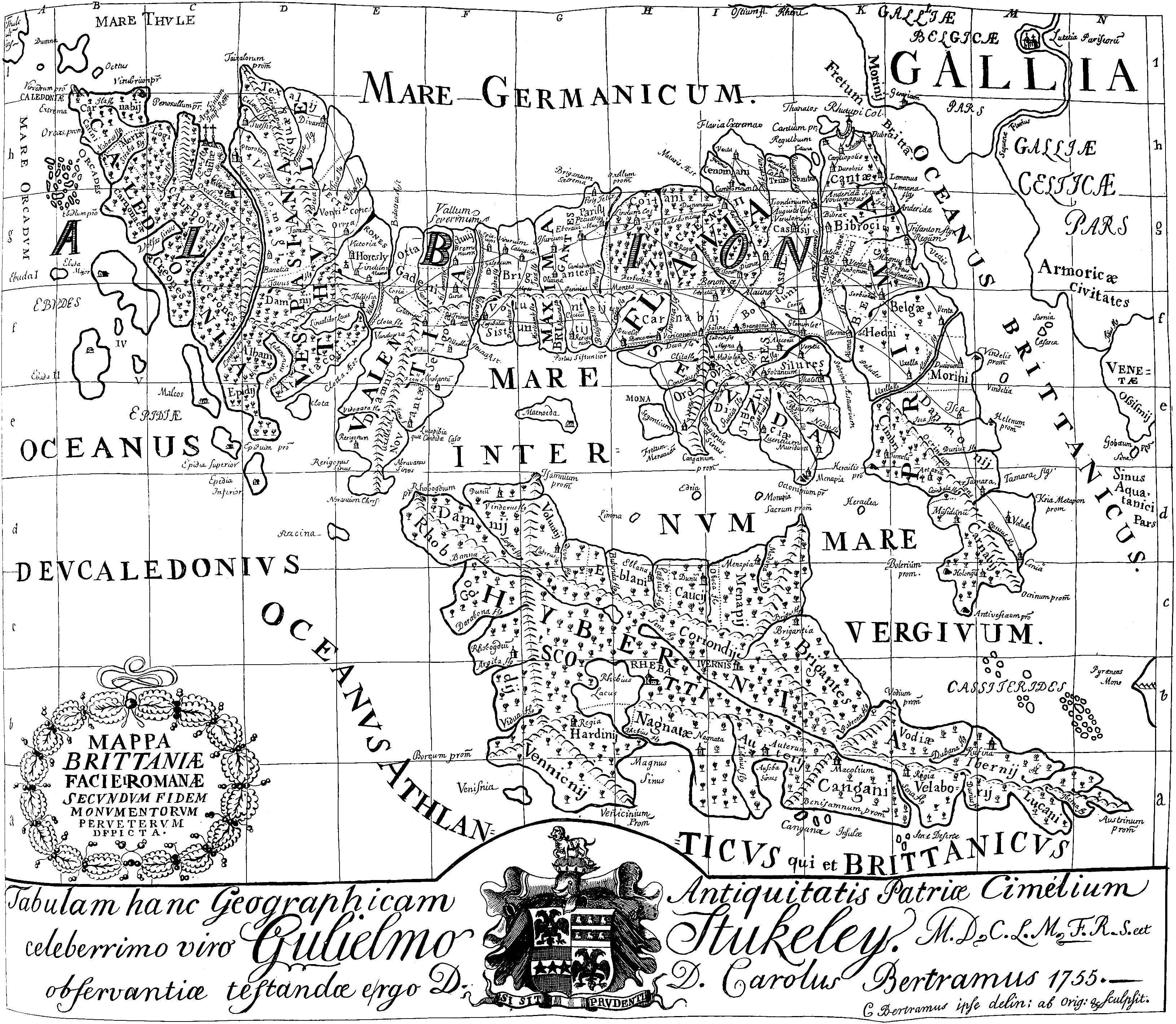
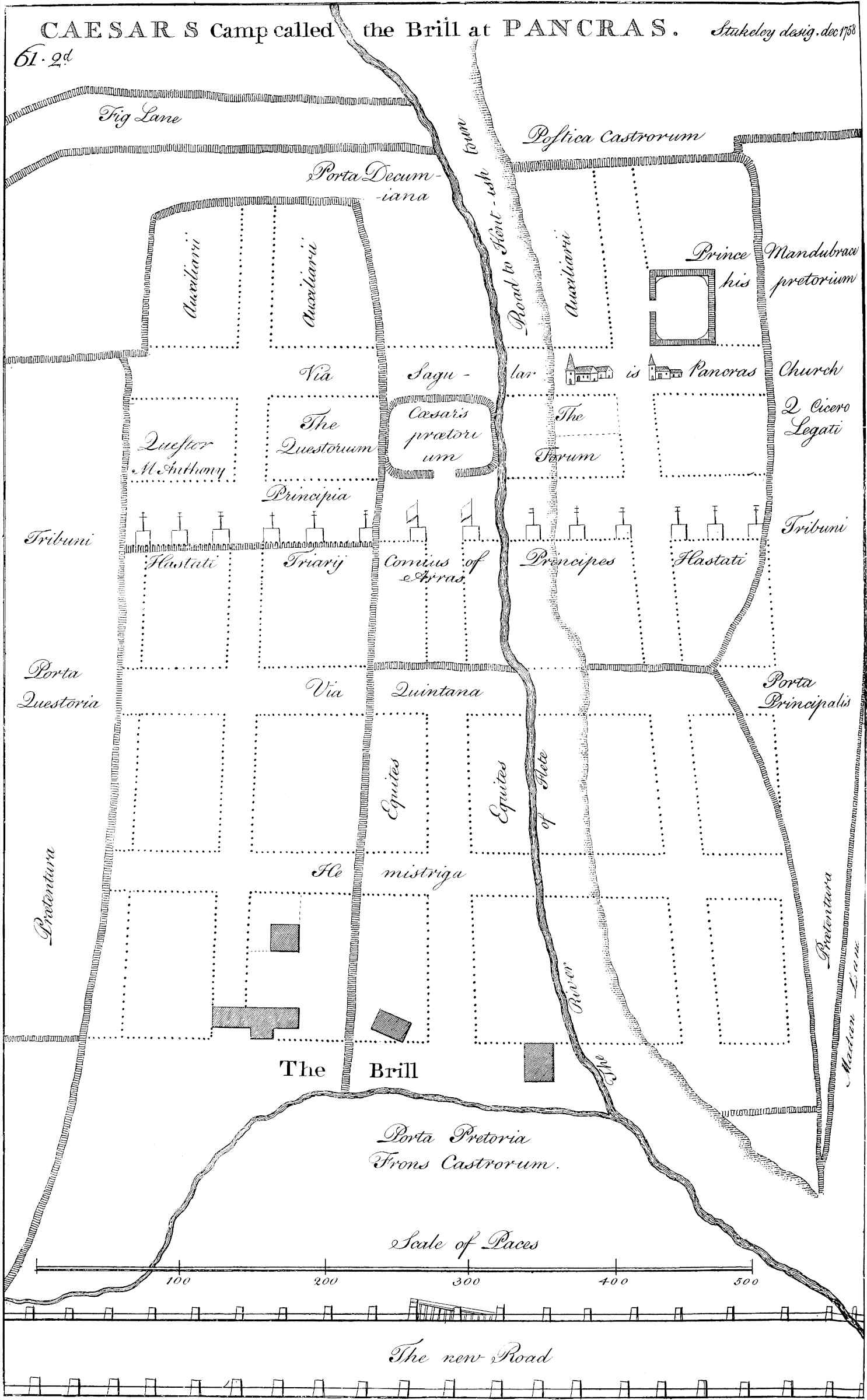
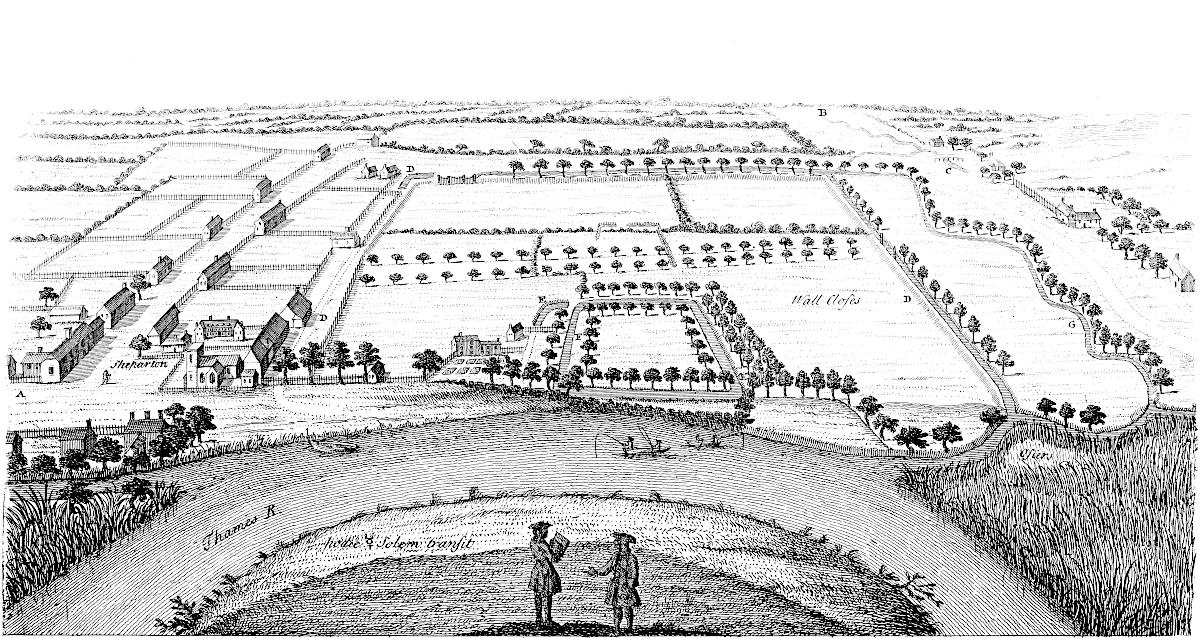
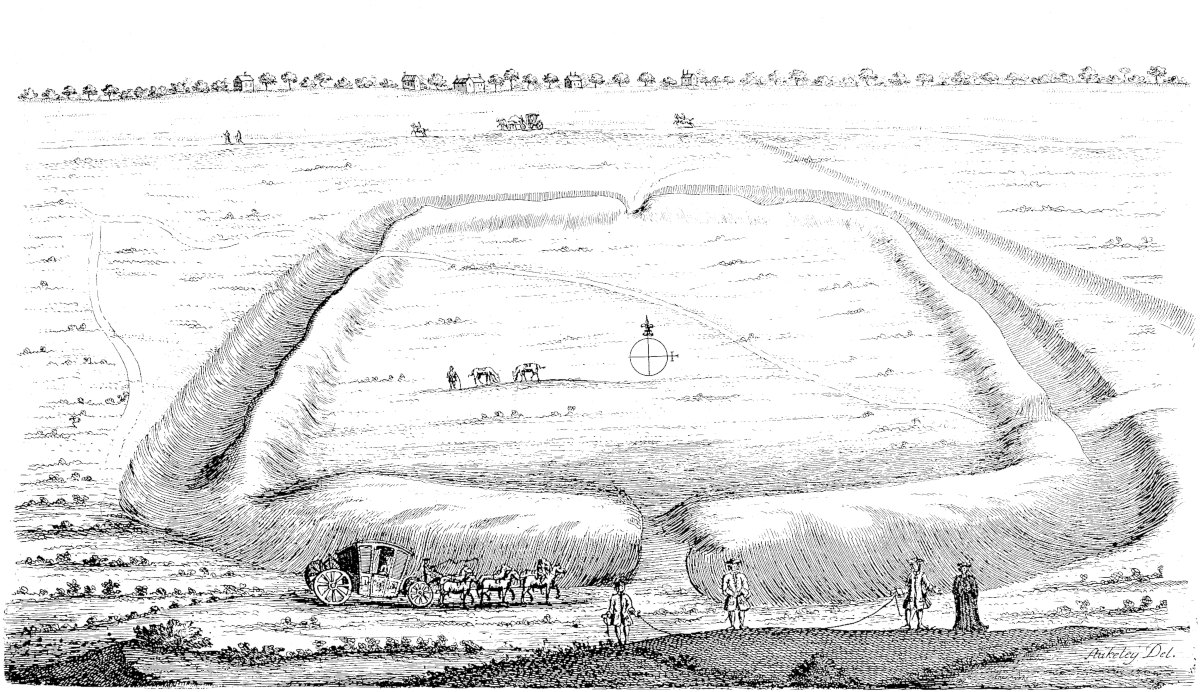
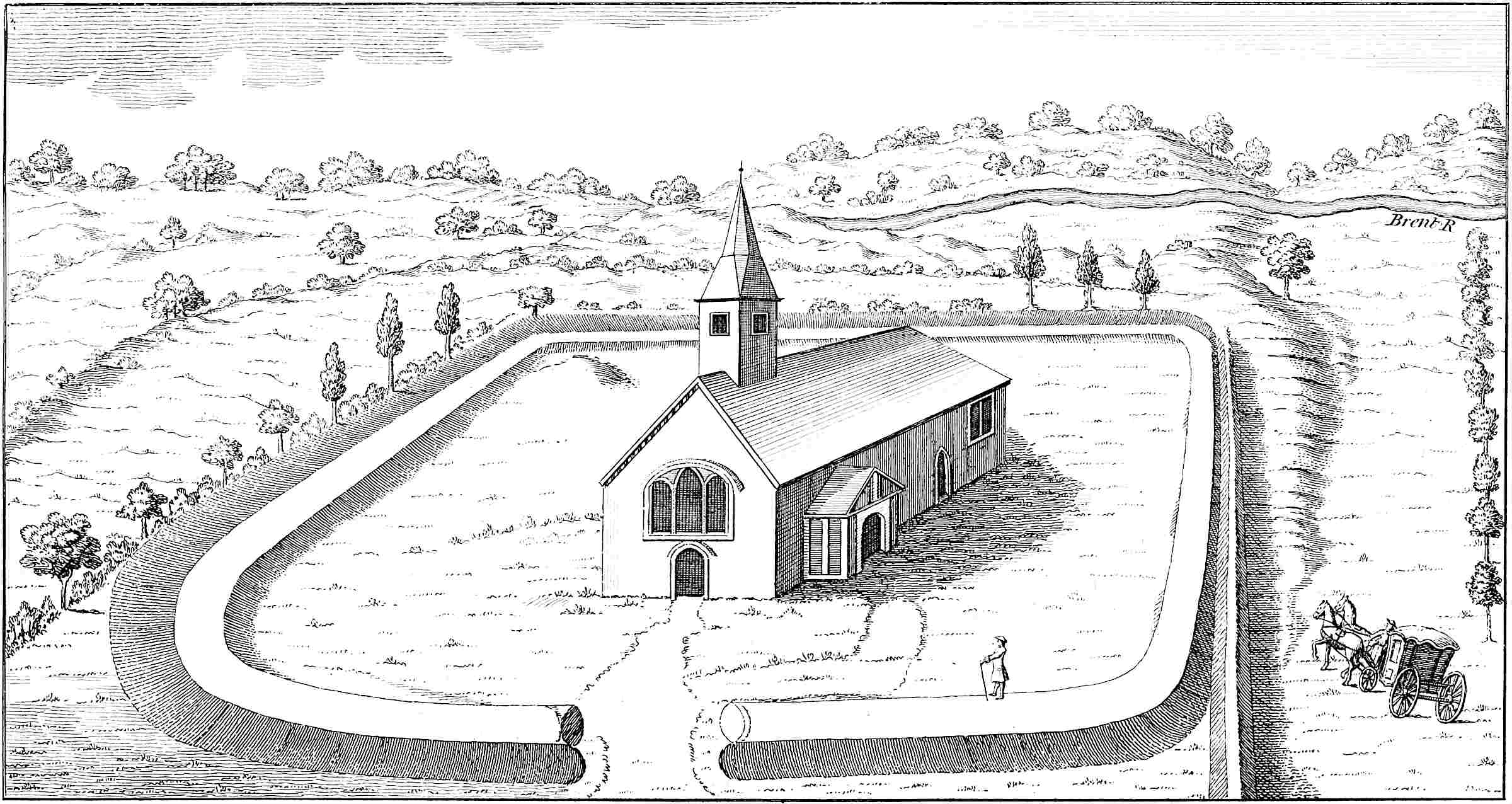
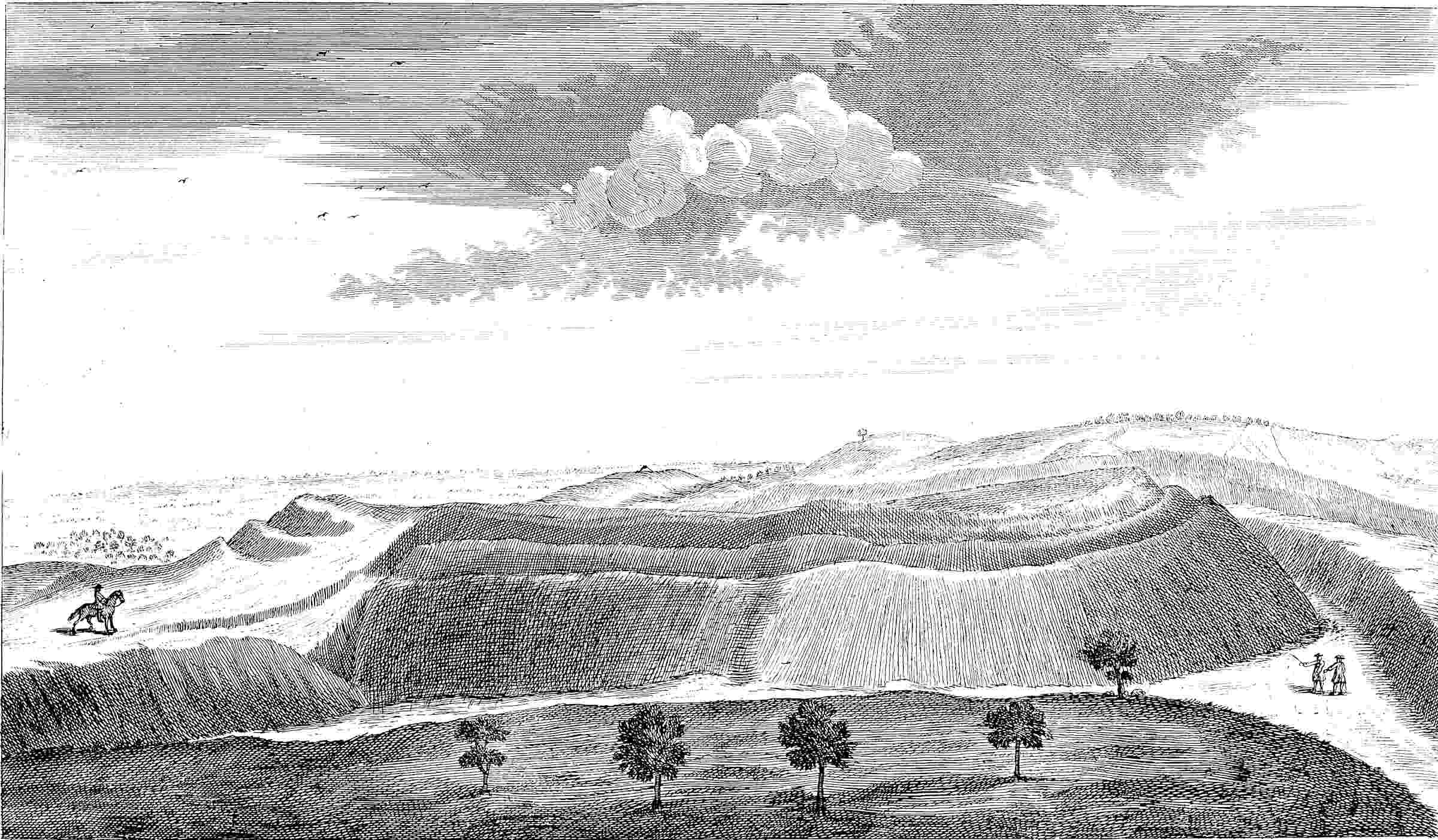
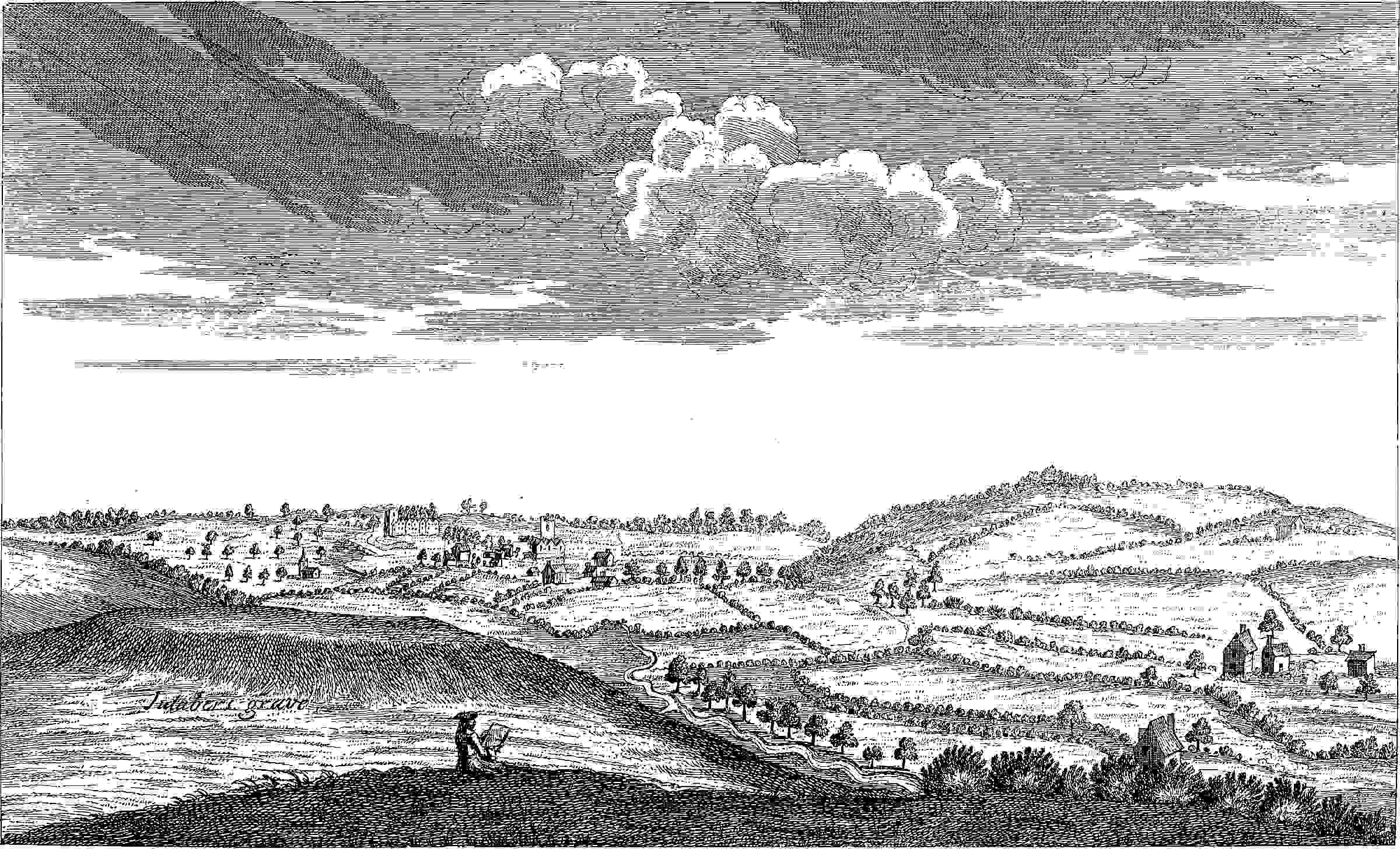
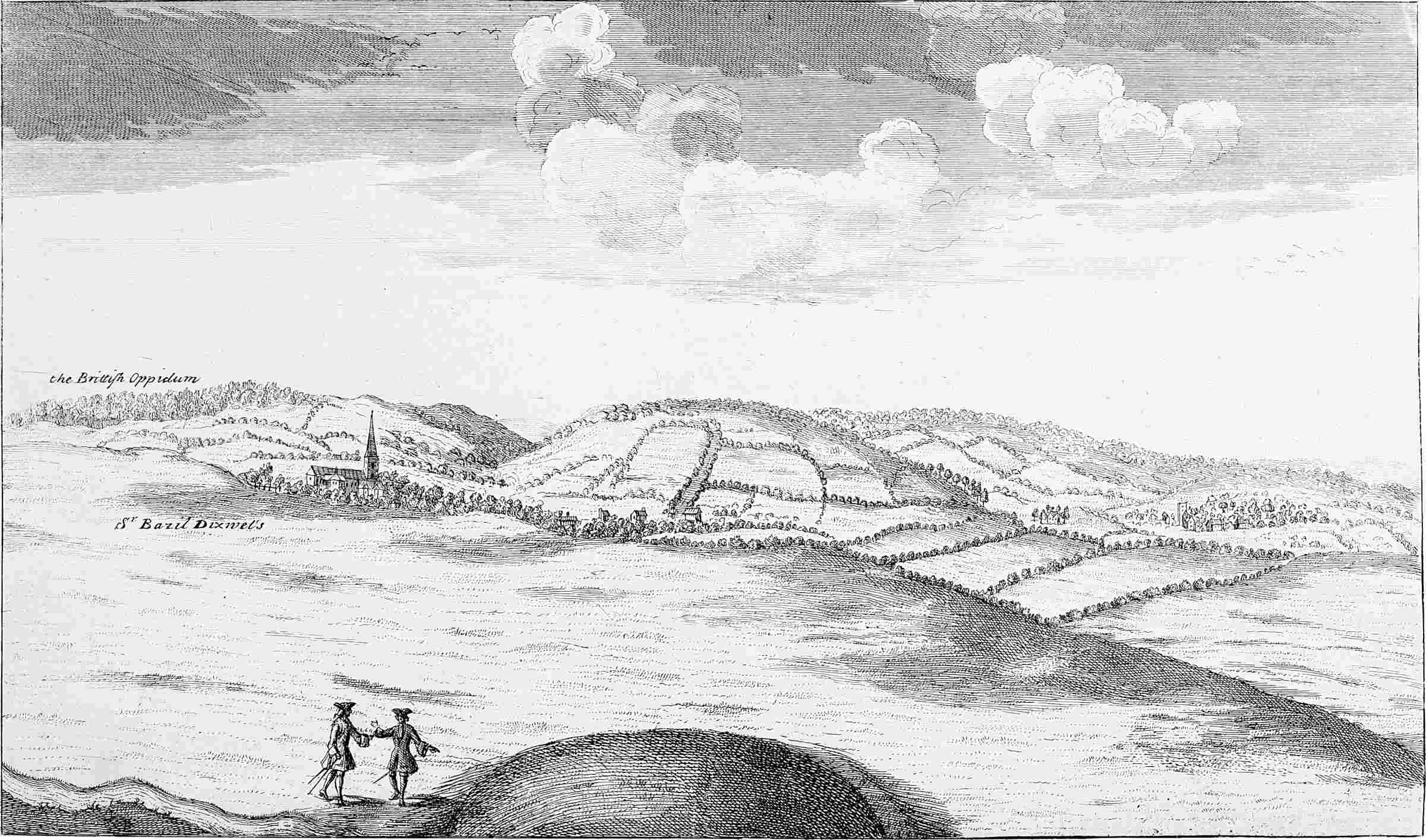
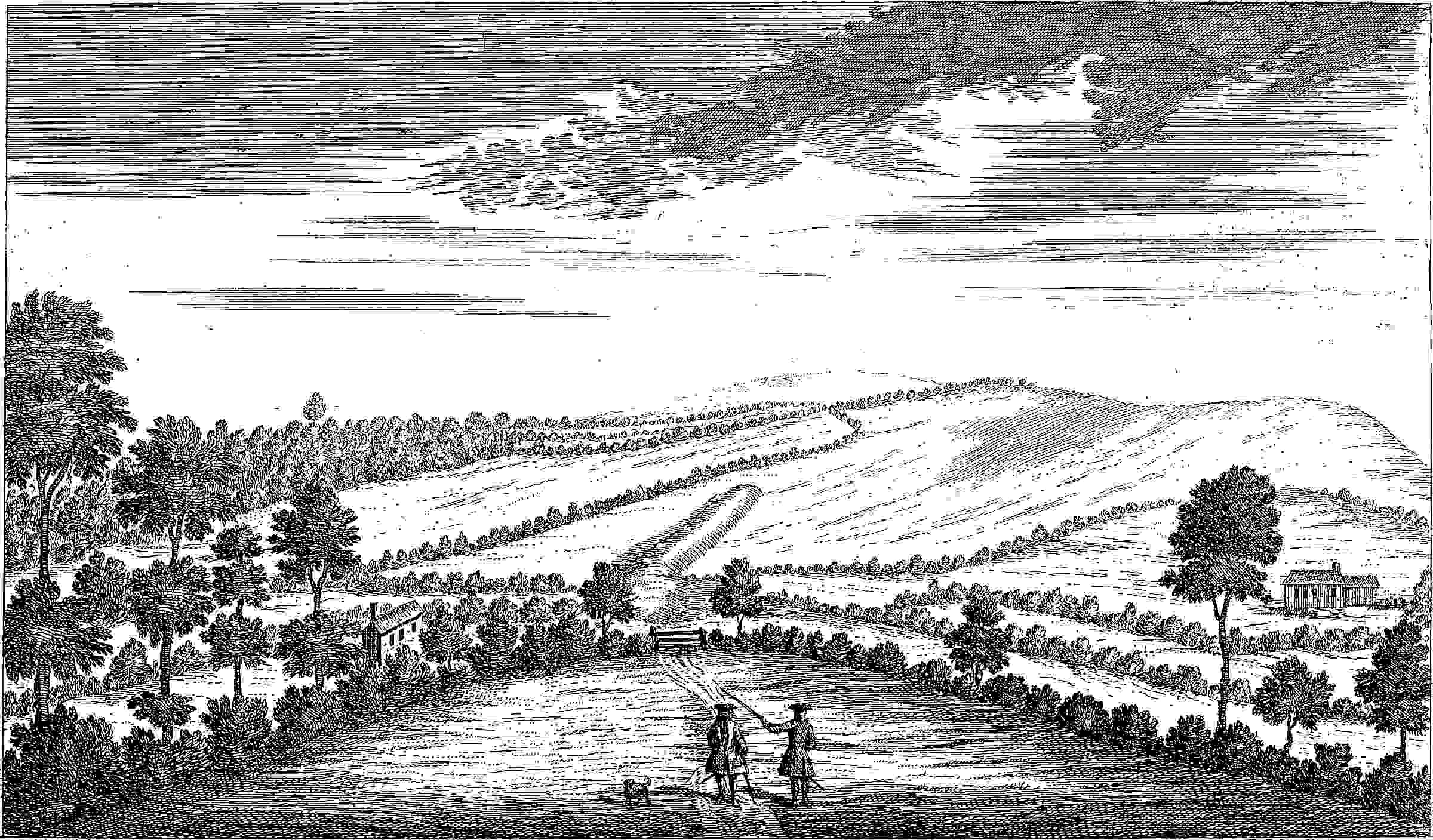
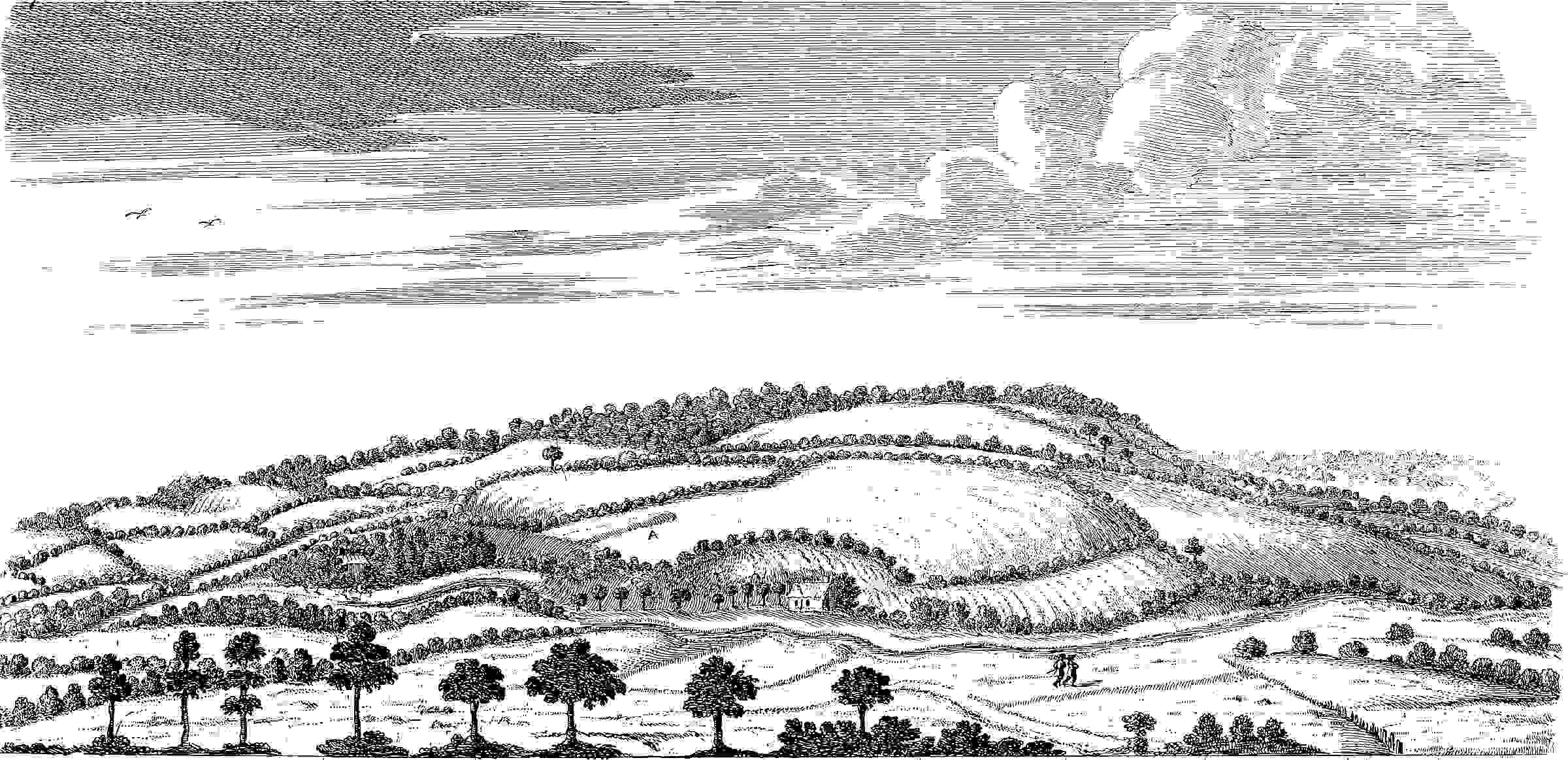
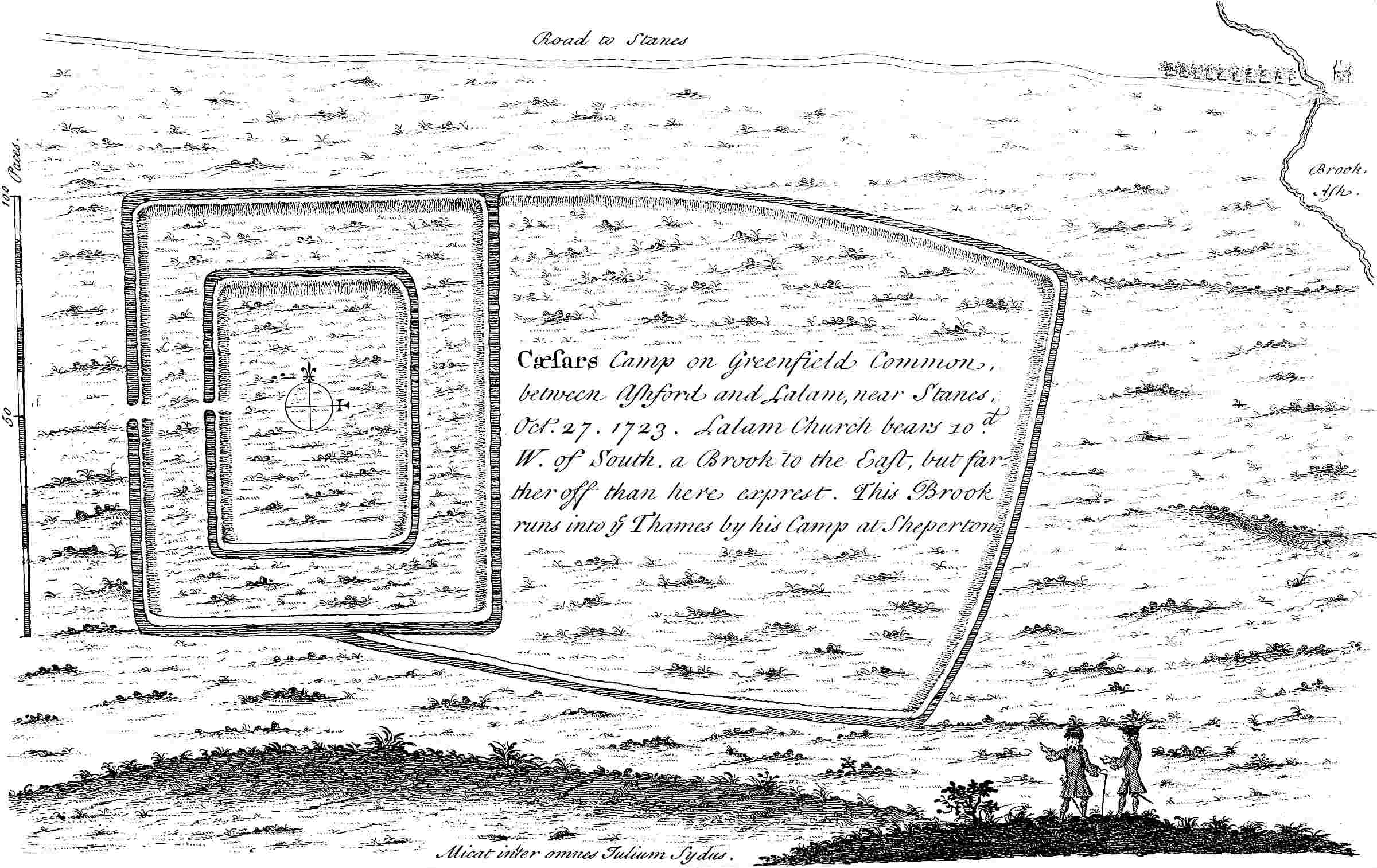
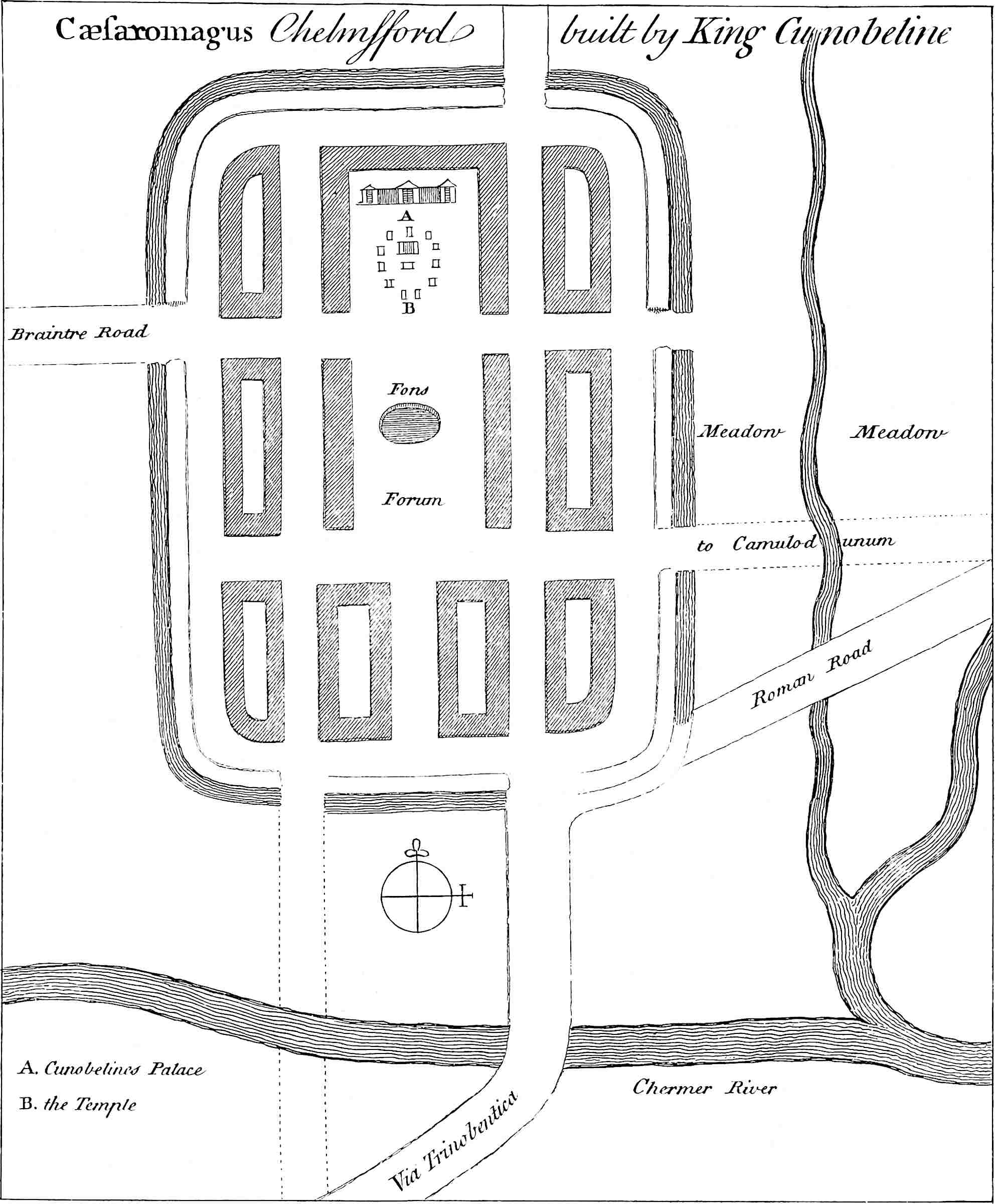
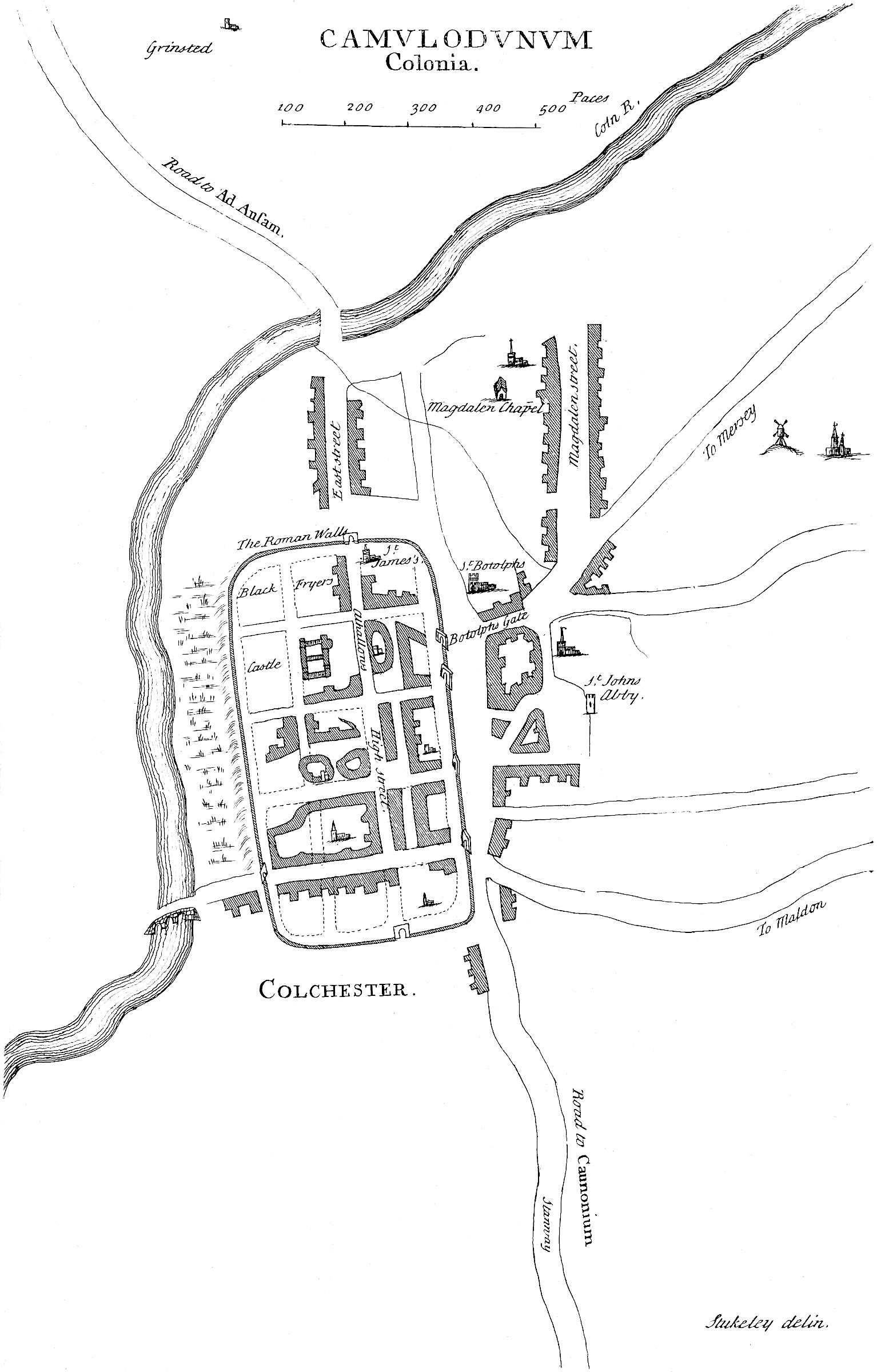
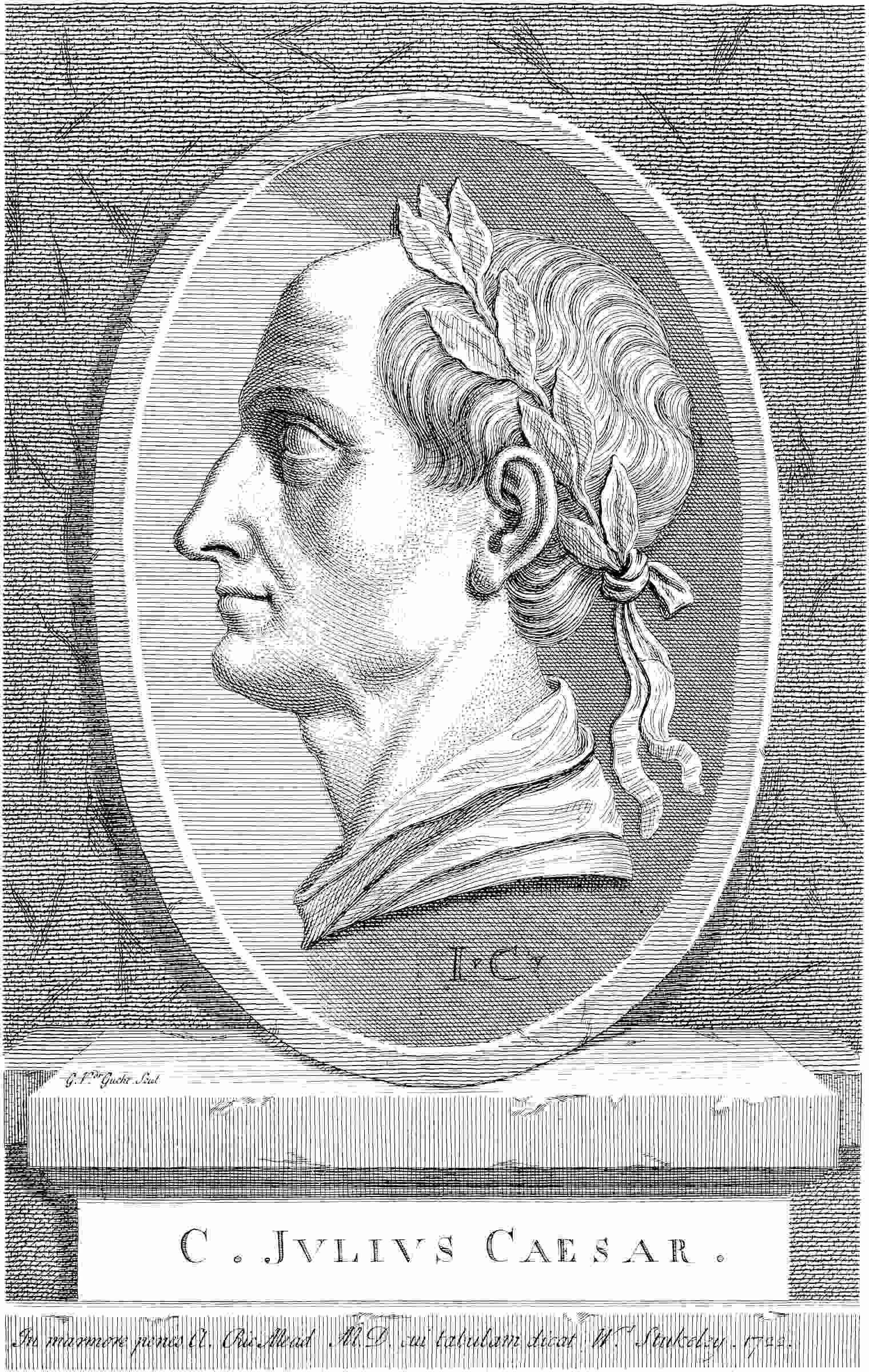
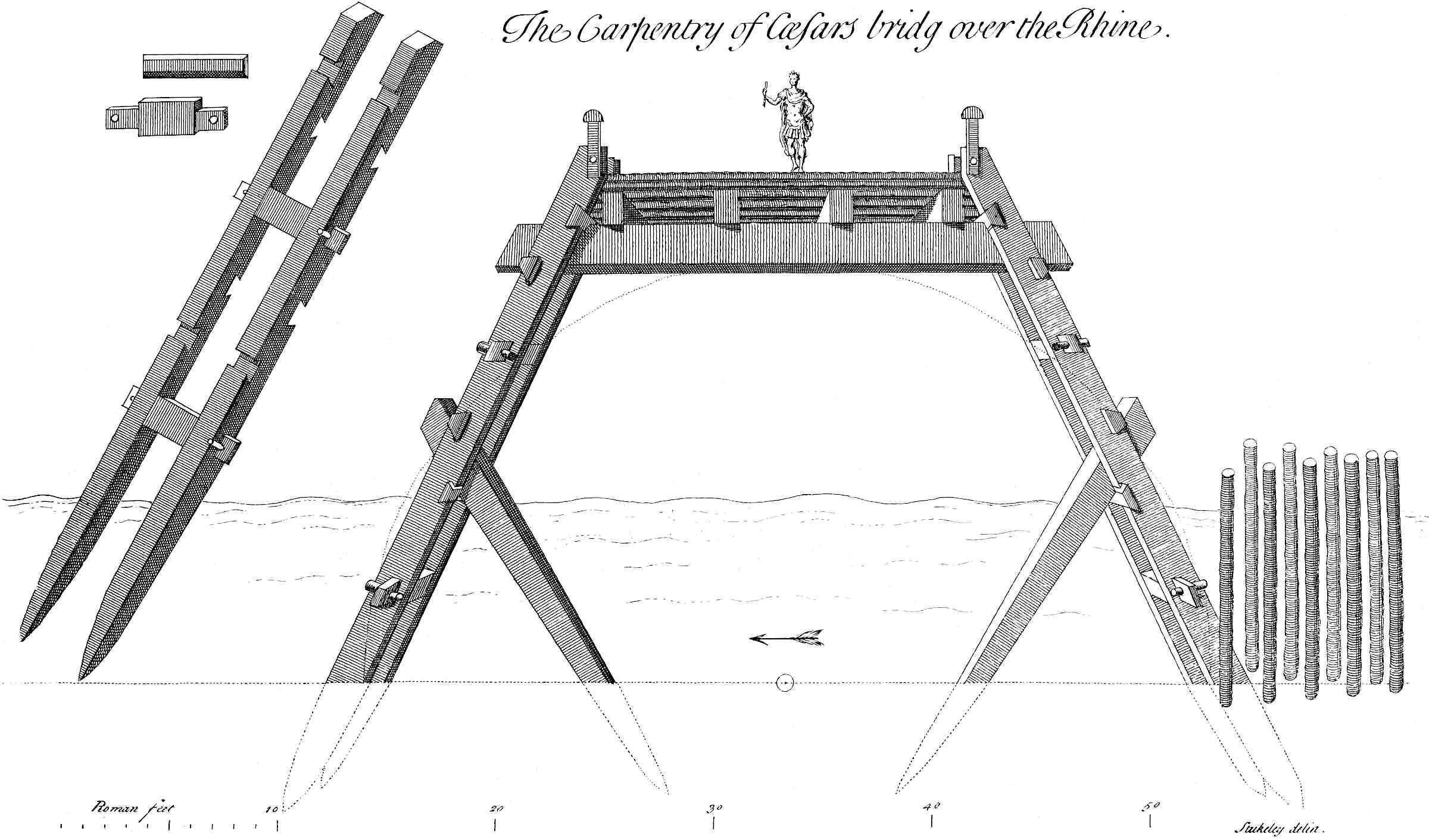
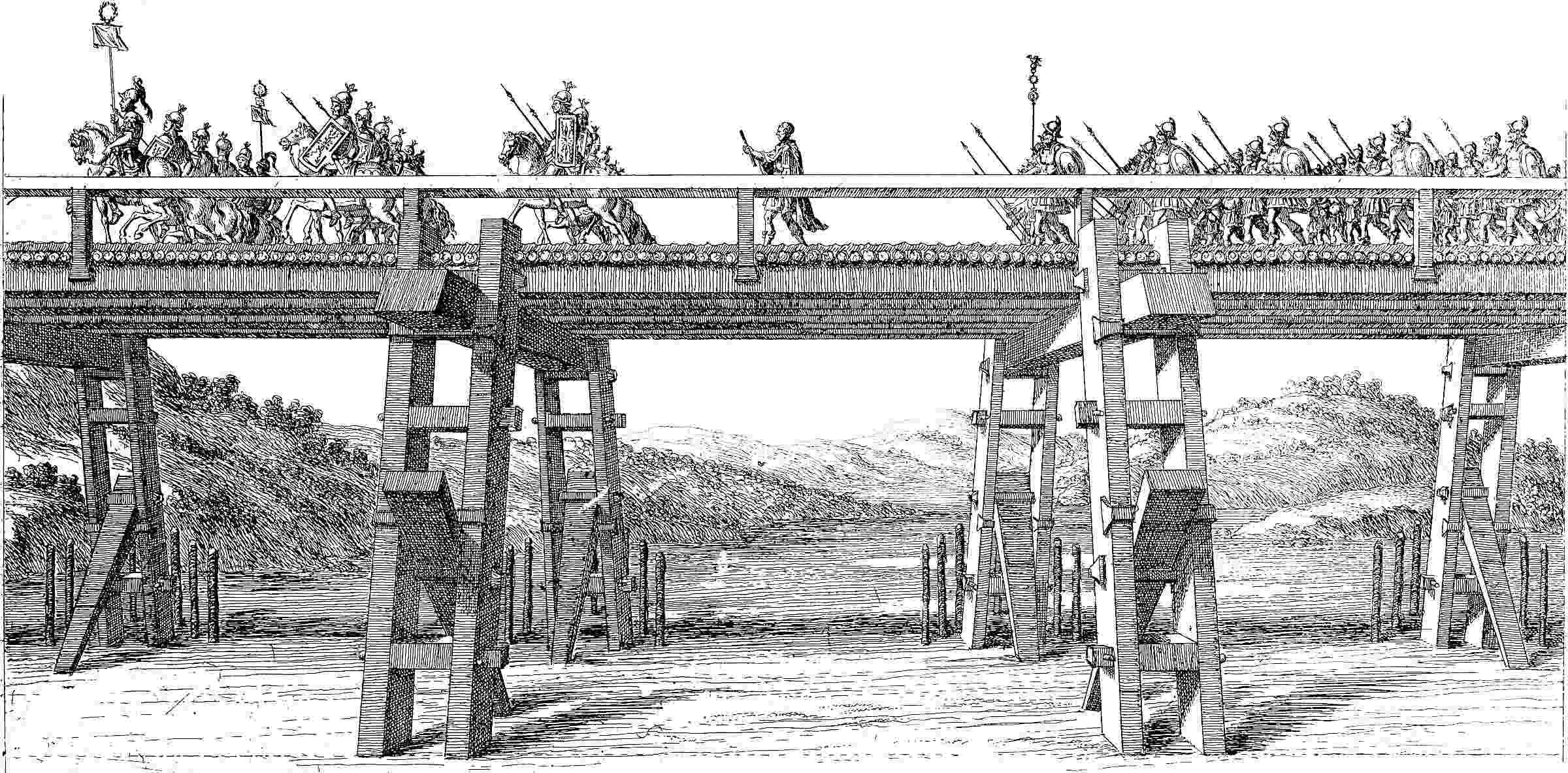
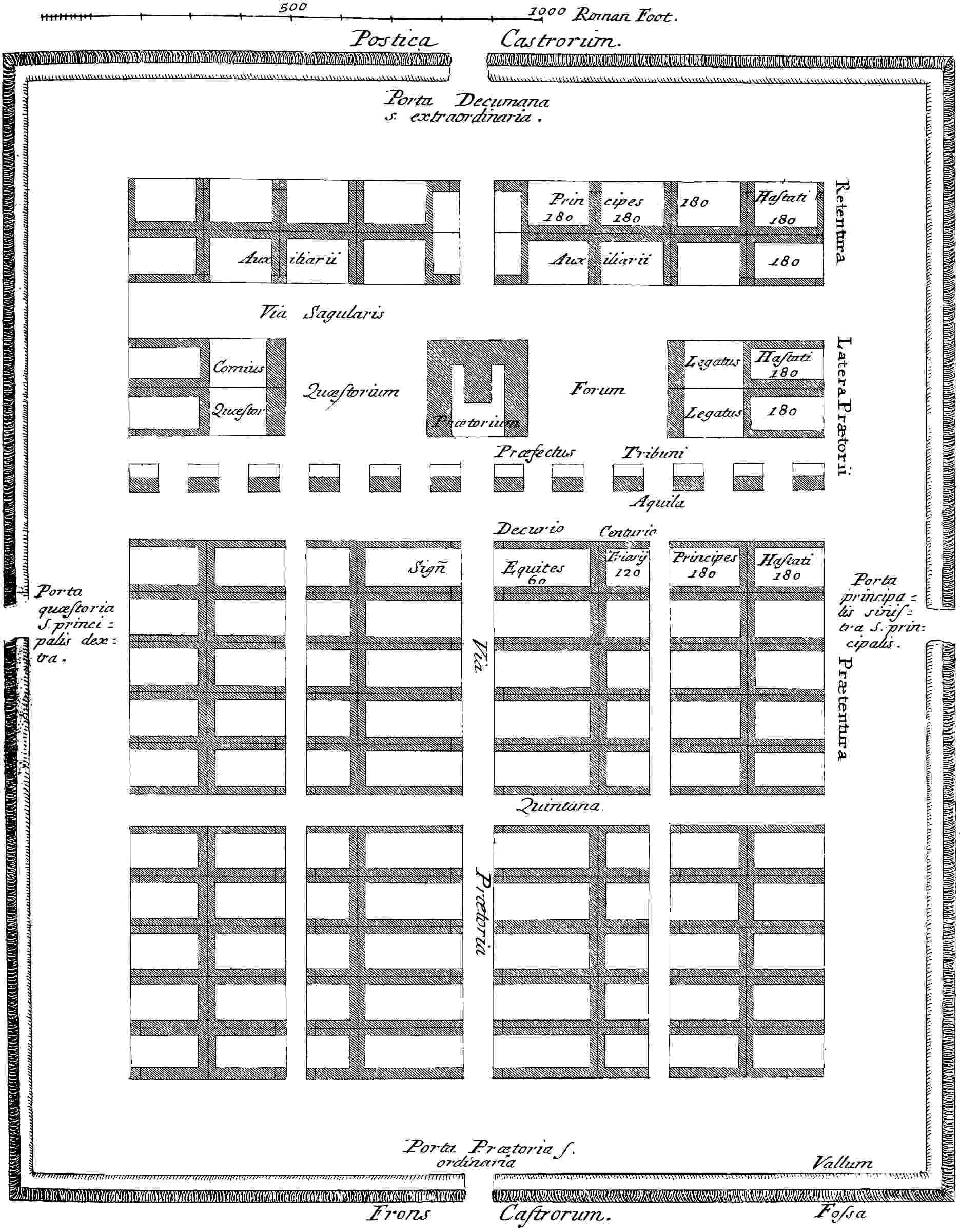
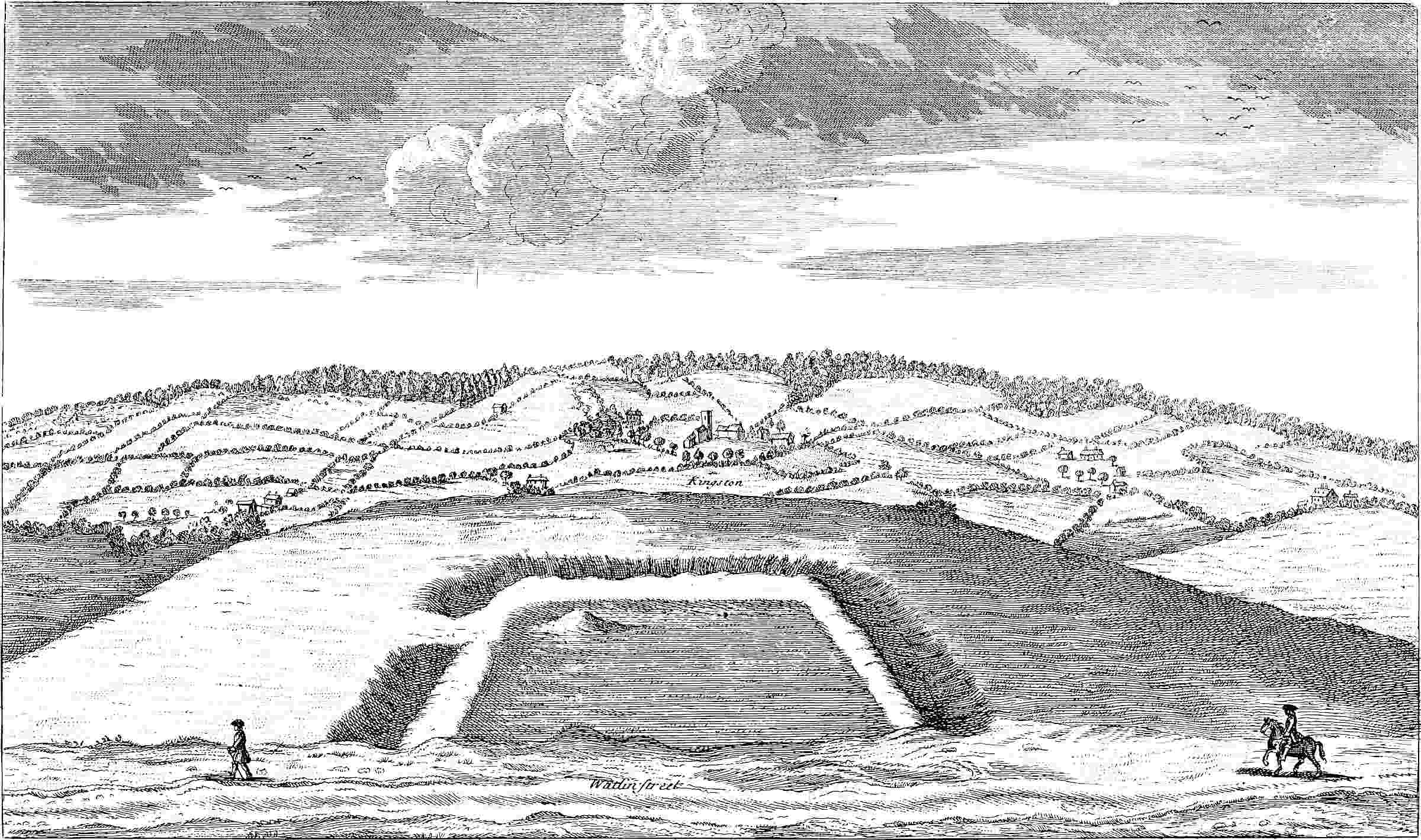
 .
The walls are a yard thick, of strong mortar, rubble stone,
&c. The Watling-street parts the two villages, Chesterfield south,
and Wall north. By the side of a road going northward thence to Pipe
hill, I immediately espied the Roman walls, notorious by the manner
of their structure; of rag-stone, a course laid sloping this way, a
course that way, with very strong and white mortar: this lies under
a hedge, and the roots of old oak-trees for the length of a hundred
yards, till intercepted by a dwelling-house. They say the building in
Butt’s close was a temple; and probably they are not mistaken. The
Watling-street at this old city goes precisely east and west: some
mile-stones found by the brook running west of the city: a pretty
spring there; ruins upon digging all the fields round: the brook has a
broad marsh along it westward. A little below the temple, we saw the
crown of a subterraneous arch in the hedge. They showed me where the
Rigning-way went through a corn-field south of the castle, and passed
the river west of Shenston: it is a field way still southward, and an
open road north. The castle stood in the north-west angle, between the
Watling and another road, going to Litchfield, upon a gentle southern
declivity: the old walls are founded upon the solid rock, and much
more of them was left within memory: now they pull them down to build
withal. There is a gate crosses the Watling-street at the castle end,
by the side of the other road. That called the Temple is upon the
western declivity, much lower in elevation than the castle, which is
upon the highest ground in the neighbourhood, and somewhat raised
above the common level, by heaps of rubbish, and foundations, which
I could discern above ground in the orchard. The place of this old
city is an elevation, and has a good prospect, especially southward:
Oldbury castle and Mancester are in view. Wm. Milner, at the Swan,
is an antiquary, and knows the old name of the place: he showed me a
Roman wall in his cellar, and says it goes far backward by the garden.
No doubt there were houses all the way, on both sides the road, from
the castle to the brook, which is a sweet descent westward. There was
a Roman coin of gold found near Hales-Owen. Many floors, pots, and
other antiquities, found on the south side the Watling-street, in
the ploughed fields called Chesterfield Crofts; and a very fine red
earthen ware, with figures of bucks upon them. The circumference of the
castle is hardly to be found; the ground has not been dug in the yards
hereabouts. The Rigning-way goes by Lyn-lane, and so passes the river
west of Shenston, at Shenston nether town. This country lies upon a
rock here and there interspersed, but not a good stone; but there is
a quarry of good free-stone, of a brown colour, by Swinfield. I saw a
Nero of Corinthian brass, and some square Roman pavements found there.