31, rue Dumont d'Urville, Paris,
January 10, 1880.
Well, dear, here I am back again in my little hotel,
and very small and uncomfortable it looks—like a doll's
house after the enormous rooms of the Quai d'Orsay—however
I am very glad to be a private individual once
more (no longer a "femme publique" as our friend
used to say). Our departure was hurried, as once W.[2]
had made up his mind and resigned he wanted to get
away at once. We got off in two days, which I thought
quite wonderful. Of course ever since the opening of the
session in November it was evident that he couldn't stay.
He and his Ministers were hardly ever agreed on any
point, and it wasn't worth while for him to spend his
energy and intelligence in trying to carry out a policy
which neither the Chamber nor the country apparently
desired. There were endless conferences all through
December, but it was clear that it was time for him to go.
The weather was something awful—bitterly cold—the
Seine frozen tight, booths and games established, and
everybody sliding about and trying to skate—but that
was under difficulties as the ice was rough and uneven.
I walked over with Francis,[3] that he might say he had
walked across the Seine. We had great difficulty in
warming the house—many trains with wood and coal
were blocked just outside Paris, and nothing could get
in. I don't know what we should have done, but happily
the Ministre de la Guerre gave us an order to take some
wood from some dépôt in Paris where they had a provision;
so for the two days before we moved in great
fires were going in the calorifère. I really think the only
person who hated to leave the Quai d'Orsay was Francis.
He was furious at seeing all his things packed up, and
was carried out to the carriage kicking and screaming—"veux
pas quitter ma maison—veux pas aller vilaine
petite maison." The huissiers (6, all standing solemnly
in a row to say good-bye) were much impressed, and the
old grey-headed Pierson who has been there for years
and seen many Ministers depart, remarked—"au moins
Monsieur Francis est désolé de partir." It seemed funny
to drive out of the big gates for the last time. I wonder
if I shall ever go through them again. Things go so
quickly in France now.
You can't conceive anything more uncomfortable than
this house to-day—no carpets down nor curtains up; all
the furniture, books, rugs, dumped in the middle of the
rooms, and the hall and corridors full of trunks and
boxes. W. has had a steady stream of people ever since
we arrived—some to condole—some (old friends) to congratulate
him upon no longer serving such an infecte
government—some a little embarrassed to explain that,
though they regret him extremely, still ... they
must serve their country, and hope he won't take it amiss
if they make up to the rising sun (in the shape of Freycinet,
who has taken W.'s place). I expect we shall
have some curious experiences. When one is no longer
in power it is surprising how things change their aspect.
I had to settle the salons as soon as I could as I had
invited a big party for Francis's Christmas Tree, thinking
it would be at the Quai d'Orsay. I didn't want to
put the people off—particularly the diplomatists who have
all been most civil and proper—so after a consultation
with Kruft—(chef du matériel at the Quai d'Orsay) who
had already begun to make his preparations, I decided
to have it here, and Kruft and one of his men came and
helped dress it. Of course the tree had to be cut at the
top—our rooms are fairly high, but nothing like the Quai
d'Orsay naturally—but it looked rather prettier, quite
covered with toys and shiny ornaments. Francis had
beautiful presents—a hand-organ with a monkey on top
from Madame Sibbern, the wife of the Swedish Minister,
from which he can't be extracted. He can't turn it alone,
but some of the bigger children helped him, and we had
the "Cloches de Corneville" and "Niniche" almost all
the afternoon. There were about 100 people, children
and parents, and the rooms looked pretty. All the people
and lights warmed them too—it wasn't quite so
Siberian. We couldn't attempt cooking of any kind as
the kitchen range was out of order, and besides we hadn't
fuel enough—l'Oncle Alphonse[4] who lives next door
feeds us. W. and I go to him for breakfast and dinner,
and his chef (a very distinguished artist and well dressed
gentleman—quite a superior person—Monsieur Double)
submits Francis's menu every morning to Nounou, as he
says he has no experience with children.
We have decided to go to Italy for two or three months,
and shall make Rome our headquarters. W. has never
been there, and says it wouldn't be worth while going
for less than three months. What fun it will be to be
there together—I can hardly believe it is true. I am
sure we are wise to get away. There must always be
little jarring things when one has been in office some
time—and it would be rather a bore to W. to take his
place as senator and be in opposition to the present Ministry.
If he stayed in Paris he would have to take part
in all the discussions, and would certainly be interviewed
by all sorts of people to whom he would say nothing (he
never does—he hates newspaper people) but they would
say he did all the same, and so many people believe implicitly
whatever they see in a paper. The Minister has
offered W. the London Embassy, but he won't take it,
doesn't wish to have any function of any kind at present.
He is looking forward to long, happy hours in
Rome, deciphering all the old inscriptions, and going over
the old city with Lanciani[5] and some of his literary
friends.
January 12, 1880.
After all I have been back to the Quai d'Orsay. W.
said I must go and make a formal visit to Madame de
Freycinet (who is a very nice woman—a Protestant, and
has one daughter—a charming intelligent girl). Henrietta
and I went together, taking Francis with us, who
was delighted as soon as he got to the Place de la
Concorde and crossed the bridge—"C'est Paris—C'est
Paris." Poor little boy—the rue Dumont d'Urville is
so quiet, nothing passing and nothing to see when he
looks out of the window. He was always at the window
at the Quai d'Orsay looking at the boats, the soldiers,
and the general liveliness of a great thoroughfare. It
was a funny sensation to go and pay a visit to Madame
de Freycinet in the little blue salon where I had received
her so often, and to be announced by my own pet huissier,
Gérard, who spent his life all the time I was at the Quai
d'Orsay sitting outside the door of any room I happened
to be in. He knew all my visitors—those I wanted to
see and those I didn't—kept all the cards, and books, and
remembered every quête I had given to—and the bills
that had been paid. I don't remember that he ever occupied
himself with my garments, but I am sure that he
could have found anything that I asked for.
The house is gradually getting warm and comfortable,
and the furniture settling into its place; but I have a
curious feeling of smallness—as if I hadn't room to turn.
We hope to get off in three or four days. We leave
Francis of course, but Nounou and Hubert will look after
him, and he will go to breakfast every day with Mother,
where of course he will be well spoiled and have everything
he asks for.
January 18, 1880.
I hope we shall get off now in a day or two—W. really
needs the rest, which he never will get here as all day
long people come to see him and suggest various plans.
We have written to the Hôtel de Londres. You or
Eugene might go there some day and see the rooms they
propose. It will be nice to be back in our old quarters
Piazza di Spagna. We had a pleasant small dinner last
night at the British Embassy—Lord Lyons is always so
nice and cordial. He was a little surprised and not quite
pleased that W. hadn't accepted the London Embassy,
he would have been so entirely a "persona grata" with
his English education, connections, etc. All the Diplomates
seem to regret us (but I think they will like the
Freycinets just as much) and really here, where Ministers
are such passing figures in the political world, they
would have a hard time if they set their affections on any
particular man.
I am becoming very philosophical—though the attitude
of some of my friends has rather surprised me (not W.;
he is never surprised at anything). L'Oncle Alphonse
keeps us well informed of what is said on the other side.
He is quite a Royalist, a great friend of the Orléans
Princes, and a great deal at the club where they always
call him "l'oncle du gouvernement"—and when the
"gouvernement makes a 'bêtise'" (which sometimes
happens) they criticize freely, and he tells it all to us.
I fancy he always defends W. in public—but of course
in private pitches into him well.
I rather miss the big life—seeing so many people, and
being as it were behind the scenes—also our conversations
at night when W. had finished his signatures, and
Pontécoulant[6] came up from his quarters with the report
of the day, and got his instructions for the next morning.
W. is not at all "matinal" and hates doing any kind of
business early—must always have his ride first. We used
to sit in W.'s cabinet until two in the morning sometimes,
telling our experiences—some of mine were funny. I
hated an official reception day, but the gentlemen of the
protocol department thought it absolutely necessary, so I
was obliged to give in—and certainly nothing I did tired
me so much as those long Fridays in the big yellow drawing-room.
From 3 to 6 streams of people—women mostly—of
all nationalities—and of course no conversation possible—however
it wasn't always banal, as you will see. Our last Friday one of my friends had been in, very
much taken up with the journey to Rome—her clothes,
the climate, which hotel was the best, etc. When she
went out in a whirl of talk and excitement I turned to
one of the 14 women who were seated in a semicircle
on each side of me, and by way of continuing the conversation
said: "Il me semble qu'on serait très bien à
l'Hôtel de Londres à Rome en plein soleil," to which she
replied haughtily "Je n'en sais rien, Madame, je n'ai
jamais quitté Paris, et je m'en vante." W. wouldn't
believe it, but as I told him I couldn't have invented it.
I was rather sorry I hadn't pursued the conversation, and
asked her why she was so proud of that particular phase
of her life. I suppose she must have had a reason, which
naturally I couldn't understand, having begun my career
so very far away from either Rome or Paris. It is a
real pleasure though to be back in my own salon, and have
my nice little tea-table, and three or four of my friends,
and talk about anything and everything, and even do a
little music occasionally.
January 20, 1880.
I didn't find my tea quite so pleasant the other day.
I was sitting in the little salon talking to one or two
ladies, and receiving their congratulations at being no
longer of the official world, and obliged to associate with
the Government people, when the footman appeared with
his eyes round, to announce that "La Présidente"
(Madame Grévy) was coming upstairs to pay Madame
a visit. I flew to the door and the top of the stairs (I
couldn't get any further) and received "ma Présidente"
in proper style. I ushered her into the salon where I had
left my friends (mad Royalists both). They were much
disgusted—however they were too well-bred to make
things disagreeable for me in my own house—and rose
when we came in. I named Madame Grévy—and as soon
as she had taken her seat, and declined a cup of tea, they
went away. Of course they hated getting up for
Madame Grévy, but there was nothing else to be done
as she and I were both standing. Happily no one else
came in but Prince Orloff, Russian Ambassador, who of
course knew Madame Grévy and talked easily enough.
She didn't stay long—it was the classic "visite de condoléance"
to the wife of the ex-Minister (if she only
knew how glad this Ex was to return to private life and
her own house, and to be no longer "logée par le gouvernement").
This is the second visit of condoléance I
have had. When Marshal MacMahon dismissed (suddenly)
all his cabinet presided by Jules Simon, 16th of
May, 1877, Madame de MacMahon came also to see me—and
at the same time—5 o'clock on my reception day—so
I knew precisely what the conversation would be—and
Madame Grévy and I both said exactly the same
things that the Maréchale and I had said two or three
years ago. I suppose everybody does say the same thing
on certain occasions. After she had gone Orloff asked
me if I remembered those two ladies meeting (for the
first time in their lives) at the Quai d'Orsay on one of
my Fridays. Just after the Marshal resigned Madame
de MacMahon came to see me. She was announced by
all the servants and I had plenty of time to get to the door
of the first drawing-room, not quite to the anteroom, to
receive her. When her husband was President she was
received always like Royalty—at the door of the apartment.
She was very simple and easy, quite pleased evidently
at still having all her honours. Prince Orloff came
in to pay a visit, and we were having a very pleasant talk,
when I heard quick footsteps in the second salon, and
again appeared my faithful Gérard (I had also visions
of numberless doors being opened all down the enfilade
of salons) announcing Madame Grévy. I was embarrassed
for a moment as I didn't like to leave the Maréchale,
and yet I knew I must go and meet Madame Grévy—all
the ceremony of course was for the official position,
and one Présidente was just the same as the other.
Madame de MacMahon was most amiable—said at once—"Je
vous en prie, Madame, ne pensez pas à moi"—and
"au fond" was rather curious to see her successor.
I went as quickly as I could (Orloff giving me a funny
little smile, almost a wink, as I passed him) and got my
other Présidente just at the door. She was rather astounded
I think at her reception—she hadn't been long
in her exalted position. We proceeded majestically
through three or four salons, and when we arrived at
my drawing-room Madame de MacMahon got up at
once, saying quite simply "Voulez-vous me présenter,
Madame, à Madame Grévy?" She was quite at her
ease—Madame Grévy rather shy and embarrassed—however
Madame de MacMahon talked at once about some
of the great charities, artists, etc., and it really wasn't
too stiff—Orloff of course always helping and making
jokes with the two ladies. One or two visitors came in
and gasped when they saw the situation—also one of the
young men of the Cabinet, who instantly disappeared.
I always thought he went to tell W. what was happening
upstairs so that he might come to the rescue in case
I wasn't up to the mark ... but he swears he
didn't. When the Maréchale got up to go there was
again a complication as I wanted to accompany her to
the door, and I didn't like to leave Madame Grévy. She
wouldn't hear of my going through all the salons—took
leave of me at the door—and then Orloff came to the
rescue—gave her his arm and took her to her carriage.
It was a curious meeting, and, as Orloff said just now,
"je lui devais une fameuse chandelle."[7]
February 6, 1880.
We are starting to-night, straight for Florence, where
we shall stay a week or ten days with the Bunsens before
going on to Rome. W. is much pleased at the Roman
prospect—and I can hardly believe that I am going to
see Rome again. We have our lit-salon straight through
to Florence, and I hope we shall be warm enough. It is
bitterly cold to-day—even walking I was glad to have
my sealskin coat. Nounou is rather tearful at being left
in sole charge of Francis, but as that young gentleman
is perfectly well, in roaring spirits, and will be given
everything his heart desires by his Grandmother and
Aunts, I don't feel very unhappy about him. It seems
incredible that we should be going to meet soon. How
we will prowl about Rome. I suppose I shall find it
absolutely changed—so many more people—not our dear
old dead Rome.
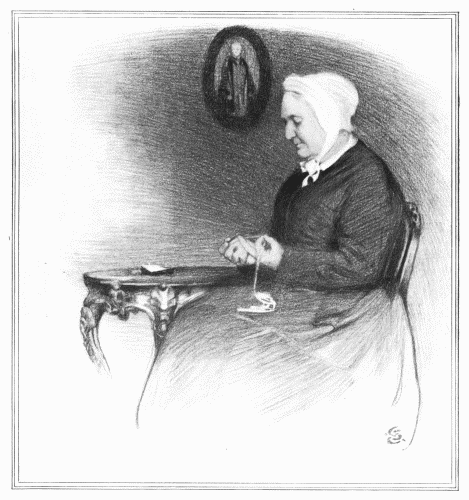 Mrs. Charles King.
Florence, Via Romana, Villa McDonnell,
February 8, 1880.
We arrived quite comfortably, dear mother, but almost
frozen, particularly W. He has not been extracted from
the fire since we got here. Henrietta will have told you of
our start. Pontécoulant and one or two men were at
the station to see us off—also the Chef de Gare, most
civil, and saying we should not be disturbed at the frontier—and that our coupé-lit would take us straight
through to Florence. We had a perfectly easy journey,
and I slept quite peacefully—waking up merely when we
passed through the tunnel, as the guard came in to shut
all the windows. It was a beautiful, cold, starlight
winter night. The great mountains covered with snow
looked gigantic as we approached—"sinistres" as Madame
Hubert[9] said. She was much impressed and rather
nervous. There were very few people in the train. When
we arrived at Modane the Chef de Gare was waiting
for us—he had been telegraphed from Paris to expect
us. We had breakfast in the private room, and a
nice woman was waiting for us upstairs in the ladies'
room with hot water, towels, etc. I made quite a toilet—she
carried off my dress and jacket to brush—and then
we went down to a nice little breakfast which tasted very
good, as I hadn't had anything since our 7 o'clock dinner.
They offered us coffee somewhere—Dijon I think—but
I didn't want anything then. All the first part of the
road—in fact all the road to Turin was lovely. It was
a bright, cold morning, and the snow mountains looked
beautiful. It was such a pleasure to hear Italian once
more—even the names at the stations "capo stazione"—"grande
velocità"—"uscita," etc., also the shrill "partenza"
when we started. The last time I crossed the
Mont Cenis was by the Fell railway when we all started
together from Aix. That was certainly very beautiful—but
rather terrifying—particularly as we neared the
top and looked at the steep places and the various zigzags
we were to follow going down. One couldn't help
feeling that if a brake or chain broke there would be a
terrible catastrophe. I remember so well some of the
women who were quite sea-sick—the swaying motion, I
suppose, as we rounded the curves, of which there were
many. I can see one now stretched out on the floor on
a rug in the small salle d'attente at Susa, quite exhausted
and absolutely indifferent to the outside world.
We had quite a wait at Turin. Our coupé was detached
and put on the Florence express. They locked
the doors, and we left all our things—books, shawls,
bags, etc.—and had a very fair dinner at the buffet. We
had so much time that Madame Hubert and I went for
a little walk. There was not much to see close to the
gare—but it was delightful to me to hear Italian again,
and to see the idle, placid crowd standing about—nobody
in a hurry apparently, and nobody jostling and pushing
through, though there were trains starting or coming in
all the time. W. was too cold to move—he really should
have had a fur coat—which he utterly despises—says that
will do when he is 70, and can't walk any more. It was
warm and fairly light in the buffet so he established himself
there with a paper and was quite happy. We got here
about 6.30—Charles de Bunsen was at the station with
a carriage—so we came off at once, leaving Madame
Hubert and Francesco with the trunks. How she will
get on in Italian I don't know, but she is very active and
débrouillarde, and generally makes herself understood.
Mary[10] was waiting for us with tea and those crisp little
grissini[11] we always used to have in Casa Guadagni.
They have a charming "villino"—part of the McDonnell
villa. One goes in by a small door (in one of the
narrow grey streets of old Florence, with high walls on
each side—Via Romana) and straight up a fine broad
staircase to a good palier with large high rooms opening
out on it. All the bed-rooms and small salon open on a
loggia overlooking the garden—a real old Italian garden.
I shall never be dressed in time for anything in the morning,
as I am always on the loggia. The flowers are all
coming out—the birds singing—the sky bright, deep
blue—and the whole atmosphere so soft and clear—and
in fact Italian—different from everything else.
Mary has arranged the small salon (which they
always sit in) most prettily and comfortably—with
bibelots and quantities of books about in all languages—there
are usually four going in the establishment—Charles
and his daughter speak always German to each
other—the rest of us either French or English—it depends
rather upon what we are talking about—and
always an undercurrent of Italian with the servants and
"parlatrice" (such a sweet, refined looking girl who
comes every day to read and speak Italian with my belle-mère).
Mrs. Waddington strikes at the mixture at
meals and insists upon one language, either English or
French. There is also a charming German girl here,
Mlle. de Sternberg, a niece of Charles de Bunsen—so we
are a most cosmopolitan household. The life is utterly
different from the one I have been leading for the last
two years.
February 10, 1880.
I try and write every day, but am so much taken up
and so tired when I come in that I don't always find the
moment. W. is all right again. He really got quite a
chill from the cold night journey—and for two or three
days sat in the fire. Francesco, the Italian servant, took
excellent care of him—was so sympathetic the night we
had some music and W. couldn't appear. It was a pleasant
evening—a Russian Prince (I forget his name, and
couldn't probably spell it if I remembered), a great friend
of Mary's, an excellent musician and a great Wagnerian
offered to come and play some of the Nibelungen. I was
delighted as I only know Tannhäuser and Lohengrin. I
remember now your sigh of relief when Seilern and I
finished playing à 4 mains the Walpurgis Night years
ago in the Champs Elysées. I daresay it was trying for
the public—but we enjoyed ourselves immensely. The
big drawing-room looked very pretty, with plenty of
flowers, and I think there were about 50 people—almost
all (except Lottie and Madame de Tchiatcheff) ardent
admirers of the great man. One lady appeared in a sort
of loose, red gown (it seems red is the only colour Wagner
admits), her hair, very pretty, blonde, hanging down
her back, just tied with a ribbon—and carrying two partitions.
Mary said, "Wouldn't you like to sit by her,
and she will explain it all to you?"—but I said there was
nothing I would like so little. I knew enough of the
legend to be able to follow, and moreover I had always
heard that Wagner's descriptive music was so wonderful
that one understood everything without any text, etc.
The great man appeared—the grand piano was opened
all over to give as much sound as possible—and he requested
absolute silence. He played beautifully—it was
enchanting—one quite heard the little waves in which the
Rhein-Töchter were disporting themselves. It was wonderfully
melodious and delicate—I should have liked it to
go on forever. He played for about three-quarters of
an hour—all Rheingold—then suddenly pushed back his
chair, and rushed to the anteroom, exclaiming "de l'air—de
l'air," followed by all the red and musical ladies.
It is a pity there must always be such a pose with Wagner—for
really the music was a joy. I met of course
quantities of old friends, and agreed to go to Lottie Van
Schaick's ball.
February 12, 1880.
W. and I had a lovely long flânerie this morning. He
is quite well again, and the sun was tempting. It seems
quite a different Florence living over here, and I must
say much more old-world and Italian than the Lungarno,
with all the modern hotels and apartments, and
evident signs of forestieri[12] everywhere. As soon as we
cross the bridge it is quite different—a gay, bustling,
northern city. W. was so much amused the other day—we
were in a fiacre and the driver put on the brake to
go down the almost imperceptible descent on the other
side of the bridge. We went straight across to the
Piazza del Duomo to-day, where the market was held,
and wandered in and out among the stalls. It was all
so familiar—little green cucumbers, almonds, and strings
of fried fish, with a good healthy smell of "frittura."
The people were all most smiling, and so pleased when I
spoke Italian to them, and said I was so happy to be
back in their country again. W. has no opinion of my
Italian. He came to my room this morning followed by
the Italian servant to tell me to tell him that his razor
must be sharpened. I began, and came to a dead halt—hadn't
the slightest idea what razor was in Italian. W.
was much disgusted, but I explained that when I was living
in Italy before as a girl, I hadn't often had occasion
to ask for razors—all the same he has evidently lost confidence,
and thinks my reputation as a linguist "surfaite."
This afternoon we had a lovely drive up the Fiesole
hill with Mary and Beatrice. Their man, who goes on
the carriage, is called "Bacco" and is so Italian and
sympathetic—takes a lively interest in all our proceedings—knows
everybody we meet, and talks cheerfully
with any of his friends we happen to cross. The view
from Fiesole was divine—the long slopes of cyprus and
olive trees—with Florence at the bottom of the valley,
and the Arno just visible—a streak of light. I am so
fond of the grey green of the olives. It all looked so
soft and delicate in the sunset light.
February 13, 1880.
We are getting dreadfully mondain. The other night
we had a pretty, typical Florentine party at Edith
Peruzzi's.[13] We went a little after ten and thought we
would be among the first, but the rooms were already
full—quantities of people (not many of my old friends)
and splendid jewels. It was much more real Florentine
society than the people we used to see when we lived in
Casa Guadagni. They were generally the young, sporting,
pleasure-loving set, with a good dash of foreigners,
artists, diplomatists, etc. These were the real polite,
stiff Italians of the old régime. Many people were introduced
to us, and W. enjoyed his evening immensely—found
many interesting people to talk to. He was delighted
to meet Bentivoglio again, and they immediately
retired into a corner, and plunged into Asia Minor and
coins. Edith looked very well, did the honours simply
and graciously; and Peruzzi really not changed—always
the same tall, handsome, aristocratic type.
Last night was Lottie Van Schaick's ball, very gay
and handsome. Mary wouldn't go—so I chaperoned the
two girls—Beatrice and Rosa Sternberg. They made a
very pretty contrast—Rosa von Sternberg is fair and
slight, a pretty, graceful figure. Beatrice on rather a
larger scale, with a very white skin, and beautiful dark
eyes. W. and Charles Bunsen came too, but didn't stay
very long. We went late as the Florence balls always
last so long. I met quantities of old friends, and made
a tour de valse with Carlo Alessandri for the sake of old
times. W. was much amused to see all the older men
still dancing. At the Paris balls the danseurs are all
so young—few of the married men dance—only the very
young ones. I didn't wait for the cotillon—it hadn't
begun at 3.30. The supper is always before the cotillon
which of course prolongs the festivity.
I was lazy this morning, as we came in so late last
night, so W. and I only went for a turn in the Boboli
Gardens. The shade was so thick it was almost black—but
it was resting to the eyes. There are very few
flowers, one had a general impression of green. This
afternoon we have been driving about leaving cards, and
ending with a turn in the Cascine. There everything
seemed exactly the same as when we lived there ten years
ago. The same people driving about in the same carriages,
and everybody drawing up on the Piazza, and
talking to their neighbours. It amused me to drive down
the Lungarno to our bridge. There were quantities of
carriages and people lounging on the pavement, and looking
at the river. The instant one crosses the bridge it
is perfectly different—narrow streets, high walls, few
carriages, no loiterers.
Our garden was beautiful to-night—a splendid moon
just rising over the black trees, and a soft delicious air.
We have had a quiet evening, talking and reading in the
small salon. Charles was very interesting, talking about
old Italy and their beginnings in Turin. It seems the
etiquette of that Court was something awful. Mary told
us that she was talking one day to the Marchesa S. (a
lively little old lady who took snuff) who had been in
her time a famous wit and beauty, dame d'honneur to the
wife of Carlo Alberto. Mary was rather complaining of
the inconvenience of going to the winter reception of the
Duchess of Genoa (she had only one in the year) where
all the ladies of the Corps Diplomatique were obliged
to go in full dress décolletée at about 4 in the afternoon.
"Ah, ma chère," said the old Marchesa, "what would
you have said in our time?" She told her that when the
Queen-Mother was ill in the winter at the Château of
Stupinigi, some miles from Turin, all her ladies had to
go and inquire for her in full dress and manteaux de
cour, and that when they knew she was in bed, and could
see no one. Mary has splendid Italian lace which she
bought from one of the ladies of the old Queen after her
death. It would cost a fortune now, and in fact could
not be had unless some private individual in reduced circumstances
was obliged to sell. I had a nice visit from
Alberti to-day—just the same—gay, impossible, saying
the most risqué things in a perfectly natural way, so that
you can hardly realize the enormities you are listening
to. They don't sound so bad in Italian—I think the language
veils and poetizes everything. He is very anxious
we should go out and spend the day at Signa—his most
lovely place—and I wish we could, I should like W. to
see it—so much natural beauty—and, with our northern
ideas, so absolutely neglected—splendid rooms, painted
ceilings—no practical furniture of any kind, and a garden
that was a dream of wild beauty—flowers everywhere,
climbing up over the roof, around bits of grey
wall, long grass that almost twisted around one's feet,
and such a view from the terrace. I told W. afterward
of our great day there long ago, when we started at 10
in the morning and got back at 2 a.m. I wonder if
you remember the day? We were a large party—Van
Schaicks, Maquays, Coxes, and others whose names I
forget and pretty much every man in Florence (of all
nationalities). We started by rail—the women all in
light muslin dresses and hats. We were met by carriages
of all kinds—Alberti's own little pony-trap—and
a collection of remarkable vehicles from all the neighbouring
villages. The drive was short, but straight up
a steep hill—the villa most beautifully situated at the
top, with a background of green hills. Two or three
rooms had been arranged for us—so we took off cloaks—a
nice, sympathetic Italian woman brushed off the dust—and
we went at once to breakfast in the state dining-room—the
big doors on the terrace open. Some of the
men had their breakfast out there. After breakfast we
all wandered about the garden—such thick shade that
it was quite comfortable. It was pretty to see the white
figures flitting in and out among the trees. About 3 I got
into a riding skirt and loose jacket, and went for a ride
with Alberti and a Frenchman, Brinquant, a friend of
Alberti—very gay, and entrain, and perfectly amused at
the entertainment—so sans façon and original. We had
a lovely ride—through such narrow roads—branches of
the orange trees and roses nearly coming into our faces
as we cantered along the little steep paths. I had a pretty
little mare—perfectly sure-footed, which was an absolute
necessity as the hill paths were very steep, with many
curves, and full of rolling stones. We pottered about for
an hour, and when we got home I thought I would retire
to one of the rooms and rest for half an hour before
I got back into my afternoon dress, but that was a delusion.
They all came clamouring at the door, and insisted
upon my coming out at once, as the whole party were to
be photographed. As I was perfectly confident that they
would all come in if I didn't come out, there was nothing
to be done, and I joined the group. It was rather a long
affair, but at the end seemed satisfactory. Then we had
tea on the terrace, and sat there watching the sun go
down behind the Signa hills, leaving that beautiful afterglow
which one only sees in Italy—the green tints particularly.
Three or four men came out for dinner who hadn't
been able to get off early (diplomates, I fancy, for they
were certainly the only men in this gay city who had any
occupation), also a tapeur[14] and little objets for the cotillon.
We did have about an hour before dinner to rest
and make ourselves look as nice as we could—but
naturally a long, hot day wandering about in a garden,
and sitting on half-ruined crumbling stone walls doesn't
improve muslin dresses. The dinner was very gay and
good, and the hour on the terrace afterward with coffee,
enchanting. One or two of the men had brought guitars,
and there were scraps of songs, choruses, "stornelli,"
going on all the time. One man, with a lovely tenor
voice, sat on the lower step singing anything—everything—the
rest of us joining in when we knew the song.
The terrace was quite dark—the house brilliantly lighted
standing out well; and every now and then the Italian
servants would appear at the door with their smiling
faces—black eyes and white teeth—evidently restraining
themselves with difficulty from joining in the choruses.
I really don't think Mary's "Bacco" could have resisted.
I always hear him and Francesco singing merrily over
their work in the morning. They certainly are an easy-going,
light-hearted race, these modern Florentines.
One can hardly believe that they are the descendants of
the fierce old Medici who sit up so proud and cold on
their marble tombs at San Lorenzo.
We began the cotillon about 10, and it lasted an hour
and a half. There were 10 couples, plenty of flowers and
ribbons, and, needless to say, an extraordinary "entrain."
We ended, of course, with the "Quadrille infernal"
(which Alberti always leads with the greatest spirit),
made a long chain all through the house down the terrace
steps (such a scramble) and finally dispersed in the
garden. I shouldn't like to say what the light dresses
looked like after that. We started back to Florence
about midnight in two coaches—such a beautiful drive.
The coming out of the gates, and down the steep hill with
a bad road and a narrow turn was rather nervous work—but
we finally emerged on the broad high-road looking
like a long silver ribbon in the moonlight winding down
the valley. We had the road quite to ourselves—it was
too late for revellers, and too early for market people,
so we could go a good pace, and galloped up and down
the hills, some of them decidedly steep. It was a splendid
night—that warm southern moon (so unlike our cold
white moonlight) throwing out every line sharply. It was
just 3 o'clock when we drew up at Casa Guadagni.
I didn't intend to write so much about Signa, but I
had just been telling it all to W., and I think it will
amuse the family in America.
Villa McDonnell,
February 15, 1880.
I try and write every day, but it is not easy. We are
out all the time. The weather is divine, and it seems
wicked to stay indoors. W. and I go out every morning,
and we do a good deal of sight-seeing in a pleasant, idle
way. I go sometimes to the Boboli Gardens and wait
for him there when he has letters to write. It is all so
unlike our Florence of ten years ago; I love the quiet
grey streets. The gardens are delicious; dark and cool;
you see no one, hear nothing but the splash of the fountains,
and the modern busy world doesn't exist. I am
becoming quite intimate with the custode—he is most
friendly—smiles all over when W. appears—and remarked
the other day casually when he was late and I
was waiting at the gate, "Il marito si fa aspettare."
This morning we pottered about the Ponte Vecchio,
where all the shops look exactly the same, and apparently
the same old wrinkled men bending over their pearls and
turquoises. So many foreigners have bought pearls that
the prices have all gone up. There has been a great influx
of strangers these last days as Easter is early, and
we hear English on all sides. Two pretty fair-haired
English girls were loitering about the bridge and shops,
attracting much attention and admiration, quite freely
expressed, from some of the numerous young men who
are always lounging about; but the admiration is so genuine
and so open that no one could be angry or consider
it an impertinence.
Do you remember one of my first Italian experiences
in crossing the Piazza di Spagna one afternoon with my
white kitten on my shoulder, and one of the group of
"paini"[15] standing at the door of the bank remarked
smilingly, "Che gatto fortunato!" I was rather taken
aback but pleased certainly. At Doney's in the Via
Tornabuoni, there is always the same group of men on
the pavement about tea-time, when every one goes in for
a cup of tea or chocolate—all much interested in the
pretty girls who go in and out—also the society men
standing at the door of the Club making remarks and
criticising, with rather more reserve perhaps.
We took a fiacre when we had crossed the bridge and
drove to Santa Maria Novella. The black and white
façade looked like an old friend, also the spezeria where
we used to buy the sachets of iris powder in the old days.
We wandered all over the church, looked at the frescoes
and the wonderful Cimabue Madonna, and then through
the cloisters. A monk (one of the few left) in the long
white robe of the Dominicans was working in the garden.
He looked very picturesque in the little square of green,
and was apparently engrossed in his work as he didn't
even turn his head to look at us. He wasn't at all an old
man as we saw when he raised himself—was tall and
broad-shouldered. What a life it must be for a man in
the full force of strength and health. One can understand
it in the old days before books and printing, when
the Dominicans and Benedictines were students and their
parchments made history, but now when everybody reads
and discusses everything it seems incredible that a man
should condemn himself to such an existence.
We dined at the Tchiatcheffs, and on our way home
crossed a procession of "la Misericordia"; all the men
with long cloaks and cowls drawn tight over their faces,
with slits for the eyes. One could see nothing but
bright, keen eyes, impossible to recognise any one. I believe
men of all classes belong to the society, and we
had probably various friends among them. I suppose they
were going to get a corpse (which is always done at night
in Florence, or, in fact, everywhere in Italy) and their
low, melancholy chant rather haunted me. They say they
do a great deal of good when there is an accident or
a case of malignant fever, in transporting the patient to
a hospital; but it was an uncanny sight. They tell me
they went to get a young Englishman the other day who
had fever, and was to be moved from the hotel to a private
hospital. It was the doctor's suggestion, and I am sure
they carried him quite well and gently, but it seems his
poor wife went nearly mad when the procession arrived,
and she saw all those black eyes gleaming from behind
the cowls.
We have been this afternoon to tea at "Camerata," the
Halls' Villa. The drive out was charming, the day beautiful
and bright, flowers everywhere. Quantities of
peasant children ran alongside the carriage as we toiled
up the hills, chattering volubly (many Inglesi thrown
in) and holding out little brown hands filled with yellow
flowers. The Camerata garden and terrace were lovely.
It was still a little cool to sit out, so we had tea inside.
The lawn was blue with violets, and there were quantities
of yellow flowers, crocuses, narcissi everywhere,
roses just beginning. We met various old friends there—principally
English—among others Miss Arbuthnot,
looking quite the same; and the two Misses Forbes who
have a charming apartment in Florence—we went there
to tea the other day. Our friend and compatriot, Mrs.
K., was also there; very dressy and very foolish; poor
dear she never was wise. She was glad to see me, was
sure I was enjoying the change and rest after my "full
life"; then "Did you live in Paris?" I felt like saying,
"No, French Cabinet Ministers usually live in Yokohama,"
but I desisted from that plaisanterie as I was sure
she would go away under the impression that W. had
been a member of the Japanese Cabinet. W. doesn't like
my jokes—thinks they are frivolous.
February 17, 1880.
Our Talleyrand dinner last night was handsome and
pleasant. He was for years French Ambassador at
Petersburg (Baron Charles de Talleyrand-Périgord),
and is the type of the clever, old-fashioned French gentleman
and diplomatist. He married a Russian, Mlle.
Bernadaky. She is very amiable, has a beautiful voice
and beautiful jewels. I had Carlo Alessandri next to me,
and we plunged into old times. After dinner Talleyrand
and W. talked politics in the fumoir. He is of
course quite "d'un autre bord" and thinks Republican
France "grotesque," but W. said he was so moderate
and sensible, not at all narrow-minded, understanding
that a different opinion was quite possible, that it was
interesting to discuss with him. Talleyrand confided to
Mary afterward that he couldn't understand a man of
her brother's intelligence and education being a Republican.
Madame de Talleyrand didn't sing, had a cold. I was
very sorry as I told her I should have liked to hear her
sing again "Divinité du Styx." It will be always associated
in my mind with the French-German war when
we were all at Ouchy together hearing fresh disasters
every day.
This afternoon we went to have tea with "Ouida"[16]
at her villa outside Florence. She was most anxious W.
should come to her—which he agreed to do—though
afternoon visits are not much in his line. As we were
rather a large party we went out in detachments, and
Madame de Tchiatcheff drove me. We arrived before
the Bunsens and W. Ouida came to the gate to meet
us, and Madame Tchiatcheff named me. She was civil,
but before I had time to say that M. Waddington was
coming in another carriage, she looked past me, saying,
"Et Monsieur Waddington—il ne vient donc pas," with
such evident disappointment and utter indifference to the
presence of Madame Waddington that I was rather taken
aback; but I suppose geniuses must not be judged like
other people. I was rather disappointed in her appearance.
I expected to see her dressed either in "primrose
satin with trails of white lace," or as an Italian peasant,
and she really looked like any one else—her hair cut short
and a most intelligent face. She was interesting when she
talked about Italy and the absolute poverty of the people.
She spoke either French or English, both equally
well. When the visit had been talked of at home we had
told W. he must read, or at any rate look over one of
her books. I didn't think he could undertake one of her
long novels, "Idalia" for instance, where the heroine
wanders for days through wood and dale attired in a
white satin dress, and arrives at her destination looking
like "a tall, beautiful, pure lily"; but I think he might
like one of her short Italian stories, which are charming,
such beautiful descriptions. I always remember one
of her sentences, "There is nothing in the world so beautiful
as the smile of Italy to the awakening Spring."
One felt that to-day in the garden, every bud was bursting,
everything looked green and fresh and young.
Our dinner at home to-night was most agreeable. We
had Mlle. de Weling, a great friend of the Bunsens,
a clever, interesting woman whose girlhood was passed
at the old Nassau castle at Bieberich on the Rhine. Her
mother was one of the Duchess's ladies. I know the
place well, and used often to walk through the beautiful
park to the Rhine when I was staying with Mary. It is
quite shut up and deserted now. The old Duke held
out against United Imperial Germany, and never lived in
his Schloss after Nassau was annexed. It is a grand old
house with all its great windows and balconies facing
the Rhine. One could quite imagine an animated court
life (small court) there, with music, and riding, and excursions
on the river. It is rather melancholy to see
such a fine old place deserted.
We had, too, Comandi, an Italian who occupies himself
with orphan boys, and has a home for them near here
somewhere in the country which we are going to see some
day. Anna de Weling, too, has founded one or two small
homes in different parts of Germany. She read us a
letter the other day from one of her boys, quite grown
up now, whom she had placed. It began "Wir brauchen
Beinkleider" (we need trousers)—so naïf. The conversation
was almost entirely in Italian as Comandi speaks
no other language. All the Bunsens speak of course
perfectly—they lived in Italy for so many years at the
beginning of their diplomatic career. Mrs. Waddington
is quite wonderful, speaks and reads it perfectly.
Her nice little parlatrice is devoted to her.
February 19, 1880.
We have had two nice days. Yesterday we walked
straight across the bridge to the Piazza del Duomo—walked
about the Cathedral and the Baptistery trying to
make out the Saints' processions, and figures on the marvellous
bronze doors—but it would take weeks of study
to understand them. I was tired, and sat (very uncomfortably)
on a sort of pointed stone near the gates while
W. examined them. I really think I like the Piazza and
the open air and the street life as much as anything else.
There was so much movement, flower stalls, fruit, cakes,
those extraordinary little straw bottles of wine, children
playing and tumbling all over the place (evidently compulsory
education doesn't bother them much), and always
quantities of men standing about doing nothing, wrapped
up in their long cloaks, but what a wonderful cadre for
it all. The Duomo, Palazzo Vecchio, Loggia, etc.—one
can't imagine now the horrors that have been perpetrated
in that very square. I told the family the other day I
wanted to read "Nicolo dei Lapi" over again, and they
all jeered at me; but I must get it somewhere; it will
take me straight back to Frascati and the long hot days
of the cholera summer when I was reading it, and trying
so hard with my imperfect and school-girl translation to
make you understand the beauty and horrors of the book.
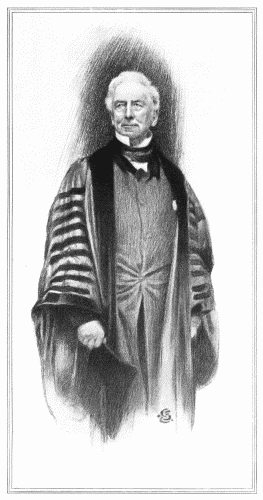 President Charles King of Columbia College, New York City.
I was telling Mrs. Waddington the other day of our
life at Frascati—the great cholera year at Albano
(1869), when so many people died—the Dowager Queen
of Naples, Princess Colonna, and Cardinal Altieri, who
came straight out to his villa as soon as the cholera broke
out (which it did quite suddenly). He was wonderful—went
about everywhere in all the poor little houses,
relieving and encouraging the sick and dying, holding up
the cross to the poor dim eyes when life was too nearly
gone for any words to avail; and finally was struck down
himself and died in two days. How terribly lonely and
cut off we felt—Dr. Valery was the only person we saw.
He was allowed to come out every day from Rome, but
was fumigated at the station at Frascati, and again in
Rome when he got back, obliged to change his clothes
outside the gate before coming into the city. We were
never at all nervous about the cholera. I don't think
there was one case at Frascati, and of course all our
thoughts were centred in that great big room with its
pink walls and mosaic floor where father[17] lay desperately
ill. It seems like a dream now, those hot summer nights,
when we used to go out on the terrace (upon which his
room opened) to get bouillon, ice, etc., and we fancied
we could see the cloud of disease hovering over the Campagna.
When it was moonlight, and such moonlight,
that beautiful golden, southern moon, we saw a long
white line in the distance—the sea. Circulation was very
difficult, all the roads leading to Albano were barred, and
guarded by zouaves; and of course we heard tales of horror
from the Italian servants, always most talkative and
graphic in their descriptions. However on the whole
they behaved well. We used to ride every day, and
always passed a little chapel on the way to Castel Gandolfo,
which was filled with people kneeling and praying—a
long line stretching out quite across the road to a
little shrine just opposite. They used to make way for
us to pass without getting off their knees, only stretching
out their hands for anything the Principesse americane
would give them.
Some of the women were quite absorbed, looking hard
at the Madonna in her shrine as if they expected some
visible sign of pity, or promise of help. I rather envied
them their simple faith; it must help them through many
moments of trial and discouragement.
As usual I seem to have wandered from my original
subject, but Italy is so full of memories. We were too
tired to walk home, besides were a little late, so we took
a fiacre with a most friendly coachman, who saw at once
that we were strangers, pointed out all the places of interest,
and said it would be a delightful afternoon for
Fiesole, and he would come and get us if we would name
the hour.
We found lots of letters and papers at the house, and
W. plunged into Paris and politics after breakfast. I
went for a drive with Mary and Beatrice to the Villa
Careggi. The house is nothing remarkable—a large
square building with enormous rooms, deep fireplaces,
and very high ceilings. Some good frescoes on the walls.
The garden and terraces were enchanting—the sun really
too warm on the terrace—always a divine view; blue-purple
hills rolling away in the distance, and funny,
crooked little roads shut in between high walls, with
every now and then a gap, or a gate, which gave one
glimpses of straggling, unkempt gardens, with a wealth
of flowers and vines.
We had a quiet dinner and evening, which we all enjoyed.
W. smoked and talked a great deal of the past
year and the last days at the Quai d'Orsay. He doesn't
miss the life in the least, which rather surprises me; I
thought he would be so bored with suddenly nothing to
do, and no part to play in the world's history; but I see
that the absolute rest and being with all his family is
doing him so much good. It is extraordinary how soon
one forgets, and takes up a quiet life again. Already
the whirl and fatigues of the Exhibition year seem so
far away I feel as if somebody else had lived that life.
I cannot imagine myself now dining out (and not ordinary
dinners, official banquets) 19 nights in succession,
but I suppose I should begin again quite naturally if we
returned to public life.
Did you see the article in the "Français" saying
"M. Waddington will now have all the rest of his life
before him to consecrate to his studies"? I wonder!
This morning we had our usual walk—as W. was ready
at ten o'clock I didn't make my regular station in the
Boboli Gardens. We went to Vieusseux about a book
W. wanted, and then into the bank to pay George Maquay
a visit. He was most cheerful, and showed us a nice
article in the "Times" regretting very much W.'s departure
from the Foreign Office, "one of the few men
who could look ahead a little, and who was independent,
not limited in his views by what the Chamber of Deputies
would think." I was rather pleased, but W. is very
calm about all newspaper articles. He always has a
"mauvaise presse" as we don't soigner any paper. I
fancy, though, Henrietta is right when she says the next
time he takes office she means to buy one—so many people
believe implicitly all they see in a paper, especially
when it says what you want to believe.
We did a little shopping, I wanted some veils, and W.
remained outside looking at the grim old Strozzi Palace,
standing like a great fortress with its huge stones and
heavy doors in the middle of all the busy, bustling life
of the Tornabuoni. I think it is the one street in Florence
where people move about quickly, and as if they
were going somewhere. Everywhere else there are
crowds of people, men especially, doing nothing but sitting
all day in the sun looking at the passers-by.
We hadn't time to walk over to San Lorenzo, so hailed
a fiacre, and wandered about there for some time. I was
delighted to see the Medici Chapel again and the famous
monument of Lorenzo. He does look as if he were thinking
out some great problem—I wonder what he would
think of our go-ahead, unartistic world, and of our politicians,
so timorous and afraid of responsibility—at least
the men of that race were strong for good or for evil.
When they wanted anything they did all they could to
get it. I don't know that the women were behindhand
either in energy when one thinks of Queen Catherine and
of all the Huguenots she disposed of one summer evening
in Paris. Do you remember our friend Mrs. A., a converted
Catholic, whom we overheard one night at the
Opera when they were shooting all the Huguenots in the
last act, telling her daughter (remained a Protestant)
that the Saint Bartholomew had nothing to do with
Catholics and Protestants; was entirely a political move.
We have had a long drive this afternoon with Mary
and Charles, up the Poggio Imperiale—a stiff climb but
such a beautiful road—villas, cypresses, olive trees, and
roses everywhere. We went up to the Certosa, where
a nice old monk, in his white dress, showed us the church
and monastery. It was dark and rather cold in the
church, and nothing particular to see—good frescoes and
many coloured marbles—but the terrace outside was delightful.
There were not too many beggars on the road
considering that it is the favourite drive in Florence, and
of course the carriage people are at a disadvantage as
they must go slowly up the hill, and are escorted by a
long troop of children singing, dancing with a sort of
tambourine, turning somersaults, and enjoying life generally,
whether they get a few pennies or not. It is very
difficult to resist the children with their smiling faces and
evident desire to amuse the "forestieri."
We went to Casa Guadagni before we came home, and
paid a visit to the Marchesa, who was at home. The
same old porter was at the door, and greeted me most
warmly, much pleased to see W. "bel uomo, il marito"—had
I any children, and where were all the rest of the
family?—that simple, natural Italian manner, without a
thought of familiarity. W. was delighted with Madame
Guadagni. She talked about everything and really didn't
look any older. I asked about our old apartment (piano
nobile—first floor); she said it was always let—generally
to foreigners. I didn't ask if she had made any modern
improvements since we lived there. Shall you ever forget
that cold winter with the doors that wouldn't open,
and the windows that wouldn't shut, and the chimneys
that always smoked, and the calorifère, which John
never would light, as he was afraid it would warm the
Guadagni rooms below? I should have liked to go
over the apartment and see the rooms again—the big
ball-room where we danced so often and had so much
music. We wound up with a turn in the Cascine, drawing
up in the Piazza alongside of Lottie's carriage, which
was of course surrounded by all the gilded youth of Florence.
Maquay came to talk to us, Carlo Alessandri
and Serristori, whom I hadn't yet seen. He was just
the same (laughing and criticising) as in the old days
when some of the swells appeared in so-called Worth garments,
which he said were all made in a little room over
his stables, by the wife and daughters of one of his men.
I was glad to get in and have a quiet hour to write
before dinner. I am at my table close up to the open
window. The air is soft and delicious—the garden
just beginning to look dark and mysterious in the waning
light. The group of cypresses (I don't know how
to write that in the plural, it looks funny) always black.
I was called off various times, and must finish now as we
are going to dine at the Maquays—we being ourselves,
Mary, and Charles. We generally go about a family
party.
Sunday, February 21, 1880.
We are making our pacquets as we have decided to
leave for Rome on Monday (22). The Schuylers are
clamouring for us, and though I hate to leave here I really
think we ought to go. As W. has never seen Rome
two months will not be too much. We shan't have much
more as he wants to get home for the Conseil Général.
The Schuylers want to have a big reception for us, and
would like next Sunday week, so I think we really shall
get off this time. The longer we stay the more invitations
we have. It has been all quite charming. Our
Maquay dinner was very easy and pleasant; the Tchiatcheffs,
Lottie, Alessandri, Talleyrands, Mrs. Fuller, and
one or two stray men. The house looked so natural—of
course the ball-room wasn't open as we were a small
party, but they lighted it after dinner. I wanted W. to
see how pretty it was and how light—white with red
seats all around. How it took me back to old times?
I seemed to see everybody settling for the cotillon—the
stairs too, where we all used to sit waiting for the cotillon
to begin. How we amused ourselves that winter in Florence,
and how scattered all that little band is now. The
Florentines amuse themselves still—there must be something
in the air which makes people light-hearted—one
can't imagine a serious, studious life in Florence.
We spent two hours in the Uffizi yesterday looking at
all the old friends again. I was delighted to see the dear
little "St. John in the Wilderness" hanging just where
it did before, on one side of the door in the Tribuna;
also the Peruginos—I like them so much—his Madonnas
with their wooden faces, but a pure, unearthly expression
all the same, and the curious green colour one sees in
all his pictures. We saw as much as we could in the two
hours, but as it was the second visit we found our way
about better. I never rested until I found the corridor
with Niobe and all her children—it used to fascinate me
in the old days. One realized perfectly all those big
sons and daughters, so terrified, and the last little one
clinging to his mother's skirts.
We went to tea, Mary and I, with Edith Peruzzi—quite
quietly—as she wanted to show me her children—and
fine specimens they are; a duck of a boy, quite
sociable and smiling. Nina and Louisa Maquay came in—Louisa
looked lovely. This morning I went to the
English church with Mary and Beatrice. We didn't go
out again till late—after tea—as we had various visitors,
among others Schuyler Crosby, who had asked us to dine
but we had no evening left. I saw him riding the other
day in the Cascine, and recognised him some way off by
his seat. I don't know what it is, but whatever the
Americans do, whether riding, dancing, or tennis, they
do it differently from any one else. I was talking about
it the other day to an Englishman who had seen some of
the Anglo-American boat races, and he quite agreed with
me, said their rowing was very good, but quite another
thing from the English sport.
We drove out again Fiesole way. It was enchanting—more
roses come out every day. There was a perfect
fringe of pink roses hanging over some of the old grey
walls. As it was Sunday, and a lovely day, there were
quantities of people about. There are scarcely any costumes
left, but all Italians like bright colours, and the
red and green fichus and aprons looked pretty and gay as
the various groups passed us. Some of the old women
were terribly bent, with such brown, wrinkled faces—one
could quite see that they had toiled up and down hills
under the Italian scorching sun all their lives, with baskets
and bundles of fagots on their backs—but the old
eyes were keen and smiling. They don't look so utterly
starved and wretched as Ouida (and others) say they
are. I suppose they live on nothing, and go on quite
simply, leading the same lives that their fathers and
mothers did before them, without knowing of anything
better.
Tell Henrietta I haven't made much progress in the
travelling work she presented me with. I did take it out
into the drawing-room one evening, but the immediate
result of that was disastrous. I took it out of the bag
proudly, to show that I had silk, embroidery, scissors,
needles, etc., like everybody else, but left it on the table.
Somebody wanted a book or a newspaper also on the
table; turned everything upside down, and the work, silk,
needles, thimble, etc., went rolling all over the floor.
When you think of the crevasses of an old parquet floor
in an Italian Palace, you can imagine how difficult it was
to find anything again. The two girls were hours on
their knees looking for my thimble which never turned
up—however, that will be an excellent reason for buying
a pretty little gold thimble with a row of turquoises that
I saw the other day in a shop on the Ponte Vecchio.
There is evidently a fate against my becoming an accomplished
needlewoman, and I am afraid the "clumsy
little fingers," which used to worry you so in the old days
of music lessons, have not improved with advancing
years. Perhaps I shall take to work in my old age. Isn't
it George Sand who says (and I don't believe she ever
took a needle in her hand), "Don't despise our less ambitious
sisters who work. Many great resolutions and silent
abnegations have been woven into the bright flowers
and delicate tracings of the embroidery in the long hours
spent over the frame."
Monday Night, February 22, 1880.
We really are starting to-morrow morning—trunks are
packed, compartment engaged, and we have said good-bye
to everybody. I made a last little turn this morning
in the Boboli Gardens. I didn't see the custode—I
wanted to say good-bye to him. Then we went to the
Pitti gallery, W. wanted to see one particular Botticelli,
"la bella Simonetta" I think, which he and Mary had
been talking about, and which we had missed the other
day. It is quite impossible to see everything. I had remembered
pretty well the principal pictures. Then we
took a fiacre and went out to San Marco to see the
Fra Angelicos and Savonarola's cell. We had never
once got there, there is always so much to do. We
walked through the cloisters first—the frescoes are perfectly
well preserved—some of Fra Angelico's and others
less interesting. I wanted to see the cells, and was
quite pleased to recognise the "Coronation of the Virgin"
and the "Madonna and Child" surrounded by
angels, all in their long green-blue robes with wings and
musical instruments of all kinds. As usual people were
copying them, and I will try and find a pretty one and
bring it back. I want the one in a sort of light green
dress blowing a trumpet. The faces are quite beautiful,
so pure. He must have had a wonderful imagination—I
wonder if he believed angels look like that? Somehow
or other I always think of an angel in a white robe. We
saw of course Savonarola's cell, and they showed us his
rosary, and a piece of wood which is supposed to have
been taken from his funeral pile. It all looked so peaceful
and smiling to-day, one could hardly realize the long
hours of doubt and self-torture passed in these solitary
cells. There is a fine description in one of the numerous
books the Bunsens have on Florence, of Savonarola's
preaching—all the people congregated in the great
square before the church, when there was no longer any
room inside, leaving their shops and their work to come
and listen to him. That is one of the delightful things
in this household, you can always find a book in almost
any language about any subject that interests you, religion,
music, politics, everything.
Beatrice has a delightful German magazine, "Monatsheft,"
very well illustrated, with all the modern German
literature, stories, essays, criticisms, etc. One could almost
wish for a rainy day or a quiet evening to read a
little.
W. went off by himself the other night and had a very
pleasant evening. First to the Piccolellis' where he found
a small party and his old friend Bentivoglio, with whom
he had travelled in the East. Of course they instantly
got into a corner and talked shop (medals). Then to
Lottie Van Schaick who had a few friends, where he
amused himself very much.
Gertrude writes that our rooms are very nice, and the
man at the hotel delighted to have us. I wonder what
Rome will be like. It will seem funny to be back there
again, a respectable middle-aged lady. I think one should
always be young and gay to live in Italy.
We had a fine musical evening Saturday with the
Landi family—five; mother, father, daughter, son, and
grandfather. Madame Landi sang anything, everything,
delightfully. Some of the stornelli and peasant songs,
those particularly of the Abruzzi mountains, were charming.
I wonder what Italians have got in their "gosier"
that we haven't, that gives such a charm to their simplest
song. I sang once or twice in French, and then Madame
Landi and I did some duos in Italian which went very
well. She was very complimentary over my Italian (I
told it triumphantly to W., but he remains under the impression
of the razor), said it was evident I had learnt
in Rome; the language is so much softer, or rather the
pronunciation "Lingua toscana in bocca romana."
The old father was killing, knew everything, was
wildly interested, and criticised freely. I think the
daughter will have a very pretty voice, like her mother's,
a rich, low mezzo.
I was called off by some visits, and will finish now.
My letter will go to-morrow morning. We don't start
very early—9.30—but I shall not have time to write anything
more.
Hôtel de Londres, Rome,
February 24, 1880.
We arrived last evening for dinner, dear mother, and
are most comfortably settled. We have a nice apartment
on the second floor—a large bright salon with a
good bed-room on either side of it for me and W., and a
very fair anteroom where Madame Hubert has just had
another wardrobe put up. She interviewed the gérant
and made it clear to him that it was impossible for her
to unpack her mistress's dresses until she had something
suitable to put them in. We found flowers and papers
on the table from the Schuylers, Mrs. Bruce, and the
proprietor of the hotel.
I thought we should never get away from Florence.
We were so happy there with the Bunsens and Mrs. Waddington,
and every day there was something to see or do.
The weather was divine the last days—the hills were
quite a pink-purple sometimes as we drove home after
sunset, and quantities of roses climbing up all the old
grey walls. We had a very easy journey—they had
reserved a carriage for us, which was a good precaution,
as the train was crowded. We got to Rome about six.
W. was quite excited as we approached (it is too funny
to think that he had never been here), and very anxious
for the first glimpse of St. Peter's. I can't say we saw
the dome from a great distance—I fancy it depends upon
which way you enter Rome. We found the Schuylers at
the station with a carriage, and drove at once to the hotel,
where Gert had ordered tea and a pannettone. If
I hadn't known I was coming to Rome I should never
have believed it on arriving at the station. It was so
unlike the little old Termine of our Roman days—the
funny little station so far away, with few porters or
cabs, and comparatively few voyageurs. I was quite bewildered
with the rush into this great, modern station,
with porters and officials of all kinds, and all the bustle
of a great city.
I looked in vain for some familiar landmarks as we
came along. Nothing. The new streets, Via Garibaldi
and Nazionale—an abomination, tall ugly maisons de location
and official buildings so new and regular—awful!
It wasn't until we got into the town and near the Piazza
di Spagna that I really felt that I was back in Rome; that
of course was unchanged. It brought back such a flood
of memories as we passed 20, and all the first happy days
in Rome came back to me, before father's illness, when
he enjoyed everything so much, and wrote to Uncle John
that "the hours were golden." The "barca" looked
just the same, with boys and women leaning up against
the stones, flower-girls on the Spanish Steps, and even
old Nazzari's low, dark shop opposite looked picturesque.
W. was quite surprised to see me so sentimental, though
I had warned him that for me there was no place in the
world like Rome.
The Schuylers stayed talking some little while, then
had to go, as they were dining out, but promised to come
in after dinner. W. asked me if I was too tired to go
for a little stroll (the tea had refreshed us), so we started
up the Spanish Steps to the Villa Medici, where we
had that beautiful view of Rome. I showed him the
stone pines of the Doria-Pamphili, which stood out splendidly
against the last bright clouds of the sunset—it was
quite lovely. We stayed out quite late, and were received
with respectful, but decidedly disapproving greetings
from the gérant when we came in. It was not at
all prudent for "Eccellenza" and Madame to remain out
late, particularly as they must be very tired after a long
journey. We dined downstairs in the big dining-room.
There was a long table d'hôte full—people about half
through their dinner—and at the extreme end of the room
five or six small tables, one of which had been reserved
for us. I didn't see any one I knew, but two men got
up and bowed as we passed. The dinner was good—the
head waiter hovering about us all the time, and of
course always addressing W. as "Eccellenza." We had
coffee upstairs. W. smoked and I read the paper and
one or two notes. About ten the Schuylers appeared,
very cheerful and full of propositions of all kinds. They
have got a big reception for us on Sunday night—Roman
and diplomatic—and we agreed to breakfast with them
to-day. Gert looked very well in blue, with her diamond
necklace and feathers. They don't seem very pleased
with Marsh—our Minister. Always the same old story
and jealousy—the ministers consider themselves so far
above a consul. But really when the Consul-General
happens to be Schuyler and his wife King, one would
think these two names would speak for themselves—for
Americans, at any rate.
We told Schuyler how many compliments we had had
both in Paris and Florence for his "Peter the Great"—so
much in it, and yet the subject one that had been
written about so often. They went off about eleven, and
I was glad to go to bed; could hardly believe I was sleeping
again in the Piazza di Spagna. I certainly never
imagined when I left Rome tearfully so many years ago
that I would come back as the wife of a French statesman.
I was busy all the morning unpacking and settling myself,
and of course looking out of the window. It is all
so delightfully familiar—all the botte standing in the
middle of the street, and the coachman trying so hard to
understand when some English or American tourists give
them some impossible address in Italian—you know the
kind of people I mean, conscientious tourists who think
they must always speak the language of the country they
are in, learned out of a phrase-book. We have various
invitations, from our two Embassies, Quirinal and Vatican,
also the Teanos, and W. had a nice visit from
Lanciani, who wants to show him all Rome. We took a
botta to go to the Schuylers. It isn't far, but I wasn't
quite sure of finding my way the first time. They have
a charming apartment in Palazzo Altemps, near the
Piazza Navona, not at all far really from our hotel, and
now that I know the way I can often walk over in the
mornings when W. is off sight-seeing seriously with some
of his learned friends. It is a fine old palace with a large
open court and broad stone staircase. San Carlo Borromeo
is supposed to have lived there. Their apartment
belongs to Mrs. Terry, wife of the artist, who had arranged
it very comfortably, and the Schuylers have put in
all their Turkish rugs, carpets, and bibelots, so it really
looks very pretty. There are quantities of green plants
and flowers about (they are both fond of flowers and are
always making experiments and trying something new)
and of course books, papers, reviews, and a piano.
I told Gert I thought I would write to Vera and have
some singing lessons—I have done so little singing since
I have been married. Eugene is a charming host, and he
and W. had plenty to talk about. I inspected Gert's
wardrobe while they were smoking. Her dresses are all
right, and I think her maid is good. I wrote all this after
I came in. The man of the hotel had engaged a carriage
for us—a nice little victoria with a pair of greys.
It comes from Tomba's stables—do you remember the
name? The same loueur we had when we lived here.
The coachman said he remembered me perfectly, had
often driven the "signorine" to the meets, and hoped
la maman was well. We were lucky to get such a nice
little carriage. The d'Aubignys, a French couple, had
just given it up, as they were leaving the Embassy here
for Berlin.
We drove about a little—left cards for the Noailles,
Desprez, Cairolis, and wound up in the Villa Borghese,
which was again quite changed—such quantities of carriages
and people walking, also Italian officers riding, and
soldiers, bersaglieri, etc., about. We crossed the Wimpffens,
looking very smiling, and saw in the distance, as
we were coming out, the royal red liveries, but the carriage
was too far off to see who was in it. Now we are
going to dinner, and I shall be glad to get to bed early. I
think I am more tired than yesterday.
Hôtel de Londres,
February 26, 1880.
I will begin again this afternoon, as I have a little
time before dinner. The weather is divine, quite the
same deep-blue sky and bright sun of our first Roman
winter. We have had an enchanting drive out of Porta
San Sebastiano and along the Via Appia as far as Cecilia
Metella—everything exactly the same as when we were
there so many years ago. The same peasant carts blocking
up the narrow gateway, everybody talking at once,
white teeth gleaming, and quantities of little brown
children with black eyes and jet black hair tumbling down
over their eyes and outstretched hands for anything the
forestieri would put into them. W. was a little disappointed
at first. The road is narrow, an atrocious pavement,
and high walls almost shutting out the view. However,
as we got farther out there came gaps in the walls
through which one saw the whole stretch of the Campagna
with the Claudian Aqueduct on one side, and when
we finally emerged into the open fields, he was delighted.
How extraordinary all these old tombs and pyramids are,
most of them falling in ruins, with roses and creepers of
all kinds holding them together. On one of the largest
round tombs there was a peasant house with a garden and
vines, and smoke coming out of the chimney, perched
quite on the top, with a steep, stony path winding down,
where the coachman told me the donkey went up and
down, as he too lived in the house with the family. Some
of the tombs are very high—real towers. There is
hardly a trace of marble or inscription left, but the original
building so strong that the walls remain.
The queer old tombs, towers, and bits of ruins all along
the road interested W. immensely; though he has never
been here he knows them all from photographs and reproductions,
and could tell me a great deal more than I could
tell him. We went as far as the round tomb of Cecilia
Metella, and then got out and walked a little. I wanted
to show him the low wall which we used to jump always
when the meet was at Cecilia Metella. Do you remember
the first time you came out to see us jump, not at a hunt
but one afternoon with Dyer practising to see what the
horses and riders would do? You saw us start at a canter
for the wall, and then shut your eyes tight until we
called out to you from the other side.
This morning W. and I had our first regular turn at
sight-seeing. We took a nice little botta on the Piazza,
had our Baedeker—a red one, like all the tourists—and
were quite happy. Some of the old colleagues were
highly entertained seeing us driving about with our
Baedeker; said it was W. under a wholly different aspect.
We wandered about the Vatican for two hours, seeing
quantities of things—Sistine Chapel, Stanze Raphael,
Apollo Belvedere, etc., and always a beautiful view over
the gardens. Later, he says, he must do it all regularly
and intelligently with one of his men friends, as I naturally
could not stand for hours recognising and deciphering
an old inscription. I left him from time to time, sat
down on one of the stone benches, talked to the custode,
looked at the other people, and gave them any information
I could. It interested me to see the different nationalities—almost
entirely English, American, German, very
few Italian, and no French—yes, one artist, a rather nice
looking young fellow who was copying something on the
ceiling of one of the "Stanze," rather a difficult process
apparently. There were many more women than men—groups
of English spinsters doing their sights most thoroughly—the
Americans more casual. The Apollo looked
splendid, so young and spirited. We walked some little
distance, coming home before we could get a fiacre, and
I had forgotten how cruel that Roman pavement was. I
don't believe any of my boots will stand it; I shall have
to get somewhere here a pair of thick-soled walking
shoes.
We had a quiet hour after breakfast. I have arranged
a ladies' corner in the drawing-room. I was in despair
the first two days over the room. I had never lived in
small hotel quarters with a man, and I had no idea how
disorderly they are. The table was covered with pens,
papers—piles of them, three or four days old, thick with
dust—cigars, cigar ashes over everything, two or three
large, bulky black portfolios, very often a pot hat, etc.
So we compromised; W. took one end of the room and
I the other. I obtained from the gérant (thanks to Madame
Hubert, who is very pretty and on the best of
terms with him) a small table, large china vase for a
plant, a nice arm-chair, and a cushion for the sofa, borrowed
a table-cloth from Gert, also some small things
for my table, and my end looked quite respectable and
feminine. The room is large, so we can really get on
very well. We had a pleasant visit from the Marquis
de Noailles, French Ambassador to the Quirinal, before
we went out. He has a charming, easy manner. We
are to breakfast at the Embassy, Palazzo Farnese, to-morrow
for me to make Madame de Noailles's acquaintance.
I wonder what I shall think of her? The
men all say she is a charmeuse. She is Polish born, was
a beautiful woman—I think all Poles have a great charm
of manner.
Trocchi came in, too—so pleased to see me again and
to make W.'s acquaintance. The two senators talked
politics, and Noailles put me a little au courant of Roman
society and the two camps black and white. We went
out at 3.30, as I said before, to Cecilia Metella, and
stopped at Gert's for tea. W. walked home, and I stayed
a little while with her talking over the arrangements for
their reception on Sunday. Every one—Romans, diplomats,
and Americans—they have asked has accepted; but
their rooms are fairly large and I don't think they will
be crowded.
Hôtel de Londres,
Monday, February 29, 1880.
I am still tired from the quantity of people we saw last
night at the Schuylers. Their reception was most brilliant;
all the world——However, I will begin at the beginning.
We went to church on Sunday, as Dr. Nevin
came to see us Saturday afternoon and said he hoped we
would not fail to come. W. found him clever and interesting.
He said he thought I should hardly recognise
him in his new church. It is very pretty—English style,
built by an English architect (Street) in the new quarter,
Via Nazionale, utterly unlike the bare little room outside
the Porta del Popolo, where we used to go and do the
music. It makes me laugh now when I think of the congregation
all embarked on a well-known hymn, when
suddenly Henrietta would lower the tune one note—if
I was tired, as often happened, as one of the gayest
balls in Rome was Princess Sciarra's on Saturday night.
When I had danced until four o'clock in the morning
(the test of the ball was how late it lasted) it was rather
an effort to be at church at 10.30 Sunday morning
and sing straight through the service. Henrietta had
the harmonium and I led the singing. I will say that
the effect of the sudden change was disastrous from a
musical point of view. However, we did our best. I am
afraid Henrietta was not always faithful to Bach and
Beethoven in her voluntaries. We had no music, and she
played whatever she could remember, and occasionally
there were strains of "Araby's Daughter" or "When
the Swallows Homeward Fly," which were quite perceptible
even through the minor chords. I liked doing
it all the same, and like it still. I am so fond of the old
hymns we used to sing as children, and should like to hear
"Shout the Glad Tidings" every Christmas. I never
have since we left America and Oyster Bay, where also
we did the music, and where, when we were late sometimes
for church, Faust, the big black Newfoundland dog
would come and bark when the bell had stopped, telling us
quite plainly we were late—he knew all about it.
We made the regular Sunday turn in the afternoon—Villa
Borghese and Pincio—sent the carriage away and
walked home by the Villa Medici. W. loves the view
from the terrace. We met Mrs. Bruce, also looking at
the view, and walked home together. She told W. Cardinal
Howard wanted to see him, had known him in England
in the old days, also a young English monsignore—called
English oddly enough. She will ask us all to dine
together some night next week. I asked her if she remembered
her famous dinner long ago with Cardinal
Howard and Dean Stanley. The two divines were very
anxious to cross swords. They were such a contrast.
Dean Stanley, small, slight, nervous, bright eyes, charming
manners, and a keen debater. The Cardinal, tall,
large, slow, but very earnest, absolutely convinced. The
conversation was most interesting—very animated—but
never personal nor even vehement, though their views
and judgments were absolutely different on all points.
However, both were gentlemen and both large-minded.
W. was much interested, as he knew Dean Stanley and
his wife Lady Augusta well; they came often to Paris,
and were habitués of Madame Mohl's famous salon,
where the literary men of all creeds and countries used to
meet. It was there, too, that Dean Stanley and Renan
used to meet and talk, the two great intellects finding
points in common. I was taken there once or twice after
I was first married. It was a curious interior; Madame
Mohl, a little old lady, always dressed in white, with a
group of men standing around her chair—many more
men than women, and never more than twenty or thirty
people. I suppose it was the type of the old French literary
salon where people went to talk. I naturally listened
in those days, not being sufficiently up in all the political
and literary questions, and not pinning my faith absolutely
on the "Revue des Deux Mondes." Mrs. Bruce,
too, was often at Madame Mohl's.
We stopped in a few minutes at the Trinità de' Monti,
where there was a service of some kind going on. The
nuns were singing a low, monotonous chant behind their
grating; the church was quite dark, lights only on the
altar, a few women kneeling and absorbed, and a few
irreverent forestieri looking about and talking in whispers.
We came down the Spanish Steps, which were
quite deserted at that hour—models, beggars, flâneurs, all
resting from their labours.
I was glad to rest a little before dinner, and only
dressed afterward, as I couldn't well go down to the public
dining-room in a low red satin dress and diamonds.
We went rather early—ten o'clock—to Palazzo Altemps,
but found many people already there. The apartment
looked very pretty, quantities of flowers and plants wherever
they could be put. Gert looked very well in yellow
satin, and Eugene is always at his best in his own house—very
courteous and receiving people as if it were a pleasure
to him (which I think it is). We found quantities of
old friends—Pallavicinis, Teanos, Lovatellis, Calabrinis,
Bandini, Pagets, Mrs. Bruce, Hooker, Grants, etc., and
quantities of people we didn't know, and whose acquaintance
we made of course—Mesdames Minghetti, Cairoli,
Despretis, and almost the whole of the Corps Diplomatique.
W. enjoyed it very much, did his manners very well,
and never looked stiff or bored. I was delighted to see
the familiar faces once more. I almost felt as if we had
never been away. Madame de Noailles was astounded
at the number of people I knew—I think she hadn't realized
how long I had lived in Rome as a girl. She had
heard W. say it was his first visit to Rome, and thought
I, too, was here for the first time, and she was naturally
surprised to hear me talking to Calabrini about the hunts,
cotillons, his coach, and tempi passati generally.
I have accepted so many invitations that I never can
remember them, but the ladies promised to send a card.
Aunt Mary Gracie was rather put out with me because I
wore no necklace (which couldn't be said of the Roman
ladies, who all wore splendid jewels), but I told her it
was the last chic in Paris to wear your necklace on your
bodice, not on your neck.
We stayed on after all the beau monde had gone with
Aunt Mary, Hooker, a Russian friend of Schuyler's, and
Count Palfy, had a nice little supper, champagne and
sandwiches, and talked over the party, saying of course
(as they say we Kings always do) how pleasant our party
was. W. was much interested in the various talks he
had. He found Minghetti charming—so intelligent and
well up in everything. Cairoli, too, he had been anxious
to see; also Visconti Venosta. He was naturally (like all
the men) charmed with Madame Minghetti. She must
have been beautiful, and has an extraordinary charm of
manner. The Cairolis are a very big couple. He is tall
and broad, fine eyes—she, too, on a large scale, but handsome.
Of course there were many inquiries from all the
old friends for la maman and the family generally. Mrs.
Bruce says she never drives in the Doria-Pamphili without
thinking of you driving about in your plain black dress
and bonnet, with two or three daughters (not quite so
plainly dressed) in the carriage, and all always talking
and laughing, and enjoying life together. I told her
about Florence, where the King of Italy always bowed
to you in the Cascine, evidently taking you for the superior
of some religious order (he must have thought the
novices were lively), and the children in the street used
to run up to you and kiss your hand. "He was quite
right, to bow to you," she said, "my grand old Republican."
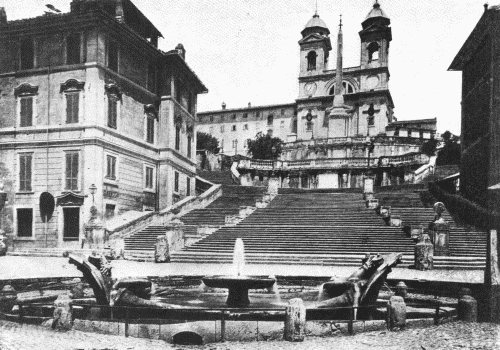 The Spanish Steps.
In the Piazza di Spagna, Rome.
The Spanish Steps.
In the Piazza di Spagna, Rome.
March 4, 1880.
Yesterday we went again to the Vatican. W. is
quite happy, I thought I should never get him away. It
is most amusing to walk about old Rome with him, for
suddenly over a gateway or at the bottom of an ordinary
little court he discovers an inscription or a slab, or an old
stone which he knows all about, and we stop. He reads,
and recognises, and translates to me, and is wildly interested.
It is all so good for him, and puts politics and
little annoyances out of his head. It is quite new for me
to see Rome from a classical point de vue, but I suppose
one enjoys things differently as one grows older. I certainly
enjoyed the mad gallops over the Campagna in the
old days; do you remember Mrs. S. who was so severe
with us—first because we were Americans (she was English)
and then because we knew everybody and enjoyed
ourselves?—"when she was young people came to Rome
to educate themselves and enjoy the pictures, museums,
historical associations, etc. Now one saw nothing but
American girls racing over the Campagna with a troop
of Roman princes at their heels." Poor dear, she really
thought it was a calamity not to be born under the British
flag. I suppose that makes the great strength of the
English, their absolute conviction that England is the
only country in the world.
They are funny, though—I was discussing something
one day with Lady S., and we didn't quite agree; upon
which she remarked she supposed I couldn't understand
her ideas—she came from a big country where one took
broad views of things. I said I thought I did too, but
perhaps it is a matter of appreciation—I think, though,
I have got geography on my side.
After breakfast we drove about paying visits. We
found Princess Teano (who has asked us to dine on
Wednesday) and she showed us her boys—the eldest one
a beauty. She looked very handsome with her pure
Madonna face. She told us her beau-père (the blind Duke
of Sermoneta) had been so pleased to meet W. in Florence.
They had a long talk somewhere, and W. was so
amused with the Duke's politics and liberalism—all so
easy-going, half chaffing, but very decided too, no sounding
phrases nor profession de foi; simply accepting (what
he couldn't really like very much) the inevitable, de bonne
grâce; and seizing and ridiculing all the weak points.
In France they are frightfully logical, must always
argue and discuss everything—I think they are born debaters.
We left cards on various people, Princess Bandini,
Cenci, Countess Lovatelli, and then went for a little turn
out of the San Lorenzo gate, but not far, as we wanted to
go to Princess Pallavicini, who received that afternoon.
W. was much struck with the apartment—so many
rooms, all very high ceilings, that we passed through before
getting to the boudoir where the Princess was sitting.
It all looked so natural, I remembered the hangings—bright
flowers on a light satin ground—as soon as I got
into the room, and some of the pictures. She was very
cordial and friendly, told W. how long she had known
me, and recalled some of our rides at Frascati with her
and Del Monte. She asked us to come on Friday evenings,
she was always at home. No one else was there but
a Princesse de Thurn and Taxis (née Hohenlohe) who
was introduced to us, and the talk was pleasant enough.
She was quite interested in our two audiences—Pope and
Quirinal—but we told her we had heard nothing from
either court yet. W. walked home, and I went on to
Gert as it was her reception day. She gave me a cup of
tea, and I found various friends there, including Father
Smith who was quite pleased to see me again. He
doesn't look any older, and is apparently quite as energetic
as ever. He told me he had enjoyed his talk with W.
very much, and they had made a rendezvous for two days—the
Catacombs and San Clemente. He remarked casually
that W. wasn't at all what he expected to find him;
not at all his idea of a "French Republican." I wonder
what sort of trade-mark he expected to see? If he
had pictured W. as a slight, nervous, black-eyed, voluble
Frenchman, he must naturally have been surprised.
We have heard people discussing us sometimes in English
as we pass down the long dining-room to our table—"There
goes Waddington, the late French Premier."
"Never—that man is an Englishman." "I have seen
pictures of Waddington—he doesn't look at all like that,
etc." The head waiter always points us out as distinguished
strangers.
I found quantities of cards when I came home—one
from Lily San Vito with a nice little message of welcome.
(We crossed her in the Corso the other day and she
looked lovely.) Also Valerys, Middletons, Pantaleones,
etc. After I had gone to my room to dress W. had a visit
from Desprez, the French Ambassador to the Vatican.
He has just arrived, his wife not yet come, and he feels a
little strange in this very divided society. We are going
to meet him at dinner at the Portuguese Embassy. He
told W. there would be several Cardinals at the dinner—a
regular black assemblage. It will be a funny experience
for W.
March 6, 1880.
I will finish this long letter to-night. We have just
come in from the Teano dinner, which was pleasant.
Teano looked quite the same (I hadn't seen him for
years) with his tall, slight figure and white lock. (I
forgot to look if the boy had it.) She looked very handsome.
We had the Minghettis, a Polish Countess—sister-in-law
of the Duc de Sermoneta, the Calabrinis,
and M. Heding, a German savant. Minghetti was delightful,
telling us his early experiences with the old
Pope, Pio Nono. He was killing over the entente between
the government and the monks for the suppression of
the monasteries. The gendarmes arrived, found barred
doors and resistance. There was a sort of halt and parley—one
father came out, then another—a little livret of the
Caisse d'Epargne was put into their hands, and all went
off as quietly as possible. Heding seemed to think things
wouldn't go so easily in Germany, and they certainly
wouldn't in France.
Madame Minghetti and I talked for a long time after
dinner exchanging our experiences of the official world,
which I fancy is always the same in all countries. Calabrini
was of course his same courteous self—so absolutely
free from pose of any kind—rather unusual in a man who
has always had such a success.
This morning we went to Trajan's Forum, walked, W.
as usual quite at home, everywhere recognising old friends
at every step. We looked at all manner of inscriptions
and basso-rilievos, and enjoyed ourselves very much.
This afternoon W. and Schuyler went off together to see
some churches and the Palazzo dei Cesari. I backed out,
as I can't stand two sight-seeings the same day with a
dinner in prospect in the evening. I went over to get
Gert, and we drove about together, winding up at the
Comtesse Wimpffens, Austrian Ambassadress, who has
a charming apartment in the Palazzo Chigi (where Odo
Russell used to live when we were in Rome). There
were various ladies there, the Marquise de Noailles,
French Ambassadress (who immediately asked me
who made my dress, the blue velvet that did all my visits
the last year of the Quai d'Orsay), Lady Paget, Madame
Minghetti, and a sprinkling of secretaries and attachés.
Comtesse d'Aulnay, looking very pretty, very well
dressed, came in just as we were leaving. We wound up
with a turn in the Villa Borghese. There were grooms
waiting at the gate with saddle horses, just as our old
Carmine used to wait for us. It is all so curiously familiar
and yet changed. I can't get accustomed to the
quantities of people in the streets where there never used
to be any one—occasionally a priest, or a few beggars, or
a water-carrier. Now there are soldiers, people carrying
parcels, small employees, workmen, carts, carriages, life in
fact. There were quantities of people in the Villa Borghese.
Some of the carriages very well turned out, again
very different from our days when we knew every carriage,
and when a new equipage or a new face made a
sensation.
W. has had a delightful afternoon looking at some of
the very old churches with Eugene. He had, too, a note
from Desprez saying our audience from the Pope would
be to-morrow at one o'clock, and giving me the necessary
instructions for my veil, long black dress, etc. To-morrow
night we dine at the Noailles. The breakfast there
the other day was pleasant—no one but ourselves and
Ripalda. Of course it is a magnificent Embassy—the
Farnese Palace—and they do it very well, but it would
take an army of servants to "garnish" these long anterooms
and passages, in fact ordinary servants are quite
lost there; there ought to be Swiss guards or halberdiers
with steel cuirasses and lances which would stand out
splendidly from the old grey walls. One could quite
imagine an Ambassador of Louis XIV arriving with 100
gentlemen and armed retainers in his suite. The famous
room with the Caracci frescoes must be beautiful at
night. Ripalda asked us to come to tea one afternoon
at his palace on the Tiber, the "Farnesina." Marquise
de Noailles was charming.
Now I will say good-night, dear, for I am tired, and
we have a busy day to-morrow. I wonder if Leo XIII.
will impress me as much as Pio Nono did.
Rome, Hôtel de Londres,
Thursday, March 8, 1880.
The Piazza is delightful this morning, dear mother; it
is bright and warm, and there are lots of people starting
for excursions with guide-books, white umbrellas, and
every variety of wrap. The coachmen of the little botte
look so smiling and interested, so anxious to make things
easy and comfortable. Vera came to see us yesterday,
and told me he was hailed by one of the coachmen from
the top of his box, just as he was crossing the Piazza, who
said to him: "Sai Maestro, una di quelle signorine King
è tornata col marito?" (Do you know, master, one of
those King young ladies has come back with her husband?)
He was much amused—told him he was quite
right, and that he was going to see that same signorina.
I dare say he had driven us often to one of the gates to
meet the saddle horses.
Yesterday was our udienza particolare (special audience),
and most interesting it was. Madame Hubert was
madly excited dressing me. I wore my black satin, long,
with the Spanish lace veil I had brought in case I should
be received by his Holiness, and of course no gloves,
though I had a pair with me and left them in the carriage.
We started at 12.30, as our audience was at one, and got
there quickly enough. I had forgotten all the queer little
courts and turns at the back of the Vatican. Everything
was ready for us; we were received really in royal state—Swiss
Guard, with their extraordinary striped yellow
uniform (designed, some one told us the other day, by
Michelangelo), tall footmen attired in red damask,
Guardia Nobile, chamberlains, and two monsignori. The
garde noble de service was Felice Malatesta. He really
seemed much pleased to see me again, and to make W.'s
acquaintance—swore he would have known me at once,
I was so little changed; but I rather suspect if he hadn't
known we were coming he wouldn't have recognised me.
We had a nice talk the few minutes we stood waiting in
the room adjoining the one where the Pope received us,
and he gave me news of all his family—Emilio (still unmarried),
Francesco, etc.; then a door was opened, a
monsignore came out, bowed, and said his Holiness was
ready to receive us. We went in at once, the monsignore
closing the door behind us and leaving us alone with the
Pope, who came almost to the door to receive us, so that
the three regulation curtseys were impossible. There
were three red and gold arm-chairs at one end of the
room, with a thick, handsome carpet in front of them.
The Pope sat on the one in the middle, put me on his
right and W. on his left. He is a very striking figure;
tall, slight, a fine intellectual brow and wonderfully bright
eyes—absolutely unlike Pio Nono, the only Pope I had
ever approached. He was most gracious, spoke to me
always in Italian, said he knew I was an old Roman, and
that we had lived many years in Rome; spoke French to
W., who, though he knows Italian fairly, prefers speaking
French. He asked W. all sorts of questions about
home politics and the attitude of the clergy, saying that
as a Protestant his opinion would be impartial (he was
well up in French politics, and knew that there were three
Protestants in W.'s ministry: himself, Léon Say, and
Freycinet). W. was rather guarded at first (decidedly
"banale," I told him afterward), but the Pope looked
straight at him with his keen, bright eyes, saying: "Je
vous en prie, M. Waddington, parlez sons réserves."
We stayed about three-quarters of an hour, and the talk
was most interesting. The Pope is very anxious to bring
about a better state of feeling between the clergy and the
people in France, and tries so hard to understand why the
priests are so unpopular; asked about the country curate,
who baptizes the children and buries the old people—surely
there must be a feeling of respect for him; said,
too, that everywhere in town or country the priests do
so much for the sick and poor. W. told him the women
all went to church and sent their children to the catechism,
but the men are indifferent, if not hostile, and
once the boys have made their first communion they
never put their foot in a church. "What will keep them
straight and make good men of them, if they grow up
without any religious education?" The answer was difficult—example
and home teaching, when they get it. Evidently
he had been curious to see W., and I think he was
pleased. It was quite a picture to see the two men—the
Pope dressed all in white, sitting very straight in his arm-chair
with his two hands resting on the arms of the chair,
his head a little bent forward, and listening attentively to
every word that W. said. W. drew his chair a little forward,
spoke very quietly, as he always does, and said all
he wanted to say with just the same steady look in his
blue eyes.
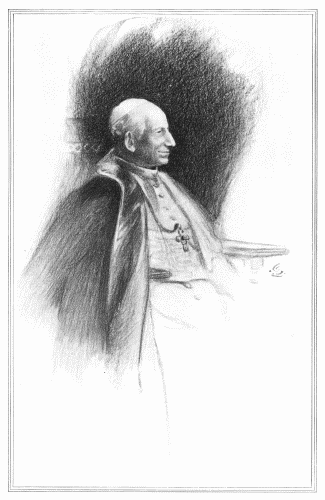 Pope Leo XIII.
From time to time the Pope turned to me and asked
me (always in Italian) if politics interested me—he believed
all French women were keen politicians; also if I
had found many old friends in Rome. I told him I was
so pleased to see Felice Malatesta as we came in, and that
we were going to meet Cardinal Howard one day at
breakfast. I shouldn't think he took as much interest in
the social life of Rome as Pio Nono did. They used
always to say he knew everything about everybody, and
that there was nothing he enjoyed so much as a visit from
Odo Russell, who used to tell him all sorts of "petites
histoires" when their official business was over.
He also talked a good deal to W. about his uncle,
Evelyn Waddington, who lived in Perugia, where he was
"sindaco" (mayor) for years. He married an Italian
lady, and was more than half Italian—curious for a man
called Evelyn Waddington. The Pope had known him
well when he was Bishop of Perugia.
We both kissed his hand when we took leave, and he
said again to W. how much he had been interested in all
he told him. We lingered a few minutes in the anteroom,
as there was some idea Cardinal Nina would receive us,
but it had not been arranged. It seemed strange to be
in those high, bare rooms again, and reminded me of our
visit to Cardinal Antonelli years ago with father, when
he showed us his collection of gems. I remember so well
his answer to Bessie Curtis (now Marquise de Talleyrand-Périgord),
who was looking out of the window, and
said it was such an enchanting view, would help one in
"des moments de découragement." "On n'est jamais
découragé, mademoiselle."
I imagine Leo XIII has very difficult moments sometimes.
W. wouldn't come out again as he had letters to write,
so I stopped for Gert, and we had a lovely turn in the Villa
Pamphili. Quantities of people—it looked very gay.
We got home about six, and had visits until it was time
to dress for our dinner at the Wimpffens. D'Aulnay came
first, very anxious to hear about our audience at the
Vatican; and Tagliani, the auditeur of the old "nonce";
also Dr. Nevin.
Our dinner at the Wimpffens was very pleasant. Their
apartment looks very handsome lighted. There was a
fine, pompous old porter at the door downstairs, and
plenty of servants and a "chasseur" upstairs. We had
all the personnel of the Embassy, the Calabrinis, Bibra
(Bavarian Minister), Van Loo (Belgian), and an
Austrian whose name I didn't master, who had been a
minister in Andrassy's Cabinet. After dinner we all adjourned
to the smoking-room, which is very large and
comfortable, lots of low arm-chairs. The Austrian ladies
smoked, and I talked to Bibra and Van Loo, who
told me all the diplomats had been rather struck with the
cordiality of our reception—that in general the Romans
troubled themselves very little about strangers. W. talked
to Wimpffen and his Austrian friend, who was much
interested in hearing about our audience with the Pope,
and a little surprised that W. should have talked to him
so freely, both of them saying that his being a Protestant
made things much easier.
The Romans went off early, so W. went to Geoffroy
(director of the École de Rome—French Archæological
Society), who receives Thursday evenings at the Farnese
Palace. He has an apartment quite up at the top of the
palace over the Noailles, and I went to Gert, who also
received Thursday. I found a good many people there—principally
Americans, and some young diplomats. So
many people were introduced to me that I was quite exhausted,
and went and sat down by Aunt Mary, who
looked very handsome.
Sunday, March 10, 1880.
I shall not go out this morning. It is a little foggy—the
first time since we came here—and I was also lazy.
We are going so perpetually. Yesterday W. was off at
nine in the morning with Geoffroy and Lanciani for
a classic tournée. I wrote one or two letters, and then
Madame Hubert and I walked over to Gert's and breakfasted.
After breakfast Monsignor English came in and
had much to say about the Pope, and the impression W.
had made which he had heard from high personages of
the Vatican. I told him all about the interview, and he
was much surprised when I said we all sat down. W.
came while he was still there, and of course he wanted to
hear his account, and was so pleased with all W. said
about the Pope, his marvellous intelligence and comprehension
of the present very difficult state of affairs in
France. English also said the Pope had been pleased
with me (I did nothing but listen) so I plucked up my
courage, and asked him if he thought his Holiness would
give me a photograph signed—I should like so much to
have one. He said it would be difficult, as the Pope
never signed a photo—but perhaps——. I should like
one so much—I hope he will make an exception for this
heretic.
W. and I walked home, and then I dressed, and we
started again for some visits. We found Princess Bandini,
who was most amiable—very pleased to make W.'s
acquaintance, also rather curious about the Vatican visit.
There were quantities of people there, principally diplomats
and English. W. thought the apartment very handsome.
We tried to find Madame Calabrini, but she was not
receiving. We dined at the Noailles. I wore my blue
satin and all the diamonds I possess. The apartment
looked very ambassadorial—the great gallery lighted,
superb. The dinner was handsome—Wimpffens, Pagets,
Uxkulls (Russian Ambassador, you will remember him
in Florence the year we were there), Cairolis, Geoffroys,
Schuylers, and various young men. Maffei, the Under-Secretary
of State, took me in, and I had Cairoli on the
other side. I didn't find him very easy to talk to. He
doesn't speak French very well, so I changed into Italian
(which I am gradually getting back) and then we got on
better. I shouldn't think he was much of a ladies' man,
and never a brilliant talker. Maffei is very clever and
amusing. Gert sat just opposite, looking very well in
yellow.
During the dinner Maffei called my attention to the
menu "Cotelettes à la Waddington," and asked me if
W. was as much of an authority in cooks as he was in
coins. I disclaimed any such knowledge for him, and
was rather curious to see what the "cotelettes" would
prove to be. They were a sort of chaud-froid, with a
thick, white envelope, on which was a large W. in
truffles. The whole table was rather amused, and Madame
de Noailles gave us the explanation. Her chef had been
some time with us at the Quai d'Orsay, and when he
heard W. was coming to dinner was much excited, and
anxious to do honour to his old master—so he consulted
Madame de Noailles, and that was the result. I will keep
the menu for you.
After dinner we adjourned to the beautiful Carracci
gallery, and there I was presented to various ladies—Madame
d'Uxkull (ci-devant Madame Gheka), very handsome;
and Madame Visconti Venosta, an attractive looking
woman with charming manners. I had quite a talk
with Lady Paget, who looks always very distinguished
with her beautiful figure. She told me Mrs. Edwards's
baby had arrived—a little girl—to be called "Gay" after
her daughter.[18] I hope she will grow up as pretty as her
mother. I talked some time to Madame Cairoli who was
very amiable and expansive, called me always "Madame
la Comtesse"; and offered me anything I wanted from
cards for the Chamber to a presentation to the Queen.
There was quite a reception in the evening—not many
of the Roman ladies. Marc Antonio Colonna came up—recalled
himself, and introduced me to his wife—very
pretty, with splendid jewels. She is the daughter of
the Duke of Sant-Arpino, a very handsome man. Her
mother, the Duchess, an English woman, also very handsome,
so she comes fairly by her beauty. I walked about
the rooms with Wimpffen, and he showed me all the
notabilities in the parliamentary world. Lady Paget
asked us to go to her on Sunday afternoon, and I promised
Nevin we would go to his church, but we didn't.
W. has just received an intimation that King Humbert
will receive him to-morrow at one o'clock, and I
have told Madame Hubert to get out his Italian decorations,
as he always forgets to put them on, and it seems
in all courts they attach much importance to these matters.
We are starting now for a drive; first to the Villa
Wolkonsky—I want to show it to W., and we shall probably
go in late to the British Embassy.
Monday, March 11, 1880.
The King gave W. his audience to-day at one. He
went off most properly attired, with his Italian ribbon.
He generally forgets to put on his orders, and was decidedly
put out one day in Paris when he arrived at a
royal reception without the decoration the sovereign had
just sent him. The explanation was difficult—he could
hardly tell the King he had forgotten. W. got back again
a little after two, and said the interview was pleasant
enough—the King very gracious, and he supposed, for
him, talkative; though there were long pauses in the conversation—he
leaning on his sword, with his hands
crossed on the hilt as his father always did—spoke about
the Queen, said she was in Rome, and he believed Madame
Waddington had known her when she was Princess de
Piedmont. I never was presented to her—saw her only
from a distance at some of the balls. I remember her
quite well at a ball at the Teanos in a blue dress, with
her beautiful pearls. I hope she will receive us. He
talked less politics than the Pope; said France and Italy,
the two great Latin races, ought to be friends, and deplored
the extreme liberty of the press; knew also that
W. was in Rome for the first time, and hoped he would
have fine weather. He did not ask him anything about
his interview with the Pope. W. said the reception was
quite simple—nothing like the state and show of the
Vatican. There was a big porter at the door of the palace,
two or three servants on the stairs, and two officers,
aides-de-camp, in the small salon opening into the King's
cabinet.
Soon after he came in we had visits—Hooker, Monsignor
English, a French priest, head of St. Louis des
Français, and Del Monte, whom I hadn't yet seen. He
was so nice and friendly—doesn't look really much older,
though he says he feels so. I told him it seemed unnatural
not to have a piano. He would have brought his
cello, and we could have plunged into music and quite forgotten
how many years had passed since we first played
and sang the "Stella Confidente."
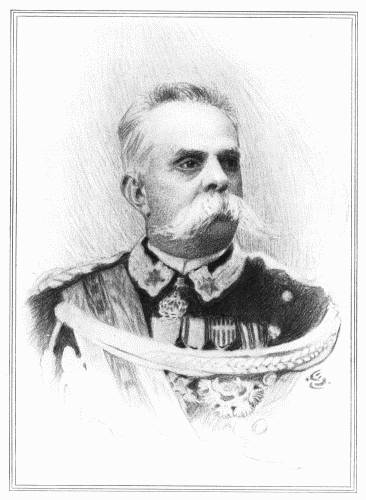 King Humbert of Italy.
After they had all gone we started out to the "Tre
Fontane," taking Gert with us to see the establishment
of the French Trappists who are trying to "assainir"
the Campagna by planting eucalyptus trees. It is an interesting
experiment, but rather a dangerous one, as several
of the fathers have died. The summer here, with
that deadly mist that rises from the Campagna, must be
fatal, and the two monks we saw looked yellow and shrivelled
with fever. However, they will persevere, with
that extraordinary tenacity and devotion of the Catholic
priests when they undertake anything of that kind.
I carried off a bottle of Elixir of Eucalpytus, for I am
sorry to say these last bright days have given me an
unpleasant souvenir in the shape of a cold chill every now
and then between the shoulders, and evidently there is
still truth in the Roman proverb "Cuore di donna, onde
di mare, sole di Marzo, non ti fidare." (Don't trust a
woman's heart, the waves of the sea, nor the March sun.)
We got home about half-past six, had tea and more
visits—Calabrini, Vitelleschi, and Princess Pallavicini,
who was most animated, and talked politics hard with W.
We dined at home and had a little talk, just as we were
finishing dinner, with Menabrea, who was dining at a
table next ours. They say he will go to the Paris Embassy
in Cialdini's place. W. wouldn't go out again, so
I went alone to Gert's, who had a few people—Mrs. Van
Rensselaer, clever and original; Countess Calice, an American;
her husband, a cousin of the Malatestas; Vera;
young Malatesta, a son of Francesco; a Russian secretary,
and one or two others. It was rather a pleasant evening.
They had tea in the dining-room—everybody walked
about, and the men smoked.
Tuesday, March 13, 1880.
Yesterday morning W. and I had a good outing, wandering
about the Capitol. First we walked around Marcus
Aurelius, then up the old worn stone steps to the Ara
Cœli. I told W. how we used to go there always on
Christmas Eve to see the Crèche and the Bambino. It
was very well done, and most effective. The stable,
beasts, shepherds, and kings (one quite black with a fine
crown). There were always children singing the "storia
di Gesù" and babies in arms stretching out their hands
to the lights. Yesterday the church was quite empty, as
there is not much to attract the ordinary tourist. We
made our way slowly, W. stopping every moment before
an inscription, or a sarcophagus, or a fresco, to the room
of the "Dying Gladiator," which he found magnificent—was
not at all disappointed; afterward the faun—and
then sauntered though all the rooms. I had forgotten the
two skeletons in one of the sarcophagi—the woman's
with rings on her fingers, most ghastly.
After lunch Countess Wimpffen came in to know if
I would drive with her to the Villa Borghese, and do two
teas afterwards—Madame Cairoli and Madame Westenberg
(wife of the Dutch Minister, an American and a
great friend of Gert's); but I couldn't arrange it, as W.
wanted to come with me to the Affaires Etrangères—so
we agreed to go another day. I always liked both Wimpffens
so much when they were in Paris that it is a great
pleasure to find them here. Wimpffen likes to get hold
of W. and talk about France and French politics.
Our dinner at Mrs. Bruce's was very gay. I told her
I didn't find her salon much prettier than in our days
when we lived on the first floor of Perret's house (she on
the second), and she always said we made Perret send
up to her all the ugly furniture we wouldn't have. What
we kept was so bad, that I think the "rebut" must have
been something awful. We had the Minghettis, Vitelleschis,
Wurts, Wilbrahams, Schuylers, and one or two
stray Englishmen. Vitelleschi took me in, and I had
Minghetti on the other side, so I was very well placed.
It is killing to hear them talk politics—discussing all the
most burning questions with a sort of easy persiflage and
"esprit de conciliation" that would astound our "grands
politiques" at home. Minghetti said the most absolutely
liberal man he had ever known was Pio Nono—but what
could he do, once he was Pope.
It was really a charming dinner—Mrs. Bruce is an
ideal hostess. She likes to hear the clever men discuss,
and always manages to put them on their mettle. We
all came away about the same time, and W. and I went
on to the opera "Tor di None." Bibra had invited us to
come to his box. The house was much less "élégante"
than the Paris house—hardly any one in a low dress, no
tiaras, and few jewels. The Royal box empty. Princess
Bandini was in the next box with Del Monte and Trochi.
The Minghettis opposite with the Wimpffens. The
"salle" was badly lighted—one could hardly make the
people out.
W. had rather a shock—we had scarcely got in—(Bibra
not yet come) when the door opened and in came
Maurizio Cavaletti—enchanted to see me—seizing both
my hands—"Maria mia adorata—cara regazza, etc.,"
utterly oblivious of "cara Maria's" husband, who stood
stiff and cold (an icicle) in the background, with Anglo-Saxon
written all over him; waiting for the exuberant
demonstration to finish, and a presentation to be made.
As soon as I could I presented Monsieur le Marquis in
proper form, and explained that we were very old friends,
had not met for years, etc., but W. hardly thawed all the
evening.
When he went out of the box to pay a visit to our
neighbours I remonstrated vigorously with Maurizio, but
he was so unfeignedly astonished at being taken to task
for greeting a very old friend warmly, that I didn't make
much impression. The ballet was pretty, and of course
there was an influx of young men as soon as it began—a
handsome, rather stout "ballerina" being evidently a
favourite.
To-day we breakfasted with the Schuylers to meet
Mrs. Bruce and Cardinal Howard—no one else. We had
a pretty little breakfast, most lively. I didn't find the
Cardinal much changed, a little stouter perhaps. He was
quite surprised at W.'s English; knew of course that he
had been educated at Rugby and Cambridge, and had the
Chancellor's medal, but thought he would have lost it a
little having lived so many years in France, and having
made all his political career in French. I asked him if he
was as particular as ever about his horses. He always
had such splendid black horses when we lived in Rome,
but he said, rather sadly, that times were changed. W.
and he talked a long time after breakfast. He was very
anxious to know whether all the religious orders were
threatened in France or merely the Jesuits. Comte Palfy
(Austrian) came in just as we were leaving. He is so
attractive—a great friend of l'Oncle Alphonse—knows
everybody here and loves Rome.
W. and I went off to the Villa Albani—out of Porta
Salara. We walked through the rooms—there are principally
busts, statues, bas-reliefs, etc.—and then loitered
about the gardens which are fine. Fountains, vases, and
statues in every direction, and always that beautiful view
of the hills in the soft afternoon light.
I will finish when I come home from our Black dinner.
We are asked for seven, so of course will get back early,
as we do not go anywhere afterward. I shall wear
black, as I hear so many Princes of the church are to be
there. Madame Hubert is very sorry I can't wear the
long black veil that I did for the Pope—she found that
most becoming.
Tuesday, March 12, 1880, 10.30 p.m.
We are just home from our dinner at the Portuguese
Embassy, so I have got out of my gauds and into my tea-gown,
and will finish this long letter. It was most interesting—a
great deal of couleur locale. We arrived
very punctually—three or four carriages driving up at
the same time. There was of course a magnificent porter
downstairs, and quantities of servants in handsome
liveries; a good deal of red and powder. Two giants at
the foot of the staircase, with the enormous tall candles
which are de rigueur at a Black embassy when cardinals
or ambassadors dine. They were just preparing
to escort some swell up the staircase as we arrived; there
was a moment's halt, and the swell turned out to be M.
Desprez, the new French Ambassador to the Vatican (replacing
the Marquis de Cabriac). He was half embarrassed
when he recognised us; W. had so lately been his
chef that he couldn't quite make up his mind to pass
before him—especially under such novel and rather trying
conditions. However, there was nothing to be done,
and he started up the great staircase between the tall
candles, W. and I followed modestly in his wake. We
found several people, including two or three cardinals,
already there. The apartment is very handsome.
The Ambassador (Thomar) looked very well—"très
grand seigneur"—standing at the door of the first salon,
and one saw quite a vista of large, brilliantly lighted
rooms beyond. All the guests arrived very quickly—we
had hardly time to exchange a word with any one.
I saw the Sulmonas come in. I recognised her instantly,
though I hadn't seen her for years. She was born Apponyi,
and they were married when we were living in
Rome. Also Marc Antonio Colonna and the d'Aulnays.
Almost immediately dinner was announced. Sulmona
took me in and I had a cardinal (Portuguese) on the
other side. I didn't say much to the cardinal at first.
He talked to his neighbour, and Sulmona and I
plunged, of course, into old Roman days. He was much
amused at the composition of the dinner, and wondered
if it would interest W. He asked me if I remembered
the fancy ball at the Palazzo Borghese. He had still
the album with all the photos, and remembered me perfectly
as "Folie" with short skirts, bells, mirror, etc.
I remember it, of course, quite well. Some of the
costumes were beautiful, particularly those copied from
portraits. After a little while the cardinal turned his
attention to me. He was a nice old man, speaking
either French or Italian (both with a strong accent), and
much interested in the guests. He asked me if I
belonged to the corps diplomatique. I said no—we were
merely strangers spending the winter in Rome. He
thought there were a good many strangers at table—he
didn't know half the people, not having been long in
Rome; but he knew that there was one man dining whom
he had a great desire to see, Waddington, the late French
Premier; perhaps I knew him, and could point him out.
He had always followed his career with great interest,
but there were some things he couldn't understand, "par
exemple son attitude dans la question—" Then as I
didn't know what he might be going to say, I interrupted,
and said no one could point out that gentleman as well as
I, as I was Madame Waddington. He looked a little uncomfortable,
so I remarked, "Il diavolo non è tanto nero
quant è dipinto" (The devil is not so black as he is
painted), to which he replied, "Eh, no punto diavolo"
(no devil)—was rather amused, and asked me if I would
introduce him to W. after dinner. We then, of course,
talked a little about France, and how very difficult the
religious question was. He asked me where I had
learned Italian, so I told him how many years we had
lived in Rome when my brother was the last Minister
from the United States to the Vatican. Sulmona joined
in the talk, and we rather amused ourselves. Sulmona,
of course, knew everybody, and explained some of the
people, including members of his own (Borghese) family,
who were very Black and uncompromising. Still, as I
told him, the younger generation is less narrow-minded,
more modern. I don't think they mean to cut themselves
off from all participation in the nation's history. After
all, they are all Italians as well as Romans. The foreign
marriages, too, make a difference. I don't think the sons
of English and American mothers could settle down to
that life of inaction and living on the past which the
Black Party means in Rome.
As soon as I could after dinner I got hold of W.
(which was difficult, as he was decidedly surrounded)
and introduced him to my cardinal, whose name I never
got, and I went to recall myself to Princess Sulmona.
We had a nice talk first about her people—her father,
Count Apponyi, was Austrian Ambassador in Paris when
Marshal MacMahon was President, and their salon was
very brilliant, everybody going to them; the official world
and the Faubourg St. Germain meeting, but not mingling.
Then we talked a little about Rome, and the future of
the young generation just growing up. Of course it is
awfully difficult for families like Borghese and Colonna
who have been bound up in the old papal world, and given
popes to Italy, to break away from the traditions of centuries
and go in frankly for "Italia Unita." Do you
remember what they used to tell us of Prince Massimo?
When some inquisitive woman asked if they really called
themselves Fabius Maximus, he replied that it had been
a family name for 1,400 years.
The present Prince Massimo is one of the most zealous
supporters of the Pope. The great doors of his gloomy
old palace have never been opened since the King of Italy
came to Rome. One can't help admiring such absolute
conviction and loyalty; but one wants more than that in
these days of progress to keep a country alive.
The evening wasn't long; the cardinals never stay late,
and every one went away at the same time. We again
assisted at the ceremony of the big candles, as of course
every cardinal and the Ambassador had to be conducted
downstairs with the same form. It was altogether a very
interesting evening and quite different from any dinner
we had ever been at. I don't think the French cardinals
ever dine out in France; I don't remember ever meeting
one. Of course the "nunzio" went everywhere and always
had the "pas"—but one looks upon him more as
a diplomatist than a priest.
W. enjoyed his evening very much. He is now settled
in his arm-chair with his very disreputable pipe, and
has been telling me his experiences. He found my old
cardinal very intelligent, and very well up in French politics,
and life generally. He liked Sulmona, too, very
much; made her acquaintance, but didn't have a chance
to talk much to her, as so many people were introduced
to him. There is certainly a great curiosity to see him—I
wonder what people expected to find? He looks very
well, and is enjoying himself very much. I am so glad
we did not stay in Paris; he would have had all sorts
of small annoyances, and as it is, his friends write and
want him to come back. He is quite conscious of the
sort of feeling there is about him. First his appearance—a
great many people refuse to believe that he is a
Frenchman; he certainly is not at all the usual French
type, with his fair hair, blue eyes, and broad shoulders;
and when they realize that it is he the cautious, doubtful
way in which the clericals begin a conversation with
him, as if they expected red-hot anarchist declarations to
fall from his lips, is most amusing. Cardinal Howard
always seeks him out for a talk—but then he doesn't
mince matters—goes straight to the subject he wants to
discuss, and told him the other day he couldn't understand
how a man of his English habits and education
should ever have dropped (he didn't say degenerated, but
I think he thought it) into a French republican government.
W. is very pleased to see the cordial way in which
everybody meets me, and I must say I am rather touched
by it myself. I have never had a moment's disappointment,
and I was a little afraid, coming back in such
changed circumstances after so many years. Everybody
asks after you, and some one the other day—Countess
Malatesta, I think—asked if you still wore in Paris your
plain black dress and bonnet. I suppose she thought that
even you couldn't have resisted the Paris modiste. It
would seem strange to see you in a hat and feathers.
Good-night, dearest; W.'s pipe is out, and we are going
to bed.
Hôtel de Londres,
March 14, 1880.
Cannons are firing, drums beating, flags flying in all
directions to-day, dear mother. It is King Humbert's
birthday and there is to be a great revue on the Piazza
dell' Indipendenza. We are invited to go and see it by
Turkam Pacha, Turkish Minister, who has an apartment
on the Piazza; but as he told us that we should meet
Ismail Pacha (the ex-Khedive) we thought we had better
remain at home. I hardly think it would be a pleasure
to Ismail to meet the man who was one of the chief
instruments in his downfall. My sympathies were rather
with the Khedive—I never quite understood why France
and England should have politely but forcibly insisted
upon his leaving his throne and country—but whenever
I raised the question I had always that inert force the
"raison d'état" opposed to me. We crossed him the
other day driving. The carriage full of red-fezzed men
attracted my attention, and our Giuseppe told us who
they were. He looked very fat and smiling, evidently
was not rongé by his disasters. Turkam suggested
that I should come alone, but that of course I could not
do.
Mrs. Bailey, who has also an apartment on the Piazza,
has asked us to come to her, but I think I shall stay
quietly at home and look out of the window. I see lots
of officers and functionaries, in uniform, passing in fiacres
and riding, and a general migration of the whole city
including the beggars and flower girls of the Spanish
Steps toward the Piazza. W. says he will smoke his
cigar walking about in the crowd, and will see very well.
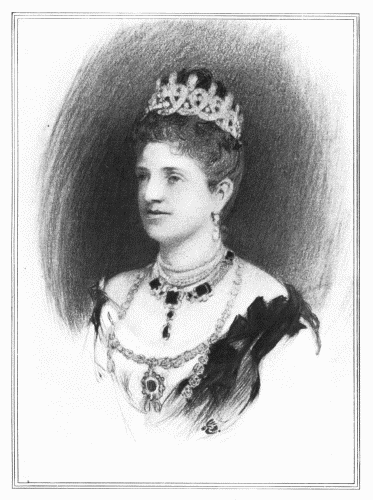 Queen Margherita of Italy.
I was interrupted by a message from Gert begging me
to come to her at once. Her maid was in such an extraordinary
state of violence she thought she was crazy—and
as Eugene was away for a day or two she was
really afraid. I questioned the little footman who brought
the note but he was very non-committal. W. was already
off to see the review and I left him a note explaining
where I was and asking him if I didn't get back to
breakfast to come and get me at Gert's. I then started
off with the little footman who had a fiacre waiting.
As I entered the court of the Palazzo Altemps a glimpse
of a white, frightened face at the window told me what
Gert's state was. Poor dear, she was terribly upset,
and Eugene's being away is a complication. Her two
men-servants are very devoted, but they evidently feel
uncomfortable. She asked me if I would go with her
and see the woman. We found her sitting in a chair
in Gert's dressing-room looking certainly most unpleasant,
sullen, and an ugly look in her eyes. She is a great
big Southern woman (French), could throw Gert out of
the window if she wanted to. Gert spoke to her very
gently, saying I had come to see her as I had heard she
was not well. She didn't answer nor move but gave
Gert a nasty look—she evidently has got something
against her. I looked at her very steadily—said we were
very sorry she was suffering, which was most evident,
and that the best thing for her would be to rest, attempt
no service of any kind and go to her own room—that we
had sent for Dr. Valery who would certainly be able to
relieve her. She didn't answer at first, and looked as if
she would like to spring upon us both, then burst into
screams of abuse—"She would go to her room of course—would
leave the house at once and never come back,
etc." I told her I should certainly advise Mrs. Schuyler
to send her away—that evidently the climate did not
suit her, and she would be happier in France. She didn't
answer, relapsed into her sullen silence, and almost immediately
Valery appeared. He insisted very quietly that
she should go to her own room (at the other end of the
apartment), and she went off with him, giving an ugly
look at Gert as she passed. It seems she already had had
such an attack, less violent, when they were at Birmingham,
but once it was over went on quite peaceably and
didn't seem to realize how ill she had been. Valery came
back to tell us the result of his examination—said she had
already calmed down and was anxious to beg her mistress's
pardon, but that she was of a nervous, dangerous
temperament, and at any moment might have a relapse.
Of course she must go, but it is very uncomfortable. I
took Gert out for a drive. W. sent me a line to say he
was busy all the afternoon and would not come unless I
wanted him. I think the air and distraction did her
good. The streets had a decidedly festive appearance.
There were a good many flags everywhere, and soldiers
still passing on their way back to their various barracks.
We were kept some time in the Corso seeing a battalion
of "bersaglieri" pass. They had good music and looked
very spirited as they moved along with all their feathers
flying. They were rather small, but well set up, and
marched in beautiful time with a light, quick step. We
saw some cavalry too, but I didn't care so much for them.
I thought the men looked too tall for the horses—their
legs too near the ground.
We went to Nazzari's for tea, and the man was so
smiling and pleased to see me that I asked him if he knew
me—"Ma sì, certamente, la Signorina King"—had seen
me various times in the Piazza or driving, and hoped I
would come in some day for tea. I went upstairs with
Gert when I took her home, and left every possible instruction
with the maître d'hôtel to look after her, and
above all to look after Louise, and not let her leave her
room. The cook's wife will help her dress, as the poor
thing has a dinner.
We have dined quietly at home. W. was tired, having
been out all day. There is a reception at the French
Embassy, but we shan't go. I told W. about the maid
and the exciting morning we had had. He said of course
the woman must go at once—that she had evidently a
grudge of some kind against Gert, and might do her some
injury. He had had rather a pleasant day. He walked
about in the crowd seeing everything very well. He was
rather favourably impressed with the Italian soldiers—said
they were small as a rule, but light and active—marched
very well. The King looked well, and was very
well received. He thought him a striking figure on
horseback in uniform, that curious type of all the Savoy
Princes. They don't look modern at all, but as if they
belonged to another century. I don't know exactly what
it is—one sees the same sort of face so often in old
Spanish and Italian portraits.
He had breakfasted alone, as I was over with Gert, and
then started off with Monsignor English to meet Father
Smith at the Catacombs, where they had a long delightful
afternoon. He says Father Smith is a charming
guide, knows and loves every corner of the Catacombs.
His brogue, too, is attractive, sounds so out of place in
that atmosphere of Latin and old-world tombs and inscriptions.
He also told me what pleased me very much,
that the Pope will give me his photograph, signed.
Monsignor English told him to tell me, and he will come
and see us to-morrow. Among our cards was one from
the Cardinal Di Pietro—Doyen of the College of Cardinals—coming
first to see W. What would the Protocole
say?
March 16, 1880.
Schuyler has got back, and the maid is a lamb, but is
going all the same. The doctor and the other servants
advise it strongly, and I am sure Gert will find a nice
Italian maid here to replace her. W. and I have done a
fair amount of sight-seeing these days, and yesterday he
paid a long visit to Cardinal Nina—Secretary of Foreign
Affairs for the Vatican. He found him reasonable and
interesting. I tell him he is getting quite a "papalino"—he
finds the Cardinals so pleasant. He came and got me
after his visit and we went off to the Chambre des Députés.
Visconti Venosta was going to make a great speech
attacking the Ministry on their foreign policy, and they
thought there would be a lively séance. We were in the
Diplomatic box—all the Ambassadors were there, and
he had just got up to speak as we got there. They
don't speak from the tribune, as in France. Every man
speaks from his own place—and as he had his back to us
we didn't hear very well. He spoke very easily, and
was very well listened to. Occasionally there would be
a sort of growl of disapproval, but on the whole the
house was much quieter than ours. Cairoli looked quite
composed when Visconti was pitching into him, smiling
even when he remarked he didn't understand the Italian
character, nor how to use the great powers his position
gave him, etc. Various people came up and spoke to
me, among others Countess Celleri, who seems to be taking
up politics now. She has grown a little older, but is
very handsome still, and was evidently a great attraction
to all the young diplomatists who were in the box. W.
admired her appearance and manner very much. We
stayed there till 5.30 hoping that Cairoli would answer,
but he didn't, the discussion rather trailed on, so we went
for a turn in the Villa Borghese to get a little air before
our dinner at the British Embassy. It was very
crowded, all the swells driving—King, Queen, and
Khedive all in separate carriages. The King in a small
victoria with one aide-de-camp—the Queen in her big
landau with one lady and the red royal liveries; the
Khedive in an ordinary carriage, but conspicuous, as he
and his gentlemen all wore the red fez.
Our Paget dinner was pleasant. They have got a
big villa in the Venti Settembre out toward Porta Pia.
There is a large garden with fine trees, and the entrance
and staircase are handsome. We were 36—Italians
chiefly—but a few Diplomatists. I knew almost every
one, Calabrinis, Minghettis, Somaglias (you will remember
her name, she was Gwendoline Doria, and married
when we lived in Rome), Serristori, Castagneta and some
Deputies and gentlemen of the Palace who, of course,
were strangers to me. The dining-room is large with a
quite round table which must be very difficult to cover,
there were such spaces. I think there must have been
hundreds of roses on the table. The Marquis de Villamarina,
head of the Queen's household, took me in, and
I had Uxkull on the other side, Lady Paget next to him.
We all talked together, and I complimented Lady Paget
on the quickness of the service. It was always one of
our preoccupations at the Quai d'Orsay to get through
these long official dinners as soon as possible. W. took
in Madame Visconti Venosta, and they seemed to be getting
on swimmingly. After dinner I talked some time
to Countess Somaglia, and asked to be introduced to the
Marquise Villamarina. She told me the Queen would
certainly receive us, but couldn't quite fix the day yet as
she had many official rendezvous these days. When the
men came in from smoking I had a few words with Calabrini,
and one or two Deputies were presented, Sella,
Lanza, etc., but I really only talked to Sir Augustus
Paget. He said they were going to have a small ball
after Easter, and hoped we should still be here. I hope we
shall, I should like to see the ball-room—they say all the
decoration, painting, flowers, cupids, etc., has been done
by Lady Paget herself. The party broke up early, no one
stays late at dinner. There is always a reception somewhere
to which everybody goes.
We came home as I get tired at night. We begin our
day early, and are never in the house. This morning
Gert and I went out shopping in the Piazza della Minerva
and Campo Marzo—it was most amusing. We got two
dresses for her—one of that coarse Roman linen, and a
very pretty Roman silk from Bianchi, the same man who
existed in our days. He looked most smiling and evidently
recognised the familiar faces, though he could not
put a name to them. We got the linen in a funny little
old shop, low, and as dark as pitch. I never should have
dreamed of going there for anything, but some one told
us it was the place for linen, and we found at once what
we wanted. I bought two Roman sashes—one for Alice
and a ribbon for Nounou. We pottered about for some
time looking at the bits of old brocade and embroidery,
some pieces stretched out on the pavement with a stone
at each end to hold them down. There were two pieces
of old rose brocade which looked very tempting, but when
I took them up I saw there were thin places in the silk,
and spots—so I resisted these "occasions." The woman
was amusing, tried to make us buy, but knew quite well
her silk was not first-rate. She evidently attached no
importance to the spots (è vecchia), but allowed that the
frayed bits were not encouraging.
This afternoon we have been again to the Chambre
des Députés—Cairoli was speaking. He has a good
voice, we heard him much better than Visconti Venosta.
I didn't find his speech very interesting. There were all
sorts of details and references to despatches and blue
books which were Greek to me, but of course W. liked
it and knew the question thoroughly so he said he would
stay and I had much better go and get some fresh air.
The heat was something awful and the box full, so I
took myself off. One of the Austrian secretaries came
down with me to look for the carriage and I started for
a solitary turn in the Villa Borghese. I hadn't gone very
far when I met Comtesse Wimpffen alone in her carriage.
We drew up for a little talk, and she proposed I should
send my carriage away and come into hers, which I was
delighted to do. We went for a little walk, and met
various friends—Marchesa Theoduli[19] looking lovely.
She was very amusing over the divided state of society—says
she is not allowed to bow to the Queen, and
as they meet almost every day driving and neither of
them can pass inaperçue it is rather awkward. Mrs.
Lorillard Spencer came up too, she was walking with
her daughter, Princess Vicovaro, whose husband was
"le beau Cenci" of our days. It was delicious lounging
about on the grass under the trees, after the heat
of the Chamber. We stopped at Nazzari's for tea, met
Bibra at the door and invited him to come with us—also
Cornélie Zuylen,[20] who had seen us from the street
and rushed in to have a little talk. She is in Rome for
a few days—sight-seeing hard. We had tea and very
good cakes—and I was glad to have a few minutes before
dressing for the Calabrini dinner.
We started off again at 8, and had really a very pleasant
evening at Calabrini's. Their house is not large—they
can't dine easily more than 10 people. I was the
only lady—the men were Vitelleschi, Sella (their rising
political man) whom W. was delighted to see, a Ruspoli
whom I had never seen before, a brother of the late
Prince; and Alphonso Doria who looks like a tall English
boy. Stella is clever enough, decidedly un homme
sérieux, and Calabrini was much pleased to have him
for my homme sérieux. He told us all sorts of stories
about "Italia Unita" and Cavour, and his profound distrust
of Louis Napoleon; how, until the very last moment
when the French troops were really at the gates,
he was afraid they wouldn't come. We stayed fairly
late, as the talk was interesting. I don't think there is
much real sympathy between the French and Italians.
They are very unlike though they are of the same race.
The Italians seem very excitable when they talk fast and
gesticulate and their eyes flash, but au fond they are
calmer than our people—at least the upper classes; I
don't know about the bas peuple. They say knives play
a part in their discussions. Certainly in France there
are always rows when the Italian workmen arrive.
They are generally terrassiers and come in bands when
railroads or bridges are being made. One recognises
them at once with their black eyes, white teeth, red
sashes and slouched hats. There is usually a coup de
couteau before the season ends. They work well enough,
are light and active, but always stop to talk—don't
keep up a sort of desultory talk over their work as our
men do.
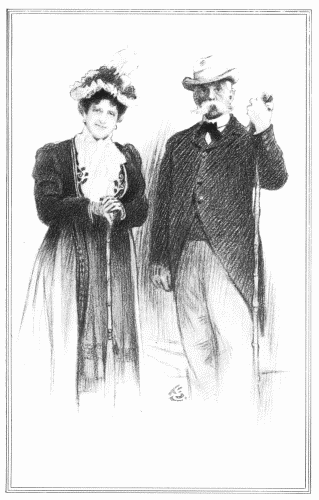 Queen Margherita and King Humbert.
March 18, 1880.
Last night we went to the Wimpffens' grand official
"ricevimento." All the street in front of the house was
crowded just as it used to be in the old days—people
coming close up to the carriages (going of course at a
foot's pace) and peering in to see the diamonds. There
was nothing like the display of carriages, diamonds, and
liveries there used to be—many fiacres, and many uniforms.
Countess Wimpffen looked very well in white
satin, pearls, and diamond tiara, Wimpffen of course in
uniform and his broad ribbon, Cenci (now Prince de
Vicovaro) attached to the Court, was standing at one side
of the Ambassadress presenting all the Court people.
The Princess, his wife, stood near by looking very well,
beautifully dressed, with diamonds and large pearl pendants.
She was wearing for the first time her decoration
of dame de palais. All the "White" Roman ladies
were there. I saw quantities of people whom I knew.
W. also begins to know the people. He thought the
Roman women very distinguished looking, and the jewels
splendid, particularly the pearls. We stayed quite late,
and decidedly amused ourselves. I was rather interested
in seeing when Madame de Wimpffen shook hands
and when she merely bowed. When W. was at the Foreign
Office and we had big receptions I was puzzled
sometimes. My impulse was not to shake hands with
the men. W. and Richard thought I ought to shake
hands with all the Deputies, but that seemed a great
undertaking and would, I think, have surprised them,
as Frenchmen as a rule are formal, don't shake hands
usually with ladies, but make rather a stiff bow, so
I compromised by shaking hands only with those I
knew.
This afternoon W. and I went out together. We left
several cards and wound up in the Villa Borghese, where
we walked about for some time. It was lovely under the
cypress trees, long dark avenues with a fountain at one
end—large vases—bits of half-ruined gateways, columns,
and unexpectedly a sort of rond or opening with fountains,
statues, big stones, all in a heap, and then long
stretches of lawn with anemones, violets, and a pretty
little yellow flower I didn't know, all perfectly neglected
and growing wild, but with a wonderful charm. Such
a contrast when we emerged again into the regular promenade
and the gay modern life of Rome of to-day. There
were quantities of carriages, three or four four-in-hands
with women in light dresses on the tops of the coaches;
men, principally officers, riding (in uniform, which always
makes a gay note), lots of victorias and open carriages.
The Prince of Naples (with the Royal red liveries)
driving with one gentleman. He was dressed in
sailor dress, looked smiling and interested, and bowed all
the time. Three or four carriages filled with pretty girls—English
or American—looking hard at everything, and
always bands of black-robed students, seminarists from
the various colleges which abound in Rome. It is a curious
motley crowd—I don't think one would see it anywhere
else. The clerical element is always well to the
fore, and in spite of the changes the Monarchy established,
with all the train of courtiers, deputies, soldiers,
and endless functionaries that it brings, one feels that it
is the great centre of Catholicism, and that the long arm
of the Church still retains her hold on her children scattered
all over the world.
I will finish now as we have come home fairly early
from the Pallavicini reception. We dined at home and
started off about 10. We went to get Gert, and on arriving
about 10.30 found ourselves almost the first people.
Felice Malatesta was there, also Del Monte. Both
being "Gardes-Nobles" they can only come early and
not run the risk of meeting any of the Court people nor
diplomatists to the Quirinal. Princess Pallavicini is one
of the Queen's ladies, but she is such an old friend of
both gentlemen that they always go to her. Among the
first arrivals was Massari. He and W. and Prince
Pallavicini had a nice talk, and it amused me to see the
people come in. There were about 30 (I knew a good
many of the Romans, but of course the Court people and
Deputies were strangers to me), Wimpffens, Noailles, St.
Asilea, Somaglias, and a sprinkling of young diplomatists.
As soon as the White diplomatists began to appear
Del Monte and Malatesta departed. I had a talk with
Villamarina who is very musical, also with Vitelleschi.
The party broke up early—there was no music nor dancing
(not even the little informal "tour de valse" there
used to be in our days) and we were home before 12
o'clock. W. enjoyed his evening—talked principally to
the men.
Saturday, March 20, 1880.
W. is off this morning with Father Smith to San
Clemente. I was lazy as I was out all day yesterday.
In the morning W. and I walked to the Palazzo dei
Cesari, and stayed there two hours walking about and
sitting down in the nice sunny places. It was beautifully
bright, a splendid blue sky, but cold, a sharp wind,
very unusual they say for the end of March. One gets
a very fair walk on the Palatine Hill. There is so much
to see, and the little irregular paths running up and down
from the various temples and ruined buildings of all
kinds give one plenty of exercise. It needs a good deal of
imagination to reconstruct all the temples, tribunes, porticoes,
and palaces which existed in the days of Imperial
Rome, but there are still bits of coloured marble, faded
frescoes, mosaics, tops of columns and broken statues in
every direction. W. was quite happy—he had already
spent a morning there with Lanciani, and so could show
me what was still well enough preserved for me to understand.
The view from the terrace over Rome and the
Campagna was beautiful—the mountains seemed so near.
We didn't walk home as we found a botta which had
just brought up a party of forestieri—French this time,
with a young priest, who was evidently the guide.
Sunday, March 21, 1880.
We went to the American church this morning as
Nevin was so anxious we should see it. There is no
very interesting French church—a sort of Vaudois chapel—so
we preferred the Capella Americana. It is a pretty
little church, very full—I should think a good many
English as well as Americans—very good singing and
a good sermon, not too long. We had visitors after
lunch, and about 4 started for a drive out to Ponte
Nomentano. We got out and walked about the Campagna
for some time. The view was divine—Frascati
and Rocca di Papa on one side, Tivoli on the other. W.
thought the old bridge most picturesque. He recognised
it instantly from the aquarelle that is in the dining-room
at home. As it was Sunday all the country people were
out; carts filled with women and children, boys on donkeys,
sitting well back, almost on the tails of the animals,
and all the little courts in front of the various osterias
quite full. There were not exactly costumes, but there
was a general impression of colour. The men had bright
coloured sashes and shirts—the women nearly all red and
blue skirts striped, and a coloured handkerchief on their
heads—almost all with long gold ear-rings (some of the
men too had ear-rings—large gold hoops) and a string
of coloured beads around their necks. Everybody talking,
laughing, and enjoying themselves. We stopped at
the British Embassy for tea. Lady Paget receives always
Sunday afternoon. There were various carriages
at the door, and the villa looked pretty. The tea-table
was on a broad palier at the head of the stairs. It was
very well arranged with screens "cassoni," plants, arm-chairs—very
original and attractive. I went in first to the
drawing-room and had a talk with Lady Paget, then adjourned
to the palier with Princess Sciarra and Countess
Wimpffen, and we had a very pleasant hour. It was
amusing to see all the people coming up the broad staircase.
There were of course a great many I didn't know,
as besides all the Court set and political people there were
many English, all arriving for Holy Week. Mrs. Bruce,
Madame Visconti Venosta, Gert, Marquise Chigi came
and joined us. I was quite horrified when I found how
late it was. We had just time to dress and go and dine
with the Geoffroys at the Palazzo Farnese. The evening
was very pleasant; decidedly archeological and scientific,
but the men were all clever and talked so well that they
would have made any subject interesting. We had Visconti,
de Rossi, Lanciani, and some of the young men of
the École Française. They all love Rome and know
every stone. W. was quite in his element, talked a great
deal himself, and was much interested in their excavations
and all the curious things they are finding all the time.
I meant to leave early and go to Gert who had a few
people at dinner, but it was eleven o'clock before any
one moved, and we went quietly home.
Good Friday, March 26, 1880.
I was too tired to-day to do anything, as yesterday we
were out all day. W. and I walked about in the morning,
going into all sorts of churches whenever we saw
one open. There were always people, and in the smaller
churches they looked devout and absorbed, but the crowd
of strangers in the large, better known basilicas took
away any religious feeling. It all seemed a great show,
which is practically what Holy Week is in Rome. They
say they have not had so many foreigners in years. Last
night the "gérant" begged us not to come downstairs
until 8 o'clock, or even a quarter past, as they needed all
the small tables for the table-d'hôte. It was not so very
crowded this morning as we breakfast at 12.30, much
earlier than the foreigners, who are usually English and
come in for luncheon at 1.30.
Yesterday afternoon we went to St. Peter's and found
ourselves in a long file of carriages going the same way;
also all kinds of pedestrians, priests, nuns, soldiers, artists,
Cook's tourists, etc. W. was rather horrified at the
crowd in the church, and the regular "bousculade" at the
big doors. There was to be very good singing at one of
the small chapels, but it was already so full that we
couldn't get in, though we had cards from one of the
Monsignori. We tried to make our way in but it was
utterly impossible, and then stood outside, thinking we
might hear; but the people all talked so much that we
heard nothing except every now and then a few notes in
that curious, high, unnatural voice of the Papal Choir.
Two young German priests, with keen intelligent faces,
were so put out—begged the people near not to talk—"in
zehn Minuten ist alles vorüber" (in ten minutes
it will be all over). All Rome was walking about
the church, talking and looking about as if they were
in a great hall of some kind—a crowd of strangers
pushing, jostling, and trying to get up to the High Altar,
or the statue of St. Peter where all the faithful were kissing
the toe. It was certainly not solemn nor edifying,
except when we came upon a quiet corner, with some old
chapel filled with tombs of dead Romans, Popes or
Princes, who had played a great part in their day. That
took us back into the past, and we could realize that we
were really in St. Peter's. I tried to show W. the part
that was shut off for the great Ecumenical Council
under Pio Nono, but I couldn't remember exactly. We
shall come back another day with Father Smith who will
know all about it. I did find the Stuart monument with
the busts of Charles Edward and Cardinal York. People
kept pouring into the church, but it is so enormous
that, except at certain places, it was quite easy to circulate.
All the women (except a few stray tourists) were
in black, and every now and then one saw a long file of
séminaristes, also in black, but with a coloured sash to
mark their nationality. I think the Americans wear blue—the
French are quite black—no colour. We talked to
quantities of people—it was like an enormous reception.
I was very tired when we finally came out, as of course
we were walking and standing about all the time. There
is no aisle with regular seats as in most churches—merely
a few prie-Dieu inside the side chapels. The
drive home was lovely—we went at a walk almost all the
time, there were so many carriages.
I went out after all this afternoon with W. and Monsignor
English to St. John Lateran, where they were
singing a Miserere of Cappoci's. It is most strange,
weird music, and the voices of the men are so unlike anything
one hears elsewhere. There was always the same
crowd. I will say Cook does his business thoroughly—wherever
there is anything to see or hear he pilots all
his band. After the Miserere was over we stood some
time at the foot of the Scala Santa. It was black with
people going up on their knees, saying a prayer at each
step (I think there are 30) and some of them did look
serious and absorbed. They were principally peasants—every
now and then some well-dressed bourgeois. Monsignor
English told us we would be surprised at the class
of people (society) who come early, before the great
crowd of sight-seers.
We went back to the Palazzo Altemps, picking up Count
Palfy on the way, where Gert had promised us tea and
hot cross buns from Spillman's (very good they were).
We found a note from the Quirinal when we came
home saying the Queen would receive us to-morrow at
2.30. Desprez came and sat some time. He told W. all
that was going on in Paris—the Ministry as usual struggling
against the Radicals who are always wanting to
suppress the French Embassy at the Vatican. It doesn't
make the position of the Ambassador very pleasant, but
Desprez is very wise, has had long training at the Foreign
Office, and will certainly do all he can to conciliate and
keep things straight.
Saturday, March 27, 1880.
It was raining this morning and I was very glad. The dust was getting most disagreeable in one's eyes and
throat, and covering everything. I am glad, too, that it
is cool, decidedly, as I wanted to wear my blue velvet.
If it had been a bright warm day it would have looked
dark and heavy. It is four o'clock—we have just come
in from our audience, and I will write at once while the
impression is fresh. W. has a "rendezvous" with some
of the French Institute people, and I shall not see him
again until dinner time. We got to the palace (a great
ugly yellow building, standing high) quickly enough, as
there was no one in the streets at that hour, and drove
into the court-yard to a handsome entrance and staircase.
There were a few soldiers about, but not much movement.
A carriage came in behind us, and just as we were
going upstairs some one called my name. It was Bessie
Brancaccio,[21] who had also an audience with the Queen.
She had come to thank her for her appointment as dame
de palais. I was glad to have just that glimpse of her, as
they are not in Rome this winter. Their beautiful house
is not ready for them, so they have been spending the
winter in Nice. We walked through a large anteroom
where there were three or four servants and an "écuyer,"
and in the first salon we were received by the Comtesse
Marcello, one of the Queen's ladies, a Venetian and a
great friend of Mary's, and the gentleman-in-waiting,
whose name I didn't master. We talked for a few minutes—she
said a lady was with the Queen. The room was
handsome, prettily furnished and opened into another—three
or four, in fact, all communicating. After about ten
minutes we saw a lady come out of the end room, the
door of which was open, so Comtesse Marcello ushered
us through the suite. We went to the corner room,
quite at the end, where the Queen was waiting standing.
We went through the usual ceremony. The Comtesse
Marcello made a low curtsey on the threshold,
saying, "I have the honour to present his Excellency, M.
Waddington and Madame Waddington," and instantly
retired. The Queen was standing quite at the end of the
room (a lovely, bright corner room, with lots of windows
and a magnificent view over Rome—even on a dull day
it looked cheerful and spacious). I had ample time for
my three curtseys. She let us come quite close up to
her, and then shook hands with us both and made us sit
down—I next to her on the sofa, W. in an arm-chair in
front. I found her rather changed since I had seen her.
She has lost the girlish appearance she had so long, and
her manner was nervous, particularly at first. When she
began to talk and was interested and animated she was
more like what I remembered her as Princess Marguerite.
She was dressed in bronze satin, with a flowered brocade
"casaque," and one string of splendid pearls. She told W.
she was very pleased to see him, remembered that I had
lived in Rome before my marriage, and asked if I still
sang, Vera had talked so much about the music in
Casa Pierret, and the trios we used to sing there with
Lovatelli and Malatesta. The talk was most easy, about
everything, generally in French, but occasionally breaking
into English, which she speaks quite well. W. was
delighted with her—found her most interesting and "très
instruite"—not at all the banal talk one expects to have
with sovereigns—in fact, I quite forgot we were having
a royal audience. It was a very pleasant visit to a charming
woman, in a pretty room with all sorts of beautiful
pictures and "bibelots" about. While we were still
there the Prince of Naples[22] came in. We both got up;
she told him to shake hands with W. and to kiss me, and
to ask me how old my little boy was, which he did quite
simply and naturally. He told his mother he was going
to ride. I asked him if he had a nice pony, to which he
replied in English, "Oh, yes, jolly," and asked if my
little boy rode. I said not yet; he was only two years
old. The child looked intelligent, but delicate. They
say his mother makes him work too much, is so ambitious
for him; and he has rather that look. The Princes of
Savoy have always been soldiers rather than scholars, but
I suppose one could combine the two. The Queen also
spoke about the Bunsens, and "little Beatrice";[23] said
she was very fond of Mary. I was very sorry when the
audience was over and she dismissed me, saying she had
people waiting.
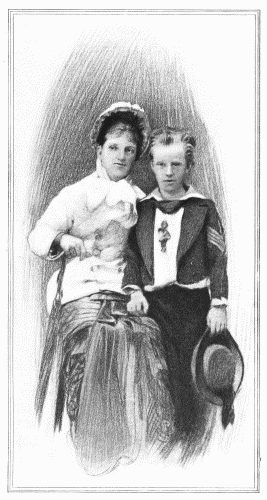 Queen Margherita and the Prince of Naples (Present King of
Italy) in 1880.
Queen Margherita and the Prince of Naples (Present King of
Italy) in 1880.
We found Bessie and one or two other ladies in the
first salon when we came out, waiting their turn. Comtesse
Marcello was delighted with all W. said about the
Queen. He was very enthusiastic, for him, as he is not
generally gushing. I told her she had remembered that
I had lived some years in Rome as Mary King, and she
said: "Oh, yes, she remembered you and all your
family perfectly, and knew that you had married M.
Waddington."
Tuesday, March 30, 1880.
It is much pleasanter to-day—quite Spring-like, and
the Piazza is full of people. I have drawn my little writing
table close up to the window, and I am afraid my correspondence
will suffer, as there is always so much to see.
Almost all the little botte have departed, in fact W.,
who has just started off with Visconti for the Vatican to
look at the coins, took the last one. Cook's two big
omnibuses have also just started for Tivoli—crammed.
Some of the people dashed into Nazzari's, and reappeared
with little paper bags, filled evidently with goodies.
Yesterday W. and I breakfasted again at the Noailles',
and they took us over the palace (Farnese) which is quite
splendid, such enormous rooms and high ceilings. The
great gallery with the famous Carracci frescoes looked
beautiful in the daylight, and we saw them much better.
The colours are still quite wonderful, hardly faded, some
of the figures so graceful and life-like. Madame de
Noailles' bed-room and dressing-room are huge. The
enormous bedstead hardly took up any room at all. She
said it took her some little time to accustom herself to
such very spacious apartments, she almost had the impression
of sleeping in the streets.
We went for a drive afterward out of Porta Maggiore
to look at the Baker's tomb—do you remember it, a great
square tomb with rows of little cells? We wandered
about on foot for some time, looked at the bits that remain
of the old Roman road, and then drove out some distance
toward the arches of the Claudian Viaduct. It is the road
we shall take when we go to Tivoli. It was not quite
clear, so the hills hadn't the beautiful colour they have
when the sun is on them—but the grey atmosphere seems
to suit the Campagna, which is after all a long stretch of
barren, desolate country broken at intervals by the long
lines of aqueducts—every now and then a square tower
standing out straight and solitary against the sky, and
hardly visible until one comes close upon it, and a few
shepherds' huts, sometimes with a thatched roof, sometimes
what remains of an old tomb, with a dried-up old
woman apparently as old as the tomb spinning in the
doorway. We met very few vehicles of any description.
We dined at the Palazzo della Consultà where Cairoli,
Foreign Minister, lives. There were not many women—Madame
de Noailles, Gert, Madame de Sant' Onofrio
(wife of one of Cairoli's secretaries), and quantities of
men. They divided the honours—Cairoli took in Madame
de Noailles—Madame Cairoli, W. The Préfet of Rome,
Gravina, took me and put me on Cairoli's left. We all
talked Italian, and I rather enjoyed myself. I told Gravina
how much I preferred "Roma com' era," that the
new buildings and the boulevards and the bustle and the
quantities of people had spoiled the dear, dead, old Rome
of our days—to which he replied "but you, Madame, are
an American born, you surely can't be against progress."
Oh, no, I like progress in my own country, but certainly
not here. Rome was never intended to be modern and
go-ahead—it didn't go with the monuments and the
ruins and the traditions of old Rome. However he answered
me quite seriously that not only every country,
but every individual, must "marcher," or else they would
"dépérir." Cairoli joined in the conversation, others too,
and there was rather an interesting discussion as to how
much could be left to sentiment, association of the past,
etc., when an old historic city was being transformed into
a busy, modern, political centre.
After dinner Madame Cairoli came and sat down by
me, and was pleasant enough. She looked handsome—very
wide awake—still continues to call me Madame la
Comtesse, so I have given up correcting her. She is well
up on all subjects, particularly art, music, pictures, etc.
She was rather amusing over the state of society and all
the great Roman ladies whom she didn't know (there is
such a division between the Government people and the
old Romans) but said she had a very pleasant entourage
with all the diplomatists and the distinguished strangers
(with a little bow to me) and really didn't notice the
absence of the grandes dames. She asked me about
my audience with the Queen—had we been able to talk
to her at all. She had been so tired lately and nervous
that any attempt at conversation was an effort. I told
her that on the contrary she talked a great deal, and that
I didn't find her changed.
Maffei came up and talked—asked me if I really liked
Rome better as it used to be—I must surely prefer life
to stagnation. He speaks English well, and likes to
speak. They tell me that all the present generation of
Romans speak English perfectly—much better than
French. There was a small reception after dinner, some
of the young diplomatists and political men. We came
away early—10.30, and plunged into our Paris letters, of
which we found quantities.
Friday, April 2, 1880.
It is raining quite hard this morning, so I will write
and not go out until after breakfast. Yesterday was
beautiful, and we had a charming day at the races. I
drove out with Madame de Wimpffen in her victoria—W.
and Wimpffen together. I wore my brown cloth with
the coat trimmed with gold braid and a great bunch of
yellow roses on my hat, but I was sorry I hadn't sent for
something lighter, as almost all the women were in white.
I had thought of having two dresses sent by the "valise"
(I hadn't time to have them sent by ordinary express).
I consulted Noailles, who was very amiable, and said he
would do what he could, but that the rules were very
strict now for the "valise," as there had been such abuse.
I rather protested, so he remarked with a twinkle in his
eye that I had better speak to my husband, as he was the
Minister who had insisted on a reform being made—he
added that it was Princess Lise Troubetzkoi who made
the final scandal—that when St. Vallier was French Ambassador
to Berlin she was always sending things to
Petersburg, via Berlin, by the "valise." When the "petit
paquet" she had spoken of turned out to be a grand piano
there was a row, and W., who was then Foreign Minister,
decreed that henceforth no "paquets" of any kind that
were not on official business could be sent by the "valise."
I suppose a pink tulle ball dress would hardly come under
that head.
The Queen was there looking very well and bright,
dressed in light grey with a big black hat—very becoming.
There were a great many pretty women. We came away
before the end and drew up a little distance from the gate
where a long string of carriages was waiting to see the
Queen pass. The cortège was simple—first two dragoons,
then a "piqueur" and her carriage with four horses,
postillion and two servants behind in the scarlet liveries.
The Countess Marcello was seated alongside of the Queen—two
gentlemen (I couldn't make out who they were)
facing her; a second carriage with two horses with two
gentlemen in it followed, all very well turned out. The
scarlet liveries make a great effect, one sees them from
such a distance. The crowd was very respectful—not
particularly enthusiastic. The Queen bowed right and
left very prettily. I talked to lots of people at the races—among
others to Madame Alphonse Rothschild who is
here for a few days, and to Mesdames Somaglia, Rignano,
Celleri, etc. I walked about a little with Sant' Asilea, but
it was not easy to move—most of the ladies stayed quietly
in the tribunes. We stopped at Nazzari's coming back
and W. treated us all to tea—then we sent our carriage
away as we wanted it at night for the Teano ball, and we
walked about in the Corso, looking at all the turn-outs.
The Teano four-in-hand was very handsome, and there
were one or two others we couldn't make out which were
very well turned out—some of the victorias, too, very
smart, with handsome stepping horses. The Corso was
full of people waiting to see the "retour"—it looked so
gay. About eleven we went off to the Teano ball, which
was most brilliant—all the société there. Again I was
sorry I hadn't sent for another dress as my red satin
looked heavy and wintry. Princess Teano in white, with a
diamond tiara, looked charming. Of course all the young
generation who were dancing were strangers to me, but
I met many old friends. I had quite a talk with Doria
who wanted to be introduced to W. whom he had not
yet seen. We stayed until 1.30, and when we came away
they were just beginning the cotillon. In the old days
we used to arrive at the balls about 12.30 or 1 o'clock just
so as to have one waltz before the cotillon which was
usually the best of the evening, as all the serious people
had gone, and the mammas were at supper fortifying
themselves for the long hours before them, so the ball-room
was comparatively empty and one could get a good
turn.
Saturday, April 3, 1880.
It is a beautiful morning, so was yesterday, an ideal
Roman day—the sky so blue and just a soft little air that
makes the awnings over the shops opposite flap lazily and
indisposes one to any exertion. We walked about a little
before breakfast, inspected the Fountain of Trevi where
Neptune sits in state, looking at the rush of water falling
over the rocks and splashing into the great marble basin.
The water is beautifully clear, and sparkled and glistened
in the sunlight. There were a good many people about—girls
with pitchers on their heads, old men and women
with pails and cans, all after water. The Trevi water is
considered the best in Rome and is in great demand. We
loitered about in the small narrow streets that branch off
in every direction, always seeing something interesting.
I think we lost our way as we found ourselves down by
Trajan's Column and Forum, but we managed to get back
to the Piazza di Spagna in good time for breakfast.
We started again in the afternoon for tea at the Farnesina
Palace with the Duke di Ripalda. We stopped at
the Farnese Palace to pick up Madame de Noailles, who
was coming too, and we had a charming afternoon.
Ripalda took us all over the Palace, and W. was delighted
with the frescoes, particularly Sodoma's. The garden
was lovely, though they have cut off a great piece for their
quays and works along the river. They are enlarging
the Tiber, making great walls, etc. The City of Rome
gave Ripalda a large sum of money, but he is much disgusted
as it had taken a good bit off his garden. More
people came in—the wife of the Peruvian Minister, a
very pretty woman, and one or two men. We had tea
in the long gallery with all Raphael's and Carracci's beautiful
gods and cupids over our heads. How many different
scenes they must have looked down on—not always
so peaceful as this quiet party.
Saturday evening, April 3, 1880, 10 p.m.
We went to the German Embassy on our way home to
write ourselves down for the German Crown Princess,
who had just arrived there for a short stay. I hope I
shall see her—W. admires her so much. He saw her
often when he was in Berlin for the Congress, and found
her most sympathetic and charming. Turkam Bey came
in just before dinner and had a great deal to say about
the Khedive, and what France would have done if he had
resisted, retired up the country, and obliged the French
and English to depose him by force. It was evident that
the suite had been talking to him, and talking very big—he
was very anxious to have a categorical answer. W.
said very quietly they had never considered that emergency,
as it was quite evident from the beginning that
the Khedive had no intention of resisting. "Cependant,
monsieur, s'il avait voulu," etc., so W. could only repeat
the same thing—that they had never been anxious on that
point.
We dined quietly at home, and in the course of the
evening there came a note from Keudell, the German
Ambassador (whom we don't either of us know), saying
that "par ordre de Son Altesse Impériale la Princesse
Héréditaire d'Allemagne" he had the honour to ask M.
and Madame Waddington to dine to-day at 7.30 at the
Embassy "en petit comité." We should find a small party—the
Wimpffens and Pagets. The Princess only arrived
on Thursday, and W. is much pleased that she should
have thought of us at once. Keudell has been ill with
gout ever since we have been here. We have never once
seen him, but various people told W. he regretted so much
not seeing him, that the other day we tried to find him,
but the porter said he was still in his room.
Sunday, April 4, 1880.
Our dinner was charming. I was not a bit disappointed
in the Princess. W. had talked so much about
her that I had rather made up my mind I should find her
very formal and German—and she isn't either one or the
other. We left a little after seven (I wearing black satin).
I am so bored with always wearing the same dresses. If
I had had any idea we should go out every night I should
have brought much more, but W. spoke of "a nice quiet
month in Rome, sight-seeing and resting." We were the
first to arrive. Keudell was at the door, introduced himself,
and took us into the large salon, where Madame Keudell
was waiting. She looked slight and rather delicate,
and he really ill, so very white. He said he had had a
long, sharp attack of gout—had not been out for some
time, and was in the salon for the first time the day the
Princess arrived. While we were waiting for the others
to come he showed us the rooms and pictures. I recognised
at once one of those pretty child's heads by Otto
Brandt like the one we have. He was much interested in
knowing that we had bought one so long ago, he thought
Brandt had so much talent. There was a grand piano,
of course, as he is a fine musician. The Pagets and
Wimpffens came together almost, and as soon as they
were there the Princess came in. She had one lady with
her and a "chambellan"—Count Seckendorff. She was
dressed in black, with a handsome string of pearls. She
is short, and rather stout, carries herself very well and
moves gracefully. We all made low curtseys—the men
kissed her hand, Sir Augustus Paget just touching the
floor with his knee, the first time I had seen a man kneel
to any one in a salon. She received W. most charmingly,
and was very gracious to me—asked me at once why I
didn't accompany my husband to Berlin. I said, "Principally
because he didn't want me," which was perfectly
true. He said when he was named Plenipotentiary that
it was all new ground to him, that he would have plenty
to do, and didn't want to have a woman to look after.
He rather protests now, but that is really what he said,
and I certainly didn't go. The dinner was pleasant
enough. The Princess talked a great deal, and as the
party was small, general conversation was quite easy.
The talk was all in French, which really was very amiable
for us—we were the only foreigners present, and naturally
if we hadn't been there every one would have spoken
German. After dinner she made a short "cercle," standing
in the middle of the room, all of us around her, then
made a sign to W. to come and talk to her, sat down on
the big sofa, he on a chair next, and they talked for about
half an hour. We all remained standing. I asked
Keudell about his piano. He told me that he liked the
Erard grand very much, but that they didn't stand travelling
well. In a few moments the Princess told us all
to sit down, particularly Keudell, who looked quite white
and exhausted. I sat by Madame Keudell, and as she is
very fond of Italy, and Rome in particular, we got on
very well. When the Princess had finished her talk with
W. she came over and sat down by me—was most charming
and easy. She has the Queen's beautiful smile, and
such an expressive face. We spoke English; she asked
me if I had become very French (I wonder?)—that she
had always heard American women were so adaptable,
taking at once their husband's nationality when they married
foreigners. She had always remained very fond of
England and English ways—the etiquette and formality
of the German Court had tried her at first. She asked
me, of course, how many children I had—said one was
not enough. "If anything should happen to him, what
would your life be?" and then spoke a great deal about
the son she lost last summer by diphtheria, said he was
the most promising of all her children, and she sometimes
thought she never could be resigned. I said that her life
was necessarily so full, she had so many obligations of
all kinds, had so many to think about, that she would be
taken out of herself. "Ah, yes, there is much to do,
and one can't sit down with one's sorrow, but the mother
who has lost her child carries a heavy heart all her life."
It was all so simply said—so womanly. She said she
was very glad to meet W. again, thought he looked very
well—was sure the change and rest were doing him good.
She regretted his departure from the Quai d'Orsay and
public life generally. I told her he was still a Senator,
and always interested in politics. I didn't think a few
months' absence at this time would affect his political
career much, and that he found so much to interest him
that he really didn't miss the busy, agitated life he had
been leading for so long. She said she intended to spend
a quiet fortnight here as a tourist, seeing all she could.
She then talked to all the other ladies, and about ten said
she was tired and would go to her own rooms. She shook
hands with the ladies, the men kissed her hand, and when
she got to the door she turned and made a very pretty
curtsey to us all. We stayed on about a quarter of an
hour.
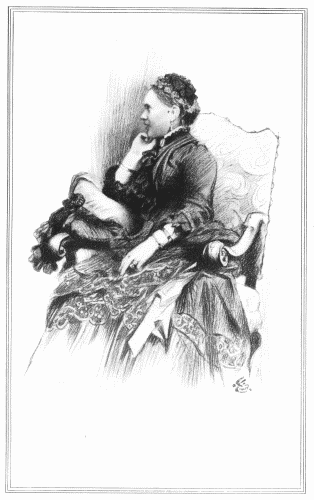 Victoria, Crown Princess of Germany.
The Wimpffens have arranged a dinner for her on
Thursday (to which she said she would like to have us
invited), just the same party with the addition of the
Minghettis. As we were going on to Madame Minghetti's
reception, Countess Wimpffen asked us to tell them to
keep themselves disengaged for Thursday, as she wanted
them for dinner to meet the Princess—she would write,
of course, but sent the message to gain time. They
brought in tea and orangeade, and I talked a little to
Count Seckendorff—he speaks English as well as I do.
He told me the Princess was quite pleased when she heard
W. was here, and hoped to see him often. We hadn't
the courage to stay any longer—poor Keudell looked
ready to drop—and started off to the Minghettis'.
It was a beautiful, bright night, and the Capitol and all
its surroundings looked gigantic, Marcus Aurelius on his
big bronze horse standing out splendidly. We found a
large party at Madame Minghetti's—principally political—not
many women, but I should think every man in
Rome. Alfieri, Visconti Venosta, Massari, Bonghi, Sella,
Teano, etc. It was evidently a "centre" for the intelligent,
serious men of all parties. There was quite a buzz,
almost a noise, of talking as we came in—rather curious,
every one seemed to be talking hard, almost like a meeting
of some kind. They were all talking about the English
elections, which apparently are going dead against the
Ministry. Minghetti said it was quite their own fault—a
cabinet that couldn't control the elections was not fit to
live. Of course their time was over—there was no use in
even attempting a fight—they had quite lost their hold on
the country. Madame Minghetti seems as keen about politics
as her husband. She has many friends in England.
I told her about the Wimpffen dinner—they will go, of
course. She asked a great deal about the Princess—said
she was very glad she had decided to come to Rome, that
she couldn't help being interested and distracted here,
which she needed, as she was so upset by her son's death.
We talked music—she sings very well—and we agreed
to sing together some afternoon, perhaps at the German
Embassy, as Keudell is a beautiful musician and loves to
accompany.
Mrs. Bruce was there and I sat down by her a little
while, looking at the people. She pointed out various
political swells, and a nice young Englishman (whose
name I didn't catch) joined us, saying he wished he understood
Italian, as it was evident the group of men
around Minghetti was discussing English politics, and he
would so like to know what they were saying. Mrs.
Bruce told him it was just as well he didn't understand,
as, from the echoes that came to her, she didn't believe it
was altogether complimentary to John Bull. I don't believe
political men of any nationality ever approve any
ministry. It seems to me that as soon as a man becomes
a cabinet minister, or prominent in any way, he is instantly
attacked on all sides.
We didn't stay very long, as we had promised to go
for a few moments to the Farnese Palace, where the
Noailles had also a reception. I had some difficulty in
extracting W. from the group of men. He naturally was
much interested in all the talk, and as almost all the men
were, or had been ministers, their criticisms were most
lively. They appealed to him every now and then, he
having been so lately in the fray himself, and he was a
funny contrast with his quiet voice and manner to the
animated group of Italians, all talking at once, and as
much with their hands as with their tongues.
It was very late—after eleven—but we thought we
would try for the Noailles, and there were still many carriages
at the door when we drove up. We met so many
people coming away, on the stairs and in the long anteroom,
that it didn't seem possible there could be any one
left, but the rooms were quite full still. The palace
looked regal—all lighted—and there were enough people
to take away the bare look that the rooms usually have.
They are very large, very high, and scarcely any furniture
(being only used for big receptions), so unless there
are a great many people there is a look of emptiness, which
would be difficult to prevent. Madame de Noailles was
no longer at the door, but I found her seated in the end
room with a little group of ladies, all smoking cigarettes,
and we had an agreeable half hour. Madame Visconti
Venosta was there, and another lady who was presented to
me—Madame Pannissera, wife of one of the "grand-maîtres
de cérémonie" at court. W. was at once absorbed
into the circle of men, also talking politics, English
elections, etc., but he was ready to come away when I
made the move. Noailles insisted upon taking me to the
buffet, though I told him I had done nothing but eat and
drink since 7.30 (with a little conversation thrown in).
It was rather amusing walking through the rooms and
seeing all the people, but at 12.30 I struck. I really was
incapable of another remark of any kind.
I will finish this very long letter to-day. I wonder if
you will ever have patience to read it. I am sure I
shouldn't if it were written to me. I hope I shall remember
all the things I want to tell when we get back—so
much that one can't write. My black satin was right—the
Princess was in mourning, the other ladies equally in
black. W. wants me to be photographed in the black
dress and long veil I wore at the Pope's audience. He
found it very becoming, and thinks Francis ought to have
one; but it is so difficult to find time for anything.
Saturday, April 10, 1880.
We had a nice musical evening the other night at
Gert's. All the vieille garde turned up, Vera, Malatesta,
Del Monte (with his violoncello), and Grant. We
sang all the evening, and enjoyed ourselves immensely.
I was sorry Edith Peruzzi couldn't come, as she sings so
well, and it would have been nice to have another lady.
She has been nursing her mother, who has been ill (so ill
that they sent for Edith to come from Florence), but she
is getting all right now, and I don't think Edith will stay
much longer. Charles de Bunsen has arrived for a few
days. We took for him a room at our hotel, and we have
been doing all manner of sight-seeing. Thursday morning
we went to the Accademia of San Luca, where we had
not yet been. It was rather interesting, but there is much
less to see than in the other galleries. There are some
good busts and modern pictures—a pretty Greuze.
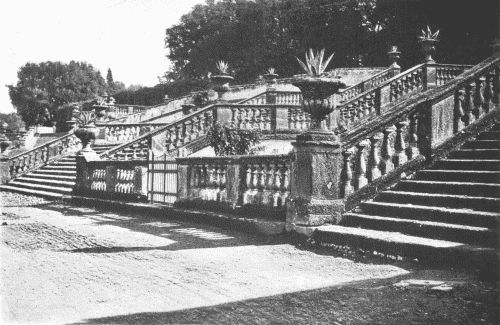 Gardens of the Villa Torlonia, Formerly Villa Conti, Frascati, Opposite the Villa Marconi, Where we Spent the Summer of 1867.
Our dinner at the Wimpffens' was very pleasant. We
arrived very punctually at 7.20 and found the Keudells
already there. He told us the Princess was very tired,
she had been all day in the galleries standing, looking at
pictures, and he didn't think she would stay late. He
still looked very tired and pale, but said he was much
better and that the royal visit did not tire him at all. The
Princess was very considerate and went about quite simply
with her lady and Count Seckendorff. The other
guests arrived almost immediately—the Pagets, Minghettis,
Gosselins of the British Embassy, and Maffei,
Under-Secretary of the Foreign Office. About a quarter
to eight the Princess arrived with her lady and chamberlain,
she was dressed in black, with a long string of
pearls. We went at once to dinner (which was announced
as she entered the room), Wimpffen of course taking the
Princess, who had Minghetti on her other side. Sir
Augustus Paget took me, and I had Gosselin on the other
side. W. sat next Countess Wimpffen. The talk was easy
and animated, quite like the other day at the Palazzo Caffarelli
(German Embassy). The Princess talked a great
deal to Minghetti, principally art, old Rome, pictures, etc.—she
herself draws and paints very well. After dinner
she sat down at once (said she didn't usually mind standing,
but the long days in the galleries tried her), made us
all sit down, and for about half an hour she was most
charming, talking about all sorts of things, and keeping
the conversation general. When she had had enough of
female conversation she said something in a low tone
to Lady Paget, who got up, crossed the room to where
W. was standing, and told him the Princess wished to
speak to him. He came at once, of course—she made
him sit down, and they talked for a long time. She
is naturally a Protestant, but very liberal, and quite
open to new ideas. She was much interested in French
Protestants—had always heard they were very strict,
very narrow-minded, in fact, rather Calvinistic. She
kept W. until she went away, early—about ten—as she
was tired. She has an extraordinary charm of manner.
Her way of taking leave of us was so pretty and gracious.
She dines quietly at the British Embassy to-morrow
night, and when Lady Paget asked her who she would
have, said: "Cardinal Howard and Mr. Story." She
wants to see all manner of men.
Yesterday we made our first excursion to Frascati, and
most unpleasant it was. We had chosen our day so as to
have Charles Bunsen with us, and one also when we had
nothing in the evening, as one is so tired after being out
all day. We started about 9—in the carriage—W. and
I, Gert and Charles. It looked grey (was perfectly
mild) and rather threatening, but the hotel man and
coachman assured us we should have no rain—merely a
covered day which would be more agreeable than the
bright sun. Schuyler promised to come out by train for
breakfast. The drive out was delicious, out of the Porta
San Giovanni, the whole road lined with tombs, arches,
ruined villas, always the aqueducts on one side, and the
blue hills directly in front of us. The sun came out occasionally
through little bits of white clouds, and the
Campagna looked enchanting, almost alive. We passed
close to the Osteria del Pino—where the meet used to be
often in old hunting days. It was so familiar as we
drove up the steep hill and recognised all the well-known
places—the Pallavicini villa at the side of the road, half-way
up the hill; the Torlonia gardens, and the gateway
of the funny little town. We went straight to the hotel,
the same one as in our day, Albergo di Londra (that
shows what a haunt of "forestieri" it is), ordered breakfast,
and then sallied out for a walk.
The little piazza before the hotel was filled with donkeys
and boys, all clamouring to us to have a ride, expatiating
on the merits of their beasts, and making a perfect
uproar. We explained to the porter that we wanted
beasts of some description to go up to Tusculum, and he
said he would arrange it for us. However, the boys
pursued us to the gate, dragging their donkeys after them.
We went first to the Palazzo Marconi, which is just outside
the gates opposite the Torlonia villa. I wanted so
much to see the old house again, it was inhabited by a
Russian family, and at first there seemed some little difficulty
about getting in, but W. sent in his card, and after
a little parley a servant appeared and took us all over the
house, except the dining-room where the family were
breakfasting. It looks exactly the same—only much
more neglected and uninhabited. The broken steps
were more broken, the bright paint more faded, and
the look of discomfort much accentuated. I showed
W. the room where father died. It looked much more
bare and empty, but the pink walls were still there, and
the door open giving on the terrace. How it brought
back those long, hot nights when we tried to hope—knowing
quite well there was no chance—but never daring
to put the fear into words. W. was much struck by
the lonely, desolate look of the whole place. The little
salon which we had made so comfortable with tables,
rugs, and arm-chairs brought from Rome, looked perfectly
bare—no furniture except one or two red velvet
benches close to the wall, and rather an ugly marble table
with nothing on it. The big round salon with its colossal
statues in their marble niches and the marble benches,
was exactly the same—only no piano. We went through
the bed-rooms at the other end (our three), the marble
bath still in the middle one, which used to be Henrietta's,
but there was no trace of occupation, neither beds, washing
apparatus, tables, nor chairs. I suppose the "locataires"
live in the two rooms at the other end. There
wasn't much furniture there, but I did see some beds.
We went out into the little raised garden behind the big
statue, but it was a wild waste of straggling vines and
weeds. It was rather sad—nothing changed and yet so
different.
I explained our life to W.—our morning or evening
rides, our music, which was enchanting in the big salon—so
mysterious, just a little glow of light around the
piano and other instruments, and the rest of the great
room almost dark, the white statues looking so huge and
grim in the half light. I was rather nervous the first
nights out here when I had to cross that room to go to
mine with a very small Roman lamp in my hand—but I
soon got accustomed to my surroundings, and it seemed
quite natural to live our daily, modern life in that milieu
of frescoes, marble statues, hanging gardens, and
strangers. I tried to find some little flower in the mass of
weeds in the garden, but there wasn't one, so I send these
periwinkles and anemones picked in the Villa Torlonia,
where we walked about for some time under the splendid
old ilex trees.
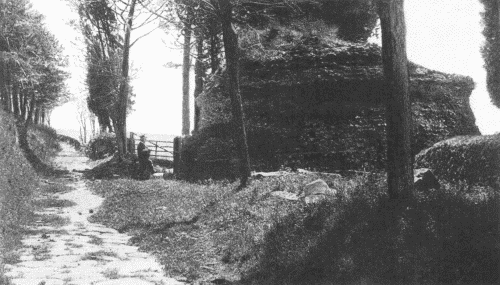 Tomb of Viniciano, Between Frascati and Tusculum.
Breakfast, a fairly good one, was ready when we got
back to the hotel, but no Schuyler. I think he was a
wise man and foresaw what was going to happen. Quite
a number of strangers had come out by train—all English
and American, no one we knew—and the table-d'hôte
was quite full. As soon as the gentlemen had had their
coffee, about 1.30, we started for Tusculum, Gert and I
on donkeys with two pretty, chattering Italian boys at
their heads—Bunsen on a stout little mountain pony, and
W. on foot. He wouldn't hear of a donkey, and preferred
to walk with the guide. We climbed up the steep
little path, between high walls at first, then opening out
on the hillside to the amphitheatre, which we saw quite
well. The arena and seats are very well preserved.
There are still rows of steps, slippery and green with
moss. We went on again toward Cicero's Villa, and for
a moment the clouds cleared a little, and we saw what the
view might be straight over the Campagna to Rome
(the dome of St. Peter's just standing out—on one side
the hills with the little villages where we have ridden so
often, Monte Compatri, Monte Porzio, the Campi d'Annibale
and Monastery of Monte Cave in the distance).
I wonder if the old monk would tell us to-day what one
did years ago, when we were standing on the terrace
looking at the magnificent view: "Quando fa bel tempo
si può vedere le montagne d'America" (When it is fine
one can see the mountains of America). I thought it
was rather pretty, his eagerness to make us understand
what an extended view one had from his mountain top,
and he probably didn't know where America was. However,
our little gleam of sunlight didn't last—first came
big drops, then a regular downpour, and in a few minutes
a thick white mist closed around us, shutting out
everything. We took refuge for a few moments under
a sort of ruined portico, but the rain came down harder,
and we decided to give up Cicero's Villa, and turn our
faces homeward.
The descent was neither easy nor pleasant—a steep little
path with the donkeys slipping and stumbling, and the
rain falling in buckets. I was wet through in ten minutes,
as I was very lightly dressed in a white shirt and
foulard skirt (having stupidly left my jacket at the hotel
as it was very warm when we started). Gert was better
off, as she had her tweed dress. I shan't soon forget that
descent, and as we passed Mondragone—the Borghese
Palace—we had thunder and lightning, which didn't
add to my comfort—however, the donkeys didn't mind.
I was wet to the skin when we arrived at the hotel, and
had to undress entirely and go to bed wrapped up in a
blanket. The chambermaid lighted a fire in the room,
and she and Gert dried my clothes as well as they could,
and I had a cup of hot tea. About 5 my things were
fairly dry—Gert went shopping in the town, and bought
me a piece of flannel which I put on under my corsage
which was still damp. It rained a little when we started
home, but cleared about half-way, and we had the most
glorious sunset.
It was too bad to have fallen upon such a day, and I
am afraid we shan't have time to attempt it again. I
was half tempted to stay at Frascati all night and try
again the next morning, but the others thought it better
to come home. I went to bed immediately after dinner,
and feel quite well to-day—only a little stiff—the combined
effect of the donkey and the damp.
April 11, 1880.
Yesterday it rained hard all day, there was quite a little
stream of water in the Piazza coming down from the
Pincio. Certainly Rome needs sunshine, everything
looked forlorn and colourless and everybody so depressed.
The Spanish Steps were quite deserted, no models nor
children galloping up and down. The coachmen of the
fiacre-stand on the Piazza dripping and dejected on their
boxes—nobody wanting carriages and very few people
about. I really believe the Romans stay in when it rains.
We didn't, of course, as our time is getting short, and the
galleries are always a resource. We went off about 10
to the Vatican and spent two hours there. Charles de
Bunsen was very glad to see it all again. We went first
to the Cappella Paolina where there was not much to see—some
frescoes of Michelangelo's, not very well preserved.
It used to be so beautiful, Holy Week in Rome,
when we were here before, brilliantly lighted for a silent
adoration and filled with people kneeling and motionless.
Then we went on to the Cappella Sistina where there
were a good many people taking advantage of a rainy
day to do the Vatican. It wasn't at all dark—I don't
know exactly why, for the rain was pouring straight
down. The Last Judgment is an awful picture. I
had forgotten Charon and his boat and the agonized faces
of the people whom he is knocking back with his oar.
Some of the faces were too terrible, such despair and suffering.
I can't think why any artist ever chooses such
subjects, one would think they would be haunted by their
own conceptions.
We walked through the Stanze, I wanted to see the
Deliverance of St. Peter; I remember so well the engraving
that was in the dining-room at Bond Street, which
I have sat opposite to so often. I used to be fascinated
as a child with the Roman soldiers, particularly the one
with a torch. We sauntered through the picture gallery
looking at the beautiful Foligno Madonna, Communion
of St. Jerome, and of course the Marriage of St. Catherine,
and really my copy by the young German is good
as I see the original again. We finished in the Galerie
des Inscriptions where W. always finds odd bits of inscriptions
which are wildly interesting to him. I think
for the moment yellow-books and interpellations and
the "peuple souverain" generally as represented in the
Chambre des Députés are out of his head.
The sun came out bright and warm in the afternoon
and we drove to the Villa Pamphili. We stopped at San
Pietro in Montorio on our way. It is there that St. Peter
is said to have been crucified. The view from the terrace
is very fine—the whole of Rome at our feet stretching
out over the Campagna to the Alban Hills. It was
too early really for the view, as one ought to see it at
sunset, when the hills take most beautiful rose blue tints
and the Campagna looks vague and mysterious, not the
long barren stretch of waste uncultivated land it is in
the daylight.
We stopped again at the Fontana Paolina, looked at
the rush of water that tumbles into the stone basin, and
climbed up the Janiculum, every turn of the road giving
the most enchanting view, out of the Porta San Pancrazio
to the Villa Pamphili—all Rome apparently was
doing the same thing; there were quantities of carriages.
It was charming in the Villa—many people had got out
of their carriages and were walking about in the shady
alleys. It was a relief to get out of the sun. The stone
pines of course are magnificent, but I think I like them
best from a distance—from the terrace of the Villa
Medici for instance they stand out splendidly. What is
grand is the view of St. Peter's. It seems to stand alone
as if there were no Rome anywhere near it. The dome
rises straight up above the green of Monte Mario, and
looks enormous.
We walked about the gardens with the queer, old-fashioned
flower-beds and the little lake with a mosaic pattern
at the bottom, and talked to quantities of people. The
drive down was enchanting; the sun setting, clouds of
every colour imaginable and a sort of soft "brume" that
made every dirty little street (and there are many in
Rome) look picturesque.
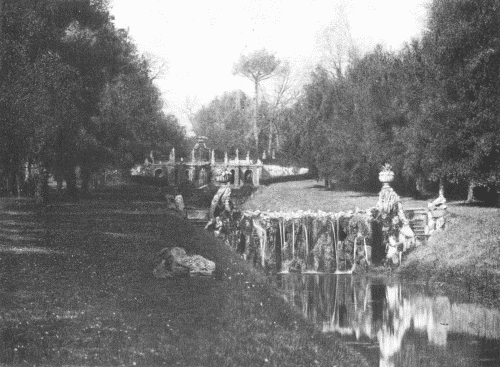 Grounds of the Villa Doria-Pamphili, Rome.
From an unpublished photograph taken about 1869.
Grounds of the Villa Doria-Pamphili, Rome.
From an unpublished photograph taken about 1869.
We went to the ball at the British Embassy in the
evening, taking Charles de Bunsen, who protested at first
he didn't go to balls any more, etc., but he found plenty
of old friends and was very glad he had gone. The
house looked very handsome—the ball-room with its
decoration of flowers, cupids, etc., had a decidedly festive
appearance. I danced two quadrilles—one with Count
d'Aulnay and the other with the Duke of Leuchtenberg
who was here with his wife, Comtesse de Beauharnais.
As it is a morganatic marriage (he is a Royal Prince)
she can't take his name and title. She was beautifully
dressed, had splendid jewels—pearls as big as eggs.
The ball was very gay, lots of people. We stayed quite
late; went to supper, which W. generally refuses with
scorn, and only left at 1.30. They were preparing for
the cotillon, but were going to dance a "tempête" (whatever
that may be) first. I hear they danced until 4
o'clock.
Thursday, 12th.
We had a nice dinner at the Villa Medici Tuesday
night. The Director M. Cabat, his wife and daughter,
M. and Madame Geoffroy and 5 or 6 of the young men.
They all love Rome and say it is a paradise for an artist.
Such beautiful models of all kinds in the old pictures and
statues. I ventured to say that I thought one or two of
the modern Roman things—fountains and statues—were
pretty, but I was instantly sat upon by the whole party—"no
originality; no strength, weak imitations of great
conceptions, etc." I suppose one's taste and judgment
do get formed looking at splendid models all the time;
still the world of art must go on and there is no reason
why the present generation shouldn't have graceful fancies,
and power to carry out their dreams. We didn't
stay very late and went on to Countess Somaglia, who
was receiving. There were only two or three ladies. Her
younger sister, Olympia Doria, married to a Colonna,
the Marquise Sant' Asilea and two others I didn't know.
Quantities of men came in and out, Calabrini, Vitelleschi,
Minghetti. The "maître de maison" was not there. I
was sorry, as I had never seen him. Lucchesi-Palli came
up and claimed acquaintance—said he had danced at Casa
Pierret in the old days. I introduced him to W. who was
rather interested at meeting a half brother of the Comte
de Chambord. He is much astonished at the quantity
of people I know, but I told him one couldn't live years
in Rome without seeing almost every one worth knowing,
as everybody comes to Rome.
Yesterday Gert and I went out together. W. had an
expedition of some kind with de Rossi, and gave a dinner
at the Falcone to Charles and some of his men
friends. The Roman menu didn't tempt me. I heard
them talking about porcupines and peacocks. I preferred
dining with Gert—she asked Mrs. Van Rensselaer,
and we had a pleasant evening. Mrs. V. R. is clever and
original, very amusing over her Italian and the extraordinary
mistakes that she knows she makes, but she keeps
on talking all the same. It is curious how much colder
Gert's apartment is than our rooms at the hotel—I suppose
no sun ever gets into that narrow street, and one is
quite struck with the cold the minute one gets into the
palace and on the stone staircase. We had a little fire
and it wasn't at all too much—of course in the Piazza di
Spagna the sun streams into the rooms all day. I came
home early—about 10—and found the two gentlemen,
Charles and W., settled very comfortably each in a large
arm-chair with pipe and newspaper (you can imagine the
atmosphere in a small hotel sitting-room). They said their
dinner was very good, even the ordinary Roman wine,
but they both agreed they wouldn't care to have that
menu every day. The talk was very interesting; some
of the men had been in Italy years ago, before the days
of railways or modern conveniences of any kind, and their
experiences in some of the little towns near Rome were
most amusing—most of the peasants so mistrustful of
the artist baggage, white umbrella, camp-stool, etc., and
so anxious, when they finally understood no harm was
intended, that they should sketch a nice new house or a
bit of wall freshly plastered instead of old gateways and
tumble-down palaces.
Charles is going back to Florence to-morrow; I think
he has enjoyed his visit very much, it brought back so
many recollections (he was born in Rome and spent all
his early childhood there).[24]
I wish they would settle in Rome instead of Florence,
the life is so much more interesting here. Florence is
charming, but asleep—here there is life, and the contrast
between the old patrician city full of old-world memories
and prejudices, and the political, financial atmosphere of
this 19th century is most striking. W. has decided to
go to Naples for four or five days. I shan't go with him.
He will be all day in the museums, as there is a great
deal to see, and I should bore myself sitting alone in the
hotel. If we could stay long enough to make some excursions—see
Sorrento, Capri, and Ischia, I would not
hesitate, I should love to see it all again. They say
Vesuvius is giving signs of a disturbance.
As we were talking about Capri and Vesuvius I told
them my experience there so many years ago, and both
gentlemen told me I ought to write it while it was still
fresh in my memory, so here it is and you will send the
letter to the family in America.
We went to Naples in October, 1867. Father died at
Frascati the 27th of September, and we all needed change
after the long nursing and watching. All our friends in
Rome were most anxious we should get off; affairs were
rapidly coming to a crisis in Italy and it was evident that
the days of the temporal power of the Pope were numbered.
At any moment the Italians under Garibaldi
might appear at the gates of Rome and it was not considered
safe for women and foreigners to remain there.
No one thought or talked of anything else, and though we
were absorbed by father's illness and the numerous
duties that a sick room entails we were quite as excited
as all our friends. Of course we heard the two sides—the
liberals who had high hopes of liberty and "Italia
Unita" and the "papalini" who were convinced that the
Italians would only enter Rome over the bodies of the
faithful. Our young imaginations pictured anything,
everything; the Garibaldians penetrating quite to the
Court of the Vatican, the Swiss Guard, Charette and his
Zouaves, massacred; priests flying in every direction pursued
by a crowd of soldiers and infuriated populace.
Good old Dr. Valery, who knew his countrymen better
than we did, assured us there was no danger. When resistance
was perfectly useless it would be wicked to shed
blood, and Pio Nono himself would be the first to advise
submission to the inevitable. We couldn't believe that
such a tremendous change and uprooting of the traditions
of centuries could be accomplished so quietly. We
stayed two days only in Rome after leaving Frascati.
We laid father at rest in the little English churchyard
just by the San Paolo gate. There was a mortuary
chapel where he could stay till he was taken home to the
old family churchyard at Jamaica where Grandpapa King
and a long line of children and grandchildren are buried.
We had to see about our mourning and were finally
hustled out of Rome the third day, Mr. Hooker (the
American banker), our great friend, fairly standing over
us while the trunks were being packed. He was quite
right. We took the last train that went through to
Naples, carrying with us a number of letters which our
liberal friends had asked us to mail as soon as we crossed
the frontier,—they naturally being unwilling to trust
them to the Roman post-office. Rome looked deserted,
very few people about, some of the shops and hotels still
closed, but one felt a suppressed excitement in the air.
Some of our friends, jubilant, came to see us off at "Termine"
and promised to send us a telegram at Naples if
anything happened. Mr. Hooker was rather anxious.
He too thought the Papal court wouldn't make any resistance
if the Italians came, or rather when the Italians came,
as they were marching on Rome; but he thought there
might be trouble in the streets. He had his large American
flag ready to protect the bank. We of course made
our journey very quietly and comfortably, as Garibaldi
and his men were not on that road. I was rather disappointed,
I should have liked to have had a glimpse of the
famous revolutionary leader in his classic red shirt. We
found Naples just the same, very full, people everywhere,
in the Via Toledo, on the quays, etc. There wasn't much
apparent excitement, all the red-capped, bare-legged fishermen
were lounging about on the quays or in the numberless
little boats of all descriptions flying about in every
direction. The same songs, "Julia Gentil," "La Luissella,"
"La Bella Sorrentina," were sung under our windows
every night with an accompaniment of mandolins
and a sort of tambourine. From time to time the voices
would cease and then there would be a most lively dance—tarantella,
saltarella—all the dancers moving lightly
and quickly and always in perfect time. The nights were
beautiful—warm and clear—the whole population lived in
the streets and we were always on the balcony. The islands,
Ischia and Capri, took such beautiful colours, at
sunset; seemed almost like painted islands rising straight
up out of a perfectly blue sea. Vesuvius, too, was most
interesting. Savants were prophesying an eruption and
every now and then faint, very faint curls of smoke came
out of the crater. We knew nothing of what was going
on; had no communication with Rome, and were entirely
dependent for news on the landlord, whose information
was certainly fantastic; also the little Naples
paper, the "Pungolo," which made marvellous statements
every morning—the streets of Rome running
with blood, etc. Finally came the first news—the battle
of "Monte Rotondo," Garibaldi and his men victorious.
From Paris we heard that the French troops had started
and were at Cività Vecchia, but there were so many conflicting
stories that we really didn't know how much to
believe. Then came Mentana—the Garibaldians driven
back by the Papal and French troops; the Pope still
supreme in Rome. We had a telegram from one of our
liberal friends, "Le malade va bien," which meant that
the Pope had conquered, and Rome was not yet the
capital of "Italia Unita." There was no fighting at
all in the streets of Rome; a great deal of patriotic talk
among the young liberals, but I don't think any of them
absolutely enrolled themselves in Garibaldi's band. It
wouldn't have made any difference—they could do nothing
against the combined Papal and French troops—but
it might have been a personal satisfaction to have struck
a blow for the liberal cause. There again the common
sense of the Italians showed itself—there was no resisting
"le fait accompli," they had only to bide their time.
We had lovely days at Naples, making all sorts of excursions—Posilippo,
Capo di Monte, Camaldoli, etc.
Every morning we went to the Museum; I was madly interested
in the Pompeian relics, particularly the mummies.
It seemed impossible to believe that those little black
bundles had once been human beings feeling and living
as keenly as we do now. We always kept our eyes on
Vesuvius as it really did seem as if something was going
on. The column of smoke looked thicker and we could
quite well see little jets of sand or small stones thrown
up from the crater. One afternoon when we came in
from driving everybody in the street was looking hard at
the mountain and the padrone informed us that the eruption
had begun. We didn't see anything, but after dinner
when we were standing on the balcony suddenly we
saw a great tongue of flame leap out from the crater and
a stream of fire running down the side of the mountain.
The flame disappeared almost immediately; came back
three or four times in the course of the evening, but
didn't gain very much in height or intensity. The next
day, however, it had increased considerably and was a
fine sight at dark, every few moments a great tongue of
fire with quantities of stones and gravel thrown high in
the air. We almost fancied we heard the noise of thunder,
but I don't think we did. People were flocking into
Naples, and we of course, like all the rest, were most
anxious to make the ascent. The landlord told us there
was no danger; that the authorities never permitted an
ascent if there was danger, and no guides would go, as
they are very prudent. One would go up on one side
(the only thing to avoid was the stream of red-hot lava).
Mother was rather unwilling, particularly as we were to
go at night (and at night from our balcony the mountain
did look rather a formidable thing to tackle). We
waited still another day and then when we had seen some
English people—two ladies and a youth who had made
the excursion and said it was not at all alarming and
most interesting—she agreed to let us go. Anne stayed
with her, she doesn't like donkey riding under any circumstances,
and a donkey at night on the slopes of
Vesuvius in eruption, with a stream of red-hot lava running
alongside, didn't strike her absolutely as a pleasant
performance. We started about 7 o'clock, William,
Henrietta, Gertrude, and I. The drive out all the way
to Resina was most amusing. Quantities of people, the
famous Naples "cariole" crammed with peasants and
children, and all eyes turned to the mountain. Our landlord
had made all the arrangements for us, secured the
best guides, donkeys, etc., and we were in great spirits.
The mountain looked forbidding; as we came nearer we
heard the noise, rumbling and thunder—the thunder
always preceding a great burst of flames and showers of
stones thrown up very high and falling one didn't know
exactly where. I didn't say anything as I was very anxious
to make the ascent, but I did wonder where these
red stones fell and how one could know exactly beforehand.
We drove as far as we could and then arrived
at the Hermitage and Observatory, where there was a
very primitive sort of wooden house, half tavern, half
inn. Here donkeys and guides (very voluble) were
waiting, and we started. It had begun to rain a little,
but the guides assured us that it would not last and we
should soon be above the clouds. It was almost dark—not
quite—and everything looked weird, even the faces
of the guides seemed to me to have a curious expression;
they looked fierce and wild. We went on quietly at first
though the rumblings under our feet and sudden light as
the flames burst out were unpleasant. When we began
the last steep ascent I had got very nervous. I was the
last of the party, and when the donkey-boy (an infant)
took a short cut, when the path was steep, calling out
cheerfully "Coraggio Signorina," and left me and the
donkey alone to clamber over the great slippery blocks of
lava, I was frightened and felt I should never get up to the
top. It was really terrifying—the rain and mist had increased
very much, it was pitch dark, rumbling and thunder
all the time, and such noises under our feet that I was
sure a great hole would open and we should all be swallowed
up. I didn't like the dark, but I certainly didn't
like the light either, when a great tongue of flame would
spring out of the crater spreading out like a fan and
throwing a mass of stones and gravel high in the air
which all fell somewhere on the mountain. The red
stream of lava looked wider and seemed to me to be coming
nearer. I called out to William, who was far ahead
and looked gigantic in the mist where he was crossing
some great rocks of lava (quite black and shiny when
they are old), and told him I was too frightened, that I
should go back to the Hermitage and wait there. He
was much disgusted—said there was no possible danger.
All the guides and donkey-boys repeated the same thing,
but it was no use, I was thoroughly unnerved and
couldn't make up my mind to go on. We had a consultation
with the guides as he didn't like the idea of my
going back alone to the inn, but they told him it was
all right, that the padrone was a "brav'uomo" and
would take care of me until they came back; so most
reluctantly they went on, and I turned my face homeward,
always with my minute attendant whom I would
gladly have shaken as he was laughing and chattering
and repeating twenty times, "non c'è pericolo." I think
the going down was rather worse; I had the rain in my
face, heard all the same unearthly noises around me, and
from time to time had glimpses of the whole country-side—Naples,
the little villages, the islands, the bay
standing out well in the red light thrown on them by the
flames from the crater; then absolute darkness and stillness,
nothing apparently on the mountain but me and the
donkey scrambling and stumbling over the wet, slippery
stones. How we ever got down to the inn I don't
know, but both boy and donkey seemed to know the road.
I was thankful when we emerged on a sort of terrace
and saw a faint light, which meant the little inn. The
boy helped me off (it was pouring), called out something
at the door, told me to go in and go upstairs, then disappeared
around the corner with the donkey. I called—no
one answered—so I went upstairs, just seeing my way
by the light of a little dull, smoky lamp put in a niche of
the wall. I saw two doors when I got up to the top of
the stairs, both shut, so I called again, knocked; a man's
voice said something which I supposed to be "entrate"
and I walked in. I found myself in a big room hardly
lighted—a small lamp on a table, a fire of a sort of peat
and wood, a bed in one corner on which was stretched a
big man with a black beard and red shirt; another man
not quite so big, but also in a red shirt and a hat on his
head, got up when I came in, from a chair where he had
been sitting by the fire. He said something I couldn't
understand, first to me and then to his companion on
the bed, who answered I thought rather gruffly (they both
spoke Neapolitan "patois" which I couldn't understand
at first). I didn't feel very comfortable (still I liked even
that room with those two brigand-looking men better
than the mountain-side with the flames and the lava),
but I tried to explain, took off my wet cloak which spoke
for itself, and went toward the fire. My friend with the
hat always keeping up a running conversation with the
man on the bed, brought up a chair, then a sort of stand
over which he hung my cloak, and proceeded to take a
bottle out of a cupboard which I supposed was their
famous wine (lacrima Christi) which one always drinks
at Naples. However that I declined and established
myself on the chair by the fire. He took the other one,
and when I looked at him I saw that he had rather a nice
face; so I took courage. He pointed to my shoes, which
were wet as we had walked a little, and wanted to talk.
After a little while I began to understand him, and he
me; and we had quite a friendly conversation. He
looked at my shoes, asked me where they were made,
and when I said in Rome was madly interested; he had
a brother in Rome, a shoemaker, perhaps I knew him
"Giuseppe Ricci," he might have made those very shoes—instantly
confided that interesting piece of information
to the gentleman on the bed. He told me they were
three brothers, the eldest was the shoemaker, then came
he the padrone of the osteria, and the other one "there
on the bed" had vines and made very good wine. He
asked me if I had ever seen the Pope, or Garibaldi (there
was a picture of Garibaldi framed on the wall), and when
I said I had often seen the former, and that he had a
good, kind face, he again conversed amicably with the
gentleman on the bed, who first raised himself into a sitting
posture, and finally got up altogether and came over
to the fire, evidently rather anxious to take part in the
conversation. He was an enormous man and didn't look
as nice as the "padrone." He rather startled me when he
bent down, took my foot in his hand and inspected the
shoe which he pronounced well made. We must have
sat there fully half an hour talking—they were perfectly
easy, but not familiar, and wanted to hear anything I
would tell them about Rome. Every now and then they
dropped off into some side talk in their "patois," and I
looked at the fire and thought what an extraordinary experience
it was, sitting alone with such odd-looking companions
in that big, bare room on the top of Mount
Vesuvius. The fire had almost died out, the miserable little
lamp gave a faint flickering light that only made everything
look more uncanny, and every now and then the
whole room would be flooded with a red lurid light (heralded
always by a violent explosion which made the crazy
little house shake) which threw out the figures of the two
men sitting with their long legs stretched out to the fire,
and keeping up a steady talk in a low voice. Still I
wasn't afraid; I was quite sure they would be respectful,
and do all they could to help me. They had a sort of
native politeness, too, for they stopped their talk occasionally
and made conversation for me; one looked out
of the window and said the rain had stopped, but that the
night was "brutta" and they referred to other eruptions
and told me stories of accidents that had happened to
people—two young men, "Inglesi," who were killed because
they would go on their own way and not listen to
the guides, consequently were knocked on the head by
some huge stones; always assuring me that this eruption
was nothing. However I was getting tired, and found
the time long, when suddenly we heard the noise of a
party arriving, and for a moment I thought it was my
people; but no, they were coming the other way, up the
mountain. There was a great commotion and talking, lanterns
flashing backward and forward, donkeys being led
out and all preparations made for the ascent—but there
seemed a hitch of some kind and I heard a woman's voice
speaking English. The "padrone" had rushed downstairs
as soon as he heard the party arriving, and presently
he reappeared talking very hard to a lady and two
gentlemen who were coming upstairs behind him and
evidently wanting something which they couldn't make
him understand. He was telling them to have patience,
that there was an "Inglese" upstairs who would talk to
them. They were so astounded when they saw me that
they were speechless—il y avait de quoi—seeing a girl
established there in rather a dishevelled condition, her hat
off, wet cloak hanging over the chair, and entirely alone
with those "Neapolitan brigands"—but one man ventured
to ask timidly "did I speak English." Oh yes—Italian,
too—what could I do for them. They explained
that the lady was tired, cold and wet (she looked miserable,
poor thing) and wanted a hot drink—brandy, anything
she could get. She didn't look as if she could go
on, but she said she would be all right if she could have
something hot, and that nothing would induce her to give
up the excursion, having come so far; so a fresh piece of
wood, or peat rather of some kind (it looked quite black),
was put on the fire, also water in a most primitive pot. I
suggested that she should take off her cloak and let it dry a
little. The men brought in some more chairs and then the
new comers began to wonder who I was and what I was
doing there alone at that hour of the night. They were
Americans, told me their name, but I have forgotten it,
it is so long ago. I told them my experience—that I
was absolutely unnerved, in a dead funk, and would have
done anything rather than go on toward that horrible
crater. They couldn't understand that I wasn't much
more afraid of spending two hours in that lonely little
house in such company, and begged me to try again—there
was really no danger, people were going up all the
time, etc. The older man was very earnest—said they
couldn't leave a compatriot in such straits—he would
give me his donkey if another one couldn't be procured
and would walk—how could my brother have permitted
me to come back alone, etc. However I reassured him as
well as I could—told them I was perfectly accustomed
to Italians and knew the language well (which was a
great help to me, I don't know what I should have done
if I hadn't been able to talk and understand them).
They stayed about 20 minutes—the lady said her drink
was very nasty, but hot, and she looked better for the
rest and partial drying. She wasn't as wet as I was, the
rain had stopped when they were half-way up. I told
them who I was and begged them to say, if they met my
people coming down, a gentleman and two ladies, that
they had seen me, and that I was quite dry and comfortable.
They went away most reluctantly, were half inclined
to stay until the others should come back, but the
guides were anxious to be off. Even at the last moment
when they had got downstairs, the older man came back
and begged me to come with them—"I assure you, my
dear young lady, you don't know in what a dangerous position
you are; if I had any authority over you I should
insist, etc." He was very nice, and left all sorts of recommendations
in English and a very good fee to the
padrone, who of course didn't understand a word of
what he was saying, but seemed to divine in some mysterious
way. He looked smilingly at me, told me to cheer
up ("Coraggio" is their way of saying it) and told the
American, in Italian, that he would take good care of me.
He was very sorry to go and leave me, said he had never
done anything he liked so little. As soon as the excitement
of their departure was over the two men came back.
The "vigneron" went back to his bed, from where he
conversed with us occasionally, and the other one settled
down in his chair, and seemed half asleep. It wasn't
very long before my party came back. The men heard
them before I did, and told me they were arriving. I
must say I was glad to see them. They had had a splendid
time, seen everything beautifully, gone quite up to the
stream of red-hot lava, put umbrellas and canes into it
(the ends were quite black and burnt)—they were not
in the least nervous, and jibed well at me. William said
he had rather an uncomfortable feeling at first when he
saw me and my very small attendant depart, but he forgot
it in the excitement and novelty of their excursion.
He thanked the padrone for taking such good care of
me, proposed a hot drink (very bad it was) all round,
and we took quite a friendly leave of the two gentlemen.
I promised to try and find the brother shoemaker. They
had crossed my American friends on the way back—William
said they were just starting down when they
saw another party appearing and he heard a gentleman
say, "I think this must be Mr. King." He was very
much surprised to hear his name, but rode up to the
speaker, to see who he was, and then the gentleman told
him of his amazement at meeting his sister in that
wretched little shanty and how miserable he had felt at
leaving me there alone, with two Neapolitan brigands,
but that I had assured him I was quite safe and not at all
afraid of the two black giants—but he begged William
to hurry on, as it was not really the place to leave a girl—even
an American who would know how to take care
of herself. We made our journey down quite easily. It
was still pitch dark, except when the fire of the mountain
lighted up everything, but there was neither rain nor
wind, the air was soft, and the little outlying villages
looked quite quiet and peaceable, as if no great mountain
was throwing up masses of ashes and stones just over
their heads, which might after all destroy them entirely.
There must always be a beginning, and I suppose in the
old days of Pompeii and Herculaneum the beginning was
just what we have seen—first columns of smoke, then the
lava stream and showers of red-hot stones, and none of
the people frightened at first. We found Mother and
Anne waiting for us with supper. They had been a
little anxious, particularly as the weather was so bad,
and they evidently had had more of a tempest than we
had. They were of course madly interested in our expedition
and were astounded that I was the coward. They
wouldn't have been at all surprised if it had been Gert.
It is true she is nearly always timid, and we used to play
all sorts of tricks on her when we were children at Cherry
Lawn, beguile her up into the big cherry tree, then take
the ladder away and tell her to climb down; or take the
peg out of the boat, let in a little water and pretend it
was sinking—so she was triumphant this time. I can't
understand why I was so frightened. I am not usually
afraid of anything, but that time no reasoning would
have been of the least use, and nothing would have made
me go on to the crater. Mother was rather like the
American—she wouldn't have liked the flames and the
awful rumbling noises any more than I did, but she would
have been much more afraid of the lonely house and long
wait on the mountain in that wretched little inn with
those two big, black-bearded Neapolitans.
Le monde est petit—years afterward my brother William
was travelling in America, and in the smoking-room
all the men were telling their experiences either at
home or abroad—many strange adventures. One gentleman
said he had never forgotten a curious scene on the
top of Mount Vesuvius in eruption, when he had met an
American girl, quite alone, at night, in the dark and
rain, in a miserable little shanty with two great, big Neapolitans
"looking like brigands" (he evidently always
retained that first impression of my companions). He
told all the story, giving my name, which excited much
comment; some of the listeners evidently thought it was a
traveller's tale, arranged on some slight foundation of
truth—however, when he had finished William said:
"That story is perfectly true. The young lady is my sister,
and I am the Mr. King to whom you spoke that night
on the mountain, in the dark, begging me to hurry down,
and not leave my sister any longer alone in such company."
They naturally didn't recognise each other, having
merely met for a moment in the dark, both wrapped
up in cloaks and under umbrellas. They had quite a
talk, and the gentleman was very anxious to know how
they found me—whether I wasn't really more uncomfortable
than I allowed, and what had become of me.
We decided to move on to Sorrento and settle ourselves
there for some time. We also wanted to go to Capri,
but the steamers had stopped running, and we could only
get over in a sailboat. The man of the hotel advised
us to go from Sorrento, it was shorter and a charming
sail on a bright day. The drive from Castellamare
was beautiful; divine views of the sea all the time
and equally lovely when we came down upon Sorrento,
which seemed to stand in the midst of orange groves and
vineyards. The Hôtel Sirena is perched on the top of
a high cliff rising up straight from the sea. We had
charming rooms with a nice broad balcony, and at our
feet a little sheltered cove and beach of golden sand.
There were very few people in the hotel—the one or two
English spinsters of a certain age whom one always meets
travelling, and two artists. We were only about twelve
people at table-d'hôte; and as we were six that didn't
leave many outsiders. It was before the days of restaurants
and small tables. There was one long, narrow
table—the padrone carved himself at a smaller one, and
talked to us occasionally. There was too much wind the
first days to think of attempting Capri, so we drove all
over the country, walked about in the orange groves and
up and down the steep hills, through lovely little paths
that wound in and out of olive woods along the side of
the mountain, sometimes clambering up a bit of straight
rock, that seemed a wall impossible to get over—when
it was too stiff there would be steps cut out in the earth
on one side, half hidden by the long grass and weeds.
Henrietta and I had discovered a pony trap with a
pair of sturdy little mountain ponies, quite black, and
we drove ourselves all over. Mother wouldn't let us go
alone, so the stableman sent his son with us, aged 12
years. He wasn't much of a protector! but he knew the
ponies, and the country, and everybody we met. He was
a pretty little fellow—not at all the dark Italian type,
rather fair, with blue eyes, but always the olive skin of
the South. He invariably got off the little seat behind
and took a short cut up the hills when the road was very
steep, though I don't think his weight made any perceptible
difference.
The evenings were delicious. We sat almost always
on the balcony—sometimes with a light wrap when the
breeze from the sea freshened about 9 o'clock. How
beautiful it was; the sea deep blue, the islands changing
from pink to purple, and as soon as it was dark Vesuvius
sending up its pyramid of fire. It looked magnificent,
but very formidable. Almost every morning we saw a
party come and bathe in the little cove at the foot of the
cliff—a pretty little boat came around the point with a
family party on board—two ladies, one man and three
children. I think they were English, their installation
was so practical. They had a small tent, camp-stools,
and table, also two toy sailboats which were a source
of much pleasure and tribulation, as they frequently got
jammed in between the rocks, or caught in the thick seaweed,
and there was great excitement until they were
started afresh. We made great friends with the sister of
the man at the hotel. She was a nun, such a gentle, good
face—she came every morning to get flowers for the little
chapel of Maria—Stella del Mare—which was near
the house, standing high on the hill and easily seen from
the sea. One day she seemed very busy and anxious
about her flowers, so we asked what was happening, and
she said it was their great fête, and they were going to
decorate the chapel and dress the Virgin—"should we
like to see it?" The Virgin had a beautiful dress—white
satin with silver embroidery and some fine jewels which
some rich forestieri had given. We were delighted to go,
and went with her to the little chapel, which looked very
pretty filled with flowers and greens, one beautiful dark,
shiny leaf which made much effect. The Virgin was removed
from her niche—her vestments brought in with
great care, wrapped in soft paper, and the good sister
most reverently and happily began the toilet. The dress
was very elaborate, had been the wedding dress of an Italian
Principessa, and there were some handsome pins and
rings—a gold chain on her neck with a pearl ornament.
She was rather lamenting over the cessation of gifts—when
I suddenly remembered my ring—quite a plain gold
one with the cross (pax) one always sees in Rome, which
had been blessed by the Pope. I put it on with three or
four other little ornaments one day when we had an audience.
I took it off, explained to her what it was, that it
had been blessed by the Saint Père and that I should like
very much to give it to the Virgin, if she wasn't afraid
of accepting anything from a heretic. She was a little
doubtful, but the fact of its having had the Pope's blessing
outweighed other considerations, and the ring was
instantly put on the Virgin's hand. She told us afterward
that she had told it to the priest, and he said she was
quite right to accept it, it might be the means of bringing
me to the "true church." We grew really quite fond
of her. It was such a simple, childish faith, her whole
life was given up to her little chapel, cleaning and decorating
it on feast days. All the children in the country
brought flowers and leaves, one little boy came once, she
told us, with a dead bird with bright feathers that he
found, quite beautiful.
We made friends with the people at the table-d'hôte
and they were very anxious we should come down to
the reading-room at night and make music—but our
mourning of course prevented that. We used to hear
the piano sometimes and a man's voice singing, not too
badly.
At last the wind seemed to have blown itself out, and
our landlord said we could get easily to Capri. He could
recommend an excellent boatman who had a large, safe
boat and who was most prudent, as well as his son. With
a fair wind we ought to go over in two hours. We
wanted to stay over one night, and he arranged everything.
The boat would wait and bring us back the next
evening. We started early—about 9 o'clock—so as to
get over for breakfast. The boat was most comfortable,
a big broad tub, with rather a small sail, plenty of room
for all our bags, wraps, etc. The sea was divine, blue
and dancing, but there was not much wind. We progressed
rather slowly, the breeze was mild, the boat heavy
and the sail small, but nobody minded. It was delicious
drifting along on that summer sea—just enough ripple
to make little waves that tumbled up against the side of
the boat, and a slight rocking motion that was delightful—couldn't
have suggested sea-sickness or nervousness
to the most timid sailor. There were plenty of boats
about (mostly fishermen) of all sizes, some of them with
the dark red sail that is so effective, and several pleasure
boats and small yachts. They were almost as broad and
solid as our boat; hadn't at all the graceful outlines and
large sails that we are accustomed to. We were exactly
three hours going over though the breeze freshened a
little as we got near Capri. We were quite excited when
we made out the landing-place ("Marina grande") and
the long, steep flight of steps leading up to the town.
The last time we were there we went by the regular tourist
steamer from Naples. There were quantities of people
and a perfect rush for donkeys and guides as soon as we
arrived; also the whole population of Capri on the shore
chattering, offering donkeys, flowers, funny little bottles
of wine, and a troop of children running up the steps
alongside of the donkeys and clamouring for "un piccolo
soldo." This time there was no one at the landing-place,
but the man of the hotel with a sedan chair for mother,
donkeys for us if we wanted them (we didn't—preferred
walking) and a wheelbarrow or hand cart of some kind
for the luggage, which was slight—merely bags and
wraps. There were a good many steps, but they were
broad, we didn't mind. We found a very nice little hotel,
kept by an English couple. The woman had been for
years maid in the Sheridan family. She told us there
was no one in the hotel but one Englishman—in fact no
foreigners in the island. We had a very good breakfast
in a nice, fairly large room with views of the sea in all
directions, and started off immediately afterward to see
as much as we could. Mother had her chair, but didn't
go all the way with us. We passed through narrow,
badly paved little streets with low, pink houses, lots of
people, women and children, standing in the doorways—no
men, I suppose they were all fishing—and then climbed
up to the Villa Tiberius—a steep climb at the end, but
such a view. Before we got quite to the top we stopped
at the "Salto di Tiberio," a rock high up over the water
from which the guide told us that monarch had his victims
precipitated into the sea. We dropped down stones
(I remember quite well doing the same thing when we
were there before) to see how long it was before they
touched the water, which showed at what a height one
was. The palace is too much in ruins to be very interesting,
but there was enough to show how large it must have
been, and bits of wall and arches still standing. We
went on to the chapel, drank some rather bad wine which
the hermit offered us, bought some paper weights and
crosses made out of bits of coloured marble which had
been found in the ruins, and wrote our names in his book.
We looked back in the book to see if there were any interesting
signatures, but there was nothing remarkable—a
great many Germans.
We came home by another path, winding down through
small gardens, vineyards, and occasionally along the steep
side of the mountain, all stones and ragged rocks, with
the sea far down at our feet. There were a good many
houses scattered about, one or two quite isolated near the
top. We had a running escort of little black-eyed brown
children all talking and offering little bunches of mountain
flowers. The guides remonstrated vigorously occasionally
and they would disappear, but were immediately
replaced by another band from the next group of houses
we passed.
We were rather tired when we got back to the hotel
as the climbing was stiff in some parts, and glad to rest
a little before dinner. The padrona came in and talked
to us. It seemed funny to see an English woman in that
milieu with her brown hair quite smooth and plain and a
clean print dress. She said she liked her life, and the
people of the island. They were industrious, simple and
easy-going. She talked a great deal about the Sheridans,
for whom she had of course the greatest admiration, said
one of the sons came often to Capri, and that his cousin
Norton had married a Capri fisher-girl. We had heard
the story, of course, and were much interested in all
she told us. She said the girl was lovely, an absolute
peasant, had walked about with bare feet like all the rest,
but that she had been over to England, was taught there
all they could get into her head, and was quite changed,
had two children. I remember their telling us in Rome
what a difficult process that education was. She was
willing and anxious to learn to read and write, but her
ambition and her capability of receiving instruction
stopped there—when they wanted to teach her a little history
(not very far back either) and the glories of the
Sheridan name she was recalcitrant, couldn't interest herself
and dismissed the subject saying, "ma sono morti
tutti" (they are all dead). She always kept her little
house at Capri, in fact was there now, perhaps we should
like to see her. We said we should very much.
We had nice, clean comfortable rooms and made out
our plan for the next day. We didn't care about the Blue
Grotto—we had seen it before, and besides they told us
that at this season of the year it would be almost impossible,
one must have a perfectly still sea as the entrance
is not easy—very low—and a big wave would swamp the
boat. We heard the wind getting up a little in the night
and we woke the next morning to see a grey, cloudy sky,
little showers falling occasionally, and a fine gale, sea
rough, no little boats out, one or two fishing boats racing
along under well-reefed sails, anything but tempting for
a three hours' sail in an open boat. Mother looked decidedly
nervous; however the matter was taken out of
our hands, for the boatmen appeared saying they would
not go out, which was rather a relief; we didn't mind
staying. There was a fair library in the house, books
that visitors had left, so we hunted up a history of Capri
(Baedeker was soon exhausted), and got through our
morning pretty well, some reading aloud, the others knitting
or working. We had all taken some sort of work in
our bags, various experiences of small hotels on rainy
days having taught us to provide our own amusement.
It cleared in the afternoon though the wind was still
very high and we set off—on donkeys this time—and
mother in her chair, to the other side of the island. Two
or three girls, handsome enough in their bright skirts,
bare brown legs and thick braids of hair, came with us to
take charge of the donkeys. As we were going up a steep
flight of steps (which the donkeys did very well and deliberately)
they began to tell us about Mrs. Norton and said
we should pass her house. It was amusing to hear them
talk of her wonderful luck in being married to this "bel
Inglese"; "adesso fa la signora sta in camera tutto il
giorno—colle mani bianche" ("Now she does the lady,
sits in her room all day with white hands"). We passed
several houses rather better than the ordinary fisherman's
cottage and then came upon a nice little white house,
standing rather high, with a garden and gate, which they
told us was Mrs. Norton's. We stopped a moment at the
gate, looking at the garden; mother's bearers put her
chair down and gave themselves a rest, and we saw a
lady appear very simply dressed in something dark, who
came to the gate and asked us in very nice English with
a pretty accent if we would come in and rest, as the day
was hot and we had had a steep climb. We heard all
the fisher-girls giggling and saying "Eccola la Signora."
We were half ashamed to have been seen gaping in at her
garden, but the invitation was simply and cordially given,
and we accepted. Her manner to mother was quite pretty,
respectful to the older lady. We went into a pretty
little sitting-room quite simply furnished, with books and
photographs about. She showed us pictures of all her
family, her husband (regretting extremely that he was
not there), her mother-in-law, Mrs. Norton, and her children.
She seemed very proud of her son, said he was
at school in England and didn't care very much for Capri.
I asked her if she liked England, and though she said
"very much," I thought I detected a regret for her old
home, though not perhaps her old life. Her face quite
lighted up when we said how much we admired her island
with its high cliffs and beautiful blue sea. I didn't find
her as handsome as I expected, but the eyes were fine and
her smile charming. Her manner was perfectly natural,
she showed us very simply all she had, and was not in
the least curious about us—asked us no questions, was
evidently accustomed to seeing foreigners and tourists
at Capri. We stayed about half an hour, and then went
on our way. She shook hands with us all, and looked
most smilingly at mother; couldn't quite understand her
black dress and white cap—said we mustn't let her do too
much, "she is not so young as you, la mamma."
Of course the fisher-girls were in a wild state of excitement
when we came out—all talked at once, stopping in
the middle of the path, the donkeys, too; when they had
much to say, and telling the whole story over again. I
said to one of them, "Should you like to marry a 'bel
Inglese' and go and live in another country far away from
Capri with no sun nor blue sky?" She thought a moment,
looking straight at me with her big, black eyes and
then answered, sensibly enough, my rather foolish question—she
had never thought about it—was quite happy
where she was. It was a curious meeting.
When we got back to the hotel we asked our padrona
about Mrs. Norton and the life she led. She told us
Mrs. Norton mère[25] had been in despair when her son
married the fisher-girl—he was very good-looking and
her favourite, and it was a great blow to her, but that
she had been very good to her and was fond of the
boy. She didn't seem to think the young woman had
had a very happy life, but that she was always delighted
to get back to Capri. "Did she see any of her old
friends?" "Not much—that was difficult—she only
came in the summer, the children generally with her, and
they fished and sailed and made their own life apart."
We got back to Sorrento the next morning—the sea
beautifully smooth and calm—no trace of the great waves
that had roared all night into the numerous caves, throwing
up showers of foam.
My dear, I seem to have prosed on for pages about
Naples, but once started I couldn't stop. Tell Henrietta
I feel rather like her when we used to call her Mrs.
Nickleby, because she never could keep to any one subject,
but always made long, foolish digressions.
Monday, April 13th.
Last night we had a pleasant dinner at Mr. Hooker's,
the American banker. He still lives in one end of his
apartment in the Palazzo Bonaparte, but has rented the
greater part to the Suzannets.[26] We were a small party—ourselves,
Schuylers, Ristori (Marchesa Caprannica),
and her charming daughter. Ristori is very striking
looking—very large, but dignified and easy in her movements,
and a wonderfully expressive face. The girl,
Bianca Caprannica, is charming, tall, fair, graceful. Ristori
talked a great deal, speaks French, of course, perfectly.
She admires the French stage, and we discussed
various actors and actresses. I should love to see her act
once, her voice is so full and beautiful. Such a characteristic
scene took place after coffee. We were still sitting
in the dining-room when we heard a carriage come in,
and instantly there was a great sound of stamping horses,
angry coachman, whip freely applied, etc. It really made
a great noise and disturbance. Ristori listened for a
moment, then rushed to the window (very high up—we
were on the top story), exclaiming it was her man,
opened it, and proceeded to expostulate with the irate
coachman in very energetic Italian—"Che diavolo!" were
these her horses or his, was he a Christian man to treat
poor brutes like that, etc.—a stream of angry remonstrance
in her deep, tragic voice. There was a cessation of
noise in the court-yard—her voice dominated everything—and
then I suppose the coachman explained and excused
himself, but we were so high up and inside that we
couldn't hear. She didn't listen, but continued to abuse
him until at length Hooker went to the window and suggested
that she might cease scolding and come back into
the room, which she did quite smilingly—the storm had
passed.
This morning we have been to the Doria Gallery. The
palace is enormous, a great court and staircase and some
fine pictures. We liked a portrait by Velasquez of a Pope—Innocent X,
I think—and some of the Claude Lorraines,
with their curious blue-green color. We walked
home by the Corso. It was rather warm, but shady always
on one side of the street. After breakfast Cardinal
Bibra, the Bishop of Frascati, came to see us. He was
much disappointed that we had had such a horrid day for
our Frascati and Tusculum expedition, and wants us to
go again, but we haven't time. We want to go to Ostia
and Albano if it is possible. He and W. plunged into
ecclesiastical affairs. It is curious what an importance
they all attach to W.'s being a Protestant; seem to think
his judgment must be fairer. He also knew about Uncle
Evelyn having married and settled in Perugia, and had
heard the Pope speak about him. He spoke about the
Marquis de Gabriac (Desprez's predecessor) and regretted
his departure very much. I think he had not yet
seen the new Ambassador. W. told him Desprez would
do all he could to make things go smoothly, that his whole
career had been made at the Quai d'Orsay, where every
important question for years had been discussed with
him.
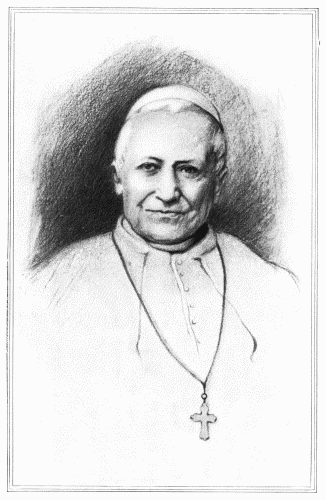 Pope Pius IX.
Tuesday, April 14th.
We dined last night at the Black Spanish Embassy with
the Cardenas. It was very pleasant. We had two cardinals—Bibra
and a Spanish cardinal whose name I didn't
catch; he had a striking face, keen and stern, didn't talk
much at dinner—Desprez and his son, the Sulmonas,
Bandinis, Primolis (she is née Bonaparte), d'Aulnays,
all the personnel of the French Embassy, and one or two
young men from the other embassies; quite a small dinner.
W. took in Princess Sulmona and enjoyed it very
much. Primoli took me, and I had Prince Bandini on
the other side. Both men were pleasant enough. All
the women except me were in high dresses, and Primoli
asked me how I had the conscience to appear "décolletée"
and show bare shoulders to cardinals. I told him
we weren't told that we should meet any cardinals, and
that in these troubled days I thought a woman in full
dress was such a minor evil that I didn't believe they
would even notice what one had on; but he seemed to
think they were observant, says all churchmen of any denomination
are. Their life is so inactive that they get
their experience from what they see and hear. I talked
a few minutes to Princess Bandini after dinner, but she
went away almost immediately, as she had music (Tosti)
at home. We promised to go to her later—I wanted
very much to hear Tosti. The evening was short. The
cardinals always go away early—at 9.30 (we dined at
7.30, and every one was punctual). As long as they
stayed the men made a circle around them. They are
treated with much deference (we women were left to
our own devices). W. said the conversation was not
very interesting, they talk with so much reserve always.
He said the Spaniard hardly spoke, and Cardinal Bibra
talked antiquities, the excavations still to be made in Tusculum,
etc. I think they go out very little now, only
occasionally to Black embassies. Their position is of
course much changed since the Italians are in Rome.
They live much more quietly; never receive, their carriages
are much simpler, no more red trappings, nothing
to attract attention—so different from our day. When
Pio Nono went out it was a real royal progress. First
came the "batta strada" or "piqueur" on a good horse,
stopping all the carriages and traffic; then the Pope in
his handsome coach, one or two ecclesiastics with him,
followed by several cardinals in their carriages, minor
prelates, members of the household and the escort of
"gardes nobles." All the gentlemen got out of their
carriages, knelt or bowed very low; the ladies stood in
theirs, making low curtseys, and many people knelt in the
street. One saw the old man quite distinctly, dressed all
in white; leaning forward a little and blessing the crowd
with a large sweeping movement of his hand. He rarely
walked in the streets of Rome, but often in the villas—Pamphili
or Borghese. There almost all the people he
met knelt; children kissed his hand, and he would sometimes
pat their little black heads. We crossed him one
day in the Villa Pamphili. We were a band of youngsters—Roman
and foreigners—and all knelt. The old
man looked quite pleased at the group of young people—stopped
a moment and gave his blessing with a pretty
smile. Some of our compatriots were rather horrified at
seeing us kneel with all the rest—Protestants doing
homage to the head of the Roman Catholic Church—and
expressed their opinion to father: it would certainly be a
very bad note for my brother.[27] However, father didn't
think the United States Government would attach much
importance to our papal demonstration, and we continued
to kneel and ask his blessing whenever we met His Holiness.
He had a kind, gentle face (a twinkle, too, in his
eyes), and was always so fond of children and young
people. The contrast between him and his successor is
most striking. Leo XIII is tall, slight, hardly anything
earthly about him—the type of the intellectual, ascetic
priest—all his will and energy shining out of his eyes,
which are extraordinarily bright and keen for a man of
his age.
We didn't stay very long after the cardinals left, as I
was anxious to get off to Princess Bandini. We found
a great many people, and music going on. Some woman
had been singing—a foreigner, either English or American—and
Tosti was just settled at the piano. He is quite
charming; has very little voice, but says his things delightfully,
accompanying himself with a light, soft touch.
He sang five or six times, principally his own songs, with
much expression; also a French song extremely well. His
diction is perfect, his style simple and easy. One wonders
why every one doesn't sing in the same way. They
don't, as we perceived when a man with a big voice, high
barytone, came forward, and sang two songs, Italian and
German. The voice was fine, and the man sang well, but
didn't give half the pleasure that Tosti did with his "voix
de compositeur" and wonderful expression. He was introduced
to me, and we had a pleasant talk. He loves
England, and goes there every season. A good many
people came in after us. I wanted to introduce W. to some
one and couldn't find him, thought he must have gone,
and was just going to say good-night to Princess Bandini
when her husband came up, saying, "You mustn't
go yet—your husband is deep in a talk with Cardinal
Howard," and took me to one of the small salons, where I
saw the two gentlemen sitting, talking hard. The Cardinal
was just going when we came in, so he intercepted
W. and carried him off to this quiet corner where they
would be undisturbed. They must have been there quite
three-quarters of an hour, for I went back into the music-room,
and it was some little time before W. found me
there. Every one had gone, but we stayed on a little
while, talking to the two Bandinis. It is a funny change
for W. to plunge into all this clerical society of Rome;
but he says he understands their point de vue much better,
now that he sees them here, particularly when both
parties can talk quite frankly. It would be almost impossible
to have such a talk in France—each side begins
with such an evident prejudice. The honest clerical really
believes that the liberal is a man absolutely devoid of
religious feeling of any kind—a dangerous character, incapable
of real patriotic feeling, and doing great harm to
his country. The liberal is not quite so narrow-minded;
but he, too, in his heart holds the clergy responsible for
the want of progress, the narrow grooves they would like
the young generation to move in, and the influence they
try to exercise in families through the women (who all
go to church and confession). With the pitiless logic of
the French character every disputed point stands out clear
and sharp, and discussion is very difficult. Here they
are more supple—leave a larger part to human weaknesses.
Thursday, April 16th.
We have finally had our day at Albano, and delightful
it was. W. and I went alone, as Gert was not very well,
and afraid of the long day in the sun. We started early—at
8.30—though we had been rather late the night before
as Count Coello, Spanish Ambassador,[28] sent us his
box for the opera. It was Lohengrin—well enough
given, orchestra and chorus good, but the soloists rather
weak. Elsa, a very stout Italian woman of mature
years, did not give one just the idea of the fair patrician
maiden one imagines her to be. The Italian sounded
very funny after hearing it always in German, and
"Cigno gentil" didn't at all convey the same idea as
"Lieber Schwan." The tenor had a pretty, sympathetic
voice and looked his part well (rather more like Elsa's
son than her lover), but one mustn't be too particular.
The house was fairly brilliant—much fuller than the last
time we were there—and quantities of people we knew.
Hardly any one in full dress, which is a pity, as it makes
the salle look dull. One or two women in white (one
very handsome with diamond stars in her hair, whom nobody
knew) stood out very well against the dark red of
the boxes. Del Monte came in and sat some time with
us. He is quite mad about Wagner—rare for an Italian.
They generally like more melody and less science. We
invited him to come to Albano with us and show us everything,
and I think he was half inclined to accept, but he
was de service that day and it was too late to find any
one to replace him.
We finally decided to drive out after various consultations
as to hours, routes, etc. It is quicker by the railway
and we should perhaps have rather more time, but we
both of us love the drive on the Campagna, and W. was
very keen to take the old Via Appia again and realize
more completely the street of tombs. It was a lovely
morning and every minute of the drive interesting,
even when we were almost shut in between the high grey
walls which stretch out some little distance at first leaving
the Porta San Sebastiano. They were covered with
creepers, pink roses starting apparently out of all the
crevices; pretty, dirty little children tumbling over the
broken bits into the road almost under the horses' feet;
every now and then a donkey's head emerging from an
opening, or a wrinkled old woman appearing at some open
door smiling and nodding a cheerful "Buon giorno!" to
the passers-by. There was a long string of carts with
nothing apparently in them. They didn't take much
trouble about getting a little to one side to let the carriage
pass; and their drivers—some of them stretched out on
their backs in the carts, the reins hanging loosely over
the seat—didn't at all mind the invectives our coachman
hurled at them, "pigs, lazy dogs, etc." Of course we
passed again Cecilia Metella, also two tombs said to be
the Horatii and Curatii; and the Casale Rotondo with a
house and olive trees on the top, but I cannot remember
half the names, nor places.
We were armed with our Baedeker, but it goes into
such details of all the supposed tombs and monuments
that one gets rather lost. I don't know that it adds very
much to the interest to know the names and dates of all
the tombs. One feels in such an old-world atmosphere
they speak for themselves. The colours were beautiful
to-day—the old stones had a soft, grey tint. It is a
desolate bit of road all the same—so little life or movement
of any kind. As we got further out we came upon
the long line of aqueducts, but there were apparently miles
of plain with nothing in sight—occasionally a flock of
sheep in the distance, the shepherd riding a rough, unkempt
little pony, and looking a half-wild creature himself—some
boys on donkeys, and the shepherds' dogs,
which came barking and jumping over the plain toward
the strangers. They are sometimes very fierce. Years
ago in Rome when we used to make long excursions riding
to Vei or Ostia, the gentlemen of the party always carried
good big whips to keep them off. They have been
known to spring on the horses, who are afraid of them.
One sprang on Gert once, when we were cantering over
the Campagna, and almost tore her habit off. We didn't
meet any cart or vehicle of any description. I wondered
where all these were going that we passed on the road,
and asked our Giuseppe, but he merely shrugged his shoulders
and said they were "robaccia" (trash).
We stopped a few minutes at the Osteria della Frattocchie—the
man watered his horses (had a drink himself,
too) and was very anxious we should try some of the
"vino del paese." We tasted it—a sour, white wine,
very like all the cheap Italian wines. The view from the
Osteria looking back toward Rome was very striking.
Long lines of ruined, crumbling tombs and arches—great
blocks of stone, heads of columns, mounds, wide ditches
choked up with weeds, broken walls—all the dead past of
the great city. The sun was bright, but there were plenty
of little clouds, and the changing lights and shades on the
great expanse of the Campagna were beautiful. The
hills seemed now so near that we almost felt like getting
out and walking, but the man assured us we had still
three or four miles before us, and a steep hill to climb—Albano
on the top. The road was shady—between two
lines of trees. As we got near the city we saw Pompey's
tomb—a high tower with bits of marble still on the walls.
W. is rather sceptical about all the tombs; would like
to have time enough to investigate himself and make out
all the inscriptions, but it would take a life-time.
We went at once to the hotel to order breakfast, and
then strolled about in the streets until it was ready. It
looked more changed to me than Frascati—more modern.
They tell me many people go out there now for their summer
"villegiatura," principally English and Americans,
bankers, doctors, artists, etc., who are obliged to spend their
summer in or near Rome. There were many new houses,
and in all the old palaces apartments to rent. There were
a few tourists walking about, but happily no Cook's this
time. When we went back to the hotel we told the landlord
what we wanted to see—Ariccia, Genzano and Nemi.
He suggested donkeys, but that we both declined, so he
said he had a good little carriage which could take us
easily. The breakfast was good, we were both hungry,
and after coffee we walked about in the Villa Doria under
the ilex trees. W. smoked and was quite happy, and I
wasn't sorry to walk a little after having been so long in
the carriage. We went to the gardens of the Villa
Altieri. It was there the Cardinal died in the cholera
summer of '69 when we were at Frascati. We could
almost have walked to Ariccia, it is so near, and such a
lovely road, all ilex trees and great rocks, winding along
the side of the hill. The church and old Chigi Palace
look very grand and imposing as one gets near the gates
of the little town. We walked about the streets and went
into the church, but there was not much to see, and I
thought it less effective seen near; then on to the gardens
of the Capuchin Convent, from where there are splendid
views in every direction, and always the thick shade of
the ilex. We couldn't loiter very much as we had the
drive to Genzano before us. The road was quite beautiful
all the way; every turn familiar (how many times
we have ridden over it), and Genzano with its little, old
streets straggling up the hill looked exactly the same. I
had forgotten the great viaduct which one sees all the
time on that road, it is splendid. We again got out of
the carriage and walked up a steep little path to have a
view of Lake Nemi. It lay far down at our feet—a little
green pond (yet high too), they say it was a volcanic
crater. The water was perfectly still—not even a shimmer
of light or movement. Every way we turned the view
was beautiful—either down the valley where the colours
were changing all the time, sometimes quite grey, when the
sun was under a cloud (one almost felt a chill), and then
every leaf and flower sparkling in the sunlight—or toward
the hills where the little towns Rocca di Papa and Monte
Cavo seemed hanging on the side of the mountain.
The drive back to Albano by the "Galleria di Sotto"
under the enormous ilex trees was simply enchanting, the
afternoon sun throwing beautiful streaks of yellow light
through the thick shade, and the road most animated—groups
of peasants coming in from their work in the
fields; old women tottering along, almost disappearing
beneath the great bundles of fagots they carried on their
heads; girls with jet-black hair and eyes, in bright-coloured
skirts, and little handkerchiefs pinned over their
shoulders, laughing and singing and chaffing the drivers
of the wine carts, who usually got down and walked along
with them, leaving their horses, who followed quietly, the
men turning around occasionally and talking to them.
In the fields alongside there were teams of the splendid
white oxen and quantities of children tumbling up and
down the banks and racing after the carriage. They spot
the foreigner at once. I had talked so much to W. about
the beauty of the road, the Galleria in particular, that I
was afraid he would be disappointed; but he wasn't, was
quite as enthusiastic as I was.
When we got back to Albano I tried to find some of
the little cakes (ciambelle) we used to buy when we rode
over from Frascati; the little package wrapped up in
greasy brown paper and tied to the pommel of the saddle;
but the woman at the very nice baker's or confectioner's
shop we went into hadn't any, but said she could
make a "plome cheke" (she showed us the ticket with
the name on it with pride), which was what all the
"Inglesi" took.
The drive home was lovely—just enough of the beautiful
sunset clouds to give colour to everything; the air
soft and the world so still that a dog barking in one of
the little old farms or shepherds' huts made quite a disturbance.
As the evening closed in we heard the "grilli"
(alas, no nightingales; it is still too early) and the bushes
along the road were bright with fire-flies. The road
seemed much less lonely going back to Rome; so many
peasants were coming back from the fields, also boys on
donkeys with empty sacks—had evidently taken olives,
cheese, or dried herbs into the city—and always bands
of girls laughing and singing. It was an ideal day, and
after dinner we were just tired enough to settle in our
respective arm-chairs and say how glad we were we had
decided to come and spend these months in Italy.
The Schuylers came in for a cup of tea and Gert was
rather sorry she hadn't come, as her headache wasn't very
serious. I think they will take themselves out to Albano
for a little stay as soon as the heat begins.
Friday, April 17th.
This morning we went for a last turn in the Vatican.
That is what W. likes best. There is so much to see in
that marvellous collection. He wanted to copy one or
two inscriptions, so I wandered about alone and talked to
the custode, who has become an intimate friend of ours.
He hovers about W. when he is taking notes or examining
things closely, and is evidently much gratified at the interest
he takes in everything—quite like a collector showing
off his antiquities. We saw a little commotion at one end
of the long gallery, and he came running up to say "His
Holiness" was walking in the garden, and if we would
come with him he would take us to a window from where
we could see him quite distinctly. This of course we
were delighted to do, as one never sees the present Pope,
except in some great ceremony when he is carried in the
"sedia gestatoria," but so high over the heads of the
people that one can hardly distinguish his features. We
walked down the gallery, through two or three passages,
up a flight of stairs, and came upon a window looking
down directly on the gardens. They are beautiful, more
like a park than a garden, and one can quite understand
that the Pope can get a very good drive there, the days
he doesn't walk. The custode says he only walks when
it is quite fine, is afraid of the damp or wind, but that he
goes out every day. There is a wood, flowers, long alleys
stretching far away bordered with box and quite wide
enough for a carriage, various buildings, a casino, tower,
observatory, etc., also fountains and a lake (I didn't see
a boat upon it). In the middle of one of the alleys a
little group was walking slowly in our direction—about
10 people I should think. The Pope, dressed always in
white, seemed to walk easily enough. He carried himself
very straight, and was talking with a certain animation
to the two ecclesiastics who walked on each side of him.
He stopped every now and then, going on with his conversation
and using his hands freely. He was talking all
the time, the others listening with much deference. The
suite seemed to consist of three or four priests and two
servants. I didn't see either a Suisse or Garde-Noble,
but they may have been following at a distance. Our
glimpse of him was fleeting, as he turned into a side alley
before he got up to our window—still it was enough to
realize his life—think of never going outside those walls,
walking day after day in those same alleys, cut off from
all the outside world and living his life in the stillness
and monotony of the Vatican. However it certainly
doesn't react in any way upon his intellect. They say
he is just as keen and well up in everything as when he
was Bishop of Perugia, and that his indomitable will will
carry him through.
We thanked our old custode very warmly (and in
many ways) for having brought us to the window, and
also said good-bye to him, as this of course was our last
visit to the Vatican. He begged us to come back, but it
must be soon, or he wouldn't be there, as he was as old
as the Pope.
When we got to the hotel we found Monsignor English
in the salon with the Pope's photograph, very well
framed with a gilt shield with the Papal arms on the top.
It is exactly like him, sitting very straight in his chair,
his hand lifted a little just as if he were speaking, and the
other hand and arm resting on the arm of the chair. He
is dressed in his white robes, red cape and embroidered
stole, just as we saw him; and his little white cap on his
head. He has written himself a few words in Latin, of
which this is a free translation: "The woman who fears
God, makes her own reputation. Her husband was celebrated
in his country when he sat with the Senators of
the land." I am so pleased to have the photograph—so
many people told me I should never get it, that the
Pope rarely gave his picture to anybody and never signed
one. Monsignor English, too, was much pleased, as he
had undertaken the whole thing. He said again that the
Pope was glad to have seen W., found him so moderate,
and yet very decided, too, about what the church mustn't
do. Leo XIII. has an awfully difficult part to play—the
ultra-Catholics disapprove absolutely his line—can't
understand any concession or compromise with Republican
France, and yet there are very good religious people
on the liberal side, and he, as Head of the Church, must
think about all his children, and try to conciliate, not
alienate. It is wonderful that that old man sitting up
there by himself at the top of the Vatican can think out
all those perplexed questions and arrive at a solution.
They say he works it all out himself—rarely asks advice.
I daresay it wouldn't help him if he did, for of course
there are divisions, too, in the clerical party of Rome, even
among the Cardinals, where the difference of nationalities
must have a very great influence. I should think there
was almost as much difference between an American and
an Italian Cardinal as between Protestants and Catholics.
The American must look at things from a different point
of view. Monsignor English quite understood that—said
Americans were more independent—still when a
great question came they must submit like all the rest.
We then had a most animated discussion as to how far
it was possible for an intelligent man (or woman) to
abdicate entirely his own judgment, and to accept a thing
which he was not quite sure of because the church decided
it must be. I think we should have gone on indefinitely
with that conversation, never arriving at any solution, so
it was just as well that breakfast put a stop to it.
We went for a lovely drive in the afternoon, out of the
Porta del Popolo, across Ponte Molle, and then along the
river until we came to that rough country road, or lane,
leading across the fields where we have gone in so many
times on horseback, to the Villa Madama. We drove as
far as we could (almost to the gate) and then walked
up the hill to the Villa itself. There everything was quite
unchanged—the garden neglected, full of weeds, and
grass growing high. The oval stone basin was there
still, the sides covered with moss, and a few flowers coming
quite promiscuously out of walls, stones, etc. We
went into the loggia to see the paintings and frescoes,
all in good condition, and then sat some time on the terrace
looking at the view, which was divine—everything
so soft in the distance, even the yellow Tiber looked silvery—at
least I saw it so; I don't know that W. did. He
generally finds it sluggish and muddy. We came home
by the Porta Angelica and drove through the Square of
St. Peter's. There are always people on the steps, not a
crowd of course as on fête days, but enough to give animation,
priests, beggars, and the people lounging and
looking at whatever passes in the Square. It is so enormous,
the Piazza, when one sees it empty, one can hardly
realize what it used to be in the old days for the great
Easter ceremony when the Pope gave his blessing from
the balcony of St. Peter's. I can see it now, packed black
with people, the French soldiers with their red caps and
trousers making great patches of colour, and Montebello
(who commanded the French Armée d'Occupation in
Rome) with a brilliant staff in the centre of the Square—he
and his black charger so absolutely motionless one
might have thought both horse and rider were cast in
bronze. There were all sorts of jokes and chattering in
the crowd until the first glimpse of the waving peacock
plumes, and banners, passing high, high up, and just
visible through the arches, showed that the Pope's procession
was arriving on the balcony; and when at last one
saw distinctly the white figure as the old man was raised
high in his chair there was an absolute stillness in all that
great mass; every one knelt to receive the blessing, and
the Pope's voice rang out clear and strong (one could
hear every word). As soon as it was over cannon fired,
bells rang, and there fluttered down over the crowd a
quantity of little white papers (indulgences) which every
one tried to grasp. It was a magnificent cadre for such
a ceremony—the dome of St. Peter's towering above us
straight up into the blue sky, the steps crowded with
people, the red umbrellas of the peasants making a great
show, and women of all conditions and all nationalities
dressed in bright, gay colours; uniforms of all kinds,
monks and priests of every order; the black of the priests
rather lost in all the colour of uniforms, costumes, etc.
The getting away was long—we might have had our carriage
with the American cockade in one of the back courts
of the Vatican, but we wanted to see everything and come
home by the Ponte St. Angelo. It was a great show all
the way—the long line of carriages and pedestrians
streaming back to Rome, cut every now and then by a
detachment of troops. Everybody was cheered, from
Charette and his Zouaves to Montebello and his staff.
The crowd was in a good humour—it was a splendid day,
they had had a fine show, and politics and "foreign mercenaries"
were forgotten for the moment. Everybody
had a flower of some kind—the boys and young men in
their hats, the girls in their hair. One heard on all sides
"buona festa," "buona Pasqua." How we enjoyed it
all, particularly the first time, when we were fresh from
America and our principal idea of a fête was the 4th of
July. That seemed a magnificent thing in our childish
days, when we had friends on the lawn at Cherry Lawn,
a torch-light procession with a band (such a band) from
the town, and father's speech, standing at the top of
the steps and telling the boys that if they worked hard
and studied well, any one of them might become President
of the United States, which statement of course was
always received with roars of applause.
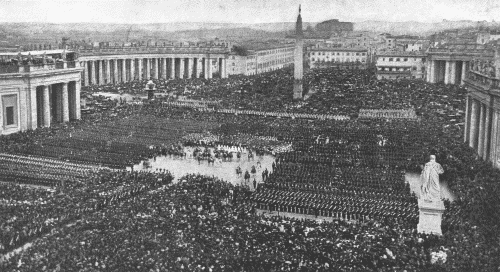 Last Benediction of Pope Pius IX. from the Balcony of St. Peter's.
We went back to the Piazza always at night to see the
"Girandola" fireworks, and there was almost the same
crowd waiting for the first silvery light to appear on the
façade of St. Peter's. It was marvellous to see the lines
of light spread all over the enormous mass of stone, running
around all the cupolas and statues like a trail of
silver, in such quantities that the stone almost disappeared,
and the church seemed made of light—quite beautiful.
The illumination lasted a long time—gold light
came after the silver, and I think it was perhaps more
striking when they began to go out one by one, leaving
great spaces in darkness—then one saw what an enormous
edifice it was.
I have written you a volume—but every turn here recalls
old, happy days—"Roma com'era"—and I must
come back to the present and our farewell dinner at the
Noailles'.
We were a small party—all the French Embassy, the
Duc de Ripalda, the Chilian Minister and his wife, Maffel,
Visconti Venosta, and Lanciani. W. and Noailles
retired to the fumoir and talked politics hard. We shall
soon be back in the thick of it now, and W. will take
his place again in the Senate. It will seem funny to be
quietly settled in the rue Dumont d'Urville—riding in the
Bois in the morning and driving over to the Senate in
the afternoon, with the boy, to get W. Ripalda and
I had a long talk. He tells me he still holds the same
opinion about American women—they are the prettiest
and most attractive in the world. There is something—he
doesn't know what—that makes them different from
all the others. I asked him if he remembered Antoinette
Polk; to which he promptly replied, "Ah, qu'elle était
belle—une déesse." I must tell her how she lives in his
old memory. I always find Noailles pleasant—so grand
seigneur.
We found all sorts of cards and invitations when we
came in, and a surprise for me from Father Smith which
pleased me greatly, a silver medal of Leo XIII. in a case.
It is about the size of a five-franc piece—rather larger if
anything, and so like, the small head, and fine, sharply
cut features, such a nice note, too, from Father Smith;
he was very glad to be able to offer me something which
he knew I would prize, and that it wasn't necessary to be
of the same religion to admire and appreciate a great intellect
and a good man. I am very proud of my two
pictures, and shall show them triumphantly to some of
my Catholic friends and relations who can't understand a
Protestant and a heretic caring for such souvenirs.
We can't accept any more dinners as we leave on Monday,
W. for Naples and I for Florence. I wanted very
much to go to Ostia, I should like W. to see that desolate,
sandy shore with the pines coming down almost to
the water's edge, and the old castle rising up in the distance;
but it is an all-day excursion and we haven't time.
We will try and do Vei, which is an easy afternoon's
drive. I must stop now—W. is deep in Baedeker, looking
out Ostia and Vei, and must also write a note to
Geoffroy about something they want to see to-morrow.
I shall go and see something with Gert.
Sunday, April 19, 1880.
Yesterday we had an enchanting day at Tivoli, W.,
Gert and I. Schuyler was detained in Rome, much to
his disgust, on business. He loves a day in the country
and is most amusing to go about with. He talks to
everybody, priests, peasants, soldiers, and always gets
odd bits of information about old customs, legends,
family histories—all that makes the story of a nation.
Tomba gave us a light carriage and a pair of strong
horses (our little ones were not up to the long day).
We started at 8 in the morning and didn't get back until
8.30. There is a steam tram now all the way out but we
preferred driving, as we wanted to stop at Hadrian's
Villa. We went out by Porta San Lorenzo, crossed the
Arno (the river which makes the falls of Tivoli) at Ponte
Mammolo, and had a good two hours' drive (rather
more, in fact) to Hadrian's Villa. I didn't find that part
of the Campagna very interesting (it was much finer
after one left the Villa). We left the carriage at the entrance
of a sort of lane (one doesn't see much before getting
actually inside) between high banks covered with
every description of vine and creepers; and wild flowers
and weeds in a tangle at our feet (it was really difficult
walking sometimes), and found ourselves in an open
space, with ruins in every direction—a half-crumbling
wall, weeds choking it up; part of a theatre with broken
columns and steps, a few bits of mosaic but not much
colour of any kind; some bas-reliefs very well preserved;
but one felt that everything of value had been taken away,
and what was left was so hidden in long grass and weeds
that it was difficult to understand all the former magnificence
of the famous Villa.
The custode was most conscientious, explained everything—the
arena, theatre, baths, temples, etc., but my
impression was a mass of grey, broken bits of stones and
columns. There were one or two splendid stone pines
standing up straight and tall, looking like guardians of
past splendour, and in every direction the crooked little
grey-green olive trees and fields full of flowers. Gert and
I sat on the wall in a shady corner, while W. and the custode
went off some little distance to look at a fountain, and
we were not sorry to have the rest. The last part of the
drive, winding up the hill to Tivoli, was beautiful—such
splendid views all the time, either toward Rome (St.
Peter's standing out, a faint blue dome at the end of the
long, flat plains of the Campagna; or on the other side
the Sabine Hills, Soracte, Frascati, etc.).
We went straight to the little old hotel of the Sybilla,
which looks exactly the same as in our day, and ordered
breakfast. We were quite ready for it, having had
our "petit déjeuner" at 7.30. The padrone said he
wanted half an hour to prepare it, as the regular table-d'hôte
was over. Of course the railway tourists got out
much quicker than we did and we met them all over the
place, when we went out to see the famous Temple of
Vesta. It is perched on the top of the cliff, looking as
if it would take very little to precipitate it into the mass
of rushing, leaping water tumbling itself over the rocks
far below at our feet. We had a very good breakfast,
capital trout for which Tivoli is famous, and a most talkative
landlord who came to superintend the meal and give
us any information we wanted. He said we must have
donkeys to make the "giro," which would take us about
two hours, and we could finish at the Villa d'Este, where
the carriage would come and get us.
We walked about a little in the town after breakfast
through narrow, dirty streets with curious old bits of
architecture, and into the church, or cathedral as they
grandly call it, of San Francesco; but there was really
nothing to see; and at two we started for our tournée to
the grottoes of Neptune and the Sirena. We all walked
at first, two donkeys with the usual pretty little black-eyed
boys at their heads following (W. of course
wouldn't have a donkey but took a cane which the
padrone of the Sybilla strongly recommended as the steps
going down to the grotto were steep and slippery). I
wondered how the donkeys would get on, but made no
remarks as I knew I could always get off. We walked
through the little town under a nice old arch and up a
path which was pleasant enough at first, but when we
wound round the side of the hill Gert and I were glad
to mount our beasts as the sun was very hot and
there wasn't an atom of shade. It was a beautiful excursion,
always something to see—ruins of old castles,
temples, gateways—so much really that one couldn't take
in details. From certain "points de vue" the Temple of
Vesta seemed almost standing on air—one lost the cliff,
which disappeared in a sort of mist. As soon as we
began to go down the noise of the rushing water was
quite overpowering; we couldn't hear ourselves speak,
and the glimpses we had of the quantities of little
falls leaping over big rocks and stones were quite enchanting.
Our little donkeys were perfectly sure-footed and the
path good though steep. We dismounted before getting
quite down to the grottoes and the steps certainly were
rough and slippery. The guide took charge of Gert, and
I followed in W.'s wake very carefully. It was icy cold
when we got all the way down. I am generally impervious
to that sort of thing, but I felt the cold strike me
and didn't stay long. The chill passed entirely as soon
as we came out and began the ascent, leaving the dark,
deep pool behind us.
The road back was, if possible, more beautiful; great
ravines with olive trees half way down their sides, mountain
streams in every direction making countless little
cataracts, all dancing and sparkling in the sun—rocks
covered with bright green moss, and fields carpeted with
wild flowers. The guide pointed out various ruins—the
Villa of Mæcenas—a great square mass on the top of
a hill—but we didn't care to make a long détour to go
up to it. We were quite satisfied with all the natural
beauty we saw around us—one old bridge, the arches
covered with moss and flowers, and every now and then
through the olive trees one had glimpses of arches, columns,
temples—quite beautiful. The only drawback was
the Cook's tourists who were riding and walking and
talking all over the place, making jokes with the guides
and speaking the most execrable Italian. However they
had already done the Villa d'Este, so we lost them there,
which was a relief.
The Villa was enchanting after the heat and glare of
the road, and at first we sat quite quietly on a grassy bank
and enjoyed the thick shade of the enormous cypresses.
The custode was very anxious we should make the classic
tour with him but we told him we knew the place—it
was by no means our first visit. I explained to him in
Italian that I was a "vecchia Romana" (old Roman),
to which he replied with true Italian gallantry, "non tanto
vecchia—son to vecchio" (no, not at all old—I am old),
and old he was, his face all yellow and wrinkled like the
peasants who live on the Campagna and are poisoned with
malaria.
I should think, though, the Villa d'Este was healthy,
it stands so high. It is almost uninhabited, belongs now
to Cardinal Hohenlohe, but they tell me he never lives
there, never sleeps—comes out for the day from Rome
and goes back at night. It is sometimes let to foreigners.
The garden is quite beautiful, perfectly wild and neglected
but a wealth of trees, fountains, statues, terraces—it
might be made a paradise with a little care. There
are few flowers (like most Italian gardens) except those
that grow quite wild. There is still the same great arch
at one end of the terrace which just frames a stretch of
Campagna, making a beautiful picture.
We had a delicious hour wandering about, stopping to
rest every now and then, and sitting on some old bit of
wall or column—no one there but ourselves and not a
sound except the splashing water of the fountains. W.
was delighted, and we were very sorry to leave. The
afternoon light was so beautiful, penetrating through the
black cypress avenue, however, we had a long drive back,
longer even than coming, as we wanted to make a détour
to look at the sulphur lakes. Our coachman was evidently
anxious to leave. We heard an animated parley at
the gate of the Villa, and the custode appeared to say
the carriage was there and the coachman said it was
time to start if we wanted to get back to Rome before
nightfall. I think he didn't want to be too late on the
road.
It was still warm when we started back, but we hadn't
gone very far when it changed completely and I was very
glad to put on my jacket and a shawl over it. It is a
long, barren stretch of Campagna toward the sulphur
lakes; one smelt the sulphur some time before arriving.
They were not particularly interesting, looked like big,
stagnant ponds, with rather yellowish water. Our man
was decidedly uncomfortable. The road was absolutely
lonely—not a person nor a vehicle of any kind in sight,
the long straight road before us, and the desolate plains
of the Campagna on each side. He fidgeted on his box,
looked nervously from side to side, whipped up his horses,
until at last W. asked him what was the matter, what was
he afraid of. "Nothing, nothing, but it was late. We
were strangers and one never could be quite sure what
one would meet." It was not very reassuring, and when
we saw once or twice a figure looming up in the distance,
a man or two men on horseback, who might be shepherds
or who might be bandits, we were not very comfortable
either; we seemed to feel suddenly that it was getting dark,
that we were alone in a very lonely road in a strange
country, and we didn't mind at all when the coachman
urged his horses to a quick gallop, and got over the ground
as fast as he could.
We didn't say much until the little twinkling lights of
the first "osterias" began to show themselves, and as
we got nearer Rome and met the long lines of carts and
peasants, some walking, some riding, we felt better and
agreed that it wasn't pleasant to feel afraid, particularly
a vague fear that didn't take shape.
When we drew up at the door of the hotel, after having
deposited Gert at her Palazzo, we asked the coachman
what he had been afraid of—was there any danger; to
which he (safe on his box in the Piazza di Spagna) replied
with a magnificent gesture that a Roman didn't
know what fear meant, but he saw the ladies were nervous.
It seems absurd now this morning, sitting at the
window with the Piazza full of people, that we should
have felt so uncomfortable. I asked W. if he was nervous.
He said rather, for from the moment of starting
he saw the coachman didn't want to take the side-road
to the sulphur lakes, which was certainly wild and lonely,
also that he was most anxious to get on. If the carriage
had been merely stopped to rob us it would have been
very disagreeable as we had no means of defence, nothing
but our parasols, and of course nobody near to come to
our rescue. I don't think our Giuseppe would have made
a very vigorous resistance. After all, adventures do happen,
and it would have been unpleasant to return to Paris
minus one ear or one finger or any other souvenir of a
sojourn in a bandit camp.
As we didn't get home until nearly nine I proposed no
dinner, but "high tea" upstairs in our salon. W. demurred
at first, like all men he loathes that meal dear to
the female mind, but upon reflection thought it would
be best. The gérant came up to speak about some boxes
we want to send to Paris direct from here, and we told
him of our return and the coachman's evident terror.
He said he could quite understand it, that it was a very
lonely, unfrequented bit of road leading to the sulphur
lakes, and that we had chosen our time badly; all the
tourists went first to the lakes before going to Tivoli, and
it would have been a temptation to some of the wild shepherds
and Campagna peasants to stop the carriage and insist
upon having money or jewels. He didn't think there
was any danger to our lives, nor even to our ears. They
wouldn't have made much of a haul—I had no jewels of
any kind, except my big pearl earrings—and W. very little
money—three or four hundred francs. It was a disagreeable
experience, all the same. I don't like being
afraid, and I was. We went a swinging pace for about
three-quarters of an hour—the horses on a good quick
gallop.
I went to church this morning. It is a nice walk from
here and the day is enchanting—warm, but just air
enough to make exercise pleasant. W. was off early with
Geoffroy. They put off yesterday's excursion until to-day,
as W. was very anxious to see Tivoli.
The trunks are being packed, the gérant apparently
superintending operations, as I hear a great deal of conversation
in the anteroom. Madame Hubert has an extraordinary
faculty for getting all she wants—an excellent
quality in a travelling maid. As you know she is
very pretty, which again carries out my favourite theory
that beauty is the most important gift for a woman. I
daresay it won't bear discussion, and I ought to say
"goodness," but my experience points the other way. I
have so often heard father quote Madame de Staël (who
was very kind to him when he was a young man in Paris)
who, at the very height of her triumph as the great
woman's intelligence of her time, said to him one evening
at a big party in Paris, looking at Madame Récamier,
who was beautiful, and surrounded by all that was most
distinguished and brilliant in the room, "Je donnerai
toute mon intelligence pour avoir sa beauté."
I am so sorry to go—though of course I shall be glad
to see you all, but we have enjoyed ourselves so much.
I wonder when I shall see it all again, and I also wonder
what makes the great charm of Rome. It appeals to so
many people of perfectly different tastes. W. has been
perfectly happy and interested (and in many things, not
only in inscriptions and antiquities) and I am sure such
an absolute change of life and scenes was the best rest he
could have after the very fatiguing life of the last two
years.
Sunday, April 19, 1880, 10 o'clock.
We have just come in from our farewell dinner with
Gert, our last in Rome, or rather my last. I go to Florence
to-morrow morning, but W. stays on till Tuesday.
He is going to dine at the Wimpffens to-morrow
night with some colleagues and political people. He has
stopped downstairs to finish his cigar and give directions
about some books he wants sent to Paris, and I
will finish this letter. I have nothing to do—the trunks
are all packed, some already downstairs, and the salon
looks quite bare and uncomfortable, notwithstanding some
flowers which Mrs. Bruce and Trocchi have sent for
good-bye.
Gert and I had a nice afternoon. It was so beautiful
that we went for a last drive in the country, and I shall
carry away a last summer impression almost, all blue
sky, bright flowers, deep shadows, and a warm light over
everything. It is wonderful how the Campagna changes—almost
from day to day (not only with the change of
seasons), quite like the ocean. To-day, for instance, was
enchanting, the air soft and mild, a smell of fresh earth
and flowers everywhere, the old towers and tombs standing
well out, rising out of a mass of high grass and wild
flowers, and taking a soft pink colour in the warm sunlight—so
clear that one could see a great distance—and
all the little villages made white spots on the hills.
It is quite different from the winter Campagna, which
stretches away—miles of barren, desolate plains; the
rocks look quite bare, the hills are shrouded in mist, and
one has a feeling of solitude and of dead nature which is
curious. I suppose history and all the old legends work
upon the imagination and incline us to idealize the most
ordinary surroundings; but there are always the long
lines of ruined aqueducts, the square, massive towers,
and great memorial stones that one comes upon in most
unexpected places; and an extraordinary feeling of a
great dead past which I don't think one has anywhere
else.
We passed through the Piazza Montanara, and by the
old theatre of Marcellus on our way out. I wanted to
see the little, dark, dirty corner I was always so fond of.
The fruit-stall was still there, jammed up against the
wall, half hidden by the great stones, remains of balconies,
and arched windows that jut out from the great
black mass—all that remains of the once famous theatre.
The piazza was very full—peasants, donkeys, boys selling
fruit and drinks, and in one corner the "scrivano" (public
letter-writer) with his rickety little old table, pen,
paper, and ink, waiting for any one who needed his services.
Thirty years ago, it seems, he did a flourishing
trade, Sundays particularly, and there would be a long
string of people patiently waiting their turn. Much
chaffing and commenting when some pretty girl appeared,
smiling and blushing, wanting to have a letter written
to her sweetheart away with his regiment in foreign
parts or high up on some of the hills with his sheep
or cattle. To-day there was hardly any one—a wrinkled
old woman dictating something about a soldier and apparently
not making it very clear, as the writer (not the
classic old man with a long beard, but a youth) seemed
decidedly impatient. We had quite time to take it all
in, as the people (donkeys too) were all standing in the
middle of the street and didn't hurry themselves at all to
move apart and let the carriage pass. We were evidently
near the "Ghetto," as we saw some fine types of Jewish
women, tall, handsome creatures, carrying themselves
very well; quite unlike the men, who were a dirty, hard-featured
lot, creeping along with that cringing, deprecatory
manner which seems inherent in the race.
We crossed the bridge and drove through part of the
Trastevere, which certainly looked remarkably dark and
uninviting on this lovely summer afternoon. There are
of course fine buildings, churches, and old palaces, some
half tumbling down, and all black with dirt and age.
The streets were dirty, the children (quantities of them
playing in the streets) dirty and unkempt; clothes of all
kinds were hanging out of the windows, falling over
sculptured balconies and broken statues, in what had been
stately palaces—every now and then flowers in a broken
vase. There were some fine old arched gateways with a
rope across on which clothes and rags were drying, and
dreadful old men and women sitting under them on dirty
benches and broken chairs. There was a smell (not to
use a stronger word) of dirt and stale things, fruit and
vegetables, also a little "frittura," which one always perceives
in the people's quarter in Rome. I had forgotten
how wretched it all was, and we were glad to get away
from the smells and the dirt and find ourselves on the road
along the river which leads to Ponte Molle. It was too
late to think of Vei, but we drove some distance along
the road. The Campagna looked quite beautiful, and
every group we passed a picture in the soft evening light.
Sometimes a woman with a baby on her shoulder (the
child with a red cap) standing well out against the sky—sometimes
one or two shepherds on their shaggy mountain
ponies seeming quite close to us, but really far away
on the plains (always wrapped in their long cloaks,
though it was a summer evening). Every now and then
a merry band of girls and soldiers. The "bersaglieri"
with their long feathers and the girls with bright, striped
skirts swinging along at a great pace, always singing and
laughing; of course the inevitable old woman carrying a
heavy load of fagots or dried grass on her poor bent
back; and equally of course the man with her lounging
along, a cigar in his mouth and hands in his pockets, evidently
thinking that to carry a heavy burden was "lavoro
di donna." Poor old women! I daresay they hardly
remember that they were once straight, active girls, singing
and dancing in the sunlight with no thought of old
age nor fears for the future.
As soon as we crossed the bridge going back there
were many more people on the road. There are "osterias,"
gardens, and small vineyards on each side of the
road almost up to the Porta del Popolo, and as it was
Sunday, the whole population was abroad. Many of the
women carry their babies perched on their shoulders (not
in their arms) and steady them with one hand. The
little creatures, their black heads just showing out of the
sort of bag or tight bands they are wrapped in, look quite
contented—some of them asleep.
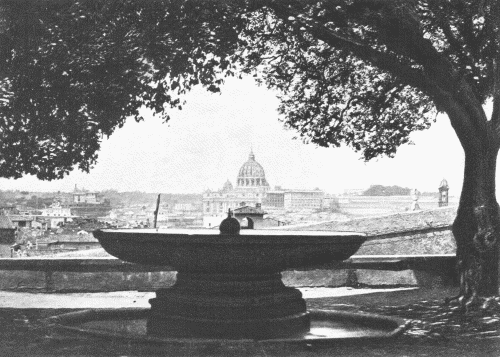 St. Peter's from the Pincio.
We went up to the Pincio, to have a last look at St.
Peter's and the Doria pines before the sun went down.
There were few people; it was late, and we had the terrace
to ourselves. The dome stood out, quite purple,
against a clear blue sky, and seemed almost resting on the
clouds. There was a slight mist, which detached it from
the mass of buildings. Rome hardly existed—we only
saw the dome. I was sorry W. was not there to have
that last beautiful picture in his mind. Del Monte, who
was also lingering on the terrace, joined us and said he
would walk back with me along the terrace of the Villa
Medici, so I sent Gert back to her palazzo in the carriage
and he and I strolled along and talked over old times;
so many recollections of things done together—rides on
the Campagna, hours of music of all kinds, particularly
at the Villa Marconi at Frascati. I asked him if he
had ever gone back there since we left. The villa was
often let to forestieri. One year there was an English
family there, father, mother, one son, and eight daughters.
They used to go about always in three carriages. He
said he had never known any one there since us. He remembered
so well all the music we did in the big room.
When it was a fine night all the mezzo ceto (petite bourgeoisie)
who were in "villegiatura" at Frascati would
congregate under our windows, whenever we were singing
and playing. If they liked our music they applauded;
if they didn't (which happened sometimes, when the
strains were not melodious enough) they were too polite
to express disapproval, and would remain perfectly silent.
We used to hear them singing and whistling our songs
when they went home. We amused ourselves often trying
them with music they couldn't possibly know—plantation
songs or amateur music which had never been
published. We would sing them one evening; the next
they would come back and sing all our songs perfectly
well (no words, of course). They had an extraordinary
musical facility. Often when we stopped, or on some of
the rare occasions when we didn't do any music, they
would sing some of their songs—many of them ending
on a long, sustained note quite charming.
It was pleasant to recall all the "tempi passati." We
lingered a few moments at the top of the Spanish Steps,
quite deserted at this hour of the evening, and when he
left me at the door of the hotel I had barely time to talk
a little to W. before dressing for dinner. He was rather
wondering what had become of me. He had had a delightful
afternoon with his friends. They had walked
along the banks of the Tiber on the way to Ostia. He
says there are all sorts of interesting things to be found
there—tombs, bits of Roman wall and pavements, traces
of old quays, and subterraneous passages all mixed up
with modern improvements. The City of Rome is spending
a great deal of money in building new quays, bridges,
etc., on a most elaborate and expensive scale. I should
think the sluggish old Tiber would hardly know itself
flowing between such energetic, busy banks.
They drove out for some distance on the road to Ostia,
but only got as far as the Monte di San Paolo (I think),
from where they had a fine view of the sea, and the pine
forests. I am sorry they hadn't time to go on, but we
must leave something for the next time. I wonder when
it will be.
Gert's dinner was pleasant—Mrs. Bruce, Comte Palfy,
Father Smith, and Mr. Hooker. They all talked hard.
Mr. Hooker has lived so many years in Rome that he
has seen all its transformations; says the present busy,
brilliant capital is so unlike the old Rome of his days that
he can hardly believe it is the same place. It is incredible
that a whole city should have lived so many years in
such absolute submission to the Papal Government. In
those days there were only two newspapers, each revised
at the Vatican and nothing allowed to appear in
either that wasn't authorized by the papal court; also the
government exercised a paternal right over the jeunesse
dorée, and when certain fair ladies with yellow hair and
elaborate costumes appeared in the Villa Borghese, or on
the Pincio, exciting great admiration in all the young
men of the place (and filling the mammas and wives with
horror), it was merely necessary to make a statement to
the Vatican. The dangerous stranger was instantly
warned that she must cross the frontier.
Palfy, too, remembered Rome in the old days, when
the long drive along the Riviera in an old-fashioned travelling
carriage (before railways were known in these
parts) was a thing planned and arranged months beforehand—one
such journey was made in a life-time. He
said the little villages where they stopped were something
awful; not the slightest idea of modern comfort or cleanliness.
The ladies travelled with a retinue of servants,
taking with them sheets, mattresses, washing materials
(there was a large heavy silver basin and jug which
always travelled with his family) and batterie de cuisine;
also very often a doctor, as one was afraid of fever
or a bad chill, as of course any heating apparatus was
most primitive. The Italians sat in the sun all day
and went to bed when it was dark and cold. One saw
the country and the people much better in that way.
Now we fly through at night in an express train, and the
Rome we see to-day might be Paris, Vienna, or any modern
capital. I mean, of course, inside the walls. As soon
as one gets out of the gates and on the Campagna one
feels as if by instinct all the dead past of the great city.
I told them that in our time, when we lived one summer
in the Villa Marconi at Frascati, the arrangements
were most primitive. The palace was supposed to be
furnished, but as the furniture consisted chiefly of marble
statues, benches, and baths—also a raised garden on a
level with the upper rooms, opening out of the music-room,
the door behind an enormous white marble statue
of some mythological celebrity—it didn't seem very habitable
to our practical American minds. There were
beds and one or two wash-stands, also curtains in one
room, but as for certain intimate domestic arrangements
they didn't exist; and when we ventured to suggest that
they were indispensable to our comfort we were told, "I
principi romani non domandono altro" (Roman princes
don't ask for anything more).
Heavens, how funny all the pourparlers were. Fanny[29]
did all the talking, as we were still too new to the
language to embark upon a business conversation. Her
mother, who was an excellent maîtresse de maison, gave
all the directions, which were most particular and detailed,
as she was very anxious we should be comfortable,
and very doubtful as to the resources of the establishment.
The agent was visibly agacé and impatient.
Fanny had on a pair of tortoise-shell star ear-rings,
and the man told one of our friends afterward that
"quella piccola colle stellette" (the young girl with the
little stars) was a real "diavolo." It was funny to
hear her beginning every sentence "Dice la signora"
(madame says), and saying exactly what her mother
told her; the mother, standing near, understanding every
word, though she couldn't say anything, and looking hard
at the agent. He understood her, too. However, we
didn't get any more than the Roman princes had, and
made our own arrangements as well as we could, having
out a large van of furniture of all kinds from Rome.
Hooker remembered it all well, as he found the house
for us and had many misgivings as to how we should get
along. He was always keeping us straight in a financial
point of view, as even then, before the days of the enormous
American fortunes, Americans were careless about
money, and didn't mind paying, and paying well, for
what they wanted. In those days, too, it was rather
cheap living in Italy, and we were so surprised often by
the prices of the mere necessaries of life that we couldn't
help expressing our astonishment freely. Poor Hooker
was much disgusted. "You might as well ask them to
cheat you." We learned better, however, later, particularly
after several visits to Naples, where the first price
asked for anything was about five times as much as the
vender expected to get. "Le tout c'est de savoir."
Father Smith and W. got on swimmingly. It is too
funny to see them together. The father's brogue is delightful
and comes out strong whenever he talks about
anything that interests him. He has such a nice twinkle,
too, in his eye when he tells an Irish story or makes a
little joke. I must say I am very sorry to go. It has
been a real pleasure to be back again in Rome and to take
up so many threads of my old life. I find Italians delightful
to live with; they are so absolutely natural and
unsnobbish—no pose of any kind; not that they under-rate
themselves and their great historic names, but they
are so simple and sure of themselves that a pose would
never occur to them. Father Smith asked us a great deal
about the German Crown Princess. He had never seen
her, but had the greatest admiration for her character and
intelligence—"a worthy daughter of her great mother"—thought
it a pity that such a woman couldn't have remained
in her own country, though he didn't see very
well how it could have been managed. He doesn't at
all approve of royal princesses marrying subjects. I
think he is right—certainly democratic princes are a mistake.
There should always be an idea of state—ermine
and royal purple—connected with royalties. I remember
quite well my disappointment at the first sovereign
I saw. It was the Emperor of Austria coming out of his
palace at Vienna. We had been loitering about, sight-seeing,
and as we passed the Hof-Burg evident tourists,
some friendly passers-by told us to stop a moment and
we would see the Emperor, who was just driving out of
the gates. When I saw a victoria with a pair of horses
drive out with two gentlemen in very simple uniform, one
bowing mechanically to the few people who were waiting,
I was distinctly disappointed. I don't suppose I expected
to see a monarch arrayed in ermine robes, with a crown
on his head and a sceptre in his hand, but all the same it
was a disillusion. Of course when one sees them at
court, or at some great function, with brilliant uniforms,
grand cordon, and diamond stars, they are more imposing.
I don't know, though, whether that does make a
difference. Do you remember one of A.'s stories? He
was secretary to the British Embassy at Washington, and
at one of the receptions at the White House (which
are open receptions—all the world can go) all the corps
diplomatique were present in the full glory of ribbons
and plaques. He heard some one in the crowd saying,
"What are all these men dressed up in gold lace and
coloured ribbons?" The answer came after a moment's
reflection, "I guess it's the band."
I don't think I can write any more to-night. I seem
to be rambling on without anything much to say. If I
could tell you all I am doing it would be much pleasanter.
A pen seems to paralyze me and I feel a mantle
of dulness settle down on me as soon as I take one in my
hand. You will have to let me talk hard the first three
or four days after I get home, and be the good listener
you always are to your children.
It is a beautiful bright night, the sky almost as blue
as in the day, and myriads of stars. The piazza is quite
deserted. It is early, not yet 10.40, but the season is
over, all the forestieri gone, and Rome is sinking back
into its normal state of sleepiness and calm. How many
times I have looked out on the piazza on just such a night
(from Casa Pierret, our old house just next door)! It
is the one place that hasn't changed in Rome. I almost
feel as if I must go to bed at once, so as to be up early
and in my habit for a meet at Cecilia Metella to-morrow
morning. I do start to-morrow, but not very early—at
ten. I have a line from Mary Bunsen this evening saying
they will meet me at the station in Florence to-morrow.
I shall arrive for dinner. I am half sorry now I didn't
decide to go to Naples, after all. The weather is divine,
and I should have liked to have another look at that
beautiful bay, with its blue dancing water, and Capri and
Ischia in the distance. We had had visions of Sicily,
prolonging our stay another fortnight, but W. is rather
worrying now to get home. He had a letter from Richard
yesterday, telling him to be sure and come back for
the Conseil Général.
There were two amusing articles in the papers the
other day, one saying M. Waddington had been charged
by the French Government with a delicate and confidential
mission to the Pope; two days after, in another paper,
a denial and most vicious attack on W., saying M. Waddington
had evidently inspired the first article himself,
that he had been charged with no mission of any kind,
and they knew from private sources that he would not
even be received by the Pope. I daresay a great many
people believe both. W. naturally doesn't care—doesn't
pay the least attention to what any paper says. I am
getting hardened, too, though the process has been longer
with me. I don't mind a good vicious article from an
opposition paper—that is "de bonne guerre"—but the
little perfidious insinuations of the so-called friendly sheets
which one can't notice (and which always leave a trace)
are very irritating.
W. has just come up. He lingered talking in the
smoking-room with two Englishmen who have just arrived
from Brindisi, and were full of India and all "the
muddles our government is making," asking him if he
wasn't disgusted as an Englishman at all the mistakes
and stupidities they were making out there. They were
so surprised when he said that he wasn't an Englishman
that it was funny; and when he added that he was a
Frenchman they really didn't know what he meant. He
didn't explain his personality (I suppose the man of the
hotel enlightened them afterward), but stayed on talking,
as the men were clever and had seen a great deal. They
had made a long tour in India, and said the country was
most interesting. The ruins—also modern palaces—on
such a gigantic scale.
Well, dear, I really must finish now. My next letter
will be from Florence. We shall stop at Milan and
Turin, but not very long, I fancy, unless W. finds marvels
in the way of coins at Milan. I am quite sad to think
I shan't look out on the piazza to-morrow night. I think
after all these years I still hold to my original opinion
that the Corso is the finest street and the Tiber the finest
river in the world.
Milan, Hôtel de Ville,
Thursday, May 6, 1880.
Here we are, dearest mother, almost home—only 26
hours from Paris—so if we are suddenly called back (and
I earnestly hope we shan't be) we can start at once. We
made our journey most comfortably yesterday, though
it was long. We left Florence at 9 in the morning and
didn't get here until nearly 8. The Bunsens came with
us to the station. I begged them not to at such an
early hour but they didn't mind. It would have been
nice to stay longer. They have just taken their villa
on for another month. Their gardener at Meìngenügen
wrote them that it was snowing and a cold wind—horrid
weather; so they instantly decided to stay on another
month. My belle-mère is delicate and never could
have stood a cold, northern spring after this beautiful
month of April here. They tried to tempt us with all
sorts of excursions—Vallombrosa, Pisa (which I should
like to see again, I have such a vivid recollection of the
Campo Santo and some of the extraordinary tombs,
wide square courts and painted windows). I don't remember
if it was there or at Genoa, where we saw such
elaborate modern monuments; the marble carved and
draped in the most curious manner—a widow kneeling
at her husband's tomb, her skirts all embroidered and
carved so finely, like lace, and a lace veil—really extraordinary.
We found a long train at the station—the night express
from Rome. The préfet had kept a compartment for
us, and Ubaldino Peruzzi, the former sindaco, a great
friend of W.'s, went with us as far as Pistoja. Minghetti
was on the train, and he came into our compartment for
about an hour, but then adjourned to his own carriage as
he was composing a great political speech he makes at
Bologna to-night. They are all much excited over the
elections, which take place Sunday week, so their time
is short. Minghetti has lived and fought through so
many phases of Italian history that he is most interesting.
They say his memory is extraordinary—so accurate. He
never forgets a face or a speech. He says whenever he
has an important speech to make he goes for a drive
or a long walk—the movement helps him. W. is just
the contrary. His great speeches (and they were not
many) have always been composed sitting in his big arm-chair
smoking the beloved old cherry-wood pipe Ségur
brought him from Jersey. When he had got his speech
quite in his head, he wrote it, and then it went straight on—never
a correction or an erasure. I asked Minghetti if
he was nervous. He said not in the least—he was always
ready for the fray, and the more he was interrupted the
better he spoke, as that proved they were listening to him.
I remember so well one of the first days I went to the
Assemblée Nationale years ago. Somebody was speaking—apparently
well—on some question of the day, and
nobody was listening. The deputies were walking about,
talking, writing letters, just as if there was nothing going
on. I looked down to see if W. was listening, but
he was talking cheerfully to Léon Say. It seemed to me
incredible that the orator could continue under such circumstances,
but W. explained it to me. He was speaking
for his electors in the country and for the "Journal
Officiel," which would publish his speech in extenso the
next day.
It was most interesting making the journey with these
gentlemen as they had their history at their finger ends.
All that part of the country had been so fought over—oceans
of blood shed in the fierce struggle against Austrian
tyranny—particularly as we got near Milan. It
seems incredible what a hard iron rule theirs was—especially
if one knows Austria and the Austrians a little.
They seem such an easy-going, happy people. All their
little villages look clean and prosperous, the peasants
cheerful and singing and civil to all strangers and travellers.
The country we passed through to-day looked green
and smiling, but their idea of work is still primitive, even
in Northern Italy. Wherever we passed the people in
the fields all stopped and looked at the train—many came
running up the bank. If they do that for every train
they must lose a considerable amount of time. We were
very sorry when our companions departed, but at every
station almost Minghetti met friends, and it was evident
that he had his head full of politics. It is a long time
since I have met any one so interesting. It is such a
quick intelligence and he touches every subject so lightly,
apparently, only one feels he knows all about it.
We made a fair stop at the Bologna station and had a
very good breakfast. It recalled so vividly old times and
our first journeys to Rome. Even the buffet looked exactly
the same. I could have sworn there was the same
"fricandeau de veau." The buffet was crowded—it seems
there were a lot of Indian officers arriving with their families
from Brindisi, with dark turbaned servants and ayahs
always in white. However the Indian nurses didn't look
so miserable as they used to in winter when we first made
the journey down. They were rather bewildered all the
same in such a jostling, hurrying crowd. It is funny to
see how they cling to their charges, holding the babies
tight with one hand and guiding one or two others half
hidden in their long white draperies, with the other. I
am sure they are excellent, faithful nurses.
Our last days in Florence were very full. Tuesday was
the day of the races—bright, beautiful weather—and we
drove out to see the retour, stationing ourselves at the
entrance of the Cascine until 7 o'clock. There was not
much to see in the way of equipages—nothing like the
Roman turn-outs—but there were some pretty women.
The Comtesse Mirafiori (née Larderel), I daresay you
will remember the name, was about the prettiest. Her
victoria was very well appointed, handsome horses stepping
perfectly; and she looked a picture, all in white with
a big hat turned up with dark blue and long blue and
yellow feathers. I think a woman never looks better than
in a victoria—it shows off the dress and figure so well.
Lottie, too, looked very well, but she passed so quickly I
couldn't see what she had on. I had an impression of
white with some pink in her hat. Almost all the women
were in white. Of course the Lungarno was crowded—all
the loungers taking the most lively interest in the carriages;
and when there was a stop criticising freely—but
I must say with their natural Italian politeness, confining
themselves to expressions of admiration more or
less pronounced—never anything disagreeable.
We had a mild reception in the evening. Various
friends came to say good-bye—Maquays, Peruzzis, Miss
Forbes and one or two men. A scientific German—I forget
his name—who told W. it would take weeks to
see all the coins and interesting things of all kinds at
the Milan Museum. We are very comfortable here; the
hotel is old-fashioned with a nice open court, and the
rooms good. We have a pretty apartment on the front,
and as it is on the main thoroughfare, Corso Vittorio
Emanuele, we see all that goes on. There is a church
opposite—San Carlo, I believe—and we are not far from
the Piazza del Duomo.
We went for a little stroll last night after dinner, just
for W. to smoke his cigar. The Cathedral looked splendid—a
gigantic white mass in the midst of the busy
square, quantities of people in the streets and sitting at
all the cafes, of which there are hundreds—quite like the
Paris boulevards on a summer night—everybody talking
and laughing and a cheerful sound of clinking glasses. I
think they were almost all drinking beer—a great many
uniforms—I suppose there is a large garrison. There
seemed very few foreigners—we heard nothing but Italian
spoken—so unlike Rome and even Florence where one
heard always so much English in the streets and the
shops. They told me in Florence that there was a large
English colony there, living quite apart from the fashionable
world—children learning music, or some of the
family delicate, needing a mild climate and sunshine—more
perhaps in the villas close to the gates than in the
town itself. I should think the cutting wind that sweeps
the Lungarno would be mortal to weak chests; but up
in the hills sheltered by the high walls and olive groves
one would be quite protected. Certainly the other day
on the terrace of Castello the sun was divine and the air
soft and balmy, not a sign of chill or damp—but it was
the month of May—the month for Florence.
This morning I have been unpacking—or rather
Madame Hubert has—and settling myself in my salon,
making the two corners—feminine and masculine—as I
did in Rome. I have no convenient Palazzo Altemps to
help me out with cushions, screens, etc., but I found lovely
flowers which the landlord (who received us in dress
clothes and his hat in his hand) put there, and as he was
very civil and pleased to have the "Excellenza" and
hoped I would ask for anything I wanted, I have asked
for and obtained an arm-chair, and suggested he should
give me a simple table-cover instead of the beautiful
green velvet one, embroidered with pink roses, which
now ornaments my salon. With my careless way of writing
and facility for putting ink all over myself, even in
my hair, I am afraid that work of art would be seriously
deteriorated. He sent up this morning to know if I
wanted my breakfast upstairs—if I would come down he
would reserve me a small table in the window. I shall
go down—I hate meals in a sitting-room and I should
like to see what sort of people there are in the hotel.
10 o'clock.
I will go on to-night while W. is putting his papers in
order. I breakfasted alone downstairs about 12. The
dining-room is a large, handsome room across the court.
There were very few people—not more than four tables
occupied—a large English family with troops of fair-haired
children—girls in white frocks and long black
stockings and boys in Eton coats. They all looked about
the same age, but I suppose they weren't. They were
very quiet and well-behaved, quite unlike any of our small
relations. I have vivid recollections of travelling with
some of them—all talking at once at the top of their
lungs, "Pa, give me a penny," "Pa, give me a cake,"
"Pa, what's that for?" etc.
The reading-room opened out of the dining-room, so
I went in to have a look at the papers—found a "Débats"
and the "Times," and read up all that was going on in the
fashionable and political world. W. came in about 4—he
had ordered a carriage for 4.30, and as it was a lovely
afternoon we thought we would drive about the streets a
little and out into the country. He had had a delightful
morning—says the Museum is most interesting—the
cabinet de médailles a marvel. He has arranged to go
there every day at 10 o'clock—will work there until 3,
then come back for me and we shall have our afternoon.
He is much pleased with this arrangement but he doesn't
think the employees of the cabinet de médailles will find
it quite so satisfactory, as some one must always be with
him. They never leave any one alone in these rooms.
He thinks there are only two people for this service, and
they will naturally hate spending a long day doing nothing
while he studies and copies.
The Directeur received him to-day most enthusiastically—knew
all about his collection of coins.
We started out about 5 and went first to have a cup
of tea at the café the padrone recommended—Cova, I
think—and then told the man to drive about the streets
and pass the principal buildings. We saw the Duomo
again, the Scala (theatre)—if it is open we shall go one
night; the great Galerie Victor Emmanuel, full of shops;
and quantities of churches, Santa Maria delle Grazie,
of course, where is the famous "Cenacolo" of Leonardo
da Vinci, but the outside merely. The fresco is only
visible until 4—so we shall see the inside of the church
another day. We made a turn in the public gardens or
promenade where there were quite a number of handsome
carriages and saddle horses—many officers riding. It
was rather late to attempt a country drive (we had said
we would dine downstairs at 7.30), for the turning and
twisting about in the streets and stopping every now and
then had taken up a good deal of time. We had a nice
little victoria with a pair of horses, not unlike the carriage
Tomba gave us in Rome.
We went down about a quarter to eight. The
padrone in his dress clothes was waiting at the foot of
the stairs and conducted us with much pomp into the
dining-room, where we found a nice round table in the
window. The room was quite full—many more people
than in the morning, and I should think almost all
Italians. They looked at us naturally with much curiosity,
as such a fuss was made with us. W. smoked a
cigar in the court after dinner and talked to the man of
the house who told him about all the distinguished people
he had had in his hotel. I found papers and a "Graphic"
in the reading-room and was quite surprised when they
said it was 10 o'clock.
May 7th.
It has been pouring all day—straight down. I think
it has stopped a little since dinner. We didn't stay long
in the reading-room as W. is fairly launched in his coins
now and puts his notes in order in the evening. I prowled
this morning with Madame Hubert. Before breakfast
we went to the Brera. It was almost empty but we found
a nice guide, a youngish man, speaking such beautiful
Italian that it was a pleasure to hear him, and
well up on all the pictures. There are beautiful things,
certainly. I was so glad to see some old friends. I was
always so fond of the "Amanti Veneziani" of Paris
Bordone. The "sposo" looks so young and straight and
proud, and the girl's attitude is charming, her brown-gold
head drooping on her lover's shoulder as she holds
out her hand for the ring he is putting on her finger.
Even the inferior pictures of the Paul Veronese school
are fine—there is such an intensity of colour. The whole
room seemed filled with light and warmth. I think I
like the backgrounds and accessories almost as much as
the figures. The draperies are so wonderfully done, one
can almost touch the gorgeous stuffs, heavy with gold
and silver embroidery; and there are one or two high-backed,
carved arm-chairs which are a marvel. The
beautiful fair women with strings of pearls in their golden
hair, and white satin dresses, sitting up straight and
slight in the dark wooden chairs, are fascinating; and
there are quantities, for Paul Veronese and all his pupils
have always so many people in their pictures.
We saw of course the "Sposalizia" in a small room
quite by itself. The Virgin is a beautifully slight ethereal
figure with the marvellous pure face that all Raphael's
Madonnas have; but the St. Joseph looks younger than
in most other pictures. Our guide was most enthusiastic
over the picture. It was a treat to hear him say—"morbidezza"
and "dolcissimo." We were there about
an hour and a half, and that was quite long enough.
One's eyes get tired. We saw splendid portraits of
princes and warriors as we passed through the rooms—Moretto,
Leonardo da Vinci and others.
It was still raining when we came out so we thought
we wouldn't attempt any more sight-seeing, and walked
up to the Galleria Vittorio Emanuele where we were
under cover. The Cathedral looked splendid—all the
white pinnacles and statues standing out from the dark
grey sky. We looked in at all the shop windows, but
didn't see anything particularly striking or local except
the black lace veils which so many women (not the upper
classes) wear here. Madame Hubert being young and
pretty was most anxious to adopt that fashion—thought
it would be more suitable for Madame as all the suivantes
here wore the veil—she would be less remarked going
about with Madame—but Madame decidedly preferred
the plain little black bonnet of the Parisian femme de
chambre. It seems there is a swell Italian woman in the
hotel—a Princess—whose maid always wears a veil when
she accompanies her mistress in her walks abroad.
I was decidedly damp when I got back to the hotel. I
breakfasted alone at my little table, and in fact was almost
alone in the dining-room—there were only two other
tables occupied. The head waiter was very sympathetic
about the weather—they always had sun in Milan, just
a mauvaise chance to-day. I had the reading-room also
to myself, and found plenty of papers in all languages.
I have rather a weakness for the "Kölnische Zeitung"
(Gazette de Cologne). It is very anti-French, or I might
really say anti-everything, as it is always pitching into
somebody, but there is a good deal of general information
in it.
W. came in about 3.30, having worked steadily since 9.
It was getting too dark to see much more and his attendant
beamed when he saw him putting up his papers
and preparing to leave. He says the man is bored to
death—wants to talk at first and explain things to him,
but he soon realizes that W. is bent on serious work, so he
desists and reads a paper and walks about the room and
fidgets generally.
We waited until 4.30 hoping the rain would stop. It
didn't, but the clouds lightened a little and we thought
we would go and see the Duomo. I had forgotten how
beautiful it is—those great wide aisles quite bare—no
chairs, nothing to break the line until quite at the high
altar, and the light from the old glass windows coming
from so high over our heads it seemed straight from
heaven. We sat some little time in one of the side
chapels. It looked vast and mysterious—one had such
an impression of space and height. Various guides came
up and supposed we would not care to go up on the
roof on such an afternoon. We told them we would
come back the next day if it was fine. They looked so
disappointed at having nothing that we finally went down
into the crypt to see the tomb and body of San Carlo Borromeo.
We had both seen it before but I didn't mind
reviving my souvenirs. We had tapers of course as it
was quite dark, but we saw quite well the coloured
marbles and precious stones of the little chapel—also the
body of the Saint, marvellously preserved. It looked
very small—hardly the size of a grown man. The guide
of course wanted to show us all sorts of relics, and the
trésor of the Cathedral, but we preferred going up again
to the church, and wandered about looking at the marble
tombs and monuments—there are not many, and
they are quite lost in the enormous building. Quite
down at the bottom of the church, near the door under a
baldaquin, is a font in porphyry, said to be the sarcophagus
of some saint. The church looked immense as it
grew darker and the light gradually faded, leaving deep
shadows everywhere. When we turned back, just as we
were going out, to have a last glimpse, the high altar
seemed far away, and the tall candles looked like twinkling
lights seen through a mist or veil.
We walked about a little under the arcades. W.
wanted some cigars and I an Italian book Minghetti had
recommended to me, "Sketches of Life in Milan and
Venice under the Austrian Occupation." I have been
reading it a little to-night—what an awful life for
Italians—a despotic, iron rule, police and spies everywhere,
women even making their way into the great
Italian houses and reporting everything to the police—the
children's games and little songs, the books and
papers the family read, the visits they received. The
most arbitrary measures prevailed—no young man allowed
to leave the city—no papers nor books allowed that
were not authorized by the government—and when arrests
were made, the prisoners, men or women, treated
most cruelly. The Austrians must have felt the hatred
and thirst for vengeance that was smouldering in all
these young hearts. It seems all the girls and young
women, even of the poorest classes, made themselves
flags (tricolour) out of bits of anything (paper when they
couldn't get anything better) and gave them to all the
men, preparing for the "Cinque giorni" when many of
them went down under the Austrian bayonets, giving
their lives cheerfully and proudly for their country.
Radetzsky must have been a monster of cruelty. How
they must hate the white uniform and the black and
yellow flag.
The city is quiet enough to-night. I suppose it is not
an opera night. It is only half-past ten and we are on
one of the principal thoroughfares, but nothing is passing
in the street. The hotel, too, is quiet, one doesn't hear
a sound. I fancy most travellers go to the new hotel—the
Cavour. We are quite satisfied here, and are most
comfortable—the landlord very attentive. He and W.
are becoming great friends—they talk politics (Italian)
every night while W. smokes.
Friday 7th.
I see I shall always write at night. After coffee and
half an hour in the reading-room (I always go and have
a look at the papers while W. smokes) we come upstairs.
W. plunges at once into his notes, and I read and write.
It has been lovely to-day and we have had a nice afternoon.
W. came home to breakfast at 1, as he wanted
to see the Brera and "Cenacolo" once again; and it is of
course too late when we start for our afternoon drive at
4.30. We walked to the Brera—it isn't far—and were
there a long time. We made a long stop in the vestibule
looking at the Luini frescoes—all scenes in the Virgin's
life—Madonnas, angels, saints—quantities of figures,
and colours and accessories of all kinds—wonderful trees
and buildings and clouds with angels and seraphim rising
out of them. They must have had marvellous imaginations,
those early Italian painters. They never saw
anything to suggest such pictures to them, and of course
never read anything—there were no books to read—merely
written manuscripts difficult enough for scholars
to decipher. All the wonderful scenes—Nativity, Coronation,
etc.—evoked out of their own brains. I think I
like the Annunciation the best of all the scenes of the
Virgin's life. There is a beautiful one in the Pitti—I
forget now by whom—the Virgin just risen from her
chair with a half-dazed, half-triumphant look, and the
angel kneeling before her with his lily. I like some of
the German ones, too, but they are much more elaborate—the
Virgin often standing in a wide arch—a portico—more
figures in the background—and the Virgin herself
quite a German girl—not at all the lovely, spiritual head
of the Italian masters.
We walked through all the rooms. The Venetian
pictures (Paul Veronese school) looked beautiful. W.,
too, was struck with the splendid colouring. Some of
the names quite unknown, and if one looked too closely
there were perhaps faults of drawing and exaggeration of
colour, but the effect was extraordinary. He admired the
men's portraits excessively, by Titian, Tintoretto, Moroni,
etc. They are very fine—sometimes a soldier with keen,
hard eyes, clad in complete armour—often a noble, some
grand seigneur of his time, in black velvet and fur with
jewelled cap and chain, a fine patrician head and thoughtful
face. We didn't see the young guide who went about
with me—I was rather sorry—I wanted W. to hear his
beautiful Italian.
We stayed so long looking at everything (Luini's
pictures are most interesting, too—he must have had an
extraordinary capacity for work) that we had just time
to get a cab and drive over to Santa Maria delle Grazie
to see the "Cenacolo" as it shuts at 4. The Saviour's
head, St. John, and some of the other faces are beautiful—but
it is so faded (and on the other hand has been
touched up a little) that I was disappointed.
It was a beautiful bright afternoon and we saw as well
as possible, but really "decay's effacing fingers" have
been allowed too much sway. They told us it was impossible
to guard against the damp, and that eventually
the whole thing would be blotted out. However, it has
stood the test pretty well through all these years.
We went into the church, which was quite empty, except
one figure in black, absorbed and motionless, kneeling
on the stone pavement. Poor woman, I hope she got
what she was praying for so earnestly. From there we
went to the church of St. Ambrogio, which is a fine
old building—the frescoes and inscriptions much faded.
The iron crown used to be kept there (they told us the
Kings and Emperors came there to be crowned) but it is
now at Monza. I declined any more churches and regular
sight-seeing after that—so we went back to the hotel
where the carriage was to meet us, went for our cup
of tea to Cova's, and then started for a drive.
The country quite around the city is not particularly
interesting—much cultivated, but flat—vineyards, corn
and rice fields all intersected with numberless little canals.
Though it was late, 6 o'clock, people were still working
in the fields and seemed to keep to their work much
more steadily than the peasants about Rome and Florence
who were always stopping to talk or look at whatever
was passing. We met bands of them trooping along the
road—they were generally tall, broad-shouldered, strong
men—quite the northern type. We crossed some soldiers,
too—cavalry and infantry—quite a big detachment—all
had their kits, and baggage wagons following. They
were evidently changing garrison. I didn't think the
troops looked very smart. The horses were small and
very thin, and the men (infantry particularly) dragged
along and were rather dirty. Just as they passed us the
music struck up a sort of quick march, and it was curious
to see the instantaneous effect. The men straightened
themselves up, moved more quickly and lightly—it was
quite different.
I hoped we should get a view of the mountains, but the
sunset, though beautiful, was rather misty—however the
coachman told us that meant fine weather for to-morrow
which will be nice as we are going up on the top of the
Cathedral. I was glad to have a little rest before dinner.
I plunged again into my book, which is madly interesting—but
such horrors—a long imprisonment like
Silvio Pellico's was merciful compared to some of the
tortures and cruelties—and it seems the Emperor himself
was the hardest of all—never forgetting nor pardoning
nor listening to any petition or prayer for mercy—no
wonder the people were infuriated—mad with rage—women
and children working at the barricades during the
"five days"; and the old ones, too infirm to take an
active part, at the windows pouring down boiling water
and oil on the Austrian soldiers. However, I suppose it
is the history of all street fighting. I remember the
hideous tales they told us of the Paris Commune, when
we went back there after the war—how maddened the
Versaillais were at the shots, missiles and boiling water
which came from all the windows upon them. The reprisals
were terrible when the regular troops finally got
the upper hand—and I suppose no one will ever know
how many innocent people were shot in the first flush of
success.
I read out bits of my book to W. He said he didn't
think the account exaggerated—of course they had chosen
all the worst cases. He was at Versailles during the
Commune, and saw the first batches of prisoners brought
in—such awful looking people—many young, very young
men, with wild reckless faces. They probably didn't know,
half of them, what they had been fighting for—a vague
idea of patrie and liberty, and the natural love of the
Parisian gamin for a row and a barricade.
Milan, Hôtel de Ville,
May 9, 1880.
We have had an awful day, dear mother, pouring
steady rain since early morning—clouds grey and low
shutting out the city entirely; really so dark I could
hardly see to dress—and the streets apparently deserted.
W. didn't mind, and was off as usual to his coins at 9
o'clock. He did have a remords de conscience at leaving
me all alone all day shut up in a little hotel salon, and
said if I would come and get him about 3 we would try
and see something.
I wrote two letters which will rather amuse the family
as they say I only write when I am boring myself in the
country or having a series of rainy days—Janet always
calls them my rain letters. However, when I had written
two my energy in that line was exhausted, and I felt
I couldn't sit another moment in that dark salon, so I
summoned Madame Hubert (I don't generally care to
have a maid for a companion but I didn't like to walk
about the streets of a foreign city alone) and we started
off with short skirts and umbrellas. The gérant nearly
fell off his high stool in the bureau when he saw me preparing
to go out—wanted to send for a carriage, a fiacre,
anything—but I told him I really wanted to walk, which
filled him with amazement. Italians as a rule don't like
walking at all, and he thought I was quite mad to go out
deliberately, and for my pleasure, on such a day.
It wasn't very pleasant in the streets—everybody's umbrella
ran into me, and the pavements were wet and slippery.
We finally took refuge under the arcades, but there
we got quite as much jostled, for everybody who was out,
was there; and the sudden gusts of wind and rain around
the corners and through the arches were anything but
pleasant. I wasn't at all happy, but I liked it better than
sitting in the room at the hotel. I was so draggled and
my boots so covered with mud that I was rather ashamed
to cross the big hall of the hotel when I came in.
I found a letter from Gert saying she was so glad we
had such delightful weather for Milan. I wish she could
look out of my window at this moment. She wouldn't
know if she were in Milan or Elizabethtown. The clouds
are very low on the roofs of the houses—the city has disappeared
in a mist, I can just see across the street. The
pavements are swimming—quite rushing torrents in the
gutters, and I look down upon a sea of umbrellas.
I started out again about 3—in a carriage this time—and
went to get W.—extract him from his coins if I
could. There was no one, apparently, in the Museum,
but a smiling concierge took me to the antiquity and coin
rooms where I found W. very busy and happy; quite insensible
to rain or any outside considerations. He said
the light wasn't very good. A musty old savant with
a long ragged beard and very bright black eyes was keeping
him company. He was delighted to see me, for he
knew that meant stopping work for that afternoon. I
talked to him a little while W. was putting his papers
in order, and it was evident he had never seen any one
with such a capacity for steady work. He encouraged
us very much to go and see something (anything that
would take us out of the coin room) but we really didn't
know what to do with ourselves—a country drive wasn't
inviting and it was too dark and late for pictures—all the
galleries close at 4. The padrone had recommended
the flower show to us in the public gardens, so we thought
we would try that. The flowers were all under glass and
tents, so we were dry overhead, but the ground was wet
and muddy—a general damp, chilly feeling everywhere.
I am sure the place is lovely on a bright summer day.
There are fine trees, splendid horse chestnuts, pretty
paths and little bosquets. The poor flowers looked
faded and drooping, even under cover. The roses were
splendid—such enormous ones with quantities of leaves,
very full. The finest were "Reine Marguerite," "Marguerite
de Savoie," "Princess de Piémont." I asked one
of the gardeners if the Queen was very fond of flowers—the
"Marguerite de Savoie" was a beautiful white rose.
"Oh, yes," he said, enthusiastically, "the Queen loves
flowers and everything that is beautiful." I thought it
such a pretty answer. He showed us, with great pride,
a green rose. I can't say I admired it, but it is so difficult
and so expensive to produce that I don't think we shall
see many. We walked about and looked at all the
flowers. Some of the variegated leaves were very handsome.
There was a pink broad leaf with a dull green
border and an impossible name I should have liked to take
away, but the man said it was an extremely delicate plant
raised under glass—wouldn't live long in a room (which
was what I wanted it for). We thought we would go
back and have tea in a new place under the arcades—in
the Galleria. The tea was bad—had certainly never seen
China—as grown, I daresay, in the rice fields near the
city, so we declined that and ordered chocolate, which
was very good, and panettoni. W. was rather glad to
have something to eat after his early breakfast. It was
pouring, but we were quite sheltered in the corner of the
veranda; so he smoked and we looked at the people passing
and sitting near us. They were certainly not a very
distinguished collection—a good many officers (in uniform),
loungers who might be anything—small functionaries,
I should think—few women of any description, and
no pretty ones. The peasant woman coming out of the
fields was much better-looking than any we saw to-day.
W. had had visitors in the coin room this morning. The
Director, who came, he thinks, out of sheer curiosity to
see how any one, for his pleasure, could work five or six
hours at a time. He brought with him a Greek savant—a
most intelligent young man who apparently knew W.'s
collection almost as well as he did—and all the famous
collections of Europe. They had a most interesting talk
and discussion about certain doubtful coins of which
3 Museums—London, Petersburg and Milan—claim to
have the only originals. We talked over our plans, but I
think we have still two or three more days here. We
want to go to Monza. They say the old town and church
are most interesting, as well as the Royal Villa.
It was rather amusing in the reading-room after dinner.
There were many more people—women principally,
and English. Some of them had been buying
things at the two famous bric-à-brac shops, and they were
very much afraid they had paid too much, and been imposed
upon. They finally appealed to me (we had exchanged
papers and spoken a few words to each other)
but I told them I was no good, nothing of a connoisseur
for bric-à-brac, and particularly ignorant about lace.
They showed it to me, and it looked very handsome—old
Venetian, the man had told them. They had also
some silver which they had bought at one of the little
shops in the Piazza dei Mercanti. I think I will go and
see what I can find there.
I found W. deep in his Paris courrier when I got
upstairs. There was a heap of letters and papers, also
Daudet's book "Souvenirs de la Présidence du Maréchal
de MacMahon" which l'Oncle Alphonse had sent us,
said everybody was reading it at the clubs. W. figures
in it considerably, not always in a very favourable light,
as judged by Monsieur Daudet; but facts speak for themselves,
even when the criticism is not quite fair. I suppose
it is absolutely impossible for a Royalist to judge a
moderate Republican impartially. I think they understand
the out-and-out Radical better. The book is clever.
I read out bits to W. (which, by the way, he hates—loathes
being read to). It was interesting to read the
life we had just been leading described by an outsider.
I think W. will give himself a holiday to-morrow if it
is fine (at the present moment, with the wind and
rain beating against the windows, that seems a remote
possibility). He will come back to breakfast and we
will have our afternoon at Monza. I have finished my
book of the Austrian rule, and I am really glad—the horrors
quite haunted me. It seems incredible that in our
days one Christian nation should have been allowed to
treat another one so barbarously. I should like to go
back to my childish days and read "Le mie Prigioni," but
I found a life of Cavour downstairs in the hotel library,
so I think I shall take that.
May 10th.
It is lovely this morning (though when the weather
changed I don't know, as it seemed to me I heard a steady
downpour every time I woke in the night), however, at
9 o'clock it was an ideal summer day, warm, a bright blue
sky, no grey clouds or mist, one could hardly believe it
was the same city. The atmosphere is so clear that the
snow mountains seem almost at the bottom of the street.
I went for a walk with Madame Hubert through the old
parts of the city—such curious, narrow, twisting little
streets. We went into the Duomo for a moment, it
looked enormous—cool and dark except where a bright
ray of sunshine came through the painted windows, but
so subdued that it didn't seem real sunlight seen through
all the marvellous coloured glass. There were a few people
walking about in little groups, but they were lost in
the great space. One didn't hear a sound—the silence
was striking—there wasn't even the usual murmur of
priest or chorister at the altar as there was no mass
going on.
We asked the way to the Piazza dei Mercanti on the
other side of the Duomo. It is a curious old square—a
very bad pavement, grass growing in places between the
stones, and all sorts of queer, irregular buildings all
around it—churches, palaces, porticos, gateways—a remnant
of old Milan. At each end there were little low
shops where many people were congregated. I don't
know if they were buying—I should think not as they
seemed all rather seedy, impecunious individuals judging
by their shabby, not to say worn-out garments—all Italians—I
think we were the only foreigners in the Piazza
(yet it is one of the sights of Milan, mentioned in the
guide books). We went, too, and looked at some of the
things spread out for sale—many old engravings, carved
wooden frames, gold and silver ornaments, and some
handsome cups and flagons very elaborately worked—also
some bits of old stuff, brocade, and a curious faded
red velvet worked in gold, but all in very bad condition. I
couldn't find a good piece large enough to make an ordinary
cushion. In one corner, squatting in the sun, were
two big, dark men with scarlet caps on their heads (they
looked like Tunisians). They had muslins, spangled
with gold and silver, crêpe de Chine, and nondescript
embroidered squares of white, soft silk with wonderful
bright embroidery and designs—moons, and ships and
trees. We spoke to them in French, but they didn't understand,
and answered us in some unintelligible jargon—half
Italian, with a few English words thrown in.
Some of the old palaces are fine, one in particular
which seems to be a sort of bourse now. The portico
was crowded with men, all talking at the top of their
voices. We had glimpses through the crowd of a fine
collection of broken columns, statues, tablets and bas-reliefs
inside, but we didn't attempt to get in; though a
friendly workman in the street, seeing us stopping and
looking, evident strangers, told us we ought to go in and
see "le bellezze" (the beautiful things). There is an
equestrian statue on one side of the palace—I couldn't
quite make out the name, but the inscription says that
among other great deeds he "burnt many heretics." I
don't suppose they gave him his statue exclusively on that
account, but the fact was carefully mentioned. We
wandered about rather aimlessly, leaving the Piazza, and
finally found ourselves in a wide, handsome street—large
palaces on one side and the canal running through the
middle. The canal is really very picturesque—the water
fairly clear, reflecting the curious, high, carved balconies
and loggias (some of them covered with creepers and
bright coloured flowers) that hang over the canal. They
seemed all large houses, with the back giving on the
canal; some of the low doors opening straight out on the
water were quite a reminder of Venice; and when there
was a terrace with white marble balustrade and benches
one could quite imagine some of Paul Veronese's beautiful,
fair-haired women with their pearls and gorgeous
red and gold garments disporting themselves there in the
summer evenings. The palaces on the other side of the
street are fine, stately mansions—large doors open, showing
great square courts, sometimes two or three stretching
far back—sometimes a fountain and grass plot in the
middle—sometimes arcades running all around the court,
with balconies and small pointed windows—coats-of-arms
up over the big doors, but no signs of life—no magnificent
porters such as one sees in Rome in all the great
houses. They all looked in perfectly good condition and
well cared for. I wonder who lives in them.
We came out at the Place Cavour and had a look at the
statue, which is good—in bronze—an energetic standing
figure with a fine head, very like—one would have recognised
it anywhere from all the pictures one has always
seen of Cavour. There is no group—he standing alone
on a granite pedestal—a woman (Fame) kneeling, and
writing his name on a scroll. I liked it very much—it
is so simple, and we have seen so many allegorical groups
and gods and goddesses lately that it was rather a relief
to see anything quite plain and intelligible.
I wasn't sorry to get back to the hotel and rest a little
before starting again this afternoon. I liked walking
through the little old crooked streets—they were not
empty, there were people in all of them, but decidedly of
the poorer classes. They are a naturally polite, sympathetic
race—always smiling if you ask anything and always
moving to one side to let you pass—unlike the stolid
German who calmly and massively takes the middle of the
pavement and never dreams of moving to one side, or
considering anybody else. I have just been jostled by
two stout specimens of the touring Vaterland—they are
anything but good types. If they didn't understand the
language in which Madame Hubert expressed her opinion
I think the tone said something to them, for one man
muttered a sort of excuse.
If I can keep my eyes open long enough I will finish
this letter to-night. We have had a lovely afternoon—didn't
get back until 8.30 and have only just come upstairs
from dinner. We started a little after three, in a
light victoria and a capital pair of small strong post-horses
who went at a good, steady, quick trot. The drive
is a short hour and a half—not very interesting country—flat
rice fields and the same numerous little canals one
sees all over Lombardy. Monza is quite a large town—looks
very old and Italian. The Cathedral was begun in
the sixth century, but rebuilt in the fourteenth. There
are all sorts of curious frescoes and relics. We saw, of
course, the iron crown which all Austrian Emperors are
supposed to wear at their coronation. The last two to
wear it were Napoleon and Ferdinand I. It is really a
large gold circle with a smaller iron one inside, and
studded with precious stones—very heavy. It was shown
to us with much pomp, lighted tapers, and a priest in his
vestments. He told us the iron band inside was made
out of a nail that had been taken from the Saviour's
cross. He handled it very reverently, and would hardly
let me lift it to see how heavy it was. He showed us
many curious things, among others a fan of Queen Theodolinda's,
made in the 6th century. It was small, made
in leather, and really not too faded, though one had to
look closely and with the eyes of faith to see the roses the
old priest pointed out.
While we were looking at the relics a French pèlerinage
came up—quite a long procession; many very nice-looking
women. They were all dressed in black, and
most of them wore bonnets—some few had black veils—priests
of course, and a fair amount of men of all ages.
They passed in procession up the aisle, chanting a psalm,
which sounded very well, full and solemn. One or two
stragglers, two young men and a woman stopped to see
what we were looking at, and we had a little talk. They
had just arrived over the St. Gothard, hadn't much time,
and were very keen to see everything. They said it was
very cold crossing the mountain—the heavy rain we had
had at Milan had been deep snow on the pass. We went
to look at Queen Theodolinda's tomb in one of the side
chapels, and then started for the "Casa Reale" as they
call the Royal Villa. It has no pretensions to architecture;
is a large square building with long, rambling
wings. We could only see the great hall and some of the
reception rooms downstairs, as they were painting and
cleaning upstairs. The rooms had no particular style—large,
high ceilings, great windows looking on the park;
just what one sees in all Royal Palaces. All the furniture
was covered with housses—the gardien took one off
an arm-chair to show us the red velvet. The lustres also
were covered—the mirrors were handsome. The park
is delightful—quantities of trees of all kinds, lovely shady
walks, and bosquets. There seemed to be a great deal of
game—deer and pheasants walking about quite tame and
undisturbed in all directions. The communs and dépendances
are enormous, quite a little colony of houses scattered
about—régisseur, head-keeper, head-gardener, all
with good gardens.
We had a nice talk with a half-gardener half-guide who
went about with us and showed us all the beauties. The
place is low—I should think would be very warm in summer,
for even to-day the shade was pleasant and the low
afternoon sun in our faces rather trying. There were
splendid views every now and then of the distant Alps.
The gardener, like every one else who has ever been
thrown with her, apparently adored the Queen—said she
knew all about the place, and trees, and flowers, and was
so beloved in the town. I remember Peruzzi telling
me how fond she was of Monza—happier there than
anywhere. They certainly love their "Margherita di
Savoia." There are pictures of her everywhere, and
some one told us that all the girls in Monza are called
Margherita.
When we were starting back we met the pilgrims
again, still walking and chanting on their way to the
station. They had a white banner with them, but I
couldn't see what the inscription was. The drive home
was lovely, even along the long straight road bordered
with poplars (quite like a French country road). The
evening was delicious, a little cool driving, as we went a
very good pace. I was glad to put a light wrap over my
shoulders. The sunset clouds were gorgeous, and every
now and then glimpses of the snow mountains. I love
to see them—those beautiful white peaks, half clouds,
half snow—they seem so mysterious, so far away from
our every-day life and world. The road was dull, very
little passing until we got near Milan. There we met
bands of peasants coming in from their work in the fields,
and country carts loaded with people—all the young ones
singing and talking, and the wrinkled old women looking
on smiling. We noticed again what a fine, strong race
they are—both men and women—such broad shoulders,
and holding themselves so straight. They must have
been nasty adversaries when their time came and they
shook off the hated Austrian yoke; but they were not cruel
victors (so says my book), the wives and daughters of
men who had fallen under Austrian cannon nursing and
tending their sick and wounded enemies.
We met three or four handsome private carriages, also
a young man driving a phaeton with a pair of handsome
steppers. Our coachman pointed him out proudly to us
as the Marchese ——, some name I didn't catch, but he
was evidently a swell. I suppose there are villas in the
neighborhood, but we didn't see any, nothing but trees,
rice fields and little canals and ditches.
I think we shall get off the day after to-morrow. W.
thinks one more morning with the coins will be enough
for him, he wants now to get back. I think he is homesick
for the Senate and politics generally, but he won't
allow it. We had thought of going to Como for two
days, it is so easy from here, but he wants to stop at
Turin, so we must give it up. I suppose it won't be as
cold at Turin now as we always used to find it crossing
in winter. Do you remember one of the first years, coming
over the Mount Cenis, how bitterly cold it was, and
how we shivered in the big, high rooms of the hotel—a
mosaic pavement, bits of thin carpet on the floor, and a
fire of shavings in the chimney. We will write and telegraph,
of course, from there. I don't think we shall stay
more than one night.
May 11th.
We are really leaving to-morrow morning, get to
Turin for dinner. As we telegraphed yesterday the address
I hope we shall find letters. It has been lovely
again all day, so our last impressions are good. I have
quite forgotten the rain and dark of the other day. The
padrone has just informed us, with much pride, that
the Crown Princess of Germany arrives to-night in this
hotel from Vienna. I wish she had come yesterday—I
should have liked to see her again. I have been out
shopping this morning, but it is difficult; there is not
much to buy, at least not in the nice big shops of the Galleria
Vittorio Emanuele, and I am a little afraid of the
antiquities—I know so little about bric-à-brac (au fond
like modern things just as well, but other people don't,
and would much rather have a really ugly, queer-shaped
old cup or glass than the most graceful modern creation).
The padrone gave me the address of a good antiquity
shop, and said I could be perfectly sure in taking
anything they said was old, and I need only say he had
recommended me to go there. I found beautiful things,
but all large, cassoni, high-backed, carved arm-chairs
and Venetian mirrors, but the prices were awful and
the things much too big. I wanted something smaller
that I could put into my trunk. We went back to the
Piazza dei Mercanti and, after looking about at many
of the little shops, I did find some rather curious silver
spoons and boxes. The spoons have quaint, long handles
ending in a head, not apostles, but soldiers and women
with veils and crowns. The boxes are most elaborately
carved—on the cover of one there are 21 figures—a
sort of vintage with bunches of grapes. As usual
there were many people lounging about and stopping
at all the shops—some of them wildly interested in
my purchases. One funny little old man with a yellow
face and bright eyes was apparently much pleased with
the box I chose—nodded and smiled at me, saying: "Una
bellezza questa" (this is a beauty). On our way back
we went into the great court-yard of the Ospedale Maggiore,
an enormous brick building with fine façade and
high pointed windows; the walls covered with medallions
and ornaments in terra-cotta. I believe it is one of the
largest hospitals that exist and certainly once inside those
great courts one would feel absolutely cut off from the
outside world. There seemed to be gardens and good trees
at the back—we saw the green through the cloisters, and
there was a fine loggia overlooking the court. It was as
sleepy and quiet as possible to-day—no sign of life, no
concierge nor porter, nor patient of any kind visible. If
we had had time and wanted to go over the hospital I
don't know whom we could have applied to.
It was very warm walking home. Happily our way
lay through narrow streets, with high houses on each
side, so we had shade. I found cards and a note from the
Murrays (English friends we had met in Rome). They
are staying at the Cavour, but will come and dine at our
hotel to-night. They are off to the Lakes to-morrow,
and as we leave too early it will be our only chance of
meeting. It will seem quite strange to see any one we
know—we have lived so entirely alone these few days
in Milan. I told W. last night I found him a most
agreeable companion. We haven't talked so much to
each other for years. He is always so busy all day in
Paris that except for the ride in the morning, I don't see
much of him—and of course in Rome and Florence we
were never alone.
It is rather late but I will write a few lines and send
them off to-morrow morning. W. came home about 4,
fussed a little over trunks and interviewed the porter
about our tickets, places, etc., and then we started off for
the Duomo. There was a party going up just as we got
to the door, so we joined forces—about 8 people. The
ascent was very fatiguing, quite 500 steps, I should think,
mostly inside the tower, with openings giving fine views
over the city and Lombard plains. We all halted every
now and then—I was the only lady. There were two
Englishmen with whom we fraternized. They were
making a walking tour through the North of Italy—Piedmont
and Lombardy. They addressed W. by name,
which surprised him extremely, so much so that he said:
"I don't remember, but I suppose we must have met before."
"Not at all," they said, "we recognised you from
all the pictures we had seen of you in the illustrated
papers." What it is to be a celebrity!
We did finally, with many stops, get up on the roof,
and were well repaid, for the view was enchanting—Milan
so far below us we could hardly believe it was a
big city, but the mountains quite beautiful. There was
a man with a telescope on top, and he pointed out the
principal peaks. Monte Rosa was magnificent—stood
out splendidly, a round snow peak; Mt. Cervin, Mt.
Cenis, the Bernese far away, disappearing in the clouds;
and various others whose names I forget, nearer. I
couldn't see the Chartreuse of Pavia, though they said it
was quite visible, and just the Superga of Turin. Nearer
these were various churches and monasteries standing
high on hills nearer the town, but I couldn't look at anything
but the snow mountains. You can't imagine how
divine they were, with the beautiful, soft afternoon sun on
them. One couldn't really tell which was cloud and
which was mountain—they seemed to be part of the sky.
I found the going down more disagreeable than coming
up. It was darker, the steps were a little broken at the
edge and decidedly slippery; however, we arrived without
any adventures. Just as we got to the hotel we saw
three or four carriages drive up, and as we went in the
porter told us the German Crown Princess with her
daughters and a large suite was arriving. We stood in
the court to see them pass—but the Princess was not
there, only her daughters (3). They were tall, fair, very
German-looking, each one with a large bouquet. There
seemed any number of ladies and gentlemen in attendance,
and a great deal of bowing and deferential manners.
We went downstairs about a quarter to eight. We
had given the Murrays rendezvous in the reading-room,
but they came in just as we crossed the court, and we
went straight to the dining-room. They told us the
Crown Princess only comes to-morrow. They had gone
to the station to meet her (they had seen her in Venice),
but there were only the young Princesses. We had a
pleasant dinner. They are a nice couple (Scotch). He
is very clever, a literary man, rather delicate, can't stand
the English winter, and always comes abroad. He knows
Italy well and is mad about Venice. She is clever, too,
but is rather silent—however, we didn't either of us
have a chance to-night, for the two gentlemen talked
hard, politics, which Mr. Murray was very keen about.
He had a decided thirst for information, and asked W. so
many questions about France, the state of politics, the
influence of the clergy, etc., that I was rather anxious, as
in general there is nothing W. hates like being questioned.
However, he was very gracious to-night, and disposed
to talk. When he doesn't feel like it wild horses couldn't
drag anything out of him.
They stayed till ten o'clock, and now I have been putting
the last things in my small trunk. The big trunks
go straight through from here, and we will pick them up
at the Gare de Lyon. The padrone has just been up to
ask if we were satisfied with the hotel, and would we
recommend him.
Turin, Hôtel de l'Europe,
May 13, 1880.
This will be my last letter from Italy, dear. I am
sorry to think I am turning my back on this enchanting
country. To-day has been perfect; everything, sky, sun,
mountains, ugly yellow palaces, grim, frowning buildings,
look beautiful—a perfect glow of light and colour.
I can scarcely believe it is the same city we used to freeze
in, when we passed through it often in old times going
down to Rome. Heavens—how cold it was everywhere—a
wind that seemed to come straight from the glaciers
cutting one in two when there was a great square to be
crossed, or whistling through the arcades when we wished
to loiter a little and see the shops and curiosities. I can't
remember if we stayed at this hotel—I don't think so,
as it is very comfortable and that was by no means my
recollection of the one we always went to on our way
down so many years ago. The rooms are high—we have
a nice apartment on the first floor, well furnished—quite
modern.
We got here yesterday quite early in the afternoon.
It is only about 4 or 5 hours by train. We had a most
festive "send-off" from Milan. I was well "bunched"
as some of our compatriots would say. The padrone
gave me a beautiful bouquet of roses when we came
downstairs to the carriage, also a nice little basket of fruit
which he thought might be acceptable on our journey.
He had seen about our carriage—so that was all right—and
we found the Director of the Museum, and the Greek
friend at the station—also with a bouquet. All our bags
and wraps were stowed away in the carriage, and the
Director of the Museum (I have never known his name)
had also put papers—some illustrated ones—on the seats.
I felt rather like a bride starting on her wedding journey.
The road wasn't very interesting. We had glimpses
of the Alps occasionally, and the day was beautiful, making
everything look picturesque and charming. It was
rather a relief to get out of the rice fields and little canals.
We stopped some little time at Novara—where we had a
good cup of coffee. As we got near Turin everything
looked very green. There seemed to be more trees and
little woods than in the neighbourhood of Milan. The
hotel porter was waiting for us at the station with a carriage—so
we drove straight off, leaving Madame Hubert
in charge of the porter, who spoke French perfectly, to
follow with the trunks.
The hotel is on the great Place du Château, faces the
Palazzo Madama. They have given us a nice apartment,
with windows and a good balcony looking out on the
Place. We went upstairs immediately to inspect the
rooms—the padrone himself conducting us. There were
flowers on the table, nice lounging chairs on the balcony.
It looked charming. He wanted to send us tea
or coffee—but we really couldn't take anything as it
wasn't more than two hours since we had had a very
fair little goûter at Novara. We said we would dine
in the restaurant about 8. He was rather anxious we
should have our dinner in the anteroom which was large
and light—often used for a dining-room—but we told
him we much preferred dining downstairs and seeing the
people.
We brushed off a little dust—it wasn't a very dirty
journey—and started off for a stroll across the Piazza
Castello. It is a fine large square, high buildings all
around it, and the great mediæval pile Palazzo Madama
facing us as we went in. It looked more like a fortress
than a palace, but there is a fine double staircase
and façade with marble columns and statues—white,
I suppose, originally, but now rather mellowed with years
and exposure and taking a soft pink tint in the waning
sunlight. It was inhabited by the mother of one of the
kings, "Madama Reale," hence its name. There is a monument
to the Sardinian army in front of the palace with
very elaborate bas-reliefs. They told us there was nothing
to see inside, so we merely walked all around it, and
then went over to the Palazzo Reale, which is a large
brick building, with no pretensions to architecture. They
say it is very handsome inside—large, high rooms, very
luxuriously furnished. Somehow or other luxuriously
furnished apartments don't seem to go with Princes of
the House of Savoy. One can't imagine them reclining
in ladies' boudoirs on satin cushions, with silk and damask
hangings. They seem always to have been simple,
hardy soldiers, more at home on a battle-field than in a
drawing-room. We asked at the entrance if the Duc
d'Aoste was here. He told us when he was in Paris
that if ever we came to Turin we must let him know—that
he always received twice a week in the evening when
he was at home and that he would be delighted to see us (I
had put an evening dress in my trunk in case we should
be invited anywhere)—however he isn't here, away in the
country for three or four days on some inspection—so
we wrote ourselves down in the book that he might see
that we intended to pay our respects.
We walked through some of the squares—Piazza Carignano,
with the great palace Carignano which also looks
grim and frowning, more like a prison than a stately
princely residence. I wonder if there are any what we
should call comfortable rooms in those gaunt old palaces.
I have visions of barred windows, very small panes of
glass, brick floors, frescoed ceilings black with age and
smoke, and straight-backed, narrow carved wooden chairs.
However a fine race of sturdy, fighting men were brought
up within those old walls—perhaps Italy would not
have been "unita" so soon if the pioneers of freedom
had been accustomed to all the luxury and gaiety of the
present generation.
We wandered back through more squares and saw
numberless statues of Princes and Dukes of Savoy—almost
all equestrian—the Princes in armour, and generally
a drawn sword in their hand—one feels that they
were a fighting race.
The hills all around the city are charming, beautifully
green, with hundreds of villas (generally white) in all
directions; some so high up one wonders how the inhabitants
ever get up there. In the distance always the beautiful
snow mountains. The town doesn't look either
very Italian or very Southern. I suppose the Piedmontese
are a type apart.
We had a table to ourselves in the dining-room, which
was almost empty—evidently people dine earlier than we
do—and yet it is tempting to stay out on a lovely summer
evening. There were several officers in uniform at
one table—evidently a sort of mess—about 10. They
were rather noisy, making all sorts of jokes with the
waiters, but they had nearly finished when we came in
and soon departed with a great clatter of spurs and
swords. We went for a few moments into the reading-room,
which was also quite deserted—only two couples,
an English clergyman and his wife both buried in their
papers—and a German ménage discussing routes and
guides and prices for some excursion they wanted to
make.
I had kept on my hat as we thought we would go out,
take a turn in the arcades and have a "granita." The
padrone told us of a famous café where the "granita"
was very good, also very good music. W. is becoming
such a flâneur, and so imbued with the dolce far niente
of this enchanting country that I am rather anxious
about him. I think he will want to go every evening
to the "Ambassadeurs" when we get back to Paris.
We strolled about for some time. It was cool and
there were not too many people. Everybody sitting out,
smoking and drinking. We got a nice little table—each
took an ice (they were very good—not too sweet), and
the music was really charming—quite a large orchestra,
all guitars and mandolins. Whenever they played a
well-known air—song or waltz—the whole company
joined in. It sounded very pretty—they didn't sing too
loud, and enjoyed themselves extremely. We stayed
some time.
I am writing as usual, late, while W. is putting his
notes in order. He found a note, when he came in, from
the Director of the Museum, saying he would be delighted
to see W. at the Museum to-morrow morning at 9 o'clock,
and would do the honours of the cabinet de médailles—also
the card of a Mr. Hoffman who wants very much to
see W. and renew his acquaintance with him after many
years. He is in this hotel and will come and see us to-morrow.
W. has no idea who he is, but of course there
are many Hoffmans in the world. I suppose the gentleman
will explain himself. If it is fine we shall drive to
the Superga to-morrow afternoon, and start for Paris the
next evening. W. says three séances (and his are long)
will be all he wants in the Museum.
May 14th.
It has been again a lovely summer day—not too hot,
and a delicious breeze as we drove home from La
Superga. I have been out all day. W. was off at 9
to meet his Director, and I started at 10 with Madame
Hubert to flâner a little. We went first to the arcades
where are all the best shops, but I can't say I was
tempted. There was really nothing to buy—some nice
blankets, half silk, half wool—not striped like the Como
blankets, a plain centre, red or blue, with a bright
border—but it was not a day to buy blankets, with the
sun bright and strong over our heads. There was a good
deal of iron work, rather nice. I didn't care for the jewellery.
I didn't see myself with a wrought-iron chain
and cross, but I did get a large ring—strong and prettily
worked, which the man said many people bought to
put in a hall and hang keys on. There were plenty of
people about. I didn't think the peasants were any particular
type—the men looked smaller than those about
Milan—slight, wiry figures. A good many were evidently
guides, with axes and coils of rope strapped on
their backs. They told us in one of the shops (where as
a true American I was asking questions, eager for information)
that there were several interesting excursions to
be made in the neighbourhood.
We went again to the Piazzo Castello which is so large
that it is a very fair walk to go all around the square—and
went into the hall to see the statue (equestrian of
course) of Victor Amadeus the First. The horse is
curious, in marble. Then we went to the Cathedral,
which is not very interesting. The sacristan showed us
a collection of small, dark pictures over the altar which
he said were by Albert Dürer; but they were so black and
confused I couldn't see anything—a little glimpse of gilding
every now and then that might be a halo around a
saint's head. What was interesting was the "Cappella
del S. S. Sudario," where the linen cloth is kept which is
said to have enveloped the body of our Saviour. It is
kept in an urn, and only shown by special permission.
This, however, the sacristan obtained for us. He disappeared
into the sacristy and soon returned bringing with
him a nice fat old priest in full canonicals and very conversationally
disposed. He lifted off the top of the urn
and drew out the linen cloth most carefully. It is very
fine linen, quite yellow and worn—almost in holes in
some parts. He spread it out most reverently on a marble
slab, and showed us the outlines of a man's figure.
Marks there were certainly. I thought I saw the head
distinctly, but of course the imagination is a powerful
factor on these occasions. The chapel was dimly lighted,
a few tapers burning, and the old priest was so convinced
and reverent that it was catching. I suppose it might be
possible—certainly all these traditions and relics were an
enormous strength to the Catholic Church in the early
days when there were no books and little learning, and
people believed more easily and simply than they do now.
The chapel is a rather ugly, round building, almost black,
and with a quantity of statues (white) which stand out
well. It is the burial chapel of the House of Savoy, and
there are statues apparently to every Emmanuel or Amadeus
that ever existed—also a large marble monument to
the late Queen of Sardinia. Do you remember when
Prince Massimo, in Rome, always spoke of Victor Emmanuel,
when he was King of Italy, and holding his court
in Florence, as the King of Sardinia?
We had walked about longer than we thought, but
everything is close together, and it was time to get back
to the hotel for breakfast. I had the dining-room almost
to myself—my table was drawn up close to the open window,
a vase of roses upon it, and one or two papers—English,
Italian, and the "Figaro." Paris seems to be
amusing itself. Henrietta writes that the Champs
Elysées are enchanting—all the horse chestnuts in full
bloom. Here there is abundance of flowers—one gets
glimpses of pretty gardens through open gates and openings
in railings and walls. There are plenty of street
stalls, too, with fruits and flowers, but one doesn't see
the wealth of roses and wistaria climbing over every bit
of wall and up the sides of houses as in Florence. The
city is perfectly busy and prosperous, but has none of the
delightful look of laziness and enjoyment of life and the
blue sky and the sunshine that one feels in Rome and
Florence.
W. came in about 3, having had a delightful morning
in the cabinet des médailles. The Director, a most
learned, courteous old gentleman, was waiting for him,
and though he knew W. and his collection by reputation,
he was quite surprised to find that W. knew quite as much
about his coins and treasures as he did himself. He
hadn't supposed it possible that a statesman with so many
interests and calls upon his time could have kept up his
scientific work.
We shall leave to-morrow night, and before we started
for our drive we sent off letters and telegrams to Paris.
I can hardly believe it possible that Friday morning I
shall be breakfasting in Paris, going to mother to tea
in the afternoon, and taking up my ordinary life. Henrietta
writes that she has told Francis we are coming
home, but frankness compels her to say that he has received
that piece of information with absolute indifference.
He has been as happy as a king all the months we
have been away—spoiled to his heart's content and everybody
in the two establishments his abject slaves.
We started about 4 for La Superga in a nice light
basket carriage and pair of strong little horses. It was
rather interesting driving all through the town, which
is comparatively small—one is soon out of it. The
streets are narrow, once one is out of the great
thoroughfares, with high houses on each side. Every
now and then an interesting cornice with a curious round
tower and some funny old-fashioned houses with high
pointed roofs and iron balconies running quite around the
house, but on the whole it is much less picturesque and
colder looking than the other Italian cities. The road
was not very animated—few vehicles of any description,
a few fiacres evidently bound for the Superga like us.
There were not many carts nor many people about.
What was lovely was the crown of green hills with little
chestnut groves—some of the little woods we drove
through were quite charming, with the long slanting
rays of the afternoon sun shining through the branches—just
as I remember the Galleria di Sotto at Albano—the
chestnuts grow high on all the hillsides. We
had quite a stiff mount before we got to the church
(but the little horses trotted up very fairly) and a good
climb after we left the carriage. One sees the church
from a long distance. It has a fine colonnade and a
high dome which lifts itself well up into the clouds.
We followed a pretty steep, winding path up to the top,
quantities of wild roses, a delicate pink, like our eglantine
at home, twisting themselves around the bushes. There
is nothing particularly interesting in the church. It is
the burial place of the Kings of Savoy, and their vault
is in the crypt. The last one buried there was Charles
Albert. Victor Emmanuel is buried in the Pantheon in
Rome. We found a nice old sacristan who took us about
and explained various statues to us—also all the glories
of the Casa di Savoia, winding up with an enthusiastic
eulogy of Queen Margherita—but never as Queen of
Italy, "nostra Principessa." She has certainly made
herself a splendid place in the hearts of the people—they
all adore her. We climbed up to the roof, and what a
view we had, all Turin at our feet with its domes and
high, pointed roofs, standing in the midst of the green
plain dotted all over with villas, farms, gardens, little
groves of chestnuts, the river meandering along through
the meadows carpeted with flowers, and looking in the
sunlight like a gold zig-zag with its numerous turns—always
the beautiful crown of hills, and in the background
the snow peaks of the Alps. It was very clear—they
looked so near, as if one could throw a stone
across. Our old man pointed out all the well-known
peaks—Monte Rosa, Mont Cenis, and many others whose
names I didn't catch. He said he had rarely seen the
whole chain so distinct. It reminded me of the view
we had of the Bernese Oberland so many years ago—the
first time we had seen snow mountains. On arriving
at Berne we were hurried out on the terrace by
the padrone of the hotel as he said we might never
again see all the chain of the Alps so distinctly. Beautiful
it was—all the snow mountains rolling away in the
distance; some of them straight up into the sunset clouds,
others with little wreaths of white soft clouds half way
up their summits, and clouds and snow so mingled that
one could hardly distinguish which was snow. I thought
they were all clouds—beautiful, airy intangible shapes.
We loitered about some time on the terrace after we
came down, watching the lights fade and finally disappear—the
mountains looking like great grey giants frowning
down on the city. The air was decidedly cooler as we
drove home, but it was a perfect summer evening. There
were more people out as we got near Turin—all the workers
getting a little breath of air after the toil of the day.
May 15th.
I will send this very long letter off this evening. Our
trunks are packed and downstairs, and I will finish this
while we are waiting for dinner. We have had a nice
day. Madame Hubert and I strolled about this morning
and went to see the house where Cavour was born, and
also to the Giardino Pubblico. The grounds are handsome,
but not particularly interesting at that hour in the
morning, and there wasn't a creature there but ourselves.
There are various monuments—one of Manin with a fine
figure of the Republic of Venice.
I breakfasted as usual alone, and at 3 W. came in, having
quite finished his work at the Museum. He had
given rendezvous to Mr. Hoffman for 3.30, and while
we were sitting talking waiting for him the padrone
came up and said an officer "de la part du Duc d'Aoste"
wanted to see us. We begged him of course to send him
up, and in a few minutes a very good-looking young officer
in uniform made his appearance. He named himself—Count
Colobiano I think—but we didn't catch the name
very distinctly; said he had had the honour of dining with
us at the Quai d'Orsay with his Prince, and that the Prince
was "désolé" not to be in Turin these days and had
sent him to put himself at our disposition. He proposed
all sorts of things—the opera, a drive (or a ride if we
preferred) to a sort of parade ground just outside the
gates where we would see some cavalry manœuvres. He
knew I rode, and could give me a capital lady's hack. I
was rather sorry he hadn't come before—it would have
amused us to see the manœuvres, and also to ride—but
that would have been difficult as I had no habit with me.
However, as we are leaving this evening there was nothing
to be done. He was very civil and I think rather
sorry not to do us the honours of his city. He said there
were beautiful excursions to be made from Turin, and
asked us if we had seen anything. We said only the
Superga which he evidently didn't consider very interesting.
He said the Duke was very sorry to have
missed us, and that he thought I would have enjoyed an
evening at the Palace, as the receptions were very gay
and informal. I cannot imagine (I didn't tell him that)
anything gay with the Duc d'Aoste. He is very sympathetic
to me, but a type apart. A stern, almost ascetic
appearance, very silent and shy, but a beautiful smile.
He looks exactly as one would imagine a Prince of the
House of Savoy would. We saw him often in Paris,
and his face always interested me—so grave, and as if he
were miles away from the ordinary modern world. It
was just after he had given up his Spanish throne, and
although I didn't think that crown weighed very heavily
on his brow he must have had some curious experiences
and seen human nature in perhaps not its best form. The
young aide-de-camp paid us quite a visit, and we made
him promise to come and see us if ever he came to Paris.
We sent all sorts of messages and regrets to the Duke.
Just as he was going out Mr. Hoffman appeared and he
sat an hour with us. He was delightful, has lived almost
all his life in and near Turin, and had all the history of
Piedmont at his fingers' ends. He seems to have met W.
years ago at a dinner in London and has always followed
his career with much interest. It was most interesting
to hear him talk. He admires Cavour immensely—said
his death was a great calamity for Italy—that he hadn't
given half of what he could, and that every year he lived
he grew in intellect and knowledge of people. He also
said (as they all do) that he mistrusted Louis Napoleon
so intensely, and through all their negotiations and discussions
as to Italy's future he was pursued by the idea
that the Emperor would go back upon his word. He
said the Piedmontese were a race apart—hardly considered
themselves Italian, and that even now in the little
hamlets in the mountains the peasants had vague ideas of
nationality, and never spoke of themselves as Italians, or
identified themselves with Italian interests and history—that
in the upper classes traces of French occupation and
education, superstition and priestly rule were just getting
effaced. For years in the beginning of the century the
priests (Jesuits) had it all their own way in Turin. The
teaching in the schools was entirely in their hands, and
most elementary; and numerous convents and monasteries
were built. Cavour as a very young man soon emancipated
himself from all those ideas, and if he had lived,
Hoffman thinks, much trouble would have been averted,
and that he would certainly have found some means of
coming to a better understanding with the Vatican, "the
most brilliant and far-seeing intellect I have ever met."
He wanted to take us to some palace where there are
some very curious and inédites letters of Cavour's to
the owner, who was one of his friends, and always on
very confidential terms with him; but of course we
couldn't do that as we are off in a few hours.
Hoffman would never have gone, I think, if the
padrone hadn't appeared to say dinner was ready. I
left him and W. talking while I went to give some last
instructions to the maid, and when I got back to the salon
they had drifted away from Cavour and Piedmont and
were discussing French politics, the attitude of Germany
and the anti-religious feeling in France.
I shall miss all the talk about Italy and her first struggles
for independence when I get home. French people,
as a rule, care so little for outside things. They travel
very little, don't read much foreign literature, and are
quite absorbed in their own interests and surroundings.
Of course they are passing through a curious phase—so
many old things passing away—habits and traditions of
years upset, and the new régime not yet sufficiently established
nor supported by all that is best in the country.
I think W. has been impressed and rather surprised at the
very easy way in which all religious questions are disposed
of in Italy, and yet the people are certainly superstitious
and have a sort of religious feeling. The
churches are all full on great feast days, and one sees
great big young peasants kneeling and kissing relics
when they are exposed; and several times even here about
Turin we have seen men and women kneeling at some of
the crosses along the road. I have rarely seen that in
France—but then the Italians are a more emotional race.
They are difficult problems—a country can't live without
a religion.
Rue Dumont d'Urville.
We got back yesterday morning early. Hubert and
the big mare were waiting for us, and we were whirled
up to the house in a very un-Italian manner (for the
horses in Italy are just as easy-going as the people and
never hurry themselves nor display any undue energy).
Francis and "nounou" were waiting at the door—he
really quite excited and pleased to see us—and the sisters
appeared about 11. We talked a little and they helped
me unpack; and I went to see mother directly after breakfast
and stayed there all the afternoon. This morning I
am writing as usual at the window and hearing all the
familiar Paris sounds. The goat-boy has just passed
with his 6 goats and curious reed pipe, the marchande
de cressons with her peculiar cry advertising her merchandise,
and ending "pour la santé du corps" on a long
shrill note—the man who sits on the pavement and mends
china. He is just at our door, and has a collection of
broken plates and cups around him. I suppose some are
ours. The "light lady" next door is standing at her
door in her riding habit, the skirt already very short and
held well up over her arm displaying a fair amount of
trousers and high boots. She is haranguing in very
forcible language the groom who is cantering the horse
up and down the street, and of course even in our quiet
street there are always badauds who stop and ask questions,
and hang around the porte-cochères to see all that
is going on. W. has just started on horseback and that
is a most interesting moment for the street, for his big
black "Paddy" has a most uncomfortable trick. From
the moment he takes the bridle in his hand and prepares
to mount, the horse snorts, and stamps and backs,
making such a noise in the little court-yard you would
think he was kicking everything to pieces. As soon as
the big doors are opened and he can get out he is as quiet
as a lamb.
It is a beautiful morning and Paris looks its best—all
the horse-chestnuts in full bloom, the sky a bright blue,
and quantities of equipages and riders streaming out to
the Bois. I suppose I shall ride too in a day or so, and
by the end of the week Italy will be a thing of the past,
and I shall be leading my ordinary Paris life.
There was a procession of people here all the afternoon
yesterday to see W., and now he is quite au courant
of all that has taken place in his absence, and I think in
his heart he is delighted to be back and in the thick of the
fight again. He is going to the Senate this afternoon.
We had a most comfortable journey from Turin—a lit-salon
to ourselves, the maid just behind us. All the first
hours were charming as long as we could see as all the
country about Turin is so lovely. We passed Moncalieri
which stands high on the hills—a long low building, and
one or two other fine old castles, all perched high on the
slope of the mountains. I always sleep so well in a train
that I was hardly awake when we passed at Modane,
though I was dimly conscious of the stop, the lanterns
flashing along the train and a great deal of conversation.
Nobody disturbed us as we had given our "laissez-passer"
to the garde, but I fancy we made a long halt
there as the train was very crowded. We had our coffee
at Dijon very early in the morning. It was quite pleasant
to see the regular little French brioche again.
I went to tea with Mother and afterward we went for
a turn in the Bois, which looked beautiful—so green—all
the horse-chestnuts out (the road from Auteuil to Boulogne
with the rows of red horse-chestnuts on each side
quite enchanting); the hills, St. Cloud and Mont Valérien
blue and standing out sharply against the sky, but I missed
the delicious soft atmosphere of Italy and the haze that
always hung around the hills and softened all the outlines.
The Seine looked quite animated. There really
were one or two small boats out, and near Puteaux (the
club) some women rowing, and of course the little river
steamers flying up and down, crowded.
We are dining with l'Oncle Alphonse who will give us
all the news of the day, and the opinion of the "Union."
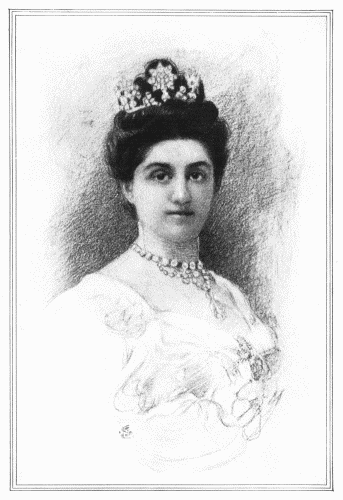 Elena, Queen of Italy.