Cava dei Tirreni, March 8th.
We have spent the day in the streets and houses
of Pompeii, living over again in the buried city the
thrilling scenes of Lord Lytton's novel. His descriptions
are still marvellously accurate, although so
much has been unearthed since he wrote "The Last
Days of Pompeii" that the ruins as they stand to-day
are much more extensive than those pictured by the
novelist. The house of Glaucus is called by the guides
the House of the Tragic Poet, but the mosaic of the
dog, with its inscription, "Cave canem," apparently
as perfect as in the days when Glaucus thus whimsically
greeted his friends and enemies, serves to
identify it.
Lord Lytton was in Naples during the winter of
the most important excavations at Pompeii, and his
romance doubtless took form and shape as he walked
through these deserted streets, where the ruts made by
the chariot-wheels of the two rivals, Glaucus and
Arbaces, are still to be seen. The houses, as he tells
us, still undespoiled of their exquisite decorations and
rich furniture, were much as their unfortunate owners
left them. Even now, despite the fact that many of
the beautiful frescoes, statues, busts, and other ornaments
have been taken to the Naples Museum, much
is still left of the interior of the houses, enough to
give one a very good idea of how these luxurious
Pompeians lived. The lower floors of some of these
houses, as that of the Vettii and the Faun, are complete,
with their vestibule, dining-room, parlor, bedrooms,
and kitchen. These rooms are all rather small,
according to our ideas, as the wise Pompeians lived
out of doors, spending their days in the large central
court of their houses or in the gardens. Of the gardens
we saw the most perfect examples in the house
of the Vettii. The restoration seems to have been made
most carefully here as elsewhere; even the graceful
bronze statuettes are not wanting, as excellent replicas
have been put in the places of the originals, which are
in the Naples Museum.
Nothing brings the reality of that old life before us
more forcibly than to walk along the streets, where
the bakeries and the wine and oil shops are still to be
found. In the latter are many great jars, which are, as
Zelphine says, not unlike those in which Morgiana
entrapped her Forty Thieves.
Turning a corner, we were startled by seeing a
roughly drawn sketch upon a wall, such as any street
gamin of to-day might draw upon a tempting blank
surface. Further along the same street we beheld a
still stronger evidence that the life of Pompeii was
not altogether different from that of our own time.
Something corresponding to a modern poster announced
in red letters the name of a favorite candidate
for the next municipal election. We lingered long in
the vast amphitheatre, in which the Pompeians were
wont to take their pleasure, protected in sunny weather
by an awning, whose usefulness we could appreciate
to-day, as the sun of March is intensely hot in this
region. The barracks for the gladiators, near the
theatre, are not unlike the casemates for soldiers in
a fort, and are quite complete. Zelphine, who is
sitting near me, poring over Bulwer's novel, has just
read me Pansa's lament over what he considered an
infamous law, that forbade a man to send his own
slaves to the wild beasts in the arena. Having seen
the houses of Glaucus and Pansa, one can more readily
understand the point of view of these luxurious,
pleasure-loving ancients, who were probably not more
cruel than many of their contemporaries.
We left Pompeii late this afternoon and came to
La Cava, a pretty town in the mountains, where we
are stopping on our way to Pæstum. Zelphine has just
been talking to the padrone, who speaks excellent English,
about the excursion to-morrow. Our tickets,
which we bought of the concierge at the Hotel B.,
entitle us to a drive or a railway journey. The
padrone strongly advises the former. He says the
trains are so slow and the waits so long that we make
almost as good time by driving, and then it is much
more interesting. The drive is between forty and
fifty miles, but by starting at eight o'clock in the
morning, and changing horses at Battipaglia, we shall
have two hours at Pæstum and get back to this hotel
in time for dinner. Another party of American
travellers, of the inconvenient number of five, go by
coach to-morrow. The padrone asks us, in case we
decide to drive, whether we will give a seat in our
carriage to the odd number. Having concluded to
drive, we are hoping that the fifth wheel of the other
coaching-party may prove to be Mrs. Coxe, a charming
old lady who talks most picturesquely of a drive to
Pæstum forty years ago, when the roads were so infested
by brigands that it was necessary to travel with
a mounted escort.
"Could anything be more delightfully romantic?"
exclaims Zelphine, on hearing this.
"Or more horridly uncomfortable?" adds Angela.
These exclamations drew from Mrs. Coxe a detailed
and spirited recital of her adventures, which Zelphine
heard with the great wide-open eyes of a child listening
to a fairy-tale. Women of Mrs. Coxe's age delight
in a sympathetic listener. The members of her own
party have doubtless heard all of her contes de voyage.
She will certainly elect to go with us, and have the
advantage of a new and appreciative audience.
March 9th.
I opened my windows this morning and stepped out
on the marble terrace to enjoy a view of the mountains,
which had looked so enchanting by moonlight and were
no less beautiful by day. In the garden below a blue
gown flitting about among the orange-trees attracted
my attention. Angela had evidently brought her
charms to bear upon the heart of the padrone, as I
heard him say, "Here are scissors for the signorina
to cut all the oranges she wishes. In the signorina's
own country the oranges do not grow up to the doorstep
as with us. Is it not so?"
"No, indeed," said Angela, deftly snipping off a
golden ball. "This is a great pleasure. I never cut
an orange from a tree but once in my life, and that
was in Granada."
Being possessed of an inquiring turn of mind, the
padrone asked many questions concerning Granada,
and so talking and working industriously Angela soon
collected a fine dish of oranges for our breakfast—an
unwonted luxury, as in this land of abundance they
never give us fruit for our early déjeuner. The carriages
were at the door before we had finished our
breakfast, and in ours, as though in answer to our
desires, sat Mrs. Coxe, provided with a guide-book,
lorgnette, lunch, and all the equipment of a good
traveller for a long day's drive.
The proprietor announced that he would accompany
us as far as Salerno, occupying the seat on the box
beside the driver and his little brother. Mrs. Coxe
evidently considered this her opportunity for informing
herself with regard to the country, its inhabitants,
and its productions. She had added not a little to
her already large store of information, gained in many
lands, when the padrone, to our great regret, left us,
with many bows, smiles, and wishes for a "bel giro."
We had the very tip-top of the morning for the
beginning of our drive, as we set forth at eight o'clock.
The air is soft and clear like that of a May day at
home. We can scarcely believe that it is March, and
that our friends across the water are still in the grasp
of winter, as we left all that behind us when we sailed
from New York six weeks ago.
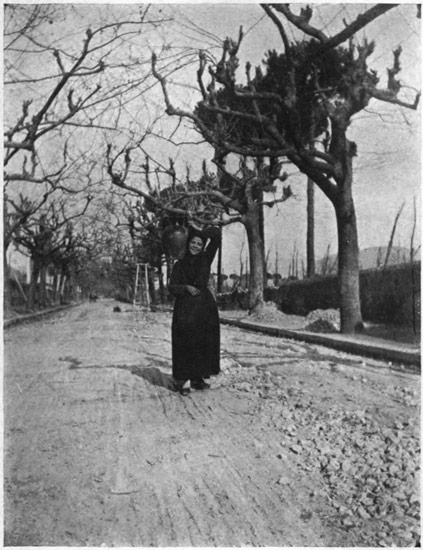
On the Road to Paestum
Our way lay between green meadows dotted with
purple cyclamen and a small yellow flower much like
the English primrose, and in some places through
groves of orange-trees covered with golden fruit.
Fortunately for those who take this long drive, the
roads are excellent. We drove slowly through the old
town of Cava, with its narrow, precipitous streets, and
through Salerno, which is upon a bluff overlooking the
bay, and commands a noble panorama of sea and
shore. When, however, we reached the plain, our
horses set forth at a brisk pace. There was not much
to be seen here except acres of fennel, artichoke, and
a bean, now covered with white blossoms, which I
believe is used chiefly for feeding the cattle. Even
this road through a flat country is not without a touch
of picturesqueness, as it is in many places bordered
by gnarled sycamores twisted into the most weird and
grotesque shapes. Between these trees a peasant
woman was walking, bearing upon her head an immense
brush-heap, which was probably her winter
firewood. Zelphine and Angela had their kodaks with
them, of course, and begged the driver to stop and
allow them to get a snap-shot, which he did, crying out,
"Ecco, ecco, signora!" The woman stopped obediently,
and stood like a statue, in a natural pose full
of grace and strength. She was evidently pleased to
have her picture taken, as these peasants always are,
especially if a few soldi are thrown in to seal the contract.
If the picture is good you shall have one, as
it will give you a characteristic bit of this Southern
Italian life.
Here women young and old are to be seen working
in the fields with the men, driving ox-carts, walking
beside them, and bearing burdens that seem far too
heavy for any woman's shoulders. Although the land
seems fertile, the people are evidently very poor, the
villages small, and the houses comfortless.
We should have liked to ask the driver some questions
about the products of the soil, the peasants, and
their lives, but neither he nor his little brother, who
was on the box beside him, adapted themselves gracefully
to the restrictions of our vocabulary—there is,
we find, a great difference in drivers in this respect.
At Battipaglia, a railroad station and the most considerable
town on the route, we changed horses and
drivers also. This latter substitution we found was to
our advantage, as the second vetturino proved to be
a better linguist than his predecessor, which enabled us
to continue our interrupted studies in agriculture and
political economy. The new driver was serviceable
also in other respects. When we came upon a field of
narcissus, he stopped the carriage in order to allow us
the pleasure of gathering the fragrant blossoms, besides
bringing us handfuls of flowers, the largest
bunch of course being laid at Angela's feet. We are
quite sure that he considers her the living image of the
pictures of the Blessed Virgin, although he is too discreet
to say so.
Angela was charming to-day, in a blue suit and a
white shirt-waist, but the March sun was so hot that
by the time we reached Pæstum it had taken all the
color out of the crown of her pretty blue hat.
As there is no inn at Pæstum we ate our luncheon
by the roadside, stopping under the shade of a tree
where a peasant was enjoying his siesta, his oxen
being tethered near by. Zelphine is enthusiastic over
the beauty of these gentle creatures, with their soft,
kindly brown eyes, and says that she is sure that
Homer, when he wrote of his ox-eyed maidens, had
just such a one in mind as she was feeding from her
hand. She made so pretty a picture as she stood
beside the great white ox, feeding him daintily with
bean-blossoms, that Angela tried to get a snap-shot
of her, but that provoking ox—the slowest of all
animals—took it into his head to move at the critical
moment.
The country seemed more level and marshy as we
drew near Pæstum, although on the left there rose the
spur of a mountain range, on one of whose heights are
the ruins of the hillside fortress of Capaccio Vecchio.
This town was founded by the inhabitants of Pæstum
when they were driven from their city by the Saracens
in the ninth century.
To our surprise, we saw herds of buffalo grazing in
the fields, much smaller and different in other respects
from the American bison. Our driver told us
that this small black buffalo is to be found near the
coast in many parts of Italy, and is often seen on the
Campagna near Rome. From the number of calves
in some of the fields we are inclined to think that the
young buffaloes are used for food. I noticed several
of the well-grown animals drawing carts, sometimes
harnessed with the white oxen.
We caught a glimpse of the old wall and gate with
the sea beyond, and then in a moment the temples
were in full view. Nothing could be more impressive
than those magnificent ruins on that lonely plain,
sharply outlined against the blue sky. The Temple
of Neptune, with its thirty-six fluted Doric columns,
its double columns inside, and its noble, almost perfect
façade, is a superb example of Greek architecture
of the fifth century B.C. The stone of which the
temple is built is a kind of travertine, to which the
passing years have imparted a creamy, mellow tone.
The Temple of Ceres is less complete than that
dedicated to Neptune, although it belongs to the same
period. The gate of the town opening out toward the
sea and the old wall adjoining it are wonderfully
preserved. These with the temples of Neptune and
Ceres and the so-called Basilica are all that remain of
this settlement made by Greeks from Sybaris about
600 B.C. Two days we have passed with the ancients,
yesterday in a city where "the earth, with faithful
watch, has hoarded all," and to-day in a town not
much older than Pompeii, where the conquering Saracens
and Normans and the devastating elements have
left nothing to tell the tale of the daily life and habits
of the Greeks who made their home upon these shores.
We climbed over the ruins of the old temples and sat
upon the town wall overlooking the sea, while Angela
made a fairly good sketch of the temples. Zelphine
and I bought coins and pottery from children who,
being without visible habitation, seemed to have literally
sprung from the soil. Finally our vetturino
warned us that we had better set forth at once if we
wished to reach Cava before nightfall.
At Battipaglia we resumed our former horses and
driver. Zelphine whispered something to me about
his face being rather red. I quite agreed with her,
but as the mention of the fact could not be of any
especial advantage, the other carriage being already
far in advance and no person at hand to take the
reins, there was nothing to do but to set forth on our
homeward journey, despite some misgivings upon
Zelphine's part and mine.
We had not left Battipaglia before I realized that
our gravest fears were fulfilled. Our driver was what
you men picturesquely call "gloriously drunk"—we
practical women would use a less dignified adverb.
He was as happy as a lord, cracking his whip and
dashing through the streets of Battipaglia in fine
style. We soon passed the other coach, containing
Mrs. Coxe's friends. They called after us, but must
have seen that we had no time for conversation
en route; indeed, like Cowper's citizen "of credit
and renown," we passed everything on the road. Zelphine
and I were on the front seat, facing Mrs. Coxe
and Angela. They, happily, did not grasp the situation
at once, but when they did the terror written on
that dear old lady's face was something never to be
forgotten. Angela, with resolute cheerfulness, chatted
away about anything and everything, especially about
Mrs. Coxe's experiences in Honolulu, her favorite subject
of conversation. I shall never hear of that island
kingdom of the Pacific without seeing before me
Mrs. Coxe's agonized face.
Remembering that there lay before us a long
stretch of road overhanging a sharp declivity, Zelphine
and I made a desperate attempt to stop our
hilarious vetturino in his mad career. Finding that
our remonstrances excited him to more strenuous
exertions, Zelphine tried the effect of her few available
words and many eloquent gestures upon the small
boy, urging him to make his brother drive more carefully,
telling him that the old lady of the party was
very much alarmed, and advising him to get the whip
into his own hands. This, however, proved to be impossible;
the boy, well frightened himself by this time,
only succeeded in getting hard words and a shaking.
Give up his whip! Not he. As well ask a soldier to
lay down his arms. The whip was his pride and joy,
his pièce de résistance, so to speak, with which he
awoke the echoes of these slumbering old Italian
towns, bringing the inhabitants, men, women, children,
cats, dogs, and chickens, to the sidewalk to witness our
rapid transit. Even those among our own countrymen
who pride themselves most upon their skill in
annihilating space could not have made better time
than we did as we rattled over that Calabrian highway.
Fortunately, the horses were well-trained and
steady enough to balance the driver's eccentricities.
Perhaps they were accustomed to them by long experience.
Be this as it may, we proceeded on our way
without any accident, passing the dangerous part of
the road before darkness overtook us.
We clattered through Salerno at a tearing gallop,
and as we neared La Cava the whip-cracking was
resumed with renewed vigor, bringing the citizens
to their doors and windows. Some of them, indeed,
followed the carriage, crying out, "Prima donna!
Prima donna!"
"What can they mean?" asked Mrs. Coxe, looking
as though she expected to be attacked by a furious
mob. Zelphine reminded her that as we drove by the
theatre in the morning we had noticed a poster announcing
that a grand opera was to be given in Cava
that evening. In our gay morning spirits we had
even thought that it might be pleasant to assist at the
function. Now the most that we dared to hope was
that we might reach the hotel in safety. Troops of
children ran after us, repeating the shout of "Prima
donna! Prima donna!"
"We are honored by being mistaken for a part of
the opera troupe," said Zelphine, laughing, "and
Angela is evidently the leading lady, as they are all
looking at her."
Angela, sitting erect on the back seat, her costume
as crisp and immaculate as if she were on her way to
a horse-show, her jaunty hat at the most stylish angle
even if the crown was off color, looked indeed like a
leading lady, albeit a trifle pale and in need of the aid
of the rouge-pot of the greenroom.
When we reached our hotel we were all exhausted
by the fatigue of the day and the long strain of the
afternoon; but Mrs. Coxe showed herself the thorough-going
traveller that she is by stopping not for
rest or refreshment until she had laid a detailed
account of our experiences before the proprietor.
He came to us later, after a visit to the driver's
home, and reported him as covered with confusion and
filled with remorse. "Ecco, ecco, he is the penitent
one now!" exclaimed the padrone. "His parents
have scolded him soundly, and have threatened to
beat him with a stick. He is in tears, the sorrowful
one! It is the first time, and it will never happen
again!"
"All of which would not mend our bones if they
had been broken!" said Mrs. Coxe, stoutly. "It is
your duty to give your patrons good, safe drivers."
The padrone then called upon the saints to witness
to the fact that he had never known an accident to
befall any of his patrons, repeating that this was
Antonio's first offence, and that he must have been
drinking some bad stuff at the tavern, as good wine
would never so set the brain on fire. The proprietor
has a frank manner that gives one the impression that
he is speaking the truth; we are inclined to believe
him, although we have been warned not to allow ourselves
to be deceived by appearances in this land of
ready eloquence. Our valiant countrywoman having
made her protest for the party, and this disagreeable
duty having been taken off our shoulders, we went
into dinner with high spirits and famous appetites.
Zelphine and I are so wide awake after our exciting
drive that we are devoting the evening to letter-writing,
both of us being sadly in arrears. The other
guests of the Hotel S. have betaken themselves to
their slumbers, and we enjoy undisturbed possession
of the only warm room in the house. A wood fire blazes
on the hearth, and as we bask in its genial warmth we
shiver at the thought of our rooms upstairs, which,
with their stone floors, are of about the temperature
of refrigerators.
Sorrento, March 11th.
We left Cava on Wednesday, and made the tour
from there to Amalfi in the brilliant morning sunshine.
This is another "Cornice Drive," and far
finer, I think, than that along the Riviera. The road
winds above, beneath, and beside rugged cliffs of
great height, always with the sea in full view. Often
from airy summits we looked down upon fishing
villages and towns built around bays and inlets,
as Cetara and Atrani, while upon projecting headlands
are many watch-towers, now used chiefly as
dwellings.
We needed not to be told that the making of macaroni
is one of the chief industries of Amalfi. As we
drew near the town many yards of it were to be seen
hanging upon lines like a wash or spread upon the
grass to dry.
Amalfi is charmingly situated at the entrance to a
deep ravine, surrounded by mountains and rocks
of the most picturesque forms. We climbed up the
sixty steps of the Cathedral of St. Andrew. Mrs.
Coxe and some of her party were carried up in chairs
by two stout Calabrians, but we preferred to walk,
turning every now and then to gaze upon the enchanting
view spread before us. At the top of the slope is
a spacious garden terrace full of flowers, with roses
climbing all over its walls.
We stopped overnight at the old Capuchin monastery,
which is now fitted up as a hotel, and yesterday
drove here, the greater part of the way beside terraces
of lemon-trees covered with ripening fruit—enough
lemons to make lemonade for the whole world,
one would think. As we drew near Sorrento orange-trees
took the place of lemon-trees, groves and groves
of them, with their dark, shining leaves and brilliantly
colored fruit. Peasants brought oranges to the carriage
for sale, clusters of them, with fruit and blossoms
growing together, which they were glad to give
us for a few soldi.
This morning we spent in the shops buying wood-carvings
and silk, which is made here, and is consequently
astonishingly cheap. We found Mr. Crawford's
charming villa, and, to Zelphine's great delight,
the house of Tasso's sister on the Strada San Nicola.
Tasso's birthplace and the rock upon which the house
stood have both been swallowed up by the sea; but the
house of his sister Cornelia, to which the great Tasso
came in 1592 disguised as a shepherd, is still standing,
and there is a statue of Torquato Tasso in the
chief square of Sorrento.
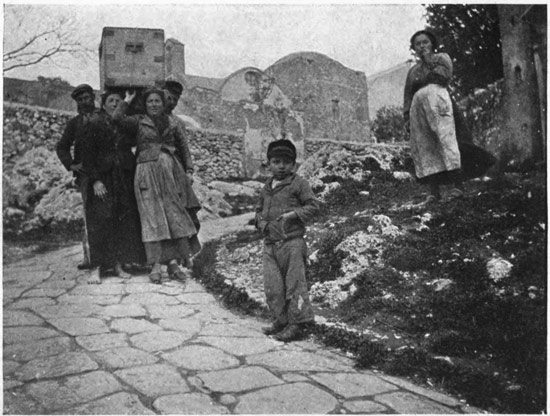
An Amazonian Tribute, Capri
I am writing on a fine terrace overlooking the sea,
where stone benches and tables are conveniently
arranged for our use. The sun is like that of June,
and roses such as belong to that month are blooming
all over the wall beside me. The concierge has just
brought me a handful of them, charming pink and
white ones. We are equipped for a drive to the
Deserto, which Mrs. Coxe, who visited the place forty
years ago, tells us is most interesting. Within a few
years the monastery has been suppressed, and the
building is now used as a home for destitute children.
We should like to spend a week in Sorrento, which
is so beautiful itself and from which so many excursions
are to be made; but Capri beckons to us from
across the bay and our time is limited, as Zelphine has
promised to meet some cousins in Naples.
Capri, March 13th.
Our reception on the island of the Blue Grotto was
sufficiently novel to please the most blasé traveller.
As our boat drew near the rocky shore dozens of
women, most of them young and handsome, hurried
down to the wharf and seized our luggage, which they
bore on their heads easily and lightly up the steep
path to the hotel. It seemed strange enough to have
women carry our dress-suit-cases and bags, but on our
way to the hotel we saw a much more unusual sight—three
women carrying two trunks and a valise, while
a man, evidently the owner of the trunks, was walking
quite at his ease beside them. He was, we were
told later, a Caprian peasant on his way to America,
and this delicate attention was a final act of devotion
on the part of his Amazonian countrywomen.
Capri has not been as kind to us as other towns of
Southern Italy. The mountains have had their heads
buried in clouds all the morning, and when the
donkeys arrived which we had ordered for a ride up to
the Villa of Tiberius, a fine rain was falling, which
prevented us from making the excursion. We sent
the donkeys and their women drivers home, much to
the disappointment of the latter.
"Women seem to do everything here!" said Angela.
"Where are the men?"
"Gone to America," replied Mrs. Coxe, quickly.
"The women ship them off, bag and baggage, and
then have everything their own way."
Fortune favored us later in the day, as the clouds
rolled off the mountains before noon, and the padrone
informed us that the wind was in the right quarter
for a visit to the Blue Grotto. We made our expedition
satisfactorily, although the sea was high and we
literally rode the waves in our small boats. The
grotto is quite as blue as any picture of it that I have
ever seen, and with an exquisite, luminous transparency
that no brush or pencil can portray. When we
were in the midst of the silvery blueness, watching
with some apprehension a small boy who dives into the
water to show off its wonderful color, our boatman
suddenly became loquacious, and told us thrilling tales
of unfortunate visitors to the grotto who had been
walled in by the sea and were obliged to spend days
and even weeks in this drear abode, living upon supplies
which daring sailors, who contrived to get their
boats near to the mouth of the grotto, handed in to
them. The smallness of the opening of the grotto gave
a semblance of reality to these Münchausen tales.
Mrs. Coxe, who was in the boat with me, became
very much alarmed and insisted upon leaving
at once, calling to the other members of the party
to follow. We were splashed a little by the spray
as we emerged from the grotto, and those in the
other boats were quite wet; but as we rowed away
the mouth of the fairy cave was almost hidden by the
waves. It seemed indeed as if there might be a grain
of truth in the boatman's tales, which the padrone
corroborated, adding, "But it does not often happen
that travellers are shut up for any time in the Grotta
Azzurra; we are very careful." "Not very often
indeed! As if once would not be enough!" exclaimed
Mrs. Coxe, who had interrogated the padrone after her
straightforward fashion of getting at the truth of the
matter.
Hotel B., Naples, March 15th.
We are glad to be in Naples again, and in this homelike
hotel. Zelphine has met her cousins, and has been
making some excursions with them, taking the famous
drive to the monastery of Camaldoli and to the Solfatara,
a half-extinct volcano which, she says, gives
one an even more impressive idea of the Inferno than
the Doré illustrations of Dante. Angela corroborated
Zelphine's report, saying that it was quite the most
unpleasant place she had ever seen, especially as they
dropped a poor dog into the crater to try the effects
of the sulphur upon his constitution. They pulled
him out before he was quite dead; but who except
these cruel Neapolitans would so persecute a helpless
animal?
I, with my old habit of clinging to the skirts of the
things I already know, declined to take that excursion,
for the greater pleasure of spending a morning
in the National Museum among the Pompeian treasures
and another whole day among the ruins of the
buried city. It is really much more interesting to
examine the relics from Pompeii after one has been
there, as one naturally fits the frescoes, furniture, and
ornaments into just such rooms as one has seen. Some
of the furniture was strangely modern; I noticed a red
and gilt bedstead that looked as if it might have belonged
to the First French Empire, rather than to the
first century A.D. Among the kitchen furnishings were
just such colanders, saucepans, and skillets as we use
to-day—is there anything really new under this shining
sun? The surgical and dental instruments exhibited
in one of the cases caused me a genuine thrill of
sympathy for those unhappy Pompeians; to have been
smothered with hot ashes might really have been more
endurable than to have lived at the mercy of those
primitive dentists and surgeons!
We leave Naples to-morrow with regret, as we have
grown very fond of this beautiful city. I wrote a week
since to Ludovico Baldini, and also to the proprietor
of a hotel that he recommended to me; but I have
heard from neither. Ludovico may be in Florence on
some army business, but it is very stupid of the proprietor
of the Hotel L. not to answer my letter. We
have telegraphed for rooms in a pension on the Via
Sistina, which Mrs. Coxe tells us is delightful, and
we are thankful to know that they will accommodate
us, as Rome is full to overflowing now, all the world
going up thither for Easter. When I told my maid
that we were going to Rome to-morrow, she clasped her
hands in ecstasy, exclaiming, "Bella Roma! Bella
Roma!" These Italians have a natural instinct for
beauty and a genuine pride in the wonders of their own
country, both of which help them to endure the
poverty and hardness of their lives, just as some
people of your acquaintance and mine are supported
through many trials by the uplifting sense of having
been born in the purple.