Up, where the lofty citadel
O'erlooks the surging landscape's swell;
Let not unto the stones the day
Her land and sea, her lily and rose display.
Emerson.
VAL D'ESINO—THE GRIGNA—INTROBBIO—FORCELLA DI CEDRINO—VAL TORTA—AN
OLD TRAVELLER—VAL BREMBANA—BRANZI—PASSO DI GORNIGO—GROMO—VAL
SERIANA—BONDIONE—MONTE GLENO—VAL BELVISO.
The sharpest form of pain has in all ages been imagined
under the figure of a man with the object of his most
eager desire ever dangling before his eyes but out of
reach. If—may the omen be void!—any of the Alpine
Club should in another world ever realise the punishment
of Tantalus or Dives, they will probably be placed
opposite a peak cut off from them by some impassable
gulf.
Such threatened to be our fate as, with the natural
gloominess of three o'clock in the morning, we strapped
up our humble bags in the marble halls of the Hotel
Vittoria at Menaggio under the indignant and contemptuous
survey of an awakened porter.
When we issued into the night the luminous Italian
stars flamed out of a perfect vault, blotted only at the
edges by the dim shapes of the mountains. The keen
northern breeze which intruded on the languid scent-laden
air of the lake was the best promise of a day of
unclouded sunshine. Yet this breeze was the cause of
all our fears; under its influence the lake was stirred
into waves which broke noisily against the terraced
shore. Our goal was the Grigna, and between us and
Varenna lay three miles of dancing water. There was
no steamer for hours; and it is no rare thing for the
passage to be impossible for small boats. Doubtful and
depressed, we hurried round to the little port.
It was a happy moment when a cry answered our
shouts, and the boat, ordered overnight, shot up with
its four rowers through the darkness. We were soon
on board and out of sight of François, left to search
for a missing portmanteau in the custom-house of
Como.[29]
The shelter of the land was soon left, and our
broad-bottomed boat, keeping her head to the wind, as
if making for Colico, began to do battle with the waves,
which knocked her from side to side like an unwieldy
cork. We were anxious as to the behaviour of our
rowers. The boatmen of the lake are not all to be
trusted. The year before I had seen a Colico crew
give way to the most abject terror at the mere approach
of a storm-cloud which turned out to be quite empty of
wind. For ten minutes before the rain burst on us
they did nothing but alternately catch crabs, and curse
and kick the crab-catcher. The Menaggio men showed
themselves, however, of very different metal. They
rowed hard and talked little, and the stern-oar, standing
up to his work like the rest, gondolier-fashion, steered
with so much skill in avoiding the wave-crests that,
knocked about as we were, we only shipped one sea
during the passage.
The mountain-forms were growing less ghostly, and
the first pale gleams across the sky were reflected still
more faintly on the surface of the lake as we ran ashore
on the beach at Varenna. The little town was still
asleep under its cypresses, but a light gleamed from
the windows of a waterside inn, which soon furnished
us with coffee and an omelette.
A few hundred yards north of Varenna the glen of
Esino, through which lies the way to the Grigna, opens
on the lake, The 'Alpine Guide' describes a path
leading past the castle and along the (true) left bank
of the stream. But the more frequented track, a steep
pavé between vineyards and villages, starts from the
bridge of the Stelvio road and mounts the further
hillside.
In the old visitors' book at the Montanvert Inn
was to be read a characteristic entry, 'found the path
up, like that to heaven, steep and stony.' Mr. Spurgeon
would find Esino much more difficult to get to than
heaven. The path is laid with large smooth rounded
stones, placed at such a high angle as to render back-sliding
inevitable. Fortunately there was abundant
consolation in the exquisite glimpses which met us at
every corner, and boots and tempers held out pretty
well, until both were rewarded by a smooth terrace-path
circling round the hollows of the upper hills.
Where the deep ravine rose towards us, and two
steeply-falling brooks united to form its torrent, the
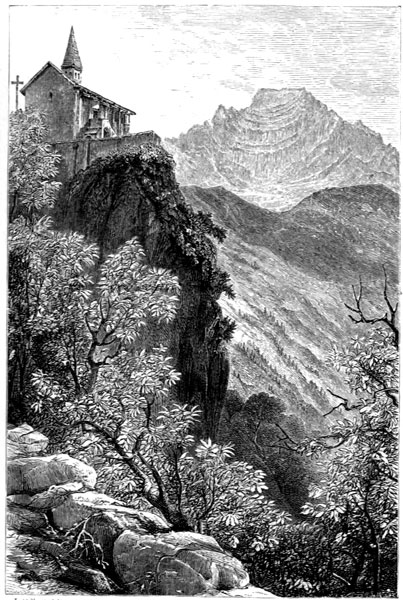
church of Esino stood forth, the ornament of a bold
green spur projecting from a broad platform covered
with fields and trees.
Half the village lies a few hundred yards higher on
the hillside, and the only inn—a mere peasant's house
of call—is the first house in the upper hamlet. The
blacksmith appeared to be the official guide to the
Grigna, but in his absence a substitute was provided in
the master of the inn. His first act was to pack an
enormous basket of bread and wine, of which he said
we might consume as much as we liked and pay him
accordingly, a primitive but not, as we afterwards found,
particularly economical arrangement. His next proceeding
was to offer a few coppers to a girl to carry the
basket to the last shepherd's hut. In the Bergamasque
country we soon became accustomed to our porters
acting as contractors and subletting a portion of their
contract to any chance passenger or herdsman they met
on the way.
A charming path leads up from Esino to the Cainallo
Pass, the direct way into Val Sassina. Large beeches
grow in clusters amongst tufts of underwood, or overshadow
shallow ponds, the frequent haunts of the herd.
Below lies the long ribbon of the lake, its waves reduced
to a ripple, which the sloping sunlight hardly
makes visible. Away beyond the green gulf leading to
Porlezza and the hills of Maggiore glows the supreme
glory of the Alps, the snow-front of Monte Rosa. Right
and left the faint and far forms of the Grand Paradis
and Grivola and the Oberland peaks attend in the train
of their queen.
Instead of crossing the pass the route to the Grigna
turns southward along the ridge until some 500 feet
higher it reaches the edge of a great horseshoe-shaped
recess in the north-east flank of the mountain. The
limestone here breaks below into many fantastic spires,
the precipices opposite are abrupt, and the whole landscape
has a severe and bold character unexpected in
this region.
The circuit to the opposite side of the recess where
the real climb begins is somewhat tedious. Beyond a
cattle-alp, which affords milk, the mountain becomes a
bare mass of limestone, the hollows in which are filled,
first by grass, then by snow. The top lies still far
back, and the ridge on the right which cuts off most of
the view looks tempting. It is not comfortable ground,
however, except for a tolerable cragsman. Keep below
to the last, and when you clamber on to the highest
crest your patience will be rewarded.
A moment before a rock was before your eyes, now
there is nothing but the straight-drawn line of the
Tuscan Apennine. The vast plain of Lombardy has,
for the first time all day, burst into sight. Surely there
are few sights which appeal at once to the senses and
imagination with so much power. Possibly the Indian
plains from some Himalayan spur may have richer
colours, certainly the northern steppe from Elbruz has
greater boundlessness. But they are not so much
mixed up with associations. This is Italy; there are
Milan, Monza, Bergamo, a hundred battle-fields from the
Trebia to Magenta.
It is natural to compare the Grigna panorama with
those from Monte Generoso and Monte San Primo. As
a perfect view of the Lake of Como the Monte San
Primo is unrivalled. The delicious dip from Monte
Generoso on to Lugano perhaps surpasses in beauty the
wilder plunge of the Grigna upon the Lago di Lecco.
But for the plain and the great range I unhesitatingly
give the palm to the higher mountain.
The last spurs of the Alps are here singularly picturesque.
The bold forms of the Corno di Canzo and
Monte Baro break down to display the shining pools of
the Laghi di Pusiano and d' Annone, and the hills and
towns of the Brianza, a fair garden country full of
well-to-do towns and bright villas, the country seats of
the Milanese. Hither Leonardo may have come, and
looking across the narrow lake or from beside some
smaller pool or stream at the stiff, upright rocks of the
Grigna and the Resegone, have conceived the strange
backgrounds with which we are all familiar.
From mountains of middle height the general aspect
of the range is ordinarily one of wild disorder. It is
but rarely any distant group is completely seen; only,
wherever the nearer ridges subside, one or two peaks
come into view disconnectedly and as it were by chance.
From more commanding summits the contrary effect is
produced; intervening and minor masses sink into their
proper place; they no longer produce the impression of
a hopeless labyrinth, but combine with the great peaks
to form well-defined groups.
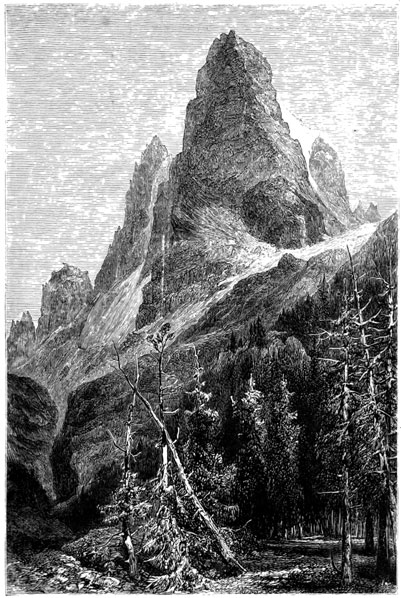
In most Alpine districts the Grigna (7,909 feet)
would rank among minor heights; on the shores of
Lago di Como and at the edge of the Lombard plain it
is a giant. Its extra 2,000 feet enable it to look not
only over neighbouring hills but into the hollows which
separate them—hollows filled with an air like a melted
jewel in its mingled depth and transparency of colour.
The snowy Alps, raised now, not merely head, but head
and shoulders above the crowd, range themselves before
the eyes in well-ordered companies.
In one direction only—where the intricate Bergamasque
mountains scarcely leave space for some disconnected
glimpses of the Orteler snows or the bold front
of the Carè Alto—is the panorama interfered with in
the ordinary manner.
Perfect peace and radiance filled the heaven. The
morning breeze had died away, no cloud had lifted
itself from the valleys; all was calm and sunny, from
the lake at our feet to the pale shadowy cone scarcely
defined on the glowing horizon, which was Monte Viso.
For hours we lay wrapt in the divine air, now watching
Monte Rosa as it changed from a golden light to a
shadow, now gazing over the plain as the slant sunbeams
falling on white walls and towers gave detail
and reality to the dreamlike vision of noon.
The two peaks of the Great and Little Grigna or
Campione are cut off from the surrounding ranges by
a deep semicircular trough extending from Lecco to
Bellano. Near the centre of the bow stands Introbbio
on the Bellano side of a low watershed. The easiest
way down the back of the Grigna seems to be to follow
its north-east ridge, and then descend a steep grassy
hillside to some homesteads grouped about a pond.
The lower slopes are a charming surprise to eyes
accustomed to the severer scenery of a Swiss alp. They
share the beauties of the pasturages of Bern and add
to them something of a softer grace. Although, owing
to the porous nature of the limestone, water is scarce
enough to make it worth while to collect it in circular
ponds like those of our own South Downs, the ground,
even in September, is covered with a close carpet of the
greenest turf, broken, not by rocks, but copses of
laburnum. In May it must be a garden of the exquisite
wild flowers which climb, a fairy procession, in
endless variety of form and colour and perfume, every
southern hillside.[30] In the place of brown châlets we
have whitewashed cottages roofed with red tiles, which
harmonise well with the general cheerful brightness of
the landscape. A steep track through a thick chestnut
wood leads down to Pasturo, a large village whence
there is a good road to Introbbio.
Pasturo lies in a broad and smiling basin, the head
of Val Sassina. But half a mile further on, the opposite
ranges are almost joined by two huge masses of
porphyry, between which the stream finds a way
through a narrow and once fortified natural gate.
Beyond the barrier lies Introbbio half hidden amongst
its chestnuts, and looking across to the bold crags of the
precipitous face of the Grigna.
There are few things less favourable to Stoicism
than disappointed hopes in an inn. Where nothing is
expected much can be borne. But of the 'Albergo
delle Miniere' the guide-books encouraged the most
rosy anticipations, and the appearance of the house
bore out at first sight its good name. It stood, as all
inns should, outside the town and the first house as we
approached it; on the wall was written in bold letters
'Grand Hotel of the Mines.' The front door stood
hospitably open, and closed shutters are too usual in
sunny Italy to excite misgiving. But it was in vain we
searched the empty passages, tried the locked doors, or
sniffed for any possible odour of kitchen. In vain one
of my friends, phrase-book in hand, shouted out every
call for waiter in use between Turin and Palermo.
There was not even a cat left in the house; the owner
had become bankrupt, and no one had had the courage
to take his place. So we retired disconsolate to an
'Osteria Antica' in the heart of the town, where we
found François already arrived.
If we were discomfited, our host was little less so.
The fall of its rival had brought no second youth to
the 'Osteria Antica.' It was kept by a haughty and,
except as regards payment, indifferent landlord, whose
household consisted of a vague and dilatory wife, a
loutish and generally-in-the-way son, and a good-natured
wench whose carrying qualities were for the
most part thrown away, owing to there never being
anything ready for her to carry. For hours François
sat by the kitchen fire, with a resignation only smokers
can attain, answering all enquiries in the monotonous
refrain, 'On prépare, messieurs—on prépare toujours.'
It was 9 P.M. before the serving-girl entered with a
bowl of liquid sufficient, in quantity at least, to have
fed a regiment, and the torpid son broke for a moment
into a smile as he placed on the table a huge carafe of
'Vino Vecchio.' Its age may have been owing to its repellent
effect on previous topers, and so far as we were
concerned it was at liberty to grow older still. Half-an-hour
later, with unsatisfied appetites and injured
digestions, we retired to two dingy and dubious bedrooms.
Next morning the bill which awaited us was a
triumph of caligraphy, extending to at least a column
and a half of items. In the country inns of this part
of Italy it is the usual custom to charge each loaf and
dish separately. But here the general taxes of great
hotels formed a supplement to special charges for the
very services in respect of which such taxes are generally
supposed to be levied. Thus, after paying a sum for
'zucchero' and 'candele' which showed the high value
set by the Introbbians on 'sweetness and light,' we were
expected not only to make a further disbursement in consideration
of boot-blacking and warm water, but also
to remember the 'servizio' and 'portiere.' We were
almost ashamed to disturb the result of so much labour
and ingenuity by such a rough-and-ready proceeding as
the tender of the lump sum which seemed to us more
than adequate to the occasion.
Beyond Introbbio we plunged into the Bergamasque
ranges, perhaps to Englishmen the least known fragment
of the central Alps. Owing to the absence at
their head of any peaks high or inaccessible enough to
attract ardent climbers, the two great trenches which
open on to the plain near Bergamo have not, like the
valleys of Monte Rosa, come in the way of the Alpine
Club. And it is to its members that we owe almost
entirely our introduction to out-of-the-way corners. Yet
an Italian valley, among mountains rising at its head
to nearly 10,000 feet, is at least worth looking at. Val
Brembana and Val Seriana might prove rivals to Val
Mastalone and Val Sesia. At last, in 1874, I determined
to carry out, at any rate in part, a long-formed
intention, and see something of what lay within and
behind the jagged line of peaks so long familiar to me
from the high summits of the Engadine.
The Forcella di Cedrino, which forms the entrance
from Introbbio to the upper branches of Val Brembana,
is on the whole decidedly dull—a long steep ascent, a
broad undulating top, only remarkable for its laburnum
thickets, and a commonplace glen on the other side.
Near the first hamlet, Val Torta, the scenery improves.
The old frescoed church and white houses hang on the
steep side of a green basin among woods and shapely
hills.
Thenceforth the path is charming. Descending at
once to the clear slender stream it threads a tortuous
defile, where at every corner the landscape changes.
On the right rise the spurs of the many-crested Monte
Aralalta, clad almost to their tops in wood. Above the
broken glens the limestone plays a hundred freaks,
here cutting the sky with twisted spires and perforated
towers, there throwing down a knife-edge buttress between
the greenery. Opposite a broad opening on the
left the stream is reinforced by three great fountains
gushing directly out of the living rock.
A mile or two further, at Cassiglio, the glen opens
and a carriage-road begins. Several of the old houses
here are frescoed, one with a whimsical selection of
old-world figures, another with a Dance of Death. In
this 'Earthly Paradise,' as it appears to the northern
wanderer, the mystery of death seems, as in Mr.
Morris's poem, to be constantly present. The great
reaper with his sickle is painted on the walls of
dwelling-houses as well as churches. 'Morituro satis'
writes the wealthy farmer over his threshold, the bones
of his ancestors—nay, sometimes even their ghastly
withered mummies—stare out at him through the
iron grating of the deadhouse as he goes out to his
work in the fields. And for the true son of the Church
there is no such peace in prospect as for his foregoers,
no 'Nox perpetua una dormienda,' or shadowy Hades.
His future is put before him in the most positive
manner, by the care of priests and painters, on every
wayside chapel. Whatever his life, he must when he
dies take his place amongst that wretched throng of
sufferers packed as closely as cattle in a truck, and
plunged to a point perhaps determined by prudery in
tongues of flame. His deliverance from this hideous
place will, he is told, depend in great part on the
importunity with which his surviving relatives address
the saints on his behalf, and the sums they can afford
to pay for masses to the priest. Roman Christianity
for the peasantry represents the rule of the universe as
a malevolent despotism tempered by influence and
bribery. Fortunately, whatever they may profess,
men seldom at heart accept a creed which makes the
universe subject to Beings or a Being of worse passions
than themselves.
Cassiglio stands above a watersmeet where a new
face of the beautiful Monte Aralalta shuts in a wooded
glen, through which a tempting path leads to the
hamlets of Taleggio. All the hill-country between Val
Brembana and the Bergamo-Lecco railway gives promise
of the richest and most romantic scenery, and I can
imagine nothing more delightful than to wander through
its recesses in the long May days. My fancy seems,
however, to be singular, for, so far as I know, not one
out of the number of our countrymen who haunt Lago
di Como in spring has taken advantage of his opportunity.
Below Cassiglio, Val Torta for the first time expands
into a wide basin full of maize and walnuts. Presently
it contracts again into a narrow funnel, which on a dull
day, when the higher crests are in cloud, might be
fancied a Devonshire combe. At the junction of a considerable
side-valley clusters of houses brighten the hillsides,
and, where two roads meet, a clean country inn,
with a terraced bowling-ground above the stream, invites
to a halt.
The second road leads towards the Passo di San
Marco, the lowest and easiest track from Bergamo to
the Val Tellina.
Here, perhaps for the only time in these valleys, we
come upon a track already described by an English
traveller. The title of his volume at least is sufficiently
attractive. I quote it in full:—
'Coryats Crudities Hastily gobbled up in five
moneths travells in France Savoy Italy Rhetia commonly
called the Grisions country Helvetia alias Switzerland
some parts of High Germany and the Netherlands:
Newly digested in the hungry aire of Odcombe
in ye county of Somerset and now dispersed to the
nourishment of the travelling members of this kingdom.'
London, 1611.
Readers, sated for the moment with the solid information
to be gathered from our modern books of
travel, may spend a refreshing half-hour in the company
of this old traveller, who assumed in his public the
same taste he had so strongly in himself, and was content
to display undisguised a boyish delight in novelties,
wonders, and adventure. He has, moreover, a special
title to the respect of the modern Alpine traveller, for
'footmanship' was his great boast, and he delighted to
be celebrated by his familiars as the 'Odcombian Legge-stretcher.'
I shall not apologise therefore for pausing
for a moment—
—— To catechise
My picked man of countries
of the days of King James I., and to learn what he may
have to say—
—— Of the Alps and Apennines,
The Pyrenean and the River Po.
In listening to Tom Coryat's gossip we realise as
far as is now possible such an evening's entertainment
as may have suggested these lines to Shakspeare. We
can almost fancy ourselves seated in the Mermaid
Tavern, while our traveller, swollen with his own importance,
told his tales, and the wits laughed over some
of the earliest 'Alpine shop.' The address of one of
Coryat's letters 'to the Right Worshipfull Society of
Sirenaical Gentlemen that meet the first Fridaie of
every moneth at the signe of the Mermaide in Bread
Street' shows him a frequent guest at the famous inn.
His friends have drawn his character with force and
perfect freedom. He was one of those wits who are
more often laughed at than with. 'He is,' writes Ben
Jonson, 'always Tongue-Major of the Company, and
if ever perpetual motion be to be hoped it is from
thence. He is frequent at all sorts of Free-Tables,
where though he might sit as a guest he would rather
be served in as a dish, and is loth to have anything of
himself kept cold against the next day.' In conversation
as well as writing he was an euphuist, 'a great carpenter
of words.' Travel was so far his engrossing passion
that he would give up any company to talk with even
a carrier. 'The mere superscription of a letter from
Zurich set him up like a top; Basel or Heidelberg made
him spin.'
The prominent mention in the title of his book of
Alpine regions naturally suggests that we may have
here lit on an early appreciator of the Alps; and in
the first few pages this hope receives some confirmation.
Mr. Stephen has told us that the Gothic cathedral and
the granite cliffs have many properties in common, and
that 'one might venture to predict from a man's taste
in human buildings whether he preferred the delicate
grace of lowland scenery or the more startling effects
only to be seen in the heart of the mountains.' Coryat's
avowal therefore that Amiens Cathedral is 'the Queen
of all the churches in France and the fairest that ever
I saw till then,' seems to promise well for his taste in
mountains.
We get the first Alpine adventure just before
reaching Chambery. Coryat was apparently a nervous
horseman, and would not with his companions ride over
the 'Montagne Aiguebelette.' Consequently he was led
'to compound for a cardakew, which is eighteen pence
English,' with 'certain poore fellowes which get their
living especially by carrying men in chairs to the toppe
of the mountain.' 'This,' he says, 'was the manner of
their carrying of me. They did put two slender poles
through certaine woodden rings which were at the foure
corners of the chaire, and so carried me on their
shoulders, sitting in the chaire, one before and another
behinde; but such was the miserable paines that the
poore slaves willingly undertooke for the gaine of that
cardakew, that I would not have done the like for five
hundred.' 'The worst wayes that ever I travelled in all
my life in the summer were those betwixt Chamberie
and Aiguebelle, which were as bad as the worst I ever
rode in England in the midst of winter;' but still
Coryat says, 'I commended Savoy a pretty while for the
best place that ever I saw in my life for abundance of
pleasant springs descending from the mountaines, till
at the last I considered the cause of those springs, for
they are not fresh springs, as I conjectured at the first,
but only little torrents of snow-water.' Why snow-water
should be held of no value is explained afterwards.
It is the cause of the bunches, 'almost as great as an
ordinary football with us in England,' on the necks of
the Savoyards. The swiftness of the Isère, the great
blocks fallen from the mountain-side, of course strike
Coryat, but he has also his eyes open for the snow-mountains;
he mentions one 'wondrous high mountain
at the top whereof there is an exceeding high rock,'
and another 'covered with snow, and of a most excessive
and stupendious height.' From Lanslebourg he sets out
for the Cenis. 'The waies were exceeding uneasie,
wonderfull hard, all stony, and full of windings and
intricate turnings.' Coryat therefore had to walk down
the mountain, passing on the way 'many people ascending,
mules laden with carriage, and a great company of
dunne kine driven up the hill with collars about their
necks.'
The 'Roch Melow' (Roche Melon) was said to be 'the
highest mountain of all the Alpes, saving one of those
that part Italy and Germany.' We learn afterwards that
this was the 'Mountaine Goddard, commonly esteemed
the highest of all the Alpine mountains.'[31] Monte Viso
Coryat knew only by name. Otherwise he has no information
as to peaks, and he believes that the Alps
'consiste of two ranges sunderd by the space of many
miles,' and dividing respectively Italy from France and
Germany. As to passes, he mentions besides the
Cenis, the Brenner, the St. Gothard and the Splugen;
he knows that the Rhone springs from 'the Rheticall
Alpes out of a certain high mountaine called Furca;'
that the Rhine has two sources from 'the mountain
Adula,' between which and the springs of the Rhone
'there is interjected no longer space than of 3 houres
journey.' So much for his Alpine geography.
I wish I had space to follow Coryat into Italy, where
he discovers forks and umbrellas, and describes them
with the minuteness appropriate to such important
novelties. Venice was the goal of his journey, and
there he 'swam in a gondola' for six weeks—'the
sweetest time (I must needs confesse) that ever I spent
in my life.' He saw and describes all the sights we
know so well, filled with the crowd which for us lives
only in pictures, visited the Arsenal in its glory, was
shown the Titians and Tintorettos in their fresh beauty,
and bursts out into an enthusiasm which might satisfy
Mr. Ruskin for that 'peerlesse place' the Piazza di San
Marco.
Coryat's homeward journey through the Alps began
at Bergamo. On reaching that town his route was
altered by the news given him by a friendly Dominican
monk, who warned him that a castle near the head of
the Lago di Como was held by Spaniards,[32] who would
have little scruple in submitting a heretic to the tortures
of the Inquisition. He consequently gave up the
lake for Val Brembana and the Passo di San Marco.
In Val Brembana he saw exposed the bodies of some
bandits, members of a party of thirty who had been
recently captured while lying in wait for passengers to
the great fair of Bergamo. The Passo di San Marco
was then the limit of Venetian rule, and the frontier
was marked by an inn bearing on its front the golden-winged
lion. The house still exists.
In descending towards the Val Tellina Coryat saw
the Bergamasque flocks being driven home from their
summer pasturages. Near Chiavenna the 'very sharp
and rough stones' were 'very offensive to foot travellers;'
on the other hand, the security of the country
was such that a priest told him no robbery had
ever been heard of. The passage of the Splugen is
passed over very slightly. The cataracts of the Rofna
defile attracted Coryat's notice, but the old path of
course did not penetrate the crack of the Via Mala.
The inveterate Swiss habit of reckoning distance by
hours rather than miles is justly criticised as yielding 'a
very uncertain satisfaction to a traveller, because the
speed of all is not alike in travelling; for some can
travel further in one hour than others in three.'
At Ragatz he leaves 'Rhetia' for 'Helvetia,' and at
Walenstadt Val Tellina wine, of which he has a good
opinion, for Rhenish. Swiss diet he finds 'passing
good in most places,' and 'the charge something reasonable,'
varying from a Spanish shilling to 15d. of
English money. Duvets are novelties observed for the
first time in Swiss inns, and much appreciated.
In Zurich Coryat was taken to see the sword of
William Tell and told his history, on which he very
pertinently suggested that 'it would have been much
better to have preserved the arrow.' At the Swiss
Baden he was shown and properly shocked at the
sociable manner of bathing, which seems not to have
differed much, except in the quantity of clothing worn,
from that now in use at Leukerbad. At Basel Switzerland
is left, with the unexpected remark that the
bridge, the established favourite of modern sketchbooks,
is 'a base and mean thing.' But our traveller
has already led us too far from the high-road of Val
Brembana—and here we must leave him to find his
way home.
After all, what impression did the mountains make
on Coryat? I think we must answer, about the same
as on a commonplace tourist of our own day who has
sufficient sturdiness of mind to be independent of
fashion in his likes and dislikes. Horror of them he
has none, and their dangers he is little disposed to
exaggerate.[33]
He is struck by a bold peak; he notes a waterfall;
he is amused to find himself above the clouds; he likes
to be able to see a good many things at once, as from
St. Mark's tower, whence he admires 'The Alpes, the
Apennines, the pleasant Euganean hills, with a little
world of other most delectable objects.' But he has
not an imaginative mind, and a few days is a short
time in which to develop an intelligent taste for
mountain scenery. He is at a loss in the Alps from
want of familiarity. His feeling towards them may be
fairly illustrated by his attitude in matters of art. He
is equally embarrassed by the glorious Tintorettos of
the ducal palace. These he can only note down, he
cannot appreciate. What he really could understand
and admire comes out naïvely elsewhere. He saw in a
'painter's shop,' near San Marco, two things which 'I did
not a little admire, a picture of a hinder quarter of veal—the
rarest invention that ever I saw before,' and 'the
picture of a Gentlewoman whose eyes were contrived
that they moved up and down of themselves, not after
a seeming manner but truly and indeed.'
The neighbouring village of Olmo produced a carriage.
A short drive through an open valley brought
us to Piazza, the market-town and centre of the upper
valley, placed on a low flat-topped brow, the last spur of
the range dividing the stream of Val Torta from the
Brembo. Throughout these valleys the villages, although
in number of inhabitants only villages, take the air of
towns. Italians, as contrasted with Swiss, are essentially
a town-loving race; north of the Alps it is mere
matter of chance whether the brown cottages are scattered
widely over the hillsides or clustered together;
the southerner is more sociable and more ambitious,
having ever before his eyes the nearest large town as a
model. Even in the mountains he likes his native
place to boast a 'piazza,' and perhaps even a 'Corso,' a
name which can be easily stuck on to the first quarter
of a mile of road. He builds lofty white houses and
ranges them along the sides of a narrow street, which,
with its barred windows, gloomy little shops, and bright
fruitstalls, might be in a back quarter of Bergamo or
even Milan.
The ambition of Piazza is leading it to erect a vast
church with columns and porticoes, incongruous enough
in a mountain landscape. Beneath the uncompleted edifice
a car-road turns off to the upper Val Brembana and Branzi.
The high-road goes away to the south through a narrow
rift in the hills in company with the united streams. I
longed to follow it and see something more of the Bergamasque
valleys than their heads. Amongst these
bold hills rising so near the plain there must be a crowd
of landscapes of romantic beauty, and from every brow
the most exquisite views. Moreover if Herr Iwan von
Tschudi's 'Schweizerführer' is as trustworthy in matters
of art as with respect to mountains this region is rich
indeed. In every village church there are said to be
good pictures.[34] The great names of Tintoretto and
Paul Veronese are coupled in the list with a host of local
painters, such as Cavagna and G. B. Morone, many of
them natives of the upland villages in which their works
are found. But it must be remembered that hidden
gems are rare, and that in remote hamlets great names
are readily bestowed and seldom disputed. The real
worth of these art-remains is a matter to be determined
by further research. Objects of architectural interest
are less open to doubt.[35] At Almenno San Salvatore is
a small Rotunda of the fifth century dedicated to St.
Thomas: at Almè an old and very remarkable chapel
attributed by popular legend to the Gothic queen Theodolinda.
In the church of Leprenno, itself of the twelfth
century, is to be seen 'a costly altar brought out of
England at the time of the schism under Henry VIII.'
Convenient resting-places are not wanting. At
Zogno, in Val Brembana, there is said to be a 'delightful'
inn; at San Pellegrino, higher in the valley, and
at San Omobuono, in Val Imagna, bathing establishments
described as 'comfortable and much frequented.'
For the present, however, I had to turn my back on
these varied attractions. Athletic companions, a Chamonix
guide, and four ice-axes, all pointed towards
the rocks and snows, and were only prevented from
rushing straight to the Bernina or the Adamello by my
assertion, somewhat recklessly made, that there were
glaciers in the next valley.
Our course lay up the eastern stream by a country
road rougher than that we had left, but still passable
for spring-carriages. In the morning the variety of
Val Torta had come up to our hopes, the scenery of the
main valley for the next two hours surpassed them. The
rocky defile leading to Branzi fairly rivals any of the
similar scenes amongst the branches of Val Sesia. If less
noble and majestic than Val Bavona or Val di Genova,
it could scarcely be more fascinating. The track climbs
steeply amidst ruddy boulders and cliff faces stained
a deep purple. Against these the chestnuts stretch
their green branches or spread out at their feet in banks
where the deep green of the leaves is shot with the
lighter hue of the unripe fruitpod. Side-glens break
through the opposing walls and give variety to the
gorge, peaks bold in form and rich in colour fill the
gaps, the water is blue and sparkling, the foliage fresh
and varied. Churches and villages, with the usual
accompaniments of frescoed campaniles and high-pitched
bridges, are always ready in the right place to
give variety to each sunny picture.
Nature presents herself in Val Brembana in a bright
fantastic mood, full of life and vigour, yet not so earnest
and severe as to strain our comprehension or our sympathy,
or so large as to be beyond—more than, in its
many-sidedness, all nature is beyond—the grasp of
even an unambitious art. To employ a much-abused
yet useful phrase, the scenery is essentially picturesque.
The valley when it opens again is more Alpine,
although we are still only at the moderate height of
2,200 feet. A village, Trabuchetto, stands on the edge
of the first meadows of a long steep-sided basin fringed
with pines. For the next mile or two the road runs
at a level over fields of the greenest turf broken by
mossy boulders. A very slight ascent leads up to the
first houses of Branzi, the chief place of the upper
valley, locally famous for a great cheese-fair held in
September, before the departure of the herds for the
plain.
Steep hills hem in on all sides the verdant meadows
amongst which the village stands. Two streams and
paths, issuing out of deep-cut clefts, descend from the
chain dividing us from the Val Tellina. A third torrent
pours down from the top of the eastern hillside, some
3,000 feet above, in a scarcely broken fall which only
wants volume, and must be superb after any heavy
rains.
Driving under a dark archway we entered the little
piazza, and, following a priest's directions, passed one
not ill-looking 'osteria,' and sought another standing
back from the high-road at the top of the village. Here
again we were fated to be disappointed in our inn. Our
arrival was doubly ill-timed. In the first place the
house was under repair, and the upstairs rooms—if in
their present condition they could be called rooms—showed
ribs as bare as a ship in the first stage of construction.
Secondly the culinary and conversational
resources of the establishment were alike engrossed on
behalf of two Italian 'Alpinisti' who had preceded us.
The 'Alpinista' is a novelty in Italy, and seems to
bid fair to become a fashionable one. His creation is
due to the assiduous zeal of the promoters of the Italian
Alpine Club. That institution has ends far broader
and deeper than those proposed by the founders of our
own merely social club. Among its many objects are
the strengthening of good-fellowship between the different
provinces of United Italy, the advancement of
science by the multiplication of observatories and other
means, and the promotion of the welfare of the mountain
districts by turning attention to the preservation of
their forests and the embankment of their streams, and
also by attracting to them some of the foreign gold
which flows so freely into the pockets of their Swiss
neighbours. Such a body demands of course no climbing
qualification. Yet there are in Italy some proved
and first-rate mountaineers, and, if the outward appearance
of the novices is sometimes amusing to an
Englishman, it is only owing to the apparent incongruity
between a southern face and figure and an
equipment so completely British, from the knapsack
down to the boots, that one is tempted to believe the
Italian Club must have given a wholesale order in
Oxford Street for a regulation dress. But these young
mountaineers are, as a rule, very pleasant fellows, and
though exceedingly vague on mountain matters in
general walk well. On the present occasion I fear we
wished our fellow-guests elsewhere, for their claim to
precedence turned our dinner into one of those hopes
deferred which make the heart—or something very near
it—sick.
There are on the map two obvious passes from
Branzi to Val Seriana, one following the main valley to
its principal head, the other climbing beside the waterfall
and then traversing a wide stretch of lofty lakelet-dotted
table-land. We chose the latter. The first
ascent seemed endless; the houses of Branzi were always
but a stone's throw in lateral distance, while the bells of
its church tower rang out successive quarters of an hour
enough to have put us ten miles off in any reasonable
country. At last a green hillock was turned and the
upper region discovered; a long green valley with
shelving sides surrounded by bold scattered peaks. A
terrace-path led along the hillside past an opening
within which lies a large lake, the object of the day's
walk of the 'Alpinisti.' We passed presently another
tarn of clear blue water, the Lago di Gornigo, hidden
away among the hills. The scenery was pleasing though
not of a high order, but near the lake an exquisite touch
of beauty was given to it by the apparition of Monte
Rosa, a frail opal vision floating on the tops of the
nearer ranges.
Grassy banks lead to the apparent pass. On reaching
it, however, it is, in clear weather, easy to see that the
glen on the further side is another feeder of Val Brembana.
A short level traverse to the right, or the ascent
of the rocky knoll in the same direction, leads to a point
overlooking the true valley of descent. But the Y-shaped
ridges may well perplex a stranger, and the pass, though
absolutely free from difficulty, is one where most people
will find a native indicator useful. From the knoll
where the two ridges join Monte Rosa is still seen,
together with several of the Bernina peaks and a wide
view to the eastward.
The entire descent was for a pass of this nature exceedingly
fine and varied. First we plunged under purple
cliffs and past a châlet into a wilderness of stone blocks,
a rough setting for a cluster of gem-like pools; some
blue, some the colour of the Bluebeard when, to quote
the latest version of an old story, 'it writhed in an
indigo blackness.' Then a steep rocky stair or 'scala'
amongst waterfalls, and a stride over juniper bushes
brought us to a path, level, green, shaded by tall pines,
with bright glimpses of distant hills and once of the
golden floor of Lago d' Iseo between the moss-grown
columns. We came out on to a mountain of hayfields,
whence the Presolana, an isolated limestone mass
between us and the Val di Scalve, tried with some
success to look like the Pelmo.
When we turned downwards the path was a stony
impossibility, and trespassing on the new-mown turf a
delicious and harmless necessity. Beyond a picturesque,
warm-looking village we were caught between maize-fields
by a most penitential pavé, which led to a corner
where a handsome young priest advanced book in
hand before a fountain and a vista, as complete a
picture as any composed for Burlington House.
Gromo and the 'Strada Provinciale' were now below
us, and in five minutes more we passed under the church
tower and the one unfallen feudal keep which still
overshadows the village, and found ourselves at the
doorway of the inn. This time there was no disappointment.
We entered a large, handsome house, with a
kitchen and a store-room, such as the painters of Bassano
so often chose for subjects, dark and cool, yet lit
with the reflected gleams of copper and the bright hues
of southern fruit and vegetables.
Food here was as ready and good as it had been
lately hard to obtain and indifferent; and but for the
distance from the head of the valley and our next
mountain we should have gladly stayed the night.
Forewarned, but we felt also forearmed, against the
kitchen of Bondione, we mounted the carriage which
had been without difficulty procured for us.
Val Seriana, at any rate in its upper portion, is
wider and straighter than Val Brembana, and the
mountains, although lofty, do not make up in sublimity
for what they lose in variety. As far as Fiumenero the
drive is in fact a trifle monotonous. At this point the
river turns round a sharp corner, and its last reach,
backed by the horseshoe cliffs closing the valley, comes
into view.
The Monte Redorta (9,975 feet), the highest summit
between Lago di Como and the Aprica Pass, rises in
rough tiers of precipice on the left. Near Bondione
large iron mines are worked, and the leading industry
gives the place the air of hopeless grime peculiar to
underground pursuits. Dirt nowhere looks so dirty as
on the pure mountains, and the village is the last place
one would care to make a stay in. Moreover nothing
can be less tempting than the inn, although a neighbouring
house provides the unexpected luxury of two
decent bedrooms and clean beds.
The houses are built among the huge ruins of a
fallen buttress of the Redorta; and the natural cavities
under the boulders, which are rather bigger than the
houses, serve the inhabitants for store-rooms, cellars,
and other purposes. The population of Bondione seem
to hold firmly to the theory expounded to Peter Simple
that a second cannon-ball never comes through the hole
made by the first, and to look on these, to strangers
somewhat unpleasantly suggestive neighbours, as among
the 'amenities' of their situation.
Next morning we crossed the river by a bridge,
beyond which was an 'osteria' with a rhyming sign,
suggesting to the wayfarer bound for the Barbellino
the need of refreshing himself first with the 'buon vino'
of the host. Leaving on the right a glen through
which an easy track crosses to the remote villages of
Val di Scalve, a steady ascent through beech copses
led us to a narrow platform at the foot of a great rock
wall, like that which bars the Schachenthal in Canton
Uri. It is difficult to see where the path will find
passage; at the left-hand corner the Serio flings itself
off the brow, crashing on the rocks, and throwing itself
out again with fresh energy into space. As we mounted
the steep zigzags of the path the first arrows of sunlight,
shooting over the hills and striking obliquely
across the rock-face, caught the most outward-flung
part of the fall, leaving the crags behind still in shadow.
Seldom had we witnessed so fantastic and fairylike a
play of the elements as that now exhibited before our
eyes. The water-rockets, thrown out in regular succession
from the first rude contact of stream and rock,
leapt forth masses of pure cold white. In a moment,
as they entered the illumined space, they were transfigured
in a glory of reflected light. The comparison
to a bursting firework is inevitable but unworthy. At
first they shone with the colours of the rainbow, then
with a hundred other indescribably delicate and unexpected
shades, from a brilliant green-blue to a rich
purple. A minute or two later and the cloud of foam
below caught the illumination, and the whole cascade
was one mass of radiant colour thrown out against a
dark background.
When the coat of many colours was stripped from
it the fall, though a fine one, did not seem full enough
to rank in the very first class of Alpine cascades. But
its comparative merits can hardly be decided without a
nearer approach than we made.
A slight gap in the rocky crest lets the path through
to the Barbellino Alp, a flat meadow, hemmed in by
rugged slopes. Near the huts we halted for breakfast
and to decide on our future course. We were bound
to Val Camonica, and time not allowing us to explore
Val di Scalve, had determined to cross the ridge separating
the head of Val Seriana from Val Belviso, a side-glen
of the Val Tellina, by which the Aprica posthouse
could be gained without a preliminary plunge into the
great valley. The straightest and easiest course was
doubtless to strike the ridge due east of Lago Barbellino,
where, although no track is shown on the map, it is
certainly easy to pass. But the day was fine enough
for a peak, and Monte Gleno lying at the angle of the
chain where it turns northward round the sources of
the Serio, seemed capable of being combined with a pass
into Val Belviso.
Seen from the Barbellino Alp, the Pizzo di Cocca
and its neighbours are a bold group of rock-peaks, but
they do not show any ice. My friends did not fail to
point out this unfortunate deficiency, and to remind me
that I had only a few hours left within which to produce
the promised glacier which was to justify the intrusion
of rope and ice-axes into Bergamasque valleys.
My own confidence in my assertions, never very
strong, was now at its lowest ebb, and I could only
repeat them with renewed vigour. Fortunately, unexpected
assistance was afforded me by the stream
which joins the Serio at the upper end of the level
pasturage. Its waters were milky white, a strong indication
that it was iceborn.
We followed the sides of this torrent, climbing by
steep sheep-paths, until we were almost on a level with
the base of the surrounding peaks. A rocky bluff cut
off the view of what lay beyond. The head of the glen
was evidently a broad basin, but how was it filled?
Suddenly we saw before us a sheet of ice at least two
miles long by one broad—the glacier of Val Seriana.
The broken pinnacles of the Corno dei Tre Confini
shot up opposite us on the right, and between two
broad snowy depressions rose the comb of Monte Gleno.
To reach it we must ascend the glacier. The ice, though
in places steep, was not rent by any wide fissures,
and an hour's quick walking brought us to the gap at
the north-east base of the mountain. Below us, as we
had hoped, lay Val Belviso.
Fifteen minutes of rapid scrambling finished the
peak, the highest between the Barbellino and Aprica
Passes.[36] There was no sign on the summit of any
earlier visitor.
The distance was for the most part in cloud, but the
Adamello group was excellently seen, and the rock-wall
above Val Miller, by which I had once descended,
appeared as impossible as any easy climb well could.
Val di Scalve was at our feet, and looked inviting, as
did the carriage-road winding away from it towards
Clusone over the spurs of the fortress-like Presolana.
Two clefts or chimneys offered themselves for the
descent. We were I think right in choosing the
northernmost or furthest from the peak. The other,
as seen afterwards from below, seemed steep for a
greater distance. The first few hundred feet required
considerable care. The centre of the cleft was swept
bare and smooth by spring avalanches, and cut in many
places by low cliffs. We made therefore frequent use
of the more broken crags on our right, where there was
plenty of hold both for legs and arms. We did not
meet with any serious difficulties, although we suffered
now and then from a momentary embarrassment consequent
on having put the wrong foot foremost, a mistake
which the practised climber is always ready to
retract.
Had it not been for the course of action pursued by
one of my companions we might perhaps have got down
in shorter time. Having some old grudge, as what
Alpine Clubman has not, against a loose stone, he had
this year constituted himself the foe of the race, and
the chief adjutant of Time in his attack on the mountains.
Did an unlucky rock show the smallest tendency
to looseness, down it went. Resistance was useless, for
my friend's perseverance and patience are proverbial;
the rock might retain roots which would have held it
for a century, but an ice-axe will serve also as a crowbar,
and sooner or later,—down it went.
The process was necessarily sometimes tedious, and
those behind watching it from a constrained perch, even
if not susceptible enough to see in the downward roar
and shiver of the released rock what might happen to
themselves if they did not hold on, were liable to become
impatient and to protest against the violence of the
attack on a peak which had really done nothing to
provoke such treatment, and might possibly take to
reprisals. A volley from the upper ledges would have
been anything but pleasant.
After creeping round the edges of some snow-beds,
too short and steep to glissade, the angle of the slope
diminished and banks of loose stones fell away to a
brow overlooking the highest pasturage. This consists
of two shelves, divided by a low cliff and cut off by a
much deeper one from the valley. At the châlets on
the lower shelf the herdsmen recommended us a long
circuit round the head of the glen. With some hesitation
we decided to trust the map, and took to the left,
keeping at a level for twenty minutes as far as another
group of huts. Thence we descended rapidly a trackless
hillside, until on drawing near the forest we found a
shady path to take us to the bottom.
The upper half of Val Belviso is smooth, green, and
pleasant, with fine backward views of Monte Gleno and
its gullies, and near at hand a clear, copious stream
always dashing in and out of still, deep-coloured pools.
Lower down the path becomes steep, stony, and tiresome,
and everyone was glad when the last bridge—a bold arch
near some ruined mills—seemed to put us within a
definite distance of the end. I have seldom known a
warmer or more beautiful half hour's walk than the
climb of a thousand feet round a projecting hillside
to the village of Aprica.
But the high-road to the Adamello marks the close
of the Bergamasque valleys.