 HE Stepsister brought him some lemonade and delicious nutcakes before
they left, and Wendell felt better after he had eaten five of them.
Still, he was glad when the affectionate farewells were over, and he and
the Beauteous Maiden were once more on their way to Boston.
By chance, they met on the electrics a friend of the Beauteous Maiden’s,
a moving-picture friend, her leading man, in fact. He seemed very, very
glad to see the Beauteous Maiden. After being introduced to Wendell, he
sat down on the other side of the Beauteous Maiden, and began to talk to
her very low and earnestly. The Beauteous Maiden was evidently
uncomfortable. She kept turning around and trying to include Wendell in
the conversation, and she laughed a good deal at whatever the young man
was saying, and tried to make light of what was apparently to him a
serious matter.
Now Wendell had the Cap of Thought in his pocket, and as he couldn’t
hear one word that the young man was saying and the Beauteous Maiden
evidently didn’t wish him to be left out, he took out the Magic Cap and
slipped it on under his own cap as a convenience.
Around him rose the confused babble of many thoughts; but to his utmost
amazement, close beside him was a sound of sobbing, of heart-breaking
sobbing, although the Beauteous Maiden was laughing gayly.
And what was she thinking? “Oh, my dear Deliverer, I must marry you when
you grow up. The Deliverer always expects it. And never, never, shall
I let you suspect that this young man who plays my leading parts is the
only man in the world for me, that I love him as maiden never loved
before. No, though his heart and mine shall break, I shall uphold the
traditions of all fairy tales and marry you according to the book.”
An old gentleman, reading his paper across the aisle, received a great
shock at this moment. His paper was suddenly dashed from his hand by a
boy’s cap, which descended suddenly from above. It was Wendell’s
cap,—not the magic one,—and he had thrown it in the air with a sudden
“Hurrah!” as he heard what the Beauteous Maiden was thinking.
After he had picked up the old gentleman’s paper and apologized, he
pulled at the sleeve of the Beauteous Maiden and said,
“Listen here a minute. I heard what you thought.”
“What do you mean?” asked the Maiden.
“I have on the Cap of Thought,” said Wendell.
“Why, so you have,” said she.
“And I wish you wouldn’t feel so bad,” he went on. “You can marry the
young man just as well as not. I don’t want you to wait for me. By the
time I’m grown up, I may like some other girl better. Anyway, you just
needn’t consider me. Suit yourself entirely.”
“Do you mean that? Really?” she asked.
“I certainly do,” said Wendell fervently.
“Oh, how perfectly wonderful!” she cried; and then Wendell took off his
Cap of Thought, for her thoughts of the young man grew so enthusiastic
that Wendell was rather bored by listening in.
“Well, that’s well over,” he said to himself gayly “And I’m certainly
coming out of this adventure all to the good. There’s the Pixie doing my
fractions for me. There’s the Cloak of Darkness and the Cap of Thought
whenever I want to do a little sleuthing, and there’s the Magic Book for
all-’round enchantment. I certainly am in luck.”
At Park Street he said good-bye to the grateful Beauteous Maiden and her
leading man and started along Joy Street for home, with a
light-heartedness that he had not known for days. He turned into his own
street and there was Sammy Davis, shinnying up a street lamp.
“Hi, Sam!” he called. “Come on over.” He suddenly realized that he had
lost track of Sammy lately, with so many magic tasks on foot.
“Come on in, Sam,” he said. “I’ve got something to show you.”
Sam came in.
“It’s up in my room,” said Wendell. “Come on up.”
Once there, Wendell brought out the Cloak of Darkness.
“Is that all?” asked Sammy.
“That’s enough, I guess,” said Wendell. “You just wait.”
He threw the Cloak around his shoulders. Sammy stared open-mouthed. He
gazed around the room, then started up in fright and rushed to the open
window.
“Here I am,” cried Wendell, and stood there grinning, visible once more.
While Sammy still stood staring, Wendell pulled the Cloak around himself
again, and laughed outright at Sammy’s face. Then he came into sight
again and asked generously,
“Want to try it yourself?”
Of course Sammy wanted to; and the boys took turns being “it” in a novel
kind of blind-man’s-buff, which was a great deal more fun to Wendell
than when he had played the same game with the Giant.
After that, Wendell brought out the Cap of Thought and adjusted it to
his head. “Now think of something, Sammy,” he said.
“Think of what?” asked Sammy, his mind immediately becoming a perfect
blank, as Wendell could feel.
“Oh, say a verse,” suggested Wendell. “That’s right:—‘Listen, my
children, and you shall hear Of the midnight ride of Paul Revere.’”
“Gee, Wendell! How do you do it?” asked Sammy in bewilderment.
“Try it again,” said Wendell. “I get you. ‘The breaking waves dashed
high On a stern and rockbound coast.’”
“I know something,” said Sammy. “You hold on a minute. I got you stung
this time.”
Sure enough! Though Wendell could get the sounds perfectly, they were
too unfamiliar for him to repeat.
“I can’t say it,” he explained, “but I can hear it all right. It’s
some foreign language. I’ll bet it’s Yiddish.”
“Yes, it is,” said Sammy. “Now let me try.”
So Wendell put the Cap on Sammy’s head and thought, “Sammy Davis, you’re
a nut!” and Sammy grinned and enjoyed the joke on himself.
“Gee, Wendell!” said Sammy. “You certainly are in luck. You can go
anywhere and find out anything. You are a lucky dog!”
“Yes sir!” said Wendell. “And I’ll never have to study again. I can just
wear this Cap in school and when the teacher gives out a question, I’ll
read the answer right in his mind, and say it right off. I’ll do that
all through school and all through college, and then when I’m in
business, I’ll put on the Cloak and go right into the offices of all the
big business men, Rockefeller and Henry Ford and everybody, and wear the
Cap and find out just what they are thinking and how they make their
money, and I’ll make mine the same way.”
“Gee!” said Sammy again and could find no further speech.
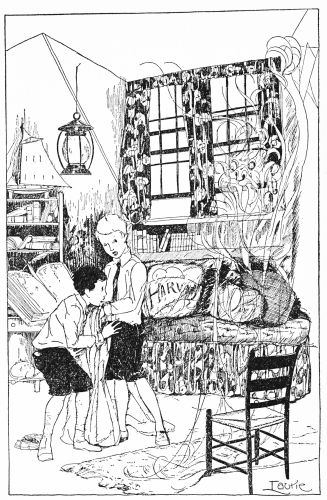
BEFORE THE BOYS’ TERRIFIED VISION STOOD A HORRIBLE
DEMON
“And that isn’t all,” said Wendell. “Here’s the biggest thing yet.”
“What is it anyway?” demanded Sammy, looking suspiciously at the magic
volume.
“A Book of Spells,” said Wendell impressively.
“Huh! A spelling book, eh?” echoed Sammy unenthusiastically.
“NO, no,” said Wendell. “Spells. Charms, you know. Enchantments. Look
here,” turning the pages: “‘HOW TO TURN BASE METALS INTO GOLD.’ ‘THE
EASIEST WAY TO DISENCHANT A DUMB PRINCESS.’ ‘SOME TRIED METHODS FOR
KILLING GIANTS.’”
“Hey! Lemme see,” cried Sammy. “Some book, I’ll say. ‘HOW TO PLACE A
LOST RING IN A FISH’S MOUTH.’ What do you know! ‘HOW TO LOCATE THE PLACE
WHERE TREASURE IS BURIED.’ Some book, I’ll tell the world! Say, some of
this don’t make much sense, does it? ‘Abacadabra, alaka, balaka,—’”
he spelled out a word or two.
A horrible odor filled the room,—like burnt scrambled eggs, thought
Wendell. There floated before his eyes a dimness as of smoke. It took
shape of an awful humanness, and took color as of white ashes. It slowly
took on a dull glow, which brightened until before the boys’ terrified
vision stood a horrible demon, angrily glowing a fiery red. He gave out
heat like a kitchen stove on ironing-day, and the rug where he stood
began to smoke.
“What are your commands?” he hissed.
There were none. Both boys were through the door and downstairs before
he had finished the question. Sammy fled in terror before that frightful
apparition, and Wendell went to bring Sammy back,—but he didn’t think
of that good reason till afterwards. Neither boy paused in flight till
the street was reached.
“Did he have hoofs and a tail?” gasped Sammy.
They stared up at the top windows. A jet of flame shot up. The muslin
window curtain was on fire.
“Fire!!!” yelled Sammy, dashing down the street to the alarm box.
Wendell—this to his credit—ran back into the burning house and alarmed
the family. Mrs. Bradford rushed for her jewels. Cousin Virginia, with
great presence of mind, put in a fire call by telephone. Sammy’s alarm
had already reached the fire station on Mt. Vernon Street. Almost as
Virginia left the telephone, the clang of the engines was heard, and a
line of firemen carried the hose upstairs, with their formula, “Is
everybody out?” The servants rushed clamoring to the street. Virginia
ran to help and reassure Mrs. Bradford, and Wendell followed the last
fireman up to his room.
The smoke was so dense that at first he could see nothing. Then he saw
that the stream of chemical had extinguished all the flames, and was now
directed at a fiery pillar in a sort of human shape that glowed redly
through the smoke. Wendell alone knew what it was. Little by little the
angry glow faded to white ashes. Gradually it dimmed to floating smoke.
The fire was out. The smoke cleared. The firemen withdrew. The family
assembled to view the blackened walls, to sniff the depressing odor, as
of a burnt-out district, to exclaim over the havoc and ruin wrought in
those few minutes.
“How did it happen?” everyone asked, and
“I don’t know,” said Wendell helplessly. How could he explain?
“Wasn’t that Sammy Davis in here?” asked the cook. “You two boys were up
to something, I know.”
His pretty room was a thing of the past—completely burnt out. The walls
were black. A few charred rags had once been window curtains. A sodden
rag underfoot was his rug. The closet was burned through. Blackened
shreds of garments hung on the nails. Wendell’s desk was but charred
timbers. His books were paper ashes.
“I know why Wendell looks so woe-begone!” said Cousin Virginia. “His
school books are burned.”
“Don’t worry, dear,” said his mother. “Everything is covered by
insurance. You wanted your room re-decorated, you know, and it is easy
to replace the clothes and books.”
Ah, yes, but who could replace the Cloak of Darkness? Who could restore
the Cap of Thought? What insurance would cover the Book of Spells?
Wendell was doomed once more to the drudgery of other mortals, to
learning his lessons like other boys, to plodding his toilsome way
through college, to making his own business success, unaided by the
great minds of the world’s financiers. No wonder he stood there glum
and almost tearful amid the blackened ruins of his room and of his
future.
Then suddenly, as he stood by the window, his eyes fell upon the street
below and the crowd of neighbor boys still lingering about the scene of
the fire, and upon the stone post that stood at the entrance to the
court over the way. And his eyes brightened to something like happy
anticipation as he said under his breath,
“Well, anyway, I have one wish left on the Wishing Stone.”


