MOLLY'S DIFFICULTIES COME TO AN END.
AFTER some difficulty, Molly's uncle succeeded in finding the minister,
who readily consented to come at once to see the child. He listened
with sorrow to the story of the trouble Molly had known since he had
lost sight of her, and the sad way in which her little life was ending.
But he believed that God would bring gain out of loss, and crown that
blighted childhood with everlasting joy.
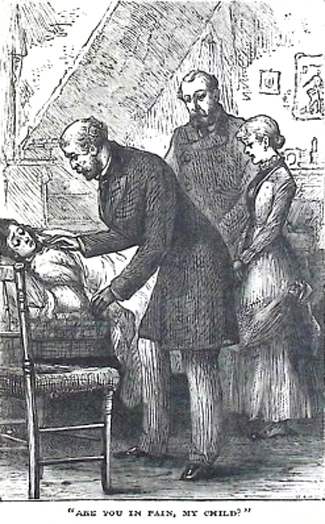
The day was near its close, and it was almost dark when Mr. Macardie
and the minister climbed the steep stair to the attic.
Molly had grown much weaker during the last hour. Her strength was
going rapidly, but her mind was still unclouded.
She recognised her minister as he entered the room, and stretched out
her little hand to him with a smile of welcome.
"I'm so glad you've come," she said, softly; and then turning to her
sister, she added, "bring the candle nearer, please; I want to see my
minister quite plain."
Kathleen brought the light and held it, whilst Molly gazed with love
and confidence at the kind face which looked on her with tenderest
sympathy.
"It is all right, is it not, Molly?" asked the minister. "Jesus is with
you."
"Yes!" she murmured, faintly, her lips parting with a smile. "Jesus is
with me!"
In a few simple words he spoke to her of the loving Saviour, and of the
happy home to which his own darling child had gone, and into which she,
too, would soon be gathered.
Molly seemed to understand what he said. The happy look lingered on her
face.
"It's all real true!" she whispered once. "All real true!"
Then the minister knelt by her bedside, and commended the dying child
to the care of the Good Shepherd.
As he prayed, Molly fell into a doze, from which she did not rouse
whilst he remained there.
As he went out of the house, the minister met Madame Ganelli, who was
coming to see her little friend.
Giving him a quick, observant glance, she said, "You are little Molly's
minister, are you not, sir?"
"Yes," he replied, looking at her with surprise; "I am little Molly's
minister."
"Oh, poor little Molly!" cried the singer, in a broken voice. "Is it
not a dreadful thing? My heart aches for the child. To think that she
should be sacrificed to a man's cruel rage!"
"Do not grieve for her," said the minister, gently. "Sad though her
case seems, it is well with the child."
"I know it! I know it!" cried the lady, bursting into tears. "She is so
good! Oh! I cannot tell you what I owe to little Molly! That child has
been my salvation!"
"How so?" he asked.
"To explain that, I should have to tell you a sad story," said Madame
Ganelli, stepping within the shelter of the doorway, and giving a
searching look into the minister's face.
The look seemed to encourage her, for she added, "The story is too long
and too sad to be told now and here, but I think I should like to tell
it to you some time, if you would let me. I have long wished to open my
heart to some one, and it seems to me that you are the person to help
me."
"Indeed! I shall be glad to receive your confidence, and to give you
all the help in my power," replied the minister, his voice full of
sympathy. "Could you come with me, now, to the mission hall? It is but
a few steps from here, and we could talk quietly there."
Madame Ganelli hesitated for a moment. She felt half frightened at
being so promptly taken at her word.
"Just as you like," he said; "if you would prefer speaking to me at
another time—"
"No, no," she responded, quickly; "there is no good in delay. I will
come with you at once, as you kindly ask me."
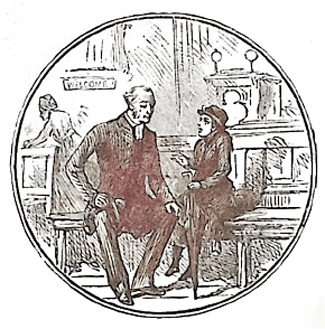
In a few minutes, they were at the mission hall. The gas was lighted
within, and a woman was moving about arranging the benches for the
service an hour later. At a word from the minister, she retired.
"Now," said he, as he gave the lady a chair, "what is it you have to
tell me? Do not be afraid to speak freely, as to a friend."
"I believe I shall find you a friend," she replied, "and will therefore
hide nothing from you. You will be surprised to hear that the wicked
man who brought this trouble upon Molly is my husband."
"What!" cried the minister, with a look of astonishment. "Your husband!
Is your name Vavasour, then?"
"No; nor is his. That is merely a name assumed to serve the purpose of
his profession. For a similar reason, I have called myself Ganelli. My
real name is Sherwin—Catherine Sherwin. I am no foreigner, but was born
and brought up in a pretty country place in Berkshire. My parents were
good Christian folk.
"My father was postmaster of the little town where we lived. He had to
work very hard, but his leisure was devoted to doing good. On Sunday
afternoons, no matter what the weather might be, he would walk several
miles in order to hold a cottage-meeting in an out-of-the-way place,
where there was no church for the poor people to attend. In our home,
we always had family prayers, night and morning. I can remember my
father's prayers now."
Here Madame Ganelli's voice trembled with emotion, and she was obliged
to pause for a while.
"I was my parents' only child," she went on presently, "and they
lavished on me all the love of their hearts. But I wounded their
love and disappointed their hopes. They were determined to give me a
good education, and that I might have unusual advantages, sent me to
a superior boarding-school, from which I returned accomplished and
polished, but vain and frivolous in character. I had learned that I
was beautiful, also that I possessed a remarkably fine voice. A vain
ambition awoke within me, and longing to display my gifts, I was no
longer satisfied to share my parents' humdrum life.
"I yearned to distinguish myself in a larger world, never doubting that
my beauty and accomplishments would win me the happiness I craved.
"My parents saw the mistake which they in their love had made. Vainly
they strove to arouse in me higher aspirations. My father pleaded
with me to give my heart to the Saviour, but I would not heed his
words. I did not want to be religious. I wanted to be gay and clever
and admired. My foolish vanity was fed from time to time by words of
admiration from friends outside my home. My voice was heard and admired
as I sang in our church, and the rector came himself to ask me to join
the choir. This I was easily persuaded to do, and from that time, the
very praises of God's house were a snare to me.
"Strangers inquired who was the lovely girl who sang so sweetly, and
compared my voice to that of their favourite opera-singer.
"Their words came to my ears, and gave a definite form to my ambitious
longings.
"I was eager to go to London and be trained for a public singer. Oh,
what a life, I thought, mine would then be! I pictured myself a famous
singer, with crowds flocking to hear me whenever I sang in public.
"How delightful to stand upon a glittering stage, and hear the hall
ring with applause of my song, whilst bouquets were tossed at my feet,
and I was flattered and admired as a queen!
"With such visions did I delude myself, never dreaming of the
heart-ache and disappointment, the sin and misery, which such a career
too often involves.
"I did not mention my wishes to my parents. I knew that they would
never consent to my leaving home, and devoting myself to such a
profession. But the thought was seldom out of my mind. I dwelt upon it
till selfish ambition stifled all sense of filial love and duty, so
that when temptation came, my will yielded a ready consent.
"That summer there came to our neighbourhood a fine gentleman, an
actor from one of the London theatres. He had come into the country to
recruit his health, and during his idle hours, I attracted his notice,
and was soon flattered by his constant attention. He was a handsome
man, and my vanity was easily beguiled by his winning manner. Ere my
parents even knew that I had made his acquaintance, I had confided to
him my ambitious dreams, in response to his lavish praise of my voice
and my appearance. He gladdened my ears with repeated assurances of
success, and took advantage of my weakness by urging me to marry him
without my parents' consent. If I became his wife, he promised me the
training I required to fit me for a public career. In glowing terms, he
described to me the grand future thus open to me. I listened, and in
my folly believed all. I fancied that I loved this man, of whom I knew
scarce anything, fancied that with him I should find a happiness that
would compensate me for the loss of my old home and my parents' love.
"But I did not yield to his persuasions without a struggle. It cost me
many a pang to think of leaving, without even a word of farewell, the
father and mother who loved me so dearly. But with artful words, he
made light of my scruples. It was only for a time, he said. I should
soon return to see my parents, and how pleased and proud they would be
when I won for them fame and distinction. So I took the irrevocable
step. In the darkness of night, I stole away from my home accompanied
by this man. We were married the next morning in London, and at once
started for the Continent."
Here Madame Ganelli made a pause. The minister said not a word, but
waited till she could recover herself and continue her narrative.
"I never saw my father and mother again," she said at last. "Before I
had been long married, I learned the true nature of my husband, and saw
what a fatal mistake I had made.
"We settled in lodgings in Paris, and there my musical education began.
My husband spared no pains in procuring me the best instruction. He had
set his heart, for his own sake, on my success.
"I worked hard with a kind of desperate diligence, trying to kill by
industry the sore pain of remorse. For a time my husband treated me
with tolerable kindness. But as months rolled on, and my spirit grew
more and more despondent, he wearied of me, and often left me alone for
weeks at a time in my dull lodging.
"I heard nothing of my parents all this while. My husband would not
allow me to write to them. I should see them, he promised, when we
returned to England. He had entered on a long engagement at one of
the Paris theatres, and did not propose returning to London till the
following year.
"Ere that time arrived, I became the mother of a beautiful boy. Oh, how
I loved my precious babe! He was the sole joy of my life. I used to
picture to myself the day when, carrying him in my arms, I would make
my way back to my old home, and falling at my mother's feet beseech her
to forgive me, if not for my own sake for that of the child.
"But it was not to be.
"My musical studies compelled me to consign my babe to the care of
another for the greater part of each day. This was a great trial to me.
I grudged every hour passed away from my boy, and was always anxious
lest harm should come to him in my absence. He was a small and delicate
child, and did not thrive as I could wish.
"At last, the time came when my husband was free to take me to London,
there to make my 'début' as a singer.
"Ah! What hopes and fears contended within my soul when I landed on
the English shore! Not from anxiety for professional success; I had
ceased to care much about that. But I hoped to see again the faces of
my father and mother, and to hear them say that they forgave me.
"But this hope was soon slain.
"At the hotel, where we were to rest that night, I chanced to take up
a newspaper. My eye glanced over the list of deaths. Suddenly my heart
stood still, and a numbness took possession of my frame. For there in
that line was my mother's name! Then I knew that my wicked conduct had
broken her heart."
****
"I scarcely know how I lived after that. I was like one in a dream,
save when I had my baby in my arms, and was comforted by the touch of
his tiny hand smoothing my cheek or playing with my hair.
"I began to sing in public, but my singing was not the success my
husband had hoped it would prove. It was good in its way, but it lacked
inspiration. I won my fair meed of praise, but gave no promise of
rising above mediocrity in the ranks of singers.
"My husband was furious at what he termed my failure. But in vain, he
stormed and threatened. I could do no better.
"At last there came a day I shall never forget. My beautiful boy was
suddenly taken ill. All day he lay on my lap, his little body racked by
convulsions, which threatened death at every moment.
"I was engaged to sing in an opera that night, and my husband had set
his heart on my making a sensation. I implored him to find some one to
take my place, and get me excused, but he would not listen to me.
"The child would be all right, he declared, and I must and I should
sing. With cruel force, he took me from my child, as he lay panting and
struggling, a sight to rend a mother's heart, and carried me off to the
theatre at which I was to sing.
"I sang that night as I had never sung before. Tortured with anxiety,
trembling from excitement, I stood upon the stage. My song was a wild
lament, and I poured out in its swelling notes all the anguish of
my soul. It was with no feigned misery that my voice quivered, and
the reality of my emotion penetrated to the hearts of my audience,
thrilling them in response. As my song died away, a thunder of applause
greeted my ears. The building re-echoed with the sound of my triumph. A
bouquet fell at my feet.
"As in a dream, I heard the shouts and clapping; through a haze of
tears I saw the admiring glances cast upon me; then bowing low, I
retired. Thus were my girlish dreams realized. Did any one envy me that
night, I wonder?"
The speaker's voice again failed her. Tears would have their way, and
some minutes passed ere she could go on with her story.
"I cannot dwell upon the events of that night," she said, speaking with
forced calmness. "When I reached home, my boy was dead. They told me
that for an hour before he passed away, he kept calling for me in baby
words.
"I must pass over the anguish of that time. It almost killed me. I was
ill—very ill—for weeks.
"When I recovered, I was an altered being. My beauty was gone, and with
it all hope of shining as a star in the musical world.
"My voice had lost its power. I could no longer command the rich, full
notes which had won me admiration. Even if my voice regained strength,
as a physician declared that in time it would, it was but too evident
that I should never be more than a second-rate singer.
"My husband did not attempt to conceal his mortification at this issue.
He no longer made any show of affection for me, but treated me with the
utmost cruelty.
"Before I had fully recovered from the effects of my long illness, he
basely deserted me, leaving me to struggle through life as best I could
alone. I believe he went to the Continent, but I did not try to recall
him, though I might easily have traced him through his connection with
the theatres.
"The first thing I did in my freedom was to journey to my native place,
in the hope of finding my father there. But again I was too late, and
reached my old home only to learn that my father had died a few weeks
earlier.
"Heart-broken, I returned to London.
"I took lodgings in a quiet suburb, and found employment in giving
singing lessons. I called myself Ganelli; and when people questioned me
as to my history, I said that I was the widow of a foreigner.
"But I could not long endure the quietude and monotony of this life.
Painful thoughts tortured me, and I hoped to escape them by resuming my
old profession. My voice was now stronger, and I could sing in public
again.
"So I once more appeared in concert-rooms and halls, and sang with some
measure of success.
"But no happiness came to me. Sorrow and remorse were ever working at
my heart, though no one would have guessed it who heard me sing. The
songs I chose were generally of a lively character. I could not bear to
sing a melancholy strain; grief was too real a thing for me.
"Sacred music also I avoided. I felt myself too great a sinner to take
holy words upon my lips.
"However, one day, contrary to my usual habit, to oblige a friend, I
agreed to take part in an oratorio. In preparation for the concert, I
was one morning practising the sublime words, 'I know that my Redeemer
liveth,' when suddenly little Molly burst into my room, and eagerly
asked me to tell her how I was so sure that the Redeemer lived.
"The child was employed to clean boots at the boarding-house in which
I lived, but I had not seen her before. I was greatly startled by her
sudden appearance and the strange question she put. I would fain have
checked her eager words, but her anxiety was so real and earnest that
I felt bound to assure her of the truth, which I could never doubt.
Unhappy though I was, I believed that there was a God and a Saviour.
I told the child that what she had heard of the Lord Jesus was indeed
true, and she left my room with hope sparkling in her eyes. Then I
bowed my head and wept, because there was hope for that poor child, but
no hope for me.
"After this, I took great interest in little Molly. I felt anxious to
befriend her, but ere long personal anxiety drove her from my thoughts.
I had learned some time before that my husband had returned to London,
and was acting at the S— Theatre. I did my best to avoid meeting him,
and for a time was successful. But it was impossible for me, in the
public life I led, to long escape his notice. One evening, when I left
the hall at which I had been singing, I found him waiting for me at the
door.
"A stormy interview ensued. He urged me to return to him, but I,
remembering his past cruelty, and believing that he only wished me to
return that he might profit by my earnings, refused to listen to him.
"Then he threatened me, but hoping that the law would protect me from
his malice, I dared him to do his worst.
"At last, seeing that I was not to be moved, he left me; but from that
day, he lost no opportunity of annoying me. He vented his spite upon me
in a thousand ways too petty to describe, yet sufficiently vexatious.
"I bore it as well as I could. But what words can describe my
consternation when I learned from poor little Molly that the man who
had ruined the happiness of my life was calling himself her sister's
friend, and deceiving the poor girl into such a belief in his good-will
that she was ready to trust her future to him.
"Oh, what I suffered as I thought of Kathleen's peril! I felt I must
save her, yet was powerless to do anything. I could only solemnly warn
little Molly of the man's true nature, and entreat her to save her
sister.
"But though I could not help them, I knew there was One who could. For
years I had not dared to pray for myself, but now I prayed for those
poor children as I had never prayed before."
"And your prayer was answered," said the minister, as she paused.
"It was answered in a sad way," she returned.
"Sad to our human short-sightedness," said the minister. "But God's
ways are not as our ways. We can trust little Molly in His loving
hands."
Madame Ganelli was silent.
"Is this all you have to tell me, my sister?" asked the minister,
presently.
"I have told you all my story," the singer replied.
"But have you nothing to say of yourself? After you had prayed for
these poor girls, could you not bring your own case before the Lord?"
"I tried to do so," she said, tears springing anew to her eyes. "I
remembered some words little Molly had said to me. She told me that
Jesus loved me better than even my mother had loved me; and I knew that
bad though I was, my mother had never ceased to love me, and that if I
could have gained her side ere she passed away, she would have received
me without a word of reproach, and have given me a full and free
forgiveness. Is it true? Does the Lord love us like that?"
"Ay, it is true," he answered. "Your life has been hard and bitter, but
it was not the Lord's will that it should be thus. You have tasted the
fruit of your own wrong-doing. He would have saved you from misery,
but you would not let Him. The strokes with which He has smitten you
have been dealt in love. Now, if you will turn to Him, and seek His
forgiveness, He will soothe your heart's sorrows and give you peace, as
a mother would comfort her child who ran to her to heal the smarting
pain resulting from some act of wilfulness. Do not fear to trust His
love."
The singer's face brightened.
"I shall not forget your words," she said, as she rose to go; "they
give me hope. You are indeed a friend."
"The servant of a better Friend," he replied. "To Him I commend you. He
can meet all your need."
From the mission hall, Madame Ganelli hastened to Molly's bedside.
The child still lay in a doze, but signs of the approach of death
were becoming more and more visible to the eyes of the watchers. They
thought she would pass away in her sleep, but presently she moved,
opened her eyes, and looked up in bewilderment.
Her face was darkened with a look of distress. "Don't leave me,
Kathleen," she cried, pitifully; "don't leave your poor little Molly!
What will become of me if you go away?"
"I will never leave you," Kathleen told her, in a broken voice. "Oh,
Molly dear, I would not go away from you now for the world!"
At the sound of her words, Molly's bewilderment ceased. Her brow
cleared, and she looked at her sister with a smile.
"Oh no, I forgot," she said, faintly; "it is not you, but I, little
Molly, who am going away. And I'm glad to go."
She smiled, as with one hand she clasped her uncle's, and with the
other Kathleen's hand in token of farewell. Then she caught sight of
Madame Ganelli, and greeted her, too, with a smile.
The smile died away, and she looked into the singer's face with an
anxious, questioning glance, as if she would fain ask something, but
had no words.
Madame Ganelli thought she understood that look. "Molly," she said,
bending down close to her and speaking very distinctly, "Molly, I can
say it now from my heart, I 'know' that 'my' Redeemer liveth."
Molly understood the words. A gleam of joy lit up her tiny white face,
as half raising herself in bed she cried in clear, ringing tones, "I
know, I know! Jesus lives! It's all real true."
They were the last words she spoke. She sank back, and her eyes closed.
A happy, peaceful expression settled on her face, and remained there.
The breath came slowly and quietly through her parted lips. Soon no
sound broke the stillness of the room, for little Molly was away.
Doubts and difficulties would vex her spirit no more, toil and want
were for ever past. Out of the darkness of this lower world God had
taken her into the perfect light beyond, and the child was in the
presence of the Saviour whom on earth she had yearned to know.
THE END.
————————————————————————————————
London: Pardon and Sons, Printers. Paternoster Row.