Copyright, 1914, By Roi Cooper Megrue and Walter Hackett Copyright in Great Britain and Canada
Copyright, 1917, By Samuel French
ALL RIGHTS RESERVED
CAUTION: Professionals and amateurs are hereby warned
that “IT PAYS TO ADVERTISE,” being fully protected
under the copyright laws of the United States, is
subject to a royalty, and any one presenting the play
without the consent of the owner or his authorized agents
will be liable to the penalties by law provided. Application
for amateur acting rights must be made to Samuel
French, 28-30 West 38th Street, New York. Applications
for the professional acting rights must be made
to the American Play Company, 33 West 42d Street,
New York.
NEW YORK
SAMUEL FRENCH PUBLISHER 28-30 WEST 38th STREET
LONDON
SAMUEL FRENCH, Ltd. 26 SOUTHAMPTON STREET
STRAND
Especial notice should be taken that the possession of this
book without a valid contract for production first having
been obtained from the publisher, confers no right or license
to professionals or amateurs to produce the play publicly or
in private for gain or charity.
In its present form this play is dedicated to the reading
public only, and no performance of it may be given except
by special arrangement with Samuel French, 28-30 West 38th
Street, New York.
Section 28—That any person who wilfully or for profit
shall infringe any copyright secured by this act, or who shall
knowingly and wilfully aid or abet such infringement shall
be deemed guilty of a misdemeanor, and upon conviction
thereof shall be punished by imprisonment for not exceeding
one year, or by a fine of not less than one hundred nor more
than one thousand dollars, or both, in the discretion of the
court.
Act of March 4, 1909.
GEORGE M. COHAN THEATRE, NEW YORK
CITY,
September 8th, 1914
COHAN & HARRIS
IT PAYS TO ADVERTISE
A FARCICAL FACT IN THREE ACTS BY
Roi Cooper Megrue and Walter Hackett
Staged under the direction of Sam Forrest
The characters appear in the order in which they are
named
ORIGINAL CAST
Mary Grayson
Ruth Shepley
Johnson
George Schaeffer
Comtesse de Beaurien
Louise Drew
Rodney Martin
Grant Mitchell
Cyrus Martin
John Cope
Ambrose Peale
Will Deming
Marie
Cecile Bretone
William Smith
Harry Driscole
Donald McChesney
W. J. Brady
Miss Burke
Vivian Rogers
Ellery Clark
Kenneth Hill
George Bronson
Sydney Seaward
SYNOPSIS OF SCENES
Act
I.
Library at Cyrus Martin’s.
Act
II.
The office of The 13 Soap Company
Act
III.
Same as Act I.
IT PAYS TO ADVERTISE
THE CAST
(In the order of their appearance.)
Mary Grayson
Johnson
Butler at the Martins’
Comtesse de Beaurien
Rodney Martin
Cyrus Martin
Ambrose Peale
Marie
Maid at the Martins’
William Smith
Miss Burke
Clerk
George McChesney
Charles Bronson
Ellery
Act
I.
The library at Cyrus Martin’s.
Act
II.
Rodney Martin’s Office.
Act
III.
Same as Act I.
AUTHOR’S NOTE: The advertising statistics
used in the play are facts, not farce.
ACT I
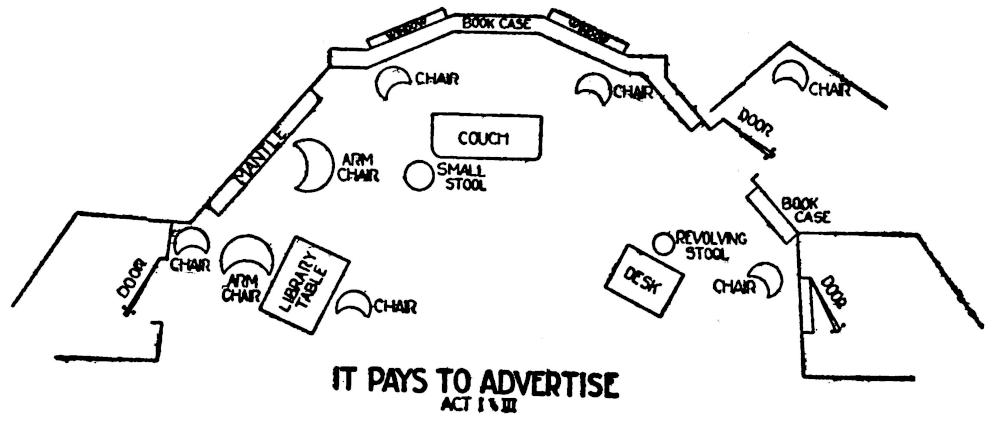
Scene: The library of Cyrus Martin’s home in
New York City: a very handsome room, in
tapestry and dark oak. Doors up left, down
left, and down right. Books, chairs, divans, as
necessary. Down left is an oak typewriting
table with a typewriter on it. It is obviously
out of place in the room, and is evidently only
a temporary arrangement. Handsome walnut
furniture. Mantel set on mantel. Fire dogs
and irons in fireplace. All-over carpet. Handsome
busts on bookcases. Chandelier and four
brackets. Curtains on windows at back. It is
seven o’clock in the evening—early September.
At Rise: Mary Grayson is seated at typewriter;
she strums the keys idly and indifferently with
one finger. She might hum a turkey-trot, keeping
time with a one-finger accompaniment. In
a moment Johnson, a typical English butler,
enters from door upper L.
Johnson. I beg pardon, Miss Grayson.
Mary. (Whirling about eagerly) What is it,
Johnson? Has young Mr. Martin come in yet?
Johnson. No, Miss.
Mary. But I told you not to interrupt me until
he did.
Johnson. I know, Miss, but it’s that Mr. Ambrose
Peale again; he’s called four times.
Mary. Say that Mr. Martin will be back at eight
o’clock.
Johnson. Yes, Miss. There’s a lady waiting,
too, Miss, to see Mr. Martin Senior. Here’s her
card.
Mary. Mme. la Comtesse de Beaurien. Tell her
that Mr. Martin Senior can see no one.
Johnson. I can’t make her comprehend anything
I say. She just sits and waits.
Mary. Oh, bring her in, then. I’ll make her understand
somehow, but, Johnson, don’t fail to let me
know the minute young Mr. Martin gets home.
Johnson. (Going to door up L.) Yes, Miss.
(Mary rises from typewriter, takes off her sleeve-protectors
and smoothes out her skirt.)
Johnson. (Announcing) Countess dee Beauree-en——
(The Countess enters from door upper L. She is
a very smart-looking girl of about twenty-six
or twenty-seven, typically French in manner
and does not speak a word of English. He
exits.)
Mary. (To Countess) How do you do?
Countess. (Advancing to her) Mam’selle
Martin?
Mary. Oh, no, I’m Miss Grayson, Mr. Martin’s
secretary.
Countess. (Blankly) Sec-ree-taree?
Mary. I’m sorry, but it’s quite impossible for
you to see Mr. Martin. He is confined to the house
with a severe attack of gout. If you will write him
I will see that he gets your letter. You can address
him here instead of the office; while he is ill I come
here every day for the mail.
Countess. Pardon, mais je ne comprends pas—je
ne parle pas l’anglais. Vous parlez Français peut-être?
Mary. (Blankly) You see, Mr. Martin is
ill....
Countess. Je répète que je ne parle pas anglais.
Mr. Martin est-il ici?
Mary. It’s quite useless for you to talk: I don’t
understand French.
Countess. Un moment, Mam’selle—peut-être je
parle trop vite.... (More slowly) Je désire
parler à M. Martin àpropos des affaires. Je suis
riche. Mais on peut toujours être plus riche. Si je
pouvais obtenir l’agence du savon Martin pour la
France ça serait une belle affaire. Je donnerais
cinquante mille francs pour cette agence. Répéter
cela à M. Martin et je suis sûre qu’il me recevra immédiatement.
Vous comprenez maintenant——
Mary. But I really don’t understand French.
(Slowly and loudly) Mr. Martin is ill—sick! He
can see no one—you’ll have to go—please do——
Countess. Mon Dieu! Vous êtes stupide....
(Sitting down in chair L. of table) J’attendrai
M. Martin.
Mary. There’s no use your sitting down. (She
goes to her) Mr. Martin doesn’t understand
French, either.
Countess. C’est bien, c’est bien, mam’selle; je
ne suis pas pressée.
Mary. I don’t understand. Please go—(She
waves her hands)
Countess. Ah, laissez-moi donc tranquille—vous
m’embêtez.
Mary. Oh, dear!
(Johnson enters.)
Johnson. Young Mr. Martin’s come in; he’ll be
here directly.
Mary. Good Heavens! (She goes over and
makes a wild sweeping gesture) Mr. Martin is out—out.
Countess. (With marked accent) Out?
Mary. (Nodding her head) Oui——
Countess. (Rapidly) Oui? Ah vous parlez
Français? Je voudrais savoir si Mr. Martin est ici.
Je voudrais lui parler tout de suite.
Mary. Heavens! She’s off again; let’s act it
for her. Let’s see—(She points to Johnson)
That is Mr. Martin.
Countess. Eh?
Mary. We’re pretending that is Mr. Martin.
Countess. (Shaking her head) Ah, non, ça ce
n’est pas M. Martin.
Mary. We’re pretending—see, pretending?
Now, you see—Mr. Martin is out—see?
(Johnson exits and enters immediately.)
Countess. (Suddenly) Ah, Mr. Martin n’est
pas ici! Je comprends.
Mary. Heavens, she understands, Johnson!
Take her by the arm and lead her out. (Crosses L.)
Johnson. (Starting to do so as Countess rises
to go out) Yes, Miss.
Countess. Attendez! A quelle heure M.
Martin rentrera-t-il? (She sits again)
Johnson. Now what’s the matter? You’d better
come quietly, Miss—(He takes her by the arm)
Countess. (Shaking him off) A quelle heure
rentrera-t-il? (There is a blank pause. To Mary)
Maintenant—faites attention à votre tour. Regardez-moi:
je suis M. Martin, vous comprenez?
Moi je suis M. Martin——
Mary. (Nodding) Mr. Martin.
Countess. (Going to door) Mr. Martin n’est
pas ici; il est sorti—il est au bureau. Enfin s’il
n’est pas au bureau c’est pas mon affaire. Maintenant
je voudrais savoir à quelle heure rentrera-t-il?
Mary. Don’t let her in here again unless you
have an interpreter.
Johnson. Very good, Miss. (He exits door
upper L.)
(Mary primps, and sits at typewriter again, and
idly touches the keys with one finger, maintaining
an eager watch on the door. She hears
someone coming and hastily and busily bangs
away at the typewriter. Rodney Martin enters
door L. He is a young man of twenty-four
with a certain quaint frank charm, in spite of
his funny little mustache, English morning coat,
spats and white carnation. He is by no means
brainless, but simply undeveloped by reason of
the kind of life he has led under appallingly
frictionless conditions.)
Rodney. Miss Grayson!
(Mary’s previous business-like air has entirely disappeared,
and she assumes the fluttering airs
of a timid ingenue, overdoing it for anyone except
a boy madly in love with her.)
Mary. What a surprise! (Rodney goes and
locks both doors L.) Why, Mr. Martin ...
what are you doing?
Rodney. (Coming to her and facing her over
back of chair) I want to talk with you. Mary, will
you marry me?
Mary. Why, really——
Rodney. You love me, don’t you?
Mary. I—I don’t know what to say——
Rodney. Say Yes.
Mary. (Shyly) Yes.
Rodney. (Trying to grab her) You angel!
Mary. (Eluding him) Wait!
Rodney. We’ll be married right away.
Mary. But suppose your father disapproves?
Rodney. He won’t know anything about it until
we’re married, and then what could he do?
Mary. He might cut you off.
Rodney. Would you care?
Mary. (Hastily) I? No, no, indeed. I was
thinking of you, dear.
Rodney. Don’t you bother about me. We’ll be
married to-morrow, and then come home for the
parental blessing.
Mary. Oh, I couldn’t do that. It wouldn’t be
square. I’m his private secretary: he trusts me.
To bring me here to his home and then to find I’d
married his son on the sly—we couldn’t do that.
Rodney. You do make it sound rather bad. I
wouldn’t want us to give father the worst of it;
we’ve always been pretty good friends, he and I. I
guess I’d better tell him—in a week or so.
Mary. Why, Rodney, if you love me, we must
get this awful suspense over.
Rodney. But suppose he does object?
Mary. Even then I wouldn’t give you up.
Rodney. Mary!
Mary. You could go into business, make a big
man of yourself, make me proud of you——
Rodney. You talk just like the heroine in a play
I saw last night. She wanted the hero to go to
work, and he did, and then for four acts everybody
suffered.
Mary. Don’t you want to work?
Rodney. (Seriously) I should say not. Imagine
going to bed every night, knowing you’ve got
to get up in the morning and go to business.
Mary. You’d be happier, wouldn’t you, if you
had a job?
Rodney. Please don’t talk like father; he’s
preached a job at me ever since I left college.
Why should I work? Father made millions out of
soap and is forever complaining that he’s always
had his nose to the grindstone, that he’s worked
fourteen hours a day for thirty years, that he’s never
known what fun was, that it’s all made him old before
his time. I can’t see the sense of following an
example like that—I really can’t. He’s got enough
for you, and me, and our children. Yes, and our
children’s grandchildren. I’ve explained all this to
him but I can’t seem to make him understand. But
it’s simple: why work when there’s millions in the
family? And why even talk of money when you
and I are in love? Come, kiss me. (He leans towards
her; she moves away to L. He crosses R.)
Mary. No, you mustn’t—not till you’ve spoken
to your father.
Rodney. You won’t kiss me till I tell him?
Mary. No.
Rodney. And you will when I do?
Mary. Yes.
Rodney. Then I’ll tell him right away. (He
goes toward door L. She crosses R.)
Mary. Oh, Rodney, you’re splendid! And
don’t be afraid.
Rodney. Afraid! (Pausing) You don’t think
I’d better wait till the morning?
(Cyrus Martin knocks at the door violently, and
says “ouch” in a loud tone.)
Martin. (Off-stage) Why is this door locked?
What the devil does this mean?
Mary. If you don’t ask him now, I’ll never
marry you.
Martin. (Off-stage) Open the door.
Rodney. Coming, father, coming. (He goes
and unlocks both doors)
Martin. (Loudly) Ouch, ouch! The devil!
(He enters) Why was that door locked?
Rodney. Was it locked?
Martin. You young fool, didn’t you just unlock
it? (Crosses to R.)
Rodney. (Nervously) So I did!
(Mary has gone to her typewriter and now begins
typing.)
Martin. Stop that noise! (She does so. Rodney
looks at her, discouraged. She motions to
him to go on. Meanwhile Martin has painfully
limped to a chair down-stage by table and sinks into
it. His foot gives him another twinge.) Ouch!
Oh, my poor foot!
(Rodney hastily picks up footstool and comes with
it to his father.)
Rodney. I’m afraid your foot hurts.
Martin. Not at all—I just pretend that it does!
Rodney. (Fervently) I hoped you were better.
Martin. Well, I’m not. What have you got
there?
Rodney. A footstool—I thought it might make
you more comfortable.
Martin. How much do you want?
Rodney. Why, nothing, father.
Martin. Well anyhow, the answer is not a
nickel——
Rodney. You do me an injustice. I’m just sorry
to see you in pain.
Martin. Well, you want something, that’s certain.
Rodney. Why do you say that?
Martin. I know you—and whatever it is, you
can’t have it.
(Rodney turns appealingly to Mary. She ignores
him. He turns back to his father and tries to
muster up his courage.)
Rodney. (Clearing his throat) Well, as a matter
of fact, I did want——
Martin. Now we’re getting to it.
Rodney. I wanted to have a talk with you—an
important talk——
Martin. Curious! That’s just what I wanted
with you—I’ve wanted it all day ... and now
we’ll have it—Miss Grayson!
Mary. Yes, sir? (Rises)
Martin. Get out. (She exits through door
upper L., without noticing Rodney, who stands
looking after her dejectedly. As he hears the door
close) Now, what do you mean by overdrawing
your allowance again?
Rodney. (Innocently) What it simply proves
is that I was right when I told you my allowance
was too small.
Martin. (Aghast) What!
Rodney. And if my allowance is too small for
one, it’s much too small for two.
Martin. For two?
Rodney. Father, has it ever occurred to you that
I might marry?
Martin. Of course it has! You’re fool enough
for anything.
Rodney. I don’t consider a man a fool because
he’s married.
Martin. That’s because you’ve never tried it.
Rodney. I intend to try it.
Martin. Who is the girl?
Rodney. (Nervously) The girl?
Martin. Yes, girl—you’re not going to marry
an automobile or a polo pony—you’re going to
marry a girl, aren’t you? Some blue-eyed, doll-faced,
gurgling, fluttering little fool. Oh, why
doesn’t God give young men some sense about
women?
Rodney. I object very strongly to your speaking
in that way of Miss Grayson.
Martin. Miss Grayson? Miss Grayson? You’re
not going to marry a typewriter?
Rodney. Yes, sir.
Martin. Does she know it?
Rodney. Yes, sir.
Martin. Of course she knows a good thing like
you when she sees it!
Rodney. I won’t listen to you talk of Miss Grayson
in that way.
Martin. You’ve got to listen. I won’t permit
any such absurd, ridiculous marriage! Thank
Heaven, you had sense enough not to elope——
Rodney. I wanted to, but she wouldn’t. She insisted
on your being told, so you see what an injustice——
Martin. Injustice? Can’t you see that she
wished me to know, so that if I disapproved and cut
you off, she’d not be stuck with you on her hands.
Rodney. Please, father—it’s quite useless. (He
starts to go)
Martin. No, my boy, wait a minute. Remember,
I’m your friend even if I am your father.
(Rises, goes to door R. to ring bell) Don’t you believe
it’s only your money she wants?
Rodney. I know it isn’t.
Martin. (Pushing bell) I’ll prove it is.
Rodney. What are you going to do?
Martin. Send for Miss Grayson.
Rodney. You shan’t humiliate her.
Johnson. (Entering from door upper L.) Yes,
sir?
Martin. Ask Miss Grayson to come here at
once.
Johnson. Yes, sir. (He exits)
Martin. I’ll tell that scheming secretary that if
you persist in this marriage, I’ll disinherit you!
Then watch her throw you over.
Rodney. Even if you are my father, you shan’t
insult the girl I love.
Martin. Poppycock! You’re afraid to put her
to the test: you’re afraid she will chuck you.
Rodney. (Quickly) I am not afraid.
Mary. (Entering from door upper L.) You
wanted me, Mr. Martin?
Rodney. (Going to her, she crosses to C.)
Mary!
Martin. Wait a minute. My precious son informs
me that you and he intend to marry.
Mary. (Timidly) Oh, sir——
Martin. And I wish to tell you that if he marries
you, he doesn’t get one penny of my money,
and that means he’ll starve.
Mary. Then at least we can starve together.
(They hold hands)
Rodney. Mary!
Martin. Making a grand-stand play, eh? You
think I’m too fond of him not to relent? Well,
you’re wrong. Neither of you can get a nickel from
me: you can both starve together.
Rodney. We won’t starve.
Martin. What can you do? You’re not a producer—you
never will be. (Crosses to L.) You’re
just an idler. You couldn’t earn five dollars a week,
but you’ll have a chance to try. You’ll get out of
my house to-night or I’ll have you thrown out.
Rodney. Now, father——
Martin. Not another word, sir, not another
word! (He kicks chair, and stamps out angrily,
thru lower L. door)
Rodney. (To Mary) It’s getting more like
that play every minute.
Mary. (Half crying) Oh, Rodney, Rodney,
what have I done? I’m so—so sorry.
Rodney. You haven’t done anything—neither of
us has. Father didn’t seem to give us a chance to.
He did it all——
Mary. Oh, Rodney——
Rodney. You were bully the way you stuck up
for me. When you said we’d starve together, I
just choked all up.
Mary. (Genuinely) Please don’t, Rodney.
Rodney. Just because he’s got a lot of money he
seems to think there isn’t any left, but I’ll show him.
I may not have much at the start, but watch my
finish.
Mary. What are you going to do?
Rodney. I’m going to work.
Mary. (Excited) You are—really? (Rises)
Rodney. Yes, indeed—father couldn’t make me
do it, but you have. I’ll work for you.
Mary. Oh, you are splendid. Will you get a
position?
Rodney. I should say not! Work for someone
else? No, sir—I’m going in business for myself—for
you. I’m going to show the stuff that’s in me.
Of course, we can’t get married till I’ve made good.
Will you wait?
Mary. (Shyly) Yes, dear.
Rodney. You’re a dandy.
Mary. What business are you going in?
Rodney. I don’t know yet. I’m going upstairs
to pack a suit-case and think. (Crosses to R.) I’ll
be back in fifteen minutes. (He grabs her and
kisses her hastily but heartily)
Mary. Oh, oh—please——
Rodney. Don’t mind, Mary. You’ll get used
to ’em. (Exits door lower R.)
(She goes over and raps three times on the door
through which Martin left, and backs away
from it. She stands there expectantly. In
a moment Martin tiptoes in with no trace of a
limp. She puts her fingers to her lips to indicate
silence, and points off-stage R. to indicate
where Rodney has gone. Martin tiptoes
nearer, nodding his head, questioning and
eager. Mary smilingly nods her head in reply.)
Martin. (In stage-whisper) You mean our
scheme worked?
Mary. (Delighted) Yes, yes.
Martin. You really have got him to go to
work?
Mary. I have!
Martin. (Gleefully) By George, that’s great!
Mary. Isn’t it!
Martin. You’re sure he wasn’t just talking?
Mary. No, he’s gone upstairs to pack and go
out and make a name for himself.
Martin. You’re a wise girl. Isn’t it wonderful?
Mary. And you said I couldn’t do it.
Martin. I said I didn’t think you could, but
you have, and I owe you $2,500. (Crosses to chair
L. of table to make out check)
Mary. Oh, there’s no hurry.
Martin. Never put off till to-morrow the money
you can get to-day.
Mary. Aren’t you proud I’ve been so successful?
Martin. Proud? I’m so doggone happy I’m
making this out for $5,000.
Mary. Oh, Mr. Martin!
Martin. And it’s worth $50,000 to me to have
my boy really want to work, not just to do it to
please me. What a difference an incentive makes!
(Hands her the check)
Mary. (Smiling at check) Doesn’t it?
Martin. (Crosses to L.) Especially if it’s a
girl. And to think I begged and threatened Rodney
for months, and then you plan this scheme, you invent
my gout, you rehearse me, you come up here
for six short weeks and—Bing, you get him so he’s
in love with you.
Mary. Or thinks he is.
Martin. But, say, what about your marriage?
(Sits in chair L. of table)
Mary. He said he wouldn’t marry me till he’d
made good—if I’d just wait. (Sits in chair R. of
table)
Martin. (Anxiously) Do you think perhaps
he may really love you?
Mary. Of course not.
Martin. It’s the first time he’s actually wanted
to marry anybody.
Mary. Oh, it’s just that I’ve been very blue-eyed
and baby-faced.
Martin. I guess you’re right!
Mary. Of course I am. When I break our engagement
he may feel sort of lonely for a while
and give up women forever, but pretty soon some
charming girl of his world will come along—some
limousine lady, and they’ll live happy ever after.
Martin. I sort of begin to wish this marriage
were going to be on the level.
Mary. It wouldn’t work out. I’m a business
woman. Even if your son did love me—really love—I
wouldn’t marry him. Just now he’s twenty-four
with an India-rubber heart that is easy to stretch
and easier to snap back. All boys at twenty-four
are like that.
Martin. (Reminiscently) I guess so. I remember
when I was a young man, there was a girl ...
my heart was broken for a week—perhaps
ten days. I went down to the club one night and got
spifflicated—however, however—(Abruptly changing
the subject) What’s my son going to work at?
Mary. I don’t know yet.
Martin. Do you think he’ll make good?
Mary. He will if he keeps at it. (Rises and
goes R.)
Martin. Well, you’ll keep him at it? (Rises
and goes R.)
Mary. That wasn’t our agreement. I only undertook
to get him to start to work.
Martin. Hum.
Mary. (Quickly) Isn’t that true?
Martin. Quite—quite. I was just thinking we
might make some new agreement to have you keep
him on the job.
Mary. (Rubbing her fingers as if handling
money) I’m a business woman.
Martin. What strikes you as fair?
Mary. I’d rather the proposition came from
you.
Martin. What do you say to your present salary,
and at the end of the year I will personally
give you a check for twenty-five per cent of what
Rodney has made.
Mary. Oh, that wouldn’t interest me at all.
Martin. What’s your proposition, then?
Mary. (Promptly) My present salary doubled.
Martin. Um—that’s pretty steep.
Mary. You told me what I’d done already was
worth $50,000 to you.
Martin. Merely a figure of speech, my dear.
Let’s see, you’re getting $40 a week, and....
Mary. $50, and I want $100.
Martin. Sounds like a hold-up. (Crosses R.)
Mary. Then let’s drop it. This new contract
was your idea, not mine. Good-evening. (She
starts to go, gets to door, which she bangs as if
she had gone. She remains however in the room)
Martin. Hold on—hold on—(He turns and
sees her, and then chuckles at her joke on him. She
laughs, too) I was simply figuring. Tell you what
I’ll do: $75 a week and 10 per cent of what Rodney
makes.
Mary. Seventy-five a week and 10 per cent of
what he makes? All right, I’ll go you.
Martin. Good.
Mary. (Goes to desk, takes note-book) Will
you just write me a note stating the facts and the
consideration?
Martin. You want it in writing? (Crosses to
table R. and sits)
Mary. Certainly, it’s always safer that way.
(He writes. As he writes) As soon as you see
Rodney, you’ll have to discharge me.
Martin. I will, violently. I make a pretty good
actor under your direction. How did you like
that irate father stuff?
Mary. Great! You needn’t make the note long.
Just a memorandum.
Martin. (Holding up paper) How’s that?
Mary. (Reading) I think that covers it—if
you’ll sign it.
Martin. (Confused) Didn’t I sign it?
Mary. (Smiling) No, and never put off till
to-morrow what you can sign to-day.
Martin. (Signing) There you are. (Hands
Mary paper)
Mary. (Sits on table) Thanks. Now, Mr.
Martin, there’s just one question I’d like to ask.
Martin. Go ahead, I’ll answer you anything.
Mary. Why is it, when Rodney’s been out of
college for two years, that it’s only the last three
months you’ve been so persistent about getting him
to work?
Martin. It’s like this. You know old John
Clark?
Mary. The man you dine with so often?
Martin. Yes, friends and rivals for thirty years.
Mary. He’s in Ivory Soap, isn’t he?
Martin. (Emphatically) I should say he is—one
of the big men there. We’ve fought all our
lives over soap, but he’s never been able to lick me,
and—well, I haven’t been able to lick him, either.
Mary. Perhaps that’s why you’re such good
friends.
Martin. Perhaps it is. Anyhow, as it’s fifty-fifty
in business, we’ve lately narrowed the fight
down to a family matter. You know old John Clark
has a son, too: Ellery—nasty, egotistical, self-satisfied
young puppy.
Mary. I know, I’ve talked to him.
Martin. Well, old Clark thinks Ellery is the
prince of all modern business, and he kept pitying
me so much about Rodney’s being an idler—a rich
man’s son—it got on my nerves, so lately I made
a bet with him.
Mary. A bet!
Martin. I bet him thirty thousand dollars my
son could make more in a year than his son could.
So I had to get Rodney busy, and he’s got to make
good. He can’t be such a pin-head as he looks! If
there’s anything in heredity there must be something
of me in him, and we’ve got to find it—we’ve
got to develop Rodney, dig deep, maybe blast. If
he doesn’t win out——
Mary. But he will, I’m sure he will.
Martin. It isn’t just the money. I guess I’m a
sentimental old fool, but I’m proud. I want my boy
to be Rodney Martin, not just Cyrus Martin’s son,
and I want to show old Clark that as a judge of
character he’s a bigger fool than I am. If I don’t
get that bet——
Mary. But you’re going to, I’m sure you are.
Martin. By George, Miss Grayson, if I weren’t
a bit old and on the shelf, I’d marry you myself.
You and I could clean up all the loose change in
America. (Rodney enters R.Martin, seeing him,
changes his whole attitude. Rises) I don’t care to
discuss the matter further, Miss Grayson: consider
yourself discharged. Good evening. (Crosses to
L.)
Rodney. It’s all right, Mary. You can have a
job in my office. (Crosses to C.)
Martin. (Scornfully) Your office, ha! (Suddenly)
Oh, my foot, my poor foot! (He limps
painfully towards door) Your office! It’s a joke,
young man!
Rodney. Oh, you needn’t laugh! I’ll show you.
(Crosses L. C.)
Martin. (Winking at Mary) Silence, you
young puppy. Oh, my poor foot! (He exits)
Mary. Oh, Rodney! (Sits on sofa)
(Rodney goes up-stage, and passes behind sofa so
that he is at the R. end of sofa.)
Rodney. Gout’s an awful thing, isn’t it? (Sits
on sofa)
Rodney. Nonsense, you’ve made my future.
Without you, I’d never have got the idea, the big
idea.
Mary. Idea for what?
Rodney. The idea to make money out of; that’s
all you need. And, just think, I found it in this
book.
Mary. What idea? What book?
Rodney. It’s a cook-book.
Mary. What on earth——?
Rodney. Well, you see, when I was packing I
stumbled across this book; it fell open at this page—fate
was on the job—it was a hunch. Look!
Mary. (Looking) But what is it?
Rodney. It’s an old family recipe for making
cheap soap. It says it’s the cheapest soap in the
world. Cheaper even than the manufacturers make
it. I’m going into the soap business.
Mary. (Amazed) What?
Rodney. Sure. Father did; look at the money
he made. Why shouldn’t I?
Mary. (Rises, goes L.) You’re joking.
Rodney. I’m in dead earnest. I’m going to
buck the trust. (Rises)
Mary. But how can you?
Rodney. I don’t know, but I will. You see, I’ll
have all the popular sympathy: independent young
son of soap-king fights father; don’t buy from the
trust.
Mary. But is that very nice to your father?
Rodney. Has he been nice to me? It’s great!
Down with monopoly! Hurrah for the people!
I’ve heard political speeches like that. Hurrah for
the people’s soap! That isn’t a bad name, either.
The People’s Soap. (Lays book on table)
Mary. But you haven’t any capital.
Rodney. (Dejected) I never thought of that.
Mary. You’d need a lot of money.
Rodney. (Bracing up) Well, I’ll just have to
get it, that’s all, and you’ll be my secretary. Of
course, till I make big money I wouldn’t ordinarily
have thought of taking you away from father—but
as long as he discharged you—well, you
work for me now. What does father pay you?
Mary. Fifty dollars a week.
Rodney. I’ll pay you a hundred and fifty.
Mary. But you haven’t any money.
(Johnson enters from door upper L.)
Johnson. Beg pardon, Mr. Rodney, but Mr.
Ambrose Peale is here to see you.
Mary. For the fifth time——
Rodney. (Puzzled) Ambrose Peale? Oh, yes,
I remember. Ask him to come in.
Johnson. Yes, sir. (He exits door upper L.)
Mary. Who is he?
Rodney. He’s got something to do with the
theater. When I was in Harvard two years ago I
met him one night in the lobby of the theater. I
haven’t seen him since—it was the night we had our
egg fight.
Mary. You and Mr. Peale?
Rodney. No, no, the fellows threw eggs at the
people on the stage. You see, it was a college
play——
Mary. Did you throw eggs?
Rodney. I forgot to bring any. Peale was the
manager of the show and was mighty decent to me—kept
me out of jail.
(Peale enters from door upper L.)
Peale. Well, well, Rodney Martin, how are
you? (To Mary) How are you, dear lady?
Rodney. How do you do? Miss Grayson—Mr.
Ambrose Peale.
Peale. Ambrose Peale—that’s me absolutely.
Well, I’m still in the show business. (To Mary)
Ever see “The Belle of Broadway”? Great show,
great girls, great cast.
Mary. Oh, are you an actor?
Peale. (Scornfully) An actor? I should say
not. I’m a press-agent.
Mary. Oh!
Peale. But, say, be sure to catch that show;
it may leave the city soon—out-of-town bookings,
you know—but remember the name: “The Belle
of Broadway.” And now if you’ll excuse me, Miss,
I came to talk business with Mr. Martin.
Rodney. Business? Surely—surely. (Winking
at Mary) I’m a business man—now.
Mary. I’ll be back in a few minutes.
Rodney. Thank you, Miss Grayson. (She exits
door lower R.)
Peale. Now, I’m not much on handing myself
flowers across the footlights, but do you happen to
remember what I did for you the night of the egg
fight?
Rodney. You fixed things with the chief of
police and kept me from being expelled.
Peale. By George, you do remember. And you
said any time you could do anything for me——
Rodney. That’s still true.
Peale. You’re immense, son. Now, it’s this
way—have a chair. (He sits. Rodney does likewise)
Between you and me, “The Belle of Broadway”
is an awful thing—business gone to pot.
Something’s got to be done. Some great stuff
pulled off to give it a boost, and that’s where you
come in.
Rodney. I?
Peale. You’ve got an aeroplane, haven’t you?
Rodney. Yes, but——
Peale. Then everything’s all right. Now you
abduct the leading lady, Julia Clark, to-morrow
night, in your aeroplane—elope with her——
Rodney. What?
Peale. Sure—some stunt, too—never been done.
Julia’ll stand for it—she’s game for any press
gag——
Rodney. But I couldn’t do that.
Peale. Certainly you can. I’m telling you
Julia’ll stand for it—a bird of a story—no performance.
Why? You’re up in the air with the leading
lady. The next night standing room only to catch
a look at the girl you’re stuck on. I can see the
headlines now: Soap King’s Son Takes New Star
Among the Stars—with flashlights.
Rodney. But it’s out of the question. (Rises,
takes chair to table)
Peale. What’s the matter with it?
Rodney. I wouldn’t do it, that’s all.
Peale. Gee, that’s tough!
Rodney. I’m not backing down—anything in
reason, but you see, there’s someone who might object.
Peale. A girl? (Rodney nods) Her? (Pointing
to where Mary exited)
Rodney. Yes.
Peale. (Rises and puts chair back) I guess it’s
cold: girls are funny about their beaux doing a
little innocent thing like eloping with some other
girl.
Rodney. Why don’t you try somebody else?
Peale. I have! You were my last card. Well,
I’m fired!
Rodney. Fired?
Peale. Sure, that stunt would have kept us going,
but now, on the level—well, the show’s so bad,
people won’t even go see it on a pass. We’ll close
Saturday and I’m out——
Rodney. A fake story like that would really
have helped?
Peale. Helped a whole lot: given us a fresh
start, and then I’d have pulled off some new stunts
and saved my job.
Rodney. Oh, nonsense. If that were true, I’d
feel mighty uncomfortable at not being able to
oblige you, but an obvious trumped-up lie like that
can’t be any good.
Peale. It can’t, eh?
Rodney. Oh, I know it’s advertising——
Peale. You bet it’s advertising. What made
Anna Held? Milk baths. What made Gaby Deslys?
A dago king.
Rodney. But that kind of advertising can’t be
of real value. (Sits)
Peale. Oh, you’re one of those guys who don’t
believe in advertising, are you? Now, don’t get me
talking advertising. That’s where I live, where I
have my town house and country estate, my yacht
and motors. That’s my home. Maybe you think
love is important? Piffle. Advertising, my boy, the
power of suggestion, the psychology of print; say
a thing often enough and hard enough and the other
chap’ll not only believe you, he’ll think it’s his own
idea, and he’ll fight for it. Some old gink, a professor
of psychology, showed forty Vassar girls the
other day two samples of satin, one blue, one pink,
same grade, same value, same artistic worth. One
he described as a delicate warm old rose, the other
a faded blue. He asked them to choose their favorite.
Thirty-nine out of the forty picked the old
rose. Why? Because they’d been told it was
warm and delicate; no faded blue for theirs! What
did it? The power of suggestion—advertising!
Rodney. (Amused) You seem to know something
about it——
Peale. I not only seem to, I do. You heard
me tell that girl of yours a few minutes ago that
“The Belle of Broadway” was the biggest hit in
town. Ask her to go to the theater. Give her
her choice and I’ll bet you four dollars to a fried
egg she picks “The Belle of Broadway.” Advertising!
Rodney. I don’t believe it.
Peale. Well, try it—and say, what makes you
go to the theater yourself? I’ll tell you—it’s what
you’ve read about the play or what some fellows
told you.
Rodney. (Beginning to be convinced) Why, I
suppose that’s true.
Peale. And what he tells you, some other
guy has told him. Ninety-seven per cent of the
public believe what they’re told, and what they’re
told is what the other chap’s been told—and the fellow
who told him read it somewhere. When you
see a thing in print about something you don’t really
know anything about, you come pretty near believing
it. And all the advertiser has to do is to tell
you right and you’ll fall.
Rodney. But I never read advertisements.
Peale. Oh, you don’t, eh? I guess you do. If I
say His Master’s Voice, you know that advertises a
phonograph. You’re on to what soap “It Floats”
refers to. There’s a Reason—Uneeda—Quaker
Oats—Phoebe Show—Children Cry For it—Sapolio—Grape
Nuts—Peruna—The Road of Anthracite—Spearmint—Pierce
Arrow—57 Varieties—Kodak—White
Seal—Gold Dust Twins—He Won’t Be
Happy Till He Gets It—Bull Durham—Pianola—Cuticura—Melachrino—Clysmic—Goodyear—Steinway—Thermos—Coca-Cola—The
Watch that
Made The Dollar Famous. I suppose you don’t
know what any of them mean?
Rodney. (Amused) Why, I know what they all
mean.
Peale. You bet you do. What kind of garters
do you wear?
Rodney. Why, let me see: Boston.
Peale. Exactly. What do you know about ’em?
Nothing. Are they any better than any other
garter? You don’t know—I don’t know—but all
my life, every magazine I’ve ever looked into has
had a picture of a man’s leg with a certain kind of
garter on it—Boston—so when I go into a store to
buy a pair of garters I just naturally say Boston;
so do you. What do you know about Mennen’s
Talcum Powder? Nothing, except that it has the
picture of the homeliest man in the world on the
box and it’s so impressed your imagination, you just
mechanically order Mennen’s. If I say to you, E.
& W., you don’t think it’s a corset, do you? If I
say C. B., you don’t think it’s a collar, and what
about the well-known and justly famous B. V. D.’s?
You don’t read advertisement? Rot!
Rodney. But——
Peale. No ‘but’ about it: advertising’s responsible
for everything. When a department store advertises
a seven-dollar shirt-waist for four dollars,
you don’t believe it’s on the level, do you?
Rodney. No, I don’t.
Peale. Neither do I, but there’s a hell of a lot
of women who do. When Bryan advertised the
Grape Juice Highball, do you know that its sale
went up 652 gallons a day?
Rodney. How do you know it was 652?
Peale. I’ll let you into a little secret: I don’t
know. I don’t know a damned thing about grape
juice, and as long as my health and strength keep
up, I hope I never will, but if I said I’d read in a
newspaper that the sale had gone up 652 gallons,
you wouldn’t have doubted it, would you?
Rodney. No, I suppose I wouldn’t.
Peale. And you’d have told somebody else and
he’d have believed you, too. Say, do you drink
much?
Rodney. No.
Peale. Can you tell the difference between a
vintage wine and last year’s champagne? Sure, you
can: it costs more. Son, the world is full of bunk.
Ninety-seven per cent of the people are sheep, and
you can get ’em all by advertising.
Rodney. You are gradually making me come to
the conclusion that you believe in publicity.
Peale. Believe in it! It’s my life. What kind
of eggs do you eat?
Rodney. Why, hen’s eggs, of course.
Peale. Why “of course”? Did you ever eat a
duck’s egg?
Rodney. Why, no.
Peale. Do you know anything against the duck?
Rodney. No.
Peale. Exactly. When a duck lays an egg it’s
a damn fool and keeps quiet about it, but when a
hen does, my boy—cluck-cluck all over the place!
She’s advertising. So you eat hen’s eggs.
Rodney. You’re beginning to convince me.
Peale. If I’m beginning to convince you, that’s
advertising, too. Say, are you for Roosevelt or
against him?
Rodney. I’m for him strong.
Peale. I’m against him. I read one paper, you
read another. I think he’s a faker, you think he’s a
great man. But does either of us really know anything
about him except what we’ve read? Have
you ever met Roosevelt or talked to him or known
anybody who did know him? I haven’t, but the
point is, whatever we may think, good or bad,
we’ve heard a lot about him, because he’s the best
advertiser in the world. And that, my son, is the
whole secret of it: get ’em talking about you, get
’em praisin’ if you can, or get ’em cussin’, but for
the love of Heaven, don’t let ’em be quiet. Mention
your name—have ’em argue about you—boost or
knock—be a hero or a villain, but don’t be a dub.
Why, give me the money, a little time, a few pages
of advertising, and I can sell you shares in the
Atlantic Ocean!
Rodney. (Excited) You really believe that
with proper advertising you could build up a great
business?
Peale. Believe! Look around you: everything’s
doing it.
Rodney. And you are out of a job.
Peale. Unless you do the aero-elopement.
Rodney. (Rises) Then you’re out of it. Do
you want to work for me?
Peale. Sure.
Rodney. When can you begin?
Peale. Now.
Rodney. What’s your salary?
Peale. I’ve been getting $60, but I’m worth
$75.
Rodney. I’ll give you a hundred.
Peale. What is your business? Counterfeiting?
Rodney. No, it’s——
Peale. Don’t tell me. As long as it don’t send
me to state’s prison or the chair, it’s all right.
Could I have about $25 advance on my salary now?
Rodney. Is that customary?
Peale. It is with me.
Rodney. Oh, all right. (He gives him the
money)
Peale. Just as an evidence of good faith. (He
counts money) Well, now I’m working for you,
what business are you in?
Rodney. The soap business.
Peale. (Grinning) Nice clean business. With
father?
Rodney. Against him!
Peale. Oh!
Rodney. My father and I have had a quarrel.
Peale. I know, I know: fathers are very unreasonable
these days.
Rodney. I’m going to fight the soap trust.
Peale. Well, you’re no piker. You’ve picked
out a nice refined job. How long have you been
at it?
Rodney. Twenty minutes.
Peale. How’s it going?
Rodney. Fine, since I got an idea from you.
Peale. They grow all over me—help yourself.
Rodney. I’m going to get a factory, advertise
like the very dickens: Soap King’s son fights father—and
licks him, too, by George!
Peale. Wait a minute, wait a minute, do you
know why your father is the soap king?
Rodney. I suppose because he controls all the
soap business in the country except Ivory.
Peale. Exactly, and the way he keeps control
of it is by buying out all his live competitors. Now,
here’s a blue-ribbon champion of the world scheme.
Why don’t we make good and sell out to father?
Rodney. No, I don’t care to do that. I want to
make good myself.
Peale. Well, if father is forced to buy you out,
isn’t that enough? What do you want?
Rodney. I’ve got to be a success on my own.
I’ve got to show father, and—Miss Grayson.
Peale. (Comprehending) Oh! Making good
with the dame, eh?
Rodney. You see, father says I can’t earn five
dollars a week.
Peale. He isn’t right, is he?
Rodney. No, sir, you’ll see.
Peale. I hope so. Pretty tough if you couldn’t.
Some job trying to sell soap if father’s against us.
Rodney. I suppose it is.
Peale. I tell you: why not make such a hit
with the soap, advertise it so strong, he’ll just have
to back you?
Rodney. Now that’s settled, we’re going to lick
father.
Peale. Yes, that’s settled. What do I do?
Rodney. You write the ads that make us.
Peale. It’s my chance. Think, I’ll never have
to see “The Belle of Broadway” again! I’ll write
ads, I’ll conduct a campaign that’ll keep your father
awake, and in three months at the most he’ll be begging
for a chance to back us.
Rodney. I believe we’ll do it.
Peale. Come on, come on. Let’s get busy.
What’s the name of the soap?
Rodney. It hasn’t been named.
Peale. Well, what is there about it that makes
it different from any other soap?
Rodney. I don’t know.
Peale. Well, what could there be about some
soap that was different from some other soap?
Rodney. Well, let’s see.
Peale. Where did you get it from?
Rodney. From this cook-book.
Peale. Are you kidding me?
Rodney. No. Half an hour ago I decided to go
in to business, and I happened to find this recipe for
soap in a cook-book—it’s the cheapest soap in the
world. (Reflecting) That’s not a bad title: the
cheapest soap in the world. (A pause. They reflect)
Peale. You’re wrong, son. There’s an awful
bunch of people that buy a lot of expensive stuff,
not because it’s better, but because it costs more—and
the poor nuts think it ought to be better—so can
that cheap stuff.
Rodney. Well, how about The Most Expensive
Soap in the World?
Peale. My boy, I could kiss you. A pupil after
my own heart—fifty cents a cake.
Rodney. A dollar, and we’ll make it a warm delicate
old rose.
Peale. Each cake in a separate box with a paper
rose on the lid.
Rodney. Great.
Peale. But what’ll we call it?
Rodney. Old Rose.
Peale. Rotten—doesn’t mean anything.
Rodney. Let’s think.
Peale. I am thinking. I never stop.
Rodney. The Soap that Made Pittsburg Clean.
Peale. Too long, and no good anyway, because
Pittsburg isn’t clean. You need something catchy.
Rodney. I had an idea a while ago: The People’s
Soap.
Peale. Not if you’re going to catch the rich
boobs.
Rodney. That’s true.
Peale. We need something that’s universally appealing.
What is it? What is it?
Rodney. (Looking off-stage toward where Mary
went) Love.
Peale. Slush.
Rodney. Money.
Peale. (Suddenly) I’ve got it: Superstition—everybody’s
superstitious.
Rodney. Rot! I’m not.
Peale. I say, there’s a bit of luck for us right at
the start—a pin with the head toward you. (Rodney
stoops to pick it up) See, you were going to
pick it up! Everybody is superstitious. Oh, they
say they’re not, just as you did, but did you ever
meet a guy who, if he didn’t mind walking under a
ladder, didn’t hate to spill salt, or else he wanted
to see the moon over his right shoulder—or he picked
up pins, or carried a lucky coin, wouldn’t do things
on Friday? Why, the whole world’s superstitious.
Get something on that and you hit everybody. I’ve
got eighty-six horseshoes home myself. I never
saw a gink that would sit thirteen at table. We’re
all crazy. (They pause and think. They both sit
on end of table)
Rodney. Could we—?
Peale. What?
Rodney. No. (They pause)
Peale. Suppose we—?
Rodney. What?
Peale. No—(Pause)
Rodney. Wait! Wait—listen! The Thirteen
Soap—Unlucky for Dirt.
Peale. (Coming over and kissing Rodney on
the brow) Son, it’s all over: the old man’ll be on
his knees in a month.
Rodney. We open the office Monday.
Peale. Where’s the office?
Rodney. Let’s get one.
Peale. With furniture and everything. Say—(Mary
enters from door lower R. Seeing her)
There’s the dame; ask her to go to the theater, just
to prove what I say. See for yourself. (He goes
up-stage)
Rodney. (Turning to her) Oh, Mary, to celebrate,
let’s go to the theater to-morrow night?
Mary. I’d love to.
Rodney. What do you want to see?
Mary. I hear “The Belle of Broadway” is very
good.
(Peale yawns and stretches out his arms complacently.)
Peale. (To Rodney) I guess I don’t know
about advertising, eh? (To Mary) My last official
act is giving you a box for to-morrow night.
(He writes)
Mary. Oh, yes, you’re with that play, aren’t you?
Peale. I am. (Handing her pass) Er—I was.
Mary. But isn’t it an imposition?
Peale. Not on us, it isn’t.
Mary. Thank you. (Crosses to Rodney. To
Rodney) I didn’t mean to bother you, but I’m so
interested: I thought, regarding Mr. Peale’s business,
I’d like to hear——
Rodney. It’s all settled, Mary. Mr. Peale, my
general manager. Mr. Peale, my secretary. Mary,
here it is: The Thirteen Soap—Unlucky for Dirt:
The Most Expensive Soap in the World.
Mary. (Genuinely) Why, that’s perfectly wonderful—who
thought of it? (Looking at Peale)
Rodney. I did.
Mary. (Turning to him) You did, really?
Why, you’re splendid.
Peale. Youth, brains, efficiency—that’s our
motto.
Rodney. We’ll make a hundred thousand dollars
the first year—sure.
Mary. (Reflectively) And ten per cent of that
is——
Rodney. What?
Mary. (Quickly) Oh nothing, nothing—I was
just figuring.
Rodney. We’re going to make our soap famous
by advertising, and then force father to back us.
Mary. That sounds bully, and at the start you
won’t need much capital.
Rodney. Capital?
Peale. With fifty thousand dollars I can make
the Great American People have hysterics for the
Thirteen Soap.
Rodney. Fifty thousand dollars, and I’ve got
only a thousand. Oh! (Sits on chair R. of desk)
Mary. Oh! (Sitting on sofa)
Peale. (Sitting in arm-chair L. of table) But
can’t you raise it?
Rodney. (To Peale) How?
Peale. Don’t ask me. Raising money is the
only thing I never got on to——
Rodney. Peale, you’re fired.
Peale. Well, it was a good job while it lasted.
Rodney. (Rises) Gimme back that $25.
Peale. (Rises, take out money and returns it
to Rodney) Good-bye, old pal.
Mary. (Rises, and comes down-stage between
Rodney and Peale) But couldn’t you start with
less?
Rodney. Of course we could. Couldn’t we,
Peale?
Peale. Not and do it right. No use wasting
money piking when you advertise. Splurge, my
lad, splurge or let it remain dormant.
Rodney. I’ve got a thousand in the bank; the
aeroplane’s worth four—it cost eight.
Peale. Then if you’re lucky it might sell for
two.
Rodney. The motors ought to bring another
four. That’d be seven, isn’t that something?
Peale. Seven thousand is not to be spoken of
venomously, but in advertising—well, going easy,
it might last you a week.
Mary. I have a——
Peale. Some money?
Rodney. We couldn’t take money from you.
Mary. No, I know a—a man that might put in
five thousand.
Rodney. That’s twelve.
Peale. (Suddenly) Does your father advertise
much?
Rodney. I don’t think so; does he, Mary?
Mary. Not very much: he’s conservative. He
doesn’t believe in reckless advertising.
Peale. Nothing sensational or exciting?
Mary. No.
Peale. Why, he’s licked now, and I’ll tell you
why. We can advertise just for your father’s
benefit alone.
Rodney. I don’t quite understand your plan?
Peale. Why, plaster this neighborhood with
Thirteen Soap advertisements. Do the same around
your father’s office so that every time he went out
or came in he’d see Thirteen Soap. We could advertise
only in the newspapers he reads. We’d send
him circulars every mail. I could make a splurge
just for him that would look like we were giving up
$10,000 a day. Within a month he’d think that
Thirteen Soap was the only soap in the world.
Rodney. How much would it take?
Peale. Five thousand a week.
Rodney. And you could land him in a month.
Peale. My boy!
Rodney. And we’ve got one thousand—all cash,
and eleven thousand in prospects. Go ahead.
Peale. You mean I’m hired again?
Rodney. Sure you are.
Peale. Gimme back that $25.
Rodney. (Giving it back) Certainly.
Peale. The best thing you ever did was to engage
me.
Rodney. Peale, we’ll be rich men.
Peale. With your money and my ideas, I’ll be a
millionaire.
Rodney. Well, I hope I will, too.
Mary. Me, too.
Johnson. (Entering from door upper L.)
Countess de Beou—ree—enn.
Mary. Oh, that dreadful woman again.
Countess. (Entering and coming over to Rodney.
To Rodney) Vous êtes M. Martin?
Rodney. (Nods) Yes.
Countess. Ah, cher M. Martin—je suis enchantée
de vous voir.
Peale. The dame’s looney.
Mary. No, she’s French.
Peale. Same thing.
Rodney. What’s all this, anyhow?
Mary. She wanted to see your father, and she
doesn’t speak English.
Rodney. Well, let her speak to me. Fire ahead.
Peale. Say, can you speak French?
Mary. (Surprised) Can you?
Rodney. No, but I can understand it. (Going
to Countess) Fire ahead.
Countess. Eh?
Rodney. Let me see—oh, yes. Parlez.
Countess. Ah, mon Dieu—enfin, quelqu’un qui
comprend Français.
Rodney. Oui.
Countess. Puis-je vous parler pour cinq minutes?
Rodney. Oui.
Countess. Merci bien.
Rodney. Oui——
Peale. You’re immense, kid.
Countess. (Quickly) Je suis madame la comtesse
de Beaurien. Je désire parler à M. Martin
àpropos des affaires du savon. Je voudrais obtenir
l’agence du Savon Martin pour la France.
Rodney. Wait a minute—wait a minute.
Mary. What did she say?
Peale. She’s a speedy spieler all right.
Rodney. (To Countess) Would you mind
saying that over and say it slow?
Countess. Comment?
Rodney. Oh.... Répétez ça s’il vous plait—pas
vite.
Countess. Je suis madame la comtesse de Beaurien.
Je désire obtenir l’agence du Savon Martin
pour la France. Je peux donner cinquante mille
francs pour cette agence. Et enfin, voulez-vous
arranger cette affaire pour moi? Je suis riche, j’ai
beaucoup de recommendations—je suis bien connue
à Paris.
Rodney. Wait a minute. Wait a minute. (To
Peale) She wants the agency for father’s soap
for France and is willing to pay 50,000 francs for
the concession.
Peale. How much is that in money?
Rodney. Ten thousand dollars.
Mary. Had I better tell your father? (Goes
to door lower L.)
Rodney. (Inspired. Crosses to Mary) No,
no, why not keep father out of this? We’ll sell her
the agency for the Thirteen Soap—that’d be another
$10,000 for us. Peale, she’s a gift from the gods!
(Goes to Countess)
Peale. She is. Go to it.
Mary. But how can you sell her your agency?
Rodney. I don’t know—how can I?
Peale. A pipe. Ask her if she’s superstitious?
Rodney. Oh, if I only knew how to talk French!—Madame—êtes-vous
superstitious?
Countess. Eh?
Rodney. I mean—superstitieuse? (Countess
looks blank)
Peale. She doesn’t get you.
Rodney. No.
Peale. (He goes and takes the Countess’ parasol)
Pardon me.... (Starts to raise it. With
a cry of protest: “Faites pas ça”, she stops him)
She’s superstitious, all right—(To her) It ought to
be a pipe to land you.
Rodney. Listen: je suis le fils de Museer Martin—vous
savez?
Countess. (Delightedly) Oui, oui.
Rodney. (Slowly) Nous manfacturons, I mean
manufacturong—un nouveau savon—see? Savon
Treize—(He holds up his fingers to indicate thirteen)
Countess. Oui, oui.
Peale. (Impressed) It must be great to have a
college education.
Rodney. Savon Treize—pas—bon—pour—what
the deuce is dirt?
Mary. I don’t know.
Rodney. Oh, yes—sal—pas bon pour sal——
Countess. (Laughing) Savon Treize—pas bon
pour sal—c’est bien—c’est bien.
Peale. (Gleefully) She likes it—she likes it.
Rodney. Je start—je begin—je commence—un
nouveau compagnie—le très grande compagnie de
la universe—je suis le president.
Peale. Je suis le advertising agent. (After
laugh, Johnson enters from door upper L. with a
letter, and exits door lower L.)
Rodney. I’m the whole thing, see—and if we
can do business with you for the French agency——
(Marie enters.)
Countess. Mais non, mais non, mais non, monsieur,
je ne comprends pas.
Marie. I beg pardon.
Mary. What is it, Marie?
Marie. (In French dialect) Where is M.
Martin?
Rodney. Marie! Another gift from Heaven.
Marie. Mr. Smith to see your father.
Rodney. That’s a man I might get money from.
(Johnson enters from door lower L.) He’s a great
friend of the family. Used to dangle me on his
knee, and all that sort of thing. (He sees Johnson)
Oh, Johnson.
Johnson. Yes, sir?
Rodney. Mr. Smith is downstairs—in one minute
bring him up here.
Johnson. Yes, sir. (He exits door upper L.)
Rodney. Now, Marie, tell the countess you
speak French.
Marie. Je parle Français, Madame.
Countess. Mon Dieu—enfin quelqu’un qui
parle Français! Je suis Madame la Comtesse de
Beaurien—et je désire parler avec monsieur àpropos
des affaires du Savon Treize.
Marie. (Back at her quickly) Ah mais oui—je
comprends parfaitement. Je dirai à monsieur ce
que vous avez dit. Ah je suis ravie d’avoir trouvé
aux Etats Unis une compatriote avec laquelle je
pourrai parler ma belle langue de France. (They
talk together violently in French, and at the end of
the speech, the Countess kisses Marie)
Rodney. Mary, take them away—take them into
the library. Explain to Marie about the agency—Mary
can translate your slang to Marie and she can
turn it into French.
Mary. I’ll do my best. Come, Marie. (Crosses
to door lower R., and opens it) Bring the Countess.
Marie. Madame la comtesse, je vous montrerai le
chemin——
Countess. Bien.
(Marie and Countess, chattering volubly in French,
followed by Mary, exit door lower R.)
Peale. (Looking after them) Paris must be a
hell of a place.
Rodney. I’ll tackle Smith for a loan of $10,000.
Peale. Will he fall?
Rodney. (Grandly) My father’s oldest friend.
Why, the way I’ll handle him, ten thousand ought
to be easy.
Peale. Good luck.
(Enter Mr. Smith from door upper L.)
Rodney. Hello, Mr. Smith. That’s all now, Mr.
Peale.
Peale. Yes, sir, I understand. (Winking) He
takes 50,000 shares at par.
Rodney. Quite right.
(Peale exits door lower R.)
Smith. Who the deuce is that, Rod?
Rodney. One of my staff.
Smith. (Amazed) One of your what?
Rodney. Staff—I’ve gone into business.
Smith. (Laughing uproariously) You’ve done
what?
Rodney. I’m a business man.
Smith. That’s the funniest thing I ever heard
of.
Rodney. What’s funny about it?
Smith. You in business! (He laughs again)
Rodney. And as a business man I’d like to talk
to you regarding a very interesting business proposition
in which I am now interested.
Smith. Nothing doing.
Rodney. (Gulping) I thought I’d like to borrow
ten—say a few thousand dollars.
Smith. No.
Rodney. Perhaps five thousand.
Smith. If it was a new club or some tomfoolery,
in a minute—but to put money into your business—it’d
be just throwing it away. Why don’t
you get your father to back you?
Rodney. Father and I don’t agree on the value
of advertising.
Smith. Oh, that’s it, and you expect me to do
what your father won’t?
Rodney. Well, I thought as a friend of the
family——
Smith. You were wrong. Where is your
father?
Rodney. In there, I guess. (Indicating door
lower L.)
Smith. I’ll bet he’ll think this as funny as I do.
(He exits L.Rodney sinks down dejectedly into a
chair. Peale enters with contracts)
Peale. Well?
Rodney. (Rises) He wouldn’t give me a cent.
Peale. He wouldn’t? Well, he sounds like your
father’s oldest friend.
Rodney. What about the Countess?
Peale. (Proudly) I got her.
Rodney. You did? $10,000?
Peale. Fifteen thousand.
Rodney. Holy jumping Jupiter.
Peale. Pretty good, what?
Rodney. Good? Why—why—I’ll have to raise
your salary.
Peale. Thanks, I supposed you would.
Rodney. Where’s the money?
Peale. Oh, we don’t get it till next week.
Rodney. (Dejected) Oh!
Peale. But it’s all right. We’re going to sign
the contract with her to-night.
Rodney. But we must have some more cash to
start with.
Mary. (Entering) The Countess wants to
know how much longer she must wait?
Peale. Coming now. Sign the contract.
Rodney. Sure, I’ll sign anything—I’ll sign it
twice. (Signs)
Peale. You know, this has got the show business
beat a mile. (He exits door lower R.)
Mary. Oh, Rodney, did Mr. Smith lend you any
money?
Rodney. He did not.
Smith. (Re-entering) Oh, Rod—(Seeing
Mary) I beg your pardon.
Rodney. That’s all right—you needn’t go,
Mary. Mr. Smith, this is the future Mrs. Martin.
Smith. (Crosses to Mary) You don’t say so?
Well, well, a thousand congratulations!
Rodney. I suppose you and father had your
laugh?
Smith. No, I didn’t tell him.
Rodney. Thanks for that, anyhow.
Smith. Of course, it sounded funny to me at
first, but when I thought things over, after all,
why shouldn’t you be a success in business?
Rodney. (Amazed) What?
Smith. You have been in everything else you’ve
tried.
Rodney. Yes, yes, certainly—sure.
Smith. Of course, you haven’t tried much. But
as you said, I am an old friend—and I figured if
you gave me your word that you’d return the
money within a year—perhaps after all it would
only be the act of an old friend to take a chance.
That’s what friends are for.
Rodney. Why, that’s simply great of you, by
George!
Smith. How much was it you wanted?
(Mary holds up fingers of both hands.)
Rodney. (Promptly) Ten thousand dollars.
Smith. But, didn’t you say—?
Rodney. Oh, I’m sure I said $10,000—that’s the
very least.
Smith. Um—well I’ll mail you a check to-night.
(Mary squeaks. Smith looks sharply at her. She
stops.)
Rodney. (Enthusiastically) I’ll never forget it.
I tell you, old friends do count. Thanks, thanks.
Smith. (Embarrassed) That’s all right—don’t
thank me. Good-night, Miss Grayson, and I hope
you’ll be very happy.
Mary. Good-night.
Rodney. Good-night. Good-night. (Smith
exits door upper L. At door, calling after him)
Oh, Mr. Smith, have you your car with you?
Smith. (Off-stage) Yes.
Rodney. Well, tell the chauffeur to drive slow
and careful. (Rodney grabs Mary by her two
hands and dances around excitedly) Ten thousand—and
he lent it to me. Oh, isn’t it great? (He
kisses her) Wait till I tell Peale. (Exit door R.)
Countess. (Off-stage, to Rodney) Oh, Monsieur,
c’est une affaire magnifique. (She enters, followed
by Marie—to Marie) Je vous remercie,
Marie, de ce que vous avez fait. Ah, les Américains
ce sont des gens d’affaires superbes mais les
dames—oh, là, là, qu’elles se fichent au diable!
(Exits door upper L.)
Mary. (To Marie) What did she say?
Marie. She said the American men are splendid
but the women were crazy and they could all go to
hell. (Exits door upper L.)
Mary. Oh! (She goes over and knocks three
times at door L.)
Martin. (Entering) Well, how goes it?
Mary. Oh, Mr. Martin, he’s perfectly splendid.
So full of energy, hustle and ideas. He’s a different
man already. You were right: he only needed
development.
Martin. Good! Good! You’re not saying this
to flatter an old man’s vanity?
Mary. Indeed, I’m not. We won’t have to blast.
Martin. (Shrewdly) Would you rather take
a guarantee of $2,500 additional and give up that 10
per cent of his profits?
Mary. I should say not.
Martin. You know, Miss Grayson, you’re making
me believe we’ll win that $30,000 from old John
Clark. (Crosses down R.)
Mary. Oh, indeed we will: you should have
just seen Rodney borrow $10,000 from Mr. Smith,
without the least trouble.
Martin. (Smiling) Oh, that was my money.
Mary. What?
Martin. When Smith told me Rodney tried to
touch him—well, I thought the least I could do
was to back my son, so I sent Smith to make good
with him.
Mary. That was nice of you.
(Rodney enters from door R., with dress-suit case.)
Martin. Well, I owed the boy a chance, anyhow.
(Seeing Rodney, turns to him, crossly) So
you’re still here, are you?
Rodney. Yes, sir, but I’m going. Come, Mary.
(Crosses to Mary)
Martin. Really going into business, eh? Well,
when you fail, don’t come sniveling back here!
You can’t count on a dollar from me.
Rodney. I won’t snivel—and I don’t want
your money. I don’t need it. Why, I’d have gone
to work long ago if I’d known how easy it is to
raise $10,000.
Martin. (Grinning at Mary) You would, eh?
Well, what soft easy-going business have you picked
out?
Rodney. The soap business.
Martin. (Genuinely annoyed) What? Why,
he can’t make any money out of soap. (Crosses to
Mary) That takes brains.
Rodney. Oh, yes, I can.
Martin. I control all the important soap business
in the country.
Rodney. I know you do, but I am going to take
it away from you.
Martin. What?
Rodney. Yes, sir, I’m going to manufacture the
Thirteen Soap: Unlucky for Dirt: The Most Expensive
Soap in the World! I’m going to break the
trust; I’m going to attack monopoly. I’m going to
appeal to the American people for fair play against
the soap trust. You’ve always wanted me to go into
business. Well, I’m in, and forgive me, father, but
I’m going to put you out of business. I’m going to
advertise all over the world.
Martin. You can’t fight the soap trust with
advertising: we’re established.
Rodney. Yes, yes, we can: think what advertising
means: the power of suggestion—the psychology
of print. Why, 97 per cent of the public believe
what they’re told, and what they’re told is what
the other chaps have been told, and the fellow who
told him read it somewhere. Advertising is responsible
for everything. People are sheep, and advertising
is the way to make ’em follow your lead. (He
is beginning to forget the speech) Say, what makes
you go to the theater? (Peale enters from door R.Martin starts to speak) Don’t tell me: I’ll tell
you. It’s what you’ve read of the play or what some
fellows told you, and the fellow that told him, read
it—in a newspaper. (Remembering—rapidly) And
that, my boy, is the whole secret of it. You’ve got
to be talked about—get ’em praisin’ or cussin’, but
don’t let ’em be quiet. I want to tell you; what kind
of duck eggs do you eat?
Martin. (Aghast) What?
(The curtain begins to fall.)
Rodney. Do you know anything against the
duck? No, you don’t, but when a duck lays an egg
it’s a damn fool and keeps quiet, but when a hen
does—cluck, cluck, all over the place! Advertising!
(The curtain is down.)
(The Second curtain:—Peale and Rodney on
either side of Martin, are talking advertising,
while Mary has her fingers to her ears.)
(The Third curtain:—Martin is protesting angrily
to Mary, while Rodney and Peale are
talking gleefully to each other and shaking
hands.)
Curtain.
ACT II
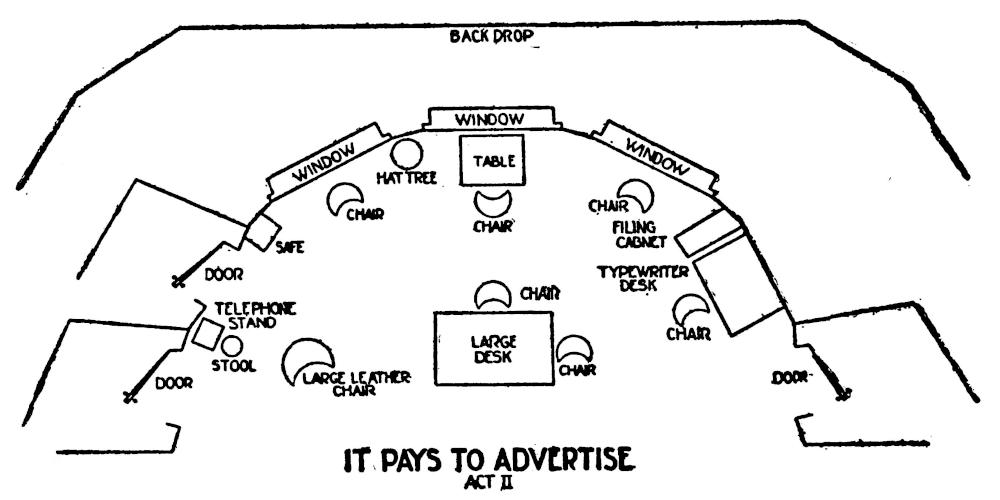
Scene: The private office of the 13 Soap Company.
A rather commonplace room, furnished comfortably
but not elaborately. The walls have
several posters extolling the virtues of 13 Soap—such
as “Do you believe in signs?” “13
Soap is unlucky for dirt.” “Be Clean. Cheap
Soap for Cheap People.” “13 Soap is the most
expensive soap in the world, one dollar a cake.”
There is a particularly large stand in the up-stage
wall bearing the legend:
“The average cake of soap gives you 56
washes. A cake of 13 soap gives you only 24,
But
What Washes!”
There is a door on the left and two more
at right. At back are windows through
which the audience sees the building across the
street literally covered with 13 Soap posters.
There is a desk, down C., with chairs, cabinets,
a hatrack, a water-cooler, a safe, etc., which
complete the equipment of the room. Light
oak office furniture. Three telephones, one on
stand right, one on desk left, and one on desk
center. Shades on windows. All over carpet.
Four brackets.
The time is one month after the first act,
about ten o’clock in the morning.
The curtain rises on an empty stage. Rodney’s
voice heard off-stage:
Rodney. (Enters from door upper R.) Forward
march! (Six sandwich-men enter door upper R.,
bearing boards: “13 Soap—unlucky for dirt”)
Halt! (They stop) Now, you understand you’re
all to go down to Mr. Cyrus Martin’s office, 226
Broadway, and parade there all day—and to-morrow
the same thing. Be in front of his house to-night
at six sharp, you understand?
Sandwich Men. Yes, sir.
Rodney. Then forward march! (They exit
through door L.Rodney goes to his desk. Business
with papers, etc. Peale enters from door
upper R.)
Peale. Hello, little boss. Holy Peter Piper,
you’ve shaved off your mustache!
Rodney. (Grinning) Yes, I’m just beginning
to get on to myself. By George, I certainly used to
look like the devil. Do you observe the clothes?
Peale. (R. C. Crosses up; removes coat, and
places it L. of C. corner L. of desk) Why, you are
getting to be a regular business man.
Rodney. Business is great stuff. I thought it’d
bore me, but it’s immense; it’s the best game I ever
played. What’s the news with you?
Peale. We only just got back from Buffalo this
morning.
Rodney. We?
Peale. (Sits in chair L. of desk) Yes, your
father and I. He went to the Iroquois in Buffalo.
I had all the billboards in the neighborhood plastered
thick—and 48-sheet stands along the streets to the
Union Station. From the time the old man got in
until he got out, he couldn’t look anywhere without
seeing 13 Soap. I even found out the number of
his room and had a small balloon floating 13 Soap
streamers right outside his window. I took a page
in all the Buffalo papers—bribed the hat boy to keep
putting circulars in his hat every time he checked
it, and sent him one of our new folders every mail.
They have eight mails a day in Buffalo. I came back
with him on the train and when he went into the
washroom last night I had the porter say “Sorry,
sir, we ain’t got no Thirteen Soap, but you can’t
hardly keep any on hand—it’s such grand, grand
soap.” (Rises and crosses to R.)
Rodney. Gee, that’s great. (Crosses to L.)
Peale. Well, what’s on for to-day?
Rodney. I’ve got a bully new advertising scheme.
When you go into a barber shop where do you
look?
Peale. At the manicure.
Rodney. No, no, at the ceiling—we’ll put ads on
all the barber’s ceilings.
Peale. (Scornfully) Old stuff! It’s been done—is
that what you call a new scheme?
Rodney. Well, that wasn’t my big idea. (Goes
up-stage, sits in chair behind desk)
Peale. (Mockingly) No? Well, what is your
big idea?
Rodney. Plans for our new factory.
Peale. Plans for what? Have you gone dippy?
Rodney. Here they are. (He produces large
blue-print) Pretty real looking, aren’t they?
Peale. You don’t mean you’ve actually got some
nut to build us a factory?
Rodney. No, no, they are for father.
Peale. Oh, yes, I must admit that is some idea.
(Takes blue-print)
Rodney. If he ever does drop in to make a deal
I thought we ought to have something to make a
front, something that looks like a plant.
Peale.Plant is right.
Rodney. And by the way, if we can, let it leak
out that it’s the Ivory Soap people who are backing
us with unlimited capital.
Peale. The Ivory Soap people?
Rodney. Sure, father’s always hated ’em in
business. His oldest friend, though, is John Clark,
one of the big bugs in Ivory Soap. Clark’s got a
son, Ellery, that father dislikes because he’s such a
success in business—always held him up to me as a
model son to pattern by. It’d make father wild if
he thought that old Clark was going to back us;
Ivory Soap’s the only bunch he’s never been able
to lick. (Rises and goes down R.)
Peale. (Goes down L.) Then that scheme ought
to be good for a great rise out of father.
Rodney. Say, by the way, I put over a corker
on him this morning: I arranged for a parade of
sandwich-men up and down in front of his house.
I just sent another bunch to his office.
Peale. Oh, we’re bound to land him sooner or
later, keeping after him the way we have.
Rodney. Funny, though, nobody’s tried to buy
any soap from us yet.
Peale. Well, it takes time to create a demand.
These 200 cakes of pink castile you bought looked
swell in our old rose wrappers, didn’t they?
Rodney. Say, where’s Miss Grayson? Have you
seen her to-day?
Peale. No, and it’s after eleven.
Rodney. I’ll bet she was here before either of
us—she always is. By George, isn’t she a corker?
Peale. (Indifferently) Oh, she’s all right.
(Takes pad and pencil from pocket and sits in arm-chair
L.)
Rodney. All right!? Why, the girls you read
about don’t mean anything compared to Mary.
She’s got Juliet beat a mile. Every time I think
of her I want to yell or do some darn fool thing,
and every time I see her I just want to get down and
kiss her shoes. I just want to walk around after
her all the rest of my life and say “Are you comfortable,
my love? Are you happy? If there is anything
on the wide earth you want, let me get it for
you, Mary.” What a wonderful name that is—just
like her, simple and honest and beautiful! Mary!
Peale. (Reflectively) If we could only land
one hard wallop on father after that Buffalo business!
Rodney. (Indignantly) Didn’t you hear what I
said?
Peale. Not a word.
Rodney. I was talking about Mary.
Peale. I know you were. That’s why I didn’t
listen.
(Mary enters from door upper R. with MSS. case.
Hangs up hat, then goes to desk, sitting back of
it C.)
Mary. Good-morning.
Rodney. (To Mary) Ah, you’re here—now
everything’s all right, it’s a great world.
Mary. Don’t be silly; this is a business office.
Rodney. By George, Mary——
Mary. Miss Grayson!
Rodney. By George, Miss Grayson, you do look
simply stunning! You’re twice as pretty to-day as
you were yesterday, and to-morrow you’ll be——
Peale. Hey, hey, change the record or put on a
soft needle!
Mary. (To Peale) Quite right—in business
hours, only business. (Takes list of assets and
liabilities from case)
Rodney. But you are the prettiest thing——
Mary. Never mind that—you listen to me. This
firm’s broke.
Rodney. That we can’t be——
Peale. It must be some mistake in the books——
Mary. Is it? I was surprised myself when I
balanced our accounts this morning. I have here
a statement of our assets and liabilities. We owe
$22,818.09.
Peale. What’s the 9 cents for?
Rodney. What are our assets?
Mary. $133.13.
Rodney. That’s quite a showing for a month.
Mary. Mr. McChesney, the advertising man, was
here this morning, and he won’t wait any longer for
his money.
Rodney. But we paid him $5,000.
Mary. (Looking at statement) Yes, and owe
him $9,400. And unless he has $2,500 of it to-day
he’ll put you out of business.
Peale. That’s the trouble of dealing with business
men. They’re so particular about being paid.
Now, you take a lot of actors——
Mary. But what about McChesney?
Rodney. Yes, what are we going to do when
McChesney comes here to-day for money—cash?
Peale. Well, we don’t do any more business with
him.
Mary. No, I guess we won’t.
Peale. Well, don’t you worry, old son, we’ll fix
father somehow. Nobody can stop good advertising.
Why, I met a little fellow on the train last
night. He gets $50,000 a year just for writing ads.
He says a good trade-mark is 70% of the battle, and
we’ve got the best trade-mark I ever heard of.
Mary. You think we ought to keep on advertising?
Peale. Sure, if we can get credit.
Rodney. I suppose we might as well owe forty
thousand as twenty.
Peale. Absolutely. Half of all modern advertising
success is based on a good trade-mark, and ours
is a bird.
Rodney. By George, that’s true, we simply have
got to keep going. We’ll manage somehow.
Mary. I like to hear you say that.
Peale. Now you’re talking. We’ll conduct the
greatest campaign since George W. Advertising was
a young man.
Miss Burke. (Entering with one letter from
door upper R.) Here’s the morning mail. (Rodney
takes letter, returns front of desk, Miss Burke
exits R.)
Peale. Pretty heavy mail. (Coming down L.
of Rodney)
Mary. I’ll bet it’s another bill. (Coming down
R. of Rodney)
Rodney. Hurrah! Hurrah! It’s from the
Countess.
Mary. What does she say?
Peale. (Grabbing letter, and looking at it) Oh,
French stuff.
Rodney. She says she was delayed abroad, but
that she’s due to-day on the Imperator or Rotter
or whatever you call it, this morning, and that she’s
coming to see us at eleven.
Mary. It’s half-past eleven now. Oh, dear.
Peale. Fear not. Remember, though a Countess,
she is still a woman: give her time.
Mary. Does she say anything about the $15,000?
Rodney. No.
Peale. Well, I’ve got a hunch everything’s going
to be all right, or she wouldn’t have written us at
all.
Rodney. Her $15,000’ll keep us going for quite
a while.
Miss Burke. (Entering from door upper R.)
Mr. McChesney is here to see you.
Mary. The advertising man. (Goes to typewriter
desk, and pounds on it)
Miss Burke. He seems very angry, too.
Rodney. Tell him I’m out. (Goes to chair
behind desk and sits)
McChesney. (Entering from door upper R.)
Thought I’d come right in instead of waiting to
have her tell me you were out. (Going to Rodney)
(Miss Burke exits.)
Rodney. (Genially) Why, hello, Mr. McChesney.
Peale. (Trying to shake hands) How are you,
Mac?
McChesney. (Throwing him off) You may be
in the soap business, but cut out the soft soap with
me. Where’s my money? Have you got it?
Rodney. Why—er—the fact is——
McChesney. That means you haven’t.
Rodney. Well, you see——
McChesney. That doesn’t go with me. Do you
think you can put me off? You can bet your blooming
liabilities you can’t. I think this whole concern
is bunk and I’m going after you good——
Rodney. I don’t care for that kind of loud talk.
Drop it.
Peale. Drop it.
McChesney. (Surprised) What?
Peale. He said, drop it.
Rodney. It’s simply that I haven’t had time to
examine your bill in detail. This afternoon, however,
I——
McChesney. I’ve heard that before. Now, see
here, Mr. Martin—your father’s an honest man:
he won’t stand for his son not paying me my
money. I’ll see him now. (He starts for door)
Rodney. Wait a minute, wait a minute. I’ll give
you a check for $2,500 on account. I presume that
will be satisfactory.
McChesney. (Taken aback) Why, yes—sure—but——
Rodney. You understand, Mr. Peale, that not a
cent of that fifty thousand dollars we appropriated
for our October advertising campaign is to go to
him?
Peale. Absolutely.
McChesney. Now, Mr. Martin, I’ll admit I’m
hasty tempered. I’m sorry I made a mistake, but a
contract is a contract and——
Rodney. Here’s your check. Good-day.
McChesney. But, Mr. Martin——
Rodney. Show Mr. McChesney out.
Peale. (Goes to McChesney, takes his arm and
leads him to door upper R.) Come on, Mac—this
way to the elevator. (Delighted) Watch your step.
(Mr. McChesney exits.)
Rodney. (Gleefully) Well, I fixed him, didn’t
I?
Mary. (Rises and goes to Rodney) No, you’ve
only got us into more difficulty. You know, there’s
no money in the bank.
Rodney. But the check won’t go through the
clearing-house until to-morrow morning and by
then we’ll have the $15,000 from the Countess.
Peale. But where is the Countess?
Mary. I’ll go telephone now to see if the Imperator’s
docked yet.
Peale. I’ll bet she sank in mid-ocean!
Miss Burke. (Entering) Mr. Ellery Clark to
see you.
Rodney. How I hate that fellow!
Peale. What’ve you ever done to him?
Rodney. Nothing. I wish I could. That’s the
fellow I told you about. John Clark’s pride.
Peale. Oh, yes, the son of Ivory Soap. Let’s
have a peek at him?
Miss Burke. Yes, sir. (She exits)
Peale. I never saw a model son before.
Mary. (She starts down R.) Oh, Rodney, find
out how Ellery’s doing in business, will you?
Rodney. Oh, I suppose so.
(Mary exits door lower R.)
Peale. (Crosses to arm-chair L.) You’re spoiling
that girl. She used to be a good business woman.
Now half the time, instead of using her brains she
just sits and looks at you as if you were some
marvellous antique work of art. (Sits)
(Ellery enters door upper R.)
Ellery. Hello, Rodney, mind if I come in?
Rodney. I’m very busy to-day, Mr. Clark.
Ellery. Oh, I suppose you are. Must take a lot
of time to get up your advertisements.
Peale. (Rises, goes to Ellery and offers hand)
You like ’em? I write ’em! My name’s Peale!
(Goes back to chair L. Sits)
Ellery. (Turning from him, bored) How do
you do? (Sits in arm-chair R.)
Rodney. What is it, Mr. Clark?
Ellery. You see, it’s like this, old top. I’ve been
having rather a time with father lately—silly old
man—insisted on the absurd idea of my going into
business. Beastly bore.
Rodney. But you wanted to do that?
Ellery. I should say not.
Rodney. But I thought you loved work?
Ellery. It’s a preposterous idea—men of intelligence
go in for the professions. I paint.
Peale. (Half aside) You look it!
Rodney. I’d heard you were a model son.
Ellery. But I don’t consider it a compliment to
be a success in business—think of all the blighters
who are.
Peale. Yes, the bally rotters!
Ellery. Father keeps reminding me of your
success every day—most irritating. You see, of
course he’s sore, because I never bothered much
about business. Oh, I have tackled a thing or two.
But luck was always against me. It just happened
it didn’t work out right. Not my fault, you understand?
Peale. You couldn’t be to blame.
Ellery. Of course, if I ever devoted myself to
business! But, after all, when you know you can
do a thing you want to, why bother to do it, if it
bores you?
Peale. Yes, life is a damn nuisance.
Ellery. (Sighing) And father has been so
offensive lately, I’ve decided to give a little time
to business and make a success of it. I can, you
know.
Rodney. Indeed?
Peale. Seems simple.
Ellery. Oh, rather. I have it all figured out.
For my scheme I’ve got to raise seventy-five hundred
dollars, and I wanted to talk to you about it.
This idea of mine is an automobile proposition.
I really need $10,000, and I’ve only got $2,500.
(Rodney and Peale exchange looks and walk over
to Ellery, one on each side of him.)
Rodney. Ellery, why do you want to go into the
automobile business? It’s dangerous—unsafe——
Peale. The risk’s tremendous.
Rodney. Ellery, our families are old friends.
Now, if you really want to show your father you’re
a money-maker, why don’t you buy some shares in
our company?
Ellery. I don’t care much about the idea of
being in the soap business—rather vulgar.
Rodney. But you don’t have to be in the business.
Peale. Absolutely not.
Rodney. It’s a very simple proposition. All you
do is invest and then sit still and deposit your checks
when we pay dividends.
Ellery. I say, that sounds a bit better.
Rodney. We’re not letting the general public
in—but it’d be such a joke on your father for you
to make money.
Ellery. Yes, wouldn’t it? (They all laugh)
I fancy he’d be mighty glad I had sense enough to
go in with you.
Rodney. Yes, wouldn’t he?
Ellery. But is it a safe investment?
Rodney. Why, we’d guarantee you against loss
from our assets.
Peale. Yes, from our assets.
Ellery. That sounds rather ripping. But what
would I get for my twenty-five hundred?
Peale. A receipt.
Ellery. I know, I know, but what interest in
the business?
Rodney. Two and one-half per cent.
Ellery. I say, is that much?
Rodney. Think what two and a half per cent in
the steel trust would mean.
Peale. And more people use soap than steel.
Ellery. (Wisely) Isn’t steel dearer?
Rodney. It’s quantity that counts.
Peale. Four cakes a year to every person in this
country would represent an annual output of 400,000,000
cakes—and think of all the babies who’ll
be born next year. They’ll all have to be washed.
Ellery. Very true, very true. What is the
annual birth-rate?
Rodney. Let me see, let me see; do you know,
Peale?
Peale. There’s one born every minute.
Ellery. I fancy that’s true.
Peale. You can bet it is.
Rodney. Now, what do you say, Ellery, about
investing in our company?
Ellery. (After a long pause, rises and shakes
hands with Rodney) I’ll do it.
Peale. God’s in His Heaven, all’s right with
the world! (Crosses L.)
Rodney. Have you the money with you?
Ellery. Why, no.
Peale. Then you’ll send us a check to-day?
Ellery. I don’t get the money until next week.
Rodney. Why not?
Ellery. Father didn’t promise it to me till next
Monday.
Peale. Well, ask him for it now.
Ellery. Oh, I’m afraid I can’t. He’s out of
town.
Rodney. We can’t agree to hold the matter open
until next Monday. (Goes to chair behind desk
and sits)
Peale. No, not till way next Monday. Why
don’t you telephone him?
Ellery. Yes, that wouldn’t be so distressing. If
I can get him—I find him considerably easier to
talk to on the ’phone. I can always ring off.
Peale. Come this way—it’ll be quieter for you
if he’s noisy. (Goes to Ellery, takes his arm, and
leads him to door lower R.)
Mary. (Enters door lower R.) Oh, how do you
do, Mr. Clark?
Ellery. Oh, how do you do? (They shake
hands)
Peale. (Pushing him out) Never mind the
social chatter. Ellery, you don’t mind my calling
you Ellery—do you, Ellery? (To her) You see,
Ellery has work to do. (Exit Ellery. Mary goes
to L.) If that’s a model son, thank God I was born
a black sheep!
Rodney. (To Mary) Has the Imperator
docked?
Mary. Three hours ago.
Peale. Then I’ll bet the Countess has been hit
by a taxi! (Drinks)
Mary. Oh, Rodney, did you find out how well
Ellery’s doing?
Rodney. Oh, great! Hasn’t made a cent.
Wanted to borrow some money from me.
Mary. Your father’d be glad to hear that.
Peale. Oh, where is our wandering Countess?
(Crosses to L.)
Miss Burke. (Entering) The Countess de
Boureen.
Peale. By golly, she enters on the cue.
Rodney. We’re saved now.
Mary. Oh, I do hope so.
Rodney. Get her right in here, quick.
(Miss Burke exits.)
Ellery. (Sticking his head in at door) How do
you use this ’phone? I’ve never run a switchboard!
Mary. Oh, I’ll come show you. (Crosses to R.)
Ellery. Oh, thank you. I’m not much at
mechanical problems. (He exits)
Rodney. (To Mary as she goes) And get his
father for him; it may mean $2,500 more for us.
Peale. (Runs to door R. shouting to Mary) Do
anything: hold his hand—kiss him! (She exits.
To Rodney) Do you need an interpreter for the
Countess?
Rodney. (As he speaks, goes over and pulls
down a shade on which is painted an advertisement
in French) I can understand anything she says
about money. You can help me count it.
Peale. That’s the grandest sensation I know.
(Crosses to L.)
Miss Burke. (Announcing) The Countess de
Bowreen.
(Countess sweeps in. Rodney delighted. Goes to
her and kisses her hand.)
Rodney. Ah, bonjour—bonjour.
Countess. Bonjour—bonjour.
Rodney. (Pointing to window shade) Regardez.
Countess. Ah, magnifique, superbe, superbe!
Je suis désolée d’être si en retard, mais c’est très
compliqué à la douane. (Coming down in front of
desk)
Rodney. Not at all. (Going to her)
Peale. Not at all. (Going to her)
Countess. (Threatening) Vous avez reçu ma
lettre?
Rodney. Letter? Yes, I got your letter.
Peale. (Leaning forward eagerly to her) Oh,
you little life-saver.
Rodney. (To her) Mon manager, you remember?
Countess. Je suis enchantée de vous revoir.
(Peale bows very low.)
Rodney. Kiss her hand—it’s French stuff.
(Peale kisses her hand.)
Peale. She looks like money—ask her—ask her.
Rodney. (Nervously) You have the money?
Countess. Eh?
Peale. (Snapping his fingers) Come on, kid,
say yes, say yes.
Rodney. Vous avez argent?
Countess. Oui, oui, j’ai l’argent.
Peale. What does she say?
Rodney. She says yes.
Peale. Shall I kiss her?
Rodney. Do you want to spoil everything?
Don’t kiss her till we get the money. The money
with you?
Countess. Eh?
Rodney. Argent avec vous?
Countess. Oui, j’ai l’argent ici. (Opening bag
and taking out check)
Peale. It’s real.
Countess. C’est un chèque de Morgan Harjes
pour cent mille francs.
Rodney. (Looking at it) Draft for $20,000
in full payment for French rights of the 13 Soap.
Countess. Je vous donnerai ce chèque pour
vingt mille dollars, mais comme je ne vous dois que
quinze mille, vous pourrez me donner votre chèque
pour cinq mille. Cela finira notre affaire.
Peale. Slip it to me, kid, slip it to me. I’m
dying on my feet. (Takes check from Rodney)
Rodney. She says she’ll give us the draft for
$20,000, but as she only owes us $15,000, we must
give her back our check for $5,000.
Peale. That seems simple, give her the check.
Rodney. But we haven’t any money in the bank.
Suppose we get her check cashed first. Then we
can pay her.
Peale. Sure, great! I’ll go right over to the
bank to get it certified. (Countess takes check from
Peale and tears it up) What’s the matter with
you? What’s the matter?
(Countess is smiling.)
Rodney. She’s crazy——
Countess. Ah mais non, l’affaire c’est fini maintenant——
Peale. Talk French to her.
Rodney. Pourquoi tear it up—pourquoi—pourquoi?
Countess. Gee, but you’re funny!
Rodney. She spoke English! She’s a fake.
(Rodney and Peale stare at her speechless, Peale
pointing toward the draft)
Peale. The draft was phoney, too.
Countess. (Smiling) Sure it was.
Peale. But what’s the idea, kid?
Countess. (Sits on desk) You see, I was going
to trim you out of your $5,000 check, but as long
as you haven’t any money, your check’s no good,
so you’ve busted up my whole scheme.
Peale. But why pick on us?
Countess. I didn’t start out to: you wished it on
yourselves. I came to trim your father. You remember,
I wanted to see him, but I looked so soft
you thought you’d grab me off and sell me the
French agency of your Thirteen Soap. I didn’t
think your father could be as big a boob as you were,
so I changed my plans. Do you get me?
Peale. Yes, I get you and now I’m going to get
the cops to get you. (Starts up-stage)
Countess. (Laughs. Crosses down L.) I should
burst into laughter. Why, you pikers, I’m on:
you’re busted. You haven’t any money and you
have got a phoney company.
Rodney. Now, see here—(Goes to her)
Countess. Preserve it. Preserve it. (Crosses to
center) Don’t forget, I’ve understood everything
you two guys were talking about.
Peale. Whew! (Sits in arm-chair R.)
Rodney. Gee! (Goes to arm-chair L.)
Countess. (To Rodney) “Kiss her hand—it’s
French stuff.” (To Peale) “Ah, there, you little
life-saver.” (To Rodney) “The money with you—argent
avec vous?” Gee, your French is rotten.
(To Peale, who moves away) “Shall I kiss her?”
(A pause) Send for the cops and I’ll blow the
whole thing to the papers. (A pause) Well, I
guess we’re quits. If you had any money I’d ask
for a piece of change to keep me quiet, but as it
is, I can’t waste my time.
Rodney. (Rises) You’re not French at all?
Countess. I was educated over there—immense,
wasn’t I? You never tumbled at all.
Peale. (Rises) But why the foreign stuff?
Countess. Well, I can talk good French—but
my English is punk. (Sits on desk)
Rodney. You won’t say anything now?
Countess. No, I don’t hit a fellow when he’s
down. Anyhow, we’re all in the same class. Three
fakes.
Peale. She has spilled the beans.
Rodney. Great Scott! And McChesney has our
check for $2,500.
Peale. (To Rodney) Gee! We will just have
to get that $2,500 from Ellery.
Rodney. What’s happened to Ellery? Let’s find
him. (They start for door R.)
Peale. If he falls down on us——
Ellery. (Entering) Can I see you a moment?
Rodney. I should say you could.
Peale. You seem very beastly pleased, Ellery.
Ellery. Oh, I am.
Rodney. Then everything’s all right about
father?
Ellery. Oh, yes, so to speak—in a way.
Rodney. Ah?
Peale. (Suddenly suspicious) What do you
mean—so to speak, in a way?
Ellery. Well, I couldn’t reach the old man on
the ’phone, and that did make matters so much
easier. I don’t fancy talking to father on the ’phone.
Peale. Why couldn’t you reach him?
Ellery. (Smiling happily) Why, he’s on his
yacht somewhere on the Sound—he won’t be home
till Monday, so I can’t possibly get the money for
you to-day.
(Rodney and Peale walk up-stage while the
Countess drops her handkerchief. Ellery
picks it up and smiles back delightedly at her.
Mary enters from door lower R.)
Mary. Look out. McChesney’s coming back
here—I just saw him across the street.
Peale. Try and keep him out.
Mary. I’ll do my best. (She exits door upper
R.)
Rodney. Ellery, you’ll have to go—we’ve got a
big job on our hands. Au revoir, Countess.
Countess. Au revoir, Monsieur. (With marked
accent) Is there no one to see me to my taxi?
These American buildings are so big I am lost.
Rodney. Ellery, you take the Countess.
Ellery. Oh, I’d love to.
Rodney. Madame la comtesse de Beaurien—Ellery
Clark.
Countess. Dee-lighted.
Ellery. So am I.
Rodney. (Opens door lower L.) You can go
out the private entrance.
Ellery. (Going toward left) Oh, certainly.
Countess. (As they go) You speak the French?
Ellery. No, not at all.
Countess. A pitee.
Ellery. But I can speak German.
Countess. Aber prachtvoll—Ich habe die
Deutche sprache so furchtbar gern.
Ellery. Ich auch——
Countess. Warum laden sie mich nicht zum
Biltmore zum Thee ein?
Ellery. Mit dem grössten——
Countess. Vergnuegen?
Ellery. (Relieved) Yes, that’s the word—Vergnuegen.
Peale. I’ll bet there’s a Berlitz in her family
somewhere.
Countess. Au revoir, Mr. Martin—(Turning to
Rodney) Vous êtes trop aimable. Je vous
remercie beaucoup de votre politesse. Au revoir—(Goes
to Peale—in undertone) So long, kid, call
me up sometime. (And then, chattering a stream
of German to Ellery, they exit door left)
Rodney. (Closes door after Countess exits)
Well, I’ve got to hand it to her. The Countess is a
fake. Ellery is a flivver and McChesney’s on his
way here with that phoney check. (Goes to his
chair behind desk)
Peale. I can see Sing-Sing from here. (Goes to
chair L. corner, sits quickly)
(McChesney bursts in, followed by Mary.)
McChesney. No, I won’t wait. You’re two
swindlers. I’ve just come from the bank. Your
check’s no good.
Rodney. No good! That’s impossible.
Peale. Absolutely.
McChesney. You haven’t any money in the
bank.
Rodney. It must be some mistake on the part
of our cashier.
McChesney. Yes it is—ask him.
Rodney. He’s at lunch.
McChesney. I’m going to the sheriff now, and
unless you make the check good at my office in an
hour, I’m going to cancel your advertising, cover
up your billboards and send you both to jail, and
that goes. (He exits)
Mary. Can’t you pay him?
Rodney. With what?
Mary. What happened to the Countess? Didn’t
she give you the money?
Rodney. No, and she nearly got us for five thousand
dollars.
Mary. What?
Rodney. She’s a fake.
Mary. The swindler! And the man from the
Edison Company is here to say that unless they get
some money at once they’ll cut off the current from
all our signs, and the agent of the landlord is waiting
for the rent. He seems very suspicious and
wants to be paid for last month right away. What
can I say to them?
(Rodney shakes his head.)
Peale. I don’t know.
Mary. Oh, please send for your father and give
in.
Rodney. No.
Mary. You know I want you to succeed, but
there’s no use fighting odds like these—you haven’t
any money, you’re way in debt, and you mustn’t be
disgraced. Please send for your father. I’m sure
he’ll help you.
Rodney. I wonder if I’d better? What do you
think, Peale?
Peale. I don’t know.
Mary. Do telephone him right away. (Crosses
to door lower R.) Now I must try to fix the Edison
man and the landlord, or they’ll be in here. (To
Peale) What can I say to them?
Peale. I don’t know.
Mary. Oh, I’ll say you’re both out. (She exits
door lower R.)
Peale. That’ll be a new one.
Rodney. Do you happen to know the sheriff?
Peale. Not yet. I’d like to have a pull enough
to get a cell with a southern exposure.
Rodney. What are we going to do?
Peale. I don’t know.
Rodney. What are you here for?
Peale. I know, but I can’t think.
Miss Burke. (Entering) Mr. Cyrus Martin to
see you.
PealeandRodney. Who?
Miss Burke. Mr. Cyrus Martin.
Rodney. Have him wait.
Peale. Have him what? (Rises and goes to
Rodney)
Rodney. Just a minute till I think. When I
ring, show him in.
Miss Burke. Yes, sir. (She exits)
Peale. He must be here to make a deal. Our
scheme worked—we’ve put it over, and what did it?
Advertising.
Rodney. But father’s no fool. We’ve got to be
very careful. How’ll we handle it? I’m not used
to putting it over on father.
Peale. Don’t forget the factory and the Ivory
Soap people and the plans, and get busy. You know.
(He makes motions and brings letter-file from
rack and throws contents on desk) That rubber-stamp
stuff.
Rodney. But isn’t this playing it rather low
down on father?
Peale. Oh, don’t get cold feet now?
Rodney. We really haven’t anything to sell him.
Peale. Yes, we have—a trade-mark. You know
it’s good, so do I. We only need your father to
back us and we’ll make a lot of money for him in
spite of himself.
Rodney. I guess that’s true.
Peale. Sure it is, and anyhow all’s fair in love
and business.
Ellery. (Coming in at private door left) Oh, I
beg pardon, but I was so fascinated at meeting the
Countess, I forgot my stick.
Rodney. Can’t see you now, Ellery. (He goes
over and pulls down two windows shades on which
are painted ads of 13 Soap)
Peale. (Giving him gloves) No, can’t ever see
you again, Ellery. Here’s your cane. Now, hurry,
Ellery. (He starts to lead him to door)
Ellery. The Countess is perfectly delightful—
Rodney. (Suddenly goes to Ellery) Hold on,
hold on, Ellery, can you wait in there five minutes?
Ellery. (Pausing) But the Countess is downstairs
in a taxi.
Rodney. Oh, she’ll wait for you, and charge the
taxi to Mr. Peale. He’ll be right in and explain
everything to you.
Peale. Oh, yes, I’ll explain.
Ellery. I don’t want to detain the Countess too
long. Hate to keep a lady waiting—all that sort of
thing. You know what women are. (He exits left)
Peale. Now, what is it, what do you want that
gink for?
Rodney. Don’t you see?
Peale. No, I’m near-sighted.
Rodney. He’s the son of Ivory Soap. Coach
him with some important message from old John
Clark to us about a merger, and when father begins
to wabble, have Ellery come in with the message.
That’ll send father kerflop to the mat.
Peale. (Going) Master! Great, great, I get
you. I’ll fix Ellery. This is your father’s Waterloo.
(At door) As soon as I’ve taught Ellery his
lesson I’ll be right back. I’ll tell him when we ring
the bell twice, to bust in with his little recitation.
Rodney. But don’t let him get on to our game.
Peale. He couldn’t get on to anything but a
weighing machine. (He goes out left)
(Rodney pushes the buzzer and then takes up the
’phone, keeping his eye on the door. In a
moment Cyrus Martin enters.)
Rodney. No, much obliged, but we can’t consider
it. No stock for sale—it’s quite out of the question.
Good-bye. (Ringing off and then pretending to be
surprised, turns and sees his father) Why, hello,
father.
Martin. Hello, son.
Rodney. (Rodney gets very busy with papers
and rubber-stamp) Sit down, won’t you? Be with
you in just a minute.
Martin. (Drily) Thanks.
(Rodney very busy again with filing papers and
opening and closing drawers. Martin looks
at him in astonishment.)
Rodney. Have a cigar? (He abstractedly passes
him a box)
Martin. Thanks—(He bites off end and lights
it, and as he does so, Rodney again gets busy with
similar business) Surprised to see me, I suppose?
Rodney. Not a bit. (He starts signing a contract.
Martin, who has risen, attempts to glance
at it, and as he does so, Rodney calmly turns it over
and blots it. Martin turns away) There, that’s
done! Now, father, what can I do for you?
Martin. Well, my boy—I just dropped in for a
social call. The fact is, I’ve rather missed you.
Rodney. I’ve missed you too, father.
Martin. (Abruptly) Thought I’d have a look
in and find out how things were going. (Sits in arm-chair
R.)
Rodney. Fine—fine—everything’s breezing right
along. Of course, I’m always glad to see you, but
right now, father I’m pretty busy, so you’ll excuse
me if—(He gets busy again with rubber-stamp)
Martin. (With a certain sarcasm) Well, if
you can spare the time, I’d like a little business talk
with you, Rodney.
Rodney. Certainly, in just a minute. (Gets busy
with papers. Pushes the buzzer)
Peale. (Entering) Oh, excuse me.
Rodney. That’s all right, come right in. Father,
you remember Mr. Peale—Peale, my father——
Peale. Indeed yes, I recall very well——
Martin. (Gruffly cutting him off) How are
you?
Peale. (Sitting in chair left) A bit tired—just
back from Buffalo where I’ve been conducting a
big campaign.
Martin. Then it is to you I should address myself?
Rodney. Either or both of us.
Martin. (Rises and goes to desk) Then both of
you listen to me. You’ve got to cut out this nonsense
you call advertising.
Rodney. What nonsense?
Peale. (Weakly) Yes, what?
Martin. This morning there was a parade of
sandwich-men in front of my house for two hours.
I had to have them arrested. I got to the office to
find another bunch. It annoys me.
Rodney. I’m sorry, father.
Martin. You’re trying to make a fool of me.
I open a letter. It’s a circular for 13 Soap. I open
my newspaper—you have a page ad. I look out
of the window—there’s a billboard—I take a train,
the damned porter apologizes because he’s all out
of 13 Soap.
Rodney. Well, of course, all that proves how
wonderful our publicity is.
Martin. (Grimly) You’re a grand young bluff,
my son.
Rodney. Why, father, what do you mean?
Martin. I’ll tell you exactly what I mean: I’ve
let you ramble on to see just how far you would go,
but you’ve been spending a lot of money on
ridiculous advertising, hoping that by annoying me
I’ll buy your business to get rid of you. Well, I’m
not going to. Now what have you got to say to
that? Eh—eh?
Peale. (Rises quickly) Nothing—absolutely
nothing. (Sits)
Rodney. (Quickly) But I have a lot to say.
We may not have a big business now, but we have
got a trade-mark, the catchiest trade-mark ever invented
for soap. We’re a growing concern. Just
because our advertising annoys you, you mustn’t
think it’s valueless. Why, it’s so good that capital
is chasing us: our money is practically unlimited. Is
that a fair statement, Peale?
Peale. (Dazed at Rodney’s bluff) Very fair—very
fair indeed——
Martin. Bluff, son, bluff!
Rodney. Not at all. And since you’re so
skeptical, father, I don’t mind letting you see the
plans for our new factory. (Takes plans from
desk)
Martin. New factory?
Rodney. Yes, father—these are the offices, this
is Miss Grayson’s office, this is Mr. Peale’s office, and
this is mine.
Martin. Well, aren’t you going to make any
soap?
Rodney. Right here, where our capacity will
be——
Martin. Who’s putting up the money?
Rodney. (Reprovingly) Now, father, you cannot
expect me to divulge a business secret to you,
a rival manufacturer.
Peale. Oh, why not tell him, he is your father?
Rodney. Well, Peale, if you really think it is
wise?
Peale. Oh, yes, I think it’s quite wise.
Rodney. It’s the Ivory Soap people.
Martin. (At once impressed and annoyed)
The Ivory Soap people?
Peale. (Rises and goes to desk. Rubbing it in)
Yes, the Ivory Soap people.
Martin. You mean John Clark?
Rodney. Yes.
Peale. Absolutely. (Martin turns and reflectively
walks up-stage. Peale very obviously picks
up push-button and pushes buzzer twice; it rings
off left. There is a pause, and then in a moment,
Ellery enters)
Ellery. Oh, excuse me. I didn’t know your
father was here.
Rodney. (Very genially) That’s all right,
Ellery.
Peale. (The same) Come right in.
Ellery. How do you do, Mr. Martin?
Martin. (Gruffly) How are you, Ellery?
Ellery. Well, I really can’t wait any longer.
The party downstairs in the taxi—you follow me?
Peale. Yes, Ellery you told us that——
Ellery. Well, good-bye, then.
Rodney. Was that all you came in to say?
Ellery. (Remembering) Oh, yes, of course.
If you’ll keep it open until Monday I’ll get the
money for you then.
Rodney. But we can’t wait till Monday.
Ellery. But Mr. Peale told me——
Peale. (Interrupting quickly) We’ll see what
we can do, but just now, Ellery, we’re very much
occupied. (He has him by the arm)
Rodney. Oh, just a minute: you’d better give
your father back the plans—say they’re quite satisfactory.
(Gives plans to Peale)
Ellery. What plans?
Peale. Don’t you know?
Ellery. No.
Peale. That’s too bad. Well, good-bye, Ellery.
Ellery. I say, I do find business very confusing.
(He exits)
Peale. (As he comes back) Ellery talks too
much.
Rodney. He is very indiscreet—if it had been
anybody but father he’d have given our whole plan
away.
Martin. What’s he doing here—acting for his
father?
Peale. Absolutely.
Martin. You’re not going to take him in—that
pin-head? Why, he didn’t even seem to know what
he was trying to get at.
Peale. No, he didn’t, did he?
Rodney. But after all, he does represent Ivory
Soap.
Peale. Great soap, Ivory! Over 99 per cent
pure. (Sits in arm-chair L.)
Martin. (Grunting) Ivory Soap? (He walks
up and down while Rodney and Peale exchange
gleeful glances. After a considerable pause) Well,
thinking things over, why should you and I fight?
Rodney. You began it, father.
Martin. Quite true, and therefore I should be
the one to call it off. Now, son, here’s the idea: I’d
rather have you with me than against me—the
money doesn’t matter much. In your way, while
I don’t endorse that kind of publicity, I suppose
you boys think your sensational ads are good.
Peale. (Rising) Thank you, sir.
Martin. Not at all. (To Rodney) And if
you’re going to have a backer, wouldn’t I be better
than the Ivory Soap people?
Rodney. After all, blood is thicker than business.
What do you suggest?
Martin. Suppose I buy you out—including your
trade-mark and goodwill?
Peale. Oh, you have our goodwill now, sir.
(Rises and bows very profusely, then sits)
Rodney. (Reflectively) Buying us out might
be expensive for you, father.
Martin. Oh, I guess it won’t take all the money
I’ve got. What’s your proposition?
Rodney. What’s yours?
Martin. Well, I’ll give you $50,000 for your
business as it stands.
Rodney. But we don’t want to give up our business.
I like business.
Peale. (Grandly) We wish to continue in our
chosen profession.
Martin. Well, suppose you take 25% of the
profits in addition?
Rodney. It’s a wonderful autumn, isn’t it?
These crisp cold bracing mornings.
Martin. Well, I hardly thought you’d grab at
that. What will you take?
Rodney. (Rising quickly) One hundred thousand
dollars cash, you assume all the contracts and
obligations of this company, give us 40% of the
profits, a contract for me at $20,000 a year; for
Miss Grayson at $10,000, (Peale coughs)—and
another for Mr. Peale at the same figure.
Martin. Done. (Shakes hands with Rodney)
(Peale and Rodney exchange looks and shake
hands.)
Rodney. I congratulate you, father.
Martin. You needn’t. Your trade-mark might
appeal to a lot of superstitious idiots, but as a business
proposition I don’t think much of it. But now
I’ll show old John Clark he can’t butt into my family
affairs or get Ellery mixed up with my boy’s business.
Rodney. Yes, father, we’d much rather have you
than Ellery.
Peale. Oh, much rather.
Miss Burke. (Entering) Oh, Mr. Martin!
Rodney. Yes?
Martin. Yes?
Rodney. (Going to her) That’s for me, father.
(To Miss Burke) What is it?
Miss Burke. The agent for the landlord says
he’s got to see you immediately.
Rodney. (Motioning her to be quiet) I’ll be
right out. (To Martin, very nervously) You see,
father, we’re thinking of taking larger offices.
Come, Peale. We’ll be right back, father.
Peale. Yes, father, we’ll be right back. (They
hurriedly exit)
Martin. (Stands there watching them proudly.
Miss Grayson enters door lower R.) Hello, Miss
Grayson, it’s mighty good to see you again—I——
Mary. Oh, Mr. Martin, I’m so glad Rodney
finally sent for you.
Martin. (Surprised) Sent for me? (Goes in
front of desk)
Mary. Have you talked to him?
Martin. Oh, yes, he just went out for a minute
to see the agent of the landlord——
Mary. Oh, then he told you about that? (Goes
to him)
Martin. (Puzzled) Yes, he told me—why not?
Mary. I am so glad to think he wasn’t ashamed
to tell you the truth.
Martin. Oh, Rodney always was a truthful lad.
Mary. Oh, I’m so happy you’ve settled with
him! You have settled, haven’t you? (Goes to arm-chair
R.)
Martin. Yes, sure.
Mary. Oh, good. Isn’t it wonderful for him?
(Very sweetly) Just think! Without you he
couldn’t have lasted out the day. (Crossing down in
front of desk)
Martin. Couldn’t have lasted out the day, ha,
ha! Then our little scheme to put Rodney on his
feet didn’t work?
Mary. But everything’s all right now. You’re
going to help him——
Martin. Everything’s great now—(Knocked off
his feet, then recovering himself) Oh, by the way,
in our negotiations the one thing that Rodney didn’t
fully go into was the nature of the assets.
Mary. The assets! They must have made even
you laugh. Why, we haven’t any! (She laughs)
Martin. (Trying to laugh) Haven’t any!
Ha—ha—by the way, there was a report on the
Street to-day that the Ivory Soap people were going
to make a deal with Rodney—build him a factory—
Mary. (Innocently) Oh, there’s nothing in
that.
Martin. Are you sure? As I got here, I thought
I saw Ellery Clark leaving.
Mary. Oh, he didn’t come here on business:
Ellery came to borrow some money from Rodney—isn’t
that funny?
Martin. Oh, yes, very funny—but the plans?
Mary. Rodney showed you some plans? He
must have been joking!
Martin. (Changing his whole manner) The
young scoundrel! (Starts to go up-stage)
Mary. What!
Martin. (Stops) Thank you, Miss Grayson,
for telling me. Do you know what he tried to do to
me? Hold me up for a hundred thousand dollars,
make me think Ivory Soap was backing him, too—and
but for you, he’d have succeeded.
Mary. What have I done?
Martin. You saved me a lot of money and kept
me from being a fool. Thank you! Good-morning.
(Starts for door upper R.)
Mary. You mean at last he’d succeeded in getting
you to back him?
Martin. At last! (Coming to her, lays hat on
desk) So that was his scheme all the time, was
it? He didn’t go into business on the level, but just
for my benefit? And you were helping him. Well,
he can thank you again for having failed.
Mary. It’s all my fault.
Martin. Yes it is, from the start. You got up
the plan of my pretending to put him out of the
house——
Mary. Oh, but I tell you, you must help him.
Martin. Help him yourself. You’ve got $5,000.
Mary. But I gave it to him.
Martin. My son took money from you?
Mary. He didn’t know—I pretended it was from
a friend.
Martin. Well, you got him in; now you can
get him out.
Mary. But your bet—you bet $30,000 with
John Clark. You don’t want to lose that?
Martin. Well, if Ellery’s trying to borrow
money from Rodney it looks like an even break—and
anyhow I’d lose the bet twice over rather than
have my son think he could make a fool of his
father.
Mary. But he is a good business man: he’d make
you proud of him. You don’t know how hard he’s
worked, how fine he’s been; he’s simply wonderful.
If he could keep on a little longer, I know
he’d succeed. If you’ll just help him, he’ll make
money. You’ll see he will.
Martin. Of course, you want him to make
money. You’re thinking of that percentage contract
with me.
Mary. I’m not! Oh, I’m not! I can’t see him
fail. Listen: I’ll try to give you back what you’ve
given me—I don’t care anything about the contract.
I’ll tear it up now if you’ll just help him.
Martin. By George, I believe you really are in
love with him!
Mary. (Proudly) Yes, I am—now. But that
doesn’t matter. We’ve got to save him—save his
business.
Martin. I won’t give him a nickel. Good-bye!
(Starts to go)
Mary. But you can’t go like this: he’ll be disgraced!
He’s in debt.
Martin. Let him get out of it—it’ll do him
good. I’ve been a sentimental fool. I’ve made it
all too easy for him. (Coming down R.)
Mary. But that’s your fault, too.
Martin. Yes it is, and I don’t propose to repeat
the error. He’s lied to me all the way through.
We’ll let him face the truth; now we’ll see what he’s
made of.
(Rodney and Peale enter.)
Rodney. (Coming in) Well, we’re going to
move. (Goes to desk and sits)
Peale. Yes, nice chap, that fellow. (Coming
down R.)
Rodney. Well, Mary, have you heard about our
deal?
Martin. The deal’s off.
Mary. But—(Sits in arm-chair L.)
Rodney. (Back of desk) Off!
Peale. Off! (Goes up-stage to window)
Martin. Yes, off.
Rodney. But, why—why?
Martin. Because you took me for a bigger fool
than I am. My own son can’t do that to me. I’ve
found out now that you’re broke.
Mary. Oh, Mr. Martin!
Martin. (Stopping her) No! (To Rodney)
And all the time you were lying to me about the
Ivory Soap people and the factory they were going
to put up. You thought you could make an ass of
me—get the best of me, did you? Well, you can’t.
I’m finished with you and your 13 Soap. You’ve
got a swelled head, you’re a smart alec, you’re a
complete fake, you’re a cheat, young man——
Rodney. (In utter dejection) I guess you’re
right.
Martin. (With satisfaction) Ah!
Rodney. I did try to be smart. I was stuck on
myself. I thought business was a cinch. But you’re
right. I have been a fake. This whole thing never
seemed real—it was just fun—like a game; but I’ve
waked up, and now it’s serious. I tried to get the
best of you, but I’ll take my licking. I don’t want
any charity: I know what’s coming to me and I’ll
take my medicine.
Martin. (Relenting a little) Well, maybe I’ve
said a little too much——
Rodney. No, it’s all true.
Martin. But, see here, I don’t want you disgraced—I——
Rodney. You told me never to come back to
you for a nickel, and I won’t. I told you, too, that
I wouldn’t snivel—well, I’m not going to. Good-bye,
father——
Martin. Now, see here——
Rodney. Please, father, it’s up to me and nobody
else, to get out of this. Please go. (He holds out
his hand)
Martin. (Gently) Good-bye, son. (He shakes
his hand. He exits)
(Rodney sits in chair dejected.)
Peale. (Coming down to Rodney) Now, see
here, little boss——
Rodney. Peale, I’m sorry, but you’re fired.
Peale. (Coming over and putting hand on his
shoulder) Say, little boss, you can’t fire me. I’m
just going to stick around, whatever happens.
(Mary touches Peale on the arm and motions him
to go out. He nods understandingly and exits
upper R.Mary comes to Rodney.)
Mary. Oh, Rodney, Rodney, it was all my fault.
Your father had no idea of the truth—I didn’t
understand; I thought you sent for him to help you.
I told him about our company. I did it all—betrayed
you.
Rodney. But you didn’t mean to: it’s all right,
Mary.
Mary. You forgive me?
Rodney. Why, of course: I love you.
Mary. Oh, Rodney, I’m so sorry.
Rodney. (Changing completely. Rises) But if
father thinks just because he laced it into me I’m
licked, he’s wrong. Maybe I have been a fake but,
by George, I won’t be any longer. (Goes down R.)
Mary. You’re really going on? (Goes down L.)
Rodney. When I’ve got you, you bet I am. Say,
do you really think a long speech from father and
no money to work with are enough to stop me? No,
sir; what father said got me for a minute, but I’m
not a quitter, and I’ll prove it. There must be something
of father in me: I can’t be such a pin-head
as I look. I’ll get out of this mess the best way I
can, and then I’ll shine shoes or sell peanuts. I’ll
start at the bottom instead of finishing there. I’ll
make money—I’ll——
Mary. Oh, Rodney, Rodney, now I am proud of
you! (She kisses him unexpectedly and heartily)
Rodney. (Overjoyed) What! That’s the first
time you ever really kissed me—all by yourself—like
that. By George, you must love me!
Mary. You bet I do. (She kisses him again and
they clinch as Peale enters excitedly, coming down
R.)
Peale. (Entering) Say, I didn’t mean to interrupt!
Rodney. (Still with Mary in his arms) Nothing
in the world can interrupt me—What is it?
Peale. A telegram. It’s the first we ever received,
and—I was afraid to open it.
(Mary, taking it, looks at it nervously.)
Mary. What awful thing can it be? (Goes in
front of desk)
Rodney. Gee, I wonder what it says? (Crosses
to her)
Peale. Read it. Read it. (Crosses to her)
Mary. (Having opened it) “Rodney Martin,
President 13 Soap Company, 226 Broadway”——
Mary. (Handing Rodney the telegram) But
here it is.
Rodney. (Reading) Fifty thousand cakes—it’s
true.
Peale. We’ve started—we’ve begun! We’re
actually going to sell some soap.
Rodney. The tide’s turned—didn’t I tell you
advertising pays? We’ll sweep the country—Europe—Asia—Africa!
Go in with father? Not for a
million dollars! (Starts up-stage)
Peale. I’ll wire Marshall Field right away.
(Starts for door upper R.)
Rodney. Go ahead.
Mary. (Suddenly) Great Heavens!
Peale. What is it?
Rodney. What’s happened?
Mary. That order is no good.
Peale. What! (Coming down R.)
Rodney. Why? (Coming down L.)
Mary. We can’t fill it: we’ve never made any
soap. (Start stand staring at each other aghast)
Rodney. What’ll we do?
Peale. Let’s think. (They sit staring straight
ahead)
(Rodney sits in chair L.Mary sits on table. Peale
sits in chair R.)
Rodney. (Slowly) We must get some soap.
Peale. (Slowly) Yes, I thought of that.
Mary. (Slowly) Where can we get it?
Peale. From a soap factory!
Mary. (Slowly) But they all belong to father.
Rodney. (With dawning hope. Rises) But he
can’t know about this Marshall Field order—maybe
we could buy some soap before he’d have a chance
to stop them selling to us?
(Peale and Mary rise.)
Peale. Great idea—let’s get busy.
Mary. How?
Rodney. Where’s the ’phone book? (She grabs
red classified directory from desk) We’ll call up
two or three of his branch offices. (He has hurriedly
begun turning over pages, as Peale on one
side and Mary on the other, help him) Skins,
skates, shirts—where’s soap?
Mary. (Over his shoulder) Skylights, skates,
slides——
Peale. (The same) Smelters, smoke-stacks,
snuff.
Rodney. Ah, here it is! Soap manufacturers—(Skimming
down page) 276 Broad—here’s one of
father’s factories.
Peale. I’ve got one, too—374 Schuyler.
Mary. So have I: 480 Audubon. (They drop
book and each dashes to a ’phone. As they give the
number of ’phone, curtain. During two curtains, till
they finish lines)
Rodney. 276 Broad.
Mary. 480 Audubon.
Peale. 374 Schuyler—and hurry, sweetie——
(Together)
Rodney. (Holding wire) It’ll have to be Old
Rose.
Peale. Castile is the cheapest.
Mary. Order small cakes.
Rodney. Hello, this is the Martin
Soap Company—we want to get some
soap—pink castile—small cakes—40
or 50,000 cakes immediate delivery—what’s
the price?
Mary. Hello, 480 Audbon. I
want to find out if I can buy a lot
of soap right away—Old Rose—castile—50,000
cakes; we want it this
afternoon.
Peale. Hello, son, I want to buy a lot of soap:
50,000 cakes—got to have some of it to-day—smallest
size castile cakes you keep. If you haven’t
Old Rose—pink’ll do. Who am I? None of your
business.
(Together)
(And as all three are talking together
violently in their separate ’phones,
The curtain falls.)
ACT III
Scene: The scene is the same as that of Act I,
except that it is five o’clock in the afternoon
of a day in late October.
Martin is discovered behind the desk, right.
Before him is a pile of evening papers and
some unopened letters. As the curtain rises he
opens one, displaying to the audience on its back
page a page-advertisement of 13 Soap. In
a moment he turns over to others, gives an annoyed
exclamation and tosses it aside. He
picks up one of the letters, opens it, gives an
angry grunt, mutters disgustedly “13 Soap”,
and throws it into the waste basket.
Johnson. (Entering door upper L.) Miss Grayson
is here to see you, sir——
Martin. (A bit surprised) Miss Grayson?
Well, show her in.
Johnson. Very good, sir. (He exits. Martin
opens another paper, again sees an advertisement of
13 Soap and with considerable irritation sweeps the
whole pile off the desk as Johnson enters, followed
by Mary) Miss Grayson. (Johnson exits)
Mary. How do you do, Mr. Martin?
Martin. Come to get your job back, I suppose?
Mary. No, sir.
Martin. Well, you can have it—at the old salary.
Mary. I don’t want it.
Martin. Oh, Rodney sent you to plead for him?
Mary. No, sir.
Martin. Then, what are you here for?
Mary. To make you a business proposition.
Martin. Why doesn’t Rodney make it himself?
Mary. He doesn’t know I’m here.
Martin. That’s something in his favor: can’t
see much use in women tying up in men’s business.
Johnson. (Entering) Mr. Rodney Martin and
Ambrose Peale.
Martin. Oh, the whole firm! Send ’em in,
Johnson.
Johnson. Very good, sir. (He exits)
(Rodney and Peale enter.)
Rodney. Hello, father. (Crosses to table)
Peale. How do you do, sir? (Coming down L.)
(Martin grunts to them both.)
Rodney. (Seeing Mary) Mary, what on earth
are you doing here?
Mary. I came to tell your father about Marshall
Field’s order.
Rodney. That’s why we’re here, too.
Peale. Absolutely.
Martin. Let me tell you right now, I won’t back
any fake company.
Rodney. But we’re not a fake any longer.
Peale. We’ve actually sold some soap.
Mary. Fifty thousand cakes.
Rodney. To Marshall Field.
Martin. Then why did you send ’em only five
thousand cakes?
Rodney. Because after we’d got that much from
one of your branch factories you shut off our supply.
Peale. And we couldn’t get any more soap anywhere.
Mary. (Accusingly) And you knew it very
well. (Crossing to R. side of Mr. Martin)
Rodney. We’ve still got 45,000 cakes to deliver,
if we can get ’em from you. Why let all that money
get out of the family? It’s a business proposition.
Martin. No, it isn’t. Don’t fool yourself: I sent
that telegram.
Rodney. What telegram?
Martin. The telegram from Marshall Field’s
ordering the 50,000 cakes.
Mary. You sent it?
Martin. That day at the office you were pretty
game, son, and to tell the truth, I felt so sorry for
you, I kind of had to do something, so I sent that
wire——
Rodney. So that success is all a bluff, too? (Sits
on sofa)
Mary. But what did you do it for?
Martin. Well, I figured an order like that would
stall off your creditors, and then I had fixed it with
one of our factories to let you have 5,000 cakes at
three cents a cake. I knew it would mean some
ready cash for you from Marshall Field——
Peale. But how did you square Marshall Field?
Martin. Oh, I just wired ’em I’d be responsible,
and, say—(Turning to Rodney, who rises) you
had a nerve to charge ’em sixty cents a cake—and I
had to pay the bill! That shipment cost me $3,000
for $150 worth of soap. (Peale laughs) That
isn’t funny, young man.
Rodney. No, it isn’t: I thought we’d really made
good, and all the time it was you behind us——
Martin. You see, my boy, even if you did
nearly trim me, I’ve got a sort of sneaking fondness
for you. Look here, son, why not quit? There’s no
market for dollar soap.
Rodney. But how do you know?
Martin. I had a letter from Marshall Field a
few days ago asking me what to do with the soap.
They hadn’t sold a cake. I told ’em to dump it in
the Chicago River; it might help to clean it up.
Rodney. But you didn’t give our advertising a
chance.
Peale. We only finished a great big advertising
campaign in Chicago two days ago.
Rodney. I know the soap’ll make good—with
that trade-mark.
Martin. If your trade-mark was so marvelous,
somebody besides your poor old father would have
bought your soap.
Peale. Oh, what’s the use? He doesn’t believe
in advertising!
Martin. Oh, yes, I do: sound, conservative advertising,
but not the crazy, sensational stuff you go
in for.
Mary. Oh, you’re just mad because the soap
trust didn’t think of 13 Soap itself.
Martin. Why, we wouldn’t touch a fool thing
like that. If you deliver the goods, your goods will
advertise you—that’s always been our policy.
Rodney. I’m sorry, father, but you are old-fashioned
to knock the modern way of advertising.
Why, do you know, the National Biscuit Company
was on the verge of failing until they hit on the
title, Uneeda Biscuit?
Mary. And since then, they have had over four
hundred lawsuits to protect it.
Rodney. Their trade-mark made ’em. They
value that trade-mark now at six million dollars.
Peale. Great stuff. (Turning to Martin)—and
Spearmint Gum just as a trade-mark is worth seven
millions.
Rodney. And the Fairbanks people count their
trade-mark, The Gold Dust Twins, at $10,000,000.
Mary. Ever hear of the Gillette Safety Razor?
Martin. I use it myself.
Mary. Tell him about it, Rodney.
Rodney. It costs you five dollars. Don’t you
know there’s a mighty good safety razor for a
quarter, and dozens at a dollar, but you use the
Gillette because Gillette was there first; you buy
his razor at a high price simply because of its trade-mark.
Mary. (With gesture) Advertising.
RodneyandPeale. (With gesture) Absolutely.
Peale. Ivory Soap in the magazines alone used
$450,000 worth of space in 1913—and at three cents
a cake wholesale, that represents 15,000,000 cakes
for magazine advertising alone.
Martin. I don’t believe it.
Peale. Yes, and a lot of other guys didn’t believe
that iron ships would float or that machines heavier
than air would fly, or that you could talk to ’Frisco
on a wire or send a message across the Atlantic
without a wire. Pardon me, sir, but you want to
get on to yourself.
Rodney. Yes, father, you certainly do.
Mary. And you’d better hurry up.
Martin. You’ve got a fine lot of theories, but
what have they done for those 5,000 cakes of 13
Soap out at Marshall Field’s?
Peale. Why, we haven’t really spent enough
money advertising.
Rodney. That’s true. Every time the American
Tobacco Company puts out a new cigarette they
start off by appropriating $200,000 to boom it.
Peale. And I suppose they are a lot of boobs?
Rodney. And think what other firms spend! I’ve
gone into this thing, father——
Mary. Yes, Rodney, let’s show him our list.
Rodney. Sure, it’s an absolutely accurate list of
what some of the big advertisers spent in the thirty-one
leading magazines last year. Eastman Kodak,
$400,000, Postum Coffee, $125,000, Arrow Collars,
$400,000, Melachrino Cigarettes, $100,000, Welch’s
Grape Juice, $100,000.
Rodney. I’ve only just begun. Grape Nuts,
$228,000.
Mary. Colgate’s Dental Cream, $230,000.
Peale. Campbell’s Soups, $186,000.
Mary. Kellogg’s Toasted Cornflakes, $200,000.
Rodney. Quaker Oats, $367,000, and these are
only a few. You can’t see how it pays, but you do
know that it must pay or they wouldn’t do it.
Mary. Does that mean anything to you?
Peale. Yes. Does it when you realize that those
thirty-one magazines have only about 10,000,000
readers?
Rodney. And that there are a hundred million
people in this country. Why just to appeal to one-tenth
of the population, fifty million dollars was
spent in magazines last year, and each year people
are getting better educated—more people are wanting
to read. It won’t be long before there are 25,000,000
people buying magazines, and you can reach
all of them by advertising—get a new market, a new
population to deal with. Think what national advertising
is accomplishing! It sells automobiles,
vacuum cleaners, talking machines, rubber heels,
kodaks, washing machines, foods, clothes, shoes,
paints, houses, plumbing, electric irons, fireless
cookers—mostly to a lot of people who’d never even
hear of ’em if it weren’t for advertisements.
Peale. But nowadays it isn’t only people who
have stoves to sell or tooth-brushes, that are spending
money on publicity. Banks are advertising for
money, nations for immigrants, colleges for students,
cities for citizens, and churches for congregations,
and you sit there thinking it doesn’t pay to advertise.
Mary. Six hundred and sixteen million dollars
were spent last year in magazines and newspapers,
billboards and electric signs.
Rodney. Bringing education and comfort and
fun and luxury to the people of the United States.
It’s romance, father, the romance of printing-presses,
of steel rails, of the wireless, of trains and competition,
the romance of modern business, and it’s all
built on advertising. Advertising is the biggest thing
in this country, and it’s only just begun.
Martin. (After a pause) Why didn’t you boys
go into the advertising business? You seem to know
something about that?
Peale. (Fairly tearing his hair) Oh, what’s the
use! He’s the old school—we’re new blood. (Coming
to L. of C.)
Rodney. (With enthusiasm) Youth has got it
on old age.
Mary. (Coming down between Peale and
Rodney) You bet it has!
Martin. When you boys get through talking and
you’re flat broke and down and out, come around
and see me: I’ll show you an old business that has
a lot of money that isn’t radical and manages to keep
going without wasting a fortune in fool advertising.
Rodney. Then you won’t let us get any soap.
Martin. Risk my business reputation on a silly
scheme like Dollar Soap? I should say not!
Peale. Oh, come on. What’s the use of talking
to a man whose brain is deaf? (Exit door upper
L., keeping in step, single-file)
Martin. (Rises and comes to center) Say
when you get a new line of patter, come around. I
like to hear you. Dollar Soap!
Johnson. (Enters) I beg pardon, a gentleman
to see you, sir. (Johnson hands Martin a card on
silver tray)
Martin. “Mr. Charles Bronson.” What does
he want?
Johnson. He says he’s from Marshall Field.
Martin. Oh, a kick, I suppose? Send him in.
Johnson. Yes, sir. (He exits)
(Enter Bronson.)
Bronson. (Inquiringly) Mr. Martin?
Martin. Yes.
Bronson. I just arrived from Chicago. I am
here in reference to the 13 Soap.
Martin. Be seated. Well, what about it? (Sits
in chair L. of table)
Bronson. (Sits in chair R. of desk) While, of
course, we understand that the 13 Soap is made by
your son, Mr. Rodney Martin, at the same time as
you wired us you would be responsible for that
order, Marshall Field felt that I should first see you
in the matter.
Martin. Humph!
Bronson. We realize, of course, that you are
backing your son——
Martin. (Gruffly) Well, why shouldn’t I back
him?
Bronson. Of course, of course. That is why
we’d like to place our order through you.
Martin. (Amazed) Place your what?
Bronson. Through some error we received only
5,000 cakes, instead of 50,000 but that’s all gone.
Martin. All gone? What happened to it?
Bronson. We’ve sold it.
Martin. Sold it?
Bronson. Yes, and we want the balance of the
original order you were kind enough to throw our
way, and as much more soap as we can get.
Martin. But only the other day I had a letter
from Marshall Field saying they hadn’t sold a cake.
Bronson. (Laughing) I know, I know. We
felt at first that of course there could be no popular
market for a dollar soap; we weren’t as far-sighted
as you were. (Martin clears his throat) But of
course, when those extraordinary advertisements
appeared, so different from your usual conservative
publicity, the sales began immediately! We sold the
5,000 cakes in two days.
Martin. And the advertising did it?
Bronson. Of course, what else? Now we want
to handle your goods exclusively in the west—with
extensive immediate deliveries. Can that be arranged?
Martin. It ought to be. What do you offer?
Bronson. I dare say we would contract for a
quarter of a million cakes of soap.
Martin. (Amazed) A quarter of a million!
Bronson. (Misunderstanding him) Of course
we might do a little better if we could settle the
matter at once.
Martin. I should have to consult my son first.
Bronson. (Rising) Oh, then perhaps I ought
to go see him?
Martin. (Rising) Not at all—not at all. I’ll
attend to it.
Bronson. But we thought that you would have
full power.
Martin. As a matter of courtesy I should like
to talk things over with my own boy——
Bronson. But you control the product?
Martin. Bronson, you can trust me to handle
this thing.
Bronson. Of course, of course. When can I see
you again?
Martin. In half an hour.
Bronson. Very well. I’ve some matters to attend
to. I’ll be back in half an hour. (Going to
door upper L.) It’s a wonderful soap, Mr. Martin.
Martin. (Dryly) Oh, wonderful.
Bronson. See you in half an hour. (Bronson
exits)
Martin. Wonderful soap—plain pink castile,
I’ve got to get in on this. (He goes to ’phone)
1313 Bryant. Hello, is this the 13 Soap Company?
Johnson. (Enters) Oh, beg pardon, sir, but—
Martin. Just a minute. Is Mr. Rodney Martin
in? No? Never mind who I am. Good-bye.
Johnson, call up my son’s office every ten minutes
and let me know the minute he comes in. Don’t tell
’em who’s calling. (Crosses to R.)
Johnson. Yes, sir.
Martin. And when Mr. Bronson comes back,
be sure to have him wait for me.
Johnson. Yes, sir. There’s a lady to see you,
sir. She speaks English now.
Martin. She does, eh? That’s unusual, isn’t it?
Johnson. I mean, sir, when she was here two
months ago she could only talk French.
Martin. Indeed! Well, I’m not interested in the
languages she speaks. Who is she, and what does
she want?
Johnson. She wishes to see you about the French
rights of the 13 Soap.
Martin. The what?
Johnson. The French rights.
Martin. Great Scott! Send her right in.
Johnson. Yes, sir. The Countess de Bowreen.
(He exits)
Countess. (Enters) How do you do?
Martin. (Comes down in front of table) How
do you do?
Countess. I am the Countess de Beaurien. Your
son have told you of me!
Martin. No.
Countess. I bet he have not. He is a cheat—he
trick me.
Martin. Now, my dear lady——
Countess. Attendez, you listen to me: two
months ago there in that very room, I buy the
French rights for the 13 Soap. I pay him 15,000
dollar and now I cannot get any soap.
Martin. You will have to see my son.
Countess. But I have seen him, and he give me
no satisfaction. If I cannot get any soap, I must
have my money, one or the other, or I put him in
the jail. He is a cheat. I have here ze contract. I
sue him in the court.
Martin. My dear lady, you mustn’t feel that
way.
Countess. Feel! Ah, mon dieu—I trick no one,
I play fair, I am an honest woman. Mais je vous
dis que je suis honnête, très honnête dans mes
affaires. Monsieur votre fils m’a donné le contrat,
et j’insiste qu’il est très malhonnête. Je n’ai pas
l’habitude d’être si maltraitée, monsieur, et je
répète que je ferai tout mon possible d’obtenir les
quinze mille dollars que me doit Monsieur votre
fils, et s’il ne me les donne pas, je le poursuivrai sans
cesse. Comprenez-vous, Monsieur? (She takes the
contract from him)
Martin. But I don’t understand French.
Countess. Pardon, Monsieur, always I am excited
I speak the French. But! If you love your
son, you pay me back, or else he go to jail. What
you say?
Martin. But $15,000 is a lot of money.
Countess. Yes. But it is more to me than it is
to you. You pay me, or he go to prison. Now what
you say?
(Johnson enters.)
Martin. What is it?
Johnson. I beg pardon, a gentleman to see you,
sir.
Martin. (Comes to Johnson) Is it Bronson?
Johnson. No, sir. (Johnson hands him card)
Martin. By George, just the man I want to see!
Show him right in. Hold on, hold on. Now,
Duchess, if you don’t mind, just step in this room
a minute. (Indicating room lower R.)
Countess. No, no, I do not like that room: I
have been there before.
Martin. Here is a nice room. (Points to room
lower L.) You will find it very comfortable.
Countess. Very well, I wait. (Crosses to left)
But in fifteen minutes if I do not get the 15,000
dollar, I go to my lawyers, and your son—poof! he is
done. (Talking in French as she exits)
Martin. (To Johnson) Did you get my son’s
office?
Johnson. Yes, sir—he hasn’t come in.
Martin. If you reach him while Mr. Peale’s
here don’t mention Rodney’s name; just call him
“that party.” I’ll understand. (Crosses R.)
Johnson. Yes, sir. (He exits)
(Peale enters door upper L.)
Martin. Now, see here, young man!
Peale. Now, one moment, Mr. Martin. I just
want to say that I am a man of few words—that
this isn’t advertising, it’s personal. I know you
don’t like me.
Martin. Why do you say that?
Peale. Because I’m a pretty wise gink.
Martin. Well, you are a bit——
Peale. Fresh? Well, I guess that’s right, too.
But that’s me—I’m not your style. Here’s the
idea: your son has been immense to me. Great kid,
and it struck me the reason you wouldn’t back him
was because I was mixed up in his business. So I
just came to say if that’s the situation, why I’m out,
that’s all. You go ahead with him alone.
Martin. You’re not a partner?
Peale. I should say not. I’m just a hired hand.
He could can me any moment, but he’s not the kind
of guy who’d do that.
Martin. Then you haven’t power to sign, to
make a deal?
Peale. I should say not. Why, he and Miss
Grayson do all the signing. If I could have signed
contracts, I’d have spent a million dollars in advertising.
And believe me, you ought to back him, because,
honest, Mr. Martin, it’s a great scheme—the
13 Soap, on the level, if it’s handled right and the
publicity end is——
Martin. Now don’t get started on advertising.
Peale. That’s right, too. Well, I guess that’s all.
I wanted to tell you how I stood about Rodney.
That’s off my chest, so good afternoon. (Starts to
go)
Martin. Wait a minute. What did you boys
mean by trimming that poor Countess on the French
rights?
Peale. Jumping Jupiter; has she been here?
Martin. She’s here now.
Peale. What did she come to see you for?
Martin. She said she’d put Rodney in jail for
fraud unless I made good that $15,000. I’ve got to
pay her—can’t see the boy disgraced.
Peale. Say, if you’d like to save that $15,000,
I’ll fix it for you.
Martin. But she’s got a contract.
Peale. I’ll get it for you cheap. Pardon me, sir,
but I know how to handle dames like her.
Martin. Mr. Peale, I like you. (Slaps him on
shoulder)
Peale. Huh!
Martin. Have a cigar?
(Peale crosses R. He takes it as Johnson enters.)
Johnson. I just telephoned that party, he is at
his office now.
Martin. Good, good. Peale, I’ve got to go out
on an important soap deal. (He starts to go,
then goes to Peale) Oh, by George, I nearly
forgot. There’s another matter I must attend to
first. Peale, you’ll find the Countess in there. Do
the best you can—we’ll settle the details when I get
back. Make yourself at home.
Peale. Sure. This cigar’s great company.
Martin. Good cigar, eh?
Peale. Corker.
Martin. Johnson, send over half a dozen boxes
of these cigars to Mr. Peale’s house. He’ll give you
the address. (He exits left)
Peale. And, say, Johnson, wrap ’em up now and
I’ll take ’em with me.
Johnson. Very good, sir. (He exits. Peale
walks over to the window and looks out at the 13
Soap signs)
Peale. (The telephone rings. Peale looks at
it, it rings again, he goes over to desk and raises it)
Yes, Sweetie—this is the garage. How long does it
take to go to Coney Island? How in hell do I
know? (Business of changing money and watch to
different pockets. Goes to door L., and opens it)
Countess de Bull Run. (He goes into some fake
French) De juis—de joie—politesse noblesse oblige.
Countess. You ought to take up French—your
accent’s immense. Well, little sweetheart?
Peale. Say, what are you doing in these parts?
Countess. Oh, I came to see Mr. Martin.
Peale. What for?
Countess. What do you think?
Peale. See here, now, if you’re aiming to trim
the old man, I won’t stand for it.
Countess. Ambrose, do me a favor.
Peale. What is it?
Countess. Don’t tell old Martin what I tried to
do to you boys. He’s the kind that would put me in
jail. I’ll be on the level. I did come here to try
to trim him, but I’ll cut it out. Honest, I will. Oh,
Ambrose, I don’t like being a grafter. I’ve had to
do a lot of things I didn’t want to. You don’t
know how hard it is for girls like me. I never had
a show. I ran away from home when I was a kid.
I’ve been pretty much up against it. Is what I’ve
done to other guys going to butt in and queer me?
Peale. Nix, nix——
Countess. Give me a chance to be on the square.
It ain’t easy for a girl to fight it out all by herself
when she’s all alone: no money—no friends and
you got to live—live on five a week. You got a lot
for a good time, haven’t you? God, I’ve been
lonely sometimes; you’ve got to be pretty smart to
steer straight—but I’ve done it, I’ve done it, I’ve
done it. (She breaks down and sits on chair R. of
desk)
Peale. (Kindly) Now, see here, Countess—(He
pats her on back)—don’t do that—don’t, don’t—(She
is sobbing a little) Oh, quit it. (A pause)
Keep it for some poor boob who’ll fall for it.
Countess. (Tearfully) Oh, Ambrose, don’t
talk like that——
Peale. Say, honest, it’s foolish wasting it on me,
kid.
Countess. (Completely changing to a radiant
smile. Rises) Well, it’s always worth trying once.
Peale. (Genially) Sure it is. Why, you had
me winging for a minute, but when you pulled that
wheeze about “I’ve done it,” three times in succession,
I knew it was phoney.
Countess. But, honest, I was on the level about
old Martin.
Peale. Nix, nix, you came here to trim him for
the $15,000 on the French rights.
Countess. Gosh, have you seen him?
Peale. Yes, he left me here to settle it. Where’s
the contract? Come on—gimme—gimme——
Countess. You mean you’ve been on all the
time?
Peale. Sure.
Countess. And you let me sit there and emote
all over the place.
Peale. Gimme—gimme——
Countess. Oh, I suppose I’ve got to. Oh, I’m
sick of soap anyhow. 13 may be a lucky hunch for
you boys, but it has been a hoodoo for me.
Peale. And now, my little hearts of lettuce, this
concludes your portion of the evening’s entertainment.
Countess. But at that, don’t give me away, will
you?
Peale. I like you, you’ve got brains. Most
chickens are just chickens.
Countess. You are 18-karat, kid.
(Mary, followed by Rodney, enters hurriedly and
sees Peale.)
Rodney. Oh, have you seen father? Is he here?
Peale. I’m waiting for him now.
Mary. It’s most important.
Peale. You remember the Countess? (All bow
embarrassed. Pause)
Countess. Well, I guess I’m not wanted, so I’ll
trot. I’ll trot. (Goes to door upper L.) So long,
you 13 Soap suds. (Exits)
Mary. Where is father?
Peale. Yes, what’s the excitement?
Mary. Just after we got to the office there was
a letter from Macy’s.
Rodney. Ordering 10,000 cakes of 13 Soap.
Mary. Now what do you think of that?
Peale. Pinch me, I’m dreaming! (Going down
R.)
Rodney. They say our advertising’s wonderful
and has created such a demand they want to handle
the soap in town. (Goes around table down R.)
Peale. (Wonderingly) Then all the things we
said to your father are really true? (Goes up
center)
Mary. Of course they are.
Rodney. (Protesting) Now, see here, old man—
Peale. Gosh! (Coming down in front of table)
Rodney. You see, when I show father this letter
from Macy’s he’s got to admit we’ve won out, and
supply us with soap.
Mary. Isn’t it a shame that you can’t get soap
from anybody but him?
Rodney. He certainly has got the soap business
tied up tight.
Peale. Yes, if he busted, the whole world would
go dirty.
Mary. Suppose he’s still stubborn and won’t
help you? What’ll you do?
Rodney. Oh, I’ll just have to plod along.
Peale. Don’t plod—gallop, son—gallop—gallop.
Rodney. You’re a great pal.
Mary. (Crosses to Peale) Do you know, Mr.
Peale, I’d like you awfully.
Peale. Call me Ambrose.
Mary. (Coyly goes to L.) Ambrose.
Rodney. If we ever do come out of this, you’re
going to be my partner, 50-50.
Peale. Aw, shut up.
Johnson. (Entering) Mr. Charles Bronson;
shall I show him in?
Peale. You have my permission—(Crosses to L.Mary crosses to table R.) This isn’t my house.
(Bronson enters. Johnson exits) This way, sir.
Bronson. Oh, I beg pardon—I expected to find
Mr. Martin.
Rodney. I am Mr. Martin.
Bronson. (Eagerly) Mr. Rodney Martin?
Rodney. Yes.
Bronson. Just the very man I wanted to see—on
private business.
Rodney. Oh, these are my partners. You can
talk before them. This is Mr. Peale and Miss Grayson,
may I present—Mr.——?
Bronson. Mr. Charles Bronson, of Marshall
Field.
Mary. (Stunned) Marshall Field?
Peale. (Falls in chair R. of desk) Marshall
Field?
Bronson. Now, about your soap——?
Peale. We’re very sorry—(Rises and goes to
Bronson)
Mary. We are; but a bargain is a bargain.
(Rises)
Bronson. Sorry? Why, your 13 Soap the last
few days has had a most remarkable sale at our
store.
(Mary and Peale, speechless, look at each other.)
Rodney. (Gasping) You mean it is really selling?
Bronson. Rather!
Mary. It’s really selling?
Bronson. Why, you seem surprised——
Mary. Oh, no—not a bit.
Rodney. Oh, not a bit.
Peale. You mean people are actually coming
into the store and buying it?
Bronson. At a dollar a cake.
(Mary and Rodney take arm-chair from L. of table
and place it in center of stage.)
RodneyandMary. Have a chair?
Peale. Give me your hat! (Takes hat and fans
himself)
Mary. It was those page advertisements in
Chicago that did it.
Peale. Absolutely.
Bronson. Extraordinary advertisements they
were, too.
Rodney. Oh, nothing to what we will do.
Bronson. You’ll keep up your campaign?
Rodney. Double it.
Peale. Triple it.
Bronson. Good, good. We foresee a tremendous
sale for your goods. It’s an amazing soap.
Rodney. It’s more than that——
Peale. Absolutely.
Bronson. Do you control the company yourself?
Rodney. Oh, entirely.
Bronson. Then I can deal with you.
Rodney. With us—all of us.
Bronson. We would be glad to contract now for
250,000 cakes. (Peale just flops into chair) With
deliveries to begin next week.
Mary. Our capacity just at present is limited.
Rodney. Yes, we have so many orders on hand.
Bronson. Naturally, but how much soap can you
deliver now?
Rodney. I don’t quite know. (To Mary) Do
you?
Mary. Not quite. (To Peale) Do you?
Peale. Not quite.
Bronson. Well, under the circumstances, what
can we do?
Mary. That’s the question.
Peale. What’s the answer? (Rises. A pause)
Rodney. Here’s an idea: in view of our pressing
orders, would you consider for the moment paying
us merely for the use of our trade-mark without
any soap at all?
Bronson. Yes, I think we would.
Peale. You would?
Bronson. Your trade-mark is of course your
biggest asset.
Rodney. Yes, of course.
Bronson. You would naturally give us your
formula?
Peale. Yes, if we still have that cook-book.
Bronson. I beg pardon?
Peale. Nothing, nothing. Have a cigar?
Rodney. You can have the formula.
Bronson. With a license from you to use the
title, we could probably arrange to have the soap
manufactured by Cyrus Martin of the soap trust.
Rodney. Oh, you think you could—?
Mary. How much would you be willing to pay
us for the trade-mark?
Bronson. I should have to call up our Chicago
office, but I think I can safely say we would be prepared
to offer you at least two hundred and fifty
thousand dollars.
Peale. (Grasping) Indeed!
Bronson. Can I have an option at that figure?
Mary. No!
Peale. Yes!
Rodney. Yes——
(Together)
Mary. (Loudly) No!
Rodney. No!
Peale. No, but I hate to say it.
Bronson. But if you control the company, why
not settle matters now?
Rodney. Why not, Mary?
Peale. Yes, why not, Mary?
Mary. Hadn’t we better discuss the matter a
little more fully first among ourselves?
Bronson. Perhaps I could wait somewhere for a
few minutes while you talk things over?
Mary. (Opening door left) Yes, do, please—in
the library.
Bronson. I am very glad to have met you.
Rodney. Not half as glad——
Peale. Not half so glad——
Mary. —not half as glad as we are to have met
you.
Peale. No, not half as much!
(Bronson exits L. lower door.)
Rodney. Why not give him an option at a quarter
of a million?
Peale. Yes, why not? For the love of gee whiz,
tell us that!
Mary. Because maybe we can get more money
than that out of your father.
(Johnson enters with letter, and crosses to table R.)
Rodney. Mary, you are a wonder.
Peale. Gosh, I wish you were going to marry
me!
Mary. Johnson, oh, Johnson, you know I’ve always
liked you——
Johnson. I beg pardon, Miss?
Mary. Will you do me a favor?
Johnson. Why, yes, Miss.
Mary. When Mr. Martin comes back, don’t tell
him that Rodney and Mr. Peale are here, or Bronson,
either; say I’m alone.
Johnson. Yes, Miss, but Mr. Martin just drove
up in his car, he’ll be here directly——
Mary. Hurry up, then, tell him I’m here, waiting
for him.
(Johnson exits.)
Rodney. But I don’t understand?
Peale. Neither do I.
Mary. I do. I’ve got a great idea. You two
boys go into that room, (Indicating lower R.) and
stay there. When I ring this buzzer twice, you call
me on this ’phone—there’s a switch in there—and
never mind what I say. Hurry now, both of you.
Rodney. But what’s your plan?
Mary. I’m going to try to make a deal with your
father.
Peale. Well, I’ll slip you something that may
help you when you see father. You tell him that
I’ve got that contract. He’ll understand.
Rodney. But I don’t know what any of this is
about?
Peale. Neither do I. Come on, she’s got more
brains than both of us. (They exit R.)
(Mary settles herself in chair L. of desk, as Martin
enters.)
Martin. Hello, Miss Grayson, this is a pleasant
surprise. Where is Rodney?
Mary. That doesn’t matter. I’m here.
Martin. Where’s that—that Mr.——?
Mary. Mr. Peale—oh, Mr. Peale’s gone back to
the office—but he told me to tell you that he’d got
that contract——
Martin. Great, great! He’s a smart boy.
Mary. We are all smart—it’s a smart firm. We
just got a letter from Macy’s for 10,000 cakes of
13 Soap, and this time you didn’t send a telegram——
Martin. Macy’s, eh? Well, well. Now, I’ll
be frank. I want Rodney to come in with me—and
you’ve got to help. You started this scheme. Now
finish it up.
Mary. What’s changed you all of a sudden?
Martin. Well, Macy’s, for one thing. That
shows sensational advertising does pay. Those boys
are right. I’ve been too conservative, but anyhow
I’ve got the whip hand: Rodney can’t get his soap
for Macy’s except from me, and if I’m going to
furnish three-cent soap that he sells wholesale for
sixty cents, I’m going to be in on the profits. Any
young man who can do that is just bound to have me
for a partner whether he wants me or not. What
do you say, Miss Grayson?
Mary. I’ll do all I can for Rodney.
Martin. You have authority to close the deal?
Mary. Absolutely.
Martin. Good. Now, what’s your proposition?
(Sits)
Mary. Five hundred thousand dollars cash.
Martin. (Rising) What!
Mary. (Calmly) Sit down. That isn’t all: we
get 51% of the stock, you put up a factory and give
Rodney $50,000 a year, Peale, $30,000, and me
$20,000.
Martin. As my son once observed, what a lovely
autumn we’re having! (He leans back and lights a
cigar. As he does so, Mary pushes the buzzer twice.
N. B. The audience must hear this buzzer. Almost
instantly the ’phone rings. Mary quickly takes
’phone)
Mary. Shall I answer it?
Martin. Go ahead—say I’m out.
Mary. (In ’phone) Oh, hello—(To Martin)
It’s for me. Hello, Rodney—you’ve seen Bronson?
Martin. (Sitting up) Bronson?
Mary. (In ’phone) He did? Why, that’s a
splendid offer. I hardly dared think Marshall Field
would be so generous.
Martin. (Promptly. Rises) I’ll accept your
proposition, Miss Grayson.
Mary. Wait. (In ’phone) Have you closed
with Bronson yet?
Martin. What’d he say?
Mary. Oh, you haven’t?
Martin. Good.
Mary. No, I think you’d better come right up
from the office and see me before you sign anything.
Martin. Here, let me talk to him. (He reaches
for ’phone)
Mary. (Quickly) Oh, hello, hello. (She jiggles
’phone) Oh, dear, we’ve been cut off. Still, it
doesn’t matter; it’s all settled now.
Martin. That’s splendid, Miss Grayson. I’m
mighty grateful to you.
Mary. (Nervously) Shall we sign a memorandum
now?
Martin. Sure—sure—just the rough details.
Mary. Sure, never put off till to-morrow what
you can sign to-day.
Martin. (He crosses to table R., sits and makes
memoranda. Writing) Fifty-one per cent—Rodney—fifty
thousand. And what’s that young
man’s name again—Spiel——?
Mary. Peale.
Martin. That certainly is one hell of a name—thirty
thousand—Grayson twenty thousand. There.
(To Mary) You sign here.
Mary. No, you sign first. (Martin grunts and
signs) Now I’ll sign for Rodney. (She does so
gleefully)
Martin. That’s great. (Rises and goes L.)
Mary. You don’t know how great it is. (Mary
starts for door) Now, I’ve a big surprise for you.
Rodney’s not at the office—he’s in there.
Martin. What do you mean?
Mary. Only that I thought I’d handle you less
sentimentally than he would. You see, once before
I spoiled Rodney’s plan. This time I thought I
ought to fix it up for him. (Opening door) Rodney—Ambrose.
Martin. Say, what is all this?
(Rodney and Peale enter.)
Rodney. Hello, father!
Mary. Rodney, it’s all settled. Your father has
gone in with us. I’ve the contract.
Rodney. Then we can get some soap!
Martin. All you want.
Rodney. Then I don’t care what the arrangement
is—now that we can make good—twenty per
cent of the profits, and any old salary.
Martin. Twenty per cent! Why, she buncoed
me out of fifty-one per cent and half a million down.
Peale. (Gasping) Half a million!
Rodney. (To Mary) You did? Mary, you are
a peach!
Peale. Absolutely.
Mary. (To Rodney) And by the terms of my
contract with you, you now owe me 10% of what
Rodney has made: $50,000.
Rodney. What contract?
Peale. I don’t get you.
Martin. So that’s why you held me up, eh?
Just to get your 10%. Say, young lady, I’ve got a
lot of other money that you are overlooking.
Rodney. Father, what do you mean?
Martin. (To Rodney) I’ll tell you what I
mean. She got engaged to you to make you go to
work—she only left me to keep you on the job
because I promised her 10% of what you earned.
All the time that she’s been pretending she would
marry you, she’s been making use of you. (Goes to
R. of table to sign check)
Rodney. Mary, you did this to me?
Peale. I don’t believe it.
Mary. (To Martin) You owe me fifty thousand
dollars—can I have the check, please?
Martin. Yes, if you’ll quit now—get out of
here for good.
Mary. Certainly.
Martin. I’m disappointed to think you’d treat
my boy like this.
Mary. What’s the difference? If I’d really
loved him, you’d have objected to his marrying only
a typewriter.
Martin. Objected! If you’d been on the level
I’d have been proud to have you for my daughter.
(Handing check to Rodney)
Rodney. (Gleefully) Hurrah, Mary, it’s all
right!
Peale. I don’t get you.
Martin. What is this—a joke? (Rises)
Rodney. Certainly it is: you two put up a joke
on me, and Mary and I thought we’d put up one for
you. Mary told me about that fool contract weeks
ago.
Martin. You mean you’re going to marry her?
Rodney. Certainly not.
Peale. Now see here——
Martin. Why aren’t you going to marry her?
Rodney. Because we were married this morning,
and we thought before we told you of our marriage
we’d get her percentage for a wedding present.
(Hands check to Peale. He gives it to Mary)
Mary. And it’s bigger than we ever hoped for.
Martin. By George, you boys were right: I am
an old fool. Anyhow, I’ll win that bet from old
John Clark.
Mary. And now for Bronson. (Goes to door L.
lower) Oh, Mr. Bronson?
Martin. You boys know Bronson?
Mary. Oh, yes, we had a long talk, with him,
right in this room, about a proposition from Marshall
Field——
(Enter Bronson.)
Bronson. (Crosses to Martin, Sr.) Mr.
Martin—Mr. Peale.
Rodney. (To Bronson) Now you talk to
father.
Mary. Yes, you talk to him, father.
Peale. Yes, father, you talk to him.
Bronson. (To Rodney) But I thought I was
dealing with you?
Martin. No, sir, with me—now what’s your
proposition?
Bronson. A quarter of a million cash just for
the trade-mark.
Martin. A quarter of a million? Why, you
ought to be ashamed of yourself to try to trim these
poor boys like that. You know that 13 Soap is
worth half a million in Chicago alone, and you try
to take advantage of these kids’ ignorance. Why,
it’s outrageous, but you can’t trim me! No, sir,
we wouldn’t take a million. Do you know that the
Uneeda trade-mark is valued at six million, the
Gold Dust Twins at ten million and our trade-mark
is better than theirs! We’re going to advertise all
over the world. That’s what advertising means:
the power of suggestion—the psychology of print.
All you have to do is to say a thing often enough
and hard enough, and ninety-seven per cent of the
public’ll fall. Say, what kind of garters do you
wear? Boston! Why? Because all your life every
time you opened a magazine you saw a picture of a
man’s leg with a certain kind of a garter on it—Boston!
Curtain.
IT PAYS TO ADVERTISE
ACT I & III
IT PAYS TO ADVERTISE
ACT II
PROPERTY LIST — ACT I. — Stage Properties — Side Properties — ACT II. — Stage Properties — Side Properties — ACT III. — Stage Properties — Side Properties
Typewriter desk
Typewriter
Office swivel chair
Library table
Couch
Six large chairs (living room chairs)
Footstool
Writing set on large table
(Pen, ink, etc.)
Magazines and books
Check book on large table
Stenographer’s note book
Walking stick
Telephone on desk
Telephone on table
Clock (?)
Carpet or rugs
Push bell on Right flat near Door R. I E.
Telephones may be connected.
Three telephones in Third act may be connected to be ready for second Act
and may remain through as two are used in Third Act too.
Walking stick—Martin
Book of passes—Peale
Pencil—Peale
Parasol—Countess
Suit case—Rodney
Cook book—Rodney
Two contracts—Peale
Money for Rodney
Letters for Johnson
Salver for Johnson
Calling cards—Johnson
Martin’s foot tied up
Large flat-top desk
Typewriter desk (same one as Act I)
Typewriter paper, etc.
Small table or desk for telephone stand
Three telephones and three books (directories)
Box of cigars in desk
Plane in drawer of desk
File cabinet
Letter file on cabinet
Letters in file cabinet
Signs for walls
Sandwich men signs (6)
Rubber stamp and pad on big desk C.
Ledger—or ledger sheets for MSS. case
Buzzer connected up on Desk C.
Buzzer connected up on Desk L.
About six office chairs
Two swivel office chairs
Papers, check book, etc. Desk C.
Papers like contracts for Rodney to sign
Hat rack
MSS. case—Mary
Pencil and pad—Peale
Peale—telegram
Letter—Mary
Draft—Countess
Cane—Ellery
Hand bag—Countess
Handkerchief—Countess
Same furniture as Act I—Arranged
Same, except might have small table where desk was in Act I.