May I state, at the start, that this account of our
motor trip from New York City to San Francisco is
intended to be not only a road map and a motor guide
for prospective tourists, but also to interest the would-be
or near motorists who take dream trips to the Pacific?
It sounds like a rather large order, to motor
across this vast continent, but in reality it is simple,
and the most interesting trip I have ever taken in our
own country or abroad.
There are so many so-called “highways” to follow,
and numerous routes which, according to the folders,
have “good roads and first-class accommodations all the
way” that hundreds of unsuspecting citizens are touring
across every year. I can speak only for ourselves,
and will doubtless call down the criticism of many who
have taken any other route. On the whole, it has been
a revelation, and, to my mind, the only way to get a
first-hand knowledge of our country, its people, the
scenery, and last, but not the least, its roads good,
bad, and infinitely worse.
B. L. M.
San Francisco, January, 1920
IT MIGHT HAVE BEEN WORSE — IT MIGHT HAVE BEEN WORSE — I THE START
After reading “By Motor to the Golden
Gate,” by Emily Post, published in 1916, I
was fired by a desire to make a similar tour.
This desire grew into a firm determination
the more I re-read her charming book. Then
the United States went into the war, and self-respecting
citizens were not spending months
amusing themselves; so all thought of the
trip was put aside until the spring of this
year (1919). Then the “motor fever” came on
again, and refused to yield to any sedatives
of advice or obstacles. After talking and planning
for three years, we actually decided to
go in ten minutes—and in ten days we were
off. All the necessary arrangements were
quickly made; leasing our home, storing our
household goods, closing up business matters,
getting our equipment and having the
car thoroughly looked over, and all the pleasant
but unnecessary duties occupied the last
few days. Why will people write so many letters
and say so many good-bys, when a more
or less efficient mail and telegraph service circles
our continent? But it is the custom, and
all your friends expect it—like sending Easter
and Christmas cards by the hundreds. We
are victims of a well-prescribed custom.
It is always of interest to me to know the
make of car that a friend (or stranger) is
driving; so let me say, without any desire
to advertise the Packard, that we had a new
twin-six touring car, of which I shall speak
later on. I believe in giving just tribute to
any car that will come out whole and in excellent
condition, without any engine troubles
or having to be repaired, after a trip of 4154
miles over plains and mountains, through
ditches, ruts, sand, and mud, fording streams
and two days of desert-going. And let me add
that my husband and I drove every mile of
the way. It is needless to say that the car was
not overstrained or abused, and was given
every care on the trip. In each large city the
Packard service station greased and oiled the
car, turned down the grease-cups, examined
the brakes and steering-gear, and started us
off in “apple-pie” order, with a feeling on our
parts of security and satisfaction.
The subject of car equipment, tires, clothes,
and luggage will take a chapter by itself. But
let me say that we profited in all these regards
by the experience and valuable suggestions
of Mrs. Post in her book.
When we first spoke to our friends of making
this trip, it created as little surprise or
comment as if we had said, “We are going to
tour the Berkshires.” The motor mind has
so grown and changed in a few years. Nearly
everyone had some valuable suggestion to
make, but one only which we accepted and
profited by. Every last friend and relative
that we had offered to go in some capacity—private
secretaries, chauffeurs, valets, maids,
and traveling companions. But our conscience
smote us when we looked at that tonneau,
the size of a small boat, empty, save
for our luggage, which, let me add with infinite
pride and satisfaction, was not on the
running-boards, nor strapped to the back.
From the exterior appearance of the car we
might have been shopping on Fifth Avenue.
We extended an invitation to two friends
to accompany us, which was accepted by return
mail, with the remark, “Go!—of course,
we will go! Never give such an invitation to
this family unless you are in earnest.” And
so our genial friends joined us, and we picked
them up at the Seymour Hotel in New York
City, at three o’clock, Saturday, July 19th,
and started for the Forty-second-Street ferry
in a pouring rain, as jolly and happy a quartette
as the weather would permit. Our
guests were a retired physician, whom we
shall speak of as the Doctor, and his charming,
somewhat younger wife, who, although
possessing the perfectly good name of Helen,
was promptly dubbed “Toodles” for no reason
in the world. These dear people were of
the much-traveled type, who took everything
in perfect good-nature and were never at all
fussy nor disturbed by late hours, delays,
bad weather, nor any of the usual fate of motorists,
and they both added to the pleasure
of the trip as far as they accompanied us.
It had rained steadily for three days before
we started and it poured torrents for
three days after; but that was to be expected,
and the New Jersey and Pennsylvania roads
were none the worse, and the freedom from
dust was a boon. We chose for the slogan of
our trip, “It might have been worse.” The
Doctor had an endless fund of good stories,
of two classes, “table and stable stories,” and
I regret to say that this apt slogan was taken
from one of his choicest stable stories, and
quite unfit for publication. However, it did
fit our party in its optimism and cheery atmosphere.
With a last look at the wonderful sky-line
of the city, and the hum and whirl of the
great throbbing metropolis, lessening in the
swirl of the Hudson River, we really were
started; with our faces turned to the setting
sun, and the vast, wonderful West before us.
II NEW YORK TO PITTSBURGH
One of the all-absorbing pleasures in contemplating
a long trip is to map out your
route. You hear how all your friends have
gone, or their friends, then you load up with
maps and folders, especially those published
by all the auto firms and tire companies, you
pore over the Blue Book of the current year,
and generally end by going the way you want
to go, through the cities where you have
friends or special interests. This is exactly
what we did. As the trip was to be taken in
mid-summer, we concluded to take a northern
route from Chicago, via Milwaukee, St.
Paul, Fargo, Billings, Yellowstone Park, Salt
Lake City, Ogden, Reno, Sacramento, to San
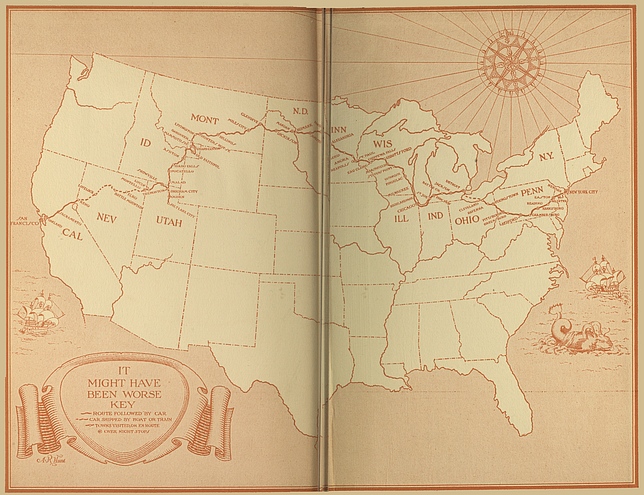
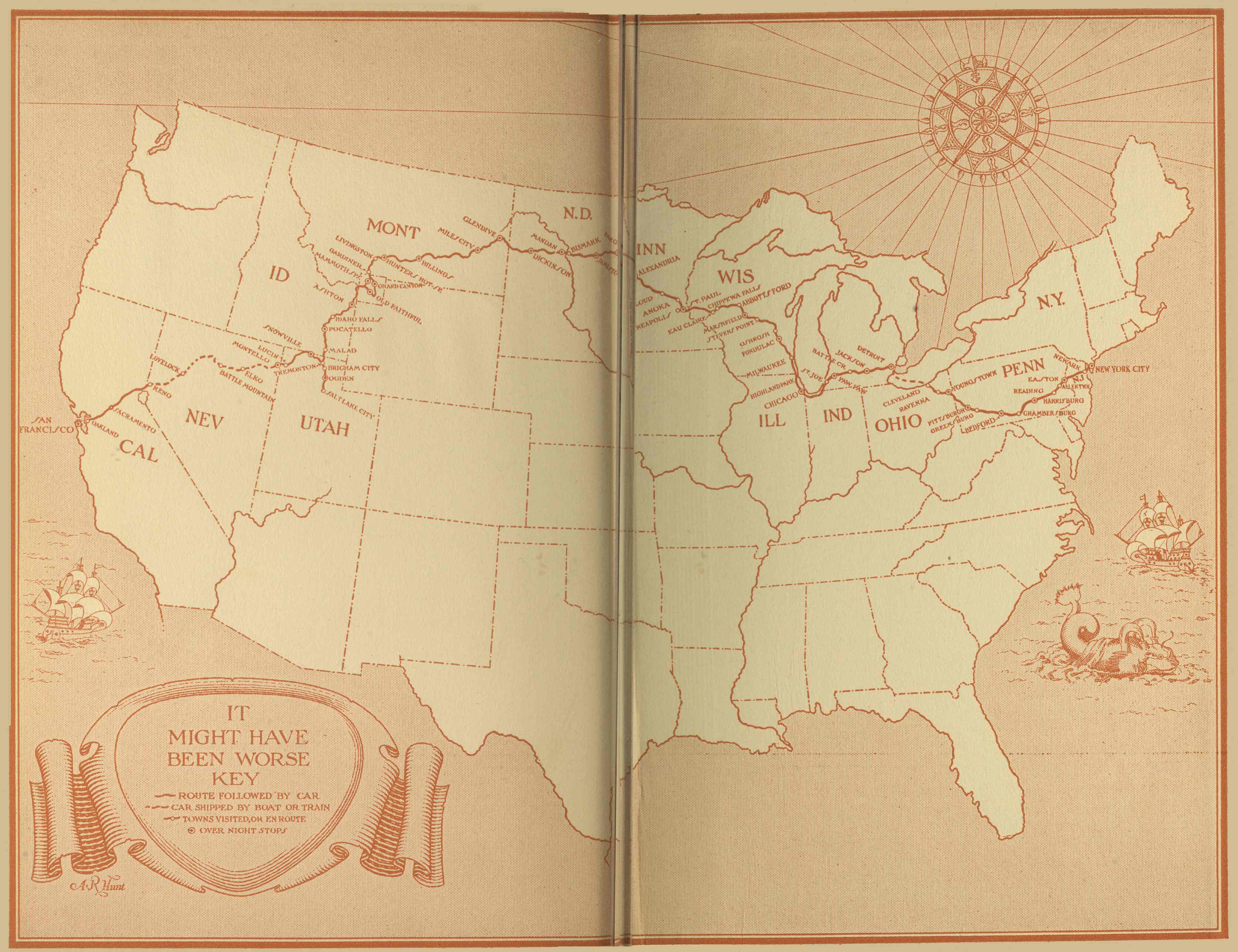
Francisco (see map), and, strange to relate,
we followed out the tour as we had planned
it. With the exception of a few hot days in
the larger cities and on the plains, and, of
course, in the desert, we justified our decision.
As I have stated, we drove 4154 miles,
through sixteen states and the Yellowstone
Park, in thirty-three running days, and the
trip took just seven weeks to the day, including
seventeen days spent in various cities,
where we rested and enjoyed the sights. As
time was of no special object, and we were
not attempting to break any records, we felt
free to start and stop when we felt inclined to
do so; on only two mornings did we start before
nine-thirty, and seldom drove later than
seven in the evening. In so doing, we made a
pleasure of the trip and not a duty, and avoided
any unusual fatigue.
The first evening we reached Easton, Pennsylvania.
We were glad to get into the comfortable
Huntington Hotel out of the wet,
and enjoyed a good dinner and a night’s rest.
We followed the Lincoln Highway to Pittsburgh,
and have only praise to offer for the
condition of the road and the beauty of the
small towns through which we went. Of all
the states that we crossed, Pennsylvania
stands out par excellence in good roads, clean,
attractive towns, beautiful farming country
and fruit belts, and well-built, up-to-date
farm buildings. In other states we found
many such farms, but in Pennsylvania it was
exceptional to find a poor, tumble-down
farmhouse or barn. The whole state had an
air of thrift and prosperity, and every little
home was surrounded by fine trees, flowers,
and a well-kept vegetable garden.
The worst bugbear of the motorist are the
detours. Just why the road commissioners
choose the height of the motoring season to
tear up the main highways and work the
roads has always been a mystery to me, and
I have never heard any logical solution of it.
We were often told that no work to speak of
had been done on the state roads through the
country during the war, and in many places
the heavy army trucks had cut up the good
roads until the ruts left turtle-backed ridges
in the center, not at all pleasant to bob along
on. But, in view of what we encountered later
in our trip, I look back on the Pennsylvania
roads as one of the high spots and pleasures,
never to be undervalued.
From Easton we drove in the rain to Harrisburg.
The scenery was beautiful. The Blue
Ridge and the Alleghany Mountains loomed
up in the haze like great cathedrals; but as
long as the road was wide and comparatively
smooth we enjoyed the ups and downs. Our
engine told us that we were gradually ascending;
the mist would be wafted off by a
mountain breeze, and then a gorgeous panorama
stretched before us as far as the eye
could see.
We found Harrisburg a busy, thriving city,
with well-paved streets, attractive homes,
and many fine buildings. The leading hotel,
the Penn Harris, was turning away guests;
so we were made very comfortable at the
Senate. Here the café was miserable, but we
went to the restaurant of the Penn Harris
and had an excellent dinner at moderate
prices. We have found that at the largest,
best hotels the food was better cooked and
much cheaper than at the smaller ones. Usually
we had excellent club breakfasts from
forty cents up, and club lunches, with an ample
selection of good things to eat, for fifty
or sixty cents. You may pay more for your
room and bath, but you get more for your
money, with better service. We made it a rule
to go to the newest, largest hotels, and indulge
in every comfort that was afforded.
Why? Not to be extravagant, nor to say that
we had stopped at such or such hotels. After
you have driven day after day, and come in
stiff and tired, there is no bed too soft and no
bathroom too luxurious to overrest your
mind and body. Economize in other ways if
you must, but not on good food and comfortable
lodgings.
Our third day was still a drizzle; we would
no sooner have the top down than we would
have to put it up again, and often the side
curtains as well. Our objective point was the
charmingly quaint town of Bedford, and the
Bedford Arms. This part of Pennsylvania
was more beautiful than what we had been
through, and every mile of the day’s run was
a pleasure.
I have not spoken of our lunches, a most
important item by one o’clock. We had
brought a small English hamper, fitted with
the usual porcelain dishes, cutlery, tin boxes,
etc., for four people, and unless we were positive
that a good place to eat was midway on
the road, we prepared a lunch, or had the hotel
put one up for us. This latter plan proved
both expensive and unsatisfactory. Usually
Toodles was sent foraging to the delicatessen
shops for fresh rolls, cold meats and sandwiches,
eggs, fruit, tomatoes, and bakery
dainties, and the hotel filled our thermos-bottles
with hot coffee. We carried salt and
pepper, mustard, sweet and sour pickles, or a
relish, orange marmalade, or a fruit jam, in
the hamper, and beyond that we took no
staple supplies on the whole trip. We met so
many people who carried with them a whole
grocery-store, even to sacks of flour, that you
would imagine there was not a place to get
food from the Atlantic to the Pacific. Often
later on we would meet these same people
and find that they had thrown or given away
most of their larder. Of course, the camping
parties, which are legion, are houses on
wheels! Aside from the tents, poles, bedding,
and cooking utensils, we have seen stoves,
sewing-machines, crates of tinned foods,
trunks full of every conceivable incumbrance
they could buy, strapped to the back and
sides and even on the top of the car, and usually
the personal luggage jammed in between
the mud-guards and hood of the engine. A
traveling circus is an orderly, compact miniature
in comparison. And the people!—sitting
on top of a mountain of baggage, or under
it, the picture of woe and discomfort.
That may be fun, but I fear I have not developed
a capacity for such pleasure. Have you
ever seen a party of this description unpack
and strike camp after a hot, broiling, dusty
day of hard travel? You will do as we did—drive
right ahead until you come to a clean
hotel and a bath.
We have been told so often that one has to
develop an “open-air” spirit to really enjoy a
long motor trip! Quite true! I can’t imagine
what the fun can be of touring in a closed
limousine, and yet we have met that particularly
exclusive party more than once. On the
whole, an absence of flies, ants, mosquitoes,
and sand and dust in one’s bed and food does
not detract from the pleasure of the trip. It
may be all right to endure such annoyances
for a few days in the woods, to fish or hunt—but
weeks and more weeks of it! We admit
our “lack,” whatever it may be termed, and
enjoy clean linen, hot tubs, and tables that
have legs not belonging to ants and spiders.
In Wisconsin we met a most unique and
charming couple, both past fifty, who had
lived all over the world, even in South America,
a Mr. X and wife, from Washington, D.
C. They were going on the same route as we
were, and back to Washington, via southern
California, the Yosemite, New Mexico, New
Orleans, and then north. So their trip would
be twice as long as ours. They loved the open,
with that two-ton-equipment enthusiasm excelling
all others we had met. From an over-stocked
medicine chest, so carefully stowed
away that they bought what they wanted en
route rather than unload everything to try to
find it, to a complete wardrobe for every occasion,
which was never unpacked, they had
every conceivable utensil that a well-furnished
apartment could boast of. They even
bought a small puppy, as a protection at
night when camping; the poor little beast
caught cold and crawled under the pile and
died. They solved the lunch problem in a
unique way. If they passed a good corn-field,
they “procured” a few ears and stopped at
the next farmhouse and calmly asked the
loan of the kitchen for a short time, and
cooked their corn and bought bread and
milk, etc. Mrs. X remarked: “It is all so simple!
We have all these things in case we
should need them, but they are so well
packed in the car it is really too bad to disturb
them; so I live in one gown, and we buy
what we need, and it is most satisfactory.”
Later we learned that they had camped out
just three nights in several weeks.
But I have digressed, and left you at the
Bedford Arms, one of the most artistic, attractive
inns that we found. The little touches
showed a woman’s hand. Flowers everywhere,
dainty cretonnes, willow furniture,
and pretty, fine china; in appearance, courtesy,
and efficiency, the maids in the dining-room
might have come from a private dwelling.
Will someone tell me why there are not
more such charming places to stop at on our
much-traveled main highways. Why must hotel
men buy all the heavy, hideous furniture,
the everlasting red or green carpets and impossible
wall-paper, to make night hideous
for their guests—to say nothing of the pictures
on their walls? It is a wonder one can
sleep.
There is much of interest to see in Bedford—really
old, artistic houses, not spoiled
by modern gewgaws, set in lovely gardens of
old-fashioned flowers, neatly trimmed hedges,
and red brick walks. There were few early
Victorian eyesores to mar the general beauty
of the town. As we were walking down the
main street about sunset, we heard a great
chattering and chirping, as if a thousand
birds were holding a jubilee. Looking up, we
found, on a projecting balcony running along
the front of all the buildings for two blocks,
hundreds of martins discussing the League
of Nations and Peace Treaty quite as vigorously
as were their senatorial friends in
Washington. They were fluttering about and
making a very pretty picture. It sounded like
the bird market in Paris on a Sunday morning,
which, in passing, is an interesting sight
that few tourists ever see.
It was with regret that we left the next
morning for Pittsburgh. The day was clear
and cool and the best part of the Lincoln
Highway was before us; in fact, the first real
thrill so far, and one of the high spots of the
trip. This was a stretch of seven and a half
miles of tarvia road on the top ridge of the
Alleghany Mountains, as smooth as marble,
as straight as the bee flies, looking like a strip
of satin ribbon as far as the eye could see. On
both sides were deep ravines, well wooded,
and valleys green with abundant crops, and
still higher mountains rising in a haze of blue
and purple coloring, making a picture that
would never be forgotten. The top was down
and we stopped the car again and again, to
drink it in, and, as one of us remarked, “We
may see more grand and rugged scenery later
on, but we shall not see anything more
beautiful than this”—and it proved true.
We had come 442 miles, from New York
to Pittsburgh, over fine roads and through
beautiful country. Approaching Pittsburgh,
we came in on a boulevard overlooking the
river and “valley of smoke.” Great stacks
were belching out soot and smoke, obliterating
the city and even the sky and sun. They
may have a smoke ordinance, but no one has
ever heard of it. We arrived at the William
Penn Hotel, in the heart of the business center
of the city, a first-class, fine hotel in every
regard. We found the prices reasonable for
the excellent service afforded, which was
equal to that of any New York hotel. The
dining-room, on the top of the house, was
filled with well-dressed people, and we were
glad that we had unpacked our dinner clothes,
and appeared less like the usual tourist, in
suits and blouses. It was frightfully hot during
our two days’ stay. You go out to drive
feeling clean and immaculate, and come in
with smuts and soot on your face and clothes,
looking like a foundry hand. The office buildings
are magnificent, and out a bit in the
parks and boulevards the homes are attractive,
and many are very handsome, especially
in Sewickley. But aside from the dirty atmosphere
one is impressed mostly by the evidences
of the outlay of immense wealth. An
enthusiastic brother living there took us
through a number of the business blocks, and
told us of the millions each cost and the almost
unbelievable amount of business carried
on. I can only describe Pittsburgh as the
proudest city we visited. Not so much of the
actual wealth represented, but of what the
billions had accomplished in great industries.
We went out in the evening and stood on one
of the bridges to look over the river lined
with monster furnaces. The air was filled
with sparks, jets of flame bursting through
the smoke. All you could think of was Dante’s
Inferno visualized. And what of the men who
spend their lives in that lurid atmosphere,
never knowing if the sun shone, nor what
clean, pure air was like in their working
hours? I shall never look at a steel structure
again without giving more credit to the men
who spend their waking hours in those hells
of heat and smoke than to the men whose
millions have made it possible.
The second day, nothing daunted by the
heat, we went out to the St. Clair Country
Club for lunch and golf, about a twenty-mile
run through the suburbs. This is a comparatively
small and new club, but our host told
us that they were soon to have a fine club-house
and improve the links. The location
is attractive, and the luncheon was delicious.
We had brought our golf bags, tennis racquets,
and bathing suits with us, much to the
amusement of our friends. After sitting in
the car day in and day out, I know of no better
way to stretch your legs and arms and to
exercise your stiff muscles than to put in a
few hours at either game. My husband described
this course thus: “You have to hold
on to a tree with one hand and drive with the
other, the bally course is so steep.” There are
many more pretentious country clubs and
golf links about Pittsburgh, but this small one
had charm and a homelike atmosphere. Our
last evening we were taken to the “New
China,” the last word in Chinese restaurants—beautiful,
clean, and artistic! You have
your choice of American or Chinese dishes.
As we were looking for sensations, we ordered
some marvelous dishes with impossible
names. One portion was sufficient for
three hungry people. The other two portions
were untouched. I do not know what we ate,
but it was delicious. Truth compels me to
state that we were all ill for three days, and
decided to patronize home cooking in the future.
We did not get away until noon the next
day, as our auto top had been torn in the
garage, and the manager kept out of sight
until noon, and then, after considerable pressure
had been brought to bear, he made a
cash settlement of fifteen dollars, wishing us
all the bad luck his “Mutt and Jeff” mind
could conjure.
III OHIO AND DETOURS
We were assured that we should find good
roads through Ohio to Cleveland, where we
were to take the D. & C. steamer to Detroit.
If we were to take this part of the trip again,
we should certainly go to Chicago, via Toledo
and South Bend, Indiana. As we had relatives
in Detroit waiting in the heat to see us,
and to depart for cooler climes, we took the
most direct route through Youngstown,
Ohio, to Cleveland. The roads were poor and
the many detours were almost impassable—over
high hills, on narrow sandy roads, winding
like a letter S through the woods. One
long stretch was so narrow that two cars
could not pass; so they had two roads, one
going each way. The Doctor remarked, “I
wonder what would happen if a car broke
down on this detour.” Prophetic soul! He no
sooner had said it than we rounded a curve,
and presto! there were six cars, puffing and
snorting, lined up back of an Overland car,
which was disabled and stuck fast in the
sand. In half an hour there were ten cars
back of ours—and the sun setting over the
hills, and fifty miles to Youngstown! The
owner of the car knew nothing of his engine.
Heaven save us from such motorists! But
Heaven did not save us, for we met dozens of
men, headed for the wilds of somewhere, who
were as blissfully ignorant of what made the
wheels go round as their wives were.
It may have been a coincidence, but is nevertheless
a fact, that nearly every car we saw
disabled, ditched, stuck in the mud or sand,
or being towed in, on the entire trip, was an
Overland car. It really became a joke. When
we saw a wreck ahead of us, some one exclaimed,
“Dollars to doughnuts it is an Overland!”—and
it generally was. It used to be a
common expression, “If you wished to really
know people, travel with them.” I would
change it to “Motor, and grow wise.” There
were as many varieties of dispositions in that
belated crowd as there were people. Everyone
got out of his car and went ahead to the
wreck, offering advice, growling, complaining,
and cursing Ohio detours. A few sat on
the roadside and laughed, chatted, or read
the papers. As it was hot and dusty, we looked
like an emigrant train. My husband is an engineer
with a knowledge of cars. He suggested
some simple remedy which enabled
the man to get his car to the next siding, and
we all started with a whoop of joy on the
wretched road, leaving the Overland owner
to spend the night at a farmhouse near by.
Our troubles were not over. With a steep
grade before us, I was driving, going up
steadily on second speed, when a real wreck
loomed up three-quarters of the way to the
top of the hill. Two drunken niggers had upset
a rickety old truck loaded with furniture
in the center of the road, and their car had
zigzagged across the road, narrowly escaping
a plunge down the steep embankment.
You could not pass on either side; so, with
my heart in my mouth, I reversed, backing
our car into the farther side of the road, with
two wheels in a deep stony ditch, but safe
from sliding down-hill on top of the cars
coming up back of us. It looked as if we were
to share the fate of our Overland friend and
stay there indefinitely. We all jumped out
and tried to clear the house and lot out of our
way. Those miserable niggers just sat on top
of the débris and refused to work. After tugging
at spring beds and filthy bedding, we
succeeded in getting it pushed to one side. I
had had enough driving for one day, so gave
the wheel to my husband, and he started the
engine. We did not budge! The next half-hour
was spent in filling up the ditch with
stones and making a bridge by covering the
stones with boards. Eventually the car started,
pulling itself out of the slough of despair,
and narrowly escaped turning turtle. The
Doctor, Toodles, and I all called wildly, “Keep
going! don’t stop!”—and on he climbed to
the top, while we trudged up through the
dust, a quarter of a mile. All that night I
dreamt I was backing off the Alps into space.
Oh, what a tired, dirty party it was that
drove up to the Ohio Hotel in Youngstown
that night! Someone had told us that there
was a good hotel in Youngstown, but we soon
came to form our own conclusions about hotels.
This was a delightful surprise. Not only
good, but wonderful, for a city of the size of
Youngstown. After we were scrubbed and
sitting down to a delicious dinner in the big
cool café, a broad smile spread over the table,
and the Doctor suggested, “You know, it
really might have been worse!”
The next day we had more detours; but, in
the main, the state highways, when they could
be traversed, were good. The rural scenery
through Ohio was pleasing, but we had left
the Lincoln Highway and the beautiful farms
of Pennsylvania.
We reached Cleveland by four, driving directly
to the D. & C. wharves. The “Eastern
States” was being loaded, and the monster
“City of Detroit III,” a floating palace, was
starting out for Buffalo, I believe. Although
the week-end travel is always heavy, and this
was Friday, we were most fortunate in getting
staterooms, with brass beds (not bunks),
running water, and a bathroom. It may be of
interest to state that the cost of shipping the
car to Detroit, a night’s run, was only $14.50.
As we did not sail until nine o’clock, and we
could not go aboard nor leave the car, we
drove out the Lake Shore drive overlooking
Lake Erie, through beautiful suburbs, with
attractive homes and gardens, and then
something told us it must be time to investigate
the hotels. As we had all sampled the
excellent cooking at the Statler, we dined at
the fine Cleveland Hotel—modern in all its
appointments, in good taste, and unexcelled
service. We remarked the appearance of the
people. There was not a smartly gowned
woman in the dining-room, and the waiters
had a monopoly of the dress suits. Being hot,
and in midsummer, and a more or less transient
gathering, might have been the reason.
In many large cities, in first-class hotels, we
found the tired business men in business
suits and the women in skirts and blouses.
Never did anything taste more delicious than
the broiled fresh whitefish, just out of the
lake, green corn on the cob, melons, and
peaches. As long as we remained in the Great
Lakes region, we reveled in the whitefish,
broiled, sauté, or baked. It is the king of
fresh-water fish.
I am beginning to realize that I am exhausting
my descriptive adjectives when it
comes to hotels. Time was, not so very far
distant, when a hotel like the Cleveland was
not to be found, except in possibly half a dozen
cities in this country. Now it is the rule.
On all our long trip, with the exception of
three nights, we had perfectly comfortable,
clean double rooms, usually with twin beds,
and private baths with modern sanitary
plumbing and an abundance of hot, not tepid,
water. We have been assured by the proprietors
that the change has been wrought by
motorists who demanded better lodgings. I
think the farmer is the only member of society
who still holds a grudge against us as a
class; but when he is the proud possessor of
a “Little Henry” he slides over to our side
unconsciously. A book could be written on
“Motoring as an art, a profession, a pastime,
a luxury or a necessity, a money maker or a
spender, a joy or a nuisance”—and then
much more!
Before leaving Cleveland I must speak of
its fine municipal buildings, its many industries,
and its far-famed Euclid Avenue, once
the finest of streets, lined on both sides with
massive, splendid residences, many with
grounds a block square; alas! long since
turned into boarding-houses, clubs, and
places of business—the inevitable transition
from a small to a great city.
Our trip across Lake Erie was quiet and
cooling. That is not always the case, even on
such big steamers as the D. & C. line affords.
I have seen that lake lashed into fury by
waves that rocked the largest boat like a cockleshell.
Breakfast on the steamer was all
that could be desired. It was some time before
we had the car on the dock, ready to
start to our hotel in Detroit. The ride up the
river had been interesting, past old Fort
Wayne, the Great Lakes engineering plant
and dry docks, and the grain elevators; even
at that early hour (seven A. M.) the wharves
were alive with the bustle of trade.
Here I pause. Detroit was my home city
and that of my father and grandfather in territorial
days. My earliest recollections of it
were of broad streets, fine homes, and an atmosphere
of dignified culture and home-loving
people. But now! It has outgrown recognition.
It has outgrown every semblance of
its former charm. Like Cleveland, the old
homes on the principal avenues are all given
over to trade, and the streets down-town are
overcrowded, noisy, and well-nigh impassable.
The Statler is a new and fine hotel. We
went to the Pontchartrain, formerly the old
Russell House, which in its palmy days, in
the Messrs. Chittenden régime, was the center
of the social life of Detroit. It has passed
through several hands, and is now doubtless
torn down. We found it run down and undesirable
in every way. Even then we felt more
at home there and made the best of things.
We spent two and a half days, as hot as I
ever experienced. The nights were so hot that
sleep was out of the question. A drive around
the Island Park, Belle Isle, cooled us off a bit.
Thousands were taking advantage of the
municipal bathhouses or a swim in the river.
If the city has been spoiled down-town, it
has been equally beautified in the outlying
sections. The drive to Grosse Pointe along
Lake St. Clair has ten miles of residences unsurpassed
in America. The magnificent home
of Senator Truman Newberry and dozens of
others that could be mentioned, set in acres
of highly cultivated grounds, commanding
an unobstructed view of Lake St. Clair, are
worthy of a special trip to Detroit to see.
We lunched at the Country Club, but weakened
when it came to trying the celebrated
golf links. It was too boiling hot! There were
not more than a dozen people at the club.
Usually the place was crowded. There are
other fine clubs and links about Detroit, and
the city seems to have gone golf mad—a very
healthful form of insanity! The Detroit Athletic
Club, in the business center, claims to be
the finest private city club in America. If patronage
is any indication of its excellence, this
must be true. My brother, Mr. L., gave us a
beautiful dinner there, and we certainly have
not seen anything to surpass it. Our time was
all too quickly spent, and the heat literally
drove us out of town. Before leaving, we paid
our respects to the mayor, Mr. C., an old-time
friend. While we were pleasantly chatting
with him and he was graciously offering
us the keys of the city, my husband had a
summons served on him and the car locked
for leaving it more than an hour at the curb.
He was taken to police headquarters and
paid his fine and then returned for us. As we
were praising the efficiency of the mayor, he
gave us a knowing smile, and some days later
showed us his summons!
IV ON TO CHICAGO
I realize that I am giving a most unsatisfactory
picture of the Eastern and Middle-West
cities. Our time was limited, and space
forbids my giving anything but a cursory
glance, a snapshot view, of their size and
beauty. And, then, most tourists visit these
places and the reading public have an intimate
knowledge of them.
We left Detroit, having been told at the
Michigan Automobile Association that we
should find excellent roads. As one prominent
broker remarked, “You can drive the
length of the state on macadamized roads.”
Where were they? Surely not the way we
went, the way described in the Blue Book.
And let me state right here that we have
never had much faith in that publication, and
now what little we had is nihil! A few miles
out of the city we struck a detour which lasted
nearly to Ann Arbor. We had left at six
o’clock, and when we reached the university
city all places to dine were closed. We did
not dine. We had pot-luck supper at a Greek
restaurant, and started for Jackson to spend
the night. Ann Arbor is a beautiful place, and
the university buildings and fraternity houses
are second to none of all we saw in other
states. The road did not improve, and we arrived
at Jackson very late and put up at the
Otsego Hotel. It was crowded, and we were
given the “sample rooms,” in which the traveling-men
displayed their goods on long tables.
We had comfortable beds and private
baths, but you felt as if you were sleeping in
a department store, with the counters covered
with white cloths. Otherwise, the Otsego
is a good hotel, and we were perfectly
comfortable. By the time we were through
breakfast, we asked to have a lunch put up,
and were kindly but firmly told that it was
nine-thirty, and the chef had gone home and
locked up everything. We pleaded for some
hot coffee and anything cooked that was left
from breakfast. But no, not a sandwich nor a
roll could we buy! We met this condition
time after time. If we arrived at a hotel after
eight o’clock in the evening, we were met
with the same retort—“Chef gone and everything
closed.” A dozen times and more we
were obliged to go out and forage for supper—“due
to the eight-hour law,” we were always
told. As it was nearly ten o’clock, we
trusted to luck to find a lunching-place en
route. Fortune certainly favored us in the
most unexpected way—not in our roads,
which still were poor, but in the shape of two
little girls on the wayside. As we were passing
through a hamlet called Smithfield—before
reaching Albion—we were attracted by
two dainty girls with baskets of goodies
waiting for us. Their names were Evelyn and
Willetta Avery, and they proved to be fairy
godmothers. Their mother owned the neighboring
farm, and these children were spending
their vacation in supplying lunches to
passers-by. Everything was done up in fresh
napkins and was real home cooking. This is
what we bought from them: a quart of fresh
blueberries (which Toodles, in her joy,
promptly upset in the tonneau, and we
walked on blueberries for days!), fresh cake,
pie, honey, hard-boiled eggs, tongue sandwiches,
hot bread and rolls, a pat of sweet
butter, and oh! such home-made pickles, raspberry
jam (a pint glass), and a bottle of ice-cold
spring water, an abundance for four
hungry grown-ups, and all for $2.10. We gave
them both liberal tips and they smiled and
waved us out of sight. That was a banner
luncheon, and the best but one on the trip.
We stopped in the interesting city of Albion.
The college was founded and endowed
by General Fisk, of Civil War fame, whose
only daughter, Mrs. P., is one of New York’s
most beautiful and prominent women. That
afternoon about four we came to Battle Creek,
and as the Doctor’s eyes were troubling him,
from the heat and dust, we drove to the sanatorium,
where he could receive treatment.
It is an immense place and beautifully kept
up. We were sitting in the car outside, watching
the crowds of patients with their friends,
when a number of wagons, like popcorn wagons,
came into view, pushed about by the
white-robed attendants. The wagon itself
and the four uprights were covered with
white cloth and festooned with fresh vines
and flowers. In the center, hidden from view,
was an ice-cream freezer, and young girls in
white, carrying flowers, were dispensing ice-cream
cones at five cents each. It was as pretty
a sight as I ever saw. The carts were
wheeled through the grounds and everyone,
sick or well, indulged. It was our first introduction
to ice-cream cones, but we acquired
the habit; and thereafter our afternoon tea
consisted of ice cream, generally bought at a
soda-water fountain in some small town
along our road. It may be fattening, but it is
nourishing and refreshing. Even in the tiny
hamlets on the plains of Montana we found
good, rich ice cream. It is certainly an American
institution and a very palatable one.
We had come ninety miles over bad roads,
and it was 160 miles to Chicago, so we decided
to stop at Paw Paw for the night. We
drove through the town and inquired which
was the best hotel—our usual question—and
were told that they had two, but the Dyckman
House was first-class—a typical small
country hotel, with little promise of comfort.
We were shown into big, comfortable rooms
with one private bath; but were told that
“supper was over.” The manager was a typical
small-town person of importance, but had
a kindly eye, and looked amenable to persuasion.
The others had given up hope; not so
with me! Then and there I invented a “sob-story”
that would have melted Plymouth
Rock. It became our stock in trade, and many
a supperless night we would have had without
it. After praising up the town and his hotel,
and saying that we had heard of its hospitality,
and so forth; that we were strangers,
and had come all the way from New York;
that we were tired and hungry, and I really
was not very well; and that the price was no
consideration, etc., he walked out to the kitchen
and caught the cook with her hat on ready
to depart, gave his orders, and in twenty minutes
we were doing full justice to a perfectly
good supper. After we had finished, I went
out into the summer kitchen and found a
good-natured Irish woman, as round as she
was pleasing, fanning herself. I gave her a
dollar, thanked her for staying, and made a
friend for life.
Even in Michigan our New York license
attracted much attention. When we came out
of a hotel or store, a crowd of people had invariably
gathered about the car and were
feeling the tires. The size seemed to astonish
them. The fact that we had come from New
York filled them with awe, and when, in fun,
we said we were going to San Francisco,
they were speechless! “Aw, gaw on!” or “By
heck!” was all that they could exclaim.
Our last taste of Michigan roads was worse
than the first. We went by the way of Benton
Harbor, with sandy detours and uninteresting
country, until we struck the strip of Indiana
before coming into South Chicago.
Our troubles were over for a long time. A
breeze had come up from the lake, and we
slept under blankets that night for the first
time in two weeks. We were all familiar with
Chicago, and we wished to stop out on the
Lake Shore, if possible. We drove through
the city, out on the North Shore Boulevard
to the Edgewater Hotel, of which we had
heard charming reports. A block below the
hotel cars were parked by the dozens. It is
built directly on the shore, with the most remarkable
dining-room at the water’s edge,
like the deck of an ocean liner, filled with
palms, flowers, and smartly dressed people,
many in evening clothes. The tables were all
reserved, and so were the rooms, two weeks
in advance—this was the pleasant news that
awaited us! Could they take us in the next
day? “No, possibly not for a week or more.”
No “sob-story” to help us here! But the
clerks were obliging and advised our going
about ten miles farther out, to the North
Shore Hotel in Evanston, which we found
delightful in every way—very near the lake,
quiet, furnished in exquisite taste, and good
food at reasonable prices. But even here we
found the eight-hour law in force; we could
not get a bite after eight o’clock. We went to
half a dozen restaurants—all closed! In desperation
we went into what looked to be a
candy store, and found they were closing up
the café! They could serve nothing but ice
cream and sodas. We asked to see the manager
and told him our plight. He was an
Eastern man, a long-lost brother. He said,
“As you placed your order just before eight
o’clock, of course we shall serve you.” It was
quite nine by this time. He kept his face
straight, and we tried to do the same. That
dinner certainly did touch the spot! It was
the “Martha Washington Café,” and certainly
immortalized the gracious lady for all time
for us. Later we went back to the Edgewater
Hotel for our mail and to dine, and we were
more charmed with it than before.
We had come 1028 miles from New York.
Our car had to be thoroughly cleaned, oiled,
and looked over; so we were without it for
two days. The street-car strike was on in full
force, not a surface car moving in the city.
Consequently, we walked, rested, and saw
but little of the city. It was quite ten years
since any of us had been there; in that time
Chicago had grown and been so improved
that we hardly knew it. If Pittsburgh people
are proud of their city, Chicagoans are the
original “boosters.” Nature has done so much
for its location. Its system of parks and boulevards
is not equaled by any city. There is a
natural, outspoken pride evinced by the people
of the best class—not ashamed of a humble
beginning, but glorying in the vast importance
of the commercial and financial life.
To quote from the folder of the Yellowstone
Trail, which we picked up here and followed
without any trouble to St. Paul, Minnesota,
“Nothing need be said about Chicago. Chicago
is the heart of America and speaks for
herself.” Other cities may challenge this, but
there is every evidence of its truth. In time,
Chicago will give New York a good race; in
fact, she is doing it now.
Our genial Doctor left us here, much to
our regret. We went on, a select party of
three.
V THROUGH THE DAIRY COUNTRY
“A good road from Plymouth Rock to Puget
Sound.” Thus reads the Yellowstone Trail
folder. If you really believe a thing, you may
be excused for stating it as a truth. The trusting
soul who wrote that alluring statement
has never been over the entire trail, or I am
greatly mistaken. Credit must be given for
the system of marking the trail. At every
turn, right or left, the yellow disk is in plain
sight.
On leaving Chicago, we went through Lincoln
Park and up the Sheridan Road to Milwaukee.
The road is a wonderful boulevard,
with beautiful homes and estates and glimpses
of Lake Michigan, past the Great Lakes
Naval Training Station, now the largest in
the United States. We had heard much of
Zion City. Driving down its main street was
like a funeral. The houses were closed, the
buildings seemed deserted, and the only evidences
of life were two men, a horse and wagon,
and a stray dog! We found a good macadam
road to Oshkosh from Milwaukee and
many such stretches through Wisconsin. At
times the road followed closely the shore of
Lake Winnebago, and then would wind
through fertile dairy country. Trainloads of
butter and cheese are shipped from here each
year, and high-bred dairy cattle are raised
for the market. Was it not strange that we
did not have Wisconsin cheese on the menu
at any hotel in that state? Several times we
asked for it, but no cheese was forthcoming.
The first night we put up at Fond du Lac,
at Irvine Hotel. It was fairly good, but a palace
compared with what we found the next
night at Stevens Point—the Jacobs Hotel.
This was our first uncomfortable experience—a
third-rate house, with no private bath,
hard beds in little tucked-up rooms, a bowl
and pitcher with cold water and two small
towels the size of napkins, and the most primitive
table you could imagine. The weather
had kept cool and clear, but the sandy roads
with deep ruts were awful! As it had rained
in the night, the clerk assured us next morning
that four cars were stuck in the road west
of the town, and we had better not start. We
asked him if there was a good hotel at Marshfield.
“Good hotel! Well, you folks just wait
till you see it! They actually have Brussels
carpet on the floor of the dining-room! Good
hotel, eh? Nothin’ better this side of Chicago!”
The cars were lined up in the street
waiting to start. The clouds looked heavy
and threatening, and not a ray of blue sky.
Everyone was talking to someone. The formalities
are discarded on such occasions. We
fell into conversation with a charming man,
Mr. H., from Fargo, North Dakota. Later
we found that he was the ex-governor, and
his name was sufficient to get anything you
wanted in the Northwest. He and his family
were touring to New York; so we exchanged
maps and experiences, and he gave us a list
of towns and hotels that proved invaluable,
with the kindly remark, “If you will show the
hotel clerks this list with my name, I am sure
you will be well taken care of.” We certainly
were—and more!—from there to Yellowstone
Park.
We found the Blodgett Hotel at Marshfield—with
a really, truly carpet in the dining-room—a
good hotel, clean and comfortable.
The next day we had two hundred
miles to go to St. Paul, and were promised
good roads. Colby, Eau Claire, and Chippewa
Falls are all attractive towns. Wisconsin
boasts of six thousand lakes. It certainly is a
paradise for the huntsman and the angler—“The
land with charm for every mile.” The
method of numbering the state highways is
the best we have found. You simply can’t
lose your way. We, unfortunately, had several
long detours and did not reach St. Paul
until one A. M., a very sleepy trio, in a disreputable-looking
car.
VI CLOTHES, LUGGAGE, AND THE CAR — BY T. G. M. (UNDER PROTEST)
We decided to take as little luggage as possible.
In the end, we found that we had more
than ten people would need. Each of us had
a large dress-suit case, a small handbag with
toilet articles, an extra bag for soiled linen
(which proved useful), two golf-bags, with
umbrellas and rubbers (which were never
used), a case of tennis-rackets and balls, a
shawl-strap with a heavy rug, rain-coats and
top-coats for cold weather, the lunch-hamper,
and a silk bag for hats. The tonneau was
comfortably filled, with still room for two,
and even three, people. The thermos-bottles
were stowed away in the side-pockets, easy
of access. All the maps were in the right-hand
front pocket by the person sitting with
the driver. We had an old rug which was so
disreputable that no one would steal it; we
had been on the point of throwing it away a
dozen times, but after it came from the cleaners
we hadn’t the heart to leave it behind.
That old relic proved to be the joy of the
trip. We sat on it when lunching on the roadside,
used it to protect the car from the bags
and golf-clubs, and when we had a puncture
down it went under the car to avoid collecting
all the dust of the road on my husband’s
clothes. We still have it, and consider the old
veteran deserves a pension for life. My advice—take
an old rug!
And our clothes: Of course, a silk or an alpaca
dust-coat; linen soon shows soil and
looks mussy. This applies to the ladies. I
won’t attempt to advise men, for they will
wear what best suits them. We wore one-piece
gowns of serge, and, when it was hot,
voile or even gingham. We each had a silk
afternoon frock, which would shake out and
look presentable for dinner, a black evening
gown for dress-up occasions, a half-dozen
crêpe de chine blouses, and a cloth suit. We
could have done without the suits. They were
used but once or twice. We all took heaps of
under-linen, only to find that we could get
one-day laundry service in any good hotel,
and could buy almost anything in the cities,
and even in the small towns. The color of our
linen resembled coffee at times, but, aside
from that unpleasant feature, we could keep
clean and comfortable with no trouble. We
each had a sport skirt, a sweater, shoes, a
pair of evening pumps, a pair of heavy top-boots,
and two pairs of Oxford ties, black and
tan, with sensible heels. In driving, I soon
found the long-vamp, pointed toe not only a
nuisance, but dangerous, and used an old-fashioned,
round-toed low shoe. Hats! There
every woman is a law unto herself. We each
had a good-looking hat in the hat-bag, which,
after being tied to the rug-rail, sat on,
smashed by the bags, and wet a few times,
still kept our hats very presentable. Straw
hats will break and be ruined. Those made of
ribbon or black satin will withstand the
weight of a ton of luggage and come out
looking fairly decent. Wash gloves proved
practical, also white Shetland veils. Toodles
was swathed like an escaped harem beauty;
but one good Shetland veil, well tied and
pinned in, kept my sailor hat in place comfortably,
even when the top was down and I
was driving. The hat with a brim is a necessity
when the sun shines for weeks at a time.
I did not wear motor goggles, but the others
did. Through all the Western states we found
the female population in khaki breeches and
puttees, khaki blouses, and hats like a sun-bonnet
or a cowboy’s sombrero, and occasionally
a coat to match, which was short and
of a most unbecoming length. Often high tan
boots were substituted for the puttees. It
was a sensible costume, and well adapted to
the country and life in the open that Western
women lead. They all rode astride, wisely.
Often we met parties of four in a Ford just
hitting the high spots on the road.
The farther we went into the real West,
the West of the movies and the early days
pictured by Bret Harte, we realized what
part these Western women had played, and
were still playing, in their unselfish, brave,
industrious, vital lives, in the opening and developing
of that vast territory, and in making
such a trip as ours comfortable, safe, and
even possible. I think, if I ever take the trip
again, I shall adopt khaki breeches, and send
my petticoats by express to our destination.
This reminds me that I have not spoken of
our trunks. Nine out of ten people that we
have met in San Francisco have asked, “What
became of your trunks, or didn’t you have
any?” Before leaving New York we sent,
collect, by American Railway Express, a
large wardrobe trunk, the usual steamer
trunk, and a French hat-box to San Francisco,
“Hold until claimed.” These were held
for seven weeks, and the total expense, delivered
to our hotel, was $45.50—not at all bad.
No matter of what material your clothes
are made, a long motor trip ruins them. It is
a large expense to get them pressed, and a
small electric iron answers the purpose. It
takes up but little space—every small hotel
is equipped with electricity—and you appear
sans creases and wrinkles. Don’t do as one
friend did, who put it in her traveling case
with her bottles. One good bump did the business,
and when she took it out “the mess of
tooth-powder, cold cream, sunburn lotion,
and broken glass was enough to spoil my
trip.” Her stock was soon replenished. In
every small town across the continent, without
one exception, we found the Rexall drugs
and articles for sale; even when the town
failed to boast of a ten-cent store, Dr. Rexall
was on hand. It struck us as very remarkable,
and was most convenient many times.
The one article that I regretted not bringing
was a good camera. When all our friends
said, “Of course, you will take a camera,” my
husband replied, that he wouldn’t be bothered
with one; “they are a perfect nuisance.”
That may be true, and the camera did not go
touring; but some incidents that occurred
cannot be adequately pictured in words—one
in particular, our encounter with bears! Of
this I shall speak later.
And now, of the car! I wished my husband,
who had all the care of the car, to write his
chapter. “Every man knows what to take,
and how to care for his car, and there is no
use giving any advice.” Perhaps he will—he
has!
The authoress demands that I, a mere hubby,
include a few chirps of advice and what-nots
to the intrepid masculine persuasion
who drives his own car and contemplates the
trip across. You will first undoubtedly think
of wearing apparel, and pass those attractive
window displays in your home city, with
Claude in a lovely green plush hunting suit
and Myrtle in a rakish hat, leather coat, and
white shoes! Don’t succumb, but take your
old “comfy” gray golf or outing suit, with
extra trousers, two caps, a medium-weight
overcoat, a stout pair of driving-gloves, a
half-dozen golf shirts with short sleeves
(these are a joy for hot-weather driving and
working around the car), a long pongee dust-coat,
and one extra suit for emergencies.
Your “soup and fish” may better be left at
home, unless you plan a stay in some city.
One scarcely ever sees evening dress about
the hotels in the West, especially among tourists,
and never among their distant cousins,
the “Fordists.”
For the car, I should carry a wire cable, a
tow-line, a spool of annealed wire, six extra
spark-plugs, two spare mounted shoes, an
extra tube, a valve, and a valve-spring. Be
provided with an engine-driven tire-pump, a
roll of tape, a tube-repair kit (Lowe’s is a
good one), and a twelve-inch Stillson pipe
wrench, which you may find a life-saver in an
hour of despair. Of course, you will have oil
and grease-guns, a pound of grease, and plenty
of soft old cloths (which are preferable to
waste), and your regular equipment of tools.
Our first puncture was a nightmare. The
car was heavily loaded with fourteen pieces
of baggage, four spare tires, etc., and it taxed
my vocabulary and my moral and physical
strength to raise that right rear wheel. Next
day I acquired a T. C. (or traveling companion)
that never left me—a nice scraggly four-by-six
wood block about thirty inches long,
chamfered at one end. Of course, the next
puncture was also a rear-wheel tire—this
time the left one; but here was where T. C.
came in. I wedged the chamfered end of T. C.
under and ahead of said tire, started the engine,
and advanced the car until it rode the
block, then put the jack under the rear axle
and took the car-weight off the block, pulled
out the block, changed the tire, pushed the
car off the jack—and presto! there it was,
ready for the road, and not even a hair
mussed. T. C. is my friend!
By all means acquire honestly (surreptitiously,
if you must) a waterproof khaki
tarpaulin about eight feet by five. You will
find this invaluable to cover the spot where
you must kneel or lie to fix things when Old
Father Fate hands you a puncture or other
kill-joy.
Cord tires are also worth your while; they
not only wear much better, and stand up under
heat and sand, but you can safely carry a
low tire-pressure. Our car weighed close to
five thousand pounds, but we carried only
fifty-five to sixty pounds pressure. This
makes for comfortable riding, reduces your
chances of a broken spring, and eases the
pain when bucking the deadly chuck-holes
that look so harmless but feel much worse
than you anticipate—yes, much worse!
We preferred the gas sold by the service
stations of reliable oil companies, and, in the
main, found it much better and cheaper than
the average garage gas—and, between
friends, more accurately measured.
The tire-service stations are provided with
handy local maps, and between them and the
garages you can get the best information
relative to the roads in general, and particularly
detours, the motorists’ bugbear. Road
conditions often change entirely in a few
days, and, outside of guiding you along the
main traveled routes, the Blue Book ordinarily
is not of much assistance. For setting-up
exercises, every morning I tested my tire-pressure,
turned down all grease-cups, looked
over steering mechanism, rear axle, drive-shaft,
brakes and spring shackles, and, as a
result, we came through with flying colors,
without the slightest accident, and our car
runs better now than when we started, 4154
miles away.
It may be of interest to speak further of
the gas, for, as an item of expense, and your
greatest necessity, you have to consider it.
We saw no Socony gas after leaving Chicago;
the Red Crown gas had taken its place.
There were a dozen other makes—Union,
Iroquois, Shell, Associated, etc., ranging in
price from twenty to forty cents a gallon.
Every town and many grocery-stores on the
road could supply you. As our tank held
twenty-one gallons, not once did we have to
carry extra gas. The longest stretch was
seventy miles without gas for sale. Of course,
you get less mileage in the high altitudes,
and the radiator needs to be filled several
times a day.
We carried an extra can of water, with our
drinking-bottles filled, through the highest
mountain country and in the desert; otherwise,
the town pump was easily found. We
had four spare shoes, but used only one. Two
punctures from New York to California is a
record to bring joy to any motor heart. Twice
we picked up nails, and once some joker
stuck a long pin into a tire. Dr. B., of Bronxville,
New York, advised us to have a Yale
lock put on either side of the hood of the engine,
remarking, “Those rubes in country
garages are mighty inquisitive, and have no
love for city cars. I have had my carburetor
monkeyed with many times.” We took his
advice and saved ourselves a lot of trouble.
In the East we paid $1.50 for a night’s storage
in a garage. Through the West we have
paid as low as fifty cents. Our total mileage,
the amount of gas and oil used, and the cost
of each, with the garage expenses, I will give
later.
I must add that, except for cleaning the
spark-plugs, we had no engine trouble, and
the car arrived in perfectly good shape in
California.
VII THE TWIN CITIES AND TEN THOUSAND LAKES
August 6th and 7th we spent in St. Paul, at
the first-class St. Paul Hotel—a perfect joy!
Our stay here was filled with interest. The
capitol building is a noble pile. Summit Avenue
boasts of many beautiful homes, but the
business life is fast overtaking it. Minneapolis
is such a close neighbor that we could not
tell where one city began and the other left
off. Here cousins took us to the Athletic Club
for lunch, in as beautiful a café as we have
seen. A bounteous luncheon was served for
sixty cents that we would have paid at least
two dollars for in New York. This was our
last feast on broiled whitefish. As we were all
chatting over our trip, a crash as of broken
china brought us to a pause. “What in Heaven’s
name is that?” we exclaimed. “Oh, just
the boys in the ‘training’ café, having a hurry-up
lunch,” laughed our host. On the many
floors men were spending their noon-hour
exercising and keeping themselves fit.
We drove out to the famous summer resort,
Lake Minnetonka, picturesque and
edged with lovely summer homes. Near by
were the Minnehaha Falls, known to all Longfellow
lovers, and the Fort Snelling reservation,
where the sturdy pioneers defended
their lives in the old round tower and block-house.
By far the most attractive spot we
visited was Christmas Lake, seventeen miles
out of town, where the Radisson Inn nestles
in the woods, quite hidden from the highway.
No private villa could be more lovely. In the
large dining-room, which was really a sun-parlor,
each table had its own color-scheme,
with vines and wild flowers. Plants, ferns,
vines, and flowers growing everywhere in the
most original baskets and boxes made of
twigs, bark, or moss. We all stood exclaiming,
like a lot of children, “Isn’t it adorable?”—“Oh,
my dear, do look at this Indian rug!”—“Where
did they get this willow furniture?”—“Altman
never had such exquisite
cretonnes!”—“Let’s give up the trip and
stop here!”—and so on. We were told that
the table was in keeping with the house, and
that the place was full all season. This was
another high spot on the trip.
Still another pleasure was in store for us—we
were to play golf and dine at the Town
and City Club. The club is situated between
the two cities, near the banks of the Mississippi
River. We drove past before we realized
that it was not a private estate. Stopping a
young man, we asked where the club was.
“Got me stuck, Missis; never heard of it.” A
small boy of seven came up, and, with a withering
glance which took us all in, waved his
arm, saying, “Right before your eyes!” We
drove through lovely grounds to the club-house.
Such gorgeous old trees!—hedges
that made you think of Devonshire, lawns
like velvet, and a riot of color in the beds and
borders—every flowering shrub and plant
you could dream of. Of course, the links were
fine, and the twilight lasted until nearly nine
o’clock. We had ordered dinner in advance;
so by a quarter to nine we were seated at our
table, with faultless appointments, enjoying
such a good dinner, and watching the sky-line
of Minneapolis, with its church spires
and towering buildings, fade in the afterglow
of the sunset. Not one of us spoke as the twilight
deepened and the stars came out; we
went out on the lawn and saw the new harvest
moon through the trees—a bit of Nature’s
fairyland, the memory of which will
always stay with us.
Here we left the Yellowstone Trail and
followed the National Parks Highway north
to Fargo, North Dakota, 265 miles; winding
in and out over good roads through a myriad
of lakes—ten thousand, we were told—in
Minnesota. Every mile of the way, as far as
the eye could see, were acres of potatoes,
corn, and wheat, fertile and green. If you
want to visualize Frank Norris’s books and
understand how we can feed starving Europe,
motor through this state. It was harvest-time.
Great tractors were snorting like
live creatures, hundreds of men on the big
ranches were “bringing in the sheaves,” the
country was alive with action, and the world
was to reap the benefit of the toil and endless
energy of these sturdy men. You have never
seen our country until you have traveled
through this great grain-belt. Every small
town had two or three grain elevators. There
were beautiful fields of alfalfa, a mass of
bloom with its bluish purple flower as sweet
as honey. As we came near these fields, the
air was always cool. We couldn’t account for
it; but it is a strange fact that the air is considerably
cooler when you near an alfalfa
field. Can you see the picture? Lakes on
every side, as blue as great sapphires, sparkling
in the sun, the road lined with the wild
sunflowers, often forming a golden hedge on
either side for miles, the blue mass of color
of the alfalfa fields, and above it the green
corn and golden wheat. The magpies were in
flocks, and the sea-gulls were skimming over
the inland lakes, hundreds of miles from any
large body of water, and hundreds more of
them were resting on the shores. Strange,
was it not? Through the West we have noted
the absence of many birds, especially in Montana,
Idaho, Utah, and Nevada. But here the
crops were so abundant that the little songsters
“had first whack at the grain,” as my
husband remarked. He was the bird-man of
the party, and when he was driving at a top-notch
speed or turning a hairpin curve he
would calmly ask, “Did you girls see that
blue heron?”
Alexandria, and the hotel of the same
name, were comfortable beyond our hopes.
The next day we passed through Fergus
Falls, where the cyclone of June 22d had
demolished the better part of the town. It
had been a thriving, attractive place in the
heart of the grain-belt, with fine buildings
and pretty homes. Now, less than two months
later, the wreck and débris were appalling.
The wind had wrought strange sights. We
saw a sewing-machine in the top of a neighbor’s
tree, festooned with bedding, petticoats,
and a bird-cage. Houses were turned over as
if they had been toys; others were crushed to
kindling. Here a small tree or a chicken-coop
would be intact, and a building five feet away
would be demolished. We stopped off for
lunch in a small café in the part of the town
that had escaped the gale. The people were
talking of nothing else. The whole countryside
had driven in to see it, to take the sufferers
home, or to render assistance. The waitress
paid no attention to our order—just
talked. “Why, lady, it was the awfullest thing
you ever heard tell on! One moment we were
all sitting at our work, and then we heard a
roar like a mad bull, or thunder, and the sky
got so black that you couldn’t see across that
counter. Windows smashed in, and this
house shook like jelly. Folks were blown
down that street like old newspapers. Scared?
My Gawd! we just crawled under the counter
and prayed! The door was blown in and
the front window smashed. A little kid was
blown across that street and straight through
that broken glass. My maw’s house was
shook to pieces. Maw was cookin’, and she
and the stove went off together. Paw was
feedin’ the cattle; when we found him he was
lyin’ in the next lot with a cow a-lyin’ on top
of him and a milkpail a-coverin’ of his head.
Most everyone got cut by the glass or broke
an arm or leg, tryin’ to hold on to somethin’.
The piany in the schoolhouse was took up
and planted in a street two blocks away not
hurt a bit. It sounds just beautiful now. Some
folks I know had their two cats and three
dogs killed, and the canary was a-singin’ like
mad when they found the house in the end of
the garden. The wire fences were the worst;
they just wound themselves up like yarn.”
Many others told us similar weird tales. We
left that town, already being rebuilt, a sober
party.
“I wonder what would happen to us if we
should meet such a cyclone,” said Toodles.
“I think we would ‘blow in’ to lunch with
our friends in Boston,” mused the bird-man.
He has given me this list of birds that we
saw through the West: Mudhens, bluebirds,
bluejays, robins, ospreys, cranes, loons, terns,
the Canada goose, song-sparrows, meadowlarks,
hawks, wild swans, woodpeckers, orioles,
wild doves, and others. Later we saw
sagehens and eagles.
VIII MILLIONS OF GRASSHOPPERS
We had wired to our cousins, Mr. and Mrs.
H., of Fargo, to make a reservation for our
party, which they did at the Gardner Hotel.
We found a big comfortable hotel, with
large rooms, good table, and excellent service.
We enjoyed our “stop off” of two days
here more than in any other city on our trip.
Fargo spells hospitality and “pep.” Our
greeting was, “What can we do for you?”
“Find the Packard service station, give us
some home-cooking, and let us play golf and
tennis.”
“There are only two Packard cars in town,
but the manager of the garage owns one and
can help you out.”
He did—kind, obliging person! Our second
request was granted to the full. Never
did fried chicken and creamed potatoes covered
with gravy taste so good. We went back
the next day and finished up the rest of the
chicken. After driving about this charming
“up-to-tomorrow” Western city, we went out
to the Country Club and the links, and met
many truly delightful people.
Western people in the same walk of life as
your friends at home are traveled, cultured,
broad-minded, most interesting people. I was
especially impressed by the women. They
think for themselves on the public questions
of the hour, and voice their opinions in no
uncertain terms. As Philip Gibbs said in his
article in Harper’s (“Some People I met in
America”), “Desperately earnest about the
problems of Peace, intrigued to the point of
passion about the policy of President Wilson,
divided hopelessly in ideals and convictions,
so that husbands and wives had to declare a
No Man’s Land between their conflicting
views.” It is so in our family. My brother has
expressed it aptly: “President Wilson is a
state of mind. You are all for him, or not at
all.” But Heaven help me to keep politics out
of this peaceful narrative!
We found many golfers ahead of us. Mrs.
W., the chairman of the house committee,
and especial hostess of the day, played with
us. She played, as all Western women enter
into everything, with enthusiasm. The course
was flat, easy, and of nine holes.
But the grasshoppers! I had seen plenty
of them on the trip while going through
the farming country. They would jump into
the car, take a ride on the hood or windshield,
get on your veil or down your neck, or collect
in family parties on the luggage or in your
lap; but that was utter isolation compared to
the crop on those links. The seventeen-year
locust had nothing on these grasshoppers! On
the fairway, when you hit your ball, hundreds
would fly up in a cloud and your ball was lost
to sight. You walked on a carpet of them. It
reminded you of “the slaughter of the innocents.”
Your clothes were covered with them.
When I sat down at the third tee, I heard a
crunching noise, unlike anything I ever experienced.
Mrs. W. called out—alas! too late—“Oh,
you mustn’t sit down until you shake
the grasshoppers out of your skirts. You will
ruin your clothes.” That white satin skirt has
been boiled, parboiled, dry-cleaned, and hung
in the sun, but the back looks bilious and
pea-green in spots! When I got back to the
hotel, I found them inside of my blouse and
under-linen, and even in my hair and shoes.
It is fortunate that they did not bite, or someone
else would be writing this tale.
After real afternoon tea, with toast, hot
biscuits, and sandwiches (not our ice-cream
cones), we drove back to the city and dined
and talked until the lights were put out in
the hotel and the elevator man had gone to
sleep. We were told of the fine roads through
North Dakota, “but not in bad weather; then
you will have to reckon with the gumbo.”
“Gumbo” is described by Webster as “soup,
composed of okra, tomatoes, etc.” But that
learned gentleman never drove after a rainstorm
in North Dakota.
The next morning the sky looked threatening,
but we started out for Jamestown, one
hundred miles away. All went well until
noon, when a gentle drizzle set in, and we
put up the top, stopped under a big tree, had
our lunch, and waited until the supposed
shower was over. Farther west it had
poured; we noticed that the cars coming in
were covered with mud, and concluded that
they had come over country roads. Surely
not the National Parks Highway! So down
went the top, and off we started in a wet atmosphere,
but not really raining. The chains
had not been disturbed since they were comfortably
stowed away on leaving New York.
One man advised us to put them on, but with
a superior don’t-believe-we-will-need-them
air we left our tree shelter. He called out after
us, “Say, strangers, you don’t know what
you all are getting into.” We didn’t, but we
jolly soon found out! In ten minutes we had
met gumbo, and were sliding, swirling, floundering
about in a sea of mud! I will try to
describe it. A perfectly solid (apparently)
clay road can become as soft as melted butter
in an hour. Try to picture a narrow road,
with deep ditches, and just one track of ruts,
covered with flypaper, vaseline, wet soap,
molasses candy (hot and underdone), mire,
and any other soft, sticky, slippery, hellish
mess that could be mixed—and even that
would not be gumbo!
“Thank God for the ruts!” we devoutedly
exclaimed. If you once got out of the ruts,
your car acted as if it were drunk. It slid,
zigzagged, slithered, first headed for one
ditch, and then slewed across the road. It
acted as if bewitched. We had passed several
cars abandoned in the ditch, and those ahead
of us, even with chains on, were doing a new
version of a fox trot. The road grew worse,
the mire deeper. The ruts were now so deep
that we just crawled along, and, to prevent
getting stalled, we pulled out of them. In a
shorter time than it takes to write it, our left
front wheel was down in the ditch and the
car lying across the road, and stuck fast.
That was all that prevented us from being
ditched. There we were, unable to move. We
had not tried to walk in gumbo. That was an
added experience. All three of us got out to
see what could be done. It would be impossible
to jack the car up there and put on the
chains; the jack would have sunk out of
sight. And no car could pass us. Your feet
stuck in the gumbo so that when you pulled
up one foot a mass of mire as large as a market-basket
stuck to it, or your shoe came off,
and you frantically slid and floundered
around until you got it on again. We thought
of a dozen clever things to do, if we could
only have walked. There was a farmhouse
half a mile ahead where no doubt we could
have hired a team to pull us out. But how
could we get there? My sympathies are all
with the fly caught on sticky flypaper! In a
short time, a Dodge car came up back of us,
a man driving it, with his wife, his son, a boy
of fifteen, and a small girl. Being a light car
in comparison, and having chains on, they
fared better; but they could not pass. They
offered to pull us back onto the road. Fortunately
we had brought a wire cable with us.
This was attached to both cars, and then both
tried to back. Did we budge? No such luck!
All hands got to work, sliding around like
drunken sailors, and filled in back of our
wheels with stones, sticks, cornstalks, and
dry grass. After being stuck there just one
hour, we got back onto the road and into the
ruts, and slowly we crawled up to the top of
a hill, where some guiding angel had scattered
ashes and sand. We got to a dry, grassy
spot, where a sadder and wiser driver put on
the chains. How did we get there, Toodles
and I? Those blessed Dodge people invited us
to stand on their running-boards while they
crawled up the hill. Later we overtook them
having tire troubles, and we were glad to be
able to return their kindness. The next lovely
job was to clean our shoes. Nothing can stick
worse than gumbo, and we had been soaked
in it. Needless to say that our shoes were
ruined, but we were lucky it was not the car.
So, with care, and crawling about five
miles an hour, still slipping and sliding like
eels, we covered the forty miles into Jamestown.
The hotel dining-room was closed, and
we had supper in a Chinese restaurant, then
went to have our shoes cleaned in what had
been before July 1st a typical Western saloon.
It was filled with miners and cowboys
playing billiards, and a villainous automatic
piano playing rag-time. We sat up in the
chairs while a “China-boy” dug at the gumbo,
now hard as stone. One Westerner stood
there taking us all in, and drawled, “You
folks must have struck gumbo.” We had;
but then again—“It might have been worse.”
IX THE BAD LANDS—“NATURE’S FREAKIEST MOOD”
From now on we experienced the real
thrills, the discomforts, and the wonders of
our trip. Will the Eastern people (or the rest
of our country) ever realize the debt of gratitude
that we owe to those early pioneers—the
men who blazed the trails across the wilderness,
suffering every privation, facing inconceivable
dangers, and many dying of cold
and starvation? As we studied our map and
saw those hundreds of miles ahead of us,
through the bad lands, over the dry Montana
plains, through the desert, and over the
Rocky Mountains, I admit that it seemed like
the end of the world, and a million miles from
home—almost a foolhardy undertaking!
Then we felt ashamed of ourselves. With a
good car, and all of us in prime condition, we
left old gumbo and fears behind, and made a
fresh start. The big towns are one hundred
miles apart. Governor H. had told us not to
stop in Bismarck, a fine big city, but to go
across the Little Missouri River to Mandan,
sixteen miles farther on. Bismarck’s fine hotels
and cement pavements were a great
temptation to stop, but our hopes were more
than realized. This river, like all of these
Western rivers, once navigable by big boats,
was so low that teams were driving across in
many places. When we reached the ferry we
found a tiny steamer with paddle-wheels at
the stern waiting for us. It held two small
cars beside ours. On the other side a corduroy
road had been built out over what had
been the bed of the river at least a quarter of
a mile, so that the ferry could land. The rest
of the way was through pine woods.
Mandan is a beautiful city, with the new
Lewis and Clark Hotel, owned by Governor
H. It was crowded, but when we showed the
clerk Governor H.’s signature we were given
his private suite. Remember that we had been
coming over the plains for a hundred miles,
and you can share our joy to walk into a
Fifth Avenue hotel, with a Ritz-Carlton suite
to revel in. This was where extremes met. It
was wonderful that it was so beautiful. It
was really more wonderful that it was there
at all.
The next day we went through another
hundred miles of cattle and grain ranches.
We were told that these towns, a hundred
miles apart, had been trading-posts and stage-stops
in the early days. Dickinson, Glendive,
Miles City, and Billings, Montana, are all
fine, thriving cities—excellent modern hotels,
wide paved streets, fine churches, stores, office
buildings, and theaters, not overlooking
the movie houses. In passing, I wish to speak
of the movies—a national, educational institution,
to be reckoned with. If we were not
too dead tired after a scrub, change of
clothes, and dinner, we went to a movie and
saw excellent pictures and the world’s doings
to date. Usually there were plenty of electric
fans, and always one big “paddle” fan outside
the front entrance. This we found the case
with banks, office buildings, and shops.
(Solve that if you can!) In many dozens of
canaries were singing a jubilee. There was
always a large clock in full view of the audience—another
sensible idea. These cities
were equipped with every modern device and
invention. They claimed your admiration and
deserved your unstinted praise. It was almost
impossible to believe that the next
morning, ten minutes after you left the pavements,
you would again be out on the prairies,
and perhaps meet no one for hours.
At Dickinson, North Dakota, we found the
St. Charles Hotel very good. We had been
told to have lunch the next day in Medora,
at the Rough Riders Hotel, one of the few
buildings left of the early cowboy days. The
town is nothing—a new school and store and
a handful of old buildings. It is quite near
the ranch where Colonel Roosevelt lived for
two years. They instantly tell you that with
real pride, for these people loved the man as
they knew him. Like the buffalo, the picturesque
cowboy is almost extinct. On the big
cattle ranches we saw near cowboys—boys in
their teens herding the cattle, and some ordinary,
dirty-looking men on horses. There
were half a dozen men eating noon dinner at
the hotel(?), a tumble-down old building
about as romantic as any old woodshed. One
grizzly old fellow was pointed out as having
been a guide for the Colonel. The place was
dirty, the food impossible, greasy and cold,
and the few bullet-holes in the far-famed bar
were not sufficient to make this member of
the party rave over the place. It seemed like
a travesty, or a ghost of some former existence.
You may infer that we did not care for
Medora!
For the next hour we climbed steadily up,
the roads growing narrow and rocky and full
of chuck-holes. Everything that is rough and
bad going in the Far West is “chucky,” and
we were soon to get acquainted with real
chuck-holes. Presently we came out on a plateau,
and before us lay the Bad Lands of
North Dakota. You may read of them, see
pictures of them, or see them from a train,
but you have never really seen their wonder,
their grotesquely beautiful grandeur, until
you stand in their midst as we did. High
cliffs, deep canyons, queer formations of
stone and earth that look like great castles or
human heads. Again they resemble mushrooms
of mammoth size, in all colors—gray,
pink, orange, black, greens of a dull hue (not
from the verdure, for there is none to speak
of), yellows, and even purplish and chalky
white. Here again you can see the outline of
some giant creature, as if it had been carved
in a prehistoric age. We are told that the sea
once covered these lands. You can plainly
see the ridges, like a rock on the ocean shore
where the water has receded. I suppose they
are called the Bad Lands because they are
arid and nothing will grow. They are the
wonderlands of this country—geological
wonders, left from some glacial period before
the foot of man trod the earth. No pen
can adequately describe that scene; no brush
could do justice to its weird beauty. The stillness
of death reigned. Not a bird or a living
creature did we see. The way winds around
these strange cliffs, now up a steep incline,
where you look down at the road below,
again in the bottom of a ravine or chuck-hole,
and you wonder how you could drive
the car either down or up again.
“Did you ever see anything like this, anywhere?”
“No, but it looks like what I imagine the
bottom of hell must look like.”
All that day we drove in and out, with an
ever-changing panorama of fantastic shapes
and colors. We were awed, thrilled to our
very marrow, and even now, weeks later, as
I write of it, I realize that my hands are cold.
Believe me, my friends, this is the acid test
of driving. If you qualified, well and good;
but if you lost your nerve or your head—a
long good-night, and a perfectly good funeral!
Glendive, Montana, and the comfortable
Jordan Annex looked human and mighty
good to us that night. We all admitted that
we were scared half to death. But, oh, the
wonder and majesty of that sight! We blessed
our good car, we blessed our Maker, and we
slept as if we had been drugged.
X THE DUST OF MONTANA
Poor Montana! Burned, scorched to ashes
from four summers of drought, and no rain
in six months! Everywhere the people told
us the same story. The rivers and streams
were dry as bones. “Don’t stop here for water”
was a familiar sign. We met hundreds
of families driving out, in old “prairie-schooners,”
with all their household furniture and
their cattle. These poor souls had to find water
for their cattle and themselves. They had
tried to raise crops, and were literally driven
out. The children looked pinched and starved.
The women and men were the color of leather,
tanned by the scorching sun of the plains,
the dust, and the dry, hot winds. They had
lost everything. Their faces were pathos personified.
It wrung your heart to see them.
We always slowed down and waved to them,
and often stopped and talked. It was rare to
get a smile from even the children. When
we would give some little kiddie an orange,
it was the pathetic mother who tried to smile.
Before we had covered the four hundred
miles across the state, our faces were burned,
our lips so dry and cracked that they bled,
and our eyes nearly burned out of our heads.
Yet we had but a few days of it, and they had
suffered for four summers! At night we
would soak our hands and faces in cold cream,
but the next night they were quite as bad.
The dust was from six to eight inches deep,
and the roads were either through sand or
chucky. We know now why Lohr named his
song “My Little Gray Home in the West.”
It could not possibly have been any other
color. A dozen times we thought our springs
were gone. The road looked like a level
stretch of dust; then down you would go to
the bottom of a chuck-hole with a thud that
made your teeth chatter.
The cattle looked as starved as the people.
We came to one valley that had been irrigated,
and for a mile or so the crops were
green. The ditch was full of water—real wet
water. Horses and cows, dogs and people
were standing in it. We filled our radiator
and bottles and laved our hands and faces.
Germs or no germs, we drank our fill. In half
an hour or less your throat and mouth would
be as dry as ashes, and your thirst was insatiable.
We found that fruit, especially oranges
and pears, quenched the thirst better
than water; so we always kept plenty of fruit
in the car. The going was so bad that we did
not reach Miles City until late. After leaving
Fargo, each morning we had taken the precaution
to wire ahead for reservations, always
adding “driving,” so, if we were belated,
the rooms would still be held for us. We had
been told that the Olive Hotel at Miles City
was the only poor hotel on the route. Everyone
had given it a black eye. We had mentioned
it to the manager at the Jordan Annex
in Glendive. “I think you will find it very
comfortable. Our company has taken it over
and refurnished it.” When we were sending
our usual morning wire, he very politely said
that it would be his pleasure to notify them
of our coming.
To digress for a moment—the people of
Montana pride themselves on their universal
courtesy to strangers. Time and again, we
had people say, “You have found our people
polite and obliging?”—“Yes; they are kindness
itself”—and they were.
When we reached the Olive Hotel we were
agreeably surprised. Everything was clean
and comfortable, looking like Paradise after
the dust and scorching sun of the plains. We
were having our lunches put up by the hotel
each morning, as there was absolutely nothing
decent en route (shades of Medora!). I
asked for the manager, Mr. Murphy.
“We shall be glad to put you up a lunch,”
he said. “What would you like?”
“Anything but ham sandwiches. We have
been so fed up on them that we can’t look a
pig in the face for fear we will see a family
resemblance.” Then I added, “May the bread
be cut thin, and buttered?”
He laughed and assured us that it would
be “all right.” Right! Ye gods, we had a
feast! Oh, how we have blessed dear Mr.
Murphy! May his shadow never grow less!
As we were starting in the morning the head
waitress came out with the lunch neatly done
up, saying, “Mr. Murphy has had some extras
put in. We like Easterners and try to
please tourists.” We paid the modest price
of $2.50 (for three people) and decided to
curb our curiosity until noon. This was a real
occasion, and just the proper spot must be
found for our party. Some days we had driven
many miles to find a clump of trees to
lunch under. Today we went ten miles and
never even saw a tree—the deadly monotony
of the endless plains—heat, dust, sand, sagebrush
the color of ashes, and only a jolly little
prairie-dog scurrying to his hole or a hawk
flying overhead. Not a tree—not even a big
bush to give shade! We asked some ranchers
where they got wood for fuel. “There ain’t
no wood. Every fellow digs his coal in his
own backyard.” It sounded simple, and I was
glad to hear that nature had provided some
compensations for the farmer, whose life at
the best is not all “beer and skittles.”
On we drove until one o’clock—and still no
trees! A wail from Toodles: “What about
having lunch in the car?” There was a bend
in the road over the top of a hill. “I have a
hunch that there will be a tree around the
bend,” ventured the bird-man. There was!—just
one big, glorious cottonwood tree that
would shelter a drove of cattle, and the only
tree in sight on those plains as far as the eye
could see. Out came the faithful old rug and
the hamper—and then we unpacked the
lunch! Three juicy melons, a whole broiled
chicken for each one, thin bread and butter,
a jar of potato salad, fresh tomatoes, three
jars of marmalade, eggs, crisp lettuce, pickles,
and the best chocolate-cake I ever tasted,
besides peaches, pears, and hot coffee.
You may think we were a lot of greedy pigs,
but that was the banner lunch of the trip.
May Mr. Murphy never go hungry! He has
made three friends for life.
Miles City is the last and best of the representative
“cow-towns” of early days. The annual
“round-up,” a celebration of frontier
days, is usually held on the 4th of July. Here
our watches went back an hour. We were
now in the land of silver dollars. It had been
some years since we had seen them in New
York. Out here, when you had a bill changed,
you received nothing but silver dollars. A bit
heavy, but all right, if you had enough of
them.
That night we reached Billings. We had
gone through some fertile ranches where the
irrigation system had turned an arid waste
of sand into fields of green crops. The country
improved, as we neared this “Metropolis
of Midland Empire,” as they term it, the center
of the sugar-beet industry. Wherever we
saw crops, there the sugar-beet flourished.
They must raise many thousands of tons of
them. The fair grounds and elaborate buildings
are of interest. It is a real city rising out
of the plains, like a living monument to the
pioneers, men and women. The Northern
Hotel was the finest we had seen since leaving
the Twin Cities. We rested up for a day,
had the car cleaned and oiled, and had ourselves
laundered, shampooed, and manicured,
starting refreshed and full of expectations on
our last lap to the Yellowstone. In contrast
to the Olive Hotel, our lunch here was the
one real “hold-up” in any hotel. Six eggs, six
tongue sandwiches, and four cups of coffee
were $3.75. We protested, and they deducted
seventy-five cents.
We had heard pleasing reports of Hunter’s
Hot Springs being the French Lick of the
West; anything that spelled water sounded
good to us, although we had crossed the upper
Yellowstone River only to see a little
stream so low that the cattle were standing
in the middle. There is nothing but the hotel—not
even a garage. All the cars were parked
in front and stood there all night. The place
was crowded with tourists from all over the
country. “Hello there!” greeted us, and to
our surprise and great pleasure we found our
cousins, Mr. and Mrs. H., of Fargo, with the
glad tidings that she would go through the
park with us. This place is unique—a low,
rambling building, with a quarter of a mile of
porches, a very large swimming pool of mineral
water, hot from the springs, and private
baths of all descriptions. The big plunge had
been emptied and scrubbed, and the hot water
was pouring in, but would not be sufficiently
cool to swim in for another day.
Many charming people were here, taking
the course of baths, resting, or just stopping
en route, as we were. One celebrity was presented
to us, the youthful editor of “Jim Jam
Jems,” Mr. Sam H. Clark, of Bismarck, North
Dakota, and his attractive wife. There were
other ladies in his party, all going to the
park. They were attired in the costume of
khaki breeches, puttees, and coats, looking
very Western and comfortable.
We remarked that we were unfortunate, in
never having seen a copy of “Jim Jam Jems.”
“You surprise me; it is on sale at six hundred
news-stands in New York City.” Feeling like
mere worms, we expressed the hope of seeing
it in San Francisco. On our arrival, we asked
for it at the news-stand in one of the largest
hotels. “We get it only about once in two
months,” we were told. Later we found the
September issue, which we read with interest.
In the “Monthly Preamble” he says, “Fact
is, this good old U. S. A. seems to have slipped
its trolley, politically, industrially, and socially,
and generally things be out of joint.”
That seemed to be the tone of the whole publication.
I do not know the particular significance
of the name of his magazine; but if he
ever decided to make a change I wonder if he
would consider “The Knocker Club in Session.”
Mr. Clark is a reformer in embryo, and
his talents are unquestioned. Perhaps, in the
broad-minded, open West, he will in time find
something constructive to write about. Let us
watch and see.
After a very jolly visit, all too short, we
started for Livingston and Gardiner, the
northern entrance to the park. The sky was
dense with smoke, due to the forest fires in
the north. In Oregon a town had been wiped
out the day before. Our eyes smarted from
the smoke; the mountains, now the foothills
of the Rockies, were entirely obliterated, and,
if this kept up, we could see nothing in the
park. Cars were turning back, and the prospect
was not encouraging. The road grew
more steep and narrow, and we could hardly
see a quarter of a mile ahead of us. It was
like a real London fog—pea soup. The altitude
was very high, and we began to feel
dizzy. We were on roads that were just
shelves cut in the sides of the mountains,
with hardly room for two cars to pass and a
good long tumble on the lower side. It was
not pleasant! On a clear day perhaps, but not
in a dense fog.
Passing through Livingston, you turn due
south for fifty-five miles. At four o’clock we
arrived at Gardiner, where we had a belated
lunch at a restaurant, and found a collection
of five weeks’ mail at the post-office. Joy!—and
then more joy! We all wired home to
anxious relatives of our arrival. The huge
stone arch forms the gateway to the park.
The officials, old army veterans, in uniform,
stopped us and we paid $7.50 entrance fee for
the car. There is no tax for people. We were
questioned about firearms. None are allowed,
and we had none.
XI A WONDERLAND
As Joaquin Miller said of the Grand Canyon
in Arizona, “Is any fifty miles of Mother
Earth as fearful, or any part as fearful, as full
of glory, as full of God?” That is the Yellowstone
National Park!
So much has been written of its wonder
and beauty that it is “carrying coals to Newcastle”
for me to add any description. It beggars
description! None of us had visited it
before; so the experiences were doubly interesting,
and these facts we had forgotten, if
we had ever known them: In 1872, Congress
made this a national park. It is sixty-two
miles long and fifty-four miles wide, giving
an area of 3348 square miles in Wyoming,
Idaho, and Montana, and is under the supervision
of the National Park Service of the
Interior Department. The entire region is volcanic;
you are impressed by a sense of nearness
to Nature’s secret laboratories.
The park is open from June 20th to September
15th. It is estimated that sixty thousand
visitors have enjoyed the splendors of
the park this year (1919). We reached there
August 20th, at the height of the tourist season.
On entering, we drove five miles in a
dense smoke along the Gardiner River to
Mammoth Hot Springs Hotel. There we
spent our first night and held a “council of
war.” If the smoke did not lift, we could see
nothing and would have to wait. Of course,
we intended to drive our car through the
park! After looking the situation over and
talking with other tourists, we decided to go
in the Government cars, for three reasons:
First, whoever drove could see nothing of the
scenery—you had to keep your eye on the
road every moment, as the ways were so
steep, with hundreds of sharp curves; second,
we were unaccustomed to the very high altitude,
an average of eight thousand feet, all
were feeling dizzy (one of the ladies had a
severe nosebleed), and no “light-headed”
driver was safe in handling a car on those
roads; third, if you are familiar with the
routes, or follow the Government cars and
get their dust, all right; if not, you will get
off the main roads in no time. The Government
has very comfortable White cars, holding
eleven and the driver. All the roads are
officially inspected daily, and the drivers are
expert. You buy a motor ticket for twenty-five
dollars, and that ends your responsibility.
You have unlimited time at the hotels, if
you so desire; otherwise, the trip is made in
three days, with ample time to see everything,
and even to take side trips.
There were three hotels open this season—the
Mammoth Hot Springs, Old Faithful,
and the Grand Canyon. They are run exclusively
on the American plan, at six dollars a
day, with good food and every comfort. A
private bath is two dollars extra; with two in
a room, four dollars, or, if the bath adjoins
two rooms, with two in each room, it is two
dollars each, or the modest sum of eight dollars.
We found that the tourists in the Government
cars were cared for first in the dining-room
and always had good rooms reserved
for them. This is quite a consideration
in the rush season. Thus with your motor
ticket of twenty-five dollars, your full three
days’ hotel bill at six dollars a day, including
side trips, tips, etc., the park can be seen in
absolute comfort for fifty dollars, with nothing
to worry about. As we had been driving
the car so steadily for six weeks, the relaxation
was very acceptable. The three hotels
are quite different. The Mammoth Hot
Springs is a big barn of a place in appearance,
lacking home atmosphere, but warms
up a bit in the evening when dancing begins.
The next morning, to our joy, the wind had
shifted and the smoke lifted, so we were safe
in starting. The cars leave at nine and reach
Old Faithful Inn by noon. Here you stay until
the next noon. On this first lap of the tour
you pass the wonderful Terraces, filled with
boiling springs, which look like cascades of
jewels in the sunlight. Passing the Devil’s
Kitchen, Lookout Point, and the Hoodoos,
massive blocks of travertine, piled up in every
conceivable shape, at an altitude of seven
thousand feet, and Golden Gate Canyon, you
emerge into an open, smiling mountain valley
with high ranges on every side, through which
runs the Gardiner River. The Frying Pan is
a sizzling, boiling pool that comes from the
bowels of the earth. The Norris Geyser Basin
is filled with small geysers, spouting at intervals,
and looking like bursts of steam. Emerald
Pool is typical of the name. As you look
down into it, the gorgeous color deepens like
a real gem. The most beautiful example of
these pools is the Mammoth Paint Pot, with
myriads of scintillating colors.
We could hardly wait to finish lunch, we
were so anxious to see the famous Old Faithful
spout, or “play,” more properly speaking.
At regular intervals of about seventy minutes,
the mass of water is thrown 150 feet into
the air with a roar of escaping steam that
sounds like the exhaust of an ocean liner. At
night an immense searchlight on the roof of
the hotel plays upon it, and everyone goes to
the farther side to view the water with the
light showing through—a glorious sight! I
can think of nothing but thousands of gems
being tossed up by a waterspout at sea. The
rainbow colors dance and radiate, making a
fairyland scene. The chorus of “Ohs!” and
“Ahs!” resembles a crowd viewing a pyrotechnic
display on the 4th of July. We were
fortunate in seeing both the Giant and Castle
geysers play.
The Old Faithful Inn is unique, it being
built entirely of the park timber in the rough,
hewed from the twisted trees of the forests.
The fossil forests are one of the marvels of
the park, not all at a particular level, but occurring
at irregular heights; in fact, a section
cut down through these two thousand
feet of beds, would disclose a succession of
fossil forests, covered by volcanic material
through the ages.
The great open fireplaces of boulders in
the hotel always gave a cheery appearance,
and in the evenings the attendants pop corn
for the guests. A very good orchestra played
until midnight and hundreds of people
danced on the polished floors. The table is
excellent in all the hotels. Our only criticism
was that the guests were kept waiting outside
of the dining-room until all tables were
cleared and reset, when we could have just
as well been sitting comfortably inside. In
front of the hotel are the bath-houses, with
many small pools and one large one. The
prices are moderate. All rates, even for postcards,
are regulated by the Government officials
in the park.
Toodles had informed us early in our trip
that she would not be happy unless she met
“a real cowboy, of the William S. Hart type,
and a real Indian.” Up to now she had been
disappointed. We were sitting out under the
trees by the hotel, waiting for Old Faithful
to “shoot,” when the real article came by on
horseback, leading two saddled horses. He
was a tall, fine-looking chap, with all the proverbial
trappings of an old-time cowboy, riding
as if he were a part of his horse. As he
was close to us, Toodles called out, “Were
you looking for me?” He took no notice, and
she repeated it. He rode on, never even turning
his head. “The brute must be deaf,” a
rather piqued voice informed us. We had
been accustomed to such unusual courtesy
from Westerners that this surprised us. In a
few moments he returned, rode up in front of
us, and, with a merry twinkle in his eyes and
looking straight at Toodles, said:
“I heard you the first time. Now come and
ride with me.”
We all laughed but Toodles. She lost her
tone of bravado, and exclaimed, “If you
heard, why didn’t you answer me?”
“Oh, just busy. Had to deliver my horses.”
His manner was jolly, and it looked like a
little adventure.
She wanted to go, but she had recourse to
the time-honored “I have nothing to wear.”
“That doesn’t matter; I will fit you out.
Ever ride astride?”
“No.”
“Ever ride at all?”
“Of course, all my life!” (indignantly).
“Then come along. I will give you the finest
horse in the park to ride, and show you
views that the tourists never see.”
We all urged her to go, one lending a hat,
another a coat, until at last she appeared with
a khaki divided skirt, white blouse, blue coat,
and sailor hat, looking very presentable, very
pretty, and rather ill at ease. While Toodles
was dressing he told us that he had been in
the park for years and had charge of the
saddle-horses and riding parties. As it was
all a lark, and we thought she might not want
her name known to him, we told him that her
name was “Toodles.” “All right,” with a
grin; “I’m on.” When starting he whistled
to his dog and called, “Come on, Toodles,”
and she nearly fell off her horse (he made her
ride astride).
“What’s the matter? I am just calling my
dog.”
“Oh, is that your dog’s name?” Toodles replied
faintly. “How funny!”
Off they rode up the mountains, and did
not return until six o’clock. That evening
“Charlie” appeared at the dance in ordinary
citizen’s clothes, but the picturesque cowboy
was gone. He had written a book of “all the
fool questions people have asked me in twenty
years.” He kept us gasping at the tales of
Western adventure until nearly midnight. In
the morning he was on hand to see us off.
The next day was clear and beautiful. Our
road took us east over the Continental Divide
and along the shores of Yellowstone
Lake, past the mud geysers, to the Grand
Canyon Hotel. On the divide is lily-covered
Isa Lake, whose waters in springtime hesitate
whether to flow out one end, into the
Pacific, or out the other, into Atlantic waters,
and usually compromise by going in
both directions. We passed over very steep
grades commanding a superb view of Mt.
Washburne (ten thousand feet high) through
the knotted woods and dense pine forests,
past the upper and lower falls, stopping at
Artist’s Point to get our first view of the
Grand Canyon. It is twenty miles long—the
most glorious kaleidoscope of color you will
ever see in nature! You look down a thousand
feet or more at the foaming Yellowstone
River. A little south of this point a waterfall
twice as high as Niagara, seemingly
out of the dense pine heights above, roars
and tumbles into the depths below. “Rocky
needles rise perpendicularly for hundreds of
feet, like groups of Gothic spires.” Again, “the
rocks, carved and fretted by the frost and the
erosion of the ages.” And the coloring—this
is almost impossible to describe. From the
deepest orange to pale yellow, from Indian
red to exquisite shell-pink, in all shades of
soft green touched by Autumn’s hand. With
the greenish cascade of water foaming beneath
us and the blue dome of the heavens
above, we stood there awed by its fearful majesty
and unequaled beauty. As if to make
the picture more perfect, an eagle soared
through the canyon, lighting on a pinnacle
of jagged rocks, where his nest clung as if by
magic. As we watched him in silence, the
words of Tennyson, to which McDowell has
written his exquisite composition, “The
Eagle,” came to us:
“He clasps the crag with crooked hands;
Close to the sun in lonely lands,
Ring’d with the azure world, he stands.
The wrinkled sea beneath him crawls;
He watches from his mountain walls,
And like a thunder-bolt he falls.”
Another wonderful, and, if it were possible,
a more beautiful view, is from Inspiration
Point, on the other side of the canyon.
It is like the most exquisite cameo. Before
you a gigantic mass of rocks, with turrets
and towers, known as “Castle Ruins,” seems
to fill the vista. But, as I said before, it simply
beggars description. You stand there in
the presence of the marvelous works of God,
the evidences of great convulsions of nature
through the ages. You feel such an atom in
the vastness, the unending space of the Infinite,
and you recall the words of Victor Hugo
in his “Intellectual Autobiography”:
“Beyond the visible, the invisible; beyond the invisible,
the Unknown. Everywhere, everywhere, in the
zenith, at the nadir, in front, behind, above, below, in
the heights, in the depths, looms the formidable darkness
of the Infinite.”
The Grand Canyon Hotel is in every respect
a modern, beautifully furnished, palatial
establishment, worthy of any city. This
is the most popular hotel, and is always
crowded. The governors of twenty-one states
and their parties were touring the park. They
expressed their appreciation of the Government’s
activities in behalf of the comforts
and conveniences for the people—also, of its
shortcomings, in the failure to provide the
necessary funds for further improvements.
We found the roads in most places worthy
of the name “highways”; but on the steepest
grades, where the outside of the road shelves
off into space, with a drop of hundreds of
feet, there are no walls or fences, not even
railings, to prevent accidents. In the main,
the roads are sufficiently wide to allow two
cars to pass; in some places, however, the
smaller car must back down to a siding to allow
the Government cars, which have the
right of way on the inside of the road, to pass.
Many times we hung on by our eyebrows,
apparently, and felt as if our “tummies” had
sunk into our boots. We found it more comfortable
to look up than down into the depths.
Today we met our small boys again. I had
forgotten them. After leaving Minneapolis,
many times we had overtaken two boys, who
were making a hike to the park, a distance of
over nine hundred miles. They were about
sixteen years of age, as sturdy, polite little
chaps as you could meet. Many times we had
given them a lift of fifty miles or more into
the next town. They told us that they had
earned the money for the trip and carried
their camping outfits on their backs. They
camped near a haystack at night, bought
food (or had it given to them) on the road,
and were having the time of their lives. When
I thought of the Dakota prairies and Bad
Lands, and of the hot, dusty Montana plains,
I realized more than ever the sturdy stuff
that Westerners are made of. I would like to
know what the future holds for those two
lads.
The last day of our trip was back to the
starting-point, Mammoth Hot Springs Hotel.
That morning Toodles left us, taking the
trip out to the eastern entrance at Cody. This
charming little lady had been with us six
weeks, and we were sorry to see her go.
We were told that the scenery was even
finer on the Cody road, but we could not conceive
of it.
After going a few miles from the hotel,
through a bit of woods, our driver jammed
on his brakes, with the news, “Here are the
bears!”—two good-sized cubs and the mother
bear holding us up! They were in the middle
of the road; so we had to stop. Everyone
wants to see the bears in the park. Well, we did!
The old one, a big cinnamon bear, walked
around to the side of the car, stood on her
hind legs, with her front paws on the door of
the car and her muzzle in my lap! I never
was so scared in my life! “She wants the candy,”
the others exclaimed. I had a box of
chocolates in my lap, and, with my hands
shaking like aspens, I began to peel off the
silver foil from one piece. “Don’t stop for
that; give her the candy, or she will be in the
car!” yelled the driver. And you better believe
I did, in short order! Handing her the
box, she gobbled every piece, foil and all.
Everyone was standing on the seats with a
camera trying to snap the picture. After she
sniffed about to see if I had any more, she
went to all the cars lined up back of us, where
they fed her and the cubs everything they
carried. They had to, for she foraged for herself.
I assure you that the sensation of having
a huge bear eat out of your hand is a
thriller! There are black and grizzly (or silver-tip)
bears in the park. A few venture out
of the woods to the camps and garbage-dumps
near the hotels. Of course, the forests
are full of large and small game. There are
two buffalo herds. The tame herd has increased
from twenty animals, in 1902, to 385,
in October, 1918. We saw mountain-sheep
and many deer.
We went over the Dunraven Pass, one of
the most daring drives, getting a fine view of
Tower Falls, 132 feet high. In fact, that last
day was one long thrill. We reached the hotel
for dinner feeling a bit limp and exhausted,
we had been at such high tension for
three days. We sat by the roaring log fire
that evening, living it all over again. “Will
you ever forget that view of the canyon?”—“How
truly wonderful the trip has been!” It
was truly wonderful! I have not given you
even an approximate idea of the scenery or
the wonders. I can only say, “Go and see it
for yourself.” For those who enjoy camping,
every comfort and facility are provided. If
you wish to camp de luxe, the Yellowstone
Park Camping Company maintains five permanent
camps or “tent cities” in the park.
All tents have floors, electric lights, and are
heated by wood-burning stoves. The beds are
full-sized and comfortable. There are large
dining-halls, recreation pavilions, and “campfires.”
The campers in the park were legion
this season.
The next morning we bade good-by to
Mrs. H., who left us for Gardiner, and the
“bird-man” and his lady chauffeur proceeded
together.
XII WESTWARD HO!
Everyone had the same disconsolate story
to tell of the route through Idaho and Nevada
to the Coast. (I often have wondered why
the expression “The Coast” means but one
place, the Pacific Coast. We have a few thousand
miles of sea-coast on the Atlantic, but
no one ever speaks of going East “to the
Coast.”) All the motor parties we met that
came that way to the park advised us to go
north from Gardiner, over the Yellowstone
Trail to Spokane and Seattle, and then down
the coast to San Francisco. One man said,
“I wouldn’t take five thousand dollars to go
back over those roads!” We had practically
decided to go the northern route, but the forest
fires were still raging in that section, and
many cars were turned back. It was Hobson’s
choice; we had no alternative.
Our car had been left in the garage at
Mammoth. On leaving we found there was
no charge for the four days’ storage. It
seemed like home to be back in our own car
again. We followed the same route that we
took to Old Faithful until we reached Gibbon
Falls, then turned west along the Madison
River to the western gate at Yellowstone,
and so out of the park into Idaho.
If there are worse roads anywhere on earth
than in Idaho, I hope we may never see them!
It had grown hot, and every mile of the way
was hotter. Sand, dust, ruts three feet deep,
and chuck-holes at every turn! In contrast to
the roads in the park, that state is a nightmare!
By the time we had reached Ashton
(123 miles), we wished we had never seen
Idaho. The Kirkbride Hotel was wretched,
with only one bathroom for the establishment,
no café, and dirty beyond expression.
The town has but one street, a typical cowboy
town, as primitive as possible. The hotel
manager asked if we carried our own bedding!
“Do we look as if we did?” No reply.
We probably did—and worse. It seems that
the camping parties from the park often
brought things beside bedding with them! At
ten that night we found some food, in a
wretched Chinese restaurant.
The next day was hot and dusty, and there
were more bad roads; but we knew that we
should find a good hotel at Pocatello, with
private bath and decent food. We went
through Idaho Falls and the Blackfoot Reservation.
An incident occurred here that would have
made Toodles green with envy. We were
taking advantage of our first stretch of good
road in two days, and going at a lively speed.
Away ahead, in the middle of the road, stood
a solitary figure. We sounded our horn. The
figure did not budge. Then we blew a blast
that would have raised Rameses II and came
to a stop a few feet from a man. He proved to
be a “real honest-to-gosh,” as they say out
here, Indian chief. His frame was massive
and his face square-jawed, of a copper-bronze
hue. A crimson kerchief, earrings, and beads,
with ordinary trousers and shirt, completed
his costume. He stood there like a dethroned
emperor. With a dignified majesty, he waved
his arm and said, “Take me home.” I turned
to look at him as he sat, with folded arms,
alone in the tonneau, with an air that plainly
said, “I owned all this once; it is all mine.” He
told us that he was chief of the Shoshone
tribe, and owned 250 acres; that he rented
two of his ranches and lived on the one
“where the trees were, a mile up the road.”
The land was under high cultivation, with
fine buildings. When we let him out he just
waved us on, saying, “Me good American.”
I wondered if at heart he really were, or if he
knew that he had to be. We often saw Indian
women on the roadside selling garden truck—always
with a stolid expression, and seldom
a smile. If you spoke to them, their
invariable rejoinder was “You bet” (pronounced
“U-bit”). This seems to be the prevailing
expression in the West.
The Yellowstone Hotel in Pocatello is very
good, and crowded, like all of the Western
hotels.
The heat was intense, even at nine in the
morning, and Ogden, Utah, 165 miles south.
“Are the roads good?” we asked the clerk.
Smiling, he replied, “I am from New York.”
At Dayton, we crossed the border into Utah.
Before us lay a cement road as white as snow.
We could hardly believe our eyes. “Woman,
bow down and worship!” the bird-man exclaimed.
Regardless of speed laws, we flew
over that road for miles, through beautiful
towns and avenues of Lombardy poplars. We
remarked that every little bungalow was surrounded
by these tall trees. “The Mormons
must have planted one for each wife and
child.” The farms were fertile and well cultivated,
and for miles the peach orchards lined
the sides of the road, the trees laden with
fruit. At each station wagons were unloading
hundreds of crates ready for shipment. Tomatoes
and melons, also, are raised in abundance.
Brigham is a clean, attractive city,
with peach-trees growing in every garden
and on the roadside. They celebrate an annual
“Peach day” in September. “Every visitor
will receive a peach,” the posters read. I
bought a basket, of a dozen or more, for ten
cents. Here we became acquainted with the
red grasshopper. We thought we had left all
of these little pests in Fargo; but here they
were as lively as ever and as red as strawberries.
And that reminds me—we have had delicious
strawberries for weeks (in August).
The roads were so wonderful that we forgot
our aching backbones and enjoyed every
mile of the way into Ogden, to the Reed Hotel.
We spent two days here, as there was
much of interest to see and do. The hotel is
old, but well kept up. We had a room large
enough to hold a convention in, with a smaller
bedroom and bath adjoining, and eight
large windows altogether. Again the hotel
was crowded. The railroad strike was on in
California, and people were marooned in
every city; only local trains were running.
The next day we drove to Salt Lake City,
a distance of about thirty-five miles. Of all
the Western cities, we were most anxious to
see the capital of Utah. And now a joke at
my expense! I asked the clerk in the hotel
where we could get the steamer for Salt Lake
City.
“What steamer?” he asked in surprise.
“Can’t you go there by boat?”
“Say, lady, I guess you come from the
East.”
I admitted the truth of that.
“Ever been West before?”
This time a negative.
“Don’t you know that the boat has never
been built that will float on Salt Lake?”
I thought of “Cowboy Charlie” and his
book of “fool questions.”
Salt Lake is a wonderful city. Whatever
you may think of the Mormons, you have to
admit that they are a far-sighted, industrious,
and executive people. Your chief interest
centers about the Temple Block, a ten-acre
square surrounded by a stone and adobe wall
twelve feet high. The grounds are a beautiful
park. The Bureau of Information is a fine
large building, where literature is distributed
to three hundred thousand visitors yearly.
As many as thirty-nine states and seven foreign
countries had been represented on the
registry in one day. “No fees charged, and no
donations received,” was the watchword on
these grounds. We wondered how the place
was supported, and were told that there were
no pew-rentals in any of their churches, and
no collections made, nor were there any contribution-boxes
found there.
“The Mormons observe the ancient law of
tithing, as it was given to the Children of
Israel, by which a member pays one-tenth of
his income, as a free-will offering, for the support
of the Church.”
In the Temple Block is the Assembly Hall,
a semi-Gothic structure of gray granite, with
a seating capacity of two thousand, often
used for public lectures and concerts by any
denomination. The Tabernacle is a world-famed
auditorium, seating eight thousand
people, noted for its remarkable construction
and acoustic properties. The wooden roof,
self-supporting, rests upon buttresses of red
sandstone, twelve feet apart, the whole circumference
of the building. These pillars support
wooden arches ten feet in thickness and
spanning 150 feet. The arches, of a lattice-truss
construction, are put together with
wooden pins, there being no nails or iron of
any kind used in the framework. The building
was erected between 1863 and 1870, and
was nearly completed before the railroads
reached Utah. All the imported material had
to be hauled with ox-teams from the Missouri
River. The original cost was three hundred
thousand dollars, exclusive of the cost of the
organ. Our guide, a lady, told us that their
pioneer leader, Brigham Young, had planned
and supervised the erection of the building.
“He was a glazier and cabinet-maker by
trade, but had been schooled chiefly by hardship
and experience. He not only designed
this and the Temple, but he built an equally
wonderful commonwealth; one which is
unique among the Middle and Western states
for law and order, religious devotion and loyalty.”
She told us that their church had established
headquarters successively in New
York, Ohio, Missouri, and Illinois, and, after
the martyrdom of Joseph and Hyrum Smith,
in 1846, it was obliged to seek refuge in the
Rocky Mountains. They have no professional
or paid preachers; any member of the congregation
may be called upon to address
them. We were interested to hear of their
women. “They are the freest, most intensely
individualistic women on earth, having three
organizations of their own. The Relief Society
has thirty thousand members, publishes
a monthly periodical, has up-to-date offices,
owns many ward-houses, and spends thousands
of dollars yearly for charity and education.
The Young Ladies’ Mutual Improvement
Association was organized in 1869 by
Brigham Young, chiefly among his own
daughters.” (Some family party!) This association
now numbers over thirty thousand
girls. It also edits and controls a magazine.
Besides these activities, there is the Primary
Association, with many thousands of children
marshaled under its banner. We remembered
that the women have full suffrage in
Utah, and were not surprised to hear of their
ward conferences and public speakers. This
did not sound much like the “down-trodden
slaves” that many consider the Mormon
women to be.
Most prominent among the structures in
the “Block” is the Temple, began less than
six years after the pioneers found here a desolate
sagebrush wilderness. Before railroads
were built to the granite quarries, twenty
miles southeast of the city, the huge blocks
of stone were hauled by ox-teams, requiring
at times four yoke of oxen four days to transport
a single stone! Forty years were required
in its completion, and the structure
stands as a monument to the untiring energy
of these people. Its cost, in all, was four million
dollars. Visitors have never been admitted
to the Temple since its dedication in
1893. “It was not designed as a place of public
assembly,” our guide informed us; “it is
to us a holy place devoted to sacred ordinances,
and open only to our own church members
in good standing.” I wish that space
permitted me to quote all that we heard of
their marriages, and even divorces, and of
their many quaint customs.
The figure surmounting the Temple is
twelve feet in height, of hammered copper
covered with gold leaf, and represents the
angel Moroni, the son of Mormon, the writer
of the Book of Mormon, which “is an inspired
historical record of the ancient inhabitants
of the American continent, corresponding
to the Old Testament.” Mormon, who
lived about 400 A. D., was one of the last of
their prophets, and into the Book of Mormon
compiled the traditions which had come
to him through generations. This is not the
Mormon Bible, for they use the King James
translation that our Christian churches use.
The Sea-Gull Monument is also in the
“Block.” It commemorates a historic incident
of pioneer days, and was designed by
Mahonri M. Young, a grandson of Brigham.
A granite base of twenty tons, resting on a
concrete foundation, supports a granite column
fifteen feet high, surmounted by a granite
globe. Two bronze sea-gulls rest upon
this ball. The birds weigh five hundred
pounds, and the stretch of their wings is eight
feet. On three sides of the base, in relief
sculpture, the sea-gull story is told, which,
briefly, is this: In 1848 this was the earliest
settlement in the Rocky Mountains, and less
than a year old, consisting of a camp, a log
and mud fort enclosing huts, tents and wagons,
with about eighteen hundred people.
Their handful of crops the first year, mainly
potatoes, having failed, they were looking
for a good harvest the second year, or they
would face starvation. In the spring of 1848
five thousand acres of land were under cultivation
in the valley, nine hundred with winter
wheat. Then came the plague of crickets
(our friends the grasshopper family). “They
rolled in legions down the mountain sides,
attacking the young grain and destroying
the crops.” Men, women and children fought
them with brooms, with fire, and even dug
ditches and turned water into the trenches.
It looked hopeless; their crops seemed
doomed, when great flocks of sea-gulls swept
down on the crickets and devoured them.
The Mormons compare the incident to the
saving of Rome by the cackling geese.
We heard an amusing story of how Brigham
Young came by his name. Originally
his surname was “Brigham.” Once, when his
agent returned with some prospective brides,
Brigham, looking them over and finding
them too old, exclaimed, “Go find others,
and bring ’em young.”
The Utah Hotel is one of the finest in the
country. It is owned and run by the Mormons,
and it does them great credit. We
dined in the roof-garden, which compares favorably
with that of any hotel in New York.
You look off to the Wasatch range of mountains,
the beautiful fertile valley, and the
great Salt Lake, beyond which lies the desert.
The executive staff of the Mormon Church
has one of the finest buildings in the city.
The interior is paneled with native marbles
and woods and represents a fortune.
Returning to Ogden, we spent the next
day visiting Ogden Canyon, a short trip of
twenty miles. We drove through groves of
walnut trees laden with nuts. Making a sharp
turn on a good macadam road, you wind
through a deep canyon gorgeous with autumn
foliage, a beautiful sight. The river
bank is lined with vine-covered bungalows,
almost hidden from view. The canyon
streams are noted for the brook-trout fishing.
A Boston chap told us that he and two
other boys caught ninety pounds in three
days. We lunched at the Hermitage, the best-known
resort near Ogden. It is built of logs,
in the wildest part of the canyon. The house
was decorated with ferns and mountain wild
flowers, as artistically as a private home. We
certainly enjoyed the brook-trout dinner
($1.50) of fish caught that day in front of
the hotel. Of course, this cannot be compared
to Yellowstone Canyon, but it is very beautiful
and well worth the trip from Ogden.
That evening we pored over maps. There
was no route across the desert that was good—only
some were worse than others. Everyone
advised us to take the “Pike’s Peak
Ocean-to-Ocean Highway,” which follows
the Southern Pacific Railroad (at intervals),
and is considered a “safety-first” way.
I never see that word “highway” that I
don’t want to laugh! A “cow-path” would
more nearly describe any that we traveled in
Idaho or Nevada (not to mention a few
others).
XIII NEVADA AND THE DESERT
We did not look forward with an atom of
pleasure to this part of the trip. We dreaded
it. It simply had to be done. The officials told
us that nearly all the tourists shipped their
cars to Reno. That was valuable information
to give us, when not a train was running
west. The clerk pointed out a dried-up little
woman of seventy, and said, with a withering
glance at me: “See that old lady? She has
driven her own car across the desert twice
this summer!” Well, you know how such remarks
make you feel. Not that you care a—bit
what that clerk thought of you, but you
don’t like to realize that you are a molly-coddle
or a coward. Besides, my husband had
laughed at my apprehensions, and that
wouldn’t do either. So I thought of our good
fortune so far, of our slogan, and of the old
party of seventy, and I gave my pride a hitch
and said, “Let’s start”—and we did.
Our route lay over the same road back
through Brigham, a beautiful drive that far,
then it turned northwest, over the northern
part of the Great Salt Lake desert, ninety
miles to Snowville. The sand was so deep
that we crawled most of the way. The sun
scorched our skin and eyes until they felt dry
as ashes. We had left the railroad and telegraph
poles and had but a single-file path
through the sand, with chuck-holes every
few feet. When the wind blew it felt as if an
oven-door had been opened in your face, and
the snow-white sand covered everything, including
the tracks in the road, which was not
pleasant. Nothing was to be seen except the
endless sand, dry sagebrush, cactus, and an
occasional prairie-dog. We met but two cars
that day. I can conceive of nothing more utterly
desolate and God-forsaken than the
desert. There is a silence of deathlike stillness
that gets on the nerves, and the sameness
is wearisome.
We were glad to see Snowville, although
Snowville was not much to see. It consisted
of one street, with possibly twenty houses, a
garage, two stores, and a few trees. The people
who owned the grocery-store rented
rooms. They were kind and hospitable, and
made us comfortable as they could. One cannot
pick and choose in the desert. You are
glad and thankful to find anything that looks
like a bed and water. The woman told us that
the two stalwart young men were her sons,
just returned from service; one was a major.
They were running the garage and helping
in the store. The whole family were educated,
intelligent people, except the old man,
whose vocabulary was limited to “You bet!”
and “By heck!” What they could find in life
in such surroundings, with nothing, absolutely
nothing, to commend the place, was
hard to conceive. And yet the mother told
me that the women in the village had done
more Red Cross work during the war than
those of any town of its size in the state, and
they had oversubscribed their quota in the
Liberty Loans! “The war did not seem very
real to us ’way out here,” she said. “What we
read in the papers seemed like a novel. But
when my boys went it brought it nearer
home to me. We were so far from the busy
world our lives were too limited to realize
what was going on across the seas.” I could
understand that, for one day of the desert
made me feel an isolation that I never had
felt in the middle of the Atlantic.
They had a bathroom; but if the water
was being used in the garage or kitchen, it
would not run upstairs. Someone had driven
miles away to get some meat for supper; so
it was quite late before we had anything to
eat. Fried meat, fried eggs, fried potatoes—all
soaked in grease; no milk or butter, and
the coffee and tea we could not drink.
Across the street was a little patch of green
corn. I went to the house and asked the woman
if she would sell me a few ears. She told
me that they were leaving the next morning—moving
away—as her husband could not
make a living. He was a professor of languages
from Massachusetts, a cultivated gentleman!
When he rode up on horseback I
went out and shook hands with him, and
laughingly said:
“I am your long-lost sister from Massachusetts.”
He was off his horse and bowing in a Chesterfieldian
manner. “You are most welcome,
madam; but, alas! we have nothing to offer
you.”
“Oh, but you have, sir—the pleasure of
meeting you both and some of your green
corn.”
He picked me a half-dozen ears, and when
I offered to pay him, he said, “Please, no!”
He asked where we were from. “The East
sounds very far away. I wonder if I shall ever
see it again.”
I gave one of the children a dollar, and returned
with my precious corn, which the
good-natured Irish cook boiled to a rock for
our supper.
There was a small piazza in front of our
room, the only place to sit except in the street
or in the private parlor of the family. The
moon was coming up over the distant mountain,
red as blood and big as a cart-wheel.
While we were getting cool and enjoying the
scene, Mary appeared with the remainder of
the raw meat, saying:
“We put it out here to keep cool; there
ain’t no ice in this hole of a place. I’m going
to leave first of September. Gee, but I’ll be
glad! They couldn’t hire me to stay here any
longer for fifty dollars a month!” (She evidently
felt that it was up to her to entertain
us.) “Nothing but work and heat—and not
even a movie!”
“How early can we get breakfast?”
“Seven o’clock. I wouldn’t get up before
that for President Wilson.” (The picture of
President and Mrs. Wilson in that place
made us smile.)
“Try a little vamping on Mary,” I suggested
to friend husband. It worked. She
called us at five, and by six we were out again
on the desert, with the sun rising behind us,
and Montello, the next town, 115 miles to
the west.
That day stands out as the worst experience
of the trip. We went fifty miles without
seeing a living creature except jack-rabbits
and one coyote. The coyote ran across
the trail and stopped fifty feet away, watching
us drive by. The sand was deeper and the
chuck-holes, even with the most careful driving,
seemed to rack the car to pieces. If we
had had an accident, the outlook would have
been decidedly vague for us. Not a car or a
telegraph pole in sight. By ten o’clock that
morning the sun scorched our skin through
our clothing. But we had one good laugh.
Over a deep chuck-hole there had been built
a stone bridge. On one end, in large black letters,
was “San Francisco” (the first sign we
had seen with that welcome name) and on
the other end was “New York”! The incongruity
struck us as being so absurd that we
roared with laughter. Here in this God-forsaken
desert, a “thousand miles from anywhere,”
to see that sign! It took some joker
to conceive of that.
By noon we were in sight of the railroad,
feeling as if we had found a long-lost friend.
A freight station, some oil-tanks, a few shanties,
and a lodging-house for the men, where
we got some food—that was all. We filled up
with water, and on we went. A wind had
come up and the sand blew in eddies, almost
blinding us. The Nevada roads were no improvement
on Idaho, and the trail was obliterated
many times by the swirling sand, making
the going almost impossible. Before
reaching Montello, a real desert sandstorm
so covered us with sand that the car looked
white; our clothes and our eyes and ears were
full of it. We thought the top was coming off,
or the car would turn over, and it was difficult
to see the road, much less to keep in the
trail. By crawling, we reached the town and
stopped in front of the first building and got
out. We were blown off our feet. We staggered
and waded through the sand, hardly
seeing where we were going, until we reached
a door; then we were blown in! After we recovered
our breath and had shaken off a little
of the sand, we watched the storm, which
by this time was a howling gale and the sand
so dense that you could hardly see fifty feet.
“Just suppose this had happened out
there?” pointing back of us.
“Don’t think of it. Come and get some ice
cream.”
I had not noticed that we were in a small
café, with drinks, ice cream and cakes, etc.,
for sale. The ice cream washed down the sand
and cooled our dry throats. A nice little
woman ran the place, and she gave us this
information: There was a Southern Pacific
railroad hotel in the town, but, owing to hundreds
of men being idle on account of the
strike, the place was full, and it was the only
place to get lodgings. It was a hundred miles
and more to Elko, where the next hotel could
be reached. We inquired if the way to that
town was as bad as the roads we had come
over that day. “Worse,” was the reply; “you
are foolish to attempt it.”
As soon as the storm let up we went across
to the hotel, only to be told that there was
not an empty bed or a cot. We canvassed the
town with the same result. So there we were,
worn out, dirty, hungry, and feeling “all in,”
with the cheerful prospect of sleeping on a
pile of sand in the car or trying to drive
across more than a hundred miles of desert
to find a bed that night. Here is where I
“struck.”
“I am not going another mile,” I declared,
with a finality in my voice that spoke volumes.
“What do you wish to do?” asked a weary
husband.
“Ship the car to Reno, and take the train.”
Our watches said five o’clock, and the
Overland Limited was due at 6:15 P. M. Husband
hunted up the freight agent. “Oh, yes,
you can ship the car; but—” The first “but”
was that the car was too large to get through
the freight-shed door. We must leave it on
the platform or in a garage until an “automobile
car” came through Montello, and that
might not be for several days. Besides, the
agent said he could not give us a bill of lading
if the car was not in the shed. It was out
of the question to leave it on the platform,
and to put it in a strange garage, with no one
responsible for it, was taking a long chance
that we might never see it again, or that it
would be used or damaged or detained indefinitely.
Here friend husband asserted himself.
“I am not going to leave that car here unless
it is locked up in the freight-shed and I
have the receipt for it. You take the train
and I will drive the car to Reno.”
“What! let you go on alone, as tired as you
are? Nothing doing! Mr. T. G. M., the car is
going to be shipped, and we are going on
that 6:15 train.” I admit that my language
was not very elegant; neither was the place
nor my feelings.
“If that is the situation, then the car goes
into that shed,” he said.
“It can’t be done,” said the agent. “We
have tried to get Cadillacs and other large
cars in there before. If you get your car in
there, I’ll eat it!”
“What about time?” we inquired of the
agent. He informed us that we must set our
watches back an hour at Montello; so we had
over an hour, and the train was marked up
“late.” For the next hour my husband worked
over that car, backing a few inches, going
forward a bit, turning and twisting on the
narrow platform; but the car was still diagonally
across the doorway. Two men pitched
in and helped. An inspiration!—he poured
black oil on the floor under the rear wheels
and then tried to slide the wheels over. That
would have worked if the floor had not been
so rough. Another inspiration!—he jacked
up the wheels and gave the car another
shove. Over it went, with both rear wheels
inside the door! Then he backed the car into
the shed as neat as a whistle. It all sounds
like a perfectly simple job. Try it some time
in your leisure hours. The freight agent took
off his hat in admiration. “Didn’t believe it
could be done,” he said, looking at me with a
grin.
It cost $3.85 per hundred pounds and $5.73
war-tax to ship the car to Reno (or to San
Francisco—no difference in the rate to either
place). It weighed, including four spares and
other equipment, 4960 pounds, and the bill
was $196.69.
On inquiring about reservations, the agent
said: “I doubt if you can get even an upper
berth; the Limited is always full. Now that
the strike is off, it is sure to be crowded.”
Would he wire?
“No use; the train has left Ogden hours
ago.”
I would have gladly sat up all night in the
train to be out of the desert.
In another hour we were in a drawing-room,
scrubbed and brushed, looking less like
two tramps and more like respectable people.
Unless you have been through a like experience,
you cannot share our feelings, as we
sat down to a perfectly good, clean, wholesome
meal in the diner, and slept in clean
linen that night. I am glad that we had the
experience and can appreciate that phase of
Western life. I am equally glad that we
shipped the car, which reached us at the
California border a week later, in good order
and still white with sand.
The road to Reno, after leaving the desert
country, follows the oldest transcontinental
route to the Coast—the trail of the early pioneers,
the gold-seekers of ’49. For miles it
follows the Humboldt River, through Palisade
Canyon, past the thriving town of Elko,
Battle Mountain, and Lovelock. Reno, the
metropolis of Nevada, is the seat of the state
university. There is much of interest to see
and many side trips to the mining regions,
all worth while. It is but a few miles from
the state line of California, where the motorists’
troubles are ended, for from here to San
Francisco the roads are smooth as marble,
with no dust, and the signs read “Smile at
Miles”—“Miles of Smiles”—our welcome to
California, the beautiful land of sunshine and
flowers, of which so much has been said in
song and story and the half can never be
told.
“Why do all the people have the tops of
their cars up?”
“Why? Because the sun always shines.”
And we were soon to enjoy the glad sunshine
that makes you feel young and happy,
with a joy in living like that experienced in
the Riviera.
XIV THE END OF THE ROAD — EXPENSES — Transcriber’s Notes
Beyond Reno the ascent of the Sierra Nevada
begins, and you pass Lake Tahoe, six
thousand feet high, the most delightful summer-resort
region in America. The Lincoln
Highway joins the other routes here, and is
really a highway, making a glorious finish in
Lincoln Park, San Francisco. One of the finest
views is the mighty canyon of the American
River, with the timbered gorge and the
rushing stream two thousand feet below.
You are held spellbound by the scenery, as
you descend the western slope to Sacramento,
the capital of California, 125 miles from
San Francisco.
The city of Sacramento is beautifully situated
on the river of the same name, and has
the distinction of being the first white settlement
in interior California. The old fort built
by John A. Sutter for protection against the
Indians is kept as a museum of early-day
relics. It was an employee of General Sutter
who first discovered gold in California, and
the first nugget was tested and its value determined
inside this old adobe fort.
The capitol building, a classic structure, is
situated in a park of thirty-four acres of wonderful
trees and shrubs, brought from every
portion of the world. The Crocker Art Gallery
boasts of the finest collection of art treasures
belonging to any municipality west of
New York. The ride to San Francisco, of one
night, is a popular trip on the fine large
steamers through the Sacramento Valley,
noted for its vast wealth of agriculture and
fruit.
Stockton, also, is an interesting city, with
its eleven public parks. Acacia, orange, umbrella,
and palm trees line the streets, making
the city a veritable park. West of the
city are the largest peatlands in the United
States, on ground that has been reclaimed by
means of levees. The fields of grain and alfalfa
are equal to any in the states we had visited.
With four hundred miles of navigable waterways,
transportation facilities are exceptional,
and it is small wonder these valleys
of the Sacramento and the San Joaquin are
the banner “growing section” of the state.
It was like driving through a private estate
all the way to Oakland, where our first view
of glorious San Francisco harbor greeted us.
Oakland and Berkeley, “the bedrooms” of
San Francisco (as a prominent banker explained
to us), are on the east shores of the
bay. On the front of the City Hall in Oakland
(which, by the way, we were told is the
tallest building in California) was the sign,
typical of these open-hearted people, “Howdy,
Boys!” (to the returning soldiers) in place
of the proverbial “Welcome.”
Oakland is a large, rapidly growing city,
with its fine two-million-dollar Hotel Oakland
occupying an entire block. The Municipal
Auditorium, seating thirteen thousand
people, is near the shores of Lake Merritt, in
the City Park. It is a great railway center,
the terminus of the Southern Pacific, Santa
Fe, and Western Pacific lines. From here you
take the ferry to San Francisco.
Berkeley is so near that we did not realize
that we were not in Oakland. Days can be
thoroughly enjoyed spent here at the University
of California, the second largest educational
institution in the world, commanding
a view of the Golden Gate, the bay, and
San Francisco. Early in the eighteenth century,
Bishop George Berkeley of Cloyne, Ireland,
came to America to establish colleges.
In recognition of his devotion to the cause of
learning, this city was named for him. His
prophetic words, “Westward the course of
empire takes its way,” have been justified
and realized in California. On the university
campus, the Sather Campanile towers above
all the other buildings at a height of over
three hundred feet.
The most distinctive feature of the university
is the Greek Theater, in a hollow of the
hills, planned on lines similar to those of the
ancient theater at Epidaurus. The equable
climate makes it possible to hold outdoor
performances at any season of the year. We
were told that ten thousand people could be
seated comfortably. “Every artist who visits
the Coast aspires to appear in our Greek
Theater,” said our informant, and added with
pride, “Sarah Bernhardt, Nordica, Tetrazzini,
Gadski, Schumann-Heink, and Josef
Hofmann have all been here—yes, and ‘Big
Bill’ Taft too.” Since then, President Wilson
addressed a capacity audience here.
As we knew that we should visit both of
these cities many times, we drove to the
wharf and boarded a ferry-boat holding seventy-five
cars, which would land us at our
destination, San Francisco. While crossing
the harbor, which is seventy-five miles long
and in places fifteen miles wide, almost surrounded
by high peaks, let me try to picture
to you the scene that greeted our eager eyes.
It was about seven o’clock in the evening.
The rays of the setting sun made a glow over
the water and the distant city, touching the
tops of the hills with an artist hand. To the
northwest, crowning the scene like a giant
sentinel, was Mt. Tamalpais. What Fujiyama
is to the people of Japan, Mt. Tamalpais
is, in a less oriental way, to the Californians.
Whether you see it at sunrise or sunset,
or standing out in bold relief against the
noonday sky, or with the moon silvering its
summit, or wrapped in a mist of clouds, it is
a glorious sight, a never-to-be-forgotten picture.
Below this summit is the dense wilderness
of the Muir Woods, named in honor of
John Muir, the celebrated California naturalist,
with 295 acres of towering redwood trees,
the famous Sequoia sempervirens, many attaining
two hundred feet in height.
Back of the city are the Twin Peaks, with
a boulevard encircling their heights, looking
down on the harbor, alive with ships from
every land—from the islands of the South
Seas, the Mexican West Coast, China, Japan,
Siberia, tropic America, British Columbia,
Australasia, and our own dependencies of
Alaska, Hawaii, and the Philippines—dressed
with the flags of every country, and above
them all, floating in its majesty, the Stars
and Stripes, in honor of the arrival of the Pacific
fleet, which, under command of Admiral
Rodman, had passed through the Golden
Gate that day and swung at anchor in the
harbor—fifty splendid battleships of all descriptions,
ablaze with lights. And small
craft, from high-powered motor launches to
fishing-boats, “wind-jammers,” or old-time
sailing-vessels, ocean liners, great freighters,
transports, and tramps, all formed a part of
the scene along the Embarcadero, where lie
at anchor the ships that bear the merchandise
and products of the world to this gateway
of the West—over seven million tons of
freight yearly. The true heroes of sea fiction
man these ships—rugged, venturesome men,
with whom Stevenson, Frank Norris, and
Jack London have peopled their books and
pictured their scenes of the water-front of the
city.
We were landed at the ferry slip, and with
a sensation never to be forgotten we drove
off the wharf into San Francisco—“the city
loved around the world,” built upon hills
overlooking the expanse of the Pacific, with
a cosmopolitan throng of half a million people.
We could not have reached here at a
more fortunate or auspicious time. San Francisco
was en fete in honor of the fleet. Every
street and building was festooned with flags,
banners, and garlands of flowers; the crowds
of people were carrying flowers and waving
flags. Market Street, the Broadway of the
city, was arched with flowers, and suspended
from the largest arch was a huge floral bell
of the native golden poppies. All public conveyances
and even private cars were decorated.
Searchlights illuminated the scene.
Bands were playing, auto-horns were tooting,
and the air was alive with excitement—joyous,
overbubbling pleasure, that had to
find a vent or blow up the place.
All of the hotels were packed. The St.
Francis looked like the Waldorf on New
Year’s Eve. It was some hours before we
found refuge in the Bellevue, a fine residential
hotel on Geary Street.
The next day the Transcontinental Government
Motor Convoy arrived, which added
to the celebration that lasted a week. It
had come over the Lincoln Highway, with
every conceivable experience; the gallant
young officer in command, Lieutenant-Colonel
Charles McClure, told us at dinner
the next evening that “Our worst experiences
were in the desert. The sand was so deep
and the trucks were so heavy that at times
we only made a mile an hour. When one got
stuck, the men cut the sagebrush and filled
the ruts, and then we were able to crawl.”
The city gave them an ovation, and “dined”
them as well—and doubtless would have
liked to have “wined” them also.
The next day we were in the thick of the
whirl. I did not consider our trip really ended
until we stood on the sands of the Pacific.
We motored through the city, out to the former
Exposition grounds, where but a few
buildings were left standing, and to the Presidio,
one of the oldest military stations in
our country, embracing an area of 1542 acres,
overlooking the harbor. The formidable
coast defenses make San Francisco the best-fortified
city in America. Farther to the east
is Fort Mason, the residence of the commanding
officer of the Western Division;
also, the transport docks, the only ones
owned by our Government.
Driving through Lincoln Park, we entered
Golden Gate Park, covering 1013 acres, with
hundreds of varieties of plant life from all
parts of the world, artificial lakes, boulevards,
and the gorgeous flowers for which
California is famed. We could hardly realize
that at one time this was but a desolate expanse
of sand-hills. Within the park is the
stadium, the largest athletic field of its kind
in America, thirty acres in all, seating sixty
thousand spectators. The park extends to the
Ocean Beach Boulevard, on the edge of the
sands, where the breakers come bounding in
against the Seal Rocks and the high promontory
on which the Cliff House stands. The
water is cold, and a dangerous undertow
makes bathing unsafe, but the shore is lined
with cars; hundreds of people and children
are on the sand, and the tame sea-gulls are
walking on the street pavement very much
like chickens.
We went up to the historic Cliff House, the
fourth of the name to be built on these rocks.
Since 1863, the millionaires of this land and
the famous people of the world have dined
here, watching the sea-lions play on the jagged
reefs. It is closed now, and looks as deserted
as any of the tumble-down old buildings
which surround it.
Along the Golden Gate shore for miles are
points of interest and charming homes. Many
of the bungalows are surrounded by flowers
of every description and color, with apparently
no attempt to segregate them. All shades
of pink, reds, and purples are jumbled together;
the sides of the houses are covered
with vines, geraniums, heliotrope, fuchsias,
and endless other plants, just one heavenly
blotch of color! These little gardens seem to
say, “Everything will grow in here; it may
not be according to the ethics of landscape
gardening, but at least you will love it”—and
you do! We were especially struck with the
absence of large grounds, even about the
more pretentious homes, except, of course,
out of the city, where the estates are the last
word in beauty and luxury. There is a joyousness
about the native Californian that is a
revelation. In other cities the people were
proud of the homes, or the buildings, or the
commercial life, or something man-made;
here they just seem to glory in the sunshine,
the climate, the scenery, and the flora—in
fact, everything God-given. The “joy of living”
expresses it—to me, at least. I can better
understand now the feeling of California
friends living in New York. “The place stifles
me; I want to get back to the golden sunshine.”
Frankly, I used to think it a pose. I
apologize!
Then, people have time here to be polite.
On my first street-car ride, an elderly lady
was hurrying to get off. “Take your time,
madam,” said the polite conductor, and assisted
her off. In New York it would be,
“Step lively there; step lively!” giving her a
shove. In getting on a car my heel caught
and I banged my knee. The conductor said,
“I hope you didn’t hurt yourself.” In New
York, if he noticed it at all, the conductor
would have looked to see if I had injured the
car!
“San Francisco has only one drawback;
’tis hard to leave,” said Rudyard Kipling.
That is true. I would like to speak in detail
of so many things—the fine hotels and municipal
buildings, the beautiful country clubs
and golf links; the old Dolores Mission and
the churches; the Latin Quarter, Chinatown,
and Portsmouth Square, the favorite haunt
of Robert Louis Stevenson when a resident
here; the Fisherman’s Wharf, where the net-menders
sit at their task with stout twine
and long wooden needles, like a bit of “Little
Italy”; of the fogs that keep everything
green in the dry season, and in an hour’s
time disappear as if by magic, leaving the
sunshine to cheer you; of the steep streets
and houses built on “stepladders”; of Nob
Hill, with its one-time sumptuous homes,
now turned into clubs, and the splendid Fairmont
Hotel, built upon the Fair estate. Books
have been written on the restaurants of this
city—French, Italian, Mexican, Spanish,
Greek, and Hungarian—varying in price and
in character of cuisine, with many high-class
“after theater” cafés, frequented by the more
exclusive patrons. Tait’s at the Beach resembles
the Shelburne at Brighton Beach or
Longvue on the Hudson.
Soon after our arrival came the visit of the
President and his party. Politics were discarded.
He was the guest of the city. San
Francisco certainly spells “hospitality,” and
proved it. The decorations left from the welcome
to the Pacific fleet and the Motor Convoy
were still beautiful, but more were added.
“A mass of waving flags” about describes
it. A solid wall of humanity lined the streets,
with thousands of children carrying fresh
flowers and banners. Old Sol, in all his glory,
challenged a fog to mar the splendor of his
welcome. The luncheon of sixteen hundred
women at the famous Palace Hotel spoke of
the public spirit of their sex. No Eastern city
could boast of a more attractive gathering.
It was an interesting sight to see that assemblage
sit in silence for over an hour, listening
to a man; no matter what their private opinions
were, they wanted to hear first-hand the
convictions of their President—and they did,
in plain Anglo-Saxon terms. But I have digressed,
and left the reader and the car on
the Ocean Drive.
Yes, this was indeed “the end of the road,”
with all of California yet to see. We had traversed
the continent from the Atlantic to the
Pacific without an accident or a day’s illness,
and with only two punctures! We look back
on comparatively few discomforts, and many,
many pleasures and thrilling experiences,
with keen satisfaction.
Unless you really love to motor, take the
Overland Limited. If you want to see your
country, to get a little of the self-centered,
self-satisfied Eastern hide rubbed off, to absorb
a little of the fifty-seven (thousand) varieties
of people and customs, and the alert,
open-hearted, big atmosphere of the West,
then try a motor trip. You will get tired, and
your bones will cry aloud for a rest cure; but
I promise you one thing—you will never be
bored! No two days were the same, no two
views were similar, no two cups of coffee tasted
alike. In time—in some time to come—the
Lincoln Highway will be a real transcontinental
boulevard. But don’t wish this trip on
your grandchildren! The average motorist
goes over five thousand miles each season,
puttering around his immediate locality.
Don’t make a “mental hazard” of the distance.
My advice to timid motorists is, “Go.”
I have not tried to give a detailed description
of anything in this brief narrative of our
trip. Just glimpses here and there of the day’s
run, which may stimulate some “weak sister”
to try her luck, or perchance spur the memory
of those who have “gone before us.”
In giving a table of our expenses, it is unimportant
to give in detail the amount of the
tips to porters or chambermaids, or to state
what the hotel bill was in each place. That
depends upon the individual—whether you
care to have more or less expensive accommodations,
or to what extent you care to indulge
in “extras.”
We paid (for two) from three to six dollars
a night for room and bath, but in all
cases there were cheaper ones to be had. The
matter of restaurant bills is also a personal
item. In giving the cost of hotels, I have included
breakfast and dinner. The lunches are
listed as “extras.” The garage expenses
included storage and washing the car. A
night’s storage varied from $1.50 in the East
to fifty cents in the West. The cost of washing
the car was from $1.00 to $2.50, also depending
on the locality. Every man knows
how often he wants his car cleaned. One New
York man that we met in Minnesota told us
that his car had not been washed since he
left. It looked it! This, by the way, was the
only New York license that we saw west of
Chicago. Rather remarkable!
Our total mileage was 4154 miles—thirty-three
running days. We used 338 gallons of
gas (21 to 40 cents), $99.80; sixty-one quarts
of medium oil (15 to 35 cents), $12.80; garage,
storage and cleaning, $28.50; hotels and
boat fares for seven weeks for two, $256; extras
(laundry, lunches, postcards, postage,
fruit, etc.), $51.38; tips, $50; expenses in Yellowstone
Park (including entry fee for car,
$7.50), $100; work on car in service stations
(looking over, oiling, etc.), $64.24; D. & C.
boat from Cleveland to Detroit, for car, $14.50.
Total, $677.22, or about $13.50 a day
for fifty days (for two people).
Additional expenses were adjustment on
new tire (never used), $35; cost of shipping
car across desert, $196.69; railroad tickets
(including drawing-room, $17.75), $72.50.
Total, $304.19.
We might eliminate the new tire adjustment
of $35, and if we had driven across Nevada
it would easily have been two hundred
dollars less, but we should doubtless have
had repair bills to balance that sum and
more. Except for gas, oil, and garage expenses,
the rest can be easily adjusted, according
to the individual, and lessened considerably.
And remember that includes a war-tax on
many things.
This trip can be taken in perfect comfort
by two people for thirteen dollars a day, including
everything, which means that you
are traveling as well as living. Not bad, considering
the “H. C. of L.” today!
THE END
Punctuation, hyphenation, and spelling were made
consistent when a predominant preference was found
in the original book; otherwise they were not changed.
Simple typographical errors were corrected; unbalanced
quotation marks were remedied when the change was
obvious, and otherwise left unbalanced.