I had by this time informed Mr. Gascoyne of my
acquaintance with his nephew and niece. At first he
looked hurt.
“They are very heartless, I am afraid, Israel, very
heartless; when my poor boy died neither of them
wrote a line.”
“I am afraid, sir, that young Gascoyne has not much
depth, but his sister seems to me a fine character.”
“What is she like?”
“Beautiful.”
Perhaps something in my voice betrayed what I felt,
for he looked at me keenly.
“She is a little cold. Difficult, I should say, to rouse
to enthusiasm, and she appears to have a will of
iron.”
“She hardly sounds alluring.”
“She has charm.”
“Ah! Then everything else falls into line. I should
like to see them, but I can hardly make the advances.
You see, my poor brother chose to quarrel with me for
two reasons; first, because I went on the Stock
Exchange; secondly, because my wife’s father happened
to have made his money in trade. It was all very
foolish, but year after year reconciliation grew more
difficult, and what had been a breach which I thought
could easily be bridged any moment widened
imperceptibly, until it was impossible to make advances.
If Miss Gascoyne would write to my wife the thing
would be done.”
Inwardly I thought it would have been just as easy
for Mrs. Gascoyne to write to her.
“What is Harry like? His father was good-looking.”
“He is handsome enough.”
“Fair?”
“Very.”
“So was his father. Dear me, it seems only the other
day that we were boys together. It is all very sad,
very sad indeed. It is incredible that people should
drift apart so.”
“I’ve never had anyone to drift apart from.”
“You have your friends. There is young Hallward.
He seems to be very devoted to you, and, do you know,
I have sometimes wondered whether you appreciate
his devotion.”
“Oh, I’m very fond of Grahame.”
“We must see if something can’t be done to bring
my nephew and niece and my wife together. You say
you are going down there this week?”
“I thought of doing so.”
“Then you might spy out the land and see how my
niece would be likely to receive advances.”
“I think Miss Gascoyne would welcome them,” I
said, with simulated warmth.
I now felt not the least hesitation in praising the
young Gascoynes. I had complete confidence in my
position with their uncle. He was not the sort of man
to commit an injustice, and what he had made up his
mind to do for me he would do; perhaps more, certainly
not less.
It may perhaps be wondered why, having a comfortable
position and fairly assured prospects, I did not
rest content. That I did not do so was due to a
consistency of aim which has always been my chief
characteristic. In removing young Gascoyne from my
path I had burnt my boats, and there did not appear
to be any particular reason, except that of cowardice,
to prevent my pursuing my original purpose. A
middle-class position with moderate wealth in no way
represented my ideal. I had dreamed from early
childhood of a brilliant position, and if possible I
intended to achieve one.
I found also that I was a person of a multiplying
ambition. I had begun to meet certain people in a
very good set. My musical accomplishments here
stood me in very good stead—as they have done many
another idle young adventurer. Lady Pebworth, who
was an amateur vocalist who would not have been
tolerated at a tenth-rate pier pavilion without her title,
was singing at a charity concert at which I was
assisting. Her accompanist failing her, I took his place.
She declared that no one had ever accompanied her
so sympathetically, and asked me to call. I was not
of the order of modern youth who gives some great
lady the use of his inferior baritone voice and other
services in return for social protection, but Lady
Pebworth had the tact to treat me with dignity, and
I found her extremely useful. I paid my respects one
Sunday afternoon. The drawing-room of her house in
Bryanston Square was crowded, and I at once realised
that I was in the society of people of quite a different
tone from anything I had hitherto come into contact
with. Fortunately her invitation had not been merely
formal. She had evidently been anxious to see me,
for she welcomed me with a swift glance of pleasure
and came from the extreme end of the long room to
meet me.
“How good of you to come so soon!”
“It was good of you to ask me.”
Then she introduced me to a pretty, dark-eyed
woman, whose beauty was just giving signs of
approaching wane.
“Mrs. Hetherington, Mr. Rank.” And she left
us.
Mrs. Hetherington talked incessantly, but I replied
in monosyllables. I realised that Lady Pebworth was
interested, and my vanity was flattered that a woman,
so evidently admired and courted in a first-rate set,
should be attracted by me. I could see that she was
very much aware of my presence whilst seeming to be
engrossed by the conversation of a man of
distinguished appearance suggesting diplomacy. A
feeble-looking young man with rather a pleasant laugh
joined in the conversation between Mrs. Hetherington
and myself. He was evidently inquisitive as to who
I might be, and threw out one or two baits which I
avoided.
Mrs. Hetherington droned on about Lord this and
Lady that—if she mentioned commoners at all they
possessed double-barrelled names—until there was a
general movement to go. I rose with the others, but
Lady Pebworth with the greatest cleverness managed
to avoid saying good-bye to me till everyone else had
gone and we were left alone. Mrs. Hetherington, who
was the last to leave, looked at me with the insolent
curiosity of good breeding as she was making her
farewells, evidently fully conscious of her hostess’s
manœuvring.
“Are you in a great hurry?” asked Lady Pebworth,
as the door closed behind Mrs. Hetherington.
“Oh, no.”
“Then sit down and let us talk. I must have some
fresh tea, and you will have something stronger.”
I explained that I seldom drank anything stronger
than tea.
She looked at me curiously.
“Dear me! You don’t look a puritan.”
I laughed. The expression as applied to myself
sounded quite comic.
“I am afraid my virtue has its origin in vanity. I
confine myself to champagne, and that only
occasionally.”
“You are quite right. It is dreadful the objects
young men make of themselves with drink—and
women, too, when they cease to attract.”
“Do they ever realise when that time has come?”
“Yes, most women are philosophical enough for
that.”
“Women with charm need never cease to attract.”
“That is very true, but you are young to have found
it out. It is usually a discovery of the
middle-aged.”
“Age is not altogether a question of years.”
I found Lady Pebworth a mental tonic. She made
me talk as I had never talked before, indeed, as I had
never known myself capable of talking.
I realised that I had made a distinct impression, and
found myself calculating how far she might be useful
to me.
She evidently knew everyone worth knowing. She
could undoubtedly launch me in the great world if
she cared to do so, and I was quite confident of my
ability to keep afloat providing I had a really good
introduction. I could not help smiling as I reflected
how envious Lionel Holland would have been could he
have witnessed my tête-à-tête with Lady Pebworth.
Later Lord Pebworth came in. He was the
personification of the elderly well-bred. It was not probable
that he had ever possessed many brains, but he had
the amount of conscience which causes a man highly
placed to do the right thing at the right moment.
He was devoid of enthusiasm, and being eminently
safe had even achieved a second-rate position as a
politician, which he was quite persuaded was a
first-rate one. He treated his wife’s young men
friends—and I discovered afterwards that they had been a
numerous procession—with kindly toleration, and even
went out of his way to give them a good time when it
lay in his power.
He seconded his wife’s invitation to dinner with great
cordiality, and accompanied me as far as the front
door, an attention which was so unexpected that I
began to wonder whether he regarded me as a
suspicious character. He gave me an excellent cigar, and I
walked down Park Lane in the red light of a Sunday
evening in summer, feeling that socially, I had moved on.
Lady Pebworth took me up feverishly, and
introduced me to a great many people who seemed quite
pleased to know me. Nevertheless, I realised that I
should have to make hay whilst the sun shone, for
unless I persuaded my new acquaintances to accept me
as an intimate I should very soon be dropped. Great
ladies have a way of carrying young men into the vortex
of society to which they have not been accustomed,
and then, when weary, leaving them to be slowly
slain by general indifference, till they are only too
glad to find themselves back again in their proper
middle-class element.
I did not consider the middle-class my element, and
I was determined that Lady Pebworth should keep me
afloat as long as I chose and not as long as she chose.
As I was engaged in snaring young Gascoyne, I was
only able to give her a divided attention. This turned
out to be as well, for she concluded that there was
another woman, and her interest in me was fanned by
jealousy. She tried all manner of arts in order to
discover who claimed my attention, arts which she
imagined were undetected, but at which I was secretly
amused.
Mr. Gascoyne used to chaff me good-naturedly about
my smart acquaintances. Some employers in his
position might have resented one of his clerks spending
his spare time among people who would most probably
lead him into extravagance; but Mr. Gascoyne, well
born himself, hardly saw the incongruity of it to the
extent that an ordinary middle-class commercial man
would have done.
At the time I met Gascoyne my affair with Lady
Pebworth was in full swing. That is to say, I was
getting tired of her, for she had never really meant
anything to me. She was beginning to reproach me
with neglect, and to take exception to my Saturdays
and Sundays being occupied.
I knew how far Lady Pebworth could be useful to
me, and I was certainly not going to drop the solid
substance of a position in my own right for the
shadow of her social introductions.
It was quite extraordinary how ready people were
to accept and make use of a young man who carried
no other credentials than the good word of a pretty
Countess with a reputation for being rapid. I found
myself dancing every evening with the peerage. I
cannot honestly say that I received many invitations
to dinner, or to those more select entertainments which
argue any great degree of intimacy. My keen instinct
warned me of the unreality of my position and of how
necessary it was to make ties of some kind to enable
me to retain my hold on society. The men were civil
enough, but I had little in common with those who
talked nothing but the jargon they had learned at a
public school or at one of the ’Varsities.
I had the extreme satisfaction of being seen in a
box at the Gaiety by Lionel Holland and Sibella while
I was with Lord and Lady Pebworth and Sir Anthony
Cross, a friend of theirs.
“What a very beautiful girl,” said Lady Pebworth,
as I bowed to Sibella.
“Quite lovely,” said Lord Pebworth.
Sir Anthony Cross said nothing, but I repeatedly
caught him looking at Sibella when Lady Pebworth
was not using his opera glasses.
“Who is the man with her?” asked Lady Pebworth.
“Lionel Holland.”
“Is he a friend of yours?”
“I know him. I went to school with him.”
“I see you don’t like him. He looks a bounder.”
Lady Pebworth had in her conversation just that
amount of slanginess which may be permitted to an
obviously well-bred woman without its giving offence.
As we were going out I found myself by the side of
Sibella for a moment.
“You hardly ever come and see us now,” she
murmured.
Sibella never lost her charm for me, and the sound
of her voice—always a little sharp and unmusical,
even when she made an attempt at modulating it,
which was seldom—played upon my temperament in
the most subtle manner.
I promised to visit them quite soon.
“Next Sunday?” she asked.
“I am going out of town next Sunday.”
Lady Pebworth’s carriage drew up, and, murmuring
something about the Sunday after, I left her.
“Your friend, Mr. Rank,” said Lady Pebworth, “is
decidedly pretty.”
“One of the prettiest girls I have ever set eyes on,”
said Lord Pebworth.
Sir Anthony Cross still said nothing, but I had a
shrewd conviction that he was more impressed than
either.
On Saturday I bicycled down to stay with the
Gascoynes till Monday, having promised my employer to
do all which tactful diplomacy might accomplish to
find out how they would take an effort at a
reconciliation.
I went a certain part of the way by train, and sent
my bag on. I had written to say that I should not
be at the Grange for dinner, and found myself riding
through a crimson summer evening with a sensuous
enjoyment in the perfect peace of the rural scenery
through which I was passing. According to the
received notion of a man with a murder on his
conscience, external objects, however beautiful, should
have been unable to convey any sensation of peace
to my inner being. So far from this being the case
I was immensely soothed, and rode leisurely on with
as much moral quiet as is enjoyed by most folk. After
all, the degree of power of the conscience is entirely a
matter of individuality and force of character. A weak
man, hypersensitive to received social obligation, may
fret himself into a fever over the merest trifle of a
moral lapse. I do not believe the aged Cenci slept
the less well for—in the world’s opinion—his awful
crimes. I have no doubt his affectionate family found
him in a comfortable doze when they came to bring
him a deeper sleep. The rate at which one great crime
will develop a man’s intelligence is curious. It is a
wonderful grindstone on which to sharpen the intellect.
New values, hitherto unsuspected, develop themselves
on all sides. An acute and sardonic appreciation of
society’s laws presents itself, together with an
exhilarating sensation of being outside them, which assists
in forming an unbiassed and comprehensive view. I
could never have belonged to the anarchical type of
man, because I never had any comprehension of or
sympathy with those who starve in a land of plenty.
I could not understand the intellect which could live
in a dream of a society regenerated by revolution in
the future, and which was yet unable to help itself
to a crust of bread in the present. My abilities were
essentially practical, so I removed those who were
immediately in my way and left the dreamers to remove
those whom they esteemed to be in the way of society.
I was indulging in such reflections as these when I
passed the lane down which I had turned the day I
had discovered young Gascoyne’s love affair. The sun
had almost set. Already the greater part of the
landscape was in shadow. The song of the birds was
silenced by the chill of coming night, and they slept.
On the horizon the crimson blaze had sunk, and an
expiring streak of amber marked where the day had
passed. The evening star shone solitary, a little pale
for the moment, a faint flame set in a ghastly pallor.
I turned down the lane of the romantic memory; why,
I could not have said, unless, perhaps, some occult
informing power gave me a premonition of what I
should find there. The actual road track was quite
narrow, there being a wide expanse of grass on each
side. I had not gone very far before I saw a figure
lying in a curiously huddled heap close to the hedge.
I knew it was young Gascoyne at a glance. The
expected had happened. My heart almost leapt into my
mouth. How seldom schemes carried as well as mine
had done! I got off my bicycle and looked stealthily
around. There was not a soul in sight. The growing
dusk of the lane gave birth to one or two shadows
which somewhat startled me as I went towards the
body. As I turned him over to look at his face a low
groan escaped him.
He was not dead. This was awkward. His face
was covered with blood, and there was a terrible wound
in the side of his head, while his jaw hung loose as if
it were broken. An idea struck me. I lifted his head.
I almost fancied that I saw his eyes open, and that
even in the gloom he recognised me. I hastened to
put my idea into execution. I pressed my fingers
gently to the veins behind his neck. I knew that
this would produce an absolute insensibility which
must inevitably end in death unless succour arrived
within quite a short space of time.
After a few minutes I laid him back an inert mass
on the turf, and, mounting my bicycle, reached the
main road without meeting anyone.
I could not help regretting as I rode leisurely on to
the Grange that it was Miss Gascoyne’s brother whom
I had been compelled to dispose of, but I agreed with
the writer who warned the ambitious that they must
subordinate their affections to their aims in life if they
wished to succeed. It is curious how affection can be
subdued. For instance, I loved Sibella, but I was able
to subdue my infatuation and keep it out of sight when
necessary.
It was quite dark when I reached the Grange, and
riding through the fir plantation I was entirely
dependent on the light thrown from my bicycle lamp.
Suddenly I received a weird reminder of the figure I
had left behind me lying half concealed in the fern and
bracken by the roadside. Perhaps I was a little more
affected by what had happened than I imagined, for I
am not superstitious, and only by reason of having
young Gascoyne’s image vividly in my mind can I
account for what happened.
Half-way through the plantation the light of my
lamp fell full on a white, human face dabbled in blood.
It was young Gascoyne’s face, and the blue eyes were
wide open and glazed in death. I saw the head and
trunk to the waist. The rest of the body appeared to
be beneath the ground. So strong was the illusion
that I swerved aside in order not to ride over it, and
in doing so fell from my machine. When I picked
myself up my lamp was out and I was in total
darkness. I was about to hurry forward with a mad haste
to get out of the wood when I pulled myself up short.
Deliberately I remained where I was, picked up my
bicycle, lit my lamp and mounting leisurely rode
slowly out of the plantation. With such a career
as I had planned it would never do to give way to
fancies.
There was a light in the drawing-room as I wheeled
my bicycle up the drive of the Grange. I could see
Miss Gascoyne sitting by a small table with a lamp
on it. At first I thought she was reading, but as I
drew near I could see that the book was lying in her
lap, whilst her eyes were fixed on the ground in deep
reflection. She came out into the hall when she heard
my voice. I thought there was an unusual animation
in her appearance as she welcomed me.
“Have you dined?”
“Well, not exactly, but I had an enormous tea at a
wayside inn.”
“You look very tired.”
Evidently I still looked somewhat agitated by my
adventure in the pine wood. No doubt for want of
another explanation it must have struck her as
fatigue.
“I have had rather a busy week.”
We moved towards the dining-room chatting freely
and pleasantly, and I could not help contrasting her
present friendliness with the hauteur and strictly formal
manner she had displayed at our first meeting.
We sat and talked while I ate sandwiches.
“Harry said he was going to meet you.”
“I rather thought he might do so, and I looked out
for him.”
“It is very rude of him not to have done so, or not
to have been at home when you came. I shall scold
him severely.”
She began to talk of her brother and his future.
She wanted him to read for the law. Did I not think
it would be the best thing?
“Do you really want my candid opinion?”
“Of course. You know I say what I mean.”
“I think it is about the very worst profession he
could follow.”
“But why?”
“Well, apart from the difficulty of the examinations,
which in our days is no small matter, it is a profession
in which patience is the most important factor. There
is no other profession like it for encouraging a naturally
lazy man with a small income to idle.”
“I should have thought application was altogether
necessary.”
“Absolutely, but it is optional. He cannot get on
without it, but there will be no one to see that he uses
his time well. Besides, men in the law are as a rule
strenuous, earnest people with all kinds of ambitions,
and Harry will hardly meet sympathetics.”
“Then what is he to do?”
“I know you will think it rather a curious suggestion,
coming from me, but I give my vote for the Army.”
“The Army? But Harry is poor.”
I inwardly smiled at Miss Gascoyne’s notion of
poverty. I knew what she thought the Army should
mean for a Gascoyne:—a crack cavalry regiment and
unlimited private means.
“An inexpensive line regiment.”
“Oh dear!”
I laughed. “It’s the thing, depend upon it. He
will be in a profession he likes, among men who take
their profession seriously. After all, he will have a
better average of gentlemen than he would have in a
crack regiment, even if he does not have the high
nobility of exceptions.”
“I see what you mean, but I don’t think Harry
would ever consent.”
“I believe you could make him do anything.”
I was inwardly congratulating myself on the perfect
conviction with which I was discussing the future of
one who by this time was most probably solving
problems in theology.
We talked on till Miss Gascoyne grew anxious.
“I really wish Harry would come home.”
“Shall I go and look for him?”
She knew what was in my mind. His late
homecoming meant as a rule that he was to be found at
the inn.
“Was he at home to dinner?”
“No. He has some friends living a few miles off
whom I don’t know, and he rode over in the afternoon
and proposed to stay to dinner. There he is.”
We both listened. Along the hard road came the
sound of a horse’s hoofs.
Miss Gascoyne rose in alarm. Either the horse was
riderless or it was no longer under control. It was not
necessary to listen for more than a few seconds to be
convinced of that.
We both went out on to the lawn. A figure came
round the corner of the house and hastened on to the
road. It was the groom.
“Oh, Mr. Rank, what can have happened?”
“I will go and see.”
But she went with me to the gate. The mare had
evidently come to a full stop just outside, and was now
held by the groom. She was steaming with sweat and
gave every evidence of the greatest distress.
Inwardly I was wondering how it was the animal
had been so long in reaching the Grange. It must have
wandered on slowly feeding by the wayside till it had
taken fright at some passing object and started at full
gallop for home.
Miss Gascoyne looked around in dismay for her
brother.
“She wur alone, Miss,” said the groom, blankly.
“It doesn’t at all follow that your brother was on her
back when she bolted,” I ventured.
She looked at me, grateful for the suggestion. She
was very white, but her character asserted itself. She
turned to the groom.
“Baker, take Jenny round to the stables and make
her comfortable as soon as possible. Mr. Rank and I
will walk as far as the inn and you can follow us.”
“Very good, Miss.” The man did as he was directed.
“I will go as I am,” she said, “though after all I may
be alarming myself unnecessarily.” She was not the
woman to treat the situation hysterically if it could
possibly be avoided. I was genuinely sorry for the
grief that was coming upon her. I would have spared
her if possible, but I either had to abandon the object
of my life or to put up with such unpleasantnesses
as were involved with the course I had laid out for
myself.
We started to walk rapidly towards the inn.
“I dare say Harry missed his stirrup and Jenny
bolted.”
On the way her spirits rose. The fact that we met
no one seemed to her a proof that nothing much was
the matter. Sounds of drunken revelry reached us
long before the inn came in sight.
“I will wait here,” she said, as we reached the
broadening of the road. I left her and went on.
“We’ll all be merry,
Drinking whisky, wine, and sherry,
If he can’t come, we’ll ask his son.”
The chorus was trolled forth in disjointed snatches,
showing the singers to be very far gone indeed. The
door stood ajar and I went in. So convinced was I
of the necessity of playing my part thoroughly that I
looked carefully round to see if Harry Gascoyne were
present. The half-dozen or so roysterers looked up
stupidly with open mouths. As a matter of fact, they
were none of them drinking whisky, wine or sherry,
but had very substantial mugs of ale before them.
The atmosphere was thick with tobacco smoke and
heavy with the reek from peasant limbs. The
landlord, with a figure that threatened apoplexy, surveyed
them from the other side of the bar with an approving
smile as if he were presiding over an assemblage of
highly well-behaved infants. To me he suggested a
genial but relentless ghoul, callous to the feelings of
the mothers and children who were to welcome home
these repulsive sots as governors and lords of their
lives and welfare.
They sat waiting for me to speak.
“Has Mr. Gascoyne been here to-night?” I asked.
The landlord looked round the room, and, having as
it were satisfied himself that none of the others knew
of the young man being concealed unknown to himself,
answered slowly:
“I ain’t seen ’im.”
“No more ain’t I,” came in phlegmatic chorus.
“Are you quite sure?”
“Quite.”
“Thank you.” I withdrew.
Miss Gascoyne came forward out of the dusk into
the light which streamed from the front door.
“He’s not there,” I said gravely.
She looked at me in dismay.
“Shall I tell them?” I asked.
She reflected for a moment.
“Yes. He may have fallen from his horse. We
must look for him at once.”
I turned towards the inn.
“I will come with you,” she said, and we passed
through the low door.
The song had not been resumed. Evidently my
errand had given food for conversation. The landlord
paused in the middle of something he was saying and
got down off his stool.
“Mr. Gascoyne’s horse has returned home without
him, and we are afraid he may have been thrown and
hurt.” I spoke in a loud tone.
At the sight of Miss Gascoyne the whole assemblage
had risen. She was looked upon by the cottagers
around with not a little awe.
“Will some of you oblige me by helping to look for
him?”
The landlord, who had had more than one passage of
arms with the justices of the peace as to the way in
which his house was conducted, became officiousness
itself. Anything to prove to the gentry what an
estimable and respectable character he was.
“It ain’t like Mr. Gascoyne to get into trouble on
horseback,” he said, with a laudatory shake of his
head, as if to conciliate Miss Gascoyne by conveying
to her what a very high sense he had of her brother’s
horsemanship.
He evidently had an idea of offering her some
refreshment, for he looked from her to the bottles of
spirit and coloured cordials on the shelf, and from
them back again to her, but apparently without being
able to make up his mind to so hazardous a proceeding.
As we were all standing outside the inn debating how
to conduct the search, a dog-cart drove up.
“Let me see, I am right for the Grange, am I not?”
asked a voice.
“Yes,” I answered, “but whom do you want at the
Grange?”
“Miss Gascoyne.”
“I am Miss Gascoyne.”
There was a silence. The man in the dog-cart was
evidently somewhat taken aback. He was saved from
further awkwardness by the character of the woman he
had to deal with.
“I am afraid something has happened. What is it?”
“Your brother has had an accident.”
“Is he hurt?”
“I am afraid so.”
The answer was inconclusive, and it was obviously
intended that it should be.
“Seriously?”
“I am afraid so.”
The answer was still lacking in finality, and Miss
Gascoyne guessed the worst.
We all stood round, the men looking stupid but
concerned.
“Will you take me to him, please?”
“I came to fetch you.”
“Will you come too, Mr. Rank?”
“Of course.” I turned to the landlord’s wife, who
had now joined us. “Can you find a shawl for Miss
Gascoyne? She has no hat.”
The landlady disappeared, and returned with a white
woollen shawl, which she was taking out of tissue paper.
“When was he found?” asked Miss Gascoyne, as we
drove rapidly away, leaving the little group outside
the public-house to discuss the matter.
“About two hours and a half ago.”
“Where?”
The doctor explained, throwing into his account as
much insinuation as he could of the worst. I don’t
know at what particular moment Miss Gascoyne grasped
that her brother was dead, but it was apparent before
we reached our destination that she had realised the
truth.
He had been carried to a farmhouse, from whence
they had sent for the doctor.
“I am afraid he was kicked by his horse. I cannot
for the life of me imagine how it could have happened
to so fine a horseman.”
The doctor ended a little lamely. Young Gascoyne’s
propensities were too well known for miles round his
home for anyone to be ignorant of them.
I felt somewhat uncomfortable as we turned down
the lane where I had left Harry Gascoyne. The
doctor made no remark as we passed the spot where I
knew he had been found.
I was full of curiosity as to how his sister would
behave.
As we descended from the dog-cart, the doctor turned
to her.
“I hope I have made myself clear.”
Miss Gascoyne stood silent for a few seconds,
struggling for self-control. Then she answered quietly:
“Quite. You mean that my brother is dead?”
The doctor nodded his head gravely.
It was curious evidence of the apartness of Miss
Gascoyne’s character that the woman of the house, a
buxom, garrulous body, made no attempt at comfort.
She at once realised that it would have been an
intrusion.
Miss Gascoyne went upstairs with the doctor. She
was not away long, and when she returned I saw that
she must give way soon, or a mental catastrophe would
ensue. Her features were rigid.
I went upstairs at her request.
All signs of violence had already been removed, and
he lay as if asleep. Any indications of vice and
intemperance had disappeared, and he looked very
boyish and beautiful. The doctor was in the room.
“I don’t quite see,” he said, in a low voice, “how a
mere kick or two could have inflicted such injuries. I
don’t mean, of course, that kicks could not have caused
his death, but the blows seem as if they had been struck
by a blunt instrument, directed with less velocity than
would have been the case with a horse’s hoof. I am
waiting for a colleague, and then we must make a
serious examination.”
I murmured that I was no authority. I could not
help reflecting how much Harry Gascoyne had been the
gainer by dying when he did. Instead of growing into
a debauched, worn-out old man, his physical casket lay
before us in all the freshness of its youth and beauty.
He would leave beautiful instead of ugly memories.
Yes, it was well he had died. His sister might
continue to worship him and to preserve her illusions.
She returned to the Grange, and I, having left her
to the care of the old housekeeper, went to the inn,
though it struck me as being somewhat ridiculous to
observe the conventions at such a time.
I did not believe for one moment that the blows which
had struck young Gascoyne were from the horse’s hoofs.
Before leaving the house, however, I went round to the
stables. There was no one about, and the mare was
by this time as quiet as a lamb.
I examined her hoofs carefully. There was not the
least trace of blood—at any rate, not observable to
myself. If there were any traces, they must be
microscopic.
I sat down on an upturned pail and reflected. I
should like to save Nat Holway—that is to say, if
he had not already given himself up, which with a
nature such as his was quite possible.
Would it help him to smear the horse’s hind hoofs
with blood? It was worth trying. Where was I to
get the blood from? There was only one source, and
that was myself.
I am not brave about blood, but the occasion
demanded urgent measures. I took out my pocket-knife,
and deliberately drew the blade across the little finger
of my left hand. I then smeared the hoofs of the horse
and, binding my finger, left the stable. The dawn was
just beginning to lay ghostly hands on the garment of
night. The stars trembled and burned pale in the
growing light.
Through the firs the coming day gave almost the
effect of an expanse of water beyond. In the
cheerless air there was a touch of clamminess which
suggested rain, whilst heavy, sulky-looking clouds were
driven slowly towards the east.
I walked with a melancholy step along the sandy
path that led through the plantation. What would
poor Janet Gray do? I made a point of letting
my sympathies have as much play as was compatible
with my own interest. As a matter of fact, her
situation was slightly bettered, excepting that her lover
was dead—than which no greater grief can come to
any human being. But at the same time she would
receive a much larger meed of pity than would
otherwise have been her lot.
If Nat Holway were fool enough to give himself
up it would be unpleasant, although I could not
forget that even if he had not actually accomplished
his purpose, it had been his full intention to murder
Harry Gascoyne. Still, he was a fine fellow, and it was
not nice to think of lives unnecessarily wasted. The
next afternoon I would go over to Copsley and
reconnoitre. I must confess that I found the whole thing
very exciting, especially as I myself stood in absolutely
no danger.
On returning to the inn I found the landlord
waiting up for me, a great feat for a man who was usually
somewhat heavy with alcohol. He plied me with
questions, and appeared terribly shocked at the sad
catastrophe.
“Such an open-handed young gentleman, sir, and his
sister doting on him as she did. Well, there, you never
know. The Lord has His own way of doing things.”
He sighed and looked as if to say that were it not for
this undeniable fact he might be prevailed upon to
take a hand in the management of the universe.
I lay open-eyed, tossing from side to side. Miss
Gascoyne stood between myself and sleep. Although
I could put an irrevocable fact like death out of my
mind I could not dismiss a living grief so easily. I
knew that she was capable of terrible suffering. Her
brother had been her all. At the same time, while
feeling acutely for her I could not help reflecting
what a much better match she would now be. Sixteen
hundred a year was not great wealth, but when
combined with a woman like Miss Gascoyne it was a
prize worth having.
I believe there is not the character, however
elevated, which does not at a moment of supreme grief
calculate the particular degree of benefit or
disadvantage it will obtain from it.
It was noon when I walked over to the Grange to ask
how Miss Gascoyne was. The servant said her mistress
particularly desired to be informed of my arrival, and
I went into the inner hall and waited. She came down
almost immediately. I was shocked at the change
in her appearance. She had evidently been
weeping bitterly, and for a moment I would have given
anything to restore her brother to her. The
weakness was only momentary, however, and after all it
would have been doing her a very bad turn.
She appeared to derive a certain degree of comfort
and help from my presence.
“It seems a little sad, Mr. Rank, that although
we have so many relations there is hardly one to
whom I could write at this emergency.”
This was a great opportunity to please Mr.
Gascoyne by obtaining her consent to send for him.
There were also other schemes in my head, nebulous
as yet, which such a reconciliation would assist
materially.
“I should have thought,” I said gently, “that your
father’s brother would be the proper person to send
for under the circumstances.”
She looked at me in surprise. The idea had
evidently not struck her, and she became thoughtful.
“I am afraid he would not come.”
“I think he would. I know it hurt his feelings
somewhat that when his son died neither you nor
your brother wrote to him.”
“He told you so?”
“Yes.”
“I will send a telegram.”
“Let me take it.”
She went to her desk and wrote several.
“The groom can take them,” she said, as I rose.
“No, let me. I shall be quicker on my bicycle,
and it will be something to do.”
“It is very poor entertainment for you.”
“Anything I can do to serve you. Your brother
and I were great friends.”
Most of the telegrams were conventional intimations
of the news to relatives and friends. That to Mr.
Gascoyne ran:
“My brother has been killed by an accident. I am
in great trouble; would you come to me?”
My plan was that Miss Gascoyne should make
friends with her uncle and aunt and that we four
should form a harmonious quartet, and that finally
I should marry her, and Mr. Gascoyne should leave us
his money.
I fully realised all my own disabilities in Miss
Gascoyne’s eyes. The Semitic taint in my
appearance could not possibly be a recommendation, and
my parentage would certainly be a bar. There was
no disguising the fact that my father was not, to the
world’s way of thinking, a gentleman, and from
what I could remember I was inclined in strict honesty
to agree with the world.
I was not so far even the adopted heir of Mr.
Gascoyne, and I was running a grave risk in introducing a
considerably nearer blood relation bearing his own
name into the house. I did not fear that Mr.
Gascoyne would do anything less for me than he had
intended, but he might do considerably less than I
had intended. He was just the sort of man to admire
Miss Gascoyne. Still, should I fail in my scheme, she
already had an ample fortune, and was no claimant
for relief. I sent off the telegram, but did not return
to the house. I gathered that Miss Gascoyne would
wish to be alone, and contented myself with sending
over a message that I was at the inn should she want
me, and that I should remain there till Mr. Gascoyne
arrived. She sent back a grateful note thanking me,
and asking me to come over in the evening.
In the afternoon I mounted my bicycle and rode to
Copsley.
The little village lay still as death in the burning
sun. The boys and young men were probably
lounging about the adjacent lanes and fields, whilst the older
people were taking their Sunday afternoon rest.
The blacksmith’s shop was shut, the great
worm-eaten doors barred with a massive piece of iron. The
house next door, with its trim garden and green
shutters, which evidenced the prosperity of the Grays,
was in silence.
Or was I mistaken?
I was wheeling my machine, and I paused with my
back to the house and bent down, ostensibly to set
something defective right. There was the sound of
faint sobbing in the house behind me. At the same
time I heard footsteps coming along the street. I
looked up. It was Nat Holway. His face was
impassive, but his features were set. Almost at the
same moment the door of the house opened, and Mr.
Gray came out.
Apparently he was expecting Nat Holway. They
went into the forge together. Old Gray’s face was
white and stern.
I guessed that they had an appointment, and were
keeping it there in order that they might talk
undisturbed. I wondered if by any chance Nat Holway
was offering to take Janet’s shame upon his shoulders.
He was the sort of man to do it. Really, if such a
thing did happen, and the murderer were not
suspected, what a convenient settlement it would be. I
should have obtained what I wanted, Janet Gray
would in time be happy, and Miss Gascoyne would
remain in ignorance of her brother’s peccadillo. It
is certainly rare that matters move so easily along the
ways of common-sense.
I rode back to the inn to find a telegram from Mr.
Gascoyne to his niece which she had sent over for me
to see. It was to say that he would come by the
evening train. There were only four trains to Copsley
Station on Sunday—two each way—and the London
train did not arrive till ten o’clock. I saw her in the
early evening. She seemed worn out with grief, and
there was, I thought, a quite tragic loneliness in her
appearance.
It pleased her to talk of her dead brother, and,
sitting there saying all the nice things I could about
him, and full of a real and genuine sympathy for her,
I could hardly realise that it was I who had knelt in the
dusky lane with my fingers on the dying youth’s throat.
“He had a great admiration for you,” she said, with
a faint smile. “He thought you the cleverest person
he had ever met.”
“His was one of the sunniest natures; no one could
help loving him.”
“He was spoilt, of course. My father spoilt him
terribly. It was not to be wondered at if he was a
little wild.”
I allowed her to talk on till I rose to go and meet
Mr. Gascoyne.
“I don’t know why,” she said, as she came out into
the lane with me, “but I have always imagined my
uncle to be a very hard man. I read ‘Nicholas
Nickleby’ when I was a little girl, and I could not
help drawing a comparison between my father, who was
like Nicholas’s father, and lived in the country, and
my uncle, who, of course, represented Ralph Nickleby.”
I smiled. “You will find Mr. Gascoyne very
different from that. He is much softened of late, but
I don’t think that he has ever been a miser, even if
at times he has carried the principle of justice to the
verge of hardness.”
I was thinking of the circumstances of my first
appeal to him.
When I left her I went at once to the station, and,
as the train was late, had some time to wait.
There were one or two yokels in the tiny
waiting-room, and the station-master addressed one of them
as he passed through from his little ivy-covered cottage
to the ticket-office.
“Sad thing, this, about Mr. Gascoyne, Edward.”
The young man in question answered slowly:
“Yes. They say as ’is ’orse kicked him to death.”
“That’s strange—very strange. Was the horse
bad-tempered?”
“Not that I know of, and I’ve shod the mare often
enough.”
“They say as Miss Gascoyne is powerful cut up.”
“That’s very likely; yer see, she doted on him.”
I scrutinised young Gray, the last speaker,
narrowly. His manner betrayed no indication that he
was in any way aware of his sister’s condition.
As Mr. Gascoyne descended from the train he pressed
my hand warmly.
“This is very terrible,” I said—“very terrible.”
“Tell me, how did it happen?”
As we drove towards the Grange I detailed the event
as well as I could.
“You think the horse kicked him to death—a
horse that was fond of him? That is somewhat
strange.”
“I don’t say it is so, sir. That is what has been
surmised.”
“When do they hold the inquest?”
“To-morrow.”
“My wife is shocked beyond measure. If my niece
had expressed the least wish for her to do so, she
would have come too.”
I did not answer. I could not say how Miss
Gascoyne would welcome the idea of her aunt assuming
the role of a near relation.
“I am very touched at her sending for me—very
touched indeed. Is the body at the Grange?”
“No; it is at a farmhouse some miles off. It will
be brought home after the inquest.”
“Quite so.”
We reached the Grange.
“If you don’t mind, sir, I will get back to town. I
would sooner. I don’t think I can be of any further
use.”
He did not press me to remain, and I went back to
town carrying messages for his managing clerk. I did
not witness the meeting between Miss Gascoyne and
himself, but it must have been quite satisfactory, for
he stayed away over a week, and I learnt that Mrs.
Gascoyne had joined them.
I fancied that Miss Gascoyne would be rather
surprised at the dignity and well-bred restraint of the
tradesman’s daughter, and would find it a little
difficult to account for her father’s prejudice; in fact,
his objection could not fail to strike her as having
something in it of unreasoning snobbery.
I would have given a great deal to be at the inquest,
but although there was no particular reason why I
should not be, I thought Mr. Gascoyne might deem
it a little officious. Neither did I go down to the
funeral, but wrote a sympathetic note and sent a
wreath. I let it fully appear that my reason for not
going was diffidence, and a desire not to assume too
intimate an attitude.
The morning of Mr. Gascoyne’s return he called
me into his office.
“Close the door, Israel.”
He motioned me to a chair.
“Did you see any account of the inquest?”
“No, sir; I have been waiting for you to tell me.”
As a matter of fact, I had followed the case most
carefully in the papers.
“It appeared that there was a serious doubt as to
how my nephew received his injuries.”
“Really?”
“Yes. In the first place, both doctors were a little
surprised that they should have caused death at all.
The whole case became quite complicated. There were
distinct traces of blood on the horse’s hoof, and yet
one of the doctors absolutely refused to admit that the
injuries could have been inflicted by the horse at
all.”
“How very extraordinary!”
“Did you at any time exchange confidences with my
nephew on love affairs?”
I swiftly reflected. Had he the least proof of our
having done so? It would not do to give a direct
answer.
“I dare say we did, sir, but I cannot remember
anything definite.”
“Some letters were found in his pocket.”
I almost started. How was it that it had never
occurred to me to search young Gascoyne’s pockets?
“Were they love-letters?”
“Yes.”
“It is not very unusual for a young fellow of his
age.”
“No, and I am afraid that what they contained is
also not unusual. It appears that he had accomplished
the ruin of a girl in a neighbouring village.”
I looked thoughtful. “Do you mean to suggest that
there is a mystery?”
“I am afraid there is. I cannot help thinking that
the doctor who refused to accept the theory of his
having been killed by the horse was right.”
“Why did they not call in a third doctor?”
“They did, and he was evidently under the influence
of the man who believed in the horse theory.”
“What was the verdict?”
I had forborne to satisfy myself on this point in
order to be able to ask the question with easy
unconcern.
“Accidental death.”
I was astonished, but the country bumpkins on the
jury had, I imagined, made up their minds before the
inquest that he had been kicked by his horse.
“Were the letters read in court?”
“No. They were considered unnecessary, and no
one thought they bore on the issue.”
“Do you think they did?”
“Decidedly I do,” answered Mr. Gascoyne. “Depend
upon it, there was foul play. I talked to the doctor
who would not admit the horse theory, after the case
was over, and he was quite positive the injuries could
not have been inflicted by a horse’s hoof.”
“Who was the girl?” I asked.
“Well, I do not think it is quite right to disclose her
name. I had a talk with her father, who was very
distant and said the matter would be best settled by
saying nothing more about it. I don’t know what he
meant.”
“Was the girl’s name by any chance Janet Gray?”
Mr. Gascoyne looked at me in surprise.
“That was her name, but how did you know?”
“Harry Gascoyne spoke to me once or twice about
her, and I wondered at the time from something he
said whether he had not made rather a mess of
things.”
“Yes, I am afraid we men are very selfish, that is,
until we have wives and daughters of our own. The
possession of sisters does not seem to instil the same
sense of responsibility to woman-kind.”
“Does Miss Gascoyne know of this?”
“No; unless the matter develops further I do not
think it necessary to inform her.”
“What did the police think of the affair?”
“I fancy they are quite prepared to accept the horse
theory.”
“Then the matter is settled?”
“Except for the trouble of the poor girl. It appears
that he actually promised to marry her.”
“He was generous-hearted enough for anything,” I
answered, with calculated impulsiveness.
“Her father asked me to give my word that the
matter would not go any further, so you will remember
that you hold a secret that affects three human beings
at least.”
“I shall of course be as silent as the grave.”
He began to open his correspondence, and I rose to
leave the room.
“Oh, by the way, my wife and my niece have struck
up quite a friendship. My wife remains at the Grange,
and I shall go down there again for a few days next
week.”
I looked pleased.
“I believe,” he added, smiling, “you have been
indulging in some diplomacy at our expense. Don’t you
think my niece is a beautiful woman?”
“I think everyone would admit that.”
“I expect she will make a very brilliant match.”
I went out. I knew quite well why this last remark
had been made, and smiled inwardly. Mr. Gascoyne
had thought gently to dissuade me from indulging in
hopes which were improbable of fulfilment. He could
not know how carefully I had calculated all the
obstacles that stood in the way of my success.
As I returned to my desk I found myself
murmuring the word two. I had the most difficult part
of my task still before me, but so far the two opening
campaigns had been brilliant successes. I wondered
if the Gascoyne family in general realised how much
nearer I was to the succession. Probably with the
exception of Mr. Gascoyne and his niece they had no
idea of my existence.
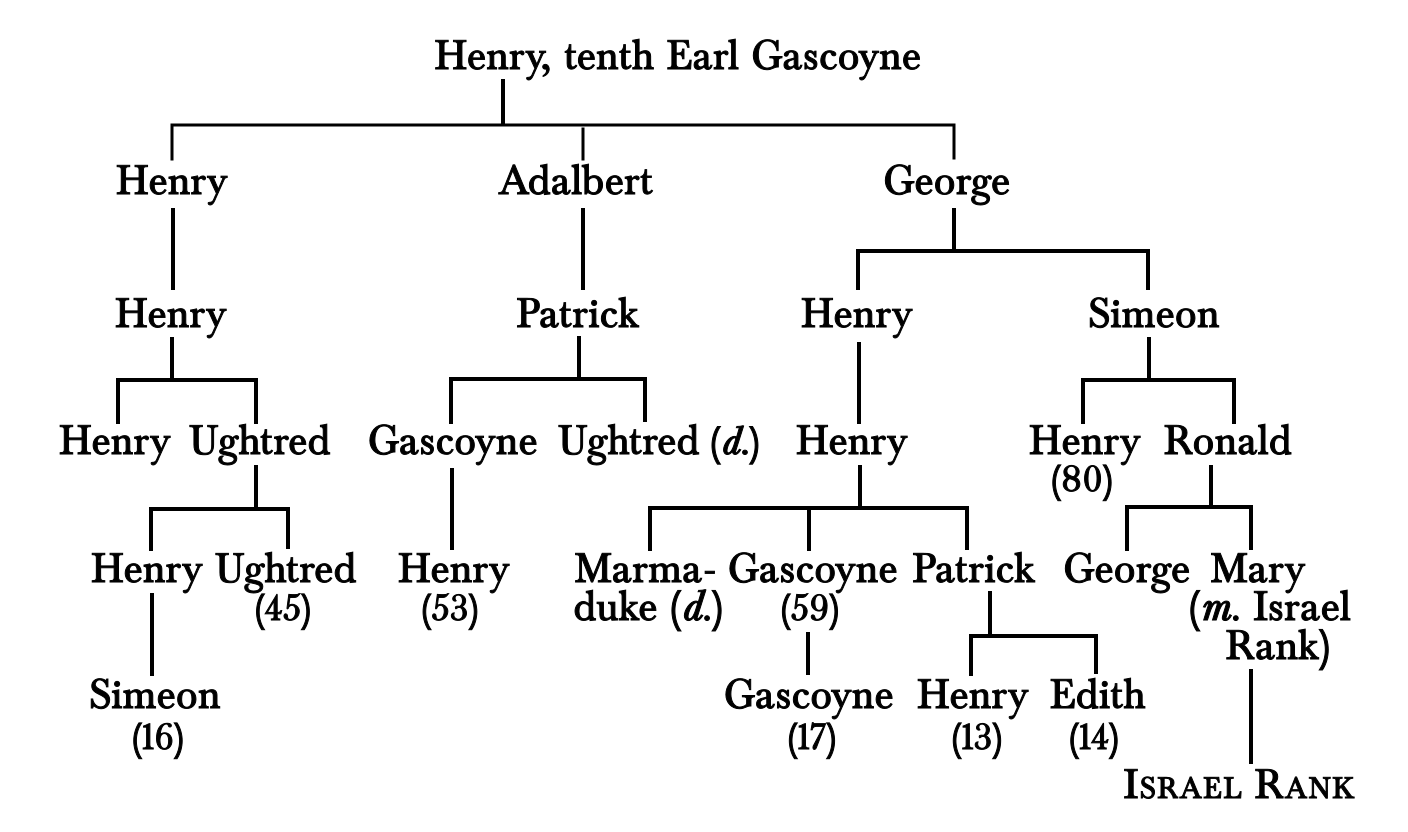
I took out the genealogical tree and studied it
carefully, although there was little need of this, as I could
have passed an examination in the entire history of
the Gascoynes up to date at any moment.
There were now four lives between me and the
object of my ambition.
My great-uncle Henry, who was now very nearly
ninety years of age, lived somewhere in the North of
England. It was not necessary to consider him in
any way. He was a widower without children. There
was Ughtred, the uncle of the present peer, still a
man in the prime of life. He might yet marry and
have a family. He was devoted to good living and
had a reputation as a dilettante. I had never seen
him, but he had held office at Court, and was altogether
rather an important person.
My difficulties would come when I arrived at the
main branch of the family, and I reserved them for
the final stroke. I should then be obviously near the
succession and might be suspected of motives. A
great many eyes would be upon me, and there would
probably be a young baby and his perfectly healthy
father to deal with. I began to realise that so far I
had merely nibbled at my task.
It was advisable to give myself rest for a few
months, as I discovered that after each campaign my
nerve was apt to be slightly affected. I had proved
to my own satisfaction that the dictum, ‘murder will
out,’ was invented to frighten mankind, had in fact
been set up as a perpetual bogey. Nat Holway’s guilt
might be discovered, but the tracing of my anonymous
letter would be an almost impossible task.
I was very anxious to know how Janet Gray’s affair
was progressing, and rather hoped I might be asked
to stay at the Grange for a day or two. I gathered
as time went on that the friendship between Miss
Gascoyne and her aunt had grown stronger and stronger.
Mr. Gascoyne told me that their attachment was a
great relief to him, that the companionship of her
niece had to a great extent dissipated his wife’s
melancholy, and that having a common sorrow they were
very much in sympathy.
“They admire each other, and it is the dignified and
warm friendship of two women to whom respect is
essential. By the way, Israel, the girl Janet Gray is
married.”
“Indeed?”
“Yes, to a young miller called Nat Holway. He
is very steady and very well-to-do. I almost
wondered——” He pulled himself up abruptly.
“Yes, sir?” I queried.
“Nothing, nothing.”
I knew what he had intended to say, and fervently
wished that he would get rid of his vague suspicions.
I was glad, therefore, when he continued: “I have
often wondered whether my nephew may not have
had a fight with some admirer of Janet Gray, a fight
that ended unexpectedly in a tragedy.”
“Do you intend to pursue the matter?”
“No,” he answered, energetically. “I think when a
man undertakes the seduction of a girl he must look
for violence from those whose feelings he outrages or
from those whose hearths he pollutes. I could not if
it were my own son bring the avenger to so-called
justice. I may be wrong, but I believe that if my
niece were asked, she would agree with me.”
I breathed a sigh of relief, for they were not precisely
the sentiments I had expected from him.