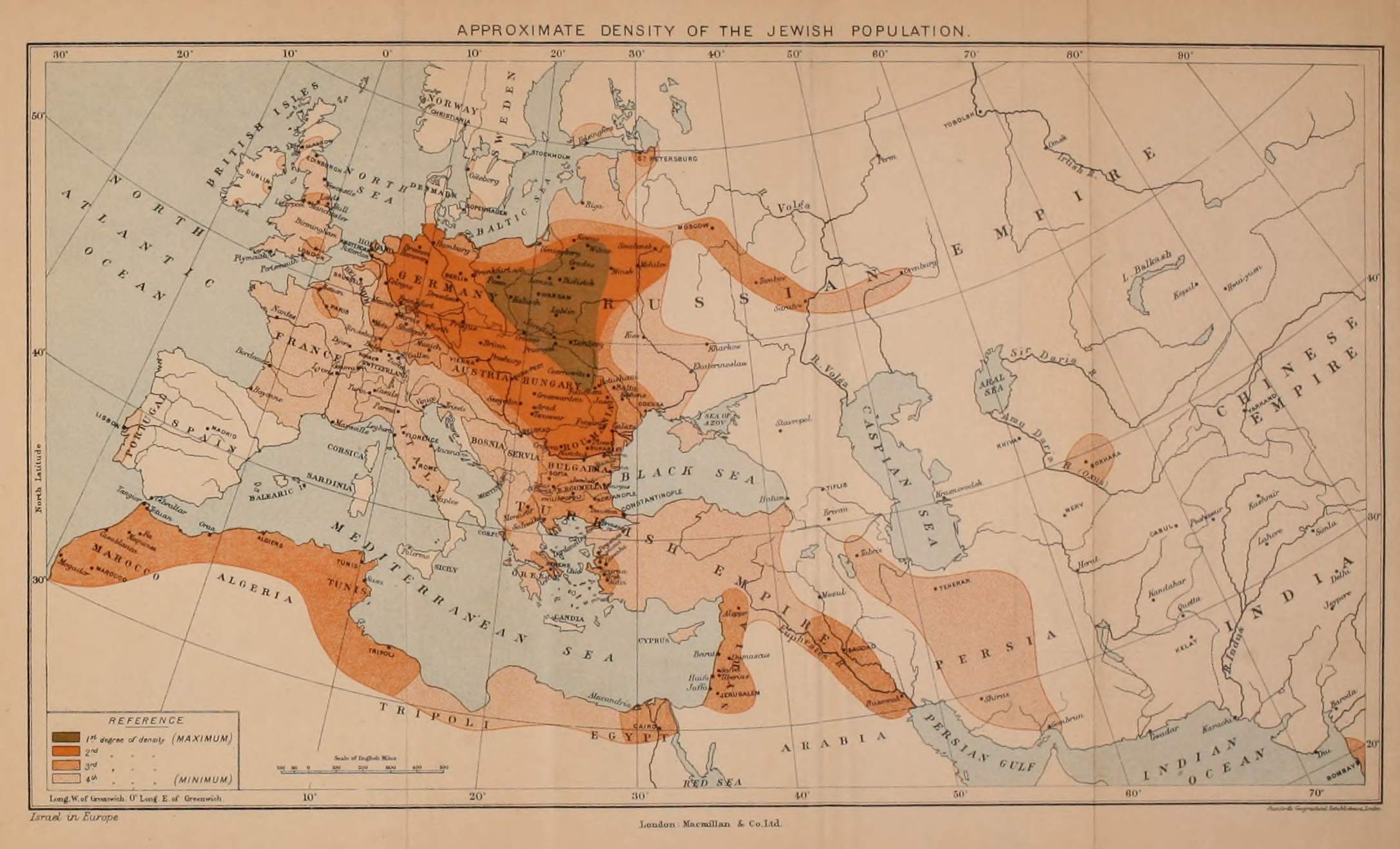
A larger version of the map near the end of the book may be seen by
right-clicking it and selecting an option to view it separately, or by
double-tapping and/or stretching it.
New original cover art included with this eBook is granted
to the public domain.
KNIGHT COMMANDER OF THE HELLENIC ORDER OF THE SAVIOUR
AUTHOR OF “SONGS OF MODERN GREECE,”
“THE TALE OF A TOUR IN MACEDONIA,”
“THROUGH INDIA WITH THE PRINCE,” ETC.
LONDON MACMILLAN AND CO., Limited NEW YORK: THE MACMILLAN COMPANY
1907
GLASGOW: PRINTED AT THE UNIVERSITY PRESS
BY ROBERT MACLEHOSE AND CO. LTD.
PREFATORY NOTE
The aims and the limits of the present work are
sufficiently explained in the Introduction. Here it only
remains for me to perform the pleasant duty of recording
my gratitude to Mr. I. Abrahams, of Cambridge,
for his friendly assistance in the revision of the
proofs and my indebtedness to him for many valuable
suggestions. He must not, however, be held to share
all my views.
“The Jewish Question,” Anon. (Gay and Bird, 1894).
“Aspects of the Jewish Question,” by “A Quarterly Reviewer.”
Encyclopædia Britannica: Article, “Zionism.”
In addition to these main guides reference, on special points, is made to
particular authorities in the footnotes.
INTRODUCTION
It was not without reason that Philo, the famous Graeco-Jewish
scholar of Alexandria, regarded Aaron’s rod, which
“was budded, and brought forth buds, and bloomed
blossoms, and yielded almonds,” as an emblem of his
race. Torn from the stem that bore and from the soil
that nourished them, and for nearly twenty centuries
exposed to the wintry blasts of adversity and persecution,
the children of Israel still bud and blossom and provide
the world with the perennial problem now known as the
Jewish Question—a question than which none possesses a
deeper interest for the student of the past, or a stronger
fascination for the speculator on the future; a question
compared with which the Eastern, the Irish, and all other
vexed questions are but things of yesterday; a question
which has taxed the ingenuity of European statesmen ever
since the dispersion of this Eastern people over the lands
of the West.
“What to do with the Jew?” This is the question.
The manner in which each generation of statesmen, from
the legislators of ancient Rome to those of modern
Roumania, has attempted to answer it, forming as it
does a sure criterion of the material, intellectual and
moral conditions which prevailed in each country at
each period, might supply the basis for an exceedingly
interesting and instructive, if somewhat humiliating,
study of European political ethics. Here I will content
myself with a lighter labour. I propose to sketch in
outline the fortunes of Israel in Europe from the earliest
times to the present day. It is a sad tale, and often
told; but sufficiently important to bear telling again.
My object—in so far as human nature permits—will be
neither to excuse nor to deplore; but only to describe
and, in some measure, to explain.
It is no exaggeration to say that the Jews have been
in Europe for a longer period than some of the nations
which glory in the title of European. Ages before the
ancestors of the modern Hungarians and Slavonians
were heard of, the keen features and guttural accents
of the Hebrew trader were familiar in the markets of
Greece and Italy. As early as the fourth century B.C. we
find the Hebrew word for “earnest-money” domiciled in
the Greek language (ἀρραβών), and as early as the second
century in the Latin (arrhabo)—a curious illustration of
the Jew’s commercial activity in the Mediterranean even
in those days.1 And yet, despite the length of their
sojourn among the peoples of the West, the majority of
the Jews have remained in many essential respects as
Oriental as they were in the time of the Patriarchs. A
younger race would have yielded to the influence of
environment, a weaker race would have succumbed to
oppression, a less inflexible or unsympathetic race might
have conquered its conquerors. But the Jews, when they
first came into contact with Europe, were already too
old for assimilation, too strong for extermination, too
hardened in their peculiar cult for propagandism. Even
after having ceased to exist as a state Israel survived
as a nation; forming the one immobile figure in a
perpetually moving panorama. The narrow local idea
of the ancient Greek state was merged into the broad
cosmopolitanism of the Macedonian Empire, and
that, in its turn, was absorbed by the broader
cosmopolitanism of Imperial Rome. But the Jew
remained faithful to his own olden ideal. Monotheism
superseded Polytheism, and the cosmopolitanism of the
Roman Empire was succeeded by that of the Roman
Church. The Jew still continued rooted in the past.
Mediaeval cosmopolitanism gave way to the nationalism
of modern Europe. Yet the Jew declined to participate
in the change. Too narrow in one age, not narrow
enough in another, always at one with himself and at
variance with his neighbours, now, as ever, he offers
the melancholy picture of one who is a stranger in the
land of his fathers and an alien in that of his adoption.
The upshot of this refusal to move with the rest of the
world has been mutual hatred, discord, and persecution;
each age adding a new ring to the poisonous plant of
anti-Judaism. For this result both sides are to blame—or
neither. No race has ever had the sentiment of
nationality and religion more highly developed, or been
more intolerant of dissent, than the Jewish; no race has
ever suffered more grievously from national and religious
fanaticism and from intolerance of dissent on the part
of others. The Jewish colonies forming, as they mostly
do, small, exclusive communities amidst uncongenial
surroundings, have always been the objects of prejudice—the
unenviable privilege of all minorities which stubbornly
refuse to conform to the code approved by the majority.
The same characteristics evoked a similar hostility
against primitive Christianity and led to the persecution
of the early martyrs. No one is eccentric with
impunity. Notwithstanding the gospel of toleration
constantly preached by sages, and occasionally by saints,
the attitude of mankind has always been and still is
one of hostility towards dissent. Sois mon frère, ou je
te tue is a maxim which, in a modified form, might be
extended to other than secret revolutionary societies.
The only difference consists in the manner in which
this tyrannical maxim is acted upon in various countries
and ages: legal disability may supersede massacre, or
expulsion may be refined into social ostracism; yet the
hostility is always present, however much its expression
may change. Man is a persecuting animal.
To the Jews in Europe one might apply the words
which Balzac’s cynical priest addressed to the disillusioned
young poet: “Vous rompiez en visière aux idées du monde
et vous n’avez pas eu la considération que le monde accorde
à ceux qui obéissent à ses lois.” Now, when to mere
outward nonconformity in matters of worship and
conduct is superadded a radical discrepancy of moral,
political, and social ideals, whether this discrepancy be
actively paraded or only passively maintained, the outcome
can be no other than violent friction. It is,
therefore, not surprising that the “black days” should
vastly outnumber the “red” ones in the Jewish Calendar—that
brief but most vivid commentary on the tragic
history of the race. The marvel is that the race should
have survived to continue issuing a calendar.
At the same time, a dispassionate investigation would
prove, I think, to the satisfaction of all unbiassed minds,
that the degree in which the Jews have merited the odium
of dissent has in every age been strictly proportionate to the
magnitude of the odium itself. Even at the present hour
it would be found upon enquiry that the Jews retain most
of their traditional aloofness and fanaticism—most of what
their critics stigmatise as their tribalism—in those countries
in which they suffer most severely. Nay, in one and the
same country the classes least liable to the contempt,
declared or tacit, of their neighbours are the classes least
distinguished by bigotry. It is only natural that it should
be so. People never cling more fanatically to the ideal
than when they are debarred from the real. Christianity
spread first among slaves and the outcasts of society, and
its final triumph was secured by persecution. We see a
vivid illustration of this universal principle in modern
Ireland. To what is the enormous influence of the
Catholic Church over the minds of the peasantry due, but
to the ideal consolations which it has long provided for
their material sufferings? Likewise in the Near East.
The wealthy Christians, in order to save their lands from
confiscation, abjured their religion and embraced the
dominant creed of Islam. The poor peasants are ready
to lay down their lives for their faith, and believe that
whosoever dies in defence of it will rise again to life
within forty days. It is easy to deride the excesses of
spiritual enthusiasm, to denounce the selfish despotism of
its ministers, and to deplore the blind fanaticism of its
victims. But fanaticism, after all, is only faith strengthened
by adversity and soured by oppression.
Jewish history itself shows that the misfortunes which
fan bigotry also preserve religion. Whilst independent
and powerful, the Jews often forgot the benefits bestowed
upon them by their God, and transferred the honour due
to Him to the strange gods of their idolatrous neighbours.
But when Jehovah in His wrath hid His face from His
people and punished its ingratitude by placing it under a
foreign yoke, the piety of the Jews acquired in calamity a
degree of fervour and constancy which it had never
possessed in the day of their prosperity. The same
phenomenon has been observed in every age. When
well treated, the Jews lost much of their aloofness, and
the desire for national rehabilitation was cherished only
as a romantic dream. But in times of persecution
the longing for redemption, and for restoration under
a king of their own race, blazed up into brilliant
flame. The hope of the Messianic Redeemer has been a
torch of light and comfort through many a long winter’s
night. But it has burnt its brightest when the night has
been darkest. If at such times the Jews have shown an
inordinate tenacity of prophetic promise, who can blame
them? They who possess nothing in the present have
the best right to claim a portion of the future.
CHAPTER I HEBRAISM AND HELLENISM
In spite of the well-known influence which Greek culture
and Greek thought exercised over a portion of the Jews
under Alexander the Great’s successors, the mass of the
Hebrew nation never took kindly to Hellenism. Alexander
proved himself as great a statesman as he was a
warrior. An apostle of Hellenism though he was, he
did not seek to consolidate his Empire by enforcing
uniformity of cult and custom, as short-sighted despots
have done since, but by encouraging friendly intercourse
between the Greeks and the various peoples that came
under his sceptre. Gifted with rare imagination, he
entered into the feelings of races as diverse as the
Egyptian and the Jewish. To the latter he allotted
the border-lands which had long been the bone of contention
between themselves and the Samaritans. He
relieved them from taxation during the unproductive
Sabbath year. He respected their prejudices, honoured
their religion, and appreciated their conscientious scruples.
While, out of deference to Chaldean religious feeling, he
ordered the Temple of Bel to be rebuilt in Babylon, he
forgave the Jewish soldiers their refusal to obey his
command as contrary to the teaching of their faith. Conciliation
was the principle of Alexander’s imperialism and
the secret of his success. ♦301 B.C.♦ The Ptolemies, to whose share,
on the partition of the Macedonian Empire, Palestine
ultimately fell, inherited Alexander’s enlightened policy.
The High Priest of the Jews was recognised as the head
of the nation, and it was through him that the tribute
was paid. So fared the Jews at home.
Abroad their lot was equally enviable. Some modern
critics had doubted the settlement of Jews in Egypt
until the third century. But recent discoveries (notably
Mr. R. Mond’s Aramaic Papyri) prove that a
Jewish community existed in Egypt even in the
centuries preceding Alexander. Now persuasion and
the hope of profit drew many thousands of them to
Alexandria, Cyrene, and other centres of Hellenistic
culture. In all these places they lived on terms of
perfect equality with the Greek colonists. The newly-built
city on the mouth of the Nile soon became
a seat of Jewish influence and a school of learning for
the Jewish nation. Under the benign rule of the
Ptolemies the Jews prospered, multiplied, and attained
success in every walk of life, public no less than private.
Of the five divisions of Alexandria they occupied
nearly two. Egypt was then the granary of Europe, and
the corn trade lay largely in Jewish hands. Refinement
came in the train of riches, and freedom begot tolerance.
The Jews cultivated Greek letters, and some of them
became deeply imbued with the spirit of Greek philosophy
and even of art. This friendly understanding between
the Jewish and the Greek mind gave to the world the
mystic union of Moses and Plato in the works of Philo
and the Septuagint translation of the Old Testament,
which was to prepare the way for the advent of
Christianity. And yet the bulk of the Alexandrian Jews
remained a peculiar people. Greeks and Egyptians had
fused their religions into a common form of worship.
But the Jews were still separated from both races by the
invincible barriers of belief, law, and custom. They still
looked upon Jerusalem as their metropolis, and upon
Alexandria as a mere place of exile. In the midst of
paganism they formed a monotheistic colony. Their
houses of prayer were also schools of Levitical learning,
where the Torah was assiduously studied and expounded.
Their one link with the State was their own Ethnarch,
who acted as supreme sovereign and judge of his people,
and represented it at Court.
Similar conditions prevailed in Palestine. There also
Hellenic language, manners, feasts, games, and philosophy
effected an entrance through the influence of the Greek
colonies on the coast, and a party of Jewish Hellenists
was formed. In the land which once rang with the prophetic
utterances of an Isaiah and a Jeremiah were now
sung the love-poems of Sappho, and were quoted the witty
sarcasms of the Athenian Voltaire, Euripides. But the
Torah, or Jewish religious law, was bitterly opposed to
all innovations, and the anti-Greek section of the people,
termed the “Pious” (Chassidim or Assideans), regarded
with deep misgiving the inroad of the foreign culture.
Hence arose an implacable feud between the Liberals and
the Conservatives, who hated, anathematised, and later
crucified each other as cordially as brethren only can do.
But the Chassidim, though politically worsted, were all-powerful
in the affections of the community, and the time
was not distant when they were to assume the supreme
command.
In 198 B.C. Palestine, after a hundred years’ struggle,
passed under the sway of the Graeco-Syrian Seleucids,
who, unlike their predecessors, initiated a policy of
forcible assimilation, and, aided by the Hellenistic party
among the Jews themselves, compelled their subjects
to adopt their own civilisation and to pay homage to their
own gods. However, neither the tolerance of the Graeco-Egyptian
nor the violence of the Graeco-Syrian kings
succeeded in reconciling the Jew to the ways of the
Gentile. ♦175–164 B.C.♦ Antiochus Epiphanes might banish Jehovah
from the Temple of Jerusalem and enthrone Zeus in his
stead; he might set up altars to the pagan deities in
every town and village; and he might exhaust all the
resources of despotism in the cause of conversion. The
timorous were coerced into a feigned and transient
acquiescence, but the bulk of the nation, baited into
stubbornness, preferred exile or martyrdom to apostasy.
The defiled temple remained empty and the altars cold,
until the smouldering discontent of the outraged people
broke out into flame, and passive resistance yielded to
fierce rebellion.
♦166–141 B.C.♦
The movement was led by the heroic, devout, and
fierce house of the Maccabees—a branch of the Hasmonaean
family—who, after a long struggle, distinguished by
splendid endurance, astuteness, and unspeakable severity,
delivered their people from the levelling Hellenism of
the foreign rulers, instituted the Sanhedrin (Συνέδριον), and
restored the national worship of Jehovah in all its pristine
purity and narrowness. ♦163 B.C.♦ The victorious band finally entered
Jerusalem “with praise and palm branches and with harps
and cymbals and viols and with hymns and with songs,”2
Simon was acclaimed High Priest and Prince of Israel, and
a new era was inaugurated. ♦141. May 23.♦ The restoration of the Temple
is still celebrated by the Jews in their annual eight days’
Feast of Dedication (Chanukah), when lamps are lit and a
hymn is solemnly sung commemorating the miracle of
the solitary flask of oil, which escaped pagan pollution
and kept the perpetual light burning in the House of the
Lord until the day of redemption.
But religious enthusiasm, though a powerful sword, is
an awkward sceptre, and it was not long ere the victorious
family forgot, as the “Pious” would have said, the cause
of God in the pursuit of self-aggrandisement and earthly
renown. The conservative elements had been united in
the supreme effort to maintain their religious liberty.
But the interest in gaining political independence was
limited to the ruling family. The Hasmonaeans, having
established their dynasty, aimed at conquest abroad and
at royal splendour at home. One of them surrounded
himself with a foreign bodyguard, and another assumed
the title of King. Of their former character they
retained only the enthusiast’s ferocity. Their family was
torn with feuds and stained with the blood of its own
members. This policy of worldly ambition lost them the
support of the Chassidim, who could tolerate bloodshed
only for the sake of righteousness. Moreover, the
Hasmonaeans, in their new position as an established
family, had more in common with the priestly aristocracy
than with the poor fanatics by whose enthusiasm they had
conquered that position. They, therefore, joined the
Hellenizing party, and, though a barefaced adoption of
the foreign gods was no longer possible, they endeavoured
to effect by example what the Seleucids had vainly
attempted to achieve by force. They were not altogether
unsuccessful. Greek architecture was introduced into Jerusalem.
The Greek numerals were adopted. Greek was
understood by all the statesmen of Judaea and employed
in diplomatic negotiations. Greek names became not
uncommon. The Hebrew bards ceased to hang their
harps upon the willow-trees. There was no longer need
for bitter lamentation or lyric inspiration. Prose, tame
but sober, superseded the fiery poetry of olden times.
Hymns gave place to history. The Jews were at last
enjoying with calm moderation their triumphs, religious
and political, over their foreign and domestic enemies.
But, if the Hebrew muse was silent for want of
themes, the Hebrew genius, which had dictated the ancient
psalms and inspired the ancient prophets, was not dead.
The national attachment to tradition and strict Judaism
was manifested by the revival of Hebrew as a spoken
tongue. It was employed on the coinage, in public edicts,
and in popular songs. Patriotism was nourished by the
celebration of the anniversaries of the national victories
over the enemies of Judaism. In one word, the crowd
refused to follow the fashions of the Court. The Jew had
tasted the fruit of Occidental culture and pronounced it
unpalatable. Hellenism had been touched and found base
metal; and, notwithstanding his Kings’ efforts—their
Greek temples and Greek theatres—the Hebrew remained
an Oriental. “Cursed is the man who allows his son to
learn the Grecian wisdom” was the verdict of the Talmud,
and a Jewish poet many centuries after repeats the anathema
in a milder form: “Go not near the Grecian
wisdom. It has no fruit, but only blossoms.”3
But, though the bulk of the nation agreed in its
attitude towards foreign culture, there now appears an
internal division into several parties, differing from one
another in the degree of their attachment to the traditions
of the past, and in their aspirations for the future. Two
of these sects stand out pre-eminently as representative of
Hebrew sentiment, and as the exponents of the two attitudes
which have continued to divide the Jewish nation
through the ages down to our own day. These are the
Pharisees and the Sadducees, whose names are first heard
under the early Hasmonaean chiefs, but whose views
correspond with those of the Hellenistic and national
parties of the Seleucid period. The Pharisees were an offshoot
of the Assidean party which, as we have seen, had
waged a truceless and successful war against Hellenism.
After their victory, the most enthusiastic of the “Pious”
retired from public life and nursed their piety and disappointment
in ascetic seclusion. But the majority of the
party were far from considering their mission fulfilled, or
from being satisfied with abstract devotion. They regarded
it as a duty both to the faith and to the fatherland to take
an active part in politics. The preservation of Judaism
in its ancient exclusiveness was their programme. All
public undertakings, all national acts, as well as all private
transactions, were to be measured by the rigid standard of
religion. The Law in the hands of the Pharisees became a
Procrustean bed upon which the mind of the nation was
to be stretched or maimed, according to the requirements
of nationalism and the interpretations of the Scribes.
This inflexible orthodoxy, with its concomitants of discipline
and sacrifice of individuality, was in perfect accord
with the Hebrew temperament, and the Pharisees must be
regarded as the interpreters of the views dear to the great
mass of their compatriots. As time went on, the Pharisaic
attitude became more and more hardened into a theological
creed, clothed in a web of ceremonial formalities, but vivified
by an inspiring devotion to the will of Jehovah, and
an ardent belief in the ultimate triumph of His Elect.
Against this teaching arose the sect of the Sadducees,
who played towards Pharisaism a part in one respect
analogous to that played by Protestantism towards
Catholicism, in another to that played by the Cavaliers
towards the Roundheads. They derived all their religious
tenets from the letter of Scripture, rejecting the lessons of
oral tradition and the “legacies of the Scribes.” They
refused to believe in angels or in the resurrection of the
dead, and they repudiated the fatalistic doctrine that the
future of the individual and of the state depends not upon
human action but upon the divine will, fixed once for all.
They pointed out that, if this were the case, the belief in
God’s justice would be reduced to an absurdity, as saint
and sinner would be confused in one indiscriminate
verdict. The Sadducees held that man is master of his
own fortunes. The Pharisees met the objection of their
opponents as to divine justice by the non-Scriptural
doctrine of the resurrection of the dead, which had crept
into Judaism in the latter years of the Babylonian captivity.
If the saint and the sinner fared alike in this life,
they argued, the balance would be restored in the next.
The righteous would then rise up to everlasting bliss, and
the wicked to everlasting shame. This and other minor
points formed the ground of dogmatic difference between
the two sects. Their difference in questions of practical
politics and in social views was characteristic of their
respective creeds. The Sadducees, far from expecting the
salvation of the nation from a miraculous intervention of
the Deity, looked to human wisdom for help. They
placed the interests of the State above the interests of the
Synagogue. They shared in the aristocrat’s well-bred
horror of disturbing enthusiasms and of asceticism.
Though recognising the authority of the Law, they were
temperate in their piety and could not live by unleavened
bread alone. They favoured Hellenism and supported
the Hasmonaean kings in their efforts to shake off the
trammels of ecclesiastical tyranny. ♦40–4 B.C.♦ The liberal and progressive
and, at the same time, degenerate tendencies of
the Sadducean protestants are seen under their most
pronounced form in the sect of the Herodians, who
later helped Herod the Great in his endeavour to render
pagan culture popular among his subjects by the erection
of temples and theatres, by the adoption of heathen
fashions of worship, and by the encouragement of the
Hellenic games. The party of the Sadducees included the
great priestly families, the noble, and the wealthy, that is,
the minority. Their opponents interpreted the feelings of
the lower priesthood and of the people. Judaism, as
understood by the Pharisees, was the idol for which the
nation had suffered martyrdom, and the national devotion
to that idol had gained new fervour from the recent
struggle with Hellenism.
The hatred of the Jews towards Hellenism may, in one
sense, be regarded as a sequel to that older hostility which
appears to have embittered the intercourse between
Europe and Asia from the very dawn of history. It is an
antipathy which under various names and guises continues
prevalent to this day—revealing itself now in anti-Semitism,
now in anti-Turkism, and again in the exclusion
of Asiatic immigrants from English-speaking countries:
a sad legacy received from our far-off ancestors and likely
to be handed down to a remote posterity. Long before
the appearance of the Jew on the stage of European
politics this antagonism had manifested itself in the
hereditary feud between Hellene and Barbarian which the
ingenious Herodotus traced to the reciprocal abductions
of ladies by the inhabitants of the two continents, and of
which, according to his theory, the Trojan war was the
most important and brilliant episode.4 The same feud
was in historic times dignified by the Persian king’s
gigantic effort to subdue Europe and, at a later period,
by Alexander’s success in subduing Asia. Had the father
of history been born again to celebrate the exploits of
the latter hero, he would, no doubt, have described the
Macedonian campaign as part of the chain of enmity
the first links of which he had sought and found in
the romantic records of mythical gallantry. The modern
student, while smiling a superior smile at his great forerunner’s
simple faith in legend and traditional gossip,
cannot but admit that there was true insight in Herodotus’s
comprehensive survey of history; but, examining things by
the light of maturer experience and with a less uncritical
eye, he will be inclined to regard this venerable strife as the
result of a far deeper antagonism between rival civilisations,
rival mental and moral attitudes—the attitudes which in
their broadest outlines may be defined as Oriental and Occidental
respectively; in their narrower aspect, with which we
are more immediately concerned, as Hebraic and Hellenic.
The Jew had one quality in common with the Greek.
They both saw life clearly and saw it as a harmonious
whole. But they each saw it from an opposite standpoint.
The thoroughness, consistency, and unity of each
ideal by itself only rendered its incompatibility with the
other more complete. It is to this incompatibility that
must be attributed the failure of Hellenism in Western
Asia generally and among the Jews in particular. A
system of life reared upon a purely intellectual basis had
no charm for a race essentially spiritual. The cold
language of reason conveyed no message to the mind of
the Hebrew who, in common with most Orientals, looks
to revealed religion alone for guidance in matters of belief
and conduct. The Oriental never feels happy except in a
creed, and the Hellene offered him nothing better than an
ethical code. How mean and how earthy must this code
have appeared in the eyes of men accustomed to the
splendid terrors of the Mosaic Law! Again, the intellectual
freedom—the privilege of investigating all and
testing all before accepting anything as true—which the
Greek has claimed from all time as man’s inalienable
birthright, and upon which he has built his noble civilisation,
was repugnant to a people swathed in the bands of
tradition and distrusting all things that are not sanctioned
by authority. The Greek had no word for Faith as
distinct from Conviction. He revered intelligence and
scorned intuition. What man’s mental eye could not
see clearly was not worth seeing, or rather did not
exist for him. Palestine was the home of Revelation;
Hellas of Speculation. The one country has given us
Philosophy and the Platonic Dialogues; the other the
Prophets and the Mosaic Decalogue: the former all
argument, the latter all commandment.
The following conversation between two representatives
of the two worlds brings their respective attitudes into
vivid relief. One is Justin Martyr, the other a mysterious
personage—probably a fictitious character—who sowed in
Justin’s mind the seed of the new religion.
Justin. Can man achieve a greater triumph than prove
that reason reigns supreme over all things, and having
captured reason and being borne aloft by it to survey the
errors of other men? There is no wisdom except in
Philosophy and right reason. It is, therefore, every man’s
duty to cultivate Philosophy and to deem that the greatest
and most glorious pursuit, all other possessions as of
secondary or tertiary value; for, if these are wedded to
Philosophy, they are worthy of some acceptance; but, if
divorced from Philosophy, they are burdensome and
vulgar.
Stranger. What is Philosophy and what the happiness
derived therefrom?
Justin. Philosophy is the Knowledge of that which
is and is true. The happiness derived therefrom is the
prize of that knowledge.
Stranger. How can the Philosophers form a correct
notion of God, or teach anything true concerning him,
since they have neither seen him nor heard of him?
Justin. God cannot be seen with the eye, but only
comprehended by the mind.
Stranger. Has our mind, then, such and so great a
power as to perceive that which is not perceptible through
the senses? Or can man’s mind ever see God unless
it is adorned with the holy spirit?
Justin. To whom can, then, one apply for teaching,
if there is no truth in Plato and Pythagoras?
Stranger. There have been men of old, older than
any of these reputed philosophers, saintly men and just,
beloved of God, who spoke through the divine spirit and
predicted the things that were to be. These men are
called Prophets. They alone saw the truth and declared
it unto men; neither favouring nor fearing any one; not
slaves to ambition; but only speaking the things which
they heard and saw when filled with holy spirit. Their
works are still extant, and the lover of wisdom may find
therein all about the beginning and end of things, and
every thing that he need know. They had not recourse
to proof, for they were above all proof, trustworthy
witnesses of the truth. Pray thou above all things that
the gates of the light may be opened unto thee.5
This diversity of view reveals itself in every phase of
Hebrew and Hellenic life—political, social, religious and
artistic. The Greeks very early outgrew the primitive
reverence for the tribal chief—the belief that he derived
his authority from Heaven, and that he was, on that
account, entitled to unlimited obedience on the part of
man. Even in the oldest form of the Greek state known
to us—the Homeric—the king, though wielding a sceptre
“given unto him by Zeus,” is in practice, if not in theory,
controlled by the wisdom of a senate and by the will of
the people. Monarchy gradually developed into oligarchy,
and this gave way to democracy. Nor was the evolution
effected until the sacerdotal character, which formed one of
the king’s principal claims to reverence and obedience, lost
its influence over the Greek mind. In historic times the
impersonal authority of human law stood alone and paramount,
quite distinct from any religious duty, which was a
matter of unwritten tradition and custom. The divorce
of the Church from the State in Greece was complete.
Now, among the Jews the opposite thing happened. Kingship
remained hereditary and indissolubly associated with
sacerdotalism. The Semite could not, any more than the
Mongol, conceive of a separation between the spiritual and
the temporal Government. The King of Israel in the
older days always was of the house of David, always
anointed, and always wore the double crown of princely
and priestly authority. And when, after the return from
Babylon, the house of David disappears from sight, its
power is bequeathed to the hereditary high-priest. To the
Jew Church and State, religion and morality, continued to
be synonymous terms; the distinction between the sacred
and the secular sides of life was never recognised; all law,
political and social, emanated from one Heaven-inspired
code; and, while Greece was fast progressing towards
ochlocracy, Judaea remained a theocracy.
The Greek was an egoist. He disliked uniformity.
Although in the direction of his private life he voluntarily
submitted to a variety of state regulations such as the
citizen of a modern country would resent as an irksome
interference with the liberties of the individual, yet,
judged by the standard of antiquity, the Greek was anything
but amenable to control, and, as time went on, his
attitude became little better than that of a highly civilised
anarchist. There were limits beyond which the Greek
would never admit his neighbour’s right to dictate his
conduct any more than his thoughts. He suffered from
an almost morbid fear of having his individuality merged
in any social institution. He would rather be poor in his
own right than prosper by association with others. Discipline
was the least conspicuous trait in his character and
self-assertion the strongest. The Greek knew everything
except how to obey. The Jew, on the other hand, found
his chief happiness in self-effacement and submission. His
everyday life, to the minutest details, was regulated by the
Law. He was not even allowed to be virtuous after his
own fashion. The claims of the individual upon the
community were only less great than the claims of the
community upon the individual. The strength of
Hebraism always lay in its power of combination, the
weakness of Hellenism in the lack of it.
Equally striking is the contrast discerned between the
aesthetic ideals of the two races. Much in Hebrew
imagination is couched in forms which would lose all their
beauty and freshness, if expressed in colour or marble;
much that would look grotesque, if dragged into the daylight
of pure reason. Its effect depends entirely on the
semi-darkness of emotional suggestion. Now the Greek
hated twilight. He had no patience with the vague and
the obscure in imagination any more than in thought.
Hence artistic expression was nothing to the Jew; everything
to the Greek. Judaism shunned pictorial representation;
Hellenism worshipped it. And, as art in
antiquity was largely the handmaid of religion, this
diversity of the aesthetic temperament led to an irreconcilable
religious antagonism. The Jew looked upon the
pagan’s graven images with abhorrence, and the pagan
regarded the Jew’s adoration of the invisible as a proof
of atheism.
Not less repugnant to the Hebrew was the Hellenic
moral temperament as mirrored in literature, in social life,
and in public worship—that temperament which, without
being altogether free from pessimism, melancholy, and discontent,
yet finds its most natural expression in a healthy
enjoyment of life and an equally healthy horror of death.
“I would rather be a poor man’s serf on earth than king
among the dead!” sighs Achilles in Hades, and the
sentiment is one which his whole race has echoed through
the ages, and which, despite nineteen centuries of Christianity,
is still heard in the folk-songs of modern Greece.
The Greek saw the world as it is, and, upon the whole,
found it very good. He tasted its pleasures with moderation
and bore its pains with a good grace. He perceived
beauty in all things; adoring the highest and idealising
the meanest. Even the shrill song of the humble grasshopper
held sweet music for the Greek. He revelled in
the loveliness and colour of life. He was inspired by the
glory of the human form. He extolled the majesty of
man. The Hebrew mind was nursed by meditation; the
Hellenic drew its nourishment from contemplation.
Nature was the Greek’s sole guide in taste as well as
in conduct; from nature he learnt the canons of the
beautiful as well as the laws of right and wrong. Hence
no country has produced greater poets than Greece, or
fewer saints.
How could this view of things, so sane and yet so
earthy, be acceptable to a race oppressed by the sense of
human suffering as the fruit of human sin? “Serve the
Lord with joy; come before him with singing,” urged the
Psalmist in a moment of optimistic cheerfulness. But it
was only for a moment.6 The true note of Hebraism
is struck in another text: “Vanity of vanities, saith the
Preacher, vanity of vanities; all is vanity.” The Greek
understood the meaning of the sad refrain; but he did
not allow it to depress him. To the Greek life was a
joyous reality, or at the worst an interesting problem;
to the Jew a bad dream, or at the best an inscrutable
mystery. To the Hebrew mind the sun that shines in
the sky and the blossoms that adorn the earth are at
most but pale symbols of Divine Love, pledges for a bliss
which is not of this world. And yet Socrates emptied the
cup of death with a smile and a jest, where Job would
have filled the world with curses and bitter lamentation.
Laughter came as spontaneously to the Greek as breath,
and the two things died together. The Jew could not
laugh, and would not allow any one else to do so. The
truth is that the Greek never grew old, and the Jew
was never young.
Another lively illustration of the gulf which separated
the two races is offered by the Greek games. These
were introduced into Palestine by the Greek rulers and
colonists, were adopted by the Hellenizing minority
among the Jews themselves, and were denounced with
horror by the Conservative majority. Nudity, in the
eyes of the latter, was the colophon of shamelessness,
while by the Greeks the discarding of false shame was
regarded as one of the first steps to true civilisation.
Thucydides mentions the athletic habit of racing perfectly
naked as an index to the progress achieved by his country
and as one of the things that marked off the Hellene
from the Barbarian.7 The Greeks were free from that
morbid consciousness of sex which troubled the over-clothed
Asiatics. Nor were they aware of that imaginary
war between the spirit and the flesh which gave rise
to the revolting self-torments of Eastern aspirants to
heaven.
The peculiar characteristics of the Hebrew mind found
their supreme manifestation in the sect of the Essenes—the
extreme wing of the Pharisaic phalanx. The strictness
of the Pharisees was laxity when compared with the
painful austerity of their brethren. The latter aimed at
nothing less than a pitiless immolation of human nature to
the demands of an ideal sanctity. Enamoured of this
imaginary holiness, the Essenes disdained all the real
comforts and joys of life. Their diet was meagre, their
dwellings mean, their dress coarse. Colour and ornament
were eschewed as Satanic snares. The mere act of
moving a vessel, or even obedience to the most
elementary calls of nature, on the Sabbath, was
accounted a desecration of the holy day. Contact with
unhallowed persons or objects was shunned by the
Essenes as scrupulously as contact with an infected
person or object is shunned by sane people in time
of plague. They refused to taste food cooked, or to
wear clothes made, by a non-member of the sect, or to
use any implement that had not been manufactured by
pure hands. Their life in consequence was largely spent
in water. For whosoever was not an Essene was, in the
eyes of these saints, a source of pollution. Thus godliness
developed into misanthropy and cleanliness into
a mania. Thus these holy men lived, turning away from
the sorrows of the earth to the peace of an ideal heaven;
deriving patience with the present from apocalyptic
promises of future glory; and waiting for the day when
the unrighteous would be smitten to the dust, the dead
rise from their graves, and the just be restored to everlasting
bliss under the rule of the Redeemer—the Son of
Man revealed to the holy and righteous because they
have despised this world and hated all its works and
ways in the name of the Lord of Spirits. Celibacy,
seclusion, communion of goods, distinctive garb, abstinence,
discipline and self-mortification, ecstatic rapture,
sanctimonious pride and prejudice—all these Oriental
traits, gradually matured and subsequently rejected in
their exaggerated form from the main current of Judaism,
marked the Essenes out as the prototypes of Christian
monasticism, and as the most peculiar class of a very
peculiar people. Could anything be more diametrically
opposed to the genius of Hellas? Despite Pythagorean
asceticism and Orphic mysticism, enthusiastic ritual,
symbolic purifications and emotional extravagances,
Greek life was in the main sober, Greek culture
intellectual, and the Greek mind eminently untheological.
Those who delight in tracing racial temperament to
physical environment may find in the contrast between the
two countries an exceptionally favourable illustration of
their theory. There is more variety of scenery in a
single district of Greece than in the whole of Palestine.
Grey rocks and green valleys, roaring torrents and placid
lakes, sombre mountains and smiling vineyards, snow-clad
peaks and sun-seared plains, glaring light and deep shade
alternately come and go with a bewildering rapidity in the
one country. In the other, from end to end, the plain
spreads its calm, monotonous beauty to the everlasting
sun, and the stately palms rear their heads to the blue
heavens from year’s end to year’s end, severe, uniform,
immutable. It is easy to understand why the one race
should have drawn its inspiration from within and the
other from without; why the one should have sunk
the individual in the community and the other sacrificed
the community to the individual; why the one should
have worshipped the form and the other the spirit. It
is especially easy to understand the Greek’s inextinguishable
thirst for new things and the Jew’s rigid attachment
to the past. Everything in Greece suggests progress;
everything in Palestine spells permanence.
The result of this fundamental discrepancy of character
was such as might have been foreseen. The intense
spirituality of the Jew was scandalised at the genial rationalism
and sensuousness of the pagan; while the pagan, in
his turn, was repelled by the morose mysticism and austerity
of the Jew. History never repeats itself in all
particulars. But, so far as repetition is possible, it
repeated itself many centuries after, when Puritanism—representing
the nearest approach to the sad and stern
Hebraic conception of life that the Western mind ever
achieved—declared itself the enemy of Romanism, mainly
because the latter retained so much of the pagan love for
form and delight in things sensuous. Cromwell’s Ironsides
illustrated this attitude by marching to battle singing
the Psalms of the Hebrew bard. It is given to few
mortals, blessed with a calm and truly catholic genius,
to reconcile the rival attitudes, and, with Matthew
Arnold, to recognise that “it is natural that man should
take pleasure in his senses. It is natural, also, that he
should take refuge in his heart and imagination from his
misery.”
CHAPTER II THE JEW IN THE ROMAN EMPIRE
The animosity between Jew and Gentile grew in intensity
and bitterness under the Roman rule, and its growth was
marked by various acts of mutual violence which finally
resulted in the disruption of the Jewish State and the
dispersion of the Jewish race over the inhabited globe.
Already in the first half of the second century B.C. we find
a praetor peregrinus ordering the Jews to leave the shores
of Italy within ten days. This was only the commencement
of a long series of similar measures, all indicative
of the repugnance inspired by the Jewish colonists. ♦63 B.C.♦ The
hostility was enhanced by Pompey’s sack of Jerusalem
and his severity towards the people and the priests of
Palestine. Even in Rome, the hospitable harbour of
countless races and creeds, there was no place for these
unfortunate Semitic exiles, and their sojourn was punctuated
by periodical expulsions. History is silent on the first
settlement of Jews in the capital of the world, though the
origin of their community may plausibly be traced to the
embassy of Numenius.8 In any case, at the time of
Pompey’s expedition they already had their own quarter
in Rome, on the right bank of the Tiber, and their
multitude and cohesion, even then, were such that a contemporary
writer did not hesitate to state that a Governor
of Palestine, if unpopular in his province, might safely
count on being hissed when he returned home.
♦59 B.C.♦
It was not long after that date that Cicero pleaded the
cause of the Praetor Flaccus, accused of extortion during
his government of Asia Minor. The Roman Jews took a
keen interest in the case, and many of them crowded to
the trial, for among other charges brought against the
ex-praetor was that of having robbed the Temple of
Jerusalem. When Cicero reached that count of the
indictment, he gave eloquent testimony to the importance
of the Jewish element in Rome, to the feelings which he,
in common with others, entertained towards them, and to
his own want of spirit. “Thou well knowest,” says the
orator, addressing the Prosecutor, “how great is their
multitude, how great their concord, how powerful they
are in our public assemblies. But I will speak in an
undertone, so that none but the judges may hear. For
there is no lack of individuals ready to incite those fellows
against me and all honourable persons. But I will not
help them to do so.” Then, in a lowered voice Cicero
proceeds to defend his client’s conduct towards the “barbarous
superstition” of the Jews, and his patriotic defiance
of the “turbulent mob who invade our public assemblies.”
“If Pompey,” he says, “did not touch the
treasures of the Temple, when he took Jerusalem, his
forbearance was but another proof of his prudence: he
avoided giving cause of complaint to so suspicious and
slanderous a nation. It was not respect for the religion
of Jews and enemies that hindered him, but regard for
his own reputation.... Every nation has its own
religion. We have ours. Whilst Jerusalem was yet
unconquered, and the Jews lived in peace, even then they
displayed a fanatical repugnance to the splendour of our
state, the dignity of our name, and the institutions of our
ancestors. But now the hatred which the race nourished
towards our rule has been more clearly shown by force of
arms. How little the immortal gods love this race has
been proved by its defeat and by its humiliation.”9
Time did not heal the wound. Pompey had already
amalgamated the Jewish kingdom in the Roman province
of Syria and carried the last of the Hasmonaean princes
captive to Rome. Five years later the proconsul Sabinius
stripped the High Priest of the last shreds of civil
authority and divided Judaea into five administrative
districts. ♦57, 56, 55 B.C.♦ Frequent insurrections broke out in Palestine,
and were quelled with greater or less difficulty; the last
of them resulting in the robbery of the Temple of a
great part of its riches by the Proconsul Marcus Crassus,
while not long after the Quaestor Cassius, who acted as
Governor after the death of Crassus, sold 30,000 disaffected
Jews into slavery; and this state of things lasted
till the fall of the Roman Republic.
♦47 B.C.♦
Julius Caesar, like Alexander, was not slow to realise the
weight of the Jewish factor in the complex problem presented
by the conglomeration of nations which he had set
himself to rule. The numbers of the Jews scattered
throughout the Empire entitled them to serious consideration;
their wealth, their activity, and their unity rendered
them worthy of conciliation. Moreover, Caesar, with the
eye of a true statesman, saw that the representatives of this
race, so capable of adapting themselves to new climatic and
political conditions, and yet so tenacious of their peculiar
characteristics, might help to promote that cosmopolitan
spirit which was the soul of the Roman Empire. These
considerations were further reinforced by feelings of
gratitude; for Caesar had derived great assistance from
the powerful Jewish politician Antipater during his
Egyptian campaign. He, therefore, like his illustrious
predecessor, granted to the Jews of Alexandria special
privileges, shielding their cult from the attacks of the
pagan priests, and affording them facilities for commerce,
while in Palestine he reunited the five administrative
districts under the authority of the High Priest and
restored to the Jews some of the territory of which
Pompey had deprived them. In Rome also Caesar
manifested great friendship to the Jews. The Roman
Jews showed that they were not insensible to these acts
of kindness. At the tragic death of their benefactor they
surpassed all other foreigners in their demonstrations of
grief. Amidst the general lamentation, to which every
race contributed its share after its own fashion, the Jews,
we are told, distinguished themselves by waking and
wailing beside the funeral pyre for many nights.10 This
spontaneous offering of sorrow on the part of the foreign
subjects of Rome forms the best testimony to the nobility
of Rome’s greatest son. Caesar might well claim the
title of Father of mankind.
♦44 B.C.♦
The end of Caesar’s life proved also the end of the
consideration enjoyed by the Jews under his aegis.
Augustus, indeed, unbent so far as to order that prayers
for his prosperity should be offered up in the Temple of
Jerusalem, and even established a fund for a perpetual
sacrifice. But this was only an act of courtesy dictated by
reasons of policy. His real feelings towards the Jews and
their religion are better illustrated by his biographer’s
statement that, while treating the old-established cults
with the reverence to which their antiquity and respectability
seemed to entitle them, “he held the others in
contempt.” Among the gods deemed unworthy of
Imperial patronage were those of Egypt and Judaea.
During his sojourn in the land of the Pharaohs Augustus
refrained from turning aside to visit the temple of Apis.
Nor was he more respectful towards Jehovah. On the
contrary, “he commended his grandson Caius for not
stopping, on his passage through Palestine, at Jerusalem to
worship in the Temple.”11 The ancient writer’s juxtaposition
of Apis and Jehovah, linked at last in common
bondage, is as significant as it is quaint.
Under the successors of Augustus the Jews of Rome
had more than neglect to complain of. Their suppression
appears to have been now regarded as a public
duty. The biographer of Tiberius, in enumerating that
emperor’s virtues, among other proofs of patriotism,
includes his persecution of the obnoxious race. After
describing the measures taken against “outlandish ceremonies”
generally, and how those given to Egyptian and
Judaic superstitions were compelled to burn all their ritual
vestments and implements, he proceeds to inform us
calmly that “the Jewish youth, under pretence of having
the military oath of allegiance administered to them, were
distributed over the most unhealthy provinces, while the
rest of the race, or those who followed their cult, were
banished from the city under pain of perpetual servitude if
they disobeyed.”12 The indignation which these arbitrary
measures must have stirred up among the Jews found
vent in the following reign. The immediate cause of the
explosion was Caligula’s order that his own effigy should
be placed in the Temple of Jerusalem and that divine
honours should be paid to him throughout the empire—an
order which, however natural it might have appeared
to a Roman, outraged the vital principle of Hebrew
monotheism. ♦41 A.D.♦ The result was stern and unanimous resistance
on the part of the Jews, bloodshed being only
averted by the imperial lunatic’s opportune death.13
Meanwhile the Jews of Alexandria shared the woes of
their brethren in Palestine and Rome. Their prosperity
moved the envy of their Greek fellow-citizens, and the
two elements had always met in a commercial rivalry for
which they were not unequally matched. If Hebrew
astuteness found its hero in Jacob, Odysseus formed a
brilliant embodiment of Hellenic resourcefulness. Both
characters are typical of their respective races. They are
both distinguished not only by strong family affections,
by a pathetic love of home when abroad and a passionate
longing for travel when at home, by conjugal fidelity
tempered by occasional lapses into its opposite, and by
deep reverence for the divine, but also by a mastery of
wiles and stratagems unsurpassed in any other national
literature. It was, therefore, not surprising that the
descendants of these versatile heroes should regard each
other as enemies. The hostility was increased by social
and religious antipathy and by the favours which the
Greek kings of Egypt had always showered upon the
Jews. The fables and calumnies originally invented by
the Seleucid oppressors of Palestine spread to Egypt,
where they were amplified by local wits.
Under Augustus and Tiberius the lurking animosity
was obliged to content itself with such food as the
Greek genius for sarcasm and invective could afford;
but the accession of Caligula supplied an opportunity
for a more practical display of hatred. The Governor
of Alexandria, being in disgrace with the new Emperor
and afraid lest the Alexandrians should avail themselves
of the circumstance and lodge complaints against
him in Rome, became a tool of their prejudices. Two
unprincipled scribblers led the anti-Jewish movement.
Insult and ridicule were succeeded by violence, and
in the summer of 38 A.D. the synagogues of the
Jews were polluted with the busts of the Emperor.
The governor was induced to deprive the Jews of the
civil rights which they had enjoyed so long, and the unfortunate
people, thus reduced to the condition of outlaws,
were driven out of the divisions of the city which they
had hitherto occupied and forced to take up their abode
in the harbour. Their dwellings were looted and sacked,
the refugees were besieged by the mob in their new
quarters, and those who ventured out were seized, tortured,
and burnt or crucified. The persecution continued
with intermittent vigour until the Jews resolved to send
an embassy to Rome to plead their cause before the
Emperor. One of the envoys was the famous Jewish
Hellenist Philo. Caligula, however, declined to listen
to rhetoric or reason; but, on the contrary, he issued the
order for his own deification, which, as has been seen, was
frustrated only by his death.
Caligula’s successor Claudius favoured the Jews of
Palestine for the sake of their King Agrippa, to whose
diplomacy he owed in part his crown. But their brethren
in Rome suffered another expulsion for “continually disturbing
the peace under the instigation of Christ.”14 The
confusion of the Christians with the Jews by the Roman
writer is neither uncommon nor unintelligible. But, if
the Christians were persecuted as a Jewish sect—secret
and, therefore, suspected—the persecution of the Jews
themselves was frequently due to their peculiar “superstition.”
That, in common with other products of the
East, had found its way to Rome, where it acquired
great vogue and exercised a strange fascination, especially
among women and persons of the lower orders. Many
Gentiles visited the synagogues, and some of those
who went to scoff remained to worship. Horace, writing
in the time of Augustus, makes frequent mention of
Judaism,15 implying that it was spreading and that it
formed the topic of conversation in fashionable circles;
Josephus mentions a case of the conversion of a noble
Roman lady in the reign of Tiberius;16 Persius, under
Caligula and Claudius, sneers at the muttered prayers and
gloomy Sabbaths of the Jews and of Roman proselytes to
Judaism;17 while Seneca, under Nero, declares that “to
such an extent has the cult of that most accursed of races
prevailed that it is already accepted all over the world:
the vanquished have given laws to the victors.”18 Juvenal,
writing in the time of Titus and Domitian, bears similar
testimony to the prevalence of Judaism among the
Romans, many of whom, especially the poor, observed the
Jewish Sabbath and dietary laws, practised circumcision,
and indulged in Hebrew rites generally.19 To the Roman
satirists these aberrations from good sense and good taste
were a rich fountain of ridicule; but serious patriots
regarded them with misgiving, as detrimental to public
morality. Hence we usually find the expulsions of the
Jews and the suppression of their cult accompanied by
similar steps taken against Chaldean soothsayers, Egyptian
sorcerers, Syrian priests, and other purveyors of rites pernicious
to the virtue of Roman men and women.
Under Nero the hostility towards the Jews was temporarily
diverted against the Christians, and, while the
latter were ruthlessly made to pay with their lives for the
Emperor’s criminal aestheticism, the former enjoyed an
immunity from persecution, partly secured by feminine
influence at Court. But, while the Jews in the West
were purchasing a precarious peace and a miserable
triumph over the Christians, their brethren in the East
were preparing for one of those periodical struggles for
independence which move at once the horror and the
admiration of the student of Jewish history. The Jews
could not bear the sight of the foreign despot in their
country. His presence in Jerusalem was a daily insult to
Jehovah. The reverses which they had hitherto sustained
in their single-combat with the masters of the world had
not damped their desire for freedom. Disaster, far from
crushing, seemed to invigorate their courage. And for
the sake of the Idea they were ready to jeopardise the
security and material comfort which they generally
enjoyed under the equitable and tolerant rule of the
Romans. In the eyes of the zealots the sensible attitude
of the higher classes, which acquiesced in the existing
state of affairs,—an attitude shared by famous Rabbis such
as Jochanan son of Zakkai who re-founded Judaism when
the Temple fell—was nothing less than treachery to the
national cause. It was felt that, if no attempt were made
to check the “seductive arts of Rome,” the whole race
would gradually sink into spiritual apathy. Bands of
irreconcilables were, as in the time of the Seleucids,
scattered about the country and set the example of
insubordination by frequent attacks on the Romans and
their partisans. These patriots were bound by a vow
to spare no one who bended the knee to the hated
foreigner, and they fulfilled it with all the scrupulous
cruelty which characterises the vows of enthusiasts. The
pursuit of personal profit, as not unfrequently happens,
was combined with the pursuit of patriotism, and there
soon appeared a secret revolutionary association whose
emissaries insinuated themselves into the very precincts of
the Temple and there struck down those who had
incurred their wrath. Sporadic assassination was gradually
organised into a regular conspiracy, and the murderers
of yesterday were now ennobled by the appellation of
rebels. The voices of prudence and moderation were
drowned in the clamour of patriotism; the peace party
was terrorised into a zeal for liberty which it was far from
feeling, and the standard of rebellion was unfurled.
♦66 A.D.♦
In the meantime Alexandria witnessed another explosion
of the Graeco-Jewish feud. The Greeks determined
to petition Nero for the withdrawal of the rights of
citizenship restored to the Jews by Claudius. A
public meeting was held in order to select the ambassadors
who were to carry the petition to Rome. Some
Jews were discovered in the amphitheatre where the
meeting was held, and three of them were dragged by the
mob through the streets. Their co-religionists, fired with
indignation, rushed to the amphitheatre, threatening to
commit it and the assembled Greeks to the flames. The
Governor attempted to pacify the crowd; but, being
himself a renegade Jew, he had little influence over his
former brethren, who cast his apostasy in his teeth.
Enraged thereat, he let his legions loose upon the Jewish
quarter. This was soon converted into an inferno of
multiform brutality, wherein fifty thousand Jews are said
to have miserably perished.
To return to Palestine. The revolt against the Roman
rule, begun in 66 A.D., ended in the famous fall of
Jerusalem four years later. ♦70 A.D. Sept. 7.♦ The desperate obstinacy
of the defence, and the terrible barbarity which had
disgraced the rising, provoked the conquerors to pitiless
retaliation. The holy city, which had once been “the
joy of the whole earth” and God’s own habitation,
was no more. Zion lay deserted. Her sons were slain,
and her daughters sold into slavery and shame. And the
Prophet’s words seemed to have come true: “Her gates
shall lament and mourn; and she, being desolate, shall
sit upon the ground.”20 Those Jews who had not been
put to death or driven forth to seek a refuge among their
brethren, already scattered over the East and West, were
preserved to accompany Titus to Rome as prisoners of
war, to supply food for the wild beasts of the arena,
victims for the gladiators’ sword in the amphitheatre, and
amusement for the sporting public of the capital of the
world. Most awful calamity of all, the Temple of Zion—the
sanctuary in which the pride and the hope of the
whole race centred—was doomed to the flames, and its
contents were carried off to grace the pagan victor’s
triumph. Among these treasures, hallowed by the
veneration of fifteen centuries, were the shittim wood
table and the seven-branched candlestick of pure gold,
both wrought out of the liberal offerings which the
children of Israel had brought to Moses for the service of
the tabernacle, at the bidding of God in the desert.
They were the works of wise-hearted men of old, selected
for the task by the Lord Himself, and instructed thereto
by His spirit. For nearly four centuries these spoils of
Zion served to adorn the Roman Temple of Peace, until
an avenger arose and, having dealt with Rome as Rome
had dealt with Jerusalem, transferred them to Carthage.
This national catastrophe, commemorated as it was for
all time on the imperishable marbles of the triumphal
arch of Titus, left an indelible impression on the mind of
Israel. It aroused the strongest feelings of the Hebrew
nature, and fixed a chasm between Jew and Gentile
which even the lapse of long centuries proved unable to
bridge. The conqueror’s name was handed down the ages
as a synonym for everything that is monstrous and
horrible, and his language was tabooed even in epitaphs,
the tombs in the Jewish catacombs at Rome bearing few
Latin inscriptions, though Greek ones abound.
Here we may pause to enquire into the causes of this
persistent warfare.
CHAPTER III JUDAISM AND PAGANISM
Over and above the two great causes of the unpopularity
of the Jew, already adduced, namely, man’s intolerance
of dissent, and the antipathy between the European and
the Asiatic, there was another and more obvious barrier to
a good understanding between the two elements—one
sin which the Gentile could not pardon in the Jew:
the Jew’s infatuated arrogance—that contempt for all men
born outside the pale of the Synagogue, which national
humiliation, instead of effacing, had deepened and
embittered. It was this provincial spirit that had prevented
the message of Moses from spreading abroad, as
the message of Jesus and the message of Mohammed
spread in after times. It was the same spirit that now
forbade the Jew to feel at home in the presence of the
Gentile. Judaism has always lacked the magnetic attraction
of Christianity and Islam, not because the rule of life
which it prescribes is less pure, or the prospect of peace
which it holds out less alluring to the heart that yearns
for rest, but because, unlike Christianity and Islam, it
deliberately repels instead of inviting outsiders. The
doors of Moses’s heaven are jealously closed to the
stranger; and those who have entered into it have at no
time been more numerous than those who have come out
of it. When Jehovah ceased to be the God of a clan, he
became the God of a nation, but he could not, and would
not, become the God of mankind. In spite of periodical
attempts made by individual prophets and Rabbis to soar
above the barriers of narrow nationalism, and to infuse
their own noble spirit into the teaching of their predecessors
and into the minds of their contemporaries, in spite,
also, of the broadening of the conception of the divine,
due to contact with the sublime religion of Babylon,
Jehovah, to the ordinary Jew, remained an essentially
tribal god. His interests continued to be bound up with
the interests of the chosen people. An elaborate fence of
ceremonial and custom separated this people from all other
peoples. On leaving their native soil the Jews carried
away with them all the spiritual pride and all the pious
prejudices which distinguished their ancestors. A wider
knowledge of the world and its inhabitants failed to
broaden their sympathies. Intermarriage with the Gentiles
was prohibited as strictly as ever, in obedience to the old
commandment: “Neither shalt thou make marriages
with them; thy daughter thou shalt not give unto his
son, nor his daughter shalt thou take unto thy son.”21
And so it came to pass that, while they appeared to
the Gentile a strange and unsocial species of men,
to them the Gentile continued to be an unclean animal.
Had it not been for its stern and exclusive spirit, the
Hebrew cult might have excited the derision or the scornful
curiosity of the Pagans, but it would have hardly been
made the object of systematic attack. The Jews would
have continued their eccentric worship of “the sky and
the clouds”22 unmolested, though unrespected, and their
Temple, with all its uncanny “emptiness,”23 would have
remained standing; for Paganism was nothing if not
tolerant. The religion of classical antiquity was a matter
of convention rather than of conviction. The earnest and
the unhappy sought solace in philosophy; the masses
in superstition. Philosophy did not degenerate into
theology, but left theology to the poets who, unfettered
by doctrine, created or transformed the popular deities
and legends, purging or perverting them according to the
promptings of their own imagination, or the requirements
of their art. The priests in pagan society counted for
less than the poets. The word “heresy” in pagan Greece
meant simply “free choice,” and later “a philosophical
school.” The terms “orthodox” and “heterodox” had
hardly as yet acquired their invidious meaning. Religious
rancour, that baneful mother of manifold misery to mankind,
was not yet born. There is no parallel in antiquity
to that unremitting and systematic war of creeds by which,
in later ages, men tried to crush those who disagreed with
them in matters of metaphysical conjecture. Tolerance
and speculative freedom were never better understood
than in pagan Greece and Rome. The Pagan was content
to navigate his own ship by his own compass—whether
of head or of heart—without insisting that every one else
should adopt the same compass, or be drowned. The
total absence of dogma, which forms at once the charm
and the foible of polytheism, while precluding persecution,
encouraged a free exchange of religious traditions, not
only between sister nations, as the Greek and the Italian,
but even between entirely foreign and even hostile races.
Thus, while the Latin writers hastened, more or less
successfully, to identify the deities of Italy with those of
Hellas, Greek travellers in the East, from Herodotus
onwards, habitually sought and found, or imagined that
they found, common attributes between the divinities of
Olympus and those of Memphis and Sidon. Frequent
intercourse facilitated the work of assimilation, and not
only specific attributes but whole gods and goddesses
found their way from one pagan country to another, where
they were welcomed. The doors of the Pantheon stood
hospitably open to all comers.
In this religious brotherhood of nations there was one
disturbing unit: one race alone stubbornly and offensively
declined to join the concert. The Jews held that their
own religion was wholly true; the religions of others
were wholly false. They arrogantly boasted that they
alone were God’s people. They believed themselves to be
in league with the Creator of the Universe, sharing His
secrets and monopolising His favours; for had not the
Lord entered into a solemn and everlasting covenant with
Abraham? It was they whom the Lord had selected to
be a holy and special people unto Himself, above all
peoples that are upon the face of the earth: “Ye are my
witnesses, saith the Lord, and my servants whom I have
chosen.” It was for them that the laws of Nature had
been suspended; that the sea was made dry land; that
the heavens rained manna, and the rocks gave forth
water; that mounts had quaked; that the sun and moon
had stood still, and the walls of cities fallen down flat at
the sound of the trumpet. It was for them that prophets
and inspired men had revealed the oracles and the will of
God.
If the Pagan was ready to forgive Jewish eccentricity,
no man could tolerate Jewish intolerance; and the resentment
which the Jew’s aloofness aroused in the breast even
of the educated Gentile is palpable in the pages of many
ancient authors. Only three Greek writers make a
favourable mention of the Jews, the most eminent
among them being Strabo the geographer. He, curiously
enough, speaks with admiration of the spiritual worship
of Jehovah as contrasted with the monstrous idolatry of
Egypt and the anthropomorphic idolatry of Greece.
Less curious, but no less rare, is the writer’s appreciation
of the moral excellence of the Mosaic Law and
his reverence for the Temple of Jerusalem. Strabo’s
liberal attitude, however, was not shared by the
Romans. They are emphatic and unanimous in their
condemnation of Judaism—Horace, Juvenal, Persius,
Pliny, and, above all, Tacitus. The great historian
seems to give utterance to a common sentiment in
denouncing the rites of the Jews as “novel and contrary
to the ideas of other mortals.” He accuses the followers
of Moses “of holding profane all things that to us are
sacred; and, on the other hand, of indulging in things
which to us are forbidden.”24 The Hebrew horror of
the worship of images and of the deification of ancestors
and Emperors, as exemplified by the fierce storm which
Caligula’s mad order to have his own statue set up in the
Temple raised, gave great offence to the Romans; while
the Jewish marriage laws, which permitted a brother to
wed his deceased brother’s wife and an uncle his own
niece, could not but be considered by the Romans as a
sanction of incest. It is, therefore, not to be wondered at
that the severe moralist should brand Mosaic institutions
as “evil and disgusting, owing their prevalence to their
very depravity.” Likewise, the national movement
which, as already mentioned, under the splendid leadership
of the Maccabees resulted in the liberation of the
Hebrew mind from the tyranny of Hellenism to Tacitus is
nothing more than a wicked rebellion against the Macedonian
Kings’ laudable efforts to improve the morals of
their subjects by the introduction of Greek civilisation.
It cannot be denied that the victory of the national party
was brought about by “expulsions of citizens, destructions
of cities, massacres of brothers, wives and parents,” and
other atrocities in which the leaders freely indulged; but it
certainly is less than the whole truth to assert that the movement
had for its selfish object the restoration to authority
of a royal family which, when restored, fomented superstition
with a view to “using the influence of the priesthood
as a prop of its own power.”25 Even the good points in
the character of the Jews, “their unswerving loyalty to
their own kith and kin and their prompt benevolence,”
which the truthful Tacitus acknowledges, are in his eyes
vitiated by “their hostility and hatred towards all aliens,”26
and to him, as to so many of his compatriots and contemporaries,
the Jews are “a most vile race,” and the
Christian sect of them, at all events, “the enemies of
mankind.”27
This common estimate of the Jew was, of course, very
largely based on an ignorance of Jewish life and religion
that would be ridiculous but for its terrible consequences.
As early as 169 B.C. we hear of the blood accusation
which is still brought against the Jews by their enemies.
When Antiochus Epiphanes desecrated the Temple of
Jerusalem, among other fables that he and his partisans
promulgated, it was rumoured that there was found in
the sanctuary a Greek kept for a sacrificial purpose by the
priests who were said to be in the habit of killing a
Greek every year and of feeding on his intestines. On
the other hand, the Jews never did anything to dispel the
ignorance which rendered such grotesque myths credible.
If the advocate of the Jew is inclined to charge the
Gentile with intolerance, the advocate of the latter is
amply justified in retorting the charge. A race which
avoided the places of public amusement as scenes of
immorality and idolatry could not but be considered
morose and unsocial; a race which, especially after the
destruction of the Temple, banished mirth and music
even from its wedding feasts, would naturally be shunned
as sullen and suspected as fit for treasons, stratagems
and spoils; a race which would “neither eat nor sleep
nor intermarry with strangers” might expect to be
represented as “most prone to lust” and as holding
“nothing unlawful amongst themselves.” The outward
signs of Jewish aloofness were evident to the most careless
gaze; the inward, spiritual beauty, and the moral worth
of Judaism were not so easily recognised. Thus, prejudiced
views, born of Pagan ignorance and nourished
by Hebrew intolerance, created a volume of animosity
which, as has already been seen, cost its object many
sorrows. But worse things were yet to come.
CHAPTER IV THE DISPERSION
The struggle for freedom already narrated and its ruthless
suppression were not calculated to diminish the Jew’s
unpopularity at Rome. Under the successors of Titus
we have fresh persecutions to chronicle. The Jews were
heavily taxed, and heathen proselytes to Judaism were
punished with loss of property, with exile, or with death—penalties
from which not even kinship with the
Emperor could save the culprit. ♦94 A.D.♦ At last the Jews, driven
from the city by an edict of Domitian, were forced to live
in the valley of Egeria which was grudgingly let out to
them. This valley, once green with a sacred grove famed
in legend as the place where “King Numa kept nightly
tryst with his divine mistress,” was now notorious as a
desolation of malarious mud deposited by the overflow of
the Tiber. In this miserable locality the Jews were
allowed to build their Proseucha, or house for prayer—a
rallying-point for a congregation of poor wretches “whose
basket and wisp of hay are all their furniture.”28 Thus
Juvenal in one luminous line draws a picture as vivid as
it is repulsive of the condition of Israel at Rome towards
the end of the first century of our era. It may be added
that the same edict which drove the Jews from Rome also
expelled the philosophers, among them Epictetus.
A streak of light amid general gloom is shed by the
reign of Domitian’s successor. Nerva was one of the few
Emperors who knew how to reconcile absolute power
with personal freedom, and the Jews shared with the rest
of his subjects those blessings of justice and liberty that
induced Tacitus to celebrate his short reign as the beginning
of an era in which “one was permitted to think
what he chose and to say what he thought.”29♦Sept. 96–Jan. 98.♦ The Jews
were allowed to worship their God in peace, and the fiscal
tyranny under which they laboured was lightened.
Nerva’s toleration is commemorated by a coin bearing on
the reverse the Jewish symbol of a palm-tree and the
inscription Fisci Judaici calumnia sublata.
However, kindness had as little effect upon the Jews as
cruelty. Their religious and national antipathy to the
alien ruler blinded them to the benefits of Roman administration.
The memory of their defeat rankled, and the
desire for emancipation was intensified by hunger for
revenge. The prosperity of the present was valued only
inasmuch as it enabled them to avenge their sufferings in
the past. Their subjection was regarded merely as a trial
and as a sign of the approaching advent of the Deliverer
destined to rebuild the Temple and to raise the children
of Israel to the sovereignty of the world—the Messiah
whom the Lord had promised to His people through the
prophets of old. The forty years that had elapsed since
the capture of Jerusalem by Titus were for the Jews
of the Empire at large years of comparative rest and
recovery. All the strength gathered during that period
was now put forth in a last desperate dash for freedom.
The Babylonian Jews gave the signal for the holy war
by opposing the Emperor Trajan’s plans of conquest in
Mesopotamia. ♦115 A.D.♦ Thence the insurrection rapidly spread to
Palestine, Egypt, Cyrene, and Cyprus. In every one of
these countries the infuriated rabble fell upon their neighbours,
whom the suddenness and unexpectedness of the
attack rendered an easy prey to the rage of the assailants.
If one tenth of the tales of horror related by Dion
Cassius be true, it is sufficient to explain the hatred
inspired by the Jews in after times, and to extenuate, if
not to justify, the terrible retribution which followed.
Two hundred and twenty thousand Greeks and Romans
were, according to Dion, butchered in Cyrene. Lybia
was utterly devastated. Two hundred and forty thousand
Greeks were slaughtered in Cyprus. Great numbers of
Greek and Roman heathens and Christians perished in
Egypt, and many of the victims were sawed asunder
after the fashion set by David, and afterwards imitated
by the Mohammedan conqueror of the Balkan Peninsula.
It is even added that the butchers, not satiated by the
mere sight of the mangled bodies, devoured the flesh,
licked up the blood, girded themselves with the entrails,
and wrapped themselves in the skins of their victims—abominations
which are only credible to one familiar with
the treatment mutually meted out by the inhabitants of
the Near East at the present day.30
♦117 A.D.♦
The insurrection was quelled, and temporary calm
restored, by Trajan’s successor, Hadrian, who appears to
have yielded to the Jews’ demand for the rebuilding of
the Temple. The Emperor’s assent was received with
wild enthusiasm. The Jews believed that the day of
national rehabilitation had come:
“No more the death sound of the trumpet’s cry—
No more they perish at the foe’s rash hands;
But trophies shall float in the world o’er evil.
Dear Jewish land! fair town, inspirer of songs,
No more shall unclean foot of Greeks within thy bounds
Thus sang an unknown Jewish poet of Alexandria,
venting his spleen against the Greeks in Greek verse.
But the dreamers were rudely awakened. The Emperor
was not slow to perceive that the restoration of the
Temple would mean a perpetuation of the Jewish
problem. He, therefore, qualified his original concession
by terms which were not acceptable to the Jews. Their
bitter disenchantment and their hatred of Hadrian were
concealed for a while. ♦130 A.D.♦ The Emperor visited Palestine
and endeavoured to conciliate the Jews by bringing them
into closer contact with the Pagans. But he unfortunately
adopted towards that end the very means calculated to
defeat it. He proposed to rebuild Jerusalem on a plan
which the Jews regarded as a deliberate desecration. He
did not understand that what the nation wanted was not
fusion with the foreigners but rigid separation from them.
Again the Jews concealed their feelings; and while the
deluded Emperor wrote to the Senate at home praising
the peaceful disposition and loyalty of this much-maligned
people, they were preparing for a fresh revolt. Arms were
manufactured and hidden in underground passages, secret
means of communication were established, and Hadrian
had scarcely turned his back on Jerusalem when the Jews
once more “lifted themselves up to establish a vision.”
♦132 A.D.♦
The rebellion was headed by Bar-Cochba, in whom the
enthusiastic mob recognised the prophesied Messiah and
round whose standard they rallied in force sufficient to
defy the Imperial legions for two years. The Jewish
Christians, who refused to recognise the new Messiah and
to take part in the holy war, were remorselessly persecuted,
and the rebellion blazed from one end of the country to
the other. However, Hadrian’s army, under the able
command of Julius Severus and of the Emperor himself,
prevailed in the end. ♦135 A.D.♦ Bar-Cochba was defeated, and the
last sparks of the insurrection were extinguished beneath
mountains of corpses. It is reckoned (though these
figures are scarcely trustworthy) that no fewer than
five hundred and eighty thousand Jews succumbed to the
sword during the war, in addition to an unknown multitude
starved or burnt to death. Palestine was turned into
a wilderness. All the fortresses were demolished, and
nearly one thousand towns and villages lay in ashes. The
destruction of the Jewish State, commenced by Titus, was
accomplished by Hadrian. The spot upon which the
proud Temple had once stood was now defiled by the
plough, and all the holy sites were devoted to idols. The
Samaritans shared the ruin of their secular enemies.
Mount Gerizim also was polluted by a shrine to Jupiter,
while on Mount Golgotha, where a century before the
awful crime had been committed, a fane was dedicated to
the Goddess of Lust. A pagan colony of Phoenician
and Syrian soldiers, who had served their time, occupied
part of Jerusalem, the very name of which was soon
forgotten in that of Aelia Capitolina. Judaism was interdicted
under heavy penalties, and the Jews were forbidden
to enter the city of their fathers. The Babylonian captivity
had been to the children of Israel only a fatherly
rod; but this last calamity proved their utter ruin.
Henceforth they are doomed to wander among the
sons of men, a sign and a scorn to the nations of the
earth.
The slaughter ceased as soon as there ceased to be any
rebels to slay. A period of compulsion and persecution,
as the Jewish writers term it, ensued; but the fear of
further trouble having disappeared once and for ever, the
Romans forgot their anger. Though Israel had been
extinguished as a state it was suffered to live as a sect.
The throne had perished; but the altar remained. At first
danger induced the Jews to compromise and to dissemble.
A council of Rabbis, secretly held at Lydda, decided
that death by torture might be avoided by the breach
of all the commandments, except the three vital prohibitions
of idolatry, adultery, and murder. But the reign of
terror and hypocrisy did not last long. ♦138 A.D.♦ Under Antoninus
Pius most of Hadrian’s decrees were revoked, and a
new “red-letter day” was added to the Jewish Calendar.
Though still forbidden to enter Jerusalem, the Jews were
allowed to return to Palestine. Both in Italy and in the
provinces of the Empire they enjoyed all the privileges
that had been conferred on their fathers by the best of
Antoninus’s predecessors. While admitted to the dignities,
and sometimes to the emoluments, of municipal life on
terms of equality with their fellow-subjects, they were
suffered to maintain their social and religious independence
under the jurisdiction of a patriarch whose seat
was at Tiberias, and who exercised his authority and
collected an annual tribute through his representatives in
each colony.
♦218–222 A.D.♦
The follies of some Emperors proved as beneficial to
the Jews as the wisdom of others. Heliogabalus carried
his superstitious veneration for the Mosaic Law to the
length of circumcision and abstinence from pork. ♦222–235 A.D.♦ The
Syrian Emperor Alexander Severus, nicknamed by the
Greeks Archisynagogos, or Head of the Synagogue,
expressed his eclectic friendliness to Judaism by placing in
his private apartment a picture of Abraham next to those
of Orpheus and Christ, and by causing the Jewish moral
maxim, “Do not unto others what thou wouldst not that
others did unto you,” to be engraven on the Imperial
palace and on the public buildings. During this reign
the Jewish Patriarch possessed an almost royal authority,
and Hadrian’s decrees, which forbade the Jews to enter
Jerusalem and to exercise the functions of judges, were
repealed.
Under the circumstances, Israel throve and multiplied
apace. Synagogues sprang up in every important city in
the Empire, and the Jews fasted and feasted without fear
and often without moderation. Tolerance begot tolerance.
Religious zeal, unopposed, lost much of its bitterness, and
the Jews gradually reconciled themselves to their new
position. Their hatred of the Pagan was almost forgotten
in their hatred of the Christian; and, while they helped
in the occasional persecution of the latter, they aped the
manners of the former. The ladies of the Jewish
Patriarch’s family esteemed it an honour to be allowed to
dress their hair according to the Roman fashion and to
learn Greek. The Jewish laws forbidding Hellenic art
and restricting the intercourse with the Gentiles ceased to
be enforced. But nothing shows the extent and the depth
of the repugnance which the Gentile inspired in the Jew
more clearly than the fact that the abrogation of the law
of the Synagogue, which prohibited the use of the oil of
the heathens, was regarded as so daring an innovation that
the Babylonian Jews at first refused to believe the report.
Bread made by the heathens continued to be tabooed.
The faith in the coming of the Messiah, indeed, was
still as firmly held as ever. But, in the absence of
persecution, from a definite expectation it faded into a
pleasantly vague hope. While cherishing their dream for
the future, the Jews were sensible enough not to neglect
the realities of the present. The subjugation of the earth
by force of arms might come in God’s good time; meanwhile
they resolved to achieve its conquest by force of
wit; and it was then that they developed that commercial
dexterity and laid the foundations of that financial
supremacy which have earned them the envy of the
Gentiles, and which, in after ages, were destined to cost
them so much suffering. Their skill and their knowledge,
their industry and their frugality, ensured to them
a speedy success. By the end of the third century their
European colonies had spread from Illyria in the East to
Spain in the West, to Gaul and the provinces of the
Rhine in the North; and it appears that, though trade,
including trade in slaves, was their principal occupation,
their prosperity in many of these settlements was also
derived to some small extent from agriculture and the
handicrafts. The civil and military services were also
indebted to their talents, and, in a word, these Semitic
exiles, though their peculiar customs were mercilessly
ridiculed on the stage, could have none but a sentimental
regret for the loss of Palestine. Their position in the
Roman Empire at this period was a prototype of the
position which they have since held in the world at large:
“Everywhere and nowhere at home, and everywhere and
nowhere powerful.”32
But the calm was not to last, and signs of the long
terrible tempest, which was to toss the ship of Israel in
after years, were already visible on the horizon.
CHAPTER V CHRISTIANITY AND THE JEWS
In dream I saw two Jews that met by chance,
One old, stern-eyed, deep-browed, yet garlanded
With living light of love around his head,
The other young, with sweet seraphic glance.
Around went on the Town’s satanic dance,
Hunger a-piping while at heart he bled.
Shalom Aleichem, mournfully each said,
Nor eyed the other straight but looked askance.
—Israel Zangwill.
Christianity, long despised and persecuted, had by slow
yet steady steps made its way among the nations, until
from a creed of slaves it was raised by Constantine to the
sovereignty of the Roman world. ♦323 A.D.♦ The cross from being
an emblem of shame became the ensign of victory, and
the great church of the Resurrection, built by the first
Christian Emperor on the hill of Calvary, proclaimed to
mankind the triumph of the new religion. But the
gospel which was intended to inculcate universal peace,
charity, and good-will among men brought nothing but
new causes of discord, cruelty, and rancour. Apostles
and missionaries are apt to imagine that religion is everything
and national character nothing, that men are formed
by the creeds which they profess, and that, if you extended
to all nations the same doctrines, you would produce in
all the same dispositions. The history of religion, however,
conclusively demonstrates that it is not churches
which form men, but men who form churches. An idea
when transplanted into foreign soil, in order to take root
and bear fruit, must first adapt itself to the conditions of
the soil. The nations of the West in embracing Christ’s
teaching assimilated from it only as much as was congenial
to them and conveniently overlooked the rest. Mercy—the
essence of the doctrine—was sacrificed to the passions
of the disciples. Henceforth the old warfare between
Jew and Gentile is to manifest itself chiefly as a struggle
between the Synagogue and the Church, between the
teaching of the New Hebrew Prophet and the Old
Hebrew Prophet, so beautifully imagined by a modern
Jewish writer in the lines quoted above.
The Jews were told that the observances of the Mosaic
Law were instituted on account of the hardness of their
hearts and were no longer acceptable in the sight of God;
that the circumcision of the spirit had superseded the
circumcision of the flesh; that faith, and not works, is
the key to eternal life; that their national calamities were
judgments for their rejection and crucifixion of Jesus;
and that their only hope of peace in this world and of
salvation in the next lay in conversion. Nor was the
enmity towards the Jews confined to refutation of their
doctrines and attempts at persuasion. The Jews had
always been held by the Christians responsible for all the
persecutions and calumnies with which their sect had been
assailed. “The other nations,” says Justin to his Jewish
collocutor in 140 A.D., “are not so much to blame for this
injustice towards us and Christ as you, the cause of their
evil prejudice against Him and us, who are from Him.
After the crucifixion and resurrection you sent forth
chosen men from Jerusalem throughout the earth, saying
that there has arisen a godless heresy, that of the
Christians.”33 The accusation is repeated, among others,
by Origen: “The Jews who at the commencement of
the teaching of Christianity spread evil reports of the
Word, that, forsooth, the Christians sacrifice a child and
partake of its flesh, and also that they in their love for
deeds of darkness extinguish the lights and indulge in
promiscuous incest.”34 Here we find the sufferings of
Christ linked to the sufferings of His followers; the crime
of the Pharisees associated with those of their descendants;
and, in defiance of the essential tenet of Christianity, and
of the sublime example of its author, the sins of the
fathers are now to be visited upon the children. The
Christians, while gratifying their own lust for revenge,
flattered themselves that they avenged the wrongs of
Christ; by oppressing the Jews they were convinced that
they carried out the decrees of Providence. Thus pious
vindictiveness was added to the other and older motives
of hatred—a new ring to the plant of anti-Judaism. But
for the existence of those other motives of hatred, with
which theology had little or nothing to do, the theological
odium henceforth bestowed upon the Jews would
have been merely preposterous. The founder of Christianity,
Himself a Jew, had appeared to His own people
as the Messiah whom they eagerly expected and with
all the divine prophecies concerning whose advent they
were thoroughly familiar. They investigated His credentials
and, as a nation, they were not satisfied that He
was what His followers claimed Him to be. Instead of
remembering that His Jewish fellow-countrymen were,
after all, the most competent to form a judgment of
their new Teacher, as they had done in the case of other
inspired Rabbis and prophets, the Christians proceeded
to insult and outrage them for having come to the
conclusion that He failed to fulfil the conditions required
by their Scriptures. St. Jerome, though devoted to the
study of Hebrew, expressed his hatred of the race in
forcible language. Augustine followed in his older
contemporary’s footsteps, and abhorrence of the Jews
became an article of faith, sanctioned by these oracles
of Orthodoxy and acted upon by the pious princes of
later times.
At first Constantine had placed the religion of the Jews
on a footing of equality with those of the other subject
nations. But his tolerance vanished at his conversion.
Under his reign, the Jews were subjected to innumerable
restrictions and extortions; the faithful were forbidden
to hold any intercourse with the murderers of Christ,
and all the gall which could be spared from the sectarian
feuds within the fold of the Church was poured upon
the enemy outside. Judaism was branded as a godless
sect, and its extermination was advocated as a religious
duty. The apostasy of Christians to Judaism was
punished severely, while the apostasy of Jews to Christianity
was strenuously encouraged, and the Synagogue
was deprived of the precious privilege of persecution,
which henceforth was to be the exclusive prerogative
of the Church. The edict of Hadrian, which forbade
the Jews to live in Jerusalem, was re-enacted by
Constantine, who only allowed them on the anniversary
of the destruction of the Temple to mourn on its
ruins—for a consideration.
♦337♦
But the real persecution did not commence until the
accession of Constantius. Then the Rabbis were banished,
marriages between Jews and Christian women were
punished with death, and so was the circumcision of
Christian slaves; while the communities of Palestine
suffered terrible oppression at the hands of the Emperor’s
cousin Gallus, and were goaded to a rebellion which ended
in the extirpation of many thousands and the destruction
of many cities. ♦352♦ But the Jews endured all these calamities
with the patience characteristic of their race, until relief
came from an unexpected quarter.
In 361 Julian, whom the Church stigmatised by the
title of Apostate, ascended the throne of Constantine the
Great. Julian’s ambition was to banish the worship of
the Cross from his Empire, to reform paganism and to
restore it to its ancient glory. Brought up under wise
Greek teachers, he was early imbued with a profound
love and reverence for the beliefs and customs of
Hellas. He felt strongly the instinctive repugnance of
the Hellenic spirit to Oriental modes of thought. The
Christian creed repelled him, and the pathos of Christ’s
career left him unmoved. To Julian Jesus was simply
the “dead Jew.” His philosophical attachment to
paganism and contempt for “the religion of the
Galileans” were strengthened by his experience of the
Christian tutors to whom his later education had been
entrusted by his cousin Constantius. While in his
cousin’s power, Julian had been forced to conceal his
views and to observe outwardly the rules of a creed
which he despised. Compulsory conformity deepened
his resentment towards the Christian Church, without,
however, blinding him to the beauty of the principle
of toleration which she denied. Although, on becoming
Emperor, he favoured those who remained faithful to
the old religion, Julian did not oppress the followers
of the new, holding that the intrinsic superiority of
paganism would eventually secure its triumph. His
confidence was misplaced. The classical ritual was no
longer acceptable to serious men, and the Neo-Platonic
mysticism which endeavoured to transform sensuous
polytheism into a spiritual philosophy possessed no attraction
for the multitude. Christianity had adopted enough
of pagan speculation to conciliate the educated and more
than enough of pagan practice to satisfy the ignorant.
The Greek pantheon had ceased to have any reason for
existing. All that imperial encouragement could do was
to galvanise into a semblance of life a body that was
already dead.
But though Julian’s success was ephemeral and the
revival of polytheism impossible, yet the attempt
brought for a while pagan tolerance to a world
distracted by Christian sectarianism and the sanguinary
squabbles of metaphysicians and priests. Towards the
Jews Julian proved particularly gracious. He introduced
Jehovah to his chorus of deities, and treated
Him with especial reverence. It was enough for
Julian that Jehovah was a god. He cared little about
the claims to universal and exclusive veneration advanced
on His behalf by some of His worshippers. The
Emperor’s desire to humble the Christians, combined
with his genuine pity for the suffering Jews, suggested
to him the design of rebuilding the Temple of Jerusalem,
of investing it with its ancient splendour, and of recalling
the children of Israel to the home of their fathers.
Alypius of Antioch, Julian’s faithful friend, was entrusted
with the execution of the scheme, and was sent to
Palestine for the purpose. The Jews saw the finger of
God in the Imperial enthusiast’s resolve. It seemed to
them that the long-expected day of redemption had
dawned, and they answered the summons with alacrity.
Leaving their homes and their occupations, they crowded
to Zion from far and near, both men and women,
bringing with them their offerings for the service of the
Temple, gold and silver and purple and silk, even as their
ancestors had done in obedience to the call of the Lord
through Moses, and again on their return from Babylon
in the days of yore. No Pharaoh with a taste for monumental
architecture had ever exacted from his subjects a
larger tribute in money and labour than this pagan Prince
of Zionists now received freely from the children of Israel.
To share in the work was a title to everlasting glory,
while ignominy would be the portion of those who
shirked it. But there were few who wished to do so.
The building of the Temple was a labour of love, and no
sacrifice was deemed too great, no service too painful for
the realisation of the dream which so many generations of
Jews had already dreamt, and which so many more were
fated to dream in the future.35
♦363♦
Alas! the glorious self-denial of a whole race was
wasted, and its hopes were dashed to the ground by the
Emperor’s untimely death. The work was abandoned
six months after its inception, all traces of it soon
vanished, and the site over which the plough had once
been drawn remained a final loneliness. The pilgrims
dispersed, disheartened and abashed, and their enemies
rejoiced. The Christians, in their turn, detected the
finger of God in this failure of the Jews to escape the lot
assigned to them from above, as a punishment for their
sins, and continued to assist Providence.
♦364–378♦
Under the Arian Emperor Valens the Jews were left
unmolested. ♦379–395♦ Theodosius the Great also protected them
against the attacks of fanaticism, and ♦395–408♦ under the rule of
Arcadius they were able to purchase peace by bribing the
Emperor’s favourites. ♦408–450♦ But with the accession of Theodosius
the Younger orthodoxy and intolerance, which had
been interrupted by the short reign of heresy, were
restored to power.
The effects of this restoration were soon felt by the
Jews. John Chrysostom had been denouncing them in
Antioch, and the preacher’s eloquence was translated into
acts of violence by the people of the neighbouring town of
Imnestar. ♦415♦ The occasion of the riot was the Feast of
Purim, when the Jews celebrated their triumph over
Haman by a carnival of intoxication and ribaldry accompanied
with the crucifixion of their enemy in effigy. The
merriment, it appears, was further accentuated by coarse
jokes at the expense of Christianity. The Christians of
the town, who had frequently complained of these orgies
in vain, now accused the Jews of having crucified not a
straw-Haman but a live Christian lad. The charge led
to the severe punishment of the revellers.36
The same year witnessed a persecution of the Jews on a
far larger scale in Alexandria. In that city Jews and
Christians had long lived on terms of mutual repugnance,
which not rarely resulted in reciprocal outrage. An
episode of this kind afforded Cyril, the dictatorial and
bigoted Patriarch, an excuse for indiscriminate vengeance.
Early one morning the pugnacious ecclesiastic led a rabble
of zealots against the Jews’ quarter, demolished their
synagogues, pillaged their dwellings, and hounded the
inmates out of the city in which they had lived and
prospered for seven centuries. Forty thousand of them,
the most industrious and thrifty part of the population,
were driven forth to join their brethren in exile. The
Prefect Orestes, unable to prevent the assault, or to
punish the culprits, was fain to express his disapproval
of their conduct—an indiscretion for which he narrowly
escaped being stoned to death by the monks.
In the meantime the Christian inhabitants of Antioch
volunteered to avenge the grievances of their brethren at
Imnestar by ejecting their Jewish fellow-citizens from the
synagogues. The Emperor Theodosius compelled them
to restore the buildings to the owners. But this decision
was denounced by Simeon the Stylites, who on ascending
his column had renounced all worldly luxuries except
Jew-hatred. From that lofty pulpit the hermit addressed
an epistle to the Emperor, rebuking him for his sinful
indulgence to the enemies of Heaven. The pious
Emperor was not proof against reprimand from so
eminent a saint. ♦423♦ He immediately revoked his edict and
removed the Prefect who had pleaded the cause of the
Jews.
♦425♦
Two years later Theodosius the Younger abolished the
semi-autonomous jurisdiction of the Jewish Patriarch of
Tiberias and appropriated his revenues. He imposed
many grievous restrictions on the celebration of Jewish
festivals, excluded the Jews from public offices, and prohibited
the erection of new synagogues. The harsh laws
of Theodosius remained in force under his successors.
The Jews were looked upon with contempt and aversion
in every part of the Byzantine Empire, their persons and
their synagogues, in the towns where such existed, were
frequently made the objects of assault, and the riots
excited by the rivalry between the Christian factions in
the circus often ended in combined attacks upon the
Jewish quarter. Meanwhile Palestine, with few exceptions,
had become completely Christianized; Greek
churches and monasteries occupied the places once held
by the synagogues of the Jews, abbots and bishops bore
sway over the land of the Pharisees, and Jerusalem
from a capital of Judaism became the stronghold and
the sanctuary of the Cross.
Suffering once more kindled the hope for the Redeemer.
Moses of Crete, in the middle of the fifth century,
undertook to fulfil the old prophecies and to gratify
the expectations of his persecuted brethren. He gained
the adherence of all the Jews in the island and confidently
promised to them that he would lead them dry-shod to
the Holy Land, even as his great namesake had done
before him. On the appointed day the Messiah marched
to the coast, followed by all the Jewish congregations,
and, taking up his station on a rock which jutted out
into the sea, he commanded his adherents to cast themselves
fearlessly into the deep. Incredible as it may
appear to us creatures of commonsense, many obeyed
the command, to find the waters unwilling to divide.
Several perished through the stubbornness of the element
and their own inability to swim; others were rescued
from the consequences of excessive faith by Greek sailors.
Moses vanished.
♦527–565♦
Justinian aggravated the servitude of the Jews. In his
reign the holy vessels of the Temple which had already
wandered over the East, been taken to Rome by Titus,
and thence transferred to Carthage by Genseric the
Vandal, found their way to Constantinople. The Jews of
New Rome had the mortification to see these memorials
of their departed greatness in the train of Belisarius who,
having destroyed the empire of the Vandals, carried into
captivity the grandson of Genseric, and with him the
sacred vessels, which were finally deposited in a church at
Jerusalem. ♦535♦ In the same year the evidence of Jews
against Christians was declared inadmissible, and two
years later Justinian passed a law burdening the Jews
with the expensive duties of magistracy, while denying
to them its exemptions and privileges. Soon after the
Jews were forbidden by law to observe Passover before
the Christian Easter.
Under Justinian the Samaritans fared even worse
than the Jews. Oppression goaded them repeatedly to
rebellion, and each attempt, accompanied as such attempts
were with atrocities against the Christians, rendered the
yoke heavier. One of these desperate revolts occurred in
556 A.D., when the Samaritans of Caesarea took advantage
of one of the inevitable circus-riots and, aided by the
Jews, massacred the Christian inhabitants. The crime
brought down upon them a heavy and indiscriminate
punishment.
A respite followed on Justinian’s death, and it continued
under his immediate successors. But the reign of Phocas
witnessed a renewal of the feud. ♦608♦ The Jews of Antioch
suddenly fell upon the Christians, whom they slaughtered
and burnt; while they dragged the Patriarch through the
streets and put him to death. A military force suppressed
the riot and wreaked vengeance on the guilty people.
A few years after, the Jews seized an opportunity for
venting their ill-concealed hatred of the Greeks. This
was the advance of the Persians upon Palestine.
A certain rich Jew of Tiberias, Benjamin by name,
led the revolt, and called upon his fellow-countrymen
to join the Persians. The Jews gladly complied, and
assembled from all parts of Palestine, bringing their fury
and their fire to bear upon the Christians. ♦614♦ With their
assistance the Persians took Jerusalem, massacred ninety
thousand Christian inhabitants, and sacked all the Christian
sanctuaries, for their Jewish allies would spare none
and nothing that reminded them of their national humiliation.
From the capital terror and havoc spread throughout
the land, the conquerors destroying the monasteries and
killing the monks wherever they found them. An attempt
to surprise and slay the Christians of Tyre during the
Easter celebrations, however, failed. The latter, having
been informed of the design, seized the Jews in the
town, who were to act as secret auxiliaries of the assailants,
killed one hundred of them for each atrocity
perpetrated by their accomplices outside the city, and
threw the heads of the victims over the walls for the
edification of their co-religionists. This performance had
the desired effect. The besiegers, dismayed at the shower
of Hebrew heads which fell upon them, beat a hasty
retreat, pursued by the Tyrian Christians.
For fourteen years Palestine remained in the hands of
the Persians and the Jews. Several Christians in despair
embraced Judaism, among them a monk of Mount Sinai,
who changed his name into Abraham, married a Jewess,
and, renegade-like, distinguished himself by joining in
the persecution of the faith which he had betrayed. But
the Jews, who had fondly hoped that their Persian allies
would make the country over to them, were doomed to
disappointment. Discontent culminated in a rupture with
their friends and the banishment of many Jews to Persia.
The rest then resolved to revenge themselves by a second
act of treachery. They entered into negotiations with the
Emperor Heraclius, and, on his promising to forgive
and forget their past misdeeds, aided him to recover the
province. ♦628♦ The Persian invaders were driven back, and the
Greeks reigned once more supreme over Western Asia.
The Jews acclaimed the victor and his army with
servile adulation, and entertained both with a liberality
springing from cold calculation. But their enthusiasm
was too transparent, and their atrocities too recent to
delude Heraclius. At Jerusalem the monks earnestly
implored the Emperor to punish the traitors, and with
one stroke to remove for ever the danger of a repetition
of their crime. Heraclius objected to the breach of faith
which the holy men so vehemently recommended; but
his scruples were overruled by their offers to take the
sin upon themselves, by their casuistical demonstrations
that the extermination of the enemies of Heaven was a
meritorious deed beside which common honesty counted
for nothing, and by the promise to fast and pray on his
behalf. The Jews were persecuted; many of them were
slaughtered, and others fled to the hills or to Egypt,
where they were welcomed by their brethren. Thus
double treachery ended in double disaster.
The sufferings of the Jews in the Byzantine Empire
were revived by Leo the Isaurian, who seems to have
tried to recover the confidence of the clergy, forfeited by
his iconoclastic proclivities, by a zealous persecution of
those eternal enemies of Orthodoxy. In 723 he issued a
decree threatening with terrible penalties all Jews who
refused to be baptized. Some submitted to the ordeal in
order to save their lives; others preferred to seek safety
in voluntary exile, or glory in self-inflicted martyrdom;
many burning themselves to death in their synagogues.
Under Leo’s successors, though the Jews continued to
be excluded from public offices, they were allowed full
freedom in the exercise of their religion and the pursuit
of commerce. Basil, however, in the middle of the ninth
century, renewed the endeavours of the Church to convert
the infidels, and under his auspices public disputations
were held between Christian and Hebrew theologians;
the persuasive eloquence of the former being strengthened
by promises of political preferment to converts. Many
Jews hastened to profit by this opening to power. ♦886♦ But
on the Emperor’s death they exhibited an equal alacrity
in returning to the old faith. ♦900♦ Whereupon Leo the
Philosopher ordered that backsliders should be put to
death as traitors to the Church. This severity, however,
was relaxed under his unphilosophical successors.
Benjamin of Tudela, that invaluable guide to the
mediaeval Jewry, who visited Constantinople about the
middle of the twelfth century,37 describes the condition of
his co-religionists as follows: “They are forbidden to go
out on horseback, except Solomon of Egypt, who is the
King’s physician, and through whom the Jews find great
alleviation in the persecution. For the persecution in
which they live is heavy.... The Christians hate the
Jews, be they good or bad, and lay upon them a heavy
yoke. They beat them in the streets and hold them in a
state of cruel slavery. But the Jews are rich and kind,
loving mercy and religion, and they endure patiently the
persecution. The quarter in which they live separately is
called Pera.”38
Briefly, the history of Israel in the Eastern Empire is a
story of ecclesiastical persecution tempered at times by
imperial protection, until the Turkish conquest deprived
the Christians of the means of oppression. Somewhat
better conditions prevailed in the West.
The Jews continued to live in Rome, Ravenna, Naples,
Genoa, and Milan, devoted to the peaceful pursuit of
commerce, long after persecution had commenced in the
East. Ambrosius, Bishop of Milan, it is true, denounced
and derided the infidels, but he was prevented from an
active demonstration of his theories on the subject by the
firmness of Theodosius I. ♦399♦ This Emperor’s feeble successor,
Honorius, forbade the collection of the Jewish
Patriarch’s tax in Italy; but the order was revoked five
years later. In all the cities mentioned the Jews formed
separate, semi-autonomous communities, their only complaint
being their exclusion from judicial and military
dignities, which they did not covet, and the prohibition to
build new synagogues or to own Christian slaves. The
latter law, though bitterly resented by the Jews, was
perfectly justified from the Christian, or indeed from an
equitable, point of view. The Jews were large slave-dealers
and slave-owners, and it was their custom to
convert their slaves to Judaism in order to avoid the
presence of Gentiles under their roofs. All slaves who
refused to be circumcised were, in obedience to the
Talmud, sold again. It was, therefore, the duty of the
Church to protect these helpless brutes in human form
against proselytism. On the other hand, from the standpoint
of the Jews, the prohibition was a severe blow at
their power of competition, as in that age slave labour
was, if not the only, certainly the most usual kind of
labour available.
♦489♦
The conquest of Italy by Theodoric, the Ostrogoth,
and the principles of toleration upon which, though a
Christian and a heretic and a hater of Hebrew “obduracy,”
this prince based his rule, seemed to promise a perpetuation
of the prosperity of Israel. How enlightened
Theodoric’s administration was is shown by the following
incident. The Jews of Genoa, on asking for permission
to repair their synagogue, received from the King this
reply: “Why do you desire that which you should avoid?
We accord you, indeed, the permission you request; but
we blame the wish, which is tainted with error. We
cannot command religion, however, nor compel anyone to
believe contrary to his conscience.”39 But the fanaticism
of Theodoric’s orthodox subjects, denied an outlet against
the Arian conquerors, vented itself on the Jews, who
suddenly found themselves exposed to the ferocity of the
Italian rabble, were insulted and robbed, and saw their
synagogues looted and burnt, until the civil authorities
intervened, stopped the havoc, and forced the aggressors
to make reparation for the losses inflicted upon their
fellow-townsmen, thereby earning the cordial anathemas
of the whole Catholic world.
Thus ended the fifth century. Nor did the position of
the Jews deteriorate in the sixth. ♦536♦ How happy and
wealthy they continued to be in Italy under the Ostrogothic
rule is proved by the brave resistance which they
opposed to Justinian’s general, Belisarius, in his conquering
progress through the peninsula, and more especially at
Naples. Byzantine domination over Italy ceased in 589,
when the greater part of the country fell under the power
of the Lombards, who also left the Jews in peace. Outbursts
of popular intolerance disgraced the Italian peninsula
from time to time, but, as a rule, Israel was able to secure
official indulgence with the wealth which it amassed under
the interested protection of the Popes. ♦590–604♦ Gregory the
Great, although he persecuted the Manichaean heretics of
Sicily and ordered the reclamation of the pagan peasants
of Sardinia “etiam cum verberibus,” and although, in his
anxiety to extinguish slavery, he revived the ordinance of
the Emperor Constantius and impressed upon the princes
of Austrasia and Burgundy the necessity of forbidding
the possession of Christian slaves by Jews, yet laid down
the principle that no other means than friendly exhortation
and pecuniary temptation should be employed in the
conversion of the latter, and he sheltered them from the
aggressive piety of the inferior bishops.
In Gaul Jews must have settled at a very early period,
though the origin of their colonies is lost in the mists of
unrecorded time, and no sure evidence of their presence
in that province is extant before the second century.
Whether the first Jewish settlers north of the Alps
arrived as prisoners of war or as peddlers, they make
their appearance in history as Roman citizens, and as
such they were treated with respect by the Frankish and
Burgundian conquerors, who allowed them to practise
agriculture, medicine, and trade without let or hindrance,
until the introduction of Christianity. The advent of the
Cross here, as elsewhere, proved fatal to the sons of Israel.
Nor could it be otherwise. Time had passed on, the
Roman Empire had been swept away, and a new order
of things had sprung into existence. Younger races
dominated the regions over which the Roman eagle once
spread his proud wings, and the worship of one God,
the God of the Jews, had dethroned the many deities of
paganism. The Jew alone had remained the same.
Despite lapse of time and all vicissitudes, the Hebrew
of Western Europe still was a faithful facsimile of his
Asiatic forefathers. Like them he continued hemmed in
by an iron circle which he would not overstep and into
which he reluctantly admitted outsiders. The Jews everywhere
dwelt apart, suspicious and suspected. Jewish
writers glory in this arrogant and dangerous isolation:
“In spite of their separation from Judaea and Babylonia,
the centres of Judaism, the Jews of Gaul lived in strict
accordance with the precepts of their religion. Wherever
they settled they built their synagogues and constituted
their communities in exact agreement with the directions
of the Talmud.”40 Such constancy, admirable in itself,
was, from a practical point of view, pregnant with perils
which were not slow in declaring themselves.
In 465 the Council of Vannes forbade the clergy to
participate in Jewish banquets, because it was considered
beneath the dignity of Christians to eat the viands of the
Jews, while the Jews refused to partake of the viands of the
Christians. This was the commencement of an active display
of antipathy destined to endure down to our own day.
♦516♦
In Burgundy the conversion of King Sigismund to the
Catholic faith inaugurated an era of oppression of all
heretics—Arians as well as Jews. True believers, whether
laymen or clergymen, were prohibited from taking part in
Jewish banquets. From Burgundy the spirit of hostility
spread to other countries. ♦538 and 545♦ The third and fourth Councils
at Orleans reiterated the above prohibition, and the Jews
were forbidden to appear abroad during Easter, because
their presence was “an insult to Christianity.” ♦554♦ Clerical
fanaticism was invested with constitutional authority by
Childebert I. of Paris a few years after.
Among these earlier persecutors of Judaism none
distinguished himself more highly than Avitus, Bishop of
Clermont. In him the Jews of Gaul found an enemy as
implacable as their brethren of Alexandria had found in
Cyril. He repeatedly strove to convert the Jews of his
diocese, and, on his sermons proving ineffectual, he
incited the Christians to attack the synagogues and to
raze them to the ground. But even this argument failed
to persuade the stiff-necked infidels of the truth of
Christianity. The good Bishop, therefore, gave them the
option of baptism or banishment, thus forestalling the
King of England by seven and the King of Spain by
nine centuries. One Jew chose baptism, and paraded
the streets in his garments of symbolic purity during the
Pentecost. But another Jew undertook to interpret the
feelings of his brethren by soiling the devout apostate’s
white clothes with rancid oil. The inopportune anointment
led to a massacre and to the forcible baptism of
five hundred more Jews, while the rest fled to Marseilles.
♦576♦ This triumph of the faith at Clermont was received with
great rejoicings in the neighbouring countries, and Bishop
Gregory of Tours showed a laudable lack of ecclesiastical
jealousy by inviting a poet to sing in bad Latin the
success of his colleague.
♦581♦
Five years later the Council of Maçon passed various
enactments emphasising the social inferiority of the Jews,
and the bigotry of the Councillors. King Chilperic also
dabbled in compulsory proselytism, and the later Merovingian
Kings Clotaire II. and Dagobert carried on the
work in grim earnest. ♦615. 629♦ The former of these princes, in
obedience to the decrees of the Clermont and Maçon
Councils, debarred the Jews from such official posts as
conferred on the holders authority over Christians, and in
the following year the Council of Paris recommended
their indiscriminate dismissal from all state offices. But
the decline of the “Merovingian drones” brought at last
relief to the Jews of Gaul.
In Spain, as in Gaul, Israel had pitched its tent very
early—in all probability before the fall of the Roman
Republic. The number of the colonists was subsequently
increased by the captives carried off from Palestine by
Titus and Hadrian, and sold in various provinces of the
Empire, as well as by voluntary emigrants; so that the
peninsula was gradually dotted with their synagogues;
many towns became known as “Jewish” owing to the
predominance of the chosen people in their population,
and many Jewish families pointed with pride to lengthy
pedigrees, real or imaginary, some dating their immigration
from the destruction of the Second Temple, others
tracing their ancestry to David; and not a few even
claiming descent from settlers brought to Spain by no
less a personage than Nebuchadnezzar!
Here they remained unmolested until the conversion of
the country to Christianity, when the familiar process
began. The new religion, having wiped out idolatry,
sought a fresh field among the Jews. Their infidelity
justified persecution; their wealth and their weakness
invited it. As early as the reign of Constantine the
Great we find Bishop Severus of Magona, in the island
of Minorca, burning their synagogues and forcing them
to embrace Christianity, and Bishop Hosius of Cordova
prohibiting Christians, under pain of excommunication,
from trading, intermarrying, or otherwise mixing with the
contaminated race. ♦320♦ But the lot of Israel did not become
unbearable until long after the Visigoths from the North
invaded, devastated, and permanently occupied the peninsula.
The first Arian kings, while persecuting the
Catholics, allowed full liberty, civil and political, to the
Israelites, who consequently rose to great affluence and to
the most important dignities in the state. This happy
period ended in the sixth century when King Reccared
abjured the Arian heresy and was received into the bosom
of the Church. Then came orthodoxy, and with it persecution.
In 589 the Council of Toledo forbade the Jews
to own Christian slaves, and to hold public offices. The
Jews tried to avoid the first restriction by offering a great
sum of money to King Reccared. ♦599♦ But he refused the
offer, and earned the eulogies of Pope Gregory the Great,
who compared him to King David; for as David had
poured the water brought to him out before the Lord, so
had Reccared sacrificed to God the gold offered to him.
This was precisely the principle which nine centuries later
dictated Ferdinand and Isabella’s policy towards the Jews.
Indeed, early Visigothic legislation supplies many curious
precedents for mediaeval Spanish bigotry. As time went
on it doomed the whole Jewish race to servitude, and
invented many of the maxims and methods afterwards
adopted and perfected by the Inquisition.
Throughout the seventh century the hapless people
experienced all the rigour of Spanish statesmanship,
guided by priestly malevolence. Even bribery, the last
resource of the oppressed, was provided against by
regulations which in their stringency showed that, if the
Jews were eager to purchase mercy, their ecclesiastical
oppressors were not above selling the commodity. ♦612♦ Under
King Sisebut, the treatment of the Jews was a rehearsal of
the tragedy acted in the same country eight hundred and
sixty years later. They were imprisoned, plundered, or
burnt, and finally they were given the choice between
apostasy and expatriation. The most “stiff-necked”
amongst them preferred the loss of country and property
to loss of self-respect. Ninety thousand yielded to force,
and saved themselves by apparent conversion. The
Church, while disapproving of compulsory proselytism,
pronounced a heavy sentence on those who openly
renounced the creed which nothing but the fear of
banishment had driven them to embrace. Baptism
became a mask and a mockery. But even outward
conformity could not long be maintained unsupported
by internal conviction, and many neophytes seized the
first opportunity of throwing off the hateful cloak.
Thereupon the Church, sorely scandalized at the sight
of proselytes falling back into the slough whence she
had rescued them, induced Sisenand, one of Sisebut’s
successors, to restrain by force the Jews once baptized
from relapsing into Judaism, or from frequenting other
Jews, and, furthermore, to order that the children of
the former should be torn from their parents and be
educated in monasteries and nunneries. Those who
were discovered secretly indulging in Hebrew rites were
condemned to lose their freedom and to serve the King’s
favourites. Side by side with these inhuman measures
was carried on a less harmful, though not less stupid,
missionary campaign. All the polemical arguments of
the early Fathers were now refurbished, but with no
greater success than had attended them when brand-new.
However, these efforts of the Church notwithstanding,
the nobles of Spain continued to extend their protection
over the persecuted people until the accession of King
Chintilla, who in a General Council wrested from them a
confirmation of the anti-Jewish enactments of his predecessors,
and, moreover, proclaimed a wholesale expulsion
of all Jews who refused to embrace Christianity. Again
many Israelites were driven out of the country, and many
into hypocrisy.
It was hoped that this signal proof of piety on the
King’s part would break at last the inflexible infidelity of
the race. ♦638♦ The Church also decreed that every king in
the future should at his coronation take a solemn oath to
continue the persecution of heretics. But persecution
presupposes a perfect accord between the civil authority
and the ecclesiastical; and, as has sometimes happened
since, the secular power in Spain recognised certain limits
to its capacity for obeying the spiritual. Chintilla died in
642, and later sovereigns refused to carry out the decrees
of the Church, while others tried to do so in vain. The
Jews were too useful to be dispensed with. Political
necessity overruled religious bigotry, and Spain, as every
other country in Europe, continued to present the strange
spectacle of a proscribed sect flourishing under the very
eyes of the judges who had repeatedly pronounced its
doom. Despite the manifold disabilities under which the
Jews laboured, they remained and multiplied in the
peninsula, the pseudo-converts practising Judaism in
secret; some of the avowed Jews refuting the arguments
of their assailants in polemical treatises; all nursing a
sullen hatred of their rulers and waiting for an opportunity
of gratifying it.
Such an opportunity offered itself in the Arab invasion,
and the Mohammedan Caliphs found in these suffering
children of a kindred race and religion ready and valuable
allies. It is not improbable that the fear of such an
alliance between the followers of Mohammed and those
of Moses had intensified among the Christians of Spain
the anti-Jewish feeling which found vent in the violent
persecution of the Jews during the years immediately
preceding the conquest of the peninsula. If so, the
Spaniards by their treatment of the Jews created the
situation which they feared. The Mohammedan invasion
was prepared by the intrigues of the Jews of
Spain with their co-religionists in Africa, who exposed to
the Saracens the weaknesses of the Visigothic kingdoms.
Tarik, the Mohammedan conqueror, in his triumphant
career through the peninsula, ♦711♦ after the battle of Xeres,
where Roderic the last of the Visigothic kings had fallen,
was everywhere supported by the Jews. Cordova,
Granada, Malaga, and other cities were entrusted to the
safe-keeping of the Jews, and Toledo was betrayed to the
invader by the Jews, who, while the Christian inhabitants
were assembled in church praying for divine help, ♦712♦ threw
the gates open to the enemy, acclaiming him as a saviour
and an avenger.
Persecution had again awakened the desire for redemption,
which had never been allowed to remain dormant
long. ♦About 720♦ The new Messiah appeared in the person of a
Syrian Jewish Reformer, named Serene. It so happened
that the Jews of Syria were at that time suffering almost
as cruelly at the hands of the fanatical Caliph Omar II. as
at those of the Christian Emperor Leo. ♦717–720♦ When, therefore,
the Messiah arose, promising to restore them to independence
and to exterminate their enemies, many Eastern Jews
lent an attentive ear to his gospel. The Redeemer’s fame
reached Spain, and the Jews of that country also, still
smarting under the sufferings of centuries and probably
disappointed in the extravagant hopes which they had
built upon the Arab conquest, hastened to enlist under
his banner. But Serene’s career was cut short by Omar
II.’s successor. The Commander of the Faithful seized
the Messiah and subjected him to a severe cross-examination.
Whether it was due to the subtlety of the
theological riddles propounded to him by the Caliph, or
to some more tangible test of constancy, the Prophet’s
courage failed him. It was even said, by those who had
refused to follow the Messiah, or who having followed
were disillusioned, that Serene declared his mission to be
only a practical pleasantry at the expense of his credulous
co-religionists. Be that as it may, poor Serene was
delivered up to the tender mercies of the Synagogue, and
his disgrace dissipated the Messianic dream for the
time.
But in less than a generation another Reformer of the
Messianic type appeared in the Persian town of Ispahan to
rekindle the enthusiasm and try the faith of his people.
This was Obaiah Abu Isa ben Ishak. He, somewhat
more modest than his predecessor, claimed to be only
one—though the last and most perfect—of a line of five
forerunners who were to prepare the way for the coming
Redeemer. He also held out the promise to free the
children of Israel from thraldom. Nor did he preach to
deaf ears. One of the most striking inconsistencies in the
Jewish character is the combination which it presents of
unlimited shrewdness and suspiciousness with an almost
equal capacity for being duped. The people who in every
age have been hated as past masters of deceit, have themselves
often been the greatest victims of imposture.
Religious belief is so strong in them that, especially in
times of suffering, nothing seems improbable that agrees
with their predisposition. Libenter homines id quod volunt
credunt. Ten thousand Jews rallied round Obaiah’s
standard. The war for independence began at Ispahan
and for a while seemed to promise success. But the
Prophet fell in battle, and, though his memory was kept
green by his followers, who endured till the tenth century,
none proved able to carry on the work of deliverance.
CHAPTER VI MIDDLE AGES
“Jews massacred in France,” “Jews massacred in Germany,”
“Jews massacred in England,” “Jews massacred
in Germany and France,” “Jews massacred in Spain,”
again and again and again. These headings, not to
mention expulsions, oppressions and spoliations without
number, stare us in the face as we turn over the pages of
the history of Mediaeval Europe, and the cold lines
assume a terrible significance as we peruse tale after tale
of bodily and mental torment, such as no other people
ever suffered and survived. And as we read on, and try
to realise the awful scenes, the desolate cry of the sufferers
rings in our ears, like a long-drawn wail borne across the
centuries: “How long, O Lord, how long?”
It would, of course, be an absurd exaggeration to assert
that the life of Israel through the Middle Ages was an
unbroken horror of carnage and rapine. There were
spells of respite, some of them fairly long, during which
the Jew was permitted to live and grow fat. But these
Sabbaths of rest can be likened not inaptly to the periods
during which a prudent husbandman suffers his land to
lie fallow, in the hope of a richer harvest. They are only
intervals between the acts of a tedious and bloody tragedy,
with a continent for its stage and seven centuries for its
night. But, though covering so vast an extent in space
and time, the drama is not devoid of unity: the unity of
plot. The motives and the characters are ever the same,
each scene ends in strict accord with the foregoing, and
the performance is a masterpiece of mournful monotony.
Nor is it easy to bestow the crown of excellence on any
European nation of actors without being unjust to their
colleagues.
The drama naturally divides itself into two periods:
the period of spontaneous but unsystematic hostility, and
the period of deliberate and organised persecution.
While the Church was engaged in disseminating the
gospel abroad, in rooting out heresy at home and in
establishing her own authority, she had little time to
devote to the persecution of the Jews; and the only
canon law against them was the prohibition to dwell
under the same roof with Christians and to employ
Christian servants—a law which, in the absence of rigorous
supervision, often remained a dead letter, and much
oftener was observed, simply because neither side felt any
violent desire to break it. The Jews consequently throve
amazingly, their synagogues grew in number and splendour,
and their antipathy to outside influences, though
continuing to be as implacable as ever, found its chief
expression in social isolation tempered by commercial
exploitation.
In every country and in every city in Europe they
remained sharply separated from their Christian neighbours,
shunning intermarriage with them, and forming a
perfectly distinct body of people, with the synagogue
for its centre and its soul. The synagogue elected its
own officers in accordance with the traditions of the
Temple and the instructions of the Talmud, passing
communal ordinances which, as in ancient times, regulated
the whole of Jewish life: enforcing monogamy, prohibiting
shaving, fixing the tax on meat, restraining gambling,
forbidding the promiscuous dancing of Jews and Jewesses,
dictating marriage settlements and divorce, defining the
dress and diet of men and women. The State frequently
levied the taxes on the Jewish community in a lump sum,
leaving the assessment among individual members and
the collection to the officers of the synagogue.41 Justice
also was administered by the Beth Din, or Jewish religious
tribunal. Thus, despite much external interference, the
Jewries constituted self-governing colonies—strange oases
in mediaeval society. Their members were neither villeins
nor freeholders; neither men-at-arms nor mechanics.
Feudalism concerned them as little as Catholicism. They
took no more part in the martial exercises than in the
spiritual devotions of their neighbours. They belonged
neither to the knightly orders nor to the commercial and
industrial corporations; but they lived a life of their own,
in closer communion of interests and tastes with their
brethren in Cairo or Babylon than with their fellow-townsmen.
In the ninth century, for instance, Babylon
was to the Jews of Western Europe what Rome was to
the Catholics—the oracle of Divine knowledge—and
Rabbinical decisions issued therefrom were obeyed as
implicitly as Papal Bulls. The Mediaeval Jews were as
indifferent to the beauties of Chivalry as to its duties.
The notes of the minstrel fell dead upon their ears, and
the sterile subtleties of Talmudical exegesis thrilled them
more than the amours of romance. Latin, the language
of Western Christendom, was abhorred by the descendants
of those whom the Roman destroyer of the Temple had
driven into exile, and the study of the Torah was the one
form of literature to which all Jews, old and young, rich
and poor, devoted themselves with a single-minded
earnestness worthy of the ancient Pharisees and Scribes.
Even in their mutual greetings they retained the oriental
formula “Peace be to thee,” “To thee a goodly blessing.”
This ominous isolation was to the Jews a source of
pride, with which no bribe could induce them to part.
The thought of making themselves one with the uncircumcised
was as repugnant to them as it had been to
their ancestors on entering Canaan. Their poetical literature,
which through the Jewish hymn-book supplied a
bond of sympathy between all the scattered sections of
Mediaeval Jewry, is a lasting monument of their sorrows
and of their self-glorification; of their faith in the
promises of the past and of their firm trust in the
future. All these sentiments may be regarded as embodied
in that love for an idealised and idolised Zion which
brightened many a gloomy hour, and which was for the
Jews what political ambitions and aspirations were for
their Christian neighbours. They looked upon themselves
but as sojourners in the land, and upon their
residence among the Gentiles as an evil dream from which
the Lord in His time would awaken them, and lead His
people back to the land of their fathers. Israel still was
the slave of the Idea, and its victim.
This social isolation was symbolised and perpetuated
by local segregation. The Jews everywhere dwelt together
in special quarters, distinguished even amid the gloom
and squalor of a mediaeval town by a darkness and
dirtiness which contrasted curiously with the occasional
magnificence of the interior of the houses and with the
personal cleanliness of the inmates. In these quarters
they resided, many families in one house, eating meat
killed and cooked in a special manner, frequently fasting
when their neighbours feasted, and feasting when they
fasted; or, worse still, sometimes, by a fatal coincidence,
celebrating their Deliverance while the Christians mourned
the sufferings of their Saviour; as a rule, resting on the
day on which the others worked, and working on the day
on which they rested. They attended no mass, partook
of no sacrament, showed no reverence for the crucifix and
the saints; but they lived unbaptized, unblest and circumcised,
worshipping their own God after their own fashion
and in their own tongue, indulging in mysterious ablutions,
observing the new moons and a thousand quaint
rules of conduct, abstaining from touching fire from
Friday evening till Saturday night, from eating pork,
from drinking wine and milk, or from using vessels,
touched by a Gentile. Their religious symbolism was
alien to that of their neighbours; their allegorical wedding
customs, their rejoicings and their wailings equally weird;
their music as wonderful as their symbolism; the nasal
sing-song strains that floated out of the windows of the
synagogue of a morning, or those that filled the night air
with their strangeness, as a funeral procession hurried
through the street, sounded horribly harsh, unmelodious,
and unmeaning to non-Hebrew ears. Their very children
were unlike the children of the Gentile; precocious
in worship as in work, they knew nothing of the
sprightly brownies, elves, and fairies of European folk-lore,
but believed in the solemn and sober spirits
of Asiatic mythology. Altogether they must have
seemed a singular and sinister people, with usury
for their favourite pursuit, and prayer for their main
recreation.
Thus they lived, and when they died they were buried
in special cemeteries, emphasising the amiable principle
that there could be no union or intercommunion between
Jew and Gentile even in death.
Is it to be wondered at that the Jews everywhere
were looked upon with aversion and suspicion? The
chastity of Jewish life, the gracious charm of the
Sabbath, the serene beauty of the Jewish home were
unknown, for Jewish homes in the Middle Ages rarely
received a non-Jewish guest. If an inquisitive Catholic
strayed into a synagogue on a Sabbath morning, what
he saw therein would tend to strengthen his antipathy.
He would find a congregation of men with their heads
covered, gathered together in a place which had none
of the attributes of a church: no images, no font, no
altar, no holy-water stoup; a club-room rather than a
House of the Lord. He would see some of these
men absorbed in learned study, and others in lively
gossip; some chanting, and others chattering aloud;
many dropping in casually at odd times; all heedless
of the precentor, whose trilling airs soared aloft in
triumphant discord, amid the pandemonium of tongues,
now melting into melodramatic tears or hysterical
laughter, now drowned by the shrill blast of the ram’s
horn.
How could the ignorant Gentile know that these listless
or belated worshippers had already prayed abundantly
at home, and, like people who go to a public banquet
after having enjoyed a good dinner in private, had no
appetite for further devotion? To him the whole scene,
with the din of children crying and running about, and
the free and easy nonchalance of the men, must have
appeared an orgy of indecorous levity. Worse still, he
might have surprised this congregation discussing lawsuits,
or prices of goods; for the synagogue was much
more than a prayer-house to the Jew, and in it were made
proclamations and bargains such as the mediaeval citizen
was accustomed to see made in the market-place. Everything
that the visitor witnessed would impress him as
uncouth, unchristian, and uncanny; and he would go
away amazed and scandalised, if not disgusted.
And yet, such is the apparent inconsistency of human
nature, it was to this despised and detested assembly that
the Christians of the lower orders, when ill, often had
recourse for medical assistance. As in the old days at
Rome, so in mediaeval Europe the Hebrew rites commanded
the veneration of the Gentiles. The mystery of
the unknown fascinated them. Many people, who ordinarily
shunned the Jewish community, in time of trouble
repaired to the synagogue, took part in its processions
and ceremonies, and made votive offerings, that ailing
friends might recover, that seafaring relatives might reach
harbour in safety, that women in child-bed might be
happily delivered, and that the barren might rejoice in
offspring. The real proficiency of the Jews in medicine
encouraged the popular superstition; for medicine and
magic were as closely associated in the mediaeval mind as
they still are in the minds of the less advanced races.
Jewish women were dreaded as sorceresses, and the Rabbis
were believed to be on terms of intimacy with the powers
of darkness. It was held that
“Unregarded herbs, and flowers, and blossoms
Display undreamt of powers when gathered by them.”
And Christian knights applied to them for scraps of parchment
covered with Hebrew texts as protective charms for
their persons and castles.
Even so at the present day the Christians of the East
resort to Mohammedan friars for charms and amulets of
all kinds, and Mohammedans make offerings to Christian
saints. Creeds may be mutually exclusive; there is free
trade in popular religion. This liberalism, however, is not
incompatible with a deep and abiding abhorrence. It is
not the deities but the demons of the rival race that the
ignorant strive to propitiate. The act is the outcome
of fear, and the help received implies no gratitude. Consequently,
the mediaeval Jews and Gentiles, like modern
Christians and Turks, despite superstitious sympathy,
contiguity of centuries, occasional intercourse for festive
purposes, and interchange of gifts, cherished no fellow-feeling
for each other. Even genuine personal friendship
could do little to counteract national and religious antipathy.
The Jews were still aliens and infidels, therefore
enemies, and they frequently fell victims to insult and
assault, and sometimes to massacre, at the hands of the
populace. Hostility found an appropriate occasion for
self-manifestation on the great festivals of the Church,
and more especially at Easter. At those times the sight
of a Jew reminded the Christians of the Old Crime, and
the maltreatment of him suggested itself as a natural deed
of piety. The sentiment was holy; the practical expression
of it partly childish, partly fiendish.
At Toulouse, for example, it was the traditional custom
to slap a Jew on the face every Good Friday. The
Count opened the ceremony by publicly giving the
president of the Jewish community a box on the ear, and
his subjects followed suit, until the blow was commuted
for a tribute in the twelfth century. At Beziers pious
wantonness took the form of an attack on the Jews’
houses with stones from Palm Sunday till Easter. The
use of other weapons was contrary to the rules of the
game; but none other were needed. A sermon from the
Bishop was the regular preamble to the commencement
of hostilities, and this Christian pastime continued in
public favour year after year until a prelate, less cruel or
more practical than his predecessors, abolished it for a
consideration. In May 1160 a treaty was concluded providing
that any priest who should stir up the people
against the Jews should be excommunicated, while the
Jews, on their side, pledged themselves to pay four
pounds of silver every Palm Sunday. Elsewhere, an old
pagan rite for the propitiation of the powers of vegetation
was cloaked in the devotional cremation of a straw
“Judas” during Holy Week; a custom still surviving in
many parts of Europe. But racial and religious animosity,
especially when fuelled by material grievances, knows no
seasons. In Germany Jew-baiting was a perennial amusement
of gentlemen impoverished by usury, and the
Judenstrasse, or Jews’ street, a not unusual field of ignoble
distinction.
However, during the earlier Middle Ages, the Jews,
though exposed to popular hatred, were generally shielded
from popular outrage by the princes, spiritual and temporal,
who countenanced their usury, sharing the profits, and
availed themselves, not without strict precautions, of their
medical skill and administrative ability. We find them
as land-owners, physicians and civil officials in Provence
and Languedoc. At Montpellier, under the wing of the
Count of Toulouse, there flourished a Jewish academy
where medicine and Rabbinical literature were cultivated
successfully—an institution which helped much to create
and promote a medical profession throughout Southern
Europe, while the great School of Salerno also owed
much to Jewish talent. In a word, medical studies in the
Middle Ages were deeply indebted to the Hebrew doctors.
They were the first to discard the ancient belief in the
demoniacal origin of disease and to substitute physic for
exorcisms. Their adoption of rational methods in the
treatment of patients helped to revolutionise the theory
and practice of medicine, to emancipate the European
mind from superstition, and to earn for them the cordial
detestation of the monks and priests, whose relics and
prayers were discredited and whose incomes decreased in
proportion to the Jewish practitioners’ success. Thus
the animosity of the lower clergy against the mediaeval
Jew may, in part, be traced to professional rivalry.
In Spain the Jews had always been most numerous and
prosperous. Under the Saracen conquerors, with few
exceptions,—as, for instance, the persecution by Ibn
Tumart,—they enjoyed a peace such as they had seldom
experienced under Christian rule. The liberty usually
accorded to them enabled the Spanish Jews to attain distinction
in other fields of activity besides money-lending.
They were farmers, land-owners and slave-dealers. The
last kind of trade was particularly encouraged by the
Caliphs of Andalusia who formed their bodyguards of
picked Slavonian slaves. They also were physicians,
financiers, civil administrators, and they vied with their
Mohammedan masters in learning as well as in material
splendour and love of display. The influence of
Moorish culture on the spiritual and intellectual development
of the Spanish Jews has been very ably outlined by
a modern Jewish writer in the following words:—“The
milder rule of the Moslem gave the Jew a needed pause
in the struggle for existence, and the similarity of the
Semitic genius in both prevented the perceptible tendency
to narrowness, and brought the Jewish mind again into
free contact with the world’s thought.... The first
aim of the Caliphs, after the victory of Islam was assured,
was to resuscitate Greek science and philosophy. Translators
were employed to bring forth from their Syriac
tombs Aristotle and Galen. And the Jews at once took
part in this Semitic renaissance.”42 The writer might
have added that it was mainly through the instrumentality
of the Jews that this Arabic resuscitation of Hellenic
philosophy and science was transmitted from Islam to
Christendom. Learned Jews, familiar with both languages,
rendered the Arabic translations of Aristotle into Latin,
thus bringing them within reach of the Schoolmen,
who valued these versions highly, not only for their
fidelity to the original but also for the explanatory
comments which accompanied the text. In fact, the
first acquaintance of mediaeval Europe with any of the
Aristotelian writings, other than the Organon, was due
to the Arabs and Jews of Spain.43 Thus these two Semitic
races, by a dispensation of fate the irony of which was
not to become apparent until our own day, were the first
to stimulate in Western students a thirst for Hellenic
literature and to supply them with the means of gratifying
it.
The first school founded by the Jews in Spain was that
of Cordova (948), followed by those of Toledo, Barcelona
and Granada. All these institutions were thronged with
eager students and formed centres of light, the rays
whereof shone all the brighter amid the gloom of the
Dark Ages. Not only Talmudic, Biblical, and Cabbalistic
lore were there cultivated, but secular philosophy was
diligently studied; and Aristotle was revered as a disciple
of Solomon! Poetry, music, mathematics, astronomy,
metaphysics and medicine were also included in the
curriculum, and the Spanish Jews, as the result of this
encyclopaedic training, were men of the broadest and
most varied culture; the same individual often combining
in his own person the subtleties of the Rabbinical
scholar with the elegant taste of a poet; the sagacity of
a financier with the practical skill of a physician.
♦915–970♦
All these talents are found embodied in Abu-Yussuf
Chasdai of Cordova, a European in every respect except
religion and name. From his father Chasdai inherited
great wealth and liberal views on its uses. He studied
the science of medicine, but he shone especially as a
patron and man of letters, and as a diplomatist. Hebrew,
Arabic, and Latin were almost equally familiar to him.
He rendered brilliant political services to Caliph Abdul-Rahman
III. in his relations with the Christian sovereigns
of Northern Spain and other European potentates, and he
was rewarded by his master with a post which in reality,
though not in name, represented the powers of a Minister
of Foreign Affairs, of Trade, and of Finance, all in one—an
elevation which enabled Chasdai “to take the oppressor’s
yoke from his people,” and “to break the scourge that
wounded it.” Fate decreed that envoys from the Byzantine
persecutors of the Jews should come to Cordova to
solicit the aid of the Western against the Eastern Caliphs,
and they were received by the Jewish Minister.
Under the paternal, if at times despotic, rule of the
Caliphs the Hebrew character cast away some of its sternness
and austerity—a change which is pleasantly reflected
in the literature of the period. The Hebrew Muse
ceased to weep and wail over old misfortunes, and the
lays of the Hispano-Jewish minstrels laugh with the
sunshine or sigh with the lyric tenderness of their
new country. These traits are brilliantly illustrated
by the work of the Castilian poet Jehuda Halevi,
born in 1086, and thus described by an enthusiastic
co-religionist:
“Pure and true, without blemish,
Were both his song and his soul.
When the Creator had formed this soul,
Pleased with Himself at His work,
He kissed the beautiful creation,
And the glorious echo of his holy kiss
Trembles yet in every song of the poet,
Sanctified through this Divine grace.”
There is nothing mournful in Halevi’s poetry. In his
early youth he sang of wine and of the gazelle-like eyes of
his beloved, of her rosy lips, of her raven hair, and of her
unfaithfulness. In his manhood he studied the Talmud,
natural science, and metaphysics. He also, like many
other Jewish writers, practised medicine; not with conspicuous
success, as he naïvely confesses in a letter to a
friend: “I occupy myself in the hours which belong
neither to the day nor to the night with the vanity of
medical science, although I am unable to heal.” Halevi’s
heart remained wholly devoted to poetry, and his masterpiece
is the Songs of Zion, wherein he pours forth all
that deep veneration for the past and that ardent belief
in the future glory of Israel, which have inspired Jewish
genius through the ages. Jehuda voices the national
sentiment in the following touching lines:
“O City of the world, beauteous in proud splendour,
From the far West, behold me solicitous on thy behalf!
Oh that I had eagle’s wings, that I might fly to thee,
Till I wet thy dust with my flowing tears!
My heart is in the East,
Whilst I tarry in the West.
How may I be joyous,
Or where find my pleasure?
How fulfil my vow,
O Zion! when I am in the power of Edom,
And bend beneath Arabia’s yoke?
Truly Spain’s welfare concerns me not;
Let me but behold thy precious dust,
And gaze upon the spot where once the Temple stood.”
Nor was the longing a mere matter of sentiment.
Jehuda was earnestly convinced that Israel could not have
a national existence outside the Holy Land. He urged
his people to quit the fields of Edom and to seek its
native home in Zion. But the cry aroused no echo.
The Jews of Spain, allowed to enjoy the comforts and
luxuries of existence, felt no desire to exchange the real
for a wild chase after the ideal. The poet, however,
proved his own sincerity by undertaking a weary pilgrimage
to Jerusalem. Leaving his peaceful home, his only
daughter, his friends, his pupils, and his studies, he set
out on his adventurous journey, accompanied by the good
wishes and praises of numerous admirers through Spain.
The long and stormy voyage and the hardships thereof
did not quench the poet’s enthusiasm for the Holy Land:
“The sea rages, my soul rejoices;
It draws near the Temple of its God!”
At Alexandria, Halevi was met by a crowd of Jews to
whom his name was known and dear. They entertained
him sumptuously, but could not prevail upon him to
relinquish his aim. Once more Halevi resisted the seductions
of safety and comfort and set out for Jerusalem,
which he found in the possession of unsympathetic Christian
princes and bishops. His sentiments of disillusion
and sorrow are commemorated in the lines:
“Mine eye longed to behold Thy glory,
But, as if I were deemed unworthy,
I could only tread on the threshold of Thy Temple.
This prophet and singer of Zionism died in the land
which his soul loved so dearly.
Another great Jew of Spain was Moses Maimonides,
born at Cordova in 1135. He came of a long line of
Rabbis, who traced their descent from the royal house of
David, and he might be described as a Talmudist by
inheritance as well as by training. He had scarcely completed
his thirteenth year when Cordova was taken by the
fanatical sect of the Almohades, who offered to the Jews
and Christians of the city the alternatives of Islam or
death. The ancient Jewish community was broken up,
and the family of Maimonides migrated to Almeria. But
this town also, three years later, fell into the hands of the
same fanatical Mohammedans, and the Jews and Christians
were once more driven forth to seek freedom of
worship elsewhere. Henceforward the family of Maimonides
wandered hither and thither through Spain, unable
to find a home. But this roaming life did not prevent
the youth from attaining great proficiency in various
branches of learning, sacred and profane. His father’s
teaching was always ready at hand, and his own quick
and clear intellect found it easy to acquire and to digest
the lessons of experience. Aristotle, as has been said, was
much studied, though little understood, by the Jews and
Arabs of Spain. Maimonides’ intellect had much in
common with the Greek philosopher’s scientific mind,
while he possessed a sense of religion to which the Greek
was a stranger. In the character of Maimonides the two
temperaments, the Hebraic and the Hellenic, the reasoning
and the emotional, met in a harmonious combination.
Truth in thought as well as in action, was the object for
which he strove, and the idle fictions of poetry were as
severely condemned by him as by the mediaeval monks;
but he was far from adopting the monastic definition of
poetry as “the Devil’s wine.” His earnestness was free
from fanaticism, and he could be severe without being
savage. Unsparing in his scorn of what he considered
false, he was most forbearing towards the victims of falsehood.
Like many earnest men, Maimonides was born a
missionary. Neither fatigue of body nor pain of mind
deterred him from the diffusion of what he deemed to be
the light, and to the propagation of rational Judaism he
devoted his whole life ungrudgingly and unfalteringly.
To this end he made himself master of all the knowledge
accessible in his time. He studied ancient
Paganism as well as contemporary Islam and Christianity;
philosophy, medicine, logic, mathematics, and astronomy.
Thus equipped, he entered the arena.
His people, after ten years’ wandering in Spain, had
repaired to Fez, where persecution had driven many Jews
to assume the mask of Mohammedanism—a form of
compulsory hypocrisy, examples of which abounded in
every country. A zealot wrote a pamphlet denouncing
these apparent renegades as traitors to the cause of Israel.
Maimonides, who was one of them, undertook to vindicate
their conduct. But, while defending their prudence, he
strove to combat their lukewarmness, and to confirm the
wavering; endeavours which nearly cost him his life at
the hands of the Mohammedans. In the dead of night
he and his family embarked on board a vessel bound to
Palestine. After a month’s perilous voyage the refugees
landed at St. Jean d’Acre (Acco), whence they proceeded
to Jerusalem, then in Christian hands, and finally reached
Egypt. There Maimonides lost his father first, and then
his brother, suffered severely in his health and fortune,
and was obliged to eke out a modest livelihood by the
practice of medicine. But in the midst of all afflictions
and occupations he continued his first great work on the
Talmud, which appeared in 1168 under the characteristic
title, The Light. This work, though it failed to make its
mark among the Jews of Egypt, gradually brought fame
to the author abroad. In 1175 he was already revered as
a great Rabbinical authority, and questions bearing on
religion and law were submitted to him from all parts of
Israel. At the same time he busied himself with the
affairs of the Cairo community of which he was made
Rabbi. In 1180 he completed his Religious Code, in
which he wedded Judaism to philosophy. The object of
the book was to introduce light and limit into the chaos
of Biblical and Talmudical teaching. The Code attained
wide popularity, and copies of it were diligently conned in
every corner of the Jewish world from India in the East
to Spain in the West. The learning as well as the
character of Maimonides excited universal respect, and
many were the titles bestowed upon the sage by his
admiring co-religionists. Maimonides was proclaimed
“the Enlightener of the eyes of Israel.” Opposition and
calumny, the involuntary tributes which envy pays to
success, came in due course; but Maimonides who had
not been intoxicated by praise did not suffer himself to be
intimidated by obloquy. His reputation as a physician was
almost as great as his theological renown; a Mohammedan
poet declares that “Galen’s art heals only the body, but
Maimonides’ the body and soul”; Saladin, then Vizier
of Egypt, engaged him as his physician, and Richard
Coeur de Lion, who during his crusade in the Holy Land
heard of Maimonides, invited him to be his physician in
ordinary, an honour which the sage declined. Thanks to
the high esteem in which he was held by the Mohammedan
rulers of Egypt, Maimonides was, in about 1187,
made supreme and hereditary head of all the Egyptian
communities. While at the height of his power and
popularity Maimonides found himself once more exposed
to the danger which he had so narrowly escaped in
Morocco. A traveller from that country recognised in
the official chief of the Hebrew community of Egypt his
pseudo-Mohammedan friend of Fez, and denounced him
as an apostate. The penalty for apostacy prescribed by
the Laws of Islam is death. Maimonides, however,
succeeded in convincing the Vizier of the Moorish visitor’s
mistake, and thus was enabled to return to the calm
pursuit of his labours, communal, medical and philosophical.
Soon afterwards Palestine was re-conquered by
Saladin, and the Jews were allowed to settle in Jerusalem—a
boon for which Maimonides is supposed to be
responsible.
♦1190♦
In the midst of his manifold duties, and his feud with
a rival Rabbi of Baghdad, Maimonides found time to
produce another philosophical work, the Guide to the
Perplexed, a work which forms the crown of his intellectual
achievement, and which has been pronounced “perhaps
the most remarkable metaphysical tour de force in the
history of human thought.”45 At any rate, it is a brave
attempt at reconciliation between Aristotelian philosophy
and Judaic religion, between Rationalism and Revelation,
between Hellenic free-thought and Hebrew feeling.
Therein is propounded the eternal problem of the origin
and destiny of things, and solved in a manner that carried
conviction at the time. The book has, indeed, been a
guide to the perplexed for many generations, and, though
it has not always commanded obedience among the Jews,
it has served as a stimulus to enquiring minds and,
through mediaeval scholasticism, has exercised an abiding
influence over Christian theology. If metaphysical speculation
be of any value to mankind, the world owes a great
debt to the work of Maimonides. He died in 1204, at
the age of seventy, full of years and honours, and his end
was followed by a general outburst of grief. In Egypt
both Jews and Mohammedans held a public mourning for
three days, in Jerusalem a public fast was proclaimed, and
similar funeral services and fasts were observed in many
synagogues all over the world. The verdict of his
contemporaries was, “From Moses the Prophet till Moses
Maimonides there has never appeared his equal.” Posterity
was not so unanimous in its appreciation. His
tomb at Tiberias was adorned with the epitaph:
“Here lies a man, and yet no man.
If thou wert a man, Angels of heaven
Must have overshadowed thy mother.”
This inscription was in later times replaced by the
following:
“Here lies Moses Maimonides, the excommunicated heretic.”46
The two epitaphs form an epitome of the sage’s posthumous
career—characteristic, though hardly unique.
Maimonides had to share the fate of all advocates of
compromise ere he was accepted as the oracle of Jewish
orthodoxy.47
The condition of Israel across the Pyrenees must now
engage our attention.
♦768–814♦
Charlemagne, the great founder of the Frankish Empire,
in spite of his enthusiasm for the advancement of the
Catholic faith and in defiance of the decrees of a Church
which he adored, and by which he was afterwards honoured
as a saint, considered it his duty to contribute to the
progress of the Jewish colonies in France and Germany.
If the Churchman saw in the Jews the enemies of Christ,
the statesman saw in them useful subjects, through whose
international connections the interests of his Empire might
be served. Among other liberties, he allowed them to
act as intermediaries in the slave trade. Exempt from
the burdens as well as from the honours of chivalry on
one hand, and from the degradation of the peasantry
on the other, the Jews at this period devoted all their
energies to commerce. But Charlemagne was more than
an imperial shopkeeper. The spiritual needs of his
subjects, Jewish no less than Christian, received as much
attention from him as their material welfare. Though
his own learning was of very late and limited growth, this
great soldier was keenly alive to the value of scholarship,
and he endeavoured to diffuse education by encouraging
learned men of both creeds to bring their lights from
Italy to the dark regions of the North. Under his long
reign the Jews prospered and spread over many parts of
Germany. In the ninth century great Jewish colonies
were to be found in Magdeburg, Mersburg, and Ratisbon,
whence they penetrated into the Slavonic lands of Bohemia
and Poland. But even Charlemagne could not quite
overlook the chasm which separated the Jew from the
Christian. In deposing against a Christian, the Jewish
witness was obliged to stand within a circle of thorns, to
hold the Torah in his right hand, and to call down upon
himself frightful curses if he spoke not the truth. The
Jews were also forbidden to buy or sell sacred church
vessels, to receive Christian hostages for debt, and to
trade in wine and cereals.
♦814–840♦
The favourable condition of Israel in Western Europe,
with the exception of the above prohibitions, lasted under
Charlemagne’s successor Louis, who, a pious Catholic
though he was, did not refrain from bestowing benefits
upon the Jews and from defending them against popular
prejudice and ecclesiastical oppression. Influenced partly
by the principles of enlightened statesmanship which he
had inherited from his father, and partly by the philo-judaism
of his second wife Judith, he showered many
favours upon the Jews. The works of the Jewish writers,
Josephus and Philo, were assiduously studied at Court.
Jews and Jewesses were received and petted in royal
circles, and their co-religionists were held in high esteem
by the nobility. They were exempt from the barbarous
punishment of the scourge and from the ordeals of fire
and water. They were permitted to employ Christian
workmen and to own Christian slaves, to settle their
disputes in their own courts of justice, to build new
synagogues, to farm the revenues of the realm, and to
carry on trade freely. For their sake the market-day
was changed from the Sabbath to Sunday. In
return for all these privileges they had to pay a tax
to the treasury, which exercised a supervision over their
incomes.
But this very toleration excited the resentment of strict
Catholics, who could not see without disgust the canons
of the Church disregarded and her enemies honoured.
The clerical party, under the leadership of St. Agobard,
Bishop of Lyons, wished to reduce the Jews to the
position which they occupied under the bigoted Merovingian
dynasty. An opportunity for the expression of
these feelings offered itself in an incident such as has
often proved the immediate cause of bloodshed between
the faithful and unbelievers in the Ottoman Empire. A
female slave of a rich Jew of Lyons ran away from
her master and sought freedom in baptism. The
Jews demanded the restoration of the slave. The
Bishop refused to comply. The Court supported the
Jews, the clerical party the Bishop. The Emperor
endeavoured to restore peace by summoning a council
wherein the bishops and the heads of the Jewish community
might settle their differences by argument. The
adversaries met and “roared rather than spoke” to each
other. The council broke up, and the feud continued to
rage. The Bishop preached to his flock sermons hostile
to the Jews. ♦828♦ The friends of the latter intrigued in the
Imperial Court on their behalf, and prevailed upon the
Emperor to command St. Agobard to desist from his
oratorical exercises, and the Governor of Lyons to lend
his assistance to the Jews.
The bellicose saint paid no heed to the Imperial mandate,
and the Emperor was obliged to send two courtiers
to enforce respect for his orders; but they failed. The
bishop then appealed to his brother prelates, entreating
them to bring home to Louis his sinful conduct. His
appeal met with hearty response. It was generally felt
that the question was a test of the relative strength of
Church and Court, and the supporters of the one were
as determined to uphold their cause as were the partisans
of the other. A number of prelates met at Lyons and
held a consultation as to the best means of humbling the
Jews and bringing the Emperor to the path of orthodoxy.
♦829♦ The fruit of this meeting was a joint letter of protest
“concerning the superstitions of the Jews,” addressed
to Louis. The manifesto produced no result, and in
the following year the Bishop of Lyons joined the
conspiracy of the Emperor’s sons against their father,
was worsted, and paid for his treason by temporary
exile to Italy, whence, however, he soon returned on
condition, it seems, that he should leave the Jews
alone.
The struggle only served to demonstrate the Emperor’s
power and determination to protect his material interests
in the teeth of ecclesiastical opposition. ♦838♦ Nor did Louis
the “Pious” withdraw his countenance from the Jews
even after the scandalous apostasy of his favourite Bishop
Bodo to Judaism—an event which produced an enormous
shock through Frankish Christendom, especially as it
occurred directly after the bishop’s visit to Rome.48 It
is probable that a closer inspection of the Holy See
accelerated Bodo’s resolution, though contemporary indignation
traced it to the direct agency of Satan.
♦843♦
The golden age of Franko-Jewish history continued
under Charles the Bald, son of Louis and Judith, who
numbered amongst his closest friends the Jewish physician
Zedekiah and another Jew called Judah. But the same
causes brought about similar effects. The favour shown
to the Jews by Louis’s successor excited the enmity of the
pious, who found a leader in Agobard’s successor and
other bishops, and held several councils with the object of
inventing means for the curtailment of imperial power, the
exaltation of ecclesiastical authority, and the suppression of
the Jews. Again letters were addressed to the Emperor,
in which he was recommended to enforce towards the
murderers of Christ the measures which had been originated
by Constantine the Great and Theodosius the
Younger, adopted by the Spanish Visigoths and the
Merovingian Kings of France, and sanctioned by the
unanimous intolerance of so many Synods in the East
and West. But these new enemies of the Jews proved
no more successful than their predecessors. ♦877♦ Charles the
Bald contented himself with extorting one-tenth of their
earnings from the Jews, while his Christian subjects paid
one-eleventh. Thanks to their commercial enterprise
and integrity the “murderers of Christ” continued
to prosper under the judicious fleecing of the Carlovingians,
until the partition of the empire into a number
of small states, the wane of the secular and the growth
of the spiritual power brought about a change.
♦899–914♦
Charles the Simple was induced by his love of God and
fear of the Pope to surrender all the lands and vineyards
of the Jews in the Duchy of Narbonne to the Church.
Boso, King of Burgundy and Provence, also made to the
Church a gift of the property of his Jewish subjects, and
this cavalier treatment of the wretched people continued
under the first Capets, their degradation keeping pace with
the progress of Papal influence. So deep was the suspicion
now inspired by them, that when King Hugh Capet died
in 996 his Jewish physician was generally accused of having
murdered him.
♦965♦
A parallel evolution took place in Germany. When
Otto the Great wished to show his piety by endowing the
newly-built church of Magdeburg, he did so by bestowing
upon it the revenue which he derived from the Jews.
Likewise Otto II., sixteen years later, made an offering of
the Jews of Merseburg to the local bishops. At the
beginning of the eleventh century there occurred in
Germany an event which may be regarded as the prelude
to the subsequent persecutions of Judaism. ♦1005♦ The chaplain
of the Duke Conrad suddenly scandalised the Christian
world by going over to the Synagogue, and exasperated
the brethren whom he had forsaken by producing a
scurrilous lampoon on Christianity. The Emperor Henry
caused to be published a reply in every respect worthy of
the apostate’s pamphlet. Six years after the Jews were
driven forth from Mayence, a decree was issued ordering
the Jews of various towns to be branded, that they might
not seek refuge in baptism, and so rigorous was the persecution
that a contemporary Jewish poet commemorates it
in lugubrious songs, wherein he expresses the fear that the
children of Israel might be forced to forget the faith of
their fathers. But the alarm was premature. Though, as
a general rule, traffic in goods and in money were the only
callings left open to the Jews, in some of the German states
they still possessed the rights of citizenship and were permitted
to own real estate.
Thus the first period of the mediaeval drama came to a
close, as the second was opening.
CHAPTER VII THE CRUSADES
Towards the end of the eleventh century there arose in
Europe a gale of religious enthusiasm that boded no good
to infidels. The zealous temper which at an earlier
period had found a congenial pursuit in the extirpation of
heathenism from Saxony, Lithuania, Poland, and the
Baltic provinces, and in the suppression of heresy among
the Vaudois, the Cathari or Albigenses, and others at a
later, was now to be diverted into a different channel.
During the preceding ages the authority of the Popes had
been advancing with stealthy, but undeviating and steady,
strides. Their own industry, foresight, and prudence
laid the foundations of their political power; the piety
and the ignorance of the nations which recognised their
spiritual rule consolidated it. Every succeeding age
found the Bishop of Rome in a higher position than that
occupied by his predecessors, until there came one who
was fitted to make use of the immense heritage of
authority bequeathed to him.
Gregory VII., surnamed Hildebrand, ascended St.
Peter’s throne in 1073. Though born in an obscure
village and of humble parentage, he was a person
endowed by nature with all the qualities necessary to
make a successful master of men: strong and ambitious,
and possessed of an ideal, he was a stranger to fear as to
scruple. It was related of him that, whilst a lad in his
father’s workshop and ignorant of letters, he accidentally
framed out of little bits of wood the words: “His
dominion shall be from one sea to the other.” To his
contemporaries the story was prophetic (we may be
content to regard it, true or not, as characteristic) of his
career. Gregory’s dream was to deliver the papacy from
the secular influence of the Emperor and to establish a
theocratic Empire. This was the guiding principle of his
policy, and, though his plans were flexible to circumstance,
his purpose remained fixed. Like all great men,
Hildebrand knew that, where there is a strong will, all
roads lead to success. The first step to this end was the
purification of the Church of the corruption into which it
had sunk under his depraved predecessors, and the
organisation of its soldiers under strict rules of discipline.
This was effected by the suppression of simony and the
enforcement of celibacy on the clergy. At the same time
Gregory did not neglect that which was the main object
of his life: to make Europe a vassal state to the
pontifical see. The thunderbolts of excommunication,
which Gregory, the son of Bonic the carpenter, wielded
with Zeus-like majesty and impartiality, were freely
hurled against his enemies in the East and West. In the
Emperor Henry IV. the Pope met an adversary worthy
of his heavenly artillery. But, undismayed by Henry’s
power, and unrestrained by considerations of humanity,
he plunged Christendom into that long-drawn strife
between the Guelf and Ghibelline factions which makes
the history of Europe for generations a melancholy tale of
murder and outrage, ending in a blood-stained triumph
for St. Peter.
After having temporarily humbled Henry IV. and
forced him in the dead of winter to do penance in his
shirt, the iron Pope turned his weapons against the Jews.
In 1078 he promulgated a canonical law forbidding the
hated people to hold any official post in Christendom, and
especially in Spain. Alfonso VI., King of Castile, two
years later received an Apostolic epistle congratulating
him on his successes over the Mohammedans, and
admonishing him that “he must cease to suffer the Jews
to rule over the Christians, and to exercise authority over
them,” for such conduct, his Holiness affirmed, was “the
same as oppressing God’s Church and exalting Satan’s
Synagogue. To wish to please Christ’s enemies,” he
added, “means to treat Christ himself with contumely.”
However, Alfonso was too busy in the campaign against
his own enemies to devote much attention to the enemies
of Christ—or of Gregory Hildebrand. None the less,
the letter marks an epoch. What hitherto was prejudice
now became law.
In Germany also the Pope’s anti-Jewish decrees met
with only partial obedience. Bishop Rudiger of Speyer
granted many privileges to the Jews of his diocese.
Their Chief Rabbi enjoyed the same judicial authority
over his own community as the burgomaster over the
Christian burgesses. The Jews were allowed to buy
Christian slaves and to defend themselves against the
intrusion of the mob. For all these boons they paid
three and a half pounds of gold annually. The Emperor
Henry IV., Gregory’s antagonist, confirmed and augmented
these privileges. He forbade his subjects, under
severe penalties, to compel the Jews, or their slaves, to be
baptized. In litigation between Jews and Christians the
Jewish law and form of oath were to be followed; and
the former were exempted from the ordeals of fire and
water. But in spite of these favours their lot was such as
to encourage Messianic expectations. The Redeemer, a
prince of the house of David, was confidently awaited
about this time (1096) to lead the chosen people back to
the Holy Land. However, fate had other things in store
for them.
It was a time when the Eastern and Western halves
of mankind agreed in regarding the conversion, or, at
least, the extermination of each other as their divinely
appointed task. If the followers of Mohammed considered
it an article of faith that the propagation of
Islam at all costs was the supreme duty of every true
believer, the propagation of the belief in the divinity
of Christ, or the annihilation of those who denied it,
was not less firmly held by all good Christians as a
sacred obligation. A collision between the rival creeds
was inevitable. All that was wanting was union on the
part of the Christians equal to that which characterised
the Mohammedans. This consummation was prepared
by Peter the Hermit and was brought about by the
exertions of the Pope.
♦1095♦
At the great Council of Clermont Urban II. described
to the noble crowd of prelates and barons, assembled
from all parts of Western Christendom, the sufferings of
the Eastern Christians at the hands of the Saracens.
With burning eloquence, and, no doubt, considerable
exaggeration, he depicted the dark deeds of “the enemies
of God”: their destruction and desecration of Christian
churches; their slaughter, torture, and forcible conversion
of Christian men, and their violation of Christian women;
and he ended with a passionate appeal to all present to
hasten to the assistance of the Holy Land, “enslaved by
the godless and calling aloud to be delivered”; promising,
at the same time, a plenary indulgence and general
remission of sins to all who should enlist under the banner
of the Cross. The effect of the Pontiff’s harangue on his
chivalrous, sinful, and bigoted hearers was stupendous.
It was the first official instigation to that hatred of the
non-European and non-Christian which, however loth we
may be to acknowledge the fact, in a less furious form,
still survives amongst us. Many obeyed the summons
with fervour born of pure piety; many more saw in the
enterprise a comparatively cheap means of obtaining
pardon for all their crimes, past and to come; while
others welcomed an opportunity for satisfying their
adventurous dispositions, for gaining wealth and renown,
or for quenching in the blood of foreigners that fanatical
zeal which could not find its full gratification in the
butchery of fellow-countrymen.
Among such foreigners—Asiatic at once and infidel—the
nearest were the Jews. Cruelty, like its opposite,
begins at home. It was natural that the champions of
the Cross should begin the vindication of their sacred
emblem by the extermination of the race which had made
so criminal a use of it. The shadow of the Old Crime
once more fell upon the hapless people, and darkened
their lives. Religious frenzy kindled the ancient feud,
and greed fanned it. The vast and motley rabble of
savage peasants who, under the command of a monk and
the guidance of a goat, followed in the wake of the
knightly army, incited by the lower clergy, fell upon the
Jewish colonies which lay along their route through
Central Europe—at Rouen, on the Moselle and the
Rhine, at Verdun, Trèves, Speyer, Metz, Cologne,
Mayence, Worms, Strasburg—massacring, pillaging, raping,
and baptizing, without remorse or restraint.
But the Jews, as on so many occasions before and since,
so now proved in a practical and ghastly manner that
they dreaded death less than apostasy. Many of them
met bigotry with bigotry, and cheated their assailants of
both glory and gain by committing their property, their
families and themselves to destruction. Martyrdom is a
pathetic yet forcible reply to oppression. At Trèves the
Jews, on hearing that the holy army was drawing near,
were so terrified that some of them killed their own
children; matrons and maidens drowned themselves in
the Moselle in order to escape baptism or disgrace; and
the rest of the community vainly implored the hard-hearted
Bishop for protection. His answer was that
nothing could save them but conversion. Thereupon
the wretches hastened to be converted. The scene must
have been a perfect study in the grimly ludicrous. The
enemy was outside ready to pounce upon his prey. The
latter said to the Bishop: “Tell us quickly what to
believe.” The Bishop recited the creed, and the converts
repeated it after him with all the fervour and fluency
which the fear of death can only inspire.
At Speyer the Jews stoutly refused to be baptized, and
many were, therefore, massacred. Those who succeeded
in escaping sought shelter in the palace of the Bishop,
who not only protected them, but incurred the censures
of his contemporaries by ordering the execution of some
of the holy murderers. A similar tragedy was acted at
Worms, where some of the victims were temporarily
saved by the Bishop, while a few were baptized, and the
rest, men and women, committed suicide. At Mayence,
they were slaughtered in the Archbishop’s palace, where
they had taken refuge, and many murdered each other
rather than betray their faith. At Cologne the majority
of the community were rescued by the good burghers
and their humane Bishop Hermann III. The Emperor
Henry IV, also, on his return from his third Italian campaign,
publicly denounced the crimes of the Crusaders,
instituted proceedings against the Archbishop of Mayence,
who had shared the spoils of the Jews, and permitted the
surviving converts to return to Judaism; ♦1097♦ thereby drawing
down upon himself an indignant reproof from his own
antipope, Clement III., on whose behalf he had undertaken
that expedition to Italy. For, however grateful
Clement might be to Henry, he could not conscientiously
connive at his impious interference with the designs of
Providence.
♦1146♦
Similar scenes were repeated at the Second Crusade.
Pope Eugenius III. issued a Bull, announcing that all
who joined in the Holy War would be released from the
interest which they owed to the Jewish money-lenders.
St. Bernard seconded the Pope’s recruiting efforts. Peter
the Venerable, Abbot of Clugny, exerted himself by
might and main to inflame King Louis VII. of France
and other noble Crusaders against the Jews: “Of what
use is it,” wrote he to the king, “to go forth to seek the
enemies of Christendom in distant lands, if the blasphemous
Jews, who are much worse than the Saracens,
are permitted in our very midst to scoff with impunity at
Christ and the Sacrament?... Yet, I do not require
you to put to death these accursed beings, because it is
written ‘Do not slay them.’ God does not wish to
annihilate them, but like Cain, the Fratricide, they must
be made to suffer fearful torments, and continue reserved
for greater ignominy, and to an existence more bitter than
death.” In conformity with this charitable doctrine, the
Jews of France were forced to yield their ill-gotten gains
for the service of the cause of God.
Far worse was their fate in Germany. Even the partial
protection which the citizens of the Rhineland had afforded
the persecuted people in the First Crusade was now withdrawn,
and the undisciplined mob gave the reins to the
gratification of its religious zeal and of its lust. St.
Bernard endeavoured to curb the demon of fanaticism,
which his own eloquence had raised, by admonishing the
enthusiasts, with more earnestness than consistency, that
“the Jews are not to be persecuted, not to be butchered.”
But his well-meant efforts produced no other effect than
to turn the fury of the mob against himself; for a rival
monk, Rudolf, had been going up and down the Rhineland,
everywhere preaching, with tears in his eyes, that all
Jews who were found by the Crusaders should be slain as
“murderers of our dear Lord”—an appeal far more
acceptable to the brutal herd of besotted hinds to whom
it was addressed. The persecution commenced at Trèves,
in August, 1146, where a Jew was seized by the Crusaders,
and, on refusing to be saved by baptism, was murdered
and mutilated. Soon afterwards a Jewess at Speyer was
tortured on the rack. Many others were waylaid and
made to suffer for their constancy at Würsburg and elsewhere.
From Germany the frenzy passed into France.
At Carenton, Rameru, and Sully the Jews were hunted
and massacred.
For one who, in the face of such deeds, strives to preserve
his faith in human nature, it is reassuring to note
that the German bishops exerted themselves on behalf of
the miserable victims, and, by accepting a simulated and
temporary conversion, rescued many from martyrdom.
The Emperor also extended to them his protection. But
this favour was to cost the recipients dearly. Henceforth
the German Jews were regarded as the Emperor’s protégés,
which gradually came to mean the Emperor’s serfs. All
they possessed, including their families and their own
persons, were the Emperor’s chattels to be bought, sold,
or pledged by him at pleasure. They were designated
“Chamber-servants” (Servi Camerae or Kammerknechte);
a servitude, however, that had the advantage of making
it the Emperor’s interest to safeguard them against
oppression, and to suffer no one to fleece them but
himself.
And yet, such is the wonderful vitality of the race, the
Jewish traveller, Benjamin of Tudela, who visited the
Jewry on the Rhine only seventy years after the First,
and twenty after the Second, Crusade, describes these
colonies as rich in money and culture and hope; the
brethren whom he found there as hospitable, cheerfully
alive, and awaiting the Messiah. This expectation had
never been entertained in vain. The wish had always
yielded its own fulfilment. About this time, it gave rise
to David Alroy, another Redeemer destined to delude
the hapless nation for a while. He appeared in Asia
Minor, and summoned his brethren to his banner. Many
gave up all they possessed in order to respond to the call,
and the enthusiasm spread from Baghdad to East and
West. But the Messiah was excommunicated by the
Synagogue, and murdered by his own father-in-law
while asleep. According to another version,49 Alroy, when
face to face with the Sultan, exclaimed: “Cut off my head
and I shall yet live.” He thus astutely exchanged
prompt death for lingering torture. Many Jews, however,
continued to believe in him for generations after
his death.
The same spirit of religious mania which gave birth and
sustenance to the Crusades animated other movements,
more enduring in their results, if less romantic in their
form. In 1198 the throne of St. Peter was filled by
Innocent III., a young and zealous priest, fired with the
lofty ambition to make Romanism the dominant creed
over East and West, and himself the autocrat of a united
Roman Catholic world. His genius was all but equal to
this Titanic task, and in a reign of eighteen years Innocent,
favoured by the convulsions and feuds which rent
the whole of Europe, succeeded in raising the Papacy to a
pinnacle of power only dreamt of by his predecessors, and
attained by few of his successors. A worthy spiritual
descendant of Gregory VII., he made and unmade
Emperors and Kings at will, visiting the disobedience of
princes upon whole nations, or compelling them to submission
by releasing their subjects from their oath of
allegiance. He exercised an absolute sway over the
conscience and the mind of contemporary Christendom,
and his pontificate was distinguished, in Gibbon’s scathing
phrase, by “the two most signal triumphs over sense and
humanity, the establishment of transubstantiation and the
origin of the Inquisition.” ♦1200♦ It was he, who by a rigorous
interdict laid upon the Kingdom of France, compelled the
headstrong Philip Augustus to recall the wife whom he
had dismissed; ♦1208♦ who by the ban of excommunication
forced John, King of England, to lay his crown at the
feet of his legate, ♦1211♦ and who by the execution of a like
sentence against the Emperor Otho, John’s nephew,
had humbled that mighty and haughty monarch to
the dust. It was under his auspices that the Fifth
Crusade was undertaken, ♦1203♦ and it was with his connivance
that the forces, ostensibly recruited for the deliverance
of the holy Sepulchre from the infidels, were employed
to subjugate the Christian Empire of the East, and thus
to pave the way for the advent of the Turk.
However, these and many other triumphs notwithstanding,
Innocent’s dream of world-wide dominion
could not be fully realised while such a thing as
individual conscience remained in the world, and
individual conscience could not be abolished without
persecution. Innocent was too great a despot to shrink
from the difficulties of the work; too sincere a Catholic
to show any pity to unbelief. The thirteenth century
opened under evil omens for dissenters. Immediately on
his accession Innocent had demanded the suppression of
the Albigenses of Southern France, those unfortunate
forerunners of the Reformation, because they, choosing
to follow the dictates of their own conscience, refused to
conform to the practices of the Church and to comply
with the commands of her clergy. ♦1207♦ Raymund VI., Count
of Toulouse, however, declined to consider the massacre
of his subjects one of his duties as a sovereign, and
was excommunicated. In the following year the Pope,
seizing the pretext offered by the murder of his legate,
proclaimed an unholy war against the heretics. And so
great was the Pope’s power over the superstitious and
unscrupulous world of mediaeval Europe, that thousands
volunteered to carry out the Pontiff’s atrocious orders.
Raymund, who alone among the Christian princes had
ventured to raise his voice in defence of the persecuted,
had meanwhile been stripped of his dominions, dragged
naked into the Church, scourged by the Pope’s legate, and
was now forced to lead the crusade against his own
people. The harmless population was almost exterminated
by the most barbarous means, their heresy was
all but quenched in blood; and one of the most prosperous
and civilised provinces of Europe was laid waste.
The ferocity of the soldiers was eclipsed by that of the
monks and priests, great numbers of whom swelled the
ranks of the butchers. On the 22nd of July, 1209,
the city of Beziers was taken by storm. The Abbot
Arnold, being asked how the heretics were to be distinguished
from true believers, replied, “Slay all; God
will know his own.” “We spared,” said the same monk
in his report to the Pope, “no dignity, no sex, no age;
nearly twenty thousand human beings have perished by
the sword. After that great massacre the town was
plundered and burnt, and the revenge of God seemed to
rage upon it in a wonderful manner.”
So fared European heretics within the Church. Infidels
of alien blood could hardly expect better treatment. The
popular notion that the dispersion and sufferings of the
Jews were a divine punishment for the crucifixion of
Christ was raised by Innocent to the dignity of a dogma.
It followed as a logical corollary that it was the sacred
duty of Christ’s Vicar on earth to make the culprits feel
the full rigour of the sentence. After the fashion of
fanatics, Innocent mistook his own intolerance for holy
enthusiasm, and, while indulging his own hatred, he
imagined that he was only hating the enemies of Heaven.
It was also currently believed that the example and the
teaching of the Jews tended to pervert their Christian
neighbours, and to encourage protest and heresy. The
Albigensian sect in France, already mentioned, like the
Hussite reform movement in Bohemia two centuries later,
was attributed to Jewish influence. For both these
reasons, their own infidelity and their tendency to foster
infidelity in others, the Jews ought to be crushed.
The times were propitious. In 1167 the assassination
of Raymund, Viscount of Beziers, had deprived the Jews
of their protector. ♦1170♦ His successor Roger, who favoured
the Albigensian heretics, had Jewish sheriffs; but his
partiality to these two classes of enemies of Catholicism
had provoked the wrath of the Pope and led to the
prince’s tragic death. At Montpellier William VIII. and
his sons excluded the Jews from the office of Sheriff.
♦1178–1201♦ But these restrictions were not sufficient. Innocent began
the attack methodically in 1205, when he wrote to Philip
Augustus, King of France, complaining of the usurious
extortions of the Jews in that country, of their being
allowed to employ Christian servants and nurses, and of
the fact that Christians were not admitted to depose
against Jews—things which were contrary to the resolution
of the Third Lateran Council held under Pope
Alexander III. ♦1179♦ Moreover, Innocent complained that the
Jewish community of Sens had built a new synagogue
which rose to a greater height than the neighbouring
Christian church, and disturbed the service in the latter by
loud and insolent chanting; that they scoffed at Christianity,
and that they murdered Christians; and he ended
by exhorting Philip Augustus to oppress the enemies of
Christ. A similar epistle was addressed to Alfonso, King
of Castile, threatening him with St. Peter’s displeasure,
should he continue to allow the Synagogue to thrive at
the expense of the Church. Three years later a pastoral
epistle to the same effect was sent to the Count of Nevers,
urging him to coerce the Jews and condemn them to
serfdom, for they, “like the fratricide Cain, are doomed
to wander about the earth as fugitives and vagabonds, and
their faces must be covered with insult.” The writer
further pointed out that it is disgraceful for Christian
princes to receive Jews into their towns and villages, to
employ them as usurers in order to extort money from
the Christians, and to allow them to press wine which was
used in the Lord’s Supper.
♦1209♦
All the above exhortations were systematised by the
Council of Avignon. By the Statutes then passed the
Jews were officially pronounced as polluted and polluting.
It was decreed that “Jews and harlots should not dare
to touch with their hands bread or fruits exposed for
sale.”50 The old Church law which forbade the Jews to
employ Christian servants was renewed and enforced. The
faithful were warned neither to receive services from Jews
nor to render services to them, but to avoid them as a pest.
All who had any dealings with Jews who transgressed
these decrees were threatened with excommunication.
Raymund of Toulouse, the protector of the Albigensian
heretics and friend of the Jews, and all the barons of free
cities, were bound by oath to carry out the decisions of
the Council.
♦1211♦
Once more oppression from without fanned the longing
for Redemption in the hearts of the Jews. The yearning
after Zion, invigorated by Jehuda Halevi’s poetry,
impelled more than three hundred Rabbis of France and
England to emigrate to the Holy Land, where they
visited the spots hallowed by the spirits of the past, wept
over the ruins of their departed glory, and built synagogues
and schools in order to keep alive the memory
and the hope of a better day.
Meanwhile the Pope did not allow the iron to cool. In
1215 a great Œcumenical Council was convoked in
Rome, under his presidency, to complete the ruin of the
Albigenses, to stimulate the Crusades against the Saracens
of Spain and Palestine, and, generally, to promote the
kingdom of God on earth. The Jews, knowing from
experience that any measures taken to that end could not
fail to redound to their detriment, hastened to send
deputies to Rome, in order to ward off the blow. But
their endeavours proved fruitless. Four out of the seventy
canonical decrees passed by the Council referred to
them. The King of France, the Duke of Burgundy, and
all other princes were called upon to lend their help in
reducing the doomed people in their respective dominions
to that state of bondage which was ordained for it by the
divine will, as interpreted by theological bigotry. The
Pope’s order met with general obedience. In most
European countries the Jews were forbidden to hold any
public appointment of trust, or to show themselves in the
streets at Easter. They were obliged to pay tithes to the
Church that persecuted them, and the head of each Jewish
family was forced to subscribe an annual sum at the
Easter festival. They were compelled by heavy fines and
penalties to wear a yellow badge of distinction, which in
their case meant a badge of shame, and the Christians
were exhorted by their pastors not to allow their homes
or their shops to be defiled by the presence of Heaven’s
enemies.
However, papal decrees and anathemas notwithstanding,
self-interest might have prevailed over religious fanaticism,
and the sovereigns who had hitherto sold their
connivance to the Jews might have continued to shield
them. In fact, the Duke of Toulouse and the barons,
despite the oath which they had been obliged to take,
continued to invest the Jews with public dignities, and in
Spain the Pope’s commands were strenuously ignored.
But there now came into being a power of persecution,
even more formidable than Papacy itself. The pan-Catholic
enthusiasm, which had inspired Innocent’s anti-Jewish
policy was bequeathed to two bodies of apostles,
through whose organised zeal it was destined to spread
far and wide, and, like a poisonous breath, to blight many
a noble flower in the bud. The age of stationary and corpulent
monks was succeeded by the age of lean and
wandering friars. ♦1223♦ A few years after Innocent’s death were
instituted the Order of Dominic and the Order of
Francis, the precursors of the stakes and scaffolds of the
Inquisition. The latter order had been called into existence
with the special object of stamping out the
Albigensian heresy. But an essential part of the mission
of both bodies was to hunt out dissent, to root out
free-thought, and to realise the bigot’s ideal of spiritual
peace by means of intellectual starvation. Uniformity
was their idol, and to that idol they were prepared to
sacrifice the moral sense of mankind and the lives of
their fellow-creatures. The Jews supplied them with a
splendid field for the exercise of their missionary ardour:
numerous, obstinate, rich and unpopular, they offered a
prey as tempting as it was safe. The friars were in
some ways an undoubted power for good; but the
Jews experienced none of this better side of their
activity.
In 1227 a Council at Narbonne confirmed the canonical
ordinances against the Jews, and many ancient decrees of
the Merovingian kings were revived. Not only were the
Jews forbidden to take interest on money and compelled
to wear the badge and to pay taxes to the Church, but
they were again prohibited from stirring abroad during
Easter. ♦1231♦ Shortly afterwards two other Councils at Rouen
and Tours re-enacted and enlarged the anti-Jewish statutes
of the Council of Rome.
But the Dominicans were as subtle as they were
zealous. They felt that the citadel of Judaism which had
held out for so many centuries, could not be carried by
storm. They resorted to less crude tactics. With a
patience, perseverance, and ingenuity worthy of their high
ambition, they devoted themselves to the study of the
Hebrew language and literature, their Master Raymund
de Peñaforte prevailing upon the Kings of Aragon and
Castile to found special colleges for the purpose. The
Prophets of the Old Testament had already supplied the
apologists of the Church with proofs of the truth of
Christianity.51 The Talmud was now to supply them
with fresh proofs of the falsity of Judaism. From the
pages of that marvellous compilation of noble thoughts
and multifarious absurdity, they culled everything that
was likely to reflect discredit on the morality or the
intelligence of their adversaries. In this campaign the
Dominicans were fortunate enough to enlist the services
of renegade Jews, who, after the fashion of renegades,
strove to prove their loyalty to the faith they embraced
by a bitter persecution of the one they deserted. One of
these apostates, Nicolas Donin by name, in 1239 submitted
to Pope Gregory IX. a minute indictment of the
pernicious book, and induced him to issue Bulls to the
Kings of England, Spain, and France, as well as to the
bishops in those countries, ordering a general confiscation
of the Talmud, and a public enquiry into the charges
brought against its contents. The Pope’s instructions, so
far as we know, appear to have produced no impression
in the first two kingdoms, but in France there reigned
Louis IX., known to fame as St. Louis: in mundane
affairs a brave, high-minded, just and humane prince;
but not far in advance of his age in things celestial. In
fact, he possessed all the prejudices of an ordinary mediaeval
knight, and more than the superstition of an
ordinary mediaeval monk. He was sincerely convinced
that the road to heaven lay through Jerusalem. Acting
on this conviction, he led the last two Crusades, and laid
down his life in the cause of Catholicism; a sacrifice
which earned him a place among the saints of the Church.
Such a prince could not, without flagrant inconsistency,
ignore the Pontiff’s wishes. He, therefore, ordered that
a careful search for the suspected book should be made
throughout his dominions, that all copies should be
seized, and that a public disputation should be held, in
which four Rabbis were to take up the challenge thrown
down by Donin.
The antagonists met in the precincts of the Court, and
a brilliant assembly of secular and spiritual magnates
formed the audience. Donin warmly denounced the
Talmud as a farrago of blasphemy, slander, superstition,
immorality and folly, and the Rabbis defended it as
warmly as they dared. The debate, though distinguished
by all the scurrility and more than all the ferocity of a
village prize-fight, seems to have been conducted on the
principle that whichever side had the best of the argument,
the Christian should win; and the Court of Inquisitors
returned a verdict accordingly. The Talmud was found
guilty of all the charges brought against it and was
sentenced to the flames. Execution was delayed for two
years through bribery; but it was carried out in 1242.
Fourteen—some say four and twenty—cartloads of
Rabbinical lore and legislation fed the bonfire. The grief
of the French Jews at the loss of their sacred books
was bitter, and the most pious amongst them kept the
anniversary of the cremation as a day of fasting.52
♦1263♦
Twenty-one years later a similar tourney took place in
Barcelona by order, and in the presence, of Jayme I.,
King of Aragon. Don Jayme had borrowed from his
northern neighbours the axiom that the Jews were to be
treated as royal chattels. Moreover, his conscience was
in the keeping of Raymund de Peñaforte, the Master of
the Dominicans, a great Inquisitor born before his time.
King Jayme had led an amorous and not immaculate
youth. He was, therefore, in his old age, peculiarly
susceptible to his Confessor’s admonitions. The sins of
love should be atoned for by acts of persecution. The
religious freedom of the Jews should be offered up as
a sacrifice of expiation. It was the logic and the morality
of the Middle Ages.
The outcome of Jayme’s remorse was a theological
contest at the royal court of Barcelona. There again the
lists were held for Christianity by a Dominican friar of
Jewish antecedents, while the champion of Judaism was
Nachmanides, famed in the annals of Israel as the greatest
philosopher, physician, theologian, and controversialist of
his age. Pablo Christiani politely endeavoured to prove
that the prophets of the Jews had predicted the advent
and recognised the divinity of Jesus. Nachmanides with
equal politeness denied that they had done anything of
the kind. After five days’ refined recrimination the
Court unanimously pronounced in favour of Christianity.
The books of the Jews were expurgated of all “anti-Christian”
passages, Nachmanides’s account of the controversy
was burnt publicly as blasphemous, and the
author, then in his seventieth year, banished from Spain,
ended his days in Jerusalem. Pablo, whose ambition was
kindled by victory, undertook a tour through the Iberian
Peninsula and Provence, and, armed with a royal edict,
compelled the Jews to engage in religious controversies with
him and to defray the expenses of his missionary journeys.
Missions to the Jews became the fashion of the day,
and the kingdoms of the West were overrun by itinerant
dialecticians seeking whom they might convert. The
Jews were forced to attend church and to listen to
sermons against their own religion. Thanks to their long
training in Rabbinical subtleties, the benighted people
sometimes proved more than a match for their assailants,
and, if fair play were not contrary to the laws of ecclesiastical
warfare, they might succeed in converting the
would-be convertors. But, though religious discussion
was invited, nay, forced by the Church, it was always on
the clear understanding that the Christians might beat the
Jews, but that the Jews should under no circumstances be
allowed to beat the Christians. To prevent any misconception
on the subject, Thomas Aquinas, justly celebrated
as one of the least bigoted of theologians, and distinguished
among schoolmen for his tolerance of Judaism,
gravely cautioned his readers to have no intercourse with
the Jews, unless they felt sure that their faith was proof
against reason.
In later years the work of conversion in the various
countries was entrusted by the Popes to Dominican friars
and inquisitors, who carried it on with a diligence never
practised except by men fanatically believing in the truth
of their doctrines and with a ruthlessness only possible in
men too firmly persuaded of the holiness of the end to
be scrupulous about the means. These apostles were
authorised to reinforce the powers of their eloquence by
an appeal to the secular arm. Even so modern missionaries
in China have been known in time of peril to forget
that an apostle should be above earthly weapons and
“to clamour for a gunboat with which to ensure respect
for the Gospel.”53
And while disappointed theologians represented the
Jew’s loyalty to his religion as a proof of his anti-Christian
tendencies, scholars represented his aloofness as
a proof of his anti-social nature, and they both agreed
in denouncing him as “an enemy of mankind.” This
lesson, to use the words of a distinguished Jewish writer,
“was dinned into the ears of the masses until the
calumny became part of the popular creed. The poets
formulated the idea for the gentry, the friars brought it
to the folk.”54
The animosity thus fomented against the Jews found
frequent opportunities of translating itself into acts of
horror. In France, after the war declared against the
unfortunate people by the Church, they lost the royal
protection which they had enjoyed hitherto, and were
henceforth exposed not only to the spasmodic fury of
the populace, but also to systematic persecution on the
part of bishops, barons and towns. Bishop Odo of
Paris, in 1197, forbade the Christians to have any
dealings, social or commercial, with the Jews. ♦1236♦ The
Crusaders called to arms by Gregory IX. attacked
the Jewish communities of Anjou, Poitou, Bordeaux,
Angoulème, and elsewhere, and on the Jews refusing to
be baptized, the holy warriors trampled many of them,
men, women and children, to death under the hoofs of
their horses, burned their synagogues, and pillaged and
sacked their private dwellings. St. Louis encouraged
the conversion of the Jews, permitting the children of
baptized fathers to be torn away from their unregenerate
mothers. ♦1246♦ By a decree of the Council of Beziers the
disabilities of the Jews were once more confirmed, and
the Christians were now forbidden to call in Jewish
doctors, thus depriving the Jews of the profession which
they had hitherto almost monopolised in Europe. ♦1257♦ A
few years after Pope Alexander IV., who had just established
the Inquisition in France at the request of St.
Louis, issued another Bull in which the ruler of that
kingdom and other princes were again exhorted to
enforce the distinctive garb upon the Jews and to burn
all copies of the Talmud. To omit minor acts of
oppression, the fanatical sect of the “Shepherds,” following
the example of the Crusaders, massacred the
Jews on the Garonne in 1320.
♦1218–1250♦
In Germany the sufferings of Israel were equally
severe. The Emperor Frederick II., despite his infidelity
and his enmity towards the Papacy, adopted the Pope’s
anti-Jewish decrees. He excluded the Jews from public
offices, he censured the Archduke of Austria for tolerating
and protecting them, he enforced the use of the
badge in his Italian and Sicilian dominions, and he
oppressed them with heavy taxes, dwelling with especial
satisfaction on the dictum that the Jews were the
Emperor’s serfs. In the troublous period which followed
Frederick’s death the Jews were slain and burnt in great
numbers at Weissenberg, Magdeburg, and Erfurt, while
other cities year after year witnessed wholesale slaughter,
and “Jew-roaster” became a coveted title of honour.
In addition to occasional massacre, from the end of the
twelfth to the middle of the fifteenth century the German
Jews underwent eight expulsions and confiscations of
their communal property: Vienna (1196), Mecklenburg
(1225), Frankfort (1241), Brandenburg (1243), Nuremberg
(1390), Prague (1391), Heidelberg (1391), and
Ratisbon (1476).
In Switzerland the persecution commenced about the
middle of the fourteenth century, and several expulsions
are recorded in the ensuing century. In Eastern Europe
the Jews suffered in Russia and Hungary. The semi-civilised
and semi-Christianized Magyars, who had hitherto
tolerated the Jews, were incited to acts of oppression by
the Western friars. Poland and Lithuania were the only
European countries where the Jews of the later Middle
Ages found shelter, and consequently both those countries
received large numbers of fugitives from the Western
fields of carnage.
Credulity joined hands with bigotry. No story told
of the Jews was too extravagant for belief; no charge
brought against them too trivial for repetition, provided
it afforded an excuse for persecution. Some of the
odious crimes attributed by the heathens in the early
centuries to the Christians, as a justification of their
suppression, were now revived by the Christians against
the Jews. The latter were accused of enveigling
Christian children into their houses and sacrificing them
for ritual or medicinal purposes, of travestying the sacraments
of the Church, of poisoning wells and of committing
all kinds of abominations, which plainly rendered
their utter extermination a public duty. Similar charges,
curiously enough, are still brought against the Jews by
the Christians of Eastern Europe, by the Jews themselves
against Hebrew converts to Islam in Turkey, and
by the Chinese against Protestant missionaries—“charges
of gross personal immorality and of kidnapping and
mutilation of children, which, however monstrous and
malevolent, are not the less, but the more serious,
because they are firmly believed by the ignorant
audiences to whom they are addressed.”55 To the
vulgar all that is strange is sinister.
The free propagation of these heinous and disgusting
myths among the vulgar masses of mediaeval Europe led,
as it had done in ancient times and as it has done more
recently, to a horrible persecution of those against whom
they were levelled. ♦1171♦ The Jews were ruthlessly burnt by
order of Duke Theobalt at Blois, were massacred by the
populace in Languedoc and Central France, ♦1321♦ and on the
plague breaking out in the following year, they were burnt
en masse—men, women and children. A season of alternate
persecution and toleration ensued, until they were banished
from Central France and finally driven out from the rest
of the country by the insane King Charles VI., ♦1394–5♦ at the end
of the fourteenth century.
In Germany wherever the dead body of a Christian was
found, the murder was promptly laid at the door of the
Jews, who on such occasions were bidden to be baptized
or die. So firm a hold had the blood-accusation got upon
the minds of the people that there was no mystery which
could not be cleared up by a simple reference to the Jews.
The outbreak of the Black Death in Germany also was
attributed to Jewish malevolence. It is now held that
this scourge originated in India and was conveyed to
Europe by trade routes and armies, or that it arose
from the insanitary conditions of mediaeval life. But
the mediaeval world was convinced that it could only
be the work of the Jews. Their comparative immunity
from the disease, due perhaps to their superior temperance,
lent colour to the theory; confessions extorted by
torture dissipated all doubts on the subject. It was
commonly believed that the Jews of Spain, those
redoubtable professors of the Black Art, had invented
this fiendish method for the extermination of Christianity;
that they had despatched emissaries with boxes
of poison concocted of basilisks and lizards, or even
of Christian hearts, to all the Jewish congregations in
Europe and had persuaded or compelled them to disseminate
death among the Christians by poisoning the
wells and springs. The arch-poisoner was even indicated
by name. The Jews were in consequence subjected to a
widespread persecution, at the hands of a mob maddened
by the terrible and mysterious epidemic. ♦1348–50♦ Despite the
Emperor’s energetic efforts to save his serfs, the more
disinterested exertions of humane burgomasters, sheriffs,
and municipal councils, and Pope Clement VI.’s Bull
in which the absurdity of the poison charge was solemnly
exposed, the wretched people were slaughtered and burnt
by thousands in many parts of Germany, and at last
they were banished from the Empire. Yet their services
were so valuable that they gradually returned, only to
submit to new social restrictions and contumelious
enactments on the part of the Church.
Similar scenes were performed through the length and
breadth of Switzerland and Belgium.
In Poland alone, which had long been a haven of refuge
to the hunted Jews, these abominable calumnies found a
very limited market as yet. It was there enacted that a
charge of ritual murder brought by a Christian against a
Jew, unless the accuser succeeded in substantiating it,
should be punished with death. This generous treatment
of the Polish Jews, it is said, was partly due to King
Casimir IV.’s love for a Jewish mistress. Through her
influence the children of Israel obtained many privileges
which placed them on a footing of social equality with
the Christians. At a time when they were oppressed,
reviled and butchered in almost every Western country,
in Poland their lives and liberties were as safe as those
of the nobility itself. Whilst the native peasants were
still treated as serfs, the Jews were allowed the aristocratic
privilege of wearing rapiers. Any Jew might, by simply
renouncing his religion, become a nobleman. As stewards
of the estates belonging to the Polish magnates, the Jews
possessed even the power of inflicting capital punishment
on the Christian slaves of the soil: so much so that
during the terrible pestilence not more than ten thousand
Jews were massacred in Poland.
CHAPTER VIII USURY AND THE JEWS
Another cause of the hatred inspired by the mediaeval
Jew was usury, a term which was then synonymous with
money-lending generally.
For an age accustomed to regard lending money at
interest as a purely economic transaction, the rate of
interest as an economic phenomenon obeying the law of
demand and supply, and the whole thing as a question
of commerce rather than of ethics, it is not easy to understand
the theological wrath vented on money-lenders in
old times. Yet in the Middle Ages trade in money was
treated as a heinous sin, and those engaged in this
occupation, to us perfectly legitimate, as criminals of the
deepest dye. Dante, in whom “ten silent centuries found
a voice,” expresses the mediaeval feeling on the subject by
placing Cahors, a city of Provence, notorious in the
thirteenth century as a nest of usurers, beside Sodom in
Hell:
It was a superstition of very ancient growth, and its
origin can be traced back to the constitution of primitive
society. In the youth of the human race, when the
members of each community looked upon themselves as
members of one family, it was naturally very bad form
for those who had more than they needed to refuse a
share of their superfluity to a brother in want. The
sentiment, once rooted, continued from generation to
generation, and survived the tribal system in which it
arose. From a social law it became a religious tenet, and
inspired legislators lent to it the sanction of their authority.
It is found incorporated both in the Old Testament and in
the Koran. Moses said: “Thou shalt not lend upon
usury to thy brother; usury of money, usury of victuals,
usury of anything that is lent upon usury;”57 and, many
centuries after, the Psalmist sang: “Lord, who shall
abide in thy tabernacle? Who shall dwell in thy holy
hill?... He that putteth not out his money to
usury.”58 Mohammed, following Moses, emphatically
declares that “They who devour usury shall not arise
from the dead, but as he ariseth whom Satan hath infected
with a touch: this shall happen to them because they say,
Truly selling is but as usury: and yet God hath permitted
selling and forbidden usury. He therefore who, when
there cometh unto him an admonition from his Lord,
abstaineth from usury for the future, shall have what is
past forgiven him, and his affair belongeth unto God.
But whoever return to usury, they shall be the companions
of Hell fire, they shall continue therein for
ever.”59
Philosophy in this case failed to rise superior to
theology. Plato regards usury as a source of distress,
discontent and unrest, usurers as creating, by their extortions,
a dangerous class of “drones and paupers” in the
State,60 and in his laws forbids “lending money at
interest.”61 Although the Greek for interest is “offspring”
(τόκος), Aristotle pronounced that money was
“barren,” and therefore to derive profit from lending it
out was to put it to an unnatural use.62 The tradition was
carried on through succeeding ages, and Plutarch in the
midst of his numerous labours found time to denounce
usurers.
The Fathers of the Church adopted a sentiment which
accorded so well with the communistic ideals of early
Christianity, and St. Chrysostom anathematizes money-lenders
as men who “traffic in other people’s misfortunes,
seeking gain through their adversity: under the pretence
of compassion they dig a pit for the oppressed.”63 The
Mediaeval Church, as was natural, inherited the venerable
doctrine of the sinfulness of lending money at interest
and of speculative trade, and prohibited such transactions
in theory. But in practice the prohibition was found
impossible; nay, in many cases, injurious. No capitalist
would part with his money, or tradesman with his goods,
without profit. In the absence of loans and middlemen
commerce would come to a standstill, and large numbers
of people would be doomed to choose between a sinful
life and virtuous starvation. The dilemma was an
awkward one, but not too awkward for scholastic subtlety,
and the sophists of the Church devoted much time and
ingenuity to hair-breadth distinctions, attempting to
explain the inexplicable and to reconcile the irreconcilable,
by arguing that rent for a house or a horse was lawful,
but interest on money unlawful, and, like their brethren
of the law, they tried to avoid practical mischief by the
sacrifice of intellectual sincerity. The scholastic position,
being absurd, met with general acceptance.
However, in the earlier Middle Ages there was little
temptation for transgression, little scope for commercial
speculation, while, on the other hand, casuistry afforded
abundant devices for evasion. The Church was, as a rule,
content to enforce the law on clerics, but towards laymen
she was more lenient. Nay, she encouraged traders to
buy and sell goods unaltered, despite St. Chrysostom’s
sentence that such traders are “ejected from the temple
of God.” And yet she refused, as much as Mohammed
did, to accept the commonsense view that “selling is but
as usury,” and, while sanctioning the one, continued to
condemn the other. But so long as the Papacy was too
weak to persecute, the condemnation remained a dead
letter, the Church being obliged to connive at a sin
which she was powerless to conquer.
Meanwhile, as European society developed, money-lending
went on increasing. And what would now be
regarded as the inevitable accompaniment of material
activity was then denounced as a symptom of moral
degeneracy. At the same time the power of the Church
grew, and her eagerness to suppress what she considered
a sin grew with her ability. Under Gregory VII., the
hurler of thunderbolts, the Papacy entered upon that
career of political conquest which achieved its highest
triumphs under Innocent III. ♦1083♦ Gregory had been on the
throne for ten years when one of those missiles fell upon
usurers, a term which, it must be remembered, in that
age applied to all money-lenders alike.
The warfare inaugurated by Hildebrand was carried on
with unabated vigour by his successors. A decree issued
by the Lateran General Council of 1139 deprived usurers
of the consolations of the Church, denied them Christian
burial, and doomed them to infamy in this life and to
everlasting torment in the next. The religious enthusiasm
aroused by the Crusades, and the economic ruin
which they threatened, accentuated the common prejudice
against the outlaws of the Church. Many of the holy
warriors were obliged to resort to the usurer’s hoard for
the expenses of these campaigns, and the Church felt that
it was her duty to see that her champions were not left
destitute and homeless. Pope after Pope, throughout the
twelfth century, from Eugenius III. onwards, absolved
Crusaders from their financial embarrassments, and Innocent
III. went so far as to ordain that the Jews should
be compelled to refund to their debtors any interest that
might have already been paid to them.
The prejudice was further strengthened and disseminated
by the religious Orders of St. Francis and St.
Dominic, which soon attained a degree of official and
unofficial influence calculated to enforce their precepts.
Members of both orders compiled moral codes, which
were accepted throughout Western Christendom as
manuals of Christian ethics and guides of Christian conduct.
One of the principal sins condemned in those
books was usury, and the doctrine, thundered from the
pulpit, preached in the market-place, and whispered in
the confessional, carried with it all the weight which
attaches to the words of persons invested with the power
of loosing and binding in this world and in the world to
come.
And yet, despite pontifical anathemas and public opinion,
things pursued their natural course, and usurers were to
be found even among the tenants of ecclesiastical and
monastic estates, until Gregory X., in 1274, issued a Bull
forbidding the letting of lands or houses to the accursed
tribe. But though the pious execrated the money-lender,
the needy could not dispense with his services. The chief
effect of the prohibition of money-lending, and of the
superstitious disrepute in which it was held, was to force
this important branch of economic life into the hands of
the least respectable members of the community. Usury
was by no means eschewed by the Christians, as Dante
shows. But the masses of mediaeval Europe, especially
in the north and centre, were too superstitious to brave
the ban of the Church, too stupid and ignorant and thriftless
to succeed in a business requiring dexterity, alertness,
and economy. Thus trade in money, as most other kinds
of European trade, fell from the very first into the hands
of the Jews—the only people who had capital to lend and
no caste to lose. Moreover, there was little else for the
Jew to do in feudal Europe. The laws and the prejudices
which in many countries forbade him to own land or
to engage in various handicrafts and trades on one hand,
and his own religious scruples on the other, narrowed
his range of activity, and the current of energy and
intelligence, compressed into one channel, ran with proportionately
greater force. The reputation of the Jews
for usury dates from the sixth century. But money-lending
really became their characteristic pursuit since the
commencement of the persecution already narrated. Then
the Jews, by the periodical enactments of councils and the
frequent publications of ecclesiastical edicts, were excluded
from the markets, and thus, being unable to compete with
the Christian merchants, were driven to deal only in
second-hand articles, while others, possessed of some
capital but forbidden to invest it in goods, were compelled
to put it out to interest.
As has been seen, the money-lending transactions of the
Jews had long continued to be carried on with the connivance
of the Church and under the protection of the State,
many princes being only too glad to avail themselves
of the Jews’ skill in pecuniary dealings for the improvement
of their own finances. Under mediaeval conditions
of financial administration the Jew was literally indispensable
to the State. The sovereigns of Europe, as yet
unversed in the mysteries of systematic taxation, needed
a class of men who would for their own sake collect
money from the king’s subjects and keep it, as it were, in
trust for the king’s treasury. At the worst, the Jews in a
mediaeval country might be described as sponges which
imbibed the wealth of the nation and then were squeezed
for the benefit of the crown. At the best, they fulfilled
the function of the clouds which collect the water in small
drops and then yield it back to the earth in rich showers,
the rainfall being only too often accelerated by artificial
explosives. In either case it was the duty of a Jew to be
wealthy.
The growing wealth of the Jews must have always
excited the envy and the cupidity of their neighbours.
But it was not until the awakening of religious bigotry by
the Crusades and the Mendicant Orders that the dormant
animosity declared itself in wholesale persecution. Nor is
the violence of the popular feeling, apart from religious
motives, quite inexplicable or inexcusable. The Jews
from the earliest times evinced a fierce contempt for the
Gentile. Despite the doctrine of universal love inculcated
by certain Hebrew teachers, the bulk of the community
clung to the older lesson. Jewish tolerance of outsiders,
like Christian tolerance, was the glory and the property
of the few. A Jehuda Halevi or a Maimonides
might preach broad humanitarianism, but it would be
unreasonable to suppose that their preaching was more
effective on their co-religionists than the similar preaching
of a Thomas Aquinas or a St. Bernard was on theirs.
And it is important not to forget that in every-day life it
is not the minds of the cultured few but the instincts of
the masses that count. With the ordinary mediaeval
Jew, as with the ordinary mediaeval Christian, charity
not only began but ended at home. The tribal spirit
of their religion made the Jews hard to the non-Jew and
callous to his needs. Moses had already said: “Thou
shalt not lend upon usury to thy brother,” and Rabbinical
law enforced the commandment; but the prohibition was
accompanied by a significant permission: “Unto a stranger
thou mayest lend upon usury,” an ominous distinction of
which the Jews took full advantage, though Jewish
moralists and Rabbis constantly opposed the extent to
which reliance was placed upon it.
The racial and religious antagonism, in which the Jew
found himself engaged from his earliest contact with the
nations, widened the gulf. The grievous persecution to
which he found himself periodically exposed since his
advent in Europe further embittered his soul, and sore
experience taught him that peace could only be purchased
by gold. He had nothing but avarice to oppose to the
fanaticism of those under whom he lived, and he strove to
raise a wall of gold between himself and tyranny. He
took shelter behind his shekels, and, naturally, endeavoured
by all means, fair or foul, to make that shelter
as effective as he could. Even supposing that the Jew
omitted no opportunity of fleecing the Gentile, he was
more than justified in doing so—he was compelled by the
Gentile’s own treatment of him. It was the Gentile who
taught the Jew the supreme virtue of money as a preservative
against oppression, exile, and death; and he had no
right to complain of the disciple’s wonderful quickness in
learning his lesson and “bettering the instruction.” His
hatred of the Gentile, thus combined with love of gain
and love of life, rendered him impervious to compassion.
The Gentile merited little mercy at the hands of the
Jew, and he got no more than he merited. The exploitation
of the Gentile, begun as a necessity and
promoted as a means of self-defence, thus found an
abiding place among the lower orders of the mediaeval
Jews.
Besides, in the Middle Ages borrowing for commercial
purposes was rare. As a rule, a loan was
resorted to only on an emergency, and the interest was
determined by the necessity of the borrower. Under the
circumstances exorbitant rates were unavoidable. The discouragement
of money-lending, coupled with the scarcity
of capital, by limiting competition, would in any case have
tended to raise the normal rate of interest to a distressing
height,64 in obedience to the law of demand and supply
which now is one of the commonplaces of political
economy. The uncertainty of recovery raised it to a
greater height still. Like the Christian bankers in the
Turkey of not long ago, the Jewish money-lenders of
the Middle Ages must have lent their money at considerable
risk, sometimes amounting to certainty of loss.
The mediaeval baron, far more than the mediaeval
burgess, was largely beholden to the Jew both in peace
and in war. The pomp and pride of chivalry could
not be maintained without money. For the pageant
of a tournament, as for the more costly splendour of
a campaign, the usurer’s purse was appealed to. But,
if the baron found himself obliged to coax and flatter the
Jew and to submit to exorbitant terms when he wanted a
loan, he revenged himself when he had the Jew in his
power. Such opportunities were not rare, and then the
borrower repayed himself with interest. The conditions
of the transaction were such as to tempt avarice, but not
to encourage moderation. A loan to a mediaeval pasha
was a speculation which might result either in wealth or in
penury and death.
This a priori reasoning is amply confirmed by history.
Among the Jews’ clients none were more conspicuous
than the sovereigns of Christendom; and the devices to
which these crowned robbers descended in their attempts
to reconcile expediency with conscience would be highly
amusing were they less tragic. ♦1169♦ King Louis VII. of
France, though a Crusader, protected the Jews and
disregarded the decree of the Lateran Council, which
forbade them to employ Christian servants. His example
was at first followed by his son Philip Augustus, who,
however, gradually changed his attitude. Though nominally
Lord Paramount of France, the French King in
reality could call nothing but a small tract of the country
his own; the royal domain being surrounded by the
territories of the great feudatory Dukes and Counts.
Philip wished to convert this theoretical suzerainty into
actual possession, and to this end he needed money. The
wealth of the Jews suggested to him a short-cut to the
accomplishment of his desire. Though not the only
usurers in the kingdom, the Jews were the most unpopular.
He, therefore, caused a number of them to
be cast into prison, and held them to ransom. ♦1180♦ On paying
1500 marks, they were set at liberty. The success of the
experiment induced Philip to try operations on a larger
scale. ♦1181♦ A few months later he conceived the happy
thought of ridding himself of his sins and of his debts at
once by cancelling the claims of the Jews, by compelling
them to give up the pledges held by them, by confiscating
their real property, and by expelling them from his
Kingdom. ♦1198♦ Some years after, in consistency with the
principle of expedience, he thought it advisable to mortify
the Pope and to enrich himself by recalling the exiles,
and forbidding them to leave his dominions.
Louis IX., as became a king and a saint of unquestionable
respectability, released all his subjects of one-third of
the money which they owed to the Jews “for the salvation
of his own soul, and those of his ancestors,” and, in 1253,
he sent from Palestine an order banishing all Jews, except
those who would take to legitimate commerce and handicrafts.
Philip the Fair, whose cruel rapacity and vindictiveness
were exemplified in the ruin of the Knights Templars,
accompanied as it was by the torture and cremation of
their persons and the confiscation of their treasures,
showed the same tyrannical and predatory spirit towards
the Jews. ♦1306♦ They had just concluded their severe fast on
the Day of Lamentation in remembrance of the destruction
of the Temple, when the King’s constables seized
them, young and old, women and children, and dragged
them all to prison, where they were told that they should
quit the country within a month, under penalty of death.
They were plundered of all their possessions, save the
clothes which they wore and one day’s provisions, and
were turned adrift—some hundred thousand souls—leaving
to the King cartloads of gold, silver, and precious
stones. A few embraced Christianity, and some who
ventured to tarry after the prescribed date suffered death;
but the majority chose to lose all, and quit the country in
which their forefathers had lived from time immemorial,
rather than be false to their faith. Their communal
buildings and immoveable property were confiscated, and
Philip the Fair made a present of a synagogue to his
coachman.
Most of the exiles settled in the neighbourhood, waiting
for a favourable opportunity of returning to their devastated
homes. Nor had they to wait long. ♦1315♦ Financial
necessity overcame fanaticism, and nine years later Philip’s
successor, Louis X., was glad to have them back and to
help them in the collection of the moneys due to them,
on condition that two-thirds of the sums collected should
be surrendered to the Royal Exchequer.
In Germany, also, the Emperors time and again performed
their duty to the Church by cancelling their debts
to the Jews. But it would be a mistake to suppose that
piety was an indispensable cloak for plunder. A law
enacted in France condemned Jewish converts to Christianity
to loss of all their goods for the benefit of the
King or their Lord Paramount; for it was felt that conversion
would exempt the victims from extortion. Thus
even the interests of religion were at times subordinated
to rapacity.
CHAPTER IX THE JEWS IN ENGLAND
The first mention of Jews on this side of the Channel is
said to occur in the Church Constitutions of Egbert,
Archbishop of York, towards the middle of the eighth
century; the second in a monastic charter of some
hundred years later. But they do not seem to have
crossed over in any considerable force till the Norman
Conquest. ♦1066♦ Among the foreigners who followed William
to his new dominions were many families of French Jews.
Their ready money and their eagerness to part with it
rendered them welcome to the king and his barons. The
former received from them advances, when his feudal dues
were in arrear; the latter had recourse to the Jew’s
money-bag whenever the expense of military service or
the extravagance of their life made a loan necessary. To
men of lower rank also, such as litigants who were obliged
to follow the King’s Court from county to county, or to
repair to Rome in order to plead their cases before the
Pope’s Curia, the Jew’s purse was of constant help. No
less useful was the Jew to the English tax-payer. In
those days of picturesque inefficiency taxes were levied
at irregular intervals and in lump sums. The subject,
suddenly called upon to pay a large amount at short
notice, was only too glad to borrow from the Jew.
However, such intercourse with the Gentiles, high and
low, notwithstanding, the Jews formed in England, as
they did on the Continent, a people apart. In each town
the synagogue formed a centre round which clustered the
colony. Newcomers gravitated towards the same centre,
and thus spontaneously grew the Jewries of London,
Norwich, York, Northampton, and other English cities.
These Jewish quarters were the King’s property and, like
his forests, they were outside the jurisdiction of the
common law. But, while their judicial and financial
interests were under royal control, the Jews were allowed
full liberty of worship, were permitted to build synagogues
and to conduct their religious affairs under their
own Chief Rabbi, thus constituting a self-governing and
self-centred community. The literary activity of the
Jews during their sojourn in England reveals a marvellous
detachment from their environment. Commentaries and
super-commentaries on the Old Testament and the
Talmud, learned treatises on minute points of ritual and
ceremonial, discussions on the benedictory formulas that
are appropriate to each occasion of life: on rising in the
morning, or lying down at night, on eating, washing, on
being married, on hearing thunder, and a myriad other
profound trivialities—such was the stuff that their studies
were made of. And whilst Norman and Saxon, Celt
and Dane were being welded into one English people,
Israel remained a race distinct in face, speech, domestic
economy, deportment, diet of the body and diet of the
soul.
The singularity of the Jews’ habits, their usury, the
wealth accumulated thereby, and the ostentatious display
of it, must from the very first have evoked among the
English feelings of distrust and jealousy, dislike and contempt,
such as at a later period inspired a genial poet to
pronounce that “Hell is without light where they sing
lamentations.” But during the first century of their
residence in the country they seem to have suffered from
no active manifestation of these feelings. William the
Conqueror favoured them, and William Rufus actually
farmed out vacant bishoprics to them. ♦1087–1100♦ The latter prince’s
easy tolerance of Judaism is denounced by the monkish
historians in many quaint tales, which, though meant to
throw light on William’s irreligion, also serve to illustrate
his sense of humour. At one time a Jew, whose son had
been lured to Christianity, went to the King, and, by
means of prayers and a present of sixty marks, prevailed
upon him to lend his assistance in recovering the strayed
lamb. The King did his utmost to carry out his part of
the contract, but, on finding the youth obdurate, told the
father that inasmuch as he had failed he was not entitled
to the present; but inasmuch as he had conscientiously
striven to succeed, he deserved to be paid for his trouble,
and he kept thirty marks. On another occasion William
summoned some Christian theologians and some learned
Rabbis to his presence, and, telling them that he was
anxious to embrace that doctrine which upon comparison
should be found to have truth on its side, he set them
disputing for his own entertainment.
The King’s good-natured attitude was even shared by
his antagonists. St. Anselm, the Norman Archbishop of
Canterbury, for example, and other eminent ecclesiastics,
in their efforts to convert the Jews, did not overstep the
limits of argument; at times of peril churches and
monasteries afforded an asylum to the effects and to the
families of Jews; no attempt was made to poison the
relations, such as they were, between the two elements;
and there are instances of Jews helping the monks with
prayers and otherwise in their efforts to resist the encroachments
of Archbishops, and even of Jews drinking
with Gentiles.
Meanwhile, the Continent was undergoing the spiritual
travail which resulted in the tremendous explosion of the
Crusades. England, as a member of the Catholic family
of nations, and in many ways under Continental influence,
could not long remain deaf to the cry which rang throughout
Christendom. The unsettled condition of the country
under the first three Norman kings, and the convulsions
to which it fell a prey under the fourth, had hitherto
prevented England from responding to the Pope’s call
in an adequate manner; but the religious fever was infectious,
and on reaching England it translated any vague
sentimental dislike of the Jews that may have existed into
an open and determined hostility, which led to deeds of
violence such as had already disgraced the Continent.
The atrocious charge of sacrificing Christian children
and using their blood in their mysterious Passover rites,
or in medicine, is now for the first time heard under the
definite form which has since become familiar; and the
English town of Norwich seems to be entitled to the
unenviable credit of its birth. The populace of that city
was one day, in 1144, horrified by the rumour that the
Jews had kidnapped and murdered a boy, named William,
for the purpose of obtaining his blood. A renegade Jew
brought forth the libel, and the local bishop adopted it.
The sheriff considered the evidence insufficient, and
refused to sanction a trial before the Bishop’s Court.
But the people, encouraged by the clergy, took the law
into their own hands, and, despite the sheriff’s efforts to
protect the Jews, many of the latter were slaughtered,
while the rest fled in fear for their lives.
♦1155–1189♦
Within the next thirty-four years the same blood-accusation
recurred at Gloucester and Bury St. Edmunds,
and led to a similar catastrophe.65 But during the reign of
Henry II. anti-Jewish feeling, with the last exception, was
firmly checked. That King, renowned in history as “the
greatest prince of his time for wisdom, virtue, and
abilities,” followed in the footsteps of William the
Conqueror and William Rufus, and, in the opinion of
the monastic chroniclers, sullied his otherwise stainless
character by the favour which he showed to the Jews.
He delivered them from the jurisdiction of the ecclesiastical
courts and granted to them the privilege of
settling their disputes in their own Beth Din, or Religious
Tribunal, and of burying their dead outside the cities in
which they dwelt. Henceforward the Jews were to be
regarded as the King’s own chattels, and to enjoy the
protection of the King’s officers, as they did in Germany,
and on the same terms.
Royal favours, of course, are never granted without an
equivalent. The wealth of the Jews, being moveable and
concentrated in few hands, was much more accessible to
the King than that of his Christian subjects. They were,
accordingly, made to pay more than the latter. When,
in 1187, Henry levied a contribution, he received from
the Jews alone nearly one-half of the whole amount, they
contributing one-fourth of their property (£60,000),
while the Christians one-tenth (£70,000). But, though
the King’s Exchequer was the richer for the King’s
clemency, the Jews enjoyed the right to live and grow
wealthy. England was not a loser by this toleration of
the children of Israel. Their ready money, despite the
high rates of interest at which it was lent, supplied a
powerful stimulus to industry and to architecture.
Many a castle and cathedral owed their existence to
Jewish capital. And not only the means of erection
but also models for imitation were due to the Jews,
who by their example taught the rude English burgesses
the superiority of a stone house over a mud hovel, as
is shown by the buildings at Bury St. Edmunds and
Lincoln which still bear the name of “Jews’ houses.”
Indeed, in this and subsequent reigns we hear marvellous
tales of Jewish opulence and magnificence, such as that of
Abraham fil Rabbi, Jurnet of Norwich, and Aaron of
Lincoln, and even of unwelcomed proselytes to Judaism.
Both these blessings, however, material prosperity and
religious popularity, proved curses in disguise to their
possessors. The riches of the Jew could not but rouse
the cupidity of mediaeval barons, and his dissent the
bigotry of mediaeval priests. Moreover, it would have
been contrary to all the laws of probability and human
nature had the Jews been left unmolested much longer
in a land where the crusading spirit was abroad, where the
popular hatred of the Jew had been recently fanned by
abominable calumny and by royal favour, and where the
civil authority was so frequently set at naught by feudal
lawlessness. Last and most ominous sign, the Jews by
an Act, passed in 1181, were forbidden to keep or bear
arms.
♦1189♦
Where prejudice is, pretexts for persecution are not
wanting. A favourable opportunity for the expression of
public feeling was offered by the coronation of Richard
Coeur de Lion. Richard was the first English King who
took up the cross against the infidels, and his reign was
appropriately inaugurated by an anti-Jewish demonstration.
The Jews were by royal edict forbidden to show their
unchristian countenances in the Abbey during the ceremony.
But some of them, armed with rich gifts from
their people to the King, presumed to take up their
station outside the Church. The street was thronged
with the servants and retainers of the barons and knights
who assisted at the coronation, as well as by a miscellaneous
mob, drawn thither by curiosity. The foreign faces of the
Jews were soon detected by the fanatical crowd, in holiday
mood, and were at once made the marks of insult and
riot. The wretches tried to escape; the populace pursued
them; and one at least was obliged to save his life by
baptism. Later in the day a rumour got abroad that the
King had ordered a general slaughter of the Jews. The
alleged command found many persons only too ready to
carry it out. All the Jews that happened to be out of
doors were cut to pieces, without remorse and without
resistance, while those who had wisely remained at home
were attacked by the zealous and greedy crowd, who
broke into their houses, murdered the inmates, plundered
their effects, and ended by setting fire to the Jewry.
The riotous and avaricious instincts of the populace once
roused, the havoc spread far and wide, and the city of
London soon became a scene of pillage and rapine, in
which no invidious distinction was made between Christian
and infidel, but all were impartially robbed who were
worth robbing. The King’s endeavours to bring these
atrocities home to the guilty resulted in the discovery that
the punishment would involve so great a number that,
after having hanged three offenders, he was forced to
desist. The very magnitude of the crime saved its
authors.
Nor did the excitement terminate in the capital. The
good news of the massacre of the Jews travelled to the
provinces, and everywhere found the field ready to
receive the seed. All the principal towns in England
swarmed at that time with Crusaders preparing for their
expedition. The sight of these warriors stirred the
martial and religious spirit of the people, and, when they
started the campaign against the Crescent by falling upon
the native Jews, they found numerous and enthusiastic
auxiliaries among the burgesses, the priests, and the
impoverished gentlemen. Indeed, how could any one
refuse to help in the destruction of God’s enemies, who
in many cases also happened to be the assailants’
creditors? In York the immediate excuse for an attack
was a certain Joceus, who, being forcibly baptized in
London on the day of Richard’s coronation, on his return
home renounced the creed thrust upon him and thereby
earned the odium of apostasy. Accompanied by a
number of his co-religionists the hunted man sought
refuge with all his treasures in the castle. The mob,
incited by a fanatical Canon and led by the castellan, laid
siege to the castle. The Jews had recourse to desperate
measures. Some of them, acting on the heroic advice of
a Rabbi, killed their own wives and children, flung the
corpses from the battlements upon the besieging crowd,
and then prepared to consign the castle and themselves
to the flames. The others capitulated, and were massacred
by the mob, at the instigation of a gentleman deeply
indebted to them. Then the crowd, headed by the
landed proprietors of the neighbourhood, all of whom
owed money to the Jews, hastened to the Cathedral,
where the bonds were kept, and burnt them on the altar,
under the benedictions of the priests.
Like deeds were perpetrated at Norwich, Bury St.
Edmunds, Lynn, Lincoln, Colchester, and Stamford, and
in all these places, as in London, the King’s officers found
themselves powerless to prevent or punish. Richard,
however, could not afford to have his Jews butchered or
driven out of the country. He, therefore, issued a
charter, confirming to the wealthiest among them the
privileges which they had enjoyed under his predecessors:
the privilege of owning land, of bequeathing and inheriting
money-debts, of moving to and fro in the country
without let or hindrance, and of exemption from all tolls.
In return for his protection, the King claimed a closer
supervision of their property and profits. His Treasury
was to know how much they had, and how much they
made. Staffs of Jewish and Christian clerks, appointed
in various parts of the country, were to witness their
deeds, enter them into a special register, and see that
three copies were made of every bond: one to be placed
into the hands of a magistrate, another into those of some
respectable private citizen, and a third to be left with the
Jew. Debts due to the Jews were really due to the
King, and might not be compounded or cancelled without
his consent. Disputes between Jews were to be settled
at the royal Courts, and, in a word, a severe and vigilant
eye was to be kept on the Israelites and their money-bags.
♦1199–1216♦
John, Richard’s miserable successor, whose reign
brought nothing but ruin to himself and shame on his
country, found it expedient to continue towards the Jews
the lucrative generosity initiated by better men. The
oppression of the Jews was a monopoly of the crown, and
John made it quite plain that he would not tolerate any
rivals. He invested Jacob of London with the dignity of
Chief Rabbi over all the Jewish congregations throughout
England and styled him his “dear, dear friend,” warning
his subjects that any insult or injury offered to him would
be regarded by the King as an insult to himself. He
extended to the whole colony the favours and immunities
granted to a privileged few by Richard, and, like him,
accompanied this act of grace with an even more rigorous
control of their affairs. The Jews had to pay dearly even
for this limited and precarious protection. The sole
difference between the treatment of them on the part of
the King and that meted out to them by his subjects was
that the latter despoiled them spasmodically, the former
systematically. It was no longer a question of occasional
contributions, such as the £60,000 wrung from them
by Henry II., and like impositions levied to defray the
expenses of Richard’s Crusade, but a steady and unsparing
bleeding: tallages, inheritance duties and a heavy percentage
on all loan transactions, in addition to confiscations
and general fines, or fines for breaches of the law,
with which the King would now and again diversify the
monotony of normal brigandage. The procedure was
perfectly immoral and yet perfectly legal. The King’s
treasury was replenished out of the pockets of men who
were as absolutely his as his own palaces, and whom he
could sell or mortgage as any other property, according to
his convenience. Even the King’s commissioners—Jews
deputed to collect the tallage—had power to seize the
wives and children of their own co-religionists. It is
computed that at this period the Jews contributed about
one-twelfth of the whole royal revenue.
♦1210♦
But John’s cruelty was boundless as his meanness.
Not content with ordinary measures of extortion, he
suddenly ordered all the Jews—men, women and children—to
be imprisoned and forced to yield all they possessed.
Thus by one fell swoop were snatched from them the
fruits of a life’s laborious accumulation, and many were
brought to the verge of starvation. Men and women,
until yesterday opulent, were seen begging from door to
door in the day time, and at night prowling about the
purlieus of the city like homeless and hungry curs.
Those who were suspected of being the owners of hidden
treasure were tortured until they confessed, and, in the
case of a Jew of Bristol, at least, a tooth a day was found
an efficient test of a Jew’s squeezability. Grinder after
grinder was drawn from his jaw in horrible agony, till the
victim, after having lost several teeth, paid the 10,000
marks demanded of him. By such a fiscal policy the
King’s protégés were made to feel the full weight of royal
favour. But even this condition of serfdom and occasional
torture was preferable to the lot that was in store
for them in the future. John, whatever his own standard
of humanity might have been, when the citizens of
London threatened an attack upon the Jews, stood boldly
forth in their defence, and told the Mayor and burgesses
that he held them responsible for the safety of the Jews,
vowing a bloody vengeance if any harm befell them.
♦1216–1272♦
Henry III. was as exacting as his predecessors; but he
lacked the firmness by which some of them had prevented
their subjects from trespassing on the royal preserves.
Under his weak rule the nobles and the towns grew in
importance. The decline of the King’s prerogative and
the increased power of the subjects were alike fatal to the
Jews. The burgesses hated them as the instruments of
royal avarice and as interlopers in a community for the
freedom of which they themselves had paid a heavy price
to King or lord paramount. Their exemption from
municipal burdens, and their independence of municipal
authority irritated their fellow-townsmen. The constant
interference of the King’s officers on behalf of the King’s
serfs was resented as a violation of privilege. These
grievances, reasonable enough, were intensified by religious
rancour, and by that antipathy which the English, perhaps
more than any other, bourgeoisie has always displayed
towards foreigners. The Jew’s isolation also added to his
unpopularity, and all these causes, acting upon the minds
of the townspeople, gave rise to frequent acts of aggression.
The Kings, as has been seen, had always found it
hard to curb popular license, each attempt at repression,
each measure of precaution, only serving to embitter the
ill-feeling towards those on whose behalf these efforts
were made. ♦1234♦ Under Henry III. the wrath of the burgesses
broke out again and again in many towns, notably
at Norwich, where the Jews’ quarter was sacked and
burnt, and the inhabitants narrowly escaped massacre, and
at Oxford, where town and gown joined in the work of
devastation and pillage.
The animosity of the towns was shared by the smaller
nobility who lay under heavy obligations to the Jewish
money-lenders, but, unlike their betters, had not the
means of making their tenants pay their debts for them.
The great barons played towards the Jews within their
domains the same rôle as the King, only on a smaller
scale. They lent them their protection, were sleeping
partners in their usurious transactions, and upon occasion
made them disgorge their ill-gotten gains. This rôle was
beyond the ability of the smaller nobility. So far from
sharing in the spoils of usury, they themselves were
among its worst victims. The King’s Continental expeditions
forced them to mortgage their estates to the Jews,
from whose clutches none but the lands of tenants on the
royal demesne were safe; and, if the holders of the pledge
were afraid to enforce their claims in person, they passed
the bonds to the more powerful nobles, who seized the
land of their inferiors and sometimes refused to part with
it, even when the debtors offered to redeem it by paying
off the debt with interest.
In addition to these private motives, there were political
reasons to foment the anti-Jewish movement; common
interests which bound all the hostile elements together.
It was felt by both Lords and Commons that, but for the
Jews’ ready money, Henry would not have been able to
carry on his unpopular wars abroad, or his anti-constitutional
policy at home, and to indulge that preference for
Provençal and other foreign favourites which his English
subjects resented so strongly. That the source of the
King’s power to defy public opinion was rightly guessed
is shown by the enormous sums which Henry extorted
from the Jews at various times; in 1230, under the
pretext that they clipped and adulterated the coin of the
realm—a very common offence in those days66—they
were made to pay into the Royal Exchequer one-third of
their moveable property. The operation was repeated in
1239. In 1241, 20,000 marks were exacted from them;
and two years after 60,000 marks—a sum equal to the
whole yearly revenue of the crown—above 4000 marks
being wrung from Aaron of York alone. In 1250 new
oppression, on a charge of forgery, elicited 30,000 marks
from the same wretched millionaire, and from 1252 to
1255 Henry robbed the Jews three times by such exquisite
cruelty that the whole race, in despair, twice begged for
permission to depart from England. But the King
replied, “How can I remedy the oppressions you complain
of? I am myself a beggar. I am spoiled, I am stripped
of all my revenues”—referring to the attempt made by
the Council to secure constitutional Government by the
refusal of supplies—“I must have money from any hand,
from any quarter, or by any means.” He then delivered
them over to Richard, Earl of Cornwall, that he might
persuade them to stay, or, in the words of Matthew Paris,
“that those whom the one brother had flayed, the other
might embowel.” The same witty chronicler informs us
that these spoliations excited no pity for the victims
in Henry’s Christian subjects, “because it is proved
and is manifest, that they are continually convicted of
forging charters, seals and coins,” and elsewhere he
describes the Jews as “a sign for the nations, like Cain
the accursed.”
The burgesses and the barons in their anti-Jewish
campaign found powerful allies among the high dignitaries
of the Church, who had a two-fold set of grievances
against Israel: practical grievances, and grievances
begotten of religious bigotry. Pope Innocent III., in
pursuance of his aggressive autocratism, had claimed
the right of filling vacant benefices all over the Catholic
world. In England the election to the see of Canterbury
gave rise to a long struggle between Pope and King,
which ended in John’s shameful and abject surrender.
♦1207♦ Cardinal Langton, Innocent’s nominee and instrument, on
being raised to the primacy, made common cause with
John’s disaffected nobility, and the two acting in concert
frustrated the unpopular prince’s projected invasion of
France in 1213. The same Archbishop passed at his
provincial synod a decree, forcing the Jews to wear
the badge and forbidding them to keep Christian
servants or to build new synagogues. He also issued
orders to his flock, threatening to excommunicate anyone
who should have relations with the enemies of Christ,
or sell to them the necessaries of life. The Jews were to
be treated as a race outside the pale of humanity.
Langton’s example was followed by the Bishops, many
of whom exerted themselves both officially and unofficially
to check intercourse between Jews and Christians.
The crusade was carried on after Langton’s death. At
one time the Archbishop of Canterbury demands the
demolition of the Jewish synagogues, at another he calls
upon the temporal power to prevent Jewish converts from
relapsing into infidelity; on a third occasion he writes to
the Queen remonstrating with her on her business transactions
with the Jews, and threatening the royal lady with
everlasting damnation. Similarly, time and again bishops
hold the thunderbolt of excommunication over the heads
of all true believers who should assist at a Jewish
wedding, or accept Jewish hospitality.
These attacks by the Church were prejudicial to the
King’s pecuniary interests, and during Henry III.’s
minority met with vigorous opposition on the part of
his guardians. When the young King assumed the
responsibilities of Government, he found himself placed
in a difficult position: his interests compelled him to
protect the Jews, while his loyalty to the Church forbade
him to ignore the behests of her ministers. ♦1222♦ He compromised
by sanctioning the use of the badge, and by
♦1233♦ building a house for the reception of Jewish converts
(Domus Conversorum) on one hand, while, on the other,
he shielded, to the best of his ability, the hunted
people from the effects of ecclesiastical and popular
wrath.
The war declared by the Papacy against the Jews on
religious principle was continued on grounds of practical
necessity. Owing to the enormous expenditure of
money, incurred partly by the architectural extravagance
of the age, partly by an almost equally extravagant
hospitality; partly by the exactions of Kings and Popes,
and partly by bad management, the estates of the Church
in England had begun to be encumbered with debt in the
twelfth century, and loans were frequently contracted at
ruinous interest.
A typical case has been preserved for us in the contemporary
chronicle of Jocelin of Brakelond, a Norman-English
monk of Bury St. Edmunds. In his crabbed
dog-Latin, the good brother tells the story of his monastery’s
distress: how under old Abbot Hugo’s feeble
rule the finances became entangled, how deficit followed
in the footsteps of deficit, and debt was added to debt,
until there was no ready money left to keep the rain out
of the house. William the sacristan was ordered by the
old Abbot to repair a room which had fallen into ruins;
but as the order was not accompanied by the means of
carrying it out, Brother William would fain go to Benedict
the Jew for a loan of forty marks. The room was
repaired, the rain was kept out, but the creditor clamoured
for his money. In the absence of cash, the original loan
grew rapidly at compound interest, and the forty marks
were swelled to a hundred pounds. Then the Jew came
to the Abbot with his bills and demanded to be repaid;
not only these hundred pounds, but also another hundred
pounds, which the Abbot owed him on his private account.
Old Hugo, at his wits’ end, tries to silence the Jew by
granting him a bond for four hundred pounds to be paid
at the end of four years. The Jew goes away not displeased,
only to reappear at the expiration of the term.
On his second visit he, of course, found the Abbot as
penniless as on the first, and extracted from him a bond for
eight hundred and eighty pounds, payable in eleven years
by annual instalments of eighty pounds. Furthermore,
he now produced other claims, sundry sums lent fourteen
years before, so that the whole debt amounted to twelve
hundred pounds, besides interest. The matter was left
pending until old Hugo was called to a world where
there is neither borrowing nor lending at compound
interest; but only paying just debts.
Old Abbot Hugo is dead, and young Abbot Samson
has succeeded to his honours and to his deficits. Samson’s
first anxiety was to free the house from the claws of the
insatiable Benedict and other Hebrew and Christian
harpies, and he did it in a manner characteristic of the
age. In some four years he paid off the debts of the
convent; but at the same time he obtained from the
King permission to revenge himself on the Jews. The
royal abettor of what followed was oblivious of the
fact that he was himself more than an accomplice in
the usurer’s exactions. Huge sums were at that very
moment being extorted for royal purposes from the
Jewish communities which were in as constant a condition
of indebtedness to the Crown as others were to them.
Nevertheless, the Jews were driven out of the Liberties
of Bury St. Edmunds by men-at-arms, and forbidden
to return thither under severe penalties; while sentence
of excommunication was pronounced against any one
who should be found sheltering them. Such was the
condition of an English monastery towards the end of
the twelfth century.
Things went from bad to worse, until, in the thirteenth
century, we are told, “there was scarcely anyone in
England, especially a bishop, who was not caught in the
meshes of the usurers.” We hear of archiepiscopal buildings
and priories falling into decay for want of funds, and
of churches that could not afford clergymen; of a
bishop seeking the intervention of the King in order to
obtain respite of his debts to the Jews, and of a prior
asking for permission to let one of his churches, as a
common building, for five years, in order to pay off part
of the debt; of another bishop pledging the plate of his
cathedral, and of an abbot pledging the bones of the
patron saint of his Abbey; and we even read of an archbishop
carrying his zeal for retrenchment to the cruel
length of imposing a limit to the number of dishes with
which the good Abbot of Glastonbury might be served
in his private room.
At the same time the ancient superstition regarding
usury had been invigorated in England, as on the Continent,
by the diligent preaching of Franciscan and
Dominican friars, no less than by the economic distress
of debtors. It is true that the practice was not confined
to the Jews. Besides English usurers, the Italian bankers
of Milan, Florence, Lucca, Pisa, Rome, and other cities,
had stretched their tentacles over Europe. In France
their position was confirmed by a diplomatic agreement
with Philip III. In England Italian usurers scoured the
country collecting taxes for the Pope and lending money
on their own account at exorbitant interest. As the
Jews lent under royal so did these Lombards lend under
papal patronage. The extortions of the former were
not amenable to any tribunal; the latter were in the habit
of, in the words of the chronicler, “cloaking their usury
under the show of trade,” and thus carried on their business
under forms not forbidden by Canon law—even
supposing that the ecclesiastical courts would have cared
or dared to condemn the Pope’s agents. To the Italian
usurers the great barons extended the same protection as
to the Jews, and for similar reasons; but the smaller
nobility and gentry, the clergy, and the lower orders of
the laity hated them intensely. One of these usurers,
brother of the Pope’s own Legate, was murdered at
Oxford, while in London Bishop Roger pronounced a
solemn anathema against the whole class. Henry III.
was, after all, a Catholic and a King. The sufferings of
his subjects moved him to banish the Cahorsines from his
kingdom, and, were it not for his chronic impecuniosity,
he might have adopted similar measures against the Jews.
As it was, in spite of his religious scruples, he could
ill afford to lose the rich income which he still derived
from them.
While the clamour against the Jewish usurers was
gathering force from bigotry, penury, and policy, the Jews
were fast losing the means which had hitherto enabled
them to procure an inadequate protection at the hands of
the King and his great barons. Early in the thirteenth
century the merchants of Lombardy and Southern
France, as has been shown, began to compete with the
Jewish money-lenders. But the loss of the monopoly
which the Jews had long enjoyed was, in England,
followed by greater losses still. ♦1257–1267♦ During the Civil Wars
the ranks of the malcontents were filled with all sorts of
ruffians, some driven to rebellion by discontent, others
drawn to it by the hope of booty; and it was the policy
of the rebel barons to let all these disorderly elements
loose upon the King’s friends and supporters. The royal
demesnes were ruthlessly ravaged, and then the fury of
the revolutionists, who numbered amongst their allies
both the lay and the clerical mobs, was directed against
the King’s protégés. Every success of the popular party
over the King was duly celebrated by a slaughter of his
Jewish serfs and destruction of their quarters. The
appetite for plunder and havoc was further stimulated
by superstition, and at Easter, 1263, the Jews were
stripped and butchered in the City of London. This
was the prologue to a long tragedy that continued
throughout that troublous period. The spoliation of
the London Jews was repeated, and the Jewries of Canterbury,
Northampton, Winchester, Worcester, Lincoln, and
Cambridge were attacked, looted, and destroyed. Many
of the unfortunate race were massacred, while some saved
themselves by baptism and others by exorbitant ransom.
Deeds and bonds were burnt, and thus the Jews were
deprived of the one bulwark that had stood between them
and annihilation; so much so, that in the last year of
Henry III.’s reign their contribution to the revenue of
the crown fell from £5000 to 2000 marks.
Henry III. died in 1272, and Edward I. was proclaimed
King. Edward as heir-apparent had distinguished
himself by his piety, no less than by his valour and public
spirit, and at the time of his accession he was actually
fighting the infidels in the Holy Land. His loyalty to
the Church prejudiced him against the Jews both as
“enemies of Christ” and as usurers. His scrupulous
regard for the interests of his subjects was calculated to
deepen the prejudice. Edward’s political ideal was a
harmonious co-operation and contribution of all classes to
the welfare of the State. The Jewry, as constituted
under his predecessors, formed an anomaly and a scandal.
Measures of restriction had already been taken against
the Jews, and supplied a precedent for further proceedings
in the same direction. One of these measures was the
statute of 1270, which forbade the Jews to acquire houses
in London in addition to those which they already
possessed, to enjoy a freehold howsoever held, to receive
rent-charges as security, and obliged them to return to
the Christian debtors, or to other Christians, the lands
which they had already seized, on repayment of the
principal without interest. A petition, preferred by the
victims of this Act, to be allowed the full privileges which
accompanied the tenure of land under the feudal system—namely,
the guardianship of minors, the right to give
wards in marriage, and the presentation to livings—had
elicited an indignant protest from the Bishops, who
expressed their outraged feelings in language that was
wanting neither in clearness nor in vigour. The “perfidious
Jews” were reminded that their residence in
England was entirely due to the King’s grace—a sentiment
with which Prince Edward had fully concurred. ♦1274♦ On
his return from Palestine, he resumed the work of administrative
reform which he had commenced as heir-apparent.
Despite the statute of 1270, he found the Jews still
absorbed in the one occupation which they had practised
for ages under the pressure of necessity and with the
sanction of custom and royal patronage. The religious
sensitiveness of a pilgrim fresh from the Holy Land,
acting on the political anxiety of a statesman honestly
desirous to do his duty by his subjects, compelled him
to new measures of restriction. Moreover, the reasons
of self-interest which had influenced his predecessors had
lost much of their force. John’s and Henry III.’s
merciless rapacity had sapped the foundations of Jewish
prosperity; the barons’ even more merciless cruelty had
accomplished their ruin; and while the fortunes of the
Jews waned, those of their Italian rivals waxed; so the
Jews, an unholy and unpopular class at the best of times,
had now also become an unnecessary one. About the
same time the Church renewed the campaign against
usurers. ♦1274♦ Pope Gregory X., by a decree passed at the
Council of Lyons, requested the princes of Christendom
to double their efforts to suppress the accursed trade.
Edward hastened to obey the orders of the Church. The
transactions of the Florentine bankers in England were
subjected to enquiry and restriction by his order, and
then he proceeded against the Jews.
There were two ways open to him: either to withdraw
his countenance from the Jewish money-lenders, or to
compel them to give up the sinful practice. He was
too humane to adopt the former course; for the withdrawal
of royal protection would have been the signal
for instant attack on the part of the people. How real
this danger was can be judged from the fact that in
1275 the Jews were driven out of Cambridge at the
instigation of Edward’s own mother. ♦1275♦ He, therefore,
chose the latter alternative, and issued a general and
severe prohibition of usury, accompanied with the permission
that the Jews might engage in commercial and
industrial pursuits or in agriculture. The Jews were
asked to change at a moment’s notice a mode of life
which had become a second nature to them, and one
which they had been encouraged—one may almost say
compelled—to pursue in England for two centuries. The
hardship of the prohibition was aggravated by the
impossibility of profiting by the permission. So long as
the Jew was liable to violence from his neighbours, he
could hardly engage in any occupation which involved
the possession of bulky goods. Jewels and bonds were
the only kinds of moveable property that could easily be
secured against attack. As a writer who can scarcely be
accused of undue partiality to the Jews has observed:
“The ancient house at Lincoln seems to suggest by its
plan and arrangements that the inhabitants were prepared
to stand a siege, and men who lived under such conditions
could hardly venture to pursue ordinary avocations.”67
But there were more specific reasons explaining the Jew’s
inability to conform to Edward’s decree. A Jew could
not become a tradesman, because a tradesman ought to be
a member of a Guild; as a general rule, no one could join
a Guild, who was not a burgess; and the law forbade the
Jews to become burgesses. But, even if the law allowed
it, the Jews could not, without violating their religion,
participate in the feasts and ceremonies of the Guilds.
Nor were the handicrafts more accessible to the Jews;
for most of them were in the hands of close corporations
into which the despised Jew could not easily gain
admittance. Moreover, an apprenticeship of many years
was required, and apprenticeship necessitated residence
in the master’s house. Now the Church forbade the
Christians, on pain of excommunication, to receive
Jews in their houses, and, therefore, a Jewish boy, even
if his own parents’ prejudices and the scruples of the
Synagogue were overcome, could not become a Christian’s
apprentice. Agriculture was likewise out of the question,
because, even if the landlords would have them, the
Jews, being forbidden by their religion to take the oath
of fealty, could not become villeins. The popular hatred
of the Jew rendered the profession of peddler or carrier
equally perilous. His Semitic face and conspicuous
yellow badge, which he was compelled to wear from the
age of seven, would have made him a target for insult
and assault on every road and at every fair in the
country.
Thus the Jew, after two hundred years’ residence in
England, found himself labouring under all the disabilities
of an alien, the only occupation left open to him
being that which foreign merchants were allowed to
pursue—namely, the export trade in wool and corn;
but for this occupation, limited at the best, a great
capital was needed, and, therefore, after the recent sufferings
of the race, few could find profit in it. For all
these reasons, Edward’s alternative remained a dead
letter, and, as the Jews could not suffer themselves to
starve, usury continued rampant, and the second error
proved worse than the first. The distemper was far
too complex to be cured by Edward’s simple remedy.
It might have been encouraged by impunity; it certainly
was accentuated by severity. The money-lenders, no
longer under official supervision, exceeded all bounds of
extortion: the peril of detection had to be paid for.
The demand for loans increased as the supply diminished,
the rate of interest rose, and, as the transactions had to
be kept secret, all sorts of subterfuges were resorted to:
a bond was given for a multiple of the sum actually
received, and the interest often figured under the
euphemism of “gift” or “compensation for delay,” or,
if the money-lender combined traffic in goods with traffic
in money, the interest was paid in kind. It was contrary
to common sense and human experience to expect
that a royal statute should have prevailed over what
really was an inevitable necessity, and the abuses that
followed were only such as might have been anticipated
in a society where the borrowers were many and needy,
the lenders few and greedy, and the two classes were
impelled to deal with each other by the strongest
of motives—the motive of self-preservation.
But even clandestine usury required capital, and the
poorer Jews, devoid of industrial skill or legal standing,
despised by the people, denounced by the clergy, helpless,
hopeless, and unscrupulous, betook themselves to highway
robbery, burglary, coin-clipping, or baptism. The penultimate
source of revenue, which, as has been noted,
supplied already one of the most common charges brought
against the Jews, forced Edward to strike hard and
quickly. His severity was proportionate to the magnitude
of the evil. The depreciation of the currency due
to the prevalence of forgery had led to an alarming rise
in the price of commodities; foreign merchants had left
the country, and trade fallen into stagnation. The greater
share of the blame was generally, and not unjustly, attributed
to the Jews. In one night all the Jews in the
country were thrown into prison, their domiciles were
searched, and their effects seized. Edward, in his anxiety
to punish none but the guilty, issued an edict, in which
he warned his Christian subjects against false accusations,
such as might easily have been concocted by people eager
to gratify their religious bigotry, private malice, or
cupidity. The enquiry resulted in the conviction of many
Jews and Christians. Of the latter, three were sentenced
to death and the rest to fines. But no mercy was shown
to the Jews. Two hundred and eighty of them were
hanged, drawn, and quartered in London alone, and all
the houses, lands, and goods of a great number were
confiscated. A very few took refuge in conversion, and
received a moiety of the money realised by the confiscation
of their brethren’s property.
This deplorable state of things convinced Edward of
the futility of his policy. Other causes intensified his
anger against the Jews. In the first year of his reign a
Dominican friar embraced Judaism, a little later a Jew
was burnt for blasphemy at Norwich, and, in 1278, a
Jewess at Nottingham created great excitement by abusing
in virulent terms the Christians in the market place; all this
despite the King’s proclamation that blasphemy against
Christ, the Virgin Mary, or the Catholic faith should be
visited with loss of life or limbs, and the penalties, not
less severe, which the Church reserved for apostates.
♦1281♦ Parliament now urged the expulsion of the Jews.
Edward, his native moderation notwithstanding, could
not defy public opinion. The precedent of his mentor,
the brave and wise baron Simon de Montfort, also pointed
in the same direction. ♦About 1253♦ The latter had expelled the Jews
from Leicester and given to the burgesses a solemn
promise that they should never return.68 The example
could not but have its influence upon Edward, and his
own mental attitude was too orthodox to render him
impervious to the overwhelming prejudices of the age.
He had endeavoured to reconcile duty with humanity,
and had failed. Neither did the Christians wish to receive
the Jews amongst themselves, nor would the Jews have
embraced such an invitation. So long as they remained
in England, mutual antipathy and mutual bigotry would
bar amalgamation, and therefore, under the feudal system,
the only calling which the Jews could pursue, in a
Christian country, would be the sinful traffic in money.
Since the Jews could not be improved, they ought to be
removed.
While Edward was slowly coming to the one inevitable
conclusion, there arrived in England, at the end of 1286,
a Bull from the Pope Honorius IV., addressed to the
archbishops and bishops. After a lengthy enumeration
of the familiar charges brought against the Jews—their
obedience to “a wicked and deceitful book, called Talmud,
containing manifold abominations, falsehoods, heresies,
and abuses”; their seduction of brethren snatched from
infidelity, and their perversion of Christians; their immorality,
their criminal intercourse with Christians, and
other “horrible deeds done to the shame of our Creator
and the detriment of the Catholic faith”—Honorius bade
the bishops increase their severity, and their “spiritual
and temporal penalties” against the “accursed and perfidious”
people. ♦1287♦ In consequence of this mandate, we find
a synod at Exeter passing ordinances restricting still
further the Jew’s discretion in matters of dress and
behaviour. The apostolic epistle accelerated Edward’s
decision. It is also probable that the King, on the eve
of his struggle with Scotland and France, thought it
prudent to conciliate his English subjects by yielding
to their demand for the expulsion of the hated people.
On the 18th of July, 1290, a decree was issued ordering
that all Jews should leave England before the Feast
of All Saints, sentence of death being pronounced against
any who should be found lingering in the country after
the prescribed date.
The severity of the measure was somewhat mitigated by
the king’s sincere anxiety to spare the exiles gratuitous
insult and injury. The officers charged with the execution
of the decree were ordered to ensure the safe arrival
of the Jews on the coast, and their embarkation. They
were permitted to carry away all the effects that were in
their possession at the time, together with any pledges
that were not redeemed by the Christian debtors before a
certain day. As a further inducement for the payment of
debts, the latter were given to understand that, if they did
not pay a moiety to the Jews before their departure, they
would remain debtors to the Treasury for the full
amount. A few Jews, personally known and favoured
at Court, were even allowed to sell their real property to
any Christian who would buy it. In a word, everything
that could be done to alleviate the misery of the exiles,
was suggested by Edward.
The autumn was spent in hurried preparations. Those
who had money out at interest hastened to collect it, and
those who had property too unwieldy for transport
hastened to part with it for what it would yield. It is
easy to imagine the enormous loss which this compulsory
liquidation must have entailed on the wretched Jews.
Their goods were sold at such prices as might have been
expected from the urgency of the case, and the knowledge
that all that could not be disposed of would have to be left
behind. Their houses, their synagogues, and their cemeteries
fell into the hands of the King, who distributed
them among his favourites. Their bonds and mortgages
were also appropriated by the Royal Exchequer; but the
debts were imperfectly collected, and the remainder,
after many years’ delay, were finally remitted by Edward
III.
As the fatal day drew near, the emigrants, sixteen
thousand all told, men, women, and children, might be
seen hurrying from different parts of England to the coast,
some riding, the majority trudging, sullen and weary,
along the muddy roads, the men with their scanty luggage
slung over their shoulders, the women with their babes in
their arms. Thus they went their last journey on
English soil, under the bleak sky of an English October,
objects of scorn rather than of pity to the people among
whom they had lived for more than two hundred years.
The King’s biographer relates with great exultation how
“the perfidious and unbelieving horde was driven forth
from England, in one day into exile,” and the English
Parliament, which nine years before had demanded the
expulsion of the unbelievers, now expressed the gratitude
of the nation for the fulfilment of their desire, by voting
a tenth and a fifteenth to the King. But if the English
were glad to get rid of the Jews, the Jews were not sorry
to depart. It was only what they had already begged to
be allowed to do. Though born and bred among the
English, they did not even speak their language. They
spoke the language of the Normans who had brought
them to England for their own purposes, and ejected
them when those purposes no longer held. They were
as foreign to the land on this day of their departure,
as their fathers had been on the day of their arrival, full
two centuries earlier. Their residence in England was a
mere episode in their long career of sorrow and trial, only
a temporary halt on the weary pilgrimage which began at
Zion and would end in Zion.
Nor were their last experiences such as to sweeten their
feelings towards the land they were leaving. Despite the
king’s merciful provision, there was no lack of opportunities
for expressing, otherwise than by looks and words,
the bitter hatred nourished against the emigrants. The
old chroniclers have handed down to us an incident which
may safely be regarded as only an extreme specimen of
the cruel memories which the children of Israel carried
away from England. On St. Denis’ Day the Jews of
London set out on their way to the sea-coast, and got on
board a ship at the mouth of the Thames. The captain
had cast anchor during the ebb-tide, so that his vessel
grounded on the sands. Thereupon he requested the
passengers to land, till it was again afloat. They
obeyed, and he led them a long way off so that, when
they returned to the river-side, the tide was full. Then
he ran into the water, hauled himself on board by means
of a rope, and referred the hapless Jews to Moses for
help. Many of them tried to follow him but perished in
the attempt, and the captain divided their property with
his crew. The chroniclers add that the ship-master and
his sailors were afterwards indicted, convicted of murder,
and hanged. Similar crimes of robbery and murder were
brought home to the inhabitants of the Cinque Ports; but
the punishment of the offenders brought little consolation
to the victims.
The sea proved as cruel to the Jews as the land had
been. Fierce storms swept the Channel, many of the
ships were wrecked and many of the exiles were robbed
and drowned by the captains, or were cast naked on the
French coast. Those who escaped shipwreck and murder
reached the shore they sought only to find it as inhospitable
as the one from which they fled. A decree of
the Parliament de la Chandeleur, issued in obedience
to the Pope’s wishes, bade all Jewish refugees from
England to quit the kingdom by the middle of next
Lent. Some of them, thanks to their French tongue,
may have escaped detection and remained in France,
sharing the treatment of their co-religionists already
described; another party, mostly poor, took refuge in
Flanders; but the majority joined their brethren in
Spain, whither we shall follow them.
CHAPTER X THE JEWS IN SPAIN
As we have seen in a previous chapter, the lot of the
Spanish Jews under Mohammedan rule was supremely
enviable. Their condition in the Christian parts of the
Iberian Peninsula was less uniformly prosperous. We
there find two forces at work, one favourable to the
children of Israel and the other the exact opposite. The
people and the Church were ill-disposed towards them;
the princes and the nobles protected them. Their history
is therefore marked by the vicissitudes of the conflict
between those two forces, and their ultimate fate was to
be determined by the result of that conflict. That they
should be mulcted by the Christian princes was only what
might have been expected. In Spain they were subjected,
among other burdens, to a hearth tax, a coronation tax,
a tax on various kinds of their own food, and a tax for
the King’s dinner. In Portugal, under Sancho II., they
had to pay, besides other things, a fleet tax, and were
obliged to supply a new anchor and cable to every vessel
built for the royal marine. On the other hand, they
enjoyed a large measure of communal autonomy, settled
their disputes in their own Beth-Din, or religious tribunal,
and even passed capital sentence on culprits of their own
persuasion. Despite manifold restrictions in the exercise
of certain trades and handicrafts, they often succeeded in
eluding the law, which in the earlier days was not
rigorously enforced, and in pursuing a variety of occupations.
They dealt in corn, cattle, silk, spices, timber, and
slaves. They were goldsmiths, mechanics, peddlers, and
pawnbrokers. The trade in cloth and wool, both
domestic and foreign, was largely in their hands; but
they abstained from the manufacture of cloth, partly
owing to prohibitive legislation by the State, as was the
case in Majorca during the fourteenth century, and partly
in obedience to the Talmud, which denounced weaving as
an immoral occupation, inasmuch as it tended to facilitate
undesirable propinquity between the sexes. Many of the
upper classes found equally, or more, lucrative employment
as physicians, clerks of the Treasury, and public
officials.
Then was formed in Spain that higher type of Jew
which compelled even the Christians to forget their contempt
for the race. Visigothic legislation was ignored in
practice, and the Jews ceased to be systematically trampled
upon. ♦1061–1073♦ Pope Alexander II., the coadjutor and immediate
predecessor of Gregory Hildebrand, in a decree issued to
all the bishops of Spain, draws a distinction between the
Saracens and the Jews, the latter being described as
worthy of toleration on account of “their readiness to
serve.” Some of the municipalities treated them on
equal terms with the Christians, and in both Aragon
and Castile the Jews were allowed to act as judges. The
Christian princes found in them some of the qualities
which commanded their respect towards the Arabs, and
they would fain avail themselves of their lights. They
employed Jewish physicians, Jewish financiers, and Jewish
tutors. ♦1085♦ Alfonso VI. of Castile began by diplomacy the
liberation of Spain, which was to be accomplished by the
military prowess of his successors. In this initial stage
of the movement, despite the persecution proclaimed
against the “enemies of Christ” by Pope Gregory VII.,
the Castilian King employed the astute and polyglot
Jews, notably his private physician, Isaac Ibn Shalbib,
and after the conquest of Toledo he confirmed to the
Jews of that town all the liberties which they had enjoyed
under the Mohammedan rulers. Then Alfonso, resolved
to attack the Saracen King of Seville, whom he had used
as a tool in taking Toledo, thought it necessary to apprise
his former ally of his change of policy and bid him
defiance. The delicate task was entrusted to Ibn Shalbib,
attended by five hundred Christian knights. The
Jewish diplomatist carried out his master’s instructions
so thoroughly and so boldly that the Mohammedan
prince, in his fury, forgot the inviolability of the ambassadorial
character, and nailed the unfortunate envoy to a
gibbet.
The comparative liberty enjoyed by the Spanish Jews,
under the aegis of the Kings, brought with it opulence
and luxury. The Spanish synagogues were renowned
throughout Europe for their beauty, and the private
dwellings of the Spanish Jews were not less noted for
their magnificence. The Spanish Jews, as their brethren
elsewhere, set much store by social distinction, and knew
how to combine extravagance with economy. The stately
names and expensive equipages of the Christian nobility
were copied by them, not wisely but too well. Their
profuse ostentation of wealth in domestic decoration and
personal apparel excited the envy, and royal patronage the
jealousy of their neighbours. These feelings, intensified
by religious antipathy, laid up a fund of prejudice which
only awaited a suitable opportunity for converting itself
into active hostility. The same causes which brought
about the eruption of anti-Judaism in other countries
operated in Spain also. First, the Crusading spirit
which, though it produced no immediate massacres in
Spain, as it did in Central Europe, remained longer
alive by the Spaniard’s undying enmity to the Jew’s
cousin, the Saracen invader, whose invasion, it must be
remembered, the Jews had facilitated, or, at all events,
welcomed. Secondly, the hatred of heresy which, fostered
by the monastic orders, found in Spain a more fertile soil
than in any other Christian country. So strong and so
pertinacious were these influences in the Iberian Peninsula
that the Kings who favoured the Jews were often obliged
to assuage public irritation, and to save their protégés from
the ebullitions of popular fanaticism by separating them
from the Christians. Already in the eleventh century we
hear of a “Jewish barrier” erected in Tudela. This
separation was also countenanced by the Church, though
from widely different motives. ♦1079♦ In Coyaca, in the
Asturias, a Council decreed that no Christian should
reside in the same house with Jews, or partake of their
food. Persons caught transgressing this canon were
sentenced, if noblemen, to one year’s excommunication,
if of lower degree to one hundred lashes. Thus the
normal isolation of Israel was encouraged by two powers
which, acting with opposite intent, converged to the same
dangerous result. But it was not until late in the thirteenth
century that the gathering animosity came to a
head, and declared itself in more methodical efforts at
segregation and humiliation, conversion or extirpation.
♦1212♦
Meanwhile the undercurrent of prejudice was checked
by the action of the Kings. When, for instance, the
Crusaders from across the Pyrenees, red-handed from the
massacre of the Albigenses, came to Spain as allies in
the war against the Mohammedans, and began the work
of exterminating the infidels by attacking the Jews
of Toledo, King Alfonso IX. warded off the blows,
and the misdirected zeal of the foreign fanatics was
condemned even by the populace of Castile. ♦1215♦ When,
again, Innocent III. at the Fourth Lateran Council
ordered the Jews to be marked off by a special badge,
the Jews of Spain, through their influence at Court,
succeeded in avoiding the effects of the decree. King
Alfonso connived at their disobedience, and vain were the
unwearied efforts of Innocent’s successor, Honorius III.,
to enforce the Jewish disabilities. ♦1220♦ Similar immunity from
the ignominious ordinances of St. Peter’s See was secured
by the Jews of Aragon through the exertions of the
physician of King Jayme I. ♦1248♦ Several years after King
Ferdinand allotted three parishes to the Jewish community
of Seville, and surrounded them with a wall for
their defence. Within this enclosure were the exchanges,
markets, slaughter-houses, synagogues and tribunals of the
Jews, while their cemetery spread over an adjacent field.
♦1252–84♦
But how long could the Court maintain its Judaeophile
attitude in the teeth of the growing animosity against the
race? Alfonso X., surnamed the Wise, employed Jews as
Chamberlains and Chancellors of the Exchequer, as well as
in the construction of his famous Astronomical Tables.
♦1261♦ But the same King was forced to throw a sop to Cerberus
by enacting that “the Jews may not enlarge, elevate, or
beautify their synagogues.” Another law of Alfonso’s
contained the following ominous statement: “Although
the Jews deny Christ, they are still suffered in all Christian
countries, so that they should remind everybody that they
belong to that race which crucified Jesus.” During this
reign conversion of a Christian to Judaism was punished
with death. No Jew was to be elevated to any public
office. The wearing of the badge was made compulsory,
and anyone seen without it was, if rich, fined; if poor,
scourged. Social intercourse between Jews and Christians
was made a punishable offence. The Jews should not
appear abroad on Good Friday. Though himself in the
hands of a Jewish physician, Alfonso decreed that no
Christian should take medicine prepared by a Jew.
These restrictions, however, were tempered by measures
protective of the religion, the persons and the property
of the Jews; and they did not really become active until
a much later period.
♦1263♦
Two years later there occurred in Barcelona, under the
auspices of Jayme I., the famous disputation between the
Dominican Pablo Christiani and the Rabbi Nachmanides,
which led to the latter’s exile, and to the expurgation of
the Talmud.69
In the meantime the silly and sinister fables which
caused the persecution of the Jews in England and elsewhere
met with credence in Spain also. But, if the pious
were exasperated by these stories, less foolish persons
found a sufficient food for their spleen in the better
founded charges of rapacity constantly brought against
the Jewish money-lenders; while the holy indignation
of others was aroused by the occasional sight of
Christian proselytes seeking in the arms of the Synagogue
a spiritual rest which they could not find in the Church;
or by the spectacle, even less edifying, of Christian noblemen
seeking in the arms of a Jewish bride the wherewithal
to regild their tarnished escutcheons. All these grievances,
assiduously nursed by fanatical clerics and loudly voiced by
insolvent debtors, culminated in violent attacks upon the
“accursed people” during the fourteenth century. The
Jewish colonies were repeatedly looted and burnt and
the inmates slaughtered without mercy and without regard
to sex or age. ♦About 1330♦ In one attack of this kind in the kingdom
of Navarre no fewer than ten thousand Israelites perished.
But the time had not yet come for a general persecution
of Israel in Spain. The demon of Jew-hatred, if irritated,
was also curbed by kingly favour. ♦1325–1350♦ Alfonso XI. drew
down upon himself the wrath of pious Christians by
employing Jewish ministers in his treasury. Under this
prince the Spanish Jews, indeed, enjoyed what some
writers have described as their Golden Age. They were
powerful at Court, and equally influential with the great
nobility, many Castilian magnates employing them as
bailiffs and advisers. Their wealth and their power cowed
clerical and popular fanaticism, and overawed the
avaricious proclivities of impecunious hidalgos. ♦1350–1369♦ This
prosperity lasted under Alfonso’s successor, Don Pedro,
or Peter the Cruel. Samuel Levi, treasurer to the King
and his victim, is reported to have left behind him the
princely fortune of 400,000 ducats; an affluence which
proved his undoing.
♦1333–1379♦
Nor was royal favour limited to one class of Jews, any
more than Jewish usefulness was limited to one province
of activity. Henry II. of Castile, the half-brother of
Don Pedro, and other Iberian sovereigns employed the
talents of the Jews in various capacities. Through their
correspondence with their brethren all over Europe and
the East, the Jews were the best agents for commercial
and political negotiations. Their astronomical science,
and their skill in map-drawing and in the construction of
nautical instruments, recommended them to princes
anxious to profit by the exploration of new lands.
Jewish pilots and navigators must have been in great
demand, for they subsequently helped Vasco da Gama
in his voyages; while Jewish capitalists and adventurers
participated in many of the great transatlantic expeditions
of later times. ♦1334♦ Jayme III., the last king of Mallorca,
describes Juceff Faguin, a Jew of Barcelona, as a man
who “had navigated the whole of the then known
world”; while Benjamin of Tudela’s older Itinerary is a
work of world-wide renown. ♦1404–1454♦ John II. of Castile, in the
ensuing century, even sought the assistance of Jews in the
compilation of a national Cancionero, for the Jews in
Christian, as in Mohammedan, Spain attained high
distinction as troubadours. One of them, Santob de
Carrion, who flourished in Castile in the fourteenth
century, produced a Spanish Book of Maxims, which,
thanks to its charming quaintness, preserved its popularity
far into the fifteenth. Not less important are the
contributions of Iberian Jews to the vernacular drama.
The Jew’s old aversion to the language of Titus, the
destroyer of the Temple, had also partially vanished
from Spain, and many Jewish politicians employed Latin
in the diplomatic correspondence which they conducted
for their Christian masters, while the Spanish language in
the fourteenth century even bade fair to oust Hebrew,
the Book of Esther being, in some parts of the peninsula,
read in the vernacular on the Feast of Purim, for the
benefit of the women, to whom the sacred tongue was no
longer intelligible. Naturally such liberalism scandalised
strait-laced pietists, who did their utmost to prevent the
profanation of Holy Writ. But the real check to the
gradual reconciliation between Jew and Gentile in Spain
did not proceed from the Jewish side, as we shall see.
♦1348♦
All this sunshine was already overshadowed by the
clouds which herald the storm. In the year of the Black
Death the charge of well-poisoning stirred up the mob of
Barcelona against the Jews, twenty of whom were slain
and their houses sacked, a wholesale massacre being
averted only by the intervention of the higher classes.
A few days later a similar outbreak at Cervera resulted in
the murder of eighteen Jews and the flight of the rest.
Destruction threatened all the Jewish communities of
Northern Spain, and their members, panic-stricken, betook
themselves to prayer, fasting, and other precautions of a
more practical character against the impending attack,
which, however, was prevented by the nobility and by a
Papal Bull, in which Clement VI.—who, though no saint,
was an accomplished gentleman and a broad-minded
prince—exposed the absurdity of the poison charge, and
prohibited the Christians from assaulting the Jews on
pain of excommunication.
During the long civil war in Castile between Don
Pedro and his brother Don Henry, the heirs of Alfonso
XI., the Jews had the misfortune to back the losing side.
They sustained heavy losses in many a battle and siege,
and suffered terribly at the hands of friend and foe alike.
The great community of Toledo was decimated out of
all recognition. Throughout Castile congregations once
flourishing were reduced to penury, and many of their
members in sheer despair embraced Christianity. The
Jews of Burgos, even after Don Pedro’s death, remained
stubbornly loyal to his memory, and when all Spain had
recognised Don Henry’s rule they alone had the courage
to defy him—a constancy which moved the usurper’s
admiration, and secured to the besieged terms of submission
honourable to both sides alike. Peace was
restored, but it brought small comfort to Israel. Don
Henry had always pretended that one of the causes of his
enmity to his brother was the latter’s partiality for the
Jews. The vanquished enemy’s favourites would now
have been made to suffer the extreme rigour of Henry’s
vengeance but for the financial straits in which the victor
found himself. Instead of annihilating, Don Henry
preferred to exploit the Jews. But the King’s forbearance
roused the indignation of his followers, who felt despoiled
of the fruits of their victory. In 1371 the Cortes
assembled at Toro rebuked the King for employing the
enemies of the faith at Court, and for allowing them to
farm the revenues of the Crown. The representatives of
the nation insisted that the Jews should be excluded from
State offices, confined within special quarters, compelled to
wear the badge, and forbidden to display their riches in
their apparel or equipages, or to bear Christian names.
The King, while dismissing most of these demands,
thought it wise to concede the last three, and he also
decreed some measures intended to restrain the rapacity
of Jewish money-lenders. The clergy also, who had
sanctioned Don Henry’s usurpation of the throne,
claimed a reward in the shape of anti-Jewish legislation.
♦1375♦ Religious disputations were, therefore, revived, and
Jewish renegades were once more the protagonists in
the sorry farce.
At the same time the Church renewed its efforts to
prevent the Christians from mingling with the impure
race. The necessity for this persistent confirmation of
anti-Jewish regulations shows that, though the antipathy
between Jew and Gentile was spontaneous, and though
both Church and Synagogue vied with each other in their
endeavours to keep the two elements in sempiternal
alienation, yet the social instinct which forms the strongest
trait of human nature often triumphed over the barriers
set up by religious bigotry. But human nature was
allowed little opportunity for asserting itself. ♦1388♦ The
Council of Palencia passed a decision forbidding Catholics
to dwell within the quarters assigned to the Jews and
Moors, under penalty of excommunication. ♦1390♦ Two years
later the Jews of Majorca were forbidden to carry arms.
♦1391♦ Next year, thanks to the eloquence of the fanatical priest
Martinez, a series of wholesale massacres took place in
Castile and Aragon, in which thousands of Jews were
sacrificed to priestly and popular rage, and the cities of
Seville, Toledo, Cordova, Catalonia, Barcelona, Valencia,
as well as the island of Majorca, were coloured red with
Jewish blood; while great numbers of the unfortunate
people sought safety in half-hearted apostasy. Efforts
were made to confirm the hold upon these captured
infidels, popularly known as Marranos, or “the Damned,”
by ecclesiastical preferment and by the bestowal of
municipal dignities; while many impecunious aristocrats,
anxious to restore their declining fortunes, brought riches
to themselves and a lasting reproach to their posterity by
courting the fair daughters of converted Israel; so much
so that many a noble Castilian pedigree to this day can
be traced to such an alliance. But neither ecclesiastical
or civic honours nor social advancement were sufficiently
potent to keep the “new Christians” in the faith. There
were, of course, exceptions to the rule—a truism which
we are apt to overlook in dealing with the history of the
Jews. Some, no doubt, who had honestly outgrown the
racial and religious swathings of Judaism, were glad
enough to adopt Christianity. Unfettered by spiritual
convictions, they preferred the creed which entailed no
social stigma. They deserve as little blame as admiration.
Others, however, there were who, setting worldly advantages,
or the gratification of private grudges, above
principle, found both profit and pleasure in the persecution
or vilification of their former brethren. But neither
of these classes represented the majority. Most of the
neophytes, as soon as they safely could, slipped the
suffocating cloak, and came forth in their true character,
while others vacillated between Church and Synagogue,
trying to serve two masters, and by so doing increased
the animosity of the priests against the race; for the
theologian does not agree with the psychologist in holding
that a feigned or fictitious faith is better than none
at all. As in the time of the Visigoth tyrants, so now
thousands of Jews and forced converts fled to Africa.
Many towns on the coast, from Algiers westward, were
filled with the unfortunate refugees from Spain and
Majorca, who found the African Berbers more humane
than the European Christians.
The recent tribulations and the anticipation of worse
sufferings in the near future gave rise to a new Messianic
frenzy. According to the Scriptures, the advent of the
Redeemer was to be preceded by terrible persecution.
♦1391♦ Three Messiahs appeared to voice the convictions and to
try the faith of the hunted people: Abraham of Granada,
Shem-Tob, and Moses Botarel. All three were mystics,
the last one also an impostor.
The fifteenth century adds fresh scenes to the tale of
sorrow, new “black-letter days” to the Jewish Calendar,
and more dark pages to the history of Europe. In 1408
the anti-Jewish statutes of Alfonso the Wise were revived.
Ruinous fines were imposed upon any Christian who
should confer, or Jew who should accept, municipal or
other office. ♦1412♦ Four years later the intercourse of the Jews
with the Christians was restricted, and their commercial
and industrial activity hampered by numerous prohibitions.
They were forbidden to act as physicians, apothecaries,
and stewards to the nobility; as bakers, millers, or
vintners. They were debarred from selling oil or butter;
from exercising the handicrafts of smith, carpenter, tailor,
or shoemaker, and, of course, from farming or collecting
the public revenues. It was further decreed that no Jew
should carry any kind of arms, or be addressed as Don;
that the unclean people should live in special quarters
(Juderias) provided with not more than one gate each,
and that they should not employ Christian servants. Thus
the seclusion which was at first granted to the Jews as a
privilege and a protection was now enforced as a means
of oppression. Furthermore, they were stripped of their
gay apparel, and compelled to wear a peculiar garment of
coarse stuff and to display the hated badge, except such
as could pay for permission to discard it, especially on
their journeys. Lastly, they were forbidden to have their
hair cut or their beards shaved. Confiscation of goods
and corporal chastisement were the penalties inflicted
for any breach of these and other regulations, the aim
of which was, by humiliating and impoverishing the race,
to induce it to embrace Christianity. A contemporary
Jewish writer thus describes the sad effects of this edict:
“Inmates of palaces were driven into wretched nooks,
and dark and lowly huts. Instead of rustling apparel,
we were obliged to wear miserable clothes which drew
contempt upon us. Prohibited from shaving the beard,
we had to appear like mourners. The rich tax-farmers
sank into want, for they knew no trade by which they
could gain a livelihood, and the handicraftsmen found no
custom. Starvation stared everyone in the face. Children
died on their mothers’ knees from hunger and exposure.”70
In the midst of all this suffering the Church was not
idle. The chief of the apostles was Vincent Ferrer, a
Dominican friar and indefatigable winner of souls, afterwards
canonised for his exertions. This sincere, though
forbidding saint, who called his bigotry religion and his
hatred of heretics love of God, rushed from synagogue to
synagogue, crucifix in hand, preaching the gospel of
peace in a voice of thunder, and endeavouring to persuade
the infidels to repentance by promises of comfort in this
world and by threats of everlasting damnation in the
next. Ferrer was more than an orator. His sermons
were accompanied with exhibitions of the priest’s dramatic
genius and of the saint’s thaumaturgic powers. Impressive
processions and sacred hymns, banners, crucifices, and
assaults upon the Jews heightened the effect of his
impassioned appeals. Thousands of wretches succumbed
to Ferrer’s eloquence, and many synagogues were turned
into churches. This result was by contemporary piety
attributed to the fiery exhortations addressed to the Jews,
and to the miracles performed for their benefit, by St.
Vincent; but a twentieth century heretic, while admitting
the efficacy of exhortation and miracle, may be pardoned
for suspecting that the systematic persecution on the
part of the State and the spontaneous fury of the mob
had at least some influence in turning the hearts of the
infidels.
♦1413♦
From Castile the preacher and persecution travelled to
Aragon. The newly-elected King Ferdinand, who owed
his elevation to Ferrer’s influence, showed his gratitude
by placing his conscience in the saint’s keeping and the
royal power at his disposal. St. Vincent, thus armed with
both necessaries of success—enthusiasm and means—journeyed
to and fro in the country, denouncing, exhorting,
threatening, and baptizing; and the victims of his
fervour in the two kingdoms are said to have exceeded
twenty thousand souls. Such is the persuasive power of
theological reasoning, when assisted by brute force. In
the same year a compulsory controversy between Hebrew
renegades and Rabbis, on the traditional lines, was begun
in Tortosa.
No more splendid assembly ever met for the purpose
of enforcing the gospel of divine mercy by the gratification
of human vanity. The anti-pope Benedict XIII.,
clad in his pontifical robes, sat on a lofty throne, surrounded
by cardinals and prelates refulgent with brocade
of gold and gems. A thousand Spanish grandees
thronged behind this glorious group, while before it
stood a small band of Jews anxious to defend their faith,
without imperilling their lives. The truth of Christianity
was beyond cavil. The falsity of Judaism, after the
advent of Christ, was equally clear. Does the Talmud
recognise Jesus as the Messiah or not? That was the
question which was debated in sixty-eight sittings extending
over a period of twenty-one months.
And so the ruin of the Jews was progressing satisfactorily.
The originators of the persecution passed away
one after the other. Benedict XIII. was deposed by
the Council of Constance and denounced by Vincent
Ferrer as an “unfrocked and spurious Pope.” The
renegade Jew Geronimo vanished into his native
obscurity. King Ferdinand died in 1416, and St. Vincent
was translated to heaven three years later. But the
tribulations of Israel did not cease. ♦1419♦ Pope Martin V.,
indeed, surprised the world with a Bull of toleration,
dictated, as one would gladly have believed, by Christian
charity; as documents prove, procured by bribery. But
the plant of anti-Judaism had taken too deep roots to
be permanently stunted by this tardy edict. ♦1442♦ Pope
Eugenius IV. addressed another Bull to the Bishops of
Castile and Leon, withdrawing the indulgences granted to
the Jews by his predecessor, and he renewed all the old
restrictions, adding that the unclean people should be
confined to their houses during Holy Week. Autograph
letters to the Castilian ecclesiastics exhorted them to
enforce the Pontiff’s orders without mercy. ♦1447♦ Pope
Nicholas V. aggravated all these measures of oppression.
The Spanish Jews were now regarded simply as outlaws.
The pious eschewed all dealings with them. Husbandmen
deserted the fields, and shepherds the flocks
belonging to the proscribed people; while the towns
framed new regulations for their utter suppression.
King Henry IV. of Castile and Juan II. of Aragon,
horror-struck at the terrible cruelty of this treatment, or
rather alarmed at its consequences on the royal exchequer,
endeavoured to mitigate the sufferings of the Jews. But
their efforts met with no success. The campaign on the
part of the Dominicans was carried on vigorously, backsliders
were scented out and punished, charges of child-murder
were preferred against the Jews, and the populace
was stirred up to acts of violence, which grew in ferocity
and frequency as the years rolled on. In 1468 a charge
of this description led to a massacre at Sepulveda. ♦1469♦ In the
following year the Cortes of Ocaña insisted that the anti-Jewish
edicts should be stringently enforced. Despite
Henry’s feeble protests, the Jews for many years continued
to be exposed to the utmost cruelty of the priests
and of the populace in an age when the priests and the
populace were most cruel. They were not members of
the Church, of the feudal aristocracy, or of the commercial
and industrial corporations. Though living
among the Christians, they were not of them. They were
unpopular. They could not defend themselves; and
neither bishops, barons, nor burgesses would lift a finger
in their defence. They were, therefore, abandoned without
reserve and without remorse to the tender mercies of
clerical and civic fanaticism. The Marranos especially
continued to be the pet aversion and occupation of the
Church.
A monastic writer of Andalusia, where the “new Christians”
were most numerous and now most miserable,
quoted by Prescott, summarises contemporary feeling
regarding them in the following eloquent lines: “This
accursed race were either unwilling to bring their children
to be baptized, or, if they did, they washed away the stain
on returning home. They dressed their stews and other
dishes with oil, instead of lard; abstained from pork;
kept the Passover; ate meat in Lent; and sent oil to
replenish the lamps of their synagogues; with many other
abominable ceremonies of their religion. They entertained
no respect for monastic life, and frequently
profaned the sanctity of religious houses by the violation
or seduction of their inmates. They were an exceedingly
politic and ambitious people, engrossing the most lucrative
municipal offices, and preferred to gain their
livelihood by traffic, in which they made exorbitant
gains, rather than by manual labour or mechanical arts.
They considered themselves in the hands of the Egyptians,
whom it was a merit to deceive and plunder. By
their wicked contrivances they amassed great wealth, and
they were often able to ally themselves by marriage with
noble Christian families.” Here we find all the old
sources of the Gentile’s hatred towards the Jew: antipathy
due to diversity of character—as manifested in
occupation, daily diet, and conduct; steeled by economic
jealousy, and edged by religious bigotry.
♦1469 Oct. 19♦
Such was the frame of the public mind, when short-sighted
statecraft, in the person of Ferdinand, King of
Aragon, was wedded to narrow piety in that of Isabella,
heiress to the Crown of Castile. The legitimate offspring
of such a union could be no other than persecution. But,
even if the sovereigns were enlightened and tolerant, it is
doubtful whether they could have stemmed the current.
In 1473 the mob massacred the Constable of Castile at
Jaen, because he attempted to repress its fury, and,
after Isabella the Catholic’s accession to the throne, petitions
poured in from all sides clamouring for the
extirpation of the “Jewish heresy.” The bigots of
Seville, headed by the Dominican prior of the monastery
of St. Paul, agitated for the introduction of the Inquisition—a
tribunal originally established during Innocent
III.’s pontificate at the beginning of the thirteenth
century for the suppression of heresy—and their demand
was seconded by the Papal Nuncio. In 1477 Friar
Philip de Barberi, Inquisitor for Sicily, arrived in Seville
to persuade the Spanish monarchs of the manifold virtues
of his remedy for infidelity. The prospect of plunder
lured Ferdinand, while Isabella’s feminine tenderness was
assailed by the importunities and the casuistry of her
spiritual advisers. Torquemada, the narrow-hearted
Dominican of universal notoriety, had already poisoned
the Queen’s mind with his pernicious maxims of intolerance,
when he acted as the guardian of her conscience
in early youth. In that susceptible age he had extorted
from his pupil the promise that she would devote her life
“to the extirpation of heresy, for the glory of God and
the exaltation of the Catholic faith.” He now reappears
on the scene to claim the fulfilment of the fatal vow.
The young queen, noble and generous though she was by
nature, could not long withstand the unanimous exhortations
of persons whose sanctity her religion taught her to
revere, and the superiority of whose wisdom her own
modesty prompted her to accept without question. Much
less could she resist her own beloved husband’s solicitations.
All that was good or engaging in her conspired
with all that was ignoble in her counsellors to warp her
judgment, to silence the voice of her heart, and to
force her to give her consent to one of the greatest crimes
of any time.
It required but little effort to induce Pope Sixtus IV. to
allow the establishment of the Holy Office in Castile for
the detection and punishment of backsliders to Judaism,
and the necessary Bull was issued on November 1st, 1478.
But the Queen still hesitated to make use of the dread
weapon, while her husband was not without misgivings
regarding the absolute power claimed by the tribunal. As
a last resource, before proceeding to extremes, the
monarchs commanded Cardinal Mendoza, the Archbishop
of Seville, to set forth the doctrines of the Catholic faith
in a short catechism, and to cause his clergy to diffuse the
light among the benighted Marranos throughout his
diocese. This worthy and humane ecclesiastic gladly
obeyed the royal command, and betook himself to the
work of friendly persuasion. But with little success.
The Christians were incited to acts of hostility by rumours
of Jewish plots against the Church and the State, and of
Jewish crimes of the traditional type, such as sacrifices of
children and insults offered to the Host. The Government,
yielding to public clamour, expelled the Jews from
Seville and Cordova in 1478, and renewed the severe
measures of repression in 1480. Furthermore, an ill-advised
Jew, by the publication of a caustic criticism of
Christianity at that inopportune moment, threw oil into
the fire, and precipitated a catastrophe which perhaps no
power on earth could have averted in any case. A people
whose inflexibility had triumphed over the temptations
and the persecutions of fifteen centuries was hardly likely
to be bent by the good Archbishop’s catechism; and, after
two years’ fruitless endeavour, a Commission appointed
for the purpose returned a highly disappointing report.
The term of grace having expired, the only remaining
alternative was the Inquisition.71
On September 17th, 1480, the tribunal was constituted
of two Dominicans and two other ecclesiastics appointed
by the Crown, and was ordered to commence operations
at Seville without delay. The civil authorities were
instructed to lend the assistance of the secular arm to the
Judges; but, owing to the opposition which the latter at
first encountered on the part of the high-spirited Castilians,
they were obliged to confine their activity for a while
within those districts of Andalusia which depended
directly from the Crown. However, limited as the field
at first was, it proved more than sufficient for the purpose.
The new year, 1481, was inaugurated with an edict,
published on January 2nd, bidding all true Catholics to
aid the tribunal in the fulfilment of its mission, by indicating
any person that might be known as, or suspected of,
entertaining heretical opinions. The result was a monster
hunt with men for quarry and hounds, and Satan for their
master. Soon the number of victims grew to such an
extent that the court was obliged to exchange its seat in
the monastery of St. Paul, within the city of Seville, for
the larger castle of Triana, in the environs. There it
established its headquarters and blasphemed the Deity
whom it professed to serve by the following inscription,
engraven over the portal: Exsurge, Domine; judica causam
tuam; capite nobis vulpes, “Arise, O Lord; judge thine
own cause; capture for us the foxes.”
Day after day the Satanic sport went on, and the
number of “foxes” increased apace. The Jews were not
even allowed the privilege accorded to the animal. Flight
was forbidden under penalty of death, and was prevented
by guards posted at the gates of the city. None the less,
some of the victims succeeded in escaping to Granada,
France, Germany, and Italy, where they made an appeal
to the Holy See from the barbarity of the Holy Office.
Sixtus IV. contented himself with a gentle rebuke of his
subalterns for their excessive zeal, soon followed by a
request for more strenuous “purification,” addressed to
Ferdinand and Isabella.
Never, perhaps, since the fall of the Roman Empire did
the detestable trade of the informer flourish so lustily as
it did during the ensuing years in Castile. Bigotry,
malice, cupidity were all invited to contribute to the
havoc, and, as the accuser’s identity was sedulously concealed
from the accused, the last motive for self-restraint
was removed. A new coat or a clean shirt on Saturday
morning, a cold hearth on Friday evening, avoidance of
food popular among the Christians, or a taste for a kind
of drink affected by the Jews, a visit to a Jewish house,—these
were some of the proofs of Judaism accepted as
conclusive evidence by this model court of justice. The
grave itself afforded no refuge from its clutches. A
person who was observed to turn his face to the wall
when dying was at once pounced upon, and his body
shared the fate of living heretics.
The Inquisition had been in existence for three days
when six wretches suffered at the stake. Seventeen more
followed in March, and at the end of ten months the
“bag” had reached the number of two hundred and
ninety-eight, in Seville alone, in addition to many effigies
of those who had been fortunate enough to escape. The
plague which devastated Seville in that year of evil omen
did not interrupt the other plague. The Inquisition once
more moved its racks, and continued its infernal work in
Aracena. Meanwhile, its branch establishments carried
on a brisk business in human lives in other parts of
Andalusia, and their diligence is proved by the fact, which
we owe to the Jesuit historian Mariana, that the net total
of victims for the year amounted to two thousand burnt
alive, and seventeen thousand sentenced to loss of
property, loss of civil rights, or incarceration—mercies
which figured in the balance sheet under the comprehensive
euphemism “reconciliation.” ♦1483♦ In the third year
Thomas de Torquemada was appointed by Sixtus IV.
Inquisitor-General of Castile and Aragon, invested with
full powers to draw up a new constitution for the Holy
Office. His labours resulted in the modern Inquisition,
which for centuries after blasted the Iberian Peninsula and
supplied historians, novelists, and dramatists with an
inexhaustible mine of horrors. The Spaniards were not
pleased to see the extension of the grim tribunal’s operations,
and Pedro Arbués, the first Inquisitor who, in spite
of popular protests, ventured to make his appearance in
Aragon, was murdered in the Cathedral of Saragossa. ♦1485♦ But
all opposition was soon silenced.
Year after year edicts were issued and read in every
church on the first two Sundays of Lent, spurring the
faithful, on pain of eternal damnation, to denounce
their fellow-citizens, and often their nearest and dearest;
for loyalty to the cause cancelled all other bonds. Neither
friendship nor family affection was permitted to interfere
with the course of fanaticism, and the vilest crimes against
nature and morality were hallowed by the blessings of the
Church. The Marranos and their Jewish sympathisers
and abettors, against whom the terrible engine continued
to be almost exclusively directed under Torquemada’s
management, were decimated, mulcted, and mutilated at
the average annual rate of six thousand roasted or
“reconciled,” not including an unknown number of
orphaned children doomed to starvation or vice by the
confiscation of their patrimony.
None were spared, but the most exalted were the first
to be laid low; judges and municipal officers, noblemen,
and even clergymen suspected of Judaism were
mysteriously snatched from their homes, conveyed to the
subterranean dungeons of the Inquisition, and there,
amid the terrors of darkness and solitude, were kept for
a while in strict ignorance of the specific crime with which
they were charged. When sufficiently bewildered in his
lonely, cold, and lightless cell, the prisoner was dragged
before the court and asked to give straight and lucid
answers to crooked and vague questions. It was accepted
as a principle of judicial procedure that every prisoner
was guilty until he proved himself to be innocent, and
that it was better that ten innocents should suffer than
one infidel escape. Denial of guilt was visited with torture,
persistence in denial with more torture, and confession of
sin—to obtain which was an essential element in the
Inquisitorial process—with sentence of death or confiscation
of goods, the greater part of which went to defray
the expenses of the prisoner’s trial and to fill the pockets
of his judges, while the remainder was swallowed up by
the Royal Treasury.
Thus the martyrs, mangled by the rack, emaciated by
privation, and almost maddened by mental suffering, were
led to the place of execution. The spectacle partook of
the pomp of a Roman pageant and of the horror of a
cannibal feast. Noble Castilians, arrayed in the dark
livery of the Holy Office, disdained not to act as banner-bearers
and body-guards to the monastic executioners. A
brilliant throng of gorgeously apparelled ecclesiastics added
to the magnificence of the procession and enhanced by
contrast the humiliation of the convicts, who, clad in
coarse yellow frocks made hideous with a scarlet cross
and designs of demons and hell-flames, haggard and
already half-dead with torture and terror, tottered to the
funeral pyre. This was piled on the Quemadero—a
spacious stone platform, with the statues of the four
major prophets erected at the four corners, to which the
victims were bound. The semi-decomposed bodies of
those convicted after death, torn out of their tombs, were
placed upon the pile, the fuel was ignited, and the same
flames gradually and slowly reduced the quick and the
dead to ashes.
The havoc of war and the massacres due to sudden
eruptions of popular fury have frequently surpassed these
hecatombs in number of victims. But in sustained and
cold-blooded ferocity authentic history contains nothing,
and feverish fiction little, that can compare with one of
them. And yet the Inquisitors were men—no doubt
honest, pious, and honourable men, most of them; some
perhaps amiable, nay even charitable men. Unfortunately
they imagined themselves to be something more—ministers
of Heaven’s will on earth. It was this fatal
certainty of the righteousness of their cause that turned
the Inquisitors into monsters. Man would less often
become a fiend if he never mistook himself for an angel.
Torquemada himself, who has been execrated through
the ages as the red-handed protagonist of the appalling
tragedy, hardly deserves his great reputation. There is
little originality in his crime. He was not more cruel,
but only more conscientious, courageous, and consistent
than millions of the men of his generation and creed.
When in the nineteenth century we find Cardinal Newman—an
English gentleman and scholar—preaching that “To
spare a heresiarch is a false and dangerous pity. It is to
endanger the souls of thousands, and it is uncharitable
towards himself,”72 can we wonder that a Spanish priest
should have acted on that principle in the fifteenth
century? Strong convictions do not, of course, excuse
unscrupulous and unrelenting brutality, but they explain
it. Given such a conviction, persecution becomes a duty
and toleration a sin. If the persecutor cannot command
our respect, he is at least entitled to our compassion.
Torquemada deserves our pity almost as much as his
victims. The drama in which he distinguished himself
was an example of that highest kind of tragedy which
needs no villain. Faith had spun the plot; chance
supplied the actor.
Year after year the hunt went on. But, in spite of
Torquemada’s unremitting endeavours, few Israelites
hesitated in the option between the font and the stake
offered to them. Few chose the first, and, even with
these, conversion was merely a device for escape from
death. Inquisitors come and Inquisitors go, but Israel
endures for ever; and the hope of a better future supplied
an indomitable patience with the present. Disappointment
infuriated the persecutors, but failed to increase the ranks
of the proselytes. It was in vain that ancient calumnies
were revived, and fresh ones invented. It was in vain
that the spies redoubled their activity, and the judges
strained their murderous ingenuity. It was in vain that a
tempest of execration and derision raged round the
children of Israel. Torquemada and his accomplices were
at last forced to recognise the fact that Judaism could not
be extirpated, save by the extirpation of the Jews. And
forthwith all his influence was brought to bear on
persuading the sovereigns to drive the unclean and
accursed race out of the country.
This was an unexpected blow for the wretched Jews,
who feared exile even more than execution. They had
borne imprisonment, ignominy, penury, and mutilation
unflinchingly, in the hope that time would soften the
heart, or at least wear out the arm, of persecution.
But final banishment, with all the terrible perils of shipwreck,
of famine, of attack by pirates and of disease
which a large and unprotected crowd voyaging the high
seas was certain to encounter in those days, would
mean irretrievable ruin for the whole race. Moreover
the Jews loved Spain with passionate devotion,73 as is
shown by the mediaeval Hebrew poetry which assumes
some of its most glowing eloquence in praise of Andalusia.
So, in order to avoid expatriation, the leading
Jews offered thirty—some say three hundred—thousand
ducats to the sovereigns as a ransom for their people.
Ferdinand and Isabella, intent on bringing their costly
Moorish campaign to a successful issue, were not disinclined
to listen to a proposal which promised a
reinforcement of their military resources. They received
the Jewish deputy in audience, and there was every
prospect of the negotiations coming to a happy conclusion,
when, at the psychological moment, Torquemada,
the sleepless and ruthless, burst into the apartment of
the palace where the interview was held, and, lifting up
a crucifix, which he drew forth from beneath his cassock,
thundered at the King and Queen: “Judas Iscariot sold
his master for thirty pieces of silver. Your Highnesses
would sell Him anew for thirty thousand; here He is,
take Him and barter Him away.” With these words the
terrible actor cast the crucifix upon the table and left the
room.
The effect of the scene on the sovereigns’ minds was
such as the crafty priest had anticipated. His sudden and
opportune appearance, and his equally sudden disappearance,
savoured of the miraculous; his solemn warning
seemed to issue from Heaven. The same superstitious
subservience to ghostly influence which had induced
Isabella more than a dozen years before to sanction the
persecution of the Jews, now induced her to order their
expulsion. Nor was there a voice to protest. The
Castilians who would have bitterly resented the arbitrary
banishment of one of themselves, heard with complacency
a similar decision taken against a whole nation. For
Israel was a people apart. They had no share in its
interests; and it had no share in their rights.
♦1492♦
It was the month of March in 1492, a year of incomparable
moment for Spain, for Europe, and for the world
at large. That year witnessed the capitulation of Granada,
and the downfall of the Mohammedan Empire in the West;
a victory for the Cross which was received with hearty
thanksgivings throughout Christendom as a providential
compensation for the loss of Constantinople. The same
year saw the departure of Christopher Columbus, under
the flag of the Spanish monarchs, on that memorable
voyage which was to result in a triumph wherein the
whole of mankind had reason to rejoice. The same
hands which signed those two glorious treaties now
affixed their signatures to the edict that banished the Jews
from the land in which they had lived longer than their
persecutors, which they had loved as much, and adorned
more than they.
The end of July was fixed as the limit for their preparations.
They were permitted to liquidate their possessions
and to carry away the proceeds in bills of exchange, but
not in gold or silver, for an existing law forbade the
exportation of precious metals from the country. The
consequence of the edict was that the Jews were forced
to sell or barter away some of their effects at a nominal
price, and to leave the greater portion behind them. If
contemporary witnesses are to be believed, a house was
seen bartered for an ass, and a vineyard for a suit of clothes.
In Aragon the property of the Jews was sequestered by
the authorities for the benefit of their creditors, and the
people constantly reviled for their excessive wealth and
usury were found to owe more than they possessed!
The last months of the Jews’ sojourn in Spain were
spent by the priests in frantic efforts at conversion. But
those who had opposed an adamant firmness to temptation
when they had much to lose, could not be expected to
yield when reduced to beggary. The consciousness of
suffering for the Idea brought with it an exaltation that
shed a halo over their misery. This affliction also was a
fatherly rod, to be borne with fortitude; an ordeal to be
endured as a test of faith; a humiliation that contained in
it a promise of future glory. The God of their fathers,
who had led them out of the house of bondage and fed
them in the wilderness in the days of old, would not
suffer his children to perish. The waters would again be
divided for them, and the sea made dry land. This last
expectation, confidently encouraged by the Rabbis, proved
vain when the exiles reached the coast. But failure did
not shake the faith of the children of Israel. The
severer the martyrdom, the greater the certainty of
beatitude. Scattered and scorned though they were,
the day would dawn when they would once more be
gathered under Jehovah’s parent pinion. The light of
Zion still shone in the distance undimmed.
Thus, poor in worldly possessions, but rich in hope;
defenceless, yet strong in faith, they journeyed from all
parts of the country to the frontiers: the healthy and the
sick, old men bending over their staffs, little footsore
children tottering by their fathers’ sides, and infants
clinging to their mothers’ breasts. Venerable Rabbis and
scholars, delicately nurtured maidens, young gentlemen,
yesterday proud cavaliers, to-day penniless and broken-spirited
paupers—they all dragged their weary limbs in
various directions: some north, others south; one group
to the east and another to the west. Many a wet eye
followed the melancholy processions, and many a warm
Spanish heart melted to pity, but no hand was held
out to the wanderers, no word of comfort was addressed
to them: the fear of God restrained many; the fear of
Torquemada more. The time of year added to the
sadness of the spectacle. Andalusia was bathing in the
exuberant beauty of a Spanish summer; the sky smiled
blue and bright overhead, the earth was spangled with
flowers beneath, the birds warbled blithely in the trees
and bushes, the air was sweet with the scent of orange
blossoms; Nature seemed to hold a carnival of joy in
mockery of the misery and heartlessness of man.
The banishment of the Jews from England at the close
of the thirteenth century was mere child’s play compared
with their expulsion from Spain at the close of the
fifteenth. The Jews who left England had only been in
the country for two centuries; those who now left Spain
had lived there more than twelve. The English exiles
had borne small part in England’s greatness; the Spanish
Jews had served the state in the highest capacities, had
won universal fame in art, science and literature, and had
become to the rest of the world’s Jewries an exemplar of
that harmonious combination of piety with culture which
was nowhere, outside Spain, so prominent a feature of
mediaeval life. And in quantity as in quality the Spanish
banishment far surpassed its English prototype. The
exiles from England amounted at most to sixteen
thousand; those from Spain were computed at least as
one hundred and sixty thousand. Some accounts even
raise them to five times that number. It was a movement
on a scale comparable only to that of the exodus
of Israel from Egypt, with the sole difference that,
whereas the Jews had dwelt in Egypt as strangers and
bondsmen in the land, in Spain they had become in
many respects Spaniards. But the crime, augmented by
a similar crime against the Moors, brought its penalty
with it. Even accepting the lowest estimate as nearest
the correct one, the price in skill, industry and intelligence,
which Spain—despite her recent military achievements
and her budding power beyond the seas—had to
pay for the gratification of her religious fanaticism cannot
easily be calculated; but it can be seen to this day. The
same yoke which crushed the alien and the infidel could
not but cramp the native and the Christian. Freedom
of thought, speech, or action was dead. Intellectual
culture was soon to be succeeded by monasticism, and
material prosperity by mendicity. Meanwhile the value
of Ferdinand and Isabella’s Hebrew subjects could not
but have been realised immediately on their departure.
The Spanish Government, prompted by the Spanish
Church, had said to the Jews: “Be baptized or be gone!”
The Jews went, and the life of Spain went with them.
Stately mansions fell into mossy decay, rich cornfields
and vineyards were turned into waste land, busy and
populous cities were suddenly silenced as by a magician’s
black art. In return, Spain nursed the cold comfort of
having served the cause of the gloomy and bloodthirsty
monster that the age called God.
Nothing throws a clearer light on the spirit of the
times than the comments of contemporary writers on
Ferdinand and Isabella’s suicidal policy. The Spanish
historians join in a chorus of indiscriminate panegyric;
the Spanish poets sing pæans to the triumph of the Faith.
Foreign spectators, while deprecating the severity of the
methods employed, have nothing but praise for the
motive. They all applaud the deed as a sacrifice of
temporal to spiritual interests. It is true that Ferdinand’s
treasury was the richer for the confiscated property of the
Jews. But, though lust for plunder may be regarded as
the mainspring of his own policy, it was not the primary
motive of the Dominicans, nor had it any share in Isabella’s
conduct. This amiable princess has laid her soul
bare in the confession: “In the love of Christ and his
maiden mother I have caused great misery, and have
depopulated towns and districts, provinces and kingdoms.”
The expulsion of the Jews, like the autos-da-fé,
was a crime committed principally por amor de Dios.
CHAPTER XI AFTER THE EXPULSION
Twelve thousand of Spanish fugitives sought shelter in
Navarre, where, after a few years’ peace, they were again
confronted with the alternatives of baptism or banishment.
Most of them, worn out with distress and disappointment,
adopted Christianity, and some of these converts
returned to Spain.
Eighty thousand of the exiles crossed into Portugal and
purchased permission to tarry in that kingdom for eight
months, preparatory to their departure for Africa. King
John II. even connived at the permanent settlement of
some of them in the country. But the King’s tolerance
was not shared by his subjects. ♦1481♦ John had already been
beset with complaints of Jewish cavaliers being suffered to
parade the streets mounted on richly caparisoned horses
and mules, arrayed in fine cloaks and velvet doublets, and
dangling gilt swords at their sides. Under his successor
popular hatred obtained the satisfaction which had
hitherto been denied to it. King Emanuel, a liberal
but deeply enamoured prince, was forced to yield to
the wishes of his superstitious betrothed,—the daughter
of Ferdinand and Isabella,—who made the banishment
of the Jews a condition of her acceptance of his suit; and
he ordered the hapless people to quit his dominions.
♦1495♦ But, as though the measure of Israel’s woes were not yet
full, the same King, yielding again to the pressure of love,
caused all Jewish children of fourteen years of age and
under to be torn from their parents in order to be kept in
Portugal, and be reared in the Catholic faith. The scenes
of agony which followed this diabolical edict would be
revolting beyond endurance, but for their occurrence
directly after the autos-da-fé. Many Jewish mothers,
mad with grief and despair, slew their darlings with
their own hands and then destroyed themselves. A contemporary
writer concludes his description of these ghastly
events with the characteristic comment: “It was a great
mistake in King Emanuel to think of converting to
Christianity any Jew old enough to pronounce the name
of Moses.” In the writer’s opinion the age limit ought
to have been three years.
Many Jews, afraid to face the perils of the unknown,
shielded themselves from the storm under the cloak of
conversion, and either remained in Portugal or returned
to Spain to join the pseudo-converts left there, and for
ages after supplied the hounds of the Inquisition with
a healthy occupation. The State, of course, aided the
Church in her lethal work; for dissent in religion is close
akin to dissent in politics, and domestic discord is incompatible
with vigorous expansion abroad.
♦1498♦
Meanwhile Torquemada’s successor, Deza, surpassed
the great Inquisitor in ferocity and energy. One of his
confederates, called Lucero, was nicknamed even by his
own associates Tenebrero, on account of the darkness
and cruelty of his temper, which drove the people
of Cordova to revolt. ♦1506♦ Immediately after Cardinal Ximenes
became Grand Inquisitor, and, with his predecessor’s fate
before his eyes, proved less savage. But what the
Inquisition lost in height of iniquity was amply compensated
by the extension of its activity over a new field—the
vanquished Mohammedans—who were also permitted
to choose between baptism and banishment; while the
Morescoes, or Moorish converts, were treated in the
same manner as the Jewish Marranos.
There were no fewer than thirty-four tracks by which
the “foxes” could be run to earth. One of these was
the eating of bitter herbs and lettuces at the time of
the Passover. Every Christian was virtually a spy and
an informer, sometimes unintentionally, more often with
deliberate eagerness. Pedigrees were strictly examined,
and those found tainted with Jewish blood were cruelly
persecuted, or at least treated as social outcasts. Neither
moral excellence nor even high position in the Church,
accompanied by sincere devotion, was accepted as an
expiation for the sin of birth. Detected heretics were
punished by imprisonment, by exile, by ruinous fines,
and by fire. And yet the pestilent sect, too clever to be
convinced by theological reasoning or to betray its want
of conviction, survived and flourished in secret—a vast
freemasonry of passive unbelievers spreading its crooked
subterranean passages in every direction under the very
foundations of the Holy Office. Neither the penalties
inflicted by the State, nor the tortures, even more
terrible, of the Church availed against the treacherous
tenacity of the eternal people. Persecution, which goads
the brave to heroism, makes hypocrites of the timid; and
these Marranos, compelled to pit their cunning against
that of the Holy Office, developed all the unlovely
qualities of those who lead a double life; who live a
daily lie. They were forced to be false either to their
God or to themselves. They chose the latter course.
They aped their Christian neighbours in demeanour and
dialect, participated in religious rites and sacraments
which they abhorred, ate food which nauseated them,
kissed relics which inspired them with repugnance, and
sprinkled themselves with holy water which made them
inwardly feel polluted. But the sad and sordid comedy
could not always be maintained. The voice of conscience
occasionally proved too strong even for the instinct of
self-preservation, and many a Marrano ended a miserable
life by a noble martyrdom. Again, the power of the
blood, sometimes in the second or third generation,
asserted itself, and the child or the grandchild of a
convert, though he might be a priest or a monk, reverted
to the faith of his fathers.
The pseudo-converts of Portugal fared no better. In
1506 they were massacred, and their women were dishonoured
in great numbers at Lisbon and in the open
country. ♦About 1524♦ In the midst of these tribulations they heard
of David Reubeni, who had arisen in the East to fulfil
the ancient prophecies, and to bring about the ever-expected
and ever-deferred liberation of Israel. David
came over to Europe, declaring himself to be the brother
of a Jewish prince reigning in Arabia, sent to solicit the
Pope’s assistance for a holy war against the Mohammedans.
Clement VII., a Pontiff too mediocre to excel
in virtue or in fanaticism, yet an adroit diplomat, received
the envoy in audience, and treated him with great distinction.
David was acclaimed by the Roman and other
Jews with enthusiasm, and was finally invited by the
King of Portugal to his Court, whither he set sail in a
ship flying a Jewish flag. At Lisbon David met with
a magnificent reception on the part of the King and with
frenetic applause on the part of the Marranos, who saw
in him the promised Redeemer and the future King of
Israel. But he was soon after expelled from Portugal,
owing to the relapse into Judaism of a young Marrano
visionary, Diogo Pires by name.
This “new-Christian,” excited by David’s mission,
underwent circumcision and received mysterious and
wonderful messages from heaven. He assumed the
name of Solomon Molcho and fled to Turkey, where he
was welcomed with open arms by his co-religionists at
Salonica and Adrianople, communicated his Cabbalistic
hallucinations through Eastern and Central Europe,
♦1530♦ preached the pleasures of martyrdom, visited Rome, in
obedience to a divine vision, and made himself supremely
ridiculous by prophesying multifarious calamities to the
Eternal City. After an unsuccessful effort to win over
the King of Portugal and Charles V., Solomon proceeded
to Venice in order to secure the favour of that Republic,
and there he narrowly escaped the effects of a poisoned
draught administered to him by a brother-Jew. In the
meantime some of his predictions, strangely enough, had
come true. Rome was sacked by the Imperial troops and
devastated by a flood, Lisbon was ruined by earthquakes,
and a brilliant comet announced the approaching end of
the world. Thereupon Solomon returned to Rome,
where the Pope honoured him as a true, if mournful,
prophet. But, whilst in Rome, he had another narrow
escape—this time from the claws of the Inquisition—and
was spirited away by the friendly Pope in the dead of
night, only to fall into them next year at Mantua. ♦1532♦ There
at last the poor self-deluded Messiah was accorded the
crown of martyrdom which he had so ardently coveted.
He was burnt alive. Solomon’s followers long refused
to believe that he was dead; cherishing hopes of his
miraculous escape and re-appearance. But he was dead
in earnest.
David Reubeni was denied even this last honour. The
Emperor Charles handed him over to the Spanish Holy
Office, in the vaults of which he languished for three
years and was finally killed in an obscure manner. An
uncharitable and uncritical world has branded Solomon as
a fool and David as a rogue. Nothing fails like failure.
If an unsuccessful patriot is called an adventurer and an
unsuccessful financier a swindler, an unsuccessful Messiah
must submit to be stigmatised as an impostor.
Not many years afterwards the Inquisition was erected in
Portugal at the instigation of Ignatius Loyola, and at the
beginning of the seventeenth century there occurred at
Lisbon an event which supplied it with a fresh excuse for
persecution. A Franciscan monk of noble descent, Diogo
by name, declared that by reading the Bible he came to
the conclusion that Judaism and not Christianity was the
true religion. Diogo was thrown into a dungeon; but,
as he freely confessed his guilt, there seemed to be no
occasion for torture. However, monks have seldom been
governed by lay logic. Diogo was put to the rack in
order to betray his accomplices. ♦1603♦ After two years of
torture, varied with theological discussion, he was burnt
at the stake in the presence of a large concourse of people,
including the Regent. Diogo’s example invigorated the
courage of the Portuguese crypto-Jews and caused many
to denounce Christianity openly, regardless of consequences.
Diogo’s martyrdom was celebrated by a young
Jewish poet who, however, escaped the crown which his
enthusiasm deserved by fleeing to Amsterdam. Another
young Marrano poet also was induced by Diogo’s constancy
to revert to Judaism. This revival of zeal for the
old faith spurred the Holy Office to greater strenuousness
on its part. At one time one hundred and fifty
Marranos were arrested, tortured and threatened with
cremation. The multitude of victims, however, was
embarrassing to the Government. Moreover the Court
lay under heavy pecuniary obligations to the Marranos,
and the latter exerted themselves by might and money to
procure the release of their brethren. They offered to
Philip III. not only a gift of the sums due to them but,
in addition, 1,200,000 cruzados (£120,000), and they
also spent 150,000 cruzados among the King’s councillors
in order to convince them of the justice of their cause.
Philip III. was not deaf to a plea for mercy supported by
so powerful an array of arguments, and he induced Pope
Clement VIII. to pardon the prisoners. ♦1604♦ The Inquisition
was reluctantly obliged to content itself with the semblance
of an execution. The captives, clad as penitents,
were led to the auto-da-fé in Lisbon, where they publicly
expressed a hypocritical contrition for their sin and were
rewarded with loss of all civic rights.
♦1609♦
Five years later the Morescoes, or Moorish converts,
were finally expelled by Philip III., while the Marranos
endured and supplied victims for the grim altar of the
Holy Office. Granada, Cordova, Lisbon, and other cities
in both Spain and Portugal continued to be illuminated
with the funereal flames of the autos-da-fé. As late as
1652 we find a distinguished Portuguese diplomatist of
Jewish origin, Emanuel Fernando de Villa-Real, on his
return from Paris, where he acted as consul of the Portuguese
Court, seized, tortured, and burnt at the stake.
♦1655♦ Three years later fifty-seven crypto-Jews were on one day
sentenced at Cuenca; the majority to corporal punishment
and loss of property, ten to death by fire. In the same
year twelve more wretches were roasted in Granada, and
in 1660 sixty Marranos at Seville were led to the auto-da-fé,
where four of them were strangled and burnt, and
three burnt alive, while the effigies of those who had fled
were solemnly cremated. Amongst the latter was the
picture of Antonio Enriquez de Gomez, the popular
soldier and dramatist, contemporary of Calderon, and
author of twenty-two comedies which earned great
applause in Madrid. The original of the picture had
fortunately escaped to France, where he died five years
after at the age of sixty.
Another large contingent of Spanish emigrants repaired
to the ports of Santa Maria and Cadiz, and was conveyed
by a Spanish fleet to the Barbary coast. They landed at
Ercilla, a Christian colony, on their way to Morocco.
But, long before they reached their destination, the desert
tribes attacked them, plucked them of the little money
which they had contrived to conceal on their persons
before leaving Spain, massacred many of the men, violated
many of the women; and the survivors, after untold hardships,
and almost starving, retraced their steps to Ercilla
and sought repose in baptism.
Many Spanish Jews found refuge in Turkey. Bayezid
II., on hearing of their expulsion from Spain, is said to
have exclaimed: “Do they call this Ferdinand a politic
prince, who thus impoverishes his own kingdom and
enriches ours?” The Turkish monarch’s speech may be
apocryphal. It sounds far too modern and occidental for
a Turk of the fifteenth century. Bayezid was probably
swayed by religious rather than by economic considerations.
The Jews are regarded by the Mohammedans as a
“People of the Book,” and they have much more in
common with them than with the Christians. Both sects
believe in one only God, and reject the doctrine of the
Trinity as polytheistic; they both practise circumcision;
they both indulge in ceremonial ablutions and similar
forms of external symbolism. Hence there has always
existed a certain degree of sympathy between the
followers of the Mohammedan and those of the Mosaic
law. It is also probable that the Sultan was glad to
emphasise Moslem benevolence by harbouring the victims
of Christian barbarity.
But, be the Sultan’s motives what they may, his action
is certain, and highly creditable to his humanity. He
welcomed the immigrants into his dominions, where they
throve as long as the Ottoman Empire. In the golden
age of the Osmanli the Jews of the Levant eclipsed their
Greek fellow-subjects in wealth and rivalled their Turkish
masters in display. ♦1566♦ All the physicians of Constantinople
were Jews. A Jew became Duke of Naxos and
lord of other islands in the Aegean, while another Jew
was sent as envoy extraordinary to Venice. ♦1574♦ So great was
Jewish influence over the Sultans Solyman and Selim II.
that the Christian ambassadors were compelled to disguise
their mortification, to court the favour and to solicit the
mediation of the Jews of Stamboul. Under the circumstances
the light of Zion, which had shone so bright
through the clouds of adversity, was dimmed by the
glare of prosperity.
But the harmonic curve of the woes of Israel was
not to be broken. The Osmanli, who had filled Europe
with the fame and the terror of their arms a few generations
before, began to decay as soon as they ceased to
conquer. An essentially nomad race, the Turkish found
a sedentary life pernicious to its vigour. The Sultans
sank into the soft dissipations of the harem, leaving
women and eunuchs to rule the Empire and Janissaries
to defend it. The Jews had reason to lament the decline
of their lords. The yoke of tyranny began to weigh
heavily upon their necks. Their opulence attracted the
rapacity of the Pashas, and their impotence encouraged
it. Fanaticism followed greed, and the Jews, among
other forms of oppression to which they were subjected,
were marked off from the true believers by a black
turban—a badge which may still be seen in Turkey,
as a survival of a necessity that exists no longer.
In that age of darkness and tribulation the hope of
the Messiah flamed up again. In the middle of the
seventeenth century the promised Redeemer made his
appearance among the Turkish Jews in the person of
Sabbataï Zebi, born at Smyrna in 1626. Sabbataï’s
boyhood was spent in solitude and prayer; his early
youth in Cabbalistic mysticism, in self-mortification and
in a self-denial all the easier because Sabbataï was one
of those happy, or unhappy, mortals who are born blind
to the temptations of the flesh and to its joys. His
strange life and even stranger ideas soon excited attention.
Some pronounced the young man mad and others
inspired. He regarded himself as the Messiah, and
revealed himself as such in the year 1648, which, mystics
had foretold, was to see the first dawn of the Redemption.
The Synagogue excommunicated Sabbataï for his
presumption. But many believed in the handsome and
eccentric youth. Sabbataï’s belief in his own Messianic
mission and the devotion of his disciples were confirmed
by persecution. Banished from Smyrna, the
prophet wandered to Stamboul and Salonica, gaining
adherents, and he took care that the year 1666, which
had been fixed as that of the Messianic era, should find
him in Jerusalem. That city both by virtue of its
traditions and owing to the condition of its Jewish
inhabitants—impoverished by extortion and ground down
by oppression—afforded an environment eminently
favourable to miraculous display. Thence Sabbataï
journeyed forth in triumph to Aleppo, and finally
returned to his native city, where his new glory made
the Synagogue forget his earlier condemnation and disgrace.
At Smyrna the enthusiasm of Sabbataï’s followers
reached the height of frenzy. The Messiah’s fame and
the madness of his disciples spread to the furthest corners
of the earth—Venice, Leghorn, Avignon, Amsterdam,
London. The Rabbis of Prague and Hamburg were
suspected by the Orthodox of being secret adherents
of the Prophet of Smyrna, and excommunicated each
other as heartily as if they were Christian sectarians. In
all these centres of Judaism the Kingdom of Heaven
was believed to have come, the belief being shared by
Christian Millennarians, and the Western Jews abandoned
themselves to an extravagance of excitement scarcely
compatible with elementary sanity. At Hamburg the
synagogue was converted into a theatre of corybantic
exaltation, wherein stately Spanish cavaliers and grey-bearded
men of business might be seen hopping, jumping
and twirling solemnly about with the scroll of the Law
in their arms. Not less remarkable was the behaviour
of believers in the East. In Persia the Jews refused to till
their fields or to pay tribute, for, they said, the Messiah
had come. From all these quarters homage and treasure
poured into the court of Sabbataï, who now was universally
hailed as King of Kings, and signed himself,
or allowed his scribes to do so, “I, the Lord, your God,
Sabbataï Zebi.”
But the Messiah’s reign was brief and his end inglorious.
Sabbataï resolved to repair to Constantinople
that he might proclaim his advent from the very capital of
the East. He was not unexpected. In the Straits of the
Dardanelles Turkish officers arrested him, and took him
fettered to Stamboul. The landing-place was crowded
with a multitude of believers and others, all eager to
behold the man who had filled the world with so singular
an epidemic. Among the latter class of spectators was a
pasha who welcomed the Redeemer with a vigorous slap
in the face. The treatment subsequently meted out to
poor Sabbataï was in harmony with this reception. He
was thrown into prison, and nothing but the Grand
Vizier’s unwillingness to create a new martyr saved him
from death. Finally he was summoned before the Sultan.
After a short audience, the Messiah issued forth from the
Padishah’s presence a turbaned Mohammedan, and his
name was Mehmed Effendi.
But even this catastrophe failed to break the spell which
Sabbataï’s personality had cast over the minds of men.
The masses clung to the hope which he had raised for
ages after his death. Some of his adherents, including his
wife, imitated his example and embraced Islam. The sect
of these Hebrew Mohammedans, under the name of
Dunmehs, or Converts, still endures at Salonica and other
cities of the Ottoman Empire, and among them the belief
prevails that Sabbataï is not really dead. They form a
body apart, knit together by ties of consanguinity, detested
by their former brethren in the faith as a sect of
apostates and suspected by their new brethren as a sect
of hypocrites.
The further decay of the Ottoman Empire, which
brought humiliation to the conquerors and kindled the
desire for national rehabilitation among their Christian
subjects, however, brought peace and commercial prosperity
to the Jews. ♦1717♦ Lady Mary Wortley Montague, in
her account of the policy and the manners of the Turks
in the eighteenth century, gives a glowing description of
the Jewish colony of Adrianople.
“I observed,” she says, “that most of the rich tradespeople
are Jews. That people are in incredible power in
this country. They have many privileges above all the
natural Turks themselves, and have formed a very
comfortable commonwealth here, being judged by their
own laws. They have drawn the whole trade of the
empire into their hands, partly by the firm union amongst
themselves, partly by the idle temper and want of industry
of the Turk. Every Bassa has his Jew, who is his homme
d’affaires; he is let into all his secrets and does all his
business. No bargain is made, no bribes received, no
merchandizes disposed of, but what passes through his
hands. They are the physicians, the stewards, and the
interpreters of all the great men. You may judge how
advantageous this is to a people who never fail to make
use of the smallest advantages. They have found the
secret of making themselves so necessary that they are
certain of the protection of the Court whatever Ministry
is in power. Even the English, French, and Italian
merchants, who are sensible of their artifices, are, however,
forced to trust their affairs to their negotiation, nothing of
trade being managed without them, and the meanest
among them being too important to be disobliged, since
the whole body take care of his interests with as much
vigour as they would those of the most considerable of
their members. They are, many of them, vastly rich.”
At the present moment the Jews, thanks to the
profound incompetence and sloth of the Turks, the
unpopularity, disunion and unrest of the Christian
rayahs, and their own superior ability and concord,
thrive in many parts of the Sultan’s dominions, still
preserving the speech of their Spanish persecutors.
A few of the refugees from Spain found their way into
France and England, while some of those who were
subsequently persecuted in Portugal drifted to Holland.
But a large number of Spanish Jews set sail for Italy.
CHAPTER XII THE RENAISSANCE
While Popes and Emperors waged a fierce warfare against
each other for the heritage of the Roman Caesars, the
democratic spirit of the Italian people grew in safe
obscurity, deriving fresh vitality from the feud between
those two great enemies of freedom. The Emperor’s
defeat saved Italy from political servitude, and the Pope’s
victory came too late to endanger intellectual liberty.
The people who claimed the right to act as they pleased
were a fortiori ready to vindicate their right to think what
they pleased. Thus free thought, which was stunted by the
Popes of Rome in the far-off lands of the North, flourished
under the very shadow of St. Peter’s throne. It was
natural that it should be so. They who sit nearest the
stage are least liable to be duped by scenic devices. The
Italians were too near the Holy See to be impressed by
its tricks or to be terrified by its theatrical thunder. They
had seen Gregory VII. as an illiterate Tuscan lad playing
in his father’s workshop, and they had known Innocent
III. as plain Signor Lothario, son of the Count of Segni.
No one is a demigod to his own parishioners.
Hence the lofty pretensions of the Popes were nowhere
less respected than in their immediate neighbourhood.
The spiritual autocrats, whose anathemas made foreign
princes and peoples tremble with superstitious terror,
found many severe critics among their own countrymen.
The Italian chronicler Salimbene (1221–1288), though
himself a monk, in his vivid and varied picture of
thirteenth century life, does not hesitate to comment
freely on the greed, profligacy, gluttony, heresy and
other sins of many a contemporary pope, cardinal and
bishop. Even more significant is the attitude of the
author of the Divina Commedia. There the judges are
judged, and they who doomed others to everlasting
torture are themselves consigned to a similar fate
by the stern Florentine poet, the spokesman of the
Middle Ages. Celestine V., who, yielding to base fear,
abdicated St. Peter’s chair in 1294, is sentenced by Dante
to wander in hell naked, his face bedewed with blood and
tears, and beset by wasps and hornets; one of the dolorous
tribe of trimmers—“Wretches who never lived”; sinners
whose very disembodied shades are “both to God displeasing
and to His foes.”74 Pope Anastasius is condemned
to an even worse plight, as a heretic. Nicholas III. is
found planted with his heels upwards, waiting to be
succeeded in that uncomfortable position by Boniface VIII.,
“the chief of the new Pharisees,” who, in his turn, is to
be followed by Clement V., “the lawless pastor,” who,
besides many other sins of omission and commission,
abetted Philip the Fair in the suppression of the Templars,
and with him divided the guilt, if he were defrauded of
the fruits, of the atrocious crime. To an equally sad
eternity are doomed popes and cardinals “over whom
Avarice dominion absolute maintains”; the monks of
Cologne; and the “Joyous Friars” (Frati Godenti),
notorious for things worse than joyousness.
Nor did the great religious upheavals of the Middle
Ages which helped to tighten the Papal grip on the
European mind produce any injurious effects in Italy.
Far otherwise. The most serious of those movements,
the Crusades, proved of signal benefit to the Italian
republics. The campaigns that drained other countries of
men and money, opened new sources of profit and power
to Venice and Genoa, Florence, Milan and Pisa; they
invigorated their maritime trade, and increased their
knowledge of foreign lands. While the kings and
knights of Northern and Central Europe dreamed
dreams of military glory, of victory for the Cross,
and of conquest for themselves, the commonwealths
of Italy realised the more solid, if less splendid, boons
of extensive commerce, and even more extensive credit.
When Bayezid, surnamed the Lightning, towards the
end of the fourteenth century, threatened to carry war
into the heart of holy Christendom and boasted that
his horse should eat his oats on the altar of St. Peter
at Rome, it was not the Romans who resented the
impious insolence of the infidel. Nor were they moved
when the King of Hungary, Sigismund, panic-stricken,
sent a bishop and two knights with letters to King
Charles VI. of France, the eldest son of the Church,
imploring him to ward off the evils that menaced it.
The Italians saw with calm unconcern the young Count
de Nevers, heir of the Duke of Burgundy, and cousin of
the French monarch, accompanied by four other princes,
lead his brilliant host of knights and squires against the
“enemies of God.” It was the villeins of Burgundy and
the burgesses of Flanders who paid the expenses of the
ruinous campaign undertaken to save Rome from the
Turk. And if the honest, but credulous, Froissart is to
be believed, the Italians, so far from sympathizing with
the aim of the expedition, actually assisted the infidels by
information and advice. Bayezid, on hearing that the
Christian forces had crossed the Danube, is reported
by the Chronicler to have said: “My wishes are now
accomplished. It is now four months since I heard of the
expedition from my good friend the Duke of Milan, who
advised me to draw up my men with prudence.”
♦1396 Sept. 28♦
Furthermore, when the champions of the Cross met
those of the Crescent on the fatal field of Nicopolis, and
left upon it the flower of their chivalry, the Italians were
the only people who had no reason to mourn the disaster.
All useless prisoners were put to death; but the young
Count de Nevers, and a score other princes and barons of
France, were held by Bayezid to ransom. After a long
and painful captivity the survivors obtained their liberty
for 200,000 florins. But, while this immense sum and
the costs of the negotiations and embassies, as well as the
means for the prisoners’ return home in a manner befitting
their high estate, were laboriously raised by extraordinary
taxes levied by the Duke of Burgundy upon all towns
under his obedience, and more especially upon those
of Flanders—Ghent, Bruges, Mechlin, and Antwerp—the
merchants of Genoa showed their enterprising genius, no
less than their prosperity, by giving prompt security to the
Sultan for five times the amount stipulated. Lastly, when
the French lords, on their arrival at Venice, found themselves
hardly able to defray the expenses of their sojourn
in “one of the dearest towns in the world for strangers,”
as Sir John sensibly observes, they met with scant courtesy
at the hands of the Venetians. The King of Hungary,
though the revenues of his realm were “ruined for this
and the ensuing year,” volunteered to assist the princes by
“offering for sale to the rulers of Venice the rents he
received from that town, which amounted to 7000 ducats
yearly”; but the Venetians, on hearing of the proposal,
“coldly replied that they would consider the matter,” and
after a fortnight’s consideration answered, “as I was told
by one who heard it,” that “if the King of Hungary was
disposed to sell his whole kingdom, the Venetians would
willingly make the purchase, and pay the money down;
but as for such a trifle as 7000 ducats of yearly revenue,
which he possessed in the city of Venice, it was of so little
value that they could not set a price on it either to buy or
sell, and that they would not trouble themselves about so
small an object.”
The narrative brings into vivid, if somewhat unpleasant,
prominence the contrast between the Italians and their
neighbours over the Alps: their wealth, their pride, their
eagerness to draw profit from other people’s enthusiasms,
and their utter want of interest in the questions which
agitated so deeply the rest of mediaeval Christendom.
The sons of Italy were too much engrossed in the affairs
of this world to make any sacrifices to the next. Already
sensuous bliss was all the bliss they knew or cared for.
Undistracted by celestial chimeras, they would gladly have
exchanged all the dreams of eternity for one day’s enjoyment
of earthly realities. But, if their worldly prosperity
and their practical wisdom made the Italians selfish, they
also made them tolerant. To them the prejudice of
feudalism was as unprofitable as its idealism.
The Jews reaped the fruit of Italian tolerance. By one
of those wonderful paradoxes with which history loves to
surprise the student, the people that had crucified Christ,
the people that was held guilty of the sufferings of His
disciples at the hands of the Pagans, the people that was
execrated as a perpetual source of heresy, had from the
first dwelt and prospered in the very city which had
witnessed the most terrible of those sufferings, and
which had early claimed to be revered as the capital
of Christendom and the Supreme Court of orthodoxy.
While their brethren in France, Germany, and England
underwent martyrdom, the Jews of Rome enjoyed
comparative, if not uninterrupted, peace. The fury
of the Crusades, which stained the waters of the Rhine
and the Moselle with Hebrew blood, found no parallel
on the banks of the Tiber. The calumnies which stirred
up a tempest against the Jews in Norwich, aroused no
responsive echo in Rome. The Bulls which doomed
the “accursed people” to persecution in those distant
realms remained unheeded in the very place where they
were framed and signed. The Popes, who denounced
and proscribed the “unclean and perfidious race” abroad,
with few exceptions, cherished, protected, and trusted
individual members of it at home.
♦1162–1165♦
Pope Alexander III., the great antagonist of the
German Emperor Frederick Barbarossa and of Henry II.
of England, had a Jewish Minister of Finance, or
treasurer of the household, and on his return to Rome,
after his voluntary exile in France, he was met by a
jubilant procession of Jewish Rabbis. The Roman Jews
were not subject to any special tax, nor was their evidence
against Christians considered invalid. Even greater was
the liberty enjoyed by the Jews of Southern Italy and
Sicily, where they chiefly abounded. The Norman Kings
confirmed to them the ancient privilege of trial according
to their own laws. ♦1198–1250♦ In Sicily, under Frederick II., there
were Jewish administrators and Jewish landowners. A
favourite minister of King Roger of Sicily frequented the
Jewish synagogues and contributed to the expenses of the
Jewish community. Broadly speaking, until the end of
the fifteenth century, such ill-feeling as existed towards
the Jews in Italy proceeded entirely from their own
aloofness and eccentricity, and was in no way fostered
by priests or pontiffs. Nothing is more eloquent of
the general prosperity of the Italian Jews in those
days than the silence of history concerning any religious
activity amongst them.
Besides the absence of ecclesiastical fanaticism, there
were other reasons to account for the Jew’s normal
immunity from persecution in mediaeval Italy. The
Italians had no cause to envy the Jew his commercial
success. In Italy the sons of Israel found keen competitors
in the native Christians. The financial genius of
the Florentine and the Venetian was more than a match
for that of the Jew. The Italians, therefore, did not
exclude the Jews from their municipal and industrial
organizations, but, by making the entrance to their Guilds
less difficult for non-Christians, enabled the latter to
engage in various trades elsewhere closed to them. Nor
was the Holy See strong enough to ban usury in Italy
and to fan the superstitious antipathy towards money-lenders
as it did in other countries. Among the Italians
the interests of the market counted for more than the
interests of the Church, and canonical prohibitions were
easily set at naught for the sake of convenience.
Furthermore, the division of the peninsula into a number
of States politically sundered, and often hostile to each
other, but geographically connected, enabled the Jews to
seek refuge in one place from persecution in another, and
as soon as the tempest was over to return to their homes.
For all these reasons we find the relations between
Jews and Christians in Italy more cordial than in any
other part of mediaeval Europe. The foreign origin and
foreign connections of the Jew, far from being a source of
prejudice, proved an attraction to the educated Italian.
It is easy to imagine those old schoolmen, with their
alert curiosity and unquenchable thirst for knowledge—in
an age when books were rare, travel perilous, and all that
was distant in space or time a desert, dimly known or
utterly unknown—eagerly seizing at every chance of
enlarging their mental horizon and of enriching their
intellectual stores. A chance of this kind offered itself in
the Jewish Rabbis, physicians, and scholars, and the
Italians did not neglect it. Friendships between learned
Hebrews and Christian divines were not uncommon.75 In
the tenth century we hear of a Jewish doctor Donnolo
being on intimate terms with the Lord Abbot Nilus.
One of the fruits of such friendships was the indirect
transmission to the West of a few rays of Hellenic light
long before the dawn of the Renaissance, through translations
of the Arabic versions of the Greek classics into
Hebrew, and from Hebrew into Latin. The most
illustrious of these literary connections between followers
of the new and the old Hebrew prophet was the tender
affection which, towards the end of the thirteenth century,
bound Immanuel, “the Heine of the Middle Ages,” with
Dante, the poet of old Catholicism, and the embodiment
of all that was true and pure and truly noble in mediaeval
Christianity. The two friends must have formed a pair
of extraordinary incongruity. Dante, grand, stern, and
sombre, couching the gloomiest conceptions in the light
and graceful language of Italy; Immanuel, witty and
caustic, venting his frolicsome sarcasms in the solemn
tongue of the Hebrew prophets. The contrast is brought
home to us with almost deliberate vividness by the works
of the two friends. They both wrote visits to the land
of the dead. Dante’s is a tragedy; Immanuel’s a satirical
comedy—almost a parody. But in one respect the Jew
shows himself superior to the Christian. His paradise
includes the great shades of the pagan world.
And yet it would be an error to imagine that the Jew,
even in those halcyon days of Italian freedom, was wholly
exempt from the penalty which pursues dissent. Whatever
the feelings of the cultured and the thoughtful might
be, to the populace of Italy the Jew was a pestilent
heretic. As early as 1016 we hear of a massacre of the
Jews in Rome owing to an earthquake which wrought
great havoc in the city. The calamity occurred on Good
Friday, and it was ascertained that at the time of its
occurrence the Jews were worshipping in their synagogue.
A coincidence to the mediaeval mind was tantamount to
conclusive proof of cause and effect. The Roman rabble,
under the influence of panic and superstition, wreaked a
terrible vengeance on the supposed authors of the misfortune,
and Pope Benedict VIII. sanctioned a crime
which he was probably unable to prevent. Innocent III.
proved his consistency by oppressing the “enemies of
Christ” in Italy as scrupulously as elsewhere, and the
Jews were also expelled from Bologna in 1171. In 1278—when
Dante was a precocious youth of twelve years of
age, already devoted to his mystic adoration of Beatrice;
when Thomas Aquinas, the tolerant of Judaism, had been
dead only four years; and two years after the birth of the
great painter Giotto, to whom we owe the one portrait of
Dante that has escaped the deluge of the centuries—at
that period at which the rosy morn of the Renaissance
was faintly gilding the eastern firmament, we find the
Jews compelled to attend Christian services and to
submit to sermons preached against their own religion.
But, with few exceptions, no bloody persecution soiled
the canvas of Italian history. In the ensuing century
synagogues, plain, gaunt, and ungainly, might still be
seen in close proximity to gorgeous Christian churches
in Rome, and the congregations which thronged the latter
on Sundays had not yet discovered that it was their
duty to punish their neighbours for worshipping their
god on Saturday. But the discovery was not far
distant.
In 1321 the Jews of Rome were charged with insulting
the crucifix as it was carried through the streets in a
procession. The accuser is said to have been a sister
of John XXII., a pope among whose principal claims
to distinction love of gold ranked high. Several priests
corroborated the charge, and the Pope decided to drive
the Jews out of the Roman state. The details of the
occurrence are uncertain; but the reality of the danger
to which the Jews found themselves exposed is proved
by the extraordinary fast instituted that year. While
fervent prayers were offered up in the synagogues,
messengers were despatched to the Pope at Avignon
and to King Robert of Naples, his patron, who also was
a great friend of the Jews, imploring that the decision
might be cancelled. King Robert pleaded their cause
successfully, for, it is said, his eloquence was supported
by twenty thousand ducats presented by the Roman Jews
to the Pope’s sister.
In the middle of the same century we find the Jews of
Rome obliged to contribute towards the expenses of the
popular amusements in the Roman circus—a form of
entertainment which was an abomination unto the Lord
of the Jews—12 gold pieces a year; a small matter in
itself, yet indicative of the direction in which the current
flowed. But a new power came to stem for a while this
current.
We are in the heart of the fourteenth century. Dante
died in 1321, and his obsequies were sumptuously performed
at Ravenna. The tomb which closed over Dante’s
remains on that July day received more than the spokesman
of Mediaeval Faith. In it was buried Mediaeval
Faith itself. Catholicism, and all that it had meant to
Dante, was already a thing of the past. “One Church
and one Empire for all men,” the idols of the Middle
Age, were to be deposed by the ideal of “A Church and
an Empire for each race of men,” gradually to develop
into “No Church and no Empire for any man.” The
last of the Catholics was carried to his grave, as the first
of the Humanists appears on the scene. Dante’s censures
of popes and cardinals were the rebukes of a brother;
Petrarch’s denunciations are the assaults of an enemy.
Dante, while condemning individual churchmen, sincerely
reveres the Church which their malpractices disgraced.
To him the Papal Court may be a home of hypocrisy,
a nursery of shame, a cradle of crime, and he will have
nothing to do with it; but that does not lead him to
question the spiritual authority of that Court. His hero
still is Gregory Hildebrand, della fede cristiana il santo
atleta—the saintly athlete of the Christian Faith.76 To
Petrarch the Papal Court is all that and more. It is
the mother of human slavery and the fount of human
misery—a “Western Babylon,” as he calls it in one of
his sonnets. It fills him with unutterable abhorrence.
Petrarch died in 1374, but the new spirit of which
he was the exponent did not die with him. It was
transmitted to his disciple Boccaccio, in whose hands the
keen weapon of indignation was replaced by the keener
one of ridicule. Boccaccio’s popular tales spread the
infamy of the monasteries and nunneries, and the hatred
towards their inmates, far and wide. Henceforth contempt
shall be the portion of the Church which had
inspired his predecessors with mere horror. Poggio,
Pulci, Franco, and others followed in the footsteps of
the master, and though they could not rival Boccaccio in
wit, they surpassed him in virulence.
The real importance of these attacks lies in the circumstance
that they were levelled not at persons but at
institutions. The warfare was not waged so much against
the body as against the soul of Catholicism. It is true
that Italian Christianity had very early divested itself of
some of the Oriental austerity of the cult, and that great
part of its original colour had been toned down, or
touched up, in accordance with Occidental taste. After
twelve centuries of Roman practice very little, indeed,
was left of the gospel preached on the shores of the Sea
of Galilee. The self-sacrifice of the prophet had been
replaced by the self-indulgence of the priest, the simplicity
and humility of the saint by the purple splendour of the
ecclesiastical prince, and the spirit of the Word had long
been stifled beneath the mummeries and pageants of
Roman ritual. But still there remained more than the
Latin temperament, under the influence of the pagan
revival, could bear with equanimity. The young Italian
mind had had enough of the creed of abstinence, renunciation,
and sacrifice; it panted for enjoyment. The
litanies and the agonies of the Church repelled it; her
self-mortifications and self-mystifications revolted it. The
classic love for form was to oust again the Christian
veneration for the spirit. Virgil ceased to be regarded
as a heathen prophet of Christianity. Scholars ceased to
scan his pages for predictions of the advent of Jesus, and
began to revel in the charm of his paganism. In a former
generation Dante had found in the poet of Mantua a
ghostly guide to the Hell, Purgatory, and Heaven of
Catholicism; the new school saw in him a mellifluous
minstrel of sensuous joys: a singer of the beauty of flocks
and flowers, of the humming bees, of the trilling birds, of
the murmuring rivulets, of the loves of shepherds and
shepherdesses. The muse of Theocritus had risen from
her enchanted sleep of a thousand years and brought
back with her the sanity and the light that were to banish
the phantoms and the mists of the mediaeval hell. Italy
celebrated the resurrection of Pan.
Self-abasement was superseded by self-reverence;
and abstinence by temperance. The dignity of the
individual, long lost in the mediaeval worship of
authority, was restored; the glorification of man succeeded
to the glorification of the Kingdom of God on
earth. The beauty of the naked human body was once
more recognised and its cult revived. Fecundity and not
chastity became the ideal virtue. And what the poets
described in warm, impassioned melody, the artists of
a later day depicted in no less warm and impassioned
colour. Dante’s ethereal love for Beatrice would have
been shocked at Raphael’s Madonna: Madonna the
mother; no longer Madonna the maiden.
Nor was the new cult confined to profane poets,
artists, and scholars. The divines of the Roman Church
were also carried away by it. Rationalism invaded the
Vatican, was petted by the priests, and promulgated from
the pulpit. In sermons preached before the Pope and his
cardinals the dogmas of Christianity were blended with
the doctrines of ancient philosophy, and Hebrew theology
was identified with heathen mythology. Christ’s self-sacrifice
was compared to that of Socrates and of other
great and good men of antiquity who had laid down their
lives for the sake of truth and the benefit of mankind.
Pontifical documents were couched in pagan phraseology;
the Father and the Son appeared as Jupiter and Apollo;
and the Holy Virgin as Diana, or even as Venus with
the child Cupid; while sacred hymns were solemnly
addressed by pious Catholics to the deities of Olympus.
These and other vagaries were seriously indulged in,
after a fashion abundantly grotesque, but none the less
instructive. When pruned of its absurd extravagances
and picturesque ineptitudes, this enthusiasm for paganism
can be regarded both as the fruit and as the cause of an
essentially healthy growth. The Italians of the fifteenth
century succeeded where Julian the Apostate had failed
in the fourth; and to that success may be traced all the
subsequent developments of European culture.
How this revolution came about has been explained at
great length by historians: how, partly through Petrarch’s
and Boccaccio’s influence, the nobles and merchant princes
of the Italian republics took the new learning under their
generous patronage; how young Italian pupils repaired to
Constantinople to study the language and literature of
ancient Greece at the feet of men to whom that language
was a living mother tongue; how Greek teachers were
encouraged to bring their treasures to Italy; how they
were received by a public as eager to fathom the mysteries
of Greek grammar as a modern public is to fathom the
mysteries of a detective story; and how the stream
gradually swelled into the mighty flood that followed on
the fall of Constantine’s city in 1453. But all this was
only a period of gestation. Modern Europe was really
born on the day on which an obscure Dutch chandler
made known to the world the marvellous invention which
was to supersede the scribe’s pen, and to draw forth the
torch of knowledge from the monk’s cell, and from the
wealthy merchant’s study to the crowds in the street.
By a coincidence, apparently strange, the century which
opened the prison-gates of the Christian condemned the
Jew to a new dungeon. The age of the revival of learning
and of the printing press is also the age of vigorous
persecution of Israel in Italy. The compulsory attendance
of Jews at divine service now began to be enforced
in a manner more rigid at once and more stupid. Officials
posted at the entrance to the church examined the ears of
the Jews, lest the inward flow of the truth should be
stemmed by cottonwool. Other officials, inside the
church, were charged with the duty of preventing the
wretched congregation from taking refuge in sleep. A
Bull of Benedict XIII., issued at Valencia in 1415,
decrees that at least three public sermons a year should
be inflicted on the Jews, and prescribes the arguments
that are to be employed for their conversion: proofs
of Christ’s Messianic character drawn from the Prophets
and the Talmud, exposure of the errors and
vanities of the latter book, and demonstration of the fact
that the destruction of the Temple and the woes of the
Jews are due to the hardness of their hearts.
In 1442 Pope Eugenius IV., impelled by the son of an
apostate Jew, ordained that the Jews of Rome should
keep their doors and their windows shut during Easter
Week. By 1443 the modest annual sum of 12 gold
pieces, originally contributed by the Jews to the sports in
the Roman circus, had grown to 1130 pieces. Nor were
the Romans any longer content with the extortion of
money, but they now insisted on a personal participation
of the Jews in the detested joys of the arena. The
descendants of Titus, and of the Romans who gazed
at the savage spectacle of Jewish captives torn to pieces
by wild beasts, or forced to kill one another for the
delectation of the victors, revived the taste of their
remote ancestors for sportful homicide. The fifteenth-century
Carnival in Rome opened with a foot-race, which
was in every respect worthy of its pagan prototype of the
first century. Eight Jews were compelled to appear semi-naked,
and, incited by blows and invectives, to cover the
whole of the long course. Some reached the goal
exhausted, others dropped dead on the way. On the
same day the secular and religious chiefs of the Jewish
community were obliged to walk at the head of the
procession of Roman Senators across the course, amidst a
tempest of execration and derision on the part of the
mob; while the eccentricities of the Jew and the prejudices
of the Gentile found similar scope for display upon
the stage. In the Carnival plays and farces of Rome the
Jew supplied a stock character that never failed to
provoke the contemptuous merriment of the audience.
And yet, even in the middle of the fifteenth century,
we find the Popes, in defiance of their own decrees,
employing Jewish physicians. Nor does the lot of the
Jew appear to have grown unbearable for some time
after. Sixtus IV., whose intolerance towards the Jews
of Spain has been recorded in a previous chapter, died
in 1484, and was succeeded by Innocent VIII., a man of
many superstitions and many children, but a feeble and
ineffectual pontiff, the most interesting year of whose
reign, to us, is the year of his death, 1492. In that year,
in which the Renaissance reached its zenith, the Jewish
population of Italy was augmented by the influx of large
numbers of refugees from Spain. One party of them
landed at Genoa; and a heart-rending sight they presented,
according to an eye-witness, as they emerged from
the hulls of the vessels and staggered on to the quay: a host
of spectres, haggard with famine and sickness; men with
hollow cheeks and deep-sunken eyes; mothers scarcely
able to stand, fondling their famished infants in their
skeleton arms. On that mole the hapless exiles, shivering
under the blasts of the sea, were allowed to tarry for a
short time in order to refit their vessels, and to recruit
themselves for further trials. The law of the Republic
forbade Jewish travellers to remain longer than three days
in the country.
The Genoese monks hastened to make spiritual capital
out of the wanderers’ desolate condition: children,
starving, were baptized in return for a morsel of bread.
Those who survived want, illness, and conversion, and
finally left the mole of Genoa, were doomed to fresh
distress. Their own co-religionists declined to receive
them at Rome for fear of competition, and attempted to
procure a prohibition of entry from Innocent’s successor
by a bribe of one thousand ducats. The Pope, however,
though not remarkable for tenderness of heart, was
so shocked at the supreme barbarity of the exiles’
brethren that he issued a decree banishing the latter
from the city. The Roman Jews, in order to obtain
the repeal of the edict, were obliged to pay two
thousand ducats, and to receive the refugees into the
bargain.
Another contingent reached Naples under equally
ghastly conditions. Their voyage from Spain had been
a long martyrdom. A great many, especially the young
and the delicately reared, had succumbed to hunger and
to the foul atmosphere of the narrow and overcrowded
vessels. Others had been murdered by the masters of the
ships for the sake of their property, or were forced to sell
their children in order to defray the expenses of the
passage. Those who escaped the terrors of the sea, and
reached the two harbours mentioned, brought with them
an infectious disease, derived from the privations which
they had endured. The infection lurked in Genoa and
Naples through the winter; but when Spring came, it
burst forth into a frightful plague, which spread with
terrible rapidity, swept off upwards of twenty thousand
souls in the latter city in one year, and then extended its
wasting arms over the whole of the peninsula.
There can be little doubt that the people, who had elsewhere
been made the scapegoats for epidemics with the
origin of which they had nothing to do, would have been
subjected to severe persecution for a visitation which
could certainly be traced to their agency. But it so
happened that the attention of the Italians was this
year, and for many years after, absorbed by other
calamities.
On Innocent’s death, Alexander VI. had been raised to
St. Peter’s throne, which he strengthened by his own political
genius, adorned by his magnificent liberality to the
artistic genius of others, and disgraced by his monstrous
depravity. ♦1494♦ Under Alexander’s reign Italy witnessed the
invasion of Charles VIII. of France, an event which
inaugurated a period of turmoil, and turned the country
into a battle-ground for foreign princes. Rome alone
escaped the consequences of this deluge. The Pope,
alarmed at the king’s approach, offered terms of peace,
which the French monarch finally accepted. Independence
was secured at the cost of dignity, and Alexander
VI. was enabled to steer safely amid the storms that
raged over the rest of the peninsula. He died in
1503, regretted by a few, execrated by most of his
contemporaries. Pius III. reigned for a few months,
and was, in his turn, succeeded by Julius II., who
proved himself one of the most energetic, warlike,
and worldly statesmen that had ever wielded St.
Peter’s sceptre. He died in 1513, and in his stead
was elected Giovanni de Medici, under the name of
Leo X. Born in 1475, a year after Ariosto, Giovanni
was the second son of Lorenzo de Medici, chief of the
Italian Platonists of the time. In his father’s house and
among his father’s friends young Giovanni heard a great
deal more of Pagan poetry and philosophy than of Christian
theology. But while his contemporary, Ariosto,
nourished in a similar school of thought, denounced the
rapacity of the Roman Court and derided the papal
pretensions to temporal power—laughingly dismissing
the fabled gift of Constantine the Great to Pope Silvester
to the realms of the moon—Giovanni devoted
his life to the service of a Church whose doctrines he
did not believe, and to her defence against heresies
which he did not detest. His pontificate, accordingly,
was distinguished by the elegant frivolities of a cultured
gentleman far more than by the piety of a clergyman.
Leo’s artistic taste and genial sense of the ludicrous were
among his chief virtues; his love of the chase his greatest
vice. Abstemious in his own diet, he delighted in providing
for, and laughing at, the gluttony of others. But
Leo’s principal title to the grateful remembrance of
posterity lies in his munificent encouragement of art and
letters. He died in 1521.
Most of these pontiffs, refined, intelligent, and irreligious,
in fighting the reformers fought enemies to their
own power, not the enemies of Christ. While opposing
the spirit of rebellion which the licentiousness of some of
them had brought into existence and the literary culture of
others to maturity, they seem to have ignored the eternal
heretics, the Jews. Under their rule Israel enjoyed one
of those Sabbaths of rest which invariably preceded a new
reign of terror. When an academic feud rent the learned
world of the University of Padua into two factions, instead
of the philosophical question under dispute being, after the
fashion of the times, settled at the point of the rapier, it
was submitted to the arbitration of a Jew, the great scholar
Elias del Medigo. This worthy, vested in the professorial
robes, addressed the students of Padua and Florence,
and his decision was accepted as final. Lastly, the gulf
between Jew and Gentile in Italy was bridged by a
common philosophical faith.
The Italians of the period, in their eager search after truth,
often strayed into strange paths. Many of them, weary
of groping their way amid the darkness of the scholastic
wilderness, rashly ran after any will-of-the-wisp that held
out the promise of light and rest. Among these aberrations
from commonsense was the rage for the Hebrew
mysticism of the Cabbala, which found many susceptible
disciples among the literati of Padua and Florence, and
led to close and cordial relations between representatives
of the two creeds. The omniscient youth Count Giovanni
Pico de Mirandola, who had been initiated into the
mysteries of the Cabbala by a Jew, maintained that these
mysteries yielded the most effective proof of the divinity
of Christ, and, what is more remarkable still, he had even
converted Pope Sixtus IV. to his way of thinking. Pico
de Mirandola placarded Rome with a list of nine hundred
theses, and invited all European scholars to come to the
city at his own expense that they might be convinced of
the infallibility of the Cabbala, while the Pope took great
pains to have the Cabbalistic writings translated into Latin
for the enlightenment of divinity students. Innocent
VIII. was far too old-fashioned to favour new absurdities;
and, while he persecuted witches and magicians in
Germany and preached abortive crusades against the
heretics of the West and the infidels of the East, he
prohibited the reading of Pico’s nonsense. But the craze
seized Leo X. and the early Reformers, and not only theologians
but also men of affairs and men of war fell
captives to it. Statesmen and soldiers devoted themselves
to the study of Hebrew, in the pathetic belief
that they had at last secured the magic key to universal
wisdom.
Contrariwise, many Hebrew Cabbalists, filling high
places in the Synagogue, found in these theosophic hallucinations
a proof of the divine origin of Christianity and
openly embraced it. But apart from mysticism, the
genius of the Renaissance overstepped the iron circle
of Judaism. The charm of Hellenism which had in old
times attracted the Jews of Alexandria, once more prevailed
against the Hebrew hatred of Gentile culture.
Jewish youths gladly attended the Italian universities;
the philosophy of Aristotle, the elegant Latinity of
Cicero and the subtle criticism of Quintilian met with
keen appreciation among them; and, though painting and
sculpture continued to be regarded with suspicion, we
find Italian Rabbis, like their Christian colleagues, drawing
from pagan mythology illustrations for their sermons,
and even paying, in full synagogue, rhetorical homage to
“that holy goddess Diana.”
Thus Jew and Gentile were drawn near to each other
by many intellectual forces. Even theologians succumbed
to the mollifying influence of the new spirit. Too
enlightened to persecute, not sufficiently in earnest to
proselytise, they engaged in friendly and witty arguments
with the Jews on the matter of their religion. ♦1523–1534♦ Pope
Clement VII. even conceived the plan of a Latin translation
of the Old Testament to be brought about by a
collaboration of Jewish and Christian scholars. Under
such illusory auspices was ushered in the century that was
to open to the Jews the blackest chapter in their black
history.
CHAPTER XIII THE GHETTO
Hitherto the life of Israel in Italy had been a life
chequered by sunlight and shade. Henceforth it is to be
all shade. The sixteenth century is the century of the
Ghetto and its foul degradation. The Italian Jews were
destined to feel the effects of the Catholic reaction, provoked
by the attacks of the Reformers, and although this
reaction commenced latest, it lasted longest in Italy.
In 1540 Ignatius Loyola promulgated his gospel of
obedience, intolerance and intellectual suicide, and the
doctrine that no deed is unholy or immoral which is done
in the service of the Catholic Church—than which no
more startling or sinister doctrine was ever preached to
the foolish sons of man. At the same time the Inquisition,
having placed the extermination of the Moors and
the Jews in Spain on a sound business basis, sought fresh
employment for its energy and its racks. The experience
of the older institution, thus united with the ardour of
the young, presented a combination of forces such as none
but the most resourceful of heretics could resist. It was
not long before the Jews of Italy became aware of this
revival of enthusiasm for the Faith.
♦1540♦
In the very same inauspicious year the Holy Office
began the persecution of the Marranos of Naples, then
under Spanish rule. These pseudo-Christians were
ordered to wear the badge or to leave the country.
Rightly divining that the badge was only the prelude to
worse things, they preferred to go into exile. Some of
them bent their steps to Ancona and Ferrara, but the
majority set out for Turkey. Many were captured by
pirates on their voyage and were carried off to Marseilles,
where the French King Henry II., though otherwise a
prince of unimpeachably obscurantist leanings, received
them kindly; but, as he dared not retain them, he
despatched them to Turkey. ♦1550♦ Ten years later the
Dominicans inflamed the Genoese against the small Jewish
community in the Republic, and the Jews were banished.
These were but two episodes in the later history of the
Italian Jews, interesting chiefly as indicative of that
change of feeling which led to the tragedy of the Ghetto.
As we have seen, there always was a natural tendency
for the children of Israel to gravitate towards the same
point—a habit which originated the Jewries of England,
the Judenstadt of Germany, the Juderias of Spain and
the Jewish quarters in most mediaeval countries. But
we have also seen that, under tolerable conditions, the
Jews entertained no unconquerable aversion from dwelling
amidst the Gentiles, and that, when treated as human
beings, they developed a certain degree of community of
feeling and interest with their fellow-creatures. Further,
we have noticed this gradual reconciliation blocked partly
by the efforts of the Synagogue, but far more successfully
by those of the Church; and we have found in certain
countries the Jews claiming from the princes who favoured
and fleeced them segregation as a privilege and as a means
of self-protection.
In the time of Pope Gregory VII. the Bishop of
Speyer, in order to save the Jews from the violence of
the mob, allotted to them a particular quarter which they
might fortify and defend. In the middle of the thirteenth
century King Ferdinand of Castile granted a similar privilege
to the Jews of Seville. In the city of Cologne the
Jews, a century later, paid an annual fee of twenty marks
to the officer whose task it was to lock the gates of their
special quarter at sundown and to unlock them at dawn.
The feudal lawlessness of the times made such precautions
necessary not only for the Jews, but for all mortals who
were not strong enough to secure respect for their persons
and property; so much so that the Jews of Prague who
lived outside the Jewish quarter resolved of their own
accord to join their brethren in the Judenstadt for greater
safety. ♦1473♦ Compulsory concentration of the Jews within
separate quarters, it is true, was not unknown even in
those days. Restrictions of this kind seem to have been
in force in Sicily as early as the fourteenth century, and
in certain German States even in the thirteenth and
twelfth centuries, while the “Jewish barrier” of Tudela
dates from the eleventh century. Such cases, however,
were sporadic and exceptional. It is in the enlightened
age with which we are now dealing, and in the most
enlightened country in Europe, that the isolation of Israel
begins to be rigidly and universally enforced as a means
of coercion. The walls of the Jewish quarter are no
longer a bulwark against attack, but a barrier against
escape.
The name, as well as the institution under its new and
offensive form, is of Venetian origin. The term is derived
from the Getto—the old, walled iron-foundry, within the
precincts of which the first Jewish Ghetto was established
in the city of St. Mark, in 1516. The Jews had made
Venice their home in very early times; but their colony,
in its subsequent extent, dates from the beginning of the
thirteenth century. It was then that Jewish merchants
from north and east began to pour into the city that was
to become, partly by their help, the commercial capital of
Italy. Their relations to the Christian inhabitants were
neither hostile nor yet hearty. The common people
detested them, but the Government was consistent in its
protection of their persons and interests. An incident
that occurred in the fifteenth century serves to illustrate
the Jew’s position in the Venetian Republic.
During the Holy Week of 1475 a Christian child was
drowned at Trent, and its body was caught in a grating
close to the house of a Jew. The priests immediately
saw in the accident evidence of ritual murder, and, by
exhibiting the body in public, they stirred up the populace
against the supposed murderers. All the Jews of the
city, male and female, young and old, rich and poor, were
cast into prison by order of the Bishop. A baptized Jew
came forth as accuser, and the prisoners, put to the
torture, confessed that they had slain little Simon and
drunk his blood on the night of the Passover. A Jewess
was said to have supplied the weapon for the crime.
With the exception of four Jews, who embraced Christianity,
the rest were banished from Trent. Cardinal Hadrian,
writing half a century later, describes the rocks of Trent
as a place “where the Jews, owing to Simon’s murder,
dare not even approach.”77
Meanwhile the corpse of the child was embalmed and
advertised by the monks as a wonder-working relic.
Thousands of pilgrims repaired to the shrine, and, such
is the power of faith, swore that they saw the remains
shining with an unearthly light. The miracle brought
profit to the monks, and yet they, with as little logic as
gratitude, denounced those whom they considered its
proximate cause. The fame, or infamy, of the incident
spread far and wide. In Great Britain it is believed to
have given rise to the ballad of the Jew’s Daughter; in
other countries it gave rise to persecution of the Jews.
But the Doge and Senate of Venice, on the Jews’ complaining
of their danger, ordered the Podesta of Padua
to take them under his protection, repudiated the charge
of murder as an impudent fiction, and, when Pope Sixtus
IV. was besought to add little Simon to the roll of the
other young martyrs slain by Jews, he not only emphatically
refused to do so, but sent an encyclical to all
the towns of Italy, forbidding them to honour Simon as
a saint.
Long after Christian heresy had been condemned by
Venetian law, and the authority of the Inquisition, under
certain important limitations, recognised, the Jews were
suffered to prosper in the Republic. Even the Holy
Office was not permitted to molest them. Toleration
was essential to the welfare of the mercantile commonwealth,
and the statesmen of Venice, in conformity with
the old Italian tradition, declined to sacrifice the interests
of the State—the supreme aim of a Government—to
theological bigotry. Venetian justice in those days might
have chosen for its motto the divine precept given to
Israel on the eve of its redemption from the house of
bondage: “One law shall be to him that is home-born
and unto the stranger that sojourneth among you.”
Venice, accordingly, was the resort and rendezvous of
foreigners of every race and religion: a city of many
colours and many tongues; a humming bee-hive of
traders and travellers, of scholars and Shylocks, all of
whom were welcomed so long as they conformed to the
laws of the land. Among these multifarious elements
of harmonious confusion none was more conspicuous
than the Jew.
Spain, as we have seen, embraced the opposite principle,
and at the end of the fifteenth century, a great number of
Jewish refugees from that country joined their brethren in
Venice, where they were allowed to settle under certain
conditions agreed to between the Government of the
Republic and Daniel Rodrigues, the Jewish Consul of
Venice in Dalmatia. But, as tolerance began to decline,
the life of the Venetian Jews was made bitter to them by
a variety of harsh enactments which hampered their movements
and checked their development; such as the law
that compelled them to reside at Mestre, the law that
forbade them to keep schools, or teach anything, on
pain of 50 ducats’ fine and six months’ imprisonment, and
numerous other restrictions which culminated in their
confinement in the Ghetto.
Meanwhile persecution and the accumulation of sufferings
brought back to life the old Messianic Utopia.
According to one calculation the Redeemer was expected
in the year 1503, and the end of the world to come soon
after the fall of Rome. Cabbalistic mysticism encouraged
these expectations, and in 1502 a certain Asher, in Istria
near Venice, assumed the character of Precursor. Like
John the Baptist, Asher preached repentance and contrition,
promising that the Messiah would appear in six
months. He gained many devoted disciples both in Italy
and in Germany, and his predictions called forth much
fasting and praying and charity, as well as considerable
exaltation and extravagance. The prophet’s sudden death
brought the dream to an end; but it revived thirty years
later among the much-tried Marranos of Spain and
Portugal.78
Despite all disadvantages, however, the Jews of Venice
were able to hold their own. Their wit, sharpened by
an oppression not severe enough to blunt it, suggested to
them various means of evading the statutes, and escaping
the consequences. Their hatred of the Gentile oppressors
sought its gratification in over-reaching and beating
them in the race for wealth. Excluded from most other
provinces of activity, they concentrated all the resources
of their fertile genius in the acquisition of gold. These
circumstances were scarcely conducive to cordiality between
them and the Christians.
During the war with Turkey all the Levantine merchants
in Venice, most of whom were Jews, were, in
accordance with the barbarous practice of the times,
imprisoned, and their goods seized. On the 18th of
October, 1571, the popular enthusiasm, excited by the
news of the Lepanto victory over the Turks, expressed
itself, among other demonstrations—such as cheering,
releasing debtors from prison, closing the shops, mutual
embracing, thanksgiving services, bell-ringing, and the
like—also in an outcry against the Jews, who, for some
occult reason, were suddenly accused of being the cause of
the war. ♦1571 Dec.♦ This outcry led to the issue by the Senate of a
decree of expulsion which, however, was only partially
carried out, ♦1573♦ and two years later was revoked through the
exertions of Jacopo Soranzo, the Venetian Agent at Constantinople,
who explained to the Doge and the Council
of Ten the harm which the Jewish colonies in Turkey
were able to do to their Catholic enemies in the West.
♦1574♦
Next year a Jewish diplomatist, Solomon Ashkenazi,
arrived in Venice as Envoy Extraordinary, appointed by
the Grand Seigneur to conclude peace with the Republic.
It was not without difficulty that the prejudices of the
Venetian Government were overcome, and that the Jew
was received. But, once acknowledged, Solomon was
treated with the respect due to his ambassadorial character,
and to the power of the Court which he represented.
The joy of the Venetian Jews at the consideration paid to
their illustrious co-religionist knew no bounds.
Rome followed the example of Venice. The Catholic
reaction against the Reformation brought about a radical
change in the attitude of the Popes towards their Jewish
subjects. Humanism was banished from the Vatican, and
with it the broad spirit of toleration which had secured to
the Jews of Rome an exceptional prosperity. The ancient
canonical decrees which had wrought desolation in the
distant dependencies of the Papacy, but had hitherto been
allowed to lie dormant in its capital, are now enforced.
The old outcry against the Talmud, as the source of all
the sins and obstinacy of the Jews, was once more raised
by Jewish renegades, and the Court of the Inquisition
condemned it to the flames. ♦1553♦ Julius III. signed the decree
for the destruction of a book which Leo X. had helped
to disseminate. The houses of the Roman Jews were
invaded by the myrmidons of the Holy Office, and all
copies of that and other Hebrew works found therein
were confiscated and publicly burnt, by a refinement of
malice, on the Jewish New Year’s Day. Similar bonfires
blazed in Ferrara, Mantua, Venice, Padua, and even in
the island of Crete.
♦1555–1559♦
Matters grew worse under the bigoted Pope Paul IV.
The very first month of his reign was signalised by a Bull
ordering every synagogue throughout the States of the
Church to contribute ten ducats for the maintenance of
the House of Catechumens, in which Jews were to be
educated in the Christian faith. A few weeks later, a
second Bull forbade the Jews to employ Christian servants
or nurses, to own real estate, to practice medicine, to
trade in anything but old clothes, or to have any intercourse
with Christians. The synagogues were destroyed,
except one; and it was proclaimed that all the Jews who
were not labouring for the public good should quit Rome
by a fixed date. The meaning of this mysterious sentence
became clear to the victims when shortly after they
were forced to repair the walls of the city. The edict
of banishment, it is true, was immediately repealed by
the intervention of Cardinal Fernese; but the harshness
of their treatment was in itself sufficient to drive the
wretched people to exile. ♦1555♦ Many Jews left Rome, and
those who remained were penned in the Ghetto.79
Previous to this date most of the Roman Jews voluntarily
dwelt in a special quarter on the left bank of the
Tiber, known as Seraglio delli Hebrei or Septus Hebraicus;
but they were not isolated from the Christians; for
many of the latter, even members of the nobility, had
their luxurious palaces in the midst of the Jewish houses,
and many a stately Roman church reared its proud Campanile
in the vicinity of a synagogue. All this was now
altered. The palaces of the Christian nobility and the
places of Christian worship were removed, or fenced off,
from the abodes of the unclean, and these were surrounded
by great grim walls, with porticoes and gates guarded by
watchmen, who shut them at midnight and opened them
at early morning, except on the Sabbath and on the
Lord’s Day, or other Christian feasts, when the gates
remained closed the whole day, so that no infidel could
go forth and defile the Christian festivities with his
unhallowed presence. On week days the bell that called
the faithful to vespers was for the Jew who valued
his life a signal to retire to his prison. All the inmates
of this prison, men and women alike, on leaving its
precincts, were obliged to wear a special garb: the men a
yellow hat, the women a yellow veil or a large circular
badge of the same colour on their breast. Thanks to
this mark of distinction no Jew or Jewess could step or
stand outside the Ghetto gates without meeting with
insult and outrage on the part of the mob. The yellow
badge was the favourite mark for the missiles of the
street urchins, and for the sneers of their elders; so that
the prison often became a haven of refuge for the Jew.
Meanwhile the Portuguese Marranos, who had found
an asylum in Ancona, under the protection of Pope
Clement VII., and who had continued to live there
unmolested under Paul III. and Julius III., were exposed
to even more violent persecution than their Jewish
brethren of Rome. A month after the establishment of
the Ghetto in the latter city, a secret order was issued by
Paul IV. that all the Marranos of Ancona should be cast
into the vaults of the Holy Office and their goods confiscated.
Some of the prisoners professed penitence, and
were banished to Malta; the rest were burnt at the stake.
The few who succeeded in escaping the racks of the
Inquisition took refuge in the dominions of the Dukes of
Urbino and Ferrara, while of the exiles in Malta some
fled to Turkey; and all these refugees combined in a
scheme of revenge upon the Pope by attempting to place
his seaport Ancona under a commercial ban. But their
efforts failed, owing to the conflicting interests of the
various Jewish communities in Italy and the Levant, and
the Rabbis assembled at Constantinople for the purpose
could not arrive at a unanimous decision.
♦1558♦
Not long after, the Duke of Urbino was compelled by
the Inquisition to banish the refugees from his dominions,
and they, having barely escaped the Pope’s naval police,
fled to Turkey. In the same year the Duke of Ferrara
also was obliged to withdraw his protection from the
Marranos. Throughout the reign of Paul IV. the persecution
of the Jews and crypto-Jews left in the Papal
States raged fiercely, baptized renegades being always the
hounds in the chase. Paul IV. died in 1559, and his
body was accompanied to the grave by the curses of the
Romans. His statue was demolished, and a Jew insulted
the tyrant’s image by placing upon its head his own yellow
hat, while the mob applauded the act with shouts of bitter
joy. The buildings of the Holy Office were burnt, and
the Dominicans roughly handled by the populace.
But the lot of the Jews was not permanently improved
by the disappearance of their arch-enemy. Pius IV. was
besought to alleviate their burdens, and he issued a
favourable Bull. Those Jews who lived outside the city
were allowed to dispense with the badge, to acquire land
to a certain value, and to trade in other articles besides
old clothes. ♦1566–1572♦ But even these slight concessions were
withdrawn by Pius V., who vied with Paul IV. in his
conscientious persecution of heresy and unbelief. In the
third month after his accession to St. Peter’s throne all the
old restrictions were once more enforced on the Jews of
the Papal States, and were extended to their brethren
throughout the Catholic world. Infractions of these
decrees were punished severely, and were made the
pretext for robbery. ♦1569♦ Finally Pius V., deaf to the advice
of his wisest counsellors and to the interests of his own
State, issued a Bull, expelling all the Jews in his
dominions, save those of Rome and Ancona. As usual, a
few turned Christians, but the majority preferred to quit
in a hurry, leaving behind them all the property which
they could not realise and all the debts which they could
not collect at the short notice given. The exiles were
scattered among the neighbouring States of Urbino,
Ferrara, Mantua, and Milan.
♦1572–1585♦
Gregory XIII., the successor of Pius V., carried on
the anti-Jewish programme of his predecessors. He
renewed the canonical law which forbade Jewish physicians
to attend on Christian patients, punishing transgressors
on both sides. Jews suspected of holding intercourse
with heretics, of harbouring refugees from Spain, or of
otherwise helping the enemies and the victims of the
Church, were dragged before the Inquisition and condemned
to loss of goods, to slavery in the galleys, or to
death. The Talmud and other Hebrew writings were
again hunted out and burnt. Gregory also encouraged
the Jesuits in their work of conversion, and the Jews were
compelled, by a Papal Bull of 1584, to listen to sermons
at the church of St. Angelo, near the Ghetto, and to
pay the preachers employed to pervert them. Many of
the wretches, yielding to fear or to temptation, embraced
Christianity; many more left Rome.
♦1585–1592♦
Sixtus V., actuated by a broader and humaner spirit
and by a more enlightened thirst for gold than had
animated any of his antecessors or contemporaries,
abolished these cruel decrees, ♦1586♦ pulled down the barriers
which circumscribed the judicial and financial status of the
Jews, forbade the gallant knights of Malta to enslave the
Jews whom they met on the high seas in their voyages to
and from the Levant, granted to the Jews perfect liberty
of conscience, residence and commerce in his dominions,
and, in lieu of the unlimited rapacity of former Popes,
substituted a fixed capitation tax of twelve Giulii on all
males between the ages of sixteen and sixty. This
revolution tempted many Jews to return to Rome. Sixtus
crowned his liberality by allowing the printing of the
Talmud and of other Hebrew books, after previous
subjection to censorship.
♦1592–1605♦
But the relief was only temporary. Under Clement
VIII., otherwise an excellent man and an able statesman,
the reign of intolerance was revived. ♦1593♦ He expelled the
Jews from the States of the Church, except Rome and
Ancona, and forbade the use of Hebrew books. ♦1597♦ A few
years later he ordered their expulsion from the Milan
district, and they barely escaped a similar sentence at
Ferrara, which, upon the failure of the line of Este, had
recently been added to the Pope’s dominions.
In the seventeenth century we hear of more Papal
Bulls, barring the Italian Jews from all honourable professions
and limiting their commercial activity to trade in
cast-off clothes.
It was during this black period of Jewish history that
an English gentleman came to Rome. He was a traveller
who had an eye for other things than picturesque ruins,
and a heart in which there was room for other people
than those whom chance had made his compatriots and
co-religionists. His name was John Evelyn. Among
the things which he saw in Rome was the Jewish quarter,
and he records his impressions in the following words,
under date January 7, 1645:
“A sermon was preached to the Jews at Ponte Sisto,
who are constrained to sit till the hour is done; but
it is with so much malice in their countenances, spitting,
humming, coughing, and motion, that it is almost
impossible they should hear a word from the preacher.
A conversion is very rare.”80
Again under date January 15, 1645:
“I went to the Ghetto, where the Jewes dwell as in a
suburbe by themselves; being invited by a Jew of my
acquaintance to see a circumcision. I passed by the
Piazza Judea, where their Seraglio begins; for being
inviron’d with walls, they are lock’d up every night. In
this place remaines yet part of a stately fabric, which my
Jew told me had been a palace of theirs for the ambassador
of their nation when their country was subject to the
Romans. Being led through the Synagogue into a
private house, I found a world of people in a chamber:
by and by came an old man, who prepared and layd in
order divers instruments brought by a little child of
about 7 yeares old in a box. These the man lay’d in
a silver bason; the knife was much like a short razor to
shut into the haft. Then they burnt some incense in a
censer, which perfum’d the rome all the while the ceremony
was performing. In the basin was a little cap made of
white paper like a capuchin’s hood, not bigger than the
finger.... Whilst the ceremony was performing, all
the company fell a singing an Hebrew hymn in a barbarous
tone, waving themselves to and fro, a ceremony they
observe in all their devotions. The Jewes in Rome all
wear yellow hatts, live only upon brokage and usury,
very poore and despicable beyond what they are in other
territories of Princes where they are permitted.”
And again under date May 6, 1645:
“The Jewes in Rome wore red hatts til the Card. of
Lions, being short-sighted, lately saluted one of them
thinking him to be a Cardinal as he pass’d by his coach;
on which an order was made that they should use only the
yellow colour.”
Next year Evelyn visited the Jewish quarter at Venice:
“The next day I was conducted to the Ghetta, where
the Jewes dwell together as in a tribe or ward, where I
was present at a marriage. The bride was clad in white,
sitting in a lofty chaire, and cover’d with a white vaile;
then two old Rabbies joyned them together, one of them
holding a glasse of wine in his hand, which in the midst
of the ceremony, pretending to deliver to the woman, he
let fall, the breaking whereof was to signify the frailty of
our nature, and that we must expect disasters and crosses
amidst all enjoyments. This don, we had a fine banquet,
and were brought into the bride-chamber, where the bed
was dress’d up with flowers, and the counterpan strewed
in workes. At this ceremony we saw divers very beautiful
Portuguez Jewesses with whom we had some conversation.”81
These two little pictures, which, like the portraits on
ancient Egyptian mummy cases, preserve for us in undimmed
freshness the features of the dead past, show that
not even the gloom and the filth of the Ghetto were
potent enough to kill the Jew’s attachment to his
traditions and his love for symbolism, or to befoul the
poetry of his inner life. But, ere we enter upon that
phase of the subject, we must record another oppressive
law, passed in Rome at a time when the century
that was to witness the downfall of ancient dynasties, the
death of despotism, and the awakening of the popular
soul was already far advanced. This eighteenth century
Edict, in forty-four Articles, codifies all the prohibitions
which had been decreed during the foregoing ages: it
forms the epilogue to the sordid tragedy. One of the
articles runs as follows: “Jews and Christians are forbidden
to play, eat, drink, hold intercourse, or exchange
confidences of ever so trifling a nature with one another.
Such shall not be allowed in palaces, houses, or vineyards,
in the streets, in taverns, in neither shops nor any
other place.... The Jews who offend in this matter
shall incur the penalties of a fine of 10 Scudi and imprisonment;
Christians, a similar fine and corporal
punishment.”82
Thus the children of Israel dwelt apart in these narrow
quarters, multiplying fast, while the space allotted to them
remained the same; herded together, many families in the
same house, often in the same room; and breathing the
air of what, under the circumstances, rapidly developed into
veritable slums. The world beyond gradually outgrew
mediaeval conditions of life; the streets became straight,
broad and airy; light penetrated into courts which the
overhanging upper stories once doomed to perpetual
darkness; but the Ghetto knew none of these blessings.
Year after year life in the Ghetto grew more squalid,
and the inmates more indifferent alike to the demands
of contemporary fashion and of common decency. Confinement
initiated degradation; the fatal gift of fecundity,
cultivated as a religious duty, promoted it, and soon the
Roman Ghetto became a by-word for its filth and misery.
At one time as many as ten thousand souls swarmed in a
space less than a square kilometre. To the curse of over-population
was added the yearly overflow of the Tiber,
which transformed the narrow, crooked lanes into marshy
alleys, filled the basements with pestiferous mud, and
turned the whole quarter into a dismal abode of prematurely
aged men, of stunted, elderly children, and of
repulsive wrecks of womanhood: a place where Poverty
and the Plague stalked hand in hand, and where man was
engaged in a perpetual struggle with Death.
The seclusion of the Ghetto widened the breach between
the two worlds. If the Gentile forbade the Jew to assume
the title, or to pursue the callings, of a Christian gentleman,
the Jewish communal law forbade him to wear the
garb of the Christian gentleman. The diversity in dress
was only an external type of the deeper diversity of
character that separated the two elements. The ignorance
of the Gentile grew more profound, and the prejudice
of the Jew more implacable than they had ever been
before. The Ghetto was an institution beside which
monasticism might appear the ideal of sociability. The
young monk on entering the cloisters of his convent
carried into them the indelible impressions of family-life
and the tender memories of boyhood. The inmate of the
Ghetto, so far as the outer world was concerned, was
born a monk. Everybody within the walls of the Ghetto
was a brother, everybody beyond its gates an enemy.
In infancy the outer world was an unknown, non-existing
world. Later the child of the Ghetto was accustomed to
hear those beyond described as idolaters; monsters whose
impurity was to be shunned, whose cruelty to be feared,
whose rapacity to be baffled by cunning—the protection
and the pest of the weak. These lessons were illustrated
by the tales of assault and insult, of which its parents and
its relatives were constantly the victims, more especially
on Christian holidays. Still later personal experience
gave flesh and blood to the hearsay tales of childhood.
But this outward misery was redeemed by the purity
and purifying influence of domestic life. The home was
the one spot on earth where the hunted Jew felt a man.
On crossing the threshold of his house he discarded, along
with the garb of shame, all fear and servility. Everywhere
else spurned like a dog, under his own roof he
was honoured as master and priest. The Sabbath lamp
chased the shades and sorrows of servitude out of the Jew’s
heart. His pride was fostered and his humanity saved
by the religious and social life of the Ghetto. Rendered
by familiarity callous to obloquy on the part of the
Gentiles, the Jew remained morbidly sensitive to the
opinion of his own people. Persecution from without
brought closer union within. As often happens in adversity,
individual interests were sacrificed to the public good.
Reciprocity in spiritual no less than in temporal matters—the
power of combination—the principle of social
fraternity—always a characteristic of the Jew—grew into
a passion unparalleled in history since the early days of
Christianity.
Various communal ordinances (takkanoth) enforced this
sentiment of mutual loyalty. For example, no Jew was
allowed to compete with a brother-Jew in renting a house
from a Christian, or to replace a tenant without the
latter’s consent. A series of such laws, many of them
dating from a much earlier period, were re-enacted by
a congress of Italian Rabbis on the very eve of the
creation of the Roman Ghetto. Thus the Jews virtually
acquired a perpetual lease of their homes; their communal
right to the house (jus casaca) being an asset
which could be sold, bequeathed, or bestowed as dowry
upon a daughter. The Popes were not slow to take
cognisance of this ordinance. Clement VIII. legalised the
arrangement, so that, whilst the rent was regularly paid,
eviction was practically impossible. But one of his
successors carried the principle of Jewish reciprocity to
its logical conclusion and turned it against the Jews
themselves, by making the community as a body responsible
for the rent of all the houses in the Ghetto, empty as
well as tenanted. The same reciprocity of interests was
recognised in matters pertaining to the soul. Each
member of the brotherhood was responsible for the sins
of the rest, and the confession of the individual was a
confession for the whole community.
Israel, cut off from the world, created a world unto
itself. Never did Judaism attain a higher degree of
religious uniformity, never were the spiritual bonds that
bound together the scattered members of the great family
drawn closer than in this period of their sorest affliction.
Language was gone, country, state; nothing remained to
the Jews but religion. It was held that, if the teaching of
the Law were allowed to disappear, it would mean the
disappearance of the race. Religion was nationalised that
the nation might be saved. The rigorous discipline of
the Synagogue and the absence of social joy had always
encouraged devotion. The Ghetto crystallised it into a
code. Joseph Caro’s Shulchan Aruch, or “Table Prepared,”
a handbook of law and custom, compiled in the
middle of the sixteenth century, fixed the fluid features
of Jewish life into the rigid mask which it continued to
wear, throughout Europe, till the beginning of the
nineteenth century. But deep beneath the ice-surface of
ritual—the crust of dead and deadening rules and
prohibitions—there ran the living and sustaining current
of faith, all the stronger and fiercer for its imprisonment.
The outcasts of humanity, in the midst of their degradation—despised,
and in many ways despicable—preserved
the precious heritage, and their pride therein, unimpaired.
Numerous fasts and feasts assisted this preservation.
Thus the community fasted on Sabbath afternoons in
memory of the death of Moses, or on Sundays in
memory of the destruction of the Temple.
On the Day of Atonement they listened with reverence
to the touching words in which a noble old Hebrew bard
gave utterance to the sorrow of his race:
The Feast of Tabernacles year after year rekindled
their gratitude for the miraculous preservation in the
wilderness. The Feast of Dedication reminded them of
their deliverance from the Hellenic yoke. On the
Passover Eve was read the Seder, most ancient of home
services, and round the festive board were then gathered
the shades of the gifted men of old who had sung the
glories of Israel, and of the brave men who had suffered
for the faith of Israel. Then was retold for the
thousandth time, with tears and with laughter, to the
accompaniment of song and wine, the tale of their
ancestors’ departure from Egypt. At the end of the
meal the door was opened, and a wine cup was left upon
the table. This was done for the reception of Elijah, the
harbinger of the expected Messiah. In this and like
domestic rites the memory of the past was annually
revived, and, if its splendour made the sordid present look
more sordid still, it also kept alive the hope of
redemption. The magic carpet of faith, that priceless
heirloom of Israel, transported the inmates of the Ghetto
out of their noisome surroundings far away to the radiant
realms of Zion. The Messianic Utopia never was more
real to the Jews than at this time. From a favourite
dream it grew into a fervent desire. It was firmly held
that the Redeemer would soon come in His glory and
might, would gather His people from the four corners of
the earth, would slay their foes, would restore the Temple
of Jerusalem, and would compel the nations to acknowledge
the Majesty of the God of the Jews. We have
already seen one of these seventeenth century Messiahs,
Sabbataï Zebi of Smyrna. His was not the only attempt
in which the longings of the race recognised their fulfilment.
These Messianic phenomena, whatever else may
be thought of them, are the most pathetic illustrations of
that immortal hope, which formed the Jew’s only consolation
in times of unexampled suffering, and from which
he drew his invincible fortitude. But for that hope the
Jewish nation would have long since ceased to fill
thinkers with wonder at its vitality. Faith in God, which
after all means faith in one’s self—this is the talisman
which has enabled the Jew, as it has enabled the Greek,
to pass triumphantly through trials which would have
crushed most other races. The same blast which extinguishes
a small fire fans a great one to an even
mightier flame.
CHAPTER XIV THE REFORMATION AND THE JEWS
The love for liberty which gave birth to the Renaissance
was also the parent of another child—the Reformation.
The first saw the light in Latin, the second in Teutonic
Europe. The vindication of man’s rights was their
common object: but while the Renaissance strove to
attain that object through the emancipation of the human
reason, the Reformation endeavoured to reach it by the
emancipation of the human conscience. Intelligence, the
inheritance of Hellenism, was the weapon of the one:
the other drew its strength from the Hebraic fountain of
Intuition. Papacy was the enemy of both. Individual
Popes nourished the elder movement and thus unwittingly
prepared an example and an ally for the other. While
Nicholas I., Pius II., and Leo X. dallied with the infant
giant in Italy, its brother across the Alps was training and
arming for the fray.
The revolt against the autocracy of the Roman Court
was begun in the middle of the fourteenth century by
Wickliffe, and was continued by Huss. The licentiousness
of the pontiffs and cardinals, of priests and monks, during
the fifteenth and sixteenth centuries invigorated the spirit
of the rebels and brought fresh recruits to their ranks;
and the German princes, who had long chafed against
the fetters imposed upon them by Papal and Imperial
interference, took the Reformers under their protection,
thus supplying that secular side without which no holy
war has ever been.
In Erasmus—“the glory of the priesthood and the
shame”—the two movements found a common champion
and spokesman. In him the Renaissance crossed
the Alps, and in his famous Praise of Folly the Latin
hostility to the intellectual tyranny of the Church is
found united with the Teutonic hostility to her spiritual
tyranny. The vows and the vigils, the self-abasement,
the penances and the mournfulness of Catholicism are
attacked not less unsparingly than the worldliness, the
immorality and the hypocrisy of its ministers. But, if
Erasmus marks the meeting, he also marks the parting
of the ways.
Beside Erasmus stands Luther. He also combined
intellectual attainments with spiritual aims. But the one
figure faces the Renaissance; the other the Reformation
road. Erasmus, while ridiculing in elegant satire the
superstitions of the day, the malpractices of sordid priests,
and the excesses of merry friars, shrinks from a breach
with the Holy See. Much as he would like to see
Catholicism reconciled to commonsense, he recoils with
horror before the stakes and the scaffolds of the Holy
Office. He could agree with Luther on many points,
and yet write: “Even if Luther had spoken everything
in the most unobjectionable manner, I had no inclination
to die for the sake of Truth.” “Let others affect martyrdom,”
he says elsewhere: “for myself I am unworthy of
the honour.” Martin Luther was made of sterner stuff
and simpler. Though he joined forces with the apostles
of culture, he was determined to go much further than
they in one direction, not as far in another. The alliance
between Literature and Reform, between the two brothers
Reason and Conscience, between the Southern and the
Northern Ideals, could not last long. The free and
cheerful element in Luther’s temperament, and his literary
tastes, prevented a definite rupture in his own time. But
under his successors the difference between the two sides
became too wide for co-operation. Reason and laughter
marched one way. Conscience and gloom the other.
We have already seen that the sons of exiled Israel
reaped but scant comfort from the triumph of Liberty’s
elder offspring. We shall now proceed to show what the
victory of the other brought to them.
Martin Luther in his Table-Talk gives a full and vivid
description of the German Jews in his day. He tells us
that their footsteps are to be found throughout Germany.
In Saxony many names of places speak of them: Ziman,
Damen, Resen, Sygretz, Schvitz, Pratha, Thablon.84 At
Frankfort-on-the-Maine they are extremely numerous:
“They have a whole street to themselves of which every
house is filled with them. They are compelled to wear
little yellow rings on their coats, thereby to be known;
they have no houses or grounds of their own, only
furniture; and, indeed, they can only lend money upon
houses or grounds at great hasard.”85 “They are not
permitted to keep or trade in cattle; their main occupations
being brokage and usury.”86
But this does not exhaust the list of oppression:
“A rich Jew, on his death bed, ordered that his remains
should be conveyed to Ratisbon. His friends, knowing
that even the corpse of a Jew could not travel without
paying heavy toll, devised the expedient of packing the
carcase in a barrel of wine, which they then forwarded in
the ordinary way. The waggoners, not knowing what lay
within, tapped the barrel, and swilled away right joyously,
till they found out they had been drinking Jew’s pickle.
How it fared with them you may imagine.”87
Nor was extortion the only danger that the travelling
Jew had to face: “Two Jewish Rabbis, named Schamaria
and Jacob, came to me at Wittenberg, desiring of me
letters of safe conduct, which I granted them, and they
were well pleased.”88
The unpopularity of the Jews in Germany at this time
arose partly from their staunch adherence to the Idea,
their aloofness and their dissent in modes of thinking and
living from their neighbours:
“They sit as on a wheelbarrow, without a country,
people or Government; yet they wait on with earnest
confidence; they cheer up themselves and say: ‘It will
soon be better with us.’... They eat nothing the
Christians kill or touch; they drink no wine; they have
many superstitions; they wash the flesh most diligently,
whereas they cannot be cleansed through the flesh. They
drink not milk, because God said: ‘Thou shalt not boil
the young kid in his mother’s milk.’”89
Partly from their rapacity and their hostility to the
non-Jew: “’Tis a pernicious race, oppressing all men by
their usury and rapine. If they give a prince or a
magistrate a thousand florins, they extort twenty thousand
from the subjects in payment. We must ever keep on
our guard against them. They think to render homage
to God by injuring the Christians, and yet we employ
their physicians; ’tis a tempting of God.”90
Partly from their arrogance:
“They have haughty prayers, wherein they praise and
call upon God, as if they alone were his people, cursing and
condemning all other nations, relying on the 23rd Psalm:
‘The Lord is my shepherd, I shall lack nothing.’ As if
that psalm was written exclusively concerning them.”91
How far these unamiable qualities were the cause, and
how far the effect of the Gentile’s antipathy to the Jew, is
a question which prejudice on either side finds no difficulty
in answering. The humble-minded and impartial student
prefers to record the fact and ignore the question. But
it is passing strange to find the Jew’s resolute faith in
the Faithful Shepherd characterised as an offence against
good manners.
We have seen that the persecution of the Jews in
mediaeval Germany, from the awful carnage in the Rhineland
(1096 foll.) to their expulsion from Ratisbon (1476),
had for its proximate cause the hatred entertained towards
them by the Catholic Church. The orgies of the Crusaders
were mainly dictated by pious vindictiveness; the violent
efforts of the Dominican friars and of the Inquisition to
convert the Jews were prompted by the desire to save them
from heresy and to prevent them from infecting others by
their example. All the heresies from the Albigensian,
through the Hussite, up to the movement which culminated
in Luther’s secession from the Roman fold, were
considered by the Church as having their roots in Jewish
teaching and practice. The adoration of the Virgin, of
Saints, and of relics, which offended the Jew in the Roman
cult were also the special objects of Protestant detestation.
They had both suffered for the sake of conscience;
dissent, the crime of Judaism, was the glory of Protestantism;
Rome, the secular foe of the one, was also the
sworn enemy of the other; and they were both branded
by Rome with the common epithet of Heretics. We
might, therefore, have reasonably expected that Luther
and his brother-reformers would have regarded the Jews
with sympathy. But history does not confirm this a priori
conclusion.
Protestantism from the first proved as hostile to the
Jews as Catholicism. It has been suggested that Luther’s
animosity was due to the fact that the enthusiasm for
Reform and for the simplification of doctrine and worship
had produced a tendency towards Hebrew Unitarianism,
the leaders of which movement were stigmatised as Semi-Judaei.
It would perhaps be nearer the truth to say that
the hostility towards the Jew was so old and so deep, and
it sprang from so many sources, that not even community
of interests and enmities could obliterate it. We have
already seen Jews and Christians both lost in the same
maze of Cabbalistic mysticism; but this partnership in
folly did not improve the relations between the two sects.
Nor did the Reformers’ attachment to the Hebrew Bible
produce any affection for the race of whose genius that
Bible was the fruit. The Jew was detested in the concrete
as much as he was admired in the abstract. Luther’s
disappointed hope of converting the Jews to Protestantism
may have also influenced him. But, be the origin of the
feeling what it may, the promoters of the Protestant cause
and their followers, from the sixteenth century onwards,
adopted a most unfriendly attitude towards Israel. Nor,
so far as Luther is concerned, is this development
altogether unintelligible.
Luther the rebel against the Church was one person;
Luther the founder of a Church, another. While engaged
in his duel with Rome, Martin Luther strove to secure
the favour and assistance of the Humanists of his
day. He took pains to represent the cause of Reform
as being the cause of Reason. He described his friends
as the friends of liberal culture, and his foes as the
foes of light. He invited theological discussion, and
professed himself ready to be guided in the interpretation
of the Scriptures by pure reason. But when
the struggle was over and the battle was won, the
despotic character and inflexible dogmatism of the
religious leader alienated many of his literary allies,
Erasmus among them; while the same causes also
estranged many of his religious sympathisers. Indeed,
Luther’s bearing in the hour of his success seemed
to lend colour to the assertion of his adversaries, that,
had he been pope, instead of Leo X., he would have
defended the Church against a much more formidable
antagonist than the monk of Wittenberg. After all,
a rebel often is only a tyrant out of power.
Towards the Jews Luther’s conduct was the same
as towards his fellow-Christians and fellow-rebels. At
first he undertook to defend them against all the
time-honoured prejudices of the Middle Ages. He
denounced in no measured terms the un-Christian spirit
of “silly theologians” and their insolence towards the
Jews, and in 1523 he published a work under the
startling title, Jesus was born a Jew; in which he
declares, “Those fools the Papists, bishops, sophists,
monks, have formerly so dealt with the Jews, that
every good Christian would have rather been a Jew.
And if I had been a Jew, and seen such stupidity
and such blockheads reign in the Christian Church,
I would rather be a pig than a Christian. They have
treated the Jews as if they were dogs, not men, and
as if they were fit for nothing but to be reviled.
They are blood-relations of our Lord; therefore, if
we respect flesh and blood, the Jews belong to Christ
more than we. I beg, therefore; my dear Papists,
if you become tired of abusing me as a heretic, that
you begin to revile me as a Jew.
“Therefore, it is my advice that we should treat
them kindly but now we drive them by force, treating
them deceitfully or ignominiously, saying they must
have Christian blood to wash away the Jewish stain,
and I know not what nonsense. Also we prohibit them
from working amongst us, from living and having
social intercourse with us, forcing them, if they would
remain with us, to be usurers.”92
These were the sentiments of Luther the rebel.
Luther the victor retained nothing of them, save the
vigour with which they are expressed. Although in
preparing his German translation of the Bible Luther
availed himself of the assistance of Jewish Rabbis, he
regarded them with no less aversion than the Papists
to whom he often compares them. His violent tergiversation
was made manifest in 1544, when he
published a pamphlet under the suggestive title Concerning
the Jews and their lies. In this work the apostle of
emancipation gives the reins to a Jew-hatred fully
equal to that exhibited by the Catholic enemies of
Judaism. The quotations from Luther’s Table-Talk,
given already, have shown that he shared the antipathy
nourished by his contemporaries against the Jewish
people. Some more quotations from the same book
will show that he surpassed them in his hostility towards
the Jewish creed.
Martin Luther is deeply impressed by the ancient
greatness of the Hebrew race: “It was a mighty
nation.”93 “What are we poor miserable folk—what
is Rome, compared with Jerusalem?”94 “The Jews
above all other nations had great privileges; they had
the chief promises, the highest worship of God, and
a worship more pleasing to human nature than God’s
service of faith in the New Testament.... The
Jews had excelling men among them, as Abraham,
Isaac, Jacob, Moses, David, Daniel, Samuel, Paul. Who
can otherwise than grieve that so great and glorious
a nation should so lamentably be destroyed?”
Martin Luther is as deeply sensible of our debt to
the Jews: “The Latin Church had no excelling men
and teachers, but Augustin; and the Churches of the
East none but Athanasius, and he was nothing particular;
therefore, we are twigs grafted into the right tree.
The prophets call the Jews, especially those of the line
of Abraham, a fair switch, out of which Christ himself
came.”95 Nor is he blind to their sufferings—“The
Jews are the most miserable people on earth. They
are plagued everywhere and scattered about all countries,
having no certain resting place”96—or to their heroic
faith in the future.97
But these noble sentiments of admiration, gratitude,
and pity seem to be mere transient emotions; the
theologian within him is too powerful for the man.
The Jew’s sublime confidence is no virtue in Luther’s
eyes. It is a wicked delusion: “Thus hardened are
they; but let them know assuredly, that there is none
other Lord or God, but only he that already sits at
the right hand of God the Father.”98 Their attachment
to the rites of their religion is to Luther another proof
of their wickedness: “Such superstitions proceed out
of God’s anger. They that are without faith, have
laws without end, as we see in the Papists and Turks.
But they are rightly served, for seeing they refused to
have Christ and his gospel, instead of freedom they
must have servitude.”99 Their calamities, far from
inspiring Luther with compassion, supply him with a
fresh argument for denunciation: “The glory of the
Temple was great, that the whole world must worship
there. But God, out of special wisdom, caused this
Temple to be destroyed, to the end the Jews might
be put to confusion, and no more brag and boast
thereof.”100 And again, “Either God must be unjust,
or you, Jews, wicked and ungodly; for ye have been
in misery and fearful exile a far longer time than ye
were in the land of Canaan. Ye had not the Temple
of Solomon more than three hundred years, while ye
have been hunted up and down above fifteen hundred.
At Babylon ye had more eminence than at Jerusalem,
for Daniel was a greater and more powerful prince at
Babylon than either David or Solomon at Jerusalem....
You have been above fifteen hundred years a race
rejected of God without government, without laws,
without prophets, without temple. This argument ye
cannot solve; it strikes you to the ground like a
thunder-clap; ye can show no other reason for your
condition than your sins.”101
The destruction of Jerusalem and the dispersion and
persecution of the race are clear evidence of God’s
anger: “But the Jews are so hardened that they listen
to nothing: though overcome by testimonies, they
yield not an inch”102—so “stiff-necked, haughty and
presumptuous they are”:103 Verily, an arrogant and cruel
race of men, boasting, like the Papists, “that they alone
are God’s people, and will allow of none but of those
that are of their Church.”104 To Luther, as to Tacitus,
the Jews are the enemies of mankind: “And truly,
they hate us Christians as they do death. It galls
them to see us. If I were master of the country, I
would not allow them to practise usury.”105
The reputed proficiency of the Jews in the black art is
another grievous offence in Luther’s eyes: “There are
sorcerers among the Jews, who delight in tormenting
Christians, for they hold us as dogs. Duke Albert of
Saxony well punished one of these wretches. A Jew
offered to sell him a talisman covered with strange
characters, which he said effectually protected the wearer
against any sword or dagger thrust. The Duke replied:
‘I will essay thy charm upon thyself, Jew,’ and, putting
the talisman round the fellow’s neck, he drew his sword
and passed it through his body. ‘Thou feelest, Jew!’
said he, ‘how it would have been with me had I purchased
thy talisman?’”106 The story contains several points of
interest for the student of mediaeval Christianity, Luther’s
own approbation of the Duke’s act being not the least
interesting of them.
Luther, the champion of spiritual freedom, could not
forgive the Jews for differing from him in the interpretation
of the Scriptures: “The Jews read our books, and
thereout raise objections against us; ’tis a nation that
scorns and blasphemes even as the lawyers, the Papists,
and adversaries do, taking out of our writings the knowledge
of our cause, and using the same as weapons against
us.”107 Yet the very tactics which Luther so ingenuously
condemns in the Jews, lawyers, and Papists, he himself is
the first to adopt. In his endeavours to convert the Jews
he draws all his arguments, as others had done before
him, from the Hebrew Bible: “I am persuaded if the
Jews heard our preaching, and how we handle the Old
Testament, many of them might be won, but, through
disputing, they have become more and more stiff-necked,
haughty, and presumptuous.”108 And elsewhere: “I have
studied the chief passages of Scripture that constitute the
grounds upon which the Jews argue against us; as where
God said to Abraham: ‘I will make my covenant between
me and thee, and with thy seed after thee, in their generations,
for an everlasting covenant....’ Here the Jews
brag, as the Papists do upon the passage, ‘Thou art
Peter.’ I would willingly bereave the Jews of this
bragging by rejecting the Law of Moses, so that they
should not be able to gainsay me. We have against
them the prophet Jeremiah, where he says, ‘Behold, the
time cometh, saith the Lord, when I will make a new
covenant with the house of Israel, and with the house of
Judah, not as the covenant which I made with their
fathers.’...”109 On another occasion he tries to refute the
Jews by quoting Jeremiah’s prophecy “touching Christ:
‘Behold, the days come, saith the Lord, that I will raise
unto David a righteous branch, and a King shall reign
and prosper ... and this is the name whereby he shall
be called, The Lord our Righteousness.’ This argument
the Jews are not able to solve; yet, if they deny that
this sentence is spoken of Christ, they must show unto
us another King, descended from David, who should
govern so long as the sun and moon endure, as the
promises of the prophets declare.”110
Luther in these passages, and passages like these,
repeats all the well-worn arguments with which Christians
from the earliest times strove to persuade the Jews that
the Messiah had come. He insists that “the Law of
Moses continued but for a while, therefore it must be
abolished”; that “the circumcision was to continue but
for a while, until the Messiah came; when he came, the
commandment was at an end,” superseded by “the
circumcision of the heart”;111 that it was faith and not
works that justified Abraham,112 and so forth. But the
Jews answered Luther’s arguments, as their fathers had
answered the arguments of Justin Martyr, of Tertullian,
and of other ancient authorities, and the arguments of the
Dominican friars: “The covenant of the circumcision
given before Moses’ time, and made between God and
Abraham and his seed Isaac in his generation, they say,
must and shall be an everlasting covenant, which they will
not suffer to be taken from them.”113
Luther’s eloquence, or perhaps his power to protect
them, occasionally prevailed with the Jews. He tells us
that the two Rabbis, Schamaria and Jacob, who went to
him at Wittenberg to solicit a safe conduct, “struck to
the heart, silenced and convinced, forsook their errors,
became converts, and the day following, in the presence
of the whole university at Wittenberg, were baptized
Christians.”114 The long sufferings of the race, and the
ever deferred fulfilment of the hope of redemption, sometimes
produced heartsickness and despair: “In 1537,
when I was at Frankfurt, a great rabbi said to me, ‘My
father had read very much, and waited for the coming of
the Messiah, but at last he fainted, and out of hope said:
As our Messiah has not come in fifteen hundred years,
most certainly Christ Jesus must be he.’”115 And again,
“A Jew came to me at Wittenberg, and said: He was
desirous to be baptized, and made a Christian, but that he
would first go to Rome to see the chief head of Christendom.
From this intention myself, Philip Melanchthon,
and other divines laboured to dissuade him, fearing lest,
when he witnessed the offences and knaveries at Rome,
he might be scared from Christendom. But the Jew
went to Rome, and when he had sufficiently seen the
abominations acted there he returned to us again, desiring
to be baptized, and said: ‘Now I will willingly worship
the God of the Christians, for he is a patient God. If
he can endure such wickedness and villainy as is done
at Rome, he can suffer and endure all the vices and
knaveries of the world.’”116
But all those that are baptized are not converts.
Martin Luther was too shrewd not to perceive the distinction.
How he would have dealt with such hypocrites
he tells us with charming frankness: “If a Jew, not converted
at heart, were to ask baptism at my hands, I would
take him on to the bridge, tie a stone round his neck, and
hurl him into the river; for these wretches are wont to
make a jest of our religion. Yet, after all, water and the
Divine Word being the essence of baptism, a Jew, or any
other, would be none the less validly baptized, that his
own feelings and intentions were not the result of faith.”117
Yet, even such cases of pseudo-conversion were rare.
The Jews, as a sect, far from yielding to the efforts of the
Christians to make them embrace Christianity, entertained
hopes of the Christians embracing Judaism. The Protestant’s
devotion to the study of the Hebrew language,
and the extraordinary vogue which Cabbalistic mysticism
had obtained among the early Reformers through Reuchlin’s
books, encouraged this notion. But Luther assures
them that “their hope is futile. ’Tis they must accept
our religion, and of the crucified Christ, and overcome all
their objections, especially that of the alteration of the
Sabbath, which sorely annoys them, but ’twas ordered by
the apostles, in honour of the Lord’s resurrection.”118
It was in vain that Luther changed his ground, and,
abandoning his attacks on the religious prejudices of the
Jews, turned his artillery against their racial pride, and
endeavoured to prove that their vaunted purity of blood
was a myth:
“During the 70 years when they were captives at
Babylon, they were so confused and mingled together,
that even then they hardly knew out of what tribe each
was descended. How should it be now, when they have
been so long hunted and driven about by the Gentiles,
whose soldiers spared neither their wives nor their
daughters, so that now they are, as it were, all bastards,
none of them knowing out of what tribe he is?”119
Luther knew not that the sentiment of nationality
depends far more on community of interests and
aspirations, of memories of the past and hopes for
the future, than on any physiological similarity of
blood.
Nevertheless, despite his occasional successes, Luther
himself was aware of the futility of his endeavours. He
sorrowfully recognises the impossibility of reconciling
Jew and Gentile: “In the porch of a Church at Cologne
there is a statue of a dean, who, in the one hand holds a
cat, and in the other a mouse. This dean had been a
Jew, but was baptized, and became a Christian. He
ordered this statue to be set up after his death, to show,
that a Jew and a Christian agree as little as a cat and
a mouse. And truly they hate us Christians as they do
death.”120
All these sentiments, accompanied with suggestions for
the suppression of the miserable people, were embodied
by Luther in his published pamphlets.121 The Reformer’s
unmeasured hostility bears to the habitual tolerance
of many popes the same relation as the mental horizon
of the provincial monk does to the broader vision of the
monarch of a great empire.
If Luther, the genial and joyous, entertained so uncharitable
feelings towards the Jews, it is not difficult to
understand the attitude of his morose and narrower
successors, armed as they were by the sanction of his
example. It has been well said, “the opinions of a great
man are a valuable possession and a ruinous inheritance.”
The denunciations of Israel by the early Fathers of the
Church had continued to dictate Christian intolerance
through the ages, and their authority was quoted in
support of the persecutions and massacres which sullied
mediaeval Europe. Luther’s utterances exercised a
similar influence over the Protestant world, both in his
own and in after times, down to the present day. Protestant
Germany took up the tale of persecution in the
sixteenth century where Catholic Germany had left off in
the fifteenth. The Jews were given the alternatives of
baptism and banishment in Berlin, were expelled from
Bavaria in 1553, from Brandenburg in 1573, and the
tragedy of oppression was carried on through the ensuing
centuries. How vigorously the plant of anti-Judaism
continued to flourish in Germany may be seen from the
following incident.
In about 1612 a Jewish jeweller, with a dozen friends,
in search of a home, presented a petition to the Senate of
Hamburg, offering nine thousand marks for the right
of residence in the city for twelve years, promising to pay
an annual tax of four hundred marks, and professing
themselves ready to submit to any conditions. But
Hamburg, the Protestant, refused to listen even to the
argument which so frequently overcame Papist fanaticism.
Hamburg already contained Portuguese Jews disguised as
Christians. These, induced by the example of their
brethren in Amsterdam, had recently thrown off the
mask, and by so doing had accentuated the indignation of
the Lutheran citizens against the whole race. The Senate,
indeed, aware of the commercial value of the Jews,
declined to yield to the popular demand for their
expulsion. The clergy lifted up their voices against
the Laodicean lukewarmness of the Government, and
the latter, anxious to avoid the reproach of lack of
Christian fervour on one hand, and, on the other, the
material loss which the banishment of the Jews would
entail, appealed to the theological faculties of Frankfort-on-the-Oder
and Jena for a justification of their tolerance.
These august bodies approved of the Senate’s policy,
but recommended the Jews of Hamburg to embrace
Christianity. The Senate welcomed the approbation,
ignored the recommendation, and granted to the Jews
the right of abode on payment of one thousand marks
a year, and subject to certain restrictions. For example,
they were forbidden to have synagogues and to practise
Jewish rites or circumcision, though they were allowed to
have a cemetery of their own. As the colony grew in
numbers, in wealth, and in commercial importance, it
ventured to transgress many of these prohibitions. Relying
on their power, the Jews of Hamburg quietly built a
synagogue in about 1626.
This humble and unobtrusive building, however, created
a sensation out of all proportion to its intrinsic merits.
♦1627♦ The Emperor, Ferdinand II., wrote an indignant letter to
the Senate, complaining that the Jews should be allowed a
freedom of worship which was denied to Roman Catholics.
This shell from a Papist quarter set fire to the Lutheran
powder magazine. The good ministers of Hamburg
again lifted up their voices, and, with that middle-class
logic which distinguishes Protestant controversialism,
pointed out that, if the Jews were allowed freedom of
worship, the same freedom should be accorded to Catholics—a
monstrous absurdity, of course. The Lutheran
clergy were reinforced by the Hamburg physicians, who
nourished for their Jewish confrères the affection proverbial
between men of a trade. The Senate, obliged to take
cognisance of the clamour, summoned the Jews to give
an account of themselves. They, with the sophistry of
persecution and the confidence of wealth, replied that they
had no synagogue, but only a house for prayer; threatening
to leave Hamburg in a body, if they were forbidden
the free exercise of their religion. The Senate was compelled
to overlook the sophism, and to pay serious
attention to the threat; the consequence being that, not
only that synagogue was tolerated, but two more were
built.122
The animosity of the Lutherans grew with the growth
of Jewish prosperity. John Miller, Senior at St. Peter’s
Church, an Inquisitor in everything but name, preached a
crusade from the pulpit and in the press. The humiliation
of the Jews became by degrees a monomania with
Miller. He could endure neither their feasts nor their
fasts. Their rejoicings vexed him, and their wailings
drove him mad. Their unbelief filled him with horror,
and their obstinacy with despair. ♦1644♦ At last Miller vented
his feelings in a pamphlet remarkable for its pious
scurrility. Three theological faculties endorsed Miller’s
teaching, and declared that it was contrary to sound
religion to permit Jewish doctors to attend on Christian
patients. But the crusade produced no other result than
to show how faithfully Luther’s spirit continued to animate
German Protestantism in its dealings with the people
whom the Reformer had so vehemently denounced in
his lifetime.
The position of the Jew in other parts of Germany was
far worse than in the commercial city of Hamburg. He
was still spurned and scorned, oppressed, reviled, and
hunted more fiercely than any pariah. Few Jewish congregations
were left. At Frankfort-on-the-Main Jews
were allowed to live on terms usually accorded to convicts.
They were forbidden to wander forth from their Ghetto,
except on urgent business. They were forbidden to walk
two together in the neighbourhood of the town-hall,
especially during Christian festivals and weddings. Whilst
in the Ghetto itself, they were forbidden to talk aloud,
or to receive strangers without the knowledge of the
magistrates. They were forbidden to buy victuals in the
market at the same time as the Christians. Handicapped
in the race for money, they were yet overburdened with
taxes. Their persons were marked with a badge and their
houses with grotesque shields of quasi-armorial character.
Even this sorry existence was not assured to them, for
the town council reserved to itself the power of expelling
any Jew at pleasure. As usual, the Jews contrived to
obtain by artifice that which was withheld by force. They
purchased indulgence, and the laws often remained mere
memorials of Christian intolerance. But, while the
magistrates derived profit from their merciful connivance,
the guilds, which found formidable rivals in the Jews,
strove to obtain their expulsion. The campaign was led
by a brave and enthusiastic pastry-cook.
Operations commenced on a certain September day in
the year 1614. The Jews were at prayer, when a great
noise was heard outside the gates of the Ghetto. A free
fight ensued, the Christians, with the heroic pastry-cook
at their head, assaulting; the Jews defending. Many fell
on both sides, until victory inclined towards the confectioner’s
army, and the quarters of the enemy were given
up to plunder, destruction, and desecration, which lasted
through the night. 1380 Jews, who had taken refuge in
the burial ground, were for some time kept in suspense
as to their fate, but were at last suffered to leave the city
unencumbered by any property whatsoever. The proceedings
would have been more thoroughly reminiscent
of the Middle Age but for the fact that, in spite of the
inexorable pastry-cook’s warnings, there were now found
Christians humane enough to feed and to shelter the
miserable exiles. The pastry-cook and his party ruled
Frankfort with impunity for a whole year.
Meanwhile similar things happened at Worms. There
also the Jews were hated as competitors and detested as
infidels; but the anti-Jewish movement in that town was
led by a learned lawyer; not by an honest, if stupid,
confectioner. Consequently the warfare assumed a different
character. Instead of open assault, the lawyer
preferred a siege. He closed the outlets of the town to
the Jews, and hindered them from procuring even milk
for their children. These subtle preliminaries were
followed by an ultimatum addressed to the Jews, bidding
them to evacuate the city, bag and baggage, within an hour.
♦1615♦ The wretches departed, leaving behind them their synagogues
and cemeteries to the fury of the populace. The
fugitives were allowed by the Archbishop of Mayence and
the Count of Darmstadt to take up their abode in the
villages and hamlets of the neighbourhood, where they
met some of their brother-sufferers from Frankfort.
Soon afterwards the Council of Worms, indignant at its
humiliation, invited the Elector of the Palatinate to take
possession of the town. The prince accepted the invitation,
and a few months later the Jews were permitted to
return. Not long after the Jews of Frankfort also were
re-admitted by the Electorate of Mayence and Darmstadt,
to the sound of trumpets. The heroic pastry-cook was
hanged and quartered, his house was razed to the ground,
and his family banished. The city was compelled by the
Emperor to pay to the Jews a large indemnity for their
losses and sufferings, and they expressed their joy by
ordaining that the eve of their return should be observed
as a fast and the day itself as a feast. However, the
social position of the Jews both in Frankfort and in
Worms remained the same. In both towns they continued
to live on sufferance. Only a limited number of
families was allowed to reside, and only a limited number
of individuals to marry.
♦1620–1648♦
The terrible Thirty Years’ War caused less suffering to
the Jews of Protestant Germany than to the Christians.
While Protestants and Catholics, animated by a spirit of
intolerance and the lust for power, were eagerly butchering
each other and devastating each other’s territories,
the Jews made their fortunes by impartial speculations in
the booty of both sides. Their opportunities must have
been considerable; for it was during this war that the
English and other European tongues were enriched with
the German word “plunder.”
CHAPTER XV CATHOLIC REACTION
But if the Reformation brought with it Protestant
hostility and new tribulations to the outcasts of humanity,
it also proved the cause of fresh persecution on the part
of Catholicism. Even while the Popes at Rome tolerated
or cherished the Jews, their agents abroad, the wandering
Friars, and all those soldiers of orthodoxy by whose
fanatical zeal the fabric of Papal supremacy had been
reared and was maintained, exerted themselves strenuously
and furiously to oppose the spreading epidemic of
rebellion. In their eyes the Jews were the most implacable
enemies of Christ and the eternal promoters of
dissent and heresy. It was, therefore, against the Jews
that they directed their deadliest shafts. The belief prevailed
that the first step to the conquest of Judaism was
the cremation of Jewish books, which after the invention
of the printing press had multiplied. This new attack on
Judaism, as so many other attacks in the past, was led
by a renegade Jew, John Pfefferkorn by name, and a
butcher by trade—also convicted of burglary and otherwise
an unlimited miscreant.123♦1509♦ This gentleman, acting in
concert with the Dominicans of Cologne, obtained from
the Emperor Maximilian authority to confiscate all
Hebrew writings opposed to the Christian faith—a very
comprehensive sentence which would have been carried
out, but for the efforts made on behalf of literature
and commonsense by John Reuchlin, the Father of
German Humanism. This great scholar had restored
Hebrew and promoted Greek studies in Germany. He
was attracted by Hebrew mysticism and had many friends
among the Jews. In 1490, whilst on a visit in Italy, he
had made the acquaintance of Pico de Mirandola whose
Cabbalistic doctrines he embraced and expounded in his
work De Verbo Mirifico. In 1492 he was employed on a
mission to the Emperor at Linz, and it was there that he
met Jacob Loans, the Emperor’s Jewish physician, under
whose guidance he began to read Hebrew. Although a
good Catholic, Reuchlin was a broad-minded man, and
his leaning to Cabbalistic theosophy and the esoteric
wisdom of the Rabbis, without making him an admirer of
the Jews as a people, induced him to defend their books.
Summoned by Maximilian to express his opinion on
Pfefferkorn’s proposal, Reuchlin did so in a manner
which, while saving the Jewish writings from the fire,
exposed the defender to the utmost rigour of the disappointed
Dominicans; from whose clutches, however,
after a severe struggle, he was rescued by the enthusiastic
assistance of his brother-humanists.
The outbreak of the Lutheran rebellion paralysed the
forces of Catholicism for a while. But it was not long
ere the Papacy recovered from its panic. The latter half
of the sixteenth, and the first half of the seventeenth
century—the hundred years between the rise of the Order
of Jesus and the peace of Westphalia—form a period
of unprecedented activity for the conversion of the world
to the one true faith. ♦1540–1648♦ The Catholic sovereigns were
at the zenith of their power and bigotry, and both their
consciences and their swords lay under the absolute
control of the Pope; for on the triumph of Dogmatism
depended the realisation of their own dreams of Despotism
at home and conquest abroad. On the other
hand, Protestantism was grimly determined to conquer or
die. If one half of Western Christendom was passionately
attached to the traditions made dear by the familiarity
of ages, the other half was no less passionately attracted
by the novelty of the prospect which had just unfolded its
charms to their vision. The result of this antagonism
was the most faithful imitation of hell on earth that the
modern world has witnessed. Europe, convulsed by
revolt and made desolate by barbarous repression, presented
a scene for which, fortunately, it would be hard
to find a parallel even in the annals of civilised mankind.
While the Inquisition was revelling in human hecatombs
in Spain, the Spanish general Alva was ravaging heretical
Holland, and a Spanish Armada was preparing to assail
heretical England. Religious motives receded further and
yet further into distance as time went on; but the
slaughter begun for the glory of God was continued for
the love of power; and those who were formerly burnt as
heretics were now butchered as malcontents. The Titanic
feud culminated in the Thirty Years’ War, during which
no fewer than ten millions of Christians were massacred
in the name of Christ.
The Treaty of Westphalia staunched the flow of blood
for a moment, but did not heal the wound. Open
violence was aided by patient intrigue, and the monks
carried on the enterprise wherein monarchs had failed.
Meanwhile, as though the legions of St. Dominic, of
St. Francis, and the other monastic orders were not
sufficient for the work of destruction, to them was added,
as we have seen, the more formidable Society of Jesus.
By this time also the Spanish Inquisition had accomplished
its special mission of blotting out the Morescos and
Marranos, and had entered into an alliance with Loyola’s
legion; the two bodies forming together a two-edged
sword in the hand of the Catholic reaction.
Between Martin Luther and Ignatius Loyola there is
commonly supposed to gape a very wide chasm. However
that may be, there is one point at which the two
apostles meet—hatred of Israel. Loyola’s disciples
penetrated by degrees into every realm in Europe, and
into every realm they brought with them that supple and
sinuous spirit which was destined to dominate European
history for ages, and to endow the European languages
with a new word of evil import. In them Israel found an
enemy powerful as Fate, and, like Fate, everywhere
present, everywhere invisible and inexorable. Thus
those Jews who had escaped from the zeal of nascent
Protestantism were doomed to fall a prey to the zeal of
reanimated Catholicism.
As in Italy, so in Central Europe, the reign of Pope
Paul IV. marks the revival of Catholic Obscurantism. In
1557 the Inquisition was introduced into France under
Henry II.—a prince who could be profligate without being
gay, and who atoned for his gloomy immorality by so
genuine a horror of heresy and culture that at his accession
both Huguenots and scholars thought it advisable to
quit Paris. In 1559—four years after the creation of the
Ghetto in Rome—all Hebrew books were confiscated in
Prague, at the instigation of a baptized Jew named Asher.
A fire that soon after broke out in the Jewish quarter
afforded the Catholics of Prague an opportunity of
exhibiting their piety. They plundered the houses of the
Jews, and even threw their women and children into the
flames. At the same time the Emperor Ferdinand I.
ordered the expulsion of the Jews from Prague and the
rest of Bohemia, imposed many restrictions on those of
Austria, and drove them from Lower Austria. ♦1569♦ Ten years
later the Jews of Avignon and Venaissin, which, besides
Marseilles, were the only communities left in France after
the expulsion of 1395, and which, favoured by the
enlightened Popes Leo X., Clement VII., and Paul III.,
had acquired great wealth, were ordered to quit the
country, and, like the refugees from Spain and Italy,
they sought and found a haven of refuge in the Sultan’s
dominions.
♦1620–1648♦
During the Thirty Years’ War the Catholic Emperor
Ferdinand II. protected the Jews, forbidding their coffers
to be robbed except by himself. The Bohemian Jews
alone, after having paid a certain sum, are known to have
bound themselves to contribute forty thousand gulden a
year towards the expenses of the war. In Vienna also,
now the headquarters of Catholicism, the Jews were
allowed to grow fat. ♦1624♦ The Emperor permitted them to
build a synagogue and to discard the badge; but the
Christian citizens protested, demanding their banishment.
In face of this opposition the Court acted with admirable
tact. To the Christians it said: “You shall see the Jews
banished, if you pay twenty thousand florins,” and to the
Jews it whispered: “You need not fear, if you pay
more.” To judge from the result, the Jews must have
outbidden the Christians.
♦1630♦
Not long after, at Prague, an internal feud between
rival factions of the Jewish community led to the interference
of the authorities, and the Emperor ordered that
the Jews should every Sunday morning submit to
sermons preached for their conversion. Absentees were
fined a thaler a head, and a higher sum on repetition of
the offence. Inattention and slumber during the performance
were also visited with a fine. However, the
Jews had not suffered through so many centuries without
learning how to dull the edge of persecution. Corrupt
courtiers defeated the devout Emperor’s policy, and the
Jews were allowed to remain in spiritual darkness and
in peace.
♦1648♦
Despite this cruel treatment, the Jews of Prague fought
valiantly in defence of the city against the Swedes, and in
recognition of their loyalty and gallantry received from
the Emperor, Ferdinand III., an imperial standard which
can still be seen in the old synagogue of the town.
In the meantime the Jesuits continued their restless,
though noiseless, campaign. Even the one traditional
refuge of Israel in Europe was poisoned by their
preaching. In Poland the Jews had for centuries prospered
and enjoyed a kind of autonomy. The Kings
protected them, and the nobility, thriftless and extravagant
itself, found the sober, industrious, and keen-witted Jews
invaluable as bailiffs and financial advisers. Beneath the
wing of princes and nobles the Jews acquired great
influence. It was to this influence precisely that the
Jesuits attributed the rise of heresy in that country, and
it was this influence that they now decided to use as a
means to their undoing. The rivers of bitterness that
flowed from the Stygian fountain of Jesuitism found the
field ready to be fertilised. The German traders and
artisans, settled in various parts of Poland, had already
encountered in the Jews formidable rivals. Commercial
envy was invigorated by the pious prejudices which these
immigrants had imported, along with their guilds, from
the Fatherland; and these feelings often induced them to
make common cause with the clergy. ♦1496–1505♦ Under the joint
pressure of the two classes, Casimir the Great’s successors
had deprived the Jews of their privileges and confined
them to special quarters, or even expelled them from
certain towns. A period of toleration came with Sigismund
I. ♦1507–1548♦ This sovereign’s good-will towards the Jews
was aided by the Polish nobles, who, hating the Germans
bitterly, were glad to support their rivals—an inclination
which they had ample means of gratifying, as the execution
of the anti-Jewish laws was largely in their own hands.
Thanks to the friendship of the nobility Poland continued
to offer an asylum to the persecuted children of
Israel.
♦1575–1586♦
Stephen Bathori, who was elected to the Polish throne
three years after the death of Sigismund Augustus, the last
native King of Poland, showed great favour to the Jews.
He guarded the race in Lithuania against the effects of
the blood-accusation, and bestowed many benefits upon
them, to the disgust of his Christian subjects, who in
Poland, as elsewhere, envied the Jews for their prosperity
and hated them for their usury and arrogance. ♦1587–1632♦ This
prosperity lasted even under Sigismund III., a zealous
Catholic brought up by Jesuits. He confirmed to the
Jews their ancient privileges, but introduced a measure
indicating his religious bias and fraught with disastrous
possibilities. ♦1592♦ He ordained that for the building of a new
synagogue the permission of the Church should be
obtained. About this time the Reformation had lost
much of its vigour in Germany; but in Poland, through
the German immigrants, it was beginning to create a great
spiritual agitation and to find favour among the nobles.
Some of the Polish sectarians went to the extreme of
Unitarianism and were stigmatised as semi-Judaei.
To all these sources of danger for the Jews—the hatred
towards them entertained by the natives on account of
their usurious extortions, by the Germans on account of
their commercial ability, by the Jesuits on account of their
infidelity, and of the Judaic proclivities of some of the
Dissenters—was added another, which proved the immediate
cause of persecution.
Upon the banks of the lower Dnieper and the north
shore of the Black Sea there gradually arose several
colonies or settlements formed partly by runaway slaves
and convicts in quest of freedom, and partly by adventurers
from many countries and classes in quest of fortune.
These were the ancestors of the Cossack race. Their life
was such as their antecedents promised. Independent and
idle, they knew only one industry—brigandage. The
exercise of this industry brought them into frequent
collision with their Tartar neighbours and supplied them
with their one recreation—war. The Kings of Poland,
thinking to make use of these hardened and reckless
outlaws for the defence of their eastern frontiers, granted
to them a semi-autonomous constitution under a freely
elected hetman or chieftain. Unfortunately the Cossacks
were for the most part members of the Eastern Church,
and were therefore hated by the Jesuits, who, after having
crushed the Polish heretics, turned their attention to
these schismatics. King Sigismund III. began the crusade
by oppressing the colonists with heavy taxes.
Now, these colonies were under the control of several
noble Polish families which sold the lease of the imposts to
their Jewish bailiffs. The latter were intended to act the
part for which the training of a thousand years had so
well qualified them—the part of the sponge. Thanks to
this arrangement, Jewish communities rapidly sprang up
and spread in the Ukraine and Little Russia, and to them
was entrusted the odious privilege of collecting and even
of inventing taxes. How galling these burdens were may
be gathered from the following example: The Cossacks
were bound to pay a duty on every new-born infant and
on every wedding. As a safeguard against evasion, the
Jewish tax-farmers kept the keys of the churches, and on
each wedding or baptism the clergyman was obliged to
apply to them for admittance into his own church. Nor
were these tax-farmers scrupulous or lenient in the exercise
of their privileges. Slaves to everybody else, they
were eager to play the despots over those whom fate had
placed under themselves. In their lust for profit and
power, they readily helped the nobles in plundering and
the Jesuits in tormenting the Cossacks. Hence the
position of the Jews in the Ukraine and Little Russia
became one of extreme danger, and the resentment which
their conduct excited soon translated itself into acts of
vengeance. And vengeance, when it fell on Jews, did not
restrict itself to the individuals who had deserved it.
“All Israelites are surety one for the other” was the
Rabbinic motto of solidarity. The Cossacks were now to
give a new meaning to this maxim. Where single units
had offended, whole communities were punished.
During a brief revolt of the Cossacks, in 1638,
two hundred Jews were slain and several synagogues
destroyed. The Jews, not warned by this omen, continued
to provoke severer punishment with a recklessness
which was partly derived from the belief in the near advent
of the Messiah. The year 1648 had been fixed by the
mystics as the era of triumph and universal sovereignty
for Israel.124 The expected date came, but it brought with
it, not redemption, but retribution. In that year there
broke out an insurrection led by a Cossack who, having
been cheated out of his wife and property by a Jew, had
no cause to love the race. Chmielnicki, in declaring to
his compatriots that “they had been delivered by the
Poles into bondage to the cursed breed of the Jews,”
was voicing their wrongs with a conviction deepened by
personal suffering.
After their first victory, the wild Cossacks let themselves
loose upon the Jews, many of whom were massacred,
while others saved themselves by embracing the Orthodox
faith. Four Jewish communities, in their anxiety to escape
death, gave themselves and their belongings up to the
Tartars, who accepted the gift and sold the givers as
slaves in Turkey, where they were ransomed by their
brethren. The rebellion continued with a ferocity and
ruthlessness such as might have been expected from the
character of the rebels and the magnitude of the wrongs
which they had to avenge. Long oppressed by Papists
and Jews, in slaying them they not only gratified their
personal animosity, but felt that they were chastising the
enemies of their Church. In this somewhat hackneyed
work they displayed considerable originality and variety
of cruelty. Every guerilla chief had his own favourite
instrument of torture; one of them affecting the lasso,
by which the women of the enemy were caught and
dragged to shame.
Shortly after the first victory, a detachment of Cossacks
captured by stratagem a fortress where six thousand Jews
had taken refuge, and put them all to torture and death.
Another detachment attacked a town harbouring six hundred
Polish nobles and two thousand Jews. The two
classes, bound together by a common danger, offered a
stout resistance, until the crafty Cossacks succeeded in
dividing them. They assured the nobles that their sole
object was to punish the Jews, promising to withdraw
if the latter were surrendered to them. The Jews were
persuaded to deliver up their arms; the Cossacks were
admitted into the town, robbed the Jews of all their
belongings, and then set before them the alternative of
baptism or death. Three-fourths of the whole community
were tortured and executed. Then the Cossacks
turned their wrath against the Polish nobles, whom they
easily overpowered and slaughtered.
A third body of insurgents was at the same time
wreaking a similar vengeance upon the Jews of Little
Russia, where many thousands perished, and the havoc
spread as widely as the rebellion, until the whole country,
from South Ukraine to Lemberg, was marked with traces
of massacre—here in pools of Jewish and Polish blood,
there in heaps of Jewish and Polish bodies. ♦1649 Aug.♦ At last peace
was concluded on condition that no Papist or Jew should
reside in the Cossack provinces.
Meanwhile thousands of Jewish fugitives who had
saved their lives by baptism, of women who had been
violated by the Cossacks, and of children whose
parents had been slaughtered, swarmed into Poland,
where King John Casimir allowed them to return
to Judaism, for, being a Roman Catholic himself, he
naturally regarded the Greek baptism as worse than
valueless.
After a few months’ pause the war between the
Cossacks and the Poles broke out anew, and it was now
transferred to Polish territory. Again the first victims
were Jews, but the slaughter was necessarily limited by
the comparatively small number of people left to slay.
♦1651 Nov.♦ This second rebellion ended in the defeat of the Cossacks,
and one of the terms of peace was that the Jews should
be allowed to settle again, and resume their financial
oppression, in the Ukraine. However, the Cossacks felt
bound by the treaty only so long as they felt unable to
break it. As soon as the opportunity offered, they once
more raised the standard of revolt, and Chmielnicki, aided
by the Russians, carried victory and devastation far and
wide. ♦1654–1655♦ The Jews who were beyond the reach of the
Cossacks succumbed to the fury of their Russian allies,
and thus the community of Wilna was completely
wiped out.
Then to the enemies of Poland was added Charles X.
of Sweden, Charles XII.’s grandfather; “a great and
mighty man, lion of the North in his time.” ♦1656♦ The battle
of Warsaw, which lasted three days, resulted in a splendid
victory for this “imperious, stern-browed, swift-striking
man, who had dreamed of a new Goth empire.” In that
battle the chivalry of Poland was broken, and John
Casimir, the most brilliant cavalier of all, was nearly
ruined. The Jewish communities which had been spared
by Cossack and Russian were impoverished by the Swede.
But even this fresh calamity did not exhaust the measure
of their woes. Those who had escaped slaughter at the
hands of Cossacks, Russians, and Swedes were now
exposed to the hatred of the Polish general, Czarnicki,
who attacked them on the ground that they had acted in
collusion with the Swedish invaders. And while Poland
was turned into a vast battlefield, whereon the nations cut
each other’s throat, the Jews were treated as common foes
by all. During these ten years of international manslaughter,
no fewer than a quarter of a million of Polish
Jews were massacred.
The humiliation of Poland brought lasting ruin to the
Jews. Fugitives, reduced to the verge of starvation,
were scattered over Europe seeking shelter—from
Amsterdam and the Rhine in the north and west, to Italy,
Hungary, and Turkey in the south and east. Everywhere
they were welcomed by their brethren, who fed
and clothed them, and many of the funds intended for
the maintenance of the Jews in Palestine were diverted to
the relief of these helpless wanderers.
In the midst of their sufferings the Polish Jews heard
of the Messiah of Smyrna. One of Sabbataï Zebi’s
apostles, Jacob Leibovicz Frank by name, founded a
curious sect, which, among other things, believed in a
kind of Trinity, abolished the Law, and carried on a fierce
warfare against the orthodox Rabbis. In the middle of
the eighteenth century these Frankist dissenters revived
one of the ancient denunciations of the Talmud, and tried
to induce the Polish Government to confiscate all the
Rabbinical writings. But finally, as Sabbataï and his
immediate followers in Turkey were absorbed by Islam,
so Frank’s disciples were absorbed by Catholicism.
While the Jews of Poland were sinking into destitution
or flying into exile, their brethren of Austria also were
experiencing the hatred of the Jesuits. At the instigation
of the latter the Empress Margaret demanded their
banishment from Vienna. ♦1669♦ The Emperor Leopold I. was
at first averse from the measure, because he derived an
annual revenue of 50,000 florins from the Austrian Jews.
But the Empress insisted, her fanaticism receiving fresh
impulse from a narrow escape which she had experienced
at a ball accident. Attributing her preservation to a
miraculous intervention of the Deity, she was anxious
to show her gratitude by a sacrifice of the Jews, whom
her father confessor had taught her to regard as the
enemies of Heaven. The piety of the Empress proved
too powerful for her consort’s avarice. Leopold yielded
at last, and the Jews were ordered to leave Vienna. In
vain did they try prayers and presents. In vain did they
turn every stone both at home and abroad. Their gifts
were accepted by the Emperor and Empress, but the
decree remained unrevoked, for the influence of the
Jesuits was invincible. ♦1670♦ The Jews had to go and seek
new homes in Moravia, Bohemia, and Poland. Their
quarter was bought by the magistrates of Vienna for
the Emperor, and was christened Leopoldstadt. Their
synagogue was levelled to the ground. On its site was
built a church dedicated to the Emperor’s patron saint;
and the glorious event was commemorated by a golden
tablet whereon the Jewish house for prayer was described
as a “charnel-house.”
The degradation of Israel was now complete. Persecution,
cruel and, through all changes, consistent beyond
a parallel in history, had at last achieved its demoralising
work. The Jews, treated as pariahs throughout Southern
and Central Europe, lost all feeling of self-respect.
Spurned and dishonoured everywhere, they became day
after day more and more worthy of contempt: slovenly
in dress and dialect, dead to all sense of beauty or honesty,
treacherous, and utterly broken in spirit. “Zeus takes
away the half of his manhood from a man, when the day
of slavery overtakes him,” says the wise old poet. The
Jews now furnished a melancholy proof of the truth
of the saying. Among the other gifts of servitude
they acquired that of cringing cowardice. So little
manliness was left in them that they, who had once
astonished Rome with their dogged valour, dared not
defend themselves even against the attacks of a street
urchin; and the prophet’s terrible prediction was fulfilled:
“You shall speak humbly from the ground, and from the
dust shall proceed your word.”
The dispersion of the Polish refugees over Europe
resulted in the subjugation of Judaism in all countries to
the sophistical and soulless teaching of Polish Talmudism.
The long-ringleted Rabbis of Poland carried into every
country their narrow subtlety and hatred of secular
studies, so that at a time when the Middle Age was
passing away from Christendom they restored it to
Israel.
From the sixteenth century the Jews fell completely
under the domination of the Synagogue. Having
abandoned all hope of being allowed to participate in
the life of the Gentiles, they withdrew more and more
severely behind the old moat by which their ancestors
had surrounded themselves. Tribalism was their only
alternative to utter extinction; and they seized upon it,
nothing loth. They grew fanatical, entrusted the education
of their children to none but the Polish Rabbis,
clung to their bastard Germano-Hebrew jargon (Jüdisch-Deutsch
or “Yiddish”), and even in writing a European
language they employed the Hebrew characters. The
Jewish literature of the period reflects the social and
intellectual condition of the race. When it deals not
with subjects of Biblical exegesis, it consists of rude
popular songs and stories drawn from Talmudic and
Cabbalistic sources or from German and Oriental folk-lore.
But this Cimmerian darkness contained in it the
promise of a dawn. The light of the eighteenth century
was sooner or later to penetrate the mists of bigotry
and to bring the Jewish Middle Age to an end. For
while the Jew shares the general effects which persecution
long drawn out inflicts, yet there is in him a power of
resiliency which is his own peculiar possession and which
saves him from falling permanently into the slough of
degradation and disgrace. This power he derives in part
from his religion, in part from his history. His religion
gives him steadfastness; his history teaches him to hope.
CHAPTER XVI IN HOLLAND
Holland was at this time the one European country in
which man was allowed to worship his Maker according to
the dictates of his conscience. Commercial activity in
Europe has always been accompanied, or followed, by
speculative freedom, and where these two forms of national
vigour flourish religious bigotry languishes. The Dutch,
like the Italians, and even in a higher degree, had from the
earliest times shown a spirit of insubordination to papal
authority. The decrees of the Holy See had frequently
met with a stubborn resistance in which beggars and
princes, prelates and burgesses heartily participated. The
long feud between Guelf and Ghibelline, stirred up by
Gregory Hildebrand’s overweening ambition, had found
both the people and the clergy of Holland on the side
of the Pope’s enemies. And not only the decrees but
also the doctrines of Rome had often failed to command
obedience in this undutiful daughter of the Church, who
from the very first lent an attentive ear to the whisperings
of infidelity. All the heresies that sprang up in Europe
from the beginning of the twelfth century to the beginning
of the sixteenth—from Tanchelyn to Luther—had been
welcomed by the Dutch. Wickliffe found numerous
sympathisers in the Netherlands; and the victims of
the Holy See eager avengers. Many Hollanders, who
had taken part in the crusade against Huss and his
followers in Bohemia, returned home horror-struck at the
cruelty of those under whose banner they had fought.
Scepticism grew with the growth of ecclesiastical depravity
and persecution with the growth of ecclesiastical
authority, so that in no other region, not even excepting
Spain, was the infernal ingenuity of the Inquisition more
severely taxed than in Holland. It was here that the
longest anathemas were pronounced, and the most hideous
tortures endured. The annual returns of the banned,
fleeced, flayed, and burnt, amounted to thousands. But
at last tyranny bred despair, and despair rebellion. People
and nobility were united in a common cause. If the
burgesses hated the priests for their persecuting spirit, the
barons hated them as cordially for the wealth and power
which they had contrived to usurp. And then came the
invention of the printing press to prepare the way for
the great day of the Reformation, on which was signed
the death-warrant of mediaeval Catholicism.
In Holland alone rebellion did not degenerate into a
new species of despotism. While the hidalgos of Castile,
impelled by lust for glory and gold, carried into a new
world the cross and the cruelty of the old, conquering
kingdoms for Charles and Philip, souls for Christ and
wealth for themselves; while even in England one
sovereign was engaged in persecuting Popery, another
Puritanism, and a third both, the citizens of the Netherlands
were laying the foundations of a less splendid but
far more solid prosperity. As in the Venetian, so in the
Dutch Republic, integrity and intelligence in the individual
were esteemed more highly than orthodoxy, and an
extensive commerce was regarded as more valuable to the
State than a rigid creed—an attitude which earned the
Hollanders a reputation for worldly weakliness and carnal
self-seeking among our stern upholders of sanctity and
inspired their brother-Protestants of Barebone’s Parliament
to denounce them as enemies of Christ. Briefly, the
Dutch had never submitted to the suicidal necessity of
extinguishing liberty at home in order to achieve greatness
abroad, nor had they subscribed to the mad doctrine
which, under one form or another, had obsessed Europe
during so many centuries: that it is a good man’s duty to
make a hell of this world in order to inherit paradise in
the next.
It was in Holland, accordingly, that the Jews of Spain
and Portugal, fleeing from the holocausts of the Holy
Office, found a harbour of safety. Whilst the Netherlands
lay under Spanish rule these emigrants were repeatedly
expelled from various Dutch cities, owing to the citizens’
dread of seeing the Inquisition—which had been introduced
into the country by Charles V. in 1522—established
amongst them. But the liberation from the foreign yoke
was to change all this—not without a struggle. In 1591
a Jewish consul of the Sultan of Morocco proposed to
the burgesses of Middelburg that they should permit the
Portuguese Marranos to settle in their town. The shrewd
burgesses would gladly have welcomed these commercial
allies, but they were obliged to yield to the prejudices of
the Protestant clergy, not unnaturally embittered by their
long fight for liberty. The opposition, however, was
short-lived. The Dutch recognised kindred spirits in the
Jews. They shared their implacable hatred of the Spanish
tyrant and of Catholicism, as they shared their aptitude
for trade. Under William of Orange the dream of
toleration became a political reality, and in 1593 the
first contingent of Portuguese pseudo-Christians landed
at Amsterdam.
But, though the flames of the Quemadero had been left
far behind, the fear which centuries of ill-usage had
instilled into the Jews’ hearts remained with them. The
secrecy, with which these hunted refugees at first deemed
it necessary to meet and worship, excited the suspicion of
their Christian neighbours, who, not unreasonably, concluding
that so many precautions covered a sinister design,
informed the authorities. ♦1596♦ On the Fast of Atonement the
Jews, while at prayer, were surprised by armed men.
The appearance of these myrmidons awakened memories
of the Inquisition in the breasts of the worshippers, who
fled, thereby deepening the suspicion. And while the
Jews were trying to escape from imaginary Papists, the
Dutch officers searched the Jewish prayer-house for
crucifices and wafers. An explanation ensued, the
prisoners were released, and the congregation returned to
its devotions. After this incident, which made it clear to
the Dutch that the Marranos were not Papist conspirators,
but only harmless hypocrites, the latter were allowed to
stay, under certain restrictions, and a synagogue was
inaugurated in 1598 amid great enthusiasm.
The good news drew more refugees from Spain and
Portugal to Holland. The persecuted crypto-Jews of
the Peninsula began to look upon Amsterdam as a new
Jerusalem, or rather as a new world—so different and
so novel was the treatment which they met with there
from that to which they were accustomed in every other
Christian country. To Amsterdam, therefore, they continued
to flee from the racks and the stakes of the
Inquisition—men, women, and even monks—in ever
increasing numbers, so that a new synagogue had to
be built in 1608. Six years afterwards they secured a
burial ground in the neighbourhood of the town. The
community rejoiced exceedingly in the acquisition of this
cemetery, though on every body carried thither they had
to pay a tax to each church that the funeral procession
passed on its way. Tolerated though they were, these
Peninsular exiles were still distrusted by the common
people as Catholic spies in disguise, and it was not
till 1615 that they were officially recognised as settlers
and traders. Before long a Hebrew printing press was
established in Amsterdam, and gradually mere tolerance
grew into warm welcome. The community was about
this time joined by immigrants driven out of Germany by
the ravages of the Thirty-Years’ War. These German
Jews formed the mob of the colony; despised by their
cultured brethren as uncouth and, in turn, despising
them as spurious Jews. Hence arose a schism, and the
German section set up a synagogue of their own. But
community of creed and the subtle affinity of blood,
reinforced by the necessity of presenting a united front to
a hostile world, overcame the prejudices of class, and a
reconciliation was effected in 1639. Amsterdam speedily
became the seat of a prosperous and united Hebrew
congregation, and the stronghold of a vigorous and
uncompromising Judaism. The colony consisted of men
and women, everyone of whom had suffered for the faith.
It was natural, therefore, that they should strive to
safeguard by all means in their power a treasure preserved
at so enormous a cost of blood and tears. Faith,
unfortunately, is not far removed from fanaticism, and
the victims of tyranny are only too prone to become its
ministers. The Jews of Amsterdam had undergone a
long and severe course in the most distinguished school
of cruelty and bigotry, and it is no wonder if they
graduated with high honours. The Rabbis enjoyed an
immense power over the souls and the purses of their
disciples; they levied heavy fines upon members of the
Synagogue who incurred their displeasure; and in their
promptitude to stifle freedom of thought they rivalled the
Satraps of the Church. A sad illustration of Hebrew
intolerance is supplied by the story of the hapless Uriel
Acosta.
He was a gentleman of Oporto, one of those Marranos
whose fathers had been taught to love Christ by torture,
and who had bought the right of residence in their
native land by baptism. Though brought up as a devout
Catholic and destined for a clerical career, Uriel was
repelled by the mechanical formalities of Catholicism, and
he reverted to the old faith; thus escaping from the meshes
of the Church only to fall into those of the Synagogue.
♦1617♦ On his arrival at Amsterdam the idealist was rudely
awakened to the meanness of reality. He found actual
Judaism widely different from the picture which his vivid
imagination had drawn of it, and he was, unfortunately for
himself, too honest to conceal his disappointment. The
independence of character which had induced Uriel to
give up social position, home, and fortune for the sake
of conscience, also caused him to disagree with the
pious mummeries of the Hebrew priests. A long contest
between the individual and the institution ended in an
inglorious victory for the latter. Uriel Acosta’s rebellion
was visited with excommunication and social ostracism.
He was figuratively extinguished in more senses than one.
All his friends and relatives shunned him as a leper, or
rather ignored him as if he had ceased to exist. It was
death in life.
Alone in a city whose language he could not speak,
stoned by those for whom he had sacrificed all,
spurned even by his nearest and dearest, Uriel was
driven to the publication of a book which cost him
imprisonment and a fine; for the Rabbis denounced it to
the Dutch authorities as hostile not only to Judaism, but
also to Christianity. This widened the breach between
him and his brethren. Thus fifteen years of misery and
loneliness dragged on, till, unable to bear his awful
isolation any longer, this poor outcast from a people
of outcasts tried to regain the favour of the Synagogue
and the society of his fellow-men by feigned repentance.
♦1633♦ There ended the second part of the trilogy. The
third began when Uriel’s simulated conversion was
seen through. The discovery led to new persecution
and insults innumerable. He was again ostracized by
his relatives, robbed of his betrothed, and excommunicated
by the Synagogue.
Seven years of suffering elapsed, and the victim at
last, worn out by a fight to which his sensitive nature
was unequal, prematurely aged and longing for rest,
once more offered to sign a recantation. Pardon was
granted, but not without terrible penalties and fresh
humiliation. The penitent was made to read aloud
his confession of sin; he was subjected to a public
castigation—thirty-nine lashes—and was obliged to lie
prone across the threshold of the synagogue for all
the congregation to walk over and trample upon him.
This disgrace drove Uriel to despair, attempt at murder,
and suicide.
These things happened in 1640. In the ensuing
year John Evelyn, whom we have seen at Venice, paid
a visit to the community—probably to the very synagogue—that
had witnessed poor Uriel’s sufferings, and
he enters his impressions in his Diary as follows:
“August 19. Next day I returned to Amsterdam,
where I went to a synagogue of the Jews, being
Saturday; the ceremonies, ornaments, lamps, law, and
scrolls afforded matter for my wonder and enquiry.
The women were secluded from the men, being seated
above in galleries, and having their heads muffled with
linnen after a fantastical and somewhat extraordinary
fashion.
“They have a separate burying-ground, full of sepulchres
with Hebrew inscriptions, some of them very stately.
In one, looking through a narrow crevice, I perceived
divers bookes lye about a corpse, for it seems when
any learned Rabbi dies, they bury some of his books
with him. With the help of a stick I raked out some
of the leaves, written in Hebrew characters, but much
impaired.”
“Aug. 28. I was brought acquainted with a Burgundian
Jew who had married an apostate Kentish woman.
I asked him divers questions; he told me, amongst
other things, that the world should never end, that
our souls transmigrated, and that even those of the
most holy persons did pennance in the bodies of
bruits after death, and so he interpreted the banishment
and salvage life of Nebucodnezer; that all the Jews
should rise again, and be lead to Jerusalem.... He
showed me severall bookes of their devotion, which he
had translated into English for the instruction of his
wife; he told me that when the Messias came, all the
ships, barkes, and vessels of Holland should, by the
powere of certain strange whirle-winds be loosed from
their ankers and transported in a moment to all the
desolat ports and havens throughout the world wherever
the dispersion was, to convey their breathren and
tribes to the Holy Citty; with other such like stuff.
He was a merry drunken fellow.” It was the age
of Messianic dreams. Oppression had kindled the longing
for deliverance, and the Jews all over Europe were
eagerly looking to the advent of the Redeemer: an
expectation which in the minds of the untutored and
the enthusiastic took strange shapes. But even then
there were Jews affected by other than Messianic
chimeras.
In the Dutch synagogue which Evelyn visited on
that Saturday in August 1641, he may perhaps have
seen a boy; a wide-eyed, thoughtful little Hebrew of
some nine years of age. Evelyn would have fixed his
intelligent gaze upon that child’s face, had he had any
means of divining that the diminutive Hebrew body
before him clothed a soul destined to open new doors
of light to Christian Europe. The boy was Baruch
Spinoza, born on the 24th of November, 1632, of
parents who, for their faith, had given up wealth and
a happy home in sunny Spain, and had sought freedom
on the foggy shores of the North Sea. Rabbinical
lore was young Spinoza’s first study; mediaeval Hebrew
wisdom, largely made up of Messianic and Cabbalistic
mists, his next; to be followed by the profane philosophy
of Descartes: altogether a singular blend of mental
nutriment, yet all assimilated and transformed by young
Baruch’s brain; a multitude of diverse guides, yet all
leading the original mind the same way—not quite
their way. Study bred independent thought, and independent
thought translated itself into independent action.
Baruch ceased to frequent the synagogue; for the
synagogue had ceased to supply him with the food
for which his soul craved. ♦1656♦ A bribe of 1,000 florins
a year was offered by the Rabbis, but was firmly
rejected; excommunication followed, and curses many
and minute, not unaccompanied by an attempt at
assassination; but they were serenely disregarded. Baruch
was not Uriel. For answer he translated himself
into Benedictus, and the name was not a misnomer;
for he was soon to become known as one of the
kindliest of men, as well as one of the deepest and
boldest of thinkers that our modern world has seen.
When the two goddesses appeared to Spinoza, as
they do to every one of us once in our lives: the
one plump and proud and persuasively fair, the other
modest of look, reverent, and unadorned; and they
offered to the young Jew of Amsterdam the momentous
option of paths, he did not long hesitate in his choice.
Turning his back upon the world, and a deaf ear to
its Siren songs of success, he chose to earn a modest
livelihood by making lenses. Too honest to accept
the Synagogue’s price for hypocrisy, he was too proud
even to accept the gifts of disinterested friendship and
admiration, and too fond of his freedom to accept even
a professorial chair of Philosophy. Like his great contemporary
and compatriot Rembrandt, Spinoza was
incapable of complying with the world’s behests or of
adapting himself to its standards. The public did not
inspire him, and its applause left him profoundly
unmoved. He scorned the smiles as much as the
frowns of Fortune, and calmly pursued his own
path, undaunted by obloquy, unseduced by temptation:
a veritable Socrates of a man, voluntarily and
wholly devoted to the humble service of Truth.
In meditation he found his heart’s delight, and, while
grinding glasses for optical instruments in his solitary
attic, he excogitated other aids for the eye of man.
A quiet pipe of tobacco, a friendly chat with his
landlord or his fellow-lodgers and their children, and,
when bent on more violent dissipation, a single-combat
between two spiders, or the antics of a foolish fly
entangled in their toils, furnished the cheerful ascetic
with abundant diversion. On those last occasions, his
biographer tells us, “he would sometimes break into
laughter.” ♦1677♦ And having lived his own life, Spinoza
died as those die whom the Olympians love: in the
meridian of manhood and intellectual vigour, leaving
behind him the memory of a blameless character to
his friends, and the fruits of a mighty genius to the
world at large. For the goddess to whom he had
dedicated his whole life did not despise the sacrifice.
Every man who is born into this world is either a
Greek or a Jew. Spinoza was both. His teaching
may be described as a recapitulation of the world’s
thought. Hellenic rationalism and Hebrew mysticism
found in his work an organic union. Briefly stated,
the lesson which the Jewish sage taught the
Western mind, like all great lessons, was a very
simple one: that man is not the centre of creation;
that the universe is a bigger affair than the earth;
and that man holds an exceedingly small place even on
this small atom of a planet. Old Europe was gradually
growing to the suspicion that one book did not contain
the whole of God’s truth between its covers—that it
did not constitute a final manifestation of the will of
God. She was now to hear, much to her astonishment
and indignation, that the human race did not engross
the whole attention of Providence. It was an elementary
lesson enough; but it came as a revelation even to
minds like Lessing’s and Goethe’s. It was a salutary
lesson, too; but it was too new to be recognised as
such. Man is a creature of conceit; the Tractatus
would teach him humility. Therefore, the Synagogue
anathematized it, Synodical wisdom condemned it, the
States-general interdicted it, the Catholic Church placed
it upon the Index: they all execrated it; none of
them understood it. Posterity has embraced it. To-day
who would be a thinker must in mental attitude, if not
in doctrine, be a Spinozist.125
CHAPTER XVII IN ENGLAND AFTER THE EXPULSION
The banishment of the Jews from England by Edward I.,
in 1290, was not quite so thorough as is popularly
supposed to have been. A small section of the community
remained behind, or returned, under the disguise of
Lombards. This remnant, according to Jewish tradition,
was finally driven out in 1358; but there is on record a
petition to the Good Parliament which shows that, even
after that date, some of them continued to lead a masked
kind of existence in England. The same inference is to
be drawn from the fact that the House for Jewish Converts,
built by Henry III. in the thirteenth century,
continued in existence till the seventeenth. Broadly
speaking, however, Edward’s expulsion cleared England of
Jews. But, while removing the objects of Christian
hatred, it did not diminish the hatred itself. Although
the “unclean and perfidious” race had, to all intents and
purposes, vanished from men’s eyes, the legend of their
wickedness and misanthropy lingered in tradition and was
consecrated by literature. In the middle of the ensuing
century we find Gower, the poet, representing a Jew as
saying:
A few years afterwards Chaucer, in his Prioresses Tale,
immortalised the monkish fiction of child-murder, which
had already done yeoman’s service in justifying the
persecution of the Jews. Chaucer’s child, to judge from
the scene of its murder being laid in Asia, seems to be the
eldest member of the large family of massacred Innocents,
representatives of which are to be met with in nearly
every European country.
“Heere bigynneth the Prioresses tale:
“There was in Asie, in a gret citee,
Amonges Cristen folk a Jewerye,
Sustened by a lord of that contree,
For foule usure and lucre of vilanye,
Hateful to Crist and to his companye;
And thurgh the strete men myght ryde or wende,
For it was free, and open at eyther ende.”
At the further end of this Jewish quarter stood a little
school for Christian children, who learnt in it “swich
maner doctrine as men used there,” that is, “to singen and
to rede.” Among these youthful scholars was a widow’s
son, “a litel clergeon, seven year of age,” whom his
mother had taught to kneel and pray before the Virgin’s
image. Day by day on his way to and from school, as he
passed through the Jewry, this Innocent used full merrily
to sing “Alma Redemptoris”:
“The swetnes hath his herte perced so
Of Cristes mooder, that, to hir to preye,
He can not stinte of singing by the weye.”
But
“Our firste foo, the serpent Sathanas,
That hath in Jewes herte his waspes nest,”
was sorely vexed at the child’s piety, and stirred up the
inmates of the Jewry with such words:
“O Hebraik peple, allas!
Is this to yow a thing that is honest,
That swich a boy shal walken as him lest
In your despyt, and singe of swich sentence,
Which is again your lawes reverence?”
The Jews took the hint, and conspired to chase this
Innocent out of the world. They hired a homicide, and,
as the boy went by, this cursed Jew seized him, cut his
throat, and cast him into a pit.
The poor widow waited all night for her little child
in vain, and as soon as it was daylight she hastened to
the school and elsewhere, seeking it, until she heard that
it had last been seen in the Jewry. Half distracted with
anguish and fear, she continued her search among the
accursed Jews, now calling on Christ’s mother for help,
now imploring every Jew she met to tell her if her child
had passed that way. They all answered and said no!
But Jesus, who loves to hear his praises sung by the
mouth of Innocence, directed her steps to the pit, and
there, wondrous to relate, she heard her child, with its
throat cut from ear to ear, singing lustily “Alma
Redemptoris.”
“So loude, that al the place gan to ringe.”
The Christian folk, awestruck, sent for the Provost.
The boy was taken out of the pit, amid piteous lamentations,
“singing his song alway,” and was carried in
procession to the Abbey, his mother swooning by the
bier. The Jews were punished for their crime “with
torment and with shameful death”; they were first
drawn by wild horses and afterwards hanged.
Meanwhile, this Innocent was borne to his grave, and
when sprinkled with holy water spoke and sang, “O
Alma Redemptoris mater!” The abbot, “who was a
holy man as monks are, or else ought to be,” began to
adjure the child by the holy Trinity to tell him what
was the cause of its singing, “sith that thy throte is
cut, to my seminge?” The child answers: “‘My throte
is cut unto my nekkeboon,’ and I should have died long
ago. But Jesus Christ wills that his glory last and be
remembered. So I am permitted to sing ‘O Alma’ loud
and clear.”
He relates how Christ’s mother sweet, whom he had
always loved, came to him and, laying a grain upon his
tongue, bade him sing this anthem. Thereupon the
holy monk, drawing out the boy’s tongue, removed the
grain, and forthwith the boy gave up the ghost softly.
The martyr’s “litel body sweet” was laid in a tomb of
clear marble.
The Prioresses Tale ends with an apostrophe to young
Hugh of Lincoln “sleyn also with cursed Jewes, as it is
notable,” and a request that he should pray for us “sinful
folk unstable.” Amen.
Bishop Percy, in his Reliques of Ancient Poetry, has preserved
the Scottish ballad of The Jew’s Daughter, which
turns on an incident bearing a close resemblance to
Chaucer’s tale, although it seems to be based on the
alleged murder at Trent, in 1475, of a boy called Simon.127
The name of the victim, on the legend reaching England,
may quite easily have been changed into the
familiar Hugh. The Scottish version is as follows:
“The rain rins doune through Mirry-land toune,
Sae dois it doune the Pa:
Sae dois the lads of Mirry-land toune,
Quhan they play at the ba’.
Than out and cam the Jewis dochter,
Said, Will ye cum in and dine?
‘I winnae cum in, I cannae cum in,
Without my play-feres mine.’”
However, the boy is enticed with an apple “reid and
white” and stabbed in the heart with a little pen-knife by
the Jew’s daughter, who then laughingly lays him out on
a dressing board, dresses him like a swine, puts him in
“a cake of lead” and casts him into a filthy draw-well.
Lady Helen, the boy’s mother, misses him in the evening
and runs to the “Jewis castel,” calling upon her “bonny
Sir Hew.” He answers from the bottom of the well.
And so one century religiously handed down to the next
its fictions and its prejudices.
Yet, the Jew is as hard to keep out as Nature herself:
Expellas furca tamen usque recurret. In 1410 we hear of a
Jewish physician named Elias Sabot who came from
Bologna with permission to settle and practise in any part of
the realm. There is also reason to believe that the Jewish
remnant left in England after Edward’s expulsion was
strongly reinforced by the immigration of refugees from
Spain towards the end of the fifteenth century. The reign
of Queen Elizabeth was also distinguished by the influx
of many foreigners—merchants, miners,128 and physicians—and
it is highly probable that there were Jews amongst
them. But how perilous such a venture was can be seen
from the following episode. In the year 1581 a certain
Jeochim Gaunz, or Gaunse, came over with a proposal to
furnish to the English Government some new information
concerning the methods of smelting and manufacturing
copper and lead ores, and conducted experiments in the
mining districts of Cumberland. For some nine years the
enterprising stranger lived in London unmolested, because
unsuspected. But on an evil day, in September 1589,
he went to Bristol, and there fell in with the Rev.
Richard Crawley, a clergyman interested in Hebrew. On
finding that Gaunz knew that language, Mr. Crawley
cultivated his acquaintance, and in the course of one of
their learned discussions Gaunz betrayed his Judaism.
The discovery led to his arrest. Cross-examined by the
local magistrates, he boldly confessed that he was a
Bohemian Jew, born and bred, unbaptized and absolutely
unable to accept the claims of Christianity to a divine
origin. He was sent before the Privy Council at Whitehall,
where all traces of him are lost.
But the unpopularity of the race in Elizabethan
England, apart from Gaunse’s case, is abundantly attested
by the Elizabethan drama. A few authors made occasional
attempts to whitewash the stage Jew; but these
attempts, somewhat dubious at the best, were certainly
not successful. That the general opinion of the Jew
continued to be anything but a favourable one, is implied
by casual references in various plays, and is manifestly
proved by the delineation of the Jewish character in
Marlowe’s Jew of Malta and in Shakespeare’s Merchant of
Venice. Marlowe’s Barabas and Shakespeare’s Shylock
are both replicas of the Jew as conceived by mediaeval
imagination: a money-monger fabulously rich, ineffably
tender to his own people, incredibly cruel to the Christian.
It is a portrait drawn by prejudice and coloured by
ignorance. The two great dramatists adopted the popular
lay-figure and breathed into it the spirit of life. The
result is a gruesome monstrosity, animated by genius.
Barabas in the first scene of the play “is discovered in
his counting-house, with heaps of gold before him.”
This wealth is the fruit of extensive trade with the lands
of the East. Every wind that blows brings to the Jew of
Malta
“argosies
Laden with riches, and exceeding store
Of Persian silks, of gold, and oriental pearl.”
In all this prosperity Barabas sees a fulfilment of the
ancient blessing bestowed by Jehovah on the sons of
Israel; a proof and a pledge of the Lord’s continued
favour to His chosen people:
“Thus trowls our fortune in by land and sea,
And thus are we on every side enriched:
These are the blessings promised to the Jews,
And herein was old Abram’s happiness:
What more may Heaven do for earthly man
Than thus to pour out plenty in their laps,
Ripping the bowels of the earth for them,
Making the seas their servants and the winds
To drive their substance with successful blasts?”
He does not envy the Christian his fruitless faith, nor
does he see any virtue in poverty:
“They say we are a scattered nation:
I cannot tell, but we have scrambled up
More wealth by far than those that brag of faith.”
He mentions wealthy Jews in various lands, “wealthier
far than any Christian,” and the opulence of the race
consoles him for its political humiliation:
“Give us a peaceful rule, make Christian Kings,
That thirst so much for principality.”
Thus this practical idealist soliloquises, spiritualising
the realities of filthy lucre, materialising spiritual
prophecies, and, in the midst of national disgrace, retaining
his racial pride intact—a living Jew. Nor is he
devoid of human affections:
“I have no charge, nor many children,
But one sole daughter, whom I hold as dear
As Agamemnon did his Iphigen:
And all I have is hers.”
Round these two objects, “his girl and his gold,” all
the emotions of Barabas centre, and he is happy.
But, alas! Fortune is fickle. At the very moment
when Barabas is congratulating himself on his prosperity,
calamity is at the door. A Turkish fleet has arrived in
the harbour to demand from the Knights of Malta “the
ten years’ tribute that remains unpaid.” At this emergency
the Knights hurriedly hold a consultation among
themselves, and, of course, decide that the Jews shall
pay the debts of their Christian masters. The scapegoats
are summoned to the senate-house, and the decision is
announced to them, by one of the Knights, who candidly
tells Barabas:
“Thou art a merchant and a moneyed man
And ’tis thy money, Barabas, we seek.
Barabas. How, my lord! my money?
Ferneze, Governor of Malta: Thine and the rest.”
It is in vain that the Hebrews plead poverty. They
are told that they must contribute their share to the
welfare of the land in which they are allowed to get their
wealth. Nor will their share be the same as that of the
faithful. The Christians, in suffering them to live in their
country, commit a sin against their God, and the present
distress is a punishment for it:
“For through our sufferance of your hateful lives,
Who stand accursed in the sight of Heaven,
These taxes and afflictions are befallen,
And therefore thus we are determined:
“First, the tribute money of the Turks shall all be levied amongst
the Jews, and each of them to pay one-half of his estate.
“Secondly, he that denies to pay shall straight become a Christian.
“Lastly, he that denies this shall absolutely lose all he has.”
How truly mediaeval the whole scene is!
The other Jews consent to give up one-half of their
estates. Barabas upbraids them for their cowardice, and
stoutly refuses to comply. But his refusal of half only
leads to the confiscation of the whole of his property. In
return for this sacrifice Barabas is cheerfully told that he
will be suffered to live in Malta, and, “if he can,” make
another fortune. The Hebrew argues: “How can I
multiply? of naught is nothing made.” But the Christian
retorts: “From naught at first thou com’st to little wealth,
from little unto more, from more to most.”
But what need have we of argument?
“If your first curse fall heavy on thy head,
And make thee poor and scorned of all the world,
’Tis not our fault, but thy inherent sin.”
Thus the poor millionaire is preached out of his
possessions. What if he individually be blameless? He
is one of the accursed race, and must pay the penalty for
the collective sins of his forefathers. All that he obtains
by his vigorous protests is the comfortless saw:
“Excess of wealth is cause of covetousness,
And covetousness, O, ’tis a monstrous sin.”
He is stripped of all he had, his goods, his money, his
ships, his stores; and his mansion is converted into a
nunnery. Nothing remains to him but his life, and he is
left to bewail his misery and to curse its authors to his
heart’s content. This he proceeds to do in the following
terms:
“The Plagues of Egypt, and the curse of Heaven,
Earth’s barrenness, and all men’s hatred
Inflict upon them, thou great Primus Motor!
And here upon my knees, striking the earth,
I ban their souls to everlasting pains
And extreme tortures of the fiery deep,
That thus have dealt with me in my distress.”
His brethren, too timid to second Barabas in his
struggle, now gather round him and strive to console him
in his sorrow. But Barabas is not to be comforted, any
more than Job was under like circumstances. Indeed, he
compares his lot with Job’s, and finds it immeasurably
harder:
“He had seven thousand sheep,
Three thousand camels, and two hundred yoke
Of labouring oxen, and five hundred
She-asses; but for every one of those,
Had they been valued at indifferent rate,
I had at home, and in mine argosy,
And other ships that came from Egypt last,
As much as would have bought his beasts and him,
And yet have kept enough to live upon.”
What is there left to him to live for or upon? He
likens himself to a general
“That in a field amidst his enemies
Doth see his soldiers slain, himself disarmed,
And knows no means of his recovery:
Ay, let me sorrow for this sudden chance.”
However, Barabas lies. He is not quite so destitute as
he would make us believe. He hints that his genius had
foreseen the possibility of such a mishap and provided
against it. While he is mourning his misery in loneliness,
there enters his lovely daughter Abigail, just turned out
of her home by the nuns, lamenting her father’s misfortunes.
He tries to calm her:
“Be silent, daughter, sufferance breeds ease,
And time may yield us an occasion
Which on the sudden cannot serve the turn.
Besides, my girl, think me not all so fond
As negligently to forego so much
Without provision for thyself and me:
Ten thousand portagues, besides great pearls,
Rich costly jewels, and stones infinite,
Fearing the worst of this before it fell,
I closely hid.”
But she tells him that his house has been taken
possession of by nuns, and therefore he cannot get at his
hidden treasure. On hearing of this crowning calamity
poor Barabas cries:
“My gold! my gold, and all my wealth is gone!”
accusing Heaven and the stars of their exceeding cruelty.
But his courage and cunning do not fail him even then.
He rises to the height of his misfortune and instructs his
daughter to go to the Abbess of the nunnery, and, by
pretending that she wishes to be converted, to obtain
access to the treasure. Abigail, after much hesitation,
consents to play the part of hypocrite, and she plays it
with consummate skill and success. “The hopeless
daughter of a hapless Jew” goes to the holy lady and
declares that, fearing that her father’s afflictions proceed
from sin or want of faith, she desires to pass away her life
in penitence. She is admitted to the sisterhood as a
novice. Barabas rails at her in simulated wrath, while
secretly he gives her some final instructions concerning the
treasure, and parts with her on the understanding that at
midnight she will join him with the hoard.
Vexed and tormented by the memories of his lost
wealth, the wretched Barabas roams the livelong night,
sleepless and homeless, haunting, like the ghost of a
departed miser, the place where his treasure is hid; and
beseeching the God of Israel to direct Abigail’s hand.
At last she appears at a window aloft, and lets the bags
fall. Whereupon the Jew bursts forth into an ecstasy of
joy:
“O my girl!
My gold, my fortune, my felicity.
O girl! O gold! O beauty! O my bliss!”
Two young Christian gentlemen, Mathias and Lodowick,
are enamoured of the Jew’s daughter. Barabas,
in the bitterness of his soul, resolves to have both youths
murdered: Lodowick as the son of the Governor who
bereft him of his fortune, Mathias simply as a Christian.
In pursuance of this dark design, he makes use of his
beloved daughter. He promises her hand to each of the
youths in turn; he incenses the one against the other;
and he instructs his daughter to receive them both, and
entertain them “with all the courtesy she can afford.”
“Use them as if they were Philistines,” he says to her,
“dissemble, swear, protest, vow love” to each. No
considerations of maidenly modesty need restrain her, for
neither youth is “of the seed of Abraham.” She obeys,
not knowing her father’s real purpose. A mock betrothal
to Lodowick takes place. Abigail plights her troth to
the youth; for “it’s no sin to deceive a Christian”—one
“That never tasted of the Passover,
Nor e’er shall see the land of Canaan
Nor our Messias that is yet to come.
For they themselves hold it a principle,
Faith is not to be held with heretics;
But all are heretics that are not Jews.”
No sooner has the deluded Lodowick departed, than
his rival appears on the scene, and is treated likewise.
But Barabas is counting without his daughter. Abigail,
though indifferent to Lodowick, reciprocates Mathias’
affection. Besides, the double part she is induced to play
for her father’s sake is abhorrent to her nature.
In the meantime Barabas, by foul lies and forged
letters, brings about a mortal duel between the two rivals.
Abigail, on hearing of her lover’s death and of her
father’s villainy, indignant at having been made the
instrument of his crime, revolted and sick of life, resolves
to return to the nunnery and take the veil in earnest.
Barabas is exasperated by this last blow. He curses
his daughter for her desertion, adopts for his heir a
rascally Mohammedan slave, who had been his accomplice
throughout, and makes use of him to poison all the nuns,
his own daughter included.
Barabas is rejoicing at the success of his plot. On
hearing the bells ring for the funeral of his victims,
he breaks into fiendish exultation:
“There is no music to a Christian’s knell.
How sweet the bells ring now the nuns are dead!”
But his joy is short-lived. Before her death Abigail
confessed the part which she had unwillingly taken in
the conspiracy that brought about the mutual murder
of the two young gentlemen. The friar who received
Abigail’s confession taxes Barabas with the crime.
The Jew, frightened, tries to save his life by feigned
conversion. He promises to do penance:
“To fast, to pray, and wear a shirt of hair,
And on my knees creep to Jerusalem,”
and to give an immense sum to the friar’s monastery.
The friar accepts the offer joyously, and is inveigled
by the Jew into his house, where he is strangled. But
the Mohammedan slave, in a moment of merry and
amorous expansiveness, betrays his own and his master’s
secrets to his boon companions, who immediately inform
the Governor. Barabas and the slave are arrested and
sentenced to death. The former drugs himself, and,
under the impression that he is dead, is thrown outside
the city walls. On recovering from the draught, he
determines to avenge his wrongs by delivering the city
up to the Turks. The Governor and the Knights of
Malta are taken prisoners, and the Jew is made Governor.
But, knowing that he will never be safe in a place and
amongst people that had so much cause to hate him,
he purchases peace and more wealth by a second treachery.
He offers to invite the Turkish general and his comrades
to a banquet and to murder them, while their soldiers
are entrapped in a monastery and blown up. The
Christians accept the offer, and Barabas felicitates himself
on his cunning:
“Why, is not this
A Kingly kind of trade, to purchase towns
By treachery and sell ’em by deceit?”
But though they hate the Turk, the Christians hate
the Jew more heartily still. They apprise the doomed
general of Barabas’ plan, and the latter is, literally,
made to fall into the pit which he had dug for the
Turk. In his fury and despair the wretch confesses
all his sins, boasting of the stratagems by which he
had meant to bring confusion on them all, “damned
Christian dogs and Turkish infidels” alike, and, having
cursed his fill, dies. The Knights exact reparation
from the Turks for the sack of the city, and thus the
play ends in a triumph for the Cross.
The Jew, as has been seen, does not become the
villain of the piece, until after he has been made the
victim. But the audience is supposed to execrate his
villainy and laugh at his sufferings. The author takes
good care to disarm pity by painting the Jew in the
blackest and most ludicrous colours that he can find
on his palette. He endows him with a colossal nose
and all the crimes under the sun. Barabas’ cruelty
to the poor is only equalled by his insolence to the
powerful. He is made to say that he “would for lucre’s
sake have sold his soul.” His contempt and hatred
towards the Christians is dwelt upon with reiterated
emphasis:
“’tis a custom held with us
That when we speak with Gentiles like you,
We turn into the air to purge ourselves;
For unto us the promise doth belong.”
He instructs his Mohammedan slave:
“First be thou void of these affections,
Compassion, love, vain hope, and heartless fear,
Be moved at nothing, see thou pity none,
But to thyself smile when the Christians moan.”
He brags that he himself has always acted on those
precepts:
“As for myself, I walk abroad o’ nights,
And kill sick people groaning under walls:
Sometimes I go about and poison wells:
And now and then, to cherish Christian thieves,
I am content to lose some of my crowns,
That I may, walking in my gallery,
See ’em go pinioned along by my door.”
He gives a lurid account of his past life:
“Being young, I studied physic, and began
To practise first upon the Italian;
There I enriched the priests with burials,
And always kept the sextons’ arms in ure
With digging graves and ringing dead men’s knells.”
After a career of treachery as a military engineer, he
became a usurer:
“And with extorting, cozening, forfeiting,
And tricks belonging unto brokery,
I filled the jails with bankrupts in a year,
And with young orphans planted hospitals,
And every moon made some or other mad,
And now and then one hang himself for grief,
Pinning upon his breast a long great scroll
How I with interest tormented him.”
And when the Turk had related some of his own
exploits in the fields of murder, deceit, and torture of
Christians, the Jew sees in him a brother:
“We are villains both:
Both circumcised, we hate Christians both.”
Thus all the anti-Jewish prejudices of the Middle
Ages are embodied in Barabas, who, lest the list should
be incomplete, is also accused of fornication and of having
crucified a child. His daughter with all her charm and
loveliness seems to be created partly as a foil to the Jew’s
grotesque personality, partly as a means of wounding him
through the one weak spot in his anti-Christian cuirass—his
affection for her.
The Merchant of Venice has its twin brother in the
ballad of Gernutus, the Jew of Venice, preserved in Percy’s
Reliques:
“In Venice towne not long agoe
A cruel Jew did dwell,
Which lived all on usurie,
As Italian writers tell.”
Both stories seem to be derived from an Italian novel
by Giovanni Fiorentino, written about 1378, and first
printed at Milan in 1554.
Shakespeare’s Shylock is cast in the same mould as
Marlowe’s Barabas. He loathes the Christian and his
manners, his masques, and merriments and foppery. He
will not dine with him, lest he should “smell pork, eat of
the habitation which your prophet, the Nazarite, conjured
the devils into. I will buy with you, sell with you, talk
with you, walk with you, and so following; but I will
not eat with you, drink with you, nor pray with you.”
His covetousness intensifies his superstitious hatred of the
Gentile:
“I hate him for he is a Christian;
But more for that, in low simplicity,
He lends out money gratis, and brings down
The rate of usance.”
The Christian’s scorn exasperates the Jew still further:
“If I can catch him once upon the hip,
I will feed fat the ancient grudge I bear him.
He hates our sacred nation; and he rails
On me, my bargains, and my well-won thrift,
Which he calls interest. Cursed be my tribe
If I forgive him!”
But, while abhorring the Christian in his heart, he
outwardly fawns upon him, awaiting an opportunity of
gratifying his hunger for vengeance. This soon presents
itself. Antonio, the upright and proud Venetian merchant,
proposes to stand security for a friend who wants
to borrow three thousand ducats of the Jew, on Antonio’s
bond. Even while negotiating the loan, the Christian
reviles the Jew as “an evil soul, a villain with a smiling
cheek,” a whited sepulchre. Shylock now reminds him of
all the insults and invectives he used to heap upon him in
the Exchange:
“You call me misbeliever, cut-throat dog,
And spit upon my Jewish gaberdine,
and yet you solicit my help.” The Christian answers:
“I am as like to call thee so again,
To spit on thee again, to spurn thee too,”
and asks him to lend the money as to an enemy. The
Jew pretends to forgive and forget; but he takes Antonio
at his word, and playfully demands a forfeit “for an
equal pound of your fair flesh, to be cut off and taken in
what part of your body pleaseth me.” The bond is sealed,
and it proves a fatal bond. Antonio’s ships are wrecked
at sea, and, when the term expires, he finds himself
unable to pay the Jew.
Shylock, like Barabas, has an only daughter, Jessica,
whom he cherishes and trusts above all human beings.
All the love that he can spare from his ducats is lavished
upon this daughter. Fair as Abigail, Jessica lacks the
filial loyalty and sweet grace which render the daughter of
Barabas so charming a contrast to her father. Jessica is
“ashamed to be her father’s child.” She detests him, and
to her her own home “is hell.” Enamoured of a Christian
youth, she enters into a shameless intrigue with him to
deceive and rob her father, and, disguised as a boy, she
runs away with her lover, carrying a quantity of gold and
jewels from the paternal hoard. The discovery of his
daughter’s desertion throws Shylock, as it did Barabas,
into despair. He never felt his nation’s curse until
now.
While in this mood he hears of Antonio’s losses and
rejoices exceedingly thereat. The news of his enemy’s
mishap acts as a salve for his own domestic woes. His
old grudge against the Christian, embittered by his recent
misfortune, steels him against mercy. He recalls the
indignities and injuries of which he had been the
recipient at Antonio’s hands, all because he was a Jew, and
vows to exact the full forfeit: to have the Christian’s
flesh. Antonio is taken to prison and implores Shylock
for pity; but the latter grimly answers: “I’ll have my
bond. Thou call’dst me dog before thou hadst a cause;
but since I am a dog, beware my fangs. I will have my
bond.”
The Venetian law was strict on the subject of commercial
transactions. The prosperity of the Republic
depended on its reputation for equity and impartiality, and
not even the Doge could interfere with the course of
Justice. The trial commences. Antonio appears in
court, and Shylock demands justice. He is not to be
softened by prayers from the victim’s friends, or by
entreaties from the Duke. He will not even accept the
money multiplied three times over; but he insists on the
due and forfeit of his bond. Thus matters stand, when
Portia, the betrothed of Antonio’s friend, appears on the
scene in the guise of a young and learned judge. She
first endeavours to bend the Jew’s heart; but on finding
him inflexible, she acknowledges that there is no power in
Venice that can alter a legally established claim: “The
bond is forfeit, and lawfully by this the Jew may claim
a pound of flesh.”
Antonio is bidden to lay bare his breast, and Shylock
is gleefully preparing to execute his cruel intent; the
scene has reached its climax of dramatic intensity, when
the tables are suddenly turned upon the Jew. The
young judge stays his hand with these awful words:
“This bond doth give thee here no jot of blood.
Take thou thy pound of flesh;
But, in the cutting it, if thou dost shed
One drop of Christian blood, thy lands and goods
Are, by the laws of Venice, confiscate
Unto the state of Venice.”
Shylock has scarcely recovered from this thunderclap,
and expressed his willingness to accept the money offered
to him at first, when the judge interrupts him: “The
Jew shall have all justice—nothing but the penalty”—just
a pound of flesh, not a scruple more or less. If
not, “thou diest and all thy goods confiscate.”
Shylock is now content to accept only the principal.
But the judge again says: “Since the Jew refused the
money in open Court, he shall have merely justice and
his bond—nothing but the forfeiture,” under the conditions
already named.
Shylock offers to give up his claim altogether. But
no! the judge again says:
“The law hath yet another hold on you.
It is enacted in the laws of Venice—
If it be proved against an alien
That by direct or indirect attempts
He seek the life of any citizen,
The party ’gainst the which he doth contrive
Shall seize one half his goods; the other half
Comes to the privy coffer of the State;
And the offender’s life lies in the mercy
Of the Duke only, ’gainst all other voice.
In which predicament, I say, thou stand’st.
Down, therefore, and beg mercy of the Duke.”
Antonio intercedes on behalf of his enemy, and allows
him to retain the use of one half of his goods, on condition
that he become a Christian and bequeath his
property to his Christian son-in-law and his daughter.
The Jew perforce accepts these terms, leaves the Court
crestfallen, and every good man and woman is expected to
rejoice at his discomfiture.
Such is the Jew in Shakespeare’s eyes, or rather in the
eyes of the public which Shakespeare wished to entertain.
Yet, despite the poet’s anxiety to interpret the feelings of
his audience, his own humanity and sympathetic imagination
reveal themselves in the touching appeal put into the
victim’s mouth: “Hath not a Jew eyes? hath not a Jew
hands, organs, dimensions, senses, affections, passions?
Fed with the same food, hurt with the same weapons,
subject to the same diseases, healed by the same means,
warmed and cooled by the same winter and summer, as
a Christian? if you prick us, do we not bleed? if you
tickle us, do we not laugh? if you poison us, do we not
die? and, if you wrong us, shall we not revenge? If we
are like you in the rest, we will resemble you in that.”
But few, if any, of Shakespeare’s contemporaries shared
his own broad sense of justice. The Jew was popularly
regarded as the quintessence of all that is foul, grim,
and greedy in human form. In him the Elizabethan
Englishman saw all the qualities that he detested: covetousness,
deceitfulness, and cruelty. Moreover, the Jew
was still identified with the typical usurer, and usury
continued to be regarded in England with all the superstitious
horror of the Middle Ages. ♦1546♦ It was not until
the reign of Henry VIII. that a law was reluctantly
passed, fixing the interest at 10 per cent. But the
prejudice against lending money for profit was so strong
that the law had to be repealed in the following reign.
All loans at interest were again pronounced illegal under
Edward VI. by an Act which defeated its own purpose,
and was in its turn repealed during the reign of Queen
Elizabeth, when, despite the law, the rate of interest was
14 per cent. A second Act, passed in 1571, while
violently condemning usury, in the modern sense of the
term, permits an interest of 10 per cent. This rate
remained in force under James I.
Bacon has recorded for us the opinions and the sentiments
of his contemporaries on the subject. In his essay
Of Seditions and Troubles, written some time between
1607 and 1612, he says: “Above all things, good
Policie is to be used, that the Treasure and Moneyes, in
a State, be not gathered into few Hands. For otherwise,
a State may have a great Stock, and yet starve....
This is done, chiefly, by suppressing, or at least, keeping
a strait Hand, upon the Devouring Trades of Usurie,
etc.” In this passage Bacon objects to usury on
economic grounds. Elsewhere he sets forth objections
of a totally different nature. In the essay Of Riches,
published in 1625, he says: “Usury is the certainest
Meanes of Gaine, though one of the worst; As that,
whereby a Man doth eate his Bread; In sudore vultûs
alieni; and besides, doth Plough upon Sundaies.” Aristotle’s
mischievous metaphor was still quoted as an
argument against usury. It is mentioned by Bacon
among the many “witty invectives against usury”129
current in his time, and it is embodied by Shakespeare
in the phrase that usurers “take a breed for barren
metal.”130
At that time the question was engrossing public attention.
In 1621 a Bill for the abatement of usury had
been brought into Parliament, and two years later a
second Bill to the same effect passed the Commons.
Bacon seized the opportunity for the publication of his
essay Of Usurie, which appeared in 1623. In a letter
to Secretary Conway he states that his object in writing
it was to suggest means, whereby “to grind the teeth
of usury and yet to make it grind to his Majesty’s mill
in good sort, without discontent or perturbation.” In
consonance with this view, Bacon describes usury as an
evil, indeed, but as an inevitable evil: “For since there
must be Borrowing and Lending, and Men are so hard
of Heart, as they will not lend freely, Usury must
be permitted.” He proceeds to balance the advantages
and disadvantages of the practice and comes to the conclusion
that it should be recognised and controlled by
the State, for “It is better to mitigate Usury by
Declaration, than to suffer it to rage by Connivance.”
Bacon’s advocacy was not wasted. ♦1624♦ In the following year
Usury was once more sanctioned by the Legislature and
interest was reduced to 8 per cent. But this measure
did not obliterate the deep-seated hatred of the money-lender,
nor did it weaken the popular idea that usury
was the peculiar attribute of a Jew. Bacon in the same
essay tells us that there were among his contemporaries
men who recommended “that Usurers should have
Orange-tawney Bonnets, because they doe Judaize.”
However, the abhorrence of the Jew was that which is
inspired by a repulsive abstraction rather than by a
concrete individual. The Jew in the flesh was practically
an unknown creature to the ordinary English man and
woman of the age. If he was hated as a blood-sucking
ghoul, he was not more real than a ghoul. But scarcely
had the generation that hissed Barabas and Shylock on
the stage passed away, when the Jew reappeared as a
human reality upon the soil which his fathers had
quitted more than three centuries before.
Meanwhile a great change had come over England.
The protest against authority, both in its intellectual
and in its spiritual form, had crossed the Channel
and been welcomed by responsive souls on our shores.
When Erasmus came to England in 1498, he found here
more than he brought with him. Grocyn had learnt his
Greek in Italy, and Colet had returned from that country
breathing scorn for the “ungodly refinements” of
theology. In these scholars, and scholars like these,
Erasmus found kindred spirits; hearty allies in the
struggle for light. Colet enchanted him with his Platonic
eloquence, and Sir Thomas More with the sweetness of
his temper. And the band of these three noble men—Colet,
Erasmus and More—all eager for reform and for
purification of mind and soul, sowed the seed from which
was to spring a plant that even they little dreamed of.
The characteristic compromise between the new and the
old under Henry VIII., grew into the purer Protestantism
of Elizabeth and James I., and, though in Shakespeare
we still see a world essentially Catholic in tone and ideas,
it is a world that is fast dying away. Yet a few years
more and Protestantism, under its most militant and
morose aspect, has banished the last vestiges of mediaeval
Catholicism and merriment from Merry England. King
Charles is gone, and Oliver Cromwell has inherited the
realities, if not the pomp, of royalty.
CHAPTER XVIII RESETTLEMENT
There was much in Cromwell’s followers to dispose them
favourably towards Israel. Their history, their theology,
their character, their morals, and their ideals were all as
Hebraic as anything could be that had not had its birth
in Asia. The Puritans boasted, as the Jews had always
done, that they themselves were the only pure Church,
and hated all others as idolaters. They believed, as the
Jews had always done, that they were the favourite people
of Heaven, selected by the Almighty to bear testimony to
His unity, to fight His battles and to exterminate His
enemies: “Destroy the Amalekites, root and branch, hip
and thigh,” was the burden of the Puritan preachers.
They dreamed of a Theocracy, as the Jews had always
done; of a state in which the civil should be subordinated
to religious authority. The spiritual arrogance of
the Jew met with its other half in the spiritual arrogance
of the Puritan. If the Jew held that for him Jehovah
had spoken on Mount Sinai, the Puritan was equally
certain that for him God had suffered on the hill of
Calvary. If the Jew applied to himself the prophecies of
the Old Testament, the Puritan was as eager to appropriate
the fulfilments of the New. They both walked
with their heads in the skies, but with their feet firm upon
solid earth. The daily contemplation of eternal interests
did not disqualify either of them for the successful pursuit
of temporal ends. Spiritual at once and practical, they
saw in material prosperity a proof of divine approbation.
Believing, as they did, that “thrift is blessing,” they
strove to earn the fruits of thrift by excessive piety.
And, while they established their own rule, they had no
doubt that they were promoting the Kingdom of God.
The resemblance can be traced to the minutest details.
The Puritan’s detestation of the fine arts, of ecclesiastical
decoration, and of sacerdotal foppery was not less
sincere than that of the Jew. Equally strong was the
hatred entertained by both sects towards public amusements.
Under the reign of the Puritans the playhouses
were closed, masques were anathematised, maypoles demolished;
all beauty was denounced as a sin, all pleasure
punished as a crime. Even so at the same period (about
1660) a Rabbi of Venice expressed his horror at the
establishment of theatres by Venetian Jews, wherein men,
women, and children of the chosen people assisted at
frivolous performances, and regretted his inability to
suppress the graceless and godless gatherings. Both Jews
and Puritans in the seventeenth century were ready to
subscribe to the words of the Talmudic sage of the first:
“I give thanks to thee, O Lord, my God and God of my
fathers, that thou hast placed my portion among those
who sit in the House of Learning and the House of
Prayer, and didst not cast my lot among those who
frequent theatres and circuses. For I labour, and they
labour; I wait, and they wait; I to inherit paradise, they
the pit of destruction.”131
Lastly, both Puritans and Jews had suffered sorely for
dissent, and they had both made others suffer as sorely
for the same reason. The heroic fortitude of both sects
under affliction was disgraced by their fierce intolerance
when in power.
This close similarity in temperament and ideas found
expression in many ways, more or less marvellous, more
or less amusing. It originated that partiality to the Old
Testament which was responsible for most of the
Puritans’ peculiarities and sins. The Lord’s Day in their
mouths became the Sabbath; their children were baptized
by the uncouth names of ancient Hebrew patriarchs and
prophets; their everyday conversation was a compound
of sanctity and Semitism. Hebrew was revered as the
primitive tongue of mankind, and it was held that a child
brought up in solitude would naturally speak Hebrew at
four years of age. Not only were their notions on social
and moral questions derived from the code of Moses, but
even in matters judicial that code was gravely recommended
as a substitute for English jurisprudence, and the
extreme Puritans, who migrated to America, actually
adopted the Mosaic law in Massachusetts, acted Hebrew
masquerades in the island of Rhode, and called the
members of the Constitutional Committee of New Haven
“The seven pillars hewn out for the House of Wisdom.”
Last, but most important of all, Cromwell’s Ironsides
found in the Old Testament precedent and sanction for
deeds which are utterly abhorrent to the teaching of the
New.
Under the circumstances, it is not surprising that, while
the persecution of Papists and Episcopalians was at its
highest in England, the public attitude towards the Jews
should have undergone a marked change for the better.
Members of the race were already established in London,
though secretly. On January 5, 1649, two inhabitants
of Amsterdam presented to Fairfax and the Army a
petition for the repeal of the banishment of the Jews
under Edward I., and they must have found the public
mind not unprepared for their request. The question of
the rehabilitation of the Jews formed about this time the
subject of earnest consideration in certain circles. Edward
Nicholas, ex-Secretary to Parliament, advocated it with
fervour and biblical erudition, declaring his belief that the
tribulations which England had endured for a generation
were a punishment for the expulsion of God’s people. A
newspaper, published on May 6, 1652, contains the
account of a visit to a synagogue in Leghorn by a
friendly sailor, ending with the appeal, “Shall they be
tolerated by the Pope, and by the Duke of Florence,
by the Turks, and by the Barbarians and others, and
shall England still have laws in force against them?”132♦1652♦ When Dr. John Owen drew up his scheme for a national
Church and submitted it to Parliament, Major Butler and
some others attacked it as not liberal enough. Not only
did they denounce interference on the part of the State in
matters spiritual and doctrinal, but they asked: “Is it
not the duty of magistrates to permit the Jews, whose
conversion we look for, to live freely and peaceably
amongst us?” Roger Williams was strongly on the
same side, and so was Whalley, the gallant Major of
Naseby fame, both on religious and on practical grounds.
As a result of this agitation in favour of Israel, four
conferences were publicly held for a discussion of the
matter. The last of these occurred on Wednesday,
December 12th, 1655, at Whitehall, under the presidency
of the Protector. It was a great event, and it
created a deep sensation throughout the country. All
the highest authorities of the Church and the State
assisted at the consultation, and argued out the question
whether the Jews should be permitted to settle and trade
in England again.
The proposer was Manasseh Ben Israel, a Rabbi of
Amsterdam, the son of a Marrano of Lisbon, who had
suffered at the hands of the Inquisition. Manasseh was a
true patriot: rich in nothing but Rabbinical and Cabbalistic
lore, a fluent speaker, and a prolific writer; withal
a firm believer in the approaching advent of the Messiah,
and in his own divinely appointed mission to promote
that advent. Indeed, he had a family interest in
the matter; for he had married a descendant of the
House of David, and entertained hopes that, in accordance
with the ancient prophecies, the King of Israel might be
among his own offspring. Manasseh, thinking that the
establishment of the Puritan Commonwealth and of
liberty of conscience in England, as well as the enormous
attention paid by the European world at that time to
questions of biblical prophecy, afforded an opportunity
for the readmission of his co-religionists, had already
approached the English Puritans and Millennarians, and
had made several attempts to obtain a hearing of Parliament;
but he had failed until Cromwell’s accession to
the head of affairs. Manasseh, in his declaration to
the Commonwealth of England, dwelt at great length
and with great historical knowledge on the loyalty shown
by the Jewish people in the countries where they were
treated kindly. Among other examples he quoted the
heroic fidelity of the Jews of Burgos to the fallen King of
Castile, Don Pedro.133 But his principal argument was that
by the admission of the Jews into England the biblical
prophecies concerning the Messianic era—namely, that it
would not dawn until the Israelites had been dispersed
through all the nations of the earth—would be fulfilled,
and thus the era itself brought materially nearer. It was
an argument well calculated to appeal to an audience
thirsting for the Millennium and the Fifth Monarchy
of the Apocalypse, and terribly anxious to pave the way
for the Redeemer.
Cromwell himself—whether influenced by Messianic
expectations, by the desire to win over the Jews to
Christianity through kindness, by broad principles of
religious toleration, or by the less aërial motive of making
use of the Jews as a means of obtaining intelligence on
international affairs and of profiting by their wealth and
commercial ability—was earnestly in favour of Manasseh’s
proposal, and supported it with great eloquence. But it
was not to be. Though the conference decided that
there was no legal obstacle to the settlement of Jews in
England, public opinion, and religious sentiment more
especially, were not yet ripe for so revolutionary a
measure. Despite the enlightened example of leaders
like Cromwell and Milton, the majority thought otherwise.
Liberty of conscience? they said. Yes, but within
certain limits. So, after a long and wearisome controversy,
in which prophecies and statutes were solemnly quoted by
both sides, weighed and rejected, prejudice prevailed over
reason and Christian charity; and Manasseh Ben Israel
was obliged to depart—not quite empty-handed; for
Cromwell rewarded his labours in the good cause
with an annual allowance of one hundred pounds, which,
however, the rabbi did not live to enjoy. He died on the
way to Amsterdam; like Moses, denied the satisfaction
of witnessing the fruit of his zeal. For, though a
public and general admission of his co-religionists was
found impracticable, it was understood that individual
members of the race could settle in the country by
Cromwell’s private permission. Many availed themselves
of this privilege, in the teeth of strong opposition on the
part of the Christian merchants of the city, and soon a
humble synagogue and a Jewish cemetery were seen in
London—nearly four hundred years after their confiscation
by Edward I. ♦1657♦ This return is still celebrated
by English Jews as Re-settlement Day, its anniversary
constituting one of the few “red-letter days” in their
calendar. Nor is the man forgotten who practically
secured the boon. Manasseh’s memory is held in
deservedly high honour among Hebrews, and the
English Jewish community in 1904 celebrated the 300th
anniversary of his birth.
♦1660♦
When, a few years after the settlement, the Commonwealth
was overthrown by the Restoration, the Jewish
community survived their protector. Charles II., too
needy to despise the Jews, not bigoted enough to persecute
them, followed the tolerant policy of his great
predecessor, and, though from entirely different motives,
granted to them the benefit of an unmolested, if legally
unrecognised, residence in his dominions. Mr. Pepys
visited their synagogue in London on October 13th,
1663, and seems to have been greatly amazed, amused,
and scandalised by what he saw therein:
“After dinner my wife and I, by Mr. Rawlinson’s
conduct, to the Jewish Synagogue: where the men and
boys in their vayles, and the women behind a lettice out
of sight; and some things stand up, which I believe is
their law, in a press to which all coming in do bow; and
at the putting on their vayles do say something, to which
others that hear the Priest do cry Amen, and the party do
kiss his vayle. Their service all in a singing way and in
Hebrew. And anon their Laws that they take out of the
press are carried by several men, four or five several
burthens in all, and they do relieve one another; and
whether it is that every one desires to have the carrying
of it, thus they carried it round about the room while
such a service is singing. And in the end they had a
prayer for the King, in which they pronounced his name
in Portugall; but the prayer, like the rest, in Hebrew.
“But, Lord! to see the disorder, laughing, sporting,
and no attention, but confusion in all their service, more
like brutes than people knowing the true God, would
make a man forswear ever seeing them more; and indeed
I never did see so much, or could have imagined there
had been any religion in the whole world so absurdly
performed as this.”
Such was the impression which the Jewish congregation
produced on that keen observer of the surface of things.
The inference to be drawn from these sprightly comments
is that the Jew was far from having outlived his
unpopularity. Though the doctrine of toleration, for
which Cromwell had fought and Milton suffered, was still
preached by divines like Taylor and expounded by
philosophers like Locke, the English public was far from
recognising every man’s right to think, act and worship as
seemed good to him. So hard it is even for the faintest
ray of light to pierce the mists of prejudice.
To Mr. Pepys we also owe a curious glimpse of the
vigour with which the Messianic Utopia was cherished at this
time amongst us. The fame of Sabbataï Zebi had reached
England, and the Prophet of Smyrna found adherents even
in the city of London. We are in 1666, on the eve of the
mystic era fixed by enthusiasts as the year that was to see
the restoration of Israel to the Holy Land. Under date
February 19th, Mr. Pepys makes the following entry in
his Diary;—“I am told for certain, what I have heard
once or twice already, of a Jew in town, that in the name
of the rest do offer to give any man £10 to be paid £100,
if a certain person now at Smyrna be within these two
years owned by all the Princes of the East, and particularly
the Grand Segnor, as the King of the world, in
the same manner we do the King of England here, and
that this man is the true Messiah. One named a friend
of his that had received ten pieces in gold upon this score,
and says that the Jew hath disposed of £1,100 in this
manner, which is very strange; and certainly this year of
1666 will be a year of great action; but what the consequences
of it will be, God knows!”
♦1689♦
But the Messiah did not come; and twenty-four years
later, under William and Mary, an attempt was made to
fleece the unpopular race in London. It was proposed in
the Commons that £100,000 should be exacted from the
Jews; and the proposition impressed the House as
tempting. But the Jews presented a petition pleading
their inability to comply and declaring that they would
rather leave the kingdom than submit to such treatment.
Their protest was seconded by statesmen who, be their
personal feelings towards the Jews what they might,
objected to the measure as contrary to the spirit of the
British Constitution; and after some discussion the project
was abandoned, though not the prejudice which had
made such a proposal possible.
Sober Protestantism did not in the least share the
Puritan preference for Hebrew ideals. If the Spectator
may be taken as a mirror of public opinion on the subject,
in the reign of Queen Anne, English Protestants objected
to “the Multiplicity of Ceremonies in the Jewish Religion,
as Washings, Dresses, Meats, Purgations, and the like.”
Addison states that the reason for these minute observances,
adduced by the Jews, was their anxiety to create as
many occasions as possible of showing their love to God,
by doing in all circumstances of life something to please
Him. However, this explanation does not seem convincing
to the critic, who goes on to remark that Roman
Catholic apologists use similar arguments in defence of
their own rites, and concludes, “But, notwithstanding
the plausible Reason with which both the Jew and the
Roman Catholick would excuse their respective Superstitions,
it is certain there is something in them very
pernicious to Mankind, and destructive to Religion.”134
Accordingly, a statute of Queen Anne encouraged conversion
to Christianity by compelling Jewish parents to
support their apostate children.
Addison, elsewhere, recognises the advantages, commercial
and other, which the world owes to the Jews’
dispersion through the nations of the earth; but he
quaintly observes: “They are like the Pegs and Nails in
a great Building, which, though they are but little valued
in themselves, are absolutely necessary to keep the whole
Frame together.”135 He is impressed by the multitude of
the Jews, despite the decimations and persecutions to
which they had been exposed for so many centuries, no
less than by their world-wide dissemination and firm
adherence to their religion; and he endeavours to explain
these remarkable phenomena by several reflections which
deserve to be quoted, not only on account of the intrinsic
sound sense of some of them, but also for the sake
of the picture which they present of the Jewish nation in
the early days of the eighteenth century, as it appeared to
a highly cultured Gentile, and of the highly cultured
Gentile’s attitude towards the nation:
“I can,” says the Spectator, “in the first place attribute
their numbers to nothing but their constant Employment,
their Abstinence, their Exemption from Wars, and, above
all, their frequent Marriages; for they look on Celibacy
as an accursed State, and generally are married before
Twenty, as hoping the Messiah may descend from them.”
Their dispersion is explained as follows:
“They were always in Rebellions and Tumults while
they had the Temple and Holy City in View, for which
reason they have often been driven out of their old
Habitations in the Land of Promise. They have as often
been banished out of most other Places where they have
settled.... Besides, the whole People is now a Race of
such Merchants as are Wanderers by Profession, and, at
the same time, are in most if not all Places incapable of
either Lands or Offices, that might engage them to make
any part of the World their Home. This Dispersion
would probably have lost their Religion had it not been
secured by the Strength of its Constitution: For they are
to live all in a Body, and generally within the same
Enclosure; to marry among themselves, and to eat no
Meats that are not killed or prepared their own way.
This shuts them out from all Table Conversation, and the
most agreeable Intercourses of Life; and, by consequence,
excludes them from the most probable Means of Conversion.
“If, in the last place, we consider what Providential
Reason may be assigned for these three Particulars, we
shall find that their Numbers, Dispersion, and Adherence
to their Religion, have furnished every Age, and every
Nation of the World, with the strongest Arguments for
the Christian Faith, not only as these very Particulars are
foretold of them, but as they themselves are the Depositories
of these and all the other Prophecies, which tend to
their own Confusion. Their Number furnishes us with a
sufficient Cloud of Witnesses that attest the Truth of the
Old Bible. Their Dispersion spreads these Witnesses
thro’ all parts of the World. The Adherence to their
Religion makes their Testimony unquestionable. Had
the whole Body of the Jews been converted to Christianity,
we should certainly have thought all the Prophecies
of the Old Testament, that relate to the Coming and
History of our Blessed Saviour, forged by Christians, and
have looked upon them, with the Prophecies of the
Sybils, as made many Years after the Events they pretended
to foretell.”
This cold-blooded habit of drawing from the sufferings
of fellow-men an assurance of our own salvation is still
cultivated by many good Christians. It is a comfortable
doctrine, though not particularly complimentary to
Providence.
♦1723♦
But if the progress of reason is slow, it is sure. A
few years after the publication of Addison’s essay, the
Jews already established in England were recognised as
British subjects. ♦1725♦ Two years later a Jewish mathematician
was made Fellow of the Royal Society, and not long after
a Jew became secretary and librarian of the Society.
Judges also refrained from summoning Jewish witnesses
on the Sabbath. ♦1753♦ The concession of 1723 was followed,
thirty years later, by the right of naturalisation. But,
even then, though the Commons passed the Bill, the
Lords and the Bishops endorsed it, and King George II.
ratified it, so loud an outcry from traders and theologians
arose thereat that the gift had to be revoked. “No more
Jews, no wooden shoes,” was the elegant refrain in which
the British public sang its sentiments on the subject, and
the effigy of an enlightened Deacon, who had defended
the Act, was burnt publicly at Bristol. England, which
in the Middle Ages had been induced to persecute and
expel the Jews by the example of the Continent, was
once more to be influenced by the Continental attitude
towards the race. Fortunately, this influence was now of
a different kind.
CHAPTER XIX THE EVE OF EMANCIPATION
About the middle of the eighteenth century a new spirit
had arisen on the Continent of Europe; or rather the
spirit of the Renaissance, suppressed in Italy, had re-asserted
itself in Central Europe under a more highly
developed form. Seventeen hundred years had passed
since the heavenly choir sang on the plain of Bethlehem
the glorious anthem, “Peace on earth, good-will toward
men.” And the message which had been blotted out in
blood, while the myth and the words were worshipped,
was once more heard in a totally different version. Those
who delivered it were not angels, but men of the world;
the audience not a group of rude Asiatic shepherds, but
the most polished of European publics; and the tongue in
which it was delivered not the simple Aramaic of Palestine,
but the complex vehicle of modern science. Once more
man, by an entirely new route, had arrived at the one
great truth, the only true commandment: “Love one
another, O ye creatures of a day. Bear with one another’s
faults and follies. Life is too brief for hatred; human
blood too precious to be wasted in mutual destruction.”
It was the age of Voltaire, Diderot and Jean Jacques
Rousseau in France; of Lessing and Mendelssohn in
Germany. The doctrine of universal charity and happiness
which, like its ancient prototype, was later to be
inculcated at the point of the sword and illustrated by
rape, murder, fire and famine, as yet found its chief
expression in poetical visions of freedom and in philosophical
theories of equality promulgated by sanguine
Encyclopaedists. It was a period of lofty aspirations not
yet degraded by mediocre performance; and the Jews, who
had hitherto passively or actively shared in every stage of
Europe’s progress, were to participate in this development
also. Unlike the earlier awakenings of the fifteenth and
sixteenth centuries, this call for tolerance did not die away
on the confines of Christendom. The time had come for
the question to be put: “Sind Christ and Jude eher Christ
und Jude als Mensch?” Israel was destined to receive at
the hands of Reason what Conscience had proved unable
to grant. And in this broader awakening both Teuton
and Latin were united. The French philosophers served
the cause of toleration by teaching that all religions are
false; the German by teaching that they are all true.
But, ere this triumph could be achieved, the Jews had
to overcome many and powerful enemies. Among these
were the two most famous men of the century.
♦1740–86♦
Frederick the Great, King of Prussia and ardent friend
of philosophy, appears anything but great or philosophical
in his policy towards the children of Israel. Under his
reign the prohibitive laws of the Middle Age were
revived in a manner which exceeded mediaeval legislation
in thoroughness, though it could not plead mediaeval
barbarism as an excuse. Only a limited number of Jews
were permitted to reside in Frederick’s dominions. By
the “General Privilege” of 1750 they were divided into
two categories. In the first were included traders and
officials of the Synagogue. These had a hereditary right
of residence restricted to one child in each family. The
right for a second child was purchased by them for
70,000 thalers. The second division embraced persons
of independent means tolerated individually; but their
right of abode expired with them. The marriage regulations
were so severe that they condemned poor Jews to
celibacy; while all Jews, rich and poor alike, were
debarred from liberal professions, and they all were
fleeced by taxes ruinous at once and ludicrous.
Voltaire, the arch-enemy of Feudalism, yet defended
the feudal attitude towards the Jews. His enmity for the
race did not spring entirely from capricious ill-humour.
He had a grudge against the Jews owing to some
pecuniary losses sustained, as he complained, through the
bankruptcy of a Jewish capitalist of the name of Medina.
The story, as told by the inimitable story-teller himself,
is worth repeating: “Medina told me that he was not
to blame for his bankruptcy: that he was unfortunate,
that he had never been a son of Belial. He moved me,
I embraced him, we praised God together, and I lost my
money. I have never hated the Jewish nation; I hate
nobody.”136
♦1750–51♦
But this was not all. Whilst in Berlin, Voltaire waged a
protracted warfare against a Hebrew jeweller. It was a contest
between two great misers, each devoutly bent on over-reaching
the other. According to a good, if too emphatic,
judge, “nowhere, in the Annals of Jurisprudence, is there
a more despicable thing, or a deeper involved in lies and
deliriums,” than this Voltaire-Hirsch lawsuit.137 It arose
out of a transaction of illegal stock-jobbing. Voltaire
had commissioned the Jew Hirsch to go to Dresden and
purchase a number of Saxon Exchequer bills—which were
payable in gold to genuine Prussian holders only—giving
him for payment a draft on Paris, due after some weeks,
and receiving from him a quantity of jewels in pledge,
till the bills were delivered. Hirsch went to Dresden,
but sent no bills. Voltaire, suspecting foul play, stopped
payment of the Paris draft, and ordered Hirsch to come
back at once. On the Jew’s arrival an attempt at settlement
was made. Voltaire asked for his draft and offered
to return the diamonds, accompanied with a sum of
money covering part of the Jew’s travelling expenses.
Hirsch on examining the diamonds declared that some of
them had been changed, and declined to accept them.
It was altogether a mauvaise affaire, and to this day it
remains a mystery which of the two litigants was more
disingenuous.
The case ended in a sentence which forced Hirsch to
restore the Paris draft and Voltaire to buy the jewels at a
price fixed by sworn experts. Hirsch was at liberty to
appeal, if he could prove that the diamonds had been
tampered with. In the meantime he was fined ten thalers
for falsely denying his signature. Voltaire shrieked
hysterically, trying to convince the world and himself that
he had triumphed. But the world, at all events, refused
to be convinced. The scandal formed the topic of conversation
and comment throughout the civilised world.
Frederick’s own view of the case was that his friend
Voltaire had tried “to pick Jew pockets,” but, instead,
had his own pocket picked of some £150, and, moreover,
he was made the laughing-stock of Europe in pamphlets
and lampoons innumerable—one of these being a French
comedy, Tantale en Procès, attributed by some to Frederick
himself; a poor production wherein the author ridicules—to
the best of his ability—the unfortunate philosopher.
The incident was not calculated to sweeten Voltaire’s
temper, or to enhance his affection for the Jewish people.
Vain and vindictive, the sage, with all his genius and his
many amiable qualities, never forgot an injury or forgave
a defeat.
On the other hand, the Jews could boast not a few
allies. Among the champions of humanity, in the noblest
sense of the term, none was more earnest than Gotthold
Ephraim Lessing, the prince of modern critics. His pure
and lofty nature had met with her kindred in Moses
Mendelssohn, the Jewish philosopher, born within the
same twelvemonth. ♦1728–9♦ The friendship which bound these
two children of diverse races and creeds together was a
practical proof of Lessing’s own doctrine that virtue is
international, and that intellectual affinity recognises no
theological boundaries. ♦1779♦ This doctrine, already preached
in most eloquent prose, found an artistic embodiment, and
a universal audience, in Nathan der Weise—the first
appearance of the Jew on the European stage as a human
being, and a human being of the very highest order.
The Wise Nathan was no other than Moses Mendelssohn,
scarcely less remarkable a person than Lessing himself.
Years before Mendelssohn had left his native town of
Dessau and trudged on to Berlin in search of a future.
A friendless and penniless lad, timid, deformed, and
repulsively ugly, he was with the utmost difficulty
admitted into the Prussian capital, of which he was to
become an ornament. For long years after his arrival
in Berlin, the gifted and destitute youth laboured and
waited with the patient optimism of one conscious of
his own powers, until an unwilling world was forced
to recognise the beauty and heroism of the soul
which lurked under that most unpromising exterior;
and the Jewish beggar lad, grown into an awkward,
stuttering and insignificant-looking man, gradually rose
to be the idol of a salon—the eighteenth century
equivalent for a shrine—at which every foreign visitor
of distinction and culture, irrespective of religion
or nationality, deemed it an honour to be allowed to
worship. Though faithful to the cult of his Hebrew
fathers, Mendelssohn was deeply imbued with Hellenic
thought and sense of beauty. His famous dialogue,
Phaedo, or the Immortality of the Soul, might have been
written by Plato, had Plato lived in the eighteenth
century; so much so that an enthusiastic pastor and
physiognomist of Zurich, enchanted by Mendelssohn’s
masterpiece, declared that he saw the spirit of Socrates
not only in every line of the book, but in every line of
the author’s face. Like a present-day phrenologist, Lavater
was anxious to obtain a model of Mendelssohn’s head
as an advertisement for his science; but, being in addition
a pious evangelical minister, he also nourished hopes
of winning Mendelssohn over to the Christian faith. In
both these objects of his ambition the well-meaning
physiognomist was sadly disappointed.
The great work of Mendelssohn’s life is the partial
reconciliation which by his writings he assisted in effecting
between the two worlds that had so long misjudged and
mistrusted each other. His translation of the Pentateuch
into pure German inaugurated for the Jews of
Germany a new era of literary activity. By substituting
modern German for the barbarous Yiddish in
their education the book established an intellectual bond
between them and their Christian fellow-countrymen.
Lessing made the Jew known to the Gentile; Mendelssohn
made the Gentile known to the Jew. And
even the hostility of Frederick, the master of legions,
the sneers of Voltaire, the master of laughter, and the
bigotry of the Protestant public and of the Synagogue
prevailed not against the united endeavours of the
two apostles. In 1763 Mendelssohn carried off the
prize offered by the Academy of Berlin for an essay on
a philosophical subject, beating no less a competitor than
Kant. In the same year Frederick, who three years
before, enraged at some thinly-veiled disparagement of
his verses by the Jewish critic, had been prevented from
punishing him only by the fear of French ridicule, was
induced to honour Mendelssohn by granting him the
status of a Protected Jew.
Among Mendelssohn’s young contemporaries three are
pre-eminent as representatives of the new Hebrew
culture: Herz, Ben David, and Maimon. Herz was
Kant’s favourite pupil and distinguished himself as a
popular exponent of his master’s philosophy. Ben David
was a mathematician and a student of Kant’s philosophy.
On the latter subject he lectured at the University of
Vienna and afterwards in Berlin. Maimon was a Polish
Jew who had inherited restlessness of body from his
fathers and restlessness of mind from the writings of his
great namesake Maimonides. He wandered over the
limitless and cheerless desert of Negation, sought to slake
his thirst at the mirage of the Cabbala, or to forget it in
the mysticism of the “Pious,” and finally, at the age of
five-and-twenty, quitting home and family with the readiness
characteristic of the born vagrant, he arrived in
Berlin, unwashed, unkempt, and untaught in any tongue
but his native jargon of Germano-Polish Hebrew. Some
time afterwards, however, he became famous by the
publication of an Autobiography—a work worthy to
stand beside Rousseau’s Confessions in one respect at
least: its unsparing and almost savage unreserve. Its
sincerity was doubted by George Eliot and by other
critics also. But Schiller and Goethe were both impressed
by this work, and Maimon was honoured with
the latter poet’s acquaintance.
Gradually there was formed in the capital of Prussia a
wide circle of intellectual Jews and Jewesses, which stood
in strong contrast to the proud and stupid nobility on the
one hand and to the homely and stupid bourgeoisie on the
other. Between these two frigid zones spread the Jewish
class of men and women rich in money and brains, cultivating
French literature, wit, and infidelity. Mendelssohn’s
house was at first the centre of this circle, and after
his death it was succeeded by that of Herz, whose own
brilliancy was eclipsed by that of his wife. In her salon
were to be met more celebrities than at Court. Mirabeau
was captivated by the gifted Jewess’s charm, and little by
little even the wives of distinguished men began to acknowledge
the beautiful Henrietta’s attraction. Another
literary salon was at the same time opened by a Jewish
lady in Vienna, and it attained an equal degree of social
success. These are only a few examples of that spiritual
emancipation which accelerated the political emancipation
of Israel in Europe. It is true that the intoxication of
freedom produced a certain amount of frivolity, immorality,
and blind imitation of Gentile vice; for many
Jews and Jewesses, having once broken loose of the
Synagogue, drifted into profligacy. But where there is
much ripe fruit there must always be some that is
rotten.
The campaign for the removal of Jewish disabilities,
begun by the two friends, was continued by others. In
1781 Christian William Dohm, a distinguished German
author and disciple of Mendelssohn’s, advocated the cause
in an eloquent treatise in which he not only reviewed the
pathetic history of the Jews in Europe, and defended them
against the venerable slanders of seventeen hundred years,
but also discussed practical measures for the amelioration
of their lot. The plea was read by thousands, and,
though refuted by many, it was approved by more. Its
earliest tangible effect, however, was produced, not in
Berlin, but in Vienna. The new spirit had penetrated
into the remotest corners of the German world. Austria,
long a by-word among the Jews as a house of bondage,
established an era of toleration under the philosophical
monarch Joseph II., who, soon after the appearance of
Dohm’s work, abolished many of the imposts paid by the
children of Israel, granted them permission to pursue all
arts and sciences, trades and handicrafts, admitted them to
the universities and academies, founded and endowed
Jewish schools, and, in pursuance of his futile plan to
secure internal harmony by the Germanisation of the
various races of his Empire, he made the study of German
compulsory on all Jewish adults. ♦1782♦ The reign of toleration,
it is true, ended with the good monarch’s life; but
nevertheless it forms a landmark on the road to
civilisation.
Meanwhile, in Germany also, the new gospel was
fighting its way laboriously to the front. The death of
Frederick the Great removed a great obstacle from the
path of the advocates of the Jewish cause. Under his
successor, Frederick William II., a commission was
appointed to investigate the complaints of the Prussian
Jews and to suggest remedies; and the Jews were asked
to choose “honest men” from amongst themselves, with
whom the matter might be discussed. ♦1787♦ The Jewish
deputies laid before the commission all their grievances;
and the poll-tax, levied upon every Jew who crossed or
re-crossed the frontiers of a city or province, was abolished
in Prussia. But the Jews justly pronounced this concession
as falling far below their hopes and their needs.
German public opinion was still averse to Jewish emancipation,
and its prejudices were shared even by such men
as Goethe and Fichte, both of whom, though representing
opposite political ideals and though despising Christianity,
yet agreed in the orthodox estimate of the Jew—and that
in spite of the admiration which the former entertained
for “the divine lessons” of Nathan der Weise. Thus,
though the good seed had been sown in German soil, it
was not in Germany that the flower saw the light of
the sun.
Notwithstanding Voltaire’s unfriendly utterances regarding
the Jews, the general tenour of his teaching was, of
course, in favour of toleration, and it was on the French
side of the Rhine that Lessing’s intellectual dream was to
find its first realisation in practical politics. ♦1748♦ Montesquieu,
moved to righteous indignation by the sight of the
suffering Marranos in Portugal, had already protested
against the barbarous treatment of the Jews in his Esprit
des Lois, stigmatising its injustice, and demonstrating the
injury which it had caused to various countries. Nor did
he argue in vain. Since the middle of the sixteenth
century there had been Jewish communities in France,
consisting of refugees from Spain and Portugal. But
they were only tolerated as pseudo-Christians. Dissimulation
was absolutely necessary for self-preservation,
and these hypocrites in spite of themselves were obliged
to have their marriages solemnised at church, and otherwise
to conform to rites which they detested. To these
immigrants were gradually added new-comers from
Germany and Poland, whom the Portuguese Jews despised
and persecuted in a most revolting manner. An internecine
feud between these two classes of refugees at
Bordeaux gave King Louis XV. an opportunity of interfering
in the affairs of the community. ♦1760♦ The Portuguese
section passed a resolution calumniating their poor
co-religionists, and trying to procure their exclusion as
sturdy beggars and vagabonds. The communal resolution
was submitted to the king, and every stone was
turned to obtain his ratification of the iniquitous statute.
Truly, there is no tyrant like a slave. Soon after
Louis XV. issued an order expelling all the stigmatised
Jews from Bordeaux within a fortnight; but in the
chaos which pervaded French administration at that time
there was a gulf between the issue and the execution of
royal edicts, which, happily for the wretched outcasts,
was never bridged over. ♦1776♦ Meanwhile the protest against
the servile position to which Israel had been doomed for
ages gained in strength, and, as its first result, the Jews
of Paris obtained a legal confirmation of the right of
abode in the capital of France.
Far worse was the condition of the Jew in Alsace—a
district German in everything save political allegiance.
In that province oppression was of that dull, chronic
kind which begets degradation without driving its victims
to violent despair. The Jews in Alsace were simply
regarded and treated as inferior animals. They lived in
jealously guarded ghettos, egress from which had to be
purchased from the local officials. The right of abode
was vested in the hands of the feudal nobility; the same
limitations as to the number of residents and marriages
prevailed, and the same extortions were practised there
as in Germany. The Jews had to pay tribute to king,
bishop, and lord paramount for protection, besides the
taxes levied by the barons on whose domains they dwelt,
and the irregular gifts wrung out of them by the barons’
satellites. And, while money was demanded at every
turn, most of the avenues through which money comes
were closed to the Jews, cattle-dealing and jewellery being
the only trades which they were permitted to pursue
openly. The profits derived from these pursuits were, of
course, supplemented by surreptitious and, consequently,
excessive usury. This last occupation exposed the Jew to
the hatred of the simple country folk, and to blackmail on
the part of crafty informers. The discontent, fomented
by the clergy and the local magistrates, culminated in a
petition to Louis XVI., imploring his Majesty to expel
the accursed race from Alsace. But it was too late in the
day. The movement in favour of toleration had made
too much headway. An enquiry was instituted, and the
ringleader of the anti-Jewish agitation—a legal rogue
rejoicing in the name of Hell—was convicted of blackmail
and banished from the province, instead of the Jews. ♦1780♦
At the same time the latter presented to the King a
memorial, drawn up by Dohm, and obtained a considerable
alleviation of the burdens under which they groaned,
of the restrictions which hampered their commercial
activity, and of the missionary zeal of the Catholic priests,
which threatened the religion of their children. Finally,
they were relieved of the odious capitation tax in 1784,
the year which witnessed the triumph of Beaumarchais’
Mariage de Figaro at the Theatre Français—a rapier
thrust at the dotard giant of feudalism, none the less
deadly because inflicted amid peals of laughter; to be
followed by the fall of the Bastille and of other things.
In the same year a Royal Commission was appointed to
revise the laws concerning the Jews and to remove their
disabilities.
The Revolution did not stem the current of toleration.
In 1789 the National Assembly met in Paris: a council
of twelve hundred spiritual and secular fathers patriotically
sworn to formulate a new creed—an object which, despite
pandemonic wrangling and jangling and chaotic disorder
of thought and action, they contrived to achieve in that
memorable document, the Declaration of the Rights of
Man. The National or, as it now calls itself, Constituent
Assembly is the “station for all augury,” whither repair
all mortals in distress and doubt. Petitions pour in from
every side, and among these is one from the Jews,
especially the down-trodden Jews of Alsace. They also
come forward to claim a share in the new Elysium, to
assert their rights as men. Mirabeau, who already towers
high above his brother-councillors, and is looked upon as
the one seer among many speakers—the one living force
among fleeting shades—espouses the Jewish claim.
Three years earlier he had published a work On
Mendelssohn and the Political Reform of the Jews. He
now sets himself to demolish the remnants of the ancient
prejudice still cherished by some of the clerical friends of
mankind.
The task was not an easy one. Besides Mirabeau,
the Abbé Grégoire, and Clermont-Tonnerre, there were
scarcely any politicians of note in France who cared for the
Jews. The Declaration of the Rights of Man, while
abolishing the religious disabilities of Protestants, made no
provision for the Jews. Even the French public of 1789
was not yet quite ripe for so revolutionary a measure as
the admission of the Jew to that equality of citizenship
which it declared to be the birthright of every human
being. A statute of January 28th, 1790, enfranchised the
Jews of the south of France who had always held a
privileged position; but this exception on behalf of a few
only emphasised the disabilities of the many. The bulk
of the race, especially in Alsace, continued to be treated as
outcasts, until the more advanced section of the Parisian
public, under the leadership of the advocate Godard,
appealed to the people of the capital for its opinion on the
matter. ♦1790 Feb. 25♦ Fifty-three out of the sixty districts voted in
favour of the Jews, and the Commune gave a practical
expression to the feelings of the majority in the form of
an address laid before the Assembly. But it was not till
nineteen months after that a definite decision was arrived
at, partly by the eloquent advocacy of Talleyrand, who
pointed out to the Assembly that the only difference
between ordinary Frenchmen and French Jews was their
religion. In every other respect they were fellow-countrymen
and brothers. If, therefore, religion were
allowed to interfere with their enfranchisement, that would
be a denial of the principles of the Revolution—a flagrant
breach of all those laws of humanity and civil equality for
which the French people were fighting. ♦1791 Sept. 27♦ These arguments
prevailed in the end, and the French Jews were formally
enfranchised. For the first time since the destruction of
the Temple the children of Israel, who had hitherto
sojourned as strangers in foreign realms, hated, baited, and
hunted from place to place, without a country, without a
home, without civil or political rights, are citizens. Henceforth
the name Juif, made hateful by the horrors of
centuries, is to be forgotten in the new appellation of
Israelite.
The storm that raged during the next three years left
the French Jews comparatively unscathed. Israel had
long taken to heart the lesson embodied in the oriental
proverb, “The head that is bent is spared by the sword.”
In some districts, it is true, the enemies of all religion also
tried to suppress the Jewish “superstition”; but on the
whole the Jews came through the ordeal better than might
have been expected. The Constitution of 1795 confirmed
the decrees of the National Assembly.
Holland, as we have seen, had long been a home for
the persecuted sons of Israel. But the full rights of
citizenship were not conceded to them until 1796, when
closer relations with France enabled the gospel of liberty,
equality, and fraternity to complete the work of toleration
begun by enlightened commercial policy. The gift, however,
was not welcomed by the heads of the community.
The jealous Synagogue, which had persecuted poor Uriel
Acosta to death, and excommunicated Spinoza in the
preceding century, was still determined to guard its
masterful hold upon its members. The new duties and
rights which accompanied the gift, it was feared, would
render the Jews less dependent upon their religious
pastors. The Rabbis, supported by the Portuguese
element which formed the aristocracy of the community
and, like all aristocracies, abhorred innovation, offered a
strenuous resistance to emancipation. They indited a
circular epistle declaring that the Jews renounced their
rights of citizenship as contrary to the commands of Holy
Writ. They endorsed all the objections raised by the
enemies of Jewish emancipation—namely, that the Jews,
owing to their traditions of the past and their expectation
of the Messiah, are and shall ever be strangers in the land—and
they prevented their flock from accepting the
invitation to vote in the elections to the National
Assembly. On the other hand, the Liberal party, led by
Jews of German descent, endeavoured to weaken the
power of the Rabbis. The two sections banned each
other heartily, and the distance between them grew wider
as the Liberals went further and further along the path
of reform. This difference of views led to a schism
between the lovers of the new and the slaves of the
old.
In England prejudice was still so strong that as late as
1783 we find the Jews excluded from the benefit of the
Irish Naturalisation Act, passed that year. Yet there
appears a faint reflection of Lessing’s teaching in some of
the writings which bring the century to a close. Richard
Cumberland, the friend of Burke and Reynolds, Garrick
and Goldsmith, banteringly eulogized by the last-named
author as “the Terence of England, the mender of
hearts,” wrote, in collaboration with Burgess, the Exodiad,
a long epic, consisting of eight dull books, wherein the
two bards sing the deliverance of Israel from Egypt and
their journey through the desert. The work begins, after
the fashion of epics, with the orthodox invocation of the
Muse in a single breathless period:
“Of Israel, by Jehovah’s mighty power
From long captivity redeem’d, with loss
And total overthrow of Egypt’s host,
What time the chosen servant of the Lord
From Goshen to the land of promise led
Through the divided sea the ransom’d tribes,
Sing, heavenly Muse, and prop those mortal powers,
Which but for thy sustaining aid must sink
Under the weight of argument so vast,
Scenes so majestic, subject so sublime.”
It ends with a parting speech from Moses at the point
of death:
“‘My ministry is finish’d; in thine hands,
Blest of the Lord, O Joshua! I have put
The book of life, and in thine arms expire.’
He ceas’d, and instantly the hand of death
Press’d on his heart and stopp’d its vital pulse;
His eye-lids dropt upon their sightless balls:
One deep-drawn sigh dismiss’d his parting soul;
To heaven it rose; his body sank to earth,
And God’s archangel guarded his remains.”
In charming contrast to this portentous rhapsody stands
Goldsmith’s own tender oratorio, The Captivity. It deals
with the sons of Israel in exile, working and weeping on
the banks of the Euphrates; yet keeping their hearts
turned longingly to the fields of Sharon, the plains of
Kedron, the cedar-clad hills of Lebanon, and Zion. “Insulted,
chained, and all the world their foe,” the captives
nourish their faith in the God of their fathers:
“Our God is all we boast below,
To him we turn our eyes;
And every added weight of woe
Shall make our homage rise.”
Thus sings the chorus of Prophets in Exile. Yet, even
in the midst of their woes, they see cause for pride and
self-glorification: They are the only worshippers of the
true God; the rest of the world worships idle idols:
“Are not, this very morn, those feasts begun,
Where prostrate Error hails the rising sun?
Do not our tyrant lords this day ordain
For superstitious rites and mirth profane?
And should we mourn? should coward Virtue fly,
When vaunting Folly lifts her head on high?
No! rather let us triumph still the more,
And as our fortune sinks, our spirit soar.”
Faith has its reward. While the captives bewail their
lot, deliverance is close at hand. The star of Cyrus has
risen; Babylon the proud falls, and the prophecy concerning
the restoration of Israel is fulfilled.
But strong as is the sympathy with the fortunes and the
spirit of Israel in both these works, neither of them can be
legitimately considered as bearing directly on the Jewish
question. The Shylock tradition is still powerful in
England, for want of a Lessing. It is not ponderous
poetasters, like Cumberland and Burgess, nor yet sweet
singers like the gentle Goldsmith, who will overthrow a
convention hallowed by the genius of a Shakespeare.
CHAPTER XX PALINGENESIA
The French Revolution is over. For a while the volcanic
forces, which had long groaned in subterranean bondage,
broke their prison, burst into the light of day, and
brought death and desolation upon the face of the earth.
But their task is done. Nemesis has obtained the due
and forfeit of her bond, and the Titans have returned to
their Tartarean abode, until such time as their services
may be needed again. A sentimentalist will, no doubt,
find much to lament in the unsparing fury of the avengers.
Their hand has struck down everything that stood high—good,
evil, and indifferent alike—with elemental impartiality.
But the philosopher may, on the whole, see reason to
rejoice. At all events, he will, if he happens to be a Jew.
For among the ruins of tyranny he will recognise the
rusty chains which had for centuries weighed upon the
limbs of Israel. They are gone, whatever may have
survived. Whatever may be said of the rest, they were
an evil. The Jew sees nothing but the hand of God in
the desolation wrought by another. For him the Powers
of Darkness had broken their prison; for him the proud
ones of the earth had been laid low; for him the dreams
of freedom dreamt by the poets and thinkers of France
had been turned into a reality of despotism. What
matter? Cyrus was a despot, and yet a deliverer of
Israel; Alexander was another; and Napoleon was doubtless
destined to be the third. Strange, indeed, are the
ways of the Lord, but His mercy endureth for ever
toward Israel.
The hopes of the Jews were not disappointed. The
work of enfranchisement, commenced by philosophers
like Montesquieu, and carried on by patriots like
Mirabeau, was completed by Napoleon. Though deeply
sensible of the disagreeable fact that usury and extortion
had been the favourite pursuits of the Jews from time
immemorial, Napoleon did not allow himself to be biassed
by the mediaeval view of the matter. Like Alexander
the Great, Caesar, Charlemagne, and Cromwell, he saw
the advantage of securing the support of so numerous, so
opulent, and so scattered a nation as the Israelites, and
one at least of his motives undoubtedly was to conciliate
the Jews of Old Prussia, Poland, and Southern Russia, in
the hope of profiting by their sympathy and assistance
in the contest in which he was then engaged. While
depriving individual Jews, notorious for rapacity, of their
civil rights, and restricting the operations of the Jews of
the north-east of France by temporarily refusing to them
the right to sequester the goods of their debtors, the
Emperor decided to hear the Jewish side of the
question. ♦1806 July♦ By his order an assembly of Hebrew notables
from the French and German departments, as well as
from Italy, was summoned in Paris. Twelve questions
were put to the delegates concerning the Jew’s attitude
towards the Gentile, the authority of the Rabbis, usury
and conscription; and, on the answers proving satisfactory,
Napoleon astonished the assembly with an
announcement which no Jewish ear had ever hoped to
hear in Europe. The Sanhedrin, or National Council
of Israel, after a prorogation of seventeen centuries, was
once more convoked. The Hebrew polity had outlasted
the heathen Roman Empire, the Holy Roman Empire,
Feudalism, and the French Monarchy. Time and the
seismic convulsions which had overthrown these mighty
fabrics, once regarded as eternal, had respected the
humble institutions of the outcasts of humanity. The
constitutions of other nations were built upon the earth
and were subject to the laws which govern earthly
things; the constitution of the Jews was preserved in the
archives of Heaven, and was therefore immortal. ♦1807 Feb. 9♦ And
so, at a word from Napoleon, seventy-one delegates of
the French and Italian Jewries were gathered together in
Paris, elected by the synagogues of the two countries in
accordance with the ancient forms and usages of Israel.
♦1807 March 2♦
The fruit of the Sanhedrin’s deliberations was a charter
which defined the relations between Jew and Gentile in
France. While retaining the essential features of Judaism,
the Rabbis wisely conceded much to the demands of the
country which so generously adopted them. The Nine
Responses of the document form a rational compromise
between the rights of God and the rights of Caesar:
polygamy is forbidden; divorce is allowed in accordance
with the civil law of the land; intermarriage with the
Gentiles is tolerated, though not sanctioned, by the
Synagogue; French Jews are bidden to regard the
French people as brethren; acts of justice and charity
are recommended towards all believers in the Creator,
without distinction of creed; Jews born in France are
exhorted to look upon the country as their fatherland,
to educate their children in its language, to acquire
real property in it, to renounce pursuits hated by their
neighbours, and in every way to endeavour to earn the
esteem and goodwill of the latter; usury is forbidden
towards the stranger as towards the brother; and the
interest raised on loans is not, in any case, to exceed
the legal rate. Thus an effective answer was given to
all the legal arguments which had been advanced by
the opponents of Jewish emancipation, and an honest
attempt was made by the doctors and chiefs of the
nation to remove from the children of Israel a portion
at least of that odium under which they had so long
laboured.
♦1808 March 17♦
When the Sanhedrin had brought its labours to an
end, the Emperor repealed the exceptional measures
of 1806 and recognised the Consistorial organisation
which for a century fixed the status of Israel in
France. Every two thousand Jews were to form a
community under a synagogue and a board of trustees,
with Paris for their centre. Napoleon, it is true,
while granting this liberal charter, was compelled to
yield to the anti-Jewish prejudices of the people of Alsace
and other parts of Eastern France, where the Jew was
hated more than ever, for the disasters of the Reign of
Terror and the distress caused by Napoleon’s campaigns,
by impoverishing the peasants, had delivered them up to
the tender mercies of the money-lender. In accordance
with the wishes of the inhabitants of those districts
Napoleon took some steps highly detrimental to Jewish
interests. He enacted, for example, that loans to minors,
women, soldiers and domestic servants, as well as loans
raised on agricultural implements, should be null; that
no more Jews should be allowed to enter Alsace; that
every Jew should serve in the army; and that no Jew
should engage in trade without permission from the
Prefect. The duration of this decree was limited to ten
years. But, such local disadvantages and the indignation
aroused thereby notwithstanding, the well-earned gratitude
of Israel was expressed in many Hebrew hymns
composed in honour of the Deliverer whom the Lord
had raised for His people.
A few years afterwards even these enactments were withdrawn,
and the Jews were accorded complete equality, civil
and political. From 1814 till 1831 French legislation,
despite certain fluctuations under the brief restoration of
the Bourbons, was enriched with various Acts, all tending
to lift the Israelites to a position worthy of their country,
and schools were established for the education of the Rabbis,
who since the latter date until recently were regarded as
public functionaries and were paid by the State.138♦1833♦ Two
years later the French Government gave a signal proof of
its interest in the welfare of the Jewish portion of the
French people by suspending relations with a Swiss canton
which had denied justice to a French Israelite on account
of his religion. For in Switzerland, when the French
domination expired, the old prejudices came to life again,
and it was not till 1874 that political equality was accorded
to the Swiss Jews.
♦1805♦
Meanwhile Napoleon’s arms had carried on, even
outside France, the work begun by the philosophers of
the preceding generation. The Inquisition was crushed
in every Catholic country under the Emperor’s heel,
while in Germany Napoleon’s conquest brought to the
Jews a relief which departed with the French legions, to
return by slow degrees in the succeeding years. It was
one of the bitterest examples of irony presented by
history. The French autocrat had given to the German
Jews freedom, and the people whom the Jews aided with
their lives to throw off the French autocrat’s yoke robbed
them of it. In Frankfort, where the ghetto had been
abolished in 1811, immediately on the French garrison’s
withdrawal a clamour arose demanding its restoration.
In other “free towns” also, where rights of equality had
been granted to Israel while the fear of Napoleon hung
over them, the ancient hatred revived immediately on his
downfall, and the old state of bondage was restored.
Even in Prussia, where the law recognised the equality of
the Jews in theory, slavery was their lot in reality:
many trades and industries were prohibited to them, the
road to academic distinction was barred to them, and
Jews who had attained to the rank of officers during the
War of Liberation were forced to resign their commissions.
Nor were these disabilities removed even when the
German Diet, which, by the Act signed in Vienna on
June 8, 1815, was to manage the affairs of the German
Confederacy, had established the principle of religious
freedom among the Christians, and had pledged itself to
consider measures for improving the lot of the Jews.
This reaction was partly due to an exaggerated sentiment
of nationality and hatred of everything foreign,
aroused by the presence of the French legions in the
country, and strengthened by the sacrifices and the success
of the struggle for independence. National consciousness
found an ally in the Christian revolt against
the French Religion of Reason. Enthusiasm for the
faith, which the French had overthrown, added zest
to the enthusiasm for the fatherland, which the French
had overrun. “Christian Germanism” became, not only
a patriotic motto, but a veritable cult of a novel and
jealous god to whom everything that was non-Christian
and non-German, including the Jew, ought to be immolated.
♦1819♦ “Hep, hep!” (Hierosolyma est perdita) became the battle-cry
of the Jew-baiters in many German towns, and the
persecution spread even into Denmark, where the Jews
had been placed on a footing of equality since 1814.
♦1828–30♦ The Prussian Government proposed a plan for the
improvement of the social and political condition of the
Jews, but the measure had to be abandoned owing to
the opposition which it met with on the part of the
representatives of the Prussian people. ♦1840♦ This return to
mediaeval intolerance once assumed in Prussia the
mediaeval form of a blood-accusation; but the charge
only served to establish the innocence of the Jews and
the stupid credulity of their assailants. None the less,
it supplied a striking illustration of the retrogression of
the public mind. For the prejudice, even when its basis
was proved false, continued to subsist in a more or less
latent condition among the lower intellectual strata of
society—as prejudices have a way of doing for long
centuries after they have vanished from the surface—and
during the revolution of 1848, on the Upper Rhine, it
led to a general persecution of the Jews, who sought
refuge in the neighbouring territory of Switzerland. But
the reaction was temporary, and the revolutionary movement
proved, in the main, favourable to the cause of
Jewish emancipation.
Although the Prussians, fired by patriotism, had rallied
round their king and unanimously supported him in
the effort to deliver the country from French domination,
they had not been left untouched by the lessons
of the French Revolution. To the Prussian patriots
individual freedom was as precious as national independence.
So strong was this feeling that Frederick
William III. had been obliged to promise that at the
end of the struggle he would reward his subjects’
sacrifices by granting to them a representative form of
government. But few monarchs have ever parted with
power except under compulsion. When the War of
Liberation was over, and the country’s independence
assured, the king forgot his promises. Hence there
arose between the prince and his people a bitter conflict,
which continued under his successor. Frederick
William IV. as Crown Prince had evinced a lively
sympathy with the popular demand for a Constitution;
but with the sceptre he inherited the absolutist principles
of his ancestors, and strove to prop up the authority
of the throne by the help of religion. The German
Liberals, however, had outgrown the mediaeval notion
that kings rule by the grace of God. They claimed
that the will of the people should be the supreme law
of the State, and laughed at the Sovereign’s antiquated
pretensions. The fate of the German Jews was naturally
bound up in that of German Liberalism.
The year 1846 was chiefly distinguished by the agitation
which prevailed in Prussia and all Northern Germany in
favour of religious toleration and liberty of conscience;
and the emancipation of the Jews was one of the demands
submitted to the King of Prussia by the Prussian Estates,
especially those of Cologne, Posen and Berlin, for various
measures of domestic and social improvement, as, for
example, the reform of criminal justice, the publication of
the procedure of trials and of the debates of the Estates,
and the extension of the representation of towns and
rural communities. ♦1847♦ In the following year the question of
Jewish emancipation was again introduced into the Prussian
Chambers and found only two opponents, one of them
being Bismarck, who then declared that he was “no
enemy of the Jews, and if they are my enemies,” he
said, “I forgive them. Under some circumstances I even
like them. I willingly accord them every right, only not
that of an important official power in a Christian State.
For me the words, ‘By the grace of God,’ are no mere
empty sounds, and I call that a Christian State which makes
the end and aim of its teaching the truths of Christianity.
If I should see a Jew a representative of the King’s most
sacred Majesty, I should feel deeply humiliated.”
However, the National Parliament which met at
Frankfort-on-the-Main in 1848, under Liberal auspices,
among other steps which it took in order to secure
popular freedom, removed all religious disabilities. The
Prussian Constitution of 1850 imitated the example; and
the establishment of the new régime, in 1871, threw the
doors open to the Jews throughout the German Empire.
The Reichstag now contains many distinguished members
of the Jewish faith.
In Austria the edifice of toleration reared by Joseph II.
was overthrown by his successors, Leopold II. and
Francis I., who revived most of the antiquated restrictions
and regulations against the Jews, and again confined them
within special quarters. This barbarous policy lasted far
into the nineteenth century. In many parts of the country
the Jews were forbidden to own, or even to rent land,
except that on which their houses stood, or to migrate
from one province to another without special permission.
In Austrian Poland, or Galicia, the Jews were especially
hated. There, as elsewhere in Poland, they formed a
vast multitude, settled in the chief towns and villages.
The greater part of their emoluments was derived
from the sale of intoxicating liquors, to which the Poles,
like all northern nations, were immoderately addicted.
From the time of Joseph II. the Jews had been by
repeated laws prohibited from trading in alcohol. But
these laws were disregarded. The landowners possessed
the exclusive rights of distilling, and they had from the
first coming of the Jews to Poland farmed out these
rights to the latter. Deplorably enough, a number of
the Jews, in despair of finding other means of livelihood,
allowed themselves to become the go-betweens in this
demoralising traffic, and thus the most temperate race
of Europe laid itself open to the hostility and scorn of
those who would feign have seen a check put to the
intemperate propensities of the people and its consequent
impoverishment.
The condition of the Jews was incomparably better in
the parts of the Empire upon which the rule of the Hapsburgs
weighed less heavily. In Hungary and Transylvania
they had long enjoyed freedom of tenure under the
protection of the Magyar nobles. These were in the
habit of employing Jewish bailiffs, and did not consider it
beneath their dignity even to obey the orders of Jewish
officers in the war for independence, in which the Jews
took an important part. ♦1848♦ After the suppression of the
rebellion the latter were made by the Imperial Government
to pay for their patriotic ardour; but when the day
came for the distribution of prizes they secured their
reward. By the Austrian Constitution of 1860, which
received its finishing touches eight years later, the Jews
obtained full liberty. At present several Jews sit in the
Legislature, and the race flourishes not only in Vienna,
Budapesth, and other great towns, but even in the
Austrian section of Poland.
The daylight of a tolerant and liberal administration has
chased the ghosts of the past out of Galicia. Even the
most orthodox followers of the Synagogue are fast
forgetting their ancient wrongs and prejudices. In olden
times Jewish boys on their birth were imprisoned by their
parents within a pair of stays, laced tighter and tighter
every year, that the child’s chest might remain too narrow
for military service—a suicidal training, the evil consequences
of which are to this day visible in the form of
chest diseases and consumption among the Galician Jews.
But the practice has long been abandoned. Humaner
conditions in the army, and the spread of education among
the Austro-Polish Jews, have reconciled them to the
service, and now one half of the Galicia contingent of the
Austro-Hungarian Army consists of Jewish recruits. The
Empire has gained loyal defenders, and the Jews the
benefit of a disciplinary and patriotic education.
In Italy the Papal States were the last retreat of the
Middle Age. The Holy Office had disappeared from
Parma, Tuscany, and Sicily in the eighteenth century, but
in Rome it continued to flourish; and where the Inquisition
held sway there was no peace for Israel. ♦1809♦ The Roman
Jews, liberated by Napoleon, were thrust back into slavery
after his fall. Then the reign of darkness was restored
under the double crown of Dogmatism and Despotism.
The temporal power enforced the doctrines of the spiritual,
and the spiritual was abused to sanctify the decrees
of the temporal. How could the lot of the infidel Jew be
other than what it was? The Roman Ghetto continued
to be the home of squalor and sorrow far into the nineteenth
century. As late as 1847 decrees were issued
forbidding the inmates to quit their cage, the Jews were
still compelled to hear sermons at church, and everything
that bigotry could do was done to bring about their
conversion.
It is true that Pope Pius IX. inaugurated his reign with
a display of toleration till then unparalleled in the annals
of the Papacy. In 1846 a general amnesty was proclaimed
by which thousands of prisoners and exiles were pardoned
for crimes which they had never committed, or of which
they had never been legally convicted; two years later the
Jews were relieved from the necessity of listening to
sermons; and daylight seemed at last to have dawned
upon Rome. But this period of liberalism proved as
transient as it was unprecedented. The reaction soon set
in, and the influence of the Jesuits and of obscurantism
was re-established. In 1856 the Pope issued an encyclical
condemning somnambulism and clairvoyance, and bidding
all bishops to suppress the anti-Christian practices. Nine
years later he hurled an anathema against the Freemasons—the
deadly enemies of the Inquisition. In brief, the
pontificate of Pius IX., despite its promising beginning, is
chiefly distinguished for two fresh victories over reason:
the discovery of the Immaculate Conception and the
invention of Papal Infallibility.
♦1858♦
Under such conditions it is not surprising that the
Church should not hesitate to allow a nurse to baptize her
Jewish charge secretly, and then, on the ground that the
child was a Christian, to tear it from the arms of its parents,
and rear it to be a monk and a persecutor of its own people.
Obscurantism and oppression vanished from Rome only
with the Pope’s authority. For the Jews, as for the
Christians of Rome, light came in the train of Italian
unity. Among other mediaeval barbarities which ceased
on the day on which the Italian Army entered Rome were
the Inquisition and the bondage of the Jews. Israel has
outlived Temporal Power also. In the Vatican all facilities
are now given for the study of Rabbinic and Talmudic
literature, once condemned to the flames. The pestilent
slums of the Ghetto have been wiped off the face of the
earth, and there is nothing left to recall the days of darkness,
save the grey old synagogue and, close by, the Tiber,
murmuring the sad tales of a world that is past.
♦1808♦
In Spain also the Inquisition, suppressed by Napoleon,
revived after his fall; but only as the shade of its former
self. ♦1826♦ Its last victims were a Quaker and a Jew, the
former hanged, the latter roasted. But even Spain had
to follow the tide of the times. ♦1837♦ The Jews, pitilessly
driven out of the country when Catholicism ruled the
Peninsula, were readmitted as soon as Catholicism faded
into a mere name. In 1881 the Spanish Government
actually invited the Jews who fled from Russia to settle
in its dominions. Seville, where the Holy Office had
instituted its human sacrifices in 1480, now boasts a
Hebrew synagogue. Israel has outlived the Spanish
Inquisition also.
♦1821♦
In Portugal, when early in the nineteenth century
liberty of conscience was proclaimed, strange individuals
from the interior of the country appeared at the synagogues
of Lisbon and Oporto. They were the descendants
of the old Marranos. For three centuries they had eluded
the ferrets of the Holy Office and, Christians in appearance,
had remained Jews at heart, waiting, as only a Jew
can wait, for the blessed day of deliverance. They now
emerged, and came to participate with their brethren in
the worship of their God after the fashion of their
fathers.
Thus the good seed sown in Western Europe during the
preceding century brought forth its fruit. England could
not long remain a stranger to the march of events. But,
slow as usual and averse from hasty experiments, she
pondered while others performed. Besides, she had been
spared the volcanic eruption of the Continent which,
while destroying much that was venerable and valuable,
had cleared the ground for the reception of new things.
There is every reason to believe that the ordinary
Englishman’s view of the Jews during the first half of
the nineteenth century differed in no respect from the
view entertained by the ordinary American of the same
period, as described by Oliver Wendell Holmes.139 The
ordinary Englishman, like his transatlantic cousin, grew
up inheriting the traditional Protestant idea that the
Jews were a race lying under a curse for their obstinacy
in refusing the Gospel. The great historical Church of
Christendom was presented to him as Bunyan depicted
it. In the nurseries of old-fashioned English Orthodoxy
there was one religion in the world—one religion and
a multitude of detestable, literally damnable impositions,
believed in by countless millions, who were doomed to
perdition for so believing. The Jews were the believers
in one of these false religions. It had been true once,
but now was a pernicious and abominable lie. The
principal use of the Jews seemed to be to lend money
and to fulfil the predictions of the old prophets of their
race. No doubt, the individual sons of Abraham whom
the ordinary Englishman found in the ill-flavoured streets
of East London were apt to be unpleasing specimens
of the race and to confirm the prevailing view of it.
The first unambiguous indication of a changing attitude
towards the Jew appears in Sir Walter Scott’s Ivanhoe.
Scott in that work gives utterance to the feeling of toleration
which had gradually been growing up in the country.
It was in 1819, during the severest season of the novelist’s
illness, that Mr. Skene of Rubislaw, his friend, “sitting by
his bedside, and trying to amuse him as well as he could,”
spoke about the Jews, as he had known them years before
in Germany, “still locked up at night in their own quarter
by great gates,” and suggested that a group of Jews would
be an interesting figure in a novel.140 The suggestion did
not fall on stony ground. Scott’s eye seized on the
artistic possibilities of the subject, and the result was the
group of Jews which we have in Ivanhoe. Although
the author in introducing the characters seems to have
been innocent of any deliberate aim at propagandism, his
treatment of them is a sufficient proof of his own
sympathy, and no doubt served the purpose of kindling
sympathy in many thousands of readers.
Not that the work attempts any revolutionary subversion
of preconceived ideas. The difference between Isaac
of York and Nathan the Wise is the same as the difference
between Scott and Lessing and their respective
countries. The British writer does not try to persuade
us that the person whom we abhorred a few generations
before as an incarnation of all that is diabolical, and whom
we still regard with considerable suspicion, is really an
angel. Whether it be that there was no need for a revolt
against the Elizabethan tradition, or Scott was not equal to
the task, his portrait of the Jew does not depart too abruptly
from the convention sanctioned by his great predecessors.
His Isaac is not a Barabas or Shylock transformed, but only
reformed. Though in many respects an improvement on
both, Scott’s Jew possesses all the typical attributes of his
progenitors: wealth, avarice, cowardice, rapacity, cunning,
affection for his kith and kin, hatred for the Gentile.
But, whereas in both Barabas and Shylock we find love
for the ducats taking precedence of love for the daughter,
in Isaac the terms are reversed. It is with exquisite reluctance
that he parts with his shekels in order to save his
life. Ransom is an extreme measure, resorted to only on
an emergency such as forces the master of a ship to cast
his merchandise into the sea. But on hearing that his
captor, Front-de-Bœuf, has given his daughter to be a
handmaiden to Sir Brian de Bois-Guilbert, Isaac throws
himself at the knight’s feet, imploring him to take all he
possesses and deliver up the maiden. Whereupon the
Norman, surprised, exclaims: “I thought your race had
loved nothing save their money-bags.”
“Think not so vilely of us,” answers the Jew. “Jews
though we be, the hunted fox, the tortured wildcat, loves
its young—the despised and persecuted race of Abraham
love their children.”
On being told that his daughter’s doom is irrevocable,
Isaac changes his attitude. Outraged affection makes a
hero of the Jew, and for his child’s sake he dares to face
tortures, to escape from which he had just promised to
part even with one thousand silver pounds:
“Do thy worst,” he cries out. “My daughter is my
flesh and blood, dearer to me a thousand times than those
limbs which thy cruelty threatens.”
While emphasising the good qualities of the Jew, the
author takes care to excuse the bad ones. Isaac is despoiled
and spurned as much as Barabas or Shylock. But
there is an all-important difference in Scott’s manner of
presenting these facts. He describes Isaac as a victim
rather than as a villain, as an object of compassion rather
than of ridicule. “Dog of a Jew,” “unbelieving Jew,”
“unbelieving dog” are the usual modes of address
employed by the mediaeval Christian towards the Jew;
just as they are the usual modes of address employed by
the modern Turk towards the Christian rayah. The Jews
are “a nation of stiff-necked unbelievers,” the Christian
“scorns to hold intercourse with a Jew,” his propinquity,
nay his mere presence, is considered as bringing pollution—sentiments
which far exceed in bitterness those entertained
by the Turk towards the Christian. Under such
circumstances Isaac makes his appearance: a grey-haired
and grey-bearded Hebrew “with features keen and
regular, an aquiline nose and piercing black eyes,”
wearing “a high, square, yellow cap of a peculiar fashion,
assigned to his nation to distinguish them from the
Christians.” Thus attired, “he is introduced with little
ceremony, and, advancing with fear and hesitation, and
many a bow of deep humility,” he takes his seat at the
lower end of the table, “where, however, no one offers to
make room for him.” “The attendants of the Abbot
crossed themselves, with looks of pious horror,” fearing
the contamination from “this son of a rejected people,”
“an outcast in the present society, like his people among
the nations, looking in vain for welcome or resting
place.”
Isaac has scarcely taken his seat, when he is addressed,
with brutal frankness, as a creature whose vocation it is
“to gnaw the bowels of our nobles with usury, and to
gull women and boys with gauds and toys.” So treated,
the Jew realises that “there is but one road to the favour
of a Christian”—money. Hence his avarice. Furthermore,
the impression of a craven and cruel miser, that
might perhaps be derived from the above presentation, is
softened by the author, who hastens to declare that any
mean and unamiable traits that there may be in the Jew’s
character are due “to the prejudices of the credulous
vulgar and the persecutions by the greedy and rapacious
nobility.”
Scott endeavours to engage the reader’s sympathy
for his Jew by dwelling at great length on these causes
of moral degradation: “except perhaps the flying fish,
there was no race existing on the earth, in the air, or
the waters, who were the object of such an unremitting,
general, and relentless persecution as the Jews of this
period.” “The obstinacy and avarice of the Jews being
thus in a measure placed in opposition to the fanaticism
and tyranny of those under whom they lived, seemed
to increase in proportion to the persecution with which
they were visited.” “On these terms they lived; and
their character, influenced accordingly, was watchful,
suspicious, and timid—yet obstinate, uncomplying, and
skilful in evading the dangers to which they were
exposed.” Thus we are led to the conclusion that the
Jew’s vices have grown, thanks to his treatment, his
virtues in spite of it. For Isaac is not altogether impervious
to gratitude and pity. He handsomely rewards
the Christian who saves his life, and he himself saves a
Christian’s life by receiving him into his house and
allowing his daughter to doctor him.
But, just as he is to the father, Scott is more than just
to the daughter.141 While Isaac is at the best a reformed
Barabas or Shylock, Rebecca is the jewel of the story.
The author exhausts his conventional colours in painting
her beauty, and his vocabulary in singing the praises of
her character. “Her form was exquisitely symmetrical,”
“the brilliancy of her eyes, the superb arch of her eyebrows,
her well-formed, aquiline nose, her teeth as white
as pearls, and the profusion of her sable tresses,” made up
a figure which “might have compared with the proudest
beauties of England.” She is indeed “the very Bride of
the Canticles,” as Prince John remarks; “the Rose of
Sharon and the Lily of the Valley,” as the Prior’s warmer
imagination suggests. Immeasurably superior to Abigail
in beauty and to Jessica in virtue, she equals Portia in
wisdom—a perfect heroine of romance. Withal there is
in Rebecca a power of quiet self-sacrifice that raises her
almost to the level of a saint. Altogether as noble an
example of womanhood as there is to be found in a
literature rich in noble women. To sum up, in contrast
to Marlowe’s and Shakespeare’s creations, there is a great
deal of the tragic, and little, if anything, of the comic in
Scott’s Jew.
It would, however, be an error to suppose that Scott
was the spokesman of a unanimous public. His Ivanhoe
appeared in 1819. Four years later we find the writer
who with Scott shared the applause of the age, giving an
entirely different character to the Jew. The Age of Bronze,
written in 1823, carries on the Merchant of Venice tradition.
To Byron the Jew is simply a symbol of relentless and
unprincipled rapacity. Referring to the Royal Exchange,
“the New Symplegades—the crushing stocks,”
“Where Midas might again his wish behold
In real paper or imagined gold,
Where Fortune plays, while Rumour holds the stake,
And the world trembles to bid brokers break,”
the poet moralises at the expense of the Jew, to whom he
traces our own greed and recklessness in speculation:
“But let us not to own the truth refuse,
Was ever Christian land so rich in Jews?
Those parted with their teeth to good King John,
And now, Ye Kings! they kindly draw your own.”
Alas! times have changed since the day of “good King
John.” Now the Jews, far from being the victims of the
royal forceps,
“All states, all things, all sovereigns they control,
And waft a loan ‘from Indus to the pole.’
And philanthropic Israel deigns to drain
Her mild per-centage from exhausted Spain.
Not without Abraham’s seed can Russia march;
’Tis gold, not steel, that rears the conqueror’s arch.”
Nor is this all. Sad as the state of things must be, since
Spain the persecutrix has been degraded into a suppliant,
the worst of the calamity lies in the circumstance that
these new tyrants of poor Spain and poor Russia are a
people apart; a people without a country; a people of
parasites:
“Two Jews, a chosen people, can command
In every realm their Scripture-promised land.
What is the happiness of earth to them?
A congress forms their ‘New Jerusalem.’
On Shylock’s shore behold them stand afresh,
To cut from nations’ hearts their ‘pound of flesh.’”
But our modern Jeremiah’s indignation is not altogether
disinterested. He confesses elsewhere, with a candour
worthy of his prophetic character,
And not only Byron but piety also was still inimical to
the Jew. Samuel Taylor Coleridge, whose philosophy,
in its second childhood, sought comfort in the cradle
of theology—a not uncommon development—gives
vent to some exceedingly quaint sentiments on the
subject. On April 13, 1830, he declares that the
Jews who hold that the mission of Israel is to be
“a light among the nations” are utterly mistaken. The
doctrine of the unity of God “has been preserved,
and gloriously preached by Christianity alone.” No
nation, ancient or modern, has ever learnt this great
truth from the Jews. “But from Christians they did
learn it in various degrees, and are still learning it. The
religion of the Jews is, indeed, a light; but it is as the
light of the glow-worm, which gives no heat, and illumines
nothing but itself.”143 Here we find Coleridge, in
the nineteenth century, reviving the complaint of Jewish
aloofness—of the provincial and non-missionary character
of Judaism—which was one of the causes of the Roman
hatred towards the race in the first. Nor is this the
only case of revival presented by Coleridge’s attitude.
Luther, three hundred years earlier had said, “I am
persuaded if the Jews heard our preaching, and how we
handle the Old Testament, many of them might be
won.”144 Coleridge now says: “If Rhenferd’s Essays
were translated—if the Jews were made acquainted with
the real argument—I believe there would be a Christian
synagogue in a year’s time.”145 He is, however, somewhat
in advance of Luther, inasmuch as he does not
insist upon the Jews’ abandoning circumcision and “their
distinctive customs and national type,” but advocates their
admission into the Christian fold “as of the seed of
Abraham.” He is also in advance of Luther in forgiving
the Jews their claim to be considered a superior order; for
he finds that this claim was also maintained by the earlier
Christians of Jewish blood, as is attested both by St.
Peter’s conduct and by St. Paul’s protests. He also
refers to the practice of the Abyssinians—another people
claiming descent from Abraham and preserving the
Mosaic Law—and asks: “Why do we expect the Jews
to abandon their national customs and distinctions?”
Coleridge would be satisfied with their rejection of the
covenant of works and with their acceptance of “the
promised fulfilment in Christ.” But what really distinguishes
Coleridge’s missionary zeal from that of the
great Reformer is his demand that the Jews should be
addressed “kindly.” It is hard to imagine Coleridge in
his old age taking a Jew on to London Bridge, tying a
stone round his neck and hurling him into the river.146
However, though three centuries of humanism had not
been altogether wasted, the philosopher is in theory as
hostile to the poor Jew as Luther himself: “The Jews of
the lower orders,” he tells us, “are the very lowest of
mankind; they have not a principle of honesty in them;
to grasp and be getting money for ever is their single
and exclusive occupation.” Nor was this prejudiced view
of the race softened in Coleridge by his profound admiration
for its literature, any more than it was in Luther.
The latter was an enthusiastic admirer of the Psalms—the
book that has played a larger part in men’s lives than any
other—and so was Coleridge: “Mr. Coleridge, like so
many of the elder divines of the Christian Church, had an
affectionate reverence for the moral and evangelical portion
of the Book of Psalms. He told me that, after having
studied every page of the Bible with the deepest attention,
he had found no other part of Scripture come home so
closely to his inmost yearnings and necessities.”147 But
Coleridge’s affection for ancient Hebrew literature
deepened, if anything, his contempt for the modern
Jew. He called Isaiah “his ideal of the Hebrew prophet,”
and used this ideal as a means of emphasising his
scorn for the actual: “The two images farthest removed
from each other which can be comprehended under one term
are, I think, Isaiah—‘Hear, O heavens, and give ear, O
earth!’—and Levi of Holywell Street—‘Old clothes!’—both
of them Jews, you’ll observe. Immane quantum
discrepant!”148 The philosopher does not deign to reflect
on the possible causes of this lamentable discrepancy.
Again, Coleridge, like Luther, delighted in clandestine
conversion. He was on friendly terms with several
learned Jews, and, finding them men of a metaphysical
turn of mind, he liked, as was his wont, to preach to
them “earnestly and also hopelessly” on Kant’s text
regarding the “object” and “subject,” and other things
weighty, though incomprehensible. At one time he was
engaged in undermining the faith of four different victims
of his zeal and friendship, or may be of his sense of
humour: a Jew, a Swedenborgian, a Roman Catholic,
and a New Jerusalemite. “He said he had made most
way with the disciple of Swedenborg, who might be considered
as convert, that he had perplexed the Jew, and had
put the Roman Catholic into a bad humour; but that
upon the New Jerusalemite he had made no more
impression than if he had been arguing with the man in
the moon.”149
Even the genial Elia was not above entertaining and
elaborating the hoary platitude that Jews and Gentiles
can never mix. Although he declares that he has, in
the abstract, no disrespect for Jews, he admits that he
would not care to be in habits of familiar intercourse
with any of them. Centuries of injury, contempt and
hate, on the one side—of cloaked revenge, dissimulation
and hate, on the other, between our and their fathers,
he thinks, must and ought to affect the blood of the
children. He cannot believe that a few fine words, such
as “candour,” “liberality,” “the light of the nineteenth
century,” can close up the breaches of so deadly a
disunion. In brief, he frankly confesses that he does
not relish the approximation of Jew and Christian which
was becoming fashionable, affirming that “the spirit of
the Synagogue is essentially separative.”150
Yet, in defiance of Byronic wrath, of Elian humour,
and of Coleridgean theology, the demand for justice daily
gained ground. In 1830 Mr. Robert Grant, member
of Parliament for Inverness, sounded the trumpet-call to
battle by proposing that Jews should be admitted to the
House of Commons. The Bill was carried on the first
reading by 18 votes, but was lost on the second by
63. The initial success of the proposal was evidence
of the progress of public opinion; its final rejection
showed that there was room for further progress.
Indeed, the victory of light over darkness was not to be
won without a severe conflict: the prejudices of eighteen
centuries had to be assaulted and taken one after the
other, ere triumph could be secured. How strong these
fortifications were can easily be seen by a glance at the
catalogue of any great public library under the proper
heading. There the modern Englishman’s wondering
eye finds a formidable array of pamphlets extending over
many years, and covering the whole field of racial and
theological intolerance. But the opposite phalanx, though
as yet inferior in numbers, shows a brave front too. In
January, 1831, Macaulay fulminated from the pages
of the Edinburgh Review in support of the good
cause:
“The English Jews, we are told, are not Englishmen.
They are a separate people, living locally in this island,
but living morally and politically in communion with their
brethren who are scattered over all the world. An
English Jew looks on a Dutch or Portuguese Jew as his
countryman, and on an English Christian as a stranger.
This want of patriotic feeling, it is said, renders a Jew
unfit to exercise political functions.”
This premosaic platitude, and other coeval arguments,
Macaulay sets himself to demolish; and, whatever may be
thought of the intrinsic value of his weapons, the principle
for which he battled no longer stands in need of
vindication.
The warfare continued with vigour on both sides. The
Jews, encouraged by Mr. Grant’s partial success, went on
petitioning the House of Commons for political equality,
and their petitions found a constant champion in Lord
John Russell, who year after year brought in a Bill on the
subject. But the forces of the enemy held out gallantly.
That a Jew should represent a Christian constituency, and,
who knows? even control the destinies of the British
Empire, was still a proposition that shocked a great many
good souls; while others ridiculed it as preposterous.
A. W. Kinglake voices the latter class of opponents in his
Eothen. A Greek in the Levant had expressed to the
author his wonder that a man of Rothschild’s position
should be denied political recognition. The English
traveller scowls at the idea, and quotes it simply as an
illustration of the Greek’s monstrous materialism.
“Rothschild (the late money-monger) had never been
the Prime Minister of England! I gravely tried to throw
some light upon the mysterious causes that had kept the
worthy Israelite out of the Cabinet.” Had Kinglake been
endowed with the gift of foreseeing coming, as he was
with the gift of describing current events, he would
probably never have written the eloquent page on which
the above passage occurs. But in his own day there was
nothing absurd in his attitude. Till 1828 no more than
twelve Jewish brokers were permitted to carry on business
in the City of London, and vacancies were filled at an
enormous cost. Even baptized Jews were excluded from
the freedom of the City, and therefore no Jew could keep
a shop, or exercise any retail trade, till 1832.
The struggle for the enfranchisement of the Jews was
only one operation in a campaign wherein the whole
English world was concerned, and on the result of which
depended far larger issues than the fate of the small community
of English Jews. It was a campaign between the
powers of the past and the powers of the future. Among
those engaged in this struggle was a man in whom the two
ages met. He had inherited the traditions of old England,
and he was destined to promote the development of the
new. His life witnessed the death of one world and the
birth of another. His career is an epitome of English
history in the nineteenth century.
In 1833 Gladstone, then aged twenty-four years, voted
for Irish Coercion, opposed the admission of Dissenters to
the Universities, and the admission of Jews to Parliament.
He was consistent. Irish Reform, Repeal of the Test
Acts, and Relief of the Jews, were three verses of one
song, the burden of which was “Let each to-morrow find
us farther than to-day.” In 1847 Gladstone, then aged
thirty-eight years, “astonished his father as well as a great
host of his political supporters by voting in favour of the
removal of Jewish disabilities.”151 His desertion, as was
natural, aroused a vast amount of indignation in the
camp. For had he not, only eight short years earlier,
been described as “the rising hope of the stern and
unbending Tories”? But the indignation, natural though
it might be, was unjustifiable. Gladstone was again
consistent. Several important things had happened since
his first vote. Both Dissenters and Roman Catholics had
been rehabilitated. In other words, the Tory party had
surrendered their first line of defence—Anglicanism, and
abandoned their second—Protestantism: was there any
reason, except blind bigotry, for their dogged defence of
the third? Gladstone could see none. The admission of
the Jews was henceforth not only dictated by justice, but
demanded by sheer logic. Furthermore, the Jews in 1833
had been permitted to practise at the bar; in 1835 the
shrievalty had been conceded to them; in 1845 the offices
of alderman and of Lord Mayor had been thrown open
to them; in 1846 an Act of Parliament had established
the right of Jewish charities to hold land, and Jewish
schools and synagogues were placed on the same footing as
those of Dissenters. The same year witnessed the repeal
of Queen Anne’s statute, which encouraged conversion;
of the exception of the Jews from the Irish Naturalisation
Act of 1783; and of the obsolete statute De Judaismo,
which prescribed a special dress for Jews. After the
bestowal of civil privileges, the withdrawal of political
rights was absurd. Gladstone could not conceive why
people should be loth to grant to the Jews nominal, after
having admitted them to practical equality. But though
prejudice had died out, its ghost still haunted the English
mind. Men clung to the shadow, as men will, when the
substance is gone. Those orators of the press and the
pulpit whose vocation it is to voice the views of yesterday
still strove to give articulate utterance and a body to a
defunct cause. Sophisms, in default of reasons, were year
after year dealt out for popular consumption, and the
position was sufficiently irrational to find many defenders.
But the result henceforth was a foregone conclusion.
Even stupidity is not impregnable. Prejudice, resting as
it did upon unreality, could not long hold out against
the batteries of commonsense.
Yet ghosts die hard. Baron Lionel de Rothschild,
though returned five times for the City of London, was
not allowed to vote. Another Jew, Alderman Salomons,
elected for Greenwich in 1851, ventured to take his seat,
to speak, and to vote in the House, though in repeating
the oath he omitted the words “on the true faith of a
Christian.” The experiment cost him a fine of £500 and
expulsion from Parliament. Meanwhile, the Bill for the
admission of the Jews continued to be annually introduced,
to be regularly passed by the Commons, and as regularly
rejected by the Lords. The comedy did not come to an
end till 1858, when an Act was passed allowing Jews to
omit from the oath the concluding words to which they
conscientiously objected. Immediately after Baron de
Rothschild took his seat in the House of Commons, and
another “red letter day” was added to the Jewish
Calendar.
The Factories Act of 1870 permits Jews to labour
on Sundays in certain cases, provided they keep their
own Sabbath; and the Universities Tests Act, passed in
the following year, just after a Jew had become Senior
Wrangler at Cambridge, enables them to graduate at the
English seats of learning without any violation to their
religious principles. At the present day the House of
Commons contains a dozen Jewish members, and there
is scarcely any office or dignity for which an English Jew
may not compete on equal terms with an English
Christian. The one remnant of ancient servitude is to be
found in the Anglo-Jewish prayer for the King, in which
the Almighty is quaintly besought to put compassion into
his Majesty’s heart and into the hearts of his counsellors
and nobles, “that they may deal kindly with us and
with all Israel.”
Tolerance has not failed to produce once more the
results which history has taught us to expect. As in
Alexandria under the Ptolemies, in Spain under the
Saracen Caliphs and the earlier Christian princes, and in
Italy under the Popes of the Renaissance, the Jews cast off
their aloofness and participated in the intellectual life of
the Gentiles, so now they hastened to join in the work
of civilisation. When the fetters were struck off from the
limbs of Israel, more than the body of the people was set
free. The demolition of the walls of the ghettos was
symbolical of the demolition of those other walls of
prejudice which had for centuries kept the Jewish colonies
as so many patches of ancient Asia, incongruously inlaid
into the mosaic of modern Europe. The middle of the
eighteenth century, which marks the spring-time of Jewish
liberty, also marks the spring-time of Jewish liberalism.
It is the Renaissance of Hebrew history; a new birth of
the Hebrew soul. The Jew assumed a new form of
pride: pride in the real greatness of his past. He
became once more conscious of the nobler elements
of his creed and his literature. And with this self-consciousness
there also came a consciousness of something
outside and beyond self. Moses Mendelssohn did for
the Jews of Europe what the Humanists had done for
the Christians. By introducing it to the language, literature,
and life of the Gentiles around it he opened for his
people a new intellectual world, broader and fairer than the
one in which it had been imprisoned by the persecutions
of the Dark Ages; and that, too, at a moment when the
shadows of death seemed to have irrevocably closed round
the body and the mind of Israel. This deliverance,
wondrous and unexpected though it was, produced no thrill
of religious emotion, it called forth no outpourings of pious
thankfulness and praise, such as had greeted the return
from the Babylonian captivity and, again, the Restoration
of the Law by the Maccabees in the days of old. The
joy of the nation manifested itself in a different manner,
profane maybe and distasteful to those who look upon
nationality as an end in itself and who set the interests of
sect above the interests of man; but thoroughly sane.
Orthodoxy, of course, continued to hug the dead bones
of the past, to denounce the study of Gentile literature
and science as a sin, and to repeat the words in which
men of long ago expressed their feelings in a language no
longer spoken. This was inevitable. Equally inevitable
was another phenomenon: a religious revival springing
up simultaneously with the intellectual awakening. The
Jewish race includes many types. As in antiquity we
find Hellenism and Messianism flourishing side by side,
as the preceding century had witnessed the synchronous
appearance of a Spinoza and a Sabbataï Zebi, so now,
while Moses Mendelssohn was writing Platonic dialogues
in Berlin, another representative Jew, Israel Baalshem, was
mystifying himself and his brethren with pious hysteria in
Moldavia.152 But the more advanced classes declared themselves
definitely for sober culture. The concentration
which was forced upon Judaism as a means of self-defence,
more especially after the expulsion from Spain and the
subsequent oppression during the sixteenth and seventeenth
centuries, was now to a great extent abandoned,
and then ensued a period of dissent proportionate to the
previous compulsory conformity. There was a vast
difference of opinion as to the length to which reform
should go. But one result of the movement as a whole
was a more or less thorough purification of Judaism of the
stains of slavery. The solemn puerilities of the Talmud
and the ponderous frivolities of Rabbinic tradition,
grotesque ritualism, and all the inartistic ineptitudes
in belief and practice, with which ages of barbarism had
encrusted Judaism, were relegated to the lumber-room of
antiquarian curiosities, and all that was fresh and truly
alive in the Jewish race sought new vehicles for the
expression of new thoughts: modern emotions were translated
into modern modes of utterance and action. The
Messianic dream came to be regarded as a vision of the
night, destined to vanish in the light of freedom, and its
place was taken by an ideal of a spiritual and racial
brotherhood of the Jews, based on their common origin
and history, but compatible with patriotic attachment to
the various countries of their adoption.
Nothing is more characteristic of the general healthiness
of the emancipation of the Jewish mind than the new type
of renegade Jew which it brought into being. In the
Middle Ages the Jew who renounced the faith of his
fathers often considered it his sacred duty to justify his
apostasy by persecuting his former brethren. The conditions
which produced that vulgar type of renegade having
vanished, there began to appear apostates of another kind—men
who, though unwilling to devote to a sect what
was meant for mankind, or, perhaps, unable to sacrifice
their own individuality to an obsolete allegiance, yet never
ceased to cherish those whom they deserted. In them the
connection of sentiment outlasted the links of religion,
and these men by their defection did more for their
people than others had done by their loyalty. Heinrich
Heine, born in 1799, was baptized at the age of twenty-five,
prompted partly by the desire to gain that fulness of
freedom which in those days was still denied to the non-Christian
in Germany, but also by a far deeper motive:
“I had not been particularly fond of Moses formerly,” he
said in after life, “perhaps because the Hellenic spirit was
predominant in me, and I could not forgive the legislator
of the Jews his hatred towards all art.” The case of
Benjamin Disraeli in this country was an analogous, though
not quite a similar one. Among later examples may
be mentioned the great Russo-Jewish composer Rubenstein
who, though baptized in infancy, never sought to
conceal his Jewish birth, but always spoke of it with pride—and
that in a country where it still is better for one
to be born a dog than a Jew. Many of these ex-Jews
have attempted, and in part succeeded, in creating among
the Gentiles a feeling of respect towards the Jewish people
as a nation of aristocrats. And, indeed, in one sense the
claim is not wholly baseless.
Since the abolition of religious obstacles the Jews have
taken an even more prominent part in the development
of the European mind under all its aspects. Israel wasted
no time in turning to excellent account the bitterly earned
lessons of experience. The persecution of ages had
weeded the race of weaklings. None survived but the
fittest. These, strong with the strength of long suffering,
confident with the confidence which springs from the
consciousness of trials nobly endured and triumphs won
against incredible odds, versatile by virtue of their
struggle for existence amid so many and so varied forms
of civilisation, and stimulated by the modern enthusiasm
for progress, were predestined to success. The Western
Jews, after a training of eighteen hundred years in the
best of schools—the school of adversity—came forth fully
equipped with endowments, moral and intellectual, which
enabled them, as soon as the chance offered, to conquer a
foremost place among the foremost peoples of the
world. Science and art, literature, statesmanship, philosophy,
law, medicine, and music, all owe to the Jewish
intellect a debt impossible to exaggerate. In Germany
there is hardly a university not boasting a professor
Hebrew in origin, if not always in religion. Economic
thought and economic practice owe their most daring
achievements to Jewish speculation. Socialism—this latest
effort of political philosophy to reconcile the conflicting
interests of society and its constituent members—is largely
the product of the Jewish genius. It would be hard to
enumerate individuals, for their name is legion.153 But a
few will suffice: Lasalle and Karl Marx in economics,
Lasker in politics, Heine and Auerbach in literature,
Mendelssohn, Rubenstein and Joachim in music, Jacoby
in mathematics, Traube in medicine; in psychology
Lazarus and Steinthal, in classical scholarship and
comparative philology Benfey and Barnays are some
Jewish workers who have made themselves illustrious.
Not only the purse but the press of Europe is to a great
extent in Jewish hands. The people who control the
sinews of war have contributed more than their share to
the arts and sciences which support and embellish peace.
And all this in the course of one brief half-century, and
in the face of the most adverse influences of legislation,
of religious feeling and of social repugnance. History
can show no parallel to so glorious a revolution. Mythology
supplies a picture which aptly symbolises it. Hesiod
was not a prophet, yet no prophecy has ever received
a more accurate fulfilment than the poetic conception
couched in the following lines received in the Hebrew
Palingenesia:
“Chaos begat Erebos and black Night;
But from Night issued Air and Day.”
CHAPTER XXI IN RUSSIA
The one great power in Europe which has refused to
follow the new spirit is Russia. In the middle of the
sixteenth century Czar Ivan IV., surnamed the Terrible,
voiced the feelings of his nation towards the Jews in his
negotiations with Sigismund Augustus, King of Poland.
The latter monarch had inserted in the treaty of peace a
clause providing that the Jews of Lithuania should be
permitted to continue trading freely with the Russian
Empire. Ivan answered: “We do not want these men
who have brought us poison for our bodies and souls;
they have sold deadly herbs among us, and blasphemed
our Lord and Saviour.” This speech affords a melancholy
insight into the intellectual condition of the people
over whom Ivan held his terrible sway. Nor can one
wonder. Printing had been popular for upwards of a
century in the rest of Europe before a press found its
way into the Muscovite Empire, where it aroused among
the natives no less astonishment and fear than the first
sight of a musket did among the inhabitants of Zululand,
and was promptly consigned to the flames by the priests,
as a Satanic invention. Things did not improve during
the succeeding ages. Till the end of the seventeenth
century Russia remained almost as total a stranger to the
development of the Western world and to its nations as
Tibet is at the present day. Venice or Amsterdam
loomed immeasurably larger in contemporary imagination
than the vast dominions of the White Czar. British
traders at rare intervals brought from the port of Archangel,
along with their cargoes of furs, strange tales of the
snow-clad plains and sunless forests of those remote
regions, and of their savage inhabitants: of their peculiar
customs, their poverty, squalor, and superstition. And
these accounts, corroborated by the even rarer testimony
of diplomatic envoys, who in their books of travel spoke
of princes wallowing in filthy magnificence, of starving
peasants, and of ravening wolves and bears, excited in the
Western mind that kind of wonder, mingled with incredulity,
which usually attends the narratives of travellers in
unknown lands.
This home of primordial barbarism was suddenly thrust
upon the attention of the civilised world by the genius of
one man. Peter the Great, a coarse and cruel, but highly
gifted barbarian, conceived the colossal plan of bridging
over the gulf that separated his empire from Western
Europe, and of reaching at a single stride the point of
culture towards which others had crept slowly and painfully
in the course of many centuries. It was the
conception of a great engineer, and it required great
workmen for its execution. It is, therefore, no matter
for surprise if the work, when the mind and the will of
the original designer were removed, made indifferent
progress, if it remained stationary at times, if it was
partially destroyed at others. It must also be borne in
mind that Peter’s dream of a European Russia was far
from being shared by the Russian people. The old
Russian party, which interpreted the feelings of the nation,
had no sympathy with the Emperor’s ambition for a new
Russia modelled on a Western pattern. They wanted to
remain Asiatic. And this party found a leader in Peter’s
own son Alexis, who paid for his disloyalty with his life.
The idea for which Alexis and his friends suffered death
is still alive. Opposition to Occidental reform and attachment
to Oriental modes of thought and conduct continue
to exercise a powerful influence in Russian politics.
Europe and Asia still fight for supremacy in the heterogeneous
mass which constitutes this hybrid Empire, and
there are those who believe that, although Russia poses
as European in manner, in soul she is an Asiatic power;
and that the time will come when the slender ties which
bind her to the West will be snapped by the greater force
of her Eastern affinities. Whether this view is correct or
not the future will show. Our business is with the past.
The history of the Russian Empire from the seventeenth
till the twentieth century is largely a history of individual
emperors, and its spasmodic character of alternate progress
and retrogression is vividly illustrated by the attitude of
those emperors towards their Jewish subjects. Peter
the Great welcomed them, his daughter Elizabeth expelled
them, Catherine II. re-admitted them, Alexander I. favoured
them. No democratic visionary was ever animated by a
loftier enthusiasm for the happiness of mankind than this
noble autocrat. By the Ukase of 1804 all Jews engaged
in farming, manufactures, and handicrafts, or those who
had been educated in Russian schools, were relieved from
the exceptional laws against their race; while special privileges
were granted to those who could show proficiency in
the Russian, German, or Polish language. Other decrees,
issued in 1809, ensured to the Jews full freedom of trade.
These concessions, while testifying to the Emperor’s
tolerant wisdom, show the severity of the conditions
under which the race laboured normally. On the partition
of Poland the Russian Empire had received
an enormous addition to its Jewish population, and
the Czars, with few exceptions, continued towards it
the inhuman policy already adopted under Casimir the
Great’s successors. The Jews were pent in ghettos, and
every care was taken to check their growth and to hamper
their activity. Among other forms of oppression, the
emperors of Russia initiated towards their Jewish subjects
a system analogous to the one formerly enforced by
the Sultans of Turkey on the Christian rayahs: the
infamous system of “child-tribute.” Boys of tender age
were torn from their parents and reared in their
master’s faith for the defence of their master’s dominions.
Alexander I. determined to lift this heavy yoke, and, as
has been seen, he took some initial steps towards that
end. But, unfortunately, the closing years of the high-minded
idealist’s life witnessed a return to despotism, and
consequently a series of conspiracies, which in their turn
retarded the progress of freedom and hardened the hearts
of its foes.
♦1825♦
Alexander’s stern son, Nicholas I., was a nineteenth
century Phalaris. His reign was inaugurated with an
insurrectionary movement, whose failure accelerated the
triumph of the Asiatic ideals in Russian policy. Nicholas,
imbued with a strong antipathy to all that was Occidental,
and convinced that the greatness of Russia abroad
depended on tyranny at home, set himself the task of
undoing the little his predecessors had done in the way
of reform. ♦1830 and 1848♦ The Poles and the Hungarians experienced
his relentless severity in a manner which, while filling
Europe with horror, inspired little inclination for interference.
In perfect consonance with the character and
the principles of Nicholas was his treatment of the Jews,
who, under him, lost all the poor privileges conferred
upon them by his father, and were not only condemned
again to the old sorrows of servitude, but by a special
ukase, published in the beginning of September, 1828,
they were for the first time subjected to the military
conscription.
Under Alexander II., the Czar Liberator, some of those
oppressive measures were mitigated, and permission was
granted for three Jews to settle at each railway station.
But the improvement, limited as it was, did not last
long. Like some of his ancestors, Alexander II. vacillated
between the two antagonistic forces which wrestle
for mastery in Russia: the party of progress and freedom
and the party of reaction and despotism. Devoid of
initiative and strength of purpose himself, this amiable
ruler was led now to right, now to left. The disasters
of the Crimean War had already shown that absolutism
had failed in the one thing which justified its existence—military
efficiency. If Russia could not achieve foreign
supremacy, she ought at least to secure domestic prosperity.
♦1855♦ The party of progress carried the day, and the Emperor
Nicholas with it, who, however, did not live to work out
his repentance, but left the task to his son. As early as
1856 Alexander II. had a plan of a Constitution drawn
up; but the design was postponed owing to more
pressing needs. The years 1861–1864, however, witnessed
the emancipation of the serfs, the abolition of the terrible
corporal punishment by the knout, the institution of the
zemstvos, or provincial assemblies, and other measures of
reform which awakened the hopes and the enthusiasm of
the Russian people. Svobodnaya Rossia—Free Russia—was
on every man’s lips. A new era had dawned for the
cowering masses of the Empire. ♦1863♦ The Polish rebellion
diverted this enthusiasm from internal reform to the
defence of the Fatherland against its hereditary enemy,
who, it was suspected, was aided by some foreign
powers.
Military success abroad presupposes union at home,
and union often means the sacrifice of the individual
and his interests and rights. This common historical
phenomenon now received a fresh illustration. Victory
took away all the blessings conferred by defeat. The
Poles were crushed, and with them the budding liberty
of the Russians. The people and the press, in calling
for the utter annihilation of the supposed enemy of their
country, were unwittingly advocating their own doom—in
extinguishing Poland, they extinguished the last hope
of their country’s happiness. For the defeat of the
Poles decided the struggle in favour of despotism, all
schemes of constitutional reform were abandoned, and
Alexander II.’s reign closed as Alexander I.’s had done:
in a craven recantation of the principles which had distinguished
its beginning. This backsliding created bitter
disappointment in the hearts of all Russian friends of
liberty, and drove the more desperate among them to the
declaration of a war which culminated in the unfortunate
monarch’s murder. ♦1881 March 13♦ The crime of the Nihilists, however,
defeated its own object and ruined the cause it was
meant to serve. At the very moment of his death the
Czar was actually meditating a plan for some form of
representative government, to begin with the convocation
of an Assembly of Notables. The intention died with
him. Henceforth the relations between the Government
and the governed are more than ever marked by mutual
distrust.154 The assassination of the humane Emperor, far
from weakening, strengthened the hands of the champions
of autocracy and intolerance, and these champions were
reinforced by the advocates of Nationalism or Panslavism—a
movement which, like Nihilism, derives its theories
from modern Teutonic speculation, but applies them
after a primitive fashion purely Russian.
Russian national consciousness is a recent growth. It
sprang up at the beginning of the nineteenth century
under the stimulus of Napoleon’s invasion. Hatred of
the foreign invader brought patriotism into being, and the
exultation of victory forced it to precocious maturity.
The Polish rebellions of 1830 and 1863 assisted its
development, which was also accelerated by the spread
of education and the growth of the press. The extreme
partisans of the Nationalist idea, henceforth the ruling
body in the Empire, were imbued with the conviction
that the preservation of the Russian nation required the
forcible assimilation or, failing that, the utter extermination
of all that is not Russian. Under the fell influence
of that conviction a systematic campaign was entered upon
for the Russification of all the alien races which had been
incorporated in the Empire during the preceding century.
After the complete subjugation of the Poles—brought
about by Muravieff in a manner which earned him the
title of “Hangman of Warsaw”—came the turn of the
inhabitants of the Baltic provinces, who, partly German by
blood, had long adopted the German tongue, German
culture, and German ideals, and who since their conquest
by the Russians, in the eighteenth century, had furnished
the Empire with some of its best statesmen, warriors, and
scientists. The Panslavic zeal for assimilation was intensified
by the fear of German expansion. Prussia by her
brilliant war against Austria in 1866 laid the foundations
of that national edifice which was completed by the war,
even more brilliant, against France in 1870, thus realising
the national dream of German unity. It was feared by
the Russians that the absorption of the Germanised
provinces of the Baltic would be the next step of Pan-germanic
ambition. Impelled by those motives, Russia
inaugurated the amalgamation of these regions in 1867.
Alexander II., notwithstanding his personal sympathies
and his public assurances to the natives of the Baltic
provinces, was carried away by the Panslavic current,
which gained further strength from the national conflict
with Turkey in 1877.
♦1881–1894♦
Under Alexander III. the period of partial reform,
thanks to the industry of MM. Pobiedonostseff, Katkoff,
and Count Ignatieff, and the indecision of their Liberal
opponents, gave way to one of reaction in all directions.
In administrative matters Alexander III., despite the
advice of so firm a believer in the divine origin of kingship
as the German Emperor William I., reverted to the
methods of his own grandfather, Nicholas I.: the press
censorship was revived, the village communes were
placed under the absolute power of the police, flogging
was restored as an instrument of “educating” the
peasants; and the very mention of the Czar Liberator’s
name became a punishable offence. At the same time
the work of Russification proceeded, and side by side
with the policy of racial uniformity was carried on a
crusade for religious conformity. ♦1880–1890♦ Panslavism rooted out
the national institutions and language of the Baltic provinces;
Panorthodoxy stamped out their heretical and
schismatic doctrines. The Holy Synod in 1893, inspired
by the Imperial Procurator, M. Pobiedonostseff—who,
though a layman, wielded an absolute control over the
Russian Church and was by his opponents nicknamed
“Lay Pope”—demanded the suppression of Protestants,
Roman Catholics, Mohammedans, Buddhists, and other
dissenters throughout the Empire. The thirteen years
of Alexander III.’s reign form one of the gloomiest
pages in a history not remarkable for brightness.
♦1894♦
Comparative tolerance followed upon the Czar’s death,
and high hopes were built on the reputed liberality of
his successor, Nicholas II. But these hopes have never
been fulfilled. On the contrary, obscurantism continued
to reign supreme, and of late years the Panslavist and
Panorthodox programme has been vigorously pursued in
the Caucasus, in Poland, and in Finland, as well as among
the Buddhists of the trans-Baikalian district. In all these
provinces national institutions have been attacked with a
remorseless fury and a brutal thoroughness worthy of the
Inquisition in its worst days. The Armenian Church
was plundered,155 and Russian bishops were inflicted upon a
population whose language they did not understand. The
Tartars, once loyal and contented, were roused to appeal
to the Sultan of Turkey and the Western Powers for
relief from the tyranny of the Czar. In their petition
these Russian Mohammedans describe how their religious
tribunals have been suppressed, how their children are
forced into Russian schools, how when serving in the
army they are made to eat food condemned by the law
of Islam, and how they are compelled to observe Christian
festivals and to abandon their faith.156 But in no part of
the Empire was more systematically repeated the process
which, under Alexander III., had achieved the Russification
of the Baltic provinces than in Finland. Nothing more
inhuman or more insane than Russia’s treatment of that
country has been known in Europe since the revocation
of the Edict of Nantes by Louis XIV. The constitution
of Finland, which Alexander I. on annexing the country
in 1809 had solemnly pledged himself to respect, was
abolished; its press was silenced; its University degraded;
its religion trampled under foot; its best men were
banished; ♦1899–1903♦ and all means were employed in the patriotic
endeavour to grind down this highly cultured, but non-Slavonic
and non-Orthodox, province of the north to the
level of the rest of the Empire; with the result that the
most loyal and prosperous section of the Czar’s subjects
has been turned into the most disloyal and miserable.
Thus Germans, Esthonians, Poles, Finns, Circassians,
Georgians, Armenians, Mongols, Tartars—all have experienced
the Russian rage for uniformity national and
religious; and so have even dissenters of Russian blood,
like the Old Believers and the Dukhobors, not to mention
the Polish and Lithuanian Uniates, whose churches have
been confiscated and converted to other uses, whose clergy
has been suppressed, and who are forced, under severe
penalties, to worship, to be married and buried, and to
have their children christened according to the rites of
the Orthodox Church.157
Tyranny is a plant that can only flourish in darkness.
The press is, therefore, gagged, public meetings are
severely prohibited, and both Church and State assiduously
discourage the education of the masses. Elementary
schools are insufficient and inefficient, while private
initiative is jealously forbidden to supplement the shortcomings
of public instruction. The Government does
not provide for the people, and will not allow it to
provide for itself. The authorities at Moscow have been
known to prohibit even factory owners from keeping
elementary schools for the improvement of their working
people. When such is the state of things in the greatest
industrial centre of the Empire, it is not hard to imagine
the conditions which prevail in the remote country
districts with their dull agricultural population.158 Hence
the necessity for employing foreigners in every department
of commercial and industrial life. The success
of the foreigner, however, arouses the jealousy of the
native, and Russian economists are apt to attribute to
the predominance of the former that wretchedness of the
Russian masses, which is mainly due to their defective
education. Under the circumstances, it is not surprising
to find that the Jews suffer as grievously as they did in the
Middle Ages. The hostility of a people still barbarous in
all essentials has always succeeded in defeating the good
intentions of the best Czars, and in heightening the
horrors consequent on the despotic temper of the worst.
If the treatment of Israel in various countries may be
taken as an index to their respective progress on the road
to civilisation, Russia must be pronounced as standing at
this hour where England stood in the thirteenth century.
In 1881 a violent outbreak of anti-Jewish feeling,
encouraged by the Nationalist newspapers, on one hand,
and by the Nihilists on the other, led to much bloodshed
and to the destruction of Jewish property and life in
the southern and western provinces of Russia, especially
in Russian Poland. Many causes contributed to the
explosion. For years past, indeed since the abolition of
serfdom, the peasantry, especially in South Russia, had
been deteriorating both materially and morally. A contemporary
observer thus describes the state of things on
the eve of the event: “The bad harvests in the succession
of years immediately preceding 1881, and the accompanying
ravages of a virulent and widespread cattle plague,
have completed the misery which idleness and improvidence
were steadily producing; and the removal of
restraint, the separation of families, and the assemblage
of large numbers of the most ignorant classes amid the
strange scenes of town and camp life, have unsettled their
minds and degraded their morals.” After relating the
effect of these conditions on the relations between peasant
and landlord, the writer proceeds to explain some of the
causes of the peasant’s ill-feeling towards the Jew.
“Besides the landlord, there is another class in the south
and west by whom the peasant thinks that he has been
defrauded. The Jews, whom Government restrictions
prevent from becoming agriculturists, and who are debarred
from accepting employment in any ordinary
industrial establishment, by the fact of their Sabbath
limiting them to four and a half days of labour during
the Christian week, have from necessity turned their
attention almost exclusively to trade. The improvidence
of the agriculturist and his want of capital have rendered
the assistance of a money-lender and middleman an
absolute necessity to him, and this requirement has been
naturally supplied by the presence of the Jew, whose
sobriety, thrift, energy, and commercial instincts render
him especially fit for the vocation. The more improvident
the peasantry, the greater are the immediate
profits of the Jews, and whilst the former have become
steadily impoverished, many of the latter have acquired
comparative wealth. There is nothing astonishing, therefore,
in the ill-feeling which has arisen towards the Jews,
and that ill-feeling has been accompanied by the persuasion
that there must be a special injustice in the superior
material prosperity of a race whom the Government, by
penal legislation, had emphatically marked out as inferior
to the Christians. Religious fanaticism is almost unknown
in Russia, and indifferentism is rather the rule among a
peasantry which lives in amity with Mahommedans,
Roman Catholics, and Lutherans alike; but it requires
a strong hand to restrain a semi-civilized and poverty-stricken
people from attacking and plundering their richer
and defenceless neighbours. The Government did not
show this strong hand in defence of the Jews, and political
agitators eagerly fanned the flame of animosity against the
alien race, and saw with pleasure the spread of disturbances
which would either lead to a collision between the people
and the authorities, or open the eyes of the masses to the
weakness of the latter, and to their own strength.”159
The venerable charge of ritual murder was once more
brought against the Jews, and within a few weeks all the
provinces from the Baltic to the Black Sea were a theatre
of arson, rapine, and slaughter, such as Europe had not
witnessed since the tragedy of the Black Death in the
fourteenth century. The civilised world shuddered at the
appalling spectacle; but the local authorities, both civil
and military, looked, for the most part, complacently on.
The peasantry, having slaked their thirst for vengeance,
plunder, rape, and gin, by sacking the Jewish houses,
drinking shops, and brothels, proceeded to embody their
grievances against the Jew in the following series of
demands:
1. “That Jews, members of town councils and provincial
assemblies, vice-directors of town banks, members
of different institutions and committees, should voluntarily
give up their present posts, casting off the cloak of pride
and braggadocio; as persons not possessing civic honesty,
they are unfit to hold such places.
2. “That the Jews should impress on their wives and
daughters not to deck themselves out in silk, velvet, gold,
etc., as such attire is neither in keeping with their education
nor the position they hold in society.
3. “That the Jews should dismiss from their service
all Russian female servants, who, after living in Jewish
houses, certainly become prostitutes, forget their religion,
and who are intentionally depraved by the Jews.
4. “To banish, without delay, all Jews belonging to
other places who do not possess any real property in town.
5. “To close all drinking shops.
6. “To forbid Jews to abuse the Christians, and, in
general, to scoff at them.
7. “To prohibit Jews from buying up in the markets
the first necessaries of life with the intention of selling
them to the Russians.
8. “To impress on wholesale dealers in spirits not to
mix with vodka any foreign element which is sometimes
injurious to health.
9. “Not to trade on the Sabbath before noon, and at
Christmas and Easter not to trade for three days, and not
to work on our holidays.
10. “To prohibit Jews buying wheat for trading
purposes within thirty versts of the town of Pereyaslav,
and therefore to remove all existing grain and flour stores.
11. “To prohibit Jews from buying up uncut wheat;
also to lease land from private individuals.
12. “The Town Council is begged not to let, and the
Jews not to hire, the grounds at fairs and at marketplaces,
with the object of farming them out.”160
No better proof of the mediaeval character of the
Russian peasant’s mind could be desired than that furnished
by the above document. Even so hearty an
apologist of that peasant as Mr. Goldwin Smith finds himself
compelled to remark that these demands “by their
grotesque mixture of real and fancied grievances, remind
us of the demands made by the ignorant, but suffering,
peasants of the Middle Ages.” Their demand that the
Jews should be forced “to cast off the cloak of pride and
braggadocio,” has its exact parallel in the complaints of
the Spanish bigots laid before Don Henry in 1371.161
But the feeling which found so terrible an expression
was by no means confined to the lower and illiterate
classes of the community. The crime itself was attributed
to the deliberate policy of Count Ignatieff. A high-bred
and accomplished Russian lady, a few months after the
massacres, described the general attitude of her compatriots
towards the Jews in very fluent English, as
follows:—“Well, we do not like the Jews, that is a fact;
and the dislike is reciprocal. But the reason we do not
like them is not because of their speculative monotheism,
but because of their practical heathenism. To us they
are what the relics of the Amorites and Canaanites were
to the Hebrews in old times—a debased and demoralized
element which is alien to our national life, and a source
of indescribable evils to our people. It is not to the Jew
as a rejecter of Christianity that we object; it is to the
Jew as a bitter enemy of Christian emancipation, the
vampire of our rural communes, the tempter of our
youth, and the centre of the demoralizing, corrupting
agencies which impair our civilization.”162
The modern Russian lady’s denunciation of the Jew,
in tone as well as in substance, is a significant, though, of
course, quite unconscious, echo of Ivan the Terrible’s
cruder statement of more than three centuries ago.163 The
sole difference consists in form—the religious objection is
minimised and the social emphasised in accordance with
Western modes of expression; but fundamentally the two
utterances are identical.
The Minister of the Interior, in less emotional
language, explained the outbreak as due to causes of a
purely economic character. “During the last twenty
years,” he said, “the Jews have not only gradually got
into their hands the trade and industry, but have
also acquired by deed of purchase and leases considerable
landed estates, and, owing to their numbers and solidarity,
they have, with few exceptions, directed all their efforts,
not towards increasing the productiveness of the country,
but to the spoliation of the native population, chiefly the
poorer classes, by which means they called forth a protest
from the latter, which unfortunately expressed itself in a
violent form.”164
Vice-Consul Wagstaff in an official despatch, while
giving the Jews full credit for their remarkable intelligence,
thrift, and business qualities, enumerates the complaints
made against them by the Russians—namely, that
“the Jews are the principal keepers of drinking shops
and houses of ill-fame, receivers of stolen goods, illegal
pawnbrokers and usurers. As Government contractors
they frequently collude with unscrupulous officials in
defrauding the State to vast amounts. They use their
religion for business purposes, ‘boycott’ outsiders, play
into each other’s hands at land sales, and thus despoil the
peasantry. Often the harvest of a peasant who has been
entangled in their toils passes into their grasp, as it stands
in the field, on their own terms. They themselves do
not raise agricultural products, but they reap the benefit
of others’ labour, and steadily become rich while proprietors
are gradually getting ruined. In their relation to
Russia they are compared to parasites that have settled on
a plant not vigorous enough to throw them off, and
which is being gradually sapped of its vitality.”165
Another witness describes the gradual subjection of the
impoverished peasant to the Jewish money-lender and
adds, “The Jews’ two great factors in dealing with the
Russian peasant are vodka (native gin) and a few roubles
at a pinch, and with these powers he enslaves and uses
him for his own ends. Many large properties, belonging
to influential and hereditary Russian noblemen, are
rented out to Jews, because the proprietors find that they
pay higher rents than the Russian tenants.” He concludes,
however, with the reflection: “The real source of
the evil lies in the mental and moral condition of the
masses, and it is there the remedy must be applied.”166
These are the reasons alleged for the persecution of the
Russian Jews. First as to “productiveness,” the neglect
of which is brought forward as a criminal charge against
the Jew. It is an old complaint. The Andalusian monk
of yore inveighed against the Jews of Spain because “they
preferred to gain their livelihood by traffic rather than by
manual labour or mechanical arts.”167 Modern economic
science teaches us that a country can dispense as little with
the distributors as with the producers of wealth. Productiveness,
however, is well known to be the pet idea of
Russian economists. The last two Ministers of Finance
have for close on a quarter of a century been fostering
production with a reckless energy which by many unbiassed
students is regarded as fatal. Everything is done
to encourage production and exportation, with the result
that the soil gets exhausted, and the reserves of corn, on
which the Russian farmer once relied in time of famine,
have disappeared from the country.168 Like all measures
carried to excess and without due regard to local conditions,
the fever of productiveness is not an unmixed
blessing, and the neglect of it will not be laid, by the
impartial outsider, as a crime at the door of the Jew,
especially when he remembers that the Jew is not a free
agent in the choice of his profession. For, even if the
law permitted and the Jew wished to devote himself to
agriculture, he would be prevented from doing so by the
Russian system of village communes—an intrusion into
which on the part of non-Christians would be resented
by none more bitterly than by the Russian peasant himself.
It is thus seen that the Jew could not in any case
become a “producer,” but was irresistibly compelled to
turn to handicrafts, retail commerce and money-lending.
As to Jewish extortion. The manumission of the serfs
opened up fields for money-lending which it would have
been impossible to resist the temptation of exploiting even
to capitalists whose opportunities for investment are less
circumscribed than are those of the Russian Jew. That
reform, though undoubtedly beneficial in the long run,
was meanwhile bound to upset the social fabric, especially
in Little Russia, and to produce the evils which generally
accompany a radical change brought about in a country
unprepared for it. By the Ukase of 1864 there was
created a state of transition. The old was pronounced out
of date; the new was not yet born. While ruining many
noble landlords, the abolition of serfdom brought into
being a vast proletariat of freedmen poor in manual skill
and capital, and poorer still in resource. Both these
classes, bewildered by the unaccustomed conditions rudely
thrust upon them, rushed to the Jew for loans as
naturally as the moth rushes to the candle, and, like the
moth, they suffered in the act. The Jew had no cause to
treat either borrower with lenience; but, as might have
been expected, the peasant was by far the greater sufferer
of the two. He was less prepared for the struggle. For
centuries he had lived under a restraint which, while
stunting his manhood, conferred upon him some of the
privileges, as well as more than all the punishments, of
childhood. If the leading strings deprived the peasant of
the freedom to act, they also deprived him of the freedom
to ruin himself. These strings were suddenly removed.
The peasant, still an infant in mind, was invested with all
the responsibilities of an adult. The very qualities which
had enabled him to bear his servitude now proved his
unfitness for liberty. His utter lack of initiative, of enterprise,
of self-reliance, and of self-restraint, and his abject
submissiveness to the decrees of fate—all characteristic of
the serf—are well summarised in the one word nitchevo,
the commonest and most comprehensive expression in the
mujik’s vocabulary. It means “no matter,” and corresponds
exactly to the malesh of the Egyptian fellah—another
peasantry sunk in ignorance and fatalistic resignation,
as the results of centuries of serfdom.
In addition to these defects the Russian peasant is a
constitutional procrastinator. He never does to-day what
he thinks he can by hook or by crook put off till to-morrow.
Two of the most precious boons of his newly-acquired
liberty, in his eyes, were the license it allowed
him to postpone his work as long as he liked and to
drink as much as he liked. Under the old system “the
proprietor thrashed his serfs if they were drunk too often,
and he kept their pockets so empty, and the price of the
vodki, of which he was the monopolist, so high, that they
had comparatively little opportunity of gratifying their
passion for liquor. This was very well while it lasted,
but now that the control is withdrawn the reaction is all
the greater.”169 This is an ample answer to the charge
brought against the Jew as the promoter of intemperance.
As to the charge of collusion with Government officials,
it can easily be met. Both culprits, of course, deserve
punishment. But it is scarcely fair that the one should
be only fined, dismissed, or imprisoned, and the other
slaughtered or starved with the rest of his nation. With
regard to “boycotting” outsiders and playing into each
other’s hands, is it not natural that people belonging to
a sect which their neighbours scorn should assist their
fellow-sufferers in preference to their persecutors? There
is no stronger bond between man and man than the bond
of a common stigma.
The charges of immoral pursuits and habits of depravity
may, or may not, be exaggerated. But, even admitting
that the Jew is all that his Russian enemy considers him
to be, a sufficient answer to the invectives of the latter is
supplied by the old saying: “Every country has the Jews
it deserves.” Without having recourse to the obvious
retort—which in the case of the Russian peasant would
be particularly apposite—that, if there was no demand
for the facilities for immorality supplied by the Jew, the
Jew would not think it worth his while to supply them,
we may urge the self-evident truth, that legal disabilities,
by barring the way to an honest and honourable career,
drive their victims to the exercise of the lowest and
meanest of callings. The struggle for existence under
such banausic conditions degenerates into a savage warfare
in which there is no room for scruple or shame.
The outcast has no reputation to lose. And, the more
unprincipled the contest becomes, the greater grows the
necessity for oppression, in countries where statesmanship
has not yet discovered less rude remedies. It is a vicious
circle from which there appears to be no escape.
Accordingly, the undisciplined fury of the populace in
1881 was supplemented by a systematic and carefully
reasoned-out persecution on the part of the Government.
Instead of endeavouring to raise the Russian masses to a
level of mental and moral strength sufficiently high to
enable them to compete with the Jew, the Czar’s
ministers devoted their ingenuity to the invention of new
means for lowering the Jew to the level of the Russian
masses. The disabilities of the hated race were increased.
Jewish property in the open country was confiscated, and
the owners were driven into ghettos. It was enacted
that henceforth no Jew should be allowed to live in a
village or to acquire property therein. The whole of
the Russian Empire was, with reference to the Jews,
divided into three distinct sections. The bulk of the
race were confined to the fifteen provinces known as
the “Pale of Jewish Settlement.” Those Jews who
belonged to a merchants’ guild of the first class for ten
years, University graduates, and skilled artisans were
permitted to move freely and to settle in any part of
European Russia they chose, except the departments
of Moscow and Taurien, in which no Jewish workman
was allowed to reside. The third section comprised
Siberia, and that was closed to all Jews, except convicts.
The result of these enactments was that the few towns
within the “pale” were overcrowded with Jewish
residents, herded together and forced to carry on a
fierce competition for existence with each other. At
the same time, laws were passed rendering the admittance
of Jewish youths to the high schools and Universities
prohibitive, and the Jews were forbidden to act as State
or municipal officers, or teachers, or to practise at the bar
without a special license from the Minister of Justice.
These and many other measures of restriction were
adopted with the ostensible object of saving the Russian
peasant from the clutches of the Jewish harpy. The
joint effect of persecution and legislation on the Jews
was misery. But these crimes proved the reverse of
beneficial to the very peasants on whose behalf they
were avowedly committed. In every village and township
the departure of the Jewish traders and artisans
was immediately marked by a rise in the prices of commodities,
and was soon followed by commercial and
industrial stagnation.
That regard for the moral and material welfare of the
people, however, was not the sole, or the principal, motive
of the Russian Government’s policy is unwittingly confessed
by the fair patriot already quoted. Referring to
the prohibition of the Jews from keeping public houses,
she says: “That our objection is solely to the anti-national
Jews, not the Jews who become Russians in all
but their origin, is proved by the decision of the Commission
in favour of allowing the Karaite Jews to sell
drink as freely as any other of their Russian fellow-subjects.
It is only the Talmudist Jews who are
forbidden that privilege.”170 It is hard for the ordinary
man to see how belief in the Bible justifies a pursuit
which is otherwise condemned as injurious to body and
soul, or in what mysterious way the Talmud affects the
quality of liquor. The ordinary man will find it easier
to draw from these facts the inference that the Government’s
real end was the suppression of the Jew, the
suppression of the drink-selling Jew being only a means
to that end.
In the attitude of the Russian people towards the Jews
at the present moment we recognise all the features made
familiar by the history of the Jewish nation in the past.
Social nonconformity and aloofness led to anti-Judaism in
antiquity. To this motive of persecution the advent of
Christianity added religious rancour, and the Middle Ages
economic rivalry. The nineteenth century was destined
to strengthen the texture of hatred by the addition of a
new strand—Nationalism. All these causes, as we have
seen, combined to make the Jew an object of detestation
variously disguised. In ancient Rome we found impatience
of dissent justifying itself by the pretext of regard for
public morality; in Catholic and Protestant Europe cruelty
and cupidity hallowed by the cloak of religious zeal; in
modern Europe we see narrow-minded intolerance and
jealousy trying to ennoble themselves by the title of
patriotism. Each age has inherited the passions of the
past and has increased the sad inheritance by the addition
of new prejudices. In Russia modern culture spreads a
little way over the face of mediaevalism, as the waters of a
river at its mouth spread over the surface of the ocean,
modifying its colour without affecting its depths. Consequently
the Jew is still persecuted for his heresy, as well
as for his usury, exclusiveness, and foreign extraction.
Russian officials and English apologists of Russian anti-Semitism
will not admit that the persecution of the
Russian Jews is religious, though acknowledging that
religion, too, plays its part. They claim that it is
essentially economical and social, “and that the main
cause has always been the unhappy relation of a wandering
and parasitic race, retaining its tribal exclusiveness, to the
races among which it sojourns, and on the produce of
which it feeds.”171 This view is natural in a modern
spectator of the West; but it is not quite correct, as it
implies modern and Western conditions and sentiments in
a country which only in a small measure is modern and
Western. The late Mr. Lecky wrote: “The Russian
persecution stands in some degree apart from other forms
of the anti-Semitic movement on account of its unparalleled
magnitude and ferocity.” It also stands apart, to the
same degree, on account of its origin. Jew-hatred in
Russia is a thoroughly genuine survival. In Western
Europe it is largely an artificial revival. The Russian
Jews have never been emancipated from servitude, because
the Russian Christians, with few exceptions, have never
been emancipated from ignorance and bigotry. In other
words, the modern term anti-Semitism, with all its quasi-scientific
connotation, can hardly be applied to the Russian
variety of the epidemic. But, be the causes what they
may, the result is the same. To the slaughtered Jew, it is
a matter of comparative indifference whether he is slain as
a parasite or for the love of Christ. The student also
must be very extraordinarily constituted who can derive
any consolation from the fact that the principles of
toleration made dear to us by the experience and the
sacrifices of two thousand years, are violated in so
outrageous a manner not from religious, but from
“economical and social” motives.
But, though the source of Russian antipathy to the Jew
may be a matter of dispute, there is no question as to the
sincerity and the depth of the feeling. An authority on
the Jewish Question, writing in 1882, expressed the opinion
that the disasters of that and the previous year were
inevitable, and that, “unless the Jews are removed from
the countries in which they have taken place, we may
certainly anticipate their recurrence upon a much larger
scale.”172 This anticipation was justified by subsequent
events. In 1891 and 1892 new anti-Jewish riots,
encouraged by the authorities, were followed by fresh
restrictive enactments.
Many Jews who had contrived to settle in towns
outside the “pale” were driven back into it, and others
within the “pale” were forced to quit the villages and
townships in which they had dwelt for years and, leaving
their property and business connections, to take up their
abode in the over-crowded larger towns. The persecution
reached its climax in the winter of 1891–92, when
thousands of men, women and little children were
heartlessly expelled from Moscow, at a time of the
year when even soldiers are not suffered to drill in the
open air on account of the cold. These and other
measures of unbearable harshness drove, as it was
intended that they should, about a quarter of a million
of Jews out of the Empire; and then the nations of
the West, alarmed by the influx of the destitute refugees,
raised a bitter outcry against the barbarity of the Czar.
The Czar, however, in the words of one of his own
servants and apologists, “remained deaf to protests of
the Lord Mayor of London, for example,” and declared
that “he will leave unheeded any and all such foreign
remonstrances demanding a change in methods which
have been deliberately adopted.” In fact, all the
measures of repression and restriction which ignorant
foreigners misrepresented as “the barbarous expulsion
of the Jews from Russia” had for their virtuous object
to prevent collision between the Jews and the peasants,
to relieve the latter from what they could not be persuaded
was not a Jewish tyranny, and, in one word,
to secure good order and to maintain stability in the
community.173 It is interesting to hear the Russian version
of the matter. Unfortunately a euphemism does not
constitute a refutation.
In 1896 the Jewish Question was re-opened, and the
Jews, as well as other sufferers, ventured to hope for an
improvement of their lot from Nicholas II.’s reputed zeal
for reform. Much also was expected from “the generous
and sympathetic instincts of the young Empress.” But
these expectations were not realised, and at the present
hour the country in which the race is most numerous174 is
also the country in which it suffers most grievously.
The treatment of the Jews in Russia can be summed up
in one sentence: deliberate starvation of body and soul.
The Jew, as has been seen, is loathed not only as a
non-Slav and non-Orthodox, but also as a parasite who
exhausts the organism on which he lives. Isolation, it is
held, by forcing him to feed upon himself, will kill him.
The Jews are, therefore, only allowed to reside in certain
specified quarters of certain towns in certain districts,
and are forbidden to move from place to place without
special permission or such a special form of passport
as is granted to prostitutes. Overcrowding produces
poverty, disease, and all the filthy degradation of ghetto
life. A faint conception of what such life means may
be formed from a recent petition to the Russian Committee
of Ministers signed by many thousands of Russian
Jews: “Not less than 20 per cent. of the entire
population of the Jewish Pale of Settlement,” say the
petitioners, “are reduced to such a condition of wretchedness
that they have to be supported from charitable
sources. In great Jewish communities like those of
Vilna, Berditcheff, and Odessa, the number of the Jewish
poor amounts to as much as 25 to 33 per cent. Co-extensive
with this widespread poverty there is in all
the Jewish communities an enormous labouring and
artisan proletariat that knows not to-day wherewith it
may exist on the morrow. The simple weapon which
the labourer and artisan possesses in his relations with his
employer—the power of leaving his work and seeking
better conditions of employment elsewhere—has become
impossible of use on account of the limitation of freedom
of movement and the prohibition of residence elsewhere
than in the few towns of the Pale of Settlement. If they
do not wish to die of hunger or go begging Jewish workmen
must submit unreservedly to the conditions prescribed
by the manufacturers. The Jewish capitalists, too, are
seriously injured by the burdensome effect of the special
regulations which have, owing to the restraints of the
May laws, taken from them every freedom of action,
and deprived them of the power of disposing of
their products in markets outside the Pale of Settlement....”175
In addition, the Jews are confined to the most ignoble
occupations. They are excluded from the High Schools
and the Universities of the Christians, and are forbidden
to keep secular schools of their own. The
only teaching accessible to the ordinary Russian Jew
is Rabbinical teaching. The centre of this education
is the Talmudical School of Walosin, known among
the Jews as the “Tree of Life College,” founded
in 1803 by a disciple of Elijah Wilna, a famous Hebrew
scholar, and maintained by contributions collected from
all parts of the Russian “pale.” The institution provides
spiritual and bodily food—both very primitive in quality
and meagre in quantity—to some four hundred hungry
students who spend three-fourths of their time poring
over the records of the past, and the other fourth is
denouncing a present of which they know nothing.
Ignorance fosters fanaticism, and the authority of the
Synagogue which, under different circumstances, might
have been used as an instrument of conciliation, is turned
into a source of bitterness. The seed of discord between
Jew and Gentile, sown by oppression, is nursed by the
benighted Rabbis, who regard thirst for secular knowledge
as more sinful than thirst for alcohol; and the
poisonous plant is assisted in its growth by the young
Jews who, having contrived to obtain abroad an education
denied to them at home, intensify the just animosity of
their people against the Christian oppressors. The ill-feeling
is invigorated further still by the Jewish recruits
who, on the expiration of their term of service, return to
their families exasperated by the hardships and the insults
which they have experienced in the ranks, for the Hebrew
soldier in the Russian army is treated exactly as the
Christian recruit is treated in the Turkish Gendarmerie.
In both cases, not only is promotion out of the question,176
but the infidels are the victims of unmeasured invective,
malice, and injury at the hands of their colleagues and
superiors. They are, as a race, considered unclean and
unfriendly. They form a small minority. They are
powerless to protect themselves, and the officers will not
take them under their protection. The less deserved the
insult, the more anxious will the victim be to recover
his self-esteem by revenge. Is it, then, to be wondered
at that the Russian Jews are distinguished among their
fellow-slaves for their eager participation in any insurrectionary
movement that offers the faintest hope of relief
and revenge? To turn a population which, by instinct
and interest alike, is the most conservative and peaceful in
the world into a people of anarchists is, indeed, the highest
triumph hitherto achieved by Russian statesmanship.
The hatred towards the Jew is shared by the Russian’s
enemy, the Pole, and for similar reasons—economic preponderance
and excessive addiction to usury and the
trade in liquor. In 1863 the revolutionary Government
of Poland endeavoured to enlist the sympathies of the
Jews in the struggle against the common oppressor by
conceding to them civic equality. The experiment was
crowned with brilliant success. Justice turned the Jews
of Poland into Polish patriots. But the reconciliation did
not outlive the revolution. After that short spell of
liberty the ancient prejudice revived, and now, though
legally the Jews of Poland are still Polish citizens, the
Catholics of Poland, encouraged by their Orthodox
tyrants of Russia, vie with them in their fierce contempt
for the race which stood their common fatherland in so
good stead in the hour of its need. How intense this
feeling is, may be seen from the following account by
an English eye-witness:
“To the Jew in Warsaw is meted out a wealth of
disfavour and contempt that is hardly pleasant to witness.
The British stranger, however, who normally lives far
from any personal contact with these huge Jewish populations,
is not altogether in a position to pass judgment
on this deeply-seated anti-Semitic rancour. It pervades
all classes of Polish society, and finds expression in a
variety of ways. The youth who obligingly performs my
minor marketing for me, in return for a tolerant attitude
on my part on the subject of small change, was interested
in the fate of an egg which I had pronounced to have
passed the age limit of culinary usefulness.
“‘Don’t throw it away,’ he begged; ‘give it to me.’
One exception to the mutual antipathy which divides
the Jew of Poland from his Gentile fellow-countryman is
offered by the upper class of the Jews of Warsaw. While
the masses of the nation, cut-off from all but commercial
intercourse with their Christian neighbours, live huddled
together in separate quarters, fed on the traditions of the
past, and observing, in dress, diet and deportment, the
ordinances of the Talmud in all their ancient strictness,
a small minority of their cultured brethren has overstepped
the narrow limits of orthodox Judaism and
identified itself in all things, save creed, with the Poles,
whose national aspirations it shares and with whom it
does not even shrink from intermarrying occasionally.
But this reconciliation is confined to that infinitesimal
class which, thanks to its wealth, is free from persecution,
and in temperament, sentiment, and ideas belongs to the
most advanced section of Occidental Jews rather than to
the Jewry of Eastern Europe. Besides, it is a reconciliation
strenuously opposed by the Russian authorities
which, while inciting the Poles against the Jews, encourage
the Jews to cling to their exclusiveness and to resist all
Polish national aspirations as alien to them.
Yet, in spite of all disabilities, and as though in quiet
mockery of them, the Russian Jews contrive not only
to exist, but, in some degree, to prosper. Their skill,
their sobriety, their industry, their indomitable patience,
their reciprocity, and their cunning—all fostered by the
persecution of centuries—enable them to hold their own
in the struggle, and to evade many of the regulations
which are intended to bring about their extinction.
They often obtain a tacit permission to live in various
trading places beyond the “pale,” and in many villages
in which they have no legal right of residence. Vocations
forbidden by law are pursued by the connivance
of corrupt officials, and the despised outcasts
frequently succeed in amassing large fortunes as merchants
or contractors, by the practice of medicine, or at the
Bar, or in earning a respectable livelihood as professors
and authors, and even as Government servants!
Even culture is not allowed to die out. National
enthusiasm, fomented by persecution, and denied political
self-expression, finds an outlet in literature. In spite of
the State, the Church, and the Synagogue, the darkness
of the Russian ghetto is illumined by gifted writers in
prose and verse, like Perez, Abramovitch, Spektor, Goldfaden,
and others, who have invested the debased
Yiddish jargon of the Russian Jew with the dignity of
their own genius, and have produced a literature popular
in form as well as in sentiment—a literature which
reflects with wonderful vividness and fidelity the humour
and the sadness of Russian life, and under a different
guise carries on Mendelssohn’s educational mission. In
addition to these original works, there is a vast activity
in every department of foreign literature and science,
including translations from many European languages,
and a vigorous periodical press which disseminates the
products of Western thought among the masses of the
ghetto. So that the Russian Jew has access, through his
own Yiddish, not only to works of native creation, but
also to the most popular of foreign books, great and
otherwise: from Goethe’s Faust and Shakespeare’s Hamlet
to Sir A. Conan Doyle’s Adventures of Sherlock Holmes.
Side by side with these efforts to foster the Yiddish
element proceeds a movement on behalf of the Hebrew
element, while the upper classes of Polish Jews are
actively promoting Polish culture among their poorer
Yiddish-speaking brethren. All these movements, whether
conducted on parallel or on mutually antagonistic lines,
supply sure evidence of one thing—the vitality of the
Russian Jewry.
This success, however, while affording consolation to
the sufferers, fans the aversion of the persecutors and
spurs the Government to a periodical renewal of the
measures of coercion. It is acknowledged that, under
fair conditions, the Russian Jew, owing to his superior
intelligence, versatility, perseverance, and temperance,
would in a few years beat the Russian Christian in every
field of activity. Hence it is the Russian Christian’s
interest and resolve to crush him. This resolve is
cynically avowed by Russians of the highest rank.
The late M. De Plehve, Minister of the Interior,
in an audience granted to a deputation of Jews in
April, 1904, confessed with amazing candour that the
barbarous treatment of their race was dictated by no other
reason than its superiority over the Russian. “You are a
superior race,” said the Minister. “Therefore, if free
entrance to the High Schools were to be accorded to you,
you would attain, although through worthy and honest
means, too much power. It is not just that the minority
should overrule the majority.” He then proceeded to
inform his hearers that he held the Jews responsible for
the revolutionary agitation in the Empire and for the
murders of Imperial functionaries, concluding with a
warning and a threat, and dismissing them with the
assurance, “You need not count on obtaining equal
rights with the Christian population.”178
The eternal feud found another tragic and characteristic
expression on a large scale in the spring of 1903. It
was Easter Day. The good Christian folk of Kishineff,
the capital city of Bessarabia, had been to church where
they had heard the glad tidings of their Lord’s resurrection,
had joined in the hymn of triumph, and then
had greeted one another with the kiss of brotherly
love and the salutation, “Christ is risen!” “He is
risen, indeed!” Directly after, they fell upon their
fellow-citizens—whose ancestors crucified Christ nineteen
hundred years ago. The Jewish colony was sacked,
many Jews were slaughtered without distinction of sex
or age, and their dwellings, as well as their shops, were
looted. Soldiers were seen helping the rioters in the work
of destruction and carrying off their share of the spoils.
Like its predecessors, this outrage excited profound
indignation in many parts of the civilised world.
Protests were raised in France, in the United States of
America, and in Australia. At Melbourne there was
held a crowded meeting, presided over by the Lord
Mayor, and the Anglican Bishop of the city moved a
resolution, which was unanimously carried, expressing
“the meeting’s abhorrence of the merciless outrages
committed upon the Kishineff Jews, including helpless
women and children,” and the hope “that the Russian
Government would take effectual measures to prevent
the repetition of crimes which were a stain on humanity
at large.” The Catholic Archbishop of Melbourne
moved that the resolution be transmitted to the Lord
Mayor of London. Similar resolutions were adopted at
meetings held in Sydney.179 In London mass meetings
were held at Mile-end and Hyde Park, where
thousands of Jews with their women and children
assembled to record their horror at the massacre of their
Russian brethren, in their various tongues—Russian,
German, Yiddish, French, Italian, and English. All the
speakers agreed in tracing the outrages to the instigation
or the encouragement of the Russian Government. The
second meeting embodied its sentiments in the following
terms:
“The meeting expresses: (1) Its deep sympathy with
all the sufferers from the riots at Kishineff, and its condolence
with the relatives of the victims. (2) Its
admiration for all those who, without distinction of
nationality or creed, risked their lives in defending the
helpless Jewish population. (3) Its indignation at, and
abhorrence of, the conduct of the Russian Government,
which, in order to intimidate the revolutionary forces
of the people, failed to take steps to prevent the cowardly
massacre of innocent men, women, and children. (4) Its
belief that only the development of a powerful working-class
movement in Russia can prevent the repetition of
similar atrocities. This meeting also sends fraternal
encouragement to all who are working for the overthrow
of the present régime and the advent of Socialism in
Russia.”180
The conviction that the massacre was due to the direct
inspiration of the Russian Government was shared by
others than the Jews. Dr. Barth, the German Radical
Leader, published in Die Nation, a Berlin weekly journal, an
unsigned paper, stated to be from the pen of a Russian
occupying a high position, in which the writer says:
“M. Plehve, Minister of the Interior, is directly
responsible for the Kishineff massacre. He is a patron of
M. Kruschevan, the editor of the anti-Semite paper
Bessarabets, and has even granted him a subsidy of
25,000 roubles to conduct a second anti-Semite organ at
St. Petersburg called the Znamya. M. Plehve desired to
increase the subsidy, but M. Witte, the Minister of
Finances, intervened. M. Kruschevan then, thanks to
M. Plehve’s patronage, was enabled to draw money from
the National Bank without security.”
After asserting that General von Raaben, the Governor
of Bessarabia, did nothing to avert or stop the rioting,
while M. Ostragoff, the Vice-Governor, was actually at
the same time a contributor to the Bessarabets, and also the
censor, the writer proceeds: “M. Plehve desires to divert
Christians from their own grievances, so he conducts a
campaign of Jew-baiting. The Czar was indignant when
he heard of the massacre. He wished to send an aide-de-camp
to report on the matter, but M. Plehve managed
to dissuade his Majesty, and sent instead M. Kopuchin,
one of his creatures, who drew up a mild report, which
M. Plehve further doctored before submitting to the
Czar.”
Summing up, the writer says; “The Kishineff massacre
has nothing to do with revolutionary tendencies. It is
simply the result of systematic Jew-baiting, organised by
M. Plehve, whose position is still unshaken, and who
holds the Czar under his thumb by working upon his
feelings and persuading him that the country is honeycombed
with revolution and anarchy. No change is
possible until M. Plehve has ceased to have the ear of
the Czar. Further anti-Semitic disturbances are probable.”181
An American diplomatist endorses the statement that
M. De Plehve was really responsible for the massacre,182
while a Russian Prince affirms that the instigators of the
massacre, such as the Moldavian Kruschevan, editor of the
Bessarabets, “were under the personal protection of
the Minister.”183
Despite the efforts of the Russian Government to
represent the brutal outrage as due solely to a spontaneous
explosion of popular fury arising from “national, religious,
and economic hatred,”184 certain facts which came to light
during the mock trial, held towards the end of that year
in the very scene of the massacre, seem to prove that,
though such hatred did exist, the spark which set the
mine on fire was not of popular origin. The passions of
the people had been carefully inflamed by a pamphlet
entitled Who is to blame?—the work of an anti-Semitic
agitator of the name of Pronin, who was in relations with
the proprietor of the Novoe Vremya, the eloquent exponent
of Panslavism. But that was not all. Though special
envoys of the Ministry of Justice and the Ministry of the
Interior kept a watchful eye on the course of the proceedings;
though the Court exerted itself to prevent the
production of undesirable evidence; and though, in
true mediaeval fashion, an attempt was made to lay the
blame for the crime on the shoulders of the victims—by
stories of a Jew’s assault on a Christian woman, of
the desecration of churches and the murder of priests—yet
the evidence given, even under such conditions,
without absolving the populace, tends to establish the
deliberate connivance, not to say the complicity, of the
Government.
A Christian ex-mayor of the city and another respectable
citizen of Kishineff both declared that, in their opinion,
the contemptuous and intolerant attitude of the Christian
population towards the Jews is due to the special legislation
to which the latter are subjected. The ex-mayor
further stated that throughout the riots the police and
military authorities refused to intervene on behalf of the
victims. The administrator of the properties of the
monasteries in Bessarabia and two other witnesses deposed
that they had repeatedly appealed to the police to protect
the Jews, but in vain. A Jew, whose son had been
butchered before his eyes, testified that he had fallen at
the feet of a police officer and, leading him to the spot
where the bodies of his son and another man were lying
in pools of blood, had besought him, with tears in his
eyes, to shield the survivors. The officer did not raise a
finger in their defence. Several policemen also confessed
that, on asking for orders from their superiors, the answer
they had received was, “Let the Jews help themselves;
we cannot help them.” General Beckmann deposed that
at the commencement of the riots he had at his disposal
a force amply sufficient to quell the disturbance, but he
received no orders to act. “It was only,” he said, “when
the Governor grew alarmed for the safety of the Christian
population that he took measures to allay the fury of
the mob.”185 The myth of Jewish provocation was also
disposed of by a police officer, who stated that, when the
outbreak occurred, there was not a single Jew in the
square in which the outrage was alleged to have taken
place. To conclude, “evidence was given by physicians
and others as to the mutilation of the bodies of murdered
Jews, and two priests of the Orthodox Church testified
that the report that the Jews had desecrated a church
and murdered a priest was absolutely without foundation.”186
And the punishment for this wholesale assassination
of a harmless and defenceless population?
Two men, convicted of murder, were sentenced to
seven and five years’ penal servitude respectively.
Twenty-two others to periods of imprisonment, ranging
from one to two years, and one to six months.
Forty-eight civil actions for damages that were brought
against the accused were all dismissed.187
Even Richard the Crusader did better in 1189.
One luminous spot in the gloomy picture is the action of
the Eastern Church. Not only did the priests and monks
of Bessarabia exculpate the Jews from all provocation of
the massacre, but even Father John of Kronstadt publicly
condemned the dastardly crime of his co-religionists.
The only genuine result of the trial and of the revelations
made in its course was to intensify the wrath of
the fanatical Russian and Moldavian populace, both of
the town and of the open country, who threatened
reprisals for the punishment of a few of their brother-butchers.
The fear of such reprisals forced many
thousands of the poorer Jews of Bessarabia to migrate
into the districts of Russian and Austrian Poland, which
were already congested to a terrible degree, while those
who possessed the necessary means determined to
emigrate from the Czar’s dominions and seek a home
in the West. While the trial was still proceeding, a
deputation of Bessarabian Jews arrived in the city.
Their object was to confer with the heads of the
Jewish community, on behalf of their co-religionists in
various rural districts of Bessarabia, with a view to leaving
the country which had declared in so sanguinary a
manner its unwillingness to harbour them. It was proposed
that a number of Jewish families should emigrate
to the Argentine Republic and join their brethren, already
settled in that and other parts of America by Baron
Hirsch at different times, especially after the exodus of
1892. Four thousand souls, the delegates affirmed, were
anxious to wind up their affairs and quit the inhospitable
country.188
Flight, under the apprehension of slaughter, is avowed
to be one of the objects which induced the Russian
authorities to connive at the massacre and to profess
their inability to prevent its repetition: “Russian policy
at the present hour,” proudly declares an eminent Russian
anti-Semite, “seems to have one object in view—that of
starting a free emigration of the Jews from Russia. But
the total number of Jewish emigrants during the last
twenty years was only about a million.”189 Obviously,
occasional slaughter alone is sadly insufficient.
As in 1881 and 1891, so in 1903 the Czar’s ministers
hastened to supplement massacre by measures of
administrative coercion. They decided to forbid Jews,
until the revision of the laws concerning them has
been accomplished by means of fresh legislation, to
acquire land or real estate, or to enjoy the usufruct
thereof, either within or without the Governments
situated within the residential “pale.” This decision of
the Committee of Ministers was submitted to the Czar
and received his approval. Permission, however, was
granted to the Jews to settle and acquire real estate at
places within the “pale,” which in consequence of their
industrial development partake of the character of towns.190
A few months later, at the moment when the Kishineff
trial was drawing to a close, the Governor-General at
Warsaw issued peremptory instructions to all the Assistant
Governors in the Vistula Province, directing them
to put in rigorous force the Law of 1891, which
prohibits Jews from purchasing or leasing immoveable
property in the rural districts.191
This outburst of Jew-hatred was not confined to
Bessarabia. Soon after the Kishineff massacre reports
reached this country of further outrages being apprehended
owing to the symptoms of anti-Semitism manifested by
the inhabitants of the western provinces of the Empire.
Nor were these forebodings falsified by events. In the
middle of September, 1903, Jew-baiting was once more
indulged in at Gomel, a town of Mohileff within the
Jewish “pale.” A petty squabble between a Jew and
a Christian in the bazaar afforded an excuse to the
co-religionists of the latter to wreck the Jewish quarter.
Several persons were killed on both sides; but the only
details available are official, which in Russia is not a
synonym for authentic.192
The charge most frequently brought against the Jews
by the Russian people is, as has been shown, their aversion
from productive labour, and their exclusive attachment to
traffic in goods and money. The Russian Government
some years ago attempted to remove the grievance by
affording to the Jews facilities for the pursuit of agriculture.
In seven out of the fifteen provinces open to
the Jews, efforts were made to form Jewish agricultural
settlements. But they do not seem to have been attended
by conspicuous success. Towards the end of 1903 an
inquiry instituted into the matter elicited conflicting
answers. Three of the seven reports, drawn up by provincial
Governors, are altogether discouraging. It is
pointed out that the Jewish peasant shirks the hard work
of tilling the soil and only helps to reap the produce. In
one province, the official document asserts, sixty per cent.
of the Jews have already abandoned the settlement and
turned to the more congenial pursuits of commerce and
industry. Another report draws an unfavourable comparison
between the Jewish and the Christian farmer, and
repeats the opinion that the former takes little interest in
the culture of the soil, preferring less laborious occupations.
All three reports agree in showing that the
experiment of making a husbandman of the Hebrew is
a complete failure. On the other hand, we find a fourth
Governor maintaining that in his province the only
difference between a Christian and a Jewish agriculturist
consists in their respective religions. A fifth, while
admitting the Jew’s practical ill-success, attributes it to
the smallness of his farm, which forces him to give up
agriculture as profitless, and he adds that under favourable
conditions the results have been not disappointing.
The Governor of Kherson states that, though at first the
Jews evinced little inclination to turn to the land, upon
the revision and improvement of the original conditions,
the settlements became more popular; so that in 1898
seventy-three per cent. of the Jewish population were
exclusively devoted to agriculture, nineteen per cent.
varied the monotony of farming by the combination
of trade, while only eight per cent. were engaged entirely
in commerce or industry. This authority expresses the
conviction that, as time goes on, the Jew will develop
into a successful agriculturist, provided he is allowed to
compete on fair terms with the Christian farmers.193
An impartial examination of these contradictory
opinions seems to lead to the conclusion that the Jew, by
nature and the education of two thousand years, is too
good a tradesman to make a good husbandman. He is
too keen-witted, too enterprising, too ambitious to find
adequate satisfaction in the slow and solitary culture of
the soil. In this respect the modern Jew is like the
modern Greek. The drudgery of field work repels him.
The tedium of country life depresses him. “No profit
goes where no pleasure is ta’en.” It is in the bustle of
the market-place, where man meets man, where wit is
pitted against wit, and the intellect is sharpened on the
whetstone of competition, that his restless soul finds its
highest gratification and most congenial employment.
He is a born townsman and a born traveller. He has
none of the stolid endurance of the earth-born. Although
he can excel in most pursuits, there is apparently one
thing beyond the reach of his versatility. He cannot dig.
The Russian peasant under normal conditions is the
reverse of all this: indolent, intemperate, improvident,
unintelligent, and unambitious, he lives entirely in the
present, unhaunted by regrets of the past, unharassed by
plans for the future, and blissfully unaware of the
existence of any world beyond the world which his eye
can see—a very type of the earth-born, such as England
knew him in the glorious days of Chivalry and Wat
Tyler. To such a race even less formidable and foreign
a competitor than the unbelieving Jew would appear a
monster of iniquity. And yet, there is abundant evidence
to prove that it is not the Russian peasant’s instinctive
antipathy which is primarily responsible for the sufferings
of the Jew. The Russian Jew, owing to his difference
from the Russian Christian in race, religion, temperament
and mode of living, is by the latter regarded with
contempt and prejudice. These feelings, however, are
not the only causes of persecution. Formerly, as we
have seen, the Jews were reproached with excessive
addiction to trade in liquor, whereby, it was alleged,
they ruined the peasantry in health, purse and morals.
This charge, whatever its value may have once been, can
no longer be brought against the Jews; for the Russian
Government, since it established a monopoly of spirits,
has become the exclusive public-house keeper in the
Empire. The charge of usury still remains. But it can
easily be proved that in many districts the usurer is the
powerful Russian landlord and not the Jew. As a distinguished
Russian Liberal has appositely remarked, “the
usurer must needs be a wealthy person—a poor devil
like the Jewish colonist settled amidst the ‘Little Russian’
peasantry may possibly long for credit; he certainly is
not in a position to give it.”194
According to the same authority, in “Little Russia”
most of the Jewish villagers are either shop-keepers and
retail dealers, or cobblers, tailors, smiths and the like.
They form the commercial and industrial element in the
rural population, and their expulsion means economic
distress to the Russian husbandman, who, therefore, if
left to himself, is not unwilling to forgive the Jew the
Old Crime, and to forget his own prejudice against the
foreigner and the follower of an abhorred creed. But
he is not left to himself. The peasant’s latent antipathy
is stirred to violence by the Nationalist agitators and
Government officials, who collaborate in endeavouring to
stifle the alien and revolutionary Jew through the
brutality of the lower classes; assisted by the artisans
and mechanics who by the persecution of the foreigner
and the infidel seek the extinction of a successful competitor.
All the outbreaks of anti-Jewish hatred, from
1881 to this day, were organised by the police authorities
in accordance with a well-matured plan known as pogrom.
The procedure consists in deliberately inciting by word
of mouth and printed proclamations the dregs of society
against the classes or sects of the community obnoxious
to the Government, and then, when the work is done,
suppressing the riot by the barbarous methods which are
so typical of Russian administration. The same process
is applied for the mutual extermination of others than
the Jews. It is a process based on the maxim divide et
impera—the last resource of an incompetent ruler.195
♦1904–05♦
The disasters which befell the Russian arms in the Far
East, the discontent which they created at home, and the
danger of a revolutionary upheaval of all the oppressed
elements of the Empire induced the Czar’s Government
to reconsider its attitude towards the suffering subjects of
the Czar. The Austrian journal Pester Lloyd ventured to
give some good advice to that effect: “During the
Napoleonic Wars the rulers captivated their subjects by
promising them liberty and constitutions. Whoever
wishes well to Russia must advise her to imitate the
example.” In accordance with that policy of tardy
conciliation which circumstances dictated, some Russian
Liberals who had been banished for their championship of
the interests of the people were permitted to return from
exile, new Governors-General were appointed to Finland
and Poland, with instructions to pursue a more lenient
policy than their predecessors, a decree was issued ordering
the Finnish Parliament to assemble, its property was
restored to the Armenian Church, and other steps were
taken showing that there was at least a desire to diminish
the sources of general discontent by conceding to
necessity what had hitherto been denied to justice.
The Jews, naturally enough, could not be forgotten.
Besides the danger which, in common with the other
distressed and disaffected subjects, they constitute to the
Russian State, there were less negative reasons for their
propitiation. The Russian Government was anxious to
replenish the Treasury, emptied by the unfortunate war.
The Jewish financiers of the West constitute a great
power, and that power is known to entertain a deep and
abiding hostility towards Russia. Jewish capitalists the
world over are actuated by a strong desire to avenge the
wrongs of their co-religionists, and they have the means of
gratifying that desire. Once more the Jew’s wealth has
proved potent enough to blunt the edge of prejudice.
The Czar’s Ministers endeavoured to pacify the Jewish
financiers by making a few trivial concessions to their
persecuted brethren. M. De Plehve in May 1904, acting
in direct contradiction to the views expressed in April,
submitted to the Council of the Empire a Bill for repealing
the law under which Jews were forbidden to reside
within fifty versts of the Western frontier. It is true that
the imputation that the Bill was dictated by a Jewish
banker as an indispensable condition for a loan was
strongly resented and repudiated in official circles. The
Russians, in proof of the spontaneous nature of the proposal,
declared that the Minister had, long before the
necessity for loans arose, been striving towards a relaxation
of Jewish disabilities. This statement has been
partially corroborated by a distinguished Jewish gentleman,
who also affirms from personal knowledge that M. De
Plehve had for some time past endeavoured to alleviate
the lot of the Russian Jews by granting to them every
liberty—save emancipation.196 It was added that the process
had naturally been gradual, owing to Russian social
conditions, that as early as May 1903 the Council of the
Empire had passed a Bill of M. De Plehve’s permitting
the Jews to reside in 103 new places, and that 65 more
had been added in the autumn. At the same time a
Commission had been appointed to examine the laws
relating to the Jews, especially those engaged in productive
labour. These statements may, of course, be literally
correct. But, until M. De Plehve’s utterances of the
previous April be proved to be a forgery, it is permissible
to doubt their accuracy in so far as the Minister’s good-will
towards the Jews is concerned.
M. De Plehve was in the State what M. Pobiedonostseff
was in the Church. The Minister of the
Interior, like the Imperial Procurator of the Holy
Synod, represented and led for the last two decades or
more the party of reaction. By their Panslavist followers
these two men were described as the two pillars of the
patriotic edifice of Russian national life, which is raised on
the ruins of the other nationalities. By their opponents
they were denounced as the two ministering demons of
Despotism and Dogmatism under their most repulsive
aspects. It was, therefore, with no surprise that the
civilised world heard on July 28, 1904, that M. De
Plehve’s name had been entered on the roll of Russian
victims to that ruthless spirit of revenge, whose cult their
own ruthlessness helps to promote. He died unlamented,
as he had lived unloved; for a tyrant has no friends.
But that he was, as an individual, the incarnate fiend that
his enemies depicted, is a theory improbable in itself, and
disproved by those who came into contact with him. At
the very worst he may have been an ambitious man who,
by pursuing the course which he did, “sought to win the
favour of the reactionary faction which at present controls
the Czar, and thus to fight his way towards the highest
power.”197 But a less severe estimate would, perhaps, be
nearer the true one. M. De Plehve was the champion
of an ideal. He honestly believed that in autocracy lay
Russia’s salvation. Though surrounded by dangers, and
warned by the fate of his former master Alexander II., of
his predecessor Sipyaghin, of his instrument in the oppression
of Finland Bobrikoff, and of many of his colleagues
and subordinates, he unflinchingly persevered in the path
which he had marked out for himself. A man who
imperils his own life in the pursuit of a certain object is
not the man to treat with tenderness those who strive to
thwart him. M. De Plehve’s object was to silence opposition
to the principles of autocracy. He pursued that
object with the unswerving firmness of a strong man, and
crushed the obstacles with the relentless conscientiousness
of one who is absolutely convinced of the righteousness of
his cause. To such a man political virtue means thoroughness
combined with an utter lack of scruple and a total
disregard of all moral restraint in the service of the State
and the pursuit of its welfare. He was engaged in a game
the stakes of which were greatness or death. He lost it.
But though the dispassionate student can have nothing
but pity for a brave man perishing in the performance of
what he deemed to be his duty, he can also sympathise
with those who hailed their arch-enemy’s death with
savage delight. They saw in M. De Plehve, not a
tragic character drawing upon himself the vengeance of
an inexorable Atê, but only the merciless Minister, the
oppressor of those who differed from him in their political
ideals, the executioner of men whose sole crime was their
loyalty to the faith of their fathers and the traditions of
their race. As the lawyer Korobchevsky said before the
Court, in defence of the assassin: “The bomb which
killed the late Minister of the Interior was filled, not
with dynamite, but with the burning tears of the mothers,
sisters, wives, and daughters of the men whom he sent to
the gallows, or to die slowly in prison or in Siberia.”
Among the sufferers from M. De Plehve’s policy none
had greater reasons to hate him than the Jews. He
regarded them, not without cause, as the most energetic
opponents to his autocratic schemes, and his antipathy
towards them on that account was enhanced by his
just appreciation of their abilities. Hence the exceptional
rigour in his treatment of them. M. De
Plehve used to refer to the revolutionary activity of
the Jewish youth as a justification for his own measures
of coercion. That the Jews should be ready to join,
or even lead, in every attempt to overthrow the social
and political system under which they suffer so grievously
is only natural. Equally natural it is that the man to
whom that system was everything should have tried to
suppress them. The Kishineff massacre, as we have seen,
was universally attributed to M. De Plehve, and when the
news of his assassination went forth few surpassed the Jews
in their exultation. The Jewish daily paper Forward, of
New York, immediately organised a meeting under the
auspices of the United Russian Revolutionists. The
demonstrators filled one of the largest halls in New York
to overflowing, and at every mention of M. De Plehve’s
assassin, Sazonoff, burst into delirious applause. He was
praised as the worthy son of a noble cause; his victim
was described as the captured Port Arthur of Russian
despotism, and the interference of the police alone
checked the enthusiasm.198
But, even granting the spontaneity and the disinterestedness
of the concessions which the Russian Government
declared itself prepared to make to the Jews, they would have
only affected a limited number of them. M. De Plehve’s
plan at best was to bring about the conciliation of the race
by the absorption of the better class of them and by the
half-hearted application of some palliatives to the grievances
of the poorer, such as the enlargement of the area within
which they are confined, and permission to emigrate.199
The experiment in assimilation, of which the Baltic provinces,
Poland and Finland, supplied a sample, was not one that
commended itself to the Jews. But, even if it succeeded,
the vast majority of the race would continue in their
normal state of slavery. The same remark applies to a
remedial scheme drafted and adopted a few weeks later by
a departmental conference presided over by M. De Witte.
The Financial Minister’s association with the step lent
colour to the suspicion that this newly-awakened benevolence
towards the Jew was not foreign to Russia’s
anxiety to procure fresh supplies of money by the assistance
of Jewish bankers abroad. However that may be, the
measures taken do not seem to have produced any marked
effect on the condition of the Russian Jews. That relief
which the wretched people could not gain from the Czar’s
compassion, they failed to obtain even from his fears.
On Aug. 4, 1904, anti-Semitic disturbances broke out
at Ostrowez, in the Government of Radom, where,
according to private statements, twenty Jews were killed;
according to the Russian authorities, one was seriously
wounded, and died the following day, while twenty-two
persons were slightly injured. The same official account
ascribes the disturbances to the fact that a Jewish boy
struck a Christian—the blow, it is said, was exaggerated to
murder, and the mob set out to revenge themselves on
the Jews. At Partscheff also, in the Government of
Siedlce, on the following day, it was said that hundreds of
Jews perished. The official version of the occurrence
stated that “the police dispersed, without using force, a
crowd of Jews who had assembled to hide a baptized Jew.
In a scuffle that ensued twenty persons were wounded.”200
On September 4 and 5 anti-Semitic riots occurred at
Smela, in the Province of Kieff. This is the official
account: “A Jewish shopkeeper struck a peasant woman
whom he suspected of having stolen some cloth. Immediately
a crowd collected, and plundered and sacked one
hundred houses and one hundred and fifty shops belonging
to Jews. That evening a party of sixty Jews attacked
and beat the Christian inhabitants. When the Jews began
to fire on the latter the police were summoned, who made
use of their revolvers, wounding two persons. The next
evening several hundred railway employés, in spite of the
prohibition of the officials, went by train to Smela from
the adjacent station of Bobrinskaia. The rioting was
renewed, and the troops were summoned. The soldiers
made use of their weapons, and five persons were seriously
wounded, while a large number were slightly injured.
Many arrests were made.”201 In reading these official
statements one must constantly bear in mind the Russian
Government’s desire to minimise a misfortune or a misdeed
which they dare not deny. A few days later, on
September 11, on the occasion of the Jewish New Year,
another anti-Jewish disturbance occurred at Sosnowice, a
town on the Siberian frontier. A number of boys threw
stones at some Jews who were engaged in their annual
ceremony, slightly injuring a child. This gave rise to a
rumour that the Jews had killed a child. Numbers of
workmen marched through the streets in the evening,
smashing the window-panes of Jewish dwelling-houses and
of the synagogue. Several Jews were injured by stones
or knives. Doctors were afraid to render assistance to
the injured, owing to the attitude of the mob.202
Hardly a month had passed since the last-mentioned
event, when a new outrage occurred in Mohileff. The
following is a condensed description of the occurrence
by a well-qualified observer who supports his statements
by references to numerous witnesses: A political demonstration
in the town of Mohileff took place exactly one
week before the anti-Jewish riots. In Russia it is a crime
for even four men to come together in a private room
without the knowledge and permission of the police, and
it is, therefore, a heinous atrocity for a crowd to gather in
the streets for a political purpose. Yet that is what
happened on October 15 in Mohileff. The Jewish workmen
of the place assembled by way of protesting against
the cruelty of the police, who, without a word of warning,
had shot down harmless and unarmed Hebrew working
women and men; and against the unjust condemnation
to twelve years’ penal servitude of their comrades in
Yakootsk; and they recorded their wish that the war
should stop. A few policemen advanced against the
workmen and tried to disperse them, but were themselves
scattered by the crowd. Then an overwhelming police
force marched against the malcontents, but to their disgust
found nobody. At this the Prefect of the Police
of Mohileff determined that, during the mobilisation
which was to take place in a few days, from Tsukermann’s
synagogue to the railway station the Jews should be
thrashed until not a stone remained on the pavement.
On October 22 the mobilisation of the Reserves was
promulgated. According to law, the vodka-shops should
have been shut on this occasion, and the Jewish population
had earnestly petitioned the authorities to insist on that
precaution against disorders being observed. But the
shops were opened. To the Jewish Reserve soldiers, who
had assembled by order of the military authorities, the
Police Prefect addressed the following remarkable words
in the presence of a great crowd: “You contemptible
Jews! You are all foreign democrats! You ought to
kiss the hands and feet of the Christians! You have been
beaten too little as yet! You must be thrashed again!”
“We may pitch into the Jews and loot their shops,” the
fellows said; “there will be no punishment. The police
allow it; hurrah!” The subsequent attitude of the
police amply bore out this expectation. At three p.m. a
band of petty local traders, not reserves, who had been
steadily gathering since morning, and were now led by
striplings, swept across the city, crying, “Pitch into the
Jews!” and belabouring all passing Jews with cudgels and
stones. That day, however, the matter did not go beyond
the assaulting of individuals and the breaking of windows.
But none the less several persons were grievously wounded
and disfigured in the presence of the police, who looked
on approving.
The next morning, Sunday, October 23, the panic-stricken
Jews sent a deputation to the Police Prefect to
petition for help and to have the dram-shops closed.
The Prefect consulted the Governor, and then told the
petitioners that he had been authorised to use his own
judgment. This answer was construed as a promise that
the taverns would not be opened. But shortly before
noon notices were posted up in the streets, signed by the
Police Prefect himself, informing the public that the
reports to the effect that on the day before there had
been disorders in the town, in the course of which several
persons had been grievously wounded, were misleading.
What had really happened was “an ordinary, insignificant
street brawl.” This meant that the deeds of violence
already done were but the flowers, and that the fruits
were yet to come.
And they came a few minutes later. On the stroke of
twelve all the brandy shops were opened, and already at
one o’clock the sanguinary battle began. Everything had
been organised beforehand. In all there were about one
hundred houses and twenty-five shops plundered and
gutted. A crowd of about 150 men did the business:
sacked the jewellers’ shops, looted the wares, broke the
windows and doors of private houses which were tenanted
by Jews, and maltreated the people. They chose the
poorest quarters of the city for the scene of their depredations,
but they advanced to the centre of the town as
well. The unfortunate Jews implored the police to
intervene and save them, but these were the replies they
received: “Be off to your democrats! Let them help
you.” “That will teach you to beat the police.” “You
have not been thrashed enough yet; when your throats
are being cut we shall see.”
The few Jews who dared to defend themselves were
arrested and beaten by the police, who refused to lay a
finger upon the hooligans. One witness says: “None
of the rioters were arrested; but the police said to them,
‘Lads, that’s enough. Now you can go to another place.’”
Why, it may be asked, did the police behave so cruelly
and, one may add, so treacherously towards the Jews?
The motives are well known, for the Police Prefect
himself avowed them. Among the witnesses whom the
writer produces in proof of that statement there is one
whose words are well worth noting:
“The Police Prefect sent for me on October 24, and
said: ‘You Jews are being beaten on three grounds. In
the first place, you sneak off to America, and our Russians
have to spill their blood instead of you. Secondly, you are
not devoted to the autocracy, and you cry, “Down with the
autocracy!” And in the third place, you have no liking
for the police, and you beat the members of the force.’”
During the height and heat of the riots a deputation
from the Jewish community called upon the Governor,
Klingenberg, and respectfully petitioned him to shield the
Jews from the rioters. And the Czar’s highest representative
made answer: “That sort of thing happens
everywhere. I cannot set a soldier to guard every Jew.”
And as for the police, the Governor publicly praised their
exemplary conduct, and a money gratification was given
them! Yet the police were morally bound to save the
Jews. Doubly bound, indeed, for, besides their duty to
the Czar, they were bribed by the Jews to protect them.
Bribed to do their duty!
The accusations made against the Jews, and made
especially for foreign consumption, are chiefly these:
They sell vodka to the reserve soldiers at exorbitant
prices and thus incense these men, who naturally avenge
themselves by pillaging Jewish shops and houses. They
evade military service, and then Orthodox Russians have
to serve in lieu of the Jewish deserters. That, of course,
embitters the Christian recruits and explains their conduct.
These accusations are serious and would, of course,
explain everything except the conduct of the police—if
they were true. But they are false, and not false only,
but impossible, as every Russian knows.
In the first place, it was not reserves who attacked the
Jews, but local loafers and hooligans. In the second
place, the Jews could not raise the price of alcohol, nor
sell it at all, because it is the Imperial Government which
alone sells vodka, having a monopoly of it. In the third
place, the Christians have not to serve in the army in lieu
of Jews. The latter are bound to provide a certain
number of reserves, and for all of them who desert the
Jewish community must find members of the same faith.
In like manner, Russians must take the place of fugitive
Russians, not of Jews.
Lastly, there remains the charge of desertion. Is it
true? Yes, quite true; but then it is true of Christians
and Jews alike, for the war was very unpopular. The
interesting part of the story is that the Christians shirked
their duty far more extensively and successfully than the
Jews. That can be proved by figures, and the following
data are not likely to be challenged by anyone. Before
the reserves were called out at all the total of Jews in the
Manchurian army was roughly thirty thousand men. In
all probability it exceeded that number, the bulk of them
serving in Siberian regiments. It is as well, however, to
state the case moderately. Now, since the mobilisation
of the reserves (in the districts where the Jewish element
is largely represented, such as Vilna, Odessa, Warsaw,
Kieff), the active Russian army had no less than fifty
thousand soldiers of the Jewish faith. And that is an
enormous percentage. Indeed, so abnormally great is
that percentage of Jews that, if the other nationalities who
acknowledge the sway of the Czar, contributed a proportionate
number of soldiers, Kuropatkin’s army would
have numbered approximately one million!
And the people who thus shed their blood more freely
than the Christian Russians would be excusable if they
deserted en masse, because the Jews enjoy none of the
privileges accorded to the Russians, and they could not
therefore be blamed if they refused to look upon Muscovy
as their fatherland. But, in spite of the injustice done
them by the Czar’s Government, they generously gave
their lives to the Czar. And the Czar’s agents in return
egged on the hooligans of all Southern and Western
Russia to pillage, burn, and destroy Jewish property, and
to beat and kill Jewish men and women.203
These experiences and the apprehension of massacres
on a larger scale have impelled the Jews to form a great
revolutionary association for organised resistance to the
organised forces of their enemies. A secret society—already
notorious as the Bund—arose in Lithuania,
whence it spread to Poland and other parts of the
Russian Empire. Its aims are to foster Jewish national
feeling and to protect Jewish interests. But the protection
which this body could afford the victims of
deliberate persecution was necessarily limited. If it
rescued them from occasional slaughter, it could not
defend them against chronic starvation. Consequently,
the exodus, especially from the Province of Mohileff,
continued: The emigrants were, for the most part,
Jewish young people of both sexes, who, not having
any means of existence, left the towns and villages.
Some villages even became quite deserted. In the town
of Mohileff itself, where there are no factories of any
kind or industrial or commercial undertakings except
shops which are held by Jews, business was quite
suspended.204 Within the next five months no fewer than
75,160 Russian Jews arrived in New York alone.205
How this readiness to quit hearth and home, in order
to seek a new life under unknown skies in the furthest
corners of the earth, carries us back across the ages to the
flight of Israel from Egypt! To the Russian Jews groaning
in servitude the Czar’s Empire is a foreign land;
his religion a foreign religion. In leaving Russia they
leave a hotbed of idolatry as fierce, as cruel, as Godless as
the idolatry of Egypt, Babylon, Syria, or Rome. To
them the Russian god who can sanction such persecution
is a veritable Moloch. He can claim no kinship with
Jehovah. They owe it to themselves to escape from the
house of bondage, and to their God to continue bearing
witness to His unity. They, therefore, like their remote
ancestors, seek freedom of worship by expatriation.
Treated as aliens in their native country, they renounce it
with as little regret as if they had not been born and bred
in it. There are, of course, both in Poland and in Russia
proper Jews who would gladly conform in everything
except religion. Such Jews deplore the estrangement of
the Jew from the Gentile, and believe that the lot of
the former can be improved only by the removal of the
legal restrictions which perpetuate that estrangement.
According to them, if the Jews were allowed to mingle
freely with the other inhabitants of the Empire, they
would in time lose all those characteristics which mark
them off as a people apart, and become patriotic
subjects of the Czar. But the Russian Government
in its persecution of the race makes no invidious
distinctions between these “Assimilators” and their
sterner brethren. The Jew who ventures to advise
assimilation alienates his friends without conciliating his
masters. By its indiscriminate severity the Russian
autocracy feeds the old spirit of dogged resistance, sullen
resentment, and inflexible arrogance.
It also feeds, as might have been expected, the old
dream of Redemption and national rehabilitation. The
Russian Ghetto at the present day is the citadel of
Hebrew orthodoxy and the recruiting ground for the
Zionist movement of which we shall speak in the sequel.
It is natural that it should be. The Jew in the Empire
of the Czars finds little or no scope for development.
As we have seen, he is debarred from holding real
property, from pursuing liberal professions, from engaging
in many trades. He is a stranger in the land of his
birth, an outcast among his fellow-countrymen. Chronic
contempt and oppression are only relieved by periodical
massacre. Forbidden to be a citizen, he cannot be a
patriot. He has no life in the present. He, therefore,
lives in the future. He is an uncompromising idealist.
The same conditions which deprive him of all inducement
to national assimilation also encourage his religious
and social separatism. The intolerance of his Christian
neighbours reacts on his own bigotry. If politically he
lives on hopes, religiously he lives on traditions.
Amidst all his calamities, the Jew of the Russian Ghetto
is sustained by the expectation that the real history of
his race is still to come. He believes that the ruins
of the Temple will one day prove the foundations of
new greatness. While awaiting the fulfilment of the
ancient prophecies, he clings to the tribal distinctions,
to the ceremonial laws, and to all those rules of
omission and performance which tend to perpetuate his
self-isolation. In the West the Jews have, as patriotic
citizens of various states, succeeded, by generous concessions
quite compatible with true loyalty to their
traditions, in the effort to reconcile the old Jewish life
with modern political conditions. In Russia the Jews
are denied the opportunity. But they still love the
land. Therein lies the irony and the hope.
Such is the lot of Israel in Russia. It is hardly
better on the western side of the Pruth—in that other
European country which within three days’ journey of
London continues the Middle Ages.
CHAPTER XXII IN ROUMANIA
In no part of Europe is mediaeval prejudice against the
Hebrew race more fiercely rampant than in Roumania;
for in no other part of Europe, save Russia, are mediaeval
social conditions and modes of thought and conduct so
rife. There is hardly any middle class in Roumania yet.
In that country industries are unknown, commerce is
scarce and the mechanics are few. Theoretically a
modern constitutional state, in reality it is a country
peopled by two extreme castes: the small peasant proprietors
or labourers, and the nobles. The husbandman
drudges in the open country and the nobleman dissipates
in the capital. In fact, though not in name, we find in
the Roumania of to-day Froissart’s England, less the
splendour and the servitude of feudalism. Out of a
population of five and a half millions, five millions
are peasants, and these, deprived to a large extent of
the rights of citizenship and of the opportunities for
self-improvement, live in almost as abject misery and
as crass ignorance206 as they did five centuries ago, represented
by only thirty members in the Lower House
of the national Parliament and by none in the Senate,
while the remaining eleven twelfths of the Lower House
and the whole of the Senate are elected by the aristocracy
of a quarter of a million, which also furnishes all the
officials. The one product of the nineteenth century
that has found a sincere appreciation in Roumania is
Nationalism, and it is under this modern cloak that
mediaeval bigotry loves to parade its terrors on the banks
of the Danube.
In Moldavia, the northern portion of the kingdom,
Jews are first heard of in the fifteenth century, though
they do not become conspicuous until the eighteenth. It
was in a village of this province that was born, about
1700, Israel Baalshem, the founder of the Hebrew sect
of dissenters known, or rather not known, as the “New
Chassidim.” Baalshem’s mission, when denuded of those
vulgar accessories of the supernatural without which man
seems incapable of being lifted to higher things, was a
noble one. In the century which preceded his advent
Judaism had degenerated into a school of casuistry;
simplicity was lost in a maze of sophistical subtlety, conscience
was stifled beneath a mountain of formalism, and
faith was drowned in the ocean of Rabbinical nonsense.207
In no part of Europe was the decay more complete than
in these regions. The long-ringleted Rabbis of Poland
had extended their lethal domination over Moldavia, and
with their solemn puerilities had perpetuated the spiritual
sterility of those districts. This, at all events, is the
impression made on the mind of a modern student,
whose rationalism may dull him to the latent spirituality
of the Rabbis and reveal to him perhaps all too clearly
their sophistry. But, in any case, sophistry can only
appeal to a people which has reached an advanced
stage of intellectual senility. The Moldavian Jews
were still in their intellectual infancy. It was emotion
and not logic that their soul craved for. The Rabbis
were mere priests, the Jews of Moldavia needed a
prophet. Israel Baalshem arrived in time to supply
the demand and to tear asunder the net of Talmudism.
An angel announced his birth and foretold to his
parents that their son would enlighten Israel. After a
virtuous, if somewhat eccentric life, devoted at first to
prayer and lamentation in the savage solitude of the
Carpathian mountains, then to hysterical rapture and to
miracles in the haunts of men, Baalshem bequeathed his
doctrine and his enthusiasm to faithful disciples who
carried the legacy over Moldavia, Galicia, and the Russian
“pale.” The principal dogma of Baalshem’s teaching is
the universality of God, His real and living presence in
every part of creation, pervading, inspiring, and vivifying
all. Every being, every thing, every thought, every
action is a manifestation or an image of Divine power and
love. All things are holy, or contain in them the germs
of holiness. This knowledge is the fruit of faith, not
of learning. It is a revelation. The practical results of
this ethereal teaching are love, charity, and cheerful
optimism. For how can one presume to hate, despise, or
condemn anything as evil, foolish, unclean, or ugly, since
it is the vehicle of Goodness, of Wisdom, of Purity, and
of Beauty? The true lover of the Creator must also be a
lover of His creatures. The end and aim of our life
is union with God—fusion with the Light of which all
things are more or less dim reflections. From this
exposition of his doctrine it will be seen that Israel
Baalshem was a typical mystic. He belongs to the
same family of seers as the Neo-Platonists, as St. Teresa
and St. John of the Cross, as John Bunyan and George
Fox, as the Mohammedan Sufis, and many other inspired
dissenters who, scattered though they are over many
countries, many centuries and many creeds, have three
cardinal characteristics in common: protest against
formalism, thirst for vision or revelation, and intense
desire for absorption in the One.
This Gospel of Love first preached “in the wild ravines
of Wallachia and the dreary steppes of the Ukraine”
found many listeners. The Rabbis—the upholders of
book-taught wisdom—denounced the doctrine of direct
inspiration. The “Pious” retaliated with denunciations
of the Rabbis. The contest resulted in excommunication,
in cremation of books and in persecution, which only
helped to spread the new teaching further. However,
after the death of the founder and the first apostles, there
arose internal dissensions which led to a subdivision of the
“Pious” into sects. Degeneration, hypocrisy, and corruption
followed disintegration, love was forgotten in the
pursuit of sectarian and selfish ambitions, and to-day the
Chassidim, though numbering in Roumania, Poland, and
South-western Russia about half a million of adherents,
are scorned by the orthodox as a mob of fanatics, redeemed
by genuine faith, but deluded and exploited by leaders
who are no longer saints.208
The Jews of Moldavia, already numerous in the time
of Israel Baalshem, received new additions towards the
end of the eighteenth century. Then a large number of
Jewish refugees entered the country from Austria, Poland,
and Russia, so that at the beginning of the nineteenth
century they are found scattered all over the province as
village inn-keepers and resident traders, or as itinerant
merchants visiting the rural districts and buying or
advancing money upon the crops. In the big towns also
they established important colonies—as for example in
Jassy, where they form more than one third of the
population, and in Galatz, where they occupy whole streets
with their shops. In all these centres they live by trade
or as craftsmen—tinsmiths, glaziers, shoemakers, hatters,
tailors, butchers, bakers and the like. The southern province
of Wallachia is studded with smaller colonies both
of Spanish and of Polish Jews, while there are families,
settled chiefly in Bucharest, whose ancestors have been in
the country from time immemorial. Like their brethren
of Moldavia the Wallachian Jews also are engaged in
commerce, handicrafts, and finance, thus forming that
industrious and intelligent middle class which the
Christian population lacks. These Jews for ages lived
on terms of comparative peace with their neighbours;
the rich among them educating their children at the
schools frequented by the children of the native nobility.
But these friendly relations were not destined to
endure.
As in many other lands, so in Roumania the religion,
the success, and the aloofness of the Jew raised a host
of enemies against him among the Christians. Here, as
elsewhere, the Jews were often accused of child-murder
in the eighteenth century. But, while under Turkish
domination, the Christians were obliged to suppress an
animosity which they had no power of satisfying. It
is not till the beginning of the nineteenth century, when
Russia’s interference loosened the Sultan’s grasp on the
Danubian provinces and the Nationalist spirit added fuel
to the older hatred, that the first symptoms of anti-Judaism
appear in Moldavia. In 1804 Prince Mourousi
issued a decree forbidding the Jews to hold land, except
that attached to inns. The process of restriction, once
commenced, advanced with steady and rapid strides,
accompanied by periodical assaults on the unpopular
race. The fact that the Jews had gathered the threads
of commerce in their own hands was alleged as a reason
for crushing them. But for this fact no one could be
held responsible, unless it were the Roumanians themselves.
An essentially agricultural people, the native
Christians despise trade, which consequently has always
been left to the Jews in Moldavia, just as in Wallachia it
is largely monopolised by Greeks and Armenians. In
1840 the opening of the Black Sea to international
commerce drew many more Jews to the country, and the
ill-feeling against them grew in proportion to the increase
in their numbers. In 1867 the Roumanian politician,
Bratiano, exploited the widespread prejudice for electioneering
purposes, and the active persecution of Israel
entered upon its acutest stage. Religious fanaticism in
some measure, and racial rivalry in a greater, lent colour
to a hostility which arose mainly from economic jealousy.
Usury, that plausible phantom of a long-exploded
fallacy, was brought forward as an additional excuse for
intolerance.
Analogous causes led to analogous conditions in
Roumania’s western neighbour, Servia. Under Ottoman
rule the lot of the Jew in that country differed little from
that of his Christian fellow-slave. The Mohammedan
theocracy recognises no rights except those of the true
believers. Both Jews and Christians, inasmuch as they
refuse to accept the latest addition to the revealed Word
of God, are outside the pale of citizenship. But, on the
whole, the Jews, thanks to their pacific disposition and
lack of political aspirations, as well as to the closer
resemblance between the Mosaic and the Mohammedan
forms of worship, suffered less than the Christian rayahs
from Turkish oppression. The emancipation of the
province, while rescuing the Christian from ignominy,
condemned the Jew to an even worse fate. Under the
Turk the Jew was at least allowed the congenial privilege
of buying and selling, whereas under the Christian even
that consolation was denied to him. In Servia, by a
curious dispensation of constitutional legislation, the very
opposite to the one prevailing amongst us before 1858,
the Jews, while forbidden the most elementary rights of
citizenship, were theoretically eligible to the highest offices
in the state. According to Servian law, a Jew could be a
Prime Minister, but not a grocer. He might make laws
for others, but could not appeal to them for his own
protection. This Gilbertian state of things had attracted
the attention of the friends of Israel abroad, and for many
years successive representatives of Great Britain and of
other Western Powers at Belgrade, spurred by the Jewish
charitable associations, had endeavoured to induce the
Servians to grant to the Jews the necessaries, as well as
the luxuries, of existence. In 1875 the Servians, no longer
able to resist the pressure of Europe, proceeded to show
their liberality by electing a Jew to the Skuptchina. But
the European Powers declined to be deluded by this
clever display of legerdemain. Our own Foreign Office,
besides steps taken directly at Belgrade, made an effort to
enlist Prince Bismarck’s and Prince Gortchakoff’s powerful
influence on behalf of the Servian Israelites. The
effort was, of course, unsuccessful. The German Chancellor
cared nothing for the Jews, and his Russian
colleague less than nothing.209
Meanwhile similar remonstrances were made, and
similar results obtained, at Bucharest, until the Congress
of Berlin in 1878 afforded the champions of the Jews and
justice an opportunity of forcing upon the Roumanians
the counsels of toleration to which they had hitherto
refused to listen.210 Among these champions none was
more staunch than Lord Beaconsfield. It was the one
subject on which the Commander of the Tories out-whigged
the most advanced of Whigs. Even Gladstone
in the most radical period of his career pronounced
Disraeli on the Jewish Question “much more than
rational, he was fanatical.”211 Though baptized at the age
of twelve, Disraeli remained a genuine and loyal son of
Israel. While as a British statesman of a certain school
he opposed Gladstone’s campaign on behalf of the Eastern
Christians in 1876, as a Jew he was working heart and
soul on behalf of the Eastern Jews. He also was consistent.
By the aid of M. Waddington, the French
Delegate at the Congress of Berlin, and his own diplomatic
adroitness, Disraeli succeeded in gaining over Prince
Bismarck and, through him, in overcoming the good
Emperor William’s conscientious scruples about the propriety
of treating Eastern Jews as if they were Christians.
And so it came to pass that by Art. 44 of the Treaty of
Berlin the recognition of Roumanian Independence was
made conditional upon the abolition of all religious disabilities
in the Danubian principalities.
What followed might have supplied valuable material
to Aristophanes. To the stipulation of the Treaty the
Roumanians returned the astounding answer that “there
was no such thing as a Roumanian Jew.” This calm
denial of the existence of more than a quarter of a million
of human beings failed to satisfy the signatories to the
Treaty. Thereupon the Roumanians lifted up their
voices and, with remarkable lack of sense of the ludicrous,
protested against the “iniquity” of being forced to admit
the Jews to the rights of Roumanian citizenship, solemnly
declaring that the Russian or even the Turkish yoke was
preferable to this grievous condition. The chief reasons
brought forward by Roumanian politicians in justification
of their attitude in 1878, and since that date re-echoed
even in this country by apologists of Roumanian bigotry,
were based upon grounds of national sentimentality. It
was urged that it is contrary to Roumanian traditions to
admit to political equality any one who is not of pure
Roumanian blood; that the preservation of the purity
of their race has ever been the chief concern of the
Roumanians; and that the accident of being born on
Roumanian soil does not constitute a title to the status
of Roumanian citizenship.
Now, apart from the facts that the ancestors of many
Roumanian Jews have been in the country for ages, and
that many of their descendants have fought gallantly for
Roumania’s freedom, the “purity of race,” on which
Roumanian patriots are so fond of dwelling, is as pure a
myth as any to be found in the collection of legends that
still passes for history in the Balkan Peninsula. In
the first place, the very origin of the Roumanians is
surrounded by a denser cloud of mist than that which
usually surrounds the origin of nations. That their
language is akin to Latin is no more certain proof of the
Roman descent which they claim than is the parallel
kinship of Spanish, Portuguese, and French to the tongue
of ancient Rome a proof of the Latin origin of the modern
Spaniards, Portuguese, and Frenchmen. But, even granting
that Rome is, to use the phrase of a recent Roumanian
Minister, “le berceau de leur race,” the original nucleus
of Roman colonists has undergone in the course of ages
such matrimonial vicissitudes as must have caused the
blood to lose a considerable portion of its primitive
“purity.” The Roman settlers found the country already
peopled by an alien race. Ovid, banished by Augustus to
Tomi on the Black Sea—near the modern town of
Kustendje—describes the district as one inhabited by
savages. ♦8–17 A.D.♦ All his letters from the country during his ten
years’ exile are one long lament over his hard fate. He
dwells again and again on the bitterness of the lot which
has cast him among people who do not understand Latin,
he expresses the fear that he will gradually forget his own
tongue, and his whole correspondence is an alternate wail
on the horrors of barbarous warfare and the hardships of
barbarous life.
Towards the end of the first century Trajan conquered
Dacia, the modern Wallachia, and, in pursuance
of the old Roman policy, the conquerors endeavoured
to confirm their hold upon the country by the
settlement of Latin colonists and by the introduction
of the Latin language. ♦250 A.D.♦ The Latinisation of Dacia was,
however, interrupted by the invasion of the Goths, a
warlike horde lured by the prospect of reaping where the
peaceful peasantry of Dacia had sown under the protection
of the Roman eagles. They met with no opposition in
the newly and imperfectly settled province; and this
absence of opposition is the best proof of the precarious
nature of the Roman rule and of the paucity of the
Roman settlers. Twenty years later the Emperor Aurelian,
convinced of the impossibility of holding the country,
relinquished it to the Goths and Vandals. Upon the
evacuation of Dacia most of the Roman subjects crossed
the Danube and settled in the region stretching from the
river’s southern bank, and then was formed the new
Dacia which corresponds to modern Bulgaria. The old
country of the same name on the northern bank of the
Danube retained, it is true, a great number of its inhabitants,
but the mere fact of their consenting to serve
a Gothic master, when the option to remain under
Roman rule was open to them, shows how feeble the
Roman element must have been among them. This
population was gradually blended with the dominant
Gothic tribe, and there was formed an independent state
inhabited by a mixed race which, characteristically enough,
claimed the renown of a Scandinavian origin, or descent
from the old indigenous “savage Getae” whom Ovid has
immortalised in his Pontic Epistles. Interest promoted
peaceful relations, and even alliance, with the Roman
Empire, and thus the Roman language continued to be
heard on the northern bank of the Danube.
Yet another hundred years have passed by, and a new
horde of barbarians, even more fierce and monstrous,
overthrew the power of the Goths, who in abject terror
implored the Emperor Valens to permit them to cross
the river and settle in Thrace. ♦375 A.D.♦ Valens, hoping to ensure
the stability of his Empire by enlisting the services of
new and hardy subjects, granted the request of the
Goths, though not without hesitation and misgivings.
The barbarians crossed the Danube to find themselves
compelled to part with their arms and their children.
This harsh demand, justified though it may have been
as a precautionary measure, excited the indignation of
the immigrants, who tried to force a passage in defiance
of the Roman legions. The latter met violence with
violence, until an Imperial order reached them to
transport the new-comers across the river. The passage
was stormy, and many were drowned, but there survived
a number sufficient to rout the Imperial troops and to
turn the Eastern Empire into a field of massacre,
rapine, and ruin.212
Such are the titles upon which the modern Roumanians
have always based their claims to a Roman pedigree.
First, it is to be observed that the term Roumanian
includes not only the inhabitants of Wallachia, the ancient
Dacia, occupied for a while by the Roman legions, but also
the inhabitants of Moldavia, over whom the Roman never
bore sway. Secondly, even in Dacia, how many of the
original Romans were there left after the double evacuation
and conquest of the province? Nor did matters
improve after the fourth century. Roumania is the
highway over which, during the last fifteen hundred
years, wave after wave of Goth, Hun, Avar, Slav, and
Bulgar has poured on its southward course; and it
must be a truly extraordinary flood that leaves no alluvial
deposit behind it. If to these inundations be
added the Greek element which, though never very
numerous, exercised a powerful influence over the
country during the Ottoman domination, it would
need exceptionally robust faith to uphold the purity
doctrine.
In fact, the quantity of foreign blood in Roumania is
amply attested by the features of the modern Roumanian
peasant and by the Roumanian language itself. This
language, besides a large admixture of Slavonic words
and idioms which the professors of Bucharest have been
earnestly endeavouring to eliminate, is phonetically very
closely related to the Slavonic dialects of the neighbourhood,
and until two generations ago was actually written
in Slavonic characters. It was about 1848—the annus
mirabilis of Continental Nationalism—that the Latin
alphabet was introduced, but, despite the strenuous
exertions of patriotic pedants, even this alphabet had
to be modified so as to meet the phonetic requirements
of non-Latin throats,213 and the feat has been accomplished,
clumsily enough, by a profusion of accents and other
accessories more or less picturesque and bewildering. The
very family names of the Roumanians, when not artificially
brought into harmony with modern academic sentiment,
reveal a non-Latin origin. Those of the peasantry
are frequently Slavonic, while those of the nobility are
not infrequently Greek. Yet the purists banished the
Slavonic element from the dictionary of the Roumanian
language compiled under the auspices of the Roumanian
Academy by two native Latinists. Take, again, Roumanian
folk-lore. Any one who has given the subject
even superficial attention can see at a glance the deep
impress of Slavonic thought and custom in the legends
and superstitions of the Roumanian peasantry. Yet, such
are the sublime effects of racial fanaticism, when a few
years ago a competition was instituted at Bucharest for
the best comparative study of the national folk-lore,
the work on which the prize was bestowed did not
contain a single allusion to the folk-lore of the adjacent
Slavonic countries.
Of course, these facts, ignored though they are by
the Roumanians and their advocates, do not prevent a
Roumanian from being a Roumanian, however much they
may prevent him from being a Roman; nay, one would
be loth to grudge to natives of Moldo-Wallachia the
pleasure of contemplating a long line of noble Latin
ancestors, imaginary though it be, did they not make this
harmless gratification of their vanity an excuse for depriving
other natives of Moldo-Wallachia of the very means
of existence. Moreover, one may not unreasonably ask,
in what way would the enfranchisement of the Jews impair
the “purity” of the Roumanian race? The Jews in
other lands are often charged, and not unjustly, with
aversion from intermarriage with the Gentiles. Indeed,
the Roumanians themselves seem to feel the force of this
objection, for they attempt to parry it by the argument
that, should the Jews be admitted to the deliberations
of the Roumanian Parliament, they would form a compact
party of obstructionists—why, does not appear. A more
probable result of such an admittance has recently been
suggested by one of those very Jews who, although a
Roumanian for many generations, although educated in
Roumania’s schools and imbued with Roumanian traditions,
has been compelled to leave his country, because
that country—“the only country I knew and, God
knows, loved with heart and soul, reckoned me a
‘foreigner’ and as such deprived me of the chance of
earning a livelihood.” This exile declares: “Were the
treaty of Berlin lived up to, and the Jews given
emancipation, they, being all literate and city-dwellers,
would, according to the provisions of the electoral
law, belong to either the first or the second electoral
college, and would therefore either share the privileges
of the present privileged class, whose number exactly
equals that of the resident Jews, and share its power,
or would compel that privileged class to give up its
privileges and change the laws so as to give the great
mass of people a voice in the running of their public
affairs.”214
When the dialecticians of Bucharest realised that their
ingenuity produced no impression upon the blunt minds
of Western statesmen, they changed their tactics. A commission
of deputies was appointed to investigate and report
on the question of Jewish disabilities. The commissioners’
report began with the subtle distinction between “Roumanian
Jews” and “native Jews,” declaring that only
the latter variety was in existence, and adding that these
Jews, though born in the country, were really aliens. As
such, they might obtain naturalisation, if they applied for
it individually; but the boon could only be granted by a
special Act, passed for each particular case. This revision
was effected by the simple alteration of Art. 7 of the
Roumanian Constitution, which had hitherto restricted the
right of naturalisation to “foreigners of Christian denominations,”
into one embracing all “foreigners” alike,
without distinction of creed, who had lived for ten
years in the country.
By this generous concession the Roumanians claimed,
and their apologists have innocently endorsed the claim,
that they did as much as could fairly be expected from
them. The illusory and disingenuous nature of the concession
was patent to all, and the friends of the Jews were
quick and emphatic in pointing it out to the Western
Cabinets. But the Western Cabinets had by this time
begun to think that they had done enough for Israel.
Some of the Powers, like Germany, were anxious to
conciliate Roumania in order to obtain a railway concession.
Others, like England, were equally anxious
to secure commercial advantages, while they one and all
were cordially tired of the tedious and unremunerative
crusade on behalf of justice. ♦1880♦ Lord Salisbury, in authorising
the British representative to announce to the
Bucharest Government the glad news that they could
henceforth regard their country as a sovereign state,
timidly expressed a hope, on behalf of England and
France, that, in return for the Powers’ forbearance,
Roumania, by a liberal application of the revised article
of the Constitution, would bring matters “into exact
conformity with the spirit of the Treaty of Berlin.”
Thus the East once more succeeded in the time-honoured
method of conquering by sheer inertia, and by dividing
the Western Powers through their separate interests;
and the Jews were left to float or founder according
to the decrees of Fate. They did not float.
The Roumanians, through the alteration in the letter of
their Constitution, by which the Jews were no longer
excluded from the franchise as non-Christians but as non-Roumanians,
had nominally placed them on a par with
other aliens—Englishmen, Frenchmen, Germans, and
Italians—and, having done this, they professed intense
astonishment that the Jews, alone among foreigners, continued
to clamour for civil and political rights. Yet the
reason of their obstinacy is not far to seek. The subjects
of England, France, Germany, and Italy are quite content
with their status, for they would gain nothing by enrolling
themselves as Roumanian citizens. Their nationality
affords them ample protection against injustice, while the
wretched Jews, whose cause France and England had
pleaded in vain, if they are not Roumanian citizens,
are citizens of no city. They have no Government
to which they might appeal in an hour of need.
Furthermore, it was feared from the very first that the
cumbrous machinery of individual naturalisation would
be put in motion as rarely as possible, and experience has
more than confirmed those fears. During the twenty-four
years which elapsed between the Treaty of Berlin and
1902, very few live Jews were granted the franchise.
For the posthumous naturalisation of the six hundred who
had fallen in battle fighting for the freedom of Roumania,
and that of two hundred more, admitted at the same time,
was an exceptional act of liberality which has created no
precedent. From 1878 to 1888, out of 4000 applications
only thirty were granted, and since that date fifty more,
bringing up the whole number to a grand total of eighty.215
During the same period the disabilities, under which the
hapless race was suffered to remain labouring, have grown
almost incredible in their severity, and have eclipsed the
grievances which the Treaty of Berlin so unsuccessfully
attempted to remove. Those grievances already amounted
to oppression. The Jews were obliged to serve in the
army as their Christian fellow-countrymen, and to pay the
same taxes; and yet, though burdened with the same
duties, they were denied equal rights. They were made
to assist in the defence of a country which they were forbidden
to call their own, and to contribute to the
expenditure of a Government whose actions they had no
voice in controlling. But, at all events, they were allowed
the privilege of earning a livelihood. Since that time all
the weight of Roumanian legislation and popular fanaticism
has been brought to bear upon one object—the extinction
of the Jewish race in the kingdom.
As an example of this systematic persecution may be
mentioned the law of 1885, excluding the Jews from the
trade in liquor, which had been open to them since
1849. This arbitrary act was justified by the argument
that the Jews were fostering the vice of intoxication among
the peasants. But the law has not lessened the consumption
of liquor by a single drop. The Roumanian peasant
still drinks as much as he drank before. Nor does the
fact that his drink now comes from a Christian instead of
a Hebrew source seem to produce any difference in its
effects. The truth is that the Roumanian peasant is one
of the most thirsty in the world, occupying as he does the
third place in the scale of universal bibulosity. The
brandy bottle is his companion in joy, and ever present
comforter in sorrow. At weddings, as at funerals, brandy
is an honoured guest. On holidays it enhances the
merriment, and on week-days it relieves the monotony of
work. To the brandy bottle, as to an infallible counsellor,
the Roumanian peasant still appeals at times of taxation
or any other domestic calamity.
Among such calamities the greatest and most frequent
is famine; for, though Roumania is, next to Russia, the
principal grain-exporting country in Europe, the Roumanian
agriculturist, like his Russian neighbour, and
for similar reasons, is one of the most favourite victims
of hunger. “It sometimes happens,” says the Queen
of Roumania, “that in one year the soil yields enormously,
and in the succeeding year, owing to a failure of the
crops, we have famine.... It is difficult for any but
those who have seen it for themselves to imagine what
a poor harvest means in a purely agricultural state. It
is horrible. Hunger in its most appalling aspect stalks
everywhere.... Picture fields that look like empty
threshing-floors; starving cattle, their bones starting
through their flesh, browsing on the barren ground,
and falling dead from sheer exhaustion; men, women
and children without so much as a handful of meal left
to provide their meagre diet of ‘mamaliga.’” At such
times “the taverns are far too much frequented; it is
one way of cheating an empty stomach.”216
It is, of course, undeniable, and the fact is attested
by all those who have studied the question of temperance
reform in any part of the world, that the supply tends
to foster the demand. But no one has ever asserted
that it creates it. Nor has it been demonstrated that
temperance is promoted by the exclusion of one portion
of the population from a trade which is open to all
others.
Other laws have been passed, forbidding the Jew to
lend money to the Christian, and the Christian to be
ruined by the Jew. The futility of such enactments,
everywhere manifest, is nowhere more clearly proved than
in Roumania. The boyards, impoverished by the extravagance
which characterises the newly-emancipated and semi-civilised
nobleman, still go to the money-lender. But the
main object is achieved—to represent the Jew as corrupting
the wealthy, and as ruining the poor. It would
perhaps have been wiser on the part of Roumanian
legislators to try to reform their people instead of persecuting
those who simply minister to its vices and exploit
its follies. Eradicate the demand, and the supply will
cease of its own accord, is a remedy not yet understood
at Bucharest. Still primitive in their mental attitude,
Roumanian politicians act on the principle ridiculed by
the Eastern proverb: They beat the saddle when the
beast is to blame.
How far the Roumanian’s misfortunes are to be traced
to the Jew can be shown from the fact, established by
statistics, that the number of Jews in the Balkan States,
though the case is far different in other parts of the
world, is in inverse ratio to the advanced condition of
the general population. In Servia the Jews are barely
counted by the hundred (00.20), and so they are in
Greece (00.34). In the latter country the race would be
even more scarce, were it not that many shrewd and
enterprising Greeks are tempted to emigrate to foreign
countries. In Bulgaria also the Jews form an insignificant
minority (00.76).217 In the kingdom of Greece they enjoy
perfect freedom of worship and all the rights and privileges
of Hellenic citizens. In the Principality of Bulgaria
also they are treated on equal terms with the Christians.
Why is it that in Roumania only they figure in their
hundreds of thousands and are oppressed? The answer
is obvious. The Jews have become numerous in
Roumania, where the degraded condition of the people
offers the line of least resistance; and the rulers of those
countries fearing lest, if they do not protect their own
compatriots from the competition of a superior race, the
wealth and influence of the latter might increase to a
dangerous extent, harass and handicap them by prohibitive
legislation.
However, the Jew’s fecundity seems to be proof
against any degree of persecution. In spite of all checks,
the Jews in Roumania, as their forefathers in Egypt,
“increased abundantly and multiplied, and the land was
filled with them.” The Roumanian legislators were,
therefore, bound, in consistency with their own policy,
“to deal wisely with them.” And now ensued a literal
repetition of the first chapter of the Book of Exodus.
King Charles appears to be actuated by the same fears as
those which dictated the policy of Pharaoh: “lest they
multiply, and it come to pass, that, when there falleth out
any war, they join also unto our enemies, and fight
against us, and so get them up out of the land.” The
experience of thousands of years has taught no lesson to
Roumanian statesmen, and Jewish disabilities have kept
pace with the increase of the victims. At the present
moment the Jews are excluded not only from the public
service but also from the learned professions. They are
allowed neither to own land nor even to till it in the
capacity of hired labourers. Mere residence in a country
district is a punishable offence, and when the Jew, driven
from the open country, takes refuge in a city, most
avenues to an honest living are studiously closed to him.
He is permitted to engage in none but the lowest trades
and handicrafts. Nay, even as journeymen artisans the
Jews are not allowed to exceed the proportion of one to
two Christians. Education is altogether forbidden to
them. In addition to these and like restrictions, which
doom Israel to perpetual penury and ignorance, these
unfortunate Roumanians who cannot boast a “Latin”
pedigree are treated by their “Roman” fellow-countrymen
as pariahs. They are insulted and baited by high
and low, without the slightest means of redress; their
social, as well as their political, status being literally more
degraded than that of the gipsy; and that will convey a
sufficiently clear idea to those who know the feelings of
loathing and horror which that unfortunate outcast
inspires in the Roumanian peasant. In one word, the
Roumanian Jews can only be described as bondsmen in
their native land.
In the Middle Ages the Synagogue, as well as the
Church, indulged in various gruesome performances
calculated to strike terror into the hearts of sinners. One
of the varieties of the ban, book, and candle rite was also
adopted by the Law Courts as a means of extracting
evidence from unwilling witnesses. The Austrian newspapers,
in the summer of 1902, published detailed
accounts of a judicial torture of the kind, known as
“Sacramentum more Judaico,” revived by the modern
Roumanians in cases where Jews are engaged in litigation
with Christians. Without the least regard for his
religious susceptibilities, the Roumanian Jew is obliged to
go through all the ritual solemnity of a mock burial: his
nails are cut, he is wound up in a shroud, placed into a
coffin and then laid out, corpse-like, in the synagogue.
The Rabbi, under the eyes of a congregation of revolted
co-religionists and scornful unbelievers, pronounces an
awful, comprehensive and minute malediction upon the
Jewish plaintiff and his progeny, should he not speak
the truth. The corpse repeats the imprecations after the
Rabbi; for if he declines to curse himself and his family
he loses his case.218
At length, worn out by persecution and having abandoned
all hope of succour, the Jews of Roumania began
to emigrate in considerable numbers. In the year 1900
there was a great exodus; but the stream was temporarily
stemmed by the accession to power of M. Carp, from
whose well-known liberality the would-be exiles anticipated
a mitigation of their sufferings. They were
disappointed. M. Carp’s cabinet was short-lived, and
its successor, instead of relieving rather aggravated the
sorrows of Israel. Emigration was resumed and continued
on an ever-increasing scale. The Jews now began
to leave the country by tens of thousands, on their way
to England and America, assisted thereto by wealthy
co-religionists abroad.219
The outpouring of this crowd of needy refugees into
Austria was not calculated to please the inhabitants of that
empire. Measures were taken to prevent any of them
from seeking a permanent home in the dominions of the
Hapsburgs, and the police were charged, gently but
firmly, to speed the unwelcome guests on their journey.
When the funds, generously contributed for the purpose,
fell short of the requirements of the travellers, the
Austrian authorities hastened to send them back, and the
Austrian newspapers began to denounce the Government
through whose tyranny these destitute Israelites were
compelled to leave their native country. This protest
elicited from the Roumanian Government one of its
customary démentis. Those who had not hesitated to
deny the very existence of “Roumanian Jews” could
have no difficulty in declaring that “There is absolutely
no foundation for the malicious statement published by
some foreign papers regarding a wholesale emigration of
the Jews from Roumania.” The statement was based
“on a perversion of the new Roumanian Labour Law,”
and the Roumanian Government deprecated the publication
of such articles, “as they might call forth, as was the
case years ago, an unhealthy excitement in the minds of
the people.”220
But, facts being more convincing than official denials,
the exodus grew more alarming, because the forces to
which it owed its origin continued in operation. The
“Jewish Colonization Association” now came to the aid
of the indigent exiles, and endeavoured to save them from
additional suffering by preventing those who were not
provided with the necessary passage money, or were not
physically fit, from leaving their homes.221 These wise
measures restrained to a certain extent indiscriminate
expatriation, but, as might have been foreseen, failed to
check it entirely. The exodus continued, and the outcry
against Roumania spread, for now the countries into
which the undesirable current flowed were compelled by
self-interest to do what they had hitherto vainly attempted
to effect from a sense of philanthropy.
America, the favourite haven of refuge for the fortune-seeker
of every colour and clime, undertook the task of
spokesman. The late Mr. Hay, Secretary of State, in
September, 1902, through the representatives of the
United States in the countries which took part in
the Congress of Berlin, reminded the Governments
of those countries of Art. 44 of the Treaty signed
by them in 1878, urging them to bring home to
Roumania her flagrant and persistent failure to fulfil the
conditions on which she had obtained her independence.
After a handsome tribute to the intellectual and moral
qualities of the Jew, based on history and experience, the
American Minister protested, on behalf of his country,
against “the treatment to which the Jews of Roumania
are subjected, not alone because it has unimpeachable
ground to remonstrate against resultant injury to itself,
but in the name of humanity.” He concluded with a
vigorous appeal to “the principles of International Law
and eternal justice,” and with an offer to lend the moral
support of the United States to any effort made to
enforce respect for the Treaty of Berlin.222
This powerful impeachment, coming as it did from a
distant party in no way connected with the affairs of
Continental Europe, may have caused heart-searchings in
nearer and more immediately concerned countries; but it
failed to awaken those countries to a proper sense of their
interests, not to say duties. The only quarter in which
America’s appeal to humanity found an echo was England.
A number of representative men, such as the late Archbishop
of Canterbury, the present Bishop of London,
Lord Kelvin, the Marquess of Ripon, the late Mr. Lecky,
Sir Charles Dilke, the Master of Balliol, and others,
publicly expressed their profound sympathy with the
victims of persecution. Mr. Chamberlain also seized the
opportunity of declaring that, as history proves, the Jews,
“while preserving with extraordinary tenacity their
national characteristics and the tenets of their religion,
have been amongst the most loyal subjects of the states
in which they have found a home, and the impolicy of
persecution in such a case is almost greater than its
cruelty.”223 Other Englishmen also joined in the denunciation
of Roumania not so much from pity for the
victims of oppression as from fear lest, unless the
Roumanian Government was compelled to change its
policy, England should have to face another inroad of
“undesirable” Jewish immigrants.
In like manner, the only Government which volunteered
to second Mr. Hay’s Note was the British, and
on the common basis of these two representations, the
signatory Powers of the Treaty of Berlin “exchanged
views.” The results of this exchange can be summed up
only too easily. The historian of the future will probably
derive therefrom some interesting lessons regarding
European politics and ethics in the beginning of the
twentieth century. They are as follows:
Germany, under whose presidency the stipulation concerning
the Jews of Roumania was framed, did not choose
to consider herself called upon to insist on the execution
of that stipulation. The Liberal section of the German
press received the American Note with sincere, but
ineffectual, appreciation; while of the Conservative
majority some pronounced it naïve, and others affected
to regard it as an attempt on America’s part to interfere
in European affairs, or even as an electioneering trick
having for its sole object to enhance President Roosevelt’s
political prestige! The German Government, though
more courteous than the German press, proved equally
cold. As we have already seen, that Government was the
last to join in the efforts to improve the lot of the
Roumanian Jews and the first to declare itself satisfied
with the deceptive revision of Article 7 of the Roumanian
Constitution. This attitude, when considered in conjunction
with the fact that a Hohenzollern reigns in
Roumania, and with that kingdom’s place in the present
political combinations of the Continent, enables us to
understand, if not to applaud, Germany’s reception of
Mr. Hay’s Note.
Austria-Hungary, whose proximity to Roumania pointed
her out as the Power primarily concerned, and entitled to
act, declined to take any steps singly or collectively. The
self-restraint of Austria, like that of Germany, and even
in a greater degree, was dictated by political considerations,
Roumania being practically the only State in the Balkans,
where the influence of Austria-Hungary and of the Triple
Alliance still counts for something. Besides, the Vienna
Cabinet could not decently join in advocating Jewish
emancipation, for it was Austria which in May, 1887,
concluded with Roumania a treaty whereby some seventy
thousand Jewish residents in the latter kingdom—who,
according to a practice common in Mohammedan
countries, had enjoyed Austrian protection while Roumania
was under Ottoman rule—were deprived of the
status of Austrian subjects, without receiving any other
status in exchange.
Italy was deterred from lending her support to the
American Note by Roumania’s relations with the Triple
Alliance and also by the vogue which the “Roman” idea
obtains in the land which the Roumanians are pleased to
regard as “the cradle of their race.”
Russia, whose treatment of her own Jewish subjects
would have made an appeal to “humanity and eternal
justice” on behalf of the Jews in another country a sad
mockery, decorously refrained from supporting the
American Note. It is true that the Russian press imitated
the Teutonic in scoffing at America’s action as a pretext
for gaining admission to the counsels of the European
Areopagus, and in condemning it as an impertinence!
But the Czar’s Government, with better taste, extricated
itself from an awkward position by basing its refusal on
the ground that the grievances set forth in Mr. Hay’s
despatch were so old that it was hardly worth while
troubling about them. In the opinion of the Russian
Ministers, the Jews must by now be thoroughly
accustomed to starvation.
France, with all the good intentions in the world, could
do nothing without Russia’s consent and, therefore, contented
herself with the expression of a modest hope that
the Roumanian Government might of their own accord
decide to fulfil their obligations, seeing that the real
sufferer is Roumania itself, and with pointing to the lack
of means of enforcing such fulfilment.224
In brief, the European Powers considered that they did
their duty by expressing their platonic concurrence with
that part of the American Note which referred to the
obligations of humanity and civilisation generally. But
to the more definite appeal to the Treaty of Berlin they
refused to pay any attention whatsoever. Nor can we
wonder at their refusal. The appeal was not a very
happy one; for every party to that contract has conscientiously
broken it in turn. Russia, in defiance of its
provisions, has fortified Batoum; Turkey has not even
attempted to carry out the reforms in the European
Provinces of the Empire, ordained by the Treaty; Great
Britain has done nothing for the Armenians. Why then
should poor Roumania alone be called upon to carry out
her share of an agreement, already disregarded with
impunity by everyone else concerned?
Such a retort would, of course, have been too candid
and too rational for diplomacy. Instead, the Roumanian
Government had again recourse to the more correct,
if somewhat hackneyed, expedient of an official contradiction
of the truth. The Roumanian Minister in
London declared that “the idea that any persecution
existed was absolutely erroneous.” The Jews were
foreigners, and “the disabilities imposed upon foreigners
were absolutely necessary for the protection of his
countrymen, who had bought their independence with
the sword, and had a right to manage their economic
affairs according to their requirements, etc., etc.”225
What the Roumanian conception of such a right is
has been very eloquently explained by Roumania’s
accomplished Queen. After having drawn a pitiful and,
although exaggerated, in the main faithful picture of
Roumania’s economic misery, Her Majesty declares that,
under such conditions, the civilised world ought not “to
require her to harbour and support others, when she
herself stands in dire need of assistance.” Those
“others” are “foreigners,” that is, Roumanian Jews;
their exodus is represented as the voluntary emigration
of “a foreign population” due to the instinct which
prompts a rat to quit a sinking ship, and their
departure is welcome, because they, being traders, drain
the country of its wealth. This interesting economic
doctrine is expounded by Her Majesty as follows: “It
is a fact that no money has ever been introduced into
Roumania through any one in trade. Any that such
a man may possess goes abroad, first to purchase his
stock and outfit, and later for supplies to carry on his
business, even such articles as buttons and the commonest
kinds of braids not being manufactured here except on
the very smallest scale.”226 Here again the Jewish
apologist is more convincing than his Roumanian
accuser. Admitting that, on the whole, the Queen’s
statements are correct, he asks: “But why is it so?
For the reason that the ruling class prohibits ‘foreigners’
to acquire lands in the country, and by means of this and
other laws keeps foreign capital from coming in.”227
Protests pass away, grievances remain. The well-meant
action of Mr. Hay and Lord Lansdowne, far
from bettering, really aggravated the condition of the
people on whose behalf it was taken. The Roumanian
politicians, with characteristic astuteness, perceived that
the immediate cause of the complaint was the emigration
of the Jews to the United States, England and Canada,
and, naturally enough, arrived at the conclusion that the
one thing needful was to remove the ground of complaint
by stopping emigration. A telegraphic order was sent to
all the local authorities, forbidding the issue of passports
to the Jews. Those who had already reached the frontier
were forcibly turned back, and hundreds of others, who
had sold all they possessed in order to raise the funds
necessary for the journey, were compelled to return home
and perish.228 Thus an act intended as a blessing proved an
unmitigated curse, and modern Roumania by this new
measure has outstripped even mediaeval Spain in cruelty.
For the Spanish sovereigns, blinded by religious bigotry,
had yet given to the Jews the alternatives of conversion
or exile. Their Roumanian imitators, infatuated by
racial fanaticism, will not baptize the Jews, nor dare they
banish them; but, like Pharaoh of old, they virtually bid
them stay and be slaves.
CHAPTER XXIII ANTI-SEMITISM
We have followed the fortunes of the Jewish people from
the moment of its first contact with the nations of the
West to the last quarter of the nineteenth century. We
have seen that this contact was from the beginning
marked by mutual antipathy, enfeebled at times, invigorated
at others, always present. Some Jewish writers
have endeavoured to show that the hatred of the Gentile
towards the Jew in the Middle Ages was an artificial
creation due entirely to the efforts of the Catholic
Church; that it flowed from above, and that the masses
of Christendom, when not incited by the classes, were
most amicably disposed towards Israel. This view is
hardly tenable. It is inconceivable that the Church, or
any other authority, could have succeeded so well in
kindling the conflagrations which we have witnessed, if
the fuel were not ready to be kindled. It is also a view
contrary to the recorded facts. We have seen in the
earlier Middle Ages popular prejudice spontaneously
manifesting itself in the insults and injuries which were
heaped upon the Jews, and restrained with difficulty by
the princes and prelates of Europe. In the time of the
Crusades also it was not St. Bernard who fanned the
fury of the mob against the Jews of the Rhine, but
an obscure monk. The exhortations of the saint were
disregarded; but the harangues of the fanatic found an
eager audience, simply because they were in accord with
popular feeling. During the same period bishops and
burgomasters strove to save the victims, in vain.
Again, the persecution of the Spanish Jews in the
fifteenth century would never have attained the dimensions
which it did attain, were it not for the deep-rooted
animosity which the bulk of the Spanish people nourished
against them. Castile was then the home of chivalry and
charity. The pretensions of the Pope to interfere in the
affairs of the kingdom had met with scornful opposition
on the part of the Castilian nobles. Three centuries
before an Aragonese monarch had given away his life in
defence of the persecuted heretics of Provence. Less
than two centuries before Aragon was one of the few
countries that refused to comply with the joint request of
Philip the Fair of France and Pope Clement V. to persecute
the Knights Templars. At the time when the
Inquisition was established in Spain both Castile and
Aragon were hailing the revival of culture. Under
Ferdinand and Isabella, as well as in the subsequent reigns,
the Castilians and the Aragonese vigorously resisted an
institution so contrary to the principles of freedom dear
to them. Nor was in Spain the danger of dissension
sufficiently great to justify recourse to so terrible an
instrument of concord. The Spaniards less than any
other people had reason to sacrifice liberty of conscience
for the sake of political conquest. It is, therefore, highly
improbable that the Holy Office would ever have gained
a firm footing in Spain, but for the fact that its way was
paved by the popular prejudice against the Jews and the
Moors, and its success assured by the persecution of those
races. Though the Spaniards hated the Inquisition
bitterly, they hated the Semites more bitterly still; and
of the two the Jew more bitterly than the Moor.
We have also seen that neither the Renaissance nor the
Reformation, both movements directly or indirectly
hostile to the Church, brought any amelioration to the
lot of the Jew. In every country Jew-hatred existed
as the product of other than ecclesiastical influences.
Here and there, under exceptionally favourable conditions,
the Jews may have been tolerated; they were not loved.
This negative attitude was liable to be at any moment
converted into active hostility. All that the Church
did was to turn the feeling to account, to intensify
and to sanctify it. Lastly, we have seen that the
emancipation of the Jews did not come about until the
end of the eighteenth and the middle of the nineteenth
century—a period no longer of protest against the Church,
but one of rebellion against all the prejudices of all the
ages. It was not until the gospel of humanity, in its
broadest sense, was accepted that the secular clamour
against the Jewish portion of the human race was silenced;
and even then not without difficulty. But, though the
plant of anti-Judaism was cut at the root, the root
remained, and it was destined in our own day to put
forth a new shoot.
Writers have expended much ingenuity in defining the
origin and the nature of modern anti-Semitism. Some
regard it as a resuscitation of mediaeval religious bigotry;
others as the latest manifestation of the old struggle
between Europe and Asia; a third school, rejecting both
those theories, interprets it as a purely political question
arising from the social and economic conditions created
by the emancipation of the Jews; while a fourth sect have
attempted to show that the modern revival is “the fruit
of a great ethnographical and political error.” Those who
see in anti-Semitism nothing but a revival of mediaeval
religious rancour ignore the conflict between Jew and
Gentile before the rise of the Mediaeval Church, or even
before the rise of Christianity. Those who explain it as a
purely racial struggle forget the Crusades and the Inquisition
and the superstitious horror of usury. Those who
interpret it simply as a question of modern European
politics disregard both those periods of history. Finally,
whatever may be said of crude ethnographical theories
and of nebulous nationalist creeds, it would be doing them
too much honour to suppose that they are the real causes
of anti-Semitism. Men do not slaughter their fellow-men
for the mere sake of an abstract hypothesis, though
priests may. All these things do nothing but give a
name and a watchword to a movement born of far less
ethereal parents. In our day the political activity which
has used anti-Semitism as an instrument has only done
what clerical activity had done in the past. It has availed
itself of a force not of its own creation. The fact is that
every human action is the result of manifold motives.
The complexity of the motives is not diminished by the
multitude of the actors. There is a strong temptation to
simplify matters by singling out one of those motives and
ignoring the rest. But, though truth is always simple,
simplicity need not always be true. There may be new
things under the sun. Anti-Semitism, however, is not
one of them. Its roots lie deep in the past.
Viewed, then, in the light of two thousand years’
recorded experience, modern anti-Semitism appears to be
neither religious, nor racial, nor economical in its origin
and character. It is all three, and something more. We
find in it all the motives which led to the persecution of
the Jews in the past. In antiquity the struggle was chiefly
due to racial antagonism, in the Middle Ages chiefly to
religious antagonism, in the nineteenth century we might
expect it to assume chiefly a nationalist garb. But, as in
antiquity religious antipathy was blended with racial
hatred, as in the Middle Ages economic rivalry accentuated
religious bigotry, so in our time religious, racial,
and economic reasons have contributed to the movement
in various degrees according to the peculiar conditions,
material and moral, prevailing in each country where
anti-Semitism has found an echo. If it were possible
to unite all these causes in one general principle, it would
be this: every age has its own fashionable cult, which for
the time being overshadows all other cults, gives a name
to the age, explains its achievements, and extenuates its
crimes. Every age has found in the Jew an uncompromising
dissenter and a sacrificial victim. The cult par
excellence of the nineteenth century is Nationalism.
What is this dreadful Nationalism? It is a reversion
to a primitive type of patriotism—the narrow feeling which
makes men regard all those who live in the same place, or
who speak the same language, or who are supposed to be
descended from a common ancestor, as brethren; all others
as foreigners and potential foes. This feeling in its crudest
form is purely a family-feeling, in the worst sense of the
term. It grows into a larger allegiance to the tribe, then
to the race, and that in its turn develops into the broad
patriotism which manifests itself now as Imperialism,
now as Catholicism.
There is yet a third form of patriotism—the purest and
noblest of all: loyalty to common intellectual ideals.
The Greeks attained to this lofty conception, and an
Athenian orator, in enumerating his country’s claims to
the admiration of mankind, dwells with just pride on this
product of its civilisation. Athens, he says, “has made
the name of the Hellenes to be no longer a name of race,
but one of mind, so that Hellenes should be called
those who share in our culture rather than in our nature.”229
Isocrates in making this statement, however, gave utterance
to a dream of his own rather than to a feeling
common among his countrymen. The Macedonian
Empire strove to convert that philosophical dream into a
political fact. Alexander and his successors studded Asia
with Greek theatres, Greek schools, Greek gymnasia, and
the East was covered with a veneer of pseudo-Hellenic
civilisation. But their success was only partial, superficial
and ephemeral. The intellectual unity could not go deep
and therefore did not last long. The barriers—social,
religious and racial—which separated the Hellene from
the Barbarian proved insuperable; and the Isocratean ideal
of a nationality based on community of intellectual aims
remained an ideal. Hellenism demanded a degree of
mental development to which mankind has never yet
attained. Hence its failure as a political bond. This
was not the case with Imperialism and Catholicism. They
both appealed to more elementary and therefore less rare
qualities in man. Hence their success. Rome achieved
more than Greece because she aimed at less.
The Roman Empire represented the first, the Roman
Church the second variety of this broad patriotism.
Civis Romanus was a title which united in a common
allegiance the Italian and the Greek, the Jew and the
Egyptian, the Spaniard, the Briton and the Gaul.
Catholic Rome inherited the imperial feeling of Pagan
Rome, but dressed it in a religious form. The dictatorship
of the Caesars was divided between the Christian
Emperor and the Pope: the former inheriting their
political power, the latter the spiritual and moral. Charlemagne
wielded the authority of an Imperator Romanus,
his papal contemporary that of a Pontifex Maximus.
Then came the decay and fall of the Carlovingian fabric;
and, gradually, the Papacy built up a spiritual empire
with the débris of the secular. All Catholics were subjects
of that Empire. In the Middle Ages Europe presented
a picture of wonderful uniformity in sentiments, ideals,
customs, political and social institutions. All countries,
like so many coins issued from one mint, seemed
to be cast in the same mould, stamped with the same
effigy and adorned with the same legend. National consciousness
was in the Middle Ages practically non-existent,
or, if it did exist, in the later centuries, it was obscured
by the religious sentiment. As in modern Islam we
find Arabs, Persians, Indians, Malays, Chinese, Syrians,
Egyptians, Berbers, Moors, Turks, Albanians—nations
differing widely in origin and language—united by the
ties of a common creed, so in mediaeval Christendom we
find English, Scotch, French, Italian, German and Spanish
knights all forming one vast brotherhood. The reader of
Froissart cannot fail to notice this community of feeling
and the marvellous ease with which gentlemen from all
those nations made themselves at home in one another’s
countries. The chronicler himself, in his style and
mental attitude, supplies a striking example of this cosmopolitanism.
By the mediaeval Christian, as by the modern
Mohammedan, the human race was divided into two halves:
true believers and others. The universal acceptance of
Latin as the medium of communication was another token
and bond of brotherhood among the Christians of
mediaeval Europe, as the use of Arabic, as a sacred
tongue, is a token and a bond of brotherhood among the
Mohammedans of the present day.
This feeling of international patriotism, which found its
highest development and expression in the Crusades,
began to fade as soon as Catholic faith began to decay.
Disintegration followed both in the Church and in the
State. Loyalty to one ideal and to one authority was
gradually superseded by local and later by racial
patriotism. Various political units succeeded to the Unity
of mediaeval Europe, the vernaculars ousted the Latin
language from its position as the one vehicle of thought,
and the old cosmopolitan universities of Paris and
Bologna were replaced by national institutions. Since the
fifteenth century nationalism has been growing steadily,
but in the eighteenth its growth was to some extent
checked by humanitarianism. The great thinkers of that
age extolled the freedom and the perfection of the individual
as the highest aim of culture, describing exclusive
attachment to one’s country and race as a characteristic
of a comparatively barbarous state of society: a remnant
of aboriginal ancestor-worship. Nationalism, accordingly,
did not reach its adolescence until the nineteenth century.
Then the zeal for peace was eclipsed by the splendour
of the French exploits in war, and the doctrine of
universal freedom was forgotten in Napoleon’s efforts
at universal dominion. These efforts aroused in every
country which Napoleon attacked a passionate protest
which resulted in successful revolt. But the triumph
was won at a tremendous cost. Each nation in proportion
to its sense of what was due to itself was oblivious of what
was due to others. The principles of the brotherhood of
men and of universal toleration were denied, the narrow
jealousies of race which the philosophers of the preceding
century had driven from the realm of culture were re-installed,
and Nationalism—arrogant, intemperate, and
intolerant—arose on the ruins of Humanitarianism. This
evolution, or revolution, has added a new element in social
troubles, and has brought into being a new set of ideas.
For the last hundred years ethnographical theory has
dominated the civilised world and its destinies as theological
dogma had done during the Middle Ages. Consciously
or not, the idea of race directs the policy of
nations, inspires their poetry, and tinges their philosophy
with the same prejudice as religion did formerly. Aryan
and non-Aryan have become terms conveying all but the
odious connotation of Christian and infidel; and in place
of the spiritual we have adopted a scientific mythology.
The fiction of our Aryan origin has flattered us into the
benevolent belief of our mental superiority over the
Mongol, and of our moral superiority over the Semite.
To dispute this tenet is to commit sacrilege. But even
within the bosom of this imaginary Aryan fold there are
schisms: so-called Celtic, Germanic, Latin, Anglo-Saxon,
and Slavonic sects, divided against one another by the
phantom barriers of ethnographical speculation as frantically
as in older days Christendom was divided by the
metaphysical figments of Arian, Manichaean, Nestorian,
and what not. In the name of race are now done as many
great deeds and as many great follies are committed as
were once in the name of God. The worship of race has,
as the worship of the Cross had done before, given birth
to new Crusades which have equalled the old in the
degree to which they have disturbed the peace and agitated
the minds of men, and in the violence of the passions
which they have excited. Nationalism more than any
other cause has helped to bring discredit upon the
principles of liberty, equality, and fraternity—to prove the
eighteenth century dream of world-wide peace a glorious
impossibility—and to show the enormous chasm which
still gapes between the aspirations of a few thinkers
and the instincts of the masses.
Though common to all European countries, the creed
of the age found articulate exposition first in Germany,
and gave rise to various academic doctrines which
attempted to account for the genesis and evolution of
Nationalism in scientific or pseudo-scientific terms. But
names do not alter facts. Ethnographical speculations are
in this case mainly interesting as having supplied a
plausible explanation for the rise of anti-Semitism. Those
who are able to see through new guises, and to detect
what old things they conceal, know that anti-Semitism
is little more than a new Protean manifestation of
Jew-hatred. Divested of its academic paraphernalia, the
movement is revealed in all its venerable vulgarity—a
hoary-headed abomination long since excommunicated
by the conscience of civilised mankind.
This reactionary movement began in Eastern Germany
and Austria. In those countries the Jews are very
numerous,230 very wealthy, and very influential. Both
countries are famous as hot-beds of racial fanaticism. In
Germany Nationalism was begotten of the independence
secured by the Thirty Years’ War in the seventeenth
century, was nursed by the patriotic preachers and poets of
the eighteenth, was invigorated by the wars for emancipation
from Napoleon’s rule, and was educated by Hegel
and his disciples. The Jews in Germany, as elsewhere,
are the one element which declines to be fused in the
nationalist crucible. Their international connections help
them to overstep the barriers of country. Their own
racial consciousness, fostered by the same writers, is at
least as intense as that of the Germans; but it does not
coincide with any geographical entity. They are, therefore,
regarded as a cosmopolitan tribe—“everywhere and
nowhere at home.” They are distinct not only as a race,
but as a sect, and as a class. Accordingly, the reaction
against tolerance includes in its ranks clerics and Christian
Socialists, aristocrats, as well as Nationalists, that is, the
enemies of dissent and the enemies of wealth, as well as
the enemies of the alien and the enemies of the upstart.
And the term “Jew” is used in a religious or a racial
sense according to the speaker. In both Germany and
Austria we saw that the philosophical gospel of social
liberty was very slowly applied to practical politics, and
that, even when it had been accepted, it was subject to
reactions. When Jewish manumission was finally accomplished,
the Jews by their genius filled a much larger place
in the sphere of national life than was deemed proportional
to their numbers. And this undue preponderance, rendered
all the easier by the superior cohesion of the Jewish over
the German social system, was further accentuated by
specialisation. The Jews, whose training in Europe
for centuries, owing partly to their own racial instincts
and Rabbinical teaching, but chiefly to the conditions
imposed upon them from outside, had been of a
peculiar kind, showed these peculiarities by their choice
of fields of activity. They abstained from the productive
and concentrated their efforts to the intellectual, financial,
and distributive industries of the countries of which they
became enfranchised citizens. Jews flooded the Universities,
the Academies, the Medical Profession, the Civil
Service, and the Bar. Many of the judges, and nearly
one-half of the practising lawyers of Germany, are said to
be Jews. Jews came forth as authors, journalists, and
artists. Above all, Jews, thanks to the hereditary faculty
for accumulation fostered in them during the long period
when money-dealing was the one pursuit open to them,
asserted themselves as financiers. It is impossible to
move anywhere in Berlin or Vienna without seeing the
name of Israel written in great letters of gold not only
over the shops, but over the whole face of German life.
Success awakened jealousy, and economic distress—due to
entirely different causes—stimulated it. What if the
competition was fair? What if the Jews were distinguished
by their peaceful and patriotic attitude? What if they
supplied the least proportion of criminals and paupers?
What if German freedom had been bought partially with
Jewish blood, and German unity achieved by the help
of Jewish brains and Jewish money?
The landed gentry, richer in ancestors than in money or
intelligence, had every reason to envy the Jew’s wealth,
and much reason to dislike the Jew’s ostentatious display
of it. They could not respect in the Jew a gifted arrivé.
They saw in him a vulgar parvenu—one who by his “subversive
Mephistophelian endowment, brains,” demolishes
the fences of creed and caste, and invades the highest and
most exclusive circles, thus acting as a solvent in society.
If he is wise, the proud nobleman of narrow circumstances
makes his pride compensate for his poverty, and magnanimously
despises the luxuries which he cannot procure.
If, as more often happens, he is foolish, he enters into a
rivalry of vanity with the upstart, and the result is a
mortgaged estate—mortgaged most likely to his rival.
In either case, he can have little love for the opulent and
clever interloper. The animosity of the aristocracy is
shared by the middle classes, and for analogous reasons.
The German professional man, and more especially his
wife, resents his Jewish colleague’s comparative luxury as
a personal affront. The excessive power of money in
modern society, and the consequent diminution of the
respect once paid to blood or learning, naturally enable
the Jewish banker to succeed where the poor baron fails;
and the Jewish professor or doctor, though many of these
latter are poor enough, to outshine his Christian competitor.
This excessive power of money is due to causes
far deeper than the enfranchisement of the Jews. It
is the normal result of Germany’s modern development.
The influence of the nobles depended largely on their
domains of land; and when industries arose to compete
with agriculture, the importance of land necessarily
declined. At the same time, industry and commerce
began, with Germany’s expansion, to divert more and
more the attention of the intelligent from the path of
academic distinction—once the only path to honour
open to the ambitious burgher—into that of material
prosperity. Chrematistic enterprise has introduced a new
social standard, and an aristocracy of wealth has come
to supplant the old aristocracies of birth and erudition.
This social revolution, through which every country in
the world has passed and has to pass, was unhesitatingly
ascribed to the Jew, who was thus accused of having
created the conditions, which in reality he had only
exploited.
If from the aristocratic and the cultured classes we turn
to the rural population, we find similar causes yielding
similar results. In the German country districts it is
objected to the Jews not cultivating the land themselves,
but lying in wait for the failing farmer: “Everywhere,”
says an authority, “the peasant proprietor hated the Jew,”
and he proceeds to sketch the peasant tragedy of which
that hatred was the consequence. The land had to be
mortgaged to pay family claims; the owner had recourse to
the ubiquitous and importunate money-lender; the money-lender,
whose business it is to trade upon the necessity of
the borrower, took advantage of the latter’s distress, and
extorted as much as he could. “The Jew grew fat as the
Gentile got lean. A few bad harvests, cattle-plague, or
potato-disease, and the wretched peasant, clinging with the
unreasonable frantic love of a faithful animal to its habitat,
had, in dumb agony, to see his farm sold up, his stock
disposed of, and the acres he had toiled early and late
to redeem, and watered by the sweat of his stubborn brow,
knocked down by the Jewish interloper to the highest
bidder.”231 In the Austrian country districts it is urged
that the presence of the Jew is synonymous with misery;
his absence with comparative prosperity. In Hungary,
the late M. Elisée Reclus—the famous author of the
Nouvelle Géographie Universelle—informs us, “The rich
magnate goes bankrupt, and it is almost always a Jew
who acquires the encumbered property,” and another
witness adds: “The Jew is no less active in profiting
by the vices and necessities of the peasant than by those
of the noble.” In Galicia, especially, we are told that
the land is rapidly passing into the hands of the Jews,
and that many a former proprietor is now reduced to
work as a day-labourer in his own farm for the benefit
of a Jewish master. All this is an absurdly exaggerated
version of facts in themselves sad enough. The Jews
as a whole are by no means a wealthy community, and
the gainers by the supposed exploitation are the few,
not the many. And if, as is the case, the condition
of affairs in agricultural states is bad, who is to blame?
Wherever there is agrarian depression there are sure
to be money-lenders enough and Shylocks too many.
It does not appear that Christian money-lenders have
ever been more tender-hearted than their Jewish confrères.
Why then set down to the Jew, as a Jew, what is the
common and inevitable attribute of his profession? The
ruin of the borrower does not justify the slaughter of the
lender. Philanthropists would be better employed if,
instead of bewailing in mournful diatribes the woes of the
bankrupt peasant and inveighing against the cruelty of his
oppressor, combined to establish agricultural banks where
the farmer could obtain money at less exorbitant interest.
This measure, and measures like this, not slaughter and
senile lamentation, would be a remedy consonant both
with the nature of the evil and with the dictates of civilisation
and justice. Until something of the sort is done,
it is worse than futile to demand that dealers in money,
any more than dealers in corn, cotton, or cheese, should
work from altruistic motives. But nothing rational is
ever attempted. Instead, everywhere the nobles ruined
by their own improvidence and extravagance, the peasants
by their rustic incompetence, and both by the exactions
of a wasting militarism, complain of the extortion of the
Jewish usurers. It was inevitable that the old-world
monster of Jew-hatred, never really dead, should have
raised its hoary head again. All the elements of an anti-Jewish
movement were present. The only thing that
lacked was opportunity. The deficiency was not long
in being supplied.
The Franco-German war and the achievement of
German unity fanned the flame of patriotism. As in the
time of Napoleon the First, so in that of Napoleon III., a
great national danger created a strong fellow-feeling
between the different members of the German race; a
great national triumph stirred up an enthusiasm for the
Empire which was indulged in at the cost of individual
liberty. Despotism throve on the exuberance of nationalism.
The Germans were led back from the constitutional
and democratic ideals of 1848 to an ultra-monarchic
servility which made it possible for the present Kaiser’s
grandfather a few years after, prompted by Bismarck, to
assert openly the ridiculous old claim to divine right.
Thus the ground was prepared for any anti-alien and
anti-liberal agitation. Other causes came to accelerate the
movement. The war had involved enormous pecuniary
and personal sacrifices. The extraordinary success, instead
of satisfying, stimulated German ambition. It aroused
an extravagant financial optimism and self-confidence.
Germany, intoxicated with military victory, was still
thirsting for aggrandisement of a different kind.
Economy was cast to the winds, and a fever of wild
speculation seized on all classes of the community.
Companies were floated, and swallowed up the superfluous
capital of the great as well as the savings of the humble.
Sanguine expectation was the temper of the day. Berlin
would vie with Paris in elegance and with London in
suburban comfort, and every one of its citizens would
be a millionaire!
Then came the terrible crash. The bubble burst, and
the magnificent day-dreams were dispelled by misery. A
succession of bad harvests, and the rapid increase in
American corn competition, by impoverishing the agricultural
class, added to the general depression. The
disillusioned public wanted a victim whereupon to vent
its wrath. Those who promoted the companies had to
suffer for the folly of those who were ruined by their
failure. A great many of the former, by selling out at
the right moment, rose to affluence. The discontented
public, naturally enough, noticing these large fortunes in
the midst of the general wreck, jumped to the conclusion
that the few had enriched themselves by robbing the
many. “Exposures” followed, and among the implicated
financiers there were found many Jews. It was then
in order to fill Jewish pockets that the heroes of Germany
had bled on the battlefield, and the burghers of Germany
had been bled at home! The nationalist ideal of
Germany for the Germans, then, was to lead to a
Germany for the Israelites! All those trials had been
endured and all those triumphs achieved in order to deliver
up the Fatherland to an alien and infidel race—a race
with which neither the intellect nor the heart of Germany
has any affinity or sympathy! This was the cry of
anguish that succeeded to the paeans of self-glorification,
and those nationalists who uttered these sentiments forgot
that their very nationalism had been largely created and
fostered by Jewish thinkers. They also forgot that it was
a Jewish statesman, Lasker, who, at the cost of all
personal and party interests and of his popularity, had
alone had the courage to expose in the Prussian Chamber
the evils of extravagant speculation, in 1873, and to
urge both the public and the Government to turn
back, while there was yet time, from the road to ruin
which they pursued. But it has been well said:
“Who would think of gratitude when a scapegoat is
required?”
A tongue was given to the popular indignation in a
pamphlet by an obscure German journalist, Wilhelm
Marr by name, who seized the opportunity of attaining to
fame and fortune by a plentiful effusion of his anti-Jewish
venom. The work anathematized the Jews not only as
blood-sucking leeches, but as enemies of the Germanic
race, and as forming a distinct and self-centred solecism
in German national life. The Coryphaeus was ably supported
by a crowd hitherto mute. The opponents of
industrial and the opponents of religious liberalism, men
of rank, men of letters, and high ecclesiastics joined in the
chorus, and another “black day” (July 30, 1878) was
added to the Jewish calendar. In Adolph Stöcker, a
Christian Socialist and court preacher, and a staunch
Conservative in the Prussian Diet, the new crusade found
its Peter the Hermit. He was the first man of position
to preach from the pulpit and to declare in the press that
Hebrew influence in the State was disastrous to the
Christian section of the community, that Semitic preponderance
was fatal to the Teutonic race. As though
the printing presses of Germany were only waiting for
the signal, a whole library of anti-Semitic literature was
rapidly produced, and as rapidly consumed. Some of the
most popular journals opened their columns to the campaign,
Jewish journalists opposed violence with violence,
and the feud daily assumed larger dimensions, until by
the end of 1879 it had spread and raged over the whole
of the empire.
“It is not right that the minority should rule over the
majority,” cried some. Others accused the Jews, loosely
and without adducing any proofs, of forming a freemasonry
and of always placing the interests of their
brethren above those of the country. That there was
some kind of systematic co-operation among the Jews
seems probable. It is also probable that there was a
certain degree of truth in the charge of “clandestine
manipulation of the press” for the purpose of shielding
even Jews unworthy of protection. But for this
the Germans had only themselves to thank. By attacking
the Jews as a tribe they stimulated the tribal feeling
among them. The social isolation to which they condemned
the Jew intensified his gift of reciprocity. To
the German Christians the Jew, however patriotic and
unexceptionable he may be as a citizen, as a man is a Jew—an
alien, an infidel, an upstart, a parasite. His genius
is said to be purely utilitarian, his religion externally an
observance of empty forms, essentially a worship of the
golden calf, and worldly success his highest moral ideal.
German professors analysed the Jewish mind and found
it Semitic, German theologians sought for the Jewish soul
and could find none. Both classes, agreeing in nothing
else, concurred in denouncing the Jew as a sinister creature,
strangely wanting in spiritual qualities—a being
whose whole existence, devoid of faith of any kind,
revolves between his cash-book and the book of the Law.
Perhaps the most remarkable consequence of all was
the growth of an anti-Semitic school of exegesis of the
Old Testament.
These, then, were the grievances of the orthodox: the
Jew’s want of religious feeling. Free-thinkers denounced
him for a superabundance of that very feeling. Stöcker,
with unctuous smartness, said, “the creed of the Jews
stands on the blank page between the Old and the New
Testament.” Duhring ponderously objected to “the
tenacity with which the inherited religious manner of
viewing things is rooted in the Jewish mind.” These
charges, mutually exclusive though they were, were
gladly espoused by those who only needed some theory
whereby to dignify their spite. The Jew’s own foibles—his
arrogance and love of display—supplied that minimum
of excuse which has ever been deemed sufficient for persecution.
The Jews, said their accusers, hold in their
hands the golden key which opens all doors, and flourish
it insolently before their less fortunate neighbours. They
have killed the ancient simplicity and frugality of German
life by their ostentatious luxury, and corrupted German
idealism by their inordinate pursuit of material comfort.
German idealism has been killed by nationalism and
militarism. But, of course, no German patriot can be
expected to see this. What, however, surprises one is
that it does not seem to have occurred to those who
denounce the Jew as the promoter of materialism that
they have the remedy in their own hands. Let them
cease to worship mammon, and mammon’s ministers will
be discredited. As it is, they inveigh against the Jew
for enjoying the very things which they themselves
hunger after. In Germany, as elsewhere, Christian
panegyrists of plain living and high thinking would
perhaps like the Jewish millionaire better if they
resembled him less.
Prince Bismarck, in the prosecution of his great political
object of a united Germany had courted the support of
the Liberal party, which, on its side, was not unwilling to
help a man who, no matter how anti-Liberal his domestic
policy might be, was, in the main, the hierophant of the
German nation’s aspirations. Thus, in 1866, there came
into being the National Liberal Party. Their position
was, however, a false one, as their support of Bismarck
and their Liberal tendencies could not be reconciled for
a long time. But, while the alliance lasted, the Liberals
were instrumental in introducing many legislative
measures in the direction of progress, including certain
reforms as to banking and commerce. These innovations
gave offence to several classes of the population,
and the fact that one of the leaders of the National
Liberal Party, Lasker, and a great many of its members
were Jews, was a brilliant opportunity for the
reactionary elements.232 The Conservatives caught at the
opportunity for discrediting the obnoxious reforms by
describing them as deliberately intended to serve the
interests of the Jews. Prince Bismarck, now hostile
to a party for which he had no further use, transferred
the weight of his political and personal influence to their
adversaries and tried to lure the extreme Conservatives
and Catholics, as well as the working classes, by invigorating
the anti-Jewish agitation. The organs of these
three parties were filled with diatribes against the Jews,
and in October, 1879, the first anti-Jewish society was
founded in Berlin and Dresden, with the object “to unite
all non-Jewish Germans of all persuasions, all parties, all
stations, into one common league, which, setting aside
all separate interests, all political differences, shall strive,
with all earnestness and diligence for the one end viz.,
to save our German fatherland from becoming completely
Judaised, and render residence in it supportable to the
posterity of the aborigines.”233 In accordance with this
patriotic programme the society christened itself “The
Anti-Semitic League,” partly because there was a sound
of learning in the word and partly to make it clear that
the race, and not merely the religion, of the Jew had
aroused animosity.234 Prince Bismarck on being interrogated
about the movement is said to have answered, “As
a Minister of State, I condemn it; but as a Prussian, as
a German, as a Christian, as a man, I cannot help but
approve of it.” This speech, when compared with the
speaker’s utterances of thirty years before,235 affords
sufficiently painful evidence of the long stride which
German statesmanship had taken backwards.
Thus the pedantry of the schools joined hands with
the prejudice of the streets, social and political interests
combined with national vanity, economic jealousy, scientific
sophistry, and religious bigotry to bring into being
a movement so utterly incongruous with modern, and
especially with German, ideas.
In 1880 and 1881 the warfare continued with systematized
vigour and increasing violence. Judenhetze, under
its less vulgar name, became a virulent epidemic. Both
Catholic and Lutheran clerics, mortally hostile in everything
else, joined forces against the common enemy, and
vied with each other in their efforts to gain the goodwill
of the Christian Socialists. The Social Democrats were the
only party to denounce the anti-Semitic agitation and to
take under their protection the persecuted people; an
attitude which earned them the sincere detestation of the
ultra-Conservatives. Herr Marr, the great anti-Jewish
pamphleteer, however, devoted a whole masterpiece to the
demonstration of the fact that the Social Democrats, whom
he elegantly called “red mice,” were in every way to be
preferred to the Jewish “golden rats.” But the movement,
none the less, continued progressing. Meetings
were held at which the “Semites” were furiously attacked.
The members of the “German” League passed solemn
resolutions to eschew all intercourse, social or commercial,
with the enemies of the Teutonic race, and Herr Stöcker
and his followers, in their zeal for “the strengthening of
the Christian Germanic spirit,” presented a petition to the
Prussian Chambers, praying:
“That immigration of foreign Jews into Germany
might have some restrictions placed upon it.
“That the Jews might be excluded from all posts of
supreme authority, and that in courts of justice a certain
limitation of their power be instituted.
“That Christian schools, though used by Jewish
scholars, should remain distinctively Christian, and that
Jewish teachers only be employed where the nature of the
subject taught renders it desirable.
“That a census or report of the Jewish population be
forthwith prepared.”236
The anti-Semitic Leagues, though disapproving of
violence in their manifestoes, in practice were only too
ready to encourage the most sordid passions and the
basest prejudices of the poor and ignorant masses, so
that, while anti-Semitism led to stormy scenes in the
Prussian Diet, it translated itself into more stormy riots
outside. Pamphlets and duels were the order of the day
among the upper classes, sanguinary encounters between
the Jewish and German mobs among the lower. The
Liberals protested, the Crown Prince Frederick tried to
save the Jews from this dastardly persecution, and the
movement was publicly denounced by many distinguished
Germans, such as Virchow and Mommsen, as a subversion
of the principles of humanitarianism promulgated by German
philosophy, as a blasphemy against German ideals, and as
a stain on German civilisation. But Jew-baiting was not
checked before many thousands of Jews were compelled
to leave their country—the country to which they gave
Mendelssohn the philosopher and Mendelssohn the composer,
Heine and Börne, Offenbach and Auerbach, Ense,
Ewald, Jacoby, and a host of other great men, including
Lasker, who a few years before had done his utmost to
avert the financial catastrophe for which his co-religionists
now suffered.
A German who has played an active part in his country’s
history from 1848 onwards does not hesitate to ascribe
“the disgraceful orgies of the Jews’ Chace, begun on a
large scale at Berlin on the New Year’s night of 1880–81,”
to Prince Bismarck’s direct inspiration. “There was
evidently,” he says, writing not long after those events,
“more method in those ugly rushes and riots than may
be generally suspected.... The German citizens of
Hebrew origin, or of the Mosaic faith, belong, in their
great majority, to the Liberal and Radical camp. Several
of them have achieved the most honourable prominence
in the progressive parties to which they attached themselves.
The great statesman whose ideal is his own
Dictatorship under cover of the King’s personal Government,
finding these popular leaders of Semitic blood as
stumbling-blocks in his path, did not scruple to dally
coquettishly with the organisers and approvers of the
Jews’ Hunt. An underhand alliance was struck up, in
old Roman fashion, between out-and-out partisans of
Caesarism and certain shady leaders of a misguided
rabble. A Court Preacher, Stöcker, acted as the
go-between and spiritual head of the crusade. The same
man is now in the German Parliament a chief exponent
of this cross-breed between princely absolutism and professed
philanthropic care for the multitude.”237
Soon, however, a discrepancy became apparent between
the leaders of the nationalist and the leaders of the
religious and economic forces. While anti-Semites, strictly
so called, clamoured for a revival of the ancient disabilities
which doomed the Jew to political servitude and social
ostracism, the Christian Socialists were not prepared to go
so far. This moderation was partly due to the fact that
the anti-Semites had manifested symptoms of wishing to
include Christianity in their denunciation of Judaism as a
Semitic creed—a tendency which, of course, could inspire
no sympathy in orthodox theologians and Court Preachers.
The schism was temporarily healed in 1886: but it was
reopened three years later. However, this divergence of
views did not affect the rank and file of the anti-Jewish
agitators. They cared little for intellectual theories; but
were frankly actuated by the blind and unreasoning
instincts of their mediaeval ancestors. Again the populace
found allies among the impecunious and the unscrupulous,
who supplied it with food for its credulity, and among the
Catholic clergy, who inflamed its fanaticism. The mediaeval
charge of ritual murder was once more revived, and
it led to the destruction of Jewish houses and the burning
of Jewish synagogues.
Prince Bismarck’s retirement, in 1890, and the abandonment
of his anti-Liberal programme did not mend matters.
The Conservatives endeavoured to gain the popular ear
by coming forth as the champions of national unity and of
the Christian faith, and by denouncing the Jews as the
enemies of both. ♦1892♦ This change of attitude brought about
a reconciliation with the nationalist anti-Semites, whose
rabid programme was fully accepted. And now the two
sections united brought to bear all their strength against
the Jews. Christianity and stupidity, respectability and
sansculottism, were found marshalled in one compact
phalanx as in the days of yore. In the autumn of 1893 a
Bill was brought into the German Diet, asking that the
Talmud should be subjected to an official examination, and
it was seriously proposed that the old Commission appointed
for that purpose by the Emperor Maximilian at the instigation
of Pfefferkorn at the beginning of the sixteenth century
should be roused from its sleep of ages. But the alliance
was too grotesque to be effective. The saner section of
the Conservatives was shocked at the unprincipled tactics
and the excessive fury of their allies, and, though the
lower orders of their supporters in the country were not
troubled by such delicacy, yet the extreme anti-Semitic
party lost, through its own extravagance, much of its
influence among the educated. Herr Stöcker was expelled
from Court, and soon after from the ranks of the Conservative
party. The Catholics also were shamed into
breaking all connection with the scandalous demagogues,
and thus the anti-Semitic distemper, though still an element
of discord in the Reichstag, has ceased to be an element of
danger—for the present. But, if the paroxysm is over,
the disease is not cured. Indeed, individual anti-Semites
still display a degree of fervour that would have done
credit to Herr Marr himself on the hey-day of his frenzy.
The leader of these loyal Jew-haters is Count Puckler,
whose speeches are sold in the streets of Berlin, and read
by many Germans with profound approval. All that is
needed is some encouragement from above, and then we
may again see many volunteering to translate the prophet’s
visions into deeds of blood.
From Germany Anti-Semitism found its way to the
neighbouring states. In the Austro-Hungarian Empire
politicians and publicists caught the rabies and spread it
without delay. As early as 1880 an attempt was made to
establish in Hungary an anti-Semitic league after the
German pattern, and, though the healthier and more
enlightened portion of the nation was loth to forget the
liberal traditions of the past and the services rendered by
the Jews in the struggle for Hungarian independence, the
obscurantist elements among the people and the aristocracy,
in the Church and the official classes,—the vulgar high
and low—were not disinclined to listen to the dictates of
bigotry and superstition. An opportunity for a declaration
of the latent prejudice offered in 1881, when a
Catholic Professor of Hebrew gravely accused the Jews
of secretly holding the destruction of the Gentiles as a
religious tenet; the ritual murder of Christians being only
one method for carrying out this moral obligation. Despite
exposure and open repudiation, the worthy Professor’s
utterances tallied so well with preconceived ideas that
the prehistoric fiction found many eager believers. ♦1882♦ The
disappearance of a Christian girl from a Hungarian village
in the next year strengthened the belief and led to brutal
outrages on the Jews at Buda-Pesth, Zala and elsewhere,
the riots being only quelled by the proclamation of
martial law. This measure, as was natural, was turned
into an instrument of attack on the Liberal Government,
already unpopular, as sheltering the enemies of mankind.
An inquiry was instituted into the alleged murder, many
Jews were arrested, and evidence was manufactured. But
in the trial which ensued the plot was stripped of all its
shameful vestments of perjury, forgery, and intimidation,
and the prisoners were acquitted.
While the anti-Semites were covering themselves with
contempt and ridicule in Hungary, in Austria the movement
attained serious dimensions. The campaign, begun
with occasional pamphlets, followed the development of
German anti-Semitism. In Austria, as in Germany,
Liberalism had been undermined by that worst form of
racial intolerance known as Christian Socialism, which was
and is nothing but the old spirit of clerical reaction
masquerading in the guise of anti-Semitic prejudice and
pseudo-democratic demagogy.238 In Austria, as in
Germany, the operations were conducted by two bodies of
men—the racial and the religious enemies of the Jew.
The two bodies met on the common ground of objection
to the Jews’ acquiring land. The anti-Semites proper did
not like to see the land falling into the hands of non-Austrians,
and the Christian Socialists objected to its falling
into the hands of infidel financiers. The agitation was
gradually organised, and in 1882 two leagues were formed
in Vienna. Austrian, like German, anti-Semitism was
immediately exploited for party purposes. Many
politicians, though themselves free from anti-Semitic
prejudice, were ready to adopt a cause which promised to
add to their own strength or to weaken their opponents.
They, therefore, loudly preached a doctrine which they
despised, excited passions which they did not share, and
advocated principles which in all probability they would
have shrunk from acting upon. Thus the support of the
anti-Semitic leagues was solicited by the Radical Nationalists
on one hand, and by the Liberal Government on
the other. The Nationalists being less insincere in their
prejudices, won the victory which they deserved, and the
coalition between them and the Christian Socialists derived
additional strength from the anti-clerical policy of the
Liberal party, which compelled many Catholics who had
hitherto stood aloof, to join the ranks of anti-Semitism. ♦1892♦
Henceforth the agitation was conducted under the
auspices of the Roman Church. The clerical press disseminated
the seed in the cafés, and the priests fulminated
against the Jews from the pulpit. The time-dishonoured
charge of ritual murder was not forgotten, and the Hungarian
Upper House, in 1894, rejected the Liberal Bill
which placed Judaism on a footing of equality with other
denominations.
The Liberals had succeeded in offending both the
Radical Nationalists and the Clericals. They offended
the former by advocating Jewish rights, and the latter by
combating the tyranny of the Church. The alliance
between those two enemies of Liberalism was, in 1895,
blessed by the Pope, who hoped to gain over, or at least
to control, the Radicals by drawing closer the bonds which
united them with the Clericals. The Vatican, disappointed
in the long-cherished hope of recovering its temporal
power by the help of the Catholic monarchs, was induced
to court the democracy. Thus the spiritual tribunal which
has always taken its stand on the lofty platform of
obedience to authority, in the pursuance of secular ends
did not hesitate to lend its sanction to the advocates of
violence and revolt. The anti-Jewish agitation, hallowed
by the Vicar of Christ, carried all before it. The anti-Semites
secured a vast majority in the Municipal Council of
Vienna, notwithstanding the opposition on the part of the
Emperor, who dissolved the council twice, only to be met
each time with an even greater anti-Semitic triumph; and
in the Parliamentary Elections of 1897 the allied powers
of Radical Nationalism and Clericalism secured a strong
position in the Austrian Reichsrath. This was the
meridian of anti-Semitic popularity in Austria. But here,
as in Germany, the unseemly and unnatural coalition
between rabid Nationalism and respectable Clericalism
could not last long, and, while it lasted, could command
but little respect. Three years afterwards the General
Election showed a decline of public confidence in the
allies, and many of the Radical Nationalists deserted the
ranks to form an independent and anti-Clerical party,
while, on the other hand, the Vatican thought it expedient
to withdraw its sanction from the Christian Socialists.
Austro-Hungarian anti-Semitism, however, though
much weakened, is not dead, and it would be taking too
sanguine a view of human nature and human intelligence
to hope that the prejudices, the passions, and the sophisms
which have led to the recrudescence of Jew-hatred will not
assert themselves again. In point of fact, there are ample
signs to confirm this pessimistic forecast. On October
21, 1904, the Diet of Lower Austria witnessed a scene
which a spectator pronounced “unparalleled for vulgarity
and demagogic impudence even in this country of
crazy Parliamentarism.” The anti-Semitic and Christian
Socialist parties, which still command an overwhelming
majority both in the Diet and in the Vienna Municipal
Council, had organised a torch-light procession in honour
of the sixtieth birthday of Dr. Lueger, the anti-Semite
Burgomaster of Vienna. The Premier instructed the
police to prohibit the demonstration. Thereupon the outraged
worshippers of the great hero of Christian Socialism
brought in a motion in which they accused the Premier of
having yielded to Jewish pressure and to the terrorism of
the Social Democrats, the champions of the Jews, and
of “having thereby given proof of shameful cowardice.”
The motion was carried amid loud acclamations in honour
of Dr. Lueger who, on his followers asserting that the
reason for the Government’s attitude was “the jealousy
caused in the highest circles by the Burgomaster’s
popularity,” modestly assured the House that “he was
not jealous of the Emperor and repudiated the supposition
that he envied the reverence and affection which
surrounded the Monarch’s person.” At the end of the
sitting Dr. Lueger was enthusiastically cheered in the
streets, while a Social Democratic Deputy was insulted
and spat upon.239 This demagogue, who by the volume of
his voice, the character of his wit and the extent of his
power over the Viennese mob, recalls vividly the Cleon of
Aristophanes, a year later warned the Austrian Jews openly
and with impunity that the Kishineff tragedy might repeat
itself in Vienna. Even more recently twenty thousand
Christian Socialists, Clericals and anti-Semites, headed and
inflamed by Dr. Lueger, made a violent demonstration
outside the Hungarian Delegation building, as a protest
against the policy of the “Judaeo-Magyars.”240 Within a
week of this outburst Dr. Lueger, in company with Herr
Schneider, a militant anti-Semite Deputy, paid a visit to
Bucharest, where he was fêted by all classes of Roumanian
society, from the King downwards: a glorification of this
arch-enemy of the Jews as significant as it is natural in a
country where Jew-hatred is at its height. Clearly,
Austrian anti-Semitism is anything but dead.
The reply of the Austrian Jews to the anti-Semites
is characteristic of the movement. Hitherto they had
been content to identify themselves politically with their
Christian compatriots. But the continued antipathy on
the part of the latter has recently forced them to adopt
a purely Jewish attitude. On the initiative of the
Jewish representatives of Galicia in the Reichsrath and
in the Galician Diet, the Jews of that province have
resolved to create a Jewish organisation for the defence
of the political rights and economic interests of their
community.241 Thus modern Jew-haters foster by their
own efforts the very tribalism which they condemn,
just as their mediaeval ancestors compelled the Jews
to adopt money-lending as a profession and then
denounced them for so doing.
In France the power of the Jews since the establishment
of the Third Republic increased steadily, and their
number was to some extent swelled by the arrival of
brethren driven by anti-Semitism out of Germany.
Yet, as late as 1881 a writer felt justified in stating
that “the effervescence of a certain feeling against the
Jews is apparent in almost all the large states of the
world with the single exception perhaps of France.”242
This comparative immunity from the general delirium,
however, was not to last much longer. Nationalism,
clericalism, and economic jealousy in France, as elsewhere,
were at work, and demagogues ready to make use of
these forces were not wanting.
Ernest Renan, in 1882, aimed some of his delicately-pointed
shafts of irony at “the modern Israelite with
whom our great commercial towns of Europe have
become acquainted during the last fifty years....
How careless he shows himself of a paradise mankind
has accepted upon his word; with what ease he accommodates
himself to all the folds of modern civilisation;
how quickly he is freed from all dynastic and feudal
prejudice; and how can he enjoy a world he has not
made, gather the fruits of a field he has not tilled,
supplant the blockhead who persecutes him, or make
himself necessary to the fool who despises him. It is
for him, you would think, that Clovis and his Franks
fought, that the race of Capet unfolded its policy of a
thousand years, that Philip Augustus conquered at
Bouvines and Condé at Rocroi!... He who overturned
the world by his faith in the kingdom of God
believes now in wealth only.”243 That Renan, the high-priest
of Idealism, should feel aggrieved at the materialism
of the modern representative of his beloved Semitic race
is not surprising. It is, however, surprising that the
Jew, who has so often been persecuted for his obstinate
adherence to his traditions and for his detachment from
his surroundings, should be taken to task by Renan
for the ease with which “he accommodates himself to
all the folds of modern civilisation.” Either Renan is
right or the anti-Semites. One and the same body of
men cannot very well be both obdurate and accommodating.
It is, however, the Jew’s special privilege to
be denounced by one half of the world for the possession
of a certain quality, and by the other half for the lack of
it. Consistency has never been a marked characteristic of
Jew-haters, and, perhaps, it is not reasonable to expect
it from men under the spell of so engrossing a pastime as
the excommunication of their fellows.
Of course, Renan himself, his mellifluous mockery
notwithstanding, was the very antithesis of a Jew-hater.
Nationalism had no greater enemy and Liberalism no
warmer champion than Renan. He never tired of
asserting that ethnographical facts possessed only a
scientific importance, and were devoid of all political
significance.244 So far as the Jews were concerned, he
proclaimed with enthusiasm the services rendered by
them to the cause of civilisation and progress in the
past, and emphatically expressed his conviction that they
were destined to render equally brilliant services in the
future: “Every Jew,” he said, “is essentially a Liberal,
while the enemies of Judaism, examined closely, will be
found to be, in general, the enemies of the modern
spirit. This,” he added, “applies especially to the
French Jews, such as they have been made by the
Revolution; but I am persuaded that every country
which will repeat the experiment, renounce State religion,
secularise the civil life, and establish the equality of
all the citizens before the law, will arrive at the same
result and will find as excellent patriots in the Jewish
creed as in other creeds.” “The work of the nineteenth
century,” he declared on another occasion, “is to demolish
all the ghettos, and I do not congratulate those who
elsewhere seek to rebuild them.”245
But at the very moment, when Renan was giving
utterance to these noble sentiments, there was preparing
in his own country an agitation precisely similar to that
which had “elsewhere sought to rebuild the ghettos.”
The slumbering prejudice against the Jew was in
France first awakened by the Panama scandals, and
immediately afterwards there was formed in Paris a union
with the object of freeing the country from the financial
tyranny of Jews and other non-Catholics and foreigners.
The Vatican, ever on the alert, saw in the movement an
opportunity of strengthening the clerical interest in a state
which had so sadly neglected its traditional rôle of the
Pope’s champion, and from an eldest daughter of the
Church had turned into its bitterest enemy. The Pope,
therefore, bestowed upon the union his blessing. ♦1882♦ But
the institution after a brief career ended in a bankruptcy
from which not even Papal prayers could save it.
Like Julius Caesar’s spirit, however, the union even
after its dissolution continued to harass its rivals. Its
failure, attributed to the machinations of the Jews, put
fresh life into the anti-Semitic agitation. Publicists
interpreted the popular feeling and gratified the national
amour propre by describing in sombre colours the pernicious
influence of the Jewish plutocracy on the life of
France, and by tracing to that influence the undeniable
immorality of French society.246 The discomfiture of that
brilliant and weak adventurer, Boulanger, brought about,
as it was, chiefly by the efforts of a Jewish journalist of
German extraction and connections, drew down upon the
Jews, and especially upon foreign Jews, the wrath of
General Boulanger’s supporters. An anti-Semitic League
was founded in Paris, with branches in the provinces. The
Royalists and the Nationalists, the warriors of the Church
and the warriors of the army, the desperate defenders
of lost causes, who had nothing more to lose, and the
zealots for new causes, who had as yet everything to win,
all rallied round the standard of anti-Semitism, which
derived additional popularity and glory from the alliance
of France with Russia, the persecutrix of Israel. ♦1892♦ Soon
after an anti-Semitic journal made its appearance in Paris,
and its columns were filled with scandals, scented out with
truly inquisitorial diligence, and with attacks on Jewish
officers. Anti-Jewish feeling daily grew in bitterness,
the term “Juif” came to be accepted as a synonym for
variety of villainy, and the position of the Jewish officers
in the French army became intolerable, till the ferment
culminated in the arrest and conviction of Captain Dreyfus. ♦1894♦
All the prejudices and passions of the past and all the
conflicting interests of the present were now gathered up
into a storm almost unparalleled in the history of contemporary
Europe. The most popular newspapers vied
with each other in pandering to the lowest feelings and
most ignorant prejudices of the vulgarest classes of the
French nation. From one end of France to the other
nothing was heard but execrations of the Jewish traitor.
The modern Frenchman was not unwilling to forgive
the Jew his supposed enmity to Christianity, but what
patriot could forgive him his supposed treachery to the
French army? The hatred of the race, expressed with
eloquent virulence in Parliament and in the press, found
even more vigorous expression with dynamite, ♦1895♦ and an
attempt was made to blow up the Rothschild Bank in
Paris. Meanwhile the Captain’s friends worked with
untiring earnestness, patience, and ability to establish
his innocence. A series of disclosures ensued; the
public, led by the late M. Zola, Colonel Picquart, and
other advocates of justice, began to feel qualms on the
subject, and the demand for a revision of the trial
grew daily louder. By this time the Dreyfus affair
had been drawn into the mad vortex of party
politics, and this accounts for the extent and depth of
an agitation hardly intelligible when viewed in relation
to the comparatively small number of French Jews.247
To be or not to be revised, that was the question,
and upon the answer the rival parties staked their
reputations and their political ideals. The Liberals
defended Dreyfus not so much because they believed him
to be innocent, as because he was attacked by the Clericals.
The Clericals, on the other hand, denounced the Dreyfusards
as enemies of their country and of its army—the
Christian Faith was tactfully kept in the background—a
distinguished Academician wrote a book on Nationalism
in which he analysed Zola’s genius and character,
and proved to his own satisfaction, and to the satisfaction
of thousands of readers, that Zola was not a
Frenchman.
But in the midst of all this clamour, riot, vilification
and assault, the demand for a revision continued persistently
to gain ground, and the Liberals, representing the
sanest and healthiest element in the Republic, finally
prevailed. ♦1898♦ The new trial at Rennes brought to light the
forgeries and perjuries by which the conviction of the
Jewish captain had been secured. None the less, the
sentence was not revoked. The verdict of the new court-martial
was an attempt to save judicial appearances by
finding the prisoner guilty, and to save justice by recommending
him to mercy. Dreyfus was restored to his family,
but not to his honour. However, public opinion both in
France and abroad had forestalled the verdict of the Court
by acquitting the prisoner of the crime and by pitying in
him the victim of a foul conspiracy. Nationalism, Clericalism,
Royalism, and all the legions of anti-Semitism
received a severe blow by the triumph of the Dreyfusards;
but, though their star was no longer at its zenith, it had not
yet set. The agitation in favour of a complete reversal of
Captain Dreyfus’ sentence continued, and the demand for
a new revision of the case was pronounced by the Nationalists
as a fresh development of the “anti-national” policy
of the Liberals, and as a conspiracy on their part for the
purpose of inflicting a new humiliation on the Army by
constraining it to proclaim the innocence of a man it had
twice condemned as a traitor. A joint manifesto, bearing
the signatures of the Patriotic League, the National
Anti-Semitic Federation, and the French Socialist Party,
was issued appealing to the French public “to frustrate
the efforts of the occult Sectarians, Internationalists, and
financial powers.”248
At the same time anti-Semitic sentiments found
applauding audiences in the French theatres, as was
shown in December, 1903, by the success at the Paris
Gymnase of Le Retour de Jérusalem—a play which
flattered the feelings of the audience by dwelling on
the familiar points of the anti-Semitic creed: the Jews’
clannishness, their readiness to help their own co-religionists,
their sans patrie; and justified its prejudices
by emphasising that natural incompatibility of temperament
which is supposed to doom Jew and Gentile to
everlasting alienation. Nevertheless, the wiser section of
the French people carried the day in the end. ♦1906 July 12–13♦ The
Court of Cassation, the highest tribunal in France, after
two years’ examination, quashed the verdict of the Rennes
court-martial, declaring that there never was any foundation
for any of the charges brought against Captain Dreyfus.
The French Government thereupon submitted to Parliament
a Bill providing for the complete rehabilitation of
all the victims of the conspiracy. The Bill was passed
by an overwhelming majority. Captain Dreyfus was
promoted to the rank of Major and presented with the
Cross of the Legion of Honour, Col. Picquart was
made a Brigadier-General, the remains of M. Zola were
transferred to the Pantheon, and in the gallery of the
Senate were erected busts of the two Senators who first
stood out in favour of the innocence of Dreyfus. Thus
France wiped out the stain on its national character, and
the drama which had agitated the world for twelve years
came to a happy end. This end, however, satisfactory as
it is, must be regarded as a victory of justice due to
special political causes rather than as a proof of a
revolution of the popular attitude towards the Jews, or as a
guarantee against a recrudescence of French anti-Semitism
in the future. The “Jewish Peril” is one of those evil
spirits which are in the habit of vanishing and re-appearing
from time to time, always with a fresh face and changed
garb, but always the same.
The Jewish Question from France passed to the
French colony of Algeria. In 1870 an Act, known as the
Crémieux Decree, enfranchised the Jewish inhabitants of
the colony en masse. For twenty-five years the measure
excited little or no protest. But, as a result of the
anti-Jewish agitation in the mother country, it suddenly
became the subject on which elections were passionately
fought and the barrier that divided local politicians into
two opposite parties: Judaisants and Anti-Juifs. A Commission
appointed to inquire into this sudden revulsion of
feeling, reported that the alleged reasons were “usury”
and the unwillingness of the Jews to assimilate themselves
to the French. Usury, it was recognised by sensible
Frenchmen, is inevitable in a country still in the Algerian
stage of economic development. Moreover, the official
inquiry proved that all the Jews are not usurers, and that
all the usurers are not Jews; that, in fact, the mass of the
Jewish inhabitants of Algeria are very poor.249 None the
less, these allegations bring into vivid relief the essential
antiquity of modern anti-Semitism.
The modern version of Jew-hatred, as was only natural,
was welcomed in both Roumania and Russia. Both
countries are still mediaeval in most respects; but the
foreign doctrine of Nationalism, concealing, as it does, a
very old instinct under a new euphemistic name, presented
nothing incongruous with indigenous bigotry. Economic
considerations deepened the bitter feeling against the Jew,
as has been narrated.
Italy and Greece have declined to listen to the new
creed of intolerance. There are few Jews in those countries.
Besides, both the Italians and the Greeks, though
sensitively attached to their national ideals, have too keen
a sense of proportion, and the Greeks, at all events, too
much commercial ability to entertain any jealousy of the
Jew.
England has not failed in this, as in former ages, to
follow, after a lukewarm and sluggish fashion, the Continental
evolution of the feeling towards the Jew. In
popular literature and art the Jew had never ceased to
figure as an object of derision and repugnance. What
reader of Dickens need be reminded of the execrable Mr.
Fagin, trainer of juvenile criminals and tormentor of poor
Oliver Twist, or of Cruikshank’s portrait of that and
other Israelites? But these pleasant creations, however
grossly they may sin against truth, were as innocent of
any deliberate intention to stir up a hatred against the
Jew as Shakespeare’s and Marlowe’s personifications of
evil in the characters of Shylock and Barabas. The taint
of malignant anti-Semitism made its first unmistakable
appearance in England during the Eastern Crisis of
1876–1878. A Jew was then Prime Minister, and that
Jew opposed the pro-Bulgarian policy of the Liberal party.
To that party the conflict between the Sultan and his
Christian subjects was then, as it still is, a conflict
between the Cross and the Crescent, between Europe
and Asia, between Aryanism and Semitism. What
mattered to the Liberal politicians that Islam, in point
of fact, since its first missionary zeal spent itself many
centuries ago in Asia and Africa, has never tried, and
does not want, to kill Christianity? What mattered to
them that Christianity, in point of history, is a Semitic
creed, and in its original Eastern form nearer to Islam
than to the product of the Western temperament
which passes under the same name? What mattered to
them that the Turks, after five or six centuries of
constant marriage to women of the subject races, have,
ethnographically speaking, become more European than
the Bulgarians, who, in point of blood, are more Turkish
than the modern Turks? What mattered to them that
the Turks are not Semites at all? What mattered to
the opponents of the Jew that the doctrine of the integrity
of the Ottoman Empire had been promulgated before
Disraeli left school, and that his Eastern policy of a
regenerated Turkey was a policy evolved by as good
Christians as themselves long before Disraeli became a
power in the land—by men like the Duke of Wellington
and Sir Stratford Canning—and carried on by contemporary
diplomatists and statesmen like Lord Salisbury,
Sir Henry Layard, and Sir Henry Elliot? These are
mere facts. The Liberal party wanted broad principles
and a euphonious war-cry. Disraeli was opposed
to Russia’s ambition, and Disraeli was a Jew. What
could be easier than to connect the two things? The
enemy of Russia was an enemy of Christianity, of
Aryanism, of Europe. If any doubt was possible, it
could easily be dispelled by a reference to Disraeli’s
romances. There, as elsewhere, in season and out of
season, Disraeli preached the greatness of his persecuted
race with a sincerity, a courage and a consistency which,
in the eyes of the neutral student, form the noblest trait
in his character; in the eyes of a political opponent, the
most conclusive proof of his Jewish hostility to Christianity.
Accordingly, we find Mr. Gladstone, in 1876,
confiding to the sympathetic ear of his friend, the Duke
of Argyll, the following philosophical reflection: “I
have a strong suspicion that Dizzy’s crypto-Judaism has
had to do with his policy: the Jews of the East bitterly hate
the Christians, who have not always used them well.”250
At the same time other politicians vented their
prejudice against the Jews, and against Disraeli’s “Jewish
aims” in various books,251 pamphlets, speeches and articles,
while soon after, when the eloquent tongue was for ever
silenced, and the man who had bent Europe to his will
was no longer able to defend himself, reverend ecclesiastics
took pains to trace, with an enthusiasm and an acumen
worthy of a less ignoble task, the origin and development
of the great statesman’s “deceitfulness,” of his “political
dishonesty,” of his “disregard of morality in the pursuit
of personal ambition,” of his “theological and political
scepticism,” of his “jealousy for the spiritual and
intellectual supremacy of the Semitic race,” and the rest
of his virtues, from his early home education under his
Jewish sceptic of a father and his vulgar Jewess of a
mother, through his school life, his apprenticeship in a
solicitor’s office, the various stages of his literary and
political career, up to the moment of his death. It was,
however, pointed out with an air of charitable patronage
not unamusing, when the relative magnitude of the
author and the subject of the criticism is considered,
that “it would be harsh and unfair to judge him by our
ordinary standard of political morality,” for “Mr.
Disraeli started on his public career with little or no
furniture of moral or religious principles of any kind.”252
The writer repeated the favourite explanation of Disraeli’s
opposition to Gladstone’s Eastern policy, namely, that it
arose from the fact that “the ‘bag and baggage’ policy
cut rudely across his cherished convictions respecting the
‘Semitic principle.’ The Turks, indeed,” the learned
theologian naïvely observes, “do not belong to the Semitic
race; but their theocratic polity is the product of a
Semitic brain, and was, therefore, sacred in the eyes of
Lord Beaconsfield.”253 In the writer’s opinion Disraeli’s
dearest ideal, when it was not his own pre-eminence, was
the pre-eminence of the Jewish nation, his whole career
being a compound of selfishness and Semitism.
While chivalrous theologians made these interesting post-mortem
investigations into the character of the champion
of Semitism, learned professors made equally interesting
studies in the character of anti-Semitism. And while the
former denounced that representative of the race as one
who had made “self-aggrandisement the one aim of his
life,” the latter endeavoured to justify the conduct of its
enemies on the ground of Hebrew “tribalism,” “materialism,”
“opportunism,” “cosmopolitanism,” and other
vices ending in —ism.254
As these charges are still brought against the Jews by
their enemies in England, it may be not irrelevant to
answer some of them once for all. No one with a
biographical dictionary on his book-shelf requires to be
told that the Jewish people, far from specialising in
material aims, has never shirked its due share in the
world’s intellectual work, though it has seldom been
accorded its due share of the world’s recognition. Look
wheresoever we like, in science, art, music, philosophy,
letters, politics, we everywhere find the Jew generously
contributing to the common fund of human knowledge.
From Higher Criticism, which was initiated by a Jew
in the third century, and Comparative Philology, also
originated by a Jew in the ninth, through Spinoza’s
philosophical work in the seventeenth, and Mendelssohn’s
in the eighteenth, down to the psychological labours of
Steinthal, who died in 1892—to mention only a few of
the best known names—we find proofs which speak for
themselves, and abundantly refute the calumny that the
Jews are a race of mere money-mongers and money-grabbers.
In the Dark Ages the conditions under which
Israel was doomed to live were by no means favourable to
the development of spiritual qualities. Mediaeval Europe,
as a rule, did not allow more than three outlets to Hebrew
activity. The Jew could only become a merchant, a financier,
or a physician, and in all these three professions he
achieved the distinction to which his superiority entitled
him. Imaginative by nature, cosmopolitan by necessity, a
reasoner and a linguist by education, with all his faculties
sharpened by persecution, and all his passions disciplined by
adversity, the Jew could not but assert himself among his
narrow-minded and ignorant contemporaries. Accordingly
we find the mediaeval Jew foremost in Medicine,
Commerce, and Finance. As to medicine, enough has
already been said. As to commerce, the supremacy of the
Jews has never been disputed. Their financial pre-eminence
is equally recognised. But it is not often
recalled that the Jews, in order to facilitate the transmission
of their wealth amidst the violence and extortions
of the Middle Ages, were the first to invent the admirable
system of paper currency—an invention which, Alison the
historian asserts, had it been made earlier, might have
averted the downfall of the Western Roman Empire.
But, apart from chrematistic pursuits, even in the Middle
Ages the Jews, prevented by persecution and social
isolation from tying themselves permanently to any particular
country, and forced to lead a nomad existence, used
their opportunities of travel not only for the purpose of
commerce, but also for the transmission of knowledge.
Thus, consciously or not, the mediaeval Jew became the
great middleman by whose agency what learning there was
found its way from country to country. In Spain, before
the holy war against the race deprived it of the conditions
necessary for the development of its genius, we have seen
the Jews distinguishing themselves in literature, scholastic
philosophy, science, and diplomacy. After their expulsion
the Spanish exiles influenced the culture of the countries
over which they spread in many ways; Baruch Spinoza
being only the greatest star in a great constellation.
Even in England, where few of those refugees contrived
to penetrate, we find their spiritual influence in King
James’s translation of the Bible, which in many places
bears the traces of David Kimchi’s Commentary.255
The place of Israel in the mediaeval world has been
described with equal justness and eloquence by Lecky:
“While those around them were grovelling in the darkness
of besotted ignorance; while juggling miracles and
lying relics were themes on which almost all Europe
was expatiating; while the intellect of Christendom,
enthralled by countless persecutions, had sunk into a
deadly torpor, in which all love of inquiry and all search
for truth were abandoned, the Jews were still pursuing
the path of knowledge, amassing learning, and stimulating
progress, with the same unflinching constancy that they
manifested in their faith. They were the most skilful
physicians, the ablest financiers, and among the most profound
philosophers; while they were only second to the
moderns in the cultivation of natural science, they were
also the chief interpreters to Western Europe of Arabian
learning.”256
In modern Europe also we have seen how varied and
how beneficial has, since their emancipation, been the
activity of the Jews in other than financial departments.
In face of these facts how ineffably ridiculous seems
the anti-Semite’s homily on “A Jew of the Coheleth
type” who “pursues gain with an undivided soul,
whereas the soul of the Christian or the Idealist is
divided,” and his calm, self-sufficient pronouncement that
“much of the best Christian and Idealist intellect is
entirely given to objects quite different from gain or
power.” The remark, of course, is true in so far as
the two “types” are concerned. But, unless the writer
means to make the astounding assertion that, other conditions
being identical, the one type is peculiar to the Jews,
and the other to the Christians—that the ordinary Jew is
born a materialist, and the ordinary Christian an Idealist,—his
statement is pointless. It becomes worse than pointless
when he proceeds to emphasise the “compact organisation”
of Jewish, as contrasted with the “loose texture” of
Christian society, and to proclaim that “in this respect the
Gentile, instead of starting fair, is handicapped in the race.”257
The only logical inference to be drawn from these
premisses is that the balance must be redressed by oppressing
the Jew. But the author shrinks from drawing
that inference. Mediaeval and Continental anti-Semites
have been more consistent and courageous.
Such was the genesis of English anti-Semitism. However,
the bulk of the public took little or no notice of
these utterances. The English people is not intellectual
enough to be moved by literary theories. Its very slowness
in discarding old errors is a guarantee against
precipitancy in embracing new ones. But, when a grievance
is presented to it in the more tangible form of a
practical and mischievous fact, then the English people
begins to think.
The persecution of the Jews in Russia, Roumania,
Hungary, and Germany threatened to flood England with
a crowd of refugees more industrious than the English
workman, more frugal, and far more temperate. The
consequence would have been a fall in wages. The
danger was too practical to be ignored; fortunately, both
for the English workman and for the Jew, it was temporarily
averted by the Jewish charitable associations, which
directed emigration into safer channels. But, though
the immediate cause for alarm disappeared, the anti-Jewish
feeling remained; and was fed by the influx of
new crowds from Eastern Europe at a later period.
Again the Board of Guardians, the Russo-Jewish Committee
and other organisations exerted themselves
strenuously to prevent the immigrants from becoming
in any case a burden to the British rate-payer. With
that object in view, measures were taken that those
victims of oppression who remained in England should
be enabled without delay to earn their own bread by
that industry for which they might be best fitted; but,
wherever it was possible, a home was found for them
in countries less populous than England and more suitable
for colonisation. At the same time, by means of
representations addressed to Jewish authorities, and
published in Jewish papers abroad, regarding the congested
state of the British labour market, efforts were
made to stem the tide of further immigration.258 But
these efforts have not proved entirely successful. So
that the interminable cycle of prejudice and platitude,
interrupted for a while, has again resumed its ancient
course. As in the early days of the nineteenth century,
so now, at the commencement of the twentieth, our
libraries are slowly enriched with volumes of exquisite
dulness. We are called upon to fight the old battle over
again. The enemy appears under many colours; but all
the legions, though they know it not, fight for the same
cause. And, though their diversity is great, none of the
banners are new.
First comes our ancient friend, the theologian, Bible in
hand; as valiant of heart as ever, and as loud of voice.
He is a worthy descendant of St. Dominic, though perhaps
he would be horrified if he were told so. But History is
cruel, and the records of the past remain indelible. What
student of history can fail to catch the note of familiarity
in our modern missionary’s oratory?
“Jesus is the Way”: saith the preacher, “Although
the Jews have the law, they cannot come to God, because
Jesus is the Way. Although they have the Old Testament,
they do not know the truth, because Jesus is the
Truth and Life!” and after several sentences rich in
emphasis, fervour, and capital letters, comes the old, old
conclusion: “adoption and true spiritual life there is
none, where Christ has not kindled it. Israel, in its
present state, the Christless Israel, shows this to the
whole world. Notwithstanding the great activity and
energy of the religious life of the Jews, they have—we
say it with great sorrow—no life indeed—what they have
is all carnal—and this accounts for the phenomenon that
they have not been of much spiritual use to the world
since Christ’s coming. In Christ alone will Israel live
again and be a blessing to the world.”259
So speaks the advocate of conversion. His hope in
the future is as great as his forgetfulness of the past.
“The great God,” he informs us with touching assurance,
“is, in His providence, now rapidly preparing the way
for the final and only possible solution.” Ah, my good
friend, it is very natural in a Christian to believe that
“true spiritual life there is none, where Christ has not
kindled it,” it is very pleasant to point the finger of scorn
at “Christless Israel,” it is very well to prophesy that “in
Christ alone will Israel live again and be a blessing to the
world.” But how are we to convince Israel that it is so?
This ancient nation which, having defied the onslaughts of
centuries, has lived so long, seen so much, suffered so
much, and survived so much, is it likely to succumb to
our timeworn arguments? Or would you advise us to
bid the Jew once more choose between baptism and the
stake? This argument also has been tried and found
inadequate. Convert the Jews! You might as hopefully
attempt to convert the Pyramids.
Thus far the apostle. Next comes the patriot—a
student of statistics, sad and, so far as religious bias goes,
quite sober. In tones of sepulchral solemnity he warns
us that, if England is to escape the fate of the Continent,
namely, “of the Jews becoming stronger, richer, and
vastly more numerous; with the corresponding certainty
of the press being captured” by them, “and the national
life stifled by the substitution of material aims for those
which, however faultily, have formed the unselfish and
imperial objects of the Englishmen who have made the
Empire”—if these dire calamities are to be averted,
England must “abandon her secular practice of complacent
acceptance of every human being choosing to
settle on these shores.” Should nothing be done to
check the evil, there is bound to ensue an outbreak
against the race “the members of which are always in
exile and strangers in the land of their adoption.”260
The appeal to the Empire is quite modern, although,
if the author had any intelligent conception of his own
case, he might have seen that Imperialism is the very last
thing in the world he should have summoned to the
support of his narrow Nationalism: the two things differ
as widely as the author differs from Julius Caesar. If the
British Empire were confined to Englishmen, it would
soon cease to be an empire. Equally novel is the interpretation
of our expansion as due to an unselfish zeal for
somebody else’s good—the author does not state whose.
But the specific charge brought against the Jewish race as
one “the members of which are always in exile and
strangers in the land of their adoption” is hardly worthy
of the author’s originality.
The prophet objects to the Jews as not having been “of
much spiritual use to the world.” It is hard to dispute
the statement, because it is impossible to know the particular
meaning which the prophet attaches to the word
“spiritual.” His position is unassailable. The patriot,
however, denounces the Jews as the promoters of
“material aims,” and thereby convicts himself either of
gross ignorance or of deliberate distortion of facts.
What the world of thought owes to the Jews has already
been described with a fulness of detail which will probably
appear superfluous to most educated people. As regards
the assertion that the Jew still looks upon himself as one
in exile and a stranger in a foreign land, we propose to
deal with it when we come to consider the attitude of the
Jews towards the Zionist movement. Here it is sufficient
to point out that the term “Jew” is far too wide to
warrant any sweeping generalisation. There are Jews
and Jews, just as there are Christians and Christians.
History abundantly proves that the Jew in the past
retained most of his clannishness where he was most
grievously oppressed. As to modern Judaism, since the
day of Moses Mendelssohn there has set in a disintegration
which renders a comprehensive and confident pronouncement
only possible to those who consider prejudice
an adequate substitute for knowledge. But there is no
necessity for such a universal pronouncement. If we
want an answer to the question, “Can the Jew be a
patriot?” we need only glance at the history of modern
Europe. Did not Jews fight with the Germans against
the French in the days of Napoleon, with the Hungarians
against the Austrians in 1848, with the Austrians against
the Prussians in 1866, with the Germans against the
French and the French against the Germans in 1870, with
the Roumanians against the Turks in 1877? Or can
man express his devotion to his country in a more unambiguous
manner than by dying for it? Unless, indeed,
the perfidious Jew even in dying is actuated by some
ulterior motive.
But why should we look further than home? In 1831
Macaulay wrote: “If the Jews have not felt towards
England like children, it is because she has treated them
like a step-mother.” England has ceased to treat the
Jews like a step-mother. How far has England’s change
of attitude towards the Jew affected the Jew’s attitude
towards England? On Sunday, December 28, 1902,
Lord Roberts attended a special service, at the Central
Synagogue in Great Portland Street, held for Jewish
members of the regular and auxiliary forces who fell
in South Africa fighting for England. The day was well
chosen; for on the same day is performed the annual
celebration in remembrance of the warlike exploits of the
Maccabees—a coincidence which disproves in a practical
manner the dogmatic generalisation that “a man’s heart
cannot belong to two nations,” and which shows that the
English Jew, at all events, can be both a Hebrew and an
Englishman: he can cherish the ideals of the past and
yet live in the realities of the present. The soldiers in
whose memory the ceremony was held formed a portion
of a force counting more than 1,200 officers and men,
who took a creditable part in the war. This number
assumes new significance, when we consider that the total
Hebrew population of Great Britain that year did not
exceed 180,000,261 and that with us every soldier is a
volunteer. The Jew has done as much for the English
mother as any of her Christian sons: he has laid down
his life in defence of her cause. Moreover, to join the
army, the Jew must necessarily sacrifice something besides
life—something that he holds higher than life—some of
his religion, and particularly the ceremonial rites, such as
the dietary laws and the Sabbath. But foremost English
Rabbis, like the late Simeon Singer, maintained that duty
to England justified and even consecrated this sacrifice.
Nor was this most unequivocal proof of patriotism
a solitary instance. For the last ten years the Feast of
Dedication has been associated with a celebration for the
men serving in the Regular and Auxiliary Forces. On
December 13, 1903, the Rev. Francis L. Cohen, to whose
initiative the custom is due, inaugurated the second
decade of these celebrations at the New West-end
synagogue in the presence of 38 officers and 167 men,
and also a number of new Jewish officers, including a
Major-General and a General. The preacher dwelt on
the promptitude with which Jewish Britons responded to
the call during the last war. He referred to the 127
Jews who then “gave their lives for the flag they all
honoured and loved,” and announced that, as a testimony
“to the pride and joy wherewith the Jews hail their
privilege of sharing in the voluntary burden of their
common country’s defence,” they sought to endow a
trophy “to be competed for from year to year at the
great annual meeting of the National Rifle Association,
such as might stimulate others of their fellow-citizens to
perfect themselves in the military use of that weapon
which might at any moment again be required to protect
the immunity of their Sovereign’s territories.”262 The
truth is that religion has long ceased to be the principal
force in the composition of nations. In the present
stage of the world’s development sympathy with one’s
co-religionists does not exclude loyalty to one’s country,
any more than loyalty to one’s country prevents hatred
of one’s co-religionists in other countries.
The continuance of oppression and persecution in
Eastern Europe has kept the stream of emigration flowing.
As was natural, great numbers of the hunted race turned
to England as to the one European country where liberty
has not yet been seriously endangered by the revival of
intolerance. But the welcome which they met with in
this sanctuary of freedom has not been unanimous. The
“Alien Invasion,” as it is termed, has roused considerable
anxiety and apprehension in certain bosoms. We are told
by the melancholic patriot, in a more recent and more
popular publication,263 that it is a menace to the nation,
that “British right of asylum hitherto has been as profitable
to the Empire as to the immigrants,” but that “it is
otherwise to-day.” We are exhorted to reconsider our
position, and to ask ourselves whether we are right in
“permitting free import of the sweepings of foreign cities
to contaminate our English life, to raise rents, and lower
the standard of existence.” We are, lastly, advised to
shut our doors to “undesirable aliens.” The question
thus put admits of but one answer. If these aliens are
undesirable, we ought not to desire them. No one
would cavil with our advisers were it not that under
the mask of a movement for the exclusion of “undesirable”
individuals there seems to lurk in some quarters
a retrogressive animosity against the Jewish race as a
whole, or a wish to stir up such an animosity. The
melancholic patriot opportunely reminds us that “the
foreigners who settle in England are almost entirely of
the Jewish race, and it is therefore impossible to discuss
the question of foreign immigration without raising the
Jewish question.” Thus, having thrown off the mask,
he proceeds to give utterance to candid and undisguised
anti-Semitism:
“The peculiarity of this race is that they refuse
assimilation by intermarriage, equally with Russians in
Russia, with Arabs in Tunis, or with the English in
England, just as rigidly as did their ancestors refuse intermarriage
with Gentiles in the days of Nehemiah.” The
matter presented in this form offers the interesting point
of being not new. The aloofness of the Jew has already
been shown to have been the fundamental cause of his
sufferings. Had the Jews not formed a “peculiar
people” they would not have been made the milch-cows
and the scapegoats of the nations through the ages. But
it can also be shown that at the present day this is
only partially true in the countries which have genuinely
adopted the Jews. It is estimated that there occur far
more marriages in England between Jews and Christians
than between Protestants and Catholics. By the Jewish
law marriage between a Jew and a proselyte is perfectly
lawful. The barrier is thus, after all, one of religion
rather than of race. Naturally an inclination towards
such intermarriage would not prevail on either side
except in comparatively rare cases. Yet the strange
fact remains that such mixed marriages are at least as
common in the lower as in the upper classes of Jewish
society.
Besides, though the clannishness of the race in the
past explains its persecution, does it excuse it? Is it
an argument that a modern statesman in a free country
should accept as justifying exclusion? Moreover, if the
Jews really are so black as the author paints them, is it
not rather unpatriotic of him to wish to see them intermarrying
with us, and thus contriving “to contaminate
our English life” far more effectively than they will be
able to do if they continue to be a people apart? However,
consistency in reasoning is not, as has already been
remarked, the anti-Semite’s forte.
The oracle supplies us with seven reasons—mystic
and ominous number—why “the immigration of the
poorest Jews from Russia and Poland is a national
evil.”
1. “They lower the Englishman’s standard of comfort,
and are unduly addicted to the calling of usury.”
2. The competition is injurious to the Englishman
because it is “not to determine the survival of the fittest,
but to determine the survival of the fittest to exist on a
herring and a piece of black bread.”
3. “They subsist contentedly on a diet which is
insufficient to sustain the meat-eating Anglo-Saxon.”
4. “Their habits of huddling together under circumstances
of unmentionable filth destroy the possibility of
dealing with the housing question, and set at naught our
municipal sanitary laws.”
5. “They lower the wages of unskilled women and
unskilled labourers.”
6. “They raise rent.”
7. “They enlarge the area of the sweating system.”
The usury charge has been answered by experience and
Economic Science ages ago. But the patriot contributes
to the discussion quite a fresh element when he describes
the Jewish immigrants as paupers and, in the same breath,
as usurers. He does not deign to explain how men who,
as he later asserts, are induced to leave their homes by
destitution and are drawn to London by the “magnetism”
of the Jewish charities, how these penniless beggars can
“adopt money-lending as a means of livelihood.” If
they are paupers they cannot be money-lenders, and if
they are money-lenders they cannot be paupers. To
starve and to lend at the same time is a feat that even a
Jew is hardly capable of.
As to sweating and sanitation, these are matters for
which legislation, if it is worth the name, ought to be able
to devise far less drastic remedies than that proposed
by statistical patriotism. The remaining reasons, when
pruned of repetition and reduced to their logical dimensions,
resolve themselves into this: We do not want the
Jew, because he can work harder than we, for less wages
than we, and can live more frugally than we. In other
words, because for the purposes of the struggle for
existence he is better equipped than we. He is too
formidable a rival.
But on this point also the enemies of the Jew are at
fatal variance. Another writer pronounces the explanation
of the Jewish immigrant’s success as due to his lower
standard of living and greater capacity for labouring,
paradoxical. “It is,” he says, “as though one were to
maintain that of two pieces of machinery the worse did
most work and required less fuel.” He seeks and finds
the true reason of the displacement of the English craftsman,
not in the “alleged frugality of the foreign comer”
or in “his readiness to do more for his money,” but in
“the Jewish system of out-door poor relief ... which
makes rivalry and successful competition an impossibility.”
As an instance, he quotes the fact that poor children who
attend the Jews’ Free School in Bell-lane are partially fed
and clothed by a charitable Hebrew family. The writer,
though apparently resenting even competition in philanthropy
as something monstrous and dishonest, yet is
charitable enough to admit that “it may be good, it may
be bad; fair or unfair to other schools.”264 One would
think that schools were shops competing with one another
as to which of them will attract the greatest number of
customers and not disinterested institutions for the education
of the community. Furthermore, one would think
that the fact quoted alone ought to move good Christians
to an emulation of the Jewish rival and thank him for the
example of beneficence which he sets them, instead of
turning that very example into a new reproach and adducing
it as a reason for excluding him from the country.
Finally, one would think that, instead of reviling the
Jew for assisting his less fortunate co-religionists, a true
patriot might be induced, in sheer rivalry, to assist his
own. But what actually happens is this. We tell the
Jew, “We let our own unemployed starve, and you
don’t. This is not fair to our poor unemployed.”
Verily, the ethics of anti-Semitism are as wonderful as
its logic.
The same narrow-minded dread of the alien competitor
is at the present day exhibited in South Africa. At a
meeting in Cape Town on Sept. 23rd, 1904, the speakers
began by denouncing the Indians as Asiatics, but they
soon extended their objections to Jews, Greeks, and
Italians. The Jews were accused of working on Sundays,
the Greeks of keeping their shops open later than the
natives, the Italians of sending large sums of money (their
hardly earned savings) out of the Colony to their homes.
A writer commenting on this report sensibly remarks:
“Against stupidity of this sort argument fights in vain.”265
And his opinion will be shared by most sane people in
England. Yet many of these people will probably be
ready to approve the exclusion of the Jewish immigrant,
not seeing that what is rightly condemned as stupid
intolerance in one country can hardly be justified as
enlightened statesmanship in another.
Time was when thrift, extreme frugality, success in life,
and clannishness were the causes of the Englishman’s
hatred for the Scotch competitor, when the latter after
the Union began to emigrate to the South. Those aliens
were, like the Jews, accused of “herding together” and
of living on little, were envied for getting on in the
world, and were denounced for pushing one another on.
The clamour has passed away, and no sober Englishman
of to-day would dream of reviving it. Patriotic bigots in
those days advised the exclusion of the Scotch “undesirable,”
and had a goodly following among people who,
having failed in life themselves, could not forgive the
foreigner his success. “But,” as a writer on the subject
pertinently asks, “would it have been well for England,
even in a purely commercial point of view, if the Scotch
had been legally excluded? Have not her children reaped
benefits from the labours of those whom their forefathers
desired to forbid the country?”266
To such considerations, however, our modern patriot is
nobly invulnerable. He soon forgets even his seven
reasons, feeble and contradictory as they are, in his
Nationalist enthusiasm. The Jewish millionaire is as
hateful to him as the Jewish pauper. He describes the
Jews as a race gifted with indomitable cunning and an
extraordinary capacity for perceiving “with lightning
glance the exact moment to corner a market,” as “a
powerful, exclusive and intolerant race” of experts “in
the flotation of companies,” as adepts “in the art of
deluding the public by the inflation of worthless securities
with an artificial and effervescent value,” as a tribe whose
“undue economic predominance” has been promoted by—O
ye shades of King John and Torquemada—“the
mild spirit of Christianity!”
To descend from the ludicrously sublime to the
sublimely ludicrous: “Jewish ascendancy at Court is so
conspicuous as to be the subject of incessant lamentation
on the part of full-blooded Englishmen.” Surely the end
of the British Empire cannot be very distant when the
King goes to Newmarket “accompanied by a Jewish
financier,” “is the guest of a Jewish financier,” and when,
highest horror of all, “in the published names of the
dinner party on the first night every one was a Jewish
financier, or his relation, with the exception of the King’s
aide-de-camp and the Portuguese Minister”—the latter,
if not a Jew, an alien!
The patriot then warns us in tones irresistibly reminiscent
of Lewis Carroll: “The time has come to speak out
about this alien influence. There is danger ahead....
There are ugly rumours to the effect that wealthy
members of the Jewish community have placed the King
of England under undue obligations. If this be true,
it is the duty of the people of England to extricate their
Sovereign from the toils of the modernized version of
Isaac of York. If it be untrue, there is the less reason
for Jews occupying their too prominent position at Court.
No sincere lover of his country can contemplate without
anxiety the gradual disappearance of the old families and
the ascendancy of the smart Semites who treat as
trenchermen and led captains what remains of English
society. The efficiency of the British nation requires
the ascendancy of the Anglo-Saxon, not the Semitic,
element in it. It is time to restrict the immigration of
potential money-lenders from Eastern Europe.” The
Jeremiad concludes with a truly ominous reminder:
“In 1290 the Jews were expelled from England.”
Continental anti-Semitism can show nothing superior to
these lamentations of our “full-blooded” “Anglo-Saxon.”
In them we have all the hereditary features of Jew-hatred
exaggerated by insular distrust of everything foreign and
by provincial lack of sense of proportion or humour.
This manifesto, however, despite its limitations, is a
fair specimen of a kind of literature common enough on
the Continent, though still rare in these backward islands.
Those interested in the subject will find in the German
anti-Semitic pamphlets and in the Russian Panslavist
newspapers the prototypes of all the arguments, sentiments
and self-contradictions of which those embodied
in this lugubrious production are pale copies. But the
pamphlet is more than a literary curiosity. Like the
proverbial straw which, of no importance in itself, yet
deserves notice as indicating the direction of the current,
this product of a provincial mind is worthy of some
attention as a sign of the times. Already there have
been found Englishmen illiberal enough to overlook
all the good points in the character of poor Jewish
immigrants—their untiring industry, sobriety and self-sacrifice—and
to ridicule, in supreme bad taste, the
pathetic devotion which impels these wretched wanderers
to seek solace for their sufferings in prayer and in the
study of the Book which has been the only source
of comfort to millions of their people for the last twenty
centuries and to millions of our own for more than
half that time.267
From another point of view also the pamphlet is
a document, even more valuable, because more candid,
than a less crude performance would have been. It forms
a hyphen of connection between pure anti-Semitism—a
small matter in England as yet—and another tendency
entirely different in origin, far more widely spread, and
shared by persons who, in other respects, have little
in common with the provincial patriot. This is the
tendency towards a reaction of which the anti-alien
agitation is one symptom, and the clamour for protection
another; both pointing to a change of sentiment in
favour of the political ideals fashionable before the reign
of Queen Victoria.
Until the nineteenth century England was essentially a
Tory country. The few ruled the many, and their rule
was based on the assumption—no doubt largely justified
in those days—that the many were not fit to rule themselves.
A seat in the House of Commons was virtually
a family heirloom; patronage filled the Church, and
favouritism controlled the army and the navy. The
whole of English public life—civil, religious, and military—was
under the sway of an oligarchy, and fair competition
was a thing unknown. It was the reign of Protection
in the broadest acceptation of the term. Then came the
awakening of the masses—an awakening the first token
of which had already appeared in the transference of a
literary man’s homage from a noble patron to the general
public—and gradually the lethargic acquiescence in the
decrees of an aristocratic Providence was supplanted by
healthy discontent. The fruit of this deep and slow
evolution was the series of reforms which, by transferring
to public opinion the power which was formerly
vested in a privileged class, turned England from a pure
aristocracy into a moderate kind of democracy. The
rotten boroughs were swept out of existence, and, by the
removal of religious disabilities, the English Parliament
and the English Universities became truly representative
institutions. Along with these changes came
the demand for free competition in another sphere—commerce—and
the agitation resulted in the repeal of the
Corn Laws. In every department of life the individual
claimed and, in part, obtained freedom of initiative
and action. Laissez-faire became the motto of the
Victorian era, and the free international exchange of
goods promised at last to realise the ideals of international
friendship and reciprocity which the eighteenth century
had preached but proved unable to practise.
We now seem to be entering on a new chapter in our
history. It looks as though the Liberal current which
has carried the nation thus far has spent its force, and the
counter-current is asserting itself. The House of Commons
still is an assembly of popular representatives, but it has
lost much of its power for good or evil, and much of the
respect which was once paid to it. Laissez-faire is only
mentioned to be derided, the principle of free competition
is openly assailed, internationalism is branded as cosmopolitanism
and appeals to humanity as proofs of morbid
sentimentality; while protection is confidently advocated
in commerce and industry. How has this change of
sentiment come about? One of its causes may be
found in the growth of the Imperial idea. The history
of all nations shows that national expansion, though
often achieved by individual enterprise, can only be
maintained by organised effort, by concentration of
power in a few hands, and by a proportionate diminution
of individual freedom. Democracy and Empire
have never flourished together. That the one may
prosper, the other must perish. For this reason we find
the true democrat necessarily what is now called amongst
us a Little Englander; the true Imperialist as necessarily
a dictator. The anti-democratic reaction in England
was inevitable, owing partly to the expansion of Greater
Britain itself, and partly to the development of other
countries on Imperialist and despotic lines. For it is
now less possible than ever for England to develop
uninfluenced by the example of her neighbours. And
the example set by those neighbours, as has been shown,
is narrow and militant nationalism in their relations with
foreigners, and with regard to domestic matters despotism
and centralisation. But the growth of this inevitable
reaction has in England been accelerated by other and
more specific causes.
For a generation after the establishment of Free Trade
England enjoyed an unparalleled prosperity—an unchallenged
commercial and industrial supremacy. The
British flag commanded the seas over which British fleets
carried the products of British labour to the four corners
of the earth, and the British traveller abroad made himself
unpopular and ridiculous by patronising Mont Blanc and
by looking superciliously down upon all who had not the
good fortune to be born British. Those were the proud
days in which Lord Palmerston described Prussia as a
country of “d——d professors,” and Matthew Arnold
wrote his parable of the young Englishman and the upset
perambulator.
But this undisputed sovereignty could not last for ever.
Europe recovered from the devastating cataclysm which
had left England alone unscathed. The heaps of ruins
with which the Napoleonic wars had strewn the Continent
were replaced by new edifices. Young states arose out of
the ashes of the old ones, and a new life chased away the
shadows of death. All these renovated countries, having
once set their houses in comparative order, began to look
abroad for expansion. Germany proved with marvellous
quickness that she could produce other things than
“d——d professors”; France likewise; not to mention
the smaller countries of Belgium, Holland, Denmark, and
Switzerland. On the other side of the Atlantic also the
American Republic emerged from the ordeal of her Civil
War with renewed vigour, which soon displayed itself in
commercial and industrial activity. The upshot of this
perfectly natural revolution was that England found
herself degraded from an autocratic mistress of the world’s
trade to the position of one among many competitors.
We saw with surprise and dismay that we were no longer
the models and the despair of others. Then our Olympian
complacency gave place to nervous anxiety, and our
arrogant self-sufficiency was succeeded by serious scepticism
concerning the titles on which our former estimate
of ourselves rested. We ceased to brag of our own
“unparalleled progress,” and began to watch more and
more carefully the progress achieved by others. We
acquired the habit of asking ourselves how is it that the
monopoly which we had foolishly regarded as our
inalienable birthright was slipping from our hands;
whence sprang this rapid development of countries which
until the last half-century were in their commercial and
industrial infancy; how came it to pass that nations which
until yesterday were content to copy us slavishly or to
admire us passively are to-day rivalling us so successfully?
This inquiry led to the discovery that the foreigner’s
progress arose from superior intelligence, better education,
greater adaptability, and other advantages of a similar
nature. We came to the conclusion that, unless we
rouse ourselves to strenuous exertion, we shall be left
behind in the race. This conviction has already found a
most laudable expression in the earnest efforts made in
every part of England to revise and to improve our
commercial and industrial methods and by special education
to qualify ourselves for the struggle under the new
conditions. So far our loss of the monopoly has proved
a blessing in disguise, for it has aroused that spirit of
manly emulation to which undisputed supremacy is fatal.
But, unfortunately, the same consciousness of our altered
position relatively to the rest of the world has also aroused
a spirit of an entirely different kind. Many among us—too
intelligent to ignore the changed state of things, not
intelligent enough to diagnose the real cause of the change—have
come to the conclusion that our competitors owe
their success to those very fiscal and administrative fetters
which we had discarded as obsolete, and that if we wish
to save ourselves from ultimate defeat we must adopt
their antiquated systems. Freedom, they say, means
anarchy, and victory is only possible by discipline,
organisation, centralisation. Individualism is hostile to
efficiency. The democratic ideal is out of date. At the
same time, the cult of humanitarianism has been driven
out by the cult of nationalism.
As might have been foreseen by anyone who has
watched the march of events with some comprehension of
their meaning, the cry for protection was accompanied by
the demand for the exclusion of alien immigrants. The
sequence was logical and unavoidable. If it is to our
profit to exclude the products of foreign labour by prohibitive
duties, it is in the same way to our profit to
exclude the foreign labourer. The two things, whether
viewed from the economic point of view, the political,
or the psychological, are indissolubly connected. They
both are one expression of the twofold tendencies towards
despotism and nationalism—control over the individual
and hostility to the foreigner—reaction against free competition
on the one hand and against internationalism on
the other. Lukewarm or unintelligent pleaders for the
one policy may oppose the other. But that the two
demands are only two manifestations of one and the same
principle is proved by the fact that, in their most uncompromising
form, they are defended by the same advocates.
At a meeting of the members of an East-end club which
the late Home Secretary addressed on Dec. 7, 1903, a
resolution, approving of the new trade policy was moved
by Mr. D. J. Morgan, M.P., and was seconded by Major
Evans Gordon, M.P., both prominent champions of the
anti-alien cause. A protectionist writer on the subject of
foreign immigration into England concludes his study of
the problem with the following illuminating remarks:
“Strong rivals, devoid of sentimentality and of the capacity
for being fascinated by magic words—such as the word
‘free’—are striving to thrust us from our position. It is
full time for us to abandon our long-played rôle of philanthropist
among nations, and so to order our affairs, social
and economic, that we reap as much advantage as possible
and foreign nations as little. And one of these things to
be altered is the free entry of foreigners into England.”268
As the numbers of foreign immigrants and the numbers
of native unemployed went on steadily increasing, the outcry
against the former went on steadily gaining in volume
and vigour, and at last cohered into a definite campaign
which, as might have been expected from the nature of
the case, included in its ranks not only the friends of their
own country, but the enemies of every other; not only
aggressive Protectionists, but also philosophical Revisionists;
not only the advocates of the British labourer, but
also the adversaries of the Jew.
The first authoritative alarm of the Alien Peril was
sounded in January, 1902, when Mr. Balfour, in the
course of the debate on the Speech from the Throne,
pointed out that, owing to America’s adoption of severer
measures against alien immigration, England would be
receiving even more immigrants than before. Not long
afterwards a Royal Commission was appointed to inquire
into the matter, and, after forty-nine public sittings, in
which the evidence of one hundred and seventy-five
witnesses was received, came to the conclusion that,
although “it has not been proved that there is any serious
direct displacement of skilled English labour,” “the
continuous stream of fresh arrivals produces a glut in the
unskilled labour market.”269 Five out of the seven
members recommended the exclusion of certain classes of
immigrants, who were pronounced “undesirable” either
on account of their character or owing to the economic
position of the districts in which they settled in great
numbers, and expressed the hope that the legislature would
act on their recommendation.
Both objections—moral and economic—had been anticipated
outside the Commission. On one occasion a
London magistrate, in sentencing a foreign thief to six
months’ hard labour, availed himself of the opportunity
for stating that “the case fully illustrated how desirable
and necessary it was to check the unwelcome invasion
of alien criminals. At present,” he said, “the dregs
of foreign countries flowed incessantly into hospitable
England, and within a few days were engaged in committing
all sorts of offences. The sooner Parliament
framed laws to prohibit the landing of these undesirables
the better.”270 Such cases, and cases far less serious,
accompanied by similar comments from the bench,
became matters of daily occurrence. So unpopular did
foreigners become that their exclusion would be urged
because some of them at times obstructed thoroughfares
with their wheel barrows, thus wasting the valuable time
of the Police Courts and disturbing the equanimity of the
Metropolitan constables. One day, for example, a Russian
lad was brought up at the City Summons Court for causing
obstruction with a barrow of fruit. Sir Henry Knight,
the Magistrate, imposed on the offender a fine of two
shillings, and, with admirable sense of proportion, improved
the occasion as follows: “We must have these people
stopped from being dumped down upon us. It is
abominable!”271
On February 16, 1903, was formed an Immigration
Reform Association, with the object of enlightening the
public in general and legislators in particular on the alien
question by means of pamphlets widely distributed
among Members of Parliament and other speakers, as
well as among working-class organisations. The information
thus liberally supplied emphasised the connection
of foreign immigrants with crime and vice, described the
economic evils which result from the inflow of resourceless
aliens and from their competition with the native
labourers, and dwelt with especial minuteness on the
overcrowding of certain districts of East London and the
consequent dispossession of the native working population
by the invaders. Towards the end of the same
year (Dec. 7, 1903), Mr. Akers-Douglas, the Home
Secretary, addressing the members of an East-end
London Club, discoursed, amid great applause, on “the
dumping of undesirable aliens,” quoting statistics to show
how rapidly their numbers grew, and how the grievances
of overcrowding, of crime and of competition grew with
them, and concluding with the assurance that the Government
was seriously contemplating stringent measures for
checking the evil in time. A few months later (March
29, 1904) the Home Secretary redeemed his promise by
bringing in a Bill “to make provision with respect to
the Immigration of Aliens, and other matters incidental
thereto.”272
In introducing this Bill Mr. Akers-Douglas took pains
to persuade the House that the proposed measures were
not directed against aliens as aliens, but against aliens as
undesirables, and then proceeded to describe the evils,
already mentioned, which the Bill was intended to remedy.
Sir Charles Dilke protested against the measure on the
ground that the majority of the aliens who came to this
country, and who would be struck by the Bill, were the
helpless victims of political and religious persecution. He
affirmed that the native tradespeople had no grievance
against foreign labourers, because they were able to absorb
the comparatively small number of the latter by making
them into good trade unionists. He disputed the figures
quoted by the Home Secretary, asserting, on the strength
of the Census and of the Royal Commission’s own Report,
that the number of foreigners in this country all told was
a mere drop in the ocean, and infinitely smaller than the
number of foreigners resident in almost every other
civilised country—in fact, that many more destitute
Britons emigrated from the United Kingdom than destitute
aliens came into it. The speaker next pointed out
that the Bill would be used to exclude from England
people whom afterwards we should be ashamed to have
excluded. This measure, he said, had it been enforced at
the time of the Paris Commune, would certainly have
excluded many of the most distinguished exiles who
arrived here in a state of starvation and whose return was
afterwards welcomed by France with every expression of
gratitude to this country for having maintained them—men
like Dalou, one of the greatest sculptors of modern
times, like the brothers Reclus, and many of the greatest
scientists to whom we had been proud to give hospitality,
or men like Prince Peter Kropotkin, who arrived in
England stripped of every particle of his property by the
Russian Government and was welcomed by the people of
this country. The Russian Jews, against whom the
heaviest allegations were made, inhabited Stepney and
some portions of the East-end, and there were some in
Manchester and Leeds. Of these some 20,000 were
engaged in the tailoring industry, some 3500 in cabinet-making,
and some 3000 in the boot and shoe trade.
These were the whole of the people against whom this
agitation was directed. The speaker had seen the broken-down
prisoners from the “pale” sent for political reasons
across Siberia. Those men were not the dangerous
persons they were represented to be, miserable as might
be their condition when they came here. They were not
of a stock inferior to our own; and their stock, when it
mixed with our own in the course of years, he believed,
went rather to improve than to deteriorate the British race.
Leave was then given to bring in the Bill, which was
read a first time. A month later (April 25, 1904) the
Bill stood for second reading in the House of Commons
and gave rise to a long and lively debate which lasted
through the afternoon and evening sittings. In the
course of the debate, the measure was discussed in all its
aspects, was strenuously attacked by one party and defended
as strenuously by the other. Sir Charles Dilke was again
foremost in the fray. He moved an amendment “that
this House, holding that the evils of low-priced alien
labour can best be met by legislation to prevent sweating,
desires to assure itself, before assenting to the Aliens Bill,
that sufficient regard is had in the proposed measure to the
retention of the principle of asylum for the victims of
persecution.” This amendment the mover supported by
an eloquent speech in which, having once more traversed
the Home Secretary’s statistics, and once more reminded
the House that these immigrants against whom the
measure was directed were the victims of persecution
for their religion—people whose friends had been burnt
alive and hunted from their homes to death—finally
expressed his conviction that behind this measure, not
in the House, of course, but in the country, there was
kindled an anti-Jewish feeling, warning those members of
the Conservative party who participated in this agitation
that they had raised a devil which they would find it very
difficult to lay.
This statement, naturally enough, provoked many contradictions;
but the speaker, in reply, justly asserted that
the fact was patent to all readers of the newspapers which
supported the Bill.
Other Liberal orators followed, some of whom described
the Bill as an example of panic legislation, and others as
partly prompted by an agitation directed against the Jews.
Among the latter was Mr. Trevelyan, who remarked that
the measure aimed almost as much at those who managed
to prosper as at those who were poverty-stricken, and
that all the evidence went to prove that the great mass of
these aliens were sober and industrious people who in the
long run became good citizens. He maintained that
among many people outside the House there was a
frankly anti-Semitic movement which he dreaded and
deplored, and that this petty and evil step was in
exactly the same direction as that in which the Governments
of Russia and Roumania had been going.
The long debate ended with a division, in which the
amendment was negatived by a Government majority of
124, and the Bill was read a second time. But its
triumph was far from being assured by this victory.
Outside the House there was as much divergence of
opinion on the merits of the measure, its scope, and its
probable effects as there was inside, and the rival parties
spared no pains to present the motives of their adversaries
in the least flattering colours. Thus, while the advocates
of the Bill denounced the opposition to it as “a net constructed
with the primary purpose of catching votes,”273 its
opponents derided it as “an attempt on the part of the
Government to gratify a small but noisy section of their
supporters, and to purchase a little popularity in the
constituencies by dealing harshly with a number of
unfortunate aliens who have no votes.”274
The English Jews were not left unmoved by the fresh
calamity which threatened their suffering brethren. As
early as May, 1903, while the Royal Commission was
still carrying on its investigations, Mr. Israel Zangwill,
at a mass meeting of Zionists, foretold the recommendations
of the Commission, and expressed the fear that the
exclusion of undesirable aliens might prove only the
beginning of worse things. “The Jews came over to
England with the Conqueror,” he said, “but all their
services to him and his successors did not prevent their
expulsion two and a quarter centuries later. He did not
wish to be an alarmist, but nobody who had been caught
in a crowd of mafficking hooligans could doubt the possibility
of anti-Jewish riots even in London.”275 And when,
a year later, the speaker’s prediction as to the result of the
Commission’s work was fulfilled, he again, at another
Zionist meeting, said that England “was catching the
epidemic which rages everywhere against the Jew.”276
This statement was reported to Mr. Balfour, who replied
that “he believed it to be quite untrue,” declaring that
“the Aliens Bill is designed to protect the country, not
against the Jew, but against the undesirable alien, quite
irrespective of his nationality or his creed. I should
regard the rise and growth of any anti-Semitic feeling
in this country as a most serious national misfortune.”277
In a letter to The Times Mr. Zangwill reiterated his
assertion, and, while absolving Mr. Balfour himself
from anti-Semitism, he insisted that the Aliens Bill was
inspired by anti-Semites—a statement which he once more
repeated emphatically in the course of an interview with
a newspaper representative.278
Nor was the indignation confined to Jews only. Speaking
at the annual meeting of the British Jews’ Society in
Exeter Hall the Rev. Peter Thomson declared that the
Jew had been rather a blessing to the East-end than
otherwise, and, as the best testimony of this, he quoted
the Chairman of the City of London Brewery Company,
who had lamented that the dividends had gone down
because of the immigration of the Jews into the district
where their public houses were situated, concluding that
he himself had no blessing for the Aliens Bill.279
A few days later (May 19) a deputation of the Jewish
community sought an interview with the Parliamentary
Under-Secretary for Home Affairs and through Lord
Rothschild, who introduced it, drew attention to the
clauses of the Bill which would press harshly and unjustly
on the numerous Jewish immigrants into this country,
pointing out that the investigations of the Royal Commission
had proved that the advent of the aliens was not
a source of disadvantage, but of benefit to England, that
the increase of the alien population was insignificant when
compared with that of America, and that the Bill provided
no machinery for the exclusion of the really undesirable,
such as existed in America, but proposed to establish in
this country a loathsome system of Police interference and
espionage. The deputation further offered on behalf of
the Jewish community to enter into a bond that the
Jewish immigrants admitted should not become a public
charge during the first two years of their residence, and to
assist the authorities in excluding criminals who might be
of the Jewish persuasion.
The Under-Secretary thanked the deputation for the
very moderate tone in which they had set forth their case,
disavowed any intention on the part of the Government
to encourage anti-Semitic feeling in England, said that all,
from the Prime Minister downwards, recognised the debt
which England owed to the Jews, admitted that those
members of the race who came here were both healthy and
law-abiding, but, he maintained, the Bill sought to exclude
the diseased, bad characters, and the destitute.
These assurances, however, failed to reassure the Jews.
Many of them continued to apprehend danger; a few
even began to regard expulsion as not improbable in the
future. This fear has found a voice in literature. In a
novel280 published while the fate of the Aliens hung in the
balance, the Jews are banished from England by a wicked
Home Secretary, and then are brought back again, because
“England can not get along without Jewish money and
Jewish brains.” The expulsion is, of course, hardly more
convincing than the reason given for the restoration.
The authoress, herself, in the preface, describes her book
as “a story of the impossible,” but she considers that “a
warning—even in the form of fiction—may not be out of
place.” The danger may be imaginary and the warning
rather premature; none the less, the book bears witness
to a genuine feeling of alarm. Such a book could not
have been written a generation ago.
Mr. Balfour was, no doubt, quite sincere in repudiating
any anti-Semitic bias on his own part and on the part of
his immediate followers. The idea of a cultured English
gentleman of the present day actuated by religious or
racial rancour is too grotesque to be seriously entertained
for a moment, and it is further disproved, if disproof were
needed, by the attempt which, as will be narrated in the
sequel, the Conservative Government, in true Imperial
spirit, made to provide a home in a British possession
for those Jews whose presence it deemed undesirable in the
United Kingdom. Another proof that Jew-hatred is not
yet sufficiently powerful in this country to imperil the
peace of the Jews was furnished, about the same time, by
one of our most distinguished prelates, Bishop Welldon,
who in a sermon preached at Westminster Abbey on
Good Friday, 1904, exhorted his hearers to an imitation
of Christ’s example, and to a practical demonstration of
their faith by contributing to the East London Jews’
Fund: “That was,” he said, “the best return they could
make for the crucifixion of their Lord and Master. The
Jews gave him strife, and encompassed his death; we
gave them sanctuary and kindness, and without one word
of reproach. They gratefully acknowledged the noble
citizenship of Jews in all parts of the world. In return
they offered them on this anniversary day of our Lord’s
Passion what was to Christians the holiest, dearest
examples of the life and character of the Crucified
Redeemer.”281 In the following year the Bishop of
Stepney issued an appeal in connexion with Holy Week
and Good Friday on behalf of the East London Fund for
the Jews. The thoughts of the season, he said, would be
incomplete unless they gave a place to those “whose
rejection of their own Messiah has been one of the great
tragedies of history.” There are more than 100,000
Jews in East London parishes, and in some parishes they
form the majority of the population. Following the
method suggested some time ago by the Upper House of
Convocation, the diocese of London treats the East-end
Jews as neighbours and parishioners, and by the tact and
patience of the fund’s workers “the barrier of prejudice,
built up by long years of persecution at the hands of
Christians, is being rapidly removed.”282 While such
sentiments prevail in England, the Jews need not fear for
their liberties.
Yet, that the apprehensions of the Jews and of all
friends of freedom are not wholly unjustified, that Sir
Charles Dilke and those who agree with him in suspecting
that anti-Semitic prejudice is not so uncommon in the
Kingdom at large as it is among the upper ranks, are not
the victims of a hypochondriacal dread of phantoms, was
demonstrated with deplorable opportuneness by an event
which even a temperate pessimist cannot but regard as a
rude and practical version of the creed which is elsewhere
preached in a more refined form. While Mr. Akers-Douglas
at Westminster was giving the finishing touches
to his prescription for the Alien complaint, the people of
Limerick were actually trying remedies of a more drastic
and homely nature.
The Jews had hitherto been conspicuous in Ireland
chiefly by their absence. With the exception of Dublin
and Belfast, the island knew the Jew from hearsay only,
and his name was to the ordinary Irishman what it was to
the Englishman in the days of Gower and Chaucer—a
symbol for a vile abstraction. In 1871 there were only
six Jews in Cork, two in Limerick and one in Waterford.
But of late years persecution on the Continent has forced
some of its victims to seek an asylum in Ireland as in
England, though to a much smaller degree. The increase
in the Jews’ numbers, slight though it was, proved
sufficient to arouse a feeling of alarm and suspicion among
the ignorant masses both in the towns and in the open
country. Craftsmen, tradesmen, ploughmen, and clergymen,
all began to look with jealousy upon the clever,
thrifty, and infidel new-comers from beyond the sea. This
was especially the case at Limerick, where lately had sprung
up a diminutive colony of thirty-five Jewish families,
which was by the Chief Secretary for Ireland described
as a “well-conducted section of the community, engaged
for the most part in small trades, and dependent for
their livelihood on the goodwill of their customers.”283
Yet, small as this colony was, it soon attracted attention.
The Catholic inhabitants of that great centre of picturesque
and somnolent decay were not pleased at the comparative
success of their wide-awake neighbours. The animosity
spread from the town to the adjacent villages. The Irish
peasant, proverbially improvident and free from any
comprehension of the nature of a bargain, was ready to
buy from the Jewish peddler his goods, and strongly
disinclined to pay for them. The goods were usually
sold on the instalment system, and this, in an imaginative
mind, created a pleasant illusion which, however, was
rudely shattered when the day of reckoning came. Then
the peasant realised that the goods were not a free gift,
and bitterly resented the hardship of being made to
discharge his debt. It has been stated by the Irish
peasant’s advocate that over three-quarters of the civil
bill processes at quarter sessions in the island were those
of Jews against such unsophisticated debtors for arrears of
payments for goods purchased.284 The statement has been
shown to be a romantic exaggeration on an unusually
ambitious scale. In plain prose, among 1387 civil bills
entered for the county and city of Limerick during the
year 1903 only 31 were issued by Jews, while in the
Easter sessions of 1904, out of a total number of 320 civil
bills, eight only belonged to Jews.285 None the less, it is quite
conceivable that often the peddler’s anxiety to obtain his
money, brought into collision with the peasant’s unwillingness
to part with his, led to strained relations between the
two parties. In the circumstances it was perfectly natural
that the Jew should be denounced for “usury and extortion.”
Irish patriots saw in this new oppressor of their
innocent fellow-countrymen a kind of camp-follower of
the foreign conquerors. Poor Ireland was described as a
carcase whose bones were picked by the Russian and
Polish jackals of what had been left on them by the
Norman lion and the Anglo-Saxon wolf, and Byron was
quoted with considerable effect:
The hatred for the creditor was soon extended to his
creed. Milesian patriots, indeed, vigorously repudiated the
charge of religious intolerance, protesting, as the Russians
did before them, that the animosity against the Jew was
“merely financial and not religious,”287 and there seems no
reason to doubt that economic distress in Ireland, as in
Russia and elsewhere, had contributed its usual share to a
hostility which springs from many sources. But the
assertion that the prejudice was due “merely” to financial
causes is amply disproved by facts. These show that the
Catholic clergy was sorely scandalised at the humble
prosperity of the unbelievers, and thus there was laid up a
quantity of combustible material which only awaited a
spark for explosion. This spark was supplied at the
beginning of 1904 by Father Creagh, a holy monk of the
Redemptorist Order, inspired by a religious fervour and a
credulity rare in these days and gifted with great eloquence
of the kind which once incited the mobs of Europe to
outrages. Like many another mediaeval saint, this priest
was impelled by the purest of motives—piety and
patriotism—to preach a crusade against those whom his
untutored conscience taught him to regard as the enemies
of his people and of his God: “It would be madness for
a man to nourish in his own breast a viper that might at
any moment slay its benefactor with a poisonous bite.
So it is madness for a people to allow an evil to grow in
their midst that will eventually cause them ruin.” Thus
began the preacher, and then proceeded to anathematise the
Jews as usurers who enslaved the people, as sinners who
rejected Jesus, as the secular persecutors of Christianity,
as the monsters who “slew St. Stephen, the first martyr,
and St. James the Apostle, and ever since, as often as
opportunity offered, did not hesitate to shed Christian
blood, and that even in the meanest and most cruel
manner, as in the case of the holy martyr, St. Simon, who,
though a mere child, they took and crucified out of
hatred and derision towards our Lord Jesus Christ.
Nowadays they dare not kidnap and slay Christian
children, but they will not hesitate to expose them to a
longer and even more cruel martyrdom by taking the
clothes off their back and the bite out of their mouth.”288
Having endowed the Jew with the most diabolical
character imaginable and traced to him the woes of the
Catholic Church in France, the preacher concluded by
exhorting his congregation to have no dealings with the
people whom God had cursed. As a result of this
atrocious sermon, no Jew or Jewess could stir abroad
without being insulted or assaulted, and, when the priest’s
exhortations reached the open country, there also, as in
the city of Limerick, the Jews fell a prey to a series of
brutal attacks, until the preacher, alarmed at his own
success, urged his flock to desist from stoning the
unbelievers but try to starve them. The good people
readily obeyed. They not only ceased to deal with the
Jewish peddlers, but, improving on their pastor’s precepts,
refused even to pay what they owed to them for goods
purchased in the past. And while Catholic customers
shunned the Jewish tradesmen, Catholic tradesmen in
some cases refused to sell to the Jews the necessaries of
life. With the exception of two or three families, the
small Jewish colony of Limerick was reduced to utter
penury. People hitherto in comfortable circumstances
were forced to sell the very furniture of their houses in
order to buy food, while the majority of them were saved
from starvation only by the charity of some Protestant
gentlemen, who, however, were obliged to observe the
utmost secrecy in rendering assistance for fear of drawing
down upon themselves the pious wrath of the Redemptorist
monks and of the six thousand brethren of the
Confraternity of the Holy Family, whose fanaticism the
prophet continued to inflame with his historic fictions.
This state of things did not end until, public opinion
being roused in England, the Government was induced
to take adequate measures for the protection of the Jews
against violence, and philanthropists hastened to their
relief. Such was the position of the Jews in a part of
Ireland in the year of grace 1904.
Meanwhile the unblessed Bill, after having been safely
piloted through the stormy debate on the second reading,
suffered shipwreck in the relatively calm harbour of Grand
Committee. Every one of its clauses was subjected to
severe criticism, until nothing was left of the essay in
legislation so carefully elaborated by the Home Secretary.
This catastrophe was by the advocates of the measure
attributed to “the obstructive tactics to which its
opponents resorted.”289 A more philosophical explanation
of the failure of the Bill, and one probably as
remote from the truth, would be that the Government,
yielding to the importunity of some of its followers,
promised a measure which it had no power to pass and
no great desire to see passed. Be that as it may, few
perhaps regretted the failure of an attempt to shut out
from this country all strangers indiscriminately, for no
better reason than that they are poor and persecuted, thus
conspiring with the very Governments whose conduct we
condemn and gratuitously forswearing those traditions of
freedom, tolerance, and hospitality which will probably
in the estimation of future ages stand much higher than
a great many things which we now value as our chief
titles to the world’s respect.
These sentiments will naturally be received with derision
by persons who, fortified by copious draughts of statistics,
boast a healthy immunity from “sentimentality,” profess
a truly primitive contempt for abstract ideas, and glory in
their emancipation from “the capacity for being fascinated
by magic words—such as the word ‘free.’”290 Strong-minded
persons of this type confess that “they cannot see what
benefit accrues to the community by the advent of such
immigrants that can possibly compensate the injury to our
own people of a hard-working class.”291 Robust thinkers
of this school consider obstruction with a barrow of fruit
by a poor lad an offence sufficiently serious to justify
exclusion, and this, too, while they denounce the
Roumanian Government’s policy as “directed to the
suppression, expulsion, and political extermination of
the Jews.”292 The statistical mind has its own way of
looking at things, and it is able to discern a difference in
principle between “expulsion” and “exclusion” which
is too subtle for the mere layman’s eye. It is, therefore,
not surprising that statisticians should have continued
their self-appointed mission of enlightening the world on
the enormities of the foreign immigrant. The Immigration
Reform Association, immediately on the defeat of the
Bill, announced its determination “to continue, and, if
possible, to extend its work,” and made an appeal to the
public for funds.293 The magazines continued to be filled
with articles on the same melancholy topic, and a daily
newspaper carefully chronicled under the standing heading
“Our Foreigners Day by Day” all cases, however frivolous,
which tended to bring into strong relief the foreigner’s
criminality. Members of Parliament felt it to be their
duty to denounce to their constituencies the Radical
Party, which, by its “most persistent obstruction,” had
obliged the Government to withdraw the Bill, and to ask
them to demand its reintroduction.294 In brief, no efforts
were spared to influence that powerful assemblage of
thoughtless dogmatists known as the reading public, and
to guide that monstrous machine which, propelled by
prejudice and fed by newspaper paragraphs, constitutes
what we cynically call public opinion.
The Government also benevolently promised, both
through its members and in the Speech from the
Throne, that the Opposition would be given an early
opportunity of reforming their manners with regard to
the question. Naturally. For, according to the Board
of Trade alien immigration returns, the number of
foreigners who arrived in the United Kingdom during the
twelve months which ended on December 31st, 1904,
showed few signs of decline. It was, therefore, plain that
the Aliens Bill was not dead; but that the same measure,
or a measure conceived in the same spirit, would, unless
some power hitherto undiscovered removed the grievance,
be again submitted to Parliament at some future date.
And this is what actually happened. On April 18,
1905, the Home Secretary brought in a new Bill which
differed from its predecessor chiefly in being better
adapted to the purpose for which it was intended.
And yet, though the arguments by which it was
supported and the object at which it aimed remained
the same, it met with an entirely different reception.
The public had, in the meantime, been so successfully
“educated,” and the feeling in favour of legislation for
the restriction of the entrance of aliens had grown so
strong, that the Opposition, mindful of its party interests,
refrained from opposing the measure with the vigour
which it had displayed in the previous year, and the
Bill, a few months afterwards, became law. ♦1905 Aug. 11♦ That being
the case, it is well to form a clear idea as to the
merits and the meaning of the measure.
The Aliens Act is avowedly levelled only at the criminal,
the pauper, the diseased, and the prostitute. So far it
is a measure unobjectionable in theory, however impracticable
it may prove in application. Those charged with
the execution of its provisions may, if they can, prevent
the arrival of these truly undesirable immigrants. No one
desires them. But this only touches the fringe of the
matter. The exclusion of such immigrants affords no
remedy for the congestion and competition which form
the principal grounds of complaint against the alien
immigrants. The bulk of these are Russian and Polish
Jews and, as a class, are, by the late Government’s
own admission, neither criminal, nor destitute, nor
diseased, nor immoral. They are not a burden on
the British tax-payer. They crowd neither the British
workhouses nor the British hospitals. The evils complained
of can, therefore, be remedied not by the
exclusion of the few bad characters, but only by refusing
an asylum on British soil to the industrious and temperate
victim of Russian or Roumanian tyranny, who, when
allowed the opportunity, is, in the vast majority of cases,
transformed, within a few years, into a valuable British
citizen. And the Act, accordingly, while professing to be
directed against undesirable characters, makes no distinction
whatever between the undesirable and the merely
unhappy. It provides nominal protection for political
refugees, it is true, but the subordinate officials, to
whose discretion the matter is practically left, are
empowered to prohibit from landing men and women
whose sole crime is that, accustomed to a frugal life,
they are willing to accept a wage which the English
working man and woman refuse. Is this a cause sufficient
to justify exclusion? That is the real question at
issue, honestly put. The talk about criminals, paupers
and prostitutes is only a disingenuous effort to clothe
a selfish economic matter with a semblance of morality.
It is not their vices but their virtues that render
Jewish immigrants really undesirable. Is that right?
The answer to this question would have been easy
enough a few years ago. But now, when the whole
principle of free competition is under reconsideration,
the answer which the majority of Englishmen will be
disposed to make to it must ultimately depend on their
decision concerning that principle.
How far can the Act be fairly regarded as a symptom
of anti-Semitic feeling? There can be no doubt that its
authors and many of its supporters, entirely free from
religious or racial prejudice themselves, intended it simply
as a remedy for an economic complaint. But whatever the
late Government’s intentions may have been, and whether
in this matter it acted as a leader or a follower, it has
in effect provided anti-aliens and anti-Semites, avowed or
secret, with the very weapon which they wanted, as they
showed by their eager participation in the movement
which, if it did not dictate the measure, certainly assisted
in its production. Again, it would be unfair and untrue
to charge all, or even the bulk, of the anti-alien agitators
with anti-Semitism. The great majority of them were and
are animated by no special prejudice against the Jews as
such, and, if they teach the masses any lesson, it is to hate
and to despise all foreigners impartially. But as by far
most of these foreigners who come to England happen to
be Jews, it is impossible to dissociate the anti-alien from
the anti-Jewish campaign. On the Continent the haters
of the Jew on racial or religious grounds are few in comparison
with those who persecute him from enlightened
motives, economic and social. Yet we brand them all as
anti-Semites, justly in the main, if somewhat loosely;
for differences in motive are of little practical importance
when they lead to agreement in action. In England also
the few enemies of the Jew have recognised in the
enemies of the undesirable alien natural allies, and the
two forces, however widely they may differ in their
origin, coalesce into practical anti-Semitism—a coalition
which has found, as we have seen, a common vehicle of
expression in the provincial patriot’s pamphlet. Other
signs of anti-Semitism, in the strict sense of the term, are
not wanting; the most sinister of them hitherto being
the Limerick affair. It is, of course, easy to overrate the
significance of these cases. It is not so easy to overlook
them.
Even more ominous than these specific cases is the slow
formation in the British Isles of an atmosphere favourable
to the dissemination of any illiberal epidemic whose
germs may chance to grow at home or to be imported
from abroad. Narrow nationalism is daily becoming more
aggressive, more unscrupulous, and more unashamed of
itself. Public opinion is daily showing a more ready
acquiescence in the sacrifice of the claims of man to the
claims of the Englishman—this is called patriotism—and
of the claims of right to the claims of policy—this is called
Imperialism. Patriotism is a noble sentiment, and the
imperial is a noble ideal. But nobler than either
patriotism or Imperialism are justice and freedom. With
these the love of country and the love of Empire are things
for which one may well be content to live and happy to
die. Without them they are merely fair masks for things
whose real names are worship of self, worship of pelf,
the deification of brute force, low lust of conquest
abroad, which sooner or later leads to slavery at home;
substitution of the little and the local for the great and
the eternal. It is a gradual approximation towards that
standard of conduct which has turned Germany from a
high school of humanistic culture into a barrack, and
which threatens to turn England from a school of political
liberty into a shop. A ledger is a respectable book
enough, but an indifferent substitute for a moral code.
And we seem to take pride in quoting the ledger and in
ridiculing the moral code.
The whole controversy in Parliament and in the
press on the Alien question is an illustration of this
attitude. In vain you will seek amid the conflicting
arguments for any clear apprehension of the principle
involved. The same politicians and publicists who
denounced the late Government for endeavouring to
exclude the undesired alien from England, denounced it
also for not excluding the undesired alien from South
Africa. The same calumnies from which they defended
the Jew they themselves would level at the Chinaman,
and while they appealed to the ideal of freedom in order
to stigmatise the Government’s attempts to protect the
native of England against competition, they anathematised
that Government for not protecting the native of South
Africa against similar competition; objecting not so much
to the conditions under which the yellow man was
imported as to the colour of his skin. Even the most
liberal of our public men are apt to use the terms “white
man” or “alien” in a manner which shows that they are
far from being proof against the prejudices which they
condemn in others. At no other time, perhaps, has more
painfully been demonstrated the ominous absence of
consistent principle from British statesmanship. The two
political parties, devoid of any sincere faith in the maxims
which they profess, are ready to deny one day what they
may defend the next, and to exchange creeds at a
moment’s notice for a moment’s gain. In such a state of
the national temper and of political morality anti-Semitism
would find only too congenial a soil. The present writer,
after a careful study of the whole history of the modern
movement against the Jews, cannot but concur with those
who maintain that the seeds of anti-Semitism are
already amongst us. These seeds may still lie too
deep for germination, but there are sufficient reasons to
fear that in England, as on the Continent, any accident
may, sooner or later, bring them near the surface and
aërate them into life. The day on which this may happen
will be a black day not for the Jews only.
The meaning of anti-Semitism, as it prevails abroad, can
be read by the light of its results. By their actions thou
shalt know them. But the actions of the anti-Semites,
deplorable as they are, are less deplorable than the social
conditions which they illustrate. Anti-Semitism is a
movement retrogressive in a twofold sense. Retrogressive
inasmuch as it shows that the current of European
humanism is flowing backwards, and retrogressive inasmuch
as it has actually checked the gradual and voluntary
assimilation of the Jew. It is a resurrection of the
mediaeval monster of intolerance with a fresh face, and its
effects are those which attended mediaeval persecution.
Among the worst Jews it has brought back to life the
class of vulgar apostates which had vanished with the
emancipation of the race—lineal descendants of those
renegades who in the Dark Ages poisoned the shafts of
persecution, who slandered their own race, befouled the
nest in which they had been nursed, reviled their own
God, and treated their own brethren with a contempt
which none deserved more richly than themselves. Such
a specimen of reversion to a type which one had fondly
imagined to be extinct is the editor of a well-known
French journal, than whom no one distinguished himself
more unenviably in the anti-Dreyfus campaign. He was
only one of many Jews who, ashamed of their despised
race, strive to conceal the guilt of their origin by joining
the ranks of its most rabid foes, and who, by their
excessive zeal, betray what they would fain disguise.
Readers of M. Anatole France’s Histoire Contemporaine
will remember the exquisite portraits of Hebrew anti-Semites,
such as Madame de Bonmont—“une dame
catholique, mais d’origine juive”—her brother Wallstein,
M. Worms-Clavelin, the prefect, and, above all, the
prefect’s wife, who educated her daughter in a Catholic
convent, and who “a garni avec les chapes magnifiques
et vénérables de Saint-Porchaire ces sortes de meubles
appelés vulgairement poufs.”
Among the best Jews it has brought about a reaction
against the ideals established by Mendelssohn’s teaching.
It has originated a call back to orthodoxy, to narrowness,
to exclusiveness. Israel at the present day is essentially a
religious brotherhood; anti-Semitism forces it to become
once more a nation. Even those Jews who in time of
prosperity might feel inclined to quit the Synagogue, are
in the day of adversity driven back to it from a sense of
chivalry. Persecution strengthens the feeling of fraternity,
and the liberal instincts of the individual are sacrificed for
the sake of the community, as in the days of old. But,
if separatism is fatal to the Jews themselves, it is hardly
a blessing to humanity at large. From the other point
of view, the Gentile, anti-Semitism is not less an evil.
Disraeli once said that “Providence would deal good or
ill fortune to nations according as they dealt well or ill
by the Jews.”295 The saying, when stripped of its quasi-apocalyptic
garb, will be found to conceal a great truth in
it. Hatred towards the Jew has always abounded whenever
and wherever barbarism has abounded. The amount
of anti-Semitism in a country has generally been proportionate
to the amount of bigotry, mental depravity, and
moral callousness it contained. That so many now are
willing to advocate anti-Semitism marks the precarious
and superficial character of our civilisation.
I have already said that I consider anti-Semitism as
a proof and an illustration of a tendency to turn back the
hand on the dial. It is a coincidence, not perhaps wholly
devoid of significance, that the age which has witnessed
the revival of Jew-hatred is also the age of revived
mediaevalism under other aspects—art, literature, and
religion. The step from Romanticism to Romanism is a
very short one. Indeed, the two things may be regarded
as only two different manifestations of one mental disposition:
the disposition to a mediaeval interpretation of life
and its problems. More significant still are the attempts
made in these days to whitewash the great tyrants of the
past whose principles reason and experience have taught
us to abhor. Most significant circumstance of all, the
apologists of the Inquisition, whom the sarcasms of the
eighteenth century had shamed into silence, and Napoleon’s
cannon cowed into feigned toleration, have, within the
last thirty years, taken heart again, and ventured to abuse
that liberty of speech which they owe to the triumph of
Rationalism by preaching the cause of Obscurantism.
Learned Jesuits and Benedictines in many parts of Europe
have, since 1875, not only publicly acknowledged and
defended the abominations of the Holy Office, but
actually expressed an undisguised longing for its restoration
to the power of roasting every one who dares to
think for himself.296 That they may succeed is a fear
which even the most fantastic of pessimists would feel
unable to cherish. But their mere existence forms in
itself a considerable check on too sanguine optimism.
CHAPTER XXIV ZIONISM — FOOTNOTES — INDEX — PUBLICATIONS OF The Jewish Historical Society of England — Transcriber’s Notes
The persecution of the Jews in Russia, their oppression
in Roumania and the revival of the old prejudice against
them in Western Europe during the last quarter of the
nineteenth century have, as has been pointed out, arrested
the gradual denationalisation of Judaism, which had
commenced in the latter part of the eighteenth under
Mendelssohn’s impulse, and, in proportion as they have
widened the hostility between Jew and Gentile, they have
tended to tighten the links of sympathy between the Jews
scattered in various parts of the world. Under the
benign influence of persecution Jewish patriotism has
again blazed up into flame. This sentiment has found a
practical expression in many movements set on foot for
the relief and rescue of the suffering race. One movement
of the kind, prompted by the anti-Jewish agitation
in Russia and the resuscitation of the blood accusation
against the Jews of the Near East in the ’fifties, resulted
in the birth of a society the object of which it is to watch
over the interests of the Jews in the countries where they
are exposed to danger, to protect them against persecution,
to promote their material welfare, and to encourage their
intellectual development. This is the Alliance Israélite
Universelle, founded in Paris, in 1860. Its funds are
derived from thousands of subscribers all over the world,
and its work is carried on by branch establishments in
many countries. The educational activity of the Alliance
is especially directed to the Near East and the coast of
North Africa—Bulgaria, Turkey in Europe and Asia,
Persia, Egypt, Tripoli, Tunis, Algeria, Morocco. In
all these countries it maintains numerous schools at an
annual expense which in 1903 amounted to 1,200,000
francs. In connection with the Alliance there was established,
in 1871, in London the Anglo-Jewish Association,
and in Vienna the Israelitische Allianz, whose principal aim
is the elevation of the Jews of Galicia. It was mainly
through these societies that the cause of the Roumanian
Jews was advocated in 1872 and that the members of the
Congress of Berlin, in 1878, were induced to take the
ineffectual steps already described for the improvement
of the condition of the Jews in Roumania and Servia.
Foremost among these, and many other organisations
for the succour of Jewish victims of persecution, stands
Baron Hirsch’s gigantic fund of £9,000,000 for the
settlement of emigrants in new countries.
But all these efforts can only be described as palliatives.
They aim simply at a temporary alleviation of the sufferings
of Israel; they do not attempt to provide a radical
remedy for the evil. The only remedies that history
points out as worthy of the name are either assimilation of
the Jews in various countries to the Gentiles among whom
they dwell, or separation from the latter, geographical
as well as political. The first alternative, as we have seen,
has from time to time appeared within a certain distance
of partial realisation, reaching its nearest approach in the
years following on the emancipation of the race under the
influence of the broad principles of humanitarianism which
reigned during the latter half of the eighteenth and the
beginning of the nineteenth century. Whether this
approach would ever have developed into a general
absorption of the Jews is a speculative question which
admits of more answers than one. The fact that is of
greater value to the historian is that such a development
was checked by the reaction already described under the
name of anti-Semitism. Hence the other remedy has
come more and more to the front under the name of
Zionism.
The movement combines in itself two aims, a practical
and a sentimental one. Its practical aim is to provide a
solution of the Jewish problem by bringing about the
geographical and political separation of the Jews from the
Gentiles. Its sentimental aim is to satisfy the traditional
attachment of the Jews to the land of their origin. In
neither of its two aims can the movement, under its
modern aspect, claim to be original. Attempts to restore
the Jewish State, in some form or other, have repeatedly
been made in the past. In the middle of the sixteenth
century—the age of the Ghetto—Tiberias was proposed by
a Jew as the seat of a new Jewish State. In the middle
of the seventeenth—the age of Sabbataï Zebi—three more
schemes of the kind were advocated: one for a settlement
of the Jews in the Dutch West Indies, another for their
emigration to Dutch Guiana, and a third recommended
French Guiana. In the middle of the eighteenth century
South America was again proposed, and North America
in the middle of the nineteenth. But none of these
proposals succeeded in evoking any enthusiasm among the
Jews. On the contrary, the orthodox Jews—and such
are the majority of Eastern European Jews—led by their
Rabbis, strenuously opposed the last suggestion of emigration
to America which was made by their more
advanced brethren of the West; and the plan perished
still-born.
The Zionist movement, on the other hand, differs from
all former movements, except the first, inasmuch as it
strives to enlist in its favour the heart as well as the head
of Israel. In selecting Palestine as the future home of
the race, the leaders of the movement have endeavoured
to gratify a craving, the force of which it is easy to
exaggerate, but impossible to ignore. If there is in
Jewish history one event that has exercised a lasting
influence over the fortunes of the nation, it is the destruction
of Jerusalem and the consequent dispersion. If
there is one sentiment that has bound the branches of the
Jewish family together through the ages, more strongly
than any other, it is the hope of ultimate rehabilitation.
For eighteen hundred years the children of Israel have
wandered over the earth, insulted, oppressed, persecuted,
without a country, without a home, with scarcely a resting
place, strangers in every realm in which they pitched
their tent. But, though banished from the land of their
birth and far from the tombs of their forefathers, the vast
majority of them have preserved, amidst all trials and
temptations, their traditions, their usages and their faith
unimpaired. Without the hope of restoration such constancy
would have been impossible and meaningless.
The destruction of Zion cast its shadow over the soul
of the Jewish people throughout the Middle Ages, and
the mourning for it is the most picturesque, the most
pathetic, and the most prominent feature of their public
and domestic life. In the synagogues, as well as in many
private houses, a space on the wall was always left
unpainted to recall the national humiliation. The Jews
of every country in token of grief wore black, whence
they were called “Mourners of Zion.” In memory of
the same calamity gold and silver ornaments were banished
from the bridal wreath, and ashes were strewn over the
heads of the bride and the bridegroom at weddings. In
Germany the bridegroom wore a cowl of mourning and
the bride a white shroud. A mediaeval table-hymn, sung
after the meal on Friday evenings, or Saturday mornings,
ran as follows:
“Build, O rebuild Thou, Thy temple,
Fill again Zion, Thy city,
Clad with delight will we go there,
Other and new songs to sing there,
Merciful One and All-holy,
Praisèd for ever and ever.”
Similar examples might be cited from every side—all
showing that the sad memories of the past and the belief
in ultimate triumph were the two poles between which
revolved the spiritual life of the nation. The Prophets
who had predicted the dispersion and the captivity of the
children of Israel had also predicted their repatriation.
“Behold, I will gather them out of all countries whither I
have driven them in mine anger, and in my fury, and in
great wrath; and I will bring them again unto this place,
and I will cause them to dwell safely.”297 This hope was
the life-belt which enabled the Jew to float amidst the
wrecks of so many storms during eighteen centuries. In
the night of their darkest desolation the Jews kept their
eyes fixed to the East, and said to themselves and to one
another, “Courage, the day is at hand.” Attachment to
Faith and Fatherland—the religious and the national
ideals—are the two strands, indissolubly entwined, of that
great Messianic dream which runs like a golden thread
through the black web of Jewish history. The Holy
Land never ceased to be regarded as the true home of the
race. Benjamin of Tudela, writing about the middle of
the twelfth century, testifies to the tenacity with which
many of the Jewish communities in Europe, which he
visited in his tour, clung to the belief that they were
destined to be redeemed from captivity and be gathered
together in the fulness of time. The various Messiahs
whose rise and failure have been narrated in the foregoing
pages would never have attained their wonderful popularity
but for this belief. But even in normal times it was the
ardent desire of every good Jew to die in Jerusalem, and
the longing of some to live there. This desire was nursed
by the poets and thinkers of Israel. We have seen at the
beginning of the twelfth century Jehuda Halevi addressing
Zion, in accents full of tenderness, as his “woe-begone
darling,” and in fulfilment of a life-long vow ending his
days among her ruins. ♦1211♦ A century later three hundred
Rabbis from France and England set out for Palestine.
♦1260♦
In 1267 Nachmanides, faithful to his own teaching,
performed the pilgrimage to Jerusalem, and found the
city, owing to the ravages of the Mongols, a heap of ruins—a
devastation which was considered to indicate the near
approach of the Messiah. Nachmanides, in a letter to his
son, thus describes the melancholy sight: “Great is the
solitude and great the wastes, and, to characterise it in
short, the more sacred the places, the greater the desolation.
Jerusalem is more desolate than the rest of the
country: Judaea more than Galilee. But even in this
destruction it is a blessed land.” He goes on to say that,
among the two thousand inhabitants to which the population
of Jerusalem had been reduced by the Sultan’s sword,
he found only two Jews, two brothers, dyers by trade, in
whose house the Ten Men, the quorum necessary to form
a congregation for the purpose of worship, met on the
Sabbath, when they could; for Jews and Jewesses—“wretched
folk, without occupation and trade, pilgrims
and beggars”—continued to come from Damascus, Aleppo,
and from other parts, to mourn over the ruins of Zion.
In spite of all the afflictions which met his eye, and in
spite of his longing for the friends and kinsmen whom the
aged pilgrim had forsaken without hope of ever seeing
again, Nachmanides is able to declare that for all those
losses he is amply compensated by “the joy of being a
day in thy courts, O Jerusalem, visiting the ruins of the
Temple and crying over the ruined Sanctuary; where I
am permitted to caress the stones, to fondle the dust, and
to weep over thy ruins. I wept bitterly, but I found joy
in my tears. I tore my garments, but I felt relieved by
it.” Nor does the Jew’s sublime optimism fail him even
in view of that desolation: “He who thought us worthy
to let us see Jerusalem in her desertion, he shall bless us
to behold her again, built and restored when the glory of
the Lord will return unto her ... you, my son, you all
shall live to see the salvation of Jerusalem and the comfort
of Zion.”298
The example of this noble old man was followed by
many Jews of Spain and Germany, both in his own
and in subsequent times. Down to this day a pilgrimage
to Jerusalem is considered a sacred duty, and many
devote the savings of a laborious life to defray the
expenses of a last visit to the Fatherland—“our own
land.” Like shipwrecked mariners long tost on the waves,
they drift year after year from all parts of the world to
this harbour of rest and sorrow and hope. On the eve
of the Passover aged Jews and Jewesses of every country
on earth may be seen leaning against the grim ruin of
the Temple—all that remains of the magnificence
of Israel—weeping and wailing for the fall of their
nation. They kiss the ancient stones, they water them
with their tears, and the place rings with their poignant
lamentations.
And yet, though many come to lament the faded lustre
of their race, and are happy to die in Palestine, how many
are there who would care to live in it? This is a question
to which different Jews would give different answers. It
may be urged that the longing for Zion is a romantic
dream which might lose much of its romance by realisation.
It can also be shown that the Jewish people has
seldom thriven in isolation; that a narrow environment is
uncongenial to its temperament; and that the Jew has
always instinctively preferred the life which is more
suitable to the free development of his gifts—that is, the
life of competition with foreign nations. All this may be
to a great extent true; but, none the less, there are Jews
who believe that the majority of their race, or at all events
the suffering portion of it, would, under favourable conditions,
gladly return to the land of their ancestors. The
same belief has been held by several distinguished
Christians, British and American, who at various times
have lent their support to the movement for Jewish
rehabilitation—some actuated by an enthusiasm for the
Millennium, others by an enthusiasm for British interests
in the East. Among the latter may be mentioned Lord
Palmerston and Lord Salisbury, both of whom years ago
countenanced the attempts made to obtain from the Sultan
a concession of territory in Palestine for the purpose of
establishing a self-governing Jewish colony.299
But while the bulk of the race enjoyed comparative
toleration, few Jews were there found willing to relinquish
the land of their adoption for the gratification of a merely
sentimental yearning towards that of their remote forefathers.
It was not until the revival of persecution under
its more rabid and sanguinary forms that the Zionist
Utopia became a living reality, and the assertion of Gentile
Nationalism led to a corresponding invigoration of Jewish
Nationalism. Then the Jews began to consider seriously
the problem of the future of their race, and to cast about,
once more, for a refuge where they could worship their
God unmolested, develop their moral and intellectual
tendencies uninfluenced by an alien environment, and
pursue their daily occupations unfettered by legal restrictions.
Such a refuge could only be found in Palestine.
One of the promoters of this idea summed up the reasons,
which led him to the choice of Palestine, in the following
terms:
“In Europe and America it is a crime to have an
Oriental genius or an Oriental nose; therefore, in God’s
name, let the Jew go where his genius will be free and
his nose not remarked.”300
The massacres of Russian Jews in 1881 and 1882
coincided with the publication of various schemes of
rescue by members of the persecuted race, who found
many sympathisers outside Russia. The practical fruit of
the agitation was the birth, among other committees and
societies all over Russia and Roumania, of an association
under the name of “Chovevi (Lovers of) Zion,” the
programme of which was to promote the settlement of
Jewish refugees in the Holy Land with a view to the
ultimate creation of an autonomous Jewish State. This
was the origin of the movement now known all over
the world by the name of Zionism. From the very
first it met with a reception which proved how sincere
and how widespread was the desire for a return to
the Land of Promise. A writer, well qualified to speak
on the subject, thus describes the welcome accorded to
the proposal: “It has seized upon the imagination of
the masses and produced a wave of enthusiasm in favour
of emigration to Palestine, the force and the extent of
which only those who have come in contact with it, as
I have done, can appreciate.”301
It was not, however, until 1896, when Dr. Theodor
Herzl came forward with a definite plan, that the movement
acquired cosmopolitan importance and was placed
on a solid practical foundation. Dr. Herzl was a Jewish
journalist of Vienna, born in Buda-Pesth on the 2nd of
May, 1860. He was the son of a well-to-do merchant,
and was educated in Vienna, where his parents had
removed shortly after his birth. Having for some time
practised at the Bar, he subsequently gave up Law for
Literature, contributed to the Berliner Tageblatt and other
journals, and wrote several novels and plays. In 1891 he
was appointed Paris correspondent of the Vienna Neue
Freie Presse, and it was during his sojourn in Paris
that Dr. Herzl, filled with indignation at the outburst
of French anti-Semitism, and dismayed by the triumph
of the enemies of the Jews in Austria, resolved to undertake
the lead in the movement for the rescue of his
co-religionists. Even if no practical result were attained,
he felt that the effort would not be utterly wasted,
as it would, at all events, tend—in the words of the
Zionist programme adopted at the first Congress in
Basel, in 1897—to promote “the strengthening of Jewish
individual dignity and national consciousness.”
Firm in this conviction, the young leader expounded
his scheme in a pamphlet which appeared in 1896 in
the three principal European languages, under the title,
The Jewish State: an attempt at a Modern Solution of the
Jewish Question. According to Dr. Herzl’s proposal the
State was to be a self-governing republic tributary to the
Porte. Christian susceptibilities would be consulted, and
diplomatic complications avoided, by establishing the
principle of broad religious toleration, and by excluding
from Jewish jurisdiction the scenes of Christ’s life and
death, and the shrines of the different Christian communities
in Palestine. The plan was received with
applause by a minority in every quarter, and Dr. Herzl
found enthusiasts in both hemispheres ready to help
the cause with their pens and with their purses. A
Zionist newspaper was founded in Vienna (Die Welt),
a new Zionist Association was organised with numerous
ramifications in all parts of the Jewish world, and in
less than seven years from its beginning the movement
numbered several hundred thousand of adherents. The
Association holds annual Congresses in various great
European centres, with a view to disseminating the idea,
discussing all details connected with the movement and
deciding on the practical steps necessary to its success.
It is obvious that the first requisite was the Turkish
Government’s consent to the acquisition of land in Palestine
on the terms already described. For this purpose
Dr. Herzl paid a visit to Yildiz Kiosk in May, 1901, and
again in August, 1902. The latter expedition was undertaken
in response to a telegraphic invitation from the
Sultan himself, who expressed the desire to be informed
of the precise programme of the Zionists. Regular conferences
took place with high officials both of the Palace
and of the Porte, and in the end Dr. Herzl drew up
and laid before Abdul Hamid a minute statement of
his views, explaining the demands of the Zionists and
formulating the conditions of a Jewish settlement in a
part of Palestine and elsewhere in Asia Minor, on the
basis of a charter. The proposals were duly considered,
and the Sultan expressed his deep sympathy with the
Jewish people, but the concessions which he was prepared
to make for a Jewish settlement were not considered
adequate by the leaders of the Zionist movement, and
the negotiations led to no definite result.302
Indeed, the obstacles in the way of a satisfactory
arrangement on the basis of the Zionist programme are
neither few nor small. The Turks, it is true, have
always displayed towards the Jews a degree of toleration
such as the latter have seldom experienced at the hands
of Christians. As we have seen, in the fifteenth and
sixteenth centuries Turkey was the only country that
offered an asylum to the Jewish refugees from the West.
Religious sympathy may be partially responsible for this
toleration, strengthened by the fact that the Jews of
Turkey, devoid of all national aspirations, are distinguished
among the Sultan’s subjects by their loyalty to the Ottoman
rule, and by their readiness to help the Porte in
the suppression of Christian rebellion. It has also been
suggested that Abdul Hamid was anxious, by a display
of sympathy with the Jews generally and the Zionists in
particular, to secure their powerful championship in the
West against the host of enemies which the Armenian
massacres had raised to his Empire. Hence the present
Sultan’s attitude towards the race—an attitude which in
its benevolence contrasts strongly, if not strangely, with
the treatment meted out to his Christian subjects. In
1901 Abdul Hamid appointed members of the Hebrew
community to important posts in the Turkish army, and
attached two more to his personal entourage. On another
occasion, when a blood-accusation was brought against the
Jews by the Christians of the East, he caused the local
authorities to take steps to prove its groundlessness and
clear the Jews of the heinous charge. And yet, it would
be hard to imagine the Sultan giving his sanction to the
creation of a fresh nationality within his Empire, and thus
adding a new political problem to the list, already
sufficiently long, which makes up the contemporary history
of Turkey. Moreover, concerning the return of the Jews
to the Land of Promise, there are certain old prophecies
to whose fulfilment no true Mohammedan can be expected
to contribute. For both these reasons, political
and religious, the Turkish Government in 1882, upon
hearing that the Jews who fled from Russia were meditating
an immigration into Palestine, hastened to arrest
the movement.
But, even if the Sultan could be brought, as Dr.
Herzl hoped, “to perceive the advantages that would
accrue to his Empire from a Jewish settlement on the
basis of the Zionist programme,” it should not be forgotten
that the Sultan is not the only, or indeed the
most important, agent in the matter. Palestine, and
Asia Minor generally, is a field for the eventual occupation
of which struggle most of the Great Powers
of Europe. Missions of a semi-religious, semi-political
character, representing several European nationalities, and
sedulously supported by several European Governments,
have long been at work in the land. Among them may
be mentioned the Russian, the French, the Italian, and
the German. Russia, who persecutes the Jews at home,
would not see with any degree of pleasure a hostile
population, consisting for the most part of her own
victims, settled in a province to the ultimate absorption of
which she aspires; the less so as that population will in
all probability be under British influence. Although, for
reasons not difficult to fathom, the Russian Consuls in
Palestine and Syria are instructed to extend over the
Russian Jews in those countries a protection with which
the latter very often would gladly dispense, the Russian
Minister of Finance, in 1902, forbade the sale of the
Jewish Colonial Trust shares in the Czar’s dominions—a
step which created great perturbation in the ranks of
Polish Zionists, the most deeply affected by the prohibition.303
This measure, harmonising as it does with
Russia’s well-known designs in Palestine, throws on that
Power’s real attitude towards Zionism a light too clear to
be affected even by the Russian Government’s assurances
of a benevolent interest in the movement.304 An analogous
opposition, in a minor degree, may reasonably be anticipated
on the part of the rival Powers, especially Germany,
and that despite the promises which the German Emperor
made to the delegation of Zionists who waited on him
during his visit to Palestine in 1898. Both Russia and
Germany enjoy a strong ascendancy over the present
Sultan, whose fear of the one Power and appreciation of
the other’s friendship are too lively to permit of any action
calculated to offend either. The Christians of the East
are also a power to be reckoned with, and they, any more
than the Christians of the West, would not bear to see
the sanctuary of Christendom falling into the hands of
the “enemies of Christ.” The extra-territorialisation of
Jerusalem has indeed been suggested by the Zionists.
But is it to be expected that the Jews will ever really
resign themselves to the final abandonment of Zion? The
more powerful they grew in Palestine the less inclined
would they be to suffer the ancient capital of their nation
to remain in any hands but Israel’s.
To these external difficulties must be added the lack of
unanimity among the Jews themselves. Although the
Zionist movement is undoubtedly enjoying a considerable
measure of popularity, it is subject to a measure of
opposition no less considerable. The great Jewish
financiers of the West, who, thanks to their wealth, have
little reason to complain of persecution, have hitherto
shown themselves coldly sceptical, or even contemptuous,
towards the idea. Nor has its reception been more
cordial among the high spiritual authorities of Israel.
Both these classes hold that the plan of restoration, even
if it prove feasible, is not desirable. To the cultured and
prosperous Jew of the West the prospect of exchanging
the comforts and elegant luxuries of civilised life in a
European or American city for the barren obscurity of an
Asiatic province is not alluring. The re-settlement of
Israel in Palestine has no charm for him. To him the
old prophecies are an incumbrance, and their fulfilment
would be a disappointment. For such a Jew nothing
could be more inexpedient or more embarrassing than the
advent of the Messiah. This attitude is well illustrated
by a saying attributed to a member of the wealthiest
Jewish family in Europe: “If ever the Messiah came,”
is this gentleman reported to have said, “I would apply
for the post of Palestinian ambassador in London.”
Less polished, but not less significant, was another
Western Jew’s terse reply to the question whether he
would go to Palestine: “Pas si bête.”
Even so, what time Cyrus permitted the captives of
Babylon to return to the land of their fathers, many
preferred to remain in rich Mesopotamia. The sacrifice
of present comfort in the pursuit of a romantic ideal
presupposes a degree of emotional fervour and of material
wretchedness that it would be unreasonable, if not uncharitable,
to demand from a whole nation. But this
opposition, or indifference, to the Zionist efforts at
repatriation does not necessarily and in all cases spring
from worldly motives of self-indulgence. It is only one
manifestation of a sincere divergence of sentiment which
has its sources deep in the past of the Jewish race, or, one
might say, of human nature, and which can only be
adequately treated in a separate work on Modern Judaism.
Here it is sufficient to describe it only in so far as it bears
on the subject immediately under discussion. Zionism,
while acclaimed with enthusiasm by the Jews of the East,
has met in the West with two sets of adversaries who,
though asunder as the poles, have found a common
standpoint in their opposition to the movement. These
adversaries are the extreme Liberal and the extreme
Orthodox Jews of Western Europe and America—the
Sadducees and Pharisees of to-day. The one scoffs at
the movement as too idealistic, the other as not idealistic
enough. The contempt of the one is based on commonsense;
that of the other on the Bible. The one objects to
all Messiahs; the other refuses to follow any but the
Messiah. To the one Dr. Herzl appeared as a dreamer
of dreams; to the other as a prosaic utilitarian. The
sentimental aim of Zionism is an offence in the eyes of
the one; the other condemns its methods as sordidly
practical. They both, starting from diametrically opposite
premises, arrive at the conclusion that the movement is a
set-back of Jewish history, an agitation, artificial and
superfluous, which “has no roots in the past and no fruits
to offer for the future.”
The Liberal Jew’s ideal is not separation from the
natives of the country of his adoption, but assimilation
to them. He has long lived in political freedom. All
careers are open to him; all objects of distinction for
which men strive are within his reach. He is an ardent
patriot. The political toleration to which he owes his
liberty is accompanied by a religious breadth, or may be
scepticism, in which he fully participates. Like his
Christian neighbour, he is content to live in the present.
He has gradually abandoned the ceremonial observances
of the Law and the belief in a Messianic restoration, and
is trying to obliterate all traces of tribal distinction. By
intermarriage and education he endeavours to identify
himself with the country of which he is a citizen. In
point of nationality he calls himself a German, a Frenchman,
an Italian, an Englishman, or an American. In
point of creed he may be a Reformed Jew, a Unitarian,
a Theist, an Atheist, or a placid Agnostic. This attitude
is as intelligible as the sentiment from which it springs
is respectable. Such a Jew feels that he cannot be a
citizen of two cities. He must choose; and in his choice
he is guided by self-analysis. He feels that the country
of his birth has greater claims upon him than the country
of his remote origin; that he has more in common with
his next-door neighbours than with the Patriarchs and
Prophets of Asia.
To this category evidently belongs the anonymous
author of a book that may be regarded as the Liberal
Jew’s apologia pro vita sua. After having demonstrated
that among modern Jews there is, strictly speaking,
neither racial nor religious unity, the writer goes on to
explain what, in his opinion, should be the attitude of
“the modern Occidental Jew”:
“Such a Jew, educated in an English, German, French,
or American school and university, is certainly in looks,
manners, character, habits, tastes, and ideas as different
from a Jew of Turkey, or Egypt, or Russia as he can well
be. The people to whom he corresponds in all essential
points are the people of his own country in which he was
born and bred and has lived.... Now, what must such
an Occidental Jew say of himself, if he is true to himself,
and if he recognises truth in all matters as the supreme
guide of man? He will have to say that the strict racial
unity of the Jews is doubtful, even with regard to the
past; and as regards the present he will have to deny it
altogether.”305
The author proceeds to point out that, with regard to
his moral and intellectual development, the Occidental
Jew has undergone the same educational influences as
his Christian compatriot and contemporary: Hebraism,
through the Bible, Hellenism through the Renaissance,
Catholicism, Chivalry, Reformation, French Revolution:
“He must finally, above all, remember his indebtedness
to the moral standard of modern times, that love
of man as man which is the result of no one of these
currents alone, but is the outcome of the action of all
of them, and to the standard of truth, as intensified by
modern science. Now, realising all this, he must admit
that a very small portion of his moral and intellectual
existence is Jewish in the Oriental sense of the term, and
he cannot thus be cramped back into the laws which are
to govern the thought and life of a Jew as laid down
in the Talmud and embraced by the practices of the
devout and observant Jew. He is speaking and living
a lie if he denies this by word or deed.”306
The practical question arises: “Recognising the evils
of racial exclusiveness, what ought such a modern Occidental
Jew to do?” The answer is: “He has simply to
live up to his convictions in every detail of his life. He
must not only, as he has ever done, perform the duties of
a citizen in the country in which he lives, fully and conscientiously,
but he must refuse, as far as the race question
goes, in any way to recognise the separate claims of the
Jews within his country.... He may feel justly proud
of being a descendant of a race which is not only the oldest
and purest, but has through many centuries steadfastly
followed the guidance of a great spiritual idea to the blessing
of mankind, just as a Norman, or a Saxon, or a Celt in
Great Britain may, when called upon to do so, consider,
and be gratified by, the memory of his own racial origin.
Beyond this he must not go. He must spurn and avoid
all those symbols and rites which have been established to
signify a separate, even though a chosen, people. His
marriage and his choice of friends must be exclusively
guided by those considerations of inner affinity which are
likely to make such unions perfect as far as things human
can be perfect.”307
Such a Jew’s advice, if asked by his less advanced
brethren of Eastern Europe, would be, not to perpetuate
the narrowness of antiquity, but to share in the broad
development of modern civilisation. Not to go back to
the political and religious isolation of Palestine, but to
move on with the political and religious progress of
modern Europe and America: to seek for light not in
the East but in the West. He regards the memories of
Israel with indifference, and its aspirations with perplexity.
He can hardly enter into his Polish brother’s soul and
realise his modes of thought and feeling. To him the
longing for Zion is an incomprehensible mystery, the
attempt to gratify it a wild and hopeless adventure. If
Eastern Europe will not have the Jews, he is ready to
help them to migrate to Western Europe, or to America;
but with the Zionist Utopia he neither can nor will have
anything to do. When told that Western Europe has
eloquently declared her hostility, and America may soon
follow, he calmly answers that anti-Semitism is a passing
cloud; the wind which has wafted it over the western
sky will, sooner or later, dissipate it.
Precisely similar are the views entertained by the
cultured minority of Russian and more especially of
Polish Jews. Despite the strong anti-Semitic feeling
displayed by the Christian inhabitants of those countries,
the more advanced representatives of the race offer a
vigorous opposition to Zionism and its separatist
tendencies, holding that the re-animation of Jewish
national sentiment is a temporary infatuation due to
the cruel treatment of the Jews and destined to die
out with it. These Jews also have abandoned the old
Jewish national ideals, convinced that a man may frequent
a Jewish synagogue and have a Semitic nose and yet
be as good a Polish or Russian patriot as any other.
They feel that a thousand years’ residence in Poland
has weaned them effectually from any sentimental attachment
to Palestine and that, born and bred as they are
in the North, they are physically unfit for a southern
climate. In one word, they consider themselves both
in body and in mind children of the land in which they
have lived and suffered for so many centuries.
In direct opposition to this type of Jew stands the
irreconcilable and uncompromising Israelite—a man who
after twenty centuries’ residence in the West still persists
in calling himself Oriental, in cultivating obedience to
antiquated modes of thought, and in adhering to formulas
obsolete and, in his altered circumstances, a trifle absurd.
Like the Zionist of the Russian pale, this Oriental Jew of
the West is ready to exclaim with the Psalmist: “If I
forget thee, O Jerusalem, let my right hand forget her
cunning. If I do not remember thee, let my tongue
cleave to the roof of my mouth; if I prefer not Jerusalem
above my chief joy.” But, unlike the Russian Zionist,
he declines to support the movement, the object of which
is to restore him to Jerusalem. His wish is to remain
distinct from the Gentiles, and yet to remain amongst
them. He clings to the Pharisaic ideal of social isolation,
while he recoils from geographical and political segregation.
He abhors the Liberal Jew’s doctrine of assimilation
and ridicules the Zionist’s efforts at repatriation. Is the
heroic endurance of Israel under all its sufferings to lead
to nothing but racial extinction by intermarriage—the
very thing which, had it been allowed to happen twenty
centuries ago, would have obviated those sufferings?
Such an idea implies a negation of divine justice, and
lowers the solemn tragedy of Jewish history into something
quite different. It also forms a negation of what
the orthodox Jew holds to be the mission of Israel on
earth. This mission, according to the orthodox Jew of the
West, is to maintain intact the monotheistic dogma among
the nations of the world. In order to fulfil this mission,
Israel must remain severely apart and yet scattered among
the nations. It is the argument “that it may possibly
have been God’s will and meaning, that the Jews should
remain a quiet light among the nations for the purpose of
pointing at the doctrine of the unity of God”—an argument
which Coleridge answered by his famous retort:
“The religion of the Jews is, indeed, a light; but it is as
the light of the glow-worm, which gives no heat and
illumines nothing but itself,”308 and which a modern Jewish
writer has described as “a controversial fiction.”309 It
might, perhaps, be more justly described as an unhappy
afterthought.
A Jew of this type may, or may not, believe in the
ultimate political restoration of his race; but if he believes
in it, he holds that it is to be brought about by some
mysterious and miraculous dispensation of Providence,
such as the Pharisees expected to bring about the conversion
of the heathen. He opposes Zionism on the
ground that it discredits Providence by striving to effect
by human means that which, according to the prophets,
is to be the special task of God. His attitude is that
of the typical Oriental. Persuaded of the futility of
personal action, he trusts in a vague impersonal Power
which envelops all things and shapes the course of
events to an inevitable and predestined end.
An eminent example of this way of looking at life is
presented by a recent publication, apparently authoritative,
though anonymous. On the one hand the author
deplores the liberalism of the Occidental Jew, and on the
other he denounces the Zionism of Dr. Herzl. With
regard to the first, he says: “The miraculous preservation
of the Jews is itself an argument for their election. By
every law and rule of history they should have been
exterminated long since, yet we see them to-day in all
parts of the world, fighting steadily and pertinaciously
for the purpose they are set to fulfil. That purpose
carries with it the bar on intermarriage, which, despite
occasional breaches, is still jealously observed by the overwhelming
majority of Jews as an essential condition of
their survival.”310 The purpose in question is the one
explained already, “to be a light to the nations.” With
regard to Zionism, the author’s position is, to say the
least, very emphatically set forth. For that movement,
and for its leader, he reserves some of his choicest
sarcasms. Dr. Herzl is “this redoubtable Moses from
the Press-club”; he is accused of having “traded on the
resources of prophecy”; “Dr. Herzl, with ingenious
effrontery, represented his scheme of evading the mission
of the exiles, and their duty to the lands of their dispersion,
as a fulfilment of the ancient prophecy.” “Dr.
Herzl and those who think with him are traitors
to the history of the Jews.” These and similar titles
are abundantly bestowed on the man who has been
guilty of the heinous sin of seeking to redeem his
co-religionists from the house of bondage by purely
human means, without waiting for a direct interference
on the part of the Deity,—or of the European Concert:
“The restoration of the Jews to the land of their
old independence,” affirms the author, “may occur in
one of two ways. It may be by the concerted act
of the Governments of the countries of their dispersion,
devised as a measure of self-protection against
the spread of the Jews; or by the fulfilment of prophecy
when the Jewish mission is complete.... But Dr.
Herzl’s plan makes short work of the spiritual element in
the new exodus of Jewry. He would force the hand
of Providence. The restoration, instead of occurring on
the appointed end of the dispersion, would be interpolated
in the middle of it as a means of evading its obligations.
This plan, which is a travesty of Judaism, is equally futile
as statecraft.”311
Many Jews also, who sympathise with the Zionist idea,
shrink from associating themselves with a movement
which for the attainment of its object must necessarily
solicit the favour of Abdul Hamid. They feel that the
Sultan, owing to his drastic methods in the treatment of
domestic complaints, is not popular abroad, and they, not
unreasonably, apprehend that any practical advantages
which the movement might derive from its relations with
the Sultan would be more than counterbalanced by the
loss of the moral support of the Christian nations.
Lastly, even among Dr. Herzl’s own adherents, the
men who year after year gathered from all parts of the
world in Basel, drawn thither by one common desire,
there did not reign that degree of concord which is
essential for the success of any enterprise of the magnitude
of the Zionist movement. The proceedings in those
congresses have been described by a Jew of the Occidental
school with a vivacity which need not be less accurate
because it is prompted by candid scepticism. “There,”
says the chronicler, “at the gateway to the playground of
more than one continent, the Zionists met annually to
disagree in many languages on the advisability of setting
up Israel among the nations again; and here the descendants
of Abraham proved themselves no longer a race but a
fortuitous concourse of peoples: an exceptionally cosmopolitan
and polyglot multitude. More than that, their
differences were accentuated by the very enthusiasm that
had drawn them together. The Zionism of the English
stockbroker and the French boulevardier is different
entirely from the sacred hope which the same word
connotes for the rabbi of Eastern Europe.... The
young, up-to-date German student in University club cap,
who looked as if he might have stepped out of ‘Old
Heidelberg,’ made no secret of his contempt for the
gabardined and long-curled rabbi. To the latter the
cigarette which the student coolly puffed on the Sabbath
was desecration; the non-Jewish meals in which the
student indulged daily were regarded with pious horror
and indignation. Not for this had the other come to
Basel, and the sad-eyed and silent delegate who tramped
half-way across Europe on what he deemed a holy
pilgrimage sighed and thought that Israel was in greater
darkness in the centre of its new-born hope than in the
unhappy land of persecution wherein he was suffered to
exist. Nor here did he expect to see the sacred Mosaic
ordinances openly flouted, nor those who had committed
the greatest of sins—that of marrying out of the faith—received
with enthusiasm. Intermarriage is the very
antithesis of the Zionistic ideal, and here they were
endeavouring to run hand in hand. Here is the canker
which is gnawing at the hope of the sons of Zion. The
Jewish race has always been held inseparable from the
religion of Judaism, and it will ever remain so. But the
old tradition, ‘All Israel are brethren,’ no longer holds
good for all that. Like the Christian, the Jew is now a
member first of the land that gave him birth, or which he
adopts, and a Jew afterwards.”
The writer goes on to comment on the inevitable
outcome of this diversity among the delegates: sections,
plotting and counter-plotting against one another, faction,
cabal, personal animus, tumult, Babel.312
This lack of unanimity will, no doubt, become more
and more pronounced as the movement advances from
the purely theoretical to the practical stage. Let us for a
moment picture Israel back in Palestine. Each community
of immigrants, bound together by the ties of
language, habit, and particular home associations, will live
in a separate quarter. They will instinctively cling to
their mother tongue and bring up their children in it.
The British Jews will despise their Polish and Roumanian
brethren as ignorant, and will, in their turn, be
despised by them as spurious Jews. The Spanish-speaking
Sephardim will scorn and be scorned by the
Yiddish-speaking Ashkenazim. All the differences,
social and national, which underlie the religious unity of
Israel will emerge to the surface. The feeling of
brotherly equality will be superseded by class distinctions
and, in one word, freedom will bring about the disruption
which oppression had checked. Even as it is, the difference
between the various sections of the Jewish inhabitants
of Palestine is noticeable at every turn. There is,
for instance, a small community, dwelling in a secluded
valley of Northern Galilee and first discovered by Lord
Kitchener in the course of his survey work in Palestine.
These are said to be the remnant of the ancient inhabitants.
They speak the tongue of their Syrian neighbours—an
Arabic dialect retaining many elements of Aramaic—they
till the soil as their neighbours do, and, though
scrupulous in the observance of their religion and abstaining
from intermarriage with outsiders, they live on the
best of terms with them. On the other hand, the Jewish
immigrants are not only distinct in dress, dialect, and
mode of living from these native Jews, but are amongst
themselves divided by the barrier of language, the Spanish
Jews being utterly unable to understand or to make
themselves understood to their brethren from Northern
and Central Europe, though they all employ the Hebrew
characters in writing; and by manners, the Spanish
immigrants, owing to their longer residence in the
country, being more Oriental than the new-comers. The
Sephardim have adopted the Eastern garb and head-dress,
and, besides their Spanish mother-tongue, also speak
Arabic. The Russian and Polish Jews are clad in long
flowing gowns of silk or cloth, and their heads are
covered with fur caps. The German Jews affect the
quaint long coat and low wide-awake of the land of their
origin. None of the Ashkenazim are permitted by their
Rabbis to learn Arabic. Their domestic life is that of the
Western Judenstadt. But they all cultivate the long
ringlets which the Levitic law prescribes. Not less
marked is their difference in character, “The Sephardim,”
a recent traveller attests, “are tolerant, easy-going, and
sociable. They earn their living largely by manual
labour, are fishers at Tiberias, porters at Jerusalem and
Jaffa. The Ashkenazim limit their activities to traffic,
shun work with their hands, are rigid separatists, sticklers
for the observance of the oral law, and conservative in
their Judaism. The Sephardim are stationary in numbers;
the Ashkenazim increase by leaps and bounds. They
constitute the wave of Jewish immigration and stand for
the development of Judaism in Palestine. There are two
other sections of Jews in the country insignificant in
number. One comes from Bokhara, the other from
Yemen; the latter are very poor, and follow the humblest
callings. The shoe-blacks of Jerusalem are recruited from
their ranks. These various groups of the Jewish population,
one in race and faith, are so strongly marked off
from each other that they may be regarded as diverse
nationalities.”313 Finally, it should be added that, besides
the orthodox Jews, both Chassidim and Karaites are
represented in the population of the country.
Diversity of political ideals will intensify the discord
arising from social, sectarian, and national differences. In
the new Jewish commonwealth, it is to be feared, the old
feud between the Pharisees and the Sadducees will be
revived under a new aspect. The more advanced Jews
from the West will be anxious to administer the country
on Western, that is secular, principles. The Rabbis, with
the fanatical populace of Eastern, Polish, and Roumanian
Jews at their back, will insist on establishing on a large
scale that supremacy of the Synagogue which formed the
basis of the ancient Hebrew State, and of the internal
constitution of the Jewish communities whilst in exile.
And the Rabbis will be supported by the traditions of the
race. The Jewish catechism distinctly states that the Law
of Moses is only in abeyance, and that “whenever the
Jews return to their own land, and again constitute a state,
it will have full force.” Synagogue and State will thus
repeat the struggle which Church and State waged in
Christendom for so many centuries. And, whichever
party won, the result would be almost equally disastrous.
Should the Rabbis succeed in establishing the Levitical
polity the country would, in the opinion of a high
authority, “either pass away through internal chaos or
would so offend the modern political spirit that it would
be soon extinguished from outside. If it were secular, it
would not be a Jewish State. The great bulk of its
present supporters would refuse to live in it, and it would
ultimately be abandoned to an outlander population
consisting of Hebrew Christians and Christian Millennarians.”314
However, be the practical difficulties as serious as they
may, so long as anti-Semitism endures the enthusiasm for
Zionism is bound to endure. Mr. Israel Zangwill, one of
the most eminent champions of the cause in England, has
repeatedly expounded the views of his brother-Zionists.
In his address to a meeting in May, 1903, he declared
that “the only solution of the Jewish question was to
be found in a legally-assured home in Palestine.” He
pointed to the recent butchery of the Jews at Kishineff as
a proof “that the question was just where it was in the
Middle Ages,” and expressed his conviction that “the
rest of Europe also tended to slide back into the Dark
Ages.” Hence arises the necessity for leaving Europe.
Referring to Baron Hirsch’s emigration scheme, Mr.
Zangwill said, “Baron Hirsch left £2,000,000 for
emigration only, and £7,000,000 for emigration principally.
His trustees had reduced emigration to a minimum.
They despaired of emigration. But because colonists in
the Argentine and Canada were a failure, was that
a reason for despair? How dared they despair till
they had tried the one land to which the Jew’s heart
turned?”315
In August of the same year the Zionist Congress met
at Basel, and several interesting details were given concerning
the progress of the movement. It was stated
that the number of members had risen from 120,000 to
320,000, all of whom were directly represented at the
Congress by so-called shekel payments. The Report of
the Committee of Management showed that the year’s
receipts amounted to £9886, that Zionism was on the
increase everywhere, and that the Zionist Colonial Bank
in London was already declaring small dividends.316 This
bank, it should be noted, was founded under the name of
Jewish Colonial Trust, with a capital of £2,000,000 in
£1 shares, over £350,000 of which has been subscribed
from among the poorer Jews, with the result that it boasts
no fewer than 135,000 shareholders. In addition to this
institution, two more Jewish National Funds have been
started, one of them known as the Shekel Account. In
October of the same year the Odessa newspapers reported
that a number of persons, acting on behalf of 107 Jews,
mostly of the working classes, were taking steps to effect,
through the medium of the Colonial Bank, the purchase
of an immense tract of land in Palestine for the purpose of
colonisation.317 In the Zionist Congress of 1904 there were
represented about 2,500 organisations in various parts of
the world. These facts amply prove that Zionism has
stirred a very real enthusiasm among a vast section of
the Jewish race, even though it has stirred an equally real
opposition.
In the meantime the Jewish population of Palestine
has been increasing steadily and rapidly, by immigration
chiefly of Ashkenazim refugees from Central and Northern
Europe. In 1872 there were scarcely 10,000 Jews in
the Holy Land; by 1882 they had risen to 20,000;
in 1890 there were only 25,000; in 1902 they were
estimated at 60,000—distributed in the various towns of
Jaffa, Jerusalem, Safed, Tiberias, and others. In all these
places are to be seen new Jewish colonies housed in neat
white-washed buildings which stretch in barrack-like
lines—the bounty of a Rothschild or a Montefiore. In
addition to these urban colonies, there are numerous
agricultural settlements in Central Judaea, Samaria, and
Galilee. Immigration, stimulated by the persecution to
which the Hebrew race is subjected in Eastern Europe,
and facilitated by the construction of the Jaffa-Jerusalem
railway, which has now been running for twelve years,
continues, partly under the auspices of the Alliance
Israélite Universelle. This society maintains many schools
for boys and girls, endeavouring to infuse French culture
and the new spirit into the ancient body of Judaism, which
in Tiberias especially has always sought its refuge and its
tomb. Besides general instruction, the pursuits of agriculture
and gardening are assiduously encouraged. From
the elementary schools the most promising pupils are sent
to the Professional School of Jerusalem or to the Model
Farm of Mikweh, founded in 1870, whence, at the
conclusion of their studies, the students are placed in the
Jewish colonies of Palestine and Syria as head-gardeners
and directors of agriculture, while others are apprenticed
to handicrafts, thus being gradually formed a population
both morally and materially equipped for life’s work
under modern conditions. The agricultural colonies,
divided into three groups—Palestine, Samaria, and Galilee—have
helped, it is said, to attach to the soil some 5000
out of the 60,000 Jews of the country. Other centres of
the same nature are in the course of formation across the
Jordan, towards the Howran range of mountains, where
vast tracts of land were acquired a few years ago, and are
slowly reclaimed from the waste of sand, rock, and marsh
by the perseverance and untiring industry of the Jewish
colonists.
But, while dwelling on this bright side of the Zionist
movement—the side of enlightened enterprise—it is well
to note another side not so promising. The recent
traveller, already quoted, gives a very pessimistic account
of his impressions. It is to be hoped that his statements
are exaggerated and his pessimism inordinate; but, in the
interests of historic truth, we feel compelled to listen to
his tale: “The Ashkenazim,” he tells us, “preponderate
so largely as to swamp the others. If there is ever a
Jewish State, it will be Ashkenazim. The great mass of
them is located in Jerusalem, and the rest in Safed,
Tiberias, and Hebron. Gregarious by instinct, urban by
habit, they herd together in the towns, creating new
ghettos similar to those they have left in Europe. A
fraction of them maintain themselves by petty commerce;
the rest live on Haluka, a fund provided by their wealthy
co-religionists in the West. This amounts to £50,000
annually in Jerusalem. Its object is to enable its
recipients to study the Talmud and engage in religious
exercises vicariously for those who contribute it. Haluka
is a fruitful source of sloth and hypocrisy, and places
undue power in the hands of the rabbis who are charged
with its administration. To those who know only the
trading Jew of our commercial centres, the modern
Sadducees, it reveals a new aspect of the race—that of
the Jew turning aside from all enterprise, content to live
in pious mendicancy, his sole business the observance of
the minutiae of the ceremonial law; the Jew who binds
on his phylactery, wears long ringlets brought down in
front of the ears in obedience to a Levitical precept, and
shuns the carrying of a pocket-handkerchief on the
Sabbath, save as a bracelet or a garter. Haluka is a
mistake and a stumbling-block in the path of Zionism.
To turn Palestine into a vast almshouse is not the way
to lay the foundation of a Jewish State. It attracts
swarms of slothful bigots whose religion begins and ends
with externals, a salient example of ‘the letter that killeth,’
whose Pharisaic piety has no influence on their conduct
in life. It has established an unproductive population of
inefficients, drawn from the least desirable element of the
race. Its evil effect is patent, and the better sort of Jews
themselves condemn it or advise its restriction to the aged
and infirm. It is depressing to move among crowds of
burly men, contributing nothing to the commonweal,
puffed up with self-satisfied bigotry and proud of their
useless existence. Left to his own devices the Jew gives
the land a wide berth and sticks to the town. But
Western philanthropy has expended much money and
energy in putting him on to the land, rightly judging that
the foundations of a nation cannot be laid on the hawking
of lead-pencils among the Bedawin who do not want
them.
“An agricultural college has been established near
Jaffa, but it was found that the youths availed themselves
of the excellent general education it afforded in order, not
to till the land, but to engage in more congenial and more
profitable pursuits. Agricultural colonies were founded,
and the colonists, in addition to free land, seed, and
implements, were endowed by M. Edmund de Rothschild
with 3 francs a day for every man, 2 francs for every
woman, and 1 franc for every child. This enabled the
recipients to sit down and employ Arabs to do the work,
and has been stopped, to the great chagrin of the
colonists. As a matter of fact, the best of the farms
to-day depend on native labour. The mattock and the
hoe are repugnant to the Jewish colonists, who all seek
for places in the administration. The financial result is
not cheering. The most prosperous concern, perhaps, is
the wine-growing establishment of Rishon le Sion. Wine-making
is the one industry the Jews take to. They
practise it individually on a small scale. The Western
tourist in Hebron is invariably accosted by some ringleted
Israelite, who proffers him his ‘guter Wein,’ and
his thoughts go back to childhood and that Brobdingnagian
cluster of grapes which the spies bore between
them from the neighbouring valley of Eschol. The
attitude of the Jew with respect to agriculture is not to
be wondered at. His hereditary tendencies are against
it. Centuries of urban life and urban pursuits lie behind
him. Inured to no exercise save that of his wits, poor
in physique, unused to the climate, can it be expected
that this child of the ghetto should turn to and compete
with the strong brown-lined Judaean peasant on the
burning hillside? The one exception is to be found in
the Bulgarian Jews of Sephardim stock. Hardy, stalwart,
accustomed to tillage, these have made efficient farmers,
and next to them come the Jews from Roumania. But
with every inducement to settle on the land, and all sorts
of props and aids, the agricultural Jews in Palestine
number only about 1000 out of an ever-augmenting
population. The fact is significant.”318
Another point worth serious consideration is the
political situation created by Jewish immigration into
Palestine. The colonists, the majority of whom come from
Russia, are a bone of contention between the rival foreign
propagandas in the country. The Russians, as has been
seen, while massacring the Jews in Bessarabia, court their
favour in Syria. The German Emperor, while tolerating
anti-Semitism in the Fatherland, earns the thanks of the
Zionists by his affability towards the exiles. The French,
through the educational efforts of the Alliance Israélite,
whose pupils were hitherto mainly drawn from the
Spanish Jews, seek to turn the Jews of Palestine, as of
other parts of the Near East, into apostles of Gallic
preponderance and into instruments for the promotion
of Gallic interests. The Zionists are regarded by the
French supporters of the Alliance as its adversaries, and
that for the reason that, while the mission of the Alliance,
as it is understood by the French, is the extension of
the Republic’s influence, and, therefore, very remotely
connected with the religious and national aspirations of
the Jewish people, these aspirations are precisely the
point on which the Zionists lay the greatest stress.319
Lastly, the poverty of Palestine is a source of infinite
difficulties which can only be overcome by proportionate
labour. Mr. Zangwill has very eloquently described these
conditions in one of his speeches: “My friends,” he
said, “you cannot buy Palestine. If you had a hundred
millions you could only buy the place where Palestine
once stood. Palestine itself you must re-create by labour,
till it flows again with milk and honey. The country is
a good country. But it needs a great irrigation scheme.
To return there needs no miracle—already a third of the
population are Jews. If the Almighty Himself carried
the rest of us to Palestine by a miracle, what should
we gain except a free passage? In the sweat of our brow
we must earn our Palestine. And, therefore, the day we
get Palestine, if the most joyous, will also be the most
terrible day of our movement.”320
It was the consideration of the various obstacles
enumerated above, and others of a similar nature, coupled
with the urgent need to find a home for those wretched
outcasts whose refuge in England was menaced by the
anti-alien agitation, that induced Dr. Herzl, in July 1903,
acting on Mr. Chamberlain’s suggestion,321 to propose
that an agreement should be entered into between
the British Government and the Jewish Colonial Trust
for the establishment of a Jewish settlement in British
East Africa. The British Government, anxious to find a
way out of the “Alien Invasion” difficulty, welcomed the
proposal, and Lord Lansdowne expressed his readiness
to afford every facility to the Commission which, it was
suggested, should be sent by the Zionists to East Africa
for purposes of investigation. If a suitable site could
be found, the Foreign Secretary professed himself willing
“to entertain favourably proposals for the establishment
of a Jewish colony on conditions which will enable the
members to observe their national customs. For this
purpose he would be prepared to discuss the details of
a scheme comprising as its main features the grant of
a considerable area of land, the appointment of a Jewish
official as the chief of the local administration, and permission
to the colony to have a free hand in regard
to municipal legislation, and the management of religious
and purely domestic matters; such local autonomy being
conditional on the right of His Majesty’s Government to
exercise general control.”322 This project was announced
at one of the meetings of the Zionist Congress at Basel
in August, 1903, and the motion submitted to the
Congress for the appointment of a committee, who should
send an expedition to East Africa in order to make
investigations on the spot, was adopted. But, though
295 voted in its favour, it was opposed by a great minority
of 177 votes, and the Russian delegates left the hall as a
protest. In a mass meeting of Zionists held in the following
May in London Mr. Israel Zangwill spoke warmly in
favour of the proposal, urging on his fellow-Zionists to
take advantage of the offer made by the British Government.
But he added, “The Jewish Colonisation Association,
the one body that should have welcomed this offer
of territory with both hands, stood aloof.”323 Indeed, it
cannot be said that this new departure of Zionism has
commanded universal approval.
Nor did opposition to the scheme confine itself to
platonic protests. In the following December, Dr. Max
Nordau, one of the most distinguished men of letters
among Dr. Herzl’s followers, who had declared himself
at the Basel Congress of the previous August in
favour of the proposal, was fired at in Paris by a Russian
Jew, who in his cross-examination before the Magistrate
confessed that, in making that attempt on Dr. Nordau’s
life, he aimed at the enemy of the Jewish race—the
supporter of a scheme which involved the abandonment
by Zionists of Palestine as the object of the movement.324
The incident afforded a painful proof of want of concord,
not only among the Jews generally, not only among the
supporters of various movements all theoretically recognising
the necessity of emigration, but even among the
partisans themselves of the Zionist cause. Dr. Herzl,
anxious to allay the ill-feeling aroused by his alleged
abandonment of the Zionist idea, wrote a letter to Sir
Francis Montefiore, the president of the English Zionist
Federation, repudiating any desire to divert the movement
away from the Holy Land and to direct it to East Africa.
Nothing, he protested, could be further from the truth.
He felt convinced that the solution of the Jewish problem
could only be effected in that country, Palestine, with
which are indelibly associated the historic and sentimental
bias of the Jewish people. But as the British Government
had been generous enough to offer territory for an
autonomous settlement, it would have been impossible and
unreasonable to do otherwise than give the offer careful
consideration.325
The clouds of misconception of which Dr. Herzl
complained were not dissipated by this declaration. If the
attachment to Palestine is to be the central idea of Zionism,
it is hard to see how its realisation could be promoted
by the adoption of East Africa as a home. East Africa,
as a shrewd diplomatist has wittily observed, is not in
Palestine nor on the road to it. Its name awakens no
memories or hopes in the Jewish heart. Its soil is not
hallowed by the temples and the tombs of Israel. Its
hills and vales are not haunted by the spirits of the old
martyrs and heroes of the nation. Neither the victories
of the past nor the prophetic visions for the future are in
any way associated with East Africa. In the circumstances,
it is not to be wondered at that the proposal, as Dr. Herzl
admitted, did not meet with the enthusiasm required for
success, and that the strongest opposition to the scheme
came from those very Jews in the Russian “pale” who
stand in most need of a refuge from persecution. It must
be borne in mind that those very Jews who suffer most
severely from persecution are the most sincerely and wholeheartedly
attached to the ancient ideals of the race, and,
owing partly to this psychological cause, partly to their
less advanced stage of development, they were the least able
to appreciate the practical advantages of the scheme—the
least disposed to submit to the dictates of prosaic expediency.
They firmly believe that, sooner or later, the
beautiful dream is destined to cohere into substance; and,
like all dreamers, they abhor compromise.
The proposal, however, met with opposition in other
quarters than the Russian Ghetto. Sir Charles Eliot,
H.M.’s Commissioner for the East Africa Protectorate,
did not approve of it. While disclaiming all anti-Semitic
feeling, he said that his hesitation arose from doubt as to
whether any beneficial result would be obtained from the
scheme. The proposed colony, he pointed out, would not
be sufficiently large to relieve appreciably the congested
and suffering Jewish population of some parts of Eastern
Europe, and he expressed the fear that the climate and
agricultural life would in no way be suitable to Israelites.
Moreover, when the country began to attract British
immigrants who showed an inclination to settle all round
the proposed Jewish colony, he considered that the scheme
became dangerous and deprecated its execution. It was,
Sir Charles declared, tantamount to reproducing in East
Africa the very conditions which have caused so much
distress in Eastern Europe: that is to say, the existence of
a compact mass of Jews, differing in language and customs
from the surrounding population, to whom they are likely
to be superior in business capacity but inferior in fighting
power. To his mind, it is best to recognise frankly that
such conditions can never exist without danger to the
public peace.326
Sir Harry Johnston also was at first opposed to the
scheme, but, influenced partly by the development of the
idea into a less crude plan, and by the opening up of
the country by the Uganda Railway, partly, perhaps, by
the intimate connection between the proposal and the
solution of our own overcrowding problem, he was
ultimately converted into a warm supporter of it.327 Soon
afterwards a Commission was despatched to East Africa
to report on the tract of land offered by the British
Government for the proposed Zionist settlement,328—a
proof that official opposition was abandoned.
But the opposition on the part of the Jews remained,
as was shown by the comments of the Jewish press
of America on Mr. Israel Zangwill’s visit to that
country with a view to interesting American Jews in the
project, by his own “absolute and profound disgust” at
their cold irresponsiveness, and even more clearly by
the establishment of the London Zionist League. The
President of this association, Mr. Herbert Bentwich, in
his inaugural address, commenting on the matter, said
that the British East Africa scheme had never touched
Zionism in the slightest degree; that it was a mere
accident in Jewish history to which Zionists could not
devote their energies; that the offer of territory had been
made as a practical expression of sympathy “by those
who would exclude the alien immigrant from Great
Britain and as such was gratefully to be received, but
it could never be dealt with seriously,” and that the
Zionists hoped not to amend but to end the Jewish
distress; that being the object for which the league had
been formed in London.329
The Commission’s report, published in English and
German, was partly unfavourable and partly inconclusive;
but even if it had been favourable it is doubtful whether
it would have met with approval. At all events, when
the scheme was definitely submitted to the Zionist Congress
at Basel, towards the end of July, 1905, it gave rise
to scenes of an unexampled character in the history of
Zionism. The Congress was divided into “Palestinians,”
who were opposed to any Jewish national settlement
outside Palestine, and into “Territorialists,” who maintained
that the true aim of Zionism is to obtain an
autonomous settlement anywhere. The latter party, led
by Mr. Zangwill, was strongly in favour of the British
offer; the former was as strongly against it. After a
stormy discussion the scheme was rejected, and a resolution
was adopted by an overwhelming majority, in which
the Seventh Zionist Congress reaffirmed the principle of
the creation of a legally secured home for the Jewish
people in Palestine, repudiating, both as object and as
means, all colonising activity outside Palestine, and
adjacent lands, and, while thanking the British Government
for its kindness, it expressed the hope that the
latter will continue to aid the Zionists in their efforts
to attain their true aim. Thus this episode in the history
of Zionism came to an end.
While the East Africa scheme was the subject of so much
discord both among the Jews and elsewhere, the leader
of the Zionists passed away. Dr. Herzl died at Edlach,
in Austria, on the 3rd of July, 1904, denied the happiness
of seeing the mission to which he had consecrated
his life fulfilled. Among his adherents he has left the
reputation of a fervent apostle of emancipation, an inspired
idealist, a Messiah burning with the desire to rescue his
people from persecution and to lead them back to the
Land of Promise. But even those least inclined to follow
his lead, could not but admire in him that single-minded
devotion to an ideal and that steadfastness in its pursuit,
which, whether success crowns their possessor or not,
proclaim the great man. Among the masses of his suffering
co-religionists the claims of Dr. Herzl to gratitude
are less liable to qualification. His personality produced
a deep impression on their imagination, and his efforts
to realise the dream of eighteen centuries, aided by the
magic of his eloquence and the grace of his manner,
stirred their hearts to their inmost depths. Parents
named their children after Dr. Herzl, and his death
aroused universal grief. Ten thousand mourners, men
and women, accompanied the funeral to the Vienna
cemetery, where the remains of the leader were laid to
rest amid the lamentations of his followers. The latter
subsequently gave a tangible proof of their gratitude
by providing for their leader’s orphaned family, and
by resolving to perpetuate his memory in a manner
that would have pleased him. The memorial is to take
the form of a forest of ten thousand olive trees planted
in some historic spot in Palestine, and to be known as
the Herzl Forest.
It would be rash to affirm that Zionism has died with
Dr. Herzl. Since his death, however, the movement has
suffered a certain transformation. Although his East
Africa project has been rejected by the majority of the
party, and though both those who favoured it and those
who opposed it are now persuaded of the hopelessness of
a chartered home in Palestine, yet the plan of a return
to the Land of Promise still is enthusiastically adhered
to, especially by the sufferers of the Russian Ghetto:
with the only difference that repatriation is no longer
looked for from the Sultan, or from the European
Powers, but from individual effort. Side by side with
political and diplomatic activity abroad, the Congress of
1905 resolved upon practical work in Palestine itself.
This will take the form of general investigation into the
country’s resources and its economic possibilities, and
attempts at amelioration of its administrative conditions.
In other words, the colonisation of Palestine is to be
encouraged and its autonomy postponed until the Jews
are established in sufficient numbers to obtain their
ultimate object. “Creep into Palestine anyway. Colonise,
redeem the land, populate it, establish factories,
stimulate trade; in a word, rebuild Palestine and then
see what the Sultan will say.” This is the advice given
by a prominent Jew to his co-religionists.330 Whether
these endeavours will yield the desired fruit or not is
a matter on which it would be more prudent to express
an opinion after the event. It is equally difficult to
forecast the outcome of Mr. Zangwill’s “Jewish Territorial
Organisation,” which, abandoning Zion at all
events for the moment, seeks to found a Jewish
Colony elsewhere. This variation of the Zionist programme
has attracted the sympathy of many of those
who stood completely aloof from the Herzl scheme.
At the same time it has driven a wedge into Zionism
proper.
Meanwhile, it would be idle to deny that, viewed
as a whole, the Jewish Question at the present moment
stands pretty much where it has been at any time
during the last eighteen hundred years. A few Jews
have solved the problem for themselves by assimilation
to their surroundings. Some more dwell among
the Gentiles in a state of benevolent neutrality: one
with them on the surface, but at heart distinct;
performing all the duties of citizenship conscientiously
and sharing in the intellectual and political life of their
adopted countries brilliantly; yet, by their avoidance of
intermarriage, implying the existence of an insuperable
barrier between themselves and those who have not the
good fortune to be descended from Abraham. But
the bulk of the race still is a people of wanderers;
and their hope of restoration little more than a beautiful,
melancholy dream. There are at the present hour
upwards of ten million Jews, scattered to the four
corners of the earth. Nine of these millions live in
Europe: two-thirds of them in Russia, Roumania and
Poland. In the Middle Ages persecution in the West
had driven them Eastwards. Lately persecution in the
East has turned the tide Westwards. There is no rest
for Israel. If the past and the present are any guides
regarding the future, it is safe to predict that for many
centuries to come the world will continue to witness
the unique and mournful spectacle of a great people
roaming to and fro on the highways of the earth in search
of a home.
APPROXIMATE DENSITY OF THE JEWISH POPULATION.
London: Macmillan & Co. Ltd.
1 The oldest Greek author in whose works the term occurs is the
orator Isaeus who flourished B.C. 364; the earliest Latin writer is
Plautus who died B.C. 184. Of course, the word, though very good
Hebrew, may have been imported into Europe by the Phoenicians.
But it would be a bold man who would attempt to distinguish between
Jewish and Phoenician merchants at this time of day.
3 On the other hand, a famous Palestinian authority, Abbahu
(c. 279–320 A.D.), was a noted friend of Greek. He taught it to
his daughters as “an ornament.” Of Abbahu it was said that he
was the living illustration of Ecclesiastes vii. 18 “It is good that
thou shouldst take hold of this (i.e. the Jewish Law), yet also from that
(i.e. Gentile culture) withdraw not thy hand: for he that feareth God
shall come forth of them all.” Hellenism might appeal sometimes to
the Jew’s head, though it never thrilled his heart. Cf. p. 39 below.
6 I am referring here to what seems to me characteristic of Hebraism
in the earlier periods when it came into contact and conflict with
Hellenism. In its subsequent development Pharisaism (which gradually
absorbed the whole of the Jewish people) avoided undue asceticism and
laid stress on the joy of living. “Joyous service” became the keynote
of Judaism and Jewish life in the Middle-ages, as it was the keynote of
many Pharisees in the first centuries of the Christian era. The Essenes,
though highly important in the history of primitive Christianity, had
less influence on the main development of Rabbinic Judaism.
9 Pro L. Flacco, 28. All the references made to the Jews and Judaism
in Greek and Latin literature have been well collected and interpreted
by T. Reinach in his Textes d’auteurs grecs et romains relatifs au Judaisme
(Paris, 1895).
30 It is, however, only fair to add that the Jewish records know nothing
of these atrocities, and, as M. Reinach justly comments, the above details
(for which Dion Cassius is our sole authority) “inspirent la méfiance.”
The numbers of the victims, as reported by Dion, are in themselves
sufficient to throw doubt upon the story.
31 H. Graetz, History of the Jews, Eng. tr. vol. ii. p. 405.
32 Mommsen, History of Rome, Eng. tr. vol. iv. p. 642.
35 This account of the fervid response of the Jews to Julian’s call,
based on the authority of Christian writers, is pronounced by the
Jewish historian Graetz “purely fictitious” (History of the Jews, Eng. tr.
vol. ii. p. 606). At any rate, it seems to be a fiction that bears upon
it a clearer mark of verisimilitude than many a “historical” document
relating to this period.
36 That the ‘Haman’ so burned was only an effigy is now clearly shown
by an original Geonic Responsum on the subject discovered in the Cairo
Geniza and published in the Jewish Quarterly Review, xvi. pp. 651 fol.
37 The exact date of the “Tour” is disputed. It probably occupied
the thirteen years between 1160 and 1173.
38 Benjamin of Tudela’s Itinerary, p. 24 (ed. Asher). A new critical
edition (by M. N. Adler) has recently appeared in the Jewish Quarterly
Review. For the passage in the text see ibid. xvi. 730.
39 H. Graetz, History of the Jews, vol. iii. p. 31.
40 H. Graetz, History of the Jews, vol. iii. p. 38.
41 With regard to the legal relations between the Jews and the various
mediaeval states see J. E. Scherer’s Beiträge zur Geschichte des Judenrechtes
im Mittelalter (1901), a work unhappily left incomplete by the death of
the author.
42 Joseph Jacobs, “The God of Israel” in the Nineteenth Century,
September 1879.
43 J. E. Sandys, A History of Classical Scholarship, pp. 539 fol.
44 H. Graetz, History of the Jews, vol. iii. p. 349. For some fine
translations of Jehuda Halevi’s poems the reader may turn to Mrs. H.
Lucas’ The Jewish Year (Macmillan, 1898) and to Mrs. R. N. Salaman’s
Songs of Exile (Macmillan, 1905). Jehuda Halevi’s philosophical
dialogue the Khazari has recently been translated into English by
Dr. H. Hirschfeld (Routledge, 1905).
45 Joseph Jacobs, “The God of Israel,” The Nineteenth Century,
September, 1879. The Guide has been translated into English by Dr.
M. Friedländer (1885; new edition, Routledge, 1904).
46 H. Graetz, History of the Jews, vol. iii. p. 509.
47 For Maimonides see the volume on the subject by D. Yellin and
I. Abrahams in the Jewish Worthies Series, Vol. I. (Macmillan, 1903).
48 Vogelstein and Rieger, Geschichte der Juden in Rom, i, pp. 136 fol. In
general this work should be consulted for all points of contact between
the Papacy and Judaism in the middle ages.
50 Statutes of Avignon quoted by Israel Abrahams, Jewish Life in the
Middle Ages, p. 408.
51 In the first century of our era Aristo of Pella is said to have been
the author of an attempt to prove from the Prophets that Jesus was the
Messiah. Justin Martyr followed in his path, and the latter writer’s
arguments subsequently reappear in the works of Tertullian and other
Fathers. See W. Trollope’s edition of S. Justini Dialogus, p. 4.
52 Heine’s famous satire “Disputation” well characterises the futility
of these public controversies; “der Jude wird verbrannt” was Lessing’s
grim summary in Nathan der Weise. See also Schechter, Studies in
Judaism, pp. 125 fol.
64 We hear, for example, that early in the thirteenth century interest
was fixed by law at 12½ per cent. at Verona, while at Modena towards
the end of the same century it seems to have been as high as 20 per
cent. The Republic of Genoa, a hundred years later, despite Italy’s
commercial prosperity, paid from 7 to 10 per cent. to her creditors.
Much more oppressive were the conditions of the money market in
France and England. Instances occur of 50 per cent., and there is an
edict of Philip Augustus limiting the Jews in France to 48 per cent.
At the beginning of the fourteenth century an ordinance of Philip the
Fair allows 20 per cent. after the first year of a loan, while in England
under Henry III. there are cases on record of 10 per cent. for two
months.
65 The notorious legend of Hugh of Lincoln is placed by the chronicler,
Matthew Paris, in the year 1255. The prolific nature of monkish
imagination on this subject is shown by the subjoined facts due to
Tyrwhitt’s researches: “In the first four months of the Acta Sanctorum
by Bollandus, I find the following names of children canonized, as
having been murdered by Jews:
XXV.
Mart.
Willielmus Norvicensis, 1144;
Richardus, Parisiis, 1179;
XVII.
Apr.
Rudolphus, Bernae, 1287;
Wernerus, Wesaliae, anno eodem;
Albertus, Poloniae, 1598.
I suppose the remaining eight months would furnish at least as
many more.” Quoted by Dr. W. W. Skeat, Chaucer, Intr., p. xxiii.
66 A contemporary historian pathetically states that in 1248 “no
foreigner, let alone an Englishman, could look at an English coin with
dry eyes and unbroken heart.” Henry III. issued a new coin; but it
was not long ere it reached the condition of the older one. In England
the penalty for the crime was loss of life or limbs.
67 W. Cunningham, The Growth of English Industry and Commerce,
p. 187.
68 The original charter of expulsion has recently been discovered; it
was, by a gracious irony of history, found at Leicester at a time when a
Jew had been thrice mayor of the town.
70 Alami, quoted by H. Graetz, History of the Jews, vol. iv. p. 220.
71 A History of the Inquisition of Spain, by H. C. Lea (Macmillan,
Vols. I., II. and III. of which have now appeared, 1906), is a monumental
work on its subject.
73 This attachment of Jews to countries with which they have long
been identified recurs at the present day. Jewish emigration associations
are constantly faced by the reluctance of very many Russian Jews
to tear themselves from Russia.
74 As a matter of fact, Celestine V. hardly deserves this sentence. It
was not cowardice but native humility, the consciousness of the temptations
of power, physical weakness, and the hermit’s longing for tranquillity
that impelled the Pope to resign after five months and eight days’
pontificate. Commentators had hitherto agreed in applying the above
passage to Celestine V., but recent opinion rejects the traditional
interpretation. However that may be, the point which concerns us is that
Dante censures a pope.
75 See Berliner, Persönliche Beziehungen zwischen Christen und Juden.
Reference should also be made to the same author’s Geschichte der
Juden in Rom.
79 A good account of the Roman Ghetto may be found in E.
Rodocanachi’s Le Saint-Siège et les Juifs: Le Ghetto à Rome (Paris, 1891).
80 Browning in his Holy-Cross Day has depicted the farcical grotesqueness
of these efforts at conversion as unsparingly as Heine satirised the
compulsory controversies. Cp. above, p. 98 n.
125 Perhaps the most lucid and impartial estimate of Spinoza’s place
in the world of thought, accessible to the English reader, is to be
found in Sir Frederick Pollock’s Spinoza: His Life and Philosophy.
This work also contains in an appendix a reprint of the English
translation (1706) of the Dutch biography of Spinoza by his friend
the Lutheran minister Johannes Colerus, published in 1705. The
latest biography of Spinoza, based on new materials, is J. Freudenthal’s
Spinoza, sein Leben und seine Lehre, Erster Band, Das Leben Spinozas
(Stuttgart, 1904).
128 It was by some of these German miners whom the merchant
venturers of Cornwall engaged in exploiting the Cornish mines, under
a charter granted by Queen Elizabeth, that the “dowsing rod” (Schlagruthe,
or striking-rod) was introduced into England for the purpose of
discovering mineral veins. Professor W. F. Barrett, “Water-Finding,”
in the Times, January 21, 1905.
136 Quoted in H. Graetz’s History of the Jews, vol. v. p. 359.
137 T. Carlyle, History of Frederick the Great, bk. xvi. ch. vii.
138 This arrangement was abolished by the Separation Law promulgated
on December 9, 1905, when the Republic resolved neither
“to recognise, pay salaries to, nor subsidise any form of worship.”
The Jews have shared the effects of this Act with the Protestants
and Roman Catholics of France, and like the former of these
Christian denominations, and unlike the latter, readily accepted
the change.
140 J. G. Lockhart, Life of Sir W. Scott, Ch. xlvi.
141 The original of Scott’s Rebecca is said to have been a real person—Rebecca
Gratz of Philadelphia. Washington Irving, who knew Miss
Gratz, introduced her to Scott’s notice. She was born in 1781, and
died in 1869. Her claim to have been “the original of Rebecca in
Ivanhoe” is sustained in a paper with that title in the Century Magazine,
1882, pp. 679 fol.
142 Don Juan, Canto II. lxv. It is only fair to add that Scott also, at
the time of his financial distress, embittered by the harsh treatment
which he experienced at the hands of his Jewish creditors, Abud and Son,
expressed himself in very strong terms concerning “the vagabond stock-jobbing
Jews” in general, and the Abuds in particular. See Scott’s
Diary under dates Nov. 25, 1825, and Oct. 9, 1826, in J. G. Lockhart,
Life of Sir W. Scott, Ch. lxv. and lxxi.
154 This phase of the internal history of Russia since 1881 is well summarised
in an article on “The Constitutional Agitation in Russia,” by
Prince Kropotkin, The Nineteenth Century, January, 1905.
155 See Memorandum of the Armenian Patriarchate, protesting against
the edict of spoliation, issued on June 12–25, 1903, in Armenia,
October and November, 1906.
156 See A. Vambéry, “The Awakening of the Tartars,” The Nineteenth
Century, February, 1905.
162 Olga Novikoff, “The Temperance Movement in Russia,” The Nineteenth
Century, Sept. 1882. Cp. M. O. Menchikoff, “The Jewish Peril
in Russia,” The Monthly Review, Feb. 1904.
168 For a full account of this and other aspects of Russian domestic
policy, the reader is referred to Herr Wolf von Schierbrand’s Russia:
Her Strength and her Weakness, 1904.
171 Goldwin Smith, “The Jews,” The Nineteenth Century, Nov. 1882.
Cp. Pierre Botkine, Secretary of the Russian Legation in Washington,
“A Voice for Russia,” The Century Magazine, Feb. 1893.
172 Laurence Oliphant, “The Jew and the Eastern Question,” The
Nineteenth Century, Aug. 1882.
173 Pierre Botkine, Secretary of the Russian Legation in Washington,
“A Voice for Russia,” in The Century Magazine, Feb. 1893. Cp. “A
reply” to it by Joseph Jacobs, Secretary of the Russo-Jewish Committee,
London, in the same periodical, July, 1893.
174 In 1902–3 the Russian Empire, according to the Statistical Table in
the Jewish Year Book, contained 5,189,401 Jews, representing 04.13 of
the total population (125,668,000). There are serious reasons, however,
to believe that their real number is considerably in excess of this
figure.
176 Towards the end of 1904 a Bill was introduced in the Council
of the Empire, preventing the promotion even of baptized Jews. But,
owing to reasons which will be explained in the sequel, it was withdrawn.—The
newspaper Voshod, reported by Reuter in a despatch dated
St. Petersburg, Dec. 23.
177 H. H. Munro in the Morning Post, June 3, 1904.
178 Statement by M. De Plehve, The Standard, April 8, 1904.
179 Reuter telegram, dated Melbourne, June 4, 1903.
194 Tugan-Baranowsky, “Anti-Semitism in Contemporary Russia,” The
Monthly Review, Jan. 1904.
195 Some very illuminating revelations concerning the organisation of
these authorised riots were made during a recent trial at St. Petersburg.
See Reuter telegram from that town, Oct. 26, 1906, and an account
by the Tribune correspondent under same date.
196 See Reuter telegram, dated St. Petersburg, June 13, and Mr.
Lucien Wolf’s letter in The Times of June 14, 1904.
197 Andrew D. White, “A Diplomat’s Recollections of Russia,” The
Century Magazine, Nov. 1904.
208 See a most interesting sketch of the movement in S. Schechter’s
Studies in Judaism, pp. 1 fol., the same author’s article on the subject
in Nord und Süd, January, 1905, and S. M. Dubnow’s article in
the Jewish Encyclopedia, Vol. vi. pp. 251 fol.
209 H. Sutherland Edwards, Sir William White: His Life and Correspondence,
p. 84.
210Ibid. See also a summary of this period under title “The Jews
in Roumania” in The Standard, Sept. 30, 1902.
211 J. Morley, Life of W. E. Gladstone, Vol. iii. p. 475 (1891).
212 The story is related at length by Gibbon, Decline and Fall of the
Roman Empire, Ch. xxvi.
213 One example will suffice. The peasant word for a convivial gathering
is written sedatore, and pronounced shezetoare.
214 Alexander A. Landesco, in The Century Magazine, May, 1906,
p. 160.
215 The Vienna correspondent of The Times, June 10, 1902.
216 Carmen Sylva, “The Jews in Roumania,” The Century Magazine,
March, 1906.
217 See statistics of population in the Jewish Year Book for 1902–03.
Cp. the Statesman’s Year Book for 1906.
218 Report from Bucharest, published in the Pester Lloyd, see The
Standard, Sept. 27, 1902. Cp. the article “Oath More Judaico” in the
Jewish Encyclopedia, ix. p. 367.
219 The Vienna correspondent of The Standard, Sept. 19, 1902.
220 Reuter telegram, dated Bucharest, April 12, 1902.
224 The attitude of the various Powers is described at length by the
correspondents of the London Press in their respective capitals. See
Standard, Sept. 20, 25, 26; Morning Post, Sept. 20; Daily Chronicle,
Sept. 22, etc.
230 In Germany, out of a total population of 56,500,000, there are
587,000 Jews, of whom 376,000 reside in Prussia. In Austria
there are 1,150,000 out of a total population of 26,000,000, and in
Hungary 850,000 out of a total population of 19,000,000. The
percentage of Jews, therefore, is in Germany 01.04, in Austria 04.80,
in Hungary 04.43.—Jewish Year-Book, 1902–03.
231 “The Jews in Germany,” by the author of “German Home Life,”
The Contemporary Review, January, 1881.
232 Ernest Schuster, “The Anti-Jewish Agitation in Germany,” The
Fortnightly Review, March 1, 1881.
233 Statutes quoted by Lucien Wolf in “The Anti-Jewish Agitation,”
The Nineteenth Century, February, 1881.
236 “The Jews in Germany,” by the author of “German Home Life,”
The Contemporary Review, January, 1881. For these and similar
demands see also Ernest Schuster, ubi supra.
237 Karl Blind, “The Conflict in Germany,” The Nineteenth Century,
February, 1882.
238 The Vienna Correspondent of the Times in a letter dated Nov. 11,
1904.
240 Reuter telegram, dated Vienna, June 11, 1906. Cp. “Hidden
Forces in Austrian Politics,” a letter by “Scotus Viaticus” in the
Spectator, July 7, 1906.
241 The Vienna correspondent of The Times, January 7, 1907.
242 Lucien Wolf, “The Anti-Jewish Agitation,” The Nineteenth Century,
Feb., 1881.
244 See Qu’est-ce qu’une Nation? a paper read at the Sorbonne on
March 11, 1882, in Discours et Conférences, pp. 277 fol.
245 See lectures and speeches delivered in 1883 in Discours et Conférences,
pp. 336, 374, etc.
246 See Ed. Drumont’s La France Juive, a work which, published in
1886, raised its author at once to the rank of commander-in-chief
of the anti-Semitic forces in France.
247 86,885 in a total population of 38,595,000, i.e. a percentage of
00.22, Jewish Year Book, 1902–03.
249 A statistic supplied to the Commission for Tlemcen shows that out
of 6000 Jews there are only 10 possessing more than £2000, and
another, supplied for Constantine, shows that out of 1024 Jewish
electors there are only 10 possessed of real estate and 146 merchants.
The rest lead a miserable hand-to-mouth existence.—Le Temps, Sept.
25, 1901.
250 J. Morley, Life of W. E. Gladstone, vol. iv. pp. 552, 558.
251E.g. Sir J. G. T. Sinclair, A Defence of Russia (1877); T. P.
O’Connor, Lord Beaconsfield: a Biography (1878); etc.
252 In justice to the writer it must be added that this ungenerous and
untrue caricature was the common estimate of Disraeli entertained by all
his political opponents. Except Lord Acton, they all agreed with the
Duke of Argyll in holding that Disraeli was a “fantastic adventurer”—a
man who, having no opinions of his own and no traditions with which
to break, “was free to play with prejudices in which he did not share,
and to express passions which were not his own, except in so far as
they were tinged with personal resentment.” See Duke of Argyll:
Autobiography and Memoirs, Vol. i. p. 280.
253 Malcolm MacColl, “Lord Beaconsfield,” The Contemporary Review,
June, 1881.
254 Goldwin Smith, “The Jews,” The Nineteenth Century, Nov., 1882.
The writer repeats all these views, in almost identical terms, in The
Independent, June 21, 1906.
255 Israel Abrahams, Jewish Life in the Middle Ages, Introd.
256 Rise and Influence of the Spirit of Rationalism in Europe, vol. ii. p. 281.
264 “The Alien Inquiry: an omitted point,” The Standard, Sept. 5,
1903.
265 The Pioneer, Nov. 14, 1904. Commercial jealousy, embittered by
racial prejudice, is also at the root of the anti-Japanese agitation now
raging in California.
266 Charles Grant, The Contemporary Review, March, 1881.
267 See an article under the title “The East-End Hevra” in The
Standard of April 27, and a reply to it in the issue of May 1,
1903.
268 J. H. Schooling, “Foreigners in England,” The Fortnightly Review,
November, 1904. Mr. Chamberlain also, in the debate on the
Aliens Bill (May 2, 1905), frankly avowed that he supported that
measure because it harmonised with his policy of protection, and he
very logically dwelt on the identity of the principle underlying both
programmes.
299 For an exhaustive account of the historic development of Zionism
see Lucien Wolf, “Zionism,” in the Encyclopaedia Britannica.
300 For a full enumeration of the arguments and sentiments which
impelled the mass of Russian and Roumanian Jews in the early
’Eighties to prefer an Eastern to a Western exodus, see Laurence
Oliphant, “The Jew and the Eastern Question,” The Nineteenth Century,
August, 1882.
301 Laurence Oliphant, ubi supra. On the other hand, it must not be
forgotten that the members of the Chovevi Zion Societies represented
but a very small proportion of the total Jews of the world.
303 The St. Petersburg correspondent of The Times, Oct. 14, 1902.
304 See the late Minister’s of the Interior utterances on the subject:
Lucien Wolf, “M. De Plehve and the Jewish Question,” in The Times,
Feb. 6, 1904.
305 The Jewish Question, Gay and Bird, 1894, p. 27.
317 Reuter telegram, dated St. Petersburg, Oct. 12, 1903.
318 “Palestine Revisited,” The Statesman, October 23, 1904.
319 On this aspect of the Jewish question see an article by M. Anatole
Leroy-Beaulieu in the Revue des deux Mondes, March 1, 1903; and
another on La Langue Française en Orient in Le Monde Illustré, April
11, 1903.
GLASGOW: PRINTED AT THE UNIVERSITY PRESS BY ROBERT MACLEHOSE AND CO. LTD.
CALENDAR OF THE PLEA ROLLS OF THE EXCHEQUER
OF THE JEWS, PRESERVED IN THE PUBLIC RECORD OFFICE.
Vol. I., Henry III., A.D. 1218–1272. Edited by J. M. Rigg, of Lincoln’s
Inn, Barrister-at-Law. Super Royal 8vo, 16s.
JEWS IN MANY LANDS. By Elkan Nathan Adler.
Illustrated. Extra Crown 8vo, 5s. net.
Guardian.—“Full of curious and interesting information.... The illustrations are good and
well chosen.”
SONGS OF EXILE BY HEBREW POETS. Translated by
Nina Davis (Mrs. R. N. Salaman). Second Impression. Royal 16mo,
2s. 6d. net.
A BOOK OF ESSAYS. By S. A. Hirsch, Ph.D., Joint-Editor
of the Greek Grammar of Roger Bacon and a Fragment of his Hebrew
Grammar. Extra Crown 8vo, 7s. 6d. net.
Jewish Chronicle.—“A fine volume—by far the finest yet issued by Messrs. Macmillan for the
Jewish Historical Society.”
JEWISH HISTORY. An Essay in the Philosophy of History.
By S. M. Dubnow. From the Authorized German Translation. Globe 8vo,
2s. 6d. net.
Jewish World.—“In a small book of 160 pages, which can be read through in two or three
hours, there is enough food for thought to last as many years.”
JEWISH WORTHIES SERIES.
MAIMONIDES. By David Yellin and Israel Abrahams.
Illustrated. Globe 8vo, 2s. 6d. net.
Jewish Chronicle.—“A model biography.”
RASHI. By Maurice Liber. Translated from the French by
Adele Szold. Globe 8vo, 3s. 6d. net.
* * * * *
THE LETTER OF ARISTEAS. Translated into English, with
an Introduction and Notes, by H. St. J. Thackeray, M.A. 8vo.
Sewed, 1s.
Jewish World.—“Reliable and scholarly.”
MENASSEH BEN ISRAEL’S MISSION TO OLIVER CROMWELL.
Being a Reprint of the Pamphlets published by Menasseh Ben
Israel to promote the Readmission of the Jews to England, 1649–1656.
Edited, with an Introduction and Notes, by Lucien Wolf, Past-President
and Vice-President of the Jewish Historical Society of England. With
Portrait. Super Royal 8vo, 21s. net.
Jewish Chronicle.—“A book deserving of the highest praise.”
THE ETHICS OF JUDAISM. By M. Lazarus, Ph.D. Translated
from the German by Henriette Szold. In Four Parts. Part I., Crown
8vo, 3s. 6d. net. Part II., Crown 8vo, 3s. 6d. net.
Jewish Chronicle.—“Deserves a very cordial reception.”
THE JEWISH HISTORICAL SOCIETY OF ENGLAND
TRANSACTIONS. Volume IV. Sessions 1899–1901. Super Royal 8vo,
stiff boards, 16s.
MACMILLAN AND CO.’S NEW AND RECENT HISTORICAL WORKS
POPULAR EDITION.
LIFE OF WILLIAM EWART GLADSTONE. By John
Morley. With Portraits. 2 vols. 8vo. 5s. net each.
POPULAR EDITION.
LORD RANDOLPH CHURCHILL. By The Right Honourable
Winston Spencer Churchill, M.P. With Portrait and other
Illustrations. 8vo. 7s. 6d. net.
LECTURES ON MODERN HISTORY. By Lord Acton.
Edited by John Neville Figis, M.A., and Reginald Vere Laurence,
M.A. 8vo. 10s. net.
HISTORY OF MODERN ENGLAND. In Five Volumes. By
Herbert Paul. Vols. I. and II. (from 1846 to the Death of Palmerston).
Vol. III. (1865 to 1876). Vol. IV. (1875–1885). Vol. V. (1885–1895). 8vo.
8s. 6d. net each.
HISTORY OF THE BRITISH ARMY. 8vo. Vols. I. and II.
(to the close of the Seven Years’ War). Vol. III. (to the Second Peace of
Paris). With Maps and Plans. 18s. net each. Vol. IV. (from the Fall of
the Bastille to the Peace of Amiens). In two parts, and a separate volume of
Maps. 42s. net.
A HISTORY OF THE INQUISITION OF SPAIN. By Henry
Charles Lea, LL.D. In 4 vols. Vols. I., II., and III. 8vo. 10s. 6d.
net each.
HISTORY OF THE UNITED STATES FROM THE COMPROMISE
OF 1850 TO THE FINAL RESTORATION OF HOME
RULE AT THE SOUTH IN 1877. By James Ford Rhodes, LL.D.,
Litt.D. 8vo. Vols. I. and II., 24s. Vols. III. to VII., 12s. each.
MACMILLAN AND CO., LIMITED, LONDON
Punctuation, hyphenation, and spelling were made
consistent when a predominant preference was found
in the original book; otherwise they were not changed.
Simple typographical errors were corrected; unbalanced
quotation marks were remedied when the change was
obvious, and otherwise left unbalanced.
In the original book, sidenotes (all are dates)
were in the outside margins and often
mid-paragraph. In this ebook, they are
approximately in the same positions as in
the original book, but above or embedded
within paragraphs, shaded, and sometimes enclosed in ♦diamonds♦
to indicate that they are sidenotes.
The index was not checked for proper alphabetization
or correct page references. There are no entries
between “Witte” and “Zangwill”, and no missing
pages in the original book.