Early in the morning, when Manila was turning
over for another nap, a victoria from the
Bay View took Locke, Trask, and Marjorie
over the Bridge of Spain and through Plaza Moraga to
the landing steps, where the tug which was to take the
Nuestra Señora del Rosario to sea was waiting to put
the voyagers aboard the schooner. The Nuestra was
at anchor down the bay.
As they got out of the carriage a black man hopped
ashore from the tug and made for their baggage.
"I'm Doc Bird, the steward," he said. "I reckon
yo' all is fo' Cap'n Jarrow's packet?"
"We are," said Locke. "Is everything ready?"
"Never gon' be no readier, sir," said the steward,
who looked smart in a suit of white and a jaunty cap.
Instead of a shirt, he wore a gaudy cotton sweater
with stripes running athwart his body, red and blue,
after the manner of a convict's clothes.
"Then we're off," said Locke, as he helped Marjorie
aboard, while Trask superintended the job of getting
their bags aboard, at which task the native crew of
the tug assisted the steward.
In a minute they were heading down the river. As
they cleared the old transport docks they made out
the Nuestra well off the breakwater, her brown, bare
masts rising like spires from her black hull, and the
morning sun glinting from a strip of brass on her taffrail.
They could see busy figures aboard, and as they
drew nearer Captain Jarrow appeared on the poop-deck
smoking a cigar. He was all in white, his queer
cockle-shell straw hat fastened to a button of his coat
by a cord.
They had visited the schooner the night before,
under the pilotage of Jarrow, before Locke had signed
the agreement which was practically a charter, at sixty
dollars a day. She had six rooms in her main cabin
in addition to the galley and lazarette, and while they
were small, they were comfortable enough and satisfactory.
No one was aboard during the brief visit, but Mr.
Bevins, the second mate, and one man of the crew.
Bevins's manners were ingratiating and he wore a
constant smile, due more to some defect of his facial
muscles than chronic geniality. The other man was a
big fellow with much tattooing on his hands and wrists.
Captain Jarrow summoned him to the cabin door and
introduced him as "Shope, who was to go b'sun."
"There's Captain Dinshaw!" cried Marjorie, as the
patron steered the tug to come alongside.
Dinshaw had popped up over the starboard bulwark,
and watched the tug maneuver with critical eye.
"And all dressed up," said Trask, smiling, as he observed
that Dinshaw wore a white suit and sported an
official-looking cap with a white top.
"The old man shore thinks he's the skipper," remarked
Doc Bird.
"How's that?" asked Locke.
"He's a-bossin' everybody," replied the steward.
"Thinks he's in his old brig what he lost on his island."
"The old dear!" said Marjorie. "Isn't he pathetic?
He looks thoroughly happy!"
Dinshaw stood with his hands on the bulwark, and
looked down at the tug, his head askew like an observant
fowl.
"Don't scratch the paint!" he shouted to the
patron of the tug. "Mind what ye're at!"
"Paint!" laughed Locke. "Couldn't hurt that
paint with a crowbar."
"Glad to see ye in good time, Mr. Locke," called
Jarrow, and then stepped back to escape the smoke
from the tug's funnel, calling to Peth to see that the
ladder was put over.
After a deal of fussing and bawling on the part of the
tug's crew, she was nestled alongside the schooner, and
Jarrow was at the rail to assist them over the side.
"I told ye I'd go," said Dinshaw, proudly, taking
off his cap to Marjorie as she jumped down to the deck.
"This lady knows, and she wanted to go to my island.
Thank ye, ma'am! Good mornin'."
"Indeed I do want to go," laughed Marjorie. "And
I hope we'll find your island, too, captain."
"Thank ye, ma'am. We'll find it right enough,"
and with a hasty bow he waddled forward importantly,
to oversee the getting of the anchor and the
passing of the towing hawser.
But the tug remained alongside after Locke and
Trask had climbed over into the waist and the baggage
was transferred by Doc Bird.
"Oh," said Jarrow, as the patron mounted the
ladder and grinned at them, hat in hand, "this boy
wants his towage."
"How much?" asked Locke, taking out a large roll
of yellow American bills.
"I'd give him a check," advised Jarrow, "if you've
got your book."
"All right," said Locke, and he followed Jarrow into
the cabin while Trask and Marjorie went to the poop-deck.
The Nuestra looked clean as a pin and fresh as
a maker's model. Her decks had been scrubbed until
the caulking in the seams looked like lines of black
paint on old ivory. Her standing rigging had been
newly tarred, her bright work polished, and the water
casks lashed in the waist had their hoops painted a
bright yellow, not yet dry. New hemp hung in the
belaying pins. The roof of the cabin, covered by a
tarpaulin, gleamed with oil and yellow paint. She had
been scrubbed and freshened until she had quite the
aspect of a yacht.
"This beats waiting around Hong Kong," said Marjorie,
as they stood looking forward. She looked
quite nautical in a suit of white duck and a yachting
cap pinned to her flaxen hair. Trask thought she
appeared entrancingly healthy and "out of doors."
"It's going to be a jolly fine trip," said Trask. "I
hope you'll enjoy it one hundredth as much as I do."
"But gold-mine hunting is no novelty to you," she
said.
"It's the first time I've actually gone to sea in search
of a gold mine. And there are other reasons which
make this trip unique."
"You are absurdly reticent, Mr. Trask."
"Under the circumstances it would be unfair to
state the facts in their blunt simplicity," he retorted,
with a smile.
"You mean father and me?"
"Mostly you," and he moved forward abruptly to
tell Doc Bird to put his bags in his room.
Locke and Jarrow came out of the main cabin and
paid off the patron of the tug.
"Well, we're off," said Locke, coming aft, as Jarrow
went forward to oversee the getting of the anchor and
the passing of the hawser. Bevins came aft presently
and took the wheel, and in a few minutes the Nuestra
started down the bay at the end of her leash.
Well under way, Jarrow called Peth to the main
cabin and introduced him to Marjorie, Locke, and
Trask, who had been summoned below for the assignment
of their rooms.
Peth stood in the doorway and bowed, looking quite
smart and respectable in clean dungarees, and though
he said nothing but "How de do," he gave the impression
of affability mixed with shyness. He missed no
detail of Trask's clothing, and seemed to measure
the young man's strength as he looked him up and
down.
"Now, Miss Locke, you'll have this room aft, to
port, next is Mr. Locke, and then Mr. Trask. Then
comes the cabin stores. I'll be aft to starboard, Mr.
Peth and Captain Dinshaw next, the cook and the
steward, and the galley——"
"If ye don't mind, cap'n," interrupted Peth, "I'd
not want to bunk with the old man. I got to be up
and around nights."
"All right," said Jarrow. "There are two bunks in
Mr. Trask's room here. Maybe you wouldn't find it
out of the way if Mr. Peth took the lower?"
"Not at all," said Trask. "I'll sleep soundly
enough."
"My gear's in there now," said Peth, and he went
out on deck.
"I'd git my stuff all opened up and stowed while
we're in the bay," suggested Jarrow. "There may be
a swell on outside, and then it's goin' to be hot below
as the sun climbs. Tom! How's that coffee comin'
on?"
The fat Chinese cook looked out from the galley, a
white cap on his head and an apron tied about him.
He grinned pleasantly, and replied that the coffee was
on the fire.
"We had breakfast," said Locke.
"I'd take a nip of coffee," said Jarrow. "Now
then, here's Doc Bird to help open your gear. Anything
you want, ask for it, and you, Doc, keep an eye
out to make all hands comfortable. I got to go up
now."
Trask followed the captain up the companion and
left Marjorie and her father below, until he was called
to have his coffee. When they went on deck again
Corregidor Island was astern, rising out of the channel
like a derelict battleship.
To starboard, close aboard beyond the stretch of
sun-dazzled sea, was the coast of Bataan, with the
brown fuzzy mountains behind Mariveles shouldering
into the sky. Point Luzon marked the limit of the
land over the starboard bow, and on the port side the
shining China Sea reached away to the horizon.
The jib and foresail were already set although the
tug had not cast off. Soon they began to fill, and as
Peth bawled to the tug, the hawser was dropped, and
tooting a farewell, the little boat swung in a wide arc
and headed back for Manila.
Peth came aft and routed Doc Bird from under the
mainsail boom where the steward sat peeling potatoes.
Dinshaw kept moving about, repeating the orders of
the mate, or talking to himself.
The crew were all white, in accordance with the
orders of Locke, who had declared that he did not want
to undertake the voyage with natives forward.
The breeze from landward died as the main was
being set, and the Nuestra began to roll gently as she
fell off. For a few minutes she threatened to follow
the tug back to Manila, with many lurches and angry
snappings of blocks.
"We'll git a clinkin' good breeze from the south'ard
when we're off the land," said Jarrow, glancing aloft
to the windvane on the mizzen truck. It was flopping
about like a dead fish on a gaff.
Before long the foresail began to fret its sheets, and
Bevins got her head to seaward. Then there came
from astern a hot, puffy breeze, and the schooner stood
out on a port tack, curvetting prettily as her sails were
trimmed and filled.
One of the crew, hailed as Pennock, now came aft
and took the wheel, and Bevins went forward. Captain
Dinshaw went into the cabin, and looking down,
Trask could see him bent over the table, sucking a stub
of a pencil and studying a sheet of paper.
"What's the bearin' and distance of Point Luzon?"
he called up the companion.
Jarrow looked at Locke and smiled.
"Northwest, five miles," called Jarrow, after a look
at the compass and the land.
"What course ye steerin'?"
"Nor'wes'bywes'."
"Variation, one degree east," remarked Dinshaw,
and went back to his figuring, talking to himself and
scratching his head. From his conduct since sailing
it was obvious that he intended to hold himself aloof
from the rest of the party.
"Thinks he's navigatin'," whispered Jarrow, with a
wink to Trask.
"He looks a lot better than he did," said Locke.
"Has more colour and walks with more vigour."
"Good eatin'," said Jarrow. "He perked right up
the minute he come aboard. Acts like he's master.
Don't do no harm, only Mr. Peth gits rubbed the
wrong way sometimes. I say, if the old man gits any
fun out of thinkin' it's his own schooner, what's the
odds?"
"How did you come out on getting anything certain
about the position of his island?" asked Locke.
"From what you said last night it was a sure thing."
"Oh, we know where we're goin' right enough," said
Jarrow.
"Then he's given you some more data?"
"We ain't goin' on his say-so. He give me the leaf
out of his old log, with his noon position the day before
he was lifted off his course by the typhoon."
"Is that enough?"
"We ought to run slap into his island. It's one of
the Capones, off the Zambales coast. There's a whole
flock of 'em, but the one I figure on stands out from the
rest, from what I've worked."
"Wilkins, at the hotel, was telling me the geodetic
people couldn't find the island."
"Wilkins?" Jarrow turned and looked at Locke intently.
"Oh, yes. Did he say anything about me?"
"Yes, he spoke very highly of you."
"Well, it's this way," said Jarrow, after a thoughtful
pause. "The old man didn't give 'em the right
position. He said he'd piled up near one of the Sisters,
just to the south'ard of the Little Sister, to be exact.
But that's more'n sixty miles north of where the
Wetherall struck. Ye see, the old man didn't want
nobody to find the island if he couldn't go himself.
But he's all right now."
Peth came up the weather side of the poop, and seeing
the trio with the captain, turned abruptly to go
forward again.
"Did you want to see me, Mr. Peth?" called Jarrow.
The mate stopped, and pushing his cap to the back
of his head, grumbled an assent.
"What about?" asked Jarrow, leaning his elbows on
the top of the cabin trunk.
"I wanted to speak private," said Peth, grumblingly.
"Well, sing out," said Jarrow.
"Thought I'd speak to ye about where I'd bunk,
sir," said Peth.
"Didn't we settle that?" demanded Jarrow, with
considerable surprise.
"Not to my tastes," said the mate.
"What's the trouble?"
"I thought I'd take my gear out, if it's all the same
to you, sir."
"Out where?"
"Out of that room, sir."
"Where'd ye want to bunk?"
"I thought I'd bunk for'ard. Bevins is with the
men——"
"Well, you're the mate," said Jarrow. "Ye don't
want to be with the crew, do ye?"
"I thought mebbe if I moved for'ard I wouldn't be
in the way."
"Nobody's said anything 'bout ye bein' in the way,"
said Jarrow, with rising temper.
"I'd be a heap more comfortable, sir," insisted
Peth.
"I won't be at all disturbed," said Trask, getting
out of his deck chair so that he could see Peth.
"I reckon I'd rather be for'ard," repeated the mate,
doggedly.
Captain Dinshaw came up through the companion,
and started toward Peth, glaring at the mate.
"What's this? What's this?" cried Dinshaw.
"Better keep quiet, sir, and let me handle it," said
Jarrow in a low tone. Then to Peth: "If ye think
ye'll be more comfortable for'ard, Peth, why, that's
your lookout. We'll let it stand that way till we talk
it over and——"
"Bad for discipline to have the mate for'ard with
the crew," shouted Dinshaw. "Ye'll stay with the
afterguard, Mr. Peth. I'm master here. That's all."
"Who is skipper, anyhow?" demanded Peth.
"I'm skipper," said Jarrow. "No use of gittin'
excited up this way. Captain Dinshaw, ye'll please
me if ye go below. Now we'll go for'ard and talk this
over, Mr. Peth. I won't have no disputin' aboard
me." He hurried after Peth, and they went forward
of the foremast, talking in low tones.
"Captain Dinshaw!" said Locke, as the old man
started to descend the stairs to the cabin.
"Dad!" warned Marjorie. "Don't hurt his feelings."
"Yes, sir," said Dinshaw.
"Don't you want to go to your island?" asked
Locke, gently.
"Yes, sir."
"Then we can't have this sort of thing, or I'll turn
back to Manila. Captain Jarrow is in command."
"I know now, sir," said Dinshaw, rubbing his forehead
with his hand, as if to brush away something
which affected his vision. "It's all clear in my head,
sir—I git kind o' dreamy, sir."
"All right," said Locke. "You'd better go down
and keep out of the sun. It's all right this time, but
you know we must not have a division of authority.
Captain Jarrow is master."
"Very good, sir." And Dinshaw, somewhat crestfallen,
went below.
"I merely wanted to take a hand in things," said
Locke. "Better for me to chip the old man and keep
him quiet than for Jarrow to give him fits."
"And I'm as well satisfied that Mr. Peth is going to
live in the forecastle, if that's a measure of his temper,"
said Trask, who was more annoyed by the mate's request
than he allowed the Lockes to see.
"I didn't like his looks from the first," said Marjorie.
"Oh, things'll get shaken down," said Locke. "But
I'll give Jarrow to understand that we don't want to
hear any more quarrels."
Trask and Marjorie left their chairs on the lee side of
the poop, and leaned against the rail, the better to see
what was taking place forward, where they could hear
Jarrow and Peth in quiet argument. From their
gestures it was plain that in spite of Jarrow's pleas
Peth was still obdurate.
Pennock, the man at the wheel, gave no sign that he
had heard any of the conversation aft, but stared over
the top of the cabin trunk, glancing aloft now and then
at the sails, and watching the compass. The crew
were busy wetting down the decks, having swept them
after clearing a litter of rope and boxes.
Soon Captain Jarrow came back, looking red and
flustered, his cigar out and badly chewed. He made
an attempt to light it, but gave up the attempt and
threw it over the side.
"I'm sorry to see this happen, Mr. Locke," said
Jarrow finally, as if he felt that he must say something
to restore a pleasant status.
"You know I've half a mind to put back to Manila
and throw him ashore," said Locke, severely. "We're
here for pleasure, Captain Jarrow, and we can't have
any such scenes. My daughter's worried."
"Oh, Mr Peth's all right," said Jarrow. "His
bark's worse'n his bite. He feels a little awkward with
you folks aboard, that's all. It was the old man
scraped him."
"I've already chipped the old man about it," said
Locke. "I wish you'd let the matter drop. What
did Mr. Peth decide to do?"
"He's set on bunkin' with the men," said Jarrow.
"All right, then, he can mess with the men," said
Locke. "We won't have him aft at all."
"All right," said Jarrow, and fell to pacing the
weather side of the poop, his hands clasped behind his
back.
In a few minutes Peth came clumping down the
waist and, calling two of the crew, went into the main
cabin. There was a banging of doors, heard above the
clatter of Shanghai Tom's chopping tray, and then
Peth went forward, carrying clothes under both arms,
followed by two men with his sea-chest.
The schooner was bowling along now at a good rate,
marching away from the land steadily, and making
little leeway. Trask went below, ostensibly to have
his bag unpacked, but really to have a talk with Doc
Bird. Also, he had an automatic pistol which he
thought he would get out and clean. He suspected
that it would do no harm to have it known that there
were weapons among the "passengers."
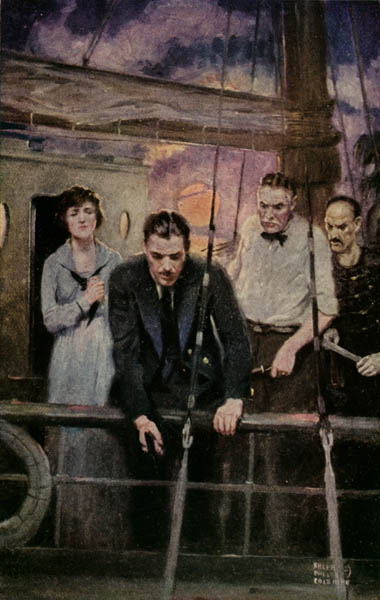 "Come up closer so I can look into the boat,"