By MIGUEL ASÍN Professor of Arabic at the University of Madrid
and Member of the Academia Española
TRANSLATED AND ABRIDGED
By HAROLD SUNDERLAND
NEW YORK
E. P. DUTTON AND COMPANY
1926
Printed in Great Britain by
Hazell, Watson & Viney, Ld., London and Aylesbury.
DEDICATION
THE AUTHOR AND TRANSLATOR WISH TO RECORD
THEIR GRATITUDE TO THE
DUKE OF BERWICK AND ALBA
TO WHOSE GENEROUS INITIATIVE THE PUBLICATION
OF THIS EDITION IS DUE
INTRODUCTION By the Duke of Alba
The Spanish original, of which the present is an abridged
translation, appeared six years ago under the title of La
Escatología musulmana en la Divina Comedia (Madrid,
Imprenta de Estanislao Maestre, 1919).
Its author, Miguel Asín y Palacios, a Catholic priest and
Professor of Arabic at the University of Madrid, is the
disciple of another Arabic scholar of Spain, Julián Ribera,
by whom he was initiated in Oriental studies and the
methods of historical research. Asín has devoted over
twenty-five years of his life to the investigation of the
philosophic and religious thought of mediæval Islam—the
Islam of the Orient as well as that of Spain—and its influence
on the culture of Christian Europe. His training in Arabic
philology and his mastery of mediæval scholastics had
enabled him several years before to make important discoveries
regarding the influence in theology of Averrhoes
on St. Thomas Aquinas, of Ibn Arabi of Murcia on Raymond
Lull, and of the Ikhwan as-safa on Fr. Anselmo de Turmeda,
and so forth. His most important discovery, however, and
the one on which his fame is chiefly based, was his discovery
of Islamic models the influence of which on the Divine
Comedy of Dante forms the subject of the present work.
From the very date of its publication in Spanish the book
aroused the curiosity of the general public and caused a
great stir among the critics of literary history. The Italian
Dantists particularly could with difficulty bring themselves
to recognise that Moslem sources should have formed the
basis for the Divine Comedy, the poem that symbolises the
whole culture of mediæval Christian Europe. The book at
once became the subject of lively and passionate controversy.
Over a hundred articles and pamphlets have been
written and lectures delivered in favour of, or against, the
thesis propounded by Asín Palacios. The principal reviews
devoted to literature and literary history, those both of a
general and special character, have published articles from
the pens of Dantists and Romance and Arabic scholars of
note in Europe and America, expounding or criticising the
thesis. Asín has intervened in the controversy to sum up
the judgments, favourable, adverse or doubtful, and finally
refute his opponents; this he has done in different publications,[1]
and the present is a translation of the work containing
the original thesis. The balance of opinion is strongly
in his favour. Apart from a score or so of adverse critics,
mainly of Italian nationality, whose attitude is to be
accounted for on the grounds of national or pro-Dante
prejudice, an immense majority of critics of all nations,
whose competence, whether as Romance or Arabic scholars
and whose impartiality are beyond all question, has opted
in favour of Asín Palacios’ theory.
Both parties to the controversy have been unanimous
and unstinting in their praise of the book.
Pio Rajna, the chief of the Italian Dantists, writing in
Nuova Antologia, admits that the importance of the thesis
is so far-reaching that “if it were true, it would lead to
a conception of Dante differing considerably from that
hitherto formed by the Dantists.”
Parodi, another leading figure among the Dantists of
Italy, in the Bulletino della società dantesca italiana confesses
that “this book has had a more than flattering reception,
it has roused a feeling of curiosity mingled with astonishment
in all who have read it and has won the approval
and assent of not a few.”
Nallino, Professor of Arabic at the University of Rome,
stated in the Rivista degli studi orientali that the book was
“of great value as a contribution to mediæval studies in
general, as proving the hitherto unsuspected infiltration of
Islamic conceptions of the after-life into the popular beliefs
of Western Christendom; and, especially, as one of the
most important works on the religion of Islam that have
of late appeared.”
Bonucci, Professor at the University of Sienna, in the
Rivista di Studi filosofici e religiosi, affirms that “a book
such as this does more to advance the history of, and
comment on, Dante’s thought than a whole century of the
minutiæ of the Dantists.”
Friedrich Beck, the famous Romance scholar of Germany,
writes in the Zeitschrift für romanische Philologie: “No
book on Dante of such importance has appeared for years;
we wonder whether the Italians, in their patriotic pride, can
find a work of theirs to equal that of the learned Spaniard.
Asín has given a great impulse to the study of Dante and
has opened up vistas so startlingly new that the students
will be bound to seek new bearings and adopt fresh points
of view.”
Söderhjelm, Professor of Romance languages at the University
of Helsingfors, in Neuphilologische Mitteilungen, says:
“This book is a revelation and an event; it will doubtless
be regarded as one of the most notable, perhaps the most
notable of all, literary productions that have marked the
Jubilee of Dante.”
The review Analecta Bollandiana states: “The author of
this book is universally known. There is scarcely any
example of a work on Oriental philology having attracted
so great attention. The audacity of the thesis could not
fail to rouse the most lively interest in all who are initiated
in the problems of literary history. The analogies shown
by the author to exist between the Divine Comedy and
Islam are so numerous and of such a nature as to be disquieting
to the mind of the reader, who is forced to picture
to himself the great epic of Christianity as enthroned in the
world of Moslem mysticism, as if in a mosque that were
closed to Islam and consecrated to Christian worship. At
all events, there will always remain to the author of this
book the honour of having started one of the most memorable
debates in the history of universal literature.”
Caballera, Professor of Ecclesiastical History at Toulouse,
although disagreeing with the thesis, admits in the
Bulletin de littérature ecclésiastique that “the reader is
bewildered by the prodigious learning of the author, his
logic, his talent for argument, which are nothing less than
astounding; the clearness of his statements makes a
profound impression.”
Lastly, the learned Romance scholar Van Tieghem, in the
Revue de littérature comparée, states that “this is an honest,
objective book, as clear and well arranged as it is rich in
matter, which will remain on record as one of the most
daring and fruitful attempts to open up new vistas in the
history of European literature.”
I need not refer to the flattering opinions this book has
earned from the critics in England and America, as they
will be known to the English-speaking public. Both Romance
and Arabic scholars, such as Arnold, Browning, Cumming,
Guillaume, Jordan, Leigh, Macdonald, and Ryan, have
expressed themselves frankly in favour of Asín Palacios.
The almost universal applause which this book has gained,
has induced me to contribute towards its diffusion by making
it available to the English-speaking peoples. The idea was
first suggested to me by Lord Balfour, whose interest in
matters of philosophy and literature is universally known.
Animated by his advice, I have now had the book translated
into English, in the hope that it may reach a wider
circle of readers, who, whilst finding difficulty in reading
Spanish, may be curious to know of a problem that is of
interest for the study of literary history in general and
particularly of the Divine Comedy of Dante, who has ever
counted so many fervent admirers among the English-speaking
peoples.
The translation has been carefully and faithfully made
by Mr. Harold L. Sunderland, who is at home both in the
Spanish language and in the subject of the book. In order,
however, to attain its diffusion among a wider public, the
translator has, in agreement with the author, cut out the
documentary evidence and critical apparatus that goes to
swell the Spanish original—a complete translation of the
Spanish original into French will also be published shortly
by Paul Geuthner, of Paris—and is useful and intelligible to
the specialists only. Thus, the Arabic texts and the tercets
of the Divine Comedy that are compared with them, as
well as some of the notes and paragraphs of secondary
importance for the argument are not contained in the
present translation. The essence of the book remains
intact, however, with all its dialectic vigour and literary
charm.
If the English reader should concur with my opinion, my
aims in promoting the translation of the Spanish book will
have been fully achieved.
August, 1925.
AUTHOR’S PREFACE TO THE ORIGINAL SPANISH EDITION
In my recent work on the neo-Platonic mysticism of the
Spanish Moslem philosopher Ibn Masarra,[2] I had already
hinted that his doctrines, filtering through into Christian
scholasticism, had not only met with acceptance at the hands
of theologians of the Franciscan or pre-Thomist school, but
had even influenced a philosopher-poet of such universal
renown as Dante Alighieri, whom all critics and historians
had hitherto held to be an Aristotelian and Thomist.[3]
After enumerating briefly the fundamental reasons underlying
my vague surmise, I ventured to call the attention of
specialists to the close resemblance that I found between the
general outlines of the ascension of Dante and Beatrice
throughout the spheres of Paradise, and another allegory of
the ascension of a mystic and a philosopher, in the Futuhat,
written by the great Sufi of Murcia, Ibn Arabi, who was
undoubtedly a follower of Ibn Masarra.[4]
The question so raised was of obvious interest: for if not
merely the neo-Platonic metaphysics of the Cordovan Ibn
Masarra and the Murcian Ibn Arabi, but the allegorical
form in which the latter cast his Ascension may have exercised
an influence as models, as they certainly existed as
forerunners, of the most sublime part of the Divine Comedy,
Dante’s conception of Paradise, then Spain may be entitled
to claim for her Moslem thinkers no slight share in the world-wide
fame enjoyed by the immortal work of Dante Alighieri.
And again, the absorbing influence exercised by the latter
over our allegorical poets, from the end of the fourteenth to
the sixteenth century, from Villena to Garcilaso, not to
mention Francisco Imperial, Santillana, Mena and Padilla,
would be balanced in a measure by the antecedent influence
of our Moslem mystics in the complex genesis of the Divine
Comedy.
Such was the starting-point of my research, but soon the
horizon opened out unexpectedly before me. On closer
study of Ibn Arabi’s quasi-Dantesque allegory I found that
it was itself no more than a mystical adaptation of another
ascension, already famous in the theological literature of
Islam: the Miraj, or Ascension, of Mahomet from Jerusalem
to the Throne of God. As this Miraj was preceded
by an Isra, or Nocturnal Journey, during which Mahomet
visited some of the infernal regions, the Moslem tradition at
once struck me as a prototype of Dante’s conception. A
methodical comparison of the general outlines of the Moslem
legend with those of the great poem confirmed my impression
and finally quite convinced me: the similarity had
extended to the many picturesque, descriptive and episodic
details of the two narratives, as well as to what is called the
“architecture of the realms,” that is to say, the topographical
conception of the infernal regions and of the celestial abodes,
the plans of which appeared to me as drawn by one and the
same Moslem architect. But on reaching this stage of my
research, a new doubt arose. How if these resemblances
between the Divine Comedy and its hypothetical Moslem
model should be due to the fact that both derived from some
common source? In other words, might not the features of
Dante which appeared foreshadowed in Moslem sources, be
traced to mediæval Christian legends that preceded his great
work? At this juncture, therefore, it became imperative, in
the first instance, to turn to those legends, and to make sure
that I were not ascribing a Moslem origin to anything in
Dante that might be adequately accounted for by those
Christian legends.
This further process of inquiry and comparison held in
store an even more unexpected conclusion. It not only
confirmed that in Moslem sources there were to be found
prototypes of features in the Divine Comedy hitherto
regarded as original because nothing similar to them had
been discovered in the Christian legends, its predecessors; it
further revealed the no less Moslem origin of many of those
mediæval legends themselves; it let in a flood of light
upon the whole problem. The Moslem element thenceforth
appeared as a key to much that had already been accounted
for, and to what was still obscure, in the Divine Comedy.
The conclusion was consonant with what students of
Dante had hitherto ascribed to the influence of Christian
precursors, and it explained what, as being inexplicable,
they had attributed solely to the creative genius of the
poet himself.
The above is, in outline, my thesis.[5] It will sound to many
like artistic sacrilege, or it may call an ironic smile to the lips
of those—and they are not a few—who still conceive an
artist’s inspiration as something preternatural, owing nothing
to any suggestion outside itself. This is a very common
attitude towards works of such universal renown as the
Divine Comedy. Ozanam, in his inquiry into its poetic
sources, had already brought out this point.[6] For a long
time—he says—this poem was considered as a solitary
monument, standing in the midst of the mediæval desert.
When, a century ago, Cancellieri pointed to some passages
of Dante’s Inferno and Paradiso as being closely modelled
upon the Vision of the monk Alberic, the devotees of Dante
rose up in wrath at the sacrilege of supposing the Master
capable of servile imitation of an obscure monk of the
twelfth century: they, who were none too ready to admit
even the undeniable fact of his imitation of classic models.
But time has passed and the nineteenth century, the age
of cold dispassionate criticism, has peopled the deserts
of the Middle Ages with living realities. Labitte, Ozanam,
D’Ancona, Graf, a whole host of scholars and labourers in
research have studied the legends of the after-life, both
classical and Christian, which explain the genesis of Dante’s
poem; and the lovers of Dante no longer resent the more
sober and more scientific view of poetic inspiration which has
gained acceptance. It is now admitted that the essential
trait of genius does not lie in the absolute novelty or originality
of the work of art; neither can it consist in the
power—the prerogative of God alone—of creating both
Form and Matter out of nothing.[7]
The greater equanimity of the modern school of Dantophiles
encourages me to hope that they will not be moved to
ire by the suggestion of Moslem influences in the Divine
Comedy. D’Ancona, in his inquiry into its Christian and
classical sources,[8] remarks that Dante showed himself ever
keen to study and to learn, with a receptive mind towards
the ideas and sentiments of his age; and surely it will not be
denied that his century was steeped in the learning and art
of Islam. In the opinion of D’Ancona it may always be
difficult to affirm specifically that any one legend was the
actual and original model that Dante had in his mind, the
pregnant germ from which his divine poem was to grow.
Yet I venture to think that the difficulty will not be found
insuperable, if only the Moslem originals be considered, to
wit: the above-mentioned legends of the Nocturnal Journey
and Ascension of Mahomet, completed and adorned as they
were with a mass of topographical and episodic detail,
whether derived from other Islamic legends of the Life
beyond the grave, from the Apocalyptic scenes of the Day of
Judgment, or from the theories and conceptions of certain of
the Moslem mystics in respect of Heaven and the Beatific
Vision, which in spirituality and idealism were not unworthy
of Dante’s own conception of Paradise. To throw into relief
such resemblances and analogy, as conducive to the imitation
which they suggest, is of necessity the main task of the
present work. To complete the demonstration, render the
conclusion unavoidable, and forestall all reasonable objection,
it will finally outline and enumerate the coincidences of the
Christian mediæval legends that preceded the Divine Comedy,
with Moslem legends of a remoter date.
Madrid, 1919.
CONTENTS
PAGE
PART I THE LEGEND OF THE NOCTURNAL
JOURNEY AND ASCENSION OF MAHOMET COMPARED WITH THE DIVINE COMEDY
Similarity in use of expedient: the comparison of the speed
of flight, the inability to describe the sights witnessed, and
the brilliance of the light dazzling the pilgrims
Striking likeness of the apotheoses of both ascensions. God
a focus of light, surrounded by nine concentric circles of angels
radiating light and chanting as they revolve. The Beatific Vision
and ecstasy
Resemblance in episode, such as the distribution of the
Blessed on an astrological and moral principle; in the didactic
tendency of both authors; and in their enigmatical style
Systematic grouping of the analogies found to exist
between the Divine Comedy and the different versions,
adaptations and imitations of the Moslem legend
The Moslem hell, according to the description and designs
of Ibn Arabi, is identical in its architectural plan with the
hell described by Dante and graphically illustrated by the
Dantists
Conclusions to be drawn from the first two parts of this
enquiry: Islamic literature sheds light upon a greater number
of problems in Dante than do all other religious literatures
combined
Digression to other instances of Moslem influence upon
Christian illustrations of the Day of Judgment. The
intercession of the Saints. The nakedness of the sinners
Moslem episodes in the Legend of St. Brandan, such as the
table spread with food; the island-whale; the angel birds;
the enormous vines; the crystal column; the torment of Judas;
the sea-hermit; the isle of paradise
Islamic legends describing (1) the appointment of an angel
and a devil to each man; (2) the fight for the soul; (3) the
books of record; (4) the personification of virtues and vices;
(5) the personification of the members of the body; (6) the
removal of the soul to hell or heaven
Summary of comparisons contained in Part III and conclusion
to be drawn therefrom; Islamic literature furnishes the
explanation of the growth of many of the pre-Dante Christian
legends on the after-life
Brunetto may have learnt of the legend of the “Miraj”
during his mission to the court of Alphonso the Wise, and
have transmitted his knowledge to his disciple
Dante’s liking for Arabic culture shown by the use he makes
of the works of the astronomers and the exemption from hell of
Saladin, Avicenna and Averrhoes
Comparison of their expository methods. The cabbala of
letters and numbers; astrological subtleties; personification
of abstract entities; interpretation of dream visions
Striking analogy of Dante’s “Cancionero” and its allegorical
commentary, the “Convito,” to Ibn Arabi’s book of songs, “The
Interpreter of Love,” and its allegorical commentary, “The
Treasures of Lovers”
Earlier examples of this type of poetry in Islam. Romantic
love in profane literature. The “Necklace of the Dove,” or
“Book of Love,” of Ibn Hazm of Cordova
The mystical love of woman in Sufi literature. Woman as
an angel and a symbol of Divine wisdom. The phenomena of love
analysed and allegorically interpreted in Ibn Arabi’s
Futuhat
PART I THE LEGEND OF THE NOCTURNAL JOURNEY AND ASCENSION OF MAHOMET COMPARED WITH THE DIVINE COMEDY
PART I THE LEGEND OF THE NOCTURNAL JOURNEY AND ASCENSION OF MAHOMET COMPARED WITH THE DIVINE COMEDY
I The Origin of the Legend
1. The Moslem legend of Mahomet’s nocturnal journey and
ascent to the spheres of after-life originated and developed
like most religious legends. Born of a brief passage in Revelations,
in its very obscurity it defied theological interpretation.
But what baffled the sages in their agnosticism kindled
the imagination of the faithful masses, and the details of a
story founded upon the sacred text were readily conceived.
One brief allusion only appears in the Koran: “Praised
be He [the Lord]”—runs the first verse of the seventeenth
chapter—“who called upon His servant [Mahomet] to
travel by night from the sacred temple [of Mecca] to the far-off
temple [of Jerusalem] whose precinct We have blessed,
in order to show him Our wonders.”
2. The mysterious allusion seems from the first to have
aroused the curiosity of pious Moslems. A rich crop of
legends sprang up as if by magic. The vivid imagination of
the East had been fired, and the myth of the nightly journey
was soon clothed with a wealth of detail and set in a wonderful
variety of episode and scenery.
The entire records of the evolution of the legend in all its
ramifications would fill volumes. Around an insignificant
verselet of the Koran a plot was woven, and the story
developed in the form of hadiths or traditions of the Prophet,
who was supposed to describe the wonders he saw on that
memorable night. In the following pages an endeavour has
been made to lay before the reader some of the principal
versions extant. These have been divided into three cycles
or groups, which begin with the simple, fragmentary types,
and end with those in which Oriental fantasy reaches its
climax.
II First Cycle—Versions of the “Isra,” or Nocturnal Journey
1. The simplest cycle seems to be one of the ninth century
that is formed of six hadiths, in each of which, with slight
variations, Mahomet is made to tell the story of an Isra, or
journey by night on earth. Few topographical details,
however, are given, and no mention is made of an ascent to
celestial spheres.
In the following summaries the two main versions are
compared with the Divine Comedy.
Version A of Cycle I
2. Mahomet relates to his disciples how he was awakened
from sleep by a man who leads him to the foot of a steep
mountain. To climb this, as he is urged to do, seems
impossible; but, heartened by his guide, he begins the
ascent and eventually reaches the high table-land at the top
of the mountain. Proceeding on their way, Mahomet and
his guide witness six scenes, one after another, of horrible
torture. Men and women with lips torn asunder; others
whose eyes and ears are pierced by arrows; women hanging
by their heels while vipers sting their breasts; others, both
men and women, that likewise hanging suck up in agony
the stagnant water from off the ground; then, wretched
creatures in filthy clothes who reek as of latrines; and lastly,
corpses in the last, abominable stages of putrefaction.
These punishments, the guide explains to Mahomet, are
meted out in turn to liars; those that have sinned with eyes
or ears; to mothers who have refused to suckle their children;
to violators of the fast; adulterers; and to unbelievers.
Continuing their journey, the travellers suddenly find themselves
enveloped in a cloud of smoke; and they hear a
confused noise as of mingled cries of pain and fury. Gehenna
is there; and Mahomet is urged to pass on.
Men sleeping peacefully in the shade of trees are now
designated as the bodies of those who died in the faith.
Children at play are the offspring of true believers. The
men with the white, godlike features, who are robed in fine
clothes and are exquisitely perfumed, are the true friends of
God, His martyrs and saints. On they go, and now Mahomet
descries three well-known figures drinking wine and singing
psalms. One is Zayd, the son of Haritha, a slave who for
love of Mahomet sacrificed his freedom. Had he not fallen
in the battle of Muta, when a general in the Prophet’s
armies, he would assuredly have been Mahomet’s successor.
The second is Jafar, son of Abu Talib and cousin to Mahomet,
who was killed in the same battle, after having preached
the faith of Islam in Abyssinia. The third is Abd Allah,
the son of Rawaha, the scribe and intimate friend of the
Prophet, who also died at Muta. The three greet Mahomet
with cries of love and allegiance. At the final stage Mahomet
raises his eyes to Heaven and beholds Abraham, Moses, and
Jesus, who, gathered around the Throne of God, await his
coming.
3. This embryonic version, simple though it may be, has
its points of coincidence with Dante’s poem.[9] In each case
it is the protagonist himself who recounts his adventures.
Each makes the journey by night, led by an unknown guide
who appears to him on awaking from a profound sleep. In
both legends the first stage comprises the ascent of a steep
mountain. Purgatory, hell, and paradise are by both visited
in succession, although the sequence and detail differ. The
first five torments witnessed by Mahomet represent the
purgatory of Islam. The sixth, as also Gehenna, which
follows it, is the hell of unbelievers. The remaining episodes
deal with the paradise of children, and the heavens of the
faithful, of saints, martyrs, and prophets. Both stories end
with the vision of the Divine Throne. The sins or virtues
of the dwellers of each abode are explained by the guide,
and from time to time the visitor attempts to converse with
the souls of men once known to him.
4. Apart from the general outlines, there are few features
in common. Even between the torments there is little
similarity. With the introductions to the two stories, however,
it is different. The description in the Islamic legend of
the lofty mountain; Mahomet’s dismay at having to climb
it; his guide’s assurance of help; and, finally, the ascent
itself, when Mahomet follows in his guide’s footsteps; all
are features bearing a striking resemblance to Dante’s
Inferno, and, especially, his Purgatory.[10] Moreover, Dante is
warned of the approach to hell by the same sign as Mahomet—a
confused noise as of “parole di dolore, accenti d’ira.”[11]
5. Mahomet is suddenly awakened by two persons; who,
taking him by the arm, call upon him to rise and follow them.
On reaching the outskirts of Jerusalem, the visions of the
after-world begin. The guides, in this version, refuse to
answer any questions, bidding Mahomet wait until the end
of the journey for an interpretation of what he sees. The
first five visions correspond, as in Version A, to the purgatory
of Islam.
The Prophet sees a man supine at the feet of another—man,
angel or demon. The latter hurls an enormous boulder
down upon his victim’s head, crushing his brain. The rock
rolls on and, when the torturer recovers it, he finds his
victim whole as before; and so the torture is renewed without
end. Mahomet stands aghast and asks what crimes the
wretch has committed. But his guides hurry him on to
where another tormentor is forcing an iron javelin into the
mouth of another sufferer, lacerating his cheeks, eyes and
nostrils. Farther on, Mahomet sees a man struggling in a
river red with blood and seething like boiling pitch. Vainly
does he strive to gain the shore, for at each effort a fiend
forces red hot stones down his throat, obliging him to swim
back into the middle of the stream. This torture, like the
previous one, is everlasting. Still farther, they come to a
tubular structure, broad at the base and narrow at the top;
and through the walls comes an uproar as of human voices.
The interior, Mahomet finds, is like a glowing oven, where
men and women ceaselessly writhe, now being flung upwards,
now sinking to the bottom, as the heat of the flames increases
and diminishes. The scene recurs again and again, and the
horror is accentuated by the shrieks of the victims. At
length, Mahomet reaches the summit of a dark hill, where
men, raving like madmen, exhale, through their mouths,
nostrils, eyes and ears, the fire that has been infused into
them.
Here, the tortures end. A few steps further on is a garden,
green with eternal spring. At the entrance two men, one
repulsively ugly, are feeding the flames of a fire with wood.
Within, at the foot of a spreading tree and surrounded by
lovely children, they see a venerable old man, so tall that
his head touches the sky. Ascending by the tree, Mahomet
comes to a beautiful abode, like a city of silver and gold,
inhabited by men, women and children; some, white and
handsome, others black and ugly. A mighty river, whose
water is clearer than crystal, separates this from another,
larger city. In this river, at the bidding of Mahomet’s
guides, the black and ugly bathe and from it emerge purified
and transformed into beings of beauty. Mahomet drinks of
the water and, again ascending by the tree, reaches an even
more beautiful place, inhabited by men both young and old.
At this juncture Mahomet rebels against the silence of his
guides, and at last they consent to explain each vision to him.
The wretch whose head was being crushed is the hypocrite
who, though outwardly professing to honour the holy book,
fails to abide by its precepts. He whose mouth is being
torn asunder is the liar, backbiter and violator of the fast.
The swimmer in the river of blood is the usurer. Those
writhing in the furnace are adulterers. The men on the black
hill being consumed by fire are Sodomites. The man of
repulsive aspect is the steward of hell, who appoints to each
his torture. The venerable old man is Abraham, who gathers
to his bosom children who die before reaching the age of
reason. The first abode is the paradise of true believers;
and Moslems, who have sinned but die repentant, must wash
away their sins in the river before they can enter heaven.
The second is the mansion of the martyrs. All the visions
explained, the guides, who make themselves known as
Gabriel and Michael, call upon Mahomet to raise his eyes, and
in amazement he beholds afar off a castle like a white cloud.
This, his guides tell him, is the celestial mansion that awaits
him, close to the throne of God. Mahomet would fain enter
it at once, but his guides dissuade him, bidding him await
his time.
6. This version shows an advance in its descriptive
features, which are more suggestive of Dante’s scenes. As
in the Divine Comedy, the four spheres of after-life—purgatory,
Abraham’s bosom, hell, and paradise—are
staged separately, although on one plane until paradise is
reached by means of a tree that leads, not as in later versions,
to several celestial spheres, but to one only. Neither is
Mahomet led, as formerly, by one guide; although the two
are angels and not, as in Dante, humans. For the first time,
too, mention is made of the steward who, like Dante’s Minos,
awards the tortures to the damned.[13] But these details are
of less importance than other characteristic features. As in
Dante,[14] Jerusalem is the starting-point in this version of the
Moslem myth. Again, Dante’s commentators are agreed
upon the correlativity of the punishments with the sins committed,
which is also a feature in the Moslem Versions A
and B—the sinner suffers in the members or organs that
served the deed.[15]
7. But coincidence between Version B and Dante’s text
is most marked in the torture of adulterers and usurers.
The naked men and women writhing in a furnace inevitably
suggest the adulterers in Dante who are incessantly swept
on by the gale of hell.[16] Even more striking is Dante’s
adaptation of the Moslem punishment of usurers to those
who committed violence and deeds of blood. Submerged in
the deep waters of a river of blood, they, like the usurers,
strive to gain the shore, only to be forced back by the Centaur
archers (who take the place of the simpler stone-throwers in
the Moslem legend).[17] So strikingly alike are these two
features that other instances of resemblance lose by comparison;
as the torture of the Sodomites, burnt inwardly in
the Moslem story, and rained upon by fire, in Dante[18]; or
the rivers that in both legends separate purgatory from
paradise and of whose sweet waters both Dante and Mahomet
drink.[19]
III Second Cycle—Versions of the “Miraj” or Ascension
1. The legends of the second cycle date as far back as those
of the first. They are, however, grouped apart, for, whereas
the former are concerned almost exclusively with the Miraj
or ascension, the latter have as their main theme the Isra or
nocturnal journey on earth.
2. There are three main versions of the legends forming
this second cycle. The first and most authentic comes to us
on the authority of Bukhari and Muslim and must, therefore,
be considerably older than the ninth century. Of the second
version only one fragment is quoted. Here the authorship is
doubtful, although it is attributed to Ibn Abbas, a kinsman
of Mahomet, and may thus have been the work of an
Egyptian author of the ninth century, Ishac the son of
Wahab. The third version is generally regarded as apocryphal;
it may have been the work of a Persian of the eighth
century, Maysara son of Abd ar-Rabihi, or of Omar son of
Sulayman, who lived in Damascus in that century. Summaries
of the three versions are as follows:—
Version A of Cycle II
3. In his house (or, according to other versions, in the
Mosque) at Mecca Mahomet is awakened by Gabriel, who,
either alone or helped by angels in human form, prepares the
Prophet for the ascension. His breast is opened and his
heart extracted and washed in water brought in a golden cup
from the well of Zemzem; his breast is then filled with
faith and wisdom. Thereupon Gabriel takes him by the
hand, and the ascent begins, either from the Mosque of
Mecca itself or, as in other versions, the Temple of Jerusalem.
Descriptions of the ascension differ, but, generally, Mahomet,
holding Gabriel’s hand, is made to rise through the air in
flight. In some versions (as in B of the first cycle) the two
are raised to heaven by the miraculous growth of a tree; in
others, a celestial animal, larger than an ass but smaller than
a mule, carries Mahomet, or Mahomet and his guide, from
Mecca to Jerusalem, the gates of paradise and, lastly, the
Throne of God. Of the ascension proper there are ten
stages.
The first seven correspond to the seven heavens of the
astronomers, but are numbered and not named after their
respective stars. The scene at each is repeated with true
Oriental monotony. Gabriel knocks, and is asked by the
guardian who is without and, upon Gabriel’s answering, the
guardian asks whether he is alone. When the guardian is
satisfied that God has really sent Mahomet as His Prophet,
he welcomes the travellers and bids them enter. In each
heaven one or more prophets are presented to Mahomet, who
is acclaimed Holy Prophet and, at times, holy son or
brother.
The order in which the prophets appear is generally:
Adam, Jesus and John, Joseph, Idris (or Enoch), Aaron,
Moses, and Abraham. Of these characteristic descriptions
at times are given. Adam is seen between two hosts of men,
now smiling now weeping, as he glances to the right and
left alternately. Mahomet learns from Gabriel that these
hosts are the blessed and the damned. The cousins Jesus
and John appear together; Jesus, of medium stature, with
a fair complexion, and fresh as if just coming from his bath.
Joseph is of wonderful beauty. Moses, with flowing curls,
tall and of stately appearance, bursts into tears when he is
reminded that more Islamites will find salvation than those of
his faith. Lastly, Abraham, to whom Mahomet bears a
greater resemblance than any son, is seen leaning against the
temple wall of the celestial Jerusalem, a replica of the earthly
city. Every day seventy thousand angels visit this temple,
which in the Koran is known as the House of Habitation.[20]
The visit to this temple occupies the eighth stage of the
ascension, or the ninth in those versions that introduce the
vision of a gigantic tree of paradise, called in the Koran the
Lotus-tree of the Boundary[21]; for neither man nor angel may
pass beyond it when nearing God. Of fabulous size, its
leaves are as large as the ears of an elephant and its fruit,
like pitchers. From its root spring four rivers: two hidden
that water Paradise, and two visible, the Euphrates and the
Nile, that irrigate the earth. Here, or previously, Mahomet
is proffered glasses of wine, milk, and honey; he chooses the
milk and is applauded by Gabriel for so doing, inasmuch as
his religion is based on nature. The last stage has now been
reached, Mahomet beholds the Throne of God, and the
Almighty Himself reveals to him His mysteries.
Among these revelations is God’s commandment, to be
transmitted by Mahomet to his people, ordaining fifty
prayers each day. On his descent the Prophet communicates
this commandment to Moses, who urges him four times to
return and beseech the Almighty to reduce the number; and
the prayers finally are reduced to five. Again Moses calls
upon him to return, but Mahomet is loth to do so, and the
descent is completed without further incident.
4. In this version there is no allusion to hell or purgatory,
so that it is only to the Paradiso, or third part of Dante’s
poem, that any resemblance exists. The general lines of
action in both stories are, however, strikingly similar.
Mahomet, purified like Dante, rises through the air holding
Gabriel’s hand just as Dante is led by Beatrice. In both
stories there are as many stages as astronomical heavens.
The difference in number and designation merely denotes the
superior scientific knowledge of a cultured poet whose work
appeared five centuries later than the tales of those inerudite
Moslem dreamers. Apart from this, it is clear that the
seven heavens traversed by Mahomet are identical with
those that Dante names after the seven stars of the Ptolemaic
system; the Moon, Mercury, Venus, the Sun, Mars, Jupiter,
and Saturn, to which he adds the sphere of the Fixed Stars,
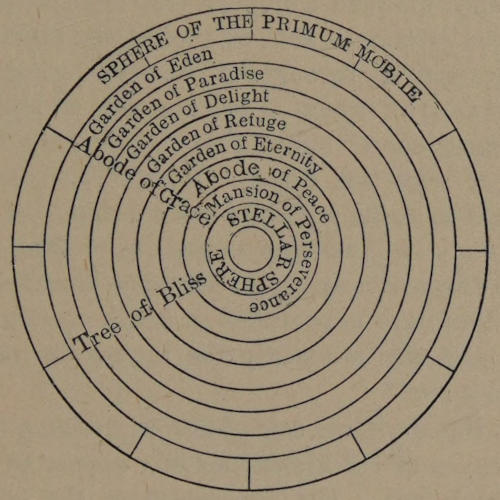
the Crystalline heaven and the Empyrean. The counterparts
of these in the Mahometan story are the three final
stages: the Lotus-tree, the House of Habitation, and the
Throne of God. In each ascension there are thus ten stages.
Not that there is any need to labour the point of numbers, for
the poet’s licence alone would have admitted of his moulding
the scheme of the Moslem creation to his own ideas. What is
obvious is, that in none of the so-called precursors of the
Divine Comedy could Dante find so typical a model as the
Moslem legend of Version A. Beatrice, human indeed, but
rendered angelic through the Beatific Vision, descends from
heaven with divine permission to conduct Dante to the
Throne of God. Through space they fly; and likewise
Gabriel leads Mahomet. In both ascensions the travellers
pass through the astronomical heavens, tarrying awhile in
each to converse with the blessed and receive enlightenment
on theological problems. The prophets in the Moslem
heavens are the saints in Dante’s poem. The literary
artifice in both works is identical, no matter how they differ
in art and spiritual detail.
5. Version B, given below, belongs to this cycle inasmuch
as the Ascension forms the main theme. It differs from
Version A, however, in that it contains the vision of hell;
and for this reason it may be regarded as a first attempt to
link the Isra with the Miraj. It introduces into the Miraj
a description of hell, which, as a rule, is peculiar to the Isra
or Nocturnal Journey. The parts already given in Version
A need not, therefore, be repeated; an analysis of the more
typical features of B will suffice.
Version B of Cycle II
6. Mahomet, accompanied by Gabriel, ascends to the third
heaven, where he sees a gigantic angel, hideous and terrible
to behold, and incandescent as if a being of fire. Seated on
a bench of flame, he is intent upon forging instruments of
torture out of solid fire. Terrified, yet curious, Mahomet
learns from Gabriel that this is the Keeper of Hell. So
fierce is the Keeper’s response to Mahomet’s greeting that
the Prophet, mindful of the smiling welcomes in the other
heavens, is overcome by terror. His fears allayed by
Gabriel, who explains that the angel has been created by
the Almighty to wreak vengeance on sinners, Mahomet
ventures to ask the Keeper to let him see the regions of hell.
“Thou mayst not see them,” refuses the Keeper angrily;
whereupon a voice is heard from on high, commanding:
“Oh, Angel, beware lest thou deny him aught.” Then the
Keeper opens the door so that Mahomet may peep through;
and from the opening fire and smoke burst forth, as if to
warn the Prophet of the awful sights that await him. Hell,
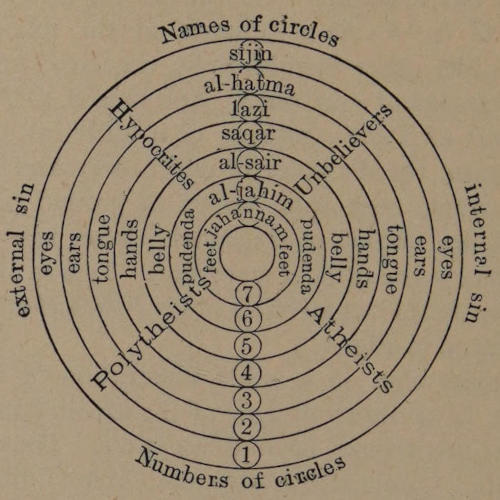
he sees, is formed of seven floors, one underneath the other.
The uppermost, which is reserved for deadly sins, is subdivided
into fourteen mansions, one close above the other,
and each a place of punishment for a different sin.
The first mansion is an ocean of fire comprising seventy
lesser seas, and on the shore of each sea stands a city of fire.
In each city are seventy thousand dwellings; in each
dwelling, seventy thousand coffins of fire, the tombs of men
and women, who, stung by snakes and scorpions, shriek in
anguish. These wretches, the Keeper enlightens Mahomet,
were tyrants.
In the second mansion beings with blubber lips writhe
under the red-hot forks of demons, while serpents enter
their mouths and eat their bodies from within. These are
faithless guardians, devoured now by serpents even as they
once devoured the inheritances committed to their trust.
Lower down usurers stagger about, weighed down by the
reptiles in their bellies. Further, shameless women hang by
the hair that they had exposed to the gaze of man. Still
further down liars and slanderers hang by their tongues
from red-hot hooks lacerating their faces with nails of copper.
Those who neglected the rites of prayer and ablution are now
monsters with the heads of dogs and the bodies of swine and
are the food of serpents. In the next mansion drunkards
suffer the torture of raging thirst, which demons affect to
quench with cups of a liquid fire that burns their entrails.
Still lower, hired mourners and professional women singers
hang head downwards and howl with pain as devils cut their
tongues with burning shears. Adulterers are tortured in a
cone-shaped furnace, as described in Version B of Cycle I;
and their shrieks are drowned by the curses of their fellow
damned at the stench of their putrid flesh. In the next
mansion unfaithful wives hang by their breasts, their hands
tied to their necks. Undutiful children are tortured in a fire
by fiends with red-hot forks. Lower down, shackled in collars
of fire, are those who failed to keep their word. Murderers
are being knifed by demons in endless expiation of their
crime. Lastly, in the fourteenth and lowest mansion of
the first storey, are being crucified on burning pillars those
who failed to keep the rule of prayer; as the flames devour
them, their flesh is seen gradually to peel off their bones.
At the request of Mahomet, now horror-stricken and on
the verge of swooning, the Keeper closes the door, bidding
the Prophet warn his people of what he has seen. Other
more terrible tortures, he enjoins him, are inflicted in the
six other floors, the cruelty increasing with the depth. This
closes the scene, and Mahomet, as in Version A of Cycle II,
continues his ascent.
7. At first sight there would seem to be no likeness between
this episode and the Divine Comedy. The two essential
parts, the visions of paradise and hell, appear, not as in Dante
in separate settings and at different times, but illogically
intermingled. It is in the third heaven that Mahomet
witnesses the tortures of hell—not, as in former versions,
before his ascent. But, if this circumstance is overlooked
and the episode of hell considered apart from the ascension,
a singular likeness to the Inferno will be apparent.
8. Above all, this version unquestionably provides the
prototype of Dante’s architecture of the realm of pain.
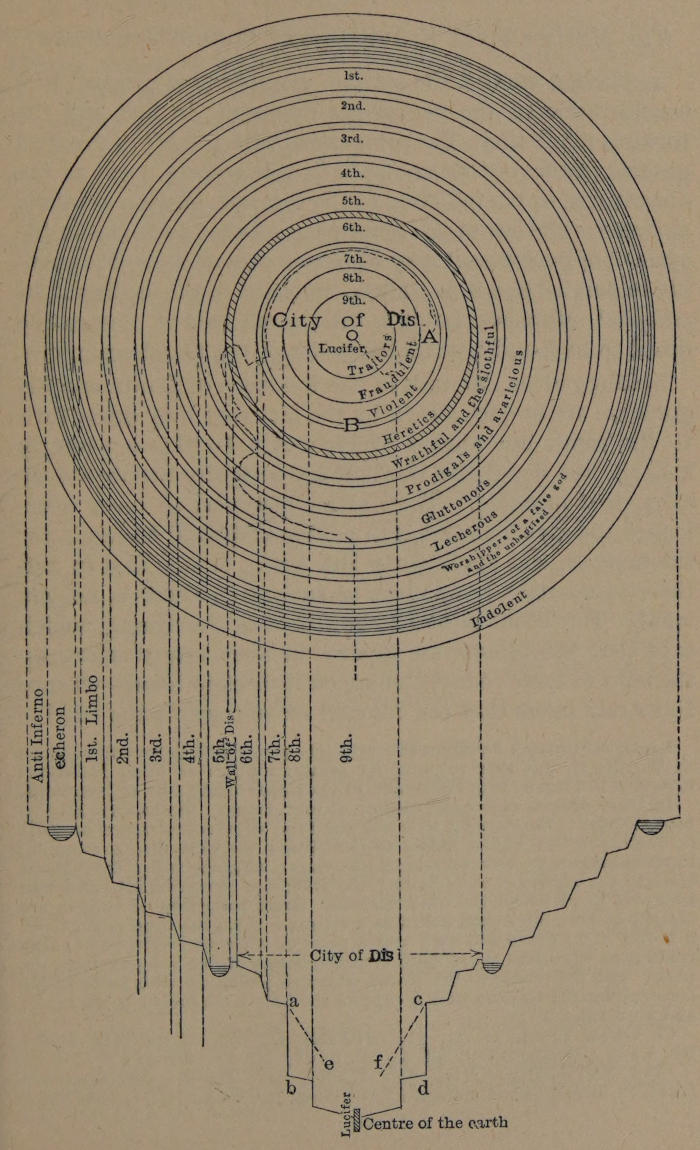
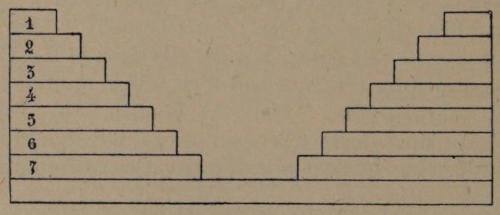
How he mapped out his Inferno everybody knows[22]: a huge,
funnel-shaped chasm down into the centre of the earth,
with nine tiers of steps, stages, or strata, each a prison and
place of punishment for a separate class of sinners. The
greater the depth of the mansion, the greater the sin and the
torture inflicted. Some of the circles are subdivided into
three or more tiers, which correspond to as many grades of
sin. The resemblance to the legend will be at once apparent.
The Moslem hell is similarly formed of floors or tiers that get
lower as the sin is greater. Each floor is the mansion of
one class of sinner; and each has its tiers, one above the
other, that correspond to the various subcategories of the
sin. True, the number of main floors in each story differs,
but this is of little moment when compared with other
striking similarities in matters where a merely artistic
imitation would not have required so strict an adherence
to the model. Any other plan could have been adopted by
Dante, but he preferred to follow the Moslem model, with
its great divisions and subdivisions. This scheme admirably
served his purpose for what Dante students term the moral
architecture of the Inferno; that is to say, the distribution
and punishment of the souls in accordance with their crimes.
On one point only do the topographies differ—no mention
is made of the Islamic hell’s being situated below the earth.
But the legend merely states that Mahomet saw hell from
the third heaven, not that hell was there itself. For the
present, however, this point is of secondary interest and will
be dealt with at greater length in later chapters.
Suffice it to have established the fact that the architecture
of the Inferno had its counterpart in the religious tales of
Islam as far back as the ninth century. The other features
of resemblance between this version and Dante’s poem are
of minor interest.
9. Mahomet’s meeting with the Keeper of Hell, however,
obviously has its parallel in the scene where Dante is refused
passage by the boatman Caronte and grim Minos.[23] The poet
has merely reproduced the Moslem scene in a more artistic
form, adapted from the classical mythology. The Moslem
Keeper, wrathful and glowing like red hot coal; his curt
refusal to open the door; and the imperious command from
on high—all seem like rough sketches of Dante’s boatman,
a “demon with eyes like red hot coals, shooting forth
flames,” whose voice is raised in anger as he exclaims:
“I will not pass thee to the other shore,” and who ultimately
yields at the command from heaven, rendered by
Virgil: “Fret not, Caronte, so is it willed up yonder, where
every will is law; question no more.” A further analogy is
afforded by the scene where “dread Minos,” the Keeper of
Hell itself, at the entrance mercilessly appoints the tortures
to the damned. In a fury he drives the poet away until
Virgil intervenes saying: “Hinder him not; his journey is
ordained by fate.” The words would seem to be an echo
of the heavenly warning in the Moslem legend: “Beware
lest thou deny him aught.”
This dual scene is introduced by Dante, under various
disguises, into other circles of the Inferno. At the entrance
to the fourth circle Plutus assumes the role of Caronte and
Minos.[24] In the fifth circle Phlegyas, and later the devils at
the gates of Dis, repeat the scene with the self-same parleys.[25]
On this last occasion it is an angel from heaven who transmits
the order that allows the travellers to pass.[26] In the
seventh circle Minotaurus offers the resistance, which again
is overcome by Virgil.[27] In the fifth pit of the eighth circle
demons for the last time vainly strive to bar their way.[28]
10. Meantime, there are other actual features of resemblance.
The violent burst of flame that meets Dante at the
entrance to the first circle of the Inferno[29] compares with the
fire that escapes through the door as Mahomet is about to
scan the first stage of hell in the Moslem legend.
Here again the first of the fourteen tiers is evidently the
model of Dante’s city of Dis. On reaching the shores of the
Stygian Lake,[30] Dante “clearly distinguishes its towers ...
glowing with the heat of a fiery furnace; and the eternal
fire which consumes the city from within spreads over all
a reddish hue.”
Dis, therefore, is a city of fire, as is the city in the Moslem
hell. Again, once within its walls,[31] Virgil and Dante see the
countless tombs, each a bed of fire, wherein, in coffins of red
hot iron, lie the arch-heretics crying aloud in agony. This
is undeniably a copy of the vision where Mahomet sees an
ocean of fire, on whose shores stand cities aflame with
thousands of red hot coffins in which tyrants in agony expiate
their crimes.
11. A minute examination of the tortures described in the
fourteen minor stages of the Moslem hell will also show that
the Florentine poet with no great imaginative effort might
well have used these as plans for his great images. Thus,
the picture of the reptiles stinging the tyrants, the faithless
guardians and the usurers in the various tiers of the Moslem
hell recurs in the circles of the Inferno where gluttons and
thieves are so tortured.[32] The torture of maddening thirst,
suffered by drunkards in the seventh stage of the Moslem
hell, is applied to forgers in the tenth pit of Dante’s eighth
circle[33]; and the latter with their swollen bellies have their
prototype in the Moslem usurers. In the same circle Griffolino
of Arezzo and Capocchio of Sienna scratch the scales off their
leprous sores,[34] like the slanderers of the fifth Moslem stage
who lacerate their faces with finger-nails of bronze. The
undutiful children whom Mahomet sees in the eleventh tier,
suffer a similar torture to the barattieri in the fifth pit of circle
eight, who are kept squirming in a lake of burning pitch by
demons armed with spears.[35] Lastly, the Moslem torture of
murderers (in the thirteenth tier), who are being perpetually
knifed and resuscitated, is clearly the model of Dante’s
punishment, in the ninth valley of the eighth circle, of the
authors of schism.[36] Here, indeed, in sarcastic vein, he places
Mahomet, the very protagonist of the legend upon which he
probably based his work.
12. Closely related to this version and belonging to the
same cycle is Version C. Here again the main theme is the
ascension, although an abortive attempt is made to introduce
the vision of hell into the ascension. The last episodes
of the Miraj, which in A and B are merely alluded to, are
mainly dealt with. Version C is chiefly characterised by
hyperbole and repetition. The fantastic depiction of the
heavenly scenes and persons is in striking contrast to the
gross materialism shown in the Koran. For his images the
author relies almost exclusively upon light, colour and music.
The following is an epitome of this version, the text of
which in extenso makes tedious reading.
Version C of Cycle II
13. (a) In the first heaven Mahomet, with Gabriel, sees a
gigantic cock, with a body of bright green and plumage of
dazzling white, whose wings stretch across the horizon and
whose head touches the Throne of God. Ever and anon it
beats its wings and chants a song of praise to God, a song
that is taken up by all the cocks on earth.[37]
(b) He then beholds an angel, half of snow and half of
fire, who calls on all creatures of heaven and earth to unite
in a bond of fellow love, symbolised in his own body by the
blending of the two contrasting elements.
(c) Proceeding, he sees, seated and holding the universe on
his knees, another angel gazing fixedly on a beam of light
upon which writing can be seen. This, Gabriel tells him, is
the Angel of Death who wrests the soul from the body. The
guide describes the anguish of the soul at death and its
exodus from the body; the preliminary judgment by the
angels Munkar and Nakir and the fate of the soul up till
the last day of judgment. He then presents the Prophet to
the Angel, who moves Mahomet to tears by his description
of the part played by him at the hour of death.
(d) Continuing their journey, Mahomet and his guide come
upon the Keeper of Hell. This angel’s description is identical
with that in Version B; and the same episode is repeated
almost literally, with one exception: when the door of hell
is opened, Mahomet recoils from the flames and beseeches
Gabriel to have the angel close the door. Mahomet’s visit to
hell thus comes to nought in this version.
(e) Farther on, they meet hosts of angels, with countless
faces on their breasts and backs, who chant unending
hymns of praise to God.
(Here the legend goes on to describe the ascension up to the
sixth heaven but omits the scenes of the spheres depicted in
versions A and B. The author’s intention seemed to be the
completion of the other versions by adding the visions that
followed after the heavens of the astronomers.)
(f) Another multitude of angels is encountered in the
sixth heaven. The body of each angel is studded with wings
and faces, and all their members have tongues with which in
fear and humility they sing songs of praise to God. These,
Gabriel explains, are the cherubim, destined to remain
eternally in the same attitude of obeisance to God. They
may not look at or speak to one another; neither may they
look upwards or downwards to the heavens below.
Mahomet’s greeting they acknowledge by gestures, with
eyes downcast. When Gabriel tells them who Mahomet is,
they bid him welcome and renew their song of praise to the
Almighty.
(g) Wrapt in admiration, the Prophet is led by Gabriel to
behold in the seventh heaven other still more marvellous
angels. But here Mahomet states that “he dare not relate
what he saw there nor describe those angels”; he merely
states that “at that moment God gave him a strength equal to
that of all the beings on earth, and a new power which
seemed to be of God Himself, that enabled him to turn his
eyes upon those angels, the dazzling light of whom would
otherwise have blinded him.” Gabriel explains to him the
origin of those marvellous creatures, but again Mahomet
“may not relate” what his guide has told him.
(h) Gabriel now leads him by the hand up to the heaven of
theology, the Divine Dwelling itself. A description of this
abode occupies the greater part of the version. Seventy
rows of gigantic angels appear before him, bearing, like the
others, innumerable wings and faces. “The dazzling
brilliance of the light with which they shone would have
blinded all who endeavoured to behold them.” Mahomet is
stricken with terror, but is comforted by Gabriel, who
assures him that he has yet to see still greater marvels;
for God has vouchsafed to him alone of mortals the privilege
of ascending to mansions even more sublime. In a flash
they rise to a height that in the ordinary course could only
be attained in fifty thousand years. Here, other seventy
rows of angels, similar to the former, chant sweet choruses of
divine praise. The scene is repeated until a total of seven
throngs, each numbering seventy rows of angels, is reached.
So close to one another are they that they would seem to
form one mighty heavenly host. Mahomet is awed, and
at this point he interrupts his story to exclaim: “It seemed
to me then as if I had lost all memory of the other marvels of
creation. True, it is not meet that I should speak of what I
saw; but even might I do so, I were not able to convey it by
words. But, had it been that I was to die of terror before
my allotted span was o’er, I surely would have died when I
beheld these angels, the marvel of their forms and the rays
of light emitted by them, and hearkened to the murmur of
their voices. But God in His great mercy comforted me and
renewed my strength, so that I might listen to their hymns
of praise; He gave power unto my eyes, that I might behold
their light.” Mahomet sees that those seven throngs
“surround the Throne of God, Whose praises they sing.”
(i) The seven stages that follow are monotonous in the
recurrence of exactly the same scenes and the simile of the
sea in each. Mahomet and his guide are wafted into “a
boundless sea of light irradiating with such intensity that
his vision becomes blurred and all creation appears flooded
with the refulgence and consumed in flame.” Purblinded
and terror-stricken, Mahomet proceeds, now to cross a sea
of utter darkness. The violent contrast adds to his fears,
and he fancies that the whole universe is wrapt in darkness.
His guide appears to have forsaken him; but Gabriel,
taking him by the hand, explains that these scenes are but
the portents of their approach to God. In the next stage a
sea of fire, whose waves of flame emit sparks and crackle
loudly, again strikes terror into the Prophet’s heart. “I
verily thought”—he then exclaims “that the entire universe
had caught fire; in terror I raised my hand to my eyes to
blot out the sight and turned to Gabriel.”
(j) Again reassured by his guide, he now traverses “a
range of immense mountains of snow, whose lofty peaks tower
one above the other as far as the eye can reach and whose
intense whiteness sheds a light as bright as the rays of the
sun”; and again the Prophet stands lost in amazement.
When he sees beyond the snowy heights another sea of fire
burning still more fiercely than the first and that the flames of
the two seas cannot be quenched by the snowy barrier, his
terror grows, and Gabriel redoubles his effort to calm him.
The next stage brings them to an immense ocean of water,
whose mighty waves rise like lofty mountains to break
ceaselessly one upon the other. Amidst the waters Mahomet
sees angels with myriad wings who shed a light of such
intensity as to baffle description. “Had it not been,”
Mahomet confesses, “that God gave me strength ..., their
light had surely blinded my eyes and my body had been
scorched by the fire of their faces.” Dumbfounded, the
Prophet sees that the enormous waves do not even touch
the knees of these angels, whose heads, Gabriel explains,
reach up to the Throne of the Most High, to Whom their
voices are ever raised in harmonious adoration.
(k) The last stage is again a sea of light, the refulgence of
which Mahomet paints in terms of extreme hyperbole, at the
same time regretting that “he could not describe it, were he
to make the utmost effort.” “The rays,” he says, “so
nearly blinded me that I saw nothing.” A fervid prayer,
offered up by his angel guide, saves him from blindness.
“God,” he insists, “gave strength and clearness to my
vision, so that I might behold these rays ... and scan the
whole expanse with my eyes. But ... it seemed to me as
if the heavens and earth and all the things therein glittered
and burned, and again my vision was dimmed. The red light
changed to yellow, then white, and then green, and at length
the colours were blended in one luminous mass, so lustrous
that once more my vision failed me.” Another prayer from
Gabriel and Mahomet’s sight is restored and strengthened.
Then does he see, “encompassed by that sea of light and
drawn up in one serried row, other angels circling round the
Throne of God.” The loveliness of these visions defies
description, and here Mahomet falls back on his wonted
subterfuge that, even were it lawful, he could not tell a
hundredth part of what he saw. He merely observes that
those angels, with eyes downcast, sang sweet hymns of
praise; and “as they sang, a flame of light which enveloped
the Divine Throne shone as fire from out their mouths.”
Aghast, Mahomet learns from Gabriel that these, with all
other angels in the realms above the sixth heaven, are
Cherubim.
(l) The main and final stage of the ascension now begins.
In the words of the Prophet: “Higher and higher through
the celestial ether we rose, faster than the arrow speeding
from the bow, yea, swifter than the wind. And at last we
reached the Throne of the Glorious, Supreme and Almighty
One; and, as I gazed upon it, all the works of creation sank
into insignificance. The seven heavens, the seven earths,
the seven hells ... the whole of creation, compared to
that throne, was like a tiny ring of the mesh of a coat of mail
lying in the midst of a boundless desert.”
(m) As, lost in wonder, Mahomet stands before the
Throne, a green wreath descends, and the Prophet is carried
by it into the presence of God Himself. Astounded at the
marvellous vision before him, he again and for the last time
confesses his inability to describe it. “I saw a thing so
great that neither tongue could tell of nor mind conceive
it. So dazzled were my eyes that I feared I should lose
my sight. However, endowed by God with a spiritual
vision, I began to contemplate all that I had in vain tried
to see before; and I saw a light so bright ... but it is not
meet that I should describe the majesty of His Light. I
then beseeched the Lord my God to bestow upon me steadiness
of vision, and by His grace this came to me. Then
only were the veils drawn aside, and I beheld Him seated
upon His Throne in all His majesty and glory, irradiating
a sublime brilliance ... but more it is not meet that I should
tell of Him.” God now deigns to draw the Prophet nigh to
Him; and, when Mahomet feels the Divine hands upon his
shoulders and looks upon the radiance of His face, he is
thrilled to the core. Intense delight pervades his soul, and,
as if by enchantment, his fears are dispelled. “Methought,”
he says, “when I looked upon my Master that all creatures
in heaven and earth had vanished, for lo I saw nothing else,
neither did I hear the voices of the angels. When at length
it pleased Him to break the Divine spell, it seemed to me as
if I had awakened from a deep sleep, and I had to ponder
before I came to understand where I was and to what
height God in His great mercy had chosen to exalt me.”
In an intimate discourse God now reveals to the Prophet
that he has been chosen as His messenger to all the peoples
of creation and that his nation shall be the greatest of all
nations upon earth. Enraptured, Mahomet listens to the
Deity’s words, when suddenly a curtain of flaming light is
drawn before his eyes and the Almighty is hidden from his
view.
(n) The wreath that had borne him to the Throne now
carries Mahomet to where Gabriel is waiting, and disappears
on high. It is at this juncture that Mahomet becomes aware
of the marvellous change the Beatific Vision has wrought in
his being. “Lo, my God and Master had so strengthened
my spiritual power of sight that with my heart I now saw
what lay behind me as with my eyes I could see what was in
front.” He is astounded, but Gabriel explains the phenomenon
and calls upon him to exercise his powers of vision,
in order that, from their sublime height, he may embrace in
one sweeping glance the splendour of the whole universe.
With ease he can now behold all the marvellous and glittering
lights that had well-nigh blinded him before: the Divine
Throne, the curtain around it, the oceans and the mountains
of the theological heaven, the cherubim, and, finally, the
astronomical heavens shining in all their radiance underneath.
He can even see the surface of the earth.
(o) Lost in contemplation, Mahomet hearkens to the
harmony of the angels. “Lo,” he says, “I heard the voices
of the cherubim as, around the Throne of God, they chanted
hymns of praise to the Almighty. Each note could I distinguish:
the clear trebles; whisperings as of leaves stirring
in the wind; soft, plaintive notes like the cooing of the dove;
gentle murmurs like the humming of bees; and ever and
anon loud bursts as of thunder.” The solemnity of the
angelic music is reflected in the Prophet’s mind. Perturbed,
he is again heartened by Gabriel, who impresses on him
that he is the chosen of the Lord, Who to him alone has
shown the mercy of allowing him to rise to His Almighty
Throne; soon will he see the heavenly mansion that awaits
him. Gabriel now strives to interpret to the Prophet the
marvels he has witnessed: the seas of light, darkness, fire,
water, pearls and snow are the veils shrouding the glory of
the Throne of God; and the angels in the spheres down to
the sixth heaven are the guardians of the Throne. The duty
of the angels in the lower heavens is to sing praises to God.
The spirit (Gabriel himself) ranks above all these; and next
to him comes Israfil. The angels in the highest sphere who
encircle the Throne are cherubim; and so strong is the
light they emit that no angel in the lower spheres dare raise
his eyes towards them lest he be blinded; and so it is with
the angels in the circles lower still; they dare not look at
those above them lest blindness overcome them.
(p) Gabriel’s explanations finished, the descent begins, and
“swifter than the arrow and the wind” is their flight. The
description of the gardens of paradise in this legend is
merely a detailed reproduction of the paradise of the Koran.
The Lotus-tree of the Boundary reappears here as a tree of
fabulous magnitude, whose branches, laden with leaves,
whereon dwell the celestial spirits, extend throughout
paradise. The portrayal of the Kauthar, the river of paradise,
is also based on the Koranic description.[38] Another tree, the
Tree of Happiness,[39] also from the Koran, gives the inspiration
for the picture of the mansions of the blessed—a picture in
which the spiritual tone, predominant in other visions, is
absent. The last stage of the journey is through the astronomical
heavens, and on their way Mahomet tells the
prophets he meets of the marvels he has seen. At the same
place on earth where he had called upon him to undertake
the ascension, Gabriel leaves Mahomet. The legend ends
with Mahomet’s astounding assertion that he accomplished
the whole journey in a single night.
14. The monotonous style, the excessive hyperbole and
the constant repetition, coupled with the entire absence of
spiritual effect in the last episode, make it difficult to
associate this version with the artistic poem of Dante. The
most idealistic part of the Divine Comedy is undoubtedly
the Paradiso; and it would, therefore, be as well, before
attempting to compare the two works, to remind the reader
that the final episode of Version C must be regarded as an
addition cleverly introduced by the author to invest the
legend with a semblance of authenticity and orthodoxy.
For at bottom the tale reflects little of the mind of Mahomet,
a polygamist and warrior who led men to battle. It would
rather seem to betray a Moslem with leanings towards
neo-Platonism, or a follower of the Ishraqi and pseudo-Empedoclean
school, so addicted to the usage of similes of
light and geometrical circles in the illustration of metaphysical
ideas.[40] It should also be borne in mind that, in
the tenth century, the authorship of this legend was attributed,
not to an Arab, but a Persian, by name Maysara,
the son of Abd ar-Rabihi. It is possible that, living in the
eighth century, this Persian had retained some traces of the
Zoroastrian creeds of his native country, which had just
been forcibly converted to Islamism.
The reader, then, before attempting to compare the two
works, should cast one more glance at the Paradiso. Let
him divest the poem of its discourses and dialogues, the
theological doctrine it breathes, its philosophical and
astronomical lore and the allusions to Italian history with
which it is replete, and he will be able, with both works thus
reduced to their simplest outline, to proceed with a methodical
comparison.
15. The most striking analogy between the two works is
the idealistic tone of the general description of paradise.
Dante students have emphasised the gulf that divides his
paradise in this respect from any previous conceptions.[41]
Departing from the beaten track of a material heaven, the
poet made use of the intangible, the most delicate phenomena
of nature. In his celestial spheres life is a feast of light and
sound, and his paradise, the realm of mind emancipated
from the body.
And light and song also figure largely in the descriptions
of paradise of this Version C. Apart from the sea of darkness,
introduced as a contrast to the seas of light and fire, the
scenes and personal descriptions in the principal stages of
Mahomet’s Ascension are drawn in a perspective of light,
just as are those of Dante. The twenty odd scenes of the
main action, and more especially Mahomet’s progress through
the seventh astronomical sphere, are set in the most vivid
colours. The angels, too, although at times shown in human
form and at others, as monstrous shapes, irradiate a splendour
that dazzles the eyes of the spectator. A comparison of
these with numerous similar descriptions in the Paradiso
makes it clear that in both stories the element of light
reigns supreme.[42] Beatrice grows in brilliance at each stage
of the Ascension. The spirits of the blessed in each sphere
and in the Empyrean appear to Dante as resplendent lights,
at times assuming the shape of a crown or wreath, at others,
appearing in the allegorical form of the iris, the cross, the
eagle and so forth. God Himself is a light of ineffable
brilliance, and the choirs of angels around him are brilliant
orbs of light. A luminous effect likewise marks each stage
of Dante’s journey. But a more detailed comparison of the
employment of light in the two legends will be made later on.
And as with light so it is with sound. Excepting the Angel
of Death and the Keeper of Hell, all the angels Mahomet
meets sing songs of praise to the Lord. The words of these
anthems, taken from the Koran, are at times transcribed
literally by Mahomet. On completing the ascension, he again
hears the angels in a symphony that he seeks to describe
by similes taken from the sounds of nature. In Dante’s
poem also the celestial spirits sing hymns of praise from the
Holy Scriptures, and the poet attempts to convey the
majesty of the harmony by comparing it with sounds of
nature and music.[43]
16. But these are general features of resemblance. Many of
the actual passages are either similar or identical, which
still further proves the close relationship between the two
legends.
On various occasions Mahomet dwells upon the speed of
his flight, and twice he likens it to the wind and the shaft
sped from the bow. The latter simile is used by Dante in
telling of his ascent to the heaven of the Moon and of Mars[44];
the former, when he describes the flight of the souls that
come to meet him in the sphere of Venus. Again, he compares
the ascension of the souls in the heaven of Saturn to
the rush of a whirlwind.[45]
Inability to describe what he sees is an expedient to which
Mahomet often has resort. Dante affects this hyperbole in
his prologue and in five other Cantos: in the sphere of the
Sun; in the heaven of Gemini; in the Empyrean; when he
beholds the Virgin Mary; and in his last episode when he
deals with the mystery of the Holy Trinity.[46]
It will further be noted that Mahomet’s pretext, “that it
is not lawful that he should tell of what he saw,” is found to
recur frequently in the Paradiso.[47]
The feature, however, that shows most conclusively the
affinity between the two stories is the one that is repeated
ad nauseam in the Mahometan Ascension. At each stage of
heaven Mahomet is dazzled by the lights, and each time he
is fearful of being blinded. Repeatedly he raises his hands
to his eyes to shield them from the intense radiance, and in
the end he becomes dazed. Gabriel then intercedes with
God and Mahomet is granted a new, preternatural vision,
that enables him to look freely upon the lights that before
had dimmed his sight.
This scene is reproduced, often with the same words, in
more than ten episodes of Dante’s Paradiso. In the sphere
of the Moon it is the splendour of Beatrice[48]; in Mars, the
image of Our Lord surrounded by the Martyrs[49]; in the
sphere of the Fixed Stars, the light of the Apostle James,
when the poet exclaims[50]: “As who doth gaze and strain to
see the sun eclipsed a space, who by looking grows bereft of
sight, so did I to this last flame.”[51] In the eighth sphere the
refulgence of Christ in the image of a sun blurs the poet’s
vision[52]; at the instance of Beatrice, however, he again tries
his eyesight and finally discerns amid the shadows a brilliant
star, the symbol of the Archangel Gabriel; the movements
of this star his eyes have not the strength to follow.[53] In the
ninth sphere the brilliance of the Divine Essence is such that
he has to close his eyes.[54] In the tenth sphere the Triumph of
the Blessed calls forth from the poet[55]: “As a sudden flash
of lightning which so shattereth the visual spirits as to rob
the eye of power to realize e’en strongest objects; so there
shone around me a living light, leaving me swathed in such
a web of its glow that naught appeared to me.” But his
fears are assuaged by Beatrice, and he adds[56]: “So soon as
these brief words came into me I felt me to surmount my
proper power; and kindled me with such new-given sight
that there is no such brightness unalloyed that mine eyes
might not hold their own with it.” In the Ninth Canto, when
he beholds the apotheosis of the Divine Essence, he introduces
a still more far-fetched hyperbole. St. Bernard,
guiding Dante in the place of Beatrice, pleads with the
Virgin to grant Dante the favour of being raised to the
Divine Light. His eyes, strengthened, slowly take in the
immense, trinal light, but he says[57]: “I hold that by the
keenness of the living ray which I endured I had been lost
had mine eyes turned aside from it. And so I was the
bolder, as I mind me, so long to sustain it as to unite my
glance with the Worth infinite. Oh grace abounding, wherein
I presumed to fix my look on the eternal light so long that
I consumed my sight thereon.”
17. The principal part played by Gabriel in the ascension
is to guide Mahomet and act as his adviser and comforter;
and this very role is assigned by Dante to Beatrice. Gabriel,
however, at times plays a further part, as, for instance, when
he prays to God to help Mahomet and calls upon the Prophet
to thank the Lord for allowing him to visit heaven. A
parallel scene appears in the Tenth Canto of the Paradiso.
In the sphere of the sun, Beatrice exclaims[58]: “Give thanks,
give thanks to the sun of the angels, who of his grace hath
to this sun of sense exalted thee.” And in the ensuing
verses Dante pours forth heartfelt thanksgivings and effusions
of divine love. The prayers offered up for Dante are too
well known to call for special mention.[59] The most striking
analogy, however, is seen in the following. In the Paradiso
Beatrice leads Dante only as far as the Empyrean, where
St. Bernard takes her place[60]. In the Moslem legend, Gabriel
leaves Mahomet to accomplish the last stage alone; and he
is conveyed to the Divine Throne by a luminous and spiritual
wreath. And herein lies another noteworthy similarity. The
wreath which descends from on high and bears Mahomet up
to the Divinity has its parallel in the “facella, formata in
cerchio a guisa di corona” that Dante sees in the eighth
heaven descending from the Empyrean, whither it returns
escorting the Virgin Mary.[61]
The solutions furnished by Beatrice, or as on occasion the
blessed, to Dante’s problems of theology and philosophy,
have each an equivalent in the Mahometan ascension. Here,
although occasionally it is an angel, such as the Angel of
Death and the angel guarding hell, that gives the interpretation,
it devolves chiefly upon Gabriel to explain the riddles
of the Moslem hereafter. Especially remarkable is the likeness
between the final episode of the Moslem ascension,
when Gabriel in the highest heaven explains to Mahomet
who the angels inhabiting the celestial spheres are, and
Beatrice’s long dissertation in the ninth heaven on the
nature and being of the various angelic hosts. Further,
Beatrice and Gabriel are agreed upon assigning to the
cherubim a place in the circles nearest to God and the other
circles to angels of lesser rank.[62] True, the Christian angelology,
although derived from the same Hebrew theology and
Alexandrine metaphysics, differs from the Islamic on several
points; but, considered from a literary point of view, this
does not affect the analogy in episode.
18. Let the reader now turn to some of Dante’s angelic
visions and, first, to that of the gigantic eagle formed of
thousands of angels that the poet sees in the Heaven of
Jupiter.[63] All Dante students have admired its beauty and
originality; and yet it is surely admissible to proffer the
suggestion that the picture was inspired by Mahomet’s
vision of the gigantic cock, at the outset of his ascension.
If the unpoetical nature of this domestic fowl, when comparing
it with the eagle, the king of the air and, in classical
mythology, the attribute of Jove, be disregarded, it will be
seen that there is a strong resemblance between the two
conceptions. To begin with, Dante’s eagle is a being of
innumerable spirits with wings and faces. These, the spirits
of the blessed, emit an irridescent light and chant in harmony
hymns calling upon mankind to lead a righteous life. As it
chants, the eagle flaps its wings and then comes to rest.[64]
The cock of the Moslem legend is also a gigantic bird that
beats its wings as it chants religious songs, calling mankind
to prayer, and then sits at rest. Version C certainly makes
no allusion to the spiritual nature of the bird, but other
versions and various authentic hadiths expressly state that
it is an angel. In addition, in the Moslem legend, visions
of gigantic angels, each comprising a monstrous agglomeration
of wings and faces, repeatedly recur; and these angels
too, resplendent with light, chant with their innumerable
tongues hymns of praise. So consummate an artist as Dante
might very well have combined these two images to produce
the hybrid and yet most beautiful picture of the eagle.
The angels with wings of gold that fly over the mystic
rose, by which the abode of bliss in the Paradiso is symbolised,[65]
also appear to be copied from Mahomet’s vision in the
first heaven, where an angel of snow and fire appears. For
these angels also: “had their faces all of living flame ...
and the rest so white that never snow reacheth such limit.”
19. But the similarities extend even to the general outlines
of entire passages. In the sphere of the Fixed Stars,
Beatrice calls upon Dante to cast his eyes downwards and
endeavour to see how many worlds lie beneath his feet,
in order to prove whether his vision has been strengthened.
Dante exclaims: “With my sight I turned back through
all and every of the seven spheres, and saw this globe such
that I smiled at its sorry semblance.” “And all the seven
were displayed to me, how great they are and swift, and how
distant each from other in repair.” “The thrashing-floor
which maketh us wax so fierce, as I rolled with the eternal
twins, was all revealed to me from ridge to river-mouth.”[66]
It is surely obvious that the general scheme of this passage
is at once a faithful copy and skilful combination of two
episodes of Version C: when Mahomet beholds the Divine
Throne, whose magnificence makes all former visions pale
into insignificance, and compares its infinite grandeur with
the now dwarfed appearance of the universe; and when,
his spirit having experienced the ecstasy of the Beatific
Vision, he is asked by Gabriel to cast his eyes downwards
and test his supernatural power of sight. With one wondering
glance—the legend runs—he embraces the whole universe,
his eyes penetrating the celestial and astronomical spheres
beneath his feet right down to the surface of the earth.
20. A final and irrefutable argument, however, may be
based on the last episode crowning the Paradiso, when Dante
beholds the Beatific Vision of the Divine Essence in all its
splendour. An examination of this vision will prove of
interest. The Divine Essence is the luminous centre of nine
concentric circles of angelic spirits who, revolving unceasingly
around it, sing Hosannahs to the Lord. Each circle comprises
countless angels.[67] The two first circles are those of
the seraphim and cherubim. Dante is unable to fix his
gaze on the light but soon his sight is strengthened and he
can behold it steadily. He admits that he is powerless to
describe the vision, for the ecstasy of the moment effaced
all memory of it but, even were he able to recall the vision,
’twere not possible for mortal to describe it. Dante’s
attempts to picture the Trinity and the Incarnation need not
be taken into consideration. His description of the vision
is reduced to a vague recollection of the subjective phenomena:
steady and progressive mental contemplation, a
trance in which he is wrapt in admiration, and a feeling of
intense delight and spiritual sweetness that pervades his
soul.[68]
Dante students have long and in vain sought the origin
of this sublime apotheosis, for none of the religious legends,
so critically studied by the great scholars, Labitte, D’Ancona,
Ozanam and Graf, furnishes the least resemblance in geometrical
conception to these concentric circles of angels who
ever revolve around the Divine Light. Nevertheless, the
striking likeness between Dante’s poem and the Moslem
legend conclusively proves the strength of our argument.
In the latter, too, rows of angels, each row representing
a different rank, with the Cherubim nearest, surround the
Divine Throne. These angels also chant anthems in honour
of the Lord and radiate streams of light; and the number
of rows again is nine. Thus do they also in nine concentric
circles revolve unceasingly around the Throne of God—a
God who in both stories is depicted as a focus of ineffable
light. Again, both protagonists describe the Beatific Vision
twice—Mahomet, when, before undertaking the last stage of
his Ascension and still accompanied by Gabriel, he first
discerns the Divine Throne, and again when Gabriel has left
him; and Dante, when, with Beatrice, he beholds the
Divine Apotheosis from the ninth heaven and a second time
in the final Canto. The psychological effects on both are
also similar. Mahomet, too, is dazzled and fears lest he be
blinded; then God bestows upon him steadiness of vision,
so that he can fix his eyes upon the Divine Light; he also
is incapable of describing the Throne and can only recall
that he experienced a rapture of the soul, preceded by a
sensation of intense delight.
The stories have many other minor points in common, but
the chief features of resemblance as given above will perhaps
suffice to establish proof of the affinity between the two.
IV Third Cycle—Fusion of the Versions of the “Isra” and the “Miraj”
1. The legends of this cycle really form a synthesis of
those of the first two cycles, and their episodes are for the
greater part repetitions of previous ones. Nevertheless,
although from our point of view they are of minor importance,
they represent a distinct stage in the evolution of the
legend. In the former cycles the Isra, or Nocturnal Journey,
and the Miraj, or Ascension, were related separately; but
here the two are fused into one continuous story. One
version will suffice to illustrate the earliest type of non-Christian
mediæval legend that related, as in Dante’s poem,
in one uninterrupted story the visit to hell and purgatory
and the ascension to paradise. This version may be called
the earliest, for it has been handed down to us in the
voluminous Tafsir, or commentary on the Koran, by the
celebrated historian Tabari, who lived in the 9th century.
Briefly summarised, the legend runs as follows:—
Sole Version of Cycle III
2. The introduction is identical with that in Version A of
Cycle 2. Mahomet, either in his house or the Mosque at
Mecca, is suddenly awakened by Gabriel, alone or accompanied
by other angels. He is purified and led on a Nocturnal
Journey to Jerusalem and thence to heaven. The episodes
are as follows: At the outset Mahomet meets an old woman
who, decked in finery, from the roadside endeavours to entice
him to tarry with her; but Mahomet turns a deaf ear and
passes on unheeding. Gabriel explains that this woman is
an allegory of the world. Her tinsel represents the allurements
of the world, which like her is effete, for so short is
life on earth that it resembles the brief years of old age.
Immediately after this vision—or before it in some versions—Mahomet
is called upon to halt by two voices, one from
either side of his path. These are the voices of the Jewish
and Christian faiths, that would fain convert him to their
creeds. Proceeding, he encounters the Devil, who in turn
tries to lure him from his path; but, at Gabriel’s warning,
he hastens on. At last, freed from all temptations, he
arrives at a stage where he is welcomed by Abraham, Moses
and Jesus.
The visions that follow either represent allegories or
depict the tortures of hell, some of the latter resembling
and others differing from the punishments of the previous
versions. Firstly, Mahomet beholds men cutting corn sown but
the day before, and, in amazement, he sees the stubble grow
as fast as the corn is cut. These, Gabriel informs him, are
symbolic of the Moslems who devote their all to the spreading
of the faith and whom God rewards seven-hundredfold.
Then follows the torture of the crushed head, as in Version B
of Cycle 1, and thereafter, the punishment of those who
failed to make the offerings required by rite. Clothed in rags,
these graze like beasts, chewing fetid herbs. Further on, the
adulterers sit at a table bearing both wholesome meat and
raw and putrid flesh. The latter they devour in due punishment
for their lewdness, which led them to reject their
wives and seek the embraces of loose women. At this
juncture the travellers’ path is barred by the trunk of a tree,
and in surmounting it their clothes get torn. This obstacle
is a symbol of the bad Moslems who lead their brothers off
the path of virtue. An aged wood-cutter, who toils to heap
still higher the pile of wood he has collected, although his
strength forbids his carrying his loads away, next comes into
view, symbolising the rich miser who hoards the wealth he
cannot use. Proceeding, they witness the torture of the
hypocritical preachers, who, like the liars in Versions A and B
of Cycle 1, have their tongues and lips torn. A huge bull,
which, rushing out of a narrow shelter, is now vainly trying
to re-enter it, is figurative of the torment undergone by the
conscience of those who speak hasty words they afterwards
regret. The travellers now pass through a valley, where
Mahomet, breathing in the soft perfumed air, listens in
rapture to a song whose words he cannot catch. The valley,
Gabriel explains, represents heaven, and the voice he hears
sings to the Lord, beseeching Him to fulfil His promise to
the faithful. God hearkens to the prayer and renews His
covenant to save all Moslems. A parallel scene in antithetic
setting is now introduced. Mahomet traverses another valley,
which, reeking abominably, represents hell. Another voice
is heard invoking the Lord to punish all sinners, and from
on high God answers that He will wreak His vengeance.
Leaving the valley of hell behind, the travellers reach the
Mosque of Jerusalem, the goal of their Nocturnal Journey.
The scenes laid here are of little interest. Mahomet, surrounded
by angels, prays, and in turn he is greeted by the
spirits of Abraham, Moses, David, Solomon and Jesus.
Offered glasses of milk, water and wine, he drinks of the milk
and water, and, as in Version A of Cycle 2, Gabriel applauds
his choice. The story of the ascension is told in terms that
are almost identical with those of that version. When he
reaches the seventh heaven, however, the passage of Version
B of the first cycle, depicting Abraham, is inserted with
slight variations. Abraham is seen as a venerable old man,
seated at the entrance to paradise between two hosts of
men, the one with white, the other with spotted faces.
The latter bathe in three rivers, emerging from the third
with faces as white as those of the other host which they now
join. The one host, Gabriel explains, are the believers of
unspotted soul and the other, penitent sinners. The three
rivers are symbolic of the mercy, loving-kindness and glory
of God. The final stage, as in Version A of Cycle 2, is the
visit to the Lotus-tree of the Boundary. The legend ends
with the familiar intimate colloquy between God and the
Prophet.
3. As already suggested, this version is interesting, not
from a comparative point of view, but because it constitutes
a fusion of the versions of Cycles 1 and 2. As the date of the
version is not later than that of the fragmentary tales, it
would seem as if the Moslem traditionists had decided upon
such fusion at an early period. This decision, no doubt, was
based on considerations of art rather than theology, the
object being more to satisfy, with one complete story, the
curiosity of the faithful than to justify the existence of so
many fragmentary and often contradictory versions of one
and the same event. That this latter object, implying the
necessity of accepting as authentic all those different versions,
influenced the theologians of a later epoch, will be seen
further on. In this version there is no trace of it. Tabari,
by whom the version has been handed down to us, although
himself an eminent theologian, merely records it as the work
of story-tellers and omits all mention of the authenticity or
otherwise of the different fragments and versions.
4. Of the two main parts of the legend, the second (the
ascension) contains little that is new either in descriptive
feature or episode. The first part, on the other hand, could
easily be regarded as a reading of the Isra of a different cycle
from those hitherto considered. Its many new episodes are
precisely the visions that do not deal with realities, but are
symbols of abstract ideas, of vices and virtues. A new
element, moral allegory—so marked a feature of Dante’s
poem—is thus introduced. Vossler[69] has pointed out how
successfully Dante combines the two imperfect forms of
mediæval visionary style—the religious or apocalyptic, and
the profane or allegorical; and he lauds Dante’s originality,
for, as he truly remarks, his allegories are not derived from
Capella, Prudentius, or Alan of Lille.[70] The free use of
allegory in this version of the Nocturnal Journey is, therefore,
of interest. No doubt few of the visions can be regarded as
models of the scenes in the Divine Comedy; but their mere
occurrence in such number in a Moslem legend that in other
respects has been shown to have had so great an influence on
Dante, is significant. It may reasonably be supposed that
the origin of other allegories of the great poem which, in
Vossler’s opinion, cannot have been derived from its
Christian or classical precursors, can be traced back to Moslem
literature.
5. A systematic investigation in this direction will be made
later on. Let it here suffice to cite one typical instance of
the adaptation to the Divine Comedy of Moslem symbols.
The resemblance between the vision of the old woman
appearing at the outset of Mahomet’s journey as a symbol of
the temptation of the world, and the vision seen by Dante
when he reaches the fifth circle of purgatory, is obvious.
The old woman, whom Mahomet sees, concealing under
splendid adornments the ravages that time has made upon
her charms, endeavours to draw him from the path by
flattery and alluring gestures. Not until later does Gabriel
interpret the vision. The old seductress is a symbol of the
world, decked in finery to entice the Prophet. Had she
succeeded, the Moslem people had likewise preferred worldly
well-being to eternal bliss.
Dante, having traversed the fourth circle of purgatory,[71]
dreams of a woman who stammers and squints, is lame,
one-armed, and jaundiced. Yet so skilfully does she hide her
defects that it is with difficulty that Dante resists her
fascination. Virgil exposes the hideousness beneath her
clothes, but not until later does he interpret the vision.
The woman is the eternal sorceress, as old as mankind, who
ruins men with her allurements, although it is given to all to
free themselves, even as Dante had done.
The general outlines of the two episodes are clearly
identical; although in the detail Dante introduces classical
allusions,[72] which are lacking in the Moslem picture. And
indeed all commentators of the Divine Comedy agree that
this vision is symbolic of the false felicity of the world,[73] just
as Gabriel interpreted it to Mahomet as being an allegory of
the fleeting pleasures of earth.[74] The coincidence is significant.
6. Lastly, the resemblance of one of the descriptive features
of the garden of Abraham in this version to Dante’s purgatory
is remarkable. Before entering the celestial mansions,
Dante has to be purified thrice in three different streams:
firstly, when he leaves hell and Virgil, on the advice of Cato,
washes away the spots that disfigure his face after his visit to
the infernal regions, restoring the natural colour to his tear-stained
cheeks[75]; and a second and a third time before
he leaves purgatory, when Matilda and Statius in turn
immerse Dante in the Lethe and Eunoe, the waters of which
efface from the mind the memory of sin and renew the
supernatural power of the soul for good, thus preparing it for
the bliss of heaven.[76]
The idea of this threefold purification would seem to be
taken direct from the scene where the souls of penitent
sinners are washed in the three rivers of the garden of
Abraham. The effects, here also, are both physical and
moral: the natural colour is restored to their faces, and their
souls, cleansed from sin by repentance, are by the grace of
God made fit to enter into the glory of heaven.
V Theological Commentaries on the Legend
1. To trace step by step the evolution of this legend would
be a task beyond the scope of this work, even if it were
possible with our restricted knowledge of the bibliography
of this branch of Moslem literature. In any case, the
resultant gain, so far as our argument is concerned, would
be but slight. Religious literature is essentially conservative,
and the literature of Islam, pre-eminently so. In
the comparatively brief period of two centuries the legend
of the ascension had assumed a multiplicity of forms,
and each version was authenticated, even by relations of the
Prophet himself. Such testimony went unquestioned by
the masses; and thus it came about that the legend ultimately
became crystallised in one definite form, into which
the main versions regarded as authentic were fused. This
fusion was the work of theologians and interpreters of the
Scriptures in an endeavour, chiefly, to harmonise a number of
apparently contradictory tales. The earliest version of the
legend in its new form was the one of Cycle 3, and this
version remained final. All that appeared later were either
commentaries upon it or allegorico-mystical adaptations and
literary imitations of it. Certainly, an abundant literature,
such as was induced in Europe a few centuries later by
Dante’s poem, grew around the legend. A brief review of the
three aforementioned categories will reveal how, following
upon its definite crystallisation, theologians and men of
letters elaborated the story of the ascension.
Commentaries by theologians preponderated over all the
other forms. The many exegetical works on the Koran all
deal with the completion and interpretation of the first
verse of the seventeenth chapter, in which the ascension is
alluded to. The various traditional versions of the legend
are discussed on the evidence of the most authoritative
theologians. The collections of authentic hadiths also devote
pages to the legend in its different forms. To the same
category belongs a profusion of historical works on Islam
and biographies of Mahomet and the prophets. Each book
has its chapter on the ascension, which, it must be remembered,
is regarded by all true Moslems as an historical fact
and not unnaturally forms an integral part of the story of
the life of Mahomet.[77]
But the most interesting of these commentaries are the
treatises written by theologians who collated their data
from the above-mentioned works. One such treatise appeared
as early as the tenth century. This, the work of Abu Laith
of Samarcand, dealt in particular with the Prophet’s colloquy
with God.[78] Not until the twelfth century, however, did this
form of literature reach its culminating point; at all events,
no works of an earlier date have come down to us in such
profusion.[79]
The authors of almost all these treatises are mainly concerned
with the co-ordination of the various versions of the
Isra and the Miraj; and they solve the problem either by
uniting all the forms into one or by assuming that several
ascensions were made. Other questions, such as the date
of the ascension, the spot whence Mahomet set out, and so
forth, also, however, occupy their attention. Indeed they
went farther and introduced among a host of other points,
the mystical meaning of the purification of the Prophet’s
heart; the composition and sequence of the mansions above
the astronomical heavens; and the visibility of God. However,
so far as our comparison is concerned, this literature
reveals one curious coincidence alone: the Divine Comedy
of Islam—like that of Dante at a later date—had a host of
enthusiastic admirers, who studied it in all its phases. The
meaning of every word was investigated and an explanation
for the most insignificant details sought with a scrupulousness
arising more from religious than literary motives.
2. This coincidence is only natural, however, and in itself
does not constitute a proof. What is of more moment is
that these exegetical treatises supplement the traditional
text of the legend. For in the fused version there appear
many new scenes and episodes, which, as regards their
authenticity and age, can only be attributed to those versions
of the three cycles already examined or to others contemporaneous
with them.[80] Of these new episodes only those
that distinctly resemble scenes in Dante need be considered
here.[81]
3. At the outset of his Nocturnal Journey—before his
visit to the infernal regions—an afrite, armed with a fire-brand,
bars Mahomet’s way. Attacked and pursued by the
demon, the Prophet is comforted by Gabriel, who teaches
him a prayer, by repeating which he is enabled to extinguish
the demon’s torch.[82]
As Dante and Virgil reach the fifth pit of the eighth circle
of hell, a similar scene unfolds itself.[83] The two poets are
pursued by a horde of demons armed with javelins and led
by a fierce and swarthy devil. Virgil calms Dante’s fears
and utters a brief command, whereupon the devil’s fury
subsides and his weapon falls at his feet.
4. But few new episodes are introduced into the ascension
proper. The first and main one is the scene of the ladder
stretching from the Temple of Jerusalem to heaven. Its
rungs are of gold, silver, and emerald. By it the souls of
the blessed rise, and on either side angels stand in line. By
means of this ladder Mahomet, with Gabriel, reaches heaven
in less time than it takes to tell.[84]
The similar scene in the Twenty-first and Twenty-second
Cantos of the Paradiso is familiar to all. In the heaven of
Saturn the poet sees a golden ladder that leads to the last
of the celestial spheres. The spirits of the blessed descend
by its rungs. Beatrice calling upon him to ascend, he finds
himself at the top in less time than it would take to withdraw
the hand from fire.[85]
5. The prophets inhabiting the heavens visited by Mahomet
seldom appear alone, as in the previous versions; but each
is surrounded by a group of the blessed, their disciples on
earth. Thus, in the fifth heaven, Aaron tells Biblical stories
to a group of Jewish unbelievers; others, like Enoch, Moses,
and Abraham, discuss theology with Mahomet.[86] The
Prophet also meets other Biblical and Moslem characters.
In the fourth heaven he sees Mary, the mother of Moses,
with the Virgin Mary[87]; and in the seventh heaven, two
hosts of Moslems, the one clad in white and the other in
grey.[88] With the light of the Divine Throne shining upon
him, a man unknown to him is seen by Mahomet. This
man, Gabriel explains, is a symbol of the glory that awaits
the contemplative souls.[89] Between heaven and earth he
beholds the prophet Ezekiel begirt by a circle of light and
prostrate in prayer.[90] Bilal, too, he sees, the first Moslem to
hold the sacred office of Muezzin and call the faithful to
prayer.[91] Again, one of his dearest companions, Abu Bakr,
appears to him in fantastic form to act as his guide, when
Gabriel leaves him in the final stages of the ascension.[92]
Lastly, a heavenly maiden, the destined bride of his disciple
Zayd, the son of Haritha, reveals her identity and that of
her intended spouse.[93]
Thus, by their wealth of incident and profusion of
secondary characters, these versions offer a plan of the
Moslem legend that, unlike the plans of previous versions,
is not so far removed from that of the Divine Comedy.
Dante also imagined the celestial spheres to be peopled by
the blessed, who were allotted to the various heavens according
to their virtues or the profession they followed. The
persons in each group discourse among themselves or with
Dante on religion or philosophy. For the greater part they
are Christians, but Hebrews and even Pagans are also introduced.
Further, both sexes are represented. Some are
famous characters of olden times, but the majority are either
friends or relations of the poet, who, with the memory of
them on earth still fresh in his mind, depicts their moral
traits in masterly, yet measured, terms.
It is, of course, not claimed that the Moslem legend, at
this, the final stage of its evolution, can compare in its
poetical technique with the Divine Comedy. But in the
general scheme of action, as well as in the roles of the protagonist
and other characters, the resemblance between the
two can hardly be said to be either remote or accidental.[94]
VI Adaptations from the Legend, mainly Mystical Allegories
1. The religious authorities of Islam having at last determined
upon a version that was to be regarded as authentic
and as the accepted revelation, the legend may be said to
have crystallised into a definite form. The imagination of
the faithful could now no longer indulge in further inventions
or additions. Nevertheless, the loss of new episode thus
incurred was amply compensated for by another and more
fertile mode of elaboration; in its final form the legend
underwent considerable literary alteration.
The glosses originally added in explanation of obscure
words and ellipses become merged in the text. The simplicity
of the primitive versions is lost in figurative language and
other literary adornments. The ascension is the theme of
legends in versified prose and even poems, works in which
the rich fancy of the East is given full play. The lesser
characters, as well as the two protagonists, and even God
Himself, engage in lengthy discourses, interspersed with
rhyme and replete with metaphors and abstruse conceits.
At times inanimate objects, such as the Divine Throne, are
represented as living beings; heavenly animals, like the
serpent that encircles the Throne and the beast that carries
Mahomet, are personified and made to hold long speeches.
Again, the abodes of the beyond are described with a wealth
of detail taken from the Koran and the hadiths of the Prophet
dealing with heaven and hell.[95]
2. This first attempt at elaboration merely expanded the
text of the legend. Followed a host of adaptations, allegorical
or mystical, in which the ascension—supposed to be an
historical fact—is applied to other physical and spiritual
beings, that are either real or symbolical and earthly or
heavenly. These ascend to the regions of bliss in practically
the same stages as Mahomet did in his Miraj. Brief mention
can be made of only a few of these tales.
3. The most popular is that of the ascension of the soul
at death. On leaving the body, it is led by its guardian
angel up through the astronomical heavens to be judged
before the Throne of God. The following is a short summary
of the ascension:—
At the entrance to each heaven the scene depicted in the
Miraj is repeated. The guardian angel is refused entry until
the identity of the travellers is disclosed. The soul is then
either welcomed or abused according to its conduct during
life. In each sphere it undergoes an examination on one of
the precepts of Islam, in the following order: Faith, prayer,
almsgiving, fasting, pilgrimage, honour of parents, love of
fellow-men, religious zeal and purity of heart. From the
Lotus-tree of the Boundary the soul ascends through seas of
light, darkness, fire and water and finally of snow and ice—all
as in Version C of Cycle 2. When the veils that shroud
the Divine Throne are drawn aside the catechism of the soul
by God Himself begins.[96]
4. In other similar legends,[97] the guardian angels are portrayed
as presenting to God each day the good deeds of the
believers entrusted to their care.
In each of the seven heavens the angel at the gate denies
admission to the good deed whenever its author is found
guilty of any sin. Only those good deeds that have been
inspired by Divine love may rise through the seven spheres
to the presence of God, Who declares them accepted in His
sight.
5. In these early adaptations, the ascension is accredited
solely to personified metaphysical conceptions or to the souls
of the departed. In each case, moreover, Mahomet himself
is made to tell the story, in order to lend greater authority
to it. The deep religious respect felt for the Prophet forbade
any encroachment. Nevertheless, the Sufis or mystics were
not long in arrogating to themselves the role of protagonist
that had hitherto been reserved for Mahomet.[98] The pretext
for their audacity was provided by the interpretation of the
Miraj, that Mahomet had been raised by God to heaven in
order that he might experience the supreme delight of the
Beatific Vision and his heart be freed from all earthly ties.[99]
It was natural, therefore, for the Sufis to generalise this
interpretation and apply it to the real or symbolical ascension
of the soul, which breaks its worldly bonds and flies towards
God, as the essence of spiritual perfection. Indeed, one of
the most famous masters of early Moslem mysticism, Abu
Yazid al-Bistami, who lived in the ninth century, is credited
with an actual ascension to the Divine Throne through the
same stages as were traversed by Mahomet in his Miraj.[100]
Thus the legend gradually reaches the climax of its
evolution. The Sufi, as a type of humanity capable of
perfection by gradual purification from passion, rises to such
heights of contemplation that he enjoys a foretaste of eternal
bliss in the Beatific Vision.[101]
6. The more interesting of these later adaptations are the
work of the Murcian Muhyi ad-Din ibn Arabi, the prince of
Hispano-Moslem mystics, who died twenty-five years before
the Florentine poet was born.[102] One of these works is based
upon the Miraj, in which he seeks to discover a hidden moral.
He treats it as an esoteric teaching of the revelations manifested
to the soul of the mystic in the course of its ascension
to God. This work, which unfortunately has not yet been
edited, is entitled “The Book of the Nocturnal Journey
towards the Majesty of the Most Magnanimous.”[103] The
poetical fragment, of which a rendering is given hereunder,
will suffice to indicate its general outline.
The Sufis or mystics are the heirs of the Prophet whose
life and doctrine they follow. By devoting all their days to
meditation and the practice of the mysteries of the Koran
and maintaining the memories of their Beloved, they are
at last led into the presence of God. Boraq, the beast of
heaven that conveys them swiftly on their journey, is the
symbol of divine love. The holy city of Jerusalem, the
emblem of light and truth, forms the first stage of the
journey. Here, as did the Prophet, they tarry close to the
wall, representing purity of heart, that bars access to the
profane. Having partaken of milk, the symbol of the true
direction of revealed doctrine, they knock at the gate of
heaven, allegorical of bodily mortification. Beyond the gate
they see paradise and hell. With the right eye they witness
the happiness of the blessed; with the left, they weep over
the terrors of the infernal fires. They reach the Lotus-tree,
the symbol of faith and virtue, and eat their fill of the fruit,
whereby the most sublime powers of man become perfected.
Thus prepared, they arrive at the final stage of their journey.
The veils enshrouding the spirit are drawn aside and the hidden
secret of the mystery of mysteries is made manifest to them.[104]
The significance of this subtle poem in its interpretation of
Dante’s allegories is apparent. Upon the author’s own
showing,[105] three esoteric meanings are conveyed by both the
Divine Comedy and the “Convivio”—the first a personal,
and the second a moral, allegory; whilst the third is anagogical.
Seen in this light, the Divine Comedy is a complex
allegory of Dante’s own life and the redemption of mankind.
Dante, representing mankind, has been led from the straight
path; but, guided by reason, faith and grace, he shakes off
the fetters of evil; and the expiation of, and purification
from, his sins are symbolised by his journey to hell and
purgatory. Having attained moral perfection, he ascends by
the path of contemplation to the eternal bliss of the Divine
Essence. Thus Dante, like the Moslem Sufis in general and
the Murcian Ibn Arabi in particular, availed himself of the
alleged historical fact of the ascension of a man to the
heavens, in order to represent in symbol the mystical drama
of the regeneration of souls by faith and theological virtues.[106]
This further surprising coincidence of the allegorical
intentions of the two legends must, therefore, be added to the
many other analogies existing between them. As the symbolical
character of the Divine Comedy is, in the eyes of all
critics, the most forcible proof of its original inspiration, a
closer enquiry into these wonderful coincidences will not be
amiss. The affinity between another mystical allegory of
the Murcian Ibn Arabi and Dante’s poem is obvious.
7. The Ascension in question appears in a voluminous
work entitled Al-Futuhat al-makkiya, or the Revelations of
Mecca. It is the main theme of an entire chapter, the heading
of which, “The Alchemy of Felicity,” in itself implies an
esoteric allegory.[107] The narrative is prefaced with a synopsis,
of which the following is an abstract.
The aim of the soul, from the day on which the Creator
unites it with the body, is to acquire the knowledge of the
essence of its principle, God. In their search for the path
leading to this end, the souls meet with a messenger sent by
God to lead them towards that knowledge of the Creator
wherein lies their happiness. Some gratefully accept the
heavenly messenger’s guidance[108]; others disdain it on the
plea that his powers of cognition can in no way be superior to
theirs. The former then follow the direction of the doctrine
as revealed by God to His messenger; whilst the latter are
merely guided by the light of their own reason.
Here the mystical allegory begins, the protagonists being
two travellers, one of each category. Thus, a theologian and
a rationalist philosopher set out simultaneously on the path
that is to lead them towards God. The first stages of the
journey represent the perfection and happiness enjoyed by
the soul through restraint of the passions. In these stages
the teachings of philosophy and theology practically coincide,
so that both travellers succeed in shaking off the fetters that
bind them to earth and free themselves from the baneful
influence of passion.
At this point begins the actual Ascension to heaven, the
plan of which is modelled upon the Miraj. The first seven
stages correspond to the astronomical heavens—the Moon,
Mercury, Venus, the Sun, Mars, Jupiter, and Saturn. Each
is visited in succession by the two travellers, who ascend at
the same speed, the philosopher mounted on Boraq, the
celestial beast that carried the Prophet and the allegorical
figure of reason, and the theologian, by means of the Rafraf
or shining wreath, representing the light of Divine Grace,
which also conveyed Mahomet to the Divine Throne. But,
although both reach the gates of the heavens at the same
time, their receptions are different. The theologian is
welcomed by the prophets inhabiting each sphere, but the
philosopher is obliged to stand apart until he is received by
the “Intelligences,” who in the neo-Platonic cosmology move
the celestial spheres and to whom in this allegory the humble
role of servants to the prophets is assigned. The theologian
is filled with rejoicing, but his different treatment causes
sadness and pain to the philosopher, who from afar witnesses
the warm welcome given to his companion and only gleans
vague information about the sublime mysteries revealed to
the other by the prophets. Not that the philosopher is
altogether neglected. The “Intelligence” of each sphere
instructs him on problems of physics or cosmology, the
solutions of which are dependent upon the natural influence
exercised by the planet in question on the phenomena of this
lower world. He finds, however, that the prophets explain
the significance of these problems to the theologian from a
loftier point of view and much more clearly than is done by
natural science alone.
By this means the author Ibn Arabi ingeniously introduces
many points from his own theological system, and the work
becomes a veritable encyclopædia of philosophy, theology,
and the occult sciences, set forth in the form of debates or
speeches made by the prophets.
Thus in the heaven of the Moon, Adam instructs the
theologian on the creative influence of Divine names. These
are the prototypes of all creatures and are equivalent to the
prime causes of philosophy. The phenomena of the sublunar
world; the changes in the material elements; the growth of
all living things; the generation of the human body—all
are shown to the philosopher by the “Intelligence” to be
effects of the direct action of this first astronomical sphere.
But the theologian learns their primary and transcendental
cause, which lies hidden in the mystic influence of the
Divine names.
In the second heaven, whilst the philosopher is received by
the Intelligence of Mercury, the theologian meets the two
prophets Jesus and John, who discuss with him the subject
of miracles, more particularly those performed by the
cabbalistic virtue of certain words, the creative mystery of the
word “Fiat,” and of the Divine breath that brings beings
into existence. Then Jesus, the Spirit of God, reveals to his
disciple the esoteric working of the miracles he performed in
Israel. All these phenomena of healing, restoration of life,
and so forth are derived from this sphere. When effected
praeter ordinem naturae, they are miracles due to the supernatural
alchemic powers of Jesus; when produced naturally,
they are the effect of the virtue possessed by the Intelligence
of Mercury. The latter is all that the philosopher learns.
A similar difference between the results obtained by the
two travellers holds throughout; and it will suffice to
summarise the knowledge acquired in each sphere.
In Venus, the prophet Joseph interprets the mystery of
the order, beauty, and harmony of the Cosmos, and expounds
the art of poetry and the interpretation of dreams.
In the sphere of the Sun, the prophet Enoch explains the
astronomical cause of day and night and its many mystical
applications.
The prophet Aaron, in Mars, talks at length on the government
of nations, and commends to the theologian’s attention
the Revealed Code as a supreme criterion of the Divine
policy, based rather on mercy than on wrath.
In the heaven of Jupiter, Moses expounds the pantheism of
Ibn Arabi. Starting with the interpretation of the miracle
when he transformed the rod into a serpent, he ends with the
thesis that all form in the universe is mutable; but the
substance is ever the same, namely God in different relations,
which are dependent upon the subjective impression produced
in the mind of the contemplator.
Lastly, in Saturn, Abraham, reclining upon the wall of
the House of Habitation, explains to the theologian the
problem of the life hereafter. Meanwhile, the dejected
philosopher awaits him in the dark dwelling of the Intelligence.
When, repentant of his conduct, he would be converted
to Islam and share in the supernatural illumination
of the faith, Abraham, the father of the faithful, rejects him
and leads the theologian by the hand into the House of
Habitation.
Here begins the second part of the ascension. The
theologian leaves the temple and ascends again on high;
while his companion waits below.
The stages of this second part of the ascension are, with
the exception of two astronomical spheres, all scenes of
mysticism and theology. The theologian first ascends to the
Lotus-tree of the Boundary, the fruit of which are emblems
of the good deeds done by the faithful. At its foot run four
mystic rivers, representing the Pentateuch, the Book of
Psalms, the Gospel and the Koran. The last is the greatest
and is the source of the others.
Thence the traveller rises to the sphere of the Fixed Stars,
where corruption is unknown and myriads of angelic spirits
dwell in a thousand mansions. Each one he visits and
tastes the supreme delights of God’s elect.
In the last sphere—the Zodiac—are revealed to him all the
marvels of the celestial paradise, which are derived from the
virtue of this sphere. Immediately thereafter he arrives at the
stool on which rest the feet of the Almighty—the symbols
of His mercy and justice—by whose favour he is instructed
in the dread problem of the eternity of reward and punishment
in the life hereafter.
The ineffable light radiating from the Throne and the
sweet harmony of the spheres thrill him to the innermost
recesses of his heart. In an ecstasy, he suddenly realises
that he has been raised to the Divine Throne, the symbol of
God’s infinite mercy. The Throne appears to him held on
high by five angels and the three prophets, Adam, Abraham,
and Mahomet; and from them he learns of the mystery of
the Cosmos, which is inscribed within the sphericity of the
body of the universe, which is the Throne of God.
The remaining stages all belong to the spiritual world, or
world of Platonic ideas. The traveller is finally wafted into
the vapour which is the primitive epiphany or manifestation
of God ad extra and the type of the prime matter common to
Creator and creature in the pseudo-Empedoclean theosophy
of Ibn Arabi.[109] Enraptured, the traveller beholds the
ineffable mysteries of the divine essence and its attributes,
both the absolute and those relative to the creatures. The
sublime vision ending with this apotheosis, the theologian
rejoins the philosopher, who becomes converted to the
Moslem faith so that he too may participate in the glories
of mystical contemplation.[110]
8. The points of contact between this allegorico-mystical
journey and Dante’s ascension stand forth plainly. A perusal
of the passages in Dante’s Monarchia and Epistola a Can
Grande della Scala, in which he outlines the esoteric meaning
of his Divine Comedy, will clearly show how his interpretation
agrees with that of Ibn Arabi’s allegory. Both
thinkers imagine the journey as a symbol of the life of the
soul in this world, into which it has been placed by the
Creator to prepare for the attainment of its final aim, which
is to enjoy the bliss of the Beatific Vision. Both writers
hold this to be unattainable without supernatural intervention
or theology; for, although philosophic reasoning,
alone, can guide man in the first stages of his mystical
journey, that is to say, in the practice of the virtues, only
the light of grace can raise him to paradise, the symbol of
the highest virtues. The main difference between the two
allegories lies in the fact that, whereas in Ibn Arabi’s work
there are two protagonists, in Dante’s story there is one,
who is led successively by two guides, Virgil and Beatrice,
representing philosophy and theology. A further difference
is that Virgil does not accompany Dante to the astronomical
heavens, to which the philosopher of the Moslem allegory
ascends. This is due to the fact that in Ibn Arabi’s cosmological
system the spheres of the stars, as belonging to the
material world, come within the scope of philosophical speculation.
On this point Ibn Arabi certainly was more logical
than the Florentine poet, who is less interested in Beatrice
as a symbol than in her glorification as a real person. The
effect of this difference, however, is practically annulled by
the fact that when he sets out on his ascension with Beatrice,
Dante may be said to be acting in a dual capacity; firstly,
as a philosopher, by the experience gained from Virgil’s
teaching; and secondly, as a theologian, now taught by
Beatrice. Thus in some of the spheres, Dante is seen reasoning
as a philosopher independent of the aid of Beatrice or the
blessed, who, on the other hand, enlighten him on supernatural
or mystical problems. And this is precisely what
happens in Ibn Arabi’s story. The philosopher learns in
each sphere of the natural phenomena produced in the
sublunar world by its physical virtues; whilst the theologian
from the prophets receives the same instruction as the
philosopher on matters pertaining to nature, supplemented
by illumination of mystical and theological subjects.
A few features of resemblance in episode may help to
complete the parallel.
9. In Dante’s hell the souls of the damned are seen in the
dwellings in which they are destined to remain for all
eternity. In paradise, however, the blessed descend from
their abode, the Empyrean, and appear to Dante in the
various astronomical spheres, welcoming him or making
him sensible to the various degrees of bliss. They are,
however, supposed to return to the Empyrean, for, in the
heaven of the Fixed Stars Dante again sees them assembled
in one large body.[111]
This same artifice was used by Ibn Arabi in his allegorical
adaptation of the Miraj. The prophets in the various spheres
descend to bid him welcome, but in the heaven of the Fixed
Stars he beholds all the spirits of the blessed together, and
at the Divine Throne he sees Adam and Abraham, whom he
had previously seen, the one in the first, and the other in
the seventh heaven.
The criterion, in accordance with which the souls as first
seen by Dante are distributed, is twofold—astrological and
moral. The blessed either appear in the heaven of the star
that influenced their lives or in a higher or lower sphere
according to the merit of their life.[112] The same principle is
discernible in the allegory of Ibn Arabi. The prophets do
not appear in chronological order; for, whilst Adam is in
the first heaven, Abraham is in the seventh, Moses and Aaron
are in different heavens; and Jesus is in the sphere next to
Adam. The guiding principle is thus either greater dignity
or moral excellence. Moreover, the celestial spheres unlike
the preceding versions where they are numbered, bear the
name of their star. Thus a relationship, similar to that
between each heaven and the souls in the Paradiso, is here
established between the spheres and the prophets appearing
in them. It is true that the meaning underlying this relationship
is nowhere actually expressed. But it is significant that
Joseph, celebrated for beauty and chastity, should be
assigned to the sphere of Venus; Moses, as law-giver to
Israel and victor over Pharaoh, to the sphere of Jupiter,
the vanquisher of the Titans; and Jesus, the Living Word
of God, to Mercury, the messenger of the gods and himself
the god of eloquence.[113]
Lastly, the desire that obsesses Dante to display his
learning often at the expense even of artistic effect has
a striking parallel in the Moslem tale. Dante made of the
Divine Comedy a veritable scientific treatise by attributing
to Beatrice and others, for the instruction of the pilgrim,
lengthy dissertations on philosophy, theology and the like.
Ibn Arabi resorts to a similar device to present his theosophical
problems, when he causes these to be discussed in
lengthy and complicated discourses by the prophets.[114]
Thus the two works agree in subject-matter, action and
allegorical purpose; in their principal and secondary persons;
in the architecture of the astronomical heavens;
and in the didactic trend of ideas and the use of literary
devices to produce in abstract a national cyclopædia. To
these features of resemblance must be added the similarity
in style; both works are so abstruse and involved at times
as to suggest to the reader the mysteriousness of an oracle.
In the face of all these reasons it is not too much to say
that Ibn Arabi’s work is of all Moslem types the most akin
to the Paradiso in particular and the whole Divine Comedy
in general, in so far at least as the latter may be regarded
as a moral and didactic allegory.
VII Literary Imitations of the Legend
1. To adapt the scenes of the ascension of Mahomet to a
story of which the protagonist, though a saint, is a man of
flesh and blood, was permissible perhaps to the Sufis, who
claimed to be able to attain spiritually to the dignity of
prophets and whose aim, in writing such adaptations, was
always a religious one. Presumption, however, would appear
to border on irreverence when the ascension is attributed to
a mere sinner; when the aim is frankly profane; and the
style affected is one of literary frivolity or irreligious irony.
Evidently there are but few such works. One alone has
been handed down to us, and its author, as a writer of
audacious satire on Islam, stands unique.
2. This is the blind poet, Abu-l-Ala al-Maarri, famous to
the present day in Islam, and even in Europe. A Syrian
of the tenth and eleventh centuries of our era, he has been
named “the philosopher of poets and the poet of philosophers.”[115]
The Risalat al-ghufran, or Treatise on Pardon, is
one of his less-known works.[116] Written in the form of a
literary epistle, it is really a skilful imitation of those
simpler versions of the Nocturnal Journey in which
Mahomet does not rise to the astronomical heavens.
The author appears to have had a dual aim in view.
With a touch of irony so delicate as to be almost imperceptible,
he censures the severity of the moralists as contrasted
with God’s infinite mercy, and protests against the
damnation of many men of letters, especially poets, who,
though atheists and sinners, were famous both in ancient
and Islamic Arabic literature. The epistle is a reply to a
literary friend, Ibn al-Qarih, of Aleppo, who, while professing
great admiration for Abu-l-Ala, had inveighed against those
poets and men of letters who lived in impiety or debauchery.[117]
Without alluding directly to the problem of the extent of
Divine mercy, he seeks to show with literary skill that
many of the libertine and even pagan poets, who finally
repented, were pardoned and received into paradise. The
theological thesis, however, is of secondary interest. The
main object of the epistle is the interpretation and criticism
of the works of the writers in question.
This double purpose he achieves by ingeniously harmonising
apologetics and literary criticism in the narration of a
journey, like that of Mahomet, to the realms beyond the
grave.
3. (a) In the prologue he tells how God has miraculously
raised Ibn al-Qarih to the celestial regions, in reward for his
writings in defence of the faith.
(b) There he first comes to a garden shaded by trees, of
great girth and height, and laden with fruit, beneath which
repentant sinners are seen reclining. Rivers of water, milk,
wine and honey flow through this garden of delight and
pour balm upon the hearts of the poets dwelling therein.
Freed from the envy that embittered their lives on earth,
the men of letters here live in unwonted peace and harmony.
Groups of poets, novelists, grammarians, critics, and philosophers
are engaged in friendly conversation. Drawing near,
Ibn al-Qarih hears Abu Ubayda tell tales of ancient chivalry
and the grammarian, Al-Asmai, recite classical poetry.[118] He
joins in the conversation and expresses sorrow that some of
the pre-Islamic poets, being pagans, should have been denied
admission. Then, mounted on a celestial camel, and chanting
apt verses of old-time poetry, he rides on through the
garden. To a voice suddenly heard asking by whom these
verses were composed, he replies that it was the satirist,
Maymun al-Asha, whereupon the poet himself appears on
the scene. He tells the traveller how, despite his fondness for
the flowing bowl, he had been saved by the Prophet, whose
Divine mission he had foretold. Thereafter Ibn al-Qarih
meets many of the ancient poets who, though infidels, were
saved by Divine mercy. With each he converses at length,
discussing their works.
(c) The episodes of this miraculous journey are so numerous
that it would be impossible either to refer to them all or
transcribe the series of animated discussions on learned
subjects so ingeniously introduced into the work. The
traveller meets the most distinguished writers, generally in
select groups which gather and disperse, as in passing he
recognises and talks to them, and then proceeds on his way.
In the course of conversation an absent poet is often alluded
to and, upon the traveller’s expressing a desire to converse
with him, the poet’s abode is pointed out or a guide provided
to lead the traveller thither.
(d) These wanderings through paradise, though enlivened
by episodes and digressions that enhance the literary value
of the work, are individually of little interest for the purpose
of comparison with Dante.[119]
(e) The traveller now attends a celestial feast, followed by
music and dancing, in which all the Chosen join. Eventually
he finds himself in the company of two houris, whose charms
he warmly praises. But his amorous advances meet with
derision from the two beauties, who mockingly ask him
whether he does not recognise them. Upon his replying
that surely they are two heavenly houris, they laughingly
explain that they are women well-known to him on earth—one,
Hamduna, the ugliest creature in Aleppo, who was
repudiated by her husband, a ragpicker, for her foul breath;
the other, Tawfiq the negress, who handed out the books at
the Baghdad library. An angel who happens to pass by
explains to the bewildered traveller that there are two kinds
of houris—those created in heaven, and women raised to
paradise in reward for their virtues or repentance.
(f) The delights experienced in paradise awaken a desire to
visit hell, in order that the contrast may render him still more
sensible of the bounty of the Lord. Forthwith he sets out on
the second part of his marvellous journey.
(g) He first sees strange cities lying scattered in valleys
and but dimly lit by the light from paradise. This region,
he is told, is the garden of the genii who believed in the
Divine mission of Mahomet. At the mouth of a cave sits
Khaytaur, their patriarch. The pilgrim hails him, and
together they discuss the poems attributed to the Jann and
the language spoken by them. Khaytaur satisfies his
curiosity and recites to him the epic poetry of his race.
(h) Taking leave of the old genie, the traveller has barely
set out again when his path is barred by a lion of ferocious
aspect. At the sight he pauses, when lo! the beast is moved
by the spirit of God to explain that he is the lion whom the
Almighty tamed in order that he might protect Utba, the
son of Abu Lahab and a relative of the Prophet’s, on a
journey to Egypt. In reward for the service, he has been
received into paradise.
(i) This danger past, the pilgrim proceeds, until of a
sudden a wolf rushes out fiercely to meet him. His fears
are soon calmed, however, when he hears the wolf tell how it
helped to spread the Faith by converting an Arab infidel.[120]
(j) Pursuing his way to the borders of paradise and hell,
he meets two other pre-Islamic poets: Al-Hutaiya, who has
been saved from hell in recognition of the sincerity of his
satires; and the poetess Al-Khansa, who recites her funereal
elegies at the foot of a lofty volcano, from whose crater
pennons of flame shoot forth. This is the entrance to hell.
(k) Thither Ibn al-Qarih fearlessly ascends and from the
top discerns Iblis, the king of the infernal regions, struggling
in vain as he lies bound in iron fetters and held down by
fiends armed with long forks. Heaping curses on helpless
Iblis, the traveller accuses him of having consigned countless
souls to torture. To an enquiry from Iblis he replies that he
is a man of letters from Aleppo. “A sorry trade, forsooth,”
retorts Iblis, “by which a man can barely earn his daily
bread, let alone support a family—and very risky for the
soul,” he adds, “for how many like you has it not ruined?
You may count yourself lucky to have escaped.” He then
begs to be told of the pleasures of paradise.
(l) In the course of conversation Baxxar ibn Burd, the
blind but ribald poet happens to be mentioned; and straightway
he rises from the infernal depths, his eyes opened by the
fiends, to add to his torture. Ibn al-Qarih, after lamenting
the poet’s fate, seizes the opportunity to consult him on some
obscure passages in his poems; but the other is in no humour
for talking and makes no reply.
(m) The traveller now desires to speak with Imru-l-Qays
the vagabond king, held by Mahomet to be the father of the
ancient poets. Iblis points him out close at hand, and again
a lengthy discourse begins on obscure points in the poet’s
qasidas. In the midst of their talk, the traveller catches
sight of Antara, the epic poet who sang of Arabian chivalry.
Wrapt in flame, the bard nevertheless replies to all the
other’s questions about his works. Ibn al-Qarih bewails the
sad lot of so excellent a poet, who to his mind had been
worthy of a better fate.
(n) Other great pre-Islamic poets appear in succession.
He sees Al-Qama and Tarafa and enquires about their life on
earth and praises their works. But Tarafa rejects all praise,
declaring he would rather have been a simple boor and so
have entered paradise. A similar lament is heard from Aws
ibn Hajar, the poet of the chase and war; who, maddened
by thirst, turns a deaf ear to all enquiries. Proceeding,
the traveller sees another of the damned, whose features are
unknown to him; this, he finds, is the minor poet Abu Kabir
al-Hudali, whom he questions but also in vain; for the poet
suffers such exquisite torture that he can only utter cries of
pain.
(o) Writhing in flames and roaring like a wild beast lies
another sufferer, whom he also fails to recognise. The
demons tell him it is Al-Akhtal, the Christian poet at the
court of the Ommeyad Caliphs, whose pungent epigrams on
Islam and anacreontic verses have brought this judgment on
him. Over him the visitor gloats, taunting him with the life
of low debauchery he led with Caliph Yazid, the second of the
Ommeyads. The poet heaves a sigh of pain as he recalls
the orgies at the Royal Palace of Damascus, whose walls
resounded with his ribald satires upon Islam, echoed in
sacrilegious appreciation by the Caliph, the supreme head of
the Faith. Carried away by his memories, Al-Akhtal begins
to recite one of those very satires; but this provokes even
Iblis, who rebukes his fiends for letting their charges indulge
in such impiety.
(p) The traveller is on his way back to paradise, when it
occurs to him that he has forgotten other no less famous poets
in hell. Retracing his steps, he calls aloud for the poet
Muhalhil, whom the demons after some delay point out. In
the lower storeys of hell, too, he sees the Al-Muraqish poets
Ash-Shanfara and Tabatasharran, but, though he plies them
with questions about their lives and loves and verses, they
barely deign to answer him, pleading that they have lost
their memory. Realising the futility of further attempts,
the traveller desists and returns to the celestial garden.
(q) On the way other incidents, which are related in the
epilogue to the story, occur. Meeting Adam, he questions
him on some Arabic verses attributed to him. Adam affably
points out that, although he spoke Arabic in paradise, when
driven out he adopted Syriac and only recovered the use of
the former when he ascended to heaven, a repentant sinner;
whereas the verses in question, to judge by their meaning,
must have been composed on earth. After touching upon
other literary subjects, the pilgrim leaves Adam and, passing
through a garden in which wonderful serpents address him by
word of mouth, finally reaches paradise.
(r) At the gate he is met by the houri appointed to attend
him. In reply to her gentle chiding for tarrying so long
below, he pleads the great desire he felt to talk with the
poets in hell. Now that his wish has been gratified, he can
give himself up entirely to the joys of paradise. Side by
side they wander through fields and gardens gay with
flowers, the while his fair companion recites sweet verses
composed by Imru-l-Qays for the day when he should meet
his beloved in paradise.
(s) Of a sudden he sees another heavenly maiden standing
on the bank of a celestial river and surrounded by a bevy
of beautiful houris; her loveliness of face and form so far
surpasses the beauty of her companions that the traveller
believes her to be the very beloved of Imru-l-Qays the poet.
(t) Awhile he lingers talking with these lovely creatures
and then approaches the abode of the poets who wrote in
the imperfect metre, known as “rejez,” which he discusses
with them. Then assisted by the maidens and pages who
attend him, he is conveyed on a vehicle of gold and topaz
to the heavenly mansion in which he is to live in bliss for
all eternity.
4. As will at once be seen from the above summary, this
literary imitation of the Mahometan ascension is rich in
analogies with the Divine Comedy.
In the first place, the supernatural element which is so
striking a feature of the Isra and Miraj, is almost wholly
absent. Like Dante, the protagonist is simply a man. Nor
are the secondary persons mainly saints or prophets, but
mere sinners, often indeed repentant infidels. Thus the human
and realistic touch imparted by Dante to the two first parts
of the Divine Comedy is to be found in this earlier Moslem
work. The coincidence in the realism of the two stories is,
of course, not absolute; but, if the discrepancies are for
the moment set aside, a systematic comparison will show
the features of resemblance to be grouped under two headings,
viz., general artifices, common to both stories, and actual
incidents that are either similar or identical in each.[121]
5. Abu-l-Ala, to achieve his twofold aim of composing
a treatise that should be at once theological and literary,
avails himself of the ingenious device of making the protagonist
of his tale, Ibn al-Qarih, meet a great number of
persons in heaven and hell. Thus the author peoples the
realms of the beyond with a host of men and women,
Christians, Moslems and pagans, nobles and commoners,
rich and poor, young and old. These for the greater part
are sinners, and almost all are men of letters or poets; for,
as stated above, the author’s main aim was literary criticism,
and his secondary idea, to denounce the narrow-minded
views of the theologians of his day. Nearly all the persons
are historical, and most of them famous writers. Some were
his contemporaries, or lived shortly before his time.
According as they appear in heaven or hell, their distribution
differs. In heaven, the traveller meets them gathered
in small groups, each formed of a certain class of writer,
such as philologians, lyrical poets, satirists, writers in the
rejez metre, and so forth. In hell, on the other hand, they
appear alone.
Often the traveller inquires after a writer whom he would
like to see, and they with whom he is conversing point out
the other’s dwelling or provide him with a guide. At times,
the desired person himself appears, when the traveller
frequently fails to recognise him and has to ask his name.
The conversation both in heaven and hell turns mainly on
literary points connected with the poets’ works; but
allusions are not lacking to the virtues or vices that have
led to their salvation or damnation.
The liberal principle which guided the author in consigning
his characters to heaven or hell was bound to bring him
into conflict with the narrow-minded clergy and lay masses,
to whom it must have seemed akin to sacrilege to place
men in heaven who on earth had been notorious unbelievers
or libertines. Apart from this religious tolerance, the author
is swayed by literary sympathies or personal feeling. The
sight of the damned almost always moves him to pity, for
only rarely does he gibe with bitter sarcasm at some unfortunate
sufferer; whilst the good fortune of the blessed calls
forth his warmest congratulations.
Dante has recourse to the same devices, though on the
far grander scale on which the Divine Comedy is planned.
Working on the same lines, he rises above the mere literary
aims of the Moslem tale and conceives the story, much richer
in detail than the other, of a transcendental journey to the
realms of the after-life. This gives him a pretext for
displaying his views, not merely on literature, but on
the whole field of intellectual endeavour. The Divine
Comedy is, in fact, an encyclopædia of mediæval learning.
Mankind in general; Italy in the thirteenth century, and
Florence in particular; the Papacy and the Empire;
religious institutions; literature and the other arts—the
history of all is told in its tercets, not in an impersonal or
abstract manner, but as seen through the mind of Dante
under the influence of his poetic temperament. Thus, just
as Abu-l-Ala aimed almost exclusively at displaying his
literary learning and passing judgment on the great Arabic
writers; so did Dante seek to leave in his divine poem a
record of his vast erudition and his views on religion, politics
and art, as practised in his century. Accordingly, the number
of characters in the Divine Comedy is incomparably greater
than in Abu-l-Ala’s tale. But, though more groups are
thus formed, they are of the same variety, the literary
categories of the Moslem story being replaced in Dante’s
poem by classifications according to calling and social
position. The personages of the Divine Comedy, again, are
either legendary, historical or nearly contemporary with the
author; and all are portrayed with a vivid realism.
In heaven the souls appear to the travellers in groups and
not, as in hell, singly. Thus, the literary coteries of Abu-l-Ala
are equivalent to the crowns or circles seen by Dante in each
heaven and composed of theologians, soldiers, judges and
others.
The colloquies between Dante and the souls begin in a like
way. Either he inquires for a certain soul, and is directed
to the dwelling; or of a sudden a soul appears, whose
features the poet fails to recognise, and he is obliged to ask
his name.[122]
It is only natural that the colloquies of Dante should
present a greater variety of subjects than the mainly literary
discussions of Abu-l-Ala; but, in both stories, the conversation
repeatedly turns upon incidents in the life of the souls
or the mysteries of the after-world. Moreover, certain of
the discourses of Dante with the poets and artists in hell or
purgatory bear a striking resemblance to the animated
causeries of the Moslem tale. Thus, when Dante meets his
former master, Brunetto Latini, they converse on events
of their life on earth; Brunetto mentions the grammarian
Priscian and the lawyer Francesco d’Accorso among his
fellow-sufferers; finally, he recommends to him his Tesoro.[123]
In purgatory the poet meets Casella, the Florentine musician,
and begs him to sing “Amor que nella mente mi ragiona,”
a song of Dante’s that Casella set to music.[124] Again, Sordello,
a poet of Mantua, recognises Virgil and lauds his verses.[125]
The painter, Oderisi, discusses Italian art with Dante,
praising the two Guidos, Guinicelli, and Cavalcanti.[126] The
Latin poet, Papinius Statius, tells Dante and Virgil the story
of his life, and of the influence on his Thebaid and Achilleid
of the Aeneid of Virgil; and when the latter discloses his
identity, Statius praises and quotes verses from the master-poet’s
works. In answer to his inquiries about the fate of
other poets, such as Terence and Plautus, Virgil acquaints
him with the lot which has befallen these and other classic
authors.[127] Buonagiunta, a mediocre poet of Dante’s time,
makes himself known to Dante and discusses the “new
style” of Dante’s poems, admitting that they show more
poetic inspiration than those of Jacopo da Lentino or Guittone
da Arezzo.[128] Finally, Dante sees the great poet of Bologna,
Guido Guinicelli, being cleansed in fire from the taint of
lubricity. Dante hails him as the father and master of the
dolce stil nuovo; but Guinicelli modestly refers him to the
Provençal, Arnauld Daniel, whom he points out close at
hand; and, as Dante steps forward to converse with the
troubadour, the latter greets him with verses of great beauty
in his mother tongue.[129]
A further coincidence is apparent in the spirit of tolerance
displayed by both authors in excluding from hell famous
pagans or infidels. Thus, Aeneas, Cæsar, Saladin, Socrates,
Plato, Aristotle, Virgil, Cicero, Seneca, Avicenna, and
Averrhoes are placed in the limbo[130] and Cato of Utica in
purgatory.[131] St. Thomas Aquinas shares the same heaven
as one of his greatest adversaries, Sigier of Brabant, a
follower of Averrhoes[132]; and King David is placed with
Trajan and Ripheus of Troy.[133] On the other hand, many
persons, including popes and princes, Dante condemns to
hell out of mere personal or party feeling. Finally, the
spectacle of eternal bliss or torment rouses in Dante’s heart,
as in that of the Moslem pilgrim, the same feelings alternately
of admiration and pity, joy and wrath.[134]
6. A comparison of a few of the episodes of the Moslem
journey with incidents in the Divine Comedy will disclose
a resemblance even more striking than the similarity in
general artifice.
One such episode is the encounter of Ibn al-Qarih with
Hamduna of Aleppo and the negress Tawfiq, whom he
takes to be houris, until they disclose their identity.
This scene, were it not for the semi-jocular tone of its
description, closely resembles the passages of Dante’s
meeting with La Pia of Sienna, in purgatory; with Piccarda
Donati of Florence, in the heaven of the Moon; and with
Cunizza of Padua, in the sphere of Venus. The two first-mentioned,
like Hamduna, bemoan the trials of their married
life; and Dante admires the wonderful beauty of Piccarda,
as Ibn al-Qarih had marvelled at the fair complexion of the
negress Tawfiq. Moreover, just as the two pseudo-houris
revealed themselves to Ibn al-Qarih, so do the three Christian
beauties, in answer to Dante’s inquiries, make themselves
known to him.[135]
7. The journey to hell, undertaken by the Moslem immediately
after the above episode, presents further similarities,
though the sequence is inversed; for Dante visits hell before
paradise.
Dante, at the outset of his journey, finds his path barred
by a leopard, a lion, and a she-wolf. Escaping from these
dangers, he meets Virgil, the prince of epopee and patriarch
of the classic poets, who leads him to the garden of the limbo,
where dwell the geniuses of antiquity. Later begins the
descent to hell itself.
The Moslem pilgrim before encountering any obstacle
meets Khaytaur, the patriarch of the genii. Chanting their
deeds in epic verse the aged spirit sits at the entrance to
the garden wherein they dwell. This garden, like Dante’s
limbo, is an intermediate region between paradise and hell,
of which latter it forms, as it were, the antechamber.
In vain have Dante students endeavoured to discover
the meaning the poet sought to convey by the symbolic
figure of the three wild beasts that bar the way to hell.[136]
Innumerable as are the hypotheses that have been advanced,
nowhere is so perfect a prototype for this passage to be
found as in this Moslem tale. For, before he reaches hell,
the Moslem pilgrim’s path is barred by a wolf and a lion,
two of the very beasts that attack Dante. Drawing his
inspiration from the Moslem source, the divine poet would
appear to have adapted this episode with some slight changes
to his allegorical purposes.[137]
8. Another Moslem episode very similar to a scene in
Dante is the meeting between Adam and the pilgrim, when,
on the latter’s return from hell, they discuss the language
originally spoken by Adam. Dante also meets Adam (in the
eighth heaven), and the burden of their conversation is
likewise the language spoken by the father of mankind
when he dwelt in the garden of Eden.
9. Lastly, the two scenes described on Ibn al-Qarih’s
return to heaven recall the two episodes in Dante’s purgatory
immediately preceding the poet’s ascension to the celestial
paradise. The houri who receives the traveller with gentle
words of reproach for his long absence and then converses
with him, as they walk through gardens of flowers, appears
as the prototype of Matilda, who with bright eyes and
laughing lips awaits the poet at the entrance to the wood in
earthly paradise, and with winning grace answers his questions
as they walk through meadows strewn with flowers.
Of a sudden, Dante beholds on the bank of a river of paradise
the marvellous pageant of old men and maidens in whose
midst is Beatrice, his beloved. So, too, the Moslem traveller
is amazed by the sight of a throng of houris, who, gathered
upon the bank of a celestial river, form a court of beauty
around a heavenly maiden, the fair beloved of Imru-l-Qays,
the poet.
10. A general observation, applying equally to both works,
may serve as a conclusion. Abu-l-Ala, in his literary adaptation
of the legend of the Miraj, pursued an aim that was
mainly artistic; and this is a quality that also characterises
Dante’s immortal poem. For, whatever else the Divine
Comedy may be—an encyclopædia of theological learning, a
moral allegory, and what not—it is above all a sublime work
of literary art, in which the poet tells the story of a legend
of the after-life, cast in the mould of his inspired tercets.
Abu-l-Ala likewise displays supreme skill in the difficult
technique of Arabic metre; and, though it is not actually
written in verse, the Risala is enriched with all the splendour
of that poetic style known in Arabic literature as rhymed
prose.
VIII Summary of Comparisons
1. In the preceding chapters an attempt has been made
to outline the story of the origin and evolution, within the
world of Islam, of the religious legend describing the Nocturnal
Journey and ascension of Mahomet to the realms of the after-life.
The different versions of the legend have been minutely
examined and compared with Dante’s poem; and the
features of resemblance between the two tales have been
demonstrated. It would, then, be as well here to sum up
the points that have thus been established.
Around a verselet in the Koran alluding to a miraculous
journey of Mahomet to the realms beyond the grave, popular
fancy wove a multiplicity of versions of one and the same
legend. The myth found expression in the tales of the
traditionists, who with a wealth of detail describe the two
main parts of the journey—the visit to hell and the ascension
to paradise. All these versions had become popular throughout
Islam as early as the ninth century of our era; and even
in some of the earlier versions the two parts of the legend
are fused to form, as in the Divine Comedy, a single dramatic
action.
2. In almost all these versions Mahomet, like Dante, as
the supposed author, is made to tell the story. Further,
both journeys are begun at night when the protagonists
awaken from profound sleep. In an imitation of the Moslem
journey a lion and a wolf bar the road to hell, as do a leopard,
lion and she-wolf in Dante’s poem. Khaytaur, the patriarch
of the genii, whom the Moslem traveller meets, is clearly
a counterpart of Virgil, the patriarch of the classics who
leads Dante to the garden of the limbo. Virgil appears
before Dante exactly as Gabriel before Mahomet; and
throughout their journey each guide does his best to satisfy
the pilgrim’s curiosity. The warning of the approach to hell
in both legends is identical, viz., a confused noise and violent
bursts of flame. In both stories again, the wrathful guardians
of the abode of pain exclude the traveller, till their anger is
appeased by an order invoked by the guide from on high.
The fierce demon who pursues Mahomet with a burning
brand at the outset of his Nocturnal Journey has his duplicate
in the devil who pursues Dante in the fifth pit of the eighth
circle; Virgil, by a brief word of command, disarms the
fiend, just as Gabriel, by a prayer taught to the Prophet,
quenched the fire of the glowing brand.
The general architecture of the Inferno is but a faithful
copy of the Moslem hell. Both are in the shape of a vast
funnel or inverted cone and consist of a series of storeys,
each the abode of one class of sinner. In each, moreover,
there are various subdivisions corresponding to as many
subcategories of sinners. The greater the depth, the greater
is the degree of sin and the pain inflicted. The ethical system
in the two hells is also much alike, the atonement is either
analogous to, or the reverse of, the sin committed. Finally,
both hells are situate beneath the city of Jerusalem.
Nor are instances of close resemblance between the torments
in the hells lacking. For instance, the adulterers, who
in Dante’s poem are swept hither and thither by a hellish
storm, are in the Moslem legend hurled upwards and downwards
by a hurricane of flame. The description of the first
circle of the Moslem hell exactly tallies with the picture of
the city of Dis—a sea of flame on whose shores stand countless
tombs aglow with fire. The usurers, like the souls in
Dante who have been guilty of crimes of violence, swim in
a lake of blood, guarded by fiends who hurl fiery stones at
them. Gluttons and thieves are seen by Dante, tortured
by serpents, as are the tyrants, the faithless guardians and
the usurers in the Moslem hell. The maddening thirst of the
forgers in the Divine Comedy is also suffered by the Moslem
drunkards; whilst the forgers with the swollen bellies have
their counterpart in the usurers of another Moslem version.
Again, Griffolino of Arezzo and Capocchio of Sienna scratch
the scab off their leprous sores, as do the slanderers in the
hell of Islam. The barattieri, held down in a lake of boiling
pitch by the forks of fiends, suffer like the undutiful children
in the Moslem legend, who, submerged in flame, are at each
cry for mercy prodded by demons armed with forks. Finally,
the awful punishment, dealt out in Dante’s poem to the
authors of schisms, of being knifed by demons and brought
to life again, only for the torture to be repeated without end,
is the grim torment appointed in the Moslem hell to
murderers.
3. The Moslem traveller, heartened by his guide, toils up
a steep mountain, even as Dante, encouraged by Virgil,
ascends the mount of purgatory. Allegorical visions abound
in both legends and, at times, they agree in symbol and
signification. Thus, for example, the woman who, despite
her loathsome ugliness, endeavours in the fourth circle of
purgatory to lure Dante from his path is almost a counterpart
of the hag who tempts Mahomet at the beginning of his
journey. Moreover, Gabriel and Virgil agree that the vision
is a symbol of the false attractions of the world. A river
separates purgatory from paradise in both stories, and each
traveller drinks of its waters. Nor is this all; after his visit
to hell, Dante thrice has to submit to lustral ablution. Virgil,
upon the advice of Cato, with his own hands washes Dante’s
face, and, upon leaving purgatory, the pilgrim is immersed
by Matilda and Statius in the rivers of Lethe and Eunoe,
the waters of which efface all memory of sin. In the Moslem
legend, the souls are likewise purified three times in rivers
that flow through the garden of Abraham and whose waters
render their faces white and cleanse their souls from sin.
At the gates of paradise the Moslem traveller is met by a
comely maid, who receives him kindly, and together they
walk through the gardens of paradise, until in amazement
he beholds the houris on the bank of a stream forming a court
of beauty around the beloved of the poet Imru-l-Qays.
Dante, when he enters the earthly paradise, also meets a fair
maiden, Matilda, and is walking by her side through fields
rich with flowers, when on the banks of a stream he sees
the marvellous procession of old men and maidens who
accompany Beatrice, his beloved, as she descends from
heaven to meet him.
4. The architecture of both the Christian and the Moslem
heavens is identical, inasmuch as it is based upon the
Ptolemaic system. As they pass through the nine heavens,
the travellers meet the spirits of the blessed whose real
home, however, is the last sphere or Empyrean, where they
are ultimately found all together. The denomination also
of the nine spheres is in some cases the same, namely, that
of their respective planets. Occasionally, too, the ethical
systems are alike; the souls are grouped in the spheres
according to their different virtues. At times, again, their
distribution in both legends is based upon astrology, or upon
a combination of astrology and ethics.
In some versions of the Moslem legend, the description of
heaven may be said to be as spiritual as the picture that has
immortalised the Paradiso. The phenomena of light and
sound are alone used by both travellers to convey their
impression of the ethereal spheres. Both are dazzled by a
light which grows in brilliance at every stage. In fear of
blindness, they raise their hands to their eyes; but their
guides calm their fears, and God empowers them to gaze
upon the new light. Both travellers frequently confess their
inability to describe the majesty of the sights they see.
Both again, led by their guides, ascend through the air in
flight, with a speed that is compared to the wind and the
arrow. The duties of both guides are manifold; not only
do they lead the pilgrims and comfort them, but they pray to
God on their behalf and call upon them to thank the Lord
for the signal favour He has shown them.
And, just as Beatrice leaves Dante at the last stages of his
ascension, so Gabriel leaves Mahomet when the Prophet is
wafted to the Divine Presence by the aid of a luminous
wreath.
In each of the planetary heavens and in the different
mansions the Moslem traveller meets many of the Biblical
prophets, surrounded by the souls of their followers on earth.
He also meets many personages famous in the Bible or
Moslem lore. Into the literary imitation of the Islamic
legend there is introduced a host of men and women who,
although of all ranks and faiths, are nearly all writers of
note in the history of Islam; many are contemporaries and
even acquaintances of the traveller, and all are grouped in
circles according to their school of literature. Thus it is that
both the heaven and hell of this imitation are peopled by the
same multitude of minor personages that forms so striking a
feature of the Divine Comedy. Both authors, too, have
resort to the same device for introducing new actors into their
scenes: either the traveller inquires where a certain soul is
to be found; or of a sudden the latter appears and remains
unrecognised until the guide, or a soul at hand, makes his
identity known to the traveller. In both legends the
pilgrims converse with the souls in heaven and hell on
theological and literary subjects, or on events in the lives on
earth of the departed.
Lastly, in allotting the souls to the various regions of the
world to come, the two writers—although at times influenced
by personal feeling are in the main guided by the same spirit
of tolerance. Both, as they behold the souls in bliss or in
pain, give vent to feelings of joy or pity, although occasionally
they gloat over the sufferings of the damned.
But it is not merely in general outline that the two
ascensions coincide; even the episodes in the visions of
paradise are at times alike, if not identical.
Dante, for example, in the heaven of Jupiter sees a mighty
eagle formed of myriads of resplendent spirits all wings and
faces, which, chanting exhortations to man to cleave to
righteousness, flaps its wings and then comes to rest.
Mahomet sees in heaven a gigantic angel in the form of a cock,
which moves its wings whilst chanting hymns calling mankind
to prayer, and then rests. He sees other angels, each
an agglomeration of countless faces and wings, who resplendent
with light sing songs of praise with tongues innumerable.
These two visions merged in one, at once suggest Dante’s
heavenly eagle.
In the heaven of Saturn Dante beholds a golden ladder
that leads upwards to the last sphere. He sees the spirits of
the blessed descending by this ladder and, at the instance of
Beatrice, he and his guide ascend by it in less time than
“it takes to withdraw the hand from fire.” Mahomet, in
his ascension, sees a ladder rising from Jerusalem to the
highest heaven; angels stand on either side, and by its rungs
of silver, gold, and emerald the souls ascend; led by Gabriel,
the Prophet rises by it “in less than the twinkling of an eye.”
Dante meets in heaven Piccarda of his native city and
Cunizza of Padua, women well known to him; and in like
manner the Moslem traveller (in the literary imitation of the
Mahometan ascension) meets two women, acquaintances of
his, to wit, Hamduna of his own town of Aleppo and the
negress Tawfiq, of Baghdad. In both legends the women
make themselves known to the pilgrim, tell him of the
troubles of their married life or leave him struck with
admiration at their matchless beauty.
Like Dante, the same Moslem traveller meets Adam in
heaven and converses with him on the subject of the primitive
language he spoke in the Garden of Eden.
The examination of the theological virtues which Dante
undergoes in the eighth sphere of heaven, is similar to that to
which the soul of the departed is subjected in some allegorical
adaptations of the Miraj.
The angels flying over the mystic rose of Dante’s paradise,
with faces of flame and bodies whiter than snow, have their
counterpart in the angel, half fire and half snow, seen by
Mahomet.
As they stand on high above the planetary heavens, both
pilgrims are urged by their guides to cast their eyes downwards,
and they see with amazement how small the created
world is in comparison with the heavenly universe.
The apotheoses in both ascensions are exactly alike. In
each legend the traveller, exalted to the Divine Presence,
describes the Beatific Vision as follows: God is the focus of
an intense light, surrounded by nine concentric circles of
myriads of angelic spirits, who shed a wonderful radiance
around. In a row near the centre are the Cherubim. Twice
does the traveller behold the majestic sight of those nine
circles ceaselessly revolving around the Divine Light; once
from afar, before he reaches the end of his journey, and again
as he stands before the Throne of God. The effects of the
Beatific Vision on the minds of the two pilgrims are again
identical. At first they are so dazzled by the brilliance of the
light that they believe they have been blinded, but gradually
their sight is strengthened until finally they can gaze steadfastly
upon it. Both are incapable of describing the Vision
and only remember that they fell into an ecstasy that was
preceded by a wondrous feeling of supreme delight.
5. Nor does the similarity between the two journeys end
here. A common spirit may also be seen to pervade the two
legends.
The moral meaning that Dante sought to convey in his
Divine Comedy had previously been imparted by the Sufis,
and particularly by the Murcian Ibn Arabi. The Moslem
mystics, like Dante, made use of a dramatic story—which
was alleged to be true—of the journey of a man, Mahomet,
to the nether regions and his ascension to the heavens, in
order to symbolise the regeneration of the soul by faith and
the practice of the theological virtues. In Dante’s conception,
as in Ibn Arabi’s, the journey is symbolic of the moral life
of man, whom God has placed in the world to work out his
destiny and attain to supreme bliss, as represented by the
Beatific Vision. This he cannot do without the guidance of
theology; for natural reason can only lead him through the
first stages of the journey, which symbolise the moral and
intellectual virtues. Those sublime mansions of paradise,
which stand for the theological virtues, can only be reached
by the aid of illuminative grace. Accordingly, the pilgrim
in the imitations of the Mahometan ascension of Ibn Arabi
and others, is no longer Mahomet, or even a saint, but
merely a man and a sinner, like Dante; often, like Dante,
he is a philosopher, a theologian or a poet. The minor
characters too, even those appearing in heaven, are real
men and sinners and often repentant infidels. Thus, like
the Divine Comedy, the Moslem ascension combines in one
story the antithetical elements of realism and allegorical
idealism.
6. The same involved and enigmatical style characterises
Dante’s poem and the ascension of Ibn Arabi. Moreover,
both authors seek to display their vast erudition by attributing
to their characters lengthy and abstruse discourses on
philosophy, theology and astronomy. If, in addition, it is
borne in mind that the Moslem ascension, like that of Dante,
had a host of commentators, who endeavoured to discover
the many meanings conveyed by the slightest detail; that
the poet Abu-l-Ala’s work was written with the definite
purpose of handing down to posterity a masterpiece of
literary art and that its rhymed prose presented technical
difficulties as great as, or perhaps greater than, those of
Dante’s tercets, in view of the accumulation of evidence,
the following facts must be accepted as undeniable:—
7. Six hundred years at least before Dante Alighieri conceived
his marvellous poem, there existed in Islam a religious
legend narrating the journey of Mahomet to the abodes of
the after-life. In the course of time from the eighth to the
thirteenth centuries of our era—Moslem traditionists,
theologians, interpreters of the Scriptures, mystics, philosophers
and poets—all united in weaving around the original
legend a fabric of religious narrative; at times their stories
were amplifications, at others, allegorical adaptations or
literary imitations. A comparison with the Divine Comedy
of all these versions combined bewrays many points of
resemblance, and even of absolute coincidence, in the general
architecture and ethical structure of hell and paradise; in
the description of the tortures and rewards; in the general
lines of the dramatic action; in the episodes and incidents
of the journey; in the allegorical signification; in the roles
assigned to the protagonist and to the minor personages;
and, finally, in intrinsic literary value.
8. The interesting problems to which these coincidences
give rise will be considered at a later stage; but to forestall
any objections that might be made, a few words may be
added on the origin of the Moslem legend.
The story of the Nocturnal Journey and the ascension of
Mahomet is not autochthonous in Islam. Its real source is
in the religious literatures of other and older civilisations.
But the question of the origin of the Miraj is of secondary
interest. Let it suffice to say that its genesis may have
been influenced by many similar tales, Hebrew, Persian, and
Christian. It is not difficult to find features common to the
Moslem legend and the Judæo-Christian ascensions of Moses,
Enoch, Baruch and Isaiah; or the fabulous journey of
Ardâ Virâf to the Persian paradise; or finally, the descent
of Our Lord Jesus Christ to the bosom of Abraham blended
into one story with His glorious ascension and the uplifting
of St. Paul to the third heaven.[138] None of these journeys
and ascensions, however, was so fully developed or expanded
in the literature to which it belonged as the Islamic legend.
Appearing, as it did, after the others, the Moslem tale was
able to draw upon them and mould into the form of one
story both the diverse incident they offered and much new
matter that was the spontaneous outcome of Arabian fancy.
In Islam, moreover, the legend was the wider spread among
both learned and illiterate, seeing that it was accepted as
an article of faith. To the present day it is the occasion of
a religious festival celebrated throughout Islam and of
a national holiday in Turkey, Egypt and Morocco,[139] which
proves how deep-rooted and widely disseminated is the
belief of the Moslem people in the fabulous ascension of
their Prophet.
PART II THE DIVINE COMEDY COMPARED WITH OTHER MOSLEM LEGENDS ON THE AFTER-LIFE
PART II THE DIVINE COMEDY COMPARED WITH OTHER MOSLEM LEGENDS ON THE AFTER-LIFE
I Introduction
1. The close resemblance that the Divine Comedy has been
shown to bear to the legend of the Miraj gives rise to
a multiplicity of problems in the history of literature, all
relevant to the originality of Dante’s poem. These problems
are so important that a more minute examination of the
poem in its several parts—limbo, hell, purgatory and the
earthly and celestial paradises—is required in order to resolve
whether or not many of the descriptive features and even
whole scenes and episodes, although successfully standing
the test of comparison with the Miraj, are, nevertheless,
traceable to other Moslem legends and beliefs.
2. As a preliminary, it may be well briefly to set forth
the doctrine of Islam on the future life; for it will be
possible to admit or reject a priori the likelihood of any
resemblance between the conceptions of Dante and the
Arabs according as the Islamic doctrine agrees or disagrees
with the teaching of Christianity on the same point.
3. Now, on no question are the two religions in closer
agreement than on that of the future life, in which, according
to both, the souls exist in four different states. By the
eleventh century at the latest definite expression had been
given to this doctrine by the orthodox clergy of Islam, and
notably by the great moralist and theologian, Algazel.[140]
The state of everlasting damnation, reserved for the souls
of those who denying God gave themselves up to worldly
pleasures is equivalent to the Christian hell; and, just as
in the latter the pain inflicted is both physical and moral,
so in the Moslem state the soul, in addition to being subjected
to the torture of everlasting fire, is made to suffer anguish
through its separation from God.
Everlasting salvation, corresponding to the Christian
heaven, is the state of those souls that lived in the true
faith and died either innocent or repentant, free from all
taint of sin. Their reward is double, for over and above the
sensual pleasures promised by Moslem revelation, they
experience the infinitely greater bliss of the contemplation
of the Divine essence.
The two states intermediate between heaven and hell
approximate to our purgatory and limbo. According to
Algazel, the punishment in purgatory differs from that in
hell only in that it is not eternal, but temporary. True, the
Christian purgatory is the place where venial sins are expiated,
or deadly sins whose guilt has been washed away; whereas
the Moslem purgatory is assigned to those souls who, although
guilty of deadly sin, have until the moment of death kept the
root of faith alive within their hearts and been deprived by
death alone of the possibility of repentance. As, according to
Algazel, the faith that saves is not the dead but the living
faith expressed in religious feeling and good deeds, this act
of living faith in God and in the intercession of the Prophet
is then practically the same as the spirit of contrition required
to save the Christian.
The fourth state, which represents the Christian limbo, is
that of the souls who, having neither served nor offended
God, are exempt from punishment, although denied eternal
bliss. This is the condition of lunatics, idiots, the children of
infidels, and those adults who, never having heard the call
of Islam, may be said to have died in ignorance of their
infidelity.
The brief outlines sketched above will suffice to show how
similar are the moral foundations upon which the Christian
and Moslem conceptions of the after-life are based. Nor is
this a matter for wonder, seeing that so great an authority
as St. John of Damascus held Islam to be but an heretical
form of Christianity, heretical inasmuch as it denied both
the Trinity and the Divinity of Christ,[141] and that Algazel
himself confessed the whole of the teaching of the Christian
faith, apart from these two points of doctrine, to be infallible
truth.[142]
II The Moslem Limbo in the Divine Comedy
1. The first of the nether regions visited by Dante is that
set apart for such souls as have done neither good nor evil.
To this place Dante gives the name of “limbo.”[143]
The Latin noun “limbus,” the origin of which is obscure,
is used by classical writers, such as Virgil, Ovid, and Statius,
with the meaning of “fringe or border adorning the lower
part of a garment.” In the sixth century it is used with the
meaning of “coast.” In the Bible and ecclesiastical writings
the abode of indifferent souls is named the “Bosom of
Abraham,” but never the “limbo”; and it is not known
who introduced the term into Christian literature. It appears
suddenly in the works of the commentators of Peter the
Lombard, contemporaries of Dante, who designate by it
both the abode of unbaptised children (limbus puerorum) and
the dwelling of the patriarchs of the Old Testament (limbus
patrum).[144]
Dante places this abode immediately above hell, as if it
were an antechamber of the latter, and divides it into two
parts—the ante-inferno, a wide plain inhabited by the
indifferent souls,[145] and the angels that remained neutral in
Lucifer’s rebellion against God,[146] and the limbo proper, a
deep and shaded valley, in the midst of which stands a
fortress surrounded by seven walls with seven gates leading
to a pleasant meadow.[147]
The limbo is inhabited by children that died innocent,
but unbaptised, and, in addition, by a host of men and
women who, though righteous, were either pre-Christian
pagans or true followers of Mahomet and who, moreover,
are famous as poets, moralists, philosophers, or heroes.[148]
The suffering of these spirits is purely moral, and arises
from their insatiable longing to behold God. Debarred from
the joys of paradise, and exempt from the physical punishment
of hell, they may be said to be in suspense (sospesi)
between heaven and hell.[149] This intermediate state would
appear to give them special opportunities of knowing and
dealing with both the blessed and the damned. Thus Virgil
is in direct communication, from the limbo, with Beatrice[150];
and, as he guides Dante through hell and purgatory, he names
and describes to him the sinners and fiends, whose features
are evidently well known to him.
2. The absence of almost all Biblical or theological precedents
for Dante’s picture need hardly be insisted upon.
The name, the picturesque description of the place, the exact
classification of the dwellers, who are pagans and at times
even Moslems, the many details of their life and condition—none
of these can find full justification in Catholic dogma,
which is as discreet on these as on most other points of
eschatology.[151]
In Islam it is otherwise. The absence of any one and
unquestionable authority to distinguish between matters of
faith and of free thought enabled a large number of myths
and legends to be introduced from other Oriental religions—especially
Judaism, Mazdaism, and Eastern Christianity—and,
being attributed to the Prophet and his companions,
to acquire a weight almost equal with the text of the Koran.
A search in this direction may perhaps provide a clue to
the reading of the riddle of Dante’s limbo, which Christian
theology leaves unsolved.
3. The Koran (VII, 44, 46) speaks of a mansion “Al
Aaraf” that separates the blessed from the wicked. The
word “Aaraf” by derivation means “the upper part of a
curtain or veil”; it is also used to denote “the mane of a
horse, the crest of a cock and, in general, the highest or most
prominent part of anything”; in its wider sense it is applied
to “any limit or boundary between things.”[152] Thus, it is
similar to the classical limbus; but, whereas limbus did not
acquire the meaning of a region beyond the grave until the
thirteenth century, the Arabic word had this meaning, in
addition to its ordinary meaning, as early as the time of
Mahomet.[153]
The Moslem limbo is variously described in the legends—as
a pleasant vale studded with fruit trees; as a valley lying
behind a lofty mountain; as a circular wall of great height,
with battlements and a gate, rising between heaven and hell;
or simply as an eminence or mount. These conceptions,
grouped together, present a picture not unlike that of
Dante’s limbo; especially, if the picture is completed with
the description, recurrent in the Miraj, of the Garden of
Abraham and the entrance to the Moslem hell, which, like the
castle that forms the antechamber of Dante’s hell, also has
seven gates. Again, this castle, surrounded as it is by seven
walls with seven gates, is an almost exact reproduction of the
Islamic castle of the garden of paradise, which is surrounded
by eight walls with eight gates[154]; as if Dante, in blending the
Moslem designs of heaven and hell, had sought to symbolise
the neutral nature of the souls dwelling in the limbo.
The Moslem limbo has, on the authority of Algazel himself,
been shown to be the abode of those that lived neither in
virtue nor in vice. In keeping with this doctrine, Moslem
tradition specifies the following groups: Martyrs of holy
warfare who are denied the reward of paradise through
having disobeyed their parents; men of learning whose
merit was nullified by their vanity; infant children of
Moslems and infidels; and, finally, angels of the male sex or
genii that believed in the Prophet. These groups correspond
very fairly to the groups in Dante’s limbo of the unbaptised
children and the heroes, poets and philosophers whose virtues
and talents were neutralised by their lack of faith. As
regards the angels of male sex, they are indeed as enigmatical
as Dante’s neutral angels.
The only suffering that, according to the Koran and the
theologians, is inflicted on the inhabitants of the Moslem
limbo is a vain longing to enter paradise: “They cannot
enter for all their longing.”[155] As the good they have done is
balanced by their sins, they neither sink into hell nor rise to
heaven, but remain in suspense between the two.[156] Thus
placed, they are acquainted and converse with both the
blessed and the damned.[157]
III The Moslem Hell in the Divine Comedy
1. Dante lovers of all ages have dwelt admiringly upon the
originality shown by the poet in his conception of the
architecture of hell. His compatriot Christoforo Landino
wrote as follows in the fifteenth century[158]: “Benche questo
poeta in ogni cosa sia maraviglioso, nientedimeno non posso
sanza sommo stupore considerare la sua nuova, ne mai da
alcuno altro escogitata inventione.” And in modern times,
Rossi, after showing how feeble were the stereotyped descriptions
of hell prior to Dante’s and how poor in this respect
were the Biblical and classical sources available to him,
concludes by saying: “L’ingegno poderoso e l’alta fantasia
del poeta svolsero e rimutarono con piena libertà questo
abbozzo, fecondarono quegli elementi e ne trassero un tutto
nuovo, originale, grandioso, definito in ogni parte con
esatteza quasi matematica.”[159]
The admiration of the critic is justified. But, before the
originality of Dante’s conception can be regarded as established
beyond all doubt, it must be shown that no similar
description existed in the literature of other religions. This
demonstration has often been attempted. Vossler, for
instance, has given a complete summary of the researches
made by Dantists in their endeavour to find religious,
philosophical and artistic precedents for the Divine Comedy.[160]
With wonderful scholarship he has reconstructed what he
calls the prehistory of the sublime poem. The myths contained
in religions prior to Christianity, as well as the
teaching of the Old and New Testaments, are drawn upon as
sources. One religion alone is excluded from his survey—the
Mahometan.[161] Yet of all religions Islam is the richest in
legends on the after-life.[162] Islam, the spurious offspring of
Judaism and Christianity, blended the doctrine of the Old
and New Testaments with elements drawn from other
Oriental faiths; and the fact that it appeared at a later date
and spread rapidly through countries inhabited by the most
religious peoples of the ancient world aided the process of
assimilation. Accordingly, in no other religious lore do we
find so minute and graphic descriptions of the abodes and
life of the blessed and the wicked souls as in the Koran and
the traditions built up around it; and a comparison of the
Moslem hell with Dante’s Inferno may well throw new light
upon the question of the originality of the great poet’s
conception.
2. Beginning with the general outlines of the two conceptions,
we find no precise topography of hell in the Koran.[163]
But Moslem tradition agrees with Dante in placing hell
beneath the earth’s crust; the tales represent it as a dark
chasm, or concave opening in the earth, so deep that a stone
or ball of lead dropped into it would take seventy years to
reach the bottom.[164] As in the Divine Comedy, its mouth is
laid at Jerusalem, near or behind the Eastern wall of the
temple of Solomon.[165] Dante maintains the unity of his
architectural design by placing the celestial Jerusalem in a
vertical line with the city on earth; and the same vertical
projection applies, as will be shown later, to the Moslem
paradise.
But there are further coincidences. In Version B of Cycle 2
of the Miraj the Moslem hell was seen to be formed, like
that of Dante, of a series of concentric circular strata
gradually descending from the mouth to the bottom. This
conception of the structure of hell was invented by the
Moslem traditionists in their endeavour to interpret the
Koranic text (XV, 44), which says: “(Hell) has seven
gates; to each gate, a separate group.” The commentators
could furnish no explanation of this verse, if the current
meaning of “door” or “gate” were to be given to the
Arabic word bab. Accordingly, a metaphorical interpretation
was soon applied to the word in the sense of “step”
or “circular stratum,” which allowed hell to be conceived
as a place of imprisonment consisting of seven pits, each
reserved for one class of sinners.[166] To give this interpretation
greater authority, it was attributed to Ali, the son-in-law
of Mahomet.[167]
“Know ye of what manner are the gates of hell?” he
asked his hearers, and they answered, “as are the gates
we know”; but he said, “not so, for they are thus,” and,
as he spake, he laid one hand flat upon the other.
The idea of parallel planes thus suggested is carried
further in other tales, attributed either to Ali or to Ibn Abbas,
Mahomet’s uncle. In these the words “step” or “circular
stratum” are used in place of “gate”; the seven divisions
are expressly stated to lie one above the other; and the
distance between each is measured in terms of hyperbole.[168]
The division into seven is characteristic of Moslem cosmography.
The Koran itself says (LXV, 12): “Seven are the
astronomical heavens and seven the earths, as are seven the
seas, the gates of hell and the mansions of paradise.”[169]
Dante, in dividing each of the realms of hell, purgatory
and paradise into ten regions, betrays a similar obsession for
symmetry, coupled with a belief in the esoteric virtue of
a given number.[170] Although the coincidence does not extend
to the numbers themselves, the principle underlying both
cosmographies is the same.
Like the different circles of the Inferno, each of the stages
of the Moslem hell has a name of its own and certain physical
features peculiar to it, and is reserved for one class of sinners
condemned to one particular torture. It would be difficult,
if not impossible, to reduce to one scheme the heterogeneous
descriptions furnished in the tales. Nor is it claimed that
they agree in detail with Dante’s description of hell. But
a brief review of some of these tales will, notwithstanding
the simplicity of the setting, reveal the general features of
resemblance mentioned above. Thus a tradition dating
from the second century of the Hegira gives the divisions
of hell, reckoned downwards, as the following[171]:—
1. Jahannam, or Gehenna, for Moslems guilty of deadly
sins. 2. Lazi, or glowing fire, for Christians. 3. Al-Hatma,
or greedy fire, for Jews. 4. As-Sair, or flaming fire, for
Sabians. 5. Saqar, or burning fire, for Zoroastrians. 6. Al-Jahim,
or intense fire, for polytheists. 7. Al-Hawiya, or
abysm, for hypocrites.
Other traditions classify the seven earths into which God
divided our planet and which correspond to the seven stages
of hell, as follows[172]:—
1. Adim, or surface, inhabited by mankind. 2. Basit, or
plain, the prison of the winds, inhabited by men that eat
their own flesh and drink their own blood. 3. Thaqil, or
region of distress, the antechamber of hell in which dwell
men with the mouth of a dog, the ears of a goat, the cloven
hoof of an ox and the wool of a sheep. 4. Batih, or place of
torrents, a valley through which flows a stream of boiling
sulphur to torment the wicked; the dwellers in this valley
have no eyes and in place of feet, have wings. 5. Hayn, or
region of adversity, in which serpents of enormous size
devour the infidels. 6. Masika, or store and Sijin, or
dungeon, the office where sins are recorded and where the
souls are tormented by scorpions of the size of mules.
7. As-Saqar, or place of burning, and Athara, place of damp
and great cold; this is the home of Iblis, who is chained in
the midst of the rebel angels, his hands fastened one in front
of and the other behind him, except when set free by God
to chastise his fiends.
It need hardly be pointed out how great the distance is
that separates this scheme, childish in its simplicity, from
the complex moral structure of Dante’s hell. It should be
borne in mind, however, that here we are not dealing with
the systematic works of accomplished writers—they will be
discussed at a later stage—but with popular tales that
lived, and still live, in the mouth of the illiterate people;
and they are quoted, not as counterparts of the Inferno,
but as rough sketches, in which analogies, even of detail,
with the poem are to be found.[173] Thus, the second stage is,
like Dante’s second circle, a place of winds; and in the
fifth region enormous serpents devour the sinners, as in the
eighth circle of Dante they do the thieves. Again, the
glacial region of the last surface is an exact counterpart
of Dante’s lowest circle, with Lucifer corresponding to Iblis
the Moslem king of evil; Iblis, moreover, appears chained
with one hand in front and one behind, just as does the
giant Ephialtes.[174]
As more and more traditions come to be consulted, each
adding fresh picturesque details, the description will be
found to lose its original baldness and acquire a relief as
marked as that of Dante’s picture. These tales were collected
by the ascetics of Islam, who have handed the collections
down to us in their writings.[175] A comparison of the
picture of the Moslem hell with the Inferno shows a remarkable
resemblance. Like the latter, the former is depicted
with a wealth of orographic, hydrographic and architectural
features—rocks, hills and mountains, chasms and valleys;
rivers, lakes and seas; sepulchres, dungeons, castles and
bridges. As in the Inferno, many of these topographical
features bear special names; and, again, in the naming the
same principles are followed as in Dante. The latter either
names the regions after the sinners suffering in them, such
as the abodes of the traitors[176]; or, like the eighth circle,
Malebolge, from the physical and moral conditions of the
place itself. Apart from the names of the principal stages
that are quoted above, the hell of Islam has many names for
special topographical features.
Thus, a mountain formed of the smoke of hell is named
Zal Yahmum; a rock on which libertines are tortured is
called Sijin, or dungeon; Khandaq as-sokran is the name of a
pit from the bottom of which spring water and blood wherewith
drunkards seek to quench their thirst; Maubiq, or
perdition, is a valley through which runs a river of fire;
Atham, or place of crimes, is the name of another valley;
Al-Wayl, or misery, is the deepest of the valleys, in which the
pus from the sores of the sinners gathers and is drunk by the
polytheists; Al-Khabal, or ruin, and Al-Hazan, or sorrow, are
the names of two other valleys; Lamlam is the name of a
round valley, the intense heat of which strikes terror into the
hearts of all the dwellers in hell; Al-Gassaq, or infection, is a
spring from which flows sweat exuded by serpents, in the
poisonous waters of which the flesh of the damned rots away
from the bone.[177] Some regions take their names from famous
sinners, such as the abode of tyrants, from Pharaoh; that of
the polytheists, from Abu Jahl; and so forth.[178]
From this brief summary it will be seen that the hell of
primitive Islam agrees with Dante’s hell in being an abyss of
great depth, formed of stages, steps or circular strata, each
lying at a depth proportionate to the torture meted out
therein; each main stage is subdivided into a number of
secondary storeys; and in both schemes the stages or steps
bear special names and are set apart for certain categories of
sinners.
The agreement in outline between the two conceptions
cannot be explained on the ground that both were derived
from a common early Christian model; for the eschatology
of early Christianity, both Occidental and Oriental, is of
marked sobriety.[179] Nor is it in Islam that the origin of this
complex architectural scheme must be sought, but farther
East, particularly in Buddhism.[180]
3. The outlines of hell, traced by the early Moslem traditionists,
were filled in with a wealth of detail by the theologians
of later centuries; the mystics, especially, enhanced
the tales with fantastic comment and even endeavoured
graphically to represent by means of designs the picture thus
formed.
Prominent among the mystics living before Dante’s time
was Ibn Arabi of Murcia, whose allegorical ascensions have
been shown to be curiously similar to the work of Dante.[181]
Entire chapters of his monumental work, Futuhat, are
devoted to the description of hell, which is represented in the
traditional manner as a pit or abyss of fabulous depth,
formed of seven steps or circular strata.[182] The innovations
introduced by the Sufi are, however, of great interest. Above
all, the sinners are distributed among the seven circles
according to the nature of their sins and the organ, or part
of the body, with which they committed them, viz., the
eyes, ears, tongue, hands, belly, pudenda, and feet. Thus,
the principle governing the distribution is no longer dogmatic,
but, as in the Divine Comedy, ethical. Ibn Arabi, indeed,
combines both principles, inasmuch as he subdivides each
circle into quadrants, reserved for unbelievers, polytheists,
atheists, and hypocrites respectively. In addition, and on a
different principle, each circle is divided into semi-circles—the
one for sinners guilty of external sin, or sin actually
committed; the other for those who committed the same sin
internally, or in thought. Finally, each circle is composed
of a hundred secondary circles or steps, subdivided into
abodes or cells, the total number of which equals the
number of mansions in heaven.[183] But Ibn Arabi goes
further than this. Accustomed to the use of geometrical
design for the illustration of the most abstruse metaphysical
thought, he has recourse to this means for interpreting his
conception of hell.[184] As a follower of the school of Ibn
Masarra, he, like other Spanish Sufis, conceived hell to have
the external aspect of a serpent.[185] And indeed, as the Moslem
hell, like that of Dante, consists of a structure of circular
layers or strata, the diameter of which decreases with their
depth, the whole seen from above in ground plan would
provide a figure formed of concentric circles not unlike the
spiral formed by the coils of a serpent. This is, in fact, the
plan that Ibn Arabi has given us in his Futuhat[186] and which is
here reproduced in Fig. 1.
The Dantists also, in graphic illustration of the poet’s
descriptions, have drawn designs of the architectural plan of
hell and the other regions beyond the grave. Thus, Manfredi
Porena in his “Commento grafico alla Divina Commedia per
use delle scuole” (Milan, 1902) gives a ground plan of Dante’s
hell (see upper part of Fig. 2) that is almost identical with Ibn
Arabi’s design, the main difference lying in the number of circles,
of which there are ten in Dante and seven in Ibn Arabi.
Porena also gives the elevation of the inferno (see lower
part of Fig. 2), which resembles the section of an amphitheatre
having ten steps or tiers. The same elevation appears
in Fraticelli’s edition of the Divine Comedy. Ibn Arabi
does not give us this figure, but the elevation of the Islamic
hell was drawn by the Sufis and their design appears in the
Turkish encyclopædia, “Maʿrifet Nameh,” by Ibrahim
Hakki.[187] A glance at the reproduction of this design in Fig. 3
will show it to be identical with the elevation of Dante’s hell.
Fig. 1
Fig. 2
Fig. 3
IV The Moslem Hell in the Divine Comedy — continued
1. Having studied the setting, we may now proceed to a
consideration of the personages appearing in hell and the
tortures they suffer. The comparison with the Miraj revealed
general features of resemblance in this respect, such as the
observance, in the infliction of the tortures, of what Dantists
aptly term the law of the contrapasso. Other analogies in the
systems of punishment may be passed over as being due possibly
to parallel and independent imitation of the mediæval lex
talionis.[188] More interesting is the resemblance of picturesque
detail to be found in actual episodes of the two descriptions.
Setting out on our task in the footsteps of Dante and his
guide we are at once struck by the fact that they never turn
to the right, but always to the left. To this apparently
insignificant detail the Dantists have rightly attributed an
allegorical meaning. They seem, however, to have overlooked
the fact that this is in reality a Moslem feature; for
the mystics, and particularly Ibn Arabi, taught that in hell
there is no right hand, just as in heaven there is no left
hand. The belief is based on a text of the Koran, which
says that the blessed are guided on their way to glory by
the light of their virtues shining on their right hand—whence
Ibn Arabi infers that the damned move towards the left.[189]
2. In the second circle Dante sees the adulterers swept
hither and thither in the darkness of a hellish storm. An
outline of this scene appeared in Version B of Cycle 1 of the
Miraj; and, as has just been seen, in the legends describing
the division of the Moslem hell into seven stages or tiers
the second is also referred to as the region of winds. In
addition, there is a tale attributed to Mahomet that says:
“In hell there blows a dark storm of wind, with which God
torments such of the wicked as He chooses.”[190] This wind is
the same dread gale that God sent to punish the city of Ad
for its wickedness, a scene that is repeatedly described in
terms similar to those used by Dante, in the commentaries
on the Koran and the collections of legends of the
Prophet.[191]
A black cloud or storm, a hurricane wraps all in gloom
except for the sinister light from what appears to be a flame
in its midst; a dry and desolating wind roars as it whirls
around; the ground trembles under the perpetual blast,
which sweeps all before it; with each violent gust men and
women are swept along, thrown up into the air and dashed
to the ground; this hurricane is the dread instrument of
Divine vengeance, the merciless torture of sinners who gave
themselves up to the delights of the senses, to gluttony and
lust; tossed hither and thither by the gale and smitten by
the wind, they cry out in bitter anguish.
Compare this scene with that described by Dante: A
hellish storm, a wind of utter darkness but for streaks of
purple light[192] blows furiously without ceasing; roaring like
the sea in tempest, it sweeps the lustful along in its whirl,
turning them around, vexing and bruising them; it carries
them now in this, then in that direction, it throws them up
and casts them down; and, as it wounds them, it wrings
cries of pain and anguish from the sufferers.
As may be seen, the similarity of the descriptions extends
to the very wording of the texts.[193]
3. Let us now descend to the sixth circle of the inferno.
Version B of Cycle 2 of the legend of the Miraj told how
Mahomet beheld a sea of fire, on the shores of which stood
cities formed of countless fiery sepulchres, in which the wicked
lie tortured. The literal resemblance of this scene to the
city of Dis in the sixth circle, described in Cantos IX, X
and XI of the Inferno, was remarked upon above.[194] It may
be added here that the punishment of sinners in coffins of
fire is mentioned in several other Moslem legends describing
the tortures of hell.[195]
4. The torture of the Sodomites in the third ring of the
seventh circle also has its parallel in the Moslem hell. Dante
depicts them as unceasingly treading the circle they inhabit,
under a rain of fire that sears their naked bodies.[196] One of the
sinners is his former master, Brunetto Latini, and, as he walks
awhile with him, he expresses his astonishment and grief at
finding him there, for he remembers the wise teaching he
received from him on earth.
A double series of Moslem traditions may be quoted as
prototypes of this episode. In the first place, the Moslem
hell contains a torture very similar to that of the rain of
fire:
A rain of boiling water or molten brass will fall unceasingly
upon their heads and, penetrating their skin, will eat away
their entrails and emanate from between their feet, when
the body will return to its former state.[197]
More specifically, though indeed referring to the fate of
the wicked at the final judgment, it is stated in the Koran
(LV, 35): “Upon you shall God send down flames of fire
and molten brass.”
The second group of tales refers to the punishment of the
wise men whose conduct was at variance with their teaching.
“Cast into hell, they will be made to go round and round
without rest, even as a donkey in turning the wheel of a well
or a mill. Some of their disciples, on beholding them from
heaven, will descend and accompany them in their ceaseless
rotation, asking, ‘What has brought you hither, seeing
that it was but from you we learnt?’ In other versions
the disciple exclaims: ‘Master! What has befallen thee?
Didst not thou haply teach us what to do and what not
to do?’ In other versions again they ask, ‘How came
ye to enter hell seeing that we gained heaven but by your
teaching?’ To which the sages make reply: ‘We bade
you do what was right, but we ourselves did otherwise.’”[198]
As will be seen, the similarity between the two texts, the
Moslem and the Christian, extends down to the very form
of expression.
5. The first valley of Malebolge, Dante’s eighth circle,
contains the panders, who, as they hurry naked through
the valley, are scourged by fiends.[199] This is the very punishment
allotted by Moslem tradition to those that neglected
the rite of prayer or falsely accused people of adultery—angels
or fiends, the tradition runs, shall whip both classes
of sinners, smiting them cruelly on the face, ribs and
shoulders.[200]
As for the flatterers, whom immersed in filth Dante
places in the second chasm,[201] their punishment is equivalent
to that of the drunkards in the Moslem hell, whose thirst
is quenched with the loathsome lees of hell, the sweat,
the pus and the blood flowing from the wounds of the other
sinners.[202]
The third fosse of Malebolge is set with pits of fire, in which
the Simonists are roasted head downwards. A parallel to
this scene is the Moslem torture of murderers, who
are likewise held in pits of fire.[203]
6. On reaching the fourth pit, Dante meets with a procession
of sinners whose necks he describes as being strangely
twisted, for their faces are turned towards their backs.
More than once he seeks to describe the strange sight, by
saying that the tears of these souls fell down their backs,
that their shoulders were turned into their breasts, that they
walked backwards, and so forth.[204]
This curious torture, the originality of which has often
been commented on, would seem to be but an adaptation
of a passage in the Koran, which reads:—
“Ye that have received the Scriptures, beware of disbelieving
in what God has sent down from heaven in witness
of your holy books, lest We should wipe out your features
and turn your faces in the opposite direction.”[205]
The warning that God is thus supposed to address to the
Jews who denied the truth of the Koran, was variously
interpreted both in a literal and figurative sense. The
ninth century commentator Tabari has recorded the different
meanings.[206] But the literal interpretation prevailed, supported
as it was by a belief in Islam, based on Talmudic
legend, according to which some of the demons appear to man
in the same distorted shape.[207] Moslem tales of the Day of
Judgment also depict certain sinners as brought to life again
in this condition—with their faces turned towards their backs
they read their sentence, which is fixed to their shoulders.[208]
The very vividness of the picture stamped it on the Moslem
mind with the result that it was used both in the popular
sermons addressed to the Moriscoes and in the works of
thinkers such as Algazel.[209]
7. The torture of hypocrites in the sixth pit of Malebolge
also appears to be an adaptation from two scenes, common
in Moslem tradition, blended into one. Dante depicts them
as walking slowly along, groaning under the weight of leaden
mantles, the external gilt of which dazzles the eye.[210] In the
Arabian tales of the Day of Judgment misers are punished
by being obliged to walk on and on without rest under the
weight of the hoards they had gathered on earth[211]; and
both the Koran and the traditions of Islam represent sinners,
particularly carnal sinners, as being clothed in tunics or
mantles of metal glowing with heat.[212]
While conversing with two of the hypocrites the poet is
horror-stricken at the sight of the awful suffering of Caiaphas,
who lies impaled upon the ground and writhes in agony
as he is trampled under foot by the other hypocrites.[213]
This is another instance of the artistic blending of scenes
characteristic of the Moslem legends on the after-life.
A hadith, attributed to Ibn Abbas, describing in pathetic
language the tortures of the final judgment and hell, contains
the following passage:—
“How many youths of tender age and fresh in features
will be crying out in hell: ‘Alas, my unhappy childhood,
my luckless youth! Woe is me that my strength should
have failed me and my young body been so wretched in
its weakness!’ For they will lie in bitter affliction fixed
to the ground with stakes.”[214]
The complementary scene is related in the following
apocryphal tradition:—
“He who in this life treats his neighbour with contempt
will be brought to life again on the Day of Judgment in the
figure of an ant and all mankind will trample him under
foot. Thereafter he shall enter hell.”[215]
8. The seventh pit of Malebolge is the place where thieves
expiate their crimes. Dante sees them rushing hither and
thither in a vain attempt to escape the hydras that, after
seizing and twining themselves around their victims, sting
them in the neck, face and navel with fangs so poisonous
that their flesh is consumed and reduced to ashes, only to
reappear for the torture to be renewed.[216] Dante enhances his
description with features borrowed from the classical poets,
more particularly Ovid. If these are eliminated, the picture
will be found to agree very fairly with several scenes of
torture that abound in Moslem tales of the final judgment
and hell, especially the tales of the Corra, the collection
that has so often been drawn upon for the purposes of this
work.[217] If allowance is made for Oriental hyperbole, a comparison
with the following will at once suggest a likeness
between the two:—
“On the Day of Judgment the miser who had refused to
give the ritual alms will find himself face to face with a
serpent of great size, with eyes of fire and teeth of iron,
which will pursue him saying, ‘Give me thy miserly right
hand that I may tear it from thee.’ The miser will attempt
to flee, whereupon the serpent will say, ‘Where dost thou
hope to find refuge from thy sins?’ and, coiling itself around
him, will bite off his right hand and devour it, when the
hand will at once grow again. Thereupon the serpent will
devour his left hand, which likewise will reappear. At each
bite of the serpent, the miser will utter such a shriek of pain
that all around him will be stricken with horror.”—“In
the valley of hell called Lamlam there are snakes, as thick
as a camel’s neck and as long as a month’s journey, that
sting all who neglected the rite of prayer; the poison they
inject burns the flesh throughout seventy years.”—“There
is another valley in hell called the Sad Valley, in which are
scorpions like black mules, each provided with seventy fangs
swollen with poison to sting the sinners who were remiss in
prayer; the virus they deposit burns in the wounds a
thousand years, when the flesh of their victims rots away.”—“The
drunkard will be taken to a den full of scorpions as
large as camels, which will seize hold of him by the feet.”—“Usurers
will lie in hell with their bellies open and swarming
with snakes and scorpions.”—“Adulterers will be stung by
serpents in the very parts of their bodies on which they
bestowed their kisses.”—“The infidel will be seized by the
hydra of the naked head, which will devour his flesh from
head to foot, but the flesh will grow again over his bones so
that the hydra may again devour it from foot to head.”
9. As Dante sets foot in the ninth pit of Malebolge he
meets with a sight so awful that he is at a loss for words to
describe it.[218] A crowd of sinners guilty of having sown
discord among men are being driven round the valley by
demons who with sharp swords cut them in twain; but as
the victim moves on the wounds heal, only to be opened
afresh on his return. Three scenes of torture particularly
attract the poet’s attention. Mahomet, with his entrails
trailing at his feet, is seen following his cousin Ali, who
appears cut open from chin to belly. Mosca degli Uberti,
whose hands have been cut off, raises his bleeding stumps as
he makes himself known to Dante. Finally, Bertrand de
Born appears decapitated, holding his head by the hair in his
hand like a lantern.
The outlines of this scene in general and of the three
episodes already existed in Moslem legend.
“He who takes his own life”—says a tradition[219]—“shall
with the same knife be done to death throughout eternity by
the angels in the valleys of hell.... At each stab a jet of
blood blacker than pitch will spout from the wound, which
will heal again at once for the torture to be repeated without
end.”
The picture that Dante draws of Mahomet and Ali occurs
in many Moslem tales of hell, one of which depicts two groups
of sinners as follows:—
“Cursing and wailing they tread the space between two
circles of hell; the ones drag their entrails behind them as they
go; the others are spewing blood and matter.”
Variants of these legends depict the sinners treading, like
an ass that turns the wheel of a grindstone, round and round
the valley in hell, with their entrails, torn out by the fiends,
trailing behind them. The very same torture, moreover,
was allotted to two men notorious throughout Islam for their
cruelty, the fifth Ommeyad Caliph Abd al-Malik Ibn Marwan
and his bloodthirsty general Al-Hajjaj, whom tradition
represented either as walking in hell with their bowels
dangling between their legs, or as being assassinated seventy
times for each murder they had committed on earth.[220]
The bloody fate of Mosca degli Uberti also has its Moslem
counterpart in the torture of thieves and the avaricious:—
“He who bereaves another of a part of his wealth shall on
the Day of Judgment appear before God bereft of both
hands.”[221]
Lastly, the horrifying apparition of Bertrand de Born
would seem to be but an artistic adaptation of a scene in a
Moslem description of the final judgment:—
“On that day the victim of murder will appear before
God carrying in one hand his head hanging by the hair, with
the blood pouring from the veins of his neck and, dragging his
murderer with him, will cry out ‘Oh, Lord! Ask Thou of
this man why he killed me.’”[222]
10. In the last chasm of Malebolge deceivers and falsifiers
of all kinds are seen undergoing various forms of torture;
some lie piled one upon the other or drag themselves along on
all fours; itching all over, they scratch the scab from off
their sores or tear one another with their teeth; others lie
with swollen bellies, suffering unquenchable thirst.[223]
In Version B of Cycle 2 of the Miraj three similar scenes
were described, showing the tortures suffered by slanderers,
usurers and drunkards. Many other tales in Islam also depict
the torture of sinners in terms greatly resembling those of
Dante. Thus it is said, “The itch will seize upon the
sinners, who will scratch themselves to the bone;” or, “They
will suffer such pangs of hunger that they will devour their
own bodies”; or, again, “A maddening thirst will consume
them and they will cry out, ‘Oh, but for a sip of water to
slake my thirst!’”[224]
V The Moslem Hell in the Divine Comedy (Conclusion)
1. To reach the place allotted to the traitors, Dante and
his guide are obliged to cross a deep chasm inhabited by
sinners of giant stature who have been guilty of rebellion
against God. The chief of these are Nimrod and the giants
of classical mythology, Ephialtes, Briareus, and Antaeus.
The last-named takes the poets in his hand and gently
deposits them in the abyss of the lowest circle.[225] Dante
delights in describing the giants in terms of hyperbole. The
head of Nimrod appears to him as large as the Cone of St.
Peter’s, or rather more than five fathoms in height and
width; his other members are in proportion, so that his total
stature, according to the commentators, would be forty-three
fathoms.
The Christian works prior to the Divine Comedy provide no
satisfactory explanation of this scene. True, the personality
of the giants is well defined in the Bible and in mythology,
but none of these sources warrants their being placed in hell.
The Moslem sources, however, at once furnish a key to the
riddle. The eschatological books of Islam devote whole
chapters to the tales of the Prophet describing the enormous
stature of the infidels who, like Dante’s giants, occupy the
lowest circle of hell and whose proportions are measured,
hyperbolically indeed, but with a mathematical exactitude
similar to that displayed by Dante.[226]
“On the Day of Judgment the infidels will appear with
black faces, their stature increased to a height of sixty
fathoms and their heads crowned with a diadem of fire....”
“The bodies of the sinners are of the size of mountains....
Each of their teeth is as large as a man and the rest of their
body is in proportion. Their thighs are as big as Mount
Albaida (three miles distant from Mecca). The space they
fill when seated is as the distance from Mecca to Medina.
Their bodies are so massive that a roaring noise, as of wild
beasts, is heard between the skin and the flesh. Their total
stature is forty-two fathoms.”
The object of giving the victim this monstrous size is
simply to provide more material for torture. Finally, the
hypothesis of the Moslem origin of Dante’s picture is supported
by two facts—the one, that Iblis lies in the lowest
circle chained in the same curious manner as the giant
Ephialtes, with one hand in front and the other behind[227];
the other, that Islam relegates Nimrod and Pharaoh, as the
prototypes of Satanic pride, to the same region in which
Iblis suffers punishment for his rebellion.[228] Dante accuses
Nimrod of the same sin of rebellion and places him at the
entrance to the lowest circle, that of Lucifer.
2. One and the same torture, that of cold, is suffered by
all sinners in this lowest circle. The lake Cocytus, which fills
the entire space, is kept frozen by the icy blast from the
wings of Lucifer; and in its congealed waters traitors of four
different classes are shown in diverse attitudes.[229]
It need hardly be remarked that Biblical eschatology
makes no mention of any torture of cold in hell. The Moslem
doctrine, however, places this torture on the same footing
as torture by fire.[230] True, the Koran alludes to it but
vaguely in saying that the blessed shall suffer neither from
the heat of the sun nor the cold of zamharir.[231] But, as comment
on this passage, there arose a number of traditions,
attributed to Mahomet, in which intense cold is acknowledged
as a torture of hell and, indeed, a torture more painful
even than that of heat.[232] Its introduction into the Moslem
scheme of hell was due, not merely to a desire for symmetry
and antithesis in torture, but rather to the assimilation by
Islam of a Zoroastrian belief. The theologian Jahiz, writing
in the ninth century, says that this torture is peculiar to
the Persian hell of Zoroaster, by whose religion fire is held
sacred.[233] If, therefore, it is accepted unhesitatingly by Tabari
a century later, it is probable that it had in the meantime
been introduced by Zoroastrians converted to Islam. More
interesting, however, than the question of the remote origin,
is the fact that some of the traditions interpret the Koranic
zamharir as a frozen lake.[234] “What is the zamharir of hell?”
they asked Mahomet, and he replied, “It is a pit into which
the unbeliever is cast, in which his members are rent asunder
by intense cold.” If it is borne in mind that the word had
the scientific meaning of “glacial wind” or “air of the
atmospheric region intermediate between the earth and the
sphere of the moon”[235] it will be seen that, as in Dante’s hell,
the sinners of Islam suffered the double torment of exposure
to an icy blast of wind and contact with frozen water.
The picturesque description of the various attitudes in
which Dante depicts the different groups of traitors is a
feature that constantly recurs in the pictures of the Moslem
hell, though not indeed in connection with the torture of
cold. Thus, a tradition attributed to Ibn Abbas says that
“some are punished standing, some lying on their sides;
others lie stretched out on their backs, or stand leaning on
their elbows; while many are to be seen hanging head
downwards.”[236] A very popular legend of hell adds:
“The fire will be well aware of the guilt of the sinners
and the suffering they deserve.... Thus, in some it will
reach the ankles; in others, the knees, the waist, the chest,
and even the neck.”[237]
One Moslem scene of torture is even identical with the most
violent of the postures in which Dante places the sinners in
the frozen lake of Cocytus:
“The fiends will seize the sinner from behind, will break
his ribs in twain and, bending back his belly, with his hair
will tie his feet.”[238]
3. At the bottom of the lowest pit of hell, that is to say,
at the centre of the earth, Dante places Lucifer, the king of
the realm of pain, set in the ice from the lower part of his
chest downwards. Of gigantic stature and monstrously misshapen,
he bears on the trunk three faces, underneath which
are enormous wings shaped like the wings of a bat; the
flapping of these wings produces the icy wind that blows in
this region. With his three mouths he devours three traitors.
Dante in terror manages to slip between the hairy shoulders
of Lucifer and the ice and reach the southern hemisphere
through a long subterranean passage. As he escapes, he
beholds the enormous legs of Lucifer hanging unsupported
in the air; and Virgil explains how the fallen angel, on
being cast out of heaven, with his head had struck the surface
of the southern hemisphere and, penetrating to the centre
of the earth, had remained fixed there to that day.[239]
The originality of this picture has always been greatly
admired. Graf, bringing all his erudition and insight to bear
on the subject, detects three elements in the demonology
of Dante—theological elements, based on Thomistic doctrine;
popular elements, in harmony with opinion current at his
time; and elements peculiar to Dante, such as he may have
acquired in exile, particularly at the University of Bologna.[240]
Among the last-named he includes this description, saying,
“Questa mirabile immaginazione è, per quanto io so, tutta
propria di Dante.”
4. However much the power and beauty of Dante’s description
are to be admired, prototypes of it are not lacking
in the theological literature of Islam.
The position of Lucifer, fixed in the lowest pit of hell, has
been shown to be common to many Moslem descriptions.
Nor, given the principle of the division of sinners, could he
be conceived in any other place; for the Iblis of Islam being,
like Lucifer, the father of all rebellion against God, must
necessarily suffer the severest torture.
But the similarity of the two conceptions extends even to
the very nature of the torture. Ibn Arabi definitely states
that Iblis is exposed to the torture of ice, and this assertion
he bases on the fact that Iblis, like all demons, is a genie
and thus was created from fire; his punishment, he infers,
must therefore by contrast consist in exposure to the severest
cold, or zamharir.[241] Contemporaries of Ibn Arabi had on
similar grounds accounted for the immunity of the fiends from
the effect of the fire of hell. Thus, Abu-l-Hasan al-Ashari
argues that the demons, being fallen angels, were created
from light and, accordingly, are insensible to torture by fire.[242]
As to Lucifer’s monstrous appearance, the multiplicity of
faces is the very stigma that for their double-dealing is
imposed upon traitors in the Moslem hell; and Lucifer, it
must be remembered, as a rebel against God, is the
arch-traitor and, as such, is confined by Dante in the traitors’
pit. An early apocryphal tradition says: “He who in this
world has a double face and a double tongue, to him shall
God give two faces and two tongues in hell.”[243] Other early
legends depict the fiends also as two-headed monsters.[244] Even
hell itself, considered not as the place, but as the embodiment
of tortures, is vividly represented as a hydra-headed monster
in Moslem legends of the Day of Judgment; with its many
mouths this monster devours sinners of different categories,
and some versions even fix the number at three.[245] Finally,
the many popular tales of fantastic voyages frequently
describe similar monsters—such as the beast named Malikan,
which has two wings and numerous heads and faces and
devours the animals of the sea that land upon its island;
or Dahlan, which is depicted as a fiend that rides upon a bird
like an ostrich and seizes on all men that set foot upon its
isle in the Indian Ocean.[246]
There remains to be considered Dante’s description of the
fall of Lucifer from heaven. The only allusion in pre-Dante
Christian literature to the fall of Lucifer is the brief passage
in the Gospel according to St. Luke (X, 18): “And he said
unto them, I beheld Satan as lightning fall from heaven.”
The Koran, on the other hand, describes the rebellion and
expulsion from heaven of Iblis in more than seven
passages[247]; and, though no details of his descent are
given, these were filled in by the traditions depicting
the punishment God inflicted on Adam and Eve, the
serpent and Iblis.[248] In addition, there exists a cycle of
cosmogonical legends, which serve to complete the myth of
the fall of Iblis.
Mention has been made in a former chapter of tales
describing the division of the earth into seven floors or
stages, which were identified with the seven mansions of
hell.[249] These tales were intended to explain the cosmogonical
legends above referred to; and all are in the
end but comment on a passage of the Koran to the effect
that heaven and earth were created as one sole mass
and only later were separated and each divided into several
strata.[250]
“Immediately after their division,” the legend says, “God
sent an angel from His throne, who, falling upon the earth,
penetrated the seven strata thereof and there remained,
sustaining them upon his shoulders, with one hand stretched
towards the East and the other towards the West, his feet
lacking all support.”[251]
The legend does not indeed identify Iblis with this angel,
but the fact that he was sent from the very throne of God
and fell to earth would seem to favour the suggestion.
The two myths, blended together, may well have served
as a model for Dante’s picture. That there exist grounds
for this hypothesis may be shown by a review of the different
features of resemblance furnished by the Moslem descriptions.
Iblis is an angel cast out of heaven for rebellion against
God, who, in falling to the earth, penetrates its several
strata and is embedded in the ice, with his feet unsupported;
although of gigantic stature—he supports the different
strata—he is yet an angel and thus provided with wings;
but sin has changed his beauty into hideousness and thus
he appears as a many-headed beast that devours men, as
a monster that is half man, half ostrich.[252]
VI The Moslem Purgatory in the Divine Comedy
1. Through the dark and winding passage leading from
the centre of the earth to the surface of the southern hemisphere
Dante and his guide pass to reach the shores of
purgatory, which the poet conceives as a lofty mountain
shaped like a truncated cone and set in the midst of a boundless
ocean. Seven terraces divide this mountain into as
many mansions of expiation, one for each capital sin; and
at the foot two mansions form the antechamber of purgatory,
where the disobedient and negligent spirits await admittance.
On the table-land at the top of the mountain and bordering
on the sphere of the ether is the earthly paradise. The
mount of purgatory may thus be variously considered as
consisting of seven, nine or ten mansions, which are connected
by a steep and arduous path. The spirits in purgatory
are those guilty merely of venial sin, or of deadly sins for
which full penitence has not been done; these they expiate
in the successive mansions under the guard of angels who
guide them in their ascent—a task that is rendered easier
by the prayers of their friends on earth. Dante, too, though
only in a mystical sense, is subjected to this progressive
purification, the guardian angel marking his brow seven
times with the letter P, the symbol of sin, which is washed
away in each of the seven terraces. As they rise, the ascent
becomes easier and, finally, the poets reach the summit, or
earthly paradise, where, by bathing in the waters of two
rivers, Dante cleanses his soul and is prepared for his entry
into heaven.
2. Nothing in Christian eschatology seems to warrant so
detailed and precise a description of the site of purgatory.
Not until a century after the appearance of the Divine
Comedy did the existence of purgatory as a special condition
of the soul, engaged in temporary expiation of sin, become
a dogma of the Christian faith.[253] The site was never mentioned,
either at the Council of Florence held in that century,
or at the Council of Trent, or on any other occasion, for, as
a matter of fact, the Church has always endeavoured to
avoid fantastic descriptions of the realms beyond the grave,
and particularly of purgatory.[254] Not that purgatory was an
innovation of the fifteenth century; indeed, the belief in
it was deeply rooted in scholastic and patristic tradition, as
well as in revealed doctrine. But the dogma never went
beyond the admission of its existence as a state of the soul,
and ecclesiastical tradition, especially of Western Christianity,
was ever discreetly silent upon its site and descriptive detail.
Prior to Dante, only a few writers, such as Hugh of
St. Victor, St. Thomas and Ricardo de Media Villa, had
made timid attempts to portray purgatory, and their
conceptions differed greatly from Dante’s picture. Landino,
accordingly, concludes his review of all possible models,
classical or Christian, with the remark: “Ma Dante, huomo
di mirabile ingegno e di mirabile inventione, trovo nuovo
sito, il quale niente e contra sustantialmente all opinione
christiana.”[255]
3. As has been seen, Islam, the successor of Eastern
Christianity, admitted purgatory as a state of temporary
penitence to be undergone by all sinners that die in the true
faith.[256] To determine its locality and the nature of the trials
to which the souls are subjected, it is necessary to have
recourse to the plethora of Islamic legends on the after-life.
The dogmas of the resurrection of the body and the final
judgment caused a certain confusion in the minds of the
theologians who were called upon to decide the question of
the penalties and rewards awaiting the soul during the time
between death and the end of the world. Are the souls alone,
or the bodies also, subject to sanction? Can the dead body
feel physical pain and pleasure if it is not resuscitated in
the tomb? Again, what useful purpose can be served by
final judgment, if sentence and sanction are to begin at
death? As it is impossible to make a critical selection of the
legends or to distinguish between tales dealing with expiation
immediately after death and those describing purgation following
upon final judgment, a few descriptive features taken
indiscriminately from the whole group of legends will be
compared with the corresponding scenes in Dante.
To begin with, the purgatory of Islam is represented as
being near to, but separate from hell; and, whereas the
latter is placed in the interior of the earth, the former is
described as lying outside and above the earth. This is
clearly borne out by a tradition which, in addition to this
topographical feature, gives an outline of the expiation of
sin[257]:
“There are two hells, or gehennas; the one the internal,
the other the external fire. The former none shall ever leave,
but the latter is the place in which God chastises the faithful
for their sins. Then, when at His will the angels, prophets
and saints intercede on their behalf, the blackened bodies of
the sinners will be withdrawn from the fire and cast upon the
banks of a river in paradise, called the River of Life. When
sprinkled with the waters of the river they will come to life
again like seeds sprouting in dung. Their bodies made whole,
they will be bidden to enter the river and to wash themselves
and drink of its waters, so that later they may be called
upon to enter heaven. In heaven they will be known as the
‘Men of Hell’ until such time as God shall consent to remove
this stigma, when the brow of each will bear the legend
‘Freedman of God.’”
Thus, the final episode of Dante’s purgatory, in which,
when the poet enters the garden of the terrestrial paradise,
the allegorical mark of sin is wiped from off his brow and
he is washed in the rivers of Lethe and Eunoe, is given in
this Moslem legend with typical details similar in their turn
to those already noted in versions of the Miraj.[258]
A tale of another cycle describes purgatory essentially as
Dante conceived it, as “a mount rising between hell and
heaven on which the sinners are imprisoned.”[259] True, purgatory
here is either confused or blended with the limbo, for
the region is named Al Aaraf, and is said to be inhabited by
Moslem sinners whose sins are counterbalanced by their
virtues. But, inasmuch as these sinners, after being purified
of their sins in the River of Life, are capable of entering
heaven, the characteristics of purgatory may be said to
prevail.
So far, then, the purgatory of Islam stands revealed as a
hill or mount definitely situated outside and above hell and
rising between it and heaven. The description is carried
further in the legends, adopted by Islam from Persian
eschatology, that deal with the bridge or path that has to
be traversed by the souls before they can enter heaven.[260]
The Persian Chinvat, or luminous bridge, which stretches
over the abyss of hell between heaven and a mountain rising
from the centre of the earth, assumed in Islam the various
forms of a path or road; a lofty structure, vaulted bridge or
viaduct; a natural bridge or slippery passage; or, again,
a slope or ramp difficult of ascent. With the exception of the
image of the bridge, these features reappear in the Purgatorio;
and even Dante’s mount is in reality but an enormous
bridge, providing as it does the only means of passing from
earth to heaven and rising above hell, or, rather, like the
sirat or path described in the Moslem books of eschatology,
above the back of the abyss of hell.[261]
4. Ibn Arabi, commenting in his Futuhat upon the words
attributed to Mahomet on this point says, “the souls that
are not cast into hell shall be detained in the sirat, where
strict account shall be taken of their sins, for which they
will be punished.” He adds that “the sirat will be over
the back of hell and form the sole means of entering paradise.”[262]
In another passage he completes the picture saying, as if
indeed he were speaking of Dante’s conception, “the sirat
will rise in a straight line from the earth to the surface of
the stellar sphere and end in a meadow lying outside the
walls of the heavenly paradise; the souls will first enter
this meadow, called the paradise of delight.”[263]
In other legends two sirats appear, and the souls that
have succeeded in passing the first without falling into hell
are subjected to the trial of the second. The latter is often
represented as a high structure (cantara) between hell and
heaven, which serves as a place of temporary expiation of
sin: “in it the souls will be detained until they mutually
restore the debts that by their guilt they contracted on
earth, and they are purified”; whereupon angels will receive
them with loving words of welcome and guide them on the
path that leads to eternal bliss.[264]
The resemblance of the purgatory of Islam to that of
Dante is most striking, however, in the form given to it by the
mystics, who multiply the primitive cantara, or place of
expiation, into a number of chambers, enclosures or abodes.
As usual, it is Ibn Arabi who paints the picture with the
greatest detail.[265] In the legend of the Prophet that he has
handed down to us, there are fifty stations, distributed into
four main groups. Of these the last is the most interesting to
us, since, like Dante’s purgatory, it consists of seven
enclosures, called bridges or slippery passages, beset with
obstacles which the souls have to surmount by ascending
seven steep slopes of a height hyperbolically couched in
terms of thousands of years. The principle on which these
different abodes of trial and expiation are distinguished is, as
in Dante, ethical; it is based on the seven capital sins of
Islam, which consist in the breaking of the rules of faith,
prayer, fasting, almsgiving, pilgrimage, ablution, and just
dealing with one’s neighbour.
Once started in this direction, the imagination of the
faithful soon overstepped the narrow limits of the scheme
outlined above, and the topography was amplified by the
addition of other partial purgatories of ten, twelve, or
fifteen sections. Here, again, the principle is ethical;
although it must be confessed that the distribution is neither
logical nor based on any philosophical or theological system,
but is rather the outcome of a desire on the part of the casuist
to leave no wrongdoing unpunished. The result is thus a
heterogeneity of vices and failings.[266]
Judging by the wealth of detail with which the place of
expiation is described in the eschatology of Islam, it is
evident, then, that in the matter of topography Dante’s
conception can hardly be claimed to be original.
5. As for his description of the punishments of purgatory,
no such claim has ever been made. Indeed, having exhausted
the whole gamut of suffering in his picture of hell, he would
no doubt find it difficult to conceive new torments, so that a
very brief comparison of Dante’s with the Moslem scenes will
be sufficient for our argument.
The disobedient and neglectful souls are punished merely
by being withheld indefinitely from the place of expiation.
At the foot of the mount they lie, awaiting the help of
friends and relations, the prayers of whom will shorten the
term of Divine wrath. It is in this antechamber of purgatory
that Manfred of Sicily and Belacqua make themselves known
to Dante and implore him to give news of their sad fate to
their friends on earth. Under the shade of a rock Belacqua
with his head between his knees sits in an attitude of utter
dejection.[267]
In the religious literature of Islam similar scenes abound in
the form of visions of souls in purgatory, who appear to their
relations in their sleep and beseech them to pray for their
eternal rest.[268] One scene in particular bears a striking
resemblance to Dante’s description; Abu Dolaf al-Ijli, a
soldier of the time of Caliph Al-Mamun, appears to his son
Dolaf, who thus describes the vision:—
“In a dream I saw my father lying in a place of horror,
with dark walls around it and its floor covered with ashes.
Naked and sitting with his head resting upon his knees, he
called out to me, ‘Dolaf,’ and I replied, ‘May God have thee
in His keeping.’ Then did he recite the following verses:
‘Tell our family of the fate awaiting them in this dread
purgatory and how account is taken of all our deeds. Hide
nothing from them, but thou, have pity on my awful loneliness
and terrible fate. If in death we were but left alone,
it would at least be a comfort to us! But, alas! We are
brought to life again and must answer for all our deeds.’
And with these words he vanished, and I awoke.”[269]
6. The torments of Dante’s Purgatorio, like those of the
Inferno, are based on the principle of correlation between
punishment and sin. Thus, in the first circle the souls that
are being purified of the sin of pride are seen wending their
way bowed down under a heavy load of stones. This is the
very suffering assigned by Islam to the avaricious and such as
grew rich by evil means. Tales attributed to Mahomet say[270]:—
“Men of my persuasion will come to me on the Day of
Judgment, their shoulders burdened with the goods of this
world, and they will implore my aid.... But I shall turn
my back upon them, saying, ‘the faith ye profess is known to
me, but your deeds I know not.’ For he who stole but a
palm of land shall be obliged by God to bear it upon his neck,
down to the bottommost part of the earth.”
Other legends depict the avaricious as vainly endeavouring
to cross the sirat under the burden of their riches, or as
wandering hither and thither, borne down by the weight of
their wealth.
In the second circle Dante portrays the envious with their
eyelids sewn together and weeping bitterly as they pray for
pardon.
Blindness, though in a milder form, is also one of the
punishments reserved in Islam for those that failed to
practise the virtues they preached.[271] An apocryphal tradition
of Mahomet runs:—
“He who reads the Koran but ignores its teaching shall
appear blind on the Day of Judgment. To his cry ‘Oh,
Lord! Why hast Thou brought me to life again, deprived of
my sight, whereas aforetime I could see?’ God will give
answer, ‘Even as my words reached thine eyes and thou
didst heed them not, so shall I pay no heed to thee to-day.’”
The wrathful, in Dante’s third circle, are enveloped in a
cloud of smoke so dense that although their voices can be
heard, they themselves cannot be seen.
This is the very torment, referred to in the Koran as
a plague of smoke that God will send on the Day of Judgment
to punish them that mocked His prophets.[272] The
traditionists, in their comment on this passage, filled in the
details of the picture, which thus comes to bear a striking
resemblance to Dante’s scene.[273]
“The smoke will be so dense that the whole earth will
resemble a house that is on fire; the plague will last forty
days and forty nights, until the earth from East to West is
full of smoke, which will enter the eyes, ears and nostrils of
the infidels, suffocating and blinding them, and even the
true believers will suffer from faintness; men will call out
one to another, but though their voices will be heard, they
themselves will not be seen, so thick will be the fog.”
The punishment meted out in the fourth circle of the
Purgatorio to the slothful, who are made to run without
ceasing, may be passed over as of slight interest. More
striking is the torture of the avaricious, in the fifth circle,
who as they lie face downwards on the ground, bound hand
and foot, bewail their fate with bitter tears.
Sadness and moral pain are among the typical features of
the purgatory of Islam that recur in the descriptions of the
different abodes or stations.[274]
“Should the soul have been guilty of any of these failings,
it will remain in its allotted abode a thousand years downcast
and ashamed, naked, hungered and athirst, until such time
as it shall have made restitution unto God.”
The peculiar posture, moreover, in which Dante depicts
the avaricious, is that in which, according to Islam, sinners
in general, and inebriates in particular, are found on the
Day of Judgment and in purgatory itself. A tradition of
the Prophet runs: “He, who on earth made you walk
upright, may on the Day of Judgment cause you to walk
upon your faces.”[275] And the author of the Corra describes
the punishment of the drunkard as follows: “He shall
come to life again with his hands and feet fettered and be
obliged to drag himself along the ground.”[276] Of the passage
of the sirat a tradition attributed to Mahomet says:
“Some will pass with the swiftness of a race-horse, of
the wind, or of lightning; others will merely run or walk;
while others, again, will crawl on all fours, like an infant,
or drag themselves along on their bellies.”[277]
In Dante’s sixth circle, where the vice of gluttony is
punished, the souls, famished and parched with thirst, are
tantalised by the sight and odour of the fruit of two trees,
offshoots of the tree growing on high in the earthly paradise.
As has just been seen, the cravings of hunger and thirst
are characteristic torments of the purgatory of Islam. It is
a further curious coincidence that in a Moslem legend
narrating the passage of the soul along the sirat, or path of
expiation, this incident of the tree should be thrice repeated.[278]
Three trees grow by the side of the path at different stages,
the last one standing at the gate of paradise. The soul,
in its painful progress, begs to be allowed to rest in their
shade and eat of their luscious fruit, and God finally grants
the prayer. Though the ending is different, the general
outline of the incident is very similar in both stories.
The last circle of the Purgatorio is the place of expiation
of the sin of lust. Tormented with thirst and scorched by
the flames, the souls cry aloud to God for forgiveness. Dante
speaks to several who are known to him, and they entreat
him to intercede on their behalf.
Fire is the most common of all the torments, occurring
as it does in almost every eschatological system; in some,
indeed, it constitutes the only form of punishment. It
would, therefore, be superfluous to point out parallel scenes
in Islamic descriptions of the after-life.[279] The Moslem
traditionists, however, are careful to distinguish between the
expiatory flames of purgatory and the eternal fire of hell.
The former, being temporary and merely serving to purify,
are limited both as to duration and extent, proportionately
to the nature of the sin for which atonement is being made.
Numerous are the legends describing the different degrees of
this torture and telling of the laments and prayers, addressed
by the sufferers to the angels, Mahomet, and the saints,
begging them to intercede with God on their behalf.[280]
VII The Earthly Paradise of Islam in the Divine Comedy.
1. The summit of the Mount of Purgatory is a broad table-land,
which Dante describes as a garden of great beauty.
This is the earthly paradise, or Garden of Eden, in which our
first ancestors dwelt while yet in a state of innocence. As
he treads the ground, which is fragrant with flowers, a gentle
breeze, laden with the perfumes of paradise, fans his tear-stained
cheeks. In the shade of verdant trees, the rustling
of whose leaves murmurs a soft accompaniment to the song
of a thousand birds, he comes to a limpid stream, whose
course he follows; here he walks, accompanied by a fair
maiden, Matilda, who, gathering flowers as she trips along
the further bank, explains to him the nature of the garden.
Virgil’s mission is now ended, and he is soon to leave Dante;
for, of a sudden, they behold advancing from beyond the
stream a marvellous procession of maidens and elders, who,
richly attired, lead in triumph a car in which, surrounded by
angelic spirits and greeted with songs of welcome, appears
Beatrice, the poet’s beloved. Calling him by name, she
sternly rebukes Dante for his disregard of the holy counsel
she gave him in his dreams, for his faithlessness in following
other less worthy loves, and for his sins. Dante, confused
and repentant, confesses his unworthiness. He is then
immersed by Matilda and the maidens that serve Beatrice
in the stream of Lethe, on whose banks they are gathered,
and upon drinking of its waters loses all memory of sin.
Thereafter he succumbs to sleep in the shade of the tree of
paradise, and finally, is bathed in the waters of Eunoe, from
which he emerges “born again, even as trees renewed with
fresh foliage, pure and ready to mount to the stars.”[281]
Graf, after minute study of the mediæval legends bearing
on the earthly paradise, has shown that there existed
precedents for the site chosen by Dante, inasmuch as others
before him had laid this garden in the southern hemisphere
and on the peak of a high mountain.[282] But he asserts that
no one before Dante had thought of placing it precisely
on the summit of purgatory. An examination of Islamic
literature will therefore be of interest, as it may furnish the
key to this riddle of topography by revealing analogies both
in outline and in detail with this closing scene of the
Purgatorio.
2. From the earliest centuries in Islam the question of
the site of the garden in which God had placed Adam and
Eve had given rise to animated controversy. The passages
in which the Koran tells the Biblical story in a slightly
altered form, led to a confusion between this paradise and
the abode of glory, thus causing it to be laid in heaven.[283]
According to another interpretation, however, it was supposed
to be situated on earth, more precisely, in the East and on
the highest of all mountains. This explanation, whilst
more in keeping with the Biblical narrative, had the advantage
of being reconcilable with the words used in the Koran; for
the expulsion of Adam and Eve to the earth would merely
mean that God drove them from the summit to the foot
of the mountain[284]; it would also account for the delights of
the Garden of Eden and its difference from other places on
the surface of the earth. This view, though indeed held
from early times, was mainly propounded by the Mutazili
heretics, the philosophers and the mystics. A Spanish
Mutazili ascetic of the ninth century, Mondir ibn Said
al-Belloti, who was chief cadi of Cordova, was its most
ardent champion; and in the tenth century it became
popular throughout Islam through the Rasail or encyclopædia
compiled by the Ikhwan as-safa, or Brethren of Purity,
a heretical sect established in Basra.
“Lying on the summit of the Mountain of the Hyacinth,
which no human being may ascend, paradise was a garden
of the East; a soft breeze blew day and night, winter and
summer, over its perfumed ground. The garden was well
watered by streams and shaded by lofty trees; it was full
of luscious fruit, of sweet-smelling plants, of flowers of
different kinds; harmless animals lived there and birds
of song....”[285]
The earthly paradise that is here depicted in terms similar
to those used by Dante was situated, therefore, on the
summit of the highest mountain of the earth. Exactly which
mountain was referred to is not easy to determine, for on
this point opinion differed. Some authors placed it in Syria
or in Persia; others in Chaldea or in India.[286] Eventually the
belief that it lay in the last-named country was the most
generally accepted.[287] The Brethren of Purity refer to the
mountain as the “Mount of the Hyacinth,” which, according
to Arab geographers, is the mountain rising in Ceylon, now
known as “Adam’s Peak.”[288] Rising out of the Indian Ocean
to a height of seven thousand feet, it is visible from afar at
sea, and this fact would no doubt account for the exaggerated
height attributed to it, for its summit was supposed
to reach to the sky.
The very name the mountain still bears is a perpetuation
of the Islamic legend. Ibn Batutah, of Tangier, the famous
fourteenth century traveller, who journeyed to the ends of
the world, as it was then known, has left us a picturesque
description of its difficult ascent, which Moslem pilgrims
were wont to undertake in the belief that a rock on the
summit bore the footprint of our father Adam.[289]
A high mount, rising in the middle of an island in the ocean
covering the southern hemisphere is, in Dante’s conception,
the site of the earthly paradise. According to Islam, it is a
high mountain rising in the middle of an island in the Indian
Ocean.[290] Dante’s, it is true, is but a small isle lying in the
antipodes of Jerusalem, whereas the island of Ceylon is
larger and is situated on the equator; but the difference in
topography is slight.[291]
3. As Graf has pointed out, however, Dante’s conception
of the site of the earthly paradise was no novelty in mediæval
Christian literature, so that coincidence with Islam on this
point alone would not suffice as proof of Moslem influence.
But, as mentioned above, there is an element in Dante’s
topography that Graf does not hesitate to ascribe to the
poet’s inventive genius, to wit, the position of the earthly
paradise on the summit of the mount of expiation, and its
conception as the goal of the sinner in his arduous ascent
and the last stage of purgation, in which the soul is cleansed
of sin and made fit to cross the threshold of eternal bliss.[292]
Among the many Moslem legends dealing with the entry
of the souls into the theological heaven there is a whole
cycle describing their adventures from the time they finally
emerge from the sirat or path of purgatory. Close to the
sirat, and forming as it were the last stage of purgatory,
lies the marvellous garden of paradise, which, although not
indeed stated to be the earthly paradise, is depicted with all
the features proper to it. Its pleasant pastures, gay with
flowers, are watered by two rivers, and two only, in which
the souls are immersed and cleansed from sin, and of whose
waters they drink; upon emerging, the souls rest, as does
Dante, in the shade of trees and are then led by a choir
of angels to the abode of glory. But a still more remarkable
coincidence is, that on the threshold of the celestial mansion
the soul is welcomed by a maiden of surpassing beauty, his
promised bride, who for long has awaited his coming, yearning
to be united with him in a love at once spiritual and chaste.
4. The resemblance to Dante’s picture borne by this brief
sketch is such as to call for a more detailed examination of
these legends and a comparison of this episode with Dante’s
story. Originating in the form of gloss on a verselet of the
Koran, the myth in its earliest and crudest version reads as
follows:[293]
“The souls that are about to enter paradise first come to two
springs; they drink of the waters of the one, and God blots
all rancour and hatred from their hearts; they bathe in the
waters of the other, and their complexions become brilliant,
and the purity and splendour of bliss is seen shining on their
faces.”[294]
These bare outlines were soon filled in by the traditionists,
who in the course of time built up the story that has been
handed down to us in its most complete and classical form
by Shakir ibn Muslim, of Orihuela. Composed in rhymed
verse, it is of such extraordinary length that only the most
interesting passages can be given here.[295]
“When the souls have left hell behind them and have
traversed the sirat, or path of purgatory, they issue upon the
plain that leads to paradise.[296] Accompanying them are the
angels of Divine mercy, who cheer and guide them on their
way to glory and wish them joy of their victory and salvation.[297]
As they approach the entrance to paradise a gentle
breeze, laden with perfume, brings balm to their souls and
wipes away the memory of the suffering they endured in the
course of their judgment and in the various mansions....
At the gate of paradise stand two mighty trees, lovelier than
any ever seen on earth. Their fragrance, the richness of
their foliage, the beauty of their blossom, the perfume of
their fruit, the lustre of their leaves—nothing could ever
surpass. The birds on their branches sing in sweet harmony
with the rustling of the leaves....[298] At the foot of either tree
there springs a fountain of the purest water, clearer than
beryl, cooler and whiter than freshly melted snow; these
springs are the source of two limpid streams, whose beds are
seen to be of pearls and rubies....[299] Along their banks
spread gardens and groves of trees in blossom, laden with
fruit and harbouring birds of sweet song.... The souls
bathe in the two rivers; from the one they emerge whole in
body and cleansed from the marks of fire, with the lustre
of health and joy upon their faces; they drink of the waters
of the river and, as all memory of past affliction leaves them,
so is all trace of envy, rancour and hatred blotted from their
hearts; they then bathe in the other stream, and later find
peaceful repose in the shade of the two trees....[300] And,
even as they rest, the angels of the Lord call upon them,
saying, ‘Oh, beloved of God, these trees are not your
dwelling; nigh unto God is your appointed place. Rise,
therefore, and march onward, till ye reach the mansion of
rest and everlasting bliss.’[301] And they rise and proceed
through the paths of paradise, following the voice of the
angel herald, who leads them on from garden to garden until
they meet with a brilliant procession of youths and maidens,
dressed in rich attire and mounted on coursers ... who greet
each one with shouts of joy and congratulation upon his
triumph.... ‘Be thou welcome, beloved son of God!
Enter thy mansion, covered with glory and honour.’ As he
enters, behold! a damsel of surpassing beauty, arrayed in
robes of brilliant hue, awaits him seated in a tabernacle ...
the splendour of her countenance dazzles him and his heart
is enraptured with the perfection, grace, and brilliant beauty
with which God has endowed her. Indeed, were it not that
God had granted him extraordinary powers of vision, he
would be bereft of both sight and sense by the intensity of
the light shining in her and the splendour radiating from her
presence.[302] The voice of an angel announces to him, ‘Oh,
beloved one of God! This is thy precious bride, thy dearly
beloved partner in the life of heaven; this is the mistress
of the damsels, the coy maiden hidden from the gaze of man.’
But hardly has she caught sight of him when, unable to
restrain the impulse of her love, she hastens towards him
with fond words of welcome, ‘Oh, beloved of God! How
I have yearned to see thee!’”
Of the many points of resemblance shown by this legend to
Dante’s story of the earthly paradise, some are so evident as to
be hardly worthy of mention. The scenic features, for
example, are clearly identical, recourse being had to the
same rhetorical figures to depict the beauty of the gardens—such
as the wealth of flowers, the perfumed air, the soft
climate, and the gentle breeze on which is wafted the sweet
song of birds. The rivers in which the souls are washed are
two in number in Dante’s poem and in the Moslem story, as
against four in the Biblical paradise. Lastly, both gardens
adjoin the path of purgatory, of which in fact they constitute
the last division, for in them the soul undergoes final purification
from the stain of sin and is prepared for entry into the
realm of glory. The resemblance even extends to the
manner of purification: the soul is bathed in both rivers
and, in addition, drinks of their waters. The effects of the
double ablution are also similar; all physical and moral
trace of sin is blotted out and new life imparted to the soul.
After ablution, the pilgrim seeks rest in the shade of a tree.
Finally comes the procession of youths and maidens leading
in the heavenly bride; the meeting of bride and bridegroom
and their mutual recognition.
5. In spite of long and minute research, no literary
precedent has so far been found for this latter scene.[303] Yet,
as the Dantists justly claim, it is of supreme moment for the
whole of Dante’s poem, for it not only sheds light on the
riddles that precede it, but also foreshadows the significance
of what is to come; and, indeed, but for this scene of the
meeting of Dante and Beatrice, neither the descent to hell
nor the ascension to paradise would be susceptible of a
satisfactory interpretation. At the same time, it must be
admitted that the scene bears but little trace of the Christian
spirit and is in strange contrast to the asceticism and the
horror of sexual love that are characteristic of ecclesiastic
literature in general, and that of the Middle Ages in particular.[304]
To arrange, as the climax of a journey to the
regions beyond the grave, the meeting of the pilgrim with his
lost Beloved is a poetic conceit that will in vain be sought for
in any of the Christian precursors of the Divine Comedy.
Dante was well aware of how singular the note he struck was.
So novel did the glorification of Beatrice, which is the
avowed object of his poem, appear to him, that many years
before, when the plan of the Divine Comedy was shaping
in his mind, he remarked about his future poem, “Spero di
dire di lei quello que mai non fu detto d’alcuna.”[305] No doubt
this glorification of Beatrice has its immediate roots in the
spirit of chivalry that inspired the troubadours of Provence
and the Italian poets of the “dolce stil nuovo”; in the
spiritual and romantic love of woman underlying that literary
movement; and in the mixture of mysticism and sensuality
revealed in the temperament of Dante, the man and poet.
These explanations may, indeed, lay bare the inner workings
of the poet’s mind, but they leave unsolved the riddle of the
outer literary form in which his mentality manifested itself in
this episode of the earthly paradise. In a later chapter of
this work it will be shown that the origin of the “dolce stil
nuovo” movement itself is most probably to be sought
outside Christianity and that long before the appearance of
the troubadours in Europe romantic love had inspired the
poets of Arabia, and provided food for the speculative minds
of Moslem mystics.[306] Here it will suffice to point to the outstanding
fact that an episode so typical of the Divine Comedy
as the meeting of Beatrice and Dante, and, being foreign
to the very spirit of Christianity, unprecedented in Christian
legend, has a striking parallel in Moslem tradition. Nor is the
tale translated above unique; rather is it the final stage in
the evolution of a series of legends that tell the fantastic
story of the entry of the blessed soul into paradise. The
Moslem heaven, as will be seen later on, is not exclusively the
paradise of coarse delight, as depicted in the Koran and many
of the traditions, that has become stamped on the mind of
educated Europe. By the side of that picture there is
another, painted by the ascetics and mystics, that reveals a
heaven of purer love, in which, in addition to the large-eyed
houris and the wives the blessed knew on earth, a spiritual
bride also awaits him. This is his Heavenly Betrothed,
who from on high has been waiting and watching for the
advent of her lover, guiding him on the path of virtue,
inspiring him with lofty aims and ever encouraging him to
persevere to the triumphant end, when they will be united in
eternal bliss. When death at last leads the blessed soul to
paradise, it is she who sallies forth to welcome him, radiant
indeed with beauty, yet not as an instrument of carnal
delight, but rather as a spiritual companion and moral
redemptress who wishes the soul joy of his victory and
reproves him for having on occasions forsaken her for other,
earthly loves. The picture of this Heavenly Bride is so
strikingly like that of Beatrice that it will not be amiss to
quote some of the legends on this subject.
6. A very interesting description of the entry of the
blessed soul into paradise is contained in the tenth century
work Corrat Aloyun.[307]
The angel Ridwan leads him to the tabernacle where his
bride awaits him. She greets him with the words, “Oh,
friend of God, how I have longed to meet thee! Blessed
be the Lord, who has united us! God created me for thee
and engraved thy name upon my heart. While thou on
earth wast serving God in prayer and fasting, day and night,
God bade his angel Ridwan carry me on his wings so that I
might behold thy good deeds from heaven. The love I felt
for thee caused me to watch over thy progress unbeknown to
thee. When in the dark of night thy prayer went up, my
heart was glad within me, and I said to thee, ‘Serve and
thou shalt be served, sow and thou shalt reap! God has
advanced thee in glory, for thy virtues have found favour in
His sight, and He will bring us together in heaven....
But, when I found thee neglectful and half-hearted, I felt
sad.’”
Another legend of the same cycle, attributed to the eighth
century traditionist Ibn Wahab, introduces the reproaches
of the bride for her bridegroom’s earthly loves.[308]
“They will say to a woman in paradise, ‘Would’st thou
see thy spouse who is yet on earth?’ and, as she assents,
they will draw aside the veils that separate her from him,
so that she may look upon his face and long for the moment
of his coming, even as on earth a woman longs for her absent
man. It may be that between him and his spouse on earth
there have been grounds for resentment such as are common
among wives and husbands, and she will reproach him
saying, ‘Oh, wretched man! Why dost thou not forswear
(such loves) that, compared with mine, shall last thee but a
night or two?’”[309]
The similarity between these two descriptions and the
two scenes in which Beatrice comes to the moral aid of
Dante is surely evident. Beatrice, when from on high she
sees that her beloved poet is in danger of forfeiting salvation
and, therewith, her companionship in paradise, descends
from heaven to implore Virgil’s assistance in setting the
pilgrim on the right path. The scene forms, as it were, the
prologue to the poem.[310] When Dante reaches the earthly
paradise, she again descends and to her greeting adds reproof
for his backsliding, his indulgence in earthly loves, and his
neglect of the holy counsel she gave him in his dreams.[311]
Tales of visions, based on the legends of the same cycle,
are common in Islamic literature. They all tell of a beautiful
and angelic maiden who appears to the devout in their
dreams, to inspire them with holy thoughts and urge them
to serve God with the promise that she will be theirs in the
life to come.
A tale attributed to Ali al-Talhi, who lived prior to the
tenth century, reads as follows[312]:—
“In a dream I beheld a woman fairer than any of this world.
‘Who art thou?’ I asked, and she replied, ‘I am a houri.’
I said to her, ‘Pray let me be thy husband,’ to which she
replied, ‘Ask me in marriage of my Lord and name my
dowry.’ I asked, ‘What is thy dowry?’ and she answered,
‘That thou shouldst keep thy soul unspotted from the
world.’”
Another story, attributed to the ninth century ascetic
Ahmed ibn Abu-l-Hawari, runs:—
“In a dream I saw a maiden of the most perfect beauty,
whose countenance shone with celestial splendour. To my
asking, ‘Whence comes that brilliance on thy face?’ she
replied, ‘Dost thou remember that night spent by thee in
weeping (and devotion)?’ ‘I remember,’ I answered, and
she said, ‘I took those tears of thine and with them anointed
my face, since when it has shone in brilliance.’”
A tale, attributed to Utba al-Ghulam, certainly dates
before the eleventh century:—
“In a dream I saw a houri of beautiful features, who said
to me, ‘I love thee passionately and trust thou wilt do no
deed that might keep us apart.’ I replied, ‘Thrice have I
abandoned the things of this world and hope never to regain
them, so that I may be able to meet thee (in heaven).’”
Sulayman ad-Darani, a great ascetic of the ninth century
of our era, is the protagonist of a similar tale[313]:—
“I saw in a dream a maiden of a beauty ‘as splendid as
the moon,’ clad in a mantle that ‘seemed as if made of
light.’[314] Said the maiden to me, ‘Thou sleepest, oh! delight
of my soul. Perchance thou knowest not that I am thy
bride? Rise, for thy prayer is light and thy Lord deserveth
thy thanks...!’ and, with a cry, she flew off through the
air.”
Other legends tell of the visions seen by martyrs of holy
warfare, the soldier ascetics of Islam, who later had their
counterpart in the knights of the Christian military orders.
In those quoted below, the meeting with the heavenly bride,
who appears either alone or accompanied by her handmaidens,
is described in terms similar to those used by
Dante, and the subject of the earthly loves of the protagonist
is also alluded to.
A tale told by Abd ar-Rahman ibn Zayd, of the eighth
century, runs as follows[315]:—
“A youth, moved to devotion by spiritual reading,
distributes all his patrimony among the poor, keeping only
enough to buy a mount and arms, with which he sets off
to the holy war. Whilst on service, he fasts during the day-time
and spends the nights in prayer and vigil as he guards
the horses of his sleeping comrades. One day he cries out
in a loud voice: ‘Oh, how I long to be with the large-eyed
maiden!’ and to his companions he explains how in a dream
his soul found itself in a lovely garden watered by a river;
on the bank of the river stood a group of fair maidens in
rich attire, who welcomed him saying, ‘This is the bridegroom
of the large-eyed maiden whom we serve.’ Proceeding
on his way, he comes to a second river, where other maidens
again welcome him.[316] A few steps further, and he meets
the heavenly maiden herself enthroned on a seat of gold
within a tabernacle of pearl. When she beholds her betrothed,
she wishes him joy of having come to her, but warns him
that his present coming is not final. ‘The spirit of life yet
breathes within thee, but to-night thou shalt break thy fast
in my company.’”[317]
The following legend was told by Abd Allah ibn al-Mubarak
in the eighth century[318]:—
A soldier in the holy war tells of a vision he had when
faint from wounds received on the field of battle. “I seemed
to be led to a mansion built of rubies, wherein I saw a woman
whose beauty enraptured me. She bade me welcome, saying
she was not like my wife on earth, whose behaviour she
then related to me. I laughed and would fain have clasped
her in my arms, but she held me at a distance saying,
‘To-morrow in the evening thou shalt come to me,’ and
I wept because she would not let me draw nigh to her.”
The legend ends by saying that on the morrow that same
soldier died in battle.
A legend, related by Ismail ibn Hayyan, of the ninth
century, also tells of a vision seen by a martyr of holy
warfare as he fainted away:—
He finds himself led by a man to the mansion of the
heavenly maiden, through palaces of paradise inhabited by
youths whose beauty is painted in hyperbolic terms. Finally
there comes to greet him the beautiful woman who tells him
she is his bride and who reminds him of the women of this
world with such detail that she appears to be speaking
from a record made in a book.
7. The features of resemblance found in this comparison
of Dante’s story of the earthly paradise with Islamic legend
may be summarised as follows: On either hand, this
paradise is represented as a garden of delight, situated on
the summit of a high mountain rising on an island in the
ocean; other Islamic legends tell of a garden lying at the
gate of paradise and forming both the antechamber to glory
and the last stage of purgatory, where the souls undergo
final purification by being washed in the waters of two
streams; in this garden also the soul is met and welcomed
by the heavenly bride, a figure who in appearance and
attitude bears a striking resemblance to the Beatrice of
Dante.
Versions of the Miraj described a similar garden as being
watered by rivers in which the souls are purified before
they enter heaven. That garden was called the Garden
of Abraham. Thus, in Islam, there was a threefold garden
beyond the grave—the Garden of Abraham, or Limbo;
the Garden of Eden, or earthly paradise; and the garden
of paradise, lying between purgatory and the theological
heaven. Features of all three gardens appear blended in
the Divine Comedy in a form foreign to Christian legend, as
it existed prior to Dante.
The Risala of Abu-l-Ala al-Maarri, the literary imitation
of the Miraj that was quoted in a former chapter, depicted
a similar scene. In a garden lying at the gate of the celestial
paradise the traveller, on the banks of a river, meets a maiden
who has been sent by God to welcome and guide him; she
leads him to the presence of the beloved of the poet Imru-l-Qays,
who appears in the wake of a procession of beautiful
maidens.[319]
It would thus seem that there was nothing to prevent the
legend of the ascension from being extended to include the
legends quoted in this chapter, dealing, as they also do,
with the after-life. The idea might indeed prove tempting
to so consummate an artist as Dante, who, saturated with
classical and Christian learning, might well know how to
weave into the outline of the story of Mahomet the scenes
provided in these legends and the features available in
mythology and ecclesiastical tradition, in order to paint
his picture of the earthly paradise, in which elements from
the Garden of Eden, the Parnassus of the Ancients, and the
Paradise of Islam are blended into one.
VIII The Celestial Paradise of Islam in the Divine Comedy
1. As we have now reached a point in our argument when
it might appear that we were treading on dangerous ground,
a few words by way of preface to this chapter may not be
amiss. The very suggestion of a comparison between Dante’s
paradise and the paradise of Islam will most likely occasion
surprise even in the minds of people of moderate culture.
Surely, it will be thought, any such comparison can only
serve to show up the utter antagonism between the two
conceptions. Indeed, the spiritualism of Dante’s paradise
seems so far removed from the coarse and sensual materialism
of the paradise depicted in the Koran that, if the question
were to be decided on that issue alone, there could be but
one answer. The Koran, however, as has already been
pointed out, does not stand for all Islam, nor does it constitute
the main source of its dogma. The traditions early
attributed to Mahomet, the explanations of the commentators,
and the speculations of theologians and mystics,
played at least as great a part as the letter of the Koran
in determining the essential points of the creed of the Moslem
paradise. Of outstanding interest in this connection is
the tradition of the ascension of Mahomet. This legend in
its various forms, and particularly in Version C of Cycle 2,
showed very clearly that paradise was by no means generally
conceived on the gross and sensual lines described in the
Koran; on the contrary, the picture drawn there was almost
exclusively one of light, colour and music, which are the very
elements that Dante used to express his conception.
The spiritual interpretation of the delights of paradise
must have begun in the first centuries of Islam. The famous
traditionist and kinsman of Mahomet, Ibn Abbas, was of
old credited with a saying which is significant of its early
origin: “In paradise there is none of the things of this
world; only their names are there.” The earliest traditionists
even place in the mouth of the very Prophet who
had described in such glowing terms the sensual joys awaiting
the blessed, the same sublime words by which Isaiah and
St. Paul had represented the glory of heaven; for a hadith
attributed to Mahomet says, “I have prepared for my holy
servants such things as the eye hath not seen, nor the ear
heard, nor the mind of man imagined.”[320] To this Divine
promise the Prophet added the verse of the Koran (XXXII,
17): “The soul knows not of the delights awaiting it in
reward for its good deeds.” The Moslem books on eschatology
record many similar hadiths attributed to Mahomet, in
which the Beatific Vision is represented as the supreme bliss
reserved for the souls in paradise.[321] It will thus be seen that
from the very first centuries Islam had begun to conceive,
apart from the sensual paradise of the Koran, a spiritual
and essentially Christian heaven, in which beatitude consists
in the contemplation of the splendour of the Divine essence.
2. To trace back each of the many controversies that
arose in the centuries following would be to exceed the
limits of our task. In the end the idealistic conception of
paradise emerged triumphant alike over the exegesis of the
Koran and the arguments against the anthropomorphism of
God of the Mutazili and Kharijite heretics.[322] By the time
that the dogma of Islam was given definite shape by its
greatest theologians, the Beatific Vision was considered to
be the principal, if not the only prize of heaven, and the
sensual delights extolled in the text of revelation were
discreetly ignored.
The mystics and the philosophers, imbued as they were
with Christian theology and neo-Platonic metaphysics contributed
to the gradual elimination of the sensual conception
of paradise by giving its material delights a mystical or
allegorical meaning. And this line of thought was followed
by the two great thinkers of the twelfth century, the theologian
and mystic, Algazel, and the theologian and
philosopher, Averrhoes.[323] Algazel states that, with the
exception of the materialists, who denied the immortality
of the soul, all cultured minds in Islam more or less openly
scouted the idea of any sensuality in connection with the
delights of paradise[324]; the philosophers averred that these
delights were purely imaginary; the mystics went further
and denied their existence; and both philosophers and
mystics for the joys depicted in the Koran substituted the
sole and sovereign delight of the intellectual vision or contemplation
of the essence of God, the enjoyment of which
they made equivalent to all the physical and ideal pleasures
that man is capable of feeling.[325] This denial, more or less
complete in substance, was, however, attenuated in form,
to avoid disappointing the masses, who were incapable of
so lofty a conception. To save appearances, the philosophers
and Sufis affected acceptance of the material descriptions
of the Koran on the grounds that they were symbols, the
spiritual meaning of which was the patrimony of the enlightened.
Algazel and Averrhoes, the champions alike of
faith and reason, found means to reconcile the points of view
of both the learned and the vulgar by declaring that heaven,
as the supreme aim and ultimate bliss of all men, would be
a state in which each would attain his particular desire.
Those who in this life were tied down to things material,
would in heaven be capable of deriving joy only from sensual
delights, though they could not say of what these were
to consist; whilst those whose conceptions and desires were
free from all material taint, would find delight in the enjoyment
of the Beatific Vision alone.
Thus, Algazel and Averrhoes in their picture of the
mediæval beliefs of Islam provide us with two heavens—the
one, material, and the other, ideal. A few years later, Ibn
Arabi of Murcia expressed his views on the question in the
same concise terms.[326]
“There are two heavens—the one, sensible; and the
other, ideal. In the one, both the animal spirits and the
rational souls enjoy bliss; in the other, the rational souls
alone. The latter paradise is the heaven of knowledge and
intuition.”
Not content with this formula, he proceeds to explain the
psychological motives that led Divine Providence to lay
greater stress upon the sensible than upon the ideal paradise
in the Koran, in contrast to the teaching of Christian
revelation. And Ibn Arabi’s explanation, arguing as it
does the Christian origin of the spiritual conception of
paradise in Islam, is so significant that it is worthy of
literal transcription.[327]
“God has depicted paradise in accordance with the
different degrees of man’s understanding. The Messiah
defined the delights of paradise as purely spiritual, when,
in concluding the instructions given to his disciples in his
testament, he said, ‘Should ye do as I have bidden you,
ye will sit with me to-morrow in the Kingdom of Heaven
by the side of my Lord and your Lord and behold around
His throne the angels singing His praise and glorifying
His holiness. And there ye will enjoy all manner of delights
and yet will partake not of either food or drink.’[328] But,
if the Messiah was so explicit on this point and had recourse
to none of the allegories found in our Book, it was simply
because his words were spoken to a people conversant with
the Torah and the books of the prophets, whose mind was
thus prepared for his words. Not so with our Prophet
Mahomet. His Divine mission fell among a rude people,
who dwelt in deserts and on mountains; who lacked the
discipline of learning and believed neither in the resurrection
nor in the future life; who were ignorant even of the
pleasures of the princes of this world, let alone those of the
kings in heaven! Accordingly, most of the descriptions of
paradise in his book are based on the body, in order that
they might be understood by the people and serve as an
incentive to their minds.”
3. The evidence furnished by the Moslem thinkers,
Algazel, Averrhoes and Ibn Arabi, is fully confirmed by the
writings of the two Christian scholastics who were most
versed in Islam—the Spaniards, Raymond Lull and Raymond
Martin. Far from falling into the common error of attributing
to all Moslems the belief in a voluptuous paradise, they
repeat almost literally what those thinkers had affirmed;
and Raymond Martin even quotes passages from Algazel,
full of the loftiest metaphysical thought, in which this prince
of Moslem mystics pictures the sublime delights of the Beatific
Vision.[329]
If, therefore, at the very time at which Dante was composing
the Divine Comedy two Christian theologians knew
of a Moslem paradise just as adaptable as Dante’s to the
purest and most spiritual Christian doctrine, the idea of
comparing the two conceptions, based as they are on dogmas
that are so much alike, can no longer be considered as out
of place. That a connection between the two artistic conceptions
does exist will appear the less unlikely if it is borne
in mind that Dante’s paradise has no precedent in Christian
mediæval literature. Dantists have shown that in none of
the so-called “precursors” of the Divine Comedy could the
poet have found inspiration for his delicate picture. Whereas,
to Dante paradise is pure light, and the life of the blessed,
one of ecstatic contemplation and Divine Love, in the rude
conception of most of his Christian predecessors—who were
merely monks or jongleurs—life in heaven is but a grotesque
exaggeration of the life of the refectory and the choir, or
of the life at the court of a feudal lord.[330] Thus, the question
of determining the values to be attributed to the conceptions
of paradise current in the Middle Ages may in all fairness be
reduced to the following terms: In the Moslem world two
antithetical ideas flourished almost simultaneously—the
coarse and sensual paradise of the Koran, and the spiritual
picture of the philosophers and the mystics. In the Christian
world, the same two ideas existed—the materialistic conception,
equivalent to that of the Koran, which flourished
prior to the Divine Comedy, and the spiritual picture, which
was solely the work of the Florentine poet.[331] Dante himself
appears to disdain the conceptions of his Christian predecessors
when, in announcing his ascension to paradise, he
says, “If God ... wills that I may behold his court in
a manner quite outside modern use.”[332]
Once the mind is free from the prejudice, as common as
it is ill-founded, that regards all Islamic conception of
paradise as materialistic, it will the more readily grasp how
it came about that Islam, as early as the eighth century of
our era, conceived so spiritual a picture of heaven as that
found in Version C of Cycle 2 of the legend of the Miraj. The
many striking features of resemblance borne by that description
to the paradise of Dante were exhaustively dealt with
in the first part of this work, and the wealth of coincidence
afforded room for so minute a comparison that but little
is now needed to complete the parallel.
4. To begin with the general scheme of the Paradiso, we
know that Dante’s paradise is formed of the nine astronomical
heavens of the Ptolemaic system. In the first seven heavens
it is only by chance that the poet sees the blessed, who are
distributed according to their merits. Their real residence
is in the Empyrean, or immobile sphere, which is thus the
true paradise or theological heaven. There Dante pictures
them as seated on thrones, benches or seats of light in the
form of an amphitheatre, which gives the whole assembly
the appearance of an immense rose of light, in the centre of
which God stands revealed to the contemplation of His
Chosen. The Empyrean is the celestial Jerusalem and lies
in the vertical projection of the earthly Jerusalem, whilst
beneath the latter opens the abyss of hell. The most perfect
symmetry exists between the realm of reward and the realm
of punishment. Both contain ten mansions and, just as the
depth of each infernal mansion indicates the gravity of the
sin punished therein, so does each degree of merit find its
reward in a correspondingly high mansion in heaven.[333]
Most, if not all, of the architectural features of this plan
have already been shown to exist in one or other of the
versions of the legend of the Miraj. Thus, many of those
versions represent the astronomical spheres as being inhabited
by saints, prophets, and angels, who were seen to be allotted
to the spheres according to their merit.[334] This conceit,
though shared by Dante and Islam, had however no Biblical
foundation; for neither the Old nor the New Testament
definitely mentions the astronomical heavens as being the
dwelling-places of the blessed. The idea can only have
been derived either from the Cabbalists or some of the
apocryphal Christian writers[335]; for the Fathers of the Church
and the early ecclesiastical writers were careful not to
attempt any specific localisation of the theological heaven.[336]
One outstanding feature of Dante’s general scheme of
paradise has been universally admired for its originality.
The site of glory, or celestial Jerusalem, he places directly
above the Jerusalem on earth, which according to the poet
occupies the centre of our northern hemisphere.[337]
Exactly the same conception existed in Islam as early as
the seventh century, that is to say, in the time of Mahomet
himself. A legend attributed to the famous traditionist and
companion of the Prophet, Kaab al-Akhbar, a Jewish convert
who introduced many rabbinical myths into Islam, runs:
“Paradise is in the seventh heaven, opposite Jerusalem and
the rock (of the Temple); if a stone were dropped from
paradise, it would surely fall upon the rock.”[338] Similar
rabbinical sayings, attributed to the same traditionist, or to
another Jewish convert, Wahb ibn Munabbih, and sometimes
to the kinsman of the Prophet, Ibn Abbas, must have contributed
to spread the belief that paradise lay in the vertical
projection of Jerusalem and its Temple. Indeed, geographical
treatises of the tenth century describe Jerusalem as
follows[339]:—
“Jerusalem is the navel of the earth. The Gate of Heaven
stands open on its temple. In Jerusalem is the Divine Light
and the Divine Fire. To visit Jerusalem is to enter heaven.
God said of the rock (of the Temple), ‘Thou art My lower
throne; from thee heaven rises unto Me; underneath thee
stretches the earth; in thee lie My heaven and My hell.’
From Jerusalem Jacob saw the ladder that rose to heaven.
Jesus ascended into heaven from Jerusalem and thither He
will descend again. That part of the earth that is nearest to
heaven is Jerusalem.”
It should be remembered that in several versions of the
Miraj Mahomet began his ascension from the same rock of the
Temple of Jerusalem, and this the commentators explain by
quoting in a slightly altered form the legend mentioned
above as told by Kaab al-Akhbar: “The Gate of heaven,
named the Mount of the Angels, lies opposite Jerusalem.”[340]
This obsession for symmetry in design is characteristic of
Moslem eschatology, in which the world beyond the grave was
conceived on the lines of this world. All versions of the
Mahometan ascension tell of a temple in heaven called the
“House of Habitation,” which is but the counterpart of the
Holy Shrine at Mecca; and, as the Caaba is supposed to have
been built by Abraham, so the latter is represented as
residing near the heavenly temple. Moreover, in some
legends this temple of paradise is supposed to lie in the
vertical projection of the Caaba, just as the Celestial
Jerusalem lies directly above the Jerusalem on earth. One
of these legends Ibn Arabi quotes: “Were the House of
Habitation to fall to the earth, it would assuredly fall on the
temple of the Caaba.”[341]
Nor does this desire for symmetry, which so imbued the
minds of Moslem traditionists, end there. The realms of
pain and of reward, hell and heaven, correspond in design
just as perfectly as they do in Dante’s design. This may be
seen from the general plan that Ibn Arabi traces with almost
mathematical precision.[342]
“The degrees of heaven are as many in number as the
degrees of hell; for each degree in the one has its counterpart
in the other. This is but natural, for man can but comply,
or fail to comply with any one precept. If he complies with
it, he gains a degree of glory commensurate with his merit;
but, if he fails to do so, he suffers condign punishment in hell.
Thus, were a stone to fall from any one degree in paradise, it
would of a surety fall in a straight line on the corresponding
degree in hell.”
5. The actual description of Dante’s abode of glory is
contained in Cantos XXX, XXXI, and XXXII of the
Paradiso.[343] As the rays spread from the centre of Divine
Light throughout the Empyrean, they create a number of
luminous circumferences of immense diameter on planes that
lessen in extent as they gradually descend. Each of these
circles, like the tier of an amphitheatre, is formed of a row of
seats, benches or thrones. The ranks thus formed Dante
likens to the petals of an immense rose, each petal of the
mystic flower representing a seat in glory, and the petals on
one and the same plane, a circle or tier of the celestial
amphitheatre. Dante also compares the abode of bliss to a
realm, a garden, or a hill around which the blessed are
grouped in ecstatic contemplation of the Divine Light;
but the simile he mainly uses is that of the mystic rose,
which, although he never actually employs the figure, he
derived, no doubt, from the more graphic image of an
amphitheatre.
The moral principle underlying the distribution of the
blessed in the various tiers of the amphitheatre is applied
with as strict a regard for symmetry as is shown in the
geometrical design. All is governed by law and nothing is
left to chance. The greater or lesser height of each circle
corresponds to the greater or lesser degree of holiness attained
by the souls, who, again, occupy a position on the left or right
in each circle according to the nature of their faith before or
after the advent of Christ. Further, the saints of the Old
Testament are separated from those of the New Testament by
subdivisions within each sector, some of which are in a
vertical, others in a horizontal, sense. Men and women,
children and adults, all are grouped in their respective classes
in the various parts of the rose. Perfect symmetry marks
the whole scheme throughout. Thus we find that Eve, the
mother of human sinners, sits underneath Mary, the Mother
of Christ the Redeemer; on the left of Mary sits Adam,
the father of mankind, and on her right, St. Peter, the father
of the Church. The blessed occupy their seats in Glory for
one or the other of two reasons—either owing to their works
plus grace, or to Divine grace alone; in the former category
are the adults, in the latter, the children who were only saved
through the faith of their parents. A third class, formed of
the children and adults who sit in the places left vacant by
rebel angels, might indeed be added. In conclusion, the
spirits occupying the principal seats in the first circles,
though not actually so classified by Dante, fall into three
groups—the patriarchs and apostles, such as Adam, Moses,
John the Baptist, St. Peter, and St. John the Evangelist;
beneath them, the holy doctors of the religious orders, such
as St. Francis, St. Benedict, and St. Augustine; and, still
lower, the laymen and clergy who followed the teaching of
these doctors.
In spite of these differences in degree, the life of the blessed
is essentially one and the same. With their gaze fixed on
the focus of Divine light, they contemplate God and know
Him more or less perfectly according to the strength of
their vision, which, in turn, depends on the purity and
intensity of the Divine love they felt on earth. The difference
in degree is made outwardly manifest by the greater or
lesser brilliance each spirit emits; but it does not imply
any essential difference either in the vision itself or in the
spiritual delight of the souls; nor can it give rise to any
desire on the part of those in the lower ranks to occupy a
higher seat, and still less can it cause any feeling of envy,
for this would be incompatible with the spirit of brotherly
love that unites them in the love of God; each, moreover,
is aware that the joy experienced in the degree allotted to
him is greater than he could possibly deserve.
6. Of this clearly defined scheme the Dantists have been
able to trace but little to other Christian authors; indeed,
with the exception of the situation of paradise in the Empyrean,
almost the whole of Dante’s architecture of heaven
has been attributed to the inventive faculty of the poet
himself. Again, therefore, before pronouncing final judgment
on the originality or otherwise of the conception, we
would suggest that the Moslem sources be consulted. In this
respect especial interest attaches to the works of the mystical
writers of Islam, and more particularly to the detailed and
picturesque descriptions of the realm of glory given by the
Sufi of Murcia, Ibn Arabi.
The division of heaven into seven mansions, in diametric
opposition to the seven stages of hell, dates from the early
centuries of Islam. Ibn Abbas, in a hadith that is repeated
again and again in the holy books of Islam, refers to these
divisions indiscriminately as gardens, gates, mansions,
stages or circular strata; and with names derived from the
Koran he enumerates them in the following order[344]: The
first and highest is the mansion of the Divine Majesty; the
second, the mansion of peace; the third, the Garden of
Eden; the fourth, the garden of refuge; the fifth, the
garden of eternity; the sixth, the garden of paradise; and
the seventh, the garden of delight. Other versions of the
hadith change the order of the mansions, add one to their
number, or vary the names given above.
As early as the tenth century a moral principle, in the form
of a graduation of the bliss of glory, was introduced into the
architectural scheme. The author of the Corra, who lived
at Samarcand in that century, says that at intervals, according
to their merits, God grants the Beatific Vision to His
blessed; they, for example, who mortified their flesh and
gave their whole life to His service, shall enjoy the vision
every Friday; those who indulged in the pleasures to which
youth is prone, shall behold it but once a month; and they
who only served God toward the end of their days, but once
a year; whilst such as spent their life in sin and only repented
on their death-bed, shall see the vision but once throughout
eternity.[345]
Other hadiths attempt to connect the seven or eight
mansions of bliss with as many categories of blessed.[346] One
such classification may serve as an example: The first
heaven is reserved for the prophets, the envoys of God, the
martyrs, and the saints; the second for such as fulfilled the
rites of prayer and ablution; the third for men of holy
meditation; the fourth, for the devout in religious practice;
the fifth, for the ascetics; the sixth, for those militant in
the spiritual strife with passion; the seventh, for pilgrims;
and the eighth, for those who were chaste and charitable
towards their neighbours.
From these hadiths the mystics gradually elaborated their
doctrine of the Beatific Vision, which, besides being originally
Christian, was influenced by the neo-Platonic tradition of
Moslem philosophy. Ibn Ayshun, of Toledo, who lived in
the first half of the tenth century, describes the vision of the
countenance of God as being like the contemplation of the
sun or moon when unhidden by clouds.[347] Two centuries later,
Shakir Ibn Muslim, of Orihuela, enumerates the different
aspects in which God appears to the blessed according to
his attributes of perfection, beauty, eloquence, mercy,
bounty, wisdom, and kindness.[348] The author of the Tadhkira,
in the middle of the thirteenth century, completes the
doctrine by stating that even after each vision of the Divine
essence the eternal light continues to reign in the souls of
the blessed, so that the bliss of glory may be uninterrupted.[349]
The Cordovan ascetic further establishes a difference of
degree in the enjoyment of the vision, according to the
merit of the soul; to each precept of the Divine law there
corresponds a degree of bliss that can only be attained by
compliance with that precept.[350] In the twelfth century, the
famous Oriental theologian and philosopher, Fakhr ad-Din
ar-Razi, availed himself of the elements contained in the
Koran and the hadiths to trace a general scheme of paradise
showing eight main divisions, subdivided into a hundred
degrees or stages.[351] Thus, in the centuries immediately preceding
the Divine Comedy the structure of paradise, as
conceived in the mind of Eastern and Western Islam, appears
complete in outline and detail.
IX The Celestial Paradise of Islam in the Divine Comedy—(Conclusion)
1. Of the doctrine of paradise in general it may be safely
said that nobody succeeded like the Murcian, Ibn Arabi,
in blending all previous conceptions into one harmonious
whole. Not only is Ibn Arabi’s scheme embellished by the
artistry of its author, but it is so illustrated by means of
geometrical sketches that the general plan of his various
heavenly mansions can be seen at a glance. This, from our
point of view, is its most interesting feature.
In the cosmology of Ibn Arabi, the entire universe is
represented by a circle or sphere[352]; and the plan of the cosmos
consists of a series of concentric spheres, which rise one
above another with progressively increasing radii. At present
we are only concerned with the units comprised between
the earth and the Divine Throne. These, beginning at the
bottom, are in turn[353]: the spheres of the earth, water, air
and ether; then, in the astronomical world, follow in succession
the spheres of the moon, Mercury, Venus, Sun, Mars,
Jupiter, Saturn, and that of the Fixed Stars; still further
is the sphere without stars or the primum mobile, where the
astronomical world ends, and, finally, above all, shining like
a focus of eternal light, the Throne of God Himself.
The paradise of the elect Ibn Arabi places between the
heaven of the Fixed Stars and that of the primum mobile.
Here, other eight concentric spheres, rising, as before
behind and above each other, represent the eight mansions
of the celestial paradise. These appear in the following
order: 1. The abode of grace; 2. The mansion of perseverance;
3. The abode of peace; 4. The garden of eternity;
5. The garden of refuge; 6. The garden of delight; 7. The
garden of paradise; 8. The Garden of Eden.[354]
Each of these eight spheres[355] is divided into innumerable
grades—Ibn Arabi, like Dante, claims that the number of
these is considerably more than several thousand—which
are grouped to form one hundred different categories. These
in turn represent a still more limited number of classes of
the chosen, which, if the followers of Mahomet only are
considered, do not number more than twelve. Each grade
contains countless individual mansions or dwelling-places.[356]
Fig. 1
2. Now, no great effort of imagination is required to trace
the analogy between this fantastic conception and Dante’s
rose. True, Ibn Arabi does not employ the simile of the rose
in his text; but a mere glance at his plan, which, drawn
with geometric precision, he himself has handed down to us,
will at once suggest such a simile.
The figure given here (see Fig. 1) is as it appears in the
Futuhat, III, 554, with the Arabic names translated. In its
construction it is identical with the figure appearing under
the number 32 in Manfredi Porena’s Commento grafico alla
Divina Commedia as the plan of Dante’s rose (see Fig. 2).
Porena in his description compares it to an amphitheatre the
tiers of which are occupied by the elect.
3. Apart from this similarity in geometrical design, there
is a further affinity between Dante’s rose and a Moslem
myth whereby paradise is likened to a tree. Ibn Arabi,
availing himself of a tradition very popular in Islam,[357]
introduces into his plan a mighty tree depending from the
heaven of the primum mobile, or roof of the abode of glory,
whose foliage spreads throughout the seven celestial spheres
and each branch of which penetrates one of the countless
individual mansions of bliss. This tree he calls the tree of
happiness, or bliss (see Fig. 1). Now, if this tree were to be
depicted on Ibn Arabi’s plan of the mansions of glory, the
effect of its myriad branches extending to their set places
on each of the seven strata of paradise would be to give
the whole figure the appearance of seven concentric circles
of leaves; and this is exactly the impression one gets on
looking into a rose.[358]
Fig. 2
Fig. 3
Nor does this mythical tree of Islam, growing downwards
from the heaven of the highest sphere, appear to have been
out of Dante’s ken. His conception of the astronomical
spheres (and they also from time to time serve as mansions
of the blessed) is likewise that of a huge inverted tree, each
one of whose branches corresponds to one of the astronomical
spheres and whose roots are in the Empyrean. This image
he forms when he reaches the sphere of Jupiter.[359] It must
be admitted, however, that Dante’s simile is not nearly so
closely related to the Moslem model as is the same simile
of one of his imitators. We refer to Federigo Frezzi in his
Quadriregio[360]:
“Poscia trovammo la pianta più bella
Del paradiso, la pianta felice
Che conserva la vita e rinnovella.
Su dentro al cielo avea la sua radice
E giù inverso terra i rami spande
Ov’era un canto che qui non si dice.
Era la cima lata e tanto grande
Che più, al mio parer, che duo gran miglia
Era dall’una all’altra delle bande.”
The other similes Dante uses in describing paradise—when
he compares it to a walled garden, to a kingdom over which
Christ and Mary reign, and to a hill around which the elect
gather to contemplate the Divine light—are also to be found
in Ibn Arabi. To him, indeed, the whole of paradise is
simply a huge garden divided into seven circular parts by
means of seven walls or luminous spheres[361]; and its most
sublime mansion, Eden, Ibn Arabi terms the palace or
mansion of the King,[362] because here there rises a “hill of
exceeding whiteness around which the elect gather to contemplate
the Almighty.”[363]
4. We will now proceed to compare the moral structure of
Dante’s paradise with that of Ibn Arabi. The outstanding
feature of both works is the tendency of the writers to
exaggerate the number of divisions and subdivisions of the
various categories in which the elect are placed. Ibn Arabi,
indeed, insists that “no good deed that ever was performed
is without its own appropriate reward in paradise.”[364] The
chief categories are eight in number, just as in the human
body there are eight organs, controlled by the soul: the
eyes, ears, tongue, hands, stomach, pudenda, feet, and
heart. It will be remembered that this principle formed the
basis of the moral structure of hell, for Ibn Arabi, as well as
Dante, held that the strictest symmetry should be observed
in the conceptions of the two worlds of the after-life. Of
the eight categories in question, then, each has its reward
in one of the eight spheres or strata of the celestial paradise.
Further, these eight rewards are subdivided into a multiplicity
of grades, each one of which is assigned to a specific
virtuous deed. The age of the blessed—to cite but one
example, which is eminently Dantean—is taken into consideration
when the rewards are administered, so that an
old man, who has led a sinless life in the faith of Islam, is
appointed to a higher grade than a younger man of equal
innocence, even although both may have been distinguished
for the same virtue.
Another striking similarity between the two works is to
be found in the allotment of the various places that the
elect occupy in each of the eight spheres of glory. According
to Ibn Arabi, three reasons determine the allocation: the
first, grace alone, in which category are placed children who
died before reason came and adults who lived according to
the natural law; the second, personal virtue or good deeds
performed by adults; and the third, inheritance of the
celestial mansions left unoccupied by the damned.[365] To
strengthen the parallel, Ibn Arabi points out that the second
reason does not imply that the happiness of glory is only
the due reward for good done on earth. It is, he explains,
something much greater than a mere recompense.[366]
By way of exemplifying how the elect are distributed,
Ibn Arabi enumerates four of the principal categories in the
higher grades: first, the prophets or God’s messengers, who
occupy pulpits in the highest grade; secondly, the saints,
who, as disciples of the prophets, are seated on thrones in
the next grade; thirdly, the wise men, who, having in life
acquired a scientific knowledge of God, are placed in chairs
in a still lower grade; and fourthly, the pure in heart, who,
having only gained a knowledge of Divine things through
revelation, occupy gradins beneath the others.[367] Dante’s
distribution is on the same lines. In the highest seats he
places the prophets, such as Adam and Moses, and the
apostles, St. Peter, St. John, and so forth; beneath these,
the doctors of the religious orders, St. Francis, St. Benedict,
and St. Augustine; and lastly, the faithful, who obeyed the
commandments.[368] It is also worthy of note that Dante in his
description of the seats of the blessed uses the same terms
as Ibn Arabi, namely, thrones or chairs, gradins or forms.[369]
In the four general categories in question Ibn Arabi again
distinguishes, although somewhat vaguely, between the
Moslem elect and those who, before Islam, professed the
other religions revealed by the prophets of Israel, of whom,
according to Moslem theology, Christ was one.[370] This vagueness
is surprising, seeing that the Dantean division of the
two elects had been established in Moslem tradition long
before Ibn Arabi’s time. A hadith, attributed to Ali, son-in-law
of the prophet, clearly defines it[371]:
“At the Divine Throne are two pearls, one white and the
other yellow, each of which contains 70,000 mansions. The
white pearl is for Mahomet and his flock; the yellow for
Abraham and his.”
The analogy between this idea and Dante’s distribution is
obvious. In the mystic rose the prophets, patriarchs and
saints of the Old Testament are placed in the left sector and
those who lived after Christ in the right.[372] The similitude,
however, extends to the actual details. Just as Ibn Arabi
couples Mahomet with Adam in the same degree of the
Beatific Vision, so does Dante place Adam with St. Peter
in the mystic rose.[373]
5. Let us now study awhile the scene of the glorious
triumph of the elect as depicted by the Murcian mystic.
Briefly, the Futuhat description is as follows:
“The blessed gather around the snow-white hill to await
the epiphany of the Lord. As they stand, each in his respective
grade and place and magnificently arrayed,[374] a dazzling
light shines forth before which they fall prostrate. Through
their eyes into the inmost recesses of their bodies and souls
the light penetrates, so that each of the blessed becomes all
eye and ear and sees and hears with his entire spirit, such
is the virtue conferred on them by the light. Thus are they
prepared for the presence of the Almighty. And then the
Prophet appears before them, saying, ‘Prepare, then, ye
chosen, for the manifestation of the Lord.’ The three veils
that enshroud the Almighty—the veils of glory, majesty
and power—are drawn aside at His will, and the truth is
revealed, one vision, yet in the dual epiphany of the two
names, the beautiful and the good. The magnificence of the
Lord leaves the elect spellbound, and the brilliance of the
wonderful vision pervades their beings.”
“This vision, although in itself one and the same so far
as the elect are concerned, has, nevertheless, different
aspects.[375] Those prophets, who only acquired their knowledge
of God through the faith received from God Himself and
did not increase that knowledge by reason and contemplation,
will behold the vision through the eye of faith. The saint
whose faith in God was inspired by a prophet will see it
through the mirror of that prophet. If, however, he also
gained a knowledge of God through contemplation, then will
he have two visions, one of science and the other of faith.
And so also will it be with the prophet. Similarly, the saint
who, unenlightened by any prophet, acquired his knowledge,
either through his own reason or direct from the Almighty,
or in both of these ways, will be ranged in the Beatific Vision
with the men of science or those of simple faith, or with both
of these classes. Those who obtained from God the mystic
intuition only will occupy a grade in glory apart from all
the other elect. To sum up, the three aspects which God
presents to the elect correspond to the different ways in
which a knowledge of Him was gained on earth; and he
who acquired that knowledge in all three ways will witness
three Divine manifestations in the same instant. The
visions of the elect in these three categories are graded thus:
the prophets who received supernatural inspiration from God
excel those saints who followed their teaching; while those
who were neither prophets nor their disciples but simply
saints and friends of God will, if they achieved the desired
end by rational contemplation, be inferior in the Beatific
Vision to the mystics, because reason, like a veil, will intervene
between them and the Divine truth, and their efforts
to raise it will be of no avail. In like manner the followers
of the prophets will be unable to raise the veil of prophetic
revelation. And so it is that the Beatific Vision, pure and
unalloyed, will be the heritage exclusively of the prophets
and those mystics who, like the prophets, received Divine
inspiration on earth.”
“In each grade of vision a relative degree of bliss will be
experienced.[376] Thus, the joy of some of the saints will be
purely intellectual and that of others, emotional, physical, or
imaginative, as the case may be. As for the mass of the
faithful, the enjoyment derived by each from the Beatific
Vision will also be proportional to his capacity for understanding
the theological dogmas of his master. Further, as
the mentality of the multitude is chiefly imaginative, so
will be their knowledge of God and their participation in
the Beatific Vision. This, too, will be the lot of the majority
of the men of rational science, few of whom, although
superior to the multitude, are on earth able to conceive the
absolute abstraction from all matter. Hence it is that the
greater part of the truths revealed by God through religion
have been presented to the multitude in a form adapted to
its understanding, though invariably accompanied by vague
allusions, which are intelligible only to a select few of those
of superior intellect.”[377]
Continuing, Ibn Arabi from time to time gives further
interesting details[378]:
“In the Beatific Vision God manifests Himself to the elect
in a general epiphany, which, nevertheless, assumes various
forms corresponding to the mental conceptions of God formed
by the faithful on earth. There is, then, one single epiphany,
which is multiple only by reason of the difference of forms
in which it is received. The Vision impregnates the elect
with Divine light, each experiencing the Vision according
to the knowledge of the Divine dogma or dogmas gained by
him on earth.”
“The Divine light pervades the beings of the elect and
radiates from them, reflected as if by mirrors, on everything
around them. The spiritual enjoyment produced by
the contemplation of this reflection is even greater than that
of the Vision itself. For, at the moment when they experience
the Beatific Vision, the elect are transported and,
losing all consciousness, cannot appreciate the joys of the
Vision. Delight they feel, but the very intensity of the
delight makes it impossible for them to realise it. The
reflected light, on the other hand, does not overpower them,
and they are thus able to participate in all its joys.”
The fact of there being different grades of glory engenders
no bitter feeling, much less envy, in the minds of those of
the elect that occupy the lower grades. Ibn Arabi makes
this point clear.[379]
“Each knows his allotted grade and seeks it as a child
seeks its mother’s breast, and iron, the lodestone. To occupy
or even aspire to a higher grade is impossible. In the grade
in which he is placed each sees the realisation of his highest
hopes. He loves his own grade passionately and cannot
conceive that a higher could exist. If it were not so, heaven
would not be heaven but a mansion of grief and bitter disillusion.
Nevertheless, those in the superior participate in
the enjoyment of the lower grades.”
6. From this description, so rich in detail, in picturesque
images and in philosophico-theological ideas, we may now
select those cardinal theses that are prominent in Ibn Arabi
and compare them with Dante’s ideas.[380]
Firstly, the life of glory, according to the Murcian mystic,
consists fundamentally in the Beatific Vision, which is conceived
as a manifestation, revelation, or epiphany of the
Divine light. God is a focus of light, the rays of which
serve to prepare the elect to look upon the Almighty.
The parallel between this conception of Ibn Arabi and
that of Dante need not be insisted upon; both in idea and
artistic execution the two are identical.[381] For the latter,
mediæval Christian literature furnishes no precedent whatever.
The former, however, the idea or theological thesis
of the necessity of a Divine light with which to behold the
Almighty, had been conceived and discussed by the scholastics
long before Dante’s time. St. Thomas Aquinas freely
refers to a lumen gloriae, which strengthens the human
understanding for participation in the Beatific Vision.[382]
At the same time it is certain that St. Thomas Aquinas
himself admits seeking inspiration, not among the Holy
Fathers and scholastic theologians, but among the Moslem
philosophers.[383] It is the authority of Alfarabius, Avicenna,
Avempace and Averrhoes that he quotes, when he attempts
to explain the Beatific Vision in terms of philosophy, and it
is the theory of Averrhoes, of the vision of the substances
separated by the soul, that he accepts as the one most suitable
for the elect’s vision of God.[384]
That Aquinas should not have recourse to patristic or
scholastic literature was but natural, seeing he would find
there little or no information about so abstruse a theme.
The chroniclers of dogma recognise that the philosophic
explanation of this article of the Christian faith is not to be
found in the Holy Fathers nor in the early theologians. St.
John Chrysostom even denies the vision of the Divine
essence. St. Ambrose, St. Augustine, and with the latter
all the Latins up to the eighth century, placed the blessed,
according to the Scripture, face to face with the Divinity in
the Vision; and they make the least possible comment on
the sacred text to avoid falling into any anthropomorphic
error, maintaining that it is impossible for the human eye
to look upon the Vision.[385] Those that go more deeply into the
subject, like St. Epiphanes, merely arrive at the conclusion
that the soul requires assistance before it can look upon
God.[386] What the nature of this assistance is, neither the
Scriptures nor the Holy Fathers have determined. This is
admitted by Petavius. Although the sacred texts tell of a
Divine lumen, this has no bearing on the scholastic theory
of the lumen gloriae. St. Thomas, indeed, held that the
lumen gloriae is a principle of vision, as it were a habit or
faculty of seeing (akin to the sensitive faculty inherent in
the eye), by means of which principle the human mind is
trained to behold God. On the other hand, the lumen of
the Psalms (XXXV, 10), “In lumine tuo videbimus lumen,”
was regarded by Origenes, St. Cyril, the pseudo-Dionysius,
and St. Augustine, as a synonym of Christ, in Whose light
we should see the Father. From which Petavius concludes
that the theory of the lumen gloriae is a novelty introduced
by the scholastics.[387] He finishes by citing Plotinus as the only
thinker that saw even vaguely the necessity, for the Vision
of God, of a lumen which is God Himself. Had there only
been added to his great store of patristic learning some
knowledge of Moslem theology (which was unknown in his
century), he would have completed the cycle of his historical
investigations and filled the gap of centuries that separates
Plotinus from the scholastics.
He would have found, indeed, in Algazel and in the
Spaniards, Ibn Hazm and Averrhoes—to mention but three
great theologians—the roots from which the theory of the
lumen gloriae sprouted. Algazel dedicates a complete
chapter of his Ihia to the development of this theory.[388] Long
before St. Thomas, he defined the Beatific Vision as a perfection
of the understanding and, in order to convey an idea
of the vision of glory, he establishes a complete, although
metaphorical, parallel between it and the physical vision.
He says:
As the physical vision is a complement and perfection of
the fantastic representation of the object, the Beatific Vision
is a clearer and more perfect perception of God as He appears
to the mind in this life. He proceeds[389]: “God will reveal
Himself to the elect in all the splendour of His manifestation.
This epiphany, compared with the knowledge of God possessed
by the elect, will be like the manifestation of an object in
a mirror compared with a fantastic representation of it.
That epiphany of God is what we call the Beatific Vision.
It is, then, a real vision, provided it is clear that here we do
not understand by vision a complement of the imaginative
representation of the imaginable object, represented in a
concrete form, with dimensions, site, etc. The knowledge
which you have gained of God on earth will be completed in
heaven and will become presence or experience. Between
this presence in the future life and the knowledge acquired
on earth there will be no more difference than what comes
from a greater manifestation and clearness.”
Ibn Hazm, the great eleventh-century theologian of
Cordova, expounds a similar doctrine:
“We do not admit the possibility of seeing God with a
sort of human vision. We simply maintain that God will
be seen by means of a power distinct from that which we
have in our eyes, a power that will be inspired in us by God.
Some people call it a sixth sense. And the proof lies in the
fact that, as we now know God with our souls, which in this
life He has strengthened to that end, so afterwards God may
strengthen our vision in order that we may behold Him.”[390]
We have already seen how Averrhoes’ theory was accepted
by St. Thomas as an explanation of the Beatific Vision.
But he goes further. In one of his theological treatises,[391]
dealing with the texts of the Koran which compare God to
a light, he says:
“God, being the cause of the existence of all beings and
the cause of our being able to see them, has rightly been
called Light; for the same relation exists between light and
the colours, that is to say, light is the cause of their existence
and also of our being able to see them. Nor can any doubt
exist about the dogma of the vision of God, which is a light,
in the life to come.”
And after refuting all objections, he concludes, like
Algazel, by asserting that the Vision will consist in an
increased knowledge of the Divine essence.
7. The analogies, however, between Dante’s conception and
that of Ibn Arabi are not limited to the general theory of the
lumen gloriae. Other even more striking similarities are:
Secondly. In both descriptions the elect are in the same
attitude, their gaze fixed on the focus of Divine light.[392] The
different grades in the Beatific Vision depend, according to
Dante, on the degree of love that each of the elect shows for
God, whereas in Ibn Arabi it appears to be the nature of the
knowledge that the souls possessed of the Divinity that
counts.[393] It would seem, then, that Dante adopted the point
of view of a voluntaryist, and Ibn Arabi, that of an intellectualist.
The difference, however, is more apparent than
real. For Dante frequently appears to adopt Ibn Arabi’s
standpoint as an intellectualist; on several occasions he
attributes the grade of glory to the nature of the faith or the
illuminating grace with which the soul knew God.[394] Further
Ibn Arabi, like all Moslem mystics, is essentially a voluntaryist;
virtue, in his opinion, is based, not on theological
knowledge or dead faith, but on divine love, at once the
cause and the fruit of the knowledge that the soul has
gained of God. He therefore reserves a prominent grade in
the Beatific Vision for the contemplative mystics and places
in an inferior position such saints as were also philosophers.[395]
This doctrine was expounded by Algazel before Ibn Arabi.
The happiness of heaven—he writes in his Ihia[396]—will be
proportionate to the intensity of the love for God, just as
this love will be commensurate with the knowledge of God
gained by the elect on earth and called by Revelation,
faith.
Thirdly. The difference in grades is shown, not in the
Beatific Vision itself, but in the variety of forms in which
the Divine light is made manifest to the elect and in the
greater or lesser brilliance of the light they receive and
reflect.[397] These three ideas of Ibn Arabi have also their
respective parallels in Dante’s conception. In Par. XXX,
121, he says: “There, distance makes no difference, for
where God governs the natural law has no power whatever.”
In this way Dante establishes the essential unity of the
vision in its different grades. If in these grades there is any
difference, it is not in the thing seen but in the way of seeing
it. Accordingly, in Par. XXXIII, 109, he adds: “Not because
there were more than one aspect of the light I saw, which
itself is immutable, but because my vision, strengthened by
its contemplation, was able to see it in another manner.”
Finally, that the light acquired is reflected by the elect,
and its greater or lesser brilliance distinguishes their greater
or lesser glory, are points frequently alluded to by Dante in
the Paradiso.[398] The Dantists have explained this theme by
the Thomist doctrine of the endowments of the glorious
body, one of which is the radiance it derives from the glory
of the soul.[399] Now, we have already seen how Ibn Arabi,
before St. Thomas, likewise explains the radiance of the
elect by the superabundance of Divine light, which pervades
the body of each blessed and is reflected from all around it.
Nor was this an original idea of Ibn Arabi’s, but merely a
repetition of the doctrine of the Ishraqi mystics. Indeed, in
the tenth century of our era, the author of the Corra, having
discovered it in some hadiths of a still earlier date, used the
theme in his description of paradise. In those pictures of
the glorious life, the external brightness of the elect indicates
the grade of glory of each. The following passages put the
matter beyond all doubt[400]:
“He who belongs to the highest category of the elect so
illumines the others that the whole of heaven is bright
with the radiance of his face.” Again, it is stated that “the
elect see one another in paradise as we see stars shining in
the sky”; that “if one of the elect were to descend to
earth, he would eclipse the light of the sun”; that Fatima,
the daughter of Mahomet, is called the Brilliant, the Splendid,
on account of the intensity of her light; that “the robes
of the blessed reflect the Divine light”; that “when the
Almighty appears in the Beatific Vision and the light of the
Divine countenance falls on the faces of the elect, it causes
them to shine with such brilliance that they appear transfigured
with ecstasy”; and, lastly, that after the Beatific
Vision the elect marvel at their own greater brilliance,
increased by the reflection of the countenance of God.
Fourthly. The Beatific Vision will engender joy or delight,
proportional to the various grades of the Vision, but so
intense as to produce ecstasy in the soul. As is well-known,
this idea of Ibn Arabi’s reappears in full in Dante’s work.[401]
The idea of proportion may, it is true, have been taken from
the Thomist doctrine rather than from Islamic sources.[402]
Not so the idea of the ecstasy; of this there is not a word
in the Thomist doctrine, which confines itself to an explanation
of the philosophic origin of the three endowments of
the blessed soul: vision, delectation, and comprehension of
the Divine essence. Whereas, if the ecstasy in Dante be
psychologically analysed and compared with that in Ibn
Arabi, various constituent elements common to both will
be found: loss of memory, somnolence or semi-consciousness,
produced on the soul by the intensity of delight.[403]
Fifthly. The fact of there being different grades in the
Beatific Vision excites no feeling of envy or sadness among
those in the lower grades. Each accepts his share of the glory
as if it were impossible even to desire anything greater. And
this is so, because all love the grade they occupy; and,
further, because, if it were not thus, heaven would not be a
mansion of peace and delight.[404]
Dante puts the same explanation in the mouth of Piccarda[405]:
“Our desires, awakened only by the love of the Holy Spirit,
are satisfied in the way that He determined.” To Dante’s
inquiry whether there is no desire on the part of the souls
to attain to a higher place, Piccarda replies: “Brother,
a feeling of charity quells such a desire, and we long for
nothing more than what we have. Were we to aspire to a
higher sphere, our wish would be at variance with the will
of the Almighty, and such disagreement does not exist in
the kingdom of heaven.” Dante, satisfied with the explanation,
concludes: “Then I understood why in the heavens
all is paradise, notwithstanding the different degrees of
bliss.”
8. The identity thus established between the five fundamental
theses of the Murcian Ibn Arabi on the Beatific Vision
and Dante’s is strong enough to render comment unnecessary.
In comparison, the other similarities, such as picturesque
details and artistic devices, used in both descriptions
in an attempt to delineate by geometrical figures the
Divine truth as seen in the glorious vision, are vague.
The analogy that was revealed in the discussion of Version
C of the second cycle of the Miraj[406] between the apotheosis
witnessed by Mahomet and that described by Dante need not
be dwelt upon. It is as well to recall, however, that the image
representing the Divinity in that version, which dates back
to the eighth century, is identical with that employed by
Dante: a focus of light, surrounded by concentric circles,
composed of tiers of resplendent angels. This description
was perpetuated in Islam, and Ibn Arabi frequently reproduced
it in his Futuhat, notably in his portrayal of God at
the final judgment.[407]
But the similarity extends further. Dante, having arrived
at the spiritual cusp of his glorious ascension, attempts to
explain the mystery of the Trinity by means of the same
geometrical circular symbol: three circumferences, of equal
size and multi-coloured, the first two of which seem to be
a reflection of the other, after the manner of two rainbows,
and the third as of fire, emitted by the other two.[408] Now,
the more shrewd among the commentators, although
acknowledging the ingenuity shown by Dante in his conception,
admit that this geometrical symbol of the three
circles, as a representation of the persons of the Trinity, is
more of an enigma than it is explanatory. No details are
given of the colour of the first two circles or of the geometrical
relationship between the three, whether they are
concentric or eccentric, whether they are tangent to or cut
each other—in fact, no help whatever to interpret the symbol
is given.[409] One fact, however, stands out: Dante uses the
symbol of the circle to represent God in all His aspects—as
One in the Essence, as the Father, as the Son, and as the
Holy Ghost. Thus, the symbol of the circle represents God
conceived both as the principle of emanation and as the
emanation itself.
Now, it is well known that the same use of the circle as a
symbol of the Divinity was made in the Plotinian metaphysics.[410]
The Apocryphal Theology of Aristoteles, as also
the apocryphal book of Hermes Trismegistus and the Liber
de Causis, made this symbol known to the Moslems and the
scholastics; but it was the Moslems, the Ishraqi mystics
in particular, who had recourse to the circle on every possible
occasion to explain their ideas on emanation, both in their
metaphysics and their cosmology.[411]
The Murcian Ibn Arabi, more than any of the Ishraqis,
employs circles, concentric and eccentric, secant and tangent,
to represent the Almighty, whether in His abstract individuality,
in His attributes, names and relations, in His
manifestations ad extra, or in His emanation.[412] A circle of
white light on a red background, also of light, with two radii
projecting from it, as it gently moves but never changes, is
the symbol by which he represents the individual essentiality
of God.[413] The procession of the beings who emanate from
God the essence is also symbolised in the Futuhat by a circle.[414]
The centre, like a focus of light, is God, from Whom the
contingent beings emanate, just as the radii of a circle
proceed from one central point to terminate in a series of
points which, when joined together, form the circumference,
symbolical of the cosmos; and just as these points are in
their essence indistinguishable the one from the other, so
also in the emanation of God is there a unity of substance
and a multiplicity of epiphanies; the beings are merely the
aspects, or the names and forms under which the Divine light
appears.
These emanations likewise are represented by circles[415]; at
the innumerable points on the first circumference, the centre
of which is God, an infinity of other circumferences cut the
circle; and these in turn produce other circles, secant as
before, and so on ad infinitum. As the circles multiply, the
centre of their origin, God, becomes hidden, nevertheless,
all reflect the light of His first epiphany. All the ingenious
and paradoxical similitudes which Ibn Arabi deduces from
this symbol of the Divine emanation are founded upon one
main idea, the basis of his pantheism, half emanative, half
immanent. God and the creatures are one and the same
substance; the multiplicity of the emanations in no wise
changes the essence of their origin; and these emanations
are merely distinct affinities, who represent the immanence
of the origin from which they spring.
This general plan of the Divine emanation becomes less
involved when Ibn Arabi proceeds to represent the ontological
categories alone by the symbol of concentric circles.[416]
The supreme series of these consists of three substances,
hypostases or emanations from the One Absolute: first,
the Spiritual Substance, from which proceed all those
beings who are not God; secondly, the Universal Intellect,
which is the Divine light by which the beings of the Spiritual
Substance receive objective reality; thirdly, the Universal
Soul, likewise an emanation from the One, through the
Intellect.[417] This triad of substances, which to Ibn Arabi
represents the essence of God, is shown in the Futuhat by
a geometrical figure composed of three circles: the largest,
which encircles the whole figure, represents the Spiritual
Substance; inside, two smaller eccentric circles, almost
tangent to one another, symbolise the Intellect and the
Soul. Ibn Arabi gives no reasons for these graphic details
of his plan, but the mere fact of his using the three circles
as a symbol for the three hypostases of his Trinity, to wit,
the principle of prime aptitude for the existence of all beings,
the principle of active potency to give such existence, and
the principle of life of the cosmos, is in itself an interesting
point and one that will repay the study of those who, while
appreciating the subtle ingenuity of the Florentine poet, are
not content merely to admire his artistic creations but are
eager to find out whence he derived his ideas.[418] For, in spite
of there being an abyss of differences between the pantheistic
triad of Ibn Arabi and the Catholic dogma of the Trinity,[419]
this in no wise affects the symbolical representation of the
two conceptions by a geometrical plan. To adapt this plan
to a representation of either conception would constitute
neither an absurdity in metaphysics nor a danger from the
point of view of dogma, provided that the key to the enigma
were kept discreetly hidden and concrete details in its interpretation
were omitted; and this is exactly what Dante
did. In describing his symbol of the three circles, he confines
himself to stating that the three are one only as regards
“continenza,” i.e., substance, and that they are of different
colours, to distinguish the Three Divine Persons, in the
unity of essence.[420]
X Synthesis of all the Partial Comparisons
1. The many minute comparisons made in this second
part of our work will now enable us to present, in the form
of a synthesis of the partial results, the following conclusions:
A considerable number of the details and topographical
descriptions in the Divine Comedy, although they have no
parallels in the Miraj, have, nevertheless, their precedents
in Islamic literature, whether it be in the Koran, in the
hadiths, in the Moslem legends of the final judgment, or in the
doctrine of the theologians, philosophers, and mystics.
2. Among all the Islamic thinkers, the Murcian Ibn Arabi
stands out as the most likely to have furnished Dante with
his model for the hereafter. The infernal regions, the astronomical
heavens, the circles of the mystic rose, the choirs of
angels around the focus of Divine light, the three circles
symbolising the Trinity—all are described by Dante exactly
as Ibn Arabi described them. This similarity betrays a
relation such as exists between copy and model. That it
should be a mere coincidence is impossible. The historical
facts are these: in the thirteenth century, twenty-five years
before the birth of the Florentine poet, Ibn Arabi introduced
into his Futuhat plans of the hereafter, all of which were
circular or spherical in design. Eighty years after, Dante
produces a marvellous poetical description of the after-life,
the topographical details of which are so precise that they
enabled the poet’s commentators in the twentieth century
to represent them graphically by geometrical plans; and
these plans are essentially identical with those designed by
Ibn Arabi seven centuries before. If imitation by Dante
can be disproved, the manifest similarity is either an insolvable
mystery or a miracle of originality.[421]
3. Over and above this identity in construction there is
a striking analogy in decoration. Indeed, the Aaraf seems
to be the prototype of the limbo: the Gehenna, the model
of the Inferno; the Sirat of the Purgatorio; the meadow
between purgatory and hell, of the Terrestrial Paradise; and
the eight gardens, of the Mystic Rose or Dantean Paradise.
4. The same unity in architectural design and the same
hankering after symmetry, physical as well as moral, are
exhibited in both descriptions. Jerusalem is the pivot on
which the other world revolves; beneath it is hell, in the
last storey of which Lucifer is imprisoned; vertically above
Jerusalem is the theological heaven, where dwell the Divinity
and the elect; here, the number, as well as the subdivision,
of the mansions is identical with that of the infernal regions,
with the result that each place in hell has its antithesis in
heaven.
5. The likeness between the two extends to many of the
episodes and scenes, some of which are literally identical.
For instance, the classification of the inhabitants of the limbo
and their moral suffering are analogous to those of the
Aaraf; the black tempest of the adulterers is the Koranic
wind of Ad; the rain of fire that beats down upon the
Sodomites, who are driven round in a circle; the punishment
of the soothsayers, whose heads are reversed; Caiaphas,
crucified upon the ground and trampled upon; the robbers,
devoured by serpents; the authors of schism, with their
bowels protruding and their arms cut off, or with their head,
talking, in their hands; the giants, whose abnormal proportions
are described in parallel terms; the torture of the ice,
which is the Moslem zamharir, suffered by traitors; the
picture of Lucifer, fast in ice like the Islamic Iblis; the dense
smoke that envelops the passionate in purgatory, identical
with that which, according to the Koran, will appear on the
Day of Judgment; the double ablution in the two rivers of
the earthly paradise, and the meeting of Dante with Beatrice,
which is a parallel scene to that of the entry of the soul into
the Islamic paradise, after ablution in two rivers, and of the
meeting with its heavenly bride; and, lastly, the description
of the Beatific Vision as a Divine lumen, which produces
outward brilliance, intellectual clarity, and ecstatic delight.
6. If to all these analogies of architecture, topography, and
setting, are added those that were brought out in full relief
in the first part of this work, it will be apparent that the
religious literature of Islam alone, in the sole theme of the
after-life—a theme mainly developed around the Miraj—offers
to investigators a more abundant harvest of ideas,
images, symbols, and descriptions, similar to those of Dante,
than all the other religious literatures together that have
up to now been consulted by Dantists in their endeavours
to explain the genesis of the Divine Comedy.
7. And here our study might be concluded, were it not
for one important doubt that may assail the mind of the
investigator.
The artistic devices and theological-philosophic conceptions
introduced by Dante into his poem are attributed by
Dantists to the poet’s own inventive genius, stimulated to a
certain extent by his acquaintance with sundry popular
legends that were broadcast throughout Europe in the
centuries immediately preceding his appearance. These
mediæval legends are technically referred to as the “precursors
of the Divine Comedy.”
Now, it is certain that none of these furnishes the same
explanation for so many elements of Dante’s work as does
the legend of the Miraj, and, taken altogether, they fail to
throw light upon many details which the Miraj and Islamic
literature in general explain in full. Further, the analogies
between the Divine Comedy and its precursors are too slight
to establish any relation such as exists between model and
copy.
In spite of all this, however, it might be possible to ignore
the hypothesis of Moslem influence over Dante’s poem and
fall back on the theory that the poem was conceived in the
womb of Christian literature and evolved from the seeds of
eschatology contained in its mediæval precursors. To rebut
this theory and render the argument in favour of our hypothesis
conclusive, further investigation is, therefore, necessary.
The origin of the eschatological elements in the precursory
legends must be inquired into, in order to ascertain
whether they were indeed all of native Christian growth,
or whether they do not also show signs of Moslem ancestry
such as the Divine Comedy has revealed to us.
PART III MOSLEM FEATURES IN THE CHRISTIAN LEGENDS PRECURSORY OF THE DIVINE COMEDY
PART III MOSLEM FEATURES IN THE CHRISTIAN LEGENDS PRECURSORY OF THE DIVINE COMEDY
I Introduction
1. The belief in the immortality of the soul and the natural
desire of man to lift the veil shrouding the mysteries of the
after-life appear to have been the psychological motives that
inspired the authors of the many legends, popular throughout
mediæval Christian Europe, the main theme of which is the
picturesque description of a fantastic journey to the realms
beyond the grave. These are the legends that, in the opinion
of the scholars, provided Dante with the raw material for
his poem.[422] Accordingly, they have been collected and
analysed with scrupulous care by the leading critics, who,
needless to add, consider them to be of purely Christian origin,
either the spontaneous outcome of popular imagination or
the result of centuries of monastic learning embellished by
the artistic fancy of the troubadour.[423] The main centre from
which these legends radiated over Europe appears indeed to
have been the monasteries of Ireland. But it is interesting
to note the marked difference between the legends that
appeared before and those that appeared after the eleventh
century. The monastic tales prior to that century are so
poor in material and inartistic in treatment, the scenes
representing the future life of the soul so trivial and at times
coarse that, even had Dante known of their existence, they
could scarcely have served as models for his work. This is
admitted by D’Ancona himself. Later on, however, fresh
tales appear, revealing a more fertile imagination and greater
refinement on the part of the authors. These D’Ancona calls
“veri abbozzi e prenunziamenti del poema dantesco.”[424]
2. How is this sudden change in the development of the
eschatological theme in Western Christian literature to be
accounted for? The hypothesis of the influence of elements,
foreign to Western culture but adaptable thereto—inasmuch
as their origin may in the end be traced back to the same
early Christian stock—would not appear to be extravagant.
Graf has observed that many particulars of the universal
myth of paradise, although omitted from the Biblical narrative,
reappear in these Christian legends; and he adds
significantly that it is not known whence they came nor by
what means they were transmitted.[425] Yet Graf made most
methodical use of all the sources available to modern European
erudition. The eschatological literature of Islam alone
seems to have escaped the attention of this keen critic, for
the Arabic texts, when not translated into some European
tongue, were as a sealed book to him. In the following pages
an attempt will be made to fill this gap by examining the
Moslem legends for evidence of poetic features that may have
influenced the Christian legends and thus explain their
remarkable efflorescence in the eleventh century.
3. General evidence of such influence may be found in a
feature observed by Graf himself. He notes that in many
of the more popular legends of that date the souls of the
deserving, before being admitted to eternal bliss, are led to
a place other than the theological heaven, there to await
the day of resurrection and judgment. But, as Graf states,
from the fifth century onwards it was a dogma of the Church
that the righteous were straightway admitted to the Beatific
Vision, and any doctrine to the contrary was accursed.[426] Can
stronger evidence exist of the non-Catholic origin of those
legends? Islam, on the other hand, holds that from the
time of death until the day of resurrection the souls of the
just await judgment either in their graves, miraculously
transformed into dwellings of temporary bliss, or in a garden
of happiness lying apart from heaven.[427] The souls of martyrs
alone appear to be immediately admitted to heaven, or
rather to a Divine bower at the gate leading to the theological
heaven. As will be shown hereunder, the scenes of this life
of bliss prior to judgment bear a strong resemblance to
several episodes of the Christian legends; and this similarity
in descriptive detail, added to the coincidence of dogmatic
belief, would seem to confirm the hypothesis of the Moslem
origin of those legends. Nor is this belief, which, while still
alive in Islam, had long been abandoned as heterodox by
Western Christianity, the only proof of Moslem inspiration.
Ozanam and D’Ancona state that many of the more poetic
and edifying of these legends never received the official
approval of the Church,[428] as if the latter had divined the
existence, beneath the veil of poetic adornment, of a doctrine
not altogether compatible with the orthodox creed. Indeed
the palpable evidence of Islamic influence that will be found
in many of these mediæval legends fully justifies that
attitude.
4. In the following chapters the comparison of these
legends with the Moslem tales is based—be it frankly
admitted—not upon their entire texts, but upon the summaries
furnished by the critics. Less minute, therefore, than
the comparison aimed at in the two former parts of this
work, it will serve to give a brief survey rather than a
definite solution of this interesting literary problem.
Nor is any attempt made to group the Christian legends
according to any new system. Where not already collected
in cycles, they will be considered separately, even at the
risk of repetition. Such repetition will not extend, however,
to particulars the Islamic origin of which has already been
proved. To these brief allusion only will be made and special
attention paid to new features for which no Moslem precedent
has so far been found.
II Legends of Visions of Hell
1. Legend of the Three Monks of the East or of St. Macarius.[429]—Labitte
and D’Ancona ascribe this legend to the sixth,
seventh or eighth century; but Ozanam maintains that it
must be later than Islam, seeing that in the epilogue the
saint inquires of his guests what news they have of the
Saracens. Graf considers it to be of Græco-Christian origin,
but the mystery surrounding the person of the saint himself
contributes to render the origin of the story still more
obscure.
2. We will briefly examine the descriptive features that
may point to a Moslem origin.
In the course of their long and adventurous pilgrimage
the three monks cross Syria, Persia and Ethiopia. Passing
through a country inhabited by dog-headed men, they
traverse a land of pygmies and reach a territory swarming
with dragons, basilisks, asps and other venomous creatures.
Pursuing their way, they cross a desert region strewn with
stones and rocks and, passing through the country of
elephants, finally come to a land of deep shadow, behind
which rises the monument erected by Alexander the Great
as a boundary marking the end of the world.
The early Moslem tales referred to in a former chapter
as being the remote prototypes of Dante’s hell, and notably a
hadith of the time of Mahomet, give a similar division of the
earth into seven regions, some of which are identical with
those of the legend. Thus, the dog-headed men appear in
the third earth of the hadith; the fifth is full of serpents and
scorpions; and the fourth is formed of sulphurous stones.[430]
Finally, the region of darkness recurs in all the versions of
the tale of Dulcarnain, who in Arabic legend is identified
with Alexander the Great; and the monument appears as
a wall built, according to the Koran, by Dulcarnain as a
protection against the peoples of Gog and Magog, who,
according to a version of the Islamic legend—like the
pygmies of the Christian legend, whose stature was only
an ell—measured but a hand and a half in height.[431]
The three monks then penetrate into the infernal regions
and there witness tortures, some of which are noteworthy
for their resemblance to Moslem punishments already
mentioned. Thus, as in all the versions of the Miraj, sinners
are seen tormented by serpents in a lake of burning sulphur;
further on, the monks behold a giant chained in the midst
of flames—a figure that also appeared in the hadiths depicting
hell[432]; again, a woman is shown tormented by an enormous
serpent in a manner as horrible as that of the Moslem
tortures[433]; and so on.
3. The Moslem character of the tale, however, is most
apparent from the following episode:
The pilgrims have left hell behind them and now enter a
wood of lofty trees, upon the branches of which sit a multitude
of souls reincarnate in the form of birds. These cry out
to God with the voices of human beings begging Him to
forgive them their sins and explain to them the wonders
they have witnessed.
Graf, in seeking to account for the frequent occurrence of
this myth in mediæval legend, finds no precedent but that
of early Christian symbolism, in which the soul is represented
in the form of a bird. But in Christian symbolism
the dove alone represented the Holy Ghost and only very
occasionally, on the monuments of the Catacombs, the souls
of the faithful. Moreover, the legend does not speak of
symbols, but of the reincarnation of souls in birds, which
live in a wood close, it is precisely stated, to paradise—features
that will be seen to have a more satisfactory explanation
in Moslem hadiths.
From early times it was a general belief in Islam that the
spirits of men who fell in Holy Warfare and, occasionally,
the souls of the faithful lived, incarnate in birds such as
starlings, in a garden or wood at the gates of paradise,
awaiting the day of resurrection. These birds, some of
which are white and others green, fly freely through the
garden and rest on the branches of the trees, the fruits of
which they eat. They drink of the waters of the rivers
flowing through the garden and spend their time in converse
with God. The souls of Moslem children are likewise transferred
to little birds, which fly about among the others. All
these birds know and speak to one another. According to
other hadiths, they are as white as doves or of a brilliant
white like foam.
Some hadiths quote the colloquies God is supposed to hold
with these birds, and the text remotely resembles the words
attributed to the human birds in the Christian legend.
Thus[434]:
God asks them, “Know ye perchance of a better fate
than that reserved unto you?” and they answer, “No.
Our sole desire were that our spirits might return to our
bodies once more to fight and be sacrificed in Thy service.”
In other hadiths, the birds in which live the souls of the
faithful other than martyrs, are made to utter the prayer,
“Gather us, O Lord, to our brethren and grant us that
which Thou hast promised unto us.”
This belief was so deeply rooted in Islam that it gave rise
to other holy legends as well as to theological polemics.[435]
In the legends, a bird incarnating the spirit of an ascetic
or mystic is supposed to appear on earth. In their polemics,
the theologians in all earnestness discuss the nature of this
being, which in the body of a bird harbours the mind of
a man.
4. Vision of St. Paul.[436]—The passage in the Second Epistle
to the Corinthians (XII, 2-4), in which the Apostle refers
to his being wafted to the third heaven, was the nucleus
round which this legend grew. It first appeared in the form
of an Apocalypse written in Greek about the fourth century,
and does not seem to have spread to Western Christianity
before the ninth century. Indeed, as a vision it only dates
from the twelfth, and in its more literary forms from the
thirteenth century. In transmission from East to West it
underwent considerable changes, which have not yet been
explained.[437] A comparison of the later texts with similar
Moslem legends may therefore be of interest as pointing to
the hidden channel by which the tale reached Western
Europe.
5. As in the Miraj, Mahomet was accompanied by Gabriel,
so St. Paul in his nocturnal ascension is led by the Archangel
Michael.
The first torture of hell witnessed by St. Paul—that of
the avaricious, hanging by their feet, their tongues, or ears
from the branches of trees—is evidently an adaptation from
the Isra; and it must be confessed that in the Moslem story
there exists a relation between the sin committed and the
member tortured that is altogether lacking in the Christian
legend.
Over a turbid river, in the Pauline vision, stretches a
bridge as fine as a hair, connecting this world with paradise;
this bridge the righteous souls cross with ease, but the wicked
fall into the river. Here the plagiarism is flagrant; for this
is clearly a copy of the “sirat” or Moslem bridge crossed on
the Day of Judgment, according to a Koranic myth, the
Persian origin of which has been explained above.[438] Indeed,
one of the early traditionists, Abu Said al-Khadari, in describing
the “sirat” as being finer than a hair, uses the very
same simile as the author of the Pauline vision.[439] It need
hardly be pointed out that the position of this bridge,
stretching from the earth to heaven across hell, is the same
in both Christian and Moslem legends.
A wheel of fire that in ceaseless rotation torments the
sinners is another instance of a torture copied from Islam.
It will be remembered that in several hadiths a precedent was
found for the torture appointed by Dante to Sodomites[440];
among them is one dating from the eighth century that
says, “In hell there are people bound to flaming wheels,
the wheels of wells that turn in ceaseless rotation.”[441]
6. Although other picturesque features may be passed over
as of minor importance,[442] the end of this apocryphal vision
is remarkable for two scenes of singular poetic beauty. In
the first of these, St. Paul from hell sees angels leading a
righteous soul to paradise, while demons drag off a wicked
soul to torture. All the religious books of Islam devote a
chapter to this subject. Thus, the author of the Tadhkira
comments at length on a hadith, in which the death of the
righteous man is contrasted with that of the sinner; and
the fate of their souls, as they are led by angels or demons
to heaven or hell, is depicted in awe-inspiring scenes.[443] But,
as this scene of the Pauline vision recurs in many other
Christian legends, all bearing upon the same struggle between
angels and devils for the possession of the soul, its study
may be held over until later, when these particular legends
will be dealt with in detail.
The final vision of St. Paul is summarised by D’Ancona as
follows:
The sinners humbly beg the Apostle to intercede on their
behalf. The Miserere, uttered by millions of souls, fills the
four heavens and reaches to the throne of Christ, Who
thereupon descends and sternly rebukes the reprobates. For
the sake of His disciple, however, He grants them a weekly
respite from torture, from the ninth hour of Saturday to
the first hour of Monday.
In the summary of the Greek Apocalypse, given by Graf,
the analogous scene is as follows:
The Archangel Gabriel descends with the heavenly hosts,
and the damned implore his assistance. St. Paul, who has
wept over the indescribable tortures he has just witnessed,
joins the angels in their intercession on behalf of the sufferers.
Christ appears and, moved to pity by their prayers, grants
the sinners an annual respite on Easter Sunday, the anniversary
of His resurrection.[444]
Graf has pointed out that the main difference between the
Greek Apocalypse and the Western Visio Pauli lies in the
fact that, whereas in the former the respite from torture
is annual, in the latter it is weekly.[445] When and by whom
was this change introduced? Islamic legends prior to the
Visio latina show the same belief in a weekly day of rest
for the damned, extending from the eve of Friday to the
morn of Saturday. The point will be more fully dealt with
when the cycle of Christian legends on this subject of a
respite comes under discussion. Meanwhile, the conclusion
to be drawn is, that the Visio Pauli reached Western Europe
through Moslem adaptations of the Greek Apocalypse. A
brief survey of these Islamic legends will complete the comparison.
One, current in the ninth century, forms but a new
episode in the legend of Mahomet’s ascension.[446]
Mahomet from heaven hears the cries of pain uttered by
the undutiful children in hell and, moved to pity, intercedes
with God on their behalf; but God refuses to grant his
request, unless the parents join him in his prayers. After
witnessing the torture of the children, Mahomet returns
weeping to the Throne of God and thrice repeats his entreaties,
only to meet with the same answer. The Prophet then
appeals in pleading tones to the parents, who are in heaven;
but they, remembering the ingratitude of their children,
are loth to act. However, in the end he succeeds in softening
their hearts and obtains permission to lead them to hell,
where at the sight of their tortured children they burst into
bitter tears. The sinners reply with cries for mercy, and
the entreaties of the parents, added to those of the Prophet,
finally obtain the pardon of the sinners.
A similar legend, telling of the delivery from hell of the
Moslem sufferers through the intercession of the Prophet,
is given in the Tadhkira.[447]
From the bottommost pit of hell the damned, with cries
of anguish, call on Mahomet to intercede on behalf of his
flock. At the same time they beg the Lord to forgive them
their sins, addressing Him in terms similar to those of the
Miserere of the Pauline vision, “Have mercy upon us, O
Lord!” God grants their pardon and sends Gabriel to
deliver the believers from hell.
III Legends of Visions of Hell — continued
1. Legend of Tundal.[448]—As the protagonist lived in 1149,
there is no doubt that this legend dates from the second
half of the twelfth century. The author of the Latin version,
an Irish monk, states that he composed it from a text written
in a barbarous tongue.[449] Was this an Arabic text? The
great number of Moslem features, several of them very
striking, would seem to suggest it.
The legend tells of a journey, undertaken by the soul of
Tundal upon his apparent death, to the realms beyond the
grave, and describes many scenes the Moslem origin of which
has already been sufficiently proved—the tortures by fire,
by intense cold, and by the fiends wielding red hot prongs;
the river of sulphur, the narrow bridge that only the righteous
succeed in crossing, and many others.
2. But there are other more interesting visions. Thus,
at the further side of the bridge of hell is a monster, named
Acheronte, which, with its mighty jaws opening wide, is
seen devouring two sinners. The literary device whereby
hell is represented as a monstrous fiend rather than as a
place of torture is to be found in Islam many centuries
earlier. The Moslem hadiths on the final judgment describe
a monster, called Gehenna, which, according to some versions,
with its many mouths devours three sinners.[450]
Tundal further tells of a place of expiation for souls that,
being neither good nor wicked, are spared the torments of
hell, but are not worthy of association with the saints. The
prototype of this region has been shown to be the Moslem
Aaraf.[451]
In another part of hell Tundal sees demons, who with
heavy hammers deal furious blows at sinners stretched upon
anvils. This vision is evidently an adaptation of the Moslem
scene of the punishment in the grave.[452]
Two demons, black and of sinister and repulsive mien,
appear before the sinner as soon as he is buried. So misshapen
are they that they cannot be likened to angels, men,
or animals. In his hands each bears, for the purpose of
Divine vengeance, an iron hammer, so heavy that not all
the men in the world could lift it. In thunderous tones they
begin to question the soul on the sincerity of his belief in
God and the Prophet. Paralysed with terror at the sight of
the monsters, whose eyes flash like lightning in the darkness
of the grave, the sinner is too conscious of his guilt to give
a ready reply to the fiends, who at each faltering answer
bring down their hammers with terrific force seven times
alternately upon the wretch’s head.
The picture is so vivid that the story must undoubtedly
have created a profound impression; and, indeed, it is to
be found in an adapted form in many a mediæval legend.
Thus, the tale of Hugh, Margrave of Brandenburg, tells
how, when hunting in a wood, he came across some men
of a black colour and deformed shape torturing souls by
beating them with hammers as they lay stretched on anvils.[453]
This picture agrees even more literally with the Islamic
model than does the scene in the legend of Tundal.
3. There remain three episodes that unquestionably are
copies of Islamic descriptions. These are the very three
scenes that prompted D’Ancona to remark,[454] “Never perhaps
has man shown such wealth of imagination in the
invention of infernal tortures as did the anonymous monk
that composed this legend”—a remark that the eminent
critic would surely not have hazarded, had he known of the
existence of the Moslem originals. The first of these scenes
depicts Lucifer.
Surrounded by demons and chained to a red hot grill,
he roars in agony; and, as if seeking vengeance for his own
suffering, with his hundred hands he clutches at innumerable
souls and crushes them between his fingers even as a
man would crush a bunch of grapes. The mangled bodies
are then to be seen floating in the fiery vapour of his breath,
alternately attracted and repelled by the respiration of the
monster.
The posture of Lucifer, chained down amidst his fiendish
host, is a Moslem feature that has already been referred to.[455]
The idea of the alternate attraction and repulsion of the
bodies by his breathing appears to be taken from the scene
of the Isra in which the bodies of the adulterers are shown
floating up and down in the heat of the furnace. The most
striking feature—that of Lucifer crushing the bodies of the
sinners in his numerous hands—is modelled upon a hadith
of the eighth century, which reads as follows:
“God has created an angel with as many fingers as there
are sinners condemned to fire, and each sinner is tortured by
a finger. I swear by Allah that the firmament would melt
with heat, were that angel to place but one of his fingers
upon it!”[456]
4. The second episode is prefaced by D’Ancona with the
following remark:
“The sole aim of the legend of Tundal is to provoke terror.
With a refinement of torture truly mediæval, the souls of
the damned are first taken to see the delights of the life led
by the elect, in order that their suffering be all the greater:
ut magis doleant.”[457]
This pathetic scene is frequently to be found in the
religious works of Islam. According to the Moslem creed,
identical on this point with the Christian, the moral suffering
of sinners is intended to be far greater than their physical
suffering. Algazel develops this theme in his Ihia.
The grief of the sinners over their exclusion from heaven,
he avers, would not be so intense were it not that God,
to add to their punishment, has ordered them to be shown
paradise from outside.[458] In proof, he quotes the following
hadith:
On the day of judgment God will ordain that some of the
damned be led to heaven; but, when they are near enough to
inhale the delicious perfumes with which the air is laden,
and behold the castles of paradise and the delights awaiting
the blessed, a Voice will of a sudden be heard saying:
“Withdraw them, for they are unworthy of a place in
heaven”; and as they are turned away, they will be filled
with a sorrow such as no one yet has felt or ever will feel.
Then will they cry out, “Oh, Lord! Hadst Thou but cast
us into hell without showing us the rewards prepared for
Thy chosen, it had been easier for us to bear our torment”;
and God will answer, “To-day shall ye taste the pain of
torture, ye to whom I have denied the prize.”[459]
This scene, in which cruelty is blended with sarcasm, shows
no trace of the sweet message of pity preached by the
Gospel, but rather breathes the spirit of vengeance that is
characteristic of the Old Testament and is transparent in
more than one passage of the Koran. Some of these passages
are glossed in the Tadhkira with other hadiths, attributed to
the converted Jew, Kaab al-Akhbar, describing various
practical jokes played upon the sinners. Thus, the gates of
hell are opened, as if to let the sufferers escape, to be quickly
closed again whenever an attempt is made to pass through
them; or, a pretence is made of allowing the sinners to
enter paradise, the gate of which is then slammed in their
faces. Under the heading of “Tricks played upon the
Damned,” these cruel hoaxes prove that the comic and
grotesque element found in many of the pre-Dante Christian
legends was not wanting in the tales of Islam.
5. The last episode in the legend of Tundal that may be
said to be of Moslem origin forms a striking picture:
The protagonist confesses to having stolen a cow from a
fellow-priest and, as a punishment, his angel-guide obliges
him to cross the narrow bridge leading to paradise at the
same time warding off the attacks of that very cow.
D’Ancona points out a similar scene in the vision of the
usurer Gottschalk, in which the Burgrave of Reiningen is
condemned to be tossed and trampled upon by a mad cow,
of which he had once robbed a poor widow.[460]
The episode appears to be a copy of an early Moslem
hadith:
“I swear by Him in whose hands lies my soul that every
owner of a sheep, a cow, or a camel, who has omitted to pay
the ritual tax, will be confronted on the day of judgment
by the animal in the fiercest form it ever assumed on earth;
it will gore him with horns of fire and trample upon him
until his ribs are broken and his belly split in twain; in
vain will he cry out for help, for in the form of a wolf or a
lion the beast will continue to torment him in hell.”[461]
6. Legend of Purgatory of St. Patrick.[462]—This legend appeared
in Ireland in the second half of the twelfth century
and rapidly became popular throughout Christendom.
Calderon immortalised it in his drama of the same title, and
there is hardly a nation in Western Europe that has not
drawn upon the legend for some literary purpose or other.
The theme is a journey to the realms of the after-world by
one Owen, an Irish knight, who is bold enough to penetrate
into the cave by which, according to tradition, St. Patrick
communicated with the other world. As D’Ancona observes,
the legend is not remarkable for originality. “The visionaries,”
he says, “begin to copy one another, and this is but
natural, seeing that their imaginative powers have become
exhausted.” The remark is very true and applies exactly
to the present thesis; for most, if not all, of the picturesque
features of this legend existed in Moslem eschatology.
7. Thus, Moslem models exist for the following scenes,
common to so many of the legends: the torture by serpents;
the submersion of sinners in a river of molten metal, on the
banks of which stand demons ready to harpoon them; the
passage of the narrow and slippery bridge; the monster whose
breath alternately attracts and repels the bodies of the
sinners; the wheel of fire; the pit of sulphur; the sinners
hanging by their eyelids or nostrils, or head downwards,
over flames of sulphur.
Other features of greater interest also appear to be of
Islamic origin. Thus, the sinners lying crucified to the
ground existed, as was shown in connection with Dante’s
picture of Caiaphas, in the Moslem hell.[463]
The blast of bitterly cold wind to which other sinners are
exposed, is but the zamharir of Islam in one of its accepted
meanings.[464]
Finally, the burning sepulchres in which some of the
sinners lie buried, and the garments of fire covering others,
have been shown to be of Islamic origin.[465]
IV Legends of Visions of Hell (Conclusion)
1. Vision of Alberic.[466]—This legend is here included, not
because the scenes depicted in it are in any way original,
but because ever since the first publication of the Latin
text in 1824 by the Abbé Cancellieri the Dantists have considered
it to be one of the most important precursors of the
Divine Comedy. Like the vision of St. Patrick, it dates from
the thirteenth century, but was written in Italy, at the
monastery of Montecasino. The monk, Alberic, is the protagonist
and narrator of this journey to the realms of the
after-life, which he is represented as having made in his
childhood while unconscious during an illness.
The main episodes of the vision are those that have
repeatedly been shown to be of Moslem origin. Thus, the
lascivious are punished by being submerged in ice; apostates
are shown devoured by serpents; murderers lie in the
traditional lake of boiling blood; wicked mothers hang by
their breasts from hooks, while adulteresses hang over fires.
Then there is the scene of the monster whose breathing
attracts and repels bodies, and that of Lucifer bound with
heavy chains in a deep pit in the centre of hell. Finally, we
have the most common scene of all, the narrow bridge that
leads to heaven.
2. The Song of the Sun in the Edda.—Among the forerunners
of the Divine Comedy, Ozanam includes the famous
Solar Liod contained in the Edda Saemundar.[467] Remote as
the origin of these tales may be, the Solar Liod itself does not
seem to be much older than the eleventh century. Ozanam
himself observes that the poet depicts the realms of the
after-life in a manner differing from the pagan traditions
of his country. Moreover, the picture contains three distinctly
Moslem features. In the first place, the lower world
is divided into seven regions, as in the Islamic tales. Secondly,
the souls in hell are represented as birds whose plumage is
blackened by smoke. Now, just as in the discussion of the
legend of St. Macarius it was shown to be a common feature
of Moslem tales to depict the souls of the righteous as incarnate
in birds of white or green plumage, so in a later chapter
it will be shown that the incarnation of the souls of the
wicked in birds of black plumage is an idea also prevalent
in Islam. Lastly, the author of the Solar Liod depicts
thieves as moving in groups in hell, laden with burdens of
lead. Surely this scene also is derived from a Moslem hadith,
which says: “On the day of judgment the rich man who
failed to serve God shall be obliged to carry his riches on his
back and at the passage of the bridge he shall stagger under
his burden.”[468]
3. Vision of Turcill.—This thirteenth-century vision contains,
in addition to many Moslem features common to other
legends, the scene in which a lawyer is forced to swallow his
illicit gains.[469] The ninth century legend of Wettin showed the
powerful of this world similarly expiating their crimes of
rapine.[470] But this striking punishment was found in the
Isra, where at one stage the faithless guardians and usurers
are tortured by having stones of fire and darts of iron,
symbolic of their ill-gotten gains, thrust down their throats,
and in another scene lie helpless on the ground, their bellies
swollen with the proceeds of their usury. The great age of
the hadiths relating this torture is confirmed by Tabari in
his ninth century commentary.[471]
4. Vision of the Abbot Joachim.—This twelfth-century
vision contains the scene, so common in Moslem hadiths, of
the narrow and slippery bridge leading across a river of
burning sulphur that runs through hell. The souls of the
righteous cross this bridge with the swiftness of an eagle.[472]
The same simile occurs in a hadith which reads: “Some will
cross the bridge with the speed of lightning, others like the
wind, others again like birds.”[473]
At the farther side of the bridge rises a wall, upon which
the garden of paradise is built. This picture appears to be
a copy of the Aaraf, which is represented in the Koran as a
garden and a wall rising between hell and paradise.[474]
5. Vision of the Bard of Regio Emilia.—This is an apocalyptic
treatise composed in the thirteenth century in verse
and in the vulgar dialect. Vossler states that it is difficult
to understand how a nameless travelling minstrel could by
his own unaided efforts have conceived so clear and comparatively
logical a system of the after-world; and this
very symmetry leads the critic to attach prime importance
to this vision as being a prototype of Dante’s conception.[475]
The troubadour imagines hell as divided into eight regions,
each of which has a name and distinctive features of its own.
The first, called Ago, is full of fire; the second, Tartaro,
is the region of discord; the third, Averno, of cruelty; the
fourth, Asiro, of evil memories; the fifth, Gena, is a region
of sulphur; the sixth, Grabasso, is a place of trial; the
seventh, Baratro, is characterised by depth; and the eighth,
Abisso, is full of fiery furnaces and boiling pitch. The total
circumference exceeds a thousand miles. Access is afforded
by means of ten gates lying a hundred miles apart; each
gate has its special features and is reserved for one particular
class of sinners. Mountains, rivers and lakes of fire are seen
at the entrance. The first gate is called the Gate of Tears,
and the others are the Gates of Pain, Terror, Chains, Sulphur,
Serpents, Thirst, and so forth.
6. The comparison made in a former chapter of the symmetric
plan of Dante’s hell with its Moslem prototypes
shows how little originality exists in the conception of the
Italian troubadour.[476] The two meanings of storey and gate,
given in Moslem exegesis to the Koranic word bab, he placidly
accepts and simply adapts his facts to the double interpretation
by representing hell as having ten gates besides eight
regions or storeys. The same solution finally predominated
among the Sufis, for the Murcian Ibn Arabi imagined hell as
having seven strata and seven gates. The dimensions of
hell are stated with similar precision, though with greater
hyperbole, in the hadiths, which fix the distance between the
gates as equal to what a man might cover on foot in seventy
years.[477] Again, according to some hadiths, there are mountains
and rivers of fire at the entrance to hell.[478] Lastly, it
has repeatedly been shown that each stage of the Moslem
hell had a name and special features of its own and was
reserved for one category of sinners. Indeed, to judge by
the names, the bard of Regio Emilia may well be suspected
of having availed himself of the hadith of Ibn Jurayj.[479] For,
having exhausted his stock of classical and Biblical names
with Tartaro, Averno, Baratro and Abisso, he seems to have
resorted to transcribing roughly the Arabic terms. Thus,
while Ago appears to be derived from Haguia, Asiro is
clearly copied from Asair, and Gena from Gehenam.[480]
V Legends on the Weighing of Souls
1. Throughout a whole cycle of legends, which D’Ancona
groups with the political legends, there recurs a scene the
immediate, though not remote, origin of which is Islamic.
The protagonists of these legends are the Emperors Charlemagne
and Henry III., and King Rudolph of Burgundy.
These princes are brought up before the Divine tribunal,
and their sins are cast on to the balance by demons; but,
just as the scale is about to sink under the heavy weight, a
saint, such as St. James, St. Denis or St. Lawrence, throws
on the other scale all the good deeds of the prince, the
sanctuaries he erected, the ornaments he presented to
churches and abbeys, and so on. These outweigh the sins,
and the soul is saved from hell.[481]
2. That the religious myth of the weighing of the souls on
scales at Divine judgment had its early origin in Egypt
is well known.[482] The myth reappeared in the Persian eschatology
of the Avesta,[483] and it had penetrated into Arabia by
Mahomet’s time, as is shown, among other passages, by
Ch. XXI, 48, of the Koran: “We shall set up true scales
on the Day of Judgment. No soul shall be unjustly dealt with,
though the works to be judged should weigh no more than
a grain of mustard seed.” The traditionists, needless to
say, soon seized upon the theme and adorned it with realistic
scenes, some of which are identical with those of the
Christian legends.[484]
A Moslem is brought up before the Divine tribunal on the
Day of Judgment. His sins, recorded in ninety-nine books,
are read out to him and, after he has confessed, the books
are placed on one of the scales, which naturally falls; whereupon
God Himself places on the other scale a scrap of paper
containing the profession of faith made by the sinner in his
lifetime. The scales are turned, and the Moslem is saved.
According to other legends Mahomet intervenes by placing
on the right hand scale a scrap of paper representing the
prayers addressed to him by the sinner. Often the realistic
effect is enhanced by the substitution of objects for the
pieces of paper. Thus, a small bag containing a handful of
earth, which the sinner once threw on the grave of a fellow-man
that his soul might have peace, alone suffices to outweigh
a heap of sins. In many legends the sinners are shown
co-operating towards their mutual salvation: Those rich
in virtue assist their needy brethren by lending them their
surplus merits; and often the anxious sinner is to be seen
threading his way through the groups of souls in search of
a friend who can oblige him with the one virtue he may lack,
by the weight of which he hopes to turn the balance in his
favour.
As it is inconceivable that in that obscure age Western
Christianity should have had direct knowledge of the Egypto-Persian
myth, the immediate origin of the Christian legends
must be sought for in the Islamic tales. This hypothesis
is confirmed by the fact that in both the hadiths and the
Christian legends the same Deus ex machina effect is introduced.
3. The same explanation may throw light upon a point
in mediæval art that has hitherto remained obscure. Mâle,
in his work “L’art religieux du XIIIme siècle en France,”
calls attention to the fact that in the porches of the Gothic
cathedrals of France St. Michael is represented with scales
in his hand weighing the good and evil deeds of men.[485]
Apart from a few vague phrases of St. Augustine and St.
John Chrysostom to the effect that the deeds of men will
be weighed “as in a balance,” Mâle finds no authority for
this scene and concludes, that the image must have been
formed in the popular mind by spontaneous evolution from
those allusions of the Saints, and may thus have reached the
artists.
A more specific explanation is provided by the effect of
Moslem influence in producing legends in Christianity
similar to those existing in Islam. In the Bible and in
Christian doctrine generally, St. Michael is the princeps
militiae coelestis, and as such he is represented, clad in
armour, in early mediæval monuments, notably in an eighth-century
window of the Cathedral of Châlons-sur-Marne.
In paintings and bas-reliefs of a later date, however, as in
Van der Weyden’s Day of Judgment in the Hospital of
Beaune, and in that of Memling at Dantzig, he is always
shown with the scales in his hand. The inference to be drawn
is that the myth of the scales was introduced in the ninth
or tenth century and, in the course of adaptation, the Archangel
Gabriel (who in Islam was entrusted with the weighing)
was replaced by the Archangel St. Michael, one of whose
functions indeed, according to the doctrine of the Church
is to lead the souls of the deceased to the Divine throne
and introduce them into heaven.[486] This adaptation was not
only unauthorised by the Catholic Church, but condemned
by learned religious critics. Thus, the seventeenth century
Spanish friar, Interián de Ayala, in his work “El pintor
cristiano y erudito,” says: “It will appear even stranger
to see the Archangel Michael himself depicted with scales
in his hand; the origin of this, I must frankly confess, is
unknown to me.”[487]
4. Nor is this instance of the influence of Islam upon
mediæval art by any means exceptional. Both Mâle and
Friar Interián point out other scenes of the day of judgment
as equally unauthorised by Catholic tradition,[488] and
notably the scene of intercession. In the sculpture of several
French cathedrals of the thirteenth century; in the fourteenth
century Day of Judgment at the Campo Santo of
Pisa; in that of Fra Angelico at the Academy of Florence
belonging to the fifteenth century—in all the Virgin Mary
is shown, either alone or accompanied by St. John the
Baptist, kneeling at the throne of Christ, the Judge, and
interceding for the sinners. The scene is, of course, quite
contrary to the spirit of that day of wrath, when there shall
be neither intercession nor pardon. With the Moslem creed,
however, it is in perfect agreement. Algazel—to quote the
highest authority only—states that, after the Moslem
sinners have been sentenced, God in His mercy will hearken
to the pleading of the prophets and saints that stand highest
in His favour.[489] As evidence he adduces many passages in
the Koran and hadiths of the Prophet, in which the scene
is described in picturesque detail.
Mahomet, the leader of the prophets, draws nigh to the
seat of the Divine Judge casting, as he passes, a look of
compassion on the unhappy throng of Moslem sinners. In
vain have the other prophets interceded for them; their
sole hope now lies with him. Moved to pity by their entreaties
and at the special request of Jesus, he prostrates himself
before the throne of God and obtains the desired pardon.[490]
Lastly, the scenes in mediæval and renaissance pictures
of the day of judgment in which the sinners are shown
coming to life again naked, are denounced by Friar Interián
as shameless and unchristian.[491] Those scenes, though indeed
lacking all authority of the Church, are strictly in accordance
with Moslem doctrine, which categorically states that on
the day of judgment all men will meet before the throne
of God naked and uncircumcised.[492] In fact, their very
nakedness is a cause of physical suffering; for, as the sun
will on that day draw nearer to the earth, they will sweat
exceedingly and suffer greatly from thirst. This detail was
even objected to by the early Moslems, and Aysha, the
Prophet’s wife, pointed out how unseemly was such promiscuous
nakedness. But Mahomet replied:
“Oh, Aysha! On that dread day none will bethink himself
of casting eyes upon his neighbour, for each one will be
intent upon his own thoughts.”[493]
Nevertheless, hadiths of a later date sought to lessen the
crudeness of the scene by reserving such nakedness to
infidels.[494]
VI Legends of Paradise
1. D’Ancona paid due heed to the materialism shown in
the conceptions of paradise in almost all the Christian
legends precursory of the Divine Comedy, and concluded
that Dante, in tracing his spiritual and ethereal picture of
paradise, was uninfluenced by those legends. The contrast
between Dante and his Christian predecessors was referred
to in the discussion of the Paradiso,[495] when it was suggested
that the materialistic pictures of heaven appearing in the
mediæval Christian legends were themselves based on Moslem
models. Now is the occasion to prove that assertion.
To begin with, these Christian legends bear a general
resemblance to the Moslem tales in that they often make
no distinction between the earthly and the heavenly paradise.[496]
This confusion, it will be remembered, is characteristic
of Islamic stories, and particularly of some versions of the
ascension of Mahomet. In these, a garden of bliss, watered
by clear streams, is the scene of the theological paradise,
which, although not specifically laid on earth, is not supposed
to be in the firmament of the heavens.[497]
This Moslem conception of paradise as a garden reappears
in some poetical legends of thirteenth-century Christian
Europe. For instance, in the poem “Le vergier du paradis,”
published by Jubinal,[498] paradise is represented as a garden
watered by limpid streams and shaded by trees; the air
is scented with rare perfumes and the sweet music of instruments
and the song of birds enchant the ear; within the
bowers of this garden are castles of marvellous beauty,
built of gold and precious stones. Were it not for some
exclusively Islamic features, the picture might indeed have
been evolved from the Celestial Jerusalem of Revelations.[499]
Some of these features are of interest.
2. The protagonist of the legend of Turcill, in passing
through the garden of paradise, sees Adam seated at the foot
of a miraculous tree, close to the source of the four Biblical
rivers.[500] He observes that “Adam appeared to be smiling
with one eye, and weeping with the other; smiling at the
thought of those of his descendants who would find eternal
life, and weeping at the thought of those destined to eternal
damnation.”
This episode, for which Graf quotes no precedent, is
undeniably based upon a scene in the ascension of Mahomet[501];
and the fact that the version in question is included in the
collection of Bukhari and Muslim is proof that it was current
in Islam before the ninth century.
3. But, apart from mere episode, in many Christian
legends of paradise the general outline of the conception is
of Moslem origin. This conception is mostly modelled
upon one type; paradise is conceived as the court of a
feudal lord who receives his retainers at a brilliant gathering
enlivened by music and dancing. The Cour du paradis,
the work of an anonymous Provençal troubadour of the
thirteenth century, describes the reception as follows[502]:
On All Saints Day the Lord holds a festive meeting at
His court. St. Simon and St. Jude are sent to each dwelling
in paradise to invite the blessed to the party; they call
in turn at the mansions of the angels, the patriarchs, the
apostles, the martyrs, the confessors, the innocent children,
the virgins and the widows. In these groups the blessed
flock to the reception, where they sing songs of heavenly
love and tread the same measures as are danced on earth;
Mary and Mary Magdalene lead the singing and dancing.
The Visione dei gaudii de’ santi,[503] a legend of Dante’s time,
depicts the blessed as barons and paradise as a feudal castle
with battlements and towers of crystal and precious stones.
This picture is reproduced in the poem of the minstrel
Giacomino of Verona, in which the saints are represented
as knights militant under the banner of the Virgin, who in
reward crowns them with wreaths of flowers of a perfume
sweeter than musk or amber, and bestows upon them
precious gifts of harness set with gold and emeralds and of
chargers swifter than the hart or the wind chasing over the
sea.[504]
In other legends, the festival in paradise is conceived on
less worldly lines, more as a religious ceremony; in place
of the cavalcade of knights is a holy procession led by the
Lord, and then follows a meeting, at which St. Stephen
recites the Epistle, and St. John the Gospel.[505]
It is significant that long before the tenth century there
existed in Islam a whole cycle of hadiths the very title of
which—“The Court of Holiness”—suggests a resemblance
to the Christian legends. As a matter of fact, the same
general ideas underlie both. Paradise is conceived either as
a courtly gathering where there is music and dancing, or,
again, as a religious festival. The likeness extends down to
actual detail, which would seem to be undeniable evidence of
imitation.
This cycle of hadiths comprises, not only those legends
upon which the Beatific Vision of the mystics was founded,
but others created by the traditionists to satisfy the ruder
tastes of the early Moslems, whose only interests ever lay
in the direction of the miraculous.[506]
The hadiths of the “Court of Holiness” begin, like the
Christian legends, with the invitation of the blessed to the
reception at the heavenly court. The invitation is for Friday,
the festive day of Islam, on which the elect, in addition to
their continual bliss, are granted the special favour of gazing
upon the face of the Almighty. Thus the enjoyment of the
Beatific Vision is not constant, but weekly; and in the
“Cour du Paradis” the blessed only behold the Almighty
once a year. The point is important in that it is quite unauthorised
by Christian doctrine.
Early on Friday morn angel messengers call upon the
blessed in their mansions and deliver a sealed invitation to
each together with rich gifts of jewelry for his adornment.
The reception is held in two castles, built of pearls, that
stand in the gardens of paradise—the one destined for the
men, under Mahomet, and the other for the women, under
Fatima. Reclining on soft cushions, the guests listen to
houris chanting hymns of praise to the Lord to the accompaniment
of countless flutes that hang from the trees and
are sounded by the softest of breezes. Enraptured by the
music, the blessed feel an impulse to dance; so, in order
that they may be spared the physical exertion, they are
provided with instruments fitted with wings, on which they
sway hither and thither to the rhythm of the music. After
the dancing follows the reception by God, Who speaks to
each guest in turn, whereupon they retire each to his dwelling.
The analogy of this version to the “Cour du Paradis”
is obvious. In other versions, the reception is followed by
a religious ceremony.
The blessed beg to be allowed the pleasure of holy prayer,
which was their delight on earth. God bids David ascend the
pulpit, and in an inspired voice he chants one of his
Psalms. Thereupon Mahomet in even more impressive
tones recites a chapter from the Koran. Finally God shows
Himself to each of the guests, who then retire to their
mansions.
A third version of the hadith appears to be the prototype
of the Christian legends that represent the heavenly
festivity as a brilliant cavalcade. After the prologue of the
invitation common to all the readings, the story proceeds
as follows:
After all the guests have mounted, the men on horses of
the purest breed and the women on she-camels, they are led
by Mahomet and Fatima to the court. Mahomet, mounted
on Boraq, hoists the Green Standard of the Glory of God,
which is borne by angels on a staff of light above his head.
The prophets Adam, Moses, and Jesus join the procession,
as it passes their castles. In other versions, Mahomet is
surrounded by Abu Bakr, Adam, and Omar and preceded
by the first muezzin Bilal, who rides at the head of the
heavenly muezzins. The cavalcade follows the flowery
banks of the river Kauthar till it reaches the golden walls
of the castle of the King of Heaven. Gabriel climbs to the
battlements and summons all the blessed to join in the
festivity. They arrive in groups led by their respective
prophets and take up their place behind Mahomet and his
flock. Inside the castle walls the sward is perfumed and
shaded by trees, whose branches are laden with fruit
and peopled with countless birds of song. Here the
reception is held in a manner similar to that already
described.
The resemblance between this version and the Christian
legends of the cavalcade of knights extends even to descriptive
detail. Mary presents her knights with coursers such
as never were seen on earth, red in colour, and swifter than
the hart or the wind sweeping over the sea; their trappings
are of gold resplendent with emeralds. The terms of the
Moslem legend are almost identical:
God saith to His angels, “Give My elect steeds of the
purest breed, yet such as they have never ridden.” And the
angels proffered them coursers of a ruby red, the trappings
of which are set with emeralds; with their wings of gold
and hoofs of silver, they can outrun the swiftest race-horse
and fly faster than lightning....[507]
VII Legends of Sea Voyages
1. Through the Christian literature of the Middle Ages
from the eleventh century onwards runs a rich vein of legend,
which Dante students have explored in search of a possible
clue to the genesis of the Divine Comedy. The theme, it
may be said, is also a visit to places, which, being inaccessible
to the ordinary mortal, may readily be identifiable with the
regions beyond the grave. These legends, having three main
characteristics in common, may be grouped in one cycle.
They are tales of wonderful voyages to fantastic islands;
the protagonists are either adventurers, or saints, or conquerors,
who are invariably more mythical than historical;
and the aim of these is generally a religious one—to spread
the Gospel, to do penance, to find the isle of earthly paradise
or the fountain of life, or to seek the immortal prophets,
Enoch and Elijah.[508]
These legends may be roughly subdivided into three
groups corresponding to the natures of the protagonist.
Tales of mere adventure are the voyages of Harold of Norway
and Gorm of Denmark; the Celtic voyages of Maldwin,
of the sons of Conall Dearg Ua-Corra, and of Snedhgus and
MacRiaghla. Of the adventurous pilgrimages by sea the
most celebrated is the voyage of St. Brandan, a veritable
monastic odyssey, imitations of which are the stories of the
voyages of St. Barintus, St. Mernoc, St. Malo, St. Amarus,
and the Armorican monks. Voyages of conquest are the
parallels to the voyage of Alexander the Great, such as the
legends of Hugh of Bordeaux, Baldwin of Seeburg, Ugger
the Dane, Hugh of Auvergne, and Guerin the Mean.
2. By the tenth century, at the very latest—the epoch
of flourishing trade in the Persian Gulf and Indian Ocean—Islam
had produced and given widespread popularity to
a whole cycle of similar legends; and the hypothesis that
their influence was responsible for the genesis of the Christian
legends is strengthened by the fact that they show the
same three characteristics mentioned above. They also are
stories of wondrous adventure in fabulous islands. The
protagonists are seldom historical persons and, like the
heroes of the Christian legends, are either adventurers or
conquerors, religious devotees or pseudo-prophets. Thirdly,
the aim of most of these voyages is religious. The adventurers
set out to seek Mahomet or spread the gospel of
Islam; to visit hell and the paradise of saints and martyrs;
or to find the abode either of the prophets Enoch and Elijah
or of the fabulous pseudo-prophet Khidr, who is the protagonist
of some of the legends.
Like their Christian counterparts, these Moslem legends
may be grouped, in accordance with the nature of the protagonist
in each, under three headings. The voyages of
Sindbad the Sailor, of Hassan of Basra, of Azim, of Ganisa,
and of the Prince of Karizme, are purely voyages of adventure.
The heroes of the religious voyages are prophets or
ascetics, who are either wholly mythical or are historical
personages clothed in mythical garb, such as Khidr, Moses,
Joseph, Jonah, and Boluqiya. To this group also belong the
tales of the birth of Mahomet, the tales of Abd al-Mutallib the
Wise, Yarab the Judge, Tamim Dari the Soldier, Abu Talib
the Lawyer, Zesbet, Abu al-Fawaris, and Sayf al-Muluk.
The third group comprises the expeditions that are partly
warlike and partly religious; typical of these is the Koranic
legend of Dulcarnain, a mythical figure that in Moslem
legend is strangely interwoven with the figure of Alexander
the Great as depicted by the pseudo-Callisthenes.
3. This similarity in outline shown by the two legendary
cycles is in itself significant of Moslem influence. But there
is further evidence. Victor Chauvin, in his monumental
work on the bibliography of Moslem fiction, has traced a
number of episodes and descriptive features from the Moslem
to Christian tales.[509] Thus, the legends of Herzog Ernst,
of Heinrich der Loewe, of Reinfried of Brunswick, of Hugh
of Bordeaux, and of Guerin the Mean, would all appear to
be derived from the Arabic story of the Prince of Karizme.
Hence Chauvin’s conclusion that “the direct or indirect
influence of Oriental tales of marvellous voyages is to be
seen in several works of mediæval fiction.”[510] In addition,
there is the testimony of the Dutchman, De Goeje, the
eminent Arabic scholar, whose inquiry into the close relationship
between the “Voyage of St. Brandan,” the most
typical of Irish tales, and the voyages of Sindbad the Sailor,
has won at least the partial adhesion of so great an authority
on Romance philology as Graf.[511] Thus, the problem may be
regarded as practically solved, and there only remains to
add a few data corroborative of De Goeje, and to point out
the hitherto unsuspected Arabic origin of some other
Christian legends.
4. A typical instance of imitation from a Moslem source
is provided by the “Voyage of St. Brandan.” De Goeje
attributes its origin to the voyages of Sindbad the Sailor
and a few other tales of adventurous voyages that are
briefly recorded by Al-Idrisi. Even more likely sources,
however, would appear to have been the tales of Boluqiya
and of Dulcarnain, which, having been handed down by
Thaalabi, must have been known before the eleventh
century. Other Islamic tales of remote date also come into
consideration.
St. Brandan chances upon an uninhabited castle on an
island, and in the castle a table laden with the richest food,
of which he and his followers eat their fill.[512]
Boluqiya, on arriving at an island, likewise finds beneath
a tree a table set with food of different kinds. A bird greets
him from the branches of the tree and invites him to partake
of the food, which has been prepared by the order of God
for all His servants who come on foreign pilgrimage; and
Boluqiya eats his fill.[513]
On another island, visited by St. Brandan and his monks,
grow trees, from which they cut wood and make a fire to
cook their food. But what appeared to them an island was,
in fact, an enormous whale, which, upon feeling the heat
of the fire upon its back, begins to move and the monks
throw themselves into the sea and swim to safety.
This episode, as has been pointed out by De Goeje, and
before De Goeje by Reinaud and D’Avezac, is identical
with that of the island-whale which Sindbad and his companions
come across on the first of their voyages. This
fact, however, does not dispose of the difficulty; for the
legend of St. Brandan, though none of its extant versions
dates back further than the eleventh century, is by some
supposed to be derived from earlier Irish sources. Hence it
is that Schroeder even goes so far as to suppose that the
episode of the whale passed from Ireland to the East, and
Graf himself does not deny the possibility of this.[514] Weighty
arguments can, however, be adduced against this theory.
For one thing, the myth is contained in remote works of
Oriental literature,[515] for both the Talmud and the Avesta
mention a sea-serpent or tortoise on whose back the same
scene is enacted; so that, as any direct imitation of these
works by the author of the legend of St. Brandan is out of
the question, it is reasonable to suppose that Arabic literature
was the medium of communication. Is it possible that
the tale of Sindbad the Sailor formed this connecting link?
In default of any documentary evidence of the date of the
Arabic tale, De Goeje has recourse to an argument which,
though interesting, is not conclusive. “In the oldest forms
of the legend that I know,” he says, “the island-whale is
devoid of all vegetation. The tale of Sindbad and the
Navigatio (of St. Brandan) alone mention trees as growing
on the fish.” Accordingly, he argues, as it appeared in the
East in its simple as well as its more complex form, the tale
originated there rather than in Ireland, where it appeared
only in the latter form, and that at a comparatively late
time. De Goeje’s argument would have been strengthened
had he been able to produce an Arabic document giving
the myth in its more complex form before the tale of Sindbad
appeared. Such a document does exist in the Book of
Animals, written by Al Jahiz, of Basra, who lived from
781 to 869 A.D., or more than a century prior to the date
attributed to the tale of Sindbad,[516] and certainly long before
the composition of the Irish tales that have been regarded
as the sources of the “Voyage of St. Brandan.”[517] Al Jahiz,
speaking of monsters that are supposed to live in the sea,
mentions the sea-serpent or dragon, a certain crustacean
of the sea called “sarathan,” and an enormous fish, which
undoubtedly is the whale. He is inclined to doubt the
existence of the two first-mentioned animals.[518]
“To tell the truth,” he says, “we have never heard of
these” (the sea-serpents) “except in tales of magic and in
sailors’ yarns. To believe in the existence of the sea dragon
is akin to believing in the existence of the phœnix. Never
did I hear the dragon spoken of, but those present called
the teller of the tale a liar.... As to the sarathan, I have
never yet met anybody who could assure me he had seen it
with his own eyes. Of course, if we were to believe all that
sailors tell ... for they claim that on occasions they have
landed on certain islands having woods and valleys and
fissures and have lit a great fire; and when the monster
felt the fire on its back, it began to glide away with them
and all the plants growing on it, so that only such as managed
to flee were saved. This tale outdoes the most fabulous
and preposterous of stories.... However, as for the fish,
I state that it is as true as I am alive that I have with my
own eyes seen the fish of enormous size called Albala (the
whale) and it was killed with unerring aim.”
Originating in Persia, the myth lived on in the neighbouring
countries and, seeing that Al Jahiz gives it as a common
theme of the sea legends of his time, must have passed into
Islam at least as early as the eighth century. Thus, it is
included in the popular tenth-century story of Sindbad the
Sailor, and is handed down in various Arabic works to the
twelfth century. Algazel refers to it in his Ihia, written at
the beginning of that century. Speaking of the immensity
of the ocean, he says, “in it live animals of so great a size
that when the back of one of them appears upon the water
it is taken for an island and sailors land upon it; but should
they perchance light a fire, the monster, feeling the heat,
moves and the sailors become aware that it is alive.”[519]
The further arguments adduced by Schroeder in support
of his theory, that the myth of the whale arose in the north,
are feeble. His assertion that the whale is only to be found
in the northern seas we have just seen categorically denied
by Al Jahiz. Surely the myth would be more likely to arise
among a people to whose seas whales would only come
from time to time rather than in the northern countries,
where their appearance was too common an occurrence even
to suggest such a fable.
The next island to which St. Brandan comes is inhabited
by a multitude of birds which are gifted with speech and
conceal certain angelic spirits beneath their plumage.
Boluqiya, it will be remembered, also meets a marvellous
bird, endowed with the gift of speech, which invites him to
partake of the food spread upon a table. It explains that
it was one of the birds of paradise sent by God to offer
Adam, after he was driven out of Eden, food from that very
table. Later it is this same bird, or another, also of white
plumage, that is charged with carrying Boluqiya on its wings
from the island to his home. It is seen, then, that the Moslem
legend also mentions birds of white plumage, that are gifted
with speech and act as angels or messengers of God. Moreover,
in the discussion of the legend of St. Macarius, Moslem
precedents were shown to exist for the idea of supposing
human souls incarnate in birds gifted with speech from the
time of death until the day of judgment. Some hadiths even
go further[520]; speaking precisely of white birds, endowed
with the gift of speech, they say that they incarnate, not
human souls, but angelic spirits, to wit, the angels that are
entrusted with the duty of judging the soul after death.
Again, several religious legends attest the Moslem belief
that flocks of white birds, beyond all doubt angels incarnate,
attended the burial of ascetics as if to receive their souls and
lead them up to heaven.[521] The strong hold this myth had
on the Moslem imagination explains why in all books on the
interpretation of dreams birds are said to signify angels.[522]
Proceeding on his voyage, St. Brandan lands on another
island, inhabited by holy monks whose only sustenance is
the bread that falls from heaven; these monks observe strict
silence and are subject neither to illness nor old age.
This episode is simply an amalgamation of two scenes
appearing in some versions of the expeditions of Dulcarnain—the
scene of the island of the monks and the island of
the wise men.[523]
On the former island Dulcarnain finds ascetics so emaciated
by the austerity of their holy life that they appear as black
as coal; the fish and herbs provided for them by God are
their only nourishment, yet they assure Dulcarnain that they
feel no desire for the things of this world. On the other
island the wise men ask him whether with all his vaunted
power he can vouchsafe them eternal life and freedom from
sickness. To his answer that he cannot, they reply that
God has granted them this, and many other things besides.
Another island in the voyage of St. Brandan is described
as bearing enormous vines, from which hang bunches of
grapes of monstrous size; the seeds alone are as large as
apples and suffice to satisfy the hunger and slake the thirst
of the saint and all his companions.
This incident is undoubtedly founded on the hadiths telling
of the gardens of paradise, in which grow vines of monstrous
size.[524]
“Does the vine grow in heaven?” asked one of the first
disciples of Mahomet, and upon the Prophet’s answering
that it did, the disciple inquired, “Of what size are the
fruit?” “As the distance covered by a raven in a month’s
uninterrupted flight,” was the answer. “And what is the
size of the seeds?” “Of that of a large jar.” “Then,
with a single seed I and all my family could eat their fill?”
“And thy whole tribe as well,” concluded Mahomet. Other
hadiths even state the exact length of each bunch of grapes
to be twelve cubits.
Continuing his pilgrimage, St. Brandan comes to an
enormous column of the clearest crystal; rising from the
bottom of the sea it appears to touch the sky, and around
it is what seems to be a great pavilion formed of a silvery
substance with large meshes.
Two very similar descriptions are found in the Islamic
fables of Solomon, which depict a submarine dome and an
aerial city.[525]
Solomon sees rising from the bottom of the sea a pavilion,
tent, tabernacle, or tower, vaulted like a dome, which is
made of crystal and is beaten by the waves; from a gate
emerges a youth, who proceeds to relate to him his life of
solitary devotion beneath the waters. The aerial city is
erected by the genii at the order of Solomon, who bids them
build him a city or palace of crystal a hundred thousand
fathoms in extent and a thousand storeys high, of solid
foundations but with a dome airy and lighter than water;
the whole to be transparent so that the light of the sun and
the moon may penetrate its walls; a white cupola, surmounting
the highest storey and crowned by a brilliant
banner, with a resplendent light lit up the route of Solomon’s
army during the night, when the king, floating through space
in his aerial castle as in an airship driven by the wind, sallied
forth on an expedition.
Upon reaching the regions of the damned, St. Brandan
and his companions find Judas sad, and naked but for a
rag over his face, seated upon a rock in the midst of the
ocean. Other similar Christian legends show Judas standing
in a pool or pit through which flow all the waters of the
world; or again, he is represented as being consumed
internally with fire in spite of the waters that beat incessantly
upon him. The picture is an adaptation from the Moslem
legends of the torment of Cain, one of which, dating from the
eighth century, reads as follows:
A man of the Yemen, named Abd Allah, with various
companions set out on a voyage, in the course of which they
came to a sea that was wrapt in darkness. For several days
they sailed onwards until suddenly the veil of darkness
lifted and they found themselves close to an inhabited coast.
“I went ashore,” said Abd Allah, “in search of water, but
all the houses I came to were closed; in vain I knocked at
the doors, for no one answered. Of a sudden two horsemen
appeared, mounted on snow-white steeds, who said to me:
‘Abd Allah! follow yonder path and thou wilt come to a
pool of water; drink thy fill and be not afeared at what
thou seest there.’ I inquired of them about the empty
houses through which the wind whistled, and they told me
they were the dwellings of the souls of the dead. Upon
arriving at the pool, I found a man leaning head downwards
and seeking to reach the water with his hand. When he
saw me, he cried out: ‘Abd Allah, I pray thee, give me to
drink,’ and I filled the cup to give him water, but lo! my
hand was stayed. I said to him, ‘Oh, servant of the Lord!
thou hast seen that I would fain have served thee. Tell
me, then, who thou art!’ And he answered, ‘I am the
son of Adam who first shed blood upon earth.’”
Another tale, also dating from the eighth century, is
similar:
A shipwrecked sailor saves himself by clinging to a spar
and is flung upon the shore of an island. Proceeding along
the shore, he comes to a stream the course of which he
follows to a spot where the water seems to flow from the
bottom of the earth. There he finds, chained by the feet
just out of reach of the water, a man who begs him to slake
his thirst, saying he is the son of Adam that slew his brother
and since that deed is chastised for every murder that is
committed on earth.[526]
The last incident in the voyage of St. Brandan that is
worthy of note is his meeting with the hermit Paul, who
lives on a rock in the middle of the ocean, fed by a lark for
the last hundred and forty years, and will there remain alive
until the day of judgment.
Here, blended into one, we have two characters—the
historical person of St. Paul the Hermit, who, fed by a raven
until his death, lived in the desert of Thebes, and the mythical
figure of Khidr, in the conformation of which Islam combined
features of Elijah, Elishah, the Wandering Jew, and
St. George. Khidr, like Elijah, is immortal, and in many
legends is depicted as a sea-hermit, praying in the midst of
a desert island, or on a rock beaten by the waves, where he
is fed by a bird, which brings him food and water in its beak,
or from a table sent down from heaven. There, it is said, he
will live until the day of judgment and, having often been
seen by shipwrecked sailors, he is regarded in Islam as
the patron saint of mariners.[527]
St. Brandan now approaches the Isle of Paradise, which is
the goal of his pilgrimage; but, like Abd Allah of the
Yemen, and like Dulcarnain in his search for the Fountain
of Life, he first has to pass through a region of darkness.
The German version of the voyage, moreover, contains two
interesting features. The ground of the Isle of Paradise
is, like the ground traversed by Dulcarnain, strewn with
precious stones; and from a fountain spring four rivers, of
milk, of wine, of oil, and of honey, similar to the rivers
that water the gardens of paradise in the Koran (XLVII,
16-17).
5. It would thus seem that everything points to the same
conclusion, namely, that an Eastern or, to be more precise,
an Islamic origin must be given to this legend—the legend
that Renan regarded as “the most perfect expression of
the Celtic ideal and one of the most admirable creations of
the human mind,”[528] and that Graf, though admitting the
influence of the story of Sindbad the Sailor, nevertheless
believes to be Gaelic in foundation. Other Romance scholars,
however—owing to their lack of all documentary evidence,
they could never go beyond mere suppositions—came nearer
to the truth. Labitte, for instance, was struck by “le tour,
l’imagination brillante et presque orientale qu’elle décèle”;[529]
and D’Ancona admits that Eastern fables are mixed among
its other elements.[530] The very monotony of rhythm in the
narration; the precise number of seven voyages, corresponding
to the seven seas through which Boluqiya also sailed;
the fantastic adventures, which led St. Vincent of Beauvais
and the Bollandists to describe these legends as apocrypha
deliramenta; and, lastly, the many episodes traced to Islamic
sources by De Goeje[531] and in the above pages—all go to
warrant the conclusion that, if the voyage of St. Brandan
and other similar legends were indeed written by an Irish
monk on a basis of Celtic tradition, the plethora of Islamic
elements that were grafted on to the native stock was such
as to change their original character.
6. The same conclusion may be drawn from an examination
of the other tales of voyages that are more warlike
expeditions than mere pilgrimages. In these legends traces
of the Arabic stories of the fabulous Dulcarnain are frequently
to be found.
Thus, in the legend of the Frisian sailors, narrated by
Adam of Bremen in the eleventh century, the adventurers,
after traversing a dark region of the ocean, arrive at an
island the inhabitants of which hide in caves while the sun
is on the horizon, that is to say, at midday, the time of the
arrival of the strangers.[532]
This detail is characteristic of the country described in
the legends of the voyage of Dulcarnain as being that in
which the sun rises, “the inhabitants of which do not
build houses, but take refuge in caves until the sun goes
down, when they sally forth to seek their living.”[533] The tenth
century Moslem record is based on hadiths of a much earlier
date, and they in their turn were written as gloss on a
passage of the Koran (XVIII, 89), which alludes to the
fabulous voyage of Dulcarnain to “the country where the
sun shines on people to whom We have given no protection
from its rays.”
A more striking instance of imitation from the Arabic is
seen, however, in the final episode of the Latin and German
versions of the voyage of Alexander the Great to the earthly
paradise.[534]
The guardian of paradise presents Alexander with a
precious stone, the hidden virtues of which, he says, will cure
him of his ambition. Alexander returns with the stone to
where his army awaits him, and of all his followers a wise
Hebrew alone is capable of solving the riddle. The stone, he
finds, outweighs whatever quantity of gold is put in the
balance, but, when covered with a little dust, it at once
loses its weight and becomes as light as a feather. The aged
Hebrew concludes his interpretation with the words: “This
precious stone is an image of the human eye; when alive,
it is insatiable, but, when dead and covered with earth, it
aspires to nought.”
Graf, after tracing the story to its most ancient sources
both in Greek and Hebrew lore, comes to the conclusion
that its model is to be sought in a tale of the Babylonian
Talmud, though that tale mentions a real human eye. A
more likely model, however, is provided by the Arabian
story, recorded in the tenth century and attributed to Ali,
the son-in-law of Mahomet[535]:
Alexander, or rather the Koranic Dulcarnain, with his
army reaches the region of darkness that lies before the
Fountain of Life, and, beyond this region, he beholds a
palace rising to an enormous height. Advancing to the gate,
he speaks to the youthful guardian, who hands him an
object like a stone, saying, “If this be satisfied, thou also
wilt be satisfied; if it be hungry, then wilt thou be hungry
too.” Alexander returns to his companions with the stone
and summons the wise men to discuss the riddle. They
test the stone in the balance with first one, then two,
and finally a thousand similar stones, and find to their
amazement that it outweighs them all. Khidr, a counsellor
of Alexander’s, upon seeing that all the sages are unable to
solve the riddle, thereupon intervenes and places on one of
the scales an ordinary stone and, on the other, the miraculous
stone covered with a handful of dust; and, to the amazement
of all, the scales now balance. To Alexander, Khidr
then explains the riddle as follows: “God has granted thee
the utmost power achievable by man, yet thou art not
satisfied. For man is never satisfied until dust cover him
and the earth fill his belly.” According to another, longer,
version, Khidr ends his explanation with the words: “The
stone is the human eye, which, whilst alive, even though
it should possess the whole world, is insatiable, and which
only death can satisfy.”[536]
VIII Legends of Sleepers
1. Graf has reviewed all the legends on this theme that
were common in Christian Europe from the thirteenth
century onwards.[537] In the main they tell the same story.
The protagonists are monks or princes who, after visiting
the earthly paradise, return to their homes believing that
their absence has lasted but a few hours or days; whereas
in reality long years, even centuries, have passed; astonished
at the change in their surroundings, they try to make themselves
known, only to meet with incredulity; in the end
they succeed in establishing their identity either by the
testimony of some venerable old man, who vaguely remembers
the story of their disappearance, or by the aid of books
of record.
Of the three principal legends of this cycle, the Italian
one of the monks of the Jihun dates from the fourteenth
century:
Three monks set out to seek the earthly paradise, and after
many adventures succeed in finding it. They return under
the delusion that they have been absent but three days,
whereas three whole centuries have elapsed. The monastery
still stands, but the monks are strangers who do not recognise
them. With the aid of old records they manage to prove
their identity, and forty days after recounting their experiences
they turn into dust.
The German legend of the Cistercian monk, Felix, also
dates from the fourteenth century:
Felix doubts that the bliss of heaven can last eternally
without cloying the elect. But one day, listening in the
garden to the sweet song of a little bird of white plumage,
he falls into a trance. The clanging of the bell calling to
Matins awakens him and he hastens towards the monastery
to find that he is unknown to the porter, who, on hearing
his explanations, believes him to be either drunk or mad
and turns him away. Nor do the monks recognise him,
although one of them, a centenarian and infirm, does
remember that when he was a novice a monk named Felix
disappeared; and it is found that the books record his
supposed death. A century had passed in what seemed to
Felix a single hour.
Another Italian legend, which is later than the eleventh
century, tells a similar story of a young prince:
Three days after his wedding, the prince sets out from his
castle and is miraculously led to a garden of paradise, where
he remains for three hundred years, which to him appear
but three hours. On his return, he finds his home strangely
changed; for his wife and parents, having given him up for
dead, had converted the castle into a monastery and his hall
into a church. On the tower, where formerly had flown
the standard of his family with the eagle, he sees a banner
with the cross. He makes himself known to the porter and
tells his story to the monks and people of the village, who
listen to him in awe. The story is recorded, but the prince,
upon eating the bread of man, ages and dies and is buried
by the side of his wife.
Occasionally, this theme is introduced into stories of
fabulous voyages, as in the legend of the Armorican monks,
which is an imitation of the voyage of St. Brandan[538]:
After visiting the isle of paradise, the monks return to
their monastery and find everything changed; church and
town have disappeared, and a new king rules over a strange
people. They have been absent for three hundred years.
The Spanish legend of San Amaro, which is still current
in Spain, belongs to the same group:
After many wonderful adventures at sea, the saint visits
the earthly paradise and, on returning to the place where his
companions were to await him, finds a city built by them;
and, in a monastery erected to his memory, he dies. His
absence, which he had believed to be but of an hour’s duration,
had lasted two centuries.
2. From the eighth century onwards there existed in
Islam two groups of legends, which deal with this subject
pretty much after the manner of the Christian legends.
The protagonists are either prophets—Hebrew or mythical—or
noble Christian martyrs, who, after a sleep of centuries,
which to them appear brief hours, return to their homes
where they finally succeed in proving their identity by
means either of witnesses of venerable age or of ancient
documents.
3. The tales of the first group were composed by companions
of the Prophet as gloss on a passage of the Koran
(II, 261), in which the theme is outlined as follows:
Behold him who, passing one day by a ruined and deserted
city, cried out, “How shall God bring this dead city to life
again?” God laid the hand of death upon this man for
a hundred years and then, bringing him to life again, asked
him: “How long hast thou lain here?” “A few hours,
or maybe a day,” answered the man. And God replied:
“Thou hast lain there for a hundred years. Behold thy food
and thy drink, they are yet good; and, lo! there is thine ass.
We have proposed thee as a sign (of wonder) to the people.
Behold how the bones are brought to life again and are
clothed with flesh.” And when (this miracle) was made
manifest (the man) exclaimed: “Verily, I see that God is
all-powerful.”
Around this nucleus, which had its origin in a Talmudic
source, three legends appeared, one of which, dating from
the eighth century, reads as follows[539]:
Nebuchadnezzar destroys Jerusalem and its temple and
carries off the surviving Israelites into captivity at Babylon.
Jeremiah (in other versions, Esdras), who had sought refuge
in the desert, returns to find the city in ruins and he doubts
whether God will be able to rebuild the city and its temple.
God sends him into a profound slumber, which lasts for a
hundred years. In the meantime, the ass he was mounted
on dies, but the wine and figs he carried with him remain
intact. God shields the prophet from beasts and birds of
prey and renders him invisible to man. A hundred years
later, and thirty years after God has caused Jerusalem to
be rebuilt, Jeremiah is brought to life again and, when he
opens his eyes, he sees the bones of the ass lying scattered
on the ground. A voice from heaven calls upon them to
unite and clothe themselves with flesh and skin, and the ass
returns to life. God asks Jeremiah how long he thinks he
has slept and, when he answers “a few hours or a day,”
tells him that he has slept a hundred years.
The second tale dates from the seventh century:
Esdras, who had been carried off into captivity at Babylon
in his boyhood, escapes some years later and, mounted on
an ass, sets out for his native country. Passing on his way
through a deserted village on the banks of the Tigris, he eats
his fill of the fruit of the trees and, having drunk the juice
of the grapes, he stores the remainder in a pitcher and some
figs in a basket. He does not believe that God could ever
rebuild the ruined village and, having tied up his ass, he falls
asleep. God sends death upon him for a hundred years and
then brings him to life again. The angel Gabriel asks him
how long he thinks he has been asleep, and he replies “A day
or less.” Gabriel tells him that he has slept a hundred years
and bids him observe that the ass, the figs and the wine are
intact. Thereupon Esdras returns to his native country and
finds that his children and grandchildren have grown old,
whilst his own hair and beard are still black.
The third legend is attributed to Ibn Abbas, and provides
the conclusion to the two former versions:
Upon awakening from his hundred years’ sleep, Esdras
returns to his native village, where no one will believe his
story. At last he finds an old woman who had been his
father’s servant and is now a hundred and twenty years of
age, blind and paralytic. “Esdras,” replies the old woman
to his story, “was hearkened to by the Lord in his prayers.
If thou art he, pray then to God that He restore my sight,
that I may see thee.” Esdras cures the old woman of her
infirmities, and she leads him to the house where a son of his
is still alive, although a hundred and eighteen years old.
Even his grandchildren are of great age. None will believe
either him or the old woman, until finally his son recognises
him by a birth-mark he bears between his shoulders.
According to a variant version, he is recognised by his
knowledge of the Torah[540]:
During their captivity at Babylon, the Israelites lose their
knowledge of the Mosaic Law. Esdras, on his return, is
scoffed at as a liar and is only believed when he recites by
heart and writes out the whole of the Torah and the text is
found to agree literally with an old copy found buried in a
vineyard.
4. The Islamic tales belonging to the second group of this
cycle were also woven around a passage of the Koran (XVIII,
8-24), which in its turn was based upon a Christian legend
of the East, the tale of the Seven Sleepers of Ephesus. The
fact that this Islamic myth had its remote origin in
Christianity renders it of little interest as far as our argument
is concerned, so that especially as Guidi has published an
Italian version of the Oriental texts, both Christian and
Moslem, we need give here only the outline of the Moslem
tale, as it appears in the four versions handed down by
Thaalabi and translated by Guidi[541]:
During the persecution under Dacian seven Christian
nobles of Ephesus seek refuge in a cave where, after a frugal
meal, they fall asleep for three hundred years. Their kinsmen
give them up for lost, and record on a tablet the story
and date of their disappearance. At the end of the three
centuries God restores them to life, and they awake thinking
they have slept but a day. Under this delusion, one of them
sets out for Ephesus to purchase provisions and secretly
bring back tidings of the persecution. As he proceeds, his
astonishment increases at the changes he sees on every side.
Over the gate of the city a banner bearing the inscription,
“There is but One God, and Jesus is His Spirit,” puzzles him
greatly. In the city the people are all strange and, when he
tenders a coin of the time of Dacian in payment of bread,
he arouses suspicion and is led before the authorities on the
charge of having found secret treasure. In vain does he
attempt to vindicate his story, for the authorities refuse to
listen to him until he can find someone who can identify
him. He ultimately succeeds in reaching his own house,
when a grandson of his, though blind and infirm with great
age, recognises him. The tablet recording his disappearance
is also found and thus his story is corroborated. The authorities
and townsfolk seek out his companions, who now
definitively die and are buried with great pomp.
5. The close resemblance of the Islamic tales of both the
above-mentioned groups to the Christian mediæval legends
related by Graf is too evident to be ignored. But, it will be
asked, is this resemblance to be attributed to Moslem
influence upon Christian folklore? Graf, with all his erudition,
makes no mention of the precedents that these Christian
tales may have had in other literatures.[542] And, indeed, the
question is not an easy one to answer. Guidi has shown[543]
that the Islamic tales of Jeremiah and Esdras are derived
from rabbinical stories, the protagonist of which is either
Abimelech or the Rabbi, Joni Hamaggel. Now both of
these probably lived before the third century of our era,
but there is no evidence to prove that these Jewish tales,
as such, ever spread to the West. On the other hand, the
Islamic legends of the Seven Sleepers are based on a Syrian
legend that appeared, also in the East, in the sixth century;
and this tale, we know, in that very century passed to the
West, where it is found in a Latin version that St. Gregory,
of Tours, included in one of his books on the saints.[544] But are
we, on that account, to suppose that the Christian mediæval
tales mentioned by Graf grew solely from the seed sown by
St. Gregory and were uninfluenced by the Islamic legends?
If so, how can it be explained that that seed should have
taken over six centuries to germinate and did not produce
its crop of legends until the thirteenth century?
That is the problem, in so far as the influence of the myth
of the Seven Sleepers on the similar Christian tales of the
thirteenth century is concerned. But there still remains the
other group of Islamic legends, of which the protagonists
are Jeremiah and Esdras. The resemblance of these to the
Christian tales is no less striking; and here there can be
less doubt about the direct Moslem influence, for there is
nothing to show that the early rabbinical models ever passed
to Christian Europe.
IX Legends of the Respite from Torture
1. Until the sixth century the question whether the sufferings
of the sinners in hell were to be regarded as eternal or
not was still debated by the Fathers of the Church. Indeed
some doctors, mainly of the Eastern Church, favoured
temporality.[545] Western opinion prevailed, however, and by
the Council of Constantinople the doctrine of everlasting
punishment was definitely established as part of the Catholic
dogma. It is, then, all the more strange to find, in the
eleventh century, legends popular in Western Christendom
treating mainly of a respite from, or mitigation of, the sufferings
of the damned.[546] The myth first appeared in the vision
of St. Paul. But, as was pointed out in the discussion of
that legend, the primitive Greek version spoke of a yearly
respite, whereas in the Latin versions, dating from the
twelfth century, the respite is weekly.[547] The difference is
significant, as explaining the genesis of the later forms of
the legend from Moslem models; for, whilst the doctrine
of a weekly respite lacks foundation in Christian tradition,
and particularly in that of the West, it was indeed fully
justified in the dogma of Islam.
2. Even more striking influence of Islamic influence is
shown by another Christian tale, told in substantially the
same terms by St. Peter Damian, in the eleventh century,
and Conrad of Querfurt and St. Vincent of Beauvais, in the
twelfth.[548]
A cavern situated in the volcanic region of Pozzuoli, to
the west of Naples, or on the volcanic island of Ischia in the
gulf of the same city, and washed by black and evil-smelling
waters, was supposed to be the mouth of hell. At sunset
every Saturday, birds of a sulphur-blackened plumage and
fearsome aspect were believed to rise from the waters of
that cave and fly away to the neighbouring mountains.
There they would stay stretching and pruning their wings
until the early morn of the following Monday, when they
would return and enter the waters of the cave. These birds
were generally believed to be the souls of the dwellers in
hell, who thus enjoyed a respite from their tortures.
3. It was a doctrine of Islam,[549] quoted even by Graf, that
the torture of both believers and infidels ceased for the day
and night on Friday, during which time the soul is allowed
to visit its tomb and there receive the prayers offered up on
its behalf. The belief, which inspired many very popular
legends,[550] is based on the sanctity of the day and is as old
as the Moslem religion; indeed from the first century of
the Hegira onwards it was held for certain that Moslems
who died during the day or night of Friday were exempt
from the private judgment of the soul that is peculiar to
Islam.[551]
That the souls of the wicked are incarnate in birds of
black plumage is a belief attributed to Mahomet himself,
just as the myth that holds the saintly soul or angelic
spirit to be incarnate in white birds has been shown to be of
Moslem origin.[552]
“The souls of the host of Pharaoh are imprisoned in hell
in the body or belly of birds of a black hue; these birds sit
on nests of fire in the bottommost depths of the seventh earth
and eat and drink fire.”[553]
That these black birds rise to the surface, in respite from
their torture, and precisely from the waters on the seashore,
is told in a Moslem legend so strikingly similar to the
Christian tale as actually to appear to be its model or
prototype. The legend in question is attributed to Al-Awzai,
a writer of the eighth century, and is related by Ibn Abu
Aldunya, of the ninth century[554]:
A man of Askalon inquired of Al-Awzai, “Oh, Abuamer!
We see birds of a black plumage rise from the sea and when
they return at night, behold! their plumage is white.” And
Al-Awzai said to him, “Dost thou not know what those
birds are?” And he answered, “Yes.” And Al-Awzai
proceeded, “In the entrails of those birds are the souls of
the host of Pharaoh; they are exposed to the fires of hell,
which burn and blacken their plumes. After a while they
lose those plumes, but, when they return to their nests,
once again they are burnt in the fire. Thus shall they continue
to the day of judgment, when a Voice shall say: Cast
the host of Pharaoh into the bottommost pit.”
4. Closely related to this subject of respite from torture
is that of the mitigation of suffering when a debt is paid.
Graf quotes, among others, the legend related by Cæsar of
Heidenbach in the thirteenth century.[555]
After his death a soldier appears before a certain man
and tells him that he is in hell for an act of robbery. He
begs the man tell his children of his wish that the property
be restored to its rightful owner, so that his punishment
may be lightened, but the children turn a deaf ear to the
other’s pleadings.
It was a Moslem belief, borne out by numerous hadiths,
that debts left behind on earth either delayed or hampered
the soul in its ascension to heaven[556]:
Thus, at a certain funeral Mahomet decreed that no prayers
should be said for the deceased until his debts had been
paid. On another occasion, he addressed the children of
the deceased thus, “Your father stands at the gates of
heaven, detained by a debt. If ye wish, ye may yet ransom
him; if not, ye must leave him to be dealt with by the
wrath of God.” In other hadiths, Mahomet is represented as
ordering a son of the deceased to pay the debts in order to
obtain a remission of his father’s suffering.
Around these hadiths there grew up legends very similar
to the Christian tale described above. One such legend,
dating from the ninth century, runs as follows:
To two ascetics, who lived in the eighth century, there
appeared a man who, seated on boards floating in the bottom
of a pit, cried out to them in a hoarse voice, saying he was
a citizen of Antioch who had just died and was held prisoner
in that pit until a debt of his were paid. He added, “My
children live at Antioch unmindful of me and of my debt.”
The two ascetics proceed to Antioch and pay the debt, and
the next night the deceased again appears to them and thanks
them for their act of charity.[557]
5. In conclusion, it was a common belief in mediæval
Europe that prayers, fasting and almsgiving served to obtain
mitigation, not merely of the expiatory suffering in purgatory,
but even of the punishments of hell.[558] This belief persisted
in the face of the opposition of the Church, which adhered
the more rigidly to the doctrine of everlasting damnation
as being the one feature distinguishing hell from purgatory.
But the rigidity of the official theology was set off by what
Graf happily terms the theology of sentiment, as expressed
in many popular legends. These, Graf is of opinion, were the
spontaneous outcome of the feelings of pity to which the
masses are ever prone. That such feelings may lead to
popular reactions, unconsciously heterodox, against the
strictness of doctrine based on intellectual exegesis, is undeniable;
but the growth of the belief in question may have
been stimulated by contact with Moslem eschatology, which
on this point was much more benign than the official Christian
doctrine.
Islam, as is well known, condemns only the infidel and the
polytheist to eternal punishment; the true believer, however
sinning, will one day see an end to his suffering. And even
this temporary torture may be alleviated by the prayers
of those on earth. Suyuti, with many other authors, has left
us a collection of authoritative texts on this point.[559] These
show that prayer, almsgiving, pilgrimage, fasting, and even
such pious or merely beneficent works as the erection and
endowment of mosques, hostels, schools, or the construction
of bridges and irrigation works, all serve to influence the lot
of the soul; but special importance is attached to the offering
up of prayers on Fridays on the tomb of the deceased. Thus
Islam, in adopting the milder views of a minority of Eastern
churchmen, may have been the medium through which this
belief was transmitted to the West after it had been unanimously
rejected as heretical by the Councils, the Fathers, and
the Doctors of the Roman Church.
X Legends of the Debate Between Angels and Devils for Possession of the Soul
1. A common subject of Christian mediæval legend is the
inquest held on the soul immediately after death by angels
and devils as a preliminary to final judgment. Graf, in
Demonologia di Dante,[560]
and Batiouchkof, in Le débat de l’âme
et du corps,[561] have analysed these legends, the main elements
of which are the following:
i. Every soul has one or more angels and devils to guard
and tempt it during life.
ii. At death these angels and devils fight for possession of
the soul.
iii. Often the debate is conducted with the aid of two
books, one recording the sins, and the other the
virtues of the soul.
iv. In other legends, the virtues and vices appear in person
to bear witness.
v. Or again, the members of the body accuse the soul of
the sins they committed.
vi. The balance is also used to decide the debate.
vii. Finally, the angels or devils carry off the soul to
heaven or hell.
2. Christian doctrine furnishes but scant authority for
these features, especially the more striking ones enumerated
under iv, v and vi. These are precisely the elements that
were most common in Islam, which had derived them from
other Oriental religions, particularly the Zoroastrian religion.
The belief in a guardian angel, based as it is on the Gospel
and conserved in patristic writings, formed part of the
Christian faith both in the East and West. From the fifth
century onwards it was, though not dogma, commonly
believed that, in addition, everyone had a devil to tempt
him. That, at death, the angel and devil fought for the
soul, was again merely a popular belief, the earliest documentary
evidence of which is to be found in a seventh
century vision of the after-life composed by St. Boniface,
the apostle of Germany. It reappears in the ninth century
Germanic poem Muspilli[562]; and it is noteworthy that both
these legends are enhanced by the introduction of elements
iv and v personifying the virtues and vices and the members
of the body, features of Islamic or Zoroastrian origin,[563] which
then make their first appearance in Christian eschatology.
3. Islam, in contrast to Christianity, contained in its early
hadiths the sources of all the elements detected in the
mediæval legends. These tales, with the exception of those
dealing with the balance[564], are briefly summarised on the
following pages:
1. Hadiths on Topic i
Algazel records the following hadith without mentioning
the companion of the Prophet who related it:
“At his birth each man has an angel allotted to him by
God, and a devil by Satan, who whisper good and evil
suggestions into his right and left ear respectively.”[565]
A hadith by Jabir ibn Abd Allah, of the seventh century:
In this tale Mahomet says that God has appointed a
guardian angel to each man and two other angels to record
his good and evil deeds. At his death these angels return
to heaven, whence they will descend to bear witness on the
day of judgment.[566]
A hadith by Al-Hasan, of the seventh century, says:
“To every man lying on his death-bed there appear his
guardians, who show him his good and evil deeds. At the
sight of the former, he smiles; at the sight of the latter, he
frowns.”[567]
A hadith by Salman, also of the seventh century, reads:
“A man who lay on his death-bed told the Prophet that
a black and a white figure had appeared before him. The
Prophet inquired, ‘Which stood the nearer to thee?’ and
the man replied, ‘The black figure.’ ‘Then,’ said the
Prophet, ‘great is the evil and little is the good.’”[568]
Finally, a hadith by Wahb ibn Al-Ward, of the eighth
century, says:
“To everyone at his death there appear the two angels
who during his life were the guardians of his deeds....”[569]
2. Hadiths dealing mainly with the fight for the soul
A hadith by Ibrahim, son of Abd ar-Rahman ibn Awf, of
the seventh century:
Abd ar-Rahman, who had been given up for dead, tells
how, as he lay prostrate, two demons of fearsome aspect
appeared before him, saying, “Rise, for we will lead thee to
the Supreme Judge.” On their way they met two angels
of mercy, who cried out, “Whither would ye lead him?
Leave him to us, for God has destined him to enter heaven.”[570]
A seventh-century hadith of the Caliph Muawya, but
attributed to Mahomet:
A murderer, moved to repentance, proceeds to a monastery
to end his days in prayer. But death overtakes him on
the way. The angels of wrath and of mercy appear on the
scene and fight for his soul. The dispute is decided by the
soul being allotted to the nearest dwelling. This, upon
measurement, is found to be the monastery, and the
murderer is saved.[571]
Hadith of Abu Hurayra, also of the seventh century:
A person relates his experiences during a trance. A man
of beautiful features and sweet-smelling breath had hardly
placed him in his grave, when a woman of repulsive mien
and evil odour appeared and accused him of his sins. She
then disputes with the other for his soul. During the dispute
he withdraws at the woman’s bidding and, in a mosque
near by, finds a man reciting the same verses of the Koran
that he used to delight in reciting. These verses are adduced
in his favour, and the man of the beautiful countenance
claims him as saved.[572]
Legend of Daud ibn Abu Hind, of the eighth century:
Daud, as he lies sick, sees a black figure of monstrous
shape appear, whom he takes to be a demon come to carry
him off to hell. At that moment two men in white tunics
descend through the ceiling, who, after warding off the other,
seat themselves at the foot and head of Daud’s bed; they
feel his palate and toes and conclude that both show signs
of a life of prayer.[573]
The legend of the seventh-century traditionist, Shahr ibn
Hawshab, is similar:
Two white angels seat themselves on the right of the sick-bed,
and two black angels, on the left, and dispute over the
soul. An examination of the dying man’s tongue, which shows
traces of having uttered a certain prayer, finally settles the
dispute in his favour.[574]
3. Legends introducing the books of record
These legends are all based on the passages of the Koran[575]
treating of the two books in which angels record the good
and evil deeds of each man. These books were mentioned
in one of the tales of Group i, and many other similar legends
might be quoted. Thus, a hadith attributed to Ibn Abbas[576]
tells of the recording angels and describes minutely the pens,
the ink, and the sheets they use.[577]
4. Legends treating mainly of the personification of virtues
and vices
This feature, though also of Zoroastrian origin, attained
its full development in the eschatological lore of Islam.
A hadith quoted from earlier traditionists by Ibn Abu
Aldunya, of the ninth century, says:
“No man dies but his good and evil deeds appear in
person before him, and he turns his eyes away from the evil
towards the good deeds.”[578]
A hadith attributed to Mahomet says:
“At the death-bed of the believer attend his prayers, his
fasting, the alms he gave....”[579]
A hadith quoted by a companion of the Prophet reads:
At the judgment of the soul the Koran will appear in its
defence before the angels Munkar and Nakir. It will ask
the soul, “Dost thou know me? I am the Koran which
thou didst recite and which delivered thee from evil. Fear
not.”[580]
To the righteous soul there appears in the grave a man of
great beauty, dressed in fine garments and scented with rare
perfumes, who says, “I am thy good deed.” To the wicked
soul appear its vices, in evil shape.
His prayer places itself on the right of the virtuous soul;
his fasting, on the left; the Koran, at his head; the virtue
of walking to the Mosque, at his feet; his fortitude in
adversity, at the side of the tomb. The punishment of the
soul, which then appears in person, is driven off by these
virtues.
5. Legends in which the members of the body are personified
A typical legend of this group, though attributed to
Mahomet, is recorded in the tenth-century Corra:
An adulterer is brought before the Divine Judge, and the
thigh relates the sin it committed. The accused indignantly
denies the charge, but God imposes silence on the lying
tongue. Each of the members then confesses its share in
the sin, and their evidence is borne out by the recording
angels and the earth. At God’s bidding the angels seize
the sinner and cast him into the pit.[582]
6. Legends of feature vii.
All the legends of this group are variants of the hadith
of the Prophet relating the death of the upright man and
the sinner.[583] A brief outline is here given:
The angel of death extracts the soul from the body gently
or violently, according as it is righteous or sinning. The
angels guard the body as it is lowered to the grave. The
devil, upon seeing a soul escape him, turns in anger upon his
host of demons, who explain that they were powerless, as
the soul was free of sin. The soul is then led through the
astronomical heavens to the Throne of God. A similar, but
antithetical, story is told of the death of the sinner.[584]
4. Summarising the partial comparisons contained in this
third part of our work, we may divide the Moslem features
appearing in the mediæval Christian legends precursory of
the Divine Comedy into two categories.[585] The first category
is formed of those Islamic features that reappeared in Dante’s
poem and accordingly were treated at greater length in the
first and second parts of this work. These, with the Christian
legends in which they appear, may briefly be enumerated
as follows:
Division of hell into seven regions (St. Macarius, Edda),
or eight storeys (Bard of Regio Emilia). Typical tortures of
hell, such as the tunics of fire (St. Patrick); fiery sepulchres
(St. Patrick); molten metal and sulphur (St. Patrick and
Tundal); immersion of the sinners in a lake (St. Macarius,
St. Patrick, and Alberic); graduation of the fire (St. Paul);
demons armed with prongs (Tundal); torture by the monster
(Tundal); attraction and repulsion of the damned by its
breathing (Tundal, St. Patrick, and St. Paul); sinners
hanging head downwards (St. Patrick, Alberic, and St. Paul);
or crucified to the ground (St. Patrick); or devoured by
serpents (St. Macarius, St. Patrick, and Alberic); or laden
with burdens (Edda); or forced to swallow their illicit gains
(Turcill); the torture of ice (Tundal, St. Patrick, and
Alberic); the picture of the giant held in chains (St.
Macarius); and Lucifer bound in the bottommost pit of
hell (Alberic).
The second category consists of Moslem features detected
in the Christian legends, but not appearing in the Divine
Comedy. These features, not having been mentioned in the
two former parts of this work, have been dealt with in this
part at greater length. The more important among them
are the following:
The myth of the balance (Ch. V); the slippery bridge
(Tundal, St. Patrick, St. Paul, Abbot Joachim); the torture
of the sepulchre (Hugh of Brandenburg, St. Brandan); the
intercession at the final judgment (Ch. V); the nakedness
of sinners (Ch. V); the torture by the mad cow (Tundal);
the vision of heaven granted to the sinners in order to
increase their suffering (Tundal); the devil with the hundred
hands (Tundal); the damned incarnate in birds of black
plumage (Edda, and others in Ch. IX); the saintly souls and
angels incarnate in white birds (St. Macarius, St. Brandan);
Adam in paradise, smiling and crying at the same time
(Turcill); the life of glory conceived as a courtly or religious
festival (Cour du Paradis, Vergier du Paradis, Visione dei
gaudii de’ santi). Finally, the main characteristics of the
cycles examined in the last four chapters: the voyages,
particularly the voyage of St. Brandan with its scenes, such
as the table decked with food, the enormous vines, the
torture of Judas, the description of the sea hermit, the
island-whale; the legends of sleepers; the tales of respite
from torture; the legends of the debate for the soul, with
the striking features of the books of record, the personification
of virtues and vices, and the accusation by the members
of the body.
In view of the abundance of Islamic features present in
the pre-Dante Christian legends, there is but one conclusion
to be drawn: The many poetic conceptions of the after-life
current throughout Europe before Dante’s time had grown
from contact with Islam rather than from the native stock,
for several of those poetic myths or their descriptive features
had no foundation in Christian doctrine but owed their
origin to other religions of the East, whence they were
transmitted in a new and richer form by Islam.
5. The doubt that had assailed the mind at the end of
the second part of our work is thus dispelled. The natural
inference to be drawn at that stage of our inquiry from the
great number of analogies detected in the Divine Comedy
and the eschatological literature of Islam was that there
existed some relation connecting the poem with that literature.
To that hypothesis, however, it was possible to object
the hypothesis put forward by the Dantists, that the conception
of the divine poem could only have been influenced,
and that indirectly, by the precursory Christian legends.
But, once it has been shown that these legends also bear
unmistakable signs of Moslem influence, that objection falls
to the ground, and Dante now appears connected to Islam
by a double tie—the indirect relation of the Islamic features
present in his Christian precursors, and the direct relation
of the Islamic elements contained in the Divine Comedy.
One question arises at this culminating point of our
investigation: could Dante have known of the Moslem
works on the after-life, and, if so, by what channels? The
answer to this question will complete the chain of reasoning.
PART IV PROBABILITY OF THE TRANSMISSION OF ISLAMIC MODELS TO CHRISTIAN EUROPE AND PARTICULARLY TO DANTE
PART IV PROBABILITY OF THE TRANSMISSION OF ISLAMIC MODELS TO CHRISTIAN EUROPE AND PARTICULARLY TO DANTE
I. Introduction
1. Whenever it is required to prove—in so far as historical
matters admit of proof—a case of literary imitation, an
answer must first be found to three pertinent questions.[586]
Firstly, do there exist between the alleged copy and its model
so many and so striking features of resemblance as to render
it morally impossible to attribute them to mere chance or
to derivation from a common source? Secondly, can that
which is assumed to be the model be shown to have existed
prior to the copy or imitation? Thirdly, could the author
of the supposed copy have known of the original; or,
alternatively, is it evident that the two writers were separated
by so wide a gulf as to make all communication impossible?
The first and second questions, which really furnish the
key to the problem, have been sufficiently determined above.
The third is of less interest. For, even if the historical
data about the connection between the model and the copy
were vague, this would not detract from the force of the
argument based upon their likeness, especially when the
points of resemblance are so clearly defined and so recurrent
that the likeness cannot be ascribed to chance.
2. This is the case with the present problem. For it might
be possible to attribute to mere coincidence, or to a common
Christian origin, the general features of resemblance between
Dante’s and the Islamic solution of the theological problem
of the after-life, that is to say, the ideas or doctrines common
to both eschatological conceptions. But, when these doctrines
appear clothed in the same artistic form, when the ideas are
represented by the same symbols and described with similar
details, then the hypothesis of chance coincidence can no
longer be maintained.
The difference is obvious. The ideas or doctrines are
limited in number. Being the outcome of a trend of thought
followed by mankind throughout the ages, they all necessarily
fall within a few main categories. Not so the images. These,
which are but the reflexion of the actual forms of material
objects, are as numerous and varied as the objects themselves.
It is morally impossible, therefore, that two conceptions of
one and the same idea actually agreeing in detail should be
formed in two minds, unless there existed a connecting link
between the two. Such a miracle would be all the more
unlikely, as the coincidence would be one, not of the conceptions
of two particular minds, but of the artistic fancy
of an individual, and the imaginings of a collective body
such as Islam. In other words, it would be necessary to
admit the possibility of Dante’s having, by his sole mental
effort, conceived in a few years the same fantastic picture
of life beyond the grave as took the Moslem traditionists,
mystics and poets centuries of artistic endeavour to elaborate.
The claim to so marvellous an originality would require to
be substantiated by evidence showing how this miracle
came to be accomplished by Dante Alighieri. The burden
of proof would thus be on the Dantists, and it would be for
them to explain the enigma of the coincidences between
Dante’s poem and the Islamic legends, were it not that
there did indeed exist a link between the two and evidence
of that contact that is indispensable to all imitation.
3. This evidence may be furnished under three headings.
It may be shown, firstly, that the Christian peoples of
mediæval Europe, by their contact with Moslems, acquired
a knowledge of their beliefs and conceptions of the after-life;
secondly, that Dante may well have drawn, directly
or indirectly, upon Moslem sources for the material of his
poem; and, lastly, that there are indications of his having
been influenced by those sources.
II Communication Between Islam and Christian Europe During the Middle Ages
1. Islam, after the conquest of the countries bordering
on Arabia, spread rapidly throughout the north of Africa,
Spain, the south of France and southern Italy, and extended
its dominion over the Balearic Isles and Sicily. The effect of
war in imparting to the belligerents an intimate knowledge
of each other is notorious; but in times of peace, too,
contact between the two civilisations of Christianity and
Islam was established across their eastern and western
frontiers through the medium of commerce.
From the eighth to the eleventh century an active trade
was carried on between Moslem countries of the East and
Russia and other countries of northern Europe. Expeditions
left the Caspian regularly and, ascending the Volga, reached
the Gulf of Finland and so through the Baltic to Denmark,
Britain, and even as far as Iceland. The quantities of Arabic
coins found at various places in this extensive commercial
zone bear witness to its importance.[587] In the eleventh
century trade was conducted by the easier sea route across
the Mediterranean, chiefly by means of Genoese, Venetian
or Moslem vessels. Large colonies of Italian traders
settled in all the Moslem ports of the Mediterranean, and
merchants, explorers, and adventurers sailed at will across
its waters. Benjamin of Tudela has left us trustworthy
evidence, in his “Itinerary” of the twelfth century, of the
busy intercourse between Christians and Moslems at that
time.
To the stimulus of trade must be added the impulse of
the religious ideal. Pilgrimages to the Holy Land, which
had been suspended owing to the early conquests of Islam,
were renewed and, with the establishment under Charlemagne
of the Frank Protectorate over the Christian churches
of the East, were assured by conventions and assisted by
the foundation of hostels and monasteries in Moslem lands.
During the ninth, tenth, and eleventh centuries the number
of pilgrims grew, until some of the expeditions comprised
as many as twelve thousand; these expeditions were the
forerunners of the Crusades.[588]
The influence of the Crusades in bringing Islam and
Christian Europe together need hardly be insisted upon.
The Christian States founded after the first Crusade may be
likened to a European colony implanted in the heart of
Islam, between the Euphrates and Egypt. The civil administration
and the army of these States were formed on the
Moslem model, and even the habits, food, and dress of the
Orientals were adopted by the Frankish knights, who poured
into Syria in Crusades from all parts of Europe even as far
distant as Scandinavia.[589]
The failure to destroy Islam by the sword begot in its
turn the idea of the pacific conquest of souls, and led in the
thirteenth century to the establishment of the Missions to
Islam. The Franciscan and Dominican Friars who formed
this new tie of spiritual communication were obliged to
make a thorough study of the language and religious literature
of Islam, and to reside for many years amongst Moslems.[590]
2. More important and more interesting, however, from our
point of view than any of these general channels of communication,
is the contact of the two civilisations in Sicily
and Spain. Beginning in the ninth century with piratical
raids upon the coasts of the Atlantic and Mediterranean,
the Normans gradually formed settlements in Moslem towns
of the Peninsula (such as Lisbon, Seville, Orihuela and
Barbastro) and in Sicily.[591] The latter island, indeed, which
had become permeated with Islam, was conquered in the
eleventh century and ruled by a dynasty of Norman Kings
until the thirteenth century. Throughout that period the
Sicilian population was composed of a medley of races professing
different religions and speaking several languages.
The court of the Norman King, Roger II, at Palermo, was
formed of both Christians and Moslems, who were equally
versed in Arabic literature and Greek science. Norman
knights and soldiers, Italian and French noblemen and
clergy, Moslem men of learning and literature from Spain,
Africa, and the East lived together in the service of the
King, forming a palatine organisation that in all respects
was a copy of the Moslem courts. The King himself spoke
and read Arabic, kept a harem in the Moslem manner, and
attired himself after the Oriental fashion. Even the Christian
women of Palermo adopted the dress, veil, and speech of
their Moslem sisters.
But the time when Palermo most resembled a Moslem
court was the first half of the thirteenth century, during the
long reign of Frederick, King of Sicily and Emperor of
Germany. A philosopher, free-thinker and polyglot, the
Emperor, even as his predecessors had done in war and
peace, surrounded himself with Moslems. They were his
masters and fellow-students, his courtiers, officers and
ministers; and he was accompanied by them on his travels
to the Holy Land and throughout Italy. His harems, one
in Sicily and the other in Italy, were under the charge of
eunuchs; and even the tunic in which he was buried bore
an Arabic inscription. The Popes and other Kings of
Christendom raised public outcry against the scandal of the
court of such an Emperor, who, though representing the
highest civil authority of the Middle Ages, was Christian
only in name.
This patron of literature and learning formed a unique
collection of Arabic MSS. at the University of Naples, which
he founded in 1224; and he had the works of Aristotle and
Averrhoes translated, and copies sent to Paris and Bologna.
Not only did he gather to his court Hebrew and Moslem
philosophers, astrologers and mathematicians, but he corresponded
with men of learning throughout Islam.
It was at the court of Frederick that the Sicilian school of
poetry, which first used the vulgar tongue and thus laid
the foundations of Italian literature, arose. The Arab
troubadours assembled at his court were emulated by the
Christians; and the fact is significant inasmuch as it affords
an instance of contact between the two literatures, Christian
and Moslem.[592]
3. Important as Norman Sicily was as a centre of Islamic
culture, it is nevertheless eclipsed in this respect by mediæval
Spain. Here were to be found the same phenomena as in
Sicily, but on a much larger scale and with the precedence
of centuries. For Spain was the first country in Christian
Europe to enter into intimate contact with Islam. For 500
years, from the eighth to the thirteenth century, when the
Florentine poet came into the world, the two populations,
Christian and Mahometan, lived side by side in war and
peace.
The Mozarabs formed the first link between the two
peoples. As early as the ninth century the Christians of
Cordova had adopted the Moslem style of living, some even
to the extent of keeping harems and being circumcised.
Their delight in Arabic poetry and fiction, and their enthusiasm
for the study of the philosophical and theological
doctrines of Islam, are characteristically lamented by Alvaro
of Cordova in his Indiculus luminosus.
The contact thus established in the early centuries of the
Islamic conquest became, as may be imagined, more pronounced
in the course of time. With intervals of intermittent
strife, the intermingling of the two elements of the
population steadily continued. And thus we find the
Mozarabs of Toledo, the ancient capital of the Visigoths,
using the Arabic language and characters in their public
documents as late as the twelfth century, after the reconquest
of the city. The suggestion that these Christians, who
had become half Arabs, communicated to their brethren
in the north of Spain, and even in other parts of Europe a
knowledge of Islamic culture, may, therefore, be readily
accepted. The hypothesis is strengthened by the fact of
the constant emigration of Mozarabs northwards from
Andalusia.[593]
To the Mozarab influence must be added another factor
in the communication of Moslem culture—that of the slaves
of Christian origin. Drawn from northern Spain and all
parts of Europe, even as far as Russia, large numbers of
slaves served in the court and in the army of the Emirs of
Cordova. Many, no doubt, remained in their adoptive
country where they had acquired both rank and fortune;
but some, it may well be believed, would return to their
native country in their old age.[594]
To attempt to enumerate the many other channels of
communication between Christian Europe and Moslem
Spain, we should require to re-create in our imagination the
wonderful picture of Moslem society in Spain. As the centre
of Western culture, Moslem Spain irresistibly attracted the
semi-barbarous peoples of Christian Europe. From all parts
came travellers, bent on study as well as trade, and eager
to behold the wonders of this new classic civilisation of the
Orient.
To paint the picture in detail it would be necessary to
include the Jewish traders as other instruments of communication.
With their flourishing international trade and
their aptitude for languages and the sciences, they knit
ties both material and spiritual between Moslem Spain and
the chief cities of Christian Europe. Nor should we omit the
part played by prisoners of war returning often after many
years’ absence to their native country; nor the effects of
the frequent visits of Christian Ambassadors to the Moslem
courts of the Peninsula.[595]
4. With the gradual reconquest of Spain by the armies
of the Christian kings, the Mudejars, their subdued Moslem
subjects, took the place of the Mozarabs in transmitting
Islamic culture. The undeniable superiority of this culture
commanded the respect of the Christians, and the kings
were prompt to adopt the policy of attracting the Mudejar
element, thereby contributing to the more rapid and easy
assimilation of Moslem civilisation. Further political alliances
through marriage between the royal houses of Castile
or Aragon and the reigning Moslem families were
frequent.
Thus Alphonso VI, the conqueror of Toledo, married
Zaida, the daughter of the Moorish King of Seville, and his
capital resembled the seat of a Moslem court. The fashion
quickly spread to private life; the Christians dressed in
Moorish style, and the rising Romance language of Castile
was enriched by a large number of Arabic words. In commerce,
in the arts and trades, in municipal organisation, as
well as in agricultural pursuits, the influence of the Mudejars
was predominant, and thus the way was prepared for literary
invasion, that was to reach its climax at the court of Alphonso
X or the Wise.[596]
Toledo had throughout the twelfth century been an
important centre for the dissemination of Arabic science and
belles-lettres in Christian Europe. In the first half of that
century, shortly after the city had been captured from the
Moors, Archbishop Raymond began the translation of some
of the more celebrated works of Arabic learning. Thus, the
whole encyclopædia of Aristoteles was translated from the
Arabic, with the commentaries of Alkindius, Alfarabius,
Avicenna, Algazel and Averrhoes; as also the master works
of Euclid, Ptolemy, Galen, and Hippocrates, with the
comments upon them of learned Moslems, such as Albatenius,
Avicenna, Averrhoes, Rhazes, and Alpetragius. Translated
into the Romance language of Castile with the help of
learned Mudejars and Hebrews, these works were in turn
rendered into Latin by Christian doctors drawn from all parts
of Christendom.[597]
5. Alphonso the Wise, who had been educated in this
environment of Semitic culture, on ascending the throne
personally directed the work of translation, and gathered to
his court as collaborators wise men of the three religions,
an instance demonstrative of the tolerance of his time.
Besides contributing new works on physics and astronomy,
he also devoted considerable attention to subjects that would
appeal more to the popular mind. His father, Ferdinand the
Saint, had encouraged the compilation of the Libro de los
doce sabios and Flores de filosofia, in which Oriental influence
is first seen; and Alphonso caused similar books, such as
Calila y Dimna, Bocados de Oro, and Poridad de poridades
to be translated and works on Oriental pastimes compiled.
From Arabic sources he wrote his Grand e General Estoria,
and he ordered the translation of Talmudic and cabbalistic
works, and, lastly, of the Koran.[598]
The advance of the Reconquest opened up a new field of
action, and Murcia and Seville, after their recapture, became
centres of philosophy and literature that rivalled Toledo.
During the lifetime of his father, Alphonso had been
Governor of Murcia, where he had a school built specially
for Muhammad ar-Riquti, in which the Moslem sage lectured
to Moors, Jews, and Christians alike.[599] Before 1158, another
learned Moslem, Abd Allah ibn Sahloh, had taught mathematics
and philosophy to Moors and Christians at Baeza,
and in his school discussed theological questions with the
Christian clergy.[600] Encouraged, no doubt, by these precedents,
the king decided to give official sanction to the
fusion of the two civilisations, of Christendom and Islam.
He founded at Seville a general Latin and Arabic college,
at which Moslems taught medicine and science side by side
with Christian professors.[601] This in itself is eloquent of the
close relationship between the two elements of the population
in the first half of the thirteenth century.
III Transmission of the Moslem Legends on the After-Life to Christian Europe and Dante
1. Any one of the channels mentioned may have served
as the means of communication, even to the farthest ends
of Europe, for the news of the legends on the after-life that
were popular throughout Islam.[602] It has been shown that
the legends that sprang up in Ireland, Scandinavia, France,
Germany and Italy—the so-called precursors of the Divine
Comedy—were most probably based on Islamic models.
These may have been introduced into Christian Europe by
pilgrims, Crusaders, merchants or missionaries; or, again,
by Norman adventurers, slaves, men of learning or simple
travellers. Once the possibility of a connecting link has
been established, the hypothesis of imitation tends to become
that moral certainty that historical demonstration requires
and is content to accept.
It must be borne in mind that the majority of the Christian
legends prior to the Divine Comedy originated later than
the tenth century, whereas the hadiths on the after-life date
much further back. That these hadiths were of popular
origin is, moreover, evident. Until the ninth century they
were transmitted solely by word of mouth, a fact that helped
to spread them and rendered the creation of new legends
easier.[603] Not until the formation by the two great critics,
Bukhari and Muslim, of the collections of authentic hadiths
can the era of invention be considered closed. Their popularity
did not, however, diminish on that account. Moslems
everywhere, of all ages and every social rank, acted as transmitters,
often undertaking long journeys to hear new tales
and so increase their stock of religious lore; for, apart from
the attraction that the fantastic nature of the theme held
for the masses, it was considered an act of faith to learn
these tales and share in their dissemination. No wonder,
therefore, that the teachers of hadiths prior to the ninth
century were reckoned by thousands.
2. It may be said that from the earliest times Spain was the
country most addicted to the study of these legends; for
the intolerance of the Faqihs alone produced a superabundance
of traditional lore. Indeed, in the ninth century, it
was regarded as the home of the traditions of the Prophet
and of all these it was but natural that the story of the Miraj,
or ascension of Mahomet, should have the widest diffusion,
as narrating an important part of the biography of the
Prophet—the story of the performance of his supreme
miracle, which has been accepted as a dogma, and is solemnly
commemorated to this day throughout Islam.
Knowledge of these Moslem tales would, sooner or later,
inevitably filter through the slender barrier separating the
two peoples in their conception of the hereafter.[604] Indeed,
poor as are the records of the beliefs of Islam left us by
mediæval Christian writers, there is evidence that the
Christians in Spain were, from the first centuries of the
conquest, aware of these legends, and especially of the legend
of the Miraj.
3. At the very outset of the ninth century, in the apologetic
writings of the Mozarabs of Cordova, mention is made
of Moslem hadiths. Alvaro of Cordova, in his Indiculus
luminosus; St. Eulogius, in his Memoriale Sanctum; and
the Abbot Esperaindeo, in his Apologetico contra Mahoma,
repeatedly allude to tales “leves et risu dignas” describing
the life and miracles of the pretended prophet.[605] In his
Apologeticus Martyrum St. Eulogius interpolates a brief
biography of Mahomet. Founded largely upon spurious
data, it is in the main a baseless fabrication that, nevertheless,
shows a considerable knowledge of the Koran and the
hadiths.[606]
4. This biography of Mahomet, St. Eulogius found at the
Monastery of Leire in Navarre, which proves that as early
as the ninth century the legend had penetrated to the north
of Spain. This explains why Spain should have been the
country from which it first passed into Western literature.
Indeed, in 1143 a Latin version of the Koran was written
by the Archdeacon of Pamplona, Robert of Reading, an
English ecclesiastic who had formerly worked at the college
of translators founded at Toledo by Archbishop Raymond.
Together with this version, the archdeacon wrote a treatise
entitled “Summa brevis contra haereses et sectam Sarracenorum”
and derived from Arabic sources.[607] It is unlikely
that a polemical work of this kind would omit to mention
the Miraj, which by its very extravagance would readily
lend itself to refutation; but it is impossible to make any
definite assertion on the point, as the treatise in question
has not been preserved complete.
5. Another document of the same century still exists
however—the “Historia Arabum,” written in Latin by
Archbishop Rodrigo Jimenez de Rada of Toledo.[608] In the
prologue the author states that his compendium will start
from the time of Mahomet, and that his data upon the
origin, teaching and government of the Prophet will be taken
“ex relatione fideli et eorum scripturis.” Nor should this
have been difficult, seeing that he wrote in Toledo, where at
the time many Arabic books on religion, science, and lighter
literature were then being translated.[609] In Chapter V of
this “Historia Arabum,” which is entitled “De sublimatione
Mahometi in regem et de jussionibus mendaciter excogitatis,”
the author relates the raising of Mahomet to the dignity of
king, after the taking of Damascus; and he adds that
Mahomet then began to impose upon the Arabs with stories
in which he professed to be a prophet, with the object of
obtaining a firmer hold upon his subjects. He then inserts
a literal version of the legend of the Miraj, culled from what
he terms the “second book” of Mahomet. This can be no
other than the canonical collection of hadiths on the Prophet,
second from an authoritative point of view only to the
Koran, which latter the Archbishop would consider to be
the first book of Islam. Indeed this version is almost identical
with Versions A and B of the second cycle given in the first
part of the present work, as recorded in the collection of
authentic hadiths compiled by Bukhari and Muslim.
From the “Historia Arabum” it passed to the “Crónica
General” or “Estoria d’Espanna,” which King Alphonso
the Wise himself compiled or had compiled in the Romance
language of Castile between 1260 and 1268, and where it
appears with some slight additions,[610] no doubt made from
other Arabic sources current at the time. The greater interest
attaching to the “Crónica,” and the fact that it was written
in Romance would ensure the wider diffusion of the legend.
6. Indeed not long afterwards, towards the end of the
thirteenth century, another document appeared showing
how widespread the legend was among Christian Spaniards.
This was the “Impunaçion de la seta de Mahomah,” written
during his captivity at Granada by St. Peter Paschal, Bishop
of Jaen and Friar of the Order of Mercy.[611] Born at Valencia
in 1227, of captive or Mozarab parents, he not unnaturally
was a master of Arabic, a fact that would stand him in great
stead in his mission of redeeming prisoners. Appointed tutor
to the son of the King of Aragon, he accompanied his charge
to Toledo when the latter was raised to the dignity of Archbishop,
and there he devoted himself to fostering and extending
throughout Castile the Order of Mercy, which was then
in its infancy. His work in this connection led him to
undertake a journey to Rome, where his learning and
religious zeal excited the admiration of Pope Nicholas IV.
On his return, he stayed a while at Paris, and at the university
there gained fame as a theologian. Appointed Bishop of
Jaen in 1296, he was taken prisoner by the Moors of Granada
in the following year and was martyred in 1300. During
the four years of his captivity he wrote, among other books,
the apologetic work against Islam mentioned above.[612]
The knowledge of Islam he displays is considerable. At
every step he quotes the Koran and authentic versions of
the hadiths; the latter he calls “Alhadiz,” and occasionally
“Muslimi,” in reference to the canonical collections made
by the critic Muslim. He also mentions a book on paradise
and hell, which is, no doubt, one of the compendiums of
hadiths common among the Moslems of Spain; and refers
to other “Libros escriptos de los Moros,” which must also
have been collections of legends on the after-life.[613] More
interesting, however, are his quotations from a book the
title of which he variously transcribes as “Elmiregi,”
“Miragi,” “Miráj” or “Elmerigi.” This is evidently the
Miraj or ascension of Mahomet, or, as the Saint has it,
“the book in which he told how he rose to the heavens”;
“the book which tells how Mahomet rose as he says to
heaven, where is God, and how he spoke with God and saw
paradise and hell and the angels and devils and the tortures
of hell and the delights of paradise.”[614] But he does more
than merely quote from this book. In Chapter 8 of the
first part of the “Impunaçion” he inserts the entire legend
of the Miraj, adding a burlesque commentary in refutation
of its fabulous episodes and miraculous visions; these the
Saint airily disposes of as “mere fancy, vanities, lies, humbug
and idle talk.”[615] The version of which he availed himself
belongs to the third cycle, in which the Nocturnal Journey
and the ascension of Mahomet are fused into one story. The
ascension proper, however, is related according to Version C
of the second cycle, where in spirituality the visions of
paradise approach nearer to Dante’s conception. Finally,
there are introduced into the general scheme of the legend
many hadiths dealing with the day of judgment, the “Sirat”
or purgatory, the topography of hell, and life in paradise,
the resemblance of which to the descriptions of Dante has
been duly demonstrated.
7. If, therefore, the legend of the Miraj was well known in
Spain, at any rate as early as the thirteenth century, is it
unlikely that it should also reach Italy, bound as that country
was by ties of close and constant communication with Spain?[616]
St. Peter Paschal, who knew the legend well, resided for a
time in Rome during the Pontificate of Nicholas IV, i.e.,
between 1288 and 1292, and, though it would be idle to base
an argument on this mere fact, it may at least serve as a
typical example of the hidden channels through which the
legend might have reached the Florentine poet. At that
time the plan of his divine poem, the first part of which, the
Inferno, was finished in 1306, was maturing in Dante’s
mind. Moreover, in 1301, Dante himself visited the Papal
Court as the Ambassador of Florence to Pope Boniface VIII.[617]
8. But there are other surer channels by which the legend
could have been transmitted. Dante received his literary
training from Brunetto Latini, a scholar of encyclopædic
knowledge and a notary of Florence, who rose to fill the
highest offices of state.[618] More than a master, Brunetto was
a literary adviser and friend for whom the young poet felt
the greatest respect and admiration, and whose counsel
and guidance were a source of constant inspiration to him.
The affectionate discourse Dante feigns to hold with his
master on meeting him in hell is eloquent testimony of the
spiritual tie that Dante himself admits bound him to Brunetto
Latini and his work.[619] This connection has long been apparent
to the commentators on the Divine Comedy[620]; and some
Dante students have even sought in the writings of Brunetto,
particularly in the allegorical and didactic poem of the
“Tesoretto,” the model and idea that inspired the Divine
Comedy. Although the hypothesis has been rejected by
the Dante students themselves,[621] there yet remains the
important fact of the link between the studies of the pupil
and the oral and written doctrine of the master.
The written doctrine is contained in the “Tesoretto”
and the “Tesoro,” which respectively are a small and large
encyclopædia of mediæval learning. To obtain the mass of
data required for the latter work Brunetto, without ignoring
classical and Christian sources, drew, as did all his contemporaries,
upon the Arabic works on science then available.
Sundby, the learned Dane who half a century ago investigated
the sources of the “Tesoro,” restricted his research to the works
that were then more easy of access, that is to say, the Christian
and classical writers. But many of the passages, the origin of
which he admits he does not know, may easily be traced to
Arabic models.[622] Thus the classification of philosophy given at
the beginning of the work is copied from Avicenna[623]; the version
of the Nichomachean Ethics of Aristotle that Brunetto used,
appears to have been a translation of an Arabic text from
Spain; and the Bestiaries or collections of animal legends, of
which he availed himself, were mostly of Arabic origin. Lastly,
Brunetto’s own references to Oriental authors form a strong
argument in favour of a like origin being attributed to other
passages which it has been impossible to connect with any
previous Christian or classical works.[624]
9. In addition, the Tesoro contains a biography of
Mahomet, in which, coupled with a puerile belief in certain
legends deriding the Prophet, Brunetto shows considerable
knowledge of the doctrine and customs of Islam.[625] As the
Italian Codices of the Tesoro have not yet been edited, it
is difficult to say whether the legend of the Miraj is contained
in this biography, among the fables attributed by
Brunetto to Mahomet. But, even if it were not included,
the hypothesis that Brunetto may have known of the legend
and communicated it by word of mouth to his disciple
cannot be rejected as improbable.
For Brunetto Latini was in a position to acquire his knowledge
of Arabic culture at first hand, when in 1260 he was
sent as Ambassador of Florence to the court of Alphonso
the Wise, the patron and director of the famous Toledan
school of translators.[626]
The details of this mission are not known, but the mere
facts of Brunette’s having stayed at Toledo and Seville,
where the court resided at the time, is significant. It is
easy to imagine how deep would be the impression produced
on so cultured a mind, ever eager to acquire more knowledge,
by these two brilliant centres of learning. Living at
the court of a king, whose learning was unique in mediæval
Europe, and in the midst of a hybrid society that was
influenced by classical, Christian and Oriental traditions
alike, he cannot fail to have been impressed; and it is
unlikely that his ambassadorial duties should not have left
him leisure to satisfy his curiosity as a scholar. At the
Toledan School of Translators, and the inter-denominational
University of Seville, Christians and Moslems were continually
engaged on the production of literary and scientific
works, and only four years before had rendered into Romance
Castilian the “Historia Arabum,” which contained the very
legend of the Miraj. As a matter of fact, on his return to
France, Brunetto almost immediately wrote his two main
works, the “Tesoretto” and the “Tesoro.” The latter, as
has been seen, contains traces of the influence of Arabic
works, and nowhere could these have been more readily
available than in Toledo and Seville; the former is even
supposed to have been dedicated to Alphonso the Wise.
Everything thus would seem to bear out the suggestion
that the master of Dante Alighieri received more than a
merely superficial impression from his visit to Spain,[627] and
may well have been the medium through which some at
least of the Islamic features apparent in the Divine Comedy
were transmitted to the disciple.[628]
The documentary evidence, however, consisting in the
likeness shown between the divine poem and the Islamic
sources, is in itself sufficient, even though it may not be
possible to demonstrate through what hidden channels communication
actually took place.[629] For do not the characteristics
of each style of architecture found on a monument
of varied design betray the influence of its respective school,
even though history may have left no actual record of the
association between these schools? Documentary evidence,
should it exist, would not strengthen the expert’s conviction;
it would but confirm the inferences he had already drawn.
IV The Attraction Felt by Dante towards Arabic Cultures Confirms the Hypothesis of Imitation
1. The possibility that the Moslem models of the Divine
Comedy may easily have reached Italy and the Florentine
poet from Moslem sources having been sufficiently proved,
one question alone remains to be answered. Was the
mentality of Dante, as revealed in his works, antagonistic
to the ready assimilation of these models? For, obviously,
no contact, however close, could beget imitation if diversity
in language, religion, race, philosophy and art had inspired
the Florentine poet with an aversion to the culture of the
Arabs. In answer to this question, it may at once be said
that all the evidence points to the contrary.
2. In the first place, Dante Alighieri was in matters of
learning and literature open to influence from all quarters.
Dante students have one and all laid stress upon this mental
receptivity. Ozanam repeatedly dwells upon the passionate
desire for knowledge that urged on the poet in his search for
truth and beauty.[630] D’Ancona has explained how Dante
studied and mastered a vast range of subjects; how in his
mind inspiration was reconciled with a respect for tradition,
and inventive faculty with erudition.[631] Umberto Cosmo,
more recently, asserts that in its receptiveness the mind of
Dante might be likened to a sea that receives its waters
from all parts. Dante, he says, gathered intellectual
nourishment from the whole culture of his time, and in his
mind were reflected and recast in a new, personal form the
sentiments and ideas of the past and the present.[632]
Opinions of such weight would seem to establish a priori
that the culture of Islam, dominant in thirteenth-century
Europe, must have been known to Dante. It is inconceivable
that he, leading a life of such mental activity,
should have ignored Moslem culture, which at the time was
all-pervading; that he should not have felt the attraction
of a science that drew men of learning from all parts of
Christian Europe to the court of Toledo, and of a literature
the influence of which was paramount in Christian Europe,
which it initiated in the novels, the fables and the proverbs,
as well as the works on moral science and apologetics, of the
East.[633]
The prestige enjoyed by Islam was largely due to the
Moslem victories over the Crusaders.[634] Roger Bacon, a contemporary
of Dante, attributed the defeats of the Christians
precisely to their ignorance of the Semitic languages and
applied science, of which the Moslems were masters.[635] In
another field of learning, Albertus Magnus, the founder of
scholasticism, agreed with Bacon on the superiority of the
Arab philosophers[636]; and Raymond Lull even recommended
the imitation of Moslem methods in preaching to the
people.[637]
Rarely can public opinion have been so unanimous in
admitting the mental superiority of an adversary. This
view was upheld by Moslem men of learning, who adjudged
the European races to be unfit for civilisation. This curious
assertion was actually made by two Moslem thinkers of
Spain in the eleventh century, Ibn Hazm of Cordova, and
Said of Toledo. In their respective works, the Critical
History of the Religions and the History of the Sciences,
they declared that the peoples of Northern Europe were by
nature unfitted for the cultivation of the sciences and arts,
which flourished in Moslem Spain.[638]
3. In view of the universal admiration for Islamic culture,
it is not astonishing to find a certain leaning towards it on
the part of Dante.
It was at one time believed that Dante had a knowledge
of Semitic languages, especially of either Arabic or Hebrew,
the inference being based on two solitary verses of the Divine
Comedy. Modern opinion, however, favours the view that
in these verses the poet merely intended to introduce meaningless
phrases, though it is admitted that the words attributed
to Nimrod contain Semitic elements.[639] Be this as
it may, if it cannot be proved from Dante’s writings that he
knew the Semitic languages, neither can it be proved that
he was ignorant of them. It may at least be supposed that
he knew of their qualities and aptness as a means of social
intercourse; and, indirect as his knowledge may have been,
it was sufficient to enable him to compare them with the
Romance languages, to the disadvantage of the latter. For,
treating in his work, De vulgari eloquio, of the multitude of
languages spoken in the world, he, although a native of
Florence and by race and language a Latin, does not allow
himself to be prejudiced in favour of his mother tongue;
rather does he show proof of his characteristic breadth of
mind when he admits “that there are many other nations
speaking tongues more pleasant to the ear and more expressive
than those of the Latin peoples.”[640]
4. It need hardly be added that such attraction as Dante
felt towards Oriental culture does not imply a liking for the
Moslem faith, for the sincerity of his Christian belief is
beyond all doubt. His sympathies were merely literary, and
scientific; and his mental attitude is revealed in two typical
passages of the Divine Comedy. Avicenna and Averrhoes he
places in the limbo,[641]
but Mahomet, in hell.[642] And even
Mahomet is not punished as the founder of Islam, but as a
sower of discord and an author of schism; he is placed
along with men the effect of whose actions cannot be compared
with the profound upheaval—religious, social and
political—that Islam caused in the history of the world and,
to her unutterable loss, in the history of the Church. The
leniency of this punishment is significant of Dante’s sympathies
for Arabic culture. In his eyes, Mahomet is not so
much a repudiator of the Trinity and Incarnation as a
conqueror whose violence cut asunder the ties uniting
mankind. Incomplete as his picture may be, it does not
display the absurdity marked in the mediæval fables of the
Prophet. The Christian historians of Dante’s age outvied
one another in weaving the most extravagant and contradictory
tales about Mahomet. According to some, he
was a pagan; to others, a Christian. He was given in turn
the names of Ocin, Pelagius, Nicholas, and Mahomet. Some
depict him, rightly, as illiterate; others, as a magician, or
even a scholar of Bologna. He is represented as having been
a Spaniard, a Roman, and even a member of the family
of Colonna. Some historians, again, confuse the Prophet
with his mentor, the Nestorian monk Bahira, and make
of him a deacon or cardinal who, aspiring to the Papacy,
set out for Arabia from Constantinople, Antioch or Smyrna.[643]
Before the gross ignorance displayed in such crude misrepresentations,
the sober picture drawn by Dante stands as
a silent rebuke to his contemporaries. One is tempted to
think that Dante was content to depict Mahomet as a mere
conqueror, not because he was unaware of the other sides
to his character, but because the portrayal of these would
have been incompatible with the absurd image stereotyped
on the minds of his readers.
That the restraint shown by Dante is not due to ignorance
is abundantly borne out by one fact. The poet shows Ali
suffering the same torture as his cousin and father-in-law,
Mahomet. The role played by Ali in the history of Islam
is nowadays a matter of general historical knowledge. It
is well known that the Caliphate did not pass to his sons or
their descendants, who were hunted down by the Ommeyad
and Abbaside Caliphs; but they soon found eager partisans
who, under the name of Shiites, dominated Persia, Syria,
Egypt and Barbary down to the twelfth century. The
history of the bloody struggles provoked by this undoubted
schism down to the time of Saladin, fully justifies the placing
of Ali, the unwitting cause of the great split, among the
authors of schism. But, natural as this may now appear,
it was quite beyond the understanding of the Christian
historians of Dante’s age. To them the figure of Mahomet
himself was an enigma, let alone that of his cousin Ali.
Accordingly, the early commentators on the Divine Comedy
are at a loss to account for his appearance alongside of the
Prophet.[644] The contrast between the ignorance of the
Christian writers and the thorough knowledge displayed by
Dante in itself argues a considerable acquaintance on his
part with Islamic lore.
But there is still further evidence. The figure of Ali is
sketched with a sober realism that is no mere creation of the
poet’s imagination, in fact it is strictly in accordance with
historical data.[645] The assassin Ibn Muljam, the Moslem
chroniclers state, with one stroke of the sword cleft open
Ali’s skull, or, according to others, struck him in the forehead
with a dagger, which split open his head and penetrated
into the brain. The tragic scene must have vividly impressed
the early Moslems, for legends soon arose according to which
Mahomet, or Ali himself, prophesied the sad fate awaiting
the latter. “Thy assassin—said Mahomet to him—will
strike thee there—and pointed to his head—and the blood
from the wound will flow down to here—and he touched his
chin.”[646]
5. In addition to a knowledge of Islamic tradition, Dante
displays a general sympathy with Moslem philosophers and
men of science. In his minor prose writings he frequently
quotes, and occasionally makes use of, the works of the
astronomers, Albumazar, Alfraganius and Alpetragius, and
the great philosophers, Alfarabius, Avicenna, Algazel and
Averrhoes.[647] Thus, Paget Toynbee has shown how some of
the passages in the Convito and the Vita Nuova are based
upon the astronomical theories of Alfraganius or the ideas of
Averrhoes on the lunar spots. In his De vulgari eloquio (I, 6)
Dante himself admits having read books on cosmography,
and the most common of these at that time were Arabic.
This accounts for the benevolent treatment accorded by
Dante to men like Saladin, Avicenna, and Averrhoes, whom
he places in the limbo—a treatment that, judged upon
theological principles, is indefensible. No one, and certainly
not Dante, could have been unaware of the hostility shown
by Saladin to everything Christian, and of how he had overrun
Palestine and wrested the Holy City from the grasp
of the Crusaders. Neither the military qualities nor the
magnanimity of Saladin can be regarded as natural virtues
sufficient in themselves to warrant the exemption from
eternal punishment of one who did such grievous harm to
the faith of Christ. The same may be said of Avicenna and
Averrhoes. However blameless their conduct may have
been, their learning excluded all possibility of their defence
on the plea of utter ignorance of Christ that, according to
the doctrine guiding Dante, could alone have justified their
deliverance from hell. Averrhoes, moreover, stood in the
eyes of the Christian Europe of the time as the embodiment
of rationalistic unbelief.[648]
6. Dante’s sympathies for Islamic science in general, and
for Averrhoes in particular, furnish the key to another
enigma, as has recently been shown in a clever study by
Bruno Nardi.[649] This was the hitherto incomprehensible
presence in Dante’s paradise, side by side with St. Thomas
Aquinas, of Sigier of Brabant, the champion of Averrhoism,
who died under the ban of the Church. How, it was asked,
could this defiance of public opinion be justified? For, it
should be noted that the poet not only exempts this heretic
from the punishment of hell, but even exalts him to the
mansion of the theologians, and, with a crowning presumption
bordering upon sarcasm, places in the mouth of his
irreconcilable adversary, St. Thomas, words of praise for the
outcast that are equivalent to a rehabilitation of his memory.
7. Nardi, to solve this problem, reopens the question of
the sources of Dante’s philosophy, hitherto regarded as
exclusively Thomist. By a close comparison of Dante’s
works with the writings of other scholastics of the neo-Platonic
school and the systems of Avicenna and Averrhoes,
he shows that Dante, far from appearing as an unconditional
Thomist, was a scholastic, but of eclectic
tendencies, who accepted theories from all thinkers ancient
and mediæval, Christian and Moslem, and embodied them
in a system of his own that was intermediate between the
philosophy of St. Thomas and that of Avicenna and Averrhoes,
although more akin to the latter. The main points in Dante’s
philosophy that Nardi has shown to be of Arabic filiation
relate to cosmology, theodicy and psychology: God is
Light, whose rays grow weaker as they travel further from
their Centre. The Intelligences of the Celestial Spheres
reflect these rays and thereby imprint the various forms
upon Matter. Creation must, therefore, be conceived as a
gradually decreasing emanation of the Divine Light, and is
brought about, not by God directly and exclusively, but
through the medium of the Celestial Spheres. The intellective
part of the human soul is distinct from the vegetative-sensitive
part; the former alone is created. Intellection
begins by Divine illumination and needs the help of Faith
before it can attain to super-sensible Truth.
Nardi proceeds to show how these ideas of Dante, although
found in part in the Augustinian tradition, are rather derived
from the neo-Platonic philosophy of the Arabs and, more
particularly, from the systems of Alfarabius, Avicenna,
Algazel and Averrhoes.
V The Close Resemblance Between Dante and the Mystic, Ibn Arabi of Murcia, Furnishes Further Proof of the Thesis of Imitation
1. The conclusions arrived at by Nardi are more than
sufficient to indicate that, as in his artistic representation
of the after-life, so in his trend of thought Dante betrays
signs of Arabic influence. Should further proof of our
thesis be required, the poet’s philosophical system might be
traced back to its actual sources in Islam, which are to be
found not so much among the philosophers as in the works
of the Illuministic Mystics, and of the Murcian Ibn Arabi in
particular. The Illuministic, or Ishraqi and pseudo-Empedoclean
school, was founded by Ibn Masarra of Cordova; and
from Spain its ideas were transmitted to the so-called
Augustinian scholastics, among others to Alexander Hales,
Duns Scotus, Roger Bacon, and Raymond Lull. As has
been shown in the discussion of the Paradiso, an essential
part of Ishraqi teaching—the metaphysical doctrine of light—reappears
in the Divine Comedy, where it is illustrated,
moreover, by the same symbols as are used by the Moslem
mystics. Creation, too, is conceived as an emanation of
Divine light, the teleological cause of which is love, and its
primary effects, universal and formless matter.[650] Thus a
new vista is opened up. Seen in this wise, Dante would
appear to have been but one more follower of the Illuministic
school, and pre-eminent by his art alone. It has been
demonstrated above that almost all of the artistic forms
used in Ibn Arabi’s picture of the realms beyond the grave
were reproduced a century later in the Divine Comedy.
The suggestion now presents itself that many of the Illuministic
theories of Dante were derived from the same
Ibn Arabi, the leading exponent of Ishraqi ideas, rather
than from the other Arabic philosophers with whose systems
Nardi compares them.
2. The solution of this problem is beyond the limits of
the task at present before us, which is restricted to the
search for evidence of a leaning on Dante’s part towards
Islamic culture. Nevertheless, it may be of interest to
establish a general parallel between the two thinkers, Dante
and Ibn Arabi. This should bear, not so much upon the ideas
common to both, as upon the images and symbols by which
they gave expression to these ideas and the literary devices
to which both writers resort to expound their views. As
already stated, coincidence in imaginative detail more readily
suggests imitation than sympathy in doctrine, although,
naturally, conviction is strengthened when both ideas and
images agree.
As regards the images, Ibn Arabi uses the same symbols
as Dante to express the metaphysics of light, an essential
part of the thought of both. God is pure light, and his
manifestation ad extra is described by similes of light—diffusion,
illumination, reflexion and irradiance—which are
all typical of Dante’s imaginings. The metaphor of the
mirror, used by Dante to exemplify the influence of superior
upon inferior beings, appears, like that of the flame of the
candle, frequently in the works of Ibn Arabi. The geometrical
symbol of the circle and its centre, representing the cosmos
and its Divine principle, recurs even more often in Ibn
Arabi than in Dante, and gives rise to similar paradoxes in
the works of both writers. As light is the symbol of God
and His manifestations, so is darkness of matter. Opacity
and transparency respectively characterise the body and
the mind in both Dante’s and Ibn Arabi’s conception.
3. A comparison of the expository methods of the two
authors will prove still more interesting. The cabbala of
letters and numbers is seen from all his works to be an
obsession of Dante. Secret virtues are attributed to special
numbers, or the numerical values of certain letters are
associated with their ideological values. The flavour of
occultism thus imparted to Dante’s style is exactly like
that found in all the works of Ibn Arabi, whose worship at
the cabbalistic shrine argues the sincerity of his conviction.
Entire chapters of his Futuhat and whole books are devoted
to this superstition; and he even goes so far as to base
many of his philosophical demonstrations on the numerical
relations thus established.
Another superstition common to the two writers is their
belief in astrology. It is needless to dwell upon the many
passages in the Divine Comedy and the Convito that testify
to the blind faith shown by Dante in the absurd subtleties
of astrology. Ibn Arabi, in his whimsical conceits, indulges
in still wilder flights of fancy.[651]
The literary artifice of personifying abstract entities is
seen in Dante’s Vita Nuova, where the vital, the animal, the
visual and natural spirits reason and discourse with one
another. Ibn Arabi has no equal in the use, or rather abuse,
of prosopopoeia. God and His names, the spirits of Being
and of Nothingness, Matter and Shape, engage at each
step in the Futuhat in lengthy discussions, like persons of
flesh and blood.
Finally, whole passages in the Vita Nuova and the Divine
Comedy, which purport to be autobiographical, are devoted
to the description and mystical interpretation of dream
visions. Ibn Arabi also narrates a multitude of dreams,
hidden in which he discovers the loftiest metaphysical
thought.
4. Of all the visions thus described by Dante, one is of
particular interest.[652]
Dante in a dream sees a youth robed in white, seated near
him in a pensive attitude. The youth sighs, as he raises
his eyes to him, and to Dante’s question why he is so sad,
replies: “Ego tamquam centrum circuli, cui simili modo se
habent circumferentiae partes; tu autem non sic.” The
poet calls upon him to explain the meaning of this symbol,
but the youth replies: “Non dimandar più che utile ti sìa.”
Common in the extreme among Moslem mystics is the
dream vision of God appearing to them in the image of a
youth. A hadith attributed to the ninth-century traditionist,
Tabrani, tells how Mahomet first saw the vision.
I saw the Lord my God in a dream—begins the hadith—seated
on a stool, a beardless youth of great beauty....[653]
Ibn Arabi himself claims to have seen similar visions, in
which his Divine beloved, God, appeared to him in human
form.[654]
“These apparitions,” he says, “left me in such a state
that for days I could take no food. Each time that I sat
down to eat He appeared standing at the end of the table,
gazing upon me and saying in words that I actually heard,
‘and wilt thou eat in My presence?’ and eat I could not.
In truth I felt no hunger, for His presence filled and well-nigh
intoxicated me ... for throughout those days His
vision haunted me wheresoe’er I went.”
True, none of these visions contains the same cryptic
words that Dante places in the mouth of the youth. But
these words undeniably have their interpretation in the
metaphysics of Ibn Arabi. In his geometrical symbolism,
God is the independent centre of a circle and His creatures
the points on the circumference, that are dependent for
their existence on the centre. God, then, is the centre of
gravity towards which all creatures are drawn by the love
inspired in them by the infinite beauty of the Divine
essence.[655]
It may be argued that this interpretation does not necessarily
furnish the key to the enigma of Dante’s vision, but
it does offer an explanation. In the obscure words attributed
to the youth Dante would indeed seem to express the love
he felt in his heart towards God, the centre of creation. This
is the very doctrine he unfolded later in the Divine Comedy,
where he asserts that the entire universe is swayed by the
love of God, which is the principal and the final goal of all
movement.[656]
5. Coincidences of literary artifice even more striking will
be found by comparing the Cancionero and the Convito with
two books of Ibn Arabi, “The Interpreter of Love” and its
commentary, “The Treasures of Lovers.”[657] Indeed, it will
be seen that the literary principles underlying the works
of both authors are the same. The intermingling of verse
with prose, which is characteristic of the Convito, is to be
found in almost all the works of Ibn Arabi, but no two works
of the poets coincide so remarkably as “The Interpreter
of Love” and the Convito. Both poets represent their work
to be autobiographical, and the theme and mode of expression
in each are almost identical.
In the Convito Dante declares his intention to interpret
the esoteric meaning of fourteen love songs which he had
composed at an earlier date and the subject of which had
led to the erroneous belief that they dealt with sensual
rather than intellectual love. The poet desires to clear
himself of the accusation of sensuality, and thus has written
the Convito as a commentary on those songs and in explanation
of the allegory underlying the literal meaning.
The literal sense is the love of the poet for a fair and
virtuous maiden, learned yet modest and devout, of a winning
grace and courteous manner, whose bodily and moral perfections
the poet extols in an outburst of impassioned verse.
Beneath this cloak of voluptuousness Dante avers there is
hidden the love for the Divine science of philosophy, personified
by the maiden. Her eyes represent the demonstrations
of wisdom; her smiles, its persuasions; the rays of
love that descend from the heaven of Venus upon the lover
are the philosophical books; and the love-sick sighs he
heaves are symbolic of the anguish of the mind tortured by
doubt and the longing for truth.[658]
Finally, Dante explains how he came to write the original
songs. One day after the death of his beloved Beatrice,
Dante is walking alone, when of a sudden he meets a gentle
maiden of great beauty and learning, with whom he falls in
love; not daring to declare his passion, he seeks solace in
the ecstatic contemplation of his idol and sings his emotions
in melancholy rhymes.[659]
An identical occurrence and motive inspired Ibn Arabi
to compose the love poems contained in his “Interpreter
of Love” and write the commentary upon it known as
the “Treasures of Lovers.” In the prologue to the commentary
the author furnishes an explanation, of which the
following is a summary:
When I resided at Mecca in the year 598 (1201 A.D.) I
made the acquaintance of a number of worthy people, pre-eminent
among whom was the learned doctor Zahir ibn
Rustam, a native of Ispahan, who had taken up his abode
at Mecca. This master had a daughter, a tall and slender
maiden. Virtuous, learned, devout and modest, she was a
feast for the eyes and bound in chains of love all who beheld
her. Were it not that pusillanimous minds are ever prone
to think evil, I would dwell at greater length upon the qualities
with which God had endowed both her body and her
soul, which was a garden of generous feeling.
It was from her that I drew the inspiration for the poems,
telling of the sweet fancies of a lover. In them I sought to
convey some of the passionate feelings treasured in my heart
and to express the tender longings of my soul in words that
should suggest how dearly I loved her and how the thought
of her filled my mind in those bygone days as it haunts me
even now. Thus every name mentioned in this work refers
to her, and hers is the dwelling of which I sing. But also,
in these verses I make constant allusion to spiritual revelations
and to relations with the Intelligences of the Divine
spheres. This is customary in our allegorical style, for to
our mind the things of the future life are preferable to those
of this world; moreover, she herself knew full well the hidden
meaning underlying my verse. God forbid that the reader
should attribute unworthy thoughts to the writers of poetry
such as this—men whose aims are loftier and who aspire
but to the things of heaven.
My reason for composing this allegorical commentary upon
my songs was that my pupils had consulted me about them.
They had heard learned moralists of Aleppo deny that holy
mysteries lay hidden in my poems and allege that, in trying
to affirm this, I merely sought to conceal the sensual love
which I had felt. I therefore set to work to write this commentary
upon all the amorous poems I had composed during
my stay at Mecca in the months of Recheb, Shaban, and
Ramadan. In all these poems I constantly allude to
spiritual mysteries and to the teachings of philosophy and
ethics. If, to express these lofty thoughts, I used the
language of love, it was because the minds of men are prone
to dally with such amorous fancies and would thus be more
readily attracted to the subject of my songs.
Ibn Arabi then introduces a fragment from his book of
songs, in which he enumerates the more usual among his
poetic metaphors and interprets their general allegorical
meaning. He adds:
“All these figures of speech should be regarded as symbolic
of sublime mysteries and Divine illuminations vouchsafed
to me by the Lord God. Turn thy thoughts, oh! reader,
from the mere words and seek the hidden meaning that
thou mayest understand.”
Having thus duly warned the reader, Ibn Arabi begins his
commentary with the fictitious story of the vision of a
beautiful maiden.
“One night,” he says, “I was in the temple of the Caaba,
walking, as required by rite, round and round the holy
dwelling. My mind felt at ease and a strange peace overcame
my soul. To be alone, I went out of the temple and
started to walk along the roadway. As I walked, I recited
aloud some verses, when, of a sudden, I felt a hand softer
than velvet touch me on the shoulder. I turned and lo!
a Greek maiden stood before me. Never had I beheld so
beautiful a countenance, nor heard so soft a voice; never
had I met a woman more endearing or with speech so refined,
who expressed such lofty thoughts in more subtle language.
Verily she surpassed all the women of her day in delicacy
of mind, in literary culture, in beauty and in learning....”
Prefacing his work with the narration of this fictitious
episode in his life, which he alleges led to the composition of
his songs, the author proceeds to give the allegorical meaning
of each verse. His beloved, he explains, is the symbol of
Divine wisdom[660]; her virgin breasts, the nectar of its teachings;
the smile on her lips, its illuminations.[661] Her eyes are
the emblems of light and revelation.[662] The mournful sighs
of the lover represent the spiritual longings of the soul.[663]
Among a host of other subjects, the author deals with the
origin and destiny of the human soul, the nature and phenomena
of love, and the essence of spiritual beauty. In
matters of faith, he discusses the relations between reason
and belief, the hidden trinal sense of the conception of God,
the transcendental value of universal religion in comparison
with other religions, and Islam as a religion of love.
6. The coincidence here shown between the Convito of
Dante and the Treasures of Ibn Arabi may prove of further
interest, as furnishing an answer to the vexed question of
the origin of that form of lyrical poetry known in Italy
as dolce stil nuovo. In this new school of poetry, of which
Guido Guinicelli, Guido Cavalcanti and Dante were the
contemporary creators, the theme of each song is love. The
emotion of the poet at the sight or remembrance of his
beloved is described in two forms—either it is a mystical
adoration, a sweet beatitude of the soul that in ecstasy longs
for spiritual union with its beloved and thus strives heavenward;
or else it is an affliction of the heart torn by anguish,
a morbid fever that consumes the life blood of the lover, a
dread disorder of the mind that pervades his whole being
and makes him long for the approach of death as a relief
from the torture he is suffering. In subtle inquiry into the
emotional processes of love, Cavalcanti stands supreme,
more especially when dealing with love as an affliction.
His songs are tragic outbursts of this mode of feeling which
is found to a less degree in Guinicelli and Dante, who treat
love rather as a gentle melancholy, or as an ecstatic contemplation
or mystical and semi-religious aspiration.
Another characteristic of the stil nuovo poetry is the
analysis and philosophic interpretation of the emotions.
The psycho-physiological faculties and spirits controlling
the heart are distinguished and even personified. This
scholastic manner, which robs the poetry of much of its
charm, is used to excess in Cavalcanti’s “Donna mi prega.”
The mere possession of the woman they love is far from
being the sole desire of these poets. On the contrary, their
elect appears to them rather as an ethereal image, a being
who is worthy of Platonic love. Indeed to them real love
lies, not in marriage, but rather in a perpetual state of
chastity; and the figure of their beloved they idealise either
as an angel of heaven or the symbol of Divine wisdom or
philosophy. In either conception, she is the instrument
by which God inspires the lover with noble feelings and
sublime ideas. And so, earthly and heavenly love are
merged in one.
Vossler has pointed out the absence in either classical or
Christian literature of anything that might serve to account
for this hybrid theory of a love that is at once earthly and
spiritual; this curious and new form—to quote his own
words—of Platonism, which yet is not directly derived from
Plato.[664] There is nothing in the doctrine of the Church, in
Ovid, or in Aristotle, to explain such an idealistic and
romantic conception of woman, so spiritual a love, which,
as Vossler says, must have appeared grotesque to the
philosophers and theologians of the Middle Ages. Vossler’s
efforts to find an explanation are more remarkable as
examples of ingenuity and erudition than they are convincing.
The ideas expressed by the Italian poets of the
dolce stil nuovo he traces back through the songs of Provençal
troubadours to the chivalry and psychology of the Germanic
race.
7. But Vossler’s argument, based on complicated transformations
of social psychology, is brought to nought by
one outstanding fact: far earlier than the first of those
many stages, Islam in the East and in Spain had furnished
works, both of prose and poetry, treating of love in the same
romantic spirit.
The common prejudice—common both by its wide diffusion
and the absence of all logical foundation—denying all
idealism to the conception of love of the Arabs, and Moslems
in general, is quite contrary to fact. The Yemen tribe of
the Banu Odhra, or “Children of Chastity,” were famous
for the manner in which they upheld the tradition of their
name. “I am of a race that, when it loves, dies,” said one
of them. Jamil, one of their most celebrated poets, died
mad with love for his lady, Butayna, upon whom he had
never dared lay hands. Two other poets of the same tribe,
the lovers Orwa and Afra, died together consumed by the
flame of a lifelong passion, which left them in a state of
chastity to the end. The romanticism that prefers death
to the defilement of the chaste union of the souls is a feature
of all the melancholy and beautiful songs of these poets.[665]
The example of abstinence and perpetual chastity set by
the Christian monks of Arabia may well have influenced the
Banu Odhra. The mysticism of the Sufis, directly inherited
from the Christian hermits, also drew its inspiration from
the lives and writings of the romantic poets of Arabia.[666]
Regardless of the fact that neither the Koran nor the life
of Mahomet himself furnishes the slightest ground for so
idealistic an interpretation of love, they do not hesitate to
attribute to the Prophet the saying: “He who loves and
remains chaste unto death, dies a martyr.” Ibn Arabi
adopts this motto[667]; and the doctrine is followed by many
Sufis who, although married, stand as heroic examples of
perpetual chastity. Thus idealised, the wife is no longer the
sexual mate of the Sufi, but rather his companion or sister
in asceticism; and his love for her is part of his love for
God.
This new trend of thought is promptly reflected in the
literature both of the East and the West. Ibn Daud of
Ispahan, in his Book of Venus of the ninth century, analyses
and defends romantic love. Ibn Hazm of Cordova, who
lived in the eleventh century, has left us in his book called
the “Necklace of the Dove,” but better known as the “Book
of Love,” and in a smaller work, “Characters and Conduct,”
a whole treatise dealing with the passion of love and breathing
the purest romanticism.[668] He regards the essence of
love as consisting not in the commerce of the bodies but in
the union of the souls. Moreover, his “Necklace” abounds
in authentic stories of Spanish Moslems, drawn from all
ranks of society, whose love is Platonic and who render
silent homage to their beloved and worship her with an
almost mystical adoration. At times, in his anguish, the
lover writes letters bathed in tears or even written in his
blood. Many, in a paroxysm of despair, meet with a tragic
end in madness or death.
But this romantic form of love, as sung by the poets of
the Banu Odhra and described and classified in the books
of Ibn Daud and Ibn Hazm is perhaps rather than ascetic
continence an ultra-refinement of an erotic sensibility that
has been worn out by excess. Accordingly, it appears at
three epochs and in three centres that in this respect had
reached the zenith of hyperæsthesia—in the Yemen, where
the pre-Islamic poets had exhausted the theme of sensual
love, and at the highly civilised courts of Baghdad and
Cordova, where decadence had begun to set in.
8. We are thus still far from the Platonic conception of
woman, idealised as an angel and a symbol of philosophy.
The origin of this strange conception would seem to be due
to an attempt to idealise the sensual coarseness of the
Koranic paradise. The houris of the Koran, although
celestial, are intended solely to be instruments of carnal
delight. This idea was incompatible with the spiritual
longings of the later Moslem mystics, who had been profoundly
influenced by the asceticism preached and practised
by the Christian monks. But it was impossible to eliminate
from the Koran the verses proclaiming those sensual joys.
The mystics, therefore, in their legends of the after-life
replaced the houris by one celestial bride, a spiritual being
whose love is chaste and whom God has appointed to each
of the blessed.[669] In all those legends, this heavenly spouse is
depicted as a guardian angel, who serves to inspire her lover
with a desire for spiritual perfection and a greater love for
God during his life on earth.
Later, when to the asceticism inherited from the Christian
monks the Sufis applied a pantheistic and neo-Platonic form
of metaphysics, the idealisation of sexual love reached the
acme of subtlety and abstruseness. This has been shown
by the erotic poems of Ibn Arabi, in which the beloved is
a mere symbol of Divine wisdom and the passion felt for her
allegorical of the union of the mystic soul with God Himself.
The psychological phenomena attendant upon love he
analyses with a surprising delicacy and penetration, and
shows himself far superior, especially in the Futuhat, to any
of the Italian poets of the dolce stil nuovo.[670] Not content
with distinguishing between the different degrees of feeling
that separate love from sympathy, from affection, from
passion and from desire, he probes into the subconscious
states of the heart and mind, and interprets them in a
mystical sense. The sighs, the tears and mental anguish
of the lover; his languor and melancholy; his bewilderment
and his secret grief mingled with jealous anger; his fits of
brooding and dejection, of ecstasy and rapture—the whole
gamut of the psychology of love is closely analysed in the
pages of the Futuhat, which is at the same time a metaphysical
exegesis of the passion. For, after admitting a
threefold aim in love, viz., the union of the sexes, the union
of the souls, and the spiritual union with God, he has the
sublime audacity to assert that it is God who appears to
every lover in the image of his beloved.[671] In order that we
may learn to love Him, He assumes the form of the fair
Zaynab, of Suad, of Hind, of Layla—of all those beauties
of whose charms the poets sing, little suspecting that in their
songs of love they are praising the only Beauty of the World,
God, incorporate in those sensual forms.
9. Let us at this juncture glance backwards and collect
the threads of the argument presented in this last part of
our work.
The numerous symptoms of a leaning towards Islamic
culture that have been discovered in the writings of Dante
are proof that his mind, far from being averse from the
influence of Moslem models, was rather inclined towards
their assimilation. In a previous chapter it was shown
how likely the transmission of these models from Moslem
Spain to Italy and the Florentine poet was. In the first
two parts of this work the great wealth of Moslem feature
in the Divine Comedy was demonstrated after minute
examination. In the third part it was seen how the majority
of pre-Dante Christian legends are also derived from the
literature of Islam. It would seem, therefore, that the
chain of reasoning is complete, and that no serious objection
can be raised to the assertion that imitation did indeed exist,
once we have established as facts the resemblance between the
model and the copy, the priority of the former to the latter,
and communication between the two.
Nor is it possible any longer to deny to Islamic literature
the place of honour to which it is entitled in the stately
train of the forerunners of Dante’s poem. For this literature,
in itself, furnishes more solutions to the many riddles that
surround the genesis of the poem than all the other precursory
works combined.
But at every step of the long journey we have travelled
in the research into the Islamic models of the Divine Comedy,
the figure of one writer has stood out as the most typical
and the most likely to furnish in his works the key to what is
still obscure in Dante. We refer to the figure of the Spanish
mystic and poet Ibn Arabi of Murcia. His works in general,
and particularly his Futuhat, may indeed have been the
source whence the Florentine poet drew the general idea
of his poem. There also Dante could have found the
geometrical plans of the architecture of hell and paradise,
the general features of the scenery in which the sublime
drama is laid, the vivid picture of the life of glory led by the
chosen, the Beatific Vision of the Divine Light, and the
ecstasy of him who beholds it. Moreover, it would be difficult
to find two thinkers whose poetical and religious temperaments
are so alike as those of Dante and Ibn Arabi; for the
resemblance extends not only to their philosophical thought,
derived from the illuministic school of Ibn Masarra, but also
to the images by which their ideas are symbolised and the
literary means by which they are expressed. Nowhere
is this seen more clearly than in the Convito and the Treasures.
Conceived and composed in the self-same manner, these
works were written with the same personal object; and both
authors follow the same method in the allegorical interpretation
of the amorous theme of their songs. The share due
to Ibn Arabi—a Spaniard, although a Moslem—in the
literary glory achieved by Dante Alighieri in his immortal
poem can no longer be ignored.
The gigantic figure of the great Florentine need not thereby
lose one inch of the sublime height it has reached in the eyes
of his compatriots and of all mankind. Blind admiration
of genius is not the most appropriate form of homage. Nor
could the worship of his memory, inspired by a mere spirit
of patriotism, satisfy a man who placed above his love for
Italy and the Latin race, the lofty ideals of humanity and
religion; who laid proud claim to the title of a citizen of
the world; and who breathed into the exquisite form of
his divine poem an universal and eternal spirit of morality
and mysticism that was the natural expression of the deepest
Christian feelings.
In the end we find that it is that perennial source of poetry
and spirituality, the Divine religion of Christ, that furnishes
the real key to the genesis of Dante’s poem and its precursors,
both Christian and Moslem. For Islam, be it once more
said, is but the bastard offspring of the Gospel and the
Mosaic Law, part of whose doctrines on the after-life it
adopted. Lacking the restraining influence of an infallible
authority whereby the fancy of its believers might have been
checked, it assimilated elements from other Eastern sources
and thus came to deck and overlay with all the trappings
of Oriental fancy the sober picture of the life beyond the grave
that is outlined in the Gospel. Dante could, without altering
the essence of Christian teaching on that life, draw for the
purposes of his poem on the artistic features furnished by
the Moslem legends. In so doing he was but reclaiming for
Christianity property that was by rights its own, heirlooms
that had lain hidden in the religious lore of the East until
restored to the stock of Western culture greatly enhanced
by the imaginative genius of Islam.
FOOTNOTES
[1]Asín Palacios has published this summary, under the title of Historia
crítica de una polémica, simultaneously in four reviews: Boletín de la Real
Academia Española (Madrid, 1924); Il Giornale Dantesco (Florence, 1924);
Revue de littérature comparée (Paris, 1924); Litteris (Lund, Sweden, 1924).
[2]Asín, Abenmasarra, p. 120. The complete bibliography of all books
consulted will be found in the Appendix.
[3] When making this assertion I was unaware of the works published
two years before in Italian reviews by the erudite Dante critic, Bruno
Nardi, the first and only writer to attribute a neo-Platonic affiliation to
the philosophy of the Florentine poet. We shall refer to the works of
Nardi in Part IV, chap. IV, § 7.
[5] When writing the third part of my book, dealing with the Moslem
elements in the pre-Dante Christian legends, I discovered from Torraca
(Precursori, 331) that the influence of the Mahometan ascension over
Dante had previously been suspected by Blochet. But, Blochet, in his
essay, Les sources orientales de la Divine Comédie, failed to state the
problem in its real terms and his hypothesis, being unsupported by documentary
evidence, remained a mere surmise. Accordingly, Torraca
easily disposes of it, saying:—
“Egli ragiona così; Dante conobbe le narrazioni occidentali di altri
viaggi al mondo di là; ma queste narrazioni derivano dalla leggenda
orientale (i.e. the Miraj); dunque essa è la fonte prima della Divina
Commedia.”
The difference between this argument and the one on which the present
work is based will be readily apparent to the reader.
[9] Reference to the Divine Comedy will be omitted when the resemblance
is one that affects the whole of a scene spread over several pages. For such
the reader may consult any of the summaries of Dante’s poem.
[15] See Rossi, I, 146, who summarises the contrapasso in the Divine
Comedy, and compare with the tortures described in Versions A and B.
[16]Inf. V, 31 et seq. It should be added that, at the approach to this
region, Dante, like Mahomet in Version B, hears the cries of the damned
(Ibid. 25 et seq.).
[17]Inf. XII, 46 et seq. The coincidence may extend to the crime, for the
Arabic text of Version B reads: “those who ate of usury,” while Dante
says literally (Inf. XII, 104) that “Ei son tiranni, che dier nel sangue e
nell’aver di piglio.”
[37] The cock was to some extent revered by the primitive Moslems. Its
crowing at dawn announced the time for prayer, and the more pious
among the masses were wont to set to its notes words exhorting the faithful
to pray. This might have given rise to the belief that the crowing of all
the cocks on earth could only be simultaneous by being the echo of the
crowing of a celestial cock. Some hadiths indeed attribute an angelic
nature to this heavenly cock. Cf. Damiri, I, 388-9.
[42] To quote all these passages would be tantamount to writing out the
entire Paradiso. See mainly Cantos V, VII, VIII, IX, X, XII, XIII,
XIV, XV, XVIII, XXII, XXIII, and XXVII-XXXIII.
[43] Compare chiefly the following passages of the Paradiso: VII, 1-6;
X, 139-144; VIII, 28-31; XII, 7-9, 22-30; XIV, 118-126; XX,
73-75, 142-144; XXI, 139-142; XXIV, 112-114; XXV, 97-99,
130-135; XXVI, 67-69; XXVIII, 94-96; XXXII, 94-99, 133-135.
[51] The quotations on this and the following pages are from the English
version by the Rev. P. H. Wicksteed, M.A., “The Temple Classics.”
Edit. J. M. Dent, London.
[77]Victor Chauvin has compiled a complete list of the biographies of
Mahomet in his Bibliographie des ouvrages arabes ou relatifs aux Arabes,
IX, passim. For the special literature of the Miraj v. ibidem, X, 206-8.
[79] Reference to the works quoted by Chauvin shows that of the better-known
treatises on the Miraj one is of the 10th century, another of the
13th, two of the 14th, one of the 15th, four of the 16th, two of the 17th,
four of the 18th, and one of the 19th. As in all literatures, the more modern
drive the older treatises out of circulation. Thus the treatise on the
Miraj, now printed in Cairo in preference to all others, is that of Ghiti
(16th century), which is sometimes published with the glosses of Dardir
(18th century). For the purposes of the present work, in addition to the
two printed treatises, others as yet unedited and contained in the Gayangos
Collection have been consulted, viz. MS 105, fol. 70-93 (16th century),
cf. Brock, II, 304; fol. 94-166 (17th century), cf. Brock, II, 317; fol.
211-250, dated 1089 Heg.
[80] Indeed, the authors of these works invariably, by the testimony of
the oldest traditionists and companions of the Prophet, seek to establish
the authenticity of these episodes. The author of the first treatise in MS 105,
quoted above (see p. 39, footnote 3), gives in the form of an appendix
(fol. 92, recto) a complete list of the thirty-eight companions of the Prophet
who are supposed to have narrated the Miraj in whole or in part.
[81] The episodes are taken from the printed and unedited treatises mentioned
above. Reference to the actual passages will be made in each case.
[82] Cf. Ghiti, 41, and Dardir,
7. Also MS 105, Gayangos Collection,
fol. 120.
[94] One detail in the description calls for mention. Over the gate of
paradise Mahomet sees an inscription extolling the virtues of almsgiving
and lending free of interest (Ghiti, 86, and Dardir, 20). It will be remembered
that in the version of Cycle 3 Mahomet hears a voice from hell
describing the torments prepared and calling upon God to deliver up the
sinners. In addition, there is the inscription branded on the forehead of
the sodomite and the murderer in the Moslem hell, saying that they have
“despaired of God’s mercy” (Corra, 31, and Kanz, VII, 2,086, No. 3,173),
which is similar to the “Lasciate ogni speranza, voi ch’entrate.” If
Dante was indeed acquainted with these features, it would be easy for
him to combine and embody them in his inscription over the gate of
hell; for the spiritual conception of his paradise precluded all idea of
material gates and inscriptions.
[95] Cf. MS 105 of the Gayangos Coll., fols. 216, 218, 223 vᵒ, 225, 245 and
246, in which fragments in rhymed prose and verse are inserted dealing
with the Miraj.
[96]Tadhkira, 18, and Ibn Makhluf, I, 51-52. The examination to which
the soul is subjected in each heaven in this legend may be compared with
Dante’s catechism on the three theological virtues in the eighth heaven
(Par. XXIV-XXVI). Noteworthy also is the close relation between
each heaven and a corresponding virtue peculiar to the souls that succeed
in ascending to it; this is what characterises the moral structure of
Dante’s paradise. Cf. Rossi, I, 147.
[98] This presumption on the part of the Sufis was regarded as a sin against
the faith. Proof of this is furnished (in Al-Yawaqit, II, 174) by Ash-Sharani’s
denunciation of the Murcian Ibn Arabi who claimed to have visited
heaven and hell. Such arrogance may be explained by the Sufi doctrine
which admits of the possibility of the saint’s acquiring the dignity of a
prophet. Cf. Asín, Abenmasarra, 82.
[99] Cf. Tafsir of Qummi, XV, 6. Other Sufi interpreters account for the
inclusion of the Miraj in the Divine Scheme by the necessity of Mahomet’s
being able to explain the mysteries of the after-life with the authority of
one who had been an eye-witness. Cf. MS 105 Gayangos Coll., fol. 213;
also Al-Horayfish, 104.
[101] Avicenna, in his Risala at-tayr, pp. 26-32, adapts the Miraj to the
flight of birds, symbolising the exaltation of the souls of sinners which,
having cast off all worldly ties, fly towards God over eight mountains
towering one above the other.
[102] Cf. Asín, Abenmasarra, 110-115, where other works by the author
and his master Ribera on the life and system of Ibn Arabi are quoted.
[103] Extant at the Kgl. Bibliothek, Berlin (Nos. 2,901/2) and at Vienna
(No. 1,908), according to Brockelmann, I, 443, No. 16. Another copy
is in the possession of the author, to whom it was presented by his learned
friend Hassen Husny Abdul-Wahab, Professor of History at the Khalduniya
of Tunis. The Book of the Nocturnal Journey comprises 108 folios, of
which the greater part is commentary. In the prologue, Ibn Arabi states
that the theme is a Miraj of the soul written both in verse and prose and
in a style combining allegory with literal fact. He begins by saying:
“I set out from the land of Alandalus (Spain) in the direction of Jerusalem
my steed the faith of Islam, with asceticism as my bed and abnegation as
provision for the journey.” He meets a youth of spiritual nature, sent
from on high to act as his guide; but in the Ascension from Jerusalem is
guided by another, “the envoy of Divine Grace,” with whom he ascends
through the celestial spheres into the presence of God.
[104] Similar allegorical and mystical adaptations of the Miraj recur in
several of the lesser works of Ibn Arabi. In the Futuhat, III, 447-465,
he devotes a whole chapter, No. 367, to this subject of the Miraj. It
contains a brief mystical commentary on the legend of the Prophet; an
adaptation of the legend to the Ascensions or spiritual raptures of the Sufis
and saints; and a long Miraj, in which the author, following the same
route as Mahomet, is supposed to have risen to the heavens and to have
conversed at length on theological and mystical subjects with all the
prophets.
[105] In his Epistola a Can Grande della Scala (Opere minori, III, epist. XI,
No. 7, p. 514).
[106] Cf. Monarchia (Opere Minori, II, 404). Likewise Fraticelli,
pp. 28-31
of Preface to his edition of the Divine Comedy. Also Rossi, I, 152-157.
[107]Futuhat, II, Chap. 167, pp. 356-375. The allegory of the Ascension
proper begins on p. 360.
[108] Note the interest this prologue offers for the allegorical interpretation
of the prologue to the Divine Comedy.
[109] For the value of these symbols in Ibn Arabi’s system, cf. the author’s
Abenmasarra, p. 111, et seq.
[110] The close relation existing between this allegory and that of Ibn Tufayl
in his Self-taught Philosopher or Epistle of Hayy ibn Yaqzan is noteworthy.
[113] Ibn Arabi adheres to the astrological principle much more closely
than Dante, with whom he disagrees on the relationship between each
sphere and its inhabitants.
[114] It is precisely on account of the abstruseness of these discourses that
the analysis of the allegory, which is of extraordinary length, has been
curtailed above. Ideas from all branches of philosophical and theological
lore are developed in them, and allusions are made to the cabbala of
numbers and letters, to magic, astrology, alchemy and other occult sciences.
In short, Ibn Arabi endeavoured to introduce into his allegory, as Dante
did later into his poem, the whole encyclopædia of his age. A precedent
for the literary device of the discourses is provided by versions of the Miraj,
in which, as has been seen, theological discussions are attributed to the
prophets and Gabriel.
[115] Abu-l-Ala Ahmed, the son of Abd Allah al-Maarri, was born at Maarrat
Alnoman, a village in Syria lying between Hama and Aleppo, in 973 A.D.
At the age of four he lost his eyesight as the result of an attack of smallpox;
nevertheless his powers were so brilliant that under the sole direction
of his father he soon acquired vast learning in the domain of Arabic
philology and literature. By intercourse with philosophers he added to
his culture and sharpened his critical faculties. After residing only one year
at Baghdad, the centre of learning and literature of his time, he returned
at the age of thirty-five to his native village, where he died in 1057 A.D.
Apart from poetry, he wrote mainly critical works on the Arabic classics.
Influenced by Indian philosophical thought, he certainly appears to have
been a free-thinker. Cfr. Brockelmann, I, 254. Also Yaqut’s Dictionary,
pp. 162 et seq.Asín, Algazel, Dogmática, pp. 110 et seq.
[116] Nicholson described and translated fragments in the JRAS of 1900
to 1902. Cfr. also Nicholson, Hist. pp. 313-324. The Risala really
consists of two parts; the first, to p. 118, contains the miraculous journey
to the realms beyond the grave; the second is a piece of literary criticism
on the verses and ideas of certain poets who were reputed to be free-thinkers
or atheists.
[117] Abu-l-Hasan Ali, the son of Mansur, known as Ibn al-Qarih, was born
at Aleppo in 962 and died at Mosul sometime after 1030. A professor of
literature in Syria and Egypt, he was also a mediocre poet, cf. Yaqut’s
Dictionary, VI, 5, p. 424. Ibn al-Qarih’s epistle, to which the Risala is
a reply, has not been preserved.
[118] For particulars about the writers named in the Risala the general
reader should consult the histories of Arabic literature by Nicholson,
Brockelmann, or Huart.
[119] One of the poets he consults begs to be excused on the plea that he
lost all memory of his poetry in the fright he received at the time of
Judgment, when he was in imminent danger of falling into hell. The
traveller takes this opportunity to relate his adventures prior to entering
paradise. The story is told with so fine an irony, that the reader is
continually in doubt as to whether it is to be taken seriously or not. For,
after depicting in vivid colours the severity of the Judge and the terror
of the souls condemned to fire, the traveller proceeds to relate the artful
dodges by which he managed to escape his due reward and enter heaven.
After a vain endeavour to suborn the angels at the gates, he appealed to
Hamza, an uncle of Mahomet, who referred him to Ali; the latter demands
the certificate proving his repentance and this the traveller remembers
he must have dropped in the confusion of the judgment scenes when
called upon to intercede in favour of a literary master. In vain he offers
to provide witnesses in place of the missing document, and he is on the
point of being dragged off to hell, when he espies Fatima, the daughter of
Mahomet, approaching in a brilliant procession accompanied by Khadija,
the Prophet’s spouse and his sons, mounted on steeds of light. Fatima
allows him to seize her stirrup and he is carried to the bridge leading to
the celestial mansions; this he crosses riding on the back of one of her
maidens. A final obstacle remains to be overcome on the other side;
the angel janitor refuses to admit him without a ticket, but one of Mahomet’s
sons intervenes and drags him inside paradise.
[120] Some of the many miracles attributed to Mahomet consist in his
making animals, such as the ass, goat, gazelle and particularly the wolf,
preach his Divine mission to the Arabs.
[121] The main differences may here be briefly stated. Naturalism is so
pronounced a feature of this journey that at times the imitation sinks to
the level of a mere parody of the Mahometan ascension; and, in this
respect it clearly bears no resemblance to the Divine Comedy, the solemn
earnestness of which is only very rarely interrupted by an introduction
of the burlesque element. Nor is there any resemblance in the architecture
of the realms, for Abu-l-Ala’s journey is practically effected on one plane
and, though hell is laid at the bottom of a volcano, the traveller does not
visit its mansions. Other fundamental differences are that the protagonist
is not the author of the story; the order of the realms is inversed, heaven
being described before hell; and, finally, the story begins in medias res,
for the incidents of his entrance into heaven are told by the traveller in
the course of conversation with the poets he meets in paradise.
[136] Cf. Fraticelli,
Della prima e principale allegoria del poema di Dante
(in La Divina Commedia), pp. 18-27. For the bibliography on this point
see Rossi, I, 173.
[137]Vossler, II, 169, quotes Jeremiah V, 5, in which the lion, wolf, and
leopard are mentioned; but in the story of the Moslem journey the analogy
is more complete, for a wolf and a lion are mentioned as barring the pilgrim’s
path to hell.
[138] Cf. François Martin, Le Livre d’Henoch;
Eugène Tisserant,
Ascension d’Isaie; R. Charles, The Assumption of Moses; R. Charles,
The Apocalypse of Baruch. For the Judæo-Christian origin of these legends
Cf. Batiffol, Anciennes Littératures chrétiennes; La Littérature grecque,
p. 56. Hirschfeld, in his Researches into ... the Qurân, p. 67, note 64,
quotes a rabbinical legend of a journey through hell and paradise and
points out certain analogies to a hadith of Bukhari. For the influence of
the Persian ascension of Ardâ Virâf, see Blochet, L’Ascension au ciel du
prophète Mohammed, and prior to Blochet, Clair-Tisdall in The sources
of Islam, 76-81. Cf. Modi, Dante papers; Virâf, Adaaman and Dante,
a work I have not been able to consult.
[139] The festivity of the Miraj is celebrated on the 27th day of the month
of Recheb, the seventh of the Moslem calendar. At Constantinople the
Sultan attended with his court at the services held at night in the mosque
of the Seraglio. Lane, on p. 430 of his book, An account of the manners
and customs of the modern Egyptians, describes the processions and festivals
held in honour of the Miraj at Cairo. Throughout Morocco, the Miraj is
celebrated in the same manner; it is a day of fast and almsgiving for the
stricter Moslems, and the Government offices are closed.
[140]Ihia, IV, 17-23. Cf. Ithaf, VIII, 548 et seq.
[141] Cf. De Haeresibus (Opera Omnia), Paris, vol. I, 110-115, No. 100.
[142] Cf. Qistas, p. 60: “Should someone say to thee, ‘Say that there is
but one God and that Jesus is His Prophet,’ thy mind would instinctively
reject the statement as being proper to a Christian only. But that would
but be because thou hast not sufficient understanding to grasp that the
statement in itself is true and that no reproach can be made to the Christian,
for this article of his faith, nor for any of the other articles, save only those
two—that God is the third of three, and that Mahomet is not a prophet
of God. Apart from these two all the other articles (of the Christian faith)
are true.” For the influence of Christianity on Islam, and particularly on
Algazel, cf. Asín, La mystique d’Al-Gazzali, pp. 67-104, and Abenmasarra,
pp. 12-16.
[144] Cf. Petavius, Dogm. Theolog.
IV (Pars sec.) lib. 3, cap. 18, § 5. The
texts Ducange refers to in his Glossarium (s.v.) are later than the twelfth
century. St. Thomas in the Summa theologica (pars 3, q. 52) calls the
limbo of the Patriarchs infernus and sinus Abrahae, but in the Supplementum
tertiae partis (q. 69) he already adopts the name limbus.
[151] Cf. St. Thomas, Summa Theol. pars 3, q. 52, and Supplementum, q. 69.
Perrone, in his Praelectiones theol., II, 157, says of the limbo: “Reliqua
autem, quae spectant sive ad hunc inferni locum, sive ad poenarum
disparitatem ... fidem nullo modo attingunt, cum nullum de his Ecclesiae
decretum existat.”
[152]Tacholarus, VI, 194, s.v. Ithaf, VIII, 564. Khazin,
Tafsir, II, 90.
Cf. Freytag, Lexicon, and Lane, Lexicon, s.v.
[153] The theological meaning of the word Al Aaraf may be derived from
the eschatology of St. Ephrem (id. 373), who divided the celestial paradise
into the summit, slopes and border; in the latter penitent sinners who
have been pardoned dwell until the Day of Judgment, when they will
ascend to the summit. Cf. Tixeront, Hist. des dogmes, II, 220.
[154] Cf. Futuhat, I, 416; III, 567, 577. Tadhkira, 88.
[155]Koran, VII, 44. Cf. Ithaf, VIII, 565; Kanz, VII, 213, No. 2,312.
The Koran here refers to the dwellers in the limbo and not, as Kasimirski
has it on p. 122 of his French translation, to les réprouvés. Cf. Khazin,
Tafsir, II, 91; also Tafsir of Al-Nasafi and Firuzabadi in Tafsir of
Ibn Abbas, I, 102.
[156] Compare the passages quoted above of the Ithaf and the Tafsir of
Khazin with Inf. II, 52, and IV, 45.
[157] Other less striking features of resemblance might be quoted. Thus the
crowd running behind the flag in the Ante-inferno (Inf. III, 52) is reminiscent
of many Moslem tales of the Day of Judgment, which depict groups led
by standard-bearers.
Thus, Moslems will be led by Mahomet bearing the banner of the Glory
of God. The prophet Xoaib with a white banner will lead the blessed that
are blind; Job, with a green banner, the patient lepers; Joseph, likewise
with a green banner, the chaste youths; Aaron, with a yellow banner,
the true friends who loved each other in God; Noah, with a many-coloured
banner, the god-fearing; John, with a yellow banner, the martyrs; Jesus
will be the standard-bearer of the poor in spirit; Solomon, of the rich;
the pre-Islamic poet Imru-l-Qays will be the ensign of the poets in hell;
and the traitor will bear a banner of shame. Cf. Ibn Makhluf, I, 154,
and II, 8 and 14.
As to the swarms of wasps and flies that plague the inhabitants of the
Ante-inferno, the Moslem hell is depicted as “swarming with insects of
all kinds, except bees.” Cf. Al-Laali, II, 245.
[158] Cf. Landino, on the 14th page of the preliminary study.
[159]Rossi, I, 139-140. Cf. D’Ancona, Precursori,
28-31, 36, and passim.
[161] It is difficult to account for his silence on this point, for evidently
any influence the Egyptians, Assyrians, Babylonians and Phœnicians
may have exercised over the Divine Comedy must have been more remote;
yet he devotes a separate paragraph to each of these peoples and not a
single line to Islam.
[162] Cf. Chantepie, Hist. des rel.
Reference to the quotations in the index,
s.v. Enfer, will show that the Moslem hell is superior to all others in wealth
of descriptive detail.
[163] Cf. Kasimirski’s translation of the Koran, p. 122, footnote and refer
to the index, s.v. Enfer.
[165] Cf. Rossi,
I, 140, and see the general plan Figura universale della D.C.
in Fraticelli, p. 402. For the Moslem traditions cf. Kanz, VI, 102,
Nos. 1, 538; 1,546 and 1,601; and VII, 277, Nos. 3,076/7. The belief
that the mouth of hell is situated beneath Jerusalem is still held in Islam,
for the Moslems believe that below the subterranean chamber underneath
the present Mosque or dome of the rock (Qubbat al-sakhra) standing in the
precincts of the Temple, lies the pit of the souls (Bir al-arwah).
[166] This metaphorical interpretation is not justified on philological grounds,
for the Arabic lexicons only give the following indirect meanings:—chapter;
sum of a calculation; mode, category or condition, etc. Lane
in his Lexicon (I, 272), however, suggests that in Egypt the word was applied
to a sepulchral chamber, or cave in a mountain, and was derived from the
Coptic “bib.”
[168] Cf. Kanz, ibid. No. 3,078. Also Tabari, Tafsir,
XIV, 25, and Khazin,
Tafsir, III, 96. Cf. also MS 234, Gayangos Coll., fol. 100 vᵒ.
“Ibn Abbas says that hell is formed of seven floors, separated one from
another by a distance of five hundred years.”
In other hadiths the words gate, floor, and step are replaced by the word
pit. Cf. Kanz, III, 263, No. 4,235.
[169] A collection of hadiths dealing with this division into seven may be
found in Qisas, 4-11; on p. 7 is a hadith by Wahb ibn Munabbih, which
says:—
“Of almost all things there are seven—seven are the heavens, the
earths, the mountains, the seas ... the days of the week, the planets ...
the gates and floors of hell....”
[171]Hadith of Ibn Jurayj in Khazin, Tafsir, III,
96-97. Cf. MS 64 Gayangos Coll., fol. 22.
[172]Thaalabi, Qisas, 4. Cf.
Kanz, III, 218, No. 3,407. Also Badai az-Zohur, 8-9.
[173] How popular these descriptions of hell were is shown by the fact that
they passed into the Arabian Nights Tales. Thus, Tamim Dari and
Boluqiya each visit hell, where the latter finds seven floors of fire,
containing: (1) impenitent Moslems; (2) polytheists; (3) Gog and
Magog; (4) demons; (5) Moslems forgetful of prayer; (6) Jews and
Christians; and (7) hypocrites. The severity of torture increases with the
depth; the floors are separated by a distance of a thousand years, and
in the first there are hills, valleys, houses, castles and cities to the number
of seventy thousand. Cf. Chauvin, Bibliographie, VII, 48 and 56.
[175] The Tadhkira of the Cordovan, or Memorial of the Future Life, is one
of the richest of such collections and was popular in the East and West.
It is the one mainly drawn upon for the present purpose.
[176] See the list of such names quoted in the index to Fraticelli’s edition of
the Divine Comedy.
[177]Tadhkira, 19, 39, 74. Cf. Kanz, III, 76, No. 1,436; V, 217, Nos. 4,479
and 4,484; VII, 245, Nos. 2,777 and 2,784. Corra, 12. Al-Laali, II,
245. Tabari, Tafsir, XXIII, 114. Many of the proper names of the
mansions of hell are appellative names taken from the Koran.
[179] St. Thomas finds no precise topography of hell in Christian tradition
and can only record the probable opinion of the theologians that “ignis
inferni est sub terra,” though formerly he had accepted the statement of
St. Augustine: “In qua parte mundi infernus sit, scire neminem arbitror”
and of St. Gregory, “Hac de re temere definire nihil audeo” (cf. Summa
Theol. Supplementum tertiae partis, q. 97, art. 7). St. Isidore of Seville
supposed hell to be “in superficie terrae, ex parte opposita terrae nostrae
habitabili,” but in the thirteenth century this opinion was no longer
common. Thus in a Mapa mundi extant in MS in the Biblioteca Nacional
of Madrid and the Biblioteca Escurialense (cf. Boletín de la Real Sociedad
Geográfica, vol. L, p. 207) and attributed to St. Isidore though it really
belongs to the thirteenth century, hell is described as lying in the middle of
the earth “at the lowest and bottommost spot.” Curiously enough,
unlike Dante’s and the Islamic picture, hell is here conceived as being
narrow at the top and wide at the bottom; this probably is due to the
faulty interpretation of Moslem documents.
[180] Not in the Vedas. Cf. Chantepie, Hist. des rel. 346 and 382. Also
Roeské, L’enfer cambodgien (in Journal Asiatique, Nov.-Dec. 1914,
587-606). For the rabbinical hell cf. Buxtorf, Lexicon chaldaicum
(Basle, 1639), p. 231 a.
[182]Futuhat, I, 387-396; II, 809; III, 8, 557, 575-577. Other picturesque
features might be added to those mentioned above; thus, in hell there is
both heat and cold; the heads of sects suffer special torture, and Iblis,
the Lucifer of Islam, undergoes the severest torture of all; suffering in
hell is of two kinds, physical and moral. As in Dante (cf. Rossi, I, 151),
the sufferers may not leave the pit to which they are condemned, but
move freely within its limits (Futuhat, III, 227). Finally, Ibn Arabi
imparts a strong flavour of realism to his pictures by painting them as
if he had actually seen the originals in visions. Thus, on p. 389 of vol. I,
he says:—
“In this vision I saw of the circles of the damned ... such as God was
pleased to show me. And I saw an abode, called the Abode of Darkness,
and descended some five of its several steps and I beheld the tortures in
each one....”
[183] The theme of the symmetry between the hell and heaven of Islam
will be developed further in the discussion of the latter.
[185]Futuhat, I, 388. Cf. Abenmasarra, 109. The figure of the serpent he
no doubt derived from Ibn Qasi, a disciple of the Masarri school and head
of the Muridin, who ruled as sovereign in Southern Portugal until 1151 A.D.
[187] It is here reproduced from the Turkish author’s two general plans of
the Cosmos given by Carra de Vaux in Fragments d’Eschatologie musulmane,
pp. 27 and 33.
[188] Infernal tortures based on this principle were found in several versions
of the Miraj, but they recur in far greater number in other traditions
depicting the torments of the sinners or the scenes on the Day of Judgment.
In them, thieves suffer amputation of both hands; the liar has his lips
torn asunder; the nagging wife and the false witness are shown hanging
by their tongues; unjust judges appear blind; the vain, deaf and dumb;
hired mourners go about barking like dogs; suicides suffer throughout
eternity the torture of their death; the proud are converted into ants and
trampled upon by all the other sinners. Some categories of sinners are
obliged to bear the corpus delicti as a stigma; thus, the drunkard carries
a bottle slung round his neck and a glass or a guitar in his hand; the
tradesman who gave short weight carries scales of fire hanging from his
neck; and the reader of the Koran who was puffed up with pride at his
accomplishment appears with a copy of the holy book nailed to his neck;
and so forth.
Cf. Corra, 12-25, 31, 37, 43. Al-Laali, II, 195. Kanz, VII, 2,086,
No. 3,173. Gayangos Coll. MS 64, fol. 15 vᵒ; MS 172, fol. 33 v°.
[189]Inf. XVIII, 21; XXIX, 53; XXXI, 82. The Koranic texts are
LVII, 12, and LXVI, 8, glossed by Ibn Arabi in Futuhat, I, 412, line 14.
[191] See index of Kasimirski’s translation, s.v. Ad.
Cf. Khazin, Tafsir,
II, 104, and Qisas, 40.
[192]Inf. V, 89: “l’aer perso.” In Convivio, IV, 20, Dante himself gives a
definition: “Perso è un colore misto di purpureo e di nero, ma vince il
nero e da lui si denomina.”
[193] Compare Qisas, 40, lines 18 and 21; 24; 22; 27 and 33; 32, 34 and
37 with Inf. V, 31, 49 and 51; 89; 51; 86; 32, 33, 43 and 49 respectively.
[197]Kanz, VII, 246, No. 2,800. Ibn Makhluf,
II, 41. Cf. Khazin,
Tafsir, IV, 348-9.
[198]Kanz, V, 213, No. 4,383; 214, No. 4,415; 217, Nos. 4,479 and 4,484.
Ibn Makhluf, II, 37. Tadhkira, 74.
[199] Before leaving the circle in which Dante finds Brunetto, Virgil explains
to him the hydrography of hell, the four rivers of which have their common
source in the island of Crete. On Mt. Ida stands a monument, in the form
of a statue of a Great Old Man, composed of gold, silver, brass, iron and
clay; in every part, except the gold, there is a fissure from which drop
tears, which flowing downhill form the rivers (Inf. XIV, 94 et seq.). Whatever
be the esoteric meaning of Dante’s allegory and however evident the
analogy with the statue of Daniel is, it is of interest to note that tales
dealing with the common source of the four rivers of paradise were very
popular in Islam. According to these tales, the Nile, Euphrates, Jihun
and Sihun spring from a monument in the form of a dome, made of gold
or emerald, standing on a mountain and having four mouths or fissures.
The obscure origin of the sources of the Nile gave rise to similar legends,
which describe its waters as flowing from the mouths of eighty-five statues
of bronze, or else from a mountain on which stands the figure of an old
man, the mythical Khidr. Cf. Badai az-Zohur, 21-23.
[200]Corra, 8; Al-Laali, II, 195. Cf. Inf. XVIII, 35.
[202]Al-Laali, II, 195. Tadhkira, 77. Corra, 17. Ibn Makhluf,
II, 83.
Cf. Koran, XXXVIII, 57; LXXVIII, 25.
[203]Inf. XIX. Corra, 72. Their peculiar posture is also mentioned in
some descriptions of hell attributed to Ibn Abbas. Cf. MS 234, Gayangos
Coll., fol. 105.
[226]Tadhkira, 75. Cf. Kanz, VII, 212, No. 2,301; 237, Nos. 2,668, 2,671
and 2,801-2,808. Moreover, the existence of giants in hell was traditional
in Islam, for the dwellers in Ad, who were condemned to hell by the
Koran, were of gigantic stature. In Qisas, 39, the head of one of these
giants is compared to the dome of a great building. The coincidence in
stature of the giants of Dante and those of Islam is also curious. According
to the Tadhkira (p. 75, line 4 inf.) the latter measure 42 fathoms; and
Landino, basing his calculations on Dante’s text, says of Nimrod:
“Adunque questo gigante sarebbe braccia quarantatre o più” (p. 30 of
his prologue to the Divine Comedy).
[232] Cf. Gayangos Coll. MS 172, fol. 34, and MS 234, fol. 105.
[233] Jahiz, Hayawan (Book of Animals), V, 24. A summary of the life
and writings of Jahiz is given in the author’s Abenmasarra, Appendix I,
133-137. According to Oscar Comettant, Civilisations inconnues (quoted
in Larousse, Dict. Univ. s.v. Purgatoire), torture by cold also occurs in
the Buddhist hell.
[244]Qazwini, I, 373, gives a hadith, telling of the dealings of Solomon with
genii and demons, that is of interest for the study of the demonology of
Islam, which shows marked resemblance to that of Dante, particularly
in the matter of the names. On this point cf. Damiri, I, 237; Khazin,
Tafsir, III, 201; and Dharir, 188.
[245]Kanz, II, 109, No. 2,652; Tadhkira, 70; Gayangos Coll., MS 64,
fol. 24, and MS 234, fol. 94.
[251]Qisas, 3, line 10 inf. The immediate purpose of this legend was
indeed to explain the stability of the earth in the midst of space, but the
adaptation to other purposes of a picturesque description is a common
feature in literary imitation.
[252] So great is the wealth of picturesque detail in the descriptions of the
Moslem hell that minor features of resemblance to Dante have been
omitted as being open to doubt. Thus the Koran repeatedly mentions a
tree in hell, called Az-Zaqum (cf. Kasimirski, s.v.), the fruit of which is
bitter and repugnant like the heads of demons (cf. Khazin, Tafsir, IV,
18 and 116; Tacholarus, VIII, 326; Ihia, IV, 381; Ithaf, X, 515). In
itself this tree bears little resemblance to the human trees into which
Dante converts the suicides (Inf. XIII), which cry out when their branches
are torn and which Dante admits he copied from Virgil’s episode of
Polydorus (Aeneid, III). In Arabian tales of miraculous journeys to hell,
however, there are frequent descriptions of trees the branches of which
resemble human heads and cry out on being torn (cf. Chauvin, Bibliographie,
VII, 33 and 56; Qisas, 222; also René Basset’s “Histoire du
Roi Sabour et de son fils Abou’n Nazhar” in Rev. des trad. popul., XI,
273, 278, and 280).
[253] Cf. Tixeront, II, 200, 220, 350, 433 and III, 270, 428.
[254] Cf. Perrone, II, 122: “Omnia igitur quae spectant ad locum,
durationem, poenarum qualitatem, ad catholicam fidem minime pertinent,
seu definita ab Ecclesia non sunt.”
[255]Landino, prologue to Purg., fol. 194 vᵒ; also to Inf.
III, fols. 25 vᵒ
and 26.
[259]Ithaf, VIII, 566. The hadith, attributed to Ibn Abbas, cannot date
later than the tenth century.
[260] For a collection of these legends cf. Tadhkira, 58 et seq.;
Ibn Makhluf,
II, 25; Ithaf, X, 481 et seq.
[261] It should be borne in mind that Dante’s mount of purgatory rises
above the southern hemisphere, which is entirely covered with water,
and reaches to the ether, the last sphere of the sublunar world, bordering
on heaven; its base stands on the back of hell, the entrance to which is
in the northern hemisphere, near Jerusalem.
[266] Thus, the ten purgatorial mansions serve for the expiation successively
of: (1) acts forbidden by canonical law; (2) the holding of advanced
opinions on questions of faith; (3) disobedience to parents; (4) failure
to comply with one’s duties towards children and subordinates in the
matter of religious education; (5) harsh treatment of servants and
slaves; (6) and (7) non-compliance with duties towards kinsfolk and
blood relations, respectively; (8) the vice of envy; (9) deceitfulness;
and (10) treachery.
[279] The natural consequences of this torture, viz. the violent thirst and
bitter weeping of the tortured, are described with true Oriental hyperbole.
Cf. Corra, 15. “God will give them such thirst as will burn their entrails.”
Cf. also Kanz, VII, 246, No. 2,811: “The wicked will weep, as they are
burnt, until their tears are spent; they will then weep tears of blood,
which will wear furrows in their cheeks.”
[280] Cf. Tadhkira, 81, for a description of the purgatorial fire: The souls
raise their voices to Mahomet in lament and pray for his intercession.
God orders his angelic ministers to apportion the torture to the measure of
the sin by preserving from the fire such members of the sinner’s body
as he had used in His service. “And the fire, which is cognisant of the
degree of their guilt, reaches in some to the ankles, in others to the knees,
and in others again, to the breast.” When God has wreaked his vengeance,
He lends ear to the intercession of Mahomet and the prayers addressed to
Him directly by the sinners. Finally Gabriel is ordered to withdraw the
sinners from the fire, and, as he does so, he immerses their blackened
bodies in the River of Life, which flows by the gate of paradise, and thus
completes their purification.
In other tales the intercessor is an ordinary human being.
[283] Ibn Qaim al-Jawziya, of the fourteenth century, in his Miftah (I,
11-34), has left us a record of the various opinions and their chief exponents
both in Eastern and Western Islam.
[288] The Moslem belief was in its turn based upon a Buddhist myth. Cf.
Reclus, Géogr. Univ. VIII, 581; and especially Graf, Miti, I, 59-61.
Gubernatis, in his work Dante e l’India, which I have not been able to
obtain, identifies Dante’s Mount of Purgatory with the island of Ceylon.
[290] The belief that the earthly paradise was situated on Adam’s Peak
endured in Islam until the sixteenth century. It was in that century
that the Oriental mystic Ash-Sharani wrote in his Mizan (II, 193):—
“The paradise in which Adam dwelt is not the supreme paradise ...,
but merely the intermediate paradise, which lies on the summit of the
Mount of the Hyacinth. This is the garden in which Adam ate of the
fruit of the tree. From this paradise he was driven to the earth.... All
children of Adam that die at peace with God return in spirit to that
paradise. But the sinners first pass through the intermediate fire.”
In his Al-Yawaqit, II, 172, Ash-Sharani repeats this passage almost
literally and attributes it to a writer, who I infer is the tenth century
mathematician Moslema, of Madrid.
[291] The ancients, however, held that Ceylon lay in the antipodes of the
northern hemisphere. Cf. Reclus, Géogr. Univ., loc. cit.
[292] Cf. Graf, Miti,
I, 5: “Che Dante, ponendo il Paradiso terrestre sulla
cima del monte del Purgatorio, fece cosa non caduta in mente a nessuno
dei Padri e Dottori della Chiesa, fu notato già da parecchi.”
[293]Koran, VII, 41 and XV, 47: “We shall efface all rancour from their
breasts.”
[294]Tadhkira, 99. Cf. Ibn Makhluf,
II, 60, for different versions of this
legend.
[295]Ibn Makhluf, II, 61. A biography of Shakir ibn Muslim, who lived
about 1136 A.D., is given in Tecmila (Appendix to Codera’s edition, biogr.,
No. 2,686).
[296] Thus, as in Dante, the earthly paradise is the final stage of purgatory.
The same position is assigned to it by Ibn Arabi in his Futuhat, III, 573.
Cf. supra, p. 115.
[297] Observe that angels also guide Dante and Virgil, as they leave purgatory.
[298] The resemblance between the garden described here and that of Dante
is noteworthy. Cf. the following passages:—
Ibn Makhluf, II.
Purg. XXVIII.
P. 61, line 8 inf.
Line 7.
P. 62, lines 1, 2, and 12.
Lines 120, 14.
[299] Compare the descriptions of the two rivers in Ibn Makhluf, II, 62,
line 8, and Purg. XXVIII, 28, 133, and 144.
[300] It should be noted that, as in Dante’s poem, there are two ablutions in
two rivers, whereas in the Biblical story the earthly paradise is watered
by four rivers. The effects of the double ablution in the Islamic legend
are also similar to those experienced by Dante. Cp. the following
descriptions: Ibn Makhluf, II, 62, line 13, and Purg. I, 95, 128;
XXVIII, 128; XXXIII, 129, 138, and 142.
[301] Cp. this detail of the Arabic text (p. 62, line 20) with the words of
Dante (Purg. XXXIII, 72) “... ed un chiamar: Sorgi; che fai?” and
(Purg. XXXIII, 19). “... Ven più tosto.”
[302] Cp. the descriptions of Beatrice and the bride of the Moslem tale in
Ibn Makhluf, II, 63, line 8, and Purg. XXX, 31; XXXI, 83, 110 and
136; and XXXII, 1, 3 and 10.
[303] Neither Labitte nor D’Ancona found any trace of such a scene in
Christian or classical legend. Ozanam (p. 457) merely quotes the Vision
of the Shepherd of Hermes, which tells how a maiden, whom the shepherd
had once wished to marry, appears to him in a dream as descending from
heaven and calling upon him to serve God. According to Batiffol (p. 62),
however, this tale was unknown in Europe before the sixteenth century.
[309] From the Arabic text it is not clear whether the heavenly bride is
reproving her lover or his wife on earth. At all events, the analogy in
subject remains very striking. Cf. the words in Purg. XXXI, 59:
“... o pargoletta, od altra vanità con sì breve uso.”
[316] Beatrice’s maidens also tell Dante how God has destined them to
serve her. Cf. Purg. XXXI, 106.
[317] Just as Dante asks of Matilda (Purg. XXXII, 85) “Ov’è Beatrice?”,
so the Moslem bridegroom asks of the handmaidens, “Where is the large-eyed
maiden?” Compare also the promise by the bride, that they will
shortly meet in heaven, with the words of Beatrice to Dante (Purg.,
XXXII, 100).
[318] For this and the following legend see Ibn Makhluf, I, 112.
[319] Beyond the general fact that both Beatrice and the Moslem bride are
ushered in by processions, there is no great resemblance. To describe
the procession, Dante availed himself of features in Ezekiel and Revelations,
to which he gave an allegorical meaning that is not always clear.
Vossler (II, 171), however, remarks upon the Oriental colour of the
description. Indeed, the maidens and elders that lead in Beatrice are
conspicuous rather by their colouring than by their outline, which is
barely traced (Purg. XXIX, 121-154).
[320]Hadith by Muslim in Tadhkira, 85. Cf. Isaiah, LXIV, 4, and First
Epistle to Corinthians, II, 9.
[321]Tadhkira, 97. These hadiths were based on two passages in the Koran
(II, 274 and XIII, 22), in which the vision of the face of God by the blessed
is vaguely referred to.
[322] Cf. Khazin, Tafsir, IV, 335, for a summary of this polemic; also
Fasl, III, 2-4.
[323] Cf. Asín, Algazel, Dogmática, 680, and Averroismo,
287.
[327]Futuhat in Ash-Sharani, Al-Yawaqit,
II, 195, and Al-Kibrit, II, 194.
[328] This apocryphal passage from the Gospel can only refer to St. Luke,
XXIII, 43.
[329] Lull, in Liber de Gentili (Op. Omn., Mayence Edit., vol. II, 89) is clear
on this point:—
“Dixit Sarracenus: Verum est quod inter nos diversi diversimode
credant gloriam Paradisi; nam quidam credunt habere gloriam (secundum
quod ego tibi retuli) et hoc intelligunt secundum litteralem expositionem,
quam ab Alcora accipiunt, in qua nostra lex continetur, et a proverbiis
Mahometi, et etiam a proverbiis et a glosis et expositionibus Sapientum
exponentium nostram legem. Aliae tamen gentes sunt inter nos quae
intelligunt gloriam moraliter, et spiritualiter exponunt eam, dicentes
quod Mahometus metaphorice gentibus absque rationali intellectu et
insipientibus loquebatur; et ut eos ad divinum amorem posset trahere,
refferebat eis supradictam gloriam; et id circo hi tales, qui credunt hujusmodi
gloriam, dicunt quod homo in Paradiso non habebit gloriam comedendi
et jacendi cum mulieribus et habendi alias supradictas res; et hujusmodi
sunt naturales philosophi et magni clerici....”
The following are passages from Martin’s Explanatio Simboli (Edit. of
March, in Anuari del Institut d’estudis Catalans, Barcelona, 1910, p. 52):—
“Quoniam vero aliqui sapientes sarracenorum ... ponentes beatitudinem
hominis tantum in anima....” Ibid. 53: “Quod autem in errorem
induxit sapientes sarracenorum ... videtur processisse ex Alcorano;
quum ibi contineatur quod post resurrectionem habebunt delectationes
corporales, ut delectatio cibi, potus et coitus; que, in veritate, si in alia
vita essent, intellectum a cogitatione et dilectione summi boni impedirent.
Unde, quia visum est eis hoc esse inconveniens, sicut est in veritate,
negaverunt ..., ponentes tamen beatitudinem hominis in anima.” Ibid.
53 (in his explanation of the last article of the symbol, “vitam eternam”):
“Preeminentiam autem delectationum spiritualium et divinarum, ad
corporales delectationes, necnon et earum comparationem ad invicem,
ponit Avicenna in libro de scientia divina, tractatu IX, capite VII de
promissione divina, loquens de felicitate animae....” Ibid. 54: “Item,
Algazel firmat idem in libro Intentionum physicarum (this should be
philosophicarum)....” Ibid. 54: “Eandem etiam sententiam confirmat
in libro qui dicitur Vivificatio scientiarum, in demonstratione quod gloriosior
et excellentior delectationum, cognitio Dei excelsi, et contemplatio vultus
ejus (referring to Ihia, IV, 219). Et in libro qui dicitur Trutina operum,
in capitulo probationis, quid sit beatitudo ultima. Hoc idem etiam
confirmat Alpharabius in libro de auditu naturali, tractatu II circa finem,
et in libro de intellectu. Ex his patet, quod etiam apud philosophos
sarracenorum, beatitudo eterna consistit in cognitione et amore Dei, non
in delectatione.”
[330] Cf. D’Ancona, Precursori, 29: “Hanno ... tutte queste leggende
carattere ingenuo, anzi fanciullesco, che di necessità ce le fa porre fuori
della cerchia della vera poesia.” Ibid. 31: “Nè più alto e condegno è il
comune concetto della sede celeste....” Ibid. 32: “e per rappresentar
le gioie del paradiso abbiano avuto ricorso a raddoppiare di più che mille
milia il coro od il refettorio.” Ibid. 88: “Ma questa corte celeste ...
diventa la corte plenaria di un signore feudale.” Cf. Ibid. 104-6.
[331] In Part III, Ch. VI, Moslem precedents will be shown for many of these
materialistic Christian legends.
[332]Purg. XVI, 40. The hypothesis is D’Ancona’s, who in note 2 to
page 108 of his Precursori says: “Si potrebbe in Dante vedere giusto
disdegno, anzichè ignoranza dei suoi predecessori.” Cf. Rossi, I, 140:
“Con codesta povera concezione ... non è neppure paragonabile la
concezione dantesca,” and I, 147: “Mentre i precedenti descrittori non
avevano saputo se non trasferire nel soggiorno dei beati i più soavi diletti
della vita terrena, per Dante il premio dei buoni è tutto nel intimo godimento
che loro procurano la visione e la cognizione di Dio.”
[334] It was also believed in Islam that the blessed meet in the heavenly
mansions to converse together and welcome the newly-arrived souls, whom
they ask for news of their friends and relations on earth. The hadiths on
this subject may be found in Tadhkira, 17; Kanz, VII, 231, Nos. 2,568
and 2,571; and Ibn Makhluf, II, 143. Dante describes many similar
conversations of his with the blessed on the events and persons of his
time, notably with Piccarda, Cunizza, Costanza, Folcheto, and Cacciaguida.
[335] Cf. Vigouroux, Dict. de la Bible, s.v. ciel.
[336]Tixeront, s.v. eschatologie. Origenes (Ibid.
I, 303) and St. Ephrem
(II, 221) alone appear to mention the astronomical heavens. Accordingly
Perrone says (II, 110, n. 2):—
“Non levis inter aliquot ex antiquis Patribus dissensio occurrit, ubi
agitur de statuendo loco, in quem justorum animae abscedentes a corpore
deferantur. Alii coelum, alii sinum Abrahae, isti locum quietis, illi paradisum
censent sive appellant. Paradisus ipse apud aliquos aut ipsum coelorum
regnum significat, aut saltem in coelorum regione situs creditur; apud
alios in ignota hujus terrae plaga. Sunt et paucissimi qui sub terra sive
in inferis....”
St. Thomas, in explaining the passage in the Gospel according to St.
Matthew, V, 12, agrees with St. Augustine that “Merces sanctorum non
dicitur esse in corporeis coelis” (Summa theol. 1-2ae, q. 4, a. 7, ad 3).
Nor is mediæval art any more precise, for in the French cathedrals
Paradise is shown as the bosom of Abraham. Cf. Mâle, 427.
[337]Fraticelli, commenting on the passage of Inf.
XXXIV, 112-115, says,
“Imagina Dante che Gerusalemme sia posta nel mezzo dell’emisfero
boreale”; and to Par. XXX, 124-8, he remarks, “E qui vuolsi notare
che, come Gerusalemme (secondo il creder d’allora) è nel mezzo della
terra abitata; così Dante imagina il seggio de’beati, la Gerusalemme
celeste, soprastare a perpendicolo alla terrena.” Cf. Rossi, I, 141: “una
stessa retta ... da Gerusalemme ... prolungata ... sale al centro della
mistica rosa”; and I, 142: “così la Gerusalemme terrestre per una
linea diritta ... si congiunge colla Gerusalemme celeste.”
[342]Futuhat, II, 898. On the following page he inserts a geometrical
design, in which, taking the five fundamental precepts of Islam by way of
example, he shows how the grades of hell correspond symmetrically to
the grades of paradise. This design, with a few unimportant omissions,
is reproduced below. The dotted lines indicate the vertical projection
of the grades of heaven above those of hell.
Grades of Heaven.
Reward of faith.
Reward of prayer.
Reward of almsgiving.
Reward of fasting.
Reward of pilgrimage.
Punishment of faith.
Punishment of prayer.
Punishment of almsgiving.
Punishment of fasting.
Punishment of pilgrimage.
Grades of Hell.
[343] The actual verses are Par. XXX, 100-132; XXXI, 1-54, 112-117;
XXXII, 1-84, and 115-138.
[344]Tadhkira, 99. Gayangos Coll., MS 159, fol. 2 vᵒ; MS 64, fol. 25 vᵒ.
[347] Cf. Ibn Makhluf, II, 147. Abu Abd Allah Mohamed ibn Ayshun
was a theologian and lawyer who also wrote poetry and compiled several
books of hadiths. After being taken captive by the Christians, he was
ransomed and died in his native town, Toledo, in 952 A.D.
[351]Ibn Makhluf, II, 58. The elaboration of this fantastic picture of
glory was continued, more notably by the Spanish and African sufis
between the twelfth and fourteenth centuries, until about the time the
Divine Comedy was produced. Although Ibn Arabi’s is undoubtedly the
one that most nearly approaches the Dantean version, the following by
Izzu’d-Din ibn Abd as-Salam of the fourteenth century, is also of interest:—
In heaven there are as many grades as there are virtues, and each of
these is again subdivided into the lowest, the intermediate, and the highest
grades. Thus, for example, the martyrs of Islam occupy the hundred
highest grades as a reward for faith; another hundred correspond to each
of the other virtues; then come a hundred grades for just rulers; then a
hundred for sincere witnesses, and so forth. If two of the elect are equally
deserving by reason of faith (whether mystic or theological), both occupy
the same grade; but, if there is any difference in either the quantity or
the quality of their faith, then they are placed apart. And so it is with
the other virtues.
[352] A translation of the principal passages of the Futuhat relating hereto
is given in the author’s Mohidín, pp. 7-23.
[354]Futuhat, I, 416; III, 552 and 567. Cf. Al-Yawaqit, II, 197. Cf.
Par. XXX, 103, 125, and 130; XXXI, 67 and 115; XXXII, 26 and 36.
[355] There are really only seven, as the first, being dedicated to Mahomet,
must be associated with all the others.
[356]Landino, in discussing Par. XXXII on fol. 433 of his Commentary,
arrives at the same number of twelve as that of the main degrees in Dante’s
realm of glory: “Onde sono sei differentie e ciascuna ha provetti e parvuli,
che fanno dodeci.” For the number of gradins, cf. Par. XXX, 113: “più
di mille soglie.”
[357]Corra, 118: “And the Prophet said: In heaven is the tree of happiness
whose root is in my dwelling-place and whose branches shelter all the
mansions of heaven; nor is there mansion or dwelling-place which holds
not one of its branches....” (Ibid. 119). “Each of the blessed has his
own branch, with his name inscribed upon it.”
[358] A rough sketch of this Islamic tree is to be found in the illustration
from the Maʿrifet Nameh, included by Carra de Vaux in Fragments
d’Eschatologie musulmane, pp. 27 and 33. An amplified reproduction is
here given (see Fig. 3).
[359]Par. XVIII, 28-33, on which Fraticelli comments:—
“Paragona il sistema de’ cieli ad un albero che si fa più spazioso di grado
in grado; e fa che abbia vita dalla cima, in contrario de’ nostri alberi,
che l’anno dalle radici, perchè ei la toglie dall’empireo.”
[360] In Graf, Miti,
I, 140, note 35. For particulars about Federigo Frezzi,
who composed his poem in 1394, cf. Rossi, I, 264.
[361]Futuhat, I, 416 and III, 567. Cf. Par. XXXII, 20 and 39; XXXI, 97.
[362]Futuhat, I, 416 and III, 577. Cf. Par. XXXI, 25, 115, and XXXII, 61.
[363]Futuhat, I, 416 and 417. Cf. Par. XXX, 109, and XXXI, 121.
[364]Futuhat, I, 415. Cf. Par. XXXII, 52-60, and Fraticelli’s comment
thereon:—
“In questo così ampio Paradiso non può aver luogo un punto, un seggio,
dato a caso.... Poichè quantunque vidi, tutto quello che qui vedi,
è stabilito per eterna legge in modo, che ad ogni grado di merito corrisponde
un ugual grado di gloria, a quel modo che dall’anello al dito, al dito
corrisponde proporzionato anello.”
[365] Cp. Futuhat, I, 414, with Par. XXXII, 42-47 and 73-74. Also Futuhat,
I, 415, with Par. XXX, 131-132.
[366]Futuhat, III, 8: “Divine mercy is greater than Divine anger. The
damned, then, are punished for the sins they have committed only, but
the elect enter heaven through grace and experience such bliss as by their
good works alone they would not deserve.” Cf. Par. XXXII, 58-66.
[368]Landino, on fol. 432 vᵒ of his Commentary, explains this point very
clearly.
[369] Cp. Par. XXXI, 69; XXX, 133 and XXXII, 7; XXXI, 16; XXX,
115 and 132, with the passages of the Futuhat quoted under [367].
[370] In Ibn Arabi, as will shortly be shown, the difference in the intensity
of the Beatific Vision depends, as in Dante, on the nature of the faith the
elect professed on earth.
[371]Ibn Makhluf, II, 59-60. In Islam Mahomet is regarded as the Prophet
who renewed the teaching of the one true religion as revealed by God to
Abraham; and, just as Abraham is the patriarch of the Old Testament,
so Mahomet may be said to be the patriarch of the new Testament of the
Moslems.
[380] Before entering on this comparison we may be allowed to point out a
curious coincidence in the chronology of Dante’s ascension and that
assigned in the hadiths to the ascension of the blessed souls to enjoy the
Beatific Vision. Dante undertook his ascension “nel mezzo del camin
di nostra vita” (Inf. I, 1) or, according to the commentators, “a trenta-cinque
anni,” or “dell’età di 32 o 33 anni” (Cf. Scartazzini). A hadith
in the Gayangos Coll., MS 105, fol. 140 rᵒ, attributes to Mahomet the statement
that the blessed will enter paradise “at Jesus’ age, or the age of
thirty-three.” Further, Dante ascends to heaven on Good Friday (cf.
Fraticelli, pp. 622-3) and the hadiths state that the Beatific Vision takes
place on Friday, the holy day of Islam (cf. Kanz, VII, 232, Nos. 2,572
and 2,641).
[381] Cf. Par. XXX, 10, 106, 112, and 115; XXXIII, 76 and 82 with
Futuhat, I, 417, last line; 418, line 8.
Further, just as St. Bernard bids Dante be prepared for the Divine light
(Par. XXXII, 142, and XXXIII, 31), so does the Prophet, in Ibn Arabi’s
description, warn the elect (Futuhat, I, 418, line 12).
[382]Summa contra Gentes, lib. III, ch. 53 and 54. Cf. Summa theol. part 1,
q. 12, a. 5.
[384]Loc cit., at the end of the body of the article:—
“Et ideo accipiendus est alius modus, quem etiam quidam philosophi
posuerunt, scilicet Alexander et Averroes (3. de Anim. comm. 5 et 36)”
... “Quidquid autem sit de aliis substantiis separatis, tamen istum
modum oportet nos accipere in visione Dei per essentiam.”
[386]Haeres., 70, in Petavius, De Deo,
lib. VII, ch. 8, § 1: “Vi sua imbecillitatem
corroborare dignatus est.”
[387]Petavius, loc. cit.,
§ 4: “Quocirca de illo lucis officio et usu, qui in
scholis percrebuit, nihil apud antiquos expressum habetur, nisi quod vis
quaedam naturali superior et auxilium requiri dicitur quo mens ad tantam
contemplationem possit assurgere. Quale autem sit necessarium illud
auxilium, sive lumen gloriae, quo ad Deum videndum natura fulcitur,
nemo liquido demonstravit, minime omnium efficientis quoddam genus
esse causae, ac velut habitum.”
[392] Cp. the passages from the Futuhat translated above, on pp. 157-159,
with Par. XXXI, 27, and XXXIII, 43, 50, 52, 79, and 97.
[393] Cf. Rossi, I, 147. “Per Dante, il premio dei buoni è ... vario di
grado, secondo la purezza e l’intensità dell’amore divino.” Cf. Futuhat,
I, 418, line 7.
[394]Par. XXXII, 19, 38, 74. Cf. Futuhat, loc. cit.; also I, 419, line 9 inf.;
II, 111, line 8 inf.; II, 113, line 10 inf.
[398]Rossi, I, 147: “Il vario grado di lor beatitudine è appunto rappresentato
dalla varia luminosità e dalla loro distribuzioni pei sette primi
cieli.” Cf. Par. XXX, 12, and XXXI, 59; also Par. XIV, 43-60.
“Ideo melius est ut dicatur quod claritas illa causabitur ex redundantia
gloriae animae in corpus ...; et ideo claritas quae est in anima spiritualis,
recipitur in corpore ut corporalis; et ideo secundum quod anima erit
majoris claritatis secundum majus meritum, ita etiam erit differentia
claritatis in corpore.”
[400]Corra, 102, 104, 106, 114, and 117. Cf. Kanz, VII, 232, Nos. 2,575,
2,588, 2,608, 2,616, 2,629, and 2,658. In Nos. 2,616 and 2,658, moreover,
the bodies of the women of heaven are said to be “translucent like crystal
or precious stones,” an idea that reappears in Par. XXXI, 19, and XXIX,
124. The sufis, and particularly Ibn Arabi, held that the souls, until the
resurrection of their bodies, lived in bodies of the world beyond the grave,
similar in nature to the forms we see in dreams (cf. Asín, La Psicología,
45). This theory may have given rise to Dante’s conception of the spirit-bodies,
which cast no shadow. Cf. Purg. III, 16-30. The same property
was attributed to the body of Mahomet in this world. Cf. MS 64 Gayangos
Coll., fol. 114.
[401]Par. XXX, 40. Cf. Futuhat, II, 112, line 11 inf.
[403]Par. XXXIII, 57 and 94. Cf. Futuhat, I, 419, line 7 inf.; III, 578,
line 11. See also the comparison supra, pp. 31 and 32.
[404]Futuhat, III, 577, line 10 inf. This point is frequently brought out
by Moslem theologians and is based on two passages in the Koran (VII,
41, and XV, 47), in which it is said that God will remove all envy and
resentment from the hearts of the blessed.
[405]Par. III, 52, 64, 70, and 88. Cf. Par. XXXII, 52 and 63.
[407]Futuhat, III, 574, and I, 402. In III, 556, the apotheosis is shown
graphically, though on account of the difficulty of design the rows of
angels are not represented by circles.
[409] Cf. E. Pistelli, L’ultimo canto della D.C. (in Scartazzini, Par. XXXIII,
120):—
“Noi non tenteremo di seguirlo (i.e. Dante) e di rappresentarci sensibilmente
i tre archi di due dei quali, tra le altre cose, neppure ci ha detto
il colore. Che Dio sia fuori delle leggi dello spazio e del tempo, sta bene;
ma noi le leggi dello spazio non consentono di veder distinti tre cerchi
chè in realtà sono uno solo e anche per questa via ricadiamo nel mistero.”
[417] For a fuller exposition, see Asín, La Psicología,
25-39, and Abenmasarra,
passim.
[418] The figure is given on p. 553, and explained on pp. 560-2, of vol. III
of the Futuhat. It is essentially as represented hereunder, A being the
Spiritual Substance, B the Universal Intellect, and C the Universal Soul.
[419] Ibn Arabi admits, however, a certain trinity of relations as essential
to Divine unity. The metaphysical reason of his opinion is to be found
in the Pythagorean conception of the number three as being the origin
of odd numbers (cf. Futuhat, III, 166, 228, 603). In Futuhat, II, 90, he
applies the doctrine to theology and, in order to explain the origin and
existence of the Cosmos, he establishes three Divine elements: the Essence,
the Will, and the Word. In Dakhair, 42, he attempts to establish analogies
between the Christian doctrine of the Trinity of Divine Persons and the
trinity of Divine names as taught in the Koran—God, the Lord, and the
Merciful.
[420] Ibn Arabi’s symbol is as difficult to interpret; for besides the three
circles representing God in His three manifestations of spiritual matter,
intellect, and soul, he speaks of the manifestation of God through three
veils, or under three names (Futuhat, I, 418). Again, the manifestations
of the Divine names he symbolises by eccentric circles of diverse radius
(Futuhat, III, 558). Ibn Arabi does not mention the colours of these
Divine epiphanies, but in the Corra, 125, the Divinity is said to appear to
the elect wrapt in a white light with shades of green, red, and yellow.
[421] Had Vossler known of Ibn Arabi’s plans, he would certainly not have
sought in the symmetry of Dante’s three realms a symbolical application
of the Ptolemaic system to purgatory and hell. Vossler, after lengthy
explanations and subtle interpretations of this theory, exclaims (I, 252):—
“Chi può decidere ove graviti il centro di tali simboli, se nella poesia
o nella scienza?” ... “Noi non conosciamo nella letteratura mondiale
alcun altro laboro artistico, che sia così profondamente penetrato di
filosofia.”
[422]D’Ancona, 13, 107. Cf. also Labitte,
Ozanam, and Graf.
[423]D’Ancona, 9, 25, 26, 27, 38, 70, 84, and passim.
[434]Sudur, 96 and 98. It should be noted that the garden in which the
birds live, lies at the gate of heaven; this explains their request to God
that, in accordance with His promise, He should allow them to enter the
realm of Glory and taste the reward, of which as yet they only catch
glimpses. The same request appears to be made by the human birds
of the Christian legend in their prayer: “Ostende nobis ista quae vidimus,
miracula tua, quoniam ignoramus quid sint.” Cf. Acta Sanctorum, X, 563.
[441]Tadhkira, 74, line 1 inf., and Ibn Makhluf,
II, 37, line 16.
[442] For instance, the graduation of the torture of fire according to the
degree of sin, the sinners appearing immersed in fire up to their knees,
their belly, navel, eyes, etc. Cf. supra, p. 107, for the Islamic parallel
to this scene.
[447] P. 82. Another similar tale is given in the Gayangos Collection, MS 234,
fol. 101:
Gabriel descends to hell and, moved by the prayers of the damned
that he should obtain the intercession of Mahomet on their behalf, returns
to heaven and appeals to the Prophet. The latter intercedes with God
and the sinners are pardoned.
[452] Cf. Tadhkira, 31-33, which gives hadiths on this subject that, being
vouchsafed for by Bukhari, are at least earlier than the ninth century of
our era.
[480] Taking the Arabic name in the form used in vulgar speech, and changing
the feminine into the masculine, e.g. Haguia = Hagu = Ago.
[481]D’Ancona, 77; Labitte,
110. The myth of the scales occurs in other,
non-political, visions, such as the Vision of Turcill (D’Ancona, 69,
footnote). Cf. Graf, II, 106, note 207.
[494] Other picturesque scenes, which Mâle attributes to the working of the
popular mind, may also have had a Moslem origin. Thus, the wicked
are shown being dragged off in chains to hell by demons (Mâle, 422), just
as described in the Koran and the hadiths (Tadhkira, 73). The personification
of hell as a monster with open fangs, which Mâle believes to be an
imitation of the Leviathan of the Book of Job, is surely modelled upon
the monster often quoted in the preceding pages. The avaricious shown
in the porches of the cathedrals with their money-bag hanging from their
neck are reminiscent of the sinners described in the hadiths on the Day
of Judgment as likewise burdened with the corpus delicti, for instance, the
drunkards, who carry a flagon slung from their neck, or the fraudulent
merchants, who carry a balance (Corra, 12 and 41).
[500]Graf, I, 67. It should be remembered that the legend dates from
the thirteenth century.
[501] See supra, p. 10, Version A of Cycle 2. The scene, as told in the hadiths,
agrees literally with that in the Christian legend. Cf. also Kanz, VI, 96,
No. 1,466.
[506] The versions here summarised are to be found in the Corra, 102, 107,
and 132; in Suyuti, Al-Laali, I, 28-29, and Dorar, 30. Cf. also MS 159,
Gayangos Coll., fol. 2-6, and MS “Junta de Ampliación de Estudios,”
fols. 148-156.
[507] Cp. the text of D’Ancona, 105, footnote 4, with Corra,
115, line 8 inf.;
128, line 5 inf.; 126, line 7 inf.; and Al-Laali, 28, line 1 inf.
[511]De Goeje, Légende de St. Brandan. Cf.
Graf, I, 102: “Non si può escludere
la possibilità che alcune di esse (immaginazioni) sieno orientali di origine.”
[512] The present study of the legend of St. Brandan is based on the works
of Graf, I, 97-110; De Goeje, loc. cit.; Labitte, 119-123; and
D’Ancona, 48-53.
[513]Qisas, 225. The episode recurs in the voyages of Abd al-Mutallib the
Wise. Cf. Chauvin, VII, 46.
[514]Schroeder, Sanct Brandan (Erlangen, 1871), Introduction, XI-XIV.
Graf, I, 103.
[517] According to Schirmer the Latin version is based on tenth or ninth
century texts, and Zimmer even connects the legend with the Celtic story,
Imram Maelduin, which on the strength of its archaic language he assigns
to the ninth or eighth century. These hypotheses, which are not even
shared by all Romance scholars, are far from having the positive value of
a dated document such as the book of Al Jahiz.
[526]Sudur, 73 and 74. For the nakedness of Judas, whose face alone is
covered with a piece of cloth, cf. Sudur, 117, which depicts some of the
damned in hell in the self-same fashion.
[527]Qisas, 135-143, contains several legends on Khidr. A richer collection
is that included by Ibn Hijr in his Isaba, II, 114-137. Cf. also Sudur,
109, and Kharida, 92. Other Arabic legends represent Elijah and Enoch
as praying on a rock or island. Cf. Chauvin, Bibliographie, 48, 52, 54,
59, and 63.
[531] The miraculous lighting of the altar lamps, witnessed by St. Brandan
on the isle of the monks, is, as De Goeje has pointed out (loc. cit. 55),
modelled upon the similar miracle performed each Easter Eve in the Church
of the Holy Sepulchre at Jerusalem. But the author of the tale need not
necessarily have seen the miracle himself, nor heard of it from an eye-witness,
in 1,000 A.D., as De Goeje suggests. The news may have been
transmitted to him through an Arabic medium, for as early as the eighth
century Al Jahiz relates the miracle in his Hayawan, IV, 154.
[577] It is noteworthy that the feature of the two books of record does not
appear in the legendary lore of the West until the time of Bede, or eighth
century of our era. Graf, unmindful of the Koranic precedents, considers
that the myth was evolved from the Gospel metaphor of the “liber
vitae,” to which, by way of contrast, was added a book of sins.
[582]Corra, 29-30. The influence on the Christian legends of this hadith,
which must have been widely known in the first two centuries of the
Hegira, can hardly be denied; for, although unauthorised by either Christian
or Zoroastrian doctrine, the scene reappears in Muspilli described in the
same terms.
[584] Islamic precedents exist also for other subjects dealt with in the Christian
legendary cycle and discussed by Batiouchkof (op. cit.). Cf. Sudur, 24,
25, and 136.
[585] Needless to say, the themes of the Christian legendary lore have not
been exhausted in the above survey. D’Ancona (83-95) and Graf (I,
256-7) quote legends belonging to the political and comic or burlesque
cycles. The Moslem counterparts of the former may be found in Sudur,
30, 31, and 121; and of the latter, in Tadhkira, 80, and Sudur, 118, 120,
and 123.
[586] The author has dealt with the problem here presented on the lines
laid down by his master Ribera, who in his book, Orígenes del Justicia de
Aragón (lectures 5 and 6) has systematised the laws governing imitation.
[587] Cf. Babelon, Du Commerce des Arabes dans le nord de l’Europe avant
les croisades, pp. 33-47, and passim.
[588]Brehier, L’église et l’orient au moyen âge, pp. 20-50.
[593]Simonet, Hist. mozárabes,
pp. 216-219, 252, 273, 292, 346, 368, 384,
690. Throughout the tenth century Arabicised monks and soldiers flocked
to Leon, where their superior culture secured them high office at the court
and in the ecclesiastical and civil administration of the kingdom. Cf.
Gomez Moreno, Iglesias mozárabes (Madrid, 1917, Centro de Estudios
Históricos), pp. 105-140.
[601]Amador de los Ríos, III, 496. Ballesteros,
Sevilla en el siglo XIII,
docs. Nos. 67 and 109. La Fuente, Hist. de las Universidades, I, 127-130.
[602]Blochet in his Sources orientales de la Divine Comédie, omits or
disregards the nearest and most constant channels of communication
between Eastern and Western culture. To him the main channels are the
trade routes from Persia to the North-East of Europe via Byzance; the
intellectual relations between Ireland and Italy, and Italy and Byzance;
and, finally, the Crusades. Moslem Spain is hardly once mentioned as a
means of communication. This appears to be due to the fact that, in
Blochet’s opinion, the pre-Dante legends (such as the Voyage of St. Brandan,
the Visions of St. Paul, St. Patrick, Hincmar, Charles the Bald, and Tundal,
and the Tale of the Three Monks of the East) are derived rather from the
Persian ascension of Ardâ Virâf than from Arabic and Islamic sources.
He admits, indeed, that the Miraj may also have influenced these legends,
but only as transmitted by the Crusaders from the East. The vast majority,
however, of Islamic elements in the precursory legends have been shown
to be derived from hadiths of the future life and only very few from the
Miraj. Still less can there be any question of direct relation between the
precursors and the Persian legend. Blochet, moreover, contents himself
with pointing out analogies between the precursory legends and the
Eastern sources, but hardly ever furnishes documentary evidence; though,
even if he did so, it would still be more natural to account for the resemblance
as due to the effect of Islamic religious literature, rather than any direct
contact with Persia. Jourdain (Recherches, 208 et seq.) long ago pointed
out how insignificant was the influence of Byzance and the Crusades on
the transmission of science and philosophy to Western Christendom,
compared with that of the Hispano-Arabic centre.
[603] The early Moslems, who were Arabs by race and, like the Prophet,
illiterate, felt the same aversion for writing as did Mahomet; and at
first it was thought unlawful to record the hadiths in writing.
[607]Jourdain, Recherches, 100-103. Cf. Wüstenfeld,
Die Übersetzungen
arabischer Werke, 44-50.
[608]Amador de los Ríos, Hist. crít. de la liter. esp.,
III, 415 et seq., mentions
a Castilian version of 1256. The text here used is the Latin text from
Erpenius, Historia saracenica.
[609] It should be remembered that Alphonso the Wise had ordered the
Koran to be translated. Another translation was made in the 13th century
by a canon of Toledo, named Marco. Cf. Jourdain, Recherches, 149.
[610] See the Primera Crónica General of Alphonso the Wise, pp. 270-272,
chapters 488 and 489, entitled “De como Mahomat dixo que fallara a
Abrahan et a Moysen et a Ihesu en Iherusalem” and “De como Mahomat
dixo que subira fasta los syete cielos.”
[611] Recently published under the title “El Obispo de Jaén sobre la seta
Mahometana,” by Fr. Pedro Armengol in vol. IV of the Obras de San
Pedro Pasqual (Rome, 1908). The Catalan Dominican Raymond Martin
also mentions the Miraj in his Explanatio simboli apostolorum, written in
1256-1257. Cf. Edit. March, p. 41: “... non sicut Machometus qui
jactavit se ad celos ascendisse, sed de nocte et nullo vidente.”
[612] Cf. Amador de los Ríos, Hist. crít. de la liter. esp.,
IV, 75-85.
[613] Cf. Armengol, IV, 3, 4, 28, 29, 37, 41, 49, 143, etc.
[614] Cf. Armengol, IV, 28, 53, 55, 66, 143. Incidentally it is also mentioned
in the Tratado contra el fatalismo musulman (III, 54-91) on pp. 55, 72,
and 83.
[616] How close these ties were is shown by the mere fact that shortly after
the reconquest of Seville Italian nobles and merchants occupied whole
streets and quarters of their own. Cf. Ballesteros, Sevilla, ch. III,
Los extranjeros, 42-46.
[618]Scartazzini in his comment on Inf.,
XV, 23-54, gives a bibliography
of the person and works of Brunetto Latini. The work here consulted is
Sundby, Della vita e delle opere di Brunetto Latini.
[623] Cf. Sundby, 86-88, and Carra de Vaux,
Avicenne, 177-180, and
note the classifications given by Avicenna in his Rasail, 2-3 and 71-80.
[624]Sundby, 136, and passim, acknowledges that he does not know the
origin of some passages; on p. 111 he admits that Brunetto availed himself
of Arabic texts of the physician Ishaq ibn Hunayn. D’Ancona (Il Tesoro
di B.L. versificato) points out the Arabic origin of some episodes of the
story of Alexander the Great as told in the Tesoro (cf., p. 141). The very
title of Tesoro is reminiscent of Arabic literature. Brockelmann quotes
over sixty works bearing that title, some far earlier than the thirteenth
century, when the fashion spread to Christian Europe.
[628] Apart from the legend of the Miraj, Brunetto may have obtained
philosophical and theological information in Spain about the eschatology
of Ibn Arabi, whose Ishraqi and mystical school of thought lived on in the
works and teaching of other Murcian Sufis.
[629] A knowledge of Islamic lore may have been transmitted to Dante by
a learned Rabbi, such as Emmanuel Ben Salomo, of the Zifroni family,
a poet and philosopher of Rome and a friend of Dante; or Hillel of
Verona. [The importance in this connection of the Italian Rabbis, who
were perhaps better informed of the Moslem sources than the Christians
of Dante’s time, has lately been pointed out by Beck, in Zeitschrift für
Romanische Philologie (Berlin, 1921, vol. XLI, p. 472) and Van Tieghem,
in Revue de Littérature Comparée (Paris, April/June, 1922, p. 324). Other
critics of the thesis have suggested further likely channels of communication.
Thus, Cabaton, in Revue de l’Histoire des Religions (Paris, 1920,
p. 19) recalls the fact that Dante’s friend, the poet Guido Cavalcanti, had
visited Spain on a pilgrimage to Santiago de Compostela. Nallino,
in Rivista degli Studi Orientali (Rome, 1921, vol. VIII, 4, p. 808), mentions
the following as likely means of contact between Dante and Islam: The
captive Moslems of all ranks of society living in Tuscany, and particularly
at Pisa; or, the Italian troubadours who flocked to the Court of Alphonso
the Wise; or, again, the innumerable Italian traders who came and went
between Italy and Spain and the Moslem ports of Africa and the East.
He adds: “If the Pisan merchant Leonardo Fibonacci could acquire in
the Aduanas of the Moslem ports the knowledge of Algebra that he introduced
into Europe early in the 13th century; and if other, nameless,
travellers could be the bearers of the popular Oriental tales that later
passed into Italian literature; is it unlikely that among other fantastic
tales the legendary story of Mahomet should be thus transmitted, a story
that was in perfect keeping with the mentality of the people in mediæval
Europe?” Finally, the critic Gabrieli, on pp. 55-61 of his pamphlet,
“Intorno alle fonti orientali della Divina Commedia,” in Arcadia, III
(Rome, 1919), though generally adverse to the theory, makes two interesting
suggestions. As possible means of transmission he names the
Spanish Franciscan Lull and the Florentine Dominican Ricoldo de Monte
Croce. Lull, who had a vast knowledge of Islamic culture and knew and
imitated the doctrines of Ibn Arabi, repeatedly visited Italy between
1287 and 1296, residing two whole years in Rome as well as in Genoa,
Pisa, and Naples. Even more likely appears the intervention of Ricoldo,
who lived in the East from 1288 to 1301, preaching the Gospel in Syria,
Persia and Turkestan, whence he returned to the Monastery of Santa
Maria Novella at Florence and there died in 1320, at the age of 74. In
Chapter XIV of his famous work Contra legem sarracenorum, or Improbatio
Alchorani, he treats of the legend of the Miraj. Dante is known to have
had dealings with the Dominican friars of Santa Maria Novella; indeed,
it appears that during his youth he attended their cloister schools, where
letters and sciences were also taught to laymen.—Note added since the
publication of the Spanish original.]
[632] Cf. Rassegna dantesca, in “Giorn. stor. della letter. italiana” (1914,
Nos. 2-3), pp. 385, 390.
[633] That the lyrical and epic poetry of the then rising Christian literatures
were also influenced by Hispano-Moslem models has been shown by my
master Ribera in his Discursos de ingreso en las Academias Española y de
la Historia (Madrid, 1912 and 1915). He has also traced the connection
between Hispano-Moslem music and that of the French troubadours, in
La música de las Cantigas (Madrid, 1922) and La música andaluza medieval
en las canciones de trovadores y troveros (Madrid, 1923). How profound
and extensive the influence of Arabic poetry was has also been shown by
S. Singer, in Arabische und Europäische Poesie im Mittelalter (Berlin,
1918), and by Burdach, in Ueber den Ursprung des Mittelalterlichen
Minnesangs (Berlin, 1918); these authors give the Arabic sources of
poems such as Floire et Blanchefleur, Aucassin et Nicolette, and legends
such as that of the Grail, Parsifal, and Tristan.—Note added.
[634] Typical of the vogue for Arabic is the following text, taken from the
Liber Adelardi Batensis de quibusdam naturalibus questionibus (MS. Bibl.
Escur., III, o, 2, fol. 74). Adelard of Bath was one of the learned Englishmen
who worked at the Toledan School of Translators. The text is from
the prologue and is addressed to a nephew.
“Meministi, nepos, quod, septennio iam transacto, cum te in gallicis
studiis pene puerum iuxta Laudisdunum una cum ceteris auditoribus in
eis dimiserim, id iter nos convenisse ut arabum studia ego pro posse meo
scrutarer.... Quod utrum recte expleverim re ipsa probari potest. Hac
precipue oportunitate quod cum sarracenorum sentencias te sepe exponentem
auditor tantum noverim earumque non pauce satis utiles mihi videantur,
pacienciam meam paulisper abrumpam, teque edisserente, ego siccubi mihi
videbitur obviabo. Quippe et illos impudice extollis et nostros detractionis
modo inscitia invidiose arguis....”
“Latini nihil quod valet habent nisi ab aliis linguis....” Ibid. p. 476.
“Et iam ex istis scientiis tribus patet mirabilis utilitas ... contra inimicos
fidei destruendos.”
[636] In so delicate a matter as the question of the union of the active intellect
with man, he declares (Opera omnia, III, 3, De Anima, 166):
“Nos autem dissentimus in paucis ab Averroe....” “His duobus
suppositis, accipimus alia duo ab Alfarabio....” “In causa autem quam
inducemus et modo, convenimus in toto cum Averroe et Avempace, in
parte cum Alfarabio.”
and he rejects the opinion of the Latin scholars (Ibid. p. 143), “Sed isti,
absque dubio, numquam bene intentionem Aristotelis intellexerunt.”
[637] Cf. Blanquerna, II, 105, 134, 158-160 in Ribera,
Lulio, II, 193-197.
“... the countries in which there are none of the arts and sciences
mentioned (i.e., medicine, astronomy and the mechanical arts), such as
the countries of the Sudan and of the Slavs and among the majority of
peoples, both nomad and settled....”
Said, Tabaqat, 8:
“The other peoples (apart from the Chinese and Turks) that do not
cultivate the sciences, resemble rather beasts than men; as regards those
that live in the lands of the far North, bordering on the uninhabited part
of the globe, the prolonged absence of the sun renders the air cold and the
atmosphere in which they live less clear; accordingly they are men of a
cold temperament and never reach maturity; they are of great stature
and of a white colour, with long and lank hair. But they lack all sharpness
of wit and penetration of intellect, and among them predominate ignorance
and stupidity, mental blindness, and barbarism. Such are the Slavs,
Bulgars and neighbouring peoples. (Ibid. 9) As to the Galicians and Berbers,
they are ignorant, rebellious and hostile people.”
It should be borne in mind that by “Galicians” are meant the Christian
inhabitants of the North-East of Spain and Portugal, and by “Slavs” and
“Bulgars” all the peoples of the North and East of Europe.
[639] The different opinions and bibliography on this point may be found in
Scartazzini (Inf. VII, 1; XXXI, 67).
[644] Cf. Franceso de Buti’s commentary of the fourteenth century (in
D’Ancona, Tesoro, 268):
“Ali, secondo ch’io truovo, fu discepolo di Maometto: ma per quel
ch’io credo, elli fu quel cherico che l’ammaestrò, lo quale elli chiama Ali
forse perchè in quella lingua così si chiama il maestro: ... Di queste
istorie m’abbi scusato tu, lettore, chè non se ne può trovare verità certa.”
St. Peter Paschal, on the other hand, to whom Arabic sources were
available, knew about Ali and his death (Cf. Armengol, IV, 10 and 61).
[646]Tarikh al-Khamis, II, 312-314. Isaba, IV, 270. Al-Fakhri, 90.
[647]Convito, II, 14, 15; III, 2, 14; IV, 13, 21. De Monarchia, I, 4.
[648] Cf. Asín, El Averroismo teológico de Santo Tomás de Aquino,
299-306.
[649]Sigieri di Brabante nella Div. Com. e le fonte della fil. di Dante (Rivista
di fil. neoscolastica, 1911-12). Cf. Bruno Nardi, Intorno al tomismo di
Dante e alla questione di Sigieri (Giornale Dantesco, XXII, 5).
[656]Par. I, 1; XXXIII, 145. See Nardi, Sigieri,
39-41, and compare
with Futuhat, loc. cit.
[657] Nicholson has translated the former into English under the title of
Tarjuman al’Ashwâq (London, 1911). An edition of the latter, referred to
hereunder as Dakhair, appeared at Beyrout in 1894.
[670]Futuhat, II, 426-481. The Arabic, and more particularly Averrhoist,
origin of the psychology of Cavalcanti had suggested itself to Salvadori
and Vossler. Cf. Rossi, Il dolce stil novo, 94, note 66.
Abu-l-Ala al Maarri, Risalat al-ghufran = رسالة الغفران التى كتبها ابو العلاء المعرى الى الشيخ المحدث على بن منصور .... ابن القارح.
Cairo, Emin Hindie, 1907.
Albertus Magnus = Opera omnia quae hactenus haberi potuerunt.
Lugduni, 1651.
Alphonso the Wise = Primera Crónica general, o sea Estoria de
España que mandó componer Alfonso el Sabio ...; publicada
por Ramón Menéndez Pidal. Madrid, Bailly-Baillière, 1906.
Amador de los Ríos, José = Historia crítica de la literatura
española. Madrid, Rodriguez, 1881-3.
Amari, Michele = Storia dei musulmani di Sicilia. Florence,
Le Monnier, 1854-68.
Armengol = Obras de S. Pedro Pascual, en su lengua original,
con la traducción latina y algunas anotaciones, por el P. Fr.
Pedro Armengol. Roma, Imprenta Salustiana, 1906-8.
Ash-Sharani, Al-Kibrit = كتاب الكبريت الاحمر فى بيان علوم الشيخ الاكبر للشعرانى.
Edited marginally apud Al-Yawaqit.
Asín Palacios, Miguel = Abenmasarra y su escuela. Orígenes
de la filosofia hispano-musulmana. Madrid, Imprenta Ibérica,
1914.
Asín Palacios, Miguel = Algazel: Dogmática, moral, ascética.
“Colección de estudios árabes,” vol. VI. Saragossa, Comas,
1901.
Asín Palacios, Miguel = Los caracteres y la conducta. Tratado
de moral práctica por Abenházam de Córdoba. Traducción
española. Madrid, Imprenta Ibérica, 1916.
Asín Palacios, Miguel = El Averroismo teológico de Sto. Tomás
de Aquino. In “Homenaje a D. Francisco Codera,” pp. 271-331.
Saragossa, Escar, 1904.
Asín Palacios, Miguel = La mystique d’Al-Gazzali. Extr.
from “Mélanges de la faculté orientale de Beyrouth,” VII,
1914.
Asín Palacios, Miguel = La psicología, según Mohidín Aben-arabi.
Extr. from vol. III of “Actes du XIVᵉ Congrès
international des Orientalistes.” Paris, Leroux, 1906.
Asín Palacios, Miguel = Logia et agrapha D. Jesu apud mos
lemicos scriptores, asceticos praesertim, usitata collegit, vertit,
notis instruxit. In “Patrologia orientalis,” vol. XIII, 3.
Paris, Didot, 1915.
Asín Palacios, Miguel = Mohidín. In “Homenaje a Menéndez
y Pelayo,” vol. II, pp. 217-256. Madrid, Suárez, 1899.
Averrhoes, Kitab falsafat = كتاب فلسفة ابن رشد.
Cairo, 1313 Heg.
Avicenna, Risala at-tayr = Traités mystiques ... d’Avicenne.
Texte arabe avec la trad. en français par M. A. F. Mehren.
IIᵉ Fascicule. Leyde, Brill, 1891.
Babelon, Ernest = Du commerce des Arabes dans le nord de
l’Europe avant les Croisades. Paris, 1882. Tirage à part de
“l’Athénée Oriental,” année 1882, No. Iᵉʳ.
Ballesteros, Antonio = Sevilla en el siglo XIII. Madrid, Pérez
Torres, 1913.
Batiffol, Pierre = La littérature grecque. In “Anciennes littératures
chrétiennes,” vol. I. Paris, Lecoffre, 1898.
Batiouchkof = Le débat de l’âme et du corps. In Romania,
Paris, 1891.
Blochet, E. = Les sources orientales de la Divine Comédie. In
“Les littératures populaires de toutes les nations,” vol. XLI.
Paris, Maisonneuve, 1901.
Blochet, E. = L’ascension au ciel du prophète Mohammed. Extr.
from “Revue de l’histoire des religions.” Paris, Leroux, 1899.
Brehier, Louis = L’église et l’orient au moyen âge: Les Croisades.
Paris, Lecoffre, 1907.
Brockelmann, Carl = Geschichte der arabischen Litteratur.
Weimar, Felber, 1898-1902.
Bukhari = Le Recueil des traditions mahométanes. Edit. L.
Krehl and T. Juynboll. Leyden, Brill, 1908.
Buxtorf = Lexicon chaldaicum. Basle, 1639.
Carra de Vaux = Avicenne. In “Les grands philosophes.”
Paris, Alcan, 1900.
Carra de Vaux = Fragments d’eschatologie musulmane. In
“Compte rendu du troisième Congrès scient. intern. des
catholiques.” (Scienc. relig.) Brussels, Schepens, 1895.
Chantepie de la Saussaye = Manuel d’histoire des religions.
French translation by Hubert et Lévy. Paris, Colin, 1904.
Charles, R. = The apocalypse of Baruch. London, 1896.
Charles, R. = The assumption of Moses. London, 1897.
Chauvin, Victor = Bibliographie des ouvrages arabes ou relatifs
aux Arabes, publiés dans l’Europe chrétienne de 1810 à 1885.
Liège, Vaillant-Carmanne, 1892-1913.
Clair-Tisdall = The sources of Islam. Translated by W. Muir.
Edinburgh, 1901.
Colección de textos aljamiados by Gil, Ribera and Sánchez.
Saragossa, Guerra y Bacque, 1888.
Corra (Corrat Aloyun) = قرة العيون ومفرح القلب المحزون لابن الليث السمرقندى.
Edit. marginally in Tadhkira.
Cosmo, Umberto = Rassegna dantesca in “Giornale storico della
letteratura italiana,” Turin, 1914.
Modi = Dante papers; Virâf, Adaaman and Dante. Bombay,
1914.
Nardi, Bruno = Intorno al tomismo di Dante e alla quistione di
Sigieri. Extr. from “Giornale Dantesco,” XXII, 5. Florence,
Olschki, 1914.
Nardi, Bruno = Sigieri di Brabante nella Divina Commedia e
le fonti della filosofia di Dante. Extr. from “Rivista di filosofia
neoscolastica,” 1911-12. Florence, San Giuseppe, 1912.
Nicholson = A Literary History of the Arabs. London,
T. Fisher Unwin, 2nd Ed. 1914.
Nicholson = Tarjuman al ’Ashwâq. London, 1911.
Ozanam = Des sources poétiques de la Divine Comédie. In
Œuvres complètes d’Ozanam, vol. 5. Paris, Lecoffre, 1859.
Perrone = Praelectiones theologicae quas in Collegio Romano S. J.
habebat Joannes Perrone. Parisiis, Roger et Chernoviz, 1887.
Petavius = De theologicis dogmatibus. Paris, 1643-50.
Porena, Manfredi = Commento grafico alla Divina Commedia
per uso delle scuole. Milan, Sandron, 1902.
Qazwini, El Cazwini’s Kosmographie = كتاب عجائب المخلوقات.
herausgegeben von Ferdinand Wüstenfeld. Göttingen, Dieterich,
1849.
Revue des traditions populaires. Paris, E. Lechevalier et
E. Leroux, 1886.
Ribera, Julián = Discurso de receptión en la R. Academia de la
Historia. Madrid, Imprenta Ibérica, 1915.
Ribera, Julián = Orígenes del Justicia de Aragón. “Colección
de estudios árabes,” vol. II. Saragossa, Comas, 1897.
Ribera, Julián = Orígenes de la filosofia de Raimundo Lulio.
In “Homenaje a Menéndez y Pelayo,” vol. II, 191. Madrid,
Suárez, 1899.
Roeské = L’enfer cambodgien. In “Journal Asiatique.” Paris,
Leroux, 1914.
Rossi, Vittorio = Storia della letteratura italiana per uso dei
licei, vol. I, Il medio evo. 5th ed. Milan, Vallardi, 1911.
Rossi, Vittorio = Il dolce stil novo. In “Lectura Dantis.”
Florence, Sansoni, 1906.
Said = Kitab Tabaqât al-Umam, ou Les Catégories des Nations,
par Aboû Qâsim ibn Sâid l’Andaloûs, publié avec notes et
tables par le P. Louis Cheikho, S. J. Beyrout, Imprimerie
Catholique, 1912.
Scartazzini = La Divina Commedia commentata da G. A. Scartazzini.
7th ed. Milan, Hoepli, 1914.
Schiaparelli = Ibn Giobeir: Viaggio in Ispagna, Sicilia, Siria
e Palestina, Mesopotamia, Arabia, Egitto, compiuto nel secolo
XII. Prima traduzione da C. Schiaparelli. Rome, 1906.
Simonet, F. J. = Historia de los mozárabes de España....
Madrid, Tello, 1897-1903.
Sundby = Della vita e delle opere di Brunetto Latini. Transl.
by Renier. Florence, Successori Le Monnier, 1884.
Suyuti, Dorar = كتاب الدرر الحسان فى البعث ونعيم الجنان للسيوطى.
On margin of كتاب دقائق الاخبار فى ذكر الجنة والنار لابن القاضى.
Cairo, 1326 Heg.
Suyuti, Sudur = كتاب شرح الصدور بشرح حال الموتى والقبور للسيوطى.
Cairo, 1329 Heg.
Tabari, Tafsir = كتاب جامع البيان فى تفسير القران تاليف الامام .... ابى جعفر محمد ... الطبرى.
Bulaq, 1323 Heg.
Tacholarus = كتاب تاج العروس فى شرح القاموس للسيد مرتضى.
Cairo, 1307 Heg.
Tecmila = Apéndice á la edición Codera de la “Tecmila de Aben
Al-Abbar.” Edited in “Miscelanea de estudios y textos
árabes.” Madrid, Imprenta Ibérica, 1915.
Tixeront, J. = Histoire des dogmes. 3rd ed. Paris, Lecoffre,
1906-12.
Torraca, Francesco = I precursori della “Divina Commedia.”
In “Lectura Dantis,” Florence, Sansoni, 1906.
Vigouroux = Dictionnaire de la Bible. Paris, Letouzey et Ané,
1912.
Virey, Philippe = La religion de l’ancienne Égypte. Paris,
Beauchesne, 1910.
Vossler, Karl = Die Göttliche Komödie. Entwickelungsgeschichte
und Erklärung. Heidelberg, 1907-9. Quoted from the
Italian translation by Stefano Jacini, La Divina Commedia
studiata nella sua genesi e interpretata. Bari, Laterza, 1909-14.
Wicksteed, the Rev. P. H., M.A. = The Paradiso of Dante
Alighieri, “The Temple Classics,” Edit. J. M. Dent, London,
1912.
Wüstenfeld, F. = Die Übersetzungen arabischer Werke in das
lateinische seit dem XI Jahrhundert. Göttingen, Dieterich,
1877.
Yaqut = Dictionary of Learned Men. Edited by Margoliouth
in “Gibb Memorial” VI, 1 and 5. Leyden, Brill, 1907 and
1911.