THE trustee stood on the steps of the Deaf-mute
School, and pulled the bell. He had come to see
his friend Isla, and his pockets were full of oranges for
Jacob. He had grown much attached to the stranger children,
and Isla especially had come very near his heart.
He was a childless man, and now and then the thought
crossed his mind that some day he might take the brother
and sister home to his ample house, to be his children, his
very own. It would be a silent house, but he was used
to that. And he did not like noise. Besides, one never
thought of Isla’s silence, her eyes were such eloquent
speakers of all lovely and tender things. Wild, sometimes;
it seemed to him now and then as if the girl had
some trouble, some secret, that was wearing her out. He
had tried to talk with her, to learn her history; but all
she told in her graceful sign-language was calm and happy,
of the lovely island, the care-free life till after her mother’s
death, and then the desire to learn speech, which overmastered
everything else. But something there was, the trustee
felt more and more sure; and whatever the trouble
might be, it was increasing. Through the long winter the
girl had been quiet; almost apathetic, though her lovely
smile never failed to brighten at sight of her friends,
never failed to make sunshine for her little Jacob. Now,
however, as the spring came on, a restlessness seized her.
She wandered from window to window, looking out, scanning
the houses across the street, as if she tried to see
through and beyond their solid walls. When taken out
to walk with the other children, this restlessness became
almost uncontrollable. Every leaf, every blade of grass,
seemed to draw her as if by magic; she plucked them,
cherished them in her hands, took them home to her room.
She would stand rapt, watching the birds, till the teacher
touched her arm, and motioned her to go on. Then she
would fling her arms out, with a gesture of distress, of
impatience; but next moment would come the downward
look, the pause, and then the sweet, patient smile, and the
deprecating hand laid on her friend’s arm.
“I declare,” said this young teacher, speaking to the
principal one day, “I can hardly believe, sometimes, that
Isla does not hear. It is not only that she watches the
birds; she certainly seems to listen. Do you think she
can catch any vibrations of the air, when they are trilling
and twittering so far above her?”
The principal thought not, but owned that Isla puzzled
her, too. “Little Jacob is perfectly normal,” she said, “but
how much less interesting! Just a sweet, good little fellow,
and that is all. Yet he is learning fast to articulate,
while Isla will not make the slightest attempt. It is
strange!”
Now, as the kind trustee stood waiting for James to
open the door, he heard footsteps behind him, and turning,
saw a man coming up behind him. Such a man the trustee
had never seen before, though he had travelled far. It
was not that he was ugly, though that was enough; it was
not that he was clumsy, though that was enough; it was
not even that he looked as much like a fish as a man, if
arms and legs could be concealed; it was,—
“Ha!” said the trustee. “I have it! Caliban, with
the addition of a soul! Precisely! and may I be asked to
resign if this is not James’s pixy!”
These remarks were not audible to the strange man, who
stood looking intently at the gentleman, with bright blue
eyes that were little in keeping with the rest of his uncouth
being.
He opened his mouth once or twice, with such suggestions
of Jonah that the trustee involuntarily recoiled a step
or two; he tried to speak, but found difficulty in doing so;
at length,—
“You’re a gentleman!” said Caliban.
“Thank you!” said the trustee. “I think it highly
probable that you are another. What can I do for you
this morning?”
Joe pulled off his hat with a gesture indescribably
feudal.
“I know a gentleman when I see him,” he said,
humbly. “Brazybones ain’t never been gentlemen, but
they knows ’em, ’count o’ bein’ along o’ Herons so long,
you see. Yes, sir; Joseph Brazybone is my name:
Sculpin Joe, some calls me, on account of my style o’
featur, which is what was give me at birth; and I’ve
come to see my young Lady Heron, as is stopping here a
spell. You—bein’ a gentleman, you might know young
Lady Heron, mebbe, sir?”
“Isla Heron?” said the trustee. “Oh, yes; I know
Isla very well, and her little brother, too.”
Joe Brazybone turned away suddenly, and his round
shoulders heaved once or twice. He was silent for a
moment, and when he spoke it was slow and brokenly.
“You—you’ll excuse me, gentleman,” he said. “It
came kind o’ suddin, that’s all is the matter with me.
Old Joe’s had a hard winter of it, ye see, never hearin’ a
word of his young lady, let alone seein’ her, as every day
he done sence Giles was laid away, till this winter. He’s
had a hard time of it, Joe has, and all the way down he’s
been thinkin’, suppose somethin’ had happened to my
young lady. She’s well, you said, gentleman?” He
turned suddenly, and his glance was like a sword. “No,
you didn’t say so, but yet you spoke as if—she’s well,
Isly is?”
The trustee nodded quickly. “Yes, Joseph; she is
perfectly well,” he said. “A very lovely girl, your
young lady, and we are all very fond of her here. Now
you want to see her, I am sure, and here is the door
opening. I will send for the children at once.”
The trustee would have liked to stay a few minutes to
ask this queer retainer a question or two about the Heron
children and their people; but the eagerness of the man
was so piteous, his attempts to conceal it so hopeless, that
the kind trustee had mercy. Besides, James had opened
the door, only to fall into a kind of fit at sight of his
goblin of the past summer. He was now behind the door,
holding it well between him and the strange visitor, and
admonishing his favourite saints, in a terrified gabble,
to stand by him now and save him from being pixy-rid.
But Joe had no eyes now for James, or anybody his like.
He had found a gentleman, and the gentleman was going
to take him to his young lady; this was enough to fill
Joe’s world very full, and he only fixed, in passing, a
vacant stare on the unhappy porter, which sent cold
shivers down the latter’s back, and made him feel that he
had got the evil eye on him this time, and no mistake.
The trustee passed on up the wide staircase, Joe following
humbly at his heels, keeping step exactly, and standing
motionless whenever he paused for a moment. The man’s
action was so exactly that of a good dog, that the trustee
turned round once or twice on the way up, to make sure
that his follower was indeed human. But suddenly Joe
paused, with a broken exclamation.
“There now! there now! I want to know if I forgot
that! I want to know if I did, after all my plannin’ and
contrivin’.”
The trustee turned round, and saw his companion
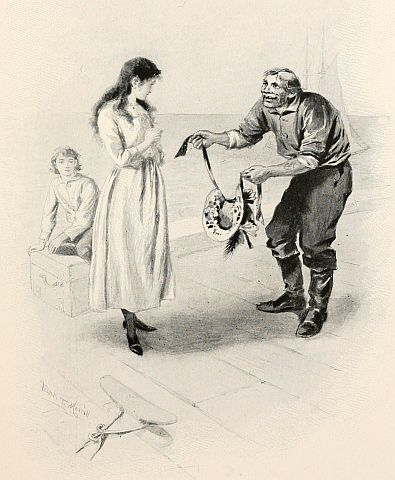
fumbling awkwardly in his breast. He drew out a small
object wrapped in coarse brown paper, and held it out
with a piteous look.
“See here! gentleman,” he said. “I meant to send this
to Isly first; that’s what I meant to do. I meant to send
it in by the putty-faced feller, and tell how the man that
brought it was there, and had more where that came
from.” He unfolded the paper with trembling fingers,
and held out the goldstone brooch.
“That’s handsome, ain’t it?” he said, anxiously.
“That’s handsome enough for a young lady like Isly,
ain’t it, gentleman? That’s what ladies wear, round in
city parts?”
The trustee examined the brooch gravely.
“A fine piece of goldstone, Joseph. I never saw a
prettier piece; yes, Isla will surely be pleased with that.
But don’t you think it would be just as well to give it
directly to her? I think she might be better pleased
if you gave it to her yourself. Wait here a moment, and
I will bring both the children; or, there is Miss Stewart;
I will ask her to bring them.”
A few words told Miss Stewart the nature of the new
arrival; after a curious glance at the fish-like visitor, she
sped away. The kind trustee waited, saying a word now
and then to Joe, trying to make him feel at ease, pointing
out this and that picture on the walls; but the islander
paid little heed. His eyes were fixed on the door; he sat
on the edge of his chair, turning the brooch absently in
his fingers; he was listening so intently that the trustee
fancied he could almost see his ears prick from under the
wisps of sandy hair. Presently there came a sound of feet
on the stair, and Joe started up with an inarticulate sound,
between a whistle and a cry. The trustee heard three
distinct footfalls, but Joe heard only one.
“She’s comin’!” he cried. “Isly’s comin’!”
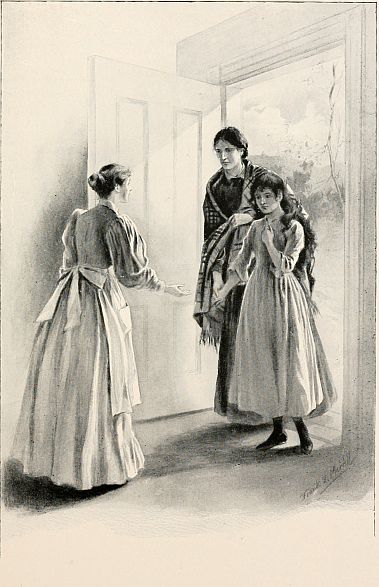
Was this Isla who came in? The trustee stared in
amazement. Deadly white, with brows drawn as if in
pain, with lips set close, hands pressed together, eyes full
of fear,—was this Isla? The principal shook her head,
and signed her amazement. “I could hardly make her
come,” she whispered. “She fell into a sort of shuddering
fit,—I fear there is something wrong about it all. Hush!”
Both were silent, feeling the matter taken out of their
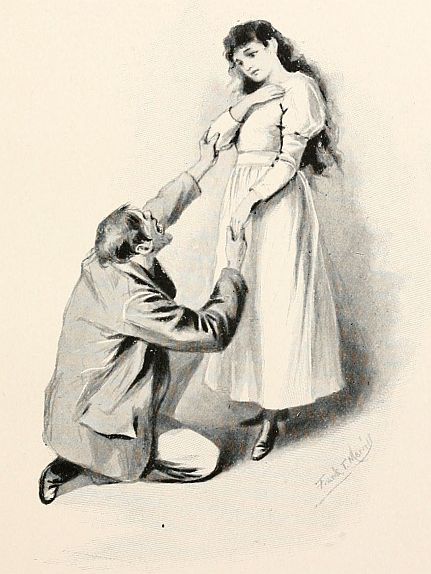
hands. Joseph Brazybone was at Isla’s feet, half kneeling,
half crouching; he was patting her dress, her hands, touching
the ends of her long hair with timid fingers. The
trustee felt that he was needing a tail to wag, and was
sorry for him. Little Jacob threw himself on the islander,
with every sign of pleasure, but Joe hardly heeded him,
only looked up in Isla’s face with dog-like, beseeching eyes.
The girl’s eyes were like hard, bright stones, save for that
watchful look of fear, of expectation; but, presently, they
softened. The old kindness, the thought of her father and
her home, flowed over her like a wave, shook her like a
wind. She smiled, and tried hard to make it her own
smile; she patted Joe’s shoulder with a friendly touch, and
pointed to a chair. But Joe still crouched on the floor
gazing at her.
“Ye’re lookin’ well, Isly!” he said at length; and the
two onlookers started at the sound of his voice, so tense
had the silence grown.
“Ye’re looking real well, and growed a perfec’ lady, as I
always knowed.” He paused a moment; then went on.
“Joe thought he’d come to see ye, y’ understand,
young lady! Old Joe thought he’d come. The winter’s
been long enough on the island, and come spring Joe says
to himself, ‘She’ll be thinking about home,’ he says, ‘and
mebbe she’ll be glad to see a face as comes from home,
even if ’tis a ugly one. Joe ain’t never set up to be a
beauty, ye know, Isly.”
He tried a laugh, and it broke off in his throat.
“Ain’t ye glad to see the old man, Isly?” he said, after
a pause. “Ain’t ye goin’ to pass the time o’ day to old
Joe, Joe Brazybone, as he and Giles was boys together?”
Isla smiled, and pressed his hand kindly; her lips never
moved, but now she began to shake as if with an ague;
pale flushes came and went through her clear skin, and her
breathing was hurried and broken. The trustee touched
Joe on the shoulder. “I fear you are distressing her!”
he said kindly, seeing the man labouring in anguish of
perplexity. “You forget Isla hears nothing, and she has
not yet learned to read from the lips.”
Joseph Brazybone started to his feet, and threw up his
hands with a strange gesture.
“What’s that you’re sayin’?” he asked. “What’s
that you said, gentleman, about Isly Heron?”
“I do not need, surely, to tell you that she is deaf and
dumb,” said the trustee. “You cannot speak to her by
signs, as Jacob did when he came!”
“Deef!” cried Joe, and his voice rang through the room
like a trumpet. “Isly Heron deef? It’s a lie, whoever
says so. Isly, why don’t you speak to me? why don’t you
speak to these folks, and tell ’em not to call you out o’
your name?
“Isly Heron deef and dumb, her that sings like a bird,
and talks like angels in the sky? Why, gentleman, and
you, lady stranger, you—you don’t understand what
you’re sayin’. I tell ye, if God only allowed one voice
on this airth, that voice ’ud be Isly Heron’s. And old Joe
comes to see his young lady, and she won’t speak to him.
Oh, Isly, Isly, for yer father’s sake, speak to old Joe just
once, if ye never do again!”
He was down on the floor again, crouching at her feet.
Isla looked round the room, with wild eyes of a trapped
creature that sees death before it; she saw the grave wonder,
the doubt and distress, in the faces of the two spectators;
she saw the agony of pleading in the rugged,
misshapen features of the fisherman. She looked,—ah!
where else should she turn now for comfort? In the face
of her little Jacob; Jacob, for whose dear sake she had
borne and suffered all; to whom now, perhaps, she was
bringing shame, punishment for her sin; for she never
doubted its being a sin. Jacob was smiling, pleased and
happy at seeing a face that he remembered well in the old
days at home. Those days were growing dim now for
Jacob, and the new life filled his little cup with joy and
comfort. He looked happily up at his sister, but met her
eyes all fierce and burning, saw her face drawn and distorted
with pain. Jacob did not understand pain, and Isla
looked dreadful. He shrank from her, and caught the
hand that was next to him, the hand of the principal of
the school, and nestled in her gown.
When Isla Heron saw that, she threw out her arms, and
cried aloud.
“God!” she cried in her extremity. “God! God!
where are you?” Then, with her bird-like motion, she
swung out from among them, pushing aside the hands that
would have held her, avoiding the kind arms that sought to
stay her; out of the room, and down the stair, flying so
light and swift that no one missed the wings; out of the
room and down the stair; and, before any one could stir to
follow her, they heard the front door open quickly, close
lightly,—Isla was gone!