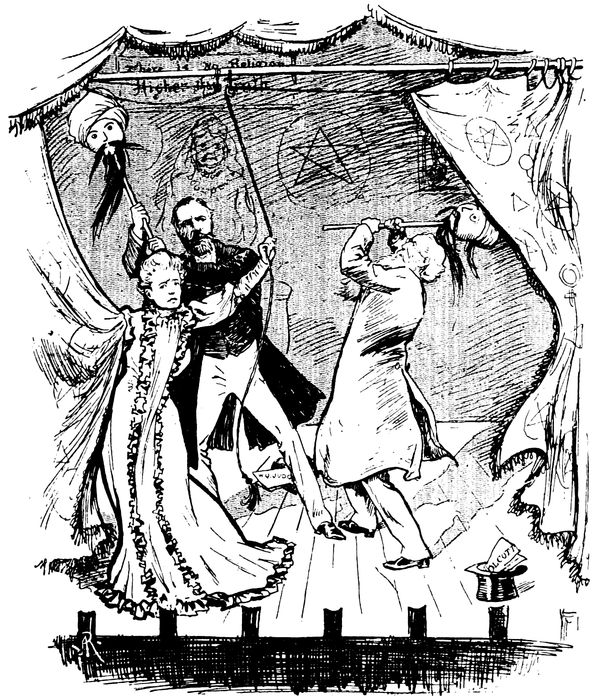
ISIS VERY MUCH UNVEILED, BEING THE STORY OF THE GREAT MAHATMA HOAX.
Transcriber’s Note:
The cover image was created by the transcriber and is placed in the public domain.
 |
TOLD FROM SOURCES MAINLY THEOSOPHICAL, BY EDMUND GARRETT, AUTHOR OF “IN AFRIKANDER LAND,” “IBSEN’S BRAND IN ENGLISH VERSE,” &c. |
|
| London: “Westminster Gazette” Office, Tudor Street, E.C. |
All Rights Reserved. |
INDEX.
| PAGE. | |||
|---|---|---|---|
| PART I.—The Story of the Great Mahatma Hoax. | |||
| Chapter | I.— | Introduction | 5 |
| 〃 | II.— | No Mahatmas, no Members! | 8 |
| 〃 | III.— | Mystification under Madame Blavatsky | 13 |
| 〃 | IV.— | The Psychical Research Exposure | 17 |
| 〃 | V.— | Mystification under Mrs. Besant | 22 |
| 〃 | VI.— | Enter the Mahatma | 27 |
| 〃 | VII.— | Every Man his own Mahatma | 32 |
| 〃 | VIII.— | The Adventures of a Seal | 36 |
| 〃 | IX.— | The Climax of Theosophic Brotherhood | 42 |
| 〃 | X.— | The Mahatma Tries Threats | 48 |
| 〃 | XI.— | Mrs. Besant’s coup de main | 55 |
| 〃 | XII.— | A Meeting of the (Theosophical) Pickwick Club | 60 |
| 〃 | XIII.— | Questions and Challenges | 67 |
| PART II—Answers and Theosophistries. | |||
| I.— | From Officials | 75 | |
| II.— | From Prominent Theosophists | 80 | |
| III.— | From Private Members | 93 | |
| PART III.—A General Rejoinder. | |||
| Last Shreds of the Veil of Isis | 99 | ||
| POSTSCRIPT. | |||
| Mr. Judge’s Mahatma at Bay | 108 | ||
| L’Envoi: “The Society upon the Himalay” | 117 | ||
| A Reply from Mr. W. Q. Judge | 121 | ||
| An Appreciation of Mr. Judge’s “Reply” | 133 | ||
| Illustrations and Facsimiles. | |||
| Frontispiece, Portrait of Mme. Blavatsky | 1 | ||
| Portrait of Mrs. Besant | 80–81 | ||
| Portrait of Colonel Olcott | 32–33 | ||
| The “Mahatma’s Seal” | 28 | ||
| The Envelope Trick | 35 | ||
| Facsimiles of Mahatma Missives, of Mr. Judge’s Handwriting, &c. | 20, 33, 37, 38, 50, 52, 54, 115 | ||
| Portrait Cartoon: “When Augur meets Augur” | 119 | ||
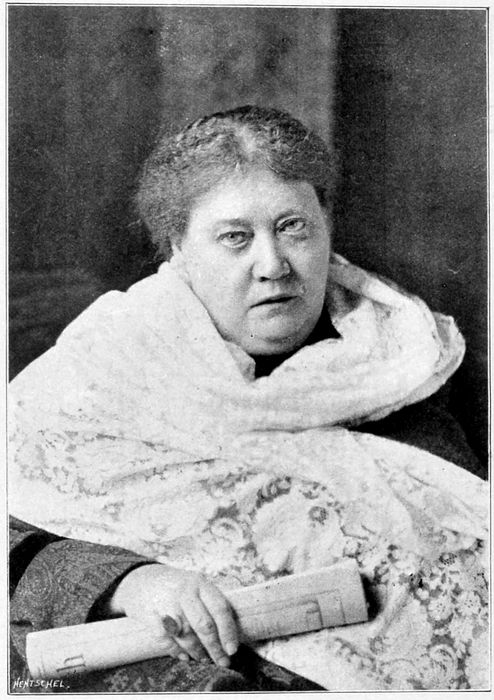
MADAME BLAVATSKY
(From a photograph by Messrs. Elliott & Fry, Baker-street, W.)
PREFACE.
Tourists at Pompeii are shown a temple of Isis. The impartial cinders have preserved for us there, not only the temple, but the secret passage which the priests used in the production of what are nowadays called “phenomena.”
The following pages are designed to show the secret passage in the temple of the Theosophic Isis, the goddess of Madame Blavatsky’s “Isis Unveiled.”
Instead of having to wait on the pleasure of Vesuvius, I am enabled to act as cicerone while the temple is still (for the present) a going concern.
The important difference between the exposure of Madame Blavatsky’s box of tricks by the Society for Psychical Research, and the present exposure of her successors is, that in this case we have the high-priesthood giving evidence against itself. My own part in the business is merely the humble one of seeing that they shall all satisfactorily “get at” one another. In redacting, out of the mass of various testimony which has fallen into my hands as clear and readable a story as I could present, my main care has been to tone down the mutual insinuations. Talk about augur meeting augur with a smile! It is the snarl which these augurs cannot disguise.
As for myself, I have tried to render a service to truth; but I cannot see, with some good people, that a sense of truth necessarily excludes a sense of humour.
Mrs. Besant is a lady whose character I have often defended in the press though I have not always been able to accept the extremer estimates of her intellectual power. She is about the only one of my dramatis personæ in whom the public at large (like myself) feel any personal interest whatever. She is, therefore, the strongest buttress of a fabric which she has now for some time known to be rotten at the base. That is why I have dealt more seriously with her than with these Olcotts and Judges. The President is too flabby to be worth fighting; the Vice-President is iialready thrown over by all the shrewder and honester members; even Mrs. Besant herself has now cabled her refusal to accept his latest revelation, and discovered that his Mahatma is indeed a fraud—when he “deposes” Mrs. Besant.
My pity is saved for those humbler dupes of the rank-and-file who have trusted these others not wisely but too well. From some of them I have seen pathetic letters; and if any gall has got upon my pen, it is the gall of the bitterness of their disillusion. They are more widely spread, and more worth saving from the quagmire of shams than most people suspect.
I need hardly remark that I was never a Theosophist myself. But my Theosophical sources of information, referred to in the course of the story, have been growing within the Society week by week ever since the exposure began.
There are no signs at present of any intention on the part of the three Theosophic chiefs to return from the various continents to which they departed last July—departed simultaneously with the issue of that “Report of an Inquiry” (so-called) which is the starting-point of these chapters. Mrs. Besant has left Australia to join Colonel Olcott in India; Mr. Judge remains just five days hence at New York. And so, taking a cue from Mahomet and the Mountain, “Isis Very much Unveiled” will now, in booklet form, go out to them.
PART I. THE STORY OF THE GREAT MAHATMA HOAX. — CHAPTER I. INTRODUCTORY. — CHAPTER II. NO MAHATMAS, NO MEMBERS! — CHAPTER III. MYSTIFICATION UNDER MADAME BLAVATSKY. — CHAPTER IV. THE PSYCHICAL RESEARCH EXPOSURE. — CHAPTER V. MYSTIFICATION UNDER MRS. BESANT. — CHAPTER VI. ENTER THE MAHATMA. — CHAPTER VII EVERY MAN HIS OWN MAHATMA. — CHAPTER VIII. THE ADVENTURES OF A SEAL. — CHAPTER IX. THE CLIMAX OF THEOSOPHIC BROTHERHOOD. — CHAPTER X. THE MAHATMA TRIES THREATS. — CHAPTER XI. MRS. BESANT’S COUP DE MAIN. — CHAPTER XII. A MEETING OF THE (THEOSOPHICAL) PICKWICK CLUB. — CHAPTER XIII. QUESTIONS AND CHALLENGES.
“O my Theosophists.... What a pack of fools you are!”—Madame Blavatsky.
This will be one of the queerest stories ever unfolded in a newspaper. Truth, as worshipped by the Theosophists, is indeed stranger than fiction. But it is not here told merely for entertainment. It has also a degree of importance and instructiveness measured by the growing wealth and numbers of the Theosophical Society, and the personal influence of Mrs. Besant. To-day the Theosophical Society numbers some three or four thousand members in Europe, India, and America. It supports two or three publishing businesses and several score of magazines in various languages. It boasts offices and house property in London, New York, and Adyar. It attracts donations and bequests. It numbers a title or two and some money-bags. It consists almost entirely of educated or semi-educated people, many of whom are intelligent, many sincere; a few both. And it is likely, amid that debauch of sign-seeking and marvel-mongering into which a century rationalistic in its youth has plunged in its dotage, to captivate an increasing number of those who are bored with the old religions and yet agog for a new.
It is especially to these that I dedicate the singular narrative which these articles are to unfold. It may save them betimes a painful disillusionment, such as it will, I fear, inflict on many who are as yet numbered among the faithful.
What is the situation at present?
6Everybody knows that Madame Blavatsky, the original founder of the society, supported its pretensions to an occult origin by the production of phenomena which were pronounced by careful investigators to be due to systematic trickery; but which are still believed by the faithful to have been produced at Madame’s request, and in support of the Theosophic movement, by certain Eastern sages possessed of transcendental powers over mind and matter.
Everybody will remember that Mrs. Besant, on whom the mantle of Madame Blavatsky has fallen, made a sensational public assertion, some time after her teacher’s death, to the effect that those “powers” were still at work (they were indeed!), and that she was herself now the recipient of similar “communications” from the “Mahatmas.”
A few people are aware that as the result of a sort of split among prominent members of the society, there was recently a Theosophic meeting at which Mrs. Besant confessed to her friends that there had been something wrong with the “communications” which she had been in such a hurry to announce to the public; made certain Theosophically obscure charges against a brother official of the society; but persuaded those assembled to rest content with a general statement and not to inquire into the facts further—in short, generally to hush the matter up.
This the Theosophists, being a docile folk, conscientiously did; and as the accused proceeded with Mrs. Besant’s sanction to deny, still in general terms, what little assertion of fact Mrs. Besant herself had appeared to convey, after which there was an affecting reconciliation: it is not surprising that to the outside public the mystery remains exactly where it was.
Even of the Theosophists themselves the full facts are only known at present to a few of the inner ring.
In view of what has gone before, this reticence appears misplaced; and as circumstances have put me in possession of the facts, I propose to give them the same publicity as was enjoyed by Mrs. Besant’s original statement.
I propose to show:—
That Mrs. Besant has been bamboozled for years by bogus “communications” 7of the most childish kind, and in so ludicrous a fashion as to deprive of all value any future evidence of hers on any question calling for the smallest exercise of observation and common sense.
That she would in all probability be firmly believing in the bogus documents in question to this day, but for the growing and at last irresistible protests of some less greedily gullible Theosophists.
That the bamboozling in question has been practised widely and systematically, ever since Madame Blavatsky’s death, pretty much as it used to be during her lifetime.
That official acts of the society, as well as those of individual members, have been guided by these bogus messages from Mahatmas.
That the exposure of them leaves the society absolutely destitute of any objective communication with the Mahatmas who are alleged to have founded and to watch over it, and of all other evidence of their existence.
That Mrs. Besant has taken a leading part in hushing up the facts of this exposure, and so securing the person whom she believes to have written the bogus documents in his tenure of the highest office but one in the society.
And that therefore Mrs. Besant herself and all her colleagues are in so far in the position of condoning the hoax, and are benefiting in one sense or another by the popular delusion which they have helped to propagate.
I shall show, finally, that the only alternative to this set of conclusions is another which would be even more discreditable to the personnel of the society, and even more fatal to its continued existence on its present basis.
“If there are no Mahatmas the Theosophical Society is an absurdity, and there is no use in keeping it up.”—Mrs. Besant, in Lucifer, December 15, 1890.
Before going any further I wish to emphasise one point. This society, as such, must stand or fall with its “Mahatmas.” It should be realised how consistent, in one sense, this miracle-mongering side of the Theosophical movement has been throughout the society’s history; what an important part it has played and continues to play in attracting popular interest; and how closely, along one of the versatile thaumaturgist’s many lines, Madame Blavatsky has been followed by her present-day imitator. I say this in justice to the latter, who, I think, may fairly complain of the unkind criticisms passed on his Mahatma-missives by colleagues who still cherish those produced under the auspices of Madame Blavatsky.
It is true that the society does not officially vouch for Mahatmas. It is careful not to demand belief in them as a condition of membership; and the shrewder members are put into a panic by anything which tends to compromise its boasted “neutrality” on this tender subject. But we shall soon see what this “neutrality” is worth.
9Madame Blavatsky taught that “the Masters” are certain sages, several hundred years old or so, who by steeping themselves in the immemorial lore of the East have attained powers transcending time, space, and the other puny limits of Western science. By profound solitary meditation on Things in General, these old gentlemen have arrived at a sort of Fourth Dimension, in which a Soul and a Saucer come to very much the same thing. Their residence was shrouded in a judicious mystery, which Madame declared herself under a solemn oath to preserve. She at first located them in the recesses of the Himalayas; but one of her most zealous disciples lately stated in the Daily Chronicle that “the two principal Mahatmas now reside in an oasis of the Desert of Gobi.” At any rate, these “adepts” prefer a sequestered spot, and remain occult in the strictest sense of the word.
But on some points Madame was unequivocal about them. She declared that she had sat at the feet of one of them as his chela (pupil); that the Theosophical Society was founded under his distinct inspiration; and that he and his brothers continued to intervene in its affairs. The original draft of the Society’s constitution, in fact, like a more authentic Veda straight from heaven, had been “precipitated” in New York by an exertion of the Masters’ psychic force from Tibet. Hesitating converts and dubious subscribers were determined by the same form of interposition; and somebody or other has taken steps, at all times of the society’s history, to ensure that the more faithful of the “chelas” should be comforted and encouraged as need arose, by missives from their invisible “guru.” (A good, imposing word, “guru.” Do you remember the terrible old man by the road in “David Copperfield,” who scared David almost out of his wits by running out on him, and shouting “Guroo, guroo, guroo”?) Mrs. Besant herself has admitted that Theosophy is to be regarded in the light of a “revelation” from these exalted beings, as well as in that of a science or philosophy which can be arrived at by more ordinary means.
In a word, Theosophy without Mahatmas would be “Hamlet” without the Prince of Denmark. “Isis Unveiled” and “The Secret Doctrine” are works which few would be found to wade through 10if their verbose pages were not lightened by associations of that White Magic which lends a creepy interest even to such avowed works of fiction as “Zanoni” and “Mr. Isaacs.” With belief in the Mahatmas must go any believing of “H.P.B.,” who swore to them; and with “H.P.B.” and her authorities must go those two volumes of solemn farrago, which remain the society’s only contribution to philosophical knowledge. For all that is new in them, if there is anything new except the blunders, is explicitly given on the authority of “the Masters.”
The published “Objects” of the society run thus:—
(1) To form the nucleus of a Universal Brotherhood of Humanity without distinction of race, creed, sex, caste, or colour.
(2) To promote the study of Aryan and other Eastern literatures, religions, and sciences.
(3) A third object—pursued by a portion only of the members of the Society—is to investigate unexplained laws of nature and the psychical powers of man.
It will thus be seen that the “phenomenal” side of the society’s activities has all along had a place, though guardedly, even in its published Objects. In point of fact, as I have elsewhere insisted, this third Object is the only one in pursuit of which the society has any substantial achievement to point to. As to the first Object, my narrative will presently suggest the same sort of remark on the brotherliness of the Universal Brothers as has sometimes been made by scoffers on the sociability of Socialists. As to the second Object, it is observed that there are people who study Oriental literatures, and there are people who belong to the Theosophical Society; but they are not the same people. Professor Max Müller has edited the only series of English translations of the Sacred Books of the East with which I am acquainted, and Professor Max Müller lately published some University lectures under the title of Theosophy. But his preface explained that he did so in order to rescue that respectable and ancient philosophical term from the associations of sciolism and miracle-mongering with which the Theosophical Society have linked it in the public mind. In point of fact, there is no reason to believe 11that any member of the society in Europe could pass an examination in any Oriental language whatever. The third Object, on the other hand, has led to some real achievements. The society has not, perhaps, done much in the “investigation” line itself; but members of it have certainly supplied the most astonishing “unexplained laws of nature” and “psychical powers” for investigation by other people. It is this which has given it its success, its growth, its world-wide notoriety. It is this which first attracted and convinced its best-known converts, and it is this which has created the successive “booms” (as they would be called in a more purely commercial connexion) which have produced the biggest crops of entrance subscriptions from the wonder-loving public. I lay stress on this because the Theosophists have shown a good deal of inconstancy in their treatment of the third Object. They have always worked a given marvel for all it was worth until it got somehow blown upon; then they turn round and remark that mere material phenomena are, after all, of no great importance: the thing is the study of those great spiritual ideas which, &c., &c. In fact, they want to have it both ways. Mr. Sinnett, however, whose “Occult World” remains the classic description of Madame Blavatsky as a wonder-worker, confesses candidly in a memorial sketch of her which appeared in the Review of Reviews how much stress she herself laid on such things, as long as she could get anyone to believe in them:—
One could no more write a memoir on trigonometry and say nothing about triangles, than survey the strange career just concluded and ignore the marvels coruscating through it. And at this early period of her enterprise [he means, before the Psychical Research exposure] she seems to have depended more on the startling effect of surprising powers she was enabled to exhibit than on the philosophical teaching ... which became the burden of her later utterances.
Just so. It is easy to hold your miracles cheap—after they have been found out. Madame Blavatsky fell back on Object Two—when Object Three was discredited. But the taste for such things, even when it is de rigueur to describe them as “occult applications of strictly natural laws,” is apt to grow upon any religious sect which once dabbles in them. Mrs. Besant, too, in due course fell a victim to the temptation 12to make capital out of the marvellous; and my readers will now be prepared to put their proper value on the deprecating expressions in this connexion which now, on the inevitable turn of the wheel, once more begin to be heard, and which will be redoubled, no doubt, when this narrative is fully before the public.
“Now, dear, let us change the programme.... He is willing to give 10,000 rupees ... if only he saw a little ‘phenomenon’!”—Blavatsky-Coulomb Letters.
It is no part of my present object to enter at length into the history and character of the late Madame Blavatsky. But a comparison of the earlier phase of the Theosophical Society with that of to-day is so indispensable to the right appreciation of both, that a brief résumé (borrowed mainly from previous sketches of my own elsewhere) may be welcome at this point, even to readers already familiar with the subject.
The Theosophical Society was born in America of Russo-Yankee parentage. Helena Petrovna Blavatsky founded it at New York in 1874, with the aid first of Colonel Olcott, then a kind of journalist, who became, and still is, the president, and soon afterwards of William Q. Judge, then a lawyer’s clerk in Olcott’s brother’s office, who became, and still is, the vice-president.
The previous career of the Foundress had been remarkable enough, if we accept hostile accounts of it—still more remarkable if we accept her own; but with this I am not concerned. From 1874 Madame Blavatsky’s history and that of the Theosophical Society are one.
In 1878 the society moved its headquarters to India, and in the congenial atmosphere of the mysterious East launched into marvels. Eked out by performances not unlike a drawing-room Maskelyne and 14Cook, Madame’s rehash of Neo-platonist and Kabbalistic mysticism with Buddhist terminology soon “caught on” with the impressionable natives. It had especial attraction for the educated and ardent young Babu, that typical product of British India whom Mr. Rudyard Kipling has so often drawn for us. But it also carried away, thanks to Madame’s intense personality—half repulsion, half charm—editors and officials of mark in the sceptical circles of Anglo-India. It made Mr. A. P. Sinnett (then editor of the Pioneer) turn evangelist in “The Occult World,” and Mr. A. O. Hume (then Government Secretary) follow suit with “Hints on Esoteric Philosophy.” And no wonder. Never was a new religion more industriously supplied with miracles—those coups de main célestes, as a witty Frenchman has defined them. Wherever Madame happened to be with a select circle of friends, disciples, or laymen worth impressing, but especially in and about the bungalow at Adyar, near Madras, the society’s headquarters, the invisible Mahatmas were never tired of exhibiting their astonishing psychic powers over ponderable matter. The two who were especially at Madame’s disposal went by the names (reverently breathed) of Mahatma Morya and Mahatma Koot Hoomi Lal Sing. In the region of White Magic they could do almost anything—any feat which an adroitly led-up conversation might happen to suggest. But the particular lines of business (if I may be allowed the phrase) of which they made a speciality were making objects appear and disappear: in Madame’s jargon, integrating and disintegrating them by a psychical command over astral vortices of atoms. Sitting in their studies 2,000 miles away in Tibet, they could, by a mere effort of will, project an astral epistle, or an astral body, or an astral cup and saucer, into the middle of an applauding circle at afternoon tea or picnic in Madras or Bombay. Showers of roses fluttered down from the ceiling. Invisible bells tinkled from none knew where. All kinds of tricks were played with Madame’s interminable cigarettes. Sketches and treatises were psychically “precipitated” on to blank paper, nay, sometimes the very stationery was created out of nothing to receive them. Such inferior sketches, 15too, and such twaddling, such very twaddling, treatises! One disciple—Damodar K. Mavalankar, a youth passionately ambitious of fame—even advanced to the acquirement of some of these extraordinary powers in his own person. Merely to have seen the astral body of a Mahatma became in a manner a cheap accomplishment. Damodar boasted that he had once or twice projected his own—slipping spook-like through a brick wall.
Most of these marvels, as I have hinted, required the mise en scène of the Adyar bungalow. Here Madame and the Colonel, and a few favoured chelas, had apartments. “Our domestic imbeciles” and “our familiar muffs” the latter are termed in one of the letters attributed to Madame. Here, too, in the “Occult Room” adjoining Madame’s bed-chamber, hung the famous “Shrine,” a sort of cupboard containing a fancy portrait in oils of the condescending Koot. This became associated with as many marvels as the image of a mediæval saint. Suppose you are an intending Theosophist—a hesitating convert, especially a moneyed one, like Mr. Jacob Sassoon. You call at headquarters. You are shown round by Damodar, or by M. or Madame Coulomb, librarian and secretary. With natural curiosity you ask to gaze upon the Master’s features. You are told of his indulgent concessions to deserving neophytes seeking for a sign. When the cupboard has been shut again, you are asked if there is anything you particularly desire from the Master. You indicate, not unnaturally, a message. It is about even chances whether the said message—reading generally not unlike Mr. Martin Tupper in his more oracular vein—is discovered in the cupboard immediately on reopening the door, or descends from the ceiling on to the top of your head.
The fame of these things, set out in the driest possible detail in the pages of “The Occult World,” aroused a furore of curiosity in this country, where people were just beginning to take a new interest in questions of psychical research. It was about the time when family circles played the “willing game,” and sat in the dark trying to see purple flames coming out of a magnet. Quick to seize the psychological moment, Madame Blavatsky came to England and “starred” London in the season of 1884. In her train came 16Colonel Olcott and Mohini L. Chatterji. Mohini, a Brahmin graduate of the University of Calcutta, shone like Damodar with a lustre not all reflected. He, it was whispered, was a chela of some attainments. He was not to be touched. He held his hands politely behind him when being introduced. There was a splendour as of some astral oil about his dusky countenance and thick black locks; while his big, dark eyes were as piercing as those of Madame herself. Men gazed on Mohini with awe, and ladies with enthusiasm. In the background hovered the recording Sinnett.
In spite of the disappointing fact that the London air proved unfavourable to miracles, the tale of the Indian ones was greedily drunk in, and Theosophy became the fashionable fad. Society people took to calling themselves Esoteric Buddhists: some were enrolled as chelas at short notice. The Theosophists went the round of the London drawing-rooms, penetrated to provincial towns, were not unheard of at the Universities. Madame rolled cigarettes and swore and talked black magic in the rooms of well-known Cambridge dons, till the hair of undergraduate listeners stood on end. Those were the days when a set of enthusiastic pass-men lived “the higher life” on a course of Turkish baths and a date diet; while three unlucky youths at Trinity nearly poisoned themselves with hasheesh in an attempt to project their astral bodies, and were only recovered at midnight by a relentless tutor armed with the college authority and a stomach-pump.
“Either she is a messenger from the Mahatmas or else she is a fraud. In either case the Theosophical Society would have had no existence without her.”—Mrs. Besant in Lucifer, December 15, 1890.
At the time of the Blavatsky season in London and Cambridge, the lately-founded Psychical Research Society, which had close connexion with the University town, was spoiling for something to investigate, and it decided to investigate Madame Blavatsky. Madame and her friends were delighted with this testimony to the stir which they had made, and entered into the thing with every hope of converting the Researchers. Were they not all ready to asseverate that such-and-such things had indeed happened——in India?
Whatever Theosophists may now say, the ‘S.P.R.’ was certainly not a hostile tribunal. Its very existence and objects were a challenge to the average educated prejudice which assumes that nothing can ever happen in nature which is not accounted for in current scientific textbooks. The society had itself vouched for “telepathy,” and coquetted with “phantasms of the living”; it has since bestowed a statistical respectability on the common ghost. To the miracles of Adyar some of its members had lent a more than friendly ear. One of the most prominent had actually been dubbed a chela. Dr. Hodgson (now secretary of the S.P.R. American Branch), who conducted the Indian part of the inquiry, declared that whatever prepossessions he may have 18had “were distinctly in favour of occultism and Madame Blavatsky.”
When Mr. Hodgson got to India he found people very much excited over some highly suspicious and suggestive letters which had just appeared in a Madras paper, communicated by the Madame Coulomb already spoken of, and alleged by her to have been written by Madame Blavatsky. Mr. Hodgson had to inquire on the spot: first, into the genuineness of these letters; secondly, into that of the missives alleged to have been precipitated by Mahatmas; thirdly, into the credibility of the evidence about other marvels given before the Psychical Committee by Madame herself, Colonel Olcott, Mr. Sinnett, and Mohini. He inquired and investigated for three months; and his report, with copious facsimiles and plans, is on record in Part IX. of the S.P.R. Proceedings (December, 1885).
The allegation of the Coulombs was that the whole series of miracles had been a matter of vulgar trickery, some of which they had been employed to carry out for Madame. During Madame’s absence in Europe, the people at Adyar had quarrelled with them and dismissed the pair, partly for having at various times hinted to outsiders the secrets which they now proceeded to make a clean breast of. The origin of their close relationship with Madame Blavatsky is obscure. She and Madame Coulomb had been associated at Cairo in the seventies in some “page” which the foundress of Theosophy had expressed a wish to have “torn out of the book of my life.” By the foundress’s own account, this torn-out page was such as made it odd that she should pitch on the Coulombs when in want of fit guardians for the sacred Shrine. Mrs. Besant once expounded to me a theory that Madame did this, with the full foreknowledge that frauds would follow and would discredit her and her Masters, partly from a sublime benevolence towards the wicked Coulombs, partly because it was necessary that she should herself “have her Calvary.” It was the same combined motives, no doubt, which led Madame Blavatsky to act more than once exactly as if Madame Coulomb had some secret hold over her. An agitated telegram from Paris, however, failed to heal the present rupture; and the result was the giving to the press of a long series of letters in Madame’s hand, teeming with veiled instructions to the Coulombs which fitted in at every point with their accounts of jugglery at Adyar.
19The Coulomb story tallied also with equal accuracy with such outside circumstantial evidence as happened to touch it. Did Madame Coulomb allege that a “miracle” was worked by the substitution of one vase for another exactly similar, the shop she named proved to have record of the purchase of just such an exact pair just before the date of the miracle. Did she make a similar statement about a “miraculous” shower of roses, the like corroboration would be forthcoming. Did her husband describe the famous “Shrine” cupboard as a trick-cabinet with three sliding panels in the back, the panels had to be admitted, and explained by Madame as “for convenience of packing in case of removal.” It had hung against a hidden recess in the wall—there was the recess, the coincidence had to be deplored as unfortunate. On the other side of that recess, in Madame’s bedroom, the sideboard had a false back—that, too, was to be seen, and the Theosophists must content themselves with alleging that M. Coulomb had made it so after the miracles, and in the nick of time for the inquiry. As for the scribbled instructions and letters in which some of these arrangements were clearly hinted at, Madame was driven to the peculiar course of admitting some letters and even parts of letters and denying the rest. This, by the way, was exactly what she had done about a similar incriminating letter on the subject of a trick “missive,” which was planted on Mr. C. C. Massey, in 1882; the discovery of which led to the resignation of that gentleman and others from the Society.
As for the evidence of Madame and her friends about special “phenomena” it had already so melted away under the application of ordinary evidential canons as to leave the field clear for the Coulomb theory. The “tests” with which in some cases the Mahatmas had insisted on supplementing the credibility of their witnesses were as worthless and disingenuous as all the rest.
Last, what of the Mahatma missives?—precipitated from the Himalayas, speaking in the persons and signed with the superscriptions of Mahatma Morya and Koot Hoomi Lal Sing. These precious documents, which had been rained among the faithful with a copiousness almost amounting to garrulity, had been a little discredited already. The prosy and sometimes illiterate verbiage of the Tibetan sages was a severe trial to the enthusiasm of 20the more critical Theosophists even where it was apparently original. But it was too much of a good thing when a long doctrinal treatise, which Koot Hoomi had addressed to Mr. Sinnett, was found to be a gross plagiarism from a lecture by an American gentleman which had been reported in a Spiritualist paper a few months before. Nor did it mend matters when, after considerable delay, the illustrious Koot condescended to the newspaper arena, and wrote—we mean precipitated—an explanation which for its evasiveness and general “thinness” is probably unique even in the records of convicted plagiarists.
But now came worse. For the same scrutiny which had identified Madame Blavatsky as the writer of the unblushing letters to Madame Coulomb now found exactly the same characteristics of expression, turns of phrase, and solecisms in spelling in the compositions of Koot Hoomi Lal Sing. As to handwriting, it was shown that the styles of the two august correspondents had been evolved gradually by differentiation from Madame’s ordinary hand. The facsimiles in the report deal only with “K.H.” documents; but the case against those of “M.” is just as strong. I showed a mass of “M.” script, which lies before me as I write, belonging to the earliest period, to a Theosophist well acquainted with Madame’s writing, and in perfect innocence he at once took it for hers. At that time almost the only difference between the two Mahatma scripts was that one affected red pencil or ink, and the other blue.
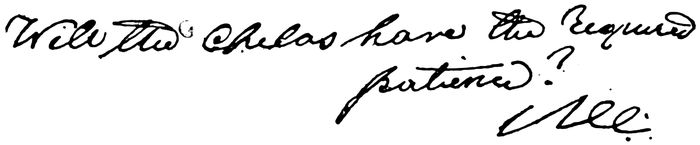
FACSIMILE OF MAHATMA M.’S SIGNATURE. FROM AN EARLY BLAVATSKY MISSIVE.
In a word, it was declared that Koot Hoomi Lal Sing and Mahatma Morya were the same person, and that person Madame Blavatsky. When a missive from the Himalayas floated down into the neophyte’s lap, it was Madame’s own hand which had prepared it, though it was the 21no less useful if humbler function of M. Coulomb to jerk it from the ceiling at the critical moment with a string, or deftly pass it through the sliding panel into the closed Shrine.
Passing by the committee’s report on Madame Blavatsky herself, what of her leading disciples? Of Colonel Olcott it was declared proven that in a Theosophical connexion he was either unable to describe anything as he really saw it, or else to see anything as it really was. Mohini and Mr. Sinnett were disposed of in much the same way. Damodar—the astral Damodar—was charged explicitly as a confederate of Madame in missive-manufacturing. Mohini, the fascinating saint, hurried back to India with a damaged halo. Mr. Sinnett has since sprung to fame as a director—not of the regeneration of mankind, but of the Hansard Union. Damodar announced that he was off to find his guru in the Himalayas, disappeared, and has not been seen since by his friends.
William Q. Judge, having been left out in the cold when the hegira to India took place, lived to fight another day, as we shall see. Mrs. Besant had not yet loomed on the Theosophical horizon. Madame Blavatsky herself left England and travelled till the storm had blown over. To the S.P.R. Report no serious answer has ever appeared from that day to this; and it fairly killed the miraculous phenomena. One class of them has reappeared under the ægis of Mrs. Besant; but poor indeed, as we shall see, is the Late Besantine period of mythological architecture beside its gorgeous predecessor.
“I look to possible developments of her Theosophic views with the very gravest misgiving.”—Charles Bradlaugh, National Reformer, June, 1889.
“The lady doth protest too much, methinks.”—Hamlet.
I have said that the Psychical Research Report put a stop to most of the Theosophic miracles. But there were obvious reasons why the Mahatmas should continue to “precipitate” letters, even when the scoffs of a hard, cold world drove them to restrain their wonder-working propensities in other respects. The business was so beautifully safe and simple. It defied “tests.” The task of proving that a scribble in red chalk on a scrap of paper found in a disciple’s pocket is not the authentic handwriting of an inaccessible teacher, whose devotees have doubtless the best reason for knowing that he can never be produced as a witness—this is a task from which the boldest sceptic might well recoil.
But what of the actual process of “precipitation”? Alas, it appears to be surrounded by disappointingly obscure conditions. It is not given to see the scrap of psychically-manufactured notepaper glimmer into being and become cream-laid out of nothing before one’s eyes, nor to watch the mystic characters form themselves in lines along it like the writing on Belshazzar’s wall. It is always the finished result that is discovered ready-made, and this precisely resembles what is produced if you or I write it in the ordinary way. The “precipitation,” in fact, is a deed of darkness, and can only be done concealed from view, just as mediums are wont to declare at a séance that the spirits are prevented from manifesting themselves by the mere presence of a sceptical inquirer with a box of wax vestas. Perhaps 23it is another side of the same retiring instinct which impels the Mahatmas to live only in parts of the earth not penetrated to by vulgar explorers. Theosophists sometimes speak as if they had seen the actual precipitation; but cross-examine any credible witness, and he will reluctantly admit that he has not. This is a point to note and bear in mind.
The Mahatma missive only becomes a matter of difficulty when it has to be made to drop from the ceiling into the recipient’s hands, or spirited into a cupboard found one moment before to be as empty as Mother Hubbard’s. Those were stirring days for Theosophic neophytes when that kind of thing was a common incident. But, ichabod! that glory is departed! Its departure precisely synchronised with that of the nimble-fingered Coulombs. Their graceless avowal that both special plant and skilful confederates were required for this kind of miracle may have been a gross calumny on their employer; but the fact remains that with the removal of the panel-backed Shrine at Adyar and the dismissal of its custodians, the Masters abruptly ceased to resort to these more surprising methods of aërial post.
Occasionally they would make the assurance of the faithful doubly sure by artlessly “precipitating” the message inside a sealed envelope (a species of “test” of which more anon); but for the most part they were content to endorse letters passing through the ordinary post or discovered by the recipient in his blotting-pad under circumstances equally consistent with a commonplace human agency.
Such was the state of things till Madame Blavatsky’s death.
But then came the rub. What the Psychical Research Committee held to be proven was that Madame had written practically the whole body of these documents with her own hand. What, then, if after her decease in May, 1891, the same missives continued to be received?
Before the controversy which sprang up again over her ashes had well died down, the public was asked to believe that this was indeed the case, on the word of a woman whom it believed incapable of making a statement of the kind without having first proved it to the uttermost and found it true.
24Speaking in the Hall of Science on August 30, 1891, three months after Madame Blavatsky’s death, Mrs. Besant said:—
“You have known me in this hall for sixteen and a half years. You have never known me tell a lie. (‘No, never,’ and loud cheers.) I tell you that since Madame Blavatsky left I have had letters in the same handwriting as the letters which she received. (Sensation.) Unless you think dead persons can write, surely that is a remarkable fact. You are surprised; I do not ask you to believe me; but I tell you it is so. All the evidence I had of the existence of Madame Blavatsky’s teachers of the so-called abnormal powers came through her. It is not so now. Unless even sense can at the same time deceive me, unless a person can at the same time be sane and insane, I have exactly the same certainty for the truth of the statements I have made as I know that you are here. I refuse to be false to the knowledge of my intellect and the perceptions of my reasoning faculties.”
It is no wonder that the reporter had to interpolate the word “Sensation.” The audience was one rather of Freethinkers than of Theosophists; the hall itself was identified with previous rhetorical successes of Mrs. Besant as the prophetess of Materialism. The thing was dramatically done, and was well calculated to impress on the outside public the fact that the personal reputation of Mrs. Besant for intelligence and honesty was now pledged to the genuineness of Theosophical wonder-working. In an interview in the Pall Mall Gazette of September 1, 1891, Mrs. Besant carried her statement still further, and pledged herself definitely to “precipitation”:—
“‘These letters are from a Mahatma whose pupil you are?’
“Mrs. Besant nodded assent.
“‘Did they just come through the post?’ our representative asked.
“But here he had hit the mystery.
“‘No, I did not receive the letters through the post,’ the lady replied. ‘They did come in what some would call a miraculous fashion, though to us Theosophists it is perfectly natural. The letters 25I receive from the Mahatmas are “precipitated.”’
“‘How “precipitated”?’ ...
“Mrs. Besant was quite ready to explain.
“‘Well,’ she said, ‘you can hear voices by means of the telephone, and receive a telegram which is actually written by the needle, not merely indicated by its ticks. The Mahatmas go a step further. With their great knowledge of natural laws they are able to communicate with us without using any apparatus at all.’
“‘But can you give me any details of the precipitation?’
“‘No; the Mahatmas only communicate with pupils who will not unwisely divulge anything. You can easily imagine the reason why this knowledge should be kept so secret. Were it possessed by a criminal it might be put to dreadful purposes.’ ...
“Mrs. Besant repeated that she had made her startling statement in the lecture deliberately, adding that there were many persons who knew her and would accept her statements as true, but who might not believe in Madame Blavatsky, because, Mrs. Besant was careful to add, they had not enjoyed the advantage of knowing that lady.”
Mrs. Besant did not overrate the extent of her public credit. She was implicitly believed by many who would not have troubled their heads at all over an assertion of Madame Blavatsky’s. A “boom” was the immediate result—the second big boom in the society’s history. Mrs. Besant had the satisfaction of seeing her statement honoured with a salvo of leading articles. “Can it be,” the Daily Chronicle exclaimed, “that there are things in heaven and earth which philosophy and science have not yet dreamed of?”—(Daily Chronicle, August 31.) And it opened its columns to a flood of correspondence on Theosophy and things occult. Day after day a crop of letters attested the public appetite for the marvellous.
The Theosophical Society has a sort of Press department, the business of which is to get up sham fights in newspapers in order to advertise the society; and whenever the excitement 26seemed to flag some member or other contributed a screed which revived it. The time was well chosen. It was the “silly season,” and under cover of Mrs. Besant more cautious papers than the Chronicle were glad to let the Mahatma divide attention with the sea-serpent and the giant gooseberry. The Theosophical Society reaped a fine harvest; though some complaints were heard that the new inquirers after truth addressed themselves more to the marvels which had attracted them than to the philosophisings to which Mrs. Besant had designed the marvels as a bait. However, if their interest was tepid on this side of Theosophy, their curiosity on the other side achieved small gratification. In Mrs. Besant’s words, “The Mahatmas only communicate with pupils who will not unduly divulge anything.”
But, as we have seen, what Mrs. Besant did divulge was enough to convey to the public certain definite impressions: to wit, that she had received letters in a certain handwriting, which did not come through the post, but “in what some would call a miraculous fashion,” and that these letters were, in fact, “precipitated” by the Mahatmas out of thin air. Also that she had satisfied herself of the above propositions by evidential processes as certain as the assurance of her own “sense” and “reasoning faculty” that her audience were before her as she spoke.
And now let us see what were the facts on the strength of which Mrs. Besant made these astonishing statements. So far, I have been occupied necessarily with putting on record matters of history open to any careful student of the subject. From this point I shall be dealing with a side of Isis which up to this moment has been kept closely veiled indeed.
“Answer the question I’ve put you so oft.... Give us a colloquy, something to quote. Make the world prick up its ear!”—Master Hugues, of Saxegotha.
“Thus has a Master spoken, and ... the word of a guardian of the Esoteric Philosophy is authoritative.”—“Introduction to Theosophy,” by Annie Besant.
Madame Blavatsky died May 8, 1891. Who was to succeed her as hierophant of the mysteries of Tibet? There was none among her disciples who could aspire to fill that rôle with anything resembling the hierophantine proportions of Madame herself. But Mrs. Besant, whose conversion had been much advertised to the public, was undoubtedly more fitted to pass muster as a prophetess than any of the others.
The brief and late character of her acquaintance with Madame was rather in her favour than otherwise, since it had left undisturbed in her ardent mind a loftier conception of Madame’s ethical character than had been affected for some time past by some who had known her longer. Mrs. Besant was even understood to be in some sense designate for the succession.
Officially, however, she was subordinate to Colonel Olcott, the president, then in India, and to Mr. William Q. Judge, vice-president, and head of the faithful in America.
It soon appeared that the latter gentleman, at any rate, did not mean his claims to Theosophical prominence to be ignored.
In reply to the announcement of “H.P.B.’s” death (Theosophists are wont to refer to their foundress, as the ancient Hebrews to the Deity, under the guise of initials) Mr. Judge promptly cabled to
Avenue-road was at first inclined to resent this ukase.
But Mr. Judge soon put a new face on matters when he arrived. That was a time of sore searchings of heart. With “H.P.B.’s” death the society’s one link with its unseen guides was broken, and “Masters” had let a fortnight elapse without giving any sign that they survived the decease of their high-priestess. William Q. Judge was to change all that.
On the evening of May 23 (he lost no time after his arrival), Mr. Judge suggested to Mrs. Besant that as they were in sore need of some assurance from Masters, they should repeat an old recipe of Madame Blavatsky’s for bringing those august beings to a point. He proposed that they should write a certain question on paper, put it in an envelope, shut that into a certain cabinet in “H.P.B.’s” room at Avenue-road, and invite the Masters to “precipitate” replies.
Mrs. Besant agreed. Mr. Judge himself wrote the question and closed the envelope, and put it into the cabinet.
Mrs. Besant did not stay in the room through the process of incubation. For “He that hath ears to hear, let him hear,” the Theosophic scripture reads, “He that hath eyes to see, let him put his Head in a Bag.”
After due delay, Mr. Judge took the letter out again. On his showing it to Mrs. Besant, judge of that lady’s emotion at the discovery that at the end of the question stood the word
traced apparently in red chalk; also, a little lower down, the words
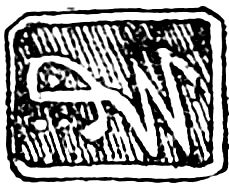
with the impression, in black carbon, of a peculiar seal, representing a cryptograph M. (A simple way to produce this appearance is to hold a seal in candle-smoke and impress with that.)
 |
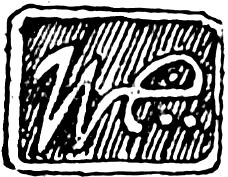 |
| THE “MAHATMA’S SEAL.” | IMPRESSION SHOWING CRYPTOGRAPH. |
29What need of further witness that the thing was the result of psychic “precipitation” from Madame Blavatsky’s “Mahatma M,” away in Tibet? If that gentleman had not, in his communications to Madame, been observed to use a seal, still he certainly used to scribble them in the same sort of red chalk, and he certainly used to sign himself similarly M.
Note one point here. It was not Mahatma M, but Mahatma K.H., who used to be the more prolix correspondent in Madame Blavatsky’s time, and whose handwriting appeared accordingly in copious specimens and comparisons with her own, in the published Report of the Psychical Research Committee.
No specimens were there given of the writing which Madame called Mahatma M’s: there were but a few scraps of it available.
When, therefore, Mr. William Q. Judge conjured a letter from him (I use “conjure” in its old-fashioned sense, of course), it was not possible for Mrs. Besant to compare it with any published specimens of the same script (with private specimens I fancy she had never been favoured), even if the extremely scanty and hurried nature of the message, and the temper of Mrs. Besant’s mind had not in themselves forbidden any such partial measure of verification.
It is true that a few months later Mrs. Besant felt able to affirm with the utmost confidence (as we have seen) that the handwriting was “the same as that which Madame Blavatsky was accused of producing,” and this at first sight appears to refer to the “K.H.” script, which afforded the gravamen of Mr. Hodgson’s Report. In that case what Mrs. Besant asserted was that the writing was the same as that which was not even supposed to be by the same person.
Next morning, there was a meeting of the “Inner Group,” at which Mr. William Q. Judge at once took up that position of Senior Chela to which his services as postman of the Mahatmas so well entitled him. There is some oath or other of equality with fellow-members 30and of obedience to its head which members of this Esoteric Section have to take: Mr. Judge pointed out that it was quite unnecessary for him to take this oath.
To which end he produced not only a letter from Madame Blavatsky, but one from Mahatma M, which he had personally received in America, he said. Its contents he did not feel able to communicate to others who could not yet aspire to be on corresponding terms with the Great Unseen: what he did show was the signature and seal impression (which exactly resembled that “precipitated” in the cabinet overnight). He specially begged those present to take note of the seal; “for,” said Mr. Judge, “they might have need to recognise it on some future occasion.”
With eager eyes they all obeyed; each aspiring young chela fluttered with the hope (for Mrs. Besant had noised the cabinet business about, and it seemed to rain missives) that he too might soon be blest with one.
Mr. Judge is a man of some foresight. But that was not precisely what he had in his mind when he bade them note the seal.
Three days after this (May 27) there was a meeting of the Esoteric Section Council, to decide how the section should in future be governed, its head being gone.
It had been expected that Mrs. Besant, having assumed the rôle of Teacher and Expounder in succession to her friend, would succeed her also as official head of the Esoteric Section Council. But William Q. Judge had drafted a plan under which the Council was to dissolve, and its powers be delegated to Mrs. Besant and himself as joint “Outer Heads”—the Inner Heads being, of course, Mr. Judge’s august correspondents in the Himalayas.
Mrs. Besant, it seems, was more than content, in view of Mr. Judge’s newly-developed occult powers, with a position of “high collateral glory.” But it was hardly to be expected that the scheme should not be exposed to some discussion and criticism from other 31members of the Council. At any rate, the Mahatma evidently deemed the occasion to be a dignus vindice nodus. For what happened?
As Mrs. Besant, who took the chair and expounded the new scheme, was turning over her papers on the table, there fluttered out a little slip of paper, at which she just glanced, and was about to put it by, when William Q. Judge pointedly asked her what it was?
The slip of paper bore the words in red pencil—
Signature and seal as before.
Tableau!
Round it went from hand to hand. None questioned that paper and script alike had just been “precipitated” into their midst by “the Master.” Thanks to Mr. Judge’s foresight, as we have just seen, all were in a position to recognise the seal.
Under these circumstances discussion was obviously out of place. William Q. Judge at once went and took his seat at Mrs. Besant’s side, and “Judge’s plan” was unanimously adopted!
It will hardly be believed, but it is, nevertheless, a fact, which I challenge Mrs. Besant to contradict, that when that lady, on a public platform, pledged the evidence of her senses, her sanity, and her reasoning faculties, &c., &c., to having received messages from the Mahatmas—messages which, as she assured the subsequent interviewer, came “not through the post” but by “precipitation” “in a way which some people would call miraculous”—these two documents, produced as has been described, and only these, were all the pièces justificatives that she had to go upon.
But the vice-president’s Mahatma had only made a beginning. There was more, much more, to come. It will be my privilege to present the reader, in succeeding Chapters, with facsimiles of several of his more interesting compositions.
“The T.S. is the agency chosen by the Masters ... but They do not directly guide, save where guidance is strenuously sought and eagerly obeyed.”—“Introduction to Theosophy,” by Annie Besant.
It was not surprising that the Vice-President, finding the Mahatma so complaisant, should hasten to exploit him to the utmost. The resumption of the broken communication could not fail to restore the confidence of doubting disciples both in the society itself and in the favoured chela, who could not only, Glendower-like, “call spirits from the vasty deep,” but also, to the satisfaction of Theosophic Hotspurs, “make them come.” Forthwith letters began to be showered about among such persons as it was considered desirable to keep up to the mark, in which the sentiments of William Q. Judge were endorsed by the Mahatma. Of those two it might truly be said that “their unanimity was wonderful.”
One of the first recipients was Mr. Bertram Keightley, a gentleman whose services to Theosophy have been of a material kind, and whose zeal has been rewarded more than once by gratifying marks of approbation from Tibet. In fact, his experience, like that of Countess Wachtmeister and some other liberal friends of the society, suggests the formula: “Put a donation in the slot and you will receive a revelation.” For the Mahatma obligingly honours the bills of the society.
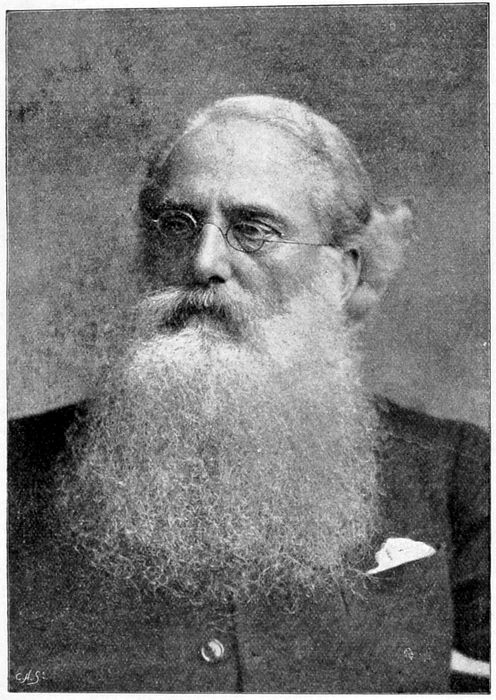
COLONEL H. S. OLCOTT.
(From a photograph by Messrs. Elliott & Fry, Baker-street, W.)
33Under date May 29, 1891, the Vice-President wrote to Mr. Keightley from Avenue-road a Pauline epistle, in which he says:—
Fear not, Bert! Masters watch us, and since May 8 have sent word here in writing.
Close beside the signature of “William Q. Judge” appeared in solemn confirmation the M signature and seal impression—“precipitated,” doubtless, during transit among Her Majesty’s mails. As the recipient was at Adyar, Madras, and therefore, some thousands of miles nearer the home of the Mahatmas than Mr. Judge, it will be seen to what roundabout methods the Master was compelled in order to maintain his determination to have his messages ushered into the world in some connexion or other with the one favoured disciple.
Another recipient was important for other reasons than Mr. Keightley. Babula, a low-caste Hindu, formerly Madame Blavatsky’s personal servant, was at this time in a position of trust at the Theosophic quarters at Adyar. Since then he has got into trouble with his employers, like others of Madame’s former confidants. But in July, 1891, Babula was still in authority at Adyar, and the vice-president thought it worth while to convince him that he, Judge, was his friend. A letter, dated some weeks later than Mr. Keightley’s, from Avenue-road, terminated with the signature,
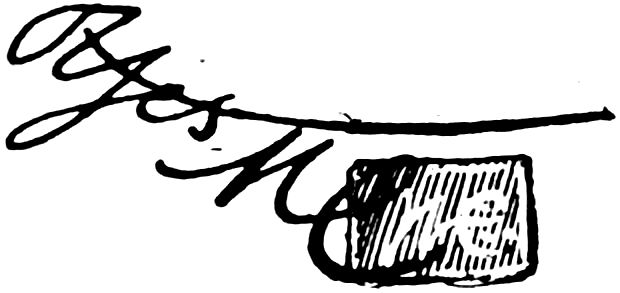
Under the words “Your friend,” the ever-officious Mahatma has drawn a line, at the end of which he has solemnly inscribed “YES,” and his signature and seal. The seal is, as usual, impressed in black carbon; the writing is in red pencil; and Judge’s signature is in ordinary ink.
Pity that the famous Mr. Codlin had not a Mahatma to back him thus conveniently in his asseverations that “Codlin’s the friend, not Short.”
34Parallel to this corroborative use of the Mahatma’s seal, though belonging to a different period of the story, was the case of another letter of Mr. Judge’s to a brother official, in which, after expressing certain views, Mr. Judge used these words:—
I believe the Master agrees with me, in which case I will ask him to put his seal here.
Plump on the written word came the seal. Inimitable Mahatma!
Mrs. Besant’s previous “communications,” as we have seen, did not come through the post. But during that July Mr. Judge seems to have left Mrs. Besant’s side for the express purpose of enabling his Mahatma to give her an exhibition of his powers in this special line of “precipitation” during postal transit.
July 21, 1891, was the date of one such performance; which included signature and seal complete. I pass over this and some equally commonplace missives, which Mrs. Besant received at various dates, all equally under Mr. Judge’s auspices, in order to deal more fully with one particular one in which she was favoured with a “test condition.”
For lo! on cutting the envelope open in the usual way, along the top edge, Mrs. Besant observed a line or so of pencilling inside written partly on the upper flap, partly on the under flaps, of the adhesive part of the envelope.
Here was proof indeed of powers occult! For this must obviously have been written or “precipitated” after the envelope was stuck up: and there it was inside! For a Mahatma, of course, it was as easy to produce it so as in any other way. He might do it in mere artless absence of mind.
Ingenuous Mrs. Besant! Unfortunately for the test, the feat is equally easy for any commonplace mortal—though in his case it would hardly be done quite artlessly. The trick was first shown me by a student of “occultism”—a Theosophist, in fact. But it is a very old affair, and can be found in any book of parlour magic. It might be called “Every Man his own Mahatma.”
35An envelope has four flaps. Three of these are stuck together in manufacture, but with a much less adhesive sort of gum than that which is put on the remaining flap to be stuck up by the user.
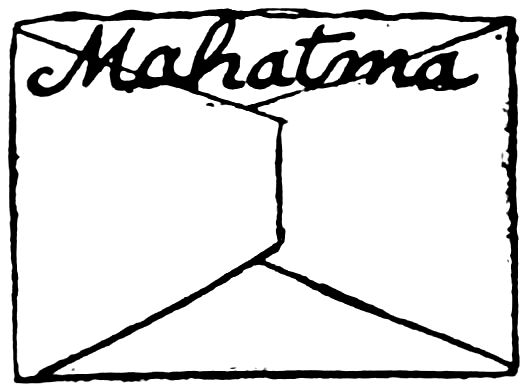 |
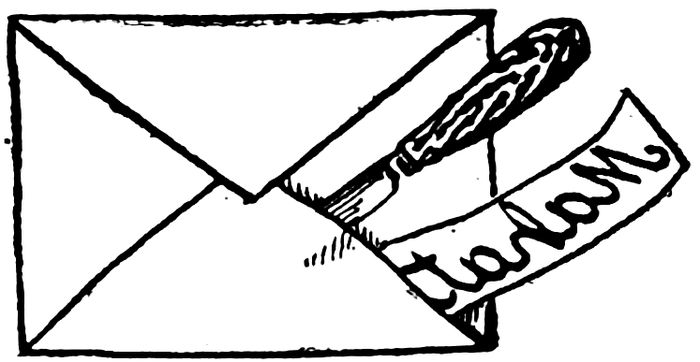 |
| ENVELOPE, INSIDE VIEW. | OUTSIDE VIEW, SHOWING INSERTION. |
It is generally quite easy to insert a penknife behind the bottom flap, as in the accompanying cut, and so make entrance and exit for a slip of paper. On this slip you write the words backwards, as they would appear in a looking-glass, using a black pencil of the “copying” kind. You then pass the slip in, push and shake it into the right position, press till you feel sure the inside flaps have taken the impression, and then out with your slip by the door it came in at. Moisten and fix the flap again, and the “precipitation” is complete. A child can do it.
A Mahatma, of course, produces the result by mere psychic effort. But it is a curious coincidence that M on this occasion abandoned his usual red pencil for the black one which you or I would use if we were playing just the trick described.
No doubt he felt that a more satisfactory test would have been wasted on Mrs. Besant.
Others, however, were a little more exacting. The story enters here on a less smooth course.
“O that Heaven had set a seal upon men, that we might know them, honest from dishonest!”—Euripides.
From the previous record of Colonel Olcott—described by Madame Blavatsky herself, in an epigrammatically candid moment, as “a psychologised baby”—he is almost the last person whom one would have expected to lead the way in any sceptical examination of “miracles.”
And no doubt he might have been content, like Mrs. Besant, to open his mouth and shut his eyes and take whatever Mr. Judge should send him, so long as that gentleman’s thaumaturgy was confined to benefiting the common cause. But it was another matter when the vice-president’s Mahatma showed a tendency to favour the vice-president, and that at the expense of the president himself. Had the oracle said “Olcott’s plan is right,” and declared that Olcott was the “friend,” “not Lancelot nor another”; had it made Olcott, and not Judge, Outer Head with Mrs. Besant—the president’s ears might have been an inch longer, and the course of Theosophic history have been changed.
But there was, from the first, about Mr. Judge’s Mahatma a certain crudity, a lack of tact in dissembling favouritism, which was bound, human nature being what it is, to make enemies.
On the decease of “H.P.B.,” President Olcott, like Vice-President Judge, had hurried to the headquarters at Avenue-road. He had to come from India, however, and the American disciple naturally out-ran him. When the former arrived, the latter’s Mahatma was already in full swing. On hearing of his performances with the seal, a look of more than usual intelligence may have crossed the president’s mild and venerable features; but, like Brer Rabbit, he wasn’t “sayin’ nuffin,” “he just lay low.”
37That busy July, ’91, the period of Mahatma M’s greatest activity, was also marked by the assembling at Avenue-road of one of the periodical conventions of Theosophic Europe. Some conversation occurred between the president and vice-president about the expenses of this convention, and the former, being “H.P.B.’s” legatee, mentioned a happy thought of his, of selling some of the jewels that lady had left behind her, and giving the proceeds as her posthumous contribution to the expenses.
But here, too, Mr. Judge was prepared to “go one better,” as his countrymen say, than the president-legatee. He responded airily that Colonel Olcott need not trouble himself about it, as “Master” had promised him (Judge) that the cash should be forthcoming, and also that he would convey a “message” on the subject to Olcott himself.
The Colonel waited for his message. None came.
The Colonel jogged Mr. Judge’s memory. Mr. Judge said he had no more to tell.
But that very day, on sitting down at his writing-table, and lifting up a piece of blotting-paper, the Colonel found under it a piece of peculiar paper, reading as in the following facsimile (reds and blacks as per former samples):—

38Now, Colonel Olcott thought he recognised that particular quality of paper, and also, so far as it was legible, that seal-impression. The facsimile here necessarily makes it much clearer. In the original the impression was curiously faint and vague, as if the Master did not wish, in the Colonel’s case, to burst that seal upon him all at once; but preferred the manner of Tennyson’s Freedom, who “part by part to men revealed The fulness of her face.”
So Brer Rabbit continued to say nuffin’, and to lie low.
Presently Mr. William Q. Judge left on the same writing-table the following note (being scribbled on a torn-off scrap of paper, it also has rather a Mahatmic look. But that is accidental):—
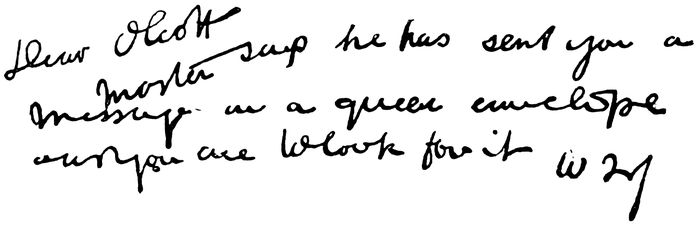
“Dear Olcott” “looked” accordingly; and sure enough, in the ordinary envelope of a letter, previously opened and put by on the table, there was a piece of paper bearing a message with all the proper Mahatma-marks about it. And this time the Mahatma had taken heart and “precipitated” a decently clear impression of the seal.
And then the Colonel “smiled a sorter sickly smile.” For now he did recognise that seal. And this is its story.
Back in the palmy days of 1883, or ever the marvels of “H.P.B.” were besmirched by slanderous tongues, the Colonel was in a certain city of the Panjab. Passing an Urdu seal-engraver’s shop in the bazaar, he turned in and ordered the man to make a seal bearing the cryptograph signature which “H.P.B.” identified as that of the “Master of Wisdom,” Mahatma Morya.
39What did the Colonel want the seal for? Let him explain himself:—
An idea occurred to me (he writes) of sending through “H.P.B.,” as a playful present to my Master M, a seal bearing a facsimile of his cryptograph.
An odd idea, this “playful present” of the Colonel’s. Had the seal been intended for use by an ordinary person—by “H.P.B.” herself, for instance—there would have been some sense in it. But the Mahatma, of course, who “precipitated” his letters and his signature psychically, might just as well “precipitate” the latter in the shape of a seal impression as otherwise, if he wanted to; and where, then, should the use of a brass seal come in? However, as the Colonel says, the present was merely “playful.”
Back went the Colonel to Madras, where Madame was, and presented the seal to her, with a “jocular remark” (I am again quoting his own account). Madame’s keen eye dwelt on it a moment, and then she pointed out that the Colonel, in his jocularly playful mood, had made a slight mistake. “The Master’s cryptograph was not correctly drawn,” according to the pattern already familiar to recipients of his precious missives. There was a twiddle too much, or a twiddle too little, in it. The Colonel himself saw the blunder when it was pointed out, and he now declares that he would know it anywhere.
For this sufficient reason the “playful present” was not sent on to the Himalayas (Heaven knows, by the way, by what astral form of parcels-post service the Colonel had expected it to be sent); neither did it appear in any of the communications vouched for by Madame.
It went into Madame’s despatch-box, along with a lot of other mystical odds and ends, properties of the occult stage; and among these it was remarked, as late as 1888, by the Mr. Keightley already mentioned, who was then living with her in Lansdowne-road.
This gentleman asked the prophetess what the little brass seal might be? Madame Blavatsky’s answer—a characteristically racy “fragment of her prophet voice”—was:—
In the same year, at a time when William Q. Judge was staying with Madame, Mr. Judge’s Mahatma evidently determined to overlook the inaccuracy in the seal, and to make use of it for the first time to save himself the trouble of a psychic signature.
He did this, of course, in a letter of Mr. William Q. Judge’s own, and in a sense endorsing Mr. William Q. Judge’s wishes—in fact, the letter was the one recorded in the last chapter, in which the Master’s seal came so plump upon the disciple’s prayer for a sign.
I have not mentioned before, however, that the recipient of this ’88 letter was Colonel Olcott. He presumably recognised, then as now, his own “playful present,” his own “flap-doodle”; but he appears to have let it pass in silence.
From this date the seal seems to have disappeared from among Madame Blavatsky’s belongings. It was, of course, intrinsically valueless.
But in 1890 it turned up again—in New York, and in close contiguity with Mr. Judge. Madame sent a message through Mr. Judge to a disciple, then in America, who happened to be the Mr. Keightley who had remarked the “flap-doodle of Olcott’s” at Lansdowne-road. The context, which is before me as I write, shows that Madame was persuading this disciple to take some course distasteful to him. Judge added his persuasions to hers. But what was bound to determine the disciple was the discovery on receiving the missive from Mr. Judge’s hands, that the Mahatma had added his vote in transitu by endorsing the word “RIGHT,” in red pencil, with cryptograph and impression of the Panjab seal.
Mr. Keightley, too, must have recognised the “flap-doodle”; but he, too, like Olcott, said never a word. He did, indeed, go so far as to ask Judge if he had affixed the seal? But on receiving a blandly surprised assurance that Mr. Judge did not so much as know there was a seal affixed, he let the matter drop.
These are, so far as I know, the only two instances in evidence of the use of this peculiar seal in Mahatma missives during the lifetime of 41Madame Blavatsky, and, as was to be expected from her objection to the seal, neither missive was among those vouched for by her, for the message from herself to New York was telegraphed, and it was the telegraph-form at the New York end that the Mahatma endorsed. Nevertheless, it is clear that no intimate of Madame’s would get hold of the seal and make use of it for bogus Mahatma missives under her very nose, unless he were under the impression either that she had it for that purpose herself, or that she might be relied on at least not to “peach” on a chela who used it.
But why did neither Colonel Olcott nor Mr. Keightley speak? The only answer I can suggest is that while Madame Blavatsky was in the flesh the faithful thought twice before they expressed a doubt about anything or anybody. They were accustomed to take their marvels as they found them, and be thankful.
Otherwise, they might at least have pointed out to Mr. Judge, in order that he might in turn apprise his Mahatma, whose supernal knowledge seems here to have been somewhat at fault, what a fatal blunder he was making in palming off upon the faithful a bogus edition of his own cryptograph, known as such by three of the faithful themselves.
However, there are the facts; and but for the Mahatma’s trop de zéle in pushing his favourite chela’s occult claims immediately on Madame Blavatsky’s decease, I fear we should never have been vouchsafed this instructive side-light on an earlier period of the Theosophical Society.
These Adventures of a Seal supply the clue to the great game of bluff between the two highest Theosophical officials which must be depicted in the next chapter.
“To form the nucleus of a Universal Brotherhood of Humanity.”—Theosophical Society, Object I.
“Pestling a poisoned poison behind his crimson lights!”—“Maud.”
We left the president of the Theosophical Society staring at the impression of his own “flap-doodle” seal on that which purported to be a missive from the Mahatma.
The purport of the missive was precisely what the prescient Judge had foretold. Colonel Olcott was not to sell the Blavatsky jewels, as the money would be provided.
Having shown it to a brother member, the Colonel replaced it in the envelope, and went off to have a few words with Mr. William Q. Judge.
He remarked to Judge that he had missed a certain brass seal from among Madame Blavatsky’s relics, and described the Panjab seal and the story of its making; not mentioning, however, the name of the exact city where it was made. Had Judge seen the seal?
Judge answered in the negative. Upon which the Colonel remarked meaningly (I quote his own account) that he “hoped no scoundrel would get possession of it, and use it to give colour to bogus Mahatma messages,” adding that he would at once recognise an impression from the seal.
He did not mention that he had looked for and found the missive in the envelope.
43After two days he looked into the envelope for that missive again. It was gone!
Some judicious hand had removed it. “Judicious,” says the Dictionary, “literally: of or pertaining to a Judge.” Colonel Olcott concluded with some assurance that the hand which had removed that missive, the hand which had put it there, and the hand which had written it, were one and the same hand, and that hand William Q. Judge’s. That is a conclusion which we must leave the two gentlemen to settle between them.
But note the sequel. The writer of the missive, whoever he was, was as good as his word.
When the Convention in due course was held, it was announced that a donation had been contributed towards the expenses in a peculiar way.
There had appeared to one of the brethren one afternoon a dark and mysterious Oriental figure, who gave no name, but deposited two Bank of England £10 notes (from Tibet?), which were backed with the familiar red cryptograph, after which he, like Mr. Lewis Carroll’s Snark, “softly and silently vanished away.”
It will not surprise the astute reader to learn that the brother favoured with this substantial spectre was William Q. Judge.
Well, there was the £20, and the vice-president’s reputation as an occultist stood higher than ever. There was a time, years before, when the society had made much of a similar vision of its president’s, one which, the Colonel used to explain, had first assured him of the truth of Madame Blavatsky’s doctrines. On his asking for a sign, the Colonel’s figure, which was, of course, like Mr. Judge’s, the “astral body” of a Mahatma, had materialised its turban, and disappeared into several yards of substantial textile fabric. “And here,” the Colonel was wont to conclude the story, “here, you see, is the turban!”—whipping it from his coat-tail pocket. Ah! that was in the palmy eighties. But now where was he? What was a chela who conjured up a turban beside one who could conjure up £20 hard cash—“on the table,” as Hilda Wangel would say?
In a word, Colonel Olcott was altogether thrown into the shade by 44this bold stroke, and had not even the face to suggest that perhaps Mr. Judge’s story was only a donor’s graceful way of conveying assistance from his own pocket. The Colonel pulled rather a sour face, however, over the heavy sum with which the society’s chest was debited when Mr. Judge’s expenses at the Convention came to be paid. For, Judge having attended in his official capacity, it was the Colonel’s treasury at Adyar which had to foot the bill. Personally, I consider the miracles cheap at the price.
This reminds me of the matter of Madame Blavatsky’s Rosicrucian jewel, in which also the Mahatma stole an amusing march on the Colonel. This was a pendant set with gems, which had the property of changing colour with every change in Madame’s health—so she and the faithful Olcott used to swear. The Colonel had his own ideas about the future of this mystic gewgaw; but what was his disgust on getting to Avenue-road to learn that the Master had sent a message for it to be given to Judge, and that Mrs. Besant had accordingly handed it over! Nor was the Colonel’s chagrin lightened by the fact that the forgetful Mahatma attempted (through Judge, of course) to put him off the track of the jewel by a message to quite another effect—an exceedingly misleading message.
For all I know, the gift was as valueless intrinsically as the brass seal; but Theosophically it was a distinct score for Mr. Judge and his Mahatma thus to amalgamate the two mystic apparatuses in one firm’s hands, so to speak.
After the passages described above, Mr. Judge’s Mahatma was chary of subjecting any more epistolary efforts to the eye of Colonel Olcott. And he seems to have become more cautious altogether. In the following September, however, he succumbed to the temptation of intervening again in the administration of the society. A letter with the usual trimmings was enclosed to the Inner Group, bearing upon its constitution and future changes, in one of Mr. Judge’s on the same subject and in the same sense (September 14).
45Just at this time Colonel Olcott was visiting America, en route for Japan, where he was to teach the Buddhists their own religion in a flying visit. He took the opportunity of making some more pointed representations to Mr. Judge on the vagaries of his Master.
The result was prompt and significant.
During the very next month Mrs. Besant, then preparing for her trip to India, received a cablegram from the vice-president in America to this effect:—
You are desired not to go to India remain where you are grave danger Olcott await further particulars by an early mail.
At Avenue-road this mysterious telegram was at first read in the sense, “Grave danger to Olcott.” The president was just then due at Tokyo, and there was a report of an earthquake thereabouts. For a while there was a great flutter over this convincing case of Mahatmic prescience. When, however, the “early mail” arrived with Mr. Judge’s explanatory letter, quite a different complexion was put on the telegram. After reading this letter, and one from the inevitable Mahatma which Mr. Judge enclosed, the conclusion of the Inner Group was that the “grave danger” against which the Master warned Mrs. Besant was “from Olcott.” The Tibetan founder of the society, in short, warned Mrs. Besant against imperilling her safety in the neighbourhood of its president!
The Mahatma had declared war on Colonel Olcott.
This was the first shot in the campaign.
But what could this danger from Colonel Olcott be? Mr. Judge and his Mahatma left that darkly vague. Some of their friends in England dotted the i’s and crossed the t’s for them. It is hardly credible, but the suggestion was nothing less preposterous than that Colonel Olcott intended to poison Mrs. Besant!
I have no great veneration for Colonel Olcott’s character, and none at all for his intelligence; but I frankly apologise to him for having to mention this astounding nonsense in connexion with his name. I 46mention it simply in order to explain one of the documents which follow, and to throw a light on the minds of the colleagues who made or believed the charge; and I suppose I need scarcely add that I attach to it no other value whatever. Colonel Olcott is about as remote as it is possible to conceive from the sort of stuff of which murderers are made. I am sure he never had and never will have any more intention to poison Mrs. Besant, or anybody else, than the Man in the Moon. Having said so much to make any misunderstanding impossible, I return to the suspicions or pretended suspicions of the Colonel’s professed “Brothers.”
Positively, the only material which these ladies and gentlemen had to work on was an innocent conversation of the Colonel’s with a friend on the subject of poisons, Indian and other, which took place at a date when Mrs. Besant was not yet even a member of the society! The “evidence”—save the mark!—was such as ordinary non-Theosophical folk would not give even a dog a bad name on. But Mahatmas and their friends are different, and Mr. Judge’s Mahatma was well served. For this trivial episode, buzzed about from mouth to mouth in connexion with the sinister hints of “Mahatma M,” sufficed to make this monstrous charge against their president currently believed at Avenue-road, for some weeks at least, by the very inmost and governing circle of his colleagues, with Mrs. Besant at their head!
A belief once discarded, it is easy to deny that it ever existed. But this particular belief, or half-belief, showed itself in action. Mrs. Besant deferred her visit to India, and to impatient Indian disciples wrote that “Master had forbidden her to come,” and “till that order was countermanded” she would not budge.
Now just pause a moment, and enjoy the exquisite irony of this unique situation. The Theosophic Society was to be “the nucleus of a Universal Brotherhood of Mankind.” At this moment, taking the three chief exponents of this new Brotherliness, the president believed the vice-president to be fabricating bogus documents; the vice-president apparently 47believed the president to have designs to poison the high-priestess; and the high-priestess, having these two beliefs to choose from, coquetted at least, as we have seen, with the more heinous of the two.
Other Theosophists appear from their course of action to have accomplished the intellectual feat of believing both.
“Be these juggling fiends no more believed, that palter with us in a double sense!”—“Macbeth.”
“Masters, it is proved already that you are little better than false knaves.”—“Much Ado About Nothing.”
While the Mahatma was thus stealthily undermining the president, he was also busy strengthening his own outworks. In December one of the doubting ones, the Mr. Keightley who had been making up his mind whether to believe his own eyes ever since June, 1890, received in India a letter from Mr. Judge fortifying him against the heterodox influences to which he would be exposed on Colonel Olcott’s return to that country.
Mr. Judge warned his “dear Bert” that Olcott would try to shake his faith in the genuineness of Mr. Judge’s Mahatma-missives; that he might even have the baseness to suggest that they were fabricated by Mr. Judge himself. On opening this letter, Mr. Keightley found a small slip of peculiar paper, which turned out (on a prosaic scrutiny) to be the sort of tissue which is used to separate the sheets of typewriting transfer paper. On this slip appeared in Mahatmic script the words:—
There was, however, no seal impression. The Mahatma had grown chary of using that seal. From the material of this missive we gather that the Mahatma is not so remote from typewriters as one would 49expect in the Himalayas; from its diction we learn that, whatever the failings of his English, the august being has a racy command of Yankee.
I may remark here that when Mahatmas “precipitate” their own notepaper, as well as the writing upon it, it has always been the etiquette that the former should have an Indian look about it, however European the latter might be. Even tissue, as in this case, is considered more in keeping than commonplace stationery, with, perhaps, the watermark of some English firm upon it. But the “make” preferred, alike now and in the Blavatsky days, is a peculiar sort of hand-made rice-paper, which the Psychical Researchers had some difficulty in tracking to the maker’s. They were not assisted by Colonel Olcott. But now, the same mystic paper having turned up in the productions of Mr. Judge’s Mahatma (borrowed, perhaps, at the same time as the seal?) the Colonel resolves the mystery at once. Wishing to suggest that Mr. Judge got it ready-made from Madame Blavatsky, he mentions that Madame had gone about with a good supply of it, adding that it was originally bought in Cashmere. He had bought it himself at Jammos, in fact, as long ago as 1883, just as he had also been the purchaser of the brass seal; and just as he explains that the seal was got merely as a “playful present,” so he represents the original purpose of the Cashmere stationery as the humble one of “packing books—it being both cheap and strong.” From parcels post to astral notepaper is a distinct rise. But who first promoted it? Another side-light unintentionally thrown on the old Blavatsky days!
But to return to Mr. Judge’s Mahatma. His last attempt to bring Colonel Olcott to a better mind by persuasion was made that autumn. In October he had resorted to a bold device for overcoming scepticism, which he and Mahatma Koot Hoomi had patented in the early Blavatsky days—that of waylaying (astrally, of course) the post-bag of some disconnected and quite unconscious correspondent of the sceptic, and so introducing a message through an obviously untainted channel. For instance, Mr. Hume once “got a note from Koot Hoomi 50inside a letter received through the post from a person wholly unconnected with our occult pursuits, who was writing to him on some municipal business.” (“Occult World,” p. 21.) The letter happened to have a large and noticeable envelope, and long after, in the days of disillusion, Mr. Hume discovered that Madame’s servant Babula had carried off just such a letter from the postman for Madame, and then returned it to him with an apology for the mistake. (S. P. R. Report, p. 275.)
In October, then, Colonel Olcott, who was just returning to India, got a letter from a Mr. Abbott Clark, of Orange County, California, a gentleman who was under no sort of suspicion of having anything to do with Mahatmas. And in this, if you please, there had somehow found its way into the envelope a slip of paper bearing a message in the M script, with signature, but with seal too blurred to distinguish, in facsimile as follows:—
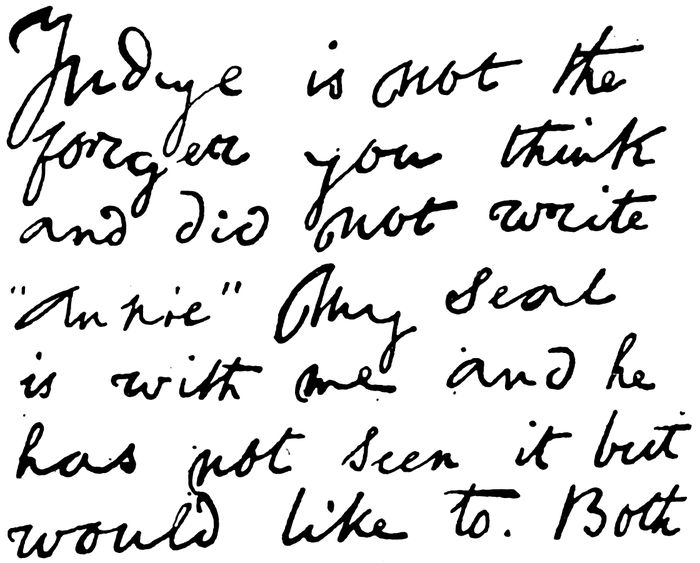
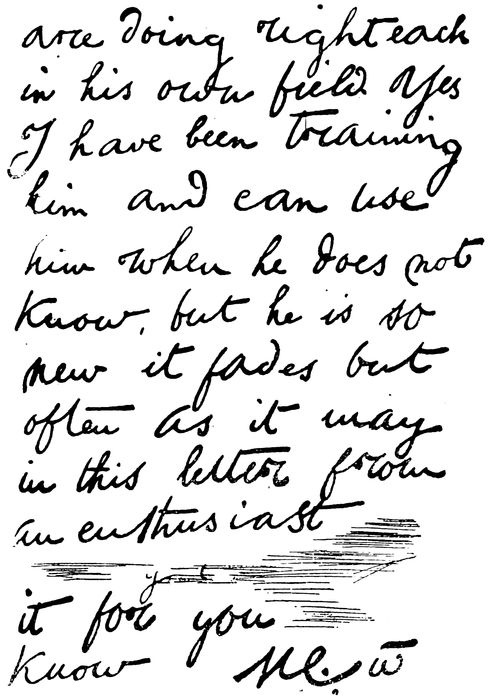
So much is in the usual red pencil; the part represented by shading above is smudged, as is the red blotch which represents the 52seal, apparently by being rubbed with the finger. Across a margin of the paper is the following postscript, in the black carbon usually devoted to the seal impression:—
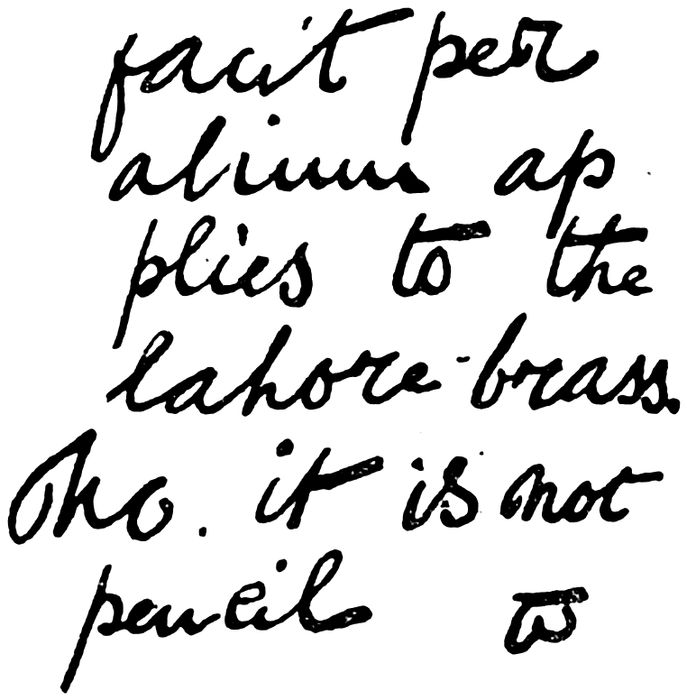
Rather cryptic, this missive; but the meaning seems to be this. The Mahatma has to explain to the suspicious Colonel several things: why the missives habitually come in letters from Mr. Judge; why, nevertheless, Mr. Judge knows nothing of them; why he, the Master, has used a bogus seal which bungles his own cryptograph; and, above all, why the impressions of that seal have been illegible ever since an exposure of it was threatened. He hints, accordingly, that he “uses” Mr. Judge to assist in some undefined psychic way in the precipitation process; but Judge’s part in this is unconscious—it must be “when he does not know.” Also, the thing precipitated “fades out often”—and plump on the word comes an illustration.
In saying that “Judge did not write Annie” (i.e., Mrs. Besant, for this spirit is a familiar one), the Master is misinformed, as we have seen. Mr. Judge had just “written Annie,” enclosing the Master’s own warning against Colonel Olcott. Lastly, the remark 53about “facit per alium” (the Mahatma can use a tag of lawyers’ Latin on occasion) seems to mean that when Colonel Olcott had the “flap-doodle” seal made he was unconsciously prompted by the Master himself, who had now adopted it, overlooking the blunder in engraving. The prescience which foresaw that the “precipitation” would give out in just this letter is no less remarkable than that which provided for an unexpressed doubt by the assurance, “No, it is not pencil.”
But for Colonel Olcott the gem of this letter was none of these. It was the reference to the Panjab seal as the “Lahore brass.” All that Mr. Judge knew, as we have seen, was that the seal was made at a “certain city in the Panjab.” Mr. Judge’s Mahatma assumes that this city was the capital of the province. It was a likely guess—a good shot, if such a phrase may be used of the mental processes of a Tibetan sage—and one calculated to end the Colonel’s doubts—if correct. But that is just what it was not. The city at which the Colonel got the seal was quite another city; so the Mahatma, though he hints that he psychically presided over the purchase, does not even know where that purchase took place!
The result of this unlucky lapse of memory on the part of the Master was that the missive made bad worse. Despite the distance of California, where Mr. Clark’s envelope was posted, from New York, and the offices of Mr. William Q. Judge, the Colonel suspected Mr. Judge’s hand in it. He wrote to Mr. Clark, and discovered that Judge had spent two days in Orange County at the very date when the Master availed himself of Mr. Clark’s envelope. Thereupon the Colonel formed his own ideas as to how the Master had “used” his favourite chela on that occasion.
Can we wonder that the Master was incensed by this incorrigible scepticism—a spirit, as the Colonel himself had formerly taught, and as the event was to prove but too surely—fatal to Theosophy?
Persuasion failing, the Master resorted to threats!
In January, 1892, the Colonel received an amicable letter from Mr. Judge, reproaching him for not writing. On opening it, he found 54written along the margin of the first page the following laconic message in Mahatma script (signed, but again no seal: much reduced here):—

“Him” presumably means Judge. The bearing of the threat will be intelligible to readers of the last Chapter. Certain rumours from Avenue-road made it intelligible also to Colonel Olcott. The Master of Wisdom, the unapproachable sage of the Himalayas, He-Who-Must-Be-Obeyed by Mrs. Besant and the whole Theosophical Society, had thrown off the mask of benignity. Here he was plainly adopting, as a weapon against his own unlucky president, that impossible accusation which represents the lowest point of ethical squalor yet touched, in this story at any rate, by Theosophic “brotherhood”! This was miching Mallecho, thought the Colonel; it meant mischief with a vengeance. The voice was the voice of the Mahatma, but again the Colonel thought it the hand of Judge. So he wrote with some natural heat to ask that gentleman what he meant by his “base insinuation.”
Only to receive, however, the blandly innocent reply:—
I have puzzled my head over your reference to “poison,” as if in one of mine; as I never referred to it I cannot catch on, and have given it up in despair.
After this the Colonel seems to have given the Mahatma up in despair, too. But the Mahatma, on his part, was busily pushing up a column to take the Colonel in the flank, and bring this story to a crisis.
Secure in the support of Mrs. Besant, he was to make the pusillanimous president resign his office, and to enthrone William Q. Judge in his place!
“I did my utmost to prevent a public Committee of Enquiry of an official character.”—Mrs. Besant at T.S. Convention, July 12, 1894.
How even a “psychologised baby” like Colonel Olcott came to succumb to a movement for ousting him from office, backed by such methods as we have examined, is to me a mystery. No doubt he had his own reasons for avoiding a contest in disclosures with his old colleague Mr. Judge, who knows so much about Theosophy ever since the days of its foundation. At any rate, succumb he did. On receiving an emissary from Avenue-road, early in 1892, he threw up the cards in the unequal game with the Mahatma, and formally resigned his presidency.
Then was seen a touching sight. Cæsar pushed away the crown. Mr. Judge was loth to succeed. Who could doubt it? Why, he got a “message” countermanding the resignation, and forwarded it to the Colonel (March, 1892), just too late to be acted on before the American Convention in April, which, with decent reluctance, acclaimed Mr. Judge for the vacant office.
But now came a hitch. Colonel Olcott took the anti-resignation message au grand sérieux. He forgot all his doubts about Mr. Judge’s Mahatma missives in his simple joy at the tenor of this last one. It was but a typed copy which Mr. Judge sent him. Never mind, it was a declaration of peace; and if ever there was a man of peace it is the Colonel, despite his American brevet. He could not 56disobey the Master; he did withdraw his resignation. Such was his answer to Mr. Judge.
Mr. Judge expressed his delight. But in absence of mind—possibly excess of joy—he quite forgot to mention either the Master’s message or the Colonel’s consent at Avenue-road when, in the following July, the time came to make his succession to the Colonel’s office definite.
The result was that Mr. Judge was then and there elected president for life. Some voices were for a term; but Mrs. Besant arose in her eloquence and “swept up the floor” (in the phrase of one Theosophic enthusiast), and the election was “for life.” Alas! Contracts entered into for that period are notoriously apt to give out at an earlier date.
Perhaps one thing which explains the Colonel’s small show of fight is the fact that he was to be consoled with an “Olcott Pension Fund.” Unhappily the treasurer defalcated some eight or nine thousand rupees, and then committed suicide. Ill-luck seemed to dog the vanquished president.
But now came the turn of the tide.
On the announcement of Judge’s election, Colonel Olcott indignantly wrote to Avenue-road to point out that there was no vacancy. And he printed in the Theosophist the Master’s message which had led him to withdraw his resignation.
He did more. The Theosophist, the official journal of the Indian section, has come to be Colonel Olcott’s private property, just as Lucifer is Mrs. Besant’s, and The Path Mr. William Q. Judge’s—an illustration of the odd mixture of private and official capacities in this society. And now the Colonel plucked up heart to publish in his paper the first note publicly heard of criticism—yes, actual criticism—of Mr. Judge’s Mahatma.
Privately, there had been some troubled bleatings heard already among some of the less docile of the Theosophic sheep. Mr. Judge had been obliged to take up the cudgels for the merits of some of his Mahatma missives as philosophic compositions. I find him claiming (in the true oracular spirit) that:—
57A very truism, when uttered by a Mahatma, has a deeper meaning for which the student must seek, but which he will lose if he stops to criticise and weigh the words in mere ordinary scales.
A sentiment printed with approbation in Mrs. Besant’s paper. Again, he is parrying inquisitive questions about the Master’s seal. He “does not know” what they mean. An inquirer sends him a sample letter with a good impression to look at—one which had come from Mr. Judge himself, I presume—and gets it back with the impression rubbed out (“it fades out often,” as we have seen above), and the puzzled remark from Mr. Judge, “Where is your seal? I don’t see one.” Finally, pressed, Mr. Judge declares that “Whether He” (the Master) “has a seal, or uses one, is something on which I am ignorant.”
It was on this statement—which involves a total lapse of memory on Mr. Judge’s part of events narrated in Chapter V.—that he was challenged in the Theosophist of April, 1893, in an article signed by Messrs. W. R. Old and S. V. Edge, both T.S. officials (secretaries, Indian section). The article is hardly what would be called trenchant by non-Theosophical standards. But it just pointed out that little discrepancy in a polite foot-note; and that was enough.
If there is one thing more than another which is deemed to be bad form in circles Theosophical, it is to corner a Theosophist on a definite matter of fact. Anything undraped in verbiage is considered nude, even to indecency. The voice of questioning has to be stifled at once.
By virtue of their joint position as Outer Heads of the Esoteric section, to which they were elected under warrant of the very seal in question, Mrs. Besant and Mr. Judge promptly “suspended” Messrs. Old and Edge from their Esoteric membership.
In December, Mrs. Besant went to India. She had, therefore, thrown over the Mahatma’s warning. But she had not thrown over the Mahatma—not a bit. She declared that nothing on earth would induce her to give up believing that the missives were indeed 58“precipitated” by Mahatma M, unless Mahatma M in person appeared and repudiated them. If a person who had been told that the Man in the Moon daily “precipitated” the Times leading articles should decline to be convinced of the contrary till he heard it from the lips of the Man in the Moon himself he would probably be “of the same opinion still” for some considerable time.
In India, Mrs. Besant suddenly changed her mind. Had the Master indeed appeared and fulfilled her conditions? She does not say so. Yet it can scarcely have been on any mere, dull ground of fact and argument. She was presented with a set of depositions establishing all of the substantial facts of this narrative, given under the names of those personally cognisant of them, with Colonel Olcott at their head, and summed up in the form of certain definite charges against William Q. Judge. But many of these facts she already knew herself, as well as anybody, and made naught of.
What did work the miracle, then?—As far as I can make out, it was this. Mrs. Besant sat at the feet of G. N. Chakravati. And G. N. Chakravati just mentioned that he did not believe in Judge.
This is the Hindu gentleman who was sent to represent the Theosophical Society at the Chicago Parliament of Religions, at an expense of £500. This is the teacher who has made “Annabai” so far a Hindu that she now protests against harsh mention even of the child-widow horrors, the 12,000 temple prostitutes of Madras, and the other religious indecencies of Hinduism. As Mr. Bradlaugh led Mrs. Besant from the Church to Materialism, as Mr. Herbert Burrows went hand-in-hand with her from Materialism to Madame Blavatsky, as Judge made her believe in Judge, so she could only abandon Judge with the aid of G. N. Chakravati. Whatever the explanation, the fact remains that, blessed by this worthy pundit, the case formulated against Mr. Judge became strong—convincing—irresistible. Mrs. Besant’s mind blossomed in a day into the full-blown view that she had been deluded, that Judge had himself written the missives to which she had pinned her faith—written them all with his own hand.
59Appalling bathos!—and one which an Enquiry must needs result in publishing to all the world. Yet an Enquiry there must be. The Indian section was threatening to secede from the society if Mr. Judge’s presidency were confirmed with the scandal unsifted. Judge himself, offered the alternative by cablegram of resigning all his offices quietly or facing a “full publication of the facts,” replied in a defiant sense which showed his conviction that there were others to whom “full publication of the facts” (which it was easy to threaten, but which it has been left for an outsider to carry out) would be more ungrateful even than to himself. What was Mrs. Besant to do?
A happy thought struck her. She offered to adopt the charges, turn prosecutor, and conduct the case against Mr. Judge herself.
The signatories of the evidence were delighted—especially Colonel Olcott, who got behind Mrs. Besant now with the same alacrity as previously behind Messrs. Old and Edge.
By this bold, yet simple stroke, the evidence, documents, and whole control of the case passed into Mrs. Besant’s hands, where they, as she fondly hopes, or hoped, now remain.
Not altogether!
The Chairman felt it his imperative duty to demand of the hon. gentleman whether he had used the expression “a humbug” in a common sense?
Mr. Blotton had no hesitation in saying that he had not—he had used the word in its Pickwickian sense. (Hear, hear.) He was bound to acknowledge that personally he entertained the highest esteem for the hon. gentleman; he had merely considered him a humbug in a Pickwickian point of view.
Mr. Pickwick felt much gratified by the candid explanation of his hon. friend. He begged it to be at once understood that his own observations had been merely intended to bear a Pickwickian construction. (Cheers.)—The Pickwick Papers.
We have now seen how, step by step, as by a resistless nemesis the rival Theosophical leaders were led on to bring their quarrel to that which neither of them had much stomach for—an inquiry into evidence. Bluff meeting bluff, the thing got as far as the summoning from three continents of a Committee of Investigation representing both parties. “Investigating” hidden forces in nature, as we saw in Chapter II., is one of the professed “Objects” of the Theosophical Society. The present chapter is to show what the Theosophical idea of investigating is like.
There lies before me a pamphlet, reprinted from Lucifer of August last, which bears the facetious title, “AN INQUIRY Into 61Certain Charges against the Vice-President, Held in London, July 1894.” Anybody is at liberty to get this publication—and make what head or tail of it he can.

BADGE OF THE T.S.
The plain matter of fact which lay behind the proceedings in question was this. Mrs. Besant and Colonel Olcott had given away their friends and compromised with Judge on the terms that he should give Olcott back his presidency, Judge’s election thereto being declared null and void, while they on their part should suppress the evidence which the Judicial Committee had been summoned to report on.
Mr. Judge had protested in a vehement circular, when first called on by the President to appear before the committee, against one of his accusers proposing to preside at his trial. There was reason in the objection at the time. He could not foresee that the proceedings would take the form of the presiding judge and the counsel for the prosecution combining to prevent the case from going to the jury.
This being the plain English of the affair, let us now see how it reads translated into what I may call Theosophistry.
The first part of the pamphlet consists of the Judicial Committee’s minutes. Of this, six-sevenths is devoted to an “Address of the President-Founder” proving that they ought to do nothing. The remaining page is devoted to doing it.
The “charges of misconduct preferred by Mrs. Besant against the vice-president” are nowhere formally stated at all. They are incidentally summarised by the president as follows:—
“That he practised deception in sending false messages, orders, and letters, as if sent and written by ‘Masters.’ ... That he was untruthful in various other instances enumerated.”
The bulk of the address is occupied in discussing with great solemnity various reasons alleged by Mr. Judge why these charges should not be gone into by the committee.
One or two of these, such as the vice-president’s discovery that he had never been really vice-president at all, and the contention that, whichever 62way the decision went, it must “offend the religious feelings” of some member or another, and that this was against the rules of the society—these were, after the due amount of pomposity, declared against by the president.
But there were two other pleas of such irresistible force and weight that the president found himself convinced by them “that this inquiry must go no further.” Stripped of prolix circumlocutions, these may be put as an alternative, thus:—
Either the Mahatma missives are genuine or they are fabricated.
(a) If found to be genuine, that implies the affirmation of the existence of Mahatmas as a Theosophic dogma, and the abandonment of the society’s precious “neutrality.” Which is unconstitutional.
(b) If found to be bogus missives produced by the vice-president, then it is obvious that he must have done it in his private capacity; the production of bogus documents being no part of his official duties. Therefore he cannot be tried for it by an official tribunal.
Could anything be more delicious than this dilemma? It is worthy of a trial scene in Gilbertian comic opera.
Mrs. Besant, like the president, was “convinced that the point was rightly taken.” There was nothing more to be said.
The Judicial Committee “resolved” in the same sense, without any inconvenient discussion, and forthwith committed hara-kiri with the complaisance of a Chinese nobleman. Not only had they not investigated the case, but, as far as I can make out, they had not even heard what it was, except in the most abstract of summaries. Having gravely adjusted the bandage over each other’s eyes, they separated with a good conscience. For many of them—worthy investigators!—I believe I am the first to remove the bandage, and set them blinking at the truth.
From (a) it follows, as the president pointed out en passant in the course of his Address, that every Theosophist is in future free to circulate Mahatma messages, but no Theosophist to test their genuineness.
From (b) it equally follows that no officer of the society is in future responsible to it for any misdeed whatever, since such misdeed cannot well be among his official duties.
63Perhaps it is not very surprising that the result of the Judicial Committee, which had been gathered to its task from the ends of the earth, was received with disgust by the generality of members then met in London for one of their interminable conventions. A demand was even heard for a private jury of honour; or, failing that, for publication of the case for both sides, the course to which one side, as we saw, had affected to pledge itself. Mr. Judge found himself unable to refuse his assent to the jury proposal. Again Mrs. Besant dashed in and triumphed in the sacred cause of obscurantism. At the third session of the convention she announced that she and Mr. Judge had agreed upon a couple of statements representing their different points of view, and proposed that the convention should hear these, accept them, and let the matter drop. These two statements compose the second part of the pamphlet; and they are at least as bewildering as the first.
“We come to you, our brothers, to tell you what is in our hearts,” Mrs. Besant read out. Her endeavour to “tell” fills four pages. The following are the sentences which gyrate least round the point:—
I do not charge, and have not charged, Mr. Judge with forgery in the ordinary sense of the term, but with giving a misleading form to messages received psychically from the Master in various ways.... Personally I hold that this method is illegitimate.... I believe that Mr. Judge wrote with his own hand, consciously or automatically I do not know, in the script adopted as that of the Master, messages which he received from the Master, or from chelas; and I know that in my own case I believed that the messages he gave me in the well-known script were messages directly precipitated or directly written by the Master. When I publicly said that I had received, after H. P. Blavatsky’s death, letters in the writing that H. P. Blavatsky had been accused of forging, I referred to letters given to me by Mr. Judge, and as they were in the well-known script I never dreamt of challenging their source. I know now that they were not written or precipitated by the Master, and that they were done by Mr. Judge; but I also believe that the gist of these messages was psychically received, and that Mr. Judge’s error lay in giving them to me in a script written by himself and not saying so.... Having been myself mistaken, I in turn misled the public.
The rest of Mrs. Besant’s statement is easily summarised. Part is devoted to minimising the importance of the question whether Mr. 64Judge wrote, or the Mahatma precipitated, the letters, by remarking that after all it did not matter so very much, as Mahatmas sometimes communicate (like spiritualist “controls”) by allowing ordinary people to write for them. “It is important,” quoth Mrs. Besant, naïvely, “that the small part generally played by Masters in these phenomena should be understood”—a remark with which the present writer quite agrees, and a main object of the present narrative. But in the sense in which Mrs. Besant meant it, it was not very relevant to an inquiry entirely dealing with letters passed off as having been precipitated, and precipitated without Mr. Judge’s knowledge, by the Mahatma himself.
Beyond this, Mrs. Besant’s statement consists about equally of blame directed at the untheosophical “vindictiveness” of Mr. Judge’s accusers in pressing an inquiry “painful” to Mr. Judge, and of laudatory tributes to the character and Theosophical activity of Mr. Judge himself.
Down Mrs. Besant sat, and up rose Mr. Judge, and read his statement. It contained the following sentences:—
I repeat my denial of the said rumoured charges of forging the said names and handwritings of the Mahatmas, or of misusing the same.... I admit that I have received and delivered messages from the Mahatmas ... they were obtained through me, but as to how they were obtained or produced I cannot state.... My own methods may disagree from the views of others.... I willingly say that which I never denied, that I am a human being, full of error, liable to mistake, not infallible, but just the same as any other human being like to myself, or of the class of human beings to which I belong. And I freely, fully, and sincerely forgive anyone who may be thought to have injured or tried to injure me.
Now, so far as these sentences were an answer at all to such charges as Mrs. Besant’s statement had allowed itself to convey, they were certainly a flat contradiction. But that point was naturally overlooked by eyes moist from the affecting “forgiveness” of Mr. Judge’s peroration, and his very handsome, if somewhat tautologously expressed, admission that he was only a “human being.” Without a word more, nemine contradicente, it was
65Resolved: that this meeting accepts with pleasure the adjustment arrived at by Annie Besant and William Q. Judge as a final settlement of matters pending hitherto between them as prosecutor and defendant, with a hope that it may be thus buried and forgotten, and—
Resolved: that we will join hands with them to further the cause of genuine brotherhood in which we all believe.
These resolutions were proposed by the Mr. Keightley (M.A. Cant.) whose name has occurred so often in our story among the bamboozled ones, and seconded by Dr. Buck, one of the nominees from Mr. Judge’s section to the abortive committee.
And there ends the Pamphlet—and the “Enquiry.” It has since appeared that the “joining of hands” between Mrs. Besant and Mr. Judge was for footlight purposes only; for no sooner was the curtain rung down than the two joint Outer Heads found they could no longer work together, and settled the matter by splitting the Esoteric section into independent dominions, Mr. Judge taking America, and Mrs. Besant Europe—to which she has since added India.
The result is one on which Mr. William Q. Judge must be congratulated. He retains all his offices as head of his lodge, of his section, and of the American Esoteric section; retains his vice-presidency of the whole society; retains the status of heir-presumptive, at least, to the presidency; retains, also, I suppose, either he or his Mahatma, the brass “flap-doodle,” to say nothing of the Blavatsky relic, with full freedom to continue using the same as heretofore.
In a word, the Theosophical Society has chosen to stand or fall with its vice-president.
Theosophy is a religion as well as a philosophy, and the T.S. masquerades as in some sort a Church. Imagine the situation, then, in any other religious denomination. Suppose that the Archbishop of Canterbury were to put forth missives which he alleged to have fluttered down direct from St. Augustine in heaven; and suppose after Convocation had governed the Church for years in conformity with 66directions so received, the Archbishop of York were to declare at a Church Congress his belief that his esteemed brother, whose services to the Church were beyond all praise, had written the missives himself, an expedient “which I personally hold to be illegitimate,” but into the details of which he begged the Congress not to pry: suppose, then, that the Archbishop of Canterbury on his part declared himself, like Mr. Pickwick, “much gratified with the candid explanation of his hon. friend,” that he “merely considered him a humbug in a Pickwickian point of view”—supposing all this, can you imagine the Church Congress rising as one man to “bury” the dispute, and “join hands” with the embracing disputants?
Probably not. But then, as Mrs. Besant remarked, the “standards of the world” are “lower” than those of the Theosophical Society—and of the “Pickwick Club.”
Nevertheless, I must ask leave to break in on the harmonious scene with a few troublesome questions.
“Next in importance, or perhaps equal in value, to Devotion, is Truth.”—Circular on “Occultism and Truth,” signed by H. S. Olcott, Annie Besant, B. Keightley, &c., July, 1894.
In my first chapter I set out certain conclusions. In succeeding chapters I have given the facts on which my conclusions were based. I now assert that the evidence for those facts, be it good or bad, is that of the Theosophical leaders themselves, written and signed as the case against the Vice-President, and adopted by Mrs. Besant as true. If it be not true, then Colonel Olcott, Mr. B. Keightley, Mr. W. R. Old, and the other official witnesses must be guilty of a conspiracy, as I said at the outset, “even more discreditable to the personnel of the society.” It is not I who accuse Mr. Judge. It is Mr. Judge and his colleagues who accuse each other. The rank-and-file of the Theosophists have paid their money; they may now take their choice.
The fact is, before Mrs. Besant got hold of the evidence, at least one set of complete and duly witnessed copies had been made, together with facsimiles of the documents. It is these which lately fell into my hands, under circumstances which left me free to take, as I do take, the moral and legal responsibility of that publication which the president first promised and afterwards shirked.
In regard to Mr. William Q. Judge, vice-president, I do not feel called on to labour any theory of my own as to 68that gentleman’s character and conduct. As the Society for Psychical Research long ago remarked, the precise line between rogue and dupe in the Theosophical Society has never been easy to draw. On any view of Mr. Judge I have at least as much respect for him as for his virtuously vacillating superior, whose mind seems to have been made up for him from one stage to another by whatever party happened to be at the moment nearest and most peremptory. With the facts of the preceding narrative before him, the reader can form his own opinion about both officials.
Equally unable am I to state what Mr. Judge’s own version of Mr. Judge’s acts may be. I have read and re-read his “statement” at the “Enquiry,” and his circular issued just previously. In these I have groped—faint, yet pursuing—among the mazes of that Theosophical verbiage which always seems to be coming to the point; but for me at least it has never quite got there. Where the denials are most explicit, the thing denied is vaguest; where admission is most candid, the thing admitted is least relevant to the issue. Mr. Judge admits, for instance, that he is a “fallible human being”; he denies that he has “forged.” I, for one, should never dream of disputing either position. The verb, to forge, definitely connotes in English the imitation of the signature of a person who really exists, and who has also an existent banking account. The worst I should dream of imputing to Mr. Judge in this connexion is the imitation of someone else’s imitation of the feigned signature of somebody who never existed.
Mr. Judge must see that between the mere human fallibility to which he confesses, and the felony of which no one has accused him, it does not need a sensitive ear to distinguish whole octaves of intervening notes. Thanks to Mrs. Besant, he has not yet been obliged to locate himself at any one point of the gamut. But, for all I know, he may now come forward and twit his associates with deficient humour for not seeing that the whole thing was just a rollicking hoax. Throwing off the rôle of an interpreter of Tibet, he may appear as William Q. Judge, the American Humorist. He might fairly claim that many have performed under a like title much less divertingly. He 69might say that the joke was so obvious that it never struck him his colleagues would take it seriously; that their evident determination not to spoil sport was an invitation no joker could have resisted; and that he only kept it up so long for the fun of seeing, through a graduated scale of absurdity, how much they really would stand. Of course, to carry through a big practical joke one may be excused a few taradiddles, to which the moralist might apply a harsher name. No doubt some might question the taste of making a friend’s funeral the starting-point of even the most innocent mauvaise plaisanterie. But American humour has never spared the cemetery.
From my own position, then, and Mr. Judge’s position, I now pass to Mrs. Besant’s. This is interesting from its bearing on the curious psychological puzzle offered by Mrs. Besant’s own mind, to the study of which she herself continually invites the public. Let us accept the invitation for a moment.
I take Mrs. Besant’s statement at the so-called “Enquiry,” that she believed now that Judge wrote with his own hand the missives which he had induced her, and she had induced the public, to regard as precipitations from Tibet of the kind which “some people would call miraculous.”
Apparently Mrs. Besant considers that this avowal sufficed to clear her honour towards her colleagues and the public whom she had “misled.” To me it appears admirably calculated to mislead them again. Remember, even those whom Mrs. Besant was addressing—much more the outside public—were ignorant of the facts. Mrs. Besant had taken good care of that.
They did not know, as the reader does, the circumstances which surrounded these various missives: The “Master Agrees” missive, the Telegram missive, the Cabinet missive, the “Note the Seal,” the “Judge’s Plan is Right,” the “Judge is the Friend,” the Envelope Trick, the “Withold,” the “Master will Provide,” the Bank-note, the Inner Group, the “Grave Danger Olcott,” the “Judge is not the Forger,” the “Follow Judge and Stick,” and the Poison Threat 70missive—as I have severally named them.
Referring to those circumstances, as the reader now knows them, I ask of what did and does Mrs. Besant mean to convict Mr. Judge?
If Judge “wrote with his own hand” the answers got from the cabinet oracle (May 23, 1891), did he also use sleight-of-hand or some similar artifice to make her accept the answers as precipitated in a sealed envelope in a closed drawer?
If Judge “wrote,” &c., the slip “Judge’s plan is right,” the sudden appearance of which among Mrs. Besant’s papers made her and him joint officials on May 27, 1891—did he also place it among those papers on purpose to be so discovered?
If Judge “wrote” &c., Mrs. Besant’s message of July 12, 1891, which was across the inside flaps of a closed envelope—did he also insert the writing by the trick described in the chapter which I entitled “Every Man his Own Mahatma”?
If Judge “wrote,” &c., all the various letters, notes, and endorsements to which the “Mahatma’s” signature and seal were attached, missives backing Judge’s own views, raising Judge’s own Theosophical status, and bluffing other “servants” of that “Master,” to whom he and they cannot allude without capital letters—did he also “with his own hand” take and affix the seal which he has persistently denied having ever set eyes on?
If Mrs. Besant did not mean all this, and much more which hangs by the same logic, then her Statement grossly calumniated Mr. Judge to the few who knew the tenor of the case against him.
If she did mean it, then her Statement completely hoodwinked her audience and the public.
For will anybody assert that this, which has just been outlined, or anything like it, was the picture naturally called up by Mrs. Besant’s carefully worded description of “Mr. Judge’s error” as the negative one of “not mentioning” certain circumstances, her suggestion that personal opinions might reasonably differ on the “legitimacy” of his methods, her laudatory allusions to his general character and Theosophic services, her public sanction of a statement on his part which on this theory 71must have been utterly misleading, her eager lead in the attempt to cloak up for ever the Great Mahatma Hoax, and to shield the hoaxer?
But there is another point. Mrs. Besant professes still to cling to the belief that the Mahatmas had something to do with the letters. Mr. Judge wrote them, she says, but what he wrote he had first “received psychically from the Master.”
Nobody can prove that those missives, or, for that matter, these articles, or Shakespeare’s plays, were not due to the Master’s “psychical” authorship. Mr. Judge and Mrs. Besant are both quite free to say so. But again I must point out to Mrs. Besant the logical inferences from her position. In the attempt to hold on to one spar in the general wreck, she just says enough to inculpate the Mahatma, and not enough to exculpate Mr. Judge.
For, to apply theory once more to concrete fact: Does Mrs. Besant attribute to the Mahatma the preposterous insinuations against Colonel Olcott? And does she mean that the Mahatma made these insinuations and various direct false statements in order to co-operate with Mr. Judge in shielding from discovery a prolonged use of a bogus imitation of the Mahatma’s own seal and signature?
In this case, we are entitled to challenge Mrs. Besant to say whether she herself now believes that the insinuations against Colonel Olcott were justified. If yes, then I can only leave her to settle that matter with the Colonel. If no, then what becomes of the supernal wisdom and lofty character of “Those Who to some of us are most sacred”? Must it not be confessed that They have made uncommon fools of Themselves?—not to give a stronger name to the extremely shady methods of which Tibetan diplomacy is thus found guilty.
The public will await satisfactory answers to these questions. It will not, I hope, for a moment suspect Mrs. Besant of conscious fraud, or of sordid motives. I most certainly do not. With some of the lesser fry, who would be bankrupt in every sense if Theosophy failed them, the consideration of pleasant board and 72lodging at other people’s expense may be a governing one. With Mrs. Besant, who brings far more to the organisation in the shape of gate-money, no doubt, than she ever condescends to accept from it, the motives are subtler. Had she boldly cut herself free from the rottenness at the core of the Theosophic movement as soon as it was shown to her, she might have saved her reputation for straightforwardness, if not for intelligence. In choosing instead the equivocal policy of hushing up a scandal at all costs, she doubtless convinced herself that she was acting only for the ends of edification and the good of her church. That is the old, old story of priestcraft, and Mrs. Besant has been playing the high priestess now for three years. But were there not also some more personal motives at work? There is one thing which even the most candid hate to confess—and that is, that they have been thoroughly bamboozled. It does not improve matters when they have themselves helped in their own bamboozlement. To confess how recklessly inaccurate were her statements about “the same handwriting,” the “semi-miraculous precipitation,” the absolute assurance of her own senses, and so forth; to let the public see for itself the childish twaddle which she accepted, and helped to force upon others, as profound and oracular: all this would have been a sad come-down from the Delphic tripod. I do not wonder the poor lady shrank from it. I do wonder that Mrs. Besant cared to evade it at the expense of a sort of confidence-trick. To this has come the woman whom we once thought, whatever her other faults, at least fearless and open—the woman whose epitaph, so she tells us, is to be—
Lastly, a few words to the rank-and-file of the Theosophical Society, a large proportion of whom are now gathering open-mouthed at Adyar. In Madame Blavatsky few of the better-informed of the flock nowadays affect to believe—except in public. They cling to her gifts, perhaps; they have thrown over her morals. For fresh evidence has been coming to light, ever since that strange woman died, as to the tricks to which she condescended, and encouraged her chelas to condescend; and poor Colonel Olcott, though he continues to work 73the old gold-mine in print, has been driven even there to enunciate the theory that Madame Blavatsky herself was really killed at the battle of Mentana, and her body thereafter occupied by seven distinct spirits who, of course, are not responsible for contradicting each other. Till May, 1891, Madame was the principal witness to the objective existence and attributes of Mahatmas. Since that date, the principal witness is William Q. Judge. Soon the faithful at Adyar will be filing into the Occult Room to gaze through peep-holes at the two August Portraits, illuminated and set off by all the artifices associated here with exhibitions by M. Jan van Beers. Will they dare, any of them, to ask their officials plainly what evidence they can now offer that either of the subjects of those fancy portraits ever existed?
And if on this and other questions suggested by these chapters, Mrs. Besant, President Olcott, and Vice-President Judge do not succeed in satisfying their followers——what next? No doubt each member of the trinity will sit secure in his or her autocracy in his or her own continent, owning there, as I understand, the official organ and the publishing plant which the society as a whole has built up into prosperity. Yet something, surely, may be done by those who do not care to remain unwilling parties to the Great Mahatma Hoax, to recover their own self-respect, if not to save the Theosophical Society.
It is for them to decide whether the society, on its non-fraudulent side, is worth saving. It may be a kind of university extension for the popularising of Eastern philosophies. Or it may be, as some rather think, a mere smattering of catch-words out of cribs for the use of Mutual Mystification clubs, tending to a certain indigestion in the mental processes and a flatulent style of English composition. In either case there is no reason why the organisation should revolve about a vortex of tomfoolery and legerdemain into which honest members are apt to be sucked before they realise its true nature.
PART II. — “THE VOICE OF THE SILENCE.” LETTERS ON VARIOUS SIDES FROM THEOSOPHISTS. — I.—LETTERS FROM OFFICIALS. — FROM THE EUROPEAN SECRETARY: “DESERVING OF NO ANSWER.” — FROM THE VICE-PRESIDENT’S REPRESENTATIVES: “WE COULD AN IF WE WOULD.” — ANOTHER AVENUE-ROAD OFFICIAL: “VOLUMINOUS LITERATURE” v. HARD FACTS. — II.—LETTERS FROM PROMINENT THEOSOPHISTS. — FROM MR. HERBERT BURROWS: “A REPLY WE MUST HAVE, OR I LEAVE THE SOCIETY.” — FROM MR. W. R. OLD, EX-OFFICIAL: “A THOROUGH GRIP OF THE FACTS.” — III.—LETTERS FROM MINOR OFFICIALS AND PRIVATE MEMBERS. — What matters “Truth or Falsehood?” — A Protest against “Condoning.” — “Abandon the T.S. in Disgust.” — “It all comes of not Sticking to Vegetables.” — “Folly and Fraud: but of such is the Kingdom.”
The foregoing chapters appeared in the Westminster Gazette, of October 29th, and nine succeeding issues. They attracted wide notice and comment, and were the subject of allusion in a large part of the London and provincial press. In accordance with their usual custom, the official Theosophists in England are said to have cabled to their leaders abroad to know what line they should take; but, if so, they do not appear to have got any clear answer.
A mass of correspondence was addressed to the Westminster Gazette, and to the author of the articles, some of it from officials, most of it from private members; some admitting that “much is, and all may be true,” others denying everything—in general terms; some throwing over the Vice-President, others lauding him as a model of Theosophic rectitude; some rejoicing (“in confidence”) at the “cleaning-out of this Augean stable of trickery,” others declaring that, proved or disproved, the charges do not matter a pin.
In regard to the repeated accusations that the assailant of the society “waited” till its three Theosophic chiefs were at a distance before challenging them on their “Enquiry,” it was pointed out that they gave nobody any chance to wait, the official Report of the Enquiry being sent round almost on the very day that Mrs. Besant sailed for Australia.
The following is a representative selection from the letters:—
Sir,—I have forwarded the copies of your paper containing the series of articles entitled “Isis Very Much Unveiled” to my friends Colonel Olcott, Mrs. Besant, and Mr. Judge, who are respectively at their posts and carrying out their engagements in India, Australia, and the United States of America.
The mass of insinuations and misrepresentations with which these articles abound is deserving of no answer.
I enclose you a copy of the Enquiry held in July last, to which the full statements of Mrs. Besant and Mr. Judge are appended. This was months ago issued to every member of the Theosophical Society and published in full in our magazines. You can thus allow your readers to form their own opinion, instead of relying on the insinuations of your contributor, if you choose to do so.
The writer of the articles has several times made reference to a private body of students, and endeavoured to involve it in his attack. The informant of your contributor knows that he can with impunity make any allegation he likes against that body, and that, although it is in a position to give, and has already given to its own members, a denial to his allegations with regard to its council, it must, nevertheless, remain silent in public because of obligations of honour.
For the rest, of the truth or falsity of the most serious allegations I am without any knowledge, and do not propose to enter the arena of mere opinion.
But of this I am confident—that my friends Colonel Olcott, Mrs. Besant, and Mr. Judge, together with the best part of the Theosophical Society, are not only ready and glad to face any obloquy in upholding their individual ideals, but also that they are also willing to sacrifice everything for the cause they hold so dear, except the privilege of working heart and soul for its final triumph.—I am, Sir, faithfully yours,
[The pamphlet forwarded by Mr. Mead is the so-called “Enquiry into Certain Charges,” which was the starting-point of our articles, and which was very fully dealt with in the last two of the series.—Ed. W. G.]
Sir,—You appear to have expected an immediate reply to the series of articles entitled “Isis Very Much Unveiled.” This expectation is astonishing in view of the fact that, while the three persons mainly attacked by you were together in London for some weeks this summer, you waited until Mrs. Annie Besant and Colonel Olcott are now respectively in Australia and India, and Mr. W. Q. Judge is on a lecturing tour in the United States, as your informant knows. His time for attack is well chosen, but no just measure of surprise can be felt, either that their replies—should they care to make any—are delayed, or that we should have intended originally to await the close of your series before making our present brief remarks.
Your informant holds the position held among Freemasons by a brother who has broken his Masonic pledge. Those who refuse to enter further into this subject follow the traditions of all private societies in like circumstance. Englishmen will take at its proper valuation all information on whatever subject from such a source. We beg to take distinct issue with you on the point of the minor importance of sources of information. Our whole legal system is based upon the contrary fact. Character of witnesses has primary weight with all civilised juries.
The Theosophical Society has no concern with the beliefs of its members, nor with questions of Thaumaturgy. The endeavour to spread a contrary belief, to confuse the issue by slanders, or attacks against individual members, to belittle and misrepresent the objects and work of the society, must alike fail in the face of general disproof. The society pursues its way unaffected by all such attempts.
The Committee of Investigation appointed to consider the charges made against Mr. Judge threw out the indictment on the ground that the constitution of the Theosophical Society rendered illegal all charges involving questions of creed or belief. Mr. Judge came from the United States in readiness for their investigation, and his defence had to be abandoned for the preservation of the freedom of our platform. We do not, therefore, propose to bring the case to “trial by newspaper.” As representatives respectively of the American Section of the T.S. and of the general secretary of that Section on the Committee of Investigation, we are aware of the rebuttal evidence held in readiness by Mr. Judge. He holds affidavits from persons of unblemished reputation disproving a number of the charges made then and now by you, of which evidence detail is for the present reserved for the reasons above given. We need not further emphasise the danger of conclusions formed from “plaintiff’s evidence” only.
77In conclusion, we beg to state our long acquaintance with, and our confidence in the integrity and standing of, Mr. Judge, a confidence shared, to our personal knowledge, to the fullest extent by the American Section of the T.S., as the reports of its last Convention prove. The American is the largest and the most active of our three Sections, one which not only carries on an enormous work, but which also assists the other two Sections. It is in it that Mr. Judge’s long labour and personal sacrifices have won for him the respect of the community.—Yours very truly,
Editorial Note appended in Westminster Gazette.
In regard to Dr. Keightley’s remarks on “the character of the witnesses,” from which, in view of the law of libel, we have had to omit one or two phrases, it is only fair to state that this letter was received before it had been made clear in the articles that the chief witnesses were, in fact, not Mr. Old, who has resigned office, but the President and Dr. Keightley’s brother, who retain it.
Sir,—Now that you have had the only answer it is possible for the present to make in connexion with that part of your articles which professes to disclose the affairs of a secret body, I am at liberty to make some remarks on that part of them which deals with the public affairs of the Theosophical Society, if you will grant me the opportunity of reply which, as a member of an attacked society, I have the right to demand.
In spite of all implications and assertions to the contrary, I must emphatically assert it as my opinion that the majority of members of the society do not join on account of phenomena; and I regard any attempt to prove the contrary as a conscious or unconscious misrepresentation of the actual state of affairs. A large mass of the public know well by this time that the chief activity of the society consists in making known and advocating a certain system of philosophy, and that appeals are made to the judgment and intellectual sense of the people as to whether they shall accept or reject it. I do not know whether your intelligent readers will consider themselves flattered when they read your contributor’s notion of the kind of procedure that is necessary to captivate them; but I am inclined to think that most of them must have common-sense enough to prefer judging a philosophy by its own merits to accepting or rejecting it according to the evidence for and against phenomena wrought in connexion with it. However, if there be any who, indifferent to all questions of ethical and philosophical truth, choose their faith according to its thaumaturgic properties alone, the society will not be sorry to lose them, for such weak natures are a source of weakness to every body in which they enrol themselves.
While declaring here my own belief in the integrity and sincerity of the persons attacked in your articles, and regretting my inability lo communicate all of that faith to others, I maintain, Sir, that Theosophy will not stand or fall by any personal scandals, whether true or false, and that the Theosophical Society will not cease to exist in Europe so long as there are even a few who believe as I do.
79Your contributor has sought to convey the impression that the Theosophists, or at all events those who reside at the various headquarters, live in an atmosphere of constant thaumaturgy and intrigue; ever in expectation of some new wonder, ever ready to alter their deepest convictions at a moment’s notice in accordance with some enigmatical message or some trumpery sign. I call upon those who know the society, are habitués at its meetings, or have lived at headquarters, to say whether there is a grain of truth in this, or whether, on the contrary, we are a body of earnest students, living a prosaic life, and exhausting our energies in the endeavour to place before others the truths we have found so helpful to ourselves.
Your contributor makes much of his contention that the adepts were invented by Madame Blavatsky. What does he expect to gain by this? If he can succeed in discrediting Madame Blavatsky in the eyes of a few persons, he cannot disprove the existence of adepts for them unless he is also prepared to discredit every one of the other sources of information from which the evidence for the existence of such exalted men is drawn. Madame Blavatsky has reminded the world of the reality of those beings in which the more enlightened of its denizens have always believed. Of the few who may have accepted the belief on her testimony alone I would say, better they had taken the trouble to substantiate it from other sources. Whether Madame Blavatsky invented the adepts or not, at all events I here and now advance the theory, and refer for my evidence to the Theosophical literature on the subject, which is plentiful.
Let our critics, after reading it, come forward and publicly refute us. We await their onslaught with pleasure. Many points I am obliged to leave untouched on account of the length my letter would otherwise assume; but I must just note the absolute futility of the statement that “Max Müller has edited the only series of English translations of the Sacred Books of the East with which I am acquainted,” and the complete falsity of the statement that “there is no reason to believe that any member of the society in Europe could pass an examination in any Oriental language whatever.” Let these serve as samples of the quality of the rest of the attack.
In conclusion, sir, I would call your readers’ attention to the fantastically absurd position of an opponent who hopes to discredit, by his 80so-called “exposure” of a certain group of manifestations, the whole sacred science of true magic. I maintain that such a science as magic (in its true sense) exists, that it teaches the mysteries of nature and of man, that the voice of the ages endorses it, and that it is worthy of study to-day. I am prepared to support these contentions publicly if called upon, and can meanwhile refer your readers to the voluminous literature of the subject.—Yours truly,
“What do you think of The Westminster Gazette articles? What are the Theosophical Society and what are its members going to do about them?” This is the question which is asked me on all hands. I recognise that not only my own personal friends but the public generally have a right to ask this question, and to expect an answer, and I have asked the permission of the Editor to give the answer from my own point of view, without in the smallest degree pledging anyone else. Without the smallest tinge of egotism, I may say that, next to Mrs. Besant, I am perhaps better known to the public generally than any other English member of the Theosophical Society. I have tried to bring a good many people into the fold of the faith, I know intimately the currents of thought inside the society, and while no one is responsible for the opinions I express, I believe that they represent the feelings of a large number of members.
The Old “Exposure” and the New.
When I read Mr. Garrett’s opening chapters, I said to myself, “Chestnuts!” We had heard it so often before. All the while Mr. Garrett was writing about the “S.P.R.” he was probably asking himself, How is it that this business did not kill the Theosophical Society? The answer is, Because it was not conclusive. When Mrs. Besant and I joined the society, apart from each other, I joining a few days before her, Madame Blavatsky said to both of us, “You had better read what there is against me,” and referred us to the Psychical Report. We read it separately, analysed it, and joined. I brought to it my Civil Service training, what business faculties I had, and a fair knowledge of the laws of evidence. I am a sceptic by nature, and I was then a materialist, and the honest conclusion that I came to was that the case for the prosecution was far too weak to warrant a conviction. That opinion I still hold. If I thought differently I should be outside the Theosophical Society instead of in it. I suppose that nine out of ten people who talk glibly about the report have never seen even the covers of it.
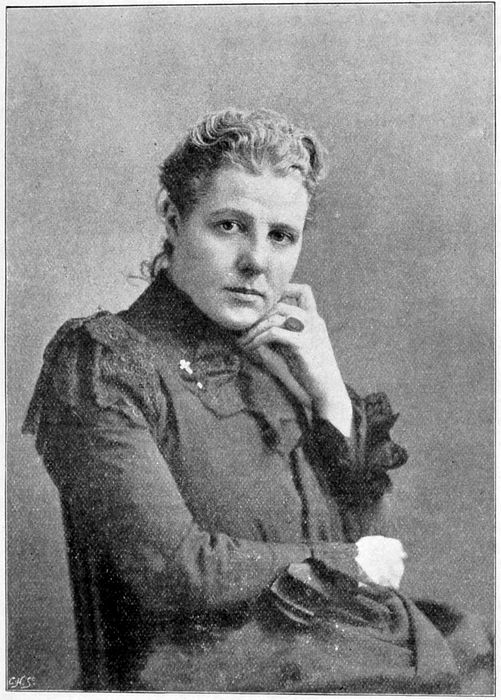
MRS. ANNIE BESANT.
(From a photograph by Messrs. Elliott & Fry, Baker-street, W.)
81But I am bound to say that as Mr. Garrett went on with this newer case the situation altered. The details are too precise, and supported by too much evidence, for me honestly to escape from the conclusion that, if the facts and documents are correctly set forth, a primâ facie case has been established against Mr. Judge.
“If Mr. Judge declines to answer.”
Some facts in the series of articles and many of the inferences are wrong, as I shall have occasion to show; but enough is made clear to imperatively demand an answer. The charge here is, of course, of no offence known to the law; but were it otherwise, many men have been found guilty on charges which were supported by less evidence than these.
I am quite aware that a goodly number of my fellow Theosophists will blame me exceedingly for saying this, especially some of our younger members, whose moral sense seems somehow or other to have become confused over this matter. Let me put myself quite straight with them. My mind is perfectly open on the subject. I have no opinion yet one way or the other as to Mr. Judge’s conduct, for I have not heard his defence. For aught I know he may have a crushing, triumphant reply, and Mr. Garrett and Mr. Old (and with them Mrs. Besant!) may all have to go down on their knees to Mr. Judge. But that reply we must have, and as a member of the Theosophical Society, whose motto is, “There is no religion 82higher than Truth,” and who has appealed to the public to join it because I believed that it was founded on truth, and that its chief officials and leaders were upright, honourable people, I mean to use every legitimate effort to get it. If Mr. Judge declines to give it, if he refuses to come out into the open fully and squarely, or if his reply does not meet the case, then sadly and reluctantly I shall have to leave the Theosophical Society, for it will be impossible any longer to remain in an organisation whose vice-president is in such a position.
An Appeal to all Honest Theosophists.
Now it depends on the members of the society as to whether Mr. Judge’s reply shall be forthcoming. They can make such strong representations to him as will be impossible for him to ignore, and I hold that it is their duty to do so. Every member of the society has an indefeasible right to know what manner of man their vice-president is, and it ought to be made perfectly clear that the morality of the organisation is at least as high as that of the best commercial morality, and is not based on Jabez-Balfourism. If there is to be any talk, as there is already among some members, of “letting by-gones be by-gones—saving the situation—ignoring the attack for the sake of Theosophy, safeguarding occultism,” &c., then self-respecting members will have to protest strongly, and, if necessary, clear out. All such talk comes from mental ostriches, and in this matter ostrich-tactics won’t work. It is not a question of Mr. Judge, or of occultism, or the Theosophical Society, but what is above and beyond all these, Truth, on which Theosophy itself is based, as I firmly believe. If there is no religion higher than truth, then truth must be had at all hazards. For the truth we shall have to wait, perhaps, some months. Till we get it, minds should be perfectly open and unbiassed. Only three people can give the truth—Mr. Judge, Mrs. Besant, and Colonel Olcott. As far as lies in my power I mean to see that the truth is forthcoming.
The Judicial Committee of Inquiry.
Over this Mr. Garrett has floundered somewhat. I was a member of it, and know the facts. When Mr. Garrett says in his 83first article that “a few people are aware ... that there was recently a Theosophic meeting at which Mrs. Besant confessed to her friends that there had been something wrong with the ‘communications,’” and that she persuaded those assembled generally to hush the matter up, he does not know his case. This is what really happened. After Mr. Old had been some time in India he came to the conclusion that certain charges against Mr. Judge, which up to then had been vaguely floating about, were true, and he said so. In England we disbelieved them, for we had no real evidence, but when Mrs. Besant reached India, and examined the evidence, she agreed with Mr. Old. She formally adopted and formulated the charges, and the fact that she had done so immediately became known all over the world. There was no hole-and-corner work about it. An official investigation committee met, but found itself blocked by the constitutional difficulties with which your readers are now familiar.
Mrs. Besant and the Deadlock.
Then I proposed that we should resolve ourselves into a voluntary jury of honour. Mr. Judge did not agree to this, and so there was a deadlock. The evidence had not been heard, although Mrs. Besant was ready with it, for the inquiry had not been made, neither had we heard Mr. Judge’s defence. The next stage in the proceedings was the reading, to a very full meeting of members from all parts of the world—for it was our annual convention—of the statements by Mrs. Besant and Mr. Judge, to which Mr. Garrett has so often referred. In her statement Mrs. Besant said: “The vital charge is that Mr. Judge has issued letters and messages in the script recognisable as that adopted by a Master with whom H.P.B. was closely connected, and that these letters and messages were neither written nor precipitated directly by the Master in whose writing they appear.” That is pretty definite and precise. These two statements by the accuser and the accused, together with all the proceedings of the committee, were published in Lucifer on August 15, and they were reprinted in a pamphlet which was sent to every member of the society, and I also know 84that the day before she sailed for Australia Mrs. Besant made arrangements for that pamphlet to be sent to all the principal papers of the United Kingdom. I have said all this at length in order to dispel the idea that Mrs. Besant wished to bamboozle the society or hush up charges of fraud. I know that it is asked why she did not publish the whole of the evidence. If the official Enquiry had been proceeded with the evidence would have been published with its other proceedings. But Mrs. Besant felt, rightly or wrongly, that it would be unfair of her to publish it without the defence, and this there were no means of getting.
The Unsatisfactory Position of the Society.
But now see the unsatisfactory position of the society. The most serious charge possible had been made by its chief member against its second official, one of its founders, the tried and trusty friend of Madame Blavatsky. The charges were still hanging over his head, his members in America thoroughly disbelieved them, the members in India as thoroughly believed them, and we in Europe did not know what to think. They had been neither proved nor disproved. Colonel Olcott was going back to India, Mr. Judge flitted back to America, and Mrs. Besant rushed off to Australia to fulfil lecturing engagements made a year previously, and so far as regards the society generally Mahomet’s coffin was not in it for “floating.” Those of us who really took the thing to heart held our hands. We fully recognised the gravity of the whole matter, but we determined to wait till Mrs. Besant’s return before we moved, for without the evidence we were powerless. But we reckoned without our Westminster!
In concluding this article, I say frankly that The Westminster has really, although quite unconsciously, done Mr. Judge a good turn. I do not for a moment flatter myself that Mr. Garrett wishes any good to Theosophy! The tone of his articles precludes that idea. But his attack on Mr. Judge puts the latter in this position, that if he chooses he can defend himself without any fear whatever of pledging the Theosophical Society to one jot or tittle of dogma with regard to Mahatmas. He is attacked as a man, and as a man I sincerely hope that he will manfully and satisfactorily reply.
Sir,—As my name has been publicly mentioned by Mr. Mead, general secretary of the European T.S., in connexion with the series of articles “Isis Very Much Unveiled,” I think it advisable to state my own position and attitude in the matter.
The writer of those articles has named me, quite correctly, as having taken the first step in forcing an inquiry into the case against Mr. Judge. For this act of mine, I was suspended from my membership in the Esoteric Section, under the authority of the joint signatures of William Q. Judge and Annie Besant, Outer Heads of the E.S.T., and my name was dishonourably mentioned before the members of the E.S., among whom I numbered many an old colleague and friend. The mandate somehow found its way into the public Press. However, there was one advantage. After her official action in suspending me from membership Mrs. Besant was, of course, bound to hear my justification. This happened at Adyar in the winter of 1893. Mrs. Besant’s first remark to me after reading the case and examining the documents was, “You were perfectly justified by the facts before you.”
THE HEAD OFFICIALS PLEDGED TO PUBLISH THE FACTS.
In the presence of the president-founder Colonel Olcott, Mrs. Besant, Countess Wachtmeister, Mr. E. T. Sturdy, together with Mr. Edge and myself, it was decided that the task of officially bringing the charges should devolve upon Mrs. Besant, and that the whole of the evidence should be published. Consequently, the documents were handed over to Mrs. Besant for the purpose of drawing up her charges, and the president sent an official letter—or, as Colonel Olcott now claims, a “private letter” in official form—dated at Agra, February 12, 1894, to Mr. Judge as vice-president, in which he said (I re-quote from a circular issued by Mr. Judge, March 15, 1894):—“I place before you the following options:—
1. To retire from all offices held by you in the T.S., and leave me to make a merely general public explanation; or,
2. To have a Judicial Committee convened ... and make public the whole of the proceedings in detail.
86In either alternative, you will observe, a public explanation is found necessary: in the one case, general; in the other, to be full and covering all the details.”
It was the second alternative which was adopted, with the abortive and disingenuous result already known. But what of the “full publication of all the details”? What of us Theosophists who had brought these charges against Mr. Judge? Were we not left in the position of persons who had brought charges without proving them? The position was one which I felt to be intolerable. Mrs. Besant had the full evidence in her hands by which to justify all the charges she had engaged to bring against Mr. Judge, but for some reason best known to herself involved the whole society in countenancing a systematic attempt to bolster up a delusion by concealment of facts. Mrs. Besant was also in honour bound to publish the facts, to all members of the society at least, since they were of a nature to vitally affect the beliefs of Theosophists the world over. She was, in short, bound to give them the same publicity as her former professions of occult intercourse obtained.
“MORALLY BOUND TO GIVE PUBLICITY TO THE TRUTH.”
The T.S. is an organised body with a wide system of propaganda, and has taken the public into its confidence in cases where its special claims appear to have been supported by facts, and while the public are invited to join the society it is only right and honest that they should know what of those claims are true and what of those “facts” have stood the test of inquiry. This responsibility cannot be avoided, and as I have personally been instrumental in the inquiry into these claims and facts, I am morally bound to give what publicity I can to the truth when arrived at. To rectify what I believed to be a fatal policy on the part of those concerned with the charges against Mr. Judge, I resigned from all offices held by me in the T.S., and left myself free to speak openly of the matter whenever occasion presented itself. I do not believe that a system of truth can be raised from a fabric of fraud. In the course of my travels I met with my friend Mr. Garrett, to whom, upon inquiry, I gave the reasons of my resignation from official connexion with the society. He asked my permission to publish the facts. My reply was that although I could not unsay what I 87had said, I had not intended such publication as he contemplated, and doubted whether the case could be put forth with sufficient clearness and fairness by a “Philistine.” I soon found, however, that he had a thorough grip of the facts; and on his representation, the truth of which I had to admit, that the society had closed the inquiry, and would not open its journals to a full discussion of the evidence, I let him take his own course.
Certain persons, who seem unable to conceive that a man may act on principle and without interested motives, have suggested that I was moved by some petty personal grudge, or even by some pecuniary inducement. I repudiate both these insinuations as lies. My independent action in this matter has involved certain pecuniary sacrifices; I have in no way used it, and should scorn to use it, for pecuniary gain.
MR. JUDGE AND MRS. BESANT.
It will, therefore, be clear to all members of the T.S. and the public generally that I am responsible for the facts occurring in Mr. Garrett’s articles only so far as they apply to the charges against Mr. Judge, and for these I have documentary evidence produced under a legal hand, and duly witnessed. With Mr. Garrett’s method of presenting the facts I am by no means in sympathy. I do not lose sight of the fact that, however mistaken or misled many of the Theosophical Society may be, as regards the traditional “Mahatmas” and their supposed “communications,” they are nevertheless as sincere in their beliefs as many of their more orthodox fellows, and have as much right to respectful consideration. I regret particularly that Mrs. Besant should have been placed in this awkward public position by the present exposure. Her intention I believe to have been perfectly honest, but I think she made a fatal mistake in avoiding the publication of the full facts, and in allowing the misconception to endure concerning her own and Mr. Judge’s connexion with the Mahatmas.
MME. BLAVATSKY AND THE MAHATMAS.
Of Madame Blavatsky I speak as I knew her. At the time I made her acquaintance she had forsworn all “phenomenalism,” so that I never saw any occult phenomena at any time. I believe that for her the Mahatmas existed, and I believe she thought them to be embodied personalities. 88Colonel Olcott has another theory, and others have their own. Personally, I believe in the extensibility of human faculty, and in the existence of an order of intelligences higher than our own, but I do not require that they are embodied or terrestrial in any sense of the word. Finally, I have been through the Theosophical Society with my eyes open, and for more than five years have been, officially and unofficially, as fully “in the Theosophical Society” as one can well be; and while I am certain that many are fully convinced of the truth of their own beliefs in these matters, I am also fully assured that a large number are in the position of persons self-deceived, who have unfortunately committed themselves too far to review their position without almost disastrous consequences to themselves and others. But that of which I have the fullest conviction and the greatest amount of presentable proof is the fact that no such thing as evidence of the existence (in an ordinary sense) of the Mahatmas, or of their connexion with the T.S. as a body or with its members individually, is obtainable by a person pursuing ordinary methods of investigation.
For those who are willing to found their beliefs upon the mere statement of another, without question of possible interestedness on the one hand, or self-deception on the other, the position is of course otherwise. For such persons proofs have no value whatever, what they are pleased to call their “beliefs” and their “knowledge” being determined or determinable from the moment they sign away their independence of judgment and freedom of thought.—Yours sincerely,
P.S.—One misstatement of fact appears in your issue of November 3. What Mr. Garrett refers to as “Madame Blavatsky’s Rosicrucian signet-ring” was not a ring, but a jewel, used as a pendant. Also, the “dark gentleman” who delivered the two £10 notes to Mr. Judge made his call (so we were told) in the early afternoon, not in “the evening” as stated in Mr. Garrett’s text. I am bound to add that, whatever may be my annoyance and regret at the tone of the articles and of some of the inferences, as regards that part of the evidence which is known to myself, I have noticed so far no other substantial error of fact.
FROM MR. A. P. SINNETT: “OCCULTISTS MAY NOT TELL FIBS.”
Sir,—The circular bearing this title—referred to in your leading columns yesterday—was issued last July, and directly affects some questions you have lately been discussing. Under the circumstances, I hope you will kindly consent to give it fuller publicity. It was addressed to students of Occultism, and ran as follows:—
The inevitable mystery which surrounds Occultism and the Occultist has given rise in the minds of many to a strange confusion between the duty of silence and the error of untruthfulness. There are many things that the Occultist may not divulge; but equally binding is the law that he may never speak untruth. And this obligation to Truth is not confined to speech; he may never think untruth, nor act untruth. A spurious Occultism dallies with truth and falsehood, and argues that deception on the illusory physical plane is consistent with purity on the loftier planes on which the Occultist has his true life; it speaks contemptuously of “mere worldly morality”—a contempt that might be justified if it raised a higher standard, but which is out of place when the phrase is used to condone acts which the “mere worldly morality” would disdain to practise. The doctrine that the end justifies the means has proved in the past fruitful of all evil; no means that are impure can bring about an end that is good, else were the Good Law a dream and Karma a mere delusion. From these errors flows an influence mischievous to the whole Theosophical Society, undermining the stern and rigid morality necessary as a foundation for Occultism of the Right Hand Path.
Finding that this false view of Occultism is spreading in the Theosophical Society, we desire to place on record our profound aversion to it, and our conviction that morality of the loftiest type must be striven after by every one who would tread in safety the difficult ways of the Occult World. Only by rigid truthfulness in thought, speech, and act on the planes on which works our waking consciousness, can the student hope to evolve the intuition which unerringly discerns between the true and the false in the supersensuous worlds, which recognises truth at sight and so preserves him from fatal risks in those at first confusing regions. To cloud the delicate sense of truth here is to keep it blind there; hence every teacher of Occultism has laid stress on truthfulness as the most necessary equipment of the would-be disciple. To quote a weighty utterance of a wise Indian disciple:—
“Next in importance, or perhaps equal in value, to Devotion is Truth. It is simply impossible to over-estimate the efficacy of Truth in all its phases 90and bearings in helping the onward evolution of the human soul. We must love truth, seek truth, and live truth; and thus alone can the Divine Light which is Truth Sublime be seen by the student of Occultism. When there is the slightest leaning towards falsehood in any shape, there is shadow and ignorance, and their child, pain. This leaning towards falsehood belongs to the lower personality without doubt. It is here that our interests clash, it is here the struggle for existence is in full swing, and it is therefore here that cowardice and dishonesty and fraud find any scope. The ‘signs and symptoms’ of the operations of this lower self can never remain concealed from one who sincerely loves truth and seeks truth.”
To understand oneself, and so escape self-deception, Truth must be practised; thus only can be avoided the dangers of the “conscious and unconscious deception” against which a Master warned his pupils in 1885.
Virtue is the foundation of White Occultism; the Pàramitàs, six and ten, the transcendental virtues, must be mastered, and each of the Seven Portals on the Path is a virtue, which the Disciple must make his own. Out of the soil of pure morality alone can grow the sacred flower which blossoms at length into Arhatship, and those who aspire to the blooming of the flower must begin by preparing the soil.
H. S. Olcott, A. P. Sinnett, Annie Besant, Bertram Keightley, W. Wynn Westcott, E. T. Sturdy, C. W. Leadbeater.
I do not propose to discuss the merits of the case against Mr. Judge, but we who signed this paper—without prejudging in their personal aspect accusations which it had then been found impossible to thresh out thoroughly—conceived it desirable to remind all fellow-students of Occultism that no beneficial results along that path could possibly be attained except by a course of life which, whatever else it might be, should be strictly in harmony with the dictates of ordinary morality.
The Theosophical Society has grown in a few years to such extraordinary proportions, and is so loosely jointed, that it cannot be correctly thought of as a homogeneous association all parts of which are equally represented by the officers nominally at its head. But it ought at this crisis to be generally understood that the many persons of culture and earnest purpose to whom spiritual progress along the original lines of Theosophic teaching is the main object of existence are guided by evidence concerning the possibilities of their higher evolution that is of a kind utterly unlike that which you not unreasonably discredit. 91A great block of such evidence is in our possession concerning not merely the existence but also the attributes of the great initiates, and to those of us in a position to appreciate this the foundations of Theosophic knowledge are quite unshaken by such incidents as those on which you have been commenting.—I am, Sir, yours, &c.,
WHOM DID THE CIRCULAR REFER TO
[In reference to the subject of Mr. Sinnett’s letter, the following is an extract from the Westminster Gazette under the heading;—“More Theosophistry: A Belated Piece of Bluff.”]
In the current number of the Review of Reviews a letter appears signed by the Dr. Keightley who lately wrote to The Westminster Gazette as a professed representative of Mr. W. Q. Judge, Vice-President of the Theosophical Society. The letter is worthy of some attention as an illustration of the tactics of Mr. Judge’s friends, and of the line which they were taking towards any allusion in the Press to certain events before the appearance of the recent exposure in this journal.
The letter is dated October 25, and was therefore written at the time when the Theosophists still hoped to maintain the great “hush up” inaugurated at the Convention of last July, and before they dreamed that all London would presently be discussing the facts which had been so industriously buried.
The occasion of the letter appears to have been a comment of Mr. Stead’s in the last number of the Review on a circular lately issued under the title of “Occultism and Truth.” This circular was issued just after the so-called “Enquiry into Certain Charges against the Vice-President,” and (to this office, at any rate) it was enclosed under one cover with the pamphlet report of that “Enquiry.” The substance of it is an assurance to the Theosophical world, on the part of some prominent Theosophists, that occultists have no more right than ordinary people to fib. Coming at the time when it did, and signed as it was by all the principal official Theosophists, with the one exception of the vice-president, the Editor of the Review of Reviews very naturally interpreted it as having some connexion with the charges against the last-named gentleman, and with what his colleagues evidently felt to be their apparent condonation of the “occult methods” ascribed to him.
The following is the substantial passage in the letter thereupon addressed to the Review of Reviews by Mr. Judge’s representatives:—
92Allow us to make a very necessary correction.... Mrs. Besant, who originated the circular, was asked directly whether it was connected with the charges or whether it was in any way aimed at Mr. Judge. She gave an emphatic denial to both questions to many who took the same view expressed by you.
Another fact is not generally known, and leads people—yourself among others—into unconsciously committing an injustice. The charges against Mr. Judge were never substantiated, and the committee appointed to inquire into them declared that they were illegally laid.
(The letter then concludes with a high tribute to Mr. Judge’s character for truthfulness and every other virtue.)
Now, as regards the statement about the intention of the Circular, we will only say that one co-signatory of it at least has committed himself to the precise view of it which this letter denies. Nor is it obvious why the heads of any society should issue a round robin to say it is naughty to tell taradiddles, unless some current reference were intended to the affairs of the society.
Besides this, however, there is unmistakably conveyed the impression that Mr. Judge’s accusers failed to substantiate their case, and that there was something actually “illegal,” in the ordinary sense of the word, about some part of their conduct.
As readers of “Isis Very Much Unveiled” are aware, both these things are absolutely untrue. The simple fact was that, owing to the objections raised by Mr. Judge, no opportunity was given for the charges to be either substantiated or the reverse; while the only justification for the statement that they were “illegally laid” is such as can be squeezed out of the fact that the Theosophical Pickwickians were persuaded by Mr. Judge that inquiry was forbidden by the constitution of their society.
It only remains to add, to complete the disingenuousness of this very Theosophistical letter, that its signatories authenticate its statements by flaunting the title of “Members of the Committee of Investigation”; the committee referred to being the one which met only to decide that it could not investigate, and the members of it as such having no knowledge whatever of the evidence either on one side or the other!
Sir,—My husband and myself are two of the officials in one of the local branches of the Theosophical Society. I write in his name and my own to say that we have read with some interest your voluminous attack on the personal characters of some of our leading members.
We were also amused by the ingenuous surprise of your reporter, that the Blavatsky Lodge meeting in London, which he attended, was spent in philosophic study, not in the discussion of psychic phenomena or of the personal characters of members.
You say (Chapter II.):—“This society as such must stand or fall with its Mahatmas.” This is not so. The Theosophical Society is entirely neutral on the question of the existence or non-existence of such beings, and the reason why the charges, of which you have published a more or less correct statement, were not gone into by the authorities of the T.S. was, that to have done so would have entailed an infringement of that neutrality.
The question whether Mrs. Besant was misled when she made the statement at the Secular Hall in 1891 has been answered by her own clear withdrawal of that statement.
The question as to Mr. Judge is entirely one as to his own truth or falsehood, and may be well left to him to answer or not. It is not necessary for the public or for the members of the Theosophic Society to judge him.—Faithfully yours,
Sir,—Having read the revelations your correspondent has been pleased to give to the public, and presuming them to be correct, it seems to me that there are now three parties at fault in place of two as I had supposed, viz., Mr. Judge for imposing (whether consciously as a deceiver or unconsciously) as a medium obsessed by a spirit of ambition and the communicator of the facts (if a member of the inner circle) for breaking his solemn pledge not to reveal or betray the affairs of that circle. The recent correspondence now adds others 94as condoning the offence of Mr. Judge—and all this has come from the love of pre-eminence and the mere dabbling (child’s play) with the occult. Clearly, if the offence was proved, the officers of the society were bound in truth and honour to expel the offender, and all would then have been clear and straight. My advice to the society would be to stick to their programme, which is a highly laudable one, and let no word from an invisible and unknown be taken as of any external value, but judged only by its internal worth.
The society, it seems to me, can no longer pretend to condemn the communication with Spirits as a dangerous thing, nor cry out against the occasional frauds of mediums, in conscious or unconscious state, seeing how heavily they have fallen into the same snare, nor can they point the finger to frauds or delusions in other bodies whether Catholic or non-Catholic. A greater strictness and more uniform abstinence from flesh-eating and tobacco, as well as alcohol (which last they eschew) should be enjoined on all its members by their authorised officers, and their own three objects steadily pursued—separating from the third all spurious imitations of magical wonders; and, above all, the spirit of truth which accepts nothing on this or that authority without careful verification should be cultivated. A want of bravery to do the right, to tell the truth, and face the consequences, is the only thing that can be laid to the charge of the presiding officers of the Indian and English sections. Are all societies and Churches free from this? Has not a natural tenderness from long friendship, and sympathy in noble and useful work, been often the cause of much to be deplored? And in this instance, is not such over-tenderness of noble, unsuspicious, and honourable souls, worthy rather of regret than of too severe censure.—Yours,
Sir,—I see Mr. Mead is reported as saying that “what the articles [in The Westminster Gazette] would do, if they did anything, was to sift the society of those who had simply joined for the sake of the marvellous.”
95This remark shows the same utter oblivion of the appreciation of truth that has unhappily shown itself in the society’s record before. It is not a question of phenomena; it is one of good faith; and if this is the line taken, not the phenomena-hunters merely, but seekers for truth and respecters of it, who expected to find it in the Theosophical Society, will abandon that body in disgust.
Mr. Mead continues:—“Theosophists could no more divulge secrets without violating every sense of honour than a Mason could.”
To compare the Theosophical Society, as at present constituted, with an honourable body like the Masons, is an insult to the latter, goose-guzzling and luxuriant as they may have tended to become in these latter days.
There is a profound difference between hiding secrets, which are entrusted to one, and which concern certain (perhaps) important facts in the nature of man, and taking part in proceedings to gull a number of fellow-students and the outside public. This is practically what has been done before, and the dissatisfied either disappeared altogether or were well howled at as traitors to “the cause,” whereas, in verity, they were doing their best for the disowned cause of truth; or, again, they were coerced by the solemn warning of “your pledge, take care of your pledge,” and thereby intimidated from seeing that they were making themselves parties to a continuous misrepresentation of facts and a deliberate fraud upon their less-informed fellow-members, not to mention the public. “What have our troubles to do with the public?” has been the question. I reply, “Everything,” for it is to the public that constant appeal is made and amongst its ranks that proselytes are sought.
Nothing has, so far, been exposed in these articles that any right-thinking truth-seeker would wish to have cloaked. The public are not being made acquainted with any arcane wisdom; but if one-third of the statements made in The Westminster Gazette are supported by documentary and other evidence, then the world certainly ought to be warned against a society that takes as its motto, “There is no religion higher than TRUTH” and forthwith allows its leading members to play such antics and engage in such grotesque jugglery without bringing them sternly to book. As for continuing to work with these people in the establishment of a 96“universal brotherhood,” rather will it become a universal imposture to expose which were a service to the glorious old Wisdom of the Venerable East, which it dishonoured by its sham Mahatmas.
Those who are publishing the facts, if facts they be, are doing a service to the cause of truth, and should have the thanks and gratitude of all of us in the Theosophical Society whose motive in being there is to seek TRUTH, and to combat error and fraud in religion, mysticism, or anything else.—I am, &c.,
Sir,—With every word of Brother Old’s letter of to-day’s issue I beg to express my fullest sympathy. I deprecate the tone of the “revelations,” but of the necessity of making the public fully acquainted with the facts I have not the least doubt. As to the existence of “Mahatmas,” I can only say I do believe in the existence on this earth of a higher order of beings who, by total abstinence from and abhorrence of flesh-eating, alcohol, and tobacco, and other evil and impure customs, and by adherence to a fixed rule of life, retiring early and early rising, with daily ablutions, and by certain studies and training of body and mind, have acquired certain attributes and powers so far in advance of ordinary human beings as to be regarded by them as miraculous. Of this I have had evidence, not from Theosophists, but from personal friends resident in India before ever they heard of the name of Theosophy. Whether any of these have anything to do in the direction of the Theosophical Society is quite another matter. There is Theosophy and Theosophy, and one of these I would rather term “Theophilosophy,” i.e., “the love and wisdom of God,” or “love and wisdom religion”—and not wisdom only as is implied in the term “Theosophy.” Readers of “The Perfect Way” and its companion volume, “Clothed with the Sun,” by that noble woman Anna Kingsford and her colleague, will know what I mean. Now, what about the future of the Theosophical Society? I believe its officers may fall, but its work must endure. No doubt of that. The founders have had their weaknesses and foibles like other mortals, but I hope none will ever forget the gratitude they owe to Madame Blavatsky, especially to the blessings she has conferred in 97founding the Theosophical Society and giving through its means to all hungry and thirsty souls such priceless stores of knowledge and suggestive thought (from the Oriental religions and philosophies which have made such deep impress on the millions of the East) as are contained in the grand volumes of “The Secret Doctrine,” with its index and glossary, and her other publications. None can read these volumes, but must ask themselves, What manner of woman must she have been who devoted so many long years of labour, from 7 a.m. to 7 p.m. daily, in their production, and that amidst incredible difficulties and opposition and worry? Nor must we forget the debt that we owe to Colonel Olcott and Madame Besant for having made this knowledge accessible to all minds and conditions by their lectures and booklets.
What can be more noble than the promotion of universal brotherhood irrespective of sex, colour, caste, or creed, united in the study of the ancient religions of East and West, and of all that pertains to the hidden powers in man, and their development for the good of the race? But these last, I say again, will not be attained in purity but by prayer, and abstinence from flesh meal, alcohol, and tobacco, and other evil customs of society, and the disuse of all things gotten by cruelty to, or oppression of, our fellow-creatures the lower animals, and by pure surroundings.—Yours,
Sir,—No one should blame you, or resent the publication of the facts. Truth is the first consideration, and though we who have interested ourselves in the philosophy promulgated by the society may bitterly regret that folly and fraud are to be found within its fold—as elsewhere—yet we can rest assured that whatever there is in this philosophy which appeals to the enlightened intelligence of mankind will remain when the superstructure raised by designing intriguers or unwise enthusiasts shall have crumbled away. It is in consequence of this belief that the writer, with others in the society, can read with calmness, and not without some sense of amusement, this unpleasant disclosure; not doubting but that a great deal of it is true, and that all may be so; and while feeling unmixed contempt for the 98“informer,” can acknowledge that any editor is well within his rights, and a public benefactor, when exposing fraud wherever it is found.
Would that this feature were more pronounced in journalism generally, and not indulged in only when such exposures fall in with public prejudice!
For several years the writer of this letter has been absent from the Avenue-road centre: among other reasons, from a feeling of disapproval of certain follies which may be called incipient relic worship, and which no sensible person could tolerate for long. So it will be seen that all Theosophists have not fallen under the spell of Mrs. Besant’s rash enthusiasm, which has done, and is doing, so much to discredit her, now as heretofore, in the eyes of the world. Yet, in spite of her indiscrimination and lack of sound judgment, which has alienated many, the writer would rather stand in the pillory of public opprobrium with her than sit at a banquet with the “informer” and those who can rejoice over the failings of a beautiful soul. For it may be said of her, and a few others, “Of such is the Kingdom of Heaven.” That there is to be found even one of these among Theosophists may lead a few to suspect that there is something more in Theosophy than can be discovered in your articles, and that, though fraud should be proved, there may nevertheless be real occultists and true phenomena. Thus, what at first sight appears a serious blow to our cause will perhaps induce further inquiry among your readers, while doing useful work in destroying errors and growing superstition.
PART III. — LAST SHREDS OF THE VEIL OF ISIS. — A REVIEW OF SOME THEOSOPHISTRIES.
As yet, “Isis Very Much Unveiled” remains very much unanswered. The oracles are dumb. “No Dolphin rose, no Nereid stirred”; no Mahatma “precipitated” a reply (as one of them did with such edifying results in the case of the Kiddle plagiarism), nor disintegrated by psychic force the damaging documents in my possession; Mrs. Besant, whose “astral body” has flitted across oceans to visit Mr. Herbert Burrows “on pre-arranged evenings,” gave no sign from Australia; Colonel Olcott, president, in India, disdained the more commonplace agency of the cable; and Mr. William Q. Judge, vice-president, whose official adytum is but five days away at New York, neglected to avail himself of the ordinary post, whatever he may have done about the astral one.
Moreover, accustomed as are all these three officials to scouring the earth, with all expenses paid, no intimation has been made public 100as to the date when we may expect to receive anyone of them back from the various regions to which they sped immediately after launching the report of their peculiar “Enquiry.” Their colleagues in England continue to speak as if a trip to New York carried one to the bourn from which no traveller returns.
But what of these colleagues themselves? Where is the “Voice of the Silence” of Avenue-road, St. John’s Wood? At point after point, the Story of the Great Mahatma Hoax touched matters to which one or other or all of them must have been privy. It told of missives which they had accepted as genuine, orders which they had acted upon, decisions in which they had agreed, fact after fact of which they had full cognisance. When Mr. Mead, the European secretary, gave out that he did not reply because he was not attacked, I did my best to oblige him; I began at the beginning, and challenged him at once as having been present and taken part in the “Judge’s-plan-is-right” decision; and I added that when he had denied my version of that I would supply him with further matter for denial. Whereupon the discreet European secretary subsided altogether.
The “Sacred Oath” Humbug.
Of course, some excuse had to be offered, and we have been told that what happens at meetings of the Esoteric Section is sacredly secret. Now, first, that only covers a small part of my story, some of which dealt with circumstances surrounding official acts of the society or its three sections. Secondly, the excuse is eminently one that accuses, by implying that what I say happened at those meetings did happen; for presumably members take no oath to keep secret what does not occur? But, thirdly, this alleged secrecy is a mere pretext; else how could Mrs. Besant publicly refer on platforms to “supernatural” experiences at those meetings; and Messrs. Old and Edge (the latter to this day holding office) raise questions about one such matter in print in Colonel Olcott’s journal; and Mrs. Besant, the Colonel, and a full council of officials notify Mr. Judge that in a certain eventuality (which did afterwards occur) they would make a “full publication covering all the details” of that matter, and others concerning the sacred Mahatma messages?
Whatever may be the “quasi-Masonic oath” of which we now hear, they evidently held that it did not bind them to conceal, with their eyes open, a fraud upon their fellow-members; and those who do so interpret it only throw a very suggestive light on their own action in 101willingly taking such an oath. Was Mrs. Besant quite right when she gave the public what she confesses was a “misleading account” of these secrets, and only in the wrong when, along with Colonel Olcott and the rest, she proposed to give what she now knew to be the correct one? Is the position that a Theosophist may “tell”—anything he likes, except the truth?
A Survey of the Present Situation.
The absence of Colonel Olcott and Mrs. Besant does not alter the fact that he with others made, and she publicly adopted, certain charges against Mr. Judge, vice-president. And the silence of their colleagues in England does not disguise the fact that my account of the details has not been challenged as to one single event, letter, or facsimile. The published “Report of an Enquiry” cries aloud for some explanation: the explanation of “Isis Very Much Unveiled” holds the field untouched. It leaves the vice-president only able to exculpate himself, if at all, by further inculpating them. The “full rebuttal evidence held in reserve,” therefore, at which his professed representative in England hints, can be formidable only to the Theosophical Society, not to its critics. I am bound to say, however, that if the would-be impressive fragments of it which have been privately adumbrated to me are fair samples of the rest, it is not calculated to be formidable to anybody. When the “affidavits” hinted at have been published, or otherwise submitted to examination, I can promise them all the attention they deserve. To say that any affidavit, until cross-examined upon, is worth exactly as much as the paper it is written on would be an uncalled-for slight upon the paper-maker.
The Excommunication of “Brother Old.”
A word or two about the attempt to create a diversion by attacking the character of the one Theosophical official who has had the honesty to resign office rather than shut his eyes to a fraud on the public. The attack on Mr. Old cannot in any case discredit the story I have narrated. First, because the largest and most important part of that story is from the undenied written evidence of persons still holding office in the society, and especially 102of its “President-Founder.” Secondly, because, even as regards Mr. Old’s part, the character of a witness is only a relevant consideration where the truth of his testimony is disputed. What I am now about to say is said, therefore, merely in justice to Mr. Old himself. The attack on him has two lines. It is said that he had to perjure himself to give any information whatever. It is hinted that what information he did give was given for money. The former charge turns entirely on the “sacred oath” humbug, which I have discussed already. As to the latter, it is true to my knowledge that for the part he has taken in fulfilling what he regards as a public duty to truth, Mr. Old neither asked nor received any consideration whatever. My own acquaintance with Mr. Old began in an odd way, not without bearing on the question of his sincerity. At the time of the Salvation Army riots at Eastbourne, a gallant old Englishman, who could not bear that women, under any provocation, should be publicly assaulted in English streets, went down there to stand up for the “Hallelujah lasses.” He asked, through the Pall Mall Gazette, for five hundred Englishmen to help. He got five. This Quixotic gentleman, this modern Sieur de Marsac, was my friend Mr. Charles Money, of Petersfield. I went myself to see that he did not get his head broken more than was necessary. His company, as seedy a lot of knights-errant as ever I saw, consisted mainly of Cockney journalists who did not believe in God. But one—a spruce, slight youth—declared himself a Theosophist. The adventurers spouted to a yelling mob, got off with whole skins, and by testimony of the local police actually achieved their end. But Mr. Money and one other were knocked about a bit in the crowd. That other—he quitted himself like a man—was Mr. W. R. Old, Theosophist. I may be wrong: it was but a street row; but I regard that as a more practical service on Mr. Old’s part to the “Universal Brotherhood of Humanity” than all the hundredweights of vapid moralising on the subject ever vomited from “The H.P.B. Press.”
Stewing in the Judge Juice.
Except Mr. Old, one prominent Theosophist, and one alone, has so far publicly faced the facts. Mr. Herbert Burrows has had the honesty and the courage to say out that this thing must be answered by Mr. Judge, and fully, or he for one will quit the society. Mr. Burrows forgets that others besides Mr. Judge have made themselves answerable. Other correspondents, again, represented other factions, and showed how the society is seething with distrust and shame. But the mass of the letters only serve to prove that, whatever else the “occult powers” of the Theosophists may be, they do not include a command either of plain English or of straight argument. If “Isis” does not yet stand before us absolutely like Hans Breitmann’s “maiden mit nodings on,” it is a painfully thin fabric of Theosophistries which alone shelters her from the cold wind of public contempt. Let us examine it.
The Theosophistry about Proving a Negative.
“After all, you have not proved that Mahatmas do not exist, nor that occult phenomena cannot occur.”
Certainly I have not, nor did I ever propose to try. I am quite prepared to believe in both when evidence for them has been produced, and has stood the test of such ordinary evidential canons as have been applied to kindred subjects—for instance, by the Psychical Research Society. All that I have said is that certain evidence on which the Theosophical Society has been building proves nothing whatever, except the existence of a hotbed of humbug within the society itself. As for the Mahatmas, there is no difficulty about conceiving that illiterate, twaddling, and mendacious beings of a second-rate order of intelligence, such as those reflected in the “missives” which I have reproduced, may exist in Tibet as they unhappily do elsewhere. But when we are told that these beings have acquired powers which rise superior to time and space, and that they use these for communicating “in a quasi-miraculous manner” with the Theosophical Society, we ask for facts; and we get—such facts as were investigated by Dr. Hodgson and his colleagues, and such facts as 104have been exposed in “Isis Very Much Unveiled.” What else is there? One Theosophist directs me to “our literature on the subject, which is copious.” I don’t doubt it; but it is not “literature” that I am in search of. Another declares “it does not all depend on Madame Blavatsky and Mr. Judge; others have seen Mahatmas.” It seems that Mrs. Besant has been telling her Australian audiences that she herself has been so favoured (just as she told the Hall of Science audience that she had been favoured with supernatural missives). Well, how did Mrs. Besant know her Mahatma? By his “portrait,” I suppose, as others have done. And how was that portrait produced? When Madame Blavatsky began to spell spiritualism “Theosophy,” and turned her “spirit-control” “John King,” of whom Colonel Olcott tells, into Master Koot Hoomi—whom she again subordinated, after the Kiddle exposure, to Mahatma Morya, whom she, in turn, after the S.P.R. Report, left over for exploitation by Mr. Judge—when Madame started the Mahatma on this chequered career, it was one of her earliest steps to secure a counterfeit presentment of her creation. Various artists and amateurs were set to paint portraits under occult inspiration. The results may all have resembled the Protean Mahatma; some of them were strikingly unlike each other. The two best were done by Mr. Schmiechen, now a society portrait-painter, partly out of his head, partly from directions given by Madame, and partly from a photograph of a typical Hindu which she gave him for the purpose. Madame identified one as Koot and the other as Morya, and declared they were speaking likenesses—an opinion which nobody else was in a position to contradict. They hang to-day in the “Occult Room” at Adyar, and are declared to have been painted from the respective “astral bodies” of their subjects. Colonel Olcott, president, who knows their origin perfectly well, exhibits them reverently to barefoot disciples doing “puja.” Photographs from the fancy portrait of “M,” in locked cases, have been distributed to the Esoteric few; Mrs. Besant always works with one facing her; Madame Blavatsky made it part of a chela’s course to spend some time daily staring at the image, and deliberately trying to “visualise” it in corners of the room. What wonder if some of them have succeeded? It would 105have been contrary to all experience of the phenomena of self-hypnotic hallucination if they had not. The thing only begins to call for examination when the figure thus “visualised” leaves something not entirely psychic behind him. The Master who left a shower of roses once at Adyar turned out to have been M. Coulomb, eked out with a mask, a bladder, and some white muslin; and the roses were traced elsewhere than to Tibet. And the Master who precipitated the Judge missives?——But perhaps the Theosophists would prefer not to put him forward. When they have something better, I shall be glad to hear of it.
The Theosophistry of Throwing Over the Mahatmas.
“What matter even if the Mahatmas do not exist, and the phenomena are frauds? There still remain those sublime ideas which,” &c., &c.
I was quite prepared for this particular Theosophistry. That was why I started, at the very beginning of my story (Chapter II.), by showing what an enormous practical part the Mahatmas and their miracles have played in the movement. It is easy for this Theosophist or that to protest that they never attracted him. The fact remains that the big accessions to the society’s numbers have always followed on the miracle “booms,” alike under Madame Blavatsky and under Mrs. Besant. Moreover, it is not possible, even argumentatively, to dissociate “those sublime ideas,” &c., from the Mahatmas on whose authority Madame Blavatsky gave them out. If she spoke truth, they were the real authors of “Isis Very Much Unveiled” and of “The Secret Doctrine.” If she lied, and the authority for those teachings is her own, what is that lying authority worth? I need not labour the point, as it was conclusively proved long ago by Mrs. Besant herself. In an article in Lucifer of December, 1890, addressed apparently to certain Theosophical schismatics who showed a tendency to throw over alike their foundress and her “Masters,” Mrs. Besant accomplished the easy task of showing that the society was tied hand and foot to both. It was founded by Her at the bidding of “Them”; They have been the deus ex machinâ whenever She was in a fix, and the society has so accepted Them. It can be “neutral” about Them, and Their 106miracles, and Their prophetess, only when an heir is neutral about his own title-deeds. As Mrs. Besant puts it in a nutshell: “If there are no Masters, then the Theosophical Society is an absurdity.”
The Theosophistry of Throwing Over the “Inner Group.”
“The Esoteric Section is a private body, not officially connected with the Theosophical Society; so the Society is not responsible for miracle-mongering in the Section.”
The so-called Esoteric Section or E.S.T. (“Eastern School of Theosophy”), of which the High-priesters and the Vice-President are now quarrelling for the headship, and, in the words of the latter official, “the core of the Theosophical Society.” The Inner Group, again, is the core of the E.S.T. Both were the special creation of the Society’s foundress. The Group was to contain her top pupils. The members of the group are almost to a man officials of the Society, living at the Society’s expense. With the one exception of Colonel Olcott, practically all the high panjandrums are included in it. Lastly, if it has been the centre of the Mahatma communications, it is a centre that has radiated them in all directions to the society’s circumference. The plop of a missive sends a ripple from the Inner Group to the Esoteric Section, from the Esoteric Section to the society at large, and from the society to the public.
Well, the yolk of an egg is not officially connected with the outer portion; but when the yolk is bad, we call it a rotten egg without further parley.
The Theosophistry of Throwing Over the Society’s Personnel.
But that brings me to the most barefaced Theosophistry of all: “Even if all our officials be proved to have lied and cheated, there still remains untouched their grand ethical teaching!”
I simply state this, and leave it. Like the coster when his barrow broke down, “Friends, I ain’t ekal to it.” I cannot do justice to such colossal impudence. “Truth survives all attacks”; she does; she will even survive Theosophical defences. “The noble religions and philosophies of the East exist”; they do, as they did long centuries before the Theosophical Society was heard of, and will do long centuries after it has been forgotten. But when Mahatmas, and miracles, and the 107founders, and the officials, and the official acts of the Theosophical Society are all thrown over—What remains of the society? “We have absolutely no creed,” the European secretary told an interviewer the other day—(all unfettered by the fact that he distributes broadcast Mrs. Besant’s “Introduction to Theosophy” with a complete pseudo-Buddhistic cosmology about the Seven Planes, &c., authenticated by direct reference to the Masters, and particularising, for instance, that “Devachan” lasts “for average persons some fifteen centuries”!)—“Absolutely no creed.” “You would simply call yours a moral or religious society, then?” asked the puzzled interviewer. To which Mr. Mead naïvely replies, “I don’t exactly know what you would call it.”—(Sunday Times, Nov. 11.)
Since scholarship has opened the stores of the East to Western culture, there has been a natural awakening of popular interest in Eastern directions. While that lasts, people discussing each other’s souls will continue to sprinkle their remarks, harmlessly enough, with those mingled jargons which make a true Orientalist smile. If “Theosophy” means that, “Theosophy” has certainly some life before it; but as for the Theosophical Society—“why cumbereth it the ground?” It is an organised machine for taking in the Honest Enthusiast at one end, passing him through the stages of the Willing Dupe and the Conscientious Humbug, and turning him out at the other end at worst a conscious fraud, at best a dreary and disillusioned cynic.
Enough of the logical and ethical fog that Theosophy diffuses!—the Mahatmosphere, as one might call it. It is a relief to escape from it into the fresh air of common honesty and common sense.