ISABEL OF CASTILE AND THE MAKING OF THE SPANISH NATION 1451–1504
Transcriber’s Note:
New original cover art included with this eBook is granted to the public domain.
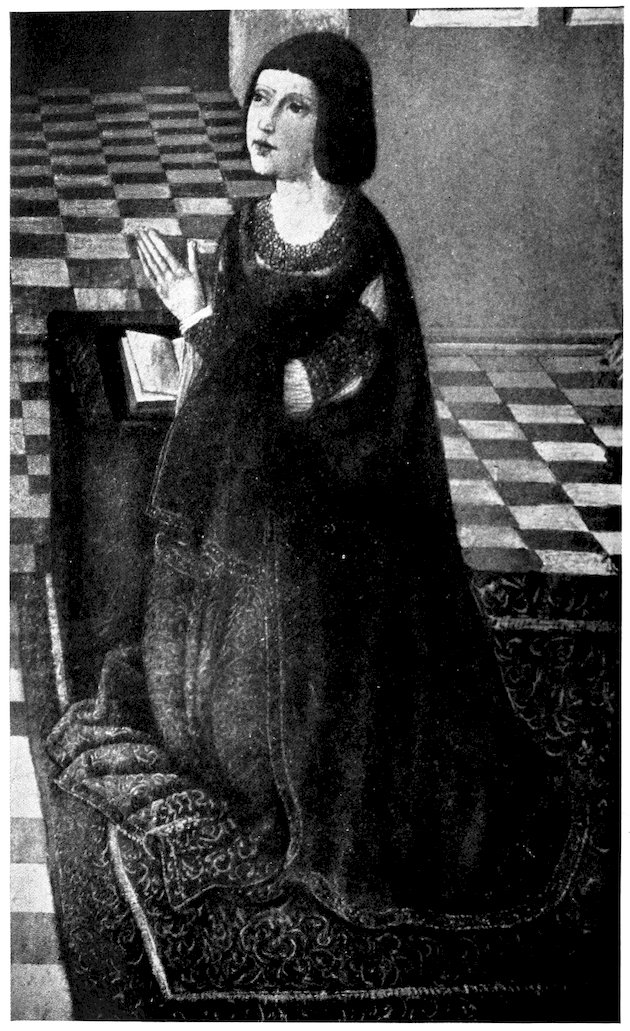
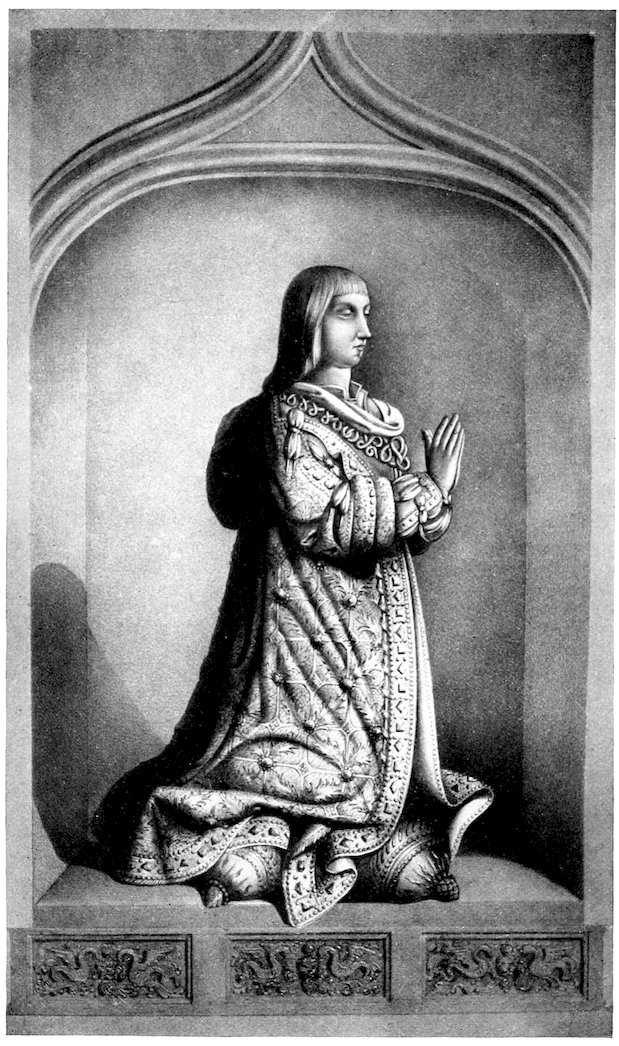
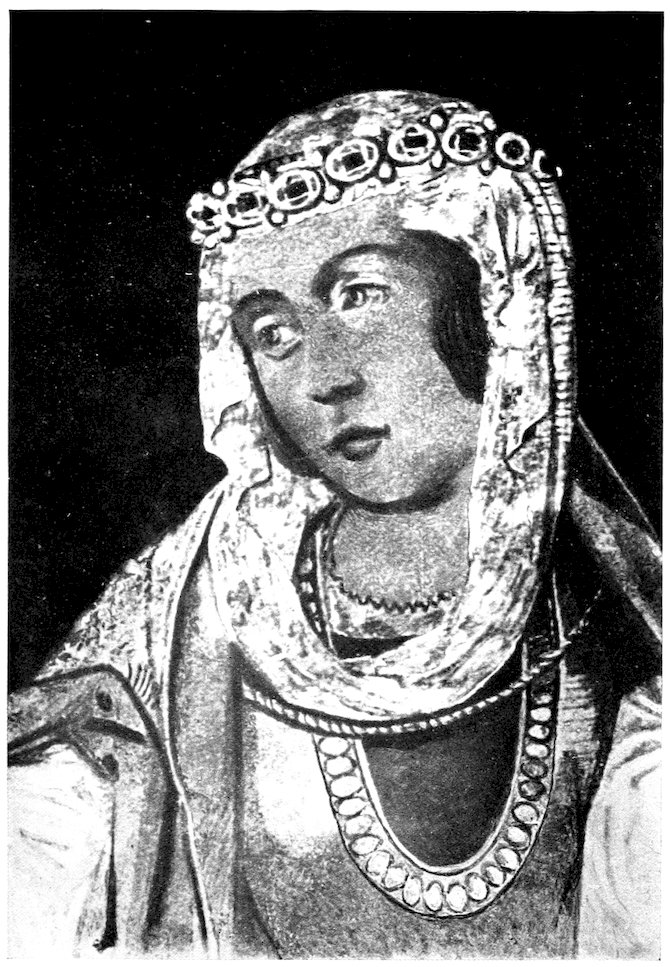
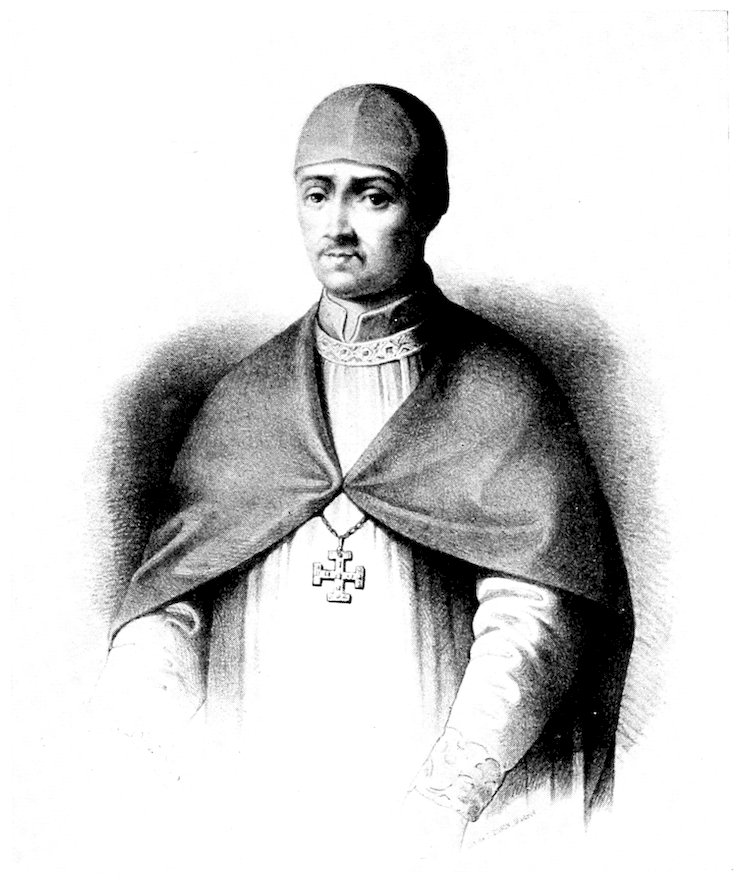
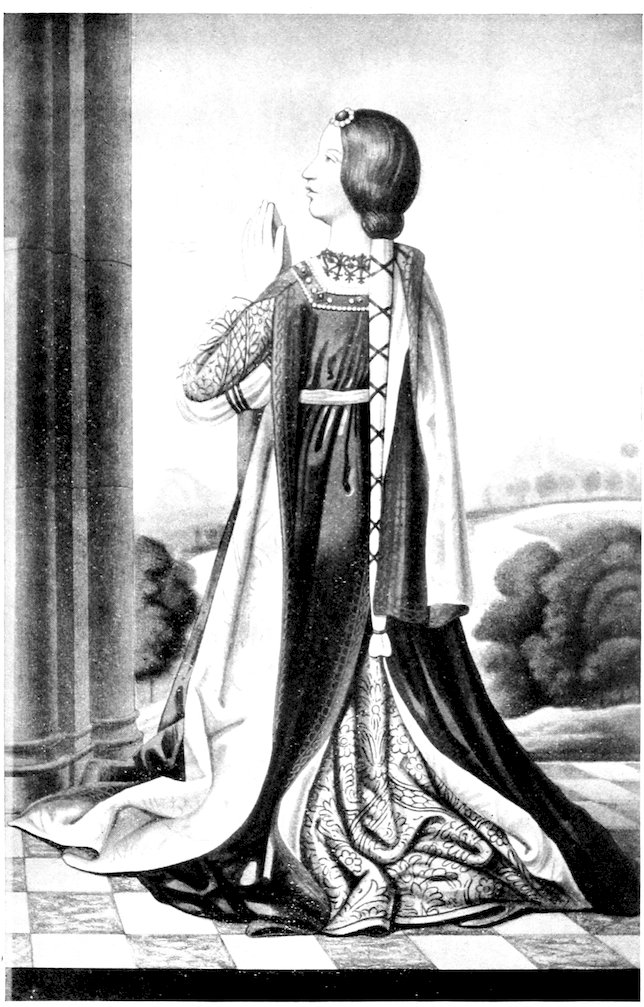
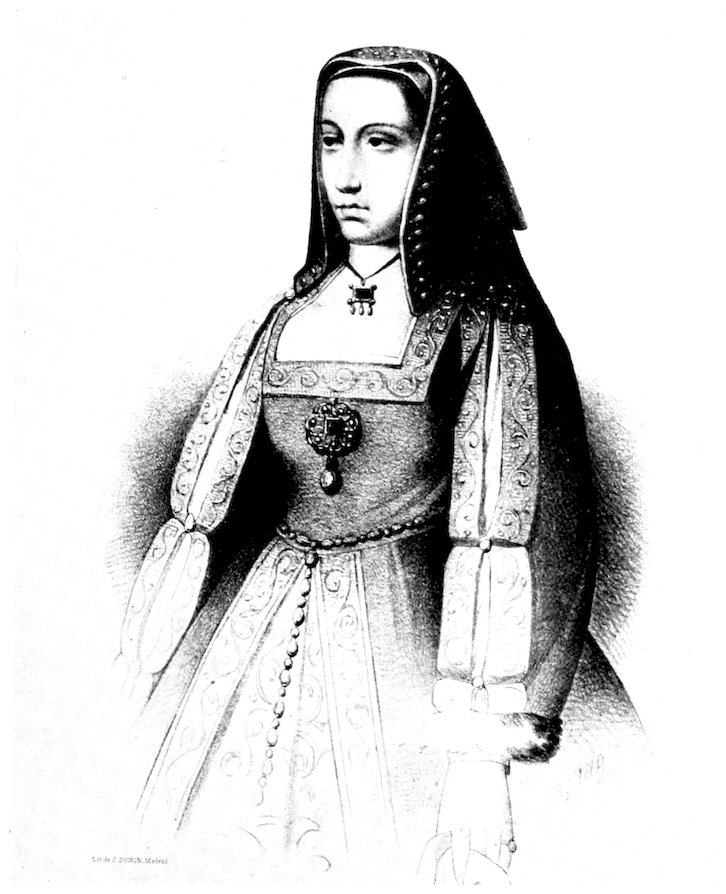
ISABEL OF CASTILE
AFTER A PAINTING IN THE PRADO GALLERY ATTRIBUTED TO MIGUEL ZITTOZ
FROM “TORQUEMADA AND THE SPANISH INQUISITION” BY RAFAEL SABATINI
BY
IERNE L. PLUNKET
Author of “The Fall of the Old Order, 1763–1815”
Illustrated
G. P. PUTNAM’S SONS
NEW YORK AND LONDON
The Knickerbocker Press
1915
Copyright, 1915
BY
G. P. PUTNAM’S SONS
The Knickerbocker Press, New York
FOREWORD
iii
Isabel of Castile is one of the most remarkable,
and also one of the most attractive, figures in
Spanish history. Her marriage with Ferdinand
the Wise of Aragon brought about the union of
the Spanish nationality, which had so long been
distracted and divided by provincial prejudices
and dynastic feuds. She is the ancestress of the
Spanish Hapsburg line. But she is also important
in Spanish history as a wise and energetic ruler,
who rendered invaluable assistance to her husband
and to some extent moulded his policy.
Under their government Spain was reduced from
anarchy to order and took her place among the
great Powers of Europe. Isabel is perhaps best
known as the patroness of Christopher Columbus
and the unflinching ally of the Spanish Inquisition.
But her career presents many other features of
interest. In particular it reveals the problems
which had to be faced by European governments
in the critical period of transition from mediæval
to modern forms of national organization.
There are some characters in history, whose
reputation for heroism is beyond reproach
in the eyes of the general public. There are
others, however, whose claims to glory are ardently
contested by posterity, and none more than Isabel
of Castile, in whose case ordinary differences of
opinion have been fanned by that most uncompromising
of all foes to a fair estimate, religious
prejudice. Thus the Catholic, while deploring
the extreme severity of the methods employed
for the suppression of heresy, would yet look on
her championship of the Catholic Faith as her
chief claim to the admiration of mankind. The
Protestant on the other hand, while acknowledging
the glories of the Conquest of Granada and the
Discovery of the New World, would weigh them
2light in the balance against the fires and tortures
of the Inquisition and the ruthless expulsion of
the Jews.
One solution of the problem has been to make
the unfortunate Ferdinand the scapegoat of his
Queen’s misdeeds. Whatever tends to the glory
of Spain, in that, if not the originator, she is at
least the partner and moving spirit. When acts
of fanaticism hold the field, they are the result of
Ferdinand’s material ambitions or the religious
fervour of her confessors; Isabel’s ordinarily
independent and clear-sighted mind being reduced
for the sake of her reputation to a condition
of credulous servility.
Such a view has missed the consistency of real
life. It is probably responsible for the exactly
opposite summary of another critic, who denies
Isabel’s superiority to her husband in anything
but hypocrisy and the ability to make her lies
more convincing. He even fails to admit that,
this being granted, her capacities in one direction
at least must have been phenomenal, since Ferdinand
was the acknowledged liar of his day par
excellence.
Faced by the witness of the Queen’s undoubted
popularity, he sweeps it away with a tribute to
Spanish manhood: “The praise bestowed on the
3character of Isabel is, to no small amount, due to
the chivalrous character of the Spaniards, who
never forgot that the Queen was a lady.”
Such an assumption must be banished, along
with Isabel’s weak-mindedness on religious matters,
to the realms of historical fiction. The very
Castilians who extol her glory and merit do not
hesitate to draw attention in bald terms to her
sister-in-law’s frailties. Indeed a slight perusal
of Cervantes’ famous novel, embodying so much
of the habits and outlook of Spain at a slightly
later date will show it was rather the fashion to
praise a woman for her beauty than to credit her
with mental or moral qualities of any strength.
The Catholic Queen, like other individuals of
either sex, must stand or fall by the witness of her
own actions and speech; and these seen in the
light of contemporary history will only confirm
the tradition of her heroism, which the intervening
centuries have tended to blur. The odium that
sometimes attaches to her name is largely due to
the translation of Spanish ideals and conditions
of life in the Middle Ages into the terms that rule
the conduct of the twentieth century.
“Quien dice España dice todo,” says the old proverb,—“He
who says Spain has said everything.”
This arrogance is typical of the self-centred,
4highly strung race, that had been bred by eight
centuries of war against the Infidel. The other
nations of Western Europe might have their occasional
religious difficulties; but, in the days before
Luther and Calvin were born, none to the same
extent as Spain were faced by the problem of life
in daily contact with the unpardonable crime of
heresy, in this case the more insidious that it was
often masked by outward observance of rule and
ritual.
The greater part of the modern world would
dismiss the matter with a shrug of its shoulders
and the comfortable theory that truth, being
eternal, can take care of itself; but this freedom of
outlook was yet to be won on the battlefields of
the Renaissance and in the religious wars of the
sixteenth century. It would be an anachronism
to look for it in Spain at a time when the influence
of the new birth of thought and culture had extended
no further than an imitation of Italian
poets.
Isabel’s bigotry is an inheritance she shared
with the greater part of her race in her own day,
the logical sequence of her belief in the exclusive
value of the divine in man’s nature, as against
any claims of his human body. If she pursued
her object, the salvation of souls, with a relentless
5cruelty, from which we turn away to-day in sick
disgust, we must remember that Spain for the most
part looked on unmoved. Where opposition was
shown, as in her husband’s kingdom of Aragon,
it was rather the spirit of independence than of
mercy that raised its head.
Indeed the religious persecution was in no way
disproportionate to the severity of the criminal
procedure of the reign, as will be seen by a glance
at the usual sentences passed on those convicted
of any crime. The least with which a thief could
hope to escape from his judges was the loss of a
limb, but the more likely fate was to be placed
with his back to a tree, and there, after a hasty
confession of his sins, shot or burnt.
Many of Queen Isabel’s contemporaries remark
her intolerance of crime and disorder, and a few
of the younger generation who had grown to manhood
in the atmosphere of peace she had established,
condemn her justice as excessive. By
modern standards it is undoubtedly barbarous;
but long centuries of anarchy had bred a spirit of
lust and brutality little above the barbarian level,
and only drastic measures could hope to cure so
deep-rooted an evil. Isabel herself, throughout
her childhood, had been a forced witness of her
brother’s policy of “sprinkling rose-water on
6rebellion” instead of employing the surgeon’s
knife; and her strength of character despised the
weakness, that under the pretext of humanity
made life impossible for nine-tenths of the
population.
It is her great achievement that she raised the
crown, the mediæval symbol of national justice,
from the political squalor into which seventy years
of mingled misfortune and incapacity had thrown
it, and that she set it on a pedestal so lofty, that
even the haughtiest Castilian need not be ashamed
to bow the knee in reverence. By this substitution
of a strong government for a weak, of impartiality
for favouritism, she secured peace at home
and thus laid a firm foundation for Ferdinand’s
ambitious foreign policy, and the establishment of
Spain as the first nation in Europe.
It is perhaps difficult to apportion exactly the
respective shares of Isabel and her husband in the
administrative measures of their reign; for their
unanimity of aim and action was in keeping with
their motto tanto monta,—“the one as much
as the other.” Yet in this connection it is necessary
to realize the contrast between the two kingdoms.
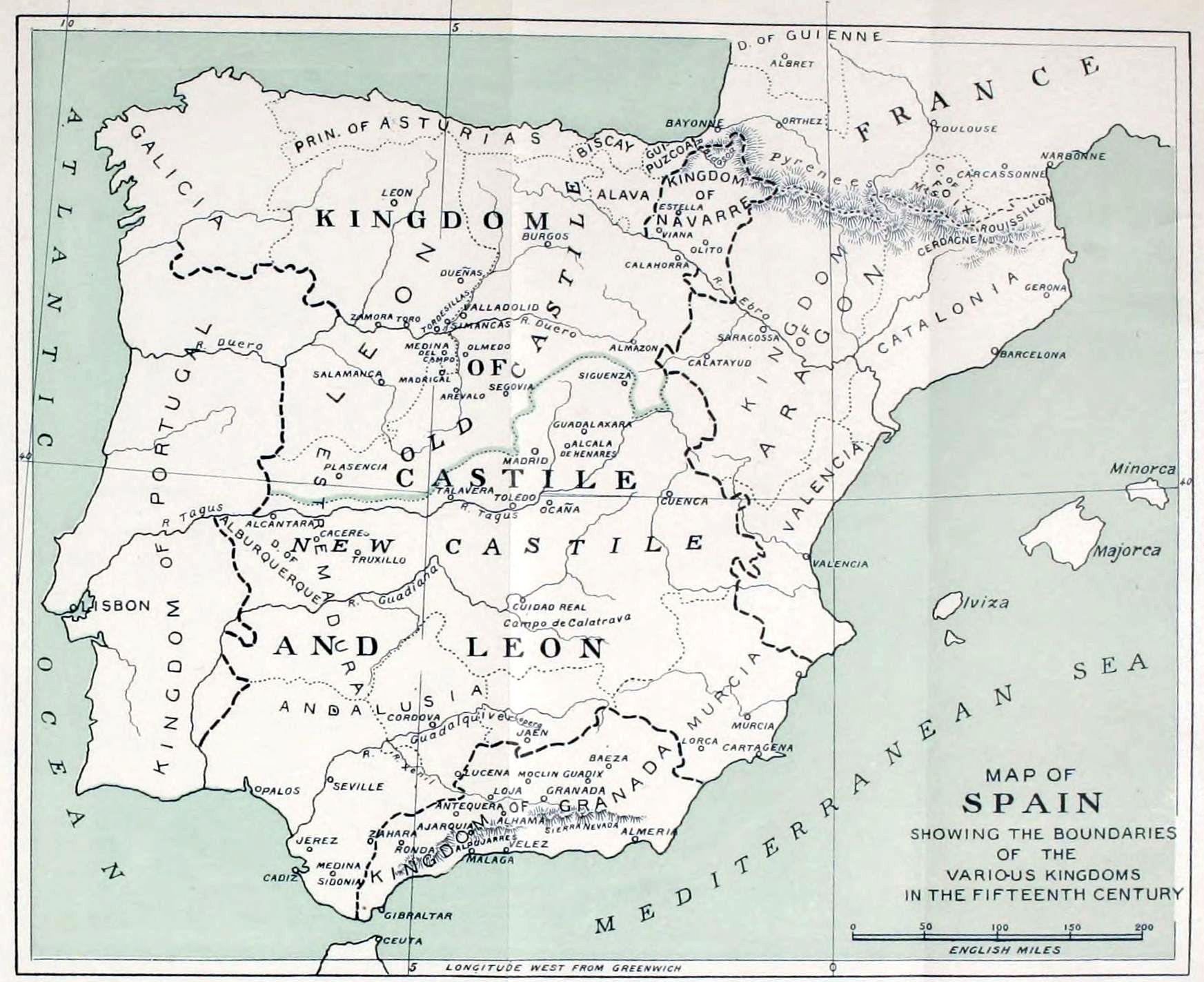
Aragon, with its three divisions of Aragon
proper, Valencia, and the Principality of Catalonia,
measured in all scarcely a quarter of the territory
7of its western neighbour. Moreover the spirit
of the people and the democratic character of its
laws rendered it a soil peculiarly ill-suited for the
growth of the royal prerogative. Thus, in spite
of the sovereigns’ best endeavours, it stubbornly
withstood their centralizing policy, and the main
burden of taxation and governmental measures
fell on Castile. The latter, “the corona” or
“big crown,” in contradistinction to the “coronilla”
or “little crown” of Aragon, continued
throughout the Queen’s lifetime to look on her
husband as more or less of a foreigner; and all the
many documents signed “Yo, El Rey” could not
weigh with a true Castilian against Isabel’s single
“Yo, La Reina.” It is she, who, when “Los Reyes”
are not mentioned together, is hailed to-day in
Spain as the chief representative of national
grandeur, just as “castellano,” the speech of the
larger kingdom, has become synonymous with
our term “Spanish.”
The word “Castile” itself conveys to an imaginative
mind a picture of that mediæval land of
castles, whose ramparts were not only a defence
against the Moors but also the bulwark of a
turbulent nobility. In vain the Crown had
striven to suppress its over-powerful subjects.
The perpetual crusade upon the southern border
8proved too alluring a recruiting-ground for the
vices of feudalism; and many a mail-clad count
led out to battle a larger following of warriors
than the sovereign to whom he nominally owed
obedience.
So long as the crusade continued, rulers of
Castile could not attempt to disband the feudal
levies on which their fortune depended; and each
acquisition of Moorish territory was followed by
fresh distributions of lands amongst the conquering
troops. Sometimes these grants carried
with them complete fiscal and judicial control of
the district in question, at others merely a yearly
revenue; but, whatever the tenure, the new owner
and his descendants were certain to take advantage
of royal embarrassments and national disorder to
press their claims to the farthest limit. A few
communities, behetrias, succeeded in obtaining
the privilege of choosing their own over-lord
with the more doubtful corollary of changing him
as often as they liked, a process fruitful of quarrels
which not unnaturally resulted in their gradual
absorption by more settled neighbours.
Since the practice of primogeniture was common
in Castile and lands were inalienable, large
estates were rapidly built up, whose owners, unable
to rule all their property directly, would
9sublet some of their towns and strongholds to
other nobles and knights in return for certain
services. These dependencies, or latifundia,
yielded ultimate obedience not to the King but to
the over-lord from whom their commander had
received them. On one occasion Alvaro de Luna,
the favourite minister of John II., appeared before
the castle of Trujillo and demanded its surrender
in his master’s name. To this the “Alcayde,” or
Governor, replied that he owed allegiance to the
King’s uncle, John of Aragon, and would open the
gates to none else: an answer typical of the days
when aristocratic independence ran riot in Castile.
A great territorial magnate could also renounce
the obedience he owed to his sovereign by the
simple method of sending a messenger who
should, in the King’s presence, make the following
declaration: “Señor, on behalf of ... I kiss your
hand and inform you that henceforth he is no
more your vassal.”
The weakness of the Castilian Crown was further
aggravated in the fourteenth and early fifteenth
centuries by disputed successions and long
minorities; the nobles using the confusion these
engendered to wring concessions from the rival
claimants, or to seize them from inexperienced
child rulers.
10“A breastplate would have served him better!”
exclaimed the Count of Benavente, when at the
beginning of Queen Isabel’s reign he heard of the
death of some man bearing a royal safe-conduct.
“Do you wish then that there was no King in
Castile?” asked the Queen indignantly; to which
the Count replied cheerfully: “Not so! I would
there were many, for then I should be one of
them.”
His words are the expression of the aristocratic
ideal of life in his own day. It was perhaps most
nearly realized in the case of the Grand Masterships
of the three great Military Orders of Santiago,
Calatrava, and Alcantara. These Orders
had been called into existence by the crusade;
but their original purpose was gradually obscured
by the wealth and influence that made them
the resort of the ambitious rather than of the
enthusiast. Like the Monastic Orders, their
members were bound by vows: obedience, community
of property, strict conjugal fidelity, sometimes
celibacy; but dispensations could be bought,
and the gains to be reaped more than compensated
for any theoretical austerities or submission.
The main canon of their creed, war against the
Infidel, was readily accepted by every aspirant
knight; the only drawback being that his inborn
11love of fighting led him to take part as well in
whatever other kind of war happened to dawn on
the horizon, no matter if it were against his own
sovereign. How formidable this would prove
for the sovereign we can imagine when we learn
that in the fifteenth century the combined
revenues of the Orders amounted to something
like 145,000 ducats,[1] while the Master of Santiago
could call into the field a force of four hundred
fully-armed cavaliers and one thousand lances.
In addition he possessed the patronage of numerous
“commanderies,” rich military posts that
brought with them the rents of subject towns
and villages, and that were eagerly sought by the
highest in the land.
1. “The monetary unit of Castile was the ‘maravedi,’ anciently
a gold coin of value; but, in the fifteenth century, diminished
to a fraction of its former estimation.”—Lea, History of Spanish
Inquisition, vol. i., Appendix III.
The ducat would be worth about 374 maravedis, or about
8s. 9d. in English money.
Extreme power and privilege are often their own
undoing; and from the fruits of its triumph the
Castilian aristocracy was to reap a bitter harvest.
Had the fight with the Crown been more strenuous
and the victory less certain, the ricos-hombres
or great men of the land, might have learned to
combine if not with other classes at least amongst
12themselves; but the independence they had gained
so easily they placed in jeopardy by individual
selfishness and mutual distrust. It has been said
with truth that it was almost impossible to persuade
the mediæval Castilian noble to act with
his fellows. Pride, ambition, the courage that
vaunts itself in duels, the revenge that lurks,
dagger-drawn, in back streets or lonely roads:
these were the source of constant feuds and internecine
warfare, incapable of a final settlement
save by the pressure of some outside force.
Nor could the noble, who distrusted the members
of his own class, rely in times of danger on
the co-operation of his humbler neighbours.
Believing that war was the profession of the
gentleman, he despised the burgher, the artisan,
and the farmer. Like the French “seigneur” he
had won freedom from direct taxation as the
privilege of his Order, and thus lost touch completely
with the pecheros or “taxable classes.”
He had appropriated the majority of the high-sounding
offices of state, the Grand Constable,
the Admiral of Castile, and so forth; but he valued
them from the wealth or honour they conveyed,
not from any sense of responsibility. The very fact
that such offices had tended to become hereditary
had done much to destroy their official character.
13An “Enriquez” was Admiral of Castile, not on
account of his seamanship, nor even on the system
of the modern English Cabinet because of a certain
“all-round” ability to deal with public business,
but because his father and grandfather had held
the post before him. The ricos-hombres might,
from personal motives, defy the government or
nullify its measures; but in placing themselves
above the law they had lost the incentive to control
legislation. A world of experience, or rather
a lack of it, separated them from those below, to
whom edicts and ordinances were a matter of
daily concern.
The Castilian Church was also in a sense above
the law; for the clergy were exempt from ordinary
taxation, paying to the Crown instead a small
portion of their tithes. Like the nobles they
could neither be imprisoned for debt nor suffer
torture; while legally they came under ecclesiastical
jurisdiction, and were subject only to its
penalties and censures. Archbishops, bishops,
and abbots, were for the most part younger sons
of wealthy nobles and shared the outlook and
ambitions of their class. The Castilian prelate
of the early fifteenth century found it as natural
to don his suit of mail and draw his sword as
to celebrate Mass or hear confessions. It would
14not be dislike of shedding blood nor a faint heart
that would distinguish him from laymen on the
battlefield, but the surcoat embroidered with a
cross, that he wore in deference to his profession.
The worldly character of the higher ranks of
the clergy had permeated also to the lower; and
vice, ignorance, and careless levity sapped the
influence of the ordinary parish priest and corrupted
the monasteries and convents. Here and
there were signs of an awakening, but for the
most part the spiritual conscience of the Castilian
Church lay dormant.
Its sense of nationality on the other hand was
strong; that is to say if dislike of foreign interference
and strong racial prejudice deserve such a
definition. Partly from very worldliness, local
and provincial interests tended to predominate
over any claims of a universal Church; and submission
to Rome was interpreted with a jealous
regard to private ambitions. The members of
the episcopate, concerned in the civil wars of
Henry IV.’s reign, looked on with cool indifference
when a papal legate, vainly seeking to
arbitrate between the armies on the eve of a
battle, was forced to save his life by flight. Similarly,
the Archbishop of Toledo, Primate of Castile,
thought little of throwing into a dungeon the
15candidate who, armed with letters of appointment
from Rome, had dared to dispute a rich living in
the diocese with his own nominee. The Pope
was a convenient “King Log”; but his subjects
had not the least wish for him to develop the
authority of a “King Stork.”
The Castilian Church also displayed her national
prejudice, as we shall see later, in her hatred and
suspicion of the alien races that formed such a
large element of the Spanish population. These
had sunk their roots deep in the soil during the
centuries of Moorish conquest when, from behind
the barrier of the Asturian mountains in the far
north-west, the pure Castilian alone had been
able to beat back the advancing waves of Mahometanism.
As he at length descended from his
refuge, where the sword or the hunting-spear had
been his sole means of livelihood, he might profess
to despise the believers in Allah, from whom he
wrested back the land of his fathers, but in practice
he was glad enough to accept them as a subject
race. The Moorish warriors, who fell on the
battlefield or retreated southwards before their
foes, left in Christian territory a large residue of
the more peaceful Arabs and Berbers, willing to
till the fields, work at the looms, and fulfil all
those other tasks of civilized national life that
16the Castilian was inclined to imagine degrading
to his own dignity. Left behind also were colonies
of prosperous Jews, whose ancestors, hounded
from every Christian court, had found a home
under the tolerant rule of the caliphs of Cordova.
Agriculture, industry, and commerce thus became
stamped, unfortunately for Spain, with the
taint of subjection. Not that the Castilian took
no share as the years passed in the economic life
of his country; for the legislation of the fifteenth
century shows the middle and lower classes busily
engaged in occupations such as cattle-breeding,
sheep-farming, and mining; and, more especially
in the south, of fruit-growing, and the production
of silk, wine, and oil. The basis of a progressive
national life was there; but perpetual war against
the Moors and internal discord, combined with
racial prejudice against the industrious alien, gave
to the profession of arms a wholly disproportionate
value.
Many of the towns were in their origin border
outposts; and their massive towers, fortified
churches, and thick walls, with the suburbs
huddling close against them for protection, marked
the enveloping atmosphere of danger. Since it
had been difficult at first to attract the industrial
classes to such surroundings, rulers of Castile
17had been driven to grant fueros or charters,
to the inhabitants embodying numerous privileges
and a large measure of self-government.
Then the time of danger passed; the Castilian
boundary pushed farther south, and other fortified
towns were needed to defend it; but the citizens
of the old outposts clung jealously to the
fueros of their fathers and defied either royal
or seignorial control.
“Ce sont de veritables petits états,” says Mariéjol,
speaking of the Castilian municipalities in
mediæval days; but the description that implies peculiar
powers shadows forth also peculiar difficulties.
The city that would keep its independence would
have to struggle continually against the encroachments
both of the Crown and of neighbouring
territorial lords. It must for this purpose maintain
its own militia, and, most arduous of all, watch
carefully lest it should fall into subjection to its
very defenders. Not a few of the municipal
councils came in time to be dominated by a class
of “knights,” or nobles of secondary rank, whose
quarrels and feuds endangered industry and filled
the streets with bloodshed.
The principal civic official was the “regidor”;
but the Crown had by the early fifteenth century
succeeded in introducing in many cases a representative,
18the “corregidor,” whose business it
was to look after royal interests. His presence
was naturally resented by the more influential
citizens and, where he dealt corruptly with the
people, disliked by all; but an honest corregidor,
who was unconnected with local families and
therefore without interest in the local feuds, and
who had no axe of his own to grind, was a Godsent
help to the poorer classes.
Besides appointing corregidors, the Crown had
also begun to influence the municipalities in another
way, through a gradually increasing control
of the “Cortes,” or national parliament of Castile.
This body consisted of three “Estates”; the
nobles, whether ricos-hombres or hidalgos of
lesser grade; ecclesiastics; and the Third Estate,
or “Commons.” On an occasion of outward or
obvious importance, when a succession or a Council
of Regency were under dispute, or if an oath of
homage to a new sovereign or the confirmation of
some unprecedented act were required; all three
“Estates” would meet together at whatever town
the King happened to be staying. Such was a
“General Cortes.”
An ordinary Cortes was of a very different
character; for, since its business mainly concerned
taxation, only the Commons, or “taxable” element
19of the population was in the habit of attending.
In the early days of Castilian history the
number of places represented was unlimited; but
a right that in the disordered state of the country
was both expensive and tiresome, if not actually
dangerous, was regarded as a burden by most
of the municipalities. By the fifteenth century
only seventeen cities and towns sent members to
the Cortes. These were: Toledo, Burgos, Seville,
Cordova, Murcia, Leon, Segovia, Avila, Salamanca,
Zamora, Cuenca, Jaen, Valladolid, Madrid, Toro,
Soria, and Guadalajara, while Granada was
added after her conquest in 1492.
The “Procuradores,” or representatives, were
in theory free to act at their own discretion;
but in practice they went tied by the instructions
of their fellow-citizens. Nor had they
much scope for independence in the Cortes
itself; for though they might and did air their
grievances and press for reform, redress rested
with the Crown and did not precede but follow
the assent to taxation. All legislative power
was in fact invested in the King; who might
reject, amend, or accept suggestions as he
thought fit.
“We hold that the matter of your petition is to
our service.” “We command that it shall take
20effect.” Such phrases expressed sovereignty in a
gracious mood, and all were satisfied; while the
absence of royal sanction sent the procurador back
to his city, his efforts wasted. He could, of course,
on the next occasion that the King, in need of
money, summoned his deputies to grant it, refuse
the supply; but in the meantime three more years
might have elapsed and conditions and needs would
have altered. Moreover a system of bribes and
flattery went far to bring the Commons into line
with the royal will; while the shortsighted complaints
of some of the municipalities at the expense
of maintaining their representatives paved the way
for the Crown to accept the burden, thereby establishing
an effective control over those who became
practically its nominees.
That the towns missed the future significance
of this change is hardly surprising. The civil
wars that devastated Castile had taught the
people that their most dangerous enemies were
not their kings but the turbulent aristocracy; and
they often looked to the former as allies against
a common foe. In the same way the more patriotic
of the nobles and ecclesiastics saw in the
building up of the royal power the only hope of
carrying the crusade against the Moors to a
successful conclusion, or of establishing peace at
21home. At this critical moment in the history of
Castile, national progress depended on royal
dominance; and it was Queen Isabel who by
establishing the one made possible the other.
CHAPTER II THE REIGN OF HENRY IV.: MISGOVERNMENT 1454–1463
22
“I the King ... make known to you that
by the grace of Our Lord, this Thursday just
past the Queen Doña Isabel, my dear and well-beloved
wife, was delivered of a daughter; the
which I tell you that you may give thanks to God.”
With this announcement of her birth to the
chief men of Segovia was “Isabel of Castile”
ushered by her father John II. into public life;
but on that April day of 1451 none could have
suspected the important part she would play in
the history of her country. The future of the
throne was already provided for in the person of
her elder half-brother, Henry, Prince of Asturias;
and nearly three years later the birth of another
brother, Alfonso, made that inheritance apparently
secure from any inconvenience of a female succession.
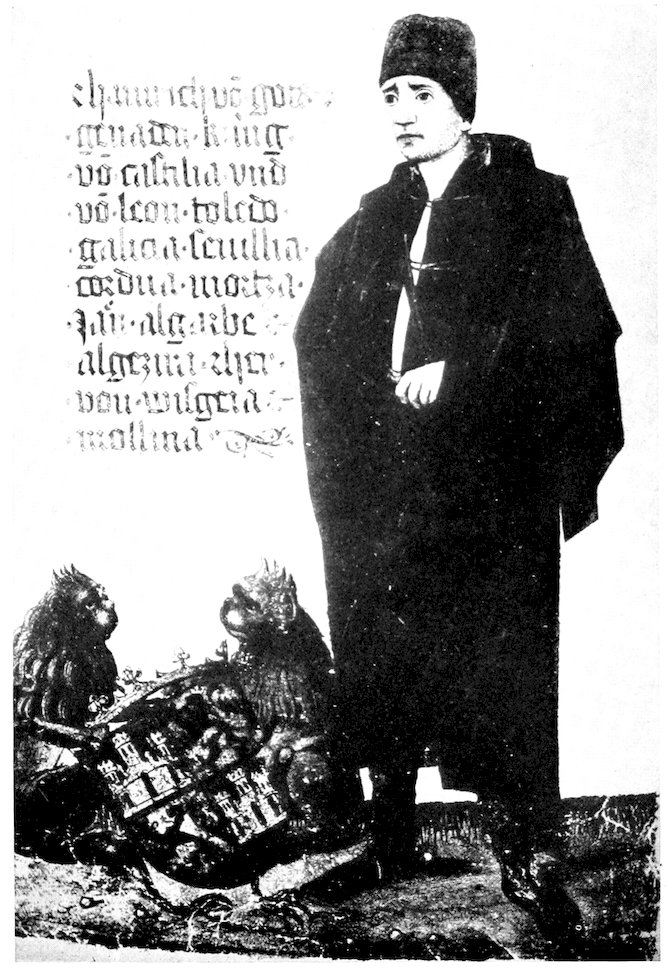
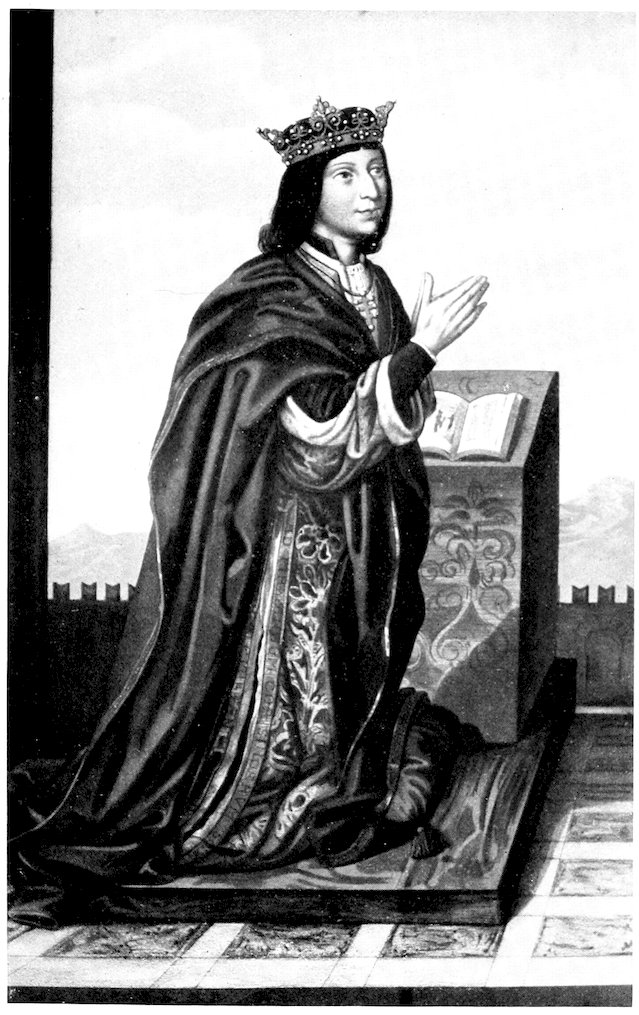
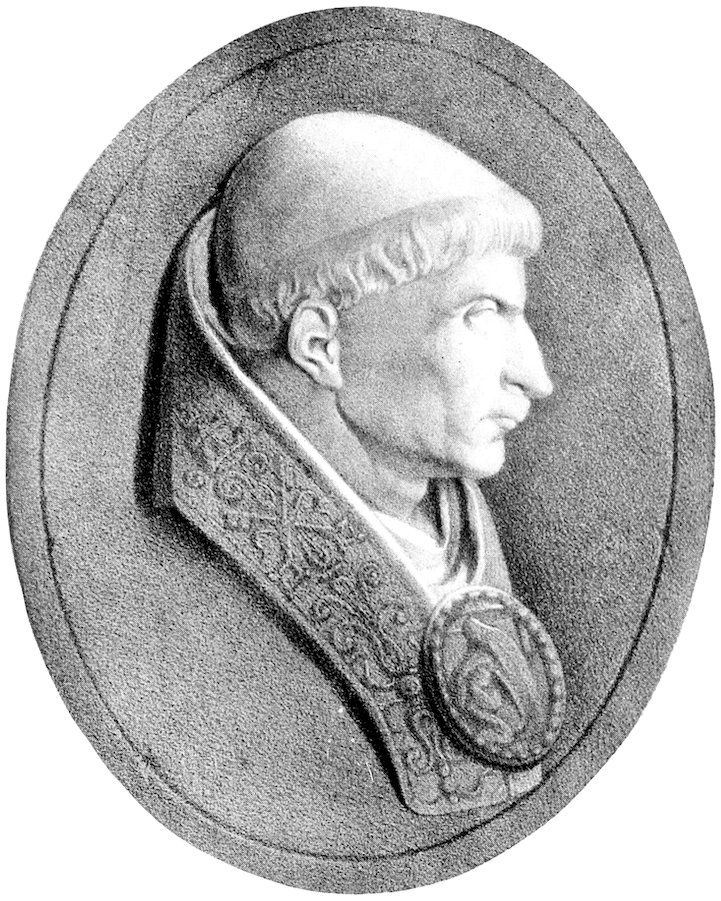
HENRY IV.
FROM “BOLETIN DE LA REAL ACADEMIA DE LA HISTORIA,” VOL. LXII.
FROM A PHOTOGRAPH BY HAUSER AND MENET
23Castile was at this time nearing the end of a
long and inglorious reign, signalized by the struggles
of the King and his selfish favourite against
the domination of an equally selfish nobility.
The latter triumphed; the favourite was beheaded
and John II., broken-hearted at his own weakness
in agreeing to the sentence, died in the following
year. His life had been one long negation of
everything for which true kingship stands,—dignity,
honour, and power; but the son who succeeded
to his title and troubles was even less
fitted for the task.
Feeble and vain, Henry, Prince of Asturias, had
been from boyhood the puppet of his father’s
rebellious nobles, led by their flattery into attacking
the royal authority that it would be one day
his duty to maintain.
“In him,” says the chronicler Pulgar, “desire
had the mastery over reason”; and, when he
ascended the throne, it was with a character and
constitution that self-indulgence had utterly undermined.
One virtue he possessed, strangely
out of keeping with his age, a compassion arising
from dislike of bloodshed; but, since he failed to
draw any distinction between justice and indiscriminate
mercy, this attribute rather endangered
than distinguished his rule. A corresponding
24indifference, also, to his property, and a reluctance
to punish those who tampered with it, might have
a ring of magnificence, but it could hardly inspire
awe of the King’s law.
The problems by which Henry was faced at
the beginning of his reign were not acutely dangerous;
and their chief difficulty lay in the constant
friction between Castile and the neighbouring
kingdom of Aragon. Between these two the tie
of mutual descent from the House of Trastamara
had been drawn ever closer by frequent intermarriage.
Henry IV. was not only cousin of
Alfonso V. of Aragon, but also his nephew, while
he was son-in-law to Alfonso’s ambitious brother,
John, King of Navarre. Here was scope for the
time-honoured right of family interference, a
right strengthened by quarrels as to confiscated
property and abused privileges.
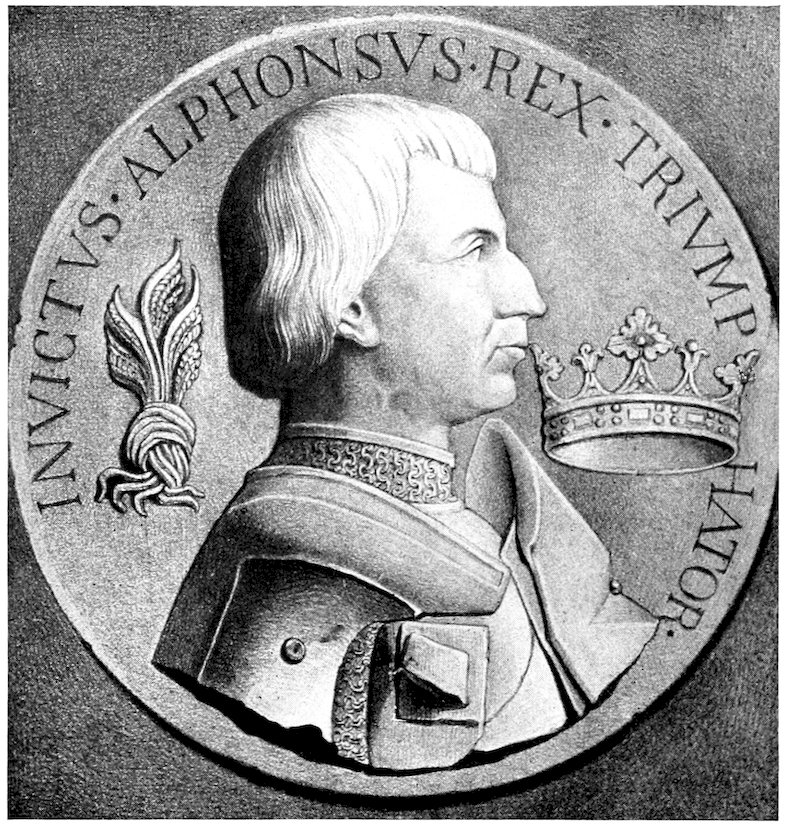
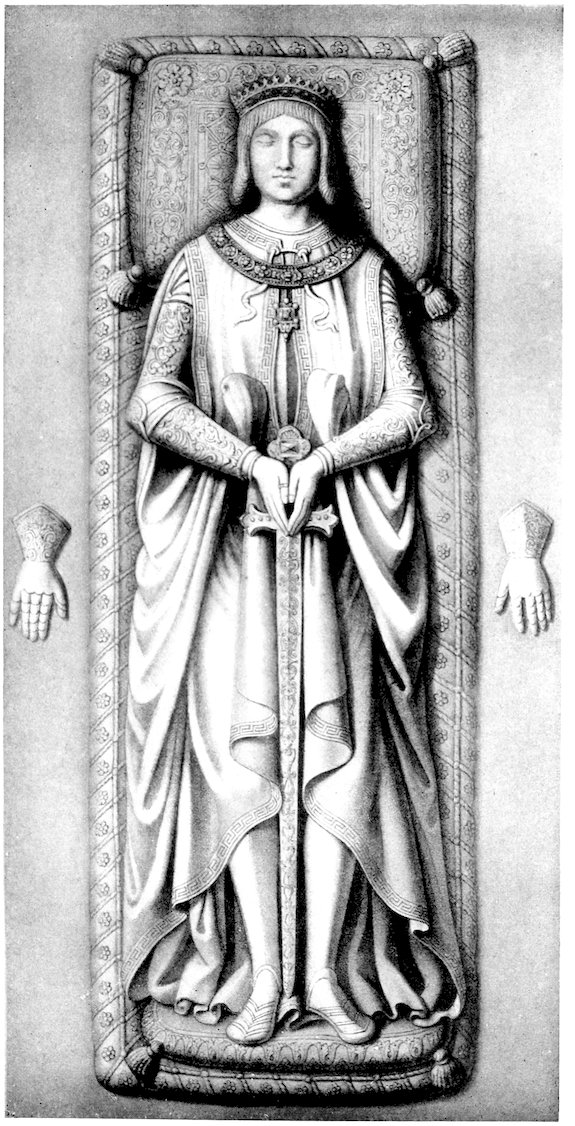
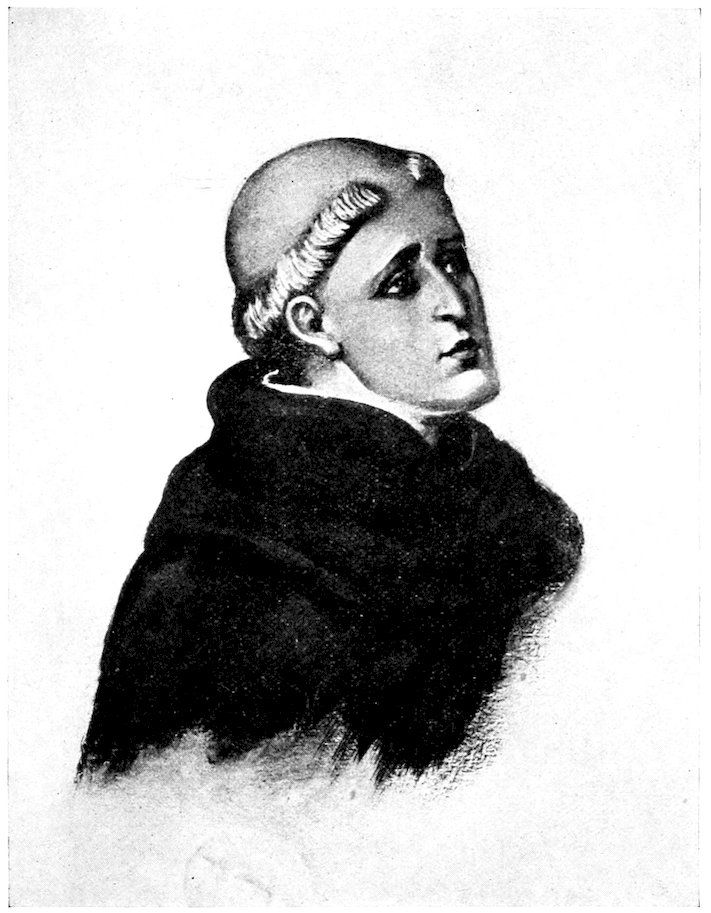
ALFONSO V. OF ARAGON
FROM “ICONOGRAFIA ESPAÑOLA” BY VALENTIN CARDERERA Y SOLANO
25It is only fair to say of Alfonso V. himself,
that he took little part in these feuds. A true
Aragonese by instinct, though of Castilian descent,
his interests were not so much directed towards
acquiring Spanish territory as to extending a
maritime empire in the East. Such had been for
generations the ambition of a kingdom, whose
backbone was the hardy race of Catalan merchants
and sailors. Alfonso dreamed of making Barcelona
and Valencia the rivals of Genoa and Venice.
To this purpose he strengthened his hold over
Sardinia, and fought with the Genoese for the
sovereignty of Corsica. Foiled in his designs on
that island by a superior fleet, he sailed away to
make good a claim that Joanna II. of Naples had
allowed him to establish, when in a capricious
moment she had adopted him as her son. What
favour and affection she had to bestow, and she
was capable of very little, she had given to the
House of Anjou; and when she died without
descendants, Naples became the battleground
of Aragonese and French claimants.
Alfonso V., after a series of misfortunes, was
at length victorious; and delighted with this new
kingdom, the land of sunshine and culture in spite
of the grim background of its history, he established
his court there, and henceforth ranked rather
as an Italian than a Spanish sovereign.
While, at his ease, he wove chimerical schemes of
a crusade for the recovery of the Holy Sepulchre,
and extended a liberal patronage to Renaissance
poets and philosophers; his wife, Queen Maria,
remained as regent at home, and strove to keep
peace with Castile and temper the ambitions of
her brothers-in-law. This was a well-nigh impossible
task, for John the eldest and most turbulent,
26in default of any legitimate descendants
of Alfonso, was heir to the Aragonese throne. A
judicious marriage with Blanche, the heiress of a
small state of Navarre, had made him virtual
master of that kingdom, when on her father’s
death in 1425 they assumed the joint sovereignty.
Fiction has never devised a more painful domestic
tragedy than resulted from this match. Of
the three children of Blanche and John of Navarre,
the death of two was to be laid at their father’s
door, the third to earn the unenviable reputation
of connivance in a sister’s murder. The Queen,
with some premonition of the future, strove feebly
on her death-bed to guard against it, and in her
will, that left her son Charles of Viana as the
rightful ruler of Navarre, she begged him not to
claim the title of King in his father’s lifetime. To
this the Prince agreed, but the attempt at compromise
was to prove ineffectual.
In 1447, King John married again, a woman of
very different temperament to his former wife.
This lady, Joanna Enriquez, daughter of the
Admiral of Castile, was as unscrupulous and
greedy of power as her husband, and from the
first adopted the rôle of “cruel stepmother.”
The birth of her son, Ferdinand, in March, 1452,
set fire to the slumbering jealousy she had conceived
27for Charles of Viana, and henceforth she
devoted her talents and energy to removing him
from her path.
It is the penalty of public characters that their
private life is not only exposed to the limelight,
but its disagreements involve the interference of
many who are not directly concerned. The
hatred of Queen Joanna for her stepson not only
convulsed Navarre and Aragon but dragged
Castile also into the scandal.
Throughout the long reign of John II. of Castile,
the King of Navarre had on various pretexts
interfered continually in his cousin’s affairs. On
some occasions he had posed as the protector of
sovereignty from the schemes of an ambitious
favourite. On others he had been an open rebel,
harrying the royal demesnes, or sulkily plotting
revenge when, as the result of his rebellion, the
estates he had inherited in Castile were taken from
him. Through all these vicissitudes the thread
of his policy ran clear,—to fish in waters that he
himself had previously troubled. If his own
haul proved empty, he could at least boast of
spoiling the sport of others.
In 1440, in a brief moment of reconciliation
with Castile, he married his eldest daughter
Blanche to Henry, then Prince of Asturias, and
28was thus provided with a plausible excuse for
henceforth thwarting his cousin in his son-in-law’s
interests. From no other point of view could
the alliance be called a success. Henry proved
as faithless a husband as he was disloyal a son;
and, after thirteen years of fruitless union, the
marriage was annulled on the grounds of impotence.
Blanche returned to her own land; but her
father found the man who had been her husband
too useful an ally to resent her repudiation, and
as soon as Henry became King he agreed to a
treaty by which, in return for an annual income,
he surrendered any rights he might have to estates
or property in Castile. With such a settlement
the political horizon seemed fair; but the Castilian
royal favourite, Juan Pacheco, Marquis of Villena,
to whom a lion’s share of the said estates had fallen,
mistrusted its serenity, believing that as soon as
the King of Navarre succeeded his brother Alfonso
V. on the throne of Aragon, he would revive
claims so obviously to his advantage.
The Marquis of Villena was deaf to the voice
of patriotism or personal loyalty to his master,
but he was more than ordinarily acute, where his
own prosperity was concerned. He had garnered
successfully the confiscated property, but “he
lived” we are told “always with the fear of losing
it, as those live who possess what does not belong
to them.”
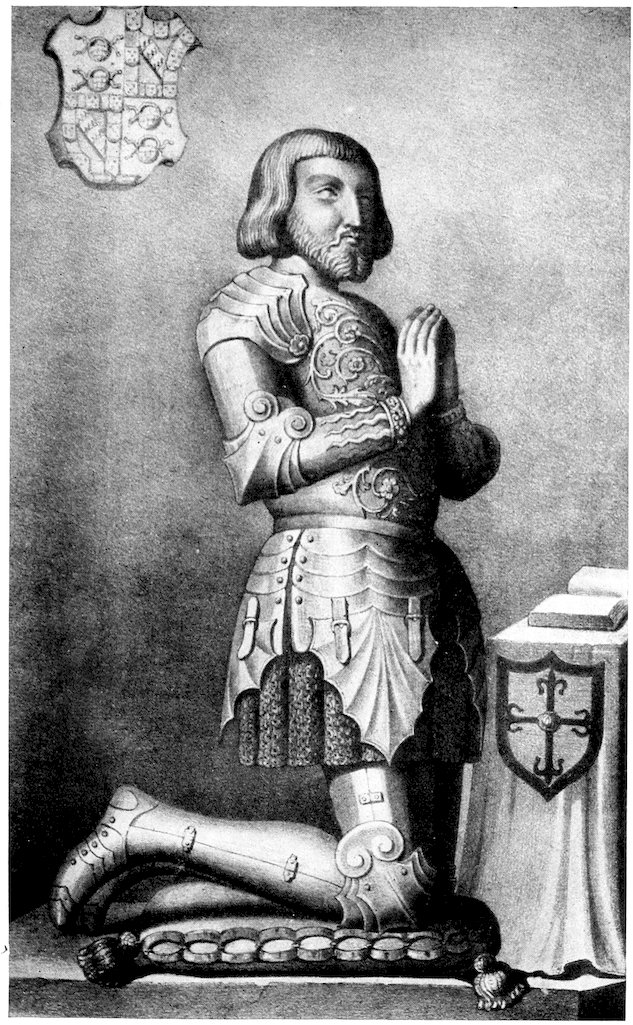
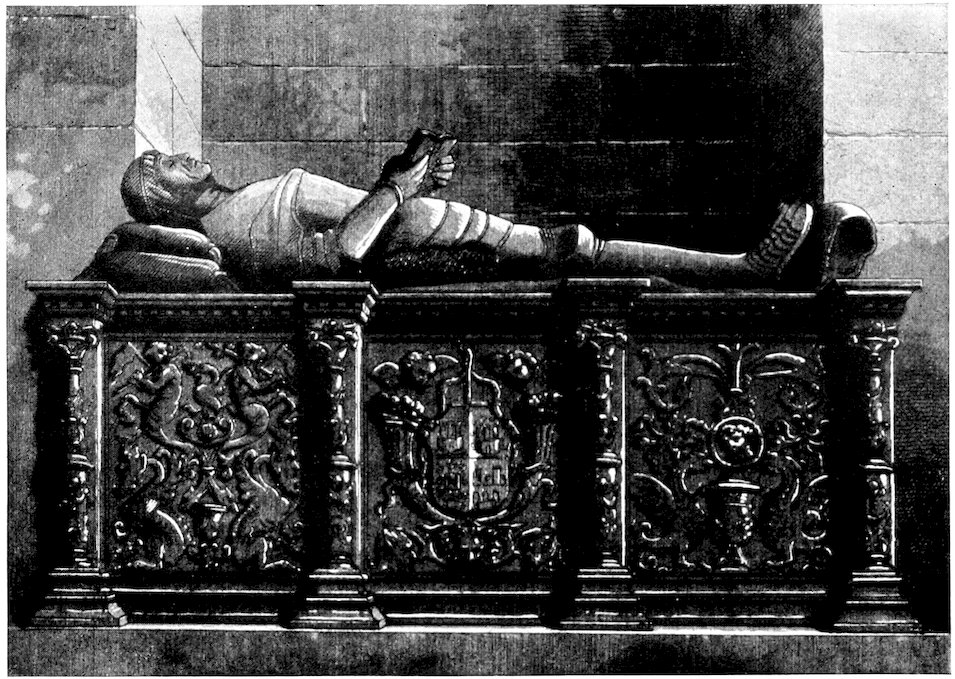
JUAN PACHECO, MARQUIS OF VILLENA
FROM “ICONOGRAFIA ESPAÑOLA” BY VALENTIN CARDERERA Y SOLANO
29In this malicious but eminently shrewd estimate
of his attitude lies the clue to the tortuous mazes
in which he involved Castile. Pacheco was a
noble of Portuguese extraction, who had entered
Prince Henry’s service as a page, being created
Marquis of Villena by John II. When that
sovereign died, the favourite succeeded to the
practical sovereignty of Castile through the influence
he had acquired over his master’s weak
and impressionable nature. It was a position
that would have dazzled and satisfied most favourites,
but Pacheco despised all but the most tangible
gains. Power was reckoned in his vocabulary as
a means towards procuring fresh wealth, and for
this his thirst was insatiable. All King Henry’s
eagerness to alienate royal estates and revenues in
his favour failed to meet his constant demand for
fresh grants either to himself or to his immediate
relatives. The gift of half a province, with the
lordship of all its towns and castles would leave
him envious of the small village across the border,
whose rent-roll passed into other pockets.
“He knew,” says the chronicler, “how to conceal
all other vices save his greed: that he could neither
conceal nor moderate.”
30In pursuance of his own interests Villena, who
distrusted the King of Navarre’s future intentions,
suggested a counter-alliance with Portugal. This
western kingdom had always seemed in danger of
absorption by its more powerful neighbour; once
their common enemy, the Moor, had been driven
southwards; but good fortune and a spirit of sturdy
independence had preserved its freedom. By the
great victory of Aljubarrota in 1385 Portugal had
vindicated her claim to be a separate nationality;
and Castile, leaving the flower of her chivalry
dead on the battlefield, had retired to nurse her
resentment in secret. Nearly a century had
passed, and mutual hatred still smouldered between
the two peoples, though frequent intermarriage
had long broken down the barriers in
the case of the royal families.
The bride now selected by Henry IV. was the
Infanta Joanna, sister of the reigning King, Alfonso
V., a lady of sufficient youth and beauty to appeal,
at any rate temporarily, to her bridegroom’s jaded
taste. Her journey to her new home was a triumphal
progress of banquets and receptions,
culminating in jousts and feasts at Madrid, where
a crowning touch of extravagant display was given
by Alonso de Fonseca, Archbishop of Seville,
when, after a magnificent banquet, he ordered
31salvers, laden with rings and precious stones to
be handed round, that the Queen and her ladies
might take their choice.
Unfortunately, real feelings, if they had ever
been in tune, ceased to correspond with these
outward rejoicings. Henry soon tired of his
bride, probably because he was legally bound to
her, and bestowed his attentions instead on a
Portuguese lady of her retinue, Doña Guiomar.
The latter increased the Queen’s mortification by
her insolent behaviour; and, after a stormy scene,
in which royal dignity was thrown to the winds and
slaps and blows were administered, Henry removed
his mistress to a country-house. The Court, watching
to see which way the wind would blow, divided
into factions according to its decision; the Marquis
of Villena supporting the Queen, the Archbishop
of Seville the cause of Doña Guiomar.
Matters became even more serious when scandal,
always busy with the King’s name, began to
attack the honour of his bride. Queen Joanna,
who according to Zurita had objected to the
match from the first, was incapable of the gentle
resignation of her predecessor, Blanche of Navarre.
As extravagant and devoted to pleasure as her
husband, she had no intention of playing the rôle
of deserted wife.
32“She was a woman to whom love speeches were
pleasant ... delighting more in the beauty of
her face than in the glory of her reputation.”
Such was the court chronicler’s summary of her
character; nor did public opinion remain vague
in its accusations.
Amongst the principal Castilian nobles was a
certain Beltran de La Cueva, who by his handsome
looks and adroit manners had gained for himself
the King’s confidence and the lucrative office of
“Mayordomo,” or Lord High Steward.
On one occasion the King and Queen had been
entertaining the ambassadors of the Duke of
Brittany at their country-house at Pardo. Returning
to Madrid after three days’ hunting, they
found on nearing the city that Beltran de La
Cueva, gorgeously arrayed, was waiting lance in
hand to challenge all who came by that road.
This was a form of entertainment highly popular
with the chivalry of the time; and the tiers of
scaffolding erected for spectators were soon
crowded.
Every knight, as he rode up, was summoned to
tilt six rounds with the Mayordomo or to leave
his left glove in token of his cowardice. If he
succeeded in shivering three lances, he might go
to a wooden archway, resplendent with letters of
33gold, and from there take the initial of the lady
of his choice. This famous “Passage of Arms”
lasted from morning till sunset; and thus to the
satisfaction of the Court did Beltran de La Cueva
maintain the cause of an unknown beauty, to
whom rumour gave no less a name than that of
royalty itself.
If the King had his suspicions, they did not
hinder his pleasure in the spectacle; and he proceeded
to celebrate the event by establishing a
monastery on the site, to be called “San Jeronimo
del Paso,” or “Saint Jerome of the Passage of
Arms.” Such an origin for a religious foundation
was to say the least of it bizarre; yet it compares
favourably with Henry’s cynical appointment of
a discarded mistress as abbess of a convent in
Toledo, on the excuse that the said convent was
in need of reform.
Little good could be expected from a Court
whose rulers set such an example of licence and
selfish pleasure; but, fortunately for Castile, her
hopes for the future lay not in the idle throng that
surrounded Henry IV. and Joanna, but in the old
walled town of Arévalo. Here, since the death of
John II., had lived his widow, Isabel of Portugal,
and her two children, in an atmosphere rendered
doubly retired by her own permanent ill-health.
34“Her illness,” according to the chronicler, “was
so grievous and constant that she could in no way
recover”; and with conventional propriety he
attributes the cause to grief at the loss of her
husband. This may have been, though John II.
was hardly the type of man to inspire une
grande passion. It is more likely that her mind
was already the prey of the burden of melancholy
that became the curse of her descendants;
and that the malady was aggravated by the
uncertainty of her new position.
According to one of the royal chaplains Henry
treated his half-brother and sister “with much
love and honour and no less the Queen their
mother.” This account, however, conflicts with
Pulgar’s description of Isabel as “brought up in
great necessity.” It is more than probable that
the fortunes of the family at Arévalo varied with
the policy or whim of the Marquis of Villena;
and thus, in her most impressionable years, the
little Princess learned her first lessons in the hard
school of experience. Such a theory would explain
the extraordinary discretion and foresight
she displayed at an age when most girls are still
dreaming of unrealities. If the contrast is not
wholly to her advantage, and precocity is seldom
charming, we must remember that only sheltered
35fruit can keep its bloom. What Isabel lost of
childish softness, she gained in self-reliance and
a shrewd estimate of the difference between true
and false.
Though far enough removed from the succession
to escape the flattery that had ruined her elder
brother, she was early a pawn on the political
chess-board, and by the age of six had made her
début in the matrimonial market. Henry IV.
and King John of Navarre were at that time eager
to show their mutual love and confidence; and a
double alliance was suggested that would make
this patent to all the world. For Isabel was
destined John’s favourite son, the five-year-old
Ferdinand, while the latter’s sister Leonora was
chosen as bride for the little Alfonso, Henry’s
half-brother.
Amid all the turns of Fortune’s wheel that were
to bring in search of Isabel’s hand now one suitor,
now another, this first alliance alone was to reach
consummation; yet few, versed in the changing
politics of the day, could have believed it likely.
The kings had sworn eternal friendship; but in
little more than twelve months an event happened
that made of their treaties and complimentary
letters a heap of waste paper.
In 1458, Alfonso V. died at Naples leaving his
36newly acquired Italian kingdom to his illegitimate
son Ferrante, and the rest of his dominions,
including the island of Sicily, to his brother
John. The latter was now in a far stronger position
than ever before; he need not depend on
Henry’s friendship; indeed his inheritance from
past rulers was rather a policy of feud and aggression
against the neighbouring kingdom, while the
influence of his father-in-law, the Admiral of
Castile, drew him in the same direction.
This Admiral, Don Fadrique Enriquez, was
himself a descendant of the royal House of Trastamara;
and his haughty and choleric nature found
the dreary level of loyalty little to its taste. His
sense of importance, vastly increased by his
daughter’s brilliant marriage, revelled in plots of
all sorts; and soon conspiracy was afoot, and he and
the majority of Castilian nobles were secretly
leagued with John of Aragon against their own
sovereign. Even the Marquis of Villena consented
to flirt with their proposals, in the hope of reaping
some benefit; while his uncle, the Archbishop of
Toledo, and his brother, Don Pedro Giron, Master
of Calatrava, were amongst the leading members
of the league.
Looking about him for an ally, Henry’s glance
lit naturally on Charles of Viana, whose disputes
37with his father had reached a stage beyond the
chance of any peaceful settlement. Navarre,
always a prey to factions as irreconcilable as Montagues
and Capulets, had broken into civil war
on the advent of Queen Joanna as regent; the
powerful family of the Agramonts welcoming her
eagerly; while the Beaumonts, their rivals, out of
favour at Court and wild with jealousy, called
hourly upon Charles to avenge their wrongs and
his own. His mother’s will, leaving Navarre to
her husband during his lifetime, had, they declared,
been made null and void by the King’s
subsequent remarriage. Not only was it the
duty of a son to resist such unlawful tyranny, but
it was folly to refuse with imprisonment or a
poison cup lurking in the background.
The latter argument was convincing; but never
was rebellion undertaken with a heavier heart.
The Prince of Viana was a student and philosopher
who, like the Clerk of Oxenford, would have preferred
a shelf of Aristotle’s books at his bed’s head
to the richest robes, or fiddle, or psaltery. The
quiet of a monastery library, with its smell of
dust and parchment, thrilled him more than any
trumpet-call; and he would gladly have exchanged
his birthright for the monk’s garb of peace. Fortune
willed otherwise, laying on his shoulders in
38pitiless mockery the burden of the man of action;
and the result was the defeat that is the usual
reward of half-heartedness.
His uncle’s Court at Naples proved a temporary
asylum for him in his subsequent enforced exile;
and also the island of Sicily, where he soon won
the affection of the people, and lived in happiness,
till Alfonso’s death awoke him rudely from his
day-dreams. He was overwhelmed by fear for
his own future; though, had he been a different
man, he might have wrested away the sceptre
of Sicily. In Aragon itself public opinion had
been growing steadily in his favour, and not
only in Navarre were there murmurs at his
absence, but up and down the streets of Barcelona,
where the new King was far from popular,
and his haughty Castilian wife an object of
dislike.
Prudence dictated to King John a policy of
reconciliation; and after prolonged negotiations
the exile returned; but the cold forgiveness he
received from his father and stepmother for the
wrongs they had done him was in marked contrast
to the joyous welcome of the nation. No outward
ceremony of a loving father pardoning a prodigal
son could mask the lack of confidence that still
denied the Prince his recognition as rightful heir,
39and drove him to enter into a secret alliance with
Henry IV. of Castile.
As a result of these negotiations, a marriage
was arranged between Charles and the Infanta
Isabel. That the suggested bride was only ten
and the bridegroom nearing forty was a discrepancy
not even considered; and the messengers,
who went to Arévalo to report on the appearance
of the Princess, returned to her suitor, as the
chroniclers expressed it, “very well content.”
Far different were the feelings of the King of
Aragon, when he learned of the intended match
from his father-in-law, the Admiral of Castile.
Isabel had been destined for his favourite son,
and, in spite of the conspiracy to which he had
lent his aid, this alliance still held outwardly good.
It did not need the jealous insinuations of his wife
to inflame afresh his hatred of his first-born; and
the Prince of Viana soon found himself in prison,
accused of no less a crime than plotting against
his father’s life.
Unfortunately for King John, popular belief
ran in a contrary direction, and his son’s release
was soon demanded by all parts of the kingdom.
In Barcelona, the citizens rose, tore down the
royal standard and took the Governor prisoner.
Revolt flamed through the land; but even more
40alarming was the sudden declaration of war by
Henry IV., who, taking advantage of the King
of Aragon’s embarrassments, hastily dispatched a
force to invade Navarre, where the Beaumonts
were already in the field.
It was a bitter moment for King John. Realizing
his critical position, he agreed to his son’s
release; and Charles of Viana passed in triumph to
Barcelona. For once, almost without his intervention,
Fortune had smiled on him; but it proved
only a gleam before the final storm. Three months
after he had been publicly proclaimed as his
father’s heir, the news of his sudden illness and
death fell on his supporters with paralysing
swiftness.
Nothing, on the other hand, could have been
more opportune for King John and his Queen;
and their joy can be gauged by the haste with
which they at once proclaimed the ten-year-old
Ferdinand heir to the throne, demanding from
the national Cortes of the three kingdoms the
oath they had so long denied his elder brother.
Yet Queen Joanna’s maternal ambitions were not
to be satisfied by this easy assumption of victory.
Charles of Viana dead was to prove an even more
potent foe than Charles of Viana living.
Gentle and unassuming, yet with a melancholy
41dignity that accorded well with his misfortunes,
he had been accepted as a national hero by the
impulsive Catalans; and after death they translated
the rather negative qualities of his life into
the attributes of a saint. Only the halo of martyrdom
was required to fire the general sympathy
into religious fervour; and this rumour supplied
when it maintained that his tragic end had been
due to no ordinary fever, but to poison administered
by his stepmother’s orders.
The supposition was not improbable; and the
inhabitants of Barcelona did not trouble to verify
the very scanty evidence for the actual fact.
They preferred to rest their accusations on the
tales of those who had seen the Prince’s unhappy
spirit, like Hamlet’s father, walking abroad at
midnight demanding revenge. Soon his tomb
became a shrine for pilgrims, and there the last
touch of sanctity was added. He who in life had
suffered acutely from ill-health became in death
a worker of miracles, a healer whom no absence of
papal sanction could rob of popular canonization.
The effect upon the public mind was to fan
smouldering rebellion into flames; and when Queen
Joanna, having gained the recognition of her son
as heir to the throne by the Aragonese Cortes at
Calatayud, proceeded with the same object to
42Barcelona, the citizens rose and drove her from
their gates. Only the timely intervention of some
French troops, which Louis XI. had just hired
out to King John, saved her and Ferdinand from
falling into the hands of their furious subjects.
This foreign assistance had contributed not
a little to the bitterness of the Catalans, for
the French King had secretly encouraged their
turbulence and disaffection, promising them his
support.
“As for peace he could hardly endure the thought
of it,” wrote Philip de Commines of his master,
Louis XI. That monarch, like King John of
Aragon, had studied the art of “making trouble,”
and in this truly mediæval pursuit excelled all
rivals. It suited his purpose admirably that his
ambitious neighbour should be involved in civil
war, just as it fitted in with his schemes that his
troops should prevent that conflict from going too
far. The question was all part and parcel of his
policy of French aggrandizement; the ultimate
object of his design nothing less than the kingdom
of Navarre, that semi-independent state,
nominally Spanish, but projecting in a tantalizing
wedge across the Pyrenees.
With Charles of Viana the male line of Evreux
had come to an end, and the claims on Navarre
43had passed to his sister Blanche. On Blanche’s
death, and Louis in his schemes leapt to the possibility
of such a fortunate accident, the next heir
would be Eleanor, her younger sister, wife of a
French Count, Gaston de Foix. It would be well
for France to establish a royal family of her own
nationality on the throne of Navarre. It would
be even better for that family to be closely connected
with the House of Valois; and, calculating
on the possibilities, Louis gave his sister Madeleine
in marriage to the young Gaston de Foix, Eleanor’s
son and the heir to her ambitions.
It only remained to turn the possible into the
certain: to make sure that Blanche’s claims
should not prejudice those of her younger sister.
At this stage in his plans Louis found ready assistance
in the King of Aragon, who included in his
hatred of Charles of Viana a still more unnatural
dislike of his gentle elder daughter, whose only
sins were that she had loved her brother in his
misfortunes and proved too good a wife for Henry
of Castile.
Thus the tragedy was planned. Blanche must
become a nun or pass into the care of her brother-in-law
in some mountain fortress of Navarre.
Then the alternative was whittled away. Nunneries
and vows were not so safe as prison walls
44and that final silence, whose only pleading is at
God’s judgment-bar. Eleanor, fierce and vindictive
as her father, was determined there should
be no loophole of escape, no half-measures by
which she might miss her coveted inheritance.
John of Aragon went himself to fetch his elder
daughter to her fate, assuring her of his intention
of marrying her to a French prince, once they had
crossed the Pyrenees; but his victim was not
deceived. Powerless to resist, as she had been
in bygone days to help her brother, Blanche made
one last desperate appeal before the gates of the
castle of Orthez closed for ever behind her. On
the 30th of April, 1462, she wrote a letter to
Henry IV. of Castile, ceding to him her claims on
Navarre, and beseeching him by the closeness of
the tie that had once united them, and by his
love for her dead brother, to accept what she
offered and avenge her wrongs.
It was in vain. Even before Charles of Viana’s
death, Henry IV., repenting of his rash invasion
of Navarre, had come to terms with the Aragonese
King, regardless of his ally’s plight; while just at
the climax of Blanche’s misfortunes, an event
happened in Castile that was to make all but
domestic affairs slide into the background.
In March, 1462, Queen Joanna gave birth to a
45daughter in the palace at Madrid. The King
had at last an heir. Great were the festivities
and rejoicings at Court, many the bull-fights and
jousts in honour of the occasion. Below all the
sparkle of congratulation and rejoicing, however,
ran an undercurrent of sneering incredulity. It
was nearly seven years since the Queen came a
bride to Cordova, and for thirteen before that
had Henry been married to the virtuous Blanche
of Navarre, yet neither by wife nor mistress had
he been known to have child.
“Enrique El Impotente,” his people had nicknamed
him, and now, recalling the levity of the
Queen’s life and her avowed leaning towards
the hero of the famous “Passage of Arms,” they
dubbed the little Princess in mockery “Joanna La
Beltraneja.”
Was the King blind? or why was the handsome
Beltran de La Cueva created at this moment,
almost it seemed in celebration of the occasion,
Count of Ledesma, and received into the innermost
royal councils? There were those who did
not hesitate to affirm that Henry was indifferent
to his own honour, so long as his anxiety for an
heir was satisfied.
Whatever the doubts and misgivings as to her
parentage, there was no lack of outward ceremony
46at the Infanta’s baptism, in the royal chapel
eight days after her birth. The Primate himself,
the Archbishop of Toledo, performed the rites,
and Isabel, who with her brother Alfonso, had
been lately brought up to court, was one of the
godmothers, the other, the Marquesa de Villena,
wife of the favourite. Two months later, a
Cortes, composed of prelates, nobles, and representatives
of the Third Estate, assembled at Madrid,
and, in response to the King’s command,
took an oath to the Infanta Joanna as heir to
the throne; Isabel and her brother being the first
to kneel and kiss the baby’s hand.
The Christmas of 1462 found Henry and his
Queen at Almazon; and thither came messengers
from Barcelona with their tale of rebellion and
the fixed resolution they had made never to submit
to King John’s yoke. Instead the citizens offered
their allegiance to Castile, imploring help and
support in the struggle before them.
Henry had been unmoved by Blanche’s appeal,
for he knew the difficulties of an invasion of
Navarre, but the present project flattered his
vanity. He would merely dispatch a few troops
to Barcelona, as few as he could under the circumstances,
and the Catalans in return would
gain him, at best an important harbour on the
47Mediterranean, at worst would act as a thorn in
the side of his ambitious neighbour. He graciously
consented therefore to send 2500 horse,
under the leadership of one of the Beaumonts,
as earnest of his good intentions; but almost
before this force had reached Barcelona, those
intentions had already changed, and he had
agreed to the mediation of the King of France
in the disputes between him and the King of
Aragon.
Louis XI., “the universal spider,” as Chastellain
called him, had been spreading his web of diplomacy
over the southern peninsula. By the
Treaty of Olito, signed by him and King John
in April, 1462, he had promised to lend that
monarch seven hundred lances, with archers, artillery,
and ammunition, in return for two hundred
thousand gold crowns to be paid him on the reduction
of Barcelona. Whether he would ever
receive this sum was perhaps a doubtful matter;
but Louis had accepted the pledge of the border
counties of Roussillon and Cerdagne, that commanded
the eastern Pyrenees, should the money
fail, and would have been more annoyed than
pleased by prompt repayment. According to
his own calculations he stood to gain in either
case; and in the meantime he was well content to
48increase his influence by posing as the arbiter of
Spanish politics.
After a preliminary conference at Bayonne,
it was arranged that the Kings of Castile and
France should meet for a final discussion of the
proposed terms of peace on the banks of the Bidassoa,
the boundary between their two territories.
It is a scene that Philip de Commines’ pen has
made for ever memorable; for though he himself
was not present he drew his vivid account from distinguished
eye-witnesses on both sides. Through
his medium and that of the Spanish chroniclers
we can see the showy luxury of the Castilian Court,
the splendour of the Moorish guards by whom
Henry was surrounded, the favourite Beltran de
La Cueva in his boat, with its sail of cloth-of-gold
dipping before the wind, his very boots as he
stepped on shore glittering with precious stones.
Such was the model to whom Castilian chivalry
looked, the man, who with the Archbishop of
Toledo and the Marquis of Villena dictated to
their master his every word.
It is small wonder if Louis XI. had for the ruler
of Castile “little value or esteem,” or that Commines
himself, summing up the situation, caustically
dismisses Henry as “a person of no great
sense.” There could not have been a stronger
49contrast between the two kings: Henry with his
pale blue eyes and mass of reddish hair, his awkwardly-built
frame, overdressed and loaded with
jewels, towering above his meagre companion;
Louis, sardonic and self-contained, well aware of
the smothered laughter his appearance excited
amongst Castilian courtiers, but secretly conscious
that his badly cut suit of French homespun and
queer shaped hat, its sole ornament an image of
the Virgin, snubbed the butterfly throng about
him.
“The convention broke up and they parted,”
says Commines, “but with such scorn and contempt
on both sides, that the two kings never
loved one another heartily afterwards.”
The result of the interview, May, 1463, was
soon published. In return for King John’s future
friendship, and in compensation for her expenses
as an ally of Charles of Viana, a few years before,
Castile found herself the richer for the town of
Estella in Navarre, a gain so small that it was
widely believed the Archbishop of Toledo and
his fellow-politicians had allowed themselves to
be bribed.
If the Castilians were bitter at this decision,
still more so were the Catalans, deserted by their
ally and offered nothing save the unpalatable
50advice that they should return to King John’s
allegiance. The messengers from Barcelona
quitted Fuenterrabia as soon as they heard,
openly uttering their contempt for Castile’s
treachery.
“It is the hour,” they exclaimed, “of her shame
and of her King’s dishonour!”
They could not realize to the full the truth of
their words, nor to what depths Henry was shortly
to fall and drag the fortunes of his country with
him.
CHAPTER III THE REIGN OF HENRY IV.: CIVIL WAR AND ANARCHY 1464–1474
51
Henry IV. had been merely a figurehead at
the meeting of Fuenterrabia, a rôle to
which with his habitual lethargy he had no objection.
When, however, he attempted to obtain
possession of the town of Estella and failed to do
so in spite of Villena’s outwardly strenuous efforts,
he began at last to suspect that he had been also
a dupe, and that French and Aragonese money
had bribed his ministers to his own undoing.
He could not make up his mind to break openly
with the Marquis and his uncle, the Archbishop
of Toledo; but a perceptible coldness appeared in
his manner where they were concerned, in contrast
to the ever-increasing favour that he now
bestowed on Beltran de La Cueva, Count of
Ledesma. The latter’s share in the conferences
52had been mainly ornamental. Indeed his talents
had lain hitherto rather in the ballroom or the
lists than in the world of practical politics; but
success had stirred his ambitions, and especially
his marriage with the daughter of the Marquis
de Santillana, head of the powerful family of
Mendoza. With this connection at his back he
might hope to drive Villena and his relations
from Court, and with the Queen’s aid control
the destinies of Castile.
In the struggle between the rival favourites,
the Princess Isabel was regarded as a useful pawn
on their chess-board. She and her brother had
been summoned to Court at Villena’s suggestion
that “they would be better brought up and learn
more virtuous customs than away from his Majesty’s
presence.” Whether irony were intended
or no, Henry had accepted the statement seriously;
and while Alfonso was handed over to a tutor,
his sister joined the Queen’s household.
There were hopes at this time of another heir
to the crown; and the King, foreseeing in the
prospect of a son the means to raise his fallen
dignity, was anxious to gratify his wife’s wishes.
When she pleaded therefore for an alliance with
her own country, to be cemented by the marriage
of her brother Alfonso, then a widower, with the
53twelve-year-old Isabel, he readily agreed. The
scheme was the more pleasing that it ran counter
to the union of Isabel and Ferdinand of Aragon,
still strongly advocated by King John. Villena,
who had been bribed into assisting the latter
negotiation, received the first real intimation that
his ascendancy was shaken, when he learned that
the King and Court had set off to the south-western
province of Estremadura without consulting
him.
Through the medium of the Queen and Count
of Ledesma, the Portuguese alliance was successfully
arranged; and Alfonso V. was so impressed
by the young Princess that he gallantly protested
his wish that the betrothal could take place at
once. Isabel replied with her strange unchildlike
caution, that she could not be betrothed save
with the consent of the National Cortes, an appeal
to Cæsar that postponed the matter for the time
being. Perhaps she knew her brother well enough
to doubt his continued insistence that “she should
marry none save the King of Portugal”; or she
may thus early have formed a shrewd and not
altogether flattering estimate of the volatile and
uncertain Alfonso.
In the meantime the Marquis of Villena was
plotting secretly with his brother, the Master of
54Calatrava, the Archbishop of Toledo, the Admiral
of Castile, and other nobles how he might regain
his old influence. After a series of attempts on his
rival’s life, from which Beltran de La Cueva
emerged scatheless with the additional honour of
the coveted Mastership of Santiago, he and his
fellow-conspirators retired to Burgos, where they
drew up a schedule of their grievances. Secret
measures having failed they were determined to
browbeat Henry into submission by playing on
his well-known fears of civil war.
The King’s hopes of an undisputed succession
had been shattered by the premature birth of a
still-born son; and thus the question of the Infanta
Joanna’s legitimacy remained as a convenient
weapon for those discontented with the Crown.
Nor had the gifts and honours heaped on Beltran
de La Cueva encouraged the loyalty of the principal
nobles. The new favourite was rapacious
and arrogant, while even more intolerable to
courtiers of good family and wealth was the rise
of an upstart nobility, that threatened to monopolize
the royal favour.
Louis XI. was astute enough to develop such a
policy to his own advantage; but the feeble Henry
IV. was no more able to control his new creations
than their rivals. Almost without exception
55they betrayed and sold him for their own ends,
poisoning his mind against the few likely to remain
faithful, and making his name odious amongst
his poorer subjects by their selfishness and the
corruption of their rule.
The conspirators of Burgos were thus enabled
to pose as the defenders of national liberties; and
their insolent letter of censure took the colouring
most likely to appeal to popular prejudice. Complaints
of the King’s laxity in religious matters,
of the unchecked violence of his Moorish guard,
of the debasement of the coinage, and of the incompetence
and venality of the royal judges—these
were placed in the foreground, but the real
crux of the document came later. It lay in two
petitions that were veiled threats, first that the
King would deprive the Count of Ledesma of the
Mastership of Santiago, since it belonged of right
to the Infante Alfonso, and next that the said
Alfonso should be proclaimed as heir to the
throne. The illegitimacy of the Princess Joanna
was openly affirmed.
Henry received this letter at Valladolid, and,
calling together his royal council, laid it before
them. He expressed neither resentment at its
insolence nor a desire for revenge; and when the
aged Bishop of Cuenca, who had been one of his
56father’s advisers, bade him have no dealings with
the conspirators save to offer them battle, he
replied with a sneer that “those who need not
fight nor lay hands on their swords were always
free with the lives of others.”
Peace at all costs was his cry, and the old Bishop,
exasperated, forgot prudence in his anger. “Henceforth,”
he exclaimed, “you will be thought the
most unworthy King Spain ever knew; and you
will repent it, Señor, when it is too late to make
amends.”
Already knights and armed men were flocking
to the royal standard, as they heard of the rebels’
ultimatum. Many of them were genuinely
shocked at the attack on the dignity of the Crown,
but for the greater number Henry’s reckless prodigality
of money and estates was not without
its attractions.
The King, however, proved deaf alike to warnings
and scorn. After elaborate discussions he
and the Marquis of Villena arranged a temporary
peace, known as the Concord of Medina del
Campo. Its terms were entirely favourable to
the conspirators, for Henry, heedless of the implied
slur on his honour, agreed to acknowledge
Alfonso as his heir, on the understanding that he
should later marry the Infanta Joanna. With
57incredible shortsightedness he also consented to
hand his brother over to the Marquis; and on the
30th of November, 1464, the oath to the new heir
to the throne was publicly taken. This was
followed by the elevation of the Count of Ledesma,
who had resigned the Mastership of Santiago in
favour of the young Prince, to the rank of Duke
of Alburquerque.
The question of the misgovernment of the
country and its cure was to be referred to a committee
of five leading nobles, two to be selected
by either party, while the Prior-General of the
Order of San Geronimo was given a casting vote.
This “Junta of Medina del Campo,” held in
January, 1465, proved no lasting settlement, for
the King’s representatives allowed themselves to
be won over to the views of the league, with disastrous
results for their own master.
“They straitened the power of the King to
such an extent,” says a chronicler, “that they left
him almost nothing of his dominion save the title
of King, without power to command or any
pre-eminence.”
Henry was roused at last, but it was only to
fall a victim to fresh treachery.
Two of the most prominent members of the
league in its beginnings had been Don Alonso
58Carrillo, Archbishop of Toledo, uncle of the Marquis
of Villena, and the Admiral of Castile, Don
Fadrique Enriquez. The former had little of his
nephew’s suave charm and adaptability, and his
haughty, irascible nature was more suited to the
camp than the Primacy of the Castilian Church.
“He was a great lover of war,” says Pulgar in his
Claros Varones, “and while he was praised on the
one side for his open-handedness he was blamed
on the other for his turbulence, considering the
religious vows by which he was bound.”
At the time of the Concord of Medina del
Campo, he and the Admiral of Castile had professed
themselves weary of the consistent disloyalty
of their colleagues, and had returned to
Court with the King. They now denounced
the “Junta” and advised their master to revoke
his agreement to the Concord, and to demand
that the Infante Alfonso should be instantly
restored to his power. As might be expected,
the league merely laughed at this request. They
declared that they held the young Prince as a
guarantee of their safety, and that, since the King
had determined to persecute them, they must
renounce his service.
Not a few of those at Court suspected the Archbishop
and Admiral of a share in this response,
59but Henry refused to take a lesson from the ill-results
of past credulity. Instead he submitted
entirely to his new advisers, surrendering at their
request two important strongholds. This achieved,
Don Fadrique and the Archbishop deserted to
the league without further pretence; and when
the royal messengers discovered the latter in full
fighting gear, on his way to one of his new possessions,
and ventured to remind him that the King
awaited him, that warlike prelate replied with an
air of fury: “Go, tell your King that I have had
enough of him and his affairs. Henceforward he
shall see who is the true Sovereign of Castile.”
This insult with its cryptic threat was explained
almost immediately by messengers hurrying from
Valladolid, who brought word that the Admiral
had raised the standard of revolt, proclaiming in
the market-place, “Long live the King—Don
Alfonso!”
From defiance in words the rebel leaders proceeded
to show their scorn of Henry IV. in action.
On June 5th of the same year, they commanded
a wooden scaffold to be set up on the plain outside
the city of Avila, so that it could be clearly seen
from all the surrounding neighbourhood. On it
was placed an effigy of the King, robed in heavy
black and seated in a chair of state. On his head
60was a crown, before him he held a sword, and in his
right hand a sceptre—emblems of the sovereignty
he had failed to exercise. Mounting the scaffold,
the chief members of the league read aloud their
grievances, declaring that only necessity had
driven them to the step they were about to take.
Then the Archbishop of Toledo removed the
crown and others of the league the sword and
sceptre. Having stripped the effigy of its royal
robes, they threw it on the ground, spurning it
from them with their feet.
Immediately it had fallen and their jests and
insults had died away, the eleven-year-old Alfonso
ascended the scaffold, and when he had been
invested with the insignia of majesty, the nobles
knelt, and kissed his hand, and took the oath of
allegiance. Afterwards they raised him on their
shoulders, shouting, “Castile for the King, Don
Alfonso!”
Messengers soon brought Henry news of his
mock dethronement; and reports of risings in
different parts of the land followed in quick succession.
Valladolid and Burgos had risen in the
north; there were factions in the important city
of Toledo; a revolt had blazed up in Andalusia,
where Don Pedro Giron, Master of Calatrava, had
long been busy, sowing the seeds of disaffection.
61“Naked I came from my mother’s womb, and
naked shall the earth receive me,” exclaimed the
King when he was told, and he found a melancholy
satisfaction in quotations from Isaiah
concerning the ingratitude of a chosen people.
The tide had, however, turned in his favour.
Even in Avila, amid the shouts of triumph and
rejoicing, when Henry’s effigy was thrown to the
ground, some of those present had sobbed aloud
with horror. More practical assistance took the
shape of an army that rapidly collected in response
to Henry’s summons, “eager,” as the chronicler
expressed it, “to come to blows with those tyrants
who had thus dishonoured their natural lord.”
Villena who much preferred diplomacy to the
shock of warfare had in the meanwhile induced
his master to agree to a personal interview, with
the result that the King broke up his camp, compensating
his troops for their inaction by large
gifts of money. The league, it was understood,
would return to Henry’s allegiance within a certain
time; but its leaders had fallen out amongst
themselves, and at length Villena thought it as
well that he and his family should seek advantageous
terms on their own account.
He demanded with incredible insolence that
Henry should give his sister Isabel in marriage to
62Don Pedro Giron, Master of Calatrava. In return
the Master would pay into the impoverished royal
treasury an enormous sum of money, amassed
by fraud and violence, besides entering the royal
service with the 3000 lances, with which he was
just then engaged in harrying the fields of Andalusia.
By way of securing future peace, the
Infante Alfonso was to be restored to his brother,
and the Duke of Alburquerque and his brother-in-law,
the Bishop of Calahorra, banished.
For all his folly and weakness, it is difficult to
believe that Henry would consent to such terms,
but so low were the straits in which he found
himself that he immediately expressed his satisfaction,
sending word to Don Pedro Giron to
come as quickly as he could. Isabel on her part
was aghast and, finding entreaties and remonstrances
of no avail, she spent days and nights
upon her knees, praying that God would either
remove the man or herself, before such a marriage
should take place. Her favourite lady-in-waiting,
Doña Beatriz de Bobadilla, moved by her distress,
assured her that neither God nor she would permit
such a crime, and, showing her a dagger that she
wore hidden, swore to kill the Master, if no other
way of safety should present itself.
Help, indeed, seemed far away, for the bridegroom,
63having obtained from Rome a dispensation
from his ill-kept vow of celibacy, was soon on his
way to Madrid at the head of a large company of
knights and horsemen. His only reply to those
who told him of the Infanta’s obstinate refusal
of his suit was that he would win her, if not by
gentleness then by force.
At Villa Real, where he halted for the night, the
unexpected happened, for, falling ill of an inflammation
of the throat, he died a few days later.
“He was suddenly struck down by the hand of
God,” says Enriquez del Castillo; while Alonso de
Palencia describes how at the end “he blasphemously
accused God of cruelty in not permitting
him to add forty days to his forty and three
years.”
Both the King and the Marquis of Villena were
in consternation at the news. The latter had
begun to lose his influence with the league, who
justly suspected him of caring more for his own
interests than theirs; and, while he bargained and
negotiated with a view to securing for himself the
Mastership of Santiago, a position that he no
longer considered belonged to the young Alfonso
“of right,” the Archbishop of Toledo and the
Admiral were bent on bringing matters to an
issue by open war.
64Henry was forced to collect his loyalists once
more; and on the 20th of August, 1467, a battle
took place on the plain of Olmedo, just outside
the city. The King’s army had the advantage
in numbers; indeed he had been induced to advance
on the belief that the enemy would not
dare to leave the shelter of their walls, and by
the time they appeared it was too late to sound
the retreat. Conspicuous amongst the rebels
were the Infante Alfonso clad, notwithstanding
his youth, in full mail armour, and the fiery Archbishop
of Toledo in his surcoat of scarlet emblazoned
with a white cross. The latter was wounded
in his left arm early in the fight but not for that
ceasing to urge on his cavalry to the attack. On
the other side the hero of the day was Beltran de
La Cueva, whose death forty knights had sworn
to accomplish, but whose skill and courage were
to preserve him for service in a better cause.
Alone, amongst the leading combatants, Henry
IV. cut but a poor figure, for, watching the action
from a piece of rising ground, he fled at the first
sign of a reverse, persuaded that the battle was
lost. Late that evening a messenger, primed with
the news of victory, discovered him hiding in a
neighbouring village, and he at last consented to
return to the camp.
65The royalists succeeded in continuing their
march, but since the enemy remained in possession
of the larger number of banners and prisoners,
both armies were able to claim that they had won.
The battle of Olmedo was followed by the
treacherous surrender to the league of the King’s
favourite town of Segovia. Here he had left the
Queen and his sister; but while the former sought
refuge in the Alcazar, which still held out for her
husband, Isabel preferred to remain in the palace
with her ladies-in-waiting. She had not suffered
such kindness at the hands of Henry IV. as would
make her rate either his love or his power of
protection highly; and, when the rebels entered
the town she surrendered to them with a very
goodwill.
Henceforward her fortunes were joined to those
of Alfonso; but death which had saved her from
marriage with a man she loathed, was soon to rob
her of her younger brother. It is difficult to form
a clear estimate of either Alfonso’s character or
abilities from the scanty references of the chroniclers;
but already, at the age of fourteen, he had
proved himself a better soldier than Henry IV.;
and we are told that those who knew him personally
judged him more upright. The news of
his death, on July 5, 1468, was therefore received
66with general dismay. His death had been ostensibly
the result of swollen glands, but it was widely
believed that the real cause of its seriousness was
a dish of poisoned trout prepared for him by a
secret ally of the King.
With his disappearance from the political chess-board,
the whole balance of affairs in Castile was
altered; and Isabel emerged from comparative
obscurity into the prominent position she was
afterwards to hold. Would she take Alfonso’s
place as puppet of the league? or would she be
reconciled to her elder brother? In the latter
case, how would the King decide between her
claims and those of Joanna “La Beltraneja”?
These were the questions on whose answers
depended the future of the land.
The principal members of the league had no
doubts at all as to her complete acquiescence in
their plans, and in the town of Avila they made
her a formal offer of the throne, inviting her to
assume the title of Queen of Castile and Leon.
Isabel received the suggestion with her usual
caution; for though but a girl of seventeen, she
had few illusions as to the glories of sovereignty.
She knew, moreover, that several prominent insurgents
had taken the opportunity of reconciling
themselves at Court, while the Marquis
of Villena, now acknowledged Master of Santiago,
was once more hand in glove with the King. She
therefore replied that while her brother lived she
could neither take the government nor call herself
Queen, but that she would use every effort to
secure peace in the land.
ALFONSO, BROTHER OF ISABEL OF CASTILE
FROM “ICONOGRAFIA ESPAÑOLA” BY VALENTIN CARDERERA Y SOLANO
67This answer deprived the league of any legitimate
excuse for rebellion; and they therefore
sent letters to the King, declaring their willingness
to return to his service, if he would acknowledge
Isabel as heir to the throne. The Marquis
of Villena also pressed the suggestion, thinking
by this means to re-establish his influence completely;
since his enemies, the House of Mendoza,
and especially its cleverest representative Pedro
Gonsalez, Bishop of Siguenza, who had been promoted
from the See of Calahorra, had taken up
the cause of Queen Joanna and her daughter.
Henry, anxious for peace, no matter what the
price, fell in with Villena’s schemes. On the 19th
of September, 1468, a meeting was held at the
Toros de Guisandos near Avila; and there, in the
presence of the Papal Legate, Henry swore away
for a second time the honour of his so-called daughter,
and recognized Isabel as legitimate heir to
the throne and Princess of Asturias. By the
terms of an agreement previously drawn up, he
68also promised that his sister should not be compelled
to marry against her will, while she in return
agreed to obtain his consent; furthermore he
declared that he would divorce and send back to
her own land his wife, whose lax behaviour had
now become a byword.
Isabel’s own position had materially improved;
and there were no lack of suitors for this eligible
heiress. Amongst them was a brother of Edward
IV. of England, but whether the Duke of Clarence
or Richard of Gloucester, the chroniclers do not say.
The English alliance was never very seriously considered,
whereas a veritable war of diplomacy was
to be waged around the other proposals.
The Infanta’s chief adviser at this time was the
Archbishop of Toledo, though it does not appear
that she was as much under his thumb, as Enriquez
de Castillo would have us believe. There
is evidence of considerable independence of judgment
both in her refusal of the crown on Alfonso’s
death, and in her willingness to meet her brother
at the Toros de Guisandos, in spite of the Archbishop’s
violent opposition. Throughout the negotiations,
the Archbishop had been on the watch
for evidence of some hidden plot, and only Isabel’s
tact and firmness had induced him to accompany
her to the meeting.
69Nevertheless it was natural that a girl of her
age should rely considerably on the judgment of
a man so well versed in the politics of the day,
especially as the alliance that he urged appealed
in every way to her own inclinations. Ferdinand
of Aragon, the Archbishop’s protégé, was her
junior by eleven months; a slight disparity in
comparison with the age of former suitors such
as Charles of Viana, Alfonso of Portugal, and the
Master of Calatrava, all her seniors by at least
twenty years.
In modern reckoning, Ferdinand would be
called a boy, but his childhood had been spent
amidst surroundings of war and rebellion, from
which he had emerged as his father’s right hand;
and John II., in token of his love and confidence,
had created this son of his old age King of Sicily
to mark his dignity and independence. Shrewd,
practical, and brave, Ferdinand united to a well-set-up,
manly, appearance all those qualities that
Henry IV. so conspicuously lacked. It was little
wonder then if he found grace in the Infanta
Isabel’s eyes, not only as an eligible husband, but
as a fitting consort with whose help she might
subdue the turbulence of Castile.
It can be imagined that Ferdinand found no
grace at all in the eyes of the Marquis of Villena,
70to whom opportunities for turbulence were as the
breath of life, and whose affection for the House
of Aragon had never been sincere.
Policy dictated to him a counter-alliance and
at first the importunate Alfonso of Portugal won
support. Villena had re-established his old influence
over his master, and at this time formed an
ambitious scheme, by which his son should marry
the Infanta Joanna; the idea being to draw up a
new settlement, settling the crown on his own
descendants, if Isabel and her Portuguese husband
had no children.
At Ocaña, where Henry IV. and his sister held
a meeting of the Cortes in 1468, a magnificent
embassy appeared from Alfonso V., with the
Archbishop of Lisbon at its head, seeking the
betrothal of their master to the Infanta Isabel.
“They thought it an easy matter to bring about
the marriage,” says Alonso de Palencia; but they
were destined to return to their own land, with
their mission unfulfilled. Isabel had never been
attracted to the Portuguese King; and her coldness
was hardened into antipathy by the Archbishop
of Toledo, who sent her secret warnings
that the alliance was a plot to ruin her prospects.
Once married, she would become a foreigner in
the eyes of Castile, and while her children could
71not hope to succeed to the throne of Portugal,
since Alfonso had already an heir, the Infanta
Joanna would be preferred to her in her own land.
Isabel, moved both by these arguments and her
own feelings, thereupon gave a secret promise to
marry her cousin Ferdinand, returning a steady
refusal to her brother’s persuasions and threats.
Henry now made an attempt to capture her,
with a view to imprisoning her in the Alcazar at
Madrid; but the attitude of the principal knights
of Ocaña, who loved neither Villena nor the Portuguese,
was so threatening that he quickly
changed his manner. Assuring the Archbishop
of Lisbon that some other means would be found
to placate the Princess, whose opposition would
only be increased by violence, he sent him and
his fellow-ambassadors away, not altogether
despairing but with their confidence somewhat
shaken.
In the meanwhile the fires of rebellion were
alight once more in Andalusia and burnt so furiously,
that it was felt only the King in person
could hope to allay them. With great reluctance
he left his sister in Ocaña, but he dared not risk
further unpopularity by using force. At the
Master of Santiago’s suggestion he demanded that
she should promise to take no new steps about
72her marriage until his return, thinking in this way
to place her in an equivocal position. Either she
would refuse, in which case she would stand self-convicted
of some secret plot, or she would take
the oath, condemning herself as a perjurer if she
broke it.
Isabel, appreciating the situation, gave her
promise. Even the Master of Santiago, for all
his vigilance, did not know that her consent to
the Aragonese alliance was of previous date, and
therefore arrangements concerned with it could
be argued not to fall under the heading “new.”
As soon as Henry IV. and his favourite had gone
southwards, she herself left Ocaña, with the ostensible
object of taking her brother Alfonso’s body
to be buried in state at Avila, and from there went
to Madrigal her birthplace, where her mother
was living. It was her hope that here she would
be able to complete her negotiations with King
John and his son, undetected; but she found the
Bishop of Burgos, a nephew of the Master of
Santiago, in the town ready to spy on all her
actions.
The King had by now planned for his sister
a new match, with Charles, Duke of Berri, brother
and heir-presumptive to Louis XI. Not only
would this alliance cement the customary friendship
73of Castile and France, but Isabel’s close
connection with the French throne would remove
her very thoroughly from the danger zone of
Castilian affairs. When the Cardinal of Arras
arrived in Andalusia he was therefore encouraged
by Henry to go to Madrigal in person and urge
the Duke’s suit.
Nothing doubting the success of his mission,
for he was a man famed for his oratory, the Cardinal,
having gained admittance to the Princess,
brought forward all his arguments, laying stress
not only on the wealth and personal charms of
the Duke, but on the joy such an alliance would
give her father in the other world. Now Isabel
had previously sent secret messengers to report
on the respective appearance and bearing of
Ferdinand and the French Duke, and the comparison
was hardly favourable to the latter, who
was a weakling with thin ungainly limbs and
watery eyes. She could thus estimate the worth
of the Cardinal’s statements and replied firmly
that “she could not dispose of her hand in marriage
save by the advice of the leading nobles and
knights of the kingdoms, and that having consulted
them she would do what God ordained.”
This was equivalent to a refusal; and the Cardinal,
having exerted his eloquence once more in
74vain, returned to France, nursing his resentment
and wrath. He left the Princess in a critical
position; for her brother could draw but one
conclusion from her refusal of such an advantageous
match; and he and the Master of Santiago
now strained every effort to stop her marriage
with the King of Sicily.
Unable to leave Andalusia themselves, they
warned the citizens of Madrigal that any favour
shown to the Princess would be regarded as an
act of treachery to the Crown, while she was so
surrounded by spies and enemies that even her
faithful lady-in-waiting, Beatriz de Bobadilla,
grew frightened and besought her to break off
the Aragonese alliance. Isabel knew that, once
intimidated into doing this, she would remain
absolutely at her brother’s mercy, and she therefore
implored the Archbishop of Toledo to come
to her assistance before it was too late. A lover
of bold and decisive actions, that warlike prelate
was soon at the gates of Madrigal at the head of
an armed force; and Isabel, refusing to listen to
the threats of the Bishop of Burgos, at once
joined him, going with him to Valladolid, the
headquarters of the Admiral, Don Fadrique.
She had burned her boats, and it only remained
for the man on whom she had pinned her faith to
75play his part in the drama adequately. Both
Ferdinand and his father realized the seriousness
of the situation. If the treaty of Fuenterrabia
had spelled trouble and disaster for Castile, it had
been the source of even greater evils in Aragon;
for the Catalans, far from returning to their old
allegiance, as they were advised, had continued
to maintain their desperate resistance in Barcelona.
They had elected as their Count first one
prince of royal extraction and then another; each
new puppet doomed to ultimate failure, but
leaving behind him a defiance increasing in ferocity
as it lost power in other ways.
Nor was chronic rebellion John II.’s only serious
trouble. The important counties of Roussillon
and Cerdagne, pledged to Louis XI. in return for
troops, had been seized by that monarch, as soon
as he saw his neighbour too involved in difficulties
to show practical resentment; and the web of
French diplomacy was now being spun over
Navarre, through the medium of the King of
Aragon’s son-in-law, the Count of Foix. Personal
sorrows added their quota: the loss of sight at a
time when political clouds looked blackest, followed
by the death of Queen Joanna, whose
courage and brains had made her a fitting helpmate
for her ambitious husband, whether in the
76council-chamber or on the battlefield. John was
indeed repaid with added measure for the turbulence
and treachery of his early days; but like
many men of his type he showed better in adversity
than in success.
Doggedly he laid fresh plans, and Providence
that seldom hates the brave rewarded him by
the recovery of his eyesight.
The realization of his son’s marriage with Isabel
of Castile, always favoured by him, was now his
dearest ambition; for he believed that the final
union of the two kingdoms would mean the death-blow
to Louis XI.’s hopes of dominating the
Pyrenees, as well as the building up of the power
of the Crown at home against unruly subjects.
Such designs were, however, of the future, while
the immediate steps to achieve them were fraught
with danger.
Isabel, the bride-elect was at Valladolid, temporarily
protected by the Archbishop of Toledo
and the Admiral; but to the north lay the hostile
Bishopric of Burgos, to the south-east a line of
fortified strongholds, all in the hands of the Mendozas,
the chief supporters of Joanna La Beltraneja
and therefore enemies of the Aragonese match.
It only needed the return of Henry IV. from
Andalusia to make her position untenable.
77Isabel and the Archbishop of Toledo therefore
dispatched messengers to Aragon in haste to
insist that the King of Sicily should come to
Valladolid. They found him in Saragossa, and
suggested that, as every moment of delay increased
the danger, he should disguise himself
and go to Castile with only a few adherents, thus
hoodwinking the Mendozas, who would never
expect him to take this risk, and who also believed
the negotiations for the marriage to be at a much
earlier stage.
Notwithstanding his later reputation for a hard
head and a cool heart, Ferdinand in his youth
possessed a certain vein of adventurous chivalry.
It was with difficulty that he had been prevented
from leading an entirely rash expedition to Isabel’s
rescue at Madrigal, and he now readily agreed to
a scheme, whose chief merit lay in its apparent
impossibility.
Sending one of the Castilian messengers on
before to announce his coming, he and a few of the
most trusted members of his household boldly
crossed the frontier. The rest were disguised as
merchants, Ferdinand himself as a servant; and
at the inns where they were forced to halt he
played his part, waiting at table and tending the
mules. They did not stop often, riding in spite
78of the intense cold by day and night; with the
result that they arrived before they were expected
at the friendly town of Burgo de Osma. Ferdinand,
whom excitement had rendered less tired
and sleepy than the others, spurred forward as
they came in sight of the gates, narrowly escaping
death at the hands of an over-zealous sentry.
Soon, however, their identity was explained, and
amid the blowing of trumpets and joyful shouts
the young King was welcomed by his allies.
At Valladolid the news of his arrival into safe
territory was the signal for feasting and jousts,
and preparations for the marriage were pushed on
apace. Ferdinand came by night to Valladolid,
and, being met at a postern gate by the Archbishop
of Toledo was led to the house where the
Princess lodged.
Four days later, on October 18, 1469, the formal
betrothal took place. Isabel and Ferdinand as
second cousins stood within the prohibited degrees
of consanguinity; but the Archbishop of Toledo
produced a bull, affording the necessary dispensation.
This bore the signature of Pius II., who
had died in 1464, and authorized Ferdinand to
marry within the third degree of consanguinity,
on the expiration of four years from the date of
the bull. Granted its authenticity, the marriage
79was perfectly legal; but it is almost certain the
document was an elaborate forgery, constructed
by John of Aragon and the Archbishop to meet
their pressing needs.[2] The dispensation was
essential to satisfy, not only Isabel, but any
wavering supporters of orthodox views. On the
other hand, apart from the haste required and
known dilatoriness of the Papal Court, Paul II.,
who at that time occupied the See of Saint Peter,
was the sworn ally of Henry IV.; and those who
were negotiating the Aragonese alliance recognized
that there could be no successful appeal to his
authority.
2. See Clemencin, Elogio de Isabella, Illustracion II.
Another matter requiring delicate handling
had been the marriage settlement that, signed by
Ferdinand and ratified by his father, was read
aloud at the betrothal ceremony by the Archbishop
of Toledo. In it Ferdinand declared his
devotion to the Mother Church and Apostolic
See, and his undying allegiance to Henry IV.
The document then went on to say that the signatures
of both husband and wife must be affixed to
all ordinances and public deeds; while the remainder
of the clauses were directed to allaying
the suspicions of those who feared that the King
of Sicily might use his new position for the good
80of Aragon rather than Castile. In them he promised
not to leave the kingdom himself without
consent of the Princess, nor to remove any children
that they might have, whether sons or daughters.
He would not on his own account make peace nor
war nor any alliance. He would not appoint to
offices any save natives of Castile; while he pledged
himself to take no new steps with regard to the
lands that had once belonged to his father but
had since been alienated.
After the ceremony was over, Ferdinand retired
with the Archbishop to his lodging in Valladolid;
and the next day, October 19th, he and Isabel
were married; and for six days the town kept
festival in honour of the event.
Henry learned of his sister’s marriage from the
Master of Santiago, and naturally nothing of the
insolence of such proceedings towards himself
was lost in the telling. The news found him in
broken health, the result of his life-long self-indulgence,
and with his vanity badly wounded by
the scorn and defiance he had encountered in Andalusia.
He was therefore in no mood for conciliation,
and received Isabel’s letters, explaining
the necessity under which she had acted and her
assurances of loyalty, in gloomy silence, lending a
willing ear to the Master of Santiago’s suggestion
81that he might retract the oath he had taken at the
Toros de Guisandos.
Circumstances favoured such a course; for
Louis XI., who looked on the Castilian-Aragonese
alliance with alarm as inimical to French expansion,
offered Isabel’s rejected suitor, Charles, now
Duke of Guienne, to the Infanta Joanna, the
underlying condition being of course that Henry
should disinherit Isabel in her favour. Negotiations
were at once begun; and in 1470, the Cardinal
of Arras appeared at the Spanish Court
charged with the final conclusion of the terms.
He had never forgiven the Infanta’s indifference
to his oratory; and, as diligent enquiry had made
him cognizant of the fact that Pius II.’s bull must
be a forgery, he proceeded to denounce her in
words, according to Enriquez de Castillo, “so
outrageous that they are more worthy to be
passed over in silence than recorded.”
Henry far from being shocked was obviously
pleased; and, having completed the agreement
with the Cardinal, in October, 1470, he publicly
withdrew his oath, taken at the Toros de Guisandos,
and acknowledged the Infanta Joanna, then
nine years old, as his daughter and heir. Her
formal betrothal to the Duke of Guienne followed,
and then the little Princess was handed over to
82the care of the Master of Santiago, much to the
indignation of the Marquis of Santillana and the
Mendozas, in whose keeping she had hitherto
been.
Henry now published a manifesto, in which he
declared that his sister had broken her oath in
marrying without his consent, and had aggravated
her offence by her choice of an enemy of Castile,
and by not waiting to obtain a dispensation from
the Pope. He had therefore judged her unfit to
succeed to the throne and had restored Doña
Joanna to her rights.
This document did not meet with general approval.
Indeed the principal towns of Andalusia,
already disaffected, openly expressed their refusal
to consent to its terms. Yet to Isabel in Dueñas,
where her first child, a daughter named after
herself, had been born in the October of this year,
the prospect seemed bleak enough. Her difficulties
in Castile were intensified by the ill-fortunes
of John of Aragon in his war against Louis XI.
for the recovery of Roussillon and Cerdagne; so
that in spite of the critical position of affairs at
home, she was forced to let Ferdinand go to his
father’s assistance.
Hiding her fears, she replied to Henry’s manifesto
by a counter-protest, in which she recalled
83her own moderation in refusing the crown on
her brother Alfonso’s death, and vindicated her
marriage as performed on the advice of the wiser
and larger section of the leading nobility. Henry,
she declared had broken his oath, not only in
acknowledging Joanna, who was known to be
illegitimate, as his daughter and heiress; but long
before, when he had failed to divorce and send
away the Queen as he had promised, and when he
had tried to force his sister to marry the King of
Portugal against her will.
In the meanwhile, in spite of the flourish of
trumpets with which the betrothal had taken
place, the French marriage hung fire. Gossip
maintained that the Duke of Guienne’s interest
in Joanna had been merely the result of pique at
Isabel’s refusal; while Louis XI. had used it as
a temporary expedient against his enemy, the
King of Aragon. At any rate the French Prince
was openly courting the heiress, Mary of Burgundy,
when death cut short his hopes in May, 1472.
Various bridegrooms were now suggested for
the Infanta Joanna; amongst them her own
uncle the King of Portugal.
Henry IV. was at this time at Segovia, whose
Alcayde, Andres de Cabrera, husband of Isabel’s
lady-in-waiting, Beatriz de Bobadilla, had always
84been one of his faithful adherents. In the Alcazar
was stored a considerable sum of money; and the
Master of Santiago now advised the King to
demand its surrender and also that of the fortress,
hoping to get them into his own hands, as he had
done with the Alcazar at Madrid. Cabrera, suspecting
rightly a plot for his own ruin, stoutly
refused; and his enemy, after stirring up in the
town a rebellion which the Alcayde promptly
quelled, left the city in disgust. Henry, who
loved Segovia, remained behind, unable to make
up his mind to any decisive action.
The favourite’s departure was the opportunity
for which those inclined to Isabel’s interests had
long been waiting; and Beatriz de Bobadilla urged
her husband to effect a reconciliation between the
King and his sister. This plan met with the
approval of no less important a person than
Pedro Gonsalez de Mendoza, Bishop of Siguenza,
whose material position had been lately increased,
not only by the Archbishopric of Seville, but also
by receiving a long-coveted Cardinal’s hat. At
the time of the Aragonese marriage the Mendozas
had been amongst Isabel’s most formidable opponents,
but their enforced surrender of the
Infanta Joanna to the Master of Santiago after
the French betrothal, had quite altered their
85views; and the Cardinal of Spain, as Pedro Gonsalez
was usually called, now worked to secure
Isabel’s accession, as the best means of ruining
his rival.
Another person, who had set himself to negotiate
an agreement, was the Papal Legate, Cardinal
Rodrigo Borgia, by birth a Valencian. John
of Aragon’s old enemy, Paul II. had died in 1471;
and Sixtus IV., his successor, when dispatching
Cardinal Borgia to Castile, in 1473, to demand a
clerical subsidy, gave him at the same time a
bull of dispensation, which legalized Ferdinand
and Isabel’s marriage, and also affirmed the
legitimacy of their daughter and her rights of
inheritance.
Isabel’s prospects had considerably brightened,
and a bold action on her part was to put them to
the test. One day, Beatriz de Bobadilla, who had
secretly kept her informed of the current state
of affairs, disguised herself as a countrywoman
and, mounted on an ass, rode out to the city
of Aranda, where her mistress was living. She
begged her to come to Segovia immediately; and,
on a day arranged, Isabel and the Archbishop of
Toledo appeared in the city before dawn and were
received into the Alcazar. Henry was then in
his hunting-box in the woods outside, but that
86evening he returned to the palace and saw his
sister. With his usual impressionability he echoed
the joy of all around him, and embracing her
informed her of his goodwill and the pleasure
her coming had given him. The next day they
rode through the city together, his hand on her
bridle-rein; and some little time afterwards Ferdinand,
who had been hastily summoned, was
reconciled to his brother-in-law.
Andres de Cabrera, delighted at the success of
his hazardous scheme, arranged an elaborate
dinner on the Feast of the Epiphany of that year,
1474, in order to celebrate the occasion; but unfortunately
Henry, who was in delicate health,
fell ill. Secret supporters of the Master of Santiago
cleverly suggested that he had been poisoned,
and that this had been the main object of the
reconciliation. Henry, thoroughly alarmed, in
spite of all his sister’s efforts to allay his fears,
left Segovia, as soon as he was well enough to
bear the journey, joining the Master of Santiago
and the Infanta Joanna at Madrid.
All the old trouble and discord seemed destined
to begin once more, but in reality the labours of
both schemer and dupe were nearly at an end.
Early in the autumn the Master of Santiago
hastened to Estremadura to gain possession of a
87certain fortress, and there, on the eve of achieving
his purpose, he fell ill and died.
Henry, though almost inconsolable at the news,
transferred his affections to his favourite’s son,
the Marquis of Villena, confirming him in all
his father’s offices and titles and creating him
Master of Santiago. It was to be almost the last
of the many honours and gifts that he bestowed
in the course of his long reign, for on December
11, 1474, a few weeks before his fiftieth birthday,
he also died.
The same atmosphere of vacillation, in which
he had moved in his life, enveloped his death-bed.
When questioned as to the succession, the chronicler,
Alonso de Palencia, declares that he equivocated,
saying that his secretary knew what he
wished; other writers that he confessed to a friar
that the Princess Joanna was indeed his daughter,
and that he left a will to this effect. Enriquez
del Castillo, his chaplain and chronicler, makes
no mention of Joanna’s name. Henry’s personal
beliefs and wishes had availed little in his own
day, and he may have guessed that they would
carry no weight after his death. One at any rate
was fulfilled, and he was buried, as he had asked,
in the Church of Sancta Maria de Guadalupe,
at the foot of his mother’s tomb.
CHAPTER IV ACCESSION OF ISABEL: THE PORTUGUESE WAR 1475–1479
88
The news of Henry IV.’s death was the signal
for Isabel’s proclamation as Queen in Segovia.
Riding through the crowded streets, her
palfrey led by two of the “regidores” of the city,
she came amid the shouts of the people to the
principal square. Before her walked four kings-at-arms,
and after them Gutierre de Cardenas,
bearing a naked sword, emblem of the justice that
should emanate from kingship. In the square
stood a high scaffold, hung with rich embroidered
stuffs, and on it a throne, raised by three steps
from the surrounding platform. Isabel ascended
these and took her place; and then, a king-at-arms
having called for silence, a herald cried in a
loud voice: “Castile! Castile for the King Don
Fernando and the Queen Doña Isabel, his wife.”
Those watching below took up the shout, and
amid cheers the royal standard was raised.
89Ferdinand was in Aragon; but news had at
once been sent him of the King’s death, and in
the meanwhile Isabel received the homage of the
great nobles and knights who were ready to
pledge themselves to her cause. Chief amongst
them were the Admiral of Castile, the Cardinal of
Spain, his brother, the Marquis of Santillana, and
the rest of the Mendozas; while they brought
with them Beltran de La Cueva, Duke of Alburquerque,
whose fortunes scandal would naturally
have linked with the cause of the Infanta
Joanna.
Significant was the tardy appearance of the
Archbishop of Toledo, once so hot in Isabel’s
cause. Now he came in the train of all the rest,
with little enthusiasm in his homage or in the
oath he took in the hall of the palace, his hand
resting on a copy of the Gospels. On the 2d
of January he and the Cardinal of Spain rode
out to meet the King of Sicily, returning with
him, one on either side, amid such crowds
that it was past sunset before they reached the
palace.
He was a young man of twenty and two years ...
[says Colmenares, the historian of Segovia, commenting
on Ferdinand’s appearance], of medium height,
finely built, his face grave but handsome and of a fair
90complexion, his hair chestnut in shade but somewhat
spare on the temples, his nose and mouth small, his
eyes bright with a certain joyful dignity, a healthy
colour in his cheeks and lips, his head well set on his
shoulders, his voice clear and restful. He carried himself
boldly both on horse and foot.
His character, his new subjects could not fully
gauge; but the contrast with Henry’s vacillating
puerility was obvious. Here at any rate was a
man, who would not fail in what he undertook
through indecision or lack of courage.
The Cardinal of Spain and Archbishop of Toledo
proceeded to draw up “Provisions” for the future
government of the kingdom, adjusting the exact
relations of the sovereigns on the basis of the
marriage settlement. Royal letters and proclamations
were to be signed by both, the seals
affixed to be stamped with the joint arms of Castile
and Aragon, the coinage engraved with the double
likeness. Justice was to be awarded by the two
sovereigns, when together; by each, when separated.
Castile safeguarded her independence by
placing the control of the Treasury in the hand
of the Queen, and by insisting that the governors
of cities and fortresses should do homage to her
alone. She alone, also, might appoint “corregidores”
and provide incumbents for ecclesiastical
benefices, though the nominations were to bear
Ferdinand’s signature as well as her own.
FERDINAND OF ARAGON
FROM “ICONOGRAFIA ESPAÑOLA” BY VALENTIN CARDERERA Y SOLANO
91It can be imagined that such a settlement would
depend for its success largely on the goodwill and
tact of those called on to fulfil it; and Ferdinand
though he consented to sign his name to the document
did so with considerable reluctance. Many
of the nobles in Segovia, though mainly those of
Aragonese birth, had professed their annoyance
that Ferdinand’s position should be in any way
subordinated to that of his wife. They declared
that the Salic law, excluding women from the
royal succession, should hold good in Castile as
well as in France; and that, the Castilian House
of Trastamara having died out in the male line
with Henry IV., the crown should pass directly to
the Aragonese branch, in the person of King
John and his son, the King of Sicily.
Loud was the indignation of Isabel’s Castilian
supporters at this suggestion. The Salic law,
they maintained, had never been acknowledged in
Castile; on the contrary, cases could be cited in
which women had succeeded to the throne to the
detriment of the obvious male heir.
Thus, between arguments on the one side and
the other, feelings ran high, for Ferdinand
himself inclined to a theory that flattered his
92love of power and independence. Isabel, who had
no intention of ceding her rights, at length exerted
her influence to win him to her point of view.
“Señor,” she said, after a stormy council-meeting
that had in the end upheld her right of
succession, “this matter need never have been
discussed, because, owing to the union that, by
the Grace of God, there is betwixt us, there can
be no real disagreement.”
She then alluded to her duty of obedience as his
wife; but perhaps to Ferdinand her most convincing
argument was the pertinent suggestion that
if the Salic law were acknowledged and they should
have no male heirs, their daughter Isabel could
not lawfully succeed them. It would ill have
pleased Ferdinand to leave his possessions to
any of his Aragonese cousins. “The King,” we
are told, “having heard the Queen’s reasons was
highly pleased, because he knew them to be true;
and both he and she gave orders that there should
be no more talk on this matter.”
The chronicler then goes on to remark on the
complete concord that ever afterwards existed
between the sovereigns.
And when it was necessary that the King should go
to look after affairs in one part of the kingdom and the
93Queen in another, it never happened that he or she
issued a command that conflicted with those that the
other gave. Circumstances might separate them, but
love held their wills joined.
Ferdinand and Isabel had shown their wisdom
in refusing to let the rift between them widen into
an open quarrel. In a crisis the least straw may
turn the balance; and the condition of affairs
required their combined energies in the one scale.
It is true that the majority of nobles and knights
had either in person, or by deputy, expressed their
allegiance; but there still remained a small though
powerful group, headed by the young Marquis
of Villena, who maintained that the Infanta
Joanna was the rightful Queen.
That their objective was rather self-interest than
any deep loyalty to the little Princess was obvious
from Villena’s letter, mentioning the terms on
which he and his followers would consent to submit.
For himself he demanded, first his acknowledgment
as Master of Santiago, next the confirmation
of all lands, castles, and revenues that had
belonged to his father, including the Alcazar at
Madrid, and thirdly a yearly income of over two
million maravedis to be paid by the Crown. The
Count of Plasencia, his ally, whom Henry IV.
had created Duke of Arévalo with the gift of that
94town (taken from the widowed Queen Isabel for
the purpose), sought also the confirmation of his
honours.
With regard to Joanna, whom Villena and his
followers styled “Princess of Castile,” they insisted
that she should be suitably married; and
on this demand all negotiations ultimately broke
down. Ferdinand and Isabel were willing to
grant the Marquis the Mastership, in spite of the
clamours of seven other candidates; they agreed
to the idea of Joanna’s marriage; but their stipulation
that, while this subject was under consideration,
she should be handed over to some
trustworthy person, virtually put an end to all
hopes of reconciliation. Joanna was the Marquis’s
trump card, and he had no intention of playing her
until he was certain of his trick, far less of passing
her into the hands of anyone, whom her rivals
would consider trustworthy.
Dazzled by the schemes he had planned, he
believed it would be an easy matter to secure
Isabel’s ruin, and in this view he was strengthened
by the secret correspondence he had been carrying
on with his great-uncle, the Archbishop of Toledo.
The latter’s conduct is on the surface inexplicable;
for, having maintained Isabel’s cause with unswerving
loyalty throughout the negotiations for
95her marriage, when she was in danger of imprisonment
and he of incurring, on her account, not only
papal censure but the loss of his archbishopric, he
had yet at the end of Henry IV.’s reign reconciled
himself to that monarch and his favourite the
young Marquis of Villena, to the weakening of
his old allegiance. His tardy appearance at
Segovia, and the sulky manner he had adopted
towards Ferdinand and the Queen, were alike in
keeping with a change of policy that in a man of
his ambitions seemed as shortsighted as it was
unaccountable. The explanation lies in Carrillo’s
lack of self-control that made his ambition the
plaything of his besetting vice.
Like Juan Pacheco, he loved wealth, the more
that he was in secret an alchemist and squandered
the revenues of his see in a vain endeavour to
make gold; but even the glitter of precious metals
lost its charm beside his lust for power and influence.
He must be first. This was the motive
that had driven him to desert Henry IV., to
break with his nephew in the revolt of the League,
and now, finally, when the cause for which he had
laboured was on the eve of success, to renounce his
allegiance to Isabel, because of his jealousy of her
new adviser the Cardinal of Spain.
In vain the Queen, who knew his character,
96tried to dissipate his suspicions. Carrillo’s temperament
set his imagination afire at the least
glimmer of insult or neglect; his manner grew
morose and overbearing, his desire for gifts and rewards
every day more rapacious. At length, when
Ferdinand ventured to oppose his demands, the
Archbishop openly expressed his anger and, leaving
the Court, withdrew to his town of Alcalá
de Henares, where he began to plot secretly with
Joanna’s supporters.
Between them he and the Marquis hatched a
scheme, whose success would, they hoped, make
them the arbiters of Castile. This was nothing
less than a Portuguese alliance by which Alfonso
V., married to his niece, would in her name cross
the border, and aided by his Castilian allies drive
out Ferdinand and his Queen. With this intention,
the Marquis dispatched a letter to Alfonso
full of showy promises. The most important
Castilian nobles, he declared, including himself
and all his relations, the Duke of Arévalo, and the
Archbishop of Toledo, were pledged to Joanna’s
cause; while numbers were only waiting to follow
their example as soon as they were reassured by
the first victory. Furthermore, he guaranteed the
goodwill of fourteen of the principal towns in the
kingdom; while, alluding to the factions that
97convulsed the rest, he prophesied that one side
would be certain to adopt the Portuguese cause
and with a little help secure the upper hand.
Victory was the more certain by reason of the
penniless state in which Henry IV. had left the
treasury. It was impossible that Ferdinand and
Isabel could compete without financial assistance
against the wealth and well-known military
strength of Portugal.
Such arguments had a surface plausibility;
though a statesman might have asked himself if
they did not take Fortune’s smiles too much for
granted. Was it safe to ignore the deep-rooted
dislike that Castile bore Portugal, or to assume
the friendliness of the larger towns, on whose
possession the ultimate victory must depend?
Alfonso V. was not the type of man to ask uncomfortable
questions. He saw the object of his desire
in a glamour that obscured the pitfalls along the
road on which he must travel; and where courage
and enthusiasm were the pilgrim’s main requisites
he was rewarded by success. Three times he had
defeated the Moors beyond the sea; and, dowered
with the proud title “El Africano,” he now aspired
to be the victor of a second Aljubarrota. The
rôle pleased his romantic and highly strung
nature for, while posing as the defender of injured
98womanhood in the person of his niece, he could
also hope to avenge on Queen Isabel the slight
his vanity had suffered from her persistent refusal
of his suit.
Practical-minded councillors shook their heads
over his sanguine expectations and pointed out
the untrustworthy reputations of the Marquis of
Villena and the Archbishop of Toledo. That these
same men had sworn to Joanna’s illegitimacy and
made it a cause of rebellion against King Henry
looked as if love of self rather than love of justice
were now their inspiration.
Isabel and the Cardinal of Spain wrote letters
of remonstrance to the same effect, begging Alfonso
to submit the matter to arbitration; but that
credulous monarch chose to believe that their
advice arose merely from a desire to gain time,
and therefore hurried on his preparations for war.
In May, 1475, having collected an army of 5600
horse and 14,000 foot, he crossed the border and
advanced to Plasencia. His plan of campaign
was to march from there northwards in the direction
of Toro and Zamora, as secret correspondence
had aroused his hope of winning both these
strongholds. At Plasencia he halted, until the
Marquis of Villena and the Duke of Arévalo appeared
with his niece, and then he and Joanna
99were married on a lofty platform in the centre of
the city, the marriage awaiting fulfilment pending
the necessary dispensation from Rome. A herald,
however, using the old formula at once proclaimed
the union: “Castile! Castile for the King Don
Alfonso of Portugal and the Queen Doña Joanna
his wife, the rightful owner of these kingdoms.”
From Plasencia the Portuguese at length
marched to Arévalo, where another delay, this
time of two months, took place, Alfonso determining
to await the troops that had been promised
him by his Castilian allies. He had with him the
chivalry of his own Court, young hot-bloods, who
had pledged their estates in the prospect of speedy
glory and pillage. In their self-confidence the
easy theories of Villena found an echo; and they
loudly boasted that Ferdinand and his wife would
never dare to meet them, but were in all probability
on the road to Aragon. “Before gaining the
victory they divided the spoil,” comments Pulgar
sarcastically.
The Castilian sovereigns were far from meditating
flight. The war had not been of their choosing,
but, since it had been forced upon them, they
were ready to prosecute it to the end. For the
moment affairs looked threatening. Not only
was their treasury practically empty, and a hostile
100army on the march across their western border,
but news came from France that Louis XI., who
had at first expressed his pleasure at their accession,
was now in league with their enemies and
intended to invade the provinces of Biscay and
Guipuzcoa; Villena and his companions were
in arms; the Archbishop of Toledo sulking in
Alcalá de Henares.
To him the Queen determined to go and address
a last appeal in person, leaving her husband to
watch the movements of the Portuguese from
Valladolid. Some of those at Court, who knew
the pitch of resentment and fury to which the old
Primate had brought his broodings, assured her
that her mission would be in vain, saying that it
was beneath her dignity to thus humble herself to
a subject. Isabel replied that she counted as
little on his service as she feared his disloyalty,
and that if he had been anyone else, she would
most certainly have weighed the matter more
carefully, but she added, “I would not accuse
myself later with the thought that if I had gone
to him in person, he would have withdrawn from
the false road he now seeks to follow.”
She then set out southwards, accompanied by
the Marquis of Santillana newly-created Duke of
Infantado, and the Constable of Castile, the Count
101of Haro, sending the latter on in advance as they
drew near to Alcalá to announce her coming.
Carrillo listened to the Constable’s skilful reasoning
in uneasy silence; but he was not to be cajoled
either by his conscience or by appeals to his vanity,
and at length burst into a storm of passion, declaring
that it was his intention to serve the King of
Portugal, and none should turn him from it.
If Isabel entered Alcalá by one gate, he himself
would leave by another.
This was plain speaking; and the Queen, who
had planned the interview less from policy than
out of regard for the old man, whose restless
jealousy she knew so well, continued on her way to
Toledo, where she intended to make preparations
for the defence of Estremadura and Andalusia.
Ferdinand, in the meanwhile, mustered his
forces in Valladolid. So great was the hatred of
the Portuguese that many of the towns of Old
Castile sent citizens equipped at their own expense;
while nobles in mail, and ginetes, or lightly-armed
horsemen, flocked to the royal standard
along with Biscayan archers and hardy mountaineers
from the north. Joined with the levies of
Segovia and Avila, that Isabel had collected on
her journey to Toledo, the whole army mustered
about 12,000 horse and 80,000 foot, as it advanced
102to the relief of the citadel of Toro, both that town
and Zamora having surrendered to the Portuguese
through the treachery of their respective governors.
The enthusiasm was general, and Ferdinand
himself burned with the desire to achieve some
great deed.
Unfortunately Toro, flanked by fortresses in the
power of the Portuguese, and protected on the
rear by the Douro, whence provisions could be
passed into the town, proved altogether too strong
for the besiegers. A stormy council-of-war was
held in the Castilian camp, it being decided that
the only wise course would be to retreat. This
rumour spread, gradually taking the shape that
the nobles were forcing the King for their own
ends to give up the siege; and in a fury the ordinary
soldiery rushed to the royal tent, swearing
to stand by Ferdinand in whatever act of daring
he sought to do, and above all to protect him from
traitors. In bitterness of spirit they learned that
he also counselled retreat, and in disorderly
fashion they shook the dust of Toro from their
feet and returned to Valladolid. Their departure
resulted in the surrender of the citadel to
the Portuguese, with whom the Archbishop of
Toledo now openly allied himself, rancorously
declaring that he had called Isabel from her
103spinning-wheel and would send her back to it
again.
From Valladolid Ferdinand was summoned to
Burgos. The city was almost entirely in his
favour, but the fortress and the church of Santa
Maria La Blanca were held by the men of the
Duke of Arévalo, whose catapults caused so
much destruction that the inhabitants declared
unless help was given they must surrender. In
one of the principal streets alone, over three
hundred houses had been burned, while the firing
never ceased by night or day.
Ferdinand and his illegitimate brother, Alfonso,
Duke of Villahermosa, were soon on the scenes,
for Burgos was too important a place to be lost;
and earthworks and fortifications were hastily
constructed over against the citadel to prevent
help reaching it from the King of Portugal. All
this, however, cost time, and, still more disastrous,
money; for the contents of the treasury in Segovia,
handed over by Andres de Cabrera, were exhausted,
and the land, impoverished by Henry IV.’s
misgovernment, could obviously yield few taxes.
The sovereigns, in deep gloom, called a meeting
of the Cortes in Medina del Campo, and laid their
monetary difficulties before it. How was the
army to be paid? The problem was the harder for
104the reckless generosity of the Portuguese, who
gave fine promises of lands and revenues to all
who joined them, the fulfilment depending on the
success of the war. One solution was to permit
the Castilian troops to provide for themselves by
pillage and robbery. This the sovereigns at once
rejected, nor would they consent to alienate the
few royal estates still remaining to them. A third
suggestion was to exact a loan from the Church,
and it speaks well for the reputation that Ferdinand
and Isabel had already established, that the
clergy at once consented to this arrangement. In
the end it was settled that the Church should
surrender half her silver plate to specified royal
officials, and that this should be redeemed at the
end of three years by the payment of thirty
millions of maravedis.
The war now continued with unabated vigour,
not only in the north-west corner, occupied by
Alfonso V., but throughout Castile and even
across the Portuguese border. On hearing of the
proclamation at Plasencia, Ferdinand and Isabel,
by way of retaliation, had added to their titles
that of King and Queen of Portugal. This
encouraged their partisans in Galicia and Estremadura
to cross the frontier and seize certain of
the enemy’s strongholds, from which they raided
105the country round, carrying off cattle and burning
villages. In the neighbourhood of Toledo, those
who were discontented with the over-lordship of
Archbishop Carrillo and his nephew the Marquis
of Villena took the opportunity to proclaim their
allegiance to Isabel, and in the latter’s name threw
off the yoke they hated. The Count of Paredes,
an old warrior who had fought against the Moors,
and who was one of the candidates for the Mastership
of Santiago, joyfully went to their assistance
with a large body of troops, collecting his rival’s
revenues at the point of the sword, until the turmoil
forced Villena to leave the King of Portugal
and hurry to the protection of his own estates.
He did not attempt to conceal his indignation
with his ally, insisting that Alfonso should go
immediately to Madrid, that from there he might
aid those who had put their trust in him. To this
the King replied with equal bitterness that he
saw no reason to risk the loss of Toro and Zamora
by leaving the north; nor was his conscience
burdened with the ill-luck of his allies, seeing that
their help had fallen far short of their promises.
This was very true. But a small portion of the
nobles committed to Joanna’s cause had appeared
when expected at Arévalo, the majority of the
defaulters not having dared to leave their own
106territory, where Ferdinand and Isabel’s partisans
kept them occupied in the defence of their houses
and lands.
Isabel herself from Valladolid placed careful
guard over the road to Burgos, that the King of
Portugal might not send relief to that citadel.
Ever since the beginning of the war, she had spared
herself no pains or trouble, in her effort to aid
Ferdinand in his campaign. At one time she had
journeyed to Toledo to raise the levies of New
Castile, at another hastened northwards to rescue
Leon from a governor suspected of treachery; then
again collected and dispatched troops to the help
of Guipuzcoa, where Louis XI. was endeavouring
to win a stretch of coveted seaboard. One evil
result of the strain entailed by such exertions had
been her miscarriage in the summer of 1475. Her
daughter Isabel was now doubly precious; and
her parents for her better safety had sent her to
Segovia, where she remained in the charge of
Andres de Cabrera, lately created for his services
Marquis of Moya.
While the siege of Burgos still delayed, Ferdinand
succeeded in gaining possession of the town
of Zamora, after secret correspondence with the
captain who had guard of the main entrance, a
strongly fortified bridge. The Portuguese King
was forced to retreat to Toro, and the Castilians,
entering at once, placed siege to the citadel;
Isabel supplied troops and artillery from Valladolid,
while each day fresh loyalists appeared
from Galicia.
TOLEDO, LA PUERTA DEL SOL
FROM A PHOTOGRAPH BY ANDERSON, ROME
107Alfonso now found himself cut off from Portugal,
and, aware that his fortunes had not matched his
hopes, began to try and negotiate favourable terms
of peace. These were still in keeping with his
lofty pretensions; for, in addition to a large sum
of money and the permanent surrender of Toro
and Zamora, he demanded that the kingdom of
Galicia should be joined to Portugal.
These conditions Ferdinand and Isabel indignantly
refused; whereupon Alfonso, who had been
reinforced by his son, Prince John, and a large
body of troops, advanced once more on Zamora,
pitching his tents near the river-bank. On the
other side was a formidable array of earthworks
and ramparts, making communication with the
citadel impossible; and after a few weeks he
broke up his camp and slipped away one dark
night as silently as possible in the direction of Toro.
This was the opportunity for which the Castilians
had been waiting, and as soon as they discovered
what had happened they swarmed over
the fortifications in hot pursuit. The Portuguese
108had broken up the bridge behind them to cover
their retreat, so that long hours were spent in
repairing it sufficiently for the transit of the troops.
The road also was often narrow, winding between
the Douro and the hills, and it was almost dusk
before Ferdinand came in touch with the enemy’s
rear-guard about three leagues from Toro.
Then the battle began in grim earnest. Prince
John of Portugal, who was on his father’s left,
by the use of his small ordnance followed by a
daring charge, succeeded in shattering the forces
opposed to him; but on the centre and right a
prolonged struggle ensued, intensified by all the
bitterness of national hatred. Here fought the
rival kings, and hard by, with a lust of war ill
becoming their office, the Archbishop of Toledo
on the one side, the Cardinal of Spain on the other.
After three hours of hand-to-hand combat, the
Portuguese broke and fled. In the darkness and
the rain, Prince John sounded his trumpets and,
rallying such of his forces as he could, retreated
in good order towards Toro. Before him went a
mass of flying fugitives who, coming to the city,
beat in vain upon the closed gates for admittance.
“Where is your King?” cried those within.
“You guarded his person in his room and at his
table, in his pleasures and at his feasts, but when
109his life and honour were most in your care, you
left him alone in the battle. Where is your
King?”
Those of the royal body-guard that stood without
hung their heads in shame and misery. They
could not answer. The Archbishop of Toledo
appeared, later Prince John, but neither knew
aught of Alfonso. The Portuguese looked at their
Castilian allies askance. Had these betrayed him?
The Castilians returned their glances with defiance.
Little good had foreign help ever brought them!
In this suspense the city continued till morning,
when messengers came from Castronuño, a small
fortress in the neighbourhood, to say that Alfonso
had taken refuge there. As easily cast into the
depths of despair, as buoyed by main hopes, he
had believed all lost when the retreat began and
imagined Toro already in Ferdinand’s power.
This mood of depression did not last long; for
his dispatches to Lisbon narrated a signal victory.
Isabel was at this time in Tordesillas and celebrated
her husband’s triumph by a religious
procession to the church of San Pablo, where barefoot
she gave thanks to God for the mercy He had
shown them. She and Ferdinand also founded the
magnificent monastery of San Juan de Los Reyes
in Toledo in memory of the event.
110The battle of Toro did not end the Portuguese
war, which was destined to drag on its somewhat
uninteresting course for another three years; but
it was decisive enough to show with whom the final
victory would be. Alfonso, in spite of claiming
success, left Toro in the charge of a lieutenant and
retired in disgust to his own land. He complained
bitterly of his Castilian allies and the failure of
their promises, but soon recovered heart in the
conception of another scheme. This was nothing
less than a personal interview with Louis XI., by
which he hoped to persuade that monarch to join
with him in an invasion of Castile; and with this
intention he left his government and niece to the
care of his son, and set sail for France.
Less sanguine of the future, most of his captains
in Castile struck the best bargains with their
opponents that they could; the citadels of Burgos
and Zamora both surrendering at once, while Toro
followed their example in the early autumn.
Characteristic also of the trend of events was the
appearance of the Duke of Arévalo’s son at Tordesillas
to beg forgiveness for his father; a petition
to which Isabel, who was more anxious to pacify
the country than to extort vengeance, readily
agreed. The Duke restored to her the town of
Arévalo, changing his title to Plasencia.
TOLEDO, CHURCH OF SAN JUAN DE LOS REYES
FROM A PHOTOGRAPH BY ANDERSON, ROME
111The Marquis of Villena and Archbishop of
Toledo, deprived of their friends, also sued for
mercy, thinking that it was better to lose a portion
of their estates than the whole, but there was little
sincerity in the homage they offered. The rift
had widened too far between Carrillo and his
royal mistress ever to be bridged again by mutual
trust; and the Primate remained on his estates
brooding over his fallen fortunes.
Ferdinand in the meanwhile, having realized
that the crisis of the war was over, had gone to
Aragon to see his father. The old King, clear of
mind and enterprising as ever at an age when most
men have set aside their life work in weariness of
spirit, was planning new schemes for gaining
Roussillon and Cerdagne, while he worked to keep
Navarre, now owned by his grandson Francis Phœbus,
from undue French influence. He had
fought through his other difficulties, recovered his
sight, subdued Barcelona, achieved the Castilian
alliance; perhaps time would be given him to
realize the rest of his ambitions. If not, there
was the son in whom he had always believed to
carry on his work; and he greeted Ferdinand, not
with the mediæval condescension of father to
child, but with the reverence one sovereign offers
to another of somewhat higher rank.
112From Aragon Ferdinand was called to help
the men of Biscay and Guipuzcoa in their
struggle against their French invaders; while
Isabel, left as sole ruler in Castile, carried
on her policy of mingled suppression and
reconciliation.
At the beginning of August, 1476, what threatened
to be a serious rebellion broke out in Segovia,
during the absence of the governor, Andres de
Cabrera, now Marquis of Moya. The malcontents,
whose disaffection had been roused by his
appointment of certain officials, succeeded by a
ruse in gaining entrance to the citadel and seized
the deputy governor, the father of Beatriz de
Bobadilla, while the rest of the garrison were
forced to take refuge in one of the towers with
the Infanta Isabel.
The Queen, warned by messengers, came in haste
from Tordesillas and found the city in confusion,
all but one of the gates being in the hands of the
insurgents. The latter begged her not to enter
by the gate of San Juan, which remained faithful
to Moya, nor to take with her Beatriz de Bobadilla
his wife nor the Count of Benavente his
friend, as such actions would be bitterly resented
by the mob. To this Isabel sent prompt
reply:
113Tell these knights and citizens of Segovia that I
am Queen of Castile and this city is mine.... I
need not laws nor conditions, such as they would
impose, to enter into my own.
Then with the Count of Benavente and the
Cardinal of Spain, one on either side, she rode
through the gate of San Juan and so to the Alcazar.
Behind her surged the crowd, crying death
to the Marquis and his adherents. So threatening
was their attitude that the Cardinal of Spain
begged her for her own safety to have the doors
tightly closed and barred; but she, bidding them
stay within, went out alone to the top of the staircase
overlooking the big courtyard. At her
command the gates were flung wide, and the
mob surged through them, howling and gesticulating,
but at the sight of the Queen their cries died
away to silence.
“My vassals, what do you seek?” she demanded,
“for that which is for your good is for my service,
and I am pleased that it should be done.”
One of the crowd, speaking for the rest, begged
that Andres de Cabrera might no longer have
command of the Alcazar.
“That which you wish, I wish also,” answered
the Queen.
She then bade them go up at once to the towers
114and walls and drive out all who were in possession,
whether of Cabrera’s following or the actual
rebels who had since occupied the place.
“I will entrust it,” she added, “to one of my
servants, who will guard both his loyalty to me
and your honour.”
Her words put an end to the rebellion for, both
Cabrera’s adherents and the insurgent leaders
being suppressed, the city remained quiet, and
Isabel was able to enquire into the true facts of
the case. This resulted in the punishment and
dismissal of various minor officials, but the Marquis
of Moya, whose conduct was cleared, was
restored to his responsible post.
When Ferdinand returned from Biscay, the
sovereigns, after a short time together, were
separated once more; he remaining in the north
to watch over the affairs of Aragon and France,
while she went south to Estremadura and Andalusia.
The civil war was practically at an end.
Here and there some strongly fortified place still
floated the Portuguese standard; or the nobles,
like wild horses bridled for the first time and unable
to believe themselves mastered, chafed in
secret conspiracies or flamed into spasmodic
rebellion. The history of their suppression is
connected rather with the work of reconstruction
than of actual warfare. For the moment
this one change, effected by the sovereigns’
methods, challenges our attention,—that the
great cities of the south, lately the scenes of
chronic feuds and rebellions, were turning again
to be the centres of civilization and justice for
their neighbourhoods.
SEGOVIA, THE ALCAZAR
FROM A PHOTOGRAPH BY LACOSTE, MADRID
115It was in Seville, whose streets had often run
red in the faction fights of the Duke of Medina-Sidonia
and the Marquis of Cadiz, that Isabel
made her headquarters; and here on the 30th of
June, 1478, the long-hoped-for heir to the kingdoms
of Castile and Aragon was born. John, Prince of
Asturias, opened his eyes on a world of fairer
prospects than the dangers and doubts that had
hung about his sister’s cradle. Not only within
their own territories but elsewhere in Europe the
sovereigns had begun to make their power felt,
and as their influence grew that of Alfonso of
Portugal diminished.
His journey to France, so magnificently conceived,
had ended in even greater ignominy than
the rest of his castles in Spain; perhaps because
Louis XI., so necessary a persona of his drama,
utterly failed to play the part assigned to him.
Alfonso’s reception at Orleans had been all that
his heart could desire; citizens had bowed themselves
116before him, the torchlit streets had been hung
with tapestry, feasts and music had entertained him
at his lodging. From Orleans he passed to Tours
and here Louis XI. met him, and the two sovereigns
affectionately embraced. They declared
that the one hour in their lives for which they had
always longed had come; but when they descended
to business the French King showed himself
coldly obtuse to his companion’s eloquence. He
admitted the heinousness of Isabel’s offence, but
protested that he had already shown his indignation
by his invasion of Biscay and Guipuzcoa.
At present he was too fully occupied with his
quarrel with Charles of Burgundy to do more, but
when that was settled he would have his hands
free to embark on wider schemes. Besides by
that time Alfonso would have obtained the dispensation
for his marriage and so stand on far
surer ground. It would be as well for all concerned
to have Joanna’s claims acknowledged
by the Papal Court.
The King of Portugal was in no position to
apply pressure and could only wait in blind trustfulness
for the fulfilment of these hints. He on
his part did his best to carry out the conditions
suggested; and messengers were sent at once to
Rome, who, mainly through French influence,
wrung the desired bull from Sixtus IV. Fortune
seemed to throw her weight into his scales, for in
January, 1477, Charles the Bold was killed at Nanci,
and Alfonso now looked eagerly for his ally to
turn his attention to Spanish affairs.
PRINCE JOHN, SON OF FERDINAND AND ISABEL. (FUNERAL EFFIGY.)
FROM “ICONOGRAFIA ESPAÑOLA” BY VALENTIN CARDERERA Y SOLANO
117Disillusionment followed. Far from having his
hands free, Louis XI. was busier than ever. It
had been more arduous work perhaps to set
pitfalls and traps for the warlike Duke than to
attempt the annexation of Biscay and Guipuzcoa;
but the profits and interest to be gained from
robbing Charles’s daughter and heiress, the Duchess
Mary, of her outlying lands and possessions were
infinitely greater than any to be found in Spain.
Thus the Duke’s death had not only advanced the
Portuguese schemes no further, but the French
King had begun to look on his royal guest as an
unmitigated bore, of whom he was only longing
to see the last.
The truth that he was being duped dawned on
Alfonso at length, and in abject despair he vowed
that he would cast aside his crown and go on a
pilgrimage to the Holy Land, or at least end his
days in a monastery. So vehement were the
messages that he dispatched to Lisbon to this
effect that his people took him at his word; and
when, having somewhat recovered his spirits, he
118landed on his own shores, it was to learn that his
son had been proclaimed King in his stead. His
adventures had now reached a stage when they
might easily have drifted from the ludicrous into
the tragic, had not Prince John generously withdrawn
his claims in his father’s favour. Alfonso
V. reigned once more.
With unabated anger he laid his plans for a new
invasion of Castile and allied himself with malcontent
nobles of Estremadura. Rebellion blazed
again along the border, fomented by the Bishop
of Ebora at the head of some Portuguese troops,
but it was the last spurt of an almost exhausted
fire.
Sympathy at home and abroad were alienated.
Louis XI., more hopeful of adding Franche Comté
to his possessions than the hostile population of
Northern Spain, had come to terms with Castile;
Sixtus IV., under pressure from Castile, Aragon,
and the Aragonese House of Naples, had revoked
his bull of dispensation for Joanna’s marriage;
Ferdinand himself, in January, 1479, had succeeded
his father peacefully in the three divisions of the
western kingdom.
JOANNA “LA BELTRANEJA”
FROM SITGES’ “ENRIQUE IV, Y LA EXCELENTE SEÑORA.”
119Circumstances thus urged peace; and Alfonso,
bowing to necessity, consented to negotiations
which ended in the treaty of Lisbon, signed on
September 24, 1479. The sovereigns on either
side renounced the titles they had usurped;
the King of Portugal bound himself by oath
never to marry with his niece; Isabel and Ferdinand
agreed to pardon their rebellious subjects.
For Joanna there was a choice of three
things: either to wed the little Prince of Asturias,
sixteen years her junior, when he should
have reached a marriageable age; or else to
enter a convent of the Order of Santa Clara; failing
these, to leave Portugal and its dominions
for ever.
Joanna had been given six months, within
which to make her decision. She had suffered
much in her troubled life from suitors who had
asked her hand for their own ends and for the same
reason repudiated her. She had found in her
mother’s land her only refuge. These remembrances
may have coloured her choice, for in the
following year she entered the convent of Santa
Clara at Coimbra; two ambassadors from Castile
being present.
One of these, Isabel’s confessor Fra Fernando
de Talavera, while making her a last offer of the
hand of the Prince of Asturias, assured her that
she had chosen the better part, from which no true
friend or adviser would tempt her to turn aside.
120To this the Princess answered that her decision
had been given willingly and without reward; and
thus passed for the time being from the pages of
history.
CHAPTER V ORGANIZATION AND REFORM
121
Isabel and Ferdinand had emerged victorious
from the Portuguese war; but the wounds their
power had received were to be long in healing;
and one at least, the poverty of their exchequer,
remained a constant sore and vexation.
A certain Canon of Toledo, in an oration made to
the Catholic sovereigns at the height of their
power, recalls the opening of their reign:
You received your sceptre [he said] from the hands
of the Most High God ... at a time when the flames
of civil war burned fiercely and the rights of the
community were well-nigh lost. Then were our
swords employed, not to defend the boundaries of
Christendom, but to rip up the entrails of our country.
Enemies at home drank greedily the blood of our
citizens; he was the most esteemed among us who was
the strongest in violence; justice and peace were far
removed.
Murder, rape, and robbery! These, according
to the Sicilian historian Lucio Marineo, were
122hourly crimes, perpetrated without fear of punishment
by the marauding bands, who haunted the
highways, and even commandeered royal fortresses
and strongholds as bases of operations for their
raids.
“Many a man was taken prisoner,” says Marineo,
“whose relations ransomed him no less dearly
than if he had been a captive of the Moors or of
some other enemy of the Holy Catholic Faith.”
In a letter, written in the autumn of 1473, Hernando
de Pulgar portrays no less clearly the absolute
negation of government in Southern Spain. Andalusia
is the prey of rival families; for the moment
they have consented to a truce, but none knows
whether the exhausted land will bear, nor who will
reap the harvest. As to the neighbouring province
of Murcia, “I dare swear, Señor,” adds Pulgar,
“that we look on it as a country more alien than
Navarre, seeing that it is now over five years since
letter, messenger, procurador, or magistrate,
either went or came from thence.”
Amid such scenes of anarchy, the mass of the
people made what shift they could to protect their
lives and goods. In their despair, “God,” in the
words of the chronicler, “inspired them,” so that
they endeavoured to take the justice that had been
denied them into their own hands. Here and
123there throughout the country troops of armed men
were raised who, under the title of “La Santa
Hermandad,” or “Holy Brotherhood,” bound
themselves to maintain the peace of their district
and to punish evildoers.
The idea was not original. Introduced towards
the end of the thirteenth century as a political
expedient, the organization of local levies had
developed as the years passed into a recognized
means of providing armed police in times of danger
or distress. Yet, in spite of charters and laws
determining its functions and resources, the Holy
Brotherhood had never hardened in practice into
a permanent institution. It depended too largely
for its upkeep on a class of men, whose sole interest
was the preservation of the commerce and industry
by which they earned their livelihood. Only the
anxiety of the moment could persuade such peace-loving
citizens either to take arms themselves, or to
buy immunity by opening their shallow purses.
Thus, when the crisis of any disturbance was over,
enthusiasm for the scheme of protection would
almost certainly wane; and the police-machinery
either collapse or waste its energies in contentions
with local magistrates.
Henry IV. had joyfully welcomed the reappearance
of the “Santa Hermandad.” Here was an
124ally to whom he could leave the summary administration
of justice that he found so irksome, and
for whose maintenance he need not beggar his
exchequer. When told of a brotherhood formed
at Tordesillas, he exclaimed with his usual glib
quotation of scripture: “This is God’s doing and
it is marvellous in our eyes.” Acknowledging his
own helplessness, he addressed the chief officials
in terms of encouragement that for all their
extravagance cost him little:
Go forth with your pennons! Display your
banners! That ten may conquer a hundred, and that
a hundred may be as a thousand, and that a thousand
may quell all who come against you. For should
you not go, Castile will cease to be. Should you not
rouse yourselves her ruin is certain.
Whether the Hermandad, thus exhorted, found
the praise satisfying chroniclers do not say. In
the face of the almost universal anarchy, purely
local efforts, whether inspired by panic or genuine
patriotism, were doomed to failure: and when the
horrors of a foreign invasion were added to domestic
discord, the last feeble attempts at self-defence
flickered out into helplessness.
In this extremity the new sovereigns, recognizing
that the restoration of order must originate
with them, consented in the Cortes of Madrigal of
1251476 to a proposal that there should be a general
Hermandad for the kingdoms of Castile, Leon,
and Asturias. Two months later the deputies,
assembled in Dueñas, discussed its organization
and character, the authors of the suggested reform
meeting at first with stormy opposition. Some
present denounced the methods under question
as entirely wrong, while others complained that
the good to be reaped would not balance the
necessary expenditure; but in the end all such
arguments were overridden, and the Santa Hermandad
was established for three years on its
new basis.
The executive was to consist of some two thousand
horsemen and a number of foot-soldiers to be
held in perpetual readiness to pursue and punish
evildoers. At the head of this force was placed
Ferdinand’s illegitimate brother, Alfonso, Duke
of Villahermosa; and below him captains for each
locality, whose business it was to raise the hue
and cry, as soon as a well-authenticated tale of
crime came to their ears.
Wherever there was a case of burglary or rape;
wherever, in the open country some assault or
act of violence was perpetrated; or if the offender,
having committed his crime within the precincts
of a town, fled for safety to the woods and fields
126beyond the walls; or if, being charged with some
offence, he resisted the summons, the matter fell
within the jurisdiction of the local Hermandad.
Raising his force, the captain of the district
must pursue his man relentlessly, summoning to
him as he went all the privates and officers of the
Brotherhood within sound of his alarm, till at
some five leagues distant from his home, a colleague
would take up the chase; and so from boundary to
boundary the suspected criminal would be hunted
down. Led back in triumph to the scene of the
crime, he would be hailed at once before the local
“Alcaldes,” or Judges of the Hermandad, and
there, if convicted, receive summary justice, of
which this one thing was certain, that it would not
err on the side of mercy.
The least punishment administered was mutilation,
the loss of a foot for some small robbery that
the thief, whatever his inclinations, should have
power to steal no more. In the majority of cases
there was but one sentence—“death.” A priest
was fetched, and the convicted man, having confessed
his sins and received the Sacraments as a
“Catholic Christian,” was at once bound to a
tree, and there met his doom from the arrows of
the troopers who had so lately captured him.
Of the lasting power of the repentance expressed
127by such ruffians contemporaries had their doubts,
for an ordinance of the Hermandad commanded
that the guilty man “should die as speedily as
possible that his soul might pass from him with
the greater safety.”
The whole of the proceedings, from the hasty
trial to the merciless sentence and its immediate
enactment, bears the taint of barbarism. It can
only be estimated rightly in connection with the
burning homesteads and their murdered and tortured
inhabitants that such stern justice came to
check. One safeguard against local tyranny
the regulations of the Hermandad provided,—an
appeal in doubtful cases from the Alcaldes to a
central Junta, or Supreme Court, and if necessary
beyond that to the sovereigns themselves. Save
for royal supervision the decisions of this court,
which was composed of a deputy from each province
with the Bishop of Cartagena as its president,
were absolute; and thus it was given full scope
for its work of controlling the different branches
and for securing cohesion between their officials.
The expenses of the new machinery were met by
a tax of 1800 maravedis on every one hundred
householders, to provide for the maintenance and
equipment of a single horseman. In a country,
poverty-stricken through long years of internal
128unrest and consequent commercial insecurity, such
a burden could only be justified by extreme need;
but time was to prove the compensation more than
adequate.
“None of the reforms of Ferdinand and Isabella
were so efficient in restoring order,” says a modern
historian, speaking of the Santa Hermandad, and,
he also adds, “none did more to centralize power.”
This latter fact was realized by many of the nobles.
Here was the nucleus of a standing army, controlled
by a central council under royal supervision.
Its officers, when in pursuit of their prey, claimed
the right of entry, not only within the gates of
walled cities under municipal jurisdiction, but
into fortified castles hitherto inviolable. Thus
the Santa Hermandad, in attacking anarchy,
threatened territorial independence; and an aristocracy,
that had zealously fomented trouble for
its private ends, received the due reward of its
efforts.
In vain a gathering of prelates and nobles
complained at Corbeñas of the arbitrary and
illegal character of the new police force. They
had lived as a class apart and could expect no
sympathy from the mass of the nation. Neither
with peasant nor burgher were the expenses of
the Holy Brotherhood popular, but both were
129willing to pay a high price for the security of
their lives and goods.
The citizens and artisans and all the poor people
desirous of peace [says Pulgar] were very joyful; and
they gave thanks to God, because they saw a time in
which it pleased Him to have pity on these kingdoms,
through the justice that the King and Queen began to
execute, and because each man thought to possess his
own without fear that another would take it from him
by force.
At the end of three years the Hermandad, to
the general satisfaction, was granted a new lease of
life. Its path was also smoothed by the conduct
of the Constable of Castile, Pedro Fernandez de
Velasco, Count of Haro,—the same who had once
argued with the recalcitrant Archbishop of Toledo
on the subject of loyalty. Eager to prove his own,
he willingly gave the officers of the Hermandad
access to his demesnes, even joining with the
members of his household to assist them in their
work. As he was accredited with more vassals
than any other of his peers, his example was
followed by those of the leading nobles who wished
to win royal favour. Lesser territorial magnates
yielded perforce to the trend of popular opinion;
and the sphere of action enjoyed by the Hermandad
widened, not only to include the entire
130dominions of Castile but also the kingdom of
Aragon.
Its work was the more effective from the attitude
adopted towards it by Ferdinand and Isabel.
Had they sought only the aggrandizement of their
own power, using the judges and officials merely
as royal agents to gratify their personal dislikes,
or to bring money into their coffers, they would
have speedily disillusioned the nation. Tyranny
that apes justice can never conceal for long its
guiding principle of self-interest; but in the case
of the Queen it soon became obvious that she
entered into the spirit of righteous dealing as
eagerly as the poorest and least protected of her
subjects.
It must not be inferred from this that the Castilian
Princess had been endowed with a love of
truth under any circumstances. Her life had been
spent for the most part in an atmosphere of treachery,
where he who was the least reliable or conscientious
scored highest in the game of politics;
and, when necessity forced her to play a hand as
in the case of her marriage, she had proved herself
capable of “bluffing” with the best. The threading
of such intricate mazes was an ordinary
statesman’s career, and Isabel had been born
with an aptitude for statecraft. What was worth
131a great deal more to Spain was her aptitude for
kingship.
Throughout the troublous years, spent first
at the Court of one brother and then wandering
in rebellion with another, she had seen the Crown
dragged through the mire. Instinct had taught
her that its degradation was largely deserved.
The sovereign who fails to keep the respect of
his subjects has forfeited the claim even to respect
himself; he has truly abdicated his rights.
Isabel’s conscience might suffer no pangs for
those she had deceived in the war of politics, but
her whole soul revolted from a lowering of her
ideal of sovereignty. “The king was the father
of his people, the fountain of law and justice.”
The pride that insisted on the recognition of this
dignity insisted also on a king’s fulfilment of its
conditions.
Isabel had been the first to repudiate the notion
that the Santa Hermandad should be suppressed
directly the crisis of public unrest was ended, but
she had no mind that it should earn an evil reputation
for the Crown by unbridled tyranny. In
1483 she and Ferdinand held an enquiry into its
past administration, and punished not only those
who had defied its justice, but also judges convicted
of favouritism and officials who had been
132guilty of excessive demands, or who had appropriated
more than their share of the funds.
Such equitable dealing was in marked contrast
with the methods of Henry IV., whose practice it
had been to farm out the posts of “corregidor”
amongst his dissolute favourites and to allow them
to recoup themselves for the purchase by what
means they liked. In vain the citizens had complained
that under this system any robber or
murderer could buy his freedom. The “corregidores,”
as they released those who bribed them,
were ready with the cynical justification that
human blood would neither pay the King nor
reward them for their labours.
The appointments made by Henry’s successor
were based on a totally different standard, that of
capability for the office in question. Great was
the surprise of men who had supported Isabel in
the civil war, when their petitions for royal agencies
met with the response that their services
would be recompensed in some other way. This
promise, we are told, was faithfully kept; but the
offices they had coveted passed into different
hands. The Queen’s experience had taught her
that the loyal soldier is not always gifted with
the best business head, nor with the most
persuasive tongue.
133An instance of the difficulties encountered by
the new régime may be seen in the settlement of
Galicia at the end of the Portuguese war. That
turbulent province had been the prey of tyrant
nobles since the days of John II., Isabel’s father.
Mushroom fortresses had sprung up to defend the
bands of robbers who infested its highways and
oppressed the smaller towns and villages. Rents
and tithes were collected by those whose only
right was the sword with which they emphasized
their demand; while even the lands belonging to
the monasteries and churches had been sequestered
for secular purposes.
In 1481, two officials appeared at Santiago,
charged by Ferdinand and Isabel with the Herculean
task of restoring peace and justice. In
response to their summons the Procuradores of
the various towns and country districts came to
assist them; but, though all bore witness to the
prevailing anarchy, none showed enthusiasm for
its cure. Their sole response to the suggestions
offered was that “disorder was sanctioned by custom
and must therefore be the natural state of
affairs.” It is a type of argument that centuries
of use have not worn threadbare.
By dint of persuasion and encouragement the
royal officials at length discovered the true objection
134to their mission. The Procuradores could
remember the visits of previous officials who had
undertaken a like work. Either they had proved
worse rogues than those they came to punish, or
else they had found their means of justice totally
insufficient and had fled, leaving the men who
had supported them to face the rebels’ vengeance.
Not till the newcomers had taken a solemn oath
that they would never desert the province until
they had established peace and order there, would
those who listened agree to give them aid.
With this mutual understanding a strange day
dawned for Galicia. Here were a governor and
corregidor established in Santiago, just and
incorruptible, who enforced their sentences with
a swift certainty that struck terror into the most
hardened bravado. Fired by this example the
Procuradores, when they went to their own homes,
adopted like measures, and within three months
over 1500 robbers had been driven from the province
to seek fresh fields of plunder. Many of the
leaders were dead. They had been unable to
believe that money would not save their lives
when captured, and eagerly but in vain had made
offers of their ill-gotten riches.
Royal agents, both in Galicia and other parts of
Castile, might have proved more susceptible to
135bribery but for the example set by the Queen herself,
whose path of justice was not without its
temptations. On one occasion, when in Medina
del Campo, a poor woman threw herself at her
feet and begged for assistance and protection.
Her husband, who was a notary, had disappeared
and she felt certain he was the victim of some
cruel plot. Isabel commanded her officials to
make instant enquiry, and the body of the notary
was discovered, buried in the courtyard of a certain
wealthy noble of the neighbourhood, called Alvar
Yañez. At the trial it was proved that Yañez
had first induced his victim to sign a forged document,
by which he himself hoped to gain possession
of a neighbour’s property, and that he had then
murdered his witness, never expecting that anyone
would dare to lay the accusation at his door, far
less that he would be punished if discovered.
On account of his wealth he still hoped to save
his life, and cunningly offered, in return for a
pardon, the enormous sum of 40,000 ducats to
go towards the expenses of a war against the
Infidel. This was a project that Isabel was known
to have much at heart; and, since its main hindrance
had been the poverty of the royal exchequer
not a few of her counsellors urged her to let such
a pious gift atone for the crime.
136“The Queen,” we are told, “preferred justice
to money”; and Alvar Yañez was beheaded.
Even then she might, on some specious pretext,
have seized the guilty man’s possessions; but
instead she commanded that the inheritance
should go to his sons, so that all might recognize
her object in maintaining the sentence had not
been to enrich herself but to punish evil.
Other instances of her rigorous justice there are
many, but none more characteristic than her
famous “Audiences” in Seville. Thither she had
gone in the spring of 1477 to supervise the pacification
of Southern Spain; while Ferdinand in the
north kept watch over the Portuguese army and
the chronic disturbances on the Pyrenean border.
The Duke of Medina-Sidonia, riding out from
the city to meet her with the four-and-twenty
gaily clad nobles of his suite and a throng of royal
officials and clergy, tended her with complacent
homage the keys of the different gates. Was he
not lord of the city? “Duke of Seville” he was
popularly called, since he had succeeded in driving
his rival, the Marquis of Cadiz, beyond the walls.
The Marquis, it is true, had retaliated by seizing
the strong fortress of Xerez; but the Duke now
meant to recover this through the Queen’s influence
and favour. By good fortune his rival had
137married a sister of that arch-rebel the Marquis
of Villena, and chastisement of the brother-in-law
could therefore, he hoped, be looked on as
a piece of disinterested patriotism.
It was in this spirit the Duke had chosen to
regard the faction fights that had decimated the
population of Seville and forced many of its leading
citizens into exile. Not so those, whose fathers,
husbands, sons, and brothers had died fighting
in sheer self-defence, their backs against the very
houses now hung with tapestries and brocades!
Not so those, whose wives and daughters had been
the prey of dissolute mercenaries! Not so those,
who had been dispossessed of their lands, or whose
shops had been raided and sacked!
It was the cry of such as these that made Isabel
hold public audience every Friday, that the
injured might bring her their complaints. Raised
high on a dais in the large hall of the Alcazar,
with the prelates and knights below her on the
one side, and the Doctors of her Council on the
other, she listened, weighed evidence, and gave
judgment, referring the more doubtful cases for
enquiry by special “Alcaldes,” with the injunction
that there should be no delay. As a result
hundreds of criminals were executed, and lands
and goods were restored to their rightful owners;
138while in some instances so strong was the fear
aroused that voluntary restitution was made, in
the hope of avoiding a trial.
It is characteristic of Isabel that the ever-increasing
revelation of crime failed to shake her
purpose. It was her will, as “the fountain of justice,”
to see justice prevail; and through all the
long hours of accusation and defence, through case
after case, she and her fellow-judges listened with
a grave impartiality that won for her tribunal a
respect bordering on the horror accorded to the
superhuman. If there was to be nothing but
strict justice, who in Seville should be saved?
At length the Bishop of the city and its leading
citizens ventured to remonstrate. The number
of murders and robberies committed had been so
great, they declared, that scarcely a family could
call itself guiltless; and they petitioned that an
amnesty might be granted, lest the people in
despair were driven to fresh crime.
A ruler of more obstinate fibre would have
contended with pitiless logic that justice being
equivalent to right could never prove excessive.
Isabel had too much inherent common-sense to
make this mistake; and, realizing that the advice
was good, she consented to the publication of a
general pardon for the city and its environs, that
139should cover all crimes and offences with one
exception, the unpardonable sin of heresy.
Seville at large heaved a sigh of relief; but the
Duke of Medina-Sidonia, at this stage of the
proceedings, was not so pleased. He had been
steadily poisoning Isabel’s mind against his rival
since her advent to the city, accusing him of giving
secret support to some fortresses in the neighbourhood
that still upheld the claims of “La
Beltraneja.” Nothing but force, he protested,
would succeed against such a traitor; but in the
midst of his denunciations the Marquis of Cadiz
appeared in Seville, accompanied only by a few
attendants. Riding to the Alcazar, he petitioned
for a private audience with the Queen, and there
pleaded his cause with a brevity and directness
that appealed to his listener more than the most
subtle arguments. Plain speaking was almost a
virtue to Isabel’s mind.
Declaring that individuals were responsible for
their own conduct alone, he repudiated any connection
with Villena save the tie of marriage with
his sister. His sword had been drawn in self-defence
when the Duke attacked him in his house
and drove him from the city; but he had neither
the time nor inclination to help the Portuguese.
In token of his loyalty he offered to hand over
140Xerez and the other fortresses in his power to
whatever officials Isabel chose to send in her
name.
Such a complete surrender bears witness to
the impression already created in Castile by the
new sovereigns. It was the certainty that he
would obtain justice that had brought the Marquis
of Cadiz so trustingly to Seville. It was
fear of what disobedience might cost him that
made the Duke of Medina-Sidonia submit to his
enemy’s return to favour. The Queen on her part
accepted their compliance as if she thought it the
only possible course they could have adopted;
but she knew their rivalry still smouldered, and,
having gained control of their fortresses, took steps
to prevent further trouble. Neither Duke nor
Marquis, she declared, should put foot in Seville
henceforth without her leave; though she and
Ferdinand gave their promise that they would
enquire into the quarrel when leisure permitted,
and would see what could be done to effect a
settlement, that both might return to the city in
safety. Circumstances, however, were to make
this interposition unnecessary, as will be seen in
a later chapter.
The justice shown in Galicia and Seville was
typical of the measures adopted elsewhere; measures
141so widespread that the old machinery of
government proved totally inadequate for their
execution. Reconstruction went perforce hand in
hand with reform; and, just as in the Cortes of
Madrigal and Dueñas the Santa Hermandad had
been placed on a new and more practical basis, so
in the Cortes of Toledo of 1480 the whole executive
and judicial system was subjected to a close
revision.
Amongst the changes effected, none was to
prove of more lasting influence than the decided
bias there given towards the employment of the
lawyer class in all important matters of state.
Sprung mainly from the bourgeoisie, or from the
ranks of the lesser nobility, the lawyers had for a
long time rendered to Castilian sovereigns their
services of penmanship and technical knowledge;
but the preponderating power in the royal counsels
had remained the higher aristocracy with its claims
of blood and wealth.
Ferdinand and Isabel did not set themselves
openly to humble the latter class, as Henry IV.
had attempted in his new creations; but the fact
that the government was daily growing more
specialized made it necessary that trained and
expert officials should take the place of amateurs,
however high their personal qualifications. Thus,
142in the Cortes of Toledo, the composition of the
Royal Council, before mainly aristocratic, was
officially settled as one bishop, three “caballeros,”
or knights, and eight or nine lawyers.
This does not mean that the greater nobles suddenly
received an intimation that their presence
was no longer required. They were welcomed as
before with profound respect, but the feeling that
it rested with themselves whether they attended
or no would soon encourage the less strenuous
to withdraw. A further impetus to their exclusion
would be given by the division of the government
into the specialized departments described
by Hernando de Pulgar in his account of the
Cortes of Toledo.
Hitherto the Royal Council, “Nuestro Consejo”
as the sovereigns were fond of alluding to it, had
been the chief medium of their will. At times a
consultative committee, its functions were also
administrative and judicial; and, in the latter
aspect, it had tended to absorb much of the work
belonging to the other Courts of Law, such as
the “Royal Audiences” or “Chancery” for civil
cases, and the supreme criminal court of the
“Alcaldes de Corte.”
In response to the deputies’ petitions, the encroachments
of the Royal Council in this respect
143were forbidden; while a scheme was discussed by
which the Court of Chancery, which had followed
the sovereigns from place to place to the great
inconvenience of litigants, was in 1485 permanently
established in Valladolid for the benefit of Northern
Castile. Another similar court was also placed
in Ciudad Real to supply the needs of the country
south of the Tagus, being removed however at
the end of the Moorish war to the more important
town of Granada.
At first sight it would seem from these measures
as if the judicial functions of the Royal Council
had been destroyed, whereas on the contrary
they were to develop an authority, that not only
threatened but dominated the “Audiences” of
Valladolid and the South. Of the five departments
of government defined by the Cortes of
Toledo, it was in the Council of Justice that the
true nucleus of the Royal Council, their common
ancestor, remained. Here sat the King and Queen
in person, the recognized source of all Castilian
law; here, in their absence, ruled a President,
whose authority was reckoned in the kingdom as
second only to that of Sovereignty itself; here
was a body of highly trained lawyers, whose official
acts demanded the unqualified obedience of
every subject, and whose decisions on legal matters
144were final. It is little wonder if the Council of
Justice became the dominating element of the
Castilian Government.
The Council of State, the second of the new
departments for public affairs, was also presided
over by the King and Queen, but it dealt mainly
with foreign negotiations, hearing embassies and
transacting business with the Court of Rome.
In addition there was the Supreme Court of
the Santa Hermandad, a Council of Finance,
and a Council for settling purely Aragonese
matters.
A link between these central councils and the
local government of the country was found in
“pesquisidores,” or inspectors, sent out from headquarters
to enquire how the law was being administered
and obeyed. Were the repressive measures
against the Jews sternly enforced? Were the “corregidores,”
now in 1480 imposed by royal authority
on all cities and towns, doing their duty both
by the Crown and also by the municipalities in
which they were placed? Had any governor of a
fortress or other official oppressed the people in
his neighbourhood, or for his own ends shown
favouritism to certain families? These were
some of the questions to which the inspector must
require an answer, and where those answers were
145unsatisfactory it rested with him to see justice
performed.
Such was the revised machinery of government,
revealing already that decisively bureaucratic
stamp that was to be so marked a feature of its
later development. Obvious also was its fatal
dependence on the Crown, the motive power alone
capable of supplying the councils with initiative,
nor could any counterpoise to sovereignty be hoped
for in the type of official now prominent. The
exaltation of the Crown was the first article of
belief for lawyers steeped in Justinian’s code
with its theories of imperial absolutism. Yet
it must be remembered that, although this system
contained within itself the germs of tyranny,
in the early days of Ferdinand and Isabel’s
rule centralized power stood for the triumph
of right over wrong, of order over anarchy.
By no other means could these ends have
been so effectively and speedily won. “Justice,
which seems to have abandoned other lands,”
wrote Peter Martyr in 1492, “pervades these
kingdoms.”
It had been bought by the sovereigns at the
price of unflagging industry and watchfulness, now
employed in a struggle against foreign enemies or
subject rebels, now against the prejudices of class
146or community, now against the corruption of
trusted officials.
Sometimes the chief enemy to be faced was
bewilderment,—the difficulty of administering a
law that was not one but many. The judge must
have a clear head who could steer his way through
the mazes of the old “Fuero Juzgo” of the Gothic
kings, or the later compilations of Castilian sovereigns,
such as the “Fuero Real,” the “Siete
Partidas,” or the “Ordenamiento de Alcalá.”
Even these did not cover the field of legislation,
further complicated by local charters and royal
edicts, involving a thousand variations and
discrepancies.
After the matter had been discussed in the
Cortes of Toledo, a noted jurist, Alfonso Diaz
de Montalvo, undertook by the Queen’s command
the task of clearing away the rubbish and compiling
what remained into a comprehensive code.
Within four years the work stood completed
in eight bulky volumes, and the “Ordenanzas
Reales” took their place on the legal bookshelves;
but though undoubtedly of great authority the
new compilation failed to fulfil the general expectations.
A study of its pages revealed not only
mistakes and repetitions, but also many serious
omissions; while a further publication by the same
147author a few years later scarcely proved more
satisfactory. So conscious was Isabel of these
defects that in her will she entreated her daughter,
Joanna, “to select a learned and conscientious
bishop and other persons wise and experienced in
the law,” that they might undertake this formidable
task anew.
Legal, judicial, and administrative abuses had
thus received their share of amendment; but it
is scarcely too much to say that all the reforms in
these directions would have proved useless, but
for the steps taken to check financial disaster.
That commerce and industry should have sunk
to a low ebb was the inevitable corollary of a foreign
and civil war, but still more evil in its influence
had been the steady depreciation of the coinage.
Not only had the five royal mints turned out bad
metal to supply Henry IV. with the money which
he squandered so lavishly, but his very monopoly
of coining rights had been squandered too, or disputed
by rebellious subjects. By the end of his
reign the five mints had grown into one hundred
and fifty, and the reals and blancas produced by
private furnaces had descended to a mere fraction
of their former value.
The decay of industry and the worthless coinage
combined to inflate prices extravagantly, with the
148result that men of moderate means were ruined,
and the distrust increased till no one would
accept the current issues either in payment of debts
or in return for goods.
Such was the state of perdition into which the kingdom
had fallen [says a contemporary writer], that
those who travelled by the highways could not satisfy
their hunger either for good money or for bad; nor
was there any price at which those who laboured
in the fields were willing to sell.
A primitive system of barter had sprung up
when, in the first year of their reign, Ferdinand and
Isabel once more established the monopoly of the
royal mints, and fixed a legal standard to which the
coinage must approximate. These reforms were
absolutely necessary to restore public confidence,
but they involved a drain on the treasury which it
was impossible to satisfy by ordinary means. We
have seen already that in 1475 the sovereigns
had recourse to a loan raised on the ecclesiastical
plate, but it was an expedient that would not bear
repetition, even if the Queen had not regarded the
repayment of the original sum as her most sacred
duty. Some other way must be found that would
not threaten the property of the Church, if it was
to find approval in her eyes.
The deputies assembled at Toledo shook their
149heads gloomily over the suggestion of increased
taxation. They represented the pecheros, or
taxed classes, and knew that the little that could
be raised by this method would slip in and out of
the treasury as through a sieve. Taxation might
prove a momentary makeshift, but in the exhausted
state of the country it could offer no
permanent solution of the problem.
On examination, the chief cause of the poverty
was shown to be the wholesale alienation of royal
estates in the previous reign. Henry IV. had
silenced the remonstrances of his treasurer by
announcing that prodigality was a king’s duty.
“Give to some,” he commanded, “that they may
serve me; to others lest they should rob me; for
by the grace of God I am King and have treasures
and rents enough to supply all men.”
It was a boast that did not hold good, for towards
the end of his reign the wretched monarch
had been driven to meet expenses by selling
annuities levied on his estates; and the Court,
taking advantage of his necessities as it had of his
generosity, beat down the price till the sums they
paid often represented no more than a single year’s
income. Such transactions were not far removed
from robbery; and the Cortes of Toledo soon came
to the conclusion that the only hope of lasting financial
150reform lay in a resumption of the alienated
lands and rents.
This decision was warmly approved by the
Cardinal of Spain, the leading nobles of the Court,
and Doctors of the Royal Council; but Ferdinand
and Isabel were reluctant to take so large a step
without further consultation.
And because this business was difficult and of great
importance [says Hernando de Pulgar] the King and
Queen wrote letters to all the dukes, prelates, and
barons of their kingdom, who were absent from their
Court, telling them of their great necessities and asking
their opinion, pressing them either to come themselves
or to send word what they thought should be done;
and all were of opinion that the alienated estates
should be restored.
It was a resolution that reflected credit on a
class of men who had too often shown themselves
selfish and disloyal. Many, however, like the
Count of Haro who threw open his lands to the
Santa Hermandad, were weary of anarchy and
knew they must pay for its suppression. Others
were fired by the energy and courage of their rulers,
or else hoped to propitiate royal favour. Loyalty,
so long dormant, was in the air.
By general consent it was agreed that the Cardinal
of Spain should hold an enquiry into the tenure
151of estates and rents acquired during the last reign.
Those that had not been granted as a reward for
signal services were to be restored without compensation;
while those that had been sold at a
price far below their real value were to be bought
back at the same sum. The delicate work of
apportioning these deductions was entrusted to
Isabel’s confessor, Fra Fernando de Talavera, a
man respected throughout Spain for his integrity
and saintly life.
His settlement cost some of the nobles the half
or even the whole of their acquisitions, others some
smaller fraction; but by Isabel’s command there
was no revocation of gifts made to churches,
hospitals, or the poor. The treasury became the
richer by the substantial addition of thirty millions
of maravedis, of which Henry IV.’s old favourite,
Beltran de La Cueva, Duke of Alburquerque, contributed
over a million. The rest of the leading
nobles suffered heavily though in a less degree, nor
was the Cardinal’s own family, the Mendozas,
spared. “Some were ill-content,” says the chronicler,
“but all submitted, remembering how these
gifts had been obtained at the expense of the royal
patrimony.”
In spite of their losses the nobles still remained
the predominant class in wealth, as the tales of
152their private resources during the Moorish war
bear witness. Ferdinand and Isabel themselves
did not hesitate to bestow large gifts on loyal
servants such as the Marquis of Moya, nor to
confirm the aristocratic privilege of freedom
from taxation; but the fact that they were able
to curb unlawful gains shows the new spirit that
had entered into Castilian life. Significant also
is the social legislation of the day that forbade
even dukes to quarter the royal crown on their
scutcheons, or to make use of expressions such as
es mi merced! “It is my will!”
The sovereign had ceased to be primus inter
pares and had become a being set apart by right
of peculiar dignity and power.
Such a change would have been impossible,
had the Military Orders retained their old independence.
They have been described as “states
within a state”; for the Masters with their rich
“commanderies” that they could bestow at
pleasure, their fortresses and revenues, and their
private armies of knights had influence and
wealth nothing less than royal. The elective
character of their office led almost invariably
to civil war; and we have seen that, in the case
of the Mastership of Santiago, when the old
Marquis of Villena died, no less than seven
153candidates appeared in the field, ready to contest
the honour.
One of these, the aged Count of Paredes, had
obtained confirmation of his title many years
before from Pope Eugenius IV., but had always
been cheated out of its enjoyment by the greed
of royal favourites. In 1476 he died, and the Chief
Commander of Leon, Don Alonso de Cardenas,
having mustered as large an armed force as possible
hastened at once to the Convent of Uccles, where
the election was to be held, to press his claims on
the chapter. He had been one of Isabel’s most
loyal adherents and took her sanction for granted;
but unfortunately for his hopes she proved to have
very different views.
Directly she heard of his designs, she wrote to
the Pope begging that the administration of the
Order might be given into her husband’s hands.
Then, having dispatched the messenger, she
mounted her horse and set off at once from Valladolid,
where she was staying. It was a three days’
journey to Ocaña, and when she reached that town
it was already nightfall, and the rain was descending
in torrents, but she refused to wait. Continuing
her road to Uccles, she appeared before
the astonished commanders and told them of the
request she had sent to the Pope, begging them to
154suspend the election until she had received an
answer. Don Alonso de Cardenas was not unnaturally
sulky at this frustration of his ambitions;
but on Isabel’s promise that she would faithfully
consider his claims, he at length agreed to withdraw
them temporarily, and the King in due course
received the administration of the Order.
Alonso de Cardenas now redoubled his efforts
to prove his loyalty; and Ferdinand and Isabel
at last consented to give him his long-coveted
honour; but they took care to make a favour
of what he had sought as a right. Each year he
paid three millions of maravedis into the royal
treasury to be used for the defence of the frontier
against the Moors, and on his death his office
lapsed finally to the Crown.
During the course of the reign, Ferdinand also
assumed the administration of the other two Orders
of Calatrava and Alcantara, and thus found
himself possessed not only of vastly increased
revenues, but of a widely extended patronage.
The absorption of the Military Orders marked
the decisive victory in the sovereigns’ war against
aristocratic pretensions; but the campaign had
other battles no less serious, though they did not
involve such important financial considerations.
If it had been a difficult matter to impress the
155idea of justice on the country at large, it was
equally arduous to persuade the leading families
of Castile that they also stood below the law
and were expected to obey it.
They might surrender estates wrongly acquired,
and even sink their ambitions before the claims of
royalty, but to admit of arbitration in their private
feuds, instead of dealing with them by the
old-fashioned method of duel or assassination, was
a tax on their self-control too great for Castilian
pride.
On one occasion, when Queen Isabel was in
Valladolid, high words broke out between Don
Fadrique Enriquez, son of Ferdinand’s uncle the
Admiral of Castile and a certain Ramir Nuñez
de Guzman, Lord of Toral. In spite of the fact
that his enemy had received a safe-conduct from
the Queen, Don Fadrique attacked him in a public
square, striking him several times. Isabel’s indignation
was unbounded, and she at once rode to
Simancas, whose fortress belonged to the Admiral,
demanding either its instant surrender or that of
his son. The Admiral, faced by this plain issue,
dared not disobey; and, since he was ignorant of
his son’s hiding-place he gave up the keys of his
stronghold. Isabel then returned to Valladolid,
but her anger was unappeased; and when questioned
156as to its cause she replied: “I am suffering
from the blows that Don Fadrique hath struck at
my safe-conduct.”
Not till the offender appeared himself at Court
to sue for pardon would she relax her coldness to
his family; and even then she refused to see him,
but ordered that he should be led a prisoner
through the streets and thence to a fortress at
Arévalo. Here he remained in close confinement,
until at his relations’ intercession he was instead
exiled to Sicily, there to remain at the Queen’s
pleasure.
His enemy, Ramir Nuñez de Guzman, refusing to
take warning from his rival’s fate, attempted to
assassinate the Admiral in revenge for the attack
made on himself, as soon as he had recovered from
his wounds; with the result that he was brought
before the royal judges and deprived of all his
goods and revenues.
Such stern but impartial justice was of the type
to inspire awe, but severity alone might have
defeated its own ends. The chivalry of Castile
had been fostered from its cradle in scenes of war
and carnage. It could not cool its hot blood
suddenly to accept the discipline of what it
regarded as inglorious peace. Some outlet must
be found for the wild strain that looked to the
157rapier and the dagger rather than to books or
arguments. That outlet the sovereigns provided,
when they took up the challenge of the Moorish
Sultan, and began again the old crusade, that was
the heritage of eight hundred years.
“Master, God give you good fortune against the
Moors, the enemies of Our Holy Catholic Faith.”
With these words Ferdinand and Isabel had handed
to the new Master of Santiago his standards,
when they gave him the insignia of his Order at
the Cortes of Toledo in 1480. Little over twelve
months was to find those standards in the battlefield,
and the nobility of Spain risking its life,
not in private brawl nor a vain struggle with the
law, but against the enemies of its Queen and
Faith.
CHAPTER VI THE MOORISH WAR 1481–1483
158
“A people that for generations had lived to
fight.” This summary of the Castilian race
explains the fervour of enthusiasm with which the
project of renewed war against Granada was
greeted. Other nations, similarly exhausted by
misgovernment and internal strife, might have
welcomed a period of peace, which would enable
them to pursue industry and commerce undisturbed;
but neither Isabel nor her subjects regarded
the matter in this light.
To them, the establishment of justice and order
and the restoration of the royal finances were but
a prelude to the great crusade, that every Castilian
king inherited from his ancestors. It was a duty
no true son of the Church would dare to neglect;
and even the sluggish Henry IV. had made a
pretence of raising the Christian banners. No
159less than three incursions into Moorish territory
had been organized at the beginning of his reign;
though by royal orders the army confined its
attention to a work of pillage and robbery amongst
the villages scattered over the fruitful “Vega.”
“The King was pitiful and not cruel,” says
Enriquez del Castillo in excuse. “He said that
life has no price nor equivalent ... and thus it
did not please him that his men should take part
in skirmishes or open battles.”
Such a policy awoke anger and derision in
Castilian hearts, the more so that large quantities
of money had been raised by means of a bull of
indulgence, especially granted by the Pope for
the purposes of a holy crusade. According to
one of the chronicles, the sum realized was over a
hundred million maravedis, of which very little
went to its professed object. Henry quickly
wearied of the display and pageantry that had
alone reconciled him to camp life; and he had
neither the fanaticism nor love of glory that could
have held him to his task when this outward
glamour faded.
Moreover he soon began to suspect that his
worst enemies were amongst his own followers;
and the picked Moorish guard that he adopted for
his protection became the scandal of all the faithful.
160“He eats, drinks, and clothes himself after
Moorish fashion,” wrote a Bohemian who visited
his Court; and we have already noticed that the
conspirators of Burgos began their complaints by
censuring the open infidelity of those nearest to
the royal person. Orthodoxy proved a convenient
weapon for rebellious nobles; but it did not prevent
the chivalry of Murcia and Andalusia from accepting
the hospitality of the Sultan of Granada, when
they wished to settle their private quarrels
undisturbed.
The kingdom of the Moors which had once
embraced the whole peninsula, save the mountains
in the north-west, had shrunk to somewhat less
than two hundred leagues; but this area comprised
all that was best in soil and atmosphere. In its
fertile valleys was ample pasturage for flocks of
sheep; in the depths of its mountains, no lack of
the ore and metals that its furnaces converted
with unrivalled skill into ornaments and weapons.
Its plains, protected from the northern winds by
snow-capped mountain peaks, and preserved from
the ill effects of the sun by a careful system of
irrigation, were covered with maize and other
grains, producing between them a perpetual
harvest. Its villages nestled amidst vineyards
and olive-groves; oranges, citrons, and figs grew in
161its orchards; here and there were plantations of
mulberry trees. The silk woven in the looms of
Granada could stand comparison with the coveted
fabrics of Bagdad and the Orient, and with Moorish
tissues, velvets, and brocades, found ready
purchasers in Venetian markets, through the
medium of thriving ports on the Mediterranean,
such as Velez-Malaga and Almeria.
By these same ports, the rulers of Granada
could receive assistance from their Mahometan
allies on the African coast, whether in the shape
of provisions or of men, though of the latter they
possessed sufficient for any ordinary campaign.
Not only did the healthy climate and abundance
of food tend to a natural increase of the population,
but for centuries there had been a steady
influx of Mahometan refugees from the provinces
reconquered by the Spaniards.
It has been estimated that towards the end of
the fifteenth century, the population of Granada
was between three or four millions, and was capable
of sending into the field a force of 8000 horse
and 25,000 foot. The Moors, whether supple Arab
or hardy Berber, were as fine soldiers as they were
skilful artisans and traders. Trained to shoot
from early boyhood, their archers had no match
with the cross-bow; while their lightly armed
162cavalry could manœuvre on the wide plains, or
make their way by narrow mountain paths, to
the utter discomfiture of the crusader in his
heavy mail.
These were facts the Christian army was to
learn to its cost during ten years of unceasing war.
They were not unknown beforehand to the more
seasoned warriors; but the peaceful character of
the old Sultan Ismail, and his readiness to pay
the yearly tribute to Castile of 20,000 doblas of
gold rather than take advantage of Henry IV.’s
weakness, had aroused the latent scorn felt for
the Infidel by a hot-headed younger generation.
In 1476, Aben Ismail died; and his successor,
Muley Abul Hacen, a chieftain already famous
in his own land for various daring raids into
Christian territory, ceased to send the required
tribute to Castile. When the ambassadors of
Ferdinand and Isabel came before him to remonstrate,
he replied haughtily:
“Go, tell your sovereigns that the kings of
Granada, who were wont to pay tribute, are dead.
In my kingdom there is no coin minted save
scimitars and iron-tipped lances.”
SPANISH HALBERDIER, FIFTEENTH CENTURY
FROM “SPANISH ARMS AND ARMOUR”
REPRODUCED BY COURTESY OF THE AUTHOR, MR. A. F. CALVERT
163The sovereigns, who were in Seville at the time
delivering justice, received his message with
indignation. “I will tear the seeds from this
pomegranate one by one,” exclaimed Ferdinand,
punning on the meaning of the word “granada.”
But he and Isabel were still busy with the Portuguese
war and the task of restoring order in
Andalusia. They therefore dissembled their real
feelings, and consented to a temporary treaty, in
which there was no mention of the disputed tribute;
but they did not cease from this time to
redouble their preparations for the inevitable
crusade. In the end it was Muley Hacen who was
to set the spark to the mine.
Just over the Andalusian border, not many
leagues distant from the Moorish stronghold of
Ronda, stood the fortress of Zahara, which had
been stormed in old days by the King’s grandfather
and namesake “Don Fernando de Antequera.”
Raised on a height, surmounted by a
fortress, and approached only by slippery mountain
paths, its Christian defenders believed it
almost impregnable, and had allowed themselves
to grow careless in their outpost duty. One
night in the year 1481, when the truce between
Castile and Granada still held good, a band of
Moors led by Muley Hacen himself drew near
under cover of the darkness. The wind and rain
were blowing in a hurricane across the mountain
peaks, but the Moors, heedless of its violence,
164placed their ladders against the rocks above them,
and scaled the ill-protected walls. Then they
poured into the town. The sound of their trumpets,
as scimitar in hand they cleared the narrow
streets, was the first warning of their presence;
and the inhabitants of Zahara awoke to find
themselves faced by death or slavery.
It seemed to the affrighted inhabitants [says
Washington Irving in his vivid Conquest of Granada]
as if the fiends of the air had come upon the wings
of the wind, and possessed themselves of tower and
turret. The war-cry resounded on every side, shout
answering shout, above, below, on the battlements of
the castle, in the streets of the town; the foe was in
all parts, wrapped in obscurity but acting in concert
by the aid of preconcerted signals. Starting from
sleep, the soldiers were intercepted, and cut down, as
they rushed from their quarters, or, if they escaped,
they knew not where to assemble or where to strike.
Wherever lights appeared, the flashing scimitar was at
its deadly work, and all who attempted resistance fell
beneath its edge. In a little while the struggle was
at an end.... When the day dawned it was piteous
to behold this once prosperous community, which had
lain down to rest in peaceful security, now crowded
together without distinction of age, or rank, or sex,
and almost without raiment during the severity of a
winter storm.
The next day the unhappy prisoners, first fruits
of the Moorish triumphs, were led back in chains
165to the capital; but the sight of their misery aroused
not so much rejoicing amongst the people as pity
and dismay. Courtiers might crowd to the palace
of the Alhambra to congratulate their warrior
sovereign, but the general feeling of foreboding
found vent in the cries of an old dervish, as he
wandered through the streets wringing his hands:
Woe to Granada! Its fall is at hand. Desolation
shall dwell in its palaces, its strong men shall fall
beneath the sword, its children and its maidens shall
be led into captivity. Zahara is but a type of Granada.
In Medina del Campo, where the news of the
disaster reached Ferdinand and Isabel, there was
burning indignation, and demands on all sides for
instant revenge. The gallant Don Rodrigo Ponce
de Leon, Marquis of Cadiz, took upon himself
the task of retaliation. Having learned from the
“Asistente” of Seville, Don Diego de Merlo,
that the town of Alhama, only eight leagues from
the Moorish capital and a regular granary and
storehouse for the neighbourhood, was ill-defended
and quite unprepared for any attack, he collected
a considerable force both of horse and foot, and
set off at their head to effect its capture. Pushing
forward by night, and hiding at daybreak in
whatever cover was afforded by ravines and woods,
166on March 1, 1482, he arrived at his destination,
unperceived. He then selected some picked men;
and these under the command of Diego de Merlo,
placed their ladders against the steepest part of
the citadel, from which attack would be least
expected, and scaling the walls slew the sentries
whom they found on guard. Soon they had
opened the gates to admit the Marquis and
their companions, and all within Alhama was in
confusion.
The Moors, waked from their sleep, fought
desperately to preserve the town itself from the
fate of the citadel, throwing up barriers in the
streets, and maintaining a heavy cross-bow fire
upon their assailants, whenever they tried to
emerge from the shelter of the gates. It seemed
for a time as if the Christian forces could make no
headway; and some of the captains counselled
that the citadel and all the houses within reach
should be fired and the order for retreat should
be sounded.
To this the Marquis replied with a stern negative.
They had not made such a splendid capture
merely to reduce it to ashes; and he promised his
soldiers that once the city was taken he would
allow them to put it to the sack and keep what
booty fell to their swords. Encouraged by this
prospect his troops made a breach in the wall of
the citadel on the side towards Alhama, and
swarming through this opening and the main
gateway in great numbers, they succeeded in
beating back their enemies and destroying the
barriers.
SPANISH CROSSBOWMAN, FIFTEENTH CENTURY
FROM “SPANISH ARMS AND ARMOUR”
REPRODUCED BY COURTESY OF THE AUTHOR, MR. A. F. CALVERT
167Ay de mi Alhama! “Woe is me Alhama!”
was the cry in Granada, when wounded fugitives
brought news of the fate that had overtaken their
town. Muley Abul Hacen said little, but, putting
himself at the head of some 3000 horse and 50,000
infantry, advanced on Alhama to exact vengeance
on the Christians who had so daringly crossed his
frontier. As he approached the walls, his troops
uttered groans of mingled fury and horror, for
the ground lay strewn with the dead bodies of
their countrymen, thrown out by those within the
walls to the mercy of vultures and pariah dogs.
The Marquis had made what preparations for
defence he could, but he had begun to realize that
his situation was rather desperate. Not only
was he separated from his country by a wide
stretch of hostile territory, from which he could
expect no provisions, but the food stored within
the town had been much of it squandered or
destroyed during the sack. Large quantities of
grain had been deliberately burned by the Castilian
168soldiery who, hearing it rumoured that they were
about to retreat, determined to leave nothing intact
for their enemies. In the weeks that followed,
when the forces of Muley Hacen ranged
themselves round the walls, and his engineers
turned aside the stream that supplied Alhama
with water, the Christians, fighting by day and
night, half-starved and tortured with thirst, were
to pay dearly for their recklessness.
Messengers had been dispatched at once to
Andalusia and Medina del Campo, bearing news
of the victory but demanding instant succour,
lest glory should be dimmed in even more signal
defeat. Leaving Isabel to send out letters and
enroll captains and troops throughout Castile,
Ferdinand hastened south to Cordova; but it was
only to find that he came too late, and that help
was already well on its way to the beleaguered city.
This prompt action was due to no less a person
than the Duke of Medina-Sidonia who, having
received a piteous letter from the Marquesa de
Cadiz in which she described her husband’s plight,
generously put his old enmity aside and went to
his rival’s assistance.
Bernaldez the chronicler, more often called the
Curate of Los Palacios, who was an eye-witness of
much of the Moorish war and knew Andalusia
169well, once described the Duke and Marquis as
“the two columns on which the province rested.”
Their combined retinues provided an army that
Muley Hacen, with his hastily collected troops,
dared not face; and the Duke arrived before the
gates of Alhama, as the last of the Moorish banners
dipped below the far horizon. It was a meeting
worthy of a chronicler’s pen, when with hands
clasped the gallant young Marquis and his former
enemy pledged eternal friendship amid the applause
and shouting of their troops. Alhama
was saved.
Its maintenance was a different matter, for
hardly had the Duke and the Marquis of Cadiz,
leaving Diego de Merlo and a strong garrison
behind them, departed for Cordova, than Muley
Abul Hacen made a new and more strenuous
attack on his old fortress. From every side the
Moors swarmed up by ladders or projecting
masonry and hurled themselves upon the ramparts.
The Christians thrust them back only to
face a fresh avalanche; and when at length, after
a prolonged struggle, some seventy warriors who
had made their entrance unnoticed were hemmed
in and cut down, the garrison although victorious
was both exhausted and dismayed. Fresh help
must come from Cordova or they were lost.
170The advisability of burning and deserting
Alhama, as a too costly capture, was warmly
advocated in the royal councils; but Isabel who
had arrived at Cordova would not hear of it.
Every war, she declared, must have its heavy expenses;
and, since she and the King were determined
on the conquest of Granada at all costs,
the surrender of the first city they had gained
could appear nothing but cowardice.
Then the King [we are told] and the Cardinal of
Spain and all his host came to the city of Alhama, and
they built up the fortifications and supplied it with all
things necessary for its defence.
It was not the last time that Isabel was to spur
the lagging energies of the Christian army to fresh
enthusiasm and endeavours.
In the meantime Muley Abul Hacen was called
on to cope with serious trouble at home, as well as
a campaign against foreign invaders. For this
the mixed character of the Moorish population
could partly account. The haughty Arab, with
his sense of racial and mental superiority, had
not after centuries amalgamated well either with
his Berber ally of African origin, or with the
Spanish muladies, that suspected sect whose
ancestors had changed their religion with their
171masters in the old days of Moorish conquest, thus
cutting off their descendants from their natural
kith and kin.
Belief in “one God and Mahomet as His Prophet,”
alone held together these heterogeneous
peoples, whose mutual suspicion proved ever
fertile soil for plots and rebellions. Had the
latter depended for their source only on race
hatred, Muley Hacen, prompt, cunning, and pitiless,
might have proved their match. It was
that curse of Eastern politics, the quarrels of the
harem, that acting on his sensual nature betrayed
his statesmanship.
When well advanced in middle age, the Sultan
had fallen a victim to a slave girl of Christian origin
and had raised her to the position of his favourite
wife, the Arabs calling her for her beauty “Zoraya,”
or “Light of the Morning.” This woman, who
was as ambitious and unscrupulous as she was
fair, made common cause with a certain Emir,
Cacim Venegas, a descendant of an old Cordovan
family, to ruin all who opposed their power; and
to their machinations had been due the horrible
massacre of the Abencerrages in the Alhambra,
whose name still marks the scene of the crime.
Chief of Zoraya’s enemies was the deposed
favourite of the harem, “Aixa,” “the Pure,” a
172Moorish lady of high birth and spotless character,
whose son, Abu Abdallah, more often alluded to
by the chroniclers as “Boabdil,” was universally
regarded as his father’s heir. To bring about his
death and thus prevent his accession was the main
object of Zoraya’s life; but her rival was well aware
of this and, taking advantage of the fall of Alhama
and the consequent loss of Muley Hacen’s reputation
as a general, she laid her schemes for placing
the sceptre in Boabdil’s hands.
The Sultan learnt of the plot on his return to
Granada; and, determining to exact vengeance
at his leisure, he imprisoned his wife and son in
one of the strong towers of the Alhambra. All
seemed lost; but Aixa, inspired by the courage
of despair, knotted together the gaily coloured
scarves that she and her ladies were wont to wear,
and by this rope let down Boabdil from her window
to the banks of the Darro. Here some attendants,
who had been secretly warned, awaited him; and
the Moorish prince, setting spurs to his horse,
went swiftly to Guadix, a town perched amid the
mountains of the Alpujarras.
ARMS BELONGING TO BOABDIL
FROM LAFUENTE’S “HISTORIA GENERAL DE ESPAÑOLA,” VOL. VII.
173The standard of rebellion was raised; and Muley
Hacen, returning one day from the gardens beyond
the city walls, where he had been dallying in
idleness with Zoraya, found the gates closed
against him. The people, who had secretly hated
him for his tyranny, now despised him, and had
therefore readily welcomed Boabdil, when he
came riding from Guadix to usurp the throne.
The old Sultan was forced to fly, but his spirit
was far from broken; and, being joined not only
by Cacim Venegas and all his clan of relations and
followers, but also by his brother, the renowned
warrior, Abdallah “El Zagal,” “the Bold,” he
determined to have his revenge.
One night, soon after dark, he appeared unexpectedly
before the city, and, scaling with his men
the walls of the Alhambra, fell upon the sleeping
inhabitants sword in hand, sparing in his rage
neither grey-beards, women, nor children. For
hours the fight raged through the narrow streets,
dimly lit from the windows above by hanging
lanterns and guttering torches. It was war to
the death and no quarter was given; but though
Muley Hacen and his brother fought with a
courage that equalled their ferocity, the sympathy
of the people was with their enemies, and with
difficulty at last they made their escape. Malaga,
on the shores of the Mediterranean, became their
new capital; and thus, just at a time when union
was most needed, the kingdom of Granada was
divided against itself.
174The final triumph of the Christian forces, though
undoubtedly hastened by the divisions amongst
their enemies, was not to prove an easy achievement;
for the capture of Alhama and its subsequent
successful defence were soon counterbalanced by
two disasters. In both cases the cause was a
self-confidence on the part of the Castilian commanders,
that blinded them to the ordinary precautions
of warfare.
Ferdinand, in the later years of his life, was
regarded by his fellow sovereigns as a model of
sagacity and caution; but we have already noticed
the strain of romance and daring that rendered
his youth the less responsible if the more attractive.
Nothing exasperated him so much as to be told
it was a king’s place to remain in safety and to
allow his generals to fight for him; and it had been
a bitter moment when he arrived at Cordova and
found his intended relief-expedition had been
forestalled by the Duke of Medina-Sidonia. He
had perforce contented himself with meeting the
party on their return at the border town of Antequera;
but he waited impatiently for a response
to the Queen’s letters that would enable him to
take the initiative on his own account. In time
it came, and the sturdy mountaineers of Biscay
and Guizpucoa, to whose help he had once gone
175against the French, now joined his banner along
with the levies of Galicia and Estremadura, and
cavaliers from New and Old Castile.
Having collected his army, Ferdinand crossed
the Moorish border late in June, 1482, while
Isabel dispatched a fleet to patrol the Western
Mediterranean and prevent assistance from Africa
reaching Muley Hacen in his retreat at Malaga.
The objective of the Christian army was the town
of Loja, whose capture would ensure safe communication
with Alhama. It lay to the north-west
of that outpost in a deep valley traversed by the
river Genil, almost like a gateway to the Vega of
Granada; and its wealth and natural beauty of situation
in the midst of frowning mountains had won
for it the name of “the flower amongst the thorns.”
The Christian forces, eager to pluck this flower
and heedless of the dangers in the path, advanced
with rash haste between the ridges. Ferdinand in
his anxiety to approach the city pitched his camp
on uneven ground amid the surrounding olive-groves,
in a position wholly to the disadvantage
of either his cavalry or artillery. At the earnest
entreaties of the Marquis of Cadiz and the Duke
of Villahermosa, who had preached caution from
the first, an attempt was made to rectify these
mistakes, but it proved too late.
176Aliator, the Governor of Loja, who was father-in-law
of the young Sultan Boabdil, had been on
the watch from the first for any opportunity of
throwing the besiegers into confusion. He therefore
skilfully arranged an ambush; and, some of
the Christians falling into it, a sudden panic
spread through the camp, that had begun to
realize the perils of its locality. Only a hasty
retreat saved Castile from a general massacre of
her leading chivalry, nay even the loss of the King
himself; while many a gallant warrior, such as the
Master of Calatrava, came by his death. Ferdinand,
in disgust at his ignominious five days’
siege and the failure of his tactics, departed to
Cordova, leaving the command of the frontier in
other hands.
Early in February, 1483, the Christians once
more took the offensive, hoping to wipe out their
previous defeat by some victory of unprecedented
magnitude. Alonso de Cardenas, the Master of
Santiago, who had been placed in command of the
border country in the neighbourhood of Ecija,
had learned through certain of his scouts that,
once an army had pierced the mountains near
Ajarquia, it would find itself in a fertile plain, not
far removed from the city of Malaga. Here
would be a new vega, stocked with fat herds
177and with opulent towns and villages, providing
spoils for its conquerors even more alluring than
the riches of Alhama. In vain the Marquis of
Cadiz protested that these scouts were renegade
Moors and should not be trusted; the daring of
the enterprise had won the assent of Alonso de
Cardenas and the other commanders against their
better judgment, while the bait of pillage was
eagerly swallowed by the ordinary soldiery.
From Antequera the army set out on its journey
through the mountains, more than three thousand
horse and a thousand foot with the banners of
Seville, Cordova, Jerez, and other principal cities
of Andalusia, waving in their midst. Rarely had
more famous names graced a military enterprise:
the Master of Santiago, hero of the Portuguese
war; the Marquis of Cadiz, victor of Alhama,
with some five more of the warlike house of Ponce
de Leon; the Count of Cifuentes now Asistente
of Seville; and Don Alonso de Aguilar, a renowned
general whose star has somewhat paled before the
brilliance of his younger brother’s fame, Gonsalvo
de Cordova—the “Great Captain.” Behind these
warriors and their troops came a heterogeneous
crowd of merchants and adventurers, their pockets
well stocked with gold for barter, and their hands
ready for any robbery that would bring them profit
178so long as the swords of those in front had cleared
a way to it in safety.
The selfish motives, that in most hearts
prompted the undertaking, were clearly shown on
the first day’s march through the mountains. High
above them, ridge on ridge, stretched ragged peaks
bare of all save the most meagre vegetation; the
roadway on the slope below became a mere track,
winding through ravines and stony river-beds.
Here and there were human habitations; but the
peasantry, warned by the glitter of spear and
helmet, had long climbed to distant heights or
hidden with their cattle in secret caves. The
Castilians, picking their way in disorderly fashion
between marsh and boulder, revenged themselves
for the lack of booty by firing the deserted villages
and huts until night fell; for of easy ground or
promised vega there was no sign. Then in
the darkness came the sound of stones and rocks
clattering down the mountainside. Some of the
horses were struck and, with others frightened
by the noise, bolted or stumbled; lights began to
appear along the ridge; and showers of poisoned
arrows to descend; missiles from which the
Christians, unable to retaliate, could find no adequate
protection. A crowning touch was put to
the ever-growing horror, when it was discovered
that Muley Hacen, having learned of the invasion
by means of beacon fires, had sent his brother
“El Zagal” and Abul Cacim Venegas to the
assistance of the mountaineers.
ALHAMBRA, COURT OF LIONS
FROM A PHOTOGRAPH BY ANDERSON, ROME
179Conscious of their helpless plight, the Castilians
turned and fled. “Into such evil case were they
fallen,” says the chronicler, “that none listened
to the sound of the trumpet, nor followed a banner,
nor paid attention to those who were his leaders.”
The Moors, hanging on their rear, and descending
in swarms from the ridges above, broke between
the lines, preventing one commander from assisting
another; while many of the scouts, either of evil
intention or from sheer terror, advised ways of
escape that ended in impassable ravines or mere
goat-tracks across the peaks. But a small portion
of the gallant army that had set out with such
self-confidence from Antequera returned safe
from the “Heights of Slaughter,” as these
mountains were ever afterwards known.
The Master of Santiago, finding it impossible
to rally his forces, borrowed a horse from his
servants, and in the darkness escaped by secret
footpaths.
“I turn my back not on the Moors,” he exclaimed,
“but on a country that for our sins has
shown itself hostile.”
180The Marquis of Cadiz and Don Alonso de
Aguilar, after many detours and wanderings,
also found their way to Antequera; but the former
had lost his three brothers and two nephews;
while the Count of Cifuentes, and others of the
Christian army, almost to the number of a thousand,
were captured and led to Malaga.
This defeat [says the Curate of Los Palacios] was
marvellous for the small band of Moors by whom it
was inflicted. It would seem that Our Lord consented,
because robbery or merchandise rather than His service
had been the thought of the majority. For many
of the same acknowledged that they went not to fight
against the Infidels, as good Christians who had confessed
their sins and received the Sacrament, and made
their will, and wished to fight against their enemies
and conquer them for the sake of the Holy Catholic
Faith;—for but few of them had this desire.
The shame and sorrow, aroused by the retreat
from Loja, was as nothing to the lamentations
over this new disaster. There was scarcely a
man or a woman in Andalusia, it was said, who
had not cause to weep; but Castilian fortunes
had touched their lowest depth.
“The good are punished for a time,” says the
Curate of Los Palacios, “because they have
neglected God; but always He returns to succour
and console them.”
181The victory of Ajarquia had redounded to the
credit of Muley Hacen, and still more to that of
his brother “El Zagal,” with the result that the
popularity of Boabdil began to wane. Necessity
demanded that the young Sultan should take
some steps to show his ability as a general; and,
since he was neither devoid of courage nor ambition,
in April, 1483, the gates of Granada were
opened to permit the exodus of himself and the
flower of his nobility at the head of a picked army
of horse and foot. His plan of campaign was,
marching through the vega, to cross the Genil
near Loja, where he would be reinforced by his
father-in-law, Aliator, and then on again beyond
the Christian frontier, till he arrived at Lucena in
Andalusia, the object of his attack.
So much he achieved without difficulty; but
the more superstitious of his following shook their
heads. Had not the King’s horse stumbled in the
very gateway of Granada, causing his master to
shiver his lance against the arch above? Had not
a fox, also, rushed scatheless through the army,
almost in front of Boabdil himself, without suffering
hurt from the many arrows aimed at her?
These were ill omens.
More disconcerting for military minds was the
bold defiance of Don Diego Fernandez de Cordova,
182the youthful Governor of Lucena. The Moors
had hoped to surprise the town, but it was obvious
news of their coming had preceded them; for
hardly had they spread through the immediate
neighbourhood, burning and pillaging, than Don
Diego and a small force of Christians flung open
the gates and began to attack them. This they
would hardly have dared to do, had they believed
themselves unsupported; and Boabdil and Aliator,
looking behind them to account for this temerity,
saw to their horror the sun glittering on Christian
spears and banners.
It was the Count of Cabra, uncle of Don Fernandez,
with a troop of not more than two hundred
horse and double that number of foot; but
the sound of his trumpets re-echoing in the hills,
and the curve of the road by which he came, as
it descended to the plain, lent to his host a phantom
size. The Moors at any rate believed it the whole
Christian army, and at the first onslaught their
infantry broke and fled. The cavalry still continued
the battle fiercely, till the arrival of Don
Alonso de Aguilar with reinforcements from Antequera,
and the death of Aliator deprived them
of the last hope of victory. Then defeat became
a rout; and some, surrendering, begged for mercy,
while others, missing the ford across the river
183in their hurry to escape, were drowned in the
heavy flood. A few returned to Loja, but their
king was not amongst them. Crouching amongst
the low bushes by the waterside, his scimitar
struck from his hand, Boabdil, “the Unfortunate”
as astrologers had proclaimed him at his birth,
was forced to surrender, and led a captive to the
city he had meant to conquer.
The question of his fate was a matter for profound
discussion in Castilian councils. At first
it was suggested that he should be placed under
lock and key in some inaccessible fortress; but
the Marquis of Cadiz pointed out that no decision
could give Muley Hacen greater pleasure. Better
far than to remove Boabdil from Granada was
to send him back to his kingdom as a vassal of
the Christian sovereigns, that he might continue
to foment discord amongst his own nation.
This advice pleased Ferdinand and Isabel, and
soon the humiliating terms, on which the Prince
should receive his liberty, were drawn up and
signed. Boabdil did homage to the rulers of
Castile, consenting to pay an annual tribute of
twelve thousand doblas of gold, and to surrender
four hundred Christian captives. Most galling
of all, he publicly promised to appear at the Castilian
Court, whenever summoned, and to allow
184the Christian armies free passage through his
territory, in their campaigns against Muley Hacen
and “El Zagal.” Having surrendered his own
son and those of his principal nobles as hostages
for his good faith, he returned to his own kingdom,
free; yet bound by chains that were to cost him
his kingdom and hold him in perpetual bondage.
CHAPTER VII THE FALL OF GRANADA: THE MOORISH WAR 1484–1492
185
The kingdom of Granada had been cut off by
land and sea from outward assistance, her
plains and valleys had been ravaged by a foreign
foe, her principal towns were torn by the factions
of her ruling family, yet she turned a defiant,
almost mocking gaze on those who had pledged
themselves to her downfall. The thought of
this defiance rankled with the Queen as bitterly
as had the contempt shown for her commands
by the young Enriquez.
There was nothing in her nature of the Oriental
acceptance of ill-fortune as the will of a far-seeing
Providence. Disaster to her spelt rather divine
wrath visited on human incompetency; and Isabel
looked on even temporary failure as something
unclean and abhorrent, that could only be purified
and overcome by perseverance ending in
186success. So sincere was her conviction, so wholehearted
and untiring her share in whatever plan
of action was laid down, that she could not but
inspire her generals and councillors with something
of her own enthusiasm.
At times her will clashed with Ferdinand’s
ambitions, as when in 1484 he urged her to leave
the weary struggle against Granada and help him
regain the counties of Roussillon and Cerdagne;
but though in later years the foreign policy of
Aragon was to assume predominance, on this
occasion the interests of Castile were jealously
maintained.
Ferdinand argued his cause with no little truth
and ability. The death of Louis XI. in the previous
summer had left his son Charles VIII., a
mere boy, as the figurehead of France, to the
natural weakening of the government. Now was
the time, before the child developed into a man,
to win back Aragon’s lawful possessions, the Pyrenean
counties, whose sympathies were Spanish
rather than French. Isabel did not attempt to
controvert these views. She even admitted that
had it been a question of making war on Granada
for the first time, or recovering Roussillon or
Cerdagne, the latter policy would have been
undoubtedly the best.
187“But,” she continued, “seeing that it is now
two years since we began our war against the
Moors, and that during that time we have been
put to great trouble and expense, I hold it as ill-advised
that we should burden ourselves with a
fresh campaign elsewhere.”
She then departed southwards with the Cardinal
of Spain to arrange for a renewed invasion of
Moorish territory, leaving the King with some
Castilian troops to settle his own projects in the
north according to his fancy. The result was,
after due reflection, to bring him back to her, with
his designs on Roussillon and Cerdagne temporarily
shelved. There was nothing petty in the
relation of either husband or wife; and it is probable
that the secret of their unanimity of action
lay in their mutual readiness to respond to reason.
It was about this date that their military policy
developed a new and more modern trend. The
surprise of Alhama, the expedition to Ajarquia,
and the hasty march to Loja had all been in keeping
with the tactics of earlier crusades. That two
out of the three expeditions had failed showed
either a lack of judgment or of courage; and the
reckless daring of the Castilian race forbade even
the momentary consideration of the latter suggestion.
Where then did the error lie?
188Experience showed that, in spite of her isolation,
the kingdom of Granada would not succumb to
ordinary measures of ravage and blockade. Even
in the districts trampled underfoot, and burned
and pillaged by Christian armies, the vegetation
hardly awaited the departure of the invaders to
spring up in fresh luxuriance. Ravages that
would have made the plains of Castile a desert
were quickly effaced in this land of sunshine, both
by the help of nature and of the industrious inhabitants.
There were, moreover, hidden vegas
and tracts of seaboard, protected on the north
both from cold winds and foreign armies by high
mountain ranges, whose southern slopes, with the
land stretching beyond them, were a veritable
paradise of fruits and crops. Granada might
soon find her luxury curtailed, but to starve her
into submission would be a Herculean task.
Another lesson learned was the futility of a
campaign of midnight assaults and surprises.
These were well enough for a single expedition
that aimed at no more than intimidating the
enemy, or establishing a reputation for heroism
amongst the leaders, though it has been shown
such glory could be dearly bought. In scaling
walls or planting an ambush the Castilian had
not anything to teach his foe; while the majority
189of Moorish fortresses were built in commanding
positions by the entrance to ravines, or were
perched on almost inaccessible heights that gave
to the defender with his javelin and cross-bow an
enormous advantage over those scrambling up
to the attack from below.
The reduction of such strongholds was a necessary
part of the conquest of Granada; but eight
more years were to pass before the task was completed,
and the capital, whose ramparts were a
series of fortresses, was to surrender, subdued not
so much by wild valour as by untiring patience.
During these years the Castilian army lost
much of its feudal character, a transformation to
be completed later, on the battlefields of Italy
under the supervision of Gonsalvo de Cordova.
The levies of the principal nobles had been the
backbone of the war against the Portuguese, and
still supplied no mean contribution to the Christian
forces in the kingdom of Granada. The military
retainers of the Cardinal of Spain numbered some
two thousand men, while, as we have already seen,
a combination of the vassals of the Duke of Medina-Sidonia
and Marquis of Cadiz was sufficient to
make Muley Hacen raise the siege of Alhama.
This same Duke, in addition to his land forces,
was able, in 1487, to dispatch a private fleet and
190convoy of provisions to the royal camp at Malaga,
then suffering from famine; but the wealth and
power that could give these substantial proofs of
loyalty were not without their drawbacks. The
patriotic Duke, when touched in his vanity, did
not hesitate to refuse Ferdinand’s commands as
to the disposal of his troops, exclaiming touchily:
“I have brought them to his service, but they
shall go nowhere save under my command.”
The sovereigns dealt with such aristocratic
independence by their usual policy of creating a
counter-balance. They had established a permanent
troop of soldiers in Galicia, paid by their
treasury, to enforce the sentences of the royal
judges in that unruly province; while the natural
sequence of their employment of the Santa Hermandad
for the restoration of order was the dispatch
of its well-armed bands to the seat of war.
The royal forces were further recruited by
numbers of the robbers and evildoers, who had
created such havoc in Castile in the early years
of the reign. It had been impossible to punish
them all, as was shown in the case of Seville; and
now a free pardon was offered to those who would
take their share in the great crusade and turn
their love of violence to patriotic use. Strict
regulations prevented them from yielding to their
191old habits; for the work of pillage and plunder
was kept within the bounds then considered
legitimate, the women and the camp followers
who preyed upon the troops were banished; and
even gambling, a customary pastime of the soldiery
and ever-fruitful source of quarrels, was suppressed.
In addition to the troops already mentioned
Ferdinand also possessed what might be called his
own private army, amounting to three thousand
men, personally pledged to his service. It consisted
of vassals of the royal demesnes led by their
adelantados; an escort of young nobles and knights
and a royal guard of some five hundred ginetes,
or light horse, with an equal number of heavily
armed cavalry.
As the war grew more serious the purely Spanish
troops were augmented by mercenaries, principally
Swiss mountaineers. “Hardy warriors
who fight on foot,” Pulgar describes them, “so
resolved never to turn their back on the enemy
that they wear defensive armour only in front,
and are thus able to move with the greater ease.”
The Swiss had won their laurels against Charles
the Bold on the fields of Granson and Nanci; but
even farther reaching than their vindication of
national independence had been the triumph in
their persons of infantry over cavalry; another
192blow struck at the old feudal ideas. In the war
of Granada, it is still the cavalry who hold sway;
but the presence of the Swiss foot-soldiers was not
without its influence in the history of Spain, whose
infantry, drilled and disciplined after their method
by Gonsalvo de Ayora in the latter years of Ferdinand’s
reign, was to become the admiration and
fear of Europe.
More immediate in its effects was the improvement
of the artillery, a department of war that
came under the Queen’s special supervision, and
on which she expended her usual vivid interest
and energy. A study of the almost barren results
of the first two years of fighting had made it
obvious that future campaigns must resolve themselves
into a war of sieges, a war whose ultimate
issue depended not so much on cavalry or infantry
as on gunners and engineers. Isabel had already
summoned from Germany and Flanders the men
most gifted in this particular branch of military
science, placing at their head Francisco Ramirez,
a knight of Madrid, whose knowledge and experience
was to win him the nickname “El Artillero.”
DOUBLE BREECH-LOADING CANNON, IN BRONZE; USED IN SPAIN FROM THE END OF THE FIFTEENTH CENTURY
FROM “SPANISH ARMS AND ARMOUR”
REPRODUCED BY COURTESY OF THE AUTHOR, MR. A. F. CALVERT
193During the campaigns against the Moors in
the reign of John II., Isabel’s father, the Christian
army had been proud of its five “lombards” or
heavy guns; but the growing importance of the
artillery can be estimated, when we learn that in
1486, at the second siege of Loja, there were twenty
lombards in action, while in two of the batteries
placed before Malaga there were eleven heavy
pieces, without counting the smaller ordnance.
Some of the very lombards employed in the
attack on Baeza can still be seen in that city,
constructed of thick bars of iron clamped together
by rings of the same metal; while in the fields
around the peasants dig up balls of iron and marble,
that once made such havoc of the ramparts.
Beside a modern field-gun these cannon appear
ludicrously clumsy. Fixed so that they could be
pointed neither to the right nor left, without
changing the position of the whole machine, and
built only to fire horizontally, the weight of their
ammunition prevented the powder used from igniting
quickly; yet compared with the artillery of
bygone days their discharge had the swiftness
of the wind. When two lombards could arrive
between them at one hundred and forty shots
within the day, their gunners could proclaim a
marvellous achievement; and Isabel looking round
on her formidable batteries could boast, as Prescott
has complimented her, on having “assembled a
train of artillery, such as was probably not possessed
at that time by any other European potentate.”
194The kingdom of Granada, regardless of her
enemy’s heavy guns, still kept her derisive smile.
Fatal to the most solid masonry these lombards
might prove indeed, when once in action, but who
should bring them by river-bed and goat-track
to assault fortresses and castles built on crags,
that had hitherto defied the approach even of a
battering-ram?
It was a question that might have dismayed
the most intrepid of generals; but Isabel was of
the fibre of which Hannibals and Napoleons are
made. She recognized difficulties but to overcome
them; and the actual provision of guns was
merely a section of her extensive preparations.
Carpenters, blacksmiths, stone-masons, bricklayers,
colliers, weavers of ropes and baskets;
these were but a few of the army of workmen and
engineers who built bridges, filled in valleys, and
levelled heights, that the artillery might reach
their destination. At the head of each department
was an official deputed to see that nothing
was lacking to his branch of the work, whether
food for the troops, fodder for the horses, wood
for carts and bridges, forges for iron-moulding,
powder fetched from Sicily, Flanders, or Portugal,
or marble and stone to be fashioned into shot.
In the end two thousand gun-carriages, drawn
195by oxen, lumbered heavily across the frontier,
and soon were winding up the mountains into the
heart of Granada by peak and ridge. Pulgar
describes how a road more than three leagues in
length was constructed within twelve days “by
the command and great insistence of the Queen”;
while the Curate of Los Palacios, lost in awe and
admiration, declares that “he who had not seen
the passes by which those monstrous lombards
and heavy artillery made their way would have
deemed it a thing incredible.”
“The Queen has provided for every need,” wrote
the Italian scholar, Peter Martyr, to the Archbishop
of Milan, when at the seat of war before Baeza; and
his letter shows that Isabel’s thoughts were not
wholly occupied with the destruction of the Infidel.
It is well worth while [he adds] to see the four large
hospital tents that her goodness of heart has designed,
not only for the succour and cure of the
wounded, but for every imaginable illness. Such is
the number of doctors, chemists, surgeons, and their
assistants; such the organization and energy; such the
quantity of supplies that it is in no way inferior to
your Hospital of the Holy Ghost outside the city,
or to the great one in your Milan.
The “Queen’s Hospitals,” as they were called,
were in keeping with the other methods of warfare
196now adopted by the sovereigns, and show their
intention that the old careless campaigning of the
past should cease. On the one hand the Castilian
soldier should be assured in return for his patriotism
of all that foresight and care could do for
him; on the other there should be meted out to the
enemy either the prospect of submission or the
alternative of death or slavery. Ferdinand showed
himself ready to grant favourable terms to those
cities that opened their gates at his summons;
allowing the inhabitants to seek their fortunes
elsewhere with what goods they could carry, or
to remain if they preferred as his subjects. In
the latter case he assured them of his protection, a
promise that he strictly enforced to the admiration
of the chroniclers and dismay of his own troops.
His vengeance on rebellious mudejares, as the
Moors were called who had at any time accepted
the Castilian yoke, was in inverse ratio to this
clemency, as the smoking ruins of Benemaquez
were to bear witness.
And the King [we are told] commanded justice to be
executed on those Moors who were within; and there
were put to the sword, or hung, one hundred and eight
of the principal men, and he commanded the rest with
the women and children to be made captive, and that the
town should be burnt and its walls razed to the ground.
197Equally drastic was the new campaign of devastation
that marked the trail of the Christian
army. No longer were inroads to be made only
in the spring, but instead a perpetual invasion,
slackening in the hottest months when the sun
forbade strenuous action, and renewed again with
the coming of autumn, that neither crops nor fruit
might have time to recover from the previous
onslaught. For this work of destruction were
set aside thirty thousand foragers, whose task
it was, spreading out on either side of the main
army often to the distance of two leagues, to
burn all the mills, orchards, and trees within that
area.
“Both to the right and left we lay waste fields,
houses, demesnes, everything in fact that we see,”
says a letter of Peter Martyr, describing the
Christian advance on Granada, “and every day
we press on further. Thus the Moors grow more
and more enfeebled.”
Such a policy of siege and destruction, carried
out with the pitiless logic that humaner ages have
condemned, and backed by the united resources of
Castile and Aragon, though necessarily slow, was
certain of its ultimate success.
As the Marquis of Cadiz had foreseen, the issue
was further hastened by the release of Boabdil,
198that at once threw the kingdom of Granada
into fresh convulsions of civil war. During the
young Sultan’s imprisonment, his father, Muley
Hacen, had appeared in the capital and established
himself in his old palace of the Alhambra, relying
on the disgust that he knew his son’s failure would
awaken amongst Moorish patriots.
True to his expectations the majority of the
inhabitants received him joyfully; but the poorest
quarter of the city, called the Albaycin where Aixa
had taken refuge on his approach, still maintained
its former allegiance; and thither one dark night
came Boabdil with the few Moorish nobles who
had remained faithful to his cause. Before dawn
a desperate struggle was in progress; Boabdil being
unable to drive his enemy from the Alhambra but
gaining possession of the Alcazaba, its twin fortress
on the opposite hilltop. At length, when the
extermination of one or other faction seemed the
only prospect, an armistice was arranged, by
which Muley Hacen retained Granada, while his
son retired with kingly honours to the port of
Almeria on the Mediterranean coast.
Such a settlement could not prove lasting, nor
was the young Sultan, in spite of his personal
bravery, the man to alter its terms to his own
advantage. Without strength of purpose either
199to break his Christian shackles, or to take the
initiative once more against his father, he remained
inactive at his new capital, until the discovery
in 1484 of a plot amongst his garrison to sell
him to his uncle “El Zagal” sent him in hot flight
to Cordova. The sovereigns somewhat contemptuously
granted him an asylum. He was
a pawn in their game they could not afford to
ignore; but their hatred of the Infidel, combined
with the self-reliance that was so marked a feature
of both their characters, inspired them with little
pity for his helplessness.
Muley Hacen, in the meantime, had fallen heir
to the ill-luck that seemed to dog the rulers of
Granada; for, in his efforts to satisfy the popular
demand for Moorish victories, his army suffered
in the autumn of 1483 a defeat approaching the
disaster of Lucena. The fault did not lie in the calibre
of the troops, mainly recruited from the
half-savage Berbers who inhabited the mountains
in the neighbourhood of Ronda and Malaga, nor
with its famous commander Hamet “El Zegri,”
who lived but to shed Christian blood. It lay
rather, as in the case of the Christian routs at
Ajarquia and Loja, in the futility of an isolated
expedition, with the enemy everywhere on the
watch. Surprised and outnumbered by the levies
200of Andalusia and the Holy Brotherhood, the Moors
after a fierce struggle on the banks of the Lopera
broke and fled, leaving many of their generals
dead or captured. Hamet “El Zegri” himself
escaped, but fifteen of his standards were carried
to Vittoria, where the sovereigns celebrated their
triumph by illuminations and religious processions.
The battle of Lopera was followed by the reduction
of numerous Moorish strongholds on the
western frontier, that were now too weak to
withstand the Christian advance. Most joyful of
all was the recapture of Zahara, whose fall had
marked the original outbreak of the war. This
triumph won for the Marquis of Cadiz, its principal
hero, the title “Duke of Zahara”; but he
declined to surrender the name under which he
had gained so many laurels, and compromised by
styling himself Marquis-Duke of Cadiz.
The culminating moment of the campaign
was the capture of Ronda in May, 1485. This
town, believed by its defenders impregnable,
stood on the summit of a precipice six hundred
feet high.
Its walls [says a modern traveller, impressed by the
grandeur even of its ruins] are built on the very edge of
the cliff and look as weather-beaten and as solid.
Indeed one could hardly tell where wall begins and
rock ends but for the Moresque arches that span the
rents in the face of the cliff to afford a firm basis for
the continuous fortification.
RONDA, THE TAJO OR CHASM
FROM A PHOTOGRAPH BY LACOSTE, MADRID
201To this stronghold Hamet “El Zegri” had
retired after his crushing defeat at Lopera; but,
being informed that the Christians were meditating
a second attack on Loja, he hastily sent part
of his garrison to assist “El Zagal” in its defence.
This did not, however, satisfy his own desire for
vengeance, and believing that his enemies were
occupied elsewhere he sallied out with a contingent
of his fiercest troops to lay waste the Duchy of
Medina-Sidonia. His immediate mission was
successful; but Hamet “El Zegri” soon found
his joy turned to ashes. His cunning had been
overreached.
A portion of the Christian army had in truth
set out in the direction of Loja; but the main body,
under the command of Ferdinand himself, the
Marquis-Duke of Cadiz, and other great Castilian
generals, only waited till this subterfuge should
take effect to march on Ronda. With them went
their deadly train of artillery; and soon the walls
and towers were battered from three sides, without
those within being able to retaliate. Breaches
were made, and through these the Castilian chivalry
rushed to the assault, driving before them up
202the streets the diminished garrison. At length a
knight, more intrepid than the rest, leaping from
roof to roof along the low white houses, planted
his banner on the principal mosque. His action
completed the enemy’s despair; and on Ferdinand’s
offer of generous terms the inhabitants surrendered.
Had they known it, even while they bargained,
help was on the way; for Hamet “El Zegri,” driving
before him the herds of Medina-Sidonia, was
returning across the mountains, when the sound
of distant cannon and falling masonry caused him
and his men to put spurs to their horses. It was
nightfall when they arrived in the neighbourhood
of Ronda, and descending from the mountains,
sword in hand, attacked the sleeping camp. Up
and down the precipitous slopes the battle raged,
but, fierce as each onslaught proved, the Castilians
beat it back; and “El Zegri,” at length acknowledging
his defeat, withdrew in sullen fury. Ronda
had fallen, and the western frontier of the Moorish
kingdom was in Christian hands.
Such a loss did not help to rebuild Muley
Hacen’s military reputation; indeed there was
murmuring in Granada that no land could prosper
whose ruler was almost in his dotage, unable
either to lead his armies or to cope with the work
of government. Things would have been different,
203if only their King had been a hero like his brother
Abdallah “El Zagal,” “the Valiant.”
Muley Hacen, both weary of war and intrigue
and terrified lest the populace in their anger should
clamour for his death, hastily abdicated; whereupon
El Zagal, who had only been awaiting a
favourable opportunity to seize the throne, hurried
to the capital. Fortune threw a glamour over
his advent; for, as he passed through the Sierra
Nevada, he surprised by chance a body of Christian
knights enjoying a halt in one of the fertile
valleys. These were Knights of the Order of
Calatrava, sent out from Alhama to forage for the
garrison; but the success of their raid had rendered
them careless, and no sentry warned them of the
enemy’s approach. Dismounted and scattered,
some without arms, and none fully prepared, they
broke before the thunder of the Moorish cavalry;
and “El Zagal” and his men entered Granada with
a train of captives and the heads of those whom
they had slain hanging from their saddles.
It was an omen to delight the patriotic; but the
new Sultan’s peace of mind was soon rudely
shaken, for Muley Hacen died within the year,
and rumour at once connected his sudden end with
the brother who had usurped his power. Boabdil
also, from his refuge at Cordova, declared himself
204the undoubted King of Granada now that his
father was no more, and the sovereigns, who saw
their way to fomenting new discord amongst their
enemies, instantly offered him any assistance in
their power.
Boabdil, Abdallah “El Chico” “the Young,” as
he was often called to distinguish him from his
rival Abdallah, “El Zagal,” could count as well
on the support of many Moorish families who
hated and feared his uncle; and though on the
whole the chances of the duel were against him,
yet the issue was sufficiently doubtful to make
both parties willing to compromise. In the end
a treaty of partition was signed. By this “El
Zagal” kept the seaboard with the important
towns of Almeria, Malaga, and Velez, the mountainous
tract of the Alpujarras famous for its
warriors, and half the town of Granada with the
palace of the Alhambra. To Boabdil were left
the Alcazaba and poorer quarter of the city, with
all the northern part of the kingdom adjoining
Andalusia.
Delighted to be once more sovereign in his own
land, the young Sultan sent to inform his Christian
patrons of the settlement he had made, begging
them in virtue of his submission to spare his territories
in their future invasions. Such a concession
205was far from Ferdinand’s thoughts; and he replied
by denouncing his vassal as a traitor who had perfidiously
allied himself with the open enemies of
Castile. At the same time he and his army advanced
on Loja, one of the few important towns
that had been left to Boabdil, and whose possession
the Christians had long desired in order to establish
easy communication with their outpost of
Alhama.
The unfortunate Abdallah “El Chico,” victim
alike of craft and circumstances, collected his
Moorish supporters and sallied out to the relief
of his city with what show of scorn and defiance
he could muster, hoping by personal bravery to
triumph over those whose skill and cunning he had
learned to dread. The ensuing combat, according
to the chronicles, was marked on both sides by
striking deeds of valour, but perhaps the honour of
the day rested, amongst the Christians at least,
with an English noble, who had lately joined in the
crusade with some four hundred foot-soldiers of
his nation, armed with bows and axes.
This knight, called by his Spanish allies the
“Conde de Escalas” from his family name of
Scales, finding the scope for cavalry action too
restricted for his taste, dismounted and led his
men to an assault on the walls of Loja. He was
206already mounting a ladder, when a stone well-aimed
from above caught him full on the face,
hurling him to the ground, and he was with difficulty
extricated and carried to his tent. Here it
was discovered that the blow had deprived him
of two of his front teeth, a loss likely to disturb
the equanimity of a cavalier of fashion however
courageous. The Conde de Escalas nevertheless
rose to the occasion; and when the King, going to
visit him during his convalescence as a mark of
favour, condoled with him on what he had suffered,
he replied cheerfully: “God Who hath made this
building, my body, hath but opened a door, that
He may the more clearly see what passeth within.”
Rewarded for his assistance and valorous deeds by
rich gifts he departed not long afterwards to his
own land.
Of the Moors, both Boabdil and his principal
general, Hamet “El Zegri,” were wounded, and
after negotiations with the young Gonsalvo de
Cordova on behalf of the Christians, consented
to the capitulation of Loja on the 29th of May,
1486. The terms were sufficiently humiliating to
punish Boabdil well for his supposed perfidy; for
he agreed to surrender his title “King of Granada”
and to become merely Duke of Guadix, with the
lordship of that town, if within six months he or his
207Christian allies should succeed in wresting it from
his uncle. On the latter he promised to make unceasing
war. In contrast to this severity, the inhabitants
of Loja were allowed to depart where they
would, carrying with them their movable property.
The capture of the famous “Flower among the
Thorns” opened up a way into the heart of Granada,
of which the Christians were not slow to take
advantage, its possession being quickly followed
by the reduction of several Moorish fortresses of
minor importance. To the camp before Moclin,
one of these strongholds, came the Queen herself to
share in the triumph of her army, and with her the
Infanta Isabel, now a Princess of marriageable age.
The Curate of Los Palacios has described the
scene of her arrival with a minute attention to
detail that would have made his fortune as a
modern journalist of fashions. From him we
know the exact costumes worn, not only by the
Queen and her daughter, but by Ferdinand and the
young English Conde de Escalas who rode in his
train, while we are given a curious little picture
of the formal greeting between husband and wife.
Before they embraced, they bent low each of them
three times in reverence, and the Queen took off her
hat, so that she remained in her coif with her face
uncovered; and the King came to her and embraced
208her and kissed her on the cheek. Afterwards he
went to his daughter and embraced and kissed
her also, making the sign of the cross in token of
his blessing.
Isabel remained with the Christian forces for
the rest of the campaign; while in the following
spring she and Ferdinand collected a new army
at Cordova, mainly recruited from the levies of
Andalusia. It was their intention to attack the
town of Velez-Malaga, now left high and dry, but
then a flourishing seaport, situated at the extremity
of a long ridge of mountains stretching
down to the Mediterranean. Its capture would
not only lay bare the fertile valley to the west, but
would also insert a hostile wedge between the
important city of Malaga some five miles distant
and the capital, where El Zagal maintained his
uneasy throne.
The relations between the rival Sultans had
not been improved by the capitulation of Loja; and
soon afterwards an unsuccessful attempt on the
part of the uncle to poison his nephew had led to
renewed struggles in Granada itself. Boabdil, in
his eagerness for revenge had appealed to Ferdinand
for help; but the commander of the Christian
troops sent to the scene of action, while pretending
to lend support, contented himself with fomenting
209the discord that he found, thus encouraging the
“King of the Alhambra” and the “King of the
Albaycin” to work their mutual destruction.
When the news came that the Christian army
had pitched its camp before Velez-Malaga, bringing
with it all its heavy guns, “El Zagal” was torn
with indecision. To go to the assistance of the
besieged was to leave his palace of the Alhambra
exposed to Boabdil’s attack; to stay was to sacrifice
an important harbour, besides losing his
popularity with the inhabitants of Granada, who
looked to him for the deeds of valour befitting his
name. His choice was that of the warrior; and
the despairing inhabitants of Velez-Malaga who
were on the point of surrender rejoiced to see the
mountains lit up with bonfires, warning them of
their Sultan’s approach. The Christians on their
part were fully prepared to defend their camp;
the bravest of their chivalry under the Marquis-Duke
of Cadiz opposed themselves again and
again to the Moorish onslaughts, until “El Zagal”
was beaten back in confusion from Velez-Malaga
as Hamet “El Zegri” had been from Ronda.
The capitulation of the town followed at the end
of April, 1487; and then the Christian army pushed
forward to Malaga, a port famous for its commerce
from the days of Phœnician traders. The enthusiasm
210of the troops was raised to white heat by
success and by the personal bravery of Ferdinand,
who, on one occasion during the late siege, seeing
a company of Castilians about to retreat, had
hurled himself on the enemy armed only with his
breastplate and sword. On the remonstrances of
his generals, who besought him in future to remember
what his death would cost them, he replied:
“I cannot see my men in difficulties and not go to
their aid.” It was an answer more likely to
endear him to Castilian hearts than any act of
legislation.
The courage that inspired the Christians was
not lacking in Malaga, where the fierce Hamet “El
Zegri” and his garrison had pledged themselves
to starve rather than yield. The fire of the heavy
lombards, disembarked from the Castilian ships
and pointed on the Moorish towers and ramparts,
was answered by cannon equally deadly in their
aim; the mines planted deep behind trenches were
met by counter-mines; the Christian raids on the
suburbs by midnight sallies of such unexpected
ferocity that often massacre ensued, until reinforcements
at length drove the invaders back to
their walls.
The summer months passed slowly; and hunger
and pestilence added their gaunt spectres to the
211sufferings of the besieged. In vain Ferdinand,
courting a speedy surrender, sent messengers to
offer generous terms, such as he had granted at
Ronda and Loja; in vain he threatened the alternative
of slavery in case of prolonged resistance; in
vain the more peace-loving citizens pleaded with
their governor to accept a settlement that would
save the prosperity of their port. Hamet “El
Zegri” returned a scornful refusal. Soon, he
declared the rainy season would begin, and the
Christian camp would be turned into a swamp,
fit breeding-ground for death in all its forms.
Malaga had only to hold firm to triumph. What
matter if the victory cost her the ruin of her
commerce? It was a question to which garrison
and merchants returned a different answer.
In the meanwhile Isabel had appeared in person
at the Christian camp, not, as the Moors expected,
to persuade her husband to raise the siege, but to
second his efforts. Her presence was heralded by
the fire of all the guns at once, a thunder that
shook Malaga to its foundations and filled Castilian
hearts with pride. Fanaticism was now to play its
part in the history of the siege, persuading Hamet
“El Zegri” and his supporters of divine interposition,
when all human aid had failed them.
Their first would-be saviour was a certain Abraham
212“El Gerbi,” a dervish of holy life imbued with a
hatred of the Christians. This man, gathering to
his standard some four hundred warriors of
Guadix, whom he had inspired with the belief that
he was protected by the angels of Mahomet, led
them to an attack on the camp before Malaga.
Had his efforts ended here the incident would have
been speedily forgotten, for in spite of its bravery
the band of fanatics was too small to create more
than a momentary panic. Abraham “El Gerbi,”
however, was captured alive. No one suspected
in that saintly face and wasted form the man who
had planned the mad expedition; and when the
old dervish declared himself a prophet, and begged
for an interview with the King and Queen that he
might explain how Malaga could be taken, the
Marquis-Duke of Cadiz led him at once to
headquarters.
There was some delay in seeing the sovereigns,
so the prisoner was made to wait in a neighbouring
tent, where a Portuguese Prince, Don Alvaro, a
cousin of the Queen, and Beatriz de Bobadilla,
Marchioness of Moya, were playing chess. Unable
to understand Castilian, the dervish believed the
players the object of his fanatical hatred, and,
drawing a knife he had concealed in the folds of his
cloak, he attacked the Prince, wounding him in the
213head. Next he hurled himself on the Marchioness
of Moya, but before he could achieve his purpose
the swords of those standing by had ended
his life. That night the body of Abraham “El
Gerbi” was hurled by Christian catapults into
the Moorish town.
It would seem as if Malaga’s faith in dervishes
might have been shaken; but a new prophet
shortly appeared, this time within the city, pledging
himself by a certain sacred banner to bring
victory to Moorish arms. His preaching, seconded
by Hamet “El Zegri’s” fiery patriotism, stirred
the flagging energy of the besieged to a more
desperate sally than any that had yet been made.
Out of the city they poured, the white standard
floating at their head, and before this unexpected
avalanche of spears and scimitars the Christians
for the moment quailed; the next, their courage
returning, they closed upon their foes from all
sides. The battle wavered, then a stone from a
catapult struck the dervish prophet down, and
with a shout of triumph the Christians saw the
sacred banner fall and drove back the Moors,
routed and dismayed, within the walls of Malaga.
The city was doomed. Even Hamet “El
Zegri” acknowledged this, and leaving the citizens
to their fate, withdrew with some of his warriors
214into the fortress of the Gibralfaro; but the offers
of peace and safety he had before derided could be
no longer claimed. Fanaticism had left its mark
also on the Christian camp; and amongst the
Castilian soldiery the enemy’s entreaties for life
and freedom were met by threats of a general
massacre.
Since hunger and not goodwill prompts you to the
surrender of your city [said the Chief Commander, of
Leon, replying to an embassy from Malaga], either
defend yourselves or submit to whatever sentence
shall be pleasing to the King and Queen;—to wit,
death to those for whom it is destined, slavery to
those for whom slavery.
It was a bitter answer; and only sheer necessity
drove Malaga to a submission from which she
could hope so little. Amid fear and wailing, the
capitulation was signed, and on August 20th,
the sovereigns made their triumphal entry into
the city. Hamet “El Zegri” still withstood their
power in the Gibralfaro, but treachery amongst
his garrison at length led to his betrayal, and the
whole of Malaga lay at the Christian mercy. Its
renegades, where they were discovered, were put
to death, and on the rest of the inhabitants the
sovereigns passed the sentence of perpetual slavery;—so
many to be distributed amongst the
Castilian nobles, so many to be sold for the benefit
of the treasury, so many apportioned for the
ransom of Christian slaves in Africa. A picked
group of one hundred and eighty warriors were
dispatched to the Pope as fruits of the crusade,
while the Queen of Portugal and the Queen of
Naples each received fifty of the fairest maidens.
MALAGA TO-DAY
FROM A PHOTOGRAPH BY LACOSTE, MADRID
215“The fate of Malaga,” says Prescott, “may be
said to have decided that of Granada.” Cut off
entirely from the western part of the kingdom,
that had proved so valuable a storehouse of men
and the necessaries of life, she lay ringed round by
enemies, who only awaited the moment to strike
her death-blow. Yet for this low estate to which
she had fallen she could not hold herself blameless.
In her passionate distrust of failure she had made
and unmade her rulers, regardless of the handicap
thus placed upon their actions. “El Zagal” had
been right in his fears for his throne, when he
sallied forth to the relief of Velez-Malaga. The
dread of the fickle populace he had left behind
him had hung over his wild encounters with the
chivalry of Spain; and when he returned, beaten
but patriotic and valorous as of old, it was to find
the gates of the capital closed against him, and his
rival Sultan, not only of the Albaycin, but the
Alhambra. In bitterness of spirit he marched
216eastwards to protect the cities of Guadix, Baeza,
and Almeria, that still remained loyal to his
cause; and it was against these that the Catholic
sovereigns planned their next campaign.
The early part of the year 1488 they spent in
Aragon, settling the affairs of that kingdom, and
receiving the acknowledgment by the national
Cortes of Prince John, now a boy of ten as heir to
the Spanish throne. By June, however, Ferdinand
arrived in Murcia and soon pushed southwards
with a large army; but the campaign was not
destined to follow the glorious lines of its predecessor.
El Zagal, from his headquarters at Guadix,
and his brother-in-law Cid Haya at Baeza knew
the country well, and were on the watch for the
least rash or mistaken move that their opponents
might commit. Several of the smaller fortresses
succumbed to Castilian lombards; but such gains
were fully counterbalanced by a repulse from
Almeria, and a well-planned ambush, from which
the Marquis-Duke of Cadiz only extricated himself
and his troops with considerable difficulty
and loss.
Ferdinand, despairing of further efforts at the
moment, withdrew to winter at Valladolid; but in
the next spring he and Queen Isabel appeared in
Jaen, determined on the reduction of Baeza, the
217most important town in eastern Granada. The
preparations were on a scale that surpassed all
former efforts of the kind; for the neighbouring
country with its thick orchards and easily flooded
rivers was difficult and treacherous; while the
inhabitants were even more hostile to the Christians
than their western compatriots.
The cornfields of Baeza had not ripened at the
time of the enemy’s advance; but the grain was
already cut and stored within the city lest the
hated unbelievers should reap it for their own
consumption. The supply of food was but one of
the many pressing problems that the sovereigns
were called on to solve; and, as the time passed,
Ferdinand was almost tempted to raise his camp
and retire until he should have made himself master
of the surrounding district. To this policy he
was urged by the majority of his generals, who
contrasted the massive fortifications of Baeza, her
hardy soldiers, and her stores of provisions, with
the Christian lines, then threatened by inundations
of water and decimated by disease.
Don Gutierre de Cardenas, Commander of
Leon, alone protested against a retreat that would
represent the waste of so much labour and money;
and he was to find a staunch supporter in the
Queen, who from Jaen implored her husband not
218to listen to advice as cowardly as it was mistaken.
If he would continue the campaign, she on her
part pledged herself to keep a line of communication
open, pouring daily into the camp all
that it should require in the way of food or
ammunition.
The chroniclers have left us minute accounts
of her labours to this end, carried through with
the characteristic thoroughness that had so often
brought her success. The purchase of the crops
of Andalusia and the lands belonging to the Military
Orders; the transference of this grain and
hay by a procession of fourteen thousand mules
to the seat of war and the outposts already in
Christian hands; the repair of the roads, worn by
traffic and the heavy rains, by the vigilance of an
army of engineers, kept ever at hand for the purpose;
the enrollment of fresh troops and workmen
to replace those lives lost in the great crusade;
most arduous of all the continual disbursement
of the money that came so slowly again into the
royal treasury. At times the attempt to adjust
the balance between demand and supply appeared
impossible; and rents and subsidies failed as expenses
grew, but Isabel’s hand on the helm of
affairs never wavered. The crown jewels were
pawned to the merchants of Valencia and Barcelona,
219but the campaign against Baeza did not
slacken.
Ferdinand and his generals, certain of support
from their base of operations, took new heart;
and to the dismay of the besieged huts made of
clay and timber began to replace the old tents, and
traders to appear with their merchandise of comforts
and luxuries, till the camp gradually assumed
the air of a permanent settlement or village.
To it amongst other strangers came Franciscan
friars from the Holy Land, bearing despatches
from the Sultan of Egypt, in which he complained
of the destruction that was being wrought against
the Mahometans in Spain. Unless such hostility
ceased, he declared his intention of venting his
wrath on any Christians he might find in Palestine.
The sovereigns, in answer, protested their right
to reconquer the kingdom of Granada which had
belonged to their ancestors; but they expressed
their willingness to deal kindly by such Moors as
proved themselves good subjects. Not content
with explaining the situation by letter they even
sent an embassy to the Sultan some years later,
with Peter Martyr, the young Italian noble who
had been an eye-witness of so much of the war, at
its head; and his eloquence succeeded in establishing
friendly relations.
220In November, 1489, Isabel herself visited the
camp; and Cid Haya, with that courtesy that often
lent so fine a shade to mediæval warfare, granted a
truce that she might go and inspect the farthest
trenches and outposts in safety. Pulgar declares
enthusiastically that her advent changed the whole
spirit of the campaign, putting an end to the
vindictive bitterness that had hitherto marked the
contest on either side. Moors and Christians alike
were weary of fighting; and Cid Haya, who had
none of Hamet “El Zegri’s” fierce intolerance,
recognized that he was waging a lost cause and
decided to make good terms while he was in a
position to do so. At the beginning of December,
Baeza capitulated on the promise of security of
life and property for all its defenders and inhabitants;
with the proviso that they might live if they
chose as Castilian subjects, keeping their own
religion and laws.
Cid Haya himself was received by the sovereigns
with such marked attention and honour that he
was speedily led to abjure his faith and become
a Christian, marrying in later years one of the
Queen’s favourite ladies-in-waiting. His first service
to his new masters was to visit his brother-in-law,
“El Zagal,” at Guadix and to persuade him
of the futility of further resistance. Almeria had
221already surrendered, and but for Guadix no independent
city of importance remained save Granada,
with whom there could be no hope of any alliance.
“El Zagal,” bowing his pride to necessity,
agreed to a treaty of capitulation that left him the
title “King of Andaraz” with the district of that
name and a considerable revenue; but he did not
possess Cid Haya’s light-hearted temperament,
and soon found life in Spain intolerable under the
new conditions. Determined to break with all
that could remind him of his lost glory, he sold
his estates to Ferdinand and sailed to Africa; but
he was to experience worse treatment at the hands
of co-religionists than from his Christian foes.
A tale of his wealth had spread abroad, and the
King of Fez at once proceeded to rob and imprison
him. When at length he gained his freedom, “El
Zagal,” the once valiant warrior king, whose
name had been the terror of the Andalusian border,
had fallen to beggary, and blind and ragged
sought alms from door to door, until a man who
had known him in prosperity took pity on him
and granted him an asylum.
With the conquest of eastern Granada, the
Moorish war entered on its last phase. Boabdil
was nominally at peace with Castile; but pretexts
were not lacking to embroil him afresh, as soon
222as the close of the struggle with his uncle left
Ferdinand and Isabel free to embark on a fresh
campaign.
By the terms of the capitulation of Loja
Boabdil had agreed to surrender his claims to the
throne on the capture of Guadix, and to retire
to that city with the title of Duke. The sovereigns
now demanded the fulfilment of this promise; but
the outlook had changed since the days when the
young Sultan had been merely doubtful “King of
the Albaycin,” and knew not if the next week would
find him in exile. Lord of the whole of Granada,
the prospect of the Duchy of Guadix was not
alluring to his ambitions; nor, had he wished to
surrender, was he in a position to do so. Raised
to the throne by all the martial element in the
kingdom, that had not bowed the knee before the
Cross, his very life depended on his popularity
with the fierce warriors of the Alpujarras and the
rest of the Moorish soldiery, who for one reason
or another were pledged to maintain the city’s
independence.
BOABDIL, LAST KING OF GRANADA
FROM ALTAMIRA’S “HISTORIA DE ESPAÑOLA”
223Thus it was that the Christian demands were
met by defiance, and the sovereigns provided with
an excuse for prosecuting the war to its bitter end.
The Moorish messengers had found them in Seville,
whither they had gone in April, 1490, to
celebrate the betrothal of their daughter Isabel
with Don Alfonso, the heir to the Portuguese
throne; but, this concluded, Ferdinand collected
an army and, crossing the Sierra Elvira, proceeded
to ravage the plains of Granada. Within sight of
the city he knighted his son Prince John, on whom
so many hopes were centred, that in this last act
of the crusade, inheritance of his race, the boy of
twelve might receive initiation into a great future.
Boabdil, in the meanwhile, had not waited to be
attacked; and his generals, taking the offensive,
endeavoured to recapture some of the smaller
fortresses that had fallen into Christian hands,
besides stirring up revolt in the larger towns
which had lately surrendered, such as Guadix and
Baeza. Both efforts met with a measure of success;
for many of the Moors, who had faithfully served
“El Zagal” throughout his struggles with his
nephew, were so disgusted at seeing his banner in
the Christian camp, and at witnessing the soft
complacency of Cid Haya, that they turned
willingly from their old allegiance to the Prince
who offered them deliverance from a foreign yoke.
Their patriotism came too late. The hour had
passed when rebellion could do more than temporarily
retard the waning Crescent; and the punishment
of failure was meted out by Ferdinand
224and his generals with no unsparing hand. Yet this
severity had its semblance of mercy. The inhabitants
of the town in question might choose between
exile with their movable property, or a full
judicial inquiry into their conduct. Who were
guilty? The citizens looked at one another and
knew that few would be able to prove complete
innocence before a hostile judgment seat, with
racial hatred holding the balance; and their
decision was not long in forming.
From the fairest cities in Granada passed away
the population that had made her fame; and, as
the exiles sailed to Africa, Castilians took possession
of their deserted homes. The Curate of Los
Palacios, in the case of Guadix, congratulates
himself on Ferdinand’s cleverness in thus winning
this town so completely from the enemies of the
Holy Catholic Faith. “It is one of the mysteries
of Our Lord,” he adds, “who would by no means
consent that so noble a city should remain longer
in the power of the Moors.”
Round Granada itself the Christian lines were
closing in; and successful though arduous campaigns
into the mountains of the Alpujarras had
cut off the beleaguered city from hope of succour
in that direction. Christian Europe, humbled by
the fall of Constantinople, awaited the issue with
225expectant joy; and it seemed in this supreme
moment as if the chivalry of both the Crescent and
the Cross, conscious of universal interest, were
inspired to a last emulation in the quest of glory.
Never before in the crusade had the sallies of the
besieged or the furious attacks of besiegers exhibited
such contempt of personal danger; never
before had schemes emanating from the council-chamber
been supplemented by such deeds of
individual bravery.
Chief hero of these days was the young Castilian
noble, Hernando de Pulgar, “He of the Exploits,”
as his countrymen proudly named him. Already
in the earlier stages of the war he had earned a
reputation for reckless daring; but the crowning
touch to his fame was given by his midnight entry
into Granada with fifteen companions of the same
hazard-loving temperament. Led by a converted
Moor, the little band of Christians scaled the
walls and, making their way through the town by
deserted streets, arrived unperceived at the principal
mosque. Here Hernando de Pulgar drew from
his pocket a strip of parchment, on which were
inscribed the words dear to every Catholic but
anathema to the sons of Islam, “Ave Maria!”
and fixed it by his dagger to the door. Before he
could follow up his intention of setting fire to the
226neighbouring houses, he was discovered; but nevertheless
he and his friends succeeded in making
their escape by dint of hard riding and a liberal
use of their swords, before the majority of the
inhabitants were even aware of their inroad.
It was an action to fire the imagination of all the
young hot-bloods in the camp; and when in the
summer of 1491 Isabel and a number of her ladies-in-waiting
appeared at the seat of war, the incentive
to deeds of prowess was redoubled. The
sovereigns, though delighted with Hernando de
Pulgar’s exploit, for which they rewarded him
with every mark of honour and favour, were yet
too practical to encourage a needless loss of life.
They had long recognized, as we have seen, that in
patience rather than in daring lay their hope of
success; and when a fire broke out in the Queen’s
tent and destroyed a good part of the camp, they
determined to prepare for a long siege and to build
more solid accommodation, as they had done at
Baeza.
To this end the Spanish soldier was converted
into a workman; and under his willing hands a city
arose, not merely of clay and timber, but of stone.
In shape a square, cut into four by wide crossroads,
each quarter with its fine houses contained
a block of marble inscribed with the names of
those cities of Spain that had helped in its construction,
the whole being finished within eighty days
from its commencement.
ALHAMBRA, PATIO DE L’ALBERCA
FROM A PHOTOGRAPH BY ANDERSON, ROME
227The building of Santa Fé, “Holy Faith,” as
Isabel characteristically christened the city when
asked to name it after herself, had been witnessed
from the walls of Granada; and Boabdil’s heart
sank within him at this token of the iron determination
he knew and feared. Already hunger
was rife amongst his subjects; and though he might
prolong the siege for months or even longer he
realized that only ultimate failure lay before him.
So did his principal councillors, and in October,
1491, acting on their advice, he entered at last
into negotiations for surrender.
The terms to which both sides finally agreed,
besides guaranteeing to the inhabitants of Granada
the safety of their lives and property, granted
them also the free exercise of their religion, laws,
and customs. They were to speak their own language,
keep their own schools, and appoint their
own judges and priests, submitting to no Christian
authority save that of the Governor-General of
the city. For three years they were to pay no
taxes, and after that date none that should exceed
those that had been ordinarily exacted by their
Mahometan rulers. These rights were to be enjoyed
228by Jews as well as Moors; while the Christian
captives then in the city were to be exchanged
for an equal number of Moorish slaves. Above all
Boabdil stipulated that no partisan or servant of
“El Zagal” should be allowed a share in the
government.
The surface value of these conditions was fair
enough; treacherously fair, according to the Moorish
warriors still disinclined for peace.
“If you think,” exclaimed one of them, “that
the Christians will remain faithful to what they
have promised, or that their sovereign will prove
as generous a conqueror as he has been a valiant
enemy, you deceive yourselves.”
His contemptuous refusal to have part or parcel
in the transaction was echoed through the streets.
“Traitors and cowards all!” cried an old dervish,
gathering behind him the more excitable element
of the town; and soon a mob was beating on
the gates of the Alhambra.
Boabdil succeeded in restoring order; but the
fear of another riot made him hastily dispatch a
letter to Ferdinand and Isabel, asking them in
view of his critical position to take possession of
the town some days earlier than they had settled.
His interest in smoothing out all difficulties is
explained by the secret stipulations affixed to the
229general terms of surrender. By these he and his
immediate relations were to keep the lands that
already formed their private patrimony, while he
himself was to receive in addition the lordship and
revenue of a large district in the Alpujarras, the
sovereigns paying him the sum of thirty thousand
castellanos on the day of their entry.
Thus Boabdil hoped to buy peace, and in the
guise of a territorial magnate to free himself from
the unlucky star that had haunted his path as King.[3]
On the 2d of January, 1492, at the signal of a
cannon fired from the Alhambra he left for ever the
palace that had been the scene of so many vicissitudes
in his life. At the same moment the Christian
army in festival attire, with banners flying
and amid the blare of trumpets issued from the
gates of Santa Fé; the Cardinal of Spain and Don
Gutierre de Cardenas leading the triumphal march
that was to end at last in the goal of all their
ambitions.
3. Boabdil, like his uncle “El Zagal,” finally sold his patrimony
to the Catholic sovereigns and sailed to Africa. He was killed
in a battle some years later fighting on behalf of the King of Fez
against an African tribe.
The two Kings met on the banks of the Genil,
where Boabdil would have knelt to kiss the other’s
hand, had not Ferdinand with quick courtesy prevented
him. “Take these, Señor, for I and all in
230the city are thine,” exclaimed the Moor, as in
profound melancholy he yielded up the keys of his
capital. Then he passed on his way. As the
turrets of the Alhambra grew dim behind him, the
vanguard of the Christian army crossed its threshhold;
and Ferdinand and Isabel without the gate
saw raised on the Tower of Colmares, first, the
silver cross that had been blessed at Rome, and
then the royal banner and the standard of
Santiago.
“Granada! Granada! for the sovereigns Don
Fernando and Doña Isabel,” cried the king-at-arms
in a loud voice; and the Queen falling on her
knees and all with her, the solemn chant of the
Te Deum rose to Heaven. The object of ten
years of arduous warfare was achieved, the dream
of eight centuries realized; and none of those who
knelt in heartfelt thankfulness doubted that the
gift was of God.
Four days later, on the 6th of January, 1492,
the Feast of the Epiphany, the Catholic sovereigns
made their formal entry into Granada.
CHAPTER VIII THE INQUISITION
231
Some allusion has already been made in our
introductory chapter to the character of the
Castilian Church in mediæval times. Strongly
national in its resentment of papal interference,
as in its dislike of alien races within the Spanish
boundaries, its wealth and popularity were a sure
index of the large part it must play in any difficult
crisis. Amongst churchmen both Henry IV. and
the rebels who opposed him had found their
councillors and their generals; to the Church
Queen Isabel had turned, with a confidence that
was not belied, for financial help against the
Portuguese; and it was a churchman, sitting in
constant deliberation with her and Ferdinand, who
gained amongst contemporaries the proud title
of “the Third King.”
Pedro Gonsález de Mendoza had been a favourite
of fortune from his birth. A member of one
of the proudest and wealthiest families in Spain,
232the settlement of his profession had been almost
coincident with his admission to its material benefits;
and, from holding a curacy in early boyhood
and a rich benefice at twelve years old, he
had passed through the lesser offices of the episcopate
to succeed Don Alonso Carrillo, on his death
in 1482, as Archbishop of Toledo and Primate of
Castile. Judicious influence had previously obtained
him a Cardinal’s hat; but, marked though
her favour had been, his reputation was not solely
of fortune’s weaving.
Pedro Gonsález was in himself a striking personality.
Nature had made him a Castilian noble,
and, in adopting one of the few careers considered
worthy of his rank, it never occurred to him that
the claims of religion should exclude those of his
blood and class. A clear-headed practical statesman,
whose loyalty proved none the less valuable
that it had been inspired by a cautious regard to
the interests of himself and his house, he was also
a liberal patron of education and philanthropy,
and an accomplished soldier and courtier.
“There was never a war in Spain during his
time,” we are told, “in which he did not personally
take part, or at least have his troops engaged”;
nor did he disdain the amours, that with conspiracies
and duelling formed the fashionable life
233of Henry IV.’s Court. When that impressionable
monarch succumbed to the charms of the Portuguese
lady-in-waiting, Doña Guiomar, the name of
Gonsález de Mendoza, then Bishop of Calahorra,
was linked with that of the favourite’s cousin;
and the chronicles record that two of his sons in
later years intermarried, through their father’s
influence, with connections of the royal family.
Illegitimacy carried with it little stain amongst
a people whose standard of life was as low as
their ideals were often high; and the Church,
sharing deeply as we have seen in the national
life, paid the penalty of this intimacy in a blinding
of her own eyes to the distance many of her
sons had wandered from their Master’s footsteps.
Queen Isabel, whose personal purity was a standing
witness to the high code of morality in which
she believed, was yet daughter enough of her age
to accept Cardinal Mendoza at his popular value.
He had been her protector and advisor through
many of her difficulties, showing himself subtle and
far-seeing in politics, as well as the kindly friend
a man of mature years will often prove to young
ambitions. Ferdinand and Isabel owed him much,
and they paid their debt by a trust and reverence
that gained him honour in Spain only second to
that accorded to themselves.
234Peter Martyr, in a letter to the Cardinal, addresses
him as, “You, without whom the King and
Queen never take the smallest step, whether
engaged actively in war or enjoying peace, and
without whose advice they arrive at no important
conclusion.” It is the language of eulogy, but it
touches truth at bottom; and the strength of
Isabel’s affection for her chief councillor may be
gauged by her deference to his will, on those
occasions that it happened to clash with her own.
When, in 1485, she would have carried the royal
jurisdiction with her to Alcalá de Henares, superseding
temporarily with her prerogative all local
justice, as elsewhere on her progress, the Cardinal
declined to admit her claims within the boundaries
of his diocese of Toledo. To all her expostulations
he returned an obstinate refusal, till Isabel, seeing
that the matter must end either in an open breach
or her own surrender, yielded the point. It was
a concession she would have made to few of her
subjects.
THE CARDINAL OF SPAIN, DON PEDRO GONSÁLEZ DE MENDOZA
FROM “HISTORIA DE LA VILLA Y CORTE DE MADRID” BY AMADOR DE LOS RIOS
235Very different was her attitude when a criminal
of Trujillo, on being hailed for his misdeeds
before the royal judges, protested that he had
received the tonsure and therefore he should be
tried in the ecclesiastical courts. To this plea,
a trick to which men who had no intention of taking
orders resorted, that they might escape the
rigours of the secular law, the judges paid no
heed; whereupon some priests, relations of the
accused, took up arms in his favour. “The Faith,”
they declared, “was in danger of perdition,” and
having roused the mob by inflammatory speeches,
they attacked the house of the corregidor and the
local prison. The criminal was released; but the
triumph of ecclesiastical privilege was short-lived;
for, some companies of men-at-arms appearing on
the scenes in response to the corregidor’s appeal
to the Queen, the principal lay rioters were hung.
The clerical offenders, saved by their cloth from
a like fate, spent the rest of their days in exile,
meditating on the long arm of royal justice.
Equally firm was the position maintained by
Ferdinand and Isabel in their dealings with the
Roman See. From one aspect they were sincerely
loyal and devoted to their “Holy Father in
Christ,” seeking his sanction for all those actions
where orthodoxy demanded papal consent; and
informing him, in sure confidence of his blessing,
of every success they enjoyed in their struggle with
infidels and heretics. The very nature of the
war of Granada earned for them a reputation in
Europe as special champions of the Faith; and,
though the honour was prompted rather by his
236needs than their deserts, no title could have been
more fitting than “Los Reyes Católicos,” “The
Catholic Kings,” bestowed on them by Alexander
VI. in 1494.
Yet, from another point of view, these same
“Catholic Kings” were as staunch opponents of
papal encroachments as any imperial Frederick
II. or Henry VIII. of England. It might be said
that their disputes with the Holy Father savoured
rather of the spoilt than the rebellious child.
Conscious of their merits as perpetual crusaders
and chasteners of the unorthodox, they preferred,
instead of making war on the general principle of
Roman interference in ecclesiastical matters, to
demand exemption as their special right,—the
right of those who, with their ancestors, had won
back the soil of their native land in conflict with
a heathen race.
Their hand was none the less iron that it was
discreetly gloved. When in 1491 an appeal to
Rome was admitted by the Court of Chancery at
Valladolid, in a case falling by law solely within
the royal jurisdiction, Isabel in her indignation
did not hesitate to remove all the judges who had
consented to this step, appointing others in their
place.
Still more drastic was the action taken by
237Ferdinand and herself in 1482, when the question of
the extent of Roman patronage came prominently
to the fore. Sixtus IV., anxious to provide for a
host of needy relatives, had appointed a Cardinal-nephew
to the rich see of Cuenca, then vacant.
Quite unprepared for the indignation with which
this announcement was received in Spain, he
was soon disillusioned by the sovereigns, who
utterly refused to acknowledge his protégé, declaring
that it had always been the custom to appoint
natives of the country;—and this, not only as a
reward for the services rendered by Spain to
Christendom, but as a national safeguard, since
the majority of the sees carried with them the
control of fortresses and strongholds.
Sixtus replied by alleging his unlimited right to
provide incumbents to all and every church in
Christendom. In vain ambassadors passed to
and fro suggesting compromise. The dispute had
reached an impasse that no arguments could
remove, when Ferdinand and Isabel, by commanding
all their subjects at Rome to leave the
Papal dominions without delay, removed the
matter to an altogether different plane. Spaniards
in the Holy City were less afraid of Papal anger
than of the threat that their goods at home would be
sequestered, if they failed to obey the royal edict;
238and Sixtus, witnessing the preparations for their
departure, realized the seriousness of the issue.
A loss of revenue, a Spanish appeal to a General
Council that might depose him, these and many
other possible results of his obstinacy floated
before his mind; and it was an embassy of conciliation
that he next despatched from Rome.
The sovereigns, who were at Medina del Campo,
at first received the overture with unbending pride,
bidding the ambassador depart as they saw no
reason why he should be admitted to their presence.
When at length, by the mediation of the
Cardinal of Spain, negotiations were once more
entertained, the Pope agreed to withdraw his
nephew’s claims and to appoint one of the Queen’s
chaplains. Henceforth he conceded to the sovereigns
the right to petition in favour of candidates,
whom they might deem suitable for the episcopate,
reserving for himself the actual nomination.
This decision was equivalent to a triumph for
the Crown; but it proved only the first of a series
of battles, and the instructions issued to Spanish
ambassadors at Rome throughout the reign continually
pressed the royal prerogative in ecclesiastical
matters. In the case of presentment to
livings, of which patronage the Pope was peculiarly
jealous, Ferdinand and Isabel were often able to
239achieve their purpose indirectly, by laying an
embargo on the rents of the nominee to whom they
objected, until he saw his way to complying with
their views.
If, in matters of practical administration, the
sovereigns accepted their duty of obedience, like
certain brides, with reservations, they did not
let their enthusiasm for Catholic dogma blind
their eyes to the scandals of the Roman Court,
and more especially to the evil reputation it
acquired during the pontificate of Alexander VI.,
the notorious Rodrigo Borgia. Conscious of the
harm his example wrought in the Church, they
sent private ambassadors to petition him that
he would send away his children from Rome,
“purify his life, reform his house, and cease to
allow the sale of benefices and ecclesiastical offices.”
That their motive was a genuine desire to raise
the prevalent low standard of morality may be
gathered from their rigorous policy of ecclesiastical
reform at home. Hitherto all efforts in this direction
had proved abortive; and the instructions
issued by Alonso Carrillo, Archbishop of Toledo,
at the Council of Aranda in 1473 show
how deep-seated was the evil. Open immorality
of life and more venial habits, such as dicing
and the wearing of gaily-coloured clothes are
240amongst the ordinary offences scheduled; but
even the standard recommended for the future
scarcely touched a high level. Bishops were not
to take money in return for conferring ordination,
nor to accept as fitting candidates those unable
to speak Latin, the language of the Church.
Priests must celebrate Mass at least four times a
year and bishops three, while both were strongly
urged not to lead a riotous or military life. The
latter charge, as emanating from Don Alonso
Carrillo, has its humorous aspect, but criticism
was disarmed by the grave addition, unless it
should be to take service with kings or princes of
the blood.
The character of the episcopate, in whose hands
these measures of reform were left, fully explains
the failure that attended them. An Alonso Carrillo
could not be expected to quench military
tendencies; an Alonso Fonseca, the giver of banquets,
to suppress luxury; a Pedro Gonsález de
Mendoza to inveigh heavily against broken vows
of celibacy. This Queen Isabel realized, and with
the exception of Cardinal Mendoza, her advisers
in spiritual matters were men of a very different
type.
“He is a gentle-natured priest, somewhat narrow
of mind perhaps, but a sound theologian without
241bitterness or passion.” Thus wrote Peter Martyr
of Fra Fernando de Talavera, Isabel’s confessor,
who exercised so large an influence over her mind
throughout the earlier part of her reign. The
story of his introduction to his duties is characteristic
of both man and Queen. At their first
confessional, the Friar, seating himself on a low
stool, bade his companion kneel before him; but
she, unwilling to lower her dignity, reminded him
gently that it was the custom for her confessors
also to kneel.
“Señora,” replied Fra Fernando, “this is the
tribunal of God, and therefore must you kneel
and I be seated.”
“He is the confessor whom I have long sought,”
was the Queen’s comment on this interview, the
acknowledgment of her readiness to bow before
the spiritual director she could respect. To some
minds his answer might have savoured of arrogance;
but the friar’s personal humility forbade
such an interpretation; and when, on the surrender
of Granada in 1492, he was appointed as first
Archbishop of that city, he accepted the office with
a shrinking reluctance that was wholly sincere.
He took away with him to his southern diocese
much of the saner and kindlier influences at work
on Isabel’s soul; for, though she continued to
242rely on his advice both in religious and worldly
affairs, yet other and less tolerant directors were
helping to shape her conscience.
The name of her new confessor, Ximenes de
Cisneros, is famous in Spanish history,—the
name of one of the world’s chosen few, who solely
by their natural gifts climb from poverty and
obscurity to pluck her richest fruits. His success
is the more arresting that, by the irony of fate,
he cared nothing for the world or her rewards.
Literary fame had stretched before him as chaplain
of the cathedral church of Sigüenza, and he
deliberately turned his back on it to exchange the
free life of the chapter for the monk’s cell. Here
he donned the Franciscan habit; not as the cloak
for idleness and evil customs it had become with
many of the Order but as the rough garment of
humility and self-abnegation that Saint Francis
had offered to his followers of old.
The Franciscan community was split at this
time into two distinct sections: the Conventuals,
wealthy, influential, and prosperous, who in the
decadence of their life had ceased even to realize
the loss of their ideals; and the Observants, those
who observed the old rules with an austerity and
fire that burned all the more brightly for their
brothers’ failings. Between these two was war;
and it was natural that Cisneros should be found
in the camp of the ascetics, natural also that even
in this retreat his talent should be discovered, and
his gift for preaching and organization win him
uncoveted renown.
XIMINES DE CISNEROS
FROM “ICONOGRAFIA ESPAÑOLA” BY VALENTIN CARDERERA Y SOLANO
243He was already fifty-five years old at the time
of the fall of Granada when Cardinal Mendoza,
consulted by the Queen as to her new confessor,
remembered his own light-hearted days as Bishop
of Sigüenza and a certain austere but brilliant
chaplain of his cathedral, who had turned his back
on the world for the sake of his religious ideals.
The portrait caught Isabel’s fancy; and Cisneros
was duly summoned to Court and named her
confessor, an appointment that filled him with
even more dismay than the frivolous courtiers.
“Behold!” says Peter Martyr, “an Augustine in
his piercing intellect, a Jerome in his self-inflicted
penances, an Ambrose in his zeal for the Faith.”
It was a combination to leave its mark on the
spiritual life of those around him; the more that
the admiration which his character inspired in the
Queen was soon to widen his sphere of action.
At the beginning of the year 1495 Pedro Gonsález
de Mendoza died. The Queen had visited him
during the last days of his illness and consulted him
as to a fitting successor in the Primacy; on which
244the old Cardinal frankly advised her not to give the
office to any man of great family or wealth, lest he
should be tempted to use it for his own ends.
Instead he suggested the humble Franciscan friar,
whose life to both their minds represented the
highest earthly fulfilment of Christianity. Isabel
joyfully agreed, refusing to yield to Ferdinand’s
wish that the honour should go to his own illegitimate
son, Alfonso, Archbishop of Saragossa.
Knowing her confessor’s character, she sent
secretly to Rome for the bull of nomination. When
it arrived, she handed it to him; but Cisneros,
reading the opening address, “To our venerable
brother, Fra Ximenes de Cisneros, Archbishop-elect
of Toledo,” pushed it away, saying “Señora,
this cannot be meant for me.”
He quitted the royal presence abruptly and
hastened from Madrid, replying to all appeals
and arguments that he did not feel himself worthy
to enter on so high an office. It was not till some
six months later, on the receipt of another bull
from Rome, commanding him to accept the archbishopric
without delay, that the friar withdrew
his opposition.
Never had the Spanish Church witnessed a more
curious transformation. The humble Observant
had become an ecclesiastical prince, the holder
245of the see in Christendom coveted, according to
contemporaries, next to Rome itself. Henceforth
his annual revenue would amount to over
80,000 ducats a year, the value of the patronage
at his disposal far exceed that sum, his military
retainers would make a small army, his judicial
rights over his diocese were to be those of a
viceroy.
Warned by the Pope that it befitted the Primate
of Castile to maintain a certain state and dignity,
Cisneros grimly adopted the splendour of his
predecessor’s régime, tolerating as a necessary
evil the rich furniture and food, the household of
young nobles, and the velvet and silk of his outward
clothing, that to many a priest of the day
would have filled the foreground of the picture.
Some indeed believed that the Archbishop had shed
the fine ideals of the monk; and once in his presence
a Franciscan boldly preached to this effect. Cisneros
listened in silence; but after the service was
over took his critic apart and, drawing aside the
gorgeous vestment in which he was clothed, showed
beneath it the friar’s rough woollen shirt. This,
with the frugal dishes, that were his own portion
from his loaded tables, and the hard straw mattress
that shamed his canopied bed, were the realities of
Ximenes’s material life in the midst of all his glory.
246His indifference to the soft things of this world
was equalled by his contempt of popularity; and
the revenues that had bought for other archbishops
of Toledo influence and fame amongst the wealthy
and well-born of the kingdom now went to ameliorate
the lives of the poor and to enrich hospitals
and schools. From the first, also, he had set his
face against patronage bestowed for any reason
except the personal merit of the candidate in
question.
Diego Hurtado de Mendoza, a brother of the
Cardinal, had been appointed Adelantado of
Cazorla, a military office in the diocese of Toledo.
Fearful, lest he should now be deprived of it, he
obtained a recommendation from the Queen, but
Cisneros would not look at it. “Archbishops of
Toledo,” he declared, “should administer their
patronage freely and not on any recommendation.
My Sovereign Lord and Lady, whom I deeply
respect, can dismiss me to the cell from which they
fetched me, but they cannot force me to act against
my conscience and the laws of the Church.”
Isabel received the report of this interview with
the serenity that ordinary court flatterers found
so baffling; while Cisneros, on his part, satisfied
on enquiry as to Diego Hurtado’s character and
capability, consented to ratify his nomination.
247The work of reform, undertaken by Queen and
confessor, proceeded with renewed energy after
the latter’s appointment as Primate. With regard
to the secular clergy, the sovereigns had from the
beginning of their reign endeavoured to leaven
the worldly character of the episcopate by conferring
vacant bishoprics on men of the lower nobility
or middle class, who were distinguished for their
mental or moral qualities. Nor did they leave
to the lax arm of the ecclesiastical courts the
administration of the numerous laws and edicts
designed to check the widespread immorality of
the lesser clergy; and it was royal officials who
“fined, scourged, or banished” the women kept
by priests in defiance of their vow of celibacy.
This policy of amendment and repression met
with Cisneros’s full approval; but the reform in
which as a friar he was most interested was that of
the monastic orders. In 1493 the sovereigns had
obtained a papal brief, authorizing them to
appoint “visitors,” who should inspect the various
Religious Houses, correct the errors that they
found, and punish evildoers.
From this tour the Conventual section of the
Franciscans did not emerge scatheless; and the indignation,
aroused amongst its members, at the
penalties inflicted and changes introduced was so
248great that an appeal against the Archbishop’s
tyranny was finally lodged at Rome. Four
hundred friars, it was declared, rather than submit
to the new order of things had been driven to turn
Mahometan and seek refuge in Africa. Such a
tale might well have inspired the conviction that
the drastic measures of the Queen and her adviser
were fully justified; but in Alexander VI. it only
prompted a heartfelt sympathy with the Conventuals;
and in January, 1496, he dispatched a bull,
forbidding further reform until he was satisfied as
to its necessity. Isabel replied by sending special
ambassadors to plead her side of the case; a
transaction in which they succeeded so admirably
that the Pope withdrew his opposition.
In the meanwhile she and Cisneros had continued
with unwavering energy the task they had
begun. Her own share was no sinecure; for,
taking her needlework or her spinning, she would
visit the convents and, seated amongst the nuns,
strive by her personal influence to win them back
to a sense of their duties, and the devotion that
could alone inspire their calling. According to his
biographer, success also attended the harsher treatment
meted out to the Franciscans by Cisneros,
till at length “few monasteries remained where the
rules of the Observants were not kept, to the great
249satisfaction of the Archbishop and edification of
the people.”
The reform of the morals and customs of the
Spanish Church was now well in train; but it
formed only a part, and the smaller part, of the
sovereigns’ general scheme for the promotion and
safeguard of the Catholic Faith within their
realms. If the foundations of a building are
insecure, the beauty and strength of its walls
will soon prove valueless; and Ferdinand and
Isabel, regarding “right belief” as the foundation
of “right action,” and identifying “right belief”
with “acceptance of the doctrines and practice
of the Holy Catholic Faith,” were led by logical
reasoning to establish the monstrous tyranny of
the Inquisition. There can be few things so
pitiless as logic when carried to its extreme, and
few so faulty when the conclusions concern the
soul; perhaps because it is in this sphere that
human intelligence most often fails to test the
truth of its premises. Heresy was to the mediæval
mind “the unpardonable sin”; the heretic in
the language of the day, “a venomous reptile
requiring to be exterminated, lest he should
spread contagion by his very breath.” And in
Spain this unpardonable sin was more diffused and
difficult to eradicate than amongst her neighbours;
250for, through the centuries of reconquest, her
population had been exposed to constant intercourse
with races of alien creed, endowed moreover
with the subtlety of mind that is the heritage
of the Oriental. However high the barriers built
by racial prejudice, so long as Christian, Jew,
and Moor stood side by side on Spanish soil, a
certain amalgamation and interchange of ideas
were inevitable. The Church, jealous for the
safety of the Catholic Faith, made the construction
and maintenance of barriers her lifework, and
issued frequent canons prohibiting mixed marriages
as well as the friendly intercourse arising from
shared feasts and common dwellings. This proved
unavailing; and finally Jews and Moors were
segregated in special quarters, called “Juderías”
and “Morerías,” and compelled to wear a dress or
a badge, that would distinguish them from their
Christian neighbours when they walked abroad.
Such legislation was to have far-reaching results,
little foreseen by those who framed it, though the
immediate effect was highly satisfactory. Some
there were amongst the subject races, who
preferred to keep their own religion and suffer
ignominy, rather than accept the Faith they had
learned to hate; but the majority, faced by a
choice between conversion and the scorn, disabilities,
251and even danger, that became the daily
portion of the professed Jew or Mahometan, chose
the easier path. At first the movement was gradual;
but an outburst of Christian fanaticism and
racial prejudice towards the close of the fourteenth
century, led to a general massacre of the
Jews, throughout all the large cities of Spain, and
this in turn to a wholesale conversion of the
survivors.
The “Conversos,” or “New Christians,” as they
were often called in contradistinction to the “Old
Christians” of unblemished Catholicism, were to
introduce another jarring element into the already
complicated society of Spain. Welcomed by the
Church as “brands plucked from the burning,”
they took full advantage of the opportunity to
enter offices and professions hitherto closed, as
well as to continue unmolested in the commerce
and business they had formerly carried on under
sufferance. Since conversion affected neither their
natural industry, nor their racial capacity for
making money, the New Christians soon developed
the wealth and power that have followed the
footsteps of the Jew in all ages and countries,
where he has been free to pursue them. From the
collection of rents and taxes to the control of the
King’s treasury, they invaded every corner of
252the financial and economic life of Spain, wringing
from the carelessness of the Spaniard and their
own foresight the wealth that was one of the
causes of their future ruin.
The Jew has always believed himself “the
chosen of God,” and regarded Gentiles with a scorn
akin to that felt by the Greeks of old for their
“barbarian” neighbours. He might under pressure
forsake his religion, but his inborn sense of racial
superiority remained; and the envy excited in
“Old Christians” by the accumulated honours of
“the New” was often fanned to the white heat of
passion by the arrogance with which these honours
were borne.
An additional barrier was religious distrust
that, removed in theory by conversion and baptism,
existed still in a more insidious form. Enforced
conversion is rarely sincere; and though
some of the New Christians out-heroded Herod in
their hatred and denunciations of the religion they
had abandoned, the majority were content with
a nominal or lukewarm profession of the Catholic
Faith. Old habits and customs cling; and the
Conversos, while attending Mass and other services
of the Church, would often observe in private
the Jewish sabbath, and practise the rites and
ceremonies of their forefathers.
253This laxity tended to increase during the reigns
of weak or tolerant kings, such as John II. and
Henry IV. of Castile; while the anger it excited
amongst the mass of the people became proportionately
more violent as they watched their
unorthodox neighbours “wax and grow fat.” The
growing spirit of fanaticism left its trail in riots instigated
by the “Old Christians” against “the
New” in Toledo, Segovia, Ciudad Real, Cordova,
and Seville; rebels made use of it to threaten the
unorthodox Henry IV., and at length, in the
Concord of Medina del Campo of 1465, a resolution
was passed, advocating that power should
be given to the archbishops and bishops of the
kingdom to imprison, fine, and punish “evil
Christians and those whose faith was suspect.”
The Concord failed, but the desire for the castigation
of heresy did not die with the resolutions.
When, in 1477, Ferdinand and Isabel came to
Seville, they were approached by a body of leading
laymen and clergy, who petitioned that “as
Catholic Princes they would punish this detestable
sin, because if they left it ... unchecked, it
would grow so rapidly that great harm would
befall the Holy Catholic Faith.”
Commissioners were appointed to hold an inquiry;
and these gave their opinion that the evil
254was so widespread that nothing but the establishment
of the Inquisition would have power to
eradicate it.
“So rampant was this heresy,” says the Curate
of Los Palacios, “that lawyers almost preached
the law of Moses”; while in another place he adds:
“These heretics and cursed Jews fled both Christian
doctrines and customs, avoiding when they
could the baptism of their children, or, if they must
have them baptized immediately washing away
the sign in their own homes.”
Ferdinand and Isabel had in 1474 resisted an
attempt of Sixtus IV. to plant the papal Inquisition
in Spain, by endowing his legate with inquisitorial
powers; their motive being not so much humanity
as their strong dislike of Roman interference in
ecclesiastical matters, to which attention has already
been drawn. Now that an Inquisition of
some kind appeared a necessity, their whole
endeavour was directed to obtaining a bull that
would secure for them the control of the new
institution. For this Sixtus was most unwilling;
but their obstinacy, as on another occasion, proved
greater than his, and in November, 1478, he issued
a bull, authorizing the sovereigns to appoint as
inquisitors three bishops or other suitable men,
with the right to remove them at pleasure.
255The way lay clear; but Ferdinand and Isabel
did not take advantage of it till 1480, when a
scheme of Cardinal Mendoza to combat heretical
beliefs by instruction and persuasion had been
proclaimed by its author totally unavailing. Seville
was the first seat of the Holy Office, but its
sphere was soon extended to Cordova, and then to
the other towns of Andalusia and Castile; while,
in 1485, Aragon also fell under its iron yoke.
The dread assizes would be opened, on the
arrival of the inquisitors, by the publication of an
“Edict of Grace,” granting to those conscious of
heresy a period of from thirty to forty days, during
which they could, without fear of death, make
full confession of their errors and, after due
penance, be reconciled with the Mother Church.
This term of indulgence expired, the real work of
the Inquisition would begin, and the suspected
heretic be summoned before the judges to clear
himself of the charges brought against him, the
justice of the day holding him guilty until he had
proved his innocence.
The situation of the accused [says Lea] was helpless.
Standing up alone before the stern admonitions of the
trained and pitiless judge; brooding in his cell, cut
off from all external communication, during weeks or
months of interval between his audiences; apparently
256forgotten, but living in constant uncertainty of being
at any moment summoned to appear; torturing his
mind as to the impression which his utterances might
have made, or the deductions drawn from his admissions
or denials ... it required an exceptionally
resolute temperament to endure the prolonged strain,
with the knowledge that the opponent in the deadly
game always had in reserve the terrible resource of the
torture chamber.[4]
4. Lea, History of Spanish Inquisition, ii., p. 483.
Death, imprisonment for life, scourging, a loss of
property, and public ignominy: these were the
main penalties inflicted. Since the object of the
Inquisition was to impress the populace with a
terror of heresy and its consequences, care was
taken that the Auto-de-Fe, or “Act of Faith,” regarded
by many as a manifestation of the last
Judgment, should be as widely seen as possible.
Amid the jeers or horror of the spectators, and
the low chanting of attendant priests the condemned
marched from their prison to their death,
clad in “sanbenitos” or the coarse woollen garment
of the penitent. Across their breasts and
shoulders were embroidered, for those who were
reconciled to the Faith, crosses; for the obstinate
heretic, flames and devils, symbols of the everlasting
torment that awaited his soul, when earthly
judges had finished their task.
257The “Conversos,” terrified by the storm that
had at last broken over their heads, sought shelter
where they could. Some took advantage of the
Edicts of Grace, and, caught in the toils of the
demand that their confession must be “full,” or
it would avail them nothing, accused in their panic
neighbours and even relations, that their own
repentance might seem the more sincere. Others,
leaving their lands and houses to pay toll for their
unorthodoxy, fled to Portugal, Italy, or France.
Pulgar tells us that the number of houses deserted
in Seville, Cordova, and the other cities of
Andalusia amounted to over four thousand.
And although [he adds] through the exodus of this
race, a great part of the land was depopulated, and
word was brought to the Queen that trade was diminishing,
yet she, esteeming little the loss of her
revenues and as of great value the purity of her dominions,
declared that, putting aside her own interests,
she would seek to cleanse the land from this sin of
heresy; because she believed that thus she fulfilled
God’s service and her own. And the supplications
that were made to her on this matter could not turn
her from her purpose....
According to Bernaldez, the single tribunal of
Seville, during the first eight years of its office,
committed to the flames seven hundred persons,
258and condemned five thousand more to perpetual
imprisonment or rigorous penance. So fierce was
the persecution that even the dead were not
spared; the bones of those suspected of heresy
were exhumed and publicly burnt, their children
forbidden to hold any office or benefice, and their
property seized and employed to meet the heavy
expenses of the Inquisition.
It will be seen that Isabel brought to the task of
exterminating heresy the same unshrinking thoroughness
that marked her share in the restoration
of law and order, and the continuance of the
Moorish war. Nor was Ferdinand less zealous.
It was in his name that most of the business of the
Inquisition was transacted, and his correspondence
on the subject shows that the minute interest he
exhibited was prompted far more by religious
fervour than by financial greed or policy. Lea has
described him as “sincerely bigoted”; but though
founders and patrons, neither he nor Isabel was
the moving spirit of the Holy Office.
TORQUEMADA
AFTER A PAINTING ATTRIBUTED TO MIGUEL ZITTOZ, FROM “TORQUEMADA AND THE SPANISH INQUISITION”
REPRODUCED BY KIND PERMISSION OF THE AUTHOR, MR. RAFAEL SABATINI
259The appointment of Tomas de Torquemada as
Inquisitor-General of Castile in May, 1483, placed
in control of the practical working of this institution
a judge, whose bigotry was untempered by
ordinary humanity. A Dominican of Jewish extraction,
he was for a time the Queen’s confessor
and won her favour, like Fra Fernando de Talavera
and Cisneros, by his austerities and contempt
of the world. From regard for the dignity of
his office he accepted an escort of fifty horse
and two hundred foot, and wealth, which he
lavished freely on churches and monasteries;
but his personal asceticism remained unchanged.
Till the day of his death, he ate no flesh, nor
would he consent to wear linen next his skin, nor
to sleep on any bed save a wooden plank; while
he sternly refused to a sister more financial help
than would enable her to enter a Dominican
convent.
Under his presidency the Inquisition received
what might be called a constitution and laws; for
in 1484 a “Supreme Council,” “La Suprema” as
it was afterwards known, was established; and “Instructions
for the governance of the Holy Office”
were issued, informing judges and officials of the
exact nature and extent of their duties. They
reveal, as Rafael Sabatini remarks in his Life of
Torquemada,
a spirit at once crafty and stupid, subtle and obvious,
saintly and diabolical, consistent in nothing,—not
even in cruelty, for in its warped and dreadful way it
accounted itself merciful, and not only represented
but believed that its aims were charitable.
260Ordinary conceptions of mercy were to Torquemada
synonymous with weakness; and an acquittal
of an accused heretic by a subordinate
would be sufficient excuse in his eyes for a second
trial. Was it not better for an innocent man to
perish, than for a guilty man to pass out again
into the world through negligence and sow eternal
damnation amongst his neighbours? The penitent
condemned, when the Inquisition was first introduced,
to wear his sanbenito for twelve months
as a sign of his repentance, now found himself
cut off for the rest of his life from all true Catholics
by this badge of his shame. The orthodox son of
the convicted dead, whose bones had been committed
to the flames, saw hanging up before him,
whenever he entered his parish church, the garment
of infamy that kept alive the memory of his
parent’s sin.
None were safe; for the indefinable sphere of the
Holy Office and the royal favour and protection it
enjoyed enabled Torquemada to encroach with
safety on the rights of other courts, both civil and
ecclesiastical, and to add as he thought fit to the
number of inquisitorial ordinances and decrees.
Proceedings were even taken against two bishops
of Jewish lineage, on account of the supposed
apostacy of their ancestors; with the result that
261one of them, Pedro de Aranda, Bishop of Calahorra,
found himself despoiled of his see and
revenues, while the other, the aged Juan Arias
Davila, Bishop of Segovia, died at Rome, after
successfully pleading his cause there before the
Pope.
The complaints and appeals lodged against Torquemada’s
unbridled tyranny grew so loud that
in 1494 Alexander VI. appointed four other inquisitor-generals
with equal power, in the hope
that they would exercise a restraining influence
over their colleague’s actions. He, however, continued
his work with unshaken zeal, until in 1498,
he died tranquilly at the monastery he had founded
at Avila, confident of a life well spent in devotion
to the Faith, and revered as a Saint by the rest of
his Order.
It is difficult to ascertain exactly how many
heretics were burned during his term of office; some
historians placing the number at more than 8000,
and others at 2000, while 90,000 are declared to
have been subject to various forms of penance.
Whatever the exact statistics, they represent but
a small section of the results of the Inquisition
during these years. Men die and are forgotten
but the suspicion and treachery that are born of
terror, the spirit of pitiless fanaticism that springs
262from licensed intolerance, the intellect bowed into
subservience to an iron yoke of uniformity,—these
were to leave their mark for generations and lessen
the force of progress that Ferdinand and Isabel
fostered so strongly in other directions.
CHAPTER IX THE EXPULSION OF THE JEWS AND MUDEJARES
263
The Inquisition, which made life impossible for
Spanish heretics, had no direct power over
unbaptized Jews, since it could not convict them
of apostasy in connection with a faith they had
never professed. Some of their race, indeed, were
summoned before the Holy Office, accused of subverting
Christian neighbours to Judaism; but their
pronounced reluctance to share the privileges of
their religion with Gentiles prevented any widespread
application of this charge.
Nevertheless it was obvious that in a land where
their converted brethren had been subject to
torture, imprisonment, and death, they themselves
could not long hope to escape the fury of popular
fanaticism. Their wealth and their pride aroused
envy and dislike so violent that their very qualities
and virtues appeared to Spanish prejudice as
though born of malignant design. The Curate of
Los Palacios, enumerating the posts of responsibility
264and the openings in the skilled labour-market
to which their talents and industry gave them
access, declared that “they sought only comfortable
berths, where they could gain much money
with little toil”; as if the work of merchant, land-agent,
weaver, tailor, or silversmith, demanded less
capacity than tilling the soil or laying bricks.
Similarly, their unsurpassed knowledge of medicine
and skill in surgery were proclaimed, about
the middle of the fifteenth century, by a Franciscan
friar of high reputation, to have been acquired
solely from a desire to harm their Christian neighbours.
It was a suggestion to which the close
connection at that time between medicine, astrology,
and the black arts, lent some colour.
In 1480, Ferdinand and Isabel forbade Christian
patients to be attended by Jews; but it is significant
that some years later the Spanish Dominicans
petitioned for a dispensation from this decree, on
the plea that doctors of their own creed were
almost impossible to find. It was to a Jew also that
John II. of Aragon, Ferdinand’s father, had turned
for advice, when overcome by blindness in his old
age; with the result that this physician successfully
performed a double operation for cataract.
Of all the professions and employments, however,
to which the unpopularity of the Jew may be
265traced, it was the office of money-lender that most
earned for him the hatred and suspicion of his
fellow citizens. The Church had from very early
days condemned any lending of money at interest
as a form of usury; but since it was impossible to
carry on business or trade on a large scale without
borrowed capital, Christian financiers as well as
needy spendthrifts were driven to have recourse
to a people, whose moral code permitted them to
effect the loan at a profit.
“That cunning race,” says the Curate of Los
Palacios, “who battened on usury exacted from the
Christians, and of whom many, poor but a short
time before, became speedily rich.” Scarcity of
coinage, the lack of certain security for their
bonds, and the secret favour they enjoyed with
many of the Spanish sovereigns, who, besides
borrowing from them, reaped a large revenue from
the Jewish poll-tax, account for the high rate of
interest that they usually charged. At the beginning
of the fifteenth century this has been
reckoned as from twenty per cent. in Castile to
thirty per cent. in Aragon.
The enactment that Jewish doctors should not
attend Christians is typical of the attitude of
Ferdinand and Isabel towards this subject race.
Toleration and protection on a limited basis were
266at first a matter of necessity, both on political and
financial grounds; but the lines of separation and
segregation were tightened, and the “Ghetto” of
the Spanish Israelite became an unfortified camp,
whose enemies only awaited a favourable opportunity
to sound the attack that would leave it a
ruin.
So long as the Moorish war lasted, Jewish taxes
and Jewish financiers contributed too largely to
the expenditure and organization of the various
campaigns, for their supply and safety to be endangered;
but the conquest of the Infidel rang the
knell of the Hebrew unbeliever. The sovereigns’
hands were free; the Crescent lay trampled on the
battlefields of Granada; and the sword that had
been suspended for so many years over the
Juderías at length fell.
Later history, weaving a popular tale round the
crisis, informs us that two of the richest Jews,
aware of the danger in store, tried to avert it
by heavily bribing Ferdinand and Isabel. While
the latter were considering their offer, Torquemada
appeared suddenly in the royal presence.
Holding up a crucifix, he exclaimed: “Lo! Here
is the Crucified, Whom Judas sold for thirty pieces
of silver. Will you sell Him again for thirty
thousand?” Then, passionately declaring that
267he at any rate would have no part in the transaction,
he threw down the crucifix and left the
room.
The story is typical at least of the Inquisitor-General’s
remorseless fanaticism; and the edict
issued on March 30, 1492, expressed the triumph
of his views. By it the Jews of Spain were allowed
five months in which to choose between baptism
and exile. In the latter case, they might sell their
property or take with them to other lands as much
of their goods as they could carry; but, since the
export of gold and silver was strictly forbidden,
this permission savoured more of mockery than
of indulgence.
Perhaps it was believed that, faced by the terror
of expulsion, the Jews would welcome baptism;
but the men and women to whom the choice came
were descendants of those who in a previous time
of danger had remained staunch to their faith;
while the sufferings of the New Christians at the
hands of the Inquisition were hardly an incentive
to conversion.
The majority, therefore, trusting vainly, as the
Curate of Los Palacios points out with fanatical
joy, that God would guide them through this new
wilderness, accepted exile with all its unknown
horrors. The shortness of the term of grace
268allotted to them, and the necessity of selling or
losing their property made real bargaining impossible.
They went about seeking purchasers and found none
who were anxious to buy; and they gave a house in
exchange for an ass, and a vineyard for a length of
cloth or linen, because they might not take gold nor
silver.
Fearful lest their misery should soften popular
hatred (and even Bernaldez admits that none
saw them leave their homes without pity), Torquemada
had forbidden the Christians to hold any
intercourse with Jews after August 1, 1492, or to
allow them food or shelter as they started on their
exodus. He also took care that all the old calumnies
of devilish rites and of insults to Christian
relics and objects of veneration should be published
abroad to impress the credulous. The theft
of the consecrated wafer for use in a sacrilegious
plot, the murder of a Christian child as a necessary
portion of the Jewish rites, the revival of
these and many other such tales helped to keep
fanaticism at white heat.
In defiance of the law, many of the exiles hid
money about their clothes and persons; but those,
who were not discovered and despoiled before they
269left the country, spent most of it in attempts to
buy the food and protection they could not obtain
from friendliness and compassion. The rulers of
the synagogues, who made arrangements for the
future of the community, were forced also to
accept asylums where they could at the owner’s
price; and the weary masses, who crossed the
Portuguese border, paid to its king a cruzado
a head, for permission to spend six months within
his boundaries on their way to some permanent
refuge. From there many of them crossed to the
north coast of Africa to join those of their race,
who had sailed direct from Spain to the kingdom
of Fez; but so frightful were the sufferings they
endured that numbers in despair returned home
seeking baptism. Robbed and maltreated by the
native guards, whom they had paid to protect
them, their wives and daughters violated before
their eyes, the unhappy exiles, in their feebleness
and poverty, found no favour in the sight of the
Moorish King and were driven from his capital.
A like inhumanity was shown to those who had
made Navarre or Italy their destination; and thus
by the sword, pestilence, slavery, or starvation,
Christian vengeance on pride of race, wealth, and
unbelief was exacted to the uttermost farthing.
Here is the witness of a son of one of the exiles:
270For some the Turks killed to take out the gold which
they had swallowed to hide it; some of them the
hunger and plague consumed, and some of them were
cast naked by the captains on the isles of the sea;
and some of them were sold for men-servants and
maid-servants in Genoa and its villages, and some of
them were cast into the sea.... For there were,
among those who were cast into the isles of the sea
upon Provence, a Jew and his old father fainting from
hunger, begging bread, for there was no one to break
unto him in a strange country. And the man went
and sold his son for bread to restore the soul of the old
man. And it came to pass, when he returned to his
old father, that he found him fallen down dead, and
he rent his clothes. And he returned unto the baker
to take his son, and the baker would not give him
back, and he cried out with a loud and bitter cry for
his son, and there was none to deliver.[5]
5. Lea, History of the Spanish Inquisition, i., Ch. III.
The statistics of the expulsion have been variously
estimated; but the latest and most trustworthy
investigation reckons the number of those
baptized at 50,000, and of those who emigrated or
died at 185,000, though this may err on the side of
exaggeration.
“Do you call this king a statesman, who impoverishes
his land and enriches mine?” asked
the Sultan of Turkey, who, alone of European
sovereigns, held out a welcoming hand to the
refugees.
271It is probable Ferdinand and Isabel realized
their political folly in driving from their shores that
most valuable of all national wealth, talent, and
industry. Fanaticism not policy had dictated their
edict; and to their determination that one faith
alone should be held within their dominions they
were prepared to sacrifice even the economic welfare
that they had next at heart.
It seemed at first as if the “Mudejares,” or
subject Moors, would escape the general persecution.
They had neither the strong racial characteristics
of the Jew, nor, though industrious and
able workers, the same capacity for fleecing their
Christian neighbours; and thus their conquerors
came to regard them with contemptuous toleration
rather than antipathy. For eight years after
the fall of Granada peace reigned in that city,
in spite of the difficulties attending the terms of
capitulation, to which Ferdinand and Isabel had
been forced to agree in their eagerness for a
speedy surrender.
Such a treaty [says Prescott] depending for its
observance on the good faith and forbearance of the
stronger party would not hold together a year in any
country of Christendom even at the present day,
before some flaw or pretext would be devised to
evade it.
272That it had been possible so long was chiefly due
to the conciliatory policy adopted by the military
governor, the Count of Tendilla, and by the Archbishop,
Fra Fernando de Talavera. The latter
had entered on his office in a spirit of humility
that was to serve him far better than any self-assurance.
Convinced of the inborn righteousness
and appeal of the Christian Faith, he believed
that it had only to be understood to be accepted;
and, in order to bring himself mentally in touch
with the “Alfaquis,” or Doctors of the Mahometan
law, he proceeded to learn Arabic himself
and to exhort his subordinate priests to do the
same. By his orders an Arabic vocabulary and
grammar were written, while the catechism and
liturgy, with portions from the Gospels, were
translated into the same language.
The Moors of Granada had been subject to
tyranny all their days, whether under a Boabdil
or an Abdallah “El Zagal,” and, though at first
suspicious of their conquerors, they soon began
to respond to the justice and sympathy that they
encountered. Numbers, after discussions and talks
with “El Santo Alfaki,” “The Holy Priest” as
they called Fra Fernando, accepted baptism; while
those who held to their old religion learned to
revere and trust him. Granada was in fact adapting
273herself fast to the new conditions of life; and,
when in 1499 Ferdinand and Isabel visited the
city, they expressed their appreciation of the
peace and order that they found there. So little
wrath did they feel against the Mahometans that,
when two years before King Emmanuel of Portugal
had offered to his Moorish subjects a choice of
baptism or expulsion, they had welcomed the
exiles as a valuable addition to their population,
taking them under their special protection.
Ximenes de Cisneros had accompanied the sovereigns
to Granada; and by misfortune when they
left he remained to assist his fellow-Archbishop
in the task of conversion. Impatient of the slow
process of religious absorption that he found in
progress, he mistook the friendliness of the Mudejar
for weakness and declared that only a little
firmness was now needed to induce the whole
population to accept Christianity. As a preliminary
he summoned the leading “Alfaquis” to
various conferences in which he harangued them
on the truths of Catholicism, endeavouring to gain
their agreement with his views, not only by eloquence
but by liberal gifts of rich stuffs and clothing
that he guessed would appeal to Oriental taste.
The result was so successful that Cisneros was
confirmed in the conviction that he was indeed on
274the right track, and the humble Fra Fernando was
deeply impressed. The majority of the “Alfaquis,”
whether intimidated by a consciousness of
approaching storms, or moved by the Primate’s
arguments and gifts, accepted conversion, bringing
with them to the font those who looked to
them for spiritual guidance. On a single day three
thousand candidates were said to have presented
themselves for baptism, a number so great that
the ordinary individual ablution proved impossible
and the kneeling crowd had to be sprinkled with
holy water from a brush.
The stricter Mahometans protested angrily that
the Archbishop’s methods were a violation of the
terms of surrender that had guaranteed them the
free exercise of their religion without any undue
influence; whereupon Cisneros, equally irritated
at this opposition, seized and imprisoned its ringleader,
a certain Zegri Azaator. Strict confinement
in fetters, under the charge of a Castilian
official called Leon, soon led the prisoner to repent
of his temerity and to express a desire for baptism,
with the rueful admission that if “this
lion,” as he referred to his gaoler, were let loose
in Granada few would be able to resist his
arguments.
Such a remark could only add fuel to the Archbishop
275of Toledo’s already ardent belief in the
efficacy of strong measures; and from this time the
old toleration and confidence vanished for ever.
The new spirit may be seen in Cisneros’s scornful
criticism of Fra Fernando’s scheme for translating
the scriptures completely into Arabic, as he had
done with the liturgy and catechism. “Will you,”
he asked, “cast pearls before swine? or can they in
their ignorance fail to interpret the Word of God
to their own destruction?”
Determined that at any rate the Moors should
not continue their heretical studies, he began to
make inquiries as to Arabic literature; and, as a
result of this inquisition, instituted autos-de-fé
of illuminated manuscripts, priceless because they
were often unique. Out of the many thousand
treasures of eastern lore that perished in the
flames, a few hundred treatises on medicine were
alone saved to grace the shelves of the Toledan
library at Alcalá de Henares.
It was a sight to make cultured Moors weep with
rage, but Cisneros was soon no less unpopular
with the poorer and more ignorant citizens. These
numbered in their ranks a fair proportion of Christian
renegades, men who for various causes had
passed into the service of the Moors, and with
their allegiance changed their faith. It had been
276necessary to insert special clauses for their protection
in the terms of capitulation; for the Christians
regarded them with special loathing, as guilty of
treachery in its vilest form; and Cisneros, quibbling
between the spirit and the letter of the law, now
asserted that the treaty did not hold good where
their children were concerned. As descendants of
persons who had once been baptized, these should
be baptized also, and for the same reason come
under the jurisdiction of the Holy Office.
One day he sent two of his officials to arrest the
daughter of a renegade who lived in the Albaycin,
a quarter of the city whose turbulence we have
already noticed. The girl, screaming as they
dragged her from the house, that she would be
compelled to become a Christian against her will,
attracted a large crowd from the surrounding
streets; and in the scuffle that followed one of the
officials was killed by a heavy stone thrown from
a window above, while the other barely escaped
with his life.
Having thus drawn blood, the mob, in a dangerous
mood, clamoured for the death of the unpopular
Archbishop, and seizing arms rushed to the
fortress of the Alcazaba where he resided. The
Count of Tendilla, who was in the Alhambra, came
to his assistance and managed to disperse the
277rioters; but the disaffection increased, and the
situation grew every hour more strained.
At this crisis, Fra Fernando de Talavera, unarmed
and accompanied solely by a cross-bearer,
made his way where the throng of rioters was
densest. The effect was magical; for, almost in a
moment, the prevailing anger and suspicion vanished,
and many of the ring-leaders crowding round
the old Archbishop humbly knelt to kiss his robe.
The Count of Tendilla, seeing a hope of reconciliation,
came forward also with a few of his men-at-arms,
and throwing his scarlet cap upon the
ground in sign of peace, induced them, by the
surrender of his wife and children as hostages for
his good faith, to lay down their arms and return
to their homes.
Accounts of the riot and its causes were hastily
dispatched to the King and Queen at Seville; and,
Cisneros’s particular messenger being delayed, their
anger was at first directed against him; and Isabel
wrote, demanding an explanation of his provocative
action. In response Cisneros himself soon
appeared at Court, and, undaunted by the failure
of his last efforts or the coldness with which he was
received, justified his conduct with much the same
reasoning that Torquemada upheld the righteousness
of the Inquisition. The people of Granada,
278he declared in conclusion, had forfeited the terms
of capitulation by their outburst of rebellion; and
he urged that the sovereigns should not let them
go unpunished, and that they should push forward
the Faith with unswerving devotion by every
means in their power.
His arguments, with their obvious flaw that he
himself by an evasion of the terms was mainly
responsible for the rebellion in question, yet carried
conviction in an atmosphere, whose natural
intolerance of heretics and infidels had been considerably
stimulated by the persecution of the last
twenty years—for it is a commonplace that fanaticism
breeds fanatics. The milder counsels of Fra
Fernando de Talavera and the Count of Tendilla
were rejected; and a certain patriotic sanction
seemed given to the rigorous proceedings taken
against the rioters, when threatening letters were
received from the Sultan of Egypt, showing that
the Mahometans of Granada had dared to appeal
to him for assistance.
Cisneros’s triumphant return to the southern
capital was marked by the baptism of from fifty to
seventy thousand Moors within the city and its
environs. Outward peace reigned; but trouble
was brewing in the mountains of the Alpujarras
to the south-east, where many of those who were
279determined not to accept conversion had taken
refuge to plan and plot.
The sovereigns, alarmed at this news, dictated
a letter of conciliation to their secretary, and sent
it to the disaffected area:
“Be it known unto you [they said] that, a report
having reached our ears that some declare it is our
will that you should be compelled by force to embrace
Christianity, and, since it never was, nor is it our will
that any Moor should turn Christian under compulsion,
we therefore assure and promise you, on our
royal word, that we have not consented nor allowed
this; and that we wish that the Moors, our vassals,
should remain secure and meet with all justice as our
vassals and servants.
Given in the City of Seville, in the twenty and
sixth day of the month of January.... I the King.
I the Queen.”
The matter of the writing was fair enough, but
the Moors might be forgiven if they considered the
royal word a somewhat dubious safeguard. Ferdinand,
despite his pacific protestations, was collecting
an army; and the rebels hastened to seize the
nearest fortresses and to make raids in the Vega
beyond.
The Count of Tendilla, and Gonsalvo de
Cordova, who happened at this time to be in
Granada, marched against them; and, although
280the enemy flooded the deep furrows of the ploughland
across which the troops must ride until they
floundered up to their horses’ girths, yet the
Christians succeeded in storming the important
stronghold of Guejar. The arrival of Ferdinand
and his army led to the reduction of other fortresses,
conquests stained by sanguinary deeds of
vengeance, as when the Count of Lerin blew up
with gunpowder a mosque, in which a number
of Moors had taken refuge with their wives and
children.
The rebels, realizing at length the futility of
resistance, sued for peace; and by the mediation
of Gonsalvo de Cordova conditions were arranged,
and Ferdinand departed to Seville. He and the
Queen were now convinced that Southern Spain
would never be quiet or secure so long as its inhabitants
remained Mahometans, and were thus
more closely allied in sympathy with the tribes of
Africa than with Castilians or Aragonese. They
therefore sent Franciscan missionaries to Baeza,
Guadix, Almeria, and the Alpujarras, arming them
with the alternative weapons of concessions or
threats; a provision so efficacious that by the close
of the year the friars could boast of a wholesale
conversion of their flock.
In the meantime the disaffection that had died
281down or been smothered in the south-east broke
out with greater violence in Western Granada,
where the Berber race that inhabited Ronda and
its mountainous environs suddenly raised the
standard of revolt.
Washington Irving, in his legend of The Death
of Don Alonso de Aguilar, has left a graphic account
of the punitive expedition commanded by that
famous warrior. He took with him Don Pedro
his son; and, as they rode out of Cordova in March,
1504, the people, punning on the family name so
closely resembling the Spanish word for eagle,
cried aloud: “Behold the eagle teaching her young
to fly! Long live the valiant line of Aguilar!”
Many of the rebels, who knew his reputation,
came and surrendered at his approach; while the
rest, under the leadership of a certain El Feri Ben
Estepar, retreated before him into the fastnesses
of the Sierra Vermeja. The Christians pursued hot
after them, and coming one evening upon a fortified
camp, where the enemy had placed their
women and children and stored their possessions,
the vanguard recklessly rushed to the assault.
The fierceness of their attack, backed up by the
speedy reinforcement of Don Alonso and the rest
of his army, carried the position in the teeth of far
superior numbers; whereupon the besiegers, thinking
282their victory assured, began to plunder. They
were soon punished for their lack of caution, since,
through a spark falling on a keg of gunpowder, the
whole scene was momentarily lit up, and showed
the weakness of the scattered troops to the Moors,
still hovering on the mountainside above. With
a shout of triumph these returned to renew the
combat, and descending from peak and ridge,
drove their foes before them in hopeless confusion.
Don Alonso and some few hundred knights alone
disdained to escape. “Never,” cried the leader,
“did the banner of the House of Aguilar retreat
one foot in the field of battle.” His young son
was seriously wounded, but would have struggled
on still had not his father ordered some of his men
to carry him to a place of safety, saying: “Let us
not put everything to venture upon one hazard....
Live to comfort and honour thy mother.”
He himself remained fighting valiantly till wounded
and already exhausted, he met in personal combat
with El Feri Ben Estepar, and the latter’s
dagger ended his life.
Thus fell Alonso de Aguilar, the mirror of Andalusian
chivalry; one of the most powerful grandees of
Spain, for person, blood, estate, and office. For forty
years he had waged successful war upon the Moors;
in childhood, by his household and retainers; in manhood,
by the prowess of his arm and the wisdom and
valour of his spirit; he had been general of armies,
viceroy of Andalusia, and the author of glorious
enterprises, in which kings were vanquished and
mighty alcaydes and warriors laid low.
TOMB OF FRANCISCO RAMIREZ (“EL ARTILLERO”)
FROM “HISTORIA DE LA VILLA Y CORTE DE MADRID” BY AMADOR DE LOS RIOS
283The anger and sorrow that swept through
Spain at the news of this disaster can be imagined,
the more that Don Alonso had found a fitting
companion in death in Francisco Ramirez de
Madrid, the famous artillery-captain of the Moorish
war. As they saw these heroes, lying surrounded
by the corpses of unknown Christian
knights and soldiers, the very Moors were appalled
at the extent of their own victory. What direful
vengeance would be exacted for lives so precious?
they asked one another; and all felt that only
instant submission could save them from extermination.
Ferdinand was never the man to let passion
obscure his ultimate object; and, in response to the
rebels’ petition for mercy, he agreed to grant an
amnesty; but he insisted that they and the rest of
their race must choose between baptism and expulsion.
In the latter case, he offered to provide
ships to convey the exiles to the African coast,
on the payment of ten doblas of gold per head,—a
sum that, according to Bleda the chronicler, few
284of them could hope to raise. The majority therefore
accepted baptism; and, with the conversion
of the “Moriscos,” as these new Christians were
called, the Mahometan Faith vanished from the
soil of Granada.
One last crowning work was needed to complete
the edifice of religious unity; and that was the
conversion of the “Mudejares,” descendants of
the Moorish villagers and artisans left on Spanish
territory by the receding waves of Islam. In
February, 1502, their knell was also struck; and a
royal proclamation determined the baptism or
exile of all males over fourteen years or of females
over twelve; so many restrictions as to the wealth
and destination of the exiles being imposed that
the choice was virtually narrowed to acceptance
of the other alternative. Plainly, the sovereigns
did not intend to lose any more of their prosperous
and hard-working subjects.
The proclamation, evaded and even rescinded
in Aragon, held good in Castile; and Isabel, looking
round on her dominions, could pride herself
on having attained her spiritual ideal. The
Catholic Faith, and that alone, was acknowledged
in Castile.
CHAPTER X CHRISTOPHER COLUMBUS
285
The name of Christopher Columbus stands
already on the roll of “Heroes of the Nations.”
“Hero of two nations” we should perhaps
call him,—by birth a son of Genoa, and by adoption
of Castile to whom, in his own words, “he
gave a new world.”
Those who would read of his voyages should
turn to the pages of Washington Irving, of
Thacher, and of Filson Young; for it is chiefly in
his immediate connection with Castile and her
Queen and not for his actual work as mariner and
discoverer that his life falls within the scope of this
biography.
Here is the man who has made the name of Spain
ring with glory down the centuries. Here, in the
background, somewhat dimmed in the sight of
posterity through the radiance of a greater genius,
is Isabel of Castile, she whose tireless patriotism
made it possible for Spain to enter on the newly
286discovered heritage of wealth and empire. Between
pioneer and Queen there is the link not only
of mere capacity but of that greatness of vision
and unfaltering determination to reach a desired
goal, that finds in obstacles an incentive to renewed
efforts rather than a check. It is a fitting harmony,
not often granted in history, that two such spirits
should act in unison. Yet in truth the proposed
harmony threatened more than once to end if not
in discord at least in silence; and the discoverer
was to gain the sanction of his patroness to his
schemes only after many vicissitudes and trials
of his patience.
The son of a Genoese wool-carder, the history
of his youth and early manhood is obscured by
numberless conflicting statements and traditions,
a confusion only increased by the information
volunteered by Columbus himself. From the
suburb of a busy commercial city, unknown and
poor, he passed to the seats of the mighty, and,
in the light of his fame, recalled half-effaced memories
of the days he had put so far behind him,
an autobiography sometimes more in accordance
with imagination than with truth. Admirers
added their embellishments, detractors their quota
of sneering comments, till the information so combined
is almost more baffling than complete silence.
IMAGINARY PORTRAIT
THE AUTHENTIC PORTRAIT OF CHRISTOPHER COLUMBUS
287Even as to the date of his birth there is a divergence
of opinion amongst historians varying as
widely as some twenty-six years; while tradition
has connected him with noble families of Italy
and France, has sent him to the University of
Pavia, has made him one of an expedition to place
the House of Anjou on the throne of Naples, and
has driven him on his journeyings as far north as
Iceland. Here, some say, he heard of the voyages
to Greenland and the Canadian coast of old Norse
heroes of the tenth and eleventh centuries; and
that, when in the island of Porto Santo many
years later, the whispered tale of a shipwrecked
mariner on his death-bed gave him the data, on
which he based his belief that land existed beyond
the Atlantic.
Of actual fact this much emerges, that, still a
boy, probably about the age of fourteen, he gave
up his father’s trade to which he had been apprenticed
and turned to the sea for a livelihood. His
voyages were not confined to the Mediterranean
but took him as far north as England and to the
south along the Guinea coast of Africa, till about
the year 1476 they landed him either by chance or
mischance on the shores of Portugal. In Lisbon
he found a wife and home, living in the house of
his mother-in-law, and earning a small income,
288it is supposed, by drawing the maps and charts
demanded by the most seafaring nation of the
day. It was a task that with such a temperament
would be certain to draw dormant theories of
nautical enterprise from the realm of dreams to
that of possibilities; and from this time Columbus’s
ambitions and hopes began to take definite shape.
Amongst men of science, and indeed amongst
the cultured people of Europe generally, the idea
that the earth was a sphere composed of land and
water had been long accepted; though theologians
were still found who declared that such a theory
conflicted with the Gospels and statements of the
early Fathers of the Church and must therefore
be false. If an Antipodes existed, how could all
the nations of the world see Christ at His coming?
Another popular argument had been based on
the assumption that the ever-increasing warmth
of the atmosphere, experienced by travellers as
they journeyed southwards, culminated in a zone
of unendurable heat. The ship that ventured too
far in southern waters might find itself driven
forward by sudden winds or unknown currents into
a belt of perpetual flame and there perish miserably.
That fear at least had been dispelled by the
enterprise of the very nation with whom Columbus
had cast in his fortunes.
289Always, from the wide extent of their coast,
interested in the sea and its wonders, the Portuguese
had received a special stimulus in the field
of discovery during the fifteenth century from the
brother of their King, the famous “Prince Henry
the Navigator.” Under his orders, as he sat in
his castle at Sagres overlooking the great Atlantic,
studying charts and records of exploration by day,
the course of the stars by night, his captains
had pursued their way, league by league, along the
West African coast. Ever as they went, new
lands, rich in possibilities of trade, were exposed,
and old doubts and fears receded. Madeira and
the Canary Islands were added to the dominions
of Portugal; Cape Bojador, once believed the gateway
to unknown horrors, was doubled; the Cape
Verde Islands and the Guinea coast explored.
Prince Henry the Navigator died; and in time
his great-nephew, King John II., son of Alfonso V.,
“El Africano,” sat on the throne of Portugal, but
the tide of maritime energy never slackened, and
the west coast of Africa began to assume in maps
something of its real shape. Bartholomew Columbus,
brother of Christopher, was one of those
who served in the famous expedition of Bartholomew
Diaz in 1487, which, tempest-tossed and
wholly at the mercy of the elements, unexpectedly
290doubled the “stormy cape,” later to be called
with symbolic appropriateness the “Cape of Good
Hope.”
This, while Christopher drew maps and charts
in Lisbon, was yet of the future; nor had ever-widening
views on African discovery cast any
light across the broad Atlantic, the “sea of darkness”
as mariners named it, when, hugging the
Portuguese and French shores, they journeyed
northwards to England and the Baltic. According
to a certain Arabian writer of mediæval times
the ocean encircles the ultimate bounds of the inhabited
earth, and all beyond it is unknown. No
one has been able to verify anything concerning it,
on account of its difficult and perilous navigation, its
great obscurity, its profound depth and frequent
tempests, through fear of its mighty fishes and its
haughty winds.
Yet imagination did not fail to fill in the blank
left by lack of knowledge, and from the days of
Plato, tradition had planted the Western Ocean
with mysterious lands. Here, some maintained,
the lost continent of Atlantis had sunk to rest,
leaving on the surface of the water a sluggish
mire impassable for ships; here, beyond the Pillars
of Hercules, Ulysses had found his “Isles of the
Blest,” the Irish Saint Brandan discovered an
291earthly Paradise, and Gothic bishops, flying
before the Moors, built seven cities.
Such tales stood on the ground of conjecture
alone; but, where the mind is set on a project,
conjecture will often assume a fictitious value.
Columbus had decided, with that finality of purpose
that is the hall-mark of genius, that he would
sail to the west across the “sea of darkness”; and
he gravely accepted all that would make his
schemes less fearful in popular estimation. He
himself had an underlying conviction that, the
earth being round, a passage across its surface
must be possible either from west to east or east
to west. A study of the voyages of Marco Polo,
the great Venetian traveller of the thirteenth
century, had excited his fancy with its descriptions
of the territories of the Great Khan and the island
of Cipango, where gold and jewels, rich stuffs,
spices, and perfumes, were the ordinary possession
and barter of its inhabitants. To open up those
lands of the Orient to easy commerce with Western
Europe would be a task to bring the man who
accomplished it not only wealth but that still more
desirable reward, power.
Columbus’s idea of India, or “the Indies” as the
territories of the far East were called in Europe,
was distinctly hazy; but his own desires and his
292acceptance of the views of an eminent Arabian
cosmographer, whose calculations had greatly
reduced the circumference of the earth, inclined
him to the belief that after a short stretch of
ocean he would almost certainly land amid the
wonders of Cathay and Cipango. Such a theory
was not without biblical confirmation; since the
Prophet Esdras had plainly stated that God
commanded “that the waters should be gathered
into the seventh part of the earth,” thus limiting
the sea within the bounds of navigable channels.
To pure romance, scripture, and science, were
added sailors’ tales of strange debris cast by the
sea on the Azores, the westernmost point of
African discovery: bits of wood carved but not
with metal, canoes made of hollowed barks of trees,
corpses even, whose faces bore no European nor
negro semblance. All such evidence was carefully
collected and, we may be sure, lost none of
its significance in the telling, when Columbus
rehearsed his project before King John and his
Court, begging that monarch to grant him the
necessary ships, and to promise him, in the event
of success, the office of Admiral over all the lands
he might discover, with a viceroy’s share of the
spoils and power.
Perhaps King John considered this demand exorbitant,
293or else the scheme too hare-brained; it is
more likely that he believed he had struck a mine
of wealth in Western Africa and saw no reason,
so long as that source of profit remained unexhausted,
to risk ships and lives in a problematical
voyage elsewhere. According to one tradition,
he and his councillors obtained Columbus’s plans
under pledge of secrecy, and then to test their
worth hastily dispatched an expedition, whose
mariners, quailing before their task, soon returned
to pronounce the design impossible. Whether this
be true or false, it is certain that, after long delays,
the committee especially appointed by King
John to inquire into the matter, unanimously
decided against Columbus’s schemes.
“I went to take refuge in Portugal,” wrote
Christopher himself some years later, relieving
his bitterness by what was probably exaggeration
as to the length of his sojourn, “since the King of
that country was more versed in discovery than
any other; but he put to shame his sight, his
hearing, and all his faculties, for in fourteen
years I could not make him understand what I
said.”
From Portugal Columbus passed to Spain in
1485. His wife, it is believed, had died some little
time before; and it is likely he was thankful to
294leave a country whose associations were by this
time mainly sad. He took with him his son Diego
and settled in Seville, where he succeeded in
interesting in his project one of the great territorial
lords of the neighbourhood, the Duke of Medina-Celi.
At a first glance it is perhaps curious that Columbus
did not find in some rich Castilian noble the
patron he required, without being forced to sue
the Crown in vain for so many years. It would
have been a small matter for the Cardinal of Spain,
the Duke of Medina-Sidonia, the Duke of Medina-Celi,
or the Marquis of Cadiz to equip him with a
squadron twice the size of that with which he
finally achieved his purpose; but it is not too
much to say that such an arrangement would have
entirely altered the character of the expedition.
Columbus was a visionary in that he relied on
the eye of faith rather than of knowledge; but
his visions did not put to sleep the natural shrewdness
of an Italian of his class, especially in a
matter where his personal interests were so deeply
involved. It was not his policy to sow a crop
whose harvest he could not to some extent control;
and the clue to his object in seeking royal patronage
is given in a letter written in 1500, where he
says,
295Although I know but little, I do not think that
anyone considers me so foolish as not to realize that
even if the Indies were mine, I would not be able to
sustain them without the aid of some Prince.
The discoverer might have succeeded in signing
contracts favourable to himself with cardinal,
duke, or marquis; but he could not guard against
later royal encroachments turning his gains to so
much waste paper. It was not only greatness of
conception but a strong business instinct that made
him a suppliant of the Castilian Queen.
In response to the Duke of Medina-Celi’s letter,
recommending Columbus to her attention, Isabel
commanded his appearance at the Court at Cordova;
and thither in 1486 came Christopher to
lodge in the house of the Castilian treasurer,
Alonso de Quintanilla. We can picture him at this
time from the descriptions of contemporaries,—an
impressive figure, well above the middle height,
with his long face tanned and freckled by exposure
to sun and storm, his eyes a vivid blue, his hair
ruddy that was soon to be bleached by cares.
The Queen, we are told, “did not consider the
undertaking very certain.” Here spoke her habitual
caution, prompted by a life in which the
demands on her assistance perpetually outran not
her interest but her resources; yet it is evident
296from the first the project caught her fancy, while
in Ferdinand it merely aroused a cold distrust.
The country was scarcely pacified from the anarchy
of civil war and foreign invasion; national credit
and patriotism were strained to the uttermost in
what, it had become evident, must be a prolonged
struggle against the Moors; the French were
threatening his own loved kingdom of Aragon, and
he could spare neither time nor money to regain
command of the eastern Pyrenees; insidious heresy
was sapping the Catholic Faith, and wide care
and organization would be required for its suppression.
Was this the moment to take up chimerical
schemes for reaching China or discovering lands
that every man of common-sense or culture had
long believed to be fabulous?
His arguments, somewhat to this effect, can be
imagined, uttered with a dry, logical force, not
without its appeal to Isabel’s own logical brain.
She could see it all from his point of view, her
reason accept his conclusion; and yet deep in her
nature was a power that differentiated her statesmanship
from his, and that in a crisis prompted
her, in the teeth of the logic that ordinarily
governed her actions, to run what has been happily
called a “divine risk.”
If Ferdinand lacked the visionary instinct that
297made Isabel recognize the Genoese sailor, not as
adventurer or fool, but as a possible genius, it
must be confessed that in his case faith would
have made greater demands. Castile and Aragon
were united into a single Spain, but it is reading
history from a modern outlook to suppose the
individual sympathies of King and Queen
Spanish rather than distinctively Aragonese and
Castilian.
Throughout past centuries, as we have remarked
before, the magnet of Aragonese attraction had
been the Mediterranean; and Ferdinand was no
less under its spell than his uncle, Alfonso V.,
the conqueror of Naples. It required an effort
to turn his mental gaze westwards; whereas
Isabel, heiress of Castilian hopes and ambitions,
was imbued with the spirit of rivalry with Portugal
and looked on the “sea of darkness” not with bored
aloofness but with awed speculation. It might
well seem that its secrets held no immediate prospects
for Aragon; they were pregnant with possibilities
of empire and wealth for the sister kingdom
with her Galician and Andalusian seaboard. It
is thus that both by character and race Isabel and
not her husband was destined to be Columbus’s
true patron, and that looking back over years of
probation he could write later:
298In all men there was disbelief; but to the Queen, my
lady, God gave the spirit of understanding and great
courage, and made her heiress of all as a dear and
much-loved daughter.
Yet even Isabel did not understand at once;
or, if she did, caution and her intense preoccupation
with the Moorish war delayed and hindered the
practical fulfilment of her sympathy. Juntas of
learned men met at her summons, and with
academic coldness discussed and condemned the
discoverer’s project. Those who did not make a
mock of it declared that it savoured of heresy;
while others, according to Columbus, to hide their
ignorance invented hindrances and obstacles. A
few courtiers, and notably the Marquis of Moya
and his wife Beatriz de Bobadilla, Isabel’s most
trusted servants, remained his staunch friends,
but the real friend of Columbus in these years of
anxiety, when he vainly followed the Court from
Cordova to the frontier, and from siege to siege,
was, in the words of Thacher, “Columbus himself.”
This was the one man who insisted and persisted ... the
man with a single thought, a powerful
soul committed to one supreme purpose....
Whether he was inspired, elected, foreordained, it
matters not. He thought he was all these things and
the result was due to his own conception of himself.
A CARAVEL UNDER SAIL
FROM COLUMBUS’S FIRST LETTER
299In spite of his condemnation by learned men,
Isabel had not forgotten him, and a quarterly
salary of 3000 maravedis, small though it was,
and messages, that she would herself examine his
claims when she had time, kept them in touch;
but such things could not satisfy an explorer,
fretting to be once more on the broad seas. In
1491 he renewed his application for assistance.
The Court was then at Santa Fé, pressing Boabdil
to his last surrender, and before the conquest
of Moslem Granada, the attraction of unknown
islands paled. For the second time a committee of
the learned declared the proposed journey impracticable
and contrary to the opinions of Saint
Augustine and the early Fathers; though Alessandro
Geraldino, tutor of the royal Infantas,
ventured to urge in Cardinal Mendoza’s ear, that
Saint Augustine, no doubt a good theologian,
might yet prove a bad geographer.
Disgusted at his failure and the years he had
wasted, Columbus with his son Diego turned his
back on Santa Fé. His journey took him near
the little seaside town of Palos, where at the
Franciscan convent of La Rabida he sought food
and shelter for the night. Its prior, Fra Juan
Perez, once the Queen’s confessor, was delighted
to have first-hand news from the seat of war, and
300eagerly welcomed his guest; with the result that
all Christopher’s disappointed hopes came pouring
out in a stream of eloquence that soon made a
convert of his listener.
A secret letter from the prior to the Queen,
full of respectful expostulations, her quick response
that Columbus should return at once to
Court, her gift of 20,000 maravedis to provide him
with suitable clothing and a mule,—and Juan
Perez could write with fervent joy:
Our Lord has listened to the prayers of His servant.
The wise and virtuous Isabel, touched by the grace
of Heaven, gave a favourable hearing to the words
of this poor monk. All has turned out well.
“All has turned out well!” Face to face, Queen
and would-be-discoverer could realize how much
their minds were in tune; even more now than
in the early days of his project; for, to the material
benefits he hoped to reap, Columbus, inspired
perhaps by the crusading character of the Moorish
war, had added the burning desire to carry the
light of the Catholic Faith across “the sea of
darkness.” This was no mere pose. Religion to
the sailor as to the Queen was an intrinsic part
of daily life, something vital and overshadowing
that in the hour of triumph intensified glory, in
301days of depression or danger spread protecting
wings. In the foreword of his journal addressed
to the sovereigns, he shows very clearly that he regarded
himself not only as pioneer but missionary:
Your Highnesses, as Catholic sovereigns and
princes, loving the Holy Christian Faith and the
spreading of it, and enemies of the sect of Mahomet
and of all idolatries and heresies, decided to send me,
Christopher Columbus, to the said regions of India,
to see the said princes and peoples and lands, and
learn of their disposition and of everything, and of
the measures that could be taken for their conversion
to our Holy Faith.
Behind and beyond “the spreading of the
Catholic Faith” in the far East was another design
of still bolder conception, the employment of the
wealth to be found in Cathay and the territories
of the great Khan towards the recovery of the
Holy Sepulchre. The latter was the crowning
enthusiasm of every earnest Christian in mediæval
times, and Christopher believing himself “inspired,
elected, foreordained,” held amongst his
cherished visions the glory of a final crusade, to
which he should have contributed the war fund.
Upheld by his inborn sense of power, he had
returned to Court far more a conqueror, ready to
grant conditions, than a petitioner oft-refused and
302eager to snatch the least morsel of favour. The
Crown in its clemency was now, after its long
apathy, willing to confer on him titles and privileges;—all
in moderation of course, for Ferdinand
and Isabel were never unnecessarily lavish; but
Christopher, valuing himself and his task by the
measure of his faith in the future, laughed at their
moderation. Either he was great enough to succeed
and thus prove worthy of a great reward, or
he would fail and his pretensions and demands
fade away with his dreams. The sovereigns,
skilled in striking bargains, might argue and cajole.
The Genoese, though his fate trembled in the
balance, never wavered, until at last in April,
1492, caution yielded to greatness, and the terms
that he demanded were signed and sealed.
Columbus and his heirs were to have the hereditary
title of Admiral of all the islands and continents
that he might discover, and should for
ever hold the office of Viceroy and Governor-General
over them. He and his heirs should
receive one-tenth of all the wealth, whether metals,
jewels, or spices, that should be acquired from
these territories; and he and they should have a
perpetual right of providing one-eighth of the
expenses of every expedition sent to the West,
receiving a corresponding profit from the results.
303These with extensive judicial and administrative
privileges formed the basis of the document, in
return for which Columbus promised to sail into
the unknown and claim it in the name of Castile
and her sovereign.
The actual cost of the expedition was, in comparison
to the stakes at issue, trifling; in all less
than a thousand pounds of English money, of
which the Crown contributed some £850, Columbus
himself the rest. Three ships formed his fleet;
two provided under compulsion by the town of
Palos as punishment for some public offence, and
as reluctantly manned by its inhabitants who
looked on the proposed voyage with horror. Columbus’s
own flagship, the Santa Maria, was a
vessel of some hundred tons burden, by modern
standards ill-fitted for aught but coasting work;
while the Pinta and the Niña, commanded by
Martin Alonso Pinzon and his brother Vicente
Yañez, noted navigators of the neighbourhood,
were mere merchant “caravels” of half its size.
The story of this first voyage to the New World
has been often told: the distrust and grumbling
of the crew which, beginning before they left Palos
on that morning of the 3d of August, 1492, grew
ever in volume as they journeyed westwards,
leaving the friendly Azores far in their rear; the
304complaints that the wind steadily driving from the
east would never change and thus make any hope
of return impossible; the extraordinary variations
of the compass and the expanse of sea traversed,
far in excess of the Admiral’s calculations, so that,
puzzled and anxious at heart himself, he must yet
keep a cheerful face and, lying skilfully, hold panic
at bay by scientific falsehoods and carefully
doctored charts. The many cries of “land!
land!” heralding nought save clouds lying low on
the horizon; the ever-doomed hopes aroused by
birds and floating grass; and then the Sargasso
Sea with its leagues of golden gulf-weed lapping
against the ship’s side. Was this the impassable
ocean where Atlantis had sunk to rest? Were
they indeed destined to die here for their folly?
Then, when patience and hope were alike exhausted,
and only the Admiral’s faith rose triumphant
above the general pessimism, unmistakable
signs of land appeared at last; and, on the 12th
of October the Spanish squadron came to anchor
before the little island of Guanahani, one of the
Bahamas.
The details of the landing, the astonishment of
the natives, “naked as when their mothers gave
them birth,” at the sight of mail- and silk-clad
warriors and the sound of cannons; the account
305of various expeditions made to other islands and
of the fort built in Española;—these like the
actual voyages may be read at length in the pages
of Washington Irving. It is with the triumphant
home-coming of the hero not with his adventures
that we are here concerned.
Attention you two most wise and venerable men
and hear of a new discovery [wrote Peter Martyr to
the Archbishop of Granada and Count of Tendilla].
You remember Columbus the Ligurian, who persisted,
when in the camps with the sovereigns, that one could
pass over by way of the Western Antipodes to a new
hemisphere of the globe.... He is returned safe
and declares he has found wonderful things.
Wonderful things indeed! Brown-skinned Indians,
green and scarlet parrots, golden nuggets
and ornaments, cotton fibre and strange roots and
seeds; these that he brought with him were but
proofs and trophies of the still more wonderful
adventures he hastened to relate before the sovereigns
and their Court. In his disembarkation
at Palos on the 15th of March, 1493, and still
more in his “solemn and very beautiful reception”
by the sovereigns at Barcelona graphically described
by the historian Las Casas, he was to reap
at last the meed of honour and enthusiasm so long
denied him. Kneeling before his King and Queen
306to kiss the hands that afterwards raised him in
gracious condescension to sit with royalty upon
the dais, flattered and fêted by courtiers who had
before patronized or mocked, riding through the
crowded streets by Ferdinand’s side amid cries of
admiration and applause;—in these moments he
reached the climax of worldly glory.
Long years stretched before him, when circumstances,
his own failings, and the envy and
spite of others, were to rob him of ease, popularity,
and even royal confidence; but for the time being
he was “Don,” “Admiral,” the honoured of Kings,
the most discussed and admired man in Spain, perhaps
in all Europe. In one country at least, the
kingdom of Portugal, the result of his voyage
was a subject for poignant regret; and Ferdinand
and Isabel, having obtained from Alexander VI.
papal recognition of their right to the newly
discovered territories, were driven to demand a
series of bulls, that would provide them with a
definition of their empire, lest Portuguese rivals,
too slow to forestall them in the discovery, should
now rob them of their gains.
By a bull of May 4, 1493, an imaginary line
was drawn through the north and south poles,
cutting the Atlantic at one hundred leagues distance
from the Cape Verde Islands and Azores.
307To the east of this line was henceforth to stretch
the zone of Portuguese dominion, to the west that
of Castile. Later, by the Treaty of Tordesillas,
signed by the Spanish sovereigns and King John
in June, 1494, the boundary was fixed at three
hundred and seventy instead of one hundred
leagues distance; and there for the moment
national rivalry was checked.
In the meanwhile Columbus, having organized
a second expedition, had on September 23, 1493,
set sail once more for the west. Very different
in size and character was his new fleet from
the former vessels of Palos with their pressed
crews; for more than twice the number of men
required for his fourteen caravels had applied for
leave to sail with him, and not a few of those
refused had chosen to embark as stowaways rather
than be left behind. It was a case of unbalanced
enthusiasm succeeding to unbalanced hostility, and,
as often happens, the second state was to prove
more dangerous than the first.
Not patriotism, nor a healthy love of adventure,
nor even a cool-headed trading instinct, animated
the majority of that idle, quarrelsome throng who
were destined to turn the lands their discoverer
at first believed the “Earthly Paradise” into a
hell of human misery and wrong. It was lust of
308gold, no hardly-won reward of toil and sweat, but
the fabulous wealth of Cipango and Cathay, to be
picked in nuggets out of the flowing river, found
in the turned surface of the earth, wrung by
brutality if necessary from unwilling natives, that
brought a wastrel nobility disgusted with orderly
government at home, to serve under the standard
of a man whom they secretly despised as an ill-bred
foreigner. Not all were of this type. Amid the
fourteen crews were some earnest souls, inspired
like their Admiral by a sense of responsibility;
but the prevailing element was selfish, vicious,
and insubordinate.
For this Columbus himself was partly to blame.
Blinded to the limits of his achievement by his
faith in the glory and wealth yet to come, and,
anxious at all costs to maintain the support of the
Spanish sovereigns, his eloquence had painted a
highly-coloured picture very likely to deceive
those who listened. The small quantity of gold
so far obtained was merged in the glittering accounts
given by natives of kingdoms to the south,
where precious metals were to be had for the
asking. These, like Amazon islands and lands
whose tribes had tails, proved ever beyond the
distant horizon, vanishing at the Spanish approach.
As they melted into thin air so also did Christopher’s
309inflated reputation; and those who had
looked on him as a kind of magician, able to
conjure up vast quantities of gold, saw him
instead only as a lying adventurer, who had
lured them from civilization and luxury on a
false plea.
“Why hast thou taken us out into the wilderness
to die?” It is the cry that from the time of
Moses onwards has assailed the ears of the pioneer
enthusiast. The wilderness may prove a paradise;
but in that it falls short of human desires it will
be condemned and despised. Not all the glory of
sunshine and colour, of rich soil, luxurious vegetation,
and flowing river, speaking to honest toilers
of a possible kingdom of God on earth, can compensate
with an idle rabble for shattered dreams
of gold mines, of jewels, and of spices.
Murmurings, complaints, secret disobedience,
open defiance: these were the fruits of Columbus’s
autocracy. When he landed for the second time
in Española, he found the fort which he had left
well-stored with provisions and ammunition burnt
to the ground, its garrison dead, the Indians, once
his trusted allies, fleeing before him afraid into the
woods. Inquiry elicited an all too circumstantial
tale of Spanish profligacy, cruelty, and carelessness,
once his governing hand had been removed.
310Then had come retribution in the form of an
avenging massacre by a warlike tribe from the
interior of the island. The Indians of the coast
denied their participation, even swore on oath
that they had helped the garrison to the best of
their ability; and Columbus, anxious to believe
them, tried to restore the old relations. Mutual
suspicion, however, had come to reign. His
followers, angry at the fate of their countrymen,
accepted it as a legitimate excuse for intimidating
and oppressing all natives. The hospitality and
gifts once so generously lavished were now withheld
or, proving totally inadequate to meet ever-growing
Spanish necessities, were replaced by an
enforced tribute, until the link of willing service
was forged into an iron chain of bondage.
Some form of submission of native to European,
of the weaker many to the stronger and more civilized
few, was an inevitable solution of the racial
problem. That it developed into absolute slavery
was due, partly to the custom of the day, partly
to the difficulties in which Columbus and his
colonists soon found themselves involved. They
had laid the foundations of the system in the New
World when they carried off their first ten Indians
in triumph to parade them through the streets of
Barcelona, though the individuals in question
311could boast of generous treatment and a baptism
with royal sponsors.
The principle of personal liberty abandoned,
Columbus could declare, not without truth, that
as slaves the natives would have a better chance
of learning the doctrines of the Catholic Faith
than in their own wild freedom. Even on the
grounds of mercy and good government he could
at first justify his attitude; since he and his followers
contented themselves for the most part
with seizing “Caribs,” a fierce cannibal tribe
that preyed upon their weaker neighbours.
Among the people who are not cannibals [he wrote
home] we shall gain great credit by their seeing that
we can seize and take captive those from whom they
are accustomed to receive injuries, and of whom they
are in such terror that they are frightened by one
man alone.
Alas for either pious or kindly intentions! Not
these but economic considerations were really
to sink the scales. Columbus had promised
to find precious metals in abundance, and yet
seven years after his discovery Bernaldez, the
Curate of Los Palacios, made a note that the
expenses of the various expeditions still continued
to exceed the profits.
“Since everything passed through the Admiral’s
312hands,” he adds, “there was much murmuring
against him, and he made greater hindrances and
delays than he ought in sending back gold to the
King.”
Gold there was little in these early years of
exploration; and demands for precious metals at
home were echoed by demands in his own colony
for horses, cattle, and sheep to stock the new
settlement. In this dilemma the Admiral fell
back on the wealth of human life, for which he
could reap a handsome profit in the labour-markets
of the Old World besides pacifying some
of the grumbling in the New. It was no longer
the conversion of the heathen nor the civilization
of cannibals, that took the first place in his
thoughts, but a momentary respite from increasing
financial strain.
A gift of an Indian apiece to each of his greedy
crew; a gang of some five hundred captives of
either sex shipped to Europe, huddled together
“with no more care taken of them than of animals
destined for the slaughter-house.”
These, or tales of a like nature, came to the
Queen’s ears. “By what right does the Admiral
give away my vassals?” she demanded indignantly,
and ordered the Indians to be released
and re-shipped to their own land.
313It must be remembered to her credit [says Filson
Young, referring to her attitude towards this question,]
that in after years, when slavery and an intolerable
bloody and brutish oppression had turned the
Paradise of Española into a shambles, she fought
almost single-handed and with an ethical sense far
in advance of her day against the system of slavery
practiced in Spain upon the inhabitants of the New
World.
Ferdinand cared little for the sufferings of
Indians, but their sale would not bring him the
profits he had been led to expect from his new
dominions, and he was therefore more than willing
to listen to the many complaints of tyranny, favouritism,
and deceit, brought against the Governor
by those returning from the West. Here the
crowning offence had been in reality the employment
of all able-bodied Europeans, priests as well
as laymen, in the construction of a city in Española
to which Columbus gave the name of “Isabella,”
“in remembrance,” says Las Casas, “of the Queen
Doña Isabel whom he above all held in great
reverence; and he was more desirous of serving
and pleasing her than any other person in the
world.”
“Columbus,” wrote Peter Martyr, “has begun
the building of a city and the planting of our seeds
and the raising of cattle.” His words call up a
314picture of peaceful and slow-rewarded toil, little
to the taste of the majority pressed to take their
share, their natural dislike of manual labour
stimulated by the ennervating climate and habits
of self-indulgence. The crops grew apace, but so
also did fever and disease; and for all that went
wrong the people held their foreign Admiral
responsible.
Indeed there was often sufficient foundation to
make the reports brought home plausible. Columbus
was a born leader of men in action, where a
strong personality will always dominate; but he
had few gifts as a governor, and least of all that
invaluable instinct for selecting trustworthy subordinates.
His choice of officials was often betrayed;
his government, as a rule too kindly
towards the cut-throat ruffians he commanded, on
occasions varied by excessive severity. Whatever
its quality he reaped odium, not only amongst
the colonists, but with their relations and friends
in Castile.
Enough was obviously at fault to require inspection;
and in 1500, when Columbus who had sailed
from Spain on a third voyage in 1498 was occupied
in exploring fresh islands, Francisco de Bobadilla,
an official of the royal household, arrived in Española,
charged with the duty of inquiring into the
315Admiral’s conduct. His high-handed action, in
immediately arresting Columbus and his brothers
Bartholomew and Diego on their return to headquarters,
is one of the most dramatic episodes in
history; and its appeal was felt throughout the
length and breadth of Spain.
Villejo, the officer in command of the prisoners
on the voyage home, offered to remove the fetters
in which they had been sent on board, but Columbus
sternly refused. He would wear them, he
declared, until he knelt before his sovereigns, keep
them by him till his dying day. Crippled by gout,
his hair whitened by care, he disembarked at
Cadiz, the irons clanking on his wrists and ankles;
and at the sight horror and shame spread from
cottage and shop to castle and palace. Was this
the discoverer’s reward for a New World?
“Be assured that your imprisonment weighed
heavily upon us,” wrote the sovereigns some years
later, still mindful of the shock the news had given
them; and when Columbus knelt before his Queen
the sobs of pent-up bitterness with which he recounted
his troubles awoke answering tears of
regret and understanding in her eyes. “After they
had listened to him,” says Oviedo, “they consoled
him with much kindliness and spake such words
that he remained somewhat comforted.”
316Confidence was temporarily restored, but the
Admiral’s hour of glory and triumph had passed
never to return. His bad treatment was acknowledged,
but so also was his bad government; for
though he might not have deliberately tyrannized
and deceived, yet he had failed to keep order or
fulfil his promises. The Queen was growing old,
and, broken by ill-health and private griefs, took
less share than she was wont in public business.
Ferdinand had never liked the Genoese sailor;
moreover he was no longer necessary to royal
schemes and that to the astute King was ever
sufficient excuse for discarding a tool.
Columbus sailed for the fourth time to the lands
of his discovery in 1502; but it was to find that
Nicholas de Ovando, another royal protégé, had
succeeded Bobadilla in command at Española,
while treachery and ill-luck dogged his own efforts.
Bitterness and suspicion had begun to eat like a
canker in his mind, and his letters are full of
querulous reproaches that the bargain he had
made was ill-kept and his due share of the commercial
profits denied him. In 1504, he returned home
suffering in body and spirit, but no longer to meet
with the sympathy for which he craved. Three
weeks after he arrived at Seville Isabel died and
her will, that contained a special petition for the
317kindly treatment of the natives, made no mention
of his name.
Writing to his son Diego the Admiral says:
The principal thing is affectionately and with great
devotion to commend the soul of the Queen, Our Lady,
to God. Her life was always catholic and holy and
ready for all things of His holy service, and for this
reason it may be believed that she is in His holy glory
and beyond the desires of this rough and wearisome
world.
In these words lie the confession of his own
disillusionment. His world, once so fair a place
of material visions and dreams, had proved in its
essence wearisome; and, clad in the Franciscan
habit of renunciation, he himself, on the 20th of
May, 1506, passed thankfully into the rest of God’s
“holy glory.”
“His life,” says Filson Young, “flickered out
in the completest obscurity.” No Peter Martyr
eulogized his memory in letters to his courtly
patrons. No grateful country of adoption bestowed
on him a gorgeous funeral. Even the
lands he had discovered were destined to receive
their name from another, the Florentine sailor
Amerigo Vespucci, whom he himself had helped
on the road to fame.
318Posterity is the audience that can alone judge
truly the drama of history, and in the thunder of
its applause Columbus has long come to his own.
“The world,” says Thacher, “did not observe
his final exit from the stage. Yet he was a great
character, one of the greatest ever passing before
the eyes of men.”
CHAPTER XI ISABEL AND HER CHILDREN
319
If it is true that the trappings of the monk often
conceal the wearer’s individuality, it might be
added that so also do royal robes. The contemporary
historian is apt to portray his King or Queen
garbed in a cloak of politics, morality, or pageantry,
according to his special enthusiasm; and, unless
to his task he brings also the biographer’s instinct
for personality, his likeness though regal and
exemplary will leave the spectator cold. He has
forgotten that the abiding measure of our interest
in others is the very humanity he has neglected
or tried to excel.
In the case of “Isabel of Castile” the conventional
atmosphere of a Court is intensified by
her own determination to play a royal part. She
rarely forgot that she was Queen. On one occasion
the Admiral of Castile, Ferdinand’s uncle, had
ventured to address the King as nephew; whereupon
she, overhearing, reproved him sharply.
320“My Lord, the King has no kindred or friends
but servants or subjects!” A petty snub! Unless
in judging it we recall the Court of Henry IV.,
where Isabel had seen her brother mocked and
bullied by insolent nobles, amongst them a former
Admiral of Castile.
Her lifework in building up the reputation of the
monarchy must be carried out in detail as well as
on the broad lines of governmental reform, and the
dignity and magnificence of royalty formed part
of the scheme, that aimed at the exaltation of the
Crown, not only in the eyes of Europe but still
more of Spain itself. The Castilian grandee might
be losing his official status, the Admiral be no
longer essential to the Fleet, the Constable to the
Army, the Duke or Marquis to the Royal Council;
but in the throne-room and ante-chambers of the
palace etiquette more and more demanded their
presence. Silken chains were binding the unruly
in a peaceful servitude.
Pulgar, the historian, commenting on Isabel’s
insistence on the outward forms of state, declared
that “it pleased her to be served by grandees and
nobles,” while in another place he mentions her
retinue of the daughters of great families “such
that we do not read in the Chronicles that any
Queen had before her.”
321A household maintained on this scale and with
corresponding luxury was a costly item in royal
expenses and, considering the chronic deficiencies
of the Treasury, was perhaps excessive. Yet
Ferdinand and Isabel were both by nature
simple and abstemious in their tastes, and wont
in other matters, as we have seen in the case of
Columbus, to err rather on the side of economy
than extravagance.
“A King must outshine his subjects,” says
Pulgar with a conviction born of his intimate
knowledge of Spanish character. The easy familiarity
of the Emperor Maximilian, “Max the
Penniless,” and his son might be appreciated in
Germany and Flanders; the private thrift of a
Louis XI., or lack of ostentation of a Lorenzo
de Medici respected in France or Florence; but
the Castilian nature demanded magnificence and
aloofness in its rulers. Even a Ximenes de Cisneros
had been unable to shake off the outward
glory of his office when he accepted the Archbishopric
of Toledo; and Ferdinand and Isabel,
children of their race, were fully alive to the appeal
of surroundings suitable to their rank.
Of the impression made by their magnificence
on foreigners we can gather from the diary of a
certain Roger Machado who, in the capacity of
322king-at-arms, accompanied an English embassy to
the Spanish Court at Medina del Campo in 1488.
“People speak,” he says, “of the honour done to
Ambassadors in England; but it is not to be
compared to the honour which is done to Ambassadors
in the kingdom of Castile.”
The torchlight procession that accompanied
them from their lodgings to their evening reception
at the palace; the majesty and condescension of
the sovereigns; the speeches, dances, bull-fights,
tourneys; each in turn arouses his admiration; but
it is in his account of the costumes and jewellery
that his diary really reaches its apogee of enthusiasm.
The King is “dressed in a rich robe of
cloth-of-gold, woven entirely of gold, and furred
with a rich trimming of fine sable.” The Queen
has “a rich robe of the same woven cloth-of-gold ... and
over the said robe a riding-hood of
black velvet, all slashed in large holes so as to
show under the said velvet the cloth-of-gold in
which she is dressed.” She wears “crosswise
over her left side ... a short cloak of fine
crimson satin furred with ermine, very handsome
in appearance and very brilliant.”
ISABEL OF CASTILE
CARVED WOODEN STATUE FROM THE CATHEDRAL AT GRANADA
FROM “A QUEEN OF QUEENS” BY CHRISTOPHER HARE, PUBLISHED BY MESSRS. HARPER
323Roger Machado, had he lived to-day, would
surely have made his fortune as journalist of some
fashion-weekly; but even his facile pen finds it
difficult to express adequately the splendour of
the Queen’s jewellery,—her necklace of gold and
jewelled roses,—the ribbon at her breast adorned
with diamonds, rubies, and pearls,—the pouch
of her white leather girdle set “with a large balass
ruby the size of a tennis-ball between five rich
diamonds and other stones the size of a bean.”
“Truly, as I believe,” he comments, “and also
as I heard it said at the time, I estimate the dress
she then wore at the value of 200,000 crowns of
gold”; while on another occasion he declares her
dress so rich that “there is no man who can well
imagine what could be the value of it.”
At a somewhat similar reception of a French
embassy, tales of the Queen’s magnificence evidently
spread through Spain; and Fra Fernando
de Talavera, Archbishop of Granada, though no
longer her official Father-Confessor, felt bound
to write and remonstrate. Isabel was, however,
able to offer a good defence, declaring that neither
the dresses of herself nor her ladies had been new,—indeed
her own “made of silk and with three bands
of gold as plainly as possible,” she had worn
before in Aragon in the presence of these same
Frenchmen. If some of the men’s garments were
costly, it had not been by her orders, rather she
had done her uttermost to discountenance it.
324She might have mentioned also how, in the
critical stages of the Moorish war, she had pledged
the crown jewels to merchants of Barcelona, thus
showing that for all her appreciation of the luxuries
of dress, they did not rank for a second in her
thoughts with more important considerations.
Her magnificence like her severity was calculated
and the same might be said of her liberality. She
had seen money wasted on ne’er-do-wells and was
fully determined that no man, merely because
he was powerful or plausible, should prey on her
revenues; while for the regular type of Court-flatterer
hunting for sinecures her contempt
amounted to aversion. Galindez Carvajal tells
us in his chronicle that she and Ferdinand kept a
book in which they wrote down the names of those
at Court whom they thought most capable and
worthy of reward, consulting it whenever an
office fell vacant, and that they did not hesitate
to prefer prudent men of the middle-class to the
highly-born incompetent. Their actual gifts,
though scarcely lavish, were sufficient to cause
satisfaction, and Lucio Marineo declares that
“when between the King and Queen there was
discussion as to the fitting reward of any particular
service, she on her part always gave more than the
sum on which the two had determined.”
325Ferdinand was not unlike his contemporary,
Henry VII. of England, according to Ayala, the
Spanish Ambassador’s description of that monarch:
“If gold once enters his strong boxes it
never comes out again. He pays in depreciated
coin.”
Against this criticism may be set Machiavelli’s
praise: “If the present King of Spain had desired
to be thought liberal, he would not have been able
to contrive, nor would he have succeeded in so
many undertakings.”
It is pleasant to turn from calculated policy to
uncalculated enthusiasm; and this may be truly
said of Isabel’s love of her faith. Both she and the
King were strict in the outward observances of
catholicism, and every morning would find Ferdinand
at Mass before he broke his fast, while we
are told that on Maundy Thursday his servants
would seek out twelve of the poorest of his subjects
and that he would serve them at supper and wash
their feet. Isabel herself would recite the hours
every day like a priest; and, for all the whirl of
ceremonies and duties in which she found herself
involved, she would make time for special devotions
so that it seemed to those about her that her
life was “contemplative rather than active.”
Her marked individuality, and the respect she
326inspired in Ferdinand, had completely changed the
character of the Court from the old licentious days
of Henry IV.; priests of the type of Ximenes and
Fra Fernando de Talavera thronged her ante-chambers;
and courtiers, when they saw her coming,
would walk with eyes cast down in the hope of
establishing a reputation for sanctity.
Their hypocrisy can have brought them little.
The Queen might be a saint in her private life;
but those who think saints necessarily fools stand
convicted of folly themselves. She was too shrewd
a judge of character to desire to change her Court
into a convent, and her letters to Fra Fernando
de Talavera, while breathing affection and admiration
yet venture occasionally to question the
suitability to herself and her surroundings of his
standard of asceticism.
It is my wish that not only in matters of importance
but in all that concern these kingdoms you should
give me your advice; ... and this I do most
earnestly beg, that you will not cease from writing
your opinion on the ground that these things do not
concern you since you are no longer here; for well I
know that although absent your counsel will be worth
more to me than that of another present.
She then goes on to thank him for the reproofs
he had administered on the score of the too-great
327gaiety at Court and to assure him that in explaining
certain matters she is not seeking to free herself
from blame.
As for the French people supping with the ladies
at table, that is a thing they are accustomed to do.
They do not get the custom from us; but, when their
great guests dine with sovereigns, the others in their
train dine at tables in the hall with the ladies and
gentlemen; and there are no separate tables for ladies.
The Burgundians, the English, and the Portuguese
also follow this custom; and we on similar occasions
to this.... I say this that you may see there was
no innovation in what we did, nor did we think we were
doing anything wrong in it.... But if it be found
wrong after the inquiry I will make, it will be better
to discontinue it in future.... As for the bull-fights,
I feel with you, though perhaps not quite so
strongly. But after I had consented to them, I had
the fullest determination never to attend them again
in my life nor to be where they were held.
One of Queen Isabel’s biographers on the contrary
tells us that the Queen admired this national
pastime for the skill and courage it demanded,
a statement it is difficult to reconcile with the
avowed distaste in her own letter. Perhaps her
enthusiasm was evoked after the adoption of her
device to place false horns, turned points inwards,
on the horns of the bull, that the frequent loss
of human life might be prevented. It was hardly
328a suggestion to win her popularity with her subjects,
whose enjoyment of a spectacle was always
proportionate to its risks. Isabel herself did not
lack the true sporting instinct, for the chroniclers
record a bear-hunt in the woods near Madrid,
where one of the most ferocious of the beasts
fell a trophy to her javelin.
Courage, the natural heritage of her race, her
will and pride exalted almost to a fetish; and
Pulgar tells us that “even in the hour of childbirth
she disguised her sufferings and forced herself
neither to show nor utter the pain that in that
hour women are wont to feel and manifest.”
Her reserve was deep, in all that concerned her
innermost thoughts almost like a curtain veiling
some sanctuary, that she felt would be profaned
by other eyes, but now and then torn back for the
moment by the stress of some sudden emotion.
Her agony of mind was obvious after the attempted
murder of Ferdinand in Barcelona in August, 1492.
The assassin, a madman who believed the King’s
death would result in his own accession to the
throne, had hurled himself on his victim from
behind, as he was descending the palace stairway,
inflicting a deep wound in his neck. This, though
not fatal, was aggravated by fever, and for many
days the King’s life hung in the balance.
329And on the seventh day [wrote the Queen to Fra
Fernando] the fever reached its climax, so that we
were then in fear greater than all that through which
we had previously passed; and this lasted a day and
a night of which I will not say that which Saint
Gregory said in the Office for Holy Saturday, more
than that it was a night of hell; so that you may
believe, Father, never was the like seen amongst the
people at any time, for officials ceased their work, and
none paused to speak with another. All was pilgrimages,
processions, and almsgiving, and more hearing
of confessions than ever in Holy Week.
Ferdinand was popular in Barcelona, and the
Council of Justice there condemned his assassin to
a death of ghastly torment, of which tearing the
flesh with red-hot pincers formed but a part.
One is thankful that Isabel issued a special command
ordering the man to be beheaded before this
barbarous sentence was enacted.
Her love for Ferdinand was the strongest of
her personal affections, growing rather than
diminishing as the years passed, so that, dying,
she sought that she should not be parted from
him for long.
Let my body be interred in the monastery of San
Francisco, which is in the Alhambra of the city of
Granada, ... but I desire and command that, if
the King, My Lord, should choose a sepulchre in any
330church or monastery in any other part or place of
these my kingdoms, my body be translated thither
and buried beside the body of His Highness.
Her wish is fulfilled, and the Catholic sovereigns
lie side by side in the Royal Chapel of Granada;
but the love she gave in such ungrudging measure
was never fully returned. Isabel was fair in her
youth, not beautiful perhaps, but graceful and
dignified, with soft chestnut-coloured hair, and
blue-green eyes that looked out candidly upon the
world; and to Ferdinand, arriving in disguise at
Valladolid, his blood set on fire by romance and
excitement, she had seemed a bride very worthy of
his chivalrous care. Later he learned to respect
and admire her both as his wife and Queen, to love
her even after his fashion; but he was temperamentally
cold and self-centred, and the age set no
high standard of fidelity. The chronicles record
that he had four illegitimate children by different
mothers, of whom one, Alfonso, became Archbishop
of Saragossa; and Isabel was destined to
suffer bitterly from a jealousy intensified by her
pride and strength of will.
TOMB OF FERDINAND AND ISABEL
FROM NERVO’S “ISABELLE LA CATHOLIQUE”
331Her private life was not, however, unhappy, at
least in those years when her own children were
growing up around her, and she could find time
amid the many cares of state to superintend their
education and build dream kingdoms round their
future. Her ambitions and Ferdinand’s were alike
centred on their only son, Prince John, whose birth
in Seville on June 30, 1478, we have mentioned
in an earlier chapter.
“My angel” Isabel would playfully call the
boy, alluding to his fair skin and halo of curls; and
she spared no pains in moulding his character that
he might one day satisfy her ideal of kingship.
The retinue that attended the little Prince of
Asturias was in miniature a counterpart of the
elaborate household of officials and servants
that surrounded his father and mother; and,
while from this environment he imbibed a
sense of the grandeur and aloofness of his position,
he also learned early the lesson of regal
responsibility.
As president of a miniature Council of State, he
listened to frequent discussions of the economic
and political problems of the day by men chosen
for their ability and experience; but it must not
be imagined that such strong diet was alone provided
for his mental digestion. Youth cries out
for the companionship of youth; and Isabel,
recognizing the wisdom of this decree of nature,
established a class of ten boys, five older and five
of his own age, against whose wits the heir to
332the throne might sharpen his intellect in healthy
competition.
His love of music, inheritance from his grandfather,
John II. of Castile, was encouraged and
developed; and often in the evenings the choir
boys of the Royal Chapel would assemble in his
room, and he and they sing together; or on other
occasions he would summon his musicians and
play on the organ, or on one of the stringed instruments
of the day. Musical proficiency was a sure
road to his interest and regard.
In his position as heir to the Spanish dominions,
it was natural that Prince John’s life should stand
more in the limelight of publicity than his sisters’:
but their education was in fact scarcely less considered
and planned than his. The Queen had
always possessed an intense admiration for classical
learning; and it was one of Ferdinand’s regrets
that civil war had called him from the schoolroom
to the camp, when he could do little more than
read and write. He never understood Latin, the
common language of cultured Europe; but Isabel
made time to study its grammar and composition
with Beatriz de Galindo, a famous teacher of her
own sex, on whom the Court had bestowed the
appropriate nickname “La Latina.”
This course of education the Queen pursued with
333her usual thoroughness and determination; and,
if she did not achieve the true scholar’s facility
in translation and speech, she was at any rate
able to understand the orations of foreign ambassadors,
and to interpret to her husband the letters
of the young Italian diplomat, Peter Martyr,
who took so lively an interest in her student’s
career.
I am very anxious to know how your Highness is
progressing with the Latin [he wrote on one occasion].
I say this, Señora, because a certain style of Latin
is too difficult to be mastered by those who are much
occupied with other matters. Nevertheless my belief
in your powers of intelligence is so great that, if you
really make up your mind to do it, I am convinced you
will succeed as you have done with other languages.
The courtier here permits himself to eulogize;
but the compliment if insincere was yet grounded
in sincerity. Peter Martyr found in his royal
mistress a correspondent ready to grant his letters
their due meed of appreciation, a patroness
moreover eager to plant the fruits of the classical
renaissance in the somewhat arid soil of Castile.
Two other Italians of note at that time in the
world of scholarship, Antonio and Alessandro
Geraldino, were appointed as tutors to the young
princesses; and from their instructions Isabel’s
334daughters emerged fitting contemporaries of the
famous D’Este sisters of Ferrara. It is said that
Joanna, the second of the Castilian Infantas,
astonished the Flemish Court by immediately
replying to the Latin oration of some learned
scholar in the same tongue; while the youngest,
Catherine, won from the great Erasmus the comment,
whether intended as praise or otherwise,
that she was “egregiously learned.”
Castilian chroniclers, when recording with pride
the intelligence and learning of Isabel and her
daughters, make a point of showing that such
ability did not entirely quench more feminine
tastes. The Queen’s visits to the unruly convents
of her kingdom in company with her needle and
her spinning-wheel have been already mentioned;
while many were the gifts of elaborate vestments
and altar-cloths that she and her ladies worked
for the new Cathedral of Granada, and the other
churches and religious houses founded during her
reign. That her share in such employment was no
mere occasional easy stitch we may perhaps assume
when we learn from Father Florez that “her
husband never wore a shirt she herself had not
woven and worked.” Ferdinand’s chivalry was
hardly of the type that would suffer rough or
badly-fitting clothes for sentimental reasons.
AVILA, TOMB OF PRINCE JOHN, SON OF FERDINAND AND ISABEL
FROM A PHOTOGRAPH BY LACOSTE, MADRID
335“With such a mother,” adds Florez, “the daughters
could hardly be idle. They learned to sew, to
spin, and to embroider.”
Well-brought-up mediæval princesses, indeed,
could have little in common with the daughters of
kings in fairy-tale romances, condemned to luxurious
sloth in high-walled gardens or battlemented
towers. From their earliest days they must prepare
to play their part in the future destiny of the
nation, to tread the matrimonial measure not
according to their fancy but at the parental wish;
and then, their marriage achieved, to unite with
the rôle of wife and mother the arduous task of
political agent, maintaining friendly relations,
often at the price of nerve-racking strain, between
their old home and their new.
To Ferdinand his children were veritable
“olive-branches,” emblems and instruments of
the web of peace that his diplomacy was slowly
spreading over Europe till France his old enemy
should stand defenceless before his network of
alliances. The foreign policy of Spain developed
naturally under his guidance on Aragonese lines;
yet Castile, though absorbed into his anti-French
hostility against the traditional friendship of centuries,
never entirely disregarded her own ambitions.
The conquest of Granada and the discovery
336of the New World had been mainly Castilian
triumphs, the one the extension of her border
southwards, the other a successful stage in her
rivalry with Portugal on the high seas.
Yet a third Castilian ambition was the maintenance
of the status quo with Portugal at home,
an end by no means permanently achieved by the
Treaty of Lisbon in 1479. By its terms Joanna
“La Beltraneja” had entered a convent at Coimbra
and taken vows that were to separate her for
ever from the world; but she was too valuable a
puppet in the hands of her mother’s people to be
allowed to remain long in such seclusion. More
than once she quitted her cloister for the palace at
Lisbon, posing according to her own signature
as “I the Queen,” though the Portuguese preferred
to recognize her by the less provocative
title of “the Excellent Lady.”[6]
6. She died in Lisbon in 1530 in her sixty-ninth year.
Without once more committing themselves in
an open manner to her claims as “Queen of Castile,”
they could employ her name in projects
of alliance with Navarre and elsewhere to the
indignation and discomfiture of Ferdinand and
Isabel. The latter during the earlier part of their
reign were too fully occupied in their war against
the Moors to show practical resentment at this
infringement of their treaty. Realizing that a
conquest of Portugal was beyond their powers,
they turned to diplomacy; and in April, 1490,
betrothed their eldest daughter Isabel to Alfonso,
son and heir of John II., and grandson of the
Queen’s old suitor, Alfonso V.
AVILA, THE CATHEDRAL
FROM A PHOTOGRAPH BY HAUSER AND MENET
337Isabel was their favourite child,—her gentle,
sweet-tempered yet somewhat melancholy nature
so recalling her invalid grandmother, that the
Queen in private would teasingly address her as
“Mother.” It would not be a far journey to the
Court of Lisbon; and nothing but rejoicing filled
her parents’ hearts at the gorgeous festivities in
Seville, which were the background of her formal
betrothal. Not only had peace been established
on a firm foundation, but one more link was forged
in the chain between the Houses of Portugal and
Castile, that might at some future date unite all
Spain under a single sovereign.
In the autumn of 1490 the young Princess departed
to her new home; but contrary to the
general expectations she was to reap sorrow rather
than joy. A few months of happiness with her
bridegroom, whose memory she never ceased to
cherish, and the Castilian Infanta was left a
widow. She returned to her parents, seeking
only a sanctuary, where she might indulge in her
338grief; and it was with genuine horror, on King
John of Portugal’s death in 1495, that she repudiated
the offer made for her hand by his cousin
and successor, the new King, Emmanuel. To
Ferdinand and Isabel the proposed match was
both politically and personally agreeable. Their
daughter was too young to let a single sorrow eat
away her joy of life; while Emmanuel’s obvious
anxiety to please and win her augured well
for their future domestic peace. They therefore
pressed his suit, hoping once more to consummate
the union so dear to Castilian ambitions, but at
first quite without avail.
We must tell you [wrote the Queen to her ambassador
in England] that the Princess, our daughter, is
very determined not to marry; on which account we
are obliged to give the Infanta, Doña Maria, to the
King of Portugal.
Emmanuel, however, preferred the elder sister to
the younger; and Maria was destined to wait for
her bridegroom till a more formidable barrier than
mere disinclination had removed her rival. In
the meanwhile, when the Portuguese alliance still
hung in the balance, proposals for other marriages,
no less fateful for Spain, were occupying the
sovereigns’ attention. Where should they find
a fitting bride for their son and heir?
ISABEL, QUEEN OF PORTUGAL, ELDEST DAUGHTER OF FERDINAND AND ISABEL
FROM “ICONOGRAFIA ESPAÑOLA” BY VALENTIN CARDERERA Y SOLANO
339Since the days, when still almost in his cradle,
he had been suggested as a husband for Joanna
“La Beltraneja,” both gossip and statesmanship
had been busy weaving his matrimonial fate.
The threads were often broken abruptly; but
one design ran clear through all, the circumvention
of the growing power of France.
We have already noticed Louis XI.’s desire to
establish his influence over Navarre, as shown in
his support of Eleanor, Countess of Foix, and her
French husband, and in the marriage of his sister
Madeleine with their son Gaston.[7] His hopes
were realized by Eleanor’s accession to the throne
on the death of her father, John II. of Aragon in
1479, though she did not live to enjoy for more
than a few weeks the sovereignty she had purchased
at the price of a sister’s blood. She was
succeeded by her grandson, Francis Phœbus, and
he on his death in 1483 by his sister, Catherine.
Ferdinand and Isabel at once suggested the
marriage of this eligible heiress of thirteen with
their five-year-old son; but her mother Madeleine
of Valois, infinitely preferred to ally her child with
one of her own race; and Catherine carried her
inheritance to the French House of Albret. Spain
was for the moment foiled; but a wedding many
340years later, its more than doubtful claims on
Navarre enforced by arms, was yet to gain for
Ferdinand the southern half of the mountain
kingdom, whose double outlook across the Pyrenees
had been the source of so much crime and
bloodshed.
Another alliance proposed for Prince John was
with Anne of Brittany, heiress of a duchy, whose
independence had always threatened the peace of
France. It would have been a fitting revenge for
French interference in Navarre and Aragon; but
here again Spain was forestalled; and Anne of
Beaujeu, regent of France on the death of her
father Louis XI., succeeded in marrying her
younger brother, Charles VIII., to Anne of Brittany
thus linking to the French Crown the most
important of its great provincial dependencies.
As it happened, this marriage was to set free
a bride for the Spanish Infante, Margaret of
Hapsburg, daughter of Maximilian, King of the
Romans, a Princess betrothed in her early youth
to the Dauphin Charles and even sent to France
for her education, but now repudiated in favour of
a more advantageous match. Maximilian was by
no means a proud man, but even his careless
nature burned with resentment at his daughter’s
return home under such circumstances; and he
341welcomed the idea of her union with a son of
Ferdinand the Catholic, France’s antagonist
for so many years. To make this Hapsburg-Aragonese
friendship the more obvious and
complete, the wedding became a double one;
and Philip, Archduke of Austria and Count of
Flanders, Maximilian’s son and heir, took as his
bride the Spanish sovereigns’ second daughter,
Joanna.
With many misgivings Isabel bade the latter
good-bye and consigned her to the grand fleet in
the harbour of Lerida that was to convey her to
the Netherlands and bring back from thence the
Prince of Asturias’ betrothed. The Infanta Joanna,
in spite of her careful training, had shown at
times an alarming lack of mental balance. She
could be clever and witty, but also morose or,
if roused, recklessly passionate in her speech.
From a home, where the air breathed decorum and
self-control, she now went to a pleasure-loving
Court presided over by a fickle Adonis. Would
she cling tenaciously to the orthodox views in
which she had been bred amid surroundings palpably
lax and cynical? Would she know how to
keep her jealousy in leash, if Philip “the Fair,”
as in all probability, proved faithless? Would
she hold her head high and steer her course
342with dignity amid the many political pitfalls, that
would be laid for her in a strange land?
The Queen could only sigh in answer to these
questions. Joanna in many ways resembled her
grandmother and namesake, the Admiral’s daughter,
Joanna Enriquez, and that passionate temperament
would in a moment of crisis be its own
councillor. Advice and warning were of little
avail.
The Spanish bride in her ship of state sailed
away northwards; and Isabel watched the clouds
gather with gloomy forebodings. Weeks passed,
and she was tortured with anxiety till at length
news came that, although the fleet had been
compelled to shelter in English harbours and
several of the vessels had been lost, yet her daughter
was safe in Flanders and soon to be married at
Lille.
Early in March, 1497, Margaret of Austria after
an equally adventurous voyage, whose dangers
induced her to compose light-heartedly her own
epitaph, landed in Spain and was welcomed with
all the state and ceremony befitting a future Queen.
How this matrimonial venture, introducing into
the close air of the Spanish Court a Paris-bred
gaiety and insouciance, would have stood the test
of time we cannot tell. The Prince and his bride
343were young; and, if her contempt of convention
scandalized the Castilian grandee, he could blame
her youth and build hopeful arguments on feminine
adaptability. Thus the brief honeymoon, a
triumphal progress from one large town of the
kingdom to another, was a period of unmixed
rejoicing in Spain. All promised well. Even
the Princess Isabel had put aside her long mourning
and consented at last to share the throne
of Portugal with her patient suitor, demanding
however with the fanaticism of her race, so
strangely in contrast with her natural sweetness,
that Emmanuel’s wedding-gift to her should be
the expulsion of the Jews from the land to which
she went.
The glory of the Faith! The glory of Spain!
Were they in truth achieved? the Queen must have
asked herself, as she and Ferdinand attended their
daughter’s second wedding in the border town of
Alcantara.
Fortune’s wheel never stands still in this world
[says Bernaldez sorrowfully]. It gives and it takes
away; it exalts and it humbles; to the poor and
miserable it grants long years of which in their weariness
they would fain be quit; while to the wealthy,
to Princes, to Kings, and great lords,—to all for whom
according to human understanding life is a boon, it
decrees naught but death.
344In the very midst of the wedding rejoicings came
the news that the Prince of Asturias, never robust,
had fallen ill of a fever in Salamanca; and Ferdinand,
hurrying as fast as he could to his bedside,
only arrived when the end was all too certain.
On October 4, 1497, at the age of nineteen,
Prince John died. Apart from the private grief
of his parents for a son, whose character had held
the promise of all that is best in manhood, his
death was a national calamity; and for weeks
the shadow of mourning hung alike over cottage
and castle.
I never heard [says Commines] of so solemn and so
universal a mourning for any Prince in Europe. I
have since been informed by ambassadors that all
the tradesmen put themselves into black clothes and
shut up their shops for forty days together; the
nobility and gentry covered their mules with black
cloth down to their very knees, so that there was
nothing of them to be seen but their eyes; and set
up black banners on all the gates of the cities.
Even the hope that an heir at least would be
left to their Prince was destroyed when the young
widow, nerve-stricken at her sudden loss, gave
birth a few months later to a still-born daughter.
AVILA FROM BEYOND THE CITY WALLS
FROM A PHOTOGRAPH BY LACOSTE, MADRID
345The succession to the throne now devolved on
the young Queen Isabel of Portugal; and early
in 1498 she and her husband appeared in Toledo
to receive the homage of the Castilian Cortes.
The Aragonese Cortes however utterly declined
to follow this example, declaring that they owed
allegiance to Ferdinand and his male heirs alone;
their obstinacy producing a public tension only
relieved when in August, 1498, the young Queen
gave birth to a son, whom all were willing to
acknowledge.
The longed-for Prince, heir of Castile, Aragon,
and Portugal was born at last; the highest ideals
of Spanish unity seemed on the eve of fulfilment;
but, almost within the hour that gave him life,
his mother died; and the Infante Miguel, weak
and fragile, was not destined to reach his second
year.
Three deaths within three years and those the
most precious in the land!
The first keen blade of sorrow that transfixed the
Queen’s soul [says Bernaldez] was the death of the
Prince; the second the death of Doña Isabel her
eldest daughter, Queen of Portugal; the third the
death of her grandson Don Miguel, for in him she had
found consolation. From this time the life of the
famous and very virtuous Queen Isabel, protector of
Castile, was without pleasure; and her days and her
health were alike shortened.
CHAPTER XII THE ITALIAN WARS 1494–1504
346
A cloud of grief hung over Spain, but abroad
her sun was rising. The union of Castile
and Aragon, the Conquest of the Moors, the
campaign against heresy, the discovery of unknown
islands in the West—all these had
brought her prominently before the eyes of
Europe; while yet another harvest of glory still
remained for Ferdinand’s diplomacy to reap on
foreign shores.
In the early years of his rivalry with France the
Pyrenees had formed his battleground, but for all
his efforts, political or military, he had never succeeded
in regaining Roussillon or Cerdagne nor in
undermining French influence in Navarre. Diplomacy
is a game where the practised hand will
always be at an immense advantage; and Louis
XI. proved more than a match for the young
347Aragonese opponent who was to succeed him
eventually as the craftiest statesman in Europe.
Qui nescit dissimulare nescit regnare is said to be
the only paternal sermon to which the Dauphin
Charles was ever subjected; but since Louis XI.’s
craven fear of his son denied the boy all but the
most rudimentary education, there was little likelihood
that he would be able to make use of so subtle
a maxim. Ill-developed in brain as in body, his
weak but obstinate nature nourished its vanity
on schemes requiring the strength of a Hannibal or
an Alexander for their realization. His father had
with tireless energy extended the boundaries of
France north, east, and south; employing the
weapons of force, bribery, and lies, as the moment
demanded. His success, save on moral grounds,
might have prompted the continuation of his
policy; but Charles chafed not at its immorality
only its apparent pettiness of scope. To make
peace with his neighbours, if necessary, by the
surrender of lately-won possessions; and then,
freed from Christian molestation, to lead an army
in person that should add the kingdom of Jerusalem
to French dominions—this was the fantasy
that floated ever before his eyes.
A crusade! Mediæval Europe had heard that
project discussed for many centuries. It had seen
348warriors take the Cross for reasons true and false,
had watched their victories and their failures,
and, by the end of the fifteenth century, was
sufficiently disillusioned to smile in private when
the idea was mentioned. The recovery of the
Holy Sepulchre was a good excuse for governments
to impose extra taxes, or for Venice to
induce the weak-minded to wage her trade-wars in
the Levant. If the Turk, as he threatened, grew
stronger it might indeed become a matter of
serious politics; but in the meantime, save in
Spain or Bohemia, religious fervour stood at a
discount.
Yet European statesmen were ready enough to
twist the young French monarch’s desire for high-sounding
glory to their own advantage. Ludovico,
“Il Moro,” virtual ruler of Milan for his nephew
Duke Gian Galeazzo Sforza, saw in an alliance
with Charles VIII. a way of extricating himself
from political troubles that were likely to overthrow
the balance of power in Italy, and with it
his own dominion.
“This Ludovico was clever,” says Philip de
Commines who knew him, “but very nervous
and cringing when he was afraid; a man without
faith if he thought it to his advantage to break
his word.”
349At the time when Charles VIII., grown to years
of manhood if not discretion, was centring his
hopes on Jerusalem, Ludovico Sforza lived in a
perpetual state of fear. Of old in alliance with the
Aragonese House of Naples and the Medici at
Florence, he had regarded with calm eyes the
hostility of Venice on the eastern border of his
duchy and the growing ambitions of the Papacy
in Romagna. These five Powers,—Milan, Naples,
Rome, and the republics of Venice and Florence,
had controlled the peninsula, and in Machiavelli’s
words made it their object “first that no armed
foreigner should be allowed to invade Italy, second,
that no one of their own number should be suffered
to extend his territory.”
Slowly the balance thus established had been
shaken, and mutual suspicion began to darken the
relations between Naples and Milan. King Ferrante’s
grand-daughter Isabella was wife of the
rightful Duke, Gian Galeazzo, and in her letters
home made piteous complaints of his uncle’s
tyranny. Her husband was fully old enough to
reign but was kept instead a prisoner at Pavia,
his natural delicacy of constitution aggravated
by this restraint. She herself was relegated to a
merely secondary position; and her relations, who
had intended her to act as their political agent,
350not unnaturally resented the forced seclusion in
which she lived.
The usurper on his side, noting the coldness of
Ferrante and his son Alfonso, Duke of Calabria,
was haunted by a perpetual nightmare of his own
downfall through Neapolitan intervention. Such
a revolution would please Venice, who liked nothing
better than to see her ambitious neighbour
involved in trouble, while little help could be
expected from the selfish Papacy, or from
Florence which, torn by factions since the
death of the wise Lorenzo de Medici in 1492,
was too weak to prove either a formidable foe
or ally.
In his need of support Ludovico looked beyond
the Alps, and instantly his quick brain suggested
the rôle which Charles VIII. might play. It was
little more than half a century since the last
representative of the Angevin claims on Naples
had been defeated and driven away from that
southern kingdom by his Aragonese rival, Alfonso
V.[8] Since that date the House of Anjou had been
incorporated with the French Crown, and thus
Charles stood heir to its Italian ambitions; Naples
but a stepping-stone on the road to his conquest of
Jerusalem.
351If you will be ruled by me [declared Ludovico
enthusiastically] I will assist in making you greater
than Charlemagne; for, when you have conquered the
Kingdom of Naples, we will easily drive the Turk out
of the Empire of Constantinople.
Such glib assurance awoke no answering belief
amongst the older and more experienced of the
French King’s councillors; but Charles was in the
mood of Rehoboam and welcomed only the advice
of the young and reckless, which confirmed his own
strong desire to undertake the invasion. Commines,
shaking his head over the many difficulties
to be encountered, concludes that Providence must
certainly have guided and protected the expedition,
“for,” he adds, “the wisdom of the contrivers of
this scheme contributed but little.”
The first step was for Charles to secure the goodwill
of his neighbours; and, having decked out the
glory of a crusade against the Turks in its brightest
colours, he proceeded to buy the complaisance
of England, Flanders, and Spain towards his project
by various concessions and gifts. In the case
of Spain the price demanded was the surrender of
Roussillon and Cerdagne; and it is said that
superstition as well as his anxiety for a settlement
gained the French King’s final consent to this
bargain. Two friars, whether bribed by Ferdinand
352or no, declared that Louis XI. had sinned grievously
in ever taking possession of these provinces, seeing
that his rival, though he had failed to redeem the
mortgage on them, had spent his funds instead
on a holy war against the Moors. Charles, they
urged, must make instant restoration or run the
risk, when he died, that his soul should dwell for
ever in Purgatory.
By the Treaty of Barcelona (January, 1493)
Roussillon and Cerdagne passed back therefore
into Spanish hands, and Ferdinand with many compliments
and protestations of friendship agreed
to an alliance with France against all enemies and
to assist him in his crusade on the understanding
that such terms should not affect his relations with
the Holy See. His allegiance to the “Vicar of
Christ” must stand before all other claims.
Satisfied that he might now proceed on his road
to fame without the interference of the great
Powers of Europe, Charles crossed the Alps early
in September, 1494. His forces, which comprised
not only the chivalry of France eager to prove its
metal but also companies of Swiss and German
mercenaries armed with pike, halberd, and arquebus,
were further strengthened by a formidable
array of artillery, mounted on carriages drawn by
horses. These could be moved almost as fast as
353the infantry; and Italy, accustomed to the old-fashioned
heavy guns dragged across the country
by teams of oxen, heard the report of the invader’s
superior ordnance with amazement, even with
incredulity.
In Naples, the idea of a new Angevin expedition
had at first aroused laughter, and only the old
King Ferrante had treated it as a serious issue.
In January, 1494, he died, and his son Alfonso II.,
realizing at last that Ludovico’s threats were no
mere cry of “wolf!” leagued himself with the Pope
and Florence to protect the frontiers of Romagna
and Tuscany.
The campaign that followed is perhaps the most
amazing in the history of European warfare. In
September, Charles was at Asti, indulging as
Ludovico’s guest in festivities and excesses scarcely
in keeping with the ideal of a Christian crusader.
Pleasure thus delayed him a month; but from
November, when he entered Florence, master of
her principal fortresses and acclaimed as a conquering
hero by the populace, his triumphant
progress southwards was almost unimpeded. January,
1495, found him in Rome, at peace with the
Pope on the strength of a hastily-constructed
agreement, and by February, he had reached the
northern boundary of the kingdom of Naples.
354The abdication of Alfonso in favour of his son
Ferrante II.; the latter’s retreat from San Germano,
where he had intended to make a determined stand
against the enemy; and finally a revolution in the
town of Naples itself to overthrow its Aragonese
defenders—these completed the downfall of what
might truly be called a “House of Cards.” Ferrante,
declaring that the sins of his fathers and not
his own had been visited on his head, fled to
Sicily; and on February 22d, Charles, clad in
imperial purple and holding a golden sceptre in
his hand, entered the capital in triumph and was
duly crowned as “King of Naples and Jerusalem
and Emperor of the East.”
Almost without the loss of a soldier and in less
than six months he had achieved his stepping-stone.
Alexander VI., referring to the campaign,
remarked sarcastically that the French needed
only a child’s wooden spurs to urge on their horses,
and chalk to mark their lodgings for the night.
For all their previous scoffing the armies of Italy
had melted away like mist before the despised
“Barbarians,” or else had fled in terror at the first
encounter.
Contemporary historians are ready enough with
their explanations. The wars in the peninsula,
says the Florentine Guicciardini, had been waged
355hitherto chiefly in the study or on paper; and his
fellow-citizen, Machiavelli, elaborates this theory.
The luxury, the civilization, and the culture, that
made the cities of Italy the admiration and the
desire of the rest of Europe, had produced an
enervating atmosphere in which the healthy virtues
of patriotism and hardihood withered away. States
grew to rely for their defence not on their own
subjects but on mercenary armies enrolled by
Condottieri generals; and these, actuated by no
motive save to secure their pay for as many weeks
as possible, converted war from a grim struggle
for existence into an intricate but nearly bloodless
pastime.
They spared no effort to relieve themselves and
their men from fatigue and danger, not killing one
another in battle, but making prisoners who were
afterwards released without ransom. They would
attack no town by night, nor would those within make
sorties against their besieging foe. Their camps were
without rampart or trench. They fought no winter
campaigns.
Little wonder if men used to a warfare of
courtesies shrank appalled from a ferocity that,
once aroused, spared neither young nor old, women
nor invalids. In the early stages of the invasion
the Duke of Orleans had defeated Federigo, brother
356of King Alfonso of Naples, at Rapallo; and the
town, daring to resist the conquerors, had been
put to the sack with all the brutality attending a
general massacre. Its fate had a paralysing effect
on future attempts to hinder the French advance,
especially in Naples, where devotion to the reigning
House of Aragon was never more than half-hearted.
Ferrante I. and his son, Alfonso II., had been
typical Italian despots, ruling by fear rather than
by love, and to satisfy their own caprice rather
than to win their land prosperity or glory. Ferrante
II. was gentle and well-intentioned but too
little known to be popular. Thus the Neapolitans,
cynically assured that the sovereign did not exist
for whom it was worth while to risk their lives,
threw open their gates to the French and joyfully
acclaimed them as long-hoped for saviours.
In a century that witnessed the perseverance
and daring of the Moorish struggle, the campaign
of Charles VIII. stands out like a monstrous
caricature of triumph. Founded in vanity, its
success had startled Europe, but was to prove as
evanescent as it was cheaply won. The fault lay
to a large extent with the conquerors.
At our first entrance into Italy [says Commines
sadly] we were regarded like saints, and everybody
thought us people of the greatest goodness and sincerity
357in the world; but that opinion lasted not
long for our own disorders and the false reports
of our enemies quickly convinced them of the
contrary.
The Frenchman and the Swiss or German
mercenary, conscious of their easy victory, fell
into the trap of regarding the Italians as cowards
whom it was scarcely worth while to conciliate;
and Charles on his part, too little of the statesman
to secure what he had won, abandoned himself to
idle pleasure. Tyranny and licence worked hand
in hand to teach the Neapolitans that a change of
dynasty may not be always for the better, and
as they groaned under the taxation and insolence
of foreign officials they began to remember Ferrante
in his exile in Sicily.
Elsewhere in Italy there were also signs of
reaction. Ludovico “Il Moro” had swept his
Aragonese rivals from his path; and death, not
without his assistance if there was any truth in
rumour, had removed the young Duke Gian
Galeazzo; but it was now the all-conquering French
who filled him with dismay. Before the Sforza had
established their rule in Milan, the Visconti, had
reigned there, and Louis, Duke of Orleans, cousin
of Charles VIII. and a near heir to the throne,
was a descendant of the Visconti in the female
358line.[9] Since the French had found how easy it
was to invade Italy, what should prevent them
from claiming not only Naples but Milan?
9. Louis, Duke of Orleans, afterwards Louis XII. of France,
was grandson of Valentina Visconti, sister of Duke Filippo
Maria.
Ludovico, in terror for his duchy, was now as
eager to drive out the invaders as formerly to
welcome them, and soon persuaded Venice and
the Papacy to join him in an alliance for this
purpose. Outside Italy, Maximilian, who had been
elected Holy Roman Emperor on the death of his
father in 1493, was also alarmed at the signal
triumph of the House of Valois; but since his
promises usually outran their fulfilment the real
organization of an effective opposition devolved
on Spain.
Ferdinand, in spite of the outward amity signed
and sealed at Barcelona, had worked secretly from
the first to prevent the success of Charles VIII.’s
ambitions. Roussillon and Cerdagne once secured,
he had no inducement to keep his bargain; and,
when the French King on the eve of the invasion
sent to remind him of his promise to help in the
crusade, the elder statesman, though apparently
enthusiastic, proceeded craftily to withdraw his
support. Charles had placed the idea of ultimate
359war against the Turks well in the foreground
of his public programme, with merely a casual
allusion to his designs on Italy; and this enabled
Ferdinand, while acclaiming war on the Infidel
as the one ambition of his life, to denounce the
rest of the proposal with mingled surprise and
horror.
His ambassador, Don Alonso de Silva, begged
the French King in moving terms to desist from
an expedition that could only prove the scandal
of Christianity; but still more forcible was his
argument that, since Naples was a fief of the
Church, any attack made on that kingdom would
at once absolve his master from his alliance with
France. The allegiance of Ferdinand to the Holy
See had been an item of too frequent recurrence
in the Treaty of Barcelona for Charles to miss the
point; and, as he turned from De Silva in fury,
he realized that he had been badly duped.
One of the greatest strokes of good fortune for a
man [says Guicciardini] is to have an opportunity of
showing that in the things he does for his own interest
he is moved by the thought of the public good.
This is what shed glory on the enterprises of the
Catholic King. What he did for his own security and
aggrandizement often looked as if it were done for the
advancement of the Christian Faith or the defence of
the Church.
360Ferdinand may appear a consummate scoundrel
to modern minds, but in his own day it can be seen
that he was not without admirers.
From grief at an injury offered to a Papal fief,
his opposition to France on the Pope’s behalf grew
so rapidly that Alexander VI. was induced in 1494,
not only to grant to him and his Queen, as we have
already noticed, the title of “Catholic Kings,” but
to concede to them as part of their revenue two-ninths
of the Spanish tithes and rights of sovereignty
over most of the North African coast. Nor
was this cordial relationship affected by the peace
with France, into which Alexander was temporarily
driven when Charles VIII. hammered at the gates
of Rome; for hardly had this second Charlemagne
and his army vanished southwards than the plots
for his undoing were redoubled.
In March, 1495, the “League of Venice” made
it patent to Europe that the Empire, Spain, Rome,
Milan, and Venice had pledged themselves to
unite for the mutual preservation of their dominions.
Secret stipulations explained that this end
would be secured by Ferdinand dispatching an
army to Sicily to help Ferrante II. in recovering
his kingdom, the Venetian fleet meanwhile, attacking
the Neapolitan coast-towns in French hands.
Spanish and Imperial forces would also assault
361France on her southern and eastern boundaries;
while Ludovico Sforza employed the mercenary
levies of Milan in holding the passes of the Alps
against any further inroad of “Barbarians.”
To Charles, idling at Naples, the menace of the
League came like a thunderclap. As timid now
as formerly self-confident, he cast Jerusalem from
his thoughts, and in May, 1495, turned his face
homewards at the head of some ten thousand men.
The rest of his army remained to guard his newly
acquired kingdom, with the Count of Montpensier
as Viceroy and Stuart d’Aubigny, a Scotch soldier
of repute, as Governor-General of Calabria.
At Fornovo, in Milanese territory, the retreating
invaders were attacked by Ludovico’s troops
in combination with the Venetians, but succeeded
in repulsing them and making their way safely
across the frontier. Much of their baggage,
however, fell into Italian hands, and the Allies
loudly proclaimed their victory. Fortune, hitherto
so indulgent, was tired of her incapable protégé,
and at her frown his dominion quickly crumbled
away. As he quitted Neapolitan territory Ferrante
II., supported by a Spanish army under Gonsalvo
de Cordova, left Sicily for the mainland, and
though at first held at bay by D’Aubigny, had regained
the greater part of his inheritance before
362a year had passed. In July, 1496, Naples “the
fickle” opened her gates to him; while later in the
same month the Viceroy, Montpensier, whose
frantic appeals to his master for reinforcements
had been ignored, was driven to capitulate at
Atella.
“Of the expedition of Charles VIII.,” says a
French historian, “no more trace remained than
of the exploits of Amadis de Gaula.”
Judging by merely tangible results, or rather
by the lack of them, it may appear at first sight
that in a biography of Isabel of Castile, this campaign
has received unmerited attention. The
French meteor had come and gone; and the
balance of power in Italy, although badly shaken,
was restored to its equilibrium. Individual rulers
had passed from the board; but Milan, Venice,
Florence, Rome, and Naples once more checked
and counter-checked each other’s moves. How
could this temporary disarrangement be said to
have concerned Spain, save to afford a passing
triumph for Ferdinand’s diplomacy?
Yet in truth this same expedition was pregnant
with results not only for Spain but the whole of
Western Christendom, results so far-reaching that
the history of modern Europe is often said to have
begun at this date. Mediæval Italy had rallied
363for a moment, but she had none the less received
her death-blow, the very incompetence and folly
of her conqueror revealing her mortal weakness.
Never again, till centuries had passed would her
sunny fields and pleasant cities be free from foreign
menace; never again would her native rulers be
left to plot and plan her future undisturbed. Her
beauty, her culture, her luxury had aroused the
lust of younger and hardier nations; and against
their strength she could offer no adequate defence.
Ludovico Sforza had boasted too soon, when he
depicted a map of Italy, with himself broom in
hand sweeping the other Powers before him where
he would. In April, 1498, Charles VIII. of France
died and was succeeded by his cousin, Louis, Duke
of Orleans, who at once styled himself King of
Naples and Duke of Milan. The assumption of
these titles foretold his invasion of Italy, whenever
a favourable opportunity should occur, a
hint of which other Powers were not slow to take
advantage. Venice, at the price of a small stretch
of Lombard territory for her mainland empire,
agreed to Ludovico’s ruin, with a shortsightedness
that aroused Peter Martyr’s shrewd comment to a
Venetian friend: “The King of France, after he has
dined with the Duke of Milan, will sup with you.”
The Pope, anxious to found a kingdom in
364Romagna for his family, also put away former
anti-French prejudices, and granted a divorce,
much desired by Louis XII., in return for a bride
and the title “Duke of Valentinois” for his son,
Cæsar Borgia.
The way for French ambition was thus paved;
and Ludovico “Il Moro,” with a retributive justice
not often so clearly shown, fell a victim to the
storm he had originally evoked; and, captured by
his rival in April, 1500, was sent to end his days
in the dungeons of Loches. Less deserved but
equally irrevocable was the disappearance of the
bastard line of Aragon in Naples. Ferrante II.
had died in September, 1496; and his uncle and
successor, Federigo, menaced by Louis XII., sought
assistance from his relations in Spain without
avail. Ferdinand was playing a deeper game than
to preserve the throne of those whom he secretly
regarded as having cheated him out of a rightful
inheritance. Only political and financial embarrassments
had caused his father, John II., to acquiesce
in Alfonso V.’s will, leaving Naples to an illegitimate
son; and Ferdinand, with a united Spain
behind him, and an army trained for ten long years
in the wars of Granada, saw no reason to continue
this policy. His support of Ferrante II. had been a
temporary expedient to rid Southern Italy of
Charles VIII.; but now he boldly approached the
French King with a wholly selfish scheme of
spoliation that finally took shape in the Partition
Treaty of Granada of November, 1500. Federigo
had foolishly given an opening to his enemies,
when in despair at his isolation he appealed to the
Turks to come to his aid; and the Pope was thus
enabled to denounce him as a traitor to the Christian
Faith and to demand his instant abdication.
A KING-AT-ARMS
FROM “SPANISH ARMS AND ARMOUR”
REPRODUCED BY COURTESY OF THE AUTHOR, MR. A. F. CALVERT
365His kingdom, divided into two by a somewhat
vague boundary line, was partitioned by France
and Spain, Louis receiving the northern portion
with the town of Naples, Ferdinand the provinces
of Calabria and Apulia. The unfortunate Federigo
after a feeble effort to oppose this settlement,
yielded to superior force, and retired to honourable
captivity in France with the title “Duke of
Anjou.”
Machiavelli’s contempt for Louis XII.’s share
in the treaty was unbounded. “The French do
not understand statecraft,” was his answer to
Cardinal d’Amboise, who on one occasion had
suggested sneeringly that the Italians did not
understand war; and there is little doubt that the
Florentine considered his own race the more
blest. That a King who might have controlled
the peninsula should deliberately choose to share
366his supremacy with a powerful rival was of all
acts the most stupid; and stupid indeed it was to
prove; though it may be questioned if, in the face
of Ferdinand’s opposition, Louis could have conquered
Naples at all.
Where war in Southern Italy was concerned,
Spain had in many ways the advantage over
France, above all in her extensive eastern seaboard
and her possession of the island of Sicily,
which afforded a convenient base of operations
for landing reinforcements and provisions. Louis
would have needed to maintain an enormous army
had he endeavoured to keep Naples entirely free
of Spanish aggression; but his alternative policy
of sharing the kingdom bordered quite as close
on the impossible.
Differences of opinion respecting the imaginary
boundary (that had left the ownership of some of
the middle provinces undefined); quarrels as to
the right of collecting the tolls paid on the cattle
and sheep passing from their summer quarters in
the Abruzzi to the sheltered valleys of the Capitanata,
their winter home; feuds between those
Neapolitan barons, who had originally supported
the Angevin cause, and their opponents, the former
Allies of the Aragonese House—these were matters
so productive of strife that any efforts to establish
367a permanent peace between France and Spain were
obviously doomed to failure. Thus, by 1502, the
royal thieves had fallen out; and war, occasionally
suspended by truces and negotiations, devastated
Naples for the next two years.
Its course is hardly a highway in Castilian
history, though its battles were waged and its
victories secured mainly by Castilian soldiers.
The ambitions by which it was dictated were
purely Aragonese; and the final success of Spanish
arms in 1504, that drove the French from Naples,
was the crowning triumph of Ferdinand’s career.
Yet, in as much as the issue so vitally affected the
future of Spain, drawing her definitely into a
struggle for the supremacy of Europe, and pitting
her against France in a national duel that was
to outlast both Ferdinand and Louis, the campaign
demands some mention here.
Its actual conduct recalls, not only through its
deeds of chivalry and daring but in the character
of its warfare, the struggle in Granada; and, if
Spain owed her success largely to her advantageous
position, she was also indebted to the thorough
training her soldiers had received in guerilla
tactics. The mountainous districts of the kingdom
of Naples were peculiarly suited to the quick
movements of light-armed horse; but Gonsalvo
368de Cordova, Ferdinand’s Commander-in-chief,
though recognizing and using to the full this knowledge,
did not disdain to learn what his enemies
could teach him in other branches of military art;
and his infantry, patiently drilled on the Swiss
method, was soon to prove the equal of any body
of troops in Europe.
The real laurels of victory belong indeed to
Gonsalvo de Cordova; for, though the French
army could boast heroes of chivalry, such as
Bayard the “knight without fear or stain,” and
generals of skill and courage, such as D’Aubigny,
it had no soldier who could in any way approach
the genius of the “Great Captain.” Gonsalvo
had been bred in a school of war, which gave
individual talent full scope, and like his elder
brother, Alonso de Aguilar, he had been early
singled out by Isabel for praise and advancement.
SPANISH MAN-AT-ARMS, FIFTEENTH CENTURY
FROM “SPANISH ARMS AND ARMOUR”
REPRODUCED BY COURTESY OF THE AUTHOR, MR. A. F. CALVERT
369To the light-hearted chivalry of the courtier, he
united the prudence and foresight of a practised
statesman, and the patience and equable temperament
of the born ruler of men. In the fire
before Granada which destroyed the Queen’s tent,
he had been prompt to put at her disposal his
wife’s wardrobe; an act of courtesy that caused
Isabel to remark she was afraid he and his family
had suffered more loss than herself. This and
similar deeds of courtesy made him a pattern of
manners in his own day, but like the English
Sir Walter Raleigh he was no mere carpet-knight
in search of royal favour. He was devoid of
personal fear, yet, when large issues depended on
his orders, he never let his courage degenerate into
recklessness, after the manner of the average
Castilian commander, and perhaps his greatest
military gift was his power of judging whether the
occasion required caution or a daring onslaught.
Never was a leader more intrepid in attack, more
cool in the hour of retreat, or less easily drawn
from a good position by feint or scoff.
“A general,” he once remarked, “must obtain
the victory at any price, right or wrong. Afterwards
he will be able to make tenfold compensation
to those whom he has injured.”
This specious reasoning is characteristic both
of the man and the age in which he lived; and
Gonsalvo, like many of his contemporaries, was
a strange combination of sincerity and unscrupulous
dealing. After the campaign against Charles
VIII., in which he had assisted Ferrante II. to
win back his kingdom, the Spanish General had
been rewarded by a lavish grant of Neapolitan
territory. When, however, war broke out once
more, and Gonsalvo found he must lead his troops
370against his former Allies, his code of honour
prompted him to inform them of his regret at this
necessity and to offer the restoration of their
gifts before embarking on hostile measures. At
the surrender of Taranto in 1502, on the other
hand, having promised on oath that the young
Duke of Calabria, Federigo’s eldest son, should be
free to go where he liked, he nevertheless arrested
the boy and sent him a prisoner to Spain. It has
been argued that, in the latter case, he had
received sudden orders from Ferdinand not on
any account to let the Duke escape; but the
excuse, if true is after all a sorry shelter for his
bad faith.
More pleasing, in a country where generals
were wont to sell their services to the highest
bidder and yield to bribery with little hesitation,
was Gonsalvo’s persistent loyalty to his sovereign.
Ferdinand was not an easy master to satisfy, for
neither his thoughts nor actions were ordinarily
generous, and his cold distrustful nature was slow
to respond to either enthusiasm or anxiety. During
the war of Granada, the task of dispatching an
adequate supply of soldiers and ammunition to the
seat of war had fallen, as we have seen, to Isabel;
but with increasing ill-health and worry such
affairs had slipped from her fingers, and preparations
371for the Neapolitan campaigns were left to
other hands.
In vain Gonsalvo begged for reinforcements
and the necessary money to pay those companies
already under his command. Ferdinand had a
shrewd conviction that his general was capable,
when in straits, of making two men perform the
work of four, and doled out his assistance with
niggardly craft. Nor did the brilliant achievements
of his young Commander-in-chief, in the
teeth of difficulties he himself had often aggravated
arouse his gratitude or admiration.
“He who is the cause of another’s greatness,”
says Machiavelli, “is himself undone”; and Ferdinand
looked with suspicion on a subject so successful
and popular that his possible disloyalty might
prove a source of danger to the Crown. His own
reputation as the champion cheat of Europe was
perhaps unassailable; but it carried with it this
penalty: he lived in mortal terror that he would
one day be cheated.
In extenuation of his parsimony, the contrast
between his wide ambitions and small treasury
must be remembered. Ferdinand, like Elizabeth
of England, was forced to imitate the careful
housekeeper in making a little go a long way; and
habitual economy is a virtue that often borders
372on vice. Not yet were the gold and silver of South
America and Mexico pouring in a rich flood into
the royal coffers; while every day fresh schemes
of government, fresh wars and discoveries abroad,
and the weaving of fresh strands of alliance demanded
monetary support, as well as the King’s
minute and unswerving attention.
Were Spain to pause for a moment in the race,
letting Portugal outstrip her in the Western seas,
or France suborn her brilliant generals and entice
away her allies, she must inevitably fall behind
into the second rank of nations. Thus Ferdinand,
straining ever after a prize, whose very magnitude
was to prove his country’s ultimate ruin, spun
his web of diplomacy in and out amongst the
Powers of Europe, never neglecting any opportunity
that would draw him nearer his goal.
In the case of Portugal, fate seemed to have
willed by the death, first of Prince Alfonso and
then of the young Queen Isabel, that no Aragonese
Infanta should draw closer the union of the two
nations; but in 1500 the spell of tragedy was
broken by the marriage of Maria, the sovereign’s
third daughter, with the widower King Emmanuel.
One child alone remained with Ferdinand and
Isabel, Catherine their youngest; and in the
following year she also fulfilled her destiny and
373carried her father’s olive-branch to a northern
home. Born in December, 1485, she had been betrothed
almost from her infancy to Arthur, Prince
of Wales, Henry VII.’s eldest son; and Roger
Machado, on his visit to the Spanish Court, did
not in his amazement at jewels and fine clothes
neglect to mention his future Queen, and how
beautiful he had thought her, held up in her
mother’s arms to watch a tilting-match.
So firmly settled was the alliance, grounded on
mutual hatred of England and Aragon for France,
that already at the early age of three the little
Infanta was styled “Princess of Wales”; but the
intervening years before the union could be realized
did not on this account pass her over in
silence. The correspondence of the time is filled
with frequent disputes between the Catholic sovereigns
and Henry VII. as to the exact financial
value of their respective offspring; and the discussion
ranged from Catherine’s marriage portion
and the size of her household to the comeliness of
the ladies-in-waiting, who would accompany her;—the
latter a point on which the English King
laid great stress.
At length, however, all was satisfactorily settled;
and Henry, having welcomed the bride, could
write to her parents that
374although they could not see the gentle face of their
beloved daughter, they might be sure that she had
found a second father, who would ever watch over
her happiness, and never permit her to want anything
he could procure her.
A few short months and Arthur’s death had left
the little Spanish Princess, then not seventeen
years old, a widow in a strange land; while fatherly
kindness wrangled furiously over the cost of her
maintenance and the disposition of her dowry.
It was well for the immediate fortunes of Catherine
of Aragon that she soon found a husband in
Arthur’s younger brother Prince Henry, though
perhaps, could she have read the future, she would
have preferred to decline the honour.
De Puebla, the Spanish Ambassador entrusted
by Ferdinand with the greater part of the marriage
negotiations, had also tried his hand during the
years that he resided in England, at enticing the
King of Scotland into the anti-French web. The
friendship between France and Scotland was of
ancient date; but De Puebla felt that the offer of
a royal bride from the Spanish Court would make
a deep impression on King James’s susceptible
vanity, and since, at the date when this idea
occurred to him, all the Spanish Infantas were
either married or betrothed, he suggested instead
375Doña Juana, one of Ferdinand’s illegitimate daughters,
concealing as he believed with considerable
statesmanship the fact of the bar sinister. Ferdinand,
when he heard of it, was most contemptuous.
Such a deception, he wrote, could not possibly be
maintained and therefore was not worth the lie.
Let De Puebla, on the other hand, hold out false
hopes if he could of one of the real Princesses, and
by this bait induce the Scottish monarch to
quarrel with France. Even moderate success in
this strategy would prove of considerable value.
James IV. did not marry a Spanish Princess
but Catherine of Aragon’s sister-in-law Margaret
Tudor; and what harm he might inflict on Spain
and her Allies in French interests was a mere
pin-prick to the stab administered by Ferdinand’s
immediate family. On the death of Prince Miguel
in July, 1500, Joanna, Archduchess of Austria, became
heiress to the throne of Castile and Aragon;
and, though there was cause for rejoicing that a
son had been born to her early in the same year
and thus the succession was assured, yet the
situation arising from the new importance of her
position tended every day to grow more critical.
Joanna and her husband had been from the first
an ill-matched pair, his light careless nature acting
like a spark to fire the mine of her sullen temper
376and quick jealousy; and his faithlessness and her
lack of self-control combined to keep the Flemish
Court in a perpetual flame of scandal.
Had they been merely private individuals, the
evil effects of their passions might have spread no
further than the street or town in which they lived;
but unfortunately Joanna had gone to Flanders
not merely as a bride but as an agent to influence
her husband’s policy in her father’s favour, and
the odium and exasperation her behaviour aroused
reacted to the detriment of Spain. Philip had
nothing in common with the Castilian race. Their
pride irritated him, their deep religious feeling
awoke his incredulity, their sense of reverence
and gravity a flippant scorn and boredom, that
his selfishness found it difficult to disguise. Personal
tastes inclined him rather to the volatile,
easy-mannered Frenchman; and, as domestic differences
increased, so also did his dislike for the
Aragonese and sympathy with their enemies.
“The French rule everything,” wrote Fuensalida,
the Spanish Ambassador at the Archduke’s
Court despairingly. “They alone surround him
and entice him from feast to feast, from mistress
to mistress.”
TILTING ARMOUR OF PHILIP THE FAIR
FROM “SPANISH ARMS AND ARMOUR”
REPRODUCED BY COURTESY OF THE AUTHOR, MR. A. F. CALVERT
377Fuensalida suggested that Philip and his wife
should be induced to visit Castile as soon as
possible, before the evil habits into which the
Archduke had fallen took permanent hold of him;
and Ferdinand and Isabel warmly seconded this
idea. Their son-in-law’s behaviour had been
scandalous; but their daughter’s conduct caused
them if anything more uneasiness. At times full
of loving memories of her old home, so that she
confessed “she could not think of her mother and
how far she was separated from her for ever without
shedding tears,” Joanna, on other occasions, was
taciturn or even defiant when approached by
special emissaries from Spain. Their questions
she met by silence, their allusions to her parents
or to the religious enthusiasm that had stirred her
youth, by indifference. It seemed that jealousy
and wounded pride could in a moment slip like a
dark curtain across her mind and blot out all save
a brooding fury at her wrongs.
The mental balance, once a flaw has shaken its
equilibrium, is of all scales the most difficult to
adjust; and Isabel’s hopes that a personal supervision
of her daughter would effect a cure were
doomed to disappointment. Philip and Joanna
came to Spain in 1502; but their presence was an
unwilling acknowledgment that custom required
their recognition as Prince and Princess of Castile
by the national Cortes. That business concluded,
378the Archduke was fully determined to return to
his own land, if possible as he had come by way of
France, for the reception he had been accorded
in Paris made him eager to renew its delights.
It was his ambition that his son, Charles, heir
not only of his Austrian archduchy and county of
Flanders but of all the wide dominions of Spain,
should marry Claude, the infant daughter of Louis
XII., a scheme of alliance by which he himself
would be enabled to pose as the arbiter of European
politics, adjudicating between the two great
rival nations with whom he had formed connections.
Ferdinand might be pardoned if he regarded
the Archduke somewhat dubiously in the
proposed rôle; and indeed quarrels over the terms
of the Partition Treaty and the subsequent war in
Naples were soon to wreck the would-be arbitrator’s
hopes. Yet, even before this failure was
assured, mutual suspicion had thrown a restraint
over the intercourse of father-in-law and son-in-law,
and had even poisoned the relations between
Isabel and her daughter.
Joanna was well aware of her husband’s intention
of leaving Spain at the first possible moment;
but she herself was expecting a child and knew
the long journey would be beyond her powers.
The thought that Philip would leave her behind,
379intensified by the fear that he would do so with
keener pleasure than regret, assumed in her disordered
brain the monstrous proportions of a plot
to keep her a prisoner in Castile. In vain she
entreated him to stay until she should be well
enough to accompany him; the Archduke, his
ambition once satisfied by the homage of the
Cortes of Toledo and of Saragossa, impatiently
counted the days until he could cross the French
border, and all the Catholic sovereigns’ efforts
to entertain him failed dismally.
In December, 1502, he left Madrid; and Joanna,
at his going, sank into a mood of sullen despondency
from which even the birth of her son, Ferdinand,
in March of the following year, could not
rouse her. At length she received a letter from
Philip suggesting her return to Flanders; but
war had broken out between France and Spain,
making the journey, if not impossible, at least
fraught with danger.
Ferdinand was with his army in Roussillon,
and Isabel who was ill in Segovia sent imploring
messages to her daughter at Medina del Campo,
begging her to do nothing rash. Joanna was
however obsessed by the notion that she was the
victim of a plot, and in her passionate desire to
escape from Spain was deaf to warnings and petitions.
380One evening, lightly clad and followed by
her scared attendants, she started on foot from
the castle and was only prevented from leaving
the city by the Bishop of Burgos, who had been
placed by the Queen in charge of her household
and who gave orders that the gates should be
closed. The Archduchess commanded that they
should be opened, and even descended to prayers
and entreaties, when she found her authority was
of no avail; to all the Bishop’s persuasions that
she should return home she replied by an uncompromising
refusal. Through the long night, in the
darkness and the cold, she maintained her vigil;
and when messengers arrived from Segovia the
next day, begging her in her mother’s name to
resist from her project, she would only consent to
move into a poor hovel hard by the gates.
On the second evening, Isabel, who had dragged
herself from her sick-bed at the tale of her daughter’s
mad folly, appeared in Medina del Campo;
but Joanna at first greeted her with reproaches and
anger, “speaking” wrote the Queen in her account
of the interview to Fuensalida, “so disrespectfully
and so little as a child should address her mother,
that if I had not seen the state of mind she was in,
I would not have suffered it for a moment.”
JOANNA “THE MAD,” DAUGHTER OF QUEEN ISABEL
FROM “HISTORIA DE LA VILLA Y CORTE DE MADRID” BY AMADOR DE LOS RIOS
381In the end Joanna’s stubborn obstinacy was
conquered, and she returned to the castle; but
after such a scene few could doubt that she was at
any rate temporarily insane; and the Queen, conscious
that her own days were drawing to a close,
trembled at the thought of her country’s future,
delivered to the moods of such a ruler.
“Cursed fruit of the tree that bore her; ill-fated
seed of the land that gave her birth, was this
daughter for her mother,” wrote Peter Martyr
bitterly; and Isabel’s star, which had risen in such
splendour out of the murk of Henry IV.’s misgovernment,
was destined to sink amid the shame
of Joanna’s folly.
In the spring of 1504 the Archduchess sailed
to Flanders; and Queen Isabel, guessing the scandals
that would follow her footsteps when her own
restraining influence was removed, said good-bye
to her with a sick heart. Feeble in body, so that
every task seemed an effort, she herself turned
more and more from worldly matters to the prayers
and meditations that drew her ever closer in
touch with the land of her desire towards which
she was hastening. Yet neither her kingdom nor
people were far from her thoughts.
In 1503, when Ferdinand had gone north to
protect the border counties from what was
rumoured to be an enormous invading army, her
382old martial spirit had revived; and she busied
herself in Segovia, as in the old days, in collecting
troops and despatching them to the seat of war.
With the news of Spanish victories her conscience
smote her. The flying French! These also were a
Christian race, fighting for their own land. Recoiling
from the thought of such a slaughter, she
wrote to Ferdinand, praying him to stay his hand;
and, whether moved by her wish or his own foresight,
he contented himself with driving his foes
across the border. Soon afterwards Louis XII.
agreed to an armistice that freed the Pyrenean
provinces from war.
Triumph in the north of Spain was followed by
the news of Gonsalvo de Cordova’s victories in
Naples; but joy at these successes was counterbalanced
by the serious state of the Queen’s
health. She and Ferdinand had fallen ill of fever
in Medina del Campo in the summer of 1504;
and, while his constitution rallied from the attack,
anxiety for him and her own weakness aggravated
her symptoms, and it was feared that these would
end in dropsy.
“We sit sorrowful in the palace all the day
long,” wrote Peter Martyr early in the autumn,
“tremulously waiting the hour when religion and
virtue shall quit the earth with her.”
383Isabel herself knew the end was not far off,
and bade those about her restrain their tears.
When she heard of the processions and pilgrimages
made throughout the kingdom in the hope of
restoring her to health she asked that her subjects
should pray “not for the safety of her life but the
salvation of her soul.”
On the 12th of October she signed her will,
commanding in it that her body should be taken
to Granada, and there buried without ostentation
in a humble tomb. The money that would have
provided an elaborate funeral was to be spent on
dowries for twelve poor girls and the ransom of
Christian captives in Africa.
The poverty of the Castilian treasury, in contrast
to its heavy expenses, evidently weighed on
her mind; and she gave orders that the number of
officials in the royal household should be reduced,
and gifts of lands and revenues, that had been
alienated by the Crown without sufficient cause,
revoked. Her jewels she left to Ferdinand, that
“seeing them,” she said, “he may be reminded of
the singular love I always bore him while living,
and that now I am waiting for him in a better
world.”
The future government of the kingdom was her
special care; and in her will, and its codicil added
384in November, while acknowledging Joanna as her
successor, she begged both her and Philip “to be
always obedient subjects to the King, and never
disobey his orders.” This injunction was amplified
by the command that if Joanna should be
absent from Spain, “or although present ... unable
to reign and govern,” Ferdinand should
act as regent, until his grandson Charles was of
an age to undertake this task for himself.
Such were the most important clauses of the
document, by which Isabel strove to safeguard
her loved Castile from the dangers threatening her.
In others, she insisted that Gibraltar, which she
had acquired for the Crown should never be
alienated from it; that her daughter and son-in-law
should not appoint foreigners to any office or
post of trust, that the tax of the alcabala,[10] if
found illegal on inquiry, should be abolished; that
a new and more accurate code of laws should be
compiled; and that steps should be taken to secure
the kindly treatment of natives in the New World.
It will be seen that Isabel in her last days was still
the ruler, holding in her now feeble hands all the
threads of national government, but clear in mind
to recognize and command the issues.
FROM LAFUENTE’S “HISTORIA GENERAL DE ESPAÑA,” VOL. VII.
385On November 26th[11] the end so long expected
came; and, having received the Sacraments and
commended her soul to God, the Queen, clad in
a Franciscan robe, passed peacefully away.
My hand [says Peter Martyr] falls powerless by my
side for very sorrow. The world has lost its noblest
ornament ... for she was the mirror of every virtue,
the shield of the innocent, and an avenging sword to
the wicked.
It has pleased Our Lord [wrote Ferdinand to the
chief citizens of Madrid] to take to Himself the Most
Serene Queen Doña Isabel, my very dear and well-beloved
wife; and although her loss is for me the
greatest heaviness that this world held in store ... yet,
seeing that her death was as holy and catholic
as her life, we may believe that Our Lord has received
her into His glory, that is a greater and more lasting
kingdom than any here on earth.
The day after her death, the coffin with its funeral
cortège left Medina del Campo for Granada, amid a
hurricane of wind and rain such as the land had
rarely witnessed. Peter Martyr, who was one of
the escort, declared that the Heavens opened, pouring
down torrents that drove the horsemen to shelter
in the ditches by the wayside, while the mules sank
exhausted and terrified in the road. Never for a
moment was there a gleam of either sun or star,
until on December 25th, as the funeral procession
entered Granada, the clouds lifted for the first time.
386There in the city of her triumph, in the Franciscan
monastery of the Alhambra, the very heart
of the kingdom she had won for Christianity,
Isabel of Castile was laid to rest.
CHAPTER XIII CASTILIAN LITERATURE
387
“Isabel’s death,” says Butler Clarke, “marks
the beginning of a period of anarchy.”
The peace that she had done so much to promote
and that her presence had insured was threatened
by the incapacity of her successor, and by the
restless rivalry of the Archduke Philip and his
father-in-law. Prescott describes Isabel as “Ferdinand’s
good genius,” and her loss was to make
obvious to the Castilians his less attractive side,—the
suspicion, and want of faith and generosity,
that during their joint rule her more kingly qualities
had tended to disguise. The old feeling against
him as a foreigner, which his personal valour in
the Moorish war had partly obliterated, now reappeared
and was intensified by disgust at his
prompt remarriage. Ferdinand was not in the
least sentimental, and thus failed to take into
account the large part played by sentiment in
national history. The fact that he regretted
388Isabel’s death would have struck him as a foolish
reason for missing any advantage that unfortunate
occurrence might afford, and he re-entered the
matrimonial market with great promptitude.
He was now fifty-three and the bride selected
by him a girl of eighteen, Germaine de Foix, a
daughter of the Count of Narbonne, who with her
brother Gaston represented the younger branch
of the House of Navarre. Such a union was
naturally attractive to Aragonese ambitions, ever
watchful to establish dynastic links with that
northern kingdom, though at the moment as it
happened the Navarrese connection was of merely
secondary importance. Germaine de Foix was a
niece of Louis XII., and by his marriage with her
(October, 1505) Ferdinand succeeded in breaking
the dangerous combination of France and Flanders
that might otherwise have proved his ruin.
By no arguments on his part, however subtle,
could he evade Joanna’s right of succession to the
Castilian throne; yet in her state of mental weakness
its acknowledgment handed over the practical
control of public affairs to her King-Consort; and
with the Archduke Philip established as a hostile
element in Castile, and Louis XII. an enemy
hovering on the Pyrenees, Aragon and her King
would have fared ill indeed.
FERDINAND OF ARAGON
CARVED WOODEN STATUE FROM CATHEDRAL AT MALAGA
389Ferdinand’s marriage relieved the immediate
tension of such a possibility; but its achievement
courted even greater national disaster. The birth
of a son could only mean the destruction of the
union between Castile and Aragon, on which the
foundations of Spanish empire had been laid;
while by the terms of the marriage treaty Ferdinand
also risked the dismemberment of his own
dominions. Louis XII. was willing to cede as
dowry for his niece the rights over Naples which
he had failed to maintain by force of arms; but
the price he demanded in return was the restoration
of that half of the Kingdom which was
guaranteed to him by the original Partition Treaty,
should Germaine and the Spanish monarch have
no heirs.
This bargain made and cemented by large quantities
of Spanish gold to indemnify Louis for the
expenses to which he had been put during the
Neapolitan wars, the French King proceeded to
forbid the Archduke and Joanna a passage through
France, until they had arrived at some amicable
understanding with Ferdinand as to the future
government of their kingdom. Philip, seeing himself
outwitted, sulkily complied, and, in the Treaty
of Salamanca (signed in November, 1505) agreed
that he, his wife, and father-in-law should “jointly
390govern and administer Castile,” Ferdinand receiving
one half of the public revenues.
The peace thus extorted by circumstances was
never intended to be kept; and, from the moment
that the new King and Queen of Castile put foot
in their land, they did their uttermost to encourage
the growing opposition to Aragonese interference.
Ferdinand, thwarted and ignored by his son-in-law
and deserted by the Castilians, at length
departed in dudgeon to visit the kingdom that
Gonsalvo de Cordova had won for him in Naples;
but it was not destined that the work to which he
and Isabel had given the greater part of their
lives should come to nought. In the autumn of
1506 the Archduke Philip died at Burgos; and
Joanna, sunk in one of her moods of morbid
lethargy, referred those of her subjects, who would
have persuaded her to rule for herself, to Ferdinand’s
authority.
From July, 1507, when Ferdinand returned to
Spain, till his death in January, 1516, he governed
Castile as regent; while the loss of the only child
born to him of his union with Germaine de Foix
preserved his dominions intact for “Joanna the
Mad” and her eldest-born, the future Emperor
Charles V. Naples, it is true, by the terms of his
second marriage treaty should have been once
391more divided with the French Crown; but the
Catholic King was to reap the reward of loyalty
to the Holy See, and received a papal dispensation
from the fulfilment of his inconvenient pledge.
Victories on the North African coast against
Barbary pirates and the conquest of Southern
Navarre closed his days in a halo of glory; and he
passed to his final resting-place beside Isabel in
the Royal Chapel at Granada regretted even by
the Castilians and mourned by the Aragonese as
their “last King.” Henceforth Spain was to be one
and undivided.
“No reproach attaches to him,” says Guicciardini
of Ferdinand, “save his lack of generosity and
faithlessness to his word.” Peter Martyr declares
that “contrary to the belief of all men he died
poor.” Like Henry VII. of England he had been
quick to lay hands on wealth, doling it out to
others with the grudging reluctance of the miser;
but the exhausted treasury he left showed that his
main inspiration had been economy not avarice.
His ambitions had been expensive, and Spain was
to pay heavily both in money and the more
precious coin of human life; but the fact that she
could afford to enter the great national struggle
with France at all marks the economic transformation
that had taken place since the days of Henry
392IV. of Castile. She had passed from industrial
infancy to prosperity and an assured commercial
position; her population had increased; peace
at home had given her financial security; while as
the depôt for European trade with the New World
vistas of profit opened before her.
The Catholic sovereigns were not blind to this
great future, and the legislation of their reign
dealt largely with measures for fostering national
industries. If such protection was often misguided
it was like the over-anxious care of a mother, that
may be as dangerous to a child’s welfare as the
opposite vice of neglect. Each age has its theories
of political economy and looks back with superior
contempt on the failings of its predecessors. To
twentieth-century eyes the economic outlook of
the fifteenth is often exasperatingly foolish; yet
in the days of Ferdinand and Isabel it appeared
the height of wisdom, and efforts to put it into
practice were eagerly demanded by the Cortes.
Industry, it was felt, must be wrapped in the
cotton-wool of a myriad restrictions; it must be
artificially nourished and subjected to constant
supervision and interference, or it would die of
exposure to the rough-and-tumble of competition.
That industrial death might be sometimes due to
sheer weariness of life in intolerable fetters was
a diagnosis of which no mediæval economist would
ever have dreamt; and Ferdinand and Isabel
firmly believed that their paternal legislation must
prove a panacea for every public ill.
GRANADA CATHEDRAL, ROYAL CHAPEL, TOMB OF FERDINAND AND ISABEL
FROM A PHOTOGRAPH BY LACOSTE, MADRID
393Low prices demanded a cheap labour-market,
therefore the obvious step was to fix a maximum
wage for the worker, that he might not hope to
exceed however worthy of his hire. Cheap labour
must live, therefore a maximum price must be
placed on corn that the wage-earner might be
enabled to buy bread. Were grain grown for
neighbourly love not a profit, this solution of an
almost universal difficulty might have succeeded;
but agriculture was never popular in Castile, and
such arbitrary dealings tended to depress it still
further.
Farmers turned for their profit to the production
of wine or oil, or with a still keener eye to
business devoted their energies to sheep or cattle
breeding. This was the staple industry of rural
districts, so extensive and flourishing that in the
fourteenth century it had established a kind of
trades-union, or mesta to look after its interests
and secure it privileges. During the winter
months the cattle fed at will on the wide tablelands
of Castile; but with the coming of summer
their owners drove them to pasture in mountain
394districts such as Leon and Galicia. It was on
these journeys to and fro that agriculture and
grazing came into conflict; for where the herds
had passed they left a wilderness. Legislation
indeed forbade the trampling down of vineyards
and of meadows of corn or hay, but compensation
for these damages was difficult to obtain from a
corporation so powerful that it had won for itself
a large measure of royal protection. Tolls paid
on the migratory cattle formed a considerable part
of the public revenue; and kings of Castile had
thus been persuaded to foster a trade so lucrative
to their own pockets, granting graziers not only
immunity from certain imposts but also special
rights with regard to wood-cutting and the freedom
of the regular cattle-tracks from any enclosure
or limitation. Ferdinand and Isabel renewed these
privileges and in 1500 placed a member of the
Royal Council at the head of the mesta, bringing
that important body under their immediate
control.
If the laws of the maximum and the protection
of rival industries hit agriculture hard, so also did
the alcabala, a tax of ten per cent. on the sale-price
of all goods. Originally imposed as a temporary
means of raising money, it had become one of the
main sources of the sovereigns’ revenues, and,
395while it burdened every commercial transaction,
laid a triple charge on corn in the form first of grain
and then of meal and bread.
The alcabala has been described by a modern
historian as “one of the most successful means
ever devised by a government for shackling the
industry and enterprise of its subjects”; and Queen
Isabel herself seems to have realized its blighting
nature, for, in 1494, she agreed, on Ximenes’s
advice, to commute it in the case of certain towns
for a fixed sum to be levied by the municipality.
Even so, the question of its legality still troubled
her conscience; but the request in her will that a
special committee should collect evidence and
decide the matter justly was, like her kindly
thought for the Indians of the New World, afterwards
disregarded.
Perhaps it may be asked how, under such
adverse circumstances agriculture survived at all;
yet at the beginning of the sixteenth century
Castile was not only growing sufficient corn for her
own needs but even exporting it to the rest of the
peninsula. The explanation lies in a comparison
not with the gigantic production of modern times,
but with the preceding age, when the scorching
breath of anarchy had withered the fields. The
government of Queen Isabel’s reign, if it favoured
396the more popular cattle-trade, at least protected
the farmer and labourer from pillage; while, by
forbidding the tolls which, during Henry IV.’s misrule,
territorial lords had levied at will at every
river-ford and turn of the road, it gave a sudden
freedom to the circulation of corn as well as of
other merchandise. Even more effective was the
abolition in 1480 of the export duty on grain,
cattle, and goods passing from Castile to Aragon,
whereby the cornfields of Murcia were enabled
to compete with its grazing lands, until at length
a series of bad harvests restored the old predominance
of the live-stock industry.
The real decline of agriculture, like that of
industry, was to set in at the close of the sixteenth
century under Isabel’s great-grandson. The reign
of the Catholic sovereigns and the early years of
Charles V. stand out as a golden age of commercial
prosperity. The production of wool and silk increased
almost tenfold; the fairs drew foreign merchants
from every part of Europe; while Flemish
and Italian artisans, attracted by an offer of ten
years’ freedom from taxation, settled in the large
towns to pursue and teach their handicrafts.
BURGOS CATHEDRAL
FROM A PHOTOGRAPH BY LACOSTE, MADRID
397The numberless pragmaticas, or royal proclamations
and ordinances, issued at this time show how
vigilant was Ferdinand and Isabel’s interest in all
that concerned the welfare of their land. In 1486
the cloth-workers of Murcia complained that their
trade was being killed by external competition;
their looms stood idle, and whereas 50,000 sheep
had been needed in old days to provide them with
wool, now only some 8000 grazed in their meadows.
The response to their petition was a command that
for two years no woollen fabrics should enter
Murcia; while the import of silk thread from
Naples, that threatened the silk industry of Granada,
was similarly forbidden. These are only
two instances of measures that ranged from awarding
bounties to owners of ships of six hundred tons
and upwards by way of encouraging navigation to
minute instructions as to shoes, hats, embroideries,
and armour.
Much of this scheme of protection was well-considered
and beneficial. Since merchant ships
were liable to be impressed in time of war, the
navy, once almost negligible, throve rapidly on
the royal preference shown to large vessels, and
also owing to a law commanding that no goods
should be shipped in a foreign craft while there
was a Spanish boat in the harbour. The small
merchantmen suffered of course; but the squadron
that the sovereigns dispatched to Flanders with
the Infanta Joanna in 1496 presented the proud
398array of one hundred and thirty vessels containing
some two thousand souls.
Legislation usually has its dark side; and the
sovereigns’ efforts to establish the commercial
progress of their land on a sound basis were
vitiated by the theory which they shared with
their age that precious metals are not merely a
convenient medium of exchange but an object of
value in themselves. The lust of gold had been the
curse that Columbus carried with him to the
New World to corrupt his earthly paradise, blinding
the settlers to the true wealth of its soil. It
was to be the curse also of Spain, where the glitter
of bars and ingots was to draw men away from the
humbler yet necessary occupation of a life in the
fields to adventure their fortunes across the ocean,
or to overcrowd the streets of Seville, the home
market of the Western Continent.
“Gold” and “ever more gold” was the popular
cry; and Ferdinand and Isabel, in their eagerness
that their new discovery should not enrich other
nations, passed stringent laws forbidding the export
of precious metals. The Spanish merchant,
at the home frontier or harbour, must state from
what locality he came, where he was going, and
for how long, and how much coin he had with him;—his
answers being written down and signed in the
399presence of three witnesses, that any subterfuge
might afterwards be confuted. The foreign merchant
had not even this indulgence. In exchange
for what he imported from his own country he
must take back neither coin nor bullion, however
small the quantity, but exports in the form of goods
manufactured in Spain; and these by a proclamation
of 1494 might not include brocades nor embroideries
woven or worked with gold thread.
Thus by excessive care what might have been a
lucrative industry was ruined; the more that sumptuary
laws prohibited the wearing of rich stuffs in
Spain itself save by a limited part of the population.
A desire for splendid clothing, like the love
of beauty, is imprinted deep in human hearts, and
“fine feathers” are the usual accompaniment of
commercial prosperity; but Ferdinand and Isabel
regarded with horror what they considered as the
growing extravagance of the lower classes. The
latter were intended to work, not to flaunt fine
stuffs in the faces of the aristocracy; and the silk-trade,
its growth watered by protection, was
stunted by restrictions on its sales.
On the splendour of Isabel and her Court we
have already remarked; but it is significant that,
at Tordesillas in 1520, the Commons nevertheless
looked back to the reign of the Catholic sovereigns
400as a time of economy, complaining to the young
Emperor that the daily expenses of his household
were ten times as great as those of his grandparents.
Ferdinand and his Queen were gorgeous
in their dress and ceremony; but it was the considered
maintenance of their ideal of dignity not
the careless extravagance of those who spend
what others have earned, and therefore fail to
realize its true value.
They did not let themselves be imprisoned behind
the bars of pomp [wrote the Royal Council to Charles,
soon after Ferdinand’s death] for it seemed to them
that there was greater security in the good reputation
of their government than in the magnificence of
their household.
It has been urged as an instance of parsimony
in contrast to their personal expenditure that the
Catholic sovereigns, in spite of their professed
love of learning, did not with the exception of the
College at Avila found or endow any school or
college; and had the education of their land depended
solely on the support of the royal treasury
such criticism would be just. It will be seen
however that, given the momentum of royal encouragement,
private enterprise, often almost as
well endowed as sovereignty and with far less
401claims upon its purse, was quite capable of acting
“Alma Mater” to the would-be scholars of Spain.
The civil wars of Henry IV.’s reign had, it is
true, developed muscle and sword-play rather
than the literary mind; but the blows suffered by
culture at the hands of anarchy, though heavy,
had not proved mortal. Men were still alive who
recalled the artistic traditions of the Court of
John II., Isabel’s father, and rejoiced to see their
revival under his daughter. It was not only that
Isabel herself, by her own studies and the careful
education of her children, set an example which
an obsequious Court must necessarily follow; but
her whole attitude to life expressed her belief in the
importance of this learning that the average young
noble would otherwise have held in little esteem.
In 1474 the art of printing was introduced into
Spain; and before the end of the century presses
were set up in Valencia, Saragossa, Barcelona,
Seville, Salamanca, Toledo, and all the large cities
of the two kingdoms. The Queen, quick to realize
the power this invention might become, granted
freedom from taxation to German and Italian
printers of repute; just as she had encouraged
the advent of picked engineers and artisans that
the best brains of Europe, whatever the line of
their development, might be at her disposal. Spanish
402books, classics, and classical translations were
published; while, in contrast to the heavy tariffs
usually levied on imports, foreign books were
allowed free entrance into the home markets.
Isabel’s own library displayed a catholic taste
in literature; the collection ranging from devotional
works and treatises on philosophy, grammar,
and medicine, to manuscript copies or translations
of Latin, Greek, and Italian authors, such as Plutarch,
Livy, Virgil, Aristotle, and Boccaccio; together
with national chronicles, and collections of
contemporary poems.
When she and Ferdinand built the Church of
San Juan de los Reyes, as a thanksgiving for
their victory over the Portuguese at Toro, they
also endowed the Convent attached to it with a
library; while they took a deep interest in the
foundation of the University of Alcalá de Henares,
of which Ximenes de Cisneros laid the foundation
stone in 1500, the building being finally open to
students eight years later. Queen Isabel was then
dead; but the glory of Alcalá may be said to
radiate from her reign, which had seen a man of
Cisneros’s intelligence appointed to the Archbishopric
of Toledo, to use its wealthy revenues
not like Alfonso Carrillo of old for violence or
alchemy but for the furtherance of education and
knowledge. Cisneros had been in Italy, and his
scheme of endowment showed that for all his
austerity he had not remained wholly uninfluenced
by the spirit of the classical renaissance. Of the
forty-two professorships at Alcalá, six were devoted
to the study of Latin grammar, four to ancient
languages, and four to rhetoric and philosophy.
COINS, CATHOLIC KINGS
FROM LAFUENTE’S “HISTORIA GENERAL DE ESPAÑA,” VOL. VII.
403The Archbishop had once denounced the idea of
an Arabic version of the Scriptures to Fra Fernando
de Talavera as “pearls cast before swine”;
but though he condemned the languages of his own
day as a medium for Holy Writ, maintaining that
ordinary people would through ignorance misinterpret
truths to their souls’ damnation, yet the
crowning work of his life was to be an edition of the
Bible in the principal languages of the ancient
world. Under his criticism and supervision the
first Polyglot Bible was printed in 1517 a few
months before his death; the Old Testament being
printed in Hebrew, Latin, Greek, and Chaldean;
the New Testament in Greek and the Vulgate of
Saint Jerome. The errors of such a mighty work
in that unscientific age were naturally many; but
the mere fact of its production shows that the
literary spirit was keenly alive. It was a triumph
for Alcalá; and the name of the new university
soon became famous in Europe.
404Other educational institutions were also founded
in this reign at Siguenza, Valladolid, Toledo,
Santiago, and Avila; mainly through the enterprise
of wealthy Churchmen; the College of Santa Cruz
at Valladolid, like Alcalá de Henares, owing its
origin to an Archbishop of Toledo, though to
Ximenes’s predecessor, Cardinal Mendoza. Well-endowed
professorships and the report of the
growing enthusiasm in Spain for classical knowledge
drew scholars of repute from Italy, some
by direct invitation to lecture and teach, others
in the train of nobles anxious by their patronage
to display their literary taste.
The Lombard, Peter Martyr of Anghiera, whose
name we have so often mentioned, accompanied
the Count of Tendilla on his return from an
embassy at Rome, and was at once requested by
the Queen to open a school for the young Castilian
aristocracy, which was prone, in his own words,
“to regard the pursuit of letters as a hindrance
to the profession of arms that it alone thought
worthy of consideration.”
COINS, CATHOLIC KINGS
FROM LAFUENTE’S “HISTORIA GENERAL DE ESPAÑA,” VOL. VII.
405Martyr preferred to follow the fortunes of the
Christian army in Granada to their conclusion,
probably judging that until the Cross had triumphed
he would receive little attention; but on
the establishment of peace he began to lecture
in Salamanca, the oldest university in Spain,
“Mother of the Liberal Arts,” as Lucio Marineo
fondly called her. He also opened schools in
Valladolid, Saragossa, and other important cities.
The young Duke of Villahermosa, Ferdinand’s
nephew, and the Duke of Guimaraens, Isabel’s
cousin, set an example by their attendance to other
youths of high birth, till Peter Martyr’s house was
thronged with students, convinced that classical
and philosophical knowledge would enhance their
military laurels rather than detract from them.
Martyr’s own Latin style, as shown in his
copious letters to illustrious contemporaries, and
in his account of the New World, was for the most
part crude; but what it lacked in elegance was
counterbalanced by vigour and the accuracy and
insight of his information. He is thus a valuable
authority for Isabel’s reign, like his fellow-countryman
the Sicilian Lucio Marineo, whose encyclopedic
work De Memorabilibus Hispaniæ throws
considerable light on the Spanish history of his
day. Marineo was introduced to the Castilian
Court in 1484 by the Admiral, Don Fadrique
Enriquez, and from that date till 1496 held the
post of Professor of Latin Poetry and Eloquence
in the University of Salamanca. So great was the
enthusiasm inspired by his lectures that they were
406attended not only by the ordinary student but by
archbishops and bishops, and many of the leading
nobles and ladies of the Court.
Less remembered now, but famous then, was
the Portuguese, Arias Barbosa, who founded the
study of Greek in Salamanca. He had been educated
in Italy, the reputation of whose universities
was still to lure young Spaniards from the rival
institutions of their own land. It was indeed a
happy influence, for numbers of the most promising
students returned home to widen the outlook
of Castilian scholarship by the light of foreign
methods and research.
Of these the greatest was undoubtedly Antonio
de Lebrija, who has been called the “most cultivated
and original of all the Spanish humanists of
his time.” An Andalusian by birth, he had been
sent at nineteen to the University of Bologna, and,
after ten years’ study in Italy, settled down first
in Seville, and then at Salamanca and Alcalá to
teach and publish what he had acquired. One of
the editors of the Polyglot Bible, he left works
not only on theology but on law, archæology, history,
natural science, and geography. Perhaps
those of most lasting value to his countrymen were
his Latin dictionary published in 1492, and his
Spanish and Latin grammars.
COINS, CATHOLIC KINGS
FROM LAFUENTE’S “HISTORIA GENERAL DE ESPAÑA,” VOL. VII.
COINS, CATHOLIC KINGS
FROM LAFUENTE’S “HISTORIA GENERAL DE ESPAÑA,” VOL. VII.
407His daughter Francisca also maintained the
literary reputation of the family as professor of
rhetoric at Alcalá. In an age, when the love of
letters had been inspired largely by a cultured
Queen, it was natural that the sexes should share
their enthusiasm; and Isabel’s tutor, Beatriz de
Galindo “La Latina,” and other ladies famous
for their classical knowledge, lectured publicly
at Salamanca and elsewhere to large audiences.
“Learning” had become a fashion, as in the
time of John II.; and the literature of the day bore
the stamp of the courtly atmosphere in which it
had been bred. The old rough-hewn ballads with
their popular appeal had yielded to polished lyrics,
often purposely obscure in meaning, and filled with
classical allusions and conceits; the epics of national
heroes, such as “King Rodrigo” and “the
Cid,” to sober chronicles of contemporary events
or to imaginative fiction, the more highly eulogized
as it increased in extravagance.
In the pompous and long-winded speeches introduced
into historical scenes after the manner of
Livy, in the Dantesque allegory and amatory
verses addressed by Spanish “Petrarchs” to their
“Lauras,” may be seen the outcome of the literary
demand for translations of Latin authors, and the
masterpieces of the Italian Renaissance. At the
408same time the union of the two kingdoms under
Ferdinand and Isabel secured for the Castilian
tongue its final triumph over those of Catalonia
and Valencia; though the stately and vigorous conqueror
acquired in the struggle something of the
romantic spirit and spontaneous gaiety, with which
Provençal troubadours had endowed its rivals.
Spanish literature [it has been said] takes its root in
French and Italian soil ... yet it may be claimed
for Spain ... that she used her models without
compromising her originality, absorbing here, annexing
there, and finally dominating her first masters.
Her era of literary fame was to dawn under the
Emperor Charles V., and reach its zenith with his
son; but tokens of the coming glory may be traced
to a much earlier date when, amid the florid weeds
of imitation or pedantry, there yet bloomed occasional
flowers of genuine beauty and sweetness.
Such are the Coplas de Manrique, stanzas
written on the death of his father by the brilliant
young soldier Jorge Manrique, a partisan of
Queen Isabel in her early struggles. Longfellow
has rendered them into English verse with a charm,
that, if it does not attain to the imperishable
grandeur of the original, yet in its quick sympathy
bridges the centuries.
COINS, FERDINAND
FROM LAFUENTE’S “HISTORIA GENERAL DE ESPAÑA,” VOL. VII.
COINS, FERDINAND
FROM LAFUENTE’S “HISTORIA GENERAL DE ESPAÑA,” VOL. VII.
409Behold of what delusive worth
The bubbles we pursue on earth,
The shapes we chase;
Amid a world of treachery;
They vanish ere death shuts the eye,
And leave no trace.
Time steals them from us,—chances strange,
Disastrous accidents, and change,
That come to all;
Even in the most exalted state,
Relentless sweeps the stroke of fate;
The strongest fall.
Who is the champion? Who the strong?
Pontiff and priest, and sceptred throng?
On these shall fall
As heavily the hand of Death,
As when it stays the shepherd’s breath
Beside his stall....
Tourney and joust, that charmed the eye,
And scarf and gorgeous panoply,
And nodding plume,—
What were they but a pageant scene?
What but the garlands, gay and green,
That deck the tomb?...
His soul to Him, Who gave it, rose;
God lead it to its long repose,
Its glories rest!
And though the warrior’s sun has set,
Its light shall linger round us yet,
Bright, radiant, blest.
410These are a few of the forty-two stanzas, in
which with almost flawless simplicity of style Manrique
mourns in his own personal loss the sorrow
and regret of all the human race. He begins with
the vanity of life; he ends with a plea for resignation;
not an Omar Khayyam’s bitter surrender to
inevitable destiny but a confident trust in a God
who is both Creator and Saviour.
Other verses of Manrique are to be found in the
various cancioneros, or collections of Castilian
poetry and song, that were gathered together in
the course of the fifteenth century; but none deserve
nor have reaped the same applause. In 1511,
a Cancionero General was printed at Valencia,
that may be taken as typical of Queen Isabel’s
reign and those of her father and brother. It
declared its contents as “many and divers works
of all, or of the most notable troubadours of
Spain”; and it is indeed a varied collection of
devotional hymns, moral discussions, love-songs,
ballads, riddles, villancicos or poems supposed
to be of rustic origin, and invenciones or rhymes
concocted by the chivalry of Castile to explain the
devices on their shields.
In all there are over eleven hundred pieces; but
few, especially of those that represent the close
of the century, have the note of distinction. The
411true spirit of song is sometimes there, rising with
sudden power and conviction in scattered lines
or stanzas; but for the most part imprisoned in a
maze of forms and unrealities that leave our
emotions and our imaginations cold. The butterfly
is still enwrapped in the chrysalis.
Spanish prose, during the reign of the Catholic
Sovereigns, was in the same transitional stage as
poetry. The promise of good things was working
to its fulfilment, but the harvest would be reaped
in another age. In the national chronicles, the
oldest form of prose literature, this change may
be seen at work. The narratives of the reign of
Henry IV., covering the earlier years of Isabel’s
life, are mere annals, sometimes more or less impartial
as in the case of “Enriquez del Castillo,”
or else frankly partisan, like the pages that bear
the name of Alonso de Palencia.[12] Their value
lies either in their picturesque style, or in the
descriptions of scenes, at which the authors
themselves were present.
12. This chronicle is probably a rough extract of part of Mosen
Diego de Valera’s Memorial de Hazanas,—taken in its turn from
Palencia’s Las Decadas de Las Cosas de mi Tiempo, which was
originally written in Latin.
The same may be said of Andres Bernaldez’s
Historia de Los Reyes Católicos, one of the most
valuable authorities for the reign of Ferdinand and
412Isabel. Bernaldez, parish priest of Los Palacios
near Seville, was no ambitious historian; and
it is not his lack of bias nor his well-balanced
judgment that has won him the thanks of
posterity, but rather the simplicity with which he
recounts events that he himself had witnessed or
that had touched him nearly. We are grateful
that he had the kindly thought of memorizing his
impressions of the war in Granada, and of recalling
the deeds of the hero Columbus, who once
stopped in his house; but the work of sifting the
grain of his information from the chaff is left to
his readers.
In Hernando de Pulgar, author of the Cronica
de los Reyes Católicos, on the other hand, we find
what might be called the historical consciousness
in embryo. The beginning of this work which
relates to a period before 1482 when he became
official historiographer and secretary to the Queen
is often wildly inaccurate; but the latter portion
which is much more careful shows an attempt to
produce a chronological summary that should
give to each event its due importance. If the
style is sometimes heavy, its very prolixity provides
a wealth of circumstantial detail; and though
his admiration for the sovereigns, and in especial
for the Queen, have laid him open to the charge of
413flattery, the tone of his chronicle is in the main
neither illiberal nor fulsome.
It is to a later reign and Zurita’s Anales de
Aragon that we must turn for the first piece of
real historical work founded on a study of original
documents and contemporary foreign sources; but
in descriptive power Hernando de Pulgar remains
infinitely Zurita’s superior. Besides his Cronica
de Los Reyes Católicos, he wrote also Claros
Varones, a series of biographical sketches of illustrious
people of his own day. They are carefully
drawn portraits, by many critics considered his
best work; but their realism is impaired by his
tendency to blur the fine edges of appreciation
with over-enthusiastic praise.
It is the courtier’s temptation, which the trend
of the Castilian literature of his time towards
exaggeration would do little to mitigate. Fantasy
not realism was the popular demand amongst
the cultured in their leisure hours; and those, for
whom the ballads were too rough and the chronicles
too heavy, fed with delight on “Romances of
Chivalry” as insipid in style as their adventures
were far removed from real life. Cervantes, in the
story of his mad Knight, Don Quixote, was to kill
these monsters of imagination with his satire, but
in condemning the whole brood as fit material for
414a bonfire he spared their original model, Amadis
de Gaula. The latter is found by the Priest and
the Barber, Master Nicholas, on the shelves of
the old Knight’s library.
This, as I have heard say [exclaimed the Priest],
was the first book of chivalry printed in Spain, and
all the rest have had their foundation and rise from it;
therefore I think, as head of so pernicious a sect, we
ought to condemn him to the fire without mercy.
Not so, Sir [answered the Barber], for I have heard
also that it is the best of all books of this kind; and
therefore as being singular in his art he ought to be
spared.
With this judgment the Priest at once concurred.
The exact source from which Amadis de Gaula
emerged is buried in mystery. It bears the
stamp of French influence; but, in the form it
appeared in Spain during the fifteenth century,
was a translation by Ordoñez de Montalvo of the
work of a Portuguese Knight who fought at the
battle of Aljubarrota. Gaula, the kingdom of
Amadis’s birth is Wales;—the time—“not many
years after the passion of Our Redeemer”; but
neither geography nor chronology is of much
importance to the romance that relates the
wanderings of an imaginary Prince, his love for
“Oriana, the true and peerless lady,” daughter
415of an imaginary King of England, and his encounters
with other Knights and various magicians
and giants; until at length a happy marriage brings
his trials to a temporary conclusion.
The immense popularity that this book enjoyed
led to innumerable imitations; one of them,
the story of “Esplandion” a supposed son of
Amadis, by Montalvo himself; but all reproduced
and exaggerated the faults of the earlier book,
without achieving the charm of style that here and
there illuminated its pages. The heroes of these
romances are indeed a dreary company, differing
only, as it has been said, “in the size of the giants
they slay and in the degree of improbability of
their colourless adventures and loves.”
A variation of this type of literature were the
“Visionary Romances,” of which the Carcel de
Amor or Prison of Love is perhaps the best example.
This was the work of a fifteenth-century
poet, Diego de San Pedro, who describes how in a
vision he saw “savage Desire” lead an unhappy
Knight in chains to torture him in the Castle of
Love. This victim’s release brings allegory to an
end, and introduces a wearisome round of adventures
much in the style of the ordinary romance.
The Carcel de Amor was printed in 1492,
and delighted the Court of Ferdinand and Isabel;
416but Cervantes’s Priest and Barber, had they found
it, would have undoubtedly pitched it through
the library window to increase the bonfire in the
courtyard below.
Very different was the Celestina, first printed in
Burgos in 1499, and now generally believed to be
the work of a lawyer, Fernando de Rojas. Here
are no shadowy Knights condemned to struggle
through endless pages with imaginary beasts; but
men and women at war with sin and moved by
passions that are as eternal as human life itself.
The author describes it as a “Tragicomedia,”
since it begins in comedy and ends in tragedy.
It is the tale of a certain youth, Calisto, who,
rejected by the heroine, Melibea, bribes an old
woman, Celestina, to act as go-between; until at
length through her evil persuasions virtue yields
to his advances. The rest of the book works out
the Nemesis; Calisto being surprised and slain at a
secret meeting with his mistress, Celestina murdered
for her ill-gotten money by her associates,
while Melibea herself commits suicide. The whole
is related in dialogue, often witty and even brilliant;
but marred for the taste of a later age by
gross and indecent passages.
The Celestina has been classed both as novel and
play, and might indeed be claimed as the forerunner
417of both these more modern Spanish developments.
It is cast in the form of acts; but
their number (twenty-one) and the extreme length
of many of the speeches make it improbable that
it was ever acted. Nevertheless its popularity,
besides raising a host of imitations more or less
worthless, insured it a lasting influence on Castilian
literature; and the seventeenth century witnessed
its adaptation to the stage.
Other dialogues, with less plot but considerable
dramatic spirit, are the Coplas de Mingo Revulgo,
and the Dialogue between Love and an Old Man by
Rodrigo Cota. The former of these represents a
conversation between two shepherds, satirizing
the reign of Henry IV.; the latter the disillusionment
of an old man who, having allowed himself
to be tricked by Love whom he believed he had
cast out of his life for ever, finds that Love is
mocking him and that he has lost the power to
charm.
Whether these pieces were acted or no is not
certain; but they bear enough resemblance to the
Representaciones of Juan del Enzina, which certainly
were produced, to make it probable that
they were. Juan de Enzina was born about the
year 1468, and under the patronage of the Duke
of Alva appeared at Ferdinand and Isabel’s Court,
418where he became famous as poet and musician.
Amongst his works are twelve “Églogas,” or
pastoral poems, six secular in their tone and six
religious, the latter being intended to celebrate
the great church festivals.
The secular Representaciones deal with simple
incidents and show no real sense of dramatic
composition; but with the other six they may be
looked on as a connecting link between the old
religious “Mysteries” and “Miracle Plays” of the
early Middle Ages and the coming Spanish drama.
Their author indeed stands out as “Father” of
his art in Spain, for a learned authority of the
reign of Philip IV. has placed it on record that
“in 1492, companies began to represent publicly
in Castile plays by Juan del Enzina.”
If the literature of Spain during the fifteenth
and early sixteenth centuries may be described
by the general term “transitional,” marking its
development from crudity of ideas and false
technique towards a slow unfolding of its true
genius, painting at the same date was still in its
infancy; while architecture and the lesser arts of
sculpture, metal-work, and pottery had already
reached their period of greatest glory.
Schools of painting existed, it is true, at Toledo
and in Andalusia; but the three chief artists of the
419Court of Isabel came from Flanders; and most of
the pictures of the time exhibit a strong Flemish
influence, which can be recognized in their rich
and elaborate colouring, clearly defined outlines,
and the tall gaunt figures so dear to northern taste.
Of Spanish painters, the names of Fernando
Gallegos “the Galician,” of Juan Sanchez de
Castro a disciple of the “Escuela Flamenca,” and
of Antonio Rincon and his son Fernando, stand
out with some prominence; but it is doubtful if
several of the pictures formerly attributed to
Antonio, including a Madonna with Ferdinand
and Isabel kneeling in the foreground, are really
his work.
In architecture at this time the evidence of
foreign influence is also strong. On the one hand
are Gothic Churches like San Juan de Los Reyes
at Toledo or amongst secular buildings, the massive
castle of Medina del Campo; on the other,
in contrast to these northern designs, Renaissance
works with their classic-Italian stamp, such as the
Hospital of Santa Cruz at Toledo or the College
of the same name at Valladolid. Yet a third
element is the Moresque, founded on Mahometan
models, such as the horseshoe arch of the Puerta
del Perdón of the old Mosque at Seville overlaid
with the emblems of Christian worship. The
420characteristics of North, South, and East, are
distinct; yet moulded, as during the previous
centuries, by the race that borrowed them to
express ideals peculiarly its own.
“Let us build such a vast and splendid temple,”
said the founders of Seville Cathedral in 1401,
“that succeeding generations of men will say that
we were mad.”
It is the arrogant self-assertion of a people
absolutely convinced, from king to peasant, of
their divine mission to astonish and subdue the
world in the name of the Catholic Faith and Holy
Church. The triumphant close of their long crusade
intensified this spiritual pride; and Spanish
architecture and sculpture ran riot in a wealth
of ornament and detail, that cannot but arrest
though it often wearies the eye.
Such was the “plateresque” or “silversmith”
method of elaborate decoration, seen at its best at
Avila in the beautiful Renaissance tomb of Prince
John, which though ornate is yet refined and
pure, at its most florid in the façade of the Convent
of San Pablo at Valladolid. Under its blighting
spell the strong simplicity of an earlier age withered;
and Gothic and Renaissance styles alike were
to perish through the false standard of merit
applied to them by a decadent school.
FAÇADE OF SAN PABLO AT VALLADOLID
FROM A PHOTOGRAPH BY LACOSTE, MADRID
421The first impression emerging from a survey of
Queen Isabel’s reign is the thought of the transformation
those thirty years had wrought in the
character of her land. It is not too much to say
that in this time Spain had passed from mediævalism
to take her place in a modern world. She had
conquered not only her foes abroad but anarchy
at home. She had evolved a working-system of
government and discovered a New World. She
had trampled out heresy; and thus provided a
solution of the religious problem at a time when
most of the other nations of Europe were only
beginning to recognise its difficulties.
Not all these changes were for the best. On the
heavy price paid in blood and terror for the
realization of the ideal “One people, one Faith”
we have already remarked. We can see it with
clear eyes now; but at the time the sense of orthodoxy
above their fellows, that arose from persecuting
zeal, gave to the Spanish nation a special
power; and Isabel “the Catholic” was the heroine
of her own age above all for the bigotry that permitted
the fires and tortures of the Inquisition.
A woman ... [says Martin Hume] whose saintly
devotion to her Faith blinded her eyes to human
things, and whose anxiety to please the God of Mercy
made her merciless to those she thought His enemies.
422With this verdict, a condemnation yet a plea
for understanding, Isabel, “the persecutor” must
pass before the modern judgment-bar. In her
personal relations, both as wife and mother, and
in her capacity as Queen on the other hand she
deserves our unstinted admiration.
The reign of Ferdinand and Isabel [says Mariéjol]
may be summarized in a few words. They had enjoyed
great power and they had employed it to the
utmost advantage both for themselves and the Spanish
nation. Royal authority had been in their hands
an instrument of prosperity. Influence abroad,—peace
at home,—these were the first fruits of the
absolute monarchy.
If criticism maintains that this benevolent government
degenerated into despotism during the
sixteenth century, while Spain became the tool and
purse of imperial ambitions, it should be remembered
that neither Castilian Queen nor Aragonese
King could have fought the evils they found successfully
with any other weapon than their own
supremacy, nor is it fair to hold them responsible
for the tyranny of their successors. Ferdinand
indeed may be blamed for yielding to the lure of
an Italian kingdom; but even his astuteness could
not have foreseen the successive deaths that
423finally secured the Spanish Crown for a Hapsburg
and an Emperor.
These were the tricks of Fortune, who according
to Machiavelli is “the mistress of one-half our
actions.” The other half is in human reckoning;
and Isabel in her sincerity and strength shaped
the destiny of Castile as far as in her lay with the
instinct of a true ruler.
“It appeared the hand of God was with her,”
says the historian, Florez, “because she was very
fortunate in those things that she undertook.”
APPENDIX I HOUSE OF TRASTAMARA IN CASTILE AND ARAGON
424
APPENDIX II PRINCIPAL AUTHORITIES FOR THE LIFE AND TIMES OF ISABEL OF CASTILE — A. Contemporary. — B. Later Authorities. — Some Additional Authorities Consulted.
425
Bernaldez (Andrés) (Curate of Los Palacios),
Historia de Los Reyes.
Carvajal (Galindez), Anales Breves.
Castillo (Enriquez del), Crónica del Rey Enrique
IV.
Martyr (Peter), Opus Epistolarum.
Pulgar (Hernando de), Crónica de Los Reyes
Católicos.
—— Claros Varones.
Siculo (Lucio Marineo), Sumario de la ... Vida ... de Los Católicos Reyes.
Zurita, Anales de Aragon, vols. v. and vi.
Altamira, Historia de España, vol. ii.
Bergenroth, Calendar of State Papers, vol. i.
Butler Clarke, “The Catholic Kings,” (Cambridge
Modern History, vol. i.).
—— Spanish Literature.
Clemencin, Elogio de La Reina Isabel.
Flores, Reinas Católicas.
426Hume (Martin), Queens of Old Spain.
Irving (Washington), Conquest of Granada.
—— Life of Christopher Columbus.
Lafuente, Historia de España, vols. vi. and vii.
Lea, History of the Inquisition in Spain. 4 v.
Mariéjol, L’Espagne sous Ferdinand et Isabelle.
Prescott, History of the Reign of Ferdinand and
Isabella.
Sabatini (Rafael), Torquemada and the Spanish
Inquisition.
Thacher (John Boyd), Christopher Columbus. 3 v.
Ticknor, History of Spanish Literature, v. i.
Young (Filson), Life of Christopher Columbus. 2 v.
Volumes xiv., xxxix., lxxxviii., and others of the
Documentos Inéditos.
Volume lxii. and others of the Boletin de La Real
Academia.
Amador de los Rios, Historia de Madrid.
Armstrong (E.), Introduction to Spain, Her Greatness
and Decay, by Martin Hume.
Berwick and Alba, Correspondencia de Fuensalida.
Colmenares, Historia de Segovia.
Diary of Roger Machado.
Fitzmaurice-Kelly, History of Spanish Literature.
Mariéjol, Pierre Martyr d’Anghera: Sa vie et ses
œuvres.
2 vols. With 8 Photogravures and 48 Other Illustrations.
$5.00
The author presents a picturesque record of
the romantic early days of courtly Spain, concluding
her narrative with the reign of Ferdinand
and Isabella and the new era of things ushered
in by them. There pass before the reader’s
gaze the martial figures of the Gothic kings,
those barbarians of the North who ruled Spain
for two centuries and a half, forgetting, under
the spell of its sunny clime, the rugged gods that
received the worship of their ancestors. With
the downfall of Roderick, the Moors sweep into
the country and henceforth the history is that
of a divided land, where the Cross is elevated
against the Crescent, where clash of sword
and scimitar frequently resounds, and Saracen
warriors vie in gallantry and skill with those
who do battle for the Faith.
Old
Court Life in France
By Frances Elliot
Author of “Old Court Life in Spain,” etc.
Two Volumes. Octavo. With 60 Photogravure and Other Illustrations. Net $5.00. Carriage 50 cents
“Probably the most readable and successful
work of the kind ever attempted.
It has been through many editions, and
its popularity remains unimpaired. The
work is charming in manner and carries
with it the impress of accuracy and careful
investigation.
“Mrs. Elliot’s is an anecdotal history
of the French Court from Francis I to
Louis XIV. She has conveyed a vivid
idea of the personalities touched upon,
and her book contains a great deal of
genuine vitality.”—Detroit Free Press.
The Crises
in the History of
The Papacy
By
Joseph McCabe
Author of “Peter Abélard,” “A Candid History of the Jesuits,” etc.
This volume comprises a study of
twenty of the most famous of the
Popes whose careers and whose influence
was most important in the
development of the Church as it was
in the history of the world.
Alfred the Great
Maker of England
848–899 A. D.
By
Beatrice A. Lees
Of Somerville College, Oxford
8vo. $2.50
Few royal lives have been richer in fulfillment
and more decisive in their influence
upon the course of history than that of
Alfred. Under his leadership, Wessex became
the nucleus of England’s expansion,
the Danish invader was checked, and the
first beginnings of a royal navy were made.
His is the most important name in English
history prior to the coming of the Normans.
New YorkG. P. Putnam’s SonsLondon
TRANSCRIBER’S NOTES
P. 18, corrected "An occasion of" to "On an occasion of".
Silently corrected obvious typographical errors and variations in spelling.
Retained archaic, non-standard, and uncertain spellings as printed.