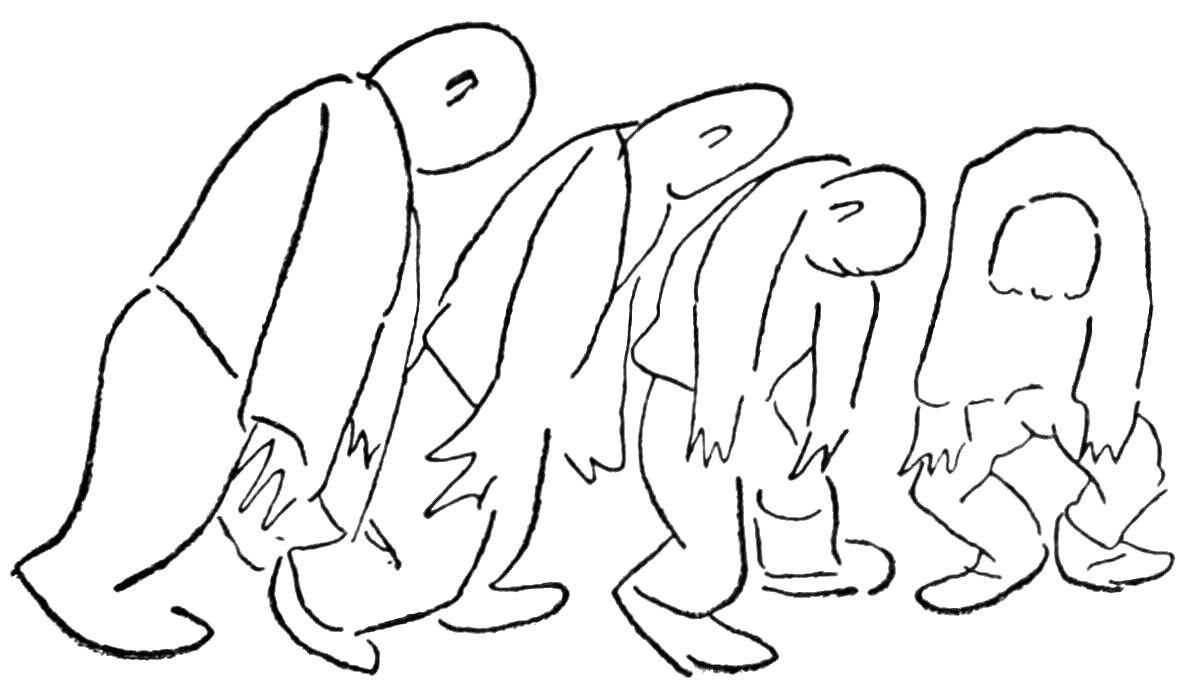
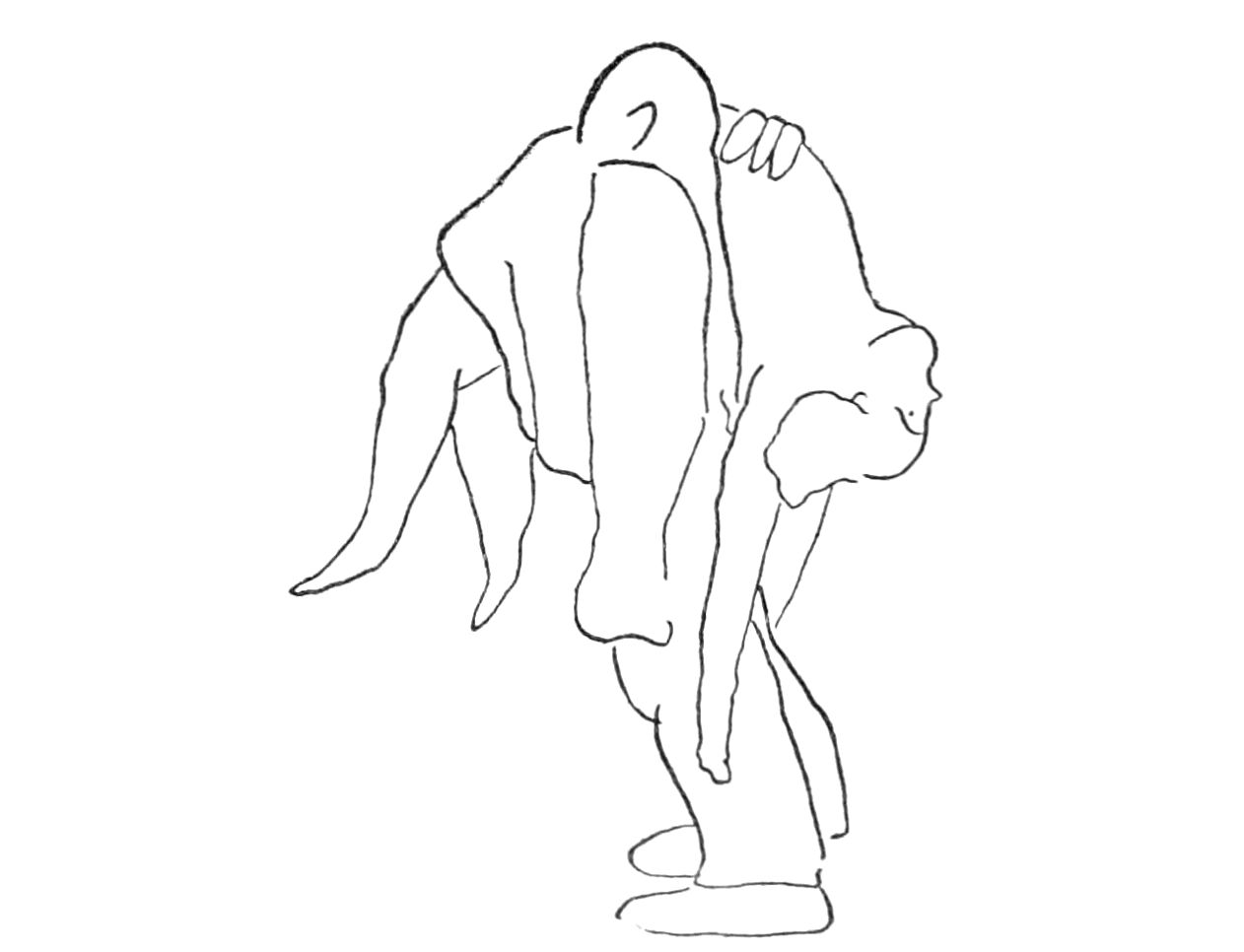
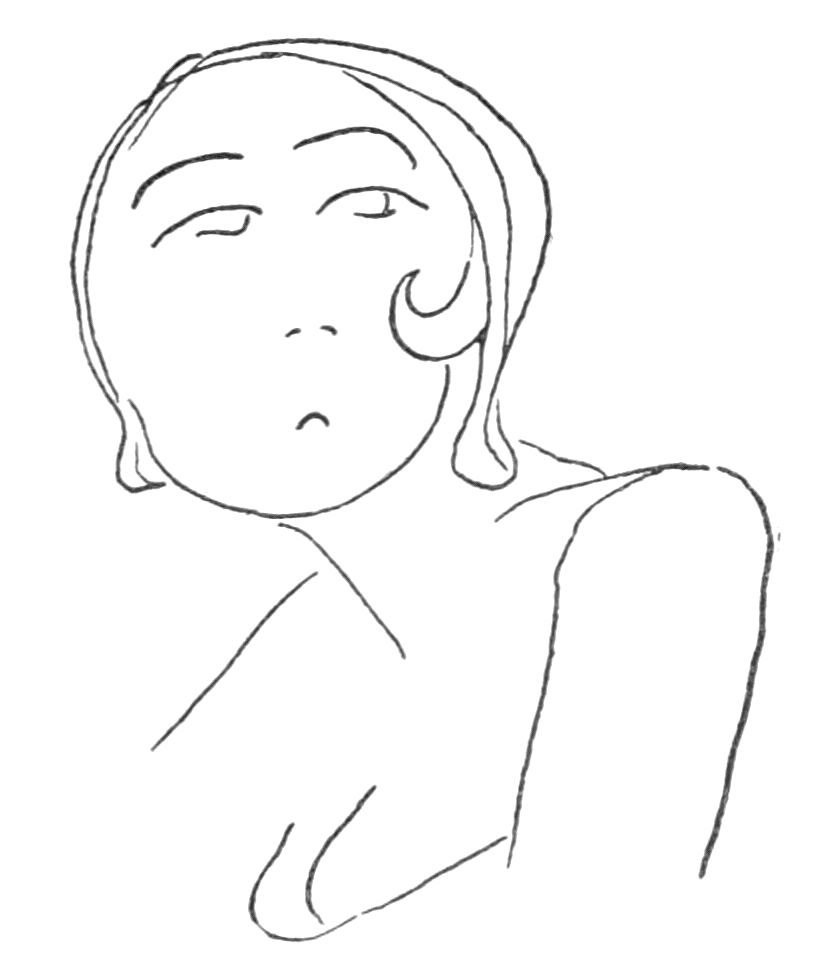
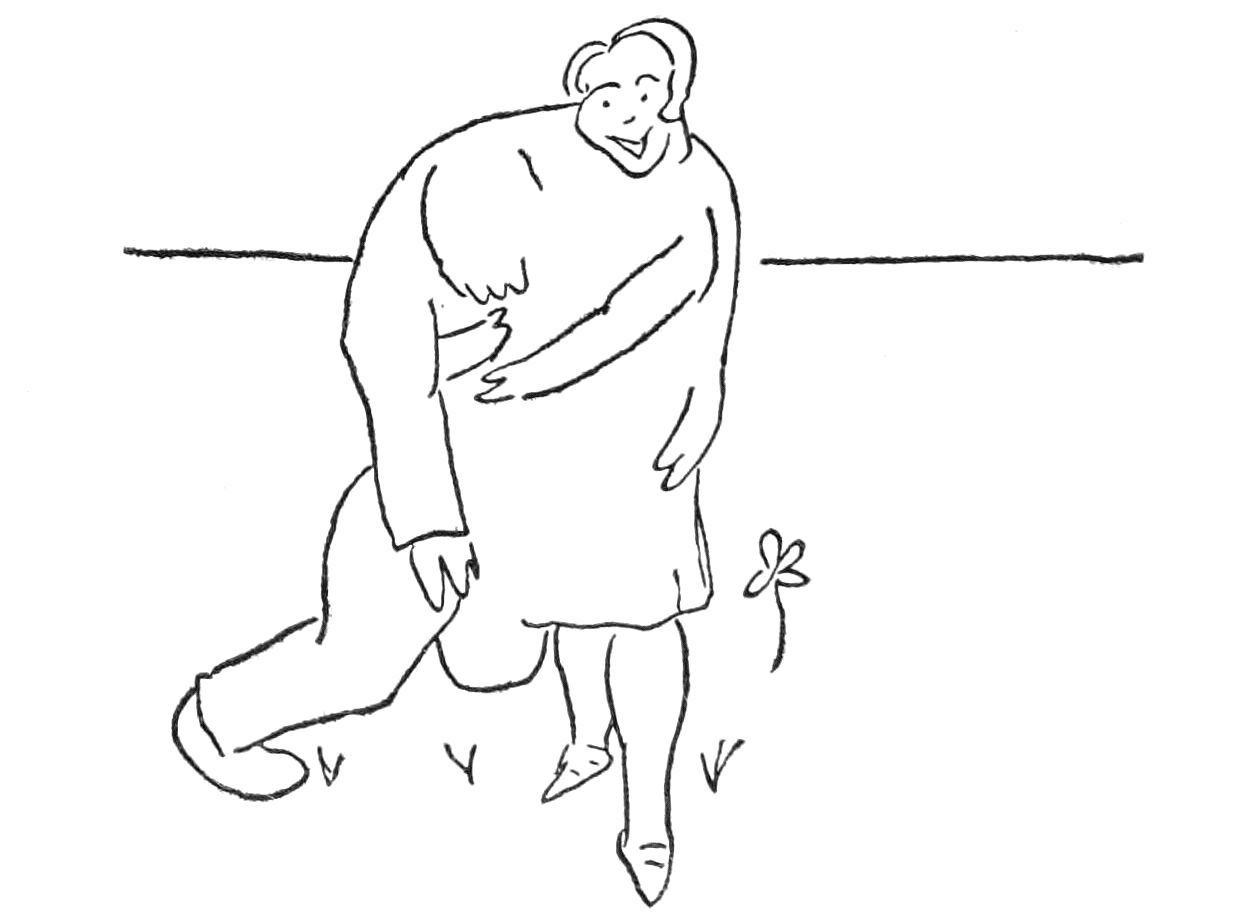
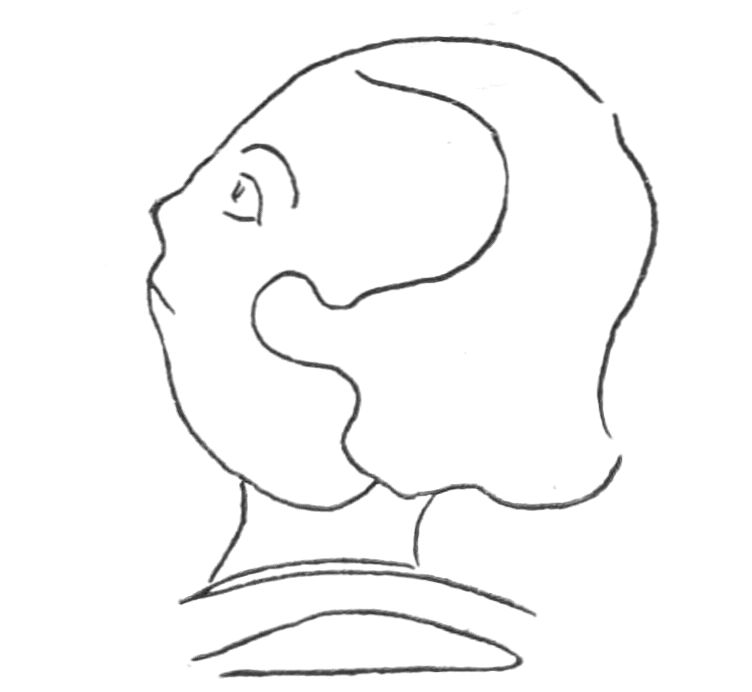
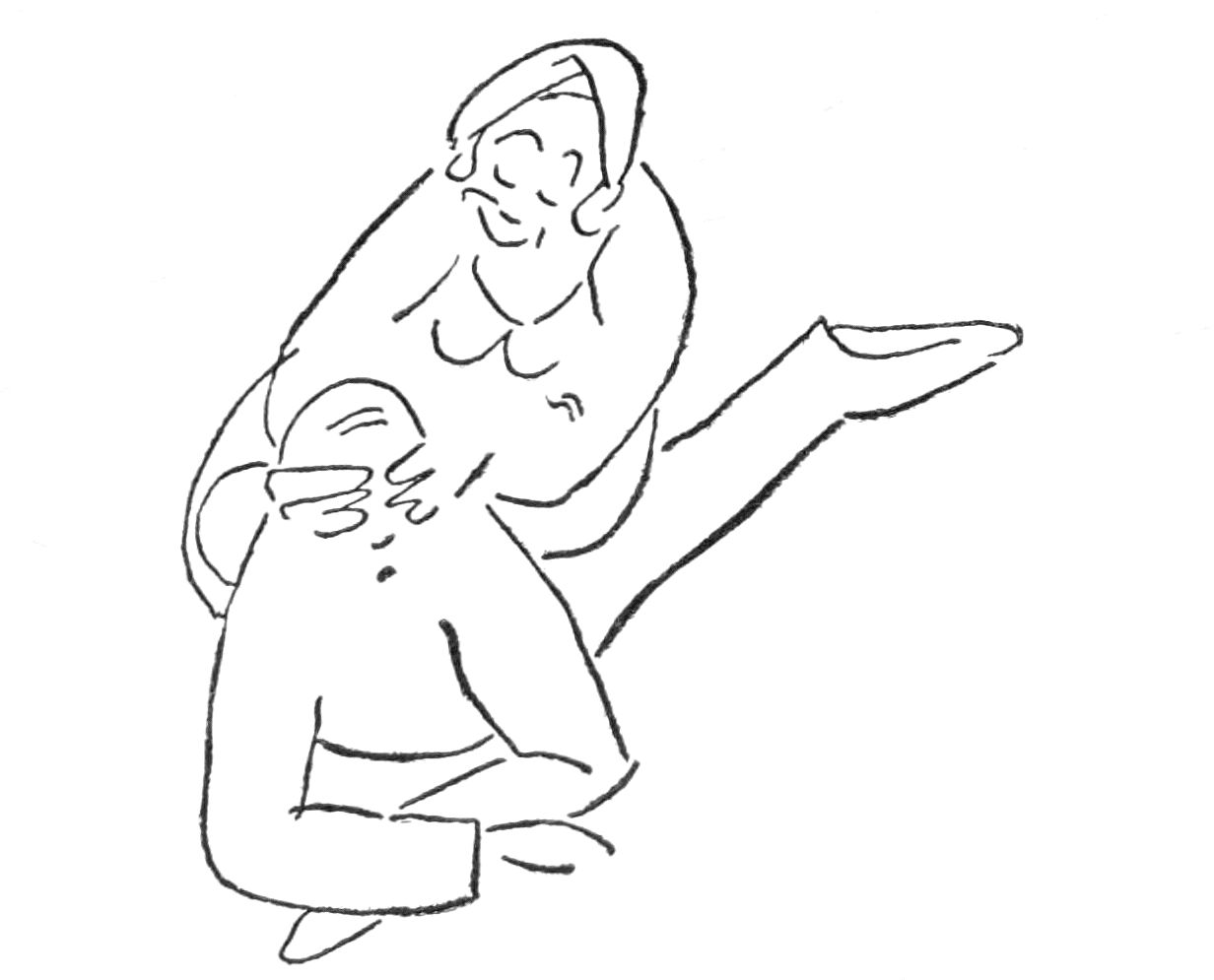
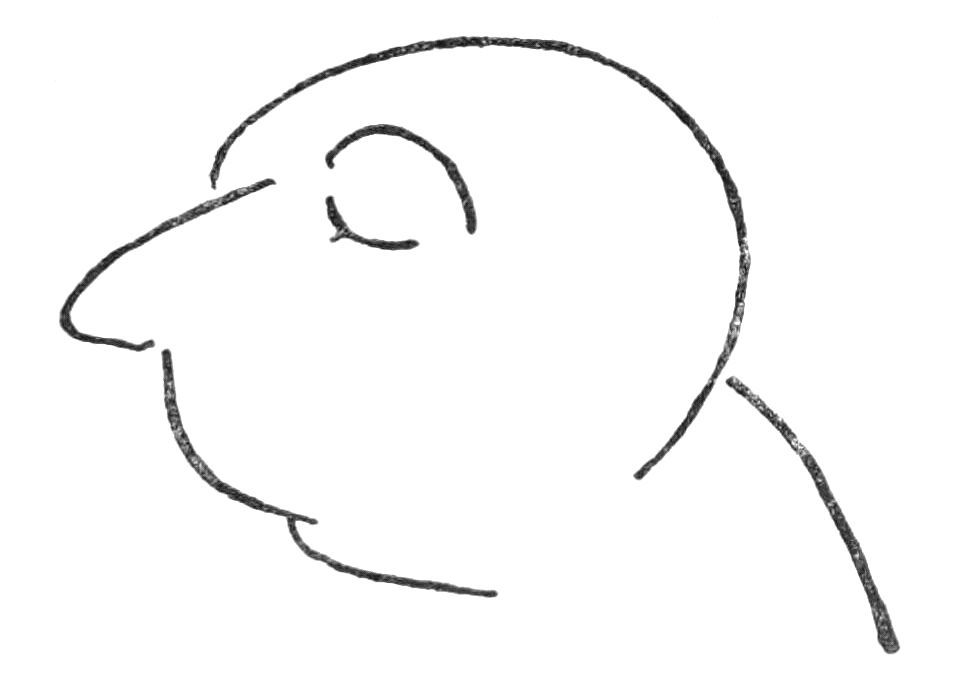
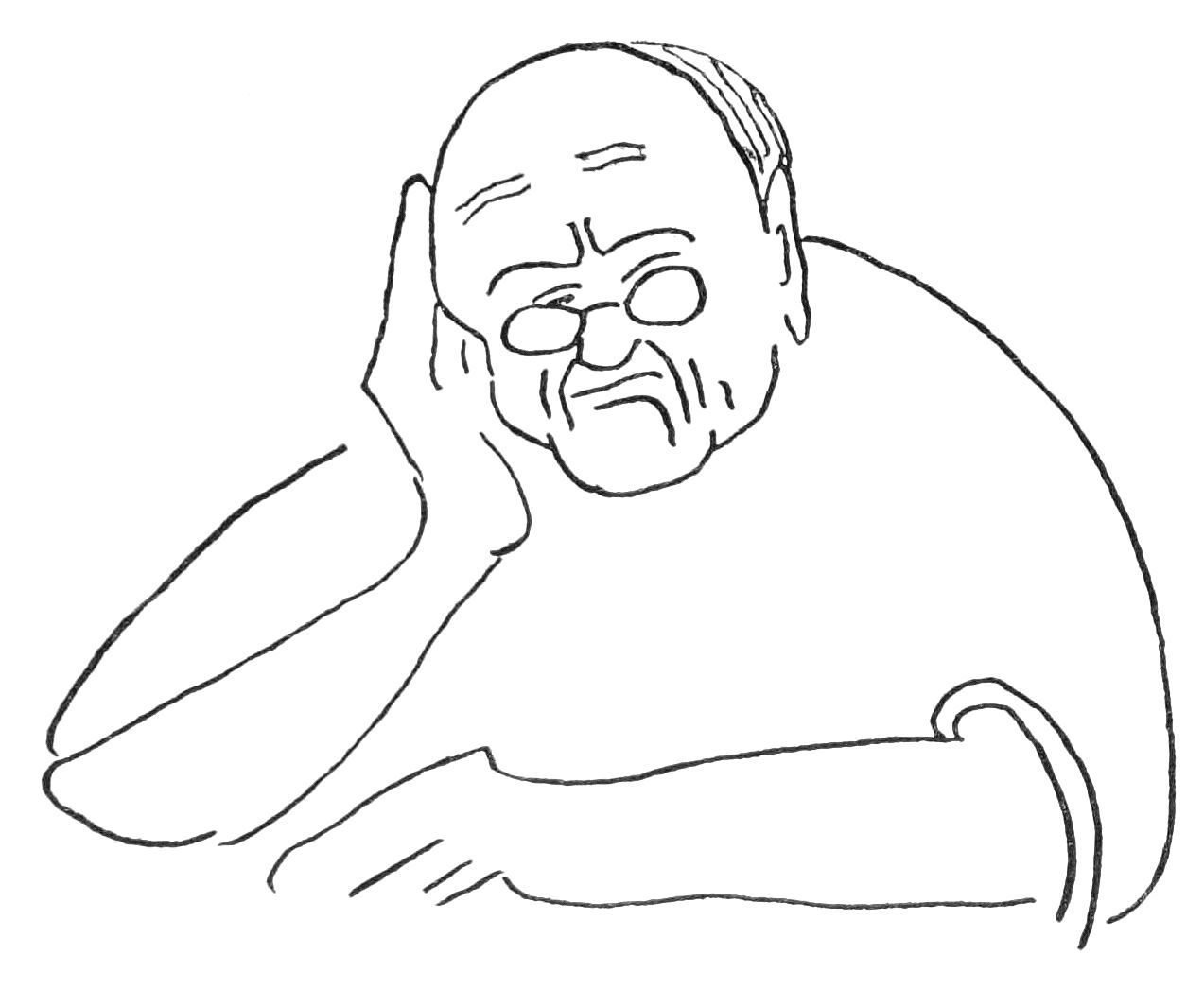
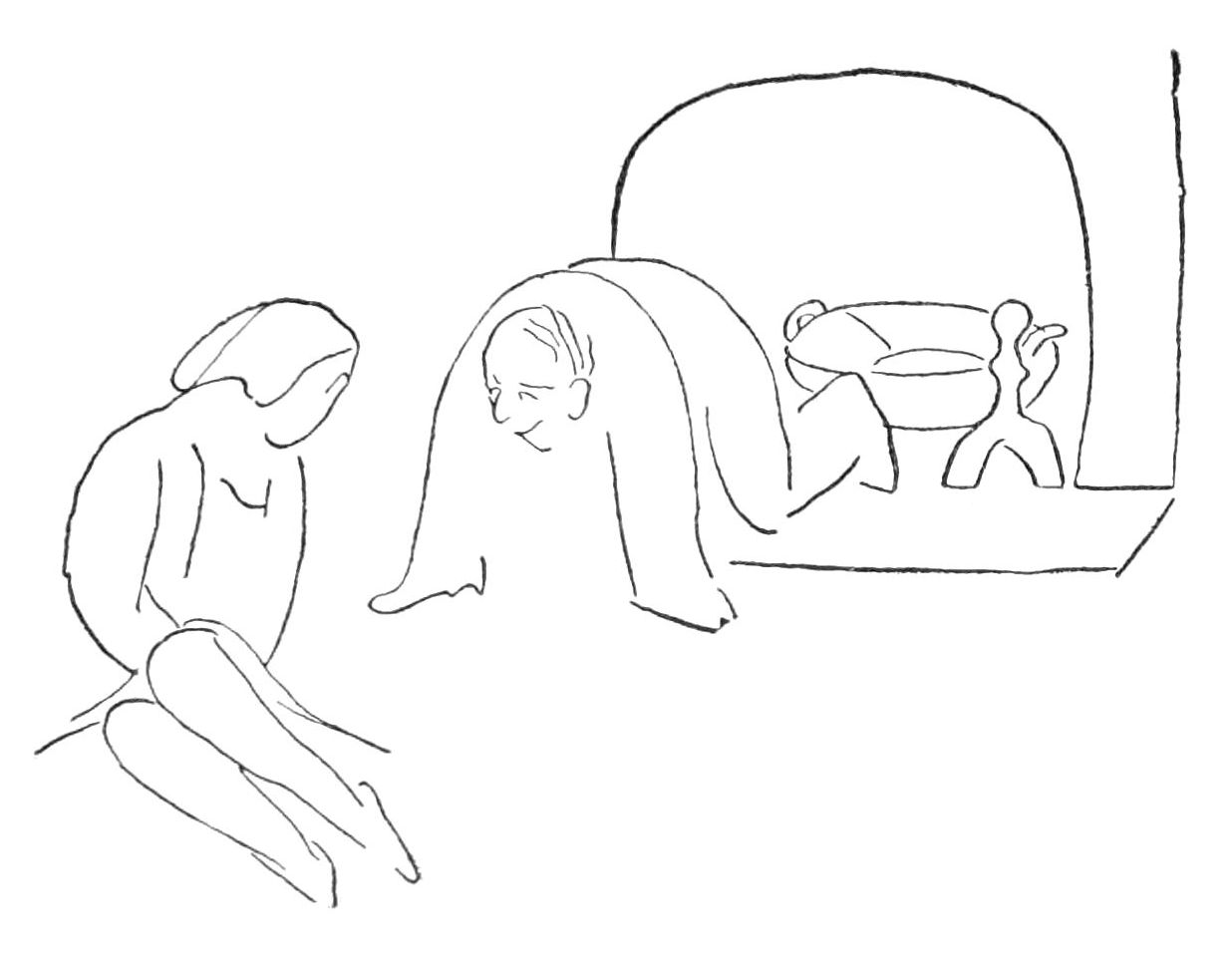
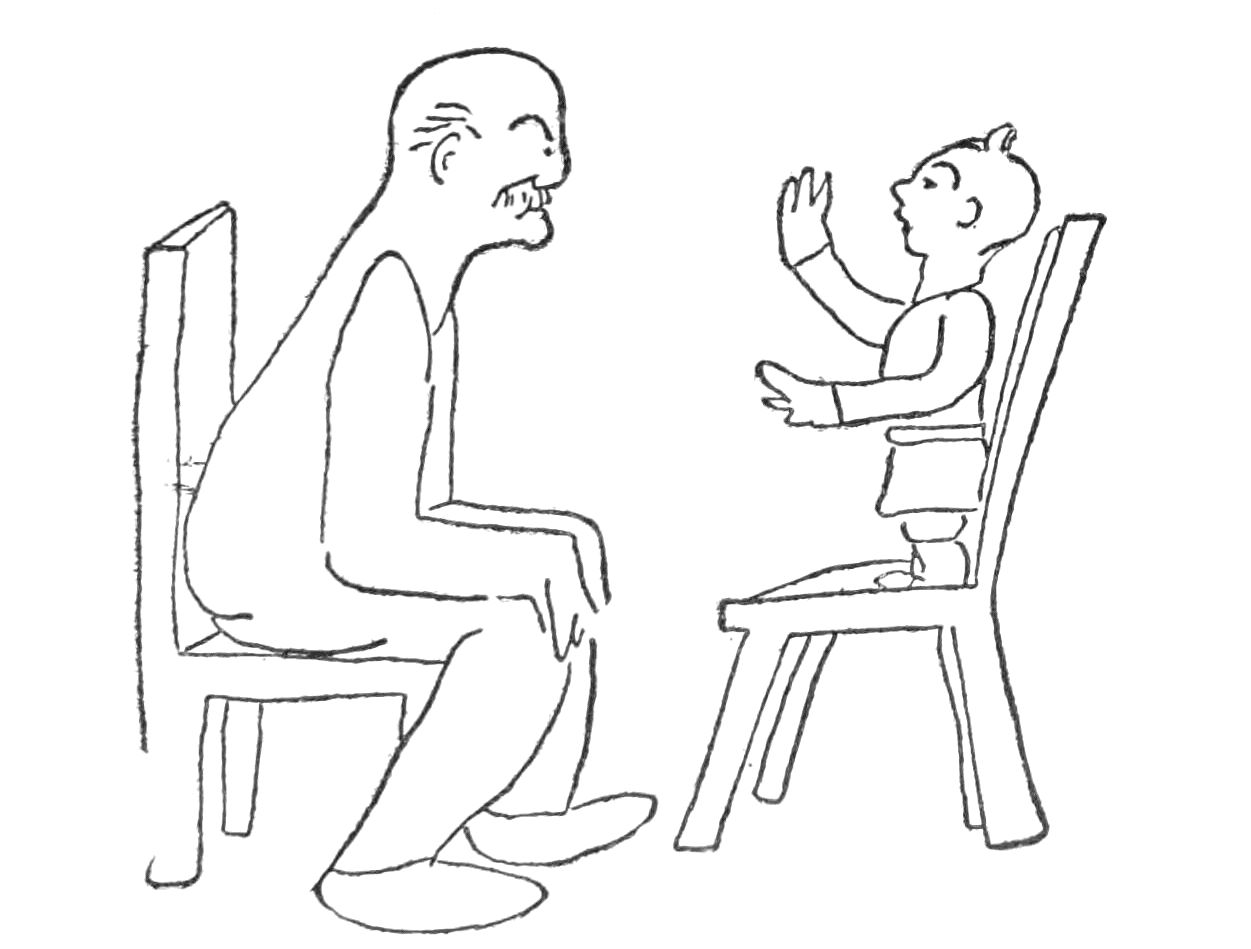
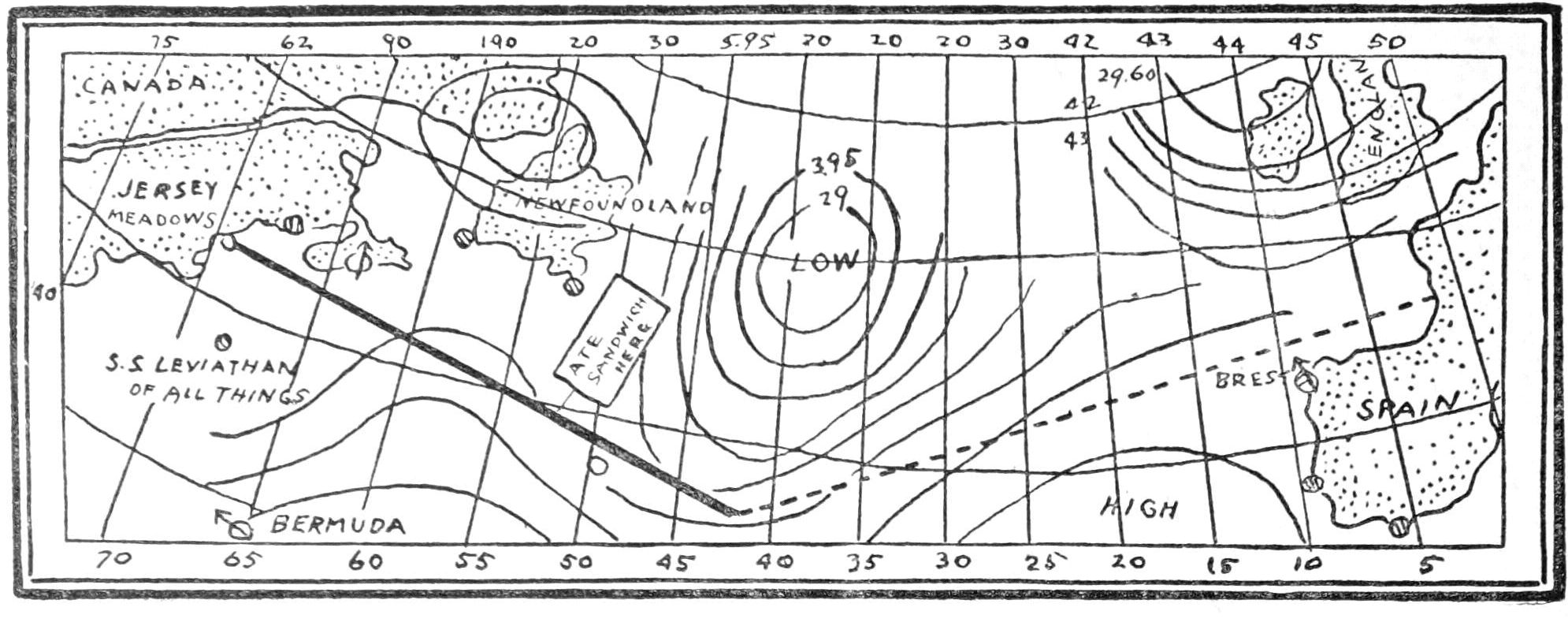
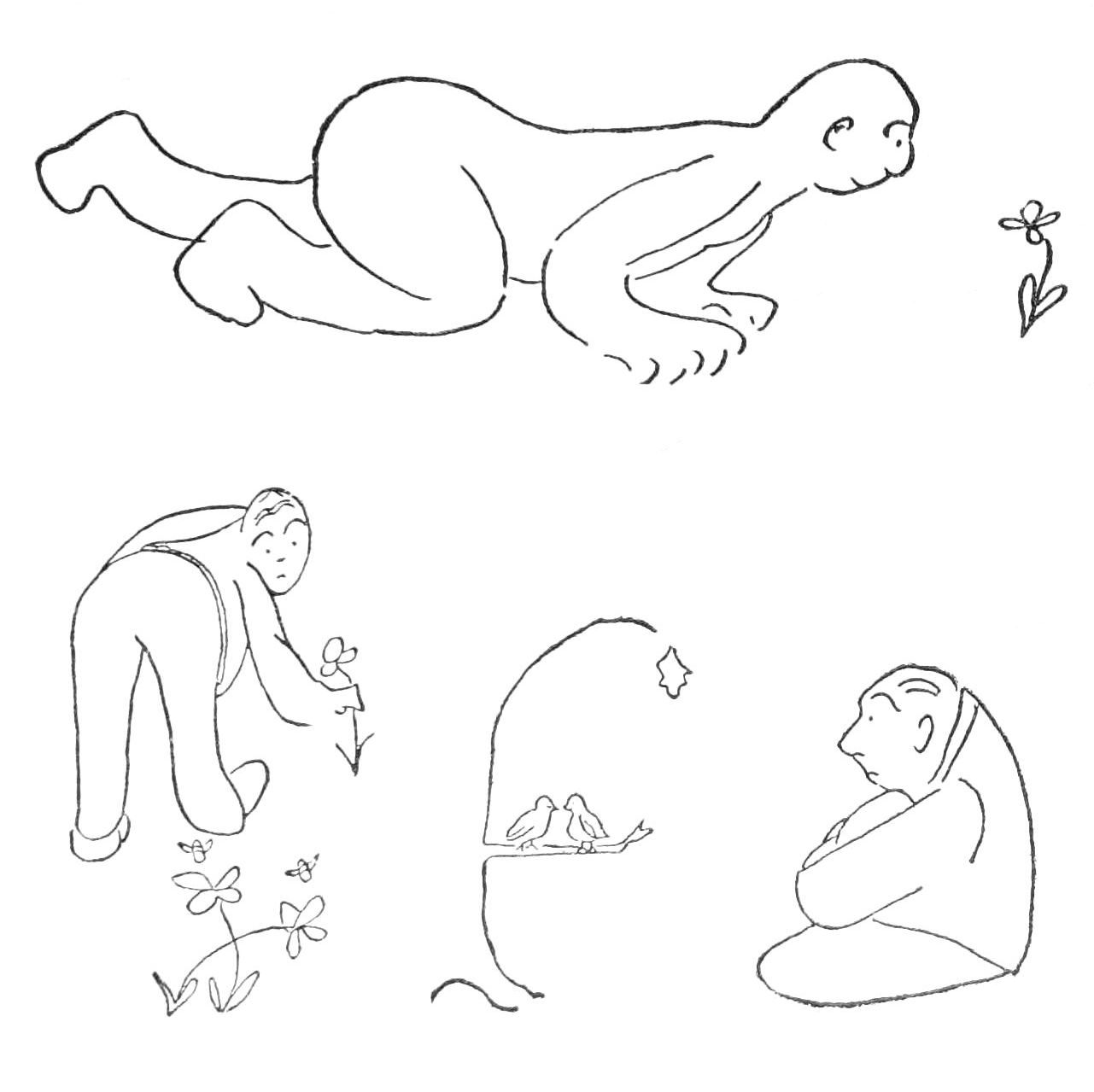
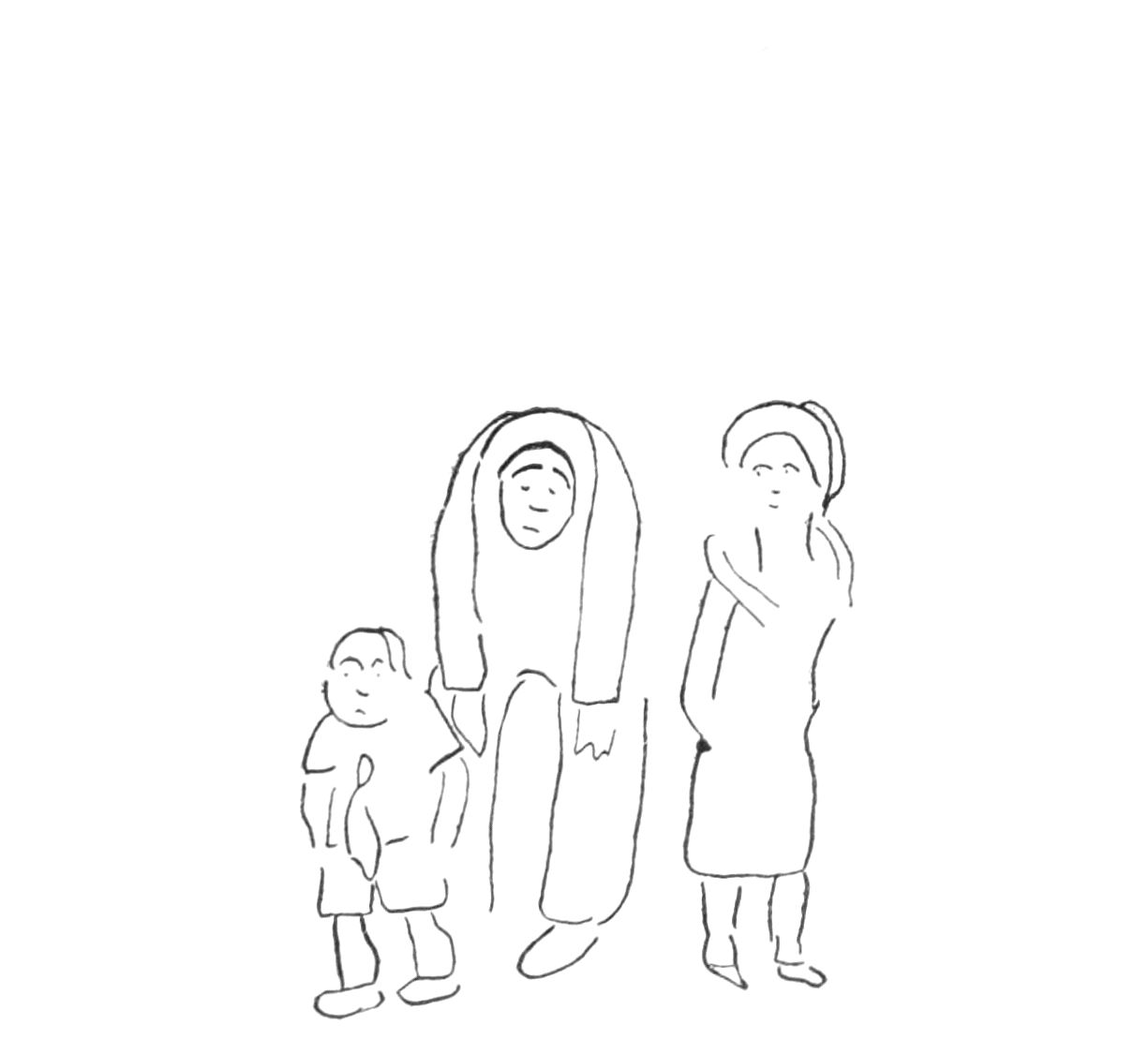
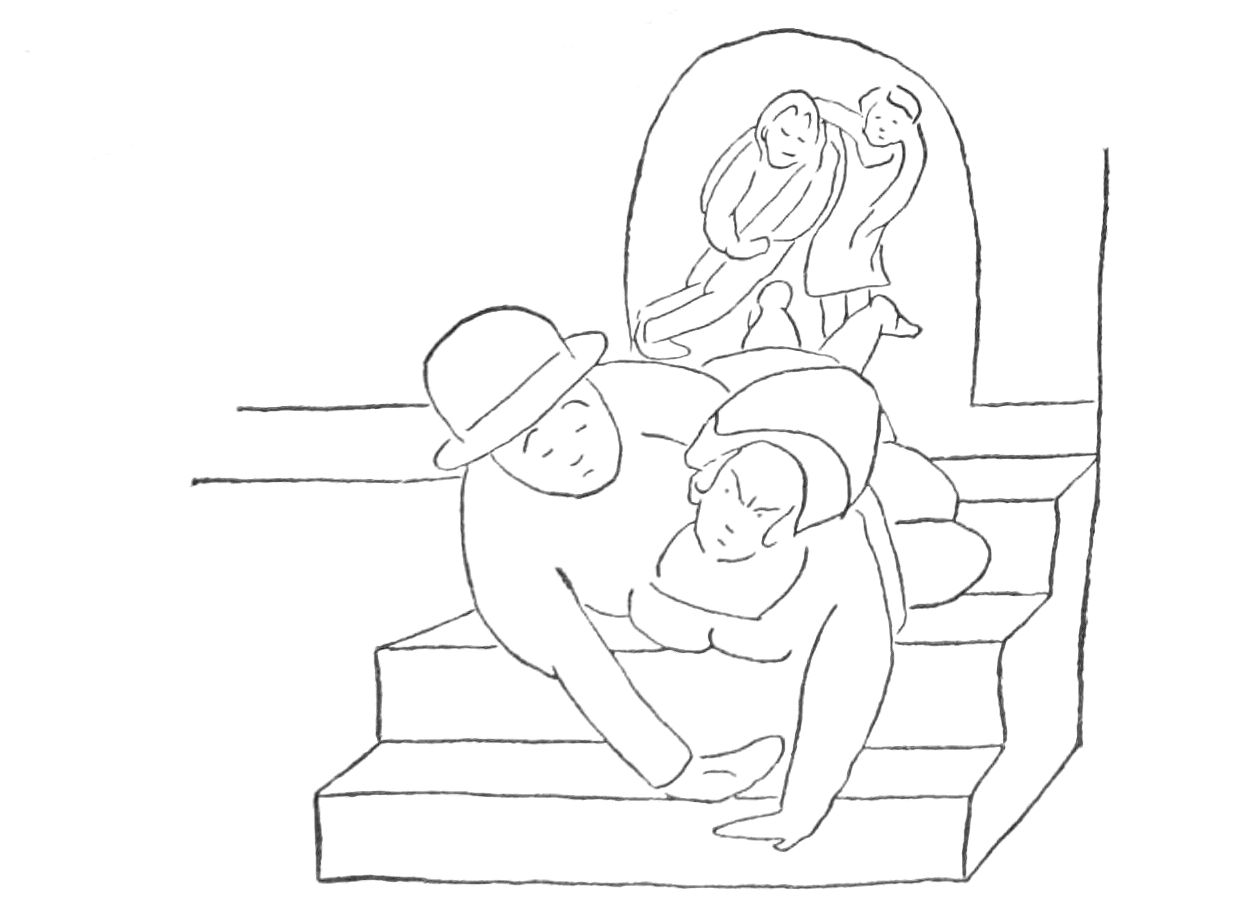
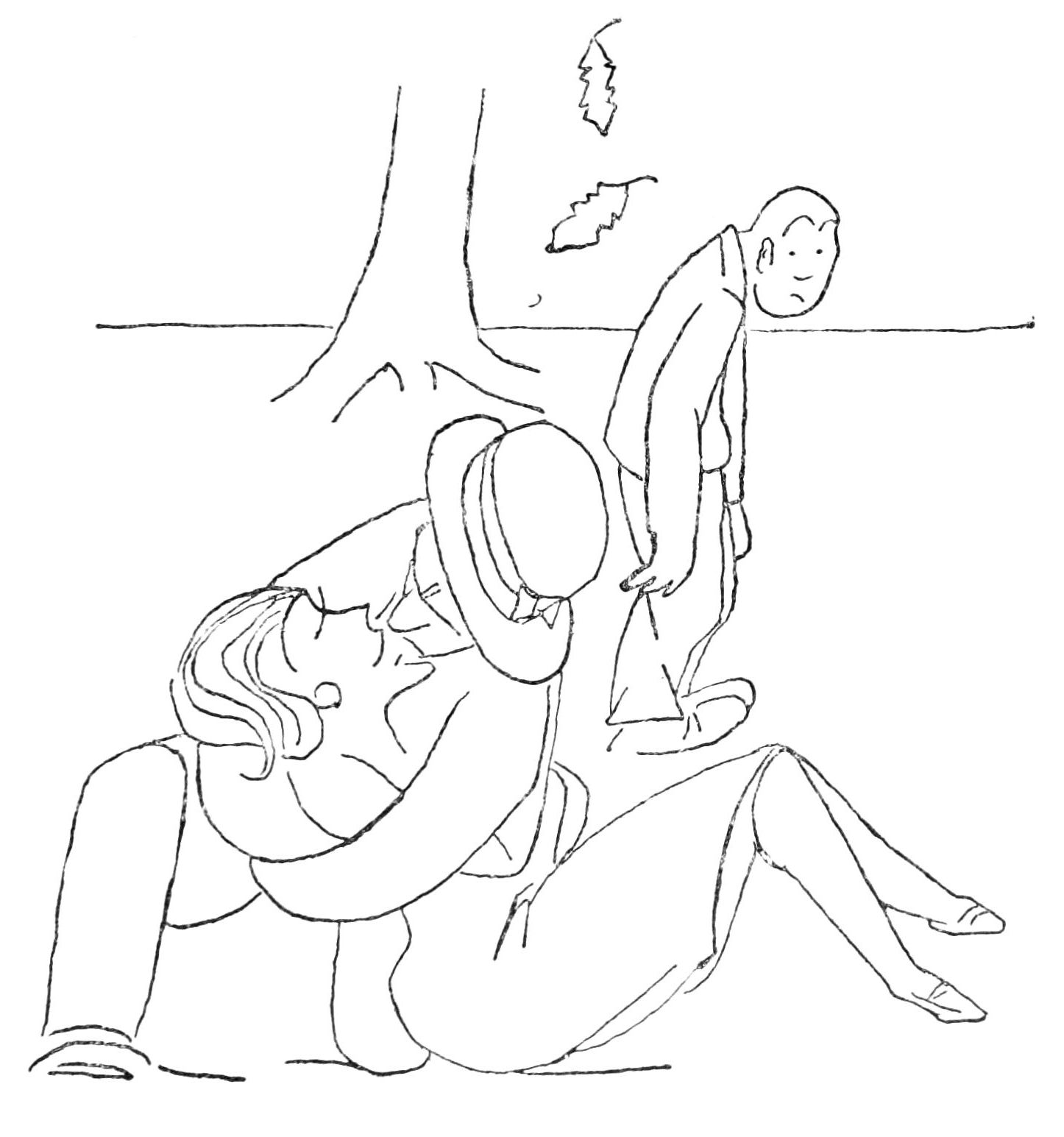
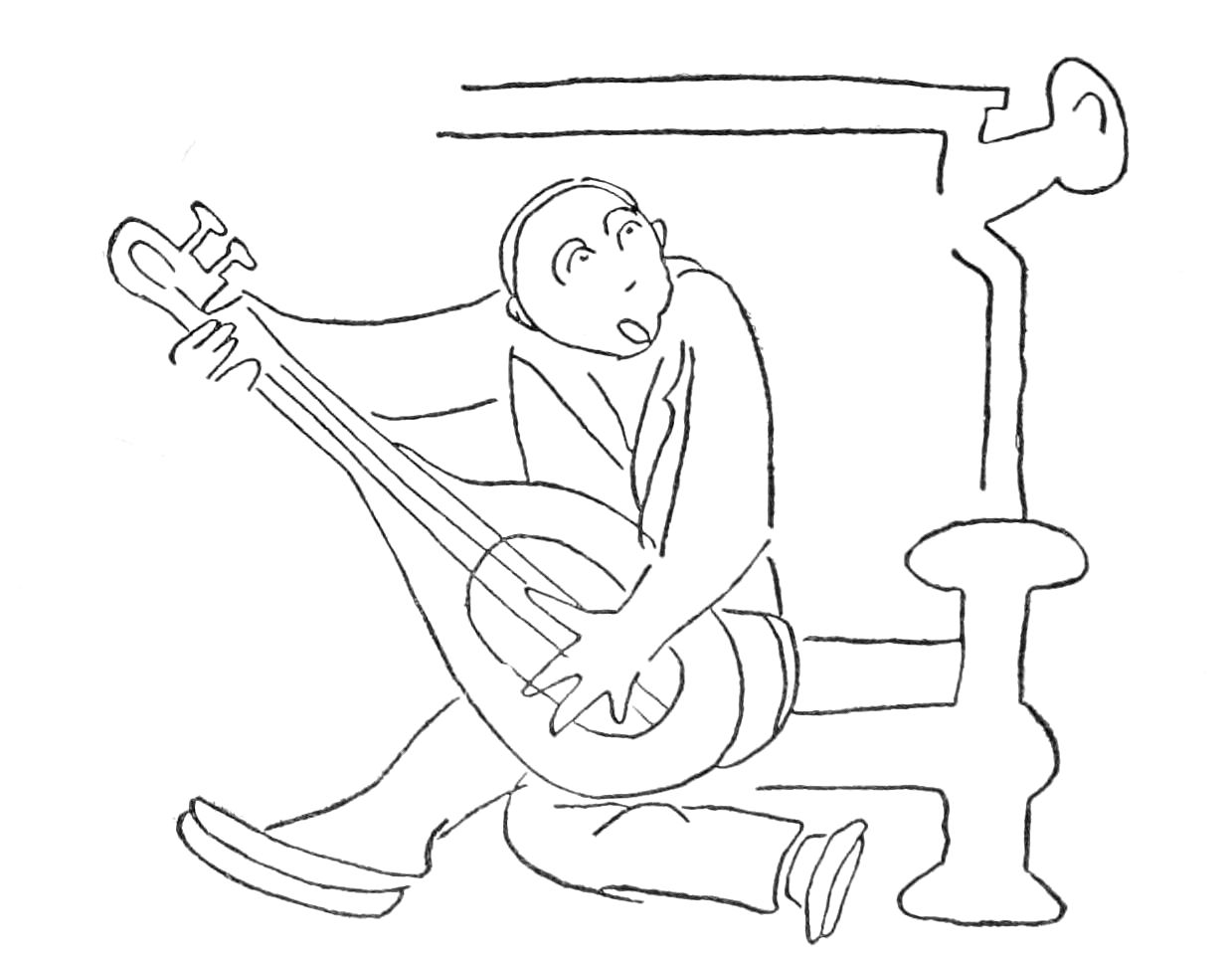
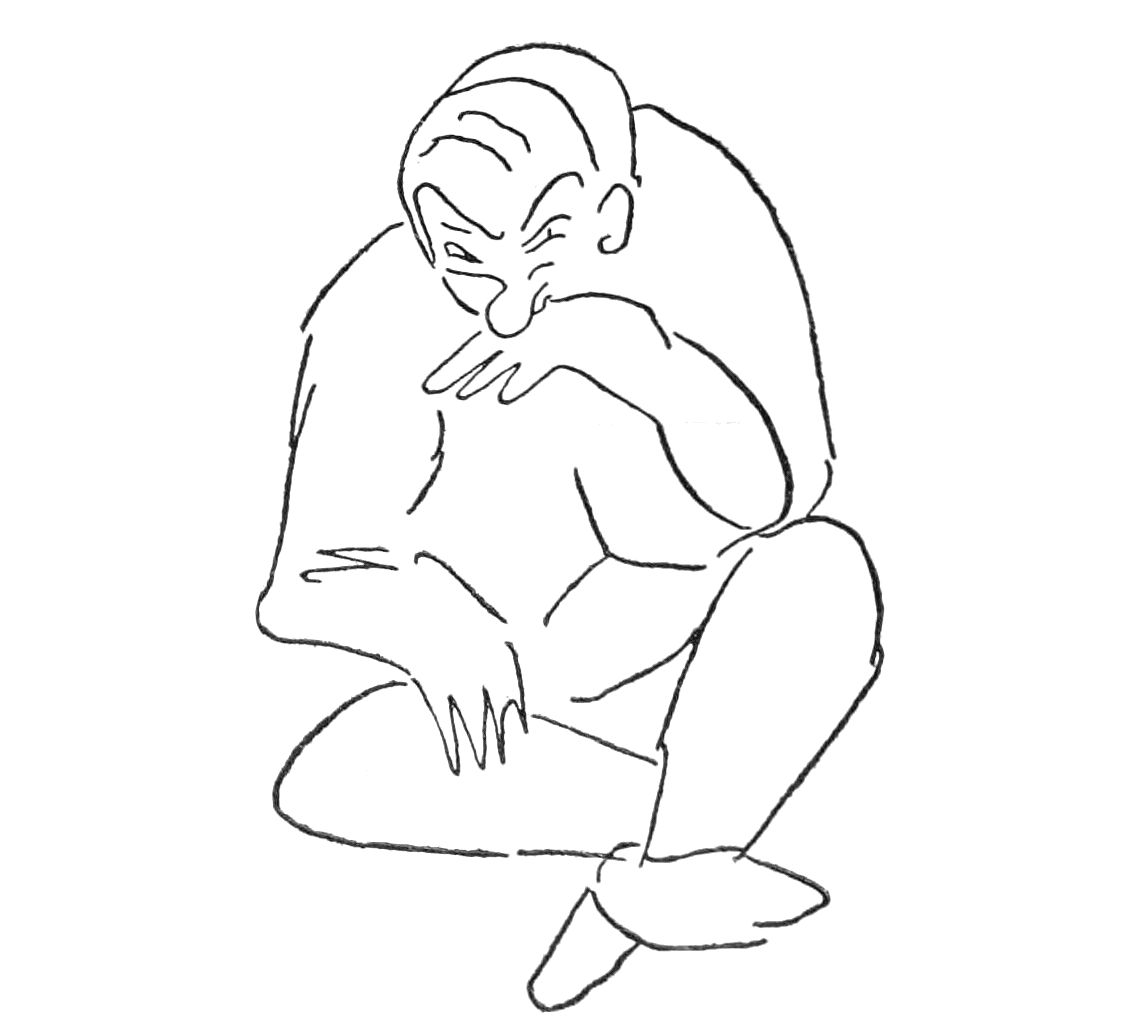
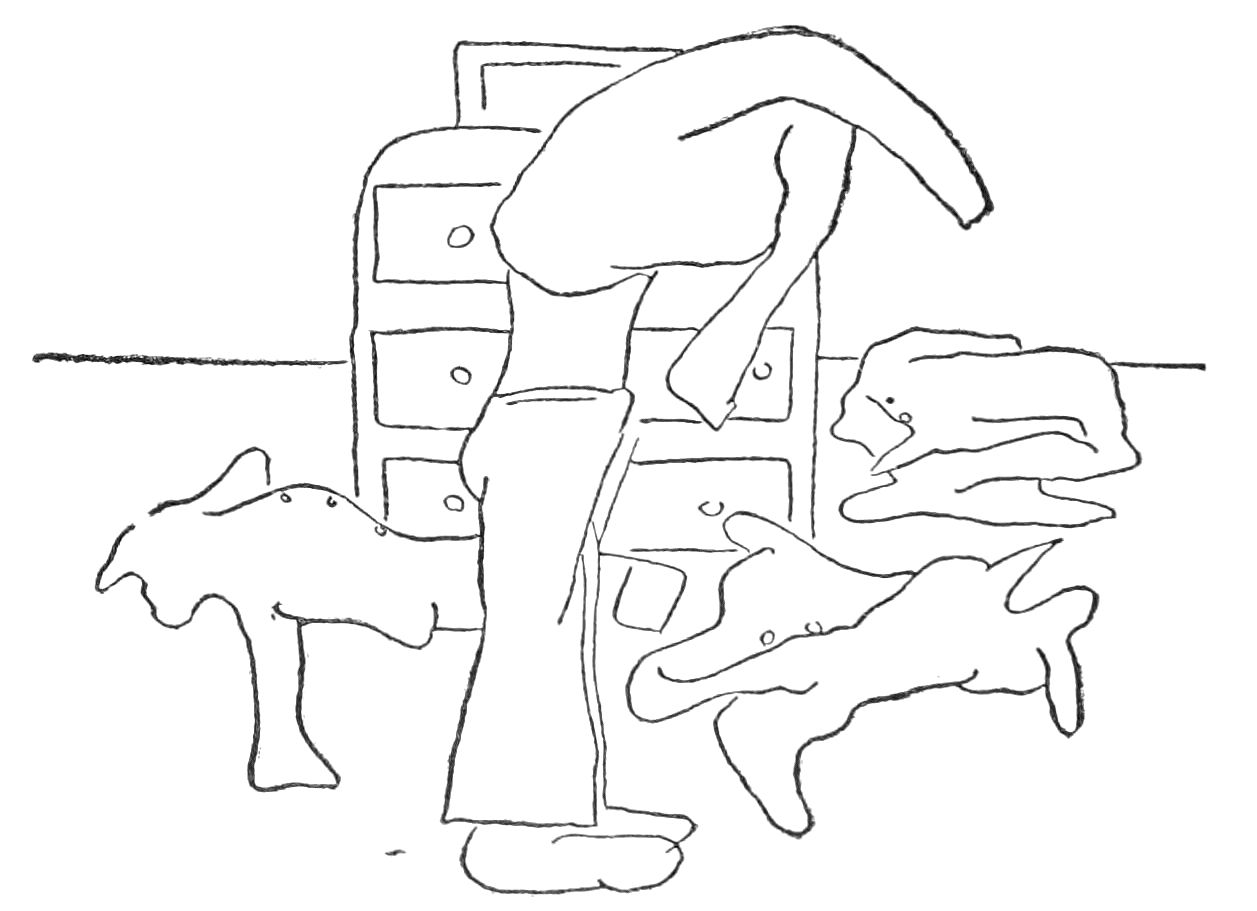
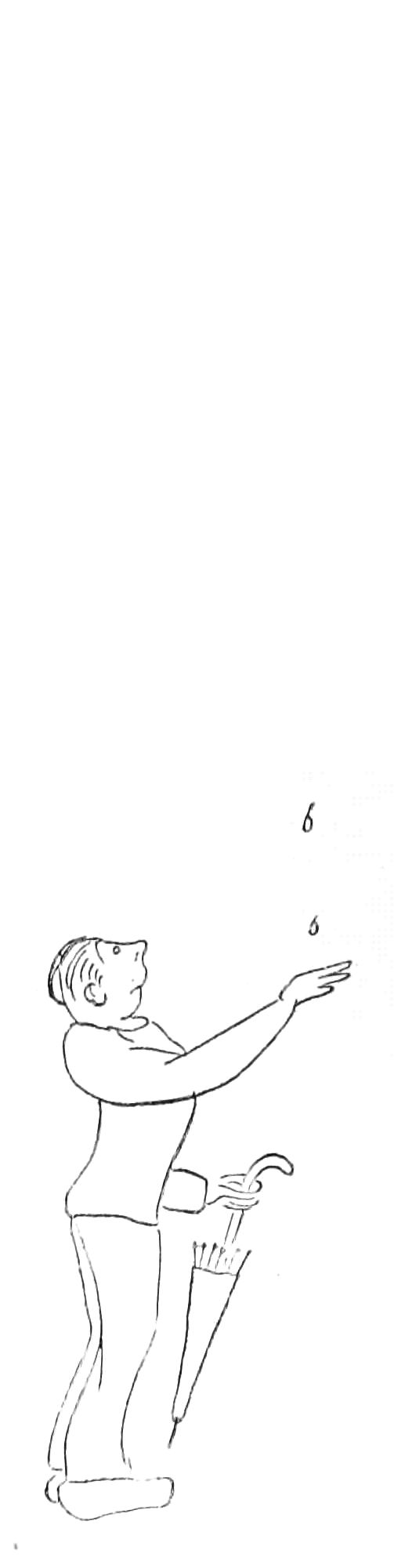
Any reader who has
already begun to be confused
by the drawings in
this book should turn to
Page 195, where they are
explained.
FOREWORD
During the past year, two factors in our civilization
have been greatly overemphasized. One
is aviation, the other is sex. Looked at calmly,
neither diversion is entitled to the space it has
been accorded. Each has been deliberately
promoted.
In the case of aviation, persons interested in
the sport saw that the problem was to simplify
it and make it seem safer. They introduced
stabilizers and emergency landing fields. Even
so, the plain fact remained that very few people
were fitted for flying.
With sex, the opposite was true. Everybody
was fitted for it, but there was a lack of general
interest. The problem in this case was to make
sex seem more complex and dangerous. This
task was taken up by sociologists, analysts, gynecologists,
psychologists, and authors; they approached
it with a good deal of scientific
knowledge and an immense zeal. They joined
forces and made the whole matter of sex complicated
beyond the wildest dreams of our
fathers. The country became flooded with
books. Sex, which had hitherto been a physical
expression, became largely mental. The whole
order of things changed. To prepare for marriage,
young girls no longer assembled a hope
chest—they read books on abnormal psychology.
If they finally did marry, they found themselves
with a large number of sex books on
hand, but almost no pretty underwear. Most
of them, luckily, never married at all—just continued
to read.
It was because we observed how things were
going with marriage and love that we set out,
ourselves, to prepare a sex book of a different
kind. In this venture we were greatly encouraged
by our many friends of both sexes,
most of whom never thought we could do it.
Our method was the opposite of that used by
other writers on sex: we saw clearly in what
respect they failed, and we profited by their
example. We saw, chiefly, that these writers
expended their entire emotional energy in their
writing and never had time for anything else.
The great length of their books (some of them
ran into two volumes and came in a cardboard
box) testified to their absorption with the sheer
business of writing. They clearly hadn’t been
out much. They had been home writing; and
meanwhile what was sex doing? Not standing
still, you can better believe. So we determined
that our procedure would be to approach sex
bravely, and frequently. “Approach the subject
in a lively spirit,” we told ourselves, “and
the writing will take care of itself.” (It is only
fair to say that the writing didn’t take care of itself;
the writing was a lot of work and gave us
the usual pain in the neck while we were doing
it.)
At any rate we gathered about us a host of
congenial people of all types, mostly girls. Gay,
somber, petulant, all kinds. We also got a lot
of dogs, mostly Scotch terriers, a breed noted
for stoicism, bravery, and humor. Thus
equipped, we set about the work with a good
spirit, and by dint of a rather unusual energy
were able to prepare the book for publication
and see it through the press without giving up
any social engagements or isolating ourselves
from the sexual world. Furthermore, all the
time we were writing the book, we continued
to earn our living—in itself no easy matter.
We early resolved to keep alive our curiosity
about things. Wherever we went we asked
questions. Aware of the tangled sexual thread
running through the pattern of people’s lives,
we continually asked the question: “Why is it
that you never got straightened out?” The
answers we got to this question helped us immeasurably.
Although most of our research was in life’s
laboratory, so to speak, we wish also to express
our indebtedness to those authors whose writings
on the subject inspired us. How can we
forget, in this connection, such men as Will
Durant, Samuel D. Schmalhausen, Dr. Joseph
Collins, Joseph Wood Krutch, and Gardner
Murphy?
Most particularly are we desirous of acknowledging
a debt to those two remarkable
men, who, more than any others, gave us the
courage to go on; two men without whose example
we never could have found in sex a daily
inspiration; those two geniuses whom it is our
pleasure to call the “deans of American sex,”—Walter
Tithridge and Karl Zaner.
PREFACE
Men and women have always sought, by
one means and another, to be together rather
than apart. At first they were together by the
simple expedient of being unicellular, and there
was no conflict. Later the cell separated, or
began living apart, for reasons which are not
clear even today, although there is considerable
talk. Almost immediately the two halves of
the original cell began experiencing a desire to
unite again—usually with a half of some other
cell. This urge has survived down to our time.
Its commonest manifestations are marriage, divorce,
neuroses, and, a little less frequently,
gun-fire.
When society decided it would have to set up
laws to govern these polymorphous manifestations
of a once simple urge which had got out
of hand, it did so without a very clear notion
of sex as we know it today. It did not realize
that direction of the Love Urge by outside
forces of law and order must be subversive of
the complete flowering of the individual—and
is there anything in life more wonderful than
a completely flowered individual, man or
woman?
Yet under all the weight of social regulation,
the ancient desire to unite and to separate and
to unite again, usually with some one else, has
survived, for the simple reason that it is stronger
than man-made law and because cells, as now
constituted, are more astute than the police.
They have to be. Thus we find men and
women being consistently together even against
the rigorous dictates of a prescribed behaviorism
to whose institutional coldness the warmth
of their emotional natures is irrevocably opposed.
And so on.
As far as I can make out, the authors of this
remarkable book subscribe to the modern ideal
of freedom in sex, but do not believe that marriage
has yet been proved a failure in every
case, nor that sex can profitably be examined
entirely apart from that old institution. In this
viewpoint the authors and myself are at one,
which is probably the reason I was asked to
write an introduction.
Marriage, as an instrument, is a well-nigh
perfect thing. The trouble is that it cannot be
successfully applied to the present-day emotional
relationships of men and women. It
could much more easily be applied to something
else, possibly professional tennis. As they now
stand, marriage and sex militate against each
other. If marriage is to be retained it must be
perfected to meet the new demands and intricacies
of sex. There is, doubtless, a discoverable
plane on which marriage and sex, the institutional
and the emotional, could meet and, as
who should say, become friends. Not only
marriage, however, but sex as well, would have
to make certain concessions. Tempered by this
balanced viewpoint, one must find it, then, logically
impossible to pose only the question,
“What is wrong with marriage?” It becomes
necessary also to pose the question, “What is
wrong with sex?” For if it is plausible to
assume that something may be so radically
wrong with a well-nigh perfect institutional
device that it might be well for society to
abandon it, one must, in all fairness, entertain
the suspicion that something may be so
wrong with a well-nigh perfect emotional relationship
that it might be well for society to
abandon it, too.
Early Woman.
People never have been satisfied with marriage.
If the contracting parties are satisfied
with it, some one else isn’t. How often one
hears the expression, “I don’t know what she
sees in him.” As a matter of fact, however, we
hear that expression less frequently today than
we used to, because psychology has enabled us
to know what she does see in him. There is,
however, still considerable doubt as to what he
sees in her. Some authorities claim that no man
can see all there is to see in a woman, because
she is too complicated and mysterious for him.
This notion—that Woman is more incomprehensible
than Man—has persisted for centuries.
It is of a piece with the legend that Woman is
deserving of a certain form of idolatrous worship,
a legend that grew up in the early ages of
the world. When Man first came into being,
he did not think that the female was extraordinary.
He did not think that anything was
extraordinary. The world was unattractive
physically, and a little dull. There was no vegetation,
and without vegetation there can be no
fancy. Then trees came into existence. It was
trees that first made Man begin to brood. In
pondering their leafy intricacies he got his
first crude concept of beauty. He used to tear
great branches out of trees and take them home
to his cave woman. “Here,” he would say to
her, “lie on these.” The man then reclined in
a corner of the cave and watched the woman’s
hair mingle with the leaves, and her eyes shine
through them, until he fell asleep. His dreams
were troubled. Woman came into his dreams
as a tree, then a tree came into his dreams as a
woman. He also got her eyes, shining through
the leaves, all mixed up with the moon. Out
of this curious and lamentable confusion grew
the tendency in Man’s mind to identify Woman
with the phenomena of the burgeoning earth
and the mysteries of the illimitable heavens. As
time went on Man rather enjoyed cultivating
this idea. It was something to think about. It
wasn’t much, but it was something. Thus was
the subconscious born, with all its strange mixture
of fact and symbol.
As the vegetation of the earth grew more luxuriant
Man grew more moody. Each new plant
represented something that he could not easily
fit into his practicable scheme of things (the tomato,
for example, wasn’t fitted in until late in
the nineteenth century). For the first wild iris,
Man saw no conceivable use. However, he
plucked it. It had, he noticed, that curious
color, or pigmentation, which he associated
with only two other things—the sky and
Woman’s eyes. He brooded upon this astounding
coincidence overlong. Often he got wet
through, standing in a bog, contemplating a
blue flag. Then he would take it home and
give it to his mate.
Early Conference.
All these things operated to bring about in
Man’s mind an inclination to identify the wonders
of the earth and sky with the physical fact
of his mate’s existence. He decided they must
have a great deal in common, these wonders and
this woman. What that was he determined to
find out. Too proud at first, too male, to take
his mate into his confidence in the matter of his
uncertainties, he got to tramping the bogs and
woods at night, seeking the answer. He bayed
questions at the moon, he beseeched the trees to
speak, he shouted at the wild iris. There was
no answer. It was then that it occurred to Man
that, since these things could not tell him the
answer to the riddle of the universe, the only
possible source of that information must repose
in the living creature which he identified with
them, the woman with skyey eyes and leafy hair.
Then came that important night when one of
the early men resolutely rose from his knees,
under the moon, and started back to his cave to
demand from his mate an explanation of all
these mysteries. On the way a star fell. Those
ages were notable for falling meteors. This one
frightened the man as it crashed sizzling
through the trees and buried itself with a moan
in the ground. He ran the rest of the way
home, arriving breathless and white.
“Wha’ was ’at?” he croaked, pointing behind
him. His mate saw nothing but the waving of
fern fronds in the wind, the form of some animal
slinking into the woods.
“It is nothing,” she said, and smiled, and ran
her hand through his hair.
Right then and there Man conceived the notion
that Woman was so closely associated, so
inextricably entwined with the wonders and
terrors of the world, that she had no fear of
them. She was in quiet league with the forces
of life. She was an integral part of the stars
and the moon, she was one with the trees and
the iris in the bog. He fell down on his knees,
the pitiable idiot, and grasped her about the
waist.
It is inconceivable that a myth as strong as
this belief in the ineffability of Woman, as
deeply rooted in the soils of time, can ever be
completely eradicated. However fantastical,
however untrue, crotchet or whim, fancy or
foible, there it is and there it has always been.
To destroy it would be to put the female
properly in her place, as a plain, unadorned
unit in the senseless but unending pattern of
biological continuity. Romantic love would
disappear. Life would be simplified. Neuroses
would vanish. But Man clings to his ancient
and silly value. What it has done to him is
quite easy to see. It has subordinated him to
Woman, for one thing. The emotional nature
of the male has either been overlooked altogether
or greatly disparaged. “Isn’t that just
like a man?” is an all-too-glib and common expression.
It implies that one can virtually
ascribe to all men the simple reactions which, in
a number of men, inexpertly observed, have
proved likely to take place. (The italic is
mine.)
Observers have been too prone to hold that
the male is negligible, and to overemphasize the
importance of the female. Thus we find such
keen analysts as Ira S. Wile and Mary Day
Winn[1] asserting that “anyone who wishes to
understand modern marriage must center his
attention on woman and find out what she
thinks of it and what she intends to do about
it.” This is the old Bridegroom Fallacy—the
notion, to paraphrase Miss Loos, that the bride
is divine but that the bridegroom is just nothing.
Unless more stress is laid, and pretty
quickly, too, upon the complexity of the male,
and the importance of what he is thinking about
and what he intends to do, or at least what he
would like to do, we are never going to arrive
at a norm. How often do you hear it said that
the little whims and desires of a man should be
cherished, or even listened to? You don’t hear
it said at all. What you do hear is that “the
way to a man’s heart is through his stomach.”
A thing like that hardens a man. He may eat
his spinach and say nothing, but he is being
hardened just the same.
The American male, because of the remarkable
stress laid upon women in this country, has
been understood least of all males. There has
been no completely successful attempt to state
his case until the authors of this extraordinary
book came along. I do not know who they are.
In places they do not seem to be themselves.
But they’ve got something. (A lot of what they
have they seem to have got from Zaner and
Tithridge, which is all right with me.) At any
rate, they state the case for the American man
clearly and plausibly. At the same time they
have by no means neglected the female. It takes
two to make a neurosis, and nobody knows that
any better than White and Thurber, unless it’s
Zaner and Tithridge.
Herein are examined, therefore, both men
and women, male and female, Man and
Woman—not only in themselves, but in their
curious reactions to each other. The term
“reaction” seems to be used in this book to include
not only those quick, unpremeditated reflexes
which cause so much trouble, but also
those slowly formulated prejudices, doubts, and
suspicions which cause even more trouble. If
this book does anything at all toward straightening
out the lamentable mess that things have
got into in America—and I certainly think it
will—the authors will feel amply repaid for
their pains, which consisted in large part, they
tell me, of insults.
Lt. Col. H. R. L. Le Boutellier, C.I.E. Schlaugenschloss Haus, King’s Byway, Boissy-le-Doux sur Seine. July 15, 1929
IS SEX NECESSARY?
CHAPTER I The Nature of the American Male: A Study of Pedestalism — CASE HISTORY
In no other civilized nation are the biological
aspects of love so distorted and transcended
by emphasis upon its sacredness as they
are in the United States of America. In China
it’s all biology. In France it’s a mixture of biology
and humor. In America it’s half, or two-thirds,
psyche. The Frenchman’s idea, by and
large, is to get the woman interested in him as a
male. The American idea is to point out, first of
all, the great and beautiful part which the stars,
and the infinite generally, play in Man’s relationship
to women. The French, Dutch, Brazilians,
Danes, etc., can proceed in their amours
on a basis entirely divorced from the psyche.
The Chinese give it no thought at all, and never
have given it any thought. The American
would be lost without the psyche, lost and a
little scared.
As a result of all this there is more confusion
about love in America than in all the other
countries put together. As soon as one gets the
psychical mixed up with the physical—a thing
which is likely to happen quite easily in a composing-room,
but which should not happen anywhere
else at all—one is almost certain to get
appetite mixed up with worship. This is a
whole lot like trying to play golf with a basketball,
and is bound to lead to maladjustments.
The phenomenon of the American male’s
worship of the female, which is not so pronounced
now as it was, but is still pretty pronounced,
is of fairly recent origin. It developed,
in fact, or reached its apex, anyway, in
the early years of the present century. There
was nothing like it in the preceding century.
Throughout the nineteenth century the American
man’s amatory instincts had been essentially
economic. Marriage was basically a patriotic
concern, the idea being to have children
for the sake of the commonwealth. This was
bad enough, but nevertheless it is far less dangerous
to get the commonwealth mixed up with
love than to get the infinite mixed up with love.
There was not a single case of nervous breakdown,
or neurosis, arising from amatory troubles,
in the whole cycle from 1800 to 1900, barring
a slight flare-up just before the Mexican
and Civil wars. This was because love and
marriage and children stood for progress, and
progress is—or was—a calm, routine business.
“Mrs. Hopkins,” a man would say to the lady
of his choice (she was a widow in this case)—“Mrs.
Hopkins, I am thinking, now that
George[2] has been dead a year, you and I should
get married and have offspring. They are
about to build the Union Pacific, you know,
and they will need men.” Because parents
can’t always have men-children when they want
them, this led to almost as many women as men
working on the Union Pacific, which in turn
led to the greater stature of women in the present
Northwest than in any other part of the
nation. But that is somewhat beside the point.
The point is that men and women, husbands
and wives, suitors and sweethearts, in the last
century lived without much sentiment and without
any psycho-physical confusion at all. They
missed a certain amount of fun, but they avoided
an even greater amount of pother (see Glossary).
They did not worry each other with
emotional didoes. There was no hint of a
Pleasure-Principle. Everything was empiric, almost
somatic.[3]
[3] The word “somatic” has been left out of the glossary because
of the confusion which the dictionary itself seems to be in over the
meaning of the term. “Pertaining to the wall of the body” is as
close as the New International comes to what we have in mind
here, but it goes right on to use “parietal” as a synonym and
parietal means “pertaining to order within the buildings of a
college.” Then again the word goes back to the old Indian, or
East Indian, root Soma which means a god, a liquor, and an asclepiadaceous
climbing shrub (Sarcostemma acidum). Furthermore, if
your eyes stray even a fraction of an inch, in looking up “somatic,”
you are in “sölvsbergite” which includes the feldspars, ægirite, grorudite,
and tinguaite.
This direct evasion of the Love Urge on the
part of Americans of the last century was the
nuclear complex of the psycho-neurosis as we
know it today, and the basis for that remarkable
reaction against patriotic sex which was to follow
so soon after the Spanish-American war.
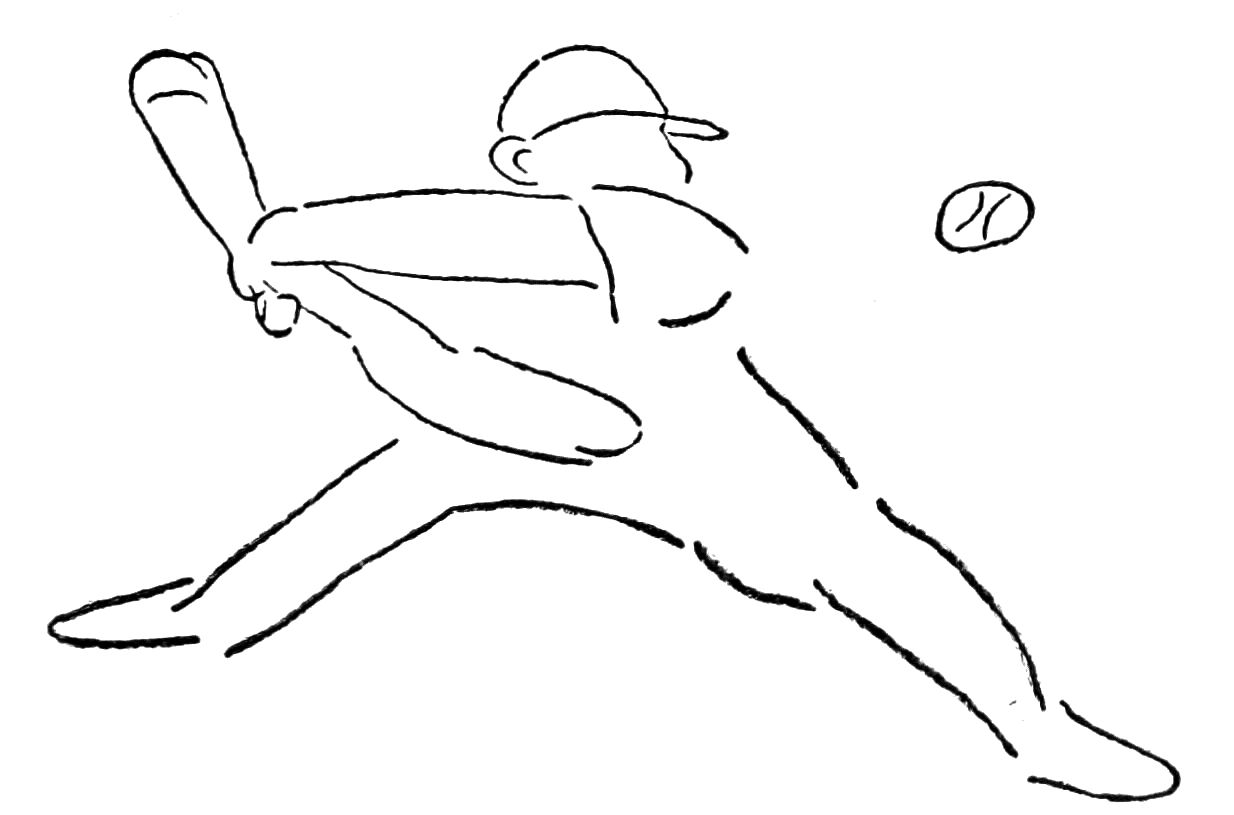
Fig. 1.
Sex Substitutes (Übertragung Period): Baseball.
At the turn of the century, the nation was on
a sound economic basis and men had the opportunity
to direct their attention away from the
mechanics of life to the pleasures of living. No
race can leap lightly, however, from an economic
value to an emotional value. There must
be a long period of Übertragung, long and tedious.
Men were not aware of this, thirty years
ago, because the science of psychology was not
far advanced, but nature came to their aid by
supplying a temporary substitute for an emotional
sex life, to tide them over during the
period of Übertragung. This substitute took
the form of games. Baseball assumed a
new and enormous importance; prize-fighting
reached its heyday; horse-racing became an absorption,
bicycling a craze.
Now women, naturally intraverts, could not
easily identify themselves with baseball or prize-fighting
(they admired Christy Mathewson and
Terry McGovern, but that was about all); they
took but slowly to horse-racing; and they giggled
and acted the fool when they first tried to
balance themselves on a bicycle. They drew
away from men and from men’s concerns, therefore—there
was no more of the old Union
Pacific camaraderie—and began to surround
the mere fact of their biological destiny with a
nimbus of ineffability. It got so that in speaking
of birth and other natural phenomena,
women seemed often to be discussing something
else, such as the Sistine Madonna or the
aurora borealis. They became mysterious to
themselves and to men; they became suddenly,
in their own eyes, as capable of miracle and as
worthy of worship as Juno and her sisters. This
could not go on. The conflict was ineluctable.
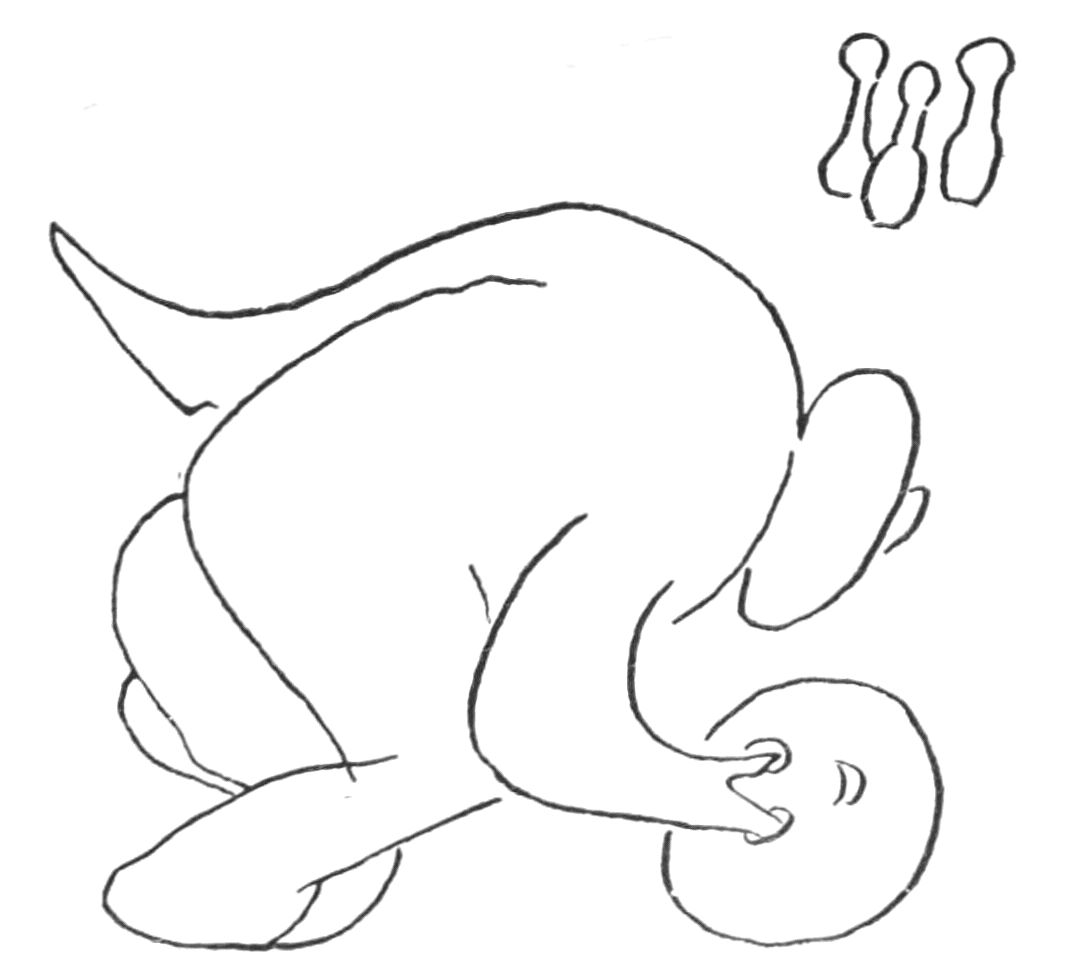
Fig. 2.
Sex Substitutes (Übertragung Period): Bowling.
When men, wearied of games, turned to
women with that urgency so notable in the
American male for its simplicity and directness,
they found them unprepared for acceptance
and surrender. The process of adjustment in
courtship and in marriage became more involved
than it had ever been before in the history of
the country, if not in the history of the world.
The new outdoors type of American man, with
all his strength and impetuosity, was not easily
to be put off. But the female, equipped with
a Defense far superior in polymorphous ingenuities
to the rather simple Attack of the
male, was prepared. She developed and perfected
the Diversion Subterfuge. Its purpose
was to put Man in his place. Its first manifestation
was fudge-making.
FUDGE-MAKING.
“The female, equipped with a
Defense far superior in polymorphous
ingenuities to the
rather simple Attack of the
male, developed, and perfected,
the Diversion Subterfuge.
The first manifestation
of this remarkable phenomenon
was fudge-making.”
The effectiveness of fudge-making in fending
off the male and impressing him with the
female’s divine unapproachability cannot be
overestimated. Neither can its potentiality as
a nuclear complex. The flitting from table to
stove, the constant necessity of stirring the boiling
confection, the running out-of-doors to see
if the candy had cooled and hardened, served
to abort any objective demonstrations at all on
the part of the male. He met this situation with
a strong Masculine Protest. He began to bring
a box of candy with him when he called, so that
there would not be any more fudge-making.
These years constituted the great Lowney’s era
in this country. Brought back to where she had
started, face to face with the male’s simple desire
to sit down and hold her, the female, still
intent upon avoidance of the tactual, retaliated
by suggesting Indoor Pastimes—one of the
greatest of all Delay Mechanisms. All manner
of parlor games came into being at this period,
notably charades,[4] which called for the presence
of other persons in the room (Numerical Protection).
The American male’s repugnance to
charades, which is equaled, perhaps, by his repugnance
to nothing else at all, goes back to
those years. The Masculine Protest, in this case,
was a counter-suggestion of some games of his
own, in which there was a greater possibility of
personal contact. His first suggestions were
quite primitive, such as that it would be fun to
count up to a hundred by kissing. The female’s
response was the famous one of Osculatory Justification.
There must be, she decreed, more
elaborate reasons for kissing than a mere exhibition
of purposeless arithmetical virtuosity. Thus
Post Office and Pillow were finally devised, as
a sort of compromise. Neither was satisfactory
to either sex. The situation became considerably
strained and relationships finally trailed
off into the even less satisfactory expedient of
going for long rides on a tandem bicycle, which
has had its serious effects upon the nature of the
American man. He liked, for one thing, to do
tricks on a bicycle. The contraption was new to
him, and he wanted to do tricks on it. One
trick that he liked especially was riding backwards.
But there wasn’t one woman in ten
thousand, riding frontwards on the rear seat of
a tandem wheel, who would permit her consort
to ride backwards on the front seat. The result
of all this was not adjustment, but irritability.
Man became frustrated.
“There wasn’t one woman in
ten thousand, riding frontwards
on the rear seat of a
tandem wheel, who would
permit her consort to ride
backwards on the front seat.
The result of all this was not
adjustment, but irritability.
Man became frustrated.”
Frustration wrought its inevitable results.
Men began to act jumpy and strange. They
were getting nowhere at all with women. The
female gradually assumed, in men’s eyes, as she
had in her own, the proportions of an unattainable
deity, something too precious to be touched.
The seed of Pedestalism was sown. The male,
in a sort of divine discontent, began to draw
apart by himself. This produced that separation
of the physical and the psychic which causes
the adult to remain in a state of suspended love,
as if he were holding a bowl of goldfish and
had nowhere to put it. This condition nowadays
would lead directly to a neurosis, but in
those days men were unable to develop a neurosis
because they didn’t know how. Men
withdrew, therefore, quietly and morosely, to
their “dens.” It was the epoch of the den in
America. Some marvelous ones sprang into
being. Their contents were curiously significant.
Deprived of possessing the female, the male
worked off his Possessive Complex by collecting
all manner of bibelots and bric-à-brac. The
average den contained a paper-weight from
Lookout Mountain, a jagged shell from Chickamauga,
a piece of wood from the Maine, pictures
of baseball-players with beards, pictures of
bicycle champions, a yellowing full-page photograph
of Admiral Schley, a letter-opener from
Niagara Falls, a lithograph of Bob Fitzsimmons,
a musket-badge from the G. A. R. parade, a red
tumbler from the state fair, a photograph of
Julia Marlowe, a monk’s head match-holder, a
Malay kriss, five pipe racks, a shark’s tooth, a
starfish, a snapshot of the owner’s father’s bowling
team, colored pictures of Natural Bridge
and Balanced Rock, a leather table runner with
an Indian chief on it, and the spangled jacket
of a masquerade costume, softly shedding its
sequins.
Fig. 3.
Sex Substitutes (Übertragung Period): Craps.
The den was the beginning of male sublimation
in this country, but the fruits of that sublimation
were slow in ripening. At the start,
in fact, they were in a state of absolute suspension.
Man began to preoccupy himself with
anything, no matter how trivial, which might
help him to “forget,” as the lay expression has
it. He thought up childish diversions, at which
one person can amuse himself, and to justify his
absorption in these futile pastimes he exaggerated
their importance, as we shall see. These
diversions included the diabolo, the jig-saw puzzle,
linked nails and linked keys, which men
took apart and put back together again, and
most important of all, pigs-in-clover.
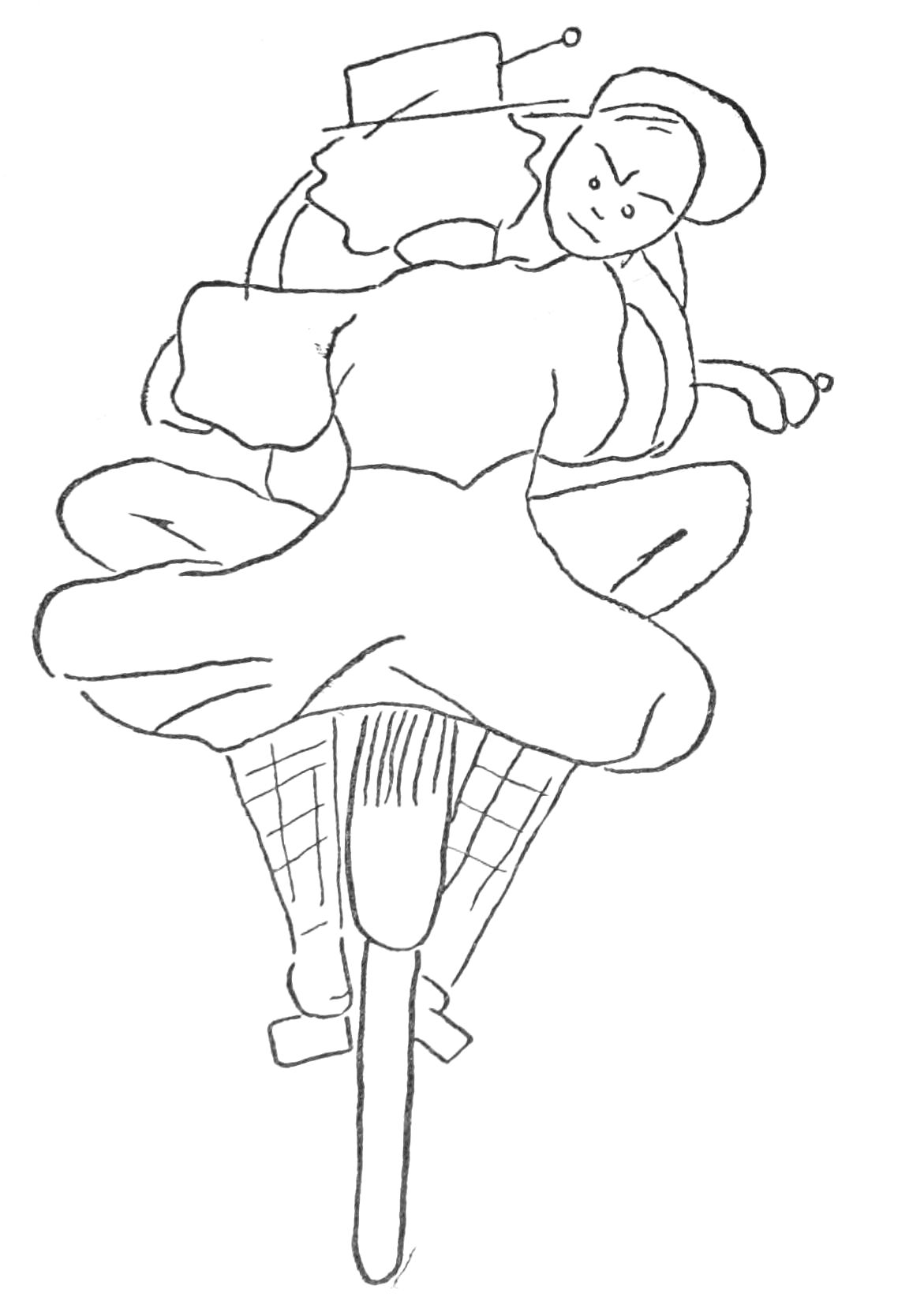
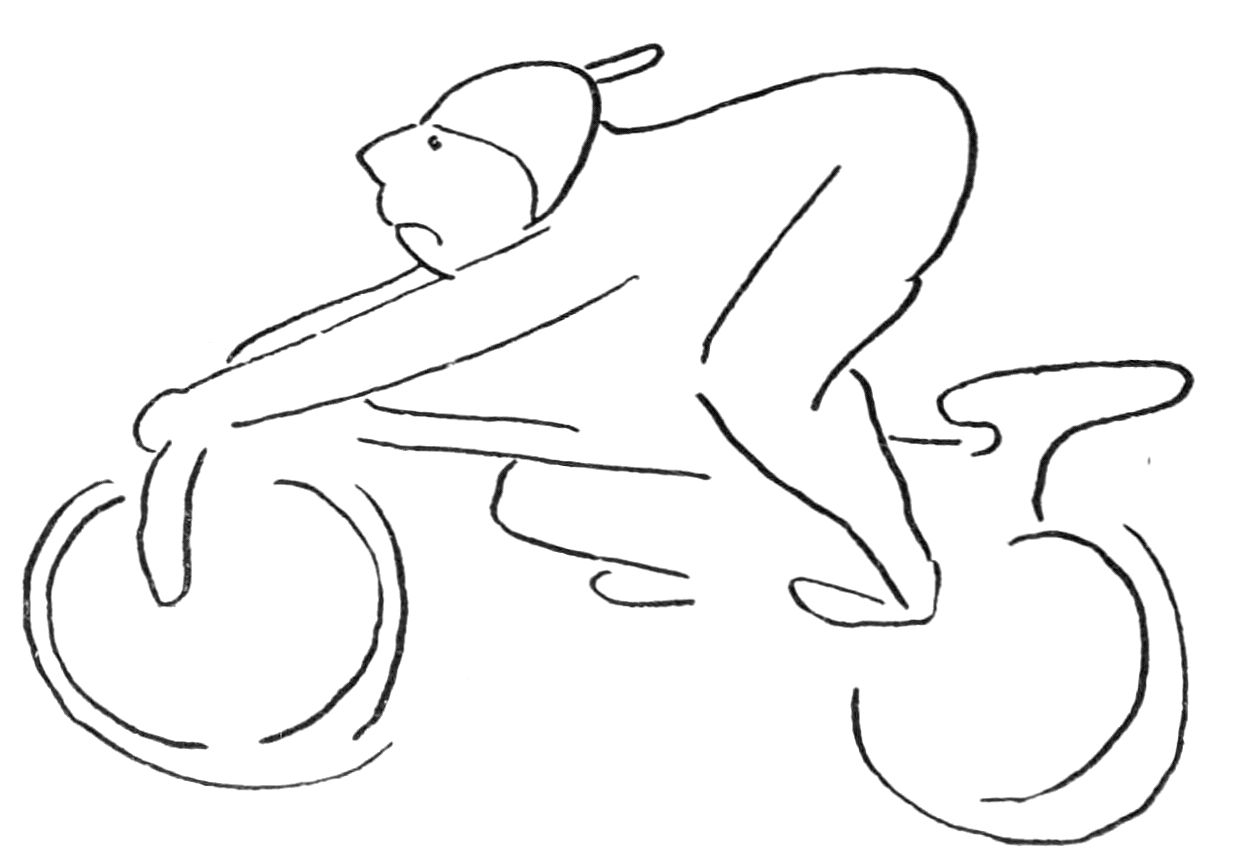
Fig. 4.
Sex Substitutes (Übertragung Period): Six-day Bicycle Racing.
During this period almost no achievements
of value, in art, science, or engineering, were
forthcoming in the nation. Art, indeed, consisted
chiefly of putting strange devices on boxes
with the aid of a wood-burning set. The commonest
device was the swastika, whose curiously
distorted conformation bears no discernible
relationship to any known phallic symbolism.
Those years were blank, idle, lost years.
Outside affairs of all kinds were neglected.
Men retired to their dens and were not seen for
days. The panic of 1907 was a direct result.
It might be interesting to examine into a typical
case history of the period.
George Smith, aged 32, real estate operator.
Unmarried, lived with mother. No precocious
mother fixation. Had freed his libido without
difficulty from familial objects, and was eager
to marry. Had formed an attachment in 1899,
at the age of 29, with a young virgin. Her Protective
Reactions had been immediate and lasted
over a period of three years, during which he
had never even held her hand. Defense Devices:
usually euchre (four-handed), or pedro.
Definite and frequent fudge-making subterfuge.
Post Office and Pillow, both with low degree of
success.
Smith’s separation between the physical and
the psychic occurred in 1902, the direct stimuli
presenting themselves on June 6th of that year,
examination (by Dr. Matthiessen) showed. On
that day Smith ran, frightened, from a barber-shop
in Indianapolis, where he lived. Inside
the shop, on the floor, a middle-aged man named
Herschel Queeper had thrown a fit. Queeper
had been trying for two days to get three little
balls, under a glass in a tiny round box, to roll
into an opening made for them (common pigs-in-clover
puzzle). But no sooner would he get
the third one in than one, or perhaps both, of
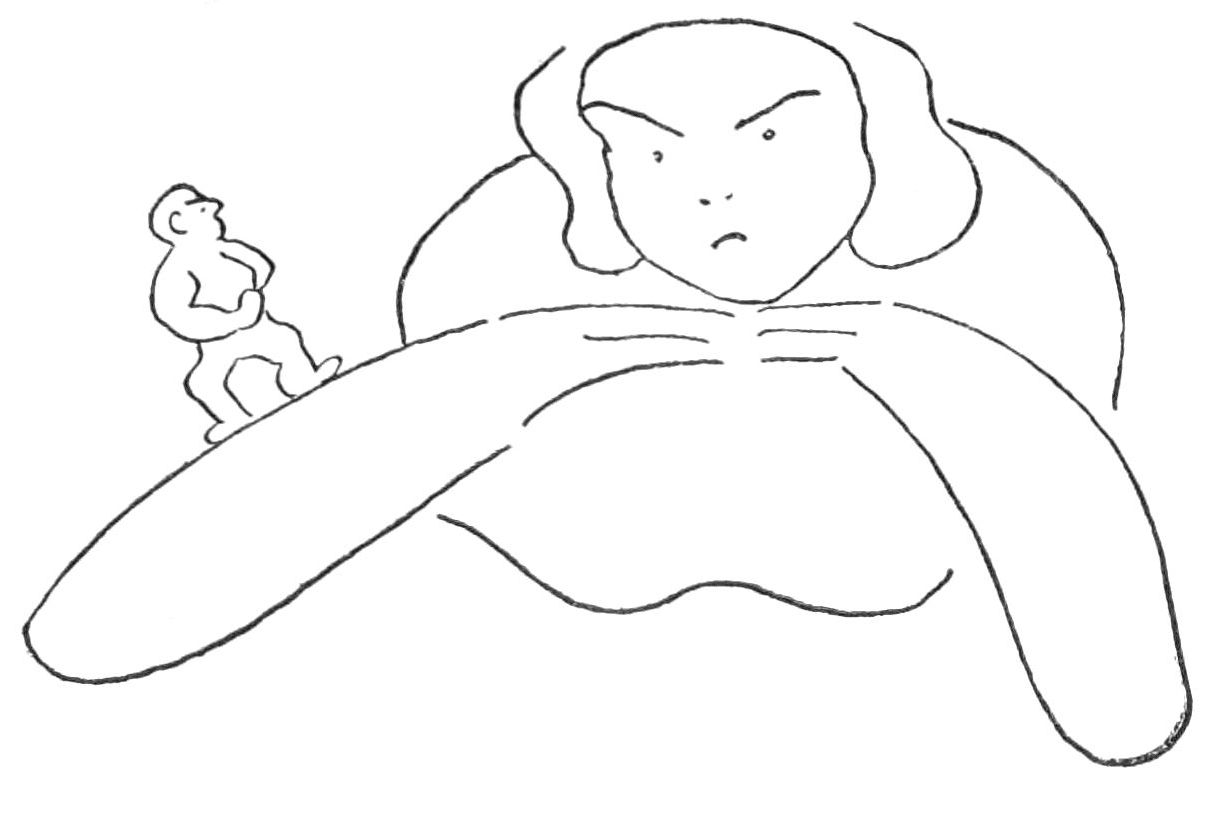
the others would roll out. Mrs. Queeper was
beginning to wonder where he was.
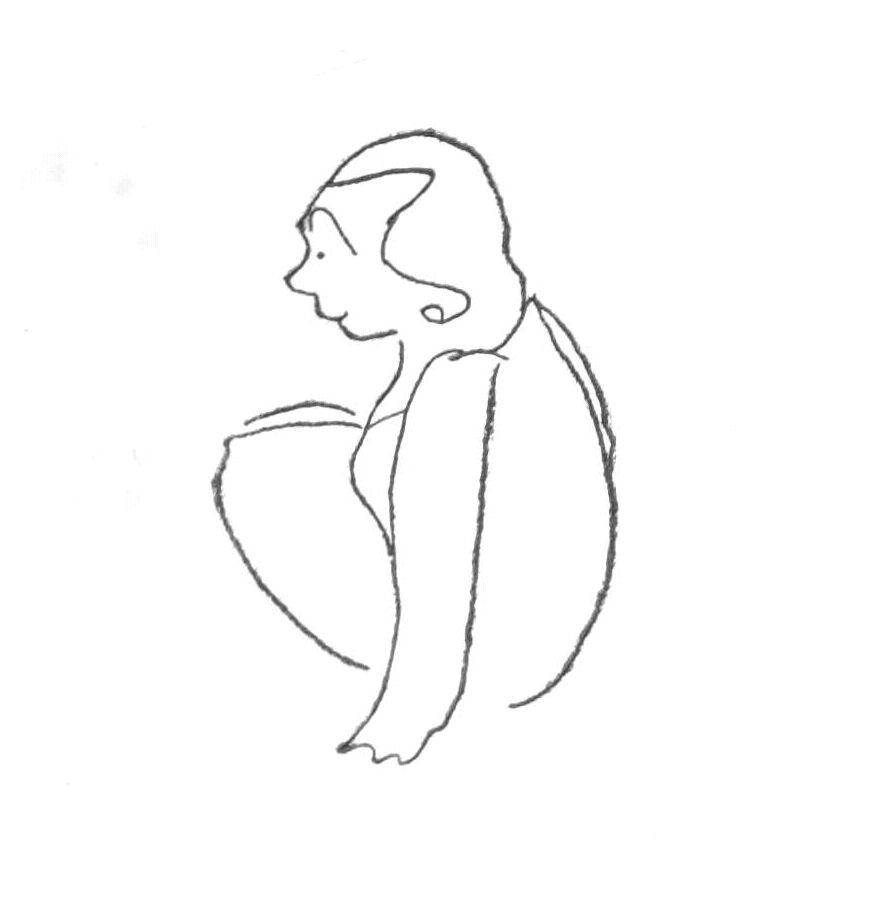
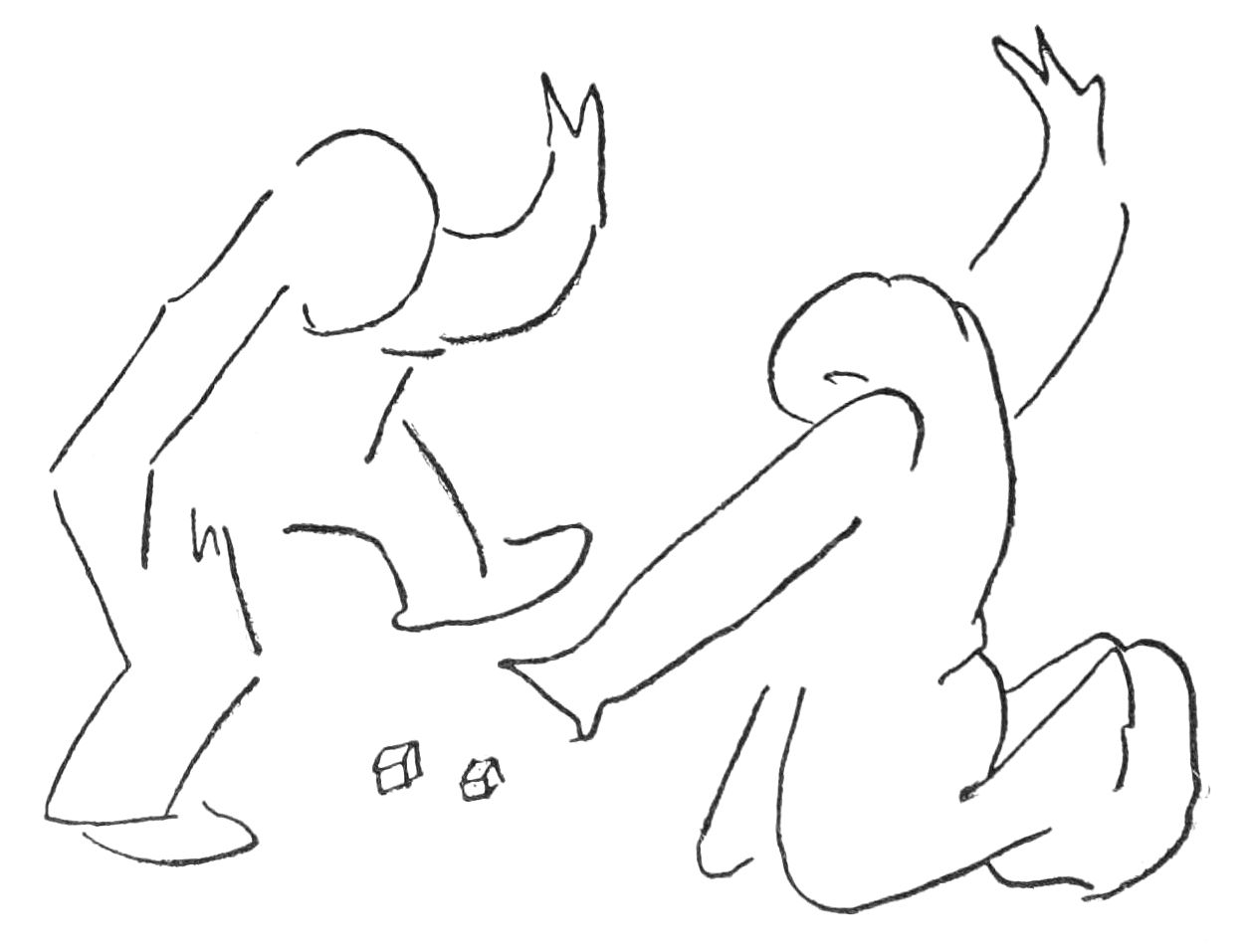
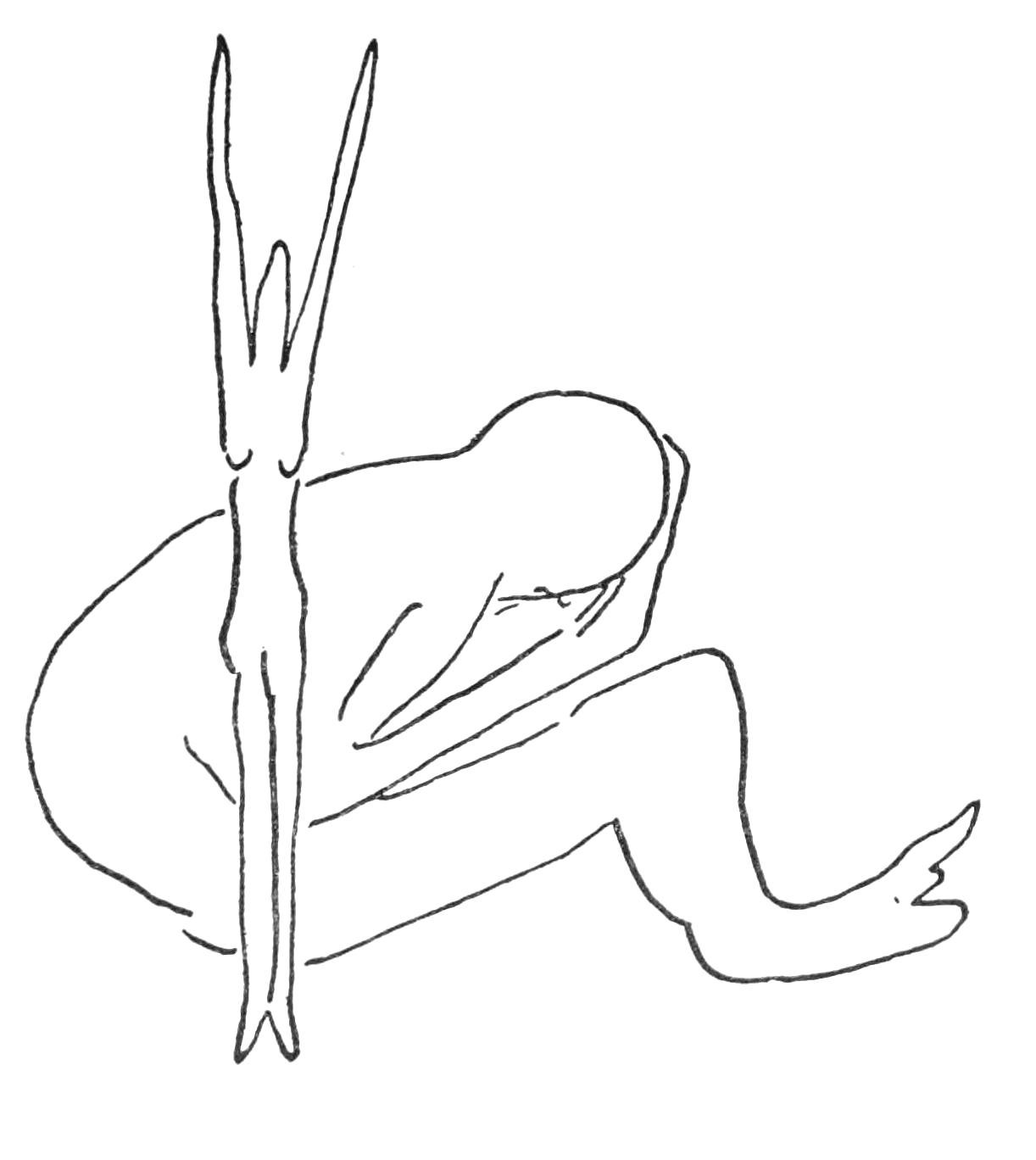
UNCONSCIOUS DRAWING:
PLATE I.
Unconscious drawings, as they
are called in psychoanalytical
terminology, are made by
people when their minds are
a blank. This drawing was
made by Floyd Neumann, of
South Norwalk. It represents
the Male Ego being importuned
by, but refusing to yield
to, Connecticut Beautiful.
Smith withdrew to his den and pondered and
fiddled around and made Unconscious Drawings
(Cf. Plates I, II, III and IV). He turned
his attention from the object of his amorous
affections to a consideration of the problems of
pigs-in-clover. The usual Justification of Occupation
occurred. It took the form of exaggerating
the importance of finding out whether the
puzzle could possibly be solved, and of working
out a methodology of solving it more readily,
if it could be solved at all. The case procured
one of the little boxes and began to roll the balls
toward the opening. At first he set about it
quite calmly. There were no immediate signs of
mental deterioration, either malignant or benign.
But although the case got all the balls
into the opening, thus proving that it could be
done, he never got them all in at the same time.
In the second month he threw a brief fit. This,
today, would ordinarily prove the first step toward
a complete physico-psychic breakdown, but
in those days neuroses were staved off longer,
owing to the general ignorance of psychology,
and Smith not only calmly examined the effect of
the fit upon himself, without calling in any
scientists, but determined to go on and examine
the effects of fits upon others. He decided,
however, that it would be difficult to
examine the effects of puzzle-fits upon men, because
men brooked no examination when they
were intent upon puzzles, and so he hit on the
idea of having his dog, an animal named
Dewey, play with the little round box until it
threw a fit. But when he called in his dog he
found, after several experiments, that the dog
could not hold the box in either its right or left
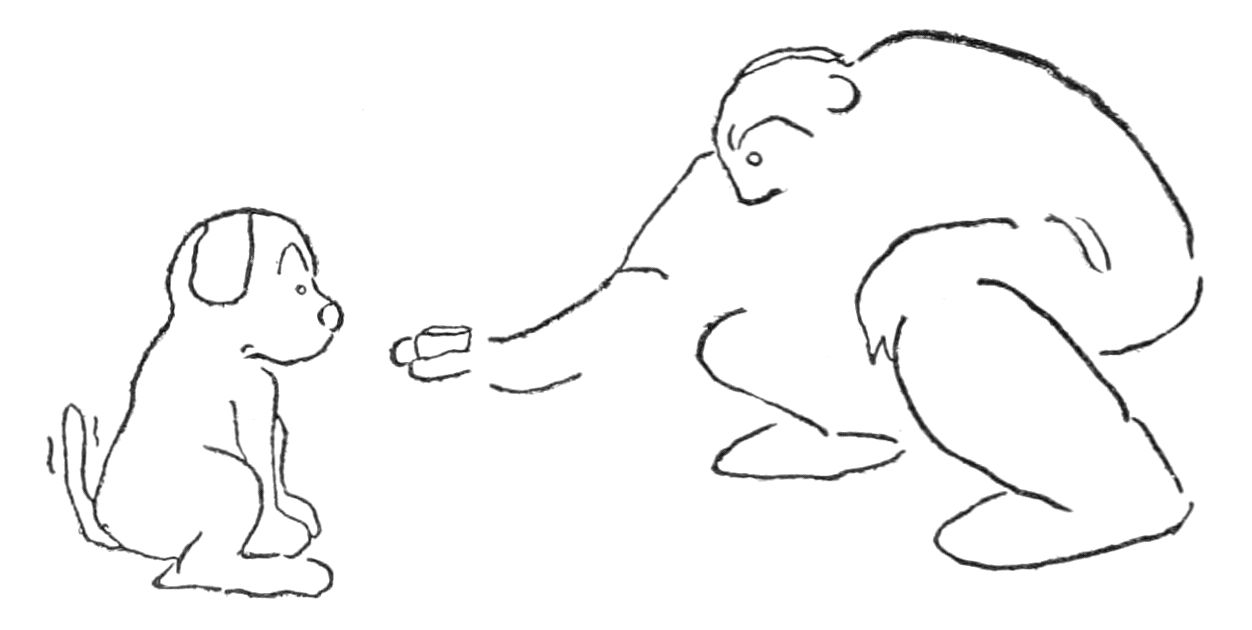
paw.[5] Furthermore, the animal was profoundly
incurious about the puzzle.[6]
[5] This presented a difficulty that has not been overcome to this
day.
[6] This disinterest held good up until the day of the dog’s death.
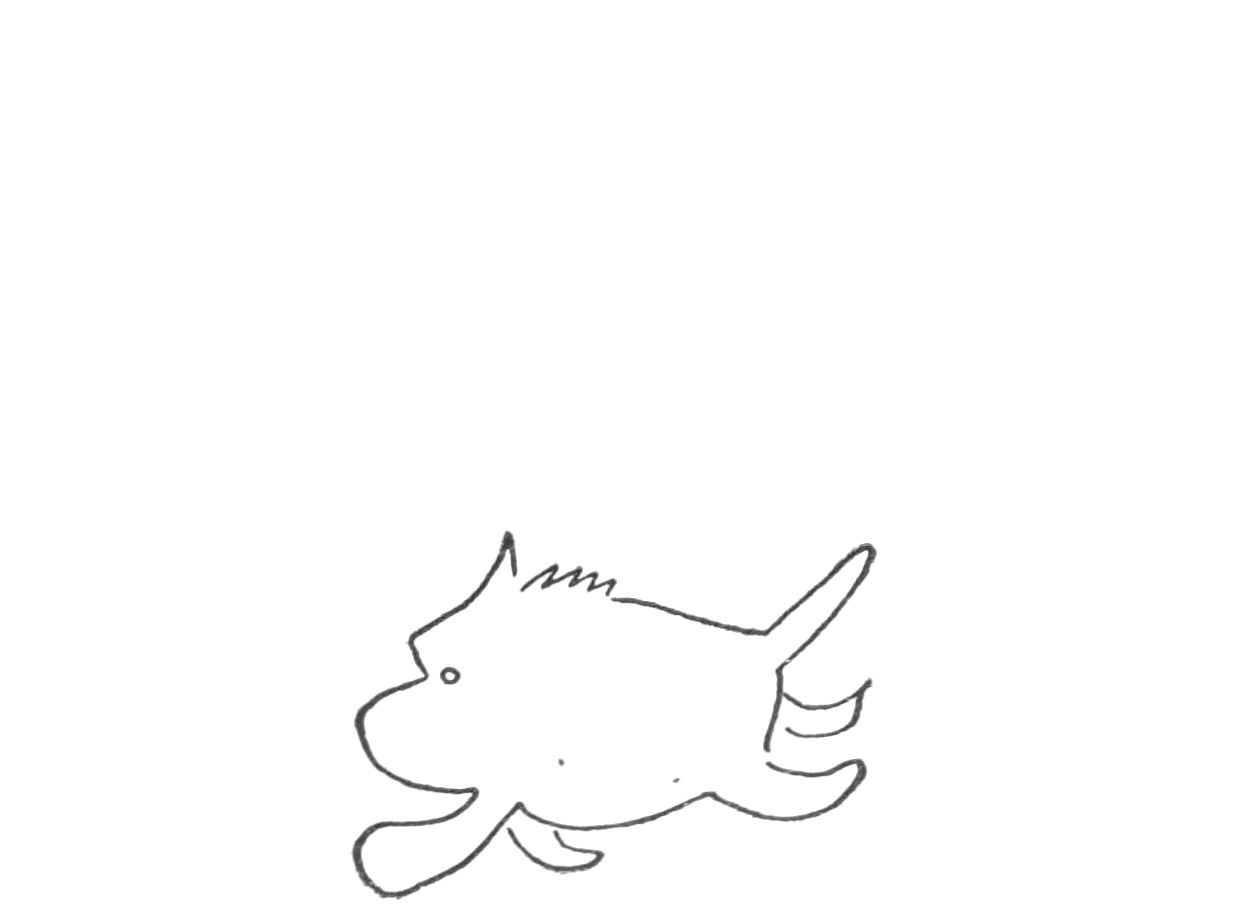
“Furthermore, the animal was profoundly incurious about
the puzzle.”
Undismayed, Smith decided that somewhere
in Indianapolis there must be a dog adroit
enough to handle the box and sagacious enough
to grasp the idea behind it, and with a view to
finding such an animal, he determined to get all
the dogs in town, and all the pigs-in-clover puzzles
in town, into one room and see what would
happen. (Apotheosis Complex, with Plurality
Fallacy.)
Smith was able, however, to round up only
about 85 per cent of the dogs of the city, because
there were many who were too busy to get
away at the time. Even so, 85 per cent of the
dogs in Indianapolis was more than had ever
been got together in one room before. The
case attempted to explain the problem to the
dogs in short, one-syllable talks, but the bedlam
was too loud and too prolonged for him to
make himself heard. Fifty or more St. Bernards
and a few dozen Chesapeake spaniels listened,
half-heartedly, but the others made holiday.
Furthermore, eighty-four bulldogs would not
permit themselves to be muzzled, and this added
to Smith’s difficulties. Thus, on the fifth day
of the singular experiment, Smith, hearing a remarkable
hullaballoo belowstairs (he worked
in the attic), descended to the parlor, where he
discovered the bulldogs engaged in a sort of
tug-of-war, using a body Brussels carpet as a
rope. (The case’s mother had several days before
retreated to French Lick, in a rundown condition.)
Smith grasped the carpet firmly, with some
idea of wresting it away from the dogs, whereupon
all of them save three began to pull against
him.[7] The Exaggeration Complex under which
the case was laboring gave him strength enough
to meet with some small success in his first
efforts to take the carpet away from the dogs.
He pulled them as far as the bay window in
the parlor, largely because they had not settled
down seriously to winning. When they did,
however, the total of three hundred and twenty-four
solidly implanted feet and the virtually immeasurable
tugging potentiality were too much
for Smith. He was slowly pulled out into the
hall, through the front door, and into the street.
He stubbornly contested every inch of the way
until a drug store, three blocks away, was
reached. Here some one had the presence of
mind to call out the fire department.
[7] These three had closed their eyes, to hang on, and did not see
Smith.
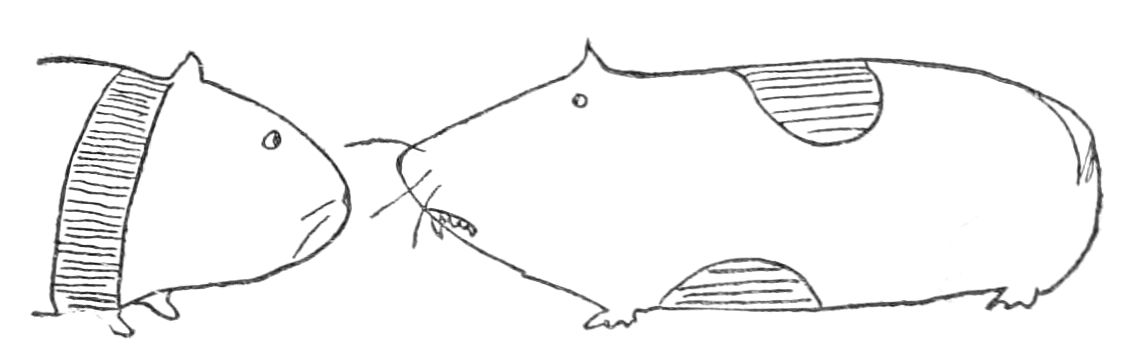
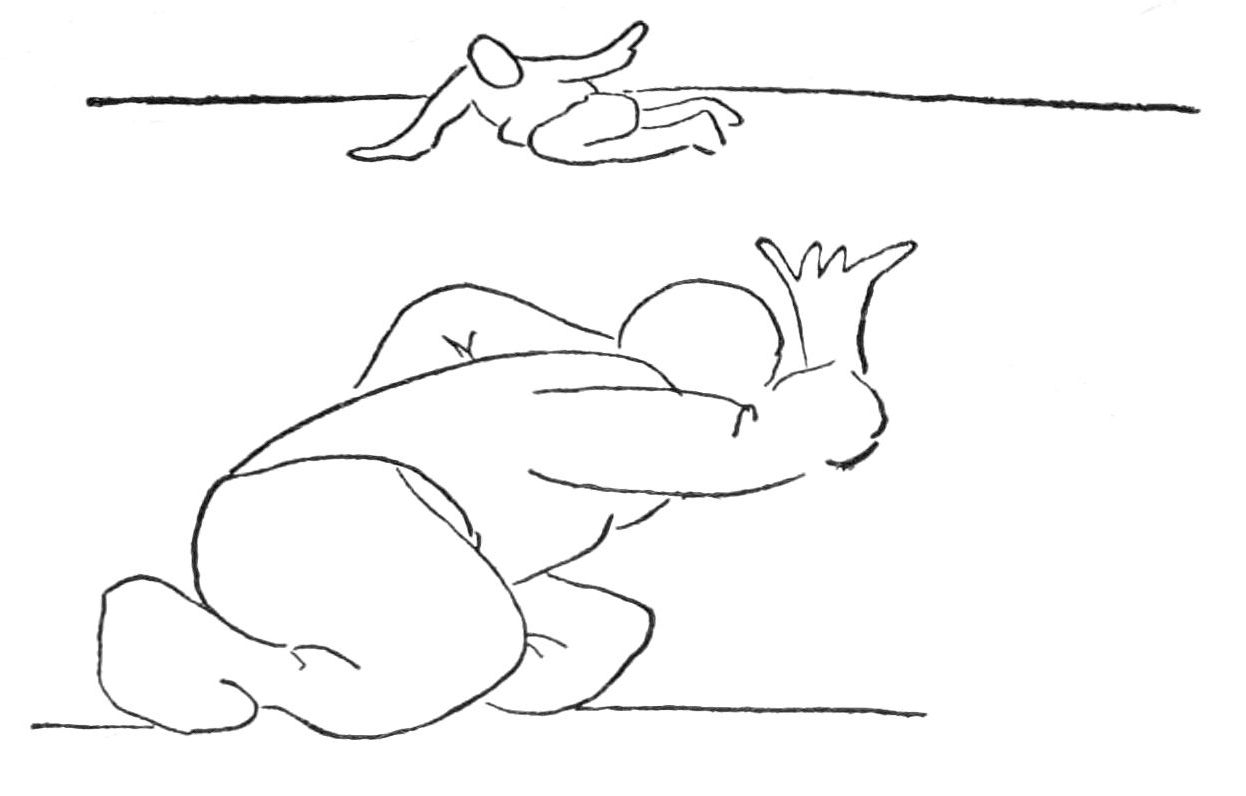
UNCONSCIOUS DRAWING:
PLATE II.
This was drawn by Peter Zinsner,
564 DeKalb Avenue,
Brooklyn, without knowing it.
We here see Sublimation in
conflict with the Libido. Peter
has reached a point in life
where women seem so divine
he doesn’t dare call them up
on the phone. Yet they still
call him.
Dr. Matthiessen, who took the case at about
this period in its development, attempted to reduce
the Magnification of Objective, first by
Analytic Reasoning, and then by cold applications.
Neither was successful. Matthiessen
could not divert the libido. Smith declined to
resume his interest in the feminine object of his
affections, and insisted that his experiment with
puzzles was a glorious project for the benefit
of mankind.
It was sheer accident that saved the patient—not
Dr. Matthiessen. Smith finally refused Dr.
Matthiessen admittance to his house, nor would
he go to the doctor’s office, claiming that he did
not believe in psychology, but one day he
dropped one of the little pigs-in-clover puzzles
and broke the glass in it. He then found that
he did not have to roll the balls into the openings,
but could push them in with his finger.
He got a hammer and broke the glass in all the
thousands of puzzles he had brought to his
home for the dogs, and solved every one of
the puzzles by pushing, not rolling. This instantly
released him from his complex by the
Gordian Knot principle of complex release. He
thus gained the necessary confidence and sense
of power to feel worthy of the woman with
whom he was in love, and he finally married her.
The marriage was of average success.
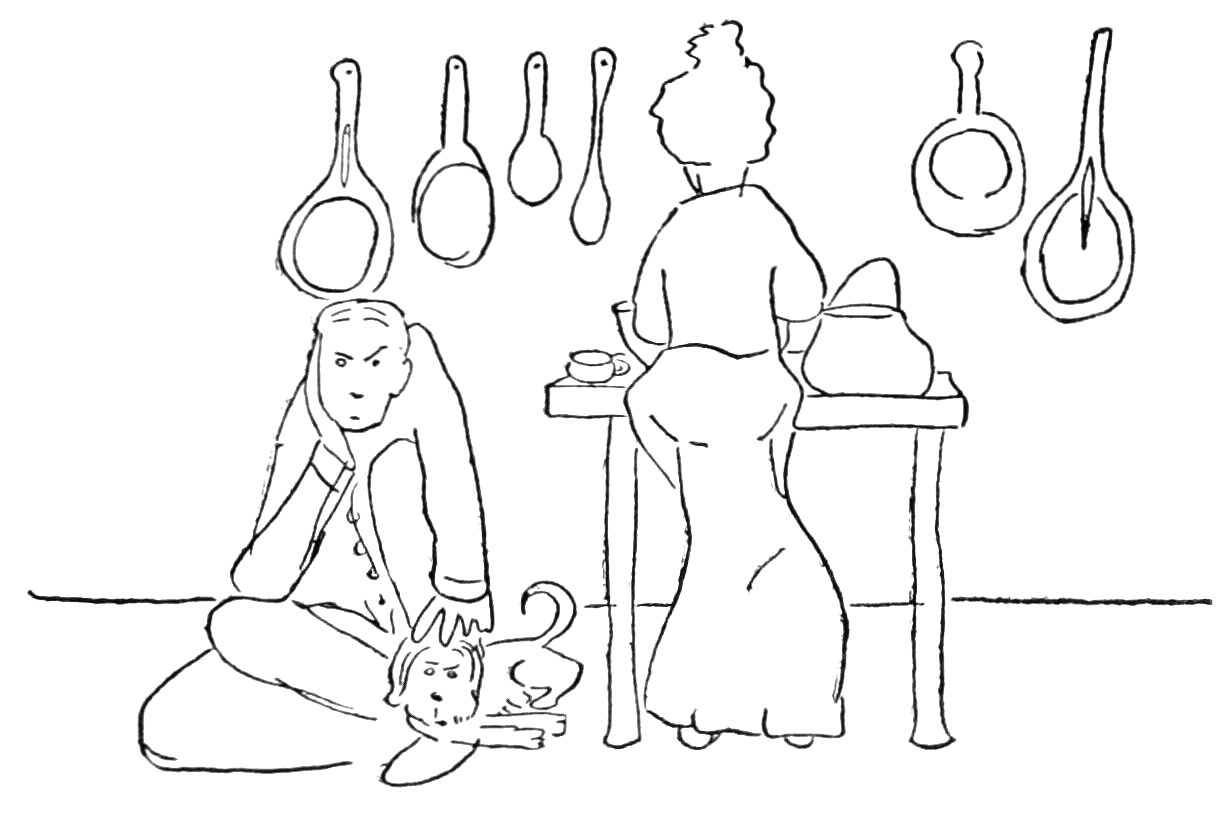
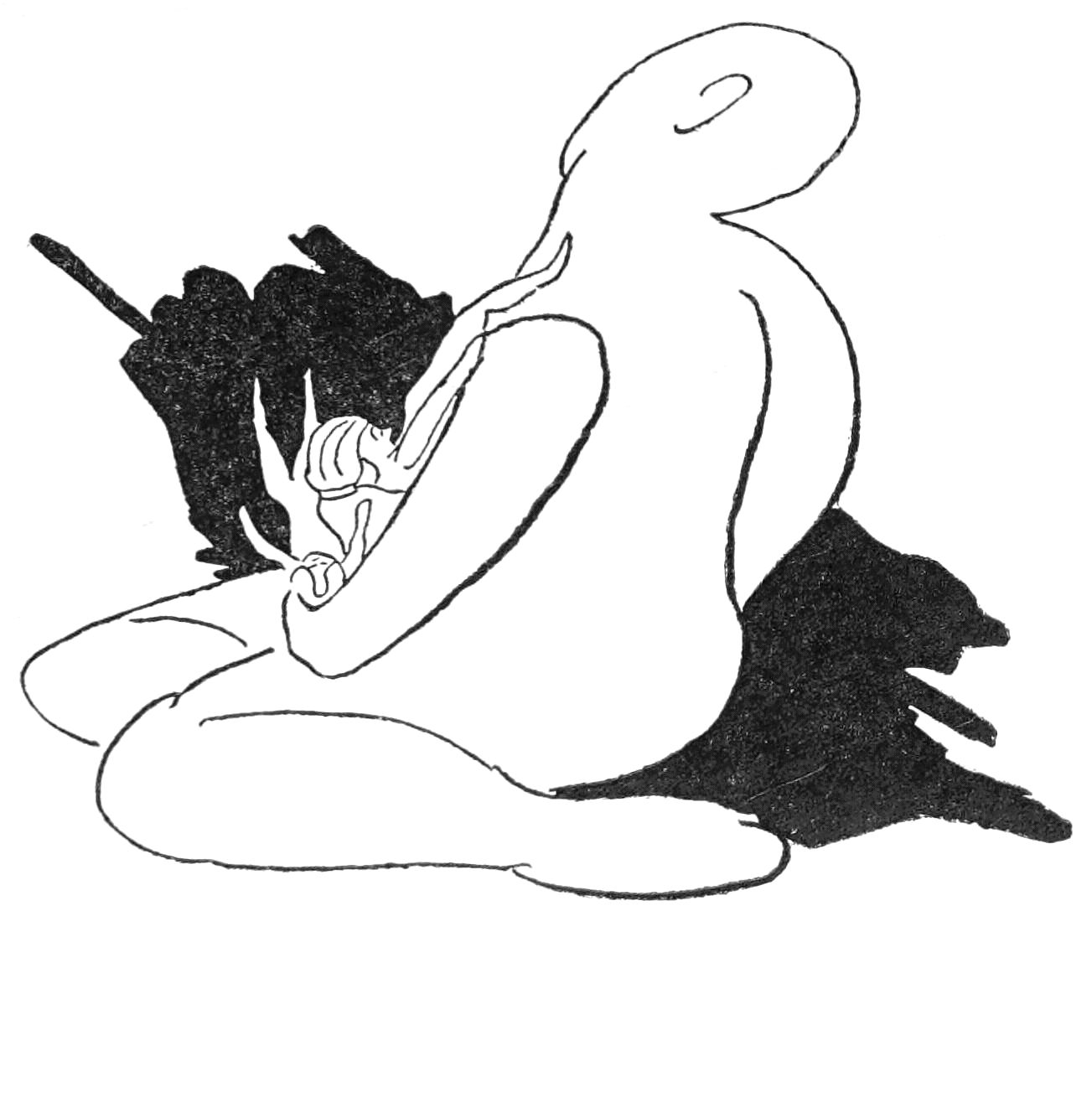
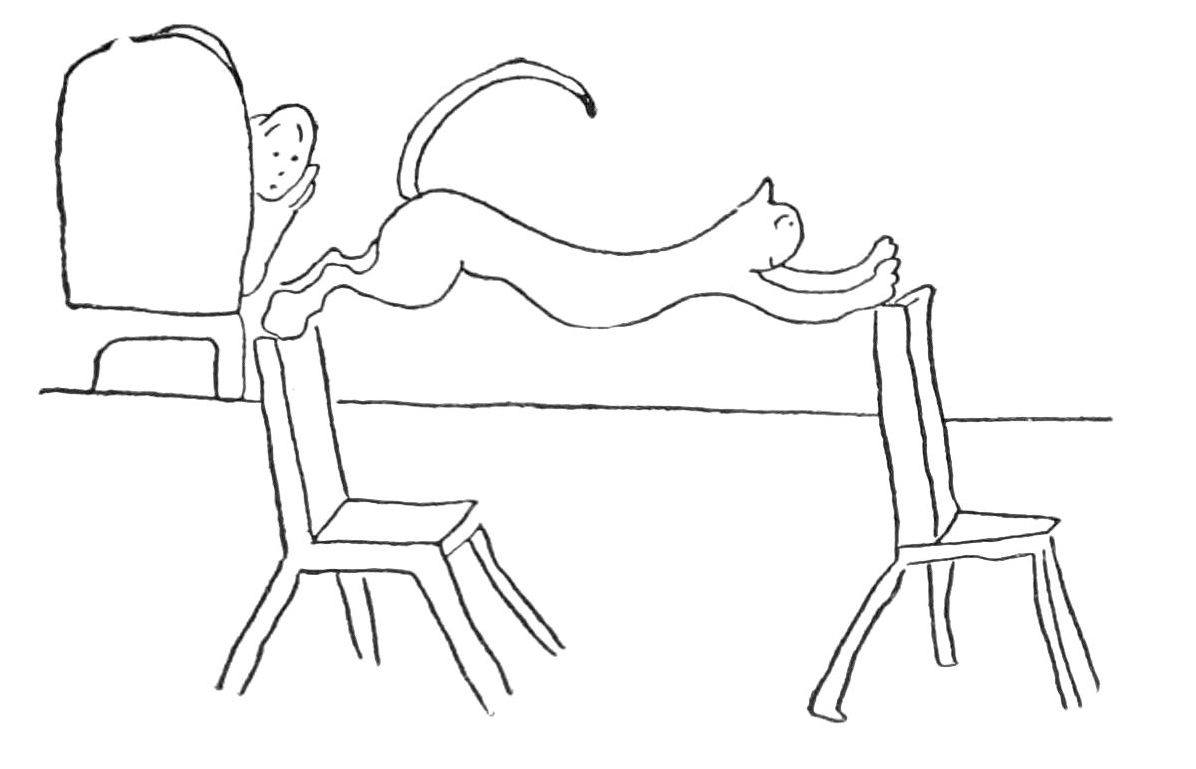
This drawing was made from
an old 1901 lantern slide
often used by Dr. Karl Zaner
in his illustrated lecture,
“What Can We Learn from
Animals?” Dr. Zaner has always
contended that we can
learn nothing of importance
from animals beyond a few
pointers on the art of relaxation.
“Their general activities
are, as a rule, not only
meaningless to man, but frequently
to themselves as well.
This particular cat, for example,
probably had nothing
special in mind at all.”
Marriages, however, were frequently delayed
much longer than in the case of George Smith,
and it was not, indeed, until 1909 that the usual
norm was restored. Meanwhile, in between the
time of the first general separation of the physical
and the psychic in this country, and the final
culmination in marriages, a period of sublimation
set in. This followed directly on the heels
of the remarkable and lamentable era of preoccupation
with trivial diversions and was characterized
by an extravert interest in truly important
projects and activities. The airplane
was brought to a high stage of development,
the telephone transmitter was perfected, tungsten
replaced carbon as a filament for incandescent
lamps, better books were written, art
progressed, there was a cultural advance generally
and the birth of a new Æsthetic, and
people began to get at the real facts in the Thaw
case. Nevertheless, Pedestalism has left its
serious effects. It is doubtful if they will fully
wear off for another fifty or seventy-five years.
CHAPTER II How to Tell Love from Passion — UNCERTAINTY IN THE MIDDLE OF AN EMBRACE
At a certain point in every person’s amours,
the question arises: “Am I in love, or am I
merely inflamed by passion?”
It is a disturbing question. Usually it arises
at some inopportune moment: at the start of
a letter, in the middle of an embrace, at the
end of a day in the country. If the person could
supply a direct, simple, positive answer—if he
could say convincingly, “I am in love,” or, “This
is not love, this is passion”—he would spare
himself many hours of mental discomfort. Almost
nobody can arrive at so simple a reply.
The conclusion a man commonly arrives at, after
tossing the argument about, is something after
this fashion: “I am in love, all right, but just
the same I don’t like the way I looked at Miriam
last night.” Or, “Mirabel is a tidy little wench,
and in that case why do I waste time composing
a quatrain for her, to be sent with a crushed
spray of lilac? Why don’t I just go right over?”
“At a certain point in every person’s amours, the question arises:
‘Am I in love, or am I merely inflamed by passion?’”
One reason a man has trouble telling love
from passion is because neither term has been
clearly defined. Even after one has experienced
love, one finds difficulty defining it. Likewise,
one may define it and then have all kinds of
trouble experiencing it, because, once having defined
it, one is in too pompous a frame of mind
ever again to submit to its sweet illusion. By
and large, love is easier to experience before it
has been explained—easier and cleaner. The
same holds true of passion. Understanding the
principles of passion is like knowing how to
drive a car; once mastered, all is smoothed out;
no more does one experience the feeling of perilous
adventure, the misgivings, the diverting
little hesitancies, the wrong turns, the false
starts, the glorious insecurity. All is smoothed
out, and all, so to speak, is lost.
The word “love” is used loosely by writers,
and they know it. Furthermore, the word
“love” is accepted loosely by readers, and they
know it. There are many kinds of love, but
for the purposes of this article I shall confine
my discussion to the usual hazy interpretation:
the strange bewilderment which overtakes one
person on account of another person. Thus,
when I say love in this article, you will take it
to mean the pleasant confusion which we know
exists. When I say passion, I mean passion.
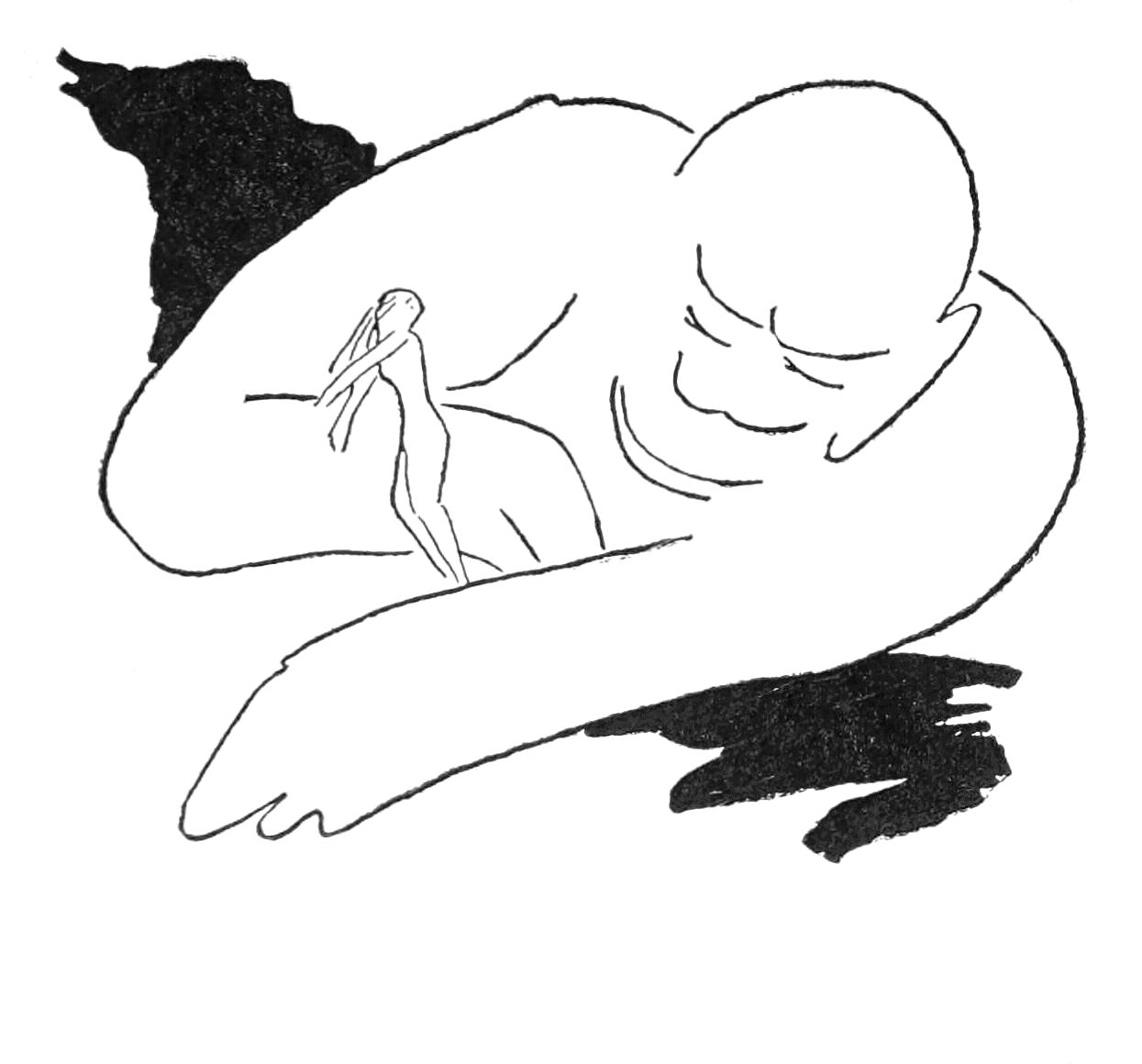
UNCONSCIOUS DRAWING:
PLATE III.
This is the work of Grace McFadden,
aged 11, of Bucyrus,
Ohio (R. F. D. # 3, Bucyrus
6021, Ring 3), and was drawn
on the day that Principal K.
L. Mooney, of the Paulding
County Concentration Grade
Schools, was married. Here
the Pleasure-Principle and the
Wish Motive are both overshadowed
by the Bridegroom
Fallacy.
I have mentioned that the question of deciding
whether a feeling be love or passion arises
at inopportune moments, such as at the start of
a letter. Let us say you have sat down to write
a letter to your lady. There has been a normal
amount of preparation for the ordeal, such as
clearing a space on the desk (in doing which
you have become momentarily interested in a
little article in last month’s Scribner’s called,
“Plumbing the Savage,” and have stood for a
minute reading the first page and deciding to let
it go), and the normal amount of false alarms,
such as sitting down and discovering that you
have no cigarettes. (Note: if you think you can
write the letter without cigarettes, it is not love,
it is passion.) Finally you get settled and you
write the words; “Anne darling.” If you like
commas, you put a comma after “darling”; if
you like colons, a colon; if dashes, a dash. If
you don’t care what punctuation mark you put
after “darling,” the chances are you are in love—although
you may just be uneducated, who
knows?
Now, you have written the words “Anne darling”
and have put a punctuation mark there.
You pause for just a second, and in that second
you are lost. “Darling?” you say to yourself.
“Darling? Is she my darling, or isn’t she?
And if she is my darling, as I have so brazenly
set down on this sheet of paper, what caused me
to take such a long, critical look at the girl in
the red-and-brown scarf this morning when I
was breakfasting in the Brevoort? If I can be
all aglow about a girl in a red-and-brown scarf
in the early morning, is Anne my darling, or am
I just kidding myself?”
Then follows a brief estimate of the comparative
beauty of Anne and the girl in the scarf,
with the girl in the scarf coming out half a
length ahead. This is followed by a short dialogue
which you hold with yourself.
“What if she was prettier?” you say. “What
does that amount to? I’m not a child. I know
there’s more to the story than mere physical
beauty.”
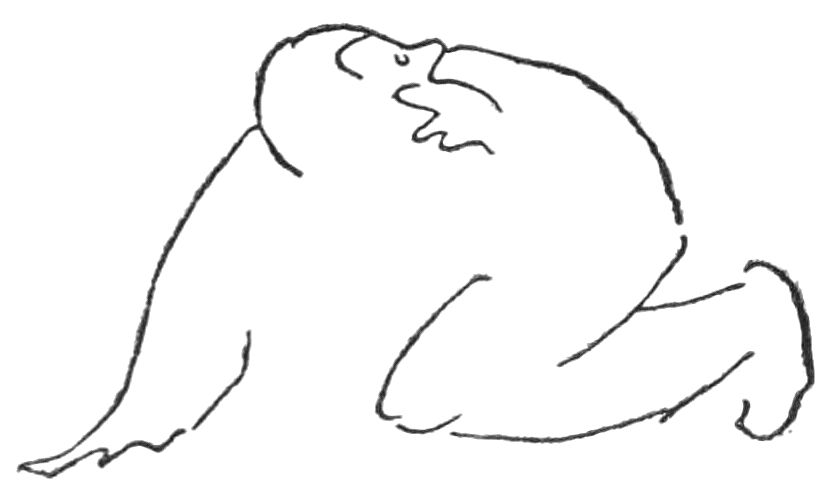
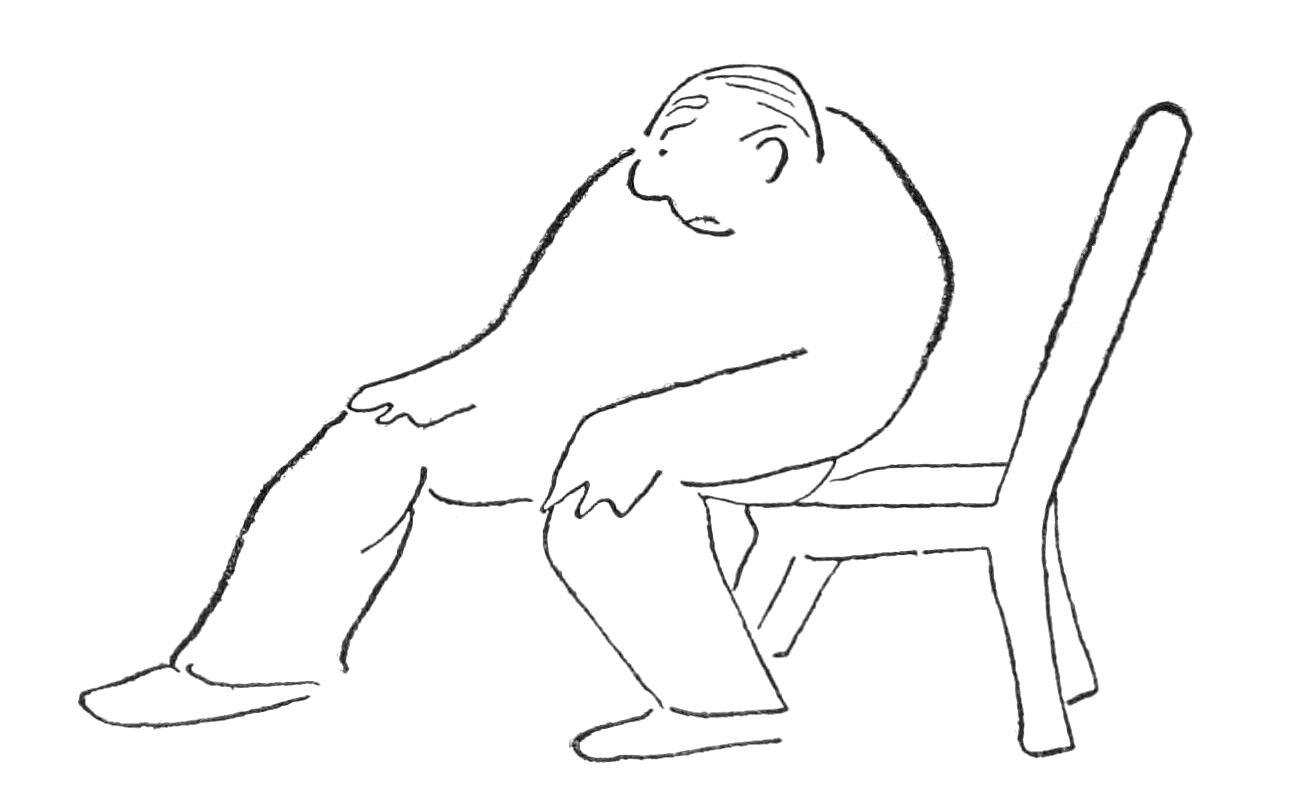
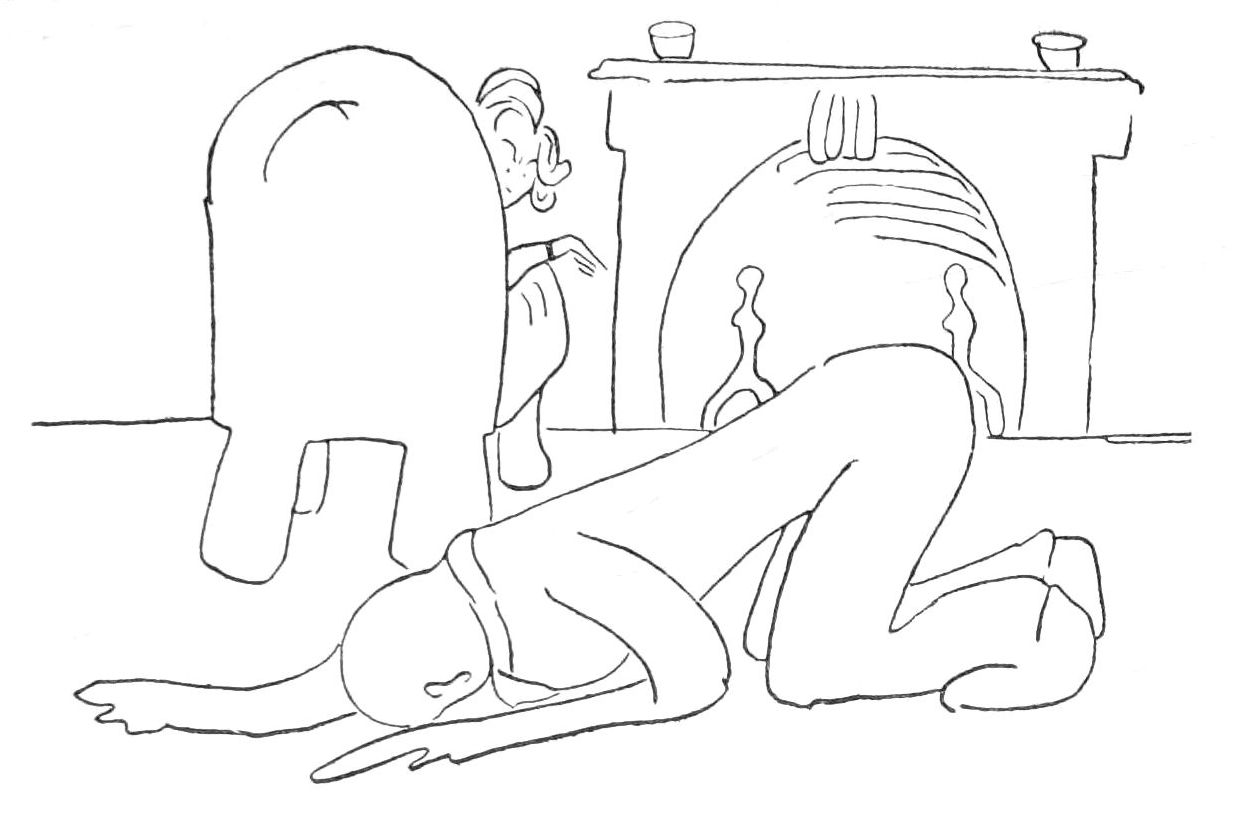
AMERICAN MALE
POSTURES: PLATE I.
American men, more than any
others, permit the complexities
of the psycho-physical world
to get them down. Often,
while down, they will pass
each other going somewhere,
and exchange a small greeting.
“What more is there?” you quietly demand,
testing yourself out.
“Oh, there’s quality of mind, and community
of interest, and chemical attraction (chemical attraction
is a term you’ve picked up recently from
reading books on sex and life). When I get
right down to it, if I were to meet that girl in
the scarf, I probably wouldn’t like her.”
“No, but you want to meet her, all the samey,
don’t you?”
“Well ... I mean ... a man can’t; I
mean....”
“Yah, you know you want to meet her!”
“Aw, shut up!”
Having got nowhere with that theme, you
again bend to the mighty task of writing the
first sentence of the letter. A minute or two
of quiet brooding and the truth comes to you
that you have nothing to say, that you wrote
all the news yesterday, that you consider it pretty
silly to be writing another letter so soon, and
that if anyone were to ask you, you don’t really
want to write Anne a letter at all.
“Well, so that’s the way the wind blows!”
you say to yourself, contemptuously. “So
that’s the way things are between Anne and
you! Not wanting to write her. So it’s come
to that. Well, it’s about time you got wise to
yourself. If you don’t love Anne it’s certainly
high time you found it out, in justice to both
Anne and yourself. In other words, you never
loved Anne at all—you merely gave in to an infatuation.
You were thinking about the physical
side of the affair; yes, sir, you desired Anne,
that’s what you did. You desired her! Why,
you dirty, low-down, two-faced old voluptuary
you....”
The utter shame of this situation breaks your
spirit and you lay down your pen, light up a
cigarette, and pace up and down the room.
Suddenly you dash to the desk, with a look of
woeful determination, seize the pen, and write
(after the words “Anne darling,” which are
good and dry by this time): “I have been wanting
to tell you something for a long time. We
must look things straight in the face, Anne.”
You then look things straight in the face for ten
minutes, during which you don’t write a word,
and end by tearing the letter up and quickly
dashing off another, which reads: “Anne, I’m
awfully tired tonight, nervous, etc., and if I
wrote you it would just be a bunch of hooey, so
think I will wait till tomorrow before writing.
Love, Bert.” This you mail at the corner and
spend the rest of the evening trying to read
“Plumbing the Savage,” which results finally in
sleep—sleep troubled by dreams of savages
wearing loin cloths of a familiar red-and-brown
material.
This vexing disbelief in one’s own illusion of
love is experienced most alarmingly by persons
of literary inclinations. Yet with them the reaction
comes in quite the opposite manner.
Writing is a form of sexual expression (Zaner
goes further: he says writing is sex), and it takes
just as much out of a person. Thus, a person
with a bent for creative literature approaches
the task of writing a love letter with an excitation
of the spirit surpassing anything in the
realm of pure eroticism. He anticipates it for
hours, mulling over in his mind the possible
material, enlarging on anecdotes, rounding off
pledges of affection, sharpening similes, sharpening
pencils; he comes to the writing of it with
immense zeal and a rather nice control of lyrical
prose; he ends on a splendidly poised and
correctly balanced note of tenderness and faith
and love; and then, having signed, sealed, and
posted the missive, is suddenly overcome by the
realization that by the very act of composition he
has annulled the allure of the subject herself—cares
no more about her, for the moment, than
he does for an old piece of butcher’s twine,
which, all in all, is so alarming a discovery that
he usually gets a little bit sick thinking about it,
and has to go out somewhere and hear some
music.
I have seldom met an individual of literary
tastes or propensities in whom the writing of
love was not directly attributable to the love
of writing.
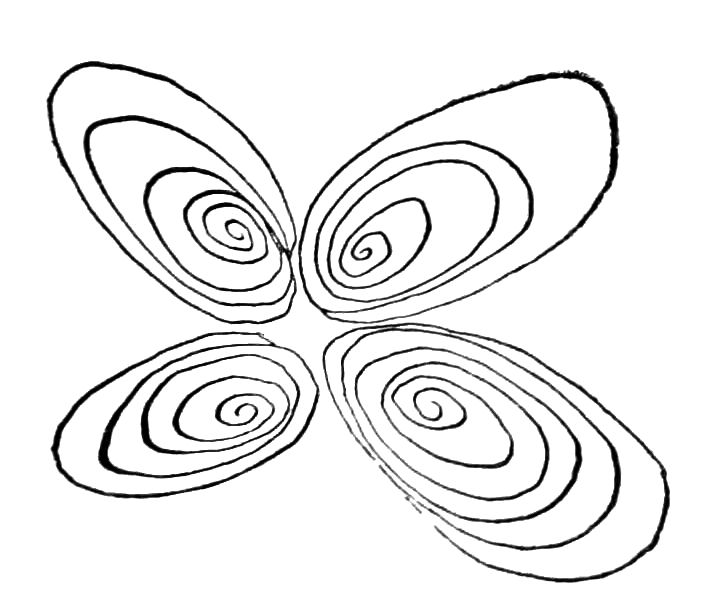
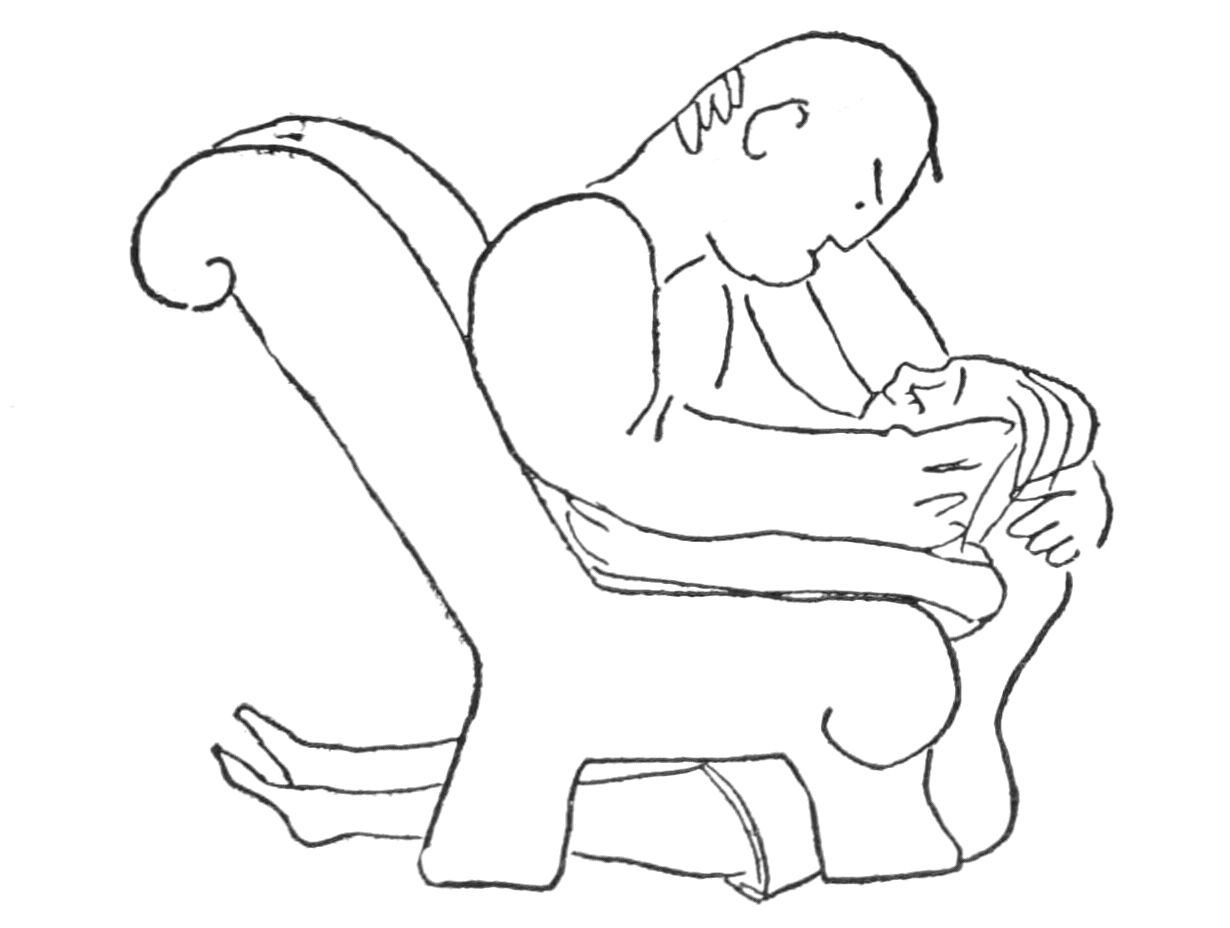
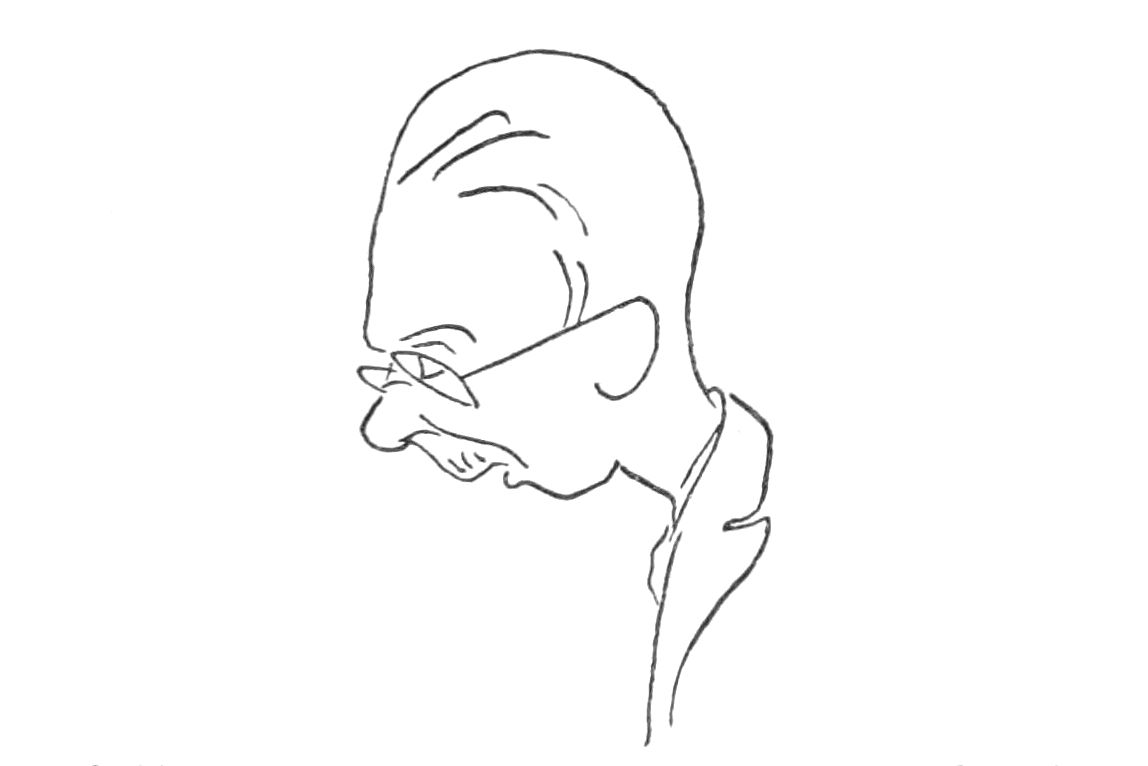
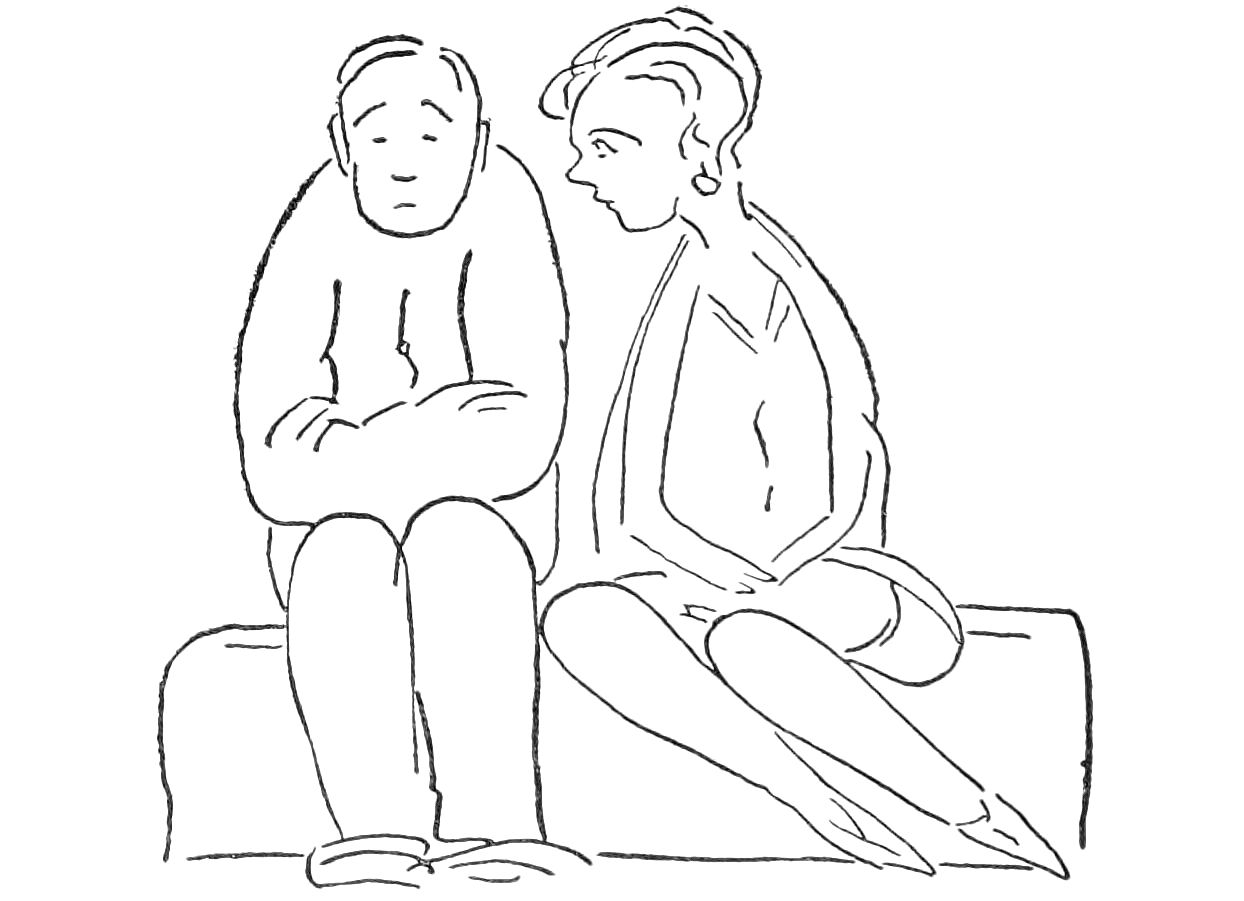
UNCONSCIOUS DRAWING:
PLATE IV.
The mood captured in this
drawing is a rare one indeed,
and Dr. Karl Zaner considers
the sketch the finest in his
collection. Here the masculine
sense of Ironic Detachment
rises superior to the Love
Urge and can take it or let
it alone. The drawing was
sent to Dr. Zaner by Mrs.
Walter L. Mouse (née Kathleen
Schaaf), recently divorced
wife of the author of the
drawing, Walter L. Mouse, of
Columbus, Ohio.
A person of this sort falls terribly in love,
but in the end it turns out that he is more bemused
by a sheet of white paper than a sheet
of white bed linen. He would rather leap into
print with his lady than leap into bed with her.
(This first pleases the lady and then annoys her.
She wants him to do both, and with virtually the
same impulse.)
There is no more disturbing experience in the
rich gamut of life than when a young man discovers,
in the midst of an embrace, that he is
taking the episode quite calmly and is taking
the kiss for what it is worth. His doubts and
fears start from this point and there is no end
to them. He doesn’t know whether it’s love or
passion. In fact, in the confusion of the moment
he’s not quite sure it isn’t something else,
like forgery. He certainly doesn’t see how it
can be love.
Let us examine this incident. He has been
sitting, we’ll say, on a porch with his beloved.
They have been talking of this and that, with
the quiet intimacy of lovers. After a bit he
takes her in his arms and kisses her—not once,
but several times. It is not a new experience to
him; he has had other girls, and he has had
plenty of other kisses from this one. This time,
however, something happens. The young man,
instead of losing himself in the kiss, finds himself
in it. What’s more, the girl to him loses her
identity—she becomes just anyone on whom he
is imposing his masculinity. Instead of his soul
being full of the ecstasy which is traditionally
associated with love’s expression, his soul is just
fiddling around. The young man is thinking
to himself:
“Say, this is pretty nice now!”
Well, that scares him. Up to this point in
the affair he has been satisfied that his feeling
was that of love. Now he doesn’t know what
to think. In all his life he has never come across
a character in a book or a movie who, embracing
his beloved, was heard to say, “This is
pretty nice,” except that character was a villain.
He becomes a mass of conflicting emotions, and
is so thoroughly skeptical and worried about the
state of his heart that he will probably take to
reading sociological books to find out if it’s
O.K. to go ahead, or whether, as a gentleman,
it’s his duty to step out before he further defames
a sweet girl and soils her womanhood.
The medical profession recognizes two distinct
types of men: first, the type that believes
that to love a woman is not to desire her; second,
the type that believes that to desire a
woman is not to love her. The medical profession
rests.
This young man whom I’ve just mentioned
(the rogue who found himself having a good
time in the midst of a kiss) now takes seriously
to books. Matters go from bad to worse. Hoping
to find, in sexology, some explanation for
his conduct which would indicate that, if not
decent, it at least was not without precedent,
he searches relentlessly until he comes upon a
chapter on “The Theory of the Libido.” (Note:
it makes any young man a little mad to discover
that he has a pleasure-principle, but there it is
just the same.) On page 464 he finds this paragraph:
“The ideal healthy outcome is to find the child
in whom the process of repression has been accomplished
with no fixations of interest at lower
stages of adaptation, in whom the Œdipus complex
has passed into a ‘normal’ phase of the
castration complex inhibition, and in whom a
free-movable libido is developing sublimation
in active interests free from paralyzing inhibitions
or anti-social tendencies.”
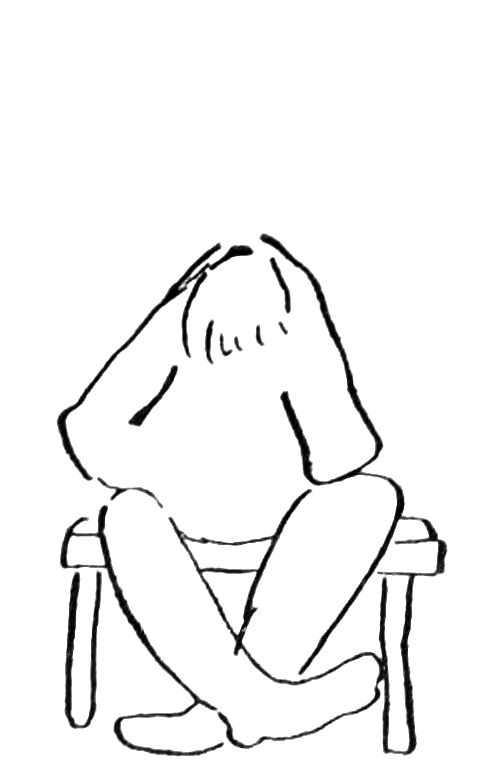
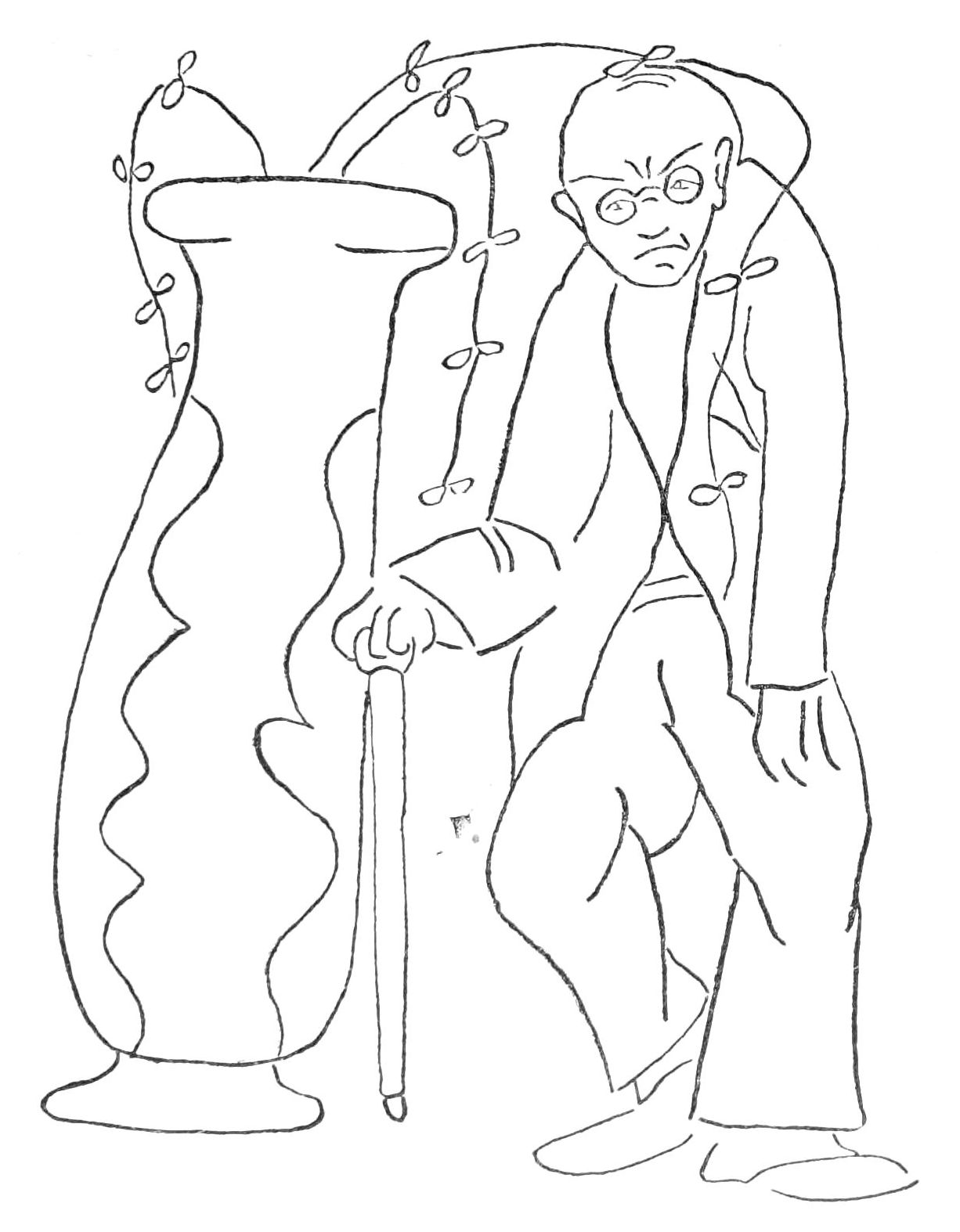
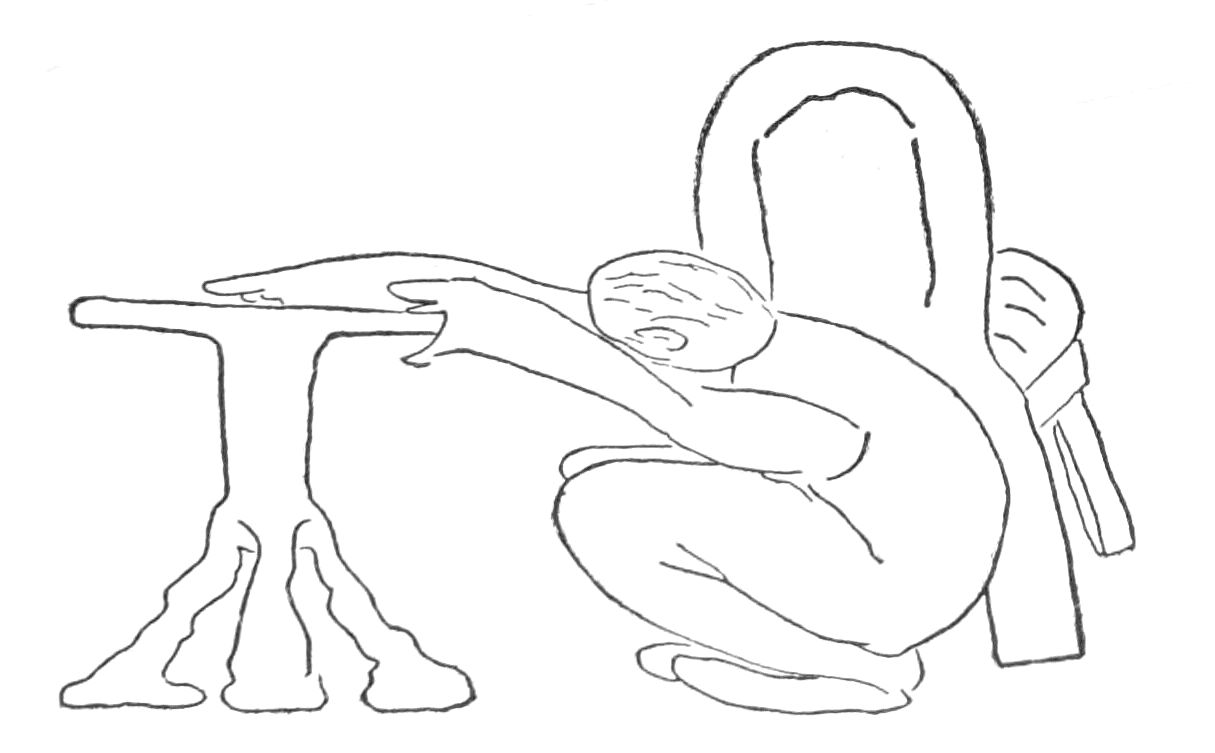
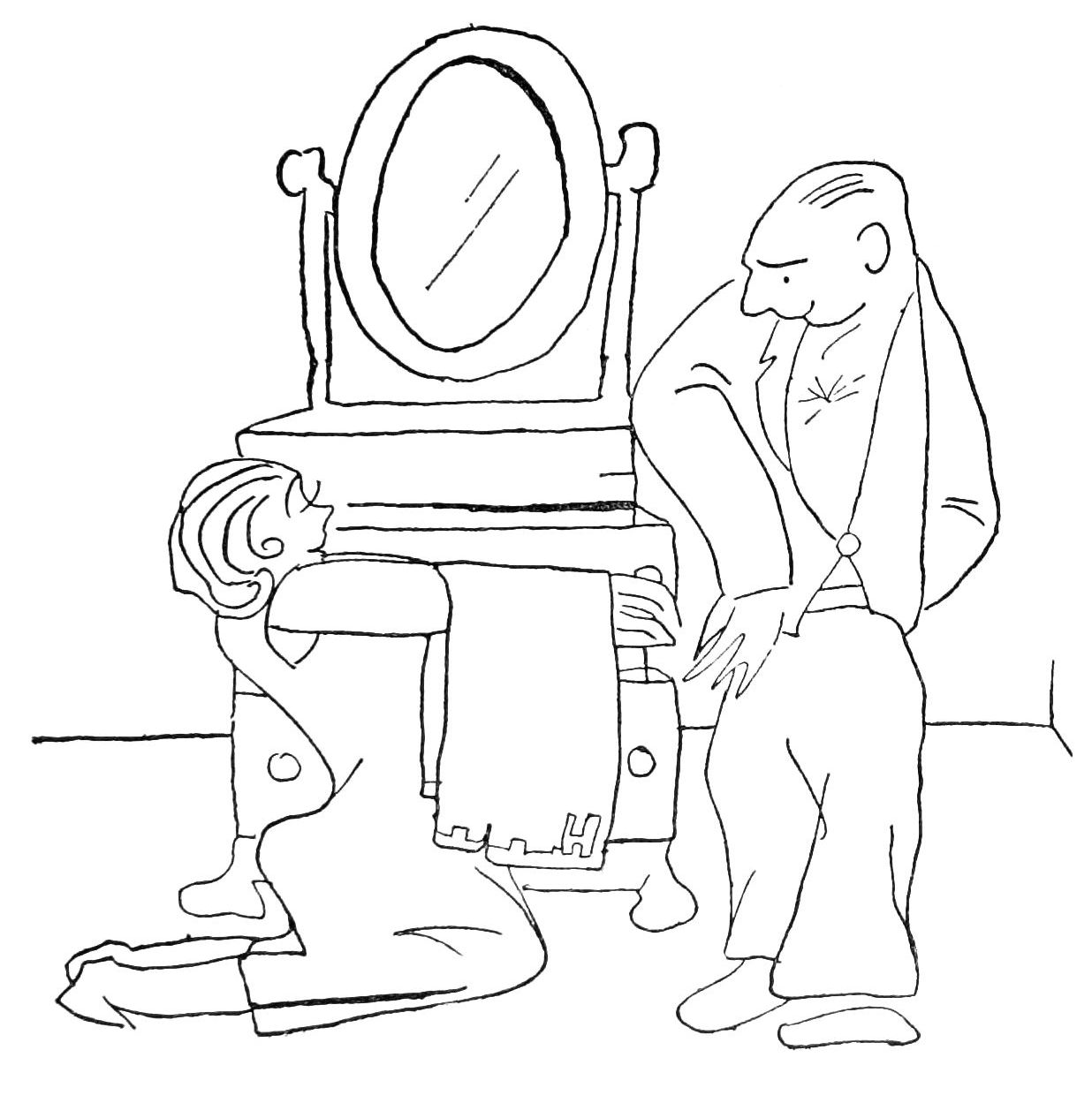
This peculiar posture was discovered by Dr. Tithridge
in a patient who for thirty years, boy and man, had been
unable to tell love from passion and who allowed it to
prey on his mind. Drawing from the Tithridge collection
of American male postures.
This brings the young man to the point where
he thinks maybe he better lay off altogether. He
just wasn’t cut out for kissing, he guesses. So
he writes his girl a letter apologizing for having
been a beast, breaks the engagement, and goes
out to Oregon, where he raises fruit fairly successfully
and with no anti-social tendencies.
I have taken up the question of Man’s uncertainty
about love and passion in two different
circumstances—at the start of a letter, and in
the middle of an embrace. It was originally my
intention also to show how this uncertainty overcomes
one at the end of a day in the country
when a man is so tired that he not only can’t
distinguish love from passion, but has all he can
do to distinguish one station on the New Haven
railroad from another and often gets out at
125th Street by mistake. I say this was my intention;
but thus far I have been so unsuccessful
in explaining the difference between love and
passion that to go on would be to lay myself
open to criticism. The fact of the matter is, it’s
very difficult to tell love from passion. My advice
to anyone who doesn’t feel sure of the difference
between them is either to give them
both up or quit trying to split hairs.
CHAPTER III A Discussion of Feminine Types
In speaking of the weaker sex in this book,
the authors usually confine themselves to the
generalization “Woman,” “women,” and “the
female.” For the larger discussions of sex, these
comprehensive terms suffice. Yet no examination
of the pitiable problem of Man and Woman
would be complete without some effort to define
a few of the more important types of the female.
One cannot say, “Oh, well, you know how
women are,” and let it go at that. Many truths
apply, and many foibles are common, to the
whole sex, but the varieties of the female of the
species are as manifold as the varieties of the
flower called the cineraria.
“Successfully to deal with a woman, a man must know
what type she is.”
Successfully to deal with a woman, a man
must know what type she is. There have been
several methods of classification, none of which
I hold thoroughly satisfactory, neither the glandular
categories—the gonoid, thyroid, etc.—nor
the astrological—Sagittarius, Virgo, Pisces, and
so on. One must be pretty expert to tell a good
gonoid when he sees one. Personally, I know
but very little about them, nor if I had a vast
knowledge would I know what to do with it. It
is even more difficult, and just as unimportant,
to arrive at a zodiacal classification, because that
is altogether dependent upon determining the
year the woman was born, and because, even if
you should ascertain her date of birth, the pish-tosh
of analysis and prediction which derives
therefrom is a lot of mediæval guesswork. Or
so it seems to me, and to Zaner, Blifil, Gorley,
Peschkar, Rittenhouse, and Matthiessen.
Of much greater importance is a classification
of females by actions. It comes out finally, the
nature of a woman, in what she does—her little
bag of tricks, as one might say.
A type of which one hears a great deal but
which has never been very ably or scientifically
analyzed, for the guidance of men, is the Quiet
Type. How often one hears the warning, “Look
out for the Quiet Type.” Let us see if we
should look out for it, and why.
The element of menace in the Quiet Type is
commonly considered very great. Yet if one
asks a man who professes knowledge of the
type, why one should look out for it, one gets
but a vague answer. “Just look out, that’s all,”
he usually says. When I began my researches I
was, in spite of myself, somewhat inhibited by
an involuntary subscription to this legendary
fear. I found it difficult to fight off a baseless
alarm in the presence of a lady of subdued manner.
Believing, however, that the best defense
is an offense, I determined to carry the war,
as it were, into the enemy’s country. The first
Quiet Type, or Q.T., that I isolated was a young
woman whom I encountered at a Sunday tea
party. She sat a little apart from the rest of the
group in a great glazed chintz, I believe it was,
chair. Her hands rested quietly on the chair
arms. She kept her chin rather down than up,
and had a way of lifting her gaze slowly, without
disturbing the set of her chin. She moved
but twice, once to put by a cup of tea and once
to push back a stray lock from her forehead. I
stole glances at her from time to time, trying
to make them appear ingenuous and friendly
rather than bold or suggestive, an achievement
rendered somewhat troublesome by an unfortunate
involuntary winking of the left eyelid
to which I am unhappily subject.
I noted that her eyes, which were brown, had
a demure light in them. She was dressed simply
and was quite pretty. She spoke but once
or twice, and then only when spoken to. In a
chance shifting of the guests to an adjacent room
to examine, I believe, some water colors, I was
left quite alone with her. Steeling myself for
an ordeal to which I am unused—or was at the
time—I moved directly to her side and grasped
her hand. “Hallo, baby! Some fun—hah?”
I said—a method of attack which I had devised
in advance. She was obviously shocked, and instantly
rose from her chair and followed the
others into the next room. I never saw her
again, nor have I been invited to that little home
since. Now for some conclusions.
Patently, this particular Q.T., probably due
to an individual variation, was not immediately
dangerous in the sense that she would seize an
opportunity, such as I offered her, to break up
the home of, or at least commit some indiscretion
with, a man who was obviously—I believe I
may say—a dependable family man with the
average offhand attractions. Dr. White has
criticized my methodology in this particular
case, a criticism which I may say now, in all
good humor, since the danger is past, once
threatened to interpose insuperable obstacles, of
a temperamental nature, in the way of this collaboration.
It was his feeling that I might just
as well have removed one of the type’s shoes as
approach her the way I did. I cannot hold
with him there. Neither, I am gratified to say,
can Zaner, but in fairness to White it is only
just to add that Tithridge can.
However, the next Q.T. that I encountered I
placed under observation more gradually. I
used to see her riding on a Fifth Avenue bus, always
at a certain hour. I took to riding on this
bus also, and discreetly managed to sit next her
on several occasions. She eventually noticed
that I appeared to be cultivating her and eyed
me quite candidly, with a look I could not at
once decipher. I could now, but at that time I
couldn’t. I resolved to put the matter to her
quite frankly, to tell her, in fine, that I was
studying her type and that I wished to place her
under closer observation. Therefore, one evening,
I doffed my hat and began.
The Quiet Type.
“Madam,” I said, “I would greatly appreciate
making a leisurely examination of you, at
your convenience.” She struck me with the
palm of her open hand, got up from her seat,
and descended at the next even-numbered
street—Thirty-sixth, I believe it was.
I may as well admit here and now that personally
I enjoyed at no time any great success
with Q.T’s. I think one may go as far as to say
that any scientific examination of the Quiet
Type, as such, is out of the question. I know
of no psychologist who has ever got one alone
long enough to get anywhere. (Tithridge has
averred that he began too late in life; Zaner
that he does not concur in the major premise.)
The Quiet Type is not amenable to the advances
of scientific men when the advances are of a
scientific nature, and also when they are of any
other nature. Indeed, it is one of the unfortunate
handicaps to psychological experimentation
that many types of women do not lend
themselves readily to purposeful study. As one
woman said to me, “It all seems so mapped out,
kind of.”
I am a little reluctant to report one other adventure
with the Quiet Type, and that is why
I seem to have summed up in the preceding
paragraph without mentioning it. However, I
now feel that some brief outline of the case I
have alluded to should be set down here—especially
after all this allusion. This young lady
was a guest at a week-end party where I was also
a guest. On Saturday evening it began to appear,
quite early, that there was going to be
considerable drinking. And, to be sure, there
was. Among those who became, as the fellow
said, a little bit uncertain of themselves, were
the young Q.T. and myself. It was, in all truth,
largely her fault that I reached a state of abandon
from which, at her further solicitation, it
was but an easy step to a feeling of sheer devil-may-care.
This condition, it is perhaps unnecessary
to say, militates against that fine precision
of mind so essential to the best results in any
scientific investigation.
I do not remember all that ensued one-half
so clearly as I should like to. I have often
thought deeply on the matter, striving to reconstruct
the complete scene, as it were, but my efforts
have been hampered by the lamentable fact
that I found dwelling upon the more easily
remembered scenes so delightful that I simply
dwelt on them. I remember, for example, that
I was at the piano, or more exactly, on it—standing
on it. The Quiet Type, fearing that I
might fall, grasped me firmly about the knees,
and I did fall. I was not only uninjured, but I
got to my feet laughing. At this she began to
laugh. I had lost my glasses in the fall, and
began hunting for them. In bending over, however,
I was assailed by a slight touch of vertigo,
which runs in my family, and fell again.
I asked her how I had reached the cliff—if I had walked
there. “Partly,” she said.
The next that I remember is sitting on the
edge of a cliff, or falaise, as the French call it,
looking out over a lake. The young lady was
beside me. “Well,” she said, “what shall we do
next?” I asked her how I had reached the cliff—if
I had walked there. “Partly,” she said.
This set me to thinking. “I have lost my
glasses,” I said, and began hunting for them
again. She again seized me by the knees, and I
fell. In falling, both of us became enormously
involved. I instantly arose and was about to
step into the lake, when she grasped me around
the waist. We both sat down. “You have
gone as far as you can,” she said, and tittered.
“I should like to go a little farther,” said I. She
arose. “You’re a funny man,” she said, and
laughed again. I grasped her, much to my surprise,
by one ankle, and she began to topple toward
the lake. I fell heavily backward, pulling
her with me, and this doubtless saved her life.
“You must be more careful,” I told her. We sat
up. “Don’t you think you better take me
home?” she said, in a singular voice—low and
odd. “Rather,” I responded, and arose. I took
her back to the house, which was some half-mile
distant, we joined the others, and that is all I
remember.
I shall always regret, of course, that I did not
have full possession of my faculties during the
walk to the cliff’s edge, for there might have
been, in the ten or fifteen minutes it must have
taken, an excellent opportunity to “get at” the
young woman. There is nothing quite so provocative
of pleasant, revelatory talk as a quiet
walk with some one at night. However, the episode
ended as I have said, and a golden opportunity
was lost.
In my very failures I made, I believe, certain
significant findings in regard to the Quiet
Type. It is not dangerous to men, but to a particular
man. Apparently it lies in wait for some
one individual and gets him. Being got by this
special type, or even being laid in wait for,
would seem to me in some cases not without its
pleasurable compensations. Wherein, exactly,
the menace lies, I have no means of knowing.
I have my moments when I think I see what it
is, but I have other moments when I think I
don’t.
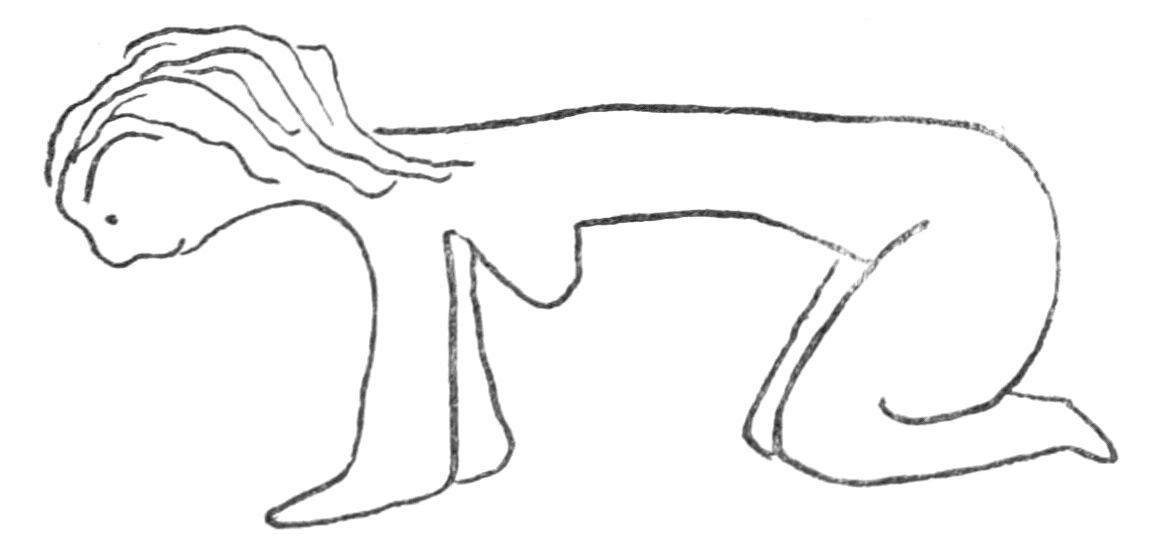
The Buttonhole-twister Type.
The Buttonhole-twister Type is much easier
to come at. A girl of this persuasion works quite
openly. She has the curious habit of insinuating
a finger, usually the little finger of the right
hand, unless she be left-handed, into the lapel
buttonhole of a gentleman, and twisting it.
Usually, she picks out a man who is taller than
herself and usually she gets him quite publicly,
in parks, on street corners, and the like. Often,
while twisting, she will place the toe of her right
shoe on the ground, with the heel elevated, and
will swing the heel slowly through an arc of
about thirty or thirty-five degrees, back and
forth. This manifestation is generally accompanied
by a wistful, far-away look on the
woman’s face, and she but rarely gazes straight
at the man. She invariably goes in for negative
statements during the course of her small writhings,
such as “It is not,” “I am not,” “I don’t
believe you do,” and the like. This type is
demonstrative in her affections and never lies
in wait with any subtlety. She is likely to be
restless and discontented with the married state,
largely because she will want to go somewhere
that her husband does not want to go, or will
not believe he has been to the places that he says
he just came from. It is well to avoid this type.
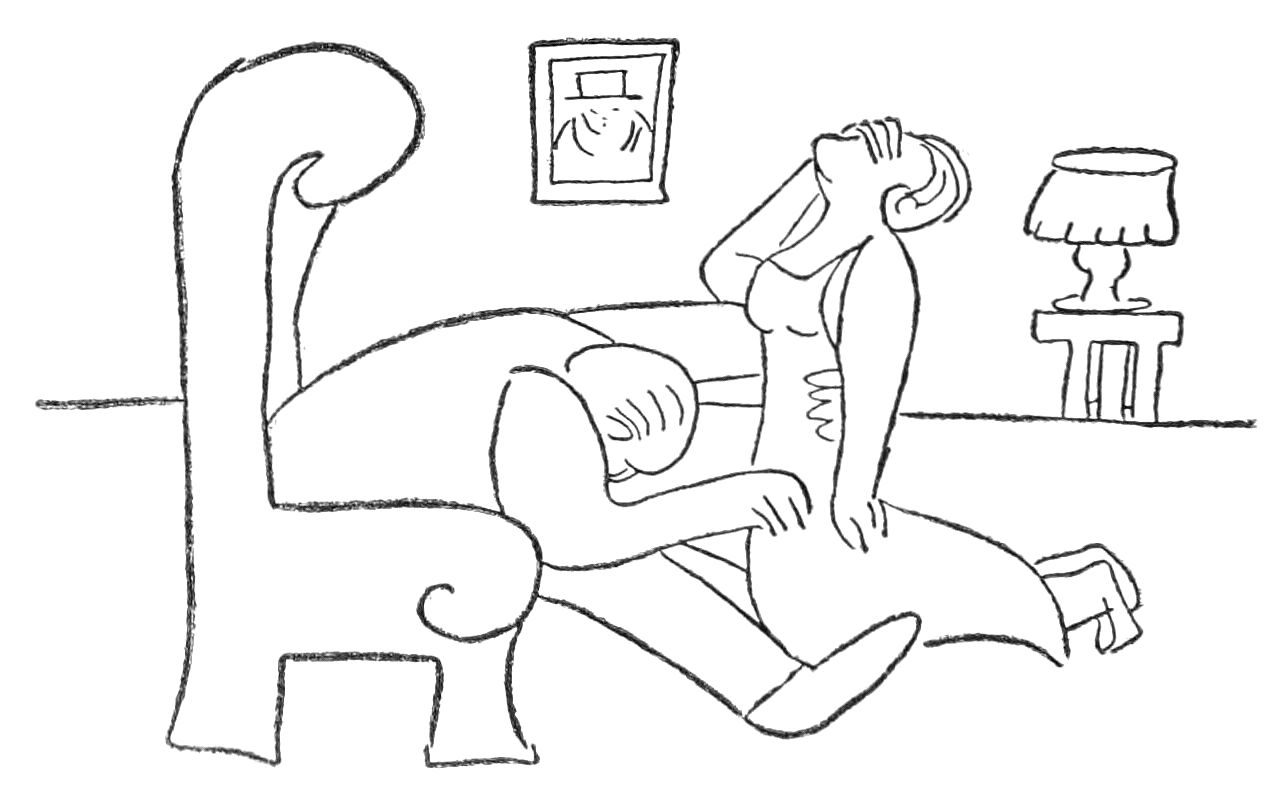
I am told that one type has actually been known to get
the man of her choice down and sit, as it were, side-saddle
of him.
A charming but altogether dangerous type is
the “Don’t, dear” Type. By assuming a middle
of the road, this way and that way, attitude toward
a gentleman’s advances, she will at once
allure and repulse him. The man will thus be
twice allured. He calls on her, and they sit
in the porch swing, let us say. When he slips
his arm around her, she will say in a low tone,
“Don’t, dear.” No matter what he does, she
will say, “Don’t, dear.” This type is a homemaker.
Unless the man wants a home made for
him within a very short time, it is better for him
to observe the “don’t” rather than the “dear,”
and depart. The type is common in the Middle
West, particularly in university towns, or was
some few years ago, at any rate. Any effort to
classify modern university types would be difficult
and confusing. They change from year to
year, and vary with the region. I am told that
one type has actually been known to get the
man of her choice down and sit, as it were,
side-saddle of him. I would not give even this
brief mention, in passing, to college types of
the female, were they not important because they
so frequently divert a man from his career and
tie him down before he has a chance to begin
working, or even to say anything.
The rest of the types of American women,
such as the Outdoors, the Clinging Vine, and
so on and so on, are too generally known to
need any special comment here. If a man does
not know one when he sees it, or cannot tell
one from another, of these more common types,
there is little that can be done for him. No
man should contemplate marriage, or even
mingle with women, unless he has a certain
measure of intuition about these more obvious
types. For example, if a man could not tell
instantly that a woman was the sort that would
keep him playing tennis, or riding horseback,
all afternoon, and then expect him to ride back
and forth all night on the ferry, no amount of
description of the Outdoors Type would be of
any avail.
There is, however, one phenomenal modern
type, a product of these strange post-war years,
which will bear a brief analysis. This is the
type represented by the girl who gets right down
to a discussion of sex on the occasion of her
first meeting with a man, but then goes on to
betray a great deal of alarm and aversion to the
married state. This is the “I-can’t-go-through-with-it”
Type. Many American virgins fall
within this classification. Likewise it contains
women who have had some strange and bitter
experience about which they do a great deal of
hinting but which they never clearly explain. If
involved with, or even merely presented to, a
woman of this type, no man in his right mind
will do anything except reach for his hat.
Science does not know what is the matter with
these women, or whether anything is the matter.
A lot of reasons have been advanced for girls
acting in this incredible, dismayed manner—eleven
reasons in all, I believe—but no one
really knows very much about it. It may be their
mothers’ teaching, it may have been some early
childhood experience, such as getting caught
under a gate, or suffering a severe jolting up by
being let fall when a boy jumped off the other
end of a teeter-totter, or it may simply be a
whim. We do not know. One thing is sure,
they are never the Quiet Type. They talk your
arm off.
CHAPTER IV The Sexual Revolution: Being a Rather Complete Survey of the Entire Sexual Scene
The sexual revolution began with Man’s
discovery that he was not attractive to
Woman, as such. The lion had his mane, the
peacock his gorgeous plumage, but Man found
himself in a three-button sack suit. His masculine
appearance not only failed to excite
Woman, but in many cases it only served to
bore her. The result was that Man found it
necessary to develop attractive personal traits to
offset his dull appearance. He learned to say
funny things. He learned to smoke, and blow
smoke rings. He learned to earn money. This
would have been a solution to his difficulty, but
in the course of making himself attractive to
Woman by developing himself mentally, he inadvertently
became so intelligent an animal that
he saw how comical the whole situation was.
Thus, at the very start of the sexual revolution,
Man faced one very definite problem: in
becoming mentally “aware,” he had become
intellectually critical, and had discovered that
it was increasingly difficult to make up his mind
whether he really desired any one woman, however
capable he was of getting her. It was the
heyday of monogamy, and in order to contemplate
marriage, it was necessary for a man to decide
on One Particular Woman. This he found
next to impossible, for the reason that he had
unconsciously set up so many mental barriers
and hazards.
Let me mention a few.
(1) The fear that his fiancée might get fat
inside of a few years. To any mentally alert
man, this thought was a strong deterrent. Quite
often the man met the girl’s parents. He would
quickly size up her mother and make a mental
calculation as to how long it would be before
the daughter was in the same boat. Somehow,
it took the bloom off the romance. If he was
not fortunate enough to meet the parents of
the young lady, he was quite apt to note things
about her own conformation that seemed prophetic.
A slight thickness in the neck, a trace
of rotundity in the bosom, a touch too much
ankle. In these portents he found much discomfort,
and was quite likely to call the engagement
off.
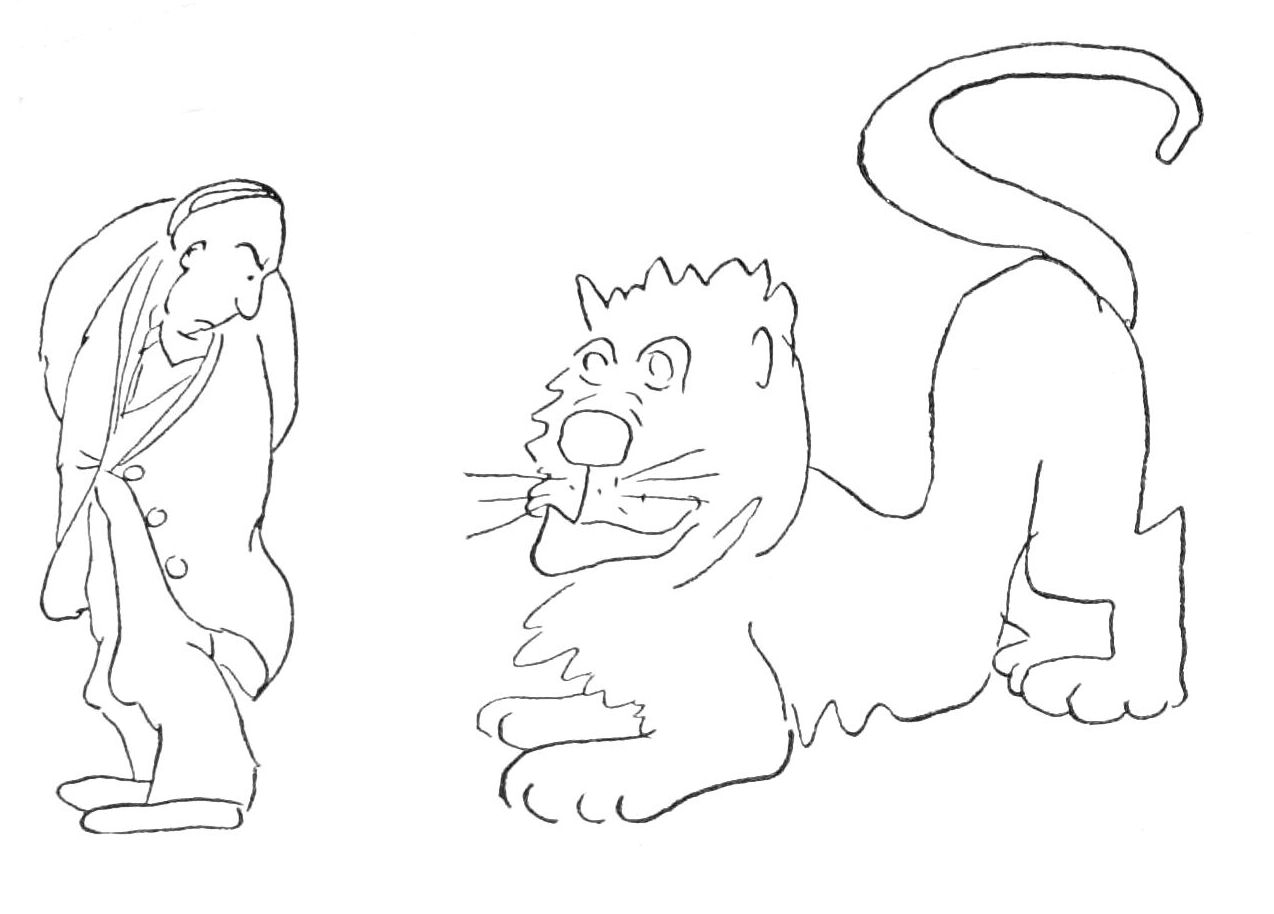
“The lion had his mane ...
but man found himself in a
three-button sack suit.”
(2) The use of a word, phrase, or punctuation
mark by his fiancée that annoyed him. In
these early days of the sex awakening, it was
not at all uncommon to find examples of the
girl’s using some slight phrase which had a grating
effect. It was often the case that the man
was literarily inclined—because literary inclinations
were early found to be advantageous in
sex, almost as advantageous, in fact, as the peacock’s
tail—and if this was the case the man was
doubly sensitive to the curious little crudities,
niceties, whimsies, and circumlocutions which
women were afflicted with. I am thinking at the
moment of the case of a young man who, in his
junior year in college, had found the girl he
believed ideal for him to marry, and then one
day learned, quite by accident, that she was in
the habit of using the word “Howdy” as a
form of salutation. He did not like “Howdy,”
although he did not know why. Days and
nights he spent trying to reconcile himself to the
idea of it, weighing the young lady’s extreme
beauty and affability against her one flaw. In
the end he decided he could not stomach it, and
broke the troth.
(3) Difference in height. If a man fell in
love with a woman taller than himself (which
sometimes happened), he became morose from
dwelling on the objections to such an alliance.
This particular situation usually had a way of
settling itself automatically: there were so many
reasons, real or imaginary, why the man felt that
the marriage was impossible, that just the mere
business of thinking about them broke him in
health and he died, leaving a margin of several
weeks before the date of the wedding.
“He would quickly size up the
mother and make a mental calculation
as to how long it
would be before the daughter
was in the same boat.”
(4) The suspicion that if he waited twenty-four
hours, or possibly less, he would likely find
a lady even more ideally suited to his taste than
his fiancée. Every man entertained such a suspicion.
Entertained it royally. He was greatly
strengthened in his belief by the fact that he
kept catching a fleeting glimpse of this imaginary
person—in restaurants, in stores, in trains.
To deny the possibility of her existence would
be, he felt, to do a grave injustice to her, to himself,
and to his fiancée. Man’s unflinching desire
to give himself and everybody else a square
deal was the cause of much of his disturbance.
Man had become, you see, a thinking being. He
had come to know enough about permutations
and combinations to realize that with millions of
Caucasian females to choose from, the chances
of his choosing the ideal mate were almost zero.
Male Type (eastern seaboard). Definitely interested in, but
uncertain what to do about, the Female. To men of this type
many aspects of the Sexual Revolution never became clear
at all.
So matters went. Man, we have seen, had
begun to develop himself so that he would be
attractive to Woman, and in doing so had
made Woman of doubtful attraction to him. He
had become independent. He had become
critical. He had become scared. Sex was awakening
and it was all Man could do to keep from
laughing.
Woman, on her part, saw dimly what was
going on in the world. She saw it through the
sweet haze of Dream. She caught glimpses of
it in the mirror of her Narcissistic soul.[8]
Woman was at the crossroads. She had many
ways open to her, but she chose one: she chose
to imitate Man. At a time when sex was in
transition, she had the bad judgment to begin
a career of independence for herself, in direct
imitation of her well-meaning mate. She took
up smoking. She began to earn money (not
much, but some). She drank. She subordinated
domesticity to individuality—of which she had
very little. She attained to a certain independence,
a cringing independence, a wistful, half-regretful
state. Men and women both became
slightly regretful: men regretted that they had
no purple tail to begin with, women that they
had ever been fools enough to go to work.
Women now “understood life,” but life had
been so much more agreeable in its original
mystery.
[8] This is the first mention in this article of Narcissism. You’ll
hear more about it, don’t worry.
And now we come to Sex.[9] Woman, observing
that her mate went out of his way to make
himself entertaining, rightly surmised that sex
had something to do with it. From that she
logically concluded that sex was recreational
rather than procreational. (The small, hardy
band of girls who failed to get this point were
responsible for the popularity of women’s
field hockey in this country, 1911–1921.) As
though in a vision, the “right to be sexual”
came to women. They fell to with a will. For
thousands of years they had been content merely
to be amiable, and now they were going to be
sexual. The transition from amiability to sexuality
was revolutionary.[10] It presented a terrific
problem to Woman, because in acquiring and
assuming the habits that tended to give her an
equality with Man, she discovered that she
necessarily became a good deal like Man. The
more she got like him, the less he saw in her.
(Or so he liked to think, anyway.) Just as
soon as she began to put her own sex on an even
basis, she found that he lost interest. Her essential
Narcissism (pleasure of looking in a mirror)
was met by his Begonia-ism (concept of the
potted plant). Things got so that Woman
spent all her time admiring herself in mirrors,
and Man, discouraged, devoted himself quietly
to raising begonias, which are fairly easy to
raise. Sex atrophied.
But, as I say, sex was in the transition stage.
Woman soon began to outgrow her Narcissism
and was satisfied to snatch quick glances of herself
in make-shift mirrors, such as the backs of
watches, the shiny fenders of automobiles, plateglass
windows, subway weighing machines, and
such. Convinced that sex was not sin, she set
out joyously to study it. How hard she studied
has recently been apparent, even to persons who
read only a few books a year.
New York became the capital of the sexual
revolution. It was conveniently located, had
a magnificent harbor,[11] a high mortality rate, and
some of the queerest-shaped apartments to be
found anywhere. There are apartments in New
York in which one must step across an open
bathtub in going from the kitchen to the bedroom;
any unusual layout like that arouses sexual
desire and brings people pouring into New
York from other cities. New York became the
Mecca for young ladies from the South and
from the Middle West whose minds were not
quite made up about sexual freedom, but who
thought that if they could once get to New York
and into an irregular apartment, the answer
might come to them.
[11] New York has one of the finest harbors in the world.
Their mothers were against it.
“Now what can you get in New York that
you can’t get right here at home?” their mothers
said.
“Concerts, new plays, and the opera,” the
daughters invariably replied. There has never,
to my knowledge, been a case of a young lady
telling her mother that she wanted to go to
New York because she was seeking an outlet
for her erotic eagerness. It was always concerts
that she wanted. Often it turned out to be
concerts that she got.
When she arrived in New York and secured
her unfurnished apartment (usually in West
Fourth Street), her mental elation was so great
and her activity in making parchment lamp
shades so unabating that for the first couple
of weeks she let sex go. Women are notoriously
apt to get off the track; no man ever was diverted
from the gratification of his desires by
a parchment lamp shade. At any rate, the young
lady was so tired at night she could hardly
keep her eyes open, much less her mind.
Furthermore, she was beginning to have Schmalhausen
trouble. Schmalhausen trouble is a common
ailment among girls in their twenties. It
usually attacks girls who have taken a small
apartment (schmalhausen) and are reading the
behaviorism essays of Samuel D. Schmalhausen.
The effect of sitting within narrow walls and
absorbing a wide viewpoint breaks down their
health. The pain that they suffer during this
period is caused by their discovery of the lyrical
duality, or two-sidedness, of life—a discovery
that unbalances all sensitive young ladies in
whom sex cries for expression. Even in a New
York apartment there are two sides to everything,
and this particularly applies to a girl’s
potential sexuality.[12]
[12] Girls with a bad case of Schmalhausen sometimes saw as many
as three sides to sex.
“Furthermore, she was beginning to have
Schmalhausen trouble.”
Let me explain this duality.
The very fact that the young lady had settled
in the vicinity of Sheridan Square indicates
that there was a strong vein of poetry in her.
She saw life (and sex) through a lyrical haze
which tended to accentuate its beauty by softening
its truths. The whole purpose and scheme
of poetry is to heighten the tenderness and essential
goodness of life by a musical elaboration
of its traditional worth.[13] Well, when the
young lady allowed the lyrical possibilities of
love to work on her mind, it made her mad to
remember how candid she had been the night
before in discussing contraception with the commercial
artist who lived downstairs. It grew to
be a big question in her own mind, just what her
emancipation ought to consist of: whether it
meant having lemon skins and gin stoppers in
the wash-basin and talking freely of exhibitionism
and voyeurism, or whether it meant being
the recipient of some overwhelmingly beautiful
passion which her poetical soul still prescribed
but which she knew couldn’t exist because
she was so widely read. To stall for time
she would make another lamp shade.
Days slipped by. Always there was conflict
in her soul. She had plunged into the “candor
régime” whole-heartedly; she could enter
a roomful of people and say almost anything at
all. She also went in for nudity—another outlet
for sex eagerness. She dallied in the bath,
lay around the apartment without any clothes
on, appeared scantily clad at her door when the
laundryman called to collect, and week-ends
went swimming naked in the moonlight with
other young people. (Incidentally, when she
saw what a man looked like without any
clothes on, the old Schmalhausen trouble came
back stronger than ever.)
By and by, because of this very uncertainty
of soul, a kind of orderliness of habit crept into
her life. Unable to decide whether sex was the
poem she half believed it to be or the casual
episode she had schooled herself to think it was,
she compromised by practically giving sex the
air. She now held a good job and was earning
well. Candor and nudity, with an occasional
bit of exhibitionism, began to satisfy her completely.
She was growing older. The apartment
was nicely decorated now and teeming
with lamp shades. She held some good industrial
stocks and had developed an ambition to
write. She became content to be literary rather
than sexual. She became, in other words, that
most dangerous of all by-products of the Sexual
Revolution—a biologico-cultural type. She had
a way of leading young men on into exhilarating
topics, and sitting with them in provocative attitudes,
and then putting on her hat and going
quietly home to bed. In short, New York was
now home to this girl, this biologico-cultural
lady, and she was in a fair way to step placidly
into a good old-fashioned marriage when the
right man came along.
And he usually did, the poor yap.
CHAPTER V The Lilies-and-Bluebird Delusion
The young bridegroom who unexpectedly
discovers that his wife has been brought
up in extreme unawareness of the true facts of
life and believes in some variant of the Birds
and Flowers Delusion (that is, that birds and
flowers have something to do with the emotional
life of persons), is faced with a situation
calling for the greatest tact and tenderness. It
won’t do any good for him to get mad, or to
indulge in self-pity, crying, “Oh, how sorry I
am for me!” and only a coward would go directly
into a psycho-neurosis without first trying
to win his wife over to acceptance of things as
they are.
DR. WALTER TITHRIDGE
(after the etching by Veerbluergen).
I have in mind the case of a young lady
whose silly mother had taught her to believe
that she would have a little son, three years old,
named Ronald, as soon as her husband brought
a pair of bluebirds into a room filled with lilies-of-the-valley.
The young woman (to say nothing
of the young man) was thus made the victim
of one of the extremest cases of Birds and
Flowers Fixation which has ever come to my
attention. I shall transcribe, from Dr. Tithridge’s
notes, the first dialogue on the subject
that took place between the young couple. This
dialogue was carefully reconstructed by Tithridge
from the account of the incident as given
by the young husband, who sought his advice
and counsel.
On the evening of the 25th of June, when
the couple were married, the young husband
entered their hotel suite to find it literally a
garden of lilies-of-the-valley. He was profoundly
touched, but baffled, and asked his wife
who was dead.
“Where are the bluebirds?” she replied,
coyly.
“What bluebirds?” he demanded.
“The bluebirds,” she said, blushing.
Unfortunately, but not unnaturally, the bridegroom
did not know what the bride was talking
about. What was of the extremest importance to
her, was to her husband merely an idle whim,
a shadowy fancy. Obviously, the young couple
should have talked such matters over long before,
but they hadn’t, and there they were. He
strove to change the subject, whistled, lighted
cigarettes, for he was nervous enough the way
it was, but she kept recurring to the bluebirds.
His bewilderment became tinged with some
alarm, for during their courtship he had put
forth no great effort to examine into her mental
capacity, and he was now assailed by the excusable
suspicion that she was perhaps not exactly
bright. He talked rapidly, apprehensively,
of many things. Among the things he talked
about were the St. Louis Cardinals (a baseball
club). From there it was but an easy associative
step for his wife to go back to the bluebirds
again.
“Aren’t you going to get any bluebirds?” she
persisted.
“I don’t know where the hell I’d get any
bluebirds tonight,” he said, rather irritably, “me
not being Bo-Peep.”
The nuclear complex was made right then
and there. There was a long tense silence, after
which the bride burst into bitter tears.
“Now, dear,” said her husband, more reasonably,
“let’s try to get this thing straightened
out. What are you talking about, anyway?”
“Sex—if you want to know!” she blurted out,
and swooned.
Instead of getting her a glass of water, he
excitedly phoned the room clerk, but became
embarrassed once he had got him, and merely
asked that a couple of blankets be sent up. It
was, unfortunately, as I have said, June—and
warmish. Thus when the wife revived sufficiently
to become aware of her surroundings,
the husband was standing above her holding a
pair of blankets, and looking pale and warm.
“Mutual suspicions of mental inadequacy are common during
the first year of any marriage.”
“What are those for?” she demanded, suspiciously,
for the notion had now formed in her
own mind (Dr. Tithridge feels, and I agree)
that she very likely had married a dementia
præcox case. These mutual suspicions of mental
inadequacy are common during the first year
of any marriage, but rarely are they aggravated
by factors so clearly calculated to upset the mental
equilibrium as bluebirds at midnight and
blankets in June. This husband and wife were
drifting farther and farther apart. The solution
to their problem was becoming more and
more remote, what with this setting up of involved
artificial barriers, this almost fantastical
beclouding of the issue. Dr. Tithridge tells me
that he believes the young man’s reason would
have been permanently dethroned had he (Dr.
Tithridge) tweeted or chirped like a bird[14] on
the occasion of the husband’s first visit to him.
[14] Experiments of this sort, calculated to determine the possible
effects of tweeting, or chirping, in the case of a Birds Fixation,
fall, of course, outside the province of the psycho-analyst, and not
only is the legality of their practice questionable, but the value of
the results obtained is highly doubtful.
When the wife beheld her husband standing
there with the blankets, she demanded, again,
“What are you doing with those blankets?”
“I get cold,” he mumbled, and he proceeded
to put the blankets on the shelf of a closet
which already held several extra pair. He was,
furthermore, decidedly warm, and kept patting
his brow with a handkerchief.
“Let’s go out and take a walk,” suggested his
wife, apprehensively. To this her husband very
readily agreed. They were getting afraid to
stay in the same room with each other, than
which there is no other condition in the world
more certain to break up a marriage. Out in
the street, among people, they both felt safer,
and they wandered to a bench in a fairly
crowded park, and sat down.
“Where did you get the idea that birds have
anything to do with us?” demanded the bridegroom.
[15] Young women who allude to their mothers as “mumsy” almost
invariably present difficult problems in adjustment. The word is
a sentimentalization of the more common “mamma” and indicates
a greater dependence upon maternal direction and supervision than
may be expected in the case of young women who use the more
familiar term.
“Well,” he said, “she deceived you.”
“About what?”
“About what you’re talking about.”
“Sex?” she asked.
“That isn’t sex, honey,” he told her. “Birds
and flowers are simply ... they do not ...
that is, we could live all our life without them.”
“I couldn’t,” she said, and, after a pause, “I
always feared you didn’t want children.”
“I do want children. I want you. You want
me. Everything is going to be all right.”
“How is it?” she demanded.
“In the first place,” he began, pulling at his
collar, “it’s this way. Now here’s the way it
is. Now you take me ... or take you, say.
In the first place the girl, that is Woman ...
why, Woman[16] ...” He lapsed into a profound
silence.
[16] Explanations of natural phenomena in terms of the collective
noun, particularly where the noun becomes capitalized in the
mind of the person striving to explain, are almost never successful.
“Well, go on,” she prompted.
“Well,” he said, “you know how women are,
don’t you?”
“Yes,” she said, doubtfully.
“That’s fine,” he said, brightening, “Now
women are that way, then——”
“What way?” she asked.
“Why, the way you are ... from me ...
than I am, I mean.” He made a vague gesture.
“I don’t see what you mean,” she said. Her
husband gave a light laugh.
“Hell’s bells, it’s simple enough,” he cried,
suddenly, giving the light laugh again; “it’s certainly
simple enough. Now, here. We’ll take
Adam and Eve. There they were, all alone,
see?”
“There were two bluebirds,” said his wife.
“Not till after the flood, there weren’t,” he
corrected her. “Well, he found out that there
were certain essential differences—what you
might call on purpose. I mean there must have
been some reason. You can count on it that
things like that just don’t happen. Well, then,
he simply figured it out—figured out the
reason.”
“For what?”
“For all this discrepancy. Obviously it just
didn’t happen. It couldn’t just have happened.
It had to make some sense—nature is like that.
So he—so he finally—ah—what he did was tell
her, see? I mean he asked her.”
“Asked her what?”
“He simply asked her,” said her husband in
calm, almost cold tones,—“he simply asked her
why she thought this was. Is there anything
wrong in that? And so gradually they understood
why it was. It’s as simple as that!” He
looked at her triumphantly.
“What are you talking about?” she demanded.
“Listen,” he said at last, firmly. “Both of
us speak a little French, and we might try it
that way. I think I could explain better in
French. Why, even little children, tiny girls,
sing Auprès de ma blonde in France, and think
nothing of it. It’s just a nice, wholesome idea—auprès
de ma blonde—and it sounds like
poetry—but take it in English and what do you
get?”
“‘Quite close to my blonde’ ...” answered
his wife.
“... ‘Qu’il fait bon dormir,’” her husband
hurried on.
“‘How good it is to sleep,’” she translated.
“Fine! Now you’re talking.”
“Go on,” she said, “you’re talking.”
“Well, all right, but first I wanted you to see
that there is no reason to get embarrassed, because
everything is lovely in French. So don’t
mind my frankness.”
“I don’t,” said the bride.
“All right,” he began again, “Alors, now, il y
a quelque chose que vous avez que je n’en ai
pas, n’est-ce pas?”
“Oui,” she said.
“Bon,” he said. “Alors, ça c’est naturel—ah—ça
c’est bien naturel....”
“Par exemple,” put in his wife, a little illogically.
“Dites,” he said, and after a great pause,
“Dites donc—dites vous——”
“You should really use ‘tu’ and ‘toi’ and not
‘vous,’” said his wife; “it’s more intimate.”
“All right,” he responded. “Now, tu as quelque
chose, tu as ... toi.”
“Comment?” she demanded.
“I just don’t know enough words,” said the
bridegroom, wretchedly. The bride put her
hand on his arm.
“Let’s try ‘thee’ and ‘thou’ in English,” she
suggested.
DR. KARL ZANER.
“That’s not a bad idea,” he said. “Well, all
right. Now thee has——”
“Hath,” she corrected.
“Thee hath certain—ah——”
“Differences,” she supplied. “But isn’t it
‘thou hath’—or is it ‘thee hath’?”
“To hell with it!” cried her husband. “In all
thy life hast never been around, for Pete’s
sake?”
“Certainly, and thou—and you have no right
to talk to me like that!”
“I’m sorry,” said the young man. “I’m sorry.”
He rose to his feet. “Ye gods! to think this had
to happen to me! Ah, well. Listen. I tell
you what, I’ll write it out for you. How about
that? And if you don’t like the idea, why, all
right, I suppose.”
It was the next day that the young husband,
who had sat up all night in the hotel lobby,
thinking and writing, visited Dr. Tithridge. I
am happy to report that, as not infrequently
happens in such cases, a solution was finally
arrived at. However, in a great number of cases
the difficulty is never overcome. The home becomes
a curious sort of hybrid, with overtones
of the botanical garden and the aviary. The
husband grows morose and snappish, the wife
cross and pettish. Very often she takes up
lacrosse and he goes in for raising rabbits. If
allowed to go on, the situation can become so
involved and intricate that not all the analysts
from the time of Joan of Arc down could unravel
it.
The problem is by no means any simpler
where the wife is cognizant of things as they
are and the husband is ignorant. I know of
one young man who every night tenderly placed,
with much strange clucking, a basket near the
hearth into which he had some expectation that
a baby would be deposited by a stork. (Plate I.)
Another young husband constructed at considerable
expense a water-lily pond in his back yard
and fondly rowed about in it, twilight after
twilight, searching for infants, laying his finger
to his lip, making “tchk, tchk” noises at his wife,
who watched him in profound amazement.
EMOTIONAL CHARADES.
PLATE I.
“One young man every night
tenderly placed, with much
strange clucking, a basket
near the hearth into which
he had some expectation that
a baby would be deposited by
a stork.”
In both these cases the wives were fine women
of strong character, with a background of sturdy
pioneer stock, and they soon put a stop to such
charades, once they divined the curiously entangled
Wish Motives behind them. It may be
said, indeed, that young wives are more candid
and direct in their explanations of natural
phenomena than young husbands, when they
have to be.
The existence of such deplorable ignorance
is a sad commentary on the sentimentality of a
nation which sets itself up to be frankly sexual.
There is much reason to be hopeful, however.
The future parents of the land will doubtless
come straight to the point in matters of this
sort, when talking with their children. The
children of today will be the parents of tomorrow,
and you know how the children of today
are.
CHAPTER VI What Should Children Tell Parents?
So many children have come to me and
said, “What shall I tell my parents about
sex?” My answer is always the same: “Tell
them the truth. If the subject is approached in
a tactful way, it should be no more embarrassing
to teach a parent about sex than to teach
him about personal pronouns. And it should
be less discouraging.”
In discussing sex enlightenment for parents,
first of all, definitions are needed. What do
we mean by “parents”? Do we mean all adults
who have had children? Do we mean adults
who have had children, they knew not why?
Or do we mean married people who have given
birth to one or more offspring but have never
gone into the matter very thoroughly? For the
purposes of this article, it will be assumed that
by “parents” we mean all adult persons permeated
with a strong sense of indecency.
I have talked with hundreds of children about
the problem of educating their parents along
sex lines. So many of them have told me that
they honestly tried to give their elders the benefit
of their rich experience in life, but that the
parents usually grew flushed and red and would
reply, “Nice people don’t talk about such
things.” It is true that a great gap exists between
generations. The fact that children are
embarrassed to have their parents along when
they are attending certain movies or plays is indicative
of how hard it is to overcome the old
fear of allowing one’s elders to learn anything.
A child never knows at what point in a play
his uninformed old father will start to giggle.
It is hard for children to break through and
really come in touch with their elders. “Nice
people don’t talk about such things!” is the defense
which old people put up against life itself,
when they feel it crowding in all around
their heads. Parents hesitate to discuss things
calmly and intelligently with their children for
two reasons: first, they have a kind of dread of
learning something they don’t want to know;
and second, they feel that if they must learn anything
at all they would like to be spared the
humiliation of learning it from their offspring.
Actually, middle age (and even senescence) is
marked by a great curiosity about life. There is
a feeling that life is slipping away quickly, and
that it would be terrible to have the end come
before everything in life has been revealed. The
beauty of life, always apparent, implies a mystery
which is disturbing right up to the bitter
end. The spectacle of old men wistfully attending
sex lectures (as they frequently do) suggests
that the strong suspicion exists in them that
somewhere they will hear the magic word by
which human affairs will become clarified, somewhere
they will glimpse the ultimate ecstasy.
Children who allow their fathers and mothers,
to whom they owe their very existence, to go on
wondering about sex, are derelicts to duty.
“One’s father and mother are never too old to be told
facts.”
If young folks lack the tact or intelligence
requisite to enlightening their parents, the task
should be intrusted to some one else. Yet it
is hard to say to whom. A child should think
twice before sending his father around to public
school to secure sex information from his
teacher. Women teachers, to borrow a phrase,
are apt to be “emotionally illiterate.” Many
teachers have had no sex life and are just waiting
for somebody like your father to show up.
One’s father and mother are never too old
to be told facts. Indeed, it is most unkind to
keep them in ignorance and allow them to
nourish the doubts and horrors of their imagination.
The majority of parents pick up their
knowledge of the facts of life from smoking-car
conversations, bridge-club teas, and after-dinner
speakers. They receive it from their vicious
adult companions who are only slightly less
ignorant than they are and who give them a
hopelessly garbled version. They pick it up,
too, from the gutter.
Fig. 7. It is customary to illustrate sexology chapters with
a cross section of the human body. The authors have
chosen to substitute in its place a chart of the North
Atlantic, showing airplane routes. The authors realize that
this will be of no help to the sex novice, but neither is a
cross section of the human body.
This matter of picking up information from
the gutter is an interesting topic in itself. Quite
the most remarkable case history that has come
to my notice is that of François Delamater, a
parent thirty years of age, who went deliberately
to the gutter for his sex education. He had
heard, as all people do hear some time or other,
that sex can be learned from the gutter, so he
set out to make a comprehensive survey of the
gutters of eighteen large American cities. For
a long time he found out nothing, although he
was a very curious man. By a peculiar piece of
fortune, however, he happened to be walking
in Cincinnati one day and met a man who was
leading a tame stork. The man was in the
gutter. The stork carried in its bill a live baby,
in swaddling clothes. Smelling a rat, Mr. Delamater
stopped the man and inquired where the
baby came from. The man replied that he
didn’t know.
“For that matter,” continued Mr. Delamater,
“where does any baby come from?”
The man shook his head. Then he relented
and told Mr. Delamater that he had merely
been hired to lead the stork around the streets
to advertise a moving picture called “Her Husband’s
First-born.” The whole incident so confused
the mind of the thirty-year-old parent that
he eventually evolved the strange theory that
babies are born within the father, an erroneous
notion that dwarfed his emotions and modified
his character.
It is of the utmost importance, in imparting
sex knowledge to one’s parents that it be done
in such a way as not to engender fear or anxiety.
The phraseology should be chosen carefully, and
efforts should be made to explain everything
clearly but without the use of words which have
a tendency to make old people nervous. The
word “erotic” is such a word. When it is necessary
to speak of Man’s erotic tendencies, it is
best to substitute another word. In the first
place, an overwhelming majority of parents do
not know the exact meaning of the word
“erotic,” and to know an inexact meaning is
worse than nothing. Many are apt to confuse
it vaguely with “exotic.” I have known parents
to go through whole books by authors like Havelock
Ellis or Mary Ware Dennett without understanding
a single paragraph, because they
thought Man’s “eroticism” referred to his desire
to be in some foreign place like Spain. Those
parents that actually do detect the difference between
the sound of the two words will immediately
become nervous, inattentive, and
dispirited. They will make some excuse to leave
the room, and will wander out, probably to
the ice-box to get themselves a cold snack, which
they will eat while in a sulky frame of mind.
Later they will look up the word in the dictionary,
but will forget it by the time they hear it
again in conversation or read it in print. Furthermore,
all their taste for sex will be gone.
Just what to tell parents is, of course, a vital
question, not to be answered dogmatically. Before
a child can conscientiously approach such
subjects as pedestalism, the recessive knee, begonia-ism,
frigidity in men, birth control,
sublimation, and the swastika fixation, he must
clear the boards. The simple phases of sex
should be imparted in a direct manner: it is
best to explain things in a matter-of-fact way,
rather than resort to such cloudy analogies as
birds and flowers. Strange to say, the habits of
birds and flowers have done as little to clarify
the human scene as almost any other two manifestations
in nature. Further, there is always the
danger, in setting up plant or animal life as an
example, that one’s parents will place a literal
interpretation on things. I am thinking particularly
of the case—which all sociological students
know about—of Nina Sembrich, the fifteen-year-old
high-school girl who attempted to
impart knowledge to her father by telling him
about bees. (Nina’s mother was dead, or she
would have told her too.) She traced, in rather
minute detail, the renascence of earth in spring,
the blossoming of the trees, the activity of the
bees and their function in distributing the pollen,
the fertilization of the seed and its growth
during the warm languorous summer days,
finally the fruition and harvest.
“Strange to say, the habits of
birds and flowers have done
as little to clarify the human
scene as almost any other two
manifestations in nature.”
It was a beautiful story, redolent of orchards
and sunny hillsides, instinct with life—a story
that had a soporific effect on Mr. Sembrich, lulling
him as the buzz of a bee lulls one in hot
daisy fields. The upshot of it was that he
gathered a rather strange impression from the
narrative and somehow got the idea that to have
babies you had to keep bees. He bought several
hives, installing them in the little sitting-room
on the second floor, where Mrs. Sembrich
had kept her sewing-machine when she was
alive. The acquisition of the apiary further
complicated matters for Mr. Sembrich by reason
of the fact that bees themselves enjoy a
rather extraordinary sexual scheme—theirs is a
complex society, infinitely more diverting and
harder to understand than our own. Observed
by a slightly nervous person who is trying to
profit by a simple analogy—as Mr. Sembrich
was—bees are capable of causing the utmost
confusion.
If you will recall what you know about bees,
you will readily understand what I mean. In
a colony of bees, certain individuals have no
sex whatsoever; these are the “workers.” The
male bees are “drones.” The queen (or “mother”)
bee develops her sexual character only after
being arbitrarily chosen for the purpose, walled
up, and fattened on special food. Mr. Sembrich
marveled at these things.
Basing his hopes entirely on what he had
seen, he made his first overt act, which was to
give up his business (he was a merchant tailor)
on the assumption that to be endowed with masculine
characteristics one had to be a drone. In
this, of course, he was justified to some degree;
for it is quite true that very busy men rarely
are fully equipped for a complete or happy sex
life. Business men commonly find a vicarious
gratification for their erotic nature in card index
systems. Often, their satiable appetite for life is
dissipated in the process of dictating a single
sales letter. Only men who devote virtually
their entire attention to love ever glimpse its
full glory or experience its bewildering intensity.
(And they make so little money they might
just as well not.)
Mr. Sembrich, therefore, was not without justification
in becoming a drone, since life was
what he wanted to find out about. But it was
when he undertook to fatten up a lady of his
acquaintance into a “mother” that he ran into
difficulties. He locked her in the kitchen and
plied her with rich desserts. He even urged
honey on her—a rather literal expedient even
for a man in his mental condition. The lady
not only failed to become a mother, but she
took sick and died, surrounded by a group of
Mr. Sembrich’s “workers,” whom he had hired
to help feed her. With a dead woman in the
kitchen and a lot of bees upstairs in the sitting-room,
the household became unbearable as a
place to live and bring up his daughter Nina,
so Mr. Sembrich fled, still ignorant of the essential
knowledge of life.[17]
Another case, not exactly paralleling the
Sembrich affair, is the case of two parents who
failed to learn something to their advantage because
they happened to be at dinner. It happened
this way. Charles Updegraff had sent his
son, Junior, to spend the summer at a boys’
camp. There, in addition to learning how to
swim, paddle, and make fires, Junior learned
about sex, so that he returned home fine and
brown and a credit to the Updegraffs. (The
Updegraffs had swum, paddled, made fires, and
so on, for generations.) Now, at Camp Whortleberry
(that was the name of the camp) the
authorities had adopted what is known as the
“pet method” for imparting sex knowledge to
the boys. Each boy was given charge of a pet
of some kind, and the pets were given carte
blanche. Junior Updegraff drew a pair of sunfish.
To augment the actual pet study, the boys
were also given lectures by the camp director,
who knew in a general way what he was talking
about. Thus, when the summer was over
the boys’ minds were full of a strange assortment
of facts and oddments, some of them
rather amusing. Young Junior had hardly been
home an hour when he thought he would do his
old man a good turn by telling him what he
knew about sunfish. The Updegraffs were at
table.
“Pop,” he said, “do you want the low down
on a sunfish?”
Mrs. Updegraff hastily interrupted. “Better
wait till after dinner, son,” she said.
“Young Junior had hardly been home an hour when he
thought he would do his old man a good turn by telling
him what he knew about sunfish.”
(Note: parents have always been held back
by the superstitious idea that it is wrong to
learn anything while eating.)
“What’s the matter with right now?” asked
Junior. “I was just going to tell Pop about our
pet study course. I know a lot of things.”
“Wait till we’re through eating,” said Mrs.
Updegraff.
“Why should I? A mouse is an embryo
twenty days, a lop-sided apple is that way because
it’s been fertilized only on one side, male
animals grow bright colored in the mating
season, and so it goes. Sunfish....”
“Junior!” said Mrs. Updegraff, sharply. “Not
till after dinner. Sunfish can wait!”
“No they can’t!” cried Junior, warming up to
his subject. “The father sunfish makes the nest,
then....”
“We don’t want to hear about it,” snapped
Junior’s mother. “Tell us about your canoe
trips.”
“I never went on no canoe trips.”
“Why not?”
“Always was watching the sunfish.”
The matter was dropped and the meal continued
in silence. After dinner Mr. Updegraff,
secretly very much interested, hung around in
the hope that his son would again open up the
subject of sunfish. The boy never did. He was
only a child and children are easily discouraged.
I suspect that the church is responsible, in
large measure, for the ideas of life now held
by adults. Sex is still sin to the evangelical
clergy. A kiss is thinkable only when sanctified
by the church. A child who permits his parents
to continue in the belief that the elevation of
the soul depends on the renunciation of the
flesh, is hardly doing his duty by them. Sometimes
it may be advisable to quote to your
parents from standard works on the subject of
sex. Great care must be taken, though, to avoid
abruptness, as far as possible. Thus there is
some doubt in my mind whether a child ought
to approach its mother on a hot afternoon when
she is tired and bedraggled, and say to her:
“Ma, under favorable conditions a husband and
wife should remain sexually attractive to each
other during the whole period of their sexual
potency.”
That’s no way for a child to talk.
Some children have told me that instead of
quoting from books they have tried leaving the
books lying around, opened at pertinent pages.
Even this failed to work in most cases. The
mothers usually just picked up the book, dusted
it, closed it, and fitted it neatly in some nearby
shelf. They thought it was dusty.
CHAPTER VII Claustrophobia, or What Every Young Wife Should Know — AVOIDING THIS SAD STATE — PREVENTION OF NUCLEAR FEARS
There is an erroneous impression current
nowadays that sex is everything. It is similar
to the psychological delusion common during
the war years that the war would never end.
Man is inclined to exaggerate the immensity of
his chief preoccupation. Thus when the World
War was in progress, men convinced themselves
that there would never be anything else but war.
Then the war ended, and Man was left, as it
were, stranded. Used to a tremendous preoccupation,
he had to have another. He turned to
sex, out of sheer momentum, and overestimated
its importance as he had magnified the immensity
of war.
Sex is by no means everything. It varies, as
a matter of fact, from only as high as 78 per
cent of everything to as low as 3.10 per cent.
The norm, in a sane, healthy person, should be
between 18 and 24 per cent. In these hectic
days, however, it is not unusual to hear even intelligent
persons say, or imply, that sex is everything.
This, of course, leads to the mistaken
idea that a couple who are, so to speak, emotionally
compatible, are going to be compatible
in every other way. “Take care of sex, and the
details will look after themselves,” is the rule,
in a manner of speaking. Nothing could be
more stupid. A man and woman may be very,
very happy emotionally and not get anywhere
at all. There are many reasons for this, but
none is more important than the inability of
many a husband, otherwise normal, to become
adjusted to a lack of freedom. Freedom is as
essential and as primary an urge with a man
as the loss of it is with a woman. A man grows
up with the desire to be free and unfettered.
The boy of six wants to play outside the house
all the time. He doesn’t even want to come
into the house for his meals. On the other hand,
little girls like to be in the house as much as
they can. When dusk falls, the little boys are
restless under the urge to be several blocks away,
playing Go, Sheepy, Go, but the little girls want
to be home putting their dolls to bed. Usually
at least one of the dolls is ill and needs constant
attention. Often it is necessary to force little
girls to go outside and get some air and exercise,
just as it is frequently necessary to use
force to get little boys into the house. And even
when girls do go outdoors, they have to be
watched like a hawk or they will be playing
house in the dog box or under the cellar door.
And yet, in spite of all this, women marry
men without giving the serious chasm between
their essential natures a thought. They think
that a man wants a home. Well, he does, in
a vague sort of way. Not so much a home,
however, as a house. He likes to be able to
say where he lives when he goes to vote, and
things like that. But he doesn’t want a home
in the sense that a woman does, to potter
around in. He has neither the same urge nor
the same talent for hanging pictures and rearranging
furniture. A woman, no matter how
opposed she may become to housework, still gets
a small thrill out of shifting things. It never
wears off. She may be too tired to cook and
insist on going out to dinner, but before she
goes she would be willing, nay, glad, to put
the Victrola where the davenport is and move
the davenport over in front of the fireplace.
One simple move like that is enough to alarm
a man sufficiently to serve as the onset of a serious
psychological or mental disturbance. Men
don’t stop to reason about individual moves.
As soon as a woman calls on her husband to
help her change the position of a couple of
pieces of furniture, he instantly thinks the house
is going to be torn up, as it was last spring,
with carpets rolled up in the hall, and stepladders
and buckets everywhere. This gives
him a strange “boxed-in” feeling. If that feeling
recurs too often, the husband may get
claustrophobia. Claustrophobia is “a dread of
being in an enclosed space, of living under conditions
which would interfere with a speedy
escape into the open.”
Every young wife should know the first
symptoms of claustrophobia, because, if taken in
time, it can be cured, but if allowed to run on,
deterioration sets in and may result in anything
from benign stupor to complete paranoia. Once
a husband gets into the outer rim of the paranoid
and paranoic psychoses, he may easily run
through all of them, and in the end simply be
no good at all. The first symptoms are usually
innocuous enough, and may consist of nothing
more than a mere Amplification of Personality
Without Signs of Conflict. (The symptoms
listed herein are largely selected from Claudé’s
table.) But from there it is an easy step up
to and including Logical Development of Delusions
upon False Premises, Fragmentation of
Personality, Dissimulation of Egocentricity,
Looseness of Systematization, Exaggerated Feelings
of Prejudice, Polymorphic Delusions, Ingenious
Methods of Defense, Reticence, Recourse
to Legal Measures, Apathy, Writing
Letters to the Newspapers, and, finally, Diminution,
or Total Loss, of Neuro-Vegetative Reflexes.
There is nothing sadder than the spectacle
of a once strong, firm-minded man no
longer master of his neuro-vegetative reflexes,
to say nothing of a hitherto well-integrated fellow
in the throes of Fragmentation.
There are various simple ways to avoid this
sad state of affairs. Of course, where a husband
and wife have plenty of money to begin with,
and servants take care of all the details of household
management, there is very little danger of
claustrophobia. (There is always danger, even
with money and servants, of dual personality,
melancholia, and automatic writing, but not of
claustrophobia.) In wealthy marriages, which
are usually made for either financial or social
reasons, the husband and wife see little, if anything,
of each other, and the husband need have
no fear of being boxed in at all. He is free to
come and go at any time. But I am dealing with
the typical American marriage, in which the
wife runs her own home—builds it up around
her husband—either because she has to, or because
she wants to. A woman’s desire to potter
about her own home goes back a long way, so
far back that the urge often remains when economic
necessity no longer exists. Women like
to do their own work. They even build up
ingenious excuses for doing it, such as claiming
that the maid or the handy man didn’t do
it right. This desire may not last for longer
than the first three or four weeks of marriage,
but that is ample time for the onset of claustrophobia.
During that period a wife will concentrate
on buying kitchen ware, painting chairs,
selecting silver patterns, building bookshelves,
etc., to the complete exclusion of everything else
in life. The young husband, hearing all this
tinkling and rattling and shoving going on
around him, smelling paint, listening to hammering,
etc., will begin at once to have a fear
of being trapped or “caught.” He will strive
to get out of the house, and his wife should
allow him to go. What she almost invariably
does, however, is to stop him and ask him to
hold a piece of chintz or toile de jouy up over
the mantel so that she can see whether she likes
it there. She won’t like it there, and he then
has to hold it, first high, then low, then in between,
over a table in another part of the room.
When this point is settled, he will likely be
asked to hang a few pictures. Now a curious
thing happens to many sensitive husbands when
they are hanging pictures or holding things
against walls. They get the impression that the
walls are being made thicker, for the purpose of
making it harder for them to get out—interfering
with a speedy escape into the open. This is
usually the beginning of the most dangerous of
all hallucinations in claustrophobia cases—the
Persecution Complex. The husband feels that
he is not only being boxed in, but persecuted.
If deterioration is allowed to set in, the delusion
of persecution may attain astounding proportions,
such as that the Masons or the Pianomakers
are against him, or that former Vice President
Charles G. Dawes is trying to “get”
him. A case history will show how this happens.
“He will strive to get out of
the house, and his wife should
allow him to go.”
Case No. 22. Personal History. Normal birth
and development. Born June 14, 1894. Had
the usual childhood diseases with no sequelæ.
No serious accidents or operations. Patient began
school at the age of six, got along very
well, graduating from high school at 18. Graduated
from college at 22, and became an architect.
He always held good positions with good
salaries. Considered capable and efficient.
Habits normal. Everything normal. Case
married when he was 29.
General Make-up. Always considered keen,
intelligent, amiable, and trusting. Liked outdoor
activities, something of an athlete, with a
strong urge to “get away by himself.” Began
to be suspicious shortly after his marriage. He
frequently showed this suspicion in his work by
complaining to his associates that his ability was
not recognized, and intimating that he thought
the elevators in the building had purposely quit
stopping for him, so that he could not get out.
Nervous. Jumpy.
Mental Examination. Patient was very keen,
alert, but suspicious when brought under observation.
His demeanor was self-assertive, but he
was inclined to be anxious and restless. He
demanded his immediate freedom of the
physicians who were examining him, and was
greatly frightened. “Let’s get out of here!”
he kept repeating to the doctors. He was allowed
to depart, commitment to an institution
not being thought necessary on the occasion of
this first examination. Later the patient became
violent. Would jump up from dinner table and
cry, “Let’s get out of this!”
Onset of the boxed-in feeling.
Causation. When examined for causation,
the patient at first talked guardedly, and then
incoherently. “Look out for the water!” he
would say, and, again, “You can’t get out that
way!” His physicians, unable to correlate his
statements and his apprehensions, called in Dr.
Damon Prill, the eminent New York psycho-analyst.
“What have we here?” said Dr. Prill.
“Patient,” explained one of the doctors. “Look
out for the water!” cried the patient. “Where
did the water come from?” asked Dr. Prill,
quietly. “From the drip-pan under the refrigerator,”
said the patient. “Ah yes,” said Dr.
Prill. “You can’t get out that way!” cried
the case. “Now, why is it that we can’t get
out that way?” asked Dr. Prill. “Because we
are painted in,” said the patient. “Painted in,
eh?” asked Dr. Prill. “You heard me,” said
the patient. “Painted in, hammered in, pictured
in, davenported in”—here he made a strange
twisting gesture with both hands, leaned forward,
and ended, in a confidential whisper—“rolled
up in a rug!”
The reiteration of these incoherencies was all
that Prill could get out of the patient, but it
was enough to persuade him to question the
man’s wife. He made some interesting discoveries.
It turned out that the wife, one day, had
asked her husband to keep his eye on the pan
under the refrigerator and see that the water
did not overflow, while she went to a bridge tea.
The husband was home, going over some important
plans. He forgot the pan and the place
was flooded. The ceiling in the apartment below
fell. The woman in the apartment below
went all to pieces. The patient’s wife, returning
from her tea, went all to pieces. The patient
went all to pieces. Thus the hallucination
formulated in his mind that being married and
living in a house necessitated going to pieces.
As for being “rolled up in a rug,” that, it transpired,
had actually happened to him also. One
day, during a thorough cleaning of the house,
which his wife was superintending, she ordered
two burly men to roll up a rug, without noticing
that her husband was on it at the time. He was
accordingly rolled up in it and had considerable
difficulty getting out. As for being “painted
in,” Prill established that the husband was also
actually painted in on one occasion. He was
in the bathroom shaving, and his wife did not
know it. Thus she had a man paint the floors
outside the bathroom, and when the husband
opened the door to emerge, he couldn’t get out
without stepping on the paint. He was about
to step on the paint, anyway, when his wife saw
him. “Here, here!” she said, “you can’t get
out that way!” There was no other way out.
“You’ll simply have to stay in there till the paint
dries,” his wife told him, and he did.
Prill explained to the wife what these inhibitions
had done to her husband and that his condition
was precarious. He stressed the importance
of allowing her husband his freedom
at all times, paint or no paint. The husband
was then brought back into the home and was
allowed to live a free, unfettered existence, coming
and going as he pleased—always, however,
under the discreet surveillance of Dr. Prill.
With that perspicacity of psycho-mental cases,
however, that almost second sight, the patient
became aware that some one was snooping
around, watching him, and one night he leaped
out of bed, pulled open the door of a little-used
closet, and there was Dr. Prill watching.
The patient, who otherwise might have been
cured, went instantly into the last stages of the
Persecution Complex.[18]
[18] This discovery of Dr. Prill in the closet is one of the few blots
on the splendid record of psycho-analysis, and is most unfortunate.
Fig. 14.Here we have that
strange, alert furtiveness
which instantly overtakes a
man when he beholds a
woman doing something which
he does not thoroughly understand.
The husband-patient began with the idea that
he was being persecuted by the Detective Bureau
of the Police Department and gradually enlarged
his Apprehension Field until he believed
he was also being persecuted by the Navy, the
towns of Indianapolis and St. Louis, and the
Box Manufacturers’ Association. He whispered
to doctors that a bearded man,[19] representing the
Box Manufacturers, was following him around
with a box and trying to catch him. Partly to
avoid this imaginary menace, and also partly to
stay off imaginary paint, the patient no longer
walked on the floor, but on table tops, mantels,
and so on, leaping around the room like an
oriole. Unless watched, he would jump for
the window-sills, and try to get out. He wrote
to the Department of Justice at Washington,
and finally to the President of the United States,
protesting against the activities of the Order of
the Eastern Star, the Railway Y. M. C. A., a
Rev. W——, and the New York Times. The
case was decreed hopeless in 1926. Later, the
wife got a divorce and the husband seemed to
improve. He was permitted to go to a ranch in
Dakota, where he had a horse, a dog, and a pipe
and was allowed to come and go as he liked.
The last time I saw the patient, he was completely
cured.
Prevention of the nuclear fears which lead to
such cases of claustrophobia should be quite
simple. A wife should strive at all times to give
her husband at least the illusion that he is free
to come and go. She should remember that it
is the little things that count, that claustrophobia
is brought on by an accumulation of small details,
that it is, in fact, a tragedy of the trivial.
If a husband uses a guest towel, he should be
quietly reprimanded, but under no circumstances
sent to his room. After pointing out,
briefly, that the guest towels are not to be used,
the wife might even give him a piece of bread
and butter with sugar on it, or a kind word.
Too many wives do not consider it important
to explain the facts of the guest towel to their
husbands. A wife expects her husband to pick
up his knowledge in the gutter or from other
husbands, who know as little about the actual
truth as he does himself. If a husband uses a
guest towel, he should be gently reproved and
then told where guest towels come from, in
clear, simple language. The wife should lead
him to the drawer where she keeps the guest
towels and show him wherein they differ from
ordinary towels—the kind he may use. The
average guest towel can be identified by curious
markings, either elaborate initials or picturesque
designs in one corner or running all the
way around the border. The husband should
also be told that the use of such towels is not
pleasurable, because of the discomfort caused
by the hemstitching, the rough embroidery, and
the like. He should be made to understand that
no man ever uses a guest towel, either in his
own home or when he is a guest somewhere else,
that they are hung up for lady guests to look at
and are not to be disturbed. If he is told these
simple truths in a calm, unexcited way, the
chances are that he will never use a guest towel
again and that he won’t worry unduly over the
consequences of his having used one once or
twice. But as soon as he is given the idea that
he has done something terrible, that old feeling
of being boxed in comes over him. He begins
to think that he will never do anything right
around the house, and that his home is merely
a laboratory in which he has been trapped for
the purpose of serving as the subject of strange
experiments with towels and furniture.
A wife should tell her husband
in clear, simple language
where guest towels come from.
The same rules should apply to husbands
when they leave things lying around, or track
in dirt, or forget to shut the refrigerator door.
None of these faults is, after all, of very great
importance, and they should be lightly dismissed.
If they are presented as heinous crimes,
the husband is going to be liable to the inception
of a Persecution Complex and the slow
deterioration of mind and spirit incident upon
claustrophobia. A wife is forever taking it for
granted that her husband should know as much
about a household as she does. If she would
only realize that things which are easy and uncomplicated
to her are strange and mysterious to
her husband, and explain the mysteries to him,
adjustments could be arrived at very simply,
and sex would then have a chance to mean something.
As an instance of what I mean take what
happens during the average unpacking. A
couple has just moved from one house to another,
say, and the husband has been asked to
help put things away. (He should not, of
course, be asked, for the danger of that boxed-in
feeling, with all of its awful consequences,
is inherent in such a request.) As the things are
taken out of trunks, the wife knows instantly
where they go, not only the things she is going
to use and wants put where she can get at them,
but the things for which she has no immediate
use and wishes stored away for the winter or
summer, as the case may be. A woman can
tell instantly whether a given article belongs
in the attic or in the basement. All objects fall
into one or the other of these two categories.
For example, while I myself am not an expert
at it, I am aware that anything framed or having
wire attached to it goes to the attic, and that
most containers and the like, especially those
made of metal, go to the basement. A woman
comes naturally by this ability to discriminate.
She knows most of it by intuition and the rest
she has learned from her mother. But to suppose
that a husband should know, offhand,
whether a chest of drawers with woolens or
dimity in it goes to the attic or the basement
is ridiculous. You might as well expect him
to understand, without long, careful instruction,
why one tea towel is used for the china and
another for the glassware. The thing for a wife
to do, then, is not to upbraid or rebuff her husband
when she finds him tired and worn in the
attic, sitting among a lot of things that should
have been taken to the basement, but simply to
say nothing, or, better yet, compliment him on
his strength and agility and then, next day, hire
a handy man to shift the things to where they
belong. Adherence to a few simple rules of
solicitude and understanding would prevent
nine husbands out of ten, no matter how passionately
dedicated to liberty they may be, from
falling victims to the dread claustrophobia
which every year takes its heavy toll of male
minds as the result of the carelessness or
stupidity of wives.
CHAPTER VIII Frigidity in Men
I hesitate to approach the subject of
male unresponsiveness. Frigidity in men
is a theme sociologists have avoided. Frigidity
in women, on the other hand, forms a vast chapter
in the sex research of today; the part it plays
in marital discord is known to students of sociology
as well as to the lay reader, although probably
less well. It has occupied the attention of
many noted writers, and has taken the lives of
such men as Zaner and Tithridge, who carried
some of their experiments too far.[20]
Any discussion of frigidity in men calls for
an unusual degree of frankness on the part of
the writer, since it entails such factors as the
“recessive knee,” Fuller’s retort, and the declination
of the kiss. Further, before attacking this
subject, it will be necessary to reëvaluate some
of the more fundamental hypotheses of Man’s
erotic nature, and what a nuisance that is going
to be!
Let us go back a little way. There are two
fundamental urges in nature: the desire to eat
and the desire to reproduce one’s kind. Which
of these two impulses is the stronger depends
somewhat on the individual and somewhat on
the circumstances surrounding the individual—that
is, it is apt to vary with the quality of the
food and of the women. There are, Zaner
shows, men who would rather eat than reproduce,
and there are isolated cases of men who
would rather reproduce than eat. But it is the
less simple types that provide the important case
histories for the student of masculine frigidity,
and no broad conclusions can be drawn about
the relative merits of eating and reproducing
without a consideration of the contributing
factors.
Quite regardless of which urge comes first in
Man’s scheme of existence, it is safe to state
dogmatically that the second urge (the “sex”
urge) has caused more stir in the last few years
than the first, or “nourishment,” urge. Sex is
less than fifty years old, yet it has upset the
whole Western World. The sublimation of
sex, called Love, is of course much older—although
many purists will question the existence
of Love prior to about 1885 on the grounds that
there can be no sublimation of a non-existent
feeling. What I shall try to show, without carping,
will be that there is a very good reason why
the erotic side of Man has called forth so much
more discussion lately than has his appetite for
food. The reason is this: that while the urge
to eat is a personal matter which concerns no
one but the person hungry (or, as the German
has it, der hungrige Mensch), the sex urge involves,
for its true expression, another individual.
It is this “other individual” that causes
all the trouble.
“Just the minute another person is drawn into some one’s life,
there begin to arise undreamed-of complexities.”
Except in rare instances, all of which have
been dealt with by Sumner, the urge involves
an individual of the opposite sex; that is, for a
man it involves a woman, and for a woman it
involves a man. I use the word “involve” advisedly.
Just the minute another person is
drawn into some one’s life, there begin to arise
undreamed-of complexities, and from such a
simple beginning as sexual desire we find built
up such alarming yet familiar phenomena as
fêtes, divertissements, telephone conversations,
arrangements, plans, sacrifices, train arrivals,
meetings, appointments, tardinesses, delays,
marriages, dinners, small pets and animals,
calumny, children, music lessons, yellow shades
for the windows, evasions, lethargy, cigarettes,
candies, repetition of stories and anecdotes, infidelity,
ineptitude, incompatibility, bronchial
trouble, and many others, all of which are entirely
foreign to the original urge and way off
the subject, and all of which make the person’s
existence so strangely bewildering that if he
could have foreseen these developments his
choice would have been the “eating” urge, and
he would have just gone quietly out somewhere
and ordered himself a steak and some French
fried potatoes as being the easier way out.
Still, that is just a hypothetical alternative.
Life, as we know, is very insistent; almost daily
people become involved with other people. And
that brings us to our real theme, namely,
frigidity in men.
The Recessive Knee. The first symptom of
frigidity in men is what I call the recessive knee.
To the study of this phenomenon I have given
some of my best years. My laboratory has been
the laboratory of life itself. Probably I would
never have discovered the recessive knee had I
not noticed it, some ten years ago, in myself.
Questioning my colleagues, I found to my
amazement that they too had had similar experiences
which they were unable to account
for, and this led me to continue my investigations.
Since then I have gone into taxicabs,
terminal lunch rooms, boat liveries, and all other
places where it is possible or usual for a girl to
let her knee rest lightly against that of her companion,
have gained the confidence of the young
men and women whom I was watching, and
have accumulated a mass of data showing that
frigidity in men, instead of being almost a non-existent
characteristic, is one of the commonest
attributes of our national sexual life. Inasmuch
as the juxtaposing of the knee by the female,
which causes the recessive (or “pulled away”)
knee in the male, usually occurs fairly soon after
dinner, my experiments and observations have
had to be made largely in the evening. It has
been my custom to sleep late mornings to make
up for this.
“Occasions arise sometimes when a girl presses her knee,
ever so gently, against the knee of the young man she is
out with.”
Simply stated, the knee phenomenon is this:
occasions arise sometimes when a girl presses
her knee, ever so gently, against the knee of the
young man she is out with. The juxtaposing of
the knee is brought about by any of a thousand
causes. Often the topic of conversation has
something to do with it: the young people, talking
along pleasantly, will suddenly experience
a sensation of compatibility, or of friendliness,
or of pity, or of community-of-interests. One
of them will make a remark singularly agreeable
to the other person—a chance word or phrase
that seems to establish a bond between them.
Such a remark can cause the knee of the girl
to be placed against the knee of the young man.
Or, if the two people are in a cab, the turning of
a sharp corner will do it. In canoes, the wash
from a larger vessel will bring it about. In
restaurants and dining-rooms it often takes place
under the table, as though by accident. On
divans, sofas, settees, couches, davenports, and
the like, the slight twist of the young lady’s
body incident to receiving a light for her cigarette
will cause it. I could go on indefinitely,
but there is no need. It is not a hard push, you
understand—rather the merest touch of knee to
knee, light as the brush of a falling blossom
against one’s cheek, and just as lovely.
Now, a normal male in whom there are no
traces of frigidity will allow his knee to retain
its original position, sometimes even exerting
a very slight counter-pressure. A frigid male,
however, will move his knee away at the first
suggestion of contact, denying himself the electric
stimulus of love’s first stirring. Why? That
is what my research was conducted to discover.
I found that in 93 per cent of all cases, the male
was suspicious; in 4 per cent he was ignorant;
and in 3 per cent he was tired. I have presented
these figures to the American Medical Association
and am awaiting a reply.
It is the female’s subtlety in her laying-on of
the knee that annoys the male, I found. His
recession is for the purpose of reassuring himself
of his own integrity and perspicacity. If
the female were to juxtapose in a forthright
manner, if she were to preface her gesture with
the remark: “I am thinking of letting my knee
touch yours for the fun of it, Mortimer,” she
might gain an entirely different response from
the male.
Many men with recessive knees have confided
to me that they felt incapable of answering the
pressure because of the effect it might have on
their minds, with the accompanying loss of self-respect.
I have established the fact that no
physical detriment is incurred by answered
pressure—the only harmful effects are psychological.
Some males admitted to an unwillingness
to give any woman the satisfaction of believing
that she was able to take her companion
unaware. Still others told me that they feared
the consequences of such an act: they were
afraid that if ever they let down the bars and
failed to turn away from knee pressure, they
would likewise be unable to resist other juxtapositions
in life and would continually be responding
amiably to other amusing stimuli—sales
talks, stock promotion, and the like.
It was a young Paterson, N. J., girl by the
name of Lillian Fuller who let drop the remark
that has epitomized, for the sociological and
anthropological world, the phenomenon of the
recessive knee. “Fuller’s retort” is now a common
phrase in the realm of psychotherapy.
Miss Fuller was an unusually beautiful
woman—young, accurate, sensitive. She was
greatly attached to a man several years her
senior in the buffing department; wanted to
marry him. To this end she had laid her knee
against his innumerable times without a single
return of pressure. His frigidity, she realized,
was gradually becoming prejudicial to his mental
health, and so one evening, after experiencing
for the hundredth time the withdrawal of
his knee, she simply turned to him with a quiet
smile playing on her face and said, “Say, what
is the matter with you, anyway?”
Her retort somehow summed up the whole
question of frigidity in men.
The Declination of the Kiss.[21] Many men have
told me that they would not object to sex were
it not for its contactual aspect. That is, they
said they would be perfectly willing to express
their eroticism if it could be done at a reasonable
distance—say fifty paces. These men (the
frigid-plus type) found kissing intolerable.
“Many men have told me
that they would not object
to sex were it not for its contactual
aspect.” (One such
man is shown in the background.)
When they had an opportunity to kiss a young
lady, they declined. They made it plain that
they would be willing to blow a kiss across
the room from their hand, but not execute it
with their lips.
I analyzed scores of these cases, questioning
both the women and the men. (The women
were mad as hornets.) I found that a small
number of the kiss-declining men were suffering
from a pathology of the eyes—either astigmatism
or farsightedness—so that when they got
really close to a girl, she blurred on them.[22] The
vast majority of cases, however, were quite different.
Their unwillingness I traced to a much
subtler feeling than eye-strain. Your true anti-contactual,
or kiss-decliner, is a very subtle individual
indeed.
[22] Incidentally, I might say that this blurring of the female before
the eyes of the male is not entirely unpleasant. It’s kind of
fun.
“Love had a simple directness which was not disturbed
until the arrival, in the land, of the minnesingers.”
In effect, he is a throw-back to another period
in history, specifically to the Middle Ages. He
is a biological sport. (Note: this is very confusing,
calling him a “sport,” because the
ordinary “sport” is not a kiss-decliner at all—anything
but. Please keep in mind, then, that
when I use the term “sport” I want the strict
biological interpretation put upon the word. I
want it, and I intend to get it. If there are any
of you who think you are going to find the use
of the word “sport” in this connection so confusing
as to make the rest of the chapter unintelligible,
I wish you would drop out. Get
something else to read, or, better yet, get some
exercise.)
No one can quite comprehend the motives
and the successes of a kiss-decliner who does not
recall his counterpart in mediæval history. In
the Middle Ages, when men were lusty and full
of red meat, their women expected as much. A
baronial fellow, finishing his meal, made no ado
about kissing a Middle Age woman. He just
got up from the table and kissed her. Bango,
and she was kissed. Love had a simple directness
which was not disturbed until the arrival,
in the land, of the minnesingers. It got so no
baronial hall of the Middle Ages was free from
these minnesingers. They kept getting in. They
would bring their harps with them, and after
dinner they would twang a couple of notes and
then sing a frail, delicate song to the effect that
women should be worshiped from afar, rather
than possessed. To a baron who had just drunk
a goblet of red wine, this new concept of
womanhood was screamingly funny. While he
was chuckling away to himself and cutting himself
another side of beef, his wife, who had
listened attentively to the song, would slip out
into the alley behind the castle and there the
minnesinger would join her.
Mediæval baron, amused at minnesinger’s concept of
Woman.
“Sing that one again,” she would say.
“Which one?”
“That one about worshiping me from a little
distance. I want to hear that one again.”
The minnesinger would oblige. Then he
would illustrate the theme by not kissing the
woman, but dancing off lightly down the hill,
throwing his harp up into the air and catching
it again as he went.
“What a nice young man,” the baron’s wife
would think, as she slowly turned and went
in to bed.
The kiss-decliner of today is a modern minnesinger.
He is a sport in that he has varied
suddenly from the normal type—which is still
baronial. Of course, the amusing thing about
his conduct is that oftentimes a woman assumes
that she is being worshiped from afar, when as
a matter of fact she is merely being ignored from
afar. That is part of the trick of an anti-contactual
person—he takes a perverse delight in
allowing the woman whose kiss he has declined,
to think of him as more lyrical than other men.
When he leaves her presence, she is apt to think
of him as off somewhere by the bank of a stream,
lying flat on his back, his shaggy head buried in
the tall grasses, dreaming of something or other—probably
of her, whereas, if she would take
the trouble to go to the nearest Liggett’s drug
store she would probably find him there, getting
a sundæ.
By the mere gesture of declining a kiss a man
can still make quite a lot of ground, even in
these depleted days. The woman thinks: “He
would not dream of embracing my body; now
that’s pretty white of him!” Of course, it would
be wrong to ascribe motives of sheer deliberateness
to the frigid male. Often he is not a bad
sort—merely is a fellow who prefers an imagined
kiss to the real kind. An imagined kiss
is more easily controlled, more thoroughly enjoyed,
and less cluttery than an actual kiss. To
kiss in dream is wholly pleasant. First, the
woman is the one of your selection, not just
anyone who happens to be in your arms at the
moment. Second, the deed is garnished with
a little sprig of glamour which the mind, in exquisite
taste, contributes. Third, the lips,
imaginatively, are placed just so, the right hand
is placed just so, the concurrent thoughts arrive,
just so. Except for the fact that the whole
episode is a little bit stuffy, it is a superior experience
all round. When a kiss becomes actual,
anything is likely to happen. The lips, failing
of the mark, may strike lightly against the end
of the lady’s nose, causing the whole adventure
to crack up; or the right hand may come in contact
with the hard, jagged part of the shoulder
blade; or, worst of all, the man’s thoughts may
not clothe the moment with the proper splendor:
he may be worrying about something.
So you see, frigidity in men has many aspects,
many angles. To me it is vastly more engrossing
than frigidity in women, which is such a
simple phenomenon you wonder anybody
bothers about it at all.
ANSWERS TO HARD QUESTIONS
[Note: These questions have been selected from
among the many thousand inquiries that were received
by Dr. Karl Zaner during the past year. They
come from people who are sexually inquisitive—people
from every walk of life. The authors wish
to thank Dr. Zaner for allowing them to have access
to his sex files. It is with a sense of high adventure
that we face the task of answering, to the best of
our ability, these perplexing questions that deal so
intimately with human lives.—The Authors.]
Q.My youngest boy, age 28, turned against love
because in a book he was reading, where the writer
meant to say, “A woman in love is sacred” there was
a misprint and it came out, “A woman in love is
scared.” How would you go about this?
A. We do not regard the case as typical. Presumably
your boy is badly frightened himself, or he
wouldn’t be reading books; he would be out somewhere.
The way to overcome this is to build up his
general health.
Q. Should a woman live with her husband if they
are separated?
A. Yes. There is nothing that brings two people
so close together as separation. In situations of the
sort, the woman’s presence gradually becomes necessary
on account of the condition of the man’s shirts.
On first being separated from his wife, the husband
commonly will be found to neglect his dirty clothes,
from spite and from self-indulgence. Instead of
gathering them into a pile and sending them to a
laundry, he will put on yesterday’s shirt in the morning,
and stop in a gentleman’s furnishing store to
pick up a clean one on the way to the office. This
procedure has a threefold allure for the man. First,
it gets him to the office half an hour late; second,
it takes him into a furnishing store; and third, when
he looks into his shirt drawer in the morning and
finds no shirts it assures him of the disorganized
state of his life. To feel disorganized is to be perfectly
happy.
Things might go on this way indefinitely were
it not for the economic side of the question. At
three dollars a shirt (which is a conservative figure
for a man separated from his wife) the shirt bill
runs into eighteen dollars a week, plus another six
dollars for underwear and socks. Furthermore, there
is now a congested condition in the husband’s office,
caused by the accumulation of dirty shirts which he
has tucked into bottom drawers and filing cabinets.
This shows up in his work.
“On first being separated from his wife, the husband commonly
will be found to neglect his dirty clothes, from
spite and from self-indulgence. Instead of gathering them
into a pile and sending them to the laundry, he will put
on yesterday’s shirt in the morning, and stop in a gentlemen’s
furnishing store to pick up a clean one on the
way to the office.”
The impracticability of two people living apart
becomes apparent, too, in the matter of the old 1916
Cadillac touring car which they own. On separating,
the husband will generously give the car to his
wife to use, but that doesn’t alter the fact that he,
and he alone, knows what you have to do when the
car “does that funny thing.” Thus, the husband is
apt any time during the day to pick up the phone
and hear his wife’s voice:
“Dear, I’m on the Merrick Road between Bellport
and Patchogue, and the car is doing that funny
thing again.” This means dropping whatever work
he is doing, taking a cab to the Penn station and a
Long Island train to the scene of the breakdown.
This also shows up in his work. It never could
happen if husband and wife were living together,
because in that case they would never be on cordial
enough terms for him to let her use the car.
There is another phase of separation that is perhaps
more alarming than those we have mentioned,
namely, the possible effect the news of it might
have on the health of the wife’s parents or the
health of the husband’s parents. I recall the case
of a couple who over a period of years tried to
live apart without telling the wife’s mother—who
had a frail heart and who liked to see young people
together, not apart. (Note: old ladies don’t know
why they like to see young people together—they
can give no reason; yet just the thought of two
young people separating excites them unduly, and,
when their heart is unreliable, is apt to carry them
off.) So this young pair, out of consideration, although
separated, sent community Christmas presents
to the parents and wrote letters describing
joint experiences, until, after two years and eight
months of struggling along and scheming, they
finally gave up the battle and decided it would be
simpler to take an apartment together somewhere.
Sheer fatigue united them. They are residing, to
this day, in North Pelham, and the wife’s mother is
still alive and well. Getting better every day, doctors
say.
So our advice to any couple is just this: separate
if you must, but by all means live together—no matter
how your friends and neighbors talk.
Q. I have an aquarium and I got a snail for it
because they told me it would keep the water clean,
and the snail unexpectedly bore young, although it
was in there all alone. I mean there weren’t any
other snails in there, only fish. How could it have
young, very well?
A. The snail in your aquarium is a mollusc. It is
quite likely an hermaphrodite, even though it came
from a reputable department store. For being
hermaphroditic, nobody can blame a snail. We cannot
tell you everything we know about the gastropods
because we know, possibly, more than is good
for us. In the absence of specific information to
the contrary, we would say that the snail in your
aquarium had been going around a good deal with
other snails before you got him (her). Some molluscs
(not many) can have children merely by sitting
around and thinking about it. Others can have
children by living in a state of reciprocity with other
hermaphrodites. Still others are like us, diœcious,
possessed of only one sexual nature but thankful for
small favors.
The shellfish and the snails are a great group,
though it is a pose with many people to consider
them dull. Usually the people who find molluscs
dull are dull themselves. We have met molluscs in
many parts of the world: in gardens in France, on
the rocks at low tide on Long Island Sound, in household
aquaria, on the sidewalks of suburban towns
in the early mornings, in restaurants, and in forests.
Everywhere we found them to be sensitive creatures,
imaginative and possessed of a lively sense of earth’s
pleasant rhythm. Snails have a kind of nobility.
Zoölogists will tell you that they occupy, in the
animal kingdom, a position of enviable isolation.
They go their own way.
We can understand your curiosity about sex in
snails. Molluscs are infinitely varied in their loves,
their hates, and their predilections. They have a
way of carrying out ideas they get in their head.
They are far from cold, as many people suppose
them; indeed, one of the most fascinating love stories
we ever read was in the Cambridge Natural History,
in which was described the tryst kept by a pair of
snails on a garden wall. We have never forgotten
the first sentence of that romantic and idyllic tale,
nor have we forgotten the name of the snail,
L. Maximus. The story started: “L. Maximus has
been observed at midnight to ascend a wall or some
perpendicular surface.” It then went on to relate
how, after some moments spent greeting each other,
crawling round and round, the snails let themselves
down on a little ladder of their own devising, and
there, suspended in the air ten inches or so from
the top of the wall, they found love.
Often very fecund, molluscs are rarely too busy
to give attention to their children after birth, or to
prepare for their coming. There is, in Algeria, a
kind of mollusc whose young return for shelter to
the body of their mother, somewhat in the manner
of little kangaroos. There is, in the Philippines, a
snail who is so solicitous for her expected babies
that she goes to the trouble of climbing, with infinite
pains and no little discomfort, to the top of a tall
tree, and there deposits her eggs in a leaf, folding
the leaf adroitly for protection. Another kind of
mollusc, having laid her eggs upon a stone, amuses
herself by arranging them like the petals of a rose,
and hatches them by holding her foot on them.
Molluscs tend to business.
Sometimes different species intermarry, but this is
rare. The interesting point about it is that such
unions generally take place when the air is heavily
charged with electricity, as before a storm, or when
great rains have made the earth wet. The Luxembourg
Garden in Paris is a place snails go to for
clandestine matches of this sort. H. Variabilis goes
there, and Pisana. The moisture, the electricity, the
fragrant loveliness of a Paris night, stir them
strangely.
Probably, if you know so little of the eroticism of
snails, you have not heard of the darts some of them
carry—tiny daggers, hard and sharp, with which
they prick each other for the excitement it affords.
These darts are made of carbonate of lime. The
Germans call them Liebespfeil, “love shaft.” Many
British molluscs are without them, but that’s the way
it goes.
We could tell much more. We could tell about
molluscs that possess the curious property of laying
their eggs on the outside of their own shell, and of
the strange phenomenon of the Cephalopod, who,
when he takes leave of his lady, leaves one of his
arms with her, so that she may never lack for an
embrace. But we feel we have answered your question.
GLOSSARY
Aaron’s Disease: Put in here merely because it
might confuse the reader if we started right off
with Admiral Schley.
Admiral Schley: American naval hero in whose
splendid achievements men took an interest
when their absorption in love died down, circa
1900.
Amatory Instincts: Interest in sex.
Apathy: Almost total loss of interest in sex.
Atrophy: Total loss of interest in sex.
Attack: Man’s method of showing interest in
women, so called because of his brusque desire
to get at the matter in hand and have done
with it.
Begonia-ism: Tendency of the male to raise small
potted plants, and not go out.
Benign Stupor: Alarming condition in a husband
or lover which causes him to sit around in his
bathrobe and slippers, brooding, instead of
working or anything.
Biologico-cultural: A feminine type; one who
expresses her erotic nature verbally.
Bother: Annoyance; frequently confused with
“pother,” which means uncalled-for interest in
something, usually sex.
Boxed-in: Caught, or trapped, as a husband by a
wife, or the delusion of being caught or trapped.
Butcher’s Twine: A kind of stout cord of no particular
interest to anybody.
Causation: The factors back of a male’s doubt or
suspicion.
Charades: (1) Parlor game devised by women to
fend off men (1900–1909); (2) acting up in a
skittish manner about the facts of life, instead
of getting right down to them; twitching, nervous
twitching.
Complex: Mental crack-up caused by an emotional,
or physical, inability to get away from, or wind
things up with, a person of the opposite sex.
Complex, Nuclear: Shock caused by discovery of
a person of the opposite sex in his or her true
colors; beginning of a general breakdown.
Defense: Feminine excuses, tricks, devices, etc.
Delay Mechanism: Pother.
Deterioration (Benign): Going quietly to pieces
as the result of marriage or a love affair.
Deterioration (Malignant): Going loudly to
pieces under the same circumstances; fidgeting,
bawling, berating, etc.
Diversion Subterfuge: Trick employed by women
to keep men’s minds on ethereal, rather than
physical, matters.
Empiric: National viewpoint of sex.
Erotic: Of or pertaining to sex, usually in a pretty
far-fetched manner.
Exhibitionism: Going too far, but not really meaning
it.
Exotic: Of an alarming nature, particularly to
parents.
Fixation: Too great dependence on one woman.
Fragmentation of Personality: Inception of
general decline on the part of the male.
Frigidity (in men): Suspicion, ignorance, or fatigue,
mostly suspicion.
Fudge-making: Feminine trick or device.
Fuller’s Retort: A remark made by a Paterson,
N. J., girl one night in Paterson, N. J.
George Smith: A despondent Indianapolis real-estate
man. Pulling a George Smith: attempting
to find something more important than, and
just as interesting as, women.
Julia Marlowe: Actress.
Libido: “Pleasure-principle.”
Looseness of Systematization: The going to
pieces of a husband.
Love: The pleasant confusion which we know exists.
Loving: Being confused by, or confusing some one.
Masculine Protest: Male disdain for things which
he does not understand.
Narcissism: Attempt to be self-sufficient, with overtones.
Neuro-vegetative Reflexes: A male’s, particularly
a husband’s, quick, unpremeditated reactions
to stewed vegetables, especially spinach,
and to certain salads.
Neurosis: The beginning of the end, unless the
husband can go away somewhere.
Neurotic: Wanting something, but she doesn’t
know what; desirous of something she hasn’t
got and probably can’t, or shouldn’t, have.
1907, Panic of: Result of woman’s inhumanity to
man (1900–1907).
No Better Than She Ought to Be (woman’s
definitions): (1) indiscreet; (2) charming;
(3) pretty and vivacious; (4) oversexed; (5)
living in sin.
Norm: All Quiet.
Numerical Protection: Other people in the room.
Osculatory Justification: Reasons for kissing,
growing out of the early American credo that
kissing for kissing’s sake would send one
straight to hell.
Paranoia: The last stages of what was once a
bridegroom.
Passion: Expression of the sex principle without
so much fuss.
Pedestalism: The American male’s reverence for
the female or, better yet, her insistence on being
revered, which amounts to the same thing.
Physico-Psychic: State in which the physical gets
tangled up with the spiritual, after the manner
of a setter pup throwing a huntsman by getting
between his feet.
Übertragung: Period of transition during which
the male strives to transmute his ardor for
women into the semblance of ardor for games.
Voyeurism: Sex Kibitzing.
A NOTE ON THE DRAWINGS IN THIS BOOK
The inclusion, in this volume, of some fifty-two
drawings by James Thurber, was on the whole intentional.
Because, however, of the strong feeling
of suspicion which they will arouse in certain quarters,
it may not be amiss to offer some explanation.
For this task I feel peculiarly fitted, for it was I who,
during those trying months when the book was in
the making, picked up the drawings night after night
from the floor under Thurber’s desk, picked them
up when I was so tired in body and soul that I could
scarcely stoop; it was I who, by gaining the confidence
of the charwomen, nightly redeemed countless
other thousands of unfinished sketches from the huge
waste baskets; and finally, it was my incredible willingness
to go through with the business of “inking-in”
the drawings (necessitated by the fact that they
were done in such faint strokes of a broken pencil as
to be almost invisible to the naked eye) that at last
brought them to the point where they could be engraved
and reproduced.
To understand, even vaguely, Thurber’s art, it is
necessary to grasp the two major themes which underlie
all his drawings. The first theme is what I
call the “melancholy of sex”; the other is what I can
best describe as the “implausibility of animals.”
These two basic ideas motivate, subconsciously, his
entire creative life. Just how some of the animals
shown in these pages “come in” is not clear even
to me—except in so far as any animal must be
regarded as sexually relevant because of our human
tendency to overestimate what can be learned from
watching it.
When one studies the drawings, it soon becomes
apparent that a strong undercurrent of grief runs
through them. In almost every instance the man
in the picture is badly frightened, or even hurt.
These “Thurber men” have come to be recognized
as a distinct type in the world of art; they are
frustrated, fugitive beings; at times they seem vaguely
striving to get out of something without being seen
(a room, a situation, a state of mind), at other times
they are merely perplexed and too humble, or weak,
to move. The women, you will notice, are quite
different: temperamentally they are much better adjusted
to their surroundings than are the men, and
mentally they are much less capable of making themselves
uncomfortable.
It would be foolish to attempt here a comprehensive
appreciation of the fierce sweep, the economy,
and the magnificent obscurity of Thurber’s work,
nor can I adequately indicate the stark qualities in
the drawings that have earned for him the title of
“the Ugly Artist.” All I, all anybody, can do is to
hint at the uncanny faithfulness with which he has
caught—caught and thrown to the floor—the daily,
indeed the almost momently, severity of life’s mystery,
as well as the charming doubtfulness of its purpose.
E. B. W.
THE HOUSE OF HARPER
New York
Publishers of BOOKS and of
Harper’s Magazine
Established 1817
TRANSCRIBER’S NOTE
Illustrations in this eBook have been positioned between paragraphs
and outside quotations.
Obvious typographical errors and punctuation errors have been
corrected after careful comparison with other occurrences within
the text and consultation of external sources.
Some hyphens in words have been silently removed, some added,
when a predominant preference was found in the original book.
Except for those changes noted below, all misspellings in the text,
and inconsistent or archaic usage, have been retained.