“Canop Furnace.—Most pt new built, the
rest repaired by the Farmers, 22ft square, wheel 22ft
diamr. Furnace box built years since by the Farmers.
Bridge-house 48ft by 21, 9 high, built 4 years. Bellows
boards 18ft by 4. Clerk’s house and stable built by
the Farmers. A cottage built by the Workmen belonging to the Works,
now occupied by the Filler. Built before the Farmers hired.
Founder’s house, Minecracker’s cabin, a Mine Kiln.
“Park Furnace.—Same dimensions, repaired 4 years
since by the Farmers, Wheel and almost all the houses built by the
Farmers.
“Park End Forge.—2 Hamrs, 3 Fineries, 1
Chaffery, repd 2 years since, one of the Fineries new.
“Whitecroft Forge,—built abt 6
yrs since by the Farmers, do do
“Bradley Forge.—do do do
“Sowdley Furnace, built 3 years—Qu. if rebuilt?
Bridge house, pt built by the Farmers, pt old and
decayd, Trow leading to the wheel, ½ made new 5 years
since, decayd, 5 Cottages, 1 built by the Farmers. A dam a
mile above Sowdley built by the Farmers. A dam half a mile still
higher, built long since.
“Sowdley Forge, 2 Fineries, 1 Chaffery built 2 years, in
the place of the old Forge. Trows and Penstocks made new by the
Farmers, decayed.
“Lydbrook Furnace, 23ft long, 9 bottom,
23ft deep, new built 3 yrs since from the ground,
3ft higher than before, much cracked. A great Buttress
behind the Furnace to strengthen it.
“Lydbrook Forge.—1 Chaffery, 2 Fineries, House built
4 years, being burnt by accident.”
Besides the above, Mr. Wyrrall transcribed the following additional
particulars from a MS. dated 23 September, 1635, and
endorsed,—“The booke of Survey for the Forest
of Deane Iron work, and the Warrant annexed unto yt.”
“Cannope Furnace.—Now blowinge, and likely to
contynue aboute 3 weeks. The most part new built, and the rest
repaired by the Farmers about 4 years since. Stone walls, about
60lb, consistinge of the stone body thereof 22 foote square,
wherein are:—
“In the fore front 4 Sowes of Iron )
) 7 Sowes.
and the Tempiron Wall 3 Sowes )
“A Wheele, 22 Foote diamr, 7 Iron Whops, one the Waste,
made about three years since. With shafte and all things belonging
about 20lb, in good repaire.
“The Furnace Howse half tiled, built with timber 4 years since by
the Farmers, cost about 80lb, in repaire.
“The Bridge House, 21 foot broad, 48 foot longe, and 9 foote
heigh, built about 2 years since, the bridge about 4 years, covered with
bords bottomed with Planks.
“5 bellow bords ready sawed, 18ft longe, 4ft
broad. A Watter Trowe lft at bottome and 15 ynches high,
75 yards long, leadinge the water to the Wheele, cut out of the whole
tymber, and ledged at the top, newe made within 4 years, and now in
repaire, cost about 20lb.
“The Hutch leading the Watter from the Wheele, 5 foot square, 85
foote long, not mended by these Farmers, in repaire.
“In doinge of the saied Workes, besides the Hutch used by estimate
about 150 Tonns, at VIIIs, and the Hutch about 40 Tonns, being
trees only slitt and clapt together at 5s the Ton.
“Outhouses.—The Furnace Keeper’s Cabbyne built
of timber covered with bords built by the Farmers, cost 3lb, 4
tonns.
“A Cottage neare the said Furnaces built by the workmen of the
said Works, now enjoyed by the Filler there, and not belonging to the
Workes.
“A Howse wherein the Clarke dwells, built by the Farmers
wth a stable, 20 Nobs 6 Tonns.
“Another howse adjoyninge for the founder, built before the
Farmers’ time.
“Another little cabbyne for the Myne Cracker, built before the
Farmers’ time.
“8 dozen of Collyers’ Hurdles, 13s
4d.
“A Myne Kilne not in repaire, built before the Farmers’
tyme, with 5 piggs of Iron in the walls, 20s will repaire.
“Cole places.
“Implennts—one paire of Bellowes
furnished with Iron implemnts, somewhat defective in the
lethers, valued at 15lb, made by the Farmers, the repaire
whereof will cost 6lb 13s 4d.
“6 cambes of iron in Wheele Shaft waying about
4cwt.
“3 water Trowes for the Worke.
“1 Grindstone, 19 longe Ringers, 1 short one, one Constable, 7
Sinder Shovells, 1 moulding Ship, 2 casting ladles, 1 Cinder-hooke, 1
Plackett, 2 buck stoves, 1 Tuiron hooke, 1 Iron Tempe, 1 Sinder plate, 1
dame plate.
“4 Wheele barrowes, 1 great Sledge, 1 Tuiron plate cast, 1 Shamell
plate, 1 Gage, 1 crackt wooden beam and scales, furnished, and triangles, 1
ton of Wtts, Pigs used for weights upon the bellows
poises. 3½c of Rawe Iron, 1 new firkett in the
Backside, 1 lader of 14 rungs, 1 dozen of cole basketts, 2 Myne hammers, 2
Myne Shovells, 2 Coale Rakes, 2 Myne Rakes, 2 baskes to put myne into the
Furnace.
“Parke Furnace.—The stone body thereof 22 foote
square in the Front, 2 broken Sowes, one taken thence, 2 sowes in the
Wall.
“Repaired 4 years since by the Farmers, viz., the backe wall from
the foundation to the top, and parte of the wall over the Bellows,
40lb it cost.
“The Water Wheele 22 feet heigh, wth a Shaft whereon 7
whops, 2 Gudgions and 2 brasses, built about the same tyme, in repaire,
valued at 20lb. The Furnace Howse tiled, built with stone
wall 9 foot heigh, 22 foote square, the Roof good, built about the same
tyme, in repair, saving a Lace by the Bridge. The stone worke valued
at 10lb. The Carpenter’s worke one the roof at
20s, the tilinge valued at 6lb 13s
4d.
“A Pent house under the Furnace, 10s.
“The Bridge House 42ft longe, 22ft broad,
the said walles, 8½ foot, covered with boards, double bottomed with
plancke, upon stronge sleepers, valued at 40lb.
“Fence Walls all built by the Farmers about 4 yeares since.
“100 foote of trowes made of square timber, hollowed and covered
with plancke, valued at 10lb, made by the Farmers.
“Another Water course, built with stone one both sides and covered
wth planckes 2½ foot broad, 46 foot, in repaire, 5lb.
“An Iron cast grate one the same watercourse.
“A watercourse of half a mile one the North of the Furnace, at the
head thereof a dam and a small breach, wants soweringe, otherwise good, cutt by
the Farmers, and cost them 20lb, and will cost 3lb.
“A Water course of above ½ mile to the South, made before
their tyme.
“The Hutch built with stone and covered with plankes of 6 foot
heigh, 3 foot broad, 70ft, saving about 11 foot at the vent
which is timber, repaired by the Farmers, in repaire, but the Courant stopt
below with cinders, 13lb 6s 8d; the cutting of a newe
will cost 8lb.
“The Fownder’s howse built before the Farmers’
tyme.
“A Cottage adjoininge.
“A Cabbyne for the bridge-server, covered with boards, built by
them about a yeare since, 3 tonns, 18ft longe, 11 broad, valued
at 5lb.
“A Cabbyne adjoining to the Furnace for the Furnace Keeper, about
a Tonn, built by the Farmers, and valued at 2lb.
“A Faire Howse, the ends stone built, the rest with Timber 50 foot
longe, 16 broad; in it is a crosse building ? stories heigh, in repaire,
tiled, built before the Farmers now granted, with stables belonging, of
tymber.
“A smale cottage, now William Wayt’s.
“A myne kylne, the inside in decay, the piggs of iron taken out of
the draught thereof, the repaire will cost 2lb.
“Tymber in doeinge of )
) 150 tonnes, VIs VIIId the tonne.
the saied worke )
“Implemnts.—1 pr
bellowes open with the furniture of iron thereto belonging, defective in
the lethers, valued at 13lb 6s 8d, the repaire will cost
10lb.; 2 buckstaves, 1 dam-plate, 2 cinder plats, 1 tuiron
plate, 1 plackett, 1 gadge, 1 tuiron hoocke, 1 dam hoocke or stopinge
hoocke, 4 iron shovells, 9 ringers, 6 cole baskets, 2 wheel barrows, 2 myne
hammers, 1 coale rake, 2 cinder raks, 1 great sledge, 1 ringer hammer, 1
constable, 1 shammell plate, 6 iron cambs.
“A beame with scales, hoocks, triangles and lincks, with about
½ a ton of rawe iron for a wt, in repaire: 1 sowe of iron
of 16cwt. which was in the front wall, soe now lyes before the
doore, 5lb).
“1 Grindstone, 2 bellowe boards, never used, and 4 old ones,
1lb 10s.
“Collyers’ Hurdles.
“The tymber ymployed about the said worke estimated at 140 tonns,
and valued at 8s the tonn, 56lb.
“The Repaire of the body of the furnace and the buildings,
beames thereto belonginge, and other defects, to make it fit to blowe,
estimated at 60lb.
“Park End Forge—consistinge of 2 hamers, 3 Fyneryes
and 1 chaffery, repayered about 2 years since by the Farmers, viz., 2 newe
drome beames, 2 great hamers, shafts with wheeles and armes all newe, the
body of the forge repaired in sundry places, one of the fyneryes built newe
with the whole and shafts.
“The harmes to the great hamers newe and in repaire valued at
12lb.
“One other finerye chimney, made within the yeare, 5lb,
3 newe trowes through the bay, 26ft longe a piece, covered with
planke one the west side, 13lb 6s 8d.
“The hamer hutch one the west side, heigh and broad one the one
side, plancked in the bottome ranges of tymber with spreaders conteyninge
150 foote in length, 40lb.
“The chaffery wheele in the west side, old and decayed,
3lb to repaire it.
“One longe trowe one the est side leading the watter to the
fynerye, 66 foote longe, 6lb 13s 4d;
another great trowe with a penstocke, 32 foote, cost 3lb
6s 8d; 1 great penstocke in the hamer trowe, 14 foot
longe, 2 foote square, 40s.
“2 Water Pricke Posts with his laces, 4lb.
“The Hamer Hutch one the west side, 4 foote square, bottoms and
sides with plancks, 2 ranges of timber 150 foote longe,
10lb.
“The bodye of one Fynerye wheele all newe, made within 2 yeares
last past by the Farmers.
“One little house for the carpenter to work in one the bay.
“Two ranges of tymber worke in the lower side of the bay,
consistinge of sils, laces, and posts, built by the Farmers within 2
yeares, 120 foote, 12 heigh, 80lb.
“The front of the bay where the water is led to the west side and
drawinge gates built about 2 years since. Stone walls on each side,
5lb.
“A flowd gate with 6 sluices, strongly tymbered, built with
stronge wall one either side thereof, 160 foote longe, 3ft
heigh, 3 foot thicke, aproned and plancked on the top for a bridge 3 years
since, 44 foot longe, 22ft broad, 50lb.
* * * * *
The same careful investigator (Mr. Wyrrall) of every particular relating
to the iron works of the Forest, formed a glossary of the terms used in
the above specifications, which not only sufficiently explains them, but
also shows that very similar apparatus continued to be used in this
neighbourhood up to the close of the last century. It proceeds
thus:—
“Sows of Iron are the long pieces of cast iron as they run
into the sand immediately from the furnace; thus called from the appearance
of this and the shorter pieces which are runned into smaller gutters made
in the same sand, from the resemblance they have to a sow lying on her side
with her pigs at her dugs. These are for working up in the forges;
but it is usual to cast other sows of iron of very great size to lay in the
walls of the furnaces as beams to support the great strain of the work.
“Dam Plate is a large flat plate of cast iron placed on its
edge against the front of the furnace, with a stone cut sloping and placed
on the inside. This plate has a notch on the top for the cinder or
scruff to run off, and a place at the side to discharge the metal at
casting.
“The Shaft of a wheel is a large round beam having the
wheel fixed near the one end of it, and turning upon gudgeons or centres
fixed in the two ends.
“The Furnace House I take to be what we call the
casting-house, where the metal runs out of the furnace into the sand.
“The Bridge is the place where the raw materials are laid
down ready to be thrown into the furnace. I conceive that it had its
name (which is still continued) from this circumstance—that in the
infancy of these works it was built as a bridge, hollow underneath.
It was not at first known what strength was required to support the blast
of a furnace bellows; and the consequence was that they were often out of
repair, and frequently obliged to be built almost entirely new.
“Bellows Boards—Not very different from the present
dimensions.
“Water Troughs—scooped out of the solid timber.
This shows the great simplicity of these times, not 150 years ago.
“The Hutch, or as it is now corruptly called the Witch, a
wide covered drain below the furnace-wheel to carry off the water from it,
usually arched, but here only covered with timbers to support the rubbish
and earth thrown upon it.
“Cambs are iron cogs fixed in the shaft to work the
bellows as the wheel turns round.
“Cinder Shovels, iron shovels for taking up the cinders
into the boxes, both to measure them and to fill the furnace.
“Moulding Ship, an iron tool fixed on a wooden handle, so
formed as to make the gutters in the sand for casting the pig and sow
iron.
“Casting Ladles, made hollow like a dish, with a lip to
lade up the liquid iron for small castings.
“Wringers, large long bars of iron to wring the furnace,
that is to clear it of the grosser and least fluid cinder which rises on
the upper surface, and would there coagulate and soon prevent the furnace
from working aright.
“Constable, a bar of very great substance and length, kept
always lying by a furnace in readiness for extraordinary purposes in which
uncommon strength and purchase was required. I suppose this name to
have been given to this tool on account of its superior bulk and power, and
in allusion to the Constable of St. Briavel’s Castle, an officer
heretofore of very great weight and consequence in this forest.
“Cinder Hook, a hook of iron for drawing away the scruff or
cinder which runs liquid out of the furnace over the dam plate, and soon
becomes a solid substance, which must be removed to make room for fresh
cinder to run out into its place.
“Plackett, a tool contrived as a kind of trowel for
smoothing and shaping the clay.
“Buckstones, now called Buckstaves, are two thick plates of
iron, about 5 or 6 feet long, fixed one on each side of the front of the
furnace down to the ground to support the stone work.
“Iron Tempe is a plate fixed at the bottom of the front
wall of the furnace over the flame between the buckstaves.
“Tuiron Plate is a plate of cast iron fixed before the
noses of the bellows, and so shaped as to conduct the blast into the body
of the furnace.
“Tuiron Hooke, a tool contrived for conveying a lump of
tempered clay before the point of the tuiron plate, to guard the wall from
wearing away as it would otherwise do in that part, there being the
greatest force of the fire.
“Shammel Plate, a piece of cast iron fixed on a wooden
frame, in the shape of a
 , which works up and down as a crank, so as for the camb to lay hold of
this iron, and thereby press down the bellows.
, which works up and down as a crank, so as for the camb to lay hold of
this iron, and thereby press down the bellows.
“Firketts are large square pieces of timber laid upon
the upper woods of the bellows, to steady it and to work it.
“Firkett Hooks, two strong hooks of square wrought iron
fixed at the smallest end of the bellows to keep it firm and in its
place.
“Gage, two rods of iron jointed in the middle, with a ring
for the filler to drop the shortest end into the furnace at the top, to
know when it is worked down low enough to be charged.
“Poises, wooden beams, one over each bellows, fixed upon
centres across another very large beam; at the longest end of these poises
are open boxes bound with iron, and the little end being fixed with harness
to the upper ends of the firketts are thus pressed down, and the bellows
with it, by the working of the wheel, while the weight of the poises lifts
them up alternately as the wheel goes round.”
* * * * *
As to the length of time these works continued in operation, the late
Mr. Mushet, who knew the district intimately, in his valuable papers on
iron, &c., considered that they were abandoned shortly after the date
of the inventory, i.e. 1635, since, “with the exception of the
slags, traces of the water-mounds, and the faint lines of the
water-courses, not a vestige of any of them remains.”
He adds,—
“About fourteen years ago I first saw the ruins of one of these
furnaces, situated below York Lodge, and surrounded by a large heap of slag
or scoria that is produced in making pig iron. As the situation of
this furnace was remote from roads, and must at one time have been deemed
nearly inaccessible, it had all the appearance at the time of my survey of
having remained in the same state for nearly two centuries. The
quantity of slags I computed at from 8000 to 10,000 tons. If it is
assumed that this furnace made upon an average annually 200 tons of pig
iron, and that the quantity of slag run from the furnace was equal to
one-half the quantity of iron made, we shall have 100 tons of cinders
annually, for a period of from 80 to 100 years. If the abandonment of
this furnace took place about the year 1640, the commencement of its
smeltings must be assigned to a period between the years 1540 and
1560.”
The oldest piece of cast iron which Mr. Mushet states he ever saw,
exhibited the arms of England, with the initials E. R., and bore date 1555
(?), but he found no specimen in the Forest earlier than 1620. A few
cast-iron fire-backs have been noticed in some of the old houses in the
vicinity of the Forest, but none have an earlier date on them. The
cast-iron grave-slabs found in the ancient iron-making districts of Surrey
and Sussex do not occur here. He also observes that “although
he had carefully examined every spot and relic in Dean Forest likely to
denote the site of Dud Dudley’s enterprising but unfortunate
experiment of making pig-iron with pit-coal,” no remains had been
found. It was the same with the like operations of Cromwell, Major
Wildman, Captain Birch, and other of his officers, doctors of physic and
merchants, by whom works and furnaces had been set up in the Forest at a
vast charge.
The troubles of the civil wars, in which the country surrounding the
Forest was so much involved, materially disturbed its iron
manufactures. Sir John Winter’s large works at Lydney were
wholly destroyed, and probably such others as continued in operation were
limited to the casting of cannon and shot, similar to what was used in the
siege of Goodrich Castle by Colonel Birch in 1646. Otherwise iron
making was for the time suppressed.
When matters had become somewhat settled, the attention of the
Commonwealth was directed to them. They were placed under the general
supervision of Major John Wade, who was assisted in their management by
John a Deane.
A
document exists giving a debtor and creditor account from 13th September,
1653, to 20th August, 1655. [42a] During these two
years, upwards of £12,607 16s. 9¾d. was laid out by the
Council of State and the Commissariat of the Admiralty, whilst only
£10,705 14s. 3d. was received, leaving a deficit of £1902
2s. 6¾d.
Another paper states “what iron in pigs, barr, and shott have
beene cast and made, sold, or otherwise disposed of, or remaining in
stock,” between 28th February, 1653, and 2nd August, 1656.
There remains also “a true inventory of all the tooles and
utensils belonging to the forge at Whitecroft, this 13th August,
1656,” divided into “all the chaffery, for the upper finery,
for the lower finery.”
John a Deane died in 1655, and was succeeded by Mr. John Roades. [42b] From 2nd August, 1656, to 15th September,
1657, the Government account stood thus
|
|
£
|
s.
|
d.
|
|
Dr. side
|
10,135
|
15
|
10¾
|
|
Cr.
|
8,023
|
15
|
3¼
|
|
Balance
|
2,112
|
0
|
7½
|
Hardly had the king’s return been effected when, amidst the
innumerable petitions which instantly greeted him, is one from Sir Hugh
Middleton, Bart., for “the place of Overseer and Receiver of Profits
of His Majestie’s Iron Works in the Forest of Dean.” [42c] He strengthened his application with the timely
remark that the appointment for which he sought was held by Major John
Wade, “put in by Cromwell; an officer of which Wade, in July last
(1659), robbed him of horses, arms, &c., kept him four months in close
imprisonment for adhering to His Maty, & has
several times ransacked his house.”
A contemporary petition, to much the same end, but from a different
quarter, was presented by Sir Edward Massey. He stated, truly enough,
that “he had formerly held the works for which he now applied, but
they and all his stock were taken from him by the Rump Parliament for his
loyalty.” But he suppressed saying, how they were formerly
voted to him by the House of Commons for defeating the staunch royalist Sir
John Winter, to whom they previously belonged.
Sir John, himself, was a third, and reasonable applicant for the
restoration of his patent for the same, which was as justly restored him;
the other, but unsuccessful candidate, being Sir Baynham Throckmorton.
In an elaborate return, [43] addressed to the Barons of the Exchequer, and
dated the 12th April, 1662, the question is mooted, “What advantages
will yearly accrue to His Maty by his furnace and forge, if
taken into his owne hands?” The answer is worked out in the
following manner:—
“Imprimis.—Fower Long Coards of Wood will make two Loads of
Coles wch two Loads of Coales will make one Tunne of Sowe
Iron.
“Charges to make a Tunn of Sow Iron.
|
|
li.
|
s.
|
d.
|
|
For cutting and coarding of Four Long
Coards genrlly will cost
|
00
|
14
|
00
|
|
For Coaleing at 3s 6d per loade
|
00
|
07
|
00
|
|
For carrying it to the Furnace, genrlly
|
00
|
07
|
00
|
|
For Mine and Oar
|
00
|
05
|
00
|
|
For Cinders
|
00
|
03
|
00
|
|
To the Founder or Caster
|
00
|
02
|
06
|
|
|
01
|
18
|
06
|
“Price of a Tun of Sow Iron.
“Which Tune of Sow Iron will yield cõib annis, although now
debased by the late mispending of the Stock, but wil bee brought up
agn to 6li 10.
“What Quantity the Furnace will cast yearly.
“The Furnace may wth the Expence of 100li to
pr serve & pcure a greater ppcõn of water, cast Were
Thirty Tunn p weeke, but to reduce it to a greater certainty we will
compute at 26 Tunne p weeke, wch at 6li
10s 6d p Tunn amounts to 1248 Tunn p An.,
wch at 6li 10s Od p Tunn
amounts to 8112li. But the Charges to be deducted at
1li 18s 6d p Tunn amounts to
2402li 8s deducting wch out of the
generall pfitt there remains 709li 12s
Od.
“Other Charges to be deducted and alowed out of the
Furnace profits.
|
|
li.
|
s.
|
d.
|
|
To a Stock Taker p An.
|
16
|
00
|
00
|
|
To a Clerk
|
40
|
00
|
00
|
|
To a Carpinter
|
6
|
13
|
04
|
|
Other Reprs of the Furnace (cõib annis)
|
12
|
00
|
00
|
|
For travelling Charges to the Clerk to sell iron
|
05
|
00
|
00
|
|
To two Wood Clerks p An.
|
20
|
00
|
00
|
|
And for Sacks and Hurdles p An.
|
20
|
00
|
00
|
|
Totall
|
119
|
13
|
04
|
“Charges of Product of the Forge.
“The Forge will make Cõibus Annis 150 Tunn wch
will yield genrally 16li 10s p Tunn, although now
debased by the late mispending of the Stock.
“Charges to make a Tunn of Barr Iron.
“Three Load of Coales will make a Tunn of Barr Iron, whereof one
may be brasses, but sett it at three Loade,
|
|
li.
|
s.
|
d.
|
|
The Cutting, Cording, Coaling, and Carriage will amount unto
|
02
|
02
|
00
|
|
And 2650 weight of Sow Iron will make one Tunn of Barr Iron, wch
said 2650 weight of Sow Iron at 6li 10s p Tun
amounts unto
|
08
|
12
|
00
|
|
And to the Workmen (viz.) Raffiners and Hammermen
|
01
|
00
|
00
|
|
|
11
|
14
|
00
|
|
|
|
|
|
|
Produce 150 Tunn at 16li 10s 0d p Tun
amounts p an. to
|
2475
|
0
|
0
|
|
Charges at 11li 14s 0d p Tun as
aforesaid amounts to
|
1740
|
0
|
0
|
|
Remaynes cleare
|
735
|
0
|
0
|
“Other Charges to be allowed out of the yearly
pfitts of the Forge.
|
|
li.
|
s.
|
d.
|
|
To a Clerk p Ann.
|
25
|
0
|
0
|
|
To a Stock taker
|
16
|
0
|
0
|
|
To a Carpinter
|
09
|
13
|
4
|
|
For other Reprs, as Oyle, Greese, &c., Cõibus
Annis
|
20
|
0
|
0
|
|
|
64
|
13
|
4
|
|
|
li.
|
s.
|
d.
|
|
Totall of the Furnace, deducting the Officers’ Fees, &c.,
is
|
5609
|
18
|
8
|
|
Totall of the Forge, deducting the Officers’ Fees, &c., p An.
is
|
0667
|
06
|
8
|
|
|
6277
|
5
|
4
|
So considerable a balance each year, from one furnace and a single
forge, admits of comparison with the profits made by ironmasters now.
The Commissioners further report that all necessary appliances existed
on the spot:—
“One excellent Furnace called the Park Furnace, and one Forge
called Whitecros Forge. The later is in good repre, but
the Furnace wants a Roofe to ye Cole hous, and some other
Reprs, wch we compute may cost us circa
40li, and care must be taken whensoever his Maty
shall take them into his own handes, that all the Implemts the
late psõns intrusted wth the managemt thereof
had deliv’d to them by inventory or otherwise, be forthcoming, or
else it will be a great prjudice to his
Maty.”
It was also pointed out that, besides “the greate yearely
pfitt” likely to accrue to the King, should he take the Iron Works
into his own hands, they were “capable to serve his Navey both
wth beter Iron and at much Easier Rates then now he payes for
all sorts, and wee conceive that Iron Ordinance might be cast here for
ye Service of ye Navey also at ye same
rates.” Some of the Forest iron, in the form of iron hoops, had
already found its way to the navy store at Woolwich. [46]
Even the last winter’s great storm (18th of February, 1662) is
made to support their counsels, for the Commissioners affirmed
that—“500li, together with the young
beechen timber lately blowne downe in the Lea Bayley, will sett the workes
a goeing.”
Lastly, the same officials suggested that a check should be put to the
practice of sending iron ore and cinder out of the Forest, lest the supply
to the king’s works, as proposed, should run short.
They suggest a tax “6d. at first, for fifteen bushells,” adding
“that they were informed that there is carryed out yearly at least
4000 dozen; and there is now lying at Newnham a small vessell to transport
some for Ireland. There must needs be a Prohibition to carry out of
the Forrest any cinders, least his Maty’s owne works
should need them in tyme.” [47a]
Reasons so carefully analyzed for inducing the Crown to take in hand
iron making at Park End, deserved a better fate. But the king had
irons enough in the fire, without becoming a manufacturer of iron in the
Forest of Dean. Its timber was rather wanted for the navy, which the
Duke of York longed to render more effective. Besides, places more
convenient of access, in Surrey and Sussex, were supplying the iron
trade. Hence, when in 1683 the above-named proposal was renewed by
Sir John Erule, the Forest supervisor, it was rejected, although he
promised a profit of £5390 per annum. [47b]
The authorities went further than this, in refusing, as they thought, to
sacrifice the timber for the iron. They even directed, about this
time, the demolition of the Forest furnaces, thus reducing its iron works
to such a degree as almost to annihilate them for the next hundred
years.
What their recent state of prosperity had been, Andrew Yarranton, in his
book of novel suggestions for the “Improvement of England by Sea
and Land,” printed in 1677, describes as follows:—
“And first, I will begin in Monmouthshire, and go through the
Forest of Dean, and there take notice what infinite quantities of raw iron
is there made, with bar iron and wire; and consider the infinite number of
men, horses, and carriages which are to supply these works, and also
digging of ironstone, providing of cinders, carrying to the works, making
it into sows and bars, cutting of wood and converting into charcoal.
Consider also, in all these parts, the woods are not worth the cutting and
bringing home by the owner to burn in their houses; and it is because in
all these places there are pit coal very cheap. . . . If these
advantages were not there, it would be little less than a howling
wilderness. I believe if this comes to the hands of Sir Baynom
Frogmorton and Sir Duncomb Colchester, they will be on my side.
Moreover, there is yet a most great benefit to the kingdom in general by
the sow iron made of the ironstone and Roman cinders in the Forest of Dean,
for that metal is of a most gentle, pliable, soft nature, easily and
quickly to be wrought into manufacture, over what any other iron is, and it
is the best in the known world; and the greatest part of this sow iron is
sent up Severne to the forges into Worcester, Shropshire, Staffordshire,
Warwickshire and Cheshire, and there it’s made into bar iron: and
because of its kind and gentle nature to work, it is now at Sturbridge,
Dudley, Wolverhampton, Sedgley, Wasall and Burmingham, and there bent,
wrought, and manufactured into all small commodities, and diffused all
England over, and thereby a great trade made of it; and, when manufactured,
into most parts of the world. And I can very easily make it appear,
that in the Forest of Dean and thereabouts, and about the material that
comes from thence, there are employed and have their subsistence therefrom
no less than 60,000 persons. And certainly, if this be true, then it
is certain it is better these iron works were up and in being than that
there were none. And it were well if there were an Act of Parliament
for enclosing all common fit or any way likely to bear wood in the Forest
of Dean and six miles round the Forest; and that great quantities of timber
might by the same law be there preserved, for to supply in future ages
timber for shipping and building. And I dare say the Forest of Dean
is, as to the iron, to be compared to the sheep’s back as to the woollen;
nothing being of more advantage to England than these two are. . . .
“In the Forest of Dean and thereabouts, the iron is made at this
day of cinders, being the rough and offal thrown by in the Romans’
time; they then having only foot blasts to melt the iron stone; but now, by
the force of a great wheel that drives a pair of bellows twenty feet long,
all that iron is extracted out of the cinders, which could not be forced
from it by the Roman foot blast. And in the Forest of Dean and
thereabouts, and as high as Worcester, there are great and infinite
quantities of these cinders, some in vast mounts above ground, some
underground, which will supply the iron works some hundreds of years, and
these cinders are they which make the prime and best iron, and with much
less charcoal than doth the ironstone. . . . Let there be one ton of
this bar-iron made of Forest iron, and £20 will be given for
it.”
The 4th “Order” of the Mine Law Court, dated 27th April,
1680, fixes the prices at which twelve Winchester bushels of iron mine
should be delivered at the following places:—St. Wonnarth’s
furnace, 10s.; Whitechurch, 7s.; Linton, 9s.; Bishopswood, 9s.; Longhope,
9s.; Flaxley, 8s.; Gunnsmills (if rebuilt), 7s.; Blakeney, 6s.; Lydney,
6s.; at those within the Forest (if rebuilt), the same as in 1668;
Redbrooke, 4s. 6d.; the Abbey (Tintern), 9s.; Brochweare, 6s. 6d.;
Redbrooke Passage, 5s. 6d.; Gunnpill, 7s.; or ore (intended for inland)
shipped on the Severn, 6s. 6d.
Most of these localities present traces of long continued iron
manufacture, especially St. Wonnarth’s, Whitchurch, Bishopswood, and
Flaxley, where the energetic proprietress, Mrs. Boevey, is said by Sir R.
Atkyns to have had (c. A.D. 1712) “a furnace for casting of iron, and
three forges.” Charcoal is the only fuel of which any
indications remain, the coppice woods being in several instances preserved
from which it used to be obtained, and the furnaces are shown to have
been invariably situated where waterpower was at command.
The prices affixed to the ore, including delivery, indicate a
discontinuance, in a measure, of the mines on the north-east edge of the
Forest. Those adjoining Newland and in Noxon Park, both on the
opposite side of the Forest, appear to have formed the principal sources of
supply. The records of the Court of Mine Law, belonging to this date,
allude oftener to these works than to others, for the same reason.
Its “order,” dated 8th December, 1685, in providing that
“the one-half of the jury of 48 should be iron-miners, and the other
half colliers,” manifests considerable decay in the influence and
number of the former operatives, once so much otherwise. It is
remarkable that the later orders are silent as regards iron, owing to the
suppression of the Forest furnaces.
With respect to the mode now in use of reducing the mine ore, there is
preserved so explicit an account, from the pen of Dr. Parsons, the county
antiquary and naturalist of that age, as to call for its verbatim insertion
here:—
“The ore and cinder, wherewith they make their iron (which is the
great employment of the poorer sort of inhabitants), ’tis dug in most
parts of the Forest, one in the bowells, and the other towards the surface
of the earth.
“There are two sorts of ore: the best ore is your Brush ore, of
blewish colour, very ponderous, and full of shiny specks, like grains of
silver; this affordeth the greatest quantity of iron, but being melted
alone, produceth a metal very short and brittle. To remedy this
inconvenience, they make use of another material, which they call cinder,
it being nothing else but the refuse of the ore, after the
melting hath been extracted, which, being melted with the other in due
quantity, gives it that excellent temper of toughness for which this iron
is preferred before any other that is brought from foreign parts.
“After they have provided their ore, their first work is to
calcine it, which is done in kilns, much after the fashion of our ordinary
lime kilns; these they fill up to the top with coal and ore untill it be
full, and so, putting fire to the bottom, they let it burn till the coal be
wasted, and then renew the kilnes with fresh ore and coal. This is
done without any infusion of mettal, and serves to consume the more drossy
part of the ore, and to make it fryable, supplying the beating and washing,
which are to no other mettals; from hence they carry it to their furnaces,
which are built of brick and stone, about 24 foot square on the outside,
and near 30 foot in hight within, and not above 8 or 10 foot over where it
is widest, which is about the middle, the top and bottom having a narrow
compass, much like the form of an egg. Behind the furnace are placed
two high pair of bellows, whose noses meet at a little hole near the
bottom: these are compressed together by certain buttons placed on the axis
of a very large wheel, which is turned round by water, in the manner of an
over-shot mill. As soon as these buttons are slid off, the bellows
are raised again by a counterpoise of weights, whereby they are made to
play alternately, the one giving its blast whilst the other is rising.
“At first they fill these furnaces with ore and cinder intermixt
with fuel, which in these works is always charcoal, laying them hollow at
the bottom, that they may the more easily take fire; but after they are
once kindled, the materials run together into an hard cake or lump, which
is sustained by the furnace, and through this the mettal as it runs
trickles down the receivers, which are placed at the bottom, where there is
a passage open, by which they take away the scum and dross, and let out
their mettal as they see occasion.
“Before the mouth of the furnace lyeth a great bed of sand, where
they make furrows of the fashion they desire to cast their iron: into
these, when the receivers are full, they let in their mettal, which is made
so very fluid by the violence of the fire that it not only runs to a
considerable distance, but stands afterwards boiling a great while.
“After these furnaces are once at work, they keep them constantly
employed for many months together, never suffering the fire to slacken night
or day, but still supplying the waste of fuel and other materials with
fresh, poured in at the top.
“Several attempts have been made to bring in the use of the sea
coal in these works instead of charcoal; the former being to be had at an
easy rate, the latter not without a great expence; but hitherto they have
proved ineffectual, the workmen finding by experience that a sea-coal fire,
how vehement soever, will not penetrate the most fixed parts of the ore, by
which means they leave much of the mettal behind them unmelted.
“From these furnaces they bring the sows and piggs of iron, as
they call them, to their forges; these are two sorts, though they stood
together under the same roof; one they call their finery, and the other
chafers: both of them are upon hearths, upon which they place great heaps
of sea coal, and behind them bellows like those of the furnaces, but
nothing near so large.
“In such finerys they first put their piggs of iron, placing three
or four of them together behind the fire, with a little of one end thrust
into it, where softening by degrees they stir and work them with long barrs
of iron till the mettal runs together in a round masse or lump, which they
call an half bloome: this they take out, and giving it a few strokes with
their sledges, they carry it to a great weighty hammer, raised likewise by
the motion of a water wheel, where, applying it dexterously to the blows,
they presently beat it into a thick short square; this they put into the
finery again, and heating it red hot, they work it under the same hammer
till it comes to the shape of a bar in the middle, with two square knobs in
the ends; last of all they give it other heatings in the chaffers, and more
workings under the hammer, till they have brought their iron into barrs of
several shapes, in which fashion they expose them to sale.
“All their principal iron undergoes the aforementioned
preparations, yet for several other purposes, as for backs of chimneys,
hearths of ovens, and the like, they have a sort of cast iron which they
take out of the receivers of the furnace, so soon as it is melted, in great
ladles, and pour it into the moulds of fine sand in like manner as they do
cast brass and softer mettals; but this sort of iron is so very brittle,
that, being heated with one blow of the hammer, it breaks all to
pieces.”
As an instance of the considerable extent to which the old cinders
continued to be used in the iron furnaces round the Forest, the following
abstract of an indenture, found in Mr. Wyrrall’s collection, and dated
20th October, 1692, may be quoted:—
“Jephthah Wyrall, Gent., to Rd Avenant, Gent., and John
Wheeler, Gent.
“Articles for the Sale of 10 thousand dozn of cinders,
in certain grounds near Mr. Wyrall’s house, called the Correggio, the
Limekiln Patch, the Long Sevens, and the Ockwal Field, if so many could be
found there. The Price, 10 Pence the dozen, or 12 Bushels; 6 to be
heaped and the other 6 even with the top of the Bushel, or
hand-weaved. Such of them as should be taken to Bishopswood or
Parkend to be measured by the Bushel used at Bishop’s wood Furnace;
and such as should be carried to Blakeney Furnace by the Bushel used
there. To be raised and fitted for carriage by Avenant and
Whealer. To employ no persons in raising the cinders but such as Mr.
Wyrall approves of. Mr. Wyrall to carry yearly as many cinders as he
should please, not exceeding 250 Dozens, to Parkend, at 4s a
dozen. Should carry to the banks of the river Wye, at 13d
a Dozen such as should be used at Bishop’s Wood Furnace.
Avenant and Whealer to get 800 dozn a year, and as many more as
they shd please till the 10 Thousand Dozens should be raised:
and pay for them yearly on the 1st day of May, and the 1st day of October;
and should leave the ground as level and plain as usually is where cinders
are gotten (which was promising nothing at all).”
According to a paper examined by Mr. Mushet, and referring probably to
the year 1720 or 1730, the iron-making district of the Forest of Dean
contained ten blast furnaces, viz., six in Gloucestershire, three in
Herefordshire, and one at Tintern, making their total number just equal to
that of the then iron-making district of Sussex. In Mr.
Taylor’s map of Gloucestershire, published in 1777, iron furnaces,
forges, or engines are indicated at Bishopswood, Lydbrook, the New Wear,
Upper Red Brook, Park End, Bradley, and Flaxley. Yet only a small
portion of the mineral used at these works was obtained from the Dean
Forest mines, if we may judge from the statement made by Mr. Hopkinson, in
1788, before the Parliamentary Commissioners, to the effect that
“there is no regular iron mine work now carried on in the said
Forest, but there were about twenty-two poor men who, at times when they
had no other work to do, employed themselves in searching for and getting
iron mine or ore in the old holes and pits in the said Forest, which have
been worked out many years.” Such a practice is well remembered
by the aged miners, the chief part of the ore used in the above-named
furnaces having been brought by sea from Whitehaven. [54]
Thus Mr. Mushet represents, “at Tintern the furnace charge for forge
pig iron was generally composed of a mixture of seven-eighths of Lancashire
iron ore and one-eighth part of a lean calcareous sparry iron ore, from the
Forest of Dean, called flux, the average yield of which mixture was fifty
per cent. of iron. When in full work, Tintern Abbey charcoal furnace
made weekly from twenty-eight to thirty tons of charcoal forge pig iron,
and consumed forty dozen sacks of charcoal; so that sixteen sacks of
charcoal were consumed in making one ton of pigs.” This furnace
was, he believes, “the first charcoal furnace which in this country
was blown with air compressed in iron cylinders.”
Flaxley was one of the very last places where iron was made in the old
way. The Rev. T. Budge, writing at the commencement of the present
century, says of it:—
“The iron manufactory is still carried on, and the metal is
esteemed peculiarly good; but its goodness does not arise from any
extraordinary qualities in the ore, but from the practice of working the
furnace and forges with charcoal wood, without any mixture of pit-coal.
“The quantity of charcoal required is so considerable that the
furnace cannot be kept in blow or working more than nine months
successively, the wheels which work the bellows and hammers being turned by
a powerful stream of water. At this time (28th Oct. 1802) a cessation
has taken place for nearly a year. Lancashire ore, which is brought
to Newnham by sea, furnishes the principal supply; the mine found in the
Forest being either too scanty to answer the expense of raising it, or when
raised too difficult of fusion, and consequently too consumptive of fuel,
to allow the common use of it.
“When the furnace is at work, about twenty tons a week are reduced
to pig iron; in this state it is carried to the forges, where about eight
tons a week are hammered out into bars, ploughshares, &c., ready for
the smith.”
Though these operations have been long given up, the furnace buildings
removed, and the pools drained in which the water accumulated for driving
the machinery, yet the old people of the neighbourhood still recollect when
the Castiard’s Vale, now wholly devoted to the picturesque, resounded
with the noise of engines. A solitary heap of Lancashire iron mine
alone remains to show what was once operated upon at this spot.
The year 1795 marks the period when the manufacture of iron was resumed
in the Forest by means of pit-coal cokes at Cinderford, the above date
being preserved on an inscription stone in No. 1 furnace. “The
conductors of the work succeeded,” in the words of the late Mr.
Bishop, communicated to the author,—
“As to fact, and made pig iron of good quality; but from the rude
and insufficient character of their arrangements, they failed commercially
as a speculation, the quantity produced not reaching twenty tons per
week. The cokes were brought from Broadmoor in boats, by a small
canal, the embankment of which may be seen at the present day. The
ore was carried down to the furnaces on mules’ backs, from Edge Hill
and other mines. The rising tide of iron manufacture in Wales and
Staffordshire could not fail to swamp such ineffectual arrangements, and as
a natural consequence Cinderford sank.
“Attempts still continued to be made from time to time in the
locality, but the want of success, and the loss of large capital, placed
the whole neighbourhood under a ban.
“Moses Teague was the day-star who ushered in a bright morning
after a dark and gloomy night. Great natural genius, combined with a
rare devotion to the interests of the Forest, led him to attempt a solution
of the difficulty. In this he so far succeeded that he formed a
company, consisting of Messrs. Whitehouse, James, and Montague, who took a
lease of Park End Furnace about the year 1825, erected a large water-wheel
to blow the furnace, and got to work in 1826. Having started this
concern, Mr. Teague, who from constitutional tendencies was always seeking
something new, and considered nothing done while aught remained to do, cast
his eye on Cinderford, which he thought presented the best prospects in the
locality; and after making arrangements with Messrs. Montague, Church, and
Fraser, those gentlemen with himself formed the first ‘Cinderford
Iron Company,’ the writer joining the undertaking when the
foundations of the buildings were being laid. The scheme comprehended
two blast furnaces, a powerful blast engine still at work, finery, forge,
and rolling-mill, designed to furnish about forty tons of tin-plate per
week, with collieries and mine work. Before the completion of the
undertaking it was found that the outlay so far exceeded their expectations
and means that the concern became embarrassed almost before it was
finished, which, with the then great depression of the iron trade during
the years 1829 to 1832 inclusive, led to the stoppage of the works, which
had continued in operation from November, 1829, till the close of 1832, in which
state they continued to 1835, when Mr. Teague again came to the rescue, and
induced Mr. William Allaway, a gentleman in the tin-plate trade, of
Lydbrook, to form, in connexion with Messrs. Crawshay, another
company. Mr. Teague having retired from the management of the
furnaces, that important post was filled by Mr. James Broad, a man of great
practical knowledge, who for twenty years succeeded in making iron at
Cinderford Furnaces of quality and in quantities which had never been
anticipated. There are now four blast furnaces, three of which are
always in use, and a new blast engine of considerable power is in course of
erection, in addition to the old engine, which has been puffing away for
twenty-eight years.”
As narrated in an earlier part of this account, Park End long since
possessed a furnace and forge, though afterwards suppressed in 1674, and
not resumed until 1799, the date of the oldest iron furnace there. It
is situated about half a mile lower down the valley than the former one,
and was carried on by a Mr. Perkins. The Works were eventually sold
to Mr. John Protheroe, and by him disposed of to his nephew, Edward
Protheroe, Esq., formerly M.P. for Bristol, who was likewise the possessor
of several collieries near. In 1824 Mr. Protheroe granted a lease of
the furnace and premises, and also sundry iron mines, to the Forest of Dean
Iron Company, then consisting of Messrs. Montague, James, & Co. This
arrangement continued until 1826, when Messrs. William Montague, of
Gloucester, and John James, Esq., of Lydney, became the sole lessees.
A second furnace was erected by these gentlemen in 1827, as well as an
immense water-wheel of 51 feet diameter and 6 feet wide, said at the time
to be the largest in the kingdom. Two extensive ponds, still
observable, were formed higher up the vale, and connected with the
Works by a canal yet remaining. Little use was made, however, of
these appliances, owing to the general introduction and superior advantages
of steam power. A steam-engine was consequently put up for creating
the necessary blast. Not being found sufficiently powerful to keep
two furnaces in operation, each being 45 feet high, 9½ feet diameter
at the top, 14 feet across at the boshes, and 5 feet diameter at the
hearth, another steam-engine of 80 horse power was erected in 1849; but
owing to a depression in the iron trade, and other causes, the two furnaces
were not then worked together.
A few years after the decease of Mr. Montague, in 1847, Mr. James bought
all his interest in the Works and became the sole lessee, until the year
1854, when he purchased from Mr. Protheroe the fee of the property,
together with all the liabilities of the lease. Since that time the
two furnaces have been occasionally worked together, under the
superintendence of Mr. Greenham, one of the proprietors, the firm still
continuing as “The Forest of Dean Iron Company.” They
produce upwards of 300 tons of pig-iron per week, consuming in the meantime
350 tons of coke, and 600 tons of iron ore, obtained from the neighbouring
mines at Oakwood and China Eugene; and from the Perseverance and Findall
Mine, on the eastern side of the Forest. These operations give
employment to something like 300 men; and the foundation is now being laid
for another furnace.
Besides its iron furnaces, Park End is the site of Messrs. T. and W.
Allaway’s extensive Tin-Plate Works, erected at a
large outlay by Messrs. James and Greenham in 1851. They find
employment for some 200 work-people, by whom 500 boxes of tinplate are made
per week. Two-thirds of the iron so used is obtained in the
Forest.
Similar works, only on a larger scale, are carried on at Lydney by
Messrs. W. Allaway and Sons. These are five in number, and bear the
names of The Lower Mill, The Lower Forge, The Middle Forge, The Upper Mill,
and The Upper Forge. About 400 hands are engaged at them, and turn
out about 1,000 boxes of tin-plate every week, besides a quantity of
sheet-iron. The materials supplied to these works from the Forest of
Dean are pig-iron, coal, fire-bricks and clay, fire-stone and fire-sand,
and cordwood for conversion into charcoal. Lydney has long been famed
for its ironworks, which at one time belonged to the Talbot family.
Sowdley, in spite of its natural beauties and retired situation,
has been occupied by ironworks since 1565, the ancient family of the
Joneses of Hay Hill conducting them as wire-works drawn by power of
hand. Messrs. Parnell and Co. then took to them; from 1784 to 1804
Dobbs and Taylor carried on the works; Browning, Heaven and Tayer followed
in 1824, and Todd, Jeffries and Spirrin in 1828, converting a part of the
premises into paint and brass works.
In 1837 they were raised to the dignity of blast furnaces by having two
of them erected of the usual size, by Edward Protheroe, Esq., and worked by
him for four years. The late Mr. Benjamin Gibbons purchased them in
1857; and in 1863 his representatives sold them to Messrs.
Goold, by whom they are conducted. At present but one furnace is in
blast, yielding about 20 tons of Forest iron each casting, South Wales coke
being the fuel employed. Eighty hands are engaged at these works.
Lydbrook has long been the site of several busy ironworks.
They may be specified as the Upper and Lower; the last of these, situated
near the Wye, was once the property of the Foleys, by whom so many of the
iron works of the beginning of the last century were carried on. More
recently they were in Mr. Partridge’s hands, and were worked in
connexion with the furnace at Bishopswood. In 1817 Mr. Allaway leased
them, at which time they comprised three forges, rolling and bar mills, and
tin-house complete, capable of producing from 100 to 150 boxes of tin
plates per week. Now, however, under the able management of the late
Mr. Allaway’s sons, the Works yield 600 boxes, sent off by the
Wye. The iron used is chiefly that from Cinderford, as being the best
suited for the purpose.
The Upper Works, formerly the property of Lord Gage, at the time when
the High Meadow Estates belonged to the family, are now owned by Messrs.
Russell, the late Mr. Russell having bought them from the Crown in
1818. His son, Mr. Edward Russell, writes:—
“We have since then considerably improved and enlarged them, and
are now employing about 100 hands. We manufacture wire for fencing,
as also for telegraph purposes, of which we can roll from 40 to 50 tons per
week. We likewise make charcoal iron for horse-nails and
smith’s work, besides that for agricultural purposes, using the
Cinderford, Shropshire, and Staffordshire iron, especially the
former.”
Other works, resembling those just described, are being carried on
by Mr. James Russell at the Forest Vale Iron Works, near Cinderford.
When perfected, they will employ not less than 60 pairs of hands, and will
supply considerable quantities of iron rods for telegraphic and other wire,
as well as chain-cable iron, the adjoining furnaces affording the requisite
metal.
All the iron ore supplied from this neighbourhood to these different
works is derived from one or other of the following iron mines, whose
present extent may be thus particularized. [61]
The Shake-mantle, Buckshraft, and St. Annal’s
pits, on the eastern side of the Forest, constitute that exceedingly
important range of mining operations, from which the Cinderford furnaces
have long obtained their chief supply of iron ore. These are four in
number, having a height of 43 feet, an extreme breadth of 14 feet, that of
the hearth being 6 feet. They make 500 tons every week of the finest
hot-blast iron.
A peculiar interest attaches to the first of these three pits, owing to
its being the oldest mine still at work in this vicinity, though it dates
no earlier than 1829, so recently has iron mining been resumed in this part
of the district. Buckshraft was begun in 1835-7, and that at St.
Annal’s in 1849, each originating in the increasing demand for iron
ore at the adjoining blast furnaces. They all descend to the same
vein of red hematite, as well as to one common “level.”
This runs from one to the others, almost in a direct line two miles long.
The shafts are severally 70, 160, and 221 yards deep.
Upwards of 36,000 tons of rich ore have been annually obtained from
these iron mines for many years, leaving a transverse area of cavernous
workings about 70 yards wide. But a far greater void was formed by
the old miners, whose holes occur immediately above, and in which a few
scattered tools have been discovered, left behind when operations were
abruptly stopped in 1674, but not before the men had burrowed down some 150
yards.
The natural drainage of these mines being towards the Shake-mantle pit,
a very powerful pumping engine has been put up there, capable of raising
250 gallons of water to the surface at every stroke.
As many as 250 hands are employed in working these valuable iron
mines.
The Westbury-brook iron mine, so called from its situation near
the head of that stream, is one of the most productive pits on the
eastern side of the Forest basin.
It was begun about the year 1837, immediately below “the old
men’s workings.” These proved to be remarkably extensive
and searching, all the ore having been cleared out to a depth, in some
places, of 160 yards. They were also found to contain many ancient
mining implements, such as plank-ladders, shovels, helves, &c., all of
ash, besides leather shoes and mattock heads, left behind probably when the
iron furnaces of the district were suppressed in 1674.
Since 1843 this mine work has been very prosperously conducted by the
agents of the Dowlais Iron Company, whither most of its ore is sent to be
mixed
and smelted with the ore there, much to the improvement of the iron so
made.
Nearly 200 hands are employed at the Westbury-brook mine pit. The
excavations run north and south for upwards of a mile and a half, their
breadth averaging about 16 yards. They are reached by a shaft 186
yards deep, to the top of which a plunging pump raises 33 gallons of water
at each stroke.
For several years past this iron mine has yielded many thousands of tons
yearly of the finest red hematite ore. A steam-engine of 36 horse
power brings it to the surface.
The Old Sling iron mine, begun in 1838, on the Clearwell Mean,
has long been considered one of the principal mine works on the western
edge of the Forest. Its chief access is by a shaft that descends 105
yards to where the deepest workings begin. These gradually rise, in
accordance with the upward slope of the mine train, until they attain an
area of about 20 acres, leaving some 33 acres unwrought above them, to
where “the old men’s workings” are reached. Such is
the case about 50 yards below the surface, after they had worked over
upwards of seven acres of the mine ore. These excavations were found
to contain some ancient picks and wooden shovels tipped with iron, an
addition not met with elsewhere, but rendered necessary in this instance by
the harder nature of the matrix of the mine ore.
This iron mine has yielded for several years past 1,000 tons of red
hematite ore per month, and employed nearly 100 hands.
Another remunerative iron mine, opened on the western side of the
forest, is the Easter iron mine. It has three shafts
sunk upon it, 100, 113, and 118 yards deep respectively. The first of
these, and the only one in work, at which a light steam-engine of 14 horse
power is used, communicates with “the old men’s
workings,” though none of their tools have been found in them.
About fifty men and boys are employed in this mine, from which upwards of
1,000 tons of ore are procured each month.
The table here appended, by the kind permission of the deputy gaveller,
Mr. T. F. Brown, exhibits the proceeds of each of the Dean Forest Iron
Mines during the years 1864-5:—
|
name of iron mine.
|
Half-year ended Mid Summer 1864.
|
Half-year ended Christmas 1864.
|
Total.
|
Half-year ended Mid Summer 1865.
|
Half-year ended Christmas 1865.
|
Total.
|
|
Perseverance and Findall
|
5,199
|
4,217
|
9,416
|
5,742
|
7,126
|
12,868
|
|
New China Level
|
123
|
66
|
189
|
240
|
170
|
410
|
|
New Dun Pit
|
1,255
|
985
|
2,190
|
...
|
...
|
...
|
|
Buckshraft
|
21,400
|
18,370
|
39,770
|
22,245
|
23,882
|
46,127
|
|
Tingle’s Mine Level
|
548
|
...
|
548
|
...
|
405
|
405
|
|
Crow’s Nest
|
1,893
|
2,975
|
4,868
|
...
|
...
|
...
|
|
Old Ham
|
514
|
...
|
514
|
89
|
456
|
545
|
|
Oakwood Mill
|
2,923
|
2,222
|
5,145
|
1,723
|
4,761
|
6,484
|
|
Westbury Brook
|
10,180
|
9,773
|
19,953
|
7,756
|
11,293
|
19,049
|
|
Old Sling
|
8,889
|
7,051
|
15,940
|
6,267
|
6,113
|
12,380
|
|
Easter
|
5,584
|
3,911
|
9,495
|
1,788
|
2,760
|
4,548
|
|
Yewtree
|
173
|
67
|
240
|
...
|
...
|
...
|
|
Dean’s Meend
|
7,540
|
7,228
|
14,768
|
8,192
|
6,176
|
14,368
|
|
Clearwell
|
1,277
|
3,416
|
4,693
|
...
|
...
|
...
|
|
Shraves
|
731
|
364
|
1,095
|
367
|
186
|
558
|
|
Scar Pit
|
524
|
...
|
524
|
...
|
...
|
...
|
|
Staunton
|
...
|
...
|
...
|
543
|
941
|
1,484
|
|
Wigpool
|
...
|
...
|
...
|
...
|
402
|
402
|
|
Scar Pit
|
...
|
488
|
488
|
...
|
...
|
...
|
Forty other gales of iron ore have been awarded to various parties, and
will no doubt be shortly opened.
No account of the production of iron in the Forest of Dean can be called
complete which does not include some description of the “laws and
privileges,” the “customs and franchises” of the original
operatives by whom the mine ore was obtained. As the miners
themselves invariably refer to the “Book of Dennis” and the
seventeen orders of their court of mine law for all authoritative
information respecting their guild, or fraternity of free minership, the
reader is furnished with the following summary of their contents.
Thus the first-named document begins by specifying the franchises of the
mine locally and personally, meaning its liberties or privileges, as not to
be trespassed against, and consisting apparently in this, that every man
who possessed it, though it is not stated how, might, with the
approval of the king’s gaveller, dig for iron ore or coal where he
pleased, not limiting him, as in later times, to the Hundred of St.
Briavel’s, but giving as his range the whole county south-west of
Gloucester and as far south as the Severn. There was, too, a right of
way awarded to every mine, although in certain cases “forbids”
to sell might be declared.
One-third part of the profits of the undertaking belonged to the king,
whose gaveller called at the works every Tuesday “between Mattens and
Masse,” and received one penny from each miner, the fellowship
supplying the Crown with twelve charges of ore per week at twelve pence, or
three charges of “sea coal” at one penny.
Timber was allowed for the use of the works above and below ground.
Only such persons as had been born and were abiding in the Forest were
to frequent the mines, in working which the distance of a stone’s
throw was always to be kept, and property in them might be bequeathed.
The miners’ clothes and light are mentioned, as likewise the
standard measure called “bellis,” and carts and waynes are
prohibited.
It alludes to the “court of the wod” at the speech before
the Verderers; but more particularly to the debtor court at St.
Briavel’s castle or gate, and to the mine court, as regulated by the
constable, clerk, and gaveller, with the miners’ jury of twelve,
twenty-four, or forty-eight, where all causes relating to the mines were to
be alone heard. Three hands, or three witnesses, were required in
evidence, and the oath was taken with a stick of holly held in the
hand.
The miners of Mitcheldeane, Little Deane, and Ruer Deane are called
“beneath the wood.” It also appears that at Carlion,
Newport, Barkley, Monmouth, and Tulluh, the manufacture of iron was carried
on by “smiths,” who were connected with smith holders living in
the Forest, and supplying the ore.
For many ages the mining operations of the Forest and the action of the
miners’ court seem to have gone on so smoothly, and as a matter of
course, that no notices regarding them occur in the documents of those
times.
With the Restoration, however, and the revival of the ancient rights of
the crown, it was found necessary to resume the sessions of the court of
mine law, under the presidency of Sir Baynham Throckmorton. Thus it
first of all met again on the 16th November, 1663, and continued so to do,
from time to time, for the ensuing Hundred years, passing at different periods
its seventeen “orders.” These verdicts are chiefly
remarkable for reducing the area of the miners rights to the Hundred of St.
Briavel’s, though they fail to say what constituted free
minership beyond the old definition given in the “Book of
Dennis,” viz., “beene borne and abiding within the castle of
St. Brevill’s and the bounds of the Forest as aforesaid.”
In 1834 the Government commissioners were informed that it involved birth
from a free father, and working a year and a day in the mines. They
are still a numerous and important fraternity, without whom no new mine
works can be commenced.
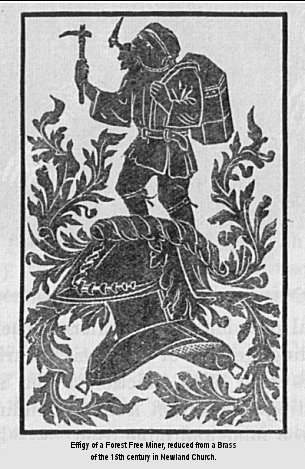
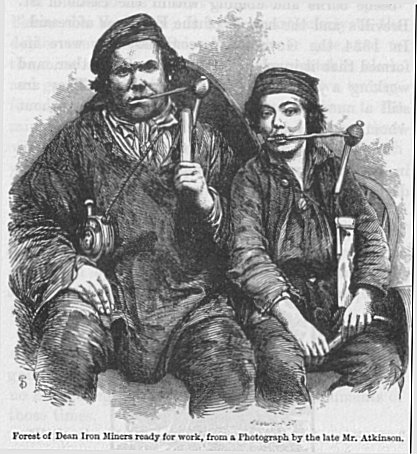
Their aspect when accoutered for work is given in the
frontispiece. If compared with their mediæval appearance, as
displayed in the miners’ crest, the interval of four
hundred years is scarcely discoverable. Every mining appurtenance is
retained, only somewhat altered in shape, and that, perhaps, not for the
better, be it cap, “bellis,” or general attire. Only the
beard is absent, but then there are the shoes.
On several occasions they conferred their freedom on the leading gentry
of the neighbourhood. By their orders they also sanctioned the
sinking of pits, as distinguished from levels, extending the
interval between mine and mine from “within so much space that
ye miner may stand and cast ridding and stones soe farr from
him with a bale as the manner is,” to five hundred yards. At
the present time the deputy gaveller, Mr. T. Forster Brown, is the resident
official under the Commissioner in charge of Her Majesty’s Woods,
&c., and he, with his respected predecessor, have at all times most
obligingly facilitated the author’s inquiries by giving the desired
information. It was during the deputy gavellership of the late Mr.
John Atkinson at Coleford that the writer chanced to meet with the original
transcript, here presented to the reader, of the “Book of
Dennis.” The first printing and publication of it took place in
1687, by William Cooper, at the Pelican, in Little Britain, and it has been
frequently but imperfectly reprinted.
Finding on examination that the reign of the first of the Edwards, and
not the third, was the period to which it assigned the confirmation of the
Forest of Dean Mine Laws, and that it contained many other inaccuracies, he
determined to prepare, in accordance with the valued suggestion of Mr.
Smirke, Judge of the Stannaries of Cornwall, a true copy of so ancient and
curious a document.
From the note which is appended to it, the existing MS. is evidently the
only authentic copy of the original “parchment roll,” out of
which it was transcribed by the gaveller, Richard Morse, A.D. 1673, of the
penmanship of which period it is a good specimen.
It seems to be a presentment of the Court of Mine Law, duly signed by
the jury of forty-eight free miners. Although its early date, and one
or two forms of expression, may seem to indicate that it was first of all
written in Latin, yet so many of its words and phrases, together
with its concluding signatures, are so thoroughly old English, as to show
that it was most probably composed in our own language. There are no
paragraphs nor punctuations.
In character it is “sui generis,” though it exhibits traces
of resemblance to the laws and customs of the old mining districts of
Somerset and Derbyshire, and even with those of Germany, as the
accompanying notes show. The words between brackets do not occur in
the original MS., having been inserted by modern printers. Those in
italics give the corrections needed in modern copies.


