CHAPTER XL THE RESTORATION GOVERNMENT, 1660 — FOOTNOTES:
IRELAND UNDER THE STUARTS
The King enjoyed his own again, and England rejoiced
exceedingly. Even Oliver’s unbeaten soldiers, disgusted
with his incompetent successors, were for the most part
ready to retire into private life. Yet the spirit of the
Puritan revolution survived, and the Mayor of Dover presented
a richly bound Bible to the restored monarch, who
graciously accepted it, remarking that it was the thing that
he loved above all things in the world. At Canterbury a
crowd of importunate suitors gave him some foretaste of
future troubles, but the entry into London was wonderful.
‘I stood in the Strand,’ says Evelyn, ‘and beheld it, and
blessed God.’ With the shouts of welcome still in his ears
Charles took refuge in the arms of Barbara Palmer, and
next day issued a proclamation against vicious, debauched,
and profane persons.
The Irish
Convention.
Coote and Broghill were jealous of each other. There
is reason to believe that the former was inclined to claim
the whole credit of restoring the King, but that the latter
proved his own priority by producing a letter from his rival
acknowledging the fact. They agreed that the Restoration
might be delayed or frustrated by hasty action in Ireland,
and that it was better to wait until England herself was
committed to it. The officers who had gladly pronounced
for a free Parliament might not have been united had
royalty been openly favoured. But the Irish Convention
lost no time in repudiating Cromwell’s plan of one legislature
for the whole of the British Islands, while strongly
approving the restoration of the secluded members in
England. They declared that ‘as for several hundreds
of years last passed by the laws and laudable custom and
constitution of this nation, Parliaments have been usually
held in Ireland and that in those Parliaments laws have
been enacted and laws repealed, and subsidies granted, as
public occasion required so that right of having Parliaments
held in Ireland is still justly and lawfully due and belonging
to Ireland, and that the Parliament of England never
charged Ireland in any age with subsidies or other public
taxes and assessments, until after the violence offered to
the Parliament of England in December 1648, since which
time they who invaded the rights of the Parliament of
England invaded also the rights of the Parliament of Ireland
by imposing taxes and assessments upon Ireland.’ This
important declaration was not made for more than a month
after the first meeting of the Convention, and the leaders
had prevented news from crossing the Channel until they
were sure of unanimity. It is therefore not surprising that
they were reported to favour separation from England.
The Convention now stigmatised this as a calumny originating
with Ludlow and his friends, for the idea of separation
was hateful to Ireland as absolutely destructive, ‘being
generally bone of their bone, flesh of their flesh.’ It was
clearly seen that the colonists would have a majority, and
means were taken to make it permanent. The Convention
pledged themselves to favour education, and to assist
in the establishment of a pious, learned, and orthodox
parochial clergy supported by tithes or endowments. The
adventurers and soldiers were to be secured in the lands
they had acquired, and all arrears of military pay to be
cleared off.[1]
Provisional
taxation.
For some months before and after the Restoration all
real power was in the hands of the army, but the Irish Convention
gave a show of legality to the means by which the
soldiers were paid. A poll tax was imposed for this and
other public charges, every person of either sex under the
degree of yeoman or farmer being assessed at twelve pence,
which was the minimum, and the rate rose according to
social position. A baron’s contribution was fixed at thirty
shillings, and that of a marquis, marchioness, or marchioness
dowager at eight pounds, which was the maximum.
The chief Protestant gentry were appointed collectors in
each county, Coote heading the list for Roscommon and
Broghill for Cork. The royalist wire-pullers in London
had been urging the managers of the Convention not to go
too fast for fear of alarming the Presbyterians, and it was
not till May 1 that they published a declaration condemning
the high court of justice and the sentence on the late King.
The people of Ireland, they said, took the first opportunity
afforded them of denouncing the most foul murder recorded
in sacred or profane history, considering that it had been
committed in a country where the true reformed religion
flourished, and that it was contrary to the solemn league
and covenant which the murderers had themselves taken.[2]
Charles II.
proclaimed
May 14.
Charles II. was proclaimed in Westminster Hall on
May 8, and six days later in Dublin; and there were general
rejoicings though the central figure was wanting. The
shops were shut, all the finery they contained having been
transferred to the citizens’ backs. Hogsheads of wine were
provided for the multitude, and the more they drank the
better the givers were pleased. The guns of the Castle
thundered salutes, volleys of musketry were heard on all
sides, bonfires and fireworks blazed until midnight. A
headless figure stuffed with hay and reclining on a rude
hearse was carried in a mock funeral procession, and subjected
to the blows and insults of the mob. The journey
ended at the mayor’s door ‘where it was in part burnt before
the bonfire there, and part trod to dirt and mortar by the
rout.’ Such was the end of the mighty Long Parliament.[3]
Lords
Justices
appointed.
Sir Charles Coote had been President of Connaught since
1645, and there was no difficulty in his case, since service
under the Protector was not to be considered a disability.
Broghill’s appointment, if ever regularly made, was of
much later date and of republican origin, but he had the
military authority and the legal presidency was soon conferred
on him also. With these two was associated Major,
soon after Sir William Bury of Grantham, who had been one
of the Irish Council under both Protectors. These three
were appointed Commissioners for the Government of
Ireland in January and were members of the Convention
though keeping their official work separate. Broghill was
generally in London for some time after the Restoration, and
Bury, who had Presbyterian leanings and whom Adair calls
a religious, prudent gentleman, did not always agree with
Coote. Other Commissioners were afterwards added and
all were paid at the rate of 1,000l. a year until the end of
1660. In compliance with the wishes of the Irish Convention
some of the great offices were filled up very soon
after the Restoration. The great seal of Ireland fell to Sir
Maurice Eustace, who had been Prime Serjeant and Speaker
of the House of Commons as early as 1634, and had afterwards
endured seven years’ imprisonment which only ended
in 1658. He thought himself too old for the work, and
Clarendon was of the same opinion: ‘he was now old and
made so little show of any parts extraordinary, that, but for
the testimony that was given of him, it might have been
doubted whether he ever had any.’ Sir James Barry, the
chairman of the Convention, became Lord Chief Justice. He
had been Strafford’s attorney-general, and very useful to
him in making out the royal title to Irish land. Sir William
Domvile, who was made Attorney-General, chiefly on the
recommendation of Daniel O’Neill, showed great ability
and presided in the Convention in succession to Barry,
who became Lord Santry. Arthur Annesley was installed
in his father’s old place of vice-treasurer, and was soon
created Earl of Anglesey.[4]
Monck and
Robartes.
Monck, now Duke of Albemarle, claimed the Lord
Lieutenancy of Ireland where he had an estate, but does not
appear to have had any intention of living there. Clarendon
says his chief object was to make money. It became necessary
to find a deputy, and Charles fixed upon Lord Robartes,
whose business capacity was undoubted and who had a
good reputation for honesty. He was, however, of a morose
temper, seldom agreeing with others, and was much
offended at being made Deputy to Albemarle, and not to
the King directly, though he was offered the usual power of
viceroy. The negotiation dragged on for six months, during
which Robartes made enemies of all with whom he had to
confer on Irish business, and at last he accepted the Privy
Seal, leaving the Government of Ireland to the old Commissioners,
while Albemarle, who was too important to displace,
remained Lord Lieutenant. In September Coote was
created Earl of Mountrath and Broghill of Orrery, and the
latter showed his astuteness in securing precedence by
getting his patent passed one day before his rival. On the
last day of the year the two new Earls were appointed Lords
Justices along with the Chancellor Eustace. They were
specially authorised by the King to assemble the Irish
Convention again in order to provide funds for the payment
of the army. The ancient framework of Irish government
was completed by appointing a Privy Council of thirty-four
members among whom was Sir Philip Mainwaring, made
secretary by Strafford in 1634 and still in legal possession of
his office. He died a few months later, having received
little or no reward for old service and for more than twenty
years of poverty varied by imprisonment.[5]
Negotiations
with
England.
Before the Restoration was accomplished the Irish
Convention sent over Sir John Clotworthy and Major
William Aston as Commissioners to communicate with the
still sovereign Parliament of England. Clotworthy, created
Viscount Massereene a few months later, was deeply interested
in the Cromwellian land settlement and gained
much influence by his activity. His unconcealed Presbyterian
leanings were forgiven because, in Clarendon’s
words, ‘he was of a generous and a jovial nature’ and a
staunch Royalist. After the Restoration these two Commissioners
were appointed to attend the King along with
eleven others, including Coote, Broghill, Barry, Eustace,
and Audley Mervyn. They carried with them 20,000l. for
Charles and lesser gifts for each of his brothers. Their instructions
were to petition for an Irish Parliament consisting
of Protestant Peers and Commoners and freed for this turn
from the restrictions of Poynings’ law, for an act of oblivion
for all Protestants subject to parliamentary exceptions, and
for an act for the attainder of such persons as Parliament
should select. It was desired that adventurers and soldiers
should be settled in their lands and the Irish in Connaught
and Clare. Impropriate tithes in the King’s hand were to
be restored to the Church, and taxation was to be controlled
by the Irish Parliament. These were the chief points
insisted on by the dominant party, while the Irish Roman
Catholic gentry in London besought Ormonde, who had
been the principal means of uniting the three kingdoms, to
mediate for them ‘and the remnant of their miserable
nation’ who were ready to lay down their lives for the
King. Sir Nicholas Plunket was usually the spokesman
of these suppliants. On July 27 Ormonde, who became
an Irish duke, took his seat in the House of Lords as Earl
of Brecknock, and on the same day Charles concluded his
speech as follows: ‘I hope I need say nothing of Ireland,
and that they alone shall not be without the benefit of my
mercy. They have shewed much affection to me abroad,
and you will have a care of my honour and of what I have
promised to them.’[6]
Position of
the Roman
Catholics.
Unfortunately for the chances of the Irish Roman
Catholics some of them would not wait, but took forcible
possession of their old lands, and there were many outrages.
The extent of the disorder may have been exaggerated,
but the Convention Parliament believed the worst and the
result was a royal proclamation, dated only two days after
the King’s entry into London, in which he declared himself
‘very sensible of the innocent blood of so many thousands
of our English Protestant subjects formerly slain by the
hands of those barbarous rebels.’ To prevent the further
spread of lawlessness all Irish rebels except those protected
by articles were to be apprehended and prosecuted.
Adventurers and soldiers were not to be disturbed except
by Act of Parliament or due course of law. Many were
imprisoned accordingly, and Ireland was quiet while the
question of future legislation was being discussed in London.
The pressure of business there was so great that little
progress was made during the latter months of 1660.
Mountrath carried on the provisional government, but his
Presbyterian colleague did not expedite the settlement of
Church and State. After the appointment of regular Lords
Justices things went a little faster. In January five months’
pay was due to the army on which everything depended,
beside an old arrear of fifteen months, and the King
found it necessary to acknowledge the Irish Convention,
thanking them for what they had done, promising a Parliament
as soon as possible, and asking for supplies. A
poll-tax, as authorised by proclamation of the Lords Justices
and Council, was accordingly imposed, baronets being
assessed at six pounds with a regular scale down to husbandmen,
petty farmers, and handicraftsmen, who were to
pay six shillings each. With a Parliament and possible
impeachment in the near future, care was taken not to tax
either spiritual or temporal peers. The Church, which
never ceased to be legally established, had already been
restored to its own.[7]
The Church
re-established.
Eight Irish Bishops had survived the great storm, and
the King with Ormonde and Clarendon beside him ventured
to fill the vacancies without waiting for an Irish Parliament.
Papists, Presbyterians, and Sectaries were all alike powerless
against the Royalist reaction. Bramhall was named for
translation to the primacy very soon after the Restoration,
and early in 1661 every see was provided for. Two Archbishops
and ten Bishops were consecrated in St. Patrick’s
Cathedral on January 27, and this unique ceremony was no
doubt very impressive.
‘All the orders of the kingdom,’ wrote the new Primate
to Ormonde, ‘Justices, Council, Convention, Army, City,
graced it with their presence.’ The anthem was supplied
by the Dean, William Fuller afterwards Bishop of Lincoln,
who sang in very tolerable verse of the essential unity of
Church and Crown. Jeremy Taylor, who had been over
two years in Ireland, was now Bishop of Down and preached
the sermon. Henry Jones of Clogher, who had been Oliver’s
scoutmaster-general, was not allowed, or was perhaps too
penitent to lay on hands, but held a Bible and presented it
to the Primate. Taylor had no doubts about the claims
of episcopacy, but in another sermon preached three months
later he practically describes his own not very enviable
position among the Ulster nonconformists: ‘says the
papist, "I will not obey the protestant kings, because,
against the word of God, they command me to come to
church where heresy is preached"; "and I will not acknowledge
the bishops," saith the presbyterian, "because they are
against the discipline and sceptre of Jesus Christ"; and the
independent hates parochial meetings, and is wholly for a
gathered church, and supposes this to be the practice apostolical;
"and I will not bring child to baptism," saith the
anabaptist, "because God calls none but believers to that
sacrament"; "and I will acknowledge no clergy, no lord, no
master," saith the quaker, "because Christ commands us to
‘call no man master on the earth, and be not called of men
rabbi.’" And if you call upon these men to obey the authority
God had set over them, they tell you with one voice, with all
their hearts, as far as the word of God will give them leave;
but God is to be obeyed and not man, and therefore if you
put the laws in execution against them, they will obey you
passively, because you are stronger, and so long as they
know it they will not stir against you; but they in the
meantime are little less than martyrs, and you no better
than persecutors.’[8]
Attempts
to enforce
uniformity.
Nonconformists were now officially styled fanatics, and
Mountrath suggested that the King should make 100,000l. by
excluding them from the benefit of the new settlement.
Orrery was less extreme or less outspoken, but both he and
Eustace were willing to give Bramhall a free hand. Only
five days before the great consecration a proclamation
was issued against Papists, Presbyterians, Independents,
Anabaptists, Quakers, and other fanatical persons. Conventicles
were prohibited, the bishops being charged to see
that the sheriffs and justices did their duty, while military
officers were ordered to support them. Another proclamation
provided for the commemoration of King Charles the
Martyr on January 30, and a third for the prosecution of
Tories as traitors unless they surrendered before February 18,
in which case those who had not committed murder might
be received to mercy on giving security for good behaviour.
It was found possible to reduce the army by 1,650 men and
a proportionate number of officers during the first twelve
months after the Restoration, but to do this 50,000l. had
to be transmitted from England. These men no doubt were
paid in full, but when that was done eight months of new
and fifteen months of old arrears were due to those that
remained under arms. It was time to summon a parliament.[9]
CHAPTER XLI DECLARATION AND ACT OF SETTLEMENT, 1660-1662 — FOOTNOTES:
Position of
Irish Recusants.
In the autumn of 1660 Sir Henry Bennet, who then
represented Charles at Madrid, forwarded a letter from
Hugh O’Neill calling himself Earl of Tyrone. The brave
defender of Clonmel and Limerick felt that his end was
near and begged favour for his family ‘which a long and sad
experience will have taught them to value as they ought
to do.’ Roman Catholic refugees from Ireland, whatever
part they might have taken in the long struggle with the
Parliament, felt that only the King could now help them.
At his command they had been ready to change from the
service of Spain to that of France, and to go wherever his
policy required them. They were included in the Breda
declaration which promised oblivion for the past and toleration
for the future. In London they found many sympathisers
but also many enemies, and the latter proved much
the stronger party. The adventurers and soldiers occupied
all the best parts of Ireland, and by the proclamation of
June 1 they were confirmed in their possessions until the
King with the advice of the English or Irish Parliament
should ‘further order, or that they be legally evicted by
due course of law.’ Charles spoke under pressure at the
dictation of the English Parliament, but he was bound
by the Act of 1642 which pledged two and a half millions
of Irish acres for the cost of the war. He was not the man
to risk his own position from sentiment or from a sense of
justice, but as far as he could do so safely he sympathised
with the dispossessed natives. He owed his restoration
to England, and Scotland and the English in Ireland, ‘but,’
says Clarendon, ‘the miserable Irish alone had no part in
contributing to his Majesty’s happiness; nor had God
suffered them to be the least instruments in bringing
his good pleasure to pass, or to give any testimony of
their repentance for the wickedness they had wrought,
or for their resolution to be better subjects for the
future.’[10]
Irish
demands
considered.
At first the Irish appeared as suppliants acknowledging
their faults, pleading extenuating circumstances, and begging
for royal favour. But as the King’s leaning towards them
became evident they took higher ground, demanding their
rights in strong language, and ‘confidently excused, if not
justified, their first entry into rebellion’ as to the inexcusable
barbarity of which Clarendon speaks as strongly as
any of the Cromwellians. Rightly, from their point of
view, but not wisely, they maintained that the English
rebellion, stained as it was by the late King’s murder, was
much worse than theirs. Charles attended regularly at
the many Council meetings where the representatives of
various interests were patiently heard, and the more boldly
the Irish advanced their claims the more he was forced to
listen to the case of the Cromwellians, who of course raked
up the story of the original rebellion which in Clarendon’s
words was ‘as fresh and odious to the whole people of England,
as it had been the first year.’ As spokesman for his
unfortunate countrymen, Sir Nicholas Plunket must have
felt the weakness of his own position, for it was known, and
he knew it was known, that during the last phase of the
Irish war he was anxious for an accommodation with Cromwell
and hostile to Ormonde and Clanricarde. He had
plenty of help from men who knew all the facts, but Orrery
and Massereene were no less well informed, and Ormonde
himself was on the spot. Plunket had been a party to the
peace of January 1649 and accepted office under it, but
the terms were ill-kept, and even if Ormonde were disposed
to treat them as still fully in force he was precluded by the
King’s Dunfermline declaration that it was exceedingly
sinful and unlawful. It was argued that those who had
made the peace professed to represent all Ireland, and that
they had been totally unable to manage the clerical party
who reduced its value to waste paper.[11]
The
Declaration.
Adventurers.
Soldiers.
49 officers.
At the end of November a Declaration was at last agreed
to which for the most part left the adventurers and soldiers
in possession, while making ostensible provision for Irish
proprietors who had not engaged in the rebellion or who
had earned favour by subsequent services. The whole
settlement was founded on the principle that the property of
all persons implicated in the rebellion from and after October
1641 was forfeited and actually vested in the Crown. The
Declaration begins with an acknowledgment of what the
King’s subjects in Ireland had done to further his restoration.
A distinction is drawn between what was done by the Act
of March 1642, to which Charles I. had consented, and the
subsequent ordinances of the usurping Parliament, the
result of both being that the adventurers and soldiers
possessed the greater part of Ireland. The truce of 1643
and the treaties of 1646 and 1649 were forced upon the late
King, and his son would have us believe that he had confirmed
the latter to save his father’s life, though in fact he had
done so long after his death. Attention is then drawn to the
fidelity of the Irish during Charles’ exile who changed from
one service to another to suit his interest ‘though attended
with inconveniency enough to themselves; which demeanour
of theirs cannot but be thought very worthy of our protection
justice and favour.’ Nevertheless all the lands possessed
by the Adventurers on May 7, 1659, were secured to them,
while those whose claims had not been fully satisfied were
to have the deficiency made up out of territory assigned to
them as a body but not yet distributed. Officers and soldiers
were next confirmed in their possessions with savings in the
case of fraud. Church lands were excepted, as also the
estates of men not protected by the Act of Indemnity or
who had broken the peace since the Restoration. In these
cases, as in those where valid incumbrances were proved to
exist, reprisal was to be made. Commissioned officers
serving before June 5, 1649, whose arrears had not been paid
in money or land were to be satisfied out of undisposed
land in certain counties or within the mile-line surrounding
the transplanters’ district beyond Shannon. The forfeited
houses in towns were also assigned to these officers, ‘satisfaction
being first made to such protestants, who on leases, or
contracts for leases, have built or repaired houses, or planted
orchards or gardens.’ Protestants whose estates had been
divided among adventurers or soldiers were to be forthwith
restored, a reprisal of equal value being given to the latter.[12]
Innocent
Papists.
Article
men.
Ensignmen.
Nominees.
The next class provided for were known as Innocent
Papists, that is Irish proprietors who had been dispossessed
‘merely for being papists,’ and who had received more or
less of an equivalent in Connaught and Clare. Applying
for such an equivalent was their own act, and might ‘without
any injustice’ disentitle them to any relief, but they
were admitted on equitable grounds. In many cases no
doubt there had been only three courses open to them, exile
without means to live, starvation at home, or land beyond
Shannon. They were now to be capable of restoration to
their old estates at any time before May 2, 1661, on condition
of surrendering their transplanters’ portions to the King
to reprise others. Any adventurer or soldier disturbed to
make room for the restored Papist was to have a reprise of
equal value. In the case of towns ‘planted with English,
who have considerably improved at their own charges and
brought trade and manufacture into that our kingdom and
by their settlement there do not a little contribute to the
peace and settlement of that country,’ the old Roman
Catholic proprietors were to have reprise of equal values
‘near the said corporations.’ The difficulties of doing equal
justice to all was acknowledged to be great, but those of the
Irish who had acceded to Ormonde’s peace and had received
land as transplanters were held bound by their own act.
Their case was hard, no doubt, but said the King, ‘they
can no more reasonably expect that we should further
relieve them, than our friends in England and Ireland can
expect that we should pay back to them all the moneys they
were compelled in the evil times to pay for their compositions,
which they would have avoided had it been in their
power.’ Those who had chosen the better part and followed
the royal fortunes abroad, Muskerry and many others being
named, were to be restored if they had received nothing as
transplanters, but adventurers and soldiers in possession
were to be first reprised ‘out of the remaining forfeited
lands undisposed of.’ This was all to be done by October 23,
1661. Eighteen peers, including Clanricarde, Westmeath,
Clancarty, Mountgarret and Taaffe were specially named
for restoration ‘without being put to any further proof’
along with twenty commoners of whom Richard Bellings
was the most remarkable. Orrery had persuaded the
English Council, or perhaps had only given them an excuse
for declaring, that there was enough undisposed forfeited
land to reprise everyone for his losses, and in the meantime
the adventurers and soldiers were left in possession.
The first to be restored were innocent Protestants and ‘those
persons termed innocent papists, who never took out any
decree or had lands assigned to them in Connaught or
Clare.’ Innocent Protestants and Papists who had taken
out such decrees came next, then the Irish Papists who had
constantly served under the King’s ensigns abroad.[13]
Recipients
of special
favour.
All who had been in rebellion before September 15, 1643,
and had received grants in Connaught or Clare were excluded
from the benefits of the Declaration, but some persons were
specially protected from its disabilities. Ormonde and
his wife with all his tenants and mortgagees or those of his
ancestors ‘barons of Arklow, Viscounts of Thurles, or Earls
of Ormond or Ossory,’ were fully guarded. Inchiquin,
who had procured a private Act in England for the purpose,
was restored to his estate of which he had been deprived
‘for his eminent services and adhering unto us.’ Albemarle
was confirmed in all his possessions, as were Orrery, Mountrath
and his kinsmen, and several others including ‘the
orphans of Colonel Owen O’Connolly,’ Sir Theophilus Jones,
Arthur Annesley Viscount Valentia, and Major George
Rawdon. If any restorable persons were ousted to make
room for these eminent persons they were to be reprised,
forfeited lands in Carlow being specially designated for
those who were removed from the Ormonde estate.[14]
A
satisfactory
settlement
was impossible.
It was intended that when the Declaration had been
confirmed by law in Ireland, and its provisions carried out,
it should be followed by a general act of pardon, indemnity,
and oblivion on the English model, ‘notorious murderers
only excepted,’ but excluding all who had conspired to
seize Dublin Castle in 1641, and all who had any part
in the execution of Charles I. down to the halberdiers
on guard. But, unfortunately, this healing measure was
withheld. The King, admitted the imperfections of his
Declaration, pleading ‘that the laying of the foundation is
not now before us, when we might design the model of
the structure answerable to our thoughts.’ Thousands of
Englishmen had possessed themselves of Irish lands after
long and tedious legal process, they had brought over their
families, sometimes selling all they had to do so, they had
made great improvements, and it was impossible, as it
would have been unjust, to confiscate their property, ‘reprisal
not first being provided for.’ The enormous difficulty
of the task must be admitted, but Charles proved himself
no true prophet when he expressed a confident hope that
mutual forbearance would bring about a good understanding
between two parties who had nothing in common but the
memory of an internecine war.[15]
The first
Commission
for
claims.
The next step was the appointment of a commission to
carry out the Declaration. It consisted of thirty-six persons,
including many peers and all the King’s counsel. The
attorney and solicitor-general were afterwards excluded
lest the Crown should be made a judge in its own cause, but
in truth there were but few disinterested men among these
Commissioners, for they were all concerned in Irish land,
though often differing in opinion. Massereene, Petty, and
Audley Mervyn, for instance, were naturally inclined to
maintain the Cromwellian arrangements, while Lord Montgomery,
Domvile, and Lane were more in favour of the
old Protestant inhabitants. Some of their colleagues were
disposed to do justice to the Roman Catholics, but the
latter had no direct representation. It is unnecessary to
enlarge on the subject, for little or nothing was done by
this unwieldy body, and the instructions for its guidance
had to be applied by a smaller and less prejudiced commission.
Of the three Lords Justices Orrery and Mountrath
leaned towards the adventurers and soldiers, while Eustace
thought more of ‘the old English interest which lately
overspread the land far different from such as did rise up
with Cromwell,’ mushrooms who considered themselves
the true representatives of England and ignored those who
came in with the Conqueror and never made any defection
before 1641. Were they, he asked, all to be cast out for
one fault? In several months the Commissioners had only
succeeded in relieving one widow, though the streets were
‘full of those miserable creatures of all sorts noble as well
as of inferior degree.’ He thought they were criminal who
had deluded the King into believing that there was a great
scope of available land. Orrery and Mountrath felt the
responsibility though averse to restoring the Irish, and to
avoid the odium of inaction did of their own motion restore
a few notable Roman Catholics, but the great mass were
reserved for the new commission.[16]
Composition
of the
Irish
Parliament,
May 1661.
Speaker
Mervyn.
The composition of the first commission was not the
sole cause of delay, for the judges held that it would not be
safe to act on the Declaration until it had legal sanction.
It was remembered how Strafford had contributed to his own
destruction by boasting that he would make Acts of State
equal to Acts of Parliament. The Irish Convention having
done its duty by making some provision for the pay of the
army, it was resolved to call a Parliament. As freeholds
were for the most part in Protestant hands there could be
no question about the majority. ‘The papists and anabaptists,’
said Orrery, ‘stood in several places to be chosen,
yet but one of each sort was actually chosen, and they both
in the borough of Tuam, an archbishop’s see; from which
all collect that both these opinions will oppose the true
church.’ The one Papist was Geoffrey Brown, much trusted
by the late Confederacy but opposed to the nuncio. He was
excluded by the oath of supremacy, and his seat seems to
have been treated as vacant and filled up. Parliament
met at Chichester House on May 8 after hearing Taylor
preach on the texts that obedience is better than sacrifice
and rebellion as the sin of witchcraft. Bramhall presided
in the Lords, the Chancellor being disabled as one of the
Lords Justices. Lord Santry was anxious for the post, but
was considered a cold friend to the Declaration and rejected
to his great disgust. For the Speakership of the Commons
the King recommended Domvile the attorney-general, but
the adventurers were too strong and the Lords Justices
acquiesced in the choice of Sir Audley Mervyn, whose flowery
speech before them contained much Latin and some Greek.
Never, he said, since Ireland was happy under an English
Government was so choice a collection of Protestant fruit
that grew within the walls of the House of Commons.
Their lordships had piped and the Irish danced, and ‘Japheth
might perhaps be persuaded to dwell in the tents of Shem.’
This oration was ordered by the Commons to be printed,
and it filled six crowded folio pages. Thanks were also
voted to Bishop Taylor for his sermon. A jove principium
exclaimed Mr. Speaker on taking the chair. The oaths of
supremacy and allegiance were affirmed by both Houses, the
civil authorities directed to co-operate with the bishops in
re-establishing the Church, while the Solemn League and
Covenant and the Engagement were ordered to be burned
by the common hangman in Dublin and in all market
towns.[17]
Debates
on the
Declaration.
After a little sparring between the two Houses, the
Declaration was adopted by Parliament in a fortnight, but
the Instructions for working it which had also been transmitted
from England were still open to discussion. Commissioners
were chosen by ballot, four peers, representing
each rank, and eight members of the House of Commons.
In the
Lords.
In the
Commons.
In the Upper House the lot fell first upon Wentworth
Earl of Kildare, the head of the Geraldines, who strangely
enough held Ormonde’s proxy. His mother was a Boyle and
his father had adhered steadily to the Parliament, but he
was looked upon as in some sort the protector of the old
English. For colleagues he had Lord Montgomery, Lord
Kingston, and John Parker, Bishop of Elphin, afterwards
Archbishop of Tuam, who had exerted himself in favour of
the suffering Irish. Speaker Mervyn headed the Commoners’
contingent, and this shows how strong the Adventurers were.
Among the others were Petty, Sir John Skeffington,
Massereene’s son-in-law and heir, Sir Theophilus Jones,
who held the Sarsfield property at Lucan, and Sir William
Temple, afterwards so famous. All were of course interested
in land. Temple, whose diplomatic cleverness was already
recognised, acted for the Commons in their communications
with the Upper House. His younger brother John, the
Solicitor-General, was made acting Speaker during Mervyn’s
absence. Being unable to agree as to what ought to
be the contents of the coming Bill of Settlement, each
House instructed its own emissaries separately. The
Lords Justices also appointed agents to represent them
in London and to carry over the Bill of Settlement:
Michael Boyle, Bishop of Cork, afterwards Primate and
Chancellor, Lord Kingston, and Colonel Thomas Pigott,
Master of the Court of Wards. Pigott, in Eustace’s opinion,
was ‘as right unto the poor people of this nation as
any man living,’ but he could not say as much for the
first two. Francis Lord Aungier, whose financial skill
was valuable, had six months leave from the House of
Lords. Massereene also had leave to go to the country, which
he utilised to slip over to England and join his forces to the
representatives of the Commons, but a letter was written
on Kildare’s motion warning the English Government
against hearing one who was not authorised to speak for the
Peers. Of Roman Catholic suitors there was no lack in
London, Sir Nicholas Plunket always figuring as their chief
spokesman.[18]
Conditions
of the
Settlement.
It was from the first evident that there would not be
land enough to satisfy all claims, and the Declaration made
careful rules about priority. Innocents were to be first
restored, but the Instructions raised so many barriers that
their case might well seem hopeless. Not only were ‘adventurers
and soldiers and other persons’ in possession to be
fully reprised before anyone could be restored, but Innocent
Papists were disqualified who came within any of the following
categories:-
1. Those who were of the rebels’ party before the cessation
of September 15, 1643.
2. Those who enjoyed their estates real or personal
within the rebels’ quarters, an exception being made in
favour of the inhabitants of Cork and Youghal who were
‘expelled and driven into the quarters of the rebels.’
3. Those who had entered the Roman Catholic confederacy
before the peace of 1646.
4. Those who joined the nuncio against the King.
5. Those who having been excommunicated for adhering
to the King owned it an offence and were relieved from
the ban.
6. Those who derived title from any person guilty of the
above crimes.
7. Those who pleaded the articles of peace for their
estates.
8. Those who being within the royal quarters during the
war communicated with the King’s enemies.
9. Those who before the peace of 1646 or 1648 sat in
any assembly of the Confederate Roman Catholics, or acted
under orders from them.
10. Those who empowered agents to treat with foreign
papal powers or brought foreign forces into Ireland.
11. Those who had been woodkernes or tories before
Clanricarde left the Government.[19]
Paucity of
evidence.
With such a list of disqualifications it would seem hard
for any Irish Roman Catholic to prove his innocence within
the meaning of the Act. It was at first intended to exclude
all who had paid contributions to the rebels, whether
voluntary or not, but this was dropped as too manifestly
unjust. A strong effort was made to do away with the
disqualification from enjoying estates in the enemy’s
quarters, but against this it was argued that in many cases
there was no other applicable test. After twenty years
there was little or no direct evidence, and if the presumption
from residence was disregarded the great mass of the Irish
would be restored, controlling future Parliaments and getting
all the seaports into their hands. ‘Until the cessation,’
Mountrath wrote, ‘none but the rebels’ friends could live
in their quarters, all others were expelled or destroyed’;
and this reasoning prevailed. Yet it cannot be doubted
that many remained in the Irish quarters only because they
had nothing to live upon anywhere else.[20]
Available
area insufficient.
The
Doubling
Ordinance.
Even those who could prove their innocence had to
make reprisal to Adventurers and soldiers in possession
before they could be restored. It soon became evident
that Orrery had greatly exaggerated the amount of land
available, but Lord Aungier drew attention to the fact that
many Adventurers had received more than the value of the
money advanced by them. This was largely the result of
the Doubling Ordinance passed when the Parliament were
in financial straits after Edgehill. As it never received
the consent of Charles I., Charles II. could legally ignore it.
By this it was provided that those who added one-fourth
to their original stake should have the whole doubled and
be recouped in Irish measure instead of the English acres
originally intended. Thus one whose first subscription was
1000l. and who afterwards added 250l. would be credited
with 2500l. As to the Irish acres the point had been conceded
in the King’s Declaration. Nor was this all. If the
original Adventurer refused to increase his stake a stranger
might come in and do it for him, receiving double of the
whole after deducting the original advance, and thus a
speculator who never gave more than 250l. would receive
credit for 1500l. Massereene and other interested persons
endeavoured to maintain this arrangement, but the abuse
was too glaring and the Bill of Settlement provided that
the reprisal should extend only to the amount actually
contributed. Even so the fund was still far from sufficient.
‘If,’ said Ormonde, ‘the Adventurers and soldiers
must be satisfied to the extent of what they suppose
intended unto them by the Declaration; and if all that
accepted and constantly adhered to the peace in 1648 must
be restored, as the same Declaration seems also to intend,
and was partly declared to be intended at the last debate,
there must be new discoveries made of a new Ireland, for
the old will not serve to satisfy these engagements. It
remains then to determine which party must suffer in the
default of means to satisfy all; or whether both must be
proportionately losers.’[21]
Incompatible
claims.
Sir
Nicholas
Plunket.
Ormonde would have liked to restore many of the Irish,
but they disregarded his advice. Instead of acknowledging,
while endeavouring to minimise, their share in the rebellion
they insisted that the Parliamentarians alone were rebels
and sufficiently rewarded by being suffered to live. They
themselves were the loyalists and worthy of reward. But
their enemies were in possession, all-powerful in the Irish
army and Parliament, and in a position to show that the
Confederates had depended on foreign and papal support,
and had done many things in derogation of the royal
authority. During the winter of 1661-2 the wrangle continued,
and at last Charles, probably much against his will,
was constrained to cut the knot. The Solicitor-General
Heneage Finch, afterwards Lord Chancellor and Earl of
Nottingham, acted as legal adviser in all the Irish business,
and he brought up a report from the Committee of Council
specially charged with it. The Commissioners from the
Irish Parliament and Council had produced the instructions
of January 18, 1647, from the supreme council to Bishop
French and Nicholas Plunket as envoys to the papal court,
a draft of similar instructions for France and Spain, and a
copy of the Jamestown excommunication. Sir Nicholas
Plunket was then called in and acknowledged his signature
to the first and his handwriting throughout the second
document. This report was presented when the King was
present in Council supported by twenty members including
the Duke of York, Clarendon, and Ormonde, and it was
thereupon ordered ‘that in regard the said Romish Catholics
have been already several times heard at this Board as to
the Bill of Settlement, no more petitions or further addresses
be required or admitted from them for obstructing the
same,’ and the Solicitor-General was directed to go on
with the engrossing of it. Sir Nicholas Plunket was at the
same time ordered to ‘forbear coming into or appearing
in His Majesty’s presence or court, notice of this order
being given to the committees employed from the said
Council and Parliament, to be by them transmitted into
Ireland.’ Plunket was often heard again later on, but not
till the Act of Settlement had passed.[22]
Albemarle
resigns in
Ormonde’s
favour.
Mountrath died of smallpox on December 18, and a fresh
patent was at once made out to the survivors, Eustace and
Orrery. But it was already announced that this was only
provisional, that Ormonde was to be Lord Lieutenant, and
that no important step was to be taken until his arrival.
Albemarle, who had a large Irish property, had for a long time
opposed his appointment, and surprised everyone by suddenly
recommending him as a most fitting person. It was,
he said, useless for him to retain the office in his own hands
since he could not well be spared from the King’s side.
Charles did not consult Clarendon, whose opposition to his
friend’s promotion is amusingly described by himself.
The Chancellor objected that the King could not spare the
Duke and that the latter would be able to do no good in
Ireland. He might have been useful if despatched immediately
after the Restoration, but now he had hampered
himself by engagements with individuals, and ‘had given
himself so much to his ease and pleasure that he would
never be able to take the pains which that most laborious province
would require.’ Ormonde answered good-humouredly
that no one knew the difficulties better than he did
and that he had not sought the viceroyalty but could not
refuse it on public grounds, and that he would take
indefatigable pains for a year or two to purchase ease for
the rest of his life. His powers of work were enormous,
but he knew how to unbend better than his friend. When
the news reached Dublin the Irish House of Lords at once
sent a letter of thanks to the King for choosing one ‘of
whose noble and sweet disposition and prudent and just
government void of all sinister and self ends we have formerly
had full experience.’ His presence would offer the best
chance of peace and settlement, and no kingdom ever needed
them more. The House of Commons were no less complimentary,
regarding Ormonde’s government as the most
likely to maintain order and to establish an English and
Protestant interest.[23]
Provisos
in the Bill
of Settlement.
Grant to
the Duke of
York.
The Houses were not allowed to do much until the Bill
of Settlement had assumed its final shape. By Poynings’
law it could not be altered after its transmission by the
English Council. A week before Plunket’s dismissal by
the Privy Council the Irish House of Commons petitioned
the King that no provisos should be inserted in the Bill
which affected the interests secured by the Declaration.
Many had, however, been already decided on and some were
added later, which were not all such as the dominant party
in Ireland could approve. Further favour was indeed
extended without demur to Ormonde, Sir John Temple,
Sir George Rawdon, Sir William Petty, and other well-known
Protestants, and there was no opposition to what was done
for the Established Church, but such eminent Roman
Catholics as Sir Robert Talbot, Sir Valentine Blake, and
Geoffrey Brown, while deserving well of the Crown, cannot
have had the goodwill of the Adventurers. Antrim, who
had been omitted from the Declaration, was by a special
clause placed upon the same footing as those named in that
document. The estates of all the regicides, except a small
portion already given away, were granted to the Duke of
York without any protection for the old proprietors. James
proved his claim to 77,000 acres, and in 1668 his agents
were in possession of at least as much more to which the
title was disputed. Lest there should be any doubt as to
what lands were ‘forfeited,’ it was declared and enacted ‘that
the said word shall be deemed and taken not only of
such lands, tenements, and hereditaments as are already
forfeited by judgment, confession, verdict, or outlawry, but
such as by reason of any act or acts of the said rebellion
already committed by the several and respectable proprietors
hereof shall or maybe forfeitable.’ And ‘undisposed land’
was defined to be all that was not disposed of by the Act.[24]
The Bill in
the First
Parliament.
The final touches were given to the Bill of Settlement
early in April, and on May 6 it was read a first time in the
Irish House of Commons, who had the power to reject but
not to amend it. Speaker Mervyn had just returned to his
post, and his influence was quickly visible. In the course
of prolonged debates discrepancies were noticed between
the original Declaration and the latter part of the Bill
with which it was incorporated. There was some inclination
to refuse the passage of the Bill until an explanatory
measure was also passed, but Orrery pointed out that there
could be no explanation until there was an Act in being
to explain. The Commons proceeded, however, with the
preparation of an explanatory bill, and the Lord Lieutenant
was reminded that he would be expected to transmit it
soon after his arrival in Ireland.[25]
Ormonde
arrives a
Lord
Lieutenant.
Ormonde, in his capacity of Lord Steward, was detained
in London by the King’s marriage, but reached Coventry
on his way to Holyhead by the beginning of July. He was
accompanied by many Irish peers, members of Parliament
and claimants to land who were now hastening to defend
their own interests in Ireland. In each county that he
passed on the road to Chester the Lord Lieutenant came to
meet him, and the local militia were paraded. He travelled
by land to Holyhead, crossed in very rough weather and
landed at Howth on July 27, the anniversary of the day on
which he had surrendered Dublin to the parliamentary
commissioners fifteen years before. He was at the Castle
next day, and on the third received the House of Commons
and had to endure a speech from Sir Audley Mervyn which
was voted to express their sense and ordered to be printed.
There were many other speeches and addresses, and on
the 31st the Lord Lieutenant appeared in the House of
Lords and gave the Royal assent to the Bill of Settlement.[26]
Bennet
Secretary
of State.
In October 1662, a few months after Ormonde’s arrival
in Ireland, the faithful old secretary Nicholas was dismissed
and Sir Henry Bennet appointed in his stead. He was
soon made Lord Arlington, and by that name is but too
well known in history. The correspondence with the Lord
Lieutenant passed through his hands, and he set himself
from the first to make money out of Ireland. Most of the
officials, in co-operation with Colonel Talbot, did their best
to advance the interests of a courtier who was likely to be
very powerful. He was, says Burnet, ‘proud and insolent,
a man of great vanity and lived at a vast expense without
taking any care of paying the debts which he contracted
to support that.’ Clarendon says much more to the same
effect and adds that he was never guilty of friendship to
any man. He married Lady Ossory’s sister, and was thus
pretty closely connected with the Lord Lieutenant, but the
relations between them were never very cordial. The
nature of Bennet’s interest in Ireland was soon made clear
in the case of an ancient proprietor who had no court
interest.[27]
The Clanmalier
Estate.
Foundation
of
Portarlington.
James I. had granted to the head of the O’Dempseys
a great estate on both sides of the Barrow in King’s and
Queen’s Counties, worth 4000l. a year in its unimproved
condition and subject only to a small quit-rent. Sir John
Davies had reported that the clan were inclined to live in
a civilised manner, and the chief was created Viscount
Clanmalier by Charles I. His son Lewis succeeded before
the outbreak in 1641, commanded a regiment during the
war, and was included in the Cromwellian Act of Attainder.
He afterwards claimed to have adhered constantly to the
peaces of 1646 and 1648 and to have preserved the land and
goods of many distressed English, but received no consideration
for his estate which had been given to soldiers and
Adventurers. Not having served the King abroad he was not
protected by any clause in the Act of Settlement, and Sir
Henry Bennet coveted the property. Probably Clanmalier
would have failed before the Court of Claims, for he
had been a long time in the rebels’ quarters, but his case
seems not to have been heard, perhaps through his lawyer’s
mistake, and his position was hopeless from the first. In
November 1662 the King granted the whole estate to
Bennet who had just been made Secretary of State, and the
Irish officials did their best to make the grant effective.
Winston Churchill and Talbot were very active in the
matter, and the latter showed very little anxiety about
getting anything for Lord Clanmalier. Ormonde was more
sympathetic, and discouraged the private Bill by which
Bennet’s friends proposed to cut all knots. The Adventurers
and soldiers had to be reprised, and they exerted themselves
to find concealed lands, thereby reducing the stock available
for working the Act of Settlement. Clanmalier was only
tenant for life, but in the end the Act of Explanation gave
the whole estate to Bennet without considering the reversion.
The men in possession were to have two-thirds of their
interests, which some valued at three and some at six years’
purchase, and the Manor of Portarlington was erected with
great privileges and the right of sending two members to
Parliament. If Lord Clanmalier got anything at all it was
in the nature of a compassionate allowance. It is not
surprising to find that Tories were numerous near the new
borough, and that some of them bore the name of Dempsey.[28]
CHAPTER XLII COURT OF CLAIMS AND ACT OF EXPLANATION, 1662-1665 — FOOTNOTES:
The Court
of Claims.
While Ormonde was on his way to Ireland the King
appointed seven Commissioners for carrying out the Bill of
Settlement as soon as it should become an Act. Great care
was taken in choosing these, and Clarendon assures us that
it would have been impossible to get fitter men. The first
named was Henry Coventry, well known in the history of
the time. Sir Edward Dering of Kent, a very good man of
business, was second. The third was Sir Richard Rainsford,
serjeant-at-law and afterwards a judge in England. Sir
Thomas Beverley, one of the King’s remembrancers, was the
fourth. Sir Edward Smith, Chief Justice of the Irish Common
Pleas, came next, and was followed by Colonel Edward Cooke.
The last named was Winston Churchill, father of the great
Duke of Marlborough. Coventry was too useful at Court
to be left long in Ireland, and after a few months he was
recalled and replaced by the Surveyor-General Sir Alan
Brodrick. Before the Commissioners could sit to hear
claims of innocence, rules of procedure had to be made and
a vast amount of preliminary work done. Petty’s Down
Survey was used for the purposes of the settlement, his
cousin John acting as Brodrick’s deputy. The Court of
Claims was formally opened on September 20, its powers
under the Act of Settlement and an amending Act being
limited to one year from that date. The Lord Lieutenant
was empowered by the Instructions to issue subsidiary commissions,
and one to enquire into the value of estates restorable
or reprisable was issued to independent persons, and
another to Anglesey, Sankey and others, in conjunction with
Coventry and his colleagues, to investigate frauds and irregularities
in the distribution of lands beyond Shannon under
the Cromwellian Government.[29]
Innocents
and
Nocents.
The Commons
dissatisfied.
The result of the first day spent by the Commissioners
in hearing claimants was that two were declared innocent
and one nocent. ‘If,’ said Ormonde, ‘the lottery would
hold out so to the end of their commission it would prove
no ill one for the Irish,’ and they accordingly began to
indulge in extravagant hopes. The more violent among
them declared that Orrery and the other leaders who had
restored the King should be rooted out as heretics and
damned traitors as soon as the army became ‘Catholic
loyal.’ It was said, probably with truth, that many
forged conveyances were produced and admitted by the
Court. There was angry consternation among the Adventurers
and soldiers who did not believe in the impartiality
of the Commissioners. The House of Commons, meeting
after a short recess, lost no time in giving a voice to the
prevailing discontent. Ormonde had forwarded the explanatory
Bill as desired, but it was altered in England, and
when it came back was, as he foretold, promptly thrown
out by the Commons on the motion for a second reading.
‘When,’ he wrote to Clarendon, ‘anybody of credit among
these people finds himself like to be pinched in his interest
he causes a cry to be raised that all is lost to the English
and that the Irish be their masters.’ Timid people sold
their goods and departed, while the alarmists stayed and
got cheap bargains. Monks and friars added to the panic
by holding chapters as openly as in Spain, while prudent
Roman Catholics would have liked a sharp proclamation
against the regulars as a protection to themselves. The
House of Commons were bent on making the Act of Settlement
more stringent, and unanimously agreed to twenty
proposals for the purpose. Founding an argument upon
the last clause of the Act which gave the Lord Lieutenant
power to alter the procedure of the Commissioners before a
date which had already passed, they called upon him to
define the English quarters as existing from time to time
until he left Ireland in 1647, no witnesses outside the
line being admitted to prove innocence, since the rest
of the island was assumed to be rebels’ quarters. Another
proposal was that no claimant once adjudged nocent
should be allowed to make any other claim. Ormonde
was asked to admit a committee of the House to confer
with a committee of the Council, the action of the Commissioners
being suspended in the interim. The House of
Commons had of course no jurisdiction over the Court of
Claims, and Clarendon reported that the King was ‘horribly
angry’ at their presumption in seeking to treat with the
Council.[30]
Speaker
Mervyn
represents
the malcontents.
Titles not
regarded
as permanently
valid.
Though fully determined not to yield to parliamentary
pressure, Ormonde promised that the proposals of the
House should have ‘such speedy answer as the weight and
number of these would permit.’ The Lord Lieutenant
was treated with respect throughout, but the Speaker’s
speech on the occasion was not conciliatory in substance.
The Act of Settlement, he said, was the Irish Magna Charta
and not to be infringed in any way: ‘our strength lies in
this as Sampson’s in his locks; if those be cut we are as
weak as others when the Philistines shall fall upon us....
I shall never forget that expression of His Majesty at a full
council "my justice I must afford to you all, but my favour
must be placed upon my Protestant subjects."’ He descanted
with some force upon the anomalous powers of the Commissioners
who both found the facts and laid down the law.
The House of Commons asked for juries, since they were
certain to be composed of Protestant freeholders. Mervyn
clearly understood that Irish claims would still be made
whatever law or lawyers might say, and to defeat them
proposed to impound all nocents’ title-deeds. ‘Sir,’ he
said, ‘in the North of Ireland, the Irish have a custom in
the winter, when milk is scarce, to kill the calf and preserve
the skin, and stuffing it with straw they set it upon four
wooden feet which they call a Puckan, and the cow will be
as fond of this as she was of the living calf; she will low
after it and lick it and give her milk down, so it stands but
by her. Sir, these writings will have the operation of this
Puckan, for wanting the land to which they relate they are
but stuffed with straw, yet, sir, they will low after them,
lick them over and over in their thoughts, and teach their
children to read by them instead of horn-books. And if any
venom be left they will give it down upon the sight of these
puckan writings, and entail a memory of revenge, though
the estate tail be cut off.’ This was prophetic: for many
generations and perhaps even to this day obsolete title-deeds
were handed about, though useless for any purpose
but to make property insecure and to perpetuate the
memory of wrongs long past.[31]
The Court
of Claims
satisfied
no one.
The Commissioners continued to sit during the spring
and summer of 1663, but no one was satisfied, and the
sheriffs made difficulties about executing their decrees unless
they were backed by the ordinary courts of law. The time
for hearing claims expired in August, when it was estimated
that only one-sixth of the applicants had been heard, but
that 800,000 acres had been restored to them. Many Protestants
sought decrees of innocence, as a precaution no
doubt, for Ormonde and Cork were among them. In March
the Lord Lieutenant sent an answer to the Speaker reproaching
the Commons with having caused general insecurity
so that many English Protestants had been frightened into
‘selling their lots and adventures at vile and under rates,
or compounding with the old proprietors on very ill terms.’
He announced the discovery of a plot by so-called Protestants
to seize the Castle, and the Commons could only resolve
to live and die with His Grace. Average politicians might
be a little startled at the military conspiracy, but what they
really feared was quite different, and they presented bills
for the suppression of the Popish hierarchy and for imposing
the oaths of supremacy and allegiance upon all officials and
others in positions of trust. Five days later the House
adjourned for six weeks, but before the time had expired
the Lord Lieutenant prorogued Parliament by proclamation
and it did not meet again for more than two years. Both
he and the King were almost tempted to dissolve at once,
and he was empowered to do so at his own discretion.[32]
Discontent
among
soldiers.
Many
cavaliers
served the
Parliament.
Ireland could not be governed without a standing army,
and the cost of maintaining one, even on the most reduced
scale, made it impossible to balance the public accounts.
As there was no money to spare in England, the force upon
which everything depended was irregularly paid and of
course discontented. Ormonde refused to be coerced by
hot-headed cavaliers into discharging all officers and men
who had served the Protector, though he weeded them as
closely as possible. Those who were discharged all remained
in the country. A wholesale proscription would affect
nearly all the English in Ireland, ‘and many of your own
party,’ he told the King, ‘were forced by the persecution
that followed them in England to shelter themselves in
Ireland, and as they were able to make friends, to get
into the army some as inferior officers, some as private
soldiers.’ The revolutionary politicians thought it safer
to get them out of England even on these terms. They
were Royalists all along, and showed it when the time came.
Many who never served against the King and some who had
actually fought for him in England, ‘their interest and
detestation of the Irish assisting their mistake,’ thought
they might conscientiously oppose him when treaties
with the rebels were being made in his name. They also
believed, or wished to believe, that the late King had handed
over the whole war to the Parliament once for all. National
feeling and the folly of the clerical party made them receive
Cromwell in certain towns, but they had since repented.
He declined to cashier such men, though he took care to
admit no recruits that had not a clear record. There were
therefore heads to conspire and plenty of hands to execute,
but Ormonde was aware that the plot in the North of England
had sympathisers in Ireland. It was reported that
Ludlow had returned to put himself at the head of the
malcontents, and the Ulster Presbyterians might have been
goaded by the bishops into rebellion. Spies were not
wanting, and Colonel Vernon, Henry Cromwell’s old antagonist,
made himself very useful. Robert Shapcote, representing
the borough of Wicklow, was arrested as a ringleader,
and the House of Commons could not interfere during prorogation.
It does not appear that more than two or three
Presbyterian clergymen were in any way concerned, nor
any of the more responsible sectaries. Ormonde’s suspicions
fell, perhaps not unnaturally, upon Henry Cromwell’s old
chaplain, Stephen Charnock, but there seems no reason to
suppose that he was implicated, and in any case he eluded
all attempts to arrest him either in England or Ireland.[33]
The Castle
plot.
A Puritan
visionary.
The villain of the piece was Thomas Blood, owner or
former owner of a small property at Sarney, near Dunboyne,
in Meath, whose mysterious life has never been fully cleared
up but who is known to students of history and to readers
of ‘Peveril of the Peak’ as the man who stole the crown in
the Tower and tried to kidnap the Duke of Ormonde at
the top of St. James’s Street. Plenty of dupes were to be
had among the unpaid soldiery and the settlers who were
likely to lose their lands through the action of the Court of
Claims. One of these, Colonel Alexander Jephson, member
of Parliament for Trim, disclosed the whole plot to Sir
Theophilus Jones two days before the time fixed for its
execution. Jones was living at Lucan, of which he disputed
the ownership with the Sarsfield family, and was walking near
the bridge looking at Colonel Jeffreys’ troop when Jephson
appeared and asked him about his land case. Jones said
the trial was fixed for June 17, and that he hoped to succeed.
Jephson said he would be beaten but would recover the
estate in 7000 years. After this apocalyptic speech he
asked for a private interview, distrusting Jeffreys, who had
been heard to say that the Commissioners were just men.
They went into the House together, Jones promising secrecy
provided his visitor’s suggestions were just and honest.
Jephson laid his hand on his sword, which he had not worn
for thirteen years, declared that he and his friends were
going to Dublin ‘resolved to adventure their lives’ for the
preservation of the English. Having a wife and thirteen
children he had taken the precaution to make a will, but
had no doubt of being able to seize Dublin Castle, Cork,
Limerick, Waterford, and Clonmel. The conspirators had
plenty of money ready in Dublin, some of which probably
came from Holland, and 20,000 Scots excommunicated by
the Bishop of Down and other prelates were ready to take
the field in two days. The regular army would doubtless
follow as soon as they had circulated their scheme, of which
thousands of copies were already in print. Sir Henry
Ingoldsby would appear in Dublin at the head of 1000 horse
as soon as the revolutionary flag was hoisted on the Castle.
All soldiers who joined would have their arrears at once
paid in full, and all the English would be restored to their
lands as they stood on May 7, 1659. The solemn league
and covenant would be enforced once more with the help
of many sympathising ministers who then went about in
periwigs, and no popery would be tolerated. Jephson was
to arrest Clancarty and Fitzpatrick, and the Lord Lieutenant
to be civilly treated as a prisoner. There was to
be no bloodshed and no plunder, but by peaceful means
he had no doubt that they would have everything in their
power long before seven thousand years. Jones himself
was to be Generalissimo. Sir Theophilus wrote everything
down at once and the next morning carried the news to
Ormonde.[34]
Philip Alden, one of the chief conspirators, gave full
information, and his escape from the Castle was probably
connived at. He was an old adherent of Ludlow and kept
up a correspondence with him to prevent suspicion.
Failure
of the
plot.
Escape of
Blood.
The 21st of May, after at least one postponement, was
fixed for the attack on the Castle. Blood’s plan, which he
had been nine months hatching, was for six men to enter by
the main gate at six in the morning and make their way to
the back entrance in Ship Street, where some confederates
were to be in waiting with a basket of bread. The loaves
were to be dropped at the gate and in the confusion Blood
was to rush in with 100 men and make himself master of the
Castle. Nearly 300 old officers would be ready to clear
the streets. The conspirators met about nine o’clock the
night before at the White Hart in Patrick Street, where it
was intended that there should be a large gathering before
morning, but the landlady took fright and declared that
if they did not disperse she would give the alarm to the Lord
Lieutenant. This seems to have prevented the attempt,
but Ormonde was already warned and prepared for any
event. Blood escaped through Ulster and a proclamation
appeared at once announcing the discovery of the plot,
followed two days later by another, in which several conspirators
were named and 100l. offered for the apprehension
of any one of them. Many arrests were made, and the excited
state of feeling may be gathered from what happened when
the first batch of prisoners were arraigned. A soldier was
killed by a musket accidentally discharged outside, and the
fear of a rescue caused such a panic that the judges were
near leaving the bench. Jephson was found guilty along
with Colonel Edward Warren, Captain Thompson, and a
Presbyterian clergyman named Lecky. The first three
were executed a few days later, Jephson making a full confession
and laying all blame on the vile Papists. Again
there was an alarm and great confusion, the tradesmen
beginning to shut up their shops, but the Sheriff and his
guard restored order so that Warren’s speech could be
heard. He talked of the good old cause ‘which now lieth
in the dust and some days would have terrified the greatest
monarchs.’ Thompson also spoke, saying he was fooled
by Blood, praying for the King and dying a Church of
England man.[35]
Presbyterians
only
slightly
implicated.
The Rev. William Lecky, who was Blood’s brother-in-law,
feigned madness after conviction so that sentence of
death could not be passed on him. He perhaps hoped that
Massereene and Speaker Mervyn would be willing and able
to protect him, but if so he was disappointed. After nearly
six months’ confinement he escaped out of Newgate prison
disguised as a woman, his fetters having been filed off by
two men also in female attire, but was caught again, sentenced,
and hanged. His efforts to bring other Presbyterian
ministers into the plot had little success, great as the discontent
was. Many of them suffered detention, but only
two, Andrew McCormick and John Crookshanks, seem to
have been really implicated. They fled to Scotland and
were both killed at Rullion Green in 1666. The most
important person affected in Ulster was Major Alexander
Staples, by whose means the conspirators hoped to possess
Londonderry. Staples was in prison for a year, but having
been active in the King’s restoration he received a pardon,
and the same indulgence was extended to Shapcote, by
whose example he had been guided. In Munster there
was an attempt to tamper with the soldiers, but Orrery,
with the help of his kinsman the Bishop of Cork, had no
difficulty in dealing with the malcontents. In Connaught it
was reported that Ludlow had actually arrived, and some
suspected officers fitted out a ship nominally to search for the
enchanted island of Brasil. They were taken at the Arran
islands and discharged as ‘ridiculously enthusiastic’ dupes.
Ludlow was at Vevay all the time, though rumours of his
coming were rife long afterwards. He was in constant danger
from Royalist assassins, one of whom, an Irishman named
Riordan, ultimately succeeded in killing John Lisle.[36]
The
Marquis of
Antrim’s
case.
Nothing caused more alarm among the Adventurers and
the English generally than the judgment of the Commissioners
declaring Antrim innocent. Much of his property was in
possession of Massereene and of other soldiers and Adventurers
who knew how to make themselves heard, and the
case may have had something to say to the Castle plot.
Within the meaning of the Act of Settlement Antrim was
certainly not innocent, for he had lived long in the rebels’
quarters, worked for Rinuccini against Ormonde, and afterwards
been Cromwell’s pensioner. He had, however, raised
men who formed the nucleus of Montrose’s force, though
he did not go with them himself as agreed, and though the
number fell far short of what he had promised. He had
been ruined by his extravagance at Court long before 1641,
and his creditors, some of whom were secured by a mortgage,
naturally maintained that if the men in possession were
put out their claims should be preferred to those of the
nominal owner. At first there was no inclination to treat
Antrim favourably, and when he came to London soon after
the Restoration he was imprisoned in the Tower by the
King’s special order at the instance of the Commissioners of
the Irish Convention, who impugned his conduct during the
war, and he was also charged with having libelled the late
King by suggesting his complicity in the Irish rebellion.
His creditors would have arrested him if the Government
had not. No evidence was offered, and at the end of March
1661 bail was accepted for his appearance before the Irish
Council, Lords Moore, Dillon, and Taaffe being bound for
him in the sum of 20,000l. He appeared in Dublin accordingly,
was under restraint there for a short time, and was
then bailed by orders from England. All the documents
were forwarded and the case was committed by the Irish
Council to Attorney-General Domvile and Solicitor-General
Temple.[37]
Queen
Henrietta
Maria
favours
Antrim.
Charles had at first refused to see Antrim and showed
no disposition to favour him. By the Act of Settlement
he was placed on the same footing as Lord Netterville, who
had to go before the Commissioners and failed to obtain
a decree of innocence. Pressure in his favour was however
applied by Queen Henrietta Maria, acting no doubt under
the influence of Jermyn, now Earl of St. Albans. At first
her advocacy had not much effect, and she was too cautious
to write strongly in her own name though she entreated
Ormonde to ‘forsake in part his own sense which will most
singularly oblige her.’ She was above all anxious that the
case should be entirely settled in England. Antrim had
been sent to Ireland nevertheless, and when it was proposed
to pass a special Act in his favour, Ormonde found his
whole Council against it and declared that there was not
the slightest chance of getting such a measure through the
House of Commons. Moreover, Antrim had put in his claim
of innocence. If he succeeded, no further legislation was
wanted; if he failed, an Act to exonerate him would be unjust
to other Adventurers and soldiers. An investigation was
made by a Committee of the English Privy Council, of which
both Clarendon and St. Albans were members. Ormonde
and Anglesey, who best knew what could be said against
Antrim, were absent in Ireland, and the report was favourable
to him. The Chancellor, who admitted that he had
always disliked him, did not think that he could be rightly
condemned ‘except you have somewhat against him which
we do not know; and that it is strange that you have never
sent the information to us; for we know the King was not
more inclined towards him than law and justice required.’
As it was, and in the absence of further information from
the Irish Council, His Majesty wrote to them declaring his
belief in Antrim’s innocency and desiring them to transmit
his letters to the Commissioners. Several documents, he said,
had been produced which showed that the late King was
‘well pleased with what the marquess had done, after he had
done it, and approved the same.’ He added that Antrim’s
English creditors were very unwilling to lose their security
by leaving his great estate in the hands of Adventurers and
soldiers ‘who have advanced very small sums thereon.’
The Lord Lieutenant and Council hesitated to transmit the
letter to the Commissioners on the ground that the King
had not all the facts before him, that Antrim had notoriously
sided with the nuncio, prevented the Confederates from
sending the stipulated 10,000 men to England, and opposed
the peaces of 1646 and 1648. Antrim’s friends at Court
then procured a second letter from the King addressed to
the Commissioners of Claims directly, but containing the
same matter as the first, and so matters stood when the
case came on for hearing.[38]
A King’s
letter held
superior to
an Act of
Parliament.
Rainsford presided in the Court of Claims, and wished
to find Antrim innocent at once upon the King’s letter
only and without hearing any evidence. Dering objected
to this, and the case proceeded, but Rainsford frequently
interrupted saying that it was waste of time and that the
letter covered all. At last it was proposed first to refer
the case back to the King, then to adjourn it, and then to
give further time for the production of the Council’s answer
to the King’s letter. All these expedients were rejected
by a majority and Antrim was adjudged innocent by four
votes to three. According to the evidence he was clearly
disqualified under the Act of Settlement which the Commissioners
were sworn to administer, and their decree rested
entirely on the King’s letter.[39]
‘Murder
will out.’
Antrim is
restored.
At the moment of this trial Roger Lestrange was
appointed surveyor of the press, and his attention was very
soon attracted to a pamphlet printed in London but sent
from Ireland under the title of ‘Murder will out,’ in which
it is maintained that ‘the King’s letter takes all imputations
from Antrim and lays them totally upon his own father.’
The writer, whose name has never become known, said he
was a young man and may well have been one of the junior
counsel present. There can be no doubt that Charles I.
did often communicate with the Irish through Antrim, but
there is no evidence of his complicity in the rebellion itself,
though he may have been quite ready to use and increase
Strafford’s army and to make himself master of Dublin
during the months preceding the actual outbreak. The
pamphlet, however, made a great stir in England and
was very useful to the extreme Protestant party. Charles
was much in the habit of signing important papers without
knowing their contents, but he now had this important letter
read over to him in full Council along with the hostile
petition of the Adventurers and soldiers. Ormonde had
already complained that the restoration of over 100,000 acres
to Antrim would falsify all calculations as to the amount
of land available, nor could he naturally be much inclined
to favour the man who had thwarted him on every possible
occasion during the Irish war. Ultimately Antrim regained
his estate through a proviso in the Act of Explanation,
repudiating the decree of innocence, and setting forth that
the marquis had since pleaded guilty to prevent a new trial.
Certain quit-rents imposed by that measure—and on such
an enormous tract of land they must have amounted to a
considerable sum—were granted by the King to St. Albans,
and no doubt that was the reward for Henrietta Maria’s
interference. Her favourite is described by Evelyn as
having ‘lived a most easy life, in plenty even abroad, while
his Majesty was a sufferer ... a prudent old courtier and
much enriched since his Majesty’s return.’[40]
The Bill of
Explanation.
The first Bill of Explanation promoted by the Irish
Parliament having been promptly rejected by the English
Government, Ormonde and his Council were directed to
prepare another. This was drawn by Rainsford and sent
away at the end of September. Amendments to it followed
a few days later, and Rainsford, who apparently had not
had exactly his own way, sent over a separate draft by
the same messenger. Consideration of the Bill was deferred
until Sir Thomas Clarges arrived with these additional
papers, but Richard Talbot gave out that the delay was
his doing. Rainsford, Beverley, and Brodrick were sent
for at once, and Churchill was allowed to follow at the
end of the year. The Bill came before the Council in the
middle of November, and was explained by Finch. Sir
Nicholas Plunket was at once heard in reply, but admitted
that the Solicitor-General had anticipated most of his
objections. After this, though there was much discussion
in Council, the Bill hung fire for months. Bristol’s attack
on Clarendon and the stress of parliamentary work generally
delayed the despatch of Irish business and gave time for
countless intrigues. ‘There are very few,’ Clarendon told
Ormonde, ‘who have spent a few months in Ireland and
return hither who do not understand Ireland and the
several interests there better than you.’ All parties were
heard by April 1664, and as Clarendon had long foreseen
the King then found it necessary to send for the Lord
Lieutenant. He went over accordingly in May, leaving
his son Ossory as Deputy. Orrery reached London about
the same time, and for some months the scene of action
was there, while Ossory kept Ireland quiet without much
difficulty. ‘He is winningly civil to all,’ his grandmother
wrote ‘and yet keeps that distance that belongs to his
place, and manages his affairs with judgment and care.’[41]
Object of
the Bill.
Dissatisfaction
of
Clarendon.
The Act of Explanation was not intended to alter anything
in the Act of Settlement, but only to clear up doubts
and supply omissions. Ormonde repeatedly declared that
almost any permanent arrangement would be better than
none, Ireland being a prey to uncertainty in the meantime.
There was not land enough to satisfy everybody and it was
necessary that each party should sacrifice something. In
Ireland the English party had agreed to surrender one-sixth
of what the Act of Settlement gave them, but the Irish
agents in London thought this too little, and it was then
arranged that 1,800,000 Irish acres of profitable land should
be assigned to the English and the rest to the Irish. The
latter being still dissatisfied, the English party consented
to have the one-sixth raised to one-third, and upon that
basis the Bill was settled by Finch with the help of a committee
consisting of the Duke of Ormonde and of all the
Irish Privy Councillors then in London, including Orrery
and Anglesey, with the Commissioners of Claims excepting
Smith, who seems not to have left Ireland. Clarendon wished
the Bill to be strictly explanatory and opposed all provisos
in favour of particular persons, as he had done in the case
of the Act of Settlement, and all material alterations in
the draft sent from Ireland. ‘To what purpose,’ he said,
‘is Poynings’ Act that all Acts shall be transmitted from
thence hither if we under pretence of mending an Act shall
graft new matter into it that hath not the least relation to
the matter prepared there.’ Both he and Ormonde were
opposed to such provisos. But he was overruled, for
Charles’s good nature or indolence had induced him to
give many promises, which had to be redeemed. ‘The first
thing a King should learn,’ said Temple after some experience
of the reigning monarch’s ways, ‘is to say No, so resolutely
as never to be asked twice, nor once importunately.’
That lesson was never learned by Charles II., and the wrangle
about the interests of particular persons continued for nearly
a year after Ormonde’s arrival in England.[42]
Provisions
of the Bill
agreed to.
The Act of Explanation contains 234 clauses and
occupies 136 folio pages. Forfeited lands were vested in
the Crown as before, but decisions actually given under
the former Act were confirmed. There was, however, no
attempt to provide for further decrees of innocence, the
power to grant which had expired on August 21, 1663.
There had been over 800 decrees, but Plunket and his friends
alleged that 8000 cases had been unheard for want of time,
and Finch allowed that there were about 5000 such claims,
including several that had been entered twice. By the
Act of Settlement officers and soldiers were protected as to
lands in their possession on May 7, 1659, but some doubts
had arisen as to whether this did not exclude those who had
left the army between that date and November 30, 1660,
and it was now decreed that there was no such exclusion.
It was laid down that Protestants should be first provided
for, ‘of whom his Majesty ever had and still hath greatest
care and consideration in the settlement of this his kingdom,’
and all Adventurers, officers, and soldiers were confirmed
as to two-thirds of what they had held at the former date.
Protestant purchasers of land from the transplanted in
Connaught and Clare were confirmed, but Adventurers
who claimed under the doubling ordinances of the Long
Parliament had to be contented with the equivalent of
what they had actually advanced. Of the thirty-eight
persons specially named as restorable in the Act of Settlement,
seventeen had received nothing, the stock of land
available for reprisals having been exhausted. To these
were now joined sixteen who had been mentioned but less
particularly in the former Act, twenty-one fresh names
were added, and the whole fifty-four were declared entitled
to their principal houses and 2000 acres of land adjoining
them. Very many of the provisos to which Clarendon
objected were nevertheless included. The administration
of the new Act and of the ‘matters of the former Act which
remain in force’ was entrusted to five members of the former
commission, Chief Justice Smith, Sir Edward Dering, Sir
Alan Brodrick, Sir Winston Churchill, and Colonel Edward
Cooke. Rainsford, now a judge in England, and Beverley,
a master of requests, were very obnoxious to the English
party in Ireland and were not reappointed, ostensibly by
reason of their official duties. It was not till May 1665
that the Act was ready for transmission to Ireland, where
it might be passed or rejected but not altered.[43]
Ormonde
brings the
Bill to
Ireland.
The Court was at Salisbury in August 1665, and there
the Great Seal was affixed to the Bill of Explanation. Business
was at this time much interrupted by the plague, and
some of the discussion had taken place at Sion House and
Hampton Court. Ormonde set out about the middle of the
month, stayed some days at Bristol, where as Lord Lieutenant
of Somersetshire he was occupied in settling local
disputes, and on September 2, having crossed the Severn
at Gloucester and the Wye at Hereford, sailed from Milford
Haven in the Dartmouth frigate, and after only eight hours
at sea arrived at Duncannon next morning, where he
found the Duchess and his two sons with their wives.
The distinguished party were ill lodged and fed at
the fort, whence they went to Waterford, and on the
third day to Kilkenny, where the Lord Lieutenant stayed
for six weeks. On October 17 he entered Dublin amid
great rejoicings, the citizens marching in procession. The
garrison were reinforced by a troop of mounted volunteers
in handsome grey uniforms with scarlet and silver facings,
mythological figures appeared at various points, and claret
ran freely from a fountain in the Corn Market. Every
available coach was in attendance, and when these vehicles
were at last got out of the way fireworks were discharged
in the streets.[44]
The Bill in
the Irish
Parliament.
After the adjournment of the Irish Parliament on
May 25, 1663, the recess was prolonged by almost innumerable
prorogations until October 26, 1665, when the Houses
were at last allowed to meet. In order to observe their
temper Ormonde withheld the Bill of Explanation for some
days, during which he ordered it to be printed, and the
Commons at once took up the Castle plot which had been
exposed after their last sitting. A committee was appointed
who had the documentary evidence before them, and Robert
Shapcote, the member of the House chiefly implicated, was
twice heard in his own defence. The result was that he
and six other members were expelled and declared incapable
of sitting in any Parliament, their further prosecution
being left to the ordinary course of law. The conspirators’
declaration written by Blood was ordered, if the Lord
Lieutenant should think fit, to be burnt by the hangman
in the most public part of Dublin. The Bill of Explanation
was read a first time on November 11 and a second time ten
days later. Petitions were then presented from John Fitzgerald,
Knight of Kerry, a Roman Catholic, and Captain John
Magill of Down, a Protestant, whose estates were declared
forfeited to the Crown by special words in the Bill. Counsel
were heard at the Bar and the documentary evidence was referred
to a select committee, who reported that the Knight
was ‘a very well deserving innocent person’ and the captain
‘a very well deserving innocent Protestant.’ The House
then resolved that they would entertain these cases after
the Bill had been read a third time. Another committee
was named to criticise the Bill, the chief doubt being as to
the sufficiency of the vesting clause. Those who thought
themselves aggrieved by the decisions under the first Act
were determined to leave nothing to chance. The third
reading was taken on November 29, and the House then
proceeded to formulate its objections in the shape of a
petition to the Lord Lieutenant.[45]
Two hard
cases.
The most important question raised by the Commons’
petition concerned the interpretation of words in the first
clause, which vested in the King all lands ‘seized or sequestered
by reason of the late horrid rebellion which began on
October 23, 1641.’ Some lawyers held that it was necessary
to prove in each case separately that the owner of land on
that fatal day had been actually engaged in rebellion, a
doctrine which shook the title of all the men in possession.
There was also some doubt whether the new proprietors
would hold their land in fee or as tenants for life, but the
Irish judges had decided in the former sense. The Lord
Lieutenant, first orally and then in writing, answered,
promising that doubts should be decided in a manner agreeable
to the parliamentary majority and to the intention of
those who had passed the Bill, which could only be amended
by a subsidiary Act. Any attempt at fresh legislation was
dangerous where so many discontented persons were involved,
and the rock was avoided by asking the opinion of the
English judges on the first point. Ten of them, including
Sir Orlando Bridgeman and Rainsford, the late commissioner
of claims, held that the disposal of land within the
meaning of the Act would of itself be good evidence
that it was vested in the King, and that the burden of
proof lay upon the party whose former property had been
seized or sequestered. As to Fitzgerald and Magill, whose
lands had never been seized but who were treated as if
they had been, the House of Commons were of opinion that
they were innocent—nothing having been proved or even
stated against them. Counsel for the Knight of Kerry
said their client was ‘of English extraction, never attainted,
a matter rare in an Irish pedigree, but constantly loyal.’
In these hard cases Ormonde promised to do his best, and
this was something more than a common official answer
since clause 159 provided that doubtful points might be
decided by an order in council having the force of law.’[46]
Violent
opposition
to the Bill;
but it passes
without a
division.
There was much discontent, especially among those who
wished to fish in the troubled waters of a new Bill. It was,
however, decided by 93 to 74 that the Lord Lieutenant’s
answer was satisfactory, but a violent debate took place
upon the question that the Bill do now pass. Strong
language was hurled across the floor and many swords
were half-drawn. The December sun set upon a scene of
confusion, and when candles were called for they were
quickly blown out by the opposition. Some shouted that
what they had gotten with the hazard of their lives should
not be lost with Ayes and Noes. Others called for an
adjournment, and ‘between you and me,’ says an eye-witness,
the members, who were hungry as well as angry,
‘wanted very little of going to cuffs in the dark.’ A
spontaneous adjournment followed, but the Bill passed
quietly two days later. A division was challenged by Archer
Upton—who held some of Antrim’s land and lost all by his
reinstatement—but he did not find a seconder. Orrery kept
his men so well in hand that only one Munster member had
voted in the minority, and he was a great advocate for the
doubling ordinance. Churchill attributed the final triumph
entirely to Ormonde, who ‘by an eloquence peculiar to
himself seemingly unconcerned but certainly extemporary,
so charmed their fears and jealousies that they that were
most displeased with the bill were yet so pleased with the
overtures he had made them that when it came to pass it
had only one negative.’ It passed the Lords without a
single dissentient voice.[47]
CHAPTER XLIII ORMONDE AND THE IRISH HIERARCHY — FOOTNOTES:
Ormonde a
consistent
Royalist.
Loyalty to the Crown of England was Ormonde’s leading
principle, and this is the key to his eventful life. He surrendered
Dublin to the Parliament rather than to the Irish
because he regarded the usurping power as the State for
the time being. Later on and in still more desperate circumstances
he was forced to ally himself with the Roman
Catholic clergy, but he steadily refused to destroy the value
of the reversion, and events proved that it was impossible to
reconcile the claims of the Vatican with those of a sovereign
who was constitutionally the supreme head of an Established
Protestant Church. The idea of a free Church in a free
State had not yet dawned upon Europe, and when the
monarchy was restored the legal position of the Roman
Catholics remained as it had been before the civil war.
After a short struggle, which revealed great dissensions
among those who sought relief, the recusancy laws were left
untouched.
The Roman
Catholics
at the Restoration.
Peter
Walsh and
Orrery.
At the Restoration the dispossessed Irish Roman
Catholics, especially those who had followed the King’s
fortunes abroad, looked to Ormonde as the only man who
might be willing and able to espouse their cause. As far
back as 1653 Peter Walsh, Rinuccini’s determined opponent,
was licensed by the Irish Government to assist in enrolling
and transporting 4000 men for the Spanish service on condition
of ceasing while in Ireland to exercise his office as
priest. Later on he was allowed to live quietly in London,
and when Ormonde returned he wrote to him on behalf of
his co-religionists. The letter was published in the following
year, and Orrery answered it. Walsh argued that the
Irish were covered by the indemnity promised in the peace
of January 1649, but Orrery truly answered that it could
not cover offences of later date, and that the articles
in question had been generally infringed, particularly
by the excommunication of Ormonde and his expulsion
from Ireland. Walsh naturally maintained that the rebels
of Ireland, considered as rebels, were much less guilty
than those of England, that many had expiated their
fault by repentance and faithful service, and that the
innocent or at least penitent majority ought not to suffer
for the crimes of a few. Orrery, on the contrary, urged that
the Roman Catholics of Ireland had been in rebellion over
and over again during the last three reigns, while the Protestants
had defended the royal authority, and that Ormonde
had understood the real bearings of the question when he
surrendered Dublin; and later when he allowed the loyal
Protestants to make terms with ‘Ireton himself, esteeming
them safer with that real regicide so accompanied than
with those pretended anti-regicides so principled.’ Even
if he had wished it Ormonde could not have expelled the
bulk of the Adventurers and soldiers who were in possession
of the forfeited land. What he did do was to obtain tolerable
terms for a great many Roman Catholics, and it may well
be that it was not always the most meritorious who came
best off. The Celtic population had begun the quarrel, and
they were the least considered. Walsh himself was always
inclined to draw a distinction in favour of the Anglo-Irish.[48]
Richard
Bellings.
Richard Bellings, whose opposition to Rinuccini had
been no less strenuous than Walsh’s, left Ireland with
Ormonde in 1650. He had married a Butler and was
always on good terms with the head of that family. At
Paris he was engaged in controversy with Bishop French,
John Ponce, and others of the ultramontane party who
did not forgive his hostility to the nuncio. His knowledge
of papal diplomacy and influence among the Irish refugees
abroad no doubt made him useful to Hyde, who befriended
him after the Restoration, when he was at first in great
difficulties. Early in 1662 Clarendon asked the King if
he intended to ‘allow Dick Bellings anything to live upon,
or that he shift as he can.’ Fox was thereupon ordered to
pay him 400l. a year, and he ultimately got back all or most
of his Irish property, though some difficulties were made
about the merits of one who had been secretary to the
council of rebels. In 1663 he was sent to Rome to solicit a
cardinal’s hat for Aubigny, and more privately to take what
steps were possible to bring about an understanding between
Alexander VII. and the statutory head of the Church of
England. He failed in both objects but without forfeiting
the confidence of Ormonde and Clarendon, neither of whom
perhaps were fully in the secret. Evelyn met him at
Cornbury in 1664, and both before and after his Italian
journey he tried to help the Lord Lieutenant in his dealings
with the Irish Roman Catholics.[49]
His appeal
to
Ormonde.
In the summer of 1661, when the Royal declaration
was known but before the meeting of the Irish Parliament
which was to make it law, Bellings wrote from Dublin to
Ormonde, who was still in London and not yet Lord Lieutenant.
The letter is essentially a plea for the Anglo-Irish
who never sought foreign help as long as there was a settled
government. There is not a word about the Ulster settlement,
and the conduct of Borlase and Parsons ‘who favoured
the party opposing his Majesty,’ is represented as the beginning
of troubles. The new settlers, or most of them, were
‘the scum of England,’ and the result of their supremacy
would be to people Ireland with ‘a generation of mechanic
bagmen who are strangers to all principles of religion and
loyalty.’ Ormonde’s connections and natural allies would
be ousted and in time his own family would suffer. ‘The
King’s faithful subjects, those who have followed his fortune
abroad, all the ancient families in Ireland and among them
your Grace’s kindred, your allies and friends will be made
slaves.’ Ormonde had saved some and might save more,
and he was reminded that the eyes of Europe were upon
him.[50]
Peter
Walsh appointed
procurator.
The Roman Catholics of Ireland had no share in the
Restoration: that by a strange stroke of fortune was the
work of their enemies, Coote and Broghill and the Cromwellian
army. Three of their bishops were in Ireland at
the moment and for some time after—namely, Edmund
O’Reilly the Primate, Anthony McGeohegan, Clanricarde’s
old antagonist, who had been appointed to Meath, and
Eugene Swiney, who had driven Bedell from Kilmore. The
first two were in hiding and the last was bedridden. There
were also three vicars-general and the superiors of the
Capuchins, Dominicans, and Carmelites; and Peter Walsh,
who was in London, let these ecclesiastics know that they
would be expected to congratulate the King and to declare
their loyalty. They accordingly appointed Walsh their
procurator with full powers and instructions on behalf of
them all to kiss the sacred hands ‘of our most serene lord
king Charles II.,’ to congratulate him on his restoration,
and to solicit his favour. The least they thought themselves
entitled to expect was his adherence to the terms agreed
on (1648) between Ormonde and the Confederates. This
paper was dated January 1, 1661, and received by Walsh
eight days later. Other signatures were afterwards added,
including those of Oliver Darcy, Bishop of Dromore, and
Patrick Plunket, Bishop of Ardagh. Bishop French sent
a proxy from Spain, and his representative signed the instrument
of procuration in September 1662.[51]
A loyal
remonstrance
of
the Roman
Catholic
clergy contemplated.
Signatures
thereto.
Armed with this instrument, which does not appear
to have been ever formally withdrawn, Walsh busied
himself in London with endeavours to better the position
of his co-religionists. With Orrery and Mountrath at the
head of affairs little could be expected from the Irish
Government, but he was able through Ormonde to bring
influence to bear on the King, and procured the release of
about 120 priests, many of whom had been long in prison,
and this without distinction between the nuncionists and
those who adhered to the peace of 1648. He opened communications
with his brethren in Ireland, representing the
necessity of their making some demonstration of loyalty.
Bellings was in Dublin in the winter of 1661, and there drew
up a paper founded upon a petition presented to the Long
Parliament at the beginning of the troubles. The language
closely resembles the English oath of allegiance but without
clearly renouncing the Pope’s deposing power. The Roman
Catholic clergy of Ireland set forth their hard case and the
severe measures taken against them. In order to show how
little they deserve such misfortunes they fully acknowledge
the King’s sovereignty in all civil and temporal affairs and
declare their readiness still to do so ‘notwithstanding any
power or pretension of the Pope.’ They ‘openly disclaim
and renounce all foreign power, be it either papal or princely
spiritual or temporal’ pretending to release them from the
obligations of allegiance. Irrespective of their religion all
absolute princes and supreme governors are recognised as
God’s lieutenants, and they repudiate the doctrine that it is
lawful for a private person to kill the Lord’s anointed. In
conclusion they maintain that their dependence on the see
of Rome in no way interferes with the obedience due to their
lawful sovereign, and they claim his protection in return.
This document, without any signatures, was conveyed to
Walsh by Lord Fingall and communicated to Ormonde,
who after two days’ delay said that it might have been
stronger but that it would nevertheless be acceptable if
sufficient names were attached. As an anonymous paper
it would be useless. The substance of the document was
approved of by the King. There were in London at the
time about thirty Irish priests, and of these twenty-four,
including one bishop, Darcy of Dromore, affixed their
signatures after two days’ discussion. Others followed, both
in London and Ireland. Four or five more objected to
the expediency of the Remonstrance but not to its contents.
Walsh and his friend Caron published pamphlets in the
same sense, which at first were well received; and between
London and Dublin 121 Irishmen of position, including
twenty-one peers, signed the Remonstrance. But at the
beginning of 1663 the movement had long been hanging
fire, and Ormonde hinted plainly that those who expected
favour should give their names without further delay.’[52]
Primate
O’Reilly
opposes the
Remonstrance,
which is
discountenanced
at
Rome.
Primate O’Reilly was summoned to Rome in 1660,
and arrived there at the end of 1661 soon after the Remonstrance
was signed. He stayed three years, so that he knew,
even if he did not inspire, the proceedings of the Roman
Court in the matter. As a partisan of Rinuccini and
opponent of the peace of 1648 he had been accused of
being a firebrand, and the clergy of his province now testified
in his favour as an earnest and devoted priest, who had
suffered many things for denying the royal supremacy.
Ever since his arrival in Ireland in October 1659 he had
‘lurked in woods, mountain caves, and similar hiding-places,
with no bed but straw or hay and a cloak thrown
over it, without comforts, contented with coarse bread,
butter and flesh, drinking beer, water or milk, without
wine except for the sacrament, and all day without a fire.’
He was careful not to commit himself by public utterances
at Rome, but the action of the Curia was not long delayed.
In July 1662, just as Ormonde was starting to assume
the government of Ireland, Jerome de Vecchiis, the internuncio
at Brussels, who had authority in the Irish Church,
wrote to Bishop Darcy and to Friar Duff, who had also
signed the Remonstrance, declaring that it contained
propositions already condemned by the Holy See. Both
letters fell into Clarendon’s hands. Still more strongly,
and on the same ground, did Francesco Barberini blame
the Irish gentlemen in the name of Pope and Propaganda.
Before the year was out the theological faculty at Louvain
condemned the Remonstrance, declaring that the guilt of
sacrilege would rest alike on those who signed it in future
or refused to revoke signatures already given. And this
was significantly dated ‘on the day consecrated to the
martyrdom of the glorious pontiff Thomas of Canterbury,’
formerly Primate of England.[53]
The
Remonstrance
hangs fire.
Royal and
papal
claims
found incompatible.
Out of more than two thousand priests in Ireland, only
seventy signed the Remonstrance, and but sixteen of these
were of the secular clergy. Among the fifty-four Regulars
all but ten were Franciscans. The lay signatures were
164. Even in his own order the majority soon appeared
to be against Walsh, and ultimately agreed to a much
weaker declaration of their own, which contained no definite
mention of the Pope and was at once rejected by Ormonde
as inadequate. Having made but little progress in Ireland,
Walsh went to London in August 1664, and shortly afterwards
heard that the internuncio had come there secretly.
A meeting was arranged ‘in the back-yard at Somerset
House,’ De Vecchiis being accompanied by Patrick Maginn,
one of the Queen’s chaplains, and Walsh by his friend
Caron. In argument the Roman representative was perhaps
no match for the two learned Franciscans, but he took his
stand on the fact of the Remonstrance being condemned
by the Pope. To the assertion that His Holiness had been
misinformed, he answered angrily that he was the informant—ego
informavi. Caron continuing to urge that the Remonstrance
contained nothing contrary to Catholic doctrine;
he answered, ‘so you think, but the Apostolic See thinks
differently.’ He seems nevertheless to have really wished
for some accommodation, and suggested that a papal bull
might be issued ordering the Irish to obey the King on
pain of excommunication. This was plainly inadmissible
as it made civil allegiance depend on the Pope; and the
internuncio then proposed that His Holiness should create
as many bishops as the King chose to name, and that these
prelates should have power to banish from Ireland all
clergymen whom they found disobedient to their Sovereign.
Walsh liked this idea better than the other, but objected
that the King, if he was a Catholic, could appoint what
bishops he liked, but that he was in fact a Protestant and
that the Pope had condemned the oaths of allegiance and
supremacy, while the clergy had to swear fidelity to him.
Moreover, the King could banish rebellious subjects without
any help from Rome, and the total result of the proposed
concordat would be to make ecclesiastics wholly independent
of the Crown. The conference, which lasted three
hours, ended in nothing as such encounters usually do,
and De Vecchiis soon returned to Brussels, but afterwards
made another effort in which he was assisted by Aubigny
who still hoped for the red hat. Walsh and Caron were
verbally invited over to Flanders, and to the latter a letter
was sent inviting him to discuss the matter in dispute with
his brethren at Brussels and Louvain, and describing the
Remonstrance as a rock of offence (lapis scandali). Caron,
who was ill and busy with controversial writing, refused
to go, telling his colleague that he would not have done
so in any case, for that the Court of Rome required a blind
submission and no debate. Walsh was anxious to accept
the invitation, and extracted Ormonde’s unwilling consent,
but the King forbade him to stir, and Clarendon reminded
him that he was a marked man on account of his opposition
to Rinuccini, that safe conducts might not be regarded
in such a case, and that the fate of Huss might be his.
Walsh then restated his case in two very long letters, and
to these he received no answer.[54]
A congregation
summoned
Ormonde landed at Waterford on September 3, 1665,
bringing the Act of Explanation with him. Father Maginn,
who had been at the Somerset House interview, travelled
with him, and went on to Dublin; while the Lord Lieutenant
stayed at Kilkenny looking after his own affairs and waiting
for the momentous law to be printed. Walsh had crossed
by Holyhead and met Maginn, who offered to solicit subscriptions
to the Remonstrance among his friends in the
North, and went to Ulster for that purpose. He had but
little success, and Walsh made up his mind that the only
chance was a national congregation which he had opposed
in 1662, chiefly on the ground that all previous assemblies
of the clergy had ended badly for the Crown. The reasons
which now weighed with him were the evident wish of
O’Reilly and others to revisit Ireland, the prospect of war
with France and Holland, and the probability that dangerous
intrigues in Ireland would be defeated if the clergy could
be induced to make a declaration of loyalty. Moreover, he
fancied that he had himself gained influence and popularity
by his answer to Orrery’s pamphlet. Bishop Darcy was
now dead, but Patrick Plunket, Bishop of Ardagh, who
lived in Dublin with his brother Sir Nicholas, was willing
to sign the letter of invitation, along with Patrick Daly,
Oliver Dease, and James Dempsey, vicars-general of Armagh,
Meath, and Dublin. Dempsey was very reluctant, but his
letters demanding a national congregation in 1662 were
produced and he submitted. There was a general desire
to postpone the day of meeting, and this did not promise
success. Walsh suggested February, but the winter was
objected to. After Easter the clergy would be collecting
their revenue for the year, and ‘because horse-meat would
be then scarce, they insisted upon the 11th of June as a time
when the weather being warm and grass of some growth
they might travel with more conveniency.’ Walsh had to
accept the date, though he foresaw that time would thus be
given to the enemies of his policy at Rome. The letters of
invitation were signed on November 18 but not sent out
until February, and Archbishop Burke of Tuam, who was
in Ireland but refused to attend, observed sarcastically
that his summons had been a long time on the road.[55]
Ormonde,
Walsh, and
O’Reilly.
Walsh had offered to intercede with Ormonde for Archbishop
O’Reilly. This was soon after the Restoration,
and the Primate reminded the friar of his promise when he
left Rome in 1665. After some correspondence O’Reilly
addressed the Lord Lieutenant in a very submissive tone.
He ‘was the publican standing far off and not daring to lift
his eyes to heaven, who begged for a share of His Majesty’s
unparalleled mercies and solemnly promised compliance
with his will as became a faithful subject.’ If otherwise,
he concluded, ‘who am I? but a worm, the reproach of mankind,
the vilitie of the people, a dead dog, a flea.’ This was
written before the Congregation was decided on, and after
the invitations had gone out Ormonde gave leave to Walsh
to let the Archbishop know that he might come home safely
provided that he would sign the Remonstrance. Walsh transmitted
this assurance in four separate letters, but only in
the second did he mention the condition. O’Reilly expressly
says that this second missive was never received by him,
otherwise he would not have come to Ireland. As it was
he wrote to Walsh wishing success to the expected gathering
and enclosing a letter to the members. The latter was
purposely left open, and Walsh never presented it, for it
avoided any approval of the Remonstrance and suggested
that they should devise a fresh one. Walsh, he said, nevertheless
deserved thanks for his pains, and he proposed to subscribe
13l. towards the expenses out of his slender revenue.[56]
Bishop French, as coadjutor to the Bishop of St. Jago,
was living at Compostella in 1665 ‘well looked upon and
enjoying a subsistence competent and decent for his quality.’
Having been a party to the Jamestown declaration, where
all Ormonde’s supporters were excommunicated, and a
prime mover in the invitation to Charles of Lorraine, he
did not think it safe to visit Ireland without the Lord
Lieutenant’s special leave. Charles II. had refused to see
him at Paris. Walsh liked and respected him though their
opinions were irreconcilable, and Ormonde admitted that
he was ‘a good man, good priest, and good bishop, candid
and without cheat.’ He justified the Jamestown proceedings
though very civil to Ormonde personally, and regretting
former strong language. In refusing to deny the Pope’s
deposing power, he was, he said, supported by ‘seven saints,
including St. Thomas, seven cardinals, one patriarch, three
archbishops, ten bishops, and thirty-one classical authors
with other eminent divines,’ and he challenged Walsh to
match this array. Failing to find a passage from Galicia,
he began his journey homewards by land, but a letter from
Walsh reached him at St. Sebastian in which he was advised
not to visit Ireland without having made a complete submission.
Expressing surprise that leave had been given
to O’Reilly and refused to him, he went on to Paris and
thence to Belgium, where he spent the rest of his life.[57]
The Congregation
meets,
June 1666.
On June 11 the Congregation met as announced, the
Remonstrance having been previously condemned by the
new internuncio Rospigliosi and by Cardinal Barberini.
Besides Walsh himself only three who had signed it were
members of the assembly. The total number present
were about sixty including many vicars-general and provincial
heads of religious orders. There were but two
bishops, Plunket of Ardagh and Andrew Lynch of Kilfenora.
The latter was placed in the chair. Nothing material
was done during the first two days, but on the evening
of the second Primate O’Reilly came to Walsh’s rooms
having just arrived from Flanders by way of England.
He produced letters from Rospigliosi stigmatising Walsh
and Caron as apostates and their supporters as a few
nefarious brethren. The Primate was advised not to go
to Ireland, and in any case to use all his influence against
the Remonstrance. He came accordingly prepared to
wreck the Congregation. At his first appearance there he
claimed the chair as primate. Lynch refused to give way,
and all the Armagh clergy followed their archbishop out
of the room. An immediate dissolution seemed imminent,
which was no doubt what O’Reilly wished for, but the
chairman held his own, making a declaration that he claimed
no supremacy, and matters were patched up for the time.
The Remonstrance
rejected.
The Congregation
dissolved.
From the first it was evident that the Remonstrance
would not be adopted, but it would take a good-sized volume
to contain even a full abstract of Walsh’s report. Ormonde
employed Bellings as his intermediary, and adhered to the
position that the Congregation had met only to pass the
disputed instrument, that a most unexpected chance had
been given them of showing their loyalty, and that they
would never have such another. No serious motion to
that effect was made, nor would the Congregation entertain
the negative proposition that the Remonstrance contained
nothing contrary to the Catholic faith. They were also
required to consent to six propositions of the Sorbonne,
the theological faculty of Paris, promulgated in May 1663
and declared binding by Louis XIV. in the same year. The
first three laid down that the Pope had no temporal authority
over the King, who had no temporal superior but God, and
that his subjects could not be dispensed from their allegiance
on any pretext. The other three declared that the Pope
had no power to depose bishops, that he was not above an
œcumenical council, and that he was not infallible without
the consent of the Church. The Congregation accepted
the first three but rejected the others, and agreed to
an act of recognition differing widely from the original
Remonstrance. They expressed loyalty to the King and
repudiated the doctrine ‘that any private subject may
lawfully kill or murder the anointed of God, his prince,’
but did not mention the Pope nor abjure his authority,
though they declared themselves bound to resist rebellion
or invasion. Ormonde was not satisfied, and no further
progress was made, but those signatories of the original
Remonstrance who happened to be in Dublin made a final
effort and expostulated at great length. The letter was
drawn up by Walsh, though he felt it to be useless, and read
out at the Congregation, but had not the slightest effect.
It was signed by fourteen Franciscans, two Dominicans,
and two secular priests. Oliver Plunket afterwards noticed
that priests ordained at Rome did not sign the Remonstrance,
its chief support being in France and Belgium. The
assembly offered on two occasions to compensate Walsh
for his trouble and expense since the Restoration, first by
voting a sum of 2000l. and afterwards by proposing an
annual subscription for three years. They also declared
their readiness to promote his interest at the Roman Court.
Walsh refused all such offers, and the Lord Lieutenant,
seeing that nothing could be got by further discussion,
ordered the Congregation to dissolve themselves on the
fifteenth day, and this was quietly done. ‘These twenty
years,’ was Ormonde’s reflection, ‘I had to do with those
Irish bishops, I never found any of them either to speak
the truth or to perform their promise to me; only the
Bishop of Clogher (Macmahon) excepted; for during the
little time he lived after his submission to the Peace, and
commission received from me I cannot charge him.’[58]
Primate
O’Reilly
and other
prelates.
On the evening of the fourth day Ormonde received
Primate O’Reilly at the Castle. According to Walsh he was
the only other person present, but O’Reilly says Bellings’
father was there also and took an active part in the conversation.
It is not easy to reconcile the two accounts, but
it appears from both that the Lord Lieutenant treated his
visitor civilly and that no ground of agreement was found.
When the Congregation separated, the members were free
to go where they pleased except the three bishops whom
Ormonde wished to see first. Lynch of Kilfenora, the late
chairman, slipped away quietly to the Continent. Plunket
of Ardagh after a few days was allowed complete liberty,
and he remained in Ireland busied in ordaining a vast
number of priests without much regard to their qualifications.
In the meantime the Lord Lieutenant received
information from London which caused him to detain
Primate O’Reilly a little longer. Lord Sandwich, on his
journey through Galicia to Madrid, had heard through
Bishop French that O’Reilly was on his way to Ireland
intending to give all the trouble he could. He was told
to have no fear and was not imprisoned, but a guard of
soldiers was told off to prevent him from communicating
with those about him. Ormonde had no good opinion of
him and reminded Clarendon that Arlington had intended
to employ him as a spy but thought his services too dear
at 500l. He was conveyed at his own request to England
and thence to Calais in charge of city-major Stanley. On
reaching Louvain he wrote to Walsh that he had been
fairly treated, but in a very different strain to Rome. He
made the most of his discomforts, which were no doubt
considerable, and said that Stanley was perhaps as inhuman
as the ten leopards of St. Ignatius, bishop and martyr.[59]
Why the
Remonstrance
failed.
‘The proceedings at the meeting,’ said Ormonde more
than fourteen years later, ‘are at large set down in a great
book by Peter Walsh. My aim was to work a division
among the Romish clergy, and I believe I had compassed it,
to the great security of the Government and Protestants,
and against the opposition of the Pope, and his creatures and
nuncios, if I had not been removed from the Government,
and if direct contrary counsels and courses had not been
taken and held by my successors; of which some were too
indulgent to the whole body of Papists, and others not
much acquainted with any of them, nor considering the
advantages of the division designed. I confess I have
never read over Walsh’s book, which is full of a sort of
learning I have been little conversant in; but the doctrine
is such as would cost him his life, if he could be found where
the Pope has power.’ This was written to his son, but he
had said the same thing to Essex seven years before. No
doubt his recall made a difference, but the Government had
really very little to give, for all the revenues went to the
Established Church and there was more to look forward
to from Rome than from London. Many of Ormonde’s
bitterest opponents found preferment abroad. He did
indeed provide for Walsh to the end, and for Caron till his
death just before the meeting in 1666. The Act of Explanation
passed in the previous year made it impossible for him
to make better terms even for Roman Catholic laymen.
Walsh, who failed to make his party formidable, submitted
to Rome just before his death, but to Burnet who liked and
admired him he seemed ‘in all points of controversy almost
wholly Protestant.’ He attended the Church of England
service without scruple, and Evelyn, who met him at dinner
at the Archbishop of York’s, says nearly as much as
Burnet.[60]
CHAPTER XLIV GOVERNMENT OF ORMONDE, 1665-1668 — FOOTNOTES:
Ormonde
and his
Parliament.
Disputes
between
Lords and
Commons.
It was not surprising that there should be some difficulty
about the Acts of Settlement and Explanation, since the
private fortune of every member was concerned. But in
other matters Ormonde had little to complain of in the
behaviour of the Commons. When he informed them that
France had joined hands with Holland, and that warlike
preparations were going on in Brittany which might be
meant for Ireland, the House made a solemn declaration
of loyalty and promised eight subsidies of 15,000l. each.
Twenty subsidies in all appear to have been granted by
this Parliament. The royal assent to the money Bill and
to the Bill of Explanation was given on the same day, and
Ormonde made a speech in which he congratulated Parliament
in having at last ‘got into the prospect of a settlement.’
He apologised for having practically confirmed
much of what had been done by the late usurping Government,
adding with grim humour that justice was sometimes
done by unjust men, ‘Ireton at Limerick having caused
some to be hanged that deserved it almost as well as himself.’
Of the later Acts passed by this Parliament, the most important
was that for religious uniformity. Knight service
and the Court of Wards had been already abolished, and
hearth-money permanently settled on the King in compensation.
Ormonde kept the Parliament in existence until
August 1666, the time being largely occupied in disputes
between the two Houses. The Commons claimed the right
to sit at free conferences, but the Peers would not allow it.
‘Gentlemen,’ said Lord Drogheda, ‘you would all be lords.’
‘Another rebellion,’ replied Mr. Adam Molyneux, ‘may
make us so as well as a former made your ancestors.’ Both
Houses having appealed to the Lord Lieutenant, he reminded
them that Strafford, who had long parliamentary experience,
had recorded in Ireland that the English Commons stood
uncovered at conferences. He dwelt on the danger of breaking
‘any ancient custom and practice,’ but the Commons
were obdurate and declared that all the Irish precedents
were in their favour. Having secured the legislation he
wanted, Ormonde then decided to dissolve. Indeed the
privileges of Parliament had become an intolerable burden.
Scarcely any debts could be recovered, and the salaries of
members, though all did not take them, came to nearly
100l. a day. An attempt was made to remedy these abuses
by law, but it came to nothing. A Bill of Indemnity on
the English model had been discussed at intervals since
1661, but without much enthusiasm, and the Parliament
came to an end without passing any such healing measure.
On August 6 the Lord Lieutenant proceeded in state to
the House, sent for the Commons, underwent a long speech
from Speaker Mervyn, and gave the royal assent to the
subsidy and some other Bills. The Lord Chancellor then
thanked the Houses for their services in ‘a most learned
and eloquent speech,’ and dissolved them, to the great
joy of thousands who had suffered in pocket from their
protections and privileges. No legal Irish Parliament met
again until 1692.[61]
Financial
difficulties.
Soldiers
mutiny for
their pay.
Parliament had been liberal in granting subsidies, but
it was hard to collect the money, and not more than 60,000l.
could be reckoned on in any one year from this source:
164,000l. had been remitted from England since the Restoration,
but large arrears were still owing to the army. The
annual cost of Government was about 190,000l., and there
was a deficit of some 37,000l. a year. Even with the greatest
economy Ormonde did not see his way to do without 30,000l.
a year from England. The restraint upon the cross-Channel
trade in fat cattle had made matters worse, for the usual
cash return was not made, and there was an actual scarcity
of coin in Ireland, so that it was almost impossible to make
any payments in ready money. The garrison of Carrickfergus
exhausted their credit in the town, and were irritated
by stoppages for the insufficient clothing supplied to them.
The first outbreak, in January 1666, was easily suppressed;
but the officers, who knew the sufferings of their men,
were not supposed to have behaved very well. In May
a large sum of subsidy-money was brought into Carrickfergus
for transmission to Dublin; but the soldiers of four
companies swore that it should not be removed until they
had received nine months’ pay; and the townsmen, who
saw some chance of shop debts being settled, sympathised
with them. The mutineers were not above 200, many of
whom surrendered to Lord Donegal, the governor; but there
were enough left to hold the town, as they threatened to
do, until they were paid. Of four captains, only Captain
Butler was on the spot, the others being on leave. The chief
ringleader was Corporal Dillon, but the non-commissioned
officers were generally staunch. The statement of grievances
was drawn up by illiterate men, and Lord Donegal’s
representative found them ‘so drunk that no one can make
them understand any reason ... mighty hot in their ale.’
As soon as the news reached Dublin, Ormonde sent off ten
troops of horse by land and 400 men of the Guards under
his son Arran. He himself rode to Dundalk in one day,
and to Hillsborough on the second. Before he could reach
Belfast, Arran had already landed, in spite of bad weather,
forced the wall, driven the mutineers into the castle, and
seen Dillon killed. He refused all terms, and six hours
after his landing, the garrison surrendered at discretion.
One hundred and ten men were tried by court-martial and
found guilty, for there could be no doubt of the facts. Ten
were selected for execution, and nine actually suffered. The
rest were conveyed by sea to Dublin, and Ormonde at first
intended to send them to the West Indies, but they begged
to be allowed to redeem their offence, were formed into a
separate company, and afterwards did good service.
Ormonde had many enemies at Court, but Clarendon said
that in his opinion, at least, the mutineers had not been too
severely treated.[62]
Exclusion
of Irish
cattle.
Theoretical claims of the English Parliament notwithstanding,
internal affairs were subject to the local legislature.
In commercial matters, however, the power of the larger
kingdom was unquestioned. Whatever benefit could be
derived from Cromwell’s Navigation Act was shared by
Ireland, and there was free trade between the two islands.
But after the Restoration Irish members came no more to
Westminster, and the usurper’s enlightened policy was
abandoned. In 1663, by the ‘Act for the encouragement
of trade,’ as it was absurdly called, Ireland was excluded
from the colonial trade, and the importation of Irish cattle
into England was forbidden between July 1 and December
20 in each year. All depended on grass, for the days of
turnips and feeding cakes were still far off, and this was the
season when stock were in good condition. A fine of 20s.
was imposed for every beast landed notwithstanding, half
to the King and half to the informer, for the influx of Irish
fat cattle was considered ‘of infinite prejudice to most
counties in England.’ Among the peers Anglesey only protested,
and he had a strong case, though his first reason was
the amazing one that the Act allowed free export of money
and bullion which the wisdom of our ancestors had always
restrained. But he also maintained the rights of people in
Ireland ‘they being by law native Englishmen but debarred
from the English markets,’ thus giving a monopoly to some
of the King’s subjects to aid ruining others. It was erroneously
supposed that English rents were depreciated by Irish
cattle. Petty showed how impossible it was for imported
cattle, whose gross value was 132,000l., to affect seriously a
rental of 8,000,000l., which had fallen by one-fifth. Pepys
more truly attributed the depression of agriculture to the low
price of wheat. Shaftesbury, though he swelled the partisan
chorus against Irish cattle, told the King that the mischief
was really owing to depopulation, the plague and the Dutch
war having added at least a quarter of a million to the
normal number of deaths. There was also a constant
stream of emigrants to the American colonies, where they
might ‘enjoy the liberty of their mistaken consciences.’[63]
The
Canary
Company.
In spite of remonstrances from the Irish Government,
the Act for excluding fat cattle came into force on July 1,
1664, and was to continue till the end of the first session of
the next Parliament, which did not, in fact, meet for many
years. Another question affecting Irish trade then became
prominent for a time. The trade with the Canaries was
entirely in the hands of the English, who had ‘an immoderate
appetite’ for the wine, and the islanders therefore obtained
very high prices. Certain London merchants represented that
these prices would be reduced by giving them a monopoly,
and though there was much opposition, a charter was granted
in March 1665, followed by a proclamation in May. Promoting
the privileges of the Canary Company was afterwards
made an article of impeachment against Clarendon,
and it was said that he received a bribe of 4000l. He admits
having favoured the grant and received a present, but with
the King’s knowledge and approval, and he says that every
preceding Chancellor had done the same in like case. One
object of the monopolists was to prevent a direct trade
between Ireland and the islands carried on in part by enterprising
Jews who worked the business from Dublin. The
question had been discussed and the charter granted before
Ormonde left England, but when he was ordered to issue
a proclamation as in England, the Irish merchants at once
protested. In those days cash payments for foreign goods
were considered a drain upon the national wealth, and England
had to balance her account with Canary by sending out
specie, whereas the meat, fish, butter, leather, pipe-staves,
and frieze sent from Ireland exceeded the value of the wine,
the difference being paid in pieces of eight. As to the liquor
being dear, Ormonde said that ‘if men will drink canary they
should pay for their delicacy, and whatever they shall so
pay is spent among us.’ He was ready to obey the King’s
positive commands, but on no other ground would he
consent to deprive Ireland of her most lucrative trade. In
September 1666, he had to issue the proclamation, but the
plague, the fire, and the Dutch war were all against the
monopoly. The Spanish authorities gave every possible
opposition, interloping merchants were allowed to compete,
and in the end the company were fain to surrender their
charter, which was much disliked by the English House of
Commons. Ireland imported some 2000 pipes of Canary
wine annually, but it is not improbable that some of this
found its way to England, as the defeated monopolists
asserted.[64]
Question of
prohibiting
Irish
cattle.
The plague followed the Court to Salisbury and drove
Charles to Oxford, where Parliament sat for three weeks in
October 1665. Clarendon says that the members, for want
of time and fear of contagion, ‘rejected all other businesses
but what immediately related to the public,’ one of which
was the atrocious Five-mile Act. Ormonde had hoped
that the restrictions on Irish cattle might be repealed, but
quite a contrary spirit prevailed, and a Bill for total
prohibition passed the House of Commons. The first Act
had been freely evaded, and a much more stringent one
was called for. The King had no wish to be unjust unless
it was very inconvenient to be just, and the Lords, not being
subjected to Court pressure, held the Bill over until the
prorogation. When the Houses met for business at Westminster
nearly a year later, the question soon came up again.
Pepys says the Prohibition Bill was the work of the western
members, ‘wholly against the sense of most of the rest of
the House; who think if you do this, you give the Irish
again cause to rebel.’ The event, however, showed that
the majority was the other way, and that it included the
northern counties, but others, particularly Norfolk, Suffolk,
and Kent, whose business it was to feed, and not to breed,
made the Irish cattle welcome. The larger towns, whose
interest it was to have cheap meat, had little power, and both
landlords and farmers were generally against Ireland, the
former because they thought low prices affected their
revenue, and the latter because their produce was subjected
to competition. Sir William Coventry, whose character
was much better than that of most contemporary public
men, threw his weight into the scale against Ireland, persuading
the King that he would get no supply if the Commons
were thwarted, that their fury would soon burn itself
out, and that the rejection of the Bill could then easily be
compassed in the House of Lords. Coventry’s judgment
was certainly not infallible, for it was his advice that made
the Chatham disaster possible. But Clarendon was strongly
opposed to the Cattle Bill, and animosity towards him may
have affected the action of the younger statesman. Finch,
the Solicitor-General, eloquently opposed the Bill at every
stage, and Anglesey was sent to London to present the
case of the Irish Government against it.[65]
Irish
cattle
worse than
starvation.
The fire of London was a calamity of such proportions
as in modern times would arouse the sympathy and perhaps
excite the generosity of the whole civilised world. Ninety
years later England gave 100,000l. to the sufferers from
the Lisbon earthquake. Even in 1666 it was natural that
Ireland should wish to help, and it was proposed to send
over 30,000 head of ‘our proper and indeed our only coin.’
Instead of receiving the thanks of the House of Commons,
this gift inflamed its fury, and was looked upon as a trick.
The houseless citizens begged that they might be allowed
to enjoy the supply, but the cavalier squires reviled them
for their selfishness, and the pressure upon the reluctant
Lords was increased. With much difficulty the Commons
were induced to allow the importation in the form of salt
beef, but under such restrictions that the city was not likely
to profit much. Buckingham, who had neither conscience
nor shame, and whose own rents had been reduced, saw that
popularity was to be gained at the expense of Ireland, and
Ashley, who knew better, found his account in fanning the
flame. He excused himself in private by saying that he
was in favour of a legislative union under which neither
island would have power to hurt the other. In debate the
Achitophel of Dryden’s great satire could find no better
argument than that the rejection of the Bill would cause
Irish rents to rise as those of England fell, and that the Duke
of Ormonde would soon be richer than the Earl of Northumberland.
Ormonde’s prosperity might indeed excite
the envy of many who did not choose to remember that
his loyalty had endured exile and penury while they lived
at home at ease under the Protector. Some thought that
Ashley was anxious to be Lord Lieutenant himself, but of
this there does not seem to be much evidence. Ossory,
whose temper was hot, and who was enduring great provocation,
reproached the future Chancellor with having been
one of Cromwell’s counsellors, for which he had to apologise
in the House of Lords; but most readers of history will
nevertheless sympathise with him.[66]
The Duke of Buckingham hated the Chancellor, who
stood in his way. He also hated and envied Ormonde,
whose fiery son resented his insinuations, so that lookers
on foretold a quarrel. At last Buckingham said in debate
that anyone who opposed the Cattle Bill must have an Irish
estate or an Irish understanding. Mindful of the mistake
he had made in Ashley’s case, Ossory forebore to answer,
but a conversation outside led to a challenge, which Buckingham
accepted, though he was thought to have taken good
care that there should be no meeting. Ossory denied that
he had intended to fight on account of words spoken in
the House; Arlington and the Duke of York, who were both
interested in Irish land, testified that the quarrel was of
long standing. The challenger was sent to the Tower and
his adversary committed to Black Rod’s custody, but they
were soon released. Buckingham’s arrogance at this time
was such that he suffered detention a few days later for a
scuffle with the irascible Lord Dorchester in the House
itself. Ormonde admitted that the Lords had dealt fairly
with his son, and thanked Arlington for taking a friendly
part in the matter.[67]
Irish cattle
voted a
public
nuisance.
The Bill as introduced applied to Scotland as well as to
Ireland, but this was altered after much discussion, and the
final struggle was as to whether Irish cattle should be
declared a nuisance. The word was insisted on by the
Commons because it was thought likely to secure strict
administration, since the King could not very well favour
what he had himself declared to be a public nuisance.
There were many conferences between the two Houses,
but the Commons stood stubbornly by the obnoxious term.
The Lords were willing to join in a petition to the King
not to grant any licences, but the Lower House, by 116 to
57, voted to adhere to their word. If Charles had remained
firm, he might have carried the peers with him, but he
wanted money too badly. Some advised a dissolution,
but he could hardly hope for a better House of Commons
than one which contained nearly a hundred placemen and
pensioners, and which was still stirred by the loyal tempest
of 1660. Having been at first the strongest opponent of
the Bill, he became its most strenuous supporter. Sir
George Carteret, the King’s Vice-Chamberlain, was thought
to have been chiefly instrumental in converting his master,
who made it a personal matter with peers to swallow the
word Nuisance, his conduct, in Clarendon’s words, ‘giving
those who loved him not great argument of triumph, and
those who loved him very passionately, much matter of
mortification.’ Between fear and favour the Lords yielded,
and four days later the Bill became law. The Poll Bill,
which was the price of the King’s surrender, received his
assent at the same time. Charles soon prorogued Parliament,
telling the Commons that their session had borne little
fruit, and that it was high time for them to be in the country.
Eight peers protested against the Irish Bill, chiefly on the
ground that the importation of cattle was no nuisance,
and that the word was professedly introduced to limit
the dispensing power, ‘a just, necessary, and ancient
prerogative inherent in the Crown,’ as a means of dealing
with unforeseen emergencies.[68]
Irish cattle
totally prohibited
Ireland, said the Irish Government while there were
still hopes of stopping the dreaded Bill, ‘is a country generally
proper only for breeding and grazing of cattle, which, with
what commodities proceed from them, are their chief
merchandises.’ Gookin, the friend of Ireland, said the
same thing many years before. So it had always been,
and so it is likely to remain, for there is no finer cattle
country in the world. The winters are so mild that the
beasts need not be housed, while the grass begins earlier
and lasts longer than elsewhere, but corn suffers from the
abundance of rain and the want of sunshine. A time
came when Irish rents were raised by high protective
duties on grain, the mass of the people living on potatoes,
and suffering annually between the old crop and the new.
There were many Irish famines before 1846, but they are
forgotten. When the potatoes failed and the duties were
abolished the area under corn gradually shrank, and
the production of meat again became the national and
natural industry. The evils foretold by Ormonde and his
advisers followed upon the restrictive legislation, and cattle
became a drug on the market. Efforts were, however,
made to continue the trade, since the Act which forbade
importation into England had no force to prevent exportation
from Ireland, and the extreme cheapness of the stock
was a great temptation. By the Act such cattle might
be seized unless they were declared on oath to be of British
origin, half the proceeds of sale going to the informer and
half to the poor of the parish. But the speculators sometimes
compounded with the churchwardens beforehand,
and the smuggling went on, though the risks attending
the traffic were so great that no perceptible relief was given
to the Irish stockmasters. An amending Act was passed
next year which made the ships liable to seizure and the
sailors to the common gaol. Even then the possibility
of great profit tempted the blockade-runners. There had
always been a trade between Ireland and Minehead, and
a struggle was made to maintain it. ‘So little,’ says a local
historian, ‘were the wants of the poor or so considerable
were the forfeitures that in the year 1675 an accumulated
surplus sum of about 500l. was in hand, and then laid out
in the purchase of a freehold estate in the parish of Ottery
St. Mary, which estate still retains the name of the Cow-lands.’
The proceeds of this investment are even now
applied on each New Year’s Day to a distribution of blankets,
and this is always called the Cow Charity.[69]
Evil effects
of the
exclusion
policy.
The trade with England in fat cattle having been
destroyed by the Act of 1663, Ireland was full of young
stock which the Act of 1667 left upon their owners’ hands.
They were excluded from Scotland as well as from England.
The immediate loss was of course very great. Many tenants
deserted their holdings, and rents were everywhere hard
to collect. The contraband business did not pay very
well, but foreign ports were open, and the great Dutch
market seemed to offer the easiest remedy. Very little
hay was made in Ireland, and the young animals, half
starved in winter upon withered grass, were in no condition
to thrive on the spring herbage. The meat was too soft
to salt well, the curing was ill done, much of it was uneatable
when landed and had to be destroyed. Hides were sold
by weight, which was increased by exporting them dirty,
so that the credit of the trade was low. Butter was badly
and dishonestly packed, making a good show at the ends
of each firkin, with inferior stuff in the middle, and even
stones sometimes. But the Irish stockholders were quick
to learn. They kept their bullocks until age made them
fit for salting, and two years after the passing of the prohibitory
Act some of their beef reached Holland in as good
condition as English produce, while their butter was even
better. The second Dutch War interrupted the trade for
a time, but it was resumed later, and England by denying
a market to Ireland had only succeeded in creating a formidable
competitor abroad.[70]
The
woollen
trade.
English rents were not raised by the interruption of the
cattle trade; for even the breeding counties lost more
on their wool than they gained on their calves, Irish
landowners having turned their attention to sheep. By
English statutes passed since the Restoration it had been
made felony to transport wool from England or Ireland to
Scotland or to any country outside England. When Charles
tried to repair the loss to Ireland, it was not thought possible
to make wool free. The King’s power to pardon a felony
was not disputed, but even prerogative lawyers doubted
whether it could be done before the fact. The restrictions
were imposed in the manufacturers’ panic caused by Dutch
competition, which was successful partly on account of cheap
Irish provisions; but Petty thought such exorbitantly ‘fierce
ways of prohibition’ might do twice as much harm as the
trade was worth. England suffered by her own legislation,
which promoted a glut in the market, for Irish wool was
produced so cheaply that it could be sent over Channel in
vast quantities in spite of the heavy licence duty. English
flockmasters were injured, but the profit to Ireland was
small. Irish wool was good, and better prices were to be
had from foreigners, so that smuggling was found to pay
well, and a trade was begun which reached vast proportions
in later days.
Ireland was thinly peopled, but there was so little
employment that labour was cheap, and there was plenty
of available land. English commercial jealousy was thus
excited, and the House of Commons forgot that they were
really dealing with the Protestant settlers and showing them
how to seek support from other and perhaps hostile nations.
The Roman Catholic majority had always done so, and
would do it again when opportunity offered. Petty saw
that a legislative union was the only real solution of the
problem, for without it the colony was starved, while the
natives were at the mercy of those who had supplanted
them. In the meantime he wrote in 1676: ‘It is wonderful
that men born in England, who have lands granted to them
by the King for service done in Ireland to the Crown of
England, when they have occasion to reside or negotiate
in England should by their countrymen, kindred, and friends
there, be debarred to bring with them out of Ireland food
whereupon to live, nor suffered to carry money out of Ireland,
nor to bring such commodities as they fetch from America
directly home, but round about by England with extreme
hazard and loss, and be forced to trade only with strangers
and become unacquainted with their own country; especially
when England gaineth more than it loseth by a free
commerce.’ The prohibition of cattle alone had destroyed
a carrying trade which employed one hundred English ships,
and things became much worse when the bulk of Irish wool
was smuggled away in foreign bottoms.[71]
Ireland
retaliates
on Scotland.
As soon as the Cattle Bill became law the Irish Government
addressed the King with a view to lessening its effects,
Anglesey, Burlington, and Conway, three of the protesting
peers, being authorised to press the case in London. They
told the King that Ireland was ruined by the exclusion of
her stock from England and Scotland, that the people, being
deprived of their usual occupation, were driven into rebellion,
that the revenue would suffer, and that the means of repelling
foreign invasion would be taken away. They suggested
as a remedy that Ireland should be allowed to export freely
to foreign countries, and to keep out Scottish goods till such
‘times as the restraint upon Irish cattle and commodities
in Scotland be taken off.’ This would keep a little money
in the country, and repress ‘the luxury and humour of the
people after outlandish commodities.’ In the meantime
it would be necessary to send 50,000l. in specie from England
to pay the army and defray the expense of government.
In a little more than a month after the three lords presented
their memorial Charles took steps to defeat by a side-wind
the law which he had insisted on making in its worst
form. The matter, he said, had been several times discussed
at the Privy Council, with whose advice he granted much
of what Ormonde and his friends asked for; believing that
Ireland, exhausted as she was by long wars, could not do
without trade, and that her loyalty deserved all the tenderness
and care that he could show. But the people were
to be encouraged to avoid the consumption of luxuries that
could not be produced at home. The restraints upon exportation
from Ireland to foreign parts were therefore taken
off, saving the rights of the Canary, Turkey, and East
India Companies, and subject to the existing law about
trade with the Plantations. The Lord Lieutenant was empowered
to grant licences accordingly, and the Duke of
York, as Lord High Admiral, was directed to grant the
necessary passports. Ormonde lost no time in issuing
a proclamation giving effect to the King’s orders, and
excluding all the commodities of Scotland as a measure of
retaliation. Anglesey as vice-treasurer would carry over the
necessary 50,000l. Proclamations were made and licences
issued without much delay, but the money was long in
coming.[72]
First
Dutch War.
A descent
feared.
When England came to be at war with both France and
Holland at the beginning of 1666, it was natural to suppose
that there might be danger of a descent on Ireland. Orrery,
who was an alarmist, thought there would be a rebellion;
and he dreaded the sectaries and Presbyterians almost as
much as the more numerous natives. Ormonde, who
always kept cool, had little fear. There were indeed plenty of
disaffected people, but they were not united, and he thought
that the Government would always be too strong for any
discontented party. As the spring came on, the Duke of
Beaufort’s fleet was thought to be dangerous, and there were
signs that Ireland was not forgotten by the French. In
April one of their men-of-war entered Kenmare Bay, took
soundings, and explored it thoroughly while three others lay
outside. A little later on an Irish vessel from Galicia came
into the Shannon with the usual cargo of fruit and soap,
but twelve pieces of heavy ordnance were found in her hold.
In June thirty-nine vessels came into Kinsale together;
they had been reported long before they reached the coast
and were generally believed to be French, but proved to be
the Virginia fleet. Orrery did not believe in the landing of
a great French army, for the game would not be worth the
candle, and the country could not support it. A small force
might, however, be sent as a nucleus round which Irish disaffection
could gather. Cork harbour and many smaller
havens lay practically open. The Tories were always available
to keep the small army in Ireland busy, and a Dutch
cruiser plying between Waterford and Youghal carried off a
cargo of cattle to France, which showed how imperfect were
the naval preparations of England. Irish gunsmiths were at
work in many places, and it was not to be supposed that
this was for any good purpose. Most of the Protestants
had been disarmed after the plot in 1663, and indeed many
of them were hardly to be trusted, but Orrery did not believe
that any except a few really damnable fanatics would join
a foreign invader and so play into the hands of Irish papists.
But the uneasiness was general, and whenever a few sail were
descried they were declared to be part of Beaufort’s fleet.[73]
Ormonde’s
military
precautions.
While thinking an invasion improbable, Ormonde nevertheless
considered it necessary to be prepared, and the most
obvious precaution was a militia. About 16,000 foot and
4000 horse would be enough, but there was no statute
available as for the trained bands in England and therefore
no means of defraying the expense. Something was got
by the sale of prizes taken by King’s ships in the Irish seas,
and some money was afterwards sent from England; but it
was not intended to keep the militia embodied when the
immediate crisis had passed. Orrery, who had been urgent
in recommending a militia, took care that in his province
no man should be enrolled without taking the oaths of allegiance
and supremacy. The old soldiers of the Parliament
were available in large numbers. When this work of
armament was well advanced, Ormonde determined to visit
Munster himself, since that was the quarter most open to
attack. In inviting him to his new house at Charleville,
Orrery, who knew his tastes, promised him a boiled leg of
mutton daily. Mallow was then the only bridge over the
Blackwater, that at Cappoquin not having been repaired
since the war. At Limerick, whence he had been so obstinately
excluded in 1650, the Lord Lieutenant was welcomed
with all possible honour, the satisfaction of the citizens being
expressed by the recorder in an eloquent speech. At Cork
his reception was equally good, Bishop Synge providing
comfortable quarters, and at Kinsale he was entertained
by Robert Southwell, and saluted by forts and shipping,
including the Mediterranean merchant fleet, which had just
arrived with cargoes of currants and oil for England. They
had not seen a ship since leaving the Straits of Gibraltar
except one hostile cruiser off Cape Clear which fired forty
shots without disabling any vessel. After giving orders
to the sovereign of Kinsale as to keeping the channel open,
Ormonde returned to Cork, whence he went by Youghal
and Clonmel to his own house at Carrick. He believed that
unless the enemy got command of the sea an attempt to
invade Ireland would be ‘as fatal to them as once Ireland
was to the Spaniards or Gigery to the French. All the
countries I have passed through have appeared with good
numbers of serviceable horse with old soldiers on their backs
and good officers in the head of them, and if the proportion
holds, as I doubt not it will, in other countries, I presume we
may be at least 5000 good horse when it shall be needful to
draw them together.’[74]
Fortifications
at
Kinsale.
The disaster at Chatham in June 1667 revived the
panic in Ireland, and Ormonde gave orders for strengthening
the defences of Kinsale so as to make it a safe retreat
for British shipping. ‘The greatest prejudice we can
probably expect this year from without is the forcing of
our harbours.’ Orrery showed much diligence in carrying
out the work, and the port was soon safe from attack. Mr.
Chidley or Chudleigh, who was employed about this business,
was apparently the same as he who built the boats which
enabled Ludlow to take Ross Castle in 1652. There does
not seem to have been any serious plan of invasion either
by the French or Dutch, but the latter had cruisers or
privateers which took many prizes. On the other hand,
there were a good many Dutch prisoners taken, and their
treatment was not creditable to the governing powers.
They were detained at Cork and Bandon in a state almost
of starvation, Captain Crispin, who was in charge of them,
complaining that no money was provided. Orrery protested,
‘for though they are now enemies, yet they are
Christians, and they may be our friends again.’ This was in
July 1666, but things were no better fourteen months later.
The English inhabitants were charitable, but the prisoners
were so miserable that they rose against their guards and
twice tried to burn Bandon. When Orrery visited them,
‘they all on their knees weeping begged to be hanged.’
He gave them some relief from his own pocket. Captain
Crispin could do nothing, and dared not throw up his
appointment for fear of losing all arrears due to him.
And so it continued to the end of the war.[75]
Fall of
Clarendon.
The fall of Clarendon had only an indirect effect upon
Ireland. He was driven from office and into exile by such
people as Lady Castlemaine and the Duke of Buckingham,
and by the base ingratitude of a sovereign who would not
have been restored without him. The fifteenth article of
his abortive impeachment was ‘that he procured the Bills
of Settlement for Ireland, and received great sums of money
for the same in most corrupt and unlawful manner.’
That the first minister was more or less responsible for those
Acts is true, and it is no less true that much injustice was
done, but that Clarendon was actuated by corrupt motives
is a charge resting on no evidence at all. His enemies
in the House of Commons were unable to formulate an
indictment, while Bishop French, writing on behalf of the
dispossessed proprietors, is equally vague, and can only
gloat over the misery of the fallen statesman. ‘This proud
Haman,’ he says, ‘who jointly with some few others, to get
money for themselves, and estates for their children, contrived
the general extirpation of the whole Irish race ...
was forced, for his own safety, and the preservation of his
life, to quit his fine house, forsake his family, and bid his
country farewell, and to travel in his old age, in the dead
of winter, through so many dangers at sea and incommodities
by land, to seek for some shelter abroad, seeing he
could not be secure at home.’[76]
Clarendon’s
defence.
That Clarendon frequently ‘swore with a great oath
that the Irish should all be extirpated root and branch’ is
contradicted by innumerable documents, and as his accusers
give no particulars of corrupt dealing, his own statement is
entitled to belief. The King called him a fool for his slowness
to enrich himself when so many deserving cavaliers
were in distress, adding characteristically that it was better
to be envied than pitied. The adventurers and soldiers left
in possession at the Restoration gave half a year’s rent to
his Majesty to repair the losses ‘of such as we shall judge
have most eminently acted for and suffered with us’; and
of these Clarendon was surely one. Charles ordered that
what was due in Meath, Westmeath, Kilkenny, and Wexford
should be collected by Massereene and Orrery and paid over
to the Chancellor, who was not to be told anything about it
until the money was ready. In due course he was informed
that his share would amount to about 25,000l., half of
which he was to receive immediately. He did get 6000l.,
and never another penny, for the Irish Government seldom
had any ready cash. In the belief that at least 12,000l.
would be sent at once, Clarendon embarrassed himself by
buying some property in Wiltshire which he had not the
money to pay for. As for being the author of the Irish
Settlement, Clarendon had begged to have no share in it,
and his responsibility was no greater than that of any other
Privy Councillor or of the King himself.[77]
Ormonde
and Clarendon.
By the death of Southampton and the exile of Clarendon
Ormonde was left with but little support at court. His old
friend’s dismissal was quite unexpected by him, and at first
he did not think his own position would be much affected.
The King’s main argument was that the Chancellor’s
unpopularity, faithfully reflected in the House of Commons,
made it impossible to carry on the government, and against
this Ormonde protested. No prominent statesman, he
said, could escape popular clamour, and the advantage of
yielding to it was very uncertain, and ‘should never be
brought in competition with honour and justice, which are
the only lasting supports to greatness.’ Charles replied
that his old servant’s humour had become unsupportable to
him and to all the world; but, he added, ‘I assure you that
your former friendship to the Chancellor shall not do you
any prejudice with me, and that I have not in the least
degree diminished that value and kindness I ever had for
you, which I thought fit to say to you upon this occasion,
because it is very possible malicious people may suggest
the contrary to you.’[78]
Ormonde
and Orrery.
Clarendon left England at the end of November 1667,
and in the following February the King sent for Ormonde,
directing him to make Ossory his deputy and to give him
such instructions as he thought fit, but not to start if his
health would be likely to suffer, nor until the state of business
was such that he could be spared. He had long hesitated
about the policy of going to confront his enemies or staying
to look after his own interests, and he shrank also from the
expense of moving. The return of Ossory to Ireland early
in March turned the scale. He left Ireland in the middle of
April, and Orrery, who had been detained by illness, followed
him in June. Ormonde had been warned by his son some
time before that the Lord President of Munster was intriguing
against him, but was very unwilling to believe it in view
of the latter’s constant expressions of goodwill. Perhaps,
indeed, he protested rather too much, but Ormonde trusted
him so far as to send a copy of the anonymous articles
of impeachment secretly devised against himself: ‘I desire
your lordship that no copy may be taken of them, lest it
may thereby come to be suspected how I came by them.’
But before Orrery got to London it was well known that
he was working against the Lord Lieutenant, though the
latter was anxious for his presence as likely to be useful
to the service. After three months’ experience he was
telling everyone that Orrery was no friend of his.[79]
Ormonde
recalled.
Of all the bad men in a bad time Buckingham was perhaps
the worst, without shame, honour, or decency. He amused
Charles and those about him, and his career is disposed of
in a single line of Dryden—he had his jest and they had
his estate. Ormonde was an offence unto him both for his
high character and for the universal respect in which he was
held. Nevertheless he made some approaches to Ossory,
who refused to be reconciled to him unless he would act a
friendly part to his father. In fact he intrigued incessantly
against him, trying first to capture his position as Lord
Steward, and when that failed, hoping to succeed him as Lord
Lieutenant, going so far as to make nominations to offices
in Ireland. Arlington, whose wife was Lady Ossory’s sister,
did not openly oppose Ormonde, though he gave him little
help. He had to hold his own against Buckingham, and did
in fact secure the weight of business while his rival made
a show in public. An attempt was made to prove financial
mismanagement in Ireland, and this involved Anglesey, who
had lately resigned the Vice-treasurership. The attack failed,
and the idea of an impeachment was soon dropped. Ormonde
seldom used strong language, but in writing to his son
he said that Buckingham was a vile man, that Orrery’s
gout was the least of his infirmities, and that Lord Meath,
upon whose articles it was hoped to found an impeachment,
had lost more than he could spare of the sense God gave him.
Meath’s name was struck off the Irish Privy Council, and
Charles repeatedly affirmed his confidence in the Lord
Lieutenant. Towards the end of 1668 well-informed people
still thought that he would not be removed, and even in
February he wrote himself to that effect. Four days later
his supersession was finally decided on, which, says Pepys,
‘is a great stroke to show the power of Buckingham and
the poor spirit of the King; and little hold that any man
can have of him.’ But to the end Charles continued to
speak well of Ormonde, who told the Irish Chancellor that he
was much more surprised at the praise than at the recall.[80]
CHAPTER XLV ROBARTES AND BERKELEY, 1669-1672 — FOOTNOTES:
Robartes
Lord Lieutenant.
Lord Robartes was again chosen for the post which
he had scorned to occupy eight years before. Perhaps
the King’s main object was to get rid of him, for he must
have been one of the most disagreeable men in England—morose,
overbearing, and impracticable. Upon this point
Clarendon, Burnet, and Anthony Hamilton are for once
agreed, and, according to the last two, he was also something
of a hypocrite. His knowledge of business, the popular
opinion of his ability, and the reputation which he enjoyed
among the Presbyterians made him a personage whom it
was not safe to neglect. Charles announced the appointment
at Council, speaking without his usual hesitation,
and emphatically declaring his undiminished confidence in
Ormonde. Robartes, who was present, accepted with civil
expressions to the outgoing Viceroy, who answered in the
same strain, acknowledging the other’s fitness and wishing
him success. Pending the new Lord Lieutenant’s arrival
in Ireland, Ossory was retained as the King’s Deputy
by patent. ‘My Lord of Orrery,’ wrote the Duchess of
Ormonde with very pardonable malice, ‘is as little satisfied
with this change that is made, and the Duke of Buckingham,
as if my Lord had continued; and I am of opinion that
they will find cause, at the least I wish it may fall out so,
and so I am sure do many more.’ Buckingham, however,
had the satisfaction a little later of driving Coventry from
office, and thus clearing the ground for what we still call
the Cabal. Ormonde charged his son to treat the new
Viceroy with proper respect, to silence the murmurs of his
friends, and to take, if possible, more trouble than ever;
‘and if you can get the Tories suppressed, that His Majesty’s
kingdom may be delivered up in as much peace and order,
as I found it in war and confusion when I was first Lord
Lieutenant.’ Robartes lingered long in England after his
nomination, and his instructions were not settled for more
than five months. The King thought of reserving military
appointments to himself—probably Buckingham wished to
have the jobbing in his own hands—but Ormonde successfully
objected on the ground that this would be unfair to Robartes
and derogatory to the great office which he himself had held
twice and might hold again. The instructions about revenue
matters, in which Ormonde’s enemies hoped to find some
means of attacking him, were also modified at his suggestion.[81]
The Tories.
Costigan.
Costello.
Nangle.
Ossory was not destined to have the happiness of putting
down the Tories. There had always been many in Ireland
who were willing to fight, but not to work, and Chichester
had much trouble with them. When the Civil War came
to an end Cromwell encouraged their emigration, and at
the Restoration the dispossessed Irish, many of whom had
followed the King’s fortunes abroad, expected to be restored
also. Crowds of priests and friars came to Ireland, and
their meetings caused alarmist reports about an intended
rising. Orrery generally put the worst construction upon
such facts as came to his knowledge, and there were certainly
some outrages, but Ormonde thought the Cromwellian
soldiers and sectaries much the most dangerous, and the
Castle plot showed that he was right. Later on, as it
became evident that Adventurers and soldiers would keep
a good deal of what they had got, the disappointed Irish
gathered here and there in bands, and leaders were not
wanting. John Costigan, with several followers, long haunted
the woods and bogs on both sides of Slieve Bloom, but
seems to have been taken at last through an informer, who
thus purchased his own pardon. Many others were taken
or slain by like means, but in the case of Dudley Costello,
Lord Kingston, the President of Connaught, found it ‘more
difficult than he believed to make one Irishman betray
another.’ Costello was the heir to estates in Mayo from
which he was driven during the Civil War. He distinguished
himself in Flanders as a captain in the Duke of
York’s Irish regiment, and was named in the Act of Settlement
as one of the 232 ‘Ensignmen’ who were restorable,
but not until reprisal had been made to the Adventurers
and soldiers in possession. There was not land enough
to satisfy both interests, and Costello’s hopes were destroyed
by the Act of Explanation. In the summer of 1666 he
was joined by Cornet Edward Nangle, another Connaught
malcontent, and the two entered Ulster with a considerable
party. They spent much of their time drinking whisky
and quarrelling among themselves, but there were always
plenty of sympathisers to give the alarm, and the Governor
of Charlemont had to be satisfied with driving them back
into their own province, where they wandered about as
proclaimed traitors. Englishmen’s dwellings were burned,
while the Irish were spared. Nangle was soon killed in
an attempt to storm Lord Aungier’s house at Longford,
but the band was not broken up. Thomas Viscount Dillon,
who had been restored to his estate in the same district,
warned his tenants against sheltering Costello, who had
been his companion-in-arms, but offered to intercede for
him if he would come under his protection. Ormonde’s
rule was to give no pardon for nothing, and if Costello
expected mercy, he would have to bring some fellow-outlaw
to justice, ‘especially one Hill and one Plunket, who lately
committed great outrages in the north and are come into
Connaught.’ Costello preferred ordering all Lord Dillon’s
Mayo tenants to leave their farms. This warning was
given in August, and on a late November night Costello
with thirty men burned Mr. Ormsby’s house at Castlemore,
‘having entered by means of a turf stack placed against
the outside of the bawn.’ All the native population
sympathised with him, but the soldiers kept up a hot
pursuit. Like the great Sicilian brigand in our own times,
he never slept within two miles of the spot where he supped,
nor lay two nights running in the same place. But he
could always get a party together when the soldiers’ backs
were turned, and he burned seven or eight villages within
three weeks of the Castlemore exploit. Ormonde retaliated
by quartering troops on the Irish inhabitants and ordering
the apprehension of the ‘Popish titulary clergy residing
in those parts so infested by the Tories,’ who had already
been warned by the Lord President that they would be
held responsible for their flocks. At last one evening at
the beginning of March, Costello, driven to desperation or
made rash by impunity, met Captain Theobald Dillon in
the open field and was shot dead at the first fire. He had
about forty men with him, who all escaped in the darkness.
His head was sent to Dublin and stuck upon St. James’s
Gate with the face towards Connaught. Nangle’s had been
mouldering there for several months. But other Tories
carried on the war in many different districts, and informers
were deterred from earning blood-money by threats, which
were sometimes acted on, of having their tongues cut out.
The banditti were no doubt a grievous burden to the people,
and in one case, as a noted outlaw stooped to enter a boat
in Connaught, the ferryman cut off his head with a hatchet.
‘This honest Charon,’ wrote Williamson’s correspondent,
‘was an Irishman as well as the Tory,’ and refused the
reward, saying that the honour of the action was enough.[82]
Ossory and
Robartes,
1669.
Neither Orrery or Buckingham having been chosen to
succeed him, Ormonde had no real cause of complaint. He
doubtless knew that Robartes would never be popular,
and charged his son not only to yield him the respect due
to his position, but to let it be known that he would not
be a friend to any who acted otherwise. These directions
were strictly followed. As the time drew near for the
new Lord Lieutenant’s arrival, Ossory refused to enter on
any fresh business, and made careful arrangements for his
reception by the Lord Mayor, the Guards, and the Militia.
The Duchess of Ormonde wrote on behalf of Lady Robartes,
who knew scarcely anybody in Ireland, and whom she
found a very virtuous and worthy person. The Lord
Lieutenant landed at Howth on September 18, and was
entertained by Lord Howth, many of the officials attending
him with a written programme of reception ceremonies.
Robartes would have none of it, and made his way without
ceremony to the castle. Three troops of cavalry met him
on the road, and a miscellaneous collection of people on
horseback and in carriages attended him to the bridge,
where he was welcomed by the Lord Mayor and Aldermen
with a congratulatory speech, to which he replied civilly
but briefly. He found Ossory in the Council Chamber,
and received the sword from him, the departing Deputy
saying that he expected much good through his successor’s
great abilities, and heartily wishing him a prosperous reign.
No one could have been more considerate, but the Dublin
people showed in their own way that they were not pleased
at the change. Lord and Lady Ossory were treated with
rather more respect than ever, and when they left on
different days for Kilkenny, were escorted by seventy or
eighty coaches, most of them with six horses, carrying peers,
bishops, and Privy Councillors. It was rather hard on
a plain man of business like Robartes to have to follow
this gracious and popular couple.[83]
Policy of
Robartes.
Resignation
of
Robartes.
It is generally admitted, even by his critics, that Robartes
was a just man and very clever about business. He favoured
the Presbyterians, and blamed Archbishop Boyle, the Chancellor,
with very good reason, for undertaking more than
any man could do. He set his face against pluralities
generally, and of course made enemies in this way. His
instructions for the army were to see that the men mustered
were actually available for service, to allow no officers to
be absent from their quarters without his permission, and
not to give more than three months’ leave in any year.
This Robartes construed in the strictest way and without
respect of persons. Even the ordinary allowance for servants
was cut off. Lord O’Brien was ordered to Boyle, more than
a hundred miles both from Dublin and his own district, and
in the ‘devilishest Tory country in Ireland.’ He stayed
there for a few days, but soon got leave direct from
the King, and went to London with an unfavourable
account of the Lord Lieutenant’s proceedings. Sir Nicholas
Armourer, who loved wine and company, complained bitterly
to his friend Williamson that the jolly parties in Dublin
were ended, and that he could not get leave to go to England
on urgent private affairs. The army in Ireland had seldom
been regularly paid, and there were arrears of long standing.
Some officers mustered ineffective men in their private
employment. Others retained money which ought to have
been given to the men, and such robbery deserved the
severest punishment, but the captains of 1670 could not well
be held responsible for the defaults of 1662. Nevertheless a
number of privates entered into an agreement among themselves
to demand all that was due for eight years, and the
Lord Lieutenant approved of this approach to mutiny,
even rebuking officers publicly in the presence of their men.
Charles wrote to say that this would not do, that persons of
quality should have due consideration, and that a spirit was
being fostered which it might be very difficult to suppress.
It would be sufficient to see that there were no frauds in the
last muster. Care for the future was much more important
than the raking up of old grievances. ‘Be confident,’ said
the King, ‘that I will protect and vindicate your authority
as long as you serve me there, notwithstanding this
freedom that I use to yourself.’ Robartes had moreover
claimed the right to hold no correspondence with the
Secretaries of State like all his predecessors, and was
told that any such pretension was quite inadmissible.
Charles concluded with an assurance that this was only ‘a
private admonition,’ and that the changes suggested might
be carried out by the Lord Lieutenant as of his own motion,
‘and I shall protect you and your authority.’ When he
received this letter, Robartes at once tendered his resignation,
and begged as his only suit not to be further employed. He
had no friends at court, and as the greedy crew there wanted
his place, he was taken at his word. Serious people were
ready to believe that he was recalled for his virtues, and not
for any fault.[84]
Berkeley
succeeds
Robartes.
Robartes was ready to go at once if he might appoint
a Deputy, but he was told to wait until he could deliver the
sword to Lord Berkeley, who did not arrive until April 21.
The ceremony took place the same day, the outgoing Lord
Lieutenant making a speech of four lines. Next morning
he stole away quietly in his wife’s coach, leaving her to follow
as she might. Besides his general dislike to formalities, it
was thought that he preferred no leave-taking to a paucity
of leave-takers which could only accentuate his unpopularity.
When Lady Ossory came to Dublin a few days later on her
way to England, she was met by eighty coaches, half of them
with six horses. He sailed from Skerries, having first been
entertained by Mr. Cottington, who provided a very good
dinner. On reaching the boat he informed his host that his
house was on fire, which turned out to be true. Everything
was burned to the ground, and Lady Robartes hurried back
to condole with the sufferers, but her husband went straight
on board ship and again sent word to her to follow him.[85]
Attempt to
impeach
Orrery.
The obscure intrigues against Ormonde, while successful
in depriving him of the Irish government, had failed to get
him impeached; and Orrery’s share in the attack did not
save him from being assailed in his turn. He had had much
to do with the agrarian settlement, and had maintained with
vigour the system founded on it. While repressing the
Tories on one hand, he held the Cromwellians in check on
the other, and enlisted no one in the militia who refused
the oaths of allegiance and supremacy. The first steps
towards the Dover treaty were taken at the beginning of
1669, and Clifford is reported to have said that no good
could be done in Ireland as long as Orrery was President of
Munster. But he might hope to succeed Ormonde as Lord
Lieutenant, and to that end may have given Charles and
James hopes of his co-operation. He had, however, many
enemies, and articles by way of petition were presented to
the House of Commons in the names of Sir Edward Fitzharris
and Philip Alden. Fitzharris was a Limerick landowner, a
Roman Catholic, who had been a minor and royal ward
when the rebellion of 1641 broke out, had afterwards adhered
to Ormonde’s peace, and had been reinstated in his property
when he returned from exile after the Restoration. Alden
was described by Orrery himself as a representative fanatic
and notorious villain. He had been concerned in the Castle
plot of 1663, and had broken prison, but gave useful information
and received a full pardon. Additional lands were
assigned both to Fitzharris and Alden in the summer of
1669.[86]
Failure to
show
treason.
The petition was presented to the House of Commons on
November 25, and a debate followed, the opinion of lawyers
being divided as to whether the charge amounted to treason.
Maynard, who remembered his part in the Strafford case,
thought that it did, while Heneage Finch inclined the other
way, saying that he ‘never knew much good done in Parliaments
where many impeachments were.’ Edward Seymour,
who had brought in the impeachment of Clarendon, followed
Maynard, observing that no charge would have been brought
against Orrery had not that against Ormonde been abandoned.
Sir Robert Howard throughout supported his
fellow-dramatist, but upon a division it was resolved by
182 to 144 that there was matter of treason, a copy of the
articles was sent to Orrery, and he was ordered to attend
and answer them, the serjeant-at-arms to leave a keeper
with him until his gout allowed him to move.[87]
The impeachment
abandoned.
Seymour had made a rather cruel joke about a fit of gout
being curable by impeachment. This was only partially
the case, but Orrery, who was a member of the House of
Commons, did manage to appear at the bar a week later.
To a friend who condoled with him as he painfully mounted
the stairs he is said to have replied that if his feet would
but carry him up he would promise that his head should
bring him safe down again. On Howard’s motion he was
allowed to speak sitting, and had little difficulty in showing
that no act of treason was charged against him. The tenth
article did indeed accuse him of saying that if the King did
not confirm the estates of the soldiers’ and adventurers’ party,
he ‘should be compelled to do it with 50,000 swords.’ There
was some doubt as to whether the word was ‘should,’
which would be a threat, or ‘would,’ which would be only a
prophecy. Orrery denied having ever said anything of the
kind, and no time or place was mentioned. The third article
alleged that Orrery had used armed force to expel Edmund
Fitzgerald of Cloyne from Rostellan and to give it to
Inchiquin, whose son had married his daughter. To this
Orrery replied that he had only done his duty in helping the
Sheriff to execute a legal process, adding that Fitzgerald was
attainted of murder, robbery, and treason, and a notorious
papist, and that Rostellan was ‘a stronghold and near the
sea’—commanding the best harbour in Ireland at a time
when a French invasion was feared. Even Clifford thought
the foundation too slight for an impeachment, Maynard
and Finch agreeing that the accusers should be left to their
remedy at law. This was carried, but only by 121 to 118.
Ten days later there was another debate, but nothing came
of it, the King having directed the Duke of York to use
his influence with members in Orrery’s favour. Robartes,
moreover, threatened to supersede officers with seats in
Parliament if they left Ireland without leave, and this
seems to have been enough to stop all further proceedings.[88]
Qualifications
of
Berkeley.
John Lord Berkeley of Stratton had long been specially
attached to the Duke of York. Soon after the Restoration
the King suggested that he might be made Deputy of Ireland,
if no better could be had. ‘Do you think,’ said Clarendon,
‘you shall be rid of him by it? for that is all the good of it.’
‘The truth of it is,’ replied Charles, ‘being rid of him doth
incline me something to it; but when you have thought
round, you will hardly find a fitter person.’ He had generally
failed in all employment requiring tact or discretion, but
his services as a soldier were respectable, and when he was
made a peer at James’s request he took a title from the
battle he had helped to win in 1643, for he did not possess
an acre of his own. Being without fortune, his great object
was to gild the coronet and so to put money in his purse
by the most dishonest means. He thought himself fit for
the highest place and was a loud and boastful talker. When
Mountrath died towards the close of 1661, it had already
been decided to make Ormonde Lord Lieutenant, and
Berkeley applied for the Presidency of Connaught, with a
view to making money of it. He had not the least intention
of doing the work or of living in exile at Athlone, and
Ormonde complained bitterly that the Presidency was a mere
hindrance, and that he could not be held responsible for
the government of Ireland, when one quarter of the
island was in such hands. The duties were at least partially
performed, sometimes by Berkeley’s nephew, Sir
Maurice, and sometimes by Lord Kingston, who became
joint-president in 1665, the office being granted to him
and to Berkeley for life. The latter was content with the
profits and took no further interest in Ireland until he
was sent to govern it five years later.[89]
Berkeley
and his
secretary.
Corruption
of the
latter.
Andrew Marvell says, and we can well believe him, that
Berkeley was ‘a man unthought of’ for the Lord Lieutenancy.
His appointment was no doubt part of the scheme for
subjecting the British islands to French and papal supremacy,
but it is not at all likely that such a loose talker would
be allowed to know about the secret part of the treaty of
Dover. The Lord Lieutenant knew how the court wind
blew, and was ready enough to go with it, but his instructions,
whatever private hints or orders he may have had,
were of the usual character. The established Church was
committed to his care, and since the labourer is worthy of his
hire, he was ordered to protect the property secured to her
by James I. in the plantation. Since the end of Ormonde’s
Government the Remonstrants had been oppressed or
threatened, and Berkeley was commanded to execute the
law against such titular prelates or vicars-general as had
offended in this way. Sir Ellis or Elisha Leighton, a
younger brother of the good Archbishop of Glasgow, went to
Ireland as the Lord Lieutenant’s secretary. Roger North,
in agreement with other contemporaries, calls him ‘the most
corrupt man then or since living,’ who took all the bribes
he could get. Pepys found him good company at a meal,
but he was not ashamed to be drunk even at the viceregal
table. He had been an adherent of Buckingham, and,
without making any pretence of religion had become a
Roman Catholic and was ready to carry out the policy
of Clifford and the rest while laughing at the doctrine of
transubstantiation.[90]
Indulgence
of Recusants.
Oliver
Plunket.
The Remonstrants
thrown
over.
Six weeks after Berkeley received the sword all were
reported as pleased with the change except a few incorrigible
fanatics. The Ulster Presbyterians, indeed, feared oppression,
but Sir Arthur Forbes was able to protect them, and
Primate Margetson, who was no persecutor, restrained the
zeal of some northern bishops. The Conventicle Act had
just been renewed in England, but the treaty of Dover was
signed only a month after Berkeley’s arrival, and the Declaration
of Indulgence was impending. The Roman Catholics
at once felt the benefit of the change. Oliver Plunket,
whom Clement IX. had just made Primate of Ireland,
reached Ireland a few weeks before Berkeley. Writing
from London, where he was received by the Queen, Plunket
noted that Peter Walsh was there, ‘hated by all.’ Peter
Talbot, made papal Archbishop of Dublin a little earlier,
reached his see about the same time as Plunket, and both
were present at a national synod convened by the latter in
June. During the latter days of Robartes’ government
Plunket found it necessary to assume the character of
Captain Brown, with sword, pistols, and a wig. Berkeley, on
the contrary, received him often, though secretly, assuring
him and other priests that they had nothing to fear if they
behaved themselves, exercising their office quietly, but
eschewing politics. Before the end of the year Plunket
was able to report that he had driven all the Remonstrants
out of Ulster. In the following May he added that Walsh’s
adherents were prostrate, and that they could not raise their
heads during the existing administration, Lord Chancellor
Boyle being unfavourable to them. Berkeley, though
bound by his instructions to protect them, did nothing and
would not allow Margetson to say a word on their behalf.
Plunket was blamed by some for accepting too many invitations
to the Castle, but he said that he could hardly refuse,
since Lady Berkeley and the chief secretary were secretly
Catholics. He even thought he could see some sparks of
religion in the Lord Lieutenant. Peter Talbot, now Archbishop
of Dublin, was also a frequent visitor to Berkeley, who
lent him hangings for a church ceremony, and is said to have
expressed a hope of seeing high mass at Christ Church in a
few months. Both archbishops had a grant of 200l. a year
from the King, but it seems that very little of this was paid.[91]
Blood’s
attack on
Ormonde.
Though no longer Lord Lieutenant, the Duke of Ormonde
had still much influence in London. He was Lord Steward
of the household, and his immense popularity was an offence
to such men as Buckingham. It occurred to Blood, the
author of the plot in 1663, that it might be possible to seize
his enemy and to hang him at Tyburn. Clarendon House,
the expense and the ostentation of which had been so fatal
to its builder and owner, had been lent to him by the Chancellor’s
son, and on the night of the 16th he had nearly
reached it after an entertainment in the city given to William
of Orange, when he was pulled out of his coach by Blood
and others. The ruffians mounted him on horseback behind
one of the gang, who carried him down Piccadilly past his
own door and past the other great house built by Lord
Berkeley, where Devonshire House now stands. Ormonde
managed to get his foot under that of the rider, and
the two fell to the ground together. Help came, and the
Duke, who was sixty, was carried home in an exhausted
condition. Two of the gang fired their pistols at him, but
missed, and he escaped with some bruises. Blood had
ridden on to fix a rope on the gallows, not much more than
the length of Park Lane distant, and met his discomfited
followers on his way back. It was generally believed that
Blood was the tool of Buckingham and the Duchess of
Cleveland. He was not brought to justice, and a few months
later distinguished himself by his attack on the Crown jewels.
In that case he was arrested but pardoned by Charles, who
had, however, the decency to ask Ormonde’s leave. When
Arlington brought the message, Ormonde told him that if
the King could forgive him for stealing his crown, he could
easily forgive him for attempting his life; ‘since it was
His Majesty’s pleasure, that was a reason sufficient for
him, and his lordship might spare the rest.’ Guesses are
vain as to what cause or which favourite procured the
royal clemency. The cases of Sir John Coventry and
Tom Thynne show what might be done in connection with
that corrupt Court. Blood was in frequent communication
both with Arlington and Williamson.[92]
The Act of
Settlement
attacked.
Finch
deprecates
fresh agitation.
Prince
Rupert’s
Commission.
All who held themselves aggrieved and all who hoped
to gain by a fresh agitation, now thought the time propitious
for an attack on the Acts of Settlement and Explanation.
A commission signed by six peers and fifty-two
others was given to Richard Talbot, who had been all along
engaged in similar business, as their plenary agent, with
power to call in two or more assistants and to promote
petitions to King and Parliament. They set forth that,
contrary to the royal declaration and intention, they
had been ‘exposed to extreme exigencies, groaning these
many years past under the insupportable burden of misery
and poverty for want of subsistence and having no refuge
left but to prostrate at His Majesty’s feet for justice and
compassion.’ A few weeks later, Talbot accordingly
petitioned the King in Council, and a committee, which
included Ormonde, was appointed to consider the question.
Talbot and the Irish barrister whom he was allowed to
employ enlarged upon the great services of the Irish generally
instead of relying on cases of individual hardship. They
ignored the rebellion, represented Ormonde as having
been driven from Ireland by the Cromwellians alone,
objected to the constitution of the Irish Parliament, and
demanded an Act of Indemnity. They desired an impartial
enquiry, and that in the meantime no undisposed land
should be granted away. Ormonde was thus driven to
recall the facts of the war, the broken peaces, and the excommunication
launched against himself. Before proceeding
further a report was called for from Finch, now
Attorney-General, who had drawn the Act of Explanation,
and in a few days he made a very able statement, which
was afterwards committed to writing. In this document
a clear account is given of all the proceedings connected
with the settlement. Finch does not deny that there were
cases of hardship, but he altogether objected to upset in
the English Parliament what had already been done after
the greatest deliberation in Ireland, ‘for the consequence
of this would be that Ireland should be always settling,
but never settled.’ He strongly asserted the power of the
English Parliament to make laws for Ireland, subject,
however, to nullification by the legislature there. As to
an Act of Indemnity, certainly it would be a good thing
for Ireland, provided it was not used to upset the arrangements
as to land. But the Irish rebellion was specially
excepted from the English Act of Oblivion, and it was
doubtful whether Parliament would change that. Probably
Talbot and his friends would care very little for any relief
that did not alter the title to land, ‘for few Irish rebels
are less than fifty years old now, and no man goes about
to trouble them for that crime.’ Finch’s opinion, coinciding
as it did with Ormonde’s, made it evident that
nothing could be expected from the first committee. It was
therefore superseded by another, from which Ormonde was
excluded, but of which Buckingham, Ashley, and Lauderdale
formed part. This was afterwards turned into a royal
commission, with Prince Rupert at its head, and very full
powers of inquiry were given as to the settlement of Ireland.[93]
Lady Clanbrassil.
Lord Berkeley was much under the influence of the
beautiful and witty but most unscrupulous Countess of
Clanbrassil. He had her worthless and foolish husband
made a Privy Councillor. Whether she favoured the
Roman Catholics or not, she was certainly hostile to the
Presbyterians, having had one of their meeting-houses
pulled down. She occupied rooms in the Castle, and was
much in favour with Lady Berkeley, as well as with the
Lord Lieutenant, who was by no means young. Patrick
Adair records with evident pleasure that she was hurt
by the fall of the gallery when present with the viceregal
party in the Smock Alley Theatre on St. Stephen’s
Day. Adair says the play was called ‘The Nonconformist,’
wherein ‘the poor shadow of a nonconformist minister
is mocked and upbraided.’ It was Ben Jonson’s Bartholomew
Fair, which Pepys thought an admirable play,
‘but too much profane and abusive.’ Robartes had
suppressed the players ‘as well as other vicious persons,’
but that did not last long. The theatre had been built
by subscription in 1662, and Adair says the bishops contributed
largely, ‘though they refused at the time to give
countenance or assistance for building a church at Dame
Street, where there was great need.’ The house was repaired
and continued to be used as a theatre until near the end
of the eighteenth century.[94]
Inefficiency
of the
Government.
Berkeley went to England in June 1671, was well
received, and had the honour of entertaining the King and
Queen at his house at Twickenham. Lady Clanbrassil
went with him. ‘She thinks,’ says Lord Conway, ‘to
trip up Nell Gwyn’s heels, and you cannot imagine how
highly my Lord Arran and many others do value themselves
upon the account of managing Lady Clanbrassil
in this affair.’ Whether Charles admired her or not does
not appear, but she certainly did not get the better of
Nell Gwyn. Pending promotion she amused herself
with Harry Killigrew, and her intimacy with the Berkeleys
continued as long as they stayed in Ireland, whither she
returned with them in September. Sir Nicholas Armourer,
the jovial governor of Duncannon, thought her beautiful
and dangerous, but did not admire the administration
of which she was so bright an ornament. ‘An army fifteen
months in arrear, the Treasury locked up, and a mutinous
city, a country in apprehensions for their Act of Settlement.
What shall we say unto these things?’[95]
The dispensing
power
exercised.
During the Commonwealth and Protectorate the
corporate towns had lost many of their inhabitants and
much of their trade. It had not been found possible to
replace the ancient inhabitants by a sufficient number of
English Protestants, and in May 1661, barely one year
after the Restoration, Charles II. directed the Irish Government
to allow facilities for trade ‘without making any
national distinction between our subjects of that our kingdom,
or giving any interruption upon pretence of difference
of judgment or opinions in matters of religion.’ But by
the Act of Settlement houses in corporations were assigned
as security to officers serving before June 5, 1649, and by
the Act of Explanation no one was to be allowed to purchase
such houses without taking the oaths of supremacy and
allegiance, except by the Lord Lieutenant’s licence first
obtained. The loop-hole left was not wide enough to
admit any very large number of recusants, and a further step
was taken early in 1671. The Lord Lieutenant was directed
to give a general licence to all persons, irrespective of race
and religion, to buy or hire houses in towns, and so restore
trade to its former flourishing state, as intended by the
King’s letter in 1661. Papists were to be restored to all
the privileges they enjoyed under Charles I. on taking the
usual oath of allegiance without that of supremacy. A
proclamation to this effect was issued a few days later,
but the results were inconsiderable, for Berkeley’s government
came to an end very soon afterwards and a different
policy prevailed at Court.[96]
Riots in
Dublin.
How far religious differences were concerned does not
appear, but Berkeley was involved in difficulties with the
citizens of Dublin during his whole term of office. He promoted
the building of a wooden bridge over the Liffey at
the west end of Ussher’s Island. Whether the citizens
disliked the expense or whether those interested in the ferry
objected is uncertain, but in July 1671, when the Lord
Lieutenant was absent in England, a large mob of apprentices
attacked the unfinished structure. Soldiers quickly appeared,
and about thirty of the rioters were arrested. A few days
later, when the prisoners were being escorted to a more
permanent place of confinement, another mob of apprentices
with swords and staves effected a rescue on Merchants’
Quay, but the guard fired and three men were killed. After
this there was a strong inclination towards further disturbances.
More than a year later Essex reported that these
riots had left an uneasy feeling. The bridge was, however,
finished, and afterwards replaced by a stone one, which was
called the Bloody Bridge even in our own times.[97]
Berkeley
discredited.
Corruption
of
Leighton.
Whether the affair of the bridge was cause or effect, it
soon appeared that there were two parties in Dublin. Sir
John Totty, the Lord Mayor, and the majority of the common
councillors, took one side and were favoured by the Lord
Lieutenant. Sir William Davis, the Recorder, with most
of the aldermen, joined the other party. Enraged by opposition,
and finding the disorder likely to increase, Berkeley
called upon Davis to frame rules for the conduct of the city
business which would have had the effect of making the
corporation very close. Knowing that this would be
unpopular, the Recorder exacted a promise that his name
should not be mentioned, but this promise was not kept.
The rules were declared temporary, and really came to
nothing. Essex thought the main object of them was to
enable a party in the corporation to job the water-rate.
Davis was married to the Chancellor-archbishop’s daughter,
and he consulted his father-in-law, whom the Lord Lieutenant
treated with great rudeness. In the end Totty, who had
been knighted by Berkeley in church, called an irregular
meeting at which Davis was removed from his place along
with seven aldermen. Sir Ellis Leighton was then appointed
to the lucrative office of Recorder, and Totty made himself
clerk of the tholsel, where fees were, of course, to be had.
Totty was a needy man, and Leighton is described by one
whom he had robbed as ‘worse than any Jew—pity he should
be suffered to compound so palpably for his bribes.’ Davis
went to London as soon as he could, and found that it had
already been decided to supersede Berkeley, who received
strict orders to make no more appointments, particularly
in Dublin, where disorders had followed upon his changes.[98]
Fire at the
Castle.
Besides the riots and the theatre accident, Berkeley’s
short reign was distinguished by a fire at the Castle during
a calm night in May 1671. Some thought it was malicious,
others that it was the result of carelessness. Fortunately
there were but two or three barrels of powder, one of which was
used to blow up an adjacent building, having been carried
through the fire by Ormonde’s younger son John and Anthony
Hamilton, author of the famous Grammont memoirs.[99]
CHAPTER XLVI GOVERNMENT OF ESSEX, 1672-1677 — FOOTNOTES:
The Earl
of Essex
Lord
Lieutenant.
The corrupt administration of Berkeley and Leighton could
not be called a success, and much to his own surprise the
Earl of Essex was named for Lord Lieutenant quite early
in 1672. He was made a Privy Councillor along with Halifax
in February, and some thought that the latter would go to
Ireland. Berkeley’s letter of recall did not reach him till
May, and he was forbidden to make any appointment
during the remainder of his time, particularly in Dublin,
where disorders had lately followed on a change of officers.
Some years later the viceroyalty was offered to Halifax, but
he said he did not like dining to the sound of the trumpet
and with thirty-six dishes of meat. It is not easy to see
what caused Essex to be selected, for he could never have
been a party to the policy of the treaty of Dover. But his
firmness of character was known, and Charles may have
thought that by leaving Ireland in strong hands he made
it easier to get his own way in England.[100]
State of the
corporate
towns.
Essex reached Ireland early in August 1672, and was
involved at once in the business of the corporations, for the
power to make rules under the Act of Explanation expired
at Michaelmas. Berkeley’s temporary regulations had been
quite abortive, and one of his latest acts had been to
recommend Totty as Lord Mayor for another year. The
policy of the English Government since the Restoration had
been vacillating. In 1661 the King gave orders that the
Irish or Roman Catholic inhabitants of towns should be
restored to trading privileges, and this was repealed in 1672.
The first letter had, however, been followed by another, which
expressly declared that it had never been His Majesty’s
pleasure to admit the Papists to any share in magistracy
or government. In 1670 it was ordered that no one should
act as head or member of a corporation without taking the
oath of allegiance and such other oaths as were of force in
Ireland. Thus the first question that Essex had to decide
was whether the oath of supremacy should be enforced or
not. He thought that it should be, as otherwise every
corporation would be flooded with Roman Catholics. But
he would allow the oath to be dispensed with by special
favour. He believed that otherwise wealthy Protestant
traders would withdraw themselves and their capital from
Ireland. This policy was approved of, and Charles ordered
the oath of supremacy to be enforced ‘as a general rule,’
and the dispensing power to be exercised by the Lord Lieutenant.
This was in harmony with the Declaration of
Indulgence which Parliament had not yet had an opportunity
of condemning.[101]
New rules
made.
Rules were made for Dublin accordingly. To be of any
effect the choice of Lord Mayor, Sheriffs, Town Clerk, and
Recorder had to be ratified by the Lord Lieutenant. In
the case of the Lord Mayor, sheriffs, and treasurers the
elective power was confined to the Lord Mayor and not
less than eight aldermen. All officers, aldermen, common
councillors, and members of guilds had to take the oaths of
allegiance and supremacy, the like obligations being imposed
upon foreign traders and artisans, who were encouraged to
become denizens with the same privileges as natives. Power
was reserved to the Lord Lieutenant to dispense with the
oath of supremacy at his discretion ‘by writing under his
hand.’ Similar rules were made for all the other corporations
in Ireland, which thus retained their Protestant
character until the viceroyalty of Tyrconnel. By the Act of
Explanation, rules made in conformity with it had full
statutory force and could not be abrogated without another
Act, and no Parliament met in the meantime. The dispensing
power was at once exercised, and some Roman Catholics
were admitted as common councilmen with the King’s
full approval, who nevertheless suspended the operation of
the rules by letter until they had been discussed in Council.
Anglesey alone opposing, they were approved in due course.
The delay caused Essex much trouble and annoyance, for
copies of the royal missive were circulated with a view of
impairing his authority. The most notable malcontent
was the learned and eccentric Dudley Loftus, but the
intrigues of Anglesey added fuel to the flame. Loftus,
who was a master in chancery, publicly declared that the
rules were illegal, which they certainly were not, and was
placed under arrest by the Lord Lieutenant. Complaints
of the rules and petitions against them continued for some
time, but they had the force of law and could not be interfered
with. As the validity of the Acts of Settlement seemed
to be attacked, there was general consternation among the
holders of property, and the King was forced to declare
that he had not the slightest intention of interfering with
their operation.[102]
Agitators
in Dublin.
Essex reported that the population of Dublin had almost
doubled since the Restoration, and recommended that a citadel
should be built to secure order. Lives having been lost
in the bridge riots, there was an undercurrent of discontent
which lasted for two or three years, and was sedulously
fostered by one Nevill. This man had several aliases, and
having been ‘a prompter to plays was afterwards Sir Ellis
Leighton’s broker to make his bargains.’ The first thing
was to decide as to the legality of the late proceedings.
This was tried before the Privy Council, and Essex says he
scarcely ever heard a clearer case. By a unanimous vote
Sir William Davis was restored to the recordership and the
excluded aldermen to their places. Sir John Totty lost his
position as clerk of the tholsel, but continued to stir up
discontent, in which he was supported by one Philpot, who
had been under arrest for contempt of the Council’s decrees,
and by three or four other agitators. ‘These have been
observed never to be in their shops, but all day long at
taverns or coffee-houses, perpetually sending about for
several citizens, persuading them to further or promote these
seditious designs, which prime movers are men of small
estates, and no doubt their aim was to be employed as
agents in England, thereby to have got some collection of
money from the city, as a little before my coming one Nevill
(an unworthy instrument of Sir Ellis Leighton’s) did.’[103]
Phœnix
Park
granted
to the
Duchess
of Cleveland.
Essex saves
the park.
The success of Swift’s attack upon Wood’s halfpence
was partly owing to the fact that the Duchess of Kendal
was intended to be a gainer. A much worse injury to Ireland
was projected by Charles II. when he granted the Phœnix
Park to the Duchess of Cleveland, who, if we are to believe
Marvell, had already made 10,000l. out of Berkeley as the
price of his office. Later on he was ready to bribe her
successor if she would get him reappointed. It was arranged
that the grant of the park should not take effect in Essex’s
time, and Arlington, whose daughter was betrothed to the
favourite’s son, seemed to think that his consent was a
matter of course. But Essex declared that the honour of
his office was in his keeping and that the fact of his own
immunity only made him the more determined not to injure
his successors. To alienate the Phœnix Park would be to
deprive every future viceroy of the only place where he
could ride or walk in comfort, for the Castle was a house
merely, and a very bad one. The venison was also a consideration.
With the recent additions made under Ormonde,
which had cost the King 10,000l., the area of the park was
over 2000 acres and its value was certainly more than double
that sum. All this it was proposed to settle on the Duchess
and her natural sons by the King successively in tail male.
Shaftesbury was Lord Chancellor, and to him Essex appealed
as the proper person to prevent this monstrous job. He
reminded him that Charles II. had learned to appreciate a
chancellor who repeatedly refused to obey him in making
grants which he knew were against his interests. We have
not Shaftesbury’s answer, but the scheme was abandoned,
though Essex was fain to find other lands of equal value
for the rapacious Barbara. Ten years earlier he might have
been unable to save the park, but poor Alinda was growing
old and her numerous infidelities were well known to Charles.
Nell Gwyn was and remained in favour, and Louise de
Keroualle was fairly installed as the official mistress.[104]
The provincial
presidencies
suppressed.
Essex was ordered by his instructions to suppress the
presidencies of Munster and Connaught which had been
established in 1569. Ireton thought these provincial governments
an unnecessary charge to the country, and Ormonde
was much of the same opinion. Sir George Rawdon, who
had found that Ulster did very well without a special
governor, said it was ‘better for a son to have only a father
than a grandfather also.’ Lord Berkeley, whose interest in
the presidency of Connaught was merely pecuniary, objected
to its abolition unless an income was secured to him; this
was granted, and Lord Kingston, who was a local magnate
and had done the work, was also provided for. Orrery
secured royal favour by prompt resignation, and was very
liberally treated as to money. He remained in command of
the troops in Munster, but was refused leave to have six iron
guns mounted at Castlemartyr, and his licence to keep cannon
at Charleville was also withdrawn. He was never trusted
by Essex, and long cherished the hope of superseding him.[105]
Intolerance
of the
English
Parliament.
The Parliament which passed the Test Act was not likely
to let Ireland alone. On March 8 the King cancelled his
Declaration of Indulgence one month after he had publicly
‘resolved to stick’ to it. A week later the House of Commons
took Irish grievances into consideration. Some Roman
Catholics had been made Justices of the Peace and some
admitted to corporations, and disorders had taken place.
At Clonmel in particular, when the Protestant Mayor and
corporation were returning on November 5 from the service
commemorating the Gunpowder Plot, they were set upon by
the mob, but no great harm was done. Archbishop Peter
Talbot had been using his power to oppress loyal Papists, and
the country was swarming with priests and friars. Colonel
Richard Talbot had a troop of horse, and it was against
him that the main debate turned, since he was agent for
the recusants and had obtained the commission which
was daily threatening the Revolution settlement. Henry
Coventry used his influence to calm the House, but on the
following day it was unanimously decided to address the
King about Ireland.[106]
Address
of the
Commons.
A week later the address was brought up and agreed
to without a division. The Commons demanded that the
commission of enquiry into the Acts of Settlement should
be revoked, as tending to the overthrow of those Acts and
the disturbance of the kingdom. They required that Papists
should be disarmed and that none should be suffered to be
or to remain Judges, Justices of the Peace, Sheriffs, Coroners,
Mayors, Sovereigns, or Portreeves. Titular bishops and
abbots, especially Peter Talbot, were to be exiled as well
as all regular clergy, ‘Convents, seminaries, and other
public Popish schools’ to be suppressed. English Protestant
settlers were to be encouraged, and it was specially desired
‘that Colonel Richard Talbot, who has notoriously assumed
to himself the title of agent of the Roman Catholics of
Ireland, be immediately dismissed out of all command, either
civil or military, and forbid an access to Your Majesty’s
Court.’ Such was the result of the treaty of Dover and the
second Dutch war.[107]
The King’s
surrender.
Proclamation
against
titular
bishops.
Proclamation
against
convents,
&c.
In a letter of the previous year Charles had directed
that there should be no further prosecution for things done
during the Civil War, thus carrying out the principle of the
Act of Indemnity. He hesitated about cancelling this
wise letter, and took no notice of the demand that Richard
Talbot should be forbidden the Court. But on every
other point his surrender to the Commons’ address was
complete. It was known that Talbot had talked about
his intention to tear up the Act of Settlement, but he was
allowed to sell his troop and to go abroad. The Rupert
commission of enquiry was recalled in July, after a debate
in the English Privy Council, and the hopes of the dispossessed
Roman Catholics were deferred until the day
when Talbot should return in triumph to govern Ireland.
In the meantime, Essex was ordered to encourage the
English planters and Protestant interest and to ‘suppress
the insolency of Irish Papists.’ A proclamation was
accordingly issued forbidding them to keep firearms without
a licence, but it was not very strictly executed, for the
Lord Lieutenant discriminated between arms kept for
offence or defence, and he had no intention of depriving
gentlemen of their swords. By another proclamation
titular bishops and other dignitaries, and all regulars were
ordered out of the country, Peter Talbot being mentioned
by name. Most of the bishops had to go, but there was a
difficulty about the friars, because some of them had been
useful, particularly the few remaining of Peter Walsh’s
party, whose lives would hardly be safe abroad. On this
point Essex wrote direct to Ormonde, whose policy about
dividing the Roman clergy he exactly followed. John
O’Molony of Killaloe, ‘the most dangerous because the
wisest man of their clergy, made a composure of all
the differences among the men of their religion,’ and the
only chance of profiting by their dissensions was to encourage
a few friars ‘who always have their little wrangles
with the secular clergy.’ O’Molony, who played an important
part later, had private means, and Essex thought
him a pensioner of France, whither he now retired. Talbot
went to Paris. Oliver Plunket remained in Ireland, but
he thought it prudent to hide for a time and suffered considerable
hardship, though in his case Essex had certainly
no wish to be strict. On the whole the proclamation was
very slackly executed, of which there were many complaints,
and the King enjoined increased severity. A second and
more stringent proclamation was accordingly issued with
orders that all ‘convents, seminaries, friaries, nunneries,
and Popish schools in Ireland be forthwith utterly
suppressed.’ Ordinary secular priests were not included
in either proclamation and were not seriously interfered
with. The bishops and friars were a great source of expense
to the impoverished gentry, and the Lord Lieutenant
thought their banishment would not be unpopular, but,
he added, should it be resolved to use like measure with
all the seculars, it must be remembered that there were
several hundred thousand Roman Catholics in Ireland
and he would not undertake to keep the peace without
at least fifteen or twenty thousand men regularly paid
and available for duty.[108]
Ormonde
and Essex.
During the time of Berkeley’s viceroyalty and for long
afterwards Ormonde was more or less in disgrace and was
carefully excluded from consultations concerning Ireland.
When Cary Dillon, afterwards Earl of Roscommon, asked
for his help, saying he had no friends but God and his Grace,
the Duke answered that no two persons had less interest
at Court. But he had influence in Parliament, and Essex
sent him his proxy early in 1674, hoped to see him soon
in Ireland, and acknowledged former friendly offices. In
July he arrived at Kilkenny, and the Lord Lieutenant again
expressed a wish to see him and to have an opportunity
of consulting ‘one of so much experience as your Grace
in the business of this country and of whose integrity there
is so large testimony, as it may seem a lessening to your
Grace even to name it.’ This was almost an invitation
to Dublin, but Ormonde’s short visit to the capital was
not an unequivocal success. He was the first subject in
Ireland, though out of favour at Court, and his popularity
was evident. Perhaps Essex thought that he rather overshadowed
him, or it may be that his visitor did not care
about a private position in a city where he had always
been the chief person. But the friendly attitude of the
two men was nevertheless steadily maintained, though
courtiers tried to excite mutual jealousy. Essex refused to
build barracks at Clonmel without the consent of Ormonde,
who was chief owner of the place, and thanked him in 1676
and 1677 for efficient parliamentary support. At this
time Ormonde was again summoned to the Council and
was sometimes consulted, though the King was as cold in
his demeanour as ever. Buckingham’s influence was at
an end, and Ormonde became Lord Lieutenant again.
He was as anxious for his predecessor’s honour as if it had
been his own, and reminded him that great pains had been
taken to make bad blood between them, but that he had
nevertheless been always his sincere friend.[109]
The Tories
still troublesome,
especially
in Ulster.
During the whole time of Essex’s government there
was great trouble with brigandage. Every here and there
some leader appeared who had suffered by the Settlement,
and a band was soon formed. The Dutch war, the legislation
against cattle, and the poverty of the country generally
encouraged idleness, for there was no money to pay even
those who were willing to work. The gaols were often
crowded, but little justice was done, for the chief sufferers
were the poor, and their helplessness made them afraid to
give evidence. Orrery and most of the extreme English
party wished for a strong Protestant militia, but against
this Essex set his face. He said the regular army was able
to keep order, and no doubt it would have been had it been
regularly paid. A good deal of republican feeling lingered
among the survivors of the Protectorate, and where the
Scots were strong the militiamen would be sure to sympathise
with the Presbyterians of Scotland whenever they
made a move. Orrery would be over the militia, and would
thus be able to advertise his Protestant zeal and to show
his importance to the Lord Lieutenant’s detriment. Essex
said it would even be better to exercise martial law, an
illegal course but one which had always been taken in
Ireland when necessity required. He objected to giving
a reward for bringing in offenders dead or alive, since it
would lead to people wreaking private vengeance in the
name of order. The worst outrages were in Ulster, but
the mountainous parts of Kerry, Cork, and Waterford
were seldom altogether free from predatory outlaws. In
the winter of 1673-4 the Tyrone farmers had to seek refuge
in the towns, and no one dared keep any money at home.
Before the end of January some thirty offenders were taken
and hanged, but the horses in Sir George Rawdon’s troop
were worn out before the spring by bad quarters and ‘jaunting
after tories.’ Before midsummer Essex was fain to issue
a proclamation against giving protections to robbers and
Tories, advantage having been taken of them to commit
murder and burglary with impunity. A month later there
was a further proclamation reciting an Act of Henry VI.,
which authorised all persons to kill any one found housebreaking
by day or night, a reward for so doing to be levied
off the barony. But in the following winter Armagh was
again infested by highway robbers. In the year before the
proclamation communications between Cork and Kerry
were interrupted, and some parish priests in the latter
county declared their willingness to excommunicate all
Tories, murderers, thieves, and robbers with their aiders
and abettors, and generally to help the authorities provided
they were not required to give evidence themselves.[110]
Essex goes
to England.
Before Essex had been three years in Ireland there were
many schemes for upsetting him and many rumours as to
his successor. Orrery, Halifax, Lauderdale, Ormonde, and
Conway were all named, but there seems to have been no
real intention of recalling him. In the summer of 1675 he
went to England for what he meant to be a short visit.
The King said he wished to consult him on Irish affairs, and
named the Primate and Sir Arthur Forbes as Lords Justices.
Essex had asked for such an opportunity of explaining
matters as had been twice allowed to Strafford, of clearing
up the remaining difficulties under the Act of Settlement,
of making arrangements for collecting the revenue, and of
discussing measures for an Irish Parliament in contemplation.
On reaching London he found that he had enemies at
Court, but that they had made no impression on the King.
Revenue matters detained him unexpectedly for several
months, during which he frequently met Ormonde at the
Privy Council, and for a long time after this there was no
further misunderstanding between them.[111]
Financial
irregularities,
Lord Ranelagh.
Hearth-money.
Richard Jones, Viscount Ranelagh, Orrery’s nephew
and grandson of the prelate who had married Tyrone to
Mabel Bagenal, had been much befriended by Ormonde, who
procured his appointment as Chancellor of the Exchequer
in 1668. The insight thus obtained into Irish finance no
doubt caused him to conceive the idea of getting the whole
revenue into his hands. The opportunity was afforded by
Lord Aungier the Vice-Treasurer, who produced a paper showing
the state of the finances for the five years ending with
Christmas 1670. Ranelagh offered to collect all the taxes
and to pay all the expenses of government. The revenue
at this time amounted to about 200,000l., consisting of quit-rents
and other land taxes, and of imposts settled upon the
Crown by the late Parliament independent of anything
that subsidies might produce. These were the customs
and excise leviable according to rates fixed by law, ale-house
duties, and the hearth-money granted as compensation
for the abolition of knight-service and of the Court of
Wards. Two shillings upon every fireplace or stove does
not seem a very heavy charge, but it was leviable by distress
and involved domiciliary visits, and it was manifestly unfair
as between rich and poor. It was abolished in England by
William III., but continued long afterwards in Ireland. ‘It
still remains,’ wrote Howard in 1776, ‘a most oppressive
burden on the occupiers of the wretched hovels in many
parts of this kingdom.’ In the hands of farmers it was capable
of great abuse. Ranelagh and his partners were given
complete control of the finances from Christmas 1670 to
Christmas 1675, and the Vice-Treasurer was forbidden to
interfere with them. The farmers behaved after their kind.
Poor men were often charged twice over, but the establishment
expenses were nevertheless badly paid. In the summer
of 1676 nine months’ arrears, amounting to 139,000l., were
due to the army alone, and an unpaid army, Essex truly
said, was like tinder. He could not rest well until he saw
these poor creatures righted. He believed that if the
Lords Justices had had 10,000l. they might have nipped the
rebellion of 1641 in the bud, but the Exchequer was empty
and they had no credit. He himself was in much the same
position, and there were small mutinies at Drogheda and
Kinsale. Everything connected with the army was out of
order. There were scarcely 300 barrels of good powder in
the country, nor 500 good muskets. ‘There is not one
company in the whole army completely armed, their muskets
being many of them out of order and of different bores and
the pikes half of them broken, all guns and fieldpieces
in the several garrisons generally unmounted.’ Ranelagh
was himself made Vice-Treasurer in June 1674, so that
there was no supervision whatever.[112]
Essex,
Ranelagh,
and
Ormonde.
Though deprived of effective control Essex tried to
keep the farmers in order, but they appointed numerous
private collectors, and it was almost impossible to say who
had a right to demand money. Moreover, the King and the
Lord Treasurer did what they could to thwart him, and a
letter signed by the one and countersigned by the other
blamed him obliquely for ‘encroaching on the office of our
said Vice-Treasurer.’ Many allowances were made for Ranelagh
and much extra time was given him, but he could not
be brought to account. The real reason of the extraordinary
favour he enjoyed at Court doubtless was that he gave
Charles ready money behind the Lord Lieutenant’s back, and
if it be true that one of his daughters became the King’s mistress,
as Henry Sidney reports, that might be an additional
argument. Both Cleveland and Portsmouth made money
out of Ireland. The King cared more about putting cash
into his Privy Purse than about the public service. His state
policy was influenced by this, as Louis XIV. well knew, and
smaller people could play the same game. In March 1677,
Ranelagh at last handed in an account up to the end of
1675, but declared that it was not final and that the items
were liable to reconsideration. As it was confessedly
imperfect, Essex refused to pass it. In the meantime,
Ranelagh had fallen foul of Ormonde, attributing his own
troubles to the mismanagement of Irish finance in the
ten years preceding 1671, during the greater part of which
the Duke was Lord Lieutenant. Ormonde had not much
difficulty in defending himself, and retorted by showing
how oppressive had been the system of collection under
Ranelagh. The inferior tax-gatherers did not hesitate to
remedy their own deficiencies by squeezing those whom
they thought unable to defend themselves. On the Ormonde
estate alone 13,000l. were demanded from tenants who were
able to show that they owed only 657l., and where less powerful
landlords were involved it was easy to imagine that the
irregularities would be still worse. The King, after a full enquiry,
exonerated Ormonde from all blame, but continued
to heap favours on Ranelagh, who received an Earl’s coronet
at the end of 1677. In 1681 a very large sum was still due,
which Charles freely forgave. At a later date Ranelagh was
Paymaster-General for many years, and was expelled from
Parliament in 1702 for defalcations amounting to 72,000l.[113]
Scheme
to make
Monmouth
Viceroy.
Charles
sups with
Ormonde.
Essex returned to Ireland in May 1676, but it did not
seem likely that his future stay would be long. The King
was inclined to think that he had been viceroy long enough,
and there were plenty of candidates for the succession.
Ormonde wished to be back in the Government, but in the
meantime he supported Essex. He has, wrote Aungier,
now Earl of Longford, ‘stuck to your Excellency with the
zeal and courage of a true friend.’ Danby, who was not
particular in money matters, supported Ranelagh, but
the King refused to order Essex to pass an unsatisfactory
account. Early in 1677 Ranelagh and Danby, with the
help of the Duchess of Portsmouth, devised a scheme for
making Monmouth Lord Lieutenant. He was to remain
in England while Conway governed Ireland as Deputy with
part of the salary and allowances, paying a round sum down
and defraying many expenses himself. Ormonde said he
would never visit Ireland while Conway governed it, and
sought the help of the Duke of York, which was readily
given. At the beginning of April Charles, who had not
spoken to Ormonde, sent him word that he would come
and sup with him. A splendid repast was provided at a
cost of 2000l., and before leaving the King announced his
intention of making his host Lord Lieutenant. Yonder,
he said next day, ‘comes Ormonde; I have done all I can
to disoblige that man, and to make him as discontented as
others, but he will not be out of humour with me, he will
be loyal in spite of my teeth, I must even take him in again,
and he is the fittest person to govern Ireland.’ Long before,
to judge by their demeanour, Buckingham had remarked
that it was hard to say whether the Duke of Ormonde was
in disgrace with the King or the King with the Duke of
Ormonde. Essex was recalled with many handsome expressions,
his successor stipulating that the same complimentary
words should be used as in his own case. The letter had
been signed, but Charles made the desired addition on the
margin in Coventry’s presence. The new appointment
was made without consulting Danby, and Essex was told
that he might appoint Lords Justices and come away or
wait for Ormonde’s arrival, just as he pleased.[114]
Ireland
terrorised
by outlaws.
With all his diligence Essex had not succeeded in getting
rid of the Tories and other disturbers of the peace. Orrery
was an alarmist, but he found it hard to get even murder
punished. One very bad offender had his bonds cut by an
Irish constable, and many local magistrates ‘living in lone
houses, fearing their activity might cause revenge, are remiss.’
Lord Massereene reported that the southern part of Londonderry
county was full of idle people ‘supporting themselves
and their clans by the spoil of others.’ In Connaught Dr.
Thomas Otway, Bishop of Killala, was particularly active,
and had an equally low opinion of the justices, but approved
the conduct of some Scottish iron-workers who cut off the
heads of such Tories as they could catch. ‘This chopping
of their heads doth much more terrify others from running
out than hanging, though that doth pretty well when they
come to it, but it is a long time first, they have so many
friends not only Irish but English and some of them sitting on
the bench ... all our justices are tantum non Presbyterians
and I wish they were but tantum nons.’ The Presbyterians,
said Otway, were nearly as subtle proselytisers as the Jesuits,
and many scandalous papers against episcopacy were in
circulation. Even the gentle Margetson reported that there
were great meetings for no good, though they were professedly
only to ‘hear the word.’ Considering the state
of Scotland at the time there was some cause for alarm.[115]
Ormonde
returns
to the
Government.
Irish
doctors at
Oxford.
Ormonde left London early in August 1677, and paid his
first visit to Oxford as Chancellor by the way. He entered
the town from the east with at least fourteen coaches and
accompanied by the Duchess and several ladies. Anglesey
was one of those who travelled with him. It was market
day and the High Street was crowded with butchers’
stalls, but the Chancellor halted at St. Mary’s and heard a
speech from South, who had long been public orator. From
Carfax to Christ Church the street was lined by the undergraduates,
more speeches being delivered at various points,
and there was a dinner at Magdalen. The next day being
Sunday the Lord Lieutenant heard two sermons at St.
Mary’s and dined with Bishop Fell at Christ Church. Next
day twenty-two degrees were conferred at the Chancellor’s
request. Fell had begged him to be merciful, as plenty of
unworthy persons might take advantage of such an opportunity,
but Ormonde said he would be responsible for his
men. They were nearly all more or less connected with
Ireland, among them being Lord Longford, Sir Robert
Southwell, and Robert Fitzgerald, who played a distinguished
part in 1690. Then there was another speech from South,
and Ormonde set out at once for Holyhead by the Banbury
road. He had to time the journey so that all his coaches
could pass by the beach round Penmaenmawr, over which
there was no road. At Dublin he was received with great
honour. To show his sense of the Duke’s friendly behaviour,
Essex had not applied for Lords Justices as he had leave
to do, but handed over the sword himself. There was not
to be another change as long as Charles II. lived.[116]
CHAPTER XLVII GOVERNMENT OF ORMONDE, 1677-1685 — FOOTNOTES:
Revenue
abuses.
On his return to Ireland Ormonde was at once involved
in revenue difficulties. Ranelagh was allowed to collect
arrears long after his contract had expired, and the Lord
Lieutenant had the worst opinion of Sir James Shaen, who
was the chief man among the new farmers. Indeed it was
amply proved that great abuses are inseparable from a
system of farming, and that a complete change would have
to be made. The farmers, said Petty, ‘have done all that
knaves and fools and that sharks and beggars could do.’ He
was himself named as one, but Ranelagh and Shaen managed
to keep him out, and he had endless trouble with them. The
system indeed was essentially bad. The army was too weak,
but small as it was the pay was always in arrear. Ormonde
saw his way to increasing the revenue gradually, and was
anxious to increase the army too, but not until accounts
could be balanced. He proposed to hold a Parliament and
obtain twelve subsidies amounting to 180,000l. payable in
three years. But the farmers of the revenue objected to this
on the ground that the additional burden on the taxpayer
would make it impossible for them to fulfil their contracts.
The King, Coventry wrote, ‘is much more desirous of a
revenue than subsidies, and would have your chief application
be to improve that to 300,000l. a year, and he hath
commanded me to tell your Grace you may assure them it
shall all be spent in the kingdom and none sent over hither.’[117]
A Parliament
contemplated.
Unceasing
scramble
for land.
Proposed
remedial
legislation.
In June 1678 it was decided that there should be a
Parliament before Christmas, and the heads of sundry bills
were sent over. The work of the Land Settlement was
incomplete, and there was much property without a clear
title and liable to be seized under one pretence or another.
Borrowing an expression from Temple, Essex, who also
desired to hold a Parliament, declared that the lands of
Ireland had been ‘a mere scramble,’ that the minds of all
men were consequently disturbed, English settlers frightened
away, and the application of capital prevented. The King
was fully aware of this, but he added to the confusion by
making grants of concealed lands to importunate suitors.
Things were particularly bad in Connaught and Clare, where
the transplantation had made titles even more uncertain
than elsewhere. Charles was induced to withdraw some
of his piratical letters, but the courtiers were not much discouraged
in their endeavours to obtain Irish estates without
paying for them. Ormonde now had a Bill prepared to put
an end to this state of things, but there was great opposition
to it on the ground that it would confirm intruders
who had entered on lands to which they had no right. It was
proposed to have a commission lasting five years for the
confirmation of titles, but it was feared that this would
expose all alike to the danger of having to take out new
patents. A Bill of Oblivion was also under consideration,
by which malicious prosecution would be prevented for
offences of very old date, but it was not likely that this
would pass easily in a legislature where the Adventurers
and soldiers commanded a majority. Old arrears of taxation
were also to be wiped out. It was further proposed to
modify the intolerable burden of the hearth-money, the
collectors having power to seize the poor cabin-holder’s
bed and the pot in which he boiled his potatoes. The loss
of revenue was to be made up by increased licensing and
excise duties. But all these plans were destined to come
to nothing, for on September 28 Oates and Tonge appeared
before the Privy Council.[118]
The Popish
Plot.
Alarmist
measures.
According to the first informers Ormonde was to be
murdered as well as the King. The Protestants were to
be massacred as in 1641, and Ireland taken charge of by a
papal nuncio with the assistance of Louis XIV. A little
later the extreme Protestants were denouncing the Lord
Lieutenant as favourable to the plot. He hardly knew
what to make of the news, and even Coventry was puzzled
for a time. Orders of the most stringent kind were soon sent
from England, and there was nothing to do but to obey
them. The English Government were assured not only
that Ormonde was to be killed through Peter Talbot’s contrivance,
but that the nuncio had been already sent, and
also 40,000 black bills to arm the Irish. Ormonde was at
Kilkenny when he received Southwell’s letter with a report
of the first day’s proceedings at the English Privy Council.
‘I have the honour,’ he said, ‘to be singly named with the
King. Who may come in after I know not, but sure His
Majesty was to be better attended than by me alone.... I
hope I shall rather go alone than in the company they designed
me; though it be the best in the world.’ On his return to
Dublin he found Archbishop Talbot already in close custody.
‘Peter Walsh,’ he wrote, ‘is able to say something of Peter
Talbot’s threats against my life, but I would not have him
called to testify anything without his own free consent.’
Officers and soldiers were recalled to quarters, and the oath of
supremacy ordered to be strictly enforced. Popish residents
for twelve months in garrison towns were not disturbed, but
strict rules were made against fresh ones coming in, and
in the cases of Drogheda, Cork, Wexford, Limerick, Waterford,
Youghal, and Galway, fairs and markets were to be
held outside the walls. Roman Catholics were forbidden to
keep arms without licence, and their dignitaries as well as
all Jesuits and regulars were ordered to leave the kingdom.
As usual in former cases, the latter order was very imperfectly
obeyed, and three months later a reward was offered for
apprehension of the most important ecclesiastics—ten pounds
for a bishop or Jesuit, and five pounds for any of the others.[119]
Ormonde
accused of
favouring
the Papists.
William Ryan, superior of the Jesuits, was apprehended,
but there was nothing material against him and he was put
on board a ship bound for foreign parts. Orders came from
England to arrest Lord Mountgarret, but he was bedridden,
and that was considered to be imprisonment enough. His
son Richard, a foolish young man with a sensible wife, was
arrested and so was Colonel Richard Talbot, but the
latter was allowed to go abroad as his health suffered from
confinement. No evidence of any plot was discovered, but
anonymous letters were scattered about the streets of
Dublin professing to give information of a conspiracy against
Ormonde’s life, and a reward of 200l. was offered by proclamation
for a full discovery. In the meantime he was
accused in London of treating the Protestants badly, and
Anglesey in his character of candid friend carefully related
all that he heard. One charge was that the Lord Lieutenant
had given twenty-one days to the Papists for the surrender
of their arms, thus warning them to hide all weapons,
‘whereas in 1663 the poor English were searched by surprises
and their arms taken away and not restored to this day.’
To this the answer was easy, that the Roman Catholics,
being fifteen to one, could not be quickly disarmed, and
that firearms concealed in damp cellars would soon be very
harmless. As to the plot of 1663, it was the work of persons
who were Protestants only in so far that they did not call
themselves Papists, but who were as ready to upset governments
and murder kings as any disciple of Suarez. He was
accused of neglecting the safety of Dublin and of keeping
the powder carelessly in a dangerous place, but he showed
that the garrison was sufficient, that the magazine was where
he found it, and that there was no other available building.
As to having Papist soldiers in Ireland, they were sent there
by the King, who had recalled them from the French service,
and he wished them away ‘but not in France lest we should
have them here too soon again.’ The last article of accusation
mentioned by Anglesey was that Lord Mayor Ward
was a dull fool, but to this the Lord Lieutenant had a full
answer: ‘He had wit enough to get to be rich and an
alderman, and I think by those steps men get to be Lord
Mayors. If I could have foreseen the plot I would have
interposed for an abler politician.’ Anglesey made great
professions of friendship, but neither Ormonde nor Ossory
trusted him.[120]
Ormonde
and Orrery.
Students of Irish history have to guard themselves
against seeing things too exclusively through Ormonde’s
eyes. He looms so large, compared with other Irish or
Anglo-Irishmen of his day, that there is some danger of being
unjust to others. But Burnet was not an admirer of his,
yet he stigmatises Anglesey and Orrery, his chief critics,
as ‘two men of a very indifferent reputation.’ Anglesey
indeed, he says, was very corrupt, ‘stuck at nothing and was
ashamed of nothing.’ His letter, mentioned above, was no
doubt mainly founded on Orrery’s information. The ex-president,
whom Ossory called the ‘Charlatan of Munster,’
was a persistent alarmist who posed as the champion of the
Irish Protestants and thought the Lord Lieutenant altogether
too favourable to the Roman Catholics. A French invasion
was, in his view, a thing to be daily expected, and the preparations
to oppose it were quite insufficient. He was still
major-general in his own province and wished to be at the
head of a great Protestant militia, about the embodiment of
which he thought the Lord Lieutenant too inactive. There
does not seem to have been any idea of a French descent on
Ireland, and after the conclusion of the peace of Nimeguen
there could be no real danger. But Orrery continued
to complain of inadequate military arrangements, and to
lament that the Irish Government were blind to the Irish
ramifications of the plot. He was not satisfied with
warning statesmen in England, but circulated his complaints
among courtiers and private members of Parliament, thus
aggravating the general atmosphere of suspicion and panic.
Ossory complained to the King, who merely said that he
knew Orrery for a rogue and that he would ever continue so.
No French soldiers came, and no attack on Protestants was
made until Charles II. and Ormonde were both dead and
until the latter’s policy had been completely reversed.
Ormonde tried to end the controversy with his critic by
one full letter, but gave it up in despair, ‘his lordship being
impossible to be satisfied and of inexhaustible invention.’
After Orrery’s death in October 1679, his sister, Lady
Ranelagh, continued to make mischief in Munster, but she
was ‘not so inventive.’[121]
Shaftesbury
attacks
Ormonde.
Shaftesbury used the plot for all it was worth. As to
Ireland, he said, ‘I am credibly informed that the papists
have their arms restored, and the Protestants are not, many
of them, yet recovered from being the suspected party.
The sea-towns, as well as the inland, are full of papists.
That kingdom cannot long continue in the English hands
if some better care is not taken of it.’ That this was a
reflection on Ormonde no candid reader will deny. And the
speech as spoken may have been a good deal stronger than
the version published by Shaftesbury. But he afterwards
declared that his real object was to attack Lauderdale,
and that much more was said about Scotland. Ossory,
however, who was an old antagonist, took up the cudgels
in what Achitophel’s apologists call a violent manner. His
answer was at once printed in Holland, and William of
Orange admired it greatly. Ossory was wrong in saying
that Shaftesbury advised the stop of the Exchequer, but
he said nothing against it, and he was Lord Chancellor at
the time. The most faithful of biographers could not deny
the delenda est Carthago speech. But Ossory’s language,
though in the main justified by facts, was not opportune,
and both Arlington and Southwell advised his father to
write in an apologetic or at least pacific strain. He did so,
very much against the grain, congratulating Shaftesbury
upon becoming President of the Council. He regretted
Ossory’s speech, but could not be ‘much offended at the
mistake or transport of a near relation, who might imagine
I was glanced at, in which of all things in the world he knew
I was most tender in, and valued myself most upon, and I
take the liberty to believe that supposing the case your
own, your lordship would have the same indulgence for a
son of yours.’ This was all, he told Southwell, he could
‘obtain of himself to say.’ Shaftesbury took no notice
of the letter, but he received it, and Christie found the
original among his papers nearly two hundred years later.[122]
Intrigues
about the
viceroyalty.
Sir William Temple’s attempt to bridle the House of
Commons with a Privy Council of thirty is well known.
It was to consist half of official and half of independent
members, and there was to be no cabinet. The landed
property of this body of magnates would nearly equal that
held by the Lower House in the aggregate. Barillon saw
at once that the plan would not work. The new Council
was too large for an executive and could not have the
authority of a legislative body. Having with great difficulty
been induced to admit Halifax, the King, much to Temple’s
disgust, brought in Shaftesbury and made him President.
The result was that a cabinet was almost immediately
formed consisting of Temple himself, Sunderland, Secretary
of State; Essex, First Lord of the Treasury; and Halifax,
who was soon afterwards made an Earl. Shaftesbury
was surrounded by another little knot of advanced exclusionists,
and intrigue was the order of the day. It was
again reported that Halifax would be Lord Lieutenant.
He refused the offer, though some of his friends thought
that he had been appointed. Essex, on the contrary, was
most anxious to return to Ireland, both the emoluments
and the position being to his taste. He kept up an interest
in the country by supporting Sir James Shaen and the
revenue farmers who gave Ormonde so much trouble and
prevented him from having leave to hold a Parliament.
In the following year his designs on the viceroyalty were
clearly visible. ‘My Lord,’ said Shaftesbury, ‘if you will
come in to us never trouble yourself, we will make you
Lieutenant of Ireland.’ Temple calls these shameless
words, but they had no direct result. It does not appear
that the King had any idea of superseding Ormonde.[123]
‘The Plot’
in Ireland.
No evidence bearing upon Oates’ plot had been discovered
in Ireland, but Shaftesbury did not neglect that fertile field.
There was a scheme to remodel the Irish Government
without Ormonde, his place being filled by Orrery, Conway, or
Granard. That cowardly villain, Lord Howard of Escrick,
was thought of for Chancellor, and the Council was to be filled
with the most extreme men of the Protestant party. But the
King would have nothing to say to this precious plan, and
it came to naught. Under orders from England, Ormonde
sought for witnesses, but their stories did not fit in with
those that had been told in London. The first Irish case
of any importance was that of Richard, Earl of Tyrone,
whose professed Protestantism was perhaps naturally
doubted, since he became a Roman Catholic at the beginning
of the next reign. He declared, however, that he was ready
to sacrifice himself for the Protestant religion in which he
had brought up his two sons. He had committed one
Hubert Bourke, an attorney, for an assault upon a smith
named MacDaniel, and Bourke, being a man of bad character,
was unable to get bail. While in Waterford gaol he
made charges against Tyrone, who was summoned to Dublin
and examined by the Council. Nothing of importance
appeared, but the Earl was indicted at Waterford Assizes,
in August 1679, for conspiring to bring in the French.
The Grand Jury ignored the bill, and Bourke’s evidence
of treasonable talks was not believed. A further indictment
in the following March had the same fate, Chief
Justice Keating presiding on both occasions. Another
informer, a Limerick gentleman named David Fitzgerald,
made similar charges against Lord Brittas and others,
whom he accused of a comprehensive scheme to massacre
the Protestants and bring in the French. Some of the
accused were bailed for want of evidence, and in other
cases bills were ignored by the Limerick Grand Jury. Oates’
patrons in Parliament found it necessary to take other
measures, and the hatching of an Irish plot was entrusted
to a sub-committee consisting of Shaftesbury, Essex,
Burlington, and Falconberg. A Mr. Hetherington, apparently
a person of some education, acted as agent and
stage-manager for Shaftesbury.[124]
Abortive
charges of
treason.
Tyrone was married to Anglesey’s daughter, and an
attempt was made to implicate the latter, but it was too
absurd to have any success. He was himself confined for
some time in the Gatehouse, and the Lords declared themselves
fully satisfied that there was and long had been ‘a
horrid and treasonable plot and conspiracy, contrived and
carried on by those of the Popish religion in Ireland for massacring
the English, and subverting the Protestant religion,
and the ancient established government of that kingdom.’
They desired the concurrence of the Commons, about which
there was no difficulty, but Capel, Hampden, and Russell
were determined to involve James, and it was added to the
Lords’ vote ‘that the Duke of York’s being a Papist, and
the expectation of his coming to the Crown, hath given the
greatest countenance and concurrence thereto as well as to
the horrid Popish Plot in this kingdom of England.’ According
to the Maguire precedent Tyrone could be tried as a
commoner in England, but the House preferred to resolve
unanimously that he should be impeached of high treason.
The charge came to nothing, for Parliament was dissolved
a few days later. For the same reasons the proceedings
against Thomas Sheridan were dropped, and he played an
important part in Ireland during the next reign. He was
a son of Dennis Sheridan, who befriended Bedell and others
in 1641, his brother was Dean of Down and became a bishop
next year. Being imprisoned by the House of Commons
on vague and almost unintelligible charges, he sued out his
Habeas Corpus, and when other judges shirked the task
Baron Weston had the courage to grant it. The impeachment
of Weston had also been voted for something he said
at the Kingston Assizes. Sheridan told the House that he
had defended the Protestant faith against the Jesuits and
against friars of every order, that he had communicated
yearly since he was seventeen, and that he had taken the
oath of supremacy eleven times.[125]
Spies and
false witnesses.
Oliver
Plunket
accused.
To expose once more the perjuries of Oates and his
imitators is but to slay the slain. Charles never believed
in the plot, but he took no steps to check the panic, and
there was a golden time for spies and informers. On returning
from Kilkenny in October 1679, Ormonde found Archbishop
Talbot a close prisoner in Dublin Castle. He had
been long living openly and unmolested in his brother
Richard’s house. Archbishop Plunket had been quiet in
his province since the departure of Essex, but came to
Dublin in November 1679 to attend the deathbed of his
relative, the aged Bishop of Meath. A few days later he
was arrested by a party to whom Hetherington acted as
guide. For a few weeks his imprisonment was close, but
there was nothing against him, and the rule was soon relaxed.
He was a prisoner only because he had not left Ireland
under the late proclamation, but a case of high treason
was gradually trumped up. The witnesses were instructed
in London, and Ormonde, rejecting their application for a
postponement, had the venue laid at Dundalk, where both
they and the prisoner were known. The result was that
no evidence was offered and no Bill found. This was in
July, and the case was then adjourned to Dublin, where
the witnesses were in less danger of being arrested as thieves
and Tories. The Archbishop petitioned that he might be
tried by a Louth jury, for even a jury of Protestants who
knew him and his accusers were not to be feared. Before
this point was finally settled, orders came that he should
be sent to London for trial, and he was lodged in Newgate
before the end of October 1680. Neither Ormonde nor
his son Arran thought the witnesses deserving of credit, but
the latter foresaw that they would be believed in England
and that the Archbishop’s fate was certain.[126]
Plunket
sent to
England
for trial.
Ormonde thought that the evidence against Plunket
was strong enough if uncontradicted to justify his being
sent for trial. But it is not easy to reconcile the statements
of liars, and the Westminster Grand Jury ignored the Bill.
The foreman, who was a zealous Protestant, told Burnet
that the witnesses evidently contradicted each other, and
when we consider their characters it is hard to see how
they could be believed under any circumstances. John
MacMoyer and Hugh Duffy were Franciscans of bad reputation—who
consorted with the Tories and were suspended
by the Archbishop. Edmund Murphy, the parish priest
of Killevy, was also implicated in the prevailing brigandage,
and the respect due to him may be measured by his sworn
admission that it was indifferent to him whether he was a
Protestant or a Priest. Another witness was Henry O’Neill,
who was hanged at Mullingar for robbery a few months later,
having fully confessed his perjuries, which were chiefly instigated
by John MacLane, a suspended priest, who had also
been one of the witnesses and was then in prison on a charge
of robbery. Henry O’Neill’s son Neill also appeared against
the Archbishop. Other witnesses were Florence Wyer,
related to MacMoyer; Owen Murphy, who did not pretend
to know anything; John Moyer, who retailed gossip gathered
in Italy and Spain; and one Hanlet or Hanlon, who did
much the same. These nine men, carefully selected out
of a host of informers, swore away Plunket’s life with
the entire approval of three judges and of a deluded
public.[127]
A true bill
found.
Nature
of the
evidence.
The witnesses having been better drilled, a True Bill for
High Treason was eventually found, and on May 3 the Archbishop
was arraigned at the bar of the King’s Bench. He
was told that the abortive proceedings in Ireland had not
led to a trial, and that he might therefore be legally tried
in England for treason committed beyond channel. There
were precedents for this, and it is only necessary to mention
the case of Lord Maguire in 1645. Plunket then asked
time to get his evidence from Ireland, and the trial was
fixed for June 8, five weeks off. This seems a liberal
interval, but in reality it was wholly insufficient, for the
Archbishop had hardly any money and expeditious travelling
was expensive. Moreover, the officials in Ireland would
not give copies of necessary records without an actual order
of the Court. ‘The servants,’ he said, ‘that I sent hence
and took shipping for Ireland were two days at sea and came
back again, and from thence were forced to go to Holyhead
and from Holyhead, in going to Dublin, they were thirteen
or fourteen days, the winds were so contrary, and then my
servants went about to go into the counties of Armagh and
Derry.’ Even willing witnesses, being Roman Catholics,
were afraid to start without passports. The prisoner only
asked for an adjournment till the 21st, when he was satisfied
to be tried whether they had arrived or not. Some of
them had got as far as Coventry on the day of the trial, but
he was told that he had already had an extraordinary allowance
of time and that the fears and hesitations of Irish witnesses
were beyond the control of the Court. The keynote
was struck by Sawyer the Attorney-General: ‘May it
please your Lordship and you gentlemen of the Jury, the
character this gentleman bears as Primate under a foreign
and usurped jurisdiction will be a great inducement to you
to give credit to that evidence we shall produce before you.’
Wyer was the first witness, and he showed that Plunket
received money and exercised jurisdiction among the clergy,
but failed to connect him, except through the loosest hearsay,
with any plot. There had been intrigues with France in
1667 following upon the disappointment of the Irish after
the Act of Settlement, and there was an attempt to make
out that the conspiracy had gone on ever since and that the
Archbishop was at the head of it, the object being to further
a French descent at Carlingford. In Wyer’s evidence, and
in that of other witnesses, papers were frequently referred
to, and MacMoyer produced two, of which one purported
to be a translation from a copy made at Capranica, near
Rome, five years before, but which the Archbishop said
was an absolute forgery. The other was a copy in Plunket’s
own hand of statutes, as they were called, concerning clerical
contributions from Ireland to Rome. Both documents
were confessedly stolen out of a packet addressed to the
Secretary of Propaganda, and the original had been altered
by interpolating a figure. Edmund Murphy, who took credit
for being one of the first discoverers of the plot, but was
now an unwilling witness, tried to avoid repeating what he
had sworn before the Grand Jury, and said he had forgotten
it. He hesitated and prevaricated, though pressed by the
Court, and in the end he was committed. When the evidence
for the Crown was concluded, a person in Court, whose name
is not given, handed Plunket a slip of paper with the names
of three persons who had received subpœnas. David
Fitzgerald, who might have helped him if he had had the
courage to appear, did not answer his name, nor did Eustace
Comyn, whose ‘mad narrative,’ as Ormonde called it,
was an important element in the mass of hearsay and falsehood.
The third was Paul Gormar, who said he had never
heard anything against Plunket, and believed he had done
more good than harm in Ireland.[128]
Unfairness
of the trial.
Execution
of Plunket.
According to the barbarous practice of the age Plunket
was not allowed counsel, and had to fight his battle alone
before hostile judges, against Sawyer, Jeffreys, Finch, and
Maynard. His witnesses did not arrive in time. He did
not deny that he had exercised the jurisdiction of a popish
Primate to the full, but as to the French invasion it was
‘all plain Romance—I never had any communication with
any French minister, cardinal, nor other.’ As to his plan
for having 70,000 men to welcome the French at Carlingford,
a glance at the map of Ireland would show that it was a
most unsuitable place for a descent. He might be convicted
of a præmunire under the Act of Elizabeth, but as to treason
he was quite innocent, ‘as you will hear in time, and my
character you may receive from my Lord Chancellor of
Ireland (Archbishop Boyle), my Lord Berkeley, my Lord
Essex, and the Duke of Ormonde.’ According to Pemberton
there could not be a greater crime against God than trying
to propagate the religion of Rome, that, he said, ‘was
the bottom of your treason.’ The chief justice prided
himself on the eminent fairness of a trial in which he
had constantly leaned against the prisoner. He had had
five weeks to prepare his case, and it was no concern of the
Court if that time was insufficient or if a priest educated
abroad was ignorant of the formalities necessary to obtain
copies of records. On the scaffold at Tyburn Plunket
repeated his protestations of innocence. He was executed
on the same day as Fitzharris. The credulity of the public
was, however, nearly exhausted.[129]
Character
of the
witnesses.
Ormonde’s
estimate
of the
evidence.
According to what Echard believed to be unquestionable
authority, Essex told the King that the charges against
Plunket could not be true, and that Charles said the Earl
might have saved him by saying as much at the trial, but
that he himself dared not pardon him. Burnet seems to
admit the royal plea as to Coleman because ‘the tide went so
high.’ But two and a half years later it had much subsided,
and there was little to be afraid of after the dissolution of
the Oxford Parliament. At the time of Plunket’s trial
Hetherington, who had contrived his arrest, was in prison
for seditious speeches. A cloud of Irish witnesses continued
to obscure the truth, and the weapon which Shaftesbury
had sharpened was soon turned against him. David Fitzgerald
shifted with the tide, and from being an informer
became conspicuous against the plot, and declared his
intention to ‘break Shaftesbury’s knot.’ He said he could
get forty Irishmen for 40l. to swear whatever he wished,
and that Hetherington and the other witnesses were all
rogues, thieves, gaolbreakers, and turbulent persons. Soon
after the judicial murder of Plunket Ormonde began an
action of scandalum magnatum against Hetherington, who
was bailed by Richard Rumbold, the Rye House conspirator.
The evidence at the trial was strong and the defence weak,
so that a substantial Surrey jury found a verdict without
leaving the Court. The damages were assessed at 10,000l.,
though Ormonde had only asked for 1000l., and Hetherington
went to prison in default of payment. Shaftesbury had
already died in exile, and the Irish witnesses were no longer
paid or countenanced. Ormonde had long before said they
were all perjurers who ‘went out of Ireland with bad English
and worse clothes and returned well bred gentlemen, well
caronated, periwigged and clothed. Brogues and leather
straps are converted to fashionable shoes and glittering
buckles, which next to the zeal tories, thieves, and friars
have for the Protestant religion, is a main inducement to
bring in a shoal of informers.... The worst is they are
so miserably poor that we are fain to give them some allowance;
and they find it more honourable and safe to be the
King’s evidence than a cowstealer, though that be their
natural profession.[130]
Castlehaven’s
Memoirs.
Anglesey
answers
him.
In 1680, about the time of Sir Miles Stapleton’s acquittal
at York, but before the trial of Lord Stafford, Castlehaven
contributed to the general confusion by publishing his
memoirs. As a Roman Catholic royalist with a good personal
record for courage and honourable conduct, he had not been
molested, but his little book gave great offence to those who
were interested in the parliamentary settlement of Ireland.
Anglesey lost no time in answering Castlehaven, whom
he calls ‘an enemy as keen as generous,’ condemning the
whole conduct of the late war and asserting that the ‘Irish
did the English more hurt and advantaged themselves more
by the cessation and two first peaces than ever they did
or could do by force after the first massacre.’ This was to
reflect on Charles I., who had ordered the truce of 1643 and
the peace of 1646, and upon Charles II., who had confirmed
the peace of 1649. As to the Irish, they were all guilty
of treason and liable to forfeiture, their grievances being
dismissed as ‘crocodile tears and groundless complaints.’
Ormonde, whose relations were all Roman Catholics, had
helped them, but was himself a great gainer by the confiscations,
and so were Arlington and the Duke of York.
The King did not at first take the trouble to read Anglesey’s
pamphlet, but he let it be known that he thought an answer
was required. Ormonde hesitated about a printed controversy
with ‘a man I have seen detected in public of
misinformation and mean artifices for sordid sums and yet
never blush at the matter, but appear the next day as brisk
and confident as his favourite Thornhill, when convicted
of forgery in an open full court.’ A year later, after the
Oxford dissolution, he saw less reason for caution, and
published a letter in which he says he had at first supposed
Anglesey’s production to be that of a suborned libeller.
It was reported that his opponent was writing a regular
history, and he was ready to help him with documents contradicting
his endless misstatements. As for the present
instalment he supposed it would be allowed to die after
it had ‘performed its duty in coffee-houses.’ Anglesey
printed and circulated an answer, asking for particulars and
threatening revelations, especially as to Ormonde’s peaces
with the Irish. He employed Edmund Borlase to write
a second answer to Castlehaven, condemning the peaces
and reflecting on Ormonde’s conduct throughout the Civil
Wars.[131]
Anglesey is
turned out
of office.
When Ormonde returned to London in May he found
the controversy raised by Anglesey raging, and a general
expectation that his antagonist should be fully answered,
if not by him, at least by an inspired writer. By this time
the King had Anglesey’s pamphlet at his fingers’ ends,
talked of it to all about him, and fully justified Ormonde’s
conduct as to the first truce and two subsequent peaces
with the Irish. In his application to the King and Council
Ormonde said he had been in constant intercourse with his
assailant for twenty years without hearing of the accusations
now made, which were evidently timed to suit the
prevailing atmosphere of suspicion. Anglesey’s knowledge
of Ireland could not be denied, and ‘his pretended candour
and impartiality’ might make people believe him. The
accuser now became the accused, and he was carried before
the Council in a fit of gout. Finding little disposition to
favour him, he boldly denied their authority to try a peer
for pretended libelling, and demanded an impartial jury.
Charles’s answer was to deprive him of the Privy Seal and
give it to Halifax, whose services against the Exclusion Bill
were thus in some degree rewarded.[132]
Irish outlaws.
Redmond
O’Hanlon.
Brigandage in one form or other had annoyed all
governors for centuries. As the tribal system yielded
gradually and grudgingly before English law, there was
never any lack of discontented men who would fight but
who would not work. The ‘swordsmen’ whom Chichester
strove to employ in foreign wars became ‘tories’ later, and
after that ‘rapparees,’ when the older title had been assigned
to an English party. The most famous leader of these
outlaws was Redmond O’Hanlon, an educated gentleman
who had lost his property through the operation of the Acts
of Settlement and Explanation. He had been abroad, and
his exploits were chronicled in France as those of Count
Hanlon. For many years he kept great part of Ulster in
terror, many murders being charged against him. He
sometimes retired to Connaught, and even ventured upon
raids in the south. His chief place of abode was in the
mountains to the north of Dundalk. From the ranks of the
Tories came many of the witnesses for the plot, and spies
retained for one purpose could often be used for another.
At the end of 1680 there was a reward of 200l. for Redmond’s
head and 100l. for his brother Loughlin’s. Redmond’s
bitter enemy was Edmund Murphy of Killevy, who had to
pay him regular tribute, and it may be that he put Ormonde
on the scent. The Lord Lieutenant gave a special commission
to Lieutenant William Lucas, who by a judicious use
of threats and money procured the death of Redmond in
the following April and of Loughlin a little later. Sir Francis
Brewster, when reporting the death of Redmond O’Hanlon,
had to go back to the fifteenth century for a parallel—‘considering
the circumstances he lay under and the time he
continued, he did in my opinion things more to be admired
[that is, wondered at] than Scanderbeg himself.’[133]
Southern
Tories.
Richard
Power.
The destruction of the O’Hanlons did not put an end
to Ulster brigandage, and Captain Hamilton, who was indefatigable
against the outlaws, earned the title of Tory Will. In
Leinster the O’Brennans, who had lost most of their land
in Strafford’s time, were the most troublesome, and in Munster
Richard Power was the chief offender. Hugh Anderton,
one of Ormonde’s chaplains, was attacked while reading
the burial service in his own parish of Kilmallock, and he
died of his wounds. There were riots in Tipperary, and the
O’Brennans were bold enough to enter and rob Kilkenny
Castle which the Lords Justices had omitted to watch.
Primate Boyle said ‘Power is an absolute ubiquitous, and
tarries in no place long enough to be discovered and taken.
He is sometimes in the county of Waterford and sometimes in
Kilkenny, and immediately after we hear of his pranks in
the county of Limerick and in Kerry and Cork.’ At last a
spy earned the fifty guineas which was his share of the price
placed upon Power’s head. He was surrounded by soldiers
in a house near Charleville and made a desperate resistance.
As he refused quarter, the officer in command ordered the
building to be set on fire. Power yielded rather than be
burned to death. He was brought out badly wounded, and
hanged at Clonmel three weeks later, ‘dying very magnanimously
by the help of three bottles of sack, which he took
that morning for his morning’s draught.’[134]
Renewed
attack on
the Settlement.
A Court
of Grace
established,
which
effects very
little.
Ormonde was in England from the end of April 1682
until August 1684, leaving his son Arran as Deputy, who
did very well but without rivalling his much lamented
brother. There were two quiet years in Ireland, but for
the trouble given by the Tories. Yet sufferers by the Act
of Settlement had not been silenced, and it was thought
possible at Court to make peace by confirming the titles
of men in possession on payment of fines, out of which some
compensation might be given to those who had just claims
but for whom there was no available land. Ormonde’s
brother-in-law, Colonel John Fitzpatrick, who was one of the
more fortunate Recusants, favoured the new plan, and a commission
was issued in March 1684 to the Chief Governor,
the Chancellor, the heads of the Treasury, and several of
the judges, under which a Court of Grace was established.
It did not sit until June, and was then occupied by disputes
about fees which were to be reduced to the detriment of
existing officials. The terms of the Commission were so wide
that all patents had to pass that way. Richard Talbot
was no doubt favourable, for he was at this time urging
his co-religionists to moderation. Fitzpatrick had already
been under the lash of the House of Commons, and the
Court of Grace was evidently disliked by the extreme Protestant
party, who were against anything tending to modify
the operation of the Act of Explanation. It was believed
that some of the fees were to go to the Duchess of Portsmouth.
Anglesey attacked the Commission violently as soon as its
provisions were known and before he had seen the text. He
said it would only enrich lawyers and officials, who were too
well off already, and the wrongdoers, who had for years been
holding lands to which they had no title. The Court of Grace
had not time to do much, for the Commission expired with
Charles II., and three weeks after his death it was known
that it would not be renewed. Talbot, who then became
Earl of Tyrconnel, no doubt saw his way to something much
more drastic.[135]
In spite of commercial restraints Ireland had prospered
under Charles II. The revenue doubled in twenty years.
At first money had to be sent from England, but later there
was a surplus, which the King promised should be spent in
the country. Yet it was often not so spent, though the
soldiers’ pay might be in arrear. Charles’s leniency towards
Ranelagh may be explained by His Majesty having received
money without accounting for it publicly. The system
of farming was at last condemned after much unseemly
wrangling between Ranelagh and Sir James Shaen, which
some well-informed people thought a sham. The former had
been Vice-Treasurer since 1674, and was dismissed in 1682,
but in spite of his huge defalcations he was well compensated
for loss of office. The collection of the taxes was handed
over to Revenue Commissioners, with Lord Longford, a skilled
financier, at their head.[136]
Last days
of Charles
II.
The policy
of the next
reign foreshadowed.
Recall of
Ormonde.
In May 1682 Ormonde reached London, and the Duke
of York finally came back from Scotland. From that until
the end of the reign the heir-presumptive exerted a great
though not always a paramount influence. The Rye House
plot and other events connected with it had nothing to say
to Ireland, so that when Ormonde returned to his government
in August 1684 he had no reason to expect any
change, and he left Halifax and Rochester to struggle for
supremacy. Before the month was out the former had
succeeded in driving his rival from the Treasury and seeing
him ‘kicked upstairs’ to the presidency of the Council.
Rochester hardly attempted to hide his vexation in writing
to Ormonde: ‘The King hath given me a great deal of ease
and a great deal of honour.’ In the meantime, James was
planning the new policy for Ireland which he was so soon
and so unexpectedly enabled to carry out. The first thing
was to separate the command of the army from the Lord
Lieutenancy. Ormonde could hardly be deprived of privileges
which he had always enjoyed, and the scheme was kept
secret until his back was turned. Sunderland proposed to
get rid of Rochester by sending him to Ireland; and Richard
Talbot was above all things anxious to have Roman Catholic
officers appointed. The King was induced to write a
letter saying that it was absolutely necessary for his service
to make great changes in Ireland, both civil and military.
This would involve parting with some office-holders whom
Ormonde had appointed. Rochester had, therefore, been
chosen to succeed him whose ability was not doubtful and
who would be agreeable to him on account of near connection
by marriage. He might choose his own way of surrendering
office, and live either in England or Ireland. If he preferred
the latter, Charles would see that proper respect was paid
him, and would in any event treat him with unabated confidence.
It was Ormonde’s principle to honour and obey
the King, but in writing to his intimate friend Southwell
he confessed to being out of countenance, though at his age
he was not sorry to be relieved. And when he heard that
the restrictions on his successor were so great as to deny
him power to appoint a single subaltern, then he admitted
it would have been very hard for him to fill the place, though
duty would not let him ‘refuse to serve the King upon any
terms or in any station. From this difficulty, I thank
God and the King, I am delivered.’[137]
Death of
Charles II.
Rochester was not destined to cross St. George’s Channel
on this occasion. Charles II. died on February 6, 1685.
Within six weeks Halifax lost the Privy Seal, though he
had been the chief instrument in securing James’s succession,
and Rochester became Lord Treasurer. Sunderland, who
had voted for the Exclusion Bill and whose intrigues reached
everywhere, remained a Secretary of State. A few days
later the Chancellor-archbishop Boyle and Lord Granard
were made Lords Justices by patent to take effect as soon
as it suited Ormonde’s convenience to swear them in. This
was done on March 20, and by the end of the month he
was in London, having been met on the road by an unprecedented
number of coaches. St. James’s Square was crowded
with people who had no coaches, but who showed their
admiration of his character by their shouts. In the month
following the late King’s death there had been more
robberies in Ireland than during a whole year before, the
Tories expecting that there would be no circuits and
perhaps pardons at the coronation.[138]
CHAPTER XLVIII CLARENDON AND TYRCONNEL, 1685-1686 — FOOTNOTES:
Accession of
James II.,
February
1685.
Public uneasiness.
As soon as the bad news reached him, Ormonde called
the Council together. All leave was stopped, officers were
ordered to their quarters, and on the following day King
James was proclaimed with great pomp, but with many
gloomy forebodings among the Protestants of Dublin.
The Lord Lieutenant’s commission expired with Charles II.,
Lord Granard and Archbishop Boyle remaining Lords
Justices. But Ormonde gave a dinner to all the officers
then in Dublin, at the Royal Hospital, just built most
appropriately upon the site once occupied by the Priory
of St. John and dedicated to the use of worn-out soldiers.
Raising his glass, he said, ‘Look here, gentlemen! They say
at Court that I am now become an old doating fool; you
see my hand doth not shake, nor does my heart fail, nor
doubt but I will make some of them see their mistake,’ and
so drank the new King’s health. He then left Ireland
for the last time. On the road he chanced to see in the
Gazette that his regiment of horse had been given to
Richard Talbot without any notice to him. Many of those
Protestants who were in a position to do so, followed their
protector to England, many sought the colonies, and the
shadow of coming change was over those that remained.
Even before Ormonde’s arrival in London, rumours were rife
there that the repeal of the Act of Settlement was intended.[139]
Purging the
army.
Just three months after his accession, James made
Talbot Earl of Tyrconnel. The new peer was soon back
in Ireland busying himself in remodelling the army, though
Granard ostensibly remained at its head, much blamed
for his complete surrender to the favourite. Monmouth’s
invasion gave an excuse for disarming the Protestant
militia; he was outlawed as in England, and the arrest of
those who spread his declaration was ordered. Irish troops
were sent to Ulster, and communications with Scotland were
maintained by sea, with a view to frustrating Argyle’s
expedition. In the meantime the cashiering of English
officers and the substitution of Irish ones went on steadily.
Soon after the failure of both the English and Scotch adventurers,
Tyrconnel and Granard jointly reported that they
had made many changes, but that those who lost their
commissions were mostly somebody’s servants, ‘no officers
and good for nothing, as most of the lieutenants and cornets
of this army are at present.’ Colonel Justin MacCarthy
asked for the dismissal of Captain Bingham, absent without
leave, and the appointment of Thomas Nugent, who had
served under him in France, and had lost an estate during
the usurpation. One reason given for taking their arms
from the militiamen was that they were often carelessly
kept, and might get into bad hands. In the autumn the
arms surrendered were accordingly stored at Dublin or
Athlone for Leinster; at Cork, Kinsale, Limerick, Waterford,
and Duncannon for Munster; at Galway or Athlone
for Connaught, and for Ulster at Londonderry, Carrickfergus,
and Charlemont. Tyrconnel knew where to find
them when they were wanted for his own purposes later.[140]
Influence of
Tyrconnel.
Tyrconnel, though as yet only a colonel, assumed the
position of an Inspector-General, and everybody gave way
to him because he was believed to represent the King’s
views. Orders were given to get rid of all officers and
soldiers who had served under Cromwell, upon which
Ormonde remarked that there were indeed a few who,
after serving Charles I. to the end, and Charles II. after
Worcester, ‘took service in Ireland against the Irish
barely for subsistence, and yet had served the Crown as
long as it had a foot of ground to fight upon.’ To represent
such men as Cromwellians was a cruel injustice, and some
of them were among the best in the army. ‘This I take
to be the case of one Quartermaster Benson in the Lord
Blessington’s troop, and may be of more in the army.’
His representations were allowed no weight, and he believed
that officers appointed by him were more certain to be
cashiered than others.[141]
Clarendon
made Lord
Lieutenant.
Rochester as Lord Treasurer, and his elder brother
Clarendon as Lord Privy Seal, seemed all-powerful for
a time, since their royal brother-in-law was still anxious
to conciliate the Church of England, and fidelity to that
Church was the one point upon which the Hydes showed
resolution. In other respects they were both very subservient,
and the King hoped that the doctrine of Filmer’s
foolish book would prevent them from ever asserting their
independence. To get him out of the way, Sunderland
had recommended Rochester for the Lord Lieutenancy,
and for the same reason Rochester recommended Sunderland;
but neither of them would go. In September,
Clarendon was nominated, to the general joy of the Church
party, but the best informed did not envy his position.
He was not required to resign the Privy Seal, but Commissioners,
of whom John Evelyn was one, were appointed
to do the work during his absence in Ireland. Tyrconnel
prepared to go to England, where he might undermine
the Viceroy by his direct influence with the King. Even
among those of his own religion, his schemes caused an
uneasy feeling, and the gallant Colonel Grace, who became
Governor of Athlone, put information which reached him
from Ireland into Clarendon’s hands.[142]
Clarendon’s
arrival,
January
1686.
The new Lord Lieutenant left London on the 16th of
December, escorted by the fashionable world in two hundred
carriages, some of which went as far as St. Albans. He
did not reach Dublin until January 9, his mode of travelling
being leisurely in the extreme. At Coventry he met a
servant of Sarsfield, who expressed surprise, the latest
letters from England saying that his appointment to Ireland
was cancelled. The same man announced that Tyrconnel
was just leaving for England. Clarendon noted that the
two Coventry churches were well filled, thanks to ‘executing
the law upon the non-conformists in making them pay.’
He was sumptuously entertained at Chester and at St.
Asaph, where he heard many stories about Tyrconnel.
One of them was that he entered the church at Whitechurch
where a Talbot was buried whom he claimed as ancestor.
‘This church,’ he said, ‘was in better order when you
took it from us Catholics, but we shall have it shortly again,
and then you shall pay for all.’ There was in those days
no road over Penmaenmawr, and it was customary to send
heavy vehicles by water from Chester or Neston. Sometimes
the journey could be made from Conway by the sands,
but on this occasion tides did not serve. To Clarendon’s
great surprise his servants managed to drag the carriages
over the mountains, the horses drawing in single file and
four or five men shoving behind, ‘so that this journey
will be famous, three coaches and a waggon having been
brought over Penmaenmawr.’ Lord Bulkeley entertained
the Lord Lieutenant at Beaumaris, the terrors of the Menai
Straits were successfully overcome, and the sea-sick company
reached Dunleary at last, in the early morning of
January 9. The Primate sent his coach, and Clarendon was
sworn in the same day, his head still swimming from the
waves. ‘I have,’ he told the Council, ‘the King’s command
to declare upon all occasions, that whatever imaginary
(for they can be called no other) apprehensions any men
here may have had, His Majesty hath no intention of altering
the Acts of Settlement.’ Tyrconnel reached London on
the same day, having purposely missed the Lord Lieutenant
at Holyhead, though he thought it worth while to give out
that he was most anxious to meet him. ‘Count Tyrconnel
is come,’ says a London letter, ‘and kindly received as he
can wish: played the devil on the road for horses.’[143]
Revocation
of the
Edict of
Nantes.
Just before Clarendon’s departure for Ireland, the
French King took a step which profoundly affected the
history of Europe, and of England and Ireland particularly.
After having long been shamelessly infringed, the Edict of
Nantes was formally revoked in October 1685. The Protestant
Chapel at Charenton was pulled down by the
mob of Paris. It was pretended that there were no longer
any heretics in France, and that therefore the law which
still partly protected them, was no longer necessary. In
official correspondence, the reformed faith was known as
the R.P.R. (religion prétendue réformée). Thousands
conformed insincerely, but a vast number preferred expatriation
at the risk of their lives, and carried their industry,
their skill, and some of their capital into Holland, Germany,
and England. The tale which these refugees had to tell
fell upon no deaf ears, and great sums were subscribed
for their relief, but James II. took care that as many as
possible should remain unrelieved. The newspapers and
gazettes controlled by the Court were silent on the subject
of the persecutions, but private letters of news got into
print, and the appearance of the fugitives in person was
more eloquent than any article. The King could not
prevent a great collection in their favour, but he directed
that no one should benefit by it who would not take the
Anglican sacramental test. Sincere French Calvinists were
thus excluded from relief. This was the period of his reign
when James, deceived by the slavish doctrines of some High
Church divines, thought it possible to be a despot with the
help of the Established Church. When he found that there
were limits to what that Church would bear, he turned
to the Nonconformists in the name of religious liberty.
After the failure of his schemes, the victorious Protestants
were guilty of grievous persecution, but they remembered
that James was the ally of the King who had ruthlessly
destroyed the religious liberties of his own subjects.[144]
Refugees
from
France and
Ireland.
James
attacks the
Church
establishment.
While Huguenot visitors excited the anger and pity of
English Protestants, Irish Roman Catholics kept pouring
into London to remind them of dangers nearer home. Tyrconnel’s
countrymen gathered round him, and it was soon
known that he would return to Ireland as generalissimo,
and that great military and judicial changes would follow.
Rumours of all this, and even the names of those who were
to lose their places and of their successors were known in
Dublin long before any intimation was given to the Lord
Lieutenant, who found that he had very little power. The
archbishopric of Cashel was vacant, and he proposed to fill
it by making two translations and a new appointment:
‘though there be but one see vacant, yet, for the enlargement
of His Majesty’s first-fruits, and to make them as considerable
as I can upon this occasion, I have humbly proposed
these removes.’ This was for the King, but in writing to
Sancroft the Lord Lieutenant did not think it necessary to
mention his plan of supporting the Church by taxing her.
The process was too slow for James, who preferred to keep
vacant sees in his own hands. By this means the establishment
might be made to pay for the clergy of the King’s
religion. When Clarendon had been a little more than two
months in Ireland, Sunderland informed him that the King
had long thought it necessary to make great changes there,
and that these could no longer be delayed without much
prejudice to his affairs. Catholics were to be admitted to
the Council and to be sheriffs, magistrates, and members of
corporations. New commissions in the army were already
prepared and would soon be sent over.[145]
Protestant
judges
turned out.
As a preliminary to the general remodelling, Primate
Boyle was deprived of the Great Seal, and no bishop has held
it since. He was approaching his eightieth year, and accepted
dismissal with a good grace, declaring, with imperfect
apprehension of an archbishop’s duties, that he had made
the whole business of his life to serve the Crown. Roman
Catholics had found him impartial, and even Tyrconnel
admitted this, but attributed it to craft, ‘and, by God, I will
have him out.’ It was thought prudent to appoint a Protestant
successor until the King felt strong enough for more
extreme measures. The man chosen was Sir Charles Porter,
who was needy and extravagant and thought likely to be
subservient, but who afterwards showed unexpected independence.
The next step was to remove three judges—Sir
Richard Reynell from the King’s Bench, Robert Johnson
from the Common Pleas, and Sir Standish Hartstonge from
the Exchequer. They were all able men and nothing could
be said against them, but they were Protestants, and that
was enough. Johnson had been sixteen years a judge.
Clarendon had pointed out that the Act of Supremacy
obliged all officials to take the oath; if the King dispensed
with that, he suggested that English Roman Catholics
should be sent over. James answered that he did not see
how employing some Catholic natives could harm ‘the
true English interest there, so long as the Act of Settlement
is kept untouched, which it must always be, though many
ill and disaffected people are secured in their possessions
by it.’ Ten days later Lord Chancellor Porter reached
Dublin and publicly announced the King’s resolution not
to have the Acts of Settlement shaken.[146]
Roman
Catholic
judges
appointed.
The new Chancellor had heard the common report that
there were to be three Roman Catholic judges, but he was
told nothing officially, and the appointments were almost
ostentatiously made without consulting him or the Lord
Lieutenant. The vacancy in the King’s Bench was filled
by Thomas Nugent, a son of the late Earl of Westmeath,
who boasted about his promotion, and had his robes made
in Dublin long before. Clarendon says he was ‘a man of
birth indeed, but no lawyer, and so will do no harm upon the
account of his learning.’ He and Lyndon, the other puisne
judge, squabbled ‘like two women’ about precedence.
Viceroy and Chancellor agreed that Nugent was foolish
and troublesome. The new judge of the Common Pleas
was Denis Daly, ‘one of the best lawyers of that sort,’
says Clarendon, ‘but of old Irish race, and, therefore, ought
not to be a judge’; otherwise there was nothing against
him except that he was ‘very bigoted and national.’ He
had been bred a lawyer’s clerk, and made money, which he
invested in land under Settlement titles. The appointment
to the Exchequer was in some ways the most important
of the three Courts, because it was the only one from which
no writ of error lay in England. Charles Ingleby, an English
Roman Catholic, having refused to go to Ireland, the place
was given to Stephen Rice, whose abilities as a lawyer were
not disputed. Clarendon was not even formally consulted,
though his patent gave him the appointment of all judges
and officers of the Exchequer except the Chief Baron.
Nugent, Daly, and Rice were dispensed from taking the
oath of supremacy, which had been invariably required
ever since the second year of Elizabeth.[147]
A new
Privy
Council.
Tyrconnel
made commander-in-chief.
Clarendon was ready to do anything that the King
wished, but he usually gave good advice, which was very
seldom taken. Indeed, James said plainly that he had
made up his mind to remodel the administration, both civil
and military, and would go to work at once quite irrespective
of anything the Lord Lieutenant might say, who, having
been only a short time in Ireland, could not possibly give
His Majesty ‘so good an account as he had already received
from persons of undoubted integrity and zeal for his service.’
Having begun with the bench, he went on to name nineteen
Roman Catholic Privy Councillors, who were not to take
the oath of supremacy. Among them were the three new
judges, Richard Hamilton, Lord Galmoy, Justin MacCarthy,
and Tyrconnel. Clarendon did not think that the dignity or
usefulness of puisne judges would be enhanced by making
them politicians, and neither Rice nor Daly were anxious
for such promotion, though it flattered the vanity of Nugent,
who was much the least able of the trio. Nagle, whose
fees exceeded a Chief Justice’s salary, agreed with the Lord
Lieutenant that a practising barrister was unfitted for the
position. Having a large family, he could not afford to
lose briefs, and he declared, and perhaps at this time really
fancied, that he was not ambitious. In the meantime
it became known that Tyrconnel, in pursuance of the
scheme hatched before Charles II.’s death, was about to
return as lieutenant-general, with power over the army,
independent of the Viceroy, who was informed by Sir Robert
Hamilton that he had seen the commission. Clarendon
thought the creation of such a potentate absurd, as indeed
it was, and he professed to disbelieve the story; but a
fortnight later Rochester wrote to confirm Hamilton’s
statement. Alarmed by such reports and by what they
saw going on, several Protestant families left Ireland every
week, carrying with them what they could realise. Industry
was paralysed, and large employers of labour prepared to
wind up their business and to make haste out of the
country. The Government and the judges on circuit
tried to settle men’s minds, but it was persistently rumoured
that by Christmas Day no Protestant would be left in the
army. At last Tyrconnel arrived, and the alarmists were
soon seen to be better informed than those who cried peace
when there was no peace.[148]
Catherine
Sedley in
Ireland.
The struggle for supremacy at Court between Rochester
and Sunderland was still undecided, but the latter gradually
gained ground, though he had supported the Exclusion
Bill, while Halifax, who had been largely instrumental in
rejecting it, was turned out of the Government, and even
out of the Privy Council. Sunderland was ready to increase
his power over James by turning Roman Catholic, while
Rochester, who would not go that length, was willing to
let the King believe that he was open to conviction. The
reputation of Sunderland is so bad as to need no remark,
but Rochester, who did suffer for his religious opinions,
was not above supporting Catherine Sedley, James’s ugly
but witty mistress, against Mary of Modena. With Father
Petre’s help, the Queen won, and Catherine, who became
Countess of Dorchester in January 1686, was ordered to
retire into Flanders, but resolutely refused to inhabit any
country where there were convents, and preferred Ireland,
where the Lord Treasurer’s brother could protect her.
She was through life immoderately proud of her ill-gotten
rank, and insisted upon being fully recognised. When
Clarendon went to the Curragh races he did not take his
wife, because Lady Dorchester would have gone too. She
was commonly the first at church in the morning, and Lady
Clarendon thought she might make a very good Irish saint
‘if our preachers do not make her despise them.’ But after
a time she found Ireland dull, and returned to England in
August. The discarded favourite ceased to be politically
important, but she had pensions, and used to dine with
Clarendon both before and after the Revolution. He and
his brother lost influence at Court by supporting her, and
in Irish matters their loss was Tyrconnel’s gain.[149]
Protestant
officers and
soldiers got
rid of.
While still at Court, Tyrconnel had devoted his attention
to the Irish army, since there was no immediate prospect of
gaining the viceroyalty for himself. To the King he said
his main object was to get Cromwellian officers and soldiers
dismissed, and Clarendon, who clung to office, was willing to
go a good way with him. Lord Granard, who commanded
the forces under the Lord Lieutenant, was superseded with
a pension and the post of President of the Council; but
there had never been such an office in Ireland, and the
old soldier felt himself quite unfit for work of that sort.
In the end he had the pension without the place. The
ground having been thus cleared, Tyrconnel was sent
over with a lieutenant-general’s commission, making him
quite independent of the viceroy. He desired Thomas
Sheridan, who was in favour at Court, to help Sunderland
in undermining Rochester while he was in Ireland.
Sheridan said he did not want to burn his fingers ‘like
the cat in the apologue,’ but it was arranged that he
should correspond with Tyrconnel, visit Sunderland at
times, and tell the King as much as was desirable for him
to know. The new general carried with him a long list of
officers to be removed in favour of his own friends and
relations. He wished to have some thousands of Irish
Catholics incorporated in the English army, excluding the
native Irish. In this scheme Sheridan refused to help,
saying that the O’s and Macs were ten to one of the others.
During the whole time of his power Tyrconnel continued
to favour the Anglo-Irish at the expense of the old Irish,
and this preference was a source of weakness to the Jacobite
cause. The King had to pension some of the loyal Protestants
who had been cashiered, and a much greater number
carried their swords and their grievances to the Prince of
Orange. The same process was going on in the ranks, and
in nine months 2300 recruits were enlisted, of whom five-sixths
were Irish Roman Catholics. But the pace was too
slow to satisfy Tyrconnel, who landed on June 5.[150]
Contest
between
Clarendon
and
Tyrconnel.
Hard cases.
The Lord Lieutenant and the Commander-in-chief had
a preliminary interview on the day of the latter’s arrival.
On the morrow they met for business, and Tyrconnel made
a long rambling speech of which Clarendon took notes at
the moment, and which may be taken as the key to what
followed: ‘My Lord, I am sent hither to view this army
and to give the King an account of it. Here are great
alterations to be made, and the poor people who are put
out think it my doing, and, God damn me, I have little to
do in the matter: for I told the King that I knew not two
of the captains nor other officers in the whole army. I
know there are some hard cases, which I am sorry for; but,
by God, I know not how to help them. You must know,
my Lord, the King, who is a Roman Catholic, is resolved
to employ his subjects of that religion, as you will find out
by the letters I have brought you, and therefore some must
be put out to make room for such as the King likes.’ Meritorious
officers were displaced without pity, and Clarendon
mentions a few specially ill-treated men among the multitude
who were in the ‘common calamity of being put out.’ Thus
Captain Brook was deprived of his troop, for which he had
paid 1600l. two years before, and Lieutenant Pargiter of
his commission for which he had given 800l. The privates
were treated in the same way. When a troop or company
was mustered Tyrconnel merely sent an order to the captain
to dismiss such men as Colonel Richard Hamilton marked
upon the list. ‘Could not I have done that as well?’ asked
the Lord Lieutenant pathetically. Four hundred men were
thus turned out of the regiment of Guards in one day. The
General himself was so little of a soldier that he could not
draw up a regiment, and his orders sometimes disgusted
officers of his own Church as much as the Protestants. He
told Lord Roscommon to admit only Roman Catholics into
Ormonde’s regiment. Major Macdonnell, who had served
in Germany, received the same order, and gave it out on
parade, but in his walks about Kilkenny freely declared
that he had never known a distinction between soldiers
on the score of religion. Tyrconnel denied his orders, but
Roscommon was as outspoken and as sure of his fact as
Macdonnell. The men dismissed were often physically
superior to those who supplanted them, and many recruits
spoke no English, which in Dublin excited the mockery
of street boys. The disbanded men despised their successors,
and ‘rapped them soundly at fisticuffs.’ To make sure of
getting good Catholics, one of the places selected for recruiting
was St. John’s Well, resorted to by pilgrims at Midsummer.[151]
Tory
Hamilton’s
case.
Captain William Hamilton had been in the King’s
service ever since he could carry a musket. He had almost
cleared Ulster of Tories, and Sir William Stewart, afterwards
Lord Mountjoy, suggested that he should be made a magistrate
for Armagh, Monaghan, and Tyrone until some more
substantial reward could be given. Hamilton’s success was
largely due to the clever way in which he employed two
soldiers as spies, but he was ready enough to risk his own
life. ‘Neal O’Donnell,’ he wrote, ‘fled a considerable way,
but being overtaken by my cousin, Archibald Hamilton,
when his feet could not carry him off, he turned and first
snapped his gun at me, and then fired a pistol at my cousin,
who was not above four yards from him, on which my cousin
fired at him, and, being the better marksman, knocked the
rogue over, so that he had as fair play for his life as ever any
Tory had.’ Among the changes following the death of
Charles II., Tory Will, as he was called, lost his military
employment, great zeal in the service of Government having
never been a sure way to promotion in Ireland. He had,
however, many friends, including Rochester, and by purchase
or patronage he managed, after a visit to England, to secure
a troop of horse. His old lieutenant was cashiered, and
Tyrconnel appointed Daniel Magennis, with whom and his
brother Murtagh he had had a dispute, saying that they
would soon make friends in the same troop. The Lord
Lieutenant thought differently. By blood or fosterage
many outlaws had interest with the native gentry, though
in this case Clarendon thought the Magennises were chiefly
anxious to appropriate some of the credit which had been
given to Hamilton. The quarrel came to a head at Downpatrick.
Murtagh refused to withdraw in writing some
charge which he had made against Hamilton, who seems
to have struck, or at least threatened, him with his cane,
but without drawing his sword. Magennis’s friends held
Hamilton while he stabbed him to death, also wounding a
Mr. Maxwell who was with him. The Assizes were going on,
Nugent and Lyndon being the judges, and when the first
report came that Magennis was the victim, the former said
they would try the case at once. ‘But quickly after the truth
was brought that Magennis had killed Hamilton; upon
which the whole court was emptied in a minute, and only
the judges and the prisoners left in it.’ The coroner’s
jury found a verdict of murder, and even Nugent made some
difficulty about bail, but Tyrconnel overruled everyone,
saying that it was often given in murder cases; and he took
Magennis with him to England to get a pardon.[152]
Aston’s
case.
In another case William Aston, whose father had been
a judge in the last reign, slew Mr. Keating in a sudden affray
on the Quay. It was said that an English or Protestant
jury would certainly acquit, since the victim was an Irishman,
and Clarendon was pleased when a conviction followed.
The fact of the homicide is not disputed, but Aston gave a
paper to the sheriff on the gallows stairs in which he denied
the malice prepense which is of the essence of murder.
He said his intention was to wound Keating slightly for
having grossly insulted his wife. He died a Protestant,
and recorded that great efforts had been made by many
priests to make him confess and be absolved according to
Roman practice. The last of these visitors was Lord Abbot
Taafe, who said he came thirty miles to save the prisoner’s
soul, ‘which could not otherwise but be damned, if I died
in the faith of the Church of England; and that he was
anointed in Germany, but that our ministers had no ordination.’
Clarendon refused to interfere, but both he and the
judges, Nugent and Lyndon, interceded for Aston’s family,
and his small property was not confiscated.[153]
The King
throws over
Clarendon.
The army in Ireland consisted of about 7000 men, and
was soon purged sufficiently to make it a safe tool. In
August Sheridan, by Sunderland’s orders, wrote to say that
the pear was nearly ripe, and that Tyrconnel was wanted
in London. He went over accordingly, accompanied by
Nagle, by Dominic Maguire, the Roman Catholic Primate,
and by Bishop Tyrrell of Clogher. The weight of all four
was exerted to oust Clarendon. James shrank from the
odium of appointing a successor who would not only be
disagreeable to all Protestants, but to all who dreaded
French influence. Tyrconnel, with characteristic duplicity,
told Sheridan that he could give up Ireland to France
without being Lord Lieutenant, but employed him to persuade
James that the thing was impossible. Sheridan argued
that England must always have the preponderating power
in Irish politics, since the old Irish, who were ten to one,
favoured Spain, and the Anglo-Irish France, while neither
faction would submit to the other. But Tyrconnel was determined
to be Viceroy. As the price of his help Sunderland
might have 5000l. a year in Irish land or 50,000l. down. The
Queen, who hated him, might be bribed with a pearl necklace
worth 10,000l., which Prince Rupert had given to Margaret
Hughes. Sunderland, as greedy and as extravagant as
Catiline, was willing to take the money, though not the
land, and offered Tyrconnel a lieutenant-general’s place in
England with 5000l. a year extra pay, and the reversion of
the Lord Lieutenancy as soon as the penal laws were repealed.
He said James could only be ruled by a priest or a woman,
and that everything would follow if the Queen and Father
Petre were made safe. But nothing less than the government
of Ireland would satisfy Tyrconnel, though he was
willing to be called Berwick’s deputy provided he had all the
power. If the King wanted to get him out of the way, he
would go abroad for 10,000l. and 4000l. to pay the expenses
of his late journeys to and from Ireland. Petre, who hoped
for a red hat, and the archbishopric of York to support
it, helped him, and James gradually yielded, though with
many misgivings. Early in October Tyrconnel was made
an English Privy Councillor, and in November it was generally
known that he had carried his point, and was openly
preparing for the Irish journey. Lord Powis had been talked
of, but the King said very truly that there was rough work
to be done in Ireland which no English nobleman would do.
He pressed Sheridan to go as secretary, with Alexander
Fitton as Chancellor, for he knew Tyrconnel too well to
trust him without good advisers to moderate or counteract
his violence. It would take twelve or eighteen months to
reform the army, to call in the charters, and to get such
corporations appointed as would elect the right sort of
Parliament. When all that was done he would provide
handsomely for Sheridan. Since James himself had no
confidence in the man he was sending to represent him,
it is not surprising to find Evelyn noting his appointment
‘to the astonishment of all sober men and to the evident
ruin of the Protestants in that kingdom, as well as of its
great improvement going on.’[154]
‘Lillibullero.’
In times of public excitement little things sometimes have
a great effect, and are better remembered than more important
events. Such were the letters of obscure men in the
German Reformation, the Marriage of Figaro before the
French Revolution, John Brown’s march in the American
civil war, and such, in the Irish branch of our own revolution,
was the song of ‘Lillibullero.’ Thomas Wharton, afterwards
Marquis and Lord Lieutenant of Ireland, boasted that by
this ditty he had sung a king out of three kingdoms. It
had a success altogether out of proportion to its merit, and
in the next century my uncle Toby whistled the lively air
on all occasions. The words allude to the period of suspense
when James still hesitated about Tyrconnel’s appointment.
Ara! but why does he stay behind?
Ho! by my shoul, ’tis a Protestant wind.
Lillibullero, bullen-a-la.
His landing was to bring commissions galore and to ruin
the heretics of Ireland. Swift had some justification for
calling Wharton the most universal villain he had ever
known; but he was the shrewdest of politicians, and his
doggerel tells exactly the same story as Evelyn’s grave
reflections.[155]
Clarendon’s
weakness.
In adopting the rash policy represented by Tyrconnel,
James parted with his two brothers-in-law, in whom the
Church of England trusted. Rochester was dismissed
from the Treasury, though with a large pension, and Belasyse,
a Roman Catholic who had suffered by Oates’s plot, was
made First Lord. The Privy Seal was not restored to Clarendon,
but given to Lord Arundel of Wardour, who had signed
the secret treaty of Dover. Clarendon had been a painstaking
governor, but he did not deserve much sympathy,
for he was ready to support his master’s arbitrary policy
though he did not approve of it. That the King should be
dissatisfied with one of his letters was, he said, a ‘mortification
beyond anything that can befall me in this world ...
to live under your Majesty’s displeasure is impossible for
me.... I have made it the study of my life to practise
obedience ... you will find a most resigned obedience in
me.’ This was very shortly before his dismissal, and after
the blow had fallen he goes on in the same strain, talks
of casting himself as quickly as possible at His Majesty’s
feet, and of obedience to him having been the business of
his life. The same flavour of servility permeates his letters
to his brother and to Sunderland. Short of changing his
religion, there seems to have been no degree of compliance at
which he would have stopped.[156]
He leaves
Ireland.
When taking leave of his Council, Clarendon defended
the English in Ireland from the charge of fanaticism. They
were, he said, good Church of England men, and had been
the first of the late King’s subjects to restore him. They
had also been against the Exclusion Bill, and were most
ready to acknowledge royal authority. He pointed with
some pride to the Irish Exchequer. Under Ormonde the
annual revenue had risen to over 300,000l. a year without
subsidies, and his successor had made it cover the expenses.
All charges had been defrayed as they became due, and the
army was paid up to the last month of his reign. James
had indeed no fault to find with him but his religion. Having
personally delivered the sword to Tyrconnel, Clarendon
returned to England, and on March 3 Evelyn drove out of
London to meet him. He was received at Court very soon
after.[157]
CHAPTER XLIX GOVERNMENT OF TYRCONNEL, 1687-1688 — FOOTNOTES:
Tyrconnel
Lord
Deputy,
February
1687.
James forced Sheridan upon Tyrconnel as secretary,
and made him chief commissioner of revenue to make the
Irish service worth his while. Clarendon thought him a
‘wicked, cheating man,’ and the new Lord Deputy objected
to him, not on that ground, though he accused him of dishonesty,
but because he knew he was sent to be a drag on
him. He could not avoid taking him, but did so with
a very ill grace, advising him to give up drinking, and not
imitate Sir Ellis Leighton or Mr. Ellis, ‘the first having
ruined Lord Berkeley, and the other, the blackest and most
corrupt of villains, my Lord Arran.’ Sheridan answered
that he was the most abstemious of men, that he abhorred
corruption, and that for all he cared Tyrconnel might give
the secretary’s place to his nephew, Sir William Talbot.
He at first refused to go unless he had a seat at the Irish
Council, but Tyrconnel said he had asked the King for this
and been refused. Nevertheless, when Lord Bridgeman
spoke about it to James, he at once consented, saying that
Tyrconnel had never mentioned the matter to him. In
January the new Viceroy and Sheridan were at Chester,
where Cartwright was now installed as bishop, along with
Richard and Anthony Hamilton and two Irish lords. Fitton
joined them at Holyhead, and they all talked of Irish affairs
while waiting for a wind. Tyrconnel suggested that Christ
Church should be taken from the Protestants, that a Catholic
militia should be raised and trained, and that Catholics
should fill all places. Sheridan and Fitton disagreed, ‘both
of them knowing these things were contrary to His Majesty’s
intentions and interest.’ It is clear that they were against
his interest, but not that they were against his intentions.
On reaching Dublin, Sheridan was sent to Clarendon with
the King’s letter of recall, repeating one from Sunderland
in which he was directed to give up the sword to Tyrconnel
within a week of his arrival. Before he received the sword,
and while still a private person, the latter demanded the
surrender for punishment of one of Clarendon’s servants who
had attributed the change to the dog Talbot. Tyrconnel was
sworn in as Deputy, not Lord Lieutenant, on February 12,
and Clarendon was Cartwright’s guest at Chester a few days
later. He heard a sermon from Mr. Peake in the cathedral
on the duties of governors, and it seems not to have been
pleasant, for the bishop thought of suspending the preacher,
though both Lord Derby and Mr. Cholmondeley interceded
for him. Ten days afterwards Cartwright sent his carriage
to meet Porter, and found the ex-Chancellor’s children ‘set
in a stage-coach broke in the quicksands three miles from
Chester.’ They were rescued, and next day their father and
mother were brought safely from Neston.[158]
The
Coventry
letter.
When Nagle left Ireland it was thought probable that
he would return as Attorney-General, and that part of his
business would be to attack the Act of Settlement. The King
had assured Clarendon that it ‘must always be kept untouched,
though many ill and disaffected people are secured
in their possessions by it.’ Nagle was back in November,
and neither then or later did Clarendon have any intimation
from the English Government that a change of policy was
intended. It was not until January, shortly before his
recall, that he received through private hands the copy of
a letter from Nagle to Tyrconnel purporting to have been
written on the road at Coventry, but doubtless composed
in London as the result of careful deliberation. In it the
Acts of Settlement and Explanation and the administration
of them were vigorously attacked. About the same time
the Benedictine Philip Ellis, afterwards Bishop of Segni,
was allowed, or, as some thought, bribed, by the Irish in
London to preach at St. James’s against the Acts. Tyrconnel
admitted that he had inspired the sermon and
promised Ellis the bishopric of Waterford as a reward.
The contents of Nagle’s letter were known in Ireland before
Clarendon got his copy, and the writer complained of its
surreptitious publication. Tyrconnel had the original, and
his denial is worth little. Both letter and sermon were
disliked by moderate men, but they evidently foreshadowed
extreme measures. Less than a year after the date of
Nagle’s manifesto, Barillon knew that James had made
secret preparations for repealing the Act of Settlement.[159]
The Land
Settlement
threatened.
The commission of grace issued less than eleven months
before the late King’s death expired with him. The court
constituted by it had not time to do much, but it excited
hopes and fears, for the old proprietors expected to get
money in exchange for their claims, while the men in possession
saw that their titles were endangered. Clarendon
found men’s minds much disturbed, and thought the best
way to quiet the country would be to renew the commission.
He believed the Protestant holders under the Act of Settlement,
as well as the many Roman Catholics who had bought
land from them, would be willing to pay well for confirmation
of their titles, and 150,000l. might thus be raised to compensate
the most deserving sufferers. Lord Chancellor
Porter sounded the men of his own profession, and found
them generally favourable to such a policy. Chief Justice
Keating was strongly of that opinion, and at first James
seemed inclined to agree, but contrary influences prevailed,
and Clarendon was informed that the King preferred a
parliament to a commission. He was to take counsel with
Tyrconnel and others as to how much landowners would
be willing to pay for clear titles, with a suggestion that the
parliamentary way might bring in the larger amount. Rice
and Nagle supported Tyrconnel, who inveighed against
the idea of a commission with much cursing and swearing,
holding that it would bring in little money, ‘but would
confirm those estates which ought not to be confirmed.’
In the meantime many secret meetings were held among
the Roman Catholics. A letter found at Christ Church
after morning prayer on the last day of August professed
to be written by one who ‘politically went to mass’ in
order to gain admission to these conclaves, which he said
were attended by nine bishops, ten Jesuits, and eighteen
friars, and that letters were received from the Queen, from
Lord Castlemaine, from the Pope and cardinals, and from
the King of France. All this was no doubt greatly exaggerated,
and the writer’s name did not transpire, but
Clarendon knew from other sources that there were many
private consultations at which Tyrconnel attended, and that at
one of these it was resolved to send Nagle to England. When
he returned, after having written the Coventry letter, there
was more uneasiness than ever, and he soon became Attorney-General,
displacing Domville, who had held that office ever
since the Restoration. As a practising lawyer, says Archbishop
King, Nagle ‘was employed by many Protestants,
so that he knew the weak part of most of their titles.’[160]
Protestant
corporations
attacked.
In order to carry out their policy, James and Tyrconnel
saw that an Irish Parliament would have to be called, and
one of a very different character from the last. There were
thirty-two counties, in each of which the freeholders were
entitled to return two members, and one hundred cities
and boroughs where two members were eligible by the
burgesses. In the counties Government could generally
maintain itself through subservient sheriffs, and it was
resolved to attack the charters in virtue of which the
boroughs existed. The process of transforming the municipalities
by prerogative alone began as early as June 1686,
when Tyrconnel brought over a letter from the King directing
the Lord Lieutenant to admit freemen without tendering
the oath of supremacy. Even the English oath of allegiance
was thought too strict, and he was ordered to be satisfied
with a shorter oath of fidelity. Acting by the advice of
Judge Daly and other reasonable Roman Catholic Privy
Councillors, Clarendon aimed at appointing English and
Irish in equal numbers, ‘which they say is the best way to
unite and make them live friendly together.’ Had this
wise course been persevered in, an understanding might
have been arrived at, but Tyrconnel’s faction thought the
mere fact of being a Roman Catholic was qualification
enough for anything. As it was, all who could make out
any sort of hereditary claim were accepted as freemen,
though they did not live in the towns and were engaged
in no trade or business.[161]
Those who were encouraging James to take extreme
measures tried to make out that most Irish Protestants
were Cromwellian fanatics or their descendants. Clarendon
said that there were not many adventurers or soldiers,
nor many of their children remaining. Land had been
freely bought by men who wanted to make fortunes by
buying in a cheap market. These new purchasers and the
representatives of settlers before 1640 formed the bulk
of the colony, six-sevenths of the trade being in their hands.
They had hitherto had things much their own way, but it
was now determined to humble them to the dust. By
the statutory rules made under Essex, every mayor or
other municipal officer was required to take the oath of
supremacy, but might be dispensed from so doing by
name and in writing by the Lord Lieutenant and Council.
The result of these rules had been to keep the Protestants
in power, though the Roman Catholics, scattered for the
most part in the country, but claiming the hereditary
freedom of old towns, were more numerous. Corporations
of recent origin had been the creation of the colonists,
and had always been in Protestant hands. The changes
made by Clarendon were considerable, but the process was
too slow for a man of James’s temper. In August he
summoned Tyrconnel to meet him at Chester. The King
was attended by Sunderland, and the Deputy by Nagle,
Rice, William Ellis, and a Jesuit named Johnson. Richard
Hamilton was also at Chester. Tyrconnel wished to keep
Sheridan back in Ireland, but orders came from Sunderland
that he was to come over, and they went on to Shrewsbury
together to meet James, who sent for Sheridan early next
morning, and told him he should expect a full report at
Chester. There were heated discussions about the Act
of Settlement, but no decision was come to. ‘God damn
you,’ said Tyrconnel, ‘for making you a Privy Councillor!’
to which the secretary replied that the King made him.
The Deputy then damned himself for making him secretary,
and told him to go to the devil. Rice and Nagle tried to
smooth matters by attributing all this to Sunderland’s
wine, but Sheridan says he was sober. Next day Tyrconnel
thought it prudent to apologise, pressing the other to dine,
‘and taking him about the neck and hugging him.’ The
quarrel broke out again as soon as they got back to Dublin.[162]
Municipal
charters
annulled.
Tyrconnel had been able to report at Chester that the
transformation of the corporations was already well begun.
Dublin had resisted successfully for a time, but quo warrantos
were brought against all the corporations, except a few
that surrendered at discretion. Soon after his return from
the Chester conference, James wrote to Tyrconnel announcing
that judgment had been given against most of the cities
and towns, and that suits were pending for the rest. The
Deputy was empowered to issue new charters appointing
the officers and members of all municipalities by
name, with power to fill up vacancies and to return two
members to Parliament. He was to reserve power for
himself and his successors to remove all magistrates and
officers by Order in Council, both they and the freemen
being obliged to swear ‘that it is not lawful upon any
pretence whatsoever to take arms against the King.’ This,
of course, made all the corporations absolutely subservient
to the Government. The charters were brought into the
Exchequer, the only Irish court whence no writ of error
lay in England, and were nearly all declared forfeited.
Rice and his brethren took advantage of every legal quibble,
and it does not appear that any case was tried upon its
substantial merits. Strafford had long since discovered
how easy it was to find technical flaws in letters patent,
and Rice before he was a judge had said that he could drive
a coach and six through the Act of Settlement. The general
result was that two-thirds of each corporation were Roman
Catholics who could be trusted to return members of their
own persuasion when the time came for a parliament. In
many old towns this was no doubt only a return to the
state of things that had existed before the Civil War, but
the new boroughs were chiefly the creation of English Protestants.
No exception was made, Londonderry and Belfast
faring like the rest. The colonists were placed in the
power of men who had seldom any substantial commercial
interest, and who were often descended from the insurgents
of 1641.[163]
Panic
among the
Protestants.
Tyrconnel’s proceedings in general had driven many
Protestant families from Ireland. In June 1686, 120 went
to Chester in one ship, and multitudes hastened to realise
their property. The certainty of his being made Viceroy
caused a greater exodus, and while he was waiting for a
wind at Holyhead, Ormonde wrote that many men and
more women had fled, ‘but I think a less matter than the
dread of my Lord Tyrconnel will fright a lady from Ireland
to London.’ It was natural that the men who stood their
ground should wish to place their families in safety,
for Clarendon reports that many merchants and others
were going, though he tried to steady them by saying that
all would be well. As they left Dublin their places were
filled by crowds of officers who came to meet the rising
sun. After his arrival Tyrconnel lost no time in proclaiming
his intention of dealing justly with all according to the
known laws. The prevailing terror had, he said, been
much heightened ‘by some few fiery spirits in the pulpits,
by taking upon them to treat of matters that do not lie
within their province.’ The Protestants, nevertheless, continued
to leave Ireland when they could, though magistrates
and officers were empowered by proclamation to stop them.
Many were unable to go because they could not afford the
journey or because they had everything invested in stock
or buildings. Officials generally stood their ground from
a sense of duty, or lest their places should be taken by
hostile Roman Catholics, and many clergymen were actuated
by the same motives. But the drain steadily continued,
and after William’s invasion at a greatly increased rate.[164]
Lord
Chancellor
Porter
dismissed.
Lord Chancellor Porter, though nothing could be
truly said against him, proved less accommodating than was
expected, and as early as June 1687 it was rumoured that
he would be recalled. Tyrconnel worked incessantly to
that end, and accused him of taking a bribe of 10,000l.
from the Whigs, ‘which, upon my conscience,’ said Clarendon,
‘is as true as that he has taken it of the Great Turk.’
General MacCarthy was satisfied of Porter’s probity, and
Mr. Nihill, a young Roman Catholic King’s Counsel,
admitted that if Tyrconnel took a dislike to a man, he had
‘a sly way,’ and would ruin him while pretending to be
reconciled. Tyrconnel emerged victorious from the obscure
struggle at Court, and Porter shared Clarendon’s fate.
They dined together on January 4, and within a week both
were recalled. The Lord Chancellor was treated with marked
discourtesy, for he only heard of his removal from a third
person.[165]
Fitton succeeds
him.
No explanation was offered to Porter, the King treating
him with studied coolness, and merely remarking that it
was all his own fault. He returned to the English bar, and
was counsel for Sir Alexander Fitton, his successor as Irish
Chancellor, in one of his numerous lawsuits. Fitton, who
was released from prison and knighted by the King, seems
never to have had any practice to speak of, but he was a
convert to the Church of Rome. He had been engaged in
long litigation with Lord Gerard, and was accused of setting
up a forged deed. A jury found against the document, and
he was fined and imprisoned by the House of Lords. He
apparently owed his appointment to Father Petre and to
James himself, rather than Tyrconnel, whom he accompanied
to Ireland. Archbishop King, who was in Dublin during
the whole time that he held office, has represented Fitton as
not only partial and tyrannical, but quite incompetent to
perform his judicial function, while a modern biographer
who examined the records of Chancery declares that all
was done in order. Possibly the legal knowledge was
supplied by two new Masters in Chancery appointed to
strengthen the Court. One of these was Felix O’Neill,
whose father had been a member of the Confederate Council
in 1642; the other was Alexius Stafford, a priest who may
have been a learned civilian. Both Stafford and O’Neill
were killed at Aughrim. King may or may not have painted
Fitton in too dark colours, but Sheridan, who was closely
associated with him, says he was ‘a most poor and timorous
man, having nothing to maintain him but his office, to which
dignity he was surprisingly raised from a tedious imprisonment
of many years in the King’s Bench in England for
debt and pretended forgery in the business of the estate
in dispute between him and Lord Macclesfield.’[166]
Judges and
magistrates.
At the time of Clarendon’s recall one judge out of three
in each Common Law Court was a Roman Catholic; under
Tyrconnel the proportion was reversed. In the Exchequer,
which became much the most important, Rice was made
Chief Baron, and was supported by Sir Henry Lynch, who
pursued the same policy. Baron Worth was a Protestant,
but not much trusted by his own co-religionists, and in any
case always in a minority. Probably he tried to be impartial.
The same policy was adopted in the case of local magistrates,
whose personal fitness was not always considered. Porter
had no objection to Roman Catholics, but he had some
regard for his own reputation. He received lists of candidates
from the judges and rejected only those for whom no
person of position would vouch. Among these was Primate
Maguire’s brother. ‘He is a poor country fellow,’ he told
General MacCarthy, ‘lives upon six pounds a year, which
he rents of Sir Michael Cole, and has nothing else in the
world. After all this, if you think fit for the King’s service
to have such a man come upon the Bench, he shall be a
justice of peace.’ ‘No, in good faith,’ answered MacCarthy,
‘I do not think it fit.’ Even the degree of independence
which Porter showed was not to be expected from Fitton.[167]
Sheriffs.
The appointment of sheriffs was of the highest importance.
They were not only the chief officers for enforcing
the laws of property between man and man, but they might
exercise great influence in the case of a general election.
Clarendon had to nominate them immediately after his
arrival, and before he had time to make a wide personal
acquaintance. He got the best information he could, and
thought he had made a happy selection, but the list was
sent back to him with criticisms which, according to
Tyrconnel, were made by Sheridan and Sir Robert Hamilton.
He answered them all in detail and with much confidence.
Sir William Evans was objected to as Sheriff of Kilkenny
because he was Cromwell’s baker’s son. The answer was
that his father had been a baker in England before the
war, that he had made a fortune near Kilkenny, married
Captain Coote’s daughter, been made a baronet, ‘and since a
justice of peace, which office he has discharged very honestly.’
But Tyrconnel was not satisfied, though he owned that the
Lord Lieutenant had done his best. ‘By God, my Lord,’
said he, ‘you must not wonder if the Catholics do think you
a little partial after your making such a set of sheriffs, who
are four parts out of five rogues; but, by God, I justified you
to the King,’ and so forth. Long before the year was out
Clarendon had orders not to name any sheriffs for 1687,
instead of which Tyrconnel handed him a list drawn up by
himself and Nugent, and purporting to make no religious
distinction. Clarendon remonstrated, telling the King that
the judges were the proper persons to suggest names, and
that many of those now proposed were obviously and
scandalously unfit for positions of trust. When the appointments
were at last made, Tyrconnel was Deputy, and every
county was committed to the charge of a Roman Catholic
except Donegal, where one Hamilton was pricked by mistake
for another. It is easy to believe that many of these sheriffs
were unfit men. Protestants were also turned out of all
the minor offices connected with the law.[168]
Rice and
Nugent in
London,
1688.
The corporations, the judicial bench, the army, and the
shrievalty having been remodelled to his liking, Tyrconnel
wished to hold a parliament. Rice and Nugent were sent
over early in 1688, and their presence tended to increase the
general unrest in London. Their coach, when they appeared
in the streets, was escorted by a mob carrying sticks with
potatoes at the ends, and calling upon all men to make room
for the Irish ambassadors. They brought with them heads of
a Bill for repealing the Act of Settlement, and were authorised
to offer 40,000l. to Sunderland, who loved money even more
than he loved power. In the negotiations that took place,
Rice showed his great ability and Nugent his conspicuous
want of sense. Sheridan was in London part of the time
trying to rebut the charge of corruption brought against
him by Tyrconnel. He told Sunderland that the Lord
Deputy had been bragging about the money he had offered
the minister, and about the Queen’s necklace. The result
was that the bribe was now refused with becoming indignation.
To the King himself Sheridan said that Tyrconnel
hated him for objecting to turn out Protestant officers ‘for
being such only,’ and for differing with him in opinion
about the Act of Settlement. Nugent and Rice did not stay
long in London, and they failed in their immediate object.
Bellasyse and Powis opposed them, the former with many
severe expressions about Tyrconnel’s rash folly. A year
was still to elapse before the land legislation of Charles II.
was repealed by an Irish Parliament.[169]
The Declaration
of Indulgence.
The Declaration of Indulgence was republished in Dublin
one week after its appearance in London. For the relief
of the Roman Catholics it was hardly necessary, since the
Statute of Elizabeth and the oaths depending on it had
been virtually suspended even under Clarendon; but the
prospect of general toleration was pleasing to the Ulster
Presbyterians. Three or four loyal addresses were presented
from Nonconformists in Dublin and Belfast and in
Munster, but on the whole their attitude was cautious, for
they could not forget what James had done quite lately in
Scotland. Halifax’s famous letter to a Dissenter does not
appear to have been reprinted in Ireland, but no doubt it
circulated there, and its argument is conclusive to all who
reject Filmer’s theory and the doctrine of passive obedience.
If a King can sweep away the statute law at pleasure, he
is absolute, and Parliaments and courts of justice are
superfluous. In the end the Irish Presbyterians had to
say Yes to Halifax’s short question, ‘whether you will join
with those who must in the end run the same fate with you?’
The Episcopalians were, of course, not pleased, for all that
the King would promise was less than what the law already
gave them. There was an address from the Irish Quakers,
which may probably have been due to Penn. In the meantime
very few Protestants were left in the army, while they
were placed in a minority on the bench and in civic administration.
Those who could leave Ireland did so, and cashiered
officers helped to fill the gaps in the Prince of Orange’s
forces, made by those who obeyed the King’s order of recall.
In less than a year after the Declaration of Indulgence the
King forbade all foreign enlistment, and his proclamation
was republished in Dublin, with stringent directions to
magistrates and port authorities to stop all who endeavoured
without licence ‘to transport or to enter and list themselves
in the service of any foreign prince or state.’[170]
Tyrconnel
and the
army.
In about five months after his arrival as Deputy
Tyrconnel had granted over one hundred commissions in
the army, and the names show that few, if any, were Protestants.
Among them were Anthony Hamilton and his
brother John, both of whom became generals. Before he
had been three months in the country he found that the
private soldiers, especially in the infantry, were in great
misery and more likely to cause disorder than to be useful
in keeping the peace. The most he could do was to give
each soldier of the line threepence-halfpenny a day, with a
promise, which was not kept, of another halfpenny at the
end of the year. Out of this the man had to feed himself.
He was to receive fresh clothing free every eighteen months,
the solitary coat to be turned without charge at the end of
ten. It was found that some officers had been in the habit
of enrolling recruits, keeping them for awhile, and then
turning them away without pay, thus making a handsome
profit in each case. In July 1687 he assembled a force
in camp at the Curragh with a free market for victuallers, the
soldiers having strict orders to pay ready money and ‘in all
things to behave themselves as becomes good and peaceful
subjects.’ When the camp broke up Sheridan advised Tyrconnel
to send the regiments of Mountjoy and Forbes, the only
two Scotch Protestant colonels, to Munster, and Catholic regiments
to Ulster, where the Presbyterians had been assembling
in great numbers. Mountjoy dissuaded him from this course,
with important results both to himself and to the country.[171]
Irish
soldiers in
England.
Tyrconnel
raises fresh
regiments.
The attack on Magdalene College, the persecution of the
seven bishops, and the proceedings of the Ecclesiastical
Commission had little direct effect in Ireland, but they
caused many Protestants to make haste out of Tyrconnel’s
reach and spread terror among those who were unable to
get away. In July 1688 the Irish army was again encamped
at the Curragh, and James, unwarned by his father’s and
Strafford’s fate, determined to use it for his own purposes
in England. In the camp at Kildare all Roman Catholic
soldiers—that is, the great bulk of them—were to confess
regularly and to forfeit three months’ pay if they failed to
produce a priest’s certificate of having received the Sacrament
at least twice a year. In the camp at Hounslow loud
cheers hailed the acquittal of the bishops. There were a few
Irishmen there, and one of them murdered a comrade. He
was promptly hanged as the only means of stilling the
consequent uproar. A few weeks later Evelyn reports
that ‘many murders had been committed by Irish Popish
soldiers.’ Officers forfeited their commissions rather than
admit Irish recruits at the King’s command. Nearly a
whole regiment laid down their arms rather than declare
against the tests. In the face of this popular feeling James
persevered in his determination to bring over Irish troops.
There were not enough of them to be of any real use, and they
were guilty of many disorders on the road. Probably they
were unpaid, and had to steal or starve. Tyrconnel was
weakened by the loss of trained troops. Some 5000 were
brought over in all, including about one-half of the Irish
standing army of seven or eight thousand. Sarsfield and
his men behaved well at Wincanton, but the skirmish there
could not influence events. When the Revolution was
accomplished most of the Irish were disarmed and kept in
the Isle of Wight, whence William III. sent about two thousand
as a present to the Emperor for employment against
the Turks, thus contributing to the discomfiture of France
and indirectly to that of their dethroned king. When the
Dutch descent on England was imminent, Tyrconnel began
to raise new regiments. He told James that Ireland was
rich in men and provisions, but without money, and he sent
full particulars through Sarsfield. The supply of competent
officers was at once seen to be insufficient, and many non-commissioned
officers and men left their colours in the old
army with a view to getting promotion with the new levies.
Before the end of the year Tyrconnel gave out that His
Majesty’s revenue had decreased and was daily decreasing,
and the clear pay of a soldier of the line was reduced to
twopence halfpenny a day. Hundreds of commissions
were issued in a very irregular way, and the new officers,
in Archbishop King’s words, ‘were without money,
estate, or any visible means to raise their troops and
companies and to subsist [so they termed maintaining]
them for three months from the first of January, a thing
impossible without allowing them to steal and plunder.
It was this struck so much terror into Protestants, and
made them so jealous and apprehensive of danger that they
fled into England in great numbers, especially when they
found that the new raised men, as they surmised, began
to make havoc of all things.’[172]
The Duke
of Ormonde
dies.
On July 21, less than a month after the acquittal of the
seven bishops, the Duke of Ormonde died at Kingston Hall
in Dorsetshire. It was the anniversary of his wife’s death
four years before, and the end of his life was clouded by
many other losses. His eldest son Ossory, who had a
reputation scarcely inferior to Philip Sidney’s, had died in
1680, and his much less satisfactory brother Arran followed
in 1685. As soon as the news reached Oxford, Convocation
was hastily summoned, and the Duke’s grandson and successor
was chosen Chancellor. A royal mandate to stop
the election came too late, and the University was saved
the indelible disgrace of seeing Jeffreys at its head. In
one respect Ormonde was happy in an opportune death,
for he did not have to choose between the King and the law.
It would have been a bitter thing for him to come under
another sovereign when James was still alive, but he opposed
his policy. Only a year before his death he signed
a protest against admitting a pensioner to the Charterhouse
without taking the oath of allegiance and supremacy as
required by an express Act of Parliament. The governors
who protested with him were Sancroft, a non-juror, Craven,
whose loyalty was absolute, Halifax the cautious, Danby
and Compton, who signed the invitation to William of
Orange, and Nottingham, who was privy to it but shrank
from signing. The King and Jeffreys were cowed by this
powerful opposition. Besides his anxiety about public
affairs, Ormonde was troubled by want of money, for Tyrconnel’s
proceedings had interfered with Irish rents, and
he foresaw discomforts such as he never expected to feel
‘during the reign of any of the race of King Charles the
First.’ His health was gradually failing, though he travelled
much almost to the last, but he felt that the time for field
sports was over, and that ‘the steps downwards are very
natural from a field to a garden, from a garden to a window,
from thence to a bed, and so to a grave.’[173]
His
character.
Ormonde’s character has sufficiently appeared in the
course of these volumes. His patience was boundless.
Burnet, who had not much in common with him, says he
was ‘firm to the Protestant religion, and so far firm to the
laws that he always gave good advices: but even when
bad ones were followed, he was not for complaining too
much of them.’ His distinguishing principle was loyalty
to the person of the sovereign and to the Crown as an institution.
Thus, he fought for Charles I. as long as he had any
party, and then he surrendered Dublin to the Parliament
rather than damage the value of the reversion. Having
begun by repressing the Irish rebels, he joined them when
they were fain to call themselves royalists. During the
interregnum he followed Charles II., and even risked his
life in London when Cromwell was at the height of his power.
During his three years of retirement after the accession of
James, he continued to give good advice, and followed the
King as long as he was able to go about. In Ireland he was
undoubtedly popular, though an offence to extreme men on
either side. Those who were ruined by the Act of Settlement
thought he did not do enough for them. The Settlement,
however, was not specially his work, but the result of
the political situation, and for many he was able to secure
special terms. By the Roman ecclesiastics he was, of course,
hated, but they had done him all the harm they could in
their day of power, and he made no secret of his wish to
divide them. Most of his relations were Roman Catholics,
but he stood staunchly by the Church of England. For
persecution he had no taste, and he did much to soften the
action of the English House of Commons. He did not
neglect his own interests, though he might have had much
more than he got, but some critics forgot that he had been
in dire poverty during several years of exile. He, or rather
his Duchess, was extravagant, as when 2000l. was spent on
Charles II.’s supper, but his own tastes were very simple,
and a boiled leg of mutton was all he insisted on. As a
soldier he distinguished himself in the early part of the
Civil War, but the disaster at Rathmines damaged his
military reputation. He had a very bad army there, and
Michael Jones had a very good one. His whole career is
a comment on Wellington’s question—How is the King’s
government to be carried on? The sovereigns whom he
served were unworthy of such loyalty, but both England
and Ireland profited by it.[174]
Disturbed
state of
Leinster.
Price’s
case.
The state of the country after a year of Tyrconnel’s
government may be inferred from such reports as have
survived of the Spring Assizes in 1689. Chief Justice
Keating and Baron Lynch, one of the new judges, presided
at Wicklow. John Price, lately Receiver-General, but dismissed
since Clarendon’s departure, was under his successor’s
protection. When the new levies were in progress ‘the
Merryboys,’ urged on by some of their clergy, made a general
attack on the Protestants. Plunder was the order of the
day. Price lived at Ballinderry in the Wicklow hills, and
his neighbours gathered round him for mutual safety.
Colonel O’Toole, who was said to have collected twenty-six
loads of miscellaneous booty, demanded their horses and
arms, which were refused. Colonel Sheldon was then sent
with a strong force, and to him they submitted. On these
facts Price and a hundred other Protestants were indicted
for high treason. A true bill was found, but the multitudinous
defendants challenged all Roman Catholics. For want of
Protestant freeholders no petty jury could be had, so that
the trial failed. A juror named Saville was discharged as
destitute. Even his wife’s and his children’s clothes had
been taken. Keating asked him the value, and he answered,
‘Truly, my lord, I have not yet computed my loss, but they
have taken away all.’ In his charge to the Grand Jury the
Chief Justice said the country generally was in an ill state,
‘but here they spare not even wearing clothes and habits
of women and children, that they are forced to come abroad
naked without anything to cover their nakedness.’ He
prayed for the preservation of his sacred Majesty King
James II., ‘for the protection of dutiful subjects, and for
the subversion and eradication of all those who desire the
subversion of his government either by foreign force or
inbred conspiracy.’ He told the Roman Catholics that their
turn would come. They knew that there had been ‘an
invasion in England of a foreign enemy, the Prince of Orange,
and the same is designed on this kingdom.’ When these
words were spoken William was actually King of England,
and it is not surprising that the Protestants, when they
regained power, should have considered Keating a traitor,
or at the very least a trimmer.[175]
Opinions of
two judges.
At the same Assizes Maurice Cavanagh and two men
named Poer and Boland, were indicted for robbery with
violence. Cavanagh gave evidence against his accomplices
and was acquitted. In sentencing Poer and Boland to be
hanged, Keating said the worst of the three had escaped; and
he drew a vivid picture of the condition of those who had
put the labour of their whole lives into cattle and lost all in
a night. There was, he said, nothing so barbarous this side
of the Cape of Good Hope. Cavanagh swore that his parish
priest had ordered him to have a skean, that similar orders
had been given in other parishes, and that companies were
thus everywhere collected armed with skeans or half-pikes.
A letter dated March 2, addressed by Tyrconnel to the judges,
was read in court. The Chief Justice having returned to
Dublin, the Grand Jury gave in their answer to Lynch.
The Lord Lieutenant complained of a falling revenue, and
demanded a voluntary aid to be raised by the sheriffs, but
they said in writing that the country was poor through the
daily ruin of the English, and they could hardly live, much
less subscribe. In discharging them the judge said their
paper was a reflection and scandal to their country,
and would be very ill taken by Government. He ordered
it to be torn out of the minute-book, lest it should be
used in evidence against them, and this was accordingly
done.[176]
Case of Sir
Thomas
Southwell,
March
1689.
Cork and Bandon, Mallow and Castlemartyr, being in
Jacobite hands, about a hundred of the Munster gentry
who were determined not to submit, prepared to join
Lord Kingston at Sligo. Sir Thomas Southwell of Castlematras,
near Rathkeale, was the leader of this expedition.
Avoiding Limerick, they crossed the Shannon at
O’Brien’s Bridge and made their way through Clare with
slight opposition. At last they were captured in a narrow
pass by James Power, sheriff of Galway, at the head of a
strong force. It seems clear that the conditions were not
faithfully kept, but the prisoners were all taken unharmed
to Loughrea and thence to Galway. They were tried before
Martin, one of the new judges, who went to court preceded
by a piper instead of a trumpeter. The facts could not be
denied, and the whole party were sentenced to be hanged,
drawn, and quartered, and even ordered to prepare for
immediate death, but there were several reprieves, and all
were suffered to live until William’s arrival altered the
situation. Southwell himself made friends with Kenneth,
Lord Seaforth, who was allowed to carry him off after several
months’ captivity. James granted him a pardon, though
Nagle said he was then precluded by the Act of Attainder
from doing so. As Southwell was by that time safe in
Scotland, the validity of King James’s clemency remained
undecided.[177]
William’s
attempt to
gain Tyrconnel.
Tyrconnel was a partisan of France, and in 1686 boasted
that he could hand over Ireland to her whether he became
Viceroy or not. Barillon said much the same, adding that
only time and a Parliament could restore their property
to the Catholics of Ireland. In the meantime James
thoroughly approved of the Lord Deputy’s proceedings in
that direction. There is no evidence that Tyrconnel at
any time contemplated making terms with William, but he
may have wished it to be thought that he did. He told
Archbishop Marsh and others that he was weary of the
government, but could not quit it without his master’s
leave. ‘What,’ he said, ‘shall I do with the sword?
There is nobody to receive it. Shall I throw it into the
kennel?’ He may have had a moment of despair when he
saw the thanes leaving their misguided master, and there
is a letter written by Chief Justice Keating with his approval,
which hints that he and his co-religionists would be satisfied
if they could be placed in as good a position as they had
held under Charles II. If James gave the order he was
ready to disband his new levies. Keating’s letter was addressed
to Sir John Temple, whose nephew advised William
to send over Richard Hamilton, one of the officers sequestered
in the Isle of Wight. It is uncertain whether Hamilton
had an understanding with Tyrconnel, or whether he really
thought he could persuade him to accept William’s
terms. However that may be, it was known in a month
that the emissary would not return as he had promised,
and he doubtless confirmed Tyrconnel in his determination
to resist. John Temple was blamed for the bloodshed
that followed, and his tragic death was the result of
remorse.[178]
Unrest in
Ulster,
and in
Dublin.
‘It pleased God,’ said George Walker, ‘so to infatuate
the councils of my Lord Tyrconnel that when the 3000 men
were sent to assist his master against the invasion of the
Prince of Orange, he took particular care to send away the
whole regiment quartered in and about Londonderry.’
The air was full of rumours, and the prevailing panic was
increased by an anonymous letter announcing that there
would be a massacre of the Protestants on Sunday, December
9. Many copies were circulated, one of which, addressed
to Lord Mount Alexander, was found in the street at
Comber in Down. The letter was doubtless an impudent
fabrication, but it had a great effect, for 1641 was not forgotten.
Copies reached Dublin on Friday, Sunday was the
fatal day, and 3000 Protestants managed to get away by
sea on the Saturday. Tyrconnel did not lose a moment
before issuing a proclamation against false news, and he sent
a yacht after the fugitives, but they could not be persuaded
to return. The alarm spread to the country, and for several
successive Sundays Protestant congregations worshipped
with armed sentries at the door, like the Scotch field
conventicles in Lauderdale’s time. The panic in London
owing to false reports brought by countrymen took place
a week later, and may have been an echo of the Comber
letter, but the truth will never be known. Londonderry
became a city of refuge, with vigorous support from
Enniskillen and Sligo, which Tyrconnel had also neglected
to garrison.[179]
Non-resistance.
Dr. King.
Lord
Mountjoy.
The English colonists in Ireland were naturally most
unwilling to break with the King. The Scots were less so,
though the Presbytery of Belfast had in some sort taken
the part of Charles I. against the Parliament. The position
occupied by the covenanted King before Worcester had
not increased their respect for the royal office, nor had the
boot and the thumbscrew done much to revive it. Ezekiel
Hopkins, Bishop of Derry, was for non-resistance at any
price. Dr. William King, who succeeded him after the
Boyne, held the same doctrine, but he realised that James
was on the road to ruin, and has left an interesting account
of the steps by which he came to see that his allegiance was
due to King William. It was a comfort to him to reflect
that he had done nothing to bring about the change, and
might become an archbishop under the sovereign whom
Parliament had chosen. Less fortunate was William Stewart,
Viscount Mountjoy, whose father had fought against
Cromwell at Dunbar, who had been Master of the Ordinance
since 1684, and who had seen foreign service. It was his
regiment which was withdrawn from Londonderry to replace
one sent to England. On account of his great influence
the purge had been sparingly used in this case, and many,
perhaps most, of Mountjoy’s men were Protestants. After
Londonderry had shut its gates Mountjoy was admitted
alone, but the town was induced to receive two companies,
chiefly Protestants, under the command of Lundy, who has
thus gained an unenviable place in history. Mountjoy
then went to Dublin, where Tyrconnel persuaded him to
go to James in France, to say that he would destroy Ireland,
but not save it, and to ask leave for the Deputy to treat
with the usurper. Tyrconnel promised upon his word and
honour not to raise or arm additional troops and to sign
no fresh commissions, to keep the new levies in quarters,
and to send no more into Ulster, to molest no one for any
tumultuous meeting or disorder before January 10, and to
quarter no soldiers in any private gentleman’s house. The
sequel is well known. Chief Baron Rice accompanied
Mountjoy to Paris with secret orders directly opposite to
those avowed. The deceived soldier was at once shut up
in the Bastille, where he remained for over three years, and
was then exchanged for Richard Hamilton. Having by
this time had enough of passive resistance, he joined
William as a volunteer, and was killed at Steenkirk. James
was no party to the imprisonment, and would have been
satisfied to let Mountjoy leave France. Tyrconnel at once
proceeded to do all the things he had promised on his word
and honour not to do—the honour which stooped to traduce
Anne Hyde, and the word which had gained him the name
of lying Dick Talbot. The treacherous detention of Mountjoy
was a blunder, for the Protestants found other leaders,
and were confirmed in their opinion that no faith would be
kept with heretics.
The gates
of Londonderry
shut,
December
1688.
On the same day that the Comber letter reached Londonderry
there came another from George Philips of Limavady,
who had been governor in Charles II.’s time. He was a
descendant of that Philips who had been conspicuous in
the Ulster Settlement. He informed the townsmen that
Lord Antrim was near with his regiment, and cautioned them
against admitting it. Antrim’s men were raw levies, some
1200 Highlanders and Irish, not properly clothed and very
imperfectly armed, and, of course, all Roman Catholics. The
men on the wall saw the motley crowd, and thought that
they had come to fulfil the predicted massacre. Against
the advice of the bishop and disregarding the fears of their
elders, some young apprentices shut the gates in the face of
Lord Antrim’s officers. He withdrew to Coleraine, and ten
days later Tyrconnel ordered him to be ready to march at
a moment’s notice. The Lord Deputy was about to send an
army against the rebellious town, and would follow himself
in a short time. In the meantime Mountjoy had received
a somewhat apologetic letter from the citizens, in which the
apprentice boys are called a rabble; but in writing to the
Irish Society in London the same men say only that ‘just
as the soldiers were approaching the gates, the youthhood,
by a strange impulse, ran in one body and shut them.’ Old
and young combined to form themselves into companies.
Philips accepted the office of governor, and, while seeking
a pardon from the Lord Deputy, the offenders made it quite
clear that they would stand on their defence. Mountjoy
entered the town alone, but it was agreed that two companies
of his regiment, chiefly Protestants, should be quartered
there under Colonel Robert Lundy, who became governor,
and that future reinforcements should be at least one-half
Protestant. When the flight of James was known, the
determination to hold out became stronger, and when
William actually became King of England all restraint
was withdrawn. Lundy received a commission from the
new sovereign. When James landed in Ireland he found
the state of war fully established between his own Government
and the Protestants of Ulster.[180]
Enniskillen
determines
to resist.
‘We stand upon our guard,’ said Gustavus Hamilton,
governor of Enniskillen, ‘and do resolve, by the blessing of
God, rather to meet our danger than expect it.’ The great
men of the neighbourhood were timid or lukewarm, but
the people did not hesitate, and their chosen governor
identified himself with them. His grandfather, who was
Archbishop of Cashel, had died in exile after being plundered
by the rebels in 1641. His mother was a Swede, his father
and uncle had served under the great Gustavus, and he
himself had been turned out of the army by Tyrconnel. At
Enniskillen, as at Derry, there was great unwillingness to
oppose King James, but circumstances were too strong, and
the party of resistance soon got the upper hand. The
Comber letter arrived on December 7, and the effect was
immediate. The Irish were drilling and arming in the
neighbourhood, and the news from Dublin grew daily worse.
It was hard to get a horse shod, for the country smiths
were busy making pikes, and staves were being cut openly
in the woods. On December 13 came news that two companies
were actually on their way to garrison the town.
From that moment country people with horses and arms
flocked in to reinforce the inhabitants, who were under a hundred
in number. Three days later the dreaded companies,
with a convoy of arms for the rabble, reached Lisbellaw,
some four miles away. By this time the townsmen could
muster 200 foot and 150 horse, and they resolved to be the
attacking party. Hamilton had raised another 100 horse
on his own account, and was ready to support them. The
invaders fled without striking a blow to Maguire’s Bridge,
and the next day to Cavan. Hamilton then accepted the
office of governor, and a few days later the news came of
James having left London, after which there was no hesitation,
though it was long before the full facts were known.
Some said he had gone to Rome, others to a monastery, and
others that he was dead. Until after his landing in Ireland
there was no further attempt against Enniskillen. Lundy
was accepted as commander-in-chief, and on March 11
William and Mary were joyfully proclaimed with as much
ceremony as circumstances admitted.[181]
Sligo.
The panic extended to Sligo, and the gentry there, chiefly
under the guidance of Robert, Lord Kingston, determined
to resist. As at Londonderry and Enniskillen, Roman
Catholics were excluded from the town, and the Protestants
resolved to cast in their lot with the English Government
and Parliament. Troops and companies were formed,
Kingston and Colonel Chidley Coote were chosen commanders-in-chief,
and care was taken to provide for communication
with Enniskillen. One outpost was at Manor Hamilton,
which had played a part in 1641, and another at Dromahaire,
the old O’Rourke stronghold near Lough Gill. The Protestants
of Roscommon, Mayo, and Leitrim flocked to
Sligo, and when James landed it was still in Protestant
hands.
Ineffective
resistance
in Ulster.
The Break
of Dromore.
The Protestant gentry of Down and Antrim met at
Comber and formed an association. Lord Mount Alexander,
who was only a nominal soldier, was made commander of
the forces raised, which were considerable in point of number.
A council was established at Hillsborough, where there was
a fort, and stores were collected there; but from the first
ill-success attended the movement. The general showed
little ability, and his heart was not really in the business,
while he complained of being ill seconded by others. The
local magnates quarrelled among themselves. No real
leader made himself known. A plot to seize Belfast and
Carrickfergus, which were undefended, failed through
want of promptitude, and an attempt to surprise the latter
place after it had received a garrison was ill-managed
and unsuccessful. Just before James landed in Ireland,
Tyrconnel sent Richard Hamilton with a thousand good
soldiers and twice that number of raw levies to the North.
The Protestants were scattered about in small bodies and
never came properly together. Those at Rathfriland and
Loughbrickland fled at Hamilton’s approach. A stand was
made at Dromore, but he fell upon them before they were
all assembled, and a complete rout followed. Tradition
says the struggle was so short that a woman left her baking
to see the fight, and on her return found the bread not burnt.
Some delay was caused by the strong fort at Hillsborough,
but there was no serious resistance. The general and most
of the chief men fled to England or Scotland, and the rest
flocked to Londonderry and Coleraine. By the time that
James reached Dublin opposition to him was practically
confined to the territory controlled by Londonderry and
Enniskillen. Sligo was evacuated by special orders from
Lundy, who laid the blood of all Ulster on Lord Kingston’s
head, if he did not come at once to the relief of Londonderry.
The holder of King William’s commission was obeyed, but
when the Sligo men got to Ballyshannon they were ordered
to stop there and defend the Erne. Afterwards they were
told to go to Cladyford, but the order came too late. Lundy,
who had at first demanded every man, then offered to take
in a few as a sort of favour. Lord Kingston made his way
to England, but he left Colonel Lloyd behind, who became
the fighting hero of the Enniskillen garrison.’[182]
CHAPTER L JAMES II. IN IRELAND, 1689 — FOOTNOTES:
French
designs on
Ireland.
At the beginning of 1686, Bonrepaus, a high official
in the French marine, was sent by Louis XIV. on a special
mission to England. He found the navy there in very
bad order, also discovering that Sunderland and Barillon
were closely allied, and that the French diplomatist was
no match for the English politician. He believed that in
this way many important secrets became known to the
Prince of Orange. Avaux wrote to the same effect from
Holland, and even Skelton formed a similar opinion. Tyrconnel
thought he could utilise Bonrepaus and defeat
Sunderland, and when the former returned to England
in the summer of 1687, he pressed him to come to Chester
and arrange with James for the separation of Ireland from
England in the event of a Protestant succeeding him on
the throne. Tyrconnel and Sunderland were both with
the King in August, but Bonrepaus trusted neither of them
and kept away from Chester. James had no idea that he
would be dethroned in little more than one year, and thought
Ireland might be in a fit state after five of leisurely preparation,
but Tyrconnel, who may have seen more clearly that
his master was on the road to ruin, pressed for more speedy
measures, and made all the military preparations that he
could. Seignelay particularly cautioned Bonrepaus not to
let Barillon know anything about his dealings with Tyrconnel.
Sunderland, however, told the ambassador a good deal,
adding that the King was determined to repeal the Irish
Act of Settlement, and that in the opinion of all Englishmen
this would lead to an entire separation of Ireland from
England. The announcement that Mary of Modena was
likely to become a mother, cut the scheme short, but when
William became King of England the Irish Government
was prepared to go on with the original plan. French
and Irish were united as to the desirability of making
Ireland depend only on France, but James was always
too much an Englishman to take that view heartily.[183]
Mission of
Pointis.
His report.
When James fled to France it soon became evident
that Ireland was his only chance. In order to find out
the true state of affairs there, Seignelay sent Pointis, an
officer of marine artillery who had done good service at
Genoa and Algiers and had already been on a mission to
James in England. He was accompanied by Captain
Michael Roth of the Irish foot-guards, by whom he was
to be guided. Pointis produced a detailed report, which
shows clearly the state of Ireland after William reached
London and before James left France. He had been
particularly instructed to consult Tyrconnel and to inquire
whether the majority were strong enough absolutely to
subdue the Protestant minority. No hope was to be held
out of any help from France except in arms and ammunition.
Pointis found that in Ulster about half the population was
Protestant, but only one twentieth in the other provinces.
They had arms, money, and good horses. Mountjoy had
had the address to put Protestant garrisons into Londonderry
and Sligo, but the towns generally were in Catholic
hands. The Governor of Duncannon was a Protestant,
but his men were not. There were 2300 good cavalry
and 3500 infantry of the old army, and about 40,000
Catholics raised by the gentry but without arms or officers.
He did not believe Tyrconnel could take either Sligo or
Londonderry, though unfortified, for there were no gunners
or artillery officers. This he attributes to the machinations
of Mountjoy, who was Master of the Ordnance, but it is
sufficiently accounted for by the general neglect prevalent
under Charles and James. Dr. King had been all over
Ireland some months before. He rejoiced in the nakedness
of every garrison town, which would make it easier in
good time to subdue the ‘papistical faction’ to whom
James had entrusted all. Pointis returned to Ireland after
reporting, and gave some trouble as Seignelay’s representative.
He claimed to be independent of Avaux and almost
independent of Louvois.[184]
Pointis on
the new
army.
Pointis found a general expectation that the heretics would
be crushed before help could come from England. In the
three southern provinces they were easily disarmed, there
was a daily exodus of Protestants, and hundreds quitted
Ireland at the mere news of his arrival. Tyrconnel’s raw
recruits were willing enough to be drilled, but they had
only rusty muskets and pikes or mere sticks with nails
at the end. Even the women begged on their knees for
arms from France. There was no money to pay or feed
them, but the number of men might be easily raised to
100,000 if none were rejected, and Lord Antrim, who
hesitatingly followed his brother’s footsteps, had a commission
from some Highland chiefs to join his force to theirs.
Present help was necessary, but in the end Pointis thought
Ireland could pay her way provided the wool trade were
diverted to France. An invasion of England might even
be possible, and in any case, William would be kept so busy
as to make it impossible for him to do anything against
French interests elsewhere.[185]
Tyrconnel
invites
James to
Ireland.
Captain Roth carried a letter from James to Tyrconnel,
and brought back his answer, containing the same information
as Pointis gave to Seignelay, and urging him to appear
himself in Ireland: 500,000 crowns would be wanted at
once, with at least 16,000 muskets and 12,000 swords.
Many good officers should be sent, including all those who
had followed their King to France. ‘I beg of you,’ he
added, ‘to consider whether you can with honour continue
where you are when you may possess a kingdom of your
own, plentiful of all things for human life.’ He could live
well in Ireland on what the King of France allowed him.
Vauban wrote to the same effect. Ireland was James’s
last stake, and he ought to play it in person. It was his
only chance, and, even if he failed, the diversion would be
useful to France against her many enemies. Evidently
James was not anxious to start. His insensibility and
want of dignity in misfortune were generally remarked,
while his Queen was praised and admired. But French
and Irish opinion left him no choice, and the expedition
was decided upon after he had been at St. Germain about
six weeks.[186]
James II. in
France.
The Emperor.
The Pope.
It has often been said, and is probably true, that if
Louis XIV. in September 1688 had besieged Maestricht
instead of Philipsburg, William of Orange would have been
fully occupied in defending Holland and could not have
invaded England. France might then have lorded it over
Europe for an indefinite time. But James, before his affairs
became desperate in England, had in one of his fits of independence
refused the French King’s help because it would
be unpopular. The revocation of the Edict of Nantes and
the persecution both before and after, made the idea of a
French alliance hateful to England. But after his flight
James found that Louis was his only friend. He appealed
for help to all the Catholic powers, but in vain. The league
of Augsburg had been defensive against the overweening
ambition of France, but Germany had been confirmed by
the devastation of the Palatinate. Meanwhile, the Emperor
Leopold reminded him that he had slighted his advice sent
through Kaunitz, and that the favourable time had passed.
He himself had to employ all his resources in defending the
frontiers of Christendom, while the French ravaged German
lands and burned the palaces of princes. ‘It has,’ he said,
‘become a diversion to them to commit all manner of insolencies
and cruelties in many places, but chiefly in Catholic
countries, exceeding the cruelties of the Turks themselves,’
and they were as dangerous to the Holy Roman Empire as
to smaller potentates. The Pope supported the Emperor,
for Gallicanism under such a king as Louis seemed to him
a greater danger than Protestantism. James, while professing
to tolerate and protect all creeds, privately proposed
to root out heresy by military force, but success did not
seem very probable while the most Christian King was actually
threatening to occupy Rome. Louis expected the Pope
to give money, but would make no concession on his part.
In 1687, while James was still really King, Castlemaine’s
mission to Rome had failed entirely. James Porter, Endymion’s
fifth son, had no better fortune later, and was not
allowed to go to the next Pope for fear of interfering with
Melfort. By good and skilful government Innocent had
replenished an empty treasury, and all that he could spare
was wanted to repel the Turks. Of course he wished for
the success of a Catholic monarch, but the prospect of
good to the Church by James’s plan of invading Scotland
from Ireland and England from Scotland did not recommend
itself to him. Innocent XI. died two days after the relief
of Londonderry, but the election of Ottoboni, who became
Alexander VIII., brought no relief to James, though
considered a victory for the French faction. Louis yielded
some points in dispute, but the Pope said he could not afford
to fight against Turks, Vaudois, and English. He mourned
in tears of blood and was ready to sell his cassock, but he
had no money. Melfort’s diplomacy was not likely to
improve matters.[187]
Tyrconnel
prepares
for war.
General
disorder.
It is possible, though not probable, that Tyrconnel may
have hesitated a moment about his attitude towards the
Dutch invader, but, if so, he was confirmed in his allegiance
to James by the news of his escape to France. The Lord
Deputy had always belonged to the French party, and he
doubtless exaggerated William’s difficulties, though they
were great enough. His mind once made up, he proceeded
to enlist men as fast as possible though he could not arm,
clothe, or feed them. Those who would undertake to support
the recruits for three months from January 1 received
commissions, 500 being issued in one day. The resulting
confusion was indescribable and was felt for long afterwards.
The colonels were men of family though not always soldiers,
but the real recruiting was done by men of inferior rank,
who became captains and subalterns. The new levies were
begun in December, and by February over 50,000 had been
enlisted. As for the most part they could not be armed,
they were exercised with sticks three feet long tipped
with iron or hardened in the fire. They were willing enough
to be drilled, and were not accustomed to luxury, but they
could not live without food, and being unpaid, they took
what they wanted and more. The robberies and depredations
could not be denied. They were daily, said Tyrconnel
officially, ‘committed by loose and idle people, which are
by some imputed to the new levies.’ He showed that he
thought the imputation not ill-founded by ordering officers
to keep strict discipline, to see that the soldiers took nothing
without payment and behaved civilly to all, and to restore
to their rightful owners such stolen horses, cattle, and other
goods as could be recovered. Three weeks later he issued
another proclamation announcing that the Prince of Orange
was coming, and that to prevent his seizing them, arms and
horses in private hands were to be immediately confiscated.
Those who neglected to give them up at once were to be
subjected to domiciliary visits on pain of being punished
and of ‘risking the ill consequences which may fall upon
them by the disorders of the soldiers.’ This applied to
Dublin and the suburbs. Four days later the Lord Deputy
had discovered that the associations in the North were
armed and had rebellious intentions. The principle of
confiscating arms and horses was therefore extended to
all parts of the country, with saving clauses for those who
did not appear to be rebels. Travellers were not to be
molested except in Ulster and Sligo. As for the associated
Protestants there, they were called upon to deliver up
arms and horses, and on submission were promised protection,
but Lord Kingston and ten principal gentlemen
in North-East Ulster were excluded from favour or
mercy.[188]
Attempts
to resist
Tyrconnel.
Bandon.
Kenmare.
In Leinster there was no resistance to Tyrconnel’s
Government. In Connaught the Protestants were comparatively
few, but some found their way to Sligo from
adjoining counties. In Munster the Protestants were in
a hopeless minority, and a conspiracy to seize Cork was
betrayed and ended in nothing, but where Lord Cork and
Sir William Petty had left their marks something was
attempted. At Bandon, in the neighbourhood of which
robberies were openly committed, there was a small garrison
under Captain Daniel O’Neill, who had doubtless good
reasons for doubting whether he could trust the inhabitants.
The corporation had been reformed here as elsewhere, but
the oath was generally refused. O’Neill called upon all to
give up their arms, but not many obeyed. A few days later
Lord Clancarty threatened the town with a stronger force,
but the Protestants resolved not to admit him. The garrison
were suddenly overpowered in the night or early morning,
and a few who resisted were killed. The captured arms
enabled the people to man the wall, but the old cannon were
neglected and useless. Lord Inchiquin advised them to make
the best terms they could, and when General MacCarthy
appeared with an army, nothing effectual could be done and
the town was soon in his hands. He proposed to hang ten
of the ringleaders and to burn the place, but Dr. Brady,
the versifier of the Psalms, who had not yet abandoned the
doctrine of non-resistance, interceded for his native town.
MacCarthy, who was a civilised warrior, agreed to take an
indemnity of 1500l. in ready money, full restitution being
also made to soldiers who had been stripped of their arms
or otherwise injured. Tyrconnel and James blamed the
General for giving such easy terms, and some of the
Bandonians were afterwards indicted for high treason.
Many of the townsmen found their way to Londonderry,
and thence to the Boyne. Petty’s settlement at Kenmare
had long been threatened by the natives. The Protestants,
who were chiefly engaged in the iron works and in fishing,
were not one in 500 of the population in those parts, and
they began to think of 1641. Petty’s agent was Richard
Orpen, who was specially unpopular for his determination
in bringing malefactors to justice. Among them was a
MacCarthy, who in 1680 had robbed and murdered a smelter
in open day, and Owen Sullivan (a loose gentleman), who in
the same year had treacherously run Orpen himself through
the back on a dark night for seeking to recover a debt. In
1685 Teague a Glauna had murdered a pursuivant for trying
to arrest papists in Kerry. In 1686 Daniel MacDermot,
with half a score more, had robbed some French Protestant
fugitives who had taken refuge in Kenmare River. In
1687 Daniel Croly and seven more Tories attacked Orpen
and his brother, who shot three of them. ‘Being made
prisoners they lived till they were hanged at the assizes
following. The greatest part of all these malefactors were
severely prosecuted by Richard Orpen; some of them were
hanged, some burnt in the hand, some remained in gaol, and
the rest dispersed and fled out of the country.’[189]
Siege of
Kenmare.
Though suffering from occasional robberies, the settlers
managed to live in tolerable comfort until the new policy
was adopted in 1685, after which it became daily harder to
get any redress. When the fresh levies began in November
1689, the officers, ‘being persons of broken and desperate
fortunes, not able to maintain themselves or their soldiers,
were forced to filch and steal black cattle and sheep.’ The
thieves appeared in bands, sometimes seventy at a time
and well armed, and openly drove away the cattle by scores
through the neighbouring glens. The corn was carried off,
and by the beginning of January the Kenmare people were
reduced to what they had in their houses. They appealed
to MacCarthy, who had the chief command in Munster, and
to Sir Valentine Brown, who governed Kerry under him;
and after a week’s delay they sent back warrants to be
executed by the plundered people themselves, which of
course they were unable to do. In the meantime six of their
houses were sacked. Sir Richard Aldworth of Newmarket
was consulted, who said there was nothing for it but to
retreat to the nearest garrison, but there were forty miles of
mountains between them and Bandon, and they determined
to stand on their defence. On the rocky peninsula of
Killowen, in the estuary above the present town of Kenmare,
Petty had built a house for his agent, 44 feet long by 22 feet
wide, and containing four rooms and a garret. Here,
under the command of Orpen and of his father-in-law, the
Rev. Thomas Palmer, who held Kenmare and other Kerry
livings, 42 families congregated numbering 180 persons, of
whom 75 were fighting men. They had four blunderbusses
and 40 guns of various kinds, besides pistols, swords and
pikes, and 170 pounds of powder. Half an acre was
enclosed by a bank 14 feet high and 12 feet thick, and
wooden cabins were erected of such materials as might be
easily pulled down if an assault were threatened. The house
stood in the middle, and was strengthened with balconies
and flankers. The country people about, who had lived
mainly on wages paid by the colonists, made no difficulty
about doing the rough work. On the last day of January
an association was formed under seal, and all swore on the
Gospel to obey Orpen and Palmer until they had orders
from the Prince of Orange, ‘in defence of our lives and
religion against the enemies of the Protestant Church.’
Stolen goods may be sweet, but in the long run they tend
to poverty. The wild people who had driven off the cattle
took no steps to till the ground, but lived on the plunder.
People who had been used to potatoes or oatmeal with meat
perhaps four times a year, now ‘gorged themselves with flesh,
half-raw, half-roasted, sometimes half-boiled, half-rotten and
stinking for want of salt, sometimes moving towards the
boiler by the assistance of the wriggling crawlers, that
lately before received their birth from the same piece of
flesh.’[190]
Kenmare
capitulates.
The garrison
escape
to England.
Having provided a temporary place of refuge, Orpen
thought he might make an effort to execute Sir Valentine
Brown’s warrants. He sallied forth by night with a strong
party and captured six of the robbers with stolen property
in their possession. The goods were retained at Killowen,
but the men were handed over to the authorities and soon
released ‘upon insolvent bail.’ On February 25, the day
appointed for disarming the Protestants, Captain Phelim
MacCarthy arrived at one o’clock in the morning hoping
to surprise the little garrison, but good watch was kept. At
daylight there was a parley, and the Irish captain produced
a letter from Sir Valentine Brown authorising the seizure
of their horses and arms and promising to make good any
condition made on surrender; otherwise he was empowered
to use fire and sword. The garrison stood on their guard,
but sent out a spy to gather news, who returned in four days
saying that the Protestants of Cork were disarmed, that
Colonel Henry Boyle had surrendered Castlemartyr, and
that Bandon was in little better condition. There was no
sign of help from England, and Orpen and Palmer, knowing
that they could not resist cannon, capitulated on condition
that the garrison were not plundered or molested, but suffered
to retain their swords, as Sir Valentine had promised, and
to leave the country or stay in it, as they thought fit. The
house was nevertheless invaded by a mob, and the contents
carried away. The garrison, with the women and children,
embarked on two vessels of about 30 tons each, where they
were ‘packed like fish one upon the other.’ They were
not allowed to sail until Orpen had given a bond in 5000l.
that they would all go to Cork and surrender to the governor
there. He resolved to ignore the bond, which would be
valueless if William succeeded, and sailed at once for England.
The boatmen could not lay a course, but the two gentlemen,
who knew geography if ignorant of navigation, managed
to reach Bristol on March 25, after a full fortnight at sea.
They had salt beef, meal, and water enough to support life,
but little or no shelter, and they had lost all they possessed.
On landing, three died of exposure. Many more had fever,
dysentery, and ‘a more than ordinary sort of measles.’
Petty was dead, but on reaching London his widow, now
Lady Shelburne, and others, relieved them. Most of the
men enlisted in the army intended for the reduction of
Ireland.[191]
James
arrives in
Ireland,
1689.
French
officers.
A French
ambassador.
Royal progress
to
Cork.
James landed at Kinsale on March 12. He was escorted
by a strong French squadron, but no enemy appeared, and
the passage was quite uneventful. At this time he would
not have accepted the help of a French army, and in any
case Louis had no troops to spare, but he sent over 100,000l.
in money, 20,000 muskets or carbines with ammunition, and
30,000 swords. Among the French officers sent by their
sovereign to help his brother king were De Rosen, Lieutenant-General;
Maumont, Marechal de Camp; and three brigadiers,
Pusignan, Boisseleau, and Léry. Pointis accompanied them
to superintend the artillery and, above all things, to
represent Seignelay’s interest against that of Louvois.
There were also a few French officers of lower rank, and
some 200 English and Irish. Still more important was
the appointment of Avaux as ambassador. Barillon was
considered too fat and, moreover, he had been duped by
Sunderland, while his rival’s good advice from Holland
had been neglected at the English Court. Among James’s
own subjects were Lord Dover, Lord Powis, whom he
had just made a Duke, Berwick, and his other son
Henry Fitzjames, on whom he had bestowed the empty
title of Grand Prior of England. Some Jesuits, without
whom the King could do nothing, were not wanting. There
also was Bishop Cartwright of Chester, and above all
Lord Melfort, who was James’s evil genius during the
following months. The English officers, who were as yet
unattached, landed at once, collected all the good horses
for miles round, and hurried off to Dublin before travelling
became difficult and before everything on the road was eaten
up by the crowds following the King. Such animals as
could be found were employed to take James and his baggage
to Cork two days later. Pipers played and girls danced
before him all the way. Cloaks and garlands were strewed
in his path, and if some of the latter were made of cabbage
stalks, it should be remembered that flowers are scarce in
the first half of March, and that evergreens were not as
common then as they are now. The French generals had
to stay behind at Kinsale with the stores. There were no
carts, only a sort of sledge (traineau) upon which a cargo
of 250 lb. could be drawn by one horse at the rate of
twelve miles a day. After four days, thirty quadrupeds
were produced without saddles, bridles, or halters, enough
rope to make reins being hardly procurable.[192]
James at
Cork.
Brown’s
case.
Tyrconnel met the King at Cork, made his report as to the
state of affairs, and was created a Duke. James stayed there
six days, lodging with the Dominicans. The Franciscans,
in the dress of their order, escorted him through the streets
to hear Mass in their new chapel. He granted Prebendary
Brady’s request so far as to spare the walls of Bandon,
though Avaux strongly pressed their demolition. The
people there continuing to show their political colours, an
order to level the walls was at last given, but not obeyed,
and they were left standing. During his stay, Nugent presided
at the Assizes, and some Protestants looked upon him
as an Irish Jeffreys. A gentleman named Brown had started
with Sir Thomas Southwell’s party, thought the adventure
hopeless, and returned to his own house. He was brought
before Daly at Limerick and discharged, but was arraigned at
Cork, and found guilty of treason under the Chief Justice’s
direction. The High Sheriff took it on himself to put off the
execution for a fortnight so that the prisoner’s wife might
have time to petition, and she appeared before James at
Dublin with five or six children. ‘Woman,’ he is reported
to have said, ‘your husband shall die.’ The sheriff was
reprimanded for his humane action, and Brown was hanged,
drawn, and quartered. In spite of his pardon to the Bandonians,
for which he claimed the name of a gracious king,
James allowed some of them to be indicted. A true bill
was found, but the Assizes ended before a trial could be had.
When Nugent would have tried them later MacCarthy
interfered, much to his credit, and insisted that his word
should not be broken. It was generally believed that
Nugent on both occasions acted under direct orders from
the King.[193]
Royal
progress to
Dublin.
His reception
there.
James left Cork on March 20 and travelled by Lismore,
Clonmel, Kilkenny, and Kilcullen to Dublin, which he
reached on the 24th. The hedges were lined by half-pike
men, something between bandits and soldiers, and the whole
journey was attended by rejoicing crowds as upon the first
day from Kinsale. At Carlow, we are told, ‘he was slabbered
with the kisses of the rude country Irish gentlewomen,
so that he was forced to beg to have them kept from him.’
He entered Dublin on horseback, great preparations having
been made for his reception. Troops lined the streets
which were freshly gravelled, and stands were erected for
musicians, who played loyal and joyful tunes. And so,
amid the shouts of the populace and the roar of cannon,
James reached the Castle, above which waved a flag with
the legend ‘Now or Never, Now and Forever.’ All was
fair to the eye, but Avaux had misgivings from the first.
The King of England, he said, vacillated continually and
often came to the wrong decision at last. He minded small
things and neglected great ones, having so little foresight
as to wish to leave Kinsale before the stores were landed.
Of ten fat bullocks sent as a present to His Majesty at Cork,
two were stolen on the way. Bands of plunderers were
everywhere, and the newly raised troops, being unpaid, added
to the confusion. Avaux reported that within one month of
the King’s landing over 5000 cattle were killed for the skin
only, the bodies being left to rot unburied. A beast would
be slaughtered to make a pair of brogues, sometimes the
hide was used to boil part of the flesh in. Meanwhile the
troops south of Dublin were not armed or even divided
into regiments.[194]
Louis
XIV.’s
orders to
Avaux.
Avaux had orders from his sovereign to stay with James
wherever he went. He was particularly charged to allay
the fears of the Protestants, to assure them that the King
of England would make no difference between his subjects
on religious grounds, and that zeal in his service would be
the only title to his favour. A little later Louis reminded
him that Cromwell had divided the land among the Protestants,
but that the regicides’ portion had since been given to
James, who would have to surrender it to create a fund for
compensating Catholics. In future Protestants who joined
the Prince of Orange should be considered traitors who
forfeited their lands by English law. Other Protestants
were to be promised quiet possession and be persuaded that
they had no violence to fear from the Catholics. Avaux
lost no time in telling his master that it was hard to distinguish
between Protestants, for the Irish said none were loyal.
Melfort wished to confirm all Protestants in their estates,
but the ambassador disagreed, for the Catholics only were
really faithful to James. Some of the bishops had gone
to the Prince of Orange, and Avaux proposed that they
should be treated as dead and not replaced. By that means
all their property would be gradually made available for
Catholics. Louis understood enough of English politics
to know that James would never recover his kingdoms
without the goodwill of Protestant England. He thought
it possible by pursuing a tolerant policy in Ireland to take
advantage of the unpopularity which was certain to beset
William and his foreigners when the first flush of the Revolution
was over. In any case there might be a long struggle
in England, Scotland, and Ireland, during which the Prince
of Orange would be able to do little against France on the
continent. Louvois soon came to see that the real business
in hand was to make Ireland absolutely secure. So little
did James appreciate the facts, that he wanted to go to
Scotland before he had been in Ireland a month. Avaux
saw that it would be madness for him to leave the island
until it was all in his hands, and that could not be as long
as Londonderry held out.[195]
The
Jacobite
Government.
Melfort.
To those who were not in the secrets of James’s Court he
seemed to be entirely dominated by the French ambassador,
but Avaux himself knew better. The King cared little for
Ireland and only wished to make her a stepping-stone to
Great Britain. The Frenchman cared even less for Ireland,
but wished to make her an appendage of France and to
keep William busy. Tyrconnel had always been a French
partisan, and Avaux found that he acted like a Frenchman
to all intents and purposes. Both ambassador and Lord
Lieutenant did their best to drive away Melfort, who was
Secretary of State and in whom James most confided, though
he thought only of England and Scotland. Tyrconnel was
indolent and often ill, and it was with the secretary that
Avaux had to work. Melfort was dilatory and neglected
the most important business. His promises were valueless,
and he spent much precious time in walking or driving with
his wife, of whom he was absurdly jealous. Lady Melfort
was beautiful, but at thirty-six one might suppose that she
could have taken care of herself. Rosen and Pointis sustain
Avaux on this point, and the latter hints that the ambassador,
who was handsome and insinuating, was himself the
cause of the secretary’s jealousy.[196]
Proclamations.
A
parliament
to be held.
The day after his arrival in Dublin James held a council
from which Granard, Keating, and others were excluded.
Among their successors were Avaux, Bishop Cartwright,
and Colonel Dorrington, who had been Tyrconnel’s chief
instrument in raising the new troops. Tyrconnel’s own promotion
to a dukedom was announced on the same day,
and a proclamation was issued summoning Parliament for
May 7. By another proclamation James promised protection
to all and the full exercise of their religion, provided nothing
was preached or taught among them ‘which may tend to
alienate the hearts of our people from us.’ As for his Irish
subjects then in England and Scotland, he promised such
protection if they returned within forty days, but only to
those who fled from fear and without doing anything more
against their allegiance. No one who had resisted his
government in any way would be covered by this, and it
had no effect at all. By another proclamation he admitted
that many persons not of the army had armed themselves
with pikes and skeans in fear of invasion by the Prince of
Orange, and seized great numbers of cattle ‘upon pretence
that the owners were in actual rebellion against us: which
if true the same could be no ground for such irregular actions.’
Stolen property was to be restored to the owners, and if
they could not be found or had been in rebellion, then to be
delivered to the sheriff. The half-pikes and skeans were not
to be given up, but to be kept at home and not carried to
fairs and markets. But by another proclamation a week
later, all loyal people were to be armed and ready for active
service at a moment’s notice. The King then turned his
attention to the affairs of the North, and by proclamation
ordered a free market for all who brought provisions to his
army. They were to be paid in ready money, and no violence
was to be offered to them on pain of death.[197]
Fighting
in Ulster.
Coleraine
evacuated.
George
Walker.
Richard Hamilton came to James at Dublin to say that
he had routed the Protestants at Dromore, but that his
force had been insufficient and that he had been repulsed
from Coleraine. That town was defended by Colonel
Gustavus Hamilton, afterwards Viscount Boyne, who must
not be confounded with the Governor of Enniskillen. With
him were Sir Arthur Rawdon and the remains of the beaten
forces. Lundy, who was from the first suspected, was not
allowed to enter. He advised that the place should be
abandoned, and this was ultimately done, though not before
the Irish army had been beaten back after an attempt to
carry the town by assault. Hamilton had only five or six
small fieldpieces, and the gunners could not hit any house.
The garrison retired across the Bann to Londonderry, destroying
the bridge behind them, and everything else they
could find between the two towns. James sent Pusignan
and Berwick towards Coleraine, and after some skirmishing
they passed the Bann at Portglenone. Thenceforth the
seat of war was on the left bank of that river. George
Walker, rector of Donaghmore in Tyrone, had raised a
regiment and occupied Dungannon, but by Lundy’s orders
he left the place before the evacuation of Coleraine. Other
small Protestant garrisons did the like, and before the end
of March nearly all the Ulster Protestants who had not
accepted protection from James were collected at Enniskillen
and Londonderry.[198]
King
William
proclaimed
at Londonderry.
On March 20, three or four days before the desertion
of Coleraine, Captain James Hamilton arrived in Lough
Foyle with 1000l. in money, 480 barrels of powder, and arms
for 2000 men. He brought also a commission as governor
for Lundy, with orders to administer the oath of allegiance
to William and Mary to all officers, civil and military.
Lundy took it himself, but some thought not with enough
publicity. Hamilton was, however, specially ordered to
swear him on board ship in presence of the chief civil magistrate.
If he refused the oath, the commission was not to
be delivered. After this the new governor and thirty-five
others made a public declaration, by which they bound
themselves to resist the Irish enemy to the last. If the
latter should prove too strong in the field, they undertook
that ‘the said Lord Blaney, Sir Arthur Rawdon, and their
forces and all other Protestant friends shall be readily
received into this city, and as much as in us lies be cherished
and supported by us.’ Lundy was, therefore, thoroughly
bound both to King William and to the townsmen. He
was instructed to spend the 1000l. in buying stores and in
strengthening the works. The new sovereigns were proclaimed
with great joy and solemnity, and Philips, the late
provisional governor, was sent to England for supplies.[199]
James goes
to Ulster.
Skirmish
at Cladyford.
James found it hard to believe that Londonderry would
be a serious obstacle, and Melfort, whose eyes were fixed on
Scotland, encouraged this view, but Avaux opposed it,
fearing that, in the absence of Tyrconnel, the King would be
entirely led by Melfort in the English interest. Tyrconnel
also wished him to stay in Dublin, to devote his attention
to forming a strong army, and not to dream of Great Britain
until he had thoroughly secured Ireland. He decided at
last to go North, and started on April 8, Pusignan having
already gone thither with reinforcements for Hamilton.
The King was accompanied by Avaux, Rosen, and Melfort,
while Tyrconnel occupied himself with the new levies,
whom there was no money to pay and whom he tried
to get clothed at the expense of the officers. Before
reaching Armagh, which had been stripped bare by the
Protestants and afforded scant lodging for a court, James
heard that Coleraine had been evacuated. At Charlemont,
Pusignan, who said the country was like Arabia, found all
military matters in a very bad way; and at Dungannon,
James himself saw a regiment in which not a hundred
muskets were fit to fire. Order after order was sent to
expedite the arms from Cork, Kinsale, and Waterford,
but when he returned to Dublin nothing had yet been done,
nor were any tools being prepared for siege-work. The
French ambassador was disgusted with everything he saw,
but admired the wonderful hardiness of the Irish soldiers,
who would swim a river thrice in a day’s march, and with
no sustenance but thin oatcake and bad water. Such
beer as could be had was no better, and would not keep at
all. Louvois took note that French soldiers could not
live on this fare, but required bread, half of wheat and half
of rye. Only three wretched cabins were passed between
Charlemont and Omagh, where the chimneys were demolished,
the windows broken, even the locks and bolts
carried off. As they drew near the city of refuge, the
fugitive Protestants had had more time to make a desert
behind them. Hearing that Lundy was in the field with a
large force, and that English ships had appeared in Lough
Foyle, James lost heart and went back to Charlemont,
on his way to Dublin. But Lundy had taken care that
the King’s road northward should be safe, for he posted
thirty men at Cladyford on the Finn, with only three rounds
of ammunition. They were commanded by Adam Murray,
who was the bravest of the brave, but he was forced to
retire. Lord Kingston was ordered up in support, but the
summons was sent when it was already too late. A panic
seized some other regiments, and Rosen was able to cross at
Strabane without loss. It was proposed to throw harrows
into the ford, but this precaution was not taken. Lundy
set the example of flight, and from five to ten thousand
men went crowding back to Londonderry without striking
a blow. Among them was Walker’s regiment, which was
shut out, and did not gain admission till next morning,
‘with much difficulty and some violence upon the sentry.’[200]
Vacillation
of James.
He comes
before Londonderry.
Throughout his stay in Ireland James showed a proper
regard for his own safety, and he turned back from Omagh
though unwilling that the French should have the credit
of taking Londonderry. Some chance shots fired by his
own men filled him with apprehension of an attack. Before
setting out he had the news of Rosen’s victory, but that
general took care not to ask for the royal presence. At
Charlemont an express came from Berwick saying that
negotiations for surrender were on foot, and that if the King
appeared nothing could or would withstand him. Melfort
warmly encouraged the idea, and Avaux resisted in vain.
After a day’s rest the poor horses, which had not had a
proper feed for four days, were again called upon, and James
started for the North. The French ambassador, having
no taste for the discomforts of a camp and nothing to do
there, returned to Dublin, where he might hope to expedite
too long neglected preparations. The King pushed on to
St. Johnstown, five miles from Londonderry, and sent a
letter to the garrison suggesting a parley for the purpose
of a surrender. A clergyman named Whitlow was the
messenger. Lundy assembled his council with the officers
of Cunningham’s and Richards’ regiments, taking care to
exclude the fighting party. They agreed that the town
was untenable and that it would be necessary to surrender,
and the English ships sailed away. The King went no
further than to promise them protection if they gave up
the place and their arms. On the night of April 17 one of
the town gates stood open and the keys were missing. An
officer noticed it, and doubled the guards on his own responsibility.
Muggeridge, the town clerk, disclosed the proceedings
at the council. Jacobite emissaries were within the
walls, and there can be little doubt that Lundy meditated
treachery. Next day Adam Murray, who had been driven
from Cladyford by want of ammunition, appeared at the
gates. Lundy refused him admission, and even Walker
hesitated about the men, though he offered to pull their
leader with a rope over the wall. James Morrison, captain
of the Guard, cut the knot by throwing open the gate.
Murray brought in his followers, and became the great
fighting hero of the siege. Next day James came near the
gate, believing that his presence would work wonders, and
that nothing was to be feared from Lundy. A shot from
the wall killed an officer at his side, and the great siege began.
Hamilton had promised not to come within five miles during
the negotiations; but Rosen, though he knew this, moved
up his troops without orders from James, and the men on
the wall naturally supposed that they were betrayed.[201]
French
fleet at
Bantry.
John
Stevens.
Naval
action.
The ships that accompanied James to Ireland returned
to Brest, and his English, Irish, and Scotch subjects gathered
there from different parts of northern France. There were
also French officers sent by Louis, and many adventurers
who hoped for plunder or promotion. One who had been
cashiered for a fatal duel was allowed to serve in Ireland
at Mary of Modena’s request. Others, who could not
show themselves at Paris, did likewise. Among the English
loyalists was John Stevens, whose account has been fortunately
preserved. His father was in Catherine of Braganza’s
service and had been known to the elder Clarendon at
Madrid. Young Stevens, who was a Spanish scholar,
hankered after military distinction, and was recommended
by the Lord Lieutenant Clarendon for a cornetcy—‘a
colours would make him very happy.’ Tyrconnel would, of
course, do nothing on his predecessor’s recommendation,
but Stevens found employment as an exciseman at Welshpool.
He learned something of the language and found
it useful in Brittany. [The strength of his royalist and
anti-Protestant feelings may be guessed from his calling
the seven bishops champions of Satan. Ken and Sancroft
champions of Satan!] Stevens followed his King to France,
and was on the road to Brest before the end of February.
There was no discipline among the horde of exiles who
flocked to the naval port, and they were ‘guilty of all sorts
of disorders that could have been acted by a dissolute army
in an enemy’s country.... I have since seen some of the
greatest rascals in the company preferred to considerable
posts.’ The poverty-stricken crowd were treated with contempt
by the French naval officers during the long delay at
Brest and the passage to Ireland. They lay on boards without
blankets, and those who were fortunate enough to find
hammocks were cut down at night by the sailors. On the
last day of April they entered Bantry Bay. The English
fleet under Herbert being soon descried in the offing, the
French Admiral, Count Château Renaud, ordered all the
passengers, treasure, and arms to be landed from his light
vessels, while he prepared for action. The battle or skirmish
of May 1 was quite indecisive, but the French fleet
was much the stronger of the two, and Château Renaud
gained his main object, which was to land the passengers
and stores. Herbert was made an Earl, and James ordered
a Te Deum.[202]
General
mismanagement.
The army
neglected.
The means of locomotion were of the poorest, and it
was three weeks before Avaux could report that all the
French officers had reached Dublin, except a few whom
Boisseleau kept at Cork. James made the senior captain
a lieutenant-colonel, the rest majors, the lieutenants were
made captains, and fifteen cadets became lieutenants. Most
of them were sent to Londonderry. When the arms came
to be distributed they were found to be very bad, muskets
of many patterns, and swords even worse. Louvois was a
man of detail, and it seems likely that he purposely allowed
refuse stores to go to Ireland. It took Stevens a fortnight
to get from Bantry to Dublin, generally on foot, for it was
seldom possible to hire a horse. Parliament was sitting,
and but little attention was paid to military matters. The
royal army, on the highest estimate, was about 50,000, but
everything was expected from France, and there was talk
of arms arriving sufficient for the host of Xerxes. A commission
was what Stevens wanted, but he was too modest
to apply to James. Lord Limerick, Maguire the Roman
Catholic Primate, and the Duke of Powis, who had known
him in prosperous days, all put him off with empty promises.
More forward applicants had better success, and were not
deterred by the divinity that hedges a king. Stevens was
horrified to see an ensign pluck His Majesty by the sleeve
because he had passed without noticing him, while he himself
was not only not employed but almost starving. He sold
every valuable he had, including his father’s rings and the
silver hilt of his sword, ‘so that I might be truly said to
live by my sword,’ though as yet no soldier. The only
kindness he received was from a Protestant to whom he
had been civil in Clarendon’s time and who volunteered to
lend him 10l. The money was repaid, but the borrower
deeply regretted that he had never been able to requite the
kindness. When Londonderry was relieved, officers flocked
to Dublin, and among them Usher, a captain in the Grand
Prior’s regiment, who had travelled with Stevens from
England and easily got a lieutenancy for him.[203]
CHAPTER LI THE PARLIAMENT OF 1689 — FOOTNOTES:
King
James’s
Irish
supporters.
Tyrconnel.
Among James’s advisers during his reign in Ireland
Tyrconnel was by far the most important. As a thorough
French partisan Avaux supported him, and Berwick, whose
sympathies were also French, while noting that he was rich,
says he was not accused of getting money unfairly. Anthony
Hamilton, who knew him very well, says he did save some
property for sufferers by the Cromwellian settlement, and was
well paid for his services. His disregard for truth was shown
in his dealings with the younger Clarendon and with Mountjoy.
The elder Clarendon tells us that he was mixed up in
a plot to assassinate Cromwell, and that he had threatened
Ormonde with a like fate, since there was no chance of killing
him in a duel. He was personally brave, but no soldier.
He cursed and swore with a force and frequency remarkable
even in that age. As a Gentleman of the Bedchamber he
was in the secret of James’s many amours, and was one of
the ‘men of honour’ who tried to blast the character of
Anne Hyde, notwithstanding which he remained her husband’s
trusted servant. James doubted his judgment, even
when following his advice. Sheridan is a hostile witness, but
his opinion of Tyrconnel has much support from other sources.
‘He was a tall, proper man, publicly known as the most
insolent in prosperity and most abject in adversity, a cunning
dissembling courtier of mean judgment and small understanding,
uncertain and unsteady in his resolutions, turning
with every wind to bring about his ambitious ends and purposes,
on which he was so intent that to compass them he
would stick at nothing, and so false that a most impudent
notorious lie was called at Whitehall and St. James’ one
of Dick Talbot’s ordinary truths.’[204]
Justin
MacCarthy.
Donough MacCarthy, the Muskerry of the Civil War, was
created Earl of Clancarty before the Restoration, and after
it regained most of his property. He had married Ormonde’s
sister, and his third son Justin, who served long in the
French army, returned to England with the rank of colonel
at a time when the no-popery feeling was at its height.
Justin promoted the marriage of his nephew Donough, the
fourth Earl, with Sunderland’s daughter. The young lord,
though he had been brought up a Protestant by Fell, was
not kept safely by him at Oxford, and soon returned to the
Church of Rome. His romantic story has been told by
Macaulay, and the tale was dramatised by Tom Taylor. His
uncle had married Strafford’s daughter, and was thus by
several alliances connected with the most powerful people
at the English Court. When Charles first entertained the
idea of remodelling the Irish army he thought of employing
MacCarthy as a fitting instrument. Halifax warned him
of the danger of meddling with an army ‘raised by a Protestant
Parliament to secure the Protestant interest; and
would the King give occasion to any to say that where his
hands were not bound up he would show all the favour he
could to the Papists?’ Since the Oxford dissolution Charles
no longer feared Parliament, and replied that he did not care
what people said. He repeated the whole conversation to
MacCarthy, which was hardly the way to secure honest
advice. Soon after the accession of James, Justin was in
command of a regiment at Cork, and became very popular,
even with the Protestants of that town. When Clarendon
arrived his relations with him were at first quite amicable,
but he was more or less in co-operation with Tyrconnel, and
a coolness soon arose. He seems to have made love to the
Lord Lieutenant’s married sister, which did not mend
matters. MacCarthy became major-general in April 1686,
when Tyrconnel was made lieutenant-general, and, like
him, was sworn of the Privy Council.[205]
Sarsfield.
Patrick Sarsfield resembled Tyrconnel in his great stature,
but in nothing else, except that he also was an Anglo-Irishman
of the Pale. At the Restoration the estate of
Lucan was in the hands of Sir Theophilus Jones, who was
protected by the Act of Settlement. William Sarsfield,
Patrick’s elder brother, who married Charles II.’s daughter
by Lucy Walters, was declared innocent by the Court of
Claims, his father having been innocent; and so the remainder
was saved. Jones held on at Lucan until he was fully compensated,
but ultimately Patrick became his brother’s
successor to about 2000l. a year. He served for several
years in France, and afterwards in Charles’s guards with
the rank of captain. He was always ready to resent any
insult to his country or countrymen, and was wounded
dangerously in a duel when he seconded Lord Kinsale. Both
the principals were lads of twenty. He commanded a regiment
after the accession of James, served with distinction
at Sedgemoor, helped Tyrconnel to remodel the Irish army,
and fought bravely at Wincanton. In Ireland afterwards
he commanded the regiment of horse which bore his name
and was raised through his influence, and his popularity
was boundless. Berwick praises him, though without
allowing him much military talent. Avaux had a high
opinion of him, and Englishmen acknowledged that he
always kept his word. James was inclined to depreciate
him at first as having no head, but afterwards saw good
reason to better his opinion. It took the joint efforts of
Avaux and Tyrconnel to get him made a brigadier.[206]
The Hamiltons.
Of the six Hamilton brothers, Ormonde’s nephews, three
survived to take part in this war. They were grandsons
of the first Earl of Abercorn, but probably born in Tipperary.
George was killed at Saverne, having married Fanny Jennings,
who, as Tyrconnel’s second wife, played an important
part. Anthony, famous as a courtier, but above all as a
writer, was much liked by the Lord Lieutenant Clarendon,
and did not approve of the way in which good soldiers were
turned out of his own regiment only because they were Protestants.
A younger brother, John, was killed at Aughrim,
but not otherwise distinguished. Richard was perhaps the
most important of James’s Anglo-Irish officers. He fought
gallantly at the Boyne, but showed little ability as a general.
Melfort disliked the family, and no doubt the feeling was
reciprocated. He said Lady Tyrconnel had a black heart,
and that both Anthony and Richard deserved to be hanged,
the one for running away at Crom, the other for mismanaging
the siege of Londonderry. All the brothers had served in
France.[207]
Meeting of
Parliament.
The Peers.
The
Commons.
On May 7 Parliament met according to the proclamation
in the King’s Inns, the suppressed Dominican priory where
the Four Courts now stand. James wore a crown, and
was generally present at sittings of the Upper House, where
he was always sure of a majority. The Protestants were
indeed two to one on paper, but scarcely half a dozen temporal
peers remained in Ireland, and but seven bishops.
Primate Boyle, Gore of Waterford, and Roan of Killaloe
were excused for infirmity, but four took their seats. Their
leader was Anthony Dopping of Meath, who was supported
by Digby of Limerick, Otway of Ossory, and Wetenhall of
Cork and Ross. James did not venture to summon any
prelates of his own Church, for the lawyers knew that it
would have a disastrous effect in England. He did create
some temporal peers, and could create more if they were
wanted. Lord Clancarty, who was under age, was allowed to
sit. In the Commons the Protestants were an insignificant
minority, for no returns were made from the districts commanded
by Londonderry and Enniskillen. In the counties
the sheriffs had been appointed by Tyrconnel, and most of
the boroughs had been remodelled by him. He sent letters
to the returning officers, and nothing more was required.
Strafford had done much the same, and in Charles II.’s
Parliament there had been no Roman Catholics in the House
of Commons. In 1689 Protestant freeholders had for the
most part left the country, and in the reconstructed boroughs
Protestant freemen were always in a minority. Of the whole
number of 230 not many more than 60 bore Celtic names,
the rest being of Norman or English origin. Tyrconnel
was always accused of favouring the Pale at the expense
of the Irish natives, which may in some measure account
for the predominance of the Anglo-Irish element. They
were all new to parliamentary work, and the King himself
instructed them in procedure as far as he could. An assembly
of men impoverished by war and by the legislation of the
victors, and long excluded from public life, found themselves
in power, and were above all things anxious to regain the
possessions of their ancestors.[208]
The King’s
speech.
James opened the proceedings with a speech in which
he thanked the Irish nation for their loyalty, and declared
for liberty of conscience. His former attempts to establish
it had, he said, unfortunately failed, but he was nevertheless
determined that where he had power there should be ‘no
other test or distinction but that of loyalty.’ He was
anxious to relieve sufferers by the Act of Settlement ‘as far
forth as may be consistent with reason, justice, and the
public good of my people.’ Nagle, the great assailant of
the Settlement, was at once chosen Speaker of the Commons,
Fitton the Chancellor and Chief Justice Nugent being summoned
to the House of Lords by writ as Barons of Gosworth
and Riverston.[209]
Influence
of Avaux.
The Land
Settlement
attacked.
Proposed
confiscation.
In his opening speech James handsomely acknowledged
his debt to the Most Christian King, without whose help he
could never have reached Ireland, and he gave Avaux a
copy for transmission to France. He often resented the
Ambassador’s arrogance, who, on his part, took no pains to
hide his contempt for His Britannic Majesty’s incapacity.
But everyone knew that the Frenchman was in power, and
that his counsels were all but commands. Many members
of the House of Commons wished to thank Louis XIV.
directly for the services mentioned in the royal speech, but
Nagle said this should be left to the King himself. The great
work of the session was the repeal of the Acts of Settlement
and Explanation. James saw that such a revolution would
destroy his chances in England; but he was in the hands of
the Irish, who would not hear of any compromise. Not only
members of Parliament, but the soldiers in the street, said
that if he would not restore them to their own, they would
not fight to restore him to his. The Commons insisted on
total repeal, but there was opposition on one point. Since
the Parliament of 1661 much property had changed hands
for value, and it was now proposed to confiscate the land
and all the improvements. Compensation to Protestant
purchasers was scarcely thought of, but there were many
Roman Catholics in the same position, and among them
two or three judges. The lawyers might have been willing to
make allowances, but the ignorant majority of the Commons
would listen to nothing. Those who bought forfeited lands,
they said, bought stolen goods, and had no rights at all.
Within a few days of the opening of Parliament, and while
the Repeal Bill was as yet not quite ready, an address to
the King was presented by Lord Granard on behalf of the
purchasers. It was written by Chief Justice Keating, who
showed that the credit of the country and the royal revenues
would be destroyed if property legally acquired were to be
confiscated without regard to two solemn Acts of Parliament
or to the promises of two Kings. The Protestants had
already been deprived of their movable goods by the
Rapparees, ‘that is, the armed multitude,’ and would be
completely and finally ruined if they lost their lands also.
‘The thriving Catholics who were purchasers (as most of
the province of Connaught are) are likewise to be turned
out of their estates and possessions, and their own and the
improvements of those who hold under them utterly lost....
What is to become of the frequent declarations made
by the Earl of Clarendon, and the Earl (now Duke) of
Tyrconnel, of Your Majesty’s fixed resolutions never to lay
aside the Acts of Settlement and Explanation? Why did
the judges in their several circuits declare in all places
where they sat, unto the countries there assembled, that
Your Majesty was resolved to preserve the Acts of Settlement
and Explanation, and that they were appointed by the
then Chief Governor here to declare the same unto them;
from whence they took confidence to proceed in their purchases
and improvements, and (with submission be it spoken),
if this Bill pass, are deluded.’[210]
Parliamentary
independence.
Violence
of the
Commons.
A Bill for recognition of the King’s title received the
royal assent on the fourth day of the session. No difficulty
was made about declaring the Irish Parliament independent,
nor about annulling all patents conferring office during life
or good behaviour, but the Commons would do nothing
further until the Act of Settlement had been repealed;
and many of the old proprietors seized upon land without
waiting for the legal sanction. A Bill introduced into the
Lords by Chief Justice Nugent provided that half of the
land disposed of by the Acts of Settlement and Explanation
should be restored to the old proprietors, but the Commons
would have none of it, and insisted on total repeal. A
Bill for the desired purpose brought in by Sir Ulick Bourke,
member for Galway county, was received with loud huzzas,
and read a first and second time on the same day. One
member moved that anyone who opposed the repeal was
an enemy to King and country; another that the horrid
and barbarous law should be burned by the common hangman.
But James saw clearly enough that to annul the
legislation of his father and brother would be fatal to his
chances in England. After consulting Avaux, who saw
how Ireland, which he hoped to make a dependency of
France, would be impoverished, the King conferred privately
with some members of both Houses, and found that he
could struggle no longer, but it was agreed that purchasers
under the Settlement should have reprisals out of forfeited
land. Bishop Dopping made a gallant but vain effort to
stem the tide. The King, he said, would have no regular
revenue, for the Protestants were already stripped by the
Rapparees of all but the bare walls. It was now proposed
to take them also, and improving Catholics would be in no
better case. ‘The old proprietor comes poor and hungry
into his estate, and can pay nothing until his tenants raise
it; and the present possessor loses the benefit of his purchases
and improvements, and who then is able to supply the
necessities of His Majesty? Besides this, in many parts of
the kingdom the land is hardly able to pay the King’s
quit-rent by reason of the universal depredations that
reign everywhere; and can it be imagined but that things
will grow far worse when the ablest Catholic merchants,
and the most wealthy purchasers of that communion are
ruined and undone?’[211]
The Act of
Settlement
repealed.
In the House of Lords many attempts were made to
soften the measure of repeal, but they were as constantly
resisted by the Commons, and no other business could be
done until the royal assent was given about the middle of
June. The Bishop of Meath, with three of his brethren,
and four temporal peers, recorded their dissent, James
telling them that they must not use the word protest, which
had grown up in rebellious times. They were not allowed
to set out their reasons. The Acts of Settlement and
Explanation, and every transaction growing out of them,
were ‘absolutely repealed, annulled, and made void to all
intents, constructions, and purposes whatever, as if the
same had never been made or passed,’ and the land restored
to the representatives of those who possessed it on
October 22, 1641, the day before the rebellion broke out.
Real property belonging to anyone who had been in
rebellion since August 1, 1688, or in communication with
those who had, was forfeited without trial and vested in
the King. The property of the London companies in
Ulster was confiscated. There were some provisos for
the relief of a few highly favoured persons, and the King
was empowered to grant reprisals in specially meritorious
cases. Land formerly belonging to any monastery, and used
for public purposes, was vested in His Majesty, to be disposed
of to ‘such pious and charitable uses’ as he should think fit.
Reprisals to purchasers for valuable consideration might
be made out of the forfeitures. All outlawries of the
ancient proprietors were reversed. A few Protestants whose
titles were older than 1641 might have escaped the operation
of the Act, and it was resolved to draw the net still closer.[212]
The Act of
Attainder.
The preamble to the Act of Attainder, passed before the
end of June, sets out that ‘a most horrid invasion’ had
been made by the King’s unnatural enemy, the Prince of
Orange, supported by many of his traitorous subjects.
To quell this rebellion, Tyrconnel had raised an army,
promises of pardon having been given by proclamation
to all, with very few exceptions, but this clemency had been
without effect. The Act affected some 2400 persons, of
whom more than half, from the Primate and the Duke
of Ormonde down to yeomen and shopkeepers, whether
‘dead or alive, or killed in open rebellion, or now in arms
against Your Majesty or otherwise,’ were attainted of high
treason, and subjected to all its penalties, unless they
voluntarily surrendered by the 10th of August. Others
who had been absent from Ireland, presumably for ‘a
wicked and traitorous purpose,’ since November 5, 1688,
were given till September 1, while those already living
in Great Britain or the Isle of Man had till October 1.
Among the latter was Henry Dodwell, the most learned
of the non-jurors. A few whose residence had always
been in England might surrender there up to November 1,
in case the King had then been in that kingdom for a month.
A certain number of persons, among whom was Robert
Boyle, ‘by reason of sickness, nonage, infirmities, or other
disabilities,’ could not come to Ireland, but it was not
desirable that their Irish incomes should be paid beyond
the channel, and therefore their lands were vested in His
Majesty, for the defence of the realm. If they were
innocent, they might come over and prove it to the satisfaction
of Fitton or Rice, or of the commissioners appointed
to execute the Act. A special clause repealed the private
Act by which Monck, the chief instrument of the Restoration,
had sought to secure his share of the forfeited estates. A
royal pardon was to have no effect unless it was enrolled
in Chancery before November 1. James afterwards complained
that he had been induced to assent to this clause
without fully understanding it, and it was indeed as great an
act of political suicide as his father had committed when
he gave up the power of dissolving the Long Parliament
without its own consent.[213]
Extreme
harshness
of the new
law.
Most of the absentees mentioned in the Act stood attainted
unless they surrendered in Ireland within a few weeks;
none were given longer time than four or five months,
and there was no official publication. The earliest list,
printed in London, and without authority from the Irish
Government, was not circulated till four months after
the latest date at which the King could pardon. A few
well-known names had been published earlier, but no one
could be expected to face Rice or Nugent without accurate
knowledge of the position. Commissioners were appointed
to carry out this Act and the Act of Repeal, but many of
the old proprietors took possession before they were passed.
All titles deriving from the Act of Settlement had been
annulled, and the refugees could have had nothing even if
they returned. Whether the text of the Act of Attainder
had been purposely kept secret or not really makes very
little difference. It remained in manuscript, though the
general drift of it was, of course, quickly known in London.
Those concerned were scattered all over Great Britain, and
many of them in extreme poverty, having nothing but the
little they had been able to carry away. Men who had
owned thousands of cattle were living on charity, and in
no condition to employ lawyers. And those who had fled
for their lives were not likely to trust themselves empty-handed
in Dublin. Communication with Ireland was
exceedingly difficult, and letters from such Protestants
as stood their ground could only increase the distrust of
those who had gone. It was evident to all thinking men
that the difference between the two Kings and the two
Parliaments could only be decided by arms.[214]
Hasty legislation.
Case of
Trinity
College.
The Act of Attainder was drafted and passed in a great
hurry. Many of the persons included are insufficiently
described, and the Christian name, so necessary for identification,
was often omitted and sometimes wrongly given.
This occurs even in the case of several peers. Less known
names were given in by the members of the House of
Commons, whose accuracy there was neither means nor
time to test. Joseph Coghlan, who sat for the University,
was called on to give a list of the members of Trinity College,
Provost Huntingdon and all but four of the fellows having
gone to England, but he said he could not do this without
the buttery book, and he took care that the butler should
not be found until after the Bill had passed into law. Perhaps
the King had had enough of colleges. The power of
appeal from the Irish to the English courts of law was taken
away by a separate Act, which also declared the independence
of the Irish Parliament. Another Act vested in the King
the personal property, including arrears of rent and unreaped
corn, of persons who had left Ireland, ‘thereby endeavouring
to weaken Your Majesty’s interest, and showing an apparent
diffidence of Your Majesty’s protection.’ It must be admitted
that their fears were well founded, for James was
not his own master.[215]
King
James is
powerless.
Protestant
refugees in
London.
‘What, gentlemen, are you for another ’41?’ said James
to those who would have gone still greater lengths against
the Protestants; and we are told that the Irish never forgave
him for this speech. More than forty-seven years had
passed since the fatal October 23, and it had become the
fashion to say that the Puritans or Protestants had been
rebels from the first and their opponents the loyal subjects.
The parliamentary majority cared little for the Crown unless
its wearer would be their very humble servant, while he only
thought of how to regain England and Scotland. Avaux,
who cared for none of these things, but thought only of
thwarting the Prince of Orange by gaining a dependency
for France, encouraged the separatist tendency. An Act
had been passed in 1662 reciting the events of 1641, and
appointing October 23 as an anniversary holy day for
ever. That Act was now repealed, but the dreadful memories
of the rebellion could not be so effaced either in England
or Ireland. James’s old assailant, Thomas Pilkington, who
had been cast in 100,000l. damages and spent nearly four
years in prison, was now a knight and Lord Mayor of London.
With the sheriffs and several aldermen he attended the
anniversary service in Bow Church, where the Irish Protestants
in London met to hear a sermon from Archbishop
Vesey of Tuam, who had been plundered, but did not leave
Connaught until he thought his life in danger. The preacher
reflected upon those half-hearted Protestants who would
fain have submitted quietly, forgetting the past and prophesying
smooth things for the future. ‘They were,’ he said,
‘almost made to believe the Paris massacre was a fable by
those that affirmed there was no dragoon reformation in
France, that the gunpowder conspiracy was a Protestant
plot, that the murders in Ireland were committed by the
Protestants upon themselves. They were almost persuaded
of their great moderation in the use of power, till by the
gnashing of their teeth, they saw their grinders.’ While
this sermon was being preached in London, Schomberg’s
army was still rotting at Dundalk.[216]
Treatment
of the
clergy.
Two archbishops, seven bishops, and more than eighty
other clergymen were included in the Act of Attainder, and
the number of those who left Ireland was probably much
greater. Those who stood their ground, or who went no
farther than Dublin, were reduced to poverty, and three
Acts were passed which made their position desperate. By
one of these, tithes due by Roman Catholics were made
payable to the Roman Catholic incumbents, ‘and to no
other person, or persons of whatsoever religion or persuasion
soever.’ Impropriate tithes were at first excepted, but by
a second Act all such tithes as formerly belonged to bishops
and other dignitaries were to be paid by Roman Catholics
to the corresponding persons of their own church. The
decision as to who was entitled to each bishopric and deanery
was left to the King, archdeaconries and other patronage
being vested in the bishop or archbishop so acknowledged.
Advowsons belonging to Roman Catholics were
preserved for the presentation of their co-religionists. A
third Act abolished the impost popularly called Ministers’
Money, payable to the incumbent out of household property
in corporate towns. In no case was any compensation
given. As the Rapparees had stripped them bare, most of
the Protestants could do little by voluntary contributions;
but they made an effort to support such clergymen as remained
at home. ‘Many dissenters of all sorts,’ says King,
‘(except Quakers) contributed liberally to this good end,
which ought to be remembered to their honour.’ Apologists
for James draw attention to the fact that the word Protestant
does not occur in his Act of Attainder, but it was not
wanted. He established liberty of conscience by law, but
sought help from Rome to destroy heresy with a Catholic
army, and in the meantime he had sheriffs, judges, and
officials to begin the work.[217]
Commercial
legislation.
English
coal prohibited.
In considering the dealings of England with Ireland,
nothing has been more justly blamed than the commercial
restraints imposed by the stronger country upon the weaker.
Trade from Ireland to the plantations was forbidden except
through England. The Irish Parliament now abolished
this restriction, but it was not forgotten that James was still
nominally King of England, and therefore colonial goods
might be transported in Irish bottoms to Great Britain as
well as to Ireland, thus dispensing with English legislation
to the contrary. It was recognised that Ireland possessed
but few merchant vessels, and the building of more was
encouraged by large premiums. Shipwrights and artificers
were offered great privileges if they would settle in Ireland,
and schools of navigation were to be established at Dublin,
Belfast, Waterford, Cork, Limerick, and Galway. But
while thus moving in the direction of free trade the Irish
Parliament passed another Act prohibiting the importation
of English, Scotch, or Welsh coal, on the ground that it
prevented the employment of poor people in supplying
turf and fire-wood. If, nevertheless, fuel ran short, the Lord
Lieutenant might grant licences to bring in a strictly limited
quantity on the requisition of the Lord Mayor and Corporation
of Dublin; thus securing a monopoly to the licensees.
It was, however, feared that the proprietors of Irish coal
mines, at Kilkenny and elsewhere, might raise their prices;
and a maximum was accordingly established in their case.
When winter came the shivering soldiers broke into empty
houses for the sake of the woodwork, and it became necessary
to offer special encouragement to people who would bring
coal from Kilkenny to Dublin.[218]
Imperfect
records of
this Parliament.
Daly’s case.
Scramble
for
property.
Small
revenue
from confiscations.
It is not likely that any reports of debates in this Parliament
ever existed. The documents concerning it are scanty,
for the Parliament of England lost no time in declaring all
its proceedings void, and the Parliament of Ireland in 1695
further ordered all records to be destroyed, imposing heavy
penalties upon officials for not surrendering those in their
keeping. But we have some evidence that the proceedings
were disorderly, as was to be expected in an assembly of
inexperienced men violently excited by the prospect of
regaining the power and property they had lost. Mr.
Justice Daly was a Roman Catholic, and strongly Nationalist,
but Clarendon had no objection to him except that
he thought no native Irishman should be a judge. He was
a man of high character, who had made a fortune at the
bar and had invested it in land of which the title was derived
from the Act of Settlement. His interest was therefore
opposed to the repeal of that measure, and he fought
hard on the same side as Bishop Dopping. Disgusted by
the turbulence of the majority, he declared in private conversation
that this was no Parliament, but a Masaniello’s
assembly, and that men whose property was taken by the
King could not be expected to fight for him. The members
were squabbling for estates instead of preparing to resist
the Prince of Orange, dividing the bear’s skin before they had
killed the bear—‘All the honour we do to His Majesty is by
reflecting on his father and brother as wicked and unjust
princes, charging them with enacting those laws that were
contrary to the laws of God and man.’ This incautious
speech was reported to the House of Commons, and articles
of impeachment were quickly agreed to. Daly refused to
withdraw his words, saying he would rather emigrate to
Jamaica. But his friends persuaded him to promise some
sort of apology. Edmund Nugent of Carlanstown, who
represented Mullingar, was sent to tell the judge that he
would be pardoned on submission. Perhaps he thought
the proposed apology insufficient; at any rate he announced
that there would be a full one, and also that Londonderry
was taken. The members cheered loudly and threw up
their hats, with shouts of ‘No submission—we pardon him’;
but the truth was soon known, and Nugent was threatened
with being brought to the bar for playing this trick. The
scramble for the property of absentees had begun even
before the meeting of Parliament, and it was clearly necessary
to make some attempt at order. In March, military
officers, acting, or professing to act, by Tyrconnel’s authority,
seized the goods of absentees all over the country, but not
in Dublin, where the quays were crowded like a fair. Nearly
everything of value was sent to England. In May, when
Parliament was sitting, the Commissioners of Revenue
continued the work of the soldiers by royal warrant. By
that time much of the goods already taken had been sold,
and the officers concerned, being at the siege of Derry, could
not be brought to account. On the last day of the session
an Act was passed at the instance of the Commissioners,
vesting in the King all the personalty, including arrears
of rent, left by absentees mentioned in the Act of Attainder,
or who aided and abetted the Prince of Orange. In August,
when Parliament had risen, the Commissioners extended their
operations to Dublin, but they were instructed not to strip
houses or injure trade. The business was so mismanaged,
and there was so much dishonesty, that His Majesty had little
profit from the widespread ruin. Six months after the passing
of the Act Avaux reported that the King had not received,
and he believed never would receive, more than one thousand
crowns out of confiscated property worth two millions.[219]
French
efforts to
capture
trade.
French
wines.
Irish wool.
Avaux did not believe James had much chance of
gaining England and Scotland, though the sanguine English
Jacobites kept him constantly informed as to the general
discontent and as to William’s personal unpopularity. But
in any case the ambassador was sure that the complete
reduction of Ireland was a necessary preliminary. In the
meantime he sought to advance French interests. One plan
was to naturalise all Louis’s subjects in Ireland, and a Bill
for this purpose passed the House of Commons, but James
insisted that the privilege, such as it was, should be extended
to all foreign visitors. He was asked sarcastically by members
of the Lower House whether Kirke and Schomberg were
included, but he had his way. Avaux also sought special
terms for French wines, instead of which an Act was passed
giving the King general power to regulate the duties on
foreign commodities, and he ordered the Revenue Commissioners
to remit tonnage and other dues in the case of
French importers. By far the most important of Irish
commodities was wool, the exportation of which to foreign
parts from England or Ireland was felony by an English
Act of Charles II. Avaux now proposed to make the export
of wool to France free, and at the same time entirely to
prohibit its being sent to England. By this means English
manufacturers would be deprived of their raw material for
the benefit of their French competitors. A Bill for the
double purpose found favour with the House of Commons,
but the King again interposed, and the ambassador had to
be contented with a promise that all French ships should
be allowed to take cargoes of wool. The Irish Parliament
had declared itself independent, but the English Act remained
in force, and the sailors of a St. Malo vessel refused to load
the forbidden goods, with the chance of being taken at sea
and hanged in England. The Englishman in James was
always asserting himself, while he knew that his only effective
supporter was the French King. Avaux saw that great
profits might be made if these difficulties could be got over,
and he offered to share them with Louvois, who administered
a dignified rebuke. He would have nothing to say to such
traffic, and ‘the King, our master,’ would take it very ill.[220]
End of the
Parliament.
The Irish Parliament was prorogued on July 18, and
it did not meet again. Londonderry was relieved twelve
days later, and Schomberg landed in less than a month.
Many of the members had already dispersed to look after
the forfeited lands, the repeal of the Act of Settlement and
the measures against absentees having exhausted their
interest in parliamentary matters. One of the last Acts
passed secured 15,000l. a year to Tyrconnel. At least one
chief reason for assembling a Parliament was to get money
for the war, and 20,000l. a month was voted, but it was
hard to collect, and proved quite inadequate. Supporters
of James who were not mainly interested in the land question
thought the Parliament had done much more harm than
good, many officers and the best of the country people
being engaged at home and leaving the war to take care of
itself. It was evident to every clear-sighted person that
arms must decide, not only whether James or William should
rule Ireland, but whether the King of England should be King
in Ireland also. The pretension of the smaller country to act
independently of the greater had been defined by the late
legislation, and was evidently incompatible with the facts,
nor did James venture to separate the two islands by repealing
the law of Poynings. The penal laws that followed are
accounted for, though not excused, by the conduct of the
native Irish Parliament during its short tenure of power.
The treatment of the French Protestants by James’s patron
had also done much to embitter the feelings of the victors.[221]
Clever men saw at the time, and everyone can see now,
that James’s Irish adventure was hopeless. He thought of
Ireland only as a stepping-stone to England, and his French
supporters thought only of diverting William’s attention
from the Continent, and thus strengthening the position of
their own King. The Irish very naturally thought first
of regaining their lands, and hoped, with the aid of French
power, to hold the country in spite of England. The English
colony would have been destroyed if James had been
victorious, and the Protestant landowners, who received no
mercy from an Irish Parliament, were not likely to show
much when their turn came.
CHAPTER LII LONDONDERRY AND ENNISKILLEN, 1689 — FOOTNOTES:
The siege of
Londonderry.
Difficulties
of the
besiegers.
It was the remark of a brilliant writer that trying to
describe the siege of Londonderry after Macaulay was
like trying to describe the siege of Troy after Homer. No
elaborate copy need be attempted here. The heroism of
the defenders it is scarcely possible to exaggerate, but the
weakness of the attack was largely responsible for their
success. Hamilton had never seen a siege, and Rosen,
though an experienced soldier, was wanting in initiative.
There was the worst feeling between French and Irish,
the latter complaining that the foreigners got all the good
appointments, and the former that they were exposed
without support. At first Avaux thought the town could
not hold out long, but very soon he changed his opinion.
On the same day that he wrote to Louis of his hopes, he
confided his fears to Louvois. A week later he was in
despair. Maumont and Pusignan were killed, with several
other French officers. Pointis, who commanded the artillery,
was badly wounded. The besieging army was then under
3000 men, and not one musket in ten was serviceable, so
that they had to entrench themselves against the attacks
of the garrison. Even at the end of May most of the
soldiers had no swords. Some carried iron-tipped sticks,
and others pike-staffs without heads. In the long June
days, the Enniskilleners extended their raids to within
forty miles of Dublin, and James sent Rosen to check them.
At Trim, where he had been promised four battalions of
infantry, a regiment of dragoons, and nearly two regiments
of cavalry, he found two battalions, one very badly and the
other very indifferently armed. The dragoons did not
appear at all, and of cavalry there were but five ill-mounted
troops, the men without pistols or carbines, and most of
the horses without saddles or bridles. There were some guns,
but the shot did not fit, so that only one in six could be fired.
Then it was reported that Kirke’s fleet had been seen in
Lough Foyle, and Rosen was sent to Londonderry, where
he found that there were only thirty pickaxes, and no available
cannon, and that the unpaid soldiers were deserting
in great numbers. The battering train was throughout
inadequate. By the middle of July only five out of thirty-six
French gunners were fit for service, and Massé, the chief
engineer, was killed while laying a gun, since no artillery
officer was to be had. Avaux says Lord Melfort was not sorry
for the French officer, who had complained that he was abandoned,
and given none of the promised requisites for a siege.[222]
Character
of the
town.
Baker and
Walker
governors.
The Londonderry of the siege, standing entirely on
the left bank of the Foyle, was nearly oblong in shape,
extending about half a mile from north to south, and
something less from east to west. It was surrounded
by a strong wall without any ditch, having a small bastion
at each angle. There were four gates, and in front of the
southern, or Bishop’s gate, a slight ravelin had been thrown
up by Lundy as his sole contribution to the defence. The
besieged had twenty guns, none of them as large as a twelve
pounder, and many much smaller. The men bearing
arms at the beginning of the siege were over 7000, divided
into eight regiments, the total number of people within
the walls being thirty thousand. There were about 300
cavalry under Adam Murray’s command. Major Baker
and George Walker were chosen joint-governors, both of
them being colonels of regiments. According to the accounts
hostile to Walker, he was only an assistant in charge of
the stores, and no doubt that was his most important
duty, but he was commonly called Governor, and always
signed first, which can hardly have been without the general
consent of those chiefly concerned. Many, perhaps most,
of the defenders were Scots Presbyterians, or inclined that
way, but sectarian differences were got over while the
siege lasted. The Episcopalians had the cathedral in the
morning, and the Presbyterians in the afternoon, and
sermons did much to keep up the spirit of the garrison.
Walker was afterwards accused of preaching in a discouraging
tone, but his extant sermons do not sustain this. By the
wise connivance of both Baker and Walker, Lundy was
allowed to escape in disguise. On April 21 the Jacobites
opened fire with one light gun from the right bank of the
river, doing little damage, and on the same day the garrison
made a sally towards Pennyburn Mill lower down the
water, on their own side. The fighting was indecisive,
but Maumont fell, perhaps by Murray’s own hand. Two
days later Culmore surrendered, thus giving the besiegers
the means of preventing relief from the sea. On the 25th,
there was another sally in the same direction, and Pusignan
received a wound from which he died for want of a surgeon.
On May 6 there was a sally towards Windmill Hill, on the
south side of the town, to prevent an attack there, and the
besiegers suffered severely, Brigadier-General Ramsay,
a distinguished Scotch officer, being among the slain. The
guns used by the Jacobite army were never of calibre
sufficient to damage the wall seriously, and nothing like
a breach was made at any time. Three mortars appear
to have been used, which killed a few men and did much
damage to the houses, but none to the defences. Two
hundred and sixty-one shells were thrown in, each weighing
272 pounds, without the charge, and 326 of 34 pounds.[223]
Fight at the
windmill.
The fiercest fight during the siege was on June 4.
The garrison had dug a ditch, and thrown up a bank across
the Windmill Hill, which protected St. Columb’s Wells.
These were very important, for the wells inside the walls
were made turbid by the constant firing. The windmill
itself, which still stands, had been strengthened by earthworks,
and two or three small guns were mounted on it.
Hamilton ordered nearly all his available infantry and some
cavalry to advance against the bank, which for the most
part was about twelve feet high. No attempt was made to
loosen the newly made work, there were no ladders, and the
foot-soldiers were quite unable to surmount the obstacle.
They fell fast under the fire of the besieged, whose fowling
pieces carried farther than their muskets. Only one-third
of the defenders fired at a time, and thus a continuous
hail of bullets was kept up. The assailants’ right wing
of cavalry was commanded by Colonel Edmund Butler,
Lord Mountgarret’s eldest son. He was exceptionally well
mounted, and galloped to the top of the bank, which at the
waterside did not exceed seven feet. On descending within
the enclosure he was at once made prisoner. About thirty
men tried to follow, but only two officers jumped successfully,
one of whom was killed, the other escaping after his horse
had been shot under him. Of the Irish, at least 200 were
killed, besides many officers, the besieged only losing
one officer and six men.[224]
An English
squadron
appears,
but is
forced to
retire.
Schomberg
interferes.
Debate
in the
English
Parliament.
Three days after the fight at the windmill, the spirits of
the garrison were momentarily raised by the appearance of
three English ships. Most of the Irish guns had been moved
to the riverside below the town, but the mortar battery
was placed in an orchard on the right bank. The frigates
exchanged shots with Culmore fort, but the Greyhound
took ground, and lay exposed with a heavy list. Even with
this advantage the garrison of Culmore could not sink her,
but some French gunners were brought up, who made nine
good shots out of fourteen. Nevertheless, the vessel got
off with the tide, having been hit seventeen times. The
experience gained was enough to show that it would not
be easy to relieve the town by water. A week later Kirke’s
fleet, twenty-six transport and store ships under convoy
of four men-of-war, was descried in Lough Foyle, the fighting
squadron under Rooke, with Leake among the captains.
But a council of war, comprising both naval and military
officers, was held on board the Swallow, where, after the
manner of such councils, it was unanimously decided that
the thing could not be done. There appeared to be a boom
across the river, and it was wrongly suspected that boatloads
of stones had been sunk in the channel. As soon as
the result of the council of war reached the English Government
Schomberg gave the order which saved Londonderry.
The sunken ships, he said, were only guessed at, and the
boom might not be formidable. Kirke was told to get
better information, ‘and to consult for that purpose the
sea-officers whether it may not be possible to break the
boom and chain and to pass with the ships, and that you
attempt the doing of it for the relief of the town.’ A considerable
reinforcement of horse and foot was at once despatched.
In the meantime Kirke seems to have thought
that he could relieve Londonderry by land, and he established
a post on the Isle of Inch in Lough Swilly, scarcely five miles
from the walls, to which the Protestants of the country round
flocked for protection. After sending what help he could
spare to Enniskillen, Kirke obeyed Schomberg’s orders, and
sailed round again to Lough Foyle. The long delay in rescuing
the beleaguered city had caused much indignation in
England. ‘When I speak for money,’ said Birch, ‘I would
lay the fault where it is. I will not talk of account of money
now. ’Tis pity these brave fellows in Ireland should be
deserted; we are likely to lose those 10,000 brave men, to
our shame all the world over.’ The dreaded boom, he added,
could probably be cut, and if not, there was nothing to
prevent the landing of a relieving army.[225]
Sufferings
of the
besieged.
The garrison of Londonderry were never short of powder,
in spite of the constant firing. The stock of cannon balls
failed before the end of June, and the want was supplied
by covering pieces of brick with lead so that the size and
weight were right, and good practice was made with these
rude projectiles. Food soon became scarce, dogs, cats, and
rats being readily eaten and sold at high prices. Rations of
salted hides were served out and tallow mixed with starch.
The latter compound was found to be a cure for dysentery.
At the last distribution, before the end of the siege, the
allowance for a fighting man was half a pound of meat and
a pound and a half of horse flesh. There were no vegetables,
of course, and a handful of sea-wrack or chickweed fetched
a penny or twopence. Fuel was not much wanted in summer
except for cooking, and there was very little to cook, but
fires could be made with the roofs shattered by shell-fire.
Only eighty soldiers were slain by the enemy, but famine
and sickness reduced their number from 7500 to about
4300, of whom more than a fourth were unserviceable.
Governor Baker died on the last day of June, after naming
Michelburn to succeed him. Murray was shot through
both thighs on July 17, and the starving troops had not
the advantage of his leadership during their last feeble
sallies. The very last was on July 25, when they issued
from the Bishop’s Gate and the Butcher’s Gate simultaneously
in hopes of driving in some of the enemy’s cattle.
They killed many of the besiegers, but caught no cows, and
returned as hungry as before, having lost a few men.
Starch was found in the pockets of the slain, and one
dying soldier said he had nothing else for five days.[226]
Cruel
action of
Rosen.
Indignation
of
James.
Conrad De Rosen was a Livonian, and King James had
occasion to call him a barbarous Muscovite, but he was a
good officer, and was made field-marshal-general. He
wrote French well and knew how to behave in good society,
but was subject to fits of rage in which he was little better
than a madman. As Hamilton made no progress with
the siege, Rosen was sent to see what he could do, and he
reached the camp on June 20 with his badly armed reinforcements.
His arrival gave some encouragement to the
besieging army, which was on the point of dispersing
spontaneously. He devoted himself to strengthening the
force for guarding the river, and at the same time tried to
push approaches up to Butcher’s Gate with a view to blowing
it in. His men got so near that the garrison drove them
off with stones. The weather was very wet and the ditches
filled with water which was kept back by the high tide, so
that it was found impossible to work in them. When he
heard Rosen’s report, Avaux had little hope of the town
being taken. But Kirke was daily expected to attempt
something, and Hamilton made an effort to do by treaty
what he could not do by force. The town was summoned
to surrender on such terms as might be agreed on, with a
general promise that there should be no distinction made
between Catholic and Protestant. Protection was offered
to all, and favour to those who would serve King James.
It was particularly insisted that Rosen had no power to interfere
concerning the siege, that he was sent only to stop the
English succours, and that ‘all conditions and parleys’
depended on Hamilton, who had power to grant such articles
as he thought fit. In spite of all this, Rosen took everything
into his own hands three days later. He issued a
declaration requiring the garrison to accept Hamilton’s
terms within twenty-four hours, and to send hostages.
Failing this, all the men, women, and children of their party
(cabale), whether under protection or not, from Enniskillen
to Charlemont, and from Charlemont to the sea, should be
driven under the walls, without any provisions or shelter.
The garrison might admit them if they liked, otherwise
they would have the pain of seeing the death by starvation
of their ‘fathers, mothers, wives, children, brothers, sisters,
and, in short, all their relations, for not one single one shall
be left at home, and they shall have nothing to eat.’ Those
who had taken refuge in towns were to be turned out and
driven along with the rest. Orders to this effect were at
once sent to the commandants at Coleraine, Antrim, Carrickfergus,
Belfast, Dungannon, Charlemont, Belturbet,
and Sligo, and to the Duke of Berwick, who had a flying
column on the Enniskillen side. All mills and houses belonging
to the rebels and their adherents were to be burned,
all horses and cattle driven off or killed; so that if English
troops were to land they would find only a desert. On the
same day Rosen wrote to inform King James of what he
had done and meant to do. James at once replied that
he should have been informed of the Marshal’s plan beforehand,
and that he thoroughly disapproved of it, though he
had no objection to ravaging the country for military reasons.
He positively ordered commanding officers to disobey the
Marshal except in that one particular, and to send back to
their homes all who had already suffered. He had promised
protection to all who lived peacefully, and they should
have it. Rosen, who cared nothing for His Majesty’s
favour, rejoined that he was much too full of benevolence
to rebels, who were thus encouraged in their insolence.
James was greatly annoyed at his word being broken and
at the General’s presumption in acting without his orders.
Avaux tried to plead that the time had been too precious
to stand upon ceremony, and that neither he nor Rosen
had official knowledge of the King’s promises, but he admits
that his arguments had no effect. Melfort, who could not
lose such an opportunity of annoying the ambassador,
said that if the Marshal had been the King of England’s
subject he would have been hanged. ‘I found the expression
very strong,’ said Avaux, ‘but made no answer,
for the King was already very angry.’[227]
Determination
of the
besieged.
Rosen may have hoped to frighten the town into surrender
without carrying out all his threats. If so, he was
completely mistaken. In the evening of Monday, July 1,
about 200 victims were gathered under the walls and a
thousand more appeared in the morning. Many of these
had been living peaceably under the King’s protection.
Throughout that day and the next the number increased,
being brought in from the surrounding country. It does
not appear that Rosen’s orders were fully carried out in
more distant parts, probably because of James’s action.
Even before the King’s letter arrived the Marshal saw
that his bolt had missed, and had merely furnished the
garrison with an irrefutable argument. They erected a
gallows on the south-western bastion, and warned the
prisoners, who had hitherto been very kindly treated, to
prepare for instant death. There were twenty of them,
and they appealed to Hamilton, who gave them no comfort
but the assurance that their deaths should be revenged on
many thousands of people, innocent or guilty, both within
and without the city. As to the proposals for capitulation,
the governors said that they could not trust the besiegers,
Rosen’s manifesto being inconsistent with Hamilton’s
suggestions. Besides, the latter’s commission was dated
May 1, since which a Parliament had sat in which their lives
and estates were forfeited. Meanwhile neither the besieged
nor the starving people outside had any thoughts of
surrender. On the fourth day Rosen allowed the victims of
his scheme to return to their devastated homes, and King
James renewed Hamilton’s commission. A few of the
strongest outside slipped into the town, and many of the
weakest within seized the chance of escape. The governors
thought their food would not last beyond July 26, and might
have yielded if time had been given to that day, but it was
refused, and all negotiations came to naught. Help did
not come until after the last ration of famine-fare had been
served out.[228]
The town
relieved
by sea.
From the time that Kirke appeared upon the coast until
the end of the siege there were many attempts to establish
communications. Daily signals were made from the
cathedral and answered from the ships, but were not well
understood on either side, though it seems, from the account
of Captain James Roche, that there was so much of a preconcerted
code as enabled him to tell Kirke how many more
days the town could hold out. Roche was induced by the
promise of 3000 guineas to carry a letter, and this he succeeded
in doing, by swimming under great difficulties; but
even he could not get back, and had to stay till the end.
Another messenger was drowned, and a third taken and
hanged. A little boy afterwards succeeded in bringing a
letter. The investment was very close, but the besiegers
gave up any hope of succeeding except by starvation, and
Kirke’s chief advice by Roche was to husband the provisions.
On July 20 Hamilton held a council at which six generals
attended, all of whom agreed with him that the town could
only be taken by famine. Rosen was in bed, and disclaimed
all responsibility, saying that he was always against the
siege, and that his advice had been slighted. The guns, said
the others, were quite insufficient, and the besiegers had
suffered so much that they were not numerically superior
to the besieged. On Saturday, July 27, the day of Killiecrankie,
Captain Ash wrote in his diary, ‘Next Wednesday
is our last, if relief not does arrive before it.’ About six in
the evening of the day following that on which these despairing
words were written, three ships were seen coming up
the Foyle. They proved to be the Dartmouth, of forty
guns, commanded by John Leake, the Mountjoy, under
Micaiah Browning, a native of Londonderry, and the Phœnix
of Coleraine, under Andrew Douglas. If we consider what
Rooke and Leake did together in after years, we may believe
that they would have made the attack much sooner, but
they were under Kirke’s orders, and he was a landsman.
The Dartmouth anchored opposite Culmore and engaged
the fort, the man-of-war having probably better guns, and
certainly better gunners. Meanwhile the two merchant-ships,
accompanied by boats from the fleet, sailed or were towed
up to the boom, at each end of which a fort had been built.
The boats’ crews hacked at the obstacle, and before it was
quite cleared the Mountjoy struck against its timbers, and
went ashore. A shout of triumph went up from the Irish
army, and the hearts of the men on the wall sank. But a
gap had been made and the Phœnix passed up to the Quay.
The larger vessel—her burden was only 135 tons—used
what guns she had, and the concussion, joined to the rising
tide, soon brought her off, but not before her brave captain
had been killed by a cannon-ball. He died, says Macaulay,
‘by the most enviable of all deaths, in the sight of the city
which was his birthplace, which was his home, and which
had just been saved by his courage and self-devotion from
the most frightful form of destruction.’[229]
Cost of the
siege.
The Phœnix carried three or four thousand bushels of
Scotch meal, the Mountjoy was laden with biscuit, cheese,
pork, and pease, and as Hamilton’s only hope was in famine,
the siege was virtually over. It lasted 105 days, and cost
some 15,000 lives, more from fever and starvation than from
wounds. The mortality among the women and among
those who were too old or too young to fight was far greater
than among the soldiers. Michelburne lost his wife and
all his children. For two days the Irish continued to fire
from their trenches, but they were preparing to go. Everything
within reach was destroyed, and on the night of
July 31 they set fire to their camp and marched off to
Strabane. Some of the late besieged, who had no horses,
attempted pursuit, but the Irish rearguard turned on them
and killed seven men. The battle of Newtown Butler was
fought on the day that the siege was raised, and when the
news reached Strabane, Hamilton’s army retired, abandoning
their guns, and burning everything until they got near
Charlemont. Avaux reported that they were completely
ruined, and that the double disaster had demoralised the
Irish everywhere.[230]
Defence of
Enniskillen.
Repulse of
Galmoy.
While Londonderry was beset Enniskillen kept her
assailants at arm’s length. The north-east side was protected
by the garrisons left by Lord Kingston in Donegal
and Ballyshannon, but on the north-west Sarsfield had a
good force of Connaught men at Sligo and Manor Hamilton,
and in June he fixed a camp at Bundrowes, where the waters
of Lough Melvin reach the sea. To the south, Colonel
Crichton maintained Crom Castle. The Protestants living in
the open country knew that they had nothing to expect from
Lundy, who had ordered the evacuation of Dungannon, and
done what he could to prevent Enniskillen from resisting. All
the help he gave the defenders was five barrels of powder and
some old gun-barrels, which they managed to fix with locks
and stocks. They had no other ammunition for months,
except what they took from the enemy. In March Lord
Galmoy with a strong force approached Enniskillen and on
March 30 the defenders saw the Protestants of Cavan pouring
in. First came some horse and foot, then ‘the whole inhabitants
with their women and children to their middle in clay
and dirt, with pitiful lamentations, and little or no provision
to sustain them.’ They did their best to persuade the
Enniskilleners to fly with them to Londonderry. After two
days’ rest they were told that if the men went the women
and children should be turned out. Some remained with
their families, but the majority went on. Galmoy came
as far as Belturbet, whence he sent a party to besiege Crom.
He had no battering guns, but made a show with two pieces
consisting of tinplates covered with buckram, and bound
round with whipcord. A wooden ball was fired from one
of these machines, which quickly burst, and did not frighten
the garrison, who were soon strengthened by a detachment
from Enniskillen, conveyed partly in boats. Galmoy
advanced as far as Lisnaskea, but drew back towards Crom
on the approach of the whole Enniskillen force. The men
in the castle and those who came by road then attacked
the Irish simultaneously, and Galmoy retired with loss to
Belturbet, leaving his buckram batteries behind him.[231]
Galmoy’s
cruelty.
At Cavan, on his passage northwards, Galmoy captured
Captain Dixie, son of the Dean of Kilmore, whom he was
anxious to exchange for an officer named Maguire, a prisoner
at Crom. This was agreed to, and Maguire was given up
accordingly, but Galmoy nevertheless tried Dixie and
another by court-martial and ordered them to be hanged.
Their heads were then cut off, and kicked about like footballs.
This atrocious act satisfied the Protestants that no faith
would be kept with them, and added much to the bitterness
of the struggle. Maguire was so much disgusted at the use
to which he had been put that he resigned his commission.[232]
Exploits of
Colonel
Lloyd.
The Break
of Belleek.
A month after the attack on Crom the Enniskilleners,
now reinforced by many of Lord Kingston’s men, set out,
under Lloyd’s command, to prevent a Jacobite garrison
from being established at Trillick. Having succeeded in
this, they made a like expedition to Augher, and returned
by Clones, which they found burned. A great many cattle
were driven off, and during the whole time that Londonderry
was starving, Enniskillen enjoyed plenty. So successful
were the foragers that a milch cow could sometimes be
bought for eighteenpence, and a dry one for sixpence.
When horses were caught, they were used to bring in foodstuffs
and fodder. Two days after their return from the
raid into Tyrone, Lloyd’s men were again engaged. A
large body from Connaught attacked Ballyshannon, and
the relieving force met them at Belleek. Lough Erne
was on one hand and a great bog on the other. Lloyd
provided his troopers with faggots to make a causeway, but
a guide suddenly offered himself and showed them a sound
passage. The Irish were routed, and near 200 of their
horse slain. Sixty men whom they left in the fish-island
at Ballyshannon were taken, but the rest of the foot made
their way through bogs back to Sligo. The Enniskilleners
did not lose a man. This affair is known in history as the
‘Break of Belleek.’ Before the end of May, Lloyd, with
something over 1500 men, attacked and took Redhill and
Ballinacargy in Cavan, and penetrated as far as Kells in
Meath, only thirty miles from Dublin, returning with 5000
head of cattle and sheep, and 500 horses laden with provisions.
The small garrison of Trillick were equally successful
in an attack on Omagh, and the horses of three
troops were surprised and led away.
Attempt to
relieve
Londonderry.
Victory at
Belturbet.
So great was the reputation of the Enniskilleners that
Dublin was hardly considered safe, their numbers being,
of course, enormously over-estimated. The besiegers of
Londonderry were throughout hampered by their fear of
them, and Berwick with a flying column was constantly
occupied in trying to keep them at a distance. Governor
Hamilton resolved to relieve the beleaguered city if possible,
but the expedition was mismanaged. It was food, and not
men, that the defenders wanted, whereas the relieving party
did not take enough even for themselves. They occupied
Omagh, but Lord Clancarty was reported to be on his
way, and Sarsfield being at Manor Hamilton, it was feared
that the unfinished fort at Enniskillen might be attacked.
The expedition was accordingly given up, though some
thought that it might have succeeded if Lloyd had been in
command. Immediately after his return, Hamilton had
news that Brigadier Sutherland was at Belturbet with a
daily increasing force, but the Jacobite general promptly
retreated even before Lloyd appeared with his dragoons.
The garrison was easily overcome, 300 becoming prisoners
with their arms and 700 muskets which had been
stored for the use of a newly raised regiment. Two barrels
of much-needed powder were also taken, with fifty troop-horses,
and enough red coats to dress two companies. Two
hundred able men were kept to work at the unfinished
citadel. Thirteen officers were detained, but the rest of the
prisoners with the women and children were allowed to go free.[233]
Kirke in
Lough
Swilly.
Defeat at
Trillick.
Arrival of
Wolseley.
A fortnight after the affair at Belturbet, news was
brought to Enniskillen of Kirke’s arrival in Lough Swilly.
Communications were opened with him at once, and he
promised thirty barrels of powder and the help of some
officers. Before they came, Berwick crossed the Barnesmore
Gap and attacked Donegal, where Lord Kingston
had left a garrison. He burned the town, but could not take
the castle, and afterwards joined Sutherland at Trillick.
He was attacked by Governor Hamilton, Lloyd having
gone to meet Kirke, and here the Enniskilleners suffered
their only serious check, losing fifty men killed, and as
many prisoners. On July 28, a fortnight afterwards, the
officers sent by Kirke reached Enniskillen by water, under the
command of Lieut.-Col. William Wolseley, whose Protestant
zeal was well known. He brought acting commissions for
two regiments of cavalry and three of infantry, a supply of
powder, 1600 muskets and firelocks, and eight field-pieces.
On the very evening of his arrival, Wolseley learned that
MacCarthy had come before Crom, where there were no
cannon, with a considerable army and with eight guns,
not made of buckram. Next day, being July 30, every available
man was brought up from Ballyshannon, and Colonel
Berry, the second in command, was sent on as far as
Lisnaskea, MacCarthy raising the siege as he drew near.
MacCarthy
threatens
Enniskillen.
Early in the morning of July 31, Berry, after spending
the night in the open, moved forward as far as the little
village of Donagh, where his scouts brought word that
MacCarthy was advancing. He drew back accordingly
through Lisnaskea, and took up a position among the marshes
near the Colebrooke River. Some of his troopers, who had
behaved badly in the fight near Trillick, now swore to
support him, and they kept their word. The enemy consisted
of thirteen companies of dragoons under Anthony
Hamilton, who dismounted his men when they got into
the difficult ground. The Enniskilleners were skilfully
posted, and much the better shots, so that when the Jacobite
dragoons were withdrawn, their retreat rapidly changed into
a headlong flight. Berry’s horsemen followed them through
Lisnaskea and for a mile beyond, taking thirty prisoners and
killing two hundred men. Hamilton himself was badly
wounded. At the approach of MacCarthy’s main army,
the victors drew back to Lisnaskea before nine o’clock,
and waited for Wolseley, who was coming to their rescue
with all his available forces. Of the two roads to Lisnaskea,
Berry had taken that to the right, Wolseley that to the
left, and they met at the junction at about eleven o’clock.[234]
Victory of
Newtown
Butler.
Wolseley had left Enniskillen in a great hurry and without
provisions. He had, therefore, no choice but to fight
or to fall back, for Sarsfield was at Bundrowes, and might
attack Enniskillen in his absence. The men were consulted,
and all decided to advance. Beyond Donagh the two
armies came in sight of one another. The first encounter
was in crossing a bog with a paved causeway through the
middle. Apparently MacCarthy intended only a reconnaissance
at this point, for he retired after some skirmishing
without bringing his guns into action. The Jacobites kept
their ranks through Newtown Butler, and set fire to the town
as they left it. About a mile beyond there was another
causeway through a bog. The position was strongly held
by infantry, who nearly all fought under cover, but failed
to stem the advance of Wolseley’s foot. The causeway
was swept by cannon, which at first prevented his cavalry
from moving, though the practice was so bad that no one
was hurt. At last the wings under Lloyd and Tiffen got
up to the guns and killed the gunners, who resisted bravely.
The causeway was then cleared, and the Enniskillen horse
advanced very quickly without much attempt at order.
The Jacobite cavalry, posted on rising ground, made no
attempt to charge, but galloped away towards Cavan.
When they had ridden their horses to death, they threw away
their arms and clothes so as to run faster. The infantry
scattered among the bogs in the direction of Wattle Bridge,
where great numbers were killed. Of 500 who took to the
water all but one man were drowned. When King James
heard the news he nearly took the advice of Melfort, who
wished him to retire to Rathfarnham, where he would be
safe from the Dublin Protestants, but Tyrconnel, Nugent,
and Rice persuaded him that he was in no danger, and that
to leave the capital without a garrison might cause an insurrection,
in which many good Catholics would perish.[235]
MacCarthy
a prisoner.
Retreat of
Sarsfield.
Deserted by all but his own troop, MacCarthy made
a desperate attack on the infantry who guarded the captured
guns, but he soon fell covered with wounds. He was taken
to Enniskillen, where he was very well treated, as Avaux
testifies, and King James sent a doctor and a surgeon with
wine and other luxuries. There were over 300 prisoners, most
of whom were afterwards employed by Kirke to clean and
repair the rescued but almost ruined city of Londonderry.
The unfortunate runaways were mercilessly killed among
the reeds and bushes. The pursuit lasted all night, and no
quarter was given until the morning. The victors excused
this bloody work as a natural revenge for Lord Galmoy’s
perfidy. Avaux reported that a regiment of dragoons and
three battalions of infantry had almost entirely disappeared.
When MacCarthy was taken, a letter from Sarsfield was found
in his pocket saying that he was encamped at Bundrowes and
ready to attack Enniskillen on the west if MacCarthy and
Berwick would attack it on the east. The French ambassador
thought it much more likely that the garrison would crush
the three armies in succession; and, in fact, Wolseley lost
no time in marching towards Bundrowes, but Sarsfield, as
soon as he heard of the rout at Newtown Butler, broke up
his camp and retreated to Sligo. Berwick, who was threatening
Donegal, also retired at the news, and effected an exchange
of prisoners. Those who returned to Enniskillen
had seen Hamilton’s ruined army march away from Londonderry.
They had no wish to meet another victorious
garrison, and Wolseley’s scouts saw their rearguard pass
through Castle Caulfield, so that pursuit was impossible.
One regiment of cavalry, two of dragoons, and three of
infantry were formed from the defenders of Enniskillen.
Of these Cunningham’s became the Inniskilling Dragoons,
famous at Waterloo and on many other fields, and Tiffen’s
grew into the Inniskilling Fusiliers. The fame of these
troops was great in their own day, and when a London
regiment made a loyal address to Queen Mary shortly before
the Boyne, Tories and Jacobites called them Inniskillings
in derision, while good Whigs hoped that they would be
found such.[236]
Kirke at
Londonderry.
Walker in
England.
Tangier was a bad school, and Kirke showed during the
Monmouth insurrection that he had learned its lessons only
too well. Very little credit was due to him personally, but
he treated Londonderry like a conquered city. The late
garrison was made into regiments, and the claims of some
who had done much were ignored. But Michelburn, who
had served under him in Africa, was continued as Governor,
and Walker, who hastened to get rid of his military character,
was sent to London with the news and an address from the
defenders to King William. While he was on his way,
William’s letter of thanks and congratulation arrived
addressed to the Governors, for only the bare facts of the
relief had then reached London. Kirke filled up the blanks
with the names of ‘George Walker and John Michelburn,
Esquires.’ Walker travelled by way of Scotland, receiving
the freedom of Glasgow and Edinburgh. Sir Robert Cotton,
the great antiquary’s son, drove out as far as Barnet to
meet him, and crowds followed him in the streets. He was
presented to the King, who gave him 5000l., which was
paid next day, adding that that was only a small part of
what he owed him. On receiving the thanks of the House
of Commons he made little of his own services. At William’s
request Cambridge agreed to make him a Doctor of Divinity,
but he did not go there to receive the degree. At Oxford,
which he visited on his return journey in company with
Archbishop Vesey, the same distinction was conferred on
him in convocation as the defender of Londonderry, ‘and
by that fact, as we hope, the preserver and avenger of all
Ireland.’ In London, says Luttrell, he was caressed by
all sorts of people, and entertained at dinner, and has the
character of a very modest person.’ Tillotson said his
modesty was equal to his merit, and that everyone was
pleased at hearing that he was to be made a bishop. He
spent about six months in England, exerting himself to
obtain rewards and recognition for those who had suffered
by the siege, not forgetting the services of the seven dissenting
ministers.[237]
Burnet on
the siege.
Walker’s
True
Account.
Mackenzie’s
Narrative.
After giving a slight sketch of the events at Londonderry,
Burnet originally wrote that ‘there was a minister in the
place, Dr. Walker, who acted a very noble part in the government
and defence of the town; he was but a man of ordinary
parts, but they were suited to this work, for he did wonders
in this siege.’ In the published history this was left out,
and Macaulay was at a loss to explain the omission. Swift
and Routh both blame the Bishop for not mentioning Walker.
The explanation is not, however, far to seek. Burnet,
writing in the summer of 1691, agreed with his friend Tillotson,
and with society generally, in giving a lion’s share of
credit to Walker, but he pretended to no exact knowledge
of Irish affairs, and when the time came to publish his work
he remembered that the late governor had detractors who
were chiefly Scotch Presbyterians, remaining dissenters
in Ulster, but established in the Bishop’s own country. He
therefore prudently decided not to mention any individual
hero, but to praise the resolution of the defenders generally.
In other respects the revised narrative gained in accuracy
what it lost in picturesqueness. Walker wrote an account
of the siege, and published it by request soon after his
arrival in London. It was done in a hurry, and to meet a
pressing want—that the demand was great is shown by
the three extant editions bearing date 1689, and by the
translations into Dutch and German. Walker was soon
attacked for claiming too great a share in the siege, for giving
less praise than was due to Murray and others, and, above
all, for not naming the seven dissenting ministers whose
good service he had acknowledged. He then published a
Vindication, saying that he did not know the names which
he was accused of suppressing, and supplying the omission
after inquiry. Some months later, when Walker had returned
to Ireland, the Rev. John Mackenzie, who had been through
the siege, published a more detailed pamphlet, declaring,
among other things, that Walker was never governor, and
giving nearly all the glory to the Presbyterians. Candid
readers will not agree, but Mackenzie added largely to the
facts recorded and is historically very valuable. His narrative
is, however, dull reading compared to Walker’s account
and the public had had enough of the subject. There were
several minor publications connected with this quarrel. We
can only regret with the very prosaic poet who wrote the
Londeriad that the union between Protestants which
danger produced should have passed away with it.[238]
CHAPTER LIII JAMES II. AND SCHOMBERG, 1689-1690 — FOOTNOTES:
Schomberg’s
preparations.
Before leaving London, Schomberg had ordered Kirke to
relieve Londonderry. If the town could hold out, and if
his orders were obeyed, he had no doubt that it would be
safe to land in Ulster, but he feared that Kirke could not
be depended on (un homme capricieux). The boom was
broken on July 30, and the good news reached Schomberg
at Chester on August 3, though at first he could hardly
believe it. Three days later one of the warships from
Lough Foyle came in with the official account, and the
captain wanted to go on to London, but Portland, who had
come to Chester, preferred to carry the message himself.
Kirke’s account got to Edinburgh as early as August 1.
Dundee received his death-wound only three days before
the breaking of the boom, and after that Schomberg knew
that there was no danger on the Scotch side. On arriving at
Chester, Schomberg found nothing to his liking. He blamed
William Harbord, Essex’s old secretary, who had been
appointed paymaster-general, in the belief that he made
money unduly by taking advance of the exchange, while the
brass coin made all values uncertain. Harbord had a company,
but the old general says scornfully that he had seen
nothing of it but the colours in his room. It was said that
he employed the officers at civil work. As to John Shales,
the chief commissary, Schomberg is quite outspoken, and in
the end he sent him to England to stand his trial. Shales
had great experience, and that was why he was appointed,
but the extreme Whigs naturally believed evil of all who
had served the late King. Most likely the mismanagement
and the peculation were much what the general described,
but Shales probably knew that greater men than himself
were involved, and the charges against him were never sifted
to the bottom. Schomberg had a poor opinion of the English
officers generally, and they were particularly unfit to train
raw recruits during actual warfare. Cromwell’s plan had
been to enlist men in England and to send over half a
battalion at a time to join the more seasoned soldiers and
to learn the rest of their business from them. Yet even Cromwell
lost many men by disease during his first campaign.
As it was, hundreds, perhaps thousands, of village lads were
swept into the ranks who had never fired a gun, and some
who had never seen one fired. The infantry were thinly
clothed, and had no great coats. The cavalry were rather
better off, but the officers, for the most part, did not mind
their men’s comfort, and the privates would hardly take
the trouble to groom their horses. Schomberg stayed over
three weeks at or near Chester, grumbling much and with
good reason, but working hard to make up for the defects
of bad administration. In the meantime a fleet of transports
was assembled in the Dee with enough men-of-war to
guard against possible attack by French cruisers.[239]
Schomberg
reaches
Ireland.
Weakness
of the
Jacobite
army.
On August 5 Portland arrived with William’s last
injunctions, and probably with orders to hasten the embarkation.
He had an hour’s private talk with Schomberg,
even lieutenant-generals knowing nothing of what was said.
The two men visited one or more of the ships. The certain
news from Londonderry came next day, and on the third
Schomberg went on board. All were ready to sail at a
given signal as soon as the wind came south-east. Belfast
Lough was their destination, and it was arranged that if
any vessels were driven out of their course there should be
a rendezvous at Ramsey, in Man. On August 12 the signal
gun was fired, the wind held all the way, and the whole
squadron were off Bangor, in Down, after thirty-one hours’
sail. The shore was crowded with Protestants of both
sexes and every age, ‘old and young falling on their knees
with tears in their eyes thanking God and the English for
their deliverance.’ In mid-channel a crazy little boat had
been picked up containing a poor minister, his daughter,
and a servant girl, who were flying to Scotland to escape
King James’s men. Schomberg took them on board and
carried them to a place of safety. The little harbour
of Groomsport was utilised for the disembarkation. Ten
thousand men were landed and lay with their arms for
the first night. They were not interfered with, though an
enterprising officer might have done much, since Schomberg
had at first no cavalry with him. The horses of one
regiment had all perished at sea through mismanagement.
The Jacobites fell back to Lisburn, leaving a garrison
in Carrickfergus, who promptly burned the suburbs, and
Belfast was occupied by the invaders on August 14 without
any resistance. On the 20th, Carrickfergus was invested.
Having to leave a good detachment in Belfast and another
near the landing-place, Schomberg reported that he had
only 6000 effective foot for the siege and no horse. Brigadier
Maxwell, who commanded in Ulster for James, was much
blamed for not attacking him at once, but he overrated the
strength of the English, and feared to be hemmed in between
them and the combined forces of Kirke and the Enniskilleners.
Avaux wondered that Schomberg did not march straight
to Drogheda, where there were scarcely 2000 men ready to
oppose him. Berwick says he could easily have taken Dublin,
and that the Jacobites were infinitely obliged to him for
amusing himself at Carrickfergus. Londonderry and Newtown
Butler had destroyed so many that for the moment
it seemed almost impossible for James to get an army
together. An artillery officer named Dean had deserted
from Schomberg immediately after landing, and no doubt
his account led Avaux to believe that the invaders were
in overwhelming strength. He did not realise that the
English regiments, who formed the bulk of Schomberg’s
army, consisted chiefly of raw recruits. Before the
cavalry from England and the victorious Protestants
under Kirke and Wolseley assembled it seemed better to
take Carrickfergus, whose guns were an annoyance to
the shipping.[240]
Schomberg
takes
Carrickfergus.
The Governor of Carrickfergus was Charles MacCarthy
More, who had never seen a shot fired, but Colonel Owen
MacCarthy was the real chief. There were no regular
works, no skilled gunners, and no surgeon, but the two
regiments of Munster infantry fought well. Approaches
were made and batteries with guns and mortars erected on
the north, east and west sides, while English men-of-war
annoyed the Castle from the sea. The bands played ‘Lillibullero’
to encourage the gunners. A breach was made
near the north gate of the town, but the garrison drove
cattle on to it. As the poor beasts fell they were piled up
to make a breastwork, from behind which the Irish fired.
When bullets failed, they stripped lead from the Castle roof.
The bombardment of the town did little harm except
to certain Protestant inhabitants, but powder ran short
and, to save time, Schomberg was content on August 28 to
let the garrison march out with the honours of war after a
week’s siege. The terms of capitulation were observed by
the army, but the Protestant mob, who had suffered much
from the garrison, were very violent, stripping the women
and threatening the men. Schomberg himself, pistol in
hand, exerted himself to protect them, otherwise the country
people, says Story, ‘would certainly have used the poor
Irish most severely, so angry were they one at another,
though they live all in a country.’ Some of the Irish-Scots
particularly would have fallen on them in spite of the capitulation.
The only excuse for what happened was that the
garrison were said to be carrying off private property
contrary to the articles, and that the owners recognised it.
Carrickfergus once taken, James no longer held anything
in Ulster except Charlemont and the eastern portion of
Cavan.[241]
Desolation
of the
country.
Berwick
evacuates
Newry.
Want of
provisions.
Having thus secured his communications by sea, Schomberg
encamped about Belfast, where he received a letter
from Berwick addressed to him as Count, but he sent it
back unopened because the title of Duke was withheld. He
ordered the horses and train of artillery to come from
Chester to Carlingford, and then marched in a leisurely way
to guard that bay. At and round Dromore, where the Protestants
were routed early in the year, not so much as a
sheep or cow could be seen, and very few people. At
Loughbrickland it was much the same, the reaped corn
lying unbound on the ground under the rain. Here the
Enniskillen horse joined the army, badly equipped but
ready to advance against any odds if allowed. They said
they would never thrive as long as they were under orders.
When these enterprising horsemen appeared three miles
from Newry, Berwick set the town on fire, destroying all
except an old keep and five or six houses, and throwing one
gun over the bridge into the river. He had only 1600 men
with him, but made such a show that he was thought to be
much stronger. Schomberg sent a letter to say that if the
enemy burned any more towns it would be the worse for
the prisoners at Enniskillen and Londonderry. He was
answered that the terms granted at Carrickfergus had been
infringed, and that until they were fulfilled King James
would make reprisals. But Dundalk was not burned, and
Schomberg occupied it unresisted. No attempt was made
to obstruct him at the Moyry pass where there was
so much fighting in Elizabeth’s time. There was, however,
considerable difficulty in feeding the army, for the country
north of Dundalk had been devastated and baggage animals
were almost entirely wanting. The ships did not reach
Carlingford for some days, and even when they came, artillery
horses had to be used, to the great disgust of the officers,
in bringing provisions from thence. Two thousand of Lord
Bellew’s sheep were soon eaten, and for some time there
was little or no bread. Story, the historian, had to dig
potatoes for dinner, and he says many better men were
glad to have that resource. In the meantime, James was
steadily increasing his force, and Schomberg’s army of
about 14,000 was soon confronted by superior numbers.
Many of the Irish were raw recruits, but the English were
for the most part no better. They were ready to fight, but
knew nothing of firearms, scarce one in four being able
to discharge his matchlock, and they had no idea of looking
after themselves. Being undisciplined, they could scarcely
be got to work even for their own good, lying on the wet
ground rather than build huts; both French and Dutch
showed a marked superiority in these respects.[242]
Flight of
Melfort.
James’s
proclamation.
Schomberg
refuses
battle.
When Schomberg landed he was, of course, unaware that
James had no more than 2000 effective men available for
the defence of Dublin. It was even proposed to fall back
on Athlone at once. On the night of August 25 Melfort
stole out of Dublin for fear of the Irish. He had long been
aware of his own extreme unpopularity, and had sought
to be relieved. James made a pretence of sending him on
a mission to France. At the French Court his discomfiture
was attributed to the failure of his intrigues to oust Tyrconnel.
Under pressure from the Irish, James made Nagle secretary-at-war
in his place—a very good lawyer but entirely ignorant
of military matters. Rosen thought Dublin could not be
saved, and advised a withdrawal to Athlone, but James
could not neglect the wishes of Tyrconnel and of the
Irish generally, who would leave him if he despaired.
The removal of the hated minister worked miracles.
Men were collected from all sides. Eight thousand
pike-heads from France which had lain idle were at last
fixed on staves. Many scythe-blades were used in the
same way, and made a brilliant show when the hostile
armies faced each other in the sunshine. Unserviceable
muskets were repaired as far as possible, but this was
not easy, for the armourers were all Protestants and
took care not to do their work too well. On the day after
Melfort’s departure James went to Drogheda with 200
horse. There he issued a general order to officers to join
their regiments. By proclamation, all who served under
Schomberg, irrespective of nation or religion, were invited
to desert him, officers being maintained by their legitimate
king in their old rank at least, and soldiers receiving a
bounty of 40s. The army generally was encouraged by the
promise of aid from France, and the ranks filled fast. No
opposition was offered to James’s progress through Louth,
and by September 16 he had 26,000 men, nearly double
Schomberg’s force, encamped along the line of the Fane
River, little more than three miles from Dundalk. Five
days later he offered battle on a bright autumn morning,
his right wing moving very near Dundalk, but Schomberg
remained within his entrenchments, where he felt safe. He
argued that a defeat would be disastrous to William, and
that he could not risk it with a force much inferior in numbers
and ill-provided with shoes and clothing. He believed
that if his half-trained army were once broken he would
never be able to get it together again. The Irish lords,
who were anxious to get back to their homes and properties,
favoured a bolder policy, and of course the London gossips
blamed the old general without moving him. A sort of
opposition was headed by Loftus of Rathfarnham, lately
created Lord Lisburn, and Schomberg considered him a
dangerous influence in the army. But even William thought
more activity might have been shown. On the other hand,
there were many among James’s followers who wished to
attack Dundalk, but James would not risk it, and a few days
later drew back towards Ardee, where he began some fortifications
and lay encamped till the end of October. By
that time all the forage was consumed within a radius of
four miles, most of the soldiers had neither shoes nor stockings
and their clothing gave little protection against torrents
of cold rain. James was as improvident as ever, and Nagle,
though active and zealous, knew nothing about the business
of an army.[243]
Military
conspiracy.
The inducements held out had no effect on the fidelity
of Schomberg’s English and Dutch troops, but in the so-called
Huguenot regiments many Roman Catholics had
enlisted, and among them a serious conspiracy came to
light. The ringleader, who was said to have instructions
from the Jesuits, was Duplessis, formerly a captain in the
French service, who had fled from justice for some act of
violence. The plan, in case of a battle, was to open fire on
the rear of Schomberg’s army. Duplessis was broken on
the wheel, and five others were hanged. About 200 Roman
Catholics were found in the ranks, who were all sent to
Carlingford, and thence to England. The real Huguenots
were to be trusted, but by their overbearing manners they
incurred the dislike of the English, who were jealous of
their superior industry and efficiency. Even amongst
British troops there was a tendency to desert and join
King James. Sir John Lanier, who was not conciliatory,
had much trouble with his men.[244]
Sufferings
of the
army at
Dundalk,
and at
Belfast.
Schomberg thought it might be possible to risk a battle
when his army had been reinforced by a promised Danish
contingent, who would be useless if they arrived after a
defeat. Owing to French intrigues, and other diplomatic
hindrances, these valuable allies did not reach England
until November. They were about 5000 foot and 1000
horse, ‘old disciplined soldiers, and very civil, and the
Duke of Wirtemberg their general.’ By that time Schomberg
had retired from Dundalk, where the mortality had
been frightful, and the state of things in the Belfast hospital
was no better. Story, who was an eye-witness, and who did
what he could to help the poor soldiers, has left notices
of these scenes which, in their simple brevity, vie with the
descriptions of Thucydides and Manzoni. They were quite
demoralised, not caring much for the death of comrades,
but resenting their burial because they could then no longer
make shelters with the bodies. During the retreat, two
men died at Newry among a number who cowered in a
ruined stable. The survivors begged the chaplain to get
them a fire, ‘which I did, coming in about two hours after
they had pulled in the two dead men to make seats of.’
The cavalry suffered less than the infantry because they
had cloaks. Further on in the winter, when thousands
had already died, 18,000 great-coats were ordered in London.
Regimental surgeons at 4s. 6d. a day with assistants at
2s. 6d. were not likely to be very efficient. Apothecaries
received but 1s. The supply of medical stores was altogether
inadequate, very little for wounds, and nothing at all for
fever and dysentery, which were the real destroyers. The
mortality was not quite so great among the officers, who
were better clad and had more foresight than their men,
but many died. With some exceptions, the English officers,
many of whom drank hard, were not careful enough of
those under them, and compared unfavourably with the
professional foreign soldiers. Count Solms, in particular,
was said to be a father to his men. The fever, originating
in the camp, spread all over the north. Vessels lay off
Belfast entirely filled with the dead, like the phantom
ships in Campbell’s poem, and the greatest mortality was
among people who lived near the hospital there. At first
the Irish army suffered less, for they escaped much of the
rain which fell upon Dundalk. The superstitious attributed
this to a judgment, but Story who was not superstitious,
says ‘it was because we lay in a hollow at the bottom of
the mountains, and they upon a high sound ground ...
they were born in the country and were used to bad lying
and feeding.’ Between the camp, the transport, and the
hospital about half of Schomberg’s army perished. Before
he retreated, the mortality among James’s men was nearly
as great, and they confessed to a loss of 7000. Of Schomberg’s
army, 1700 died at Dundalk, 800 on ship-board, and
3800 in the Belfast hospital, leaving only 7700 survivors.[245]
Mismanagement
and
corruption.
Harbord
and Shales.
When military affairs go wrong, it is the common practice
to seek for a scapegoat. Schomberg was disposed to blame
the paymaster, William Harbord, whom he thought more
attentive to his own perquisites than to the business of his
place. He was superseded early in the following year,
but was employed elsewhere. A French apothecary was
put under arrest for not providing the necessary medicines.
But both the general and the public agreed in condemning
Commissary-General Shales, whose experience had been
gained in victualling King James’s army during the Monmouth
affair, and afterwards in the camp at Hounslow. He
had lingered long in England after Schomberg took up his
position at Dundalk, and it was scarcely denied that he
had been guilty, but he said that if pressed he would put
the saddle on the right horse. His conduct was the subject
of a very hot debate in the House of Commons. ‘Whoever
put this man into this trust,’ said Birch, ‘are friends to
King James and not to King William,’ and that was the
opinion of the majority who addressed the King for the
removal of Shales and for the name of the person who
recommended him. Somers suggested that His Majesty
should be merely asked to dismiss the person who had given
the advice; but the more violent course was adopted.
William readily agreed to dismiss Shales and impound his
papers, but said it was impossible for him to name his
adviser. There is some reason to suppose that the statesman
aimed at was Halifax. Shales was sent over to England,
but not until after the dissolution, and nothing further
seems to have been done.[246]
Sligo taken
and retaken.
The Jacobites, though their challenge was not a very
determined one, claimed to have had the best of the campaign.
But between the two main armies there was no
serious fighting. Towards the end of September, Colonel
Lloyd left Sligo with a small force of Enniskilleners, passed
the Curlew hills, and defeated a much larger body under
O’Kelly, killing many and taking many prisoners, besides
a great quantity of cattle. So complete was the victory
that he was able to occupy Boyle and Jamestown on the
Shannon. Schomberg, who was glad to have any chance
of encouraging his men, made much of this affair, paraded
all the Enniskillen men in camp, and rode along their ranks
with his head bare. Three rounds of musketry were fired,
and also salutes from some of the big guns. The noise
excited wonder and some alarm in the Irish camp, but
James’s men professed to be ignorant of any defeat. Sarsfield
and Henry Luttrell were, however, sent to the West
a few weeks later with a considerable force. Schomberg
had not men enough to operate in that direction, and Lloyd
was soon driven from his new conquests back into Sligo,
and from thence to Ballyshannon. The fort commanding
Sligo was gallantly defended for three days by St. Sauveur,
a French captain, but provisions and water failed, and he
was forced to surrender, marching out with arms and
baggage. Sarsfield kept his word strictly, and as the
garrison filed past he offered five guineas and a horse and
arms to any soldier who would serve King James. One
Huguenot accepted his offer, but carried the guineas, the
horse, and the arms to Ballyshannon. All the rest declared
that they would never fight for the ‘papishes.’ Sligo
was the key of Connaught, and the whole province remained
in James’s hands until after the Boyne.[247]
Sufferings
of James’s
army.
State of
Dublin.
James was inclined to cling to the position at Ardee
with its unfinished fortifications, which Avaux had always
said would be useless. But the ambassador prevailed
upon him to remove his headquarters to Dublin, where at
least the soldiers would not have to live in huts that did
not keep out the rain. Scarcely any of them had shirts,
one-half were without shoes and stockings, and one-third
were bare-legged. The country was exhausted, and the
magazines recommended by Avaux and Rosen had never
been built. When the camp was evacuated, many dying
men were left behind without food or care. In the hospital
established between Ardee and Drogheda, there were 300
sick without provisions, wine, or beer. There was no
doctor, no baker or cook, not even an attendant to bring
a glass of water. At Drogheda there were over 200 more
in a disused church. One-third had palliasses, the rest
lay on the ground, with scarcely any food, and no drink
but bad water. Dublin itself was given up to riot and
dissipation during the winter and early spring. The city,
says Stevens, ‘seemed to be a seminary of vice, an academy
of luxury, or rather a sink of corruption, and living emblem
of Sodom.’ Other Jacobite accounts are much to the
same effect. Among the worst drunkards was James’s
son Henry, who enjoyed the empty title of Grand Prior.
He was Stevens’s colonel, but scarcely ever fit for duty.
Dining one day with some Irish officers he began to quarrel
with them, and Berwick tried to smooth matters by drinking
confusion to Melfort. The Grand Prior then declared that
Melfort was his friend and an honest man, and ended by
breaking his full glass on Lord Dungan’s nose. James
was willing that his son should fight, but Dungan very
wisely passed the matter over as a childish ebullition.[248]
Incompetence
of
James.
Lauzun is
sent to
Ireland.
King James did little to improve the state of affairs.
He seldom made up his mind until it was too late, and would
scarcely listen to those who sought to establish discipline.
There were many French officers who could be of little use,
for they had no direct charge of the soldiers, and received
commissions as majors and colonels with no duties attached.
Some of them indeed, in Boisseleau’s language, were good
neither to boil nor to roast. There were also many French
swashbucklers, who did nothing but increase the ill-feeling
between their countrymen and the Irish. Tyrconnel,
Avaux, and Nagle worked together to evolve order out of
chaos. They suppressed over a hundred loose companies,
and aimed at reducing the army to twenty battalions of
800 men, seven regiments of cavalry, and seven of dragoons.
Louis made up his mind to send over six or seven thousand
men as soon as he could spare them, receiving in exchange
a like number of Irish for his own army. About the beginning
of 1690 it was known that troops were going to
Ireland and that Lauzun would command them. The decision
to send a force had been come to early in the previous
summer; the appointment of such a general was owing to
Mary of Modena, to whom Louis paid frequent visits. La
Hoguette was made second in command. He did not like
the work or the general, but prepared to obey. Bussy
Rabutin said the exiled Queen was mad to raise a man of
so little merit as Lauzun, for himself he would always have
the meanest opinion of him, though he were given the Golden
Fleece in addition to the Garter and the Holy Ghost. Louis
XIV. realised that it was impossible to put Avaux and
Lauzun together, as they were on the worst of terms. The ambassador
and Rosen were to return with the Irish contingent
in the ships which brought over the French. Lauzun lingered
in Paris as long as he decently could, but at last followed
his men to Brest, whence he sailed on St. Patrick’s Day 1690.[249]
Irish troops
sent to
France.
James was at first unwilling to have the assistance of a
French army, lest the control of the country should be taken
out of his hands. But after less than six months’ experience
he despaired of doing anything without this dreaded help,
and as France could not spare men until the continental
campaign was finished, he thought of leaving Ireland. Louis
warned him that to do so would be to give up all hope of
ever regaining his crown. But jealousy of his great ally
continued to animate him. He did not like Sarsfield, whom
he had promoted very unwillingly; but when Avaux proposed
to send him in charge of the Irish going to France,
he said the ambassador wished to steal all his best officers.
It was the same in Lord Kilmallock’s case, and in that of
every competent candidate. Louis refused to have any
of the Hamiltons, and the command was given to Mountcashel,
who was peculiarly fit for the work, and who, from
the circumstances of his escape from Enniskillen, could not
serve again in Ireland. Very few tolerable officers were
to be had, and it was not easy to collect the stipulated
quota of privates, but in the end five strong regiments were
embarked, numbering 5300 men. Many of the officers
were shopkeepers and artisans, and they could not be refused
for fear of stopping the recruiting, but it was intended to
change them in France. As may be imagined under these
circumstances, the health and cleanliness of the rank and
file were neglected, and many were sick on arriving at Brest.
Louvois gave orders to have them cared for and to force
their officers to cleanse them from the vermin by which
they were devoured. Yet these same men served gloriously
in many a continental battle.[250]
French
Opinion.
Advice of
Louis XIV.
Even before his failure at Londonderry, many at the
French Court thought James’s presence in Ireland did more
harm than good. During the lull between the arrival of
Lauzun and the expedition of William, Madame de Sévigné
reported the general opinion that James had spoiled his
own business there and earned all his misfortunes. With
a greatly superior force he was just able to check Schomberg’s
advance, and yet he talked of a descent on England or Scotland.
He hated Ireland, and lent a ready ear to secret
emissaries from both his lost kingdoms, who assured him
that William was most unpopular and that all were ready
to welcome their rightful king. His Queen received many
messages to the same effect, but for some months she did
not think it would be safe for her husband to invade England
with less than 20,000 men. About the time that the two
armies were going into winter quarters, she thought it
might be attempted with any force he could command and
without French help, except at sea. He gave a list of the
Irish troops which he proposed to send. Avaux, Louvois,
Vauban, and Louis XIV. all impressed upon him that the
business in hand was to make himself master of Ireland,
and the latter said he would never risk his ships in St.
George’s Channel until he had command of the sea. The
opportunity did not come till the battle of Beachy Head,
but that was on the eve of the Boyne. Quite late in the
winter, when James feared that Schomberg would be reinforced
and that an English force might land in Munster,
he began to talk again about going to England. Louis
finally declared that this was not to be thought of until
there was a party under arms strong enough to resist
William’s army, until there was a fortified port ready,
garrisoned and victualled, and until all the conditions of
his return were fully settled. Above all, he must wait until
the passage was made safe by a naval victory. James was
cautioned not to believe those who gave contrary advice
and who were very probably secret agents of the Prince of
Orange, but he went on talking of invading England even
when William was making his final preparations for attacking
him in Ireland. We know from Jacobite sources that
the English Government was always well informed about
what happened at St. Germain.[251]
Brass
money.
Pikes could be made in Ireland, where ash-trees are
plentiful, for 3s. 10d. apiece, but firearms and even
swords had to be imported from France. Textile fabrics
of all sorts ran short. In the winter of 1689 some
armourers were at work in Dublin, but the supply of steel
was insufficient. Wool was abundant, and cloth for uniforms
could be produced. But the most important manufacture
under James’s rule was brass money. Needy governments
have been tempted in all ages to tamper with the currency.
Gallienus, and other late Roman emperors, carried the
practice very far. Leather money was issued by Indian
princes at a very early date, with the usual result. The credit
of paper, which is the modern equivalent, depends upon the
ability of the government to make good its nominal value.
In the American Civil War, the notes of the seceding states
became depreciated as the end drew near, and when all was
over were sold very cheap as curiosities. Three months
after James’s arrival in Dublin he issued a proclamation
setting forth that money was scarce, and that he proposed
to remedy this by coining sixpenny pieces out of brass or
copper. These were made legal tender, except for the payment
of duties on foreign commodities, of money held in
trust, or of judgment debts already due. Interest accruing
thereafter on mortgages, bills, bonds, or obligations might
be satisfied with the new currency, and also the principal
of debts ‘where the debtor or his goods are or shall be taken
in execution of the same.’ Refusal to accept the new coin
was to be punished with the utmost rigour of the law as
contempt of the royal prerogative, but actual importers
of foreign goods were excepted for the first payment. The
King declared that the expedient was only temporary, and
promised to pay the full value in gold or silver when the
base coin should be cried down. A few days later an issue
of shillings and half-crowns was proclaimed on the same
terms.[252]
A depreciated
currency.
The full effect of these measures in destroying credit and
paralysing trade was not felt at once. Within a month of
the first proclamation Avaux reported that the copper coins
were everywhere taken as ready money, and that this was
a great relief to King James. The precious metals soon
disappeared from circulation. Even copper ran short, and
the ambassador applied to the French King for at least fifty
tons. Steel to make dies was also wanted, and men who
could use it; for the whole supply of money depended on
a single Protestant engraver who might go away at any
moment. When French troops were expected, it was decided,
after much discussion, to pay them in French money, and
this made matters worse. Prices rose to an undreamed-of
height in anticipation of brass having to compete with gold
and silver. Cannon were converted into coin, and the total
issue ultimately reached a million or more. Every sort of
rubbish was used to make up for the want of good brass or
copper. Half-crowns were converted by re-stamping into
crowns, and at last a guinea, which at the beginning of
1689 was worth 24s. Irish, became exchangeable for base
metal to the nominal value of 5l. As in the old Greek tale,
gold made its way in spite of brass. The Protestants
hoarded it or smuggled it to England. Writing to the exiled
Queen on December 12/22, Tyrconnel says, ‘Not a farthing
of silver or gold is now to be seen in this whole nation.’ All
attempts to arrest the depreciation of course failed. By one
proclamation the Government undertook to receive any
quantity of currency by way of loan, to be repaid in specie
when it was decried, interest being fixed at six per cent., and
afterwards at ten; but the public liked not the security. All
the exceptions made in favour of creditors were abrogated, and
brass or pewter money was declared universal legal tender.
To counterfeit it was high treason, and to refuse it contempt
of the prerogative. Only a fortnight before the Boyne a
guinea was officially rated at 38s., and no one was to give
more on pain of death. When William gained possession
of Dublin he lost no time in crying down the base money.
The best of the crowns and half-crowns were made legal
tender for one penny, and the smaller pieces in proportion.’[253]
Fight at
Newry.
Wolseley
takes Belturbet
and Cavan.
The military operations between Schomberg’s retirement
from Dundalk and the landing of King William were
not very important. Boisseleau made an attempt to surprise
the ruined town of Newry, but his party was beaten
back by the small garrison consisting chiefly of sick men.
Some who could not stand managed to fire with their backs
propped against the walls of the roofless houses, and others
shot from the windows. Among the slain Irish was Magennis,
who killed Tory Hamilton at Down in 1686. After this
Schomberg sent regular reliefs, and Newry remained his
outpost on the side of Belfast. The outpost on the side of
Enniskillen was Belturbet, which Wolseley surprised early
in December. More than two months later Berwick led an
expedition to recapture it, and concentrated a considerable
force at Cavan. Wolseley was well informed and determined
on a night attack before the whole of the enemy
arrived. He had with him about a thousand men, and the
English accounts say that Berwick’s force along with the
garrison was four times as large. This is probably an
exaggeration, but the odds were certainly not less than two
to one. Wolseley was delayed on the march, and did not
reach Cavan till after daybreak. The surprise was not
therefore complete, and the assailants were met by a smart
fire. The Irish retired through the town to the fortified
castle, and the Enniskilleners, who imagined their victory
complete, began to plunder in all directions. A sally followed,
and Wolseley had to set fire to the houses to get his men out.
They fell back on the reserve, and he then advanced in good
order. Berwick’s success was short-lived. His cavalry, as
he tells us himself, fled for a distance of twelve miles, and
he owns to a loss of 500. Wolseley lost thirty men and two
officers. Among the slain was Brigadier Nugent, a brave
soldier, much regretted by the Irish, and many officers were
taken prisoners. Berwick had a horse shot under him. The
victorious soldiers took 4000l. in brass money, but they
threw it about the streets as not worth carrying away. The
Castle was too strong to attack, and Wolseley marched
back to Belturbet, which was not molested afterwards. Soon
after this Sir John Lanier threatened Dundalk, but found
it too strong to attack. A detachment took Bellew Castle,
and 1500 cattle were driven off. Schomberg had garrisons
at Clones, Monaghan, and Armagh, and his headquarters
were at Lisburn. There were frequent skirmishes along
the line between Lough Erne and Newry, but beyond it
Charlemont was the only place holding out for King James.
The rest of Ireland was in his power.[254]
Avaux and Rosen were both recalled to please James
and because neither of them could get on with Lauzun.
Avaux did his best to hide his contempt for the King, but
did not quite succeed. Rosen was scarcely civil to His
Majesty and was moreover hated by every officer in the
Irish army.
Intrigues
in France.
Melfort.
Mission of
Dover.
Melfort was generally hated on both sides of St. George’s
Channel. In Scotland, Dundee was thought to be his only
friend, and was an extremely candid one. But he had Mary
of Modena’s ear, and he always worked against Avaux and
against Tyrconnel as head of the French party in Ireland.
In the three months preceding his journey to Fontainebleau
at the beginning of October, Louis paid the exiled Queen no
less than fourteen visits at St. Germain, and Melfort had
influence in this way. Even when recalling the unpopular
favourite, the King of France rebuked Avaux for being too
hard on him. At Dublin Lord Dover tried to steer a middle
course, realising Melfort’s incompetence and working with
Tyrconnel, though he hated his French tendencies. In
July, when Londonderry was still unrelieved, James sent
him on a mission to France, and Avaux evidently feared
his action there while defying him to contradict anything he
had said about the mismanagement of affairs in Ireland.
Dover was commissioned to ask for 6000 French infantry, a
considerable sum of money, a hundred thousand pounds of
powder, a train of artillery with the necessary officers, and
a vast quantity of small arms and other munitions of war.
On reaching Versailles he spoke slightingly of Tyrconnel
and favourably of Melfort, with whom he was supposed to
have some understanding, but court opinion was entirely
with the former. Dover pressed Louis hard to give all
that James had asked for, but he was told that it was impossible
to do this with English and Dutch fleets at sea, but
that when December came the men should be sent and as
much of the other things wanted as could be spared. The
visits to St. Germain had done their work, and when they
were resumed after the excursion to Fontainebleau, the
exiled Queen was informed to her great joy that 6000 men
were going, and that her favourite Lauzun was to command.
This had been known for some time in official circles. That
James and his wife should have been foolish enough to
wish for such a general is surprising, but that Louis should
have granted their prayer passes all understanding. Bussy
Rabutin, expressing the general opinion, says Lauzun
was one of the smallest of God’s creatures, both in body
and mind. Dover was sent back to Ireland with 2000
muskets and ammunition. He reached Kinsale safely in
December, but the vessel containing arms was captured by
the English off the Scillies. Avaux was afraid that Lauzun’s
intrigues would injure him at Versailles, but Louis reassured
him on this point. As neither he nor Rosen could serve with
the new general, they were ordered to return with the fleet
that brought him to Ireland. The King of France showed
that he valued his ambassador’s services by inviting him
to all the much valued, but very uncomfortable parties at
Marly, and by sending him on a mission to Sweden. Rosen
obtained an important cavalry command.[255]
Lauzun
reaches
Ireland.
Exactly twelve months to a day after King James
Lauzun sailed from Brest and arrived in Cork harbour with
over 7000 French troops. One regiment contained many
Dutch Protestants, and had to be closely watched. The
general had not yet got the ducal coronet which he had
tried to stipulate for, but he wore the Garter and the Order
of the Holy Ghost. Tyrconnel warned Avaux that there
would not be horses for the officers nor carts to carry stores.
It was no business of the retiring ambassador’s and he
could only warn Lord Dover, who was responsible for embarkation
and quarters. When Avaux and Rosen were gone,
Lauzun, who thought only of the King of France, had difficulties
with Dover, who thought of James as King of England.
Much merchandise had come with the fleet, and the Frenchman
sought favourable terms for the traders, while the
Englishman was chiefly anxious that his sovereign’s rights
should not be infringed. Lauzun thought, perhaps rightly,
that under existing circumstances not one guinea would
reach King James out of the duties thus insisted on, that
Ireland should be regarded as a besieged city, and that
famine could only be averted by opening the ports. This
reasoning prevailed, and three weeks after his landing
Lauzun persuaded James to issue a proclamation remitting
the customs on all foreign goods except silk and tobacco.
But the difficulties about transport and storage continued.
La Hoguette thought King James improvident, but it was
Lauzun’s cue to lay the whole blame upon Dover. Cork, he
said, was a tomb very hard to get out of. As soon as Avaux
and Rosen had embarked with the Irish regiments, he and
Dover went to Dublin, but the French troops could not
move for some time. Even the flour they brought with
them had to be stored in a ruined building, and half of it
was washed away or reduced to a condition in which the
dough would not rise. Much of what remained was lost
in the carriage to Dublin on horses’ backs.[256]
The
Protestants
disarmed.
Dr.
William
King.
On February 25, 1689, Tyrconnel, having heard all that
Richard Hamilton could say, issued a proclamation for
disarming Protestants. They had to carry their weapons
to their parish churches on pain of being subjected to
disorderly searches by the soldiery. Three thousand firearms
besides bayonets, swords, and pikes were seized, and
horses were taken also. Both before and after this, crowds
went to England and others found their way to the North.
Many fled from their country homes to Dublin in hopes
of escaping thence or perhaps supposing that the law
could protect them there. The established clergy got away
in large numbers, Francis Marsh, Archbishop of Dublin,
among them. He left Dean King authority to act as his
commissary, and the chapters of St. Patrick’s and Christ
Church submitted in spiritual matters to Dopping, Bishop
of Meath. Some other Dublin clergymen stood their ground,
and with the help of the fugitives from country districts
King managed to arrange for the duties of every parish in
the diocese. When the Irish Parliament had been prorogued
just before the relief of Londonderry and only a little before
the landing of Schomberg, King was imprisoned in the Castle.
No evidence was ever produced against him, and Sir Edward
Herbert was for releasing him on bail, but Nugent was
hostile, and he remained in confinement for more than four
months. He was allowed to see his friends, and had many
visitors, Roman Catholics as well as Protestants, who kept
him well informed. The possible approach of Schomberg
made his gaolers stricter, but in November Nagle said the
invading army was mouldered to the Devil, and he saw
no use in prisoners; in the following month King was
released. Even when the watch was pretty close he mentions
a venison pasty for supper, and Father Harold the
Franciscan, who helped to eat it. Lest his diary should
fall into the hands of the enemy he always entered James
as King and William as Prince of Orange. In June 1690
when the deliverer was at hand, a state of siege was established
in Dublin, and there were some 3000 Protestants in
custody. Lists were made of all male Protestants from
16 to 80, any arms that still remained among them
were ordered to be given up on pain of death, none were to
leave their houses from ten at night till five in the morning,
and it was a capital offence cognisable by court-martial for
more than five of them to assemble anywhere or at any
time.[257]
Protestants
in
Dublin.
James
Bonnell.
Vast numbers of Protestants had been leaving Ireland
ever since the death of Charles II., but many remained
because they could not get away or because they had
no means elsewhere. Many placemen stood their ground,
for patents could not be voided without some process
of law, and the depositaries of official knowledge might
reasonably hope to be found indispensable. Among
them was the accountant-general, James Bonnell, who
took up the active duties of his office in 1685. Clarendon,
while acknowledging him to be ‘ingenious,’ did not think
him strong enough for the work, but there were trained
clerks, and he soon learned the business. He had travelled,
and saw that Versailles was sucking the life-blood of France
as clearly as Arthur Young did more than a century later.
He was a remarkably good and religious man, and his Anglican
orthodoxy is certified by many bishops, and by the fact
that his familiar friend was the Rev. John Strype. Bonnell
was, nevertheless, willing to meet the Presbyterians half-way
on the question of orders. He spent his salary and his spare
time in relieving the wants of others during the time of
Tyrconnel and James II. The doctrine of passive obedience
weighed heavily with him, but he ‘could not but secretly
wish success to King William,’ and accepted the result gladly.
When Bishop Cartwright, of whom historians have little
good to say, died in Dublin in April 1689, Bonnell gives him
credit for fidelity to the Church of England, and a sort of
disinterestedness—‘he was buried decently from the Bishop
of Meath’s house, and at his charge, for he had no money.’
On July 3, 1690, Bonnell saw his fellow-Protestants ‘congratulate
and embrace one another as they met, like persons
alive from the dead.’ Later on, when Aughrim had been
won and Limerick taken, Bonnell wished to have a parliamentary
union as in Cromwell’s time and to make all
English laws since Henry VII. applicable to Ireland. By
these means the English and Protestant interests might
be preserved.[258]
Refugees in
Dublin.
Case of
Trinity
College.
As the principal traders, the skilled artisans and the
officials were mostly Protestants, and as they were the chief
sufferers the tradition of the Brass Money has naturally
been preserved among their descendants. The crowd of
fugitives from country visitors added to the confusion. Men
who had been rich were reduced to penury, and the
holders of power and influence were either in exile or reduced
to the condition of a conquered population. As in 1641 the
established clergy and laymen with property guaranteed by
the Act of Settlement were often surprised at what happened.
They found the conquered people friendly enough in common
life, and often failed to see that they were perfectly certain
to retake their own when they could, and in doing so often
to take what never belonged to them. Trinity College,
Dublin, though the fellows had escaped personal attainder,
was not spared. Under Tyrconnel no rents were paid and
but one meal a day was given in the hall, ‘and that a dinner,
because the supper is the more expensive by reason of coals,
&c.’ But fourpence a day was allowed to each fellow for
kitchen and buttery. All arms and horses were taken away.
When James landed, Vice-provost Acton and his three
remaining colleagues waited on him and were promised
protection and encouragement. But six months later the
college was turned into a barrack and prison for Protestants.
The government grant to the scholars was stopped.
The chapel plate—all that was left of a rich store—was
sent to the custom-house by Luttrell, but preserved
by a friendly commissioner of revenue. The chapel itself
was re-consecrated and Mass said there, but later it was
made a magazine. All the woodwork in the college was
destroyed, first by way of searching for arms, and then no
doubt for fuel, of which there was a famine in Dublin. Dr.
Michael Moore, a distinguished scholar and a man of high
character, was made Provost by James, but soon had to
resign as a punishment for having preached against the
Jesuits. Another priest, Tiege MacCarthy, had charge of
the library, and is honourably distinguished for having
preserved the books and manuscripts. Provost Huntingdon
and the fellows returned immediately after the Boyne.[259]
CHAPTER LIV WILLIAM III. IN IRELAND, 1690. THE BOYNE — FOOTNOTES:
The French
contingent.
Dover and
Lauzun.
Lauzun and Dover were in Dublin together early in April,
and continued to quarrel there. The Englishman made light
of the French contingent, saying that Louis was plainly deceiving
King James, who would be well advised to make
terms with the Prince of Orange. Uncle and nephew might
then join their forces to those of the Augsburg allies and
attack the tyrant of Europe. The old courtier proposed to
go to William and make terms for himself, but James could
not countenance this, though willing to give him a pass
for Flanders, since he could not venture into France.
In the end he was allowed to live and die unmolested
in England. As for Lauzun, he had no hopes of successfully
resisting the Prince of Orange, and proposed
to burn Dublin and destroy the country entirely while
retreating from point to point, but James thought this
policy too cruel. In the meantime the French general
exerted himself in the work of arming and organising the
Irish, and in this he made considerable progress. He could
not speak or understand English, and his attendance at
the Council was waste of time, so he proposed to do business
with the King and Tyrconnel. The three accordingly met
daily, and Lauzun succeeded in making friends with the
Lord Lieutenant, who had been cautioned by Avaux not to
trust him lest he should usurp all power, seeing that he had
already ruined his career by vaingloriousness, and was not
likely to be much changed for the better. But he assured
the French minister that he was a chastened man and worked
with a single eye to the interest and wishes of his own King.[260]
Siege of
Charlemont.
Attempt to
relieve it.
Fall of
Charlemont.
Teague
O’Regan.
While Lauzun and Tyrconnel tried to make up for lost
time amid the dissipations of Dublin, Schomberg was growing
stronger every day by the arrival of fresh troops from
England and Scotland, including 6000 Danish veterans
under the Duke of Würtemberg. Long before William left
London the old general saw that a stand would probably be
made at the Boyne, and he was anxious to take Charlemont,
so that no enemy should be left in the rear. It was James’s
last stronghold in Ulster, and Mountjoy had chosen the
position well. The castle, which stood on the right or Armagh
bank of the Blackwater, a few miles above Lough Neagh,
had been fortified in modern fashion, and was well armed and
manned. The town or village had been levelled, and the
fort was nearly surrounded by bogs and fields subject to
flooding. It was considered unassailable, except by placing
batteries on the left bank of the river, and Schomberg, who
reconnoitred the place, thought it too strong to attack with
the means then at his command. In March Colonel La
Caillemote brought up a small force in boats to stop the
garrison from making incursions into Tyrone. He set fire
to the bridge, and drove the Irish out of two small outworks.
Paul Rapin, the historian, was wounded in this
skirmish, and it is much to be regretted that we have
no account by him. As his force increased, Schomberg
massed troops all round Charlemont. Nevertheless, at the
beginning of May Colonel Macmahon, who held Castleblaney,
managed to elude the post at Armagh and brought 500 men,
well armed but badly clothed, with provisions and ammunition,
to the blockaded fort. Having got within the lines,
they were quite unable to break out again, and had to encamp
miserably between the inner and outer works, for the governor
would not have them inside. This relief only hastened the
end, for men could not carry much food through bogs and
hills, and there were so many additional mouths. At last
starvation-point was reached, and Schomberg was glad to
have the place surrendered without a formal siege. The
garrison marched out with all the honours of war, and made
their way to Dundalk. As they passed, it was noticed that
many were chewing pieces of hide with the hair on. They
left nineteen pieces of ordnance behind them, but nothing
eatable. Teague O’Regan himself was a grotesque figure,
with worn-out clothes and draggled wig. He had been
drinking brandy—and it naturally affected the head of a
half-starved man. His charger, a vicious old screw,
would scarcely allow him to salute Schomberg, who remarked
that Teague’s horse was very mad and himself
very drunk. But William met no braver enemy, and he
afterwards defended Sligo with the same courage and
tenacity. The victorious general ordered bread to be distributed
among the vanquished. About 800 marched out,
with 200 women and children. When Schomberg was told
that the Irish would not stay in garrison without their
wives and mistresses, he said there was more love than policy
in it. Story himself saw papers in the late governor’s
room which showed that he had information as to what
was going on outside. James very rightly knighted O’Regan
as soon as he reached Dublin.[261]
King
William
and Ireland.
It was known at the beginning of 1690 that King William
had resolved to go to Ireland in person. There was strong
opposition on the part of the Whigs, who argued that there
were too many active Jacobites in England for the sovereign
to leave it safely. Better to lose Ireland than England, said
some. Nor would he be safe himself, for his courage led
him into danger, in which he furnished a strong contrast to
the King of France. He was reminded of Richard II.’s fate
and of his own insecure position. ‘When any one at meat,’
said Delamere, ‘has unnecessarily risen from his chair to
reach over to the other side of the table, if by design or
chance his stool has been removed, who, suspecting no such
thing, his breech has found the ground instead of his chair—there
has been more in the company who have been pleased
with it, than concerned for him.’ An address against
the Irish voyage was contemplated in both Houses, and
might have passed had not William prorogued and afterwards
dissolved the Convention Parliament. The general
election was favourable to him, and preparations began in
earnest. The Commons did not give all that the King
wished, but they provided money enough for the immediate
purpose. Harbord was superseded for a time, and the duties
which Shales had neglected were committed to others. Both
Houses adjourned on May 23, and did not meet again for
business until after William’s return from Ireland. The
Government was left in Mary’s hands with a special council
of four Whigs and five Tories.[262]
William
reaches
Ireland.
He marches
towards
Dublin.
He
Maintains
discipline.
The King, accompanied by Portland, set out from London
on June 4, and slept that night at Northampton. On
Sunday, the 8th, he attended service in Chester Cathedral,
and heard a sermon from Dr. Stratford, who had succeeded
Cartwright in that see. On the 12th he took ship at Hoylake
and arrived with 300 sail at Carrickfergus on the 14th. An
eye-witness says that the total number of vessels assembled
was 700, and that Belfast Lough looked like a wood. William
mounted his horse as soon as possible and rode amid cheering
crowds through the town on his way to Belfast. At Whitehouse,
Schomberg met him with his coach, and they drove
together; a second carriage was sent by the General to bring
up some of the grandees who had landed. At the north
gate of the town the illustrious visitor was met by the Corporation
in their robes, accompanied by Dr. Walker and a
dozen other clergymen. All the way to the castle there were
shouts of ‘God save King William,’ ‘God save our Protestant
King.’ At night the streets and all the country round blazed
with bonfires. They were seen, and the signal guns heard by
one of Lauzun’s spies, who brought him the news two days
later. Next day being Sunday, William heard Dr. Royse
preach in the Cathedral on ‘Who through faith subdued
kingdoms,’ and on the Monday received an address from the
clergy, with Walker at their head. Good order was kept,
and necessaries were cheap, for the ships brought vast quantities
of provisions, and even of hay and straw. ‘We fear
no more Dundalk wants,’ says one letter, and the army was
thoroughly well provided; but of money there was no great
plenty. William spent four days at Belfast, reviewing the
troops and making arrangements. Sick of inaction and
not fully paid, officers and soldiers longed for active service,
and were not disappointed. On the 19th William dined
with Schomberg at Lisburn, having previously issued a proclamation
against plundering or taking goods without payment,
and on the next day he was at Hillsborough, spurring
those in authority under him to fresh efforts. He had not,
he said, come to let the grass grow under his feet. Lest
there should be any doubt about the meaning of his proclamation,
he here issued a special order against pressing
horses belonging to the country people without permission
under the sign manual, which was afterwards refused even
for ambulance purposes. A soldier transgressing this order
was to run the gauntlet thrice through the whole regiment.
A few months before Schomberg had rather made light of
seizing the little country horses. On the 22nd William was
at Loughbrickland, and by the 27th the whole army, mustering
about 36,000 men, encamped a little to the south of
Dundalk. During the whole campaign the King and Prince
George of Denmark lived each in a wooden hut designed
by Sir Christopher Wren, and capable of being carried on
two wagons. When William inspected his troops he was
not satisfied with seeing them march past from a comfortable
eminence, but went in among the ranks, regardless of heat,
wind, and clouds of dust. When a fuss was made about
the wine for his table, he said he would drink water rather
than that the men should suffer. He was deficient in courtly
graces, but he was the kind of king whom soldiers will
follow cheerfully against any odds.[263]
Skirmish
near
Newry,
June 22.
Before making a general advance, William took care to
have the line of march thoroughly reconnoitred. At a
boggy spot about half-way between Newry and Dundalk,
where there was a broken bridge, a party of 200 foot and
dragoons fell into an ambuscade on the day that the King
reached Loughbrickland. Lauzun takes credit for having
laid the snare, and he had reason to know the place, for his
horse had fallen under him there only two days before. The
morning was foggy and the surprise complete. Captain
Farlow, who led the infantry detachment, was taken
prisoner with several others, and Colonel Dempsy, who
commanded the Irish, was mortally wounded. There was
a sharp skirmish, and the English were decidedly worsted,
but not pursued. From Farlow James had the first certain
news of William’s landing.[264]
James
leaves
Dublin,
June 16.
He falls
back
without
fighting.
Two days after King William’s landing, King James
left Dublin to join his army near Dundalk. They were
encamped about Roche Castle, and the prisoners taken
with Captain Farlow reported that William was on the
road to Newry with 50,000 men, which was an exaggeration.
On the day after the skirmish there was a general retreat
to the old position at Ardee, where entrenchments had been
left unfinished the year before. James’s main object in
advancing had been to exhaust the country through which
his rival would have to march, but William, with the sea
open, was in no want of supplies. The guns of the English
fleet could be heard by both armies. The difficult ground
about Moyry and Ravensdale had been the scene of much
fighting in Elizabethan times, and had been slightly fortified
by James, who was blamed for not trying to stop the
invader there; but Berwick says that, with the force at his
disposal, William could easily have turned the position from
the Armagh side. Dundalk itself, though well fortified,
was judged to be untenable, and Lauzun evacuated it five
days before the final struggle. He abstained from burning
the soldiers’ huts because some of last year’s infection
still hung about them and might do the enemy more
harm than want of shelter at midsummer. But both
Dundalk and Ardee were thoroughly sacked by the
Irish. On June 28, twelve days after leaving Dublin,
James recrossed the Boyne, half of his army marching
through Drogheda and the other half over the ford at
Oldbridge, where entrenchments were begun but not
finished, owing to the want of labour. Lord Iveagh was
Governor of Drogheda, with 1300 men, and had he been an
enterprising man he might have done much to cover the
Jacobite right. The left wing, extending up the river, was
evidently open to a flank attack, but James rightly says
that the country afforded no better position. Sarsfield’s
division, which had been detached to guard against a possible
attack on Athlone, joined the main body on June 26,
their leader having satisfied himself that all the troops
about Cavan and Belturbet had drawn towards Armagh,
so as to fall in with William’s line of march.[265]
William’s
march to
the Boyne.
He is
wounded,
June 30.
On June 27 William’s army was encamped a little to the
south of Dundalk. He intended to attack the enemy at
Ardee, but a party of cavalry found that position already
abandoned. On the 30th the whole army marched towards
the Boyne, the King himself diverging a little to the
left so as to view Drogheda and the course of the river from
the hill at Tullyesker. Schomberg was with him, and also
Prince George, the Duke of Ormonde, Sidney, Solms, and
Scravenmore. The latter, who had seen many armies, remarked
that James’s was a small one, but William said
there might be more in the town and behind the hills. A
deserter said they were about 25,000, and the Williamite
chaplain admits that his King had some 36,000. The line
of march was through a deep depression, where a modern
road runs to the east of Townley Hall, which is still
known, and will always be known, as King William’s Glen.
Thomas Bellingham, an officer who had connections in the
country, took the opportunity of paying Mr. Townley a
visit. About noon the head of the column came out into
the open, and took up ground facing Oldbridge on the other
side of the Boyne. William sat down to eat and rest a
little higher up. A party of five officers, of whom Berwick,
Tyrconnel, and Sarsfield were three, were observed riding
slowly along the opposite bank, and shortly afterwards
two field guns were quietly brought up and fired as soon
as William was in the saddle again. A six-pound shot
ricochetted and struck him on the right shoulder, tearing
his coat and breaking the skin. He merely remarked in
Dutch that it was near enough. Thomas Coningsby, afterwards
an earl, applied a handkerchief to the bleeding wound,
and William made light of it, retiring to a tent to have it
dressed and then remounting. He remained on horseback
for three hours without changing his coat, and laughed at
one Dr. Sangrado who proposed to bleed him. The enemy,
says Captain Parker, ‘concluded he was killed, and this
news soon flew to Dublin and from thence to Paris, where
they had public rejoicings for it.’ About three o’clock
his artillery came up, and both shot and shells from small
mortars were sent across the river, doing some mischief,
but without altering the situation. At sunset there was
a council of war, and Schomberg advised that a strong
force should be sent up the river at midnight, so that James’s
army might be taken in flank and rear and cut off from
Dublin. William, however, who was supported by Solms
and other Dutch officers, decided upon a frontal attack,
somewhat to the veteran’s disgust. Many of the Enniskillen
officers knew all the fords, and with their help the
order for next day’s battle was arranged. At twelve o’clock
William rode by torchlight through the whole army. He
was a man who kept his own counsel, but his unwillingness
to take Schomberg’s advice and perhaps gain a victory as
complete as Ulm or Sedan may fairly be ascribed to his
dread of catching James. As at Rochester, a means of
escape was provided, and experience had shown that it
would not be neglected. The necessity of sparing Mary’s
feelings and the political danger of a captive king might
well prevail against purely military considerations.[266]
Battle of
the Boyne,
July 1.
Whatever William may have said or thought at the
evening council, he did not entirely reject the idea of a
flank movement. Very early in the morning of July 1 he
despatched Meinhart Schomberg with a strong body of
horse and foot and five guns to cross at the bridge of Slane.
They marched by the straight road, leaving the bend of
the river far to their left. Sir Neill O’Neill with his dragoons
were sent to guard this pass, and the bridge itself had been
broken down, but there had been several very hot days, and
the river, not being affected by the tide above Oldbridge,
was fordable in many places. Schomberg’s men crossed
with ease, partly near Slane and partly at Rossnaree lower
down, the dragoons were beaten back, and O’Neill himself
mortally wounded. This was at about half-past nine.
Warned by the trumpets and drums of Schomberg’s force,
Lauzun had already begun to extend to his left, and when
he saw what had happened developed this movement
gradually in order to secure the means of retreat. Seeing
that Schomberg’s party was in danger, William sent Lieut.-General
Douglas with a much larger force of infantry to
his aid. A bog prevented the hostile wings from coming
to close quarters, but Lauzun gained Duleek, which commanded
the Dublin road. In the meantime the passage
at Oldbridge, where Richard Hamilton commanded with
eight battalions, had been forced, and soon after noon most
of the Irish infantry were in full flight, nor is this to be
wondered at, for less than a week before, many of them had
not learned how to fire their pieces. The baggage had been
sent off at daybreak; the tents and knapsacks became the
prey of the victors. Stevens saw the hills covered with
fugitives running past like sheep before a wolf. ‘The
shame of our regiment,’ he says, ‘only afflicted me before,
but now all the horror of a routed army, just before so
vigorous and desirous of battle, and broke without scarce
a stroke of the enemy, so perplexed my soul that I envied
the few dead.’[267]
Victory of
William.
Schomberg was over the Boyne before the left and
centre of William’s army began to move, but at a quarter
past ten the Blue Dutch Guards, eight or ten deep, entered
the water opposite the unfinished works at Oldbridge,
their drums beating until they reached the bank. They
were up to their waists, and crossed under a heavy but
ineffectual fire, reserving their own until they reached dry
land. The first to climb the bank was a lieutenant who
formed up the leading files, and then crouched down for
them to shoot over his head. The Irish foot abandoned
the first ditch, but their cavalry, under Berwick’s command,
charged the Dutch furiously before they were fully
in order. They stood firm against this and several other
attacks, gradually pressing the Irish infantry backwards,
and in the meantime the French and Enniskillen foot
passed the river a little farther down, several English and
Danish regiments still lower. The tide was rising, so that
some of the men were up to their arm-pits, and on the extreme
left, horses had to swim. Some of the Danish infantry
carried their guns over their heads, but others fired steadily
as they waded over. William was looking on, and said
he had never seen anything better done. They were at
once attacked by the Irish cavalry, and there was hard
fighting for half an hour. A regiment of French Huguenots
was broken by a charge, and Colonel La Cailemotte was
carried off the field mortally wounded, but still encouraging
his men, ‘A la gloire, mes enfants, à la gloire!’ Seeing his
friends in difficulties, Schomberg crossed himself, reminding
them that their persecutors were before them. He fell,
shot through the neck, and with sabre wounds on the head.
Dr. Walker, the still unconsecrated Bishop of Derry,
was killed soon afterwards, and his brother clergyman
Story, offers as an excuse for his presence, that he was
going to look at the wounded general. Walker, says the
chaplain, was stripped at once, ‘for the Scots-Irish that
followed our camp were got through already, and took
off most of the plunder.’ When the news of Schomberg’s
death was brought to William, he laid his finger on his lips,
and lost no time in passing the river himself with the left wing
of his cavalry, Dutch and Dane chiefly, with Wolseley’s
Enniskilleners and Cutts’s English regiment. His right
arm was stiff from yesterday’s wound, and he carried a
stick only. He was unable to bear his cuirass, and when
he drew his sword later, had to hold it in his left hand.
He crossed where the little Drybridge stream enters the
Boyne, but his horse stuck fast in the boggy ground beyond
the river, and he had to dismount before it could be extricated.
He was at once engaged in the thickest of the
fight, and a bullet which struck the heel of his boot killed a
horse close by. He put himself at the head of the Enniskillen
cavalry, saying, ‘What will you do for me?’ Owing
possibly to a mistake, the Enniskilleners were driven back
for a short distance, and then William led on his steady
Dutch. The Enniskilleners soon recovered themselves, and
the Irish foot were pressed backwards, but the cavalry for
the most part fought bravely, making repeated and often
successful charges, but being gradually overborne by the
disciplined troops opposed to them. Lord Dungan was
killed early in the fight, and his dragoons would do nothing
afterwards. Lord Clare’s yellow dragoons also ran away,
and some of them never stopped until they got far beyond
the Shannon. The broken troops rode right through the
retreating foot as if they had been enemies. But Tyrconnel’s
and Parker’s regiments of horse performed prodigies of
valour. The latter was wounded, and Sheldon, who commanded
the former corps, had two horses killed under
him. Berwick’s was shot, and rolled over his rider. Hamilton,
who headed the last charge, was wounded and taken
prisoner near Plattin House, which stands two miles back
from the river. William said he was very glad to see him,
and asked if the cavalry would make any more fight. ‘Upon
my honour,’ said the prisoner, ‘I believe they will.’ ‘Your
honour!’ said the King; and that was his only revenge.
Hamilton was sent to the Tower as a prisoner of war, and
was exchanged for Lord Mountjoy in the spring of 1692.
Neither of them saw Ireland again, and Mountjoy, whom
William made Master of the Ordnance, was killed at Steenkirk
soon after his release from the Bastille. He had had
enough of passive obedience. There was no more fighting,
but the Irish cavalry rallied to protect the retreat with the
unbroken French contingent. The flying infantry threw
away their arms, and even their boots, and not many were
overtaken, though little quarter was given. The loss of
the victors was about one-third as great. The pursuit
continued as far as Naul, when the light began to fail. Drogheda
surrendered the next day, the garrison marching
out without arms, rather than undergo the horrors of an
assault. The terms offered were pretty much the same as
Cromwell’s, forty years before, and the memories attaching
to his siege were not favourable to resistance.[268]
Flight of
James.
On the fatal morning King James posted himself near
the church at Donore, whence he could see both armies. He
took no part in the battle, and as appears from his own
account was chiefly concerned lest his retreat should be cut
off. As soon as the danger seemed imminent he drew off
to the left and joined Lauzun, who strongly advised him
to take care of himself. He needed but little pressing, and
with four troops of horse and four of dragoons he passed
Duleek first and led the way back to Dublin. The French
kept their ranks and prevented the victors from pressing
too hard upon the routed army. Berwick reached Duleek
about the same time as William himself, and had to gallop
hard to avoid being intercepted. Lauzun and Tyrconnel
kept together. The loss in James’s army was perhaps 1500,
that in William’s about 500. To compare the conduct of
the two Kings, it need only be said that one led the advance
and the other the retreat.[269]
Importance
of the
battle.
From the military point of view, the battle of the Boyne
is not interesting, and French writers dismiss it as a skirmish,
in which Marshal Schomberg happened to be killed. With
a much superior force, both in numbers and quality, William
forced the passage of a small river which was fordable in
many places. The importance of the action lies in its
international character, and its political effect was enormous
in checking the overweening ambition of France. There
have been other occasions on which very small battles have
decided very great causes. At Valmy the forces engaged
were greater than at the Boyne, but the number of casualties
was less than one-half, and yet the effect is felt to this day.
At Calatafimi the killed and wounded altogether were only
about 400, but that fight went far to change the map of
Europe. The great French victory at Fleurus and the
great English disaster off Beachy Head were both neutralised
on the banks of the Boyne. Lauzun’s despatch is
dated sixteen days after the battle, and it was a fortnight
later that the full news reached Louis XIV. But King
James had arrived at Brest, with the tidings of his own
defeat, laying all the blame on the Irish, and giving faint
praise even to the cavalry who had fought so well. Soon
after this it was known that the Prince of Orange had been
hit, and confidently reported that he was dead. Without
any encouragement from the authorities, the Parisians
abandoned themselves to rejoicing. How much the French
feared William, said Bolingbroke, ‘appeared in the extravagant
and indecent joy they expressed on a false
report of his death.’ The citizens dined in the streets,
casks of wine were broached, there were bonfires and
fireworks everywhere. Effigies of William were cast on
dunghills, thrown into the Seine, or broken on the wheel.
First President Harlay and Advocate-General Talon had
to drink the King’s health, and Bossuet, though he
protested that he was on his way to say mass, was forced
to do the same. Police officers sent to suppress the unauthorised
rejoicings had to drink with the rest. Even
in the inner court at Versailles the guards could hardly
prevent the people from lighting a fire. The excitement
spread to remote villages, and was not allayed for weeks.
Even after the middle of August the Abbé de Choisy made
a bet with La Fontaine that the Prince was dead, staking
the price of the poet’s works against the books themselves.
The report reached Modena, but with the puzzling addition
that James was at St. Germain. Then the truth came in
English and Dutch papers. At Rome, too, the event was
long uncertain. Melfort at first heard that the Prince of
Orange was killed, and he enlarged on King James’s opportunity.
This was the time to take the power of the
purse from Parliament, to repeal the Habeas Corpus Act,
and to abolish trial by jury in cases of treason. If an
amnesty was found necessary, the list of exceptions should
be as long as possible, and not one of those excepted should
ever be pardoned on any consideration. Alexander VIII.,
who thought more of enriching his family than of rescuing
England, was horrified that Te Deums should be sung in
Austrian cathedrals for William’s victory; but he had no
money to spare, and could not venture to go against the
general sense of European sovereigns. Even the French,
though they would have welcomed the death of their great
antagonist, had very little sympathy with his dethroned
rival.[270]
State of
Dublin.
In the morning of July 1 Dublin was full of rumours
that a battle was imminent. The gates were closely guarded,
and Protestants kept their houses. Every hour brought
a fresh report. The French were in Dublin Bay. An express
from Waterford had announced that the Isle of Wight
was in French hands, and the victors going to Dover. The
English right wing on the Boyne had been completely routed.
But at five in the afternoon stragglers arrived on tired
horses, who said the Irish had the worst, and an hour later
others declared that the rout was complete. ‘Till one
that night all the entries of the town were filled with dusty,
wounded, and tired soldiers and carriages perpetually
coming in.’ A little before ten King James arrived with
200 horse in disorder, and was received by Lady Tyrconnel
at the Castle gate. He was followed two hours later by
the bulk of the Irish cavalry in good order, ‘with kettledrums,
hautboys, and trumpets.’ Next morning came
the French with all their guns and many of the Irish foot.
But the King was already gone. He saw some of his Council—Herbert,
Fitton, the Duke of Powis, Price, Nagle, and
Albeville being among them—and asked whether the
news of the battle of Fleurus was not a reason for going to
France. He seems to have thought that Louis would seize
the opportunity of invading England while William was
away. His advisers urged him to run no risk of capture,
since the victorious enemy might appear in the morning.
At midnight a message came from Berwick to say that he
had rallied some of the fugitives and asking for cavalry.
His father sent a few troops that had not been in the battle,
but the gathering soon dispersed. Tyrconnel sent his
chaplain to advise His Majesty to lose no time, and to send
all the troops to meet him and Lauzun at Leixlip. La
Hoguette and other superior officers appeared in Dublin
without their men, which was explained by a mistaken
order having been given to meet Lauzun at Dunboyne. At
five in the morning, after a few hours’ rest, James sent for
the Mayor and made a speech to him and others present.
Everything, he said, was against him. In England he had
an army that would have fought if they had not proved
false; in Ireland his soldiers were loyal enough, but would
not stand by him. He had now to seek safety for himself,
and advised his hearers to do the same. They were not to
wreak present vengeance on the Protestants, nor to injure
a city in which he still had an interest. He then took
horse for Bray, ordering Simon Luttrell to evacuate the
town and to do no mischief. La Hoguette and the other
French officers asked for horses, but he had none to give them,
and they were left to follow as best they could. Brigadier
Wauchop was posted near the north end of Dublin to turn
the stream of fugitives towards Limerick. Luttrell was
the last man to leave his post, and by sunset the Castle was
in sole charge of Captain Farlow, who had been a close
prisoner since the skirmish near Ravensdale.[271]
Louvois had strictly charged Lauzun not to attempt
any dazzling exploit, but to devote himself entirely to gain
time and to prolong the war. From the slavish way in
which he addressed the great minister, belittling himself
and claiming no merit but in strict obedience, it is evident
that Lauzun distrusted his own powers. He had no belief
in the cause for which he was fighting, and his main objects
were to get King James safely back to his wife and to restore
to King Louis his money, his guns, and as many of his
soldiers as possible. Above all things he longed to get out
of Ireland himself. The glory of defending Limerick was
left to Boisseleau, the credit of keeping the French troops
together after the retreat from the Boyne chiefly belongs
to the Swiss Colonel Zurlauben and to a captain named
La Pujade, of whom little else seems to be known. John
and Anthony Hamilton as well as Tyrconnel accompanied
Lauzun in the retreat to Limerick. La Hoguette and
several other field officers seemed only anxious to get to
the sea. During the battle the only French officer of rank
killed was the Marquis d’Hoquincourt, who commanded
an Irish battalion. Finding that his men would not stand,
he charged alone and fell covered with wounds. Lauzun
certainly gained no glory, and was quite unfit for the task
in hand, but he maintained order during the retreat on the
day of the Boyne, and the rear was then the post of honour.
Long imprisonment may have shaken his nerves, but it
seems hard to call him a coward, as Rousset has done, and
he is more fairly to be judged by what he wrote to Louvois
from Galway shortly before sailing for France:—‘The bad
state of affairs and my small capacity will cause me to make
many mistakes, but I beg you to excuse me to His Majesty;
and at least I can assure you that death would be sweeter
than what I suffer here.’[272]
King James had been most careful to provide for his
own escape. More than a week before the battle he sent
Sir Patrick Trant to prepare a ship at Waterford, and on
the day after it he rode hard in that direction. Leaving
Dublin about five in the morning, he soon reached Bray
with two troops, which he left behind with orders to defend
the bridge until twelve. No man pursued, and he travelled
unmolested through the Wicklow highlands to Arklow,
where there was a halt of two hours. Soon after leaving
this place he was overtaken by La Hoguette and his three
comrades, who had succeeded in mounting themselves, and
who declared that they had been followed by troops. This
was certainly not the case, but James was easily persuaded
to mend his pace. At Enniscorthy he entered the house
of Francis Randall, a Quaker, who observed that ‘the dejected
monarch’ had been riding with his pistols at full
cock. The man of peace set this right, prevented his men
from seizing the King in hope of reward, and provided
fresh horses. James reached Duncannon Fort about sunrise.
La Hoguette and his friends went to Passage, higher
up the Suir, where they found a ship of St. Malo mounting
twenty-eight guns. The captain, who may have been in
treaty with Trant, dropped down with the tide and was out
of the river before night. King James’s Tower at Duncannon
still preserves the memory of his flight. When
safe at sea the Frenchmen wished him to go straight to
Brest, but he preferred Kinsale, which was reached in the
morning. There he found ten out of the twenty-five French
frigates, provided at Mary of Modena’s request to secure
her husband’s retreat and, if possible, to stop William’s
supplies. The rest of the squadron did not reach Ireland.
Before sailing finally James wrote to Tyrconnel giving him
power to continue the struggle or to make terms at his
discretion, and leaving him 50,000 pistoles, which was all the
money he had. He reached Brest on the ninth day after
the Boyne, bringing the first news of his own overthrow
to France. Louis XIV. was as kind and hospitable as
ever, but took care not to trust his guest with another army.[273]
The ground over which the Jacobite army retreated
was so difficult that no very close pursuit was made. Some
scattered horsemen hung about Lauzun’s flanks next
morning, and added to the confusion of the beaten army,
but without making any real impression. The glen at
Naul formed an obstacle not to be attempted when
daylight was failing. William went back to Duleek and
spent the night in his carriage, the army bivouacking
round him. The night was cold, though the day had been
hot, and the soldiers made fires out of four or five thousand
pikes and muskets which the fugitives had thrown away
so as to run faster. Next morning, parties were detached
to bring the tents and baggage from beyond the Boyne.
Suspense reigned in Dublin during the day after the battle.
Simon Luttrell had intended to carry off some of the chief
Protestant inhabitants as hostages, but was prevented
by rumours of a force landing near the town. Most of
the well-to-do Roman Catholics followed him southwards,
but their poorer co-religionists were soon in as bad a position
and subjected to as great fear as the Protestants had been.
They were protected by Captain Robert Fitzgerald, uncle
of the Earl of Kildare, who lived in England. But some
outrages were committed by the Galway Protestants, who
had been long prisoners. Fitzgerald had been turned out
of the army by Tyrconnel, deprived of his troop, for which
he had paid 2000l., and imprisoned for some time. He
now formed a guard of the most respectable Protestants,
who prevented plunder, the hope of which had drawn some
of King James’s men back into the town. A French soldier
was caught trying to burn the thatch in Kevin Street, but
was released after two days because he had acted under
the orders of his major. Dublin narrowly escaped the
fate of the Palatinate. Fitzgerald occupied the Castle
immediately after Luttrell had left it, and in the morning
a committee of nine, of which Dr. King was one, took charge
of the city, and appointed him Governor until the King’s
pleasure should be known. At noon he sent a letter to
William, asking for help lest the enemy should return and
injure the town. During the day the rescued Protestants
ran about saluting and embracing each other, and blessing
God for their wonderful deliverance, as if they had risen
from the dead, and when at eight in the evening a troop of
dragoons came in with an officer to take charge of stores,
they hugged the horses and almost pulled the men off in
their joy. When the King himself arrived, the rejoicings
were not so great as for that first troop. Early on July 4,
a large body of cavalry came in accompanied by the young
Duke of Ormonde as a volunteer, and the Blue Dutch Guards
followed later. William encamped at Finglas, and on
Sunday, July 6, rode into Dublin to attend service at St.
Patrick’s and hear a sermon from Dr. King. He returned
to camp afterwards, and next day issued a declaration
offering protection for person and property to ‘all poor
labourers, common soldiers, country farmers, ploughmen,
and colliers,’ and inhabitants of towns who had fled, provided
they returned home by August 1, surrendered their arms,
and gave their names for registration. Tenants were to
pay their rents to Protestant landlords, but in other cases
to hold the money until further orders. All disorder was
to be sternly repressed, but ‘the desperate leaders of the
present rebellion,’ who had called in the French, oppressed
the Protestants, and rejected pardon offered a year before—these
were to be left to the event of war unless they showed
themselves fully penitent. William would have given better
terms to the hostile landowners, but the men who had been
included in the great Act of Attainder were in no forgiving
mood, and he had to yield. When the time allowed had
expired, this declaration was found to have had little
effect, and the period of grace was extended to August 25,
somewhat better conditions being given to the tenants and
labourers. But for men of superior rank and quality, and
for holders of office, no course was left but to surrender
and betake themselves to some town where they might be
allowed subsistence if destitute. Foreigners who came into
the King’s quarters, might have passports to go home to
their respective countries.[274]
Final ruin
of the
Stuart
cause.
The reign of the Stuarts ended with the second flight of
James II., though the military reduction of Ireland was
deferred for more than a year. Owing chiefly to Sarsfield’s
exploit, William abandoned the siege of Limerick, the defence
of which forms a kind of counterpart to that of Londonderry.
The international character of the contest is emphasised by
the fact that in the decisive battle of Aughrim, the English
army was commanded by a Dutchman, and the Irish by a
Frenchman. Later on no Jacobite insurrection took place
in Ireland, but vast numbers of Irishmen entered the French
service and worked against England though they were
unable to do anything for their own country. Sarsfield fell
at Landen. At Paris in 1715, said Bolingbroke, ‘care and
hope sat on every busy Irish face. Those who could write
and read had letters to show, and those who had not arrived
to this pitch of erudition had their secrets to whisper. No
sex was excluded from this ministry. Fanny Oglethorpe
kept her corner in it, and Olive Trant was the great wheel
of our machine.’ But Ireland herself was quiet during the
ill-starred movements in Scotland and in the North of
England. In 1745 again nothing happened in Ireland,
though the refugees had much to do with the events
of that year, and were largely instrumental in the English
defeat at Fontenoy. Of the seven men of Moidart who
stood by Charles Edward on the Inverness-shire shore,
at least two were Irish, one being a son of Tyrconnel’s
secretary, Thomas Sheridan.
Sir Charles Wogan, who escaped from Newgate in 1715
and served both France and Spain, secured Maria Clementina
for the Pretender. He told Swift that Irish soldiers abroad
‘had always the post of honour allowed them, where it
was mixed with danger, and lived in perpetual fire,’ but
that their reward was systematically scanty. Promises
made to them were not kept. But they continued to fight
bravely, to plot, and to hope against hope. During the
dreary period of the penal laws the exiles damaged England
without benefiting Ireland, but many of them or their
children achieved success abroad. The names of O’Donnell,
Macmahon, and Wall have a place in continental history.
CHAPTER LV SOCIAL IRELAND FROM RESTORATION TO REVOLUTION — FOOTNOTES:
After the
Civil War.
Macaulay thought that under the Protectorate Ireland
was probably a more agreeable residence for the higher
classes, as compared with England, than at any time before
or since. This may be true if we understand by the higher
classes the men whose property was granted or confirmed
by the Settlement after the Civil War. People bought
and sold with confidence and with little fear of coming
change. Nor was this confidence altogether misplaced,
for we have seen that Charles II., however unwillingly, was
forced to leave most of the Protestant settlers in possession.
A certain number of Roman Catholic royalists were restored
more or less completely, but they were not enough to disturb
the balance of power, and in the Parliament of 1661 the
House of Commons was entirely composed of Protestants.
The position of the re-established Church was unassailable,
and the Presbyterians, though troublesome to bishops,
could not seriously disturb social relations. The destruction
of property during the war had been great, but from 1652
onwards much was done to repair the damage. Ireland is
studded with ruined castles, but there are many modern
houses where the thick old walls have been utilised, and
the process of conversion may be readily traced.
Country
houses.
Portmore.
Civil war seeming unlikely to recur, it was natural that
country houses should be built or improved. One of the
finest was erected soon after the Restoration by the third
Lord Conway at Portmore on the lake of the same name,
not far from his town of Lisburn. His predecessor’s library
had been burned by the rebels at Brookhill, which belonged
to Sir George Rawdon. Rawdon, who acted as Conway’s
agent and married his sister, built Moira on his own account.
Portmore had every attraction that a great mansion could
possess. A park of 2000 acres, well stocked with deer,
magnificent oaks, a rabbit warren, a decoy, a glen specially
planted for woodcock, flocks and herds, hawks and hounds,
racehorses, vast stables, gardens, orchards, and fisheries are
mentioned; and Rawdon is to be praised for providing the
Lisburn district with the best roads in Ireland. Jeremy Taylor
was brought over by Conway under the Protectorate and
became Bishop of Down. He in turn brought over George
Rust, who became Bishop of Dromore. Neither Conway
nor Rawdon loved the Presbyterians, but Lady Conway
became a Quaker, and her husband thought her circle would
be too dull for Rawdon’s daughter, a lively girl who married
Lord Granard’s son. Valentine Greatrakes, who was brought
from the county of Waterford to treat Lady Conway’s
headaches, was unsuccessful in her case, but successful in
many others. He practised a kind of massage, which, of
course, did not suit every patient, and Archbishop Boyle
was inclined to call him an impostor; but Robert Boyle
thought there was something in the matter. Greatrakes,
who was not excessively modest, had more followers in
England than in Ireland. Conway in later life was much
involved in Court intrigues, but Rawdon remained generally
in Ireland and continued his civilising work.[275]
Charleville.
The Boyle family were great builders, both in England
and Ireland. In 1661 Orrery founded Charleville, abolishing
what he called ‘the heathenish name of Rathgogan’ in
honour of his master. This great house had an even
shorter life than Portmore. Orrery had a patent for fortifying
it and mounting eighteen guns, and he sought a similar
privilege for Castlemartyr. Essex refused this request, and
succeeded in getting the clause in the patent surrendered.
He feared that other great men might arm in the same way,
and then combine against the King like the barons of England
in former times. Castlemartyr, with or without guns,
made a faint attempt at resisting Tyrconnel in 1688. In
1690, when the owner of Charleville was a child and absent,
the Duke of Berwick, having dined in the house, ordered
it to be fired and stood by to see it consumed. According
to Evelyn, it was a stately mansion and had cost 40,000l.[276]
Kilkenny
Castle.
Such time as Ormonde could spare from his duties in
London as Lord Steward, or in Dublin as Viceroy, he spent
at Kilkenny Castle, which had escaped during the Civil
War, and enjoyed a holiday there as only a hard worker
can enjoy one. Hawking was his favourite sport. ‘I am
gotten hither,’ he wrote in August 1667, ‘and am yet in
the happiest calm you can imagine. Fine weather, great
store of partridge, a cast of merlins, and no business; and
this may hold for a week.’ Strafford found partridge so
scarce about Dublin that he had to take to hawking blackbirds;
and the garrison were great poachers then and later.
Ormonde had gone fox-hunting with Castlehaven in the
midst of the Civil War, and afterwards had a pack of beagles
at Kilkenny who were so well trained that they always
turned homewards at the sound of the castle dinner-bell.
He kept bloodstock, importing both Barbs and Arabs, but
was not very successful as a breeder, though he took some
pleasure in the reflection that Irish horse-flesh generally
would be improved. There is, indeed, no pursuit in which
money is more easily lost or less easily got, unless it is made
the chief business of life. We have inventories of the plate,
furniture, and tapestry in Kilkenny Castle at the end of
Charles II.’s reign. There were also many pictures, including
three or four portraits of Strafford, and a library of nearly a
thousand volumes. The catalogue contains Shakespeare, Ben
Jonson, and many lesser dramatists; Milton and Taylor,
Hobbes and Stillingfleet, are well represented. There are
many Latin and French books, and a few Italian. Inventories
are also extant of Ormonde’s property in Dublin
Castle when he was Lord Lieutenant in 1679. The clerks
and upper servants were well lodged, but eight boy scullions
had only four beds between them, and ‘two scavengers
in the dark kitchen’ probably had no beds at all.[277]
Dublin
Castle.
A viceregal
progress.
As long as Charles II. lived, life in town and country
was easy, except for occasional mischief done by Tories.
During his short reign as Viceroy, Clarendon saw much
company in Dublin Castle, but it is to be noted that ladies
and gentlemen do not appear to have mixed at meals. He was
accused of not taking enough notice of the King’s birthday,
though he gave a state dinner to twenty persons at his own
table, ‘besides the ladies who were with my wife and at
other tables in the house.’ On New Year’s Day the Lord
Mayor and aldermen dined with him and played cards
afterwards. When the Lord Lieutenant withdrew, the
men all went to the cellar, and after that it was perhaps as
well that they did not have to join the ladies. Three days
later all the citizens’ wives dined with Lady Clarendon, and
his Excellency had to take refuge with the Lord Chancellor.
There was, however, no objection to ladies attending the
Curragh races, but Clarendon’s wife did not care to do so in
company with Lady Dorchester. He found the racecourse
much larger, and with much finer turf than Newmarket
Heath. Later in the year he made a progress in the south.
Lady Clarendon was left at Kilkenny Castle, Ormonde about
the same time making some stay at Cornbury. At Waterford
the Lord Lieutenant was very well received publicly,
Lords Tyrone and Galway attending him, but not one of
the many considerable Roman Catholics making any sign.
He dined with Henry Boyle at Castlemartyr, and at Lismore;
where Lord Burlington had given orders that he should be
sumptuously entertained, he ‘destroyed some of my lord’s
salmon.’ He visited Kinsale and Bandon, and at Cork
Major-General MacCarthy brought Bishop Creagh and four
Roman Catholic merchants with him, but not ten of his
Church paid their respects all the way from Kilkenny. ‘Our
people are mad,’ said one priest at Cork; ‘our clergy have
forbidden gentlemen to appear.’ At Limerick things were
a little, but only a little, better, the Irish citizens showing
a determination to keep apart from the English. The see
of Limerick was vacant, but Dr. Brenan, the Roman Catholic
Archbishop of Cashel, was very civil. At Thomastown in
Tipperary, Clarendon stayed with Ormonde’s half-brother,
Captain George Matthew. ‘This,’ he said, ‘is a very fine
place, and the most improved of any situation I have seen
since I came into this kingdom, especially considering
that it is but fifteen years since he first sat down upon it,
when there was not a house upon it.’ Clarendon admired
the rich country about Clonmel, ‘but all pasture and employed
in sheep walks, and feeding black cattle.’ Here and
elsewhere he notes the want of population, which the
exodus of Protestant settlers did not improve.[278]
An Irish
Tunbridge
Wells.
Macaulay’s description of Tunbridge Wells in the days
when fine gentlemen, sick of the airs of actresses and maids
of honour, refreshed themselves by flirting with the farmers’
daughters who brought them cream and butter, had a sort
of counterpart in Ireland. Near the West Gate of Wexford
is a mineral well which was brought into fashion by Dr.
Patrick Dun, a Scotch physician, whose name is still well remembered
in Dublin. While prescribing syrup of buckthorn
as an addition to the waters, he did not forbid good claret
if it was to be had in the town. The spa was nasty enough,
but one grave visitor thought the ‘fantastical ladies, and
fops, and lampoons in Wexford doggerel’ were as bad. The
dietary in vogue was dry roast mutton and chicken without
sauce, and the conversation turned, as at other watering-places,
on the visitors’ ailments. Good lodgings were scarce,
but Lord Chancellor Fitton, Accountant-General Bonnell,
at least two bishops, and Dr. William King, afterwards
the famous Archbishop, were among those who underwent
the cure.[279]
Condition
of the poor.
In general it may be said that people who were well-to-do
lived in Ireland much as their equals did in England, and
from the abundance of food money went farther in the
poorer country. But in 1672, when the Restoration Settlement
was well established, the great mass of the people lived
miserably enough. In the absence of proper statistics, we
must depend on Petty’s estimates, which in most important
points are sustained by a cloud of witnesses, though his
figures, by the nature of the case, may be inexact. He
gives the total population as 1,100,000. Of the inhabited
houses 16,000 had more than one chimney, 24,000 had only
one, leaving 160,000 without any. Three-fourths of the
land and five-sixths of the houses belonged to British
Protestants, and ‘three-fourths of the native Irish lived in a
brutish, nasty condition, as in cabins, with neither chimney,
door, stairs, nor window, fed chiefly upon milk and potatoes.’
These cabins, which he elsewhere calls sties, were not in
all worth more than 50,000l. Fifteen years later, Petty
believed that the population had increased to 1,300,000.
The 160,000 chimneyless cabins which sheltered the mass
of the people could not be kept free from vermin or animals,
and all the eggs ‘laid or kept’ in them were musty. Some
cottars might have afforded a chimney, but preferred the
warmth of the smoke. With or without one, they had to
pay hearth-money. Even in a small farmer’s house near
Kilkenny, Stevens found no food but milk, and had to lie
on straw. Straw, indeed, was the usual bedding, and it was
not always clean. Turf was abundant in most places.
Between Dublin and Kildare Clarendon saw fine-looking
men, poor and half-naked, idle, except when starvation
stared them in the face, and ready to steal if they could not
easily get work; the women did nothing but mind two or
three cows, on whose milk they lived. ‘Their habitations,’
he said—‘for they cannot be called houses—are perfect pig-sties;
walls cast up and covered with straw and mud; and
out of one of these huts, of about ten or twelve foot square,
shall you see five or six men and women bolt out as you pass
by, who stand staring about. If this be thus so near Dublin,
Lord! what can it be farther up in the country?’ During
his tour in the south, he lamented the want of population,
miserable as the people were. Yet improvements had been
made, and there might be more if any encouragement was
given. The rich county of Tipperary was given up to
cattle, but the number of beasts had decreased because
capital was frightened away by Tyrconnel’s proceedings.
There was very little tillage. What could be expected of
people when whole families, with sometimes a travelling
stranger, or pack-carrier, or pedlar or two, lay nine or ten of
them together, naked, heads and points? The bare necessaries
of life could be had with little labour. Fourpence a
day was the current rate of wages, while the lowest class of
workmen in England received a shilling. ‘Their lazing’
seemed to Petty not so much natural as caused by want of
employment and inducement to work. These people were
content with potatoes, and one man’s labour could feed
forty. They liked milk, and in summer one cow would
supply three men. Fish and shell-fish were easily got, and
a house could be built in three days. Why should they
breed more cattle since it was penal to import them into
England? Trade was so fettered that capital was kept
away, and even land was not safe from legal trickery.
Temple said much the same as Petty, and their almost
verbal agreement suggests that they had consulted each
other.[280]
Ploughing
by the tail.
Ploughing by the horses’ tails had been made illegal by
Strafford’s Parliament, but custom is often stronger than
law, and the Confederates stipulated with Ormonde that
the Act should be repealed. This excited Milton’s ridicule,
but the practice continued long after his time. In the stony
barony of Burren in Clare, Dineley, in 1681, saw horses
four abreast, drawing by their tails, ‘tolerated here because
they cannot manage their land otherwise, their plough gears,
tackle, and traces being (as they are all over the rest of the
kingdom) of gadds or withs of twigs twisted, which here
would break to pieces by the ploughshare so often jubbing
against the rock, which, the gears being fastened by
wattles or wisps to the horses’ tails, the horses being
sensible stop until the ploughman lifts it over.’ Seven
or eight years earlier Temple found the custom general,
and proposed more drastic legislation, but it survived
in remote parts, and found defenders there as late as the
earlier years of Queen Victoria.[281]
Dublin.
In 1685, the year of Charles II.’s death, there were 6500
houses in Dublin. No estimate gives less than five persons
for each house, and some raise the average to eight. The
population was therefore a good deal more than 32,000.
There was a great increase between the Restoration and
the end of the reign. The town was larger than Bristol,
then the second in England, where there were 5307 houses.
It was exceeded by London, Paris, and Amsterdam, and
apparently by Venice, but the information about foreign
cities at this time is scanty. During the first half of
the eighteenth century, at least, Dublin was reckoned the
fourth or fifth in Europe. A great number of houses were
very poor, which is not to be wondered at, for about a
quarter of them were inhabited by sellers of liquor. In
this respect there had been no improvement since Elizabethan
days. According to Petty, there were in 1672, 164
houses in Dublin with more than 10 chimneys, Lord Meath’s
having 27. The Castle had 125, but no Lord Lieutenant
found it comfortable. Clarendon says it was the worst
lodging a gentleman ever lay in, each shower finding its
way through holes in the roof or chinks in the windows.
He was unwilling to spend his own or the King’s money
on such a place, but Tyrconnel, who laughed at his scruples,
made some improvements. There were serious fires in
Strafford’s time and in 1684, and a much worse one in
1711, when many records were lost, after which the Castle
was gradually modernised. The country house at Chapelizod
was preferred by viceroys as a residence during the Restoration
period. The great town-houses in Dublin, many of
which still stand, and are converted to public uses, belong
to the eighteenth century. Two older ones, which have
now disappeared, deserve mention. Cork House, adjoining
the Castle, was built by the first Earl of that name, turned
to various purposes after his death, and demolished in 1768.
Chichester House, where the Bank of Ireland now stands,
was originally built by Sir George Carey for a hospital, and
was afterwards sold to Sir Arthur Chichester. Here Lord
Justice Borlase was living when the rebellion of 1641 broke
out, and here sat the Parliaments of 1661 and 1692, after
which it became the regular place of meeting. The old
house was pulled down in 1728, and the fine building which
succeeded it was taken by the Bank after the Union.[282]
After the
Revolution.
In spite of much well-grounded discontent, Ireland
prospered under Charles II. After his death there was
an interval of doubt followed by civil war. In the two
years preceding the Boyne a vast number of houses and
cattle were destroyed, nor did the mischief cease until the
full establishment of William’s government. Penal laws
and commercial restraint notwithstanding, capital was
gradually accumulated during the next century, and fine
houses were built both in town and country. But the mass
of the rural population were badly off, for reliance on the
potato long prevented improvement and kept thousands
upon the verge of starvation. There was nothing to make
Irish peasants forget that their ancestors had been reduced
to poverty or driven into exile.[283]
CHAPTER LVI THE THREE IRISH CHURCHES — FOOTNOTES:
The Establishment.
In the year 1756 Archbishop Stone made a speech in
the Irish House of Lords which the reporter said was much
the best he had ever heard there. Stone showed that the
Reformation never had a fair chance in Ireland. In England
the people had been ripe for change, but in the smaller
island it was far otherwise: ‘The establishment at first
of the Protestant religion was an act of power quite opposite
to the inclination of the natives, who were, during the reign
of Queen Elizabeth, generally in rebellion, with the Spanish
Court to inflame them more on this account.’ During
the reigns of the first two Stuarts this feeling continued
unabated, and after the massacre of 1641 all attempts
to reclaim the natives were hopeless. Strafford had done
something, and would have done more ‘had he not been
entirely governed by a peevish, weak, narrow-spirited
Archbishop Laud, who placed more importance in the colour
of a rag or erecting a monument in the east or middle of
a church than in the great essentials of religion.’ Ussher,
the only man who might have united the Protestants, was
laid aside, and the Scotch colony prevented the settlement
of Ulster from serving the Church. Papists were encouraged
by these dissensions, and would have driven the Reformation
altogether out of Ireland but for the constant support of
England. Stone was an Englishman and by no means a
model Primate, but he had studied without prejudice the
history of the country in the government of which he had
so large a share.[284]
Jeremy
Taylor.
Bramhall, whom Cromwell called the Irish Canterbury,
naturally became Primate at the Restoration, and the
Laudian system was fully established. The difficulties
surrounding the Church may be understood from the experiences
of Jeremy Taylor. Poor and unbeneficed, in
1647 he had published the ‘Liberty of Prophesying,’ and
had endeavoured to determine the true relation between
Church and State. ‘The temporal power,’ he said, ‘ought
not to restrain prophesyings, where the public peace and
interest are not certainly concerned.’ He knew that ‘a
union of persuasion is impossible to be attained.’ Taylor
came to Ireland in 1658 with the Protector’s licence and
protection, and worked quietly as a clergyman under Lord
Conway’s patronage. At the Restoration he became Bishop
of Down and Connor and administrator of Dromore, and
little more than two years later he preached Bramhall’s
funeral sermon. The Primate had been softened by age,
perhaps his mind had been enlarged by foreign travel and
by controversy with Hobbes, and it was against the Bishop
of Down that the Presbyterians exerted their full force.
The gentle Margetson, who succeeded to Armagh, was not
one to make the rent worse. Taylor found a great difference
between philosophising as a scholar and governing as a
bishop. The ministers told him that they would not
acknowledge his office, and that they believed the Presbyterian
polity to be of divine right. After several attempts
at conciliation he treated thirty-six parishes as vacant
and filled them with incumbents from England. The
Presbyterians turned their faces to Scotland, and their
organisation grew without any reference to the Established
Church of Ireland. Bishop Taylor died in 1667, much of
his later time being occupied in the hopeless task of trying
to convert the Roman Catholics by argument, and in answering
the critics of his ‘Dissuasive from Popery.’ The diocese
was not fortunate in the shepherds who succeeded him.[285]
A bad
bishop.
Roger Boyle was Bishop of Down for only five years,
and made no particular mark. Margetson checked his
efforts to repress the Presbyterians. His translation to
Clogher was promotion in point of money, and was also
desirable because Lord Ranelagh would get something out
of the first-fruits. He was followed by Thomas Hacket,
whom Essex recommended as a fit person long known to
him and to whom he had given a living in Hertfordshire.
Hacket was English by birth, but educated at Trinity
College, Dublin, and he had been Dean of Cork. According
to his own account, he found both Papists and Presbyterians
impossible to deal with, and he soon ceased to try; keeping
out of his diocese as much as possible. The King ordered
strict residence, but Clarendon found that Hacket had
been six years absent. He had some good men under his
nominal charge who gave a lamentable account, ‘many of
the clergy being absent from their cures and leaving them
to mean and ignorant curates, such as will serve cheapest,
which gives a grievous advantage to the adversaries of our
religion.’ One of these incumbents was Robert Maxwell,
who drew 900l. a year from several benefices ‘but never
resided upon any.’ The lame foot of justice halted until
1694, when a royal commission suspended Hacket for non-residence,
and then deprived him for simony. He was one
of the worst enemies that the Church of Ireland ever had.[286]
Bishops
ignorant
of Irish.
The twelve bishops consecrated together at the Restoration
were all of British birth or parentage. Three had
been educated at Oxford, three at Cambridge, the rest at
Trinity College, Dublin, but some of the latter were
Oxford doctors also. Robert Leslie, who was particularly
obnoxious to the Presbyterians, had been at Aberdeen as
well as Oxford and Dublin. Most of them were worthy
men, many of them great benefactors to the Church in
which they filled high places, but it does not appear that
any spoke Irish. They could, therefore, have no missionary
influence in the wilder districts. This was all in pursuance
of the Laudian policy. Strafford trusted no Irishman
nor anyone born in Ireland, and he thwarted the efforts
of Bedell to reach the native Irish through their own
language, leaving that work to the friars. Jeremy Taylor’s
idea of civilising the Celts was to make them learn
English. The Scotch in Ulster, whom Strafford tried to
destroy and who instead destroyed him, were also estranged
by the determination of the Irish Government and most
of the bishops to acknowledge none but what the sceptic
Petty called ‘legal protestants,’ and to treat Presbyterians
and Anabaptists as ‘fanatics.’[287]
Condition
of the
clergy.
The dignitaries were much too numerous for the requirements
of the Church, and they were pretty well paid. From
a report made for Ormonde’s information in 1668 by Dean
Lingard of Lismore, we know that Primate Margetson had
over 3500l. a year, including his fees as Prerogative Judge
and King’s Almoner. Archbishop Boyle of Dublin had
1200l. a year and the expectation of more: he was also
Lord Chancellor. Dr. Mossom of Derry received 1800l.
Of the others, twelve had incomes from 1600l. to 1000l.,
five between that and 600l. The poorest bishoprics were
Clonfert and Kildare, being worth respectively 400l. and
200l. Christ Church, Dublin, worth 600l., was the best
deanery. ‘The inferior clergy of Connaught,’ adds Lingard,
‘are very poor, the whole country being swallowed up by
impropriations.’ Bedell, and later Robartes, fought against
pluralities, and no doubt there were some scandalous cases,
but there were a great many parishes in which no clergyman,
and especially no married clergyman, could live decently on
glebe and tithe. At the beginning of the seventeenth century
this had gone very far. The abbeys had got hold of the
tithes generally, and after the dissolution the Crown granted
them to laymen. The greatest deficiency was in Connaught,
where the vicar who did the work got commonly but 40s.
a year and sometimes only 16s. At the beginning of the
eighteenth century things were not much better. When
engaged in obtaining the remission of first-fruits and tenths,
Swift reported that hardly one parish in ten had a glebe
and still fewer a house. The livings were so small that five
or six had to be joined to make up 50l. a year. The clergy
‘for want of glebes were forced in their own or neighbouring
parish to take farms to live on at rack-rent.’ So much went
to collectors that the first-fruits and tenths were worth only
500l. a year net to the Crown, and Swift succeeded in getting
them remitted. He was less successful with impropriations
still in the Queen’s hands worth about 2000l. annually
to her and a great impoverishment to the Irish Church,
amounting to one-third or one-half of the real value of
each benefice affected. Goldsmith’s good parson
to all the country dear
And passing rich with forty pounds a year
was in Ireland, and Chaucer’s fuller portrait of such a man
might find application there too.[288]
The Bible
in Irish.
An Act of 1537 provided that English should be the
general language and that all children should be brought
up to speak it, spiritual promotion in particular being confined
to those who could do so. If a person not so qualified
was admitted to orders, he was to be sworn under penalties
to learn English as soon as possible, and the bishop was
subject to a fine of 3l. 6s. 8d. if he failed to administer the
oath. The New Testament was, nevertheless, translated into
Irish in 1602, and James I. ordered that it should be read
in Irish-speaking places. The book soon became scarce,
for the Roman Catholic clergy bought up as many copies
as possible. The Irish types provided by Queen Elizabeth
found their way to Douai, and did service against the Reformation.
There was no attempt to translate the Old Testament
from the original tongue, but after the publication
of the Authorised English version, Bedell managed to get
it done into Irish. Strafford, Bramhall, and Chappell all
opposed him; nothing was printed, and the poor Irish scholar
employed by the bishop was persecuted and denied his
reward. When Bedell died, his friend Denis Sheridan
preserved the manuscript. During the Civil War nothing
could be done, but the sheets were preserved by Bishop
Jones. It was not until long after the Restoration that
the work was again taken in hand, the translation being then
a ‘confused heap, pitifully defaced and broken.’ Andrew
Sall, a converted Jesuit, was employed; Narcissus Marsh
and Price of Cashel being active in the matter. The Chancellor-Archbishop
Boyle was afraid of the Act of Henry
VIII., and Dopping was affected by the same consideration.
Robert Boyle, who wished to do something for the country
whence he drew an income, furnished the funds, fresh types
were cut, a second edition of the New Testament was published
in 1681, and a first edition of the Old in 1685. The
belated work was perhaps more useful in the Scotch highlands
than in Ireland, for the time had long passed since
the Reformation might have appealed to a Roman Catholic
people in their own tongue.[289]
The Presbyterians.
The Protestant sects of English origin gave little trouble
after the Restoration, though the Castle plot in 1663 showed
that some of the old leaven was still working. But the
Presbyterians, who were in fact a colony from Scotland,
had powerful support from that country, and active ministers
could pass to and fro without difficulty and with little interference
from Ormonde, who was not naturally intolerant.
Most of his relations belonged to the Church of Rome.
When Robartes succeeded him in 1669, some favour was
shown to the Presbyterians, but the reign was too short
to do much. Berkeley showed very marked indulgence
to the Roman Catholics, and it was not his cue to persecute
Nonconformists. Essex was inclined to toleration, but did
not underrate the difficulties. When Ormonde returned to
Dublin Castle in 1677 he found things very much changed.
By the law of 1665 no minister not of episcopal ordination
could administer the Sacrament without paying 100l. each
time. It was, nevertheless, constantly done, thousands
assembled to hear preachers who often came from Scotland,
and Presbyterian Church government was quietly
established. Ormonde thought the most dangerous party
in Ireland to the King’s government was that of the Protestant
Nonconformists, ‘taken simply by themselves
without the consideration of foreign incitement or assistance.’
He knew that men came from Scotland to escape Lauderdale
and his myrmidons, but it was impossible to prosecute
them without doing the same with the Papists, and after
many years tacit toleration that would make great trouble. If
both parties were attacked the prisons would be full, the
population driven from their homes and work, and the
revenue destroyed. His advice was to let things alone
without any pronouncement for toleration, since that would
be ascribed to fear. Ulster, he said, was full of ‘the worst
Protestants and Papists in the whole kingdom.’ The latter
would very probably rebel if they saw a chance, and the
great thing was not to give one. Speeches in the Long
Parliament about the extirpation of Popery in Ireland
were ‘some cause or at lease some pretence for the beginning
of that rebellion in 1641, as the prospect of the division
between the late King and the two Houses of Parliament was
the encouragement. I have to spread the army very thin
to keep Tories in awe and the English in heart.’ The main
strength of Irish Presbyterianism was, and is, in Ulster, but
when Ormonde was writing the above its organisation had
been extended to several places in the other three provinces.
There was some active persecution during the period of
reaction after the Popish plot was exploded, but all Protestants,
except the Quakers, joined in the great effort
against James II. When the danger was over, full toleration
was still denied to the Nonconformists.[290]
The Roman
Catholics.
The Church of Rome retained her hold on the native
population of Ireland. Though in constant danger, a
number of priests stayed in the country during the Commonwealth
period, and the Act of Abjuration only made things
worse. Ormonde tried to divide the Roman Catholic clergy,
but he failed to get the Remonstrance adopted. He thought
he might even then have succeeded had he been left longer
in the Government, but in this he was probably wrong.
Peter Walsh’s party dwindled fast, and to modern eyes it
appears that this was inevitable. The appointment of
Berkeley, coinciding with the treaty of Dover, stopped all
active repression for the time, and Essex, who tried to copy
the dividing policy of Ormonde, had even less chance of
success. Occasional fits of Protestant zeal in England might
for a time banish some bishops and drive some friars and
Jesuits into hiding, but the framework of the Church and
the secular clergy were not much disturbed. Ambitious
and restless priests had something to fear from the English
Government, but nothing to expect. Promotion came from
Rome; a safe asylum and sometimes good means of support
were afforded by France and Spain.
Oliver
Plunket.
Oliver Plunket, whose judicial murder has been dealt
with above, was appointed Primate by Clement IX. in 1669.
On his way he made some stay in London, where he was
well received by Queen Catherine, and reached Dublin in
March 1670. Robartes was Lord Lieutenant and, search
having been made for the new Archbishop before he came, he
thought it prudent to move at night only. When Berkeley
arrived, all was changed. Plunket was received at Dublin
Castle, though not quite openly, and he explained that he
could not help going there often, since Lady Berkeley, the
chief secretary, and others were of his own faith. He was
on good terms with his rival Margetson. There were at
that time 1000 secular priests in Ireland and from 600 to 800
regulars who came and went. When Essex became Lord
Lieutenant he was inclined to tolerate the Roman Catholic
clergy if they kept quiet, but the pressure of the English
Parliament in 1673 obliged him to take steps which drove
most of the Roman Catholic bishops from Ireland and many
of the regulars. He tried to protect the remnant of the
Remonstrants which Berkeley had been ordered to do, but
did not. Plunket, not otherwise given to harsh judgments,
was very bitter against Peter Walsh, and against anything
that looked like Jansenism. He himself remained in Ireland
under the name of Thomas Cox, and he was not seriously
molested until the days of Oates’s plot. He held provincial
assemblies, established schools, and in four years
confirmed 48,655 persons, some of whom were sixty years old,
and repressed vice to the utmost. Drunkenness he especially
abhorred, and forbade the clergy to indulge in whisky; to
give an example, he himself did not drink at meals. ‘Give
me,’ he says, ‘an Irish priest without this vice, and he is
assuredly a saint.’ It must be remembered that the clergy
were extremely poor and that this devoted Primate had not
more than 20l. in the world.[291]
Peter
Talbot.
O’Molony.
Peter Talbot became Archbishop of Dublin nearly at
the same time as Plunket was appointed to Armagh, and
the two were soon in controversy about precedence. Talbot
was a political priest much practised in intrigues and altogether
different from the Primate. He was supported by
the Duke of York, but not much liked by any party. Both
Archbishops were imprisoned for supposed complicity in
the ‘Popish plot,’ but no real evidence appeared against
either. Talbot died in the Castle of stone, from which he
had long suffered, and Plunket forced his way to him and
administered the last rites. Probably the warders were
not very unwilling. More important than Talbot was John
O’Molony, ‘the most dangerous because the wisest man of
their clergy,’ in Essex’ opinion. He was appointed to
Killaloe in 1671, and showed his ability by bringing about
a good understanding between Plunket and Talbot and
between Talbot’s brother, the future Tyrconnel, and
Ormonde’s brother-in-law, Colonel Fitzpatrick. He had
good preferment in France, so that he could spend some
money if required. Essex feared that if the divisions
were healed he would be unable to get any information.
O’Molony had influence at the French Court even before
he became a bishop, and he conferred with Plunket when
at Paris on his way to Ireland.[292]
Some other
bishops.
O’Molony, though he evidently liked being in France,
did not neglect his duties in Ireland. After three years’
uninterrupted residence, he escaped in 1681 just before the
execution of Plunket, and gave a short account of the
ecclesiastical state of Ireland. In Ulster the only bishop
remaining at the moment was Patrick Tyrrell of Clogher,
who wandered about as secretly as possible. In Leinster
there were James O’Phelan, who managed to live among
friends in his diocese of Ossory, and Mark Forstall of Kildare,
who was a prisoner in Dublin Castle. In Munster, Brenan,
Archbishop of Cashel, lived quietly with his relations, while
Peter Creagh of Cork lurked in hiding near Killaloe; he
was betrayed by a servant who mistook him for O’Molony.
Wetenhall, the Protestant Bishop of Killaloe, had Creagh
arrested and imprisoned at Limerick, but he was afterwards
sent to Dublin and left at large under surveillance. James
Duley, Bishop of Limerick, was taken before a magistrate,
but allowed to go free on account of his age and infirmity.
In Connaught, where the Protestant minority was small,
De Burgo of Elphin and Keogh of Clonfert were able to
live quietly, though not quite safely. The inferior clergy
throughout Ireland were practically tolerated, not being
considered as directly under foreign jurisdiction like the
bishops. O’Molony was specially suspected on account of
his known dealings with the French Government, and was
supposed to be the contriver of the imaginary invasion which
brought Oliver Plunket to the scaffold. He came to believe
that ‘there is no Englishman, Catholic or other, of what
quality or degree soever alive that will stick to sacrifice
all Ireland for to save the least interest of his own in
England.’[293]
Recusants
after
James II.
James II. naturally wished to provide for the endowment
of his own Church, and he proposed to create a fund
by keeping vacant the archbishopric of Cashel and three
other sees. Bishop O’Molony’s advice was to take all
benefices, giving a pension to the Protestant incumbents
who could ‘pretend’ to nothing more than a lease for
life. The Acts of Attainder and of Absentees would have
gone a long way towards carrying this out without troubling
about life interests. When the Jacobite cause was finally
lost, the Irish penal code came into being. Being in a
minority, the victors never felt quite safe, and having
suffered much were not in a forgiving mood. As to the
results of this oppression Berkeley asked, ‘Whether it be not
a vain attempt to project the flourishing of our Protestant
gentry exclusive of the bulk of the natives?’ In another
place he says, ‘The house of an Irish peasant is the cave of
poverty; within you see a pot and a little straw; without,
a heap of children tumbling on the dunghill.’ Swift at
various periods asserted that the Roman Catholics of Ireland
were in point of power no more considerable than women
and children; and in 1731, when the persecution had done
its work, he added that the estates of Papists were very
few, ‘crumbling into small parcels, and daily diminishing.’
In 1745, the year of Swift’s death, Berkeley besought the
Roman Catholics of his diocese of Cloyne not to rise in
favour of the Pretender, lest they should lose the little that
was left to them. Four years later he addressed the priests,
dwelling upon their common Christianity and urging them, as
the only people who had the necessary influence, to use it for
the advancement of industry among their people. Respecting
his character more than his office, the priests, or at least
many of them, took his advice in good part, but Petty had long
before pointed out that the idleness of the Irish was less due
to original sin than to the absence of inducement to work.[294]
Slow
growth of
toleration.
In Locke’s opinion ‘that Church can have no right to
be tolerated by the magistrate, which is constituted upon
such a bottom, that all those who enter into it do thereby
ipso facto, deliver themselves up to the protection and service
of another prince. For by this means the magistrate would
give way to the settling of a foreign jurisdiction in his own
country, and suffer his own people to be listed, as it were,
for soldiers against his own government.’ Notwithstanding
this consideration, which used to weigh heavily with statesmen,
full legal toleration has long been achieved. Intolerance
between man and man will, it is to be hoped, become
less bitter and less baleful with time. Clerical influence in
civil affairs will continue to diminish, but will still be strong
for long years to come. In the meantime we have the three
Irish Churches keeping the peace between themselves, but
distinctly divided. The Protestant Episcopalians look back
to St. Patrick and trace their succession to the early days
of Christianity, but in modern Ireland they represent mainly
the immigrants from England since the Tudor re-conquest.
The Presbyterians are the Scotch colony in Ulster with some
outposts in the other provinces. The bulk of the native
population adheres to Rome.[295]
APPENDIX ORMONDE TO BENNET — FOOTNOTES:
Bodleian Library, MS. Carte 143. [Pages 164-169.]
To Mr Secretary Bennett
Dublin, August 22, 1663.
Sr
As it is my duty by you to give his Matie frequent accoumpts
of his commands when I receive them, and of the state of his
Affaires vnder my management, soe when any thing extraordinary
happens or may reasonably be apprehended I conceive
it a more speciall duty to represent it seasonably that his Matie
may apply such remedyes and preuentions as may be proper to
obviate the disturbance of his Goverment.
It is well knowne to his Matiethat when he arriued in England
this kingdome was absolutely in the power and for the most parte
in the possession of such as one way or other had been engaged
against his interest, and that the endeauours of some and acquiescence
of others for his restoration was vpon confidence and
vpon something very neere a promis on the Kings parte that
they should enjoy what was in their hands as Adventurers by
the Act past in England in the 17 of the last King & as souldiers
according to the lotts that fell to their share by the distribution
of the vsurpers. Soone after his Maties comeing to London
applications weare made to him by such a representatiue of
those that had the power of the Kingdome as could most obleege
them. Their first addresses consisted of recognitions, congratulations,
and a present, afterwards propositions weare made for
the reduction of the kingdome to be governed in spiritualltys
and temporaltyes by the good old way established by law, and
last of all a petitionary addresse to be secured in their propertyes
pursuant to his Maties gracious intentions made knowne to them
by his declarations and more private vndertakeings. In the
two former there was noe difficulty his Matie graciously accepted
the one and readyly consented to the other, but the latter tooke
vp much tyme, by reason of the irreconcileable pretentions of
the English & Irish, and of the difficulty of his Maties complying
with those as irreconcileable obligations that were vpon him to
many of both nations, to those Irish that had redeemed their
defection by their hearty endeauour (though vnsuccessefull) to
keepe his Maties govermt ouer them, and to those English that
with successe had redeemed their faileings by an early invitation
and voluntary submission to his Goverment, yet at length a
declaration and then an Act was past after much debate betwixt
the English and Irish before the King and his Councell there,
a liberty without president at the consideration of a bill, but yet
perhaps reasonable in this case of wch alsoe there was noe example
against the exposition made by his Maties Comrs of this bill and
their decrees giuen vpon it, the cry on the English side is great
some of them affirming that not aboue the 6th parte of those that
claymed as innocents being heard yet 800000 acres are restored
to old proprietors. Whether the cry be reasonable or the computation
right I will not indeed I cannot determine. The King
made choice of Comrs of good reputation for ability & integrity,
and I presume whateuer the cry may be they will giue a good
account of their proceedings. That wch most satisfyed me in
the Act was that his Matie haueing diuested himselfe of the power
of Judgeing & distributeing possessions and that in a way satisfactory
to two Protestant Councells and a Protestant Parliamt
and named Protestant vnconcearned Comrs. It would thenceforth
be impossible to fix vpon him the scandall of partiallity towards
Irish and papists, then wch a more dangerous cannot in my opinion
be invented, and I thought this the more out of danger in that
his Matie voutchafe[296] to assure me he would not by his letters
interpose in the Judiciall parte of the settlement of this Kingdome.
Two things weare by the Act intrusted with his Matie the one vpon
emergencies where the Justice of Particular cases should appeare
to him to require it to direct the putting in of claimes, the other
was to direct whome of the former proprietors of Howses in Corporations
(who should be found innocent) should be restored to
their Howses, and not to valueable exchanges in landes adjacent,
the first of these powers was left in the King that if by any vnavoydable
accident some person might be soe remote as that he
could not put in his claime by the limited tyme his Matie might
vpon the euidence of such accident releeue such a person, but
those letters (as one may guesse by ye number of them) haue not
been refused to any that haue sought for them, and the Comrs
haue his Maties command in such reuerence that they haue giuen
way to the retracting of old & putting in new claimes vpon letters
soe directing, though thereby some doe beleeve they violate the
intention of the Act vnder collour of obedience to the King’s
command and it is more then probable that thereby alsoe a way
hath been opened to the forgeing of such conveyances & settlements
as experience had shewen would be of force and in consequence
of that to perjury in prooveing such deedes.
The other power his Matie reserued to himselfe to the end
that whereas provision was made in the Act that though the
former inhabitants in Corporations should be found innocent
they should not be restored to their Howses but to equivalent
satisfaction for them, that the townes might be for publique
security inhabited by Protestants and English, yet in case of
extraordinary merritt His Matie was trusted to dispence with
the rigor of that provision and restore such meriting person to
his antient dwelling, but in this as in the other case it should
seeme that noe pretender to such fauour hath been refused and
some provisionall letters haue beene sent that in case such
a person should be found innocent he should be restored
to his Howses in Corporations, and for some men will be
restored to 20 some to 90 and some to 100 Howses in one Citty
and be at liberty to lett in what inhabitants he thinks fitt to
the vtter disappointment of that security and improvemt wch
was designed by the Act, If this be the case as I doubt it is
very like it, the conclusion will be that those powers left in his
Matie for the releefe of particular extraordinary cases haue been
extended promiscuously without examination to all pretenders
to them.
There remained nothing now to compleate a beleefe in this
people of his Mats extraordinary fauour to the Irish but to interpose
his authority in poynt of Judgement and to direct the
Comrs that whateuer euidence should be produced against my
Ld of Antrym of the highest guilt from the beginning to the
ending of the Irish Rebellion yet they should iudge him innocent
and that vpon the ground of haueing receiued precedent instructions
from the late King & subsequent approbation for all his
actings, some Inferences naturally arriseing thence I will not
mention. I pray God there may neuer come a tyme when they
may be easylyer vrged then well answered, but it is very frequently
& too plausibly said this breakeing in vpon the prescribed methode
of the Act cutts of all present & future security that the King
may as well declare any of them who haue most contributed to
his restoration to be nocent within the rules by wch the English
are to be tryed and that without proofe, as my Ld of Antrim to
be innocent against proofe, and that if there be noe security in
an Act of Parliamt they know not where to seeke for it or when
they haue it, from this liberty wch it is not possible to restrayne
proceede my apprehensions.
All the ill people planted heere by the vsurpers and all the
officers & souldiers that haue been disbanded since the Kings
coming in are still heere and put togither I doubt they are
the greater number of English.
There is noe mony in the Treasury noe victuall in any Garrisson
or store ammunition is scant enough, there are noe necessarys
to make a trayne of Artillery march, and wch is wors then all this
if a quarrell should be raised and stated to be betweext an English
and an Irish Interest (as to the vulgar it would) the common
souldier could not be trusted nor would many officers I doubt
be ouer keene in the Service, & God defend vs from a necessity
of Armeing Irish.
A question is raised whether the tyme prefixed by the Act
for Judgeing of Innocents ended not the 2d of July. Whether
it did or noe diuers English as I heere & particularly those on
my Lord of Antrims estate resolue not to giue vp possession vpon
any decree made since the 2 of July: The issue to be expected
is that either the sherriff will refuse to demaund possession or
he will be opposed if he doe, his legall remedy in case of opposition
is to rayse the power of the county and such assemblys at this
tyme are not I think to be wished, and if he think himselfe not
warranted to give possession there does not appeare to me any
authority to force him to it or punish him for not doeing it, the
standing courts of Justice are armed but the Act as I am told by
those that vnderstand it hath not giuen any such to ye Comrs.
The difficulty I fore see I may be in is that the Kings officer and
his Authority will in appearance receiue an affront or I must
apply some extraordinary and perhaps vnseasonable remedy
to it. I humbly desire I may receiue the Kings direcions in this
poynt.
Though this description of the condition of this Kingdome
be long yet I haue omitted many circumstances & consequences
deducible from what I haue said, by wch the hazardous state wee
are in might be made more euident, what I haue presumed by
you to represent to his Matie is to the end he should haue before
him the disorders that may happen wch yet I shall imploy my
vttermost industry to preuent.
Since I began this letter I haue receiued yours of the 15
currant but shall aske your leaue to deferr the answering any
thing requireing answer till the next post.
Sr
Your most affectionate
humble servant
You will receiue this post seuerall letters for the promotion
of some Bhps one in favour of Sr Tho: Wharton on very iust
grounds, and one for Sr Theophilus Jones a person exceedingly
merriting in the worke of his Maties restoration and very fitt at
this tyme and alwaies to receiue fauour and encouragemt.
Heere goes alsoe a letter for Coll. Milo Power wch is but the
Coppy of one graunted to him before but in some way lost by
him.
INDEX TO THE THIRD VOLUME — TRANSCRIBERS' NOTES
Abercorn, James Hamilton, 1st Earl of, 222
Acton, Richard, 285
Adair, Patrick, 4, 90, 104
Albemarle, George Monck, 1st Duke of, Lord Lieutenant 1660 ... 5, 16, 24, 229
Albeville, White, Marquis of, Irish intriguer with Spanish title, 275, 302
Alden, Philip, 37, 96
Aldworth, Sir Richard, 204
Alexander VII. (Chigi), Pope, 53
Alexander VIII. (Ottoboni), Pope, 199, 301
Anderton, Rev. Hugh, 143
Anglesey, Arthur Annesley, 1st Earl of, Vice-treasurer 1660-1667 ... 5, 16, 40, 44;
protests against the Cattle Bill, 69, 72, 75, 79, 80, 110, 123, 128, 129;
dismissed from the Privy Seal, 140-143;
his lost History, 142
Antrim, Randal Macdonnell, 1st Marquis of, 25;
restored to his estate, 39-43;
Ormonde’s reflections on, 335, 336
— Alexander Macdonnell, 3rd Earl of, 197
— county, 193
Arabia, Ireland like, 214
Ardagh, 55
Ardee, fortified by James II., 267, 271, 272, 293
Argyle, Archibald Campbell, 9th Earl of, 149
Arklow, 304
Arlington, Henry Bennet, 1st Earl of, 11;
founds Portarlington, 27-29, 67, 74, 131, 141, 333
Armagh, 288, 292, 293
— county, 113, 137, 157, 160, 288
Armourer, Sir Nicholas, Governor of Duncannon, 94, 105
Arran, Richard Butler, Earl of Duke of Ormonde’s son, Lord Deputy 1682 ... 68, 135, 144, 167, 182
— Islands, 39
Arundel of Wardour, Henry Lord, 165
Ash, Captain J., 249
Ashley: see Shaftesbury
Aston, Captain William, 162
Athlone, 99, 149, 151, 265, 266, 293
Aubigny, Ludovic Stuart seigneur de, 53, 58
Aughrim battle, 175, 222, 284
Aungier, Lord: see Longford
Avaux, Jean-Antoine de Mesmes, Count of, French Ambassador to James II., 195, 197;
his instructions, 209, 210, 211, 213-215, 217, 219, 222;
his contempt for the King, 224, 226, 231, 236, 237, 239, 240, 246, 247, 250, 256, 262, 272;
his hostility to Lauzun, 273, 274, 275, 277, 280;
leaves Ireland, 281, 282, 287, 326
Baker, Major Henry, Governor of Londonderry, 240, 241
Ballinacargy, 252
Ballyshannon, 193, 271
Bandon, 186, 202, 205, 313
Bangor, co. Down, 261
Bantry, 217, 218
Barberini, Cardinal Francesco, 57, 61
Barillon, French Ambassador, 187, 195, 206
Barnesmore Gap, co. Donegal, 253
Barry, Sir James, Chief Justice: see Santry
Beachy Head, 275, 300
Beaufort, Duke of, in France, 81, 83
Beaumaris, 151
Bedell, William, Bishop of Kilmore, 54, 134, 323, 324
Belfast, charter forfeited, 173, 189, 193, 261, 262, 264;
mortality in the hospital, 269;
arrival of William III., the Lough like a wood, 290, 291
Belleek, 252
Bellew, Walter, 2nd Baron, 265
— Castle, 279
Belturbet, battle at, 253, 278, 279
Bennet, Sir Henry: see Arlington
Benson, Quartermaster, 150
Berkeley of Stratton, John, 1st Baron, President of Connaught 1662-1666, Lord Lieutenant, 1670-1672, his character, 98, 99, 100, 101, 104-108, 112, 138, 167, 325, 327
Berkeley, Sir Maurice, 99
Berry, Colonel, 254
Berwick, James FitzJames, Duke of, Arabella Churchill’s son, 163;
accompanies James II. to Ireland, 206, 212, 220, 222, 253, 256;
burns Newry, 264, 272, 278, 292;
at the Boyne, 294, 296, 298;
burns Charleville, 311
Beverley, Sir Thomas, member of Court of Claims, 30, 42, 43, 46
Bingham, Captain, 149
Birch, Colonel John, 21-23, 270
Blackwater river (in Ulster), 288;
(in Munster), 82
Blake, Sir Valentine, 25
Blayney, Henry Vincent, 5th Baron, 213
Blessington, Murrough Boyle, 1st Viscount, 150
Blood, Thomas, the conspirator, 35, 37, 38, 101, 102
Boisseleau, French brigadier, 206, 217, 273, 278
Bolingbroke, Viscount, 300, 308
Bonnell, James, Accountant-General, 284, 314, 326
Bonrepaus, French diplomatist, 195
Borlase, Sir John, Lord Justice in 1641 ... 53, 317
— Edmund, author of the ‘Execrable Irish Rebellion,’ 141
Bourke, Hubert, 133
Bow Church, 232
Boyle, Michael, Primate and Chancellor, 20, 39, 94, 101, 138, 147, 148, 154, 223, 228, 310, 322
— Henry, 205, 313
— Robert, 229, 324
— Roger, Bishop of Down, 321
— family, 310;
see Blessington, Orrery, Burlington
— co. Roscommon, 271
Boyne river, 203, 257, 275, 286, 288, 293, 294;
the battle, 295-299;
its historical importance, 300, 301, 303, 305, 318
Brady, Rev. Nicholas, 202, 207
Bramhall, Primate John, 8, 10, 320
Bray, 302, 304
Brecknock, Ormonde’s English earldom, 7
Breda, declaration of, 11
Brenan, Archbishop John, 329
Brest, 217, 273, 305
Brewster, Sir Francis, 143
Bridgeman, Sir Orlando, 48
— Lord (apparently meaning the 1st Baron Bradford), 167
Bristol, George Digby, 2nd Earl of, 43
Brittas, Theobald Bourke, 3rd Baron of, 133
Broghill: see Orrery
Brook, Captain, 160
Brookhill, co. Antrim, 309
Brown, Geoffrey, 18, 25
Browne, Sir Valentine, 204, 205
Browning, Micaiah, 249
Buckingham, George Villiers, 2nd Duke of, 74, 84, 87-90, 92, 101, 116, 122
Bulkeley, Robert, 2nd Viscount, 151
Bundrowes, 251, 255, 256
Burgo, Bishop Dominic de, 329
Burke or de Burgo, Archbishop John, 60
Burlington, Richard Boyle, 1st Earl of, 79, 133, 313
Burnet, Gilbert, Bishop of Salisbury, 65, 89, 90, 232, 258
Bury, Sir William, 4
Bussy-Rabutin, Count, 273, 281
Butler, Colonel Edmund, 242
— Captain, 68
— family: see Arran, Galmoy, Mountgarret, Ormonde, Ossory
Caillemote, Colonel La, 288, 297
Canary Company, 70, 71, 80
Capel, Sir Henry, 133
Cappoquin, 82
Capranica, 137
Capuchins, 54
Carey, Sir George, 317
Carlingford, 137, 138, 264, 268
Carlow, 16, 208
Carmelites, 54
Caron, Redmond, Franciscan, 56-58, 65
Carrickfergus, 68, 149, 193;
siege by Schomberg, 262-264;
William III. lands, 290
Carteret, Sir George, 75
Cartwright, Thomas, Bishop of Chester, 168, 206;
dies in Dublin, 284, 290
Castle Caulfield, 257
Castleblayney, 288
Castlehaven, James Touchet, 3rd Earl of, his memoirs, 140, 141, 311
Castlemaine, Roger Palmer, Earl of, 170, 199
— Lady: see Cleveland
Castlemartyr, 113, 186, 311
Castlemore, co. Mayo, 92
Catherine of Braganza, Queen, 327
Catiline, 163
Cavan, flight of Protestants from, 252, 255;
combat there, 278, 279
Cavanagh, Maurice, 165, 166
Chapelizod, 317
Charenton, 152
Charlemont, 91, 149, 214, 215, 246, 250;
capitulates to Schomberg, 288, 289
Charles V., Emperor, 112
Charles II., proclaimed in Dublin, 3;
sanctions the Irish Convention, 5;
receives money from Ireland, 6;
holds out expectations, 7;
fills vacant sees, 8;
bound by his father’s legislation, 11;
his Declaration, 13;
excuses its imperfections, 16;
his hand forced on the land question, 23;
his grant to Arlington, 28;
‘horribly angry’ with the Irish Parliament, 32, 34;
his action in the Antrim case, 39-43;
his rash promises, 45;
his influence on the Cattle Bill, his inconsistency, 80;
his treatment of Clarendon, 84-86;
led by Buckingham, 88;
never loses confidence in Ormonde, 89;
rebukes Robartes, 95;
his opinion of Berkeley, 98;
pardons Blood, 102;
exercises the dispensing power, 105, 109;
gives away the Phœnix Park, 111;
abandons his tolerant policy, 113-115;
restores Ormonde to favour, 116;
defrauds his Exchequer, 120, 125;
sups with Ormonde, 122;
makes improvident grants, 126;
his opinion of Orrery, 130;
afraid to pardon Oliver Plunket, 139;
dismisses Anglesey, 142;
under his brother’s influence, 146
Charles Edward, the young Pretender, 308
Charleville, 113, 144, 310, 311
Charnock, Stephen, 35
Chester, Clarendon at, 151;
Tyrconnel at, 167, 168;
James II. at, 195;
Schomberg at, 260, 261, 264;
William III. at, 290
Chichester, Sir Arthur, 142, 317
Cholmondeley, Mr., 168
Chudleigh, Thomas, 83
Churchill, Sir Winston, Commissioner of Claims, 28, 30, 43, 46, 49
Cladyford, co. Tyrone, 194, 214, 216
Clanbrassil, Henry Hamilton, 2nd Earl of, and his wife (Lady Alice Moore), 104, 105
Clancarty, Donough MacCarthy, 1st Earl of, 15, 17, 36
— — — 4th Earl of, 220, 223, 253
Clanmalier, Lewis O’Dempsey, 2nd Viscount, 28, 29
Clanricarde, Ulick Do Burgh, 1st Marquis of, 12, 21
Clare, 6, 14, 15, 46, 126, 316
— Daniel O’Brien, 3rd Viscount, 298
Clarendon, Edward Hyde, 1st Earl of, Lord Chancellor of England, 4, 6, 8, 11, 12, 24, 25;
his opinion of Arlington, 27, 30-32, 40, 41, 43-46, 53;
opposes the Cattle Bill, 70-72, 74, 75;
Irish attacks on him, 84-86, 98, 101, 216
Clarendon, Henry Hyde, 2nd Earl of, Lord Privy Seal, 150;
Lord Lieutenant, 151;
his idea of toleration, ib.;
his journey to Holyhead, ib.;
his ideas on Church patronage, 153;
his opinions about Irish lawyers, 155;
supports Catherine Sedley, 157;
overshadowed by Tyrconnel, 159;
his subservient spirit, 165;
leaves, Ireland, 166, 167-172, 174-176, 216, 218, 222, 225, 226, 284;
his wife entertains at the Castle, 312, 313, 321
Clarges, Sir Thomas, Monck’s brother-in-law, 43
Clement IX. (Rospigliosi), Pope, 100, 327
Cleveland, Barbara Villiers, Lady Castlemaine and Duchess of, 1, 84, 102;
enriched at the expense of Ireland, 111, 112, 120
Clifford, Thomas, Lord, 96, 98
Clones, 252, 279
Clonmel, 11, 113, 116, 144, 208, 313
Cloyne, 97
Coghlan, Joseph, 231
Cole, Sir Michael, 176
Colebrooke river, 254
Coleman, Edward, 139
Coleraine, 190, 193, 212, 213, 246
Comber, 188, 190, 191
Compton, Henry, Bishop of London, 182
Comyn, Eustace, his ‘mad narrative,’ 138
Connaught, 6, 14, 15, 46, 91, 92, 99;
Presidency suppressed, 112, 126, 250, 252, 271
Conway, North Wales, 151
— Edward, 1st Earl of, 105, 118, 122, 132, 309, 320
Cooke, Colonel Edward, 46
Coote, Sir Charles: see Mountrath
— Captain, 177
Cork, 3, 21, 117, 118, 127, 149, 186;
James II. at, 208, 281, 282, 313, 329
— Richard Boyle, 1st Earl of, 207, 317
Costello, Dudley, 91, 92
Costigan, John, 91
Coventry, 151;
letter from, 168
— Henry, 30, 113, 122, 125
— Sir William, 72
— Sir John, 102
Craven, William, Earl of, 182
Creagh, Bishop Peter, 329
Crichton, Colonel David, 251
Crispin, Captain, 83, 84
Croly, Daniel, 203
Crom Castle, co. Fermanagh, 251, 254
Cromwell, Henry, 35
— Oliver, 1, 2, 4, 8, 12, 17, 35, 39, 73, 90, 150, 183, 189, 209, 261, 284, 299, 320
Crookshanks, John, 38
Culmore, 241, 243, 249
Cunningham, Colonel John, 215
Cunningham’s Dragoons, 257
Curlew Mountains, 271
Curragh of Kildare, 180, 312, 313
Cutts, John, afterwards Lord, 297
Daly, Patrick, 59
— Dennis, made a judge by James II., 155, 156, 208;
threatened with impeachment, 235
Danby, Thomas Osborne, 1st Earl of, 120, 122, 182
Danes in William III.’s service, 268, 288, 297-299
Darcy, Bishop Oliver, 54, 56, 57, 59
Davies, Sir William, 107, 111
Dean, deserter from Schomberg, 262
Dease, Bishop Oliver, 59
Dee river, 261
Delamere, Henry Booth, 2nd Baron, 289
Dempsey, James, 59
— Colonel, 292
Derby, Lord, 168
Digby, Simon, Bishop of Limerick, 223
Dillon, Corporal, 68
— Cary, 116
— Thomas, Viscount, 40, 91
Dixie, Captain, 251
Dodwell, Henry, 229
Dolben, John, Archbishop of York, 65
Dominicans, 207
Domvile, Sir William, Attorney-General 1660-1686 ... 5, 17, 18, 40, 170
Donagh, co. Fermanagh, 253, 254
Donegal, 177, 253
— Arthur Chichester, 1st Earl of, 68
Donore, 299
Dopping, Antony, Bishop of Meath, 223, 227, 231, 236, 283, 284
Dorchester, Lord, 74
— Lady: see Sedley
Douai, 324
Douglas, Andrew, 249
— General James, 270, 295, 296
Dover, Treaty of, 114, 165, 327
— Henry Jermyn, created Baron, 206, 280-282, 287
Down, 134, 193, 261, 320, 321
Downpatrick, 161
Drogheda, 66, 127, 266, 272, 293;
surrenders to William III., 298
Dromahaire, 192
Dromore, co. Down, 54, 56, 193, 212, 264, 310, 320
Drybridge, 297
Dryden, John, 73, 74, 87
Dublin, welcomes the Restoration, 3;
riots there, 106;
agitators there, 111;
qualifications for a Lord Mayor of, 129;
recruiting there, 160;
welcomes James II., 208;
Parliament there, 223;
riotous winter there, 272;
brass money there, 274-276;
state of Protestants there, 284-286;
James II. there after the Boyne, 302;
William III. welcomed there, 306;
population of, 110, 316
Duffy, Hugh, 135
Duleek, 296, 299, 305
Duley, Bishop James, 329
Dun, Sir Patrick, 313, 314
Dunbar, 189
Dunboyne, 35, 302
Duncannon Fort, 46, 105, 149, 196, 304
Dundalk, 68, 143, 232, 264;
sufferings of army there, 268-270, 288, 291-293
Dundee, John Graham, Viscount, 280
Dungan or Dongan, Walter, Lord, 272, 298
Dungannon, 212, 214, 251
Dunleary, 151
Duplessis, a mock Huguenot, 267
Ellis, William, Secretary to Tyrconnel, 167, 172
— Bishop Philip, 168, 169
Enniscorthy, 304
Enniskillen and the Enniskilleners, determine to resist, 188, 191, 194, 239;
successful defence, 250-257, 264, 271, 274;
at the Boyne, 297-298
Erne, lough and river, 194, 252
Essex, Arthur Capel, Earl of, 65, 108;
Lord Lieutenant, 112-123;
saves the Phœnix Park, 112;
leaves Ireland, 124;
wishes to return, 132, 133, 134, 138, 139, 260, 311, 325-328
Eustace, Sir Maurice, Lord Chancellor, 4-6, 20, 67
Evelyn, John, 1, 43, 53, 150, 164, 166, 311
Fane river, co. Louth, 266
Farlow, Captain, 292, 303
Fell, John, Bishop of Oxford, 124, 220
Filmer, Sir Edmund, 150, 179
Finch, Sir Heneage, afterwards 1st Earl of Nottingham, 23, 24, 44, 45, 72, 97, 98, 103
— Daniel, 2nd Earl of Nottingham, 138, 182, 295
Fingall, Luke Plunkett, 3rd Earl of, 56
Finglas, 306
Fitton, Sir Alexander, Lord Chancellor, 164, 167, 175, 176;
titular Baron of Gosworth, 224, 229, 302, 314
Fitzgerald, David, 133, 138, 139
— Edmund, 97, 98
— John, Knight of Kerry, 47-49
— Hon. Robert, 124, 306, 307
Fitzharris, Sir Edward, 96
— Edward, 139
Fitzjames, Henry, second son of James II. by Arabella Churchill, 206, 218, 272;
see Berwick
Fleurus, battle of, 300, 302
Forbes, Sir Arthur: see Granard
Forstall, Bishop Mark, 329
Fox, Sir Stephen, 53
Franciscans, 57, 62, 63, 135, 207, 283
French, Bishop Nicholas, 23, 52, 55, 61, 64, 84
Fuller, William, Bishop of Lincoln, 8, 9
Galmoy, Pierce Butler, 3rd Viscount, 156, 251, 256, 312
Galway, 127, 149, 186, 312
— Lord, recte Galmoy q.v.
George of Denmark, 291, 293
Gerard, Lord: see Macclesfield
Goldsmith, Oliver, 323
Gookin, Vincent, 76
Gore, Hugh, Bishop of Waterford, 223
Gormar, Paul, 138
Grace, Colonel Richard, 150
Granard, Arthur Forbes, 1st Earl of, 100, 110, 132, 147-149, 180, 211, 225, 310
Greatrakes, Valentine, 310
Groomsport, 262
Gwyn, Eleanor, 105, 112
Hacket, Thomas, Bishop of Down, 321
Halifax, George Savile, 1st Marquis of, 108, 118, 131, 132, 142, 146, 147, 157, 178, 179, 180, 220, 222, 270
Hamilton, Anthony, author of the ‘Memoires de Grammont,’ 89, 161, 167, 179, 222;
before Enniskillen, 254, 303
— George, 222
— Gustavus, Governor of Enniskillen, 191, 192, 212, 253
— — afterwards Lord Boyne, 212
— Captain James, 213
— John, 179, 303
— Richard, 156, 160, 167;
deceives William III., 187, 193, 212-214, 222, 239, 246-248, 250, 256, 282;
at the Boyne, 296, 298
— Sir Robert, 177
— William, called ‘Tory,’ 143, 160-162, 278
— the six brothers, 222, 274
Hampden, Richard, 133
Harbord, William, 260, 290
Harold, a Franciscan, 283
Hartstonge, Standish, Baron of Exchequer, 154
Henrietta Maria, Queen, 40, 43
Herbert, Arthur, afterwards Earl of Torrington, 217
— Sir Edward, titular Earl of Portland, 283, 302
Hetherington, William, informer, 133, 134, 139
Hill, an outlaw, 91
Hillsborough, 193, 291
Hobbes, Thomas, 320
Hoguette La, French field officer, 273, 282, 302-304
Holyhead, 27, 59, 136, 152
Hopkins, Ezekiel, Bishop of Derry, 189
Hoquincourt, Marquis de, 303
Hounslow, 132
Howard of Escrick, William, 3rd Baron, 132
Howard, Sir Robert, 97
Howth, 27, 93
Hoylake, 290
Hughes, Margaret, 163
Huguenots, 267, 268, 271, 297
Huntingdon, Robert, Provost of Trinity College, 231, 286
Inchiquin, William O’Brien, 2nd Earl of, 202
Ingleby, Sir Charles, 155
Ingoldsby, Sir Henry, 36
Inniskilling Dragoons and Fusiliers, 257
Innocent XI. (Odescalchi), Pope, 199
Ireton, Henry, 66, 112
Iveagh, Magennis, Viscount, 293
James II., Duke of York, 24, 26, 74, 80, 98, 122, 133, 146;
proclaimed in Dublin, 148;
has no intention of disturbing the Settlement, 152;
turns out Protestant judges and officers, 154-158;
hard cases, 159-162;
throws over Clarendon, 162-166;
meditates an Irish Parliament, 169;
at Chester, 172;
his Declaration of Indulgence, 178;
brings Irish troops to England, 180;
his flight or abdication, 190;
his separatist plans, 195;
an exile in France, 198;
his appeal to foreign powers, 199;
reaches Ireland, 206;
his reception in Dublin, 208;
does not care for Ireland, 210;
despises Londonderry, 213;
goes to Ulster, 214;
repulsed from Londonderry, 216;
his chief supporters, 219-222;
opens Parliament, 224;
forced to repeal the Settlement, 224-228;
gives up his power to pardon, 229;
not his own master, 281;
profits little by confiscations, 236;
flouted by Rosen, 245-247;
thinks of deserting Dublin, 255;
parts with Melfort, 265;
tries to gain Schomberg’s men, 266;
his vacillating character, 272;
unwillingly seeks French help, 273-275;
issues brass money, 276-278;
prefers Lauzun to Avaux and Rosen, 280-282;
his treatment of Trinity College, 285;
joins his army, 292;
his flight from the Boyne, 299;
his ungracious speech, 302;
his flight to France, 304;
final ruin of his cause, 307;
his notion of toleration, 200, 233, 330
Jamestown, 61, 271
Jeffreys, George, Lord Chancellor, 138, 182
— Colonel, 36
Jennings, Fanny, 222
Jephson, Alexander, 35-38
Jermyn: see St. Albans and Dover
Jesuits, 326, 327
Johnson, Robert, judge, 154
— a Jesuit, 172
Jones, Henry, Bishop of Clogher and Meath, 8
— General Michael, 184
— Richard: see Ranelagh
— Sir Theophilus, 16, 19, 36, 37, 337
Kaunitz, Austrian diplomatist, 199
Keating, John, Chief Justice of Common Pleas, at Wicklow Assizes, 184-186;
slighted by James, 211;
opposes violent legislation, 225, 226;
commits suicide, 230
— Mr., 162
Kells, co. Meath, 252
Ken, Thomas, Bishop of Bath and Wells, 217
Kendal, Duchess of, 111
Kenmare, 81;
siege of, 202-206
Keogh, Bishop Thady, 329
Keroualle: see Portsmouth
Kerry, 117, 118, 144
— Knight of: see Fitzgerald
Kilcullen, 208
Kildare, 315
— Wentworth Fitzgerald, 17th Earl of, 19, 20
Kilkenny, 47, 85, 116, 144, 208;
coal there, 234, 315
— Castle robbed by Tories, 143;
establishment and library, 311, 312
Killigrew, Harry, 105
Killowen, 205
Kilmallock, 143
— Sarsfield, Viscount, 274
Kilmore: see Bedell
King, Dr. William, Dean of St. Patrick’s, afterwards Archbishop of Dublin, 175, 181, 197, 233, 306, 314
— John King, 1st Baron, 19, 20, 99
Kingston, Robert King, 2nd Baron, 186;
holds Sligo for William III., 192-194, 201, 250, 252
Kinsale, 81-83, 149;
James II. lands there, 206-209, 214;
James sails from, 305, 313
Kirke, General Percy, 237, 239;
ordered to relieve Londonderry, 243, 248, 249, 253, 254, 256, 257, 259
Lane, Sir George, afterwards Lord Lanesborough, Secretary of State, 17
Lanier, General Sir John, 268, 279
Laud, Archbishop, 319, 322
Lauderdale, John Maitland, 1st Duke of, 118, 130, 188, 325
Lauzun, Count and afterwards Duke De, chosen to command in Ireland, 274;
his unfitness for the task, 281, 282, 292;
at the Boyne, 295;
and after, 299;
his account of it, 300, 302-305
Leake, John, Captain and afterwards Admiral, at Bantry, 217;
at Londonderry, 243, 249, 250
Lecky, Rev. William, 38
Leighton, Archbishop, 99
— Sir Elisha, 99-101, 107, 108, 110, 111, 167
Leinster, 149
Leixlip, 302
Leopold I., Emperor, 199
Lestrange, Roger, 142
Lillibullero, 164, 263
Limavady, 190
Limerick, 127, 149, 186, 284, 303, 307, 313
— William Dungan, Earl of, 218
Lingard, Richard, 322
Lisbellaw, 192
Lisburn, 262, 279, 291
— Adam Loftus, Viscount, 267
Lisle, John, 39
Lismore, 251, 254
Lisnaskea, 251, 254
Lloyd, Colonel Thomas, 194, 252, 253 271
Locke, John, 95, 331
Loftus, Dudley, 110
— of Rathfarnham: see Lisburn
Londonderry, 38, 149;
charter forfeited, 173;
left by Tyrconnel without a garrison, 188, 189;
the gates shut, 190, 191-193, 196;
the siege, 239-250, 257-259, 261, 264, 301
Londeriad, poem on the siege, 259
Longford, Francis Aungier, Earl of, 20, 91, 122, 124, 145
—, 91
Lorraine, Duke of, 61
Loughbrickland, 191-193, 264
Louis XIV., 121, 273-275, 280-282, 289
Louth, 266
Louvois, French minister, 197, 218, 237, 274, 302
Lucan, 19, 36
Lucas, Lieutenant, 143
Ludlow, Edmund, 2, 35, 37, 39, 83
Lundy, Robert, Governor of Londonderry, 181, 191, 193, 194, 212-216, 240, 251
Luttrell, Henry, 271
— Simon, Governor of Dublin, 285, 302, 303, 305
Lynch, Bishop Andrew, 62, 64
— Sir Henry, Baron of the Exchequer, 176, 186
Lyndon, John, judge, 161, 162
Macaulay, Lord, 239, 249, 258, 309, 313, 323
MacCarthy, General Justin, titular Viscount Mountcashel, 149, 156, 174, 176, 202, 208;
account of, 220;
at Newtown Butler, 254-256, 274, 313
— Charles, 263
— Owen, 263
— Phelim, 205
— Rev. Teague, 286
Macclesfield, Charles Gerard, 2nd Earl of, 176
MacCormick, Andrew, 38
MacDermot, Daniel, 203
MacDonnell, Major, 160
MacGeohegan, Bishop Anthony, 54
Mackenzie, Rev. John, 259
MacLane, John, 136
Macmahons in the French service, 308
MacMoyer, John, Franciscan, 135-137
Magdalen College, Oxford, 124
Magennis, Daniel and Murtagh, 161-162, 178
Magill, Captain John, 47-49
Maginn, Rev. Patrick, 59
Maguire, Connor, 2nd Baron, 134, 136
— an officer, 251, 252
— Primate Dominic, 176
Maguire’s Bridge, 192
Mainwaring, Sir Philip, 6
Mallow, 82, 186
Manor Hamilton, 250, 253
Margetson, James, Primate, 100, 101, 320-322, 327
Marly, 281
Marsh, Francis, Archbishop of Dublin, 187, 283
Marvell, Andrew, 73, 99, 111, 220
Mary of Modena, Queen, 163, 195;
procures Lauzun’s appointment, 273, 275, 280, 281, 305
Massé, French engineer officer, 240
Massereene, Sir John Clotworthy, 1st Viscount, 5, 12, 17, 19, 20, 22, 38, 39, 85
— — Skeffington, 2nd Viscount, 19, 123
Matthew, George, 313
Maumont, French field officer, 206, 239, 241
Maxwell, Thomas, Jacobite Brigadier, 262
— Mr., 161
Maynard, Sir John, serjeant-at-law, 97, 98, 138
Mayo, 193
Meath, 35, 54, 59, 85
— William Brabazon, 3rd Earl of, 87, 317
Melfort, John Drummond, 1st Earl and titular Duke of, 199, 200;
secretary to James II. in Ireland, 209-211;
forced to leave Ireland, 265, 266;
generally hated, 280;
his absolutist ideas, 301
Menai Straits, 151
Mervyn, Sir Audley, 6, 17;
Speaker, 18-20, 26, 27, 32;
a specimen of his oratory, 33, 38, 67
Michelburne, John, Governor of Londonderry, 250, 256
Milton, John, 316
Modena, 300, 301
Moira, 310
Molyneux, Adam, 66
Monaghan, 160, 209
Monck: see Albemarle
Monmouth, James, Duke of, 122, 149
Montesquieu, 304
Montgomery: see Mount Alexander
Montrose, James Graham, 1st Marquis of, 39
Moore, Lord, 40
— Dr. Michael, 286
Morrison, James, 216
Mossom, Robert, Bishop of Derry, 322
Mount Alexander, Hugh Montgomery, 1st Earl of, 17, 19
— — — 2nd Earl of, 188, 193
Mountcashel, see MacCarthy, Justin
Mountgarret, Viscount, 242
Mountjoy, Charles Blount, created Earl of Devonshire, 288
— William Stewart, 1st Viscount, 160, 180, 189;
treacherously imprisoned in France, 190, 196, 197, 298
Mountrath, Charles Coote, 1st Earl of, 1, 3-6, 9, 16, 17, 21, 24, 54, 55, 98
Moyry pass, 264, 292
Muggeridge, town clerk of Londonderry, 216
Mullingar, 136
Munster, 38, 49;
Presidency suppressed, 112, 113
Murphy, Edmund, false witness, 135-137
— Owen, 136
Murray, Adam, defender of Londonderry, 216, 240, 241, 244, 259
Muskerry, 220
Nagle, Sir Richard, Attorney-General and Secretary for War to James II., 156, 157, 163;
his Coventry letter, 168-170, 172, 224, 266, 267, 283
Nangle, Edward, 91
Nantes, edict of, 152
Naul, co. Dublin, 298, 305
Neagh, Lough, 288
Neston, 151, 168
Netterville, Lord, 40
Newry, 264, 268, 278, 279, 292
Newtown Butler, 250;
battle of, 255, 256, 262
Nicholas, Sir Edward, 27
Nihill, James, 174, 175
Nimeguen, 129
North, Roger, 100
Northumberland, Percy, Earl of, 73
Nottingham, Earls of: see under Finch
Nugent, Nicholas, Chief Justice and titular Lord Riverston, 149, 155, 150, 161, 162, 177, 178, 208, 224, 230
— Brigadier, 279
Oates, Titus, 126, 133, 165, 327
O’Brenan clan, 143
O’Brien, William, Lord, 94
O’Brien’s Bridge, 186
O’Connolly, Owen, 16
O’Dempsy clan, 28, 29
O’Donnell, Neal, 161
O’Donnells in Spain, 308
Oglethorpe, Fanny, 308
O’Hanlon, Redmond and Loughlin, 142, 143
Oldbridge, 293-296
Omagh, James II. at, 214, 215, 252, 253
O’Molony, Bishop John, 115, 238, 328-330
O’Neill, Daniel (died 1664), 5
— Captain Daniel, 202
— Felix, 175
— Henry, 136
— Hugh, 11
— Sir Neill, 295
— Neill, 136
O’Phelan, Bishop James, 329
O’Regan, Sir Teague, 289
O’Reilly, Archbishop Edmund, 54, 56, 59-62, 64
Ormonde, James Butler, 1st Duke of, Lord Lieutenant 1661-1669 and 1677-1685 ... 6-8, 12, 15, 16, 22-24;
reaches Ireland, 27;
dealings with Parliament and Court of Claims, 32-45 and appendix;
brings over the Bill of Explanation, 46;
sees it through Parliament, 47-50;
plots against him, 35-37;
his dealings with the Hierarchy chapter, 43;
dissolves Parliament, 66;
his financial difficulties, 67;
puts down a mutiny, 68;
opposes the Irish Cattle Bills, 69-80;
his precautions during war, 82, 83;
suffers from Clarendon’s fall, 85;
recalled, 87;
his opinion of Buckingham, Orrery and others, 87;
active against Tories, 90-92;
abortive attempts to impeach him, 96, 97;
attempt to kidnap him, 101;
good friends with Essex, 116;
Charles II. ashamed of neglecting him, ib.;
gives Irishmen degrees at Oxford, 124;
his disputes with Orrery and Shaftesbury, 129-132;
his relations with the ‘Popish Plot,’ 132-135;
his opinion of the evidence, 138-140;
attacked by Anglesey, 140-142;
active against Tories, 142-145;
finally recalled and leaves Ireland, 146-148;
increased the revenue, 166;
on the panic caused by Tyrconnel, 174;
death and character, 182-185, 323
— Duchess of (Elizabeth Preston), 47, 93
— James Butler, 2nd Duke of, 228, 293, 306
Ormsby, Mr., 92
Orpen, Richard, 202-206
Orrery, Roger Boyle, 1st Earl of, President of Munster and Lord Justice, 1-6;
manages elections, 16-18, 22, 24, 38, 44;
controls Munster representation, 49, 52, 81;
helps Dutch prisoners, 83, 85;
intrigues against Ormonde, 86, 89, 92;
his impeachment voted and abandoned, 96-98;
his presidency abolished, 112, 117-119;
the ‘Charlatan of Munster,’ 129;
Charles II.’s opinion of him, 130, 132
Ossory, Thomas Butler, Earl of, Lord Deputy in 1664 and 1667, his perfect manners, 44;
challenges Buckingham, 74, 90, 93;
disputes with Orrery and Shaftesbury, 129-131;
his death, 182
— Lady, 28, 47, 93
O’Toole, Colonel, 184
Otway, Thomas, Bishop of Killala and Ossory successively, 123, 233, 326
Oxford, Ormonde and, 123, 124, 182
Palmer, Barbara: see Cleveland
— Rev. Thomas, 204-206
Pargiter, Lieutenant, 160
Paris, Irish mission to, 190, 273;
reputation of James II. there, 198, 301;
rejoicings for the Boyne there, 300
Parker, Captain Robert, 294
— John, Bishop of Elphin, 19
— Colonel John, 298
Parsons, Lord Justice in 1641 ... 53
— Sir Lawrence, 208
Passage, co. Waterford, 304
Peake, Rev. Mr., 168
Pemberton, Sir Francis, Chief Justice, 138
Penmaenmawr, 124, 151
Penn, William, 179
Pepys, Samuel, 70, 72, 88, 100, 104
Petre, Edward, S.J., James II.’s confessor, 157, 163
Petty, Sir William, 17, 25, 30, 70, 78, 125, 202, 206;
on Irish population, 314-317, 322, 330
Philips, George, 190
Phœnix Park, 111, 112
Pigott, Colonel Thomas, 20
Pilkington, Sir Thomas, 232
Plattin, 298
Plunket, Archbishop Oliver, 63, 100, 101, 115;
his trial and execution, 134-139, 327-329
— Sir Nicholas, 7, 12, 20, 23, 43, 45, 59
— Bishop Patrick, 55, 59, 62, 64, 134
— an outlaw, 91
Pointis, French artilleryman, 196, 197, 211, 250
Ponce, John, 53
Portarlington, 29
Porter, Sir Charles, Lord Chancellor, 154, 155, 174-176
— James, Endymion’s son, 199
Portglenone, 212
Portland, William Bentinck, 1st Earl of, 260, 261, 290
Portsmouth, Louise de Keroualle, Duchess of, 112, 122, 145
Power, James, 186
— Colonel Milo, 337
— Richard: see Tyrone
— — an outlaw, 143, 144
Powis, William Herbert, 1st Marquis and titular Duke of, 163, 178, 206
Presbyterians, 241, 325 sqq.
Price, John, 184
Pujade, Captain La, 303
Pusignan, French field officer, 206, 213, 214, 239
Rainsford, Sir Richard, a Commissioner of Claims, 30, 43, 46, 48
Ramsay, Brigadier-General, 241
Ramsey, 261
Randall, Francis, 304
Ranelagh, Richard Jones, 1st Earl of, 121, 122, 125, 130, 145, 321
Rapin, Paul, 288
Rapparees, 225, 227
Rathfarnham, 257
Rathfriland, 193
Rathgogan, 310;
see Charleville
Rathkeale, 186
Ravensdale, 292
Rawdon, Sir Arthur, 212, 213
— Sir George, 16, 25, 112, 118, 309, 310
Redhill, 252
Reynell, Sir Richard, judge, 154
Rice, Sir Stephen, Chief Baron under James II., 155, 156, 169, 172, 173, 176-178, 215, 229, 255
Richards, Colonel Solomon, 215
Rinuccini, papal nuncio 1645-1649, 39, 51-53
Riordan, a bravo, 39
Roan, John, Bishop of Killaloe, 223
Robartes, John, 1st Earl of Radnor, Lord Lieutenant 1669 ... 5, 89, 90, 93-96, 100, 104, 323, 325, 327
Roche, Captain James, 248
Rochester, Laurence Hyde, 1st Earl of, 146, 147, 150, 156, 157, 161
Rome, news of the Boyne at, 301
Rooke, George, afterwards admiral, 217, 243, 249, 250
Roscommon, 3, 193
— Wentworth Dillon, 4th Earl of, 29
— Cary Dillon, afterwards Earl of, 116, 160
Rosen, De, French general, with James II. in Ireland, 206, 211, 214-216, 239, 240;
disagrees with James, 245-248, 272;
disliked by the Irish, 280;
approved by Louis XIV., 281
Rospigliosi, James, internuncio at Brussels, 51, 61, 62
Rossnaree, 295
Rostellan, 98, 99
Roth, Captain Michael, 196
Routh, Dr. Martin Joseph, of Burnet’s History, 258
Rumbold, Richard, 139
Rupert, Prince, 104, 114, 163
Russell, William, Lord, 133
Rust, George, Bishop of Dromore, 310
Ryan, William, 128
Rye House plot, 139, 146
St. Albans, Henry Jermyn, 1st Earl of, 40, 43
St. John’s Well, Dublin, 160
St. Patrick’s Cathedral, 283, 306
St. Sauveur, French officer, 271
Sancroft, Archbishop, 151, 154, 182, 217
Sandwich, Edward Montagu, 1st Earl of, 64
Sankey, Sir Jerome, 30
Santry, Sir James Barry, created Lord Chief Justice, 5, 6, 18
Sawyer, Sir Robert, 137, 138
Sarsfield, Patrick, titular Earl of Lucan, General, 19, 36, 57, 181;
regains his estate, 221;
Avaux’s high opinion of him, 222, 250, 253, 256, 274, 293, 294;
his estimate of the rival kings, 299, 307
Scanderbeg, 143
Schomberg, Frederick, Duke of, commands William III.’s army in Ireland, 232, 236;
his order saves Londonderry, 243;
reaches Ireland and takes Carrickfergus, 260-265;
refuses battle, 266;
sufferings of his arms, 267-271, 274, 275;
holds Ulster, 279;
takes Charlemont, 288-291;
killed at the Boyne, 295-297, 299
— Meinhard, 3rd Duke of, son of the preceding, commands extreme right at the Boyne, 295, 296
Scilly Islands, 281
Scravenmore, Dutch field officer, 293
Sedley, Catherine, 157, 312
Seignelay, Colbert, Marquis de, 195-198, 304
Sévigné, Madame de, 198, 222, 274
Seymour, Sir Edward, 97
Shaen, Sir James, 125, 132, 145
Shaftesbury, Anthony Ashley Cooper, 1st Earl of, favours exclusion of Irish cattle, 73, 74;
bolsters up the ‘Popish Plot,’ 130-133, 139
Shales, John, 260, 261, 270, 290
Shannon river, 271, 298
Shapcote, Robert, 35
Shelburne, Lady, 206
Sheldon, Colonel Dominic, 184, 298
Sheridan, Thomas, 134, 158, 162-164;
secretary to Tyrconnel, 167, 168, 172, 175, 177, 178, 180, 219, 308
— Dennis, 134
Sidney, Henry, afterwards Earl of Romney, 120, 293
Skeffington, Sir John: see Massereene
Skerries, 95
Sligo, 188, 192, 193, 196, 201, 256, 271, 289
Smith, Sir Edward, Chief Justice, 30, 44
Solms, Count, 269, 293, 294
South, Dr. Robert, 124
Southampton, Thomas Wriothesley, 4th Earl of, 85
Southwell, Sir Robert, 82, 124, 131, 146
— Sir Thomas, 186, 207
Stafford, William Howard, Viscount, 140
Stanley, city-major, 64
Staples, Major Alexander, 38
Stapleton, Sir Miles, 140
Steenkirk, battle, 190, 298
Stevens, John, 216-218, 272, 296
Stone, Primate, 319
Story, George, military chaplain and historian, 263, 265, 268, 289, 297
Strabane, 250
Strafford, Thomas Wentworth, 1st Earl of, 6, 18, 42, 67, 97, 175, 180, 220, 311, 312, 317, 319, 322
Strype, Rev. John, 284
Suarez, 128
Suir river, 304
Sullivan, Owen, 202
Sunderland, Robert Spencer, 2nd Earl of, 131, 146, 147, 150, 154, 162, 163, 165, 168, 172, 195, 200
Sutherland, Colonel Hugh, 253
Sweden, 281
Swift, Jonathan, 111, 164, 258, 308, 323, 330
Swilly, Lough, 243, 253
Swiney, Bishop Eugene, 54
Synge, Edward, Bishop of Limerick, 82
Taaffe, Theobald, Lord, afterwards 1st Earl of Carlingford, 40
— a priest called Lord Abbot, 162
Talbot, Archbishop Peter, 101, 113-115, 127, 134, 328
— Richard: see Tyrconnel
— Sir Robert, 25
— Sir William, 167
Taylor, Jeremy, Bishop of Down and Connor, his Restoration sermon, 8;
preaches to Parliament, 18;
his troubles in Ulster, 9, 310, 320, 322
Temple, Sir John, Master of the Rolls and historian, 25
— Sir William, son of the last, 19, 45, 72, 78, 131, 132, 315, 316
— Sir John, brother of the last, solicitor and afterwards Attorney-General, 19, 20, 25, 40
Thomastown, co. Tipperary, 313
Thompson, Captain, 38
Thornhill, Captain, 141
Thynne, Thomas, 102
Tiffen, Colonel, 255, 257, 258
Tipperary, 143
Tonge, Israel, 126
Totty, Sir John, 106-108, 111
Townley Hall, co. Louth, 294
Trant, Sir Patrick, 304
— Olive, 308
Trillick, 252, 253
Trim, 239
Trinity College, Dublin, 231, 285
Tuam, 18
Tullyesker, 293
Tyrconnel, Richard Talbot, Earl and titular Duke of, 27, 28, 43;
agent for Irish Recusants, 102;
attacked by the English Parliament, 113, 114;
allowed to go abroad, 128, 134, 144, 145;
his contest with Clarendon, chap. xlviii.;
Lord Deputy, chap. xlix.;
welcomes James II. at Cork, 207;
account of him, 219, chap. li., 237-238, 255, 266, 273, 277, 280-285;
at the Boyne, 298, 302, 305, 306, 329
Ulster, 101, 117, 160
Upton, Archer, 49
Usher, Captain Ignatius, 218
Ussher, Archbishop, 319
Vauban, Marshal of France, 198, 275
Vecchiis, Jerome de, 57, 58
Vernon, Colonel, 35, 39
Vesey, John, Bishop of Tuam, 232
Walker, George, raises a regiment, 212, 215;
Governor of Londonderry, 241 and all chap. lii.;
controversy about his ‘True Account,’ 257;
welcomes King William at Belfast, 290;
killed at the Boyne, 297
Wall, Richard, Spanish minister, 308
Walsh, Peter, Franciscan, author of the Remonstrance, all chap. xliii.;
defeat of his party, 100, 127, 326, 327
Ward, Peter, Lord Mayor, 129
Warren, Colonel Edward, 38
Waterford, 47, 127, 133, 149
— county, 117, 144, 310
Wattle bridge, 254
Wauchop, Colonel Francis, 303
Welshpool, 217
Westmeath, 85
Weston, Baron, 134
Wetenhall, Edward, Bishop of Cork, 223, 329
Wexford, 85, 127;
the spa there, 314, 315
Weyer, Florence, 136, 137
Wharton, Thomas, 1st Marquis, 164, 337
Whitehouse, 290
Whitlow, Rev. Mr., 215
Wicklow, 35, 304
Wight, Isle of, 181, 187, 301
William III., 130;
proclaimed at Enniskillen, 192, 198;
Londonderry swears allegiance to him, 213, 270, 278;
Whig opposition to Irish journey, 289;
lands near Belfast, 290;
at the Boyne, 293 and all chap. liv.
Williamson, Sir Joseph, 94
Wincanton, 181
Wogan, Sir Charles, 308
Wolseley, William, General, victorious at Newtown Butler, 253-256, 278, 279
Worth, Baron William, 176
Wren, Sir Christopher, 291
Würtemberg, Ferdinand, Duke of, commands Danish contingent, 266, 288
Xerxes, 218
York, Duke of: see James II.
Youghal, 21, 127
Young, Arthur, 284
Zurlauben, Colonel, 303
THE END
AT THE BALLANTYNE PRESS
PRINTED BY SPOTTISWOODE, BALLANTYNE AND CO. LTD.
COLCHESTER, LONDON AND ETON, ENGLAND
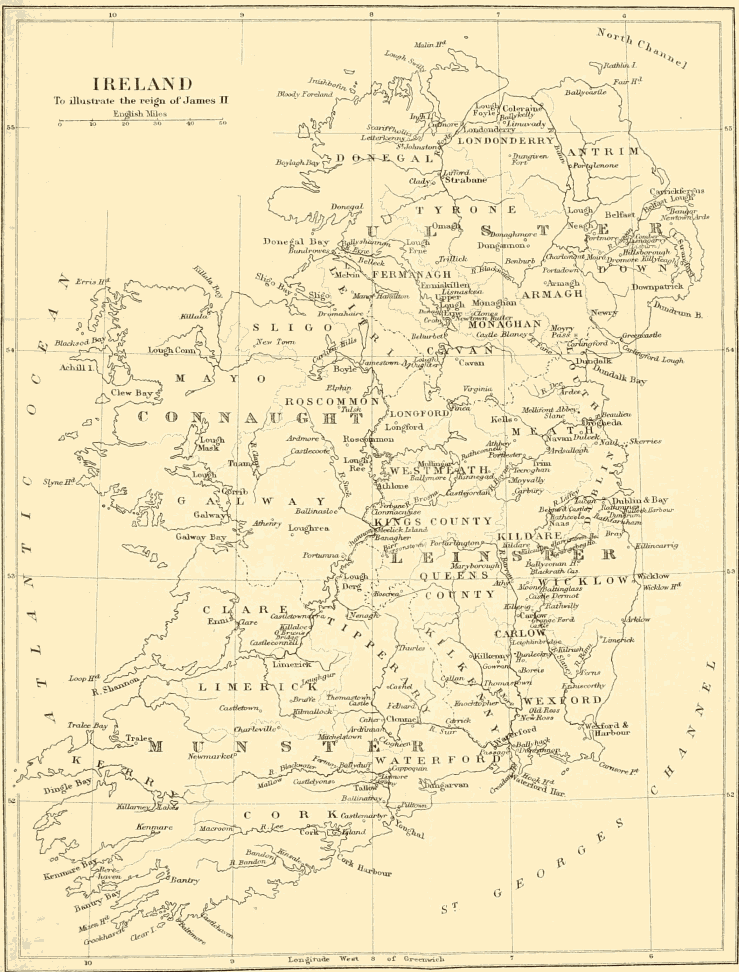
Longmans, Green & Co. London, New York, Bombay, Calcutta, & Madras.
General: No attempt has been made to standardise capitalization on names such as FitzJames and MacDonald
Page 6 [Footnote]: Jluy corrected to July
Page 9, 151: Variable hyphenation of non(-)conformists as in the original
Page 28, 29, 347: Inconsistent spelling of O'Dempsey/O'Dempsy as in the original
Page 38, 346: Inconsistent spelling of McCormick/MacCormick as in the original
Page 54, 346: Inconsistent spelling of McGeohegan/MacGeohegan as in the original
Page 58: Vechiis standardised to Vecchiis
Page 58 [Footnote]: Roxburgh corrected to Roxburghe
Page 85: Masserene standardised to Massereene
Page 88 [Footnote]: 1568 corrected to 1668 for letter to Archbishop Boyle
Page 120, 212, 254: Variable hyphenation of field(-)pieces as in the original
Page 121: 1881 corrected to 1681
Page 136, 137, 351: Inconsistent spelling of Wyer/Weyer as in the original
Page 139: Rye-house standardised to Rye House
Page 143, 347: Inconsistent spelling of O'Brennan/O'Brenan as in the original
Page 162: Nangles' as in the original
Page 180 [Footnote]: 1887 corrected to 1687
Page 188 [Footnote]: 1889 corrected to 1689
Page 213, 340: Inconsistent spelling of Blaney/Blayney as in the original
Page 255: reconnaisance corrected to reconnaissance
Page 268, 288, 351: Inconsistent spelling of Wirtemberg/Würtemberg as in the original
Page 276 [Footnote]: 1889 corrected to 1689
Page 279: drections corrected to directions
Page 279 [Footnote]: Opening parenthesis added before Addenda to balance closing parenthesis
Page 288, 341: Inconsistent spelling of Castleblaney/Castleblayney as in the original
Page 289: 1889 corrected to 1689
Page 293 [Footnote]: June 26/July 4 as in the original
Page 312 [Sidenote]: progess corrected to progress
Page 317: Chapelziod corrected to Chapelizod
Page 333: Inconsistent spelling of BENNET/Bennett as in the original
Page 341: Caillemotte standardised to Caillemote
Page 349: Ryehouse standardised to Rye House; Sevigne standardised to Sévigné