Newton, Watt, Ericsson, Rowland, as boys were constructive . . . The
passion for making new things . . . Aid from imagination and trained
dexterity . . . Edison tells how he invented the phonograph . . . Telephonic
messages record themselves on a steel wire . . . Handwriting
transmitted by electricity . . . How machines imitate hands . . . Originality
in attack.
An inventor is a man of unusual powers. To begin with he is
cast in a larger mold than ordinary men; he has keener eyes,
more skilful hands, a better knitting quality of brain. In his
heart he believes every engine, machine, and process to be improvable
without limit. He is thoroughly dissatisfied
with things as they are and alert to
detect where an old method can be bettered, or
a gift wholly new be conferred on mankind, as
in the telephone or the phonograph. His uncommon faculty of
observation we have had occasion to remark. Another talent as
much in evidence, and quite irrepressible even in early life, impels
him to make, weave, and build. Invariably the man who has added
to the resources of architecture, engineering, machine design, has
begun as a boy in repeating the rabbit-hutches, windmills, and
whittled sailing craft of bigger boys. This means that he soon
acquires a mastery of chisel, plane, and drill, that the lathe becomes
as obedient to him as his own hand. Watt, Maudslay,
Stephenson, and every peer they ever had, could go to the bench
and make a valve, a mitre-wheel, a link-motion just as imaged in
their mind’s eye. Lacking this dexterity other men, occasionally
fertile in good ideas, never bring them to the birth.
While inventors owe their talents to nature, these talents need
sound training, if at a master’s hands, so much the better. Just
as the best place to learn how to paint, is the studio of a great
artist, so the best school for ingenuity is the workshop of a great
inventor. Maudslay, who devised the slide-rest for lathes, and
Clement, who designed the first rotary planer, were trained by
Bramah, who invented the famous hydraulic press, and locks of
radically new and excellent pattern. Whitworth, who created
lathes of new refinement, who established new and exact standards
of measurement in manufacturing, was trained by Maudslay;
so was Nasmyth, who devised the steam hammer. Mr. Edison
in his laboratory and workshop has called forth the ingenuity of
many an assistant who has since won fame and fortune by independent
work.
But as a rule inventors, like the vast brotherhood of other men,
must toil by themselves, and get what good they can out of unaided
diligence. Cobbett used to say that he thought with the
point of his pen; the very act of writing lifted into consciousness
many an idea which otherwise had died stillborn. Beethoven,
like all other great tone-poets, would play a few bars as they came
to his imagination, and while he touched the keys the music, as if
with pinions of its own, took such heavenly flights as those of
the Fifth Symphony. In just this mode while an inventor is shaping
a new model he feels how he can better its lines, give it a
simpler design than he first intended. His hands and eyes think
as well as his brain; while lever, link, and cam unite together they
suggest how they may be more compactly built, more effectively
joined. His partner, the discoverer, is under the same spell with
regard to some long-standing puzzle of rock, or plant, or star. Because
in his soul he believes nature to be intelligible to her very
core, he is sure that this particular puzzle can be fathomed, and
he keeps thinking day by day of possible solutions. At other
times, and even during sleep, his brain is subconsciously at work
upon his problem, bringing to view promising points for attack.
With new light he is bold enough to say, this problem can be
solved by me. At last dawns the happy morning when he verifies
a shrewd guess, or when a crucial experiment stamps a theory as
proven truth, indispensable aid having arisen as one attempt,
through baffling failure, suggested the next. All boys and girls
are the better, happier, more useful when they are early and
thoroughly trained to use their eyes, ears, and hands; to the inventor
and discoverer this training opens a career which otherwise
is denied.
Among the greatest of the sons of men who have united the
faculties of invention and discovery stands Sir Isaac Newton. As
with his compeers we find that his art as an inventor was but the
flower of his handicraft as a mechanic.
Sir Isaac Newton almost from the cradle was a builder. His
biographer, Sir David Brewster, says:—
“He had not been long at school before he
exhibited a taste for mechanical inventions.
With the aid of little saws, hammers, hatchets,
and tools of all sorts, he was constantly occupied
during his play hours in the construction of models of known
machines, and amusing contrivances. The most important pieces
of mechanism which he thus constructed, were a windmill, a
water-clock, and a carriage to be moved by the person who sat in
it. When a windmill was in course of being erected near Grantham,
Sir Isaac frequently watched the operations of the workmen,
and acquired such a thorough knowledge of its mechanism, that
he completed a working model of it, which Dr. Stukely says was
as clean and curious a piece of workmanship as the original. This
model was frequently placed on the top of the house in which he
lived at Grantham, and was put in motion by the action of the
wind upon its sails. In calm weather, however, another mechanical
agent was required, and for this purpose a mouse was put
in requisition, which went by the name of miller.
“The water-clock constructed by Sir Isaac was a more useful
piece of mechanism than his windmill. It was made out of a box
which he begged from Mrs. Clark’s brother, and, according to
Dr. Stukely, to whom it was described by those who had seen it,
it resembled pretty much our common clocks and clock-cases, but
was less in size, being about four feet in height, and of a proportional
breadth. There was a dial-plate at top with figures of
the hours. The index was turned by a piece of wood, which either
fell or rose by water dropping.
“The mechanical carriage which Sir Isaac is said to have invented,
was a four-wheeled vehicle, and was moved with a handle
or winch wrought by the person who sat in it. We can find no
distinct information respecting its construction or use, but it
must have resembled a Merlin’s chair, which is fitted to move
only on the smooth surface of a floor, and not overcome the inequalities
of a common road.
“He introduced the flying of paper kites, and is said to have investigated
their best forms and proportions, as well as the number
and position of the points to which the string should be attached.
He constructed also lanterns of crimpled paper, in which he placed
a candle to light him to school in the dark winter mornings; and
in the dark nights he tied them to the tails of his kites, in order to
terrify the country people, who took them for comets.
“In the yard of the house where he lived, he was frequently
observed to watch the motion of the sun. He drove wooden pegs
into the walls and roofs of the buildings, as gnomons to mark
by their shadows the hours and half-hours of the day. It does
not appear that he knew how to adjust these lines to the latitude
of Grantham; but he is said to have succeeded, after some years’
observation, in making them so exact that anybody could tell what
o’clock it was by Isaac’s dial, as it was called.
“Sir Isaac himself told Mr. Conduit that one of the earliest
scientific experiments which he made was in 1658, on the day of
the great storm when Cromwell died, and when he himself had
just entered into his sixteenth year. In order to determine the
force of the gale he jumped first in the direction in which the
wind blew, and then in opposition to the wind; and after measuring
the length of the leap in both directions, and comparing it
with the length to which he could jump on a perfectly calm day,
he was enabled to compute the force of the storm. Sir Isaac
added, that when his companions seemed surprised at his saying
that any particular wind was a foot stronger than any he had
known before, he carried them to the place where he had made the
experiment, and showed them the measure and marks of his
several leaps.
“When a young man he made a telescope with his own hands.”
James Watt, who became the chief improver of the steam engine,
when a boy received from his father a set of small carpentry
tools. The little fellow would take his toys to pieces, rebuild them
and invent playthings wholly new. A cousin of his, Mrs. Campbell,
has recorded that Watt as a lad was often blamed for idleness;
she adds:—
“His active mind was employed in investigating the properties
of steam; he was then fifteen, and once in conversation
he informed me that he had read
twice, with great attention, S’Gravesande’s
‘Elements of Natural Philosophy,’ adding that
it was the first book upon that subject put into his hands, and that
he still thought it one of the best. While under his father’s roof,
he went on with various chemical experiments, repeating them
again and again until satisfied of their accuracy from his own observations.
He had made for himself a small electrical machine,
and sometimes startled his young friends by giving them sudden
shocks from it.”
John Ericsson as a child was the wonder of the neighborhood,
says his biographer, Mr. William C. Conant. From the first he
exhibited the qualities distinguishing him in
later life. His industry was ceaseless; he was
busy from morning to night drawing, planning
and constructing. The machinery at the mines
near his home was to him an endless source of wonder and delight.
In the early morning he hastened to the works, carrying with
him a drawing pencil, bits of paper, pieces of wood, and a few
rude tools. There he would remain the day through, seeking to
discover the principles of motion in the machines, and striving to
copy their forms. In his tenth year this boy undertook to design
a pump for draining the mines of water. The motor was to be a
windmill. Such a contrivance the young inventor had never
seen, yet he succeeded in drawing designs for his mill after the
most approved fashion of skilled engineers by following a verbal
description given by his father of a mill he had just visited.
Henry A. Rowland became at Johns Hopkins University in
Baltimore one of the great physical investigators and inventors
of the nineteenth century. As a boy he delighted
in chemical experiments, glass-blowing,
and similar occupations. The family were
often summoned by the young enthusiast to
listen to lectures which were fully illustrated by experiments, not
always free from prospective danger. His first five-dollar bill
bought him, to his delight, a galvanic battery. The sheets of the
New York “Observer” he converted into a hot-air balloon, which
made a brilliant ascent and flight, setting fire, at last, to the roof
of a neighboring house. One day he saw a pump at work in the
hold of a steamer, sending out a stream which fell from a height
of five or six feet to the river. “Why,” he exclaimed, “don’t you
put that pipe down into the river and save power?” As a student
at the Troy Polytechnical Institute he invented a method of
winding naked strips of wire on cloth so as virtually to effect its
insulation. This was afterward profitably patented by some one
else.
In “The Senses and the Intellect” Professor Alexander Bain
considers the inventing and discovering mind:—
“Not one of the leading mental peculiarities
applicable to scientific constructiveness can be
dispensed with in the constructions of practice:—the
intellectual store of ideas applicable
to the special department; the powerful action of the associating
forces; a very clear perception of the end, in other words, sound
judgment; and, lastly, that patient thought, which is properly
an entranced devotion of the energies to the subject in hand,
rendering application to it spontaneous and easy.
“With reference to originality in all departments, whether
science, practice, or fine art, there is a point of character that deserves
notice, as being more obviously of value in practical inventions
and in the conduct of business and affairs—I mean an
active turn, or a profuseness of energy, put forth in trials of all
kinds on the chance of making lucky hits. In science, meditation
and speculation can do much, but in practice, a disposition to try
experiments is of the utmost service. Nothing less than a fanaticism
of experimentation could have given birth to some of our
grandest practical combinations. The great discovery of Daguerre,
for example, could not have been regularly worked out
by any systematic and orderly research; there was no way but to
stumble upon it, so unlikely and remote were the actions brought
together in one consecutive process. The discovery is unaccountable,
until we learn that the author had been devoting himself
to experiments for improving the diorama, and thereby got
deeply involved in trials and operations far removed from the
beaten paths of inquiry. The energy that prompts to endless
attempts was found in a surprising degree in Kepler. A similar
untiring energy—the union of an active temperament with intense
fascination for his subject—appears in the character of Sir William
Herschel. When these two attributes are conjoined; when
profuse active vigor operates on a field that has an unceasing
charm for the mind, we then see human nature surpassing itself.
“The invention of photography by Daguerre illustrates the
probable method whereby some of the most ancient inventions
were arrived at. The inventions of the scarlet dye, of glass, of
soap, of gunpowder, could have come only by accident; but the
accident, in most of them, would probably fall into the hands of
men engaged in numerous trials upon the materials involved. Intense
application—‘days of watching, nights of waking’—went
with ancient discoveries, as well as with modern. In the historical
instances, we know as much. The mental absorption of Archimedes
is a proverb.
“The wonderful part of Daguerre’s discovery consists in the
succession of processes that had to concur in one operation before
any effect could arise. Having taken a silver plate, iodine
is first used to coat the surface; the surface is then exposed to
the light, but the effect produced is not apparent till the plate
has been immersed in the vapor of mercury. To fall upon such
a combination, without any clue derived from previous knowledge,
an innumerable series of fruitless trials must have been
gone through.
“A remark may be made here, applicable alike to science and
to practice. Originality in either takes two form—observation
or experiment on the one hand, and the identifying processes of
abstraction, induction, and deduction on the other. In the first,
the bodily activities and the senses are requisite; the last are the
purely intellectual forces. It is not by high intellectual force that
a man discovers new countries, new plants, new properties of objects;
it is by putting forth an unusual force of activity, adventure,
inquisitorial and persevering search. All this is necessary
in order to obtain the observations and facts in the first instance;
when these are collected in sufficient number, a different aptitude
is brought to bear. By identifying and assimilating the scattered
materials, general properties and general truths are obtained, and
these may be pushed deductively into new applications; in all
which a powerful reach of similarity is the first requisite; and
this may be owned by men totally destitute of the active qualities
necessary for observation and experiment.”
In “The Hazard of New Fortunes” Mr. W. D. Howells depicts
a man of force who, without education, becomes rich. He has
little patience with poor men, who, he says,
“don’t get what they want because they don’t
want it bad enough.” The rough old
Westerner, Dryfoos, was sound in his view.
Success in discovery as in money-making is as much a matter of
passion as of intelligence, says Mr. O. F. Cook:—
“The first and most essential preliminary for a successful investigation
is an interest in the question, and any method which
tends to diminish or relax interest is false and futile. Diligence
in learning the facts of a science is a distinctly unfavorable symptom
in a would-be investigator when unaccompanied by a vital
constructive interest. That a student hoards facts does not mean
that he will build anything with them. Intellectual misers are
common, and are quite as unprofitable as the monetary variety.
A scientific specialist may have vast knowledge and life-long experience,
and yet may never entertain an original idea or make
a new rift in the wall of the unknown which baffled his predecessors.
Indeed, such men commonly resent a readjustment of the
bounds of knowledge as an interference with their vested capital
of erudition.
“Investigation is a sentiment, an instinct, a habit of mind; it
is man’s effort at knowing and enjoying the universe. The productive
investigator desires knowledge for a purpose; he may not
be eager for knowledge in general, nor for new knowledge in
particular. He values details for their bearing on the problem
he hopes to solve. He can gather and sift them to advantage only
in the light of a radiant interest, and his ability to utilize them
for correct information depends on the delicacy of his perception
and the strength of his mental grasp. The investigator, like the
athlete, must first be born; he can not be made to order, but his
training determines the degree of excellence to which he can
attain. No amount of training can remove organic defects, but
bad training may be worse than none in lessening the attainment
of the most capable. That education is false and injurious which
puts the matter first and retards or prevents the development of
constructive mental ability, a power not peculiar to the investigator,
but in him reaching the greatest scope and freedom of
action.”
A picturing faculty such as comes to the flower in an inventor
may often be observed in a skilful workman. In a shoe factory
a veteran will lift a hide, utterly irregular in
form, and cut soles and heels from it, so that
the remaining scraps are a mere trifle, while
flaws have been avoided.
Hugh Miller, in “My Schools and Schoolmasters,” thus speaks
of a fellow stone-mason:—“John Fraser’s strength had never
been above the average of that of Scotchmen, and it was now
considerably reduced; nor did his mallet deal more or heavier
blows than that of the common workman. He had, however, an
extraordinary power of conceiving of the finished piece of work,
as lying within the rude stone from which it was his business to
disinter it; and while ordinary stone-cutters had to repeat and re-repeat
their lines and draughts, and had in this way virtually to
give their work several surfaces in detail ere they reached the
true one, old John cut upon the true figure at once, and made one
surface serve for all. In building, too, he exercised a similar
power; he hammer-dressed his stones with fewer strokes than
other workmen, and in fitting the interspaces between the stones
already laid, always picked from out the heap at his feet the stone
that exactly filled the place; while other operatives busied themselves
in picking up stones that were too small or too large; or,
if they set themselves to reduce the too large ones, reduced them
too little or too much, and had to fit and fit again. Whether building
or hewing, John never seemed in a hurry. He has been seen,
when far advanced in life, working very leisurely, as became his
years, on one side of a wall, and two stout young fellows building
against him on the other side—toiling, apparently, twice harder
than he, but the old man always contriving to keep a little ahead
of them both.”
Henry Maudslay, famous as an inventor, had the same exquisite
sense of form. When he executed a piece of work he
was greatly indebted to the dexterity he had acquired as a blacksmith
in early life. He used to say that to be a good smith you
must be able to see in an iron bar the object you mean to get out
of it with hammer and chisel, just as the sculptor sees the statue
he intends to carve from a block of marble.
Inventors and artists have in common a keen perception of
form, an ability to confer form with skill and accuracy. Often
the same man is at once inventor and artist.
Of this class Leonardo da Vinci is the most
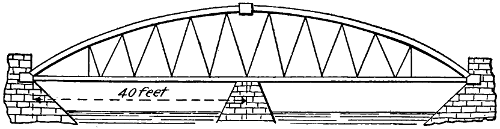
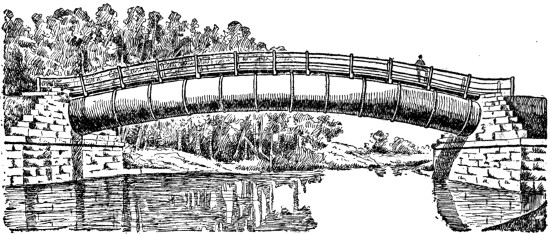
illustrious example. Alexander Nasmyth, of
Edinburgh, who invented the bow-string
bridge, was an eminent painter of portraits and landscapes. His
son, James Nasmyth, who devised the steam hammer and the
steam pile-driver, tells us in his autobiography:—
“My father taught me to sketch with exactness every object,
whether natural or artificial, so as to enable the hand accurately
to reproduce what the eye had seen. In order to acquire this almost
invaluable art, he was careful to educate my eye, so that I
might perceive the relative proportions of objects placed before
me. He would throw down at random a number of bricks, or
pieces of wood representing them, and set me to copy their forms,
proportions, lights and shadows. I have often heard him say that
any one who could make a correct drawing in regard to outline,
and also indicate by a few effective touches the variation of lights
and shadows of such a group of model objects, might not despair
of making a good and correct sketch of York Minster. My
father was an enthusiast in praise of this graphic language, and
I have followed his example. In fact it formed a principal part
of my own education. It gave me the power of recording observations
with a few graphic strokes of the pencil, and far surpassing
in expression any number of mere words. This graphic
eloquence is one of the highest gifts in conveying clear and correct
ideas as to the forms of objects—whether they be those of
a simple and familiar kind, or of some form of mechanical construction,
or of the details of a fine building, or the characteristic
features of a wide-stretching landscape. This accomplishment
of accurate drawing, which I achieved for the most part in my
father’s workroom, served me many a good turn in future years
with reference to the engineering work which became the business
of my life.”
His mastery of the pencil had undoubtedly a great deal to do in
cultivating his powers of inventive imagination. He says:—“It
is one of the most delightful results of the possession of the constructive
faculty, that one can build up in the mind mechanical
structures and set them to work in imagination, and observe beforehand
the various details performing their respective functions,
as if they were in absolute form and action. Unless this
happy faculty exists in the brain of the mechanical engineer, he
will have a hard and disappointing life before him. It is the
early cultivation of the imagination which gives the right flexibility
to the thinking faculty.”
Drawing is one of the courses in every manual training school
in America. The first of these schools was organized in 1879
St. Louis, under the direction of Professor C.
M. Woodward. Within the past thirty years,
from the kindergarten to the university, American
education has addressed itself as never before to bringing
out all the talents of pupils and students. In earlier days there
was little appeal to sense perception, to dexterity, to the faculties
of eye and hand which all too soon pass out of plasticity, to leave
the young man or woman for life destitute of powers which,
had they been duly elicited, would have broadened their careers
by widening their horizons. To-day, happily, our schools are more
and more supplementing literary and mathematical courses with
instruction in the use of tools, in modeling, design, and pattern-making.
Every process is thoroughly explained. All the studies
are linked into series; these unite practice and its reasons with a
thoroughness impossible in the outworn schemes of apprenticeship.
All this is a distinct aid to inventiveness. As Professor Woodward
says in “Manual Training in Education”:—“Manual training
cultivates a capacity for executive work, a certain power of
creation. Every manual exercise involves the execution of a
clearly defined plan. Familiar steps and processes are to be combined
with new ones in a rational order and for a definite purpose.
As a rule these exercises are carefully chosen by the instructor.
At proper times and in reasonable degree, pupils are set to forming
and executing their own plans. Here is developed not a single
faculty, but a combination of many faculties. Memory, comparison,
imagination, and a train of reasoning, all are necessary
in creating something new out of the old.”
Every inventor of mark is a man of native dexterity whose
skill has been thoroughly cultivated. Let us observe such a man
as he came to an extraordinary triumph. One
of the great inventions of all time is the
phonograph, giving us as it does accurate records
of sound which may be repeated as often
as we please. The ideas which issued in the perfected instrument
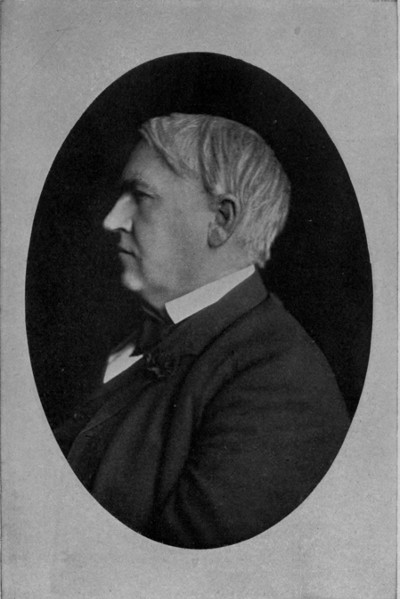
were for years germinating in Mr. Edison’s mind; they took their
rise in his recording telegraph. One afternoon Mr. Edison told
the story to the late Mr. George Parsons Lathrop, who published
it in Harpers’ Magazine for February, 1890:—“I worked a circuit
in the daytime at Indianapolis, and got a small salary for doing
it. But at night with another operator named Parmley, I used
to receive newspaper reports just for the practice. The regular
operator, who was given to copious libations, was glad enough to
sleep off the effects while we did his work for him as well as we
could. I would sit down for ten minutes, and take as much as I
could from the instrument, carrying the rest in my memory.
Then, while I wrote out, Parmley would serve his turn at taking;
and so on. This worked well until they put a new man on at the
Cincinnati end. He was one of the quickest despatchers in the
business, and we soon found it was hopeless for us to try to keep
up with him. Then it was that I worked out my first invention,
and necessity was certainly the mother of it.
“I got two old Morse registers, and arranged them in such a
way that by running a strip of paper through them, the dots and
dashes were recorded on it by the first instrument as fast as they
were delivered from the Cincinnati end, and were transmitted to
us through the other instrument at any desired rate of speed or
slowness. They would come in on one instrument at the rate of
forty words a minute, and we would grind them out of the other
at the rate of twenty-five. Then weren’t we proud! Our copy
used to be so clean and beautiful that we hung it up on exhibition;
and our manager used to come and gaze at it silently, with a
puzzled expression. Then he would depart, shaking his head in a
troubled sort of way. He could not understand it; neither could
any of the other operators; for we used to drag off my impromptu
automatic recorder and hide it when our toil was over. But the
crash came when there was a big night’s work—a presidential
vote, I think it was—and copy kept pouring in at the top rate
of speed, until we fell an hour and a half or two hours behind.
The newspapers sent in frantic complaints, an investigation was
made, and our little scheme was discovered. We couldn’t use
it any more.
“It was that same rude automatic recorder,” Edison explained,
“that indirectly—yet not by accident, but by logical deduction—led
me long afterward to invent the phonograph. I’ll tell you
how this came about. After thinking over the matter a great
deal, I came to the point where, in 1877, I had worked out satisfactorily
an instrument which would not only record telegrams
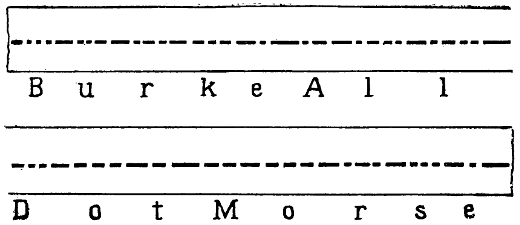
by indenting a strip of paper with dots and dashes of the Morse
code, but would also repeat a message any number of times at
any rate of speed required. I was then experimenting with the
telephone also, and my mind was filled with theories of sound
vibrations and their transmission by diaphragms. Naturally
enough, the idea occurred to me: If the indentations on paper
could be made to give forth again the click of the instrument, why
could not the vibrations of a diaphragm be recorded and similarly
reproduced? I rigged up an instrument hastily, and pulled a strip
of paper through it, at the same time shouting, ‘Hallo!’ Then the
paper was pulled through again, my friend Batchelor and I listening
breathlessly. We heard a distinct sound, which a strong
imagination might have translated into the original ‘Hallo!’ That
was enough to lead me to a further experiment. But Batchelor
was sceptical, and bet me a barrel of apples that I couldn’t make
the thing go. I made a drawing of a model, and took it to Mr.
Kruesi, at that time engaged on piece-work for me. I marked it
$4, and told him it was a talking machine. He grinned, thinking
it a joke; but set to work, and soon had the model ready. I arranged
some tin-foil on it, and spoke into the machine. Kruesi
looked on, and was still grinning. But when I arranged the
machine for transmission, and we both heard a distinct sound
from it, he nearly fell down in his fright; I was a little scared
myself, I must admit. I won that barrel of apples from Batchelor,
though, and was mighty glad to get it.”
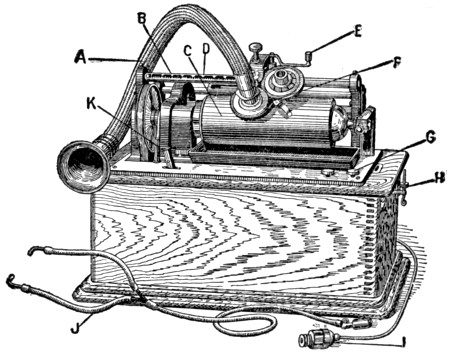
Edison phonograph.
A, speaking tube. B, D, scale. C, receiving
cylinder. E, repeat lever. F, swivel plate. G,
connecting key. H, foot trip. I, plug attachment.
J, ear-tubes. K, switch.
In October, 1905, I paid Mr. Edison a visit at his laboratory,
when he showed me the phonograph as now perfected. Chief
among his improvements is a composition for
records which is much harder than the wax
formerly employed, and may therefore revolve
more swiftly with no fear of blurring. His reproducer is to-day
a built-up diaphragm of mica, highly sensitive. In the reproducer
arm is placed the highly polished, button-shaped sapphire which
tracks with fidelity the grooves which sound has recorded on the
cylinder. These features, combined in a mechanism of the utmost
accuracy in make and adjustment, have opened for the
phonograph a vast field in the business world. Some of the great
firms and companies of New York and other cities now use
phonographs instead of stenographers; a letter or a contract is
dictated to a revolving cylinder with all the swiftness of ordinary
speech. Afterward a secretary listens to the reproducer and
writes the letter or contract at any speed desired. On occasion
a cylinder bearing a message may be sent to a correspondent who
listens to its words as sent forth from his own phonograph, no
intermediate writing being required. Such instruments are extensively
used in teaching foreign languages, learners being free
to have a difficult pronunciation repeated until it is mastered.
Mr. Edison has much improved the musical records familiar
throughout the world; these are now produced in molds of gold
with a delicacy that refines away the scratchiness of tone so unpleasant
in earlier cylinders.
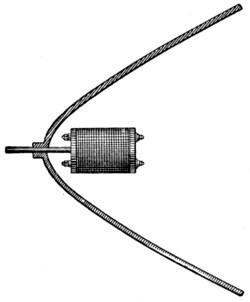
As the fruit of rare experimental ability Mr. Valdemar Poulsen,
an electrical engineer of Copenhagen, has invented the
telegraphone. This instrument proceeds upon
the fact that the electrical pulses of the telephone,
minute and delicate though they are,
can register themselves magnetically upon a
moving steel wire but one-hundredth of an
inch in diameter. The message is repeated as
often as the wire is borne between the poles of an electro-magnet
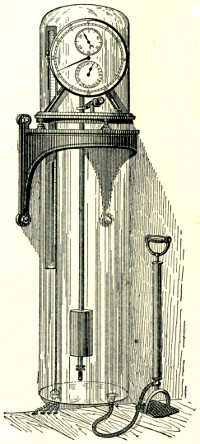
in circuit with a telephonic receiver. The accompanying figure
shows the transmitter, the traveling wire, and the receiver as it
repeats a message. The instrument in its latest form is illustrated
opposite page 314. In supplementing the telephone most
usefully, this apparatus brings a fresh competition to bear upon
the telegraph. In many cases a man of business has preferred
to telegraph rather than to telephone a message, because a
telegram as a written record affords proof in case of error or dispute.
Now suppose that through a telegraphone a broker offers
six per cent. interest for a loan; his voice impressed on the wire,
duly preserved for reference, identifies him as securely as would
his signature on a written offer. Take a different case: a patient
rings up a physician only to find him not at home; a message
committed to a few yards of wire is listened to by the physician
the moment he returns to his office. Take an example of yet another
service: a letter may be dictated at Newark and recorded
on a wire in Brooklyn, and there, at leisure, be put upon paper
by an amanuensis. Or, better still, the message may be spoken
upon a small, revolving disc of steel, and mailed to a correspondent
who listens to its words as they roll out of his own
graphophone. Young children and others unable to write may
impress discs that tell their story to correspondents unable to
read. So compact withal are the records of this instrument that
they may soon give us not only music from the concert-room, and
news from the telegraph office, but also the latest popular book.
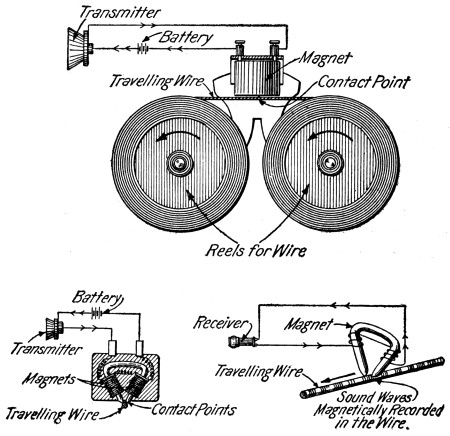
Telegraphone.
Diagram of working parts.
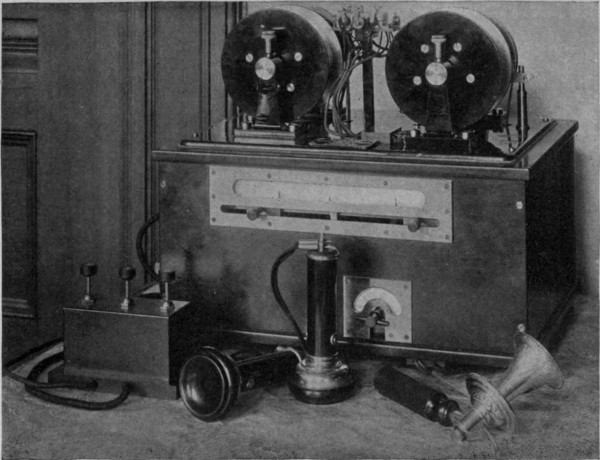
TELEGRAPHONE OF VALDEMAR POULSEN
A wire or a disc can repeat its record, vocal or musical, hundreds
of times without loss of distinctness. To obliterate this
record it only is necessary to pass the steel between the poles of
a strong magnet.
A telephone transmits a familiar voice so that its tones are at
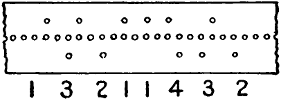
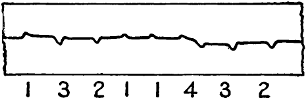
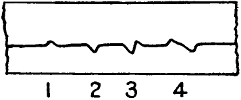
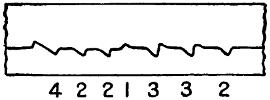
once recognized. By electrical means a telautograph reproduces
writing at a distance so precisely that it may
be as readily identified. To understand how
this feat is accomplished let us begin with the
transmission of vertical marks varying in length.
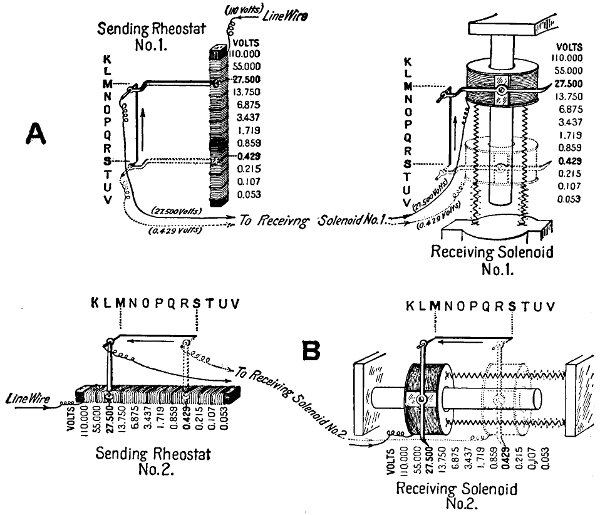
A, sending a vertical line S M by electricity.
B, sending a horizontal line S M by electricity.
This task, as above illustrated, we perform by sending to a
receiving pencil a current varying in strength between limits
which correspond to the variations in length of our transmitted
lines. The strength of this current, say 0.429 volt, decides where
a mark will begin; the strength of that current in rising to say 27.5
volts, decides where that mark will end. To vary the strength
of the current as desired we employ a square rod of aluminium,
tightly covered with a thin copper wire insulated by silk wrapping.
We place this rod beside our tablet, and scrape from its innermost
surface the silk covering so as to leave the wire bare, while
between its strands the silk remains intact as an effective insulation.
Our rod is now a rheostat, whose use we shall presently
discover. We are wont to think of copper as a good conductor,
and so it is. Used in stout bars or thick wires it exerts but little
resistance to an electric current, but when we employ a wire of
but 1⁄200 of an inch in diameter, about the thickness of the paper
on which this is printed, the narrowness of path reduces the
pressure of a current so much that in the course of 375 feet it
falls to one eighth. In like manner a glass tube of minute diameter
might receive at one end water under extreme pressure,
and at a yard distance send out a mere dribble. The copper wire
of our square rod, or rheostat, is so thin that when connected at
K with a source of 110-volt electricity, at V this voltage, or
pressure, has sunk to but one twentieth of a volt.
Let us suppose our rheostat at V connected with a circuit extended
to the receiving station. A wire, kept in this circuit, and
moving up and down with our pencil, in a line always parallel
with the side of our tablet, sends to the receiving station a current
constantly varying in its pressure. As the wire passes from
S to M the transmitted current rises from 0.429 to 27.5 volts.
At the receiving station we provide means whereby the current
arriving at a voltage of 0.429 and rising to 27.5 will mark a
vertical line the length of S M. A simple device for this purpose
consists in a hollow coil of copper wire, or a solenoid, as electricians
call it, through which circulates the arriving current, the
coil being free to be drawn as a shell over a cylindrical electro-magnet.
The degree to which such a coil, duly attached to a retractile
spring, is drawn over a suitable electro-magnet, depends
upon the strength of the current circulating in the coil. In the
simple instrument we are using let us assume that when a current
of 110 volts comes in, the coil moves to K, the end of its path;
that when a current of 6.875 volts arrives, the coil moves to O;
the receiving coil and the sending rheostat being marked with
the same divisions. Our receiving coil actuates a pencil which
accordingly marks a line of the same length and direction as that
set down on the tablet of the sending instrument.
Let us next transmit between these two stations a series of
horizontal lines. To do this we duplicate our first apparatus. We
place a second rheostat along the foot of our sending tablet, not
along its side, and slide a second wire along its bared surface
with motions always parallel to those of the marking pencil. Thus
a second current, going by a wire of its own to the receiving
station there repeats through a second coil, or solenoid, the horizontal
marks of our sending pencil.
We have now two sets of apparatus, alike in all respects, one
sending rheostat at right angles to the other; one receiving
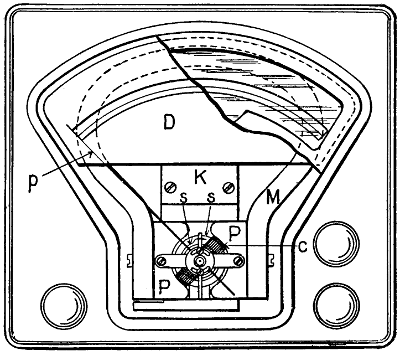
solenoid at right angles to its mate. In the actual telautograph
the rheostats are curved, as shown in the picture facing page 318,
and they are so joined by levers that the up-and-down and sidewise
motions of writing are accurately represented, from moment
to moment, in the two varying currents sent afar. As these currents
arrive they actuate a pencil, similarly furnished with levers,
so that it moves in a path which exactly corresponds with that of
the sending pencil. The apparatus has an ingenious ink supply,
and a device to shift the paper as filled line after line. In its basic
features the telautograph was invented by the late Professor
Elisha Gray of Chicago. Its present form is largely due to the
modifications and additions of Mr. George S. Tiffany of New
York. The instrument is giving satisfactory service in thousands
of banks, factories, hotels, business offices, and households.
Its records at both ends of a line make it of inestimable value in
many cases, as aboard a warship where orders of the utmost importance
may be committed to its tablets. Exterior and interior
views of the instrument are given facing page 318.
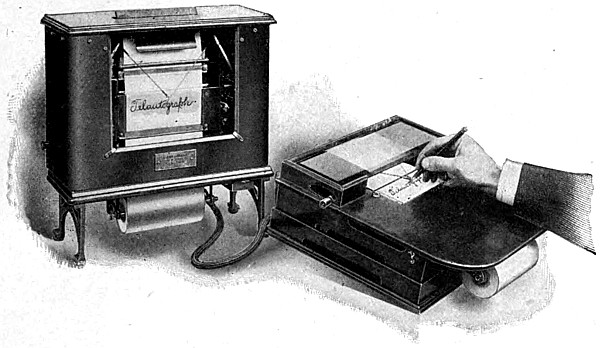
TELAUTOGRAPH, EXTERIOR.
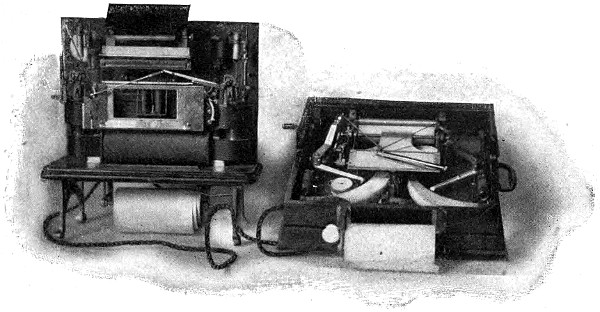
TELAUTOGRAPH, INTERIOR.
Only a few machines deal with writing or its duplication, most
machines perform quite other tasks at first wrought by the
hands. Inventors have always gone astray
when they have sought to imitate a hand process
with anything like precision. On this
point Sir John Fletcher Moulton, of London,
says:—“Doubtless you have often had to send
a message by telegraph to some distant country
to which the rate charged per word is high. You write your message
as tersely as may be, but even thus its length is formidable.
You resort to your telegraphic code. It tells you that if you will
change the phraseology of your message you can by a single
code-word represent a whole phrase. You thereupon set to work
to recast your message so as to make it capable of being expressed
in code-words. When you have done so, you have not improved
it as a message. It is less terse and less naturally expressed. If
you were writing and not telegraphing, you would prefer to use
it in its original form. But as now expressed, each of the phrases
of which it is composed can be sent over the wires in the form
and at the price of a single word, and the cost of the whole is but
a fraction of what would have been the cost of the message as
originally framed. It has been cast in a form suitable for cheap
telegraphing. Just so with the inventor. He has to find a series
of operations which, in their totality, are equivalent to the series
of the hand worker. But each of these operations in itself need
not be such as would in hand labor be suitable or even practicable.
“It is necessary and sufficient for him that they are suited to
the new conditions, so that they can be well and easily done by
mechanism, and that, taken as a whole, they produce the same
result as the series which he is paralleling. He is re-writing the
series in terms suited to mechanism just as the message was rewritten
in terms suited for telegraphing. The meaning of
the message must remain the same, but the terms used to express
it are no longer those most naturally used in writing or speaking,
but are those which can be telegraphed at least cost.
“To make my meaning clear, let me revert to the familiar
operation of sewing. The hand process is plainly unsuited for
mechanical reproduction. How is it to be
translated into an equivalent cycle suitable for
mechanism? In other words, how is it to be
‘coded’? This case is interesting, inasmuch as
we have two independent solutions worked out at different dates
and widely different in nature. The earlier invention imitated the
hand cycle very closely. The thumb and finger of the right hand
in the human being were replaced by pairs of pincers capable of
taking hold of the needle and letting it free again, but to avoid
having to follow the intricate movements of the human fingers
in the operation two pairs of pincers were used, one on each side
of the work, which passed the needle backwards and forwards
through the fabric one to the other. Following out this idea the
needle was pointed at both ends with an eye in the middle, and,
as in hand sewing, it carried a moderate length of thread. The
pair of pincers which held the threaded needle advanced to the
fabric and passed through it to the other pair which took it and
retreated so as to draw the thread tight and form the completed
stitch. To form the next stitch the work was moved through the
proper distance and the same process was gone through, the line
of movement of the needle always remaining the same.
“There is not much ‘coding’ here. The new cycle imitates the
hand-worker so faithfully that it benefits little by the advantages
of mechanical action. As in hand work it can only sew with
moderate lengths of thread, and must therefore have the needles
re-threaded at intervals. Its superiority over hand labor is therefore
so slight that it is doubtful whether such a sewing machine
could ever have competed with, much less replaced, hand work.
But it has one great merit. The needle mechanism is capable of
being re-duplicated almost without limit, and the movement of the
work which is necessary to direct the stitches for one needle will
serve equally well for any number of needles working parallel to
it. Hence the machine that would have failed as a sewing machine
has survived and proved useful as an embroidery machine.
The work is stretched between two rows of pincers and moved
by the workman according to the stitches of the pattern. Each
stitch is repeated by each of the parallel needles which work side
by side at convenient distances, and thus as many copies of the pattern
are simultaneously produced as there are needles. Each is a
perfect facsimile of all the others, and as each copies faithfully
the errors of the workman, this machine is entitled to the proud
boast that its productions possess all the defects of hand work—an
essential we are told of artistic beauty.
“What is the cause of the comparative failure of this attempt
at a sewing-machine? It is evident that it is due to the retention
of the feature of the hand operation by which the needle is passed
from one holding mechanism to the other. The inventors of the
modern sewing-machine on the one hand decided to work with a
needle fixed in its holder and never leaving it throughout the
operation. It at once followed that the needle and thread must,
on the back stroke, return through the same hole through which
they had entered the fabric, so that no stitch could be formed unless
some obstacle were interposed to the return of the thread.
Here the two famous and successful forms of the machine parted
company. Both placed the eye at the point of the needle that the
stroke might not be needlessly long, but while the lock stitch
machine used a second thread to provide the necessary obstacle,
the chain stitch machine availed itself of a loop of the original
thread for that purpose. Thus in the lock stitch machine the substituted
cycle became as follows:—
(1) The work is moved under the needle for the new stroke.
(2) The needle (which has an eye at its point through which
the thread passes) pierces the fabric carrying with it the thread.
(3) A second thread is passed between the thread and the
needle (by means of a shuttle or its equivalent) when the needle
is at its lowest position.
(4) The needle returns while a take-up retracts the thread so
as to tighten the stitch.
“This cycle would, for hand work, be immeasurably more complicated
and difficult than ordinary sewing, but it consists of
operations mechanically easy of performance in swift and accurately
timed sequence, and as the whole of the thread in use has
no longer to be passed from one side of the fabric to the other as
each stitch is made, it has brought with it the all-important advantage
of our being able to work with a continuous thread.
Here, then, is a magnificent example of ‘coding.’ It is not to be
wondered at that the machines which it has given to the world
are in well-nigh universal use, and have profoundly modified
both our social and industrial economy.”
One of the supreme inventions of all time is the mower of Obed
Hussey, of Maryland, devised in 1833, and afterward adapted to
reaping. In the primitive reaping of tall grain
one hand keeps the stalks upright, while the
other hand cuts these stalks with a scythe.
Hussey, in a masterpiece of “coding,” arrayed
metal fingers which keep the grain from bending, while vibrating
knives sever the stalks. To this day his invention remains the
core of millions of mowers as well as reapers; it has economized
labor to an extent beyond estimate,
and by shortening the time required
in harvesting has saved many million
bushels of grain which otherwise
would have been destroyed by bad
weather.
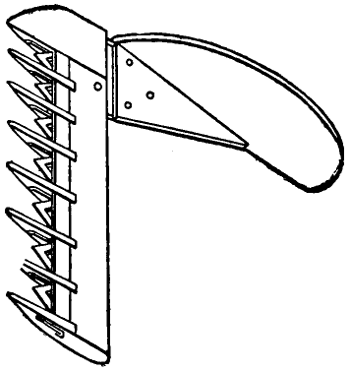
Obed Hussey’s mower
or reaper.
Not a few inventors of the first
mark are found among the men of
great ability who unite training in two
distinct fields of science, whose alliances
they thoughtfully cultivate.
Thus Helmholtz, at once a physician
and a physicist, devised the ophthalmoscope,
that simple instrument for observing the interior of the
eye. On a plane less lofty an inventor’s success may turn on his
width of outlook, his intimacy with fields
remote from the home acre, so that he may
gainfully ally two arts or processes that, to
a casual glance, seem utterly unrelated or unrelatable. When
a pneumatic tube between a post-office and a railroad station
is obstructed, there would seem to be no promise of aid in a
fire-arm. But snapping off its blank cartridge at the open end of
the tube gives back an echo through the air within the tube; in
measuring the interval between touching the trigger and hearing
the echo, there is news as to where the tube is choked, the velocity
of sound in air being known. From the labors of a postmaster
let us turn to those of an apothecary, who pounds and grinds his
drugs in a mortar which has descended from the day when it
reduced grain to flour. The grindstones which succeeded the
mortar were only in recent years ousted by Hungarian rollers of
steel which separate the constituents of grain with a new perfection.
Their excellence consists in imitating the crushing of
the mortar, not in attempting the grinding of the familiar burrs.
The miller’s practice in one particular has given the postmaster
a hint of value. In a flour-mill a cheap and sufficient motor is
simple gravity as the products pass from one machine to the next.
At the very outset the wheat is taken by conveyors to the top
floor, whence its products descend, stage by stage, impelled by
gravity alone, until the finished and barreled flour rolls into shipping
rooms beside the railroad tracks. This principle has been
adopted at the Chicago Post-office, where the mails as received
are borne to the top floor, thence, by gravity, they take their way
as sorted and re-sorted, to the ground floor where they are finally
disposed of.
In a field somewhat parallel is the modern art of designing the
layout of a great manufacturing plant so that the material shall
travel as little as possible between its entrance and its exit. In a
well planned ship-yard the machines are so placed that the steel
plates, bars and girders, the planks and boards, move continuously
from one machine to its neighbor, ending at last by reaching the
building berth.
Shears for metal, cutting scissors-fashion, have long been
familiar; the Pittsburg, Fort Wayne and Chicago Railroad employs
the Murphy machine, on the same principle, to cut up old
ties and bridge timbers intended for fuel. The upper moving
blade is set about an inch out of line from the lower fixed blade,
so as to allow spikes or bolts to pass through without injuring
the machine. In dividing cord wood for stoves and furnaces a
machine of this kind might be used instead of a saw.
It is by perfect means of subdivision that new and cheap
materials for writing and printing are now produced. The leaves
offered by the papyrus to scribes were used for centuries, so that
the plant has given its name to paper now made from fibres of
cotton, linen, or wood, finely divided, thoroughly mixed, and
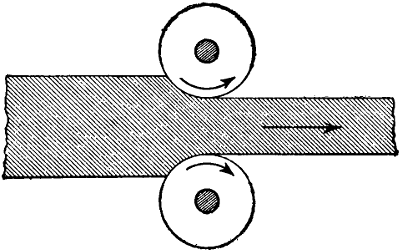
squeezed between rollers much as if paste. Paper from its
smoothness, its absence of grain and its low price, is far preferable
to papyrus leaves or vellum. Its manufacture has been
copied in diverse new industries. Wood ground to powder,
worked into pulp, molded into pails, tubs and the like, is saturated
with oil to produce wares of indurated fibre. A pail thus
manufactured will not split apart in dry weather when empty, or
absorb liquids, and it is as easily kept clean as glass.
While wood has thus found a rival in pulp, stone has a new
competitor much more formidable. Pavements and piers are
often needed in long stretches, without joints for the admission
of rain or frost. The demand is met by cements and concretes
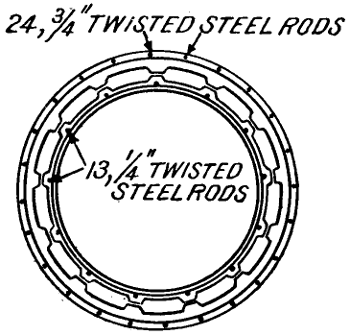
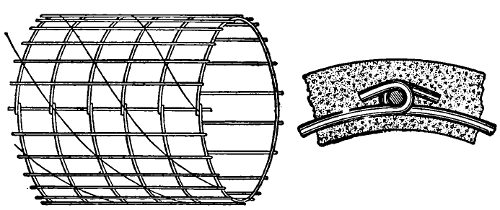
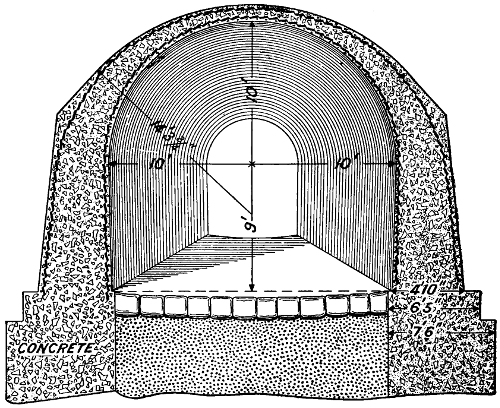
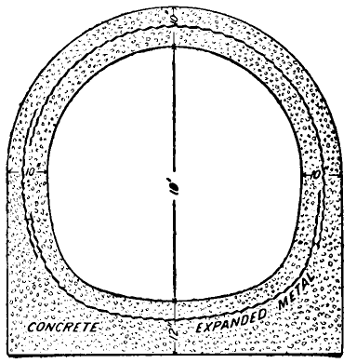
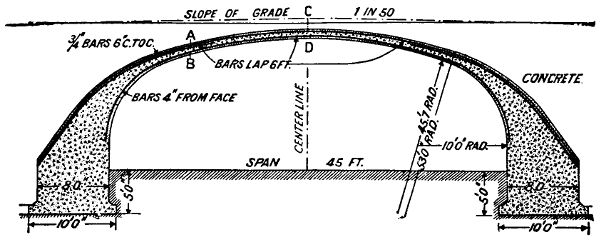
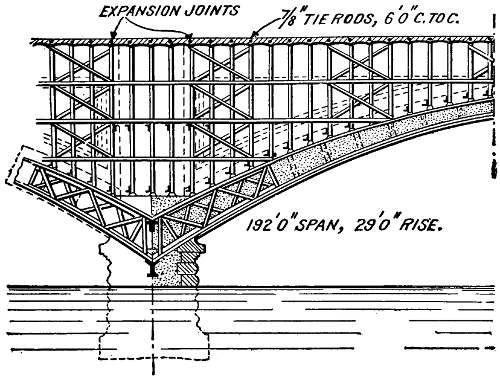
easily laid in unjointed miles. These materials when strengthened
with skeletons of steel find many uses; a brief survey of them is
given in this book. A sister product, terra cotta, baked at high
temperatures, is now molded in beautiful designs not only for
tiles, but as walls, cornices, finials, vases, hearths, and statuary.
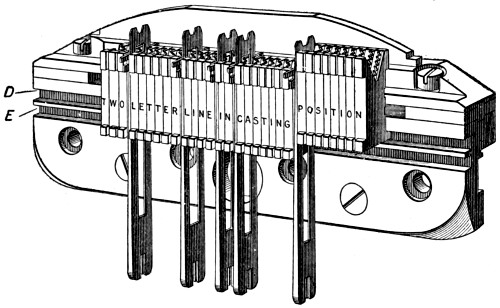
Mergenthaler linotype, showing five double wedges for justification.
Clay as tablets was one of the first mediums of the printer’s
art, an art of late years exposed to many a surprise from unexpected
invaders. Composition is now performed
by machines of various models, one of them
being Mergenthaler’s linotype, as employed for
this book. In effect this machine is a caster
rather than a compositor, and recalls the chief tasks of the type-foundry.
As an operator touches its keys he releases a succession
of matrices, from which is cast a line as a unit. In its latest form
this machine enables the operator to change instantly from one
font to another, introducing roman, italic, and black face type in
the same line at will. Intricate book, tabular and pamphlet matter,
with chapter headings, titles, or marginal notes may in this
new model be set up at a speed four to six times quicker than
hand composition.
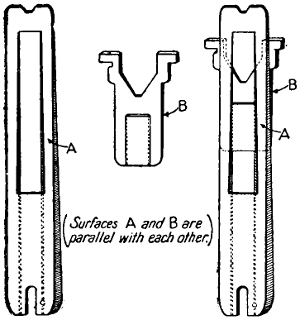
J. W. Schuckers’ double-wedge
justifier.
An illustration shows the two-letter matrices of a special Mergenthaler
machine. The upper is usually a body character and
the lower an italic, a small capital or a black face. These lower
matrices are lifted a little by a key so as to come in line with upper
matrices. In this way the compositor has at command two
distinct fonts. Groove E receives the ears of the matrices. In a
normal position D receives the ears of the matrices elevated to
produce the secondary characters. In this way the matrices are
held in position as casting proceeds. Five double-wedge justifiers
will be observed between the matrices. These devices, invented
by J. W. Schuckers, form an essential
part of the machine. Justification,
let the reader be reminded, is so
spacing the contents of a line that it
shall neatly end with a word or syllable.
In typewritten manuscript the
lack of justification leaves the ends
of lines jagged and unsightly. Mr.
Schuckers at the end of every word
places a pair of wedges. When the
operator is close to the end of a
line he pushes in the whole row of
wedges in that line; the outer
sides of each pair remain always parallel, and as pushed in these
outer sides are just sufficiently forced apart to space out the line
with exactitude. To lift a table or a desk, and at the same time
keep it always level, we may use pairs of wedges in the same
manner; they must, of course, be much larger and thicker than
those used in linotypy. See next page for an illustration.
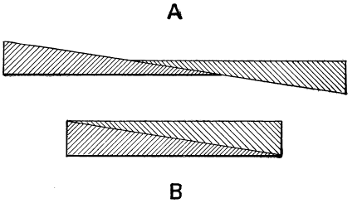
A, two wedges partly in contact.
B, two wedges fully in contact, outer sides parallel.
To-day a book may be reproduced without any recourse whatever
to the type long indispensable. A photographer takes the
volume, and repeats it in pages of any size we wish, dispensing
not only with the type-setter or the type-caster, but even with
the proofreader, since a camera furnishes an exact fac-simile of
the original work. If the book is illustrated, a further economy
is enjoyed; its pictures are copied as faithfully and cheaply as the
letterpress.
A feat which is a mere trifle as compared with reproducing a
book by photography, turns upon a loan from an old resource.
Confectioners from time immemorial have
squeezed paste out of bags through apertures
into ornaments for wedding cakes and the
like. With similar bags decorators force a
thin stream of plaster into a semblance of flowers, fruits, and
arabesques on their ceilings and cornices. On the same plan,
with pressure more severe, soap is forced, from a tank through a
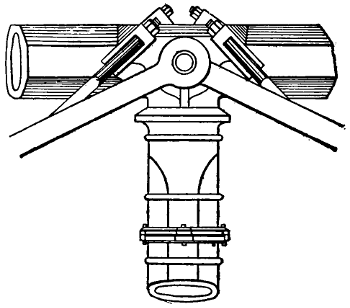
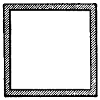
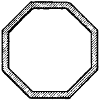
square opening to form bars for the laundress. Increasing the
pressure once again, clay for bricks is urged forth, to be divided
into lengths suitable for the kiln. Lead pipe is manufactured on
the same principle, recalling the production of macaroni. A
further step was taken by Alexander Dick, the inventor of Delta
metal; by employing hydraulic pressure on metals at red heat he
poured out wires and bars of varied cross-sections, superseding
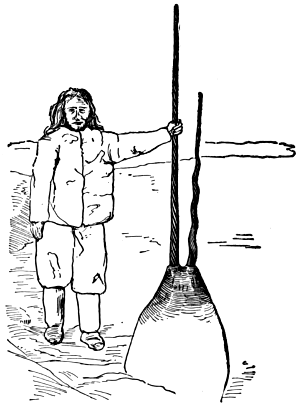
the method of drawing through dies.
Cold as well as heat may be employed in a novel manner. The
flesh of birds, beasts, and insects is now frozen hard, so as to be
sliced into extremely thin sections clearly showing
the details of structure. How a freezing
process may aid the miner was shown first in
Germany in 1880, when Hermann Poetsch, a mining engineer,
had to sink a shaft near Aschersleben, to a vein of coal, where,
after excavating 100 feet, a stratum of sand eighteen feet thick,
overlying the coal, was encountered. It occurred to Poetsch that
the great difficulty occasioned by the influx of water through the
sand could be overcome by solidifying the entire mass by freezing.
To do this, he penetrated the sand to be excavated with large pipes
eight inches in diameter, sunk entirely through it and a foot or
two into the underlying coal. These were placed in a circle at
intervals of a metre, and close to the periphery of the shaft. They
were closed at the lower end. Inside each of these and open at its
lower end was a pipe an inch in diameter. This system of pipes
was so connected that a closed circulation could be produced
down through the small pipes and up through the large ones. An
ice-machine, such as brewers use, was set up near by and kept at
a temperature below zero Fahrenheit. A tank filled with a solution
of chloride of magnesium, which freezes at -40° Fahr., had
its contents circulated through the ground pipes described.
Thermometers placed in pipes sunk in the mass of sand showed
51.8° Fahr. at the beginning of the process. The circulation was
kept up and on the third day the whole mass was frozen. Within
the continuous frozen wall the material was excavated without
damage from caving in or inflow of water. The freezing entered
the coal three feet, and to a distance six feet outside the pipes.
The circulation was kept up until the excavation and walling were
complete. On a somewhat similar plan tunnels have been bored
through difficult ground. Of late years at Detroit, and elsewhere,
serious breaks in water-mains have been repaired after a freezing
process has solidified the stream.
Light, as well as heat and cold, is to-day bidden to perform
new duties. It was long ago observed that polarized light as it
takes its way through transparent crystal or glass clearly reveals
in areas of variegation, any strains to which the crystal or glass
may be subjected. Of late this fact has been applied with new
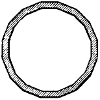
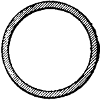
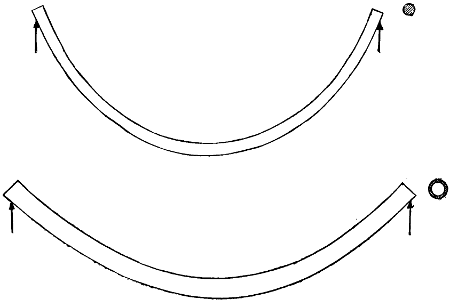
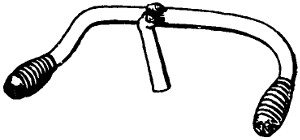
skill to investigating strains in engineering structures. A model
in glass, carefully annealed, is placed in the path of a beam of
polarized light. By shifting the points of application
and of support, by loading the structure
more or less, and here or there, the distribution
of stresses and strains is directly shown to the
eye. In this way curved shapes of various kinds have been investigated,
as well as bodies in which Hooke’s law of the strict
proportionality of strain to stress does not apply. Photographs
taken by this method show
the distribution of stresses
in rings subjected to external
compression, crank
shafts, and car-coupler
hooks. It would be interesting
thus to compare standard
types of girders, trusses,
and bridges, as well as
arches of various forms,
both regular and skew.
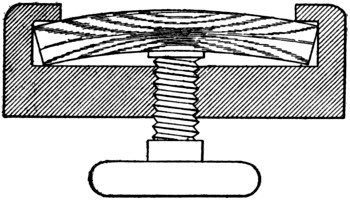
Polarized light showing strains in glass.
Polarized light, which when first discovered seemed nothing
more than a singular and quite sterile phenomenon, has other uses
of great importance. It tells the chemist how much sugar a given
solution contains; it displays the inner architecture of rocks when
these are sawn into thin sections.
Even more valuable than polarized light are the X-rays discovered
by Professor Röntgen. One of their latest uses is to
reveal impurities and air bubbles in electric cables, affording a
procedure much simpler and easier than to employ electrical instruments.
In the production of X-rays and similar rays a tube
as nearly vacuous as possible is employed. As an aid in removing
air Professor James Dewar, of Cambridge University, has recently
adopted cocoanut charcoal with remarkable success. He subjects
it to the intense cold of liquid air, then establishing communication
between a receptacle filled with this charcoal and a bulb exhausted
to one fourth of the ordinary atmospheric pressure, he
has air so tenuous that an electric spark passes through it with
difficulty. So much for developing the long known affinity of
charcoal for gases, a property which increases in degree as temperatures
fall.