Our brief survey has thus far carried us over the
lands of Egypt, China and western Asia; lands
so far removed from us in distance, and inhabited by
people so far removed from us in time and character,
that they seem to belong almost to another world. But
we now are coming to a country which, though its history
goes back many centuries before the Christian
era, was a country of Europe and inhabited by a people
who seem near. The Greeks who overran what
we now call Greece, probably about 1500 B. C., took
possession of a civilization exceedingly high, which the
inhabitants of the mainland and the Ægean Islands
had received from the East, through the Phœnicians,
who brought it in their ships. This civilization the
Ægean islanders, especially the Cretans, had developed
and improved, particularly in creations of beauty and
works of art. The Greeks created a still higher civilization,
and transmitted it to us. The influence of
Greek civilization we see on every hand:—in our language,
in our daily life, and especially in our ideas of
art, literature and philosophy.
That a civilization so high and beautiful should have
been attained, could hardly have been brought about
without the presence of great imagination among the
Greeks, and the exercise of considerable invention.
The presence of both imagination and invention are
evidenced in every page of the early history of Greece,
in the stirring stories of her heroes, and in the conception
and development of her government. Compared
with the stories of ancient Greece, the stories of the
childhood of every other country seem unimaginative
and tame. The stories of early Greece still live and
still have the power to charm. The Iliad and Odyssey
are in the first rank of the great poems even now; and
the story of Helen and the siege of Troy is as full of
life and color as any that we know.
An interesting legend characteristic of the inventiveness
of the ancient Greeks was that of the large wooden
horse in which a hundred brave warriors concealed
themselves, and were drawn within the walls of Troy
by the Trojans themselves, who had been induced to do
this by an ingenious story, invented to deceive them.
Whether the legend is true or not does not affect the
fact that invention was needed and employed to create
the legend in the one case, or to cause the incident in
the other case.
The prehistoric age of Greece was filled with myths
of so much beauty, interest and originality, that the
Greek mythology is more read, even now, than any
other. It formed also the basis of the later mythology
of the Romans.
It may be noted here that mere imagination is not
a quality of very high importance, unless it be associated
with constructiveness. In fact, imagination is
evidenced more by savage and barbarous peoples than
by the civilized; as it is also by children and women
than by men. Imagination by itself, untrained and
undirected, while it is unquestionably an attribute of
the mind, is not one of reason, in the sense that it
does not necessarily employ the reasoning faculties.
In fact, the imagination, unless trained and well-directed,
may lead us to the absurdest performances,
in defiance of the suggestions of reason. Using the
word imagination in this sense, Shakespeare said—
"The lunatic, the lover and the poet
Are of imagination all compact."
It is only when imagination has been assisted by
reason, it is only when conception has been followed
by construction, that practical inventions have resulted.
The myths invented by the Greeks in their prehistoric
period were the products of not only imagination
but construction. Each myth was a perfectly connected
story, complete in all necessary detail, admirably
put together, and told in charming language. The
story of Jason's Argonautic Expedition in search of the
Golden Fleece cannot be surpassed in any of the elements
that make a story good; Penelope is still the
model of conjugal devotion, and Achilles the ideal
warrior; Poseidon, or his Roman successor, Neptune,
still rules the waves; Aphrodite, or Venus, calls up
more vividly before our minds than any other name the
vision of feminine beauty even to this day. Hercules
exemplifies muscular strength, and Apollo still typifies
that which is most beautiful in manliness.
The influence of the Grecian myths, "pure inventions"
as they were, in the sense that they were fictitious
and not true, has been explained and demonstrated
at great length and with abundant enthusiasm
by poets and scholars for many centuries. They have
been generally regarded as inventions, but nevertheless
as quite different from such inventions as the
steam-engine or the printing press. The present author
wishes to point out that the mental processes by which
both myths and engines were created were alike, and
that the inventions differed mainly in the uses to which
they were put.
Even the uses to which they were put were similar
in the end; for the use of the myths and of the steam
engine was to improve the conditions of man's existence.
There is only one way in which to do this, and
that is by improving the impressions made on his mind.
The myths did this by making beautiful pictures for his
mind to gaze at, and by using them to induce him to
follow a certain (good) line of conduct, rather than
the contrary. The steam engine did it by making the
conditions of living more comfortable, by rendering
transportation more safe and rapid, and by rendering
possible the procuring of many of the pleasant things
of life from distant places.
The invention of a myth may be said to be the invention
of an immaterial thing; the invention of a steam
engine to be of a material thing. These two lines of
effort, invention has followed since long before the
dawn of history. Of the two, the invention of myths
and stories probably succeeded the other.
Probably also it has been the more important in
affecting our actual degree of happiness; affecting it
beneficently in the main. For, while some myths and
stories have filled men with dread and horror, a very
large majority have had the opposite effect; and while
many mechanical inventions have contributed to our
material ease and comfort, it is not clear that they
have much increased our actual happiness. Men accommodate
themselves easily to changes in their material
surroundings; what is a luxury today will be a
necessity tomorrow; and very many of the material
inventions have tended to artificial and unhealthful
modes of living, with consequent physical deterioration
and its accompanying loss of happiness.
As to influence on history, however, the influence of
the material inventions has probably been the greater.
Immaterial inventions might have been made in enormous
numbers without of themselves affecting history
greatly; but the material inventions have brought about
most of the events that history describes; and without
one material invention, that of writing, history could
not exist at all. History is rather a narrative of men's
deeds than of their thoughts; and their deeds have been
directed largely by the implements which they had to
do deeds with.
We must realize, of course, that the Greeks were
much indebted to the Ægeans; for discoveries about
the shores and islands of the Ægean Sea show that
long before the advent of the Greeks they used tools
and weapons of rough and then of polished stone, and
later of copper and tin and bronze; that they lived on
farms and in villages and cities, and were governed
by monarchs who dwelt in palaces adorned with paintings
and fine carvings, and filled with court gentlemen
and ladies who wore jewelry and fine clothing.
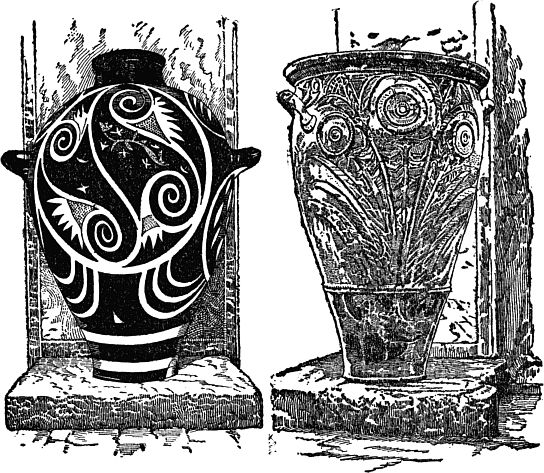
Exquisite pottery was used, decorated with taste and
skill; ivory was carved and gems were engraved, and
articles were made of silver and bronze and gold.
As early as the sixth century B. C., the Greeks made
things more beautiful than had ever been made before.
One almost feels like saying that the Greeks invented
beauty. Such a declaration would be absurd of course:
but it seems to be a fact that the Greeks had a conception
of beauty that was wholly original with them, and
that was not only finer than that which any other people
had ever had before, but finer than any other people
have had since. And not only did they have the conception,
they had the ability to embody the conception
in material forms that possessed a beauty higher than
had ever been produced before, and higher (at least
on the average) than have ever been produced in any
other country since.
Looked at in this way, the production of a new and
beautiful statue, painting or temple, seems to be an act
of invention much like the formulation of a myth or
the writing of a poem. In this sense, the Greeks were
inventors, inventors of works of beauty that have existed
as concrete material creations for centuries, and
have exercised an enduring influence on the minds of
men.
The influence of paintings, statues and temples is not
so clear as that of material inventions, but more clear
than that of myths and poems. They may be said to
form a class midway between inventions of material
appliances and inventions of immaterial thoughts and
fancies. A beautiful painting or statue is a material
object in the same sense as that in which a steam
engine is; but its office is to stimulate the mind, as a
poem does.
The first inventor of mechanical appliances, mentioned
by name as such, was Dædalus of Athens. He
was probably a mythical person. He was reputed to
be the son or the grandson of Erectheus, a probably
mythical king. He is credited with the invention of
the saw, the gimlet, the plumb-line, the axe, the wedge,
the lever, masts and sails and even of flying;—for he is
said to have escaped from Crete to Sicily with artificial
wings. The story of Dædalus, like that of many other
mythological personages, is both interesting and irritating
from the mixture of the very probable, the
highly improbable, and the entirely impossible, in a
jumble. But the story of Dædalus seems to make it
probable that all the things which he is reported to
have invented (except flying) were in use in Greece in
prehistoric times.
As no records show to us that the inventions just
enumerated (except masts and sails) had been invented
elsewhere, we may feel justified in inferring that
they were invented in Greece by Dædalus, or by some
other man bearing a different name,—or by some other
men. The name borne by the man is not important
to us now; but it is important to realize that such
brilliant and original inventions were made so long
ago by a primeval people; especially since they were of
a character somewhat different from those invented
in Egypt and Asia which we have already noted. The
invention of the gimlet seems the most brilliant and
original of those just spoken of; and one marvels that
it should have been invented at such a time; for the
action of the gimlet was a little more complicated than
that of even the balista or the catapult. It is true that
the number of parts was less, that in fact there was
only one part. But that part turned around in one
plane, and advanced in another; it was less like anything
that existed before than the catapult was like the
sling, or the balista was like the cross-bow. There was
no immediate forerunner of the gimlet. In other
words, the mental jump needed to invent the gimlet
was from a base of nothing that we can exactly specify.
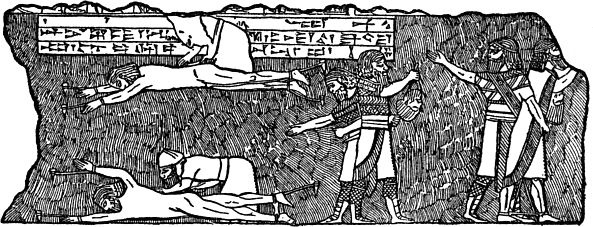
Insurgent Captives Brought Before Darius
A possible suggestion for the gimlet was the succession
of inclined planes by which one mounted to the top
of an Assyrian or Chaldean palace; these planes rising
gradually on each of the four sides, so as to form together
what might be called a square spiral. It is
possible that a circular spiral may have been traced
later around some cylindrical shaft or column, and
given the first suggestion for the screw or gimlet. Of
course, a gimlet is a kind of screw.
The Greeks do not seem to have applied their inventiveness
after the time of Dædalus to mechanical
appliances, but to works of art and systems of religion
and philosophy. One of their most important inventions
may be said to be mid-way between: it consisted
in adding vowels to the Phœnician alphabet and producing
the basis of the Latin and succeeding alphabets.
The Greeks were not naturally of a warlike disposition,
and their peculiarly jealous temperament prevented
the various states and cities from combining and
forming a great nation. Their energetic character and
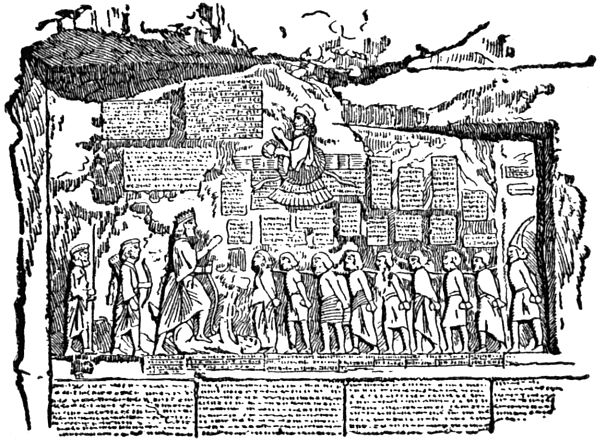
great intellectuality saved them, however, when Darius,
King of Persia, invaded Greece in 490 B. C.
By that time the Greeks had raised and trained an
army of great excellence. No especial inventiveness
seems to have been exercised, but the equipments of the
men, their organization, their armor, their weapons
and their discipline had been brought to a standard
exceedingly high. All these advantages were needed;
for the Persians were a warlike people, their King
Darius was an ambitious and successful conqueror, and
the number of Persians that invaded Greece was far
greater than the number that Greece could raise to
fight them.
Had the Greeks been destitute of invention they
would have followed the most obvious course, that of
shutting themselves up inside the protection of the
walls of Athens. Had they done this, the Persians
would have surrounded the city, shut them off from
supplies from outside, and slowly but surely forced
them to surrender.
But, on the insistent advice of Miltiades, the Greeks
advanced to meet the Persians, leaving the shelter of
their walls behind them. It may not seem to some that
Miltiades made any invention in planning the campaign
which he urged against much resistance, and
which the Athenians finally carried out. Yet his mental
action was one allied to that of making an invention;
for his mind conceived a plan as a purely mental
picture, then developed into a workable project, and
then presented it as a concrete proposition. Later,
when the hostile forces met on the low plain of Marathon,
Miltiades rejected the obvious plan that an uninventive
mind would have adopted. Instead of it, he
invented the plan of weakening his center, strengthening
his flanks, and departing from the usual custom of
advancing slowly against the enemy, in favor of advancing
on the run. The plan (invention) worked
perfectly. The unsuspecting Persians broke through
the center and pursued the fleeing Athenians to a rough
ground;—only to be caught between the two flanks,
like a nut in a nut-cracker, and crushed to pieces.
It can hardly be seriously questioned that in this
plan Miltiades showed the abilities of the inventor,
and in a highly brilliant and highly important way.
Had he fought the battle in the obvious way, the great
numerical superiority of the Persians could hardly
have failed to gain the victory, despite a really considerable
superiority of the Athenians in training and
equipment. But the Persians were the victims of a new
and unexpected kind of attack. A new weapon suddenly
brought to bear on them would have had a
similar effect.
This is the first illustration in recorded history of
the influence of invention on the deciding of a war.
Its influence was enormous in this case; for the battle
of Marathon was one of the most decisive and one of
the most important battles ever fought. If it had
been decided contrariwise, Grecian civilization would
have been stamped out, or so completely stifled that
it would never have risen to the heights it afterwards
attained; freedom of thought and government would
have been smothered, and the world would be immeasurably
different now from what it really is.
The defeat of the Persians was so decisive that they
withdrew to their own country, but with the determination
of returning, and in overwhelming force. By
reason of a variety of circumstances, including the
death of the king, the invasion did not take place until
ten years later. Then, in the year 480 B. C., King
Xerxes set out on a punitive expedition against Greece
with an enormous military and naval force.
Again Greece was saved from Persia by pure brain
power, that of Themistocles. Like Miltiades, he rejected
the obvious. Discerning, as no one else discerned,
that the weakest point in the Persian forces
was the line of communication across the Ægean Sea,
because the ships of those days were fragile, and an
invading army needed to get supplies continually from
Persia, he pointed out that although it was the Persian
army that would do the actual damage in Greece, yet
nevertheless, the major effort of the Athenians should
not be spent on their army but on their navy.
The difficulties he met in making the Athenians see
the truth may easily be imagined, from experiences in
our own day. He succeeded at last, however; so that
by the time the Persians reached Greece, Greece had
a fleet that was very good, though not nearly so large
as the Persian. The fleets came near to each other
in the vicinity of Athens. The majority of the Athenian
leaders advised that the Athenian fleet should retreat
toward the south and west, to the isthmus of Corinth,
and await the Persians there; because, if defeated, a
safe retreat could be effected. But Themistocles opposed
this plan with all the force and eloquence he could
bring to bear; pointing out that the aim of the Athenians
should not be to find a safe line of retreat, but to win
a battle; and that the Bay of Salamis was the best place,
for two reasons. One reason was that the Persians
would have to enter the bay in column, because the entrance
was narrow, and the Persian ships, as they successively
passed into the bay, would therefore be at a
great disadvantage against the combined attack of the
Athenian ships, waiting for them there; the other reason
was that the bay was so small that the great numbers
and size of the Persian ships would be a disadvantage,
instead of an advantage. Themistocles (not
without the use of considerable diplomacy and even
subterfuge) finally secured the assent of the other
Athenian leaders. The result was exactly what he
predicted that it would be. The Persian fleet was
wholly defeated, and Greece again was saved.
The great victory of the Greeks over the Persians
wrought a powerful stimulation among all the people,
especially in Athens, and was followed by the most
extraordinary intellectual movement in the history of
the world. It lasted about a century and a half; and
in no other country, and at no other period, has so
much intellectual achievement been accomplished by so
few people in so short a time.
Before the Persian wars, the Greeks had already
shown an extraordinary originality in art and literature;
especially in architecture, sculpture and poetry.
Naturally these peaceful arts languished during the
wars; but after the Persian invaders had been finally
ejected, they rose with renewed vigor, stimulated by
the patriotic enthusiasm of the nation as a whole.
It was in Athens, and among the Athenians that most
of the movement was carried on. The principal state
in Greece besides Athens then was Sparta. The Spartans
devoted themselves mainly to warlike and allied
arts, while the Athenians devoted themselves mainly to
the beautification of Athens; though they were careful
to guard it adequately by maintaining an excellent navy,
surrounding the city with high walls, and building two
long parallel walls from Athens to Piræus, its seaport.
It would be out of place in a book like this to attempt
any description or discussion of the various
phases of the intellectual activities that rose with such
startling quickness, and developed into such important
movements, during the century and a half that followed
the Persian wars; especially as this has already
been done by many scholars, in many languages, and
at many times. A very brief and elementary statement
may, however, be made, for the purpose of illustrating
the influence of invention on history.
The main characteristic of the movement as a whole
and of every one of the various channels which it followed,
was originality. No such perception of beauty
had ever been evidenced before; no such conceptions
of logic, philosophy or science.
Accompanying these was a conception of free government
equally original. Whether the government of
Athens was the cause of the intellectual rise, or the intellectual
rise was the cause of the government, may
safely be left to scholars to debate; for the purposes of
the present discussion, it seems sufficient that they co-existed
and had together a powerful influence on
history.
The greatest genius that guided the intellectual
forces of the Athenians in the matter of government
was that of Pericles, who ruled their minds by pure
force of argument and persuasion, from about 445 to
431 B. C. Athens and her subject cities formed a virtual
empire, small in extent, but powerful in influence;
though in form it was a democracy. In some ways it
was the most perfect democracy that ever has existed
even to this day; for not only was every citizen available
for office, but he was expected to take active part
in deciding public measures, and to be really qualified
to hold office.
This idea was put into practical operation by a careful
system of payment for every public service; to the
end that even the poorest citizen should be enabled to
hold office, and a wealthy office-holding caste prevented
from existing. To so great an extent was this carried
out that, by the time that the Age of Pericles ceased
and the Peloponnesian War began, almost every citizen
was in the pay of the state. The perfect equality of all
the citizens, and their community of interests and privileges,
was recognized by supplying them at times with
free tickets to places of amusement, and by banqueting
the people on great occasions at the expense of the
state. To distribute widely the powers and duties of
citizenship, exceedingly large juries were established
for the trials of all cases. There was no king or president
or prime minister. The source of authority was
the Assembly which included every citizen over eighteen
years of age, and held forty meetings a year. Cooperating,
as a sort of committee, was a Council of
Five Hundred, whose members were chosen by lot each
year from citizens over thirty years of age.
The success of the Athenian democracy has had a
powerful influence ever since on history; because it has
supplied not only a precedent but an encouragement to
every people to try to escape from the individual restrictions
that monarchies and all "strong governments"
tend to impose. But it had another though
less powerful influence also, which continued for a long
while, but now has ceased, in supplying a precedent for
slavery. For while the citizens of Athens were free,
only the sons of Athenian fathers and Athenian mothers
could be citizens; many thousand workers and merchants
of all kinds could take no part in the government,
and there were besides an enormous number of
slaves. It was to a great degree the fact of slavery
that made possible the success of the so-called Athenian
democracy; for it liberated the citizens in very great
measure from the drudgery of life, and gave them
leisure to devote themselves to the study of government
and the arts.
In addition, Athens acquired great wealth from the
spoils of its wars and the tribute of its subject states.
This wealth was expended largely in the beautifying
of Athens, and in the consequent encouragement and
opportunity to artists of all kinds. Naturally, the art
most immediately encouraged was that of architecture;
and that the encouragement met with ready and great
success the most beautiful ruins in the world superbly
testify. The directing genius in this work and in all
the others was Pericles, who stimulated the Athenians
with his conception and description of a city worthy to
symbolize the power and glory of the empire. The
twin arts of architecture and sculpture worked together
and in harmony; and a city more beautiful than
ever known before, or ever known since, testified to
the soundness and brilliancy of the conception and to
the constructive ability of the Athenians to embody it
in material form.
The poets and scholars kept pace with the statesmen
and the architects and the sculptors; but the philosophers
surpassed them all. For, while the successful
democracy of Athens is a model still, and while
the Parthenon and the statue of Apollo are models still,
yet an integral part of the system of government (slavery)
has been abjured by the civilized world, and the
temples and the statues have been for the pleasure of
but a few; while the teachings of the philosophers have
been the basis on which has rested ever since much of
the intellectual progress of mankind.
It may be noted here that, as men have progressed
up the steep road to civilization, the only guides they
have had have been men who have not themselves
passed over the road before, and whose only qualification
as guides has lain in some attribute of the mind
that enabled them to survey the road a little farther
ahead than the others could, and to point out the paths
to take, and the obstructions to avoid. Man's physical
instincts guide him considerably as to the methods to
preserve his physical existence; but they help him not
at all to lift himself above his physical self, and in
many ways they hinder him. It seems to be the office
of the mind both to discern the upward paths and to
stimulate the will to overcome the difficulties and dangers
in the way.
Of the great pointers of the way, Socrates, Plato,
Aristotle and others, it might be deemed presumptuous
of the present author to do more than speak; and of
the great stimulators, Æschuylus, Sophocles, Euripedes,
Herodotus, Thucydides, Xenophon, and, above all,
Demosthenes as well. But because it is pertinent to
our subject it is instructive for us to note that the main
distinctive feature of the work of each was originality.
It is true that it is the completed work in the case of
each that meets our gaze; it is true that the superficial
impression would be the same, even if each work had
been a copy of some work that had gone before; in the
same way that, superficially, many a copy of an oil
painting is as good as the original. But from the
standpoint of influence on the future, it is the originator
rather than the copyist who wields the influence; just
as it is the basic inventor of a mechanical appliance
rather than the man who improves upon it.
The Athenians and Spartans became involved in the
Peloponnesian War, that lasted from 431 to 404 B. C.,
and ended with the capture of Athens. The Spartans
thereupon became dominant in Greece, but only to be
mastered by the Thebans in 371 B. C. The little jealous
states of Greece were never able to agree together
long, and no one state was ever able to unite them. But
the half-barbarian people of Macedonia, under Philip
their king, after developing their army, according to a
novel system invented by him, overcame and then
united under their sway the highly cultured but now
military weak states that had despised them.
Possibly, it would somewhat strain the meaning of
the word invention, to declare that Philip made a radically
new invention, when he improved on the Theban
phalanx, and devised his system of military training;
for kings and other leaders had trained armies long
before Philip lived, and Philip departed only in what
some might call detail from the methods that had been
used before. But, at the same time, it was an act, or a
series of acts, betokening great initiative and originality,
for a man ruling a weak collection of tribes such
as dwelt in Macedon, to create out of such crude material
as he began with, such an extraordinary army as
he ultimately was able to lead to battle. To accomplish
this it was necessary for him to conceive the idea
of doing it, then to embody his conception in a formulated
plan, and then bring forth the finished product.
The thought of doing it must have come to him:—how
else could he get it? An idea comes from outside
through the mental eye to the mind; as a ray of light
comes from outside through the physical eye to the
retina.
The picture made on Philip's mind must have impressed
him profoundly, for he spent the rest of his
life in giving it "a local habitation and a name." To
accomplish it cost him years of continual effort of many
kinds, but he did accomplish it. He did, as a result,
produce a machine, as truly a machine as Stephenson
ever produced, but made up of many more parts; each
part independent of any other, and yet dependent on
every other, and all working together, for a common
purpose.
Let us remind ourselves again that a machine composed
of inanimate parts only is only one kind of machine;
for a machine may be composed of animate
parts, or inanimate parts, or of parts of which some
are animate and some inanimate. Clearly, it makes no
difference, so far as the act of invention goes, whether
a man uses animate or inanimate parts; the essential
of invention is the creation of a new thing. If a man
merely puts two pieces of wood and a piece of string
into a pile, or if he merely collects a number of men
together, no invention is made and nothing is created.
But if he so combines the two pieces of wood and the
string as to make a bow and arrow; or if he combines
a modified Theban phalanx with masses of cavalry and
catapults in a novel and effective way as Philip did,
invention is exercised and something is created.
Before Philip's time a phalanx was used to bear
the brunt of the battle, and to overwhelm the enemy
by mere strength and force; as the Thebans did at
Leuctra and Mantinea. But Philip conceived the idea
of merely holding the enemy with his phalanx assisted
by the catapults, and hurling his cavalry against their
flanks. Philip's army, as Philip used it, was a machine
and a very powerful one:—each part independent of
every other, yet dependent on every other—all the
parts working together for a common purpose. Philip
conceived the idea of making this machine, and afterwards
made it; just as Ericsson more than two thousand
years later conceived the idea of making a "Monitor"
and afterwards made it.
By means of his machine Philip defeated the Greeks
at Cheronea in the year 338 B. C., just as Ericsson by
means of his machine defeated the Merrimac at Newport
News in the year 1862 A. D., exactly twenty-two
centuries later. The two machines differed, it is true.
Yet they did not differ so much as one might unthinkingly
suppose; for each machine was made up of parts,
of which some were animate and some were not; and
in each machine every part, animate or inanimate,
cooperated with all the others; and all cooperated
together, to carry out the inventor's purpose, the destruction
of the enemy.
The influence of Philip's invention began before
Philip died, and it continues to this day. For after
Philip's death, his son Alexander put it to work at once
on the task of subduing thoroughly all of Greece, and
then subduing Asia.
The influence of the machine in subduing even
Greece alone must not be regarded lightly; not so much
because Greece was subdued, as because the various
little states were by that means brought together; and
because it illustrates the fact that without a machine,
no great number of people can work together. It was
because of the absence of any machine that the Grecian
states acted separately and antagonistically, instead of
in cooperation.
After subduing Greece, Alexander took his machine
across the Hellespont, in the year 334 B. C., to try it
on the Persian troops in Asia Minor. The machine
worked so successfully at a battle on the Granicus that
Alexander took it south, and with its aid was able to
conquer all of Asia Minor in about a year.
It may be objected that it is not correct to attribute
all of Alexander's success to the excellence of his machine;
and this objection would have great force and
receive the approval of most people, for the reason
that, in most histories, the main credit is given to the
energy of Alexander and the courage of his troops;—though
the excellence of the training and organization
bequeathed by Philip is admitted.
To this hypothetical objection the answer may be
made that the ultimate result was due to both the machine
and the excellence with which it was operated;
that is, to the product of what the machine could do
if it were used with perfect skill and the percentage of
skill with which it was actually used. This statement
is, of course, true of all machines and instruments, as
the author has often pointed out, in articles and
addresses.
In the case of Alexander and his army, the percentage
of skill, of course, was high; but Alexander and each
one of his soldiers was only a part of the machine; and
even their skill was part of the machine in the sense
that it was a characteristic included in the original design
of Philip. In other words, we should not fall into
the error of dissociating the skill of Alexander and his
soldiers from the machine itself; because it was part of
Philip's invention that the training should produce that
skill. The system of training was part of the invention.
It is true, however, and exceedingly important, that
the degree of skill which Alexander brought to bear
personally was far in excess of what any system of
training could possibly produce. When we read of the
amazing victories that Alexander made over superior
forces of highly trained warriors, we see that Philip
of Macedon should not be given all the credit; that
the genius of Philip of Macedon was not the only
genius contributing to the result. We see that genius
of some kind directed the decisions of Alexander.
What were the characteristics of that genius?
Courage? Yes; history tells of no one possessing
higher courage, both physical and moral, than Alexander.
Not only was he physically brave, not only did
he dare physical danger of many kinds, and on many
occasions, but he was morally brave; he did not shirk
responsibility; he did not fear to take enormous risks;
he did not hesitate to reject advice, even the advice of
his most experienced and able generals; he was willing
to stake everything, sometimes, on the success of
some wholly untried expedient of his own devising.
But does mere courage, even of so many kinds—and
even if it be added to trained skill and the possession of
an admirable machine—do they all together explain
the amazing successes of Alexander? No. What does
explain them?
Genius? Yes, but the word genius is only a word,
and explains nothing; for the reason that no one knows
what the word genius means. It is merely a label that
we attach to a man who is able to do things that other
men cannot do. But granting that the possession of
"genius" is an explanation of Alexander's being able to
accomplish what he did, in what way did that genius
operate? in what way did it help him to win so many
victories and extricate himself from so many perilous
situations?
By inventing methods and devising schemes and improvising
plans that an uninventive man would not have
thought of. The story of the Gordian knot may or
may not be true; but it seems credible, because it was
exactly the kind of a thing that Alexander might have
been expected to do in such an emergency. Posing as a
great conqueror, he was (according to the legend) suddenly
confronted with the untying of a knot, the successful
accomplishment of which would make him master
of Asia. He realized that he could not untie it.
Any man but a man like Alexander would have tried
it and acknowledged failure, or have declined to try it:
placing himself in a defensive position in either case.
But Alexander draws his sword and cuts the knot in
two, thereby accomplishing whatever the untying of
the knot would have accomplished, but in an unexpected
way. Alexander's victories and escapes from perilous
positions were largely accomplished by unexpected
measures.
But Alexander showed his inventive ability before he
invaded Persia; in his very first campaign undertaken
to subdue a revolt in Thessaly immediately after he
ascended to the throne. The Thessalians opposed him
in a narrow defile. An ordinary man would have
thought, as the Thessalians did, that he was checkmated.
But Alexander conceived and executed the ingenious
scheme of cutting a new road up the steep side
of the mountain, leading his army along that road, and
suddenly threatening the Thessalians in their helpless
rear. Shortly afterward in Thrace he reached a defile
in the mountains which it was necessary for him to
pass, but which he found defended by a force that had
stationed a number of war-chariots at the top, to be
rolled down on the Macedonians. Alexander immediately
ordered his infantry to advance up the path
and to open their ranks whenever possible to let the
chariots rush through; but when that could not be
done to fall on their knees and hold their shields together
as a sort of roof on which the chariots would
slide, and from which they would roll off. This amazing
story is supposed to be true; and it is said to have
succeeded perfectly.
Not long afterward Alexander had to cross the
Danube with his army and all their equipments and
attack a force of barbarians on the farther bank. This
he saw he could not do by the use of any means available
of an ordinary kind. Nothing daunted, he conceived
and executed the scheme of floating his equipments
across at night in floats made of tent skins, filled
with hay.
The next clear example that we find of Alexander's
inventiveness was when he undertook the siege of Tyre.
Tyre stood on an island of Phœnicia in the extreme
eastern end of the Mediterranean Sea. It was surrounded
with a wall, very thick and very high, and was
separated from the shore by half a mile of deep water.
To capture such a place was no small undertaking for a
man who had no ships. But Alexander conceived and
executed a scheme that worked successfully. In accordance
with that scheme, he built a causeway that extended
from the shore out toward the island on which
Tyre stood. Naturally, the Tyrians obstructed his
efforts by sending fireships against him and firing projectiles;
and these tactics became more and more
effective as the causeway approached the city. Then
Alexander visited some of the jealous neighbors of
Tyre that had submitted to him, and secured a fleet of
some eighty ships; and these he led, as the admiral
commanding, against the Tyrian harbor.
By this time, the causeway was well protected with
catapults and war-engines of various kinds, and had
been carried close up to the island. Yet little actual
damage could be done to Tyre, because of the height
and thickness of the walls, and because Alexander's
galleys that he had equipped with war-engines could
not get close enough, by reason of large boulders under
water. Alexander then equipped certain galleys
with windlasses to root up the boulders, the galleys
being fitted with chain cables to prevent divers from
cutting them. Tyre was soon afterwards reduced to a
purely passive defense and consequent surrender.
The story of the siege of Tyre, if read in the light
of the conditions of the comparative barbarism of the
world in those days, is a record of inventiveness, on the
part of Alexander, so convincing and complete, as to
entitle Alexander to a place in the first rank among
the inventors of our race.
Shortly afterward Alexander reached the town of
Gaza, the great stronghold of the Philistines. It stood
on high ground, and was more than two miles from the
sea. Alexander's engineers reported to him that, as
the fleet could not assist them, and as the walls were
themselves very high and stood on a high hill, the
walls could never be stormed. Things looked serious.
They were serious; and failure would then have come
to any man, except a man like Alexander. He cut the
Gordian knot by ordering that ramparts be thrown up
as high as the top of the walls, and war engines placed
on the ramparts. This was done, and the city was
taken.
Alexander's campaigns in Egypt, and afterward in
western Asia, were characterized by the same quickness
and daring, both in conception and in execution,
that had marked his opening campaigns in Greece.
Later, when advancing toward Persia, he encountered
a tribe of hillsmen in the Uxian Pass, who, like the
Thessalians and the Thracians, thought they had
blocked his passage by opposing him in so narrow a
defile. Alexander literally "circumvented" them by
making a night march over a difficult mountain pass,
and astonishing them by an attack on their rear the
following morning. Shortly afterward a like situation
presented itself, when an army opposed him in a narrow
defile called the Persian Gates, that was fortified
with a wall. Alexander soon realized that the position
of his enemy was impregnable. He learned, however,
that there was a path that led around the pass, though
it was exceedingly dangerous, particularly to men in
armor and to horses, and especially at that time, when
snow and ice were on the ground. He again utilized
his former invention (circumvention) and with his
former success; though the conditions under which it
was accomplished were much more difficult.
The four examples just given of literally circumventing
an uninventive enemy illustrate in the simplest
form the influence of invention on military history.
After it became clear to Alexander that his invasion
of Asia would be successful from a military point of
view, his active imagination presented to his mind a
picture of a grand and noble empire, embracing the
whole world, but dominated and inspired by the spirit
of the civilization of Greece. To develop this conception
into an actual reality, became at once the object
of his efforts. To develop it, he decided to adopt in
some measure the characteristics and dress of the people
in whatever province he might be, and to take such
steps in organizing provinces, founding cities and establishing
systems, as to weld all into one empire, under
himself, as ruler. One can hardly credit the authoritative
account he reads of Alexander's bewildering
success. He seems not only to have won battles, and
built cities, and organized provinces, but actually to
have super-posed Greek civilization on Persian civilization!
In one of his most important later battles, Alexander
again utilized his inventiveness. If he had not done
so, he would assuredly have lost the battle. It was
against King Porus in northwestern India. Alexander
found the forces of Porus encamped on the opposite
side of the Hydaspes River, with the evident intention
of preventing him from crossing. As the army of
Porus in men alone was evidently equal to his own,
and as it was reinforced with a multitude of elephants,
Alexander was apparently confronted with a problem
impossible of solution. It would have been impossible
to anyone but a man like Alexander. He, however,
by means of various feints and ingenious stratagems,
managed to get across at night about sixteen miles up
the river, using boats that he had constructed, and
floats of skin stuffed with straw. Porus took up a
position on the opposite shore and made ready to receive
attack, his front preceded by war chariots and
elephants. Alexander had neither; but he did have
brains and originality. So he simply held the enemy
with his infantry, and then made a determined attack
with cavalry and archers on the enemy's left flank, and
especially on the elephants. The elephants soon got
beyond control; and the rest of the battle was a fight
between a highly trained Macedonian phalanx, assisted
by cavalry, and an Oriental mob.
Alexander died in Babylon when not quite thirty-three
years old. In actual and immediate achievement
he surpassed perhaps every other man who has ever
lived. He founded an empire which he himself had
conceived and developed, which covered nearly all the
then known world, and which, though it was composed
mainly of barbarous and semi-barbarous people,
was dominated by Greek thought. It is true that
the empire fell apart almost immediately after Alexander
died. But it did not fall into anarchy, or revert
to its previous state: it was divided into four parts,
each of which was distinct, self-governing and well
organized. The two larger parts, the kingdom of
the Seleucidæ, which occupied approximately the territory
of Persia, and the kingdom of the Ptolomies, or
Egypt, continued as torch-bearers to civilization for
many centuries thereafter.
Of the two, the former was the larger and was
probably the better, from an administrative point of
view; but Egypt represented the finer civilization; for
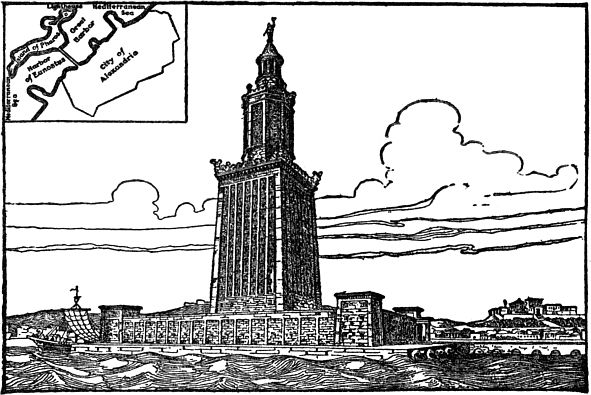
Alexandria, with its library and its wonderful museum,
became the seat of learning and the resort of the
scholars of the world, and the centre of the Hellenistic
civilization that followed that of Greece.
This Hellenistic civilization, it may here be pointed
out, was in some respects as fine as that of Greece, and
in some respects was finer, because it was more mature.
But (perhaps for the reason that it was more mature)
it lacked much of the element that was the highest in
the Greek, the element that gave Greek civilization
greater influence on history than any other civilization
ever had—the creative element. The creative period
of Greece ceased when her political liberty was lost.
Furthermore, the immense amount of wealth that
poured into the Grecian cities and the Græco-Oriental
world, by reason of the putting into circulation of gold
that had been stored away in Oriental palaces, as well
as by the commercial exploitation of the riches of the
East, brought about a general effeminizing of all classes
of society, and the consequent dulling of their minds.
The Lighthouse of the Harbor of Alexandria in the
Hellenistic Age
Nevertheless, there was great intellectual activity in
the Græco-Oriental world, and a certain measure of
invention, though little was of a basic kind. Euclid
improved the science of geometry, and put it in virtually
the same shape as that in which it has been
taught since, even to this day. Aristarchus, the astronomer,
announced the doctrine that the earth revolves
around the sun and rotates on its own axis; and
Hipparchus invented the plan of fixing the positions
of places on the earth by their latitudes north and
south of the Equator and their longitude east or west
of a designated meridian. Hippocrates and Galen conceived
and developed the foundations of the science
of medicine of the present day. Eratosthenes estimated
with extraordinary accuracy the circumference
of the earth, and founded the science of geography.
But the greatest of all of the original workers of
that time was Archimedes, who lived at Syracuse in
Sicily, and was killed by mistake when Syracuse was
captured in the year 212 B. C., while engaged in drawing
a geometrical figure on the sand. His principal
fame is as a mathematician; but as a great inventor of
mechanical appliances, he is the first man recognized
as such in history. The invention with which his name
is most frequently linked is that of the Archimedean
screw. This consisted of a tube, wound spirally
around an inclined axle, and so disposed that when the
lower end of the tube was dipped into water and the
axle was rotated water would rise in the tube—as
shavings do when a screw is screwed down into wood.
It constituted a very convenient pump and was so used.
This was, of course, a mechanical invention of the
utmost originality and value, and forms one of the
clearly defined stepping-stones to civilization.
There seems to be a belief in the minds of some
that Archimedes was the inventor of the lever. The
lever was, of course, invented long before he lived;
but the laws of its operation and the principle that
the weight on each side of the fulcrum, multiplied by
its distance from the fulcrum, is equal to the weight
on the other side, multiplied by its distance (when the
lever is in equilibrium), seems to have been established
by him.
Many stories are told of his exploits when Syracuse
was besieged by the Romans, but they are rather vague.
The best known story is that he arranged a great many
mirrors in such a way that he concentrated so many
rays of sunlight on some Roman ships that they took
fire. Whether this is true or not is not definitely
known; but many centuries later Buffon, the French
scientist, made an arrangement of plane mirrors with
which he set fire to wood 200 feet away.
The greatest single exploit of Archimedes was his
discovery and demonstration of the hydrostatic principle
that the weight of liquid displaced by a body
floating in it is equal to that of the body. The story
is that the king gave him the apparently impossible
task of determining the quantity of gold and the
quantity of silver in a certain gold coin, in making
which the king suspected the workmen of stealing part
of the gold and substituting silver. Pondering this
subject later while lying in his bath, Archimedes suddenly
realized that his body displaced a bulk of water
equal to that part of his body that was immersed, and
conceived the consequent law; and the conception was
so startling and so vivid that he rushed unclad out into
the street crying, "I have found it, I have found it."
The story as a story may not be exactly true; but
if Archimedes had realized the full purport and the
never-ending result of his conception, he would probably
have done something even more eccentric than
he did.
*****
Archimedes esteemed mechanical inventions as
greatly inferior in value to those speculations and
demonstrations that convince the mind, and considered
that his chief single work was discovering the
mathematical relation between a sphere and a cylinder
just containing it.
Whether this discovery and the discovery of the
hydrostatic principle just mentioned were inventions
or not, depends, of course, on the meaning of the word
invention. Within the meaning of the word as employed
heretofore in this book, both seem to have been
inventions. Each made a definite creation and each
caused something to exist, the like of which had never
existed before. Furthermore, the mental processes
followed resemble very closely the conception and formulation
of a religion or a theory, the conception and
composing of a new piece of music, story or poem, the
conception and developing of any new plan or scheme;
the conception and embodying in material form of any
mechanical device.
It is not asserted, of course, that all inventions are
on a dead level of equality, simply because they are
inventions. Evidently there are degrees of excellence
among inventions as among all other things.