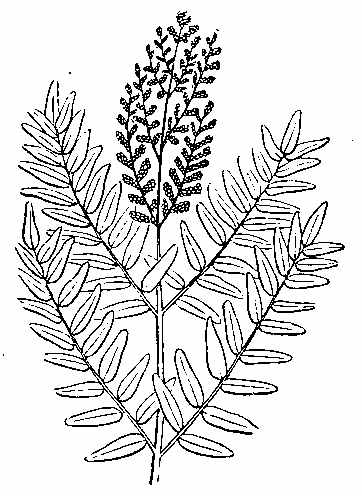
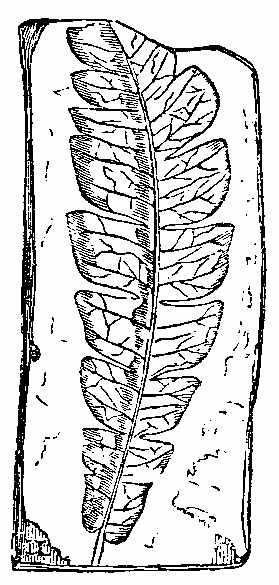
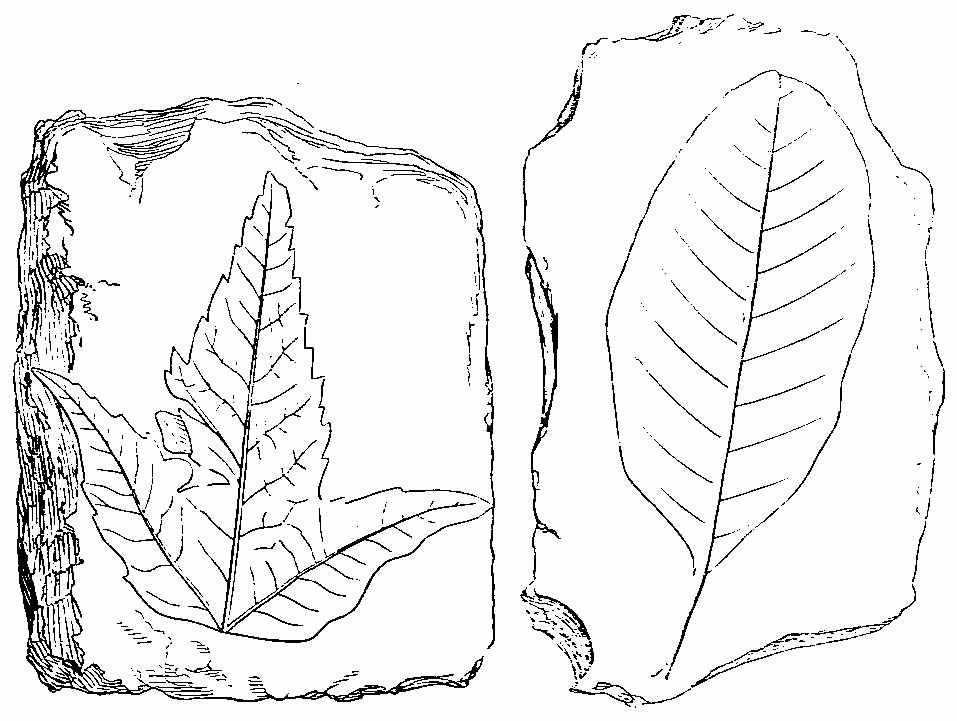
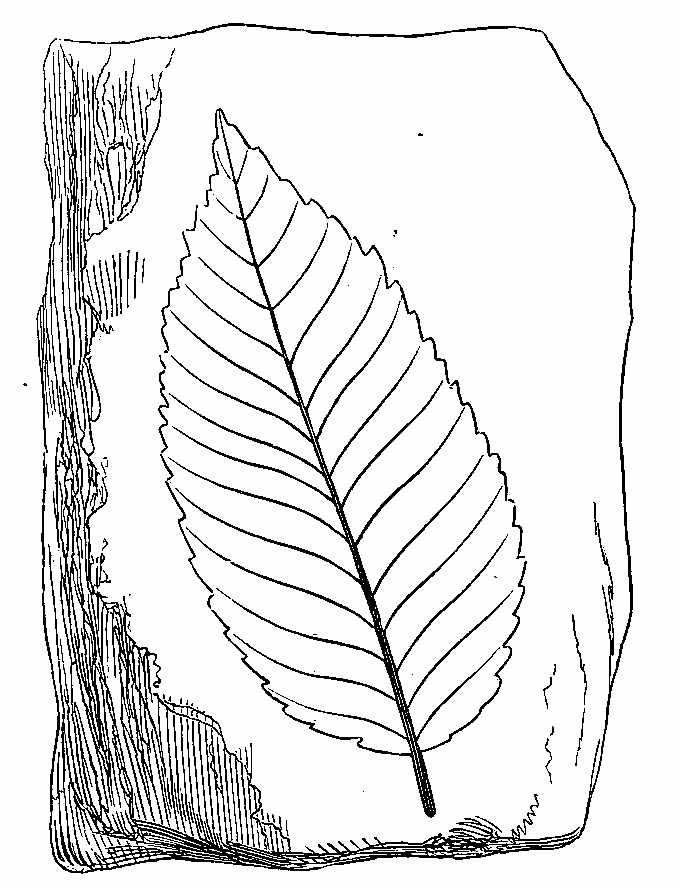
In the present day, acrogenous plants are represented by
cellular and vascular Cryptogams. In considering fossil
plants our attention is specially directed to the latter. In
the recent Floras, vascular Acrogens are represented by such
plants as Ferns, Lycopods, and Equisetums. Some of them
have an arborescent habit, but the greater number are shrubby
and herbaceous. Many of them have creeping rhizomes,
which are either subterranean, or run along the surface of the
ground. One of these arborescent forms is seen in Tree-ferns
(Fig. 9). Another form with a rhizome is seen in Fig. 10. The
trunks of ferns are marked by scars, which indicate the parts
where the bases of the fronds were attached, and where the
vascular tissue passes out from the interior (Fig. 11, a and b).
A transverse section of the stem (Fig. 12) shows a continuous
cylinder of scalariform vessels (Fig. 13), enclosing a large
mass of cellular tissue frequently penetrated by small scalariform
bundles. The cylinder is pierced by meshes, from
the inner sides of which rise the vascular bundles going to the
leaves, while some of the free bundles of the axis pass through
the mesh, carrying with them a portion of the cellular tissue
into the petiole. The fructification consists of spore-cases
(sporangia), often with an elastic ring round them, containing
spores in their interior (Fig. 14).
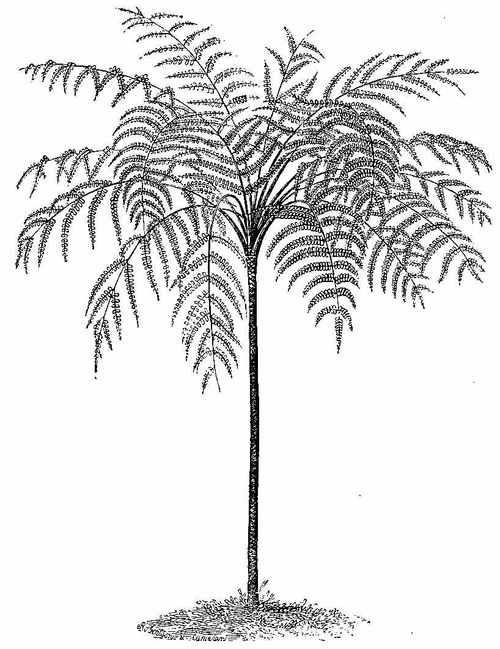
Fig. 9.
Fig. 9. Tree-fern, with a slender cylindrical trunk and a crown of
drooping fronds. It is a vascular acrogen.
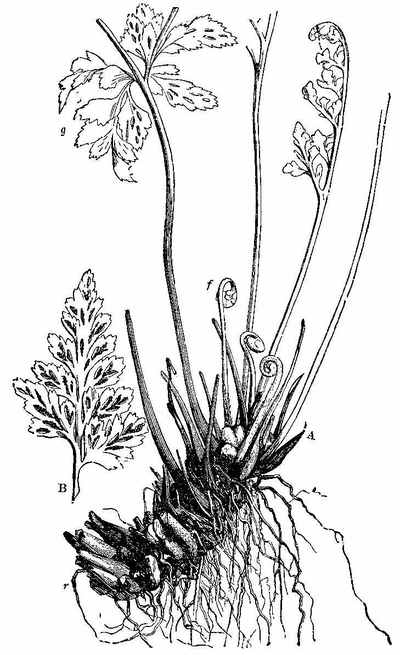
Fig. 10.
Fig. 10. Asplenium; a species of Spleenwort. A. Rhizome, r,
covered with the bases (stalks or stipes) of the fronds; f, fronds in
bud, rolled up in a circinate manner (this is very rarely seen in fossil
ferns); g, fronds bearing fructification on their backs. B. Portion of
a frond separated to show the linear sori or clusters of sporangia
(spore-cases).
Among Acrogens of the present day there are also plants
belonging to the natural order Lycopodiaceæ or Club-mosses
(Fig. 15), having creeping stems, which give rise to leafy
branches. The leaves are small, sessile, and moss-like, and
the fructification consists of two kinds of cellular bodies,
small spores or microspores (Fig. 16), and large spores or
macrospores (Fig. 17). They consist of cellular and vascular
tissues, the latter occurring in the form of woody, annular,
and scalariform vessels, which occupy the axis or central part
of the stem. They differ from ferns in the distribution of their
vascular bundles. The order is represented also by such plants
as Selaginella, Psilotum, Phylloglossum, and Isoetes. In the
plant called Isoetes (Quillwort) there is a peculiar short stem
which does not increase in height. It produces additions
laterally, so that the stem increases in thickness. The leaves
continue to multiply, and bear fructification at their bases.
They have both large and small spores.
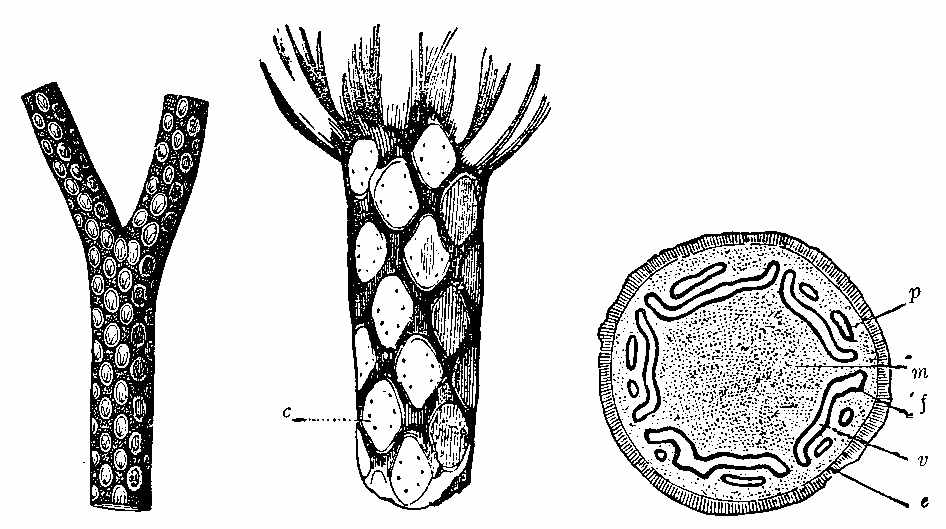
Fig. 11, a. Fig. 11, b.Fig. 12.
Fig. 11, a. Bifurcating (forked or dichotomous) trunk (caudex) of
a Tree-fern (Alsophila Perrottetiana), showing the scars (cicatrices) left
by the fallen fronds. These scars exhibit the arrangement of the vascular
bundles. Fig. 11, b. Rhizome of Lastrea Filix-mas (male fern),
showing scars of the leaves, c, with markings of the vascular bundles.
Fig. 12. Transverse section of the stem (caudex) of a Tree-fern
(Cyathea), showing the arrangement of the cellular and vascular tissue.
The cellular tissue of the centre, m; that of the circumference, p;
vascular cylinder, f v, consisting of dark-coloured pleurenchyma or
ligneous tubes, f, and paler vessels, v, chiefly scalariform and closed
spiral, and pierced by the meshes for the leaf-bundles at m; the outer
cortical portion connected with the bases of the leaves, e.
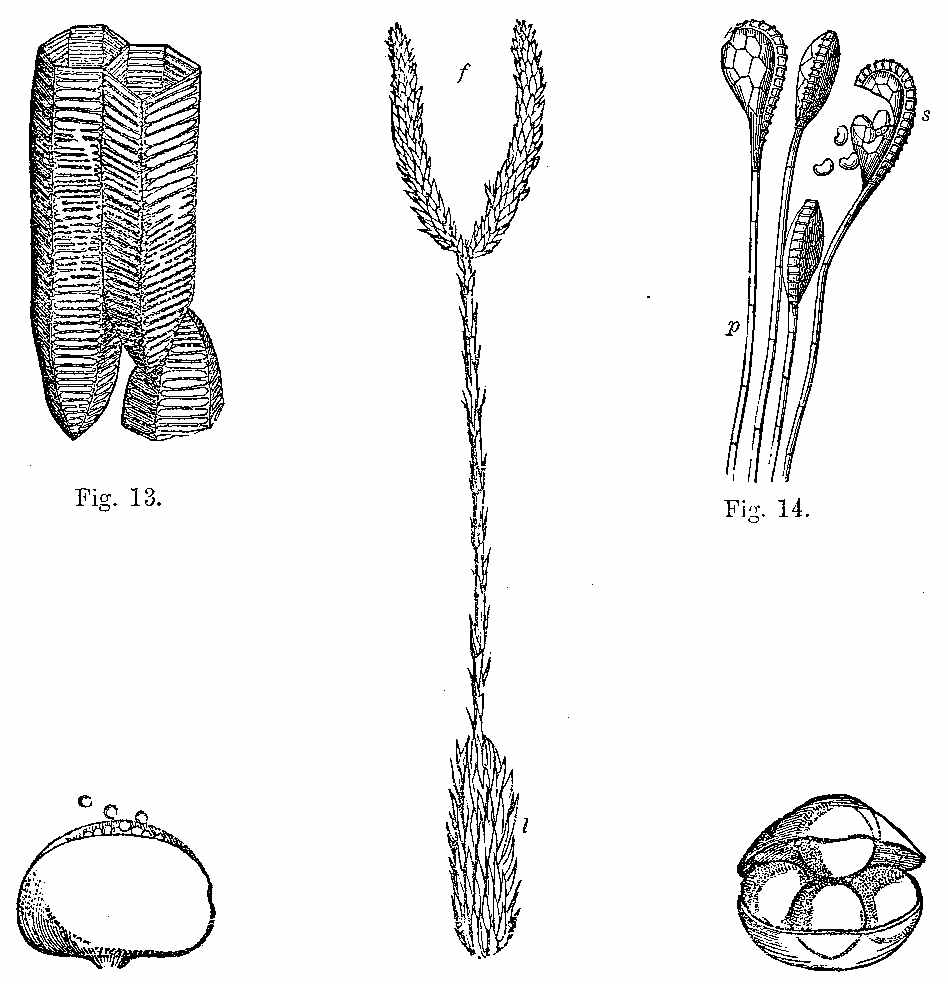
Fig. 16. Fig. 15.Fig. 17.
Fig. 13. Scalariform vessels taken from a Tree-fern. They are
marked with bars like the steps of a ladder, hence their name. The
membrane occasionally disappears, so that the walls are made up of
fibres only at some parts.
Fig. 14. Sporangia of a Fern, supported on stalks, p, each of
which ends in an elastic cellular ring, s, partially surrounding the
spore-case, and opening it when mature.
Fig. 15. Lycopodium clavatum, a common Club-moss. The leafy
branch, l, ends in a stalk bearing two spikes of fructification, f.
Fig. 16. A kidney-shaped 2-valved case, containing small spores
(microspores) of Lycopodium.
Fig. 17. Two-valved case, containing large spores (macrospores) of
Selaginella.
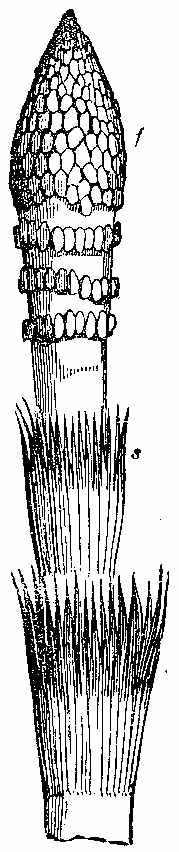
Fig. 18.
Fig. 18. Fructification of Equisetum maximum, Great Water
Horse-tail, showing the stalk surrounded by membranous sheaths, s s,
which are fringed by numerous processes called teeth. The fructification,
f, at the extremity, is in the form of a cone bearing polygonal
scales, under which are spore-cases containing spores with filaments.
Another important order of vascular Acrogens is the Equisetaceæ
or Horse-tails (Fig. 18). These are Cryptogams,
having rhizomes, bearing hollow, striated branches, which
secrete in their epidermis a considerable amount of silex.
These branches are jointed and have membranous sheaths at
the articulations, which are whorls of leaves reduced to a very
rudimentary condition. The fructification consists of cone-like
bodies (Fig. 18, f) bearing peltate polygonal scales,
under which are spore-cases (Fig. 19), enclosing spores with
four hygrometric club-shaped filaments called elaters (Figs. 20
and 21). At the present day some of these plants in tropical
regions have stems of 15 or 16 feet high.
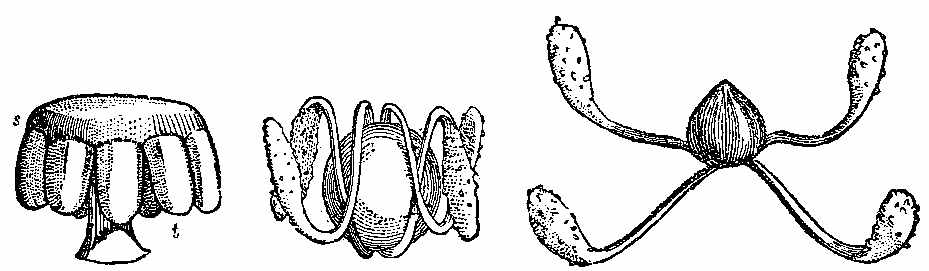
Fig. 19. Fig. 20. Fig. 21.
Fig. 19. Polygonal scale, s, of a species of Horse-tail (Equisetum),
bearing membranous sacs, t, which open on their inner surface to discharge
spores.
Fig. 20. Spore of Equisetum, surrounded by two filaments with
club-shaped extremities. The filaments are represented as coiled round
the spore.
Fig. 21. Spore of Equisetum, with the filaments (elaters) expanded.
Among vascular Acrogens is included the
natural order Marsileaceæ or Rhizocarpeæ, the
Pepperworts (Fig. 22). The order consists of
aquatic plants, with creeping stems, bearing
leaves, which are either linear, or divided into
three or more wedge-shaped portions not unlike
clover. The fructification is at the base of the
leaf-stalks, and consists of sacs (sporocarps) containing
spores of two kinds, microspores and
macrospores. The order contains Marsilea, Pilularia,
Azolla, and Salvinia.
For a fuller account of Acrogenous plants,
see Balfour's Class Book of Botany, p. 954.
These orders are represented in the Palæozoic
flora. Many of the fossil species assume a large
size, and show a greater degree of development
than is seen in their recent congeners. The most
important coal plants belong to the Ferns, Lycopods,
and Horse-tails. The examination of the
structure and conformation of the plants of the present flora
assists much in the determination of the fossil carboniferous
flora.
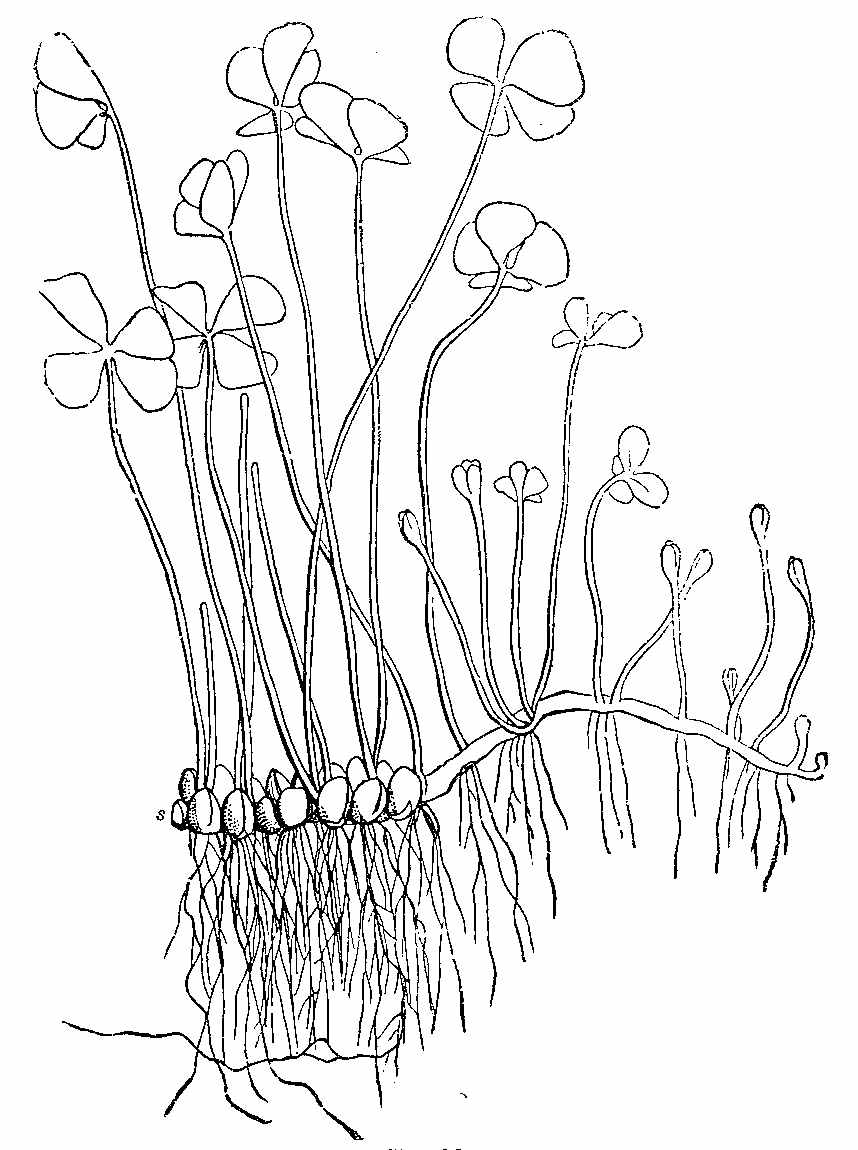
Fig. 22.
Fig. 22. Marsilea Fabri, a species of Pepperwort or Rhizocarp,
with a creeping stem, quadrifoliate stalked leaves on one side, and
roots on the other. The fructification, s, is at the base of the leaves,
and consists of sporangia, called sporocarps.
In the lower Palæozoic strata the plants which have been
detected are few. In the Silurian and Cambrian systems, we
meet with the remains of ancient marine plants, as well as a
few terrestrial species. Even in the still older Laurentian
rocks, if the remarkable structure known as Eozoon canadense
be considered, as it generally is, an animal, the existence of
contemporary plants may be inferred, inasmuch as without
vegetable life animals could not obtain food. In the Lower
Silurian or Grauwacke, near Girvan, Hugh Miller found
a species resembling Zostera in form and appearance. In
the Lower Old Red Sandstone of Scotland he detected
Fucoids, a Lepidodendron, and Lignite with a distinct Coniferous
structure resembling that of Araucaria,[1] besides a
remarkable pinnate frond. In the middle Old Red of Forfarshire,
as seen in the Arbroath pavement, he found a
fern with reniform pinnæ and a Lepidodendron. In the
Upper Old Red, near Dunse, a Calamite and the well-known
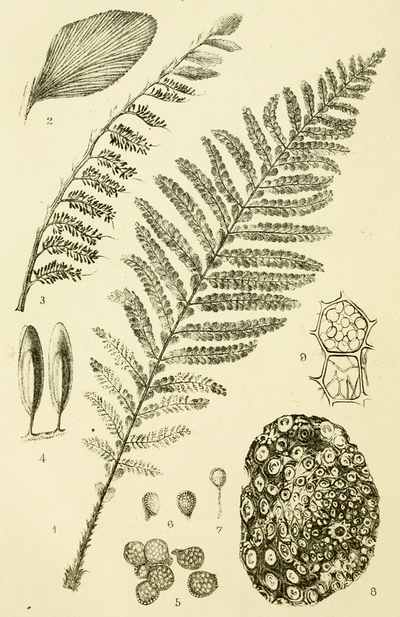
Irish fern Cyclopteris Hibernica occur.[2] This fern, Palæopteris
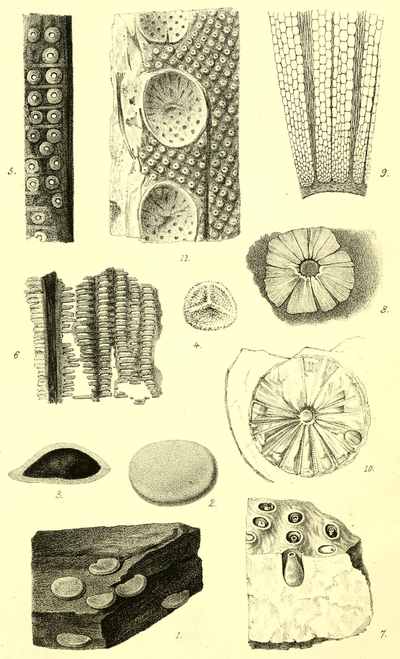
Hibernica of Schimper (Plate I. Figs. 1 to 4), along with
Sigillaria dichotoma, is very abundant in beds of the same age
in the south of Ireland, from which the specimens described
by Edward Forbes were obtained. The fructification has recently
been discovered. This shows that the fern belongs to
the Hymenophylleæ, and is consequently nearly related to
the equally famous Killarney fern, Trichomanes radicans.
Mr. Carruthers states that the frond-stalk of this fern is
thick, of considerable length, and clothed with large scales,
which form a dense covering at the somewhat enlarged base.
The well-defined separation observed in several specimens
probably indicates that the frond-stalks were articulated to
the stem or freely separated from it, and some root-like
structures which occur on the slabs with the ferns may be
their creeping rhizomes. The pinnæ are linear, obtuse, and
almost sessile. The pinnules are numerous, overlapping, of
an ovate or oblong-ovate form, somewhat cuneate below, and
with a decurrent base. The veins are very numerous, uniform,
repeatedly dichotomous, and run out to the margin,
where they form a slight serration. Single pinnules rather
larger than those of the pinnæ are placed over the free spaces
of the rachis, as was pointed out by Brongniart. Carruthers
has not met with any recent fern in which this occurs; but it
has been observed in several fossil species, as in the allied
American Palæopteris Halliana (Sch.), in Sphenopteris erosa
(Morris), and others. The pinnules are sometimes entirely, but
only partially fertile. The ovate-oblong sori are generally
single and two-lipped, the slit passing one-third of the way
down the sorus. The vein is continued as a free receptacle
in the centre of the cup or cyst, as in existing Hymenophylleæ,
in which it is included, not reaching beyond its entire portion.
In some specimens the receptacle is broad or thick, indicating
the presence of something besides itself in the cup, and giving
the appearance that would be produced if it were covered
with sporangia; there is no indication on the outer surface
which might have been expected from the separate sporangia.
The compression of the specimens in the rock, which has
made the free receptacle appear like a vein on the wall of
the cup, together with the highly altered condition of the
rock in which the fossils are contained, accounts for the
imperfect preservation of the minute structures. The interpretation
here given of the fructification of this interesting
fossil exhibits so close a resemblance to what we find in the
living genus Hymenophyllum, that, were it not for the vegetative
portions, it would be placed in that genus. Several
ferns have been described by Bunbury from Devonian rocks
at Oporto. A still more extensive and varied land flora of
Devonian age (or Erian, as he calls it) has been described
and illustrated by Principal Dawson from the rocks of that
period occurring in Canada; and during a recent visit to
Britain he has correlated many of the fragments collected by
Miller, Peach, and others, with the American species he has
described. The following are some of the fossil plants from
beds older than the Carboniferous system:[3]—Prototaxites
Logani, Dadoxylon Ouangondianum, Calamites transitionis,
Asterophyllites parvulus, Sphenophyllum antiquum, Lepidodendron
Gaspianum, Lepidostrobus Richardsoni, L. Matthewi,
Psilophyton princeps, P. robustius, Selaginites formosus,
Cordaites Robbii, C. angustifolius, Cyclopteris Jacksoni.
From the microscopic examination of the structure of
specimens of fossil trunks described under the name of Prototaxites
Logani, and which Principal Dawson believes to be
the oldest known instance of Coniferous wood, Mr. Carruthers
has come to the conclusion that they are really the stems of
huge Algæ, belonging to at least more than one genus. They
are very gigantic when contrasted with the ordinary Algæ of
our existing seas, nevertheless some approach to them in size
is made in the huge and tree-like Lessonias which Dr. Hooker
found in the Antarctic Seas, and which have stems about
20 feet high, with a diameter so great that they have been
collected by mariners in these regions for fuel, under the
belief that they were drift-wood. They are as thick as a man's
thigh. Schimper regards the Psilophyton of Dawson (Plate
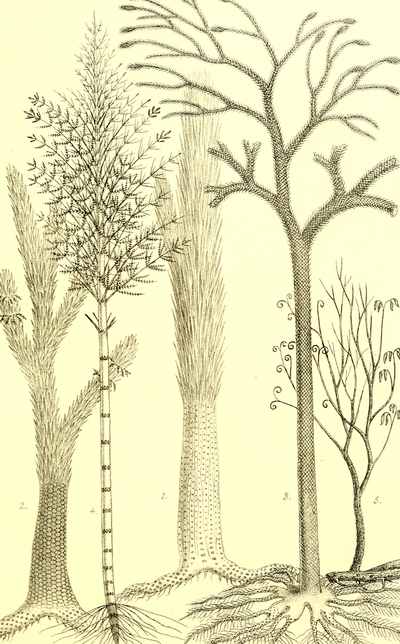
IV. Fig. 5) as allied to Pilularia, one of the Rhizocarps (Fig. 22),
and Carruthers places it among the true Lycopodiaceæ.
The Carboniferous period is one of the most important
as regards fossil plants. The vegetable forms are numerous,
and have a great similarity throughout the whole system,
whether exhibited in the Old or the New World. The
important substance called Coal owes its origin to the
plants of this epoch. It has been subjected to great
pressure and long-continued metamorphic action, and hence
the appearance of the plants has been much altered. It
is difficult to give a definition of Coal. The varieties of it
are numerous. There is a gradual transition from Anthracite
to Household and Parrot Coal; and the limit between Coal
and what is called bituminous shale is by no means distinct.
Coal may be said to be chemically-altered vegetable matter
inter-stratified with the rocks, and capable of being used as
fuel. On examining thin sections of coal under the microscope,
we can detect vegetable tissues both of a cellular and
vascular nature. In Wigan cannel coal, vegetable structure
is seen throughout the whole mass. Such is likewise the
case with other cannel, parrot, and gas coals. In common
household coal, also, evident traces of organic tissue have
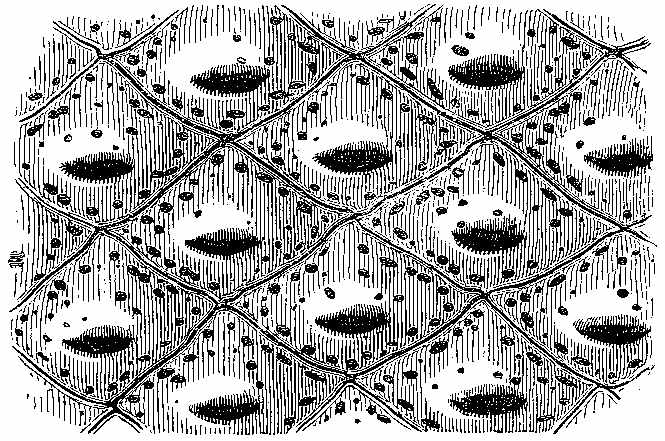
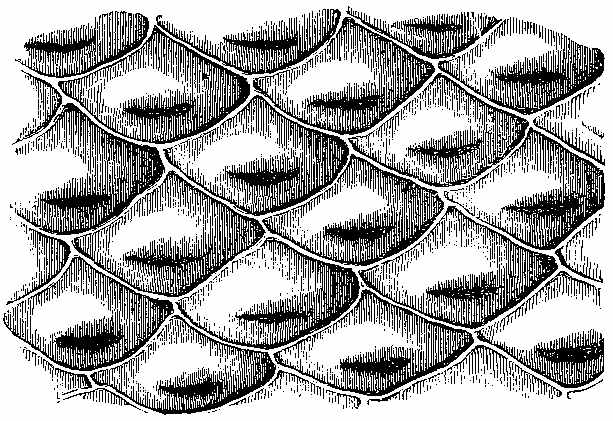
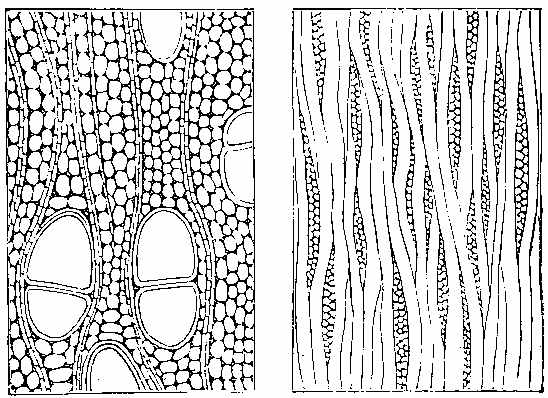
been observed. In some kinds of coal punctated woody tissue
(Plate III. Fig. 5) has been detected, in others scalariform
tissue (Plate III. Fig. 6), as well as cells of different kinds.
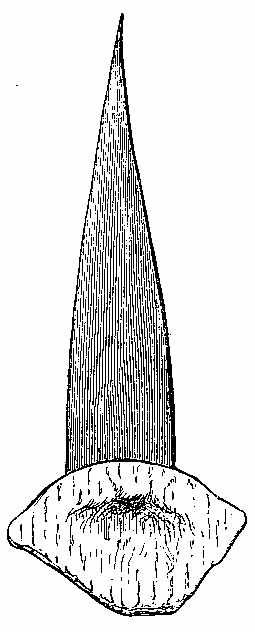
Sporangia are also frequently found in the substance of coal,
as shown by Mr. Daw in that from Fordel (Plate III. Figs.
1 to 3); and some beds, like the Better bed of Bradford, are
composed almost entirely of these sporangia imbedded in
their shed microspores, as has been recently shown by Huxley.
The structure of coal in different beds, and in different parts
of the same bed, seems to vary according to the nature of
the plants by which it has been formed, as well as to the
metamorphic action which it has undergone. Hence the
different varieties of coal which are worked. The occurrence
of punctated tissue indicates the presence of Coniferæ
in the coal-bed, while scalariform vessels point to ferns,
and their allies, such as Sigillaria and Lepidodendron. The
anatomical structure of the stems of these plants may have
some effect on the microscopic characters of the coal produced
from them. In some cannel coals structure resembling
that of Acrogens has been observed. A brownish-yellow
substance is occasionally present, which seems to yield abundance
of carburetted hydrogen gas when exposed to heat.
It appears that in general each bed of coal is accompanied
by the remains of a somewhat limited amount of species.
Their number, particularly in the most ancient beds, is scarcely
more than eight or ten. In other cases the number is more
considerable, but rarely more than thirty or forty. In the
same coal-basin each layer often contains several characteristic
species which are not met with either in the beds above or
below. Thus, there are sometimes small local or temporary
floras, each of which has given birth to layers of coal. The
quantity of carbonaceous and other matter required to form
a bed of coal is immense. Maclaren has calculated that one
acre of coal three feet thick is equal to the produce of 1940
acres of forest.[4] The proportion of carbon varies in different
kinds of coal. Along with it there is always more or less of
earthy matter which constitutes the ashes. When the earthy
substances are in such quantity that the coaly deposit will
not burn as fuel, then we have what is called a shale. The
coal contains plants similar to those of the shales and sandstones
above and below it. Underneath a coal-seam lies
the Underclay, containing roots only, and representing the
ancient soil; then comes the Coal, composed of plants whose
roots are in the clay, with others which have grown along with
and upon them, in a manner precisely similar to the growth of
peat at the present day; while above the coal is the Shale,
marking how mud was laid down on the plants, and bearing
evidences of vigorous vegetation on neighbouring land, from
which currents brought down the fine sediment, mingled with
broken pieces of plants.
The total thickness of coal in the English coal-fields is
about 50 or 60 feet. In the Mid-Lothian field there are
108 feet of coal. Coal-beds are worked at 1725 feet below
the sea-level, and probably extend down to upwards of
20,000 feet. They rise to 12,000 feet above the sea-level,
and at Huanuco, in Peru, to 14,700.[5] It is said that the
first coal-works were opened at Belgium in 1198, and soon
after in England and Scotland; it was not till the fifteenth
century that they were opened in France and Germany.
The following calculations have been made as to the extent
of the coal formation in different countries, and the amount
of coal raised:—[6]
| | |
| Countries. | Square Miles of
Coal Formation. | Annual Production
of Coal in Tons. |
| | |
| Great Britain and Ireland | 5,400 | 65,887,900 |
| British North America | 7,530 | 1,500,000 |
| United States | 196,650 | 5,000,000 |
| Belgium | 518 | 8,409,330 |
| France | 1,719 | 7,740,317 |
| Prussia and Austria | —— | 4,200,000 |
| Saxony | 30 | 1,000,000 |
| Russia | 100 | 3,500,000 |
| Japan, China, Borneo, Australia, etc. | —— | 2,000,000 |
| | |
| Total Produce of the World | —— | 99,237,547 |
| | |
The total quantity of coal annually raised over the globe appears
thus to be about 100 millions of tons, of which the produce
of Great Britain is more than two-thirds, and would be sufficient
to girdle the earth at the equator with a belt of 3 feet in thickness
and nearly 5 feet in width. The coal-fields of the United
States are nearly forty times larger than those of Great Britain.
Roscoe gives the following estimated quantities of coal
in the principal countries:—
| | |
| Countries. | Average Thickness.
No. Feet. | Tons. |
| | |
| Belgium | 60 | 36,000,000,000 |
| France | 60 | 59,000,000,000 |
| British Islands | 35 | 190,000,000,000 |
| Pennsylvania | 25 | 316,400,000,000 |
| Great Appalachian Coalfield | 25 | 1,387,500,000,000 |
| Indiana, Illinois, Western Kentucky | 25 | 1,277,500,000,000 |
| Missouri, and Arkansas Basin | 10 | 739,000,000,000 |
| North America (assumed thickness over an area of 200,000 square miles) | 20 | 4,000,000,000,000 |
| | |
Unger enumerates 683 plants of the coal-measures, while
Brongniart notices 500. Of the last number there are 6
Thallogens, 346 Acrogens, 135 Gymnosperms, and 13 doubtful
plants. This appears to be a very scanty vegetation, as far
as regards the number of species. It is only equal to about
1/20th of the number of species now growing on the surface
of the soil of Europe. Although, however, the number of
species was small, yet it is probable that the individuals of a
species were numerous. The proportion of Ferns was very
large. There are between 200 and 300 enumerated. Schimper
thinks there are 7 species congeneric with Lycopodium found
in the coal-measures. The following are some of the Cryptogamous
and Phanerogamous genera belonging to the flora
of the Carboniferous period:—Cyclopteris, Neuropteris,
Odontopteris, Sphenopteris, Hymenophyllites, Alethopteris,
Pecopteris, Coniopteris, Cladophlebis, Senftenbergia, Lonchopteris,
Glossopteris, Caulopteris, Lepidodendron (Lepidostrobus,
Lepidophyllum, Knorria), Flemingites, Ulodendron,
Halonia, Psaronius, Sigillaria and Stigmaria, Calamites
(Asterophyllites and Sphenophyllum), Noeggerathia, Walchia,
Peuce, Dadoxylon, Pissadendron, Trigonocarpum.
Ferns are the carboniferous fossil group which present the
most obvious and recognisable relationship to plants of the
present day. While cellular plants and those with lax tissues
have lost their characters by the maceration to which they
were subjected before fossilisation took place, ferns are more
durable, and retain their structure. It is rare, however, to
find the stalk of the frond completely preserved down to its
base. It is also rare to find fructification present. In this
respect, fossil Ferns resemble Tree-ferns of the present day,
the fronds of which rarely exhibit fructification. Hooker
states that of two or three kinds of New Zealand Tree-fern,
not one specimen in a thousand bears a single fertile frond,
though all abound in barren ones. Only one surface of the fossil
Fern-frond is exposed, and that generally the least important
in a botanical point of view. Fructification is sometimes evidently
seen, as figured by Corda in Senftenbergia. In this case
the fructification is not unlike that of Aneimidictyon of the
present day. Carruthers has recently detected the separate
sporangia of Ferns full of spores in calcareous nodules in
coal (Plate I. Fig. 5). These have the elastic ring characteristic
of the Polypodiaceæ, and in their size, form, and method
of attachment, they are allied to the group Hymenophylleæ.
The absence of fructification presents a great obstacle to the
determination of fossil Ferns. Circinate vernation, so common
in modern Ferns, is rarely seen in the fossil species, and
we do not in general meet with rhizomes. Characters taken
from the venation and forms of the fronds are not always to
be depended upon, if we are to judge from the Ferns of the
present day. There is a great similarity between the carboniferous
Ferns of Britain and America; and the same species,
or closely allied species of the same genera as those found in
Britain have been met with in South Africa, South America,
and Australia. In the English coal-measures the species are
about 140. The Palæozoic flora of the Arctic regions also
resembles that of the other quarters of the globe. Heer, in
his account of the fossil flora of Bear Island,[7] enumerates
the following plants:—Cardiopteris frondosa, C. polymorpha,
Palæopteris Roemeriana, Sphenopteris Schimperi,
Lepidodendron Veltheimianum, L. commutatum, L. Carneggiannum,
L. Wilkianum, Lepidophyllum Roemeri, Knorria
imbricata, K. acicularis, Calamites radiatus, Cyclostigma
Kiltorkense, Stigmaria ficoides, etc., Cardiocarpum ursinum,
C. punctulatum, besides various sporangia and spores.
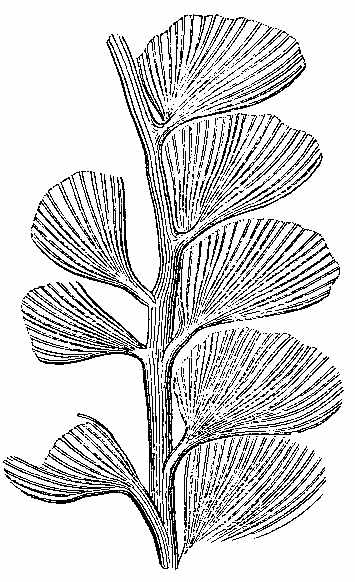
Fig. 22, bis.
Fig. 22, bis. Adiantites Lindseæformis.
The preponderance of Ferns over flowering plants is seen
at the present day in many tropical islands, such as St.
Helena and the Society group, as well as in extra-tropical
islands, as New Zealand. In the latter, Hooker picked 36
kinds in an area of a few acres; they gave a luxuriant aspect
to the vegetation, which presented scarcely twelve flowering
plants and trees besides. An equal area in the neighbourhood
of Sydney (in about the same latitude) would have
yielded upwards of 100 flowering plants, and only two or
three Ferns. This Acrogenous flora,
then, seems to favour the idea of a
humid as well as mild and equable
climate at the period of the coal
formation—the vegetation being that
of islands in the midst of a vast
ocean. Lesquereux, in Silliman's
Journal, gives three sections of Ferns
in the Carboniferous strata—viz.
Neuropterideæ, Pecopterideæ, and
Sphenopterideæ. In Neuropterideæ
fructification has been seen in Odontopteris.
In this genus the spores
are in a peculiar bladdery sporangium.
In Neuropterideæ the fructification appears to have
resembled Danæa in some cases, and Osmunda in others.
Professor Geikie has noticed in the lower Carboniferous
shales of Slateford, near Edinburgh, a fern which has been
named Adiantites Lindseæformis by Bunbury (Fig. 22, bis).
It has pinnules between crescent and fan shaped. (Mem.
Geol. Survey of Edinburgh, 1861, p. 151.)
Among the Ferns found in the clays, ironstones, and sandstones
of the Carboniferous period, we shall give the characters
of some by way of illustration.[8] Pecopteris (Fig. 23) seems to
be the fossil representative, if not congener, of Pteris. Pecopteris
heterophylla (Fig. 24) has a marked resemblance to
Pteris esculenta of New Zealand. The frond of Pecopteris
is pinnatifid, or bi-tri-pinnatifid—the leaflets adhering to the
rachis by the whole length of their base, sometimes confluent;
the midrib of the leaflets runs to the point, and the veins
come off from it nearly perpendicularly, and the fructification
when present is at the end of the veins. Neuropteris (Figs.
25, 26, 27) has a pinnate or bipinnate frond, with pinnæ
somewhat cordate at the base—the midrib of the pinnæ
vanishing towards the apex, and the veins coming off obliquely,
and in an arched manner. Neuropteris gigantea (Fig. 26)
has a thick bare rachis, according to Miller, and seems to
resemble much Osmunda regalis. Odontopteris has leaves
like the last, but its leaflets adhere to the stalk by their whole
base, the veins spring from the base of the leaflets, and pass
on towards the point. Sphenopteris (Fig. 28) has a twice or
thrice pinnatifid frond, the leaflets being narrowed at the
base, often wedge-shaped, and the veins generally arranged as
if they radiated from the base. Sphenopteris elegans resembled
Pteris aquilina in having a stout leafless rachis, which
divided at a height of seven or eight inches from its club-like
base into two equal parts, each of which continued to undergo
two or three successive bifurcations. A little below the first
forking two divided pinnæ were sent off. A very complete
specimen, with the stipe, was collected in the coalfield near
Edinburgh by Hugh Miller, who has described it as above.
Lonchopteris has its frond multi-pinnatifid, and the leaflets
more or less united together at the base; there is a distinct
midrib, and the veins are reticulated. Cyclopteris (Fig. 29) has
simple orbicular leaflets, undivided or lobed at the margin,
the veins radiating from the base, with no midrib. Schizopteris
resembles the last, but the frond is deeply divided into
numerous unequal segments, which are usually lobed and
taper-pointed.
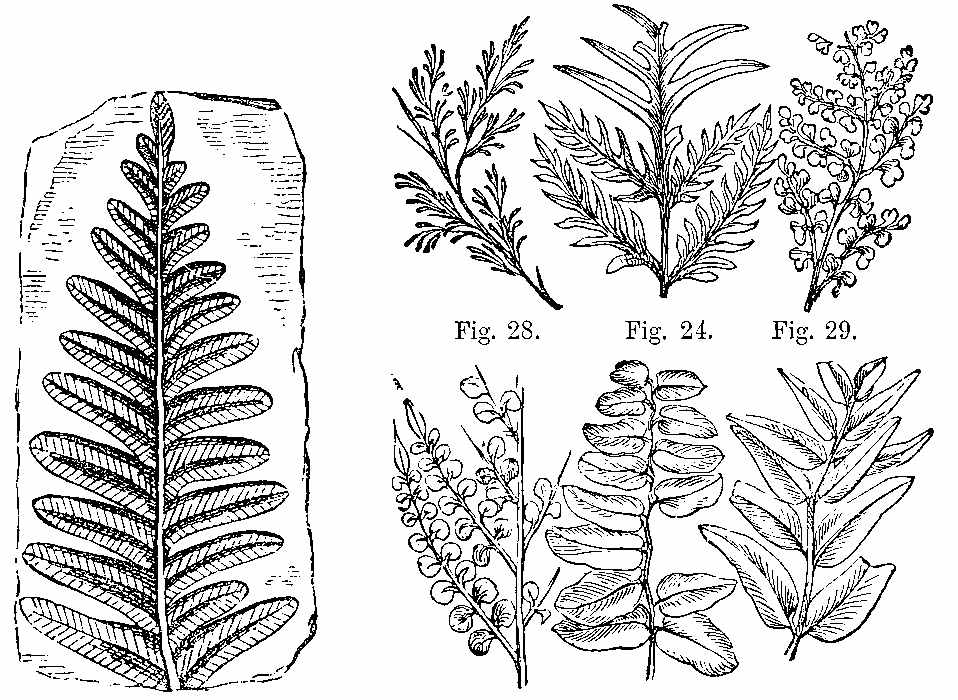
Fig. 23. Fig. 25. Fig. 26.
Fig. 27.
Figs. 23 to 29 exhibit the fronds of some of the Ferns of the
Carboniferous epoch. Fig. 23. Pecopteris (Alethopteris) aquilina.
Fig. 24. Pecopteris (Alethopteris) heterophylla. Fig. 25. Neuropteris
Loshii. Fig. 26. Neuropteris gigantea. Fig. 27. Neuropteris acuminata.
Fig. 28. Sphenopteris affinis. Fig. 29. Cyclopteris dilatata.
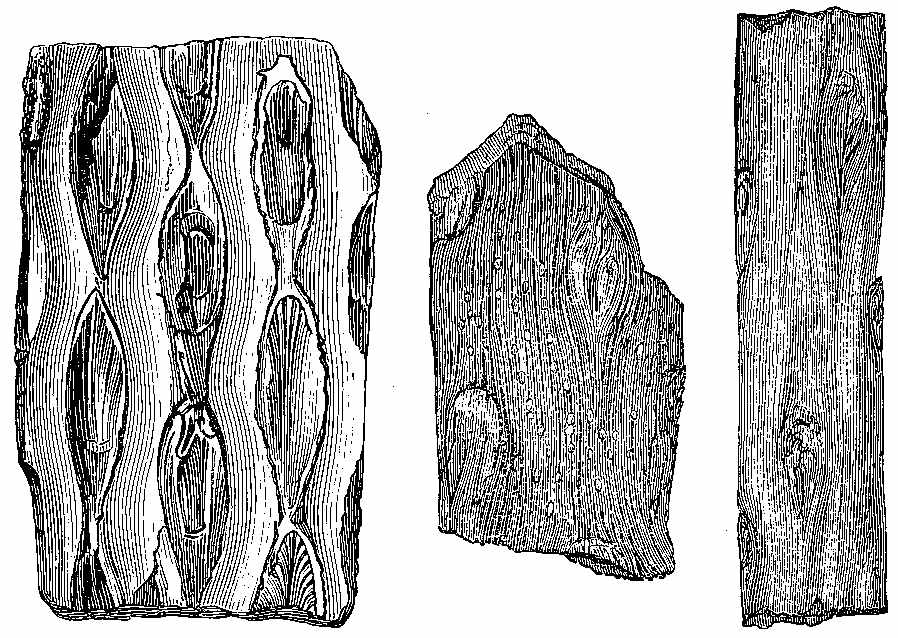
Fig. 30. Fig. 31. Fig. 32.
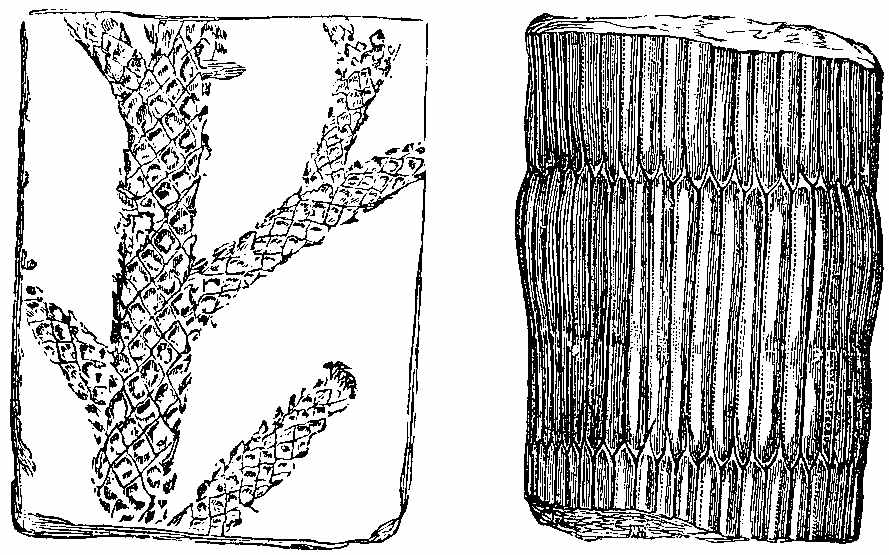
Figs. 30 to 32. Stem of Tree-ferns, called Caulopteris. Fig. 30.
Caulopteris macrodiscus. Fig. 31. Caulopteris Balfouri (Carr.), Coal-measures.
Fig. 32. Caulopteris Morrisi (Carr.), Coal-measures.
The rarity of Tree-ferns in the coal-measures has often
been observed, and it is the more remarkable from the durable
nature of their tissues. Several species have, however, been
noticed. They are referred to the genus Caulopteris. One
of them, C. macrodiscus (Fig. 30) has the leaf-scars in linear
series. Two other species are figured, the one a slender form
with the scars widely separated, as in some Alsophilas, C. Balfouri
(Fig. 31) from the Somersetshire coal-field; and the other
with larger stems and more closely aggregated scars, C. Morrisi
(Fig. 32), from the coal-measures at Newcastle. The latter
species shows the cavities at the base of the petiole described
by Mohl in many living fern-stems. The fossils named Psaronius
appear to have been fern-stems with a slender axis and
a large mass of adventitious roots, as in some Dicksonias and
in Osmunda regalis. These stems probably belong to some of
the fronds to which other names are given, but as they have
not been found attached, it is impossible to determine the
point. Miller has described a fern as occurring in the coal-measures,
which at first sight presents more the appearance
of a Cycadaceous frond than any other vegetable organism
of the carboniferous age except the Cycadites Caledonicus
(Salter), from Cockburnspath Cove. He thus describes it:—
"From a stipe about a line in thickness there proceed at
right angles, and in alternate order, a series of sessile lanceolate
leaflets, rather more than two inches in length, by about
an eighth part of an inch in breadth, and about three lines
apart. Each is furnished with a slender midrib; and,
what seems a singular, though not entirely unique feature in
a Fern, the edges of each are densely hirsute, and bristle
with thick short hair. The venation is not distinctly preserved."
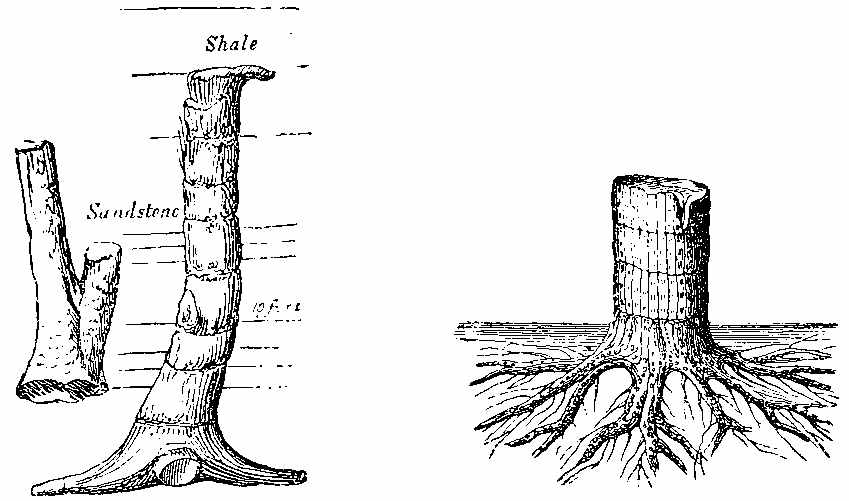
Fig. 33. Fig. 34.
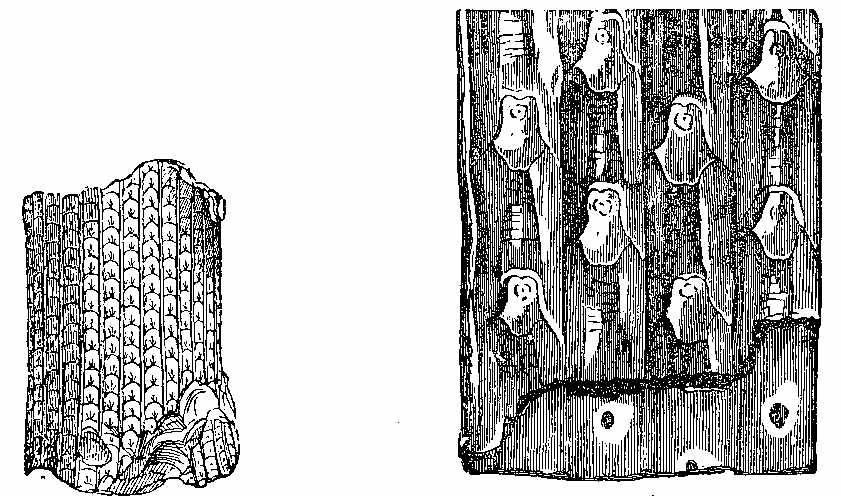
Fig. 36. Fig. 37.
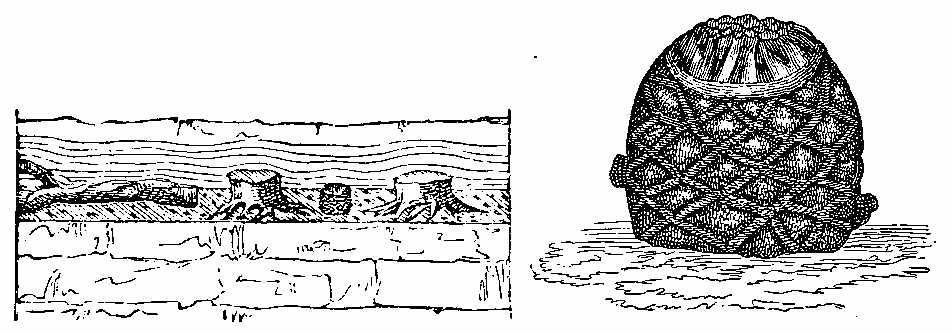
Figs. 33 to 37 exhibit forms of Sigillaria stems found in the
shales of the Carboniferous epoch. Fig. 33. Stem of Sigillaria pachyderma
in an erect position, covered by successive deposits of sandstone
and shale; one of the stems is bifurcated. Fig. 34. Sigillaria reniformis,
with its external markings, and roots which are Stigmarias, as
proved by Mr. Binney. Fig. 35. Sigillaria pachyderma, after Lindley
and Hutton, from the shale of Killingworth Colliery, showing the
scars or places through which the vessels of the stem passed to the
leaves. Fig. 36. Sigillaria (Favularia) tessellata, from the Denbigh
coal-shale, showing the fluted stem with scars. Fig. 37. Sigillaria
pachyderma; the stem marked with scars, and fluted longitudinally.
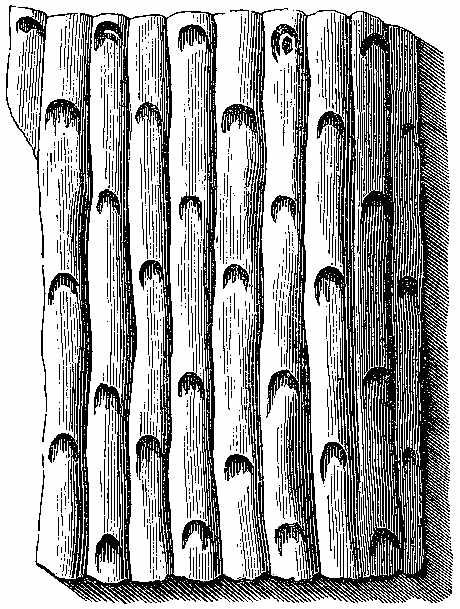
Fig. 35.
Sigillaria (Plate IV. Figs. 1 and 2) is perhaps the most
important plant in the coal formation. The name is derived
from sigillum, a seal, to indicate the seal-like markings in the
stem. It is found in all coal-shales over the world. Schimper
mentions 83 species. It occurs in the form of lofty
stems, 40-50 feet high, and 5 feet broad (Figs. 33 and 34).
Many stems of Sigillaria may be seen near Morpeth, standing
erect at right angles to the planes of alternating strata of
shale and sandstone (Fig. 33). They vary from 10 to 20 feet
in height, and from one to three feet in diameter. Sir W. C.
Trevelyan counted 20 portions of these trees within the length
of half-a-mile, of which all but four or five were upright.
Brongniart mentions similar
erect stems as being found
near St. Etienne. The stem
of Sigillaria is fluted in a
longitudinal manner, like a
Doric column, and has a succession
of single scars, which
indicate the points of insertion
of the leaves (Figs. 35,
36, and 37). When the
outer part of the stem separates
like bark, it is found that
the markings presented by
the inner surface differ from
those seen externally. This has sometimes given rise to
the erroneous multiplication of species and even of genera.
Sigillaria elegans, as figured by Brongniart in Archives du
Museum, i. 405, has a stem consisting of a central cellular axis
or medulla, surrounded by a vascular cylinder, and this is invested
by a thick cellular cortical layer, the outer portion composed
of fusiform cells of less diameter than those of the inner
portion. What Brongniart calls medullary rays are mere cracks
or separations in the wedges traversed by vessels. In its
structure it resembles its root Stigmaria, and must be referred
to Lycopodiaceæ, along with Lepidodendron, Halonia, Ulodendron,
etc. The small round sporangia of Sigillaria are
borne in a single patch on the somewhat enlarged bases of
some of the leaves. (See Carruthers on Structure and Affinities
of Sigillaria, in Journ. Geol. Soc. Aug. 1869.)
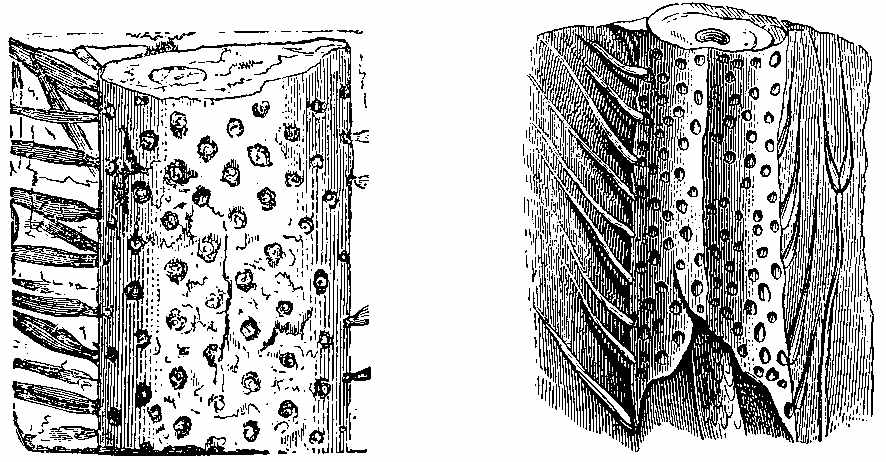
Fig. 38. Fig. 39.
Fig. 38. Stigmaria ficoides, root of Sigillaria, giving off rootlets,
which have been compressed.
Fig. 39. Stigmaria ficoides (S. Anabathra of Corda), which is the root
of a Sigillaria. The markings are the points whence rootlets proceed.
It has been ascertained by Professor King and Mr. Binney
of Manchester, that the plant called Stigmaria (Fig. 38) is not a
separate genus, but the root of Sigillaria (Plate IV. Figs. 1 and
2). The name is derived from στίγμα, a mark, indicating the
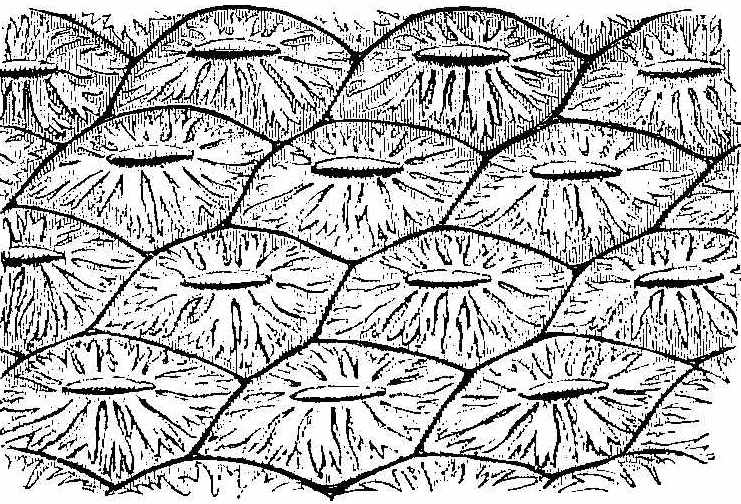
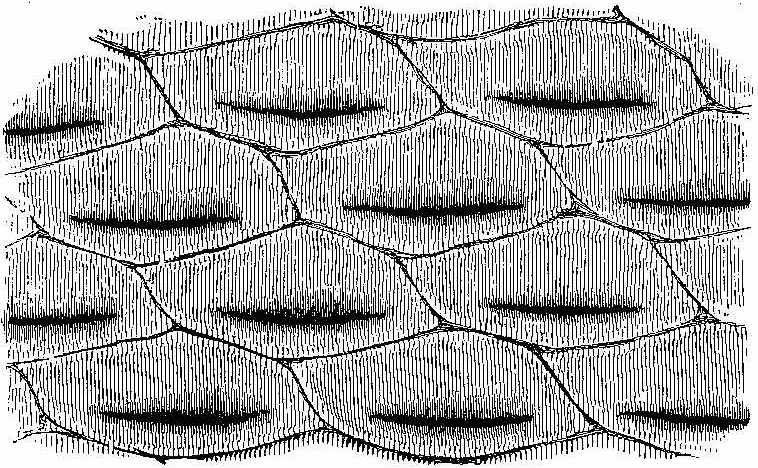
markings on the axis. It is one of the most common productions
of the coal-measures, and consists of long rounded or
compressed fragments, marked externally by shallow circular,
oblong, or lanceolate cavities (Fig. 39) in the centre of slight
tubercles, arranged more or less regularly in a quincuncial
manner (Plate III. Fig. 7). The cavities occasionally present
a radiating appearance. The axis of the fragments is often
hollow, and different in texture from the parts around. This
axis consists of a vascular cylinder or woody system, penetrated
by quincuncially arranged meshes or openings, through which
the vascular bundles proceed from the inner surface of the
cylinder to the rootlets (Plate III. Figs. 8 and 9). From the
scars and tubercles arise long ribbon-shaped processes, which
were cylindrical cellular roots, now compressed (Fig. 38). The
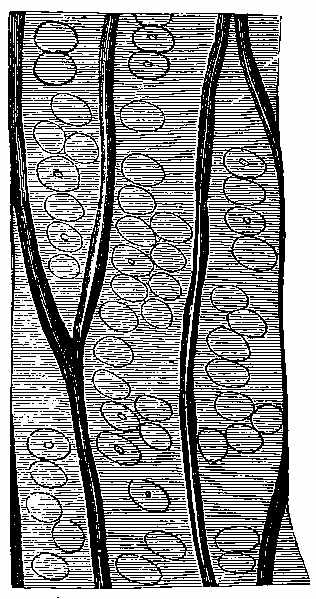
vascular cylinder of Stigmaria is composed entirely of scalariform
tissue, pierced by meshes for the passage, from the inner
surface of the cylinder, of the vascular bundles which supply
the rootlets. (Carruthers in Geol. Proc., Aug. 1869.) Stigmaria
ficoides (Fig. 38) abounds in the under-clay of a coal-seam,
sending out numerous roots from its tubercles, and
pushing up its aerial stem, in the form of a fluted Sigillaria.
On the Bolton and Manchester Railway Mr. Binney discovered
Sigillarias standing erect, and evidently connected
with Stigmarias which extended 20 feet or more.[9] Stigmaria
is regarded by Schimper as roots, not of Sigillaria only, but
of Knorria longifolia (one of the Lepidodendreæ). The base
of the stem of this species of Knorria is Ancestrophyllum, and
the upper part is Didymophyllum Schottini of Goeppert. Professor
King and others suppose that the Fern-like frond called
Neuropteris is connected with Sigillaria, but this is a mere
conjecture, set aside by the discovery of leaves attached to a
species allied to Sigillaria elegans, which establishes that the
long linear leaves described under the name Cyperites are the
foliage of this genus. Goldenberg has figured the fructification,
which consists of small sporangia like those of Flemingites,
borne on the basis of but slightly modified leaves. This
establishes the opinion that Sigillaria was an acrogenous plant
belonging to Lycopodiaceæ. Brongniart reckons it as representing
an extinct form of Gymnosperms, and King, having
erroneously associated the Cyclopteris with it, places it between
the Ferns and Cycadaceæ. Mr. Carruthers informs me that
he has examined the stem of a true fluted Sigillaria, with the
tissues preserved, and that these agree with the structure of
Lepidodendron, a position in which he had already placed it
from the structure of its fruit.
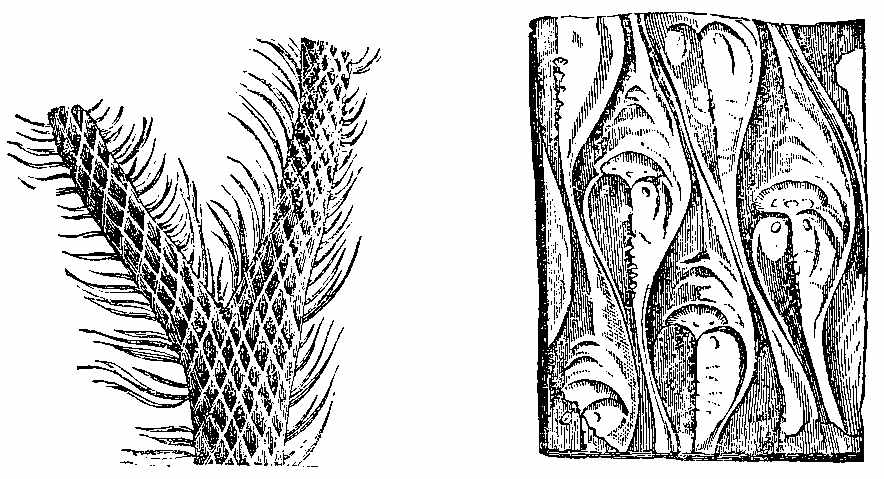
Fig. 40. Fig. 41.
Figs. 40 to 44 exhibit the stems and fructification of Lepidodendron.
Fig. 40. Bifurcating stem of Lepidodendron obovatum (elegans),
showing the scale-like scars, and the narrow-pointed leaves, resembling
those of Lycopodium, but much larger. Fig. 41. Stem of Lepidodendron
crenatum, with the scars of its leaves.
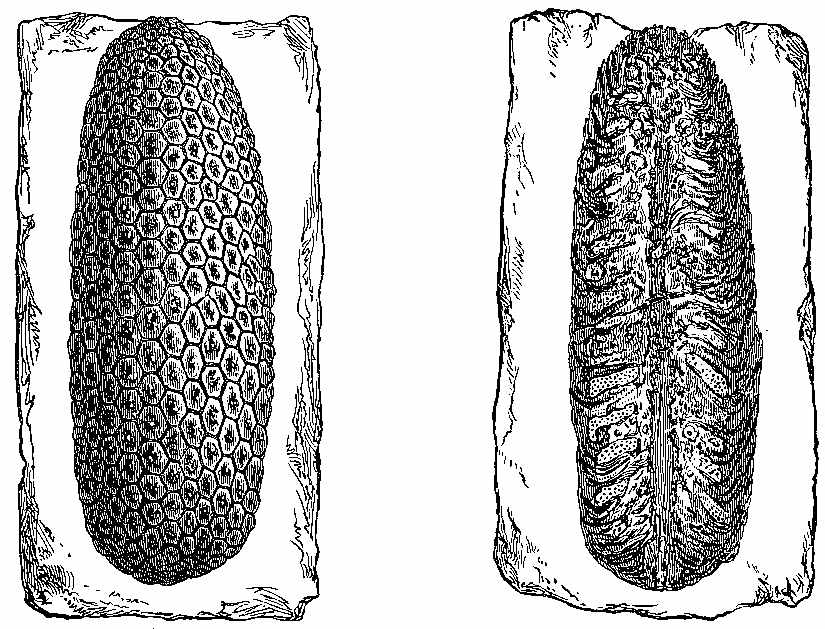
Fig. 42. Fig. 43.
Fig. 42. Fructification of Lepidodendron, showing its cone-like form
and spiral arrangement of scales. It is called Lepidostrobus Dabadianus
by Schimper, but it is probably Triplosporites.
Fig. 43. Longitudinal section of the fructification, showing central
axis and scales carrying sporangia. The upper sporangium contains
microspores, the lower macrospores; hence it has the character of
Triplosporites.
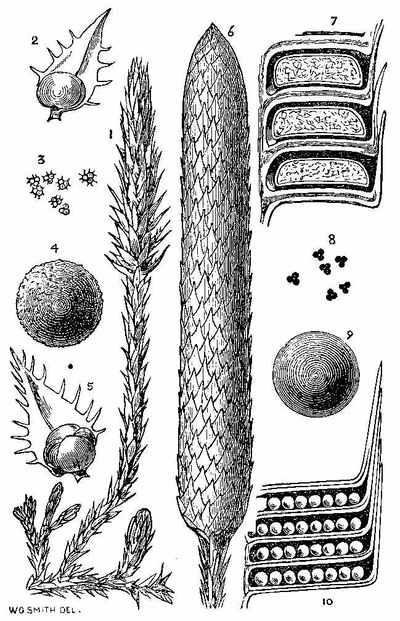
Fig. 44.
In woodcut 44 are represented the fruits of Selaginella (one of
the Lycopodiums of the present day), Lepidostrobus, Triplosporites,
and Flemingites. Fig. 1.
Selaginella spinulosa, A. Braun (
Lycopodium
selaginoides, Linn.) 2. Scale and sporangium from the upper
portion of the cone. 3. Antheridian microspores from the same.
4. Macrospore. 5. Scale and sporangium from the lower part of
the cone, containing macrospores. 6.
Lepidostrobus ornatus, Hooker.
7. Three scales and sporangia of ditto. 8. Microspores from the
sporangia of the upper part of the cone of
Triplosporites Brownii,
Brongn. 9. Macrospore from the sporangia of the lower part (drawn
from Brongniart's description and measurements). 10. Scales and
sporangia of a cone of Flemingites.
[10]
Lepidodendron (Figs. 40 to
44) is another genus of the
coal-measures which differs from those of the present day
(Plate IV. Fig. 3). Lepidodendrons, or fossil Lycopodiaceæ,
had spikes of fructification comparable in size to the cones
of firs and cedars, and containing very large sporangia, even
larger than those of Isoetes, to which they approach in form
and structure. Schimper, in 1870, enumerates 56 species of
Lepidodendron, all arborescent and carboniferous. The stem
of a Lepidodendron is from 20 to 45 feet high, marked outside
by peculiar scale-like scars (Fig. 41), hence the name of the
plant (λεπίς, a scale, and δένδρον, a tree). Although the scars
on Lepidodendron are usually flattened, yet in some species
they occupy the faces of diamond-shaped projections, elevated
one-sixth of an inch or more above the surface of the stem, and
separated from each other by deep furrows;—the surface
bearing the leaf being perforated by a tubular cavity, through
which the bundle of vessels that diverged from the vascular
axis of the stem to the leaf passed out. The linear or lanceolate
leaves are arranged in the same way as those of Lycopodiums
or of Coniferæ, and the branches fork like the former.
The internal structure of the stem is the same as that of Sigillaria.
The fruit of Lepidodendron and allied genera is seen
in Lepidostrobus and Triplosporites (Figs. 42, 43; Plate III,
Fig. 10). Carruthers, in his lecture to the Royal Institution,
in describing the forms of Lepidostrobus, says—"The fruit is a
cone composed of imbricated scales arranged spirally on the axis
like the true leaves, and bearing the sporangia on their horizontal
pedicels. Three different forms of fruit belong to this
genus, or it should perhaps rather be called group of plants.
The first of these is the cone named by Robert Brown Triplosporites
(Figs. 42, 43), and described by him from an exquisitely
preserved specimen of an upper portion, in which the parts are
exhibited as clearly in the petrified condition as if they belonged
to a fresh and living plant. The large sporangia have a double
wall, the outer composed of a compact layer of oblong cells
placed endwise, or with the long diameter perpendicular to
the surface; the inner is a delicate cellular membrane. The
sporangium is filled with a great number of very small spores,
each composed of three roundish bodies or sporules. Recently
Brongniart and Schimper have described a complete specimen
of this fruit, in which the minute triple spores are confined
to the sporangia of the upper and middle part of the cone,
but the lower portion, which was wanting in Brown's specimen,
bears sporangia filled with simple spherical spores ten
or twelve times larger than the others (woodcut 44, 9).
"The structure of another form of cone (Lepidostrobus)
has been expounded by Dr. Hooker. The arrangement of
the different parts comprising it is precisely similar to what
occurs in Triplosporites; but the sporangia are filled with the
minute triple spores throughout the whole cone (woodcut 44,
6 and 8).
"The third form of cone, described by me under the name
Flemingites, differs from the other two in having a large number
of small sporangia supported on the surface of each
scale; and it agrees with Lepidostrobus in the sporangia
containing only small spores (woodcut 44, 10).
"In comparing these fossils with the living club-mosses, one
is struck with the singular agreement in the organisation of
plants so far removed in time, and so different in size, as the
recent humble club-mosses and the palæozoic tree Lepidodendrons.
The fruit of Triplosporites, like that of Selaginella
(woodcut 44, 1), contains large and small spores, the microspores
being found in both genera on the middle and upper
scales of the cone, and the macrospores on those of the
lower portion (Fig. 43).
"On the other hand, the fruits of Lepidostrobus and
Flemingites agree with that of Lycopodium in having only
microspores. The size of the two kinds of spores also singularly
agrees in the two groups. This is of some importance,
for among the recent vascular Cryptogams there is a remarkable
uniformity in the size of the spores in the members
of the different groups, even when there is a great variety in
the size of the plants. Thus the spore of our humble wall-rue
is as large as that of the giant Alsophila of tropical
regions. So also the spores of Equisetum and Calamites
agree in size, as may be seen in woodcut 47, Figs. 3, 4, and 9,
where the spores of the two genera are magnified to the same
extent. And a similar comparison of the macrospore and
microspore of Triplosporites with those of Selaginella, and of
the microspore of Lepidostrobus with that of Lycopodium,
exhibits a similar agreement. This is made apparent by
the drawings in woodcut 44 of the two kinds of spores of
Selaginella, 3 and 4, with those of Triplosporites, 8 and 9,
which are drawn to the same scale."
The genus Sigillaria, as we have already said, has, according
to the observation of Hooker, small sporangia exactly agreeing
in size and form with those of Flemingites. Most probably
the contents of these small sporangia were the same in both
genera, so that Sigillaria would be placed with Flemingites
and Lepidostrobus as arborescent Lycopodiaceæ having their
affinities with Lycopodium, as they have all microspores only
in their fructification.
The scales upon the Lepidodendron stems, as well as those
in the cones, are arranged in a spiral manner, in the same
way as plants of the present day. Professor Alexander
Dickson has examined the phyllotaxis of Lepidodendrons, and
gives the following results of his observations (Trans. Bot.
Soc. Edin. xi. 145). The fossil remains of Lepidodendrons
are often so compressed that it is difficult, or even impossible,
to trace the secondary spirals round the circumference of the
stem. In those cases, however, where there is comparatively
little compression, i.e. where the stem is more or less cylindrical,
the determination of the phyllotaxis is easy. Of such
stems he has examined fifteen specimens, which may be
classed according to the series of spirals to which the leaf-arrangement
belongs:—
A. Ordinary series, ½, ⅓, 2/5, ⅜, 5/13, etc.
(a.) Single spirals (D turning to the right, S to the left).
(1.) Lepidodendron (Possil Ironstone series). Stem about ¾
of an inch in diameter. Secondary spirals 8 D, 13 S, 21 D.
Divergence = 13/34 (or possibly 21/55).
(2.) Lepidodendron (Knightswood, near Glasgow, Mr. J. Young).
Stem about 1½ inch in diameter. Secondary spirals 13 D,
21 S, 34 D. Divergence = 21/55.
(3.) Lepidodendron (Possil Sandstone series). Trunk about
2 feet long, with an average diameter of 20 inches. Steepest
secondary spirals 55 S, 89 D. Divergence = 55/144.
(b.) Conjugate spirals.[11]
(4.) Lepidostrobus ornatus (Bathgate coal-field). About ¾ of
an inch in diameter. Secondary spirals 10 D, 16 S, 26 D,
42 S. Divergence = 13/(34×2) (Bijugate arrangement).
(5.) Lepidostrobus (Plean, Stirlingshire, Mr. Mackenzie).
About ½ an inch in diameter. Secondary spirals 9 S, 15 D,
24 S, 39 D. Divergence = 8/(21×3) (Trijugate arrangement).
(6.) Knorria taxina (from collection of Dr. Rankin, Carluke).
Somewhat compressed, 2-2½ inches[12] in diameter. Secondary
spirals 15 D, 24 S. Divergence = 15/(13×3) (Trijugate arrangement).
(7.) Lepidodendron (from Dr. Rankin's collection). About 1¼
inch in diameter. Secondary spirals 10 D, 15 S, 25 D, 40
S. Divergence = 5/(13×5) (Quinquejugate arrangement).
(8.) Lepidodendron (Dowanhill, Glasgow, Possil Sandstone
series). Trunk about 1 foot long, and 1 foot in diameter.
The upper portion exhibits secondary spirals 35 D, 56 S,
91 D; thus indicating a 7-jugate arrangement, with divergence
= 8/(21×7). The arrangement on the middle and lower
portion is indistinct and confused; so much so as to render
any determination of the arrangement doubtful.
B. Series, ⅓, ¼, 2/7, 3/11, etc.
(9.) Lepidodendron (Messrs Merry and Cunningham's Clayband
Iron-Pit, Carluke). Stem 2 inches in diameter. Secondary
spirals 18 S, 29 D, 47 S. Divergence = 21/76.
C. Series, ¼, 1/5, 2/9, 3/14, etc.
(10.) Lepidodendron (R. B. Garden, Edinburgh, Museum).
Stem somewhat flattened, 1-1½ inch in diameter. Secondary
spirals 9 D, 14 S, 23 D, 37 S. Divergence = 13/60.
(11.) Lepidodendron (Redhaugh, near Edinburgh, Mr. Peach).
Stem somewhat flattened, ¾ to ½ inch in diameter.
Secondary spirals 9 S, 14 D, 23 S, 37 D. Divergence =
13/60.
D. Series, 1/5, 1/6, 2/11, 3/17, 5/28, etc.
(12.) Knorria taxina (Stockbriggs, Lesmahagow,—Hunterian
Museum). About 1 inch in diameter. The specimen consists
of a main stem and one of the branches into which it
has forked. On the main stem the secondary spirals are
6 D, 11 S, 17 D. Divergence = 5/28 (series, 1/5, 1/6, 2/11, 3/17,
5/28, etc.)—On the branch the secondary spirals are 8 S,
13 D. Divergence = 8/21 (ordinary series, ½, ⅓, 2/5, ⅜, etc.)
E. Series, ½, 2/5, 3/7, 5/12, 8/19, 13/31, 21/50, etc.
(13.) Lepidodendron (from Dr. Rankin's collection). About ⅞
inch in diameter. Secondary spirals 12 D, 19 S, 31 D.
Divergence = 21/50.
F. Series, ⅓, 3/10, 4/13, 7/23, 11/36, 18/59, etc.
(14.) Lepidodendron elegans (Possil Ironstone). About 1¼
inch in diameter. Secondary spirals 10 S, 13 D, 23 S,
36 D. Divergence = 18/59.
(15.) Lepidodendron (Possil Ironstone). About 2¼ inches
in diameter. Secondary spirals 23 S, 36 D, 59 S, 95 D.
Divergence = 47/154.
From the above it is evident that the phyllotaxis of
Lepidodendron is extremely variable, as much so perhaps as
that of those most variable plants, in this respect, the Cacti.
It is also clear that what has been enunciated by Professor
Haughton (Manual of Geology, Lond. 1866, pp. 243, 245)
as the law according to which the leaves of palæozoic plants
were arranged—viz. that of alternate whorls—does not apply
to these ancient Lycopods. Lepidodendron aculeatum is
noted by Naumann as exhibiting an 8/21 arrangement. (Poggendorff,
Annalen, 1842, p. 5.) Professor Alexander Braun
(Nov. Acta Ac. C. L. C. xv. 1, pp. 558-9), speaking of the
excessive deviation from ordinary arrangements in Equisetaceæ
(including Calamites), compares them in this respect
with Lycopodiaceæ (including Lepidodendron), saying that
in these two families "the utmost limits of the domain of all
leaf-arrangement appears to be attained."
Lepidophyllum is certainly leaves of Lepidodendron, the
different Lepidophylla belonging to different species of the
genus. The slender terminal branches are noticed under the
name of Lycopodites. In coal from Fordel Mr. Daw has
detected innumerable bodies (Plate III. Figs. 1, 2, 3) which
have been shown to be sporangia. (Balfour, Trans. Roy.
Soc. Ed. xxi. 187.) On their under surface Mr. Carruthers
has observed a triradiate ridge (Plate III. Fig. 4). (Geological
Magazine, 1865, vol. ii. p. 140.) These sporangia have been
found connected with the cone-like fructification called
Flemingites, and resembling Lycopodium (woodcut 44, Fig.
4). Many forms of fossil plants, such as Halonia, Lepidophloios,
Knorria, and Ulodendron, belong to the Lepidodendron group.
Knorria is said to be the internal cast of a Lepidodendron.
Ulodendron minus and U. Taylori (Plate III. Fig. 11),
found in ferruginous shale in the Water of Leith, near
Colinton, exhibit beautiful sculptured scars, ranged rectilinearly
along the stem. The surface is covered with small,
sharply relieved obovate scales, most of them furnished with
an apparent midrib, and with their edges slightly turned up.
The circular or oval scars of this genus are probably impressions
made by a rectilinear range of aerial roots placed on
either side. When decorticated, the stem is mottled over
with minute dottings arranged in a
quincuncial manner, and its oval scars
are devoid of the ordinary sculpturings.
Bothrodendron is a decorticated condition
of Ulodendron.
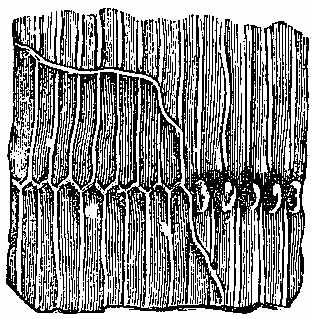
Fig. 45 a.
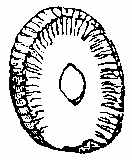
Fig. 45 b.
Fig. 45. a, Calamites Suckovii, composed of jointed striated fragments
having a bark. Fig. 45. b, Septum or phragma of a Calamite.
Calamites (κάλαμος, a reed) is a
reed-like fossil, having a sub-cylindrical
jointed stem (Fig. 45, a and b;
Fig. 46; Plate IV. Fig. 4). The stem is
often crushed and flattened, and was originally hollow. Calamites
is thus defined by Grand d'Eury (Ann. Nat. Hist. ser. 4,
vol. iv. p. 124):—Stem articulated, fistular, and
septate; outer part comparatively thin, formed of
three concentric zones—1, an exterior cortical layer
now converted into coal; 2, a thin subjacent zone
of vascular tissue, now invariably destroyed; 3, a
sort of inner lining epidermis, which is carbonified. Cortical
envelope marked interiorly with regular flutings, interrupted
and alternate at the articulations. Inner epidermis smooth,
or scarcely striated. Vascular cylinder thin; outer surface
of bark more fully fluted and articulated than the inner surface.
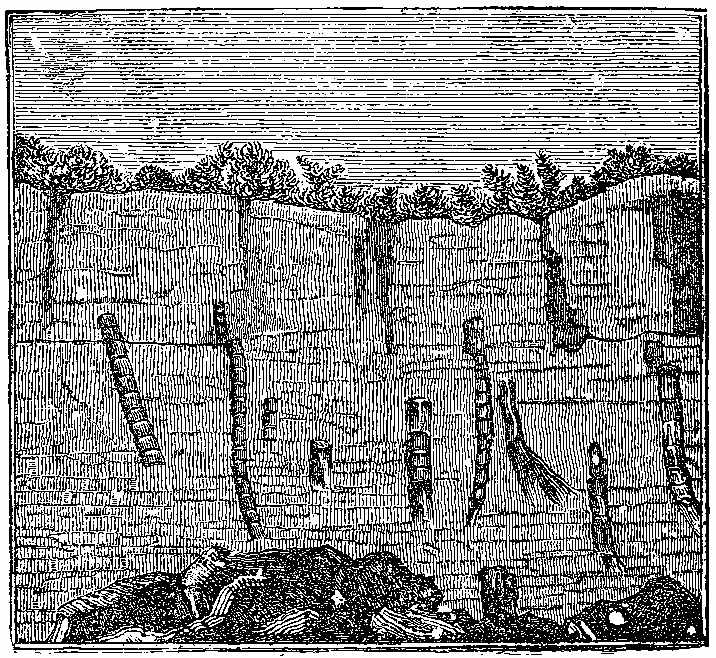
Fig. 46.
Fig. 46. Vertical stems of fossil trees, Calamites chiefly, found in
the coal-measures of Treuil, near Saint Etienne.
Carruthers gives the following description of the structure
of a species of Calamite which he examined:—The stem was
composed of a central medulla, which disappeared with the
growth of the plant, surrounded by a woody cylinder, composed
entirely of scalariform vessels, and a thin cortical layer.
The medulla penetrated the woody cylinder by a series of
regular wedges, which were continued, as delicate laminæ of
one or two cells in thickness, to the cortical layer. The cells
of those laminæ were not muriform; their longest diameter
was in the direction of the axis. The wedges were continuous,
and parallel between each node. As the axial appendages
were produced in whorls, the only interference with the regularity
of the tissues was by the passing out through the stem
at the nodes of the vascular bundles which supplied these appendages.
As the leaves of each whorl were (with one or
two exceptions) opposite to the interspaces of the whorls above
and below, there was also at each node a re-arrangement of
the wedges of vascular and cellular tissues.
Schimper considers Calamites as having an analogy with
Equisetum in its fructification. He looks on them as fossil
Equisetaceæ. Annularia and Sphenophyllum are considered
as establishing a passage from the Equisetaceæ to the Lycopodiaceæ.
Some gigantic fossil Equiseta had a diameter of
nearly 5 inches, and a height of 30 or more feet. The
branches, which adorned the higher part of them in the
form of a crown, are simple, and have at their extremity a
spike of the size of a pigeon's egg, and organised exactly like
the spikes of living Equiseta. The subterranean rhizomes are
well developed, and gave origin, like many Equiseta, to
tubercles which had the form and size of a hen's egg.
The characters of Equisetum of the present day and
Calamites, are exhibited in woodcut 47. They show a marked
resemblance in the fructification. (See also page 31.)
Plants of Calamites have been seen erect by Mr. Binney,
and he has determined that what were called leaves or branches
by some are in reality roots. Mr. Binney gives a full description
of various Calamites, under the name of Calamodendron
commune, in his Memoir published by the Palæontographical
Society, 1868. There are between 50 and 60 species recorded.[13]
In Spitzbergen, in rocks of the Carboniferous epoch, there
have been found Calamites, Sigillaria, Lepidodendron, and
ferns, apparently the same as those found in the Carboniferous
epoch in Europe—Calamites radiatus, Lepidodendron Veltheimianum,
Sigillaria distans, Stigmaria ficoides. Some species—Sigillaria
Malmgreni, Lepidodendron Carneggiannum, and
L. Wilkianum—seem to be peculiar to Bear Island.
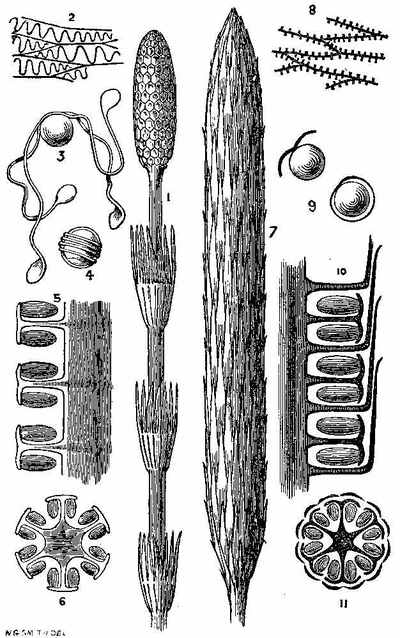
Fig. 47.
Fig. 47. Fruits of Equisetum and Calamites. 1. Equisetum arvense,
L. 2. Portion of sporangium wall. 3, 4. Spores, with the elaters free.
5. Longitudinal section of the part of one side of cone. 6. Transverse
section of cone. 7. Calamites (Volkmannia) Binneyi, Carr.,
magnified three times. 8. Portion of the sporangium wall. 9. Two
spores. 10. Longitudinal section of the part of one side of cone.
11. Transverse section of cone.
According to Carruthers the Equisetaceæ are represented
in Britain by the two genera Calamites found in primary beds,
and Equisetum found in secondary rocks and living at the
present day. The difference in the structure of their fruits
is shown in woodcut 47. The fruit of Calamites, called
Volkmannia Binneyi (woodcut 47, 7), is a small slender
cone composed of alternating whorls of imbricate scales,
twelve in each verticil. The scales completely conceal
the leaves connected with the fructification. The fruit-bearing
leaves are stalked, peltate, and are arranged in
whorls of 6. There are four sporangia borne on the under-surface
of the peltate leaves. These spore-cases have cellular
parietes, and in their interior there is a deposit of cellulose
in the form of short truncate processes not unlike imperfect
spirals. The spores are spherical, and appear to have thread-like
processes proceeding from them, similar to elaters. The
fruit-cone bears a marked resemblance to the fruit of Equisetum
in its fruit-bearing leaves, sporangia, spores, and
elaters (see Figs. 18, 19, 20, 21). In the modern plant all
the leaves of the cone are fructiferous, while in the fossil
plant some are fruit-bearing, and others are like the ordinary
leaves of the plant. It is thought that the fossil may be
reckoned as having a somewhat higher position than that possessed
by the living genus.
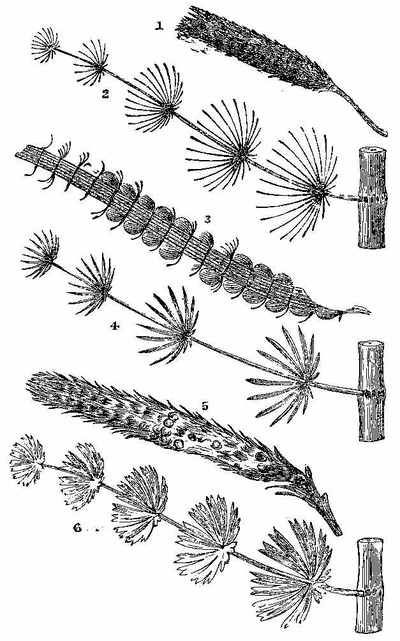
Fig. 48.
Fig. 48. Foliage and fruits of Calamites. 1 and 2. Asterophyllites;
3 and 4. Annularia; 5 and 6. Sphenophyllum.
The different forms of foliage called Asterophyllites,
Sphenophyllum, and Annularia, belong to the one genus
Calamites, but they may form, perhaps, well-characterised
sections when their fruits are better known. In woodcut 48
representations are given of the foliage and fruit of varieties
of Calamites. In 1 and 2 we see the simplest form called
Asterophyllites. The leaves are linear and slender, with a
single rib. The form called Annularia (3 and 4) differs chiefly
in having a larger amount of cellular tissue spread out on
either side of the midrib. This form has a different aspect
in a fossil state from the other, from its whorls of numerous
broad leaves spread out on the surface of deposition, while
the acicular leaves of Asterophyllites have penetrated the soft
mud, and are generally preserved in the position they originally
occupied in reference to the supporting branch. The
third form (5 and 6) is called Sphenophyllum, and consists of
whorls of wedge-shaped leaves, with one or more bifurcating
veins. They occur like those of Annularia, spread out on the
surface of the shale.
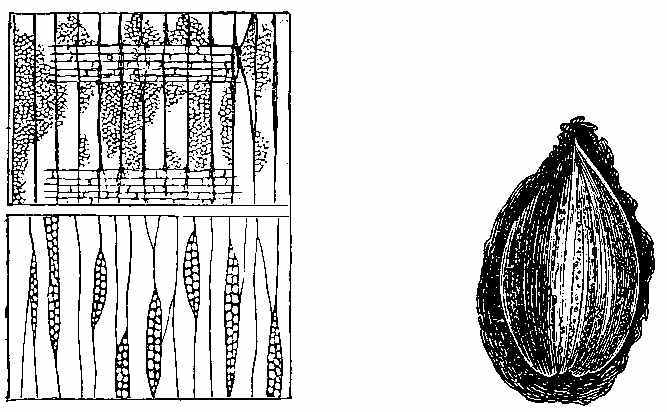
Fig. 49. Fig. 50.
Fig. 49. Araucarioxylon Withami, Krauss (Pinites Withami), from
the Coal-measures, Craigleith, near Edinburgh, showing pleurenchyma
with disks, and medullary rays. An excellent specimen of a stem of
this pine may be seen in the Edinburgh Royal Botanic Garden.
Fig. 50. Trigonocarpum olivæforme, an ovate, acuminate, three-ribbed,
and striated fruit or seed, which some suppose to be a
sporangium of a Lepidodendron, others refer it to Cycadaceæ.
Hooker refers it to Coniferæ like Salisburia.
True Exogenous trees exist in the coal-fields both of England
and Scotland, as at Lennel Braes and Allan Bank, in
Berwickshire; High-Heworth, Fellon, Gateshead, and Wideopen,
near Newcastle-upon-Tyne; and in quarries to the west of
Durham; also in Craigleith quarry, near Edinburgh, and in the
quarry at Granton, now under water. In the latter localities
they lay diagonally athwart the sandstone strata, at an angle of
about 30°, with the thicker and heavier part of their trunks
below, like snags in the Mississippi. From their direction we
infer that they have been drifted by a stream which has flowed
from nearly north-east to south-west. At Granton, one of
the specimens exhibited roots. In other places the specimens
are portions of stems, one of them 6 feet in diameter by 61
feet in length, and another 4 feet in diameter by 70 feet in
length. These Exogenous trees are Gymnosperms, having
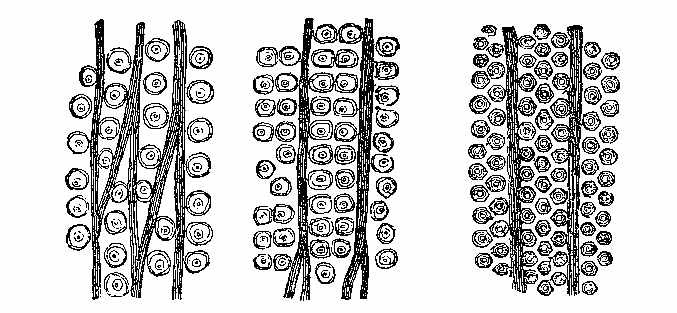
woody tissue like that of Coniferæ. We see under the
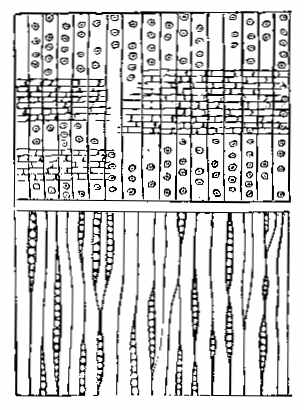
microscope punctated woody tissue, the rows of disks being
usually two, three, or more, and alternating. They seem to
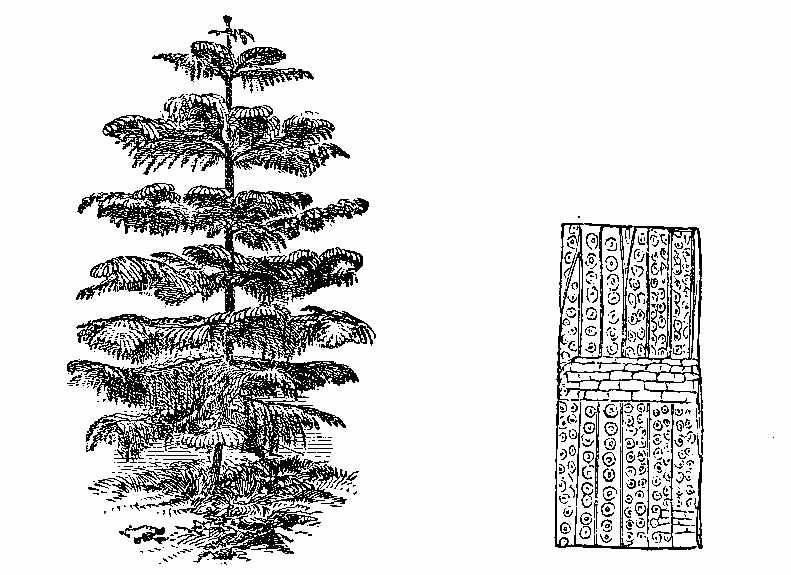
be allied in these respects to Araucaria and Eutassa (Fig.
61, p. 74) of the present flora. Araucarioxylon or Pinites
Withami (Fig. 49) is one of the species found in Craigleith
quarry; the concentric layers of the wood are obsolete; there
are 2, 3, or 4 rows of disks on the wood, and 2-4 rows of
small cells in the medullary rays. Along with it there have
also been found Dadoxylon medullare, with inconspicuous
zones, 2, 3, and 4 rows of disks, and 2-5 series of rows of cells
in the rays. Pissadendron antiquum (Pitus antiqua) having
4-5 series of cells in the medullary rays, and P. primævum
(Pitus primæva), with 10-15 series of cells in the medullary
rays, occur at Tweedmill and Lennel Braes in Berwickshire;
Peuce Withami (Fig. 1, p. 3) at Hilltop, near Durham, and
at Craigleith. Sternbergia is considered by Williamson as a
Dadoxylon, with a discoid pith like that seen now-a-days in
the Walnut, Jasmine, and Cecropia peltata, as well as in some
species of Euphorbia.[14] Sternbergia approximata is named by
him Dadoxylon approximatum. Hooker believes from the
structure of Trigonocarpum (Fig. 50) that it is a coniferous
fruit nearly allied to Salisburia (Trans. Roy. Soc. 1854).
Several species of Trigonocarpum occur in the Carboniferous
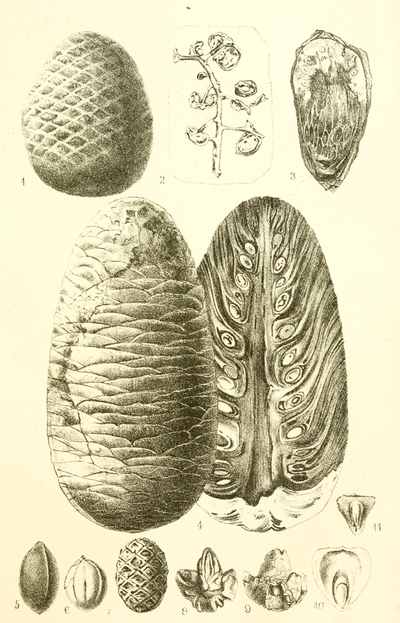
rocks, such as T. olivæforme from Bolton (Plate II.
Fig. 5), and T. sulcatum from Wardie, near Edinburgh (Plate
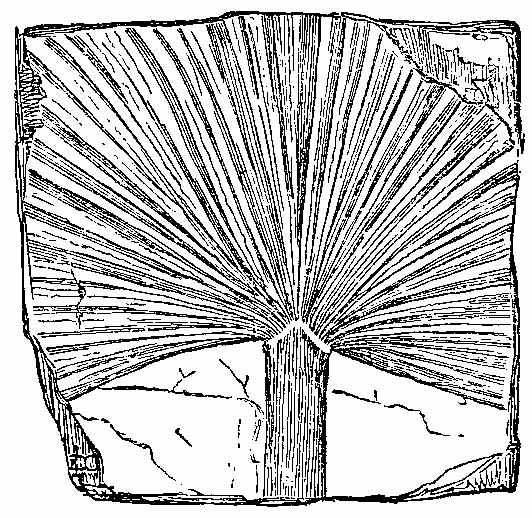
II. Fig. 6). Noeggerathia and a few other plants, such as
Flabellaria and Artisia, are referred by Brongniart to Cycadaceæ.
Flabellaria borassifolia, according to Peach, has
leaves like Yucca. Noeggerathia has pinnate leaves, cuneiform
leaflets, sometimes fan-shaped; the veins arise from the
base of the leaflets, are equal in size, and either remain simple
or bifurcate, the nervation (venation) being similar to that of
some Zamias.
The fossils of this period, referred to as Antholithes,[15] have
just been shown by Mr. Carruthers to be the inflorescence of
Cardiocarpum (Geol. Mag. Feb. 1872), and he proposes to set
aside the former name, confining it to the tertiary fossils to
which it was originally given by Brongniart, and to use the
latter name. The main axis of the inflorescence is simple,
stout, and marked externally with interrupted ridges. The
axis bears in a distichous manner sub-opposite or alternate
bracts of a linear-lanceolate form and with decurrent bases.
In the axils of the bracts were developed flower-like leaf-bearing
buds, and from them proceeded three or four linear
pedicels, which terminated upwards in a somewhat enlarged
trumpet-shaped apex. To this enlarged articulating surface
was attached the fruit, to which has been given the generic
name Cardiocarpum[16] (Fig. 51). The place of attachment is
indicated by the short straight line which separates the cordate
lobes at the base of the fruit. The fruit is flattish, broadly
ovate, with a cordate base and sub-acute apex. It consists of
an outer pericarp, inclosing an ovate-acute seed. That the
pericarp was of some thickness, and formed probably a sub-indurated
rind, is shown by a specimen preserved in the
round, and figured (Fig. 53 a). The pericarp is open at the
apex; and the elongated tubular apex of the spermoderm
passes up to this opening. The seed forms a distinct swelling
in the centre of the fruit, and a slight ridge passes up the
middle to the base of the apical opening.
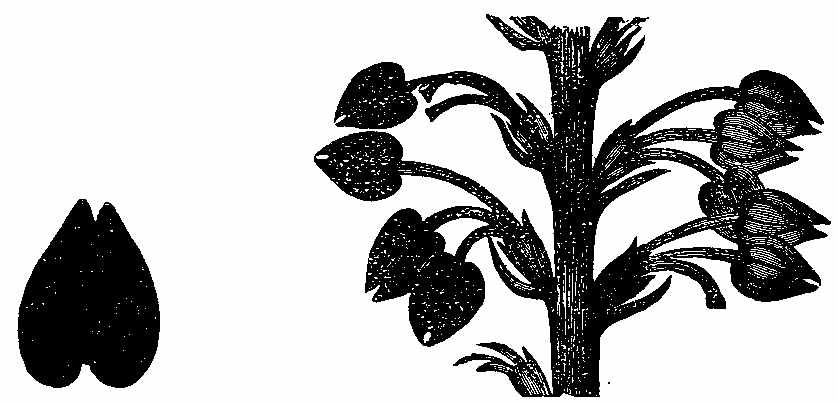
Fig. 51. Fig. 52.
Fig. 51. Cardiocarpum Lindleyi, Carr. Fig. 52. Do., Coal-measures,
Falkirk.
These fossils are believed to be an extinct form of Gymnosperms.
Two species have been described, of both of which
we are able to give figures. The first figure is from the specimens
collected by Mr. Peach at Falkirk. It is Cardiocarpum
Lindleyi (Figs. 51, 52); it has a primary axis with sub-opposite
axillary axes, bearing four to six lanceolate leaves
and three or four pedicels. Primary bracts short and arcuate.
Fruit ovate-cordate, with an acute bifid apex, and a ridge
passing up the middle of the fruit.
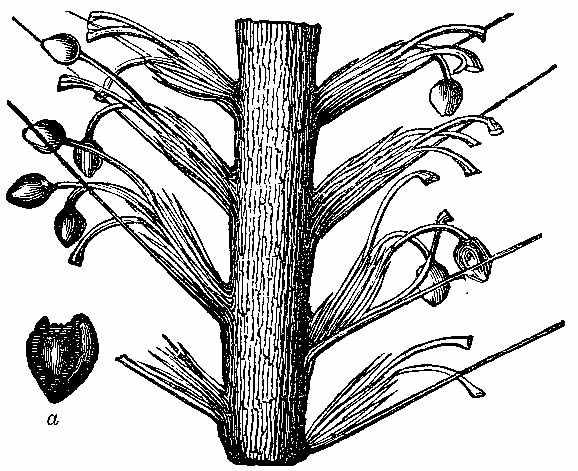
Fig. 53.
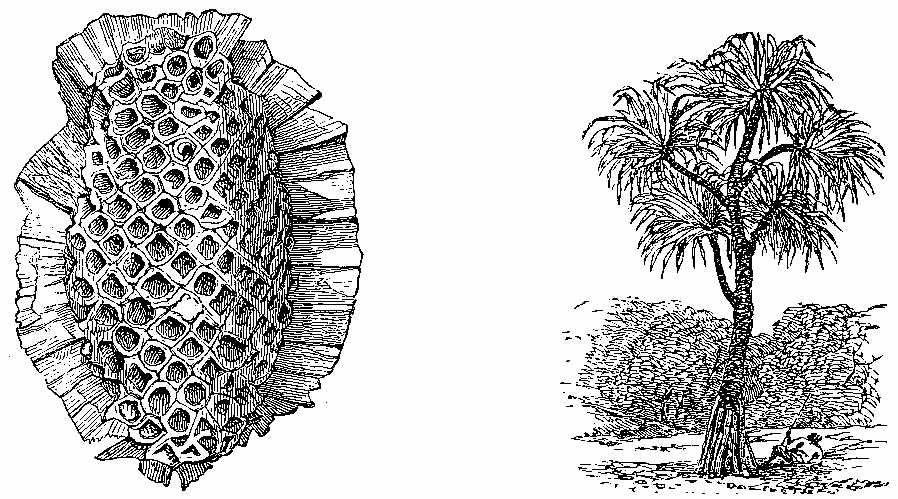
Fig. 53. Cardiocarpum anomalum (Carr.), natural size: with separate
fruit (a), twice natural size—Coal-measures, Coalbrookdale.
The second species is Cardiocarpum anomalum (Fig. 53)
from Coalbrookdale;
it has a primary axis
with alternate or sub-opposite
axillary axes,
slender and elongated,
bearing many linear
leaves, and several
slender pedicels; primary
bracts long, slender,
and straight;
fruits small, margined.
The somewhat magnified separate fruit (a) shows the thickness
of the pericarp and the enclosed seed.
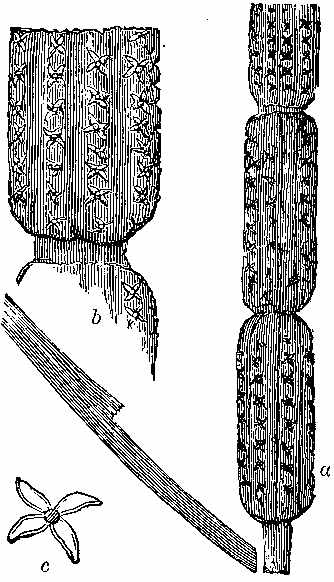
Fig. 54.
Fig. 54. Pothocites Grantoni, Paterson. a, Spike natural size;
b, Portion of spike magnified; c, Perianth, 4-cleft, magnified.
In the bituminous shale at Granton, near Edinburgh, Dr.
Robert Paterson discovered in 1840 a peculiar fossil plant,
which he called Pothocites Grantoni (Fig. 54, a). It is figured
in the Transactions of the Edinburgh Botanical Society, vol. i.
March 1840. It is a spike covered by parallel rows of flowers
(Fig. 54, b), each apparently with a 4-cleft calyx (Fig. 54, c).
It was supposed to be allied to Potamogeton or Pothos, more
probably to the latter. In that case it must be referred to the
natural order Araceæ. The original specimen is deposited in
the museum at the Royal Botanic Garden, Edinburgh.
Our knowledge of the real state of the vegetation of the
earth when coal was formed must be very limited, when we
reflect how seldom the fructification of coniferous trees has
been met with in the coal-measures.
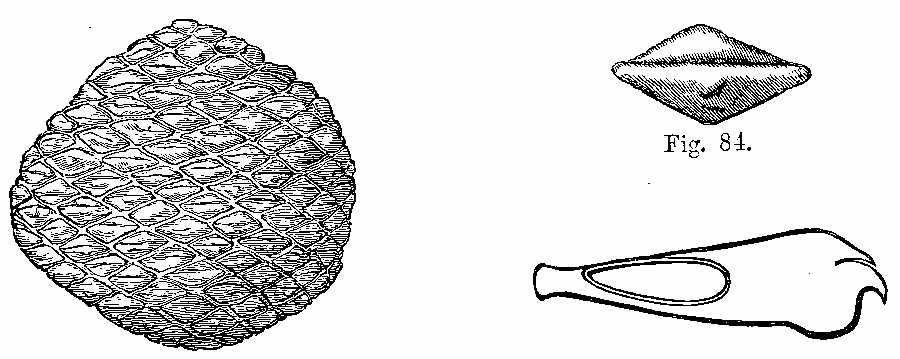
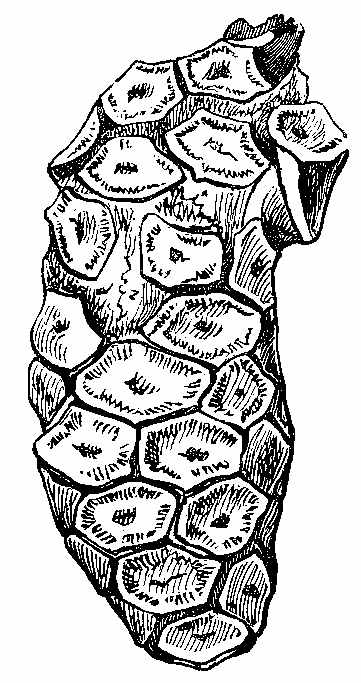
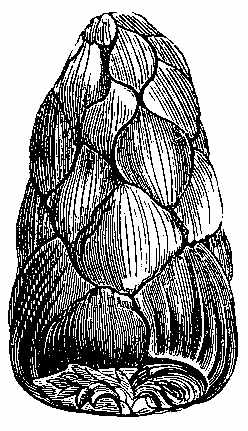
A very doubtful fragment, supposed
to be a cone, is given in Lindley and
Hutton's work, under the title of Pinus
anthracina; but it is believed by Carruthers
to be a fragment of a Lepidodendroid
branch. Lyell never saw a
fossil fir-cone of the Carboniferous
epoch, either in the rocks or museums
of North America or Europe. Bunbury
never heard of any other example than
that noticed by Lindley and Hutton.
Principal Dawson is disposed to think
that the suberin of cork, of epidermis in
general, and of spore-cases in particular, is a substance so rich
in carbon that it is very near to coal, and so indestructible and
impermeable to water, that it contributes more largely than anything
else to the mineral. Sir Charles Lyell remarks—"To prevent
ourselves, therefore, from hazarding false generalisations,
we must ever bear in mind the extreme scantiness of our present
information respecting the flora of that peculiar class of stations
to which, in the Palæozoic era, the coal-measures probably
belonged. I have stated elsewhere my conviction that
the plants which produced coal were not drifted from a distance,
but nearly all of them grew on the spot where they
became fossil. They constituted the vegetation of low regions,
chiefly the deltas of large rivers, slightly elevated above the
level of the sea, and liable to be submerged beneath the
waters of an estuary or sea by the subsidence of the ground
to the amount of a few feet. That the areas where the carboniferous
deposits accumulated were low, is proved not only
by the occasional association of marine remains, but by the
enormous thickness of strata of shale and sandstone to which the
seams of coal are subordinate. The coal-measures are often
thousands of feet, and sometimes two or three miles, in vertical
thickness, and they imply that for an indefinite number of
ages a great body of water flowed continuously in one direction,
carrying down towards a given area the detritus of a
large hydrographical basin, draining some large islands or
continents, on the margins of which the forests of the coal
period grew. If this view be correct, we can know little or
nothing of the upland flora of the same era, still less of the
contemporaneous plants of the mountainous or alpine regions.
If so, this fact may go far to account for the apparent monotony
of the vegetation, although its uniform character may
doubtless be in part owing to a greater uniformity of climate
then prevailing throughout the globe. Mr. Bunbury has successfully
pointed out that the peculiarity of the carboniferous
climate consisted more in the humidity of the atmosphere and
the absence of cold, or rather the equable temperature preserved
in the different seasons of the year, than in its tropical
heat; but we must still presume that colder climates existed
at higher elevations above the sea."
The plants of the coal-measures are evidently terrestrial
plants. Brongniart agrees with Lyell in thinking that the
layers of coal have in general accumulated in the situation
where the plants forming them grew. The remains of these
plants covered the soil in the same way as layers of peat, or
the vegetable mould of great forests. In a few instances,
however, the plants may have been transported from a distance,
and drifted into basins. Phillips is disposed to think
that this was the general mode of formation of coal-basins.
He is led to this conclusion by observing the fragmentary
state of the stems and branches, the general absence of roots,
and the scattered condition of all the separable organs. Those
who support the drift theory, look on the coal plants as having
been swept from the land on which they grew by watery
currents at different times, and deposited in basins and large
sea-estuaries, and sometimes in lakes. The snags in the
Mississippi, the St. Lawrence, and other large rivers, are given
as instances of a similar drifting process.
The vegetation of the coal epoch seems to resemble most
that of islands in the midst of vast oceans, and the prevalence
of ferns indicates a climate similar to that of New Zealand in
the present day. In speaking of the island vegetation of the
coal epoch, Professor Ansted remarks (Ancient World, p.
88)—"The whole of the interior of the islands may have
been clothed with thick forests, the dark verdure of which
would only be interrupted by the bright green of the swamps
in the hollows, or the brown tint of the ferns covering some
districts near the coasts. The forests may have been formed
by a mixture of several different trees. We would see then,
for instance, the lofty and widely-spreading Lepidodendron,
its delicate feathery fronds clothing, in rich luxuriance,
branches and stems, which are built up, like the trunk of
the tree-fern, by successive leafstalks that have one after
another dropped away, giving by their decay additional
height to the stem, which might at length be mistaken for that
of a gigantic pine. There also should we find the Sigillaria, its
tapering and elegant form sustained on a large and firm basis—enormous
matted roots, almost as large as the trunk itself,
being given off in every direction, and shooting out their
fibres far into the sand and clay in search of moisture. The
stem of this tree would appear like a fluted column, rising
simply and gracefully without branches to a great height, and
then spreading out a magnificent head of leaves like a noble
palm-tree. Other trees, more or less resembling palms, and
others like existing firs, also abounded, giving a richness and
variety to the scene; while one gigantic species, strikingly
resembling the Norfolk Island pine, might be seen towering
a hundred feet or more above the rest of the forest, and
exhibiting tier after tier of branches richly clothed with its
peculiar pointed spear-like leaves, the branches gradually
diminishing in size as they approach the apex of a lofty
pyramid of vegetation. Tree-ferns also in abundance might
there be recognised, occupying a prominent place in the
physiognomy of vegetation, and dotted at intervals over the
distant plains and valleys, the intermediate spaces being
clothed with low vegetation of more humble plants of the
same kind. These we may imagine exhibiting their rich
crests of numerous fronds, each many feet in length, and
produced in such quantity as to rival even the palm-trees in
beauty. Besides all these, other lofty trees of that day, whose
stems and branches are now called Calamites, existed chiefly
in the midst of swamps, and bore their singular branches and
leaves aloft with strange and monotonous uniformity. All
these trees, and many others that might be associated with
them, were, perhaps, girt round with innumerable creepers
and parasitic plants, climbing to the topmost branches of the
most lofty amongst them, and relieving, in some measure, the
dark and gloomy character of the great masses of vegetation."
Hugh Miller remarks—"The sculpturesque character of
the nobly-fluted Sigillarias was shared by not a few of its
contemporaries. Ulodendrons, with their rectilinear rows of
circular scars, and their stems covered with leaf-like carvings,
rivalled in effect the ornately relieved torus of a Corinthian
column. Favularia, Halonia, many of the Calamites, and
all the Lepidodendrons, exhibited the most delicate sculpturing.
In walking among the ruins of this ancient flora, the
palæontologist almost feels as if he had got among the broken
fragments of Italian palaces erected long years ago, when the
architecture of Rome was most ornate, and every moulding
was roughened with ornament; and in attempting to call up
in fancy the old Carboniferous forests, he has to dwell on this
peculiar feature as one of the most prominent; and to see in the
multitude of trunks darkened above by clouds of foliage that
rise upon him in the prospect, the slender columns of an older
Alhambra, roughened with arabesque tracery and exquisite
filigree work."
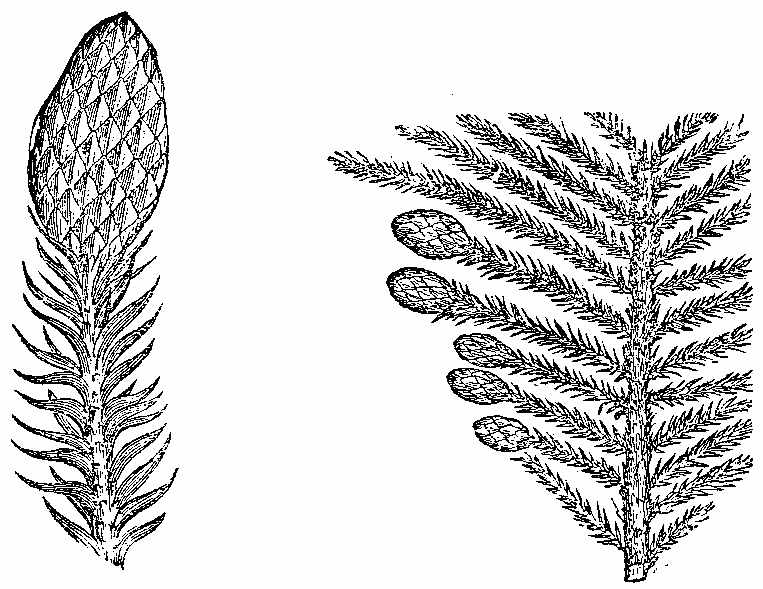
Fig. 55. Fig. 56.
Figs. 55 and 56. Walchia piniformis, Sternb., a common species
in the Permian rocks of Europe. Fig. 55. Plant with leaves and
fructification. Fig. 56. Fructification, natural size.
The nature of the vegetation during the Permian period,
which is associated with the Carboniferous, under the reign
of Acrogens, has been extensively illustrated by Goeppert.
Brongniart has enumerated the fossils in three different
localities, which he refers doubtfully to this period. 1.
The flora of the bituminous slates of Thuringia, composed
of Algæ, Ferns, and Coniferæ. 2. Flora of the Permian sandstones
of Russia, comprehending Ferns, Equisetaceæ, Lycopodiaceæ,
and Noeggerathiæ. 3. Flora of the slaty schists of
Lodève, composed of Ferns, Asterophyllites, and Coniferæ.
The genera of Ferns here met with are those found in the
Carboniferous epoch; the Gymnosperms are chiefly species of
Walchia and Noeggerathia (the latter is supposed by Schimper
to be a Cycad); Lepidodendron elongatum, Calamites gigas,
and Annularia floribunda, are also species of this period.
Walchia is a conifer characteristic of the Permian epoch, of
which there are eight species described (Figs. 55 and 56). It
has a single seed to each scale of the cone, and two kinds of
leaves, the one short and imbricated, the other long and spreading.
Among the plants of the Permian formation Goeppert
enumerates the following:[17]—Equisetites contractus, Calamites
Suckowi, C. leioderma, Asterophyllites equisetiformis, A.
elatior, Huttonia truncata, H. equisetiformis, many species of
Psaronius, one of the filicoid plants, Hymenophyllites complanatus,
Sphenopteris crassinervia, Sagenopteris tæniæfolia,
Neuropteris imbricata, and many other species of these
genera; several species of Odontopteris, Callipteris, Cyclopteris,
Dioonopteris, Cyatheites, Alethopteris, Noeggerathia,
Cordaites, Anthodiopsis, Dictyothalamus, Calamodendron,
Arthropitys; besides species of Sigillaria, Stigmaria, and
Lepidodendron. Various fruits are also mentioned, under
the names of Rhabdocarpum, Cardiocarpum, Acanthocarpum,
Trigonocarpum, and Lepidostrobus.