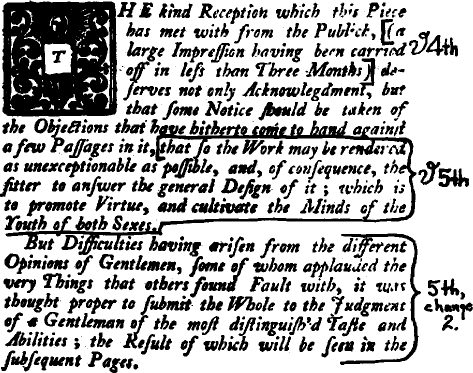
 he
kind Reception which this Piece has met with from the Publick, (a large Impression having
been carried off in less than Three Months) deserves not only
Acknowlegdment,
but that some Notice should be taken of the Objections that have
hitherto come to hand against a few Passages in it, that
so the Work may be rendered as unexceptionable as possible, and, of
consequence, the fitter to answer the general Design of it; which is to
promote Virtue, and cultivate the Minds of the Youth of both
Sexes.
he
kind Reception which this Piece has met with from the Publick, (a large Impression having
been carried off in less than Three Months) deserves not only
Acknowlegdment,
but that some Notice should be taken of the Objections that have
hitherto come to hand against a few Passages in it, that
so the Work may be rendered as unexceptionable as possible, and, of
consequence, the fitter to answer the general Design of it; which is to
promote Virtue, and cultivate the Minds of the Youth of both
Sexes.
But Difficulties having
arisen from the different Opinions of Gentlemen, some of whom applauded
the very Things that others found Fault with, it was thought proper to
submit the Whole to the Judgment of a Gentleman of the most
distinguish’d Taste and Abilities; the Result of which will be seen in
the subsequent Pages.
We begin with the
following Letter, at the Desire of several Gentlemen, to whom, on a very
particular Occasion, it was communicated, and who wish’d to see it
prefixed to the New Edition. It was directed,
To the Editor of Pamela.
Dear Sir,
You
have agreeably deceiv’d me into a Surprize, which it will be as hard to
express, as the Beauties of Pamela.
Though I open’d this powerful little Piece with more Expectation than
from common Designs, of like Promise, because it came from your
Hands, for my Daughters, yet, who could have dreamt, he should
find, under the modest Disguise of a Novel, all the Soul
of Religion, Good-breeding, Discretion, Good-nature, Wit, Fancy, Fine
Thought, and Morality?---I have done nothing but read it to others,
and hear others again read it, to me, ever since it came into my Hands;
and I find I am likely to do nothing else, for I know not how long yet
to come: because, if I lay the Book down, it comes after me.——When it has dwelt all Day long upon the
Ear, It takes Possession, all Night, of the Fancy.——It has Witchcraft in every Page of it: but
it is the Witchcraft of Passion and Meaning. Who is there that will not
despise the false, empty Pomp of the Poets, when he observes in
this little, unpretending, mild Triumph of Nature, the whole
Force of Invention and Genius, creating new Powers of Emotion, and
transplanting Ideas of Pleasure into that unweeded low
Garden the
a2
Heart, from the dry and sharp Summit of Reason?
Yet, I confess, there is One,
in the World, of whom I think with still greater Respect, than of Pamela: and That is, of the wonderful AUTHOR of Pamela.——Pray, Who is he, Dear Sir? and where, and
how, has he been able to hide, hitherto, such an encircling and
all-mastering Spirit? He possesses every Quality that Art could have charm’d by: yet, has lent it to, and
conceal’d it in, Nature.——The Comprehensiveness of his Imagination
must be truly prodigious!——It
has stretch’d out this diminutive mere Grain of
Mustard-seed, (a poor Girl’s little, innocent, Story) into a
Resemblance of That Heaven, which the Best of Good Books has
compar’d it to.——All the
Passions are His, in their most close and abstracted Recesses: and by
selecting the most delicate, and yet, at the same time, most powerful,
of their Springs, thereby to act, wind, and manage, the Heart, He
moves us, every where, with the Force of a Tragedy.
What is there, throughout the
Whole, that I do not sincerely admire!——I admire, in it, the strong
distinguish’d Variety, and picturesque glowing Likeness to Life,
of the Characters. I know, hear, see, and live among ’em All: and,
if I cou’d paint, cou’d return you their Faces. I admire, in
it, the noble Simplicity, Force, Aptness, and Truth, of so many modest,
œconomical, moral, prudential, religious, satirical, and cautionary,
Lessons; which are introduc’d with such seasonable Dexterity, and
with so polish’d and exquisite a Delicacy, of Expression and Sentiment,
that I am only apprehensive, for the Interests of Virtue,
lest some of the finest, and most touching, of those
elegant Strokes of Good-breeding, Generosity, and Reflection, shou’d be
lost, under the too gross Discernment of an unfeeling Majority of
Readers; for whose Coarseness, however, they were kindly design’d, as
the most useful and charitable Correctives.
One of the best-judg’d Peculiars, of
the Plan, is, that These Instructions being convey’d, as in a Kind of
Dramatical Representation, by those beautiful Scenes, Her own
Letters and Journals, who acts the most moving and suffering
Part, we feel the Force in a threefold Effect,——from the Motive, the Act, and the
Consequence.
But what, above All, I am charm’d
with, is the amiable Good-nature of the Author; who, I am convinc’d, has one of the
best, and most generous Hearts, of Mankind: because, mis-measuring
other Minds, by His Own, he can draw Every thing, to
Perfection, but Wickedness.——I became inextricably in Love
with this delightful Defect of his Malice;—for, I found it
owing to an Excess in his Honesty. Only observe, Sir, with
what virtuous Reluctance he complies with the Demands of his
Story, when he stands in need of some blameable Characters. Tho’ his
Judgment compels him to mark ’em with disagreeable Colourings, so that
they make an odious Appearance at first, He can’t forbear, by an
unexpected and gradual Decline from Themselves, to soften and transmute
all the Horror conceiv’d for their Baseness, till we are arriv’d,
through insensible Stages, at an Inclination to forgive it intirely.
I must venture to add, without
mincing the matter, what I really believe, of this Book.---It will live
on, through Posterity, with such unbounded Extent of Good Consequences,
that
a3
Twenty Ages to come may be the Better and Wiser, for its Influence. It
will steal first, imperceptibly, into the Hearts of the Young and
the Tender: where It will afterwards guide and moderate their
Reflections and Resolves, when grown Older. And so, a gradual moral
Sunshine, of un-austere and compassionate Virtue, shall break out
upon the World, from this Trifle
(for such, I dare answer for the Author, His Modesty
misguides him to think it).——No
Applause therefore can be too high, for such Merit. And,
let me abominate the contemptible Reserves of mean-spirited Men,
who while they but hesitate their Esteem, with Restraint, can be
fluent and uncheck’d in their Envy.——In an Age so deficient in Goodness, Every
such Virtue, as That of this Author, is a salutary Angel, in
Sodom. And One who cou’d stoop to conceal, a Delight
he receives from the Worthy, wou’d be equally capable of
submitting to an Approbation of the Praise of the
Wicked.
I was thinking, just now, as I
return’d from a Walk in the Snow, on that Old Roman
Policy, of Exemptions in Favour of Men, who had given a few, bodily,
Children to the Republick.——What
superior Distinction ought our Country, to find (but that Policy and We are at
Variance) for Reward of this Father, of Millions of Minds, which are to owe new Formation to the
future Effect of his Influence!
Upon the whole, as I never met with
so pleasing, so honest, and so truly deserving a Book, I shou’d
never have done, if I explain’d All my Reasons for admiring its
Author.——If it is not a
Secret, oblige me so far as to tell me his Name: for since
I feel him the Friend of my Soul, it would be a
Kind of Violation to retain him a Stranger.——I am not able to thank you enough, for
this highly acceptable Present. And, as for my Daughters, They have
taken into their Own Hands the Acknowledgment due from their Gratitude.
I am,
Dear Sir,
Your, &c.
Dec. 17, 1740.
Abstract of a second Letter from the same Gentleman.
---No Sentiments which I have here, or
in my last, express’d, of the sweet Pamela, being more than the
bare Truth, which every Man must feel, who lends his Ear to the
inchanting Prattler, why does the Author’s Modesty mislead his Judgment,
to suspect the Style wants Polishing?---No, Sir, there is an
Ease, a natural Air, a dignify’d
Simplicity, and measured Fullness, in it, that, resembling Life,
outglows it! He has reconciled the Pleasing to the Proper.
The Thought is every-where exactly cloath’d by the
Expression: And becomes its Dress as roundly, and as close, as
Pamela her Country-habit. Remember, tho’ she put it on with
humble Prospect, of descending to the Level of her Purpose, it
adorn’d her, with such unpresum’d Increase of Loveliness;
sat with such neat Propriety of Elegant Neglect about her, that it threw
out All her Charms, with tenfold, and resistless Influence.---And so,
dear Sir, it will be always found.---When modest Beauty seeks to hide
itself by casting off the Pride of Ornament, it but
displays itself without a Covering: And so, becoming more
distinguished, by its Want of
a4
Drapery, grows stronger, from its purpos’d
Weakness.
There were formed by an
anonymous Gentleman, the following Objections to some Passages in the
Work.
1. That the Style ought to be a little raised, at least so soon as
Pamela knows the Gentleman’s Love is honourable, and when his Diffidence is changed
to Ease: And from about the fourth Day after Marriage, it should be
equal to the Rank she is rais’d to, and charged to fill becomingly.
2. That to avoid the Idea apt to be join’d with the Word
’Squire, the Gentleman should be styled Sir James; or Sir
John, &c. and Lady Davers in a new Edition might
procure for him the Title of a Baronet.
3. That if the sacred Name were seldomer repeated, it would be
better; for that the Wise Man’s Advice is, Be not righteous
over-much.
4. That the Penance which Pamela suffers from Lady
Davers might be shorten’d: That she is too timorous after owning
her Marriage to that Lady, and ought to have a little more Spirit, and
get away sooner out at the
Window, or call her own Servants to protect, and carry her to her
Husband’s Appointment.
5. That Females are too apt to be struck with Images of Beauty; and
that the Passage where the Gentleman is said to span the Waist of
Pamela with his Hand, is enough to ruin a Nation of Women by
Tight-lacing.
6. That the Word naughty had better be changed to some other,
as Bad, Faulty, Wicked, Vile,
Abominable, Scandalous: Which in most Places would
give an Emphasis, for which recourse must otherwise be had to the
innocent Simplicity of the Writer; an Idea not necessary to the Moral of
the Story, nor of Advantage to the Character of the Heroine.
7. That the Words, p. 305. Foolish Thing that I am, had
better be Foolish that I am. The same Gentleman observes by way
of Postscript, that Jokes are often more severe, and do more
Mischief, than more solid Objections; and would have one or two Passages
alter’d, to avoid giving Occasion for the Supposition of a double
Entendre, particularly in two Places which he mentions, viz.
p. 175. and 181.
He is pleased to take notice of several other Things of less Moment,
some of which are merely typographical; and very kindly expresses, on
the Whole, a high Opinion of the Performance, and thinks it may do
a great deal of Good: For all which, as well as for his Objections, the
Editor gives him very sincere Thanks.
Others are of Opinion, That the Scenes in many Places, in the Beginning
especially, are too low; and that the Passions of Lady Davers,
in particular, are carried too high, and above Nature.
And others have intimated, That Pamela ought, for Example sake,
to have discharg’d Mrs. Jewkes from her Service.
These are the most material Objections that have come to hand, all which
are considered in the following Extracts
from some of the most beautiful Letters that have been written in any Language:
The Gentleman’s Advice, not to alter Pamela at all, was both
friendly, and solidly just. I run in, with full Sail, to his
Anchorage, that the low Scenes are no more out of Nature, than the
a5
high Passions of proud Lady Davers. Out of Nature, do they say?
’Tis my Astonishment how Men of Letters can read with such absent
Attention! They are so far from Out of Nature, They are
absolute Nature herself! or, if they must be confess’d her
Resemblance; they are such a Resemblance, at least, as our
true Face gives our Face in the Looking-glass.
I wonder indeed, what it is, that the Gentlemen, who talk of Low
Scenes, wou’d desire should be understood by the Epithet?---Nothing,
properly speaking, is low, that suits well with the Place it is
rais’d to.----The Passions of Nature are the same, in the Lord,
and his Coach-man. All, that makes them seem different consists
in the Degrees, in the Means, and the Air, whereto
or wherewith they indulge ’em. If, in painting Distinctions like these,
(which arise but from the Forms of Men’s Manners, drawn from
Birth, Education, and Custom) a Writer
falls short of his Characters, there his Scene is a low one,
indeed, whatever high Fortune it flatter’d. But, to imagine that Persons
of Rank are above a Concern for what is thought, felt, or acted, by
others, of their Species, between whom and themselves is no
Difference, except such as was owing to Accident, is to reduce Human
Nature to a Lowness,--too low for the Truth of her
Frailty.--
In Pamela, in particular, we owe All to her Lowness. It is
to the docile Effects of this Lowness of that amiable Girl, in
her Birth, her Condition, her Hopes, and her Vanities, in every thing,
in short, but her Virtue,---that her Readers are indebted, for
the moral Reward, of that Virtue. And if we are to look
for the Low among the Rest of the Servants, less lovely tho’
they are, than a Pamela, there is something however, so glowingly
painted, in the Lines whereby the Author has mark’d their
Distinctions----Something, so movingly forceful, in the Grief at
their Parting, and Joy at the happy Return,---Something so
finely, at once, and so strongly and feelingly, varied, even in
the smallest and least promising, little Family Incidents! that I need
only appeal from the Heads, to the Hearts of the Objectors
themselves, whether these are low Scenes to be censur’d?
And as for the opposite Extreme they wou’d quarrel with, the
high-passion’d, and un-tam’d Lady Davers,---I cou’d direct
’em to a Dozen or two of Quality Originals, from whom (with
Exception perhaps of her Wit) one wou’d swear the Author had
taken her Copy.---What a Sum might these Objectors ensure, to be paid,
by the Husbands and Sons, of such termagant, hermaphrodite
Minds, upon their making due Proof, that they were no longer to be
found, in the Kingdom!
I know, you are too just to imagine me capable of giving any other
Opinion than my best-weigh’d and true one. But, because it is fit you
should have Reasons, in Support of a Judgment that can neither
deserve nor expect an implicit Reception, I will run over the
Anonymous Letter I herewith return you; and note with what Lightness
even Men of good-natur’d Intention fall into Mistakes, by
Neglect in too hasty Perusals, which their Benevolence wou’d take
Pleasure in blushing at, when they discover their Weakness, in a cooler
Revisal.
The Writer of this Letter is for having the Style rais’d, after
Pamela’s Advance in her Fortune. But surely, This was hasty
Advice:
a6
because, as the Letters are writ to her Parents, it wou’d have look’d
like forgetting, and, in some sort, insulting, the Lowliness of their
inferior Condition, to have assum’d a new Air in her Language, in Place
of retaining a steady Humility. But, here, it must not be pass’d
unobserv’d, that in her Reports of Conversations that follow’d her
Marriage, she does, aptly and beautifully, heighten her Style,
and her Phrases: still returning however to her decent Simplicity, in
her Addresses to her Father and Mother.
I am against giving a Gentleman (who has ennobled himself, by reforming
his Vices, and rewarding the Worth of the Friendless) the
unnecessary new Toy of a Title. It is all strong in Nature, as it
stands in the Letters: and I don’t see how Greatness, from Titles, can
add Likeness or Power, to the Passions. So complete a Resemblance of
Truth stands in need of no borrow’d Pretensions.
The Only of this Writer’s Objections, which, I think, carries
Weight, is That, which advises some little Contraction of the
Prayers, and Appeals to the Deity. I say little Contraction:
for they are nobly and sincerely pathetic. And I say it only in Fear,
lest, if fansied too long, by the fashionably Averse to the
Subject, Minds, which most want the purpos’d Impression, might
hazard the Loss of its Benefit, by passing over those
pious Reflections, which, if shorter, would catch their Attention.
Certainly, the Gentleman’s Objection against the Persecution that
Pamela suffers from lady Davers, in respect to the
Relation this Madwoman bears to the Brother, is the rashest of All his Advices!
And when he thinks she ought rather
to have assum’d the Protection of her Servants, he seems unaware of the
probable Consequence; where there was a Puppy, of Quality, in the
Case, who had, even without Provocation, drawn his Sword on the poor
passive Pamela. Far from bearing a
Thought of exciting an abler Resentment, to the Danger of a Quarrel with
so worthless a Coxcomb, how charmingly natural, apprehensive, and
generous, is her Silence (during the Recital she makes of her
Sufferings) with regard to this masculine Part of the Insult! as
also her Prevention of Mrs. Jewkes’s less delicate Bluntness,
when she was beginning to complain of the whelp Lord’s Impertinence!
If I were not afraid of a Pun, I shou’d tell the anonymous
Letter-writer, that he made a too tight-laced Objection, where he
quarrels with the spann’d Waist of Pamela. What, in the Name of
Unshapeliness! cou’d he find, to complain of, in a beautiful Girl of
Sixteen, who was born out of Germany, and had not, yet, reach’d
ungraspable Roundness!——These are wonderful Sinkings from Purpose,
where a Man is considering such mental, and passionate Beauties, as this
Gentleman profess’d to be touch’d by!
But, when he goes on, to object against the Word naughty, (as
apply’d in the Phrase naughty Master) I grow mortified, in Fear for our human Sufficiency,
compar’d with our Aptness to blunder! For, here, ’tis plain, this
Director of Another’s Discernment is quite blind, Himself, to an
Elegance, one wou’d have thought it impossible not to be
struck by?---Faulty, wicked, abominable, scandalous, (which are the
angry Adjectives, he prefers to that sweet one) wou’d have carried Marks
of her Rage, not Affliction—whereas
naughty contains, in One single significant Petulance, twenty thousand
inexpressible Delicacies!---It insinuates, at once, all the beautiful
Struggle, between her Contempt of his Purpose, and tender Regard for his
Person; her Gratitude to Himself and his Family; her Recollection of his
superior Condition.—There is in the elegant Choice of this
half-kind, half-peevish, Word, a never-enough to be prais’d
speaking Picture of the Conflict betwixt her Disdain, and her Reverence!
See, Sir, the Reason I had,
for apprehending some Danger that the refin’d Generosity in many of the
most charming of the Sentiments wou’d be lost, upon the too
coarse Conception of some, for whose Use the Author intended
them.
It is the same Case again, in foolish Thing that I am! which this
nice, un-nice,
Gentleman wou’d advise you to change, into foolish that I am! He
does not seem to have tasted the pretty Contempt of Herself, the
submissive Diminutive, so distant from Vanity, yet allayed by the
gentle Reluctance in Self-condemnation ;---and the other fine Touches of Nature: which wou’d All
have been lost, in the grave, sober Sound of his Dutch
Emendation.
As to his Paragraph in
Postscript, I shall say the less of it, because the
Gentleman’s own good Sense seems to confess, by the Place he has chosen
to rank it in, that it ought to be turn’d out of Doors, as too
dirty for the rest of his Letter.—— In the Occasions he is pleas’d to discover for Jokes,
I either find not, that he has any Signification at all, or such
vulgar, coarse-tasted Allusions to loose low-life Idioms, that
not to understand what he means, is both the cleanliest, and
prudentest Way of confuting him.
And now, Sir, you will easily gather how far I am from thinking it
needful to change any thing in Pamela. I would not scratch
such a beautiful Face, for the Indies!
You can hardly imagine how
it charms me to hear of a Second Edition already! but the News of still
new upon new ones, will be found no Subject of Wonder. As ’tis sure,
that no Family is without Sisters, or Brothers, or Daughters, or Sons,
who can read; or wants Fathers, or Mothers, or Friends, who can
think; so equally certain it is, that the Train to a Parcel of
Powder does not run on with more natural Tendency, till it sets the
whole Heap in a Blaze, than that Pamela, inchanting from Family
to Family, will overspread all the Hearts of the Kingdom.
As to the Objection of those warm Friends to Honesty, who are for
having Pamela dismiss Mrs. Jewkes; there is not One, among
All these benevolent Complainers, who wou’d not discern himself to have
been, laudably, in the wrong, were he only to be ask’d
this plain Question---Whether a Step, both ill-judg’d, and undutiful,
had not been the Reverse of a Pamela’s
Character?---Two or three times over, Mr. B—— had inform’d her, that Mrs.
Jewkes and Himself having been equally involv’d in One
Guilt, she must forgive, or condemn, Both together. After
this, it grew manifest Duty not to treat her with Marks of
Resentment.---And, as here was a visible Necessity to appear not
desirous of turning her away, so, in point of mere Moral Regard
to the bad Woman Herself, it was nobler, to retain her, with a Prospect
of correcting, in Time, her loose Habit of thinking, than, by casting
her off, to the licentious Results of her Temper, abandon
her to Temptations and Danger, which a Virtue like Pamela’s cou’d not wish her expos’d to.
The Manner in which
this admirable Gentleman gives his Opinion of the Piece, and runs thro’
the principal Characters, is so masterly, that the Readers of
Pamela will be charm’d by it, tho’ they should suppose, that
his inimitable Benevolence has over-valu’d the Piece
itself.
Inspir’d, without doubt, by some Skill, more than human, and
comprehending in an humble, and seemingly artless, Narration,
a Force that can tear up the Heart-strings, this Author has
prepar’d an enamouring Philtre for the Mind, which will excite
such a Passion for Virtue, as scarce to leave it in the Power of
the Will to neglect her.
Longinus, I remember, distinguishing by what Marks we may
know the Sublime, says, it is chiefly from an Effect that will
follow the Reading it: a delightfully-adhering Idea, that clings
fast to the Memory; and from which it is difficult for a Man to
disengage his Attention.---If this is a Proof of the
Sublime, there was never Sublimity so lastingly felt, as
in Pamela!
Not the Charmer’s own prattling Idea stuck so close to the Heart of her
Master, as the Incidents of her Story to the Thoughts of a Reader.---The
Author transports, and transforms, with a Power more extensive than
Horace requires, in his Poet!---
Mr. B——, and the Turns of
his Passions---and the Softness, yet Strength, of their amiable
Object---after having given us the most masterly Image of Nature, that
ever was painted!
take Possession of, and dwell in, the Memory.
And there, too, broods the kind and the credulous Parson Williams’s Dove, (without serpentine
Mixture) hatching Pity and Affection, for an Honesty so sincere, and so
silly!
There too, take their Places All the lower Supports of this
beautiful Fabrick.---
I am sometimes transform’d into plain Goodman Andrews, and sometimes the good Woman, his Wife.
As for old Mr. Longman, and Jonathan, the Butler, they are sure of me both, in
their Turns.
Now and-then, I am Colbrand the
Swiss: but, as broad as I stride, in that
Character, I can never escape Mrs. Jewkes: who often keeps me awake in the Night---
Till the Ghost of Lady Davers, drawing
open the Curtains, scares the Scarer, of me, and of Pamela!---
And, then, I take Shelter with poor penitent John, and the rest of the Men and the
Maids, of all whom I may say, with compassionate Marcia,
————The
YouthsDIVIDE their Reader.
And this fine
Writer adds:
I am glad I made War, in my last, upon the Notion of altering the Style:
for, having read it twice over since then, (and to Audiences, where the
Tears were applausively eloquent) I could hardly, here and
there, find a Place, where one Word can be chang’d for a better.
There are some indeed, where ’twere possible to leave out,
a few, without making a Breach in the Building. But,
in short, the Author has put so bewitching a Mixture together, of the
Rais’d with the Natural, and the Soft with the
Strong and the Eloquent---thatnever Sentiments were finer,
and fuller of Life! never any were utter’d so sweetly!---Even in what
relates to the pious and frequent Addresses to God, I now retract
(on these two last Revisals) the Consent I half gave, on a
former, to the anonymous Writer’s Proposal, who advis’d the
Author to shorten those Beauties.——Whoever considers his Pamela with a
View to find Matter for Censure, is in the Condition of a passionate
Lover, who breaks in upon his Mistress, without Fear or Wit, with Intent
to accuse her, and quarrel---He came to her with Pique in his Purpose;
but his Heart is too hard for his Malice---and he goes
away more enslav’d, for complaining.
The following
delightful Story, so admirably related, will give great Pleasure to the
Reader; and we take the Liberty of inserting it, for that very
Reason.
What a never-to-be satisfied
Length has this Subject always the Power of attracting me into!
And yet, before I have done, I must by your means tell the Author a
Story, which a Judge not so skilful in Nature as he is, might be
in Danger perhaps of mistaking, for a trifling and silly one.
I expect it shou’d give him the clearest Conviction, in a Case he
is subject to question.
We have a lively little Boy
in the Family, about seven Years old---but, alas for him, poor Child!
quite unfriended; and born to no Prospect. He is the Son of an honest,
poor Soldier, by a Wife, grave, unmeaning, and innocent. Yet the Boy,
(see the Power of connubial Simplicity)
is so pretty, so genteel, and gay-spirited, that we have made him, and
design’d him, our own, ever since he could totter, and waddle.
The wanton Rogue is half Air: and every Motion he acts by has a Spring,
like Pamela’s when she threw down the Card-table. All this
Quickness, however, is temper’d by a good-natur’d Modesty: so that the
wildest of his Flights are thought rather diverting than troublesome. He
is an hourly Foundation for Laughter, from the Top of the House to the
Parlours: and, to borrow an Attribute from the Reverend Mr.
Peters, (tho’ without any Note of his Musick) plays a very
good Fiddle in the Family.
I have told you the History of this Tom-tit of a Prater,
because, ever since my first reading of Pamela, he puts in for a Right to be one of
her Hearers; and, having got half her Sayings by heart, talks in no
other Language but hers: and, what really surprises, and has charm’d me
into a certain Fore-taste of her Influence, he is, at once,
become fond of his Book; which (before) he cou’d never be brought to
attend to---that he may read Pamela, he says, without stopping. The first
Discovery we made of this Power over so unripe and unfix’d an Attention,
was, one Evening, when I was reading her Reflections at the Pond
to some Company. The little rampant Intruder, being kept out by the
Extent of the Circle, had crept under my Chair, and was sitting before
me, on the Carpet, with his Head almost touching the Book, and his Face
bowing down toward the Fire.---He had sat for some time in this Posture,
with a Stillness, that made us conclude him asleep: when, on a sudden,
we heard a Succession of heart-heaving Sobs; which while he strove to
conceal from our Notice, his little Sides swell’d, as if they wou’d
burst, with the throbbing Restraint of his Sorrow. I turn’d his
innocent Face, to look toward me; but his Eyes were quite lost, in his
Tears: which running down from his Cheeks in free Currents, had
form’d two sincere little Fountains, on that Part of the Carpet he hung
over. All the Ladies in Company were ready to devour him with Kisses:
and he has, since, become doubly a Favourite---and is perhaps the
youngest of Pamela’s Converts.
The same incomparable
Writer has favour’d us with an Objection,
that is more material than
any we have mention’d; which cannot be better stated nor
answer’d, than in his own beautiful Words; viz.
An Objection is come into my Thoughts, which I should be glad the Author
would think proper to obviate in the Front of the Second Edition.
There are Mothers, or Grandmothers, in all Families of affluent Fortune,
who, tho’ they may have none of Lady Davers’s Insolence,
will be apt to feel one of her Fears,---that the Example of a
Gentleman so amiable as Mr. B--- may be follow’d, by the Jackies,
their Sons, with too blind and unreflecting a Readiness. Nor does
the Answer of that Gentleman to his Sister’s Reproach come quite up to
the Point they will rest on. For, tho’ indeed it is true, all the World
wou’d acquit the best Gentleman in it, if he married such a
Waiting-maid as Pamela, yet, there is an ill-discerning
Partiality, in Passion, that will overthrow all the Force of that
Argument: because every belov’d Maid will be Pamela, in a Judgment obscur’d by her Influence.
And, since the Ground of this Fear will seem solid, I don’t
know how to be easy, till it is shewn (nor ought it to be left to the
Author’s Modesty) that they who consider his Design in that Light will
be found but short-sighted Observers.
Request it of him then to suffer it to be told them, that not a limited,
but general, Excitement to Virtue was the first and great End to his
Story: And that this Excitement must have been deficient, and very
imperfectly offer’d, if he had not look’d quite as low as he
cou’d for his Example: because if there had been any Degree or
Condition, more remote from the Prospect than that which he had chosen
to work on, that Degree might have seem’d out of Reach of the Hope,
which it was his generous Purpose to encourage.---And, so, he was under
an evident Necessity to find such a Jewel in a Cottage:
and expos’d, too, as she was, to the severest Distresses of Fortune,
with Parents unable to support their own Lives, but from the daily hard
Product of Labour.
Nor wou’d it have been sufficient to have plac’d her thus low and
distressful, if he had not also suppos’d her a Servant:
and that too in some elegant Family; for if she had always remain’d a
Fellow-cottager with her Father, it must have carried an Air of
Romantick Improbability to account for her polite Education.
If she had wanted those Improvements, which she found means to
acquire in her Service, it wou’d have been very unlikely, that
she shou’d have succeeded so well; and had destroy’d one great
Use of the Story, to have allow’d such uncommon Felicity to the
Effect of mere personal Beauty.---And
it had not been judicious to have represented her as educated in
a superior Condition of Life with the proper Accomplishments, before she
became reduc’d by Misfortunes, and so not a Servant, but rather an
Orphan under hopeless Distresses---because Opportunities which had made
it no Wonder how she came to be so winningly qualified, wou’d have
lessen’d her Merit in being so. And besides, where had then been the
purpos’d Excitement of Persons in Pamela’s Condition of Life, by an Emulation of her
Sweetness, Humility, Modesty, Patience, and Industry, to attain some
faint Hope of arriving, in time, within View of her
Happiness?——And what a
delightful Reformation shou’d we see, in all Families, where the Vanity
of their Maids took no Turn toward Ambition to please, but
by such innocent Measures, as Pamela’s!
As it is clear, then, the Author was under a Necessity to suppose her a
Servant, he is not to be accountable for mistaken Impressions,
which the Charms he has given her may happen to make, on wrong Heads, or
weak Hearts, tho’ in Favour of Maids the Reverse of her Likeness.
What is it then (they may say) that the Lowness, and Distance of
Pamela’s Condition from the Gentleman’s who married her, proposes
to teach the Gay World, and the Fortunate?---It is
this---By Comparison with that infinite Remoteness of her Condition
from the Reward which her Virtue procur’d her, one great Proof is
deriv’d, (which is Part of the Moral of Pamela) that Advantages from Birth, and
Distinction of Fortune, have no Power at all, when consider’d
against those from Behaviour, and Temper of Mind: because
where the Last are not added, all
the First will be boasted in vain. Whereas she who possesses the
Last finds no Want of the First, in her Influence.
In that Light alone let the Ladies of Rank look at Pamela.---Such an alarming Reflection as that
will, at the same time that it raises the Hope and Ambition of the
Humble, correct and mortify the Disdain of the Proud. For
it will compel them to observe, and acknowledge, that ’tis the Turn of
their Mind, not the Claims of their Quality, by which (and
which only) Womens Charms can be lasting: And that, while the haughty
Expectations, inseparable from an elevated Rank, serve but to
multiply its Complaints and Afflictions, the Condescensions of
accomplish’d Humility, attracting Pity, Affection, and Reverence,
secure an hourly Increase of Felicity.---So that the moral
Meaning of Pamela’s Good-fortune,
far from tempting young Gentlemen to marry such Maids as are
found in their Families, is, by teaching Maids to deserve to be
Mistresses, to stir up Mistresses to support their
Distinction.
We shall only add,
That it was intended to prefix two neat Frontispieces to this
Edition, (and to present them to the Purchasers of the first) and one
was actually finished for that Purpose; but there not being Time for the
other, from the Demand for the new Impression; and the Engraving Part of
that which was done (tho’ no Expence was spared) having fallen very
short of the Spirit of the Passages they were intended to represent, the
Proprietors were advised to lay them aside. And were the rather induced
to do so, from the following Observation of a most ingenious Gentleman,
in a Letter to the Editor. “I am so jealous, says he, in
Behalf of our inward Idea
of Pamela’s Person, that I dread
any figur’d Pretence to Resemblance. For it will be pity to look
at an Air, and imagine it Hers, that does not carry some
such elegant Perfection of Amiableness, as will be sure to find place in
the Fancy.”

 F to Divert and Entertain,
and at the same time to Instruct, and Improve the
Minds of the
F to Divert and Entertain,
and at the same time to Instruct, and Improve the
Minds of the