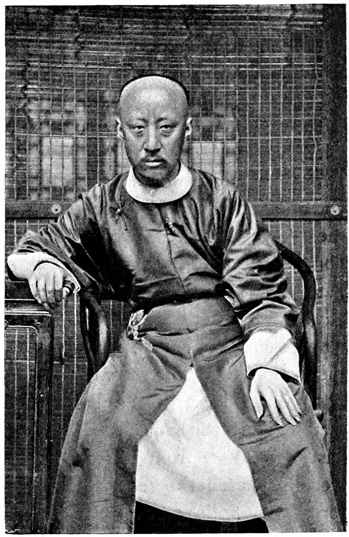
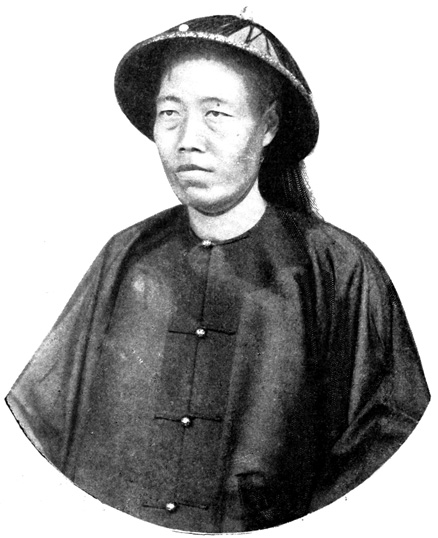
Kang Yü-wei.—China Mail's Interview.—Beheading
of Reformers.—Relatives sentenced to
Death.—Kang's Indictment of Empress.—Empress's
Reprisals.—Emperor's Attempt at Escape.—Cantonese
Gratitude to Great Britain.—List of Emperor's
Attempted Reforms.—Men now in Power.—Lord
Salisbury's Policy in China.
In considering the recent bolt from the blue, as it
seemed to the outside world, at Peking, it is
necessary to say a few words more about the Reform
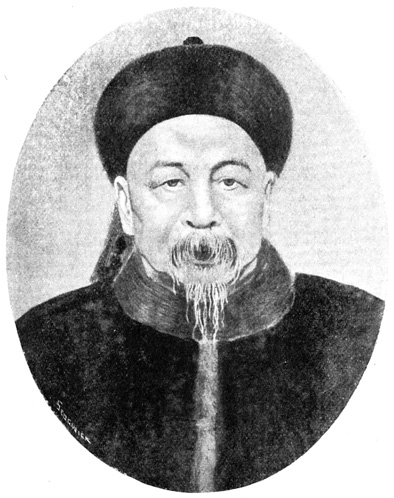
leaders. Kang Yü-wei, commonly called the Modern
Sage, is a Cantonese. He has brought out a new
edition of the ancient Classics, which he contends have
been so glossed over by numbers of commentators as
to have lost their original significance. In especial he
says the personality of God was originally clearly stated
in them, that it is the commentators who have hidden
this, and that only by a return to the belief in a living
God can China once more take her proper place among
the nations. He also insists upon the brotherhood of
man. Missionaries, who know him, dwell upon his
learning and enthusiasm. The only British Consul I
have heard speak of him, dwelt rather upon his want
of practicality, and described him as a visionary of about
forty and impracticable. He saw him, however, at
the most agitating moment of his career, during his
flight from Peking. When it is considered that he is
a man of not large means, who has no official post,
who must have devoted his time mainly to study to
have passed the examinations he has and revised the
Classics, and that at this comparatively early age he
is the undoubted leader of the army of youthful literati
of China, a man in whom those I have spoken with
seem to have unbounded confidence, it is clear that this
account of him must be a little overdrawn. Probably
he is not a practical man. But that he has evidently
an extraordinary gift for winning and guiding adherents
cannot be denied. A representative of the China Mail
describes him as "an intelligent-looking Chinese of
medium height, but not of unusually striking appearance.
For a native who does not speak any Western language,
Kang has imbibed a wonderful amount of ideas" [this
is only a rather amusing instance of European superciliousness],
and the impression he left upon his
interviewer was that he has a firmer grasp of the situation
than the majority of his compatriots. It may
be considered that some of his views are those of a
visionary, but there can be no doubt of his earnestness;
and it must be borne in mind that there never yet
was a reformer in any country whose views were not
at first believed to be outside the range of practical
politics. For those who are interested in the present
crisis in China, it is better to give the China Mail's
interview with Kang Yü-wei, to be followed by his
own open letter to the papers.
"Before proceeding with the interview, Kang wished
to thank the British people for the kind protection
they had afforded him, and for the interest the English
people were taking in the advancement of the political
and social status of China and the emancipation of the
Emperor. He also wished to explain that the reason
why he had not consented to an interview before was
that he was very much distressed upon learning that
his brother had been decapitated and that the Emperor
was reported to be murdered. The excitement and
anxiety of the past fortnight had unnerved him, and
he was disinclined to see any one or to discuss the
events which had led up to his flight from Peking.
"After this preliminary statement, Kang Yü-wei
proceeded with his story.
"'You all know,' he said, 'that the Empress-Dowager
is not educated, that she is very conservative,
that she has been very reluctant to give the Emperor
any real power in managing the affairs of the empire.
In the year 1887 it was decided to set aside thirty
million taels for the creation of a navy. After the
battleships Tingyuen, Weiyuen, Chihyuen, Chênyuen,
and Kingyuen had been ordered, and after providing
for their payment, the Empress-Dowager appropriated
the balance of the money for the repair of the Eho
Park Gardens. Later on, when it was decided to set
aside or raise thirty million taels for the construction of
railways, she misappropriated a large portion of the
money. The first intention had been to construct the
railway to Moukden, but it was never carried farther
than Shanhai-kuan, the remainder of the money being
used for the decoration of the Imperial Gardens.
Every sensible man knows that railways and a navy
are essential for the well-being of a country. But in
spite of the advice of one or two of her counsellors the
Empress-Dowager refused to carry on these schemes,
and thought only of her personal gratification. She has
been steadily opposed to the introduction of Western
civilisation. She has never seen many outside people—only
a few eunuchs in the Palace and a few Ministers
of State who have access to her.'
"'Through whom does she conduct the affairs of
State?'
"'Before the Japanese War Li Hung-chang was the
man she had most confidence in. After the war
Li Hung-chang was discarded, and she seemed to
repose most confidence in Prince Kung and Jung Lu.
As a rule, however, she retains absolute control in her
own hands. There is a sham eunuch in the Palace,
who has practically more power than any of the
Ministers. Li Luen-yên is the sham eunuch's name.
He is a native of Chihli. Nothing could be done
without first bribing him. All the Viceroys have got
their official positions through bribing this man, who
is immensely wealthy. Li Hung-chang is not to be
compared with him. Before she handed over the reins
of government to the Emperor, a year or two ago,
the Empress-Dowager used to see many Ministers,
but since then she
has only seen
eunuchs and
officials belonging
to the inner department.
I have
seen her myself.
She is of medium
height and commanding
presence,
rather imperious in
manner. She has
a dark, sallow
complexion, long
almond eyes, high
nose, is fairly intelligent-looking,
and has expressive
eyes.'
"In answer to
a query, 'Who
inspired the new
policy at Peking?'
Kang replied: 'About two years ago two officials,
Chang Lin and Wang Ming-luan, sent a memorial
to the Emperor advising him to take the power
into his own hands, stating that the Empress-Dowager
was only the concubine of his uncle, the
Emperor Hien Fêng; therefore according to Chinese
law she could not be recognised as the proper
Empress-Dowager. The result of this memorial was
that the two officials were dismissed for ever.
They were Vice-Presidents of Boards, one being
a Manchu and the other a Soochow man. The
Emperor recognises that the Empress-Dowager is not
his real mother. Since the Emperor began to display
an interest in affairs of State, the Empress-Dowager has
been scheming his deposition. She used to play cards
with him, and gave him intoxicating drinks, in order to
prevent him from attending to State affairs. For the
greater part of the last two years the Emperor has
been practically a figure-head against his own wishes.
After the occupation of Kiaochou by the Germans, the
Emperor was very furious, and said to the Empress-Dowager,
"Unless I have the power, I will not take
my seat as Emperor; I will abdicate." The result was
that the Empress-Dowager gave in to him to a certain
extent, telling him that he could do as he liked; but
although she said this with her lips her heart was
different.'
"'How do you know this?' asked the interviewer.
'Did you hear it yourself?'"
"Kang's reply was: 'No, I heard it from other
officials.'
"'Who recommended you to the notice of the
Emperor?'
"'I was recommended to the Emperor by Kao
Hsi-tsêng, one of the Censors, a native of Hupeh.
Then Wêng Tung-ho, the Emperor's tutor, who is
supposed to be one of the most conservative officials
in China, but is not actually so, devoted some attention
to me, and Li Tuan-fên, President of the Board of
Rites. These officials wished to introduce me to the
Emperor, to give me some responsible office, and to
put me beside the Emperor as his adviser. The
Emperor ordered me to hold a conference with the
Ministers of the Tsung-li Yamen. On January 3rd
last the conference took place. All the members of the
Yamen were present; I was received with all respect as
their guest. The conference lasted about three hours.
"'I had to say that everything in China must be
reformed and follow Western civilisation.'
"'How were your suggestions received?'
"'They did not say openly. I could see that the
majority of them were against reform. The Viceroy
Jung Lu made the remark, "Why should we change
the manners and customs of our ancestors?" To this
I replied: "Our ancestors never had a Tsung-li Yamen
[Board to deal with foreigners and foreign affairs].
Is not this a change?" The first thing I suggested
was that China should have a properly constituted
judicial system—that a foreigner should be engaged
to work conjointly with myself and some others to
revise the laws and the Government administrative
departments. That I hold to be the most important
change. This must be the basis on which all other
changes and reforms must rest. The construction of
railways, the creation of a navy, the revision of the
educational system, every other reform will follow; but
unless we can change the laws and administration all
other changes will be next to useless. Unfortunately,
the Emperor has been pushing on the other reforms
before preparing the way for them. That has contributed
to bring about the present crisis.
"'The following morning Prince Kung and Wêng
Tung-ho reported the conference to the Emperor.
Prince Kung was against me, although I have heard
it said that he admired my abilities, and thought me
clever and able. But he said of me: "He is talking
nonsense; he speaks about changing the ways of our
ancestors!" Wêng Tung-ho gave my proposals his
support.
"'The outcome of the conference was that I was
ordered by the Emperor to submit my proposals to him
in the form of a memorial. The gist of my memorial
was as follows. I told the Emperor that all the customs
and ways and manners of his ancestors must be renewed.
Nothing could be usefully followed so far as Chinese
history was concerned. I advised the Emperor to
follow in the footsteps of Japan, or in the footsteps of
Peter the Great. As a preliminary step I advised the
Emperor to command all his Ministers of State and
all the high officials in Peking to go before the places
where they worshipped the gods, and also to the
Ancestral Halls, there to make an oath that they were
determined to introduce reforms. My second suggestion
was to have the laws and administration revised; my
third, that he should open a Communication or Despatch
Department, through which any one would be
able to memorialise the Throne. To illustrate what I
considered lacking in the Chinese system, I pointed out
to the Emperor that the Ministers of the Grand Council
were the tongue, the Viceroys and Governors of Provinces
the hands and feet, the Censors the eyes, and the
Emperor the brain. I said: "You have no heart, no
motive power, no proper law, no means of finding out
the desires and opinions of your people. The responsibility
is too widely diffused; you cannot carry things
through effectively. When you want to know anything,
you refer to your Ministers and Viceroys, who represent
the tongue and feet; but these are not thinking organs—they
can only act upon orders given them." I advised
the Emperor to select young, intelligent men, well
imbued with Western ideas, to assist in the regeneration
of the empire, irrespective of their position, whether
they were lowly born or of high degree; that they
should confer with the Emperor every day and discuss
the measures for reform, first devoting their energies
to a revision of the laws and administration. The old
officials must be dispensed with. I advised him to
appoint twelve new Departments:—(1) Law Department;
(2) Treasury; (3) Education (engaging foreign teachers);
(4) Legislative Department; (5) Agriculture; (6) Commercial
Department; (7) Mechanical Department;
(8) Railway Department; (9) Postal; (10) Mining;
(11) Army; (12) Navy,—all the twelve Departments to
be modelled on Western lines, and foreigners to be
engaged to advise and assist. Throughout the provinces,
in every two prefectures, I suggested the establishment
of a sort of Legislative Council, whose chief duty would
be to give effect to the instructions of the twelve
Departments, to police the country, to introduce sanitary
measures, to construct roads, to induce the people to
cultivate the land under modern methods, and to spread
commerce. Each of these Councils should have a
President, appointed by the Emperor himself, irrespective
of birth, degree, or position; and each President should
have the liberty to memorialise the Emperor direct,
in the same manner as Viceroys and Governors of the
Provinces, to whom he was not to be subject. In effect
these Presidents were to have the same social rank as
the Viceroys. The President was also to have the
power to recommend a man to go to each district to
co-operate with the gentry and merchant classes in
giving effect to the new reforms. My memorial also
showed how funds were to be raised. I pointed out the
enormous loss of revenue that occurred yearly. Taking
the magistracy of Nanhai (which is my native district),
I informed the Emperor that the total revenue derived
from that district was $240,000 per year, but the actual
amount going into the Imperial Purse was only something
over $20,000. I recommended a complete change
of the system, under which the whole of the revenues
of the country would go into the Imperial Purse.
Comparing China with India, and adducing from the
experience of India the financial resources of China,
I told the Emperor that from ordinary taxes the sum
of four hundred million taels could be raised annually,
and if the likin were abolished and a tariff properly
adjusted, banknotes issued, stamp duty established, and
other financial reforms adopted, at least another three
hundred million taels could be raised, making in all
seven hundred million taels. With this money in hand
it would be an easy thing to get a navy to protect our
coast and to establish naval colleges for the training
of officers. State railways could also be constructed
and other necessary reforms effected.
"'I was told that the Emperor was highly pleased,
and said that he had never seen a better memorial nor
such a good system as I proposed. He recommended
the memorial to the consideration of the Tsung-li Yamen
for report. Prince Kung, Jung Lu, and Hsü Ying-kuei
were against it; but the Emperor pressed for a reply,
which was never given in detail. All the Ministers
would report was that the memorial was so sweeping,
that it practically meant the abolition of the present
great Ministers, and therefore they did not like to
report upon it themselves. You will have seen in the
newspapers that the Emperor had already adopted many
of the recommendations contained in my memorial.
"'I also sent to the Emperor two books written
by myself, one entitled The Reform of Japan and the
other The Reform of Russia by Peter the Great.
Subsequently I sent another memorial, advising the
Emperor to be determined and not to dally with the
proposals for reform.
"'To this memorial the Emperor replied with an
Edict. On June 16th I was granted an audience with
the Emperor. It lasted for two hours. I was received
at 5 a.m. in the Jênshow Throne-hall. Port Arthur and
Talienwan had just been taken over by Russia, and the
Emperor wore an anxious, careworn expression. The
Emperor was thin, but apparently in good health. He
has a straight nose, round forehead, pleasant eyes, is
clean-shaven, and has a pale complexion. He is of
medium height. His hands are long and thin. He
looked very intelligent, and had a kindly expression,
altogether uncommon amongst the Manchus or even
amongst the Chinese. He wore the usual official dress,
but instead of the large square of embroidery on the
breast worn by the high officials the embroidery in his
case was round, encircling a dragon, and there were two
smaller embroideries on his shoulders. He wore the
usual official cap. He was led in by eunuchs, and took
his seat on a dais on a large yellow cushion, with his
feet folded beneath him. He sent his attendants away,
and we were left alone; but all the time we were conversing
his eyes were watching the windows, as if to see
that no one was eavesdropping. There was a long table
in front of him with two large candlesticks. I knelt
at one of the corners of the table, and not on the
cushions in front of the table which are reserved for
the high officials. I remained kneeling during the
whole of the audience. We conversed in the Mandarin
dialect.
"'The Emperor said to me: "Your books are very
useful and very instructive."
"'I practically repeated what I said in my memorial
about the weakness of China being owing to the lack
of progress.
"'The Emperor said: "Yes, all these Conservative
Ministers have ruined me."
"'I said to him, "China is very weak now, but it is
not yet too late to amend." I gave him the example of
France after the Franco-Prussian War. In that case
the indemnity was much greater than China has paid to
Japan. The territory lost was greater, because France
had lost two provinces and China had only lost one
(Formosa). I asked him how it was that France had
been able to recuperate so rapidly, whereas China had
done practically nothing during the three years since the
close of the war.
"'The Emperor listened very attentively, and asked
me to give the reason.
"'I replied that the reason was that M. Thiers issued
proclamations to the people of France advising the
abolition of corrupt methods and asking their co-operation
for the rehabilitation of the country, at once
instituting reforms which would enable the country to
recover the ground it had lost. The outcome was that
the whole population of France was as one man working
for one single object. Hence its quick recovery. In
China, however, we have still the old Conservative
Ministers, who put every obstruction in the way of
reform; and I told the Emperor that that was the main
reason why the country was now in its present sad
condition, worse off than it was three years ago, at the
close of the China-Japan War.
"'I asked him to look at the difficulties Japan had
to overcome before she could reform on modern lines.
There the military or feudal party had more power than
our present Conservative Ministers, but the Mikado
adopted the proper course by selecting young and
intelligent men, junior officials, some of whom he set to
work out the reforms in the country, whilst others went
abroad to learn foreign methods, and returned to make
Japan the powerful country which it is to-day. I
repeated to him what Peter the Great did to make
Russia powerful, saying, "You, the Emperor, I would
ask you to remove yourself from the seclusion in which
you live. Come boldly forward and employ young and
intelligent officials. Follow in the footsteps of the three
rulers of whom I have spoken to you, and you will find
that the reforms will be more easily carried out than you
at present imagine. In case China is unable to produce
a sufficient number of intelligent men to give effect to the
reforms you initiate, I strongly advocate the employment
of foreigners, particularly Englishmen and Americans."
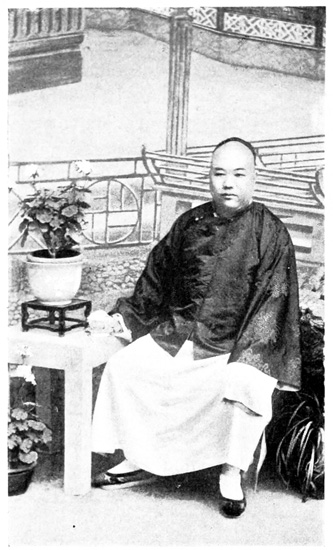
HEAD EUNUCH OF THE EMPRESS-DOWAGER.
Lent by Rev. Gilbert Reid.
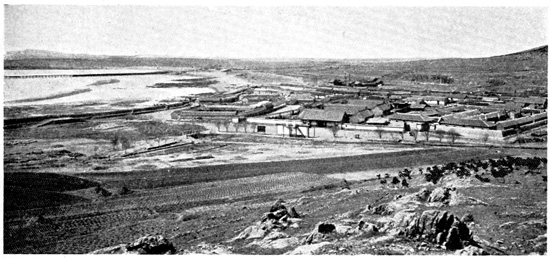
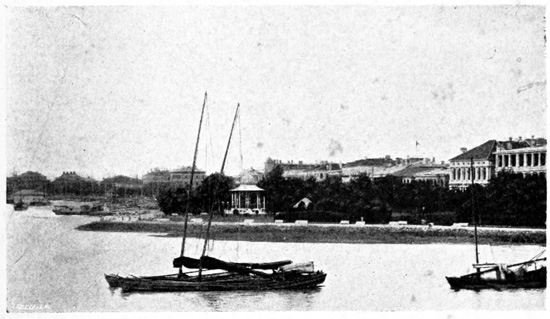
KIAOCHOU, SEIZED BY GERMANY.
"'I said to him: "You must cut your coat according
to your cloth,' and advised him to approach the matter
carefully and deliberately. To illustrate what I meant, I
pointed out that if he wished to build a palace he must
obtain plans, then buy the bricks to build the palace
according to design. "You may be told that China has
reformed during the last few years. In my opinion
nothing has been reformed. China has simply done
what I have advised you not to do. She has been
buying bricks to build a house before deciding on the
plan or design; she is attempting to make a big coat out
of an insufficient quantity of cloth." I told the Emperor:
"Your present Government is just like a building with
a leaky roof; the joists are rotten and have been eaten
by white ants. It is absolutely dangerous to remain
longer in the building. Not only must you take off the
roof, but you must take down the whole building, and
even raze the foundation. How could you expect your
present old Ministers to reform? They have never had
any Western education. They have never studied
anything thoroughly about Western civilisation, and
they could not study now if you asked them. They
have no energy left. To instruct them to carry out
reforms is like asking your cook to become your tailor,
your tailor to become your cook, or your barber to
become your chair-coolie and your chair-coolie to shave
you. The result of that would be that you would not
get a good coat, you would get nothing good to eat,
your head would be hacked. Your Majesty is careful
to select a proper tailor, a proper cook, a proper barber,
and a proper chair-coolie. But in the administration of
your empire, which is far more important, you do not
take so much care as in your own personal affairs."
"'To this the Emperor replied: "I am very sorry; I
have practically no power to remove any high Ministers.
The Empress-Dowager wants to reserve this power in
her own hands.'
"'I said: "If your Majesty has no power to remove
Ministers, what you can do is to employ young and
intelligent officials about you. That would be a step
better than nothing."
"'The Emperor said: "I know it perfectly well that all
the Ministers have paid no proper attention to Western
ideas and do not care to study the progress of the world."
"'I said to the Emperor: "Perhaps it is their wish
to get a knowledge of Western ideas, but they have too
much to do under the present system, and they are
much too old. Their energy is gone. Even if they
are willing they cannot do it. The chief education of
China in the study of the Classics is useless, and the
first thing the Emperor must do is to abolish these
examinations and establish a system of education on the
lines of Western countries." I asked the Emperor:
"Can you do away with this kind of examination?"
"'The Emperor said: "I have realised that whatever
is learned in Western countries is useful, but whatever is
learned in China is practically useless, and I will carry
out your recommendations"; which he did. I advised
the Emperor to send his own relations to travel in
foreign countries in order to learn from them, and that
he might be surrounded by men who had experience of
the world. In conclusion, I said: "There are many
other things I should like to say, but I can memorialise
you from time to time." I advised him strongly to
cement his relations with foreign countries.
"'The Emperor replied that the foreign countries
nowadays were not like the insignificant states of former
times. They appeared to be highly civilised countries,
and it was a pity his own Ministers did not realise that
as he did. A good deal of the trouble seemed to arise
from their failure to recognise this fact.
"'In December last I had advised his Majesty to
form an alliance with Great Britain. Before parting
I said to him: "You have given decorations to Li
Hung-chang and Chang Yin-huan. That is a Western
act. Why do not you put in your Edicts that you intend
to introduce Western customs?"
"'The Emperor only smiled.
"'From June until I left Peking, I have sent many
memorials to the Emperor, but have never had another
audience. I was allowed to memorialise him direct.
This is the first time in the present dynasty that an
individual in my position has been allowed to memorialise
the Throne direct.'
"In answer to a question, Kang stated that Chang
Yin-huan was not associated with him in the proposed
reforms. He was pleased with the programme of the
Reformers, but he did not take any active part in promoting
the reforms. All the men arrested were junior
officials in the various secretariats in Peking, all interested
in reform.
"Asked when the first symptoms of trouble appeared,
Kang stated that the signs of opposition were raised
when the Emperor issued his Edict dismissing two
Presidents and four Vice-Presidents. One of these
Presidents is a relative of the Empress-Dowager—Huai
Ta-pu, President of the Board of Rites. On the following
day Li Hung-chang and Ching Hsin were removed
from the Tsung-li Yamen. These dismissed officials
went in a body and knelt before the Empress-Dowager
and asked for her assistance, saying that if she allowed
the Emperor to go on in this way the whole of the old
officials would soon be dismissed. Then these officials
went to Tientsin and saw Jung Lu, who may be said
to be the best friend of the Empress-Dowager.
Rumours got about that the Emperor intended to dispose
of the Empress-Dowager, and she then determined
that Jung Lu should take the first step. That was on
or about September 14th or 15th. On September 17th
an open Edict was issued by the Emperor, asking why
Kang Yü-wei was still in Peking and did not proceed
to Shanghai at once to attend to the establishment of
the official organ. 'That was a hint to me to go away.
An Edict of this sort is generally issued to a Viceroy
or a Chief General, and not to men of my rank. The
morning I saw this Edict I was highly astonished. On
that evening a special private message was sent to me
by the Emperor. The message was sent in writing.
Part of it appeared in the China Mail last night. I
happened to be out, and did not receive the message
till the morning of September 18th.
"'On the morning of the 18th I received two special
messages from the Emperor, one dated September 16th
and the other September 17th. The first one read:
"'"We know that the empire is in very troublous
times. Unless we adopt Western methods it is impossible
to save our empire; unless we remove the old-fashioned
Conservative Ministers and put in their stead
young and intelligent men, possessed of a knowledge
of Western affairs, it is impossible to carry out the
reforms we had intended. But the Empress-Dowager
does not agree with me: I have repeatedly advised
her Majesty, but she becomes enraged. Now I am
afraid I shall not be able to protect my throne. You
are hereby commanded to consult your colleagues and
see what assistance you can give to save me. I am
very anxious and distressed. I am anxiously waiting
for your assistance. Respect this."
"'The second message was as follows: "I have
commanded you to superintend the establishment of
the official organ. It is strongly against my wish. I
have very great sorrow in my heart, which cannot be
described with pen and ink. You must proceed at once
outside (abroad), and devise means to save me without
a moment's delay. I am deeply affected with your
loyalty and faithfulness. Please take great care of your
health and body. I hope that before long you will be
able to assist me again in reorganising my empire, and
to put everything upon a proper basis. This is my
earnest wish."
"'After I received these letters, I had a meeting with
my colleagues as to the best thing to be done. I saw
Mr. Timothy Richard, the English missionary, and
asked him to see the British Minister at once. Unfortunately
Sir Claude Macdonald was at Pehtaiho.
Then I sent to the American Legation, but was told
that the American Minister had gone to the Western
Hills. If Sir Claude Macdonald had been at the
British Legation, I believe measures could have been
devised to avoid this crisis.
"'In the city everything was quiet. There was no
sign of an impending crisis. Nobody anticipated trouble;
nobody was in fear of his life. On the 19th I heard
from my friends that the position was getting more
serious. Up to this time I had remained in my
quarters in the Canton Club. At four o'clock on
the morning of the 20th I left the city, passing
through the gates, leaving all my baggage behind in
the care of my brother. I retained a compartment in
the railway carriage, and travelled direct to Tangku by
rail. At Tientsin I boarded the Indo-China steamer
Lienshing and asked for a cabin. When the people
on board saw I had so little baggage they said: "You
must go and get a ticket at the office before we can
allow you to come on board." I went back to Tientsin
again and went into an hotel—not an hotel of my own
countrymen, but the hotel of another province. I had
been advised to shave my moustache off and to change
my dress, but I left myself to fate. I stayed overnight
at Tientsin, and early in the morning went on board
the Chungking. I had to go as an ordinary Chinese
passenger, because I was afraid if I asked for a cabin
I should again be refused a passage on account of the
absence of baggage. Mr. Timothy Richard offered me
an asylum at his house, but as I had received instructions
from the Emperor to proceed abroad I thought it best
to leave the capital. I got no letter from the British
Legation; I had no communication with the British
Legation. The steamer called at Chefoo, where nothing
unusual happened. When I arrived at Woosung, the
British Consul was kind enough to offer me a place
of safety on board H.M.S. Esk. I believe Mr. Richard
must have gone to the Legation at Peking, and that
instructions were given to the British Consul to be on
the look-out for me. I was surprised at this, but I am
very grateful to Messrs. Brenan and Bourne (British
Consuls) and to the captain of the ship for the kindness
they showed to me during my stay at Woosung.'
"'What do you intend to do?'
"'The Emperor has instructed me to go abroad and
procure assistance for him. My intention is to approach
England in the first instance. England is well known
to be the most just nation in the world. England has
twice saved Turkey, once at the sacrifice of twenty
thousand men and a large sum of money, and I think
England will come to the assistance of the Emperor
of China now. While I was in Shanghai, I requested
the British Consul to wire to the Foreign Office at
home asking for this assistance to his Majesty. Personally,
I think it is to England's interest to take this
opportunity to support the Emperor and the party of
progress, for by so doing they will be helping the
people of China as well, and the people of China
will consider England as their best and truest friend.
If England does not take steps now, I am afraid that
when the Siberian Railway is finished Russian influence
will predominate throughout the whole of China. If
England succeeds in replacing the Emperor on the
throne, I have no hesitation in saying that the Emperor
and the Reform leaders will not forget her kindness.
When I left Peking, the Emperor was still in good
health.'
"Before leaving Kang was asked if he had anything
further to add to the interview—anything he had
forgotten.
"He replied: 'I should like it to be stated that when
I saw the Emperor I said I did not go to Peking for
money or position. I simply went there to try to do
my best to save the four hundred millions of China.
I told him I would not take any high position until I
had been instrumental in carrying through the proposals
for reform I had made to him; then I would accept
anything his Majesty was pleased to give me. Had
he given me position then, it would simply have created
jealousy among the old Ministers; besides, I did not
feel that I had done anything to warrant such elevation.
The Emperor was good enough to send me
two thousand taels as a special reward—a thing, I
believe, which has never been done in the history of
the present dynasty.'
"The interview concluded with a request on the part
of Kang to urge the English people to take steps for
the protection of the relatives of Liang, who had been
arrested by the officials in the district of Canton. These
relatives, we understand, consist of his foster-mother,
aunt, uncle, brother, and his nephew and two others."
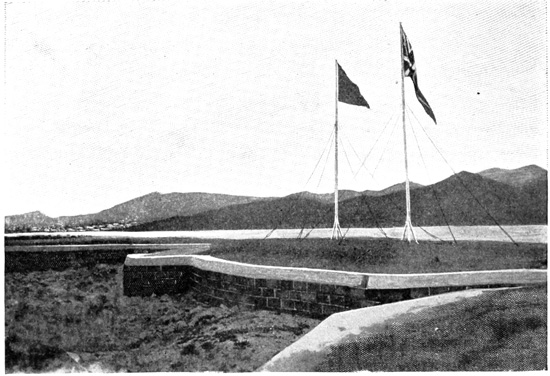
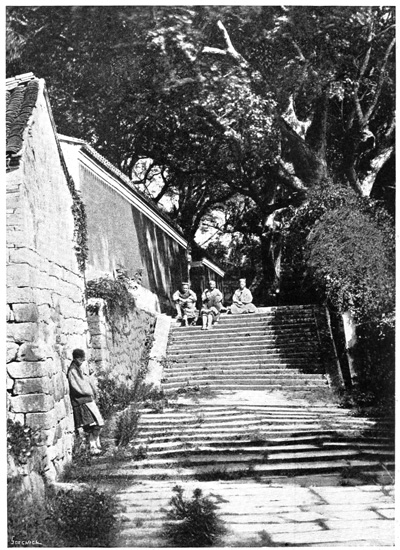
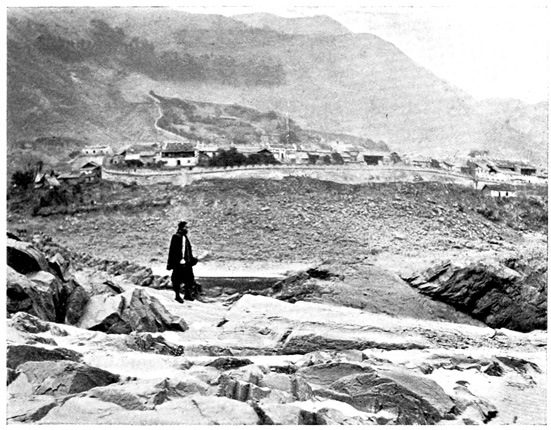
BRITISH AND CHINESE FLAGS, JUNE 15TH, 1898:
TOWN OF WEI-HAI-WEI IN DISTANCE.
By Mr. Stratford Dugdale.
This interview was on October 7th. It was on
September 22nd that Kang's six colleagues had been
summarily beheaded in Peking. Three were members
of the Hanlin College, the highest body in China—namely,
Lin Hsio, Yang, and Lin Kuang-ti. One was
a Censor—Yang. The others were Kang's younger
brother, and Tan Tze-tung, son of the ex-Governor
of Hupeh. It is Tan who went to his death saying,
"They may kill my body, but my spirit will live in
the lives of others," and again, "My country will yet
be freed from the tyrants that now enthral her in their
grasp of ignorance and corruption."
A newspaper correspondent wrote from Hupeh:
"Nothing but sympathy is felt for poor old Tan, our
ex-Governor, the father of Tan Tze-tung, who was
beheaded in Peking. It is said that for a long time the
news of his son's death was kept from him, and was
finally told him by our Viceroy, Chang-chih-tung himself,
when the latter went on board his ship to bid him
farewell on his departure from Wuchang." And again,
a few days later: "Our late Governor, H.E. Tan, is
reported dead. The native story is that he took the
execution of his son at Peking and his own degradation
so much to heart, that he committed suicide on his way
home."
It is related that none of the victims conducted
themselves otherwise than as heroes, excepting only
the Censor, who was so utterly astounded at the fate
befalling him as to plead with his executioners. He
had never known Kang, said he had taken part in no
plot, and wept bitterly as he was hurried through the
streets. It is related also that all were given decent
burial with the exception of Kang's own young
brother, whose body no man dared touch.
Kang Yü-wei's ancestral home is in the small village
of Fangchun, right opposite the walls of Canton City,
and separated from it by the Pearl River. Late on
the night of September 23rd the quiet village was all
excitement at the sudden disappearance of all the
members of Kang's clan, leaving no trace of their
whereabouts. Explanations came, however, the next
morning, when a force of runners from the district
magistrate made their appearance in the village, and,
surrounding the old Kang homestead, began searching
for the inmates. Only four persons were found in the
place, consisting of farm-hands, and these were taken
across the river into the city by the runners for want
of more important prisoners.
Kang's uncle, who kept a large grain shop in
Canton, had a narrow escape from arrest, the warning
to get away arriving only a few minutes before the
police made their appearance, while his employés also
got away in the nick of time. The premises were
then sealed up, as also was the ancestral hall of the
Kang clan in their native village of Fangchun. A
flourishing school established by Kang in the old
city temple of Canton was also sealed by the local
authorities, but fortunately for the twenty-odd scholars
there they received warning and escaped before the
yamen runners made their appearance.
Mr. Liang, the editor of Chinese Progress, was
warned by Kang in time to fly himself, but four of
his relatives had been captured. It was under the
agitation of all these events that Kang Yü-wei wrote
the following letter, which only one Chinese newspaper
had the courage to publish. Perhaps, considering what
has followed, it is kinder to suppress its name.
AN OPEN LETTER FROM KANG YÜ-WEI.
"Respected Seniors,—
"The overpowering calamity which fell from
Heaven on the fatal 5th day of the 8th moon
(20th September), bringing such unexpected and fearful
changes over the empire by the usurpation of the
Imperial power by the antitype of those vile and
licentious ancient Empresses Lü and Wu, followed by
the deposition and imprisonment of our true Sovereign,
causing thereby heaven and earth to change places and
obliterating the lights of the sun and moon from his
Majesty's loyal subjects, have, I know, filled with
universal indignation the hearts of the people.
"Our youthful Emperor's intelligence and enthusiasm
made him bend his energies to inaugurate new measures
of reform for the country, to be put into practice in
due time one after the other, and all who owed his
Majesty loyalty and allegiance learning this raised our
hands to our heads with pleasure and danced with joy.
The False One [or Usurper] attempted to introduce
avarice and licentiousness into the Palace, in order to
tempt our Sovereign to destruction; but his Majesty
spurned them with scorn, and these evils were unable
to defile the Palace atmosphere. Then one or two
traitors of the Conservative element, finding their objects
prevented, threw themselves prostrate around the
Usurper and besought her to resume the reins of power.
(Note.—Owing to the cashiering of Huai Ta-pu,
President of the Board of Rites, and his colleagues,
Huai and Jung Lu were at the bottom of the whole
plot.) The False One then, contrary to all rights of
heaven and earth, seized the reins of power and
issued a forged edict calling for physicians for his
Majesty, thereby foreshadowing that the Emperor
would be poisoned. To-day, therefore, we know not
whether his Majesty be alive or dead. This indeed
is that which makes gods and men indignant and feel
that heaven and earth will never pardon nor allow such
to triumph long.
"This Usurper, when she came into power in former
years, poisoned the Eastern Empress-Consort of Hien
Fêng; she murdered with poisoned wine the Empress
of Tung Chih; and by her acts made the late Emperor
Hien Fêng die of spleen and indignation. And now
she has dared to depose and imprison our true
Sovereign. Her crime is great and extreme in its
wickedness. There has never been a worse deed.
Although the writer, your humble servant, and Lin,
Yang, Tan, and Liu [four of the six martyrs] all received
his Majesty's commands in his last extremity, we, alas!
have not the power and strength of Hsü Chin-yi [who
restored the Emperor Tsung-chung to the throne after
deposing the Empress Wu Tsêh-tien of the T`ang
Dynasty], but can only emulate the example of Shên
Pao-sü in weeping. [This was a minister of Ts`u
(Hunan), who over two thousand years ago went weeping
to beseech the powerful King of Chin (Shensi) to
avenge the deposition of his master the King of Ts`u,
and by his importunity succeeded in carrying his point.]
"I, therefore, now send you copies of his Majesty's
two secret edicts to me, and crave your assistance in
publishing them to the whole world either in the
Chinese or foreign newspapers. This will, I earnestly
trust, bring strong arms to our Sovereign's rescue. His
Majesty has always accepted the fiat of his ancestors
in recognising the mother who bore him as his own
mother, and not an Imperial concubine as his mother.
The False One in relation to the Emperor Tung Chih
was the latter's mother; but as regards his Majesty
Kwang-shü, our Sovereign, she is but a former
Emperor's concubine-relict [Hien Fêng's]. According
to the tenets of the Spring and Autumn Records (written
by Confucius), although Queen Wên Chiang was the
mother of King Chuang of Lu, yet that did not
save her from being imprisoned by her own son on
account of her licentious conduct; much more in the
present case, then, should punishment be administered
to one who was but merely a Palace concubine. What
right had this woman to depose our bright and sagacious
Emperor? If this could be clearly set forth in
the Chinese and foreign newspapers and be published
to the world, I verily believe that from Peking to
Yunnan and the sixteen ancient divisions of China
some hero must surely arise to avenge our Sovereign.
With my humble compliments,
"(Signed) Kang Yü-wei."
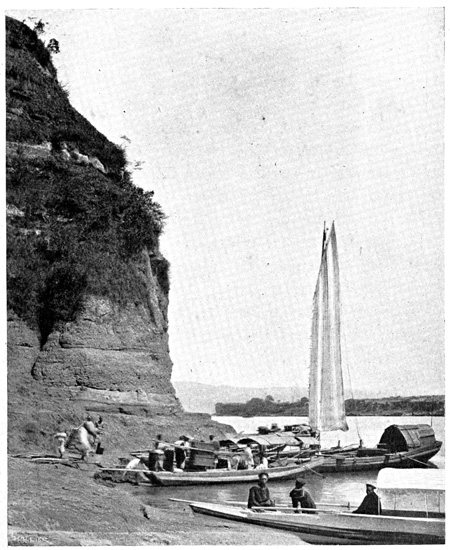
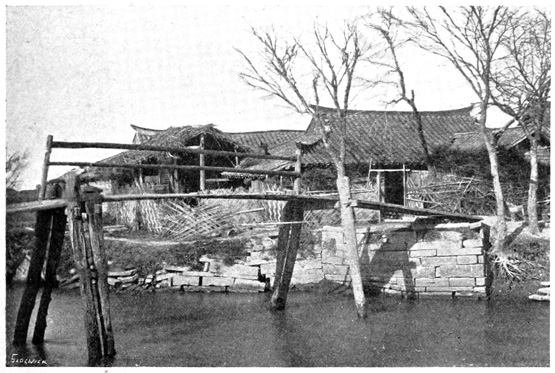
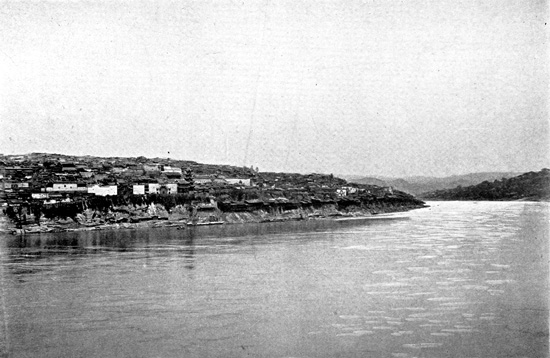
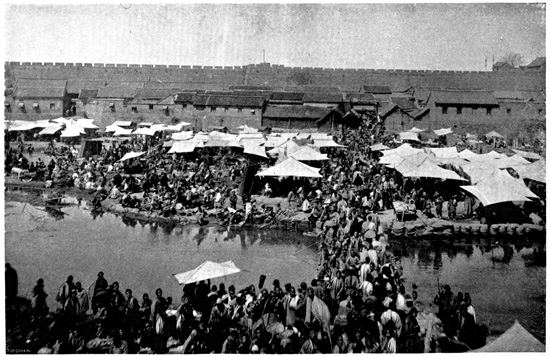
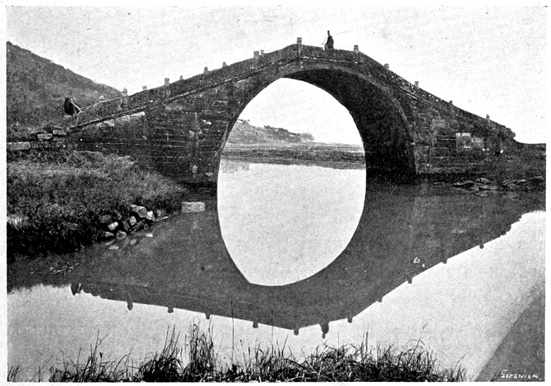
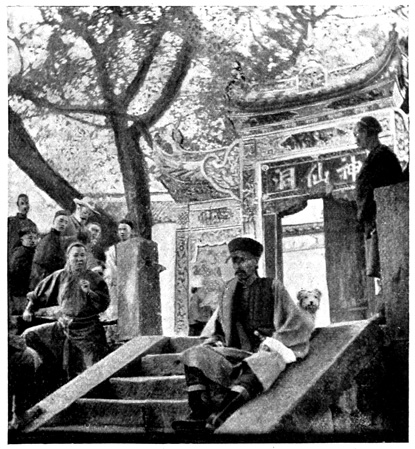
FERRY AT ICHANG.
By Mrs. Archibald Little.
It is hardly necessary to comment upon the extreme
pathos of the letters of this young man of twenty-seven,
for twenty-three years nominal Emperor of
China, but now, at the first attempt to take the power
into his own hands, summarily deposed. It is believed
that it was his attempt to summon soldiery to his aid
that led to the Empress's coup d'état. Some say the
Reform party were advising that the Empress-Dowager
should be asked to retire to a palace in the country.
"The following is the list of the proposed 'Council
of Ten' who were to have assembled daily in the
Maoching Throne-hall to advise the Emperor on reform
measures, as given by the Sinwênpao:
"1. Li Tuan-fên (President of the Board of Rites
to be President of the Council).
"2. Hsü Chih-ching (Senior Reader of the Hanlin
Academy, and at the time of his disgrace acting Vice-President
of the Board of Rites).
"3. Kang Yü-wei (Junior Secretary of the Board of
Works and a Secretary of the Tsung-li Yamen).
"4. Yang Shen-hsiu (Censor of the Kiangnan
Circuit).
"5. Sung Peh-lu (Censor of the Shantung Circuit).
"6. Hsü Jên-chu (Literary Chancellor of Hunan).
"7. Chang Yuan-chi (Hanlin Compiler).
"8. Liang Chi-chao (M.A., ex-editor of Chinese
Progress).
"9. Kang Kuang-jên (M.A., and younger brother of
Kang Yü-wei).
"10. Hsü Jên-ching (Hanlin Bachelor, son of Hsü
Chih-ching and brother of Hsü Jên-chu).
"With reference to the punishments meted out to
the above-noted ten: (1) Li Tuan-fên was cashiered
and banished to Kashgaria for ever; (2) Hsü Chih-ching,
imprisoned in the dungeons of the Board of
Punishments for life; (3) Kang Yü-wei, proscribed
and ordered to be sliced to pieces at moment of capture;
his family to suffer death, together with his uncles,
aunts, and cousins, and their ancestral graves to be
razed; (4) Vang Shen-hsiu, one of the Martyred Six;
(5) Sung Peh-lu, disappeared the day he was cashiered
and dismissed for ever—September 23rd—but is reported
to have been captured afterwards while travelling
overland for the South; (6) Hsü Jên-chu, cashiered
and dismissed for ever; (7) Chang Yuan-chi, a man of
great wealth, also cashiered and dismissed for ever;
(8) Liang Chi-chao, proscribed and now a refugee in
Japan; (9) Kang Kuang-jên, one of the Martyred
Six; and (10) Hsü Jên-ching, also cashiered and dismissed
for ever. As for Li and Hsü, the first and
second of the list given above, their place would also
have been by the side of the Martyred Six on the fatal
evening of the 28th ultimo, had they not been aged
men, high in rank.
"It is reported from reliable sources at Peking
that on the day of the Empress-Dowager's coup d'état
(September 22nd) no less than fourteen eunuchs who
were the Emperor's own personal attendants, and on
whose devotion he was in the habit of relying, were
ordered to execution by the Empress-Dowager. The
reason given why this sanguinary deed has not become
widely known is that the executions took place in the
courtyard of the chief eunuch's office, inside the Palace
grounds, where refractory and rebellious eunuchs are
always attended to, unknown to the outside world."
It is not surprising that, according to the Peking
correspondent of the Sinwênpao, in October, 1898, a
great fear of some impending disaster seemed to have
fallen over the capital, and numbers of houses had the
words "Speak not of State Affairs" written on slips of
red paper posted over the lintels of each household;
the idea being that something must have very recently
happened in the Palace at Eho Park, which the powers
that be desired to keep secret from the world for the
time being.
The railway had been crowded the past week with
officials from the provinces returning to their homes.
They were afraid to remain where every word they
uttered was liable to be considered treason. When they
reached their homes, we may expect their reports to
their friends and adherents would not increase their
loyalty to the Manchu Dynasty.
And yet, in spite of all this, people are surprised
that the young man of twenty-seven, without funds,
without an army, did not assert himself more. The
silence of Kwang-shü is perhaps the noblest action of
a much-enduring life.
There was a pathetic story current in Peking that
he contrived once to escape from his prison in the
island at the Southern Lakes, Eho Park, where he
had been confined by the Empress-Dowager since the
coup d'état; but that when he got to the Park gates,
the Imperial guards, all creatures of the Empress-Dowager,
shut the great gates in his face. A crowd
of eunuchs, who dared not offer his person any violence
or attempt to use force in preventing his walking to
the Park gates, followed him in a body, and upon the
gates being closed they all knelt in front of the Emperor
beseeching him with tears to have mercy on them and
not attempt to escape, for it would mean the death
of all of them as well as of the guardsmen at the
gates were he to do so. The guardsmen also k`otowed
and joined in the general prayer, while on the other
hand they sent one of their number to apprise the
Empress-Dowager of the matter. The Emperor finally
took pity on his suppliant subjects, and quietly returned
to his prison.
To Europeans this may seem too strange to be
true; to those who know China it is so Chinese as to
seem probable. That an Emperor should be moved
by the tears of his subjects is what Chinese would
expect.
It must be remembered that Kang escaped through
the intervention of British Consuls, by the protection
of a British man-of-war, and was lodged for safety
in the gaol at Hongkong at first. Thence he proceeded
to Japan, where other Chinese reformers had
preceded him, under Japanese protection. The North
China Herald of October 3rd, 1898, publishes the
following tribute of gratitude from the fellow-provincials
of Kang Yü-wei to the Consuls, Admiral, and
people of the "Great Empire of Great Britain," for
saving Kang from the clutches of the opponents of
reform, purporting to represent the sentiments of
the Shanghai Cantonese:—The contents of the post
envelope were (1) a red card with the words, "Presented
with bowed heads by the people of Kwangtung
(Canton) Province"; (2) another red card bearing the
words, "The people of Kwangtung Province reverentially
beg to present their united thanks to the people
of the great, unequalled Empire of Great Britain for
this proof of loyalty, kindness, majesty, courage, and
love of strict justice"; and (3) a sheet of letter paper
containing the words, "We, the people of Kwangtung
Province, crave permission to express our deep gratitude
to their Excellencies the Consuls and the Admiral of
the Great Empire of Great Britain for their great
kindness to us.
"Reverentially presented by the people of Kwangtung
Province.
"We further beg the editor of the North China
Daily News to give publicity to the above in its
valuable columns, and hope personally to give thanks
therefor."
Since then, on October 31st, 1898, the following
memorial was presented to the British Consul-General,
Mr. Brenan. He could not, as an official, receive it,
but the pathetic document cannot but be read with
interest.
"Sir,—The avarice and extortions of the mandarins
of China and their underlings were the cause of the
Emperor's estrangement from his people; and it was
this estrangement that has led to his present weakness
and their distress.
"Recognising the need for reform, the Emperor in
his wisdom and good judgment began, during the
fifth moon of the present year, to issue edicts, having
for their object the complete renovation of the Empire.
The main subjects dealt with were as follows:
"1. The substitution of men of modern ideas and
learning for old and useless officials.
"2. The establishment of colleges and technical
schools for the advancement of scientific knowledge,
after the most approved methods of Western nations.
"3. Conferring the right to memorialise the Throne
direct upon all officials throughout the empire, without
distinction of rank.
"4. The abrogation of the classical essay system of
examinations for degrees and offices.
"The above edicts caused much rejoicing among
the people, who recognised in them a great power for
the immediate uplifting of the empire, and its future
prosperity.
"We, your memorialists, are firmly convinced that
if the reforms embodied in the Imperial Edicts could
have been put into operation for twenty or thirty years,
great and beneficial changes would have been brought
about, which would have resulted in the entire change
of the customs of the land, and establishment of better
relations with the West. Thus we could have looked
forward confidently to the inauguration of an era of
universal peace.
"But now, through the machinations of evil men
and the short-sighted policy of the Empress-Dowager,
our Emperor has been imprisoned, the lives of many
faithful officers have been ruthlessly taken, and all the
Imperial Edicts calling for reform have been revoked.
All educational societies have been interdicted, and the
native newspapers have been suppressed. Moreover,
the lives of all those favourable to reform are in the
gravest danger.
"We, your memorialists, being loyal Chinese subjects,
regard with great indignation such unwarrantable
action on the part of the Empress-Dowager; but we
have no power to rectify this unhappy state of affairs.
"Therefore we pray you, sir, according to that
equity which is recognised among all nations, to pity
China in her distress, by sending a cablegram to the
Government, urging your people to assist us by restoring
the Emperor to his rightful throne, and by filling the
offices of State with faithful and enlightened men.
"Thus will the renovation of China be due to the
favour of your Sovereign Ruler, and to you, sir, who
forwarded the memorial.
"P.S.—Chinese officialdom is at present divided
into two classes, the old and new—Conservatives and
Reformers. The former have placed their reliance
on Russia to help them, in return for which Russia
will gain enlarged territory. The Reformers look to
Great Britain and the United States for help, knowing
that the policy of these two nations is to keep the
Chinese Empire intact. Should the reactionists triumph
in their present schemes, there is no power that will
prevent the division of China among all the nations of
the earth. The Reformers have no power. They can
only weep at their country's distress, while they present
this memorial asking for your honourable country's
assistance. The first thing to be done is to liberate the
Emperor and to restore him to power, and to remove
the Empress-Dowager. A proclamation from the
Emperor calling his people to his protection would
be loyally responded to by all his faithful subjects
throughout the land.
"A joint memorial from the scholars—literati—of
China.
"24th Year of H.M. Kwang-shü,
"9th moon, 17th day.
"(October 31st, 1898)."
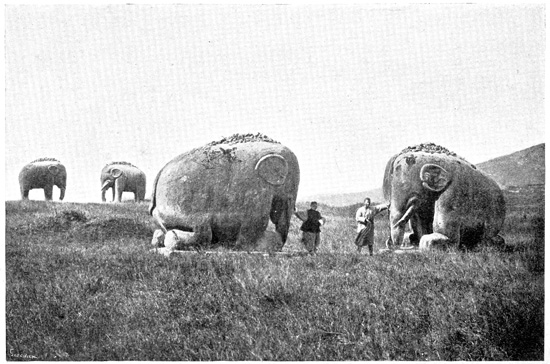
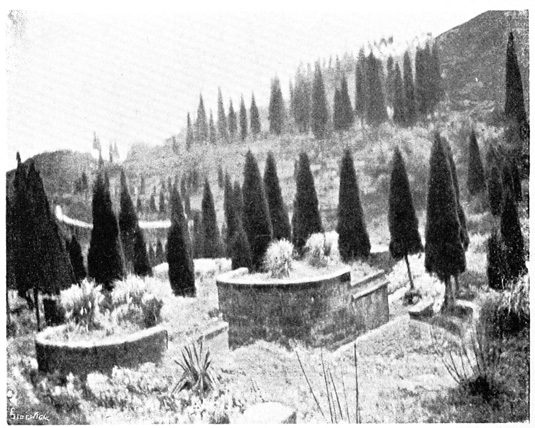
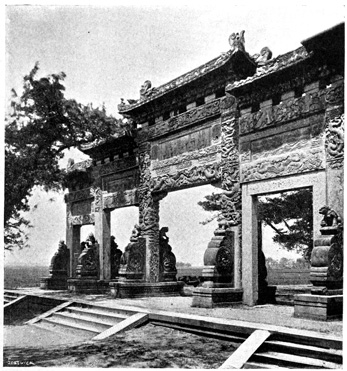
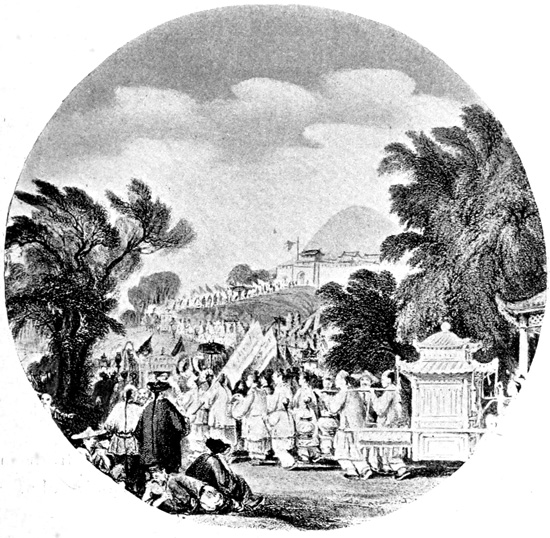
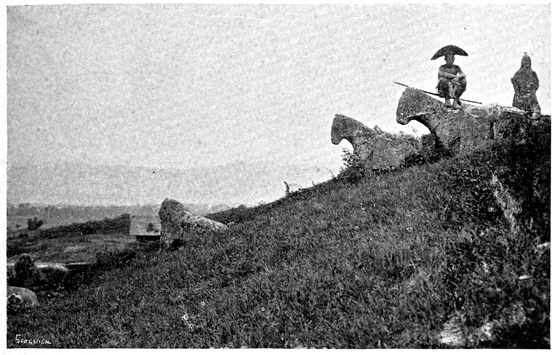
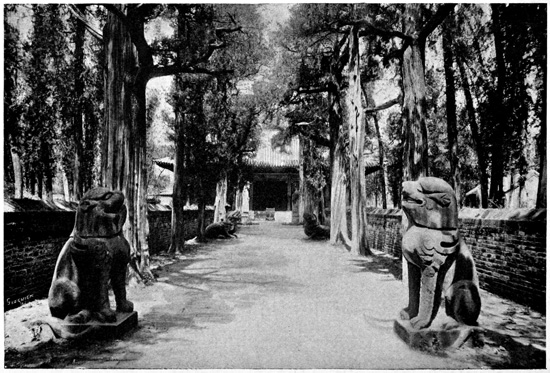
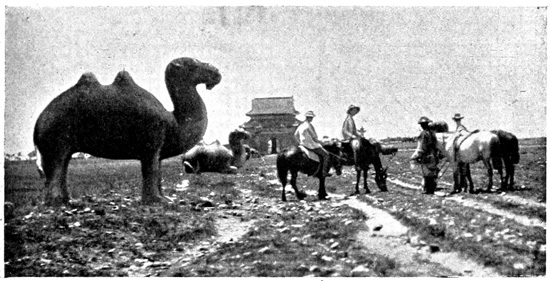
APPROACH TO MING EMPEROR'S TOMB, NANKING.
An attempt has been made to show that the Reform
party, with the young Emperor Kwang-shü at their
head, brought on themselves all that has happened by
urging foolish reforms, and moving too fast. A slight
summary of the Emperor's decrees will show that all
he had done was for China's good.
June 13th, 1898.—The Emperor issued a decree
commanding the establishment of a University at Peking,
and also ordered Kang Yü-wei to appear at a special
audience.
June 15th.—He dismissed his tutor, Wêng Tung-ho,
and announced his intention of sending some of the
Imperial Clansmen and Princes to travel abroad and
learn.
June 20th.—He ordered the Tsung-li Yamen to
report on the necessity of encouraging art, science, and
modern agriculture. It was ordered that the construction
of the Lu-han railway should be expedited.
June 23rd.—The classical essays were abolished as
a necessary part of examinations.
June 27th.—The Ministers and Princes were ordered
to report on the proposal to adopt Western arms and
drill for all the Tartar troops.
July 4th.—The establishment of agricultural schools
in the provinces to teach the farmers improved methods
of agriculture was commanded; and on the same day
the liberal-minded Sun Chia-nai was appointed President
of the Peking University.
July 5th.—The Emperor ordered the introduction
of patent and copyright laws.
July 6th.—The Board of War and the Tsung-li
Yamen were ordered to report on the proposed reform
of military examinations.
July 7th.—Special rewards were promised to
inventors and authors.
July 14th.—Officials were ordered to do all in their
power to encourage trade and assist merchants.
July 29th.—On the recommendation of Li Tuan-fên,
since banished to Kashgaria by the Empress Tze Hsi,
the establishment of educational boards was ordered in
every city throughout the empire.
August 2nd.—The Bureau of Mines and Railways
was established.
August 9th.—Journalists were encouraged to write on
political subjects for the enlightenment of the authorities.
August 10th.—Jung Lu and Lin Kun-yi were
directed to consult on the establishment of naval
academies and training-ships.
August 22nd.—It was ordered that schools should
be established in connection with Chinese Legations
abroad, for the benefit of the sons of Chinese settled in
foreign countries.
August 24th.—Ministers and Provincial Authorities
were urged to assist the Emperor in his work of reform.
August 28th.—The Viceroys Lin Kun-yi and Chang-chih-tung
were ordered to establish commercial bureaux
for the encouragement of trade in Shanghai and
Hankow.
September 1st.—Six minor and useless boards in
Peking were abolished.
September 7th.—Li Hung-chang and Ching Hsin
were dismissed from the Tsung-li Yamen, and the issue
of chao-hsin bonds was stopped, because the provincial
authorities had used them to squeeze the people.
September 8th.—The governorships of Hupeh,
Kwangtung, and Yunnan were abolished as a useless
expense.
September 11th.—The establishment of schools of
instruction in the preparation of tea and silk was
approved.
September 12th.—The Tsung-li Yamen and Board
of War were ordered to report on the suggestion that
the Imperial Courier posts should be abolished in favour
of the Imperial Customs post; and the establishment
of newspapers was encouraged.
September 13th.—The general right to memorialise
the Throne by closed memorials was granted; and on
the same date Manchus who had no taste for civil
or military office were allowed to take up trades or
professions.
September 14th.—The two Presidents and four Vice-Presidents
of the Board of Rites were dismissed for
disobeying the Emperor's order that memorials should
be sent to him unopened, whatever their source.
September 15th.—The system of budgets as in
Western countries was approved.
It will be at once evident that the Emperor and his
party had raised up many powerful enemies, and should—had
they been wise—have secured the assistance
of the army in the first instance. It was when they
attempted to secure troops that the end came. It is
also evident that several of the reforms were what
every one would agree are absolutely necessary for
China; and although they may have made too many
at once, the exact rate at which reforms can be successfully
carried has never been calculated. Nor is there
any evidence even yet that they were going too fast
for the country. They would always have moved
too fast for the officials whose offices they abolished.
At the same time there is a certain sort of doctrinaire
flavour about this multiplicity of schools started at
once, and encouragement given to newspaper writers.
Since then the Empress-Dowager has in her own
name gone rather further in the opposite direction—and
raised up a yet larger number of enemies—forbidding the
establishment of societies of any sort, and ordering the
officials to arrest the members and punish them according
to their responsibilities. The chiefs are to be
executed summarily, and the less responsible banished
into perpetual exile. This affects the Patriotic Association,
as also the new societies that were formed for
the engaging of teachers and purchase of scientific
books after the Emperor's decree doing away with
the five-chapter essay, and ordering that mathematics
should be an essential subject in examination. The
Empress has also suppressed all newspapers, and summarily
sentenced their editors to death. She has
also ordered that no further steps should be taken
to drill or arm the soldiery according to Western
methods, but that they should revert to bows and
arrows, and to the contests in running and lifting heavy
weights of ancient usage. The Emperor had signified
his intention of presiding at the next military examinations,
which were to have been in target-shooting
with modern weapons of precision. The Empress has
now announced that, instead of this, not even the
candidates need present themselves at Court. And all
the promising schemes for opening lower and middle
schools of Western learning are nipped in the bud—those
for girls, as before mentioned, in Shanghai, having
for safety been put under foreign management.
The most powerful man in China for the moment
seems to be Jung Lu, a Manchu who has spent
most of his life in military offices at Peking, but was
at one time general in Shensi, and as Viceroy of
Chihli—the office so long held by Li Hung-chang—was
much liked by foreigners at Tientsin. He is
reported, however, not to have slept for two nights
with anxiety as to what the British fleet was doing at
Pehtaiho just before the coup d'état; and if that is the
case, he is not a man of that iron stuff that his mistress
will long be able to lean upon. The real power behind
the Throne, according to Kang, is a sham eunuch,
Li Luen-yên, the man whom every one who wants
an audience has for years past had to bribe heavily.
Li Hung-chang, the Empress's firm adherent during
all her long tenure of power, is beginning to be known
in England. Of Shêng, once his creature, but who
managed during Li's absence in Europe to attain such
lucrative posts as to look down upon his former patron,
the following story is told. His health never being
very good, Shêng had been accustomed to get leave
of absence from Tientsin in winter, and go to enjoy
himself in his native city of Soochow, the Paris of
China, and with also a much softer climate. During
the Japanese War it was felt impossible to give a
man in such high place leave of absence. But he
was dispensed from regular official work, and allowed
therefore to close the public offices under his control.
This was done, and they were reopened by him as
gambling-houses, where every man of business in
Tientsin must lose his money if he hoped to put
through a job or a contract under the corrupt administration
of Shêng. It may be remembered the British
Government demanded the latter's head a few years ago;
but, as in the case of Chou Han, who disseminated the
vile anti-Christian publications from Hunan, their demands
were put off by being told he was either not to be
found, or mad, or something or other. It is men
like this that must corrupt any nation in which they
hold high power. It is men like this who are always
ready to receive high bribes from foreign powers. The
countries that wish to see China decadent, feeble, torn by
internal divisions, and under their control, have a direct
interest in supporting the late Dowager, now usurping
Empress, Tze Hsi, and the men who rally round her.
But those who do not wish to appropriate Chinese
territory, but rather that both the Chinese and themselves
should enjoy tranquillity, so as to develop each
their own territories to their highest capacity, must
wish to see in power men like Chang-chih-tung, the
one Viceroy never even accused of peculation, and who
never visits Peking, and other men of high aims and
upright conduct—making mistakes possibly, but at least
trying their best to elevate and guide the most peace-loving
and law abiding people that ever existed. The
Chinese may, as Lord Wolseley has predicted, make
good soldiers some day. But from time immemorial
they have despised war. And as in our men-of-war I
have heard that in battles in old days mattresses would
be hung over the ships' sides to protect them, so we
might do worse than interpose between fiery, mysterious
India and the other nations of Asia the impenetrable,
apparently yielding, but never really yielding, big
feather-bed of vigorous, healthy China, relieved from
her corrupt and disastrous Mandarin system, with her
men's minds freed from the cramping influence of a too
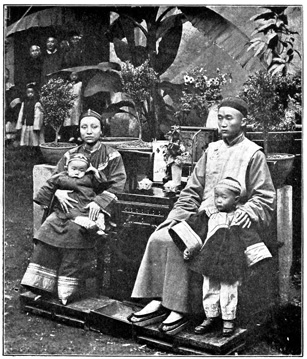
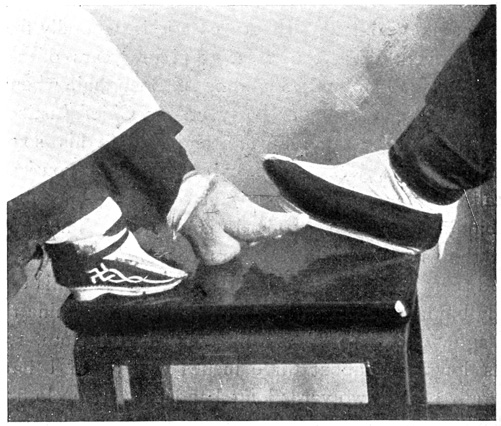
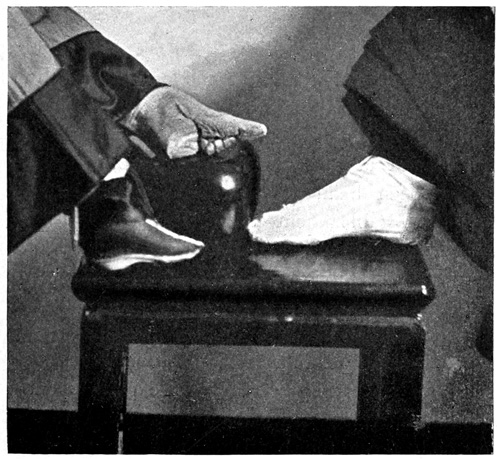
ancient system of education, and her women set upon
their feet so as to be once more able to bear noble
sons. With all the nations of the West contending
who is to have its bones to pick, it is necessary that
some nation or nations should in the first instance stand
by China. But once let some great Western nation
make it plain to the world that he who attacks China
attacks her, and there will be no attack. And let
China's feet but once be set firmly in the ways of
progress, and there will be no going back.
I conclude with the words of the man whom I believe
to be the wisest statesman of the day, although to
my mind he too often lacks the decision to act in accordance
with his own judgment. Lord Salisbury in June,
1898, said: "If I am asked what our policy in China is,
my answer is very simple. It is to maintain the Chinese
Empire, to prevent it from falling into ruins, to invite
it into paths of reform, and to give it every assistance
which we are able to give it, to perfect its defence or
to increase its commercial prosperity. By so doing we
shall be aiding its cause and our own." Excepting
through the Victoria College, years ago established in
Hongkong, where and when, may I ask, has the British
Government acted on this policy laid down by the Prime
Minister with the strongest following of any Minister
of modern times?
Printed by Hazell, Watson, & Viney, Ld., London and Aylesbury.
Books Connected with China
BY
MR. and MRS. ARCHIBALD LITTLE.
A MARRIAGE IN CHINA.
By MRS. ARCHIBALD LITTLE.
Popular 3s. 6d. Novel.
WM. HEINEMANN, 21, Bedford Street, London, W.
MY DIARY IN A CHINESE FARM.
By MRS. ARCHIBALD LITTLE.
With seven full-page collotypes and numerous photo engravings by K. Ogawa
of Tokyo. 4to, with a specially designed cover in colour, 2s. 6d. net.
The work has been produced throughout in Japan, and five hundred copies only
of the book have been printed, of which number but a few remain.
FAIRY FOXES.
A Chinese Legend told in English.
By MRS. ARCHIBALD LITTLE.
Printed in Japan on Japanese crêpe. Illustrated in colour. Third
Edition. 1s. 6d.
GAY & BIRD, 22, Bedford Street, Strand, London, W.C.
THROUGH THE YANGTSE GORGES.
Trade and Travel in Western China.
By ARCHIBALD J. LITTLE, F.R.G.S.
Third Edition, Illustrated. 8vo, 6s.
THE RAT'S PLAINT. An Old Legend.
Translated from the Original Chinese by Archibald J. Little, F.R.G.S.
Printed in Japan on Japanese crêpe paper. Richly illustrated in colour
Second Edition. 5s.
SAMPSON LOW, MARSTON, & Co., St. Dunstan's House,
Fetter Lane, London, E.C.