BEING A NEW EDITION OF THE AUTHOR’S
PRIVATELY ISSUED “SOUL AND IMMORTALITY”
BY THOMAS G. GENTRY, Sc. D.
AUTHOR OF “LIFE-HISTORIES OF BIRDS OF EASTERN PENNSYLVANIA,”
“THE HOUSE SPARROW,” “NESTS AND EGGS OF BIRDS
OF THE UNITED STATES,” ETC., ETC., ETC.
NEW YORK
DOUBLEDAY, PAGE & CO.
1900
Copyright 1900,
BY
DOUBLEDAY, PAGE & CO.
TO All Human Beings
WHO ARE GOOD AND KIND TO THE HUMBLEST OF GOD’S CREATURES
THIS VOLUME IS MOST AFFECTIONATELY DEDICATED
BY THE AUTHOR.
“Every beast of the forest is mine, and the cattle upon a thousand
hills.
“I know all the fowls of the mountains: and the wild beasts of the
field are mine.”—Psalm 1:10, 11.
PREFACE.
Nothing is more charming to the mind of man than the study of
Nature. Religion, moderation and magnanimity have been made a
part of his inner being through her teachings, and the soul has been
rescued by her influence from obscurity. No longer doth man grovel
in the dust, seeking, animal-like, the gratification of low and base
desires, as was his wont, but on the wings of thought is enabled to soar
to the very gates of Heaven and hold communion with God.
Though made “a little lower than the angels,” yet, through the
mighty play of forces that have been at work in the world, which we,
in the latter half of this enlightened century, are just beginning to
recognize and comprehend, he has been lifted from the mire of degradation
and placed upon a higher social, intellectual, moral and spiritual
level. Out of the animal, in the scheme of Deity, the spiritual system
of things is to be elaborated, and not the animal out of the spiritual.
This natural world, so to speak, is the raw material of the spiritual.
Therefore, ere man can understand the spiritual, he must understand
the natural. Though his knowledge was at first about material things,
or such as pertained to natural phenomena, yet from this through the
ages has been builded, little by little, that mountain-height of knowledge,
intellectual and moral, which, if rightly directed, is to bring him
into fellowship with Deity. “As we have borne the image of the earthy,
we shall also bear the image of the heavenly,” or, Lord from heaven.
When is considered, therefore, the immense good which the study
and investigation of nature have accomplished, it is not at all surprising
that the literature on the subject should be markedly in the ascendant.
Natural science bids fair to be in a preëminent degree the pursuit of
the coming man. There is no end to the books that have been written
upon the subject during the past few decades, if not by specialists, but
by men and women who have been well informed and who have made
themselves fully capable of contemplating understandingly the world
which lies about them.
Our libraries are to-day quite affluent in books that are the handmaids
of natural science. Michelet and Hugh Miller, in their day, opened
glorious new worlds before a rising generation, and that generation is
now doing excellent work under the inspiration of the impetus which
it then received. Tait, Balfour Stewart, Dawson, Gray, McCook,
Thompson, Scudder, Mrs. Treat, Olive Thorne Miller and others have
done much to continue the interest, pleasure and enthusiasm awakened
by those earlier writers, and even Darwin and Huxley themselves, in
detailing their experiments, have not scorned to bring their thoughts
within the range of narrower minds.
But in the popularization of natural science no man has done more
than Rev. J. G. Wood in his numerous works. Not only have his
writings created in thousands a taste for nature-studies, but they have
been no less the means of cultivating the observation, awakening
enthusiasm and directing effort in the lines of original research and
discovery. Certainly no one, as his many writings so abundantly attest,
possessed a larger fund of knowledge concerning the powers and
capabilities of the lower animals than this author. Few knew our
domestic animals better than he, and none was more capable of judging
of the mental and moral status which they should occupy in the world
of animals. It is true that men and women, eminent in theology,
literature and science, had expressed a belief in the idea that the “latent
powers and capacities” of the lower animals might be developed in a
future life, but no one had felt secure enough in this belief to warrant
more than a passing thought or two upon the subject.
Bishop Butler, in his “Analogy of Religion,” undoubtedly believed
the lower animals capable of a future life. In speaking of them in
this connection in the opening of his work, he says: “It is said these
observations are equally applicable to brutes; and it is thought an
insuperable difficulty that they should be immortal, and by consequence
capable of everlasting happiness. And this manner of expression is
both invidious and weak; but the thing intended by it is really no difficulty
at all, either in the way of natural or moral consideration.”
Referring then to the undeveloped powers and capacities of the so-called
brutes, the Bishop could perceive no reason why they should not
attain their development in an existence beyond the earth-life. It was
in pursuance of this same train of thought that Rev. J. G. Wood was
led to show in a work, entitled “Man and Beast Here and Hereafter,”
that the lower animals do possess those mental and moral characteristics—the
attributes of reason, language, memory, moral responsibility,
unselfishness and love—which we admit in man as belonging to the
immortal spirit, rather than to the perishable body. Having previously
cleared away the difficulties which certain passages in the Old Testament
seemingly interposed, and proved that the Scriptures do not deny
futurity of life to lower animals, he very naturally concluded that as
man expects to retain these qualities in the future life there is every
reason to suppose that they may share his immortality in the Hereafter
as in the Now they are partakers of his mortal nature.
Few minds, unswayed by thoughts materialistic, can study the
living works of God, whether vegetal or animal, and fail to be convinced
that they, as living exponents of Divine conceptions, are as
needful in the world of spirit as in the world of matter. While many
are disposed to believe that man will share the future life with beast,
bird, insect and such like, yet but few, if any, can be found who believe
that tree and shrub and flower will be there to continue the life begun
on earth and reach out to higher and fuller development. In announcing
this belief, the author but expresses a conviction as deep as any
that could occupy a human mind. The possession of soul and spirit
can be predicated no less of plants than of man and the lower animals.
They have all one breath or life and one spirit, and as such are living
souls, living, breathing frames or bodies of life. From being living,
breathing frames, and endowed with the same life and spirit as man
and the lower animals, they have all one destiny, for “all go unto one
place; all are of the dust, and all turn to dust again.” But of the new
life which Christ came down to earth to proffer to man that he might
inherit the kingdom of God. While to man it was only offered, and
had for its purpose the uplifting and improvement of his earth-life by
the promise of something higher and better to those who are accounted
worthy, yet there can be no doubt that it was equally intended through
his uplifting to place all the creatures of the earth over which he was
given dominion by God upon a more elevated and nobler plane, so
that those which had been profited in the earth-life by his beneficent
influence should become partakers with him in the new life, when
Christ shall “transfigure the body of our humiliation, that it may
become of like form with the body of His glory, by the power of that
which enables Him even to subdue all things to Himself.” As all
existence is a unit, which the author has taken especial pains through
the body of this book to impress upon the minds of his readers, it can
hardly be conceived that an all-wise God, who is infinite in love,
mercy and justice, would look to the preservation in a future state of
but a very small part of the life which He has been instrumental in
placing upon this earth. It would be more consistent with His attributes,
and with the scheme of development of life upon our planet,
whereby life has been progressive, the fittest only being allowed to
survive, to have provided in the grand plan of redemption, not merely
the salvation of the highest of earth-life, but of all life, the purest and
the best, that would represent in the heaven-life, in spiritualized form,
the highest living exponents of Divine ideas. No other belief accords
so well with the teachings of science and philosophy. In its acceptance,
for it makes all life related to the Divine life, can there be any
hope of escape from materialism, that curse of the age.
All
natural objects, roughly divided, arrange themselves
into three groups, constituting the so-called Mineral,
Vegetable and Animal kingdoms. Mineral bodies are all
devoid of life. They consist of either a single element, or, if
combined, occur in nature in the form of simple compounds,
composed of more than two or three elements. They are
homogeneous in texture, or, when unmixed, formed of
similar particles which have no definite relations to one
another. In form they are either altogether indefinite, when
they are said to be amorphous, or have a definite shape,
called crystalline, in which case they are ordinarily bounded
by plane surfaces and straight lines. When mineral bodies
increase in size, as crystals may do, the increase is produced
simply by accretion. They exhibit purely physical and
chemical phenomena, and show no tendency to periodic
changes of any kind. Fossils or petrifactions, which owe
their existence and characters to beings which lived in
former periods of the earth’s history, cannot, though made
up of mineral matter, be properly said to belong to the
mineral kingdom.
But objects belonging to the vegetable and animal kingdoms
differ markedly from inert, lifeless, mineral matter.
Carbon, hydrogen, oxygen and nitrogen are the most
important of the few chemical elements which enter into
their composition, and these elements are combined into
complex organic compounds, which always contain a large
percentage of water, are very unstable, and prone to spontaneous
decomposition. They are composed of heterogeneous,
but related, parts, termed organs, the objects
possessing them being called organized bodies. Some of
the lowest forms of animals have bodies whose substance is
so uniform that they exhibit no definite organs, but this
exception does not affect the general value of this distinction.
They are always more or less definite in shape,
presenting concave and convex surfaces, and being limited
by curved lines. When they increase in size, or grow, as
we properly term it, it is not by the addition of particles
from the outside, but by the reception of foreign matter
into their interior and its consequent assimilation. Certain
periodic changes, which follow a definite and discoverable
order, are invariably passed through by organized bodies.
These changes constitute what is known as life. All the
objects, then, which fulfil these conditions are said to be
alive, and they all appertain either to the vegetable or the
animal kingdom. The study of living objects, no matter
to which kingdom they belong, is therefore conveniently
called by the general name of Biology, which means a
discourse on life. And as all living objects may be referred
to one or other of these kingdoms, so Biology may be
divided into Botany, which treats of plants, and Zoölogy,
which treats of animals.
Now that we have divided all organized bodies into plants
and animals, it becomes necessary to inquire into the differences
which subsist between them, and which will enable
us to separate the kindred sciences of Botany and Zoölogy.
Nothing was thought so easy by older observers than the
determination of the animal or vegetable nature of any given
organism, but, in point of fact, no hard-and-fast line can be
drawn, in the existing state of our knowledge, between the
animal and vegetable kingdoms, and it is sometimes difficult,
or even impossible, to decide with positiveness whether we
are dealing with a plant or an animal. In the higher orders
of the two kingdoms there is no difficulty in reaching a
decision, the higher animals being readily separated from the
higher plants by the possession of a nervous system, of a
locomotive power which can be voluntarily exercised, and of
an internal cavity adapted for the reception and digestion of
solid food. No so-called nervous system or organs of sense
are possessed by the higher plants, although some of them
doubtlessly manifest conscious and intelligent action, nor
are they capable of voluntary changes of place, nor provided
with any definite internal cavity, their food being generally
fluid or gaseous.
Descending the scale to the very bottom, we reach a class
of animals, the Protozoa, which cannot be separated in many
cases from the Protophyta by these distinctions, since many
of the former have no digestive cavity, nor the slightest trace
of a nervous system, while many of the latter possess the
power of active locomotion. As to external configuration, no
certain rules can be laid down for separating animals and plants,
many of the lower plants, either in their earlier stages, or in
their maturity, being exactly similar in form to some of the
lower animals. This is the case with some of the Algæ,
which resemble very closely in form certain Infusorian animalcules.
Again, many undoubted animals, which are
rooted to solid objects in their adult state, are so plant-like
in appearance as to be popularly regarded as vegetables.
The Sea-firs, and the more highly organized Flustras or Sea-mats,
which are usually considered as sea-weeds by sea-side
visitors, are a few of many examples that might be taken
from the so-called Hydroid Zoöphytes. No decided distinction
between animals and plants can be drawn as to their
minute internal structure, both alike consisting of molecules,
of cells, or of fibres. Some decided, though not universal,
differences exist in chemical composition. Plants exhibit a
decided predominance of ternary compounds, or compounds
which, like sugar, starch and cellulose, are made up of the
three elements, carbon, hydrogen and oxygen, but are, comparatively
speaking, poorly supplied with quaternary
compounds, or those which contain an additional element of
nitrogen. Animals, on the contrary, are rich in quaternary
nitrogenized compounds, such as albumen or fibrin. Still,
in both kingdoms we find nitrogenized and non-nitrogenized
compounds, and it is only in the proportion which these
sustain to each other in the organism that animals differ in
any way from plants.
Before the invention of the microscope, no independent
voluntary movements, if we except the opening and closure
of flowers, and their turning towards the sun, the drooping
of the leaves of sensitive plants under irritation, and some
other kindred phenomena, were known in plants. Now, however,
we know of many plants which are endowed, either
when young or throughout life, with the power of effecting
voluntary movements apparently as spontaneous and independent
as those performed by the lower animals, the movements
being brought about by means of little vibrating cilia,
or hairs, with which a part or the whole of the surface is
furnished. When it is added that many animals are permanently
rooted, in their fully-grown condition, to solid objects,
it will at once be apparent that no absolute distinction can
be made between animals and plants merely because of the
presence or absence of independent locomotive power.
There is, however, a test, the most reliable of all that have
been discovered, by which an animal may be distinguished
from a plant, and that is the nature of the food and the products
which are elaborated therefrom in the body. Plants
live upon such inorganic substances as water, carbonic acid
and ammonia, and they have the power of manufacturing
out of these true organic materials, and are therefore the
great producers of nature. All plants which contain green
coloring matter, technically called chlorophyll, break up
carbonic acid in the process of digestion into its two
constituents of carbon and oxygen, retaining the former and
setting the latter free. And as the atmosphere always contains
carbonic acid in small quantities, the result is that
plants remove carbonic acid therefrom and give out oxygen.
Animals, on the other hand, have no power of living on
water, carbonic acid and ammonia, nor of converting these
into the complex organic substances of their bodies. That
their existence may be maintained animals require to be
supplied with ready-made organic compounds, and for these
they are all dependent upon plants, either directly or indirectly.
In requiring as food complex organic bodies, which
they ultimately reduce to very simply inorganic ones,
animals are thus found to differ from plants. Whilst plants
are the great manufacturers in nature, animals are the great
consumers. Another distinction, arising from the nature of
their food, is that animals absorb oxygen and throw out
carbonic acid, their reaction upon the atmosphere being
exactly the reverse of that of plants. There are organisms,
it must be understood, which are genuine plants so far as
their nutritive processes are concerned, but which, nevertheless,
are in the possession of characters which could locate
them among the animals. Volvox, so abundant in our
streams during the proper seasons, affords a splendid illustration
of the truth of this statement. Plants, which are
devoid of chlorophyll, as is the case with the Fungi, do not
possess the power of decomposing carbonic acid under the
influence of sunlight, but are like animals in requiring
organic compounds for their food. Two points must therefore
be borne in mind in regarding the general distinctions
between plants and animals which we have thus briefly outlined,
and these are that they cannot often be applied in
practice to ambiguous microscopic organisms, and certainly
not to plant-forms that are destitute of chlorophyll.
That life should manifest itself certain conditions are essential,
but some of which, though generally present, are not
absolutely indispensable. One condition, however, seems to
be very necessary, and that is that the living body should be
composed of a certain material. This material, which forms
the essential and fundamental parts of everything living,
whether vegetable or animal, is technically called protoplasm.
Other substances than it are often found in living
bodies, but it is in protoplasm only that vitality appears to
be inherent.
But whether it is the same in plants as in animals is a
matter of opinion. One thing, however, seems reasonably
certain, and that is that it is the medium or vehicle
through which vital force is made manifest. Used in its
general sense, protoplasm is chemically related in its
nature to albumen, and generally has the character of a
jelly-like, semi-fluid, transparent material, which, in itself,
exhibits no definiteness of structure. When heated to a
certain temperature it coagulates, just as the white of an
egg does when boiled. Living protoplasm has the power of
movement, of increasing in size or of maintaining its existence
by the assimilation of fresh and foreign materials, and
of detaching portions of itself which may subsequently
develop into fresh masses. Though protoplasm be present
in the ova of animals and the seeds of plants, yet there is no
external and visible manifestation of life. There is in them
what is called a dormant vitality, which may remain for a
long time unchanged, until altered external circumstances
cause the organism to pass into a state of active life.
Generally, certain external conditions must be present
before any external vital phenomena can be manifested. The
presence of atmospheric air, or rather of free oxygen, is in
an ordinary way essential to active life. Life, that is its
higher manifestations, is only possible between certain
ranges of temperature, varying from near the freezing
point to about 120° Fahrenheit. As water is a necessary
constituent of protoplasm in its living state, so it becomes an
absolutely essential requisite to the carrying on of vital
processes of all kinds, for the mere drying of an animal or
plant will, in most cases, kill it outright, and will always
bring about a suspension of all visible life-phenomena.
While the large majority of living beings are organized,
or composed of different parts, called organs, which sustain
certain relations with one another, and which discharge
different offices, yet it must not therefore be concluded that
organization is a necessary accompaniment of vitality, or
that all living creatures are organized. Innumerous low
forms of life, so low that they occupy the very lowest place
in the scale of animated existences, absolutely exhibit no
visible structure, and cannot, therefore, be said to be organized,
but they, nevertheless, discharge all their vital functions
just as well as though they possessed special organs for the
purpose. Concluding our theme, we are forced to admit
that animals are organized, or possess structure, because
they are alive, and not that they live because they are organized.
By carefully comparing the morphological and physiological
differences between different animals and plants,
naturalists have divided the entire animal and vegetable
kingdoms into a number of divisions, whose leading characteristics
may be found in almost every text-book. All
that we promised ourselves when this work was first thought
of was a brief treatment of a few of the most interesting
life-forms of this planet of ours in the light of their ways
and doings, and the direction of human thought to those
traits of character and manifestations of conscious intelligence
which fit them to become partakers with man of that
new life which awaits him beyond the grave.
PLANTS THAT FEED ON INSECTS.
Perhaps
it would be difficult to find in the whole
range of vegetable creation anything more curious
than the carnivorous or flesh-eating plants. That animals
eat plants creates in us no emotion of curiosity, for this is
the common law of nature. But that plants should devour
animals is a marvel to which few minds uninitiated in science
would give credence. Though these strange forms of vegetable
life have been known for about a century, yet it has
been but a few years since the attention of naturalists was
first specially called to their habits and character. No one
has probably done more to explain the life and operations
of the flesh-eating plants than Mr. Darwin.
For centuries strange rumors had been circulated of the
existence of huge plants in the more remote and unvisited
parts of Asia which would imprison and destroy large animals
and men that would venture within reach of their great
quivering leaves armed with hooked spines, the flesh of the
dead victim being absorbed into their structure, but all these
giant flesh-eating trees or plants have so far proved to be
mere myths. Science has discovered, however, that there is
some foundation for these exciting fictions, and it has not
been obliged to go to the distant East to find it, for flesh-eating
plants are by no means uncommon in this country
and Europe. But these plants confine their destructive propensities
to the crawling and flying insects which are beguiled
by some tempting reward to rest on their leaves. Such a
strange provision of nature is no less interesting than if these
plants had the power to destroy the larger animals, for it is
the fact itself which startles the attention by its seeming
reversal of natural laws.
No better example of carnivorous plants could be taken
than Dionæa muscipula, or to use the common name, Venus’s
Fly-trap. It is a species that is indigenous to North Carolina
and the adjacent parts of South Carolina, affecting sandy
bogs in the pine forests from April to June, and a representative
of the Droscraceæ, or Sundew Family. One cannot
fail after once seeing it of becoming impressed with its
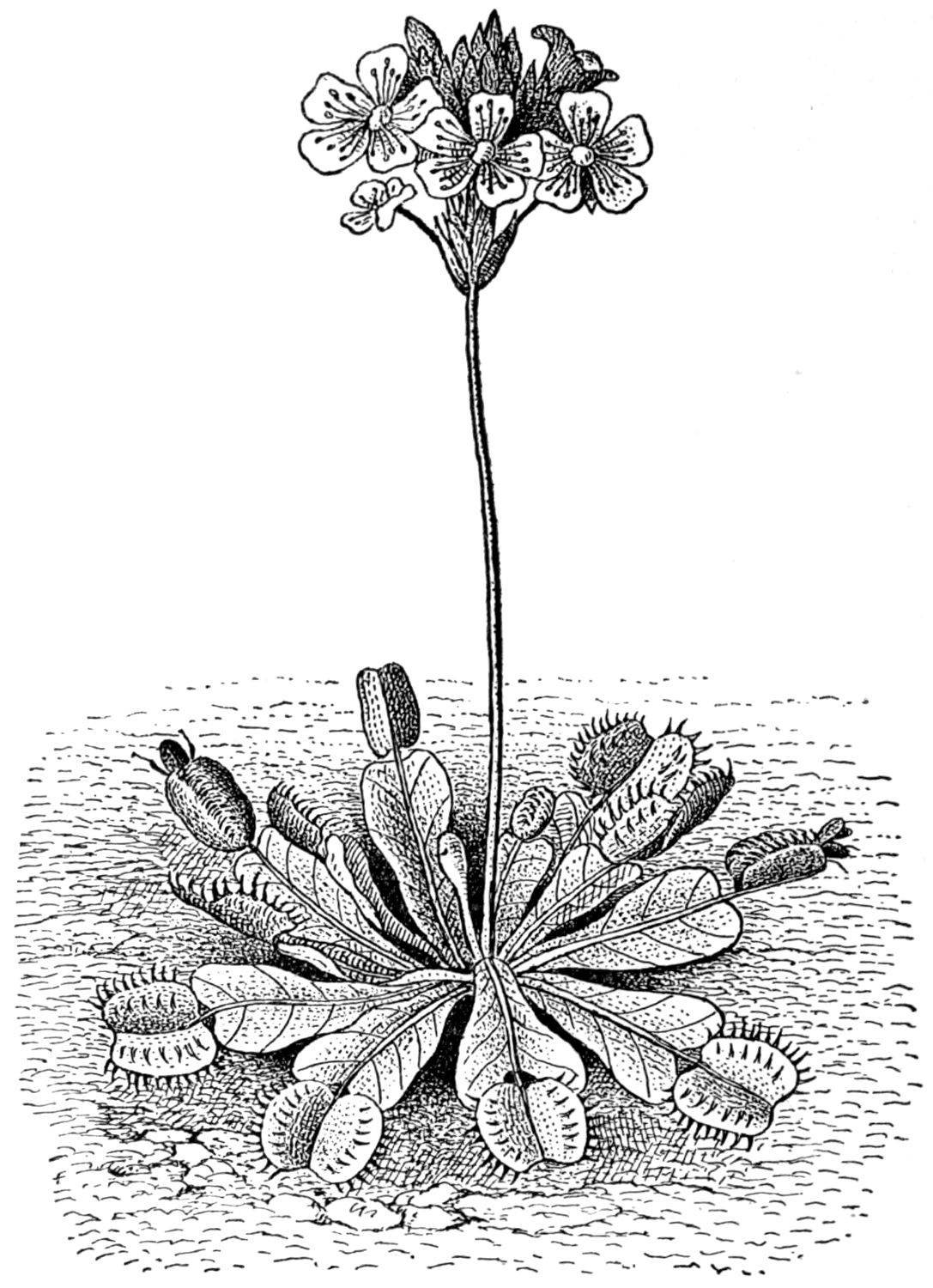
peculiar characteristics. It is a smooth perennial herb with
tufted radical leaves on broadly-winged, spatulate stems, the
limb orbicular, notched at both ends, and fringed on the
margins with strong bristles. From the centre of the rosette
of leaves proceeds at the proper time a scape or leafless stalk
which terminates in an umbel-like cyme of from eight to
ten white bracted flowers, each flower being one inch in
diameter. The roots are small and consist of two branches
each an inch in length springing from a bulbous enlargement.
Like an epiphytic orchid, these plants can be grown
in well-drained damp moss without any soil, thus showing
that the roots probably serve for the absorption of water
solely. Three minute pointed processes or filaments, placed
triangularly, project from the upper surface of each lobe of
the bi-lobed leaf, although cases are observed where four and
even ten filaments are found. These filaments are remarkable
for their extreme sensitiveness to touch, as shown not
only by their own movement, but by that of the lobes also.
Sharp, rigid projections, diminutive spikes as it were, stand
out from the leaf-margins, each of which being entered by a
bundle of spiral vessels. They are so arranged that when
the lobes close they interlock like the teeth of an old-fashioned
rat-trap. That considerable strength may be had,
the mid-rib of the leaf, on the lower side, is quite largely
developed.
Minute glands, of a reddish or purplish color, thickly cover
the upper surface of the leaf, excepting towards the margins,
the rest of the leaf being green. No glands are found upon
the spikes or upon the foliaceous footstalk. From twenty
to thirty polygonal cells, filled with purple fluid, constitute
each gland. They are convex above, somewhat flattened
underneath, and stand on very short pedicels, into which
spiral vessels do not enter. They have the power of secretion
under certain influences, and also that of absorption.
Minute octofid projections, of a reddish-brown color, are
scattered in considerable numbers over the footstalk, the
backs of the leaves and the spikes, with a few on the upper
surfaces of the lobes.
The sensitive filaments, which are a little more than one-twentieth
of an inch in length, and thin, delicate and tapering
to a point, are formed of several rows of elongated cells,
filled with a purplish fluid. They are sometimes bifid or
even trifid at the apex, and towards the base there is a constriction
formed of broader cells, and beneath the constriction
an articulation, supported on an enlarged base, consisting
of differently shaped polygonal cells. As the filaments
project at right angles to the surface of the leaf, they would
have been in danger of being broken off whenever the lobes
closed together had it not been for the articulation, which
allows them to bend flat down. So exquisitely sensitive are
these filaments, from their tips to their bases, to a momentary
touch, that it is hardly possible to touch them even so lightly
or quickly with any hard object without causing the lobes to
close, but a piece of delicate human hair, two and a-half
inches in length, held dangling over a filament so as to touch
it, or pinches of fine wheaten flour, dropped from a height,
produce no effect. Though not glandular, and hence incapable
of secretion, yet the filaments by their sensitiveness to
a momentary touch, which is followed by the rapid closure
of the lobes of the leaf, assure to Dionæa the necessary
supply of insect food for all its wants.
Inorganic bodies, even of large size, such as bits of
stone, glass and such like, or organic bodies not containing
nitrogeneous matter in a soluble condition, as bits of cork,
wood, moss for examples, or bodies containing soluble nitrogeneous
matter, if perfectly dry, such as small pieces of meat,
albumen, gelatine, etc., may be long left on the lobes, and no
movement is excited. But when nitrogeneous organic bodies,
which are all damp, are left on the lobes, the result is widely
different, for these then close by a slow and gradual movement
and not in a rapid manner as when one of the sensitive
filaments is touched by a hard substance. Small purplish,
almost sessile glands, as has already been stated, thickly
cover the upper surface of the lobes. These have the power
both of secretion and absorption, but they do not secrete
until excited by the absorption of nitrogeneous matter. No
other excitement, as far as experiments show, produces this
effect. When the lobes are made to close over a bit of meat
or an insect, the glands over the entire surface of the leaf
emit a copious discharge, as in this case the glands on both
sides are pressed against the meat or insect, the secretion
being twice as great as when the one or the other is laid on
the surface of a single lobe; and as the two lobes come into
almost close contact the secretion, containing dissolved animal
matter, diffuses itself by capillary attraction, causing
fresh glands on both sides to begin secreting in a continually
widening circle. The secretion is almost colorless, slightly
mucilaginous, moderately acid, and so copious at times in
the furrow over the mid-rib as to trickle down to the earth.
But all this secretion is for the purposes of digestion. Be
the animal matter which the enclosed object yields ever so
little, it serves as a peptogene, and the glands on the surface
of the leaf pour forth their acid discharge, which acts like
the gastric juice of animals.
VENUS’S FLY-TRAP.
How It Captures Insects.
Now as to the manner in which insects are caught by the
leaves of Dionæa muscipula. In its native country they are
caught in large numbers, but whether they are attracted in
any special way no one seems to know. Both lobes close
with astonishing quickness as soon as a filament is touched,
and as they stand at less than a right angle to each other,
they have an excellent chance of capturing any intruder.
The chief seat of the movement is near the mid-rib, but is not
restricted to this part. Each lobe, when the lobes come
together, curves inwards across its whole breadth, the marginal
spikes alone not becoming curved. From the curving
inwards of the two lobes, as they advance towards each
other, the straight marginal spikes intercross by their apices
at first, and ultimately by their bases. The leaf is then
completely shut and encloses a shallow cavity. If made to
shut merely by the touching of one of the sensitive filaments,
or by the inclusion of an object not yielding soluble
nitrogeneous matter, the two lobes retain their inwardly concave
form until they re-expand. The re-expansion, when no
organic matter is enclosed, varies according to circumstances,
a leaf in one instance being fully re-expanded in thirty-two
hours.
But the lobes, when soluble nitrogeneous matter is included,
instead of remaining concave, thus containing within a concavity,
slowly press closely together throughout their entire
breadth, and as this takes place the margins gradually become
a little everted, so that the spikes, which at first intercrossed,
at last project in two parallel rows. So firmly do they become
pressed together that, if any large insect has been caught, a
corresponding projection is clearly visible on the outside of
the leaf. When the two lobes are thus completely closed,
they resist being opened, as by a thin wedge driven with
astonishing force between them, and are generally ruptured
rather than yield. If not ruptured, they close again with
quite a loud flap. The slow movement spoken of, excited
by the absorption of diffused animal matter, suffices for its
final purpose, whilst the movement brought on by the touching
of one of the sensitive filaments is rapid, and thus indispensable
for the capturing of insects.
Leaves remain shut for a longer time over insects, especially
if the latter are large, than over meat. In many instances
where they have remained for a long period over insects
naturally caught, they were more or less torpid when they
reopened, and generally so much so during many succeeding
days that no excitement of the filaments caused the least
movement. Vigorous leaves will sometimes devour prey
several times, but ordinarily twice, or, quite often, once is
enough to render them unserviceable.
What purpose the marginal spikes, which form so conspicuous
a feature in the appearance of the plant, subserve was
unknown until the genius of Darwin solved the mystery. It
was he that showed that elongated spaces between the spikes,
varying from one-fifteenth to one-tenth of an inch in breadth
according to the size of the leaf, are left open for a short
time before the edges of the lobes come into contact,
consequent upon the intercrossing of the tips of the marginal
spikes first, thus enabling an insect whose body is not
thicker than these measurements to escape, when disturbed
by the closing lobes and the increasing darkness, quite easily
between the crossed spikes. Moderately sized insects, if they
try to escape between the bars, will be pushed back into the
horrid prison with the slowly closing walls, for the spikes
continue to close more and more until the lobes are brought
into contact. Very strong insects, however, manage to effect
their release. It would manifestly be a great disadvantage
to the plant to remain many days clasped over a minute
insect, and as many additional days or weeks in recovering
its sensibility, inasmuch as a very small insect would afford
but little nourishment. Far better would it be for the plant
to wait until a moderately large insect was captured, and to
allow the little ones to escape, and this advantage is gained
by the slow intercrossing of the marginal spikes, which,
acting like the large meshes of a fishing-net, allow the small
and worthless fry to pass through.
Touching any one of the six filaments is sufficient to
cause both lobes to close, these becoming at the instant
incurved throughout their entire breadth. The stimulus
must therefore radiate in all directions from any one filament,
and it must also be transmitted with considerable
rapidity across the leaf, for in all ordinary cases, as far as the
eye can judge, both lobes close at the same time. Physiologists
generally believe that in irritable plants the excitement
is transmitted along, or in close connection with, the fibro-vascular
bundles. Those in Dionæa seem at first sight to
favor this belief, for they run up the mid-rib in a great bundle,
sending off small bundles almost at right angles on each
side, which bifurcate occasionally as they stretch towards
the margin, the marginal branches from adjoining branches
uniting and entering the marginal spikes. Thus a continuous
zigzag line of vessels runs round the whole circumference
of the leaf, while in the mid-rib all the vessels are in
close contiguity, so that all parts of the leaf seem to be
brought into some degree of communication. The presence
of vessels, however, is not necessary for the transmission of
the motor impulse, for it is transmitted from the apices of
the sensitive filaments, which are hardly one-tenth of an
inch in length, into which no vessels are seen to enter. Slits
made close to the bases of the filaments, parallel to the mid-rib,
and thus directly across the course of the vessels, sometimes
on the inner and sometimes on the outer sides of the
filaments, do not interfere with the transmission of the motor
impulse along the vessels, and conclusively show that there
is no necessity for a direct line of communication from the
filament, which is touched towards the mid-rib and opposite
lobe, or towards the outer parts of the same lobe. With
respect to the movement of the leaves, the wonderful discovery
made by Dr. Burdon Sanderson, and published in 1874,
offers an easy explanation. There is, says this distinguished
authority, a normal electrical current in the blade and footstalk,
which, when the leaves are irritated, is disturbed in the
same manner as is the muscle of an animal when contraction
takes place.
After contraction has endured for a greater or less time,
dependent upon circumstances which we do not well understand,
re-expansion of the leaves is effected at an insensibly
slow rate, whether or not any object is enclosed, both lobes
opening in all ordinary cases at the same time, although
each lobe may act to a certain extent independently of the
other. The re-expansion is not determined by the sensitive
filaments, for these may be cut off close to their bases, or
be entirely removed, and re-expansion occur in the usual
manner. It is believed that the several layers of cells forming
the lower surface of the leaf are always in a state of
tension, and that it is owing to this mechanical state, aided
probably by fresh fluid being drawn into the cells, that the
lobes begin to separate as soon as the contraction of the
upper surface diminishes.
Six known genera, Drosophyllum, Roridula, Byblis,
Drosera, Dionæa and Aldrovanda comprise the Droseraceæ,
all of which capture insects. The first three genera effect
this purpose solely by the viscid fluid secreted from their
glands, and the last, like Dionæa, which has already been
described, through the closing of the blades of the leaf. In
these last two genera rapid movement makes up for the
loss of viscid secretion. But of all the genera none is more
interesting than the typical Sundews.
Growing in poor peaty soil, and sometimes along the
borders of ponds where nothing else can grow, certain low
herbaceous plants, called Droseras, abound. So small and
apparently insignificant are they, that to the ordinary observer
they are almost unnoticed. But they have peculiarities of
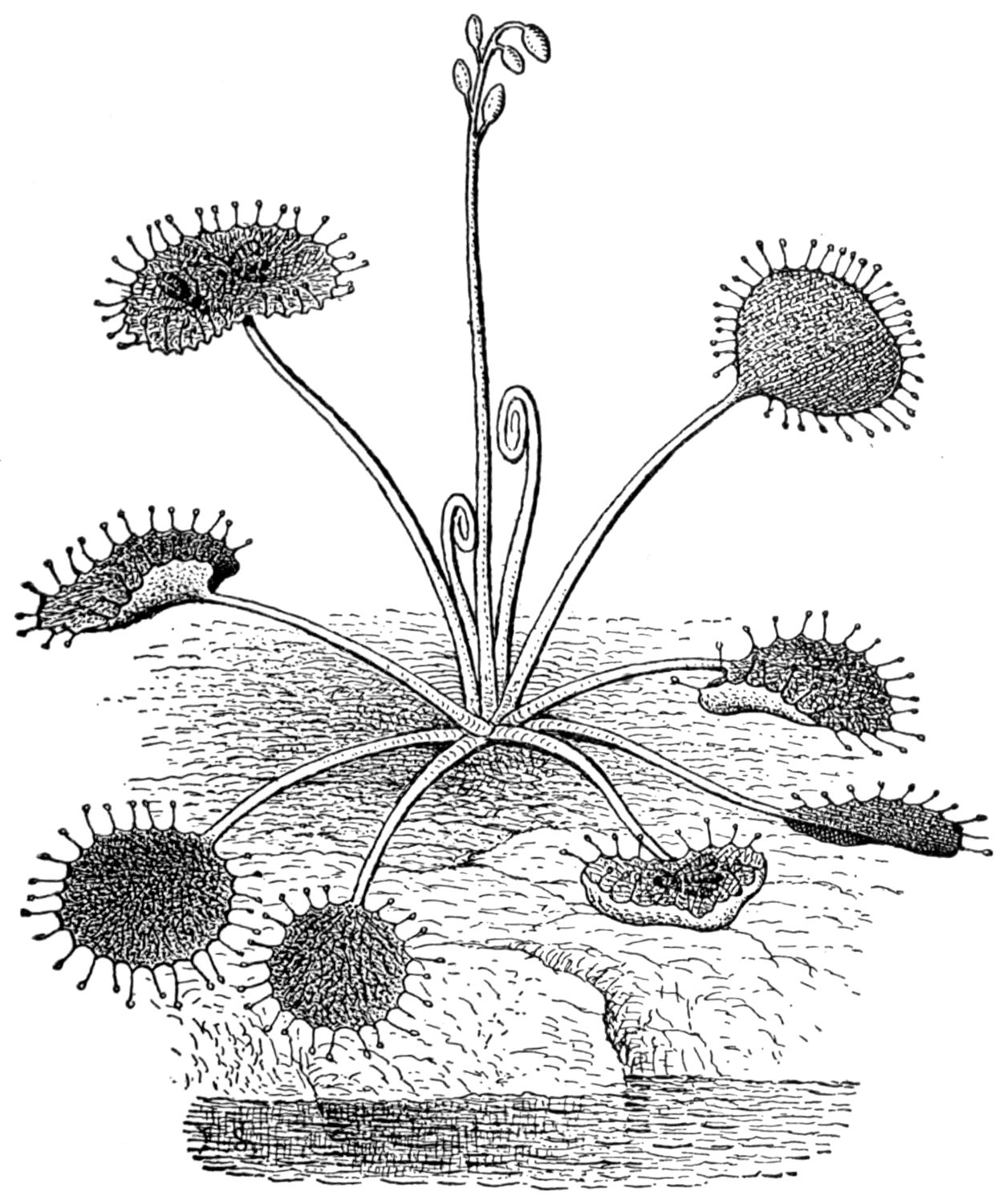
structure and nature that readily distinguish them. Scattered
thickly over their leaves are reddish bristles or tentacles, each
surmounted by a gland, from which an extremely viscid fluid,
sparkling in the sunlight like dew, exudes in transparent
drops. Hence the common name of Sundew by which the
half-dozen species found in the United States east of the
Mississippi River are known. A one-sided raceme, whose
flowers open only when the sun shines, crowns a smooth
scape, which is devoid of tentacles. Drosera rotundifolia,
our commonest species, has a wide range, being indigenous
to both Europe and America. In the United States it extends
from New England to Florida and westward, and is occasionally
associated with Drosera longifolia, a form with long
strap-shaped leaves, but whose distribution is mostly restricted
to maritime regions, from Massachusetts to Florida.
ROUND-LEAVED SUNDEW.
Leaves Acting as Stomachs.
All of the species are remarkably similar in habits, capturing
insects, and digesting and absorbing the soft parts, a
circumstance which explains how these plants can flourish
in an extremely poor soil where mosses, which depend
almost entirely upon the atmosphere for their nourishment,
only can live. Although the leaves of the Droseras at a
hasty glance do not appear green, owing to the purple color
of the tentacles, yet the superior and inferior surfaces of the
blade, the stalks of the central tentacles, and the petioles
contain chlorophyll, rendering the best of evidence that the
plants obtain and assimilate carbon dioxide from the air.
But when the poverty of the soil where these plants grow is
considered, it is at once apparent that their supply of nitrogen
would be exceedingly small, or quite deficient, unless they
had the power of obtaining it from some other source. From
captured insects this important element is largely obtained,
and thus we are prepared to understand how it is that their
roots, which consist of only two or three slightly divided
branches, from one-half to one inch in length, and furnished
with absorbent hairs, are so poorly developed. From what
has been stated it would seem that the roots but serve to
imbibe water, but there is no doubt that nutritious matters
would also be absorbed were they present in the soil.
With the edges of its leaves curled so as to form a temporary
stomach, and with the glands of its closely-inflected tentacles
pouring forth their truly acid secretion, which dissolves
animal matters that are subsequently absorbed, Drosera
may be said to feed like an animal. But, unlike an animal,
it drinks by means of its roots, and largely, too, for it would
not be able to supply its glands with the necessary viscid
fluid. The amount needed is by no means an inconsiderable
quantity, as two hundred and seventy drops may sometimes
be exposed during a whole day to a glaring sun. Such a
profuse exudation implies preparations for hosts of insect
visitors. In this Drosera has not miscalculated. Its bright
pink blossoms and brilliant, glistening dew lure vast numbers
of the smaller kinds, and the larger ones, too, to certain
death. But the wholesale destruction of life that goes on is
much in excess of what the plant requires for food. While
the smaller flies remain adherent to the leaves, affording
them the needed aliment, the larger insects, after death, fall
around the roots, where they decay and fertilize the soil with
nitrogen, which doubtless through the proper channels makes
its way into the body of the plant, thus helping to give it
tone and vigor. There are times when these plants work
better than at others, but whether this is caused by the electrical
condition of the atmosphere, or the amount of its
contained moisture, is a question which science has not
positively determined.
Drosera longifolia folds it leaves entirely around its victim,
from the apex down to the petiole after the manner of its
vernation, but in Drosera rotundifolia, whose marginal
tentacles are longer, the tentacles simply curve around the
object, the glands touching the substance, like so many
mouths receiving nourishment. Experimented upon with
raw beef, the tentacles of healthy leaves, from within to
without, but in periods of time varying from six to eight
or nine hours, clasp firmly the beef, almost concealing it
from view. Equally vigorous leaves, however, made no
move towards clasping a bit of dry chalk, a chip of flint, or
a lump of earth. Bits of raw apple cause a curving of the
tentacles, but very few of the glands are seen touching them.
It would seem, therefore, that these plants are really carnivorous,
preferring animal substances, which they, by the aid
of some ferment analogous to pepsin, which is secreted by
the glands, are able to absorb. A minute quantity of already
soluble animal matter is the exciting cause, and this must
be taken in by the glands, or there is no secretion of the
fermenting material.
In all ordinary cases the glands alone are susceptible to
excitement. When excited, they do not themselves move
or change form, but transmit a motor impulse to the bending
part of their own and adjoining tentacles, and are thus
carried towards the centre of the leaf. Stimulants applied
to the glands of the short tentacles on the disc indirectly
excite movement of the exterior tentacles, for the stimulus
of the glands of the disc acts on the bending part of the
latter tentacles, near their bases, and does not first travel up
the pedicels to the glands, to be then reflected back to the
bending place. Some influence, however, does travel up to
the glands, causing them to secrete most copiously, and the
secretion to become acid, just such an influence as that
which in animals is transmitted along the nerves to glands,
modifying their power of secretion, independently of the
condition of the blood-vessels. Over organic substances
that yield soluble matter the tentacles remain clasped for a
much longer time than over those not acted upon by the
secretion, or over inorganic objects. That they have the
power of rendering organic substances soluble, that is, that
they have the power of digestion, is no longer a question
of dispute. They certainly have this power, acting on
albuminous compounds in exactly the same manner as does
the gastric juice of mammals, the digested matter being
afterwards absorbed. In animals the digestion of albuminous
compounds is effected by means of a ferment, pepsin,
together with weak hydrochloric acid, though almost any
acid will serve, yet neither pepsin nor an acid by itself has
any such power. It has been observed that when the glands
of the disc are excited by the contact of any object, especially
of one containing nitrogeneous matter, the outer
tentacles and often the blade become inflected, the leaf thereby
becoming converted into a temporary cup or stomach.
The discal glands then secrete more copiously, the secretion
becoming acid, and, moreover, some influence being
transmitted by them to the glands of the exterior tentacles,
causing them to emit a more abundant secretion, which also
becomes acid. This secretion is to a certain extent antiseptic,
as it checks the appearance of mould and infusoria, and
in this particular acts like the gastric juice of the higher
animals, which is known to arrest putrefaction by destroying
the microzymes.
With animals, according to Schiff, mechanical irritation
excites the glands of the stomach to secrete an acid, but not
pepsin. There is strong reason to believe, too, that the glands
of Drosera, which are continually secreting viscid fluid to
replace the losses by evaporation, do not secrete the ferment
proper for digestion when mechanically irritated, but only
after absorbing certain matters of a nitrogeneous nature. The
glands of the stomachs of animals secrete pepsin only after
they have absorbed certain soluble substances designated
peptogenes, showing a remarkable parallelism between the
glands of Drosera and those of the stomach in the secretion
of their appropriate acid and ferment.
Not only animal matter, but also the albumen of living
seeds, which are injured or killed by the secretion, are acted
upon by the glands of Drosera. Matter is likewise absorbed
from pollen, and from fresh leaves. The stomachs of
vegetable-feeding animals, as is only too well known, possess
a similar power of extracting nourishment from such articles.
Though properly an insectivorous plant, but as pollen, as well
as the seeds and leaves of surrounding plants, cannot fail to
be often or occasionally blown upon the glands of Drosera,
yet it must be credited with being to a certain extent a vegetable
feeder.
That a plant and an animal should secrete the same, or
nearly the same, complex digestive fluid, adapted for a similar
purpose, is a wonderful fact in physiology, but not more
remarkable than the movements of a tentacle consequent
upon an impulse received from its own gland, the movement
at the bending place of the tentacle being always towards the
centre of the leaf, and so it is with all the tentacles when
their glands are excited by immersion in a suitable fluid.
The short tentacles in the middle part of the disc, however,
must be excepted, as these do not bend at all when thus
excited. But when the motor impulse comes from one side
of the disc, the surrounding tentacles, and even the short
ones in the middle of the disc, all bend with precision
towards the point of excitement, no matter where it may be
located. This is in every way a remarkable phenomenon,
for the leaf appears as if endowed with animal sense and
intelligence. It is all the more remarkable when the motor
impulse strikes the base of a tentacle obliquely to its flattened
surface, for then the contraction of the cells must be
restricted to one, two or a very few rows at one end, and
different sides of the surrounding tentacles must be acted on
that all may bend with precision to the point of excitement.
The motor impulse, as it spreads from one or more glands
across the disc, enters the bases of the surrounding tentacles,
and instantly acts on the bending place, but does not first
proceed up the tentacles to the glands, causing them to
reflect back an impulse to their bases, although some influence
is sent up to the glands, whereby their secretion is
soon increased and rendered acid. The glands, being thus
excited, send back some other influence, dependent neither
on increased secretion nor on the inflection of the tentacles,
which causes the protoplasm to aggregate in cell beneath cell.
This maybe called a reflex action. How it differs from that
which proceeds from the nerve-ganglion of an animal, if it
differ at all, no one can say. It is probably the only known
case of reflex action in the vegetable kingdom.
Concerning the mechanism of the movements and the
character of the motor impulse little is known. During the
act of inflection fluid surely passes from one part to another
of the tentacles. In explanation of the fact it is claimed
that the motor impulse is allied in nature to the aggregating
process, and that this causes the molecules of the cell-walls
to approach each other, as do the molecules of the
protoplasm within the cells, thereby causing the cells in all
to contract. This is probably the hypothesis that best accords
with the observed facts, although some strong objections may
be urged against this view. The elasticity of their outer
cells, which comes into activity as soon as those on the inner
side cease contracting with prepotent force, leads largely to
the re-expansion of the tentacles, but there is reason to suspect
that fluid is continually and slowly attracted into the
outer cells during the act of re-expansion, thus augmenting
their tension.
With respect to the structure, movements, constitution
and habits of Dionæa muscipula and Drosera rotundifolia, as
well as kindred species, little has been made out by patient
study and investigation in comparison with what remains
unexplained and unknown. Many of their movements,
especially of Dionæa and Drosera, seem so sensible and
intelligent that the reflecting mind of man can hardly hesitate
to assign them high positions in organic nature and the
possession, even though in a very small degree, of that consciousness
with which animal life is endowed. That man is
psychically related to all life is the belief of millions in the old
world, and the hope of millions in the new. In this thought
is the escape from materialism, that threat of the ignorant
and unbelieving. Higher conceptions of beauty and greatness
are now being entertained by the multitudes, and we begin
to feel that the next great step is being taken when we
shall become, instead of poor trembling denizens of a perishable
world, proud and conscious citizens of an imperishable
universe. That we of the upper ranks of God’s creation
alone possess an inner life which shall transcend all change
is no longer a general belief, but there is a growing hope
that all nature shares it, and that love is its expression and its
method. All existence is a unit. Life, law and love are
divine. Man, looking calmly about him, cannot set himself
apart as something essentially different from nature, but must
recognize himself as a part, and include love in the universal
scheme of development. All other expressions of life must
share with him in the divine love and progress. His dogmas,
founded on mistaken traditions, have given way to
science, and he cannot but believe that love is in and of the
soul, and that all life has some sort of development of soul.
Because plant-life has no brain, and therefore has no intelligence,
no mind, no soul, is preposterous to contemplate.
Who can positively affirm that brain alone is the seat of
conscious intelligence? None but He alone, the Giver of
all life, who sits enthroned and exalted in the everlasting
heavens.
SLIME-ANIMALS.
Possibly
the simplest of life’s children are the singularly
unique and structureless little Finger Slimes,
which live not only in the sea but also in puddles and pools,
and in the gutters of our streets and of our house-tops.
Anywhere that stagnant water abounds these tiny drops of
slime will grow up and make it their home. Sometimes few
and far between, and sometimes in such immense crowds
that the entire pond would seem, if they could be seen
with the unaided vision, literally alive with them, they live,
and multiply and die under our very feet.
Nothing can be less animal-like than one of these shapeless
masses of pure protoplasm, yet under a microscope of strong
power it may be seen moving lazily along by pulling out a
thick finger of slime and then letting all the rest of its body
flow after it. When coming into contact with food it may
be said to flow over it, dissolving the soft parts and sending
out the hard, indigestible refuse anywhere, no matter where,
for its body is devoid of skin, being merely one general mass
of homogeneous slime.
But what can these little slime specks tell us about the
wonderful powers of life? Nothing at all, it would seem,
for in these tiny creatures life has nothing better to work
with than a mere drop of living matter, which is all alike
throughout, so that if broken into a hundred pieces every
piece would be as much a living being as the whole. And
yet by means of the wonderful gift of life, with which the
all-wise Omnipotence has endowed it, this slime-drop lives,
and breathes, and eats, and increases, shrinks away when you
touch it, feels for its food, and moves from place to place,
changing its shape to form limbs and feeling-threads, which
are let into the general organism when they have served the
purpose of their existing, only to be succeeded by others as
short-lived as themselves when necessity requires their
development.
So small are these creatures that the largest specimen will
be found to be smaller than the smallest pin’s head. Examine
how we will, there will be found no mouth, no stomach, no
muscles, no nerves, no parts of any kind. The animal looks
merely like a minute drop of gum with fine grains diffused
throughout, floating in the water, some times with outstretched
arms, and at other times as a simple drop. An
analysis of the matter of which it is composed shows it to
be much the same as a speck of white-of-egg. Yet it is alive,
for it breathes. Kept in a drop of water, it uses up the
oxygen it contains, and renders the water foul by the carbonic
acid it breathes out. The arms, so necessary in the procurement
of food, can be drawn in and thrown out when and
where the animal chooses, showing that some option is
undoubtedly exercised in the matter. Minute jelly-plants,
that live in the water, and even higher animals than itself,
constitute its food. The presence of an animal with a shell
does not deter it from attack, for it is just as able to deal with
it as with the softer, shell-less kinds, sucking their jelly-like
contents, and discarding the empty, innutritious shells.
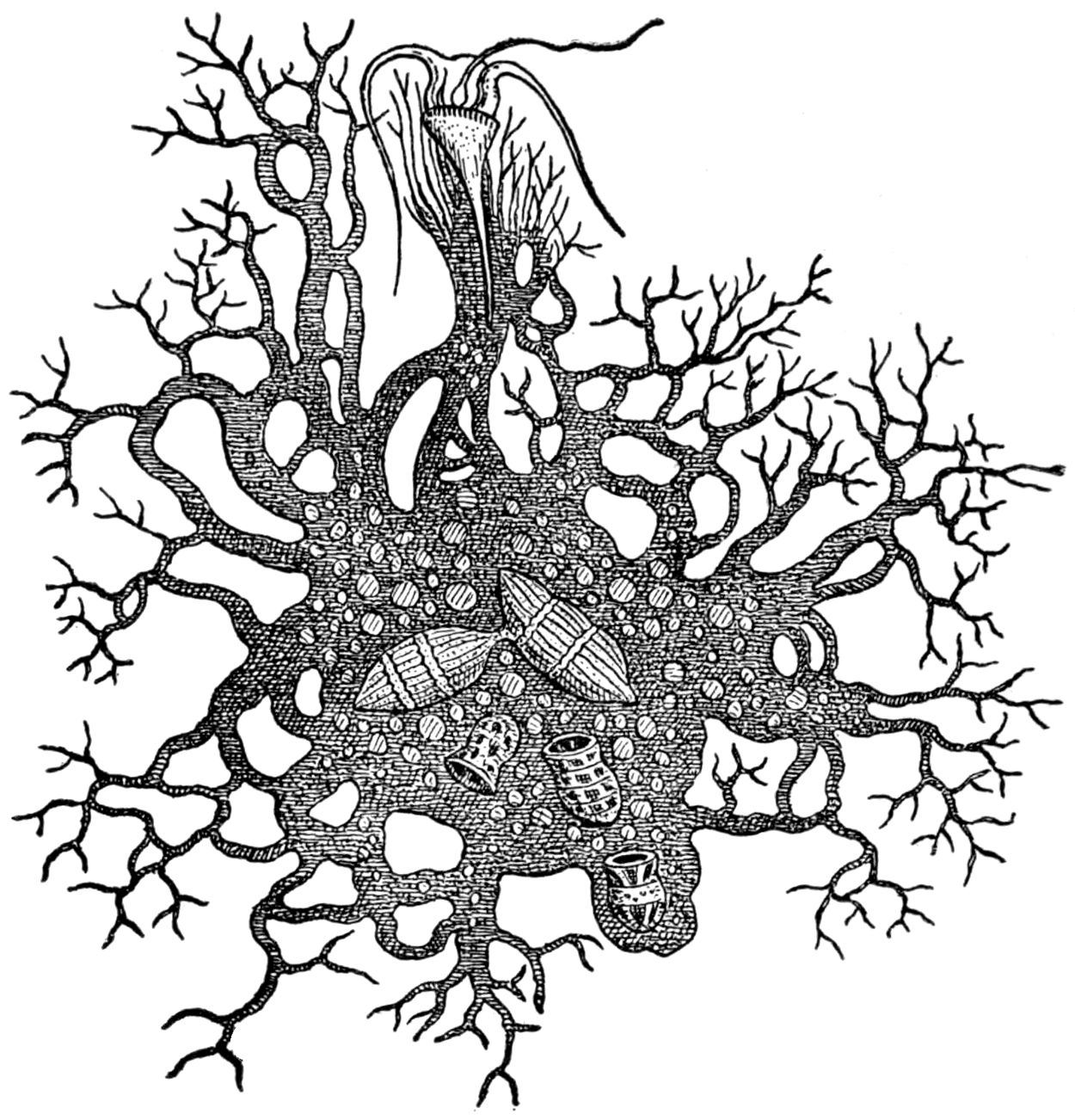
Quite as interesting among the Moners, to which the Finger
Slime belongs, is the Protomyxa aurantiaca, a shapeless bit
of transparent matter, containing merely circulating granules.
Locomotion is effected by extending the body into pseudopodia,
or false feet, and contracting them. Its movement
is slow and gliding. When at rest it appears as a mere lump
of jelly, but its whole demeanor changes when in the presence
of a living animal suited for food. Fine threads immediately
begin to shoot out from all sides, which fuse about
the unsuspecting prey, while all the little grains in the slime
course to and fro. For five or six hours the little fellow
hugs closely round the prey until it has become thoroughly
absorbed, at least the nutritious parts, into its body-mass,
when it draws itself away, or back into its original place,
leaving by its side the skeleton of its late victim. Without
eyes or ears or parts of any kind it knows how to find its
food; without muscles or limbs it is able to seize it; without
a mouth it can suck out its living body, and without a
stomach it can digest the food in the midst of its own slime,
and cast out the parts for which it has no use.
PROTOMYXA FEEDING.
When Protomyxa has become a burden to itself it divides
itself by a simple process of fission, each part being complete
in itself, or it assumes a thick covering, becoming encysted,
as it is termed. In a little while the enclosed mass divides
into spheres, the cell-wall bursts, and the little spheres, which
have now taken on a sort of tadpole shape, float out upon
the water, where they soon assume the parent-form.
Like all living things, these Moners have a desire for
food, which their protoplasm first appropriates, then converts
into available material. They thus grow and increase
in size, but when they become too large to be comfortable
they usually split into two, in obedience to the law of their
being, and each half goes its own way as a living animal. This
is the earliest form of parentage, the simplest form of reproduction.
Thus yielding to this necessity of a separation of
one into more than one, these Moners live on forever, or as
long as the earth continues to support life, thus becoming
immortal in the scientific sense in which the term is used to
devote a continuance of the physical life on earth. They
only and their nearest relatives, as simple in structure as
themselves, achieve this stupendous result, for in such a
division of their entire substance they know no loss, no
death of any part, violence only being able to sunder them
from life. They resolve themselves into their own offspring,
and nothing perishes.
PRIMITIVE LASSO-THROWERS.
Every
one knows that the long cord or thong, called the
lasso, is the peculiar weapon of the South American
hunter. Almost from his earliest childhood the young
Gaucho learns to amuse himself with it, and as soon as he
is able to walk takes great pleasure in catching young birds
and other animals around his father’s hut, hurling the long
lash with such dexterity that the noose drops over their
bodies and brings them to his feet. Did we wish to select
from among all the denizens of life the most brilliant, graceful,
and sylph-like, whose very life-histories read more like
the romance of poetry than sober reality, we would choose
those which might be appropriately designated the lasso-throwers.
Now among animals, as is only too well known, any
weapons which they could be called upon to use must
develop in their own bodies, and therefore it could hardly
be suspected that a simple jelly-animal could be provided
with a lasso ready grown in its own flesh. Yet it is so, for
in that class of animals, which ranks just above the sponges,
we discover a weapon of this kind as simple and as deadly,
and far more wonderful in its action than any used by man.
In fresh-water ponds, attached by its base to the under
surfaces of aquatic plants, may be found a very small animal,
just large enough to be seen without the aid of a lens, usually
pale green, but sometimes of a brown color. This is
our common hydra, technically called Hydra fusca. It is
nothing more than a tube or sac, with a sucker at one end
to hold on with, and a mouth at the other, surrounded with
from five to eight hollow tentacles or feelers, which opens
into a central cavity or stomach. Firm and muscular are
the walls of the sac, so that the little creature, which is not
fixed permanently to whatever it is found clinging to, may
stretch itself out or draw back as its own volition dictates,
or move slowly along by means of its sucker, or float
easily or contentedly upon the water. But the most remarkable,
as well as the most interesting thing about this odd
creature is the power which it possesses of overcoming animals
more powerful and active than itself.
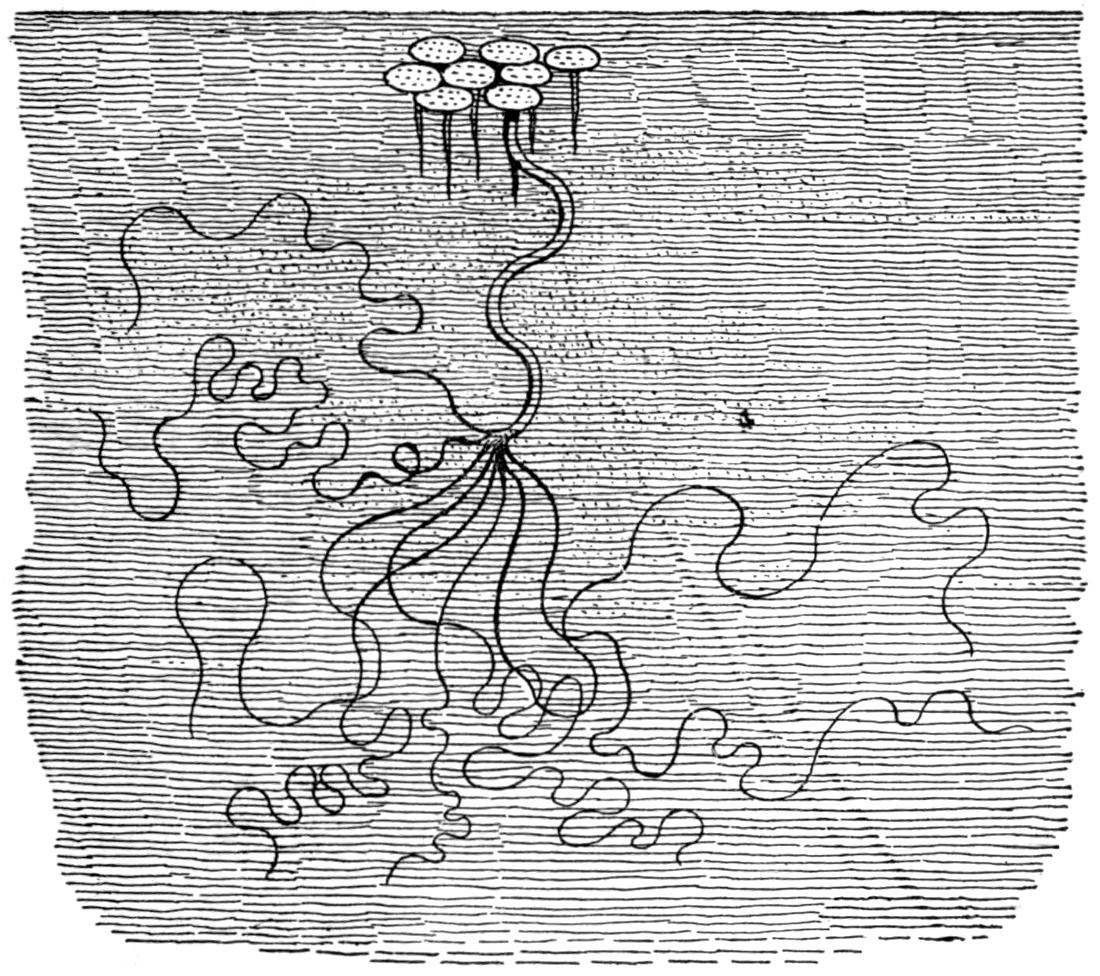
FRESH-WATER HYDRA MOORED AND SEARCHING FOR PREY.
Groping about with its flexible arms, which are closely
invested with fine jelly-hairs, with which it seemingly feels,
or attached to some leaf or bit of floating stick, its tentacles
reaching out in all directions, the Hydra instantly paralyzes
any minute insects, young snail or infusorian that touches its
feelers, and complacently closing its arms over the helpless
victim, carefully tucks it away, so to speak, into its stomach,
where it is speedily digested. This power of paralyzing and
thus readily capturing active living creatures is due to the
presence in the skin of the tentacles and body of what
are called lasso-cells, or nettling-organs, which are minute,
transparent cells, so small that two hundred of the largest
would occupy but the distance of an inch, each being armed
with a long barbed thread coiled up within its walls. This
delicate thread, which is often from twenty to forty times the
length of the cell, lies bathed in a poisonous fluid, and only
waits for the cell-walls to burst, which they do when the
Hydra touches an animal swimming near it, when thousands
of these little barbed cords dart into the victim, quickly
paralyzing it and rendering it an easy prey to its captor.
All Cœlenterates, such as jelly-fishes and coral polyps, possess
these nettling-organs.
Thus we see where the Hydra’s strength lies. He has no
need to struggle, for his victim, penetrated by a multitude of
darts, and made powerless by the poison instilled, becomes
as manageable as an equal bulk of inert matter. It behooves
the little creature to take things quietly, for a cell once burst
cannot be used again, and he is therefore compelled to wait
until a new one is grown to take the place of the one that
has become exhausted. So he patiently bides his time till
his victim is half-conquered, when he draws him gently into
his body. He lives and catches his food, as must be apparent,
without the necessity of moving very far from the place
where he had his birth.
All the summer through the Hydra puts out buds from its
side, which, when their tentacles have grown, drop from the
parent-body, and settle down in life for themselves. But
when winter comes, and before all life has become extinct, an
egg appears near the base of the tubes of those that are living,
and these eggs lie dormant till the next spring, when they
are hatched, and a new generation of Hydras is produced.
Budding, which is but a process of natural self-division, is
carried on to a large extent, more individuals being produced
in this way than from eggs. These buds are at first
a simple bulging out of the body-walls, the bud enveloping
a portion of the stomach, until it becomes constricted and
drops off, the tentacles meanwhile budding out from the
distal end, and a mouth-opening arising between them. In
the Hydra, the Actinia, and other polyps, and in truth in all
the lower animals, budding is simply due to an increase in
the growth and multiplication of cells at a special place on
the outside of the body. As in the vertebrates, man included,
the Hydra arises from an egg which, after fertilization, passes
through two stages, the germ consisting at first of two cell-layers,
but the sexes are not separate as in the marine Hydroids,
which grow in colonies that may be either male or
female.
Like some other animals of simple structure, the Hydra
is capable of reproducing to a most wonderful degree when
cut into pieces. Divided in two, each becomes a perfect
Hydra, and even when sliced into any number of thin rings
each ring will grow out a crown of tentacles. You may
split them into longitudinal strips and each strip will eventually
become a well-shaped Hydra. Two individuals may
be fastened together by a horse-hair and in a short time they
will have become like Siamese twins, but there will never
arise the slightest disagreement between them. A Hydra
turned inside out will readily adapt itself to the change, and
in a few days will be able to swallow and digest bits of meat,
its former stomach-lining having now taken upon itself the
condition of skin.
Hydra fusca is our simplest lasso-thrower, and the only
one to be found in fresh waters in this country. Such a
wonderful and deadly weapon is his, that it is easy to
understand how his numerous relatives in the wide ocean
have made good use of the weapon with which nature has
provided them, and secured, under all kinds of shapes and
forms, homes and resting-places throughout the vast waste
of waters. From the Arctic to the Tropics, and from the
shallow seaside pools at low tide to the fathomless abysses
of the ocean, we meet the lasso-throwers. Now in the form
of huge jelly-fishes, covering the sea for miles and miles,
transparent domes by day and phosphorescing lights by night,
and now as tiny balls of jelly, glistening by millions in some
quiet bay and splintering into light upon the beach; or in
the form of living animal-trees waving their graceful arms
over rocks in waters deep, or creeping like delicate threads
over shells and stones and seaweed on the shore, where
they often lose their identity and are mistaken for plants.
There is scarcely a nook or cranny in the bed of ocean
where these tree-like forms, associated with the beautiful
sea-anemone, whose brilliant crimson, green and purple are
unmatched in color by gem and flower, are not to be found.
All these beautiful creatures, as well as the living coral
that nestles in the bosom of the warm Mediterranean or the
sea that lashes our Southern shores, or that struggles boldly
against Pacific’s waves, are lasso-throwers. Cœlenterata, the
“hollow-bodied animals,” because of the large cavity within
their bodies, is the name by which they are known to science.
They naturally fall into two families, the Hydrozoa, or Water
Animals, and the Actinizoa, or Ray-like Animals, our little
Hydra, about which so much has been written, being representative
of the former and the Anemones of the latter
division.
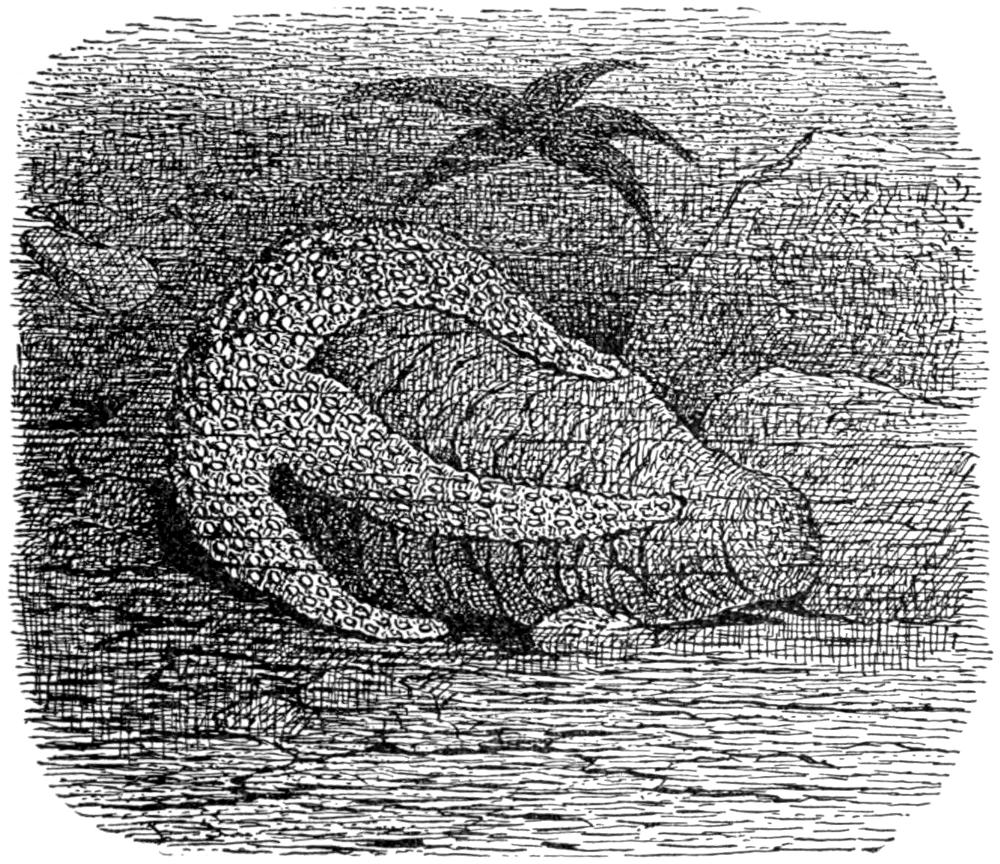
FIVE-FINGERED JACK ON THE OYSTER.
Quite
as infinite in number, variety and form is the life
of the sea as that of the land. But of all marine animals,
however, there is none more curious than the echinoderm,
a name derived by science from two Greek words,
indicating an animal bristling with spines like the hedgehog.
These creatures are sometimes free, but quite as often
attached by a stem, flexible or otherwise, and radiate after
the fashion of a circle or star, or are of the form of a star,
with more or less elongated arms. They are covered with
shell-like plates, which they secrete for themselves, and are
still further protected by spines or scales.
Perhaps the most common of the echinoderms is the Star-fish,
or Five-fingered Jack, as it is called by sailors. Whoever
has spent any time on the seashore has doubtless made
the acquaintance of this animal, for it is readily distinguishable
by its shape, its upper surface being rough and tuberculous,
and armed with spine-like projections, while the
under portion is soft, containing the essential organs of life
and locomotion.
When first seen stranded on the shore the Star-fish, by
the uninitiated, is thought to be a creature incapable of movement
of any kind. But this is far from being the case, for
in its native element it moves along the bottom of the sea
with the greatest ease, being provided with an apparatus
specially adapted for the purpose. Ordinarily its arms are
kept upon the same level, but in passing over obstacles that
lay in its path, the animal has the power of raising any one
of its several arms. Elevations are ascended with the same
ease and facility as progression on plane surfaces is effected.
Perforating the arms, or rays, and issuing from apertures, will
be found large numbers of membranous tubes, which prove
to be the feet of the animal. Upon careful examination the
latter will be found to consist of two parts, a bladder-like
portion, resident within the body, and a tubular outlying projection,
ending in a disk-shaped sucker, thus showing the
feet to be muscular cylinders, hollow in the centre, and very
extensible. In progression the animal extends a few of its
feet, attaches its suckers to the rocks or stones and then, by
retracting its feet, draws the body forward. Like that of the
tortoise, its pace is slow and sure. But the most singular
thing about this singular animal is its manner of overcoming
obstructions, which it must certainly perceive, judging from
the preparations to surmount them which it makes at the
opportune moment.
In addition to organs of locomotion Star-fishes possess
blood-vessels, digestive and respiratory apparatus, and a
nervous system of a very low order, an inference to which
its seeming capacity of enduring vivisection without pain
unmistakably leads.
Interesting as its manner of progression, even under the
most trying circumstances, must be, yet there is nothing in
the life of this lowly-organized animal that has half the charm
to the true lover and student of nature than the mother
Star’s devotion to her young. Her eggs she carries in little
pouches placed at the base of the rays. When emitted through
an opening, which occasionally and unintentionally occurs,
the mother does not abandon them to the cruel charities of
the ocean world, but gathers them together, forming a kind
of protecting cover of them, very much like a hen brooding
over her chickens. Her actions bespeak an anxiety which
could only be born of an affection, as real and sympathetic
as that which a human mother feels for the loss of any of her
offspring. No matter how often the eggs become accidentally
scattered, the mother does not grow weary of her charges
and leave them to themselves, but gathers them to the maternal
fold with the same tender, patient solicitude as characterized
her first efforts. Confined to a tank, when with ova, the
mother Star has been known to traverse the entire length of
the vessel until she has found and recovered her scattered
treasures.
Reproduction by eggs is not the only means of generation
in vogue. In common with other sea animals the Star-fish
has the strange capacity of detaching one or more of its arms,
each of the cast-off members becoming in time a perfect
creature of its own kind, while a new arm, fully equipped to
perform all necessary functions, will grow out in place of the
lost member. From twelve to fifteen weeks are required to
reproduce a lost ray, the animal meanwhile seeming not the
least discontented, but acting as utterly unconscious of any
changes in its anatomy.
As found upon the shore, Star-fishes appear dead when
really they are alive. Put one of these perfectly still creatures
into fresh sea-water, and in a short time it will probably
be disporting itself as freely as ever it did. But as the dead
and the living, when stranded by the tide, present nearly the
same appearance, some certain test seems necessary to distinguish
them apart. If a Star-fish hangs loose and limp, it
is dead; but, however dead it may look, if on touching it
there are manifest a firmness and consistency in its substance,
one may feel reasonably sure that it is playing the ’possum
and will revive when placed in the water. Quite as certain
a mode of ascertaining whether your starry friend is living
or dead, is to lay it upon its back, when, if alive, a number
of semi-transparent globular objects will be seen to move,
reaching this way and that, as though feeling for something
to lay hold of wherewith to restore it to its normal
position. These globular appendages are the ambulacra, or
locomotory organs, seeking to acquire this end. If, however,
no movement is manifested, you can wisely conclude that
your animal is dead.
The Star-fish, not unlike all other animals of the sea, has
an appetite that is never satisfied. Dinner is always welcome.
The procurement of food seems its chief concern in life. It
is a scavenger of no mean importance, keeping up an incessant
chase after all kinds of dead animal matter, and thus
largely contributing, it is probable, towards the maintaining
of the waters of the ocean in a state of purity. But its
feeding is not exclusively restricted to decaying matters.
Any species of mollusk, from the humble whelk, not more
than five-eighths of an inch in length, to the lordly oyster,
so esteemed by epicures, constitutes a dainty tidbit. No more
inveterate ravager and brigand, not even excepting man
himself, have the oyster-beds to disturb the equanimity and
serenity of their existence than the audacious, insinuating
Star-fish.
With its five arms, and apparently without any other
organ, this comparatively insignificant little being accomplishes
a work which man, without the aid of extraneous
appliances, is quite unable to execute. It opens an oyster
as deftly and effectually as an expert oysterman would do,
and that, too, without the habitual oyster-knife, and swallows
the slimy bivalve in the same manner as the lords of creation
do. Man, with all his genius and skill, were he deprived of all
other means of subsistence than the oyster, and having no
implement with which to open it, would be severely puzzled
to get at the savory morsel shut up in its obstinate valves,
yet the Star-fish performs the task seemingly without the
least difficulty.
How the Star-fish manages the problem was at first a matter
of guess-work. For a long time it was confidently
believed that the animal waited for the moment when the
oyster opened its shell to introduce one of its arms into
the opening. This much gained, the other four arms were
got in without much trouble, and the whole business ended
with the devouring of the inmate. This belief is no longer
tenable. Careful observation has revealed to us the true
inwardness of the proceeding. The oyster is seized between
the arms of the Star-fish and held under its mouth by the
aid of its suckers. Thus secured, the Asterias, or Star-fish,
everts its stomach, and envelops the whole oyster in its interior
recesses, distilling a poisonous fluid, a secretion from
its mouth, which causes the oyster to open its shell, when
the robber, as it were, crawls in and takes its dessert. Incredible
numbers of oysters are destroyed by Star-fishes,
but the oystermen fail to see that their own barbaric ignorance
is largely to blame. Star-fishes drawn up in nets, rakes
and dredges in immense quantities are tied into bundles, but
the cords are made so tight that the pile is cut in twain, the
result being that all the pieces, when afterwards thrown overboard,
become new and perfect Star-fishes.
STAR-FISH OPENING AN OYSTER.
Not often has one the pleasure of meeting with these animals
on the New Jersey coast, but yet they are occasionally
seen, more frequently, perhaps, in the North. Asterias berylinus,
the commoner form, is a fairly large species, of a more
or less greenish color, sometimes waning to brown, and
roughly covered with tubercles. Its five arms, at the extremity
of each of which is situated a single red-eye speck,
are somewhat irregularly arranged, and not rarely one is
stumpy through breakage or unequal development.
When a Star-fish is alarmed, or finds itself in strange quarters,
it will be seen to curl up the tips of its rays, and there
under the point of each ray will be found a thick red spot
seated on the extremity of a nerve, and having in it as many
as from one hundred to two hundred crystal lenses surrounded
by red cells. With such a highly-developed eye,
which is far better than the jelly-fish enjoys, it is no wonder
that the Star-fish is so quick in discerning food, or enrages
the fisherman by the discovery of the bait which he had
intended for other animals, for it turns out that this stupid-looking
animal is more wide-awake than it is given credit
for. Sometimes, as in the beautifully delicate Star-fish, called
the “Lingthorn,” a soft lid, or feeler, hangs over the eye-spot,
which gives to the creature a curiously intelligent look, but
in the case of our common form this lid is notably absent.
From all that has been written it must be evident that our
first walking animal is by no means a poor or feeble creature.
He has a chain armor woven into his leathery skin, with
sharp, pointed spines, and snapping, beak-like claws to protect
him; an excellent digestion and a capacious mouth
to feed his greedy stomach, and a fine array of nerves, quick
feeling and eyesight, and a wonderful apparatus for moving
over the ground. When it is added to all these possessions
the ability to close over the wound in the case of a lost ray
and the growing of a new one, we see that his powers of
living satisfactorily are by no means insignificant. But this
curious walking apparatus of the Star-fish is far from being
perfect in all his relations. They do not all walk by means
of suckers any more than all sponge-animals build toilet
sponge, or all slime-animals make chambered shells. Sure,
the Rosy Feather-stars, for example, have no use for feet-tubes,
as their lives are generally spent upon the rocks or nestled in
bunches of sea-weed. Brittle-stars, as these are called,
though closely related to the Star-fishes, are not easily
confounded with them, for their arms are found to radiate from
a clearly defined central disk, and there is no prolongation of
their stomachs and ovaries into their interiors. The tube-feet
pass out from the plates along the sides of the arms,
instead of from the under surface as in the Star-fishes proper,
and probably serve merely as a help for breathing, locomotion
over the sands being effected by their long flexible arms.
Their home is chiefly among the tangle and eel-grass, where
their protecting covering affords them security from their
many enemies.
EARTH-WORMS IN HISTORY.
Earth-worms are found throughout the world.
Though few in genera, and not many in species, yet
they make up in individual numbers, for it has been estimated
that they average about one hundred thousand to the
acre. Our American species have never been monographed,
which renders it impossible to judge of their probable number.
Their castings may be seen on commons, so as to
cover almost entirely their surface, where the soil is poor
and the grass short and thin, and they are almost as numerous
in some of our parks where the grass grows well and
the soil appears rich. Even on the same piece of ground
worms are much more frequent in some places than in others,
although no visible difference in the nature of the soil is
manifest. They abound in paved court-yards contiguous to
houses, and on the sidewalks in country towns, and instances
have been reported where they have burrowed through the
floors of very damp cellars.
Beneath large trees few castings can be found during certain
parts of the year, and this is apparently due to the
moisture having been sucked out of the ground by the innumerable
roots of the trees, an explanation which seems to
be confirmed by the fact that such places may be observed
covered with castings after the heavy autumnal rains.
Although most coppices and woods support large numbers
of worms, yet in forests of certain kinds of tree-growths,
where the ground beneath is destitute of vegetation, not a
casting is seen over wide reaches of ground, even during the
autumn. In mountainous districts worms are mostly rare, it
would seem, a circumstance which is perhaps owing to the
close proximity of the subjacent rocks, into which it is
impossible for them to burrow during the winter, so as to
escape being frozen. But there are some exceptions to this
rule, for they have been found at great altitudes in certain
parts of the world, and especially is this so in India, where
they have been observed to be quite numerous upon the
mountains.
Though in one sense semi-aquatic animals, like the other
members of the great class of Annelids to which they belong,
yet it cannot be denied that earth-worms are terrestrial
creatures. Their exposure to the dry air of a room for a
single night proves fatal to them, while on the other hand
they have been kept alive for nearly four months completely
submerged in water. During the summer, when the ground
is dry, they penetrate to a great depth and cease to work,
just as they do in winter when the ground is frozen. They
are nocturnal in their habits, and may be seen crawling
about in large numbers at night, but generally with their
tails still inserted in their burrows. By the expansion of
this part of the body, and with the aid of the short reflexed
bristles with which they are armed inferiorly, they hold so
securely that they can seldom be withdrawn from the
ground without being torn in pieces. But during the day,
except at the time of pairing, when those which inhabit
adjoining burrows expose the greater part of their bodies
for an hour or two in the early morning, they remain in
their burrows. Sick individuals, whose illness is caused by
the parasitic larvæ of a fly, must also be excepted, as they
wander about during the day and die on the surface. Astonishing
numbers of dead worms may sometimes be seen lying
on the ground after a heavy rain succeeding dry weather, no
less than a half-hundred in a space of a few square yards,
but these are doubtless worms that were already sick,
whose deaths were merely hastened by the ground being
flooded, for if they had been drowned it is probable, from
the facts already given, that they would have perished in
their burrows.
After there has been a heavy rain the film of mud or of
very fine sand to be seen over gravel-walks in the morning
is often distinctly marked with the tracks of worms. From
May to August, inclusive, this has been noticed when the
months have been wet. Very few dead worms are anywhere
to be seen on these occasions, although the walks are
marked with innumerable tracks, five tracks often being
counted crossing a space of only an inch square, which
could be traced either to or from the mouths of the burrows
in the gravel-walks for distances varying from three to
fifteen yards, but no two tracks being seen to lead to the
same burrow. It is not likely, from what is known of the
sense-organs of these animals, that a worm could find its
way back to its burrow after having once left it. They
leave their burrows, it would seem, on a voyage of discovery,
and thus they find new sites for the exercise of their powers.
For hours together they may often be seen lying almost
motionless beneath the mouths of their burrows. But let
the ejected earth or rubbish over their burrows be suddenly
removed and the end of the worm’s body may be seen
rapidly retreating.
This habit of lying near the surface leads to their destruction
to an immense extent, for, at certain seasons of the year,
the robins and blackbirds that visit our lawns in the country
may be observed drawing out of their holes an astonishing
number of worms, which could not be done unless they lay
close to the surface. But what brings the worms to the surface?
This is a question whose answer cannot be positively
asserted. It is not probable that they behave in this manner
for the purpose of breathing fresh air, for it has been seen
that they can live a long time under water. That they are
there for the sake of warmth, especially in the morning, is a
more reasonable supposition, which seems to be confirmed
by the fact that they often coat the mouths of their burrows
with leaves, apparently to prevent their bodies from coming
into contact with the cold, damp earth, and by the still other
fact that they completely close their burrows during the
winter.
Some remarks about the structure of the earth-worm now
appear apropos. Its body consists of from one hundred to
two hundred almost cylindrical rings, each provided with
minute bristles. The muscular system is well developed,
thus enabling these animals to crawl backwards as well as
forwards, and to retreat by the help of their affixed tails into
their burrows with extraordinary rapidity. Situated at the
anterior end of the body is the mouth. It is furnished with
a little projection, variously called the lobe or lip, which is
used for prehension. Behind the mouth, internally located,
is a strong pharynx, which is pushed forwards when the
animal eats, corresponding, it is said, with the protrudable
trunk of other Annelids. The pharynx conducts to the
œsophagus, on each side of the lower part of which are
placed three pairs of large glands, called calciferous glands,
whose function is the secretion of carbonate of lime. These
glands are very remarkable organs, and their like is not to
be found in any other animal. Their use is connected in
some way with the process of digestion. The œsophagus,
in most of the species, is enlarged into a crop in front of the
gizzard. This latter organ is lined with a smooth, thick
chitinous membrane, and is surrounded by weak, longitudinal,
but powerful transverse muscles, whose energetic action
is most effectual in the trituration of the food, for these worms
possess no jaws, or teeth of any kind. Grains of sand and
small stones, from the one-twentieth to the one-tenth of an
inch in size, are found in their gizzards and intestines, and
these little stones, independently of those swallowed while
excavating their burrows, most probably serve, like millstones,
to triturate their food. The gizzard opens into the
intestine—a most remarkable structure, an intestine within
an intestine—which runs in a straight line to the vent at the
posterior end of the body. But this curious structure, as
shown by Claparède, merely consists of a deep longitudinal
involution of the walls of the intestine, by which means an
extensive absorbent surface is secured.
Worms have a well-developed circulating system. Their
breathing is effected by the skin, and so they do not possess
any special respiratory apparatus. Each individual unites
the two sexes in its own body, but two individuals pair
together. The nervous system is fairly well developed, the
two nearly confluent cerebral ganglia being situated very
close to the anterior extremity of the body.
Being destitute of eyes, we would naturally conclude that
worms were quite insensible to light; but from many experiments
that have been made by Darwin, Hofmeister and
others, it is evident that light affects them, but only by its
intensity and duration. It is the anterior extremity of the
body, where the cerebral ganglia lie, that is affected, for if
this part is shaded and other parts of the body are illuminated
no effect will be produced. As these animals have no
eyes, it is probable that the light passes through their skins
and excites in some manner their cerebral ganglia. When
worms are employed in dragging leaves into their burrows
or in eating them, and even during the brief intervals of rest
from their labors, they either do not perceive the light or are
regardless of it, and this is even the case when the light is
concentrated upon them through a large lens. Paired individuals
will remain for an hour or two together out of their
burrows, fully exposed to the morning light, but it appears,
from what some writers have said, that a light will occasionally
cause paired individuals to separate. When a worm is
suddenly illuminated and dashes into its burrow, one is led
to look at the action as a reflex one, the irritation of the
cerebral ganglia apparently causing certain muscles to contract
in an inevitable manner, without the exercise of the
will or consciousness of the animal, as though it was an
automaton. But the different effect which a light produces
on different occasions, and especially the fact that a worm
when in any way occupied, no matter what set of muscles
and ganglia may be brought into play, is often regardless of
light, are antagonistic to the view of the sudden withdrawal
being a simple reflex action. With the higher animals, when
close attention to some object leads to the disregard of the
impressions which other objects must be producing upon
them, we ascribe this to their attention being then absorbed,
and attention necessarily implies the presence of mind.
Although worms cannot be said to possess the power of
vision, yet their sensitiveness to light enables them to discriminate
between day and night, and thus they escape the
attacks of the many diurnal animals that would prey upon
them. They are less sensitive to a moderate radiant heat
than to a bright light, as repeated experiments have conclusively
shown; and their disinclination to leave their
burrows during a frost proves that they are sensitive to a
low temperature.
Investigation fails to locate in worms any organ of hearing,
from which must be concluded that they are insensible
to sounds. The shrill notes of a metallic whistle sounded
near them, and the deepest and loudest tones of a bassoon,
failed to awaken the least notice. Although indifferent to
modulations in the air, audible to human ears, yet they are
extremely sensitive to vibrations in any solid object. Even
the light and delicate tread of a robin affrights and sends
them deep into their burrows. It has been said that if the
ground is beaten, or otherwise made to tremble, that worms
believe they are pursued by a mole and leave their burrows,
but this does not stand the test of experiment, for the writer
has frequently beaten the ground in many places where these
creatures abounded, but not one emerged. A worm’s entire
body is sensitive to contact, the slightest puff of air from the
mouth causing an instant retreat. When a worm first comes
out of its burrow it generally moves the much-extended
anterior extremity of its body from side to side in all
directions, apparently as an object of touch, and there is good
reason to believe that they are thus enabled to gain a general
knowledge of the form of an object. Touch, including in
this term the perception of a vibration, seems much the most
highly developed of all their senses. The sense of smell is
quite feeble, and is apparently confined to the perception of
certain odors. They are quite indifferent to the human
breath, even when tainted by tobacco, or to a pellet of cotton-wool
with a few drops of Millefleur’s perfume when held by
pincers and moved about within a few inches of them. The
perception of such an unnatural odor would be of no service
to them. Now, as such timid creatures would almost certainly
exhibit some signs of any new impression, we may
reasonably conclude that they did not perceive these odors.
But when cabbage leaves and pieces of onion were employed,
both of which are devoured with much relish by worms, the
result was different. These, with bits of fresh raw meat, have
been buried in pots beneath one-fourth of an inch of common
garden soil, or sometimes laid on pieces of tin foil in the
earth, the ground being pressed down slightly, so as not to
prevent the emission of any odor, and yet they were always
discovered by the worms that were placed in the pots, and
removed after varying periods of time. These facts indicate
that worms possess some power of smell, and that they discover
by this means odoriferous and much-coveted kinds of
food.
That all animals which feed on various substances possess
the sense of taste, is a wise presumption. This is certainly
the case with worms. Cabbage leaves are much liked by
worms, and it would seem that they are able to distinguish
between the different varieties, but this may perhaps be owing
to differences in their texture. When leaves of the cabbage,
horse-radish and onion were given together, they manifestly
preferred the last to the others. Celery is preferred to the
leaves of the cabbage, lime-tree, ampelopsis and parsnip, and
the leaves of the wild cherry and carrots, especially the latter,
to all the others. That the worms have a preference for one
taste over another, is still further shown from what follows.
Pieces of the leaves of cabbage, turnip, horse-radish and
onion have been fed to the worms, mingled with the leaves
of an Artemisia and of the culinary sage, thyme and mint,
differing in no material degree in texture from the foregoing
four, yet quite as strong in taste, but the latter were quite
neglected excepting those of the mint, which were slightly
nibbled, but the others were all attacked and had to be
renewed.
There is little to be noted about the mental qualities of
worms. They have been seen to be timid creatures. Their
eagerness for certain kinds of food manifestly shows that
they must enjoy the pleasure of eating. So strong is their
sexual passion that they overcome for a time their dread of
light. They seem to have a trace of social feeling, for they
are not disturbed by crawling over each other’s bodies, and
they sometimes lie in contact. Although remarkably deficient
in the several sense-organs, yet this does not necessarily
preclude intelligence, for it has been shown that when their
attention is engaged they neglect impressions to which they
would otherwise have attended, and attention, as is well
known, indicates the presence of a mind of some kind. A
few actions are performed instinctively, that is, all the individuals,
including the young, perform each action in nearly
the same manner. The various species of Perichæta eject
their castings so as to construct towers, and the burrows
of the Common Earth-worm—Lumbricus terrestris—are
smoothly lined with fine earth and often with little stones, and
the mouth with leaves. One of their strongest instincts is
the plugging up of the mouths of their burrows with various
objects, the very young worms acting in a similar manner.
But some degree of intelligence is manifested, as will subsequently
appear.
Almost everything is eaten by worms. They swallow
enormous quantities of earth, from which they extract any
digestible matter it may contain. Large numbers of half-decayed
leaves of all kinds, excepting a few that are too
tough and unpleasant to the taste, and likewise petioles,
peduncles, and decayed flowers. Fresh leaves are consumed
as well. Particles of sugar, licorice and starch, and bits of
raw and roasted meat, and preferably raw fat, are eaten when
they come into their possession, but the last article with a
better relish than any other substance given to them. They
are cannibals to a certain extent, and have been known to
eat the dead bodies of their own companions.
The digestive fluid of worms, according to León Frédéricq,
is analogous in nature to the pancreatic secretion of the
higher animals, and this conclusion agrees perfectly with the
kinds of food which they consume. Pancreatic juice emulsifies
fat, dissolves fibrin, and worms greedily devour fat and
eat raw meat. It converts starch into grape-sugar with
wonderful rapidity, and the digestive fluid of worms acts
upon the starch of leaves. But worms live chiefly on half-decayed
leaves, and these would be useless to them unless
they could digest the cellulose forming the cell-walls, for all
other nutritious substances, as is well known, are almost
completely withdrawn from leaves shortly before they fall
off. It has been ascertained that cellulose, though very little
or not at all attacked by the gastric juice of the higher
animals, is acted on by that from the pancreas, and so worms
eat the leaves as much for the cellulose as for the starch
they contain. The half-decayed or fresh leaves which are
intended for food are dragged into the mouths of their burrows
to a depth of from one to three inches, and are then
moistened with a secreted fluid, which has been assumed to
hasten their decay, but which, from its alkaline nature, and
from its acting both on the starch-granules and on the protoplasmic
contents of the cells, is not of the nature of saliva,
but a pancreatic secretion, and of the same kind as is found
in the intestines of worms. As the leaves which are
dragged into the burrows are often dry and shrivelled, it is
indispensable for the unarmed mouths of worms that they
should first be moistened and softened, their disintegration
being thereby the more readily effected. Fresh leaves, however
soft and tender they may be, are similarly treated, probably
from habit. Thus the leaves are partially digested before
they are taken into the alimentary canal, an instance of
extra-stomachal digestion, whose nearest analogy is to be
found in such plants as Dionæa and Drosera, for in them
animal matter is digested and converted into peptone, not
within a stomach, but on the surfaces of the leaves.
But no portion of the economy of worms has been
more the subject of speculation than the calciferous glands.
About as many theories have been advanced on their utility
as there have been observers. Judging from their size and
from their rich supply of blood-vessels, they must be of vast
importance to these animals. They consist of three pairs,
which in the Common Earth-worm debouch into the alimentary
canal in front of the gizzard, but posteriorly to it, in
some genera. The two posterior pairs are formed by lamellæ,
diverticula from the œsophagus, which are coated with a
pulpy cellular layer, with the outer cells lying free in infinite
numbers. If one of these glands is punctured and squeezed,
a quantity of white, pulpy matter exudes, consisting of these
free cells, which are minute bodies, varying in diameter from
two to six millimetres. They contain in their centres a small
quantity of excessively fine granular matter, that looks so
like oil globules that many scientists are deceived by its
appearance. When treated with acetic acid they quickly
dissolve with effervescence. An addition of oxalate of ammonia
to the solution throws down a white precipitate, showing
that the cells contain carbonate of lime. The two anterior
glands differ a little in shape from the four posterior ones by
being more oval, and also conspicuously in generally containing
several small, or two or three larger, or a single very
large concretion of carbonate of lime, as much as one and
one-half millimetres in diameter. With respect to the function
of the calciferous glands, it is likely that they primarily
serve as organs of excretion, and secondarily as an aid to
digestion. Worms consume many fallen leaves. It is known
that lime goes on accumulating in leaves until they drop off
the parent-plant, instead of being re-absorbed into the stem
or roots, like various other organic and inorganic substances,
and worms would therefore be liable to become charged with
this earth, unless there was some special apparatus for its
excretion, and for this purpose the calciferous glands are ably
adapted. On the other hand, the carbonate of lime, which
is excreted by the glands, aids the digestive process under
ordinary circumstances. Leaves during their decay generate
an abundance of various kinds of acids, which have been
grouped together under the term of humus acids. These
half-decayed leaves, which are swallowed by worms in large
quantities, would, therefore, after having been moistened and
triturated in the alimentary canal, be apt to produce such
acids, and in the case of several worms, whose alimentary
canals were examined, their contents were plainly shown by
litmus paper to be decidedly acid. This acidity cannot be
attributed to the nature of the digestive fluid, for pancreatic
juice is alkaline, and so also is the secretion which is poured
out of the mouths of worms for the preparation of the leaves
for consumption. With worms not only the contents of the
intestines, but their ejected matter or the castings are generally
acid. The digestive fluid of worms resembles in its
action, as already stated, the pancreatic secretion of the higher
animals, and in these latter pancreatic digestion is necessarily
alkaline, and the action will not take place unless some alkali
be present; and the activity of an alkaline juice is arrested
by acidification, and hindered by neutralization. Therefore
is seems probable that innumerable calciferous cells, which
are emptied from the four posterior glands in the alimentary
canal, serve to neutralize more or less completely the acids
generated there by the half-decayed leaves. These cells, as
has been seen, are instantly dissolved by a small quantity of
acetic acid, and as they do not always suffice to render of no
effect the contents of the upper part of the alimentary canal,
it is probable that the lime is aggregated into concretions, in
the anterior pair of glands, in order that some may be conveyed
to the posterior parts of the intestine, where these
concretions would be rolled about among the acid contents.
The concretions found in the intestines and in the castings
often present a worn appearance, but whether due to attrition
or chemical corrosion it is impossible to say. That they are
formed for the sake of acting as mill stones, as Claparède
believed, and of thus assisting in the trituration of food, is
not at all likely, as this object is already attained by the
stones that are present in the gizzards and intestines.
In dragging leaves into their burrows worms generally
seize the thin edge of a leaf with their mouths, between the
projecting upper and lower lip, the thick and strong pharynx
at the same time being pushed forwards within their bodies,
so as to afford a point de resistance for the upper lip; but in
the case of broad and flat objects the pointed anterior
extremity of the body, after being brought into contact with
an object of this kind, is drawn within the adjoining rings,
so that it becomes truncated and as thick as the rest of the
body. This part is then seen to swell a little, seemingly
from the pharynx being pushed a little forwards. By a
slight withdrawal of the pharynx, or by its expansion, a
vacuum is produced beneath the truncated, slimy end of
the body whilst in contact with the object, and by this
means the two adhere firmly together. Worms can attach
themselves to an object in the same manner under the water.
COMMON EARTH-WORMS.
Out on a Foraging Excursion.
As worms have no teeth, and their mouths consist of
very soft tissue, it may be presumed that they consume by
means of suction of the edges and parenchyma of fresh
leaves after they have been softened by the digestive fluid.
They cannot attack such strong leaves as those of sea-kale
or large and thick leaves of ivy. They not only seize leaves
and other objects for purposes of food, but for plugging up
the mouths of their burrows. Flower-peduncles, decayed
twigs of trees, bits of paper, feathers, tufts of wool and
horse-hair are some of the many things other than leaves
that are dragged into their burrows for this purpose. Many
hundred leaves of the pine-tree have been found drawn by
their bases into burrows. Where fallen leaves are abundant,
especially ordinary dicotyledonous leaves, many more than
can be used are collected over the mouth of a burrow, so
that a small pile of unused leaves is left like a roof over
those which have been partly dragged in. A leaf in being
dragged a little way into a cylindrical burrow necessarily
becomes much folded or crumpled, and when another is
drawn in, this is done exteriorly to the first, and so on with
succeeding leaves, till finally they all become closely folded
and pressed together. Sometimes the mouth of a burrow
is enlarged, or a fresh one is made close by, so that a larger
number of leaves may be drawn in. Generally the interstices
between the drawn-in leaves are filled with moist, viscid
earth ejected from their bodies, thus rendering them doubly
secure. Hundreds of such plugged burrows may be seen
during the autumnal and early winter months.
When leaves, petioles, sticks, etc., cannot be obtained for
the mouths of their burrows, heaps of stones, smooth,
rounded pebbles, are utilized for protection. When the
stones are removed and the surface of the ground is cleared
for some inches round the burrow, the worms may be seen
with their tails fixed in their burrows dragging the stones
inward by the aid of their mouths, stones weighing as much
as two ounces often being found in the little heaps, which
goes to show how strong these apparently weak creatures
are. Work of this kind is usually performed during the night,
although objects have been occasionally known to be drawn
into the burrows during the day. What advantage worms
derive from plugging up the mouths of their burrows, or from
piling stones over them, cannot be satisfactorily answered.
They do not act in this manner when they eject much earth
from their burrows, for then their castings serve to cover the
mouth. Perhaps the plugs serve to protect them from the
attacks of scolopenders, their most inveterate enemies, or to
enable them to remain with safety with their heads close to
the mouths of their burrows, which they like so well to do,
but which, unless protected, costs many a fellow its life.
Besides, may not the plugs check the free ingress of the
lowest stratum of air, when chilled by radiation at night,
from the surrounding ground and herbage? The last view
of the matter seems especially well taken, because worms
kept in pots where there is fire, having no cold air with
which to contend, plug up their burrows in a slovenly manner,
and because they often coat the upper part of their
burrows with leaves, apparently to prevent their bodies from
coming into contact with the cold, damp earth. But the
plugging-up process may undoubtedly serve for all these
purposes. Whatever the motive may be, it seems that worms
much dislike leaving the mouths of their burrows open, yet,
nevertheless, they will reopen them at night, whether or not
they are able afterwards to close them.
Considerable intelligence is shown by worms in their manner
of plugging up their burrows. If man had to plug up
a cylindrical hole with such objects as leaves, petioles or
twigs, he would push them in by their pointed ends, but if
these were thin relatively to the size of the hole, he would
probably insert some by their broader ends. Intelligence
would certainly be his guide in such a case. But how
worms would drag leaves into their burrows, whether by
their tips, bases, or middle parts, has been a matter of interest
to many. Darwin, who experimented upon the subject,
found it especially desirable to experiment with plants not
native to his country, for he conceived that although the
habit of dragging leaves into their burrows is undoubtedly
instinctive with worms, yet instinct could not teach them
how to act in the case of leaves about which their progenitors
knew nothing. Did they act solely through instinct, or
an unvarying inherited impulse, they would draw all kinds
of leaves into their burrows in the same manner. Having
no such definite instinct, chance might be expected to determine
whether the tip, base, or middle might be seized. If
the worm in each case first tries many different methods,
and follows that alone which proves possible or the most
easy, then both instinct and chance are ruled out of the
solution of the question. But to act in this manner, and to
try different methods, makes what in man would be called
intelligent action.
Three species of pine-leaves are mentioned by Darwin as
being regularly drawn into the mouths of worm-burrows on
the gravel-walk in his garden. These leaves consist of two
needles, which are united to a common base, and it is by this
point that they are almost invariably drawn into the burrows.
As the sharply-pointed needles diverge somewhat, and as
several are drawn into the same burrow, each tuft forms a
perfect chevaux-de-frise. Many tufts were pulled up in the
evening, but by the ensuing morning fresh leaves had taken
their places, and the burrows again well protected. Impossible
it would be to drag these leaves to any depth into the
burrows, except by their bases, as a worm cannot seize hold
of the two leaves at the same time, and if one alone were
seized by the apex, the other would be pressed against the
ground and resist the entry of the one that was seized. That
the worms should do their work well, it was very essential
that they drag the pine-leaves into their burrows by their
bases, that is, where the two needles are conjoined. But how
they are guided in this work was at first perplexing. The
difficulty, however, was soon settled. With the assistance of
his son Francis, the elder Darwin set to work to observe
worms in confinement during several nights by the aid of a
dim light, while they dragged the leaves of the aforementioned
kinds into their burrows. They were seen to
move the anterior extremities of their bodies about the leaves,
and on several occasions when they touched the sharp end
of the needle they suddenly withdrew as though they had
been pricked, but it is doubtful that they were hurt, for they
are indifferent to sharp objects, being known to swallow
rose-thorns and small splinters of glass. It may be doubted
whether the sharp end of the needle serves to tell them that
is the wrong end to seize, for the points of many were cut off
for the length of an inch, and these leaves were always drawn
in by their bases and not by the cut-off ends. The worms,
it seemed, almost instantly perceived as soon as they had
seized a leaf in the proper manner. Many leaves were
cemented together at the top, or tied together by fine thread,
and these in the majority of instances were dragged in by
their bases, which leads to the conclusion that there must
be something attractive to worms in the base of pine-leaves,
notwithstanding that few ordinary leaves are drawn in by
their base or footstalk. Leaves of other plants, and also
the petioles of some compound plants, as well as triangular
bits of paper, dry and damp, were experimented with, and
the manner of seizing the objects and bearing them into
their burrows were as amusing as they were novel and
interesting. The leaves and stems used were such as
the worms had not been accustomed to in their respective
haunts.
When the several cases experimented on are considered,
one can hardly escape from the conclusion that some degree
of intelligence is shown by worms in plugging up their burrows.
Each particular object is seized in too uniform a
manner, and from causes which we can generally understand,
for the result to be attributed to mere chance. That
every object has not been drawn in by its pointed end may
be accounted for by labor having been saved by some being
carried in by their broader ends. There is no doubt that
worms are governed by instinct in plugging up their burrows,
and it might be expected that they would have been
taught in every particular instance how to act independently
of intelligence. It is very difficult to judge when intelligence
comes into play. The actions of animals, appearing
due to intelligence, may be performed through inherited
habit without any intelligence, although aboriginally acquired,
or the habit may be acquired through the preservation and
inheritance of some other action, and in the latter case the
new habit will have been acquired independently of intelligence
throughout the entire course of its development.
There is no à priori improbability in worms having acquired
special instincts through either of these two latter means.
Nevertheless it is incredible that instincts should have been
developed in reference to objects, such as the leaves and
petioles of foreign plants, wholly unknown to the progenitors
of the worms which have acted in the manner just
described. Nor are their actions so unvarying or inevitable
as are most true instincts.
As worms are not controlled by special instincts in each
particular case, though possessing a general instinct to plug
up their burrows, and as chance is excluded, the next most
probable conclusion is that they try in many ways to draw
in objects and finally succeed in some one way. It is surprising,
however, that an animal so low in the scale as a
worm should have the capacity to act in this way, as many
higher animals have no such capacity, the instincts of the
latter often being followed in a senseless or purposeless
manner.
We can safely infer intelligence, as Mr. Romanes, who
has specially studied animals, says, only when we see an
individual profiting by his own experiences. That worms
are able to judge either before or after having drawn
an object close to the mouths of their burrows how best
to drag it in, shows that they must have acquired some
notion of its general shape. This they probably acquire by
touching it in many places with the anterior extremity of their
bodies, which serves them as a tactile organ. Man, even
when born blind and deaf, shows how perfect the sense of
touch may become, and if worms, which also come into
being in the same condition, have the power of acquiring
some notion, however rude, of the shape of an object and
their burrows, they deserve, it must seem to every sensible
mind, to be called intelligent creatures, for they act in such
a case in nearly the same manner as a man would under
similar circumstances. That worms, which stand so low in
the scale of organization, should possess some degree of
intelligence, will doubtless strike everyone as very improbable.
It may be doubted, however, whether we know
enough about the nervous system of the lower animals to
justify our natural distrust of such a conclusion. With regard
to the small size of the cerebral ganglia, we would do
well to remember what a mass of inherited knowledge, with
some power of adapting means to an end, is crowded into
the minute brain of a worker ant.
Two ways are adopted by worms in excavating their burrows.
Either the earth is pushed away on all sides or it is
swallowed by the animal. In the former case the worm
inserts the stretched-out and attenuated anterior extremity
of its body into any little crevice or hole, and the pharynx
is pushed forward into this part, which consequently swells
and pushes away the earth on all sides, the anterior extremity
thus acting as a wedge. When placed in loose mould a worm
will bury itself in between two and three minutes, but in
earth that is moderately pressed down it often requires as
many as fifteen minutes for its disappearance. But whenever
a worm burrows to a depth of several feet in undisturbed
compact ground, it must form its passage by swallowing the
earth, for it is impossible that the ground could yield on all
sides to the pressure of the pharynx when pushed forward
within the worm’s body. Great depths are reached only
during continued dry weather and severe cold, the burrows
sometimes attaining to a depth of from seven to eight feet.
The burrows run down perpendicularly, or, more commonly,
obliquely, and are sometimes said to branch. Generally, or
invariably as I think, they are lined with fine, dark-colored
earth voided by the worm, so that at first they must be made
a little wider than their ultimate diameter. Little globular
pellets of voided earth, still soft and viscid, often dot the
walls of fresh burrows, and these are spread out on all sides
by the worm as it travels up or down its burrow, the lining
thus formed becoming very compact and smooth when
nearly dry and closely fitting the worm’s body. Excellent
points of support are thus afforded for the minute
reflexed bristles which project in rows on all sides from the
body, thus rendering the burrow well adapted for the rapid
movement of the animal. The lining appears also to
strengthen the walls, and perhaps saves the worm’s body
from being scratched, which would assuredly be the case
when the burrows, as is occasionally observed, pass through
a layer of sifted coal cinders. The burrows are thus seen to
be not mere excavations, but may be compared with tunnels
lined with cement. Those which run far down into the
ground generally, or at least frequently, terminate in little
chambers, where one or several worms pass the winter rolled
up into a ball. Small pebbles and seeds as large as grains
of mustard are carried down from the surface by being swallowed
or within the mouths of worms, as well as bits of glass
and tile, whose only use in their winter-quarters seems to be
the prevention of their closely coiled-up bodies from coming
into contiguity with the surrounding cold soil, for such contact
would perhaps interfere with their respiration, which is
effected by the skin alone.
After swallowing earth, whether for making its burrow or
for food, the earth-worm soon comes to the surface to empty
its body. The rejected matter is thoroughly mixed with the
intestinal secretions, and is thus rendered viscid. After becoming
dried, it sets hard. When in a very liquid state the
earth is thrown out in little spurts, and when not so liquid
by a slow peristaltic movement of the intestine. It is not
cast indifferently on any side, but first on one and then
on another, the tail being used almost like a trowel. The
little heap being formed the worm seemingly avoids, for the
sake of safety, the use of its tail, the earthy matter being
forced up through the previously deposited soft mass. The
mouth of the same burrow is used for this purpose for a
considerable time. When a worm comes to the surface to
eject earth, the tail protrudes, but when it collects leaves its
head must protrude, and thus worms must have the power
of performing the difficult feat, as it seems to us, of turning
round in their closely-fitting burrows. Worms do not always
eject their castings upon the surface of the ground, for when
burrowing in newly turned-up earth, or between the stems
of banked-up plants, they deposit their castings in such
places, and even hollows beneath large stems lying on the
surface of the ground are filled up with their ejections. Old
burrows collapse in time. The fine earth voided by worms,
if spread out uniformly, would form in many places a layer
of one-fifth of an inch in thickness. But this large amount
is not deposited within the old unused burrows. If the
burrows did not collapse, the whole ground would be first
thickly riddled with holes to the depth of ten inches or
more, which in fifty years would grow into a hollow, unsupported
place ten inches deep.
Hardly any animal is more universally distributed than
worms. The earth-worm is found in all parts of the world,
and some of the genera have an enormous range. They
inhabit the most isolated islands, abounding in Iceland, and
also being known to exist in the West Indies, St. Helena,
Madagascar, New Caledonia and Tahiti. Worms from
Kergulen Land in the Antarctic regions have been described
by Ray Lankester, and Darwin has reported them as being
found in the Falkland Islands. How they reach such
isolated islands is quite unknown. They are easily killed
by salt water, and it does not seem likely that young worms
or their egg-capsules could be carried in earth adhering to
the feet or beaks of land-birds, especially to Kergulen Land,
for it is not now inhabited by any terrestrial bird.
We have seen that worms are found in nearly every part
of the globe, that they are very numerous, as many as
348,480 having been found in an acre of rich ground in New
Zealand, and that by the peculiar economy of their nature
they are fitted to accomplish a great deal of good in the
earth. They have played a more important part in the
history of the world than most persons would at first suppose.
In many parts of England, according to Darwin, a
weight of more than ten tons of dry earth annually passes
through their bodies and is brought to the surface in each
acre of land, so that the entire superficial bed of vegetable
mould passes through their bodies in the course of every
few years; and in most parts of the forests and pasture-lands
of Southern Brazil, where several species of earth-worms
abound, the whole soil to a depth of a quarter of a metre
looks as though it had passed through the intestines of
worms, even where scarcely any castings are to be observed
upon the surface. The upper crust is continually being
eaten and ejected by them, thus aiding the fertility of the
soil, as well as conveying water and air to the interior by
the myriads of burrows which they drill. The vast quantities
of leaves that they drag into their holes tend also to
enrich the ground. Nor does their good end here. They
cover up seeds, undermine rocks, burying them up, and to
their labors is due the preservation of many ruins and
ancient works of art. Numerous old-time Roman villas
have been discovered beneath the ground in England, whose
entombments were undoubtedly caused by the worms that
undermined them and deposited their castings upon the
floors, till finally, aided by other causes, they disappeared
from sight.
When a wide, turf-covered expanse of earth is beheld, we
would do well to remember that its smoothness, upon which
so much of its beauty depends, is largely due to all the
inequalities having been slowly levelled by worms. That all
the surface-mould of any such expanse has passed, and will
again pass, every few years through the bodies of worms is
a marvellous reflection, and one which should not be lightly
dismissed from the mind. The most ancient, as well as one
of the most valuable of man’s inventions, is the plough. But
long before man existed the land was in fact regularly
ploughed, and still continues to be ploughed, by earth-worms.
No other animal has played such a part in history as have
these lowly-organized creatures. True it is that corals,
which are still lower in the scale of animals, have performed
more conspicuous work in the innumerable reefs and islands
they have built in the great oceans, but their work is confined
to the tropical zones, while that of the earth-worm is
well-nigh universal. Verily it is by the little things in life
that the Creator has erected the most stupendous monuments
to show forth His infinite power and wisdom.
FIDDLER- AND HERMIT-CRABS.
Among
our first acquaintances of the sea-shore are sure
to be a number of merry little sprites which do not
seem to have yet mastered the lesson of walking straight
ahead. Their movements will be seen to be in a direction at
right angles to that towards which the head points. It is a
very interesting sight to watch these apparently one-sided
creatures hurrying off in their lateral progression towards
their burrows in the sand or mud, or in quest of food. Pass
them, and you will be surprised to see how quickly some of
them will reverse their motion, seemingly without so much
as pausing to glance at their pursuer, their machinery appearing
to have given out at one end, thus compelling them to
reverse and travel back over their old courses.
These little Fiddler- or Calling-crabs, as they are termed,
are the most pronounced offenders against the commonly
accepted rule of proper walking. Scattered all over the
salt marshes and mud-flats, at about high-water mark,
may be noted their burrows, which are about as large as a
thrust made by an umbrella point, and from which can be
frequently seen the little animal peeping forth, preparatory
to making a sally. At another part of the flat, where the
noise of your footsteps has not given signals of danger,
hundreds of crabblings are busy with their out-door occupations.
Draw near to them, and away they scamper to their
dwellings, males and females intermingled promiscuously, the
former recognizable by the undue development of one of the
claws, which is carried transversely in front of the head.
When the animal is provoked, this claw is brandished in a
somewhat menacing manner, which has been likened by some
to the pulling of a violin bow, and by others to the action of
beckoning or calling, and hence the names which have been
applied to these eccentric creatures.
Have you a desire for a more intimate knowledge of the
animal, take him up by the big claw, and you can now
examine him without the least fear of incurring the proofs
of his displeasure. Two bead-like, compound eyes, supported
on long stalks, which can be readily withdrawn into
the protecting shield of the carapace, will be observed.
From the manner of this support, which allows of vision in
almost every direction, the name of stalk-eyed crustaceans
has been given to the group in which this structure is found.
The two pairs of feelers, which you see in front of the eyes,
are known as antennæ and antennules. They are of peculiar
interest, for, aside from acting as feelers, they subserve the
functions of smelling and hearing, the auditory apparatus
being lodged in the base of the smaller pair. There are ten
feet, and this is a character of importance, as it is a feature
distinctive of the ten-footed, or decapod, crustaceans. At
first sight it appears that the animal is devoid of a tail, but if
you turn him over upon his back you will find a very short
one tucked safely under the body. A comparison of our
study of this crab with that of the lobster or cray-fish will
show that the tail, or, more properly, the abdomen, is
stretched out beyond the body proper, and that the elongation
is in proportion to the length of the animal. Two distinct
groups of ten-legged, stalk-eyed crustaceans are thus
recognized, namely: the short-tailed forms, or crabs, and the
opposite, or long-tailed forms, to which the lobster and shrimp
belong, the hermit-crabs constituting an intermediate type.
Two species of the Fiddler, considerably resembling each
other in color and ornamentation, are to be found upon our
Atlantic Coast. The more common form, Gelasimus vocator,
has a smooth, shining carapace, while that of Gelasimus
minax is finely granulated and in part tuberculated, the back
of both appearing impressed with a figure very similar to
the letter H. The latter, which appears to be a vegetable
feeder, is the larger, its burrows not infrequently measuring
one and a half inches in diameter. Estuarine regions, in
close proximity to fresh water, rather than the tidal flats, are
its habitat, and, in truth, it seems to be able to get along for
weeks, and even months, without any absolute need of salt
water.
FIDDLER-CRABS.
Two Males Fighting for a Female.
In the excavation of their homes the Fiddlers throw up the
pellets of moist earth by means of their anterior walking
legs, depositing their burden usually at some little distance
from the mouth of the burrow. As winter approaches, the
domiciliary apertures are closed up, and the famine of winter
is spent in a state of torpidity.
With the advent of spring they come forth from their
brumal retreats, and soon concern themselves with the duties
incident to the propagation of their kind. Two males are
often observed contending in the fiercest manner for the possession
of a female. They strike with the formidable claw
most powerful blows, and I have often seen an opponent so
completely claw-locked as to be unutterly unable to make
any determined resistance. These contests last a long while,
and finally conclude with the complete vanquishment of one
or the other of the fighting parties, one or both sustaining
at times some severe injury as the loss of an eye-peduncle
or the joint of a limb. All the while the battle is waging,
the female is a silent, passive spectator, and generally allies
herself with the successful competitor for her affections.
Even during the summer season, when the cares of brood-raising
no longer command and enslave the attention of the
female, these combats are still indulged in by the males,
growing out of, as it would seem, the lingering smarts of
old animosities festering in the memory. While these carcinological
lords of the sea-side are eminently fitted for the
sparring business, the whole physiognomy of their smaller,
weaker partners bespeaks a life in which broils can have no
part, a life devoted to peaceful and domestic pursuits.
Differing widely in structure and habits from the Calling-crabs,
and affecting watery situations near the shore, are to
be found the Hermit-crabs. These sprightly little animals,
which are usually of small size, and have truly habits of their
own, that stamp them at once as being original and distinctive,
are a source of never-failing delight to the student of
nature. They derive their name, as is well known, from the
seclusion into which they cast themselves as the inhabitants
of the shells of other animals, but it is probably not generally
known, however, that the rights of tenantry are oftentimes
exercised in the most arbitrary manner. Not always
satisfied with a dead shell, the Hermit-crab has been seen to
raid upon a living possessor and attempt to drag him from
his home, in which operation the assailant is often assisted
by a number of his fellows, each bearing with him his castle
as defensive armor. True, the attack is probably made in
many instances for the purpose of getting possession of
the enemy as well as his belongings, and, however this
may be, forcible possession is by them considered no misdemeanor.
The body of the Hermit-crab, in the greater number of
species, is unprovided with a carapace, and, being soft and
liable to injury, the animal is compelled to seek shelter
usually in a snail-shell, winding himself about the coils, to
the inner extremity of which he attaches himself by his
modified posterior feet. So securely is he now intrenched
that it is only with difficulty he can be withdrawn, retracting
himself as he does further and further within cover of the
shell. A sudden fracture of the apex of the shell, under
which appears to be the most delicate part of the animal’s
body, will generally effect a speedy dislodgment, the frightened
Crab dropping from the aperture.
With his progressive development in size the Hermit
requires frequent changes of abode. His methods in securing
a new habitation are among the most interesting of his
life. He is very circumspect in his movements, and will
make several reconnoissances before he is fully satisfied with
the conditions of his prospective home, retiring after each
visit to the old shell.
Copyright 1900 by A. R. Dugmore.
CRAB WAITING FOR FOOD UNDER A ROCK.
From a photograph taken through water.
Like many bipeds, he has his first of May, and so he goes
house-hunting. He finds a shell. Will it do? He examines
it within, feelingly if not courteously, to see whether it is to
let. Satisfied on this point, he turns it over, then turns it
round, to know if it will suit, the weight of the house being
quite an item in the reckoning to one who is to carry it upon
his back. All things being right, his mind is made up to
move, and quickly, too, at that, lest he miss his chance
through some more active fellow house-hunter who is on the
alert. Out comes the body from the old house, and pop it
goes into the new. The resolution to move, the surrender
of the old house, and the occupancy of the new, were all
effected within a fraction of a second of time.
WARTY HERMIT-CRABS.
One at Home, the Other House-Hunting.
But the matter does not always go on pleasantly. Two
house-hunters may find the same tenement. Should they
both desire it, then comes the tug of war. Dwell together
they neither can nor will. Recourse is had to battle, in
which the stronger proves his claim right by the rule of
might. In these encounters terrible mutilations quite often
occur.
As an offset to all this bad feeling and bloodshed, it is a
sad sight to see the little Hermit when his time comes to die.
However droll his career may have been, he is now very
grave, for he knows he must part with life and all its joys
and pleasures. Who can explain the strange fact? The
poor little fellow comes out of his house to die. Yes, to die.
To us humans home is the only fit place to die in, but to Eupagurus
it has no attractions at this solemn time. Poor
fellow! With a sad look and a melancholy movement he
quits of his own will the house for which he fought so well.
Those feelers that often stood out so provokingly, and that
were quite as often poked into everybody’s business, now
lie prone and harmless; the eyes have lost their pertness,
and dead, stone dead, the houseless Hermit lies upon that
moss-covered rock.
There are two species of Hermit-crab occurring on our
coast, which are readily distinguishable from each other by
their size and the difference in the shape of the big claw.
Eupagurus pollicaris, the Warty Hermit, is the larger species.
He inhabits the shells of the big Naticas and the Fulgurs,
and can be easily recognized by his coarse, broad claws,
which close up in great part the aperture of the shell which
he occupies. In the more common form, Eupagurus longicarpus,
which seldom attains a length exceeding an inch, the legs
are all much elongated, giving the animal a very slender
appearance.
FUNNEL-WEB BUILDER.
Simple
nests and tubes are all the majority of spiders
construct for their homes. The larger and better known
webs for catching insects are made by comparatively few
species. He who is astir in the grass-fields on damp summer
mornings, will everywhere see innumerous flat webs,
from an inch or two to a foot in diameter, which weather-wise
folks consider prognostic of a fair day. These webs
may always be found upon the grass at the proper season,
but only become visible from a distance when the dew is
upon them, making the earth appear as covered by an almost
continuous carpet of silk.
By far the greater number of these nests is of the form
which is termed funnel-webs, which consist of a concave
sheet of silk, constituted of strong threads, crossed by finer
ones, which the author spins with the long hind-spinnerets,
swinging them from side to side, and laying down a band of
threads at each stroke, the many hundred threads extending
in all directions to the supporting spears of grass. The web
is so close and tight that the footsteps of the spider can be
distinctly heard by the attentive, listening ear as she runs
hither and thither over its scarcely bending surface. At one
side of the web is a tube, leading down among the grass-stems,
which serves as a hiding-place for the owner of the
web. Here, at the top, and just out of sight, the spider
ordinarily stands, waiting for something to light upon the
web, when she eagerly rushes out, seizing the prey unluckily
caught and carrying it into her tube to eat. If too formidable
an insect comes upon the web, she turns herself round,
beating a precipitate retreat out of the lower end of her
funnel and soon is lost beneath the mesh of enveloping and
interlacing grasses.
Where favorably located, these webs remain through the
entire season, and are enlarged, as the spider grows, by additions
on the outer edges, and are supported by threads running
up into the neighboring plants. Sometimes the webs
are built in close proximity to a stone partially imbedded in
the earth, the bottom of the funnel opening slightly underneath
the stone, which secures to the spider a convenient
harbor in case of threatening danger.
Agalenidæ, as our funnel-web weavers are called, are
long-legged, brown spiders, in which the head part of the
cephalo-thorax is higher than the thoracic part, and distinctly
separated from it by grooves or marks at the sides.
The eyes are usually in two rows, but in Agalena the middle
eyes of both rows are much higher than the others. The
feet have three claws, and the posterior pairs of spinnerets
are two-jointed and usually longer than the others. Agalena
nævia, the technical name of our Common Grass Spider,
abounds in all parts of the United States, but its very commonness
is the principal reason why it is so little known
except by the trained naturalist, its very familiarity leading
the average man and woman to look upon it with contempt.
AGALENA AND HER FUNNEL-WEB.
House-Fly, Caught in the Toils, Becomes a Victim.
Persons unfamiliar with spiders find it difficult to distinguish
the young from the old, and male from female. This
is caused, in part, by the great differences between different
ages and sexes of the same spider, on account of which they
are supposed to belong to distinct species. The adult males
and females, however, are easily distinguished from each other,
and from the young, by the complete development of organs
peculiar to each sex, the palpal organs on the ends of the
palpi in the males, and the epigynum, a hard swollen place
just in front of the opening of the ovaries in the females.
Usually the males are smaller than their partners, and have, in
proportion to their size, smaller abdomens and longer legs.
They are generally darker colored, especially on the head
and front part of the body, and markings which are distinct
in the female coalesce and become darker in the male. In
most species these differences are not very great, but in
some, Argiope and Nephila for examples, where the males
are about one-tenth as large as the females, one would
hardly suppose, without other evidence, that the males and
females had any relationship to each other. The palpal
organs and the epigynum are sexual characters which do
not attain their functional value until after the last moult
has been effected.
Spiders are naturally very selfish creatures. Their chief
concern in life seems to be the gratification of their desires
for food. They are eminently unsocial, the sexes preferring
to live solitary lives. It is only when actuated by amatory
influences that the females will tolerate their weaker lords,
and in some instances it is only by stratagem and agility that
the latter are able to accomplish the fulfilment of the law of
their being, the females by their ugly, vicious tempers resisting
to the utmost. In the case of Agalena the male is the
stronger of the two. He, at the proper time, when the
reproductive cells are matured, takes the female in his powerful
mandibles, lays her gently on one side, and inserts one of
his palpi, whose little sacs had previously been filled with
the fecundating discharge, into the epigynum underneath.
After a time, necessarily brief, he rises on tiptoe, turns her
around and over, so that she comfortably lies on the other
side, her head being in the opposite direction, and inserts the
other palpus. All through the operation the female lies as
though she was dead. The ends of nature being served, the
sexes separate, the male returning to the solitary life he
previously led, while the female busies herself in providing
for the duties of maternity.
The eggs becoming mature, the latter proceeds to make a
little web and lays them in it, practising the utmost care.
She now covers them over with silk, which she weaves into
a cocoon, where the young remain some time after they are
hatched. Seldom is the laying seen, for it generally happens
in the night-time, or in retired places. Often, in confinement,
the spider refuses to lay at all. An egg of a spider, like
that of any other animal, is a cell which separates from the
body of the female, and subsequently unites with one or more
cells that have separated from the body of the male. This
process of union, termed fertilization, doubtless takes place
when the eggs have attained their full size and are about
to be laid. After being laid and hardened it is a very easy
matter to watch their development. All that is necessary
to be done is to cover the egg to be examined with oil,
alcohol or any liquid that will wet it, for this tends to make
the shell transparent. Eggs laid in summer are ready to
hatch in a fortnight, while those laid in autumn develop
slowly all through the winter. A day or two are occupied
in hatching. When the time has arrived the shell, or more
properly the skin, cracks along the lines between the legs,
and comes off in rags, and the spider slowly stretches itself
and creeps about. Pale and soft it appears, and devoid of
hairs or spines, but its feet are armed with small claws. In
two or three days it gets rid of another skin, and begins to
assume a spider-like appearance, the eyes becoming dark-colored,
the thoracic marks growing more distinct, and a
dark stripe appearing across the edge of each segment of the
abdomen. The hairs are now long, but few in number, and
arranged in rows across the abdomen and along the middle
of the thorax. Before the next moult they usually forsake
the cocoon, and live together for a short time in a web spun
in common. Where larger broods of young spiders live
together, they soon show cannibal-like qualities, and if kept
in confinement one or two out of a cocoon-full may be raised
without recourse to any other food.
As spiders grow larger, they must moult from time to
time. This is an interesting process. The spider hangs
herself by a thread from the spinnerets to the centre of the
web. In a short time the skin cracks around the thorax,
just over the first joints of the legs, and the top part falls
forward, being held only at the front edge. The skin of the
abdomen now breaks irregularly along the sides and back,
and shrinks together in a bunch, leaving the spider suspended
only by a short thread from the spinnerets, her legs
still being trammelled by the old skin. Fifteen minutes of violent
exertion releases her from the encumbrance, when she
drops down, hanging by her spinnerets like a wet rag. She
can do nothing in this condition, not even draw her legs
away from an approaching hand. In ten or twelve minutes
the legs show signs of strengthening, and she is able to
draw them gradually towards her. A few up-and-down
movements, and she manages to get into the web again.
That which, more than anything else, discriminates spiders
from other animals is their habit of spinning webs. Some
of the mites spin irregular threads upon plants, or cocoons
for their eggs, and many insects cocoons in which to
undergo their changes from larva to imago, but in the
spiders the spinning-organs are much more complicated,
and used for a greater variety of purposes, for making
egg-cocoons, silk linings to their nests, and nets for catching
insects. The spider’s thread differs from that of insects, in
being constituted of a great number of finer threads laid
together, while soft enough to coalesce into one. Each
spinneret is provided with a number of little tubes, which
convey the viscid liquid that forms the thread from glands
in the spider’s body. In Agalena the two hinder spinnerets
are long, and have spinning-tubes along the under side of the
last joint.
When about to produce a thread the spider presses the
spinnerets against some object and forces out from each
tube enough of the secretion to adhere to it, when the spinnerets
are moved away, drawing the viscid liquid out, which
hardens at once into threads for each tube. A band of
threads is formed when the spinnerets are kept apart,
but when closed together the fine threads unite into one
or more large ones. Commonly the spinning is aided by
the hinder feet, which guide the thread, keeping it clear of
surrounding objects, and even pulling it from the spinnerets.
Spiders are best known and hated as animals that bite.
Their biting-apparatus, the mandibles, are located in front of
the head. Partly in the basal joints of these organs and
partly in the head, the poison-glands are seated, from which
is discharged through a tube the venom, which makes spiders
so much to be feared. This tube opens at the point of
the claw of the mandible. When the apparatus is not in use
the claws are closed up against the parts between the rows
of teeth; but when the jaws are opened to bite the claws
are turned outward, so that their points can be made to
penetrate anything that comes between the jaws. The ordinary
function of the mandibles is the killing and crushing of
insects, so that the soft parts can be eaten by the spider, and
in this preparation they are substantially aided by the maxillæ.
Spiders will sometimes chew an insect for hours, until
it becomes a mere ball of skin, only swallowing such bits as
may happen to be sucked in with the blood. Let alone and
unmolested, they bite nothing except insects that are useful
for food. But when attacked and cornered, all species open
their jaws and bite if they can, their ability to do so depending
upon their size and the strength of their jaws. Notwithstanding
the large number of pimples and stings ascribed to
spiders, undoubted cases of their biting the human skin are
exceedingly rare, and the stories of death, insanity and lameness
from spider-bites are probably all untrue. Many experiments
have been made to test the effect of the bites of spiders
on animals. Insects succumb most readily to their
bites, some sooner than others, but birds, except when bitten
by the larger Mygale, recover after the lapse of a few hours.
The effect upon man, even when the bite is deep enough to
draw blood, is like the pricks of a needle, attended by little
or no inflammation or pain. Even in cases where death
among insects and birds ensues it is claimed by the authorities,
men as eminent as Blackwall, Moggridge and Dufour,
that the secretion from spiders’ jaws is not poisonous, but
that the animals die, when bitten, from loss of blood and
mechanical injury.
Such is the prejudice against the spider, that its presence,
no matter where found, whether in the open field or in a
corner of the house, is an inducement for its inveterate
enemy, man, to sweep it to the ground or floor and crush
its frail life out with one blow of the foot. Few know, or
care to know, it would seem, the good it does for man.
He owes to it, in a large measure, the protection of his
crops, and no little of the comfort he enjoys in life. Spiders
are carnivorous creatures, and destroy vast number of insects,
many of which are man’s worst enemies. They merit, and
deservingly, too, his kindness and protection for the benefits
they confer.
Tarantulas have been supposed to produce epilepsy by
their bites, which could only be relieved by music of certain
kinds. Such stories, and they have been widely circulated
and believed, are the veriest nonsense, for tarantula-bites
produce no such effects nowadays. These spiders, which
live in holes in sand, out of which they reach after passing
insects, are no more savage in their habits than other spiders,
for Dufour, a celebrated French naturalist, once kept one
that soon learned to take flies from his fingers without manifesting
the least disposition to bite. Different species quickly
learn, when treated with kindness, to regard man as their
friend. I have seen Agalena take food from the hand out of
a pair of forceps, or water from a brush, and even to reach on
tiptoe after it from the mouth of a bottle placed for her
accommodation. Though naturally timid and shy, and prone
to flee to her funnel on man’s approach, yet she has been
known to permit the most unexpected familiarities without
fear or resentment. Many a female has taken from my
hand the proffered fly, and submitted to the gentle caresses
of my finger down the back and abdomen with the most
pleasurable satisfaction. They have come at the sound of
my voice, dancing upon their sheeted web like one gone
mad, so perfectly carried away with delight. An interesting
experience of last summer during a brief stay in the country
seems apropos at this time. While sauntering carelessly along
a forest-road I came unexpectedly upon a rustic bridge, with
a railing on one side, which overspanned a small water-course.
Leaning for rest and support against the railing,
soon my attention was arrested by a huge female spider,
which I recognized as Epeira domiciliorum. She was evidently
in quest of something, as I was led to suspect from her
seemingly thoughtful and deliberate movements. I watched
her closely and criticisingly for a long while, and in one of
her contemplative moods, when she stood perfectly motionless
and fixed as it were to the railing, I reached out my
finger rather impulsively and began stroking her along the
abdomen, a familiarity which she did not resent, and which
seemed to give her the most intense delight. When the
caressing had ceased, she would turn round and confront her
newly-made acquaintance, but the lifting of the finger was
always the signal for her to assume an attitude of the most
perfect quiescence. That she enjoyed these little attentions
there cannot be a shadow of doubt, or actions are no use in
the interpretation of feeling. Had they been painful, she
would have sought relief in flight, or in the manifestation of
an untoward disposition towards her unintentional persecutor.
BOOK-LOVERS.
Living
in chinks and crannies of ranges in our homes,
and occasionally in bookcases and closets where
glutinous and sugary matters abound, but which has probably
not been met with elsewhere, is a strange but beautiful
little creature which, as far as can be determined, goes
through the brief round of its existence without a name to
distinguish it from its fellows.
Few entomologists have given any special attention to its
family relationships. The possession of certain bristle-like
appendages which terminate the abdomen, and which are no
doubt comparable with the abdominal legs of the Myriopods,
or Thousand Legs, classes it with the Bristle-tails, or
Lepismas. In general form, a likeness to the larva of Perla,
a net-veined neuropterous insect, is manifest, or to the narrow-bodied
species of Blattariæ, or Cockroaches, when divested
of wings.
Lepisma saccharina, of Europe, which is indistinguishable
from our ordinary American form, is far from uncommon in
old, damp houses. Its structure is less complicated than
the heat-loving species to which I have alluded, and there
are likewise differences of habits which show themselves to
the close investigator of natural phenomena.
Not unlike the cockroaches, which our little denizen of
the hearth somewhat vaguely resembles in form, it affects
hot, dry localities, and is always astir at nights in quest of
its fare, for it disdains the light of the day and the consequent
publicity of its deeds of shame and plunder.
Many a housewife in the discharge of duty has unearthed,
so to speak, the miscreant from its hidden retreat, and sought
by foot or hand to crush the life that dares obtrude its
uncleanly presence in her larder, but the cunning, swift-footed
Lepisma darts off, like a streak of light, to some
near-by crack or breach, where it manages to hide from
threatening danger. The bodies of these nimble, silent-moving
creatures being coated in a suit of shining mail,
which the arrangement of the scales so very much resembles,
they have a weird and ghostly look. This appearance, and
the swiftness of their movement, which the eye can hardly
trace, have led the vivid mind of man, in country town and
village, to dub them “silver witches.”
So fleet of foot are they, and so like a wave of blurred
light they cross the vision, that it is vain to try to figure
what they are in shape and look. In death they yield their
all of earth to prying science. Their body’s form is narrow,
flattened; their legs in pairs of threes, each of six joints
consisting, the basal joints broad, flat, triangular, the tarsal
large, in number two, and armed at end with pair of claws
incurved. The three thoracic segments are very like in size,
and eight abdominals, of similar length and width. So weak
it seems the rather long abdomen is, that two pairs or six of
bristles, simple, unjointed, and freely movable, serve as
support, and also, as in other groups of insects, as organs
locomotive.
The mode of antenna-insertion—and the same prevails in
the entire family—is much like that of the Myriopods, the
front of the head being flattened and concealing, as in the
Centipedes, the base of the antennæ. Indeed, the head of
any of the Bristle-tails, as seen from above, bears a general
resemblance in some of its features to that of the Centipede
and its allies, and so, in a less degree, does the head of
the larvæ of certain beetles and neuropters. The eyes are
compound, the individual facets constituting a sort of heap.
The mouth-parts are readily compared with those of the
larva of Perla, the rather large, stout mandibles being hid at
their tips by the upper lip, which moves freely up and down
when the creature opens its mouth. In length the mandible
is three times its breadth, and furnished with three sharp
teeth on the outer edge, and with a broad cutting margin
within, and still further inwards with a number of straggling
small spines. The lower lip is broad and stout, with a distinct
medium suture, which indicates a former separation in
embryonic life into a pair of appendages. Its palpi are three-jointed,
the joints being broad, and directed backwards in
life, and not forwards, as in the higher insecta.
LEPISMAS AT WORK.
How Books are Destroyed.
Perhaps not more than a half-dozen species of Lepisma are
known to exist in this country. Our commonest form is
very abundant in the Middle States under stones and leaves
in forests, and northward in damp houses, where it has much
of the habits of the cockroach, eating clothes, tapestry, silken
trimmings of furniture, and doing great mischief to libraries
by devouring the paste and mutilating the leaves and covers
of books. Our heat-loving form, which is apparently allied
to the Lepisma thermophila of Europe, and which may be
an imported species, is quite as destructive as its nearest of
kin Lepisma saccharina. It does not confine its ravages to
closets and pantries, and feed upon sugar and cake and
pastry, but has latterly taken to bookcases, where it leads
an easy, comfortable life, without fear of molestation.
So delicately constructed are the Lepismas, and so seemingly
feeble the breath of life which animates their frail houses
of clay, that nature has endowed them with qualities of mind
and body which eminently fit them for the part they have
to play in the world. She has made them lovers of darkness
rather than light, endowed them with keenness of vision and
hearing truly wonderful, and given them a celerity of movement
which enables them to outstrip in speed the fleetest
of their insect-enemies, and even to baffle the well-directed
efforts of man for their destruction. The silver-coated armor
with which they are invested is so glossy and smooth that
they can slip into a crevice in the wall or floor with the
utmost ease and facility. From their actions it would seem
that they were always on the alert, for when peril is imminent
they do not run aimlessly about for a place of security, but
know just where to find it with the least possible expenditure
of time and physical strength. Every nook and cranny of
their appropriated domain is as well known to these very
humble of God’s creatures as some forest-tract of country to
one skilled in wood-craft. Never have I studied the behavior
of Lepisma that I have not been deeply impressed with the
intelligence of its actions. There have always been displayed
a purpose and an aim, which showed as plainly as could be
that no blind instinct was the cause of a conduct so rational
and human-like.
YOU-EE-UP.
Hardly
a person living in a sandy country district
can be found who has not seen or heard of the queer
little insect called You-ee-up, a name which the books do not
give, and of which writers on entomological subjects seem
to be ignorant. The learned call him Myrmeleon, or Ant-lion,
and very appropriately too, because, like the great king
of beasts, he never attacks his prey in the open field, but by
stratagem while lying in wait in some hidden retreat or
secret covert.
Should you chance, on a warm summer day, where sunny
slopes abound on the outskirts of a woods, or by the side of
a frequented path or road, look carefully about and soon will
you descry a small funnel-like opening, scarce two inches in
depth and in width, upon a bare patch of sand in the midst
of an ocean of verdure. This little cavity is the intentional
work of the larva of the Ant-lion. A very close scrutiny
will show, by the presence of a pair of fierce jaws, the Ant-lion
at home.
Would you know the ingenious builder? Lift him out
tenderly from his burrow of sand, and when you have placed
him upon the palm of your wide open hand, note with the
most careful exactness the peculiar make-up of his structure,
so that in the future you may have little difficulty in recognizing
him should you again meet.
His short, flat head, armed with powerful mandibles,
heavy-set chest, and large, soft, fleshy abdomen, amply protected
on the sides with stiff, bristly hairs, added to his
compact, robust form, the forward projection of his front
and middle legs, and the backward prolongation of the
stronger and less movable hind ones, which eminently adapts
them to a backward manner of walking, are characters which
so deeply impress, that we cannot fail to call up, when occasion
demands, the possessor of so wonderful a mechanism.
YOU-EE-UP IN HIS DEN.
As He Appears in Youth and Old Age.
Now that you have become familiar with the odd creature
in form and in mien, set him once more upon his proud realm
of sand, and seat yourself on the bank close by to watch
and enjoy his curious behavior. In a minute or two his
fears will have subsided, and he in control again of his accustomed
indifference. See, he moves. Round and round he
turns in the loose grey sand, burying himself deeper and
deeper, and throwing the grains out from the hole he has
made by his twistings, using his short, flat head for a shovel.
The sand, as it is thrown over the side of the burrow, forms
quite a margin, and when all is completed the Ant-lion sinks
himself deep into the bottom of the trap he has digged,
leaving only the tips of his mandibles in sight, which are
extended and ready to seize any insect that is so luckless as
to fall into their reach.
The unfortunate ant that ventures too close to the margin
sets the sand off rolling, and it immediately begins to struggle
against falling down, but the Ant-lion throws a few
shovelfuls of sand against it, and it soon comes tumbling
down to the bottom of the funnel, when it is instantly seized
between the sharp mandibles in waiting, which, being perforated
by slender tubes, enable their blood-thirsty owner
to suck out its juices.
Country children, and adults as well, manifest a deep interest
in these strange beings. They call them, as has been
intimated before, You-ee-ups. How the name originated, and
when, I do not pretend to know, nor have I been able upon
inquiry to find out from the oldest inhabitants of the regions
they affect. Old men and old women in the seventies and
eighties knew these insects by this name when they were
children, and I have been informed that they were always so
spoken of by their fathers and mothers.
Even the insects themselves are believed to know the odd
name by which they are designated. So fixed is the belief
in the minds of the many that, to contradict it, is sure to
subject the person so rash and presumptuous to the grossest
abuse from the friends of the strange little creature. They
have seen him in his sandy retreat, and have called him by
name, and he has never been known to decline a response.
“You-ee-up, you-ee-up,” cries one, with his mouth just over
the opening, and up comes the strange “crittur” as obedient
as a lackey. “You-ee-down, you-ee-down,” says the same
childish voice, and down he goes to his den to await, as is
thought, the giving of further orders.
That the Ant-lion does seem to respond when called,
cannot be denied, for I have tried the experiment myself,
and others have tried it in my presence, and always with the
same successful results. But people go through the world
not only with their eyes closed and their ears sealed, but also
with their minds forever locked against thinking, lest, by
thinking, they might do themselves serious injury. Had but
a little of thinking been done, or some common sense exercised,
the solution of the insect’s strange actions could have
been reached without any great difficulty.
Let me briefly explain. One cannot talk, as is well known,
without some motion being imparted to the outlying air.
This moving air impinging upon the loosely arranged sand
piled up around the margin of the tiny pitfall, dislodges
some particles, and these, falling into the jaws of the hidden
Ant-lion, bring him to the surface, for he ascribes the commotion
to some ill-fated ant, or other such insect, that has,
in its anxious searching for food, tumbled unconsciously into
his artfully-laid trap. In a moment the mistake is discovered,
and, with all possible dispatch, he backs himself down into
his den to await further developments. His appearance on
the occasion is greeted by “you-ee-down, you-ee-down,” and
as he goes down apparently in obedience to the order, but
really because it is a matter of business so to do, it is claimed
by the unlearned and unwise that his movements are responsive
to the command of the person by whom he is addressed.
Two years of larval life, and the subject of our sketch is
lost to the sight of the rural folks. A new life, where feeding
is no longer necessary, awaits him, but one in which
the most radical changes must occur if he is to fulfil the
existence which nature designed in her grand scheme of
creation. From a silk-gland, which, unlike those of the butterflies
and moths, is situated at the end of the body, he spins
a cocoon, but there being so little of silk to spare, he needs
must supply the deficiency by the utilization of a quantity of
sand, which he glues into the walls of his house. Here he
dwells a comparatively inactive pupa for three brief weeks,
retaining his large, powerful mandibles to the last, which he
uses in cutting his way out of the cocoon, when he is ready
to emerge as a winged neuropter. In the adult form he
resembles the dragon-flies in flight, flapping wildly and irregularly
about, as if his muscles were too weak to wield his
great stretch of wings. But in repose his alar appendages
are folded above each other, forming an acute-angled roof
above the long, slender abdomen. The antennæ or feelers
are short, stout and club-shaped, and the wings long, narrow
and densely veined.
Myrmeleon obsoletus, a name given to this insect by Thomas
Say, a naturalist of repute, who lived in Philadelphia in the
early half of the present century, is by no means a rare
species, if search is made in the proper places. In the cut
the larva is found to the right of the burrow, while deep in
the bottom, with the jaws only in view, is another, prepared
to receive the small ant just above should it lose its foothold
and tumble into the trap. On the wing, a little in the background
of the picture, may be seen the adult insect, represented
in hawking for prey over a meadowy expanse of
country.
TOWER-BUILDING CICADA.
Closely
allied to the bugs is a group of remarkable
insects to which naturalists now apply the name
of Cicada, but which are generally, though improperly,
designated Locust by the common people. They are readily
distinguished by their broad heads, large prominent eyes,
with three eyelets triangularly placed between them, and
delicately transparent, veined wing-covers and wings. The
abdomen is short and pointed, and the legs are short, the
anterior femora being much thickened and toothed beneath.
The hinder extremity of the body of the female is conical,
and the under-side has a longitudinal channel for the reception
of the ovipositor, or piercer, which is furthermore protected
by four short-grooved pieces which are immovably
fixed to the sides of the channel. The piercer itself consists
of two outer parts grooved on the inside and slightly
enlarged and angular at the tips, which are externally beset
with small saw-like teeth, and a central spear-pointed borer
which plays between the other two, thus combining the
advantages of an awl and a double-edged saw, or rather of
two key-hole saws cutting opposite to each other. A hard,
horny substance, called chitine, the same as exists in the
stings of bees and wasps, is the material of its composition.
It would be impossible to conceive of anything more exactly
fitted for its required uses than is this beautiful complicated
instrument.
But the most peculiar characteristic of this family, however,
consists in the structure of the mechanism by which
the males make the trilling sound for which they have been
so long famous. In the male of the Seventeen-year Cicada
the musical instrument consists of two stretched membranes,
one on each side of the body, which are plainly to be seen
immediately behind the wings. These membranes are
gathered into numerous fine plaits, and are played upon by
muscles or cords fastened to their under surfaces. When
these muscles contract and relax, which they do with great
rapidity, the drum-heads, which the membranes resemble,
are alternately tightened and loosened, the effect of this
alternate tension and relaxation being the production of a
rattling sound very much like that caused by a succession
of quick pressures upon a slightly complex and elastic piece
of tin-plate. Certain cavities within the body of the insect,
which may be seen on raising two large valves beneath the
abdomen, and which are separated from each other by thin
transparent partitions of the brilliancy of mica or highly
polished glass, tend to increase the intensity of the sound.
In the winged state Cicada septendecim, as the subject of
our sketch was named by the immortal Linnæus, is of a black
color, with transparent wings and wing-covers, the thick
anterior edge and veins of which being orange-red. Near
the tips of the latter there is a dusky zig-zag line which
resembles in shape the letter W. The eyes, when living, are
also red, while the legs are a dull orange, which color is
conspicuous along the edges of the rings of the body. The
wings expand from two and a half to three and a quarter
inches.
SEVENTEEN-YEAR CICADA.
Adult, Chrysalis-Case, Pupa, Entrances to Burrows and Egg-Nests.
About the middle of June the perfect insects make their
appearance, and as they generally come in large numbers
they do a great deal of damage. In some localities they
congregate to such an extent upon the trees as to bend and
even to break down the limbs by their weight. The din of
their discordant drums resounds in the woods and orchards
from morning to evening. As their life is of rather short
duration, not lasting for a longer period than a month, they
soon begin to pair, and it is not long afterwards that the
females may be seen preparing nests for the reception of
their eggs. Branches of moderate size are selected for this
purpose. Their manner of perforation is curious and interesting.
Clasping the branch on both sides with their legs,
and bending the ovipositor at an angle of forty-five degrees,
they repeatedly thrust it into the bark and wood in the
direction of the fibres, at the same time setting the lateral
saws at work, thereby detaching little splinters of wood at
one end, which are intended to serve as a kind of fibrous
cover for the nest. The hole is bored obliquely to the pith,
and by a repetition of the same operation is gradually
enlarged until is formed a longitudinal fissure of sufficient
extent to receive from ten to twenty eggs. The side-pieces
of the piercer act as a groove to convey the eggs to the nest,
where they are deposited in pairs, but separated from each
other by a narrow strip of wood. When two eggs have been
thus placed, the piercer is withdrawn for a moment, and then
inserted till two more eggs are dropped in a line with the
first, and thus the operation is repeated until the fissure has
been filled, when the insect removes to a little distance and
commences to make another nest to contain two more rows
of eggs. It takes about fifteen minutes to prepare a groove
and fill it with eggs. As many as twenty grooves are sometimes
made in a branch by a single insect, and when the limb
has been sufficiently stocked she goes from it to another,
or from tree to tree, until she has got rid of her complement
of from five hundred to seven hundred eggs. So weak does
she at length become, in her continued endeavor to provide
for the succession of her race, as to fall, in an attempt to fly,
an almost lifeless lump to the earth, where her spirit soon
goes out never more to enliven its frail house of clay.
Although Cicadas abound most upon the oaks, yet
there seem to be no trees or shrubs that are exempt from
their attacks, unless it be the various species of pines and
firs. The punctured limbs languish and die soon after the
eggs are laid, and as often happens are broken off by the
winds; but when this is the case the eggs never hatch, for
the moisture of the living branch seems necessary for their
proper development.
The eggs are one-twelfth of an inch in length, and one-sixteenth
of an inch through the middle, but taper to an
obtuse point at each end. They are of a pearl-white color.
The shell is so thin and delicate that the form of the inclosed
insect can be seen before the egg is hatched. One writer
claims that fifty-two days, and others that fourteen days,
constitute the period required for the hatching of the egg.
When it bursts the shell the young insect is one-sixteenth
of an inch long, and is of a yellowish-white color, excepting
the eyes and the claws of the fore-legs, which are reddish.
It is clothed with small hairs. In form it is grub-like, larger
proportionally than the parent, and provided with six legs,
the first pair being very large, shaped like lobster-claws, and
armed beneath with strong spines. Little prominences take
the place of wings, and under the breast is a long beak for
suction. Its movements, after leaving the egg, are very
lively, and nearly as quick as some of the ants. But after
a few moments their instincts prompt them to reach the
ground. They do not attain this end by descending the
body of the tree, nor by casting themselves off precipitately,
but, running to the side of the limb, deliberately loosen their
hold and drop to the ground, making the perilous descent
with the utmost safety. This seems almost incredible, but
it has been repeatedly observed by scores of honest witnesses.
NEW-BORN CICADA.
Line Below Shows Natural Size.
On reaching the ground the young insects immediately
burrow their way into the soil, using their broad and strong
fore-feet pretty much after the fashion of the mole. They
apparently follow, in their descent, the roots of plants, fastening
their beaks into the most tender and succulent, and thus
imbibing their juices, which constitute their sole aliment.
They do not descend very deeply into the ground, probably
not more than ten or twelve inches, although accounts have
been published of their discovery at a depth of ten or twelve
feet, but their occurrence at such great distances from the top
of the ground is doubtless the result of accident.
The only alteration to which the insects are subject during
the seventeen years of their subterranean confinement, is an
increase in size, and the more complete development of the
four small scale-like prominences of the back, which contain
their future wings.
When the time of its transformation draws near, the larva,
in which stage the insect passes the greater part of its existence,
works its way up towards the surface, oftentimes in a
very circuitous manner, for local changes make it necessary
for it to bore through hard woods and between stones well
beaten down. The burrow which it thus produces is cylindrical,
about five-eighths of an inch in diameter, and firmly
cemented and varnished so as to be water-proof. The upper
portion, to the extent of five or six inches, is empty, and
serves as a habitation till the period of its exit arrives, while
the lower is filled with earthy matter removed by the insect
in its progress. In this cell it remains during several days,
ascending to the top for the benefit of the sunshine and air
when the weather is auspicious, even venturing to peep forth
occasionally, but descending on the occurrence of cold or wet
weather. But when the favorable moment to leave their
subterranean retreats arrives, the Cicada-grubs, or more
properly pupæ, for such they are now to be considered,
although they still retain something of the grub-like form,
issue from the ground in great numbers as evening draws on,
crawl up the trunks of trees, the stems of herbaceous plants,
or on to whatever is convenient, which they grasp securely
with their claws. After resting awhile, their skins, which
have become dry and of an amber color, are by repeated exertions
rent along the back, and through the slit formed the
included Cicada pushes its head and body, and withdraws its
wings and legs from their separate cases, and, crawling to a
short distance, leaves its empty pupa-case fastened to the
tree. At first the wing-covers and wings are small and
opaque, but in a few hours they acquire their natural size
and shape. It is not, however, for three or four days that
the muscles harden sufficiently for them to assume their
characteristic flight. The males make their appearance
some days in advance of the females, and also disappear
sooner. During several successive nights the pupæ continue
to issue from the ground, and in some places, as was
the case in May of 1868, when these insects appeared in
great numbers in the vicinity of Philadelphia, the whole surface
of the soil was made by their operations to assume a
honey-combed appearance.
DOME-LIKE HOUSE OF CICADA.
Longitudinal Section Showing Pupa in Two Positions.
In localities where the soil is low and swampy, a remarkable
chamber is built up by the larva, where the pupa may
be found awaiting the time of its change to the winged state.
These chambers were first noticed by S. S. Rathvon, at Lancaster,
Pa., and are from four to six inches above the ground,
and have a diameter of one inch and a quarter. When
ready to emerge the insect backs down to an opening which
is left in the side of the structure on a level with the surface
of the ground, issues forth and undergoes its transformation
in the usual manner. This peculiar habit of nest-building,
which is so unlike what is customary with the Cicadidæ, or
with Hemiptera in general, points to a high degree of intelligence
among these insects, showing a remarkable ability to
adapt themselves to environing circumstances. Undue
moisture would be prejudicial to the pupa, as the larva
seemed to know, through the guidance of the same dumb
and unerring instinct which teaches it to cement its underground
dwelling, but would that same instinct teach it to
construct so wonderful a dome-like house as the one
described for the preservation of its after-life, and one so
eminently fitted by its position, shape, size and entrance to
secure the necessary shelter, warmth and air for its protection
and development? I apprehend not. Nothing short of a
reason, similar to that in man, but differing in degree, would
enable it to grasp the situation in which it found itself to be
placed when nearing its final change, and plan with the view
of carrying out the ultimate aim of its existence.
Fortunately, these insects are appointed to return at
periods so distant that vegetation has a chance to recover
from the injuries which they inflict. Were they to appear
at shorter intervals, our forest- and fruit-trees would be
entirely destroyed by them. They are, moreover, subject
to many accidents, and have many enemies, which contribute
to diminish their numbers. Their eggs are eaten by birds,
and the young, when they leave the egg, are preyed upon
by ants, who mount the trees for that purpose, or take them
upon the ground as they are about to enter upon their protracted
larval career. Blackbirds eat them in the spring
when turned up by the plough, and hogs, when allowed to
run at large in the woods, root them up and devour large
numbers, especially just before the arrival of the period of
their final transformation, when they are lodged only a few
inches below the surface of the soil. Many perish in the
egg by the closing up of the bark and wood that constitute
the walls of the perforations, thus burying the eggs before
they have hatched, and others, no doubt, are killed by their
perilous descent from the trees.
As its name implies, this insect generally requires seventeen
years to complete its transformations, a fact that was
first pointed out many years ago by the botanist Kalm. The
late Prof. Riley, who had given this species a great deal of
study, was the first to work out the problem of its periodical
returns. He found that there are also thirteen-year broods,
and that both sometimes occur in the same locality, but that
in general terms the thirteen-year brood might be called the
southern form, and the seventeen-year the northern form.
At the limits of their respective ranges these broods overlap
each other. The shorter-lived form he named provisionally
Cicada tredecim. It was the existence of this brood that
led entomologists to doubt the propriety of Linné’s name,
because, in calculating each appearance as occurring in any
locality at the end of every seventeen years, they could not
make the dates of its periodical returns correct. But it was
Prof. Riley that cleared up the matter. It happened in the
summer of 1868 that one of the largest seventeen-year
broods occurred simultaneously with one of the largest
thirteen-year broods. Such an event, so far as these two
particular broods are concerned, has not taken place since
1647, nor will it take place again till the year 2089. There
are absolutely no specific differences between the two broods
other than in the time of maturing. There is, however, a
dimorphous form that appears with both these broods. It
is smaller, of a much darker color, has an entirely different
voice, appears a fortnight sooner, and is never known to
pair with the ordinary form. Dr. J. C. Fisher, in 1851,
described it as Cicada cassinii, but the specific differences
are not sufficiently well defined to entitle it to rank as a
species.
HONEY-DEW.
That
aphides secrete, or rather excrete, a saccharine
fluid, called honey-dew, which constitutes an important
part of the food of ants, is a fact well known to naturalists.
It must not be supposed, however, that this was its
primitive use. But that it is in some way connected with
the preservation of the tender creatures by which it is elaborated,
there can exist not the slightest doubt.
Concerning its origin and application, and the benefit
which it secures to its authors, various opinions have been
hazarded, but they have all been too unsatisfactory to merit
more than a passing notice. That it was of some advantage
to young aphides was surmised by many, but the proofs
necessary to sustain such a surmise were unfortunately wanting.
It was left to the latter half of the nineteenth century
to throw correct light upon the subject.
Whilst engaged some few years ago in the study of the
species that affects the blossoms of one of our gourds—the
Cucurbita ovifera of botanists—certain phenomena were observed,
which promised an easy and speedy solution of the
problem.
Gathered in compact masses, like companies of soldiery
preparing for a foray, hundreds of aphides were seen, busily
feeding, all over the flowers. There were old and young,
not an indiscriminate mingling of ages and sizes, but an
orderly arrangement of families, each family preceded by its
own appropriate head. First came the very young of each
family, only to be followed by those that were older, leaving
the oldest of all to lead up the rear.
BLOSSOM OF CUCURBITA.
Mother-Aphis and Her Army of Children on Tube.
Here, it was apparent, was a most wonderful manifestation
of intelligent design. The newly-born, needing the mother’s
earliest attention, were in closest proximity, while the almost
mature were the farthest removed from her essential
presence.
All this seemed to indicate the dearest relationship subsisting
between mother and offspring, but judging from outward
appearances, little, if any, love existed. It is true that
maternal instinct, which is seldom so far gone as to shut its
ears to the beseechings of suffering offspring for food, was
far from being absent. Instances of its presence were
momentarily noted.
But a stimulus seemed, in some cases, quite necessary to
its manifestation. There were times when the honey-glands
acted without any provocation. It was only, however, when
the very tender were a-hungry, that pressure was brought to
bear upon the mothers. A few gentle reminders served to
arouse them from the apathetic indifference which possessed
them. The antennæ of the young were the means employed
for this purpose. Two or three caresses almost immediately
brought a discharge of honey. Again and again was the
process observed, and always with the same invariable result.
Never for a longer period than two days were the very
young dependent upon this manner of feeding, for their
digestive organs were too weak and delicate to assimilate
earlier, without injury, the powerful juices of the food-plant.
But what of the older offspring? That they were far from
being disregarded by parental provision, subsequent developments
only too plainly showed. The excretion, though less
urgent in their case than in that of the very young, was
quite as indispensable. Were it not so, what reason can be
assigned for their very strict adherence to the course over
which the maternal head had already passed in feeding?
From what has been said, there can be no doubt that the
newly-born aphis derives material advantage from the excretion.
But as the supply is clearly above the requirements,
why the excess? It is evident nature does not need it as a
kind of compensation for losses sustained through aphides.
Then what purpose does it serve? It becomes in part the
pabulum of the stronger of the young, and this it accomplishes
by mixing with the natural juices of the plant,
thereby rendering them fit for use.
To serve as food for the young is then the primary object
of aphis-excretion. That a secondary purpose, namely, the
preservation of the species, is also subserved, there can be no
question. How this is effected, it shall now be my endeavor
to show.
Ants, it is well known, are fond of sugar, gums and
saccharine solutions, as well as the rich juices and tender
tissues of animals. But their appetite for sweets is stronger
than for all other diets. To them aphis would prove quite
as toothsome a morsel as it is to Coccinella, and would be
as eagerly hunted for by them were it not for this matter of
sweets.
Way back in the history of time, things were perhaps different
from what they are now. Aphis was then a racy tidbit,
and shared, no doubt, the murderous assaults of Formica, as
it did of other carnivores.
For ages this may have been going on, but how long
conjecture only can tell. But there came a time when affairs
were changed. A new order of things was initiated. Earth
was growing better and impressing new features upon its life.
An Ant, more wise than any of its fellows, or any that had ever
lived before, doubtless stepped upon the scene, and a new era
for Aphis inaugurated.
Finding by accident, or otherwise, the delightful qualities
of aphis-excretion, it would not be slow to communicate the
information to its companions. And as news travels rapidly,
and ants are by no means reticent creatures, but a short
time would be necessary to carry it everywhere, till all the
families, near and remote, of the great world of the Formicidæ
would be made acquainted with the important
discovery.
Now, as ants are endowed with a high degree of intelligence,
considering the position they occupy in the grand
scale of created existences, they would soon perceive that
their highest good would be attained by taking under their
protection the little creatures which are the authors of this
excretion. From this time the ants would begin to abandon
their sanguinary propensities and manifest some regard for
the aphides. The latter, in return, perceiving the former’s
friendly disposition, would cease to fear them, and learn to
cater to their wants. Thus would be developed, in time,
those amicable relations which subsist between the two
great, yet widely differentiated, families.
MILCH-COWS OF THE ANTS.
While
much has been written upon the social relations
subsisting between ants and aphides, yet the
subject never grows uninteresting or threadbare. New facts
are brought to light as observations widen and extend, some
tending to confirm, and others to subvert old notions.
That aphides excrete a sweet, viscid, honey-like fluid,
which affords food for many species of ants, has been long
known to naturalists. Any one can convince himself of this
truth if he will but put himself to the trouble of examining
the leaves or branchlets of any plant at the proper season of the
year. Scattered upon the foliage and tender twigs thereof will
be found millions of aphides, and close beside them countless
ants, that ever and anon will be seen to caress, by means of
their antennæ, the little creatures for the sweets within their
bodies. It has even been asserted that some species of ants
keep aphides as human beings do cows, but this by the
many has been doubted, or deemed imaginary.
When a young man the writer was disposed to drift with
the popular opinion in this particular, but a few facts that
fell under his notice whilst searching for carabi and other
beetles that live under stones and decayed logs, changed the
bias of his mind and established in him the idea that with
one species of ant this was at least the case.
It was on an occasion while exploring a neighboring
thicket for the objects of his search, that he discovered,
underneath a large flat stone which he had raised, a nest of
a small red ant, which he took to be the Lasius flavus of the
books. The ground was covered all over with pits, and
divers communicating roads, and round about were hundreds
of ants, larvæ in various stages of development, pupæ and
eggs, and innumerous flocks of a white aphis, all of which
were being tenderly cared for by a large army of thoughtful
nurses.
NEST OF LASIUS.
Neuters About Their Work.
No sooner did the intrusion occur than the colony was a
scene of busy activity. Interested in what was before him,
the writer seated himself upon a small mound overlooking
the nest, where could be clearly observed the minutest details
of ant-life. The neuters were everywhere to be noticed,
but not a single male or female ant. All the work devolved
upon the neuters. These were divided into three sets, each
set having a definite part to perform in the unexpected drama
before it. Some neuters had the exclusive charge of the
mature larvæ, others of the pupæ and very young grubs,
and the rest of their aphidian herds.
But it is to those that had the care of the aphides that we
shall particularly invite attention. At the time of the disturbance,
these specialized neuters were busy milking their cows,
which they did by rubbing their long, pliant feelers against
the anal nipples of the latter, drawing therefrom, as it
seemed, a drop of the coveted fluid with each antennal stroke.
No aphis was known to be visited in this business twice in
succession, but the ants would go from one to another, and
only return to the first when sufficient time had elapsed for
the replenishing of its store. So intent were they upon their
task, that several minutes must have passed before they took
in the danger to which they were exposed.
You should then have seen their anxiety, and the presence
of mind they exhibited. Conscious as of attack, and knowing
the peril that beset them, they did not flee to their underground
galleries, or to the adjoining grasses, for shelter, and
thus leave their flocks to the mercy of the invader, but they
manifested the deepest concern for the little creatures, so
unable to defend themselves, that had so willingly catered
to their temporal wants. Not an ant was seen to desert its
post, but all remained on duty till the last of their protegés
was carried to safe and comfortable apartments in the ground
beneath.
What clearer evidence is wanted to show the love these
neuters bear the tender objects of their care? It must be
plain that man bestows not half the attention upon his flocks
than do these ants on theirs. It is true they do not bring
them food, but that they build their homes where food, the
roots of herbs and grasses, abound, there is no doubt. It
may be, too, that they are carried to their pasture-grounds,
when that necessity occurs, but this cannot with truth be
said. When some would stray, they were returned within
the fold, which shows the watch these ants do exercise.
Concluding then, this much may be averred: food, wholesome,
sweet, nutritious food, the aphides supply to ants, the
neuters and the young, but specially the young. And that
they lead most happy, prosperous lives, the ants their masters,
must surely be, or looks deceive.
LIVING ARTILLERY.
No
more remarkable creature exists, perhaps, than the
little Brachinus fumans, which is so very common in
the early spring. Damp situations are affected by it, but it
is seldom met with except by insect-hunters, for it conceals
itself generally under stones, as many as a half-dozen individuals
often being found in company in a single locality.
Banks of tidal rivers afford excellent hunting-grounds in
England for Brachinus, but in America low, dank woods and
borders of streams are the places where one must look to
discover its presence.
When once you have made the acquaintance of so remarkable
a stranger you can never afterwards fail to recognize him
in your travels. He is peculiar, but not at all distinguished
in looks, as some of his brethren. Picture a yellowish-red
beetle, with a bluish frock-coat, which his wing-covers resemble,
and possessed of a short, narrow head, a heart-shaped
prothorax, as the front of the chest-segments is called, and a
long, broad abdomen, three times the size of the rest of his
body, and you have a tolerably fair idea of Brachinus.
But it is not so much his odd shape as a most extraordinary
property he possesses, which is singularly unique in the
animal kingdom, that makes him an object of interest and
curiosity. Deep down in his most marvellous body a fluid,
highly volatile in its nature, is elaborated, which the little
creature can retain or expel at his pleasure. It is only, however,
when alarmed that he utilizes this fluid in small quantities
in defense, but its effect is wonderful, for in coming into
contact with the atmosphere it immediately volatilizes and
explodes, looking very much like a discharge of powder from
a miniature artillery. In consequence of this phenomenon the
insect which produces it is popularly called the Bombardier
Beetle.
BRACHINUS PURSUED BY AN ENEMY.
His Curious and Unique Method of Defence.
So small a coleopter, being scarcely one-fourth of an inch
in length, and so comparatively weak, is likely to be attacked
by the larger Geodephaga, or Earth Devourers, and especially
by the Carabi, which inhabit similar retreats. But for
this curious defence the smaller insect could have but the
barest chance of living in the struggle for existence. Often
have I seen a Carabus in hot pursuit of Brachinus. The
chase is always an interesting one, and never fails, however
frequently it has been observed, of attracting attention and
exciting admiration. But the wide-awake, ever watchful
Brachinus never loses his head for a second when thus pursued,
but like the clever artilleryman that he is, awaits the
opportune moment, and then pours a heavy discharge of his
fulminating fluid into the very face of the enemy. Baffled,
alarmed, Carabus desists from the attack, and backs slowly
away from the tiny blue smoke, while Brachinus, in the confusion
that ensues, escapes to some place of security for rest
and protection.
Most skilfully has the artist delineated the scene. Carabus
serratus, the pursuing beetle, is chasing the Bombardier,
and has nearly effected his capture, when, all of a sudden, a
discharge of artillery has stopped the pursuit, under cover
of which the Bombardier will make off. Meanwhile the
Carabus, exchanging his rapid advance for a retreat quite as
rapid, throws back his antennæ, a sign of his defeat, and
skulks away to recover his wonted self-possession.
The volatile fluid, which produces such curious effects, is
secreted in a small sac just within the end of the abdomen.
Not only is it capable of repelling the larger beetles by its
explosion and cloud of blue vapor, but it is also powerful
enough to discolor the human skin, as many who have captured
Bombardier Beetles by the hand know only too well.
Should the fluid get within the eyelids, the pain and irritation
produced are very distressing. Some years ago the writer,
while searching for carabi underneath stones and in creviced
rocks, met for the first time with Brachinus, but was ignorant
as a child of his obnoxious property. Placing a little fellow
upon his hand for close examination, he soon experienced a
burning and painful sensation of the ball of the eye, but did
not for a long while attribute the cause to a discharge from
the Beetle. Repeated investigations at very short ranges by
means of a microscope were attended with similar results,
till eventually an inflammation of the visual organs set in,
accompanied by a blurring of the sight, which debarred him
from reading and study for nearly a fortnight. One learns
wisdom by experience, and the wisdom thus acquired serves
for a lifetime.
Even Brachinus has learned by experience, doubtless, to
be economical in the use of his resources. The whole of
the contents of his tiny magazine are not ejected at one
discharge, but there is sufficient to produce a series of
explosions, each explosion being perceptibly fainter than its
predecessor. By pressing the abdomen of the dead Beetle
between finger and thumb these explosions may even be
produced. In hot countries, where exceedingly large species
abound, the explosions are said to be very loud, and accompanied
with quite a cloud of blue vapor.
BRIGHT AND SHINING ONES.
Probably
more than ninety thousand different species
of beetles exist in the world, first and foremost among
them standing the Cicindelidæ, or Tiger Beetles. From
their high position in the coleopterous world they may well
demand our attention, but they have other claims upon our
consideration. They are beautiful, courageous little creatures,
and accomplish a vast amount of good to man. The
name Cicindela, by which they are known to scientific people,
tells us that they are the “bright and shining ones;” while
the cognomen of Tiger Beetle reveals to all English-speaking
nations the story of the incessant warfare which they
wage upon their fellows.
The Cicindelæ love the merry sunshine. On any bright
summer day they may be found running and flying about
sunny banks, or revelling in sandy places where the day-god
smilingly rejoices. They mostly avoid vegetation, as it
checks their easy rapid movements, although some kinds
affect grassy spots among the trees. They are the most
predaceous of the coleoptera, and behave like the tigers
among mammals, the hawks among birds, the crocodiles
among reptiles and the sharks among fishes. In the tropics
some few genera seek their food on the leaves of trees, but
in temperate and sub-tropical regions, where the species are
more abundant, they are terrestrial in habits.
Let us now take our instruments of capture and go in
quest of some of the dozen or more species that have their
home with us. The day is auspicious. Here is a likely
spot. See there upon the ground are some specimens of our
commonest species—the Cicindela vulgaris of naturalists.
Go for that one. He sees you as quickly as you see him,
and is off for a few yards, but suddenly drops to the grass
from his flight, but always with his head towards the enemy.
Again and again you start him, but at last, tiring of the chase,
he takes a longer flight that usual. This is a ruse of his,
and knowing what it means, you hurry back to where you
first saw him in time to see him all unsuspectingly alight,
and you easily take him captive in your toils. Now that you
have him secure, examine him closely. Watch how savagely
he moves his mandibles and tries to pinch. You need not
be afraid, for his bite is inoffensive and not very painful. You
measure with the eye his size, and you rightly decide that he
is not much over an inch in length, and scarcely one-fourth
in breadth. His head you will find very large and brainy,
his jaws powerful and long and curved, two scimitar-like
weapons, which are admirably fitted for cutting and carving
the quivering bodies of his prey. His eleven-jointed antennæ
are long, slender and graceful. In color his back is dull
purple, but beneath he is resplendent in a bright brassy green.
Three whitish, irregular bands adorn his wing-covers. His
legs, long and slender, are just the things on which to hunt
the active insects upon which he feeds.
His next of kin, the Purple Tiger Beetle, is nearly as large
as he, and often joins him in company. Beautifully robed in
purple he usually is, but sometimes in a greenish garb
arrayed. From the outer almost to the inner margin of
each wing meanders a reddish line, while lower down a dot,
and still another at the farthest tip of the inner border,
enhance his beauty. Cold spring days delight him best, and
he is often seen when snow is yet upon the ground.
More beautiful by far than either, and no less active, is
Cicindela sex guttata, or the Six-spotted Tiger Beetle, whose
dress, a brilliant metallic green, flecked with six small silver
spots, renders him a pretty sight when you flash the rays of
light athwart his burnished armor. Hot, June-like days and
dusty road-sides suit him best, and there, what time the sun
looks down in all his burning ardor, our little friend is met,
his purpose bent on slaughter. Other species might be
instanced, for North America contains at least a hundred,
but enough have been given for our present object.
COMMON TIGER BEETLE.
Larvæ in Burrows. Two Other Species in Background.
Tiger Beetles may well be called beneficial insects.
Although they do not, like that brilliant murderess, the
dragon-fly, clear the atmosphere of the gnats and flies that
torment mankind, but still, with their powerful curved daggers,
which serve them for jaws, they accomplish a swift and
almost incredible havoc among the smaller insects. We should
take care of them, and respect them, for they are an invaluable
auxiliary to the farmer.
The ferocity of these insects is remarkable. No sooner
have they taken their prey, than they quickly strip it of
wings and legs, and proceed at once to suck out the contents
of its abdomen. Often when they are disturbed in
this agreeable occupation, not wishing to leave their victim,
they fly away with it to a place of uninterrupted security,
but they are unable to carry a heavy burden to any great
distance.
They are true children of the earth. The eggs are laid
in the earth, and in the earth the grubs are hatched, and in
the earth they spend their days, and in the earth they
prepare their shrouds, and, wrapped therein, sleep their
pupa-sleep through the long, dreary winter, and with the
returning warmth of spring crawl out of their earthy chambers
to run and sport on earth, seldom using their new-formed
wings to fly away from their beloved mother.
The grubs are hideous hunchbacks, but possessed of
brains and stomach. They live in the same localities as
their parents, the anxious mother, with wise precision,
having carefully deposited her eggs where food would be
readily attainable by her children. Have you a desire to
examine a larva? There is a hole that has been made by
one of these creatures. Place down into it a small straw or
a bit of fine twig. The cranky little hermit, who is always
wide-awake, resists most fiercely such unprovoked insolence,
and instantly seeks, by the aid of his broad, expansive head,
to eject the intruding object. Now is your time. When he
shows himself, quickly seize him with your fingers. You
will find him a perfect Daniel Quilp, with head enormous,
flat, metallic in color and armed with long, curved jaws.
His legs are six in number, and on the back, half-way
between the legs and tail, are two curious, odd-looking
tubercles, each terminating in a pair of recurved hooks. The
head and first body-division are horny, the rest of the creature
being soft and very sensitive.
While the larval Cicindela has all the desire for slaughter
which his parents manifest, yet his delicate skin, long body
and stubby legs not only prevent him from chasing prey,
but also from attempting a struggle with an insect of any
size; nevertheless this imperfectly armed creature manages
to secure his food without exposing himself to any serious
risk. With his short, thick spiny legs he loosens the earth,
and with his flat head, which he uses as a shovel, and turning
himself into a z-shaped figure, hoists up the clay and upsets
it around the mouth of his intended dwelling. With head
and legs, and with a perseverance that is truly surprising, he
sinks in a very short time a shaft a foot in length and as
large in diameter as an ordinary lead-pencil.
Especial pains are taken to see that the tunnel is sufficiently
wide, so that the little creature can crawl in with ease.
If he wishes to remain set fast, he sticks the back of his
body against the sides and rests safely with the aid of his
hooks. In this position he can poke his head out of the
ground, thus closing the entrance of his burrow, while in
patient waiting for some unsuspicious wayfarer to pass over.
As soon, however, as the luckless insect touches the top of
his head, he relinquishes his hold within the tunnel and
descends with great precipitation to the bottom, and thus his
victim falls into the hole, where it is seized by the powerful
jaws and its juices absorbed in a quiet, leisurely manner.
The loose earth around the opening of the tunnel gives way
on the approach of an insect, and thus the success of the
cunning Cicindela is doubly insured.
Sometimes in the construction of a burrow, after a certain
depth has been reached, the young Cicindela meets with a
difficulty which he had not expected. A flat stone is encountered,
and thus further progress in a vertical direction is
prevented. If the obstacle, on account of its size, cannot be
gone round, and the shaft is not deep enough for his purpose,
it is not unusual for him to desert it and attempt the tunnelling
of a home in some more desirable spot. He does not
undertake a very long journey, for he knows too well the
risk which he runs by so doing, as he is in danger of being
assaulted by secret foes in the rear, an attack which the
peculiar conformation of his hinder body ill fits him to resist.
On land he is timid and cowardly, and well might he be, but
within the protecting walls of his underground castle, with
a pair of powerful swords with which to defend himself, he
is the impersonation of fearlessness and courage.
When fully grown the larva closes up the mouth of its
abode, and in quiet and solitude undergoes its metamorphosis,
lying dormant during the winter months. But when the
breath of warm spring days has melted the icy coldness of
the earth, and filled the air with vivifying influences, then
comes it forth in all the pomp and splendor of its nature—a
winged existence.
It has been seen what a beautiful adaptation of means to
an end is shown by the young Cicindela. Even the adult, or
mature form, with its long, slender legs, so admirably formed
for silence and fleetness of movement, which are alike necessary
to pursuit of prey and escape from enemies, displays the
wisdom of Him who breathed into all animated nature, no
matter how small or how humble, the essence of His being,
and endowed one and all with qualities of mind and body
which should respond to environing conditions and thus prepare
them to survive in the struggle for existence.
QUEEN OF AMERICAN SILK-SPINNERS.
No
insect affords a better proof of high art in nature,
and of the transcendent beauty of the Creator’s
thoughts, than the Luna moth, which is as preëminent above
her fellows as her namesake, the fair empress of the sky,
above the lesser lights that dominate the night. Her elegant
robes of green, set off with trimmings of purple, and jewelled
with diamonds, added to her queenly grace and personal
charms, will always distinguish her from the profanum vulgus
of the articulata.
And now for a short biographical sketch of this remarkable
beauty from the cradle to the grave, and beyond, after
she has assumed her resurrection-attire, to the day when,
her appointed work on earth being ended, she quietly lays
her body down to mingle with its native clay.
In her childhood, or caterpillar state, her head is elliptical
in shape, of a light pearly color, the rest of the body being
a clear bluish-green. A faint yellow band stretches along
each side, just below the line of her breathing-organs, from
the first to the tenth segment, while the back, between the
several body-rings, is crossed by narrow transverse bars,
similar in coloration. Each segment, after the fashion of her
kith and kin, is adorned with small pearly warts, tinged with
purple, some five or six in number, each tipped with a few
simple hairs. Three brown spots, bordered above with
yellow, ornament the end of the tail. An interesting variety,
whose general color is a dull reddish-brown, is sometimes
met with, but the lateral and transverse stripes of yellow
have disappeared, and the pearl-colored warts with edges of
purple have assumed a richer hue and blaze like a coronet
of rubies. When at rest, with the rings all bunched and
body shortened, the infantile Luna is as thick as a man’s
thumb, measuring but two inches in linear direction; but
when she sets out upon her travels, feeling the dignity of her
station in life, she stretches to her full length of three
inches.
When have been completed her allotted days of feeding
upon the leaves of the hickory, oak, walnut or sweet gum,
and she is seriously contemplating the preparing of a shroud
and casket in which to await her resurrection-morn, she casts
about for leaves, which, when they are found, she securely
draws together, and within the hollow space there is soon
spun a very close and strong oval cocoon of silk, one and
three-fourths inches in length, of chestnut-brown color, thin,
and covered with warts and excrescences, but seldom showing
the imprints of leaves. Cocoons of Luna so nearly resemble
those of polyphemus, that many an experienced collector
is greatly chagrined, after getting together a large supply
of what he deems Luna cocoons, to find dusky, one-eyed
polyphemi to issue from the silken tombs rather than a
goodly throng, in delicate bridal attire, of proud empresses
of the night. Polyphemus cocoons are, however, somewhat
smaller than Lunas, white or dirty-white in color, rounded
at each end, and sometimes angular, because of the leaves
being unevenly moulded into their surfaces, and generally
covered with a whitish meal-like powder.
AMERICAN LUNA MOTH.
Larva on Branch Below, and Cocoon on Twig Just Above.
In June the Lunas awake from their death-like slumber,
burst asunder their silken cerements, having at first made
loose the compact threads by a fluid-ejection, and come out
into the world in all the freshness and glory of a new and
untried existence. Their wings, which expand from four and
three-fourths to five and one-half inches, are of a delicate
light-green color, the hinder ones being prolonged into a tail
of an inch and a half or more in length. Along the anterior
margin of the fore-wings is a broad purple-brown stripe,
extending also across the back, and sending downwards a
little branch to a glittering eye-like spot near the middle of
the wing. These eyes, of which there is one on each wing,
are transparent in the centre, and encircled by white, yellow,
blue and black rings. The hinder borders are more or less
edged with purple-brown. All the nervures are very distinct,
and pale-brown in color. Near the body the wings are
thickly invested with long white hairs. The under sides,
excepting that an indistinct line runs along the margin of
both wings, are like to the upper. As for the body, the
thorax is white, occasionally yellowish or greenish, and
coursed by the purple-brown stripe that traverses the entire
length of the upper edge of the wings; and the abdomen,
similarly colored, and clothed with white, wool-like hairs.
The head is small and white, and furnished with broad, flat
and strongly pectinated antennæ, which are very much wider
in the male. The legs are purple-brown, and poorly adapted
for walking, but this defect is largely compensated for in the
wide stretch of wings, that fit their possessor for powerful
and long-sustained flight.
Such is Luna in her various transformations. Notwithstanding
her great size and almost matchless loveliness, her
habits are not proportionally noteworthy. The gift of
superior beauty, in the insect as in the mammalian world,
does not often carry with it a high order of intelligence. It
is true the young Luna knows pretty well the secret of dissembling.
How quickly she perceives the approach of an
enemy! And she knows how to deal with him, but her little
trick of simulating death, or an immobile twig, does not
always succeed with the wily spider, or artful ichneumon.
That she is a tolerably good connoisseur of the character of
foods, there can be no question. You cannot deceive her.
Take from her the foods her ancestors have used for centuries
untold, and substitute others she knows nothing about,
and she is at once cognizant of the change. However
hungry she may be, and in her early growing years she is
ever a voracious feeder, she will starve rather than eat what
the unwritten law of her race has strictly interdicted. I have
known cases where death has ensued, or the caterpillar has
pupated earlier than usual, when alien food has been given
it to eat. But in the beginning of life, just after the first
skin-moulting has been effected, ere the little creature has
attained its seventh day of age, no trouble is experienced in
changing the food, almost anything edible in the plant-line
being eaten, though some things with a more decided relish
than others. In the matter of cocoon-weaving, where the
necessary leaves for a basis cannot be obtained, as occurs in
captivity, the inconvenience is overcome, but not without
difficulty. Leaves, you must know, are in Luna’s way of
thinking, as essential to cocoon-building as wooden or iron
beams and girders to man’s own constructing. Without a
framework of some sort, what a sorry attempt would we
make at home-building, but Luna does succeed, after a good
deal of wise planning and no little worry, in producing a
house which is well worthy her effort.
While the gaudy moth or butterfly, when contrasted in
wisdom and sense with the dingy-colored bee, may suffer in
comparison, yet she is by no means the dull, stupid creature
she is pictured to be. She lives, it is a fact, as has often been
said, for the increase of her race, but the interest she shows
for the young she may never see, in laying her eggs upon the
plant that is to serve them as food and home, puts her upon
a rather high plane of intelligent existence. Luna’s life, in
the perfect state, is usually quite brief. It is one of the
happiest of honeymoons. Love conquers and destroys all
other passions of her being, while her gormandizing offspring
are never troubled by the ardent flame which consumes
even the thought of sipping the nectar of the flowers that
rival in beauty the wings of the mother, who is the perfect
representation and embodiment of elegance and grace.
While the early insect lives and eats, the adult form, upon
whom Dame Nature has expended so much wealth of color
and such symmetry of shape, which make her a “thing of
beauty and a joy forever,” lives and dies, for in her seeming
haste and forgetfulness the great mother of us all has made
her without the essential means of tasting food, a delight
and an enjoyment which the lords of creation are so wont
to esteem the purpose and aim of all human existence.
BASKET-CARRIERS.
You
who have been to the country, in the summer, and
who have kept your eyes alive to the surroundings,
have doubtless seen the Basket-worm feeding upon the
leaves of the quince, apple, peach, linden, and other deciduous
trees, as well as upon such evergreen as the arbor-vitæ,
Norway spruce, and red cedar. In Germany these worms
are popularly designated Sack-träger, or Sack-bearer, while
the mature insect is spoken of as the House-builder Moth.
Scientifically speaking, the latter is called Thyridopteryx
ephemeræformis, a name which is nearly twice the length of
the caterpillar it represents.
During the winter the curious weather-beaten bags of
these worms may be observed hanging from the tree-branches,
apparently without a trace of the odd-looking creatures
that hung them there the autumn before. If a number
of these bags are gathered and cut open at this time, many
of them will be discovered to be empty, but the greater portion
will be found partly full of yellow eggs. Those which
do not contain eggs are male bags, and the empty chrysalis
of the male will be found protruding from the lower extremity.
Upon close examination these eggs will be observed
to be obovate in form, soft and opaque, about one-twentieth
of an inch in length, and surrounded by more or
less fawn-colored silky down. If left to themselves, they
hatch sometime in May, or early in June.
The young which come from these eggs are of a brown
color, very active in their movements, and begin at once to
make for themselves coverings of silk, to which they fasten
bits of the leaves of the tree on which they are feeding,
forming small cones that are closely adherent to the leaf-surfaces.
As the larvæ grow, they augment the size of
their enclosures or bags from the bottom, until they become
so large and heavy that they hang instead of remaining
upright, as they did at first.
By the end of July the caterpillars become fully grown.
They are now exceedingly restless, and may be seen wandering
from branch to branch by means of their true legs which
are projected from the mouths of their baskets, to which
they keep firm hold, or suspended from a branch of a tree
by a long silken thread of their own manufacture. When
very abundant, as they were in certain localities during the
season just ended, they become a great nuisance, as one can
hardly walk beneath the trees without being inconvenienced
by a dozen or more dangling into his face.
Removed from the case at this stage of existence and
closely examined, that portion of the body which has been
covered by the bag will be seen to be soft, and of a dull
brownish color, inclining to red at the sides, while the three
anterior segments, which are exposed when the insect is
feeding or travelling, will be found to be horny and mottled
with black and white. The pro-legs on the middle and hinder
segments, which are soft and fleshy, will show themselves
fringed with numerous hooks, by which the larva is enabled
to cling to the silken lining of its bag and drag it along
wherever it goes. The external surface of the bag is rough
and irregular, often presenting a beautiful ruffle-like appearance,
which is due to the projecting portions of the stems
and leaves which are woven into it. During their growing-period
these caterpillars are slow travellers, seldom leaving
the tree on which they were hatched. When about to change
into chrysalids, they fasten their bags securely to the twigs
on which they happen to be, and then undergo their change,
the male chrysalis being very much smaller than the female,
hardly one-third its size.
When we examine the cases of the Basket-worm, hardly
any two will be seen to be alike in their ornamentation. So
completely is the outside covered, when made upon the
arbor-vitæ, which seems to be a favorite food-plant of the
species, that the silken envelope is concealed from view.
The bits of twigs and leaves are probably protective, and yet
one would think that the extremely tough case which covers
the caterpillar would be quite sufficient to protect it against all
assaults of foes and stress of weather. Nevertheless, this
leafy coat of mail, which sometimes wholly covers the sac,
must certainly add very much to the protective value of the
covering. The caterpillar has a soft, hairless body, and is
thus more exposed than many of its neighbors, and nature,
it would seem, has favored it far above all of its fellows.
How the worm manages to trim its coat in this manner
must seem, to the uninitiated in such matters, wholly inexplicable.
To enable the reader to understand the manner of
operation, it will be necessary first to explain its mode of
feeding. The larva has perfect control of its own movements,
notwithstanding the fact that it carries its house upon
its back. It can thus thrust its body out of the sac-mouth
until nearly the whole of it is exposed, and twist and bend
itself in every direction. Specimens have been met with
that had dropped from the trees hanging by a thread and
squirming, bending and snapping their bodies in the most
grotesque ways, while the case spun around like an old-fashioned
distaff. Now, when the caterpillar wants to feed
it stretches its head and neck out of the case and moves
them about until a satisfactory place has been secured, which
it clasps with its true legs, three pairs of hard, conical organs
armed with sharp claws, and pulls up its body and commences
to spin. The spinning-organs are near the mouth,
and after several movements of the head, as though smearing
the liquid viscid silk upon the leaf, the head is drawn back,
drawing out with it a short thread. A similar movement is
then made against one side of the mouth of the sac, the
process being repeated several times until a stout stay-line
is spun by which the larva hangs securely. Now the
creature is ready to feed. The behavior, however, varies a
great deal. In feeding upon the white pine it secures itself
to one leaf by its stay-line, while it reaches to an adjoining
leaf which it bites off, and sitting erect, as it were, in its
house, comfortably chews off the end which is continually
shored upward by the first and second pairs of true legs
that stand out free and untrammelled above the sac.
HOUSE-BUILDER MOTH.
Young in House, Winged Male, Young Suspended and Bag-like Female in Longitudinally-Split
Cocoon.
But more frequently the worm feeds without separating
the leaf from the point of suspension. By making itself
fast to the under part of the leaf it is thus enabled to reach
the edge, which it gnaws round and round until it has completed
its destruction.
So securely does the caterpillar hold on to its house, that
one would suppose that its body was lashed to the inside. But
no, its body is unhampered, for it can turn itself easily around
in its case, and go out at either end, although the head is
generally directed upward. It clings to the inside with the
hooks upon its hinder feet, and so tenaciously, too, that the
writer has never been able to pull one out, being checked by
the fear of tearing the creature in two. And now to the
mode of attaching the leaf-cuttings to the case. This is
always done at or near the mouth of the sac. The Ephemeraform
larva is a growing creature, unlike the moth itself, which
emerges a perfect insect of full growth. It commences life as
a small worm, eats small quantities, and, as may be observed,
down towards the foot of the case sews on very small tags.
But after it has fastened on these pieces to the mouth, it
grows itself, and so also does the case, which it continually
stretches and enlarges. Hence the mouth of the case is
continually changing, moving upward as the worm feeds, so
that the pieces sewed upon the cap of the case thus appear,
in an adult caterpillar, precisely as they are seen scattered
along the outside from top to bottom. And now, as to how
the pieces are put into the case, I shall endeavor to explain.
That the worm cuts purposely through the twig which it
needs for the case, I feel certain. Of course the outer or
detached part drops down. But, while eating, the worm
frequently, quite constantly, indeed, spreads its viscid silk
along the leaf and so keeps it attached on both sides to the
upper rim of the sac, or to its own mouth-parts, and thus the
tip of the twig or leaf, instead of falling to the ground when
it is severed from the stem, simply drops alongside of the
case, to which it is held by the slight filament that attaches
it to the sac, or, as happens in many instances, remains
attached to the caterpillar’s spinneret. In either case the
leaf, twig or stem remains, and, after being drawn up, adjusted
and tightened by the worm, adheres tightly. As the creature
is forever moving its spinning-tubes around the top of
the sac, these fastenings are being continually strengthened,
and thus one piece after another is added, and so the basket
grows.
While the case of the Basket-worm, and even that part of
its body which it chooses to expose to view, are known to
the casual observer, yet but few persons have ever seen the
mature insect. The female moth is wingless, and never
leaves the bag, but makes her way to its lower orifice, and
there awaits the attendance of the male. She is not only
without wings, but is devoid of legs also, being, in short,
nothing more than a yellowish bag of eggs with a ring of
soft, pale-brown, silky hair near the tail. The male, on the
other hand, has transparent wings and a black body, and is
very active on the wing during the warmer portions of the
day. After pairing the female deposits her eggs, intermingled
with fawn-colored down, within the empty pupa-case,
and when this task is completed works her way out of
the case, drops exhausted to the ground and dies.
Though a Southern rather than a Northern insect, yet it
is found as far north as New Jersey and New York, and
occasionally in Massachusetts. It is extremely local in
character, abounding in one particular neighborhood and
totally unknown a few miles away. Where they occur in
abundance they often almost entirely defoliate the trees they
attack, but this can be easily prevented by gathering the
cases containing the eggs for the next brood during the
winter and destroying them. Hand-picking the cases with
the worms in them, where their ravages are confined to
small trees and shrubbery, will also help to hold them in
check. Nature has provided two species of ichneumon for
their destruction. One of them, Cryptus inquisitor, is about
two-fifths of an inch in length, and the other, Hemiteles
thyridopteryx, is nearly one-third of an inch. Five or six
of this latter species will sometimes occupy the body of a
single caterpillar, and after destroying their victim spin for
themselves tough, white, silken cocoons within the bag.
HONEY-PRODUCING CATERPILLARS.
Late
in June, growing abundantly in the edges of
woods throughout this region, may be seen the
Cimicifuga racemosa of botanists, popularly called Rattleweed,
or Black Snakeroot. It sends up a stalk, sometimes
branching, four or five feet, terminating in a spike or spikes,
six to ten inches long, of round, greenish-white buds, which
stand upon short stems, and are arranged in rows about the
stalk, diminishing in size till they reach the pointed top.
The lower buds, when they are about the size of an ordinary
pea, open first, and the flowering proceeds by degrees up the
spike, so that buds are to be met with throughout a period
of from four to six weeks. The flowers emit an intensely
sweet odor, which renders them attractive to butterflies
and bees.
But should you examine these buds with care, you will
find a number of small caterpillars, the larva of the beautiful
Azure Butterfly, called Lycæna pseudargiolus, feeding thereon.
During its younger stages it is white, and so near the color
of these buds that it is well protected, and very difficult to
find. Later on, it may be white or greenish, and often
diversified with a few black or brown patches, irregularly
diffused over the surface.
When mature the larva is one-half of an inch in length,
and, like all Lycænid larvæ, is onisciform, or shaped like the
little pill-bug, so common under stones and logs. The head
is very small, and is placed on the end of a long, green neck,
which at the junction is of the thickness of the head, but
gradually enlarges, and seems to be fixed at the hinder part
of the second segment, the latter being hollowed out so
as to form for it a sheath. In the final larval stages this
segment is elevated, transversely compressed, and inclines
forward, thereby shielding the head as the larva moves
about. When quiescent the neck and head are wholly
retracted, and as the former, when fully extended, is very
much longer than the depth of the second segment, it must
possess considerable elasticity.
The larva feeds on the heart of the bud, and to reach this
cuts away the surface on one side till an opening is made
sufficiently large to admit its head; and as it feeds the second
segment is firmly pressed against the bud so as to permit the
utmost elongation of the neck. Thus it is enabled to eat
out the contents of the bud, and only desists when there
remains but the empty shell. When so engaged the anterior
segments are curved up and the others rest upon the stalk
of the plant, but very small larvæ repose wholly in the bud.
Not a single instance has been observed where an open
flower has been attacked, but the destruction of buds is very
extensive.
But now comes the most remarkable part of the larval history
of Pseudargiolus. The whole upper part of the larva is
covered with small, glassy, star-shaped processes, scarcely
raised above the surrounding surface, from the centre of
which spring short, filamentous bodies, bristling with feathery-looking
tentacles, which the caterpillar has the power of protruding
at will. It throws them out like the tentacles of
Papilio or the horns of snails. More singular still is an
opening upon the eleventh segment, placed transversely and
surrounded by a raised cushion, about which the granulations
that cover the body of the caterpillar are particularly
dense. From the middle of this opening, which is shaped
like a button-hole, issues, at the caterpillar’s will, a sort of
transparent, hemispherical vesicle, from which is emitted a
good-sized drop of fluid, which the animal is capable of
reproducing when absorbed.
PSEUDARGIOLUS BUTTERFLY.
Larva Feeding on Bud of Black Snakeroot, and Guarded by Ants.
Four species of ants may be seen attending, not the small
larvæ, but those that have attained the nearly mature condition.
They are invariably found on or near the larva. Their
actions, as they run over the body, caressing with antennæ,
evidently persuading the larva to emit a drop of the fluid,
are alike curious and interesting. Most of this caressing is
done about the anterior segments, and while the ants are
thus occupied, or rather, while they are absent from the last
segments, the tubes of the twelfth seem expanded to their
full extent, and so remain, without retracting or throbbing,
until the ants come hurrying along with great excitement
and set foot or antenna directly on or close by the tubes,
when they are instantly withdrawn. The ants pay no heed
to the tubes. They seek for nothing from them, and expect
nothing. But they turn at once to the eleventh, caress the
back of that segment, and, putting their mouths to its opening,
exhibit an eager desire and expectancy. Suddenly a
dull green, fleshy, mammilloid organ protrudes, and from the
summit of which comes a tiny drop of clear green fluid,
which the ants, some two or three perhaps standing about
it, lap greedily up. As the drop disappears, this organ sinks
in at the apex, and is so withdrawn. The ants then run
about, some in quest of other larvæ upon the same stem,
some with no definite object, but presently return and pursue
the caressings as before. The intervals between the appearance
of the globule vary with the condition of the larva.
Where exhaustion by long-continued solicitings occurs, some
minutes elapse before renewal is effected, the tubes in the
meantime remaining concealed. Fresh larvæ, however, require
little or no urging, and globule follows globule, as many as
six emissions in seventy-five seconds, without even a retracting
of the organ. Often the presence of the ant, when the
larva is aware of it, evokes, all unsought, the sugary fluid.
Ordinarily the tubes expand when the ants are absent from
the last segments, and are certainly withdrawn when they
come near. These tubes, from all appearances, serve as
signals to the ants. When the latter discover them expanded,
they know that a refection is ready, and rush to the opening
in the eleventh segment where it is to be found. The tubes
certainly serve no other purpose. No visible duct appears
in the dome of the tube when largely magnified, and the ants
seek nothing from it or the twelfth segment. They cannot be
used to intimidate, or to frighten away enemies, for in the
younger stages, when the larvæ have the most to dread,
neither the tube nor the organ in the eleventh segment is
available. The outward openings, and the orifice in the
eleventh segment, exist in the youngest larval stages, but are
functionless until the larva has nearly attained maturity.
Ants seldom attempt to caress or solicit young larvæ, but
pass them by with indifference, seemingly knowing that they
cannot emit the secretion. When an ant approaches one of
these immature larvæ, the larva manifests considerable
annoyance, throwing up the hinder segments, as though the
ant was an enemy which it was desirous to get rid of. If the
tubes could now be thrust out, the ant would be attracted,
rather than repelled.
But when the period arrives that the tubes are free, and
the secretion is ready to be ejected, which is perhaps just
after the third skin-moulting, and it cannot be earlier, the
larva grows now quiet and submissive, inviting the attentions
of the ants, and rewarding their antennal caresses.
Four species of parasites affect these larvæ. Two are dipterous.
These, which are of the size of the common house-fly,
deposit their eggs, during the second larval stage, on the
back, and near the junction of the second and third segments.
In process of time the grubs hatch and eat their way into the
larva, to emerge when the latter has become fully grown,
thus destroying its life. Another of these enemies is a
minute hymenopterous insect, whose egg is placed in the
very young larva, probably in the first stage of its life. The
grub, in this case, eats its way out of the half-grown larva,
spins a silken cocoon, from which in a few days issues the
newly-matured parasite. The destruction of larvæ by these,
and very likely by other similar parasites, is doubtless immense.
But no parasite attacks, it does seem, the mature
larva, for, if it did, the grub of the former would live within
and destroy the chrysalis, and instead of a butterfly emerging
therefrom would come forth the parasite. Multitudes of
chrysalids of other species of butterflies are thus destroyed,
but Pseudargiolus, at this stage, appears to enjoy a singular
immunity from enemies.
Why this species, and doubtless many others of its family,
are thus favored, will soon be apparent. Ants may be seen
wherever these larvæ may be found, ever ready to receive
the honeyed secretion when it pleases the little creatures to
eject it, but all the while exercising the closest vigilance
lest some wary ichneumon may come along and deal a thrust
of its ovipositor, which means misery and ultimate death to
their helpless friends. So intent is the larva, with its
head buried in the flower, upon its feeding, and so quietly
and stealthily does the ichneumon approach its intended
victim, that hardly a single individual would be left to tell
the story of its existence were it not for the ants. The
larvæ know their protectors, it would seem from their actions,
and are able and willing to reward their services. The
advantage is mutual, and the association friendly. No compelling
by rough means on the one part is noticeable, and
no reluctant yielding on the other. All demonstrations
made by the ants are of the most gentle character. They
caress, entreat, and as they drink in the sweet fluid, lifting
their heads to prolong the swallowing, they manifest to the
utmost their satisfaction and delight. It is amusing to see
them lick away the last trace, caressing the back of the
segment with their antennæ as they do so, as though they
were coaxing for a little more.
In Pseudargiolus the tubes are white, cylindrical, nearly
equal in size, rounded at summit, and studded with little
tuberculations from which arise the tentacles. These last
are tapering, armed with small spurs set in whorls, and stand
out straight, making a white hemispherical dome over the
cylinder, but none of them fall below the plane of the base
of the dome, nor do they ever hang limp or lie across the
dome, as is the case in a European species. When the tube
comes up the rays rise in a close pencil, and take position as
the dome expands; but, on the contrary, when the tube is
withdrawn, the top of the dome sinks first, the rays coming
together in pencil again.
VIOLACEA BUTTERFLY.
Larva, Protected by Ants, Feeding on Flower-buds of Dogwood.
Lycæna pseudargiolus is subject to great variation, and
occurs under many forms, most of which having been
regarded as distinct species. In the early spring Violacea
appears, and is characterized by dimorphism in the female,
some of that sex being blue, others black. This form, which
may be called the winter form, deposits its eggs in the clusters
of flower-buds of the Dogwood, the young larvæ obtaining
their first food by boring into the buds, but later on
eating their way into the ovaries. The flies that come from
these larvæ late in May are Pseudargiolus, which, as stated
before, lays its eggs on Cimicifuga racemosa, most of the
resulting butterflies over-wintering to produce Violacea. A
small percentage of the May chrysalids give butterflies as
late as September, which are smaller than the parent-form,
and also differ therefrom in the more decided character of
the marginal crescent discal spots on the under side of the
wings. There does not seem to be any regular second summer
brood, that is, there are but two regular annual broods,
the Violacea of March and the Pseudargiolus of May, the
individuals happening to emerge in July, August and September
being irregular visitants, for which the name of
Neglecta has been given. The females of the last form lay
their eggs upon Actinomeris squarrosa, and the chrysalids,
thence resulting, give Violacea the next spring.
Larvæ feeding on Dogwood vary much in color from those
that feed on the Black Snakeroot, few being white in the last
stages, but nearly all dull-crimson or green, or a mingling of
the two. Nevertheless, a small percentage of the larvæ on
Cimicifuga racemosa are also green or crimson, though the
most of them white. Ants do not seem to visit the larvæ on
the Dogwood, and on being introduced to them in confinement
treat them with indifference. On rare occasions tubes
have been discovered in the eleventh segment, fully expanded,
and accompanied by a pulsating movement, but no teasing
or irritating availed to make them appear. Even severe
pressure applied to the sides of the segment failed to force
out any fluid. As with the fall food-plant, Actinomeris
squarrosa, the Dogwood is neither sweet nor juicy, and it is
possible that the larvæ feeding on these plants do not secrete
the fluid.
Eggs of this polymorphic species are round, flat at base,
the top flattened and depressed, and have a diameter of one-fiftieth
of an inch. Their ground-color is a delicate green,
the entire surface being covered with a white lace-work, the
meshes of which being mostly lozenge-shaped, with a short
rounded process at each angle. In from four to eight days
the egg hatches into a larva, which is scarcely one-twenty-fifth
of an inch long, and whose upper side is rounded, the under
being flat. On each side of the dorsal line is a row of white
clubbed hairs, with similar ones at the base and in front of
the second joint, making a fringe around the body. The
head is very small, obovoid, retractile and black; the legs
retractile, and the color a greenish-white or brownish-yellow.
The first moult occurs in from three to five days, the larva
having increased to twice its former length, while very little
difference is manifest in the coloration. In from three to
five days the caterpillar has again changed its skin, doubled
its length, assumed more pronounced colors, which are
diversified in some with mottlings upon back and sides, and
developed along the back, from the third to the tenth joint,
a low, broad, continuous, tuberculous ridge, cleft to the
body at the junction of the segments, the anterior edge of
each joint being depressed, the sides incurved. The third
moult takes place in three or four days more, but there is
very little change from the former period. Three or four
days subsequent to this change occurs the fourth or final
moult, and in five or six days from this the larva is ready to
pass into the chrysalis state.
In its mature form the larva is about one-half of an inch
in length. The body is onisciform, flattened at base, furnished
with retractile legs, and has the back elevated into a
rounded ridge, which slopes backwards from the sixth segment.
The sides are rather deeply hollowed, and in the
middle of each segment, from the third to the eleventh, is a
vertical, narrow depression. The last segments are flattened,
the last of all terminating roundly, its sides being narrowed
and slightly incurved, while the second segment is flattened,
arched and bent nearly flat over the head. Standing on the
body is a ridge, tubercular in nature, which in each segment
from the third to the eleventh is distinct and cleft to the
body. In color, specimens vary. Some examples are white,
others decidedly greenish, but many have the posterior slope
of the second segment black or dark brown, while a few have
most of the back a dark brown, irregularly mottling a light
ground, or with small brown patches diffused over the back,
but mostly on the anterior segments. The entire surface is
velvety. This appearance is caused by minute stellate glossy
processes, scarcely raised above the surface, mostly six-rayed,
and sending from the centre a concolored filamentous spine
a little longer than the rays. These stars are arranged in
nearly regular rows, and are light, except in the brown
patches, where both star and spine are brown. This velvet-like
condition of the skin only reveals its true composition
under a magnifying glass.
On the eleventh segment, near the posterior edge of the
back, is a transverse slit, in a sub-oval spot, from which proceeds
a membranous process; and on the twelfth, on each
side, is a mark like a stigma, but a little larger, from which
proceeds a membranous tube, ending in a crown of feathery
tentacles, these three special organs being exposed or concealed
at the will of the larva. The head is small, obovoid,
dark brown, and is placed at the end of a long, pale green,
conical neck, which is rectractile, both neck and head being
covered by the second segment.
Before changing to a chrysalis, the summer larvæ sometimes
turn pink, and from pink to brown, or become brown
without the pink stage, although others remain white or
change to rusty brown. The body contracts to about three-tenths
of an inch and takes on a rounded form.
The chrysalis is dark-brown or yellow-brown, but varying
in color, the wing-cases being dark or green-tinted. Two
sub-dorsal rows of blackish dots are found on the abdomen,
and sometimes a dark dorsal line. In the few instances in
which the butterfly emerges the same season the duration
of this stage is from thirty to sixty days, but most chrysalids
pass the winter and mature in the spring.
NEGLECTA BUTTERFLY.
Larva Feeding on Central Florets of Actinomeris, and Guarded by Ants.
Now for a description of the butterfly. In general
terms, the upper side of the wings of the male is a deep
azure-blue, with a delicate terminal black border. On the
apical part of the fore-wings the fringes are black, but white
and barred with black on the rest of these wings and on the
hind-wings. In the female the fore-wings have a broad,
blackish outer border, in some examples extending along the
costa, while the hind-wings have a blackish costa and a row
of dark spots along the outer margin. Usually the ground-color
is a lighter blue in the females than in the males. A
pale silvery gray, with a silky lustre, is the color of the
under side of the wings, which is relieved by a row of spots
along the outer margin, each preceded by a crescent, a
curved row of elongate spots across the disk of the fore-wings,
and several spots on the basal part of the hind-wings,
all the markings being of a pale brown color. Violacea, the
so-called winter form, has the dark parts and crescents on
the under side of the wings quite prominent, but they do
not, either in the outer border or in the basal portion,
coalesce. Pseudargiolus, the largest of the series, there
being but three forms in Pennsylvania, expands one and
four-tenths inches. The upper surface of the male usually
has a terminal border to the hind-wings of the same shade
of blue as is visible on the fore-wings, the middle area of
the hind-wings being a little paler than this border on the
fore-wings. On the under side of the wings the spots are
much smaller than on the preceding form. Neglecta, which
resembles Pseudargiolus, and has the spots on the under
surface small, is a smaller form, never expanding more than
one and one-tenth inches. It is a summer form when
there is more than one generation in a season, ranging
from Canada, through New England to West Virginia and
Georgia, and occurring also in Montana and Nevada.
Violacea has a more extended limit, being found in Alaska,
British America, Ontario, Quebec, New England to West
Virginia, and Colorado, while Pseudargiolus ranges from
Wisconsin south to Tennessee, and on the east from Pennsylvania
to Georgia.
HIBERNATING BUTTERFLIES.
Early
in March, and often while the snow yet lingers
upon the landscape, may be seen flying in and out
among the forest-trees, or lazily meandering along some
deserted road through a thicket, the beautiful Antiopa. Her
rich crimson dress, so dark that it almost seems black, with
its buff-colored, sky-dotted border, serves to distinguish her
from her no less interesting, but smaller, sisters of the Vanessa
family of butterflies. But the Antiopas you then see are
generally ragged and shabby, which is not to be wondered
at, when it is considered that it is their last year’s dresses
they wear, for late in the preceding August they had their
being, and all through the autumn had been exposed to a
hundred misfortunes or more while seeking their living.
But with the coming of frost and of cold comes the blighting
of flowers. A feeling of torpor in consequence steals over
their once bouyant spirits, and into some crevice in a barn
or a wood-pile or stone-heap they creep, and there sleep the
winter away, till the warmth of the sun from his southward-bound
journey returning sets the brown buds a-swelling,
when out of their hibernating retreats they leisurely crawl for
a flying stroll through the awakening trees. Slow and
deliberate their movements are, as though some grave and
momentous event were dependent thereon.
Never have I watched such actions, so human-like have
they seemed, than the conviction has gone home to my mind
that they plainly evinced a thought and a purpose, which
had their origin, if not in a brain, at least in one of the several
ganglions which largely make up their wonderful and
somewhat complicated nervous machinery.
No matter how low in intelligence she may rank, Antiopa
has nevertheless, or all experience is at fault, some general
ideas of the time and fitness of things. From her gloomy
abode in the wood-pile she has emerged, while all the gay
butterfly world, barring a few familiar exceptions, is asleep,
for a tour of investigation. Her venture is seldom ill-timed,
for the violets have preceded her, and from their delicately
curved flagons proffer her food and refreshment.
Cool and unhealthful as the mornings are at first, it is not
till the sun is nearly overhead that she leaves her retreat, for
what of plant-life exists is then, under the full force of his
beams, at its very best. Three or four hours a day, with few
intervals of rest, she is actively on wing, regaling herself with
exercise and food, thus storing little by little her body with
some of the strength and vivacity which were hers when the
famine of winter overtook her and forced her to retirement,
so as the better to prepare for that work, the propagation of
her kind, which is the principal, but not the only, aim of her
existence. After four in the afternoon her presence is scarce,
as she has sought her old, or some other, place of shelter and
security.
But when the days have grown longer and warmer, and
the trees are arrayed in their livery of green, she is in the
fields bright and early, and often ere the dew has disappeared
from the grass and the flowers. The most restless
of beings she now is. Anon alighting upon a bush for a
momentary rest, then off for a dozen or more rods, when
the presence of some favorite blossom meets her quick sight
and invites her to pause, which she does, but only for a
second to quench her thirst. Where willows, or elms, or
poplars abound, she is more frequently seen later on in May,
but flying more slowly and sedately than ever before. The
flowers pass unheeded. She seems in a dream, in a reverie.
But all of a sudden she quickens her speed. You look
for the cause. There, in the distance, another is seen, just
like her in mien, some would-be suitor for her hand and
affections. He enters his suit, he pleads his great love, and
awaits her sweet pleasure. The answer is brief, and soon
by their actions, as high up in the air they circle and circle,
caressing each other with strokes of the antennæ, the story
is told that his love has been requited. A brief honey-moon
of two or three days and the love-scene is over, and the two
settle down to the prosy realities of everyday life. The male
goes back to his old-time pursuit of rifling the flowers of their
honeyed treasures, whilst the female, upon whom devolves
the duty of providing for the offspring whom she is never
likely to see, looks scrutinizingly about for her favorite trees,
the poplar, the elm, or the willow. In her selection of a
tree a wonderfully keen discernment is shown, for she seldom,
if ever, mistakes her plant-species.
MOURNING-CLOAK BUTTERFLY.
Larva Feeding on Willow Leaf, and Chrysalis Suspended from Twig.
When a choice has been made, no time is expended in
fruitless endeavor. She proceeds at once to deposit her eggs.
They are laid in a cluster round the twig, and near the
petiole of a young leaf, upon which the newly-hatched larvæ
are to feed. The eggs hatch inside of a week into small
black spiny caterpillars which, in their early stages, are very
social in their habits. Just before the final skin-moulting
they separate, each caterpillar living alone, the necessity for
food, which their very vigorous appetites now demand, being
the impelling motive. In a state of maturity the larvæ are
two inches in length. They are black, and minutely dotted
with white, which gives them a greyish look. A row of
brick-red spots are found down the back, and their body is
armed with many black, rather long and slightly branching
spines. The head is black, and roughened with small black
tubercles.
Having completed their period of feeding, which they do
in about four weeks, the caterpillars attach themselves by
means of their tails to a fence-rail, a window-ledge, or some
such place, and pass into the chrysalis state, which is accomplished
in about four days. In this condition they present
an odd-looking appearance. The head will be found to be
deeply notched, or furnished with two ear-like prominences.
The sides are very angular. In the middle of the thorax
there is a thin projection, somewhat like a Roman nose in
profile, while on the back are two rows of very sharp tubercles
of a tawny color, which contrast very markedly in
coloration with the dark-brown of the rest of the chrysalis.
Fifteen days, when the weather is favorable, are sufficient for
the development of the imago, or butterfly. As maturity
approaches, the chrysalis-shell becomes quite soft, and the
efforts of the imago to free itself from this covering are facilitated
by the ejection of a blood-red fluid, which rots the case,
while it acts, at the same time, as a lubricant to the emerging
butterfly.
When these caterpillars are very abundant, as was the
case in the vicinity of Germantown some twenty-five years
ago, every fence-rail was hung with chrysalids, as many as
a dozen being found upon a single rail. The caterpillars
even climbed up the sides of the houses and suspended themselves
from the window-ledges and the edges of the overhanging
shingles. When the butterflies emerged, great
blotches of the fluid bespattered the fences and houses as
though the clouds had rained great drops of blood. The
willows and poplars were alive with the caterpillars, and even
the maples were overrun when there came a scarcity of the
leaves of the natural food-plants. Green caterpillar-hunters
were everywhere plentiful, and the writer could have taken
hundreds of specimens, but these highly-useful beetles made
a very sorry attempt in holding the enemy in check.
Two broods of the caterpillars are raised, one in June and
the other in August, but the agencies by nature employed
for their destruction so effectually accomplish their mission
that hardly a season brings to my notice a dozen full-grown
larvæ. Vanessa antiopa, as this species is called by the
scientific student, or Mourning-Cloak by people and amateurs,
is generally found through the whole of North America.
In England, where it is popularly called the Camberwell
Beauty, because specimens were first taken near Camberwell,
it is the rarest of butterflies; while on the Continent,
as in this country, it is a very plentiful insect.
LEAF-CUTTER BEE.
Few
hymenoptera of the family of bees are so little
known as the Megachilidæ, or Leaf-cutters. They are
stout, thick-bodied insects, with large, square heads, and
armed with sharp, scissors-like jaws, which admirably fit
them for the work they have to do in preparing materials for
the building of their homes.
Our commonest species, Megachile centuncularis, is about
the size of the hive-bee. In gardens and nurseries where
shrubbery abounds, it is very prevalent, especially the female,
which is readily distinguished by a thick mass of stout,
dense hair on the under side of the tail, which serves as a
carrier of pollen. The honey- and bumble-bees differ materially
from them, for they have the hind tibiæ and basal
joints of the tarsi very much broadened for that purpose.
Megachile is by no means a remarkable-looking insect.
Judging from its very humble exterior, one can hardly
believe it possessed of the wonderful intelligence, as shown
in its wise provisions for its young, which it is found to
display.
Ordinarily the female, who is entrusted with the discharge
of this very essential business, places her nest in the solid
earth underneath some species of shrub. A vertical hole,
three inches in depth, is dug, and this is enlarged into a
horizontal gallery, some five or six inches in length.
You should see the little creature in her never-tiring work
of preparing material for her nest. In and out among the
roses she goes, examining each leaf with the most critical
care, and only desisting from her labor when a suitable one
has been chosen. She scans it over and over, and at last
from a position on its upper or nether surface proceeds to
cut a piece just fitted for her work, which, heavy as it seems,
is seized between the legs and jaws and carried on swiftly-agitated
wings to her burrow.
LEAF-CUTTER BEE AT WORK.
Two Tunnels Being Filled With Leaf-Cells.
Ten pieces or more, each differing in shape, are cut and
borne away, which the ingenious insect tailor twists and
folds, the one within the other, until is formed a funnel-like
cone, whose end is narrower than its mouth. So perfectly
joined are the parts, that even when dry they have been
found to retain their form and integrity. A cake of honey
and pollen, for the use of some yet unborn Leaf-cutter, is
deposited within, and on this, in due time, is laid a single small
egg. Nought now remains but to wall up the cell. A
circle of leaf, of the size of the opening, is cut, and this is
closely adjusted within the wall of rolled-up leaves. Sometimes
as many as four pieces are thus utilized. A second
cell, similarly built, is fitted to the first, and this is succeeded
by eight or ten others. When all is completed, the eggs
being laid and the cells all victualled, the hole of the shaft is
closed with the earth that was thrown out, and so carefully,
too, that not a trace of her doings remains to tell us the
story.
Like other insects, Megachile is occasionally prone to
change. Some laborers while digging, one early spring-day,
some thirteen years ago, about a cluster of plants of Spiræa
corymbosa, a species allied to the roses and cinquefoils, came
unexpectedly upon a dozen or more cells of this insect,
arranged horizontally in layers, some three or four inches
below the ground’s surface. These cells were three-fourths
of an inch in length, one-fourth in width, and formed of the
leaves of Spiræa. Six circles, of three pieces each, constituted
the cell, and these were so arranged that each succeeding
circle was made to project but slightly beyond its predecessor.
Six circular pieces, larger than seemed needful,
closed up the opening of each cell. That there was a purpose
here manifested was very apparent. This purpose, as
it appeared to the writer, was the better accommodation by
the hollow surface of the cell that was to follow, and the giving
of greater firmness and security to the entire structure.
More curious, however, were some cells that were found
the ensuing year, which, in looks, resembled very closely
those of Pelopæus, a species of wasp, familiarly designated
the Mud-dauber. These cells, in numbers of three, were
adherent to the rafters of a hardly-used garret. In form,
and in the peculiar combination of their pellets of clay, they
were the exact counterpart of the Mud-dauber’s. But the
curious funnel-like arrangement of leaves on the inside, so
strikingly characteristic of the Megachilidæ, was evidence of
the most positive kind that Pelopæus had nothing whatever
to do with their putting together. It bespoke a piece of
work that was entirely beyond the highest capability of her
being to execute.
Each of the included leafy cells was one and one-eighth
inches in length, and just barely exceeding one-fourth in
width. Elliptical pieces of Spiræa, less in size than those
previously described, but arranged in a similar manner, composed
the several structures. Within each, a dead but perfectly-formed
Megachile, encased in a cylindrical bag of silk,
was found, so that there could be no possible doubt of the
builder. That this inner fabric was the labor of some
mother Megachile admits not of a scruple, for no other bee
is known to construct a nest of like character. But what of
the outer enveloping fabric of mud? It was clearly impossible
for the skill of a Megachile, who, while certainly fitted
for tunnelling the ground and for snipping circular and
elliptical pieces of suited dimensions from leaves with all a
tailor’s precision, would find herself wofully unadapted for
the making of mortar and the building of nests, in imitations
of tunnels, out of pellets of mud that had to be moulded
into consistency and shape by the jaws of the builder. Pelopæus
alone, of all hymenopters, possesses the ability and
means of making such structures. Megachile, who is known
to occasionally build under the boards of the roof of a piazza,
might sometimes in her quest of a place appropriate the discarded
cells of some pre-existent Pelopæus for nesting purposes,
but she runs a very great risk in so doing, for the
Mud-dauber does not always build a fresh home for her
treasures, save when there is a lack of the last year’s structures.
Old nests, when found, are put in speedy repair and
made to do as invaluable a service.
BATTLE BETWEEN ANTS.
Whilst
reclining one beautiful May afternoon in the
shade of an oak that stood on the outskirts of a
thicket, my attention was arrested by the activity and
bustle presented by a colony of yellow ants, which proved
to be the Formica flava, so common everywhere.
Scattered indiscriminately about were numberless larvæ in
various stages of growth, and not a few immobile pupæ,
that had been brought up from subterranean domiciles
by thoughtful nurses, while here and there were a dozen or
more ants, but recently escaped from their mummy-cases,
basking in the sun’s warmth, preparatory to entering upon
the duties of the formicarium.
The very picture of restlessness and anxiety were these
full-grown neuters. That something was transpiring, or was
about to transpire, seemed not unlikely, for ovæ, larvæ and
pupæ were being quickly carried to places of concealment
in the earth, or hustled away among the entangling and interlacing
grasses.
Looking about for the cause of all this excitement, the
truth at once became painfully apparent. Three large, burly
ants, representatives of Formica subterranea, a black species
that is everywhere abundant in wooded regions, had intruded
their obnoxious presence into the happy colony, bent, as it
was evident, on pillage or slaughter.
Were plunder the inspiring motive, these giant invaders
were not slow to learn that their weaker kin, though lacking
their strength, could more than match them in cunning and
stratagem.
Not daring to attack the foe, and being unwilling that any
of their number should be led into slavery, or suffer aught
at the hands of others, they immediately set to work to
destroy all whom it was impossible to protect.
BATTLE BETWEEN ANTS.
Young Destroyed by Nurses.
Detailed as most of the neuters seemed to be in looking
after the wants of the immature, there were a few observed
running hither and thither and seizing in their jaws the newly-developed,
not to bear them out of the reach of danger,
as was at first supposed, but to kill them so as to prevent
them from falling a living prey into the hands of the enemy.
Knowing the sympathy and affection which the nurses are
ever wont to cherish towards the objects of their care, this
act of cruelty struck me as something very astonishing and
peculiar.
Prompted by curiosity to know the nature of the wounds
thus inflicted, I placed upon the palm of my hand one of the
wounded ants, and made, by means of a microscope, a
careful examination of its injuries. Above and below the
abdomen, between the second and third segments, two
deep wounds, which met each other in the interior, were
plainly to be seen.
Several cases of the kind were afterwards noticed. These
were not accidental occurrences, made through efforts to
carry the young to places of shelter. Possibly, through
inexperience, accidents might happen once in a long time,
but to suppose that insects, accustomed to handling their
young as the neuters assuredly are, would be likely to make
such blunders, is too unreasonable to be entertained. Admitting
for argument’s sake that such things might occasionally
occur, would successive repetitions be expected? I
apprehend not. But on the supposition that a purpose was
thereby subserved, the object had in view warrants, it would
seem, the means employed for its accomplishment.
What the purpose was it will now be my aim to show.
That many animals, tame as well as wild, are wont to destroy
disabled and wounded companions, is well established by
history. In many instances the destruction is justified to
preserve the herd or pack from the close pursuit of enemies.
“Instinct or reason,” as Darwin says, “may suggest the
expelling an injured companion, lest beasts of prey, including
man, should be tempted to follow the troop.”
Audubon, in writing of the wild turkey, so abundant in
his day, observes substantially that the old males in their
marches often destroy the young by picking the head, but
do not venture to disturb the full-grown and vigorous. The
feeble and immature being an encumbrance, it is obvious that
the watchfulness and attention which they would require,
were sympathy and affection the emotions by which the
males are actuated, would necessarily retard progress, and
lead to the destruction of the entire flock. Instinct or reason
here operates for individual and family good.
Granting that instinct or reason does sometimes act for
individual and family preservation in the manner described,
I am not willing to admit that in every case that may arise
in which the weak and disabled are sacrificed, that it is done
for the material benefit of the physically able and robust.
How the destruction of the weak and nearly-developed ant
can result in good to the colony, in view of the fact that not
the slightest effort to escape the danger by flight is undertaken,
the sole object being the hiding of the young, it is
most difficult to conceive.
There seems to be one of two theories, in the writer’s
judgment, that will, in anything like a satisfactory manner,
account for this strange, abnormal habit upon the part of an
insect that has been proverbially distinguished for its kind
and affectionate disposition towards the tender beings committed
to its trust; either to attribute it to an unwillingness
and dislike to see its offspring made the servants of a hostile
race or the subjects of ill-treatment and abuse, or to the
survival of a habit of the past when its ancestors were a
migratory, or nomadic, species.
That a feeling of repugnance does sometimes take possession
of animal nature when the objects of parental care and
solicitude are, or are about to be, reduced to slavery or confinement,
and impels to actions of cruelty, will be patent
from what follows:—
A friend, several summers ago, having procured a pair of
young robins, placed them in a cage, which he hung from
a tree-branch close to his dwelling, where the parent-birds
could have an opportunity to feed them. All went well for
a few days, when the parents, who had busied themselves in
the intervals of feeding in attempts to secure their release,
finding their efforts unavailing, flew away, but only to return
with something green in their bills, most probably poisonous
caterpillars, which they fed to their offspring. A few minutes
later and they lay in the bottom of the cage dead, but
the parents, as if conscious of what would result, flew away,
and never came back.
May it not be that the parents, finding all efforts to restore
their young to freedom ineffectual, sought this method of
saving them from a life to which death must assuredly be
preferable? Instances of like character might be adduced
by the hundred, but enough has been written to show that,
in the case of Formica flava, an unwillingness to allow the
humblest of the colony to be taken into bondage was the
motive which prompted the sacrifice.
NEST-BUILDING FISHES.
Not
alone in color do fishes resemble birds. In the
home-life and love of offspring a close resemblance
obtains. Many are nest-builders, erecting structures quite
as complicated as those of some birds, and hardly less elaborate
in design and finish.
Floating along some woodland stream, or strolling along
its grass-fringed margin, we have watched the domestic life
of the Sun-fish, the Eupomotis vulgaris of writers, that mottled,
bespangled beauty that seems always on hand to be
caught by the angler in default of more noble game.
Where delicate grasses grow, and floating lily-pads cast
their shadows, there among the winding stems the Sun-fish
builds its home. Moving in pairs in and out among the
lilies near the shore, as if jointly selecting a site for a nursery,
they may be seen. The spot is generally a gravelly one, and,
once determined upon, no time is lost in pushing the work
to a speedy conclusion. For several inches around the
space is cleared of stems or roots, and these are carefully
carried away. The smaller roots are swept aside by well-directed
blows of their tails, or by mimic whirlpools which
the fishes, standing over the nest, create by their fins. The
stones are next taken up, the smaller ones in their mouths,
the larger being pushed out bodily, or fanned away by the
sweeping process, until an oval depression, with a sandy
bottom, finally appears. About the sides the stems of
aquatic verdure, which seem to have been purposely left,
may be seen standing, and these now naturally fall over,
oftentimes constituting the nest a perfect bower, with walls
bedecked with buds, while the roof is a mat of white lilies
floating upon the surface. Here the eggs are deposited, the
male and female alternately watching them.
NEST OF COMMON SUN-FISH.
Male and Female Defending It from Attack of Cat-fish.
While the Sun-fish is always recognized as the most peaceful
of the finny tribe, and only chasing in wanton playfulness
its neighbors, it is otherwise when the passions are wrought
to a high pitch of excitement through the play of amatory
influences in the spring-time. Let a stranger, a bewhiskered
cat-fish, approach the bower, and war is at once declared.
The little creatures snap at the intruder with anger and defiance.
Their sharp dorsal fins stand erect, the pectorals vibrate
with repressed emotion, while the violent movements of
their powerful tails evince a readiness and determination to
stand by their home at all hazards. Indeed, so vigorous is
their charge, that even large fishes are forced to retreat, and,
as the Sun-fishes build in companies, the intruder often finds
himself attacked by a whole colony of them.
Nearly all the Sun-fishes are nest-builders, some forming
arbors, as we have seen, others scooping out nests on sandy
shoals, while one, the Spotted Sun-fish, is more democratic,
affecting muddy streams, where, on the approach of cold
weather, it makes a nest in the muddy bottom, and there it
lies dormant till the coming spring.
Who has not made friends with the Dace—Rhinichthys
atronasus? He is a veritable finny jester. We have
watched him in his watery retreat, and, perhaps unseen,
have played the spy upon his domestic proceedings.
Life is a gala time to these little fishes. They have seemingly
never a care or a bother. In jest they join in the
chase of some curious minnow that intrudes upon their
presence, suddenly changing their course to dash at some
resplendent dragon-fly that hovers over the leafy canopy of
their home, and as quickly darting off again to attack some
bit of floating leaf or imaginary insect.
All is not play, however, even among the Dace. The
warm days of June usher in the sterner duties, the nesting-time.
Male and female join in the preparation, and a
locality, perhaps in shallow water in some running brook, is
selected. Roots, snags and leaves are carried away, both
fishes sometimes found tugging away at a single piece,
taking it down-stream, and working faithfully and vigorously
until, in a few hours, a clearing over two feet in
diameter is the result.
There the first eggs are laid. The male, who has retired,
soon appears from up-stream, bearing in his mouth a pebble,
which is placed in the centre of the clearing. Now they
both swim away, but soon returning, each bearing a pebble,
that is also dropped upon the eggs. Slowly the work proceeds,
until a layer of clean pebbles apparently covers the
eggs. A second layer of eggs is now deposited by the
female, and these are covered by pebbles as the others had
been, the industrious little workers scouring the neighborhood
for them, seemingly piling up eggs and stones alternately
until the heap attains a height of eight inches or
more. These heaps vary in shape, some being pyramidal,
and others dome-shaped.
Such patience as these finny housekeepers manifest is not
appreciated by man. The gleaners of the golden fields, in
whose waters our little friends are found, have not discovered
their secret, and think the curious piles the washes of the
brook itself. But their purpose is the protection of their
eggs. In swift-running streams, which these fish are so wont
to affect, the eggs would be washed away, and, driven against
rocks and snags, would be destroyed, or, even escaping
destruction, would, by the undulating movement to which
they would become subjected, be rendered impossible of
incubation. Besides, were they not thus protected, even
though there was no danger of being washed away, they
would become easy prey to the attacks of carnivorous
fishes.
Unlike as the Lamprey-eels are in structure to the Dace,
yet in their habits of erecting a nest they are very similar.
Upon our Eastern sea-board they are a common species,
inhabiting both salt and fresh water. In the early spring
they follow the shad up the rivers, occasionally preceding
them, and search about for suitable localities in which to
deposit their spawn. They clean away the stones as the
Dace were seen to do, bending their long bodies in coils,
which they use in pushing aside the accumulation on the
bottom. To the unlearned the appearance of two Eels, each
three feet in length, twisting and seemingly coiling about
each other, would be indicative of war. But having cleaned
for themselves a smooth spot, the Lampreys proceed to place
stones. Irregularly-shaped stones of small size are easily
and quickly transported in their mouths, but when stones
that weigh several pounds are to be brought, the tactics they
adopt are worthy of an engineer. As the spots chosen for
the rearing of their submarine castles are ordinarily subjected
to a swift current, the largest stones, which it would
be thought impossible for them to move, are looked for up
stream. A suitable one found, and a favorable position presented,
the sucking mouth is fastened to it, and by a convulsive
effort, the tail of the fish being raised aloft, the heavy
stone is lifted from its place, the current pushing against the
fish and stone, bearing them along several feet before they
sink. Another effort of the fish, and the rock is again raised
and carried down stream, until finally, by repeated liftings
and struggles, the ingenious, persevering nest-builder is swept
down to the nest, where the load is deposited. This laborious
work is carried on until the pile has attained a height
of two or three feet, and a diameter of four. No special form
seems to be necessary. The nest is generally oval, compact
and well devised to contain the eggs, which are carefully
deposited within, thus affording protection in its numerous
interstices for the young when they hatch. When about six
inches long, the young Petromyzon marinus, which is a strange
little fellow, is devoid of teeth, and blind, and possesses so
many characteristics distinct from the parent, that for a long
time he was considered a separate species, and even assigned
a place in a different genus. Enormous nests are sometimes
built. John M. Batchelder, Esq., describes one, which he
saw in the Saco River, Maine, that was about fifteen feet
long, and from one to three feet in height, its position and
triangular shape in vertical section being well adapted for
securing a change of water, and a hiding-place for the young.
The operation of building was very methodical, a hundred
and more Eels being at work upon the structure. Water-worn
stones, chips of granites and fragments of bricks, sometimes
weighing as much as two pounds and transported by a
single individual, were utilized in the building.
BLACK-NOSED DACE.
Constructing Their Nest of Pebbles.
More remarkable, however, than any previously described,
are the nests of the Fresh-water Chub, Semotilus bullaris,
which is known in some localities as the Stone Toter.
This fish attains a length of about fifteen inches. The finest
nests are on the shores of Westminster Island, but they are
common on nearly every island that has a sandy, gravelly
shore among the many that make up the Thousand Islands.
The nest is a pile of stones, sometimes measuring ten feet
across at the base, four feet in height, and containing a good-sized
cart-load of stones, weighing in all perhaps a ton.
Stones from small pebbles to some four inches in length
were used, and as some of the nests are placed at considerable
distances from the gravel-beds, and each stone represented
a journey, the amount of labor performed, when
it is considered that tens of thousands of stones must have
been used in the building, certainly was incredible. Each
stone is brought in the mouth of the Chub and dropped
over the piles, one or more fishes working at the same
heap. Some plan is evidently followed in the work,
the first deposit of stones being small, and dropped so as to
form a circle or semi-circle. The largest heaps are undoubtedly
the work of successive years, the nests being annually
added to during the last of May or June, when the Chubs
are seen lying in the heaps, at which time the eggs are probably
deposited. All the labor of piling up is to protect them
from predatory fishes, a necessary and wise provision, as
cat-fish, rock-bass, perch and others prey upon the eggs.
In gravelly beds the Trout excavates a simple nest, a mere
depression in the sand, that is not at all incomparable to the
nest of some species of gulls. A furrow in the gravelly
bottom of a river, often ten feet in length, the depression
being made as fast as it is required, is the nest of the Salmon.
In Canadian rivers these nests can be easily distinguished by
the lighter marking in the bottom.
Few persons of the many who delight to drift along our
sea-shores are unfamiliar with the Toad-fish. So closely does
he in shape and color resemble a moss-covered stone that
his enemies are deceived. Intrenched among the weeds and
gravel, which the mother-fish carelessly throws aside, after
the fashion of some of the gulls, the young are reared,
their yolk-sacs enabling them to cling to the rocks of the
nest soon after birth. There, under the watchful eye of the
parent, they remain until old enough to swim away.
But the most vigilant of all nest-builders is the Four-spined
Stickleback—Apeltes quadracus. In some neighboring
stream, that sooner or later finds its way to the ocean, he
may be found. There are different species of these fish, but
their architectural ideas are pretty much the same. They
vary mainly in the locations they select for nesting. Some
place the nests upon the bottom, concealed among the
sea-weed found there, while others hang theirs from some
projecting ledge, or swing it in the tide from the sunken
bough of some overhanging tree. As is unusual, the
work of nidification is solely performed by the male
Stickleback, the female taking no part in the labor. The
spawning season having arrived, he, assuming a bright
nuptial lustre, shows remarkable activity in selecting a site
for an edifice, and transporting the building material thither.
Fragments of all kinds of plants, gathered often at a distance,
are brought home in his mouth. These are arranged as a
sort of a carpet, but as there is danger of the light materials
being carried away by the current, they are weighted down
by sand to keep them in their places. Having entwined them
with his mouth to his complete satisfaction, he then glides
gently over them on his belly, and glues them with the
mucus that exudes from his pores. More solid materials,
sometimes bits of wood, sometimes bits of straw, which he
seizes with his mouth, are adjusted to the sides of the floor
to constitute the walls. He is now very particular. If the
piece cannot be properly adjusted to his building, and he
does not lose patience in his efforts to fit it in, he carries it
to some distance from the nest and leaves it. After the side
walls are erected, a roof of the same materials with the floor
is laid over the chamber. Firmness is given to the whole
structure by passing over it with his body, the light and
useless particles being fanned away by the action of his fins
and the vibratory movements of his tail. In carrying on his
building operations care is taken to preserve a circular
opening into the chamber, his head and a great part of his
body being thrust therein, thus widening and consolidating
it, and rendering it a fit receptacle for the female. When
choosing material, the fish has been seen testing its specific
gravity by letting it sink once or twice in the water, and if
the descent was not rapid enough finally abandoning it.
Of the exact method used by the fish in binding the nest
together we are indebted to Prof. Ryder. The male fish
spins from a pore or pores a compound thread, using his
body to insinuate himself through the interstices through
which he carries the thread. The thread is spun fitfully,
not continuously. He will go round and round the nest perhaps
a dozen times, when he will rest awhile and begin anew.
Its shape is somewhat conical before completion. The
thread is wound round and round the nest in a horizontal
direction, and when freshly spun is found to consist of six
or eight very thin transparent fibres, which have alternated
tapering ends where they are broken off. Very soon after
the thread is spun, particles of dirt adhere to it, and render it
difficult to interpret its character. The nest measures one-half
of an inch in height, and three-eighths in diameter.
The time occupied in collecting materials and constructing
the nest is about four hours, and when all is ready the male
starts out to seek a female, and, having found her, conducts
her with many polite attentions to the prepared home. The
eggs being deposited, the male establishes himself as a guardian
of the precious treasures, not even suffering the female to
approach it again. Every fish that comes near, no matter
how large, is furiously assailed. He gives battle valiantly,
striking at their eyes and seizing their fins in his mouth.
His sharp dorsal and ventral spines are very effective weapons
in his defence. Constant watchfulness upon the part of the
male is needed, for, if he go away for only a few moments,
the sticklebacks and other fish lurking in the vicinity rush
in and devour the eggs in an instant. A whole month he is
occupied in providing for the safety of his offspring. About
the tenth day he employs himself in tearing down the nest
and carrying the material to some little distance. The fry
may now be observed in motion. And these the male continually
nurses, suffering no encroachment, and if the young
brood show a tendency to stray beyond bounds, they are
driven back within their precincts, until they are strong
enough to provide for their own living, when both old and
young disappear together.
But nothing in the lives of all these little nest-builders is
more interesting than the intelligence they display and the
facility with which they adapt themselves to circumstances.
They seem to be able to grasp almost instantly the conditions
of the environment, and to employ a wise discrimination in
suiting them to their wants. Hardly two nests are alike.
Marked differences in details of structure, configuration and
surroundings are apparent, which prove that these creatures
are controlled by reason, rather than instinct, in the elaboration
of their homes. That they have some means of communicating
their desires to each other cannot be doubted.
When the male has laid hold of a stem, a pebble or a stick
that completely baffles all effort at removal, his mate seems
summoned to his assistance, and the united strength of the
pair accomplishes the object to be gained. There is ever
noticeable in whatever the sexes undertake some concert of
action which would put to shame the boasted intelligence of
man himself. The Sun-fishes, as has been said, nest in companies.
When the combined effort of two individuals is unable
to expel an invader, the entire community, as by a single
mighty impulse, rises up against the foe. There is evidence
of some form of society, even though simple in its organization,
where individual members league themselves together
for mutual protection and defence. Other examples might
be cited to give the reader a common-sense estimate of the
comparatively high order of intelligence that characterizes
the actions of many of our fishes.
SLIPPERY AS AN EEL.
Eels
are found in almost all warm and temperate countries,
and grow to a very great size in tropical regions.
They are impatient of cold, and hence do not exist in the
extreme northern and southern parts of the world. In many
islands of the Pacific Ocean they are held in considerable
estimation, being preserved in ponds and fed by hand, but in
many civilized communities a strong prejudice prevails
against them, probably from their similarity to snakes, which
prevents even a hungry man from caring to eat such wholesome
and nutritious food.
Not one of our river fishes is so mysterious as the Eel, and
although much is now known that was involved in obscurity,
yet there is still much to learn of its habits, especially the
manner of its reproduction. Difference of locality, it is
likely, may influence the Eel and cause a difference of habit,
an opinion which seems warranted from the various and perplexing
accounts that have been given of its customs by
numerous practical observers.
During the hot, still and sunny days of June they are
chiefly seen on top of the water, wherever masses of aquatic
weeds may be found, either in the calm enjoyment of a sun-bath,
or for the purpose of feeding upon the myriads of gnats,
moths and flies that seek the plants for rest or food, and
which by unavoidably damping their wings become easy prey
to their ambushed enemies. At night, similar retreats are
affected for like purposes. Floating masses of detached
weeds that the eddying stream has wound and kept in one
place are sought in warm, stilly weather, but in blowing,
cooler or rainy weather they forsake such places for the still,
deep ditches. If a flush of water comes, and a little, shallow
stream, running from or into the main river, becomes fuller
than usual, there they resort in vast numbers, evidently
pleased with the delicious change, only to remain as long as
its freshness continues.
Like many other fishes, Eels are very tenacious of life,
and can live a long time when removed from the water,
owing to a simple and beautiful modification of structure,
which permits them to retain a sufficient amount of moisture
to keep the gills damp and in a condition to perform their
natural functions. They have been seen crawling over considerable
distances, somewhat snake-like in their movements,
evidently either in pursuit of water, their own dwelling-place
being nearly dried, or in search of some running stream in
whose waters they may reach the sea after the customary
manner of their race. Multitudes of Eels, both old and
young, some of the latter scarcely six inches in length,
have been seen crawling up the banks of a creek, apparently
without any purpose, and over the smooth surface of a projecting
rock, with all the ease of a fly moving over a ceiling.
So active were the little ones as to defy, unless the hand was
moved with extreme rapidity, their capture. Vast numbers
of these little Eels are in the habit of proceeding up the
rivers in the spring-time. In some places in England they are
called Elvers. They are caught in immense quantities, and
scalded and pressed into masses termed Eel- or Elver-cake.
When dressed these little Eels afford a luxurious repast.
Towards the latter part of summer these fishes migrate
towards the sea, being capable of living in fresh or salt
water with equal ease, the mouths of rivers constituting
favorite localities. Even in our seaport towns and marine
watering-places the common river Eel is caught by those who
are angling in the sea for fish.
Various modes of capturing Eels are adopted by man.
Bobbing, or clodding as it is sometimes called, is a very
common and successful method, consisting in bunching a
number of earthworms upon a worsted string, and lowering
it near the place where the fishes are supposed to be feeding.
So eagerly do the voracious fish seize the bait, and so fiercely
do they bite, that they are pulled out of the water before
they have time to collect their thoughts and disengage their
teeth from the string. Night-lines, which are laid in the
evening and taken up in the morning, are another plan. But
the most successful method is by spearing. The spear used
for the purpose is not unlike the conventional trident of
Neptune, except that the prongs are four in number, flattened,
slightly barbed on each edge, and spread rather widely from
their junction with the shaft. This is pushed at random into
the muddy banks where the Eels love to lie, and when one is
caught, its long snake-like body is wedged in between the
jagged prongs and lifted into the boat before it is able to
extricate itself. Almost any kind of food that it can master,
whether aquatic or terrestrial, is eaten to satisfy the creature’s
most voracious appetite. Even mice and rats fall
victims to its hunger, and an Eel is recorded to have been
found floating dead on the water, having been choked to
death by a rat which it had essayed to swallow, but which
proved too large a morsel for its throat.
So remarkable is the tenacity of life which this fish possesses,
that after the creature has been cut up into lengths,
each separate piece will move as if alive, and at the touch of
a pin’s point will curve itself as though it felt the injury.
When all irritability has ceased, the portions will flounce
vigorously about if placed in boiling water, and even after its
influence has ceased will, upon the addition of salt, jump
about as vigorously as before. There can be no real sensation,
let it be understood, as the spinal cord has been severed
and all connection with the brain, which is the seat of sensation,
has been cut off.
How the Eel reproduces its kind has long been a subject
of discussion. Some held that the young is produced in a
living condition, and others that it is hatched from the egg.
The matter has, however, been set at rest by the microscope,
which shows that the oily-looking substance, generally called
fat, which is found in the abdomen of the Eel, is really an
aggregation of eggs, and that these objects, minute as they
are, and which are not so large as the point of a pin, are
quite as perfect in their structure as the eggs of a moth or a
bird are seen to be to the naked, unaided vision.
Anguilla rostrata, as the Common American Eel is technically
known, is abundant in the United States, living in fresh-water
streams, but depositing its eggs, often eight millions to
a single fish, in the ocean, the young ascending the rivers.
Eels are devoid of ventral fins. Their scales, which are very
minute, are covered with a thick, slime-like material. Under
the microscope each scale is beautifully ornamented, and the
exquisite pattern formed by the scales on the skin may be
readily and effectively seen if a bit of it, when fresh, be
placed on the window-glass and allowed to dry. The sexes
are difficult to distinguish; the females have the highest
dorsal fin, smaller eyes, and a lighter color than the males,
while the snout is generally broader at the tip.
When contiguous to the sea, as in a pond near Wells, on
the coast of Maine, the Eels invariably go down into salt
water at night. As the connecting stream is narrow, the
sight is remarkable, thousands filling the channel, many of
whom, when alarmed, leaving the water and passing over the
dry rocks to the ocean. Eels are not the silent creatures
which many persons suppose them to be. They frequently
utter a sound, expressed by a single note, which is more
distinctly musical than the sounds made by other fishes, and
which has a clear metallic resonance. They are of slow
growth, scarcely reaching the length of twelve inches during
the first year, but subsequently attaining to large dimensions,
the preserved skins of two Eels, which Mr. Yarrall saw at
Cambridge, England, weighing together fifty pounds, the
heavier being twenty-seven pounds in weight.
COMMON AMERICAN EEL.
How It Seeks New Feeding-Grounds.
Fish, as a rule, do not live more than a few minutes out of
the water. An Eel, however, will remain alive for many
hours, and even days, in atmospheric air, provided it is laid
in a damp place. Now, if one be carefully watched when
placed upon dry land, it will be observed to pout out the
cheeks on both sides of its face. Underneath this puffed-out
skin will be found the gills, and the skin which covers
them will be seen to be so arranged as to form a closed sac,
which the Eel fills with water, and so keeps the gill-fibres
moist. This wonderful contrivance enables the Eel to come
out of the water, and to travel, so to speak, by land. Thus
Eels are often found in outlying ponds of human construction,
where they were never placed by the hand of man.
Finding old quarters uncomfortable, they take in a good
supply of water, and exchange them for the better, not by
repeated leaps towards the water, as some fish are known to
do, but by a smooth, uniform snake-like progression.
That some fishes should leave the water and travel overland
is, perhaps, not more remarkable than that some birds,
the ouzel for example, should leave their natural element and
fly into and under the water. Whoever knows the hidden
paths of the marsh has doubtless watched the brown-hued
Eels wriggling their way through the grass from one pool to
another, especially at night, leaving their home and wandering
about, seemingly unconscious whither their pilgrimage
will end.
“Slippery as an Eel” is proverbial. Many a person has,
by his slick, cunning ways, succeeded in eluding the law and
escaping justice, affording an apt illustration of the character
of the animal about which we have been talking, but the
slipperiness of the Eel is not given to it that it may take
some unlawful advantage of its neighbors, but that it may the
more readily slip from the grasp of a more powerful enemy,
or the more easily make its way into the muddy depths of
the pond or stream which it so very much affects. So it will
be seen that while this slippery character in the one is protective,
in the economy of nature, for a wise and laudable
purpose, yet in the other it but secures to the possessor the
getting of an ignoble gain and the ruin of a once proud
name.
While these agile denizens of aquatic life are selfish and
voracious almost beyond precedent, and apparently more
concerned in feeding than in anything else, there are certainly
some traits in their character which are redeeming
features. Low as they are in the scale of piscine existences,
occupying the very lowest family of the Anguillidine Apodes,
they are none the less susceptible to the human influence of
kindness. They grow accustomed to man when good is at
the basis of his actions, and have been known to accept food
from his hand. They remember the face of a friend, and
when it is presented at the door of glass, so to speak, that
opens the way to their home, they come without fear or suspicion
showing itself in their movements. Even the sound
of the voice of a benefactor awakens a sympathetic response
in their bosoms.
RANA AND BUFO.
Belonging
to the lower vertebrates is a family of
animals called scientifically Ranidæ, but which are,
popularly speaking, best known as frogs. They are queer-looking
creatures, scarcely met with in Australia and South
America, but reaching their highest state in the East Indies.
They are capable of enduring great changes of heat and
cold, and can live on land as well as in water, provided they
have the amount of moisture necessary to preserve the
suppleness of their skins. Salt water is fatal to the frog in
any stage of its existence.
Rana clamata, the lusty croaker of the summer pond, is
our most familiar species. He may be recognized by the
colors of his dress, in which green, bronze, gold and silver
play important parts, and by the ear-splitting character of
his vocal intonations. The glandular ridges down the skin
of his back, together with his strange coloration, singularly
fit him for his home. Imitations of the stems of plants are
seen in the darker ridges, and their leafage in the green
color of his coat. The silver of his vest has the glimmer of
the water in which he bathes, and the moist earth seems to
have left its stain upon his brownish feet and markings,
while the yellow of the several badges that adorn his person
in being like the stamens and pistils of the surrounding
flowers, and of the hue of many buds and blossoms, adds
largely to his protective display. Thus is the frog in his
natural haunts protected by his garments, and, unless he
stirs or is betrayed by his full, bright eyes or the palpitation
of his breast, he is not likely to be observed.
Four fingers or toes are found upon the anterior extremities,
while those of the posterior are five in number and
webbed. The front legs are much shorter, smaller and
weaker than the hind ones, which are largely developed,
and thus serviceable in swimming and leaping.
Though the frog is possessed of a back-bone, yet he has
no ribs. Being ribless, he cannot expand and contract his
chest in breathing, but must swallow what air he requires.
In swallowing the air he must close the mouth and take the
air in only by the nostrils; therefore, oddly enough, if his
mouth is forcibly kept open, he will smother. The frog’s
breathing, a fact not generally known, is partly through his
skin, which gives off carbonic acid gas; and moisture, therefore,
is just as essential to his skin as it is to the gills of a
fish. Damp, rainy weather is his extreme delight. When
the rain falls, out come the frogs. Their skin absorbs moisture,
which is stored up in internal reservoirs, and some of
this water, when these timid creatures are alarmed by being
suddenly seized, is ejected, but I do not think that it is
purposely so done, as the water is not, as some people have
fancied, of a poisonous nature. Frogs have no poison-sacs,
and in truth no weapons of any kind.
Open a frog’s mouth, and you will find but a few tiny
teeth in the upper jaw and palate, which are useful for the
partial grinding up of horny insects. His tongue you will
discover to be a very odd affair, which is fastened at the front
end of the mouth, the hinder part being free and hanging
down the creature’s throat. This organ is covered with a
glue-like secretion. When an insect is to be captured, it is
snapped forward from the mouth, and, striking the insect,
which it seldom fails to do, causes it to adhere as to bird-lime.
A few thoughts now about the life-history of the frog.
From egg to egg is the story. In roundish masses, upon
sticks lying in water, or upon the leaves and stems of submerged
water-plants, are the eggs deposited. The creature
that comes from the egg is no more like a frog than a caterpillar
is like a butterfly. It has a large head, small tail,
branched gills, and is devoid of limbs, resembling, in this
stage, more a fish than a frog. This is its early childhood,
or tadpole state. It can only live in water now, and swims
and feeds from the very moment it leaves the egg. Change
in form almost immediately begins, the branched gills being
drawn within the neck and hidden, a pair of fore-legs beginning
to bud, and subsequently a pair of hind-legs, which
push out much faster than the fore-legs. As the legs grow,
the tail is gradually absorbed and disappears. The interior
of the body meanwhile changes, the lungs and heart becoming
reptilian. When the gills and tail are gone, and the legs
are fully formed, the once-swimming tadpole hops out of the
water a perfectly-formed frog.
When first the tadpole emerged from the egg, it ate the
jelly-like cover. Then soft animal and vegetable matters,
with the strengthening of its pair of horny jaws, began to be
devoured. Insects later on, and even its own kith and kin,
became its food. The fare of the adult frog is almost exclusively
insect in character, although necessity sometimes
drives him to make a meal out of some of his weaker
brethren.
Seated in cool, leafy shadows, not far from his favorite
stream or pool, the frog watches with his great, black, gold-ringed
eyes for such insects as good fortune shall bring to
his retreat. As one hovers near, out flies his limber, sticky,
ribbon-like tongue, true to its mark, and the hapless insect,
adhering to the viscid projected ribbon, is gently and cleverly
deposited in the open throat, the frog maintaining all the
while an air of calm, superior self-satisfaction, as if he had
not so much satisfied an appetite as fulfilled the mission of
ridding nature of a superfluous insect.
A most harmless, timid and interesting animal is the frog,
and often most unfortunate. He is the legitimate mark for all
the missiles that can be thrown at him by urchins wandering
about his native pool. Snakes make him their prey, and he is
always in mental fear lest some insidious serpent shall take
him unawares, or his musings shall be suddenly cut short by
the stately progress of some swan or goose, sailing over the
limpid water, or searching the green herbage wherein he sits
concealed.
RANA CLAMATA, OR GREEN FROG.
Lusty Croaker of the Summer Pond.
That he is susceptible of being trained, there can be no
question. Man is not always viewed by him as an inveterate
enemy, nor does he always dive headlong into the pool when
his presence is near. He has been known to cultivate man’s
acquaintance, and to live on friendly terms with him. Some
three years ago a tiny frog was taken from a swamp by a
friend and placed in a small stream of spring water that
passed close to the house where the writer was summering.
A dozen times a day the little frog was dipped up by the hand
from the bottom of the stream, and forced to endure down
the head and back the tenderest caresses. A few insects
were then offered as food in conciliation for the liberty
taken, which the little frog was only induced to accept after
a great deal of persuasion, when he was carefully put back
into his watery bath. In the space of a week, the frog had
become so attached to his friend, that he would leap into his
outstretched hand and take his food without the least distrust
or fear. Even the voice of the master was recognized
by the frog, and, when heard in the distance, was the signal
for the strangest behavior. Froggie would leap out of the
water upon a bare stretch of earth, peer off in the direction
whence the sound came, and there await his master’s arrival
with restless anxiety. The strongest bond of friendship
seemed to unite the two. Not only was the frog able to
recognize the voice of his friend, but he knew him in person
as well. Repeated efforts were made by the writer to gain
the attention and good-will of the frog, but all his advances
were received with the utmost indifference.
While the species which I have just described represents
the aquatic Ranidæ, the Wood-frog, its near kin, represents
a branch of the family which prefers dry situations, except
in breeding times, when the eggs must be deposited in water.
The Wood-frog is somewhat smaller than the Bull-frog, and
is clad in olive-green and brown colors, which are in perfect
keeping with the coloration of dead leaves and dry twigs.
There is a large black patch on the side of the head around
the big ear-drum, which seems still further to distinguish
him from his cousin. He is a very shy and suspicious
creature, and makes a prodigious jump at the first intimation
of danger, his leaps being so enormous that it is very
difficult to capture him. When upon the ground, he can
hardly be discerned from the dry vegetation around. By
hiding in damp moss or in decayed logs, and in little hollows
in the ground, he is enabled to maintain the moisture
of his skin. He avoids the sunshine, and keeps close to
the earth.
Another curious Rana is the Tree-frog. He is smaller
than any of his cousins, and may be known by his bright
green dress, which is spotted with black, and by a membrane
stretched between his toes, which gives him a broad, flat surface,
while it helps to sustain him as he leaps, somewhat after
the fashion of a flying squirrel, from branch to branch. In
tropical regions, where many of the trees are bedecked
with gorgeous blossoms, Tree-frogs appear in the gayest of
colors, the splendor of their garb being protective in such
surroundings.
Dressed in black and light brown, and living in marshes
in the Eastern United States, is another species—the Swamp-frog.
His voice is a prolonged croak, which, to the practised
ear, can be readily distinguished from the bawl of
Clamata, or the roar of the Bull-frog.
Cats, geese, hawks, vultures, owls and other animals eat
frogs, and the luckless creatures can scarcely appear without
finding an enemy. But nature, who is a very wise and considerate
mother, provides a means for balancing this great
destruction of their forces in endowing them with wonderful
reproductive organs. So prolific are frogs, that when the
little black tadpoles appear, so thickly are they huddled
together that the pond seems literally alive with their swimming
forms.
In the same class of animals to which the frogs belong, as
well as to the same order, but to a different sub-order, are
placed the toads, somewhat remote cousins of the frogs.
As the frog is well-known about our ponds, so the toad is a
constant denizen of our groves and gardens. The frog, you
have been told, is a species of Rana, and now I shall introduce
to you the toad as a species of Bufo. In general
anatomy they are alike. Their eggs and young are closely
similar, and the stages of growth from egg to adult form are
nearly identical. When the adult stage is attained the frogs
and toads are very tiny creatures, but, small as they are,
they are readily distinguishable from each other by the
conformation of the snout, and by the larger development
of the hind-legs of the frog. Their chief differences will now
be enumerated. The toad has no teeth, but the frog, as
has been stated before, has teeth in both the upper jaw and
the palate. Similarly attached is the tongue, but the free
end of the frog’s tongue is forked, and the toad’s entire.
The skin of the toad is usually warty, while the frog’s is
smooth. A rounder body, shorter hind-legs, less fully
webbed feet and more rounded snout still further distinguish
the toad from the frog. Their soft moist skin shows
them to be Amphibians. The absence of tails places them
among the Anuran, or Tailless Amphibians. Thus far they
agree well together, but differences loom up upon careful
examination, and we are compelled to say of the frog that
he belongs to the Ranidæ, and of the toad that he belongs
to the Bufonidæ. Of the two animals, the toad is by far the
more interesting and useful.
The toad is almost unrestricted in his territorial range.
He hops through the tropics and the temperate zones, and
well up into the polar regions. Everywhere he is the same
inoffensive, gentle, humble, useful and generally silent creature.
But like his human brother he has his faults. He has
a great fondness for bees. Happy is he when, brigand-like,
he can stand by the highway of the bees and capture them
as they return to their waxen city. Their wealth of honey
he does not demand as a ransom, but swallows the little
creatures themselves, alive and whole, and digests them at
leisure. Bee-eating seems his only fault. Not only the
hive-bee, but other insects as well, share his attention.
Millions of noxious beetles and bugs are devoured, and the
world is the richer by thousands of bushels of fruit and vegetables.
The good he accomplishes largely outweighs the
mischief he commits. So ceaselessly and swiftly he swallows
his game, that a grasshopper’s legs or a sphinx’s
antennæ may often be seen sticking out of his mouth, while
the carcass itself is well down in his throat. French gardeners
so appreciate his utility that he is brought to market and
sold for a pittance to such as may need his services.
COMMON AMERICAN TOAD.
How He Manages a Difficulty.
Toads can be tamed and taught to eat from the hand.
They are easily beguiled with sugar and with bread that
has been soaked in milk, but, like a captious child, they eat
only the middle out of the slice, and leave the crust. We once
saw a toad, a noble fellow he was, who, at a certain hour of
the closing day, would come from his gloomy retreat to
receive at the hands of man his supper of flies, which he
had been trained to catch on the throw. So unerringly
would his tongue dart out at the opportune moment, that he
seldom, if ever, shot wide of his mark. It is amusing to
observe him when, in his greed and haste, he has attempted
to swallow a huge grasshopper whose legs will not accommodate
themselves to his peculiar gape of mouth. How he
swallows and twists and contracts the walls of his throat,
but the legs seem unmanageable. He does not give up, or
endeavor to eject the half-swallowed body, but ponders the
matter over and over. A look of delight beams out of his
eyes, that shows he has managed the problem. Up goes to
the mouth the right fore-leg, and, in less time than it takes
to chronicle the event, the obstreperous insect is pushed into
the stomach.
Some curious myths are told of the toad. One says he
can live for hundreds of years encased in clay or in stone.
No more true of Bufo is this than of Rana, his cousin.
Another asserts that his skin, when handled, is productive
of warts, and that the fluid he emits, which serves but to
moisten his body, for without moisture he could certainly
not live, and to protect him from enemies, is poisonous in
character. His power to produce warts, we cannot admit.
But that the fluid he exudes, if not poisonous to touch, is
offensive to animals, there can be no doubt. We are led to this
conclusion from the following considerations: Dogs, young
animals especially, are prone to attack the toad, but they
never want to repeat their experience. The toad’s exudation
so affects the salivary glands of the dog as to cause him
to froth and foam like an animal with rabies. A case is
recalled where a dog, that had taken a toad in his mouth,
became almost frantic. This dog never afterwards was well.
His whole system apparently had become diseased, and, in
less than a year, he had wasted to a complete skeleton, when
death relieved him of his sufferings. Another allegation,
that the toad has a jewel in his head, has been believed from
very ancient times. The story doubtlessly originated from
the beauty of the toad’s eyes, the irides being a rich flame-color,
which, in the dusk of the even, shine like burnished
gems.
When hatched the young of the toad are of a jet black
color, and are very active. Their changes are made very
early and in the same manner as those of the frog. They are
quite small when arrived at the perfect toad state. Their
legs produced and their tails absorbed, they quit the water
and set out on long journeys. Unlike the frog, which is a
home-stayer, the toad is a born vagrant. They travel chiefly
by night, hiding under stones and herbage during the day.
If clouds cover the sky, they take heart and joyously hop
forth upon their pilgrimage. During a long drouth they
mysteriously disappear, but if a rain comes on they suddenly
come out by hundreds, and this has given rise to the tale of
a “shower of toads.”
Worms, as well as flies, etc., constitute a toad’s bill of fare.
After a rain toads and worms, it would seem, are mutually
inspired to take their walks abroad, and many an unfortunate
worm makes its way into the toad’s maw. Dead insects
are at a discount with him, and he views with suspicion anything
that shows not the active wriggling principle of life.
When winter comes on the toad, like the frog, goes into
winter-quarters. Since the young toad reaches its adult
size in the autumn, it is forced to pass the first period of its
grown-up life in a sleep, or coma, in some hole or burrow
which it has found or fashioned in the earth. Sometimes
toads creep into rock-crevices, or into hollows in logs and
trees, and being found in these places in the early spring are
hastily supposed to have been prisoners for many years.
In the process of growth the skin of the toad, as well as
that of the frog, becomes too small, and hence is cast off.
As the shedding-time approaches, the white, green and
brown colors become dull, and a peculiar dryness appears.
A new skin is now forming under the outgrown one, and
presently the latter splits half down the middle of the back
and along the under part of the body. By a series of violent
twitchings of the toad the old skin is made to wrinkle
and fold along the sides. A hind-leg is now tucked under a
fore-arm, and by a good pull the animal is soon out of that
leg of his trousers. The other leg is removed in similar
fashion. Putting one hand in his mouth and giving a jerk,
off comes the covering of that hand and arm, like a discarded
glove. He has now but to take off the other, and he is free.
Relieved of his dress he neither sells nor gives it away, but
rolls it up into a neat solid ball and swallows it. The frog
strips off and disposes of his outgrown skin in a similar
way.
Strange to say, toads and frogs can change to some extent
the color of their skin to suit their homes. Kept in the
dark with dark surroundings, toads become darker in color,
while those that are kept in light with white accessories
become lighter. The color of the toad changes more slowly
than that of the frog. It is not the arrangement of the color
that alters, but merely a change from light to dark.
What has been said applies to our Common American
Toad, the Bufo Americana of the books. Let us now look
at some curious specimens of the Bufonidæ. The Pipa, or
Surinam Toad, does not lay her eggs in water, but places
them on her back. A fold of skin rises up and encloses
each egg in a separate cell, until the young have not only
been hatched, but have also passed through all their metamorphoses,
and come out fully formed. Another toad,
abundant in Europe and Asia, is largely colored with bright
crimson, and the father-toad carries the little ones in separate
cells fastened to his hind-legs like chains. The young
change to their perfect shape in these cells, and with the
withering away of the cells the young toads hop out, able to
take care of themselves.
Somewhere I have said that toads are generally silent.
A little toad about three inches long, called a Natter-jack,
is common in England, and is a noted singer. His “gluck-gluck,
gluck-k-k,” can be heard any night. The Green
Toad, well known on the Continent, is not so noisy as the
Natter-jack, but has a low, moaning cry.
All the Tree-toads, or Hylidæ, have clear, shrill voices,
and are fond of singing serenades. In the spring the Common
Toad takes to the water and there sings very loudly.
The loud continuous trill that we hear in swamps in spring-time
is made by toads, and not by frogs, as is generally
believed. Another toad with a voice is the Spade-foot. This
Toad is rare, though widely distributed. It is remarkable
for its feet, formed for digging, its subterranean habits, and
its queer way of appearing and disappearing very suddenly.
After a rainy season the Spade-foot will emerge from its
hiding-place, attract attention by its loud cries, swarm by
hundreds about the ponds, lay innumerable eggs, and vanish.
But while thousands of eggs are laid, scarcely any hatch, for
most of them perish from being laid so near to the water’s
edge as to become dried up on the subsidence of the water.
Thus we find that toads have three different methods of
life. Some live on trees, but seldom appear upon the ground.
Others are underground dwellers, and hardly ever come to
the surface. But the Common Toad, and his numerous kin,
are dwellers in the ground, hiding among grass and other
herbage when asleep, or when the sun is too intense for their
comfort. But all toads, excepting the two varieties mentioned
above, which carry their young on their bodies, repair
to the water to drop their eggs, and the young live in the
water until they have attained the adult state.
OUR NATURAL ENEMIES.
No
animal, perhaps, is so little known and understood
as the snake. This is not because its study has been
neglected or overlooked, as our scientific institutions are
replete with fine collections of most of the reptiles, and
exhaustive works upon their habits and customs. Yet, notwithstanding
this, the snake continues to be the subject of
ever-recurring stories, fabulous in the extreme, that seem
handed down from generation to generation. Strange to say,
many of these stories are current among those who, from
the nature of their lives, would be expected to be well and
accurately informed on the habits of the animals. Farmers
and horticulturists are plentiful who religiously believe that
the Milk Snake, the beautiful Ophibolus clericus, deprives
milk-giving animals of their supply of milk. A statement
often seen, and that has many believers, is that the Whip-snake
of the South seizes its tail—which is supposed to have a
sting—in its mouth, and rolls away in the form of a wheel,
stopping suddenly and striking the enemy with the sting.
Such fables are current by the score, and denial only
strengthens belief.
More than a hundred species of snakes, nearly all having
a wide geographical range, are found in America, north of
Mexico. They constitute the first order, Ophidia, of reptiles,
and have long, cylindrical bodies, are footless, without a
shoulder-girdle, and invested with a coat of scales, which is
shed in the summer months. Snakes have no eyelids in the
strict sense of the term. Their eyes are permanently covered
by a delicate membrane that takes the place of the lid, and
this explains the stony stare, so disagreeable to many, that
all snakes have.
The skeleton of snakes is so arranged as to allow the
greatest freedom and flexibility. Numerous pieces of bone,
hollow in front and convex behind, make up the long tapering
backbone, which literally works on a ball-and-socket
plan. Articular facets, that lock into each other, are found
upon the processes of the vertebræ, and these strengthen
and give to the backbone a greater degree of flexibility. A
more remarkable arrangement, however, is found in the
head, which enables the snake to prey upon animals that are
larger than itself. The jaws seem a combination of elastic
springs, having no gauge to their tension, the quadrate bones
connecting the lower jaw with the skull being movable,
thus allowing that enormous gape with which all are familiar
who have seen a snake swallow its prey. Besides this,
the bones of the jaw itself and palate are more or less movable,
also tending to the larger distention of the throat.
As snakes do not tear or mutilate their prey, their teeth
are not set in sockets, but serve merely to poison and stupefy
the prey, or to prevent its escape, acting as hooks by
which the body is hauled over the victim. The bones of
the lower jaw, as we have seen, are not fastened closely to
each other; so in swallowing prey the teeth on one side are
advanced, and then those on the other side, and so on until
the victim is hauled, hand over hand, as it were, into the
snake’s throat.
Poisonous snakes, such as the rattlers, have two long, sharp
fangs, each compressed and bent up, and forming a hollow
tube, open at both ends. The upper portion of the hollow
fang is fastened to a bone in the cheek, which moves with
ease, so that, when not in use, the fangs can be packed away
until needed.
All animals, man included, have doubtless in their saliva
a deadly poison, though in the latter it is extremely diluted,
and essential only to the digestion of food. In poisonous
snakes, however, it is stored up in sacs, modifications of the
salivary glands, and placed in each side of the upper jaw.
From the poison-gland under the eye forward to the edge of
the jaw, a delicate canal, which opens into the fang above the
tube of the tooth, extends. Alongside of the latter may be
seen rudimentary fangs, all ready to grow out should the
large one be lost. To use the poison, the snake has merely
to strike its prey, when the muscles of the jaw, which are
admirably fitted for the part they have to play in the tragedy,
press upon the glands, squeeze the poison through the little
canal down through the hollow fang, and the work is accomplished.
In their actions, snakes are most graceful. The gliding
motion, so characteristic, is effected by the movements of
the large central scales, that are successively pushed forward,
the hinder edges resting on the ground and constituting
a support. These scales, or pushers, are fastened to
the ribs by muscles, and by holding a snake by the hand the
swelling movement can readily be felt.
Snakes vary much in color. They are generally adapted
to their surroundings. Green Snakes are found in green
grass and vegetation, while grey snakes affect rocky districts,
where they are alike protected. Their skin is shed in
one piece at various seasons of the year, being forced off by
the snake forming a ring with its tail and squeezing the rest
of the body through it, or by wriggling through entangled
bushes. Poisonous snakes may be always recognized by
their broad, flattened heads, generally short and thick bodies,
and the almost invariable possession of a vertical keel along
the centre of each scale. Long bodies, small heads devoid
of distinct necks, and scales not keeled, characterize non-poisonous
species.
Probably the best-known of our common kinds of poisonous
snakes are the rattlesnakes. They belong to the dangerous
family Crotalidæ, to which the copperheads and
moccasins also belong, and are distinguished by the large,
ugly head, absence of teeth in the upper jaw excepting the
fangs, and the pit in the head.
NORTHERN RATTLESNAKE.
Prepared to Attack a Song Sparrow.
Crotalus horridus, our Northern Rattlesnake, has doubtless
the widest geographical distribution, being found in nearly
every State in the Union, from the Gulf of Mexico to Northern
New England, and thence west to the Rocky Mountains.
It has a most forbidding appearance, and when once seen
with its enormous head, triangular in shape, and large brilliant
eyes, with fiery irides, it can never be mistaken. Between
the eye and the nostril is a deep pit, a character that
is peculiar to the family.
All rattlers, as the name indicates, have a horny appendage
to the tail, formed of separate button-like objects, that
rattle together when the tail is vibrated. This rattle not
only serves to warn human beings of danger, but also to
arouse in animals a curiosity that often proves fatal. The
popular belief that a rattle is added every year, and that it
is possible to determine the age of the animals by this
means, is not borne out by facts. Sometimes two rattles
are known to appear within a year, and other instances are
recorded where four have been attained in that period, and
others still when several have been lost, new ones taking
their places. The number of rattles is also uncertain. The
greatest number, as observed by Dr. Holbrook, is twenty-one,
but a specimen is mentioned in the books that had
forty-four.
Mild and peaceful in disposition, the Rattlesnake has never
been known, unless provoked, to attack a human being, nor
to follow him with hostile intention. He preys upon small
animals, as rats, squirrels, rabbits and birds, and can always
be approached when he is stretched out, only striking when
he is coiled. He is not a climber, seldom, if ever, being
found in trees. His alleged powers of fascination are purely
mythical. The horror his presence inspires often paralyzes
with fear his victim, who, incapable of flight, stupidly awaits
his fate. Men, women and children have been known, when
attacked by these animals, to become rooted to the spot, as
it were, by fear and surprise. All the so-called cases of
fascination can be explained by the fear which the snake’s
unlooked-for presence inspires.
Wonderful curative powers are imputed to the oil of the
Rattlesnake. Many snakes are killed during the summer
months for this oil, but the grand gathering of the crop is
in the fall, when they have repaired to their dens and wintering
places. Sunny days in October and November are
chosen by snake-hunters for raiding them. The snakes, dull
and sluggish at that time of the year, crawl out of their
dens upon the rocks, huddling together by the score for the
purpose of basking in the sun. Armed with old-fashioned
flails the hunters, when they come upon a group of snakes,
proceed at once to thresh them, but few making good their
escape. The Rattlesnakes, assorted from other species that
are frequently massed together with them, are carried home,
when the oil is simply tried out, bottled up and is then
ready for the market and the credulous patient.
No subject connected with snakes, it would seem, has
attracted so much attention as the vexed one as to the care
which they take of their young. Snakes would hardly be
expected to show any great amount of maternal affection,
but that they do, and in a most remarkable manner, by
taking their young into their mouths, if alarmed, is a well-established
fact. The mother, when danger is imminent,
sounds her rattle as a signal, opens her very large mouth,
and receives in it her little family.
The bite of nearly all rattlesnakes is extremely dangerous,
though not necessarily fatal in the smaller kinds. Almost
all animals succumb to their bite, and even man himself, if
the proper remedy is not at hand. There is a general belief
that the hog is exempt, and acting upon this belief farmers
have been known, where these reptiles are very abundant,
to turn in a few hogs upon them for their destruction. This
animal, though it has a fondness for the reptile, and exercises
a great deal of caution in its attack, has not infrequently
been killed by the reptile’s poisonous fangs. Large doses
of whiskey have been successful in neutralizing the effects of
the poison, but it has been practically and experimentally
proved that permanganate of potash is the best antidote.
But of all the poisonous snakes of this country, the Copperhead,
Ancistrodon contortrix, is the most dreaded. In the
South, he is known as the Cotton-mouth, Moccasin and
Red-eye, and is just as common in the Gulf States as in
the Atlantic and Middle States. He attains a length of
two feet, is of a hazel hue, the head having a bright coppery
lustre, and loves to conceal himself in shady spots in
meadows of high grass, where he feeds upon small animals,
rarely, if ever, attacking large ones unless trodden on. The
mother Copperhead has also been observed to shelter her
young in her mouth when threatened by danger.
Ancistrodon piscivorus, the Water Moccasin, that commands
so much respect from the negroes of the South, is, from the
pugnacity of his nature, equally to be feared. While the
Rattlesnake will slink away from danger, the Moccasin will
attack man or brute with savage ferocity. He is essentially
a water-snake, chasing fishes and small reptiles in the streams
of his native haunts, and may be recognized by the dark-brown
colors on the upper portion of the head and the yellowish
line that passes from the snout to or over the nostril.
His length rarely exceeds twenty inches, and he is stout in
proportion. The Moccasins show the same curious care for
their young already mentioned. A low, blowing noise
apprises them of danger, and into the slightly-opened mouth
of the mother, which is held close to the ground, they hurriedly
disappear.
MOTHER BLACK SNAKE.
Her Affection for Newly-Hatched Young.
One of the commonest of the non-poisonous snakes is the
Striped Garter Snake, ten species of which being known in
the United States. Upon the earliest appearance of spring
they are almost the first to roll out of their holes, where
they have lain dormant in balls or clusters during the cold
winter months. Though easily excited, and striking quickly,
yet their bite is little more than a scratch. Their appetites
are now quite vigorous, and they have been seen to chase a
toad for more than fifty feet over a gravelly road, effecting its
capture. They are remarkably prolific, and their numbers
about pools are sometimes astonishing. It would seem that
they are viviparous as well as oviparous, from the fact
that some young ones have been free and others in sacs in
the abdomen of the mother. With a brood of forty or fifty
young, which a single female has been known to produce, it
would seem that the Striped Snake would have a difficult
time in protecting her offspring by taking them into her
mouth. They have this habit, however, as abundance of
evidence could be adduced to show. One witness observed
a Striped Snake upon a hillside, and noticed something moving
about her head, which proved to be young snakes. He
counted twenty little ones from one and a half to two inches
long. Led by curiosity, he made a move towards the spot,
when the old one opened her mouth, and they went in out of
sight. He then stepped back and waited, and in a few minutes
they began to come out. Another witness came across
a female with some young ones near her, who, perceiving
him, uttered a loud hiss, and the young ones jumped down
her throat, when she instantly glided away to a place of concealment
beneath a huge heap of stones.
The Black Snake, Bascanion constrictor, the mortal enemy
of the Rattlesnake, is a familiar species, and one that is widely
distributed. As winter approaches, these snakes come from far
and near to some apparently appointed place of rendezvous,
where, rolling themselves up into a matted ball, they sleep
the days and nights of winter away, and come out in the
spring-time, when the common mother of us all has conditioned
things to their habits and ways of life. In appearance,
from a decorative point of view, they are very attractive,
being of a uniform steel-blue color, with a rich tessellated
arrangement of scales. They are of wild and untamable
natures, powerful and active as foes, often engaging in encounters
with other snakes, especially the Rattlesnakes, whom
they kill or force to disgorge their prey. In their movements
they are so rapid that they are often called the Racer.
It is in the breeding season that they manifest their greatest
boldness, and have often been known to go out of their way
to attack a passer-by. They will chase an intruder for a long
distance, and will even descend a tree to attack the one who
is teasing them.
It is the Black Snake that appears the most frequently in
the guise of a charmer. But, as has been remarked before,
this power, so often imputed, is merely imaginary. The
reptile preys upon birds in their nests, penetrating the
thickets in quest of them, and often the cat-bird and the red-winged
blackbird, which are so prone to attack, are seen
acting strangely, crying and fluttering before the reptile in
fear and rage, while thus charmed, and frequently falling
a victim in their endeavors to protect their young. At such
times the cries of distress of the old birds bring birds of
different genera together, who join their forces against the
common enemy, finally compelling him to retreat. Like other
snakes mentioned, the Black Snake has the same remarkable
habit of taking her young into her mouth for protection.
Among the most attractive forms are the Green Snakes.
Leptophis æstivus, so common in the South, and occasionally
to be met with in Southern New Jersey, is of a brilliant
green color, and so perfectly mimicking a vine that it would
rarely be taken for a living creature when lying around the
branches of a tree. They have a habit of coiling in the
nests of birds, often surprising the egg-hunter by bounding
swiftly away. Allied species, further to the South, have been
observed, when approached, to leap twenty feet in the air,
falling to the ground and making their escape. They are
perfectly harmless creatures, and, like the Green Snake of the
North, can be handled with not the slightest risk of danger.
We once knew a gentleman who had one in confinement,
whom he had trained to eat from a dish and to come to his
hand at the sound of his voice. The beautiful creature,
which was a female, showed the most marked affection, and
would often twine her little form about his neck or glide her
smooth head, lazily as it seemed, along his face and forehead.
SUMMER GREEN SNAKE.
Manner of Mimicking a Vine.
An extremely common snake in the Eastern United States
is the Water Snake. Nerodia sipedon is the name by which
it is known to the naturalist. There is in Michigan an
allied form, known as the Red-bellied Water Snake, which is
quite as common, while several other species abound in
other localities. They are all inoffensive creatures and prey
upon small animals. The female shows the same regard for
her young as other kinds, suffering them, even when three
or four inches long, to take shelter in her throat, when she
will clumsily turn in search of some place of concealment.
WATER SNAKE.
Swallowing Her Young.
Water-snakes generally affect water-courses, often hanging
from the branches of trees over streams, into which they
drop when disturbed. Dr. Bell, an English naturalist of distinction,
once tamed a European species of this genus. This
pet could distinguish him among a crowd, and would crawl
to him, passing into his sleeve, where it would curl up for a
nap. Every morning found it at the doctor’s table for its
share of milk. For strangers it had an aversion, flying and
hissing at them when any familiarities were attempted.
Were these grovelling creatures better known, there would
be found much in them to admire and commend. They are
not the hideous beings they are represented to be. The
feeling of hatred against them, an instinctive and unappeasable
enmity, is perfectly natural, and has grown out of religious
superstitions. Fear, disgust and aversion are man’s
experiences at the sight of a snake, and there is at once a
disposition to seize a stick or stone, or to make use of his
heel, if well protected, to deal a fatal stroke. War to the
death seems to be the cry between the highest of the
mammals and the serpent tribe. It is not at all surprising,
therefore, that the snake, seeing a human enemy, should
either glide hastily off into the bushes, or, being thwarted,
should coil itself up and hiss or throw itself forward in
attack. Man would do well to protect the snakes about his
domains, and treat them as friends, for they do him invaluable
service in the destruction of vermin that make havoc
with his crops.
Ants, bees, spiders, and many fishes, animals that are lower
down in the scale than the snake, it is claimed, show far more
forecast, ingenuity and architectural ability than it, but asserters
of such an opinion forget that the snake is never studied under
favorable conditions. Long ages of persecution have made
him fearful of man, from whose presence he flees as from a
pestilence or scourge, and there is consequently no chance
to learn his better nature. Even man, until recently, has
shown no inclination to make his acquaintance, being controlled
by a dread which it appears well nigh impossible to
overcome. Where the animal has been made to partake of
the milk of human kindness, and has learned to regard man
as a friend and not an enemy, he has shown remarkable susceptibility
to culture and enlightenment. Let it be hoped
that a modicum of the wisdom which has been attributed to
him from the earliest of times, when he was made the object
of homage and the insignia of the physician, shall at least be
found to remain to the credit of science and truth.
HOUSE-BEARING REPTILES.
Turtles
are four-legged reptiles, with short, stout,
oval-shaped bodies encased in bony boxes, from
which they are able to protrude their heads, legs and tails,
and into which they can withdraw them, at pleasure. Considerable
diversity exists in the size and shape of the box-like
covering in the different species. The Box Tortoise can
retire into his shell or house, closing the under part or plastron
into a groove of the upper edge of the carapace, as the
upper part is called, thus constituting for his security an impregnable
retreat. There are species only partly enclosed by
the shell, which cannot bring their heads and feet under cover.
With his house upon his back the turtle wanders about as
the snail does, and against his enemies can close its doors
and be emphatically not at home. He has acute sight and
hearing, but is devoid of teeth, the jaws being, like those of
birds, simply cased in horn. Turtles are not altogether
silent creatures, for many of them are capable of producing
very loud sounds.
Their eggs, which have a parchment-like covering, are
buried in earth or sand, and left to themselves to hatch. The
sea-turtle, our largest variety, is sometimes found to lay as
many as two hundred eggs in a heap, and in tropical regions
has been known to attain a weight of a thousand pounds.
Even on the Atlantic Coast of the United States individuals,
weighing upwards of eight hundred pounds, have not infrequently
been captured.
In the four species of sea-turtles, the feet are flat and paddle-shaped,
and the shell of one rather leathery than horny.
Some of these marine forms are carnivorous, living on fish,
mollusks and crustaceans, while others are strictly vegetarians,
subsisting only on roots and the various sea-weeds.
The flesh of some is rich and delicious, and a favorite and
costly article of food, but of others it is coarse and ill-flavored,
and necessarily not edible. The eggs, however,
are always sweet, good and wholesome food. Valuable
articles of commerce, such as boxes, cases, knife-handles,
jewelry and other delicate ornaments, are made from the
shell, for it is susceptible of a very high polish, which brings
out with surprising clearness its rich brown and golden shades
and markings.
Next to the sea-living turtles, come the fresh-water species,
which eat both animal and vegetable foods. They
enjoy much better than aught else a bed of soft mud, their
heads lifted above the surface of the stagnant water, their
long necks moving snake-like as they gulp in mouthful after
mouthful of air. They are generally gregarious in habits,
large numbers often being found huddled together in the sun
on logs or banks, close to the water, into which they quickly
slide upon the first intimation of danger. Timid as they are,
yet they will snap and bite most furiously when taken in the
hand.
Salt- and fresh-water terrapins are varieties of turtle,
although some scientists restrict the latter term to marine
animals that do not hibernate, and that cannot draw their
head and feet inside the shell. The tortoise never goes to
sea they say, can draw himself within his shell, although the
Box Tortoise only can close the shell fast when thus withdrawn,
and finally, that the tortoise hibernates. Some of the
best and latest writers on the subject call all these animals
turtles, applying the name tortoise only to the familiar Box
Tortoise of the wood.
Awkward as turtles appear in their box-like covering, yet
they can walk rapidly on land, are climbers of some note, and
all are able to swim. The head, neck, and legs of a turtle
are of a bronze, blackish green, or deep-brown color, and the
shells are beautifully marked, glossy, ridged, or carved, and
made up of closely-united, many-sided plates, arranged
upon a thickened, lighter-colored and apparently uniform
bony plate, which is capable of being separated into many
independent pieces. The shell, or epidermic covering, is
not brittle and lime-like, as the shells of all mollusks are, but
is of the nature of horn. In general the plastron is of a
lighter color than the carapace, being light-brown, yellow or
cream, with yellowish lines dividing the plates, and with
bordering bands of red, yellow and purple. The upper
plate is usually of a very dark color, marked and lined with
darker and lighter tints, and often displaying a bevelled
yellow edge. Chrysemys picta, the Painted Turtle, receives
his name from the beauty of his many-colored shell, while
the Spotted Turtle, Nanemys guttatus, which is often called
the Wood Turtle, is distinguished by the round yellow
spots that are regularly distributed over his dark-colored
carapace.
But of all our turtles none is so well known or so interesting
in his ways as the Common Box Tortoise—Cistudo
clausa. He affects dry woods, and dislikes the water, and is
a long-lived creature, some individuals having been known
to live more than a hundred years. Box Tortoises in confinement
have been found to eat meat, insects and bread and
milk from the hand, but if berries were put into their mouths
they wiped them out in a very funny manner with their front
feet, which they used after the fashion of a hand.
Copyright 1900 by A. R. Dugmore.
BOX-TORTOISE FEEDING ON FUNGUS.
When foraging in the woods, especially during the rainy
season, at which time manifold varieties of fungi prevail, they
make their meals largely upon these plants. We have seen
a huge toadstool that had been gnawed off so evenly, the
central pillar only being left intact, that appeared as though
it had been cut away by a knife. This had been the work of
the Box Tortoise, for on looking around we soon descried,
moving leisurely over the leaf-strewn earth, the creature
himself making a fresh attack upon another species in a little
opening in the woods.
COMMON BOX TORTOISE.
Breakfasting on a Toadstool.
Very amusing it was to watch him, as with praiseworthy
deliberation he ate round after round of the cap of the
fungus. He would bite off a mouthful of the toadstool,
chew it carefully until he had extracted the whole of the
juice, then open his mouth and drop out the masticated
fibre, and take a fresh mouthful, not biting inward toward
the stem, but breaking off the morsel next beside that which
he had just eaten. He paced round and round the fungus
as he took his bites, and as the fungus decreased in regular
circles, the chewed fragments increased. In less than an
hour he had eaten all the disk of the fungus to the stipe,
and then walked slowly away to seek for another. The discarded
parts of the fungus appeared quite dry when
examined, nothing nutritious being left in them. There
must have been some very good reason for rejecting the
central part and the stem, which were left in every instance,
but what that reason was we could not imagine. If a decayed
or wormy portion of a toadstool was encountered in the
feeding process, he did not bite round it, but abandoned the
plant altogether, and went off in quest of a fresh specimen.
Coming, in his travels, to a steep gully or ravine which he
desires to cross, he does not attempt the undertaking without
counting his chances of success. He seemingly revolves
the matter over and over for some time in his mind, and,
when at last he has reached a conclusion, draws his head and
feet under cover, and by some quick, sudden jerk flings himself
down to the bottom, trusting to good fortune and his
own wits to making his way over the further incline. Observation
teaches that his deliberations are generally attended
with the accomplishment of the result to be attained.
There is a very common turtle, quite abundant in the small
lakes and streams of our Western States, where he is trapped
in great numbers for the market, which country people dub
the Snapping Turtle, or which, from the resemblance which
the head and neck, when stretched out, bear to the same parts
of the alligator, takes the name of Alligator Turtle, or
Chelydra serpentina, with the more learned naturalist. He
has a shell too small to close over him and hide him completely,
but nature, to make up for this deficiency of covering,
has given him a bold and hasty temper, which leads him
to snap vigorously when disturbed. Snapping Turtles live
rather harmoniously together, even when confined in the
same pen, and only manifest their ugly dispositions towards
each other when excited by causes from without, with whose
origin they have nothing to do. Contests of a very vicious
character are often thus precipitated, which sooner or later
end in the death of one or more of the belligerent parties.
Down in the pine countries of our Southern States lives a
large, stout animal, with a shell fifteen inches in length,
which is denominated the Gopher, or Testudo Carolina.
These animals dwell in troops, several families digging their
dens or burrows near together, the entrance thereto being
about four feet long and expanding into a spacious apartment.
In each burrow resides a single pair of Gophers. By
day the Gophers keep close house, but by night they wander
out in search of food, devouring yams, melons, corn and other
garden produce. They dislike wet weather, and always go
in-doors when it rains. Gophers’ eggs, which are as large as
pigeons’ eggs, and also their flesh, are highly esteemed as
articles of diet by the negroes.
In Europe, a near cousin of the Gopher is kept about the
house for a pet. If allowed, in the autumn, to find his way
into a garden, he digs a hole and hibernates, coming out in
the spring. An English lady had one of these animals which
lived in the kitchen. He was fond of creeping into the fireplace
and getting under the grate, where he would contentedly
lie until the hot coal and ashes dropped upon his back
and burnt his shell. When winter came this little creature
wanted to take his long sleep, and dug so persistently into
baskets, drawers, boxes and closets, that finally a box of
earth was given to him, into which he worked his way until
out of sight, and there he remained until April sun and
showers called him from his winter retreat. His fare was
potatoes, carrots, turnips and bread and milk, which he
especially liked.
SUMMER DUCK.
Perhaps
no species of North American water-bird is
more highly esteemed by lovers of the beautiful in
nature than Aix sponsa—the Summer Duck, or Wood Duck—and,
when obtainable, is one of the first to find room in
the collection of amateur naturalists. With the epicure, however,
he is of rather inferior standing, lacking as he does
the delicacy of flesh which makes the green-winged teal
and others of his tribe of such immense gastronomic value.
Though truly an American species, yet this bird is more
generally found throughout the United States than any
other, nesting wherever suitable localities present themselves.
North of the Potomac River, and in the various
States situated above the parallel of latitude which cuts its
head-waters, at least so far as the country east of the Rocky
Mountains is concerned, it is chiefly a migrant, arriving towards
the close of March, or in the beginning of April. South
of this line, from Maryland to Florida, and thence south-westerly
through the Gulf States into Mexico, the birds are found
in more or less abundance during the entire year.
Pairing commences in the South Atlantic and Gulf States,
we are told, about the first of March, but in New England
and the Middle States in favorable seasons from the first to
the fifteenth of April, whereas in the country bordering on
the Great Lakes and in the Western States generally, it does
not take place till the last of May or the beginning of June.
Upon their arrival in our Northern States these birds,
strange to say, unlike many of their numerous family connections,
seldom frequent the sea-shore or the adjoining salt
marshes, but manifest a predilection for the ponds, mill-dams
and deep muddy streams of the interior; and the same
is true in more southern latitudes, for they prefer to place
their nests along the creeks and bayous of the land where
the orange and palmetto charm the eye with perennial verdure.
Between the time of their appearance in March and the
plighting of their vows at the accustomed trysting-places, the
sexes consort together in flocks of four or more, but never
in very large numbers, and fatten on acorns, the seeds of the
wild oats, and such insects as they can procure from the
tree-branches or the muddy borders of the streams and
ponds which they so delight to visit.
On each recurrence of the mating season there is reason
to believe that the same couple come together and pledge
anew their fidelity and affection, unless debarred by death, or
some other of the many vicissitudes to which life is prone.
The troth-plight sealed, and a union effected, the happy
couple soon start off in quest of a spot for a home. In the
case of old birds the same locality, where no interference
has been experienced from beast or man, has been known to
be visited for four successive years. For obvious reasons,
Wood Ducks delight to live in close proximity to bodies of
water, such places affording conveniences to the young, when
they are sufficiently matured to betake themselves thither,
for food and exercise. Situations remote from water entail
unnecessary labor upon the female, who is then required, at
considerable risk and peril, to carry them one by one to the
pond or stream in her bill. When the distance is not too
great, and the ground underneath the nesting-tree is amply
covered with dry leaves and grasses, the young scramble to
the mouth of the nest, drop themselves down, and under
the maternal leadership wend their way to the much-loved
fluid. Often the tree or stub which contains their home is
found to overshadow the water. All that is necessary then
is for the tender little creatures, after reaching the entrance,
to spread their ill-feathered pinions and oar-like feet and
fling themselves down, a feat which can be performed without
jeopardy to life or limb.
SUMMER DUCKS AND YOUNG.
Female Carrying Young in Her Bill from Nest in Hollow Tree.
Almost any tree, or tree-branch, containing the essential
hollow, and suitably located, is utilized. Broken branches
of high sycamores, seldom more than forty or fifty feet from
water, are, according to Audubon, favorite places, while Wilson
claims to have met the home of a pair of these birds in a
fork composed of branches, and built out of a few rude
sticks. In the South, the forsaken retreat of the gray
squirrel and the hole of the ivory-billed woodpecker are
common nesting-places. Often the entrance to the nest is
apparently so small when compared with the bulk of the
occupant that it is a matter of surprise to many that she can
manage to make her way into it without suffering bodily
injuries. But she does, nevertheless, which is an evidence
that she either knows how to conform to circumstances, or
is a better judge of dimensions than many of the would-be-wise
lords of creation. All nests of our finding have been
wide enough at their mouths to admit of easy passage, and
have been from four to six feet in vertical direction. Soft
decayed wood, and a few feathers, doubtless plucked from
the breast of the builder, were their only contents. Dry
plants, down, and feathers of the wild turkey, wild goose
and the common barnyard fowl, have been observed, in addition
to the foregoing articles, by other writers. The height
of the entrance above the ground varies from fifteen to thirty
feet, but probably a less, or even a greater elevation, may
sometimes be attained.
Wilson speaks of a nest which he observed in an old grotesque
white oak, which stood on a slope of one of the banks
of the Tuckahoe River, in New Jersey, just twenty yards
from the water’s edge, that had been occupied for four consecutive
years. At the time of his visit the nest contained
thirteen young birds, which the maternal head was engaged
in carrying down to the water to give them, perhaps, their
first experience in the art of swimming. So carefully, and
yet so adroitly and quickly, did she perform this seemingly
difficult task, that she was less than ten minutes in its accomplishment.
Although the male usually stands sentry
while the processes of laying and sitting are going on, and
signals the approach of enemies by a peculiar cry which has
been likened to the crowing of a young cock—œ-ēēk!
œ-ēēk!—yet from the silence of one writer upon the subject
we infer that the duty of rearing the rather numerous family
is left to the mother, while he—her friend and consequential
partner, as though disdaining such ignoble and degrading
work, because of its slavish character—is off with his gay companions,
disporting themselves in mid-air, or trimming, while
perched upon some sheltering bough, their rich and varied
plumage. So intent, however, was the mother-bird upon the
faithful discharge of her home-duties, that she heeded not the
stately sloop, then nearly completed, as it lay upon the
stocks close-by, with its hull looming up within twelve feet
of her home, darkened with the presence, and reverberating
with the noise of workmen, but continued to pass in and out
as though utterly unconscious of the so near approach of
danger. Audubon claims that the male deserts the female
when the period of sitting commences, and joins his sterner
brethren, who unite into flocks of considerable numbers, and
keep apart from their partners until the young are fully matured,
when young and old of both sexes come together, and
thus remain until the return of another breeding-season.
The female, it is evident from what has just been said,
assumes the entire charge of incubation. For more than
twenty-one days she is thus busied, with nothing, it would
seem, to relieve the monotony of her task. How often she
despairs and bewails the hardship of her lot, none can know.
It is the inexorable decree of fate that she should perform
the duties alone and unassisted, and most willingly she submits.
But the ennui of the labor is, in a measure, forgotten
in the vision that hope holds out to her patience, for her persistent
assiduity is ultimately rewarded by a whole nest-full
of happy ducklings. While the hatching process is going
on the patient housewife only leaves the nest when pressed
by the pangs of hunger, and but for a short time. Before
leaving, however, she takes the precaution to see that her
creamy-white, elliptical treasures, to the number of ten or
thirteen eggs, are carefully covered with down.
Like the young of our domesticated species, the little
Wood Ducks follow the mother almost as soon as they are
hatched, and gather whatever of vegetable and insect food
they happen to encounter. They are passionately fond of
the water, and best show their real character when gracefully
floating upon its glassy bosom, or diving into its azure
depths. At an early age they respond to the parent’s call
with a soft and mellow pee, pee, pee-e, which is uttered quite
rapidly, and at repeated intervals. The call of the mother,
when addressing the young at such times, is rather low and
soft, and resembles that of the young, being only a little more
prolonged.
These beautiful birds have often been domesticated. They
become at such times so unsuspicious and familiar as to
allow themselves to be stroked by the hand. No handsomer
bird could be chosen for introduction into our yards. The
male, some nineteen inches in length, and with a scope of
wing of two and one-third feet, is a being of no mean proportions.
But it is the richness and variety of his colors
that render him an object of admiration. A conspicuous
green and purple crest adorns his head, while the sides, which
are iridescent purple, are relieved of their monotony by a
streak of white from base of bill to occiput, and by another,
back of the eye, of a pure white color, which is continuous
with that of the throat. The sides and front of the lower
neck and the forepart of the breast are a bright chestnut, with
five white spots, while the lower parts are generally white.
Beautifully iridescent metallic hues set off the upper surfaces
of the wings, which show most effectively in the blaze of the
noonday sun. To the female nature has not been, it would
seem to the casual observer, quite so propitious. Her grayish
head, with lengthened hind-feathers, white throat, brownish-yellow
fore-neck, upper breast and sides, striped with grayish
and generally dark-brown upper parts, glossed chiefly with
purple, contrast most markedly with the rich, gorgeous attire
of her other half. While less showy in dress and lacking
the dignity of demeanor that characterizes her lord, she is
none the less fitted to perform her part in the drama of life.
Her dress, sober in color, and with just enough of ornament
to relieve the oppressiveness of its sameness, is so accordant
with her home-surroundings as to afford her the protection
and security she requires in the trying and perilous
duties of brood-raising.
AMERICAN WOODCOCK.
Quite
as interesting in habits is the American Woodcock,
the Philohela minor of Gray, which belongs to
the grallatorial, rather than to the natatorial, family of birds.
In distribution he is somewhat restricted, differing in this
respect from his numerous congeneric brethren, which have
a wide dispersion. He is chiefly a denizen of the eastern
parts of the United States, and of the British territory immediately
adjacent. Fort Rice, in north-western Dakota,
and Kansas and Nebraska in the West, appear to be the
limits of his range in these directions. In the Middle and
Eastern States Woodcocks are found in greater abundance
than anywhere else. While the bulk pass North to breed,
a few remain in the South and raise their happy little families
in spite of the ardor of the climate.
Few migrants arrive earlier at their breeding-grounds.
They usually appear from the fifth to the tenth of March in
New England and the Middle Atlantic States, although
instances are recorded where they have been observed as
early as the twenty-fourth of February. These cases are
rare, however, and only happen, if at all, when the weather
has been remarkably auspicious for a lengthy spell. As a
few birds have been known to winter in the North, when
the season has been unusually mild, their emergence from
sheltered localities so early might be construed by persons
not cognizant of their presence, or of their occasional winter
sojourn, as a case of recent arrival. In view of this fact, it
would be difficult to prove that a bird seen in winter had
just come from the South, unless discovered in transitu.
Small companies, from four to six in number, start together
upon the migratory tour. Low, swampy thickets invite
their presence upon reaching their destination. Here they
conceal themselves during the day, but when night has
gathered dark they come out of their grassy retreats and
wander about in quest of food. From the setting of the sun
behind the western hills to the appearance of the first streaks
of dawn in the east, they pursue their nocturnal rambles.
Few persons have visited these birds in their accustomed
haunts while foraging. Let me take the reader to some
neighboring swamp, or by the side of some lonely woodland,
which these birds delight to frequent. The utmost silence
must be maintained, or they will be frightened away. While
it will be difficult to see the creatures that have called us
hither, yet we know they are not far away by the rustle they
produce among the dry leaves, and by the peculiar notes
they emit. Chipper, chip-per, chip may be heard from the
right, and almost at the next instant it is varied to bleat or
bleat ta bleat ta, produced in the contrary direction, or off in
the distance, showing that the authors of these sounds have
changed their positions. While these birds have a habitual
fondness for humid thickets, they not infrequently betake
themselves to corn-fields and other cultivated tracts in close
proximity, and even to elevated woods.
For more than a fortnight after their arrival the sexes,
though feeding in company, do not apparently manifest a
disposition to assume conjugal relationship. The desire for
food seems to outweigh every other consideration. The
inclemency of the weather, and the coldness of the earth,
may have much to do with holding the amatory forces in
check. But when the opportune period arrives, which it
does in the course of events, the sexes desist in a measure
from their riotous living and give the nobler instincts of
their being a chance to assert their power. The males are
the first to feel the changes which are being wrought in their
natures. For more than a week from the incipiency of this
feeling, in the early morning and evening hours, they may
be seen exercising themselves by means of “curious spiral
gyrations” in mid-air, and uttering, as earthwards they
descend, a note which has been likened to the word kwank.
This note may be a call to the female in the spring, but as it
is often uttered in the fall after the breeding-season is past,
it may also be a summons for the gathering together of the
members of the same household. The production of these
sounds seems a labor of very great effort. But the movements
of the males at these times must be seen to be appreciated.
The head and bill are bent forward until the latter comes
into contact with the ground, and, just as the sound is being
emitted, the body is urged violently forward. These spasmodic
exertions having ceased, the actor in this drama
twitches his abbreviated, half-spread tail, assumes an erect
attitude of listening, and, if no response is elicited, repeats his
characteristic cry with all its accompanying movements. If
the call awakes an answering note, the happy lover flies to
the presence of the one he seeks and lavishes upon her the
most endearing caresses. Sometimes, as Audubon affirms,
the male awaits the arrival of the dear one, and does not fly
to meet her. The summons, according to the same eminent
authority, seem sometimes to be replied to by one of the
same sex, which is always the prelude to a fierce encounter
between the two, for, on such occasions, when the feelings
are in a high state of tension, the most intense enmity exists
between the males. But these contentions are ordinarily
short-lived, and cease with the assumption of matrimonial
relations.
The happiness of the male is now complete. With his
homely but prepossessing bride by his side, he soon journeys
off in search of a home. This is a matter of great consequence,
and tasks the patience to the utmost. But their
labors are eventually crowned with success. The most
secluded resorts are visited, and in some low, dense and
swampy woods or brake, difficult of access, and one that
none but the cruel collector would be likely to find, they
hide away their nest. The structure is generally placed on
the ground, at the foot of a bush or tussock, in the midst of
small birches or alders, or on a decayed stump or prostrate
log. In certain localities, it is snugly nestled in the midst of
a meadow. It is by no means an elaborate affair, but merely
consists of a few dried leaves or grasses which are scratched
together by the female, and the work of a few brief hours at
the most.
Copyright 1900 by A. R. Dugmore.
WOODCOCK ON NEST (Showing protective coloring)
Being ready for occupancy, the female soon commences
to deposit her eggs. These, to the number of three or
four, are laid one at a time on consecutive days. Oviposition,
in the Southern States, commences in February or
March, while in the northern limits of the bird’s range from
the tenth to the fifteenth of April, seldom later. Both birds
perform the labor of incubation, and so attentive are they to
the business that it is an unusual occurrence to find both
absent from the nest at the same time. When the female is
sitting the male busies himself in attending to the demands
of hunger; and when her turn has come the care of the nest
is resigned to her noble, conscientious lord. So faithfully do
they keep to the nest that nothing short of the most menacing
danger will compel them to leave. The approach of a
team or a pedestrian, even when within a few feet of its
location, has not been known to startle them. But when
the danger is quite imminent the sitting bird slips out of the
nest and makes her way into the tall grasses, where, hidden
from view, she becomes a silent and sorrowful witness of any
disaster that may befall her home. Should no destruction
be perpetrated, and the intruder has gone his way, she cautiously
comes out of her place of concealment and resumes
her labors. But she has learned a very impressive lesson,
for on a second visit to the nest no bird is to be seen.
Apprised of the coming of danger, she has slipped out in
time to escape detection. Thus, patiently, persistently and
unweariedly these faithful creatures apply themselves by
turns to the task of sitting until success has crowned their
willing labors. The time spent in hatching is, under the most
favorable conditions, from seventeen to eighteen days.
AMERICAN WOODCOCK.
Mother Flying Away With Young Between Her Feet.
The young are very timid creatures and keep close to
their parents. Considerable solicitude is shown by the latter
for their well-being. Their helpless infancy, so to speak, is
watched over with all the care that a human mother bestows
upon her offspring, and when their lives are endangered recourse
is had to many a ruse to deceive their enemies and
bring them into places of security. When severely pressed
by foes, the mother, by a peculiar alarm, warns them of the
state of things, and while they are scattering in different
directions seeks to attract attention to herself in many a
well-feigned artifice. In her anxiety for their safety, she has
even been observed to seize between her two feet a youngling
and fly with it away—a behavior whose purpose seemed
to be the diversion of the enemy from the rest of the brood,
thus giving them a chance to flee from impending peril to
places of security in the surrounding verdure. After all
danger has disappeared, she summons them together again
by a familiar call, and doubtless relates to them the story of
her adventures and the dangers from which they were saved.
Worms, animalcula, ants and other soft-bodied insects, which
the parents assist them in procuring from the soft earth, and
from beneath the grass and dead leaves that abound in the
places they frequent, constitute their food. Later on they
are able to obtain their subsistence, with all the address of
older birds, by thrusting their bills into the soil and in such
other places as would be likely to contain the objects desired.
Their tongues, covered with a viscid saliva, adhere to the
food, and when drawn into the mouth carry it with them
without danger of being lost. All who have made these
birds a study have often discerned holes made in the soft
mud by their bills. The presence of these “borings,” as
they are called, is always an indication that game is not far
distant, which a careful exploration of the locality soon
verifies. The young, when matured, continue to occupy the
same haunts with their parents, and, unless brought to an
untimely death by the merciless gun of the hunter, repair
to the warm, sunny, smiling South with the return of frost.
In the Middle States—and the same is doubtless true of
other sections of our great country—there is never more
than a single brood raised, although the early breeding of
the species would certainly afford time for a second hatching
before the close of the season. Less pyriform are the eggs
of the Woodcock than waders’ mostly are, being, in some
instances, almost ovoidal. Their ground-color varies from a
light clay to one of buffy-brown, and the markings occur in
the form of fine spots and blotches of chocolate-brown, interspersed
with others of obscure lilac, more or less thickly
scattered over the surface of the egg, their size and intensity
of color bearing, in general, a direct correspondence with the
depth of the background. Remarkable variations of size
exist throughout the species’ range, some being short and
broad, while others are long and narrow. A set of three
from Pennsylvania, which the writer carefully measured,
showed an average measurement of 1.54 by 1.21 inches.
So familiar a bird as the Woodcock, which is sometimes
termed the Bog-sucker or Wood-snipe, hardly needs description.
He has a thick, heavily-set body, short and thick neck,
and large head, bill and eyes, and ears beneath the visual
organs. His wings are short and rounded, the first three
primaries being very narrow and shorter than the fourth, and
the fourth and fifth the largest. The tarsi are about one and
one-fourth inches long and rather stout, the tibiæ feathered
to the joints, and the toes long and slender, and without
marginal membranes or basal webs. More than two and a
half inches in length is the bill, straight, tapering, and stout
at base, with ridge at base of maxilla high, and the upper
mandible a little larger than the lower, and knobbed at the
end. Three long grooves, one on ridge above, and the others
on each side of maxilla, complete the structural details of
the bill. The sexes are alike, the female being larger than
the male. Adult specimens vary from ten to twelve inches
in length, and have an expanse of wings of from fifteen to
eighteen inches, and a weight ranging from four to nine
ounces. The eyes are brown, legs and bill of the dried skin
pale-brownish, upper parts black, gray, russet and brown,
chin whitish, and rest of under parts different shades of
brownish-red.
So exquisitely sensible is the extremity of the bill, as in
the snipe, that these birds are enabled to collect their food
by the mere touch, without using their eyes, which are set
at such a distance and elevation in the back part of the head
as to give them an aspect of stupidity. The eyes being situated
high up and far back is a wise provision of nature,
as, by this peculiarity, they escape many of their enemies,
their field of vision being greatly augmented by such an
arrangement. Obtaining their sustenance, as they largely
do, by probing with their bills, so amply endowed with
nerves, they have comparatively little use for their eyes,
unless to keep watch for their numerous foes.
Though well known to the sportsman, yet by the casual
observer this bird is frequently confounded with the Wilson’s
snipe. But the error can readily be avoided, if it is borne
in mind that the Woodcock has the entire lower parts, including
the lining of wings, a reddish-brown color, while the
snipe has the abdomen white, the throat and upper parts of
the breast speckled, and the lining of the wings barred with
white and black.
PIPING PLOVER.
Have
you ever been to the sea-shore? Then, of
course, you have met the Piping Plover, but, perhaps,
not to know him. He is of the size of the robin, not
quite so robust, but stands much taller, being mounted on
rather long, stilt-like legs, which admirably fit him for the
life which he is designed to fill in the world. He belongs to
the family of wading birds, and seeks the principal part of
his food in or by the water, which could not possibly be were
his walking appendages curtailed the least bit of their fair
proportions. But to be more precise in my word-picture,
let me describe him to you as of a pale ashy-brown color,
fading into grayish upon the under parts, and as having his
head set off with some narrow black bands, that on the neck
rarely, if ever, forming a perfect ring. His bill will be found
to be short and stout and blunt, and there will be an appreciable
lack of webbing between the middle and inner front
toes.
Now that it is plain what the bird looks like, you are certainly
prepared, more than ever, to take some interest in him
in his brief stay by the sea. So strongly is he attached to
the scenes rendered dear by past associations and memories
that, from his winter home in the sunny South, and even from
over the waters beyond our southern borders, he hails with
delight the return of the vernal equinox, for he knows full
well that it brings with it the summer’s heat and all its varied,
priceless wealth of insect life.
So with the first spring signs of open weather he quits his
brumal retreat, winds his way up along the trend of the
Atlantic seaboard, and at last reaches in the nights of early
April the sandy beaches of our Jersey coast. In flocks of a
dozen individuals they run about the sand in a most lively
manner, and utter all the while a variety of notes more or
less pleasing, blending as they do with the deep-toned bass
of the ocean. When this sound, welling up from a dozen
throats, is heard in the dark it is particularly striking, as wild
and weird as the whistling of a wind at sea through the rigging
of a ship.
But these flocks soon disperse into pairs to breed. Slight
depressions in the dry sand, and always in the midst of
groups of broken colored shells, but out of the reach of the
maddened waves, rather than in muddy, marshy places back
of the beach-line, serve them for nests. This nesting among
clustered shells seemingly points to a love for the beautiful.
But may it not be that the shells but mark the various nest-positions
in the unbroken waste of sand? We incline to this
opinion. There is so much diversity manifested in the size
of the groups and in the arrangement and coloration of the
individual shells that comprise them, that no very great difficulty
should be experienced by the several pairs nesting in
the same locality in knowing each other’s nest.
While the birds are concerned with the cares of brood-raising,
which is usually towards the close of May or the
beginning of June, they confine their feeding to the damp,
wet sand. Between it and the dry a clear line of separation
is plainly noticeable. It is only when they are ready for the
home duties that they are seen to resort to aerial navigation.
Even when on the very boundary-line of the two stretches of
sand, the wet and the dry, and with the nest almost in sight,
they are known to assume wing, taking due care, however,
to alight before they have fairly reached the spot. In flight
an advantage, that of a more commanding view, is acquired,
which walking does not give. But in leaving the nest for
food, or for any other purpose, they, as before, walk some
distance away before they venture to fly. There is a seeming
purpose in so doing, the object to be gained being the deceiving
of man and other enemies as to the real location
of the nest.
FEMALE PIPING PLOVER.
Nest in Midst of Broken Shells.
All these precautions are undertaken for the sake of the
eggs, although in color and markings these so closely resemble
the dry sand and intermingled bits of foreign substances,
that such actions seem all unnecessary. When birds have
been flushed from the nest, and its exact position has been
noted with the greatest care, I have failed, after several minutes
of the closest searching, to detect the eggs, so true has been
the color-harmony between them and the surrounding sand.
This resemblance in coloration must be seen to be fully appreciated.
In ground the eggs are the palest possible creamy-brown,
but marked all over, quite sparingly, with small
blackish-brown dots and specks, the largest hardly exceeding
a pin’s head. Four is the usual number, and these, from
their peculiar pear-shaped form, are placed with their points
together in the centre of the nest. They are objects of more
than ordinary solicitude, the little Plovers making most violent
demonstrations and pleading piteously when they are
approached. The mother employs all the well-known artifices,
such as lameness, inability to fly, to draw the intruder
away from the nest. The young run as soon as they leave
the egg, and are great adepts at hiding, squatting, and remaining
motionless. Their downy plumage so assimilates
them to the sand that unless they reveal themselves by
moving, it requires a very keen eye to distinguish them from
the numberless tufts that are scattered about the higher
reaches of the beach.
Although so essentially a bird of the sea-shore, yet in
August many scores of these birds come up the Delaware
River as far as tide-water extends, feeding upon the mud-flats
and gravel-bars, and occasionally wending their way
up along the courses of the creeks until they find themselves
well into the country. It is interesting to watch them
as they run in and out among the little hills and hollows of the
mud in quest of their prey. They are happy, light-hearted
fellows, who do not begrudge, when some racy tidbit has
rewarded their hunting, to pipe a few notes of thanks to Him
who watches as tenderly over them as over the mighty lords
of the earth.
BOB WHITE.
Somewhat
related to the grouse is the Quail, as he is
called in the Northern States, or “Bob White,” his
universally recognized appellation. His scientific name is
Ortyx Virginianus. Differing from the Old World partridges,
he has been assigned a place in the sub-family Odontophorinæ,
of which five genera are said to exist, most of them
being restricted to the extreme south-west of our country.
His habits and history are full of interest to everybody.
Quails are restless, uneasy birds, attached to one place
while rearing their family, but immediately upon the brood
becoming able to travel, commencing their wanderings. There
is no accounting for these movements, which sometimes
deprive a whole district of their presence for a time, to populate
a neighboring region previously without them. When
such journeys are undertaken, a large number of birds participate,
travelling on foot, and passing steadily through
districts where food is plentiful, and seemingly without any
definite destination in mind, so loath are they to use their
wings, that in attempting to cross wide rivers and inlets
immense numbers are said to perish. A limited and partial
migration, it is highly probable, takes place annually from
the more northern to warmer latitudes, influenced in its
extent by the comparative severity of the seasons, being
more distinctly migrating west than east of the Delaware
River.
About the middle of March the winter flocks break up,
and the mating begins. Although not indulging in the
noisy and seemingly meaningless antics of the grouse to
call attention to his personal attractiveness, Bob White, it
would appear, becomes suddenly conscious of his comely
looks and excellent voice. In a dignified manner, with head
erect, he walks proudly about, inviting the opposite sex to
view him at his best. From the orchard gate he calls a
saucy good morning to the farmer, knowing that the law
holds its ægis over him at this time, but he keeps an eye to
hawks, cats and other predatory animals that respect neither
time, place nor season. He is polygamous, willing to assume
any amount of family responsibility, and will help to rear
two, or even three, broods a year, a successful pair often
turning out twenty-five young in a season. It is not an
uncommon occurrence to find a covey of little cheepers,
scarcely able to fly, as late as November.
Although paired so early, the Quails do not proceed to the
business of nidification in the central part of their range
until about the middle of May. The leeward side of some
dense tussock of grass, a mouldering stump in a wild, matted
meadow, the woody margin of a clover field or orchard, or an
old pasture overgrown with bramble thickets, are situations
commonly chosen, the female, as is her undoubted right,
taking the lead in fixing upon the site. An artificial bed
of grasses and vegetable trash, filling a shallow depression,
is the nest. Sometimes it is placed so as to be concealed by
overarching grasses, through which a regular tunnel, several
feet in length, conducts to the sanctum; and, at other times,
is only covered with leaves and straw, which the birds themselves
have rudely adjusted. The nest, which is constructed
solely by the females of the family, varies in dimensions
according to the number of this sex that anticipate using it,
the male in the meantime going about in quest of food, or
sitting upon a low twig close by, cheering his wives by his
trisyllabic note, and very faithfully warning them of the
imminence of danger.
The work is prosecuted with considerable zeal, three days
at farthest sufficing to make the nest ready for the first egg,
which is immediately laid, and which is followed by one on
each consecutive day, until seven or eight have been
deposited. As many as thirty eggs are sometimes found in
a single nest, which is due to the polygamy of the male.
Two, and often three and four females, are taken by a male,
and two have been known to occupy simultaneously the
same nest.
When a pair of birds has established itself in a locality
from the first, and has been successful in rearing a family of
young during the ensuing spring, if the females are in the
majority the unprovided ones still continue, as a general
thing, to linger with the parents after their more specially
favored companions have mated and moved elsewhere. This
is particularly noticeable in a new locality where the covey
consists entirely of members of a single family. In cases
where several families congregate in the fall, the chances are
greatly in favor of monogamy. Small flocks are more
decidedly polygamous than larger ones. We have never
observed the converse—that is, more than one male to a
female—but where several pairs are found in the same field,
at slight distances from each other, there is sometimes a
noticeable tendency to associate.
The eggs of the Quail are crystal white, sometimes slightly
tinged with yellow, and pyriform in shape. Eighteen days
are required for their hatching. Where the father is not
fortunate enough to possess a harem, a part of the work
devolves upon him, while the mother seeks food and recreation;
but where there are several females, the work is
divided very amicably among them, each sitting about half
a day at a stretch, then calling her relief with a low note, if
there be only two, the male taking no part in the labor of
incubation whatever. Should the family be larger, two
females will sit side by side on the eggs, there being too
many in number for one breast to cover. Meanwhile the
husband remains close by, chirping encouragement in a low
tone, and betimes making the field vocal with his loud, clear
whistle. He is exceedingly vigilant, and if a human being
approaches the nest gives the alarm to his partners, who
secretly withdraw from the nest, while he, thoughtful husband
as he is, flings himself upon the ground in front of the
intruder, feigning lameness or injury, and seeking by every
device known to him to attract attention and pursuit, till
having beguiled the enemy far away from his home he seeks
safety for himself in flight. The experienced oölogist pays
no regard to this deceit, seeing in it only a sign of the nearness
of the coveted prize, but patiently continues his search
until he has discovered its whereabouts.
HOME OF BOB WHITE.
Two Wives on Same Nest.
Two broods are invariably raised and often a third, but the
last appearing late in the summer, and scarcely attaining
their growth before the coming of snow. If unmolested, it
is evident, therefore, that the species would increase with
great rapidity, as shown by the celerity with which regions,
where the birds had been well nigh exterminated, have been
replenished when a period of quiet for a season or two has
been allowed them. The young run about in a very lively
manner as soon as they have left the shell, and in a few days
are given over to the care of the father, whom they follow
and obey as readily as they did the mother, possibly because
they do not recognize the change of guardians, while she
returns to the cares of rearing another family.
During the spring and early summer both old and young
find an abundance of food for themselves in the larvæ of
various insects, the succulent shoots of growing plants and
such seeds as abound. Later on, strawberries, blueberries,
huckleberries and other wild fruits supply their demands.
In August they grow fat upon grasshoppers, and as this is
the time when seeds ripen, acorns and beech-nuts fall, and
the stubble-fields are full of scattered wheat, rye, barley and
maize, and insects are plentiful upon the ground, they feast
themselves to satiety before the winter begins, until they
have reached that delectable plumpness so highly esteemed
by bon vivants. Attaining their full growth by the end of
September, at least in the case of the earlier broods, the
season of play for the partridges and sport for the gunner
has come. Quail-shooting is regarded as a test of marksmanship
in the United States. So rare and wild have the
birds become by reason of incessant hunting, that it certainly
requires skill and fine shooting to make a bag. Bred
in the open fields, and feeding early in the morning and late
in the evening, a man may beat a field all day, and put up
only one or two birds, when he is certain that twice as many
lay concealed, huddled up in little knots in out-of-the-way
places, which the best of dogs might easily pass without
discovering. Their inconspicuous colors, too, which are in
keeping with the objects around them, so conceal them from
the vision of the hunter, that, trusting to them, they will sit
immovable until he has gone some distance beyond, when
they will spring up and away like so many arrows, requiring
a quick eye and a steady hand to turn and drop a brace.
When ultimately flushed, they fly to some particular covert,
and so long as this thicket or fern-brake remains undiscovered,
will repeatedly repair to it for safety and security. A rather
curious circumstance, which has created no little discussion
among American sportsmen, materially aids their concealment.
When alighting, after being flushed, the Quail is said
to give out no scent for some little time. This is supposed
to be a voluntary act of retention of odor on the part of the
bird, as a conscious method of protection. Some, while
admitting the fact, believe it to be a power belonging to
particular bevies, at least in a far greater degree than to
others, like the custom of alighting upon the branches of
trees when frightened, while others restrict the faculty to
particular individuals rather than bevies. Our earlier ornithologists
do not mention the retention of scent. It is probable,
as claimed by a few, that Quails’ swift running over the dry
leaves of upland woods or meadows allows little time and a
poor surface for the transmission of the scent, and that when
they drop suddenly and remain quiet no effluvium escapes,
but which only becomes disseminated the very instant they
move.
The open fields being smitten by the wild winds of November,
and the reeds bruised and broken, the Quail retreats to
the depths of the swamp or the shelter of a dense thicket,
where he keeps life in him as best he can during the cold,
stormy days, hunting the stubble and swamp for soft-shelled
nuts and seeds, torpid beetles, and the hard fruits and seed-cases
of grasses and weeds, some of which, the skunk
cabbage for example, tainting his flesh with their flavor.
Huddled together the forlorn covey allow the snow to cover
them, trusting to shake it off on the return of the morning,
but occasionally a crust freezes upon the surface, and the
poor birds find themselves in a prison from which they cannot
break out before they starve to death. The habit of
huddling is peculiar to Quails the whole year round. They
select at evening some spot of low ground, where the long
grass affords shelter and warmth, and there they encamp,
sleeping in a circle, shoulder to shoulder, with heads turned
out, keeping each other warm, and ready to escape at a
moment’s warning without stumbling over one another. A
suitable roosting-place once found, night after night they
repair thither, leaving it in the morning before sunrise to
seek their breakfast.
Unless the winter be unusually mild, they may be seen
associating in the pasture with the cattle, and even following
them home to glean the grain that falls into the barnyard,
and pick up the scraps that are thrown to the chickens.
This delightful confidence is not always abused, for many
persons take pains to foster the bevies they find spending
the winter in some brushy hillside near the house
by daily scattering grain or clover-seed upon the snow
where the hungry birds may come and get it. The pert air
with which one of the cocks will perch himself on a fence-rider
or walk sedately along a stone wall in the early sunlight
of a glistening January morning is reward enough to
the benefactor, if he cares not to preserve them for the selfish
pleasure of shooting them the following autumn.
As a delicate article of food the Quail is highly esteemed,
and during the time the law allows the markets are filled
with bunches of them. Various devices in the form of
snares, nets and traps are called into service to effect their
capture, and in some parts of the country, New England
especially, fresh importations have been necessary to preserve
a sufficient number for sport. Bands of beaters in the
Southern and Western States cautiously drive immense
flocks into nets, but there is less danger of exterminating
this than almost any other species of game-bird, it would
seem, on account of its sequestered habits and prolificacy.
Taming and domestication is an easy matter with these
birds. In all cases, however, where the eggs have been
hatched under a hen at liberty, the Quail chicks have run
away to the woods as soon as the leaves have turned sear in
the fall and never come back. They sang their “Ah, Bob
White!” just as clearly before they had ever heard one
of their kin as any woodland-bred Quails could do. It is
quite common to re-colonize portions of the Eastern States
when they have become depopulated, and an effort made
some years ago to introduce these birds into the Salt Lake
Valley of Utah was eminently successful. Within the past
few years some of the West India Islands have been colonized,
but attempts to acclimatize the birds in England and
Ireland have proved most signal failures.
RUFFED GROUSE.
Considerable
misapprehension exists in relation
to the popular appellation of this species. In some
parts of the country it is dubbed the Partridge, while in
others it goes by the name of Pheasant. It is neither. All
its affinities point away from these families, in the direction
of the True Grouse, of which it constitutes a useful and
interesting member. Pheasants are never found in the
United States, but are indigenous to Southern Asia. Their
nearest representative here is the Wild Turkey. Almost as
much may be said of the Partridge, a group of birds which
are exclusive denizens of the Old World.
But now to our subject. Few Grouse are so well known
as the Ruffed Grouse, the Bonasa umbellus of Stephens.
Everywhere throughout the timbered regions of Eastern
North America it is more or less plentiful, ranging from the
Atlantic seaboard to the Rocky Mountains, and from
Georgia to Nova Scotia. In all our Southern States, Louisiana
excepted, these birds exist to some extent, and are also
to be found over limited portions of the Missouri region,
but, doubtless, more especially about the mouth of the river,
and in the contiguous country. In the western parts of the
region it is represented by a form which passes with ornithologists
as a well-defined, genuine variety. It seems to be
wanting in California, but in the wooded sections of the
Cascade Range, as well as in the valley of the Willamette in
Oregon, where it exists under a new varietal name, it is by
no means an uncommon occupant. In the New England,
Middle Atlantic and Northern Central States it is that these
birds are to be seen to the best advantage, and in the greatest
numbers. West of the Mississippi, if we exclude Eastern
Kansas, Southern Iowa and the whole of Missouri, they
occur, if at all, in comparatively small and isolated parties.
In regions which these Grouse inhabit, they are permanent
residents, and are never known to move southward with
the retreat of warm weather. They are capable of adapting
themselves to climatic variations with ease, but not so readily
to surface irregularities and their natural concomitants.
Dense woods, craggy mountain-sides and the borders of
streams are noted places of resort. Lowlands, especially
such as are invested with thick growths of small bushes
and tall, rank grasses, are not infrequently chosen. When
in search of food and gravel, they are known to quit their
favorite haunts and betake themselves to the open road,
where groups may be seen absorbed in feeding, but not to
that extent, however, when the rustle of a moving leaf or the
crackling of a twig would pass unnoticed. The slightest
noise causes a temporary suspension of labor and a momentary
shudder of surprise. All of a sudden, and in the most
perfect harmony, all heads are raised and pointing in the
direction whence the noise emanated. The keen vision of
these birds is not slow in discerning, through the gloomy
recesses, the presence of danger; but should nothing of an
alarming nature manifest itself, a short parley ensues and
business is resumed, though not with the same earnestness
and lack of care, however, as before. Greater caution is now
observable, and every effort taken to prevent an ambuscade.
But let the cause of the alarm, a dog or a man, be close at
hand, and the birds immediately strike for the cover, either
on foot or by means of flight, the latter method only being
adopted in extreme cases, when the other course would be
attended by disaster and probable ruin. In the exercise of
their cursorial powers, they move with remarkable swiftness,
as with head depressed and tail expanded they run for their
lives. A pile of brushwood or an impenetrable jungle, when
near, is rendered subservient. There they manage to conceal
themselves for a time and thus recover breath. Closely pursued,
and in danger of being trampled upon by the foot of
the huntsman or lacerated by the fangs of his quadrupedal
friend, they await the opportune moment, when, with sudden
whirring wings, they cleave the elastic ether and vigorously
press forward to some transitory haven of security, but only
to fall once more in the way of their relentless persecutors.
These flights are so well timed and so unexpected that many
an experienced gunner is thrown off his guard, and when,
at last, he has recovered from his surprise and collected his
thoughts, feels vexed at himself for allowing his equanimity
to become unsettled by so familiar a stratagem. He finds it
useless to repine, but endeavors to choke down the bitter
sigh of disappointment that arises as he presses forward to
further adventures.
Like the common barnyard fowl, these Grouse are strictly
gregarious, especially during the autumnal and winter
months. The flocks they form vary in numbers, and when
disturbed, while feeding, scatter in all directions, each member
seeking only its own individual safety and well-being.
But after the lapse of a few minutes, becoming reassured,
they gather simultaneously about the same spot, travelling
the entire distance on foot. The utmost circumspection and
vigilance are always exercised in these backward movements.
Scarcity of food occasionally causes these birds, where very
numerous in mountainous districts, to migrate to other
places. These journeys are usually undertaken about the
middle of October, they then being in excellent order and
in great demand for the table. Audubon witnessed, in the
fall of 1820, an immense number in transitu from Ohio,
Indiana and Illinois to Kentucky, many of whom became a
prey to man. This disposition to lead a roving, migratory
life is, as a general thing, not hereditary, and consequently
is seldom undertaken, plenty of food usually being found in
localities which these birds affect.
Where there is a paucity of food-materials, such as acorns,
the seeds of the beech and of the various species of birch, they
do not hesitate to devour the buds of the mountain laurel,
which impart a poisonous character to their flesh. When
severely hunger-pressed they feed upon dry bark, the insects
that harbor in the creviced trunks and branches of trees, and
even stray to the roads that wander through their gloomy
retreats and peck at the hard, frozen horse-droppings they
chance to encounter. But when spring returns and renews
her bond of faith with Mother Earth, they more than make
up for their scanty winter fare and feast with fastidious appetites
upon the now tender and juicy buds of the black birch,
which give a peculiar and toothsome flavor to their flesh that
has acquired for them in some localities the name of Birch
Partridge. For a brief spell every other interest is now
absorbed in that of unrestrained feasting, to which the sexes
submit themselves with all the abandon of civilized humanity.
The middle of March, or the close of the month dedicated
by the ancient Romans to purifications and fastings, when
the weather is favorable, marks a change in their life. This
era is announced by a loud drumming noise, which is
everywhere heard. Standing upon a tall rock or a prostrate
log in some secluded woods or other locality, the author of
this noise may be found. His attitude and demeanor needs
must be seen to be appreciated. Once seen, he can never be
forgotten. Arrayed in a brand-new spring suit, he is a
being not to be despised. But this is not all. His beautifully-contracted
neck, broad, expanded, fan-like tail and elevated
feather-tufts that ornament both sides of his neck, as
he struts about with all the grace and dignity of some
pompous lord or duke, render him of no mean importance
and greatly add to his attractions.
But it is his final actions that impress the beholder with
wonder and admiration. The hitherto trailing wings now
assume a condition of rigidity, and commence a firm, but
slow, downward and forward movement, which steadily
increases in power and rapidity, until the swiftly-vibrating
wings appear only as a semi-circular outline of mist above
the bird, thus giving rise to a sound which may be appropriately
likened to the reverberations of distant, muttering
thunder. These sounds are most generally heard during the
cool hours of the morning, when his spirits are buoyant after
a night of refreshing slumber. But as the day advances, they
are less frequent, and irregular. So nicely can they be
imitated, that many a bird is drawn to his doom, when
advancing, as he supposed, to meet an antagonist.
As the drumming is as often heard in the fall as in the
spring, it has long been a mooted question as to its significancy
as the call-note of the male during the period of
breeding. But there can be no doubt of the correctness of
this interpretation, for incontestable proof exists of it in the
responsive actions of the female. Nuttall is probably correct
in ascribing the autumnal exhibition of the power to self-gratification,
and in affirming it to be, in many instances, “an
instinctive expression of hilarity and vigor.”
Besides the peculiar drumming sound which the males
produce during the love-season, they give expression to
other vocal utterances no less remarkable. These are generally
enunciated when about to arise from the ground, and
consist of two well-defined and characteristic notes. The
first may be described as a sort of cackle, repeated several
times in lively succession; and the other, which closely
follows in its wake, as a peculiar lisping whistle, which has
not inaptly been compared to the cry of a young bird. These
notes doubtless play a considerable part in the reconciliation
and bringing together of the sexes after their temporary
separation.
RUFFED GROUSE IN SPRING-TIME.
Two Males Displaying Their Graces Before a Lone Female.
While the courting-season lasts, it is not an uncommon
occurrence to find a single male in the midst of several
females before whom he is engaged in showing off his many
good qualities and graces, or two males displaying, upon the
same fallen log, the excellent beauties of their person and
movements. In the former dilemma, enamored of so many,
he is sometimes disposed to be gay and trifling, dallying
with the affections of some pure, simple-minded female. The
most cruel flirtations are often indulged in. But when he
does bring himself earnestly down to the business of choosing
a partner, he does not go about it in an uncertain, hesitating
manner, but makes his selection with promptness and
dispatch. The successful female, proud of the honor conferred,
at the call of her lord, forsakes the group of her
unmarried sisters, and follows wheresoever he leadeth. The
warmest tokens of affection and regard are lavished upon the
elected bride, and woe to the rival who should appear upon
the scene while these amours are being enacted. Should
this event occur, the intruder is instantly assailed, and a
long and bloody battle ensues, which results in the death of
one or other of the combatants, but never in the complete
vanquishment of the defensive party. Instances are known
where males have treated their first loves with cruel indifference,
and subsequently deserted them, but such things could
not otherwise be, as will be seen when the question of
polygamy comes to be considered, for it is a fact, not generally
known, that both birds are slightly promiscuous, the
tendency being more pronounced, however, upon the part of
the male. In the case where a single female is courted by
two males, the successful competitor for the honor of her
hand, so to speak, is he whose movements are marked by
the greatest elegance and grace. So intense does the desire
to please become, that the slightest disposition upon the part
of the lady to favor one of the rivals rather than the other,
leads to the most unhappy consequences, a quarrel being
precipitated, the contestants seeming determined to settle
the result by the gage of battle.
The time of mating varies somewhat with climate and
with the conditions of the season. In the warm, sunny South
it occurs late in March or early in April. But further North,
where winter still lingers with frosty coldness, the latter
month is well nigh verging to its close, or gliding into the
succeeding, before this essential business is thought of.
When, however, it does happen, the female, with but little
waste of time, withdraws from the society of her partner,
and repairs to a secluded spot in the midst of a woods, where,
usually beneath a clump of evergreen, or a pile of brush, or
perhaps a fallen log or projecting rock, she hastily scratches
a few dry leaves together for a nest. There she deposits,
one by one, on as many consecutive days, her complement
of six to twelve eggs, and immediately enters upon the
duties of incubation. In this she is alone, the male lending
no assistance, not even indirectly by attending to her demands
for food. While she is thus occupied he seeks the company
of others of his sex, with whom he remains until the young
are nearly full-grown, when he joins the family, and dwells
with it until spring. The period of incubation ranges from
nineteen to twenty days.
When first hatched the young follow the mother, and soon
learn to comprehend her clucking call, as well as to act
responsively thereto. Few mothers are more devoted to
their children, and it is rare to find one more courageous and
wily in their defence. Let the family be surprised by friend
or foe, a single note of alarm is all that is necessary to cause
the brood to scatter, and with the most clever adroitness to
hide themselves beneath a bunch of leaves or grass. So
successfully is the concealment accomplished, that a careful
and protracted search is often necessary to discover their
whereabouts. Often, when squatting by the roadside with
her brood, the parent is taken unawares. This is the trial
which she of all others seems to dread. To save her little
ones she perils her own life by venturing upon an assault.
Her first impulse is to fly at the face of the intruder, but
sober thought comes to her rescue and teaches her the folly
of such a course. She yields to the thought and the very
next moment we find her tumbling over and over upon the
ground, apparently in the deepest distress, but soon to
recover her self-possession in time to carry out the final piece
upon the programme, a ruse in which lameness is imitated
with wonderful ingenuity. While the mother is thus agitated,
the birdlings are seen to scamper in every direction to
places of shelter. Having accomplished her part, the happy
mother now flies away, and by her well-known cluck soon
gathers her brood together. The cry of the young is a
simple peet, which is heard repeatedly during feeding, but
only occasionally while nestling. Their food consists of the
seeds of various plants and berries. While able to search for
their own food, they derive, however, considerable assistance
from the mother.
Such cunning, wee creatures, when first they leave the
egg, can only be compared with the young of the domestic
hen. Dressed in a simple garb, they look but little like
their parents. Above they show a reddish-brown or rufous
coloring, which fades into a rusty-white below. Excepting
a dusky streak which starts from the posterior part of the
eye and crosses the auricular regions obliquely downward,
and a whitish bill, they have nothing to diversify the monotony
of their plumage. But when they have attained the age
of four or five months, they show their heredity so plainly
that their identity cannot be disputed or mistaken.
In the adult, the tail is reddish-brown or gray above, with
narrow bars of black. Terminally, it is crossed by a slender
band of pale ash, which is preceded by a broader one of
black, and this by another of an ashy color. The upper
parts are ochraceous-brown, and finely mottled with grayish
markings. The lower parts are chiefly white, with broad
transverse bars of light brown, which are mostly hidden from
view upon the abdomen. Upon the shoulders the shafts of
the feathers have pale streaks, which also exist in those of
the wing-coverts. The upper tail-coverts and the wings are
marked with pale, grayish cordate spots, while the lower tail-coverts
are pale ochraceous, each being provided with a
terminal delta-shaped spot of white, which is bordered with
dusky. The neck-tufts are brownish-black. The male measures
eighteen inches in length, and has a breadth of wings
of seven and two-tenths inches. The tail is about seven
inches long. The female is smaller than the latter, with
similar colors, but has less prominent tufts upon the sides of
the neck.
The eggs of this species are usually of a uniform dark-cream
color, but sometimes show a nearly pure-white ground.
In most specimens there are no markings at all, but when
they do occur, are either quite numerous and conspicuous,
or few in number, and obscure. They are usually ovoidal,
but forms are occasionally met with which are nearly spherical.
Their average dimensions, as obtained from specimens
from the most diverse localities, are about 1.64 by 1.18
inches. As far as known the species never produces more
than a single brood annually, usually nesting, as has been
previously stated, on the ground, but instances are recorded
by Samuels, where the female has occupied a crow’s nest,
or the shelter of some tall broken trunk of a tree.
AN OLD ACQUAINTANCE.
Little
is known of the early history of the domestic
Turkey. Writers of the sixteenth and seventeenth
centuries seem to have been ignorant about it, and to have
regarded it as the guinea-fowl or pintado of the ancients, a
mistake which was not cleared up until the middle of the
last century. The name it now bears, and which it received
in England, where it is reputed to have been introduced in
1541, was given to it from the supposition that it came originally
from Turkey. As far back as 1573 we read of it as
having been the Christmas fare of sturdy British yeomanry.
Oviedo, a Spanish writer, speaks of it as a kind of peacock
that was once very abundant in New Spain, as Mexico was
called in his day, and which had already, in 1526, been
transported in a domestic condition to the West Indies and
the Spanish Main, where it was maintained by the Christian
settlers.
Among the luxuries possessed by Montezuma, the proud,
dignified, semi-cultured monarch of the Aztecs, was one of
the most extensive zoölogical gardens on record. Representatives
of nearly all of the animals of the country over
which he reigned, as well as others, brought at great expense
from long distances, were to be found within its walls.
Turkeys, it is said, were daily supplied in large numbers to
the carnivores of his menagerie.
Respecting the time when this bird was first reclaimed in
Mexico from its wild state, there can be no idea. Probably
it has been domesticated from remote antiquity. No doubt
exists, however, as to its being reared by the Mexicans at
the period of the Spanish Conquest, and of its subsequent
introduction into Europe, either from New Spain, or from
the West India Islands, into which it had been previously
carried.
MEXICAN WILD TURKEY.
Ancestor of the Domestic Bird.
Audubon, one of the early pioneers of American ornithology,
supposed our common barnyard Turkey to have
originated in the wild bird so prevalent in the eastern half of
our great country. But it has always been a matter of surprise
to naturalists that the latter did not assimilate, by interbreeding
and reversion, more intimately in color and habits
to the domestic form. No suspicion, until recently, appears
to have been entertained that the two birds might belong to
different species. That such is the true status of things,
there is now no reasonable doubt.
Our common Wild Turkey, once so plentiful in Pennsylvania,
is now restricted to the more eastern and southern portions
of the United States, while in the parts of Texas, New
Mexico, Colorado and Arizona adjacent to the southern
Rocky Mountains, and thence stretching southward along
the eastern slope of Mexico as far as Orizaba, there exists
another form, essentially different, which, by way of distinction,
has been popularly called the Mexican Turkey. It is
from this species, and not from the other, as has been erroneously
supposed and taught, that the domestic fowl has
been derived. Even in this enlightened age, with so many
ornithological teachers on every hand, we see this mistake
propagated by such as know better, and whose business it is,
or ought to be, to have a care that truth shall prevail.
Between the wild bird of Eastern North America and the
Mexican and typical barnyard fowls there are differences
which must be apparent even to the most superficial observer.
The extremities of the tail-feathers, as well as the
feathers overlying the base of the tail, are in the latter
creamy or fulvous white, while in the former they are of a
decided chestnut-brown color. Other characteristics exist,
but these only become evident to the keen-sighted ornithologist.
The difficulty experienced in establishing a cross between
our wild and tame birds, shows that they are not as closely
related as was once supposed. Did a near kinship subsist,
interbreeding could most readily be accomplished. With
the Mexican Turkey, matters are otherwise. That a relationship
does obtain between the domestic bird and the latter—its
wild original—there can be no question, as specimens
of the naturalized species are often met with which are nearly
the counterpart of its Mexican progenitor, differing only in
the greater development of the fatty appendages of the head
and neck, differences which may be accounted for as the
effects of the influences to which the birds have been subjected
by man. No well-authenticated instances of similar
reversions to our once familiar Eastern bird have been known
to occur, which would necessarily have been the case had
they been so closely related as was once maintained.
Meleagris Mexicana affects sparsely-overgrown savannas,
and occupies in Mexico the region of the oaks and the coast—the
tierra caliente of geographers. It is a very wary bird,
and lives in families. Insects of divers kinds, but chiefly of
a coleopterous character, as well as the seeds of grasses,
constitute its bill of fare. When searching for food, especially
in perilous localities, a sentinel is stationed on the outskirts
of the flock, whose duty it is to announce the presence
of danger. Flight is seldom resorted to at such times, for
these birds, being fleeter of foot than the swiftest dog, are
able to escape their enemies by running.
Toward the close of March, or in the beginning of April,
the hens separate from the males, and seek for themselves
nesting-places in secluded localities. The nest is anything
but an elaborate affair, consisting of a few dry leaves or
grasses scratched into a depression by the side of a prostrate
log. Here the eggs—twelve beautiful, oval, speckled
treasures—are laid, and for thirty long, weary days and
nights they are sat upon by their author in her efforts to
warm them into life. When she leaves them, which she does
a short time each day for food, she always takes the necessary
precaution to cover them with leaves, as a protection
against cold and intrusion. Nothing will tempt her to quit
the nest when the young are about to be hatched. So absorbed
does she then become that she has been known to
submit to capture rather than endanger the lives of her offspring.
No human mother manifests deeper affection for her children
than does this bird of the prairie for hers. She fondles
and dries them after they have escaped from their prison-houses,
and tenderly helps them out of the nest. It is now
that her cares may be said to commence. Where their interest
and well-being are concerned, hardly any responsibility
is too great for her to assume. She leads them into pleasant
pastures, teaches them to know good from bad foods, and
acquaints them with all the devices and subterfuges practised
for eluding man and other enemies. But it is not long that
they are thus subservient to maternal wisdom and forethought,
for in fourteen days they are old enough to scratch
for a living, and to seek shelter and security from lawlessness
and cruelty. Their menu consists of wheat, berries,
grasses, earth-worms, and all kinds of terrestrial insects.
When summer is over, the different families of the same
neighborhood come together, unite in one large flock, and
travel over the country for food. The males emerge from
their meeting-places and join the moving army, and parents
and young have nothing to do but to feed vigorously and
grow fat. Late in October, or early in November, they
begin to attract the attention of gunners, and thousands are
killed for the market, where they are in eager demand by all
lovers of good living.
AMERICAN OSPREY.
Pandion
haliætus, as the Fish Hawk or Osprey
is called in ornithological language, is found from the fur
region surrounding Hudson’s Bay to Central America, and
from Labrador to Florida, excepting Boston Harbor, on the
Atlantic Coast, and almost from Alaska to the southern
extremity of the peninsula of Lower California on the
Pacific seaboard. Birds have been known to nest on the
rocky islands of California, and about Sitka, according to
Bischoff, as well as along the small streams in the vicinity of
Nulato. From Long Island to Chesapeake they breed in
vast communities, which often number several hundred pairs,
but away from the sea-coast they are only occasionally met
with on the margins of rivers and lakes. Dr. Hayden found
several pairs nesting on the summit of high cottonwood trees
in the Wind River Mountains, and Mr. Allen observed the
birds particularly abundant about the lakes of the Upper St.
John’s River in Florida, six nests being noticeable within a
single circle of vision. Salvin claims that they nest on both
coasts of Central America, but more especially about Balize,
although on the islands of Trinidad, St. Croix, Jamaica and
Cuba they are seen at all times except during the breeding-season.
Below Philadelphia, and in the south-eastern counties of
Pennsylvania bordering on the Delaware, individuals have
been occasionally observed. Their arrival is about the
beginning of March, often when the streams which they
frequent are fettered with icy bonds, and their departure
occurs about the twenty-fifth of September, and frequently,
especially when the weather is remarkably fine, as late as the
fifteenth of October. Well-established communities, numbering
more than fifty pairs, have been met within the
swamps of Southern New Jersey, among whom the best
order and most perfect harmony prevailed. Few species display
less shyness and greater confidence, or are more eminently
social, as is particularly shown when these birds take
up their quarters in close proximity to occupied dwellings, or
by the side of frequented by-paths and highways. Where
undisturbed, the same localities are visited year after year.
Their exclusive piscine habits secure for them free and unlimited
sway in their carefully chosen abodes, for the poultry
has nothing to fear, and the smaller birds are not intimidated
by their presence and sent screaming to their coverts
as they do even when pursued by the little sparrow hawk.
Wilson cites a case where four nests of the common purple
grackle were built within the interstices of an Osprey’s nest,
and a fifth on an adjoining branch, and the Osprey was quite
tolerant of such intrusion and freedom. The writer has observed
a nest of the grackle built in a similar position, while
all around the great Hawk’s home, and scarcely five rods distant,
were nests of the robin, wood thrush, red-winged blackbird
and others, and no annoyance was known to occur,
the Ospreys carefully attending to their own business and
scarcely noticing their more humble brethren.
Their bitterest enemy is the white-headed eagle, against
whom the united attacks of many of these birds are concentrated
when he has the audacity to venture within their
hunting-grounds or breeding-quarters, for they are too
familiar with his powerful muscularity and courageous disposition
to attempt a single attack. When an Osprey is
pursued by this king of the forest and hunting-ground, his
loud, vociferous cries of distress, resounding far and near,
evoke an army of defenders, who come with all possible
speed to wreak vengeance upon the great arch-enemy of
their pleasures and happiness. These attacks are made for
the purpose of compelling the Osprey to drop his prey or
disgorge, which the superior bird, if his efforts have been
successful, pounces down upon and seizes before it has had
time to reach the water or ground.
NEST OF AMERICAN OSPREY.
Manner of Securing Food for Young.
Powerful as the flight of the Fish Hawk is, yet it is never
very high, nor much protracted. While skimming over the
water’s surface, even at a moderate elevation, his quick eye
soon descries his quarry, and, in an instant, he pounces down
with tremendous force below the water’s level, often to a
great distance, but seldom missing his prey. Arising from
his watery bath, he moves off to a suitable perch to digest
his meal at leisure. But should the movement attract the
keen vision of the bald eagle, who is generally waiting in
some secret covert, or sailing so high up in the air as to be
almost invisible, the Osprey swallows his victim if small, or
seeks to bear it away in his talons to a position of shelter
and safety, but, rather than endure the too near approach of
his more powerful relative, drops it to the infinite delight and
great satisfaction of the latter. Where a suitable tree, or a
commanding stump, presents itself by the side of his chosen
fishing-grounds, he may be seen perched thereon for hours
together, gazing into the liquid depths below for the finny
tribes that sport therein, and ever and anon swooping down
with amazing velocity and bearing up in his resistless talons
the squirming victim. In shallow places his mode of capture
is regulated in conformity with their character, gliding over
their surface and clutching at his victims as they come within
sight.
The food of the Osprey consists mainly of fish, although
the reptiles and batrachians that inhabit the swamps and
marshes wherein he builds do not escape his vigilance.
Almost all kinds of fish, except the very largest, which
would be more than a match for his strength, are captured
and devoured with avidity. We have watched with a great
deal of interest and pleasure his piscatorial pursuits on the
shores of Delaware Bay, and have often seen him bear
from great depths fish much larger than the common shad.
The latter, together with the herring, striped bass and black
bass, are favorite articles of diet, while his catchings from
fresh-water streams, the larger cyprinidonts, cat-fish and
pumpkin-seed, are quite as great luxuries.
When the nesting-time comes around, the last of April or
the beginning of May, these birds are not so engrossed with
the thoughts of feeding as to be utterly oblivious of the
duties which it imposes. Generally the same nest is selected
year after year, but when a new one is to be constructed it is
not uncommon to find many pairs engaged in its building,
the friends of the destitute assembling and laboring with the
most determined energy till its completion. A more sociable
disposition could hardly be conceived. The spirit which
would lead these birds to fly to the assistance of a distressed
companion would certainly induce them to co-operate with
their brethren in the difficult task of nest-building, especially
when such a bulky structure as the species is known to construct
would severely task both the time and patience of the
pair which is to occupy it. The vast amount of labor and
time expended in rearing such a fabric is a sufficient inducement
for them not to want to indulge in such employment
any more than is absolutely necessary. Hence these nests
are constructed for durability. Unlike his European congener,
whose nest is placed upon a high cliff, the Osprey
almost invariably builds on trees. All nests taken by the
writer have seldom been at a greater elevation than fifteen
feet, although instances have been recorded where they were
twice that height. It is a remarkable fact that the trees supporting
these nests are always dead and generally placed
in the midst of marshy ground, either completely isolated
or surrounded by a dense growth of bushes. At all events,
they occupy rather conspicuous positions. It is probable
that the excrement of the birds or the saline character of
their food has much to do with killing the nesting-trees.
Trees which seem vigorous and thrifty at first manifest after
a year’s occupancy unmistakable signs of death. Not always
are trees selected for nesting purposes, for a Mr. W. H.
Edwards describes a nest built on a tall cliff on the banks of
the Hudson River, not very far from West Point.
Externally the nest is composed of large sticks piled to a
height varying from two to five feet, and measuring fully
three feet in diameter. Corn-stalks, mullein-stocks and bark
are occasionally intermingled with the sticks, but within
there is a rather profuse lining of sea-weed and the long
grasses which grow so luxuriantly in salt-water marshes.
The cavity ranges from fourteen to fifteen inches in diameter,
and is unusually shallow in proportion to the size of the nest.
Three eggs constitute the usual nest-complement, although
two are sometimes laid, and rarely four, and these are
deposited on consecutive or alternate days, at the rate of one
egg a day. They measure about two and one-half inches in
length and one and three-fourths in width, and are of a yellowish-white
color, thickly covered with large blotches of
different shades of brown. Incubation follows close upon
the last deposit, the task being begun by the female, and
devolving principally upon her, although the male occasionally
relieves her for a brief spell each day. While she is on
the nest, he is a jealous husband and a most faithful provider.
The choicest catch of his piscatorial exploits is carried
directly to the nest and ungrudgingly administered to the
patient sitter. When not engaged in providing for their
wants he stations himself upon an adjoining tree, if such
should happen to be present, or somewhere in the immediate
neighborhood, and exercises the closest surveillance over the
nest and its occupant. All attempts at intrusion are most
summarily punished. Dr. Brewer mentions a case where a
lad essayed to reach the nest in order to rob it of its eggs,
when he was assailed with so much violence that the male’s
talons were driven through a cloth cap that he wore and laid
bare the scalp. Experience has proved the risk incurred in
visiting these nests with hostile intentions. You may pass
and repass underneath the nest, the authors criticising your
every movement the while, without calling forth the slightest
opposition. When, however, you attempt to mount the
tree that contains their cherished treasures, you virtually
invite the full measure of their wrath. That the male is
affectionately devoted to his partner is shown by Wilson in a
case which he cites of a female who was prevented from fishing
by a broken leg and that was abundantly supplied with
food by her mate.
When the young appear they are objects of more than
common parental solicitude, the parents vying with each
other in rendering them every needed attention and in providing
them with a plentiful supply of suitable food. But
one parent is absent from the nest at a time, the other
remaining at home to guard against danger. They are ravenous
feeders, and soon attain to full development, when they
resemble very closely in dress their parents, having the upper
parts spotted with pale reddish-brown or white. Adult birds
are dark-brown or grayish-brown above, with most of the
head, neck and under parts white, the chest in the female,
and sometimes in the male, being spotted with brown. The
tail, usually paler than the back, has six or seven dusky bars,
and is tipped with white.
That these birds may be fitted for powerful flight they are
provided with long and pointed wings, the second and third
quills being the longest. They have a stout bill, with a very
long hook and sharp end. Their feathers are oily to resist
water, those of the head being lengthened and pointed, and of
the thighs and a little of the front parts of the tarsi short and
close together. The legs, tarsi and feet are very strong and
robust, and the claws all of the same length and very large
and sharp. Rough scales completely invest the tarsi, and
the toes are padded below and covered with numerous hard-pointed
projections to aid in holding their slippery prey.
The iris in some specimens is reddish, but mostly yellow; the
bill and claws blue-black, and the tarsi and toes grayish-blue.
Male birds are not so large as the females, the latter measuring
twenty-five inches in length, and with an extent of wings
of fifty-two inches.
TURKEY BUZZARD.
Few
species, if any, have a wider distribution in America
than the Turkey Buzzard. It is found more or less
abundantly to the Saskatchewan throughout North America,
from the Atlantic to the Pacific Coast, and in all portions of
South America as far south as the Strait of Magellan. Individuals
have been met with in Nova Scotia and New Brunswick,
though these birds are generally not common north of
Central New Jersey. From Eastern Maine, in the neighborhood
of Calais, to Connecticut, specimens have occasionally
been captured. In a single instance, Mr. Lawrence observed
a small company of nine at Rockaway, Long Island. West
of the Alleghenies, from Central America nearly to the
Arctic regions, it occurs more abundantly. Without exception,
it is found in greater or less numbers in all the
Middle, Western, Southern and North-western States. From
Lower California to Washington, along the Pacific, numerous
parties attest to its common occurrence. The West
Indies, the islands of Cuba, Jamaica and Trinidad, the last-named
in particular, include it within their faunæ. Honduras
and Guatemala, as well as the Falkland Islands, off the eastern
coast of Patagonia, are permanent residing-places.
In Pennsylvania and New Jersey, where the writer has
had abundant opportunities for studying the species, these
Vultures summer quite plentifully. From their first appearance,
in March, large numbers may be seen high up in the
air, moving in large circles, apparently exploring the ground
below for their favorite articles of food. In rural districts
they are, however, more frequently observed than in the
vicinity of densely-populated towns, the greater abundance
of carrion to be met with in the former places doubtless
being the cause of this preference. But in California and
Oregon, according to Dr. Newberry, they are quite as common
near towns as about the large rivers. In our Southern
States they visit cities and large villages, and play the part
of scavengers in company with the black vulture. They are
said to be so tame and unsuspicious in Kingston, Jamaica,
that they roost upon the house-tops or prey upon offal in
the streets. In country places they are no less familiar and
trustful, as is evidenced while feeding. So intent upon their
business are they at this time that the presence of human
beings is unnoticed, and even when forced to forsake their
booty they sullenly repair to a short distance, only to resume
their feeding when the annoyance has passed. The common
crow has been observed to gather around the same food, and
the utmost good-feeling prevailed. A small flock will often
settle down upon a dead horse around which several dogs
have gathered. The snapping and snarling of the dogs,
when they approach them too closely, do not cause the
Vultures to retire, but only to step a few paces aside, when,
nothing daunted, they continue their feeding, apparently
oblivious of their whereabouts and surroundings.
Although the sense of sight is rather keenly developed in
these birds, yet that of smell is none the less so. This is an
advantage, for both the visual and olfactory organs seem
requisite in the determination of the presence of decaying
animal matters. As a proof that smell leads to food-detection,
Dr. Brewer cites an instance, on the authority of Dr.
Hill, where several of these birds were attracted to the
house of a German emigrant who was prostrated by fever,
being drawn by the strong odor escaping from his neglected
food which had become putrid. Mr. G. C. Taylor, whilst a
resident of Kingston, sufficiently tested their power of smell.
He wrapped the carcass of a bird in a piece of paper, and
flung the parcel into the summit of a densely-leaved tree,
that stood in close proximity to his window. A moment or
two only elapsed, when the keen smell of these birds scented
something edible, but they were unable to find it, obviously
for the reason that it was hidden from view by the enveloping
paper.
Generally their food consists of all kinds of animal matter.
They are often accused of sucking eggs, and also of eating
the young of herons, as well as those of other birds. In
Trinidad, they are said to live on friendly terms with the
poultry. As no breach of faith has been reported to have
occurred in this instance, it is not likely that they would
molest in any way our smaller birds, at least we are not cognizant
of any such cases of interference from our own observation,
nor do we find them in the recorded experiences of
friends. They are worse-disposed, it seems to us, to their
own kith. When several are feeding together, most violent
wrangles occur over the booty. Each strives to get the
lion’s share. It is amusing to witness their manœuvres.
Some luckless fellow has just discovered a choice and racy
bit, which he is endeavoring to make off with in a somewhat
hurried manner, when instantly he is beset by a near companion,
who has scarcely swallowed his own morsel. A
conflict ensues. The latter, being the stronger, succeeds
after a little in defrauding the other of his rightful property.
When gorged, these birds are stupid and indisposed to exertion,
the period of digestion ordinarily being passed in a
motionless, listless attitude, with half-opened wings.
Recovered from their semi-stupid condition, they do not
at once go to feeding again, but spend a long time in the
healthful exercise of their volant appendages. Few birds
are more graceful, easy and dignified while on the wing.
On the ground they may seem awkward, but it is while
soaring at a great height above the earth that they are seen
in all their glory. When prepared for lofty flights, they
spring from the ground with a single bound, and, after a few
quick flappings of wings, move heavenward. Attaining a
great elevation, they cleave the ether in ever-widening circles,
or sail on nearly horizontal wings, the tips being slightly
raised, with steady, uniform motion. These aerial diversions,
for such they seem to be, are never performed singly, but in
small parties of a dozen or more, being more common in
early spring, and at the close of the breeding-season, than at
any other time. It is to be observed further that these
movements are executed in silence, the only sounds which
the Buzzards are capable of producing being a kind of hiss,
which has not inaptly been compared to the seething noise
emitted by plunging a hot iron in a vessel of water.
When ready to breed these birds look about for a hollow
tree, or some stump or log in a state of decay, either upon
the ground, or slightly above it. Generally, there are no
indications of a nest. In occasional instances a few rotten
leaves, scratched into the hollow selected for the deposition
of the eggs, constitute the nest, these treasures being laid
without any previous care for their preservation and shelter
being taken. In Southern New Jersey the nest has been
inadvertently strayed upon in the midst of a deep and almost
impenetrable morass, where it was found placed upon a hollow
stump. Within the rocky caverns along the wide, shallow
Susquehanna, as many as a dozen nests have been counted
in a few hundred yards of space, often as early as the last
week of March in favorable seasons, but generally not till the
middle of April. When the winters are not extremely rigorous,
a few individuals remain in the vicinity of their breeding-quarters
throughout the entire year. We have found the birds
breeding in Delaware County, Pa., towards the latter part of
April or the beginning of May, but in Philadelphia they
rarely do, if they breed at all. In Southern Ohio they are
a common summer sojourner. Speaking of the birds in
Jamaica, Mr. Gosse says they nest in depressions in the
rocks and in the ledges thereof, in retired localities and also
upon inaccessible cliffs. On Galveston Island Audubon
found the birds nesting in great numbers, either under
wide-spreading cactus branches or underneath low bushes
in the midst of tall grasses in level saline marshes.
In the vicinity of Cheraw, S. C., Dr. C. Kollock met with
the black vulture and our present species in swamps and dense
forests, where they congregate in vast numbers throughout
the entire year. These places are commonly designated
Buzzards’ roosts. Audubon once visited one of these roosts
in the vicinity of Charleston, which covered more than
two acres of ground, and which was completely denuded of
vegetation. On the banks of many of the rivers of Southern
Texas, Mr. Dresser found them nesting in large numbers,
the timber along their borders constituting comfortable and
secure shelter; but, contrary to what has always been entertained,
he affirms that they build large and bulky nests of
sticks, which they place at great heights in an oak or cypress,
close by the river-banks. Captain C. C. Abbott says that
in the Falkland Islands the eggs are deposited in the midst
of bushes beneath high banks, or on the summits of decayed
balsam logs, during the early part of November. In certain
localities, where the birds are not very common, paired individuals
are not infrequently found.
Two eggs generally constitute a nest-full, although instances
are known where but a single egg was deposited. On the
Falkland Islands they are said to lay three occasionally. In
the West Indies, especially in the Bahamas, the complement
is the same as in the United States, and there does not seem
to be any difference in the habits of the birds in the two
places. Specimens from New Jersey, Texas, Florida and
South Carolina are creamy-white in ground, and are variously
marked with shades of brown, intermingled with
splashes of lavender and purple, which are often so faint as
to be perceptible only upon close examination. Brewer
mentions a variety from near Cheraw, S. C., that was nearly
pure white, and which showed but a few small red and
slightly purplish lines and dots about the larger extremity.
Recently we have met with some from Texas answering the
same description. In dimensions these eggs vary but little,
and have, on the average, a length of 2.78 inches, and a
width of 2.00, or rather less.
Cathartes aura, as the Turkey Buzzard is known by the
scientific naturalist, is far from being demonstrative in the
expression of her feelings. When her home is assailed, she
makes no ado, but quietly slips out, and seemingly contemplates
its desecration with indifference.
Though manifesting a passive disposition in the face of
human interference, yet she is not always the gentle being
she would have us believe, as shown by the spirit of dominancy
she displays over her own household.
Unlike many of her neighbors, she does not entirely
assume the responsibilities of brood-raising, permitting her
partner the happy enjoyment of a life of luxurious ease, but,
believing in the doctrine of a proper division of labor, forces
upon him his share of the work.
Whilst she thus appears unduly exacting towards him, she
is equally so to her offspring. Few mothers know better
than she the right training of their children, so as to fit them
to become useful and respectable members of society.
This is no figment of the imagination, as will presently be
seen. It was while exploring a section of Delaware County
of this State for minerals in the summer of 1894 that some
interesting facts were learned of the relation subsisting
between her and the rest of her family.
Having accidentally strayed upon a young ground hog
which had but recently been killed, the writer resolved to
carry it home and place it where it could be seen or scented
by the Buzzards, so that he might have an opportunity of
making a more intimate acquaintance with these birds than
he had ever before been able to make.
Accordingly the dead animal was transported to a
meadow overlooked by the house he was occupying. The
resolution was well taken, for on the fourth day after the
deposit had been made several Buzzards were seen circling
high overhead, mere specks against the blue dome of the sky,
evidently scanning the earth beneath with their telescopic
vision for the presence of food, or endeavoring to scent it
with their keen sense of smell.
Nearer and nearer the flock drew earthward, till finally,
a full hour being spent in graceful manœuvring, the birds
settled down upon the green-carpeted meadow, but a few
yards from the carrion that lay festering with vermin.
Their feathers adjusted, and folded to rest their wide-spreading
pinions, the young, in obedience to orders, as it
seemed, leaped on to a huge pine log that lay near by, while
the old folks surveyed, wistfully and long, from their standpoint
of observation on the ground, the odorous carrion a few
feet away, as if whetting their appetites for the feast they
were soon to enjoy.
With a few quick steps, that were meant to be graceful,
the female drew near, but the male lingered doubtingly behind.
In a trice she was busy at work, tearing with claw
and with bill the daintiest morsels. Rendered mad by the
smell of the food the male, no longer seeming backward,
pressed forward to her side, but only to retreat before her
savage assaults. Again he essayed the attempt, and was
beaten back as he had been before. Convinced that further
effort would be useless, he strode sulkily to a distance, where,
in moody contemplation, he nervously awaited her ladyship’s
sweet pleasure.
Being filled to the full the female now moved lazily away
to a clean patch of grass, where she immediately set to work
to arranging her toilet,—wiping her bill and her claws upon
the green carpet before her, craning her neck and stretching
her pinions, yawning and gaping and gaping and yawning,—and
finally ending all by seeking the topmost rail of a near-by
fence for rest and composure.
With nothing to fear, the male now stalked complacently
forward, and was soon hard at work at what was left of the
carcass. His appetite less capacious than that of his lady,
his dinner was soon over, and off strode he too to a fresh
spot of grass, where he went through the same process of
wiping his mouth and stretching and yawning, which, being
finished, he mounted the rail by the side of his mistress.
FEMALE TURKEY BUZZARD DINING.
Male and Young Awaiting Her Ladyship’s Pleasure.
More interesting far than either the parents were the three
black creatures that stood upon the pine log. Fixed to the
spot as though they had grown there, with scarcely moving
heads and downcast eyes they eagerly watched the food disappearing,
wondering, mayhap, as children are prone to do,
if it would all disappear before they had a chance of testing
its virtues, but maintaining their souls the while in perfect
serenity of repose. But their time had at length arrived, and
down from the log they cast themselves instanter, three lusty
fellows as large as the parents, but one of them, from his
limping gait, proving to be lame. Great consideration was
shown the disabled one by the others, who permitted him to
feed first, while they stood aside until he had satisfied his
hunger, when, without the least bit of ceremony, or the least
indication of ill-nature or selfishness, they too set to work,
finishing in quick order whatever edible was left of the dead
animal. Their actions after feeding were exactly the counterpart
of those of the parents. Having finished their toilet,
the three sought the rail by the side of the father, where, like
their illustrious heads, they were soon occupied with the
most self-satisfying thoughts, utterly oblivious, as it seemed,
of time and surroundings.
More than an hour was thus spent in drowsy meditation,
when, as by common consent, they all, one after the other,
leaped to the ground, where they busied themselves preening
their feathers and preparing for departure. The time being
ripe, the female set the example. With a run of a half-dozen
yards to gain a good start, she was soon on the wing, and in
fifteen minutes or more was lost in the ether. The male followed
suit, and when he had vanished from sight, the young,
one after another, mounted the atmosphere, and gradually
circling their way through its limitless depths, were also soon
lost to the earth-chained beholder.
Concluding this brief chapter of bird-history, we have
a few brief comments to make. To the uninitiated in
science matters, the statements just made must seem well
nigh incredible. But there were other witnesses of the facts,
just and reliable observers, too, whose testimony could be
appealed to, to settle all doubts of their authenticity. From
all that has been said, it cannot but be evident that the female
was the acknowledged head of the family, a sort of feathered
autocrat, whose will was the law by which the family was
governed. Even the male, who did not always respect her
authority, especially where her interests conflicted with his
own, was made to see that might makes right when confronted
with her stronger and more powerful nature. But it
was the patience and orderly behavior that characterized the
nearly-grown young, and their sweetness and gentleness of
disposition under the most trying circumstances as well, that
impressed us as extremely wonderful, and led to the opinion
that man-born offspring might here learn a lesson of filial
obedience and respect that would greatly redound to the
honor and glory of the race.
When captured, these birds offer no active resistance, but
very effectually warn off their aggressor by vomiting up the
half-putrid contents of their crop. They will often simulate
death at such times. On one occasion an individual having
been shot by Dr. Coues was picked up for dead. While
being carried to the Doctor’s tent, it was perfectly limp. On
reaching his quarters, he carelessly threw it upon the ground,
and went to work at something else. After a little, upon
looking around, he beheld to his great surprise that the bird
had changed position, and was furtively glancing around.
On going up to it, its eyes instantly closed, its body became
relaxed, and it lay perfectly motionless, and apparently lifeless.
After compressing its chest for several minutes until
he fancied life extinct, he dropped the bird and repaired to
supper. Upon his return the bird was gone, it evidently
having scrambled into the bushes as soon as he had turned
his back upon it.
The young, when first hatched, are covered with a whitish
down, and are fed upon half-digested matter which is disgorged
by their parents. When taken from the nest and
kept in captivity until fully grown they become exceedingly
tame, and will feed on fresh meat, earthworms, crickets, grasshoppers,
and other large insects, which they apparently relish,
and oftentimes will also eat bits of bread, cake and particles
of apples or pears which are thrown before them. The
benefits which these scavengers render are too well known
to need any comment. In the mature state the plumage of
the Buzzard is brownish-black, and more or less glossy, the
quills being paler on the under surface. The skin of the
head and neck is red and wrinkled, and with scattering
bristle-like feathers, the bill whitish, legs and feet pinkish,
iris grayish-brown, and nostrils large and oval. Their length
is about thirty inches, extent of wing seventy-two inches,
wing being about twenty-five, and tail twelve.
RARE AND CURIOUS NESTS.
From
time immemorial it has been the current popular
belief that birds of the same species never varied their
style of architecture, but constructed the same form of nest,
and out of the same materials, as their remotest progenitors
did, instinct being the principle by which they were guided.
This opinion, though long since exploded by scientific research,
is still, I am sorry to say, entertained by persons
who should know better. An examination of nests from
different and widely-separated localities affords evidence of
the most convincing character of its erroneousness. Most
marked differences will always be found to exist in composing
materials, as these are sure to vary with environment, and
in a wider degree in the nests of some than in those of other
species; even configuration, which is less prone to change, is
often influenced by circumstances of position and latitude.
Among the Thrushes, the nest of the Robin is the most
addicted to variation, and this is not wholly restricted to the
constituents of its usually mud-plastered domicile, but is
quite frequently observed to occur in the arrangement of
materials, and in contour and position as well. Where low
marshy woods abound on the outskirts of towns and villages,
as is the case in Southern New Jersey, nests of this species
have been taken that contrasted in a most wonderful manner
with those one is accustomed to see in more northern localities.
The great masses of grayish-green fibrous lichen,
which depend from shrub and tree in sylvan marshes, are
most freely used, and from its very nature to mat when
pressed together all necessity for mud is precluded.
NEST OF THE ROBIN.
Built Upon a Railroad Cutting.
But the most curious nest I have ever met with was built
upon a railroad cutting, where the ground had a slope of more
than forty-five degrees. Such a position for a dwelling of
the kind the Robin is known to build, to one not conversant
with the facts, must appear incredible. But that it was accomplished,
the nest itself was the monument of the builders’
thoughtful skill and labor. A semicircular wall of mud,
eight inches in diameter and five inches in height, constituted
the groundwork, and within the cavity thus formed was
reared a coarse, substantial, bulky fabric, that was entirely
composed of the stems of grasses, leaves and roots, loaded
down and held in place by pellets of mud.
Copyright 1900 by A. R. Dugmore.
NEST FROM THE TOP.
SECTION OF TWO-STORIED NEST.
RED-EYED VIREO’S TWO-STORIED NEST WITH COW-BIRD’S EGG BENEATH
A more remarkable position, and one that seemed as difficult
to manage, I shall now relate. Few birds care so little
for position as the common House Wren. Almost any place
answers its purpose. Near the little town of Thornbury, in
the State of Pennsylvania, a pair of these birds, in the summer
of 1882, took possession of a derrick, and, as a site for
a home, selected the space over a sheave in one of the stationary
blocks, where, in due time, was deposited their rude, yet
comfortable, nest of sticks and feathers. A similar structure
occupied the spot the previous year, and a brood of eight
birds was raised. It was not the elements of composition of
these nests that excited interest and surprise, for they are
not materially different from the usual form, but the strange,
anomalous situation which they occupied. So dexterously
were the materials arranged within the space that the revolution
of the wheel was not in the least interfered with. The
nest was approached on the side facing the rope that
moved the pulley. The opposite side could have been used
for this purpose, and doubtless with less danger to life or
limb, but preference seemed to be shown for the other.
Why this was so was for some time a mystery. But when
the birds were seen to alight upon the rope at the top of the
derrick and ride down to the nest, the explanation at once
became apparent.
Never did linnet enjoy the rocking twig, or bobolink the
swaying cat-tail, with half the zest than did these eccentric
creatures their ride down the rope. A hundred times a day,
when necessity arose, they treated themselves to the pleasure,
the rope all the while moving at the rate of thirty feet in a
second. Six of the seven days, from early morn till night,
they availed themselves of this strange conveyance, and
never a danger occurred to mar their delight. In due time
a family of happy, rollicking children was raised, and the
nest on the derrick deserted.
More beautiful are the nests which the Red-winged Blackbirds
build. These are the birds that affect our swamps and
marshes, and make the air ring with their loud, clear, resonant
notes. Before me is a nest that surpasses in beauty the
average structure. It is a bulky affair for the species, but so
symmetrical in contour, and so quaintly, deftly woven, that
the eye never tires in looking at it, nor the mind in contemplating
its wonderful mechanism. Broad ribbons of grasses
are its composing materials, and eight of them are so woven
into the nest as to securely fasten it to the tall typhas in the
summit of which it was placed.
RED-WINGED BLACKBIRD’S NEST.
Located in a Field of Timothy.
But a more clever nest of these birds, and one that is as
unique in shape as it is in texture and composition, was found
in the summer of 1879 in the vicinity of Philadelphia. It was
built in a field of timothy, many of the stalks of which being
wrought into the fabric. Its shape is that of an inverted
cone, and so beautifully, symmetrically and compactly put
together is it, that one could hardly credit the builders with
the possession of the skill necessary to the production of
so perfect a domicile. Externally the nest is formed of
grasses and rushes, neatly and intricately interwoven, with
here and there a head of the dry pappus of some species of
hawkweed. Sedges and fine grasses make for it a cosy and
comfortable lining. This nest shows quite conspicuously in
the drawing, but in its natural position, in the centre of a
large field, the authors had spared no pains to have its concealment
as perfect as possible.
Typical nests of these Blackbirds are somewhat irregular
in outline, and rather coarsely and rudely built of stubble
and broad grasses, variously intermingled, and lined with
soft meadow grass. Usually they are placed in clusters of
weeds or in the tops of small bushes alongside of streams of
water. High positions are seldom chosen for nesting purposes,
as they offer poor facilities for food-collecting, the
aquatic larvæ, may-flies, dragon-flies and mosquitos, which
constitute a prominent part of the diet of these birds, being
only found in marshy situations. Small bushes along the
margins of streams, from the double advantage which they
possess, are almost exclusively adopted in certain localities.
Being convenient to appropriate food-stuffs, they are, at the
same time, out of the reach of snakes, especially water-snakes,
which have a decided fondness for young birds.
Of the sub-family of Orioles, to which the Red-wing belongs,
no member, unless it be the namesake of Maryland’s distinguished
proprietor, builds a more magnificent nest than the
one that inhabits the orchard. In the books it is known by
the no means euphonious title of Icterus spurius. Its nest
is shaped like a pouch, and generally pensile. Soft, flexible
meadow grasses, neatly and compactly woven together,
make up the outer fabric, while within is a lining of vegetal
or animal wool, or one of fine grasses intermingled with
horse-hair. But the handsomest ever seen was one that was
found in the vicinity of Nazareth, Pa., by Richard Christ, in
the summer of 1883. It is of the usual size, five inches in
height, three in external diameter, but differing from the
normal form only in materials of composition. The proverbial
meadow grasses are absent, and in lieu thereof are
the headed stems of such as grow by the roadside, notably
conspicuous for their golden brightness in a state of desiccation.
DOUBLE NEST OF ORCHARD ORIOLE.
Female Sitting, Male Standing Guard.
More noteworthy, however, than the Nazareth nest, is
one that was removed from a silver maple-tree. It is a
double structure, composed of long, flexible grasses, and is
firmly bound by the same to several small, slender branches.
The larger nest, inversely sub-conical, is joined to the smaller,
somewhat similarly shaped, but less compact in structure, by
ribbons of the same kind of grass that composes the nest.
A circular opening, one inch in diameter, is a noticeable
feature of the smaller. That the additional structure served
some useful purpose there can be no doubt. I am inclined
to believe that it was built for the accommodation of either
parent while the other was sitting. The aperture was a convenient
outlook for the non-sitting bird, who, from this
position, could with little difficulty, like a sentinel from an
outpost, detect the approach of an enemy.
But nothing can exceed in beauty and skill the nest of a
female Baltimore Oriole in the writer’s possession. It was
built under peculiar circumstances, the builder being a
prisoner, having been taken from home when quite a fledgling.
A male companion was brought away at the same
time. These birds, the property of Dr. Detwiler, of Easton,
Pa., in 1883, were a source of considerable pleasure to that
elderly gentleman in his leisure moments. Under his careful,
kindly management, they became quite tame, the female
manifesting greater familiarity than the male. That either
would become so accustomed to confinement as to evince a
desire to build never entered the mind of the Doctor. They
had, when he was alone, the freedom of his studio. One
lovely June morning, the outside world brimming over with
life and joy and sunshine, the door of their cage was thrown
open, and the Doctor settled himself into a soft easy-chair
to read. Hardly had he scanned a dozen lines, when something
pulling at his hair caused him to drop his paper and
look around. He was not slow to detect the offender in the
person of his female feathered friend who was seen flying
towards the most distant corner of the room with something,
resembling hair, in her bill. The reading was resumed, and
again the culprit stole cautiously to where he was sitting,
and, seizing another hair, was off in a twinkling.
FEMALE BALTIMORE ORIOLE.
Nest the Exclusive Work of Her Bill.
Permitting for a while these liberties, and noticing that
bits of strings were, when placed in positions to be seen,
quite as much the objects of interest as the hairs of his head,
the Doctor was not slow in divining the motive which led to
this strange and unexpected behavior. Convinced by
actions, as significant as words themselves could be, that his
little friend was desirous to build a home, he began to cast
about for a corner where she could be free to carry out her
intentions without fear or interference. The attic furnished the
place, and after fitting it up with a large tree-branch for a perch,
and plenty of new white strings for building purposes, he
bore his favorite and her partner to their new quarters. Soon
the female became at home and entered into her voluntarily-imposed
labor with alacrity, and at the end of a week had
constructed a domicile which her untamed prototypes of field
and roadside would strive in vain to excel. But the male
would have nothing at all to do with the matter, but remained
the same cold, indifferent being as I found him to be
upon my first introduction.
Some nests are curious on account of shape. The birds
often, it would seem, try their very best to see how oddly they
can build their homes. The little Acadian Flycatcher, so
common in Eastern Pennsylvania during the breeding-season,
sometimes appears to be controlled by cranky ideas with regard
to building. Dry blossoms of the hickory are the materials
it ordinarily uses, and they can always be obtained
whenever needed, but in a nest discovered by the writer in
1882, not a blossom was to be found, but in place of them there
were long, stringy fibres of the inner bark of some species of
herbaceous plant, which the birds had modelled into a compactly-built,
shallow, saucer-like cavity, and from which they
had caused to depend a gradually tapering train of the same
for nearly nine inches.
ACADIAN FLYCATCHERS.
Nest Curious on Account of Its Train.
The King Bird, a distant relative of the Flycatcher, often
displays as much eccentricity. Once upon a time a pair of
King Birds took a fancy to an old apple-tree that stood within
a few yards of my Germantown home. It was certainly not
a place of quiet and retirement, for scores of noisy, dirty
children daily resorted to its leafy shelter for coolness and
pastime. But the birds were not the least disquieted. They
had fixed their minds upon the spot, and build they did.
The nest was posed between a forked branch, just out of the
reach of the urchins. It was a crazy affair. Black, slender
roots, wrinkled and knotted and tendrilled, made up the
body of the fabric. As it was nearing completion, the
opportune discovery of a bunch of carpet rags was hailed
with delight. They were instantly appropriated, and
promptly adjusted to the outside, but in such a manner that
long ends, some fourteen inches in length, were made to
project from the sides and bottom. Whether all this was
for ornament or protection, or for both, I could not say, but
I am inclined to think that safety was uppermost in the
minds of the builders, for, looking from below at the nest it
seemed but a mass of rags that had been thrown into a tree-crotch,
which, the birds perceiving, and its close resemblance
to an entangled bunch, had utilized.
Copyright 1900 by A. R. Dugmore.
LONG BILLED MARSH WREN’S NEST.
Certainly no more beautiful nests in shape exist than the
spherical in form. The Long-billed Marsh Wren builds a nest
of this type. Upon its arrival in the spring it seeks the
inland swamps, or the brackish marshes of the sea-shore,
where, amid the splatterdocks of the former and reeds of
the latter, it finds suitable shelter and protection. There, day
in and day out, during its entire summer stay, it pursues the
even tenor of its life, happy and contented, never caring, like
many of its remoter kin, for the charmed circle of man.
Active, energetic and buoyant with hope, it skips about the
tall rank herbage, in every direction, in quest of insects,
making its presence known and felt by the lively chattering
song, which resembles more nearly the sounds of an insect
than those of a bird, which emanates from its grassy haunts.
As these birds reach their breeding-grounds early in May,
nest-building is soon begun, but so secret and mysterious
are their movements at first, that we hardly know anything
of their presence, except when they are colonized for the
summer. The labor of building is entered into with considerable
alacrity, and is mainly the result of the combined
labor of both birds. Their nests are usually placed in low
bushes, a few feet above the ground, or woven into the tops
of sedges out of the reach of ordinary tides; but in very
rare instances upon the ground in the midst of a clump of
grasses. Ground nests are loosely-constructed affairs, which
is not the case with those that are elevated to the tops of
tussocks, or to the branches of shrubs and trees, which
require more compactness and a better finish. The most
beautiful, as well as artistic, nest which I have ever seen is
the one shown in the cut. This nest was discovered in
the vicinity of Philadelphia in the summer of 1878. A
willow-branch, some fifteen feet above the ground, which
was bifurcated, was made to do service. No ordinary skill
was that which surmounted the seemingly insuperable
difficulty of building a nest, not pensile in character, to
such a swaying branch. That the birds accomplished the
feat the nest itself was the evidence. In form this nest
was nearly globular, four and a half and five inches in the
two diameters. It was woven of the broad leaves of a
species of scirpus, closely and evenly, and had its interstices
well seamed with brownish cottony down. A thin
delicate curtain of gauze, of the same material, hung around
the opening, and this was continued within, forming a thick
bedding of the softest, fluffiest nature, of which the most
voluptuous sybarite might envy its fortunate possessor.
LONG-BILLED MARSH WRENS.
Nest Placed Out of the Reach of Tides.
But the little Golden-crowned Kinglet, a mere mite of flesh
and feathers, but with a great deal of spirit, builds a much
handsomer nest. It is the perfection of symmetry. Man
could not make with all the appliances at his command any
thing more nearly globular. But its beauty! It looks like
a ball of green moss, the delicate patches of moss being so
artfully arranged as to completely hide the dry stems of
grasses that constitute the walls. No moss ever spread itself
over the ground, or over a stump or tree-trunk, more evenly.
When it is known that this Kinglet builds its nest among the
slender feathered branches of the hemlock spruce, there is
manifestly a reason for the fern-like tracery upon the exterior,
so necessary for the preservation of its home. Such a
handsome and imposing structure would be far from complete
were the inside not in keeping with the outside. But the
birds have left nothing to be desired in this particular. The
softest and purest of down lines the little bed-chamber, and
even swells in its lightness till ready to overflow the neat
circular door-way.
GOLDEN-CROWNED KINGLETS.
Nest the Perfection of Beauty and Symmetry.
Perhaps the most graceful thing you may ever expect to
find when on the quest, fitted to be considered the work of
the fairies, is the pretty lace hammock of the Parula Warbler.
You must search for it early in June, in remote but thin
woods, but never far from running water. Often you will
see it upon a branch overhanging a stream. The slender
twig of a birch is sometimes chosen for its suspension, the
terminal spray of a hemlock spruce, or a horizontal branch
of a white oak. Like a watch-pocket, with the opening in
the side, it is lightly suspended. It is made of a delicate lace-work,
the grayish-green usnea moss, that grows on old trees.
The whole fabric is the work of two little birds with slate-blue
backs and yellow breasts. No other bird of our fauna
builds a nest akin to its swinging, eery nest. It is true much
of the material is found in position when the builders commence
their labor, but the exquisite outline and finish, as
well as the cozy interior, are due to the skill of the birds
themselves. Even when the structure is just so far completed
that occupancy by the female is possible, the male
never wearies of its adornment by additional filaments of
usnea brought from a distance. He is the happiest of fellows,
for his little beak always finds something to do while his
patient wife is busy with the duties that lead to maternity.
LACE HAMMOCK OF PARULA WARBLER.
Female Entering Nest and Male Adding to Its Adornments.
Coming like whirling leaves, half autumn yellow, half
green of spring, their colors blending like the outer petals
of grass-green daffodils, no more sociable and confiding little
creatures are to be found in our midst than the Yellow Warblers.
They are as much at home in the trees by the house
as in the fields and woods. Wherever they wander, the
glints of sunshine that flash from their backs should make
the most miserable complainer feel the summer’s charm.
But in spite of their seeming preference for man, they are
prone to build in lonely fields and by-ways. In such places
it becomes one of the especial victims which the Cow Bird
selects to foster its random eggs. But the Warbler puts its
intelligence effectively to work, and builds a second story
to its nest, thus flooring over the unwelcome eggs. This
expedient is repeated as long as the Cow Bird continues her
mischief, until sometimes a three-story nest is achieved. The
outside of the nest, composed of glistening milkweed flax,
is pressed into a felt-like case, the fibres serving at the same
time to lash the nest to its support. Within, to the depth of an
inch, is a soft sponge-like material, which the birds have
made from the wool they have gathered from the stems of
young ferns. A few horse-hairs, to give shape and stability
to the nest, are to be found in the inside of the felt-like
lining.
THREE-STORY NEST OF YELLOW WARBLER.
Showing the Builder’s Manner of Out-witting the Cow Bird.
Hundreds of nests, quite as novel as any that have been
described, might be instanced, showing varieties from so-called
normal forms, but I shall content myself with only
another example. Everyone is familiar with the Ruby-throated
Humming Bird, so common in the eastern half of
the United States. It is the smallest of all our birds. But
its nest, which is by no means scarce, is a rare sight to the
average man and woman. No nest can be compared with it.
It is a thing of beauty and a joy forever. A mass of cotton,
with a hole in the top, and thatched all round with blue-gray
lichens, and just as big as a walnut, conveys a good idea of
its appearance. But all nests are not made of cotton. The
yellow wool that forms the dress of the undeveloped fern-frond,
or the red shoddy that is wind-swept into heaps outside
some woollen factory, is often made to take the place of the
down of the seed of the poplar. Not to be mentioned in
the same breath with these, is the nest I am now about to
describe. It was saddled upon the horizontal bough of a
small white oak-tree that grew on the side of a thicket, and
was peculiar from the nature of the material that composed
its inner fabric. This substance resembled burnt umber in
color, and was as soft as the finest wool, or the fluffiest down,
and proved, upon examination, to be the mycelium of a
fungus which the builders had gathered from decaying stumps
or mildewing tree-branch.
STRANGE FRIENDSHIP.
Somewhat
widely distributed throughout temperate
North America, but nowhere very abundant, is the
little Acadian Owl, or Saw-whet Owl, as he is popularly
designated. In Eastern Pennsylvania he seems notably scarce,
but this may be attributed to his pre-eminently nocturnal
and secluded habits. Being a denizen of dense pine forests,
and only venturing abroad in quest of food at the close of
the day, his presence and numbers remain to many a
mystery. Hollow trees, and the dark caverns of rocks, are
his natural retreats, and as these are to be met with largely
in densely-timbered regions and sequestered localities, he is
seldom, if ever, seen in close proximity to human habitations.
He seemingly shuns rather than courts the society
of man. When routed from his burrow in the broad glare
of day he becomes very much bewildered, and is scarcely
able to escape the approach of danger.
The common appellation of Saw-whet Owl, which is
applied to the species, owes its origin to the close resemblance
which the notes of the bird bear to the noise produced
by the filing of a saw. These notes are so deceptive, that
persons unacquainted with their source have fancied themselves
in the vicinity of a saw-mill, or in near presence to a
woodman occupied in whetting a saw. Audubon, hearing
these notes in a thicket for the first time, was thus deceived.
The same distinguished writer gives, on the authority of Mr.
McCullock, an interesting description not only of the notes
of this Owl, but also of his remarkable powers of ventriloquism.
On a certain occasion his informant was aroused
by what appeared to be the feeble tones of a distant bell.
But in nearing the spot whence the sounds emanated, they
apparently shifted from point to point, being heard at one
time close by, and at the next moment in the distance, now on
the left, then on the right, and as often in the rear as in the
front. Finally the author of these sounds was discovered at
the entrance of his burrow in a birch-tree. Stationing himself
at the base of the tree in full view of the bird who
was calling to his partner, Mr. McCullock had a splendid
opportunity of observing an exhibition of his singular and
exceptional ventriloquial powers.
Smooth, gliding and noiseless is the flight of this Owl,
and but slightly elevated and protracted. When seeking
for food he may be seen sailing over low meadows in the
neighborhood of his accustomed haunts, or, perched upon a
stump or fence-rail adjoining thereto, quietly gazing in every
direction for whatever of life may chance to manifest itself,
which he seizes with remarkable adroitness, even sometimes
venturing to assail prey larger than himself. The smaller
birds, awakened from their perch by his cries, fall ready victims
to his rapacity.
Hollow trees, or the deserted nests of other species, are
selected for breeding-quarters. The eggs, varying from four
to six in number, are pure white, sub-spherical, of crystalline
clearness, and measure one and one-eighth by one and seven-eighths
inches. The food of this interesting little Owl,
which is not so large as a robin, though appearing bulkier,
consists of small quadrupeds and birds, but chiefly of
various species of insects.
When taken quite young, and held in confinement, this
Owl becomes quite tame, permitting strangers as well as his
keeper to handle him with the utmost freedom, without so
much as resenting such familiarity. But a greater attachment
is manifested towards the master whom he is able to
recognize by the sound of his voice, and in whose presence
he is peculiarly fascinating and agreeable.
Like Scops asio—the Red Owl—he leads a solitary existence,
save on the approach of warm weather, when the sexes
are discovered together, or are heard calling one to the other.
Mating commences early in April, and about the middle of
the month the birds have located their nests in the hollow of
a tree, about twenty feet from the ground, where the female
lays her complement of eggs. The entrance to the hole is
very small, scarcely two inches in diameter. Upon the
female devolves the whole work of incubation, although the
male takes a hand in raising the young. The latter leave
the nest about the first week of May, and when disturbed
make a noise that sounds like a dog sniffling the air, which,
when heard, especially at night in heavy timber, is quite
certain to startle one and make him fancy a bear or some
such animal up a tree near by.
Some years ago there lived in the hollow of an oak tree,
not far from Germantown, a common Chickaree Squirrel—Sciurus
Hudsonius—with this little Owl as his sole companion.
This association reminded me of the connection
of the burrowing owl of the West with the singular settlements
of the prairie dog, the life-relations of the two creatures
being really intimate in very many localities, although the
owls are simply attracted to the villages of the prairie-dogs
as the most suitable places for shelter and nidification, where
they find eligible ready-made burrows and are saved the
trouble of digging for themselves. Community of interest
makes them gregarious to an extent unusual among rapacious
birds, while the exigencies of life on the plains cast
their lot with the rodents. That the owls live at ease in
the settlements, and on familiar terms with their four-footed
neighbors, is an undoubted fact, but that they have any
intimate domestic relations is open to question. That the
quadruped and the birds are often seen to scuttle at each
other’s heels into the same hole when alarmed is no proof
that they live together, for in such a case the two merely
seek the nearest shelter, independently of each other. In the
larger settlements there are thousands upon thousands of
burrows, many of them occupied by the dogs, but more,
perhaps, vacant. These latter are the homes of the owls.
It is possible that the respective retreats of a dog and an owl
may have one common vestibule, but this does not imply
that they nest together. There are fewest owls in the towns
most densely populated by the dogs and the greatest number
in the deserted villages, and this is strong evidence in point.
But the owls are by no means confined to the dog-towns, nor
even to the similar communities of other gregarious spermophiles.
They sometimes occupy the underground dens
of wolves, foxes and badgers. When the subject has been
carefully investigated, the owls never appear to enter the
same hole or burrow with a squirrel, and a squirrel is never
seen to enter a burrow that was occupied by owls, however
strongly he may be tempted by fear to enter the first hole
he should come to. The spermophile never likes to enter
any burrow but his own, and has been known to run past
any number of inviting entrances in order that he may hide
himself in his own domicile.
SAW-WHET OWL AND CHICKAREE SQUIRREL.
Living Together in Perfect Harmony and Mutual Good-will.
In the case of the Chickaree Squirrel and the Saw-whet
Owl, they occupied the same hole together in perfect harmony
and mutual good-will. It was not an accidental occurrence,
the Squirrel merely seeking the cavity to escape a
danger that impended, for the bird and the Squirrel had been
repeatedly observed to enter the hole together, and in the
most amicable manner possible, as though they had always
shared the apartment. Ordinarily the Chickaree is a very
pugnacious creature, attacking with the greatest fierceness
the gray and black squirrel whenever they had the temerity
to cross his path. He seems to be ever bent upon blood.
Though strictly by nature a rodent, subsisting principally
upon nuts and the bark of trees, which his powerful incisors
enable him to manipulate effectively, yet he has not always
remained true to his instincts, for he has been frequently
detected in eating the eggs of birds, and also in the seizure
of the feathered denizens of our lawns and woods, which he
will capture with all the skill of the blood-thirsty weasel.
His method of operation is peculiar. He will lie in wait,
concealed from view by the dense foliage of the trees which
he is wont to affect when in quest of game, and when some
unsuspecting bird hovers near pounces upon it with unerring
precision, and effecting its capture proceeds to suck, sitting
up in true squirrel fashion, the life-sustaining fluid through
a wound inflicted in the side of the neck. Having satiated
his thirst, which may have been the prime object of the capture,
the dead body of the bird is dropped, and the little
monster, upon erect haunches, poses, the embodiment of
perfect contentment.
But in the case of the Owl it was otherwise. Perhaps it
was too large for the monster to attack, or, knowing from
rumor of gossiping friends the reputation of the former for
cruelty and murder, a conciliatory spirit was thought the best
to adopt. No one knows the bitter character of the first
interview, or whether a liking for each other sprang up from
the beginning. Be this as it may, there can be no denying
the fact that a friendship was cemented between the two
animals, widely divergent in structural peculiarities as they are
known to be, that gave hope of becoming long and enduring.
NATURE’S LITTLE STORE-KEEPER.
One
of the most familiar of North American quadrupeds
is the Hackee, or Chipping Squirrel, as he is sometimes
termed, from the strange, quaint utterances which he
emits while rollicking with his fellows or in quest of something
to eat. He is a beautiful little creature, notable alike
for the dainty elegance of his form and for the pleasing tints
with which his dress is arrayed. His general color is
brownish-gray upon the back, warming into orange-brown
upon the forehead and hinder quarters. Five longitudinal
black stripes and two streaks of yellowish-white adorn the
dorsum and sides, which render him a most conspicuous
being and one readily distinguishable from any other animal.
His abdomen and throat are white. He is slightly variable
in color according to locality, and has been known to be
so capricious of hue as to become a pure white or a jetty
black. But for the commonness of the species, which is
found in great numbers in almost every place, his fur, from
its extreme beauty, would long since have taken nearly as
high rank as sable or ermine.
No quadruped is so brisk or so lively. His quick, rapid
movements have not inaptly compared him to the wren.
As he whisks about the branches of the brushwood and small
timber among which he is chiefly met, or shoots through their
interstices with his peculiar jerking movements, and his odd
clicking cry, like the chip-chipping of newly-hatched chickens,
the analogy between himself and the bird is strikingly apparent.
Occurring in great plenty, and being a bold little
creature, he is much persecuted by small boys, who, with
long sticks, and well-directed blows, manage to fell to the
earth many a luckless fellow as he endeavors to escape his
pursuers by running along the rail fences.
Hackees delight in sequestered localities. There they tunnel
their homes, preferring some old tree, or a spot of earth
sheltered by a wall or a bank. Their burrows are rather
complicated affairs, running often to great lengths, so that
the task of digging the animal out of his retreat becomes
one of no easy accomplishment. Sandy patches of ground,
on the outskirts of a woods, are not unusually chosen for
burrows. A hole, almost perpendicular, is drilled into the
earth to a depth of three feet, and is thence continued with
one or more windings, rising a little nearer the surface until
it has advanced some nine or ten feet, when it is made to
terminate in a large circular nest, made of oak leaves and
dried grasses. Small lateral galleries branch off from the
main burrow, in which these provident little creatures lay up
their winter’s provisions. Wheat, Indian corn, buckwheat,
hazel-nuts, acorns and the seeds of grasses have been found
in their underground receptacles, a proof, were further evidence
lacking, that they do not pass the cold famine months
in a sluggish and benumbed condition. Several layers of
leaves, aggregating nine inches in thickness, are often found
over the entrance, as a protection from frosts, which are
further prevented from intrusion by the sealing up of the
mouth from within.
Everything is done by the Hackee in a business-like
manner. In gathering his food, lest the sharp beak of the
nut may injure his cheeks when he places the fruit in his
pouch, he nips off the point, and then by the aid of his fore-paws
deliberately pushes the nut into one of his pouches.
Another and another are similarly treated, and taking a
fourth between his teeth, he dives into his burrow, and, having
packed them methodically away, returns to the surface for a
fresh cargo. Four nuts are his load at each journey. With
his check-pouches distended to their fullest capacity, and
laboring most truly under an embarrassment of riches, the
little fellow presents a most ludicrous appearance.
Copyright 1900 by A. R. Dugmore.
CHIPPING SQUIRRELS FEEDING.
When menaced by foes, by which so defenceless and conspicuous
an animal is sure to be surrounded in great numbers,
the Hackee makes at once for his burrow, and is there secure
from the attacks of nearly all enemies. One foe there is,
however, that cares naught for the burrow, but follows the
poor Hackee through all of its windings, and never fails to
attain his sanguinary object. This remorseless foe is the
stoat, or ermine, whose only penchant is the blood, and not
the flesh, of his victim.
HACKEE, OR CHIPPING SQUIRREL.
Laying up Food for the Famine of Winter.
Early in November the Hackee moves into his winter-quarters,
excepting in occasional instances when the sun
shines with peculiar warmth, and is not seen again until the
beginning of spring. The young, to the number of four or
five, are produced in May, and there is generally a second
brood some time in August. A rather pugnacious animal
is the male Hackee, and during the combats which are
frequently waged when several males meet, their tails have
been known to snap asunder from the violence of their
movements, for these members, it is undoubtedly true, are
wonderfully brittle in their structure.
Pretty as he is, and graceful as are his movements, it
hardly pays to keep the animal in a domesticated state, for
his temper is very uncertain, and he is generally sullen even
towards his keeper. But could he be induced to take to the
life of a captive kindly and pleasantly, he would, by his
cunning little ways, prove a most agreeable companion.
Some years ago an American writer of note had a pair of
these animals which made their home in the foundation wall
of her house. A row of wild cherry trees stood near the
lawn in the rear of the building, which the little fellows were
wont to visit many times daily, carrying off in their pouches
quite a number at a time of the numerous cherry pits that lay
scattered over the ground.
The season being dry, one morning early the person to
whom reference has been made repaired to the lawn and poured
a pitcher of water over some plants that grew near her porch,
when one of these squirrels was observed to pass among
them on his way to the trees. He paused from his journey,
sat up on his haunches, took one of the wet leaves in his
hands, pressed the sides together for a trough for the moisture,
and holding it to his mouth drank from it the water in the
most comical fashion imaginable. He then went to another
and another, drinking from five or six leaves in all, while
she stood watching near by. A large saucer filled with
water was placed near the plants, which the little fellows
quickly discovered, and both thereafter drank and washed
regularly at the dish.
A practice of testing their knowledge of nuts was then
made. When cracked hickory nuts were given them, they
at once sat down and picked out of them the meats, which
they eagerly devoured. Cracked nuts, it would seem, were
deemed worthless for storage. But, on the contrary, when
whole nuts were given, they tested them, evidently by
weight, to see if they were sound. Sound nuts were
promptly transported to their burrow, but the poor ones
were dropped. They were never known to be mistaken in
their judgment, for the rejected nuts on being cracked were
always found to be worthless.
Although the food of the Hackee is mostly vegetal in
character, yet, like his English relative, he is occasionally
carnivorous in his appetite, for he has been detected in the
cruel act of robbing birds’ nests and devouring their callow
young.
Some Squirrels are remarkable for their extreme agility in
climbing trees, and in making extraordinary leaps from one
bough to another or from some elevated spot to the earth.
The Ground Squirrels, however, are intended to abide on
the earth, and are seldom known to ascend trees to any
great height. As they possess cheek-pouches, they are
placed in a separate genus under the name of Tamias,
which is a Greek word, signifying a store-keeper, and are
distinct from the others in being furnished with these appendages.
Tamias striatus is the appellation by which the subject
of our sketch is known to the books.
CANINE SAGACITY.
Many
years ago, two decades or more, the writer was
the possessor of a little dog—a French poodle by
breed. A more knowing animal of his kind never lived.
He was a pretty creature, with hair as white as driven snow,
and manners the most agreeable. Great pride was taken in
his appearance. That his dress should maintain its natural
purity, he was weekly subjected to a warm-water bath. This
task devolved upon a little brunette, for whom the canine
had contracted a strong affection.
Frisky, for such was our pet’s name, had never before
coming into the family known what it was to receive a good
washing. His first experience was as uninteresting as it was
novel and strange. It was anything but pleasant to him,
but the little fellow bore it like a martyr.
Such treatment, by the ordinary cur, would have been
resented with snaps and snarls, but his was a gentle nature that
knew no such untoward manifestations. But there was, all
the same, an aversion to the bath, as looks only too plainly
indicated. So pronounced was the dislike, that the very
sight of water caused his delicate frame to shake like a
child’s with the cold.
Had not the greatest care been taken in the preparation of
the bath, it might have been thought that the tremors that
shook his by no means robust frame were induced by the
water’s chilliness or by its undue warmth. But this could
not be the case, as the fluid was always tempered to the most
sensitive touch.
But there came a time, however, when Frisky was determined
to evade these kindnesses upon the part of his
mistress. He had pleaded immunity from them in pitying
glances, but without avail. Something must be done, his
looks would seem to say, as he lay cuddled up by the cosy
kitchen fire. One could almost read the thoughts that were
shaping themselves in his mind.
For three long years Frisky, who had been allowed to
sleep at nights in the sitting-room, was accustomed, when
morning broke, to visit the different members of the family
in their respective dormitories, and have a lively, rollicking
time. These visits were always looked forward to, and in no
instance, during the whole of that period, were they ever
intermitted. To have missed one of these exciting romps,
would have been a keenly-felt deprivation. But that we were
to be doomed to such disappointment and affliction, subsequent
events only too clearly showed.
One Saturday morning, for it was always on the Jewish
Sabbath that the bath was given, Frisky failed to make his
accustomed calls. This was noticed by everyone, and no
amount of comment was provoked. Loudly his name was
spoken, but no response was elicited, and it soon became
evident that the cunning little elf was beyond the reach of
calling. Search was instituted, but to no effect. His absence
was lamented, and it was feared some calamity had befallen
him. A silence, like unto death, filled the house. There
was weeping and wailing about, for Frisky was not.
But just as the shadows of night were deepening, and hope
was dying out of the bosoms of all, the patter of little feet
was heard upon the pavement leading to the back-door.
The sounds were too familiar to be those of a stranger. All
listened with breathless silence. “’Tis Frisky, ’tis Frisky,”
went up a chorus of voices, and we all rushed to the door to
welcome the runaway back to the fold. Not a chiding word
was spoken, not a look of reproof given, as with outstretched
arms the culprit was received to our hearts. A
more crestfallen, conscience-stricken being, however, could
hardly be conceived to exist.
Things resumed their wonted sway. Happiness reigned
once more in the family. Frisky’s matutinal visits were as
though they had not been interrupted. His frolics had all
their former vivacity. The sin committed had been condoned,
and he in splendid repute again.
MY DOG FRISKY.
How He Greeted His Master.
A week since his first wrong-doing had elapsed. Would
he repeat his plan of getting rid of the obnoxious bath?—had
never entered our minds. The day dawned bright and
lovely. All was bustle outside, and the slamming of shutters
told that the servant was astir in the kitchen. As was her
usual custom, the entry door was left open for Frisky. All
ears were on the stretch. There were no familiar signs.
The sharp, glad bark that always heralded his coming was
wanting, and so, too, the timing of little feet upon the stairs.
Not a sound of breathing, not a rustle of counterpane, was
heard. Still and motionless we all lay, till the minutes
seemed hours, and then came the thought that it was
Saturday and Frisky had again disappeared. Search was
everywhere made, but the missing one was nowhere to be
found. That he had slipped out when the door was opened,
was now most obvious. No effort was made to find his
hiding-place, for we all knew that he would come back with
the shadows.
His coming was later this time than before. The sun had
long gone to rest. It was pitch dark when the pawing of
little feet against the door announced his return.
This second offence was passed over as the first had been,
and Frisky was his jolly, frolicsome self once more. A score
of Saturdays was thus managed and the hateful bath escaped,
for well this cunning bit of flesh and fur knew that the seventh
was the only day of the week when it was convenient
for his mistress to attend to his ablutions.
That Frisky was able to count, or had some means of
determining the coming of the day he so thoroughly
detested, there can be no question. But the exceeding cuteness
of his nature not only showed itself in his manner of
getting rid of the hateful bath, but in various other ways.
He seemed equal to every emergency that could arise. Oftentimes
I have watched him, as he lay upon a rug by the kitchen-hearth,
or upon the pillow of a new-made bed, for he was at
liberty to go where he pleased about the house, and I have
fancied that I could see him thinking, or read the train of
thoughts passing through his mind, so human-like seemed
he in these reflective moments.
When scolded for some trifling misdoing, or threatened
with denial of some expected pleasure, no so-called brute
could show more pitying glances. His grief was often heart-rending
to behold. Prostrate upon the ground or carpet, or
in what place soever he chanced to be, he would moan and
moan for hours together, and only consent to be comforted
when the burden was lifted from off his soul by a kind
word spoken, a smiling look given, or a quick, hearty shake
of his delicate paw. When happy, and it did not take much
to make him happy, he was full of life and vivacity, capering
and prancing about with the utmost abandon, and doing his
very best to show off his happiness and pleasure. His eyes
seemed kindled with a holy affection, and a blaze of heavenly
sunshine would appear to play over his features. I have
seen him, when in such mental agony, to actually shed tears,
a sight that never could fail to reach and melt the flintiest
hearts. He knew and understood every word that was
spoken to him, and responded by a shake of the head, or a
low, soft bark. A conscience within told him the right from
the wrong, and though he sometimes knowingly erred, yet
he was always truly sorrowful for his sins afterwards.
There came a day, however, when the idol of the household
went out and never returned. Some unlucky event
had doubtless befallen him, or he had been spirited away to
parts unknown. If living, I trust he is being cared for as he
richly deserves. He was a kind, gentle, loving being, and I
cannot help thinking that some day I shall meet him in the
beautiful world beyond the grave.
FELINE INTELLIGENCE.
Probably
no creature has been more calumniated by
man than the Domestic Cat. While wonderful intellectual
powers, as well as the most amiable traits of character,
have been accredited to the dog, and rightly so, it seems
rather strange that so little of good has been found to exist
in the subject of our sketch. She has been held up to reprobation
as a thoroughly selfish animal, seeking her own comfort
rather than that of others, and manifesting a stronger
attachment to places than to owners. Sly and treacherous as
her untamed kindred of the forests and jungles are known to
be, she receives no higher commendation, and is even accused
of concealing her talons in her velvety paws when matters
go pleasantly with her, and ready to use them even upon
her best friends when crossed in her purposes.
Whatever may have been the experience of those who have
so grossly libelled the Cat, my own large acquaintance with
the animal has led to different conclusions. Nearly all the
Cats with which I have been most familiar have been as
docile, tractable and affectionate as any dog could be, and
have exhibited an amount of intellectual ability unsurpassed
by few dogs. There is as much to be said about the good
and bad temper of the Cat as of the dog, while, as to her
mental capacities, the advantage is not so decidedly upon the
side of the dog as is generally supposed. Nor is my own
experience exceptional, for in all instances where friends have
possessed favorite Cats their experiences have been similar
to my own.
Self is not always paramount to everything else with Cats.
Some are generous to a fault. Mothers have been known,
whose devotion to their young has been so strong that they
have hunted all day for their benefit, even when the latter
were full-grown, scarcely taking any nourishment for themselves.
But such feelings are perfectly natural. When,
however, we see a Cat that is willing to share its food with
a stranger, one cannot resist the thought that here is a case
of real generosity. A friend once possessed a fine black
Cat. He was dainty in his eating, scrupulously exact in his
dress, and well-mannered in his deportment. No Cat ever
received better training. Unlike the average Cat, he could
be trusted in the presence of tempting viands, and was never
known to abuse the confidence reposed in him. Beauty,
for so he was called, was a model fellow, and well deserved
the name. The education he received, while it made him
gentle, kind and affectionate, and gave him reliability of
character, did still more, for it endowed him with a soul
that was not a stranger to the noblest impulses. Life had
few luxuries that he did not enjoy; but a sprig of catnip was
more to him than the choicest steak or raciest tidbit, and to
this luxury he was weekly treated. Notwithstanding his
fondness for the herb, he was never reluctant to share it
with another, whom Fortune had less favored.
Cats, at least such as are well circumstanced, possess some
knowledge of the uses of things. We once knew a Cat
that would, when out of doors, make its presence known by
a few loud raps upon the closed door, administered by its
right front paw. If the call was not immediately answered,
a few more raps, louder than before, would be given, and
then the Cat, unable to restrain its impatience, would spring
up to the latch, striking it a downward blow, as though
endeavoring, human-like, to effect an entrance.
But quite as interesting as any of the foregoing cases is
that of a female Cat that had run a spine into one of her
hind feet. Limping upon three legs she made her way to
her mistress, and, raising her foot, implored with a piteous
look and sad, distressing cries the removal of the offensive
spine. A child could not have made its suffering better
understood, nor supplicated the needed relief more intelligently,
than did this poor creature, which thoughtless man
in his self-glorification is so prone to regard as a senseless,
unintelligent and unreasoning being, which has no existence
beyond this sublunary sphere.
TOM ON DUTY.
Guarding His Master’s Cows.
While Cats are useful in the destruction of vermin, and
afford man no little amusement by their wonderful antics, yet
they seldom put themselves to any practical use. The Cat,
about which we shall now have something to say, is an
exception to the rule, and quite a marvel in his ways. He
is a resident of a far-away town in New Jersey, and came to
his present quarters a long, gaunt, wild-eyed, unfed creature.
But something in his looks told of a soul within that fore-shadowed
a great deal of good, and so the Cat, which at
first seemed an unwelcome guest, began to be looked upon
in an appreciative manner. And now Tom, as the Cat is
called, is a fixture in the household.
Almost from his advent into the family Tom began to give
an exhibition of his common-sense. This first remarkable
show of intelligence was on the Sunday succeeding his adoption.
The family had repaired to church, leaving Tom contentedly
snoozing in a corner of the kitchen. But their
surprise can hardly be pictured when in the midst of the sermon
Tom came flying down the aisle to the place where his
master was seated, and clawing the legs of the trousers of
the latter, began yelling at the top of his voice. The minister
stopped in the midst of his talking, and everybody got up
to see what the trouble was, but Tom, utterly oblivious of
them all, continued his strange behavior.
Convinced that the actions of the Cat were not the result of
an epileptic fit, but foreboded something wrong at the house,
the male portion of the congregation started thither, and
when the house was reached a dense column of smoke was
seen pouring from the kitchen window. The door was
thrown open, and the carpet on the floor was found burned to
a cinder. A coal of fire had evidently fallen from the stove-grate
and started the fire. That Tom had understood the
danger, was shown by his actions.
One day, a horse, belonging to a neighboring farmer, ran
away, and tore down the road past Tom’s home at a thundering
gait. Tom was sauntering around the yard, and his
attention being drawn to the rattling of the wagon, he was
soon in the road to see what the trouble was, and observing
that the team was unaccompanied by a driver, he leaped upon
the head of the runaway horse and hung on with teeth and
claws until the animal was secured. On another occasion a
tramp, happening along the road, descried a bicycle that belonged
to one of the inmates of the house. He was soon
astride the wheel, and might have made his escape had not he
fallen under the eyes of Tom, who, as quick as a flash, was
after the thief. Leaping into the air, he fell on the man’s shoulders
and set his teeth firmly into his neck. There was a
howl and a crash that brought the family to the yard, and
there they found the tramp rolling on the ground and making
desperate efforts to get away from Tom’s rigid jaws.
Finally the Cat was induced to relax his hold, and the
wounds of the tramp being cared for, he was allowed to proceed
on his way.
More wonderful still is what follows: When the master
wants to bait his cows and keep them within a certain area
he instructs Tom to watch them, and the allotted task is performed
with all the faithfulness and wisdom of a shepherd’s
dog. Any disposition to stray outside the limits is checked,
the erring animal being hustled back by Tom, who, attaching
himself to her caudal extremity, remains there until she
is brought back to where she belongs.
No animals seem to require human sympathy so much as
Cats, or to be so capable of giving sympathy in return.
Where they have formed a strong attachment to a person
they are loath to be away from his society and follow
him wheresoever he goes, giving caresses and expecting
a liberal share of the same in return. I have been upon a
bed of sickness and a favorite Cat, which I always addressed
as Puss, would, whenever the opportunity occurred, make
her way into my room, and, jumping upon the bed, lay her
head against my face in the most endearing manner, and
purr her sweetest and gentlest, ever and anon stopping to
express her sympathy by licking my forehead or uplifted
hand. Even when Puss has been suffering from maladies to
which all flesh of her kind is heir, I have sat by her side
and stroked her head, and have read in the look which she
gave me that she felt my sympathy and appreciated it
beyond any power of expression of hers to declare. She
seemed to think at all times that I was wholly her own, and
no other Cat, not even one of her own offspring, would be
allowed such familiarities, as any attempt was sure to provoke
the most intense jealousy. Nor was I permitted to
lavish attentions upon any of her kith, for she would soon
become wrought up to a high pitch of excitement, and
instant vengeance would be wreaked upon the recipient of
my favors.
Much more might be said about the Cat. It has its good
qualities and its bad qualities. There is hardly a trait of
character which the human animal possesses that it does
not possess. Of course I now speak of our Domestic Cat.
In the long-past times, when the Egyptian nation was at the
head of the civilized world, Felis maniculata, which is the
reputed origin of our Domestic Cat, was universally domesticated
in their homes, and it is not unknown the very high
position it held in the love and esteem of the people, for it
was deified and worshipped as a god. Even in England,
still later down in time, the Domestic Cat was so scarce
that royal edicts were issued for its preservation. Yet in
those days, A. D. 948, the wild Cat was rife in the British
Islands and was considered as a vicious animal, which must
be destroyed, and not a useful one to be protected by the
law. How we came into the possession of the Cat is a matter
of conjecture, the current belief being that it was
imported from Egypt into Greece and Rome, and thence into
England.
BRIGHT LITTLE CEBIDAE.
Next
to man, in descending the scale of animal life,
come the Quadrumana, or Four-handed Animals.
They are represented by the Apes, Baboons, Monkeys and
Lemurs. Excepting the last, and a few other species, these
animals are not very pleasing in aspect or habits, some of
them, the larger apes and baboons, being positively disgusting.
The air of grotesque humanity that characterizes them
is horribly suggestive of human idiocy, and we approach an
imprisoned gorilla or baboon with much the same repugnance
that we do a debased and brutal maniac. This aversion
seems not to be produced so much by the resemblance
that the ape bears to man, as by the horror felt lest man
should degenerate to the condition, character and physiognomy
of the ape. But to the naturalist, who sees wonder or
beauty in all things animate, these creatures are no less pleasing
than others that are not so repugnant.
Were we to take a survey of the varied forms which the
Quadrumana of the Old World assume, we would find that
the forms would show such diversification that there would
hardly seem scope for further modifications. Yet the prolific
power of nature is so inexhaustible, that the depth of our
researches would only bring to light objects of such infinite
variety of form as to overwhelm the mind with surprise and
admiration. Thus it would be found to be with the Cebidæ,
or American Monkeys. While they would be shown to
possess the chief characteristics of the monkey nature, thus
establishing their close relationship with the Old World
monkeys, yet they would be seen to exhibit the strangest
modification of details. Their four hand-like paws, and
other quadrumanous peculiarities, would indicate their status
in the animal kingdom, while sundry differences of conformation
would show that they were intended to live under
conditions that would ill suit their relatives on the other side
of the globe. Curious it is to observe how the same idea of
animal life is repeated in various lands and climates, even
though seas, impassable to creatures unaided by the light of
civilized reason, intervene. So we have the Simiadæ of
Asia and Africa represented by the Cebidæ of America.
Nor is this wonderful idea restricted exclusively to the man-like
animals. The lion, tiger and other feline races of the
Eastern Continent find Western representatives in the
puma and jaguar, and the same circumstance may be observed
of nearly all the mammalia, the birds, the reptiles,
the fishes, and, in short, through the entire animal kingdom.
But of all the monkeys of the New World, and they are
numbered by hundreds included in several genera and
species, there are none that deserve more consideration than
the Capuchin Monkeys. They are active, little animals, lively
and playful. So similar are all the species in general habits,
that a description of one will equally serve for any other.
Their youthfulness and sportive manners make them very
desirable companions, and hence we frequently find them
domesticated by the native Indians and European settlers.
Like other small monkeys, the Capuchin often strikes up a
friendship for other animals that may happen to live in or
near its home, the cat being one of the most favored of its
allies. It is sometimes the case this familiarity is carried so
far that the cat is turned into a horse by the monkey, who,
seated upon her back, perambulates the premises. More
unpromising subjects, we are told, have been pressed into
similar service. Humboldt cites the case of one that was
accustomed to catch a pig every morning, and, mounted
upon its back, was known to retain its seat during the entire
day. Even when the pig was feeding in the savannas its
rider remained firm, and bestrode the animal with as much
pertinacity as one skilled in equestrianism would the most
rampant steed.
No little difficulty is experienced in settling the species of
the Capuchins, for their fur is rather variable in tint, and some
individuals differing so greatly as to cause them to look like
another species. The general color of the Capuchin—Cebus
apella—is a golden olive, a white fur bordering the face in
some, though not in all individuals. Cebus fatuellus, commonly
called the Horned Sapajou or Capuchin, is much more
conspicuous than the last, as the erect fringe of hair that
projects so prominently from the forehead indicates it at
once: hence from the front, the hair assumes the appearance
of two tufts or horns, from which peculiarity the animal
derives its name. These horns are not completely developed
until the monkey has attained maturity. There is also
a manifest difference in color of hair, the Sapajou having a
constant tinge of red in its fur. It is usually of a deep brown
color, but in some individuals there is a marked resemblance
to that peculiar purple-black which is obtainable by diluting
common black ink with water, while in others the ruddy
hue is so pronounced as to impart a chestnut tint to the
animal’s hair. The fringed crest is tipped with gray.
Perhaps no more interesting form of the Capuchins exists
than the Weeper Monkey, or Sai, or, as it is called in the
books, Cebus capucinus. As in the case of the two preceding
species, it is an inhabitant of Venezuela and Brazil, and
as lively as any of its congeners. Like its brethren, its tail is
invested with a dense growth of hair, but this does not interfere
with its prehensile powers. The Sai is possessed of a
large amount of intelligence, and its quaint little ways make
it a great favorite with those who delight to watch its quick
and agile movements. While things of a vegetable character
constitute the chief part of its food, yet it manifests a fondness
for various kinds of insects, and is sometimes known to
ascend to higher prey, for it has been observed to feed upon
birds, which it devours with avidity, not even waiting to pluck
off the feathers. Eggs are also thought to form a no inconsiderable
part of this Capuchin’s diet.
Some few years ago, Prof. Cope had in his possession a
tame Sai, which was kept in a cage, or, rather, was supposed
to be kept in it, for the animal had a strong aversion to confinement,
and was sure to break loose therefrom sooner or
later. When in durance vile, and wishing to break prison,
he always directed his attention to the hinges, and no matter
how firmly they were fixed, he was sure before long to extract
the staples, pull out the nails, and so open the door at
the hinges, and not at the latch.
Finding that the cage could not hold him, his master had
him confined by a strap fastened around the waist, after the
fashion of monkeys. The strap, however, proved to be of no
more use than the cage, for the crafty animal soon contrived
to open it, and this he did by ingeniously picking out the
threads by which the strap was sewn to the buckle, and so
rendering the fastenings useless.
Again he was confined to the cage and carefully watched.
Having rid himself of the strap, he began to consider how he
might apply it to some useful purpose. So, having perceived
that some food had fallen beyond his reach, he took one
end of the strap in his paw, flung the other over the morsel
of food, and so drew it toward him. In this feat he displayed
great accuracy of aim, seldom missing the object which he desired.
Once or twice, when he had to make a longer throw
than usual, he loosened his hold of the strap. The first time
that this happened, some one handed him the poker. He
took it, drew the strap toward him, and resumed its use as
before.
No intelligent person can deny that these acts were
prompted by reason. So far from even being aided by
instinct, the animal was certainly acting in direct opposition
to it. The instinct of an animal when confined or tethered
in any way is to break loose by main strength, and the
instinct of the monkey would have impelled him to force his
way through the bars of the cage or to strain at the strap
until he had broken it in two. But it was his reason that
taught him to look for the weak part in both cage and strap,
and, having found it, to devote his energies to that part until
he had succeeded in his object.
JACK AT DINNER.
Showing His Use of Table Implements.
Was it possible for instinct to teach him that the hinges
were the weak part of his cage, and that, if he could only
remove the staples or nails, the door would open and he
would be free? Could instinct teach him that the stitches
of the strap-buckle were to the strap what the staples and
nails were to the hinges, and that if he could but pick out
the threads, the fastenings of the strap would be rendered of
no effect? Neither could instinct teach him to use the strap
after the manner of a lasso, nor to employ the poker in regaining
his lost weapon.
Not only did he thus show his ability to deal with the
obstacles that stood in the way of his freedom, and without
even the slightest suggestion from the mind of his master,
but he also gave evidence that he had the capacity to profit
by many of the civilities by which he found himself surrounded
in the life in which he was placed. Monkeys are
remarkable for their power of imitation, and Jack, as this
Capuchin was called, proved himself to be no ordinary fellow
in this respect. He had seen his master eat out of a
dish, using knife, fork and spoon when occasion demanded,
and nothing would do but an abandonment of his old habits—the
using of his fingers, which his ancestors were wont to
do—and the assumption of civilized practices. In time he
became quite skilful in the use of these table implements
and showed greater dexterity in handling them than many
a man has shown. Accustomed to their use, he would
never have things any other way. The writer has repeatedly
been present when he was taking his meals. Seated
upon the ground, his head and body slightly bent forward,
with his plate of food before him, the ground serving him as
a table, Jack would help himself in a quiet, cool and deliberate
manner, all the while evincing in movement and look an
air of the most consequential importance. To say that he
was proud of the success which he had achieved in the correct
use of table implements but tamely expresses the feeling
which would dominate his bosom at such times. No human
individual who had accomplished some wonderful discovery
or striking feat at arms that had caused the earth to resound
with his praises, could have felt more of the emotion than
Jack. Indeed, it was a remarkable feat for Jack, and he had
a right to feel vain over its accomplishment. All the while
he was eating he would chatter in his uncouth guttural
tongue, as though he had learned, like his human brethren,
that conversation gave relish to a meal and was a powerful
aid to digestion.
While Jack was a very useful fellow to have about, especially
where cats without owners abounded, for he was a
terror upon these feline nuisances, yet he had a few faults
which detracted very much from his otherwise good character.
Like some boys, he was addicted to the habit of throwing
stones, but I am more than half disposed to believe that
this was an acquired propensity, which he had learned by
seeing his master engaged in a similar diversion, or perhaps,
which is not at all unlikely, he had been trained to such
exercise and pastime by his master. Well, he could throw
stones with considerable force, and with as much precision
as any well-trained lad of fourteen summers could do. Let
the master but give him a stone, and say, “Now, Jack, hit
that fellow,” and Jack needed no second telling. Throwing
his right arm back, just as a boy would do, in order to give
the necessary impetus to the missile, he would send the
stone flying in the right direction. It required no little skill
and celerity of movement to dodge the projectile, as the
writer had more than once learned by painful experience,
for Jack’s wonderful and well-directed aim seldom went
astray of its purpose.
Towards his master Jack showed great deference and
attention, and was ever ready to obey his slightest wish.
No one’s society he enjoyed better. It was always a pleasure
to be near him, but strangers he seemed to despise and
treat as enemies. He would always eye them with a suspicious
look, and could never tolerate their presence for any
considerable length of time without giving vent to his annoyance
by the most angry vociferations and hideous grimaces.
Should this not have the effect of causing them to retire, he
would emphasize his objection to their presence by pelting
them with stones and such other missiles as were convenient
to hand. That he had a considerable affection for his master,
and respected him, no stronger evidence could be given than
what has already been adduced.
After all that has been said concerning Jack, yet the world
is full of people, educated and intelligent as they consider
themselves to be, who cannot see that this bit of flesh and
spirit has been endowed by the same wise Creator with the
same traits of character, but differing in degree, that they
themselves possess. Going back to the ingenuity which
Jack displayed in the cases of the cage and the strap referred
to, it may be said to his credit that even Baron Trench himself
could not have shown greater skill in the discovery of
the weak parts of his prison and bonds than did this so-called
brute, nor could he have exhibited more patience and perseverance
in working at them. Indeed, there are many human
beings that would not have been half so sensible as Jack,
but still we must believe that such high intelligence, comparatively
speaking, must inevitably perish with the body,
through which as a vehicle it was made to manifest itself.
All intelligence is an emanation from the Divine Intelligence,
and, when the life has gone out of the body from which it
was made to shine forth, then it, instead of perishing with
the material, returns to the Source of all intelligence, not
to be re-absorbed, but, as I think, to continue as a separate
intelligence, drawing its life and light from the great Central
Head, like as the planets derive theirs from the centre of our
material universe—the Sun.
UNTUTORED MAN.
Strange
and unique as are the plants and animals of
Australia, yet nothing definite can be affirmed of its
native human inhabitants. They are a peculiar people, separated
by a wide remove from the Papuans, the Malays and
the Negro. Of a dark, coffee-brown complexion, rather
than actually black, the Australian is but little inferior to
the average European in height, but is altogether of a much
slimmer and feebler build, his limbs, particularly, being very
lean and destitute of calves, a defect which is a peculiarity of
the darker races of man. His head is long and narrow, dolichocephalic
in type, with a low brow, prominent just above
the orbital regions, but receding thence in a very marked
degree. The nose, proceeding from a comparatively narrow
base, broadens outwardly to a somewhat squat end, the eyes
on each side of its attenuated root appearing drawn together.
His face bulges into high cheek bones; his mouth is large
and grotesque, the jaw-bone contracted, the upper jaw projecting
over the lower, but with fine, white teeth; the chin cut
away, and his ears slightly pricked forward. Not only the
head and face, but the entire body as well, is covered with a
profusion of hair, which, when freed of its enclogging dirt
and oil, is soft and glossy. Like most savage peoples, the
effluvium of his skin, offensive as it naturally is, is very
much exaggerated by the fish-oil he uses in the anointment
of his person.
Almost exclusively directed on the means of procuring
sustenance, the intellect of the Australian operates wholly
within the range of the rudest bodily senses. But inside
that simple, elementary sphere he displays no little nimbleness
and dexterity. In tracking and running down his prey
he is unsurpassed. His weapons, though of the most primitive
forms, are well adapted for the purposes of the chase.
Rude and uncouth as his culinary and domestic apparatus
appear, yet they serve equally well the objects for which
they were designed. Some imitative facility, or rude sense
of elementary art, is possessed by him, as is evidenced by
the crude figures of sharks, lizards and other animals that
may be seen carved in caves in the north-east of Australia,
and on the rocks of New South Wales. That he has some
exuberance of rude sense is still further shown in his language,
which, within its very circumscribed sensuous sphere,
is fairly expressive and complete, and likewise in the ease
with which he learns to chatter the languages of peoples
with whom he has been thrown into contact.
Outside the circle described, all is blank to the Australian.
He has no architecture, no pottery and almost no weaving,
and may be said to have no religion. His sensations may
scarcely, if at all, be said to have attained the dignity of
sentiments, much less that of sentimentalities. The man
domineers over the woman, who is as much his property as
his boomerang or dingo. Male offspring are held in considerable
estimation, and a father will bewail the death of a son
for months, and even for years. Old men and old, infirm
women, on the other hand, are cruelly abandoned, and left
to starve to death, for they are considered worthless and a
burden, and consumers of the food that should go to the
support of the young and physically strong. During the
summer they roam about naked, utterly strangers to shame,
which seems not to be innate to their natures. Wives are
accounted an item in a man’s chattels, the stealing of which
being met with some definite punishment. Caves, where
they abound, afford shelter and security for some of the
tribes, but where these are not found, screens of twigs and
bushes covered with leaves or turf, or logs of wood and
turf, serve for protection and cover for a few days or weeks,
till the pursuit of food calls them elsewhere.
AUSTRALIAN AT HOME.
Returned from the Chase with Kangaroo.
Thrift is unknown to the Australian. His life alternates
between satiety and semi-starvation. In summer he goes
naked, but in winter he wraps himself in kangaroo skins.
A girdle of hair bound about his loins holds his dowak, as
his digging-stick is called, and an apron of skins suspended
from the girdle affords a protection from shrubs. His food
consists largely of animals, which he devours alive, and
includes lizards, snakes, the heads being rejected, frogs,
white ants, larvæ and moths. Other animals are roasted,
showing that the Australian knows, contrary to an opinion
that once prevailed, the method of kindling a fire. In
seasons of dearth, when there is a paucity of food-material,
cannibalism is general. He then makes an attack upon a
neighboring tribe who is his enemy, and if he cannot obtain
food in this manner, he scruples not to fall back upon his
wife and his children. One obligation of the wife is to keep
her husband supplied with vegetable food, such as the roots
of the wild yam, seeds of the acacia, sophoræ, leaves of the
grass-tree, etc. Failing to produce a sufficiency, she is liberally
treated with maulings and spearings, so that a wife
generally appears bruised and gashed all over her body.
Among the different tribes of Australians, the boomerang
is the principal weapon. This is a flat stick, three feet in
length, and curves at the centre. It is thrown into the air
among birds, jerks in a zigzag, spiral or circular fashion, and
when thrown by a person skilled in its use is sure to bring
down a few individuals at every throwing. Besides this
weapon they have the throwing-stick, flint-pointed spears,
shields, stone-hatchets, digging-sticks, netting-needles, nets
of sinews, fibres or hairs, water-skins and canoes.
No government exists among this people outside that of
the family, and no laws except certain traditionary rules about
property. As for their religion, they have little save their
terror of ghosts and demons, and certain superstitious traditional
rites applicable to epochs in a man’s life, but more especially
so at the time of his burial. At ten years of age, a boy
is covered with blood; at ten to fourteen, he is circumcised
in the north and south of Australia, but not in the west or on
the Murray River; and at twenty, he is tattooed or scarred.
Felicity after death is the reward of proper burial, but a man
dying in battle or rotting in a field becomes an evil genius.
No more perfect example of tribal organization exists than
that of the tribes of Australasia. In a very large proportion
of existing tribes, the tribe is an aggregate of several stocks
or distinct bodies of kindred, the persons composing the tribes
being included in stocks which are, or are accounted, distinct
from each other. Two tribal customs, namely, the prohibition
of marriage between persons of the same stock, and the
reckoning of kinship through females only, so that children
are accounted of the stock of their mother, sustain this organization.
Persons of the same stock, too, owe duties to
each other, and are to some extent participants in each other’s
liabilities. An injury done by a man is an injury done by his
stock, which may be avenged upon any member thereof; or
an injury done to a man is an injury done by his stock,
for which every member of it is bound to seek vengeance.
As a consequence of these customs, a husband
must be of a different stock from his wife or wives, and therefore
must be accounted of a different stock from his children;
and if he has wives of different stocks, then their respective
children are accounted of different stocks. More than one
stock, it will thus be perceived, is represented in every household.
And since a man owes duties to his stock—the duties
of acknowledged blood-relationship—while to those of his
family who are not of his stock, there being nothing but the
accident of birth to unite him, it necessarily follows that the
family among these tribes has very little cohesion.
Wholly sensuous is the language of the Australian, their
abstraction tending only in the way of arithmetic as far as
the number five, and that itself being quite an unusual
stretch. Polysyllabic as it is in formation, and having the
accent on the penultimate, it is not at all inharmonious.
Though it comprehends many divergent forms, yet they seem
to be all fundamentally connected, constituting a group entirely
isolated from any of the linguistic families of the other parts
of the world. Within its narrow confines the language is
well developed and sensuously copious and expressive.
Like almost all other savages, the native Australians are
rapidly disappearing before the spread of civilization. The
European settlers crowd them out of all the more fertile and
habitable lands, pressing them more and more into the desert
of the interior, where they find it exceedingly hard to obtain
in their roving, unsettled lives the necessary means of subsistence.
Great numbers are thus forced to succumb to
deprivations not of their own bringing, and not a few
to the diseases and vices brought among them by the
new possessors of their domains. The lowest estimate of
their number, prior to the settlement of Europeans among
them, gives over 150,000, but the natives still surviving
scarcely figure one-half of that population. It is only a
question of a decade or two when the Australian, like the
Tasmanian, who was once his near neighbor, will have vanished
from off the face of the country, leaving behind him
his implements of war and the chase, his culinary and
domestic apparatus, and the rude carvings of his hands in
caves and in rocks, as the principal evidences of his earthly
existence.
By competent critics the Australian is pronounced to be
the most degraded of human beings, and the lowest type of
man. In reason, love, generosity, conscience and mere
responsibility he is the inferior of many of the lower animals,
and in the erection of a house for comfort, shelter and
security he is surpassed by creatures even as low in the
scale as the worms and insects. It is true, when hunger has
to be met, that he has shown some skill in the manufacture
of implements necessary to the obtainment of his food, and
also in resisting the attacks of his own kind and of the natural
enemies by which he is surrounded. There is no doubt
that he is well satisfied with his condition in life, and could
hardly be induced to exchange it for another. He has
doubtless fulfilled the purpose of his being in the world, and
unable to cope in the struggle for existence with a superior
civilization must succumb to the latter which is better fitted
to endure, a sad but impressive lesson which is the teaching
of every chapter of the world’s geologic story.
LIVING SOULS.
All
things were made by the Word of God. In this
Word was life, spirit or energy. Without it was not
anything made that was made. Hence, says Elihu, “the
Spirit of God hath made me, and the breath of the Almighty
hath given me life;” or, as Moses testifies, “the Lord God
formed man, the dust of the ground, and breathed into his
nostrils the breath of lives; and man became aLiving Soul.”
Now, if it be asked what the Scriptures define a living
soul to be, the answer is a living natural, or animal body,
whether of beasts, birds, fish or men. The phrase living
creature is the exact synonyme of living soul. The words
nephesh chayiah are in Hebrew the signs of the ideas expressed
by Moses, nephesh signifying creature, life, soul, or
breathing frame from the verb breathe, and chayiah, a noun
from the verb to live, of life. Nephesh chayiah is the genus
which includes all species of living creatures. In the common
version of the Scriptures, it is rendered living soul, and, therefore,
under this form of expression they speak of all flesh
which breathes in air, earth and sea.
From the evidence adduced a man then is merely a body
of life in the sense of his being an animal or living creature—nephesh
chayiah adam. Therefore, as a natural man, he has
no preëminence over the creatures God has made. Moses
makes no distinction between him and them, for he calls
them all living souls, breathing the breath of lives. His
language, literally rendered, says, “and God said, the waters
shall produce abundantly sheretz chayiah nephesh the reptile
living soul;” and again, “kal nephesh chayiah erameshat every
living soul creeping.” In another verse, “let the earth bring
forth nephesh chayiah the living soul after its kind, cattle, and
creeping thing, and beast of the earth after its kind,” and
“lekol rumesh ol earetz asher bu nephesh chayiah to everything
creeping upon the earth which has in it living breath,” that
is, the breath of lives. And lastly, “whatsoever Adam called
nephesh chayiah the living soul that was the name thereof.”
Not even are quadrupeds and men living souls, but they
are vivified by the same breath and spirit. Neshemet chayim,
or the breath of lives, and not the breath of life as the text of
the common version has it, is said to be in the inferior creatures
as well as in man. Chayim in the Hebrew is in the
plural number, and therefore the words neshemet chayim
should be rendered as above. Thus, God said, “I bring a
flood of waters upon the earth to destroy all flesh wherein is
ruach chayim spirit of lives.” And in another place, “they
went in to Noah into the ark, two and two of all flesh, in
which is ruach chayim spirit of lives.” And all flesh died that
moved upon the earth, both of fowl, and of cattle, and of
beast, and of every creeping thing, and every man; all in
whose nostrils was neshemet ruach chayim, BREATH OF SPIRIT
OF LIVES. Now, as has been previously affirmed, it was the
neshemet chayim with which God, according to the testimony
of Moses, inflated the nostrils of Adam. If, therefore, this
were a particle of the divine essence, as it is declared, which
became the immortal soul in man, then all other animals
have likewise immortal souls, for they all received breath of
spirit of lives in common with him. Begotten of the same
Invisible Power, and formed from the substance of a common
earth mother, man and beasts were animated by the same
spirit, and constituted to be living breathing frames, though
of different species, and in God they lived, and moved, and
had their continued being.
Returning to the philology of our subject, it is to be
remarked that by a metonymy, or a figure of speech where
the container is put for the thing contained, and conversely,
nephesh, breathing frame, is put for neshemet ruach chayim,
which, when in motion, causeth the frame to respire. Hence
nephesh signifies not only breath and soul, but also life, or
those mutually affective, positive and negative principles in
all living creatures, whose closed circuits cause motion of and
in their frames. By Moses these principles, or qualities of
the same thing, are apparently styled the Ruach Elohim, or
by Timothy the Spirit of Him “who only hath immortality,
dwelling in the light which no man can approach unto, whom
no man hath seen, nor can see,” and which, when the word
was spoken, first moved upon the face of the waters, and
afterwards disengaged the light, evolved the expanse, gathered
the waters together, brought forth the green vegetation,
manifested the celestial universe, vitalized the breathing
frames of the dry land, the firmament and the seas, and
formed man in His own image and likeness. This ruach, or
spirit, was the instrumental principle commissioned by the
glorious Increate for the elaboration of the natural world,
the erection of this earthly house, and its equipment with
living souls of every species; and it is this same instrumentally
formative power that, together with the neshemeh, or
breath, that keeps them from perishing, or returning to the
dust. “If God set his heart against man, He will withdraw
to himself ruachu veneshemetu, that is, His spirit and His
breath; all flesh shall “perish together, and man shall turn
again to dust.” “By the neshemet el,” or breath of God, “frost
is given.” Speaking of reptiles and beasts, David saith,
“thou withdrawest ruachem—their spirit—they die; and to
their dust they return. Thou sendest forth ruheck—thy
spirit—they are created.”
REPRESENTATIVE LIFE OF WESTERN ASIA.
Illustrating the Scriptural Idea of Living Souls.
From this cumulative evidence it is manifest that the ruach
is all-pervading. It is in heaven, in sheol, or in the dust of the
deepest hollow; in the uttermost depths of the sea; in the
darkness as well as in the light; in all things animate and
inanimate. In the broadest, or I may say, in an illimitable
sense, it is an universal principle. It is the substratum of all
motion, whether manifested in the revolutions of the planets,
in the ebb and flow of the sea, in winds and storms and
tempests, or in the organisms of plants and animals. The
atmospheric expanse is charged with it; but it is not the air.
Animals and plants breathe it, but it is not their breath; yet
without it, though filled with air, they would die. Neshemet
el, or atmospheric air, is the breath of God, as Job puts it, or
the mighty expanse, as affirmed by Moses. What the ruach,
or spirit, is, none with certainty can say. Extending from the
centre of the earth, and thence in all directions through the
immensity of space, is the Ruach Elohim, whose existence is
demonstrable from the phenomena of the natural order of
things. It penetrates where neshemet el cannot penetrate, but
when speaking of the motivity and sustentation of organized
dust, or souls, they co-exist with them, the Ruach Elohim
becoming the ruach chayim, or spirit of lives; the neshemet el,
the neshemet chayim, or breath of lives, and both together in
the elaboration and support of life, the neshemet ruach chayim,
or breath of the spirit of lives. Living creatures, or souls, are
not animated, as is erroneously supposed, by a vital principle
which is capable of disembodied existence. On the contrary,
souls are made living by the coetaneous operation of the
ruach chayim and the neshemet chayim upon their organized
tissues according to certain fixed laws, called natural laws.
When the as yet occult laws of the all-pervading ruach, or
spirit, shall be made known, men will be astonished at their
ignorance respecting living souls, as we are at the notion of
the ancients that their immortal gods resided in the stocks
and the stones they so ignorantly worshipped.
Though lent to the creatures of the natural world for the
allotted period of their living existence, yet the ruach chayim
and neshemet chayim are still God’s breath and God’s spirit,
and to distinguish them from the expanse of air and spirit
in their totality, they are sometimes specifically styled “the
spirit of man” and “the spirit of the beast,” or collectively
“the spirits of all flesh,” and “their breath.” Thus it is
written in Ecclesiastes, “they have all one ruach, or spirit,
so that man hath no preëminence over a beast; for all is
vanity or vapor.” “All go to one place; all are of the dust,
and all turn to dust again.” And in the sense of supplying
to every living creature, or soul, spirit and breath, Jehovah
is styled by Moses in the book of Numbers,—“God of the
spirits of all flesh.”
Enough has been advanced to show the Scriptural import
of the text already quoted, that “the Lord God formed man,
the dust of the ground, and breathed into his nostrils the
breath of lives; and man became a living soul.” The simple,
obvious and undogmatic meaning of this is, that the
dust being animalized, and then organized, was next set in
motion by the inrush of the air through his nostrils into his
lungs according to natural laws. This phenomenon was the
neshemet el, or “breath of God,” breathing into him; and as
it was the pabulum of life to all creatures constituted of dust,
it was very expressively styled the “breath of lives,” and not
the “breath of life.” God breathes into every man at his birth
the breath of lives to this day, and there can be no reason,
Scriptural or otherwise, why we should deny that He
breathed it into Adam as He hath done into the nostrils of
his posterity by the operation of natural laws. Man, as soon
as he began to respire, like the embryo passing from fœtal
to infant life, “became a living soul,” that is, nephesh chayiah,
a living, breathing frame, or body of life. All kinds of flesh,
whether of man, beast, fowl and creeping thing, are made
alive by the same breath and spirit. They all become, in
consequence, living souls, so that, having a oneness of spirit,
a man hath no superiority over a beast.
Having now proved, as we think, beyond the possibility
of a doubt, that men and beasts “have all one ruach, or
spirit,” and hence are all living souls, we now approach a
form of life, termed vegetable life, about which the Scriptures
have little to say. Neshemet el, or atmospheric air, is
just as essential to plants as to animals. Deprived of it they
wither and die. No less necessary is the all-pervading ruach,
or spirit. It is in the air, though not of the air. Plants,
equally with animals, breathe it, but it is not their breath.
Without it, even though filled with air, they would perish.
Perhaps it is the base of each of the elementary constituents
of the air. Uncombined, may it not be that wonderful fluid
whose explosions are heard in the thunder, whose fiery bolts
overthrow the loftiest towers and rive the sturdy monarchs
of the woods, and whose influence, though in less intensity,
gives polarity to light, the needle, and the brain?
Living plants are a part and parcel of the life of our
globe. They preceded in the grand scheme of creation
animal existences. Low down in the scale of life are forms
about which it cannot be predicated these are plants and these
are animals. Scientists are unable to say where plant-life
ends and animal-life begins. No hard-and-fast line can be
drawn between the two vast kingdoms of life, and it is often
wholly impossible to decide whether we are dealing with an
animal or a plant. There can be no question that the earliest
life was vegetable by nature, and that its habitat was the
primeval ocean. This is no less the teaching of science than
that of the Scriptures. From some such life, originating
de novo as the Spirit of God passed over the waters, the two
great branches of animate nature may have taken their rise.
What the form of this life may have been, whether cellular
or a mere mass of formless protoplasm, the mind of man
cannot asseverate. It is a mystery, and will doubtless ever
remain as such to finite intelligence. That this life, no matter
how apparently insignificant it must have been, breathed
in its own simple fashion, that is, by the coetaneous operation
of the ruach chayim and the neshemet chayim upon its
simple substance in accordance with natural law, there can
be no dispute. Breathing is not always conditioned by the
existence of nostrils. Plants respire, or, in other words,
take in carbonic acid from the air through their stomata, or
mouths, which they separate into its components of carbon
and oxygen, appropriating the former, which they build into
solid matter, but usually throwing off the latter into the
great receptacle of atmosphere from which it was extracted.
Even a moner, which has no distinction of parts, may be
said to breathe, but it breathes by means of its whole external
surface, for neshemeh and ruach are as necessary to it as
to man himself. It will thus be obvious that plants are living,
breathing frames, or bodies of life, and hence are as
much entitled to be considered as living souls as animals
are. Let but God withdraw his ruach, or spirit, from them,
and they die and to their dust return. Surely no more could
be predicated of animals.
CONSCIOUSNESS IN PLANTS.
Plants, it has been vaguely asserted, differ from animals
by not having the power of movement. Rather should
it be stated that plants acquire and display this power when
it is to their advantage. This will be found to be of comparatively
rare occurrence, as they are affixed to the ground,
and food is brought to them by the air and rain. Evidence
of the very high position a plant may attain in the scale of
organization may be seen when we look at one of the more
perfect tendril-bearers. As a polypus adjusts its tentacula
for action, so a plant places its tendrils. If the tendril be displaced,
it sets to work to right itself. Acted on by the light,
it bends towards or from it, or disregards it altogether, whichever
course may be the most advantageous. For several
days the tendrils or internodes of the plant, or both, spontaneously
or otherwise revolve with a steady motion. But
should they strike some object, they curl quickly around it,
grasp it with wonderful firmness, and in the course of a few
hours contract into spirals, dragging up the stems, and forming
most excellent springs. All external movements now
cease, and by growth the tissues soon become surprisingly
strong and durable.
Such a movement, as has just been considered, is a widely
prevalent one in plants, and is essentially of the same nature
as that of the stem of a climbing plant, which successively
bends to all points of the compass, so that the tip is made to
revolve. This movement has been called revolving nutation
by some writers, and circumnutation by others. In the case
of the circumnutating movement of the tip of the radicle of
some plants, there can be no doubt that it is it that affords
the radicle some slight assistance in penetrating the ground.
But whether or not a radicle, when surrounded by softened
earth, is aided in making a passage for itself by circumnutating,
one thing is certain, that is, that this movement, by
guiding the radicle along a line of least resistance, can hardly
fail to be of high importance. Should, however, a radicle in
its downward growth break obliquely into any crevice, or an
opening left by a decayed root, or one made by the larva of
an insect, and more especially by worms, the circumnutating
movement of the tip will materially aid it in following such
open passages. Not only our own observation, but also those
of such eminent authorities as Darwin and Hensen, conclusively
show that roots commonly run down the old burrows
of worms.
But radicles of seedlings, as well as those of more vigorous
plants, would pass over stones, roots and other obstacles,
which they must necessarily encounter in the soil. This
they are abundantly able to do, for they are exceedingly
sensitive just above their apices, and bend like a tendril
towards the touching object. When, however, one side of
the apex is pressed by any object, the growing part bends
away from that object, and this seems a beautiful adaptation
for avoiding obstacles in the soil, and for following the lines
of least resistance.
SEEDLING OF WINTER GRAPE.
Earth Cut Away to Show Directions Taken by Tip of Radicle in Avoiding a Stone.
So feeble is the circumnutating movement of the terminal
growing part, both of the primary and secondary radicles,
that it can assist them but little in penetrating the ground,
excepting when the superficial layer is very soft and moist.
But it must aid them materially when they chance to break
obliquely into cracks, or into burrows that have been made
by earth-worms or larvæ. Moreover, combined as it is with
the sensitiveness of the tip of the radicle to contact, it can
hardly fail to be of the highest importance, for as the tip is
always endeavoring to bend to all sides, it will press on all
sides, and will thus be able to discriminate between the
harder and softer adjoining surfaces. Consequently, it will
tend to bend from the harder soil, and will thus take the
directions of the least resistance. So it will act if it meet
with a stone or the root of another plant in the soil, as must
incessantly occur. If the tip were not sensitive, and did not
excite the upper part of the radicle to bend away, whenever
obstacles were encountered at right angles to its growing
direction, it would undoubtedly be liable to be doubled up
into a contorted mass. But with radicles growing down
inclined plates of glass, as shown by experiment, it has been
observed that as soon as the tip merely touched a slip of
wood cemented across the plate, the entire terminal growing
point curved away, so that the tip soon stood at right angles
to its former direction; and thus, as far as the pressure of
the surrounding soil would permit, would it be with an
obstacle encountered in the ground. Thick and strong radicles,
like those of the horse-chestnut, are endowed with less
sensitiveness than more delicate ones, and would therefore
be the better able by the force of their growth to overcome
any slight impediment to their progress. Further, as radicles
perceive an excess of moisture in the air on one side and
bend towards this side, it is reasonable to infer that they
will act in a similar manner with respect to moisture in the
earth, for the sensitiveness of moisture resides in the tip,
which determines the bending of the upper part. May not
this capacity partly account for the extent to which drain-pipes
often become choked with roots? The direction which
the apex takes at each successive period of the growth of a
root, ultimately determines its whole course. It is therefore
very important that the apex should follow from the first the
most advantageous direction. We can thus understand why
sensitiveness to geotropism, contact and moisture should all
reside in the tip, and why it should determine the upper
growing part to bend either from or to the exciting cause.
Darwin has compared a radicle with a burrowing animal,
such as a mole, which wishes to penetrate vertically into the
ground. By a process of circumnutation, or the movement of
his head from side to side, he is enabled to feel any stone or
other obstacle, as well as any difference in hardness of soil
that may exist, and will therefore turn from that side; but if
damper on one side than on the other, will turn thither as a
more suitable hunting-ground. Nevertheless, after each interruption,
he, guided by the sense of gravity, will be able to recover
his downward direction and to reach to a greater depth.
Destruction of the tip of a radicle does not prevent the
adjoining part from bending, if this part has already received
some influence from the tip. As with a horizontally extended
radicle, whose tip has been cut off or destroyed, the part
which should bend most remains motionless for many days
or hours, even though exposed at right angles to the full
influence of gravity, we cannot do otherwise than conclude
that the tip alone is sensitive to this power, and transmits
some stimulus to the neighboring parts, thereby causing
them to bend. Direct evidence of such transmission has
been obtained. When a radicle was left extended horizontally
for an hour or an hour and a half, by which time the
supposed influence will have travelled some distance from the
tip, and the tip was then cut off, the radicle subsequently
became bent, although it was placed in a perpendicular position.
Terminal portions of several radicles thus treated continued
for some time to grow in the direction of their newly-acquired
curvature, for being destitute of tips they were no
longer acted upon by the power of gravity. New vegetative
points, however, appeared, and being acted on by this influence
coursed themselves perpendicularly downward as was
their custom.
Investigation having shown that it is the tip of the radicle
that is sensitive to geotropism in the members of such
distinct families as the Leguminosæ, Malvaceæ, Cucurbitaceæ
and Gramineæ, which may be represented by the Clover,
Mallow, Gourd and Rye, we may justly infer that this character
is common to the roots of most seedling-plants.
Whilst a root is penetrating the ground, the tip must take
the incipient step, as it has to determine the direction of the
entire root. When, however, it is deflected by any subterranean
obstacle, it is essential that a considerable length of
the root should be able to bend, particularly as the tip itself
grows slowly and bends but little, so that the proper downward
course should be recovered. Immaterial as it would
seem whether the entire growing part should be so sensitive
to geotropism as to effect this movement, or that it should
be brought about by an influence transmitted exclusively
from the tip, we should, however, remember that it is the tip
that is sensitive to the contact of hard objects, causing the
radicle to bend away from them, thus directing it along certain
lines in the soil where the least opposition interposes. It is
again the tip that is alone sensitive, at least in some instances,
to moisture, causing the radicle to bend towards its source.
These last two kinds of sensitiveness conquer for a time the
sensitiveness to geotropism, which, however, ultimately prevails.
But the three kinds most often come into antagonism,
first one prevailing, and then the other. It would, therefore,
be an advantage, perhaps a necessity, for the interweighing
and reconciling of these different kinds of sensitiveness,
that they should all be localized in the same group of cells
which have to transmit the command to the adjoining parts
of the radicle, necessitating it to bend to or from the source of
the irritation.
Though generally believed by authors that the modification
of the upper or lower surfaces of a radicle, whereby
curvature is induced in the proper direction, is the direct
result of gravitation, yet there can be no question from all
that has been said that it is the tip alone that is acted on
and that transmits some influence to the adjoining parts,
causing them to curve in a downward manner. Gravity, it
would seem, does not act in a more direct way on a radicle
than it does on any lowly-organized animal, which moves
away when it feels some weight or pressure.
When we consider what we have written, it is impossible
not to be impressed with the resemblance between the movements
of plants and many of the actions performed by the
lower animals. With plants an astonishingly small stimulus
suffices. One plant may be highly sensitive to the slightest
continued pressure, while a closely-allied form just as highly
sensitive to a slight momentary touch. The habit of moving
at certain periods is inherited both by plants and animals;
and other points of similitude have been specified. But
the most striking resemblance is the localization of their
sensitiveness, and the transmission of a stimulus from the
exciting point to another, which consequently moves. Yet
plants do not, of course, possess nerves or a central nervous
system. May we not therefore infer, and wisely so, too,
that with animals such structures but serve for the more
perfect transmission of impressions, and for the more complete
intercommunication of their several parts?
No structure in plants seems more wonderful, as far as its
functions are concerned, than the tip of the radicle. Lightly
pressed or burnt or cut, it transmits an influence to the upper
adjoining part, causing it to bend away from the affected
side. But more surprising, however, is the fact that the tip
can distinguish between a slightly harder and softer object,
by which it is simultaneously pressed on opposite sides.
Let the radicle be pressed by a similar object a little above
the tip, and it will be noticed that the pressed part does not
transmit any influence to the more distant parts, but bends
abruptly towards the object. Perceiving the air to be moister
on one side than the other, it likewise sends out an influence
to the upper adjoining part, which deflects towards the source
of the moisture. When excited by light, the neighboring part
bends from the light; but when excited by gravitation, the
same part bends towards the centre of gravity. In almost
every instance the ultimate purpose or advantage of the several
movements can be clearly perceived. Two, or perhaps more,
of the exciting causes often act simultaneously on the tip, and
one conquers the other, doubtless in accordance with its importance
for the life of the plant. The course pursued by the
radicle in penetrating the ground being determined by the
tip, has acquired for it the diverse kinds of sensitiveness which
it possesses; and it is hardly an exaggeration to assert that
the tip of the radicle thus endowed, and having the power to
direct the movements of the adjoining parts, acts like the
brain of one of the lower animals, which organ, seated within
the anterior end of the body, receives impressions from the
sense-organs, and directs their several movements.
In animals possessed of a nervous system, contractions
only follow stimuli, which are carried to the contractile elements
by nervous threads, the internal energy representing
the external stimulus being called nervous energy or neurism.
But where a nervous system does not exist, as is the
case in some low animals and in all plants, external stimuli
must be justly supposed to be converted into the same form
of energy, which in such organisms has a general circulation
throughout the contractile protoplasm. The attainment of
some position, favorable for the procurement of relief from
some unpleasant sensation, or the acquisition of some agreeable
one, or for both, is the important thing directly subserved
by such movements in the generality of animals.
While we have the best of reasons for believing this to be
true in the vast majority of animals, because fundamentally
their structure is similar to our own, yet the inference that
the same is true of the lowest forms of life is justifiable until
it is proved to be mistaken.
Whatever be the nature of any movement, whether the
projecting of portions of its own body-substance as pseudopodia
in the primitive animal, the movement of flagella or
cilia in more specialized forms, or the turning of the radicle
of a plant-seedling in overcoming some obstacle, there is no
resisting the conclusion that the functions of these organs,
when once called into existence, are due to stimuli not unlike
those which affect the motions of the limbs of the higher
animals, and that the preliminary to all such movements,
which are not automatic, is an effort. And as no adaptive
movement is automatic the first time it is performed, effort,
therefore, may be regarded as the immediate source of all
movement. Now, effort is a conscious state, and implies a
sense of resistance to be overcome. But when an act is performed
without effort, resistance has been overcome, and the
mechanism requisite for its performance has been completed.
Automatism has now been reached. New movements, in
their incipiency, necessarily meet with resistance. How this
resistance is overcome, there seems to be some diversity of
opinion among physiologists and metaphysicians, but it is
generally believed that some such mental state as a sensation
or a desire, which may or may not stimulate a natural process
as an intervening element in the circuit, is concerned in
its subduement. That sense-perceptions are stimuli to the
immediate appearance of structural changes or movements
is shown by the production of color-changes in animals
through changes in the condition of the organs of sight and
in the bending of the radicle of a seedling-plant a short
distance above its tip in obedience to a communication from
the tip of a sensation of hardness, caused by contact with a
stone experienced in its downward progress in the ground.
TIP OF RADICLE OF SEEDLING MAPLE.
Lower Cells Show Where Consciousness is Supposed to Reside.
New conditions bring forth new acts in animals. No one
can deny this statement, as instances of its truth are too frequent
to believe otherwise. That such may be predicated of
plants, which have not the ability, as a rule, to meet with
new conditions by reason of their being affixed to the soil,
very few persons are willing to admit; but there is no getting
away from the fact. The tip of the radicle of a plant
not only has the power, acting as a brain, as it would seem,
of guiding the root out of the reach of an obstacle that would
be injurious, or in the direction of water when it would be
an advantage, but a tendril has also the ability, in obedience
to some inherent force, of making its way to a support that
has been purposely placed in the near distance for its especial
benefit. No external agencies, which the materialistic
naturalist has devised for accounting for the movements of
plants and low types of animal existences that are devoid of
a visible nervous system, can possibly explain these movements,
which are only explicable on the theory that nervous
energy may be elaborated and be distributed without such a
system by and through the general mass of the plant or
animal, or by and through such parts as may be necessary
to its good.
No one who has experimented with the Droseras or Sundews,
can have failed to observe the extreme sensitiveness
which resides in their leaves. That these plants manifest a
comparatively high order of consciousness, there can be no
question. Try them with insects, or rare bits of meat, as
articles of diet, and in a few hours, if vigorous leaves have
been experimented with, the leaves will have folded around
the food and commenced their curious process of assimilation.
Mineral substances, such as bits of chalk, magnesia and small
pebbles, have no such effect. They seem to ignore these
things, just as an intelligent animal would if they were placed
by its side. Some experiments made by Mrs. Treat, several
summers ago, go far to confirm the statement that plants are
endowed with some sort of consciousness. Drosera filiformis
was the species used in her experiments. Some living flies
were pinned one-half an inch from the leaves, but near their
apical extremities. In forty minutes the leaves had perceptibly
bent toward the flies, and in little more than an hour had
reached the prey, the legs of the latter being entangled and
held fast by the tentacles of the leaves. Next, the flies were
removed three-quarters of an inch further from the leaves,
but the latter, even though bent away from the direction of
the light, failed to reach them at this distance. What was it
that induced the leaves to stretch in the direction of the flies?
Had the sun been shining from that side, it might be said
that the movement of the leaves was influenced by its light
and heat, for plants as a general rule turn toward that part
of the heavens where these energies are the most effective. It
cannot be that they were produced by some emanation of
moisture from the bodies of the flies, or by any influence that
might be exercised by the vibratory movements of their
wings. No vain imaginings of such character will suffice for
their explanation. The energy necessary to explain this
phenomenon must come from within the leaves themselves.
There was felt within them a desire for food, and it was this
desire that led the leaves to bend away from the light and in
the direction of the objects whose presence created in them
that sensation. But how they were able, in the absence of
any visible sense-organs, to determine the presence of these
objects, is difficult to surmise. That they are sensitive to
contact is generally conceded. And in them, no doubt, the
sense of touch is keenly developed. Granting this to be the
truth, then they see, as a blind man sees, by the sense of
feeling. Currents of air, established by the vibration of the
insect’s wings, impinging upon the epidermis of the leaves,
affect the cells beneath, and a nervous influence is started,
guided by some central agency, of which we know nothing,
causing the leaves to bend in the proper direction. But why
the leaves do not thus bend when impinged upon by currents
other than those produced by insects, I am unable to say.
Even as a blind man, though deaf, is able through the sense
of touch to discriminate moving objects by the currents of air
they excite, so it may be presumed that the leaves of Drosera
are endowed with the same wonderful and intelligent capacity.
Such a feeling once experienced would be apt to be
known again, for it would become fixed in consciousness by
a process of memory. That Drosera, whose habits are more
animal-like than plant-like, must occupy a high position in
the scale of vegetable life, there can be no reason to doubt
from what has been said, and this assumption receives a
most remarkable confirmation from the fact that there are
evidences, not apparent however, of a sort of nervous system
in its make-up, as shown by the discovery of Darwin that by
pricking a certain point in a leaf one-half of its substance
becomes paralyzed.
Wonderful as these facts are, yet they are not more so
than some recent discoveries made by Stahl while studying
the simple movements and physical conditions of certain
low plants called Myxomycetes. In their young stages these
plants wander from the parts of the deposit on which they
are creeping, and which are gradually drying up, toward
those which are more moist. It is possible, by bringing
moist bodies in proximity to any ramifications, to produce
pseudopodia, which lift themselves from the deposit, and
soon come into contact with the moist object, so as to enable
the whole mass of the plasmodium, that is, the large, motile,
membranous protoplasmic body formed by the coalescence
of the swarm-spores of the Myxomycetes, to migrate thereon.
But on the entrance of the plasmodia into the fructifying
condition, the Myxomycete quits the moist deposit, technically
called the substratum, and creeps upwards on to the surface
of dry objects. Unequal distribution of warmth in the
substratum and unequal supplies of oxygen and chemical
substances soluble in water also cause locomotion in these
strange organisms. Let the plasmodia come into contact on
one side with solutions of saltpetre, carbonate of potash or
common salt, and they at once withdraw from the dangerous
spot; but an infusion of tan, or a dilute solution of sugar,
causes a flow of the protoplasm and an ultimate translocation
of the entire plasmodial mass towards the source of
nourishment. Some solutions have an attractive or repulsive
effect, but this is in accordance with the degree of their
concentration. Unlike what is so natural to plants in general,
the Myxomycetes seem to have an aversion to light, as
shown by their disposition to withdraw from its presence.
How such tender structures as the Myxomycetes, which
are destitute of every kind of external protection, are enabled
to carry on their existence, the knowledge of the remarkably
delicate reaction of their plasmodia under external influences
prepares us to understand. Plasmodia, which are not yet
ripe for reproduction, are kept in the moist substratum by
their peculiar affection for moisture and utter dislike of the
light. But within the darkness and moisture of the substratum
the plasmodia do not necessarily remain in one place,
for the differences in the chemical composition of the substratum
cause continual migrations. Nothing more remarkable
can be said of the plasmodia than that they have a
wonderful faculty of avoiding harmful substances, and,
traversing the substratum in all directions, of taking up the
materials they require for food and growth. When, however,
their internal changes have advanced so far that the
plasmodia are approaching the fructifying condition, they
are brought by their dislike for moisture, which now sets in,
from the moist ground of forest or wood which they affect
to the surface, where they creep up various upright objects,
frequently not doing more than forming rigid reproductive
capsules at some height from the ground. If, however, the
substratum becomes gradually colder, as is the case in
autumn, a change which sets in at the surface moving downwards,
then the plasmodia migrate into deeper regions still
having a higher temperature; but when the cooling proceeds
very gradually, which especially happens in large tan-heaps,
the plasmodia may in their migration attain considerable
depths, where they then change into sclerotia, which are
hard tuberous substances, resembling the tubers and bulbs
of flowering plants. If, however, the temperature begins to
ascend, the sclerotia again germinate, and movement takes
place from the deeper and cooler parts to the upper already
named.
Thus we see, in the locomotion of the Myxomycetes,
extremely interesting cases of movements due to stimulation.
Light, heat, moisture and gravitation are, in general, stimulus-movements,
and ultimately all growth depends on stimulus-movement,
the most primitive kind of protoplasmic movement.
No causes other than those which actuate higher
organisms can be discerned to account for this lowest type of
organic movement. What form of inorganic energy can be
cited of sufficient potency to cause the organism to change,
and without regard to gravitation or any known form of
attraction or repulsion, its position in obedience to stimuli
acting for its self-preservation? There is none. In the
Fuligo, or Tan Flower, a most remarkable example of
designed movement has been observed. This form will,
according to H. J. Carter, in its early amœbula stage, when
isolated from the sawdust and chips of wood among which
it has been living, adapt itself to the water of a watch-glass,
or any other shallow vessel, in which it may happen to be
placed. But, if the watch-glass be placed upon the sawdust,
then it will make its way over the side of the glass to get to
the sawdust. Here is probably shown a sense-perception of
the presence and position of the tan-bark, as well as a feeling
of desire to go to it. May not this desire have been due
to a sense of discomfort induced by the surrounding water,
or to the calling up in memory of some superior comfort
associated with the tan-bark?
Man in his self-complacency thinks that he knows the
plants about him. It is true that he has noted their form,
their anatomy, their color and their resemblances and differences,
but how few have studied them in meadow and woods
by the light of a lantern at night or by the silver rays of the
moon. One feels on such an occasion as though he had
stepped from his threshold upon a foreign soil. Folded
leaves and strange sleeping forms will be found to confront
you in every direction. Of the nature of the nocturnal movements
of plants, as well as their varied and curious attitudes,
both in leaves and flowers, much speculation has been rife
among botanists. In many flowers the night attitudes have
been conclusively shown to have relation solely to their fertilization
by insects; but the drooping night attitudes of the
leaves were supposed to indicate an aversion to moisture,
many plants seemingly verifying the conjecture by
the assumption of the same position during rain as in the
dew. But when the same pranks were played on a cloudy
day or a dewless night, the explanation had to be abandoned.
With the clovers, the nocturnal positions of the heads seem
to be assumed only in the darkness, and this invariably,
dew or no dew, while the leaves appear to revel in the rain,
remaining freely open, their chief concern being the protection
of the young blossom-clusters.
Were our eyes sharp enough we might discern a certain
strangeness in the nocturnal expression of every plant and
tree. But in no tree is this expression so remarkably emphasized
as in the locust, a member of the same leguminous
order of plants with the clover. These trees are especially
noted for the pronounced irritability of their leaves, and odd
nocturnal capers, whose seeming vital consciousness has
induced some authorities to place them at the extremity of
their system, in contact with the limits of the animal kingdom.
How strange the pigweeds look at night! Their
upper leaves, which during the day had extended wide on
their long stems, now incline upward against the stalk,
enclosing the tops of the younger branches, but still older
plants are seen with leaves extended much as at mid-day, but
nearly all turned edgewise by a twist in the stem. Circling
in a close curve, the creeping-mallow blossom now ignores
her proud array of cheeses, and the oxalis flower has forgotten
her shooting pods to keep the vigil, closed and nodding
upon her stem, while her leaves masquerade in one of
the oddest disguises, their three heart-shaped leaflets being
seen reflexed and adjusting themselves back to back around
the stem with many contortions. Whatever the function of
this strange nocturnal movement may be, and it is still a
matter of dispute with botanists, one thing we are certain
about, that is, its essential condition to the life of the plant,
careful experiment having demonstrated, according to one
authority, that “if the leaves are prevented from so regulating
their surface, they lose their color and die in a few days”—a
fact which Darwin has just as conclusively shown to be
the case with other plants.
Flowers that bloom by night could hardly be suspected of
that vanity which Rhodora has been made to confess by
Emerson in his beautiful lines to this flower. Our evening
primrose does not bloom in the dark hours for mere sentiment
or moonshine, but from a nature which lies, figuratively
speaking, much nearer her heart. “Often when the nights
are very dark,” says an old writer, “her petals emit a mild
phosphorescent light, and look as if illuminated for a holiday.
And he who does not fear to be out in her mild and
lovely haunt may see a variety of nocturnal ephemeræ hovering
around the lighted petals, or sipping at the flowery
fountains, while others rest among the branches or hurry
up the stems as if fearing to be too late.” From the first
moment of her wooing welcome it would seem that our
evening primrose listens for murmuring wings, and awaits
that supreme fulfilment with joyous expectancy, for it will
invariably be found that these blossoms, which open in the
twilight, have adapted themselves to crepuscular moths and
other nocturnal insects, a fact which finds a striking illustration
in the instances of very long tubular-shaped night-blooming
flowers, like the honeysuckle and divers orchids,
whose nectar is beyond the ability of any insect but a night-flying
hawk-moth to attain. True, it is, that in other less
deep nocturnal flowers the sweets could be reached by
butterflies or bees if the blossoms were left open. But
the night-murmurers receive the first invitation, which, if
accepted, leaves but a wilted, half-hearted blossom to welcome
the sipper of the sunshine. This beautiful expectancy,
somehow or other, determines the limit of its bloom. However,
in the event of rain or other causes preventive of insect
visits, the evening primrose will remain open for the attention
of the butterflies during the ensuing day, when otherwise it
would have perceptibly drooped, and extended to them but
a listless welcome. Most strikingly may this fact be seen
illustrated in a spray of mountain-laurel. For nearly a week
have I observed in my house these blossoms lingering in
patient expectancy, when the flowers on the parent shrub
in the woods had fallen several days before, their mission in
life having been fulfilled. In the house specimens the radiating
stamens, which are naturally dependent upon insects
for their release, and the consequent discharge of the pollen,
remained in their pockets on the side of the blossom-cup, a
support, as it seemed, for the bracing up of the corolla upon
its receptacle. But when the operation of releasing the
stamens was artificially consummated, the flower-cup soon
dropped off or withered upon the peduncle.
Not mainly has the writer, in attributing a phosphorescent
quality to the evening primrose, followed the license of
fancy, for, if scientists are to be believed, the regular luminous
glow of this and other nocturnal flowers has long
attracted the attention of the curious, and positive qualities
of inherent light have been accorded in many instances. It
is true, as one authority asserts, that “the evening primrose
is perfectly visible in the darkest night,” from which fact
phosphorescent properties have been ascribed to it. Many
well-authenticated cases are on record of luminous, electrical,
lightning-like phosphorescence playing about flowers, the
daughter of Linnæus having been the first one to note such
an interesting phenomenon. Similar flashes or corona have
been observed in nasturtiums, double marigold, geraniums,
red poppy, tuberose, sunflower and evening primrose. According
to various authorities, and it would be a rash and
presumptuous commentator who would dare to challenge
such an array of competence, many beautiful surprises
await the traveller among the dewy shadows. Whoever has
made such a journey will not only return with the consciousness
that he has doubled his possessions, but that he has
also explored a new world—a realm which he can look in
the face on the morrow with an exchange of recognition
that was truly impossible yesterday.
Whether or not all the facts that have been adduced show
that plants are conscious organisms in the particulars for
which it is claimed, it matters not, for enough have been set
forth to demonstrate beyond the shadow of a doubt the position
that they are endowed with a consciousness, no matter
how infinitesimally small a part it plays in nature. Everyday
observation of the botanist teaches the fact. Sensation,
which is consciousness, has preceded in time and in history
the evolution of the greater part of plants and animals, unicellular
and multicellular, and, therefore, if kinetogenesis, or
the doctrine of the effects of molar motion, be true, “consciousness,”
as Cope alleges, “has been essential to a rising
scale of organic evolution.” Animals which do not perform
simple acts of self-preservation must necessarily, sooner or
later, perish. Impossible it is to understand how the lowest
forms of life, wholly dependent as they are on physical conditions
of many kinds, should to-day exist if they were not
possessed of some degree of consciousness under stimuli at
least. We have but to picture to ourselves the condition of
a vertebrate, without general or special sensation, would we
obtain a clear perception of the essentiality of consciousness
to its existence. If now use, as has been maintained, has
modified structure, and so, in coöperation with the environment,
has directed evolution, we can understand the origin
and development of useful organs, and also how, by parasitism,
or some other mode of gaining a livelihood without
exertion, the adoption of new and skilful movements would
be unnecessary, and consciousness itself seldom aroused,
for continual repose would be followed by sub-consciousness,
and later by unconsciousness. Such appears to be largely
the history of degeneracy everywhere, and such is, perhaps,
in a great measure the history of the entire vegetable kingdom,
for plants, from their ability to manufacture protoplasm
from inorganic substances, do not bodily move about in
quest of food as animals generally do, and therefore require
no conscious conditions, it would seem, to guide their movements.
They become fixed, and their entire organization,
except in specialized instances, becomes monopolized by the
functions of nutrition and reproduction. Their movements
are mostly rhythmic or rotary, but that they exhibit the
quality of impromptu design more frequently than scientists
are willing to allow must be admitted, or facts and the conclusions
which naturally flow therefrom constitute no criteria
of judging. Too much stress, I fear, is placed in these
days upon the action of certain supposed forces that are resident
in the plant’s or animal’s environment in accounting for
its behavior, to the utter exclusion of any energy that may
be acting from within the organism itself. “That consciousness
as well as life preceded organism, and has been the
primum mobile in the creation of organic structure,” as Cope
assumes, there is no doubt; but that it early abandoned the
vegetable world, and also that all the energies of vegetable
protoplasm soon became automatic, causing plants in general
to become sessile, and therefore parasitic and in one sense
degenerate, I cannot wholly accept. That insects have, in
the matter of evolution of plant-types, exerted considerable
influence on the conditions of almost all of their organs, the
forms of the organs of fructification and especially of the
flowers, through certain stimuli and strains to which they
have become subjected by reason of these insects and their
occupancy of parts as dwelling-places, there can be no doubt;
and it is probable also, as has been maintained, that we owe
to insects, directly or indirectly, not only the forms, but also
the colors of the flowers, and their odors and peculiar
markings as well. And thus while degeneracy, as observed
in the abortion of ovules, carpels and perianth, may be seen
everywhere, which the influences that have acted upon them
have induced, yet it is the height of presumption to assert
that consciousness has entirely abandoned the members of
the vegetable kingdom, and that they are reduced to the
condition of mere automata. It is true, as has been claimed,
that the permanent and the successful forms of organization
have ever been those in which motion and sensibility have
been preserved, as well as the most highly developed; and
just as true it is that plants, even though fixed to the soil
and unable to effect a change of environment in consequence,
are not so incapable of conscious actions as not to be able to
meet any changes, and these changes do very often occur,
that climate, new conditions of soil, helps or hindrances to
growth and wear, may bring about. That they must adapt
themselves to such changes, or perish in their struggle to
exist, none can question. It is not enough to say that
natural selection affords an explanation of every phenomenon
that they may exhibit. There is an energy within the plant,
think and write as we will, and it is this that comes to its
aid and directs the movement that will be productive of the
most good.
Concluding, then, let me aver that no plant can exist or
fulfil its allotted part in the drama of life without the possession
of some form or degree of consciousness. If it be
true that life and consciousness preceded organization, and
the statement can hardly be disputed, and have been the
primum mobile in the creation of organic structure, what
reason, seeing that life necessarily persists in vegetable organism,
can be given for their dissociation in existing forms
of plants, as seems to be the tendency of modern scientific
thought? That plants once possessed consciousness, there
can be no difference of opinion. Well, then, what has
become of this consciousness? It could not have been
destroyed, for energy or force, and consciousness certainly
must be placed under this category, can never be destroyed.
I repeat the question. What has become of it? Either it
exists in the plant in a dormant condition, awaiting opportunities
to call it into existence, or it has returned to the great
Source of all consciousness, whence each individual organism,
whether of plant or animal, obtained its quantum. It
still exists, but how or under what conditions, I cannot
affirm, and is to plants what mind is to man and animals, controlling
their actions when such are for their well-being and
good. If mind persists in a future state, then consciousness,
which may be considered as mind in plants, must also persist,
for it is not at all likely that the Source of all consciousness,
which we worship as God, the Creator of all things,
could be unmindful of the least of His children.
MIND IN ANIMALS.
That
the lower animals are in possession of all the characters
of the mind or soul that are either the inherited
or acquired properties of man, some evidence will now be
adduced. Foremost among these qualities is Reason. Much
vagueness of idea exists as to what constitutes reason, the general
tendency being to confound it with instinct, and to wonder
where the one ends and the other begins. Hundreds of
anecdotes, too familiar for mention, might be instanced,
which have been described as wonderful examples of instinct,
but which, upon careful examination, have been shown to be
undoubted proofs of reason. That disposition of mind by
which, independent of all instruction or experience, animals are
unerringly directed to do spontaneously whatever is necessary
for the preservation of the individual or the continuation
of the species, is instinct. It is instinct that teaches the
newly-born child to breathe, or to seek its mother’s breast
and obtain its nourishment by suction. Instinct teaches the
bird how to make its nest after the manner of its kind, but
it is reason that leads it to construct a fabric radically different
from the typical form. Taking the case of insects, there
can be no doubt that it is instinct that teaches the caterpillar
to make its cocoon, to remain there until it has developed
into an imago, and then to force its entrance into the world.
Ducks, though hatched under a hen, instinctively make their
way to the water, while chickens, though hatched under a
duck, instinctively keep away from it. Man, as well as the
lower animals, has his instincts, but very few of them are
apparent, for he is able to bring the most of them under
subjection by the power of his reason. Some, however,
remain and assert themselves throughout the entire period
of his life.
There is the widest possible difference between reason and
instinct, the former being an exercise of the will, while the
latter is independent thereof. Instinct comes in at birth, but
reason is an after-growth of the mind. No exercise of
thought does instinct require, but when the mind reasons
some conclusion is deduced from the premises which it has
assumed. All animals, in common with ourselves, possess
the power of reasoning, although in a less degree. It is by
the superiority of our reason over theirs that we maintain
our supremacy. False premises often lead to wrong deductions,
but their process is still one of pure reason. With
them, as well as with ourselves, reason, especially in the case
of domestic animals, often conquers instinct, and so by contact
with a higher order of reason, that of man’s, their own
is more fully developed. They, in a sense, become civilized.
Let a hungry dog and a cat be left in a room where
food is unguarded, and their instincts will urge them to jump
upon the table and help themselves. But if they have been
trained, their reason restrains their instinct, and, no matter
how hungry they may be, they will not touch the food until
it is given to them. Some few years ago a matronly lady and
her dog, a beautiful pug, were accustomed to take their dinner
at a saloon which the writer daily visited. The dog was given
a chair on the side opposite his mistress. He was a well-mannered
animal, and never during his many visits to the
place did he ever violate the laws of good manners. Patiently
he would wait until the food was put upon his plate, and not
even then would he take it, for he had been taught that it
was something that should not be hastily seized and eaten.
The idea that food cost money was distinctly impressed upon
his mind, and this the owner did by thrice repeating, “This
cost money.” It was evident that the dog understood what
was said from the thoughtful look he gave her. In a little
while he was given the command to eat, but, like the cultured
he was, everything was done orderly and
decently. Almost any animal can be thus trained to subject
its natural instincts to its reason.
Fishes are not known to possess much reason. There is
not an angler, nevertheless, that will not tell you that he has
had the powers of his mind taxed to the utmost in his
efforts to induce an old and wary trout to take the bait, and
even when he has succeeded in hooking him, it has greatly
tried his genius for planning to prevent the fish from breaking
his line. Natural instinct teaches a fish to fly from man,
and even one’s shadow on the water will frighten away the
fish and destroy an angler’s hopes of success. Yet we have
seen a pond full of gold-fish which were quite tame, and
which, when they saw a human being at the side of the pond,
would come forward instead of showing alarm. They were
so perfectly confiding that they would take a piece of bread
or biscuit out of his hand. Here, then, is an example of the
instinct, which urges them to flee from man, being overcome
by the reason, which tells them to approach him.
Animals of burden may often be seen attending to prescribed
work without any supervision. Dray-horses, as is
well known, sometimes take pleasure in their work. I knew
of a horse of the kind that was as much interested, apparently,
his work as his owner. He never had to be told
when to move, for all the while the dray was loading he was
observant of everything, and, knowing the capacity thereof,
was ready when the look from the master told him to proceed.
Horses have sometimes shown a knowledge of the
amount of work they are supposed to perform in a day. A
case has been cited of a horse by Mr. Wood that was
capable of doing his work without a driver. He belonged
to the owner of an American mine. As soon as his cart
was filled with ore, at a given signal he went off to the
spot where the ore was to be dumped, waited until the cart
was unloaded, and then returned for another load. So many
loads had to be carried daily, and, strange to relate, the animal
knew when his task was finished as well as any of the
men. When the last load for the day was deposited, he
could be seen trotting off in the direction of home, where he
knew he would receive a kind reception from his mistress.
WONDERFUL EQUINE INTELLIGENCE.
A Horse That Knew When His Day’s Work Was Done.
Enough has been said to show that animals have and do
exercise powers of reason. That they have the means of
transmitting ideas to their fellows is not to be questioned.
Language is the means of transmission. Not only are they
able to interchange thoughts with each other, but with man
also when they are brought into contact with him. They
must possess a language of some kind, whereby they can understand
each other, can comprehend human language, and
make themselves intelligible to man. All these conditions
are fulfilled in the lower animals, but there is one distinction
between the capability of understanding their own language
and that of man, and that is, that they are born with the one
and have to learn the other. Newly-hatched chickens,
although they have only entered the world an hour or so
ago, understand perfectly well their mother. They know
what to do when she calls them to find what food she has unearthed,
and they know what to do when she warns them
of danger. Who has not heard them talk to her? But how
different are their tones under various circumstances. The
little piping notes of content when all is going on well can
never be confounded with the cry of alarm when they have
lost their way or are otherwise frightened.
Wasps, as everybody knows who has studied these insects,
carry out one of the first principles of military art. They
always have the gate of their fortress guarded by a sentinel.
Should danger be imminent, the alarm is given by the sentinel,
and out rush the inhabitants to wreak vengeance upon
the offender. Out of a full-sized nest, consisting of many hundred
wasps, it is evident that the individual who is to act as
sentinel must be selected, and its task appointed. How the
selection is made, no one knows. But that such is done, there
can be no question, for the rest of the community acknowledge
their sentinel, trust to it for guarding the approaches of
the nest, while they busy themselves with the usual task of
collecting food for the young and new material for the nest.
Nearly related to wasps are the ants. Some of their performances
are truly astonishing. They have armies commanded by officers,
who issue orders, insist on obedience,
and will not permit, while on the march, any of the privates
to stray from the ranks. There are other ants which till the
ground, weed it, plant the particular grain on which they
feed, cut it when ripe, and store it in their subterranean
granaries. Arrant slaveholders are others, who make systematic
raids upon neighboring species, carry off their yet
unhatched cocoons, and rear them in their own nests to be
their servants. Somewhat recent discoveries show that there
are ants which bury their dead. Two pairs of bearers are
chosen to carry the corpse, one pair relieving the other when
tired, while the main body, often several hundred in number,
follow behind. So much could be said about ants, so closely
do their performances resemble the customs of human civilization,
that the subject could never grow uninteresting, but
we must, for the present, forbear. All these various performances
could not be possible were there not some way by
which communication, or interchange of ideas, could be
carried on among the individual members of the same community.
Sometimes one species of ant is capable of carrying
on a conversation, so to speak, with another. Bees, wasps
and ants are the best linguists of the insect race, their language
being chiefly conducted by means of their antennæ.
Who has not often observed two dogs, members of the
same household, holding sweet converse with each other?
Pug and Gyp were two animals that belonged to the family
where I spent a summer vacation. They thought much
of each other when romping together in the yard, or in
foraging the neighboring woods and fields for rabbits and
ground-hogs. Never would they start out on an expedition
for game without having previously laid their plans. It was
interesting and amusing to watch them. They would bring
their heads into close contiguity, remaining in this position
for two or three minutes, when, by mutual consent, they
would separate, look each other in the eyes, and then start
off in different directions for the scene of their projected
enterprise. Times out of number I have observed such
behavior and have always discovered that they meant
something of the kind. There were no audible utterances,
no visible gestures, yet there was an interchange of ideas.
Through the medium of the eye were the thoughts conveyed.
It was spirit speaking directly to spirit, conveying
by a single glance of the eye thoughts which whole volumes would
fail to express.
Each species of animal has its own dialect. Yet there is
another language, a sort of animal lingua franca, which is
common to all. A cry of warning, no matter from what
bird or animal it emanates, is understood by them all, as is
well known to many a sportsman who has lost his only
chance of a shot by reason of an impertinent crow, jay or
magpie which has espied him, and has given its cry of alarm.
There is not a bird of garden or orchard, or a fowl of the
barnyard or doorside, that does not understand the peculiar
cry of the rooster when a hawk is seen careering overhead,
or perched upon the summit of a near-by tree. With one
accord they flee to their coverts, and there remain until the
danger is past.
No more quarrelsome and pugnacious species of bird
exists than the English sparrow. He appropriates every
available locality for nesting purposes, and our native species
are driven to the necessity of fighting for their rights, or of
seeking quarters in the rural districts which these birds do
not infect. Thus it is that many a useful robin, bluebird
or martin is driven from our midst. Many have witnessed
encounters between these birds and the robins. The author
once saw a contest between a pair of sparrows and a pair of
robins for the possession of a certain tree that grew in his
yard. Now the robin, single-handed, is more than a match
for a sparrow. In the engagement referred to, the robins
were getting the better of the sparrows, which the latter
were not slow in perceiving. Instantly the sparrows set up
the wild, ear-piercing harangue for which they are peculiarly
noted, when more than a score of friends from the immediate
vicinity gathered to their assistance. But the war-cry which
they sounded not only summoned help to their standard,
but it was equally understood by all the other birds of the
neighborhood, who flocked to the defence of their brethren
against the alien. The battle waged warm and fiercely for
some minutes, when the sparrows were forced to seek safety
in retreat.
Not only can crows and rooks assemble, hold council and
agree to act on the result of their deliberations, but other
birds are known to do the same things. Birds are able to
communicate their thoughts to each other by means of a
language, but it is not likely that in their language, or the
language of animals in general, there are any principles of
construction such as are possessed by all human languages.
But the same effect may be produced by different means, and
the reader will see that in the above instance no human
language, however perfect its construction, could have
served its purpose better than did the inarticulate language
of the sparrows. They told their friends that their territory
was usurped by an intruder too strong to be ejected by them,
and implored their assistance. But while it told them this,
it did still more, for it conveyed the report to their numerous
foes, who winged their way to the support of their opponents.
In fact, whenever animals of any kind form alliances and act
simultaneously for one common purpose, it is evident that
language of some sort must be employed.
That beasts possess a language, which enables them to
communicate their ideas to each other, has been clearly
shown. It is just as apparent that they can act upon the ideas
so conveyed. We have now to see whether they can convey
their ideas to man, and so bridge over the gulf between
the higher and the lower beings. Were there no means of
communicating ideas between man and animals, domestication,
it is true, would be impossible. Every one who has possessed and
cared for some favorite animal must have observed
that they can do so. Their own language becomes in many
instances intelligible to man. Just as a child, that is unable
to pronounce words, can express its meaning by intimation,
so a dog can do the same by its different modes of barking.
There is the bark of joy or welcome, when the animal sees
its master, or anticipates a walk with him; the furious bark
of anger, if the dog suspects that anyone is likely to injure
himself or his master, and the bark of terror when the dog is
suddenly frightened at something which it cannot understand.
Supposing, now, that its master could not see the dog, but
could only hear its bark, would he not know perfectly well
the ideas which were passing through the animal’s mind?
Most certainly he would. There is a difference between the
mew of distress and the ordinary conversation, the purr of
pleasure, of a cat. A pet canary always knows how to call
its mistress, and when it sees her will give a glad chirrup of
recognition quite distinct from its ordinary call. Bees and
wasps have quite a different sound in their wings when angry
than when in the discharge of their ordinary work. Any one
conversant with their ways understands the expression of
anger and makes the best of his way off.
All the foregoing are but examples of sound-language.
The gesture-language of animals, however, is wonderfully
extensive and expressive. A cat, could it say in plain words,
“Please open the door for me,” could not convey its ideas
more intelligently than it does by going to the door, uttering
a plaintive mew to show that it wants help, and then patting
the door. Dogs, or, in fact, all animals that are accustomed
to live in the house, will act after a similar fashion. There,
then, we perceive that the lower animals can form connected
ideas, and can convey them to man, so that the same ideas
are passing at the same moment through the minds of man
and beast, evidencing that they possess the same faculties,
though of different extent.
PAPIER-MACHÉ PALACE OF THE HORNET.
Sentinel Guarding the Entrance to the Palace.
Some few examples must suffice to show the power of
gesture-language in the lower animals. I once owned a dog,
a variety of hound, which was as companionable as any animal could
possibly be. He was never happy unless he was
on the go. So fond was he of travel and sight-seeing, that I
gave him the name of Rover. My occupation calling me
from home every day of the week, except Saturday and Sunday,
but giving me a few hours of each day before the
shadows began to settle round, Rover was forced to spend
his time during my absence as best he could. He was no
ordinary dog. Little he cared for the dogs of the neighborhood.
His was a superior nature, and rather than associate
with his neighbors when my companionship could not be
had, he would perform his journeys alone, sometimes being
gone nearly the entire day. But he managed to keep a
pretty fair record of the time, for he was always on hand to
greet me on my return home. His joy at my coming knew
no bounds. He would rub up against my side, caper around
me, assuming a hundred different attitudes, leap up into my
face, which he would caress with his tongue. I shall never
forget the barks of delight, nor the smile, as I would call it,
for it verily seemed a smile to me, which lit up his intelligent
face. Then he would slowly meander his way to the gate.
Reaching it, he would place his right front paw upon the
latch, spring it, and, taking hold of the top with his mouth,
fling it wide open. He was then a very happy fellow. That
he appreciated the favor I was about to show him, there
could be no question, as he plainly showed it in his look,
gesture and speech. Sometimes it was not convenient for
me to take a walk with him, or I was not in the physical or
mental condition to do so. It was not necessary for me to
tell him in so many words that the pleasure would have to
be foregone for the present, for his keen, discerning mind
could read it in my looks. I never liked to disappoint him,
for the grief which he manifested was piteous in the extreme.
He would prostrate himself to the ground, place his head
between his front paws, and look the very picture of inconsolable
distress. The low, sorrowful moan which he would
emit, when the disappointment was the keenest, was so
heart-rending, that many a time I would reverse my purpose
and say, “Come, Rover, master will not deny so good a
creature the pleasure of his company for an hour or so in
the woods.” Instantly his whole expression would change,
and there would be exhibited a joy as intense as the grief
which had depressed him to the earth. Rover was no hypocrite.
His sorrow was not assumed, but as real and poignant
a sorrow as ever possessed a human breast. I have known
him to grieve for hours, and even to refuse the daintiest food
when he has been disappointed. Were he dissembling, seeing that it
availed him not, he would not be likely to have
kept it up so long, and to his sore discomfort and detriment.
Examples of animals making their language intelligible
to man could be multiplied ad infinitum, but we must
pass on to say something about their capability of understanding
the language of man.
That many of the lower animals understand something of
human language is a familiar fact. All the domesticated animals,
notably the dog and the horse, can comprehend an order
that is given to them, though, perhaps, they may not be able
in all instances to understand the precise words which are
used. There are many occasions, however, when it is evident
that the knowledge of human language does extend to the
signification of particular words. Parrots, as is well known,
are well acquainted with the meanings of the words which
they speak. Examples have been known to the writer of
parrots that were able to speak in two languages, and, when
addressed, always replied in the language used by their
interlocutors, speaking English or Spanish, as the case might
be. “Go, bring up the cows,” was an order that was daily
given to Lion, a large black dog, with a shaggy head, that
belonged to my maternal grandfather, an old-time farmer
who lived way back in the fifties. So well did he understand
the significance of these words, and the labor, worry and
responsibility which they implied, that he did not have to be
told a second time, nor have to have their import conveyed
to him by sign or by action of the farm lad whose business
it was to see that the animals were brought to the barn-yard
at milking time. Obedient to orders, he would trot to the
pasture-ground, nearly a quarter-mile distant, open the bars
between the lane and the field with his mouth, and then start
on his business with a full sense of its requirements. His
coming was well known to the cattle. While the most of
them would take their way in a quiet, orderly manner to the
lane, yet there were some unruly ones among them who
gave Lion a great deal of trouble, but he always succeeded
in overruling their contrary tendencies. When there was a
tumult in the hennery, accompanied by loud noises, the
command, “Go, see what the trouble is!” was performed
to the very letter, and the trouble, if any, was speedily
announced by a series of loud, sharp, quick barks, which soon
brought some one or more members of the family to the
scene of disorder. If nothing unusual was happening, Lion
would return to the house in a slow, leisurely way, and by
his looks convey, as clearly as man could do it, the utter
needlessness of the command.
Not only is the dog capable of understanding many
things that are said to him, but is even capable of forestalling
one’s wishes. Part of one of the writer’s vacations was
spent in a small country town not very remote from Philadelphia.
There was in the family with whom he boarded a
dog called Prince. He was a very great favorite, and was
once noted for his lively, vivacious disposition and jolly manners.
But at the time of my introduction to him, he seemed to
be suffering from some bodily affliction, which had not only
taken away his appetite for food, but the very animus of his
being. Upon inquiry I learned that the master of the house,
to whom Prince was so deeply attached, had died the year
before, and that the dog had taken his death so completely
to heart that he had lost all of his former vivacity. He
refused all food, often going for days without taking a single
mouthful. Life seemed to have lost for him all its charms.
Sad and dejected he would lie upon the porch-floor or ground,
seemingly unconscious of everything and everybody. That
he was slowly dying seemed evident to all. But a change
from our first interview appeared to come over the animal.
From some cause or other, he had taken quite a fancy to
me. He would greet me with considerable friendliness when
I would come down in the morning, and always seemed glad
to be in my presence. My first business, on coming downstairs,
was to go for the newspaper, which was always to be
found inside the yard, some thirty steps from the house. I
would then sit down upon the porch and read it, but Prince
was always close-by, a willing spectator. One morning,
however, instead of going to the gate for the paper as was
my custom, I stood debating in my mind whether to go or
not, when, to my utmost surprise, the dog, after watching
me for a while, walked very soberly down to the gate, picked
up the paper in his mouth, and brought it to me, not laying
it down at my feet, but placing it in my hands. I thanked
him for his kindness, gave him a few gentle pats upon the
head, and he walked away as pleased as a child would have
been who had received a few pennies for a similar service.
The dog had evidently read in my looks the debate that was
going on in my mind, and knowing that I always read the
paper when I came down from my room, anticipated my
wishes by bringing it to me.
UNSOLICITED AND UNLOOKED-FOR KINDNESS.
How Prince Forestalled My Wishes by Bringing Me the Morning Newspaper.
There is in the two interesting stories just related a singular
aggregation of faculties which are held in man to belong
to the immortal, and not to the mortal part of his being.
Reason, or the deduction of a conclusion from premises, is
strikingly exhibited. Then there is the power of forming
ideas and communicating them to man, and the capability
of understanding man’s language, and even of anticipating
the wishes of human friends. And lastly, there is the intense
love for the master, combined with the power of self-sacrifice,
which enabled Lion and Prince to act as they did, while
instinct was urging them to take their exercise in the open
air, or in the enjoyment of luxurious ease.
No faculty of the mind gives greater trouble to materialists
than Memory. It is that which survives when every particle
of the material brain has been repeatedly changed. It is that
which more or less deeply receives impressions and retains
them through a long series of years. And even when they
are apparently forgotten, hidden as it were behind a temporary
veil, a passing odor, a dimly-heard sound or a nodding
flower may rend the veil asunder in the twinkling of an eye,
and scenes long forgotten are reproduced before the memory
as vividly as though time had been annihilated. Nothing is
omitted. There comes up to view a minute and instantaneous
insight into every detail, and for a moment we break loose
from our fleshy tabernacle, and see and hear with our spiritual
and not with our material eyes and ears. Man expects that
he shall retain his memory and carry it into the next world.
He also expects to recognize in the spiritual world those
whom he has loved in this temporal sphere. Memory, therefore,
must be spiritual and eternal; and wherever it can be
found, there exists an immortal spirit. No stronger evidence,
apart from Revelation, exists of a future life of man than memory.
And if we apply this proof to ourselves, then, in pure
justice, we should apply it wherever memory is found.
But some have claimed that memory is a mere emanation
from the brain. That an inferior brain is coupled with an
inferior intellect, and that if the brain be slightly or seriously
injured, the powers of thought will be weakened or
utterly held in abeyance, are arguments that have been made
to prove that thought is the creation of the brain. The facts
in themselves are true, but the conclusion is false. The
brain is but the organ or instrument of the thought-power,
and stands in the same relation to it that a tool does to a
carpenter. However good an artisan a carpenter may be, it
is but common-sense to say that he cannot turn out good
work with a blunt instrument, or any work at all with a
broken one. So it is with the brain. It is but the tool of
the spirit, and, if it be damaged in any way, the keenest
intellect will not be able to work with it. Memory, moreover,
exists in creatures which are devoid of brain. No real
brain, but only a succession of nervous ganglia running the
entire length of the body, is found in insects, and indeed
in many of them the faculty of memory is very strongly
developed.
Then there is the moner, a mere speck of formless protoplasm,
that has not the slightest trace of a specialized
nervous system, yet it has the power of throwing out arms
and of retracting them into the general body-mass, of opening
out mouths where a particle of food strikes it, of digesting
its food, and of circulating its fluid without the necessity of
canals. But how are these movements effected? Certainly
a nervous influence is the prime mover of all its actions.
Nerve-matter, mayhap, constitutes its entire body-mass, or it
may be all brain as well as all muscle. Though the lowest
and simplest of all animal life, yet it possesses an innate consciousness
and intelligence. Memory is not wanting as a
faculty of the mind of this all-brain animal, which I have
thought fit to characterize it, as some actions of it already
described under the head of “Slime Animals” seem very
clearly to indicate.
Some fifteen years ago I mentioned in an article, entitled
“Insect Pets,” a pair of flies, the common Musca domestica
of our houses, which had been closely observed by Mr.
Forestel, the gentleman who at that time had charge of the
distributing department of the Philadelphia Record. This
position necessitates nocturnal employment. While taking
his midnight lunch, Mr. Forestel’s attention was directed to
a pair of these insects that had located themselves upon his
plate. Had it been in the summer when flies were plentiful,
the event would hardly have been noticed; but being in the
winter, a season notable for their great scarcity, they could
not but impress his mind with something out of the ordinary.
Night after night these self-invited and curious guests presented
themselves at the same place, and it was a long time
before he observed the regularity of their visits. At first he
was disposed to view the alighting of two flies upon his plate
as a mere coincidence, but he at length became so deeply
interested in the affair, that he resolved to watch their actions
very closely. It was not long before he became convinced
that they always waited for the commencement of the meal,
when they would deliberately fly down for their regular
lunch. So closely did he watch them, that he was soon able
to discriminate between the two, and to discover beyond a
doubt that it was not a series of two flies, but always the
same pair. As time progressed, Mr. Forestel and the flies
grew to be famous friends. They in time became so friendly,
that they would permit themselves to be handled. Although
at first they would only appear when Mr. Forestel was alone,
yet they soon became accustomed to strangers. On the nights
when their friend was not on duty, others have spread
their lunches on the table used by him, but the flies were
not slow in making the discovery, and, instead of alighting,
would quickly hasten away without their accustomed meal.
Who can deny the possession of memory to these two flies?
Had the discovery of the food been an accidental occurrence
the first time, could it have been so the second and all the
succeeding times? Then, again, the flies always came at
the right time, showing that they had some idea of the passing
moments. Even admitting that this latter thought is out
of the range of probability, there can be no doubt that they
were not observant creatures, else how would they know
when to come, or whether or not the man that sat at the
table was the same that had shown them so much kindness
on their previous visits. That they did know these things,
there cannot be the slightest doubt. But how did they
know them? There is only one answer to the query. They
knew them through the exercise of memory, these creatures
impressing on their minds the appearance of the objects
near the table, the form and color of the table itself, the
look, manner and dress of the man who sat by it, and acting
on the result of these impressions. Human beings act in
just the same way in traversing for the first time a locality
through which they will have to return. And yet, as has
already been stated, these insects have no true brains.
Considerably removed from insects are the vermes, or
worms. Man, in his overweening opinion of self, would
hardly credit the earth-worm with the possession of any
mental qualities; yet it has been shown that it can reason,
and can communicate after its fashion with its fellows. It is
now my intention to prove that it has the power of memory.
Has the reader ever seen an earth-worm trying to carry into
its burrow a pair of pine-needles joined at their bases? It
knows just where to seize the pair. This it determines by
feeling, or moving its head along the needles, the sense of
touch being very acute in this portion of its body. Hardly
ever is a mistake made by seizing the free or apical extremities.
Once it has discovered where to act, this position is
fixed in memory, and the animal exercises the latter power
in dealing with objects of the kind in all subsequent operations.
Almost any living being can by means of the faculty of
memory be taught by man. But were it absent, no teaching
would be of the slightest avail. In most cases where an
animal is ferocious, I firmly believe that fear, and not ill-temper,
is the real cause of its conduct. Let a little kindness
be shown, and the animal will never forget it. Such
acts, repeatedly performed, assure it that your intentions
are well-meant, and it soon learns to recognize in you a
friend. The memory of your goodness will often be recollected
after long years of separation, and the most joyous
feelings be manifested at the sight of your presence upon
returning home. Everyone who has had personal experience
of domesticated animals must have remarked the great
strength and endurance of their powers of memory. The
dog, the cat, the horse and the ass afford so many familiar
anecdotes in point, that I shall be obliged to pass them over
and restrict my illustrations to a few animals about which
little has been said.
For obstinacy of opinion no animal can excel the pig.
He is a creature whom few, on account of his uncleanly
person and disgusting habits, would care to caress. Yet
there is no animal under man’s care that enjoys such treatment
better than he does. He will stand for hours while
you rub his head and back, the very impersonation of contentment,
never failing to express his thanks and appreciation by
occasional monosyllabic grunts. A friend of ours,
living in Northern Indiana, had a fine fellow, whom he had
raised from infancy. When he was quite young, he began to
show him considerable attention, picking him up in his arms,
and fondling him in the most affectionate manner. The
choicest food was always reserved for him, and the cosiest
bed of straw provided for his nightly rest. In process of
time the animal grew to great size, but he never forgot these
early attentions. He expected them all the same. When
denied what he deemed were his lawful rights, he would set
up an unearthly squealing, enough to split the ears of the
groundlings, and refuse to be comforted until his demands
were satisfied. Never was the master, when out of the
house, safe from his intrusions. He would besiege him in
the presence of company, command his attention, and cry in
his own peculiar fashion if he thought himself ignored.
Many a rough-and-tumble game, which reminded me of boys
in my childhood days, would they have together, and it was
really amusing to see them. They enjoyed these tussles,
which were always of the most friendly character.
Stupid as the life of a cow may seem to be, yet there has
been known to the writer some cows which were far from being
dull and prosaic. Our same Hoosier friend had such an
animal, whom he called Daisy. She was very docile and
affectionate, and would come, even when grazing in the most
delightful pasture of clover, whenever her name happened
to be mentioned. Daisy was a pretty creature, and very
exemplary in her conduct. When her companions would
break into a field of corn, where they had no right to be,
she would not follow their wicked example, but remained
where her master had placed her and the rest of the herd,
showing them, as it were, that she did not approve of such
wilful waywardness. No member of the bovine family of
animals ever showed a greater fondness for love than Daisy.
The master could put his arms around her neck, and lay his
face against the side of her own. That she approved of such
familiarity was evident, for she would show that she did by
placing her lips against his in true lover-like fashion. But
there came a time when this attachment to the master
became dissolved. On account of the bad behavior of the
herd in general, and to make it a law-abiding community, it
was resolved that each member should have its horns sawn
off close up to the skull. This, it was thought, would improve
the temper of the herd, and make it less troublesome
to manage. No fear was entertained, however, for Daisy,
who was already as good as she could be, but Daisy must
undergo the same cruel punishment for the sake of uniformity
in this particular in the herd. It had, however, the opposite
effect upon Daisy from what it had upon the rest of the
herd, for it made her sullen and morose, and from that time
she resented all familiarity upon the part of the master. She
seemed to view him as her worst enemy. All attempts to
settle her grievances were viewed in a suspicious manner,
and the matter of reconciliation had at length to be abandoned.
Beasts, there is no doubt, were intended to be the servants
of man, and there is nothing in his hands half so powerful
in the accomplishment of this end as thoughtful kindness.
Inflexible decision, combined with gentleness and sympathy,
are irresistible weapons in his power, and no animal exists,
I firmly believe, which cannot be subdued if the right man
undertakes the task. By this mixture of firmness and kindness
many a wild beast of a horse has been in a half-hour
rendered gentle and subservient by Rarey, obeying the least
sign of his conqueror, and permitting himself to be freely
handled without displaying the slightest resentment.
That there is something more in memory than a mere
production of a material brain must seem probable from the
examples given. In several cases the animals were without
any brains at all, but in others, where a brain did exist, its
material particles must have been repeatedly changed, while
the ideas impressed upon the memory still remained in full
force.
Perhaps no attribute of the mind is better fitted to follow
that which has just been treated than Generosity. But
whether we accept it in the sense of liberality or magnanimity,
it is certainly a very lofty quality, and one which infinitely
ennobles the character of those who possess it. Taken
in the former sense, it is an attribute of Deity, who gives us
freely all that we have, and so sets us an example of generosity
to our fellow-creatures. Now, if it be admitted that
the possession of generosity ennobles man’s character, while
the lack of that quality debases it, then the inference is undeniable
that when we find a beast possessing generosity, and
a man devoid of it, the beast is in that particular the superior
of the man. And that generosity, being a divine attribute,
belongs to the spirit and not to the body, no believer in
Christianity is likely to deny. Therefore, wherever we find
this characteristic developed, we must admit the presence of
an immortal spirit.
That the lower animals do possess generosity in the sense
of Liberality will now be proved from circumstances that have
occurred within my own observation. My first proof is a
very interesting one, and is drawn from the life of a dog that
was the companion of my school-boy days. Sport was the
name of the animal. He was not a greedy, selfish creature,
but a generous, noble fellow. Many an act of self-sacrifice
had he been known to perform, and he was never happier
than when he was doing some good to his fellows. It was
not unlike him, when he would meet a poor, strange and
hungry animal of his own kind by the roadway, to bring him
to his master’s house, and at the meal-hour divide with the
unfortunate his noon-day allowance. Between him and a
certain cat, called Blackey, which was also a member of the
same household, there existed a very strong friendship.
Any injury done the cat was most summarily resented by
Sport. He would share his meals with her, and never
seemed satisfied unless she would consent to take the
choicest bits. But the generosity was not all on his side, for
the cat certainly rivalled him in the exercise of this noble
trait, which all acknowledge to be one of the noblest characteristics
of the human mind. When Blackey was sick, and
unable to be around, much of the time of the dog would be
spent in her presence. He would caress her with his paw,
smooth her silken, jet-black fur with his tongue, and seek by
every means in his power to raise her drooping spirits and
alleviate her miseries. No animal, not even man himself,
could show more real sympathy for a fellow in distress than
Sport did for Blackey.
No bird, it would seem, could be expected to manifest so
little of generosity as the sparrow. As a rule, sparrows are
remarkable for their ability to take care of themselves.
Theirs is a nature which is based upon self. They are an
avaricious species, and little they reck for their neighbors.
As the eagle is known to treat the osprey, and the skua-gull
its weaker brethren, so the sparrow has been known to act
towards its neighbors. But exceptions exist to every rule,
and we are pleased to record an honorable one in the case of
this most detested species. Close by a maple-tree, which a
pair of sparrows had appropriated and made the support for
their home, dwelt a sturdy robin with his mate. Their
home, a mud-lined domicile, was placed in the crotch of a
small tree. Three children appeared in process of time to
bless the happy couple. Everything went along smoothly
and pleasantly with the robins, the sparrows being too much
engrossed with their own affairs to think of giving them any
trouble. But a tragedy soon happened which, sad to relate,
foreboded evil and consequent death to the nest-full of young
robins. Father and mother had, while searching for food for
the little ones, been cruelly killed by a conscienceless sportsman.
But the fledglings, which seemed doomed to die the
death of starvation, were spared by some good genius who
put it into the heart of the sparrows to pass that way, and
thus was their sad and pitiable condition brought to the light
of day. Their heart-rending appeals for food, combined with
their orphaned situation, struck a sympathetic chord in the
breast of the sparrows, and day after day these birds, whose
chief concern naturally seems for self, might be seen acting
the part of the good Samaritan towards these unfortunate of
God’s children.
But let us now pass to that form of generosity which has
been called Magnanimity. Few qualities in human nature
are more noble than the capability of foregoing revenge when
the offender is powerless to resist. This unwillingness to
resent an injury, even though the power to do so is present
in the individual, is what is implied by magnanimity. When
we find those beings whom we designate brutes rising to a
moral grandeur which few men can attain, disdaining to avail
themselves of the opportunity of vengeance, and even
rewarding evil with good, it does seem an utter absurdity to
affirm that they are not acting under the inspiration of Him
who gave us the celestial maxim, “Love your enemies.” By
their actions they show themselves worthy of everlasting life,
and what they deserve they will assuredly receive at the
hands of Him who is Justice and Truth. Consciously, or
unconsciously, the feeling of magnanimity is acknowledged
among mankind. Even in the lowest stratum of society it
is recognized. As with man, so with the lower animals;
and there are many instances on record where the strong
have disdained, no matter what the offence had been, to
make reprisals upon the weak.
Bus and Jack are two dogs whose acquaintance I made
three years ago. The one is a beagle, and the other a pug.
No one that has seen these animals in their frolics and plays,
would ever suspect that any differences could arise between
them. But when such disagreements do occur, and there is
hardly a day that does not witness a dozen or more, it is
always Bus that is the instigator. The most trifling act upon
the part of Jack will be made the cause of offence, and an
excuse for the precipitation of a quarrel. In a rage, Bus will
fly into the face of Jack, but the latter will coolly shake him
off and walk leisurely away. No provocation will induce him
to resent an insult or an injury, especially where Pug or a
dog smaller than himself is concerned. It is not that he is
afraid of Pug, for, when once aroused in the presence of equal
or even superior strength, he becomes a terror. He is too
magnanimous to avenge a wrong done him by one less powerful
than himself. The look which he would give Pug, after
one of these attacks had been made, was one of pure contempt,
and said, as plainly as words could have said, “Your
assaults are mere child’s play, and are unworthy of recognition
by one who is so much your superior in feats of valor.”
That Pug felt the meaning and force of the look was apparent,
for he would always slink away abashed to some corner,
where he would remain for an hour or two without showing
himself. Over and over again has Jack allowed little
dogs to bite him without troubling himself to retaliate; but
if a big dog ventured upon an insult, that dog had to run or
pay the penalty for his temerity. No dog could give a more
disdainful look than Jack, and that look always gave him an
easy and uninterrupted passage wherever he chose to go.
Other anecdotes of a similar nature might be given to show
that animals can act magnanimously towards each other.
That they are as capable of displaying the magnanimity of
their nature towards men whom they hated has frequently
been observed. The manager of a mill in Fifeshire, Scotland,
was, according to Rev. J. G. Wood, very much disliked
by the watch-dog, probably from some harsh treatment
which the animal had received from his hands. One very
dark night the manager had strayed from his path and fell
over the dog. Seeing the mistake he had made, and finding
that he could not recover himself, he gave himself up as lost,
for the dog was a very powerful animal. But the dog was
magnanimous enough to spare a helpless enemy, and to lay
aside old grievances. Instead of seizing the prostrate man
by the throat, as a brute would be expected to do, the dog
only licked his face and exhibited his sympathy. Ever afterward
the man and the dog were fast friends.
Just as there are animals capable of exercising great self-denial
by giving to others what belongs to themselves, and
even manifesting a generosity which would put human nature
to the blush, so there are animals which can cheat like accomplished
swindlers. As all Cheatery requires the use of the
intellect, it is therefore evident that the most intellectual
animals will be the most accomplished cheats. Dogs have
shown themselves to be considerable adepts in cheating, and
this we would naturally expect. Some curious and rather
ludicrous instances of cheatery upon the part of the dog are
noticed. We once knew a pair of dogs, a spaniel and a pug,
that were inmates of the same house. They were very jealous
of each other so far as the master was concerned, and neither
could endure to see the other caressed. It happened that
the spaniel was taken quite ill, and was in consequence very
much cared for and petted. His companion, seeing the
attention and sympathy that were bestowed upon him, pretended
to be sick herself, and, going to a corner of the room,
lay down upon the floor and looked the very picture of
misery and distress. A cat and a dog, that for many years
were members of the writer’s family, had taken a fancy to
the same spot, a soft cushion at the head of a sofa. While
they were the best of friends, yet a difference of opinion would
occasionally arise, and a slight loss of temper would be the
result. When the cat would be in the possession of the
cushion, the dog would torment her in every possible way
with the view of causing her to abandon the pet spot. He
would pull at the cushion, seeking to drag it to the floor, or,
seizing the occupant by the ear or tail, endeavor to dislodge
her by force. But the cat, seemingly unmindful of what was
going on, and the very impersonation of patience all the
while, would refuse to give up so comfortable a couch. At
last the dog hit upon a ruse which he knew would bring the
cat down from the sofa. He rushed out into the kitchen,
and began acting as though in pursuit of a mouse. He and
puss had often engaged in such diverting business. This
was more than the latter could stand. She was down from
her cozy bed in an instant, and was soon by the side of the
dog. But as soon as puss, all ablaze with excitement, had
her head in a corner and was straining her eyes to get a
glimpse of the supposed mouse, the dog ran to the sofa at
full speed, jumped on the cushion, curled himself round, and
was happy. Poor puss, perceiving that the dog had left her,
was not slow to discern that she had been imposed upon by
the latter, and that it was only a trick that had been played
upon her by her shrewd companion, that he might get possession
of the soft spot upon the sofa. She, however, bore
it good-naturedly and decorously, and was ever afterward on
the alert for these little tricks of her canine friend.
Birds can be as capable of cheating, not only each other,
but other animals. A crow, belonging to John Smedley, a
resident of Lima, Pa., was an adept in the business. When
dinner was preparing, he would fly around the corner of the
house, set up a terrific cawing as though in great distress,
and when the mistress of the house, with whom he was a
great favorite, would come out on a tour of investigation,
the rascally bird would elude her and manage to steal round
to the table in the opposite direction and seize what food
suited him the best, which he would carry to the top of the
house, where he would eat it at his leisure. No persuasions
would induce him to come down, for he knew that such
action was a breach of the peace, and he was fearful of the
punishment, that of confinement to a cage, which would follow.
When, however, he felt assured that his mistress had
forgiven the wrong-doing, he would fly down to the porch,
and do his utmost to convince her that he was a well-meaning
bird, and that he was thoroughly ashamed of his actions.
But there was one member of the family that utterly detested
the bird. It was the dog Rover. Many a trick had
the bird practised upon the latter, especially at meal time.
Poor Rover was not allowed to eat in peace. When he
would be wholly absorbed in his dinner, the crow would
approach him in the rear, give him a severe twirl of the tail,
and then in a twinkling fly to one side, looking the very
picture of innocence. But ere the dog had recovered his self-possession
and was ready to resume his feeding again, the bird
had captured the daintiest morsel, and was off to the tree-top.
Discomfited and outwitted, the dog would rush to the base of
the tree, bark his growls of anger and defiance, while the crow
would look quizzically down from above, and chuckle with
delight.
Many of my readers may, perhaps, remember the story of
the two dogs that used to hunt the hare in concert, the one
starting the hare and driving it toward the spot where his
accomplice lay concealed. I recall an instance where a
somewhat similar arrangement was made, only the two contracting
parties, instead of being two dogs, were a dog and
a hawk, the latter making use of his wings in driving the
prey out of the copse into the open ground. Innumerous
examples of such alliances are known, and in all of them
there is manifest the curious fact that two animals can
arrange a mode of cheating a third. One of the principal
stratagems used in war, that is the ambuscade, whereby the
enemy is induced to believe that danger is imminent in one
direction, when it really lies in the opposite and unsuspecting
direction, is employed. No one would admit that a
general who contrived to draw the enemy into an ambuscade
acted by instinct. The act would be construed as
proof of the possession of reasoning powers surpassing those
of the adversary. And if this be the case with the man, why
not with the dog, or with the raven or hawk, when the
deception is carried out by precisely the same line of reasoning?
Beasts possess, in common with man, the sense of Humor.
This is developed in many ways. Generally it assumes the
phase of teasing or annoying others, and thus deriving
pleasure or amusement from their discomfort. Sometimes,
both with man and beast, it takes the form of bodily torture,
the struggles of the victim being highly amusing to the torturer.
Civilized man has now learned to regard the infliction
of pain upon a fellow as anything but an amusement, and
would rather suffer the agony than inflict it upon another.
But with the savage it is otherwise, for there is no entertainment
so fascinating as the infliction of bodily pain upon a
human being. Among our Indian tribes, torture is a solemn
usage of war, which every warrior expects for himself if captured,
and which he is certain to inflict upon any prisoner
whom he may happen to take. The tortures which he inflicts
are absolutely fiendish, and yet a whole tribe will assemble
around the stake, and gloat upon the agonies which are
being borne by a fellow-creature. Similarly the African
savage inflicts the most excruciating sufferings upon the man
or woman accused of witchcraft, employing means too horrible
to be mentioned. But in all these cases the cruelty
seems to be in a great measure owing to obtuseness of perception.
Yet the savage who binds his victim to a stake,
and perforates the sensitive parts of his body with burning
pine-splinters, behaves very much like a child who amuses
itself by catching flies, pulling off their wings and legs, and
watching their unavailing efforts to escape.
Many years ago cockchafers were publicly sold in Paris
for children to torture to death. The amusement consisted
in running a hooked pin through the insect’s tail, fastening
a thread thereto, and watching the poor creature spin in the
air. After the poor beetle was too enfeebled to expand its
wings, it was slowly dismembered, the child being greatly
amused at its endeavors to crawl, as leg after leg was pulled
from the body. A similar custom, though in a more cruel
form, prevails in Italy, the creatures which are tortured by
way of sport being more capable of feeling pain than are
insects. Birds are employed in this country for the amusement
of children. A string is tied to the leg of the bird, and
the unfortunate creature, after its powers of flight are exhausted,
is generally plucked alive and dismembered. The
idea of cruelty does not seem to enter at all in these practices,
but they are done from the sheer incapacity of understanding
that a bird or a beast can be a fellow-creature.
Italians are notorious for their cruel treatment of animals,
and if remonstrated with become very much astonished and
reply, “Non è Cristiano,” that is to say, “It is not a Christian.”
Englishmen have little to boast of on this score.
Bear-baiting was abolished by the Puritans, not because it
gave pain to the bear, but because it gave pleasure to the
spectators. Even at the present day, both in England and
in this country, there is a latent hankering after similar
scenes, and dog-fighting, rat-killing and cock-fighting, even
though they are now contrary to law, are still practised in
secret. Similarly the sense of humor is developed in the
lower animals by causing pain or annoyance to some other
creature, and the animal acts in precisely the same manner
as a savage or a child.
Sparrows, as might be expected from their character, will
gratify their feelings of aversion by banding together for the
purpose of mobbing some creature to which they have an
objection. In Hardwicke’s Science Gossip for December,
1872, there is a short account of a number of sparrows mobbing
a cat. Evidently the cat had intended making a meal
on one of the birds, but was greatly mistaken, for the sparrows
dashed upon him so fiercely, that he soon turned tail
and ran into the house, one of the sparrows actually pursuing
him into the house. The poor cat ran up-stairs, and
was found crouching in terror under one of the beds. This
happened in London, where the sparrows are less numerous
now than they used to be.
No bird of my knowledge possesses a larger amount of
humor than the crow. I have known him to feign an attack
upon a distant part of a field of newly-sprouted corn, which
was being guarded by a farmer with his gun. When the
latter would be drawn to that part of the field where the
attack was to be made, the sagacious bird would manage to
outwit him, slip around to the other side, drop down into
the field and obtain a few tender sprouts before the farmer
hardly knew what was going on. But he was always up and
away at the opportune moment, and, perched upon a fence-rail,
beyond the range of the gun, would enjoy one of his
rollicking cawing laughs at the farmer’s expense. Crows
that are tame have the sense of humor more keenly developed
than their wild brethren of the fields and the woods.
I once knew a tame crow that took great pleasure in annoying
a dog that lived in the same family. Carlo, as the dog
was called, was never so contented as when allowed to sleep
the hours of the morning away, after a night’s carousal, in a
quiet, sunny spot in the backyard. When the dog had
become fast wrapped in the arms of the god of slumber, the
crow would steal to his side, give his ear a sharp pull, and
when the dog would awake and look around the crow would
be busy in gleaning, the most unconcerned creature in the
whole yard. Again and again would she annoy the poor
animal, and always with the same evident sense of delight,
which I could always read in the mischievous twinkle that
lurked in her eyes, till the dog, bewildered and unable
to account for such mysterious actions, would silently
skulk away to other parts, where he hoped to be free from
all intrusion. Even the mistress of the house was not exempt
from her annoyance. She would carry off everything
she could lay hold of, and always hid them away in one
place, that is, in a large crevice on the top of the house
between the peak of the roof and the chimney. One day
the mistress’s spectacles disappeared. Search was instituted
everywhere, but without effect. None knew better than the
bird what the trouble was. While the search was going on,
she busied herself in looking around, and seemed as desirous
of finding the missing glasses as any member of the household.
The look which the bird gave showed that she enjoyed the
situation of affairs immensely, and considered it a
fine joke that she had played upon her mistress. After a
few days the lost spectacles were restored to their accustomed
place, but no one ever positively knew how they came thither.
Domestic birds, as a rule, are remarkable for the generosity
which the master-bird shows to his inferiors. He will
scratch the ground, unearth some food, and then, instead of
eating it himself, will call some of his favorites, and give them
the delicacy for which he labored. But I have met with a
few cases where the cock scratched as usual, called his wives,
and, when they had gathered round him, ate the morsel himself.
It was but a practical joke that he had perpetrated
upon them, and that they felt it as such their looks only too
strongly testified. There was a relish of delight in it for the
cock, for the cackle, which he immediately gave, assured me
of this fact as much as the laugh of a man could have done
who had played such a joke upon one of his fellows.
Parrots are much given to practical joking, after the ways
of mankind. A parrot, belonging to an aunt, had a bad habit
of whistling for a dog, and then enjoying the animal’s bewilderment
and discomfiture. She would call the cat, as her
mistress was accustomed to do, and when puss would come,
expecting some dainty article of food, she would call out in
her severest tone, “Be off, you hussy!” and the cat would
make all possible speed for a place of security, greatly to the
amusement of the parrot from her perch in the cage. There
have been known parrots that would play practical jokes
upon human beings, but dogs and cats seem to be the principal
victims of the parrot’s sense of humor.
Animals not only show their playfulness in such tricks as
have been mentioned, but many of them are able to appreciate
and take part in the games played by children. When I
was a boy I knew a dog, a species of greyhound, which was
an accomplished player at the well-known game called tag,
or touch. Quite as much enthusiasm was displayed by the
animal as by any of the human players. He would dart
away from the boy who happened to be “touch” with an
anxiety that almost appeared terror. It was an impossibility
to touch the clever canine player; but he was a generous
creature, with a strong sense of justice, and so, when he
thought that his turn ought to come, he would stand still
and wait quietly to be touched. His manner of touching
his play-fellows was always by grasping the end of their
trousers with his teeth, and as it was impossible for the boy
to stop when so seized in full course, the dog was often
jerked along the ground for some little distance.
Hide-and-seek is a game which is often learned and enjoyed
by many animals. I have often been an interested
spectator of the play in which two dogs were the participants.
It was as exciting as such a diversion could possibly be
between two children. For an hour at a time I have watched
the fun, and the players seemed not to abate the least jot or
tittle from their ardor and enthusiasm. They were apparently
as fresh then as at the beginning. In due time the
game ceased as if by mutual consent, but the animals did not
seek some cool, quiet spot for comfort and rest, but started
off to the woods for some further diversion, from which their
voices were soon heard, telling that they were in pursuit of a
rabbit or the ignoble ground-hog.
We have far from exhausted the list of examples at hand
to show that the lower animals possess a sense of humor.
But what use, it may be asked, can the capacity of humor
subserve in the next world? Much the same, I presume,
that it subserves in this. There are some in this world in
whom the sense of humor is absolutely wanting. Estimable
as they may be in character, they are just solemn prigs, and
I should be very sorry to resemble them in the world,
whither, it is hoped, all life tendeth.
Pride, Jealousy, Anger, Revenge and Tyranny, while not
very pleasing characteristics, belong, as such, to the immaterial,
and not to the material, part of man. That the lower
animals possess these qualities will be seen from what follows.
Hence the inference to be drawn from that fact must be quite
obvious.
Taking these characteristics in order, Pride, or Self-esteem,
is developed as fully in many animals as in the proudest of the
human race. Most conspicuously is this shown in animals
which herd together. There is always one leader at the
head, who will not permit any movement to be made without
his order, and who resents the least interference with his
authority. This is particularly the case with the deer, the
horse and the ox. Even when these animals are domesticated,
and the habits of their feral life have materially
changed, the feeling of pride exists to the fullest extent.
Whoever has carefully watched and studied the inhabitants
of a farm-yard cannot fail to have observed that the cows
have their laws of precedence and etiquette as clearly defined
as those of any European Court. Every cow knows her
own place and keeps it. She will never condescend to take
a lower, nor would she be allowed to assume a higher. A
new-comer in a farm-yard has about as much chance of
approaching the rack at feeding-time as a new boy at school
has of getting near the fire on a cold winter day. But as
the young calf increases in growth, and is nearing maturity,
she is allowed to mingle with her companions on tolerably
equal terms. Should, however, a younger animal than herself
be admitted, it is amusing to see with what gratification
she bullies the new-comer, and how much higher she ranks
in her own estimation when she finds she is no longer the
junior.
But should the fates be propitious, and she should arrive
at the dignity of being senior cow, she never fails to assert
that dignity on every occasion. When the cattle are taken
out of the yard to their pasture in the morning, and when
they are returned to it in the evening, she will not allow any
except herself to take the lead. An instance is recorded
where the man in charge of a herd of cows would not permit
the “ganger,” as the head cow is often called, to go out first.
The result was that she refused to go out at all. Therefore,
to get her to go out of the yard, the man had to drive all the
other cows back again, so that she might take her proper
place at the head of the herd.
Few people know much about the real disposition of the
mule. Judging from popular ideas respecting the animal,
one would think that it had no pride in its composition. It
is in reality a very proud animal, and fond of good society.
One of his most striking characteristics is his aversion to the
ass, and the pride which he takes in his relation to the horse.
An ass would be hardly safe in a drove of mules, for he
would, in all probability, be kicked and lamed by his proud
relatives; whereas a horse, on the contrary, takes a distinguished
position, the mules not only crowding around him
and following his movements, but exhibiting a violent jealousy,
each striving to get the nearest to their distinguished
relative.
EXHIBITION OF GRANDEUR.
Male Peacock in Presence of Some Barn-Yard Fowls.
We have seen the pride of rank and love of precedence in
cows, and the pride of ancestry in mules. There is, however,
a pride that takes the form of sensitiveness to ridicule.
Nothing is so galling to a proud man as to find himself the
object of ridicule. The same trait of character is to be found
in many animals, and especially in those that have been
domesticated, for it is in these that we have the most opportunities
for observation. All high-bred dogs are exceedingly
sensitive to ridicule. We knew of a cat that was quite conscious
if spoken of in a disparaging manner, and testified his
disapprobation by arching his tail, holding himself very stiff
indeed, and marching slowly out of the room.
There is, however, another form of pride which is often to
be seen among the lower animals, but more especially among
birds notable for gaudy or abundant plumage. This is the
pride which manifests itself in personal appearance. Vanity
is the name which is currently applied to this form of pride.
Those who have observed a peacock in all the glory of his
starry train will recognize the intense pride he feels at his
own splendor. This display of his magnificent train is not
for the purpose of attracting the homage of his plainly-attired
mates solely, but seems to be intended to evoke
the admiration of human beings as well. Not even the
homage of birds, whom he regards his inferiors, is to be
despised.
We have seen him, with his train fully spread, displaying
his grandeur around a dozen or more barn-yard fowls, and
apparently as satisfied with the effect he produced, as he
stalked majestically among them, as if he had been surrounded
by his own kith and kin. Then there is the turkey.
No movements are more grotesque than his. See him as he
struts about in his nuptial plumage, and yet no bird, notwithstanding
the ludicrousness of his behavior, surveys himself
with greater complacency. The whidah-bird, or widow-bird,
as it is often called, exhibits this trait of character in its
highest development. He is wonderfully proud of his beautiful tail,
and, as long as he wears it, loses no opportunity of
displaying it to every person who visits his cage. But when
the moulting season has arrived, and he has taken on the
plain, tailless attire of his mate, a change as great has come
over his manner, and, instead of exhibiting himself in all his
pride and glory, he mopes listlessly and stupidly about, and
seemingly ashamed of his mean condition. In all these
instances the character of pride in personal appearance is
as strongly developed as it is possible for it to be in any
human being.
That peculiar uneasiness, which arises from the fear that
a rival will dispossess us of the affection of one whom we
love, or the suspicion that he has already done so, is termed
jealousy. There are two forms of this passion, one connected
with the love of some other being, and the other
dependent on the love of self. But it is the former, whose
definition begins the present paragraph, with which we shall
exclusively deal. It is evident from the meaning of jealousy,
as given above, that the power of reasoning is implied, and
that any creature by which it is manifested must be able to
deduce a conclusion from premises. No matter if the conclusion
drawn by the animal be wrong, the process, however
incorrect it may be, is, it cannot be denied, still one of reasoning.
All who have possessed pet animals must be familiar
with the exceeding jealousy displayed by most of them.
Most strongly is this feeling manifested when an animal has
been the only pet and another is introduced into the house.
Where there are two or more dogs in the same family, one is
often amused at the boundless jealousy displayed toward
each other while engaged in the service of the master,
although at other times they were on the most excellent
terms. Bus is the name of a favorite dog belonging to a
friend. No more affectionate dog ever lived. Beagle was
his companion. When they were by themselves, life was a
round of frolics and rambles. No matter how rough and
exciting their plays were, they never got cross, but endured
everything with patience and forgiveness of spirit. Beagle
was a clever animal, and very fond of the chase. Many a
ground-hog would he dislodge from its burrow and fight to
the death, while Bus would look on with wonder and admiration.
But let the slightest attention be shown by the
master to Beagle, and Bus’s jealousy and anger became
unbounded. He would fly at his friend in the most infuriated
manner, rending him with tooth and claw, while Beagle
would quietly slip around the corner of the house to get out
of the reach of his companion’s temper. Beagle, being a
large and powerful dog, had in him the ability to give Bus a
very sound whipping, but he was too noble and magnanimous
a creature to take advantage of one younger and
smaller than himself. He would always allow Bus to have
his own way, knowing that the passion which was lacerating
the bosom of his young companion and playmate would
soon spend itself, and the latter, ashamed and abashed, would
be soon seeking forgiveness and reconciliation.
Even in such rarely tamed animals as the common mouse
the feeling of jealousy has been known to be so intense as
to lead to murder. A young lady, one of Rev. J. G. Wood’s
correspondents, had succeeded in taming a common brown
mouse so completely that it would eat out of her hand and
suffer itself to be taken off the floor. She had also a tame
white mouse in a cage. One morning when she went to feed
the white mouse, as was her usual custom, she found it lying
dead on the bottom of the cage, and beside it was its murderer,
the brown mouse. The cage being opened, the latter
made its escape, as though fearful of the consequences that
might ensue, but how it had managed to gain admission was
always a mystery.
Instances are on record where the jealousy of a rival has
been restrained for long years through fear, and has ultimately
broken out when the cause of the fear has been
removed. A case of the kind came under our notice some
few years ago. There were two cocks, belonging to different
breeds, whom fate had placed as denizens of the same family.
One was a magnificent dunghill cock, and the other a Malay,
a cowardly caitiff, that was kept in fear and subjection by
the former. In the course of events the dunghill cock suddenly
died. His rival, coming by chance on his dead body,
and perceiving that the time had come to wreak out the
mixture of hatred and revenge that had lain smouldering
in his bosom for years, instantly sprang upon it, kicked,
spurred and trampled upon the lifeless bird, and, standing
upon the corpse, flapped his wings in triumph, as it were,
and crowed himself hoarse with the most disgusting energy.
He immediately took possession of the harem, but he was
far from being the noble, generous and unselfish creature
that his predecessor had been. Again, comparing man with
beast, it is at once apparent that the bird in this instance
acted exactly as a savage does when his enemy has fallen,
for the savage not only exults over the dead body of an
enemy, especially if the latter has been very formidable in
life, but also mutilates in futile and silly revenge the form
which he feared when alive.
Tyranny, or the oppression of the weak by the strong, is
another of the many traits of character common to man and
the lower animals. But whether or not that strength belongs
to the body or the mind, it is tyranny all the same. Taken
in its most obvious form, it not only manifests itself in many
of the animals in the oppression of the weak by the strong,
but also in the killing and the eating of the same, even though
they be of the same species. Human cannibals act in just
the same manner, eating their enemies after they have killed
them. There is hardly an animal in which the milder forms
of tyranny may not be found. Insects, especially, manifest it
in a light manner when they drive away their fellows from
some morsel of food which they desire to keep to themselves.
Among gregarious animals, the herd or flock is always under
the command of an individual who has fought his way to the
front, and who will rule with imperious sway until he has
become old and in turn has been supplanted by a younger
and more vigorous rival. In the poultry-yards the same form
of tyranny is manifest, one cock invariably assuming the leadership,
no matter how many may be the number of birds.
There is a curious analogy between these birds and human
beings, especially those of the East, whether at the present
day or in more ancient times. Many petty chieftains are found
in Eastern countries, but there is always to be met with one
among them who is more mighty than the rest, and who
holds his place by superior force, either of intellect or military
power. Challenged by one of the inferior chiefs and
victorious, he retains his post, but if vanquished, his conqueror
takes his place, his property and his wives. But
curious to relate, with men as with birds, the members of
the harem seem to trouble themselves very little, if any,
about the change of master. The Scriptures are full of
allusions to the invariable custom that the conqueror takes
the possession of the harem belonging to the vanquished.
David did so with regard to the women of Saul’s household,
and when Nabal died, who had defied the authority of David,
so the latter, as a matter of course, took possession of his
wife, together with the rest of his property. And when
Absalom rebelled against David, he publicly took possession
of his father’s harem, which was a sign that he had assumed
the kingdom.
Where a number of creatures are confined in the same
place, a very curious sort of tyranny is sometimes manifested.
Mandarin ducks, according to Mr. Bennett, when
confined to an aviary, show a very querulous disposition at
feeding-time. The males of one and the same kind of a different
species endeavor to grasp all the nourishment for
themselves, unmindful of the wants of others, and will not
even permit their companions to perform their ablutions
without molestation, although they may themselves have
completed what they required. Often the mandarin ducks
have been observed to excite the drakes to assail other
males or females of the same species, and other kinds of
birds in the aviary, against whom the ladies, from some
cause or other, have taken a dislike. One pair of these
ducks are always to be noticed that exercise a tyranny over
the others, not allowing them to wash, eat or drink, unless
at their pleasure and approval.
But, of all tyrants, none can be compared to a spoiled dog,
who is even worse than a spoiled child. Obedience is a
stranger to his nature. Does his master want him to go out
for a walk, and he prefers to stay at home, he stays at home,
and his master is compelled to go out without him. But if
he wants to go for a walk, he makes his master go with him,
and even to take the direction he prefers. Duchie is the
name of a Skye terrier whose history is given in a work on
the latter breed of dogs by Dr. J. Brown. So completely
had this little animal domineered over her mistress, that
the latter could not even choose her own dinner, but was
obliged to have whatever the dog preferred. It is related
that for a half of a winter’s night she was kept out of bed,
because Duchie had got into the middle and refused to
move. Certainly, no better example of tyranny could be
adduced.
That so-called brutes possess, in common with ourselves,
a Conscience, that is, a sense of Moral Responsibility, and a
capability of distinguishing between right and wrong, may
seem a very strange assertion to be made, especially to those
who have never studied the ways of the lower animals. Animals
which are placed under the rule of man, and those, like
the dog, which belong to his household and are made his
companions more particularly, would naturally be expected
to show the strongest development of the principle. Conscience,
in their dealings with man, constitutes their religion,
and they often exercise it in a way which would put many a
human being to the blush. This feeling it is that induces
the dog to make himself the guardian of his master’s property,
and often to defend that property at the risk of his life.
However hungry may be the dog that is placed in charge of
his master’s dinner, nothing would, as a rule, tempt him to
touch a morsel of the food, for he would rather die of starvation
than eat the food which belongs to his master. Often
have we seen field-laborers at work at one end of a large
field, while their coats and their dinner were at the other
end, guarded by a dog. Not the least uneasiness did they
seem to manifest about the safety of their property, for well
they knew that the faithful animal would never allow any
one to touch either the clothes or the provisions.
There could hardly be a stronger instance of moral responsibility
than the one which I shall now relate, which is
substantially the same as appears in Wood’s “Man and
Beasts Here and Hereafter.” Living in an unprotected
part of Scotland was a poor woman, who unexpectedly
became possessed of a large sum of money. She would
have taken it to the bank, could she have left the house, but
lack of bodily health prevented her from so doing. At last
she asked the advice of a butcher of her acquaintance, telling
him that she was afraid to live in the house with so much
money about her. “Never fear,” said the butcher, “I will
leave my dog with you, and I’ll warrant you that no one will
dare to enter your house.” Towards the close of the day
the dog was brought, and chained up close to the place
where the money was deposited. That very night a robber
made his way into the house and was proceeding to carry off
the money, when he was seized by the dog, who held him a
prisoner until assistance arrived. The thief turned out to be
the butcher himself, who thought he had made sure of the
money, but he had not considered that his dog was a better
moralist than himself, for who would, rather than betray a
defenceless woman, take her part against his own master.
Kindly pardoned by the woman, the intending robber made
his way home, and it is to be hoped that for the future he
learned a lesson from his own dog and amended the evil of
his ways.
Not only does the dog guard the property which is intrusted
to its charge, but frequently goes a little further and
assumes a charge on its own account. When the writer was
a boy living in the country, where much of the spring and
summer of the year was spent in working upon a farm, he
became on very excellent terms with a little bull-terrier,
named Tip, that belonged to a certain farmer by whom he was
employed. Upon my first introduction to Tip, I felt a sort of
aversion towards him. This grew out of the mysterious
actions of the animal. He was always around when I was
busy at work and seemed to be eying me in a suspicious
sort of manner, which at times made me feel very unpleasant.
After the lapse of a few days I discovered that I was not so
closely watched as before, and that I was treated by him as
he was accustomed to treat the other members of the family.
Upon inquiry I learned that he always acted in this way
toward people whom he did not know intimately, and that,
after a time, he had confidence in their honesty and left them
alone. While in many instances Tip was entirely wrong in
his surmises, yet cases are recalled where the dog was right
and acted in a manner that would have been creditable to a
human being. One of the men employed upon the place,
presuming upon the friendship of the dog, sought to carry
away under cover of darkness something belonging to the
farmer, but he was immediately beset by the animal, who was
an eye-witness of the proceeding, and compelled to desist
from the intended theft. From that time the man was under
the closest surveillance by the dog. Unable to effect a reconciliation,
and chafing under the look of suspicion with which
he was always greeted, the man soon took his departure,
much to the delight and satisfaction of the faithful canine,
and was never afterwards seen.
Quite a common form of conscience among the lower
animals is that which may be defined as a recognition of
having done wrong, and acknowledgment that punishment is
deserved. Animals have in their way very pronounced ideas
as to right and wrong. When they have committed an act
which they know will offend their master, they display as keen
a conscience as any human being self-convicted of sin could
exhibit. In many instances, the offence in not merely
acknowledged, but the creature remains miserable until forgiveness
has been granted. This condition of mind, if manifested
by man, is called Penitence, and, assuredly, it cannot
be known by any other name when manifested by animals
that are lower down in the scale of life. My little dog
Frisky, about whom mention has already been made, affords
a very fine illustration of this phase of conscience. Whenever
he did wrong, the severest punishment that could be
meted out to him was to ignore his presence and decline his
offered paw. For hours the poor fellow would moan and
cry, and even refuse food, when he thought I was angry
with him. But a word or a look of forgiveness was sufficient
to change his sadness into joy. A shaking of hands,
so to speak, would then follow, and master and dog would
be good friends again. No love could be more intense than
his, and this was especially shown when I would return from
a short absence, when the little fellow would almost overwhelm
me by his affectionate caresses.
No loftier characteristic adorns humanity than Love.
But how far it is shared by the lower animals it is now our
purpose to inquire. That there are many phases of development
cannot be doubted. Sympathy, or that capacity of
feeling for the sufferings of another, is the first phase.
Many, and perhaps all, living creatures possess the capacity
of sympathy. In the majority of cases it is not restricted
to their own species, but is extended to those beings which
appear to have very little in common with each other. Ordinarily,
however, it is exhibited between animals of the
same species, and it is often seen in the dog, as, for example,
where a dog, having been cured of an injury, has been
observed to take a fellow-sufferer to his benefactor. Such
sympathy, it need hardly be remarked, could not be carried
out unless the animals possessed a language adequately
defined to enable them to transmit ideas from one to the other.
Cats are often kind to each other, sympathizing under difficulties,
and helping their friends who require assistance. A
cat, belonging to a friend, has been known, when oppressed
with the cares of a family, to employ a half-grown kitten
to take charge of the young while she went for a ramble.
Between the cat and the dog an enmity exists that is hereditary,
and yet, when in good hands, they are sure to become very
loving friends, and even to show considerable sympathy
towards each other. Such an exhibition of good feeling
was observed by the writer a few years ago. The dog, a
large black Newfoundland, had contracted a warm and
devoted friendship for a gray cat that was an inmate of the
same family. When the cat was assailed by one of her
kind, or by a strange dog, the Newfoundland would pick her
up in his mouth and carry her to the house out of reach of
danger, the cat maintaining all the while the most perfect
serenity of composure, knowing that she was in the care of
one who meant her no ill. When the same cat would
become sick, the Newfoundland would lie down by her side,
caress her with his tongue, and show in every way possible
that he was sorry that she was sick.
Many examples are recorded of birds feeling sympathy
with the lost or deserted young of other species, and that
have taken upon themselves the task of feeding the starving
children. A pair of robins had constructed a nest near to
the writer’s home in the country, where in due season a
family of four children was raised. Disaster soon came
to the little ones, for both parents were slain by some wicked
boys of the neighborhood. There dwelt in the same locality
a pair of bluebirds, but between the two families there had
never been apparent the least interchange of friendship.
Each family kept to itself, and attended to its own business.
But when the cry of the young robins in their piteous
demands for food rent the air, the bluebirds came over to their
home to discover what the trouble was. They were not
slow to perceive the sad state of things. Their sympathies
were at once aroused, and their energies soon bent in the
direction of relieving the sufferings of the little orphaned
robins. For the next two weeks they had all they could do
in providing meat for their own and the robins’ young.
FOUR ORPHANED ROBINS.
Kind-Hearted Bluebirds Assuming the Role of Parents.
While capable of showing sympathy for near as well as
distant kin, the lower animals have also the capacity to
sympathize with human beings in distress. Cats occasionally
manifest a sympathy for suffering humanity. As for sympathy
displayed by dogs, there is no need to cite examples.
No human being, I am safe in saying, was ever free from
troubles of some kind, and I am equally sure that no one
who had a companionable dog felt that he was without sympathy.
Full well does the dog know when his master is
suffering pain or sorrow, and his nose pushed into his master’s
hand, or laid affectionately upon his knee, is a sign of
sympathy worth possessing, even though it exists only in
the heart of a dog. From that moment there has been
established a bond between the soul of the master and the
dog, and certainly no one can believe that the bond can ever
be severed by the death of the material body, whether of the
man or the animal.
That Friendship, which is another branch of love, exists
among animals, is a well-known fact. But it is among the
domesticated animals that it most frequently exhibits itself.
Horses, as every one knows, which have been accustomed to
draw the same carriage are usually sure to be great friends,
and if one be exchanged the other becomes quite miserable
for want of his companion and seems unable to throw any
spirit into his work. Dogs, too, are very apt to strike up
friendships with each other. Among animals it is not confined
to one species, but is occasionally found to exhibit
itself in those which might be supposed to be peculiarly
incongruous in their nature. That cows and sheep live, as
a rule, on good terms with each other in the same pasture
is a familiar experience, though sometimes the former are a
little prone to domineer over the latter. But a very strong
affection sometimes exists between animals so different, and
when once they have accustomed themselves to each other’s
society neither can be happy without the other. The goat
and the horse frequently become friends, and a peculiarly
vicious horse has been known to allow a goat to take undue
liberties with him without the least manifestation of resentment.
In many places the stable-cat is quite an institution.
Its usual place of repose is upon the back of the horse, and
the latter has been known to grow very uneasy if left for any
length of time without the companionship of his little friend.
A very singular instance of friendship occurred at the rural
home of a near relative. He had a fine mastiff which had
taken a fancy to a brood of young chickens, and which acted
as their protector. They were not at all unwilling to accept
him in this capacity, as they followed him about just as
though he had been their mother. Quite an interesting
sight it was to watch the dog and the chickens as they
would take their siesta. The dog used to lie on his side,
and the chickens would nestle all about him, though one
chicken in particular would invariably scramble upon the
dog’s head, and another just over his eye, but both parties
appeared equally satisfied with this remarkable arrangement.
Already have we referred to the intense yearning which
is felt by many of the lower animals for human society.
This yearning is indeed but the aspiration of the lower spirit
developed by contact with the higher in domesticated animals
or those which are in perpetual contact with man. This feeling
is a matter of no great surprise. But that it should be
exhibited in feral animals and birds, and even in insects, is a
fact well worth considering, as it furnishes a clew to some of
the many problems of life which are as yet unsolved. That
power of attraction exercised by the spirit of man upon that
of the lower creation is well exemplified in many wild animals,
who are known to forsake the society of their own kind
for the companionship of the being whom they feel to be
higher than themselves.
Perhaps one of the wariest of wild animals is the squirrel.
He is horribly afraid of human beings, and if a man, woman
or child come to the windward of him, the little animal is
sure to scamper off at his fleetest pace, scuttle up the nearest
tree, and conceal himself behind some branch. Yet, wild as
he may be, he is peculiarly susceptible to the influence of the
human spirit, and for the sake of human society will utterly
abandon that of his own kind. I once knew a pet gray
squirrel by the name of Charley. He had been taken from
the nest when very young. His home for awhile was one
of those whirl-about cages. Charley did not like his cage,
but preferred to be outside in the unrestrained enjoyment of
the dictates of his own free will. So it was difficult to keep
him behind the bars. When awake he loved to follow his
own devices; but when tired he usually slept on a soft cushion
on the sofa, or found his way into some bed-room where
he would nestle under a pillow. Nothing was more to his
satisfaction and pleasure than a share of the bed of his mistress,
but he was always a troublesome nest-fellow. Charley
had, as must be obvious, perfect freedom. He was allowed
to go as he pleased. There was no coercion in his case.
Had he wished to escape, there was nothing to prevent, and
nothing bound him to his mistress but an “ever-lengthening
chain” of love and aspirations which none but a human being
could satisfy. The sparrow, one of the most independent
and self-reliant of birds, has been known to abandon its kind
for the sake of human beings. Wood cites a case of a bird
of this species that had been rescued from some boys who
had been robbing the nest. The bird was brought home,
but was never confined in a cage, but was permitted to fly
freely about the house. As there was a cat about the house,
she had to be closely watched lest she might do the bird
some injury. On Sundays, when the family went to church
and no one remained to keep an eye on the cat, the sparrow
was turned into the garden, where it flew about until the
family’s return. The opening of the dining-room window by
its mistress, and the display of her ungloved hands, was the
signal for its entry. But if the mistress stood by the window
with her gloves on, then the bird showed not the slightest
disposition to enter.
Such is the intensity of the love which the lower animals
sometimes entertain toward man that they have been known
to grieve themselves to death on account of his loss. A dog
by the name of Prince, who lived in the family where the
writer spent a few weeks of a summer, is a case in point.
He had a good master, and one to whom he was strongly
attached. The year before the master sickened and died,
and Prince felt the loss so keenly that he refused to take any
food, and even to notice the surviving members of the
family. He was pitiable to behold. Life had lost all attractions
to him, and he showed that he was slowly but surely
grieving his life away. Some few weeks after the writer’s
departure, the poor animal breathed his last, and his spirit, it
is to be hoped, went to join that of his master, while his
ashes became mingled with the dust of the earth as his master’s
had been.
What a wonderful power do some animals have of returning
to their beloved master, even though they have been
conveyed to a considerable distance. This is especially true
of the dog. So many examples of such feats are on record
that I refrain from mentioning them, but will give but a single
example. Rover, a pet greyhound that belonged to the
writer, had become such an annoyance to the neighborhood
where he lived, that the master determined to provide him a
home in the country some fifty miles away. He was conveyed
to his destination in a covered wagon, and after his
new master had reached home, the poor animal was placed
in a stable for several days, where he was daily visited and
fed, and every effort possible made to attach him to the
place and family. On the fourth day of his arrival he was
given his freedom. With a long, loud wail he saluted the
neighborhood, and the next moment was off at full speed
across the country, all efforts to stop him being unavailing.
In less than a week from his leaving he was at home again,
hungry and jaded out with fatigue and travel, but not too
tired nor too hungry to express the great joy he felt for the
old master. How he ever accomplished the journey, and what
vicissitudes and difficulties he encountered on the way, no
one will ever know. After this I had not the heart to send
him away again, but put up with his capers and tricks as best
I could, and when complaints were preferred against him
endeavored to excuse them as a parent is prone to do in the
case of a spoiled and wayward child. But a day arrived
when Rover to me was no more. What had become of him I
was never able to discover, but I always blamed a near-by
neighbor, a man who had neither love nor charity in his soul,
for his sudden disappearance.
That cats are selfish animals, attaching themselves to
localities and not to individuals, I do not believe. This idea
has, perhaps, some ground of truth, for the nature of a cat is
not so easy to understand as that of a dog. But when a cat
is not understood, it is very probable that she cares less for
the inhabitants of the house than for the house itself. Frequent
instances are known by the writer where cats have
been in the habit of moving about with their owners, and
have been as much unconcerned as dogs would have been.
True they have, like women, a curious and prying disposition.
I have seen them in new and strange quarters go
sniffing about every room of a house, and at last settle down
in some cozy, comfortable place, well satisfied with their
tour of investigation. Where the house fell short of their
expectations, if they have been cats that have received due
consideration from their mistresses or masters, they have
tried to live down their objections and to learn to be happy
and contented with their lot. Only cats that have not been
much thought of are inclined to show their disapproval to
changes of residence which they deemed unsuitable by
refusing to stay with their masters. Blackie, a favorite cat
of ours, never seemed to care where her home was, so long
as her friends were there to pet, caress and pamper her with
choice dainties.
All animals, so far as can be learned, have not only a
capacity for the society of man, but an absolute yearning for
it. This feeling may be in abeyance, from not having
received any development at the hands of man, but it nevertheless
exists, and only awaits to be educed by some one capable of
appreciating the character of the animal. Tigers, as
is well known, are not generally considered the friends of
mankind, and yet the Indian fakirs will travel over the country
with tame tigers, which they simply lead about with a
slight string, and which will permit small children to caress
them with their hands without evincing the least disposition
to hurt them.
When we survey the examples of love displayed by animals
towards human beings, which we have just detailed,
and recall the hundreds that we know and have read about,
is it possible to believe that such love can perish? We apprehend
not. Unselfish love as this, which survives ingratitude
and ill-treatment, belongs to the spirit and not to the
body, and all beings capable of feeling such love must possess
immortal spirits. All may not have an opportunity of
manifesting it, but all possess the capacity and would, were
the conditions favorable, manifest it openly.
Few animals, as may easily be imagined, manifest Conjugal
Love. Most species have no particular mates, but
merely meet by chance, and seemingly never trouble themselves
about each other again. No real conjugal love, therefore,
can exist, and it is rather curious that in such animals
a durable friendship is frequently formed between two individuals
of the same sex. But when we come to polygamous
animals, such as the stag among mammals and the domestic
poultry among birds, we meet with a decided advance towards
conjugal love, although as in the case of polygamous man,
that love must necessarily be of an inferior character. There
is seen, at all events, a sense of appropriation on either side.
Take the example of the barn-yard fowl, as has already been
mentioned in that part of the chapter which deals with
jealousy, where it is shown that the proprietor of the harem
resents any attempt on the part of another male to infringe
on his privileges.
This brings us to the consideration of birds, where the
many are mated for the nesting-season, but subsequently do
not seem to care more for each other than they do for their
broods of children. If one of the pair be killed at the nesting-time
the survivor, after a brief lamentation, consoles itself
in a few hours or days with another partner, for there really
appears to be a supply of spare partners of both sexes always
at hand. And now we come to those creatures which are
mated for life, and often we find among them a conjugal love
as strong and as sincere as among monogamous mankind.
Prominent among them are the eagle, the raven and the
dove. And while we praise the turtle-dove for its conjugal
fidelity, and credit it with the possession of all that is sweet,
and good, and gentle, how remarkable is it that we forget to
accredit with the same virtue the eagle and the raven, that
are the types of all that is violent, and dark, and cunning.
There are many examples in existence of the conjugal love
among such birds, but they are so well known that reference
to them is unnecessary. The case of the mandarin duck,
already narrated, affords a strong instance of conjugal love
wherein the lady was faithful and the husband avenged himself
on the destruction of his domestic peace.
MATED FOR LIFE.
Conjugal Fidelity Shown by a Pair of Doves.
So numerous as are the instances of love shown by parents
among the lower animals towards their offspring, yet it is a very
singular fact that few, if any, trustworthy accounts of Filial
Love, or the love of children toward their parents, are to be
found. But we must look to man if we would understand
the lower animals. Even human nature must attain a high
state of development before filial love can find any place in
the affections. In savages it barely exists at all, and certainly
does not survive into mature years. It is the glory of the
North American Indian boy, at as early an age as possible,
to despise his mother and defy his father. And the women
are just as bad as the men. Rejoicing in the pride of youth
and strength, they utterly despise the elder and feeble
women, even though they be their own mothers, and will
tear from their hands the food they are about to eat, on the
plea that old women are of no use, and that the food would
be much better employed in giving nourishment to the
young and strong. The Fijians have not the least scruple
in burying a father alive when he becomes infirm, and assist
in strangling a mother that she may keep him company in
the land of spirits. Both the Bosjesmen of South Africa and
the Australian seem to have not the least idea that any duty
is owing to a parent from a child, nor have they much
notion of duty from a parent toward the child. If the father
be angry with any one for any reason, he has a way of
relieving his feelings by driving his spear through the body
of his wife or child, whichever one of the two happens to be
the nearer. Even the mother treats her child with less consideration
than a cow does her calf, and leaves the little
creature to shift for itself at an age when the children of
civilized parents are hardly thought fit to be left alone for a
few minutes. This being the case with parental love, it may
be readily imagined that filial affection can have not the
slightest chance for development, and it is very much to be
questioned whether in the savage it can really be said to
exist at all in the sense understood by enlightened peoples.
Therefore, as in the lower human races, we find that filial
love either is very trifling, or is absolutely non-existent, need
we wonder that in the lower animals such few, if any, indications
of its presence should be found?
Now, as to the subject of Parental Love, and the various
ways in which it manifests itself. There are many writers
who claim that parental love in the lower animals is not
identical with that of man. They affirm that it is only a
blind instinct, and, in order to mark more strongly the distinction
between man and beast, call the parental love of the
latter by the name of storgë. Speaking for myself, I must
declare that I am unable to perceive any distinction between
the two, save that in civilized man the parental love is better
regulated than among the lower animals. But, as has been
seen, it is not regulated at all among the uncivilized races,
and, in truth, many of the beasts are far better parents than
most savages. Nor can I understand why the word storgë
should be applied to parental love among the lower animals
and not to the same feeling in man. Among Greek writers
the word, together with the verb from which it is derived,
is applied to the love between human parents and children.
It is so applied by Plato, and in the same sense by Sophocles
and others. One argument adduced by those who deny the
identity of the feeling in both cases is that parental love
endures throughout life in man, while it expires with the
adolescence of the young in the lower animals. This is
doubtless true, as a rule, with civilized man, but in the case
of the savage, as has previously been shown, it does not last
longer than that of a bird, a cat or a dog, taking into consideration
the relative duration of life. And the reason is
identical in both cases. Were this love to exist through life
in the savage, the beast or the bird, the race would become
extinct, for neither race is able to support its children longer
than their time of helplessness. The beast and the bird cannot,
and the savage will not, provide for the future. It is
therefore evident that if the young had to depend upon their
parents for subsistence, they would soon perish from lack of
food. Exceptions there are to this general rule, and always,
as far as can be determined, in the case of domesticated
animals whose means of subsistence are already insured.
Several of such cases have come to my notice. I shall
instance but one. A friend of mine has two terriers, a
mother and a daughter. The strongest bond of love and
fellowship unites them. They always sit close together, and
the mother playfully pinches her daughter all over. Should
they by chance become separated, even for a very short
time, the daughter comes up wagging her tail, and then licks
her mother’s nose and mouth. When hunting together,
they always act in concert, each one taking a hole, and one
keeping watch while the other scrapes away the earth. The
meaning of each other’s whine or bark is perfectly understood,
and no two persons could understand their own language
better than do these dogs theirs, nor be more comprehensible
to each other.
Self-abnegation is perhaps one of the most beautiful
characteristics which parental love can give. This is particularly
shown when the young are in danger. A human
mother in charge of her child will defy a danger before
which she would shrink if alone, and in its defence would
dare deeds of which most strong men would be incapable,
for during the time her selfhood is extinguished, and her
being is sunk into that of her child. Such abnegation
becomes a true mother, for if she would not consent to do
and dare for the sake of her offspring, she would degrade
herself below the beasts and the birds, who hesitate not in
performing that duty to their children, though savants do
declare that they possess only storgë, whatever they may
mean by it, and not parental love.
EVIDENCE OF CONJUGAL AFFECTION.
Male Humming-Bird Feeding His Partner, and Ready to Act in Her Defence.
Everyone who has paid even a passing attention to the
habits of birds must have noticed the vigilance a pair of catbirds
exercise over their nest when containing young birds.
Neither parent, when the other is absent, relaxes this vigilance,
for they consider no labor, no care, no watchfulness,
too great or too exacting where their offspring are to be
benefited. Let an enemy approach, even if it be man
himself, and they are beside themselves with anger and
resentment, flying into the very face of the audacious
intruder, as though they would pluck his eyes out as a just
punishment for his presumption and temerity. I have seen
the nest of a catbird attacked by a black snake, and crushed
within the folds of the hideous serpent the father-bird, but
the disaster did not cause the mother-bird to desist from the
attack, for, utterly oblivious of all else but her offspring
and the snake, she fought on until the latter was forced to
glide away into the bushes to escape her infuriated assaults.
But no species of bird is more courageous in defence of
its nest than the little ruby-throated humming-bird. It is
really dangerous to visit the nest when with eggs or young.
I would as soon attempt to assail the dome-shaped nest of
our common hornet as that of this humming-bird. It is as
much as one can do to protect his eyes from the lightning-like
attacks of these birds, so swiftly and so unerringly do
they direct their blows at these points.
So great is the affection and solicitude of the red-eyed
vireo for her young, that she will scarcely leave the nest
when the hand is stretched out a few inches over the mouth
of the structure. And then when she does leave, it is not
in a hurried, precipitate manner, but with a quiet, deliberate
movement that excites one’s admiration and makes one
vow never to abuse such simple, childlike confidence. I
have even placed my hand upon the sitting-bird without
disturbing the current of her brooding thoughts, or the
peaceful serenity of her soul. A rough dash at the nest
tends to frighten her away instanter, but when the hand is
reached out to it slowly and silently the bird seems to act as
though it had nothing to fear, and remains calm and self-possessed.
Who is not familiar with the proverbial skill of the Carolina
dove in feigning lameness when her nest is being
approached? Without a cry, and with scarcely a rustle of her
feathers, she slips out of her nest upon the ground, and by a
series of manœuvres, as if desperately wounded, grovels
along on her belly in the dust till she has led her enemy a
long journey from the site of the nest, when she will take
to wing and fly away into a coppice or a clump of brushwood.
That birds should manifest a love for the young which
they hatch has always seemed a strange problem to me. I
can see how that, in the case of a mammal, the mother
should feel a love for the creature who is absolutely a part
of herself—whose very life-blood is drawn from her veins.
But this is not necessarily the case with birds. If, as often
happens with poultry, the eggs of several hens are placed
under one bird for hatching, the hen that hatches them
knows no difference between the chickens that come from
her own eggs and those which proceed from eggs laid by
others. Even where the eggs belong to birds of different
species, as to the common Muscovy-duck for example, the
hen displays as much affection for the young ducklings,
despite the disparity of instinct and habit, as she does had
they proceeded from her own eggs. May it not be that
parental love has different channels of transmission, and that
in such a case as this the emanation from the sitting-hen
may be the vehicle of parental love toward the young which
are to be hatched? Certain it is that a sitting-hen, as many
of us have observed, is altogether a changed being, both in
attitude and expression. She is entirely absorbed in the
eggs when she is incubating, and, though she may not have
the intellect to distinguish a mere lump of chalk from one
of her own eggs, yet love is altogether independent of intellect,
and may exist in all its vigor, and yet may be wasted
on an unworthy object.
Fishes, as is generally known, are not particularly emotional
beings, and are not likely to entertain a lasting love
for anything. Indeed, in some instances, parental love would
be absolutely useless, as in the case of the cod-fish, which
could be hardly expected to entertain a special love for each of
the countless thousands of young it produces every year. The
life of the mother would be an unenviable one, if her lot
were to look after her young as soon as they are hatched,
especially when the varied foes that beset her eggs as soon
as they are produced, are considered. Just as there are
fishes that possess conjugal love, so there are fishes that
possess parental love, and prominent among these are the
sticklebacks. But in the case of these fishes the most curious part
is that parental love is shown by the father, and not
by the mother, the latter having nothing to do but to lay the
eggs, and leaving to the former the exclusive labor of providing
for the young.
Copyright 1900 by A. R. Dugmore.
WOOD-THRUSH SETTING.
Enough of instances of true parental love among the
lower animals could be given to fill this entire book, but
a sufficient number have been adduced to show that the
feeling is the same in man as in them, although, of course,
the mode of manifesting it is different. We have shown the
fallacy of the theory that parental love is life-enduring in
man and very brief among the animals, and have seen that,
in proportion to the duration of life, it is quite as brief
among the savages as among the animals. And, again, we
have seen where it has been lost and then restored, and also
where it was never lost; where in animals, as in man, it has
caused complete abnegation of self, the parents living for
their children, and not for themselves, and where it has given
strength to the weak and courage to the timid. Even the
very fishes have been shown to be amenable to the same
influences as man, and could we have carried our illustrations
still lower down the scale we would have found the same
influences existing among much humbler forms of animal
existences. In conclusion, there is no resisting the fact that
parental love, one of the highest and holiest feelings of
which a loving and immortal soul can be capable, is shared
equally by man and beast, according to their respective
capacities.
LIFE PROGRESSIVE.
No
one can doubt that the earth’s crust, so far as it has
been deciphered by man, presents us with a record,
imperfect though it be, of the past. Whether, however, the
known and admitted imperfections of its records, geological
and palæontological, are sufficiently trustworthy to account
satisfactorily for the lack of direct evidence recognizable in
some modern hypotheses, may be a matter of individual
opinion, but there can be little doubt that they are sufficiently
extensive to throw the balance of evidence decisively in
favor of some theory of continuity, as opposed to any
theory of intermittent and occasional action, which some
writers have strenuously and intelligently advocated. No
marks of mighty and general convulsions of nature exist,
as the seeming breaks which divide the grand series of
stratified rocks into numerous isolated formations would
indicate. They are simply indications of the imperfection
of our knowledge. Science will never, in all probability,
point to a complete series of deposits, or to a complete
succession of life, which shall link one geological period to
another. But that such deposits and such an unbroken
succession must have existed at one time we may well feel
sure, and stand ready to believe that nowhere in the long
series of fossiliferous rocks has there been a total break, but
that there has inevitably been a complete continuity of life,
as well as a more or less complete continuity of sedimentation
from the Laurentian period to the present day. One
generation, speaking figuratively, hands on the lamp of life
to the next, and each system of rocks is the direct offspring
of its predecessor in time. Though it is apparent that there
has not been continuity in any given area, still the geological
chain could not have been snapped at one point and taken
up again at a totally different one. Hence we arrive at the
conviction that in geology, as in other sciences, continuity is
the fundamental law, and that the lines of demarcation
between the great formations are but gaps in our own
knowledge.
Through the study of fossils, as is well known, geologists
have been led to the all-important generalization that the
vast series of fossiliferous or sedimentary rocks may be
separated into a number of definite groups or formations,
each of which being characterized by its own organic
remains, but not properly and strictly, it must be understood,
by the occurrence therein of any one particular fossil.
However, a formation may contain some particular fossil or
fossils not occurring outside of that formation, thus enabling
an observer to identify a given group with tolerable certainty;
or, as very often happens, some particular stratum or subgroup
of a series, may contain peculiar fossils, whereby its
existence may be determined with considerable readiness in
divers localities. Each great formation, let it be said, is
properly characterized by the association of certain fossils,
the predominance of certain families or orders, or by an
assemblage of fossil remains that represent the life of the
period during which the formation was deposited.
Fossils, then, not only enable us to determine the age of
the deposits in which they are found, but they also further
enable us to arrive at some very important conclusions
respecting the manner in which the fossiliferous bed was
deposited, and, consequently, to the condition of the particular
region occupied by the bed at the period of its
formation. Beds that contain the remains of animals, such
as now inhabit rivers, we know to be fluviatile in their origin,
and that at one time they must have either constituted
actual river-beds, or been deposited by the overflowing of
ancient streams. But if the beds contain the remains of
mollusks, minute crustaceans or fish, such as are found
to-day in lakes, then we conclude that they are lacustrine,
and were deposited beneath the waters of former lakes.
And, lastly, if the remains of animals such as now people
the oceans are to be met with in the beds, then we know
that they are marine in origin, and that they are fragments
of an old sea-bottom. On the whole, the conditions under
which a bed was deposited, whether in a shallow sea, in the
immediate vicinity of a coast-line, or in deep water, can
often be determined with considerable accuracy from the
nature of the relics of the organisms which they contain.
But we have thus far been dealing with the remains of
aquatic animals. When, however, we consider the remains of
aerial and terrestrial animals, or of plants, the determination
of the conditions of deposition is not made out with such
an absolute certainty. Remains of land-animals would, of
course, occur in sub-aerial deposits, that is, in beds, like
blown sand, accumulated upon the land, but the most of
such remains of such animals are found in deposits which
have been laid down in water, and hence their present
position is due to the fact that their former owners were
either drowned in rivers or lakes, or borne out to sea by
water-channels. Animals possessed of the power of flight
might also similarly find their way into aqueous deposits,
but, when it is remembered that many birds and mammals
habitually spent a great part of their time in the water, it
is not to be wondered at that they should present themselves
as fossils in sedimentary rocks. Even plants, such as have
undoubtedly grown upon land, do not prove that the bed
in which they are found was formed on land, for many of
their remains are extraneous to the bed in which they now
occur, having reached their present site by falling into lakes
or rivers, or by being carried out to sea by floods or gales of
winds. Still, there are many cases which obviously show
that plants have grown on the very spot where we now find
them. The great coal-fields of the Carboniferous Age, it is
now generally conceded, are the result of the growth in situ
of the plants which compose coal, as well as that they
grew on vast marshy or partially submerged tracts of level
alluvial land.
While fossils enable us in many cases to arrive at important
conclusions as to the climate of the period in which they
lived, yet it is only in the case of marine fossils, which constitute
the majority of such remains, that we acquire such
knowledge, but it is mostly the temperature of the sea which
can thus be determined. However, let it be remembered
that, owing to the existence of heated currents, the marine
climate of a designated area does not necessarily imply a
correspondingly warm climate in the adjoining land, for
land-climates can only be determined by the relics of land-animals
or land-plants, and these are comparatively rare as
fossils. But all conclusions on this head are really based
upon the existing distribution of vegetable and animal life
upon the globe, and are therefore liable to be vitiated by the
considerations that no certainty exists that the habits and
requirements of an extinct animal were exactly similar to
those of its nearest living relative; that far back in time
groups of organisms, so unlike anything we know at the
present day, are met with, which render all conjectures of
climate based upon their supposed habits more or less uncertain
and unsafe; that in the case of marine animals we are as
yet very far from knowing the precise limits of distribution
of many species within our present seas as to render conclusions
drawn from living forms in relation to extinct
species unsatisfactory and, probably, incorrect; and, finally,
that the distribution of animals to-day, is certainly dependent
on other conditions than climate alone, the causes limiting
the range of given animals being assuredly such as
belong to the existing order of things, and are different from
what they were in former times, not necessarily because the
climate has changed, but because of the alteration of other
conditions that are essential to the life of the species or conducive
to its extension. But notwithstanding the difficulties
in the way, we are able in many cases to deduce completely
trustworthy conclusions concerning the climate of a given
geological period by an examination of its fossil remains.
In Eocene times, or at the beginning of the Tertiary Period,
the climate of what is now Western Europe was of a tropical
or sub-tropical character, the Eocene beds being found to
contain the remains of cowries and volutes, such shells as
now inhabit tropical seas, together with the fruits of palms
and remains of other tropical plants. And further, it has
been shown that in Miocene times, or about the middle of
the same epoch, the central parts of Europe were peopled
with a luxuriant flora resembling that of the warmer parts
of the United States, and that Greenland, now buried for the
most part beneath a vast ice-shroud, was warm enough to
support a large number of trees, shrubs and other plants
that are at present denizens of the temperate regions of the
globe.
And lastly, from the study of fossils, geologists first learned
to comprehend a fact, that is, that the crust of the earth is
liable to local elevations and subsidences, which may be
regarded as of cardinal importance in all modern geological
theories and speculations. Long after the remains of shells
and those of other marine animals were first observed in the
solid rocks constituting the dry land, and at great elevations
above the sea-level, attempts were made to explain this
unintelligible phenomenon upon the hypothesis that these
remains or fossils were mere lusus naturæ, due to some
“plastic virtue latent in the earth.” But the common-sense
of science soon rejected this idea, and it was universally
agreed that these bodies were really the relics of animals
that once lived in the sea. When once this was admitted,
further steps in the right way of thinking became comparatively
easy, and at the present day no geological doctrine
stands on a surer foundation than that which teaches that
our existing continents and islands, fixed and immovable
as they appear, have been repeatedly sunk beneath the
ocean and just as repeatedly been lifted above its waters.
Not only have fossils an important bearing upon geology
and physiography as has been seen, but they have relations,
most complicated and weighty in character, with the science
of biology, or the study of living beings. No adequate
understanding of zoölogy and botany is possible without
some acquaintance with the types of plants and animals that
have passed away, for there are numerous speculative problems
in the domain of vital science, which, if soluble at all,
can only hope to find their key in researches carried out on
extinct organisms.
No attempt will be made by the writer to discuss fully the
biological relations of fossils. Such an undertaking would
afford matter for a separate volume. All that I purpose in
this chapter is to indicate very cursorily the principal points
of palæontological teaching, so that my readers can acquire
some idea of the progression from lower to higher types
that life has made throughout the geological ages. Preliminary
to the purpose held in view, let it be understood that
the vast majority of fossil animals and plants are extinct, or,
differently and perhaps more intelligently expressed, belong
to species that no longer exist. So far from there being any
truth in the old idea that there have been periodic destructions
of all the living beings in existence upon the earth,
followed by a corresponding number of new creations of
plants and animals, the actual facts indicate that the extinction
of old and introduction of new forms have been processes
that have been continually going on throughout the whole
of geologic time. Every species seems to come into existence
at a definite point of time, and to disappear finally at
another definite period, though there are few, if any, instances,
in which the times of entrance and exit could be fixed with
any degree of certainty or precision. Marked differences in
the actual time during which different species have remained
in existence are noticeable, and therefore corresponding differences
in their vertical range, or in the actual amount and
thickness of strata through which they present themselves
as fossils, some species being found to extend through two or
three formations, and even a few have had a more prolonged
existence. More commonly, however, the species which
begin in the commencement of a great formation die out at
or before its close, while those which are introduced for the
first time near its middle or end may either become extinct
or pass into the next succeeding formation, animals of the
lowest and simplest organization as a rule having the longest
range in time. Microscopic or minute dimensions seem to
favor longevity, for some of the Foraminifera appear to have
survived, with little or no perceptible alteration, from the
Silurian Period to the present day, whereas largely and
highly-organized animals, though long-lived as individuals,
rarely seem to live long specifically, and consequently have
a restricted vertical range. Exceptions to this rule are, however,
occasionally found in some persistent types, the Lampshells
of the genus Lingula being little changed from the
Lingulæ that swarmed in the Lower Silurian seas, while the
existing Pearly Nautilus is the last descendant of a clan
nearly as old. Some forms, on the other hand, the Ammonites,
which are closely related to the Nautilus, and mostly
restricted to certain zones of strata, seem to have enjoyed a
comparatively brief lease of life.
LIFE IN THE PRIMORDIAL SEA.
Representing Mollusks, Sponges, Crustaceans, Worms and Sea-Weeds.
But of the causes that have led to the extinction of plants
and animals, little or nothing is known. All that can be
affirmed, in our present knowledge, is that the attributes constituting
a species do not seem to be intrinsically endowed with
permanence, any more than those constituting an individual,
though the former may endure whilst many successive generations
of the latter have disappeared from the earth. Each
species, it would seem, has its own life-period—its beginning,
culmination and decay—the life-periods of different species
being of very different duration. From all that has been
said, it may be gathered that our existing plants and animals
are for the most part of modern origin, using the term
modern in its geological acceptation. Measured by human
standards, many of our existing animals, those which are
capable of being preserved as fossils, are known to have a
high antiquity. Not a few of our shell-fish commenced
their existence at some time in the Tertiary, while one
species of Lampshell—Terebratulina caput-serpentis—is
believed to have survived since the Chalk, and a number of
the Foraminifera date from the Carboniferous Period. Thus,
we learn the additional fact that our existing flora and fauna
do not constitute an aggregation of organic forms which
were introduced into the world collectively and simultaneously,
but that they commenced their existence at very different
times, some being extremely ancient, whilst others are
of comparatively recent origin. And this introduction of
existing plants and animals, as admirably shown by the
study of the fossil shells of the Tertiary Period, was a slow
and gradual process. Ninety-five per cent. of the known
fossil shells in the earliest Tertiary are found to be species
no longer in existence, the remaining 5 per cent. being forms
that are known to live in our present seas. In the Middle
Tertiary, the extinct types are much fewer in number, while
at the close of the Period the proportion with which we
started may be reversed, not more than 5 per cent. being
extinct types.
CARBONIFEROUS TIMES.
Animals and Plants That Prevailed.
All existing animals belong to some five or six primary
divisions, which are technically known as sub-kingdoms,
each sub-kingdom to be regarded as representing a certain
plan of structure, each and every animal embraced therein
being merely a modified form of this common type. Not
only are all known living animals reducible to these five or
six fundamental plans, but also the vast series of fossil forms
which have come to light in investigations of the earth’s
strata. While many fossil groups have no closely-related
group now in existence, but in no case do we meet with a
fossil animal whose peculiarities do not entitle it to be
placed in one or other of the grand structural types already
indicated. The old types differ in many respects from those
now upon the earth, and the further we go back in time the
more pronounced does the divergence become. A comparison
of the animals that lived in the old Silurian seas
with those now occupying our oceans, would indicate differences
so great in many instances as almost to place us in
another world, this divergence being most marked in the
Palæozoic forms of life, less so in those of the Mesozoic, and
still less so in the Tertiary. Each successive formation has
therefore presented us with animals becoming gradually
more and more like those now in existence. Though there
is, however, an immense and striking difference between the
Silurian animals and those of the present day, yet this difference
is considerably lessened when a comparison is instituted
between the Silurian and the Devonian, and this with the
Carboniferous, and so on down to the present period.
Thus it follows that the animals of any given formation,
and the plants as well, where the records are preserved, are
more like those of the next formation below and of the next
formation above, than they are like any others. This fact of
itself is an inexplicable one. But if we believe that the
animals and plants of any given formation are, in part at
any rate, the lineal descendants of those of the preceding,
and the progenitors, also in part at least, of those of the succeeding
formation, then the fact is readily comprehensible.
So frequently confronted is the palæontologist with the phenomenon
of closely-related forms, especially of animals,
succeeding one another in point of time, that he is compelled
to believe that such forms have been developed from some
common ancestral type by some process of evolution. Upon
no other theory can we comprehend why the Post-Tertiary
mammals of South America should consist of edentates,
llamas, tapirs, peccaries, platyrhine monkeys and other forms
now characterizing this continent, while those of Australia
should be exclusively referable to the order of marsupials;
and on no other view can we explain the common occurrence
of transitional forms of life, filling in the gaps between
groups now widely distinct. But, on the other hand, there
are facts which point clearly to the presence of some other
law than that of evolution, and probably of a deeper and
more far-reaching character. No theory of evolution can
offer a satisfactory explanation for the constant introduction
throughout geological time of new forms of life, which do
not appear to be preceded by pre-existent allied types. The
graptolites and trilobites have no known predecessors, and
leave no known successors. Insects appear suddenly in the
Devonian, and spiders and myriopods in the Carboniferous,
but all under well-differentiated and highly-specialized
forms. With equal apparent suddenness the Dibranchiate
Cephalopods show themselves in the older Mesozoic deposits,
and no known type of the Palæozoic period can
be pointed to as a possible ancestor. And so does the
wonderful dicotyledonous flora of the Upper Cretaceous
similarly surprise us without any prophetic annunciation
from the older Jurassic. Many other instances might be
cited, but enough has been said to show that the problem
is one environed with profound difficulties.
MESOZOIC FLORA AND FAUNA.
Cycads, Pandanus, Deinosaurs, Birds and Pterodactyl.
As we pass from the older rocks into the newer, we not
only find that the animals of each successive formation
become gradually more and more like existing species upon
the globe, but we also find that there has been a gradual
progression and development in the types of animal life
which characterize the geological ages. Taking the earliest-known
and oldest examples of any given group, it can sometimes
be shown that these primitive forms, even though they
are highly organized themselves, possessed certain characters
such as are now only to be met with in the young of
their existing representatives. Such characters, which are
technically called embryonic characters, do not prevent the
frequent attainment by their possessors of sizes much more
gigantic than those of their nearest living relatives. Moreover,
these ancient forms of life represent what are called
comprehensive types, or types that possess characters in
combination such as are nowadays found separately developed
in different groups of animals. Such permanent retention
of embryonic characters and comprehensiveness of
structural type are signs of what zoölogists consider to be
comparatively low grades of organization, and their prevalence
in the earlier forms of animals is a very astonishing
phenomenon, though they are none the less perfectly organized
so far as their peculiar type is concerned. As we ascend
the geological scale, these features will be found to gradually
disappear, higher and even higher forms will be introduced,
and specialization of type take the place of the former
comprehensiveness. That there has been in the past a general
progression of organic types, and that the appearance of
the lower forms of life has in the main preceded that of the
higher forms in point of time, is a widely-accepted generalization
of palæontology.
Now that it has been seen that there has been a gradual
progression and development of animal types all through
the ages up to the era of man, the question naturally occurs
whether or not the changes are still going on which will
result in a higher development. Man coexisted in Western
Europe with several remarkable mammals in the later portion
of the Post-Pliocene Period. While we do not know
the causes which led to the extinction of the mammoth,
woolly rhinoceros, cave-lion and others, yet we do know that
scarcely any mammalian species have become extinct during
the historical period. The species with which man coexisted
are such that presumably required a very different climate to
that now prevailing in Western Europe. Some of the deposits
in which man’s remains have been found in association
with the bones of extinct mammals incontestably show that
great changes in the physiography and surface-configuration
of the country had taken place since the period of their
accumulation, the human implements themselves bearing evidence
of an exceedingly barbarous condition of the human
species. Post-Pliocene, or Palæolithic man, was clearly
unacquainted with the use of the metals. Not only was this
the case, but the workmanship of these ancient races was
much inferior to that of the later tribes, who were also ignorant
of the metals, and who also used nothing but weapons
and tools of stone, bone, etc., in war, chase and domestic
affairs. When first man spread over the earth, he had no
domestic animals, perhaps not even the dog, and had no
knowledge of agriculture. His weapons were of the rudest
character, and his houses scarcely worthy of the name. No
doubt can exist that his food, habits and entire manner of
living have varied as he has passed from country to country,
for he must then have been far more subject to the influence
of external circumstances, and in all probability more susceptible
of change. Moreover, his form, which is now stereotyped
by long ages of repetition, may reasonably be presumed
to have been more plastic than is now the case. As
long as man led a mere animal existence, he would be subject
to the same laws, and would vary in the same manner as
the rest of his fellow-creatures. But when at last he had
acquired the capacity of clothing himself, and of making
weapons or tools, he has taken away from nature, in a great
measure, that power of changing the external form and
structure which she exercises over all other animals. From
the time, then, when his social and sympathetic feelings came
into active operation, and his intellectual and moral faculties
became fairly developed, man’s physical form and structure
would not be so much influenced by natural laws, and, therefore,
as an animal, he would become almost stationary, his
environment ceasing to have upon him that powerful modifying
effect which it exercises over other parts of the organic
world. But from the moment that his body became less subject
to the changes of the surrounding universe, his mind
would become acted upon by the influences which the body
had escaped. Every slight variation in his mental and moral
nature, which would consequently be brought about, and
which would enable him better to guard against adverse circumstances,
and league together for mutual comfort and
protection, would be preserved and accumulated. The better
and higher specimens of our race would therefore increase and
diffuse themselves, while the lower and more brutal would
succumb and successively die out, and that rapid advancement
of mental organization would occur, which has raised
the very lowest races of men, whose mentality was scarcely
superior to the animal, to that high position which it has
attained in the Germanic races. It would be too bold an
assertion to say that man’s body has become stationary.
Slow and gradual changes still take place, although his mere
bodily structure long ago became of less importance to him
than that subtle energy, which is termed mind. No one can
doubt that this gave his naked and unprotected body clothing
against the varying inclemencies of the seasons and
enabled him to compete with the deer in swiftness and the
wild bull in strength by giving him weapons wherewith to
capture or subdue them both. Though less capable than
most other animals of subsisting on the herbs and the fruits
of unaided nature, it was this wonderful faculty that taught
him to govern and direct nature to his own benefit, and compel
her to produce food for him when and where he pleased.
From the moment, then, when the first skin was used as a
covering, the first rude spear fashioned to aid in the chase,
and the first seed sown or shoot planted, a grand revolution
was effected in nature, a revolution which had had no parallel
in all the previous cycles of the world’s history, for a being
had arisen who was no longer necessarily subject to a
changing universe, a being who was in some degree superior
to nature, inasmuch as he knew how to control and regulate
her action, and could maintain himself in unison with her,
not by a change brought about in the body, but by a growth
and advance in mind. Therein are shadowed forth the true
grandeur and dignity of man. Not only has he achieved
for himself a great victory in this rising by the power of
mind superior to nature in a sense, but he has also gained a
directing influence over other existences, in that he has been
able to grasp from nature some of that power which, before
his appearance, she universally exercised. From all that
man has accomplished in the past, it is easy to anticipate the
time when only cultivated plants and domestic animals will
be produced by the earth, and when the ocean, which, for
countless cycles of ages ruled supreme over the globe, will
be the only domain in which that power can be exercised.
That man has improved under civilization there can be no
question. Statistics show that, since the introduction of
civilization, the population of the earth in general has
increased. No one can fail to observe that under its influence
the means of subsistence have increased even more rapidly
than the population. Far from suffering for lack of food,
the most densely peopled countries are those in which it
is, not only absolutely but even relatively most abundant.
A thousand men live to-day in plenty upon an area of ground
that would scarcely afford a scanty and precarious subsistence
to a single savage. There is no denying the fact that
happiness is increased by civilization. To talk of the free
and noble savage is folly. The true savage is neither free
nor noble. He is a slave to his own wants, his own passions.
Imperfectly protected as he is from the weather, he suffers
at night from the cold and by day from the heat of the sun.
Ignorant of agriculture, living by the chase, and improvident
in success, hunger ever stares him in the face, and often drives
him to the dreadful alternative of cannibalism or death. The
life of all beasts in their wild state is certainly an exceedingly
anxious one. So it is with the savage. He is always suspicious,
always in danger, always on the watch. He can
depend on no one, and no one can depend upon him, for he
expects nothing from his neighbor, and does unto others as
he believes that they would do unto him. His life is one
prolonged scene of selfishness and fear. Even in his religion,
if he has any, he creates for himself a new source of terror,
and peoples the world with invisible enemies. More wretched
is the position of the female savage than that of her master,
for she not only shares his sufferings, but has also to bear
his ill-humor and ill-usage, being little better than his dog,
little dearer than his horse. Few of them, it is believed, are
so fortunate as to die a natural death, being despatched ere
they become old and emaciated, that so much good food
shall not be lost. Indeed, so little importance is attached
to women, either before or after death, that it may be doubted
whether the man does not esteem his dog, when alive, quite
as much as he does his woman, and think of both quite as
often and as lovingly after he has made a meal of them.
Not content, moreover, with the pleasures incident to their
mode of life, savages appear to take a melancholy delight in
self-inflicted sufferings. They not only tattoo their bodies,
but practise the most extraordinary methods of disfigurement
and self-torture, some amputating the little finger, while others
drill immense holes in the under-lip, or pierce the cartilage
of the nose. These and many other curious practices, none
the less painful because they are voluntary, are in vogue
among savage people. Turning now to the bright side of
the question, we cannot but conclude that the pleasures of
civilized man are greater than those of the savage. While
man will never be able to improve the organization of the
eye or the ear, yet, on the other hand, the invention of the
telescope and the microscope is equivalent in its results to
an immense improvement of the eyes, thus opening up to us
new worlds, fresh sources of interest and happiness, while
the training of the ear will enable us to invent new musical
instruments and compose new melodies. The savage, like a
child, sees and hears only that which is brought directly
before him, but the civilized man questions nature, and by
the various processes of chemistry, electricity and magnetism,
and a thousand ingenious contrivances, forces nature to
reveal herself, thereby discovering hidden uses and unsuspected
beauties, quite as marvellously as though he were
endowed with some entirely new organ of sense. Through
the discovery of printing, we are brought into communion
with the greatest minds, and thus the thoughts of a Shakespeare
or a Tennyson, or the discoveries of a Newton or a
Darwin, become the common property of mankind. Already
the results of this all-important, though simple, process
have vastly improved our mental faculties, and day by
day, as books become cheaper, schools are established and
education more general, a greater and greater effect will be
produced.
Nor are all these new sources of happiness accompanied
by any new liability to suffering. On the contrary, while
our pleasures are increased, our pains are lessened. In a
thousand ways we can avoid or diminish evils which to our
ancestors were great and unavoidable. No one can estimate
the misery which, for instance, the simple discovery of
chloroform has spared the human race. The capacity for
pain, so far as it can serve as a warning, remains all the
same, but the necessity for endurance has been greatly
diminished. With increased knowledge of the laws of
health, and attention thereto, disease will become less and
less frequent, and those tendencies to disease which we have
inherited from our ancestors will gradually die out, and, if
fresh seeds are not sown, the race will one day enjoy the
inestimable advantages of a more vigorous and healthy
existence. Thus, then, with the increasing influence of
science we may confidently look forward to a great improvement
in the condition of man. But it may be alleged that
our present sufferings and sorrows arise chiefly from sin,
and that any moral improvement must come from religion
and not from science. This separation of the two mighty
agents of improvement, the great misfortune of humanity,
has done more than anything else to retard the progress of
civilization. But even if we admit for the nonce that science
will not render us more virtuous, it must certainly make us
more innocent, for in fact the most of our criminal population
are mere savages, persons who can rarely read and write,
and whose crimes are but injudicious and desperate attempts
to live a savage life in the midst, and at the expense, of a
civilized community. Men do wrong either from ignorance
or in the hope, unexpressed perhaps even to themselves, that
they may enjoy the pleasure and yet avoid the penalty of
sin. All that they have to do they think, when they have
committed sin, is to repent. The religious teaching of the
day has much to do with this misapprehension. Repentance
is too frequently regarded as a substitute for punishment.
Sin it is thought is followed either by the one or the other.
So far, therefore, as this world is concerned, this is not the
case; repentance may enable a man to avoid sin in future,
but has no effect on the consequences of the past. The laws
of nature are not only just and salutary, but they are also
inexorable. While all men admit that “the wages of sin is
death,” yet they seem to think that this is a general rule to
which there may be many exceptions, that some sins may
possibly tend to happiness. That suffering is the inevitable
consequence of sin, as surely as an effect follows a cause, is
the stern yet salutary teaching of science. And certainly
if this lesson were thoroughly impressed upon our minds,
that punishment and not happiness is the consequence of
sin, then temptation, which is the very root of crime, would
be cut away, and mankind must therefore necessarily become
more innocent. May we not go still further and say that
science will also render us more virtuous? He who studies
philosophy can only obtain a just idea of the great things for
which Providence has fitted his understanding. Such a
study not only makes our lives more agreeable, but it also
makes them better, and every motive of interest and duty
should constrain a rational being to direct his mind towards
pursuits which all experience has shown to be the sure path
of virtue and happiness.
Man is in reality but on the threshold of civilization. Far
from showing any indication of having reached the end, the
tendency to improvement seems laterally to have proceeded
with augmented impetus and accelerated rapidity. There
is no reason to suppose that it must now cease. Man has not
attained the limits of intellectual development, nor exhausted
the infinite capabilities of nature. There are many things
not yet dreamt of in our philosophy which science must
reveal, many discoveries yet to be made which will confer
upon the human race advantages which as yet, perhaps, we
are not in a condition to grasp and appreciate. We seem,
when we compare our present knowledge with the great
ocean of truth that lies all undiscovered before us, like little
children playing on the sea-shore, and picking up a smoother
pebble and prettier shell than any they had met with before.
Thus, it is obvious, that our most sanguine hopes for the
future are justified by the entire experience of the past. It
is surely unreasonable to presume that a process which has
been going on for so many thousand years should have now
suddenly ceased; and he must indeed be blind who thinks
that our civilization is unsusceptible of improvement, or that
we ourselves are in the highest state possible for man to
attain. Theory, as well as experience, forces the same conclusion
upon us. That principle of Natural Selection, which in
animals affects the body and seems to have little influence on
the mind, in man affects the mind and has little influence on
the body. In the former it leads mainly to the preservation
of life, and in the latter to the improvement of the mind, and
consequently to the increase of happiness. It ensures, in
the words of Spencer, “a constant progress towards a
higher skill, intelligence, and self-regulation—a better coördination
of actions—a more complete life.” Nearly all
the evils under which we suffer, it will be conceded, may be
attributed either to ignorance or sin. That ignorance will be
diminished by the progress of science is, of course, self-evident;
and that the same will be the case with sin, seems
little less so. Thus, then, do both science and theory point
to the same conclusion. That which poets hardly dared to
hope for, the future happiness of our race, science boldly
predicts. Even in our own time we trust to see some
wonderful improvement. But the unselfish mind, however,
will find its highest gratification in the belief that, whatever may
be the case with ourselves, our descendants will understand
many things which are mysterious to us now, will better
appreciate the beautiful world in which we live, avoid much
of the suffering to which we are subject, enjoy many blessings
of which we are not yet worthy, and escape many of those
temptations which we deplore but cannot wholly resist.
We have thus seen that all life has been progressive.
There has been through the ages a steadily growing upward
tendency to higher life. But the changes have mainly
been in the line of physical form and structure. And
such, too, had been the case with man, until his social,
intellectual and moral faculties had begun to assert themselves,
when his body ceased in a great measure to be
acted upon by physical laws, and development began to
manifest itself in a higher type of mental organization.
From the low, simple, childlike mind of palæolithic man
has come that wonderful intellect which now characterizes
the Germanic races, and which is destined to make itself
felt in its contact with all the earth. Those peoples that are
able to embrace the new civilization brought to their doors,
so to speak, will survive, while the others, unable to adapt
themselves thereto, like the Tasmanian, will succumb in the
struggle with a superior being and go to the wall. Animals
and plants will be brought into new relations and new
conditions, and such as can meet the new requirements will,
as certain species have done before, endure. They will, in
other words, have partaken of an enlightened civilization.
Thus things will go on until all life, vegetal and animal,
will be brought under the controlling and elevating influence
of man, and then will be inaugurated on earth that
condition when the lion and the kid shall lie down together,
and a little child shall be found in their midst. Nothing
harmful will anywhere exist. Heaven will then have been
brought down to earth, and peace and harmony will universally
prevail. Then will have come the complete triumph
of mind over body. All growth and development of the
reformed and regenerated earth-man will be in the direction
of mind, and his accomplishments will he share with the
inferior subjects of his peaceful and happy domain. Progression,
however, will not cease, but will go on steadily
advancing as the years increase. And if there is a life
beyond the earth-life, then the intellect or mind, or soul if
you please, shall, in some form or other, exist therein,
and reach up into higher and yet higher growth and
development.
SURVIVAL OF THE FITTEST.
Among
organic beings in a state of nature there is some
individual variability. This is an admission about
which there can be no dispute. But the mere existence of
individual variability and of a few well-marked varieties,
though necessary as the foundation for the work, assists us
but little in understanding how species originate in nature.
Those exquisite adaptations of one part of the organization to
another part, and to the conditions of life, and of one organic
being to another being, which we know to exist, seem as
mysteries. We see them in the humblest parasite that clings
to the hairs of a quadruped or the feathers of a bird, in the
structure of the beetle that dives through the water, and in
the plumed seed that is wafted by the gentlest breeze. In
short, we see beautiful adaptations everywhere and in every
part of the organic world. And yet, how few have paused
while admiring these beautiful and wonderful co-adaptations
to ask themselves the question: How have these been
perfected?
If the existence of any well-marked varieties be admitted,
how is it that these varieties, which may be denominated
incipient species, become ultimately converted into good
and distinct species, which in the generality of cases obviously
differ from each in a greater degree than do the varieties of
the same species? How do these groups of species, which
constitute what are authoritatively called genera, and which
differ from each other more than do the species of the same
genus, arise? All these results, as will presently be seen, follow
from the Struggle for Existence. Owing to this struggle,
all variations, no matter how slight they may be, or from what
cause soever they may proceed, will, if they be in any degree
profitable to the individuals of a species in their infinitely
complex relations to other organic beings and their physical
conditions of life, unavoidably conduce to the preservation of
such individuals, and generally be inherited by the offspring.
The offspring, too, will thus have a better chance of surviving,
for, of the many individuals of a species that are periodically
born, but a very small number can survive. That principle,
by which each slight variation, if useful to the individual, is
preserved, has been termed Natural Selection by Darwin, in
order to distinguish it from the selection which is exercised
by man over the plants and animals which he has brought
under subjection for his own wants. But the expression—Survival
of the Fittest—so frequently used by Spencer, is
more accurate, and sometimes equally convenient. Man can
certainly produce great results by this power, and can adapt,
through the accumulation of slight but useful variations
given to him by the hand of nature, organic beings to his
own uses. But Natural Selection, as is well known, is a
power incessantly ready for action, and is as infinitely
superior to man’s feeble efforts as the works of nature are to
those of art.
All organic beings are exposed to severe competition.
Nothing is easier than to admit in words the truth of the
universal struggle for life, or more difficult than constantly to
bear this conclusion, which has been reached through the
investigations and researches of De Candolle, Lyell, Herbert,
Darwin and others, in mind. Unless, however, it be thoroughly
ingrained in the mind, the whole economy of nature,
with every fact on distribution, rarity, abundance, extinction
and variation, will be but dimly perceived or quite misunderstood.
We behold the face of nature radiant with gladness,
and food everywhere in excessive abundance, but we do not
see that the birds which are happily singing round us mostly
live on insects or seeds, and are thus constantly destroying
life, or we fail to remember how largely these songsters, or
their eggs, or their nestlings, are destroyed by birds and
beasts of prey. Yes, we do not always bear in mind that,
though food may now be superabundant, it is not so at all
seasons of each recurring year. The term, Struggle for
Existence, must be used in a large and metaphorical sense.
It must be construed to include the dependence of one being
on another, and also not only the life of the individual but
also its success in leaving offspring. Two carnivores, in a
time of scarcity of food, may be truly said to struggle with
each other for maintenance of life. But a plant on the edge
of a desert is said to struggle for life against the drought,
though, properly speaking, it is dependent for its existence
upon the moisture. A plant, however, that annually produces
many thousand seeds of which on an average only one comes
to maturity, may in a much truer sense be said to struggle
with the plants of the same and other kinds which already
invest the ground. While the mistletoe is dependent on the
apple and some other trees, yet it cannot be said, unless in a
far-fetched sense, to struggle with these trees, for, if too
many of these parasites are found upon the same tree, it will
certainly languish and die. Several seedling mistletoes, however,
growing close together upon the same branch, may
more truly be said to struggle with each other.
From the high rate at which all organic beings tend to
increase, there must inevitably follow a Struggle for Existence.
Every being which, during its natural lifetime, produces
several eggs or seeds, must necessarily suffer destruction
during some part of that period, and during some season or
occasional year, otherwise, on the principle of Geometrical
Increase, its numbers would become so inordinately excessive
that no country would be able to support its product.
Therefore, as more individuals are produced than can possibly
survive, there must be in every case a Struggle for
Existence, either one individual struggling with another of
the same kind, or with individuals of distinct kinds or species,
or with the conditions of the environment. This is the
doctrine of Malthus applied with manifold force to the entire
vegetable and animal kingdoms. Although some species
may be now increasing at a very high rate in numbers, yet
all cannot do so, for the earth would not be able to contain
them. Slow-breeding man has doubled in twenty-five years,
and should he go on at this rate for a few thousand years,
there would literally not be standing room for his progeny.
It has been calculated that, if an annual plant produced only
two seeds, and their seedlings next year produced two, and
the same rate of increase was kept up for twenty years, there
would be a million of plants as the result. Even the elephant,
which is reckoned the slowest breeder of all known animals,
would after a period of from seven hundred and forty to seven
hundred and fifty years leave nearly nineteen million elephants
as descendants from the first pair.
Much better evidence than mere theoretical calculations
are not wanting on this subject. Instances are recorded of
the astonishingly rapid increase of various animals in a state
of nature, when conditions have been favorable to them,
during two or three succeeding seasons. More striking,
however, is the evidence from domestic animals that have
run wild in several parts of the world. Were not the statements
of the rate of increase of cattle and horses in South
America, and latterly in Australia, where millions now
abound, well authenticated, they would have been incredible.
Cases could be mentioned of introduced plants that have
become quite common throughout entire islands in a period
of less than twelve years. Several of these plants, the cardoon
and a rare thistle, which were introduced from Europe,
clothe square leagues of the surface of the wide plains of
the La Plata almost to the exclusion of all other plants;
and there are plants which now range in India, from Cape
Comorin to the Himalaya, which have been imported
from America since its discovery. In all such cases, and
endless instances could be adduced, no intelligent person
supposes that their fertility has been increased in any
sensible degree by change of habitat, the obvious explanation
being that the conditions of environment have been
very favorable, and that there has consequently been less
destruction of old and young, and that nearly all the latter
have been enabled to breed. The extraordinarily rapid
increase and wide diffusion of naturalized productions in
new homes, a result which never fails to evoke surprise, is
only to be explained on the principle of the Geometrical
Ratio of Increase. As in nature almost every plant produces
seed, and there are very few animals that do not annually
pair, therefore we can confidently assert that all plants and
animals are tending to increase in a geometrical ratio; that
all would most rapidly stock every station in which they
could in any way exist, and that the tendency to increase
must be checked by destruction at some period of life.
Among our larger domestic animals we see no great
destruction falling on them. We forget that thousands are
annually slaughtered for food, and that in a natural state an
equal number would have to be disposed of in some way or
other. Between organisms which annually produce seeds or
eggs by the thousands, and those which produce extremely
few, the only difference is that the slow breeders would
require a few more years to people, under favorable conditions,
a whole district, let it be ever so large. But a couple
of eggs are laid by the condor, while the ostrich lays a score.
Yet in the same country the condor may be the more abundant
of the two. The Fulmer petrel lays but a single egg,
yet it is believed to be the most numerous bird in the world.
A large number of eggs is of some importance to those
species which depend upon a rapidly-fluctuating quantity of
food, for it permits them to increase rapidly in number; but
the real importance of a large number of eggs or seeds is to
make up for the great destruction that goes on at some
period of life, and this period in the vast majority of cases
is an early one. If an animal can in any way protect its
own eggs or young, a small number may be produced, and
the average stock be kept up; but if many eggs or young
are destroyed, then many must be produced or the species
will become extinct. Therefore, the average number of any
animal or plant depends, though only indirectly, upon the
number of its eggs or seeds. We should never forget, in
taking a survey of nature, that every single organic being
around us may be said to be striving to the utmost to augment
its members; that each lives by a struggle at some
period of its existence, and that heavy destruction falls either
on the young or old during each generation or at recurrent
intervals. Let any check be lightened, or the destruction be
mitigated ever so little, and the number of the species will
almost instantaneously increase to any extent.
But of the nature of the checks to increase we know little,
although this subject has been very ably treated by writers
of eminence. Eggs or very young animals seem generally
to suffer the most, but this is not invariably the case.
While there is a vast destruction of the seeds of plants, but
it is the seedlings which are believed to suffer the greatest,
from germinating in ground already thickly stocked with
other plants, and from being destroyed in large numbers by
various enemies. The amount of food for each species of
course determines the extreme limit to which each can
increase, but very often it is not the obtaining of food, but the
serving as prey to other animals which fixes the average
number of a species. Thus there seems to be little doubt
that the stock of partridges, grouse and hares on any large
estate depends mainly on the destruction of vermin. Were
not a single head of game shot during the next twenty
years in England, says Darwin in substance, and no vermin
were at the same time destroyed, there would in
all probability be less game than at present exists, although
hundreds of thousands of game animals are now annually
killed for the market. In some cases, on the other hand,
as in the case of the elephant, none are destroyed by
beasts of prey, for even the tiger in India, bold and
venturesome as he is known to be, rarely dares to attack
a young elephant protected by its mother. Climate, also,
plays an important part in determining the average number
of a species, and periodical seasons of extreme cold
or drought are seemingly the most effective checks of all.
The action of climate appears at first sight to be altogether
independent of the Struggle for Existence; but in so far as it
chiefly acts in the reduction of food, it brings on the most
severe struggle between the individuals, whether of the
same or different species, which subsist on the same kind of
fare. Even when climate, extreme cold for example, acts
directly, it will be the least vigorous animals, or those which
have been the poorest fed through the advancing winter, that
will suffer the greatest. This will be most readily seen from
what we shall now relate. When we travel from south to
north, or from a damp region to a dry, we invariably see
some species getting rarer and rarer by degrees, and finally
disappearing. Change of climate being conspicuous, we are
inclined to ascribe the entire effect to its direct action, but
this is a false interpretation of the phenomenon, for we fail to
remember that each species, even where it most prevails, is
constantly suffering enormous destruction at some period of
its existence, from enemies or competitors for the same station
and food; and if these enemies or competitors be the
least favored by any slight change of climate, they will necessarily
increase in numbers, while the other species, each area
being already stocked with inhabitants, will correspondingly
decrease. And when we travel southward and see a species
decreasing in numbers, we may feel reasonably sure that the
cause lies quite as much in other species being favored as in
this being hurt. So it is when we travel northward, though
in a less degree. When we go northward, or when we
ascend a mountain, we far oftener meet with stunted forms,
due to the directly injurious action of climate, than we do
when we go southward or descend a mountain. When,
however, we reach the Arctic regions, or explore snow-capped
summits, or absolute deserts, we perceive the struggle
for life to be almost exclusively with the elements.
That climate operates mainly, but indirectly, in favoring
other species, may be clearly seen in the prodigious numbers
of garden plants that can thoroughly well endure our
climate, but which can never become naturalized, inasmuch
as they cannot compete with native vegetation nor resist
destruction by native animals.
When a species, owing to highly favorable conditions,
increases inordinately in numbers in a small tract of country,
epidemics, especially in game animals, often occur, and here
we have a limiting check independent of the Struggle for
Existence. But some of these so-called epidemics appear to
be due to parasitic worms, which have from some cause,
possibly in part through ease of diffusion among the crowded
animals, been disproportionately favored, and here comes in
a sort of struggle between the parasite and its more illustrious
prey.
But, on the other hand, as is frequently the case, a large
stock of individuals of the same species, relatively to the
number of its enemies, is absolutely essential to its preservation.
We thus see how it is possible to raise with ease a
plentiful supply of corn in our fields, because the seeds are
greatly in excess of the number of birds which feed thereon.
Nor can the birds, though blessed with a superabundance of
food at this one season, increase in number in proportion to
the supply of seed, as their numbers are checked during the
winter. Any one, however, who has made the experiment,
knows how troublesome it is to get seed from a few wheat or
other such plants sown broad-cast in a garden. Some
singular facts in nature, such as that of very rare plants
being sometimes extremely abundant in the few spots where
they do occur, and that of some social plants being social,
or abounding in individuals, even on the extreme confines of
their range, are readily explainable by this view of the
necessity of a large stock of the same species for its preservation,
for in such cases we may believe that a plant could
only exist where the conditions of its life were so favorable
that many could exist together and thus save the species from
extinction.
Complex and varied are the checks and relations between
organic beings which have to struggle together in the same
country. In the case of every species, many different
checks, some very complicated and unintelligible to man at
present, acting at different periods of life, and during different
seasons or years, come into play, some one check or some
few being generally the most powerful, but all concurring
in determining the average number or even the existence
of the species. Widely-different checks sometimes act on
the same species in different districts. Looking at the
plants and bushes that clothe an entangled bank, we are
tempted to ascribe their proportional numbers and kinds to
what we call chance. But this is a very false view to take
of the matter. Chance has no part in such things. They
follow in obedience to laws of which we know comparatively
little. When an American forest is cut down a very different
vegetation springs up. Ancient Indian ruins have been
observed in the southern parts of the United States, which
must in former times have been cleared of trees, but which
now display the same beautiful diversity and proportion of
kinds as are now found in the surrounding virgin forest.
What a struggle must have gone on during long centuries
between the several kinds of trees, each annually scattering
its seeds by the thousand, and what a war between insect
and insect, and between insects, snails and other animals
with birds and beasts of prey, all striving to increase, all
feeding on each other, or on the trees, their seeds and their
seedlings, or on the other plants which once clothed the soil,
and thus checked the growth of the trees! It is easier to
account for the fall of an apple from a tree, or the descent
of a stone to the earth when hurled into the air, than to
account for the action and reaction of the innumerable plants
and animals that have determined in the course of untold
centuries the proportional numbers and kinds of trees that
are now found growing on these old Indian ruins. But the
struggle will almost invariably be the severest between
individuals of the same species, for they frequent the same
districts, require the same food and are exposed to the same
dangers. In the case of varieties of the same species, the
struggle will generally be almost equally severe. If several
varieties of wheat be sown together, and the mixed seed be
re-sown, some of the varieties which best suit the soil or
climate, or are naturally the most fertile, will beat the others
and so yield more seed, and will consequently in a few years
supplant the others. Such extremely-close varieties as the
variously-colored sweet-peas must be separately harvested
each year, and the seed mixed in due proportion, or the
weaker kinds will steadily decrease in number and disappear.
So, again, with the varieties of sheep. Certain
mountain-varieties will starve out other mountain-varieties,
so that they cannot be kept together. Similar results have
followed from keeping together different varieties of the
medicinal leech. In view of all that has been said, it is
questionable whether the varieties of any of our domestic
plants and animals have so exactly the same vigor, constitution
and habits that the original proportions of a mixed
stock could be kept up for a half-dozen generations if they
were permitted to struggle together like beings in a state of
nature, if the seed or young were not annually assorted.
Species of the same genus having usually, though not
invariably, much similarity in habits and constitution, and
always in structure, the struggle will be more severe between
species of the same genus, where they come into competition
with each other, than between species of distinct genera.
One species of swallow has caused in certain parts of the
United States the decrease of another species, just as the
missel-thrush in parts of Scotland has caused the decrease of
the song-thrush. The small Asiatic cockroach has everywhere
in Russia driven before it its great congener, and the
imported European hive-bee is rapidly exterminating in
Australia the small, stingless bee, indigenous to the country.
Hundreds of such cases might be cited, but we forbear. We
can clearly see why the competition should be most severe
between allied forms, which fill nearly the same place in the
economy of nature; but it is perhaps not possible to individualize
a case and say with preciseness why such species
has been victorious over another in the battle of life. That
the structure of every organic being is related, in the most
essential yet often hidden manner to that of all the other
organisms with which it comes into competition for food or
residence, or from which it has to escape, or on which it
preys, is a corollary of the highest importance deducible
from the foregoing remarks. Very obvious is this in the
structure of the teeth and talons of the tiger, and in that of
the legs and claws of the parasite which clings to the hair on
the tiger’s body. But in the beautifully-plumed seed of the
dandelion and the flattened and fringed legs of the water-beetle
the relation seems at first restricted to the elements of
air and water, yet the advantage of plumed seeds undoubtedly
stands in the most intimate relation to the land, being
already densely clothed with other plants, so that the seeds
may be widely diffused and fall on unoccupied ground, while
in the water-beetle, the structure of its legs, so admirably
adapted for diving, allows it to compete with other aquatic
insects, to hunt for its own prey and to escape destruction
by other predaceous animals. All organic beings, it will thus
be seen, are not only striving to increase in numbers, but are
called upon some time in their lives to struggle for existence
or to suffer serious if not utter destruction. When we reflect
on this struggle, we can console ourselves with the full belief
that this war of nature is not incessant, that no fear is felt,
that death is generally sudden, and that the vigorous, healthy
and happy survive and multiply.
Seeing what a potent influence the principle of Selection
has in the hands of man, in regard to variation, can it be
applied in nature? We can see that it can act most effectually.
But in our domestic productions the variability is
not directly produced by man, for he can neither originate
varieties nor prevent their occurrence. All he can do is to
preserve and accumulate such as do occur. Unintentionally
he exposes organic beings to new and changing conditions of
life, for under domestication, plant and animal organizations
become in some degree plastic, and variability ensues. Similar
changes, however, do occur in nature. When it is borne
in mind how infinitely complex and close-fitting are the mutual
relations of all organic beings to each other, and to their
environment, and consequently what infinitely-varied diversities
of structure may be of advantage to each being under
altered conditions, can it then be thought improbable, seeing
that variations useful to man have undoubtedly occurred,
that other variations useful in some way to each being in the
great and complex battle of life should sometimes occur in
the course of tens of thousands of generations? If such do
occur, can we doubt, when it is remembered that many more
individuals are born than can possibly survive, that individuals
possessing any advantage, no matter how slight, over
their fellows would have the best chance of surviving and of
procreating their kind? Any variation, on the other hand,
we may feel sure if in the least degree injurious would be
rigidly destroyed. This preservation of useful and favorable
variations, and the destruction of those that are injurious, is
called Natural Selection, or the Survival of the Fittest.
Variations neither advantageous nor deleterious would not
be affected by Natural Selection, and would be left either a
fluctuating element, as seen in certain polymorphic species,
or would alternately become fixed, owing to the nature both
of the organism and its conditions.
We shall best understand the probable cause of Natural
Selection by taking a country undergoing some physical
change, as of climate for example. The proportional number
of its inhabitants would almost immediately undergo a
change, and some of its species might become extinct.
From the complex and very intimate manner in which the
inhabitants of each country are bound together, we may
conclude that any change in the numerical proportion of
some of its inhabitants, independently of the change of
climate itself, would seriously affect the others. Were the
country open on its borders, new forms would certainly
immigrate, and this, too, would often seriously disturb the
relations of some of its former inhabitants. In the case,
however, of an island, or a country hemmed in by barriers,
into which new and better-adapted forms could not readily
enter, we would then meet with places in the economy of
nature which would assuredly be better filled up, if some of
the original occupants were in some manner modified, for
had the area been open to immigration, these same places
would have been seized by intruders. Thus, slight modifications,
which any way favored the individuals of a species,
would by better adapting them to changed conditions tend to
become preserved, and Natural Selection would there have
free scope for the work of improvement. Changes in the
conditions of life cause or excite a tendency to vary. In the
foregoing case the conditions are supposed to have changed,
and this would manifestly be favorable, by giving a better
chance of profitable variations occurring, to Natural Selection,
for unless such do occur, Natural Selection can do nothing.
As man, by adding up in any given direction individual differences,
can certainly produce a great result with his
domestic animals and plants, so could Natural Selection, but
far more easily from having an incomparably longer time for
its action. No great physical change, as of climate, nor any
unusual degree of isolation to check immigration, is actually
necessary, it would seem, to produce new and unoccupied
places for Natural Selection to fill up by modifying and
improving some of the varying inhabitants, for as all the
inhabitants of a country are struggling together with nicely-balanced
forces, extremely-slight modifications in the
structure or habits of one species would often give it an
advantage over others; and still further modifications, so
long as the species continued under the same conditions of
life and profited by similar means of subsistence and defence,
would often still further augment the advantage. No country
can be mentioned whose native inhabitants are now so
perfectly adapted to each other and to their environment that
none could be better adapted and improved, for in all countries
the natives have been so far conquered by naturalized
productions as to have allowed them to take firm possession
of the land. And as foreigners have thus in every country
beaten some of the natives, it may be safely concluded that
the latter might have been modified with profit so as to have
better resisted the intruders.
A man by his methodical and unconscious means of
selection can produce and has produced great results.
What may not Natural Selection effect? Man can only
operate on external and visible characters, but nature cares
nothing for appearances, except in so far as they are beneficial
to any being. She can act on every internal organ,
on every shade of constitutional difference and, in fine, on
the entire machinery of life. Man selects exclusively for
his own advantage, but nature solely for that of the being
she tends, and under her judicious selection the slightest
difference of structure or constitution may well turn the
nicely-balanced scale in the Struggle for Existence, and thus
be preserved. As fleeting as are the wishes and efforts of
man, and as short as is his earthly career, so poor, therefore,
must be the results which he accomplishes when compared
with those accumulated by nature during whole geological
periods. Is it a wonder, then, that her productions should
be far truer in character than man’s, and that they should be
infinitely better adapted to the most complex conditions of
life and should bear the stamp of far higher workmanship?
Metaphorically speaking, Natural Selection may be said to
be daily and hourly scrutinizing, throughout the world, the
slightest variations, rejecting the bad, preserving and adding
up the good, and silently and insensibly working, whenever
and wherever opportunities occur, at the betterment of each
organic being in relation to its organic and inorganic conditions
of life. So slow is her work that we see nothing of
the changes in progress, and only when the hand of time has
marked the lapse of ages do we perceive that changes have
been produced; but then so imperfect is our view into long-past
geological periods, that we see only that the forms of
life are now different from what they formerly were. That
any great amount of modification in any point should be
effected, a variety once formed must again, perhaps after a
long interval of time, present individual differences of the
same favorable character, and these must again be preserved,
and so onward step by step. As individual differences of
all kinds perpetually recur, this can hardly be considered as
an unwarrantable assumption. Judged by the extent the
hypothesis accords with and explains the general phenomena
of nature, notwithstanding the ordinary belief that the
amount of possible variation is a strictly-limited quantity, we
are justified, it seems to us, in assuming that all this has
actually taken place. But in looking at many small points
of difference between species, which in our ignorance seem
quite unimportant, we must not lose sight of the facts that
climate, food and modes of life may have produced some
direct effect, and also of the truth that, owing to the Law
of Correlation, when one part varies, and the variations
are accumulated through the Survival of the Fittest, other
modifications often of the most unlooked-for nature will
ensue.
As under domestication these variations are known to
appear at a particular period of life, and tend to reappear in
the offspring at the same period, so, in a state of nature, it is
reasonable to infer that Natural Selection will be enabled to
act on and modify organic beings at any age, by the accumulation
of variations useful at that age, and by their
inheritance at a corresponding age. Thus, if it be profitable
to a plant to have its seeds more and more widely disseminated by
the wind, there can be no greater difficulty in
conceiving this to be effected through Natural Selection than
in conceiving the increasing and improving of the down in
the pods on his cotton-trees by a wise selection upon the
part of a cotton-planter. Natural Selection may modify and
adapt the larva of an insect to a score of contingencies,
wholly different from those which affect the mature insect,
and these modifications through Correlation may work
changes in the structure of the adult. On the other hand,
modifications of the adult may affect the structure of the
larva, but in all such cases Natural Selection will insure that
these changes shall not be injurious, for, if they were so,
the extinction of the species would be the inevitable result.
Thousands of instances might be given to show the influence
which Natural Selection, or Sexual Selection, which is
only a less vigorous phase of the former, has had all through
the ages in the adaptation of life to the places in nature
which it was intended to occupy in pursuance of the
plan formulated by the Great Originator and Designer of
the Universe.
Despite the imperfection of the geological record, which
has been urged as a serious objection to the theory of descent
with modification, sensible, intelligent, educated men no longer
doubt that species have all changed, and that they have
changed in the way required, for they have changed slowly
and in a graduated manner. This is clearly seen in the fossil
remains from consecutive formations being invariably much
more closely allied to each other than are those from widely-separated
formations. It is true geological research does
not yield those infinitely fine gradations between past and
present species which the theory of Natural Selection requires,
but when it is remembered that only a small portion of the
world has been geologically explored; that only organic
beings of certain classes, at least in any great number, can be
preserved in a fossil condition; that many species when
once formed never undergo any further change, but become
extinct without leaving any modified descendants; that dominant and
widely-ranging species vary the most and the most
frequently, and that varieties are often at first only local, it
is not at all surprising that the discovery of intermediate
links to any considerable extent should not have been made.
Local varieties, as is well known, will not diffuse themselves
into other and distant localities until they have become
very much modified and improved, and when they have thus
diffused themselves, and are discovered in a geological formation,
they will appear as if suddenly created there, and will
simply be ranked as new species. Besides, formations have
often been intermittent in their accumulation, and their duration
has probably been shorter than the average duration of
specific forms. And as successive formations in most cases
are separated from each other by blank intervals of time of
considerable length, and as fossiliferous formations thick
enough to withstand future degradation can as a general
rule be accumulated only where much sediment is laid down
in the subsiding bed of the ocean, it follows that during the
alternate periods of elevation and of stationary level the
record will generally be blank or devoid of fossil remains.
During these latter periods there will doubtless be more
variability in the forms of life, and during the periods of
subsidence a greater amount of extinction. Now, as geology
plainly declares that each land has undergone great physical
changes, we have a right to expect that organic beings have
varied under nature in the same manner as they have varied
under domestication, and such have scientific study and
research found to be the case. And if there has been any
variability under nature, such a fact would seem unaccountable
unless Natural Selection, or the Survival of the Fittest,
did not come into play. Upon the view that variations have
occurred in nature and have been preserved and accumulated
by Natural Selection, and not in the ordinary view of independent
creation, we can understand why the specific characters,
or those by which the species of the same genus differ
from each other, should be more variable than the generic
characters in which they all agree. Inexplicable as is the
occasional appearance of stripes on the shoulders and legs of
the different equine species and their hybrids on the theory
of creation, yet how simply is the fact explained if we believe
that they are all descended from a striped progenitor just as
the different domestic breeds of pigeons are descended from
the blue and barred rock-pigeons. Why, for example,
should the color of a flower be more likely to vary in any
one species of a genus, if the other species, supposed to have
been created independently, have differently-colored flowers,
than if all the species of the genus have the same colored
flowers? On the theory that species are only well-marked
varieties, of which the characters have become in a high
degree permanent, the fact is intelligible, for they have
already varied in certain characters since they branched off
from a common progenitor, and by these characters they
have come to be specifically distinct from each other. Therefore,
these same characters would be more likely again to
vary than the generic characters which have been inherited
without change for an enormous period of time.
Upon the theory of Natural Selection, or the Survival of
the Fittest, with its contingencies of extinction and divergence
of character, we can see how it is that all past and
present organic beings can be arranged within a few classes,
in groups subordinate to groups, and with the extinct groups
often falling in between the recent groups. We can see how
it is that the mutual affinities of the forms within each class
are so complex and diversified, and only adaptive characters,
though of superior importance to the beings, are of scarcely
any significance in classification, while those derived from
rudimentary parts, though of no recognized service, are often
of high classificatory value, and only embryological characters
are frequently the most valuable of all. The real affinities
of all organisms, in contradistinction to their adaptive
likenesses, are due to inheritance or community of descent.
Hence, a natural system of classification is a genealogical
arrangement, with the acquired grades of difference, denoted
by varieties, species, genera, families, etc., and their lines of
descent have to be discovered by the most permanent characters,
whatever they may be and how little of vital importance
they may possess.
That species are immutable productions, which was
until quite recently the current belief by laymen and naturalists,
was almost unavoidable so long as the world was
considered to be of short duration. But now that some idea
has been acquired of the time that has elapsed since the
beginning of earth-life, we are too apt to assume, without
proof, that the geologic record is so complete, that it would
have afforded us some plain evidence of the mutation of
species, if they had undergone mutation. But the principal
cause of our unwillingness to admit that one species has
given birth to other and distinct species, is that we are
always slow in admitting any great change of which we do
not discern the intermediate steps. Just such a difficulty
was felt by many geologists when Lyell first insisted that
long lines of inland cliffs had been produced, and great valleys
excavated, by the agencies which are still at work in the
earth. No effort of mind can adequately grasp the meaning
of even ten million of years, nor add up and perceive the full
effects of the many slight variations to which species have
been subjected during an almost infinite number of generations.
The day, however, is not distant, when mankind will
have become just as thoroughly convinced that species have
been modified during a long course of descent, mainly through
the Natural Selection of innumerous successive, slight and
favorable variations as they are that the attraction of gravitation
is an important element in the maintenance of the
harmony that exists among the planetary spheres. That the
law of the attraction of gravity, which is perhaps the greatest
discovery ever made by man, is subversive of natural and
revealed religion, which was at one time maintained by a no
more distinguished person than Leibnitz, is now no longer
objected to, even though its discoverer was unable to explain
what is the essence of the principle he had discovered. No
nobler conception of Deity could be entertained than that
which attributes to Him the creation of a few original forms
capable of self-development into other and needful forms,
or the origination de novo of these simple forms from inorganic
nature. It places a higher estimate upon His Omnipotence
than the belief that He required a fresh act of creation
to supply the voids caused by the action of His laws. That
science is as yet unable to throw any light on the far higher
problem of the essence or origin of life, should constitute no
valid objection to the theory of descent.
When all beings are looked upon not as special creations,
but as the lineal descendants of some beings that existed
long before the first bed of ancient Siluria was deposited,
they seem to become ennobled. Judging from the past, we
think it safe to conclude that no existing species will transmit
its unaltered likeness to a distant futurity. Few, very
few living species will transmit progeny of any kind, for the
manner in which all organisms are grouped shows that
the majority of species in each genus, and all the species
in many genera, have left no descendants, but have become
utterly extinct. It will only be the common and widely-spread
species, belonging to the larger and dominant groups
within each class, that will ultimately prevail and procreate
new and dominant species. Since all the living forms of life
are the lineal descendants of forms that lived long anterior to
the Silurian epoch, it is reasonably certain that the ordinary
succession by generation has never once been broken, and
that no cataclysmic disaster has laid waste the entire world.
Therefore, we may look into the future with some confidence
of an equally secure and inappreciably enduring earth-life.
And as Natural Selection operates solely by and for the good
of each being, all corporeal and mental endowments will
tend to progress toward perfection.
When we contemplate a tangled bank, with innumerable
plants of diverse kinds, and many-voiced birds singing in
concert, or waging destruction on manifold insects that are
flitting about, or the long, slimy worm that has come up
from its underground retreat, we are lost in wonder and
admiration, and can only reflect that these elaborately constructed
forms, so different from each other, and so strangely
and intricately dependent on each other, have all been
evolved by laws that act all around us. These are the laws
of Growth with Reproduction; Inheritance, which is almost
implied by reproduction; Variability from the action, direct
and indirect, of the conditions of life, and from use and disuse;
a Ratio of Increase so high as to lead to a Struggle for
Existence, and as a consequence to Natural Selection, or Survival
of the Fittest, entailing thereby Divergence of Character
and the Extinction of less-improved forms. And thus,
from the war of nature, and from famine and death, have
arisen the higher mammalia, in which man, the summa summarum
of life, is included. He occupies the summit, toward
which the efforts of millions of buried ages seem to have
been tending. There is a grandeur in this view of life, with
its several powers, originally breathed, by the operation of
the natural laws, into one or a few forms of life, and that,
while the earth, in obedience to the fixed principle of gravitation,
has gone cycling on, endless forms, most beautiful
and most wonderful, have been, and are being, evolved from
so simple a beginning.
PALÆOLITHIC MEN ATTACKING CAVE BEAR.
Mammoth, Woolly Rhinoceros, Musk-Sheep and Irish Stag in Background.
While thus it has been shown that life has been progressive,
successive forms of life being the result of modification
through descent, those faring the best in the Struggle for
Existence surviving, by reason of some advantage, physical
or otherwise, gained over their competitors, yet little, bearing
specially upon man, has been expressed in this chapter.
After he had acquired those intellectual and moral faculties
which largely distinguish him from the lower animals in a
state of nature, he would have been but little liable to have
his bodily structure modified through Natural Selection or
any other means, for man is enabled, through his mental
faculties, “to keep with an unchanged body in harmony
with the changing universe.” He has a most wonderful
power of adapting his habits to altered conditions of life.
Tools, weapons and various devices are invented by him for
the procurement of food and bodily defence. And when he
migrates into a colder climate, he uses clothes, builds sheds
and makes fire, and by its aid cooks food that would otherwise
be indigestible. The lower animals, however, must
have their bodily structure modified in order to survive
under greatly changed conditions. They must be rendered
stronger, or acquire more effective teeth or claws, or both,
if they would successfully defend themselves from new
enemies, or they must be reduced in proportions, so as to
escape detection and danger. When they remove into colder
climates they must become clothed in thicker fur, or have
their constitutions altered, for failure to be thus modified
must ultimately result in their ceasing to exist. But in the
case of man’s intellectual and moral faculties, as has been
shown by Wallace, it is widely different. These faculties
are quite variable, and there is reason to believe that the
variations tend to be inherited. Therefore, if they were
formerly of high importance to palæolithic man and his ape-like
progenitors, they would have been perfected or advanced
through Natural Selection. But of the high importance of
the intellectual faculties there can be no question, for man
owes to them in a great measure his preëminent position in
the world. It can be seen that, in the rudest state of society,
the individuals who were the most sagacious, and who were
the most skilful in the invention of weapons or traps, and
who were the best able to defend themselves, would rear the
greatest number of offspring, and that the tribes which
included the largest number of men possessed of such superior
endowments would increase in number and eventually
supplant the other tribes. Numbers depend primarily on
the means of subsistence, and this on the physical nature of
the country, but in a much higher degree upon the arts
therein practised. As a tribe increases and is victorious, it
is often still further increased by the absorption of other
tribes, and after a time the tribes which are thus absorbed
into another tribe assume, as has been remarked by Mr.
Maine in his “Ancient Law,” that they are the co-descendants
of the same ancestors. Stature and strength in the
men of a tribe are also of importance in its success, and
these are dependent in part upon the character and the
quantity of food that can be obtained. Men of the Bronze
Period in Europe were supplanted by a larger-handed and
more powerful race, but their success was probably due in a
much higher degree to their superiority in the arts. All
that is known by savages, as inferred from their traditions
and from old monuments, shows that from the most remote
times successful tribes have supplanted others. Relics of
extinct tribes have been found on the wild plains of America
and on the isolated islands in the Pacific Ocean. Civilized
nations are everywhere at the present time supplanting barbarous
peoples, excepting where climate opposes a fatal
barrier, and they thus succeed in a great measure, though
not exclusively, through the arts, which are the products of
the intellect. With mankind, then, it is highly probable
that the intellectual faculties have been gradually perfected
through Natural Selection. Undoubtedly it would have
been interesting to have traced the development of each
separate faculty from the state in which it exists in the lower
animals to that in which it exists in man, but this would
have been a task of no easy accomplishment. As soon,
however, as the progenitors of man became social, and this
probably occurred at a very early period, the advancement of
the intellectual faculties would have been aided and modified
in an important manner, for if one man in a tribe, more sagacious
than his fellows, had invented a new snare or a
weapon, or other means of attack or defence, the plainest
self-interest, with no great help of reasoning power, would
have prompted the other members to have imitated him,
and thus all would have been profited. Habitual practice of
each new art must likewise in some slight degree strengthen
the intellect. If the new invention were an important one,
the tribe would increase in numbers, spread and supplant
other tribes, and thus rendered stronger numerically there
would be a better chance of the birth of other superior and
inventive members. Should these last be so fortunate as to
leave children to inherit their mental superiority, the chance
of the birth of still more ingenious members would be somewhat
better, and in a very small tribe would be decidedly better.
That primeval man, or his ape-like progenitors, should
have become social, they must have acquired the same
instinctive feelings which impel other animals to live in a
body, and they doubtless exhibited the same general disposition.
When separated from their companions, for whom
they would have felt some degree of love, they would have
experienced a feeling of uneasiness. They would have
warned each other of danger, and have given mutual aid in
attack or defence. All this implies some degree of sympathy,
fidelity and courage. Such social qualities, whose
paramount importance to the lower animals is undisputed,
were doubtless acquired by the progenitors of men in a similar
manner, namely, through Natural Selection, aided by
inherited habit. In the never-ceasing wars of savages,
fidelity and courage are all-important, and certainly when
two tribes of primeval man, living in the same country, came
into competition, the one that contained the greatest number
of courageous, sympathetic and faithful members, who were
ever ready to warn each other of danger, and to assist and
defend each other, would without doubt succeed the best and
conquer the other. The advantage which disciplined soldiers
have over undisciplined hordes follows mainly from the
confidence which each soldier has in his comrades. Obedience
is of the highest importance, for any form of government
is better than none. Selfish and contentious people will not
cohere, and without coherence nothing can be effected.
Thus, a tribe possessing these qualities in an eminent degree
would spread and be victorious over other tribes. But, in
the course of events, or all past history is a myth, this successful
tribe would in its turn be overcome by some other
more highly-endowed tribe; and thus would the social and
moral qualities tend slowly to advance and be diffused
throughout the world.
Praise and the blame of our fellow-men are much more
powerful stimuli to the development of the social qualities.
These virtues are primarily due to the instinct of sympathy,
and this instinct, like all other social instincts, was
doubtlessly acquired through Natural Selection. How early
man’s progenitors, in the course of their development, became
capable of feeling and being impelled by the praise or blame
of their fellow-men, we are unable to say. Even dogs
appreciate encouragement, praise and blame, and it would be
strange if such could not be predicated of beings higher in
the scale. The wildest savages feel the sentiment of
glory. This is clearly shown by their preservation of the
trophies of their bravery, by their habit of excessive boasting,
and even by the extreme care they take of their personal
appearance and adornments. Unless, however, they
regarded the opinion of their comrades, such habits would
be without meaning and senseless. How far the savage experiences
remorse, is doubtful. He certainly feels shame and
contrition for the breach of some of the lesser rules of his
tribe. It is true that remorse is a deeply-hidden feeling,
but it is hardly credible that a being who will sacrifice his
life rather than betray his tribe, or give himself up as a
prisoner rather than violate his parole, would not feel remorse,
though he might, if he failed in a duty which he
held sacred, hide it from view.
Primeval man must have been, at a very remote time, influenced
by the praise and blame of his fellows. That the
members of the same tribe would approve of conduct that
appeared for the general good, and reprobate such as seemed
to carry with it evil, there can be no question. To do good
unto others, or to do unto others as you would that they
should do unto you, is the foundation-stone of morality. It
is, therefore, hardly possible to place too high an estimate
upon the importance of the love of praise and fear of blame
during rude, barbaric times, for a man, who was not impelled
by any profound instinctive feeling to sacrifice his life for the
good of others, but who was raised to such a noble action
by a sense of glory, would by his example excite a similar
wish for glory in the bosoms of other men, and would
thereby engender and strengthen by exercise the laudable
feeling of admiration. With increased experience and reason,
those more remote consequences of his actions, such as
temperance, chastity, etc., which during his very early times
were utterly disregarded, would come to be highly esteemed
or even held sacred. And ultimately there would have been
developed from the social instincts a highly-complex sentiment
which, largely guided by the approbation of his
fellow-men, and ruled by reason, self-interest, and latterly
by deep religious feelings, confirmed by teaching and habit,
would constitute his moral sense or conscience. Although
a high standard of morality gives but little if any advantage
to each individual man and his children over the other men
of the same tribe, yet it must be borne in mind that it is an
advancement in the standard of morality and an increase in
the number of well-endowed men that certainly give a telling
advantage to a tribe over another, for the tribe that includes
many members who, from possessing in an eminent degree
the spirit of patriotism, fidelity, obedience, courage and
sympathy, and who were always prepared to give aid to each
other, and to sacrifice themselves for the common weal,
would be victorious over most other tribes. And this would
be Natural Selection. Tribes at all times throughout the
world have supplanted other tribes. Now, as morality is
one element in their success, the standard of morality and
the number of well-endowed men will thus everywhere tend
to rise and increase.
Very difficult it is to form any judgment why one particular
tribe and not another has been successful in the Struggle
for Existence and has risen in the scale of civilization. Many
savages are still in the same condition of degradation as
when first discovered. The greatest part of mankind has
never evinced the slightest desire that their civil institutions
should be improved. Progress is not, as we are apt to consider,
the normal rule in human society. Many concurrent
favorable conditions, far too complex to be followed out,
seem to determine human progress. A cool climate, it has
been remarked, by leading to industry and the various arts,
has been indispensable thereto, but if the climate has been
too severe, as in the Arctic regions, there is a check to continual
progress. Pressed by hard necessity, the Esquimaux
have succeeded in many ingenious inventions, but they can
never attain, for the reason already assigned, to any very
great success. Nomadic habits, whether along the shores
of the sea, or over wide plains, or through dense tropical
forests, have in all cases proved detrimental. Perhaps, the
possession of some property, a fixed abode, and the union of
many families under a leader or chief, are indispensable requisites
for civilization, as such habits almost necessitate the
cultivation of the ground. From some such accident as the
falling of the seeds of a fruit-tree on a heap of refuse and producing
an unusually fine variety may probably have resulted
the first steps in cultivation, for if the fruit were profitable
and good for food, it would be a very dull intellect that could
not readily perceive, especially among a people that had
given up a roving habit of life, the advantage which would
accrue from the planting of some more trees of a similar
kind. They would undoubtedly be led to cultivation for
themselves by a simple observation of the plan by which
nature contrives in keeping up a continuation of her many
kinds of plants. Instead of dropping the seeds upon the
ground as nature is prone to do, and trusting to their burial
by accident or otherwise, seeing the advantage to be gained
by burying them out of the reach of noxious influences,
whether of climate or animal life, they would soon learn to
take the matter of planting under their own watchful care
rather than leave it to the seemingly thoughtless provision
of nature. But the problem of the first advance of palæolithic
man toward civilization, is at present much too difficult
to be solved, for it involves the consideration of certain elements
which we know too little about, and their disentanglement
from others whose value is of recognized significance
in the domain of biological science.
While it has been shown how it has been possible for primeval
man to have acquired a moral sense or conscience, yet
it must not be forgotten that the lower animals, at least such
as have come under the civilizing influence of man, have
also come into possession of the same highly complex sentiment
which has been of such inestimable service to man for
his progressive advancement. Other faculties, such as the
powers of imagination, wonder, curiosity, an undefined
sense of beauty, a tendency to imitation, and the love of
excitement or novelty, have also been of immense importance
in this direction, for they could not fail to have led to
the most capricious changes of customs and fashions.
Caprice, it has been rather oddly claimed by a recent writer,
is “one of the most remarkable and typical differences
between savages and brutes.” It is not only possible to
perceive how it is that man is capricious, but the lower animals,
as has been previously shown, are capricious in their
affections, aversions and sense of beauty. And there is good
reason to suspect that they love novelty for its own sake.
Self-consciousness, individuality, abstraction, general ideas,
etc., which have been held by several recent writers as making
the sole and complete distinction between man and the
brutes, seem useless subjects for discussion, since hardly any
two authors agree in their definitions of these high faculties.
In man, such faculties could not have been fully developed
until his mental powers had advanced to a high state of perfection,
and this implies the use of a highly-developed language.
No one supposes that one of the lower animals
reflects whence he comes or whither he goes, or what is
death or what is life, but can one feel sure that an old dog
with an excellent memory, and some power of imagination
as shown by his dreams, never reflects on his past pleasures
in the chase? And this would be a form of self-consciousness.
On the contrary, as Büchner ably remarks, how little
can the hard-worked wife of an Australian savage who
scarcely uses any abstract words and whose ability to count
does not extend beyond four, exert her self-consciousness, or
reflect on the origin, nature and aim of her own existence.
That animals retain their mental individuality is unquestioned,
for when any voice awakens a train of old associations in
the mind of some favorite dog, as in the case of my dog
Frisky, already referred to, he must have retained his mental
individuality, although every atom of his brain had probably
undergone change more than once during the five or six
years he lived in my family. Animals have some ideas of
numbers. The crow has been known to count as far as the
number six, and a dog I once had knew as well as I did
when Saturday came. The sense of beauty, which has
been declared peculiar to man, is innate in birds. Certain
bright colors and certain sounds, when in harmony, excite in
them pleasure as they do in man. The taste for the beautiful,
at least so far as female beauty is concerned, is not of a
special nature in the human mind, for it differs widely in the
different races of man, and is not quite the same even in the
different nations of the same race. If we are to judge from
the hideous ornaments and the equally hideous music admired
by most savages, it might be urged that their æsthetic faculty
was less highly developed than it is in some species of birds.
No animal, it is obvious, would be capable of admiring the
nocturnal heaven, a beautiful landscape, or refined music.
And this should not be wondered at, for such high tastes,
dependent as they are upon culture and complex associations,
are not even enjoyed by barbarous or by uneducated
persons.
Seeing that man in a state of nature has no preëminence
above the lower animals so far as his mental and moral
qualities are concerned, and in many instances ranks far
below the so-called brute, let us examine fora short time his
religious nature. No evidence exists to show that man was
aboriginally endowed with the ennobling belief in the existence
of an Omnipotent God. On the contrary, ample evidence,
not from hasty travellers, but from men who have long
resided with savages, can be adduced to show that numerous
races have existed, and still exist, who have no idea of one
or more gods, and who have no words in their languages to
express such an idea. If under the term religion is included
the belief in unseen or spiritual agencies, the case is entirely
different, for this belief seems to be almost universal with
the less civilized races. Nor is it difficult to understand
how it originated. With the development of the imagination,
wonder and curiosity, and of a moderate power of reasoning,
man would naturally have craved to understand what
was going on around him, and even have vaguely speculated
on his own existence. According to McLennan man must,
in his efforts to arrive at some explanation of the phenomena
of life, feign for himself. Judging from the universality of
this life, the same author remarks that “the simplest
hypothesis, and the first to occur to men, seems to have
been that natural phenomena are ascribable to the presence
in animals, plants and things, and in the forces of nature, of
such spirits prompting to action as men are conscious they
themselves possess.” Probably, as has been clearly shown
by Tyler, dreams may have first given rise to the notion of
spirits. Savages do not readily discriminate between subjective
and objective phenomena. When a savage dreams,
the figures which appear in his vision are believed to have
come from a distance and to stand over him, or the soul of
the dreamer goes out on a journey and returns with a
remembrance of what has been seen. That tendency in
savages to imagine that natural objects and agencies are
animated by living or spiritual beings may be illustrated by
a little fact which I have frequently noticed. Standing on
the corner of a street, waiting for a closed snow-sweeper,
which was driven by electricity, to pass, my attention was
directed to a young horse that was geared to a hansom. The
horse was at rest, and its driver, evidently awaiting some
one, sat upon the box. Upon the appearance of the sweeper
the horse reared, turned his face directly toward the object
of his fear, pawed the pavement in the most impatient manner
possible, and then looked wistfully and pleadingly at his
master, as though imploring protection from some fearful
and gigantic monster. Another sweeper passed while I was
still in waiting, and the poor animal went through the same
trying and fearful ordeal as before. He must, I think,
have reasoned in a rapid and unconscious manner, that
movement without any apparent cause indicated the presence
of some strange living agent, which was about to do him
some serious physical harm. Belief in spiritual agencies
would thus easily pass into a belief in the existence of one
or more gods, for savages would naturally ascribe to spirits
the same passions, the same line of vengeance or simple
form of justice, and the same affections which they themselves
experienced.
Religious devotion is a highly complex feeling. Love,
complete submission to an exalted and mysterious superior,
a strong sense of dependence, fear, reverence, gratitude, hope
for the future and other elements enter into its composition.
No being could experience so complex an emotion unless
his intellectual and moral faculties had attained a moderately
high level. Some approach to this high state of mind is
visible in the profound love of a dog for his master, for it is
associated with complete submission, some fear, reverence,
gratitude and perhaps other feelings. A dog’s behavior
towards his master, after a long absence, is widely different
from that which he shows towards his fellows, for his transports
of joy in the latter case are less intense, and his every
action savors of a mere sense of equality. But upon his
master, as Prof. Braubach goes so far as to maintain, he
looks as on a god.
These high mental faculties, which first led man to believe
in unseen spiritual agencies, and subsequently in fetishism,
polytheism and monotheism, would infallibly lead him, as
long as his reasoning powers remained at a very low level,
to various strange superstitions and customs, many of which,
such as the sacrifice of human beings to a blood-loving god
and the trial of innocent persons by the ordeal of poison or
fire, are too terrible to contemplate. It is well, however, to
reflect occasionally on these superstitions, for they show us
what an infinite debt of gratitude we owe to improved reason,
science and accumulated knowledge. How much better is
the life of civilized man than that of the savage, for as Lubbock
has well remarked, “it is not too much to say that the
horrible dread of unknown evil hangs like a thick cloud
over savage life, and embitters every pleasure.”
From the opinions advanced, it is evident that the belief
in God has been the ultimate outcome of belief in unseen
spiritual agencies. There has been a gradual leading up
through fetishism and polytheism to monotheism. If religion
implies belief in unseen agencies, as well as belief in a
personal agency in the universe strong enough to influence
conduct in any degree, then it is obvious that there has
been a progressive advancement in religious thought, each
succeeding form of religion by its superior advantages over
its predecessor tending to supplant it wherever and whenever
its beneficent influences are felt. It is true that fetishism
and polytheism still prevail among rude, uncultured peoples,
as well as the worship of false deities and prophets, but
with the spread of the civilizing and elevating influence of
Christianity these religions in the fitness of time will disappear.
Christianity, from its foundation in Judaism, has
throughout been a religion of sacrifice and sorrow. It has
been a religion of blood and tears, and yet one of profoundest
happiness to its votaries. While fakirs hang on hooks,
and pagans cut themselves and even their children, for the
sake of propitiating diabolical deities, yet Christianity, which
has its roots in Judaism, has no need for such practices. It
is par excellence the religion of sorrow, because it reaches to
truer and deeper levels of our spiritual nature, and therefore
has capabilities both of sorrow and joy which are presumably
non-existent except in civilized man. They are the
sorrows and joys which arise from the fully-developed consciousness
of sin against a God of Love, as distinguished
from propitiation of malignant spirits. These joys and sorrows
are wholly spiritual, not merely physical. “Thou
desirest no sacrifice.” God’s only sacrifice at the hands of
sinful man is a troubled spirit.
Estimated by the influence which He has exerted on mankind,
there can be no question, even from a secular point of
view, that Christ is much the greatest man who has ever
lived. That the revolution which His teachings have effected
in human life is immeasurable and unparalleled by any other
movement in history is unquestioned. Though most nearly
approached by the religion of the Jews, of which it is a
development, so that it may be regarded as of a piece with
it, it is evident that this whole system of religion is so
immeasurably in advance of all others that it may be truthfully
said, if it had not been for the Jews, the human race
would have had no religion worthy of serious consideration.
Had it not been for this religion man’s spiritual side would
not have been developed in civilized life. And although
there are numberless individuals who are all unconscious of
its development in themselves, yet these have been influenced
to an enormous extent by the religious atmosphere by which
they are surrounded.
Not only is Christianity so immeasurably in advance of
all other religions, but it is no less of every other system of
thought that has ever been promulgated in regard to what is
moral and spiritual. Neither philosophy, science nor poetry
has ever produced results in thought, conduct or beauty in
any degree comparable with it. What has science or philosophy
done for the thought of mankind compared with
what has been done by the single doctrine, “God is love?”
The Story of the Cross, from its commencement in prophetic
aspiration to its culmination in the Gospel, is preëminently
the most magnificent presentation in literature. Only to a
man wholly destitute of religious perception can Christianity
fail to appear the greatest exhibition of the beautiful, the sublime,
and of all else that appeals to our spiritual nature,
which has ever been known upon the earth. It is not only
adapted to men of the highest culture, but the most remarkable
thing about it is its perfect adaptation to all sorts and
conditions of men. Its problems, historical and philosophical,
open up to you worlds of material, over which you may
spend your life with the same interminable interest as the
student meets in the fields of natural science.
Whatever our theory of the origin of man, there can be
no doubt that we all feel that his intellectual part is higher
than the animal; and that the moral is higher than the intellectual,
whatever our theory of either may be; and that the
spiritual is higher than the moral, whatever our theory of
religion may be. It is what is understood by his moral, and
still more by his spiritual qualities, that make up what is
called his character, and, astonishing to say, it is character
that tells in the long run. Morality and spirituality are two
different things, for a man may be highly moral in conduct
without being in any degree spiritual in nature, and the
reverse, though to a less extent. Objectively, the same distinction
subsists between morals and religion. Intellectual
pleasures are more satisfying and enduring than sensual, or
even sensuous; and spiritual, to those who have experienced
them, than intellectual, an objective fact, abundantly testified
to by those who have had experience, which seems to indicate
that the spiritual nature of man is the highest part of
man—the culminating point of his being. That there will
always be materialists and spiritualists, as Renan says, is
probably true, inasmuch as it will always be observable on
the one hand that there is no thought without brain, while,
on the other hand, the instincts of man will always aspire to
higher beliefs. If religion is true, and life is a state of probation,
this is just what ought to be. It is not probable that
the materialistic position, which is discredited even by philosophy,
is due simply to custom and a want of imagination.
Else why the inextinguishable instincts which we have thus
shown to exist?
ERA OF MIND AND HEART.
Things as They Will Exist in a Future Earth-Life.
Evolution, not only of the earth, but of its organic machinery,
by natural causes, is now no longer doubted. That this
has taken place by degrees is equally unquestioned. Now, if
there is a Deity, the fact is certainly of the nature of a first principle,
and it must be first of all first principles. No one can dispute
this, nor can any one dispute the necessary conclusion
that, if there be a Deity, he is knowable, if knowable at all, by
intuition and not by reason. From its very nature, as a
little thought is sufficient to show, reason is utterly incapable
of adjudicating on the subject, for it is a process of
inferring from the known to the unknown. It would be
against reason itself to suppose that Deity, even if He exists,
can be known by reason. He must be known, if knowable
at all, by intuition. If there is a Deity, then it seems to be
in some indefinite degree more probable that He should impart
a Revelation than that He should not have done so. As
a mere matter of evidence, a sudden revelation might be
much more convincing than a gradual one, but it would be
quite out of analogy with causation in nature. Besides,
a gradual one might be given easily, and of demonstrative
value, as by making prophecies of historical events, scientific
discoveries and other things so clear as to be unmistakable.
But a demonstrative revelation has not been made,
and there may well be good reasons why it should not have
been made. If there are such reasons, as, for example, our
state of probation, we can well see “that the gradual unfolding
of a plan of revelation, from earliest dawn of history to
the end of the world, is much preferable to a sudden manifestation
sufficiently late in the world’s history to be historically
attested for all subsequent time.” Gradual evolution,
as has been said before, is in analogy with God’s other work.
If Revelation has been of a progressive character, then it
follows that it must have been so not only historically, but
intellectually, morally and spiritually, for in such sequence
could it be always adapted to the advancing conditions of the
human race.
Thus it will be seen that all through the ages some mighty
influence has been at work, directly or indirectly, in preparing
this earth by slow and gradual changes for a steadily
progressive succession of vegetable and animal life. That life
best fitted to meet new and changing conditions of environment
being preserved by a process of natural selection.
And from a few primordial types, far simpler than the lowest
of existing structureless moners, or from some living protoplasmic
mass, elaborated by some form of energy acting
upon inorganic nature, there have been evolved in the millions
of years of earth-life our existing flora and fauna.
Man, the pinnacle of animal life, has come up through the
life that preceded him, and bears in the history of his development
from the ovum to the adult state the line of his
descent. Not only has his physical nature been evolved
through the action of natural laws impressed upon living
matter by Deity, but that subtle principle, termed mind,
which has attained such a wonderful growth in his civilized
condition, is but the outcome of the mind of a long line of
life antecedent to his appearance on the globe. His moral
nature was similarly acquired, and most probably in the
manner already explained. Palæolithic man, like the Australian
of to-day, was, as has been shown, but little superior in
intelligence to some of the animals with whom he was contemporaneous.
He lived the life of the mere animal, and as
an animal could be said to have had no preëminence above
a beast. Like the latter, he was a living, breathing frame, or
body of life; a living, but not an everliving, soul. In time,
as conditions became favorable, he passed into the moral
stage of his being, but not without increased intellectuality,
and would thus have continued, but going on and adding to
his mental and moral possessions, had not Deity, in the
fitness of time, prepared the way through Christ, whereby
his corruptible nature should be made incorruptible and
immortal. Unless man is “born of the spirit” he cannot
inherit the kingdom of God. He must be “changed into
spirit,” put on incorruptibility and immortality of body, or
he will be physically incapable of retaining the honor, glory
and power of the kingdom forever, or even during Christ’s
reign of a thousand years upon earth.
That there is a distinction between a living soul and a spiritual
body cannot be questioned. Speaking about body, the
apostle Paul says, “there is a natural body, and there is a
spiritual body, but he does not content himself with simply
declaring this truth, but goes further and proves it by quoting
the language of Moses, saying, “for so it is written, the
first man Adam was made into a living soul;” and then
adding, “the last Adam into a spirit giving life.” And in
another place, speaking of the latter, he says of Him, “now
the Lord is the spirit. And we all, with unveiled face,
beholding as in a mirror, the glory of the Lord, are changed
into His image from glory into glory, as by the Lord the
Spirit.” Therefore, the proof of the apostle’s proposition,
that there is a natural body as distinct from a spiritual body,
lies in the testimony that “Adam was made into a living
soul,” showing that he considered a natural, or animal body,
and a living soul, as one and the same thing. If he did not,
then there was no proof in the quotation of what he
affirmed. Mortality, then, is life manifested through a corruptible
body, and immortality is life manifested through an
incorruptible body. Hence, the necessity laid down in the
saying of the apostle, “this corruptible body must put on
incorruption, and this mortal put on immortality,” before
death can be “swallowed up in victory,”—a doctrine of “life
and incorruptibility” that was new to the Greeks and Romans,
and brought to light only through the gospel of the kingdom
and name of Jesus Christ. To them it was foolishness, and to
many at the present day incredible, because they do not
understand the glad tidings of the age to come. God could
have created all things upon a spiritual or incorruptible basis
at once, but in that case the globe would have been filled
with men and women equal to the angels in nature, power
and intellect, and hence would have been without a history,
and its population characterless. And this would not have
been according to His plan, for in it the animal must precede
the spiritual just as surely as the acorn must precede the oak.
The Bible has to do with things and not with imaginations;
with bodies and not phantasms; with living souls of every
species; with corporeal beings of other worlds, and with
incorruptible and undying men, but is as silent as the grave
about such souls as men pretend to cure. For the sons of
Adam to become sons of God, they must be the subjects of
an adoption, which is attainable only by a divinely appointed
means. It must be by a process of selection. “Since by a
man came death, by a man also came a resurrection of dead
persons. For as in the Adam they all die, so also in the
Christ shall they all be made alive. But every one in his
order. Christ the first fruits; afterward they that are Christ’s
at His coming.” Here it is obvious that the apostle is not
writing of all the individuals of the human race, but only
such that become the subject of a pardon of life. It is true
that all men do die, but it is not true that they are all the
subject of pardon. Those who are pardoned are “the
many,” who are sentenced to live forever. The sentence to
pardon of life is through Jesus Christ who in pouring out His
blood upon the cross, was made a sacrifice for sin. “He
was delivered for our offences, and raised again for our justification,”
that is, for the pardon of those who believe the gospel.
As it is written, “he that believeth the gospel, and is
baptized, shall be saved.” Hence, “the obedience of faith” is
made the condition of righteousness, and this obedience
implies the existence of a “law of faith,” as attested by that
of Moses, which is “the law of works.” Having believed
the gospel and been baptized, such a person is required to
“walk worthy of the vocation,” or calling, “wherewith he
has been called,” that by so doing he may be “accounted
worthy” of being “born of spirit,” that he may become
“spirit,” or a spiritual body, and so enter the kingdom of
God, crowned with “glory, honor, incorruptibility and life.”
From all the above, it must be obvious to the unbiassed mind,
that all will not arise to newness of life, “for as many of you,
as have been baptized into Christ have put on Christ, and if
ye be Christ’s, then are ye the seed of Abraham, and heirs
according to the promise.” When they have been thus baptized,
then they have received the spirit of adoption, or have
been elected into God’s family, and then they can address
God as their Father who is in heaven.
Thus adopted into God’s family through faith in Jesus
Christ, it must not be supposed that they have attained to
that perfect condition of knowing all that is to be known.
New glories will continually open up to their admiring vision,
and new facts be revealed through the eternity of futurity.
Man will carry his earth-acquired knowledge into the
other world, and little by little will he add to his fund. Those
who have made the best of their time in their probationary
existence, will rank as much above their fellows in the
heaven-life as they did in the earth-life, and like the others
will reach up to higher acquirements. There will be no
equalization of talents, capacities and possessions, but each
will be satisfied with his own, and all will endeavor to be as
like unto Christ as the conditions of their heavenly environment
will permit. There will be grades of ability and character
in the new life, but all of the very highest standard
when measured by what prevails in the earth-life. This is
the teaching of the Scriptures. “There is one glory of the
sun, and another glory of the moon, and another glory of the
stars; for one star differeth from another star in glory. So
also is the resurrection of the dead.”
Now as to the part that animals and plants shall figure in
the new existence. Revelation, as has been seen, was given
to man. This does not imply that the lower forms of life
were not made “partakers of the divine nature.” When man
was placed upon this earth, or rather when in the sequence
of events, which was brought about by the prescribed
scheme of Divinity, he appeared upon the earth, he was
given the control of all the creatures of God’s hands, to rule
them as his judgment seemed best. They were a necessary
part of the plan of creation. God gave the man directions
concerning them, and what they are, and we refer to the
domesticated species especially, they have thus been made
through man’s wise, intelligent and thoughtful selection. This
has been the instrument through which God has worked in
building up a history and a character for the humbler works
of His hands. That they shall pass into the future life with
him, at least such as have shown their fitness to endure,
there can be no doubt in the mind of any one who pauses a
few brief moments in the rush and turmoil of everyday life
and considers the matter with all due seriousness. All
existence, as we have elsewhere claimed, is a unit. All life,
like all love, is divine. There can nothing exist that does
not contain some sort of development of soul. There is no
escape from this assertion. Instead of isolating ourselves then
from the humbler creatures of God’s workmanship, let us
recognize them as our kin and include them in the grand
scheme of redemption, and as partakers with us in the future
state of Divine Love and in higher and endlessly higher
development and progress.
MAN’S PREËMINENCE.
There
is a popular tradition that somewhere in the
Scriptures we are taught that of all living denizens of
the earth, man alone possesses a spirit, and that he alone
survives in spirit after the death of the material body. Were
this the truth, no room would exist for argument to those
who profess belief in a literal rendering of the Scriptures,
and who base their faith upon that literal belief. However
much such a statement might seem to controvert all
ideas of benevolence, justice and common-sense, such believers
would feel bound to accept it on trust, and to wait a future
time for its full comprehension.
Even the possession of reason is denied by many persons
to animals, their several actions being ascribed to the power
of instinct, and it is therefore not the least bit strange that
all but a comparatively few should believe that when an
animal dies, its life-principle dies too. The animating
power, they claim, is annihilated, while the body is resolved
into its constituent elements so as to take form in other
bodies.
Two passages of Scripture, one in the Psalms and the
other in Ecclesiastes, are almost entirely, if not wholly,
responsible for this belief. The former, which runs in the
authorized version, “Nevertheless, man being in honor,
abideth not; he is like the beasts that perish,” is that which
is generally quoted as decisive of the whole question.
“Man, being in honor, hath no understanding, but is compared
to the beasts that perish” is another translation, but
differs not materially from the other. The second passage
referred to from Ecclesiastes, reads: “Who knoweth the
spirit of man that goeth upward, and the spirit of the beast
that goeth downward to the earth?” Now, it is upon the
strength of these two passages that we are called upon to
believe that when a beast dies its life, like that of an expired
lamp, goes out forever. Nothing is more dangerous in the
exposition of Scripture than attempting to explain a passage,
however simple it may seem to be, without reference to
the original text, for the translator may have mistaken the
true sense of the words, or he may have inadequately
expressed their signification, or, owing to a change in meaning,
the words of a passage may now bear an exactly contrary
sense to that conveyed when they were first written.
But laying aside this point for the present, and accepting
the passage as it stands, as well as the literal meaning of the
words as generally understood, there can be no doubt that
we must believe that beasts are not possessed of immortal
life. If, however, we are to take the literal sense of the
Bible, and no other, we are equally forced to believe that
man has no life after death. The book of Psalms is full of
examples. Let us take a few from the many that might be
given: “In death there is no remembrance of thee: in the
grave, who shall give thee thanks?” “The dead praise not
the Lord, neither any that go down into silence.” “His
breath goeth forth, he returneth to his earth; in that very
day his thoughts perish.” Taken solely in their literal sense,
there can be no doubt of their meaning. Nothing more
gloomy, dreary or more despondent can be found in the
entire range of heathen literature than these passages, and
others that might be quoted from the inspired Psalmist, in
the contemplation of death. In the very book from which
the single passage was taken, which is claimed to deny immortality
to the lower animals, there are five times as many passages
that proclaim the same sad end to the life of man. We are
distinctly and definitely told therein that those who have
died have no remembrance of God, and cannot praise Him.
Death has been spoken of as the “land of forgetfulness”—the
place of darkness, where all man’s thoughts perish.
Certainly no more than this can be said of the “beasts that
perish.”
Other holy writers make similar affirmations. Speaking
of mankind in general, who “dwell in houses of clay,” Job
says: “They are destroyed from morning to evening; they
perish forever, without any regarding it.” Again he says,
and the passage is more definite than the preceding: “As
the cloud is consumed and vanisheth away, so he that goeth
down to the grave shall come up no more.” And still again:
“Man dieth, and wasteth away: yea, man giveth up the
ghost, and where is he? As the waters fail from the sea,
and the flood decayeth and drieth up: so man lieth down,
and riseth not.” Chapters III and X tell of the piteous
lamentations of Job over his life, wherein he complains that
he ever was born, that existence was ever given to him, that
he was ever taken from a state of absolute nonentity, and
that even death itself can bring no relief to his miseries
except extinction.
Turning to Ecclesiastes, in which book occurs the solitary
passage which is held to disprove a future existence to the
lower animals, there are passages which are even more
emphatic as to the immortality of man. Read what is
declared: “I said in my heart concerning the estate of the
sons of men, that God might manifest them, and that they
might see that they themselves are beasts. For that which
befalleth the sons of men befalleth beasts; even one thing
befalleth them. As the one dieth, so dieth the other; yea,
they have all one breath, so that a man has no preëminence
over a beast: for all is vanity. All go unto one place; all
are of the dust, and all turn to dust again.” Further it is
said: “For the living know that they shall die, but the dead
know not anything, neither have they any more a reward, for
the memory of them is forgotten.” “Whatsoever thy hand
findeth to do, do it with thy might; for there is no
work, nor device, nor knowledge, nor wisdom in the grave
whither thou goest.” Literally interpreted, no one can
doubt the import of these words from Ecclesiastes, for they
definitely state that, as regards a future life, there is no
distinction between man and beast, and that when they die
they all go to the same place. It is also distinctly stated
that after death man can do no work, know nothing, nor
receive any reward. Were we to deduce our ideas of the
condition of man after death from the irrepressibly sad and
gloomy passages from Job and Ecclesiastes, most deplorable
and hopeless would be the very thought of dissolution. But
we do not accept them in this light. They are written symbolically,
and there underlies them a spiritual sense. It is
not, however, the latter sense that concerns us at present,
but the literal meaning of the translation, and, according to
that literal meaning, if we take two texts to prove that beasts
have no future life, we are compelled by no less than fourteen
passages to believe that man, in common with beasts,
has no better prospect. We have no right to say which
passages are to be taken literally, and which parabolically,
but must apply the same test to all alike, and treat all in a
similar manner.
All classical readers are familiar with that wonderful
eleventh book of Homer’s Odyssey, called the Necyomanteia,
or Invocation of the Dead, in which Ulysses is depicted as
descending into the regions of departed spirits for the purpose
of invoking them and obtaining advice as to his future
adventures. Dreary, and horrible indeed, are the revelations
which the whole of the strange history makes of the condition
of the future life. All is wild and dark, and hunger,
thirst and discontent prevail. Nothing is heard of elysian
fields, where piety, wisdom and virtue abound. Gloom,
misery and vain regrets for earth pervade the entire episode.
When is considered this heathen poet’s ideas concerning the
future state of man, it is no wonder that sensual pleasures
should be held as the principal object of his life when he is
to look forward to such a future, a future from which neither
wisdom, nor virtue, nor piety could save him, and where there
is nothing but an eternity of gloom, remorse and hopeless
despondency. Sad as this picture is, yet it is far brighter
than that of the Psalmist, the Preacher, or Job. Those who
have passed into the world of spirits still retain their individuality
after death, being distinguished in the spirit as they
had been in the flesh. Memory survives the body’s death.
Naught of their earthly career is forgotten. They still have
an interest in their friends that remain in the body whom
they love, and over whose well-being they unceasingly
watch. No such consolation, as has been described, exists
in the future state of man if the passages of Scripture that
have been quoted are taken in a literal sense. Man, in that
event, passes at death into a place of darkness, forgetfulness
and silence, where there is no work, nor device, nor knowledge,
nor wisdom, and where even his very thoughts perish.
No other interpretation, if taken literally, can be put upon
them, for the statements are too explicit to be explained
away or softened.
In the outward sense of their writings the Psalmist,
Job and the Preacher are on an equality with Horace in
their absolute unbelief in a future existence, and in a
consequent desire to snatch what fleeting pleasures they
can from earth before the inexorable law of fate consigns
them to dark oblivion. Startling as it may seem to compare
the teachings of a Greek idolater and of a Latin Epicurean
heathen with those of sacred writers, yet it is still more startling
to show that the teachings of the Epicurean sensualist
are not a whit wiser than those of the Scriptural writer, while
those of the Greek poet are very much better. Such, however,
is the fact, and, if we are to be bound by the literal interpretation
of the Scriptures, there is no possibility of denying
it without doing violence to reason and common-sense.
We are now brought face to face with the point previously
mentioned. Does the authorized version give a full and
correct interpretation of the original? It is claimed that it
does not. The word “perish,” it is said, does not occur at
all in the Hebrew text, nor is even the idea expressed. No
such translation as “beasts that perish,” which appears
twice in our version, is justified by the Hebrew, the words
of the original implying “dumb beasts.” The idea of perishing,
in the sense of annihilation, does not seem to be
implied. Let us take the Jewish Bible, which is acknowledged
to be the best and closest translation in the English
language, and examine it. Both in verses 12 and 20 of
Psalm XLIX, where the passage occurs, the rendering
reads: “Man that is in honor, and understandeth this not, is
like the beasts that are irrational.” As an alternative reading
for “irrational,” the word “dumb” is given in a footnote.
A somewhat similar reading is found in the Septuagint,
which, according to Brunton, runs as follows: “Man
that is in honor understands not; he is compared to the
senseless cattle, and is like them.” In Wycliffe’s Bible,
which is a translation from the Vulgate, the passage is rendered:
“A man whanne he was in honour understood not;
he is comparisoned to unwise beestis, and is maad lijk
to tho.” The “Douay” Bible, made by the English
Roman Catholic College of Douay, and which is the
version accepted by that branch of the Church in England,
renders the passage: “Man, when he was in honor,
did not understand; he hath been compared to senseless
beasts and made like to them.” Numerous other
translations might be adduced, and it is safe to say that
scarcely any of them imply the idea of perishing in the
sense of being reduced to nothing. Even supposing that
the word “perish” is translated correctly, it does not therefore
follow that annihilation is meant. Take the tenth verse
of the same Psalm in our authorized version: “For he
seeth that wise men die, and likewise the fool and the brutish
person perish, and leave their wealth to others.” Surely no
sensible, intelligent person would construe this passage into
a declaration that the wise and fool and brutish had no existence
after the death of the body.
That the last verse of the Psalm is a summary of the whole
poem, seems not improbable. A vivid picture of the true
object of man’s life in this world is drawn by the Psalmist,
and also of his tendency to lose sight thereof. In it he sets
forth the shortness of human existence, and shows that
neither riches, station in life, nor fame, which appertain to
the mere earthly career of man, can endure after his death.
He, therefore, reasonably concludes that men who fix their
hearts upon these earthly vanities ignore the honor of their
manhood, and degrade themselves to the plane of the dumb
beasts, whose operations are, as far as we know, restricted to
this present world.
From what has been adduced it will at once be evident
that the idea that beasts are said by the Psalmist to have no
future life may be dismissed from our minds, and that the
passage may be rejected as totally irrelevant to the subject.
This is of the greatest importance, as the passage in question
is the only one which even appears to make any definite
statement as to the condition of the lower animals after death.
Every reasonable person will now see how essential it is that
the true meaning of the Hebrew text should be known, and
that the Psalmist should not be charged with the introduction
of a doctrine to which, whether true or false, he makes not
the slightest reference.
Having settled beyond the possibility of refutation the
true meaning implied by the “beasts that perish,” we
will now turn to the passage in Ecclesiastes, which, as has
been seen, is the only one which contains any direct reference
to the future of the lower orders of animal existence:
“Who knoweth the spirit of man that goeth upward, and
the spirit of the beast that goeth downward to the earth?”—exclaimeth
the Preacher. Here we have an admission that,
whether the spirit ascend or descend, both man and beasts do
have spirits, and these are undoubtedly the same in essence, for
the Hebrew word is identical is both cases. In the Jewish
Bible the rendering is verbatim the same as that of our
authorized version. Read, instead of an isolated verse, the
entire passage:—
“I said in mine heart concerning the estate of the sons of
men, that God might manifest them, and that they might
see that they themselves are beasts.
“For that which befalleth the sons of men befalleth beasts;
even the one thing befalleth them: as the one dieth, so
dieth the other; yea, they have all one breath; so that a
man hath no preëminence above a beast: for all is vanity.
“All go to one place; all are of the same dust, and all
turn to dust again.
“Who knoweth the spirit of man that goeth upward, and
the spirit of the beast that goeth downward to the earth?
“Wherefore I perceive that there is nothing better than
that a man should rejoice in his own works; for that is his
portion; for who shall bring him to see what shall be after
him?”
Every page of Ecclesiastes breathes of the self-reproach
of the Preacher for a wasted life. Speaking from his own
sad, bitter experience, he shows that riches, glory, pleasure
and even wisdom are nothing but utter emptiness. The
same theme pervades the forty-ninth Psalm, but the Psalmist
treats it with grave solemnity, admonishing his hearers of
the shortness of human life, and showing that if a man forgets
the glory of his manhood, made in the image of God,
he puts himself on the level of the dumb brutes. Though
reaching the same conclusion, yet the Preacher views the
subject from a different standpoint. Employing biting sarcasm
rather than solemn warning, he exposes the vanity of
all worldly and selfish pleasures, and the miserable fate that
awaits the voluptuary, and then ironically advises his readers
to place in such their entire happiness.
So palpable is the bitter irony of the author throughout
the book, and even in the twenty-first verse of the third
chapter, yet by no manner of interpretation can this
specialized text be made to mean that beasts are annihilated
after death, while men rise again and soar above
earthly things to honor and glory. Ironically the writer
assumes in it that his readers do not know the difference
between the spirit of man and that of beast, and, reasoning
from that position, advises them that “there is nothing
better for a man than that he should eat and drink, and that
he should make his soul enjoy good in his labor.”
From what has been shown, it is evident that the passage
from Psalms does not even contain the idea of annihilation
as regards beasts, and that the one from Ecclesiastes is
entirely misapprehended. That they have no bearing upon
the subject must now be manifest. We cannot, therefore,
resist the conclusion that the Scriptures do not deny future
life to the inferior animals.
This admission gives courage for a step still further
forward. Man’s latest achievement is to conceive that all
existence is a unit. One spirit pervades the whole natural
world, an emanation from the Spirit of Him who sitteth
enthroned in the Eternal Heavens, and who not only is, as
Moses declares, “God of the spirits of all flesh,” but God
of the spirits of all animate nature. We cannot divorce the
two great kingdoms of nature. If there is a futurity of
existence for man, whom we are told was “made a little
lower than the angels,” but who in these latter days seems
to have deteriorated, and who in thousands of instances
displays a character far less noble and honorable than that
of the dog which he kennels and feeds, then there must be
for the so-called brute, the companion of his joys and his
sorrows. If for beast, bird, reptile, fish and insect, and none
can be so foolish in the face of the most indubitable evidence
to deny it, then there must be for tree, shrub and flower,
for God, who is infinite in love, mercy and charity, would
not be God if solely concerned with the future of the
smallest fractional part of His children. Man is psychically
related to all life. There is soul, in some sort of development,
in everything; and certainly God meant in His grand
scheme of redemption to lift the world, not a portion of it, but
the entire world, out of its lower ideas into its higher
beauties and realities.
FUTURE LIFE. — Transcriber’s Notes
That
the Scriptures, contrary to popular tradition, do
not deny a future life to the lower animals has already
been conclusively shown. But do they declare anything in
favor of another world for beast as well as for man? This
is a question which we shall now endeavor to answer. As
to man’s immortality, the Old Testament Scriptures teach
the doctrine by inference rather than by direct assertion, for
the reason, as has been presumed, that the writers of the
several books, which were selected at a comparatively late
period from among many others and formed into the volume
popularly designated the Bible, assumed as a matter of
course that man was immortal, and therefore did not concern
themselves about a matter which they supposed everybody
knew. But as far as the Old Testament goes, inference tells
more strongly in favor of the beast’s immortality than that
of man. Although in either case there does not appear to
be any definite assertion of a futurity of existence, yet there
is no such denial of the immortality of the beast as has
already been shown in the case of the man.
Beasts, as readers of the Old Testament only too well
know, were included in the merciful provision of the Sabbath,
which, in its essence, was a spiritual and not simply a
physical ordinance. And, again, we find many provisions
in the ancient Scriptures against maltreating the lower animals,
or giving them unnecessary pain, and these provisions
stand side by side in the Divine Law with those which
apply to man. All are familiar with the prohibition of
“seething a kid in its mother’s milk,” and the non-muzzling
of the ox in treading out the corn lest he should suffer the
pangs of hunger in the presence of the food which he may
not eat. Even bird’s nesting was regulated by Divine Law.
“If a bird’s nest chance to be before thee in the way in any
tree, or on the ground, whether they be young ones, or eggs,
and the dam sitting upon the young, or upon the eggs,
thou shalt not take the dam with the young: But thou
shalt in any wise let the dam go, and take the young to
thee; that it may be well with thee, and that thou mayest
prolong thy days.” Moreover, as many animals must be
killed daily, some for sacrifice and others solely for food, the
strictest regulations were enjoined that their death should be
sharp and quick, and that the whole of their blood should
be poured out upon the ground lest they suffer lingering
pain.
In keeping with the same consideration felt by Deity
towards the kid and ox and bird, as expressed in the Law,
we would refer to the few concluding sentences of the Book
of Jonah:—
“Thou hast had pity on the gourd, for the which thou
hast not labored, neither madest it grow; which came up in
a night, and perished in a night.
“And should I not spare Nineveh, that great city, wherein
are more than six score thousand persons that cannot discern
between their right hand and their left hand; and also
much cattle?”
“Every beast of the forest is mine,” saith the Lord, “and
the cattle upon a thousand hills.” And again, “I know all
the fowls of the mountains: and the wild beasts of the field
are mine.” Similar passages, in which God announces himself
as the protector of the beast as well as of man, could be
given, for the Scriptures are full of them. Who does not
recall the well-known saying of our Lord respecting the
lives of the sparrows: “Are not two sparrows sold for a
farthing? and one of them shall not fall on the ground without
the notice of your Father.”
Cowper in his “Task,” makes allusion to this branch of
our subject in the following lines:—
“Man may dismiss compassion from his heart,
But God will never. When He charged the Jew
To assist his foe’s down-fallen beast to rise;
And when the bush-exploring boy, that seized
The young, to let the parent-bird go free;
Proved He not plainly that His meaner works,
Are yet His care, and have an interest all—
All in the universal Father’s love?”
One passage there is which certainly does point to a future
for the beast as well as for man, and which places them both
on the very same plane. It is found in Genesis, ninth chapter
and fifth verse, and constitutes a part of the law
which was delivered to Noah, and which was subsequently
incorporated in the fuller law given through Moses. “And
surely your blood of your lives will I require,” said God to
Noah and his sons, “at the hand of every beast will I
require it, and at the hand of every man; at the hand of
every man’s brother will I require the life of man.” In
Exodus, chapter twenty-one and twenty-eighth verse, we
read, “If an ox gore a man or a woman, that they die: then
the ox shall be surely stoned, and his flesh shall not be
eaten; but the owner of the ox shall be quit.”
While there are no passages of Scripture, as has been
seen, which deny immortality of life to the lower animals,
yet there are certainly some which tend to show it by inference.
But the Scriptures were written for human beings,
and not for the lower animals, and therefore it could hardly
be expected that any information could be gained therefrom
on the subject. As we find so few direct references to the
future state of man, it is not at all to be expected that we
should receive direct instruction upon the after-life of the
beast.
But just as man has had within himself for untold ages an
intuitive witness to his own immortality, yet there are those,
lovers and friends of the so-called brute, who have an instinctive
sense that animals, some of whom surpass in love,
unselfishness, generosity, conscience and self-sacrifice many
of their human brethren, must share with him in addition to
these virtues an immortal spirit in which they take their rise.
No more eminent personage than Bishop Butler was a believer
in this idea. Substantially he asserts that the Scriptures
give no reasons why the lower animals should not possess
immortal souls. Similar sentiments have been voiced by
equally distinguished writers.
Southey, writing of the death of a favorite spaniel that had
been the companion of his boyhood, says:—
“Ah, poor companion! when thou followedst last
Thy master’s parting footsteps to the gate
Which closed forever on him, thou didst lose
Thy best friend, and none was left to plead
For the old age of brute fidelity.
But fare thee well. Mine is no narrowed creed;
And He who gave thee being did not frame
The mystery of Life to be the sport
Of merciless man. There is another world
For all that live and move—a better one!
Where the proud bipeds, who would fain confine
Infinite Goodness to the little bounds
Of their own charity, may envy thee.”
Thus does Lamartine, in “Jocelyn’s Episode,” beautifully
express himself in addressing a faithful and affectionate
canine by the name of Fido:—
“I cannot, will not, deem thee a deceiving,
Illusive mockery of human feeling,
A body organized, by fond caress
Warmed into seeming tenderness;
A mere automaton, on which our love
Plays, as on puppets, when their wires we move.
No! when that feeling quits thy glazing eye,
’Twill live in some blest world beyond the sky.”
Not by man alone have these higher qualities been
accorded to the brute. Women have praised the good within
the lower animals, and been quite as willing to share with
them the benefits of an immortal life. Eugenie de Guérin, a
woman distinguished for her devotional piety, and an author
of no mean repute, was, like the most of her sex, quite passionately
fond of pets. Hers was a turtle-dove. Its voice was
the first to greet her in the morning. There was a pleasure
in its soft, gentle cooings, as they fell upon her ear, that sent
a sweet consolation to her busy, thinking soul. But the
time came at last when she must part with her treasure.
The morn dawned bright, an August morning, and the bird
was well and happy, but, with the falling of the shadows at
even-tide, its little life went out. A bitter trial it was for the
mistress, who loved with a perfect love her feathered friend.
While wrestling with her intense sorrow, and after she had
sincerely placed its mortal remains in a dainty cavity beneath
the roses, it was that she wrote: “I have a tolerably strong
belief in the souls of animals, and I should even like there to
be a little paradise for the good and gentle, like turtle-doves,
dogs and lambs. But what to do with wolves and other
wicked animals? To damn them?—that embarrasses me.”
Less devotional, perhaps, and looking rather to logic than
to intuition, was the mind of Mrs. Somerville. With such
a difference in constitution between the two women, we
would naturally look for the greatest divergence of opinion
upon a matter of this kind, but, astonishing to relate, there
is noticeable a marked unanimity. Speaking of death, and
the accompanying change of environing objects, this gifted
writer, in her eighty-ninth year, says in her “Memoirs”:—
“I shall regret the sky, the sea, with all their beautiful
coloring; the earth, with its verdure and flowers; but far
more shall I grieve to leave animals that have followed our
steps affectionately for years, without knowing for certainty
their ultimate fate, though I firmly believe that the living
principle is never extinguished. Since the atoms of matter
are indestructible, as far as we know, it is difficult to believe
that the span which gives to their union life, memory,
affection, intelligence and fidelity is evanescent.
“Every atom in the human frame, as well as in that of animals,
undergoes a periodical change by continual waste and
renovation: the abode is changed, not its inhabitant. If
animals have no future, the existence of many is most wretched.
Multitudes are starved, cruelly beaten, and loaded during
life; many die under a barbarous vivisection.
“I cannot believe that any creature was created for
uncompensated misery: it would be contrary to the attributes
of God’s mercy and justice. I am sincerely happy to
find that I am not the only believer in the immortality of the
lower animals.”
To have given the many opinions that have been expressed
by the good and wise of the past in favor of the belief that
animals received, in common with man, a particle of the
divine essence, and hence became immortal, would have
extended this chapter beyond intended limits. We have
room for just another witness. No one is better known for
his convictions upon this subject than the late Dr. Wood,
whose contributions to natural history are known the world
over. Speaking of the death of his dog Rory, a creature
that manifested in the flesh the strongest affection for his
keeper, the Doctor says:—
“I could not believe that an animal which would die of
grief, as he died, for the absence of his master, would have his
existence limited to this present world, and that such intensity
of love should terminate at the same moment that the
material heart ceased to beat.”
When we think of the apparent inequality that is everywhere
to be seen in the lives both of man and beast, we cannot
believe, as Mrs. Somerville has remarked, that any being
was “created for uncompensated misery.” Some human
beings are endowed with everything that a man can desire—health,
strength, riches, accomplishments and capacity for
enjoyment—while others are destitute of all these accessories
to happiness. Putting aside the fact that those whose lots
seem to be the most enviable are the least to be envied, we
cannot help acknowledging that this disparity does exist, and
that the earthly lot of some is very hard, while that of others
is very easy. But we must remember that there is taught in
the New Testament the grand doctrine of Compensation.
Paul alludes to this when he remarks that the sufferings of
this world are not to be compared with the glories of the
world to come, and that the troubles, trials and tribulations
of this life are but the precursor of that glorified existence
where all these things will be utterly unknown. That some
such arrangement would be nothing more than justice there
can be no question, and that some principle of Divine Justice
must exist was instinctively known long before it was explicitly
declared by the inspired apostle, for references to such compensation
are found throughout the Psalms. Even Job himself,
sunk as he was in the very depth of afflictions, could say:
“Though He slay me, yet will I trust in Him; but I will
maintain my own ways before Him. He also shall be my
salvation; for an hypocrite shall not come before Him.” So
far, then, as man is concerned, this problem of apparent inequality
is not so difficult of solution, for he knows only too
well that in spite of his hard and bitter earth-life that Divine
Justice will be more than vindicated in the life beyond the
grave to which he aspires. But in the case of the lower
animals, granting that they have no future existence, what,
I ask, becomes of Divine Justice? In this land of enlightenment
we meet with many animals that are treated with the
greatest kindness by their masters, and others, endowed with
capacities that are not a whit inferior to their more fortunate
brethren, that are treated with the utmost cruelty. While
one is petted and pampered, another is abused and given
over to the pangs of hunger and starvation. If there is a
future life for these animals, it is simply impossible to recognize
in their Maker that justice which sensible, reasoning
man should expect. Such an injustice, as shown by the
lives which we have contrasted, would be too flagrant for
any human being to perpetrate, unless such a being was
wholly deficient in the ideas of right and wrong. But on
the supposition that these animals possess immortal souls,
and that there is for them a future life in which these souls
shall be developed to their fullest capacities, then these
apparent discrepancies can be reconciled with Absolute Justice
and Perfect Love. In His dealings with the lower animals,
as with ourselves, God looks to the spiritual rather
than the material world, and by the means of the one
instructs and prepares his pupils for the other. With Paul
I firmly believe that suffering in the present world has for its
object a preparation for and an introduction to a future life, and
therefore am thoroughly convinced that any creature capable
of suffering has in that capacity its passport to an eternal
world.
Another step, that is, the possession of Individuality,
as connected with Immortality, now presses forward for
consideration. As for man, did he not possess Individuality,
no diverseness of management would be needed, for
all would be treated in a similar manner. No two faces in
man are precisely alike, for the very simple reason that no
two souls, of which the countenance is an indication, are
alike. The same rule, no matter what may be affirmed to
the contrary, holds good among the lower animals. To
the casual observer no apparent difference can be detected
between any two individuals of a flock of sheep, a portrait
of one equally resembling that of any other. But a shepherd,
who understands his business, will readily distinguish
every sheep of his flock, as well as describe the mental
peculiarities of each individual. One ordinary yellow canary
looks just like another yellow canary to the ordinary vision,
while in reality the mental character of each bird is
impressed just as strongly upon its countenance as are
human qualities upon that of man. This quality it is, both
in man and beast, that implies a separate treatment for each
individual, and becomes a plea for an immortality of life. I
am not alone in this idea. It is simply astounding how
Individuality in the lower animals is ignored by man. The
generality of grooms treat all horses as though they were
just so many machines turned out of the same mould, and to
be treated just like machines. There is in every species a
double kind of Individuality. One kind there is that is
common to the entire species, and then there is in addition
to this common characteristic another that distinguishes
each separate being from its fellows. It is the former that
makes a species what it is, and there can be no doubt that
each will exist in the future life, and that both may be
capable of development. The dog, the horse, the lion and
the elephant, and in truth all animals that may be fitted to
survive, will be in the other world what they are in this.
They will be better animals in that world, just as we hope
to be better men, but they will not approach us any nearer
than they do in the earth-life.
Man does not, as some are foolish enough to claim, lower
the condition of humanity the least by granting immortality
to the lower animals. If they be immortal, as the evidence
adduces most strongly shows, there is not the slightest use
of denial. We cannot shirk a fact, and even if we could,
we ought not to do it. Such an argument, which seeks to
elevate man by depreciating his lower fellow-creatures, is not
very creditable to humanity. In announcing the belief that
the lower animals share immortality with man in the higher
world, as they share mortality in this, does not claim for
them the slightest equality. Man will be man and beast will
be beast, and insect will be insect, in the next world as they
are in this. They are living exponents of Divine Ideas, as
is evident from the Scriptures and the teachings of science,
and will be wanted to continue in the world of spirit the
work which they have begun in the world of matter. True it
is, as has been asserted, that because a man can transmit his
ideas to the lower animals, there is evidence that they possess
a spirit which is able to communicate with the spirit of man.
When a man gives an order to his dog, and is obeyed, there
is proof that both possess spirits, similar in quality, though
differing in degree. We know that to give an order to a
plant would be useless and absurd, because the plant has not
the spirit that can respond to the spirit of the man in the
same manner that a dog’s or a horse’s spirit can, but the
inability so to respond does not prove that the plant is
devoid of a spirit. That the spirit of the plant does respond
to the spirit of the man, when it adapts itself to the conditions
which the spirit of the man has imposed upon it, there
can be no question, or the many hundred plants which have
been reclaimed from a state of wildness by a judicious and
careful management upon the part of man would have been
among the impossibilities of modern civilization. The spirit
of man must have entered into the spirit of the plant, and held
communion therewith, or the world to-day would not have
been blessed with its manifold cereals, fruits and vegetables,
all of which have been rendered possible for use by the spirit
of man entering into an understanding with the nature, wants
and peculiar dispositions of the plants about him. No less are
plants living exponents of Divine Ideas than worms, insects,
beasts and men are, and as such living exponents, they are as
much needed in the future existence, at least such as are fitted
to continue in the spirit-world the work begun in the world of
matter, as are the higher forms of animal beings. As plants go a
great ways towards making this earth-life a paradise of beauty
and delight, and have ever been associated through the ages
with animal life, each of the two great kingdoms of life from
simple beginnings attaining to higher and still higher development
up to the present period—the Era of Mind—it cannot
be possible that the two will have become suddenly divorced
when the temporal or earth-life is about to pass into the
eternal or spirit-life. Heaven would not be Heaven without
the plants that we have cultured, and tended, and admired.
Concluding, then, let me say, I claim not for the lower
animals the slightest equality with man. What I claim for
them is a higher status in creation than is generally attributed
to them. I claim for them a future life, where they will
receive a just compensation for the sufferings which so
many of them have to undergo in this world. Most of the
cruelties which are perpetrated upon animals are due to the
habit which man has, in his exalted opinion of self, of considering
them as mere automata, without susceptibilities,
without reason and without the capacity of a future. That
I have achieved the purpose, with which I set out, of proving
that all life is immortal, or that soul exists in plants and
animals, I think must be admitted. If this doctrine of
immortality shall have the effect of bringing about a more
humane treatment of the animals over which man has been
given dominion, and thus contribute, be it ever so little,
to their well-being and happiness, even in this life, then the
object attained will be felt to be a just and worthy recompense
for the thought and labor which have been expended
in its support and defence. Not alone are we of the upper
walks of being made the possessors of the inner life, but all
nature shares it in common with us, and love is its expression
and the method of its action.
THE END.
Inconsistent and unusual or archaic spelling, use of accents and diacriticals, hyphenation and capitalisation have been
retained, except as mentioned below.
Depending on the hard- and software used and their settings used to read this text, not all elements may display as intended.
Page 7, List of Illustrations: the portrait of the author is not the frontispiece, and is not included in this edition of
the book.
Page 45, "a single red-eye speck": should probably read "a single red eye-speck".
Page 73, "unutterly unable": as printed in the source document.
Page 99, Line Below Shows Natural Size: based on the size of the physical book, this would make the insect’s
natural size around 27 mm (just over 1″).
Page 317/318, paragraph starting "Returning to the philology ...": a closing quote mark is missing.
Page 464/465, paragraph starting "That there is a distinction ...": a closing quote mark is missing.
Changes made
Illustrations have been moved out of text paragraphs.
Some obvious minor typographical and punctuation errors have been corrected silently.
Lists of illustrations: illustration numbers have been added.
Page 44: "quiet unable" changed to "quite unable".
Page 62: "plants not natives to this country" changed to "plants not native to this country".
Page 245: PANDION HALIÆTUS changed to Pandion haliætus for consistency.
Page 264: caption "Red-eyed Vireo’s Two-Storied Nest With Cow-bird’s egg beneath" added cf. list of full-page plates.