On the afternoon of the day when Nicholas II., deposed emperor and
autocrat of all the Russias, with his wife and children left Tsarskoe
Selo and began the long journey toward their place of exile in Siberia,
I sat in a peaceful convent room in Moscow and talked with almost the
last remaining member of the royal family left in complete freedom in
the empire. This was Elisabeta Feodorovna, sister of the former empress
and widow of the Grand Duke Serge, uncle of the emperor. The Grand Duke
Serge was assassinated, blown to pieces by a bomb, almost before the
eyes of his wife, by a revolutionist on February 4 old style, 1905. He
was killed when going to join the Grand Duchess in one of the churches
of the Kremlin in Moscow. She rushed out and saw his mutilated remains
lying in the snow. The Grand Duchess Serge had long been known as a
noble and saintly woman, and her conduct following the horrible death
of her husband perfectly illustrates her character. She besought the
Czar to commute the death sentence passed upon the assassin, and when
he refused she went to the prison where the wretched man waited his
death, gained admission to his cell, and almost to the end prayed with
him and comforted him. No children had ever been born to her, and
after the event which cut the last tie that bound her to the life of
royal pomp and glitter she retired from society and gave herself up to
religion. As soon as possible she became a nun. Her private fortune,
to the last rouble, investments, palaces, furniture, art treasures,
jewels, motor cars, sables and other fine raiment were turned into cash
and the money used to build a convent and to found an order of which
she became the lady abbess. The Grand Duchess Serge literally obeyed
the edict of Christ to the rich young man: “Sell all thou hast and give
it to the poor.”
The Convent of Mary and Martha, of the Order of Mercy in Moscow, is a
living token of her great sacrifice. Here for the past eight years she
has lived and worked among her nuns, at least one of whom was a court
lady, and many of whom are women from the intellectual classes. Some
of the nuns were from humble households, for the order is perfectly
democratic. Every one who enters the House of Mary and Martha does
so with the understanding that her life is to be spent in service,
spiritual service such as Mary of the Gospels gave, and material
service such as the practical Martha rendered her Lord. The somewhat
dreamy and passive Russians will tell you that Elisabeta Feodorovna’s
convent is one of the most efficient institutions in the empire, and
they usually add: “They say she makes her nuns work terribly hard.”
When the days of revolution came, in February, 1917, a great mob went
to the House of Mary and Martha, battered the gates open and swarmed
up the convent steps demanding admission. The door opened and a tall,
grave woman in a pale silver-gray habit and white veil stepped out into
the porch and asked the mob what it wanted.
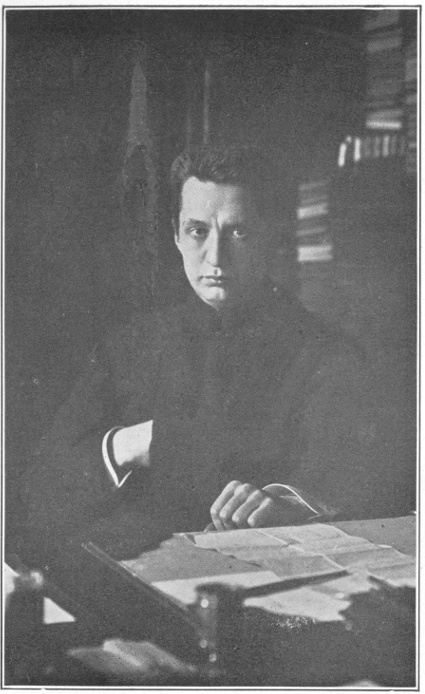
Alexander Feodorovitch Kerensky.
“We want that German woman, that sister of the German spy in Tsarskoe
Selo,” yelled the mob. “We want the Grand Duchess Serge.”
Tall and white, like a lily, the woman stood there. “I am the Grand
Duchess Serge,” she replied in a clear voice that floated above the
clamor. “What do you want with me?”
“We have come to arrest you,” they shouted.
“Very well,” was the calm reply. “If you want to arrest me I shall have
to go with you, of course. But I have a rule that before I leave the
convent for any purpose I always go into the church and pray. Come with
me into the church, and after I have prayed I will go with you.”
She turned and walked across the garden to the church, the mob
following. As many as could crowd into the small building followed her
there. Before the altar door she knelt, and her nuns came and knelt
around her weeping. The Grand Duchess did not weep. She prayed for a
moment, crossed herself, then stood up and stretched her hands to the
silent, staring mob.
“I am ready to go now,” she said.
But not a hand was lifted to take Elisabeta Feodorovna. What Kerensky
could not have done, what no police force in Russia could have done
with those men that day, her perfect courage and humility did. It
cowed and conquered hostility, it dispersed the mob. That great crowd
of liberty-drunk, blood-mad men went quietly home, leaving a guard
to protect the convent. It is probably the only spot in Russia to-day
where absolute inviolability may be said to exist for any members of
the hated “bourju,” as the Bolsheviki call the intellectual classes.
On the August day when I rang the bell of the convent’s massive
brown gate I did not really know that I was to see and speak with
the grand duchess. Mr. William L. Cazalet, of Moscow, the friend who
took me there, doubted very much whether I could be received thus
informally, without a previous appointment. The gravity of the times,
and especially the situation of the Romanoff family, placed the Grand
Duchess Serge in a position of extreme delicacy, and Mr. Cazalet said
frankly that he expected to find her living in strict retirement. The
best he could promise, he said, was that I should see the convent,
where one of his young cousins was a nun.
The convent, which is situated in the heart of Moscow, is a group of
white stone and stucco houses built around an old garden and surrounded
by a high white wall, over which vines and foliage ramble and fall. A
key turned, the brown gate swung open to our ring and we stepped into
a garden running over with the richest bloom. I remember the pink and
white sweet-peas against the wall, the white madonna lilies that nodded
below and the carpet of gay verbenas that ran along the pathway to the
convent door. There were many old apple trees and a forest of lilacs,
purple and white.
In her small room, combination of office and living room, we were
received by the executive head of the convent, Mme. Gardeeve, for
many years the intimate friend of Elisabeta Feodorovna. Like the grand
duchess she had had a life full of tears and tribulation, in spite
of her rank and wealth, and when the grand duchess took the veil she
followed her example and became a nun. The business of the convent is
transacted under her direction, and most ably, I was told. Efficiency
and ability are written in every feature of Mme. Gardeeve’s fine
face, in her crisp, clear voice and quick though graceful movements.
Her enunciation was a joy to hear, an especial joy to me, for I have
difficulty in understanding the rather indistinct French spoken by
the average Russian. Mme. Gardeeve’s French was of that perfect kind
you hear spoken in Tours more often than in Paris or elsewhere. I
understood every word. Woman of the world to her finger tips, Mme.
Gardeeve wore the picturesque habit of the order with the same grace
that she would have worn the latest creation of the ateliers. She
smiled and chatted with Mr. Cazalet, who is very well known in the
convent, and was most kind and cordial to me. After a few minutes’
conversation my friend said to her that I had told him some extremely
interesting things about public schools in America, and he wanted me to
repeat them to her.
So I told her something about the extraordinary experiments that have
been worked out in Gary, Indiana, and the work that was being done
in New York and elsewhere to give children, rich and poor alike, the
complete education they merit. As I talked she exclaimed from time to
time: “But it is excellent! I find it admirable! The Grand Duchess
should hear of this!”
I said hopefully that I would like very much to meet the Grand Duchess
and she replied she thought it might be arranged. Not to-day, however,
as the Grand Duchess’s time was completely filled. How long did I
expect to remain in Moscow? A week? It could certainly be arranged, she
thought. Meanwhile what would I like to see of the convent? Everything?
She laughed and touched a little bell on the desk beside her. A little
nun appeared and Mme. Gardeeve handed me over to her with orders that I
was to see everything.
I saw a small but perfectly equipped hospital, with an operating room
complete in all its details. The hospital had been devoted to poor
women and children before the war. Now most of the wards are filled
with wounded soldiers. I saw a room filled with blinded soldiers who
were being taught to read Braille type by sweet-faced nuns. Blindness
is bitter hard for any man, but for illiterates it must be blank
despair. I saw a house full of refugee nuns from the invaded districts
of Poland. I saw an orphanage full of slain soldiers’ children. I
lingered long in the lovely garden where nuns were at work, some with
their habits tucked up, among the potato rows, some pruning trees and
hedges, some sweeping the gravel paths with besoms made of twigs, some
teaching the orphan girls to embroider at big frames, to knit and to
sew. They made a fascinating picture, and I could hardly leave them
even to see the church, which is one of the most beautiful small gems
of architecture to be found in Europe. I never really saw that church
at all, as it turned out, for just as we entered and I was getting a
first impression of its blue and white and gold beauty, a messenger
hastily opened the door and said that the Grand Duchess wanted to see
me.
We went back to the convent and I was taken to a tiny parlor, which
is the private retreat of the Lady Abbess. It is not much bigger than
a hall bedroom, and it gave the same general impression of blue and
white and gold that one sees throughout the place. There were many
books bound in the lapis blue which seems to be the Grand Duchess’s
favorite color; a few pictures, mostly of the Madonna and Child; some
small tables, one with Stephen Graham’s book, “The House of Mary
and Martha,” held open upon it by a piece of embroidery carelessly
dropped. There were easy chairs of English willow with blue cushions,
and a businesslike little desk crammed with papers. Everywhere, in the
window, on tables and the desk, were bowls and vases of flowers. Every
room in the place, in fact, was filled with flowers.
The door opened and the Grand Duchess came in with a radiant smile of
welcome and a white hand outstretched. “I am so glad to find that I had
time to meet you to-day, Mrs. Dorr,” she said, in a rarely sweet voice.
“Your highness speaks English?” I exclaimed in surprise, and she
replied, waving me to a comfortable armchair: “Why not? My mother was
English.”
I had forgotten for the moment that the Grand Duchess and her younger
sister, the former Empress of Russia, were daughters of the Princess
Alice of England and granddaughters of Queen Victoria. Russia seemed
to have forgotten it also and to have remembered only that the father
of these women was the Grand Duke of Hesse and the Rhine. The Grand
Duchess added when we were seated that when she was a child at home
they always spoke English to their mother, if German to their father.
“I welcome an opportunity to speak English, because if one is wholly
Russian, as I am, and especially if one is orthodox, he hears little
except Russian or French.” Then she said, with another radiant smile:
“Tell me what you think of my convent.”
I told her that I felt as though I had stepped back into the glowing
and romantic thirteenth century.
“That is just what I wanted my convent to be,” she replied, “one of
those busy, useful medieval types. Such convents were wonderfully
efficient aids to civilization in the middle ages, and I don’t think
they should have been allowed to disappear. Russia needs them,
certainly, the kind of convent that fills the place between the
austere, enclosed orders and the life of the outside world. We read the
newspapers here, we keep track of events and we receive and consult
with people in active life. We are Marys, but we are Marthas as well.”
The Grand Duchess’s interest in the outside world is patent. She asked
me eagerly to tell her how things were going in Petrograd, and her
face saddened when I told her of the riotous and bloody events I had
witnessed during the days of the July revolution, scarcely past.
“Times are very bad with us just now,” she said, “but they will improve
soon, I am sure. The Russian people are good and kind at heart, but
they are mostly children—big, ignorant, impulsive children. If they
can find good leaders, and if they will only realize that they must
obey their leaders, they will emerge from this dreadful chaos and build
up a strong, new Russia. Have you seen Kerensky, and what do you think
of him?”
I replied rather cautiously. Like every one else, I still hoped that
Kerensky would succeed in getting his released giant back into its
bottle, and I did not want to unsettle any one’s confidence in him even
to the extent of an expressed doubt. Kerensky, I told her, was greatly
admired and liked, and I hoped he might prove the strong leader Russia
needed in her trouble.
“I hope so,” replied the last of the Romanoffs, “I pray for him every
day.”
The bells of the little church chimed the hour softly, and the Grand
Duchess paused to cross herself devoutly. “I want to hear about those
wonderful public schools of yours,” she said, “but first tell me what
America is doing in war preparation.”
As I talked she listened, nodding and smiling as if immensely pleased.
The great airplane fleet in course of construction seemed to amaze
and delight her, and when I told her of the conservation of the food
supply and the restriction of the manufacture of alcohol she fairly
glowed. “America is simply stupendous,” she exclaimed. “How I regret
that I never went there. Of course I never shall now. To me the United
States stands for order and efficiency of the best kind. The kind of
order only a free people can create. The kind I pray may be built some
day here in Russia.” And then she made her one allusion to the deposed
Czar. I did not know that at that minute the Czar was on his way to
Siberia, but it is very probable that she knew it. She said: “I am glad
you are going to protect your soldiers from the danger of the drink
evil. Nobody can possibly know how much good the abolition of vodka
did our soldiers and all our people. I think history should give the
Emperor credit for his share in that act, don’t you?” I agreed that the
Emperor should receive full credit for what he did, and I spoke with
all sincerity.
Elisabeta Feodorovna kept me for nearly three-quarters of an hour
talking to her about the Gary schools, which she is eager to see in
Russia; about American women and their part in the war, and about
welfare work for children, especially for tubercular and anemic
children. “It is wonderful,” she said with a sigh. “I can scarcely help
envying you sinfully. Think of a great, young, hurrying nation that can
still find time to study all these frightful problems of poverty and
disease, and to grapple with them. I hope you will go on doing that,
and still find more and more ways of bringing beauty into the lives
of the workers. How can you expect workmen who toil all day in hot,
hideous factories or on remote farms, with nothing in their lives but
work and worry, to have beauty in their souls?”
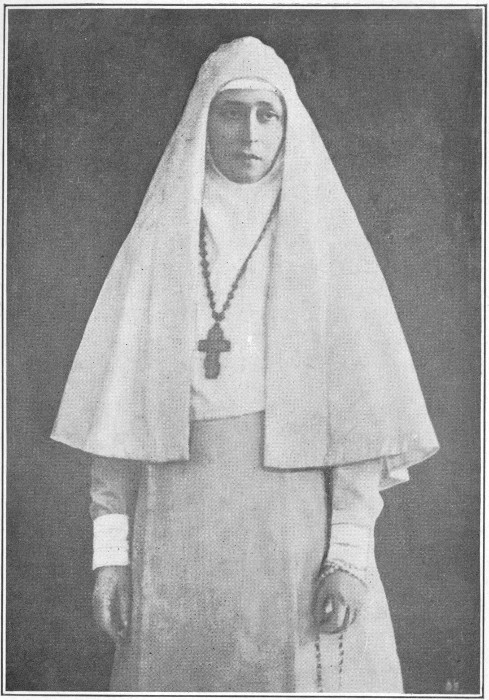
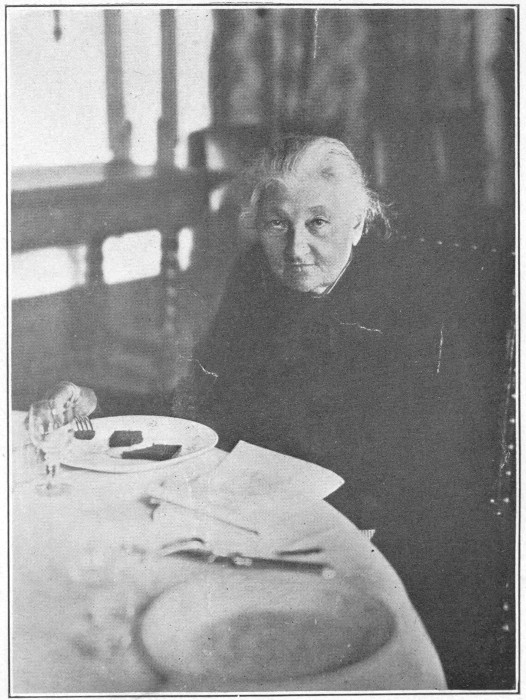
The Grand Duchess Elizabeta Feodorovna, sister of the
late Czarina,
and widow of the Grand Duke Serge (who was assassinated
during the Revolution of 1905), now Abbess of the
House of Mary and
Martha at Moscow.
She wanted eagerly to know about the women soldiers, and said that she
greatly admired their heroism. What was their life in camp like, and
were they strong enough to stand the hardships? The Grand Duchess Serge
is a good feminist and she agreed with me that in Russia’s crisis,
as in the situation in all countries created by the war, it had been
completely demonstrated that women would have henceforth to play a rôle
equally important and equally prominent as that of men.
They would have to share equally with men in the successful operation
of the war whether on the battlefield or behind the lines. She had
always had a special devotion to Jeanne d’Arc and believed her to have
been inspired by God. Other women also had been called of God to do
great things.
“I am glad you like my convent,” she repeated as we parted. “Please
come again. You know that it does not belong to me any more, but to the
Provisional Government, but I hope they will let me keep it.”
I hope they will. The House of Mary and Martha, with the beautiful
woman in it, is one of the things new Russia can least afford to lose.