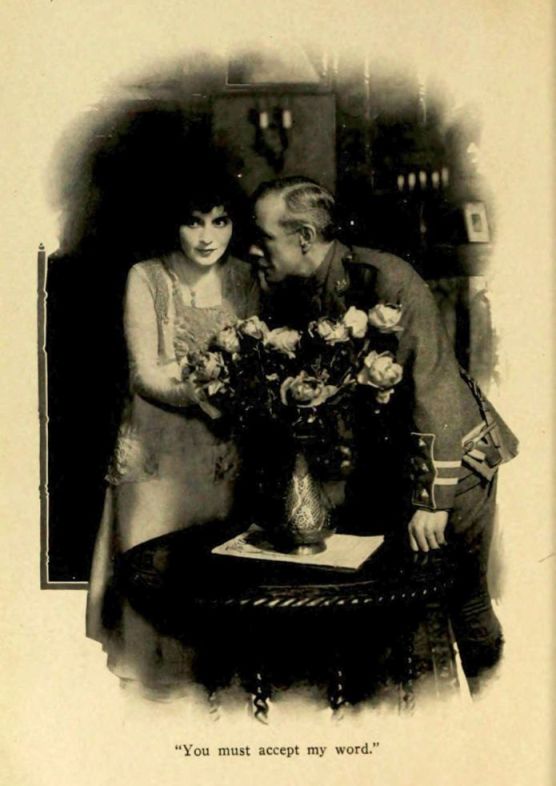
"I had two trunks—two, you ninny! Two!
Ou est l'autre?"
The grinning customs guard lifted his
shoulders to his ears and spread out his palms.
"Mais, mamselle——"
"Don't you 'mais' me, sir! I had two trunks—deux
troncs—when I got aboard that wabbly
old boat at Dover this morning, and I'm not
going to budge from this wharf until I find
the other one. Where did you learn your
French, anyway? Can't you understand when
I speak your language?"
The girl plumped herself down on top of
the unhasped trunk and folded her arms
truculently. With a quizzical smile, the customs
guard looked down into her brown eyes,
smoldering dangerously now, and began all over
again his speech of explanation.
"Wagon-lit?" She caught a familiar word.
"Mais oui; that's where I want to go—aboard
your wagon-lit, for Paris. Voilà!"—the girl
carefully gave the word three syllables—"mon
ticket pour Paree!" She opened her
patent-leather reticule, rummaged furiously therein,
brought out a handkerchief, a tiny mirror, a
packet of rice papers, and at last a folded and
punched ticket. This she displayed with a
triumphant flourish.
"Voilà! Il dit 'Miss Jane Gerson'; that's
me—moi-meme, I mean. And il dit 'deux troncs';
now you can't go behind that, can you? Where
is that other trunk?"
A whistle shrilled back beyond the swinging
doors of the station. Folk in the customs shed
began a hasty gathering together of parcels
and shawl straps, and a general exodus toward
the train sheds commenced. The girl on the
trunk looked appealingly about her; nothing
but bustle and confusion; no Samaritan to turn
aside and rescue a fair traveler fallen among
customs guards. Her eyes filled with trouble,
and for an instant her reliant mouth broke its
line of determination; the lower lip quivered
suspiciously. Even the guard started to walk
away.
"Oh, oh, please don't go!" Jane Gerson was
on her feet, and her hands shot out in an
impulsive appeal. "Oh, dear; maybe I forgot to
tip you. Here, attende au secours, if you'll only
find that other trunk before the train——"
"Pardon; but if I may be of any assistance——"
Miss Gerson turned. A tallish, old-young-looking
man, in a gray lounge suit, stood heels
together and bent stiffly in a bow. Nothing of
the beau or the boulevardier about his face or
manner. Miss Gerson accepted his intervention
as heaven-sent.
"Oh, thank you ever so much! The guard,
you see, doesn't understand good French. I
just can't make him understand that one of
my trunks is missing. And the train for
Paris——"
Already the stranger was rattling incisive
French at the guard. That official bowed low,
and, with hands and lips, gave rapid explanation.
The man in the gray lounge suit turned
to the girl.
"A little misunderstanding, Miss—ah——"
"Gerson—Jane Gerson, of New York," she
promptly supplied.
"A little misunderstanding, Miss Gerson.
The customs guard says your other trunk has
already been examined, passed, and placed on
the baggage van. He was trying to tell you
that it would be necessary for you to permit
a porter to take this trunk to the train before
time for starting. With your permission——"
The stranger turned and halloed to a porter,
who came running. Miss Gerson had the
trunk locked and strapped in no time, and it
was on the shoulders of the porter.
"You have very little time, Miss Gerson.
The train will be making a start directly. If
I might—ah—pilot you through the station to
the proper train shed. I am not presuming?"
"You are very kind," she answered hurriedly.
They set off, the providential Samaritan in
the lead. Through the waiting-room and on to
a broad platform, almost deserted, they went.
A guard's whistle shrilled. The stranger
tucked a helping hand under Jane Gerson's
arm to steady her in the sharp sprint down a
long aisle between tracks to where the Paris
train stood. It began to move before they had
reached its mid-length. A guard threw open
a carriage door, in they hopped, and with a
rattle of chains and banging of buffers the
Express du Nord was off on its arrow flight
from Calais to the capital.
The carriage, which was of the second class,
was comfortably filled. Miss Gerson stumbled
over the feet of a puffy Fleming nearest the
door, was launched into the lap of a comfortably
upholstered widow on the opposite seat,
ricochetted back to jam an elbow into a French
gentleman's spread newspaper, and finally was
catapulted into a vacant space next to the
window on the carriage's far side. She giggled,
tucked the skirts of her pearl-gray duster
about her, righted the chic sailor hat on her
chestnut-brown head, and patted a stray wisp
of hair back into place. Her meteor flight into
and through the carriage disturbed her not a
whit.
As for the Samaritan, he stood uncertainly
in the narrow cross aisle, swaying to the
swing of the carriage and reconnoitering
seating possibilities. There was a place, a very
narrow one, next to the fat Fleming; also
there was a vacant place next to Jane Gerson.
The Samaritan caught the girl's glance in his
indecision, read in it something frankly
comradely, and chose the seat beside her.
"Very good of you, I'm sure," he murmured.
"I did not wish to presume——"
"You're not," the girl assured, and there was
something so fresh, so ingenuous, in the tone
and the level glance of her brown eyes that
the Samaritan felt all at once distinctly
satisfied with the cast of fortune that had thrown
him in the way of a distressed traveler. He
sat down with a lifting of the checkered Alpine
hat he wore and a stiff little bow from the
waist.
"If I may, Miss Gerson—I am Captain
Woodhouse, of the signal service."
"Oh!" The girl let slip a little gasp—the
meed of admiration the feminine heart always
pays to shoulder straps. "Signal service; that
means the army?"
"His majesty's service; yes, Miss Gerson."
"You are, of course, off duty?" she suggested,
with the faintest possible tinge of regret
at the absence of the stripes and buttons that
spell "soldier" with the woman.
"You might say so, Miss Gerson. Egypt—the
Nile country is my station. I am on my
way back there after a bit of a vacation at
home—London I mean, of course."
She stole a quick side glance at the face of
her companion. A soldier's face it was, lean and
school-hardened and competent. Lines about
the eyes and mouth—the stamp of the sun and
the imprint of the habit to command—had
taken from Captain Woodhouse's features
something of freshness and youth, though
giving in return the index of inflexible will and
lust for achievement. His smooth lips were
a bit thin, Jane Gerson thought, and the
out-shooting chin, almost squared at the angles,
marked Captain Woodhouse as anything but a
trifler or a flirt. She was satisfied that
nothing of presumption or forwardness on the part
of this hard-molded chap from Egypt would
give her cause to regret her unconventional
offer of friendship.
Captain Woodhouse, in his turn, had made
a satisfying, though covert, appraisal of his
traveling companion by means of a narrow
mirror inset above the baggage rack over the
opposite seat. Trim and petite of figure, which
was just a shade under the average for height
and plumpness; a small head set sturdily on a
round smooth neck; face the very embodiment
of independence and self-confidence, with its
brown eyes wide apart, its high brow under
the parting waves of golden chestnut, broad
humorous mouth, and tiny nose slightly nibbed
upward: Miss Up-to-the-Minute New York,
indeed! From the cocked red feather in her
hat to the dainty spatted boots Jane Gerson
appeared in Woodhouse's eyes a perfect, virile,
vividly alive American girl. He'd met her
kind before; had seen them browbeating
bazaar merchants in Cairo and riding desert
donkeys like strong young queens. The type
appealed to him.
The first stiffness of informal meeting wore
away speedily. The girl tactfully directed the
channel of conversation into lines familiar to
Woodhouse. What was Egypt like; who owned
the Pyramids, and why didn't the owners plant
a park around them and charge admittance?
Didn't he think Rameses and all those other
old Pharaohs had the right idea in advertising—putting
up stone billboards to last all time?
The questions came crisp and startling;
Woodhouse found himself chuckling at the shrewd
incisiveness of them. Rameses an advertiser
and the Pyramids stone hoardings to carry all
those old boys' fame through the ages! He'd
never looked on them in that light before.
"I say, Miss Gerson, you'd make an excellent
business person, now, really," the captain
voiced his admiration.
"Just cable that at my expense to old Pop
Hildebrand, of Hildebrand's department store,
New York," she flashed back at him. "I'm
trying to convince him of just that very
thing."
"Really, now; a department shop! What,
may I ask, do you have to do for—ah—Pop
Hildebrand?"
"Oh, I'm his foreign buyer," Jane answered,
with a conscious note of pride. "I'm over here
to buy gowns for the winter season, you see.
Paul Poiret—Worth—Paquin; you've heard of
those wonderful people, of course?"
"Can't say I have," the captain confessed,
with a rueful smile into the girl's brown eyes.
"Then you've never bought a Worth?" she
challenged. "For if you had you'd not forget
the name—or the price—very soon."
"Gowns—and things are not in my line, Miss
Gerson," he answered simply, and the girl
caught herself feeling a secret elation. A man
who didn't know gowns couldn't be very
intimately acquainted with women. And—well—
"And this Hildebrand, he sends you over
here alone just to buy pretties for New York's
wonderful women?" the captain was saying.
"Aren't you just a bit—ah—nervous to be over
in this part of the world—alone?"
"Not in the least," the girl caught him up.
"Not about the alone part, I should say. Maybe
I am fidgety and sort of worried about making
good on the job. This is my first trip—my
very first as a buyer for Hildebrand. And,
of course, if I should fall down——"
"Fall down?" Woodhouse echoed, mystified.
The girl laughed, and struck her left wrist a
smart blow with her gloved right hand.
"There I go again—slang; 'vulgar American
slang,' you'll call it. If I could only rattle off
the French as easily as I do New Yorkese I'd
be a wonder. I mean I'm afraid I won't make
good."
"Oh!"
"But why should I worry about coming over
alone?" Jane urged. "Lots of American girls
come over here alone with an American flag
pinned to their shirt-waists and wearing a
Baedeker for a wrist watch. Nothing ever
happens to them."
Captain Woodhouse looked out on the flying
panorama of straw-thatched houses and
fields heavy with green grain. He seemed to
be balancing words. He glanced at the
passenger across the aisle, a wizened little man,
asleep. In a lowered voice he began:
"A woman alone—over here on the Continent
at this time; why, I very much fear she
will have great difficulties when
the—ah—trouble comes."
"Trouble?" Jane's eyes were questioning.
"I do not wish to be an alarmist, Miss
Gerson," Captain Woodhouse continued, hesitant.
"Goodness knows we've had enough calamity
shouters among the Unionists at home. But
have you considered what you would do—how
you would get back to America in case
of—war?" The last word was almost a whisper.
"War?" she echoed. "Why, you don't mean
all this talk in the papers is——"
"Is serious, yes," Woodhouse answered quietly.
"Very serious."
"Why, Captain Woodhouse, I thought you
had war talk every summer over here just as
our papers are filled each spring with gossip
about how Tesreau is going to jump to the
Feds, or the Yanks are going to be sold. It's
your regular midsummer outdoor sport over
here, this stirring up the animals."
Woodhouse smiled, though his gray eyes
were filled with something not mirth.
"I fear the animals are—stirred, as you say,
too far this time," he resumed. "The
assassination of the Archduke Ferd——"
"Yes, I remember I did read something
about that in the papers at home. But
archdukes and kings have been killed before, and
no war came of it. In Mexico they murder a
president before he has a chance to send out
'At home' cards."
"Europe is so different from Mexico," her
companion continued, the lines of his face
deepening. "I am afraid you over in the States
do not know the dangerous politics here; you
are so far away; you should thank God for
that. You are not in a land where one
man—or two or three—may say, 'We will now go
to war,' and then you go, willy-nilly."
The seriousness of the captain's speech and
the fear that he could not keep from his eyes
sobered the girl. She looked out on the
sun-drenched plains of Pas de Calais, where toy
villages, hedged fields, and squat farmhouses
lay all in order, established, seeming for all
time in the comfortable doze of security. The
plodding manikins in the fields, the slumberous
oxen drawing the harrows amid the beet rows,
pigeons circling over the straw hutches by the
tracks' side—all this denied the possibility of
war's corrosion.
"Don't you think everybody is suffering
from a bad dream when they say there's to
be fighting?" she queried. "Surely it is
impossible that folks over here would all consent
to destroy this." She waved toward the
peaceful countryside.
"A bad dream, yes. But one that will end
in a nightmare," he answered. "Tell me, Miss
Gerson, when will you be through with your
work in Paris, and on your way back to America?"
"Not for a month; that's sure. Maybe I'll
be longer if I like the place."
Woodhouse pondered.
"A month. This is the tenth of July. I am
afraid—— I say, Miss Gerson, please do not
set me down for a meddler—this short
acquaintance, and all that; but may I not urge
on you that you finish your work in Paris
and get back to England at least in two
weeks?" The captain had turned, and was
looking into the girl's eyes with an earnest
intensity that startled her. "I can not tell you
all I know, of course. I may not even know
the truth, though I think I have a bit of it,
right enough. But one of your sort—to be
caught alone on this side of the water by the
madness that is brewing! By George, I do
not like to think of it!"
"I thank you, Captain Woodhouse, for your
warning," Jane answered him, and impulsively
she put out her hand to his. "But, you see, I'll
have to run the risk. I couldn't go scampering
back to New York like a scared pussy-cat just
because somebody starts a war over here. I'm
on trial. This is my first trip as buyer for
Hildebrand, and it's a case of make or break
with me. War or no war, I've got to make
good. Anyway"—this with a toss of her round
little chin—"I'm an American citizen, and
nobody'll dare to start anything with me."
"Right you are!" Woodhouse beamed his
admiration. "Now we'll talk about those
skyscrapers of yours. Everybody back from the
States has something to say about those famous
buildings, and I'm fairly burning for first-hand
information from one who knows them."
Laughingly she acquiesced, and the grim
shadow of war was pushed away from them,
though hardly forgotten by either. At the
man's prompting, Jane gave intimate pictures
of life in the New World metropolis, touching
with shrewd insight the fads and shams of
New York's denizens even as she exalted the
achievements of their restless energy.
Woodhouse found secret amusement and
delight in her racy nervous speech, in the
dexterity of her idiom and patness of her
characterizations. Here was a new sort of
for him. Not the languid creature of
studied suppression and feeble enthusiasm he
had known, but a virile, vivid, sparkling
woman of a new land, whose impulses were as
unhindered as her speech was heterodox. She
was a woman who worked for her living; that
was a new type, too. Unafraid, she threw
herself into the competition of a man's world;
insensibly she prided herself on her ability to
"make good"—expressive Americanism,
that,—under any handicap. She was a woman with
a "job"; Captain Woodhouse had never before
met one such.
Again, here was a woman who tried none
of the stale arts and tricks of coquetry; no
eyebrow strategy or maidenly simpering about
Jane Gerson. Once sure Woodhouse was what
she took him to be, a gentleman, the girl had
established a frank basis of comradeship that
took no reckoning of the age-old conventions
of sex allure and sex defense. The
unconventionality of their meeting weighed nothing
with her. Equally there was not a hint of
sophistication on the girl's part.
So the afternoon sped, and when the sun
dropped over the maze of spires and chimney
pots that was Paris, each felt regret at parting.
"To Egypt, yes," Woodhouse ruefully admitted.
"A dreary deadly 'place in the sun' for
me. To have met you, Miss Gerson; it has
been delightful, quite."
"I hope," the girl said, as Woodhouse handed
her into a taxi, "I hope that if that war comes
it will find you still in Egypt, away from the
firing-line."
"Not a fair thing to wish for a man in the
service," Woodhouse answered, laughing. "I
may be more happy when I say my best wish
for you is that when the war comes it will find
you a long way from Paris. Good-by, Miss
Gerson, and good luck!"
Captain Woodhouse stood, heels together and
hat in hand, while her taxi trundled off, a
farewell flash of brown eyes rewarding him for the
military correctness of his courtesy. Then he
hurried to another station to take a train—not
for a Mediterranean port and distant Egypt,
but for Berlin.
"It would be wiser to talk in German," the
woman said. "In these times French or
English speech in Berlin——" she finished, with
a lifting of her shapely bare shoulders,
sufficiently eloquent. The waiter speeded his task
of refilling the man's glass and discreetly
withdrew.
"Oh, I'll talk in German quick enough," the
man assented, draining his thin half bubble of
glass down to the last fizzing residue in the
stem. "Only just show me you've got the right
to hear, and the good fat bank-notes to pay;
that's all." He propped his sharp chin on a
hand that shook slightly, and pushed his lean
flushed face nearer hers. An owlish caution
fought the wine fancies in his shifting lynx
eyes under reddened lids; also there was
admiration for the milk-white skin and ripe lips
of the woman by his side. For an instant—half
the time of a breath—a flash of loathing
made the woman's eyes tigerish; but at once
they changed again to mild bantering.
"So? Friend Billy Capper, of Brussels, has
a touch of the spy fever himself, and distrusts
an old pal?" She laughed softly, and one slim
hand toyed with a heavy gold locket on her
bosom. "Friend Billy Capper forgets old
times and old faces—forgets even the matter
of the Lord Fisher letters——"
"Chop it, Louisa!" The man called Capper
lapsed into brusk English as he banged the
stem of his wineglass on the damask. "No
sense in raking that up again—just because I
ask you a fair question—ask you to identify
yourself in your new job."
"We go no further, Billy Capper," she
returned, speaking swiftly in German; "not
another word between us unless you obey my
rule, and talk this language. Why did you get
that message through to me to meet you here
in the Café Riche to-night if you did not trust
me? Why did you have me carry your offer
to—to headquarters and come here ready to talk
business if it was only to hum and haw about
my identifying myself?"
The tenseness of exaggerated concentration
on Capper's gaunt face began slowly to
dissolve. First the thin line of shaven lips
flickered and became weak at down-drawn corners;
then the frown faded from about the eyes, and
the beginnings of tears gathered there.
Shrewdness and the stamp of cunning sped
entirely, and naught but weakness remained.
"Louisa—Louisa, old pal; don't be hard on
poor Billy Capper," he mumbled. "I'm down,
girl—away down again. Since they kicked me
out at Brussels I haven't had a shilling to bless
myself with. Can't go back to England—you
know that; the French won't have me, and here
I am, my dinner clothes my only stock in trade
left, and you even having to buy the wine." A
tear of self-pity slipped down the hard drain
of his cheek and splashed on his hand. "But
I'll show 'em, Louisa! They can't kick me out
of the Brussels shop like a dog and not pay for
it! I know too much, I do!"
"And what you know about the Brussels
shop you want to sell to the—Wilhelmstrasse?"
the woman asked tensely.
"Yes, if the Wilhelmstrasse is willing to pay
well for it," Capper answered, his lost cunning
returning in a bound.
"I am authorized to judge how much your
information is worth," his companion declared,
leveling a cold glance into Capper's eyes.
"You can tell me what you know, and depend
on me to pay well, or—we part at once."
"But, Louisa"—again the whine—"how do I
know you're what you say? You've flown high
since you and I worked together in the Brussels
shop. The Wilhelmstrasse—most perfect spy
machine in the world! How I'd like to be in
your shoes, Louisa!"
She detached the heavy gold locket from the
chain on her bosom, with a quick twist of slim
fingers had one side of the case open, then laid
the locket before him, pointing to a place on
the bevel of the case. Capper swept up the
trinket, looked searchingly for an instant at
the spot the woman had designated, and
returned the locket to her hand.
"Your number in the Wilhelmstrasse," he
whispered in awe. "Genuine, no doubt. Saw
the same sort of mark once before in Rome.
All right. Now, listen, Louisa. What I'm
going to tell you about where Brussells stands
in this—this business that's brewing will make
the German general staff sit up." The woman
inclined her head toward Capper's. He,
looking not at her but out over the rich plain of
brocades, broadcloths and gleaming shoulders,
began in a monotone:
"When the war comes—the day the war
starts, French artillerymen will be behind the
guns at Namur. The English——"
The Hungarian orchestra of forty strings
swept into a wild gipsy chant. Dissonances,
fierce and barbaric, swept like angry tides over
the brilliant floor, of the café. Still Capper
talked on, and the woman called Louisa bent
her jewel-starred head to listen. Her face, the
face of a fine animal, was set in rapt attention.
"You mark my words," he finished, "when
the German army enters Brussels proof of
what I'm telling you will be there. Yes, in a
pigeonhole of the foreign-office safe those joint
plans between England and Belgium for resisting
invasion from the eastern frontier. If the
Germans strike as swiftly as I think they will
the foreign-office Johnnies will be so flustered
in moving out they'll forget these papers I'm
telling you about. Then your Wilhelmstrasse
will know they've paid for the truth when they
paid Billy Capper."
Capper eagerly reached for his glass, and,
finding it empty, signaled the waiter.
"I'll buy this one, Louisa," he said
grandiloquently. "Can't have a lady buying me wine
all night." He gave the order. "You're going
to slip me some bank-notes to-night—right
now, aren't you, Louisa, old pal?" Capper
anxiously honed his cheeks with a hand that
trembled. The woman's eyes were narrowed
in thought.
"If I give you anything to-night, Billy
Capper, you'll get drunker than you are now, and
how do I know you won't run to the first
English secret-service man you meet and blab?"
"Louisa! Louisa! Don't say that!" Great
fear and great yearning sat in Capper's filmed
eyes. "You know I'm honest, Louisa! You
wouldn't milk me this way—take all the info
I've got and then throw me over like a dog!" Cold
scorn was in her glance.
"Maybe I might manage to get you a position—with
the Wilhelmstrasse." She named the
great secret-service office under her breath.
"You can't go back to England, to be sure; but
you might be useful in the Balkans, where
you're not known, or even in Egypt. You have
your good points, Capper; you're a sly little
weasel—when you're sober. Perhaps——"
"Yes, yes; get me a job with the Wilhelmstrasse,
Louisa!" Capper was babbling in an
agony of eagerness. "You know my work.
You can vouch for me, and you needn't mention
that business of the Lord Fisher letters;
you were tarred pretty much with the same
brush there, Louisa. But, come, be a good
sport; pay me at least half of what you think
my info's worth, and I'll take the rest out in
salary checks, if you get me that job. I'm
broke, Louisa!" His voice cracked in a sob.
"Absolutely stony broke!"
She sat toying with the stem of her wineglass
while Capper's clasped hands on the table
opened and shut themselves without his
volition. Finally she made a swift move of one
hand to her bodice, withdrew it with a bundle
of notes crinkling between the fingers.
"Three hundred marks now, Billy Capper,"
she said. The man echoed the words lovingly.
"Three hundred now, and my promise to try
to get a number for you with—my people.
That's fair?"
"Fair as can be, Louisa." He stretched out
clawlike fingers to receive the thin sheaf of
notes she counted from her roll. "Here comes
the wine—the wine I'm buying. We'll drink
to my success at landing a job with—your
people."
"For me no more to-night," the woman
answered. "My cape, please." She rose.
"But, I say!" Capper protested. "Just one
more bottle—the bottle I'm buying. See, here
it is all proper and cooled. Marks the end of
my bad luck, so it does. You won't refuse to
drink with me to my good luck that's coming?"
"Your good luck is likely to stop short with
that bottle, Billy Capper," she said, her lips
parting in a smile half scornful. "You know
how wine has played you before. Better stop
now while luck's with you."
"Hanged if I do!" he answered stubbornly.
"After these months of hand to mouth and
begging for a nasty pint of ale in a common
pub—leave good wine when it's right under my
nose? Not me!" Still protesting against her
refusal to drink with him the wine he would
pay for himself—the man made that a point of
injured honor—Capper grudgingly helped
place the cape of web lace over his companion's
white shoulders, and accompanied her to her
taxi.
"If you're here this time to-morrow night—and
sober," were her farewell words, "I may
bring you your number in the—you
understand; that and your commission to duty."
"God bless you, Louisa, girl!" Capper
stammered thickly. "I'll not fail you."
He watched the taxi trundle down the brilliant
mirror of Unter den Linden, a sardonic
smile twisting his lips. Then he turned back
to the world of light and perfume and wine—the
world from which he had been barred these
many months and for which the starved body
of him had cried out in agony. His glass stood
brimming; money crinkled in his pocket; there
were eyes for him and fair white shoulders.
Billy Capper, discredited spy, had come to his
own once more.
The orchestra was booming a rag-time, and
the chorus on the stage of the Winter Garden
came plunging to the footlights, all in line,
their black legs kicking out from the skirts
like thrusting spindles in some marvelous
engine of stagecraft. They screeched the
final line of a Germanized coon song, the
cymbals clanged "Zam-m-m!" and folk about
the clustered tables pattered applause.
Captain Woodhouse, at a table by himself, pulled
a wafer of a watch from his waistcoat pocket,
glanced at its face and looked back at the
rococo entrance arches, through which the
late-comers were streaming.
"Henry Sherman, do you think Kitty ought
to see this sort of thing? It's positively
indecent!"
The high-pitched nasal complaint came from
a table a little to the right of the one where
Woodhouse was sitting.
"There, there, mother! Now, don't go taking
all the joy outa life just because you're seeing
something that would make the minister back
in Kewanee roll his eyes in horror. This is
Germany, mother!"
Out of the tail of his eye, Woodhouse could
see the family group wherein Mrs. Grundy had
sat down to make a fourth. A blocky little
man with a red face and a pinky-bald head,
whose clothes looked as if they had been
whipsawed out of the bolt; a comfortably stout
matron wearing a bonnet which even to the
untutored masculine eye betrayed its
provincialism; a slim slip of a girl of about
nineteen with a face like a choir boy's—these were
the American tourists whose voices had
attracted Woodhouse's attention. He played an
amused eavesdropper, all the more interested
because they were Americans, and since a
certain day on the Calais-Paris express, a week
or so gone, he'd had reason to be interested in
all Americans.
"I'm surprised at you, Henry, defending
such an exhibition as this," the matron's high
complaint went on, "when you were mighty
shocked at the bare feet of those innocent
Greek dancers the Ladies' Aid brought to give
an exhibition on Mrs. Peck's lawn."
"Well, mother, that was different," the
genial little chap answered. "Kewanee's a good
little town, and should stay proper. Berlin,
from what I can see, is a pretty bad big
town—and don't care." He pulled a heavy watch
from his waistcoat pocket and consulted it.
"Land's sakes, mother; seven o'clock back
home, and the bell's just ringing for
Wednesday-night prayer meeting! Maybe since it's
prayer-meeting night we might be passing our
time better than by looking at this—ah—exhibition."
There was a scraping of chairs, then:
"Henry, I tell you he does look like Albert
Downs—the living image!" This from the
woman, sotto voce.
"Sh! mother! What would Albert Downs
be doing in Berlin?" The daughter was reproving.
"Well, Kitty, they say curiosity once killed
a cat; but I'm going to have a better look. I'd
swear——"
Woodhouse was slightly startled when he saw
the woman from America utilize the clumsy
subterfuge of a dropped handkerchief to step
into a position whence she could look at his
face squarely. Also he was annoyed. He did
not care to be stared at under any circumstances,
particularly at this time. The alert
and curious lady saw his flush of annoyance,
flushed herself, and joined her husband and
daughter.
"Well, if I didn't know Albert Downs had a
livery business which he couldn't well leave,"
floated back the hoarse whisper, "I'd say that
was him setting right there in that chair."
"Come, mother, bedtime and after—in
Berlin," was the old gentleman's admonition.
Woodhouse heard their retreating footsteps,
and laughed in spite of his temporary chagrin
at the American woman's curiosity. He was
just reaching for his watch a second time when
a quick step sounded on the gravel behind him.
He turned. A woman of ripe beauty had her
hand outstretched in welcome. She was the
one Billy Capper had called Louisa. Captain
Woodhouse rose and grasped her hand warmly.
"Ah! So good of you! I've been expecting——"
"Yes, I'm late. I could not come
earlier." Salutation and answer were in German,
fluently spoken on the part of each.
"You will not be followed?" Woodhouse
asked, assisting her to sit. She laughed
shortly.
"Hardly, when a bottle of champagne is my
rival. The man will be well entertained—too
well."
"I have been thinking," Woodhouse continued
gravely, "that a place hardly as public
as this would have been better for our
meeting. Perhaps——"
"You fear the English agents? Pah! They
have ears for keyholes only; they do not expect
to use them in a place where there is light and
plenty of people. You know their clumsiness." Woodhouse
nodded. His eyes traveled slowly
over the bold beauty of the woman's face.
"The man Capper will do for the stalking
horse—a willing nag," went on the woman
in a half whisper across the table. "You know
the ways of the Wilhelmstrasse. Capper is
what we call 'the target.' The English suspect
him. They will catch him; you get his number
and do the work in safety. We have one man
to draw their fire, another to accomplish the
deed. We'll let the English bag him at Malta—a
word placed in the right direction will fix
that—and you'll go on to Alexandria to do the
real work."
"Good, good!" Woodhouse agreed.
"The Wilhelmstrasse will give him a number,
and send him on this mission on my recommendation;
I had that assurance before ever I
met the fellow to-night. They—the big
people—know little Capper's reputation, and, as a
matter of fact, I think they are convinced he's
a little less dangerous working for the
Wilhelmstrasse than against it. At Malta the
arrest—the firing squad at dawn—and the English
are convinced they've nipped something big in
the bud, whereas they've only put out of the
way a dangerous little weasel who's ready to
bite any hand that feeds him."
Woodhouse's level glance never left the eyes
of the woman called Louisa; it was alert,
appraising.
"But if there should be some slip-up at
Malta," he interjected. "If somehow this
Capper should get through to Alexandria, wouldn't
that make it somewhat embarrassing for me?"
"Not at all, my dear Woodhouse," she caught
him up, with a little pat on his hand. "His
instructions will be only to report to So-and-so
at Alexandria; he will not have the slightest
notion what work he is to do there. You can
slip in unsuspected by the English, and the
trick will be turned."
For a minute Woodhouse sat watching the
cavortings of a dancer on the stage. Finally
he put a question judiciously:
"The whole scheme, then, is——"
"This," she answered quickly. "Captain
Woodhouse—the real Woodhouse, you know—is
to be transferred from his present post at
Wady Halfa, on the Nile, to Gibraltar—transfer
is to be announced in the regular way
within a week. As a member of the signal
service he will have access to the signal tower
on the Rock when he takes his new post, and
that, as you know, will be very important."
"Very important!" Woodhouse echoed dryly.
"This Woodhouse arrives in Alexandria to
await the steamer from Suez to Gib. He has
no friends there—that much we know. Three
men of the Wilhelmstrasse are waiting there,
whose business it is to see that the real
Woodhouse does not take the boat for Gib. They
expect a man from Berlin to come to them,
bearing a number from the Wilhelmstrasse—the
man who is to impersonate Woodhouse and
as such take his place in the garrison on the
Rock. There are two others of the Wilhelmstrasse
at Gibraltar already; they, too, are
eagerly awaiting the arrival of 'Woodhouse'
from Alexandria. Capper, with a number, will
start from Berlin for Alexandria. Capper will
never arrive in Alexandria. You will."
"With a number—the number expected?" the
man asked.
"If you are clever en route—yes," she
answered, with a smile. "Wine, remember, is
Billy Capper's best friend—and worst enemy."
"Then I will hear from you as to the time
and route of departure for Alexandria?"
"To the very hour, yes. And, now, dear
friend——"
Interruption came suddenly from the stage.
The manager, in shirt-sleeves and with hair
wildly rumpled over his eyes, came prancing
out from the wings. He held up a pudgy hand
to check the orchestra. Hundreds about the
tables rose in a gust of excitement, of
questioning wonder.
"Herren!" The stage manager's bellow
carried to the farthest arches of the Winter
Garden. "News just published by the general
staff: Russia has mobilized five divisions on
the frontier of East Prussia and Galicia!"
Not a sound save the sharp catching of
breath over all the acre of tables. Then the
stage manager nodded to the orchestra leader,
and in a fury the brass mouths began to bray.
Men climbed on table tops, women stood on
chairs, and all—all sang in tremendous chorus:
"Deutschland, Deutschland üeber alles!"
The night of July twenty-sixth. The scene
is the table-cluttered sidewalk before the
Café Pytheas, where the Cours St. Louis flings
its night tide of idlers into the broader stream
of the Cannebière, Marseilles' Broadway—the
white street of the great Provençal port. Here
at the crossing of these two streets summer
nights are incidents to stick in the traveler's
mind long after he sees the gray walls of the
Château d'If fade below the steamer's rail.
The flower girls in their little pulpits pressing
dewy violets and fragrant clusters of rosebuds
upon the strollers with persuasive eloquence;
the mystical eyes of hooded Moors who see
everything as they pass, yet seem to see so
little; jostling Greeks, Levantines, burnoosed
Jews from Algiers and red-trousered
Senegalese—all the color from the hot lands of the
Mediterranean is there.
But on the night of July twenty-sixth the old
spirit of indolence, of pleasure seeking,
flirtation, intriguing, which was wont to make this
heart of arc-light life in Marseilles pulse
languorously, was gone. Instead, an electric
tenseness was abroad, pervading, infectious. About
each sidewalk table heads were clustered close
in conference, and eloquent hands aided
explosive argument. Around the news kiosk at the
Café Pytheas corner a constant stream eddied.
Men snatched papers from the pile, spread
them before their faces, and blundered into
their fellow pedestrians as they walked, buried
in the inky columns. Now and again
half-naked urchins came charging down the
Cannebière, waving shinplaster extras above their
heads—"L'Allemagne s'arme! La guerre
vient!" Up from the Quai marched a dozen
sailors from a torpedo boat, arms linked so
that they almost spanned the Cannebière.
Their red-tasseled caps were pushed back at
cocky angles on their black heads, and as they
marched they shouted in time: "A Berlin!
Hou—hou!"
The black shadow of war—the first hallucinations
of the great madness—gripped Marseilles.
For Captain Woodhouse, just in from Berlin
that evening, all this swirling excitement had
but an incidental interest. He sat alone by
one of the little iron tables before the Café
Pytheas, sipping his boc, and from time to time
his eyes carelessly followed the eddying of the
swarm about the news kiosk. Always his
attention would come back, however, to center on
the thin shoulders of a man sitting fifteen or
twenty feet away with a wine cooler by his
side. He could not see the face of the wine
drinker; he did not want to. All he cared to
do was to keep those thin shoulders always in
sight. Each time the solicitous waiter renewed
the bottle in the wine cooler Captain
Woodhouse nodded grimly, as a doctor might when
he recognized the symptoms of advancing fever
in a patient.
So for two days, from Berlin across to Paris,
and now on this third day here in the Mediterranean
port, Woodhouse had kept ever in sight
those thin shoulders and that trembling hand
beyond the constantly crooking elbow. Not a
pleasant task; he had come to loathe and
abominate the very wrinkles in the back of that
shiny coat. But a very necessary duty it was
for Captain Woodhouse to shadow Mr. Billy
Capper until—the right moment should arrive.
They had come down on the same express
together from Paris. Woodhouse had observed
Capper when he checked his baggage, a single
shoddy hand-bag, for La Vendée, the French
line ship sailing with the dawn next morning
for Alexandria and Port Said via Malta.
Capper had squared his account at the Hotel Allées
de Meilhan, for the most part a bill for absinth
frappés, after dinner that night, and was now
enjoying the night life of Marseilles in
anticipation, evidently, of carrying direct to the
steamer with him as his farewell from France
all of the bottled laughter of her peasant girls
he could accommodate.
The harsh memories of how he had been
forced to drink the bitter lees of poverty
during the lean months rode Billy Capper hard,
and this night he wanted to fill all the starved
chambers of his soul with the robust music of
the grape. So he drank with a purpose and
purposefully. That he drank alone was a
matter of choice with Capper; he could have had
a pair of dark eyes to glint over a goblet into
his had he wished—indeed, opportunities
almost amounted to embarrassment. But to all
advances from the fair, Billy Capper returned
merely an impolite leer. He knew from
beforetime that he was his one best companion
when the wine began to warm him. So he
squared himself to his pleasure with an
abandoned rakishness expressed in the set of his
thin shoulders and the forward droop of his
head.
Woodhouse, who watched, noted only one
peculiarity in Capper's conduct: The drinker
nursed his stick, a plain, crook-handled
malacca, with a tenderness almost maternal. It
never left his hands. Once when Capper
dropped it and the waiter made to prop the
stick against a near-by chair, the little spy
leaped to his feet and snatched the cane away
with a growl. Thereafter he propped his chin
on the handle, only removing this guard when
he had to tip his head back for another draft
of champagne.
Eleven o'clock came. Capper rose from the
table and looked owlishly about him. Woodhouse
quickly turned his back to the man, and
was absorbed in the passing strollers. When
he looked back again Capper was slowly and a
little unsteadily making his way around the
corner into the Cannebière. Woodhouse
followed, sauntering. Capper began a dilatory
exploration of the various cafés along the white
street; his general course was toward the city's
slums about the Quai. Woodhouse, dawdling
about tree boxes and dodging into shadows by
black doorways, found his quarry easy to trail.
And he knew that each of Capper's sojourns in
an oasis put a period to the length of the
pursuit. The time for him to act drew appreciably
nearer with every tipping of that restless
elbow.
Midnight found them down in the reek and
welter of the dives and sailors' frolic grounds.
Now the trailer found his task more difficult,
inasmuch as not only his quarry but he
himself was marked by the wolves. Dances in
smoke-wreathed rooms slackened when Capper
lurched in, found a seat and ordered a drink.
Women with cheeks carmined like poppies
wanted to make predatory love to him; dock
rats drew aside and consulted in whispers.
When Capper retreated from an evil dive on
the very edge of the Quai, Woodhouse, waiting
by the doors, saw that he was not the only
shadower. Close against the dead walls
flanking the narrow pavement a slinking figure
twisted and writhed after the drunkard, now
spread-eagling all over the street.
Woodhouse quickened his pace on the opposite
sidewalk. The street was one lined with
warehouses, their closely shuttered windows
the only eyes. Capper dropped his stick,
laboriously halted, and started to go back for it.
That instant the shadow against the walls
detached itself and darted for the victim.
Woodhouse leaped to the cobbles and gained Capper's
side just as he dropped like a sack of rags
under a blow from the dock rat's fist.
"Son of a pig! This is my meat; you clear
out!" The humped black beetle of a man
straddling the sprawling Capper whipped a
knife from his girdle and faced Woodhouse.
Quicker than light the captain's right arm shot
out; a thud as of a maul on an empty wine butt,
and the Apache turned a half somersault,
striking the cobbles with the back of his head.
Woodhouse stooped, lifted the limp Capper
from the street stones, and staggered with him
to the lighted avenue of the Cannebière, a block
away. He hailed a late-cruising fiacre, propped
Capper in the seat, and took his place beside
him.
"To La Vendée, Quai de la Fraternité!"
Woodhouse ordered.
The driver, wise in the ways of the city,
asked no questions, but clucked to his crow
bait. Woodhouse turned to make a quick
examination of the unconscious man by his side.
He feared a stab wound; he found nothing but
a nasty cut on the head, made by brass
knuckles. With the wine helping, any sort of
a blow would have put Capper out, he reflected.
Woodhouse turned his back on the bundle of
clothes and reached for the malacca stick. Even
in his coma its owner grasped it tenaciously at
midlength. Without trying to disengage the
clasp, Woodhouse gripped the wood near the
crook of the handle with his left Hand while
with his right he applied torsion above. The
crook turned on hidden threads and came off in
his hand. An exploring forefinger in the
exposed hollow end of the cane encountered a
rolled wisp of paper. Woodhouse pocketed
this, substituted in its place a thin clean sheet
torn from a card-case memorandum, then
screwed the crook on the stick down on the
secret receptacle. By the light of a match he
assured himself the paper he had taken from
the cane was what he wanted.
"Larceny from the person—guilty," he
murmured, with a wry smile of distaste. "But
assault—unpremeditated."
The conveyance trundled down a long spit
of stone and stopped by the side of a black hull,
spotted with round eyes of light. The driver,
scenting a tip, helped Woodhouse lift Capper
to the ground and prop him against a bulkhead.
A bos'n, summoned from La Vendée by
the cabby's shrill whistle, heard Woodhouse's
explanation with sympathy.
"Occasionally, yes, m'sieu, the passengers
from Marseilles have these regrets at parting,"
he gravely commented, accepting the ticket
Woodhouse had rummaged from the unconscious
man's wallet and a crinkled note from
Woodhouse's. Up the gangplank, feet first,
went the new agent of the Wilhelmstrasse.
The one who called himself "captain in his
majesty's signal service" returned to his hotel.
At dawn, La Vendée cleared the harbor for
Alexandria via Malta, bearing a very sick Billy
Capper to his destiny. Five hours later the
Castle liner, Castle Claire, for the Cape via
Alexandria and Suez direct, sailed out of the
Old Port, among her passengers a Captain
Woodhouse.
Many a long starlit hour alone on the
deck of the Castle Claire Captain
Woodhouse found himself tortured by a
persistent vision. Far back over the northern
horizon lay Europe, trembling and breathless
before the imminent disaster—a great field of
grain, each stalk bearing for its head the
helmeted head of a man. Out of the east came
a glow, which spread from boundary to
boundary, waxed stronger in the wind of hate.
Finally the fire, devastating, insensate, began
its sweep through the close-standing mazes of
the grain. Somewhere in this fire-glow and
swift leveling under the scythe of the flame
was a girl, alone, appalled. Woodhouse could
see her as plainly as though a cinema was
unreeling swift pictures before him—the girl
caught in this vast acreage of fire, in the
standing grain, with destruction drawing nearer in
incredible strides. He saw her wide eyes, her
streaming hair—saw her running through the
grain, whose heads were the helmeted heads of
men. Her hands groped blindly and she was
calling—calling, with none to come in aid.
Jane Gerson alone in the face of Europe's
burning!
Strive as he would, Woodhouse could not
screen this picture from his eyes. He tried to
hope that ere this, discretion had conquered her
resolution to "make good," and that she had
fled from Paris, one of the great army of
refugees who had already begun to pour out
of the gates of France when he passed through
the war-stunned capital a few days before.
But, no; there was no mistaking the determination
he had read in those brown eyes that day
on the express from Calais. "I couldn't go
scampering back to New York just because
somebody starts a war over here." Brave, yes;
but hers was the bravery of ignorance. This
little person from the States, on her first
venture into the complex life of the Continent,
could not know what war there would mean;
the terror and magnitude of it. And now
where was she? In Paris, caught in its
hysteria of patriotism and darkling fear of
what the morrow would bring forth? Or had
she started for England, and become wedged
in the jam of terrified thousands battling for
place on the Channel steamers? Was her fine
self-reliance upholding her, or had the crisis
sapped her courage and thrown her back on
the common helplessness of women before disaster?
Captain Woodhouse, the self-sufficient and
aloof, whose training had been all toward
suppression of every instinct save that in the line
of duty, was surprised at himself. That a
little American inconnu—a "business person,"
he would have styled her under conditions less
personal—should have come into his life in this
definite way was, to say the least, highly
irregular. The man tried to swing his reason
as a club against his heart—and failed
miserably. No, the fine brave spirit that looked out
of those big brown eyes would not be argued
out of court. Jane Gerson was a girl who was
different, and that very difference was
altogether alluring. Woodhouse caught himself
going over the incidents of their meeting.
Fondly he reviewed scraps of their
conversation on the train, lingering on the pat slang
she used so unconsciously.
Was it possible Jane Gerson ever had a
thought for Captain Woodhouse? The man
winced a little at this speculation. Had it been
fair of him when he so glibly practised a
deception on her? If she knew what his present
business was, would she understand; would she
approve? Could this little American ever
know, or believe, that some sorts of service
were honorable?
Just before the Castle Claire raised the
breakwater of Alexandria came a wireless,
which was posted at the head of the saloon
companionway:
"Germany declares war on Russia. German
flying column reported moving through
Luxemburg on Belgium."
The fire was set to the grain.
Upon landing, Captain Woodhouse's first
business was to go to a hotel on the Grand
Square, which is the favorite stopping place of
officers coming down from the Nile country.
He fought his way through the predatory
hordes of yelling donkey boys and obsequious
dragomans at the door, and entered the
palm-shaded court, which served as office and lounge.
Woodhouse paused for a second behind a screen
of palm leaves and cast a quick eye around the
court. None of the loungers there was known
to him. He strode to the desk.
"Ah, sir, a room with bath, overlooking the
gardens on the north side—very cool." The
Greek clerk behind the desk smiled a welcome.
"Perhaps," Woodhouse answered shortly, and
he turned the register around to read the names
of the recent comers. On the first page he
found nothing to interest him; but among the
arrivals of the day before he saw this entry:
"C. G. Woodhouse, Capt. Sig. Service; Wady
Halfa." After it was entered the room number: "210."
Woodhouse read right over the name and
turned another page a bit impatiently. This
he scanned with seeming eagerness, while the
clerk stood with pen poised.
"Um! When is the first boat out for
Gibraltar?" Woodhouse asked.
"Well, sir, the Princess Mary is due to sail at
dawn day after to-morrow," the Greek
answered judiciously. "She is reported at Port
Said to-day, but, of course, the war——"
Woodhouse turned away.
"But you wish a room, sir—nice room, with
bath, overlooking——"
"No."
"You expected to find a friend, then?"
"Not here," Woodhouse returned bruskly,
and passed out into the blinding square.
He strode swiftly around the statue of
Mehemet Ali and plunged into the bedlam crowd
filling a side street. With sure sense of
direction, he threaded the narrow alleyways and
by-streets until he had come to the higher part of
the mongrel city, near the Rosetta Gate. There
he turned into a little French hotel, situated
far from the disordered pulse of the city's
heart; a sort of pension, it was, known only
to the occasional discriminating tourist.
Maitre Mouquère was proud of the anonymity
his house preserved, and abhorred poor, driven
Cook's slaves as he would a plague. In his Cap
de Liberté one was lost to all the world of
Alexandria.
Thither the captain's baggage had been sent
direct from the steamer. After a glass with
Maitre Mouquère and a half hour's discussion
of the day's great news, Woodhouse pleaded a
touch of the sun, and went to his room. There
he remained, until the gold of sunset had faded
from the Mosque of Omar's great dome and all
the city from Pharos and its harbor hedge of
masts to El Meks winked with lights. Then
he took carriage to the railroad station and
entrained for Ramleh. What South Kensington
is to London and the Oranges are to New
York, Ramleh is to Alexandria—the suburb of
homes. There pretty villas lie in the lap of the
delta's greenery, skirted by canals, cooled by
the winds off Aboukir Bay and shaded by great
palms—the one beauty spot in all the hybrid
product of East and West that is the present
city of Alexander.
Remembering directions he had received in
Berlin, Woodhouse threaded shaded streets
until he paused before a stone gateway set in a
high wall. On one of the pillars a small brass
plate was inset. By the light of a near-by arc,
Woodhouse read the inscription on it:
EMIL KOCH, M.D.,
32 Queen's Terrace.
He threw back his shoulders with a sudden
gesture, which might have been taken for that
of a man about to make a plunge, and rang
the bell. The heavy wooden gate, filling all the
space of the arch, was opened by a tall
Numidian in house livery of white. He nodded an
affirmative to Woodhouse's question, and led the
way through an avenue of flaming hibiscus to
a house, set far back under heavy shadow of
acacias. On every hand were gardens, rank
foliage shutting off this walled yard from the
street and neighboring dwellings. The heavy
gate closed behind the visitor with a sharp
snap. One might have said that Doctor Koch
lived in pretty secure isolation.
Woodhouse was shown into a small room off
the main hall, by its furnishings and position
evidently a waiting-room for the doctor's
patients. The Numidian bowed, and disappeared.
Alone, Woodhouse rose and strolled aimlessly
about the room, flipped the covers of
magazines on the table, picked up and hefted the
bronze Buddha on the onyx mantel, noted, with
a careless glance, the position of the two
windows in relation to the entrance door and the
folding doors, now shut, which doubtless gave
on the consultation room. As he was regarding
these doors they rolled back and a short
thickset man, with a heavy mane of iron-gray
hair and black brush of beard, stood between
them. He looked at Woodhouse through thick-lensed
glasses, which gave to his stare a curiously
intent bent.
"My office hours are from two to four,
afternoons," Doctor Koch said. He spoke in
English, but his speech was burred by a slight
heaviness on the aspirants, reminiscent of his
mother tongue. The doctor did not ask
Woodhouse to enter the consultation room, but
continued standing between the folding doors,
staring fixedly through his thick lenses.
"I know that, Doctor," Woodhouse began
apologetically, following the physician's lead
and turning his tongue to English. "But, you
see, in a case like mine I have to intrude"—it
was "haf" and "indrude" as Woodhouse gave
these words—"because I could not be here
during your office hours. You will pardon?"
Doctor Koch's eyes widened just perceptibly
at the hint of a Germanic strain in his visitor's
speech—just a hint quickly glossed over. But
still he remained standing in his former
attitude of annoyance.
"Was the sun, then, too hot to bermit you
to come to my house during regular office
hours? At nights I see no batients—bositively
none."
"The sun—perhaps," Woodhouse replied
guardedly. "But as I happened just to arrive
to-day from Marseilles, and your name was
strongly recommended to me as one to consult
in a case such as mine——"
"Where was my name recommended to you,
and by whom?" Doctor Koch interrupted in
sudden interest.
Woodhouse looked at him steadily. "In
Berlin—and by a friend of yours," he answered.
"Indeed?" The doctor stepped back from the
doors, and motioned his visitor into the
consultation room.
Woodhouse stepped into a large room lighted
by a single green-shaded reading lamp, which
threw a white circle of light straight down
upon a litter of thin-bladed scalpels in a glass
dish of disinfectant on a table. The shadowy
outlines of an operating chair, of
high-shouldered bookcases, and the dull glint of
instruments in a long glass case were almost
imperceptible because of the centering of all
light upon the glass dish of knives. Doctor
Koch dragged a chair out from the shadows,
and, carelessly enough, placed it in the area of
radiance; he motioned Woodhouse to sit. The
physician leaned carelessly against an arm of
the operating chair; his face was in the shadow
save where reflected light shone from his
glasses, giving them the aspect of detached
eyes.
"So, a friend—a friend in Berlin told you to
consult me, eh? Berlin is a long way from
Ramleh—especially in these times. Greater
physicians than I live in Berlin. Why——"
"My friend in Berlin told me you were the
only physician who could help me in my
peculiar trouble." Imperceptibly the accenting
of the aspirants in Woodhouse's speech grew
more marked; his voice took on a throaty
character. "By some specialists my life even has
been set to end in a certain year, so sure is fate
for those afflicted like myself."
"So? What year is it, then, you die?" Doctor
Koch's strangely detached eyes—those
eyes of glass glowing dimly in the shadow—seemed
to flicker palely with a light all their
own. Captain Woodhouse, sitting under the
white spray of the shaded incandescent, looked
up carelessly to meet the stare.
"Why, they give me plenty of time to enjoy
myself," he answered, with a light laugh. "They
say in 1932——"
"Nineteen thirty-two!" Doctor Koch stepped
lightly to the closed folding doors, trundled
them back an inch to assure himself nobody
was in the waiting-room, then closed and
locked them. He did similarly by a hidden door
on the opposite side of the room, which
Woodhouse had not seen. After that he pulled a
chair close to his visitor and sat down, his
knees almost touching the other's. He spoke
very low, in German:
"If your trouble is so serious that you will
die—in 1932, I must, of course, examine you
for—symptoms."
For half a minute the two men looked fixedly
at each other. Woodhouse's right hand went
slowly to the big green scarab stuck in his
cravat. He pulled the pin out, turned it over
in his fingers, and by pressure caused the
scarab to pop out of the gold-backed setting
holding it. The bit of green stone lay in the
palm of his left hand, its back exposed. In the
hollowed back of the beetle was a small square
of paper, folded minutely. This Woodhouse
removed, unfolded and passed to the physician.
The latter seized it avidly, holding it close to
his spectacled eyes, and then spreading it
against the light as if to read a secret water
mark. A smile struggled through the jungle
of his beard. He found Woodhouse's hand and
grasped it warmly.
"Your symptom tallies with my diagnosis,
Nineteen Thirty-two," he began rapidly. "Five
days ago we heard from—the Wilhelmstrasse—you
would come. We have expected you each
day, now. Already we have got word through
to our friends at Gibraltar of the plan; they
are waiting for you."
"Good!" Woodhouse commented. He was
busy refolding the thin slip of paper that had
been his talisman, and fitting it into the back
of the scarab. "Woodhouse—he is already at
the Hotel Khedive; saw his name on the
register when I landed from the Castle this
morning." Now the captain was talking in familiar
German.
"Quite so," Doctor Koch put in. "Woodhouse
came down from Wady Halfa yesterday.
Our man up there had advised of the
time of his arrival in Alexandria to the
minute. The captain has his ticket for
the Princess Mary, which sails for Gibraltar
day after to-morrow at dawn."
Number Nineteen Thirty-two listened to
Doctor Koch's outlining of the plot with set
features; only his eyes showed that he was
acutely alive to every detail. Said he:
"But Woodhouse—this British captain who's
being transferred from the Nile country to the
Rock; has he ever served there before? If he
has, why, when I get there—when I am Captain
Woodhouse, of the signal service—I will
be embarrassed if I do not know the ropes."
"Seven years ago Woodhouse was there for a
very short time," Doctor Koch explained. "New
governor since then—changes all around in
the personnel of the staff, I don't doubt. You'll
have no trouble."
Silence between them for a minute, broken
by the captain:
"Our friends at Gib—who are they, and how
will I know them?"
The doctor bent a sudden glance of suspicion
upon the lean face before him. His thick lips
clapped together stubbornly.
"Aha, my dear friend; you are asking questions.
In my time at Berlin the Wilhelmstrasse
taught that all orders and information
came from above—and from there only.
Why——"
"I suppose in default of other information I
may ask the governor to point out the
Wilhelmstrasse men," Woodhouse answered, with a
shrug. "I was told at Berlin I would learn all
that was necessary to me as I went along,
therefore, I supposed——"
"Come—come!" Doctor Koch patted the
other's shoulder, with a heavy joviality. "So
you will. When you arrive at Gib, put up at
the Hotel Splendide, and you will not be long
learning who your friends are. I, for instance,
did not hesitate overmuch to recognize you,
and I am under the eyes of the English here at
every turn, even though I am a naturalized
English citizen—and of undoubted loyalty." He
finished with a booming laugh.
"But Woodhouse; you have arranged a way
to have him drop out of sight before the
Princess Mary sails? There will be no
confusion—no slip-up?"
"Do not fear," the physician reassured.
"Everything will be arranged. His baggage
will leave the Hotel Khedive for the dock
to-morrow night; but it will not reach the dock.
Yours——"
"Will be awaiting the transfer of tags at the
Cap de Liberté—Mouquère's little place," the
captain finished. "But the man himself—you're
not thinking of mur——"
"My dear Nineteen Thirty-two," Doctor Koch
interrupted, lifting protesting hands; "we do
not use such crude methods; they are
dangerous. The real Captain Woodhouse will not
leave Alexandria—by sea, let us say—for many
months. Although I have no doubt he will not
be found in Alexandria the hour the Princess
Mary sails. The papers he carries—the papers
of identity and of transfer from Wady Halfa
to Gibraltar—will be in your hands in plenty
of time. You——"
The doctor stopped abruptly. A hidden
electric buzzer somewhere in the shadowed
room was clucking an alarm. Koch pressed a
button at the side of the operating chair.
There was a sound beyond closed doors of some
one passing through a hallway; the front door
opened and closed.
"Some one at the gate," Doctor Koch explained.
"Cæsar, my playful little Numidian—and
an artist with the Bedouin dagger is
Cæsar—he goes to answer."
Their talk was desultory during the next
minutes. The doctor seemed restless under the
suspense of a pending announcement as to the
late visitor. Finally came a soft tapping on
the hidden door behind Woodhouse. The latter
heard the doctor exchange whispers with the
Numidian in the hallway. Finally, "Show him
into the waiting-room," Koch ordered. He
came back to where the captain was sitting, a
puzzled frown between his eyes.
"An Englishman, Cæsar says—an Englishman,
who insists on seeing me—very
important." Koch bit the end of one stubby thumb
in hurried thought. He suddenly whipped
open the door of one of the instrument cases,
pulled out a stethoscope, and hooked the two
little black receivers into his ears. Then he
turned to Woodhouse.
"Quick! Off with your coat and open your
shirt. You are a patient; I am just examining
you when interrupted. This may be one of
these clumsy English secret-service men, and I
might need your alibi." The sound of an
opening door beyond the folding doors and of
footsteps in the adjoining room.
"You say you are sleepless at night?"
Doctor Koch was talking English. "And you
have a temperature on arising? Hm'm! This
under your tongue, if you please"—he thrust a
clinical thermometer between Woodhouse's
lips; the latter already had his coat off, and was
unbuttoning his shirt. Koch gave him a meaning
glance, and disappeared between the folding
doors, closing them behind him.
The captain, feeling much like a fool with
the tiny glass tube sprouting from his lips, yet
with all his faculties strained to alertness,
awaited developments. If Doctor Koch's
hazard should prove correct and this was an
English secret-service man come to arrest him,
wouldn't suspicion also fall on whomever was
found a visitor in the German spy's house?
Arrest and search; examination of his scarab
pin—that would not be pleasant.
He tried to hear what was being said beyond
the folding doors, but could catch nothing save
the deep rumble of the doctor's occasional bass
and a higher, querulous voice raised in what
might be argument. Had he dared, Woodhouse
would have drawn closer to the crack in
the folding doors so that he could hear what
was passing; every instinct of self-preservation
in him made his ears yearn to dissect this
murmur into sense. But if Doctor Koch should
catch him eavesdropping, embarrassment fatal
to his plans might follow; besides, he had a
feeling that eyes he could not see—perhaps the
unwinking eyes of the Numidian, avid for an
excuse to put into practise his dexterity with
the Bedouin dagger—were on him.
Minutes slipped by. The captain still nursed
the clinical thermometer. The mumble and
muttering continued to sound through the
closed doors. Suddenly the high whine of the
unseen visitor was raised in excitement. Came
clearly through to Woodhouse's ears his
passionate declaration:
"But I tell you you've got to recognize me.
My number's Nineteen Thirty-two. My ticket
was stolen out of the head of my cane
somewhere between Paris and Alexandria. But I
got it all right—got it from the Wilhelmstrasse
direct, with orders to report to Doctor Emil
Koch, in Alexandria!"
Capper! Capper, who was to be betrayed to
the firing squad in Malta, after his Wilhelmstrasse
ticket had passed from his possession.
Capper on the job!
Woodhouse hurled every foot pound of his
will to hear into his ears. He caught Koch's
gruff answer:
"Young man, you're talking madness. You're
talking to a loyal British subject. I know
nothing about your Wilhelmstrasse or your
number. If I did not think you were drunk I'd
have you held here, to be turned over to the
military as a spy. Now, go before I change
my mind."
Again the querulous protestation of Capper,
met by the doctor's peremptory order. The
captain heard the front door close. A long
wait, and Doctor Koch's black beard, with the
surmounting eyes of thick glass, appeared at a
parting of the folding doors. Woodhouse, the
tiny thermometer still sticking absurdly from
his mouth, met the basilisk stare of those two
ovals of glass with a coldly casual glance. He
removed the thermometer from between his
lips and read it, with a smile, as if that were
part of playing a game. Still the ghastly stare
from the glass eyes over the bristling beard,
searching—searching.
"Well," Woodhouse said lightly, "no need of
an alibi evidently."
Doctor Koch stepped into the room with the
lightness of a cat, walked to a desk drawer at
one side, and fumbled there a second, his back
to his guest. When he turned he held a
short-barreled automatic at his hip; the muzzle
covered the shirt-sleeved man in the chair.
"Much need—for an alibi—from you!"
Doctor Koch croaked, his voice dry and flat
with rage. "Much need, Mister Nineteen
Thirty-two. Commence your explanation
immediately, for this minute my temptation is
strong—very strong—to shoot you for the dog
you are."
"Is this—ah, customary?" Woodhouse
twiddled the tiny mercury tube between his
fingers and looked unflinchingly at the small
round mouth of the automatic. "Do you make
a practise of consulting a—friend with a
revolver at your hip?"
"You heard—what was said in there!" Koch's
forehead was curiously ridged and
flushed with much blood.
"Did you ask me to listen? Surely, my dear
Doctor, you have provided doors that are
sound-proof. If I may suggest, isn't it about time
that you explain this—this melodrama?" The
captain's voice was cold; his lips were drawn
to a thin line. Koch's big head moved from side
to side with a gesture curiously like that of a
bull about to charge, but knowing not where
his enemy stands. He blurted out:
"For your information, if you did not
overhear: An Englishman comes just now to
address me familiarly as of the Wilhelmstrasse.
He comes to say he was sent to report to me;
that his number in the Wilhelmstrasse is
nineteen thirty-two—nineteen thirty-two,
remember; and I am to give him orders. Please
explain that before I pull this trigger."
"He showed you his number—his ticket,
then?" Woodhouse added this parenthetically.
"The man said his ticket had been stolen
from him some time after he left Paris—stolen
from the head of his cane, where he had it
concealed. But the number was nineteen
thirty-two." The doctor voiced this last doggedly.
"You have, of course, had this man followed,"
the other put in. "You have not let him leave
this house alone."
"Cæsar was after him before he left the
garden gate—naturally. But——"
Woodhouse held up an interrupting hand.
"Pardon me, Doctor Koch; did you get this
fellow's name?"
"He refused to give it—said I wouldn't know
him, anyway."
"Was he an undersized man, very thin,
sparse hair, and a face showing dissipation?"
Woodhouse went on. "Nervous, jerky way of
talking—fingers to his mouth, as if to feel his
words as they come out—brandy or wine
breath? Can't you guess who he was?"
"I guess nothing."
"The target!"
At the word Louisa had used in describing
Capper to Woodhouse, Koch's face underwent
a change. He lowered his pistol.
"Ach!" he said. "The man they are to
arrest. And you have the number."
"That was Capper—Capper, formerly of the
Belgian office—kicked out for drunkenness.
One time he sold out Downing Street in the
matter of the Lord Fisher letters; you remember
the scandal when they came to light—his
majesty, the kaiser's, Kiel speech referring to
them. He is a good stalking horse."
Koch's suspicion had left him. Still gripping
the automatic, he sat down on the edge of the
operating chair, regarding the other man
respectfully.
"Come—come, Doctor Koch; you and I can
not continue longer at cross-purposes." The
captain spoke with terse displeasure. "This
man Capper showed you nothing to prove his
claims, yet you come back to this room and
threaten my life on the strength of a
drunkard's bare word. What his mission is you
know; how he got that number, which is the
number I have shown you on my ticket from
the Wilhelmstrasse—you understand how such
things are managed. I happen to know, however,
because it was my business to know, that
Capper left Marseilles for Malta aboard La
Vendée four days ago; he was not expected to
go beyond Malta."
Koch caught him up: "But the fellow told
me his boat didn't stop at Malta—was warned
by wireless to proceed at all speed to Alexandria,
for fear of the Breslau, known to be in
the Adriatic." Woodhouse spread out his
hands with a gesture of finality.
"There you are! Capper finds himself
stranded in Alexandria, knows somehow of
your position as a man of the Wilhelmstrasse—such
things can not be hid from the underground
workers; comes here to explain himself
to you and excuse himself for the loss of his
number. Is there anything more to be said
except that we must keep a close watch on
him?"
The physician rose and paced the room, his
hands clasped behind his back. The automatic
bobbed against the tails of his long coat as he
walked. After a minute's restless striding, he
broke his step before the desk, jerked open the
drawer, and dropped the weapon in it. Back to
where Woodhouse was sitting he stalked and
held out his right hand stiffly.
"Your pardon, Number Nineteen Thirty-two!
For my suspicion I apologize. But, you
see my position—a very delicate one." Woodhouse
rose, grasped the doctor's hand, and
wrung it heartily.
"And now," he said, "to keep this fellow
Capper in sight until the Princess Mary sails
and I aboard her as Captain Woodhouse, of
Wady Halfa. The man might trip us all up."
"He will not; be sure of that," Koch growled,
helping Woodhouse into his coat and leading
the way to the folding doors. "I will have
Cæsar attend to him the minute he comes back
to report where Capper is stopping."
"Until when?" the captain asked, pausing
at the gate, to which Koch had escorted him.
"Here to-morrow night at nine," the doctor
answered, and the gate shut behind him.
Captain Woodhouse, alone under the shadowing
trees of Queen's Terrace, drew in a long breath,
shook his shoulders and started for the
station and the midnight train to Alexandria.
Consider the mental state of Mr. Billy
Capper as he sank into a seat on the
midnight suburban from Ramleh to Alexandria.
Even to the guard, unused to particular
observation of his passengers save as to their
possible propensity for trying to beat their fares,
the bundle of clothes surmounted by a rusty
brown bowler which huddled under the sickly
light of the second-class carriage bespoke either
a candidate for a plunge off the quay or a
"bloomer" returning from his wassailing. But
the eyes of the man denied this latter hypothesis;
sanity was in them, albeit the merciless
sanity that refuses an alternative when fate
has its victim pushed into a corner. So
submerged was Capper under the flood of his own
bitter cogitations that he had not noticed the
other two passengers boarding the train at the
little tiled station—a tall, quietly dressed white
man and a Numidian with a cloak thrown over
his white livery. The latter had faded like a
shadow into the third-class carriage behind the
one in which Capper rode.
Here was Capper—poor old Hardluck Billy
Capper—floored again, and just when the tide
of bad fortune was on the turn; so ran the
minor strain of self-pity under the brown
bowler. A failure once more, and through no
fault of his own. No, no! Hadn't he been
ready to deliver the goods? Hadn't he come all
the way down here from Berlin, faithful to his
pledge to Louisa, the girl in the Wilhelmstrasse,
ready and willing to embark on that important
mission of which he was to be told by Doctor
Emil Koch? And what happens? Koch turns
him into the street like a dog; threatens to have
him before the military as a spy if he doesn't
make himself scarce. Koch refuses even to
admit he'd ever heard of the Wilhelmstrasse.
Clever beggar! A jolly keen eye he's got for
his own skin; won't take a chance on being
betrayed into the hands of the English, even when
he ought to see that a chap's honest when he
comes and tells a straight story about losing
that silly little bit of paper with his working
number on it. What difference if he can't
produce the ticket when he has the number pat on
the tip of his tongue, and is willing to risk his
own life to give that number to a stranger?
Back upon the old perplexity that had kept
Capper's brain on strain ever since the first day
aboard La Vendée—who had lifted his ticket,
and when was it done? The man recalled, for
the hundredth time, his awakening aboard the
French liner—what a horror that first morning
was, with the ratty little surgeon feeding a
fellow aromatic spirits of ammonia like porridge!
Capper, in this mood of detached review, saw
himself painfully stretching out his arm from
his bunk to grasp his stick the very first
minute he was alone in the stateroom; the crooked
handle comes off under his turning, and the
white wisp of paper is stuck in the hollow of
the stick. Blank paper!
Safe as safe could be had been that little
square of paper Louisa had given him with his
expense money, from the day he left Berlin
until—when? To be sure, he had treated himself
to a little of the grape in Paris and, maybe,
in Marseilles; but his brain had been clear
every minute. Oh, Capper would have sworn
to that! The whole business of the disappearance
of his Wilhelmstrasse ticket and the
substitution of the blank was simply another low
trick the Capper luck had played on him.
The train rushed through the dark toward
the distant prickly coral bed of lights, and the
whirligig of black despair churned under the
brown bowler. No beginning, no end to the
misery of it. Each new attempt to force a
little light of hope into the blackness of his
plight fetched up at the same dead wall—here
was Billy Capper, hired by the Wilhelmstrasse,
after having been booted out of the secret
offices of England and Belgium—given a show
for his white alley—and he couldn't move a
hand to earn his new salary. Nor could he go
back to Berlin, even though he dared return
with confession of the stolen ticket; Berlin was
no place for an Englishman right now, granting
he could get there. No, he was in the
backwash again—this time in this beastly
half-caste city of Alexandria, and with—how
much was it now?—with a beggarly fifteen
pounds between himself and the beach.
Out of the ruck of Capper's sad reflections
the old persistent call began to make itself
heard before ever the train from Ramleh pulled
into the Alexandria station. That elusive
country of fountains, incense and rose dreams
which can only be approached through the neck
of a bottle spread itself before him alluringly,
inviting him to forgetfulness. And Capper
answered the call.
From the railroad station, he set his course
through narrow villainous streets down to the
district on Pharos, where the deep-water men
of all the world gather to make vivid the nights
of Egypt. Behind him was the faithful
shadow, Cæsar, Doctor Koch's man. The
Numidian trailed like a panther, slinking from
cover to cover, bending his body as the big cat
does to the accommodations of the trail's blinds.
Once Capper found himself in a blind alley,
turned and strode out of it just in time to bump
heavily into the unsuspected pursuer. Instantly
a hem of the Numidian's cloak was lifted
to screen his face, but not before the sharp eyes
of the Englishman had seen and recognized it.
A tart smile curled the corners of Capper's
mouth as he passed on down the bazaar-lined
street to the Tavern of Thermopylæ, at the next
corner. So old Koch was taking precautions,
eh? Well, Capper, for one, could hardly blame
him; who wouldn't, under the circumstances?
The Tavern of Thermopylæ was built for
the Billy Cappers of the world—a place of
genial deviltry where every man's gold was
better than his name, and no man asked more
than to see the color of the stranger's money.
Here was gathered as sweet a company of
assassins as one could find from Port Said to
Honmoku, all gentle to fellows of their craft
under the freemasonry of hard liquor. Greeks,
Levantines, Liverpool lime-juicers from the
Cape, leech-eyed Finns from a Russian's
stoke-hole, tanned ivory runners from the forbidden
lands of the African back country—all that
made Tyre and Sidon infamous in Old Testament
police records was represented there.
Capper called for an absinth dripper and
established himself in a deserted corner of the
smoke-filled room. There was music, of sorts,
and singing; women whose eyes told strange
stories, and whose tongues jumped nimbly over
three or four languages, offered their
companionship to those who needed company with
their drink. But Billy Capper ignored the
music and closed his ears to the sirens; he knew
who was his best cup companion.
The thin green blood of the wormwood drip-dripped
down on to the ice in Capper's glass,
coloring it with a rime like moss. He watched
it, fascinated, and when he sipped the cold
sicky-sweet liquor he was eager as a child to
see how the pictures the absinth drew on the
ice had been changed by the draft. Sip—sip;
a soothing numbness came to the tortured
nerves. Sip—sip; the clouds of doubt and
self-pity pressing down on his brain began to shred
away. He saw things clearly now; everything
was sharp and clear as the point of an icicle.
He reviewed, with new zest, his recent
experiences, from the night he met Louisa in the
Café Riche up to his interview with Doctor
Koch. Louisa—that girl with the face of a fine
animal and a heart as cold as carved amethyst;
why had she been so willing to intercede for
Billy Capper with her superiors in the
Wilhelmstrasse and procure him a number and a
mission to Alexandria? For his information
regarding the Anglo-Belgian understanding?
But she paid for that; the deal was fairly
closed with three hundred marks. Did Louisa
go further and list him in the Wilhelmstrasse
out of the goodness of her heart, or for old
memory's sake? Capper smiled wryly over his
absinth. There was no goodness in Louisa's
heart, and the strongest memory she had was
how nearly Billy Capper had dragged her down
with him in the scandal of the Lord Fisher letters.
How the thin green blood of the wormwood
cleared the mind—made it leap to logical
reasoning!
Why had Louisa instructed him to leave
Marseilles by the steamer touching at Malta
when a swifter boat scheduled to go to
Alexandria direct was leaving the French port a
few hours later? Was it that the girl intended
he should get no farther than Malta; that the
English there should——
Capper laughed like the philosopher who has
just discovered the absolute of life's futility.
The ticket—his ticket from the Wilhelmstrasse
which Louisa had procured for him; Louisa
wanted that for other purposes, and used him
as the dummy to obtain it. She wanted it
before he could arrive at Malta—and she got it
before he left Marseilles. Even Louisa, the
wise, had played without discounting the
Double 0 on the wheel—fate's percentage in
every game; she could not know the Vendée
would be warned from lingering at Malta
because of the exigency of war, and that Billy
Capper would reach Alexandria, after all.
The green logic in the glass carried Capper
along with mathematical exactness of deduction.
As he sipped, his mind became a thing
detached and, looking down from somewhere
high above earth, reviewed the blundering
course of Billy Capper's body from Berlin to
Alexandria—the poor deluded body of a dupe.
With this certitude of logic came the beginnings
of resolve. Vague at first and intangible, then,
helped by the absinth to focus, was this new
determination. Capper nursed it, elaborated
on it, took pleasure in forecasting its
outcome, and viewing himself in the new light of
a humble hero. It was near morning, and the
Tavern of Thermopylæ was well-nigh deserted
when Capper paid his score and blundered
through the early-morning crowd of mixed
races to his hotel. His legs were quite drunk,
but his mind was coldly and acutely sober.
"Very drunk, master," was the report Cæsar,
the Numidian, delivered to Doctor Koch at the
Ramleh villa. The doctor, believing Cæsar to
be a competent judge, chuckled in his beard.
Cæsar was called off from the trail.
Across the street from Doctor Koch's home
on Queen's Terrace was the summer home of a
major of fusileers, whose station was up the
Nile. But this summer it was not occupied.
The major had hurried his family back to
England at the first mutterings of the great war,
and he himself had to stick by his regiment up
in the doubtful Sudan country. Like Doctor
Koch's place, the major's yard was surrounded
by a high wall, over which the fronds of big
palms and flowered shrubs draped themselves.
The nearest villa, aside from the Kochs' across
the street, was a hundred yards away. At
night an arc light, set about thirty feet from
Doctor Koch's gate, marked all the road
thereabouts with sharp blocks of light and shadow.
One lying close atop the wall about the major's
yard, screened by the palms and the heavy
branches of some night-blooming ghost flower,
could command a perfect view of Doctor Koch's
gateway without being himself visible.
At least, so Billy Capper found it on the
night following his visit to the German
physician's and his subsequent communion with
himself at the Tavern of Thermopylæ. Almost
with the falling of the dark, Capper had
stepped off the train at Ramleh station, ferried
himself by boat down the canal that passed
behind the major's home, after careful
reconnoitering, discovered that the tangle of
wildwood about the house was not guarded by a
watchman, and had so achieved his position of
vantage on top of the wall directly opposite
the gateway of No. 32. He was stretched flat.
Through the spaces between the dry fingers
of a palm leaf he could command a good view
of the gate and of the road on either side. Few
pedestrians passed below him; an automobile
or two puffed by; but in the main, Queen's
Terrace was deserted and Capper was alone. It
was a tedious vigil. Capper had no reliance
except his instinct of a spy familiar with spy's
work to assure that he would be rewarded for
his pains. Some sixth sense in him had
prompted him to come thither, sure in the
promise that the night would not be misspent.
A clock somewhere off in the odorous dark
struck the hour twice, and Capper fidgeted.
The hard stone he was lying on cramped him.
The sound of footsteps on the flagged walk
aroused momentary interest. He looked out
through his screen of green and saw a tall
well-knit figure of a man approach the opposite
gate, stop and ring the bell. Instantly
Capper tingled with the hunting fever of his
trade. In the strong light from the arc he
could study minutely the face of the man at the
gate—smoothly shaven, slightly gaunt and
with thin lips above a strong chin. It was a
striking face—one easily remembered. The
gate opened; beyond it Capper saw, for an
instant, the white figure of the Numidian he had
bumped into at the alley's mouth. The gate
closed on both.
Another weary hour for the ferret on the
wall, then something happened that was
reward enough for cramped muscles and taut
nerves. An automobile purred up to the gate;
out of it hopped two men, while a third, tilted
over like one drunk, remained on the rear seat
of the tonneau. One rang the bell. The two
before the gate fidgeted anxiously for it to be
opened. Capper paid not so much heed to them
as to the half-reclining figure in the machine.
It was in strong light. Capper saw, with a
leap of his heart, that the man in the machine
was clothed in the khaki service uniform of
the British army—an officer's uniform he
judged by the trimness of its fitting, though
he could not see the shoulder straps. The
unconscious man was bareheaded and one side of
his face was darkened by a broad trickle of
blood from the scalp.
When the gate opened, there were a few
hurried words between the Numidian and the two
who had waited. All three united in lifting
an inert figure from the car and carrying it
quickly through the gate. Consumed with the
desire to follow them into the labyrinth of the
doctor's yard, yet not daring, Capper remained
plastered to the wall.
Captain Woodhouse, sitting in the consultation
room with the doctor, heard the front door
open and the scuffle of burdened feet in the
hall. Doctor Koch hopped nimbly to the folding
doors and threw them back. First, the Numidian's
broad back, then, the bent shoulders of
two other men, both illy dressed, came into
view. Between them they carried the form
of a man in officer's khaki. Woodhouse could
not check a fluttering of the muscles in his
cheeks; this was a surprise to him; the doctor
had given no hint of it.
"Good—good!" clucked Koch, indicating that
they should lay their burden on the operating
chair. "Any trouble?"
"None in the least, Herr Doktor," the larger
of the two white men answered. "At the
corner of the warehouse near the docks, where
it is dark—he was going early to the Princess
Mary, and——"
"Yes, a tap on the head—so?" Koch broke
in, casting a quick glance toward where
Captain Woodhouse had risen from his seat. A
shrewd appraising glance it was, which was
not lost on Woodhouse. He stepped forward
to join the physician by the side of the figure
on the operating chair.
"Our man, Doctor?" he queried casually.
"Your name sponsor," Koch answered, with
a satisfied chuckle; "the original Captain
Woodhouse of his majesty's signal service,
formerly stationed at Wady Halfa."
"Quite so," the other answered in English.
Doctor Koch clapped him on the shoulder.
"Perfect, man! You do the Englishman
from the book. It will fool them all."
Woodhouse shrugged his shoulders in deprecation.
Koch cackled on, as he began to lay
out sponge and gauze bandages on the
glass-topped table by the operating chair:
"You see, I did not tell you of this because—well,
that fellow Capper's coming last night
looked bad; even your explanation did not
altogether convince. So I thought we'd have this
little surprise for you. If you were an
Englishman you'd show it in the face of
this—you couldn't help it. Eh?"
"Possibly not," the captain vouchsafed. "But
what is your plan, Doctor? What are you
going to do with this Captain Woodhouse to
insure his being out of the way while I am in
Gibraltar. I hope no violence—unless necessary."
"Nothing more violent than a violent
headache and some fever," Koch answered. He
was busy fumbling in the unconscious man's
pockets. From the breast pocket of the
uniform jacket he withdrew a wallet, glanced at
its contents, and passed it to the captain.
"Your papers, Captain—the papers of
transfer from Wady Halfa to Gibraltar. Money,
too. I suppose we'll have to take that, also,
to make appearances perfect—robbery following
assault on the wharves."
Woodhouse pocketed the military papers in
the wallet and laid it down, the money
untouched. The two white aids of Doctor Koch,
who were standing by the folding doors, eyed
the leather folder hungrily. Koch, meanwhile,
had stripped off the jacket from the Englishman
and was rolling up the right sleeve of his
shirt. That done, he brought down from the
top of the glass instrument case a wooden rack
containing several test tubes, stoppled with
cotton. One glass tube he lifted out of the rack
and squinted at its clouded contents against
the light.
"A very handy little thing—very handy." Koch
was talking to himself as much as to
Woodhouse. "A sweet little product of the
Niam Niam country down in Belgian Kongo.
Natives think no more of it than they would
of a water fly's bite; but the white man
is——"
"A virus of some kind?" the other guessed.
"Of my own isolation," Doctor Koch answered
proudly. He scraped the skin on the
victim's arm until the blood came, then dipped
an ivory spatula into the tube of murky gelatine
and transferred what it brought up to the
raw place in the flesh.
"The action is very quick, and may be
violent," he continued. "Our friend here won't
recover consciousness for three days, and he
will be unable to stand on his feet for two
weeks, at least—dizziness, intermittent fever,
clouded memory; he'll be pretty sick."
"But not too sick to communicate with
others," Woodhouse suggested. "Surely——"
"Maybe not too sick, but unable to communicate
with others," Doctor Koch interrupted,
with a booming laugh. "This time to-morrow
night our friend will be well out on the Libyan
Desert, with some ungentle Bedouins for
company. He's bound for Fezzan—and it will be
a long way home without money. Who knows?
Maybe three months."
Very deftly Koch bound up the abrasion on
the Englishman's arm with gauze, explaining
as he worked that the man's desert guardians
would have instructions to remove the bandages
before he recovered his faculties. There
would be nothing to tell the luckless prisoner
more than that he had been kidnaped, robbed
and carried away by tribesmen—a not
uncommon occurrence in lower Egypt. Koch
completed his work by directing his aids to
strip off the rest of the unconscious man's
uniform and clothe him in a nondescript civilian
garb that Cæsar brought into the consultation
room from the mysterious upper regions
of the house.
"Exit Captain Woodhouse of the signal service,"
the smiling doctor exclaimed when the
last button of the misfit jacket had been flipped
into its buttonhole, "and enter Captain
Woodhouse of the Wilhelmstrasse." Turning, he
bowed humorously to the lean-faced man beside
him. He nodded his head at Cæsar; the latter
dived into a cupboard at the far end of the
room and brought out a squat flask and glasses,
which he passed around. When the liquor had
been poured, Doctor Koch lifted his glass and
squinted through it with the air of a gentle
satyr.
"Gentlemen, we drink to what will happen
soon on the Rock of Gibraltar!" All downed
the toast gravely. Then the master of the
house jerked his head toward the unconscious
man on the operating chair. Cæsar and the
two white men lifted the limp body and started
with it to the door, Doctor Koch preceding
them to open doors. The muffled chug-chugging
of the auto at the gate sounded almost
at once.
The doctor and Number Nineteen Thirty-two
remained together in the consultation room
for a few minutes, going over, in final review,
the plans that the latter was to put into
execution at the great English stronghold on the
Rock. The captain looked at his watch, found
the hour late, and rose to depart. Doctor Koch
accompanied him to the gate, and stood with
him for a minute under the strong light from
the near-by arc.
"You go direct to the Princess Mary?" he
asked.
"Direct to the Princess Mary," the other
answered. "She is to sail at five o'clock."
"Then God guard you, my friend, on—your
great adventure." They clasped hands, and
the gate closed behind the doctor.
A shadow skipped from the top of the wall
about the major's house across the road. A
shadow dogged the footsteps of the tall
well-knit man who strode down the deserted
Queen's Terrace toward the tiled station by
the tracks. A little more than an hour later,
the same shadow flitted up the gangplank of
the Princess Mary at her berth. When the big
P. & O. liner pulled out at dawn, she carried
among her saloon passengers one registered as
"C. G. Woodhouse, Capt. Sig. Service," and in
her second cabin a "William Capper."
"No, madam does not know me; but she
must see me. Oh, I know she will see
me. Tell her, please, it is a girl from New
York all alone in Paris who needs her help."
The butler looked again at the card the
visitor had given him. Quick suspicion flashed
into his tired eyes—the same suspicion that
had all Paris mad.
"Ger-son—Mademoiselle Ger-son. That
name, excuse me, if I say it—that name
ees——"
"It sounds German; yes. Haven't I had that
told me a thousand times these last few days?" The
girl's shoulders drooped limply, and she
tried to smile, but somehow failed. "But it's
my name, and I'm an American—been an
American twenty-two years. Please—please!"
"Madam the ambassador's wife; she ees
overwhelm wiz woark." The butler gave the
door an insinuating push. Jane Gerson's
patent-leather boot stopped it. She made a
quick rummage in her bag, and when she
withdrew her hand, a bit of bank paper crinkled
in it. The butler pocketed the note with
perfect legerdemain, smiled a formal thanks and
invited Jane into the dark cool hallway of the
embassy. She dropped on a skin-covered
couch, utterly spent. Hours she had passed
moving, foot by foot, in an interminable line,
up to a little wicket in a steamship office, only
to be told, "Every boat's sold out." Other
grilling hours she had passed similarly before
the express office, to find, at last, that her little
paper booklet of checks was as worthless as a
steamship folder. Food even lacked, because
the money she offered was not acceptable. For
a week she had lived in the seething caldron
that was Paris in war time, harried, buffeted,
trampled and stampeded—a chip on the froth
of madness. This day, the third of August,
found Jane Gerson summoning the last
remnants of her flagging nerve to the supreme
endeavor. Upon her visit to the embassy
depended everything: her safety, the future she
was battling for. But now, with the first
barrier passed, she found herself suddenly faint
and weak.
"Madam the ambassador's wife will see you.
Come!" The butler's voice sounded from afar
off, though Jane saw the gleaming buckles at
his knees very close. The pounding of her
heart almost choked her as she rose to follow
him. Down a long hall and into a richly
furnished drawing-room, now strangely transformed
by the presence of desks, filing cabinets,
and busy girl stenographers; the click of
typewriters and rustle of papers gave the
air of an office at top pressure. The butler
showed Jane to a couch near the portières and
withdrew. From the tangle of desks at the
opposite end of the room, a woman with a
kindly face crossed, with hand extended. Jane
rose, grasped the hand and squeezed convulsively.
"You are——"
"Yes, my dear, I am the wife of the
ambassador. Be seated and tell me all your
troubles. We are pretty busy here, but not too
busy to help—if we can."
Jane looked into the sympathetic eyes of the
ambassador's wife, and what she found there
was like a draft of water to her parched soul.
The elder woman, smiling down into the white
face, wherein the large brown eyes burned
unnaturally bright, saw a trembling of the lips
instantly conquered by a rallying will, and she
patted the small hand hearteningly.
"Dear lady," Jane began, almost as a little
child, "I must get out of Paris, and I've come
to you to help me. Every way is closed except through you."
"So many hundreds like you, poor girl. All
want to get back to the home country, and we
are so helpless to aid every one." The lady
of the embassy thought, as she cast a swift
glance over the slender shoulders and diminutive
figure beneath them, that here, indeed, was
a babe in the woods. The blatant, self-assured
tourist demanding assistance from her country's
representative as a right she knew; also
the shifty, sloe-eyed demi-vierge who wanted
no questions asked. But such a one as this
little person——
"You see, I am a buyer for Hildebrand's
store in New York." Jane was rushing breathlessly
to the heart of her tragedy. "This is my
very first trip as buyer, and—it will be my last
unless I can get through the lines and back to
New York. I have seventy of the very last
gowns from Poiret, from Paquin and Worth—you
know what they will mean in the old town
back home—and I must—just simply must get
them through. You understand! With them,
Hildebrand can crow over every other gown
shop in New York. He can be supreme, and I
will be—well, I will be made!"
The kindly eyes were still smiling, and the
woman's heart, which is unchanged even in
the breast of an ambassador's wife, was leaping
to the magic lure of that simple word—gowns.
"But—but the banks refuse to give me a
cent on my letter of credit. The express office
says my checks, which I brought along for
incidentals, can not be cashed. The steamship
companies will not sell a berth in the steerage,
even, out of Havre or Antwerp or
Southampton—everything gobbled up. You can't get
trunks on an aeroplane, or I'd try that. I
just don't know where to turn, and so I've
come to you. You must know some way out."
Jane unconsciously clasped her hands in
supplication, and upon her face, flushed now with
the warmth of her pleading, was the dawning
of hope. It was as if the girl were assured
that once the ambassador's wife heard her
story, by some magic she could solve the
difficulties. The older woman read this trust, and
was touched by it.
"Have you thought of catching a boat at
Gibraltar?" she asked. "They are not so
crowded; people haven't begun to rush out of
Italy yet."
"But nobody will honor my letter of credit,"
Jane mourned. "And, besides, all the trains
south of Paris are given up to the mobilization.
Nobody can ride on them but soldiers." The
lady of the embassy knit her brows for a
few minutes while Jane anxiously scanned her
face. Finally she spoke:
"The ambassador knows a gentleman—a
large-hearted American gentleman here in
Paris—who has promised his willingness to
help in deserving cases by advancing money
on letters of credit. And with money there is
a way—just a possible way—of getting to
Gibraltar. Leave your letter of credit with
me, my dear; go to the police station in the
district where you live and get your pass
through the lines, just as a precaution against
the possibility of your being able to leave
to-night. Then come back here and see me at
four o'clock. Perhaps—just a chance——"
Hildebrand's buyer seized the hands of the
embassy's lady ecstatically, tumbled words of
thanks crowding to her lips. When she went
out into the street, the sun was shining as it
had not shone for her for a dreary terrible
week.
At seven o'clock that night a big Roman-nosed
automobile, long and low and powerful
as a torpedo on wheels, pulled up at the door
of the American embassy. Two bulky osier
baskets were strapped on the back of its
tonneau; in the rear seat were many rugs. A
young chap with a sharp shrewd face—an
American—sat behind the wheel.
The door of the embassy opened, and Jane
Gerson, swathed in veils, and with a gray
duster buttoned tight about her, danced out;
behind her followed the ambassador, the lady
of the embassy and a bevy of girls, the
volunteer aids of the overworked representative's
staff. Jane's arms went about the ambassador's
wife in an impulsive hug of gratitude and
good-by; the ambassador received a hearty
handshake for his "God speed you!" A waving
of hands and fluttering of handkerchiefs,
and the car leaped forward. Jane Gerson
leaned far over the back, and, through cupped
hands, she shouted: "I'll paint Hildebrand's
sign on the Rock of Gibraltar!"
Over bridges and through outlying faubourgs
sped the car until the Barrier was
gained. There crossed bayonets denying passage,
an officer with a pocket flash pawing over
pass and passport, a curt dismissal, and once
more the motor purred its speed song, and the
lights of the road flashed by. More picket
lines, more sprouting of armed men from the
dark, and flashing of lights upon official
signatures. On the heights appeared the
hump-shouldered bastions of the great outer forts,
squatting like huge fighting beasts of the night,
ready to spring upon the invader. Bugles
sounded; the white arms of search-lights swung
back and forth across the arc of night in their
ceaseless calisthenics; a murmuring and stamping
of many men and beasts was everywhere.
The ultimate picket line gained and passed,
the car leaped forward with the bound of some
freed animal, its twin headlights feeling far
ahead the road to the south. Behind lay Paris,
the city of dread. Ahead—far ahead, where
the continent is spiked down with a rock,
Gibraltar. Beyond that the safe haven from
this madness of the millions—America.
Jane Gerson stretched out her arms to the
vision and laughed shrilly.
Mr. Joseph Almer, proprietor of the
Hotel Splendide, on Gibraltar's Waterport
Street, was alone in his office, busy over
his books. The day was August fifth. The
night before the cable had flashed word to
General Sir George Crandall, Governor-general
of the Rock, that England had hurled herself
into the great war. But that was no concern
of Mr. Joseph Almer except as it affected the
hotel business; admittedly it did bring
complications there.
A sleek well-fed Swiss he was; one whose
neutrality was publicly as impervious as the
rocky barriers of his home land. A bland eye
and a suave professional smile were the
ever-present advertisements of urbanity on Joseph
Almer's chubby countenance. He spoke with
an accent that might have got him into
trouble with the English masters of the Rock had
they not known that certain cantons in
Switzerland occupy an unfortunate contiguity with
Germany, and Almer, therefore, was hardly
to be blamed for an accident of birth. From
a window of his office, he looked out on crooked
Waterport Street, where all the world of the
Mediterranean shuffled by on shoes, slippers
and bare feet. Just across his desk was the
Hotel Splendide's reception room—a sad
retreat, wherein a superannuated parlor set of
worn red plush tried to give the lie to the
reflection cast back at it by the dingy
gold-framed mirror over the battered fireplace.
Gaudy steamship posters and lithographs of the
Sphinx and kindred tourists' delights were the
walls' only decorations. Not even the potted
palm, which is the hotel man's cure-all, was
there to screen the interior of the
office-reception room from the curious eyes of the
street, just beyond swinging glass doors.
Joseph Almer had taken poetic license with the
word "splendide"; but in Gibraltar that is
permissible; necessary, in fact. Little there lives
up to its reputation save the Rock itself.
It was four in the afternoon. The street
outside steamed with heat, and the odors that
make Gibraltar a lasting memory were at their
prime of distillation. The proprietor of the
Splendide was nodding over his books. A light
footfall on the boards beyond the desk roused
him. A girl with two cigar boxes under her
arm slipped, like a shadow, up to the desk. She
was dressed in the bright colors of Spain,
claret-colored skirt under a broad Romany
sash, and with thin white waist, open at rounded
throat. A cheap tortoise-shell comb held her
coils of chestnut hair high on her head. Louisa
of the Wilhelmstrasse; but not the same Louisa—the
sophisticated Louisa of the Café Riche
and the Winter Garden. A timid little cigar
maker she was, here in Gibraltar.
"Louisa!" Almer's head bobbed up on a suddenly
stiffened neck as he whispered her name.
She set her boxes of cigars on the desk, opened
them, and as she made gestures to point the
worthiness of her wares, she spoke swiftly, and
in a half whisper:
"All is as we hoped, Almer. He comes on
the Princess Mary—a cablegram from Koch
just got through to-day. I wanted——"
"You mean——" Almer thrust his head forward
in his eagerness, and his eyes were bright
beads.
"Captain Woodhouse—our Captain Woodhouse!" The
girl's voice trembled in exultation.
"And his number—his Wilhelmstrasse
number—is—listen carefully: Nineteen Thirty-two."
"Nineteen Thirty-two," Almer repeated, under
his breath. Then aloud: "On the Princess
Mary, you say?"
"Yes; she is already anchored in the straits.
The tenders are coming ashore. He will come
here, for such were his directions in
Alexandria." Louisa started to move toward the street
door.
"But you," Almer stopped her; "the English
are making a round-up of suspects on the
Rock. They will ask questions—perhaps
arrest——"
"Me? No, I think not. Just because I was
away from Gibraltar for six weeks and have
returned so recently is not enough to rouse
suspicion. Haven't I been Josepha, the cigar
girl, to every Tommy in the garrison for
nearly a year? No—no, señor; you are wrong.
These are the purest cigars made south of
Madrid. Indeed, señor."

"Haven't I been Josepha for nearly a year?"
The girl had suddenly changed her tone to
one of professional wheedling, for she saw
three entering the door. Almer lifted his voice
angrily:
"Josepha, your mother is substituting with
these cigars. Take them back and tell her if
I catch her doing this again it means the cells
for her."
The cigar girl bowed her head in simulated
fright, sped past the incoming tourists, and
lost herself in the shifting crowd on the street.
Almer permitted himself to mutter angrily as
he turned back to his books.
"You see, mother? See that hotel keeper
lose his temper and tongue-lash that poor girl?
Just what I tell you—these foreigners don't
know how to be polite to ladies."
Henry J. Sherman—"yes, sir, of Kewanee,
Illynoy"—mopped his bald pink dome and
glared truculently at the insulting back of
Joseph Almer. Mrs. Sherman, the lady of direct
impulses who had contrived to stare Captain
Woodhouse out of countenance in the Winter
Garden not long back, cast herself despondently
on the decrepit lounge and appeared to need
little invitation to be precipitated into a crying
spell. Her daughter Kitty, a winsome little
slip, stood behind her, arms about the mother's
neck, and her hands stroking the maternal
cheeks.
"There—there, mother; everything'll come
out right," Kitty vaguely assured. Mrs. Sherman,
determined to have no eye for the cloud's
silver lining, rocked back and forth on the sofa
and gave voice to her woe:
"Oh, we'll never see Kewanee again. I know
it! I know it! With everybody pushing and
shoving us away from the steamers—everybody
refusing to cash our checks, and all
this fighting going on somewhere up among
the Belgians——" The lady from Kewanee
pulled out the stopper of her grief, and the
tears came copiously. Mr. Sherman, who had
made an elaborate pretense of studying a
steamer guide he found on the table, looked up
hurriedly and blew his nose loudly in sympathy.
"Cheer up, mother. Even if this first trip
of ours—this 'Grand Tower,' as the guide-books
call it—has been sorta tough, we had one
compensation anyway. We saw the Palace of
Peace at the Hague before the war broke out.
Guess they're leasing it for a skating rink now,
though."
"How can you joke when we're in such a
fix? He-Henry, you ne-never do take things
seriously!"
"Why not joke, mother? Only thing you can
do over here you don't have to pay for. Cheer
up! There's the Saxonia due here from Naples
some time soon. Maybe we can horn a way up
her gangplank. Consul says——"
Mrs. Sherman looked up from her handkerchief
with withering scorn.
"Tell me a way we can get aboard any ship
without having the money to pay our passage.
Tell me that, Henry Sherman!"
"Well, we've been broke before, mother," her
spouse answered cheerily, rocking himself on
heels and toes. "Remember when we were
first married and had that little house on
Liberty Street—the newest house in Kewanee it
was; and we didn't have a hired girl, then,
mother. But we come out all right, didn't
we?" He patted his daughter's shoulder and
winked ponderously. "Come on, girls and
boys, we'll go look over those Rock Chambers
the English hollowed out. We can't sit in our
room and mope all day."
The gentleman who knew Kewanee was
making for the door when Almer, the suave,
came out from behind his desk and stopped
him with a warning hand.
"I am afraid the gentleman can not see the
famous Rock Chambers," he purred. "This is
war time—since yesterday, you know. Tourists
are not allowed in the fortifications."
"Like to see who'd stop me!" Henry J. Sherman
drew himself up to his full five feet seven
and frowned at the Swiss. Almer rubbed his
hands.
"A soldier—with a gun, most probably, sir."
Mrs. Sherman rose and hurried to her husband's
side, in alarm.
"Henry—Henry! Don't you go and get
arrested again! Remember that last time—the
Frenchman at that Bordeaux town." Sherman
allowed discretion to soften his valor.
"Well, anyway"—he turned again to the
proprietor—"they'll let us see that famous signal
tower up on top of the Rock. Mother, they
say from that tower up there, they can keep
tabs on a ship sixty miles away. Fellow down
at the consulate was telling me just this
morning that's the king-pin of the whole works.
Harbor's full of mines and things; electric
switch in the signal tower. Press a switch up
there, and everything in the harbor—Blam!" He
shot his hands above his head to denote the
cataclysm. Almer smiled sardonically and
drew the Illinois citizen to one side.
"I would give you a piece of advice," he said
in a low voice. "It is——"
"Say, proprietor; you don't charge for advice,
do you?" Sherman regarded him quizzically.
"It is this," Almer went on, unperturbed:
"If I were you I would not talk much about
the fortifications of the Rock. Even talk
is—ah—dangerous if too much indulged."
"Huh! I guess you're right," said Sherman
thoughtfully. "You see—we don't know much
about diplomacy out where I come from.
Though that ain't stopping any of the
Democrats from going abroad in the Diplomatic
Service as fast as Bryan'll take 'em."
Interruption came startlingly. A sergeant
and three soldiers with guns swung through
the open doors from Waterport Street. Gun
butts struck the floor with a heavy thud.
The sergeant stepped forward and saluted
Almer with a businesslike sweep of hand to
visor.
"See here, landlord!" the sergeant spoke up
briskly. "Fritz, the barber, lives here, does he
not?" Almer nodded. "We want him. Find
him in the barber shop, eh?"
The sergeant turned and gave directions to
the guard. They tramped through a swinging
door by the side of the desk while the
Shermans, parents and daughter alike, looked on,
with round eyes. In less than a minute, the
men in khaki returned, escorting a quaking
man in white jacket. The barber, greatly
flustered, protested in English strongly
reminiscent of his fatherland.
"Orders to take you, Fritz," the sergeant
explained not unkindly.
"But I haf done nothing," the barber cried.
"For ten years I haf shaved you. You know
I am a harmless old German." The sergeant
shrugged.
"I fancy they think you are working for the
Wilhelmstrasse, Fritz, and they want to have
you where they can keep their eyes on you.
Sorry, you know."
The free-born instincts of Henry J. Sherman
would not be downed longer. He had witnessed
the little tragedy of the German barber
with growing ire, and now he stepped up to
the sergeant truculently.
"Seems to me you're not giving Fritz here
a square deal, if you want to know what I
think," he blustered. "Now, in my
country——" The sergeant turned on him sharply.
"Who are you—and what are you doing in
Gib?" he snapped. A moan from Mrs. Sherman,
who threw herself in her daughter's arms.
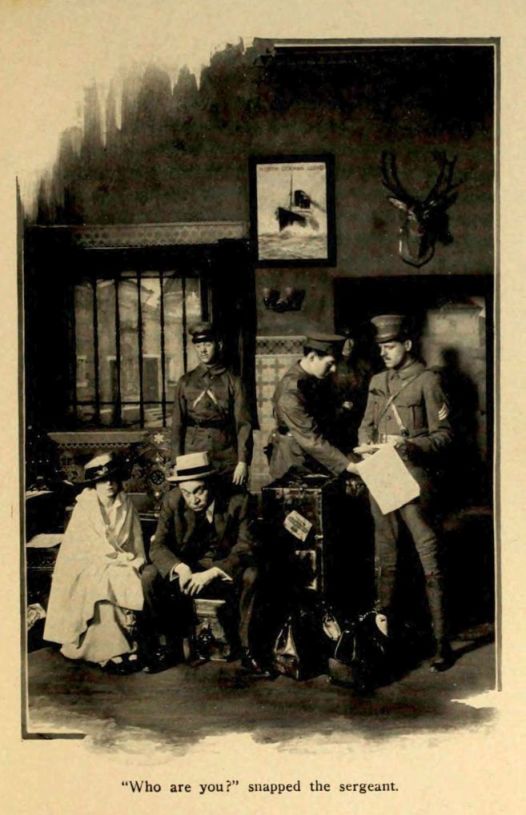
"Who are you?" snapped the sergeant.
"Kitty, your father's gone and got himself
arrested again!"
"Who am I?" Sherman echoed with dignity.
"My name, young fellow, is Henry J. Sherman,
and I live in Kewanee, Illynoy. I'm an
American citizen, and you can't——"
"Your passports—quick!" The sergeant
held out his hand imperiously.
"Oh, that's all right, young fellow; I've got
'em, all right." Kewanee's leading light
began to fumble in the spacious breast pocket of
his long-tailed coat. As he groped through a
packet of papers and letters, he kept up a
running fire of comment and exposition:
"Had 'em this afternoon, all right. Here;
no, that's my letter of credit. It would buy
Main Street at home, but I can't get a ham
sandwich on it here. This is—no; that's my
only son's little girl, Emmaline, taken the
day she was four years old. Fancy little girl,
eh? Now, that's funny I can't—here's that
list of geegaws I was to buy for my partner
in the Empire Mills, flour and buckwheat.
Guess he'll have to whistle for 'em. Now don't
get impatient, young fellow. This—— Land's
sakes, mother, that letter you gave me to mail,
in Algy-kiras—— Ah, here you are, all proper
and scientific enough as passports go, I guess."
The sergeant whisked the heavily creased
document from Sherman's hand, scanned it
hastily, and gave it back, without a word. The
outraged American tucked up his chin and gave
the sergeant glare for glare.
"If you ever come to Kewanee, young fellow,"
he snorted. "I'll be happy to show you
our new jail."
"Close in! March!" commanded the sergeant.
The guard surrounded the hapless barber
and wheeled through the door, their guns
hedging his white jacket about inexorably.
Sherman's hands spread his coat tails wide
apart, and he rocked back and forth on heels
and toes, his eyes smoldering.
"Come on, father"—Kitty had slipped her
hand through her dad's arm, and was imparting
direct strategy in a low voice—"we'll take
mother down the street to look at the shops
and make her forget our troubles. They've
got some wonderful Moroccan bazaars in
town; Baedeker says so."
"Shops, did you say?" Mrs. Sherman perked
up at once, forgetting her grief under the
superior lure.
"Yes, mother. Come on, let's go down and
look 'em over." Sherman's good humor was
quite restored. He pinched Kitty's arm in
compliment for her guile. "Maybe they'll let
us look at their stuff without charging
anything; but we couldn't buy a postage stamp,
remember."
They sailed out into the crowded street and
lost themselves amid the scourings of Africa
and south Europe. Almer was alone in the office.
The proprietor fidgeted. He walked to the
door and looked down the street in the
direction of the quays. He pulled his watch from
his pocket and compared it with the blue face
of the Dutch clock on the wall. His pudgy
hands clasped and unclasped themselves behind
his back nervously. An Arab hotel porter and
runner at the docks came swinging through
the front door with a small steamer trunk on
his shoulders, and Almer started forward
expectantly. Behind the porter came a tall
well-knit man, dressed in quiet traveling suit—the
Captain Woodhouse who had sailed from Alexandria
as a passenger aboard the Princess Mary.
He paused for an instant as his eyes met
those of the proprietor. Almer bowed and
hastened behind the desk. Woodhouse stepped up
to the register and scanned it casually.
"A room, sir?" Almer held out a pen invitingly.
"For the night, yes," Woodhouse answered
shortly, and he signed the register. Almer's
eyes followed the strokes of the pen eagerly.
"Ah, from Egypt, Captain? You were
aboard the Princess Mary, then?"
"From Alexandria, yes. Show me my room,
please. Beastly tired."
The Arab porter darted forward, and Woodhouse
was turning to follow him when he nearly
collided with a man just entering the street
door. It was Mr. Billy Capper.
Both recoiled as their eyes met. Just the
faintest flicker of surprise, instantly
suppressed, tightened the muscles of the captain's
jaws. He murmured a "Beg pardon" and
started to pass. Capper deliberately set
himself in the other's path and, with a wry smile,
held out his hand.
"Captain Woodhouse, I believe." Capper
put a tang of sarcasm, corroding as acid, into
the words. He was still smiling. The other
man drew back and eyed him coldly.
"I do not know you. Some mistake," Woodhouse said.
Almer was moving around from behind the
desk with the soft tread of a cat, his eyes fixed
on the hard-bitten face of Capper.
"Hah! Don't recognize the second-cabin
passengers aboard the Princess Mary, eh?"
Capper sneered. "Little bit discriminating
that way, eh? Well, my name's Capper—Mr. William
Capper. Never heard the name—in
Alexandria; what?"
"You are drunk. Stand aside!" Woodhouse
spoke quietly; his face was very white and
strained. Almer launched himself suddenly
between the two and laid his hands roughly on
Capper's thin shoulders.
"Out you go!" he choked in a thick guttural.
"I'll have no loafer insulting guests in my
house."
"Oh, you won't, won't you? But supposing I
want to take a room here—pay you good English
gold for it. You'll sing a different tune,
then."
"Before I throw you out, kindly leave my
place." By a quick turn, Almer had Capper
facing the door; his grip was iron. The
smaller man tried to walk to the door with
dignity. There he paused and looked back over
his shoulder.
"Remember, Captain Woodhouse," he called
back. "Remember the name against the time
we'll meet again. Capper—Mr. William Capper."
Capper disappeared. Almer came back to
begin profuse apologies to his guest. Woodhouse
was coolly lighting a cigarette. Their
eyes met.
Dinner that evening in the faded
dining-room of the Hotel Splendide was in the
way of being a doleful affair for the folk from
Kewanee, aside from Captain Woodhouse, the
only persons at table there. Woodhouse, true
to the continental tradition of exclusiveness,
had isolated himself against possible approach
by sitting at the table farthest from the
Shermans; his back presented an uncompromising
denial of fraternity. As for Mrs. Sherman,
the afternoon's visit to the bazaars had been
anything but a solace, emphasizing, as it did,
their grievous poverty in the midst of a plenty
contemptuous of a mere letter of credit. Henry
J. was wallowing in the lowest depths of
nostalgia; he tortured himself with the reflection
that this was lodge night in Kewanee and he
would not be sitting in his chair. Miss Kitty
contemplated with melancholy the distress of
her parents.
A tall slender youth with tired eyes and
affecting the blasé slouch of the boulevards
appeared in the door and cast about for a choice
of tables. Him Mr. Sherman impaled with a
glance of disapproval which suddenly changed
to wondering recognition. He dropped his
fork and jumped to his feet.
"Bless me, mother, if it isn't Willy Kimball
from old Kewanee!" Sherman waved his napkin
at the young man, summoning him in the
name of Kewanee to come and meet the home
folks. The tired eyes lighted perceptibly, and
a lukewarm smile played about Mr. Kimball's
effeminate mouth as he stepped up to the table.
"Why, Mrs. Sherman—and Kitty! And you,
Mr. Sherman—charmed!" He accepted the
proffered seat by the side of Kitty, receiving
their hearty hails with languid politeness.
With the sureness of English restraint,
Mr. Willy Kimball refused to become excited. He
was of the type of exotic Americans who try
to forget grandpa's corn-fed hogs and
grandma's hand-churned butter. His speech was of
Rotten Row and his clothes Piccadilly.
"Terrible business, this!" The youth fluttered
his hands feebly. "All this harrying
about and peeping at passports by every silly
officer one meets. I'm afraid I'll have to go
over to America until it's all over—on my way
now, in fact."
"Afraid!" Sherman sniffed loudly, and appraised
Mr. Kimball's tailoring with a disapproving
eye. "Well, Willy, it would be too bad
if you had to go back to Kewanee after your
many years in Paris, France; now, wouldn't it?"
Kimball turned to the women for sympathy.
"Reserved a compartment to come down from
Paris. Beastly treatment. Held up at every
city—other people crowded in my apartment,
though I'd paid to have it alone, of
course—soldier chap comes along and seizes my valet
and makes him join the colors and all that
sort——"
"Huh! Your father managed to worry
along without a val-lay, and he was respected
in Kewanee." This in disgust from Henry J.
Kitty flashed a reproving glance at her
father and deftly turned the expatriate into a
recounting of his adventures. Under her
unaffected lead the youth, who shuddered
inwardly at the appellation of "Willy," thawed
considerably, and soon there was an animated
swapping of reminiscences of the Great
Terror—hours on end before the banks and express
offices, dodging of police impositions, scrambling
for steamer accommodations—all that
went to compose the refugee Americans' great
epic of August, 1914.
Sherman took pride in his superior adventures:
"Five times arrested between Berlin
and Gibraltar, and what I said to that Dutchman
on the Swiss frontier was enough to make
his hair curl."
"Tell you what, Willy: you come on back
to Kewanee with us, and mother and you'll
lecture before the Thursday Afternoon Ladies'
Literary Club," Sherman boomed, with a
hearty blow of the hand between Willy's
shoulder blades. "I'll have Ed Porter announce it
in advance in the Daily Enterprise, and we'll
have the whole town there to listen. 'Ezra
Kimball's Boy Tells Thrilling Tale of War's
Alarms.' That's the way the head-lines'll read
in the Enterprise next week."
The expatriate shivered and tried to smile.
"We'll let mother do the lecturing," Kitty
came to his rescue. "'How to Live in Europe
on a Letter of Discredit.' That will have all
the gossips of Kewanee buzzing, mother."
The meal drew to a close happily in contrast
to its beginning. Mrs. Sherman and her
daughter rose to pass out into the reception
room. Sherman and Kimball lingered.
"Ah-h, Willy——"
"Mr. Sherman——"
Both began in unison, each somewhat
furtive and shamefaced.
"Have you any money?" The queries were
voiced as one. For an instant confusion; then
the older man looked up into the younger's
face—a bit flushed it was—and guffawed.
"Not a postage stamp, Willy! I guess we're
both beggars, and if mother and Kitty didn't
have five trunks between them this Swiss
holdup man who says he's proprietor of this
way-station hotel wouldn't trust us for a fried egg."
"Same here," admitted Kimball. "I'm badly
bent."
"They can't keep us down—us Americans!"
Sherman cheered, taking the youth's arm and
piloting him out into the reception room.
"We'll find a way out if we have to cable for
a warship to come and get us."
Just as Sherman and Kimball emerged from
the dining-room, there was a diversion out
beyond the glass doors on Waterport Street. A
small cart drew up; from its seat jumped a
young woman in a duster and with a heavy
automobile veil swathed under her chin. To
the Arab porter who had bounded out to the
street she gave directions for the removal from
the cart of her baggage, two heavy suit-cases
and two ponderous osier baskets. These latter
she was particularly tender of, following them
into the hotel's reception room and directing
where they should be put before the desk.
The newcomer was Jane Gerson, Hildebrand's
buyer, at the end of her gasoline flight
from Paris. Cool, capable, self-reliant as on
the night she saw the bastions of the capital's
outer forts fade under the white spikes of the
search-lights, Jane strode up the desk to face
the smiling Almer.
"Is this a fortress or a hotel?" she challenged.
"A hotel, lady, a hotel," Almer purred. "A
nice room—yes. Will the lady be with us
long?"
"Heaven forbid! The lady is going to be
on the first ship leaving for New York. And
if there are no ships, I'll look over the stock
of coal barges you have in your harbor." She
seized a pen and dashed her signature on the
register. The Shermans had pricked up their
ears at the newcomer's first words. Now
Henry J. pressed forward, his face glowing welcome.
"An American—a simon-pure citizen of the
United States—I thought so. Welcome to the
little old Rock!" He took both the girl's hands
impulsively and pumped them. Mrs. Sherman,
Kitty and Willy Kimball crowded around, and
the clatter of voices was instantaneous: "By
auto from Paris; goodness me!" "Not a thing
to eat for three days but rye bread!" "From
Strassburg to Luneville in a farmer's wagon!" Each
in a whirlwind of ejaculation tried to
outdo the other's story of hardship and privation.
The front doors opened again, and the
sergeant and guard who had earlier carried off
Fritz, the barber, entered. Again gun butts
thumped ominously. Jane looked over her
shoulder at the khaki-coated men, and confided
in the Shermans:
"I think that man's been following me ever
since I landed from the ferry."
"I have," answered the sergeant, stepping
briskly forward and saluting. "You are a
stranger on the Rock. You come here
from——"
"From Paris, by motor, to the town across
the bay; then over here on the ferry," the girl
answered promptly. "What about it?"
"Your name?"
"Jane Gerson. Yes, yes, it sounds German,
I know. But that's not my fault. I'm an
American—a red-hot American, too, for the
last two weeks."
The sergeant's face was wooden.
"Where are you going?"
"To New York, on the Saxonia, just as soon
as I can. And the British army can't stop me."
"Indeed!" The sergeant permitted himself
a fleeting smile. "From Paris by motor, eh?
Your passports, please."
"I haven't any," Jane retorted, with a shade
of defiance. "They were taken from me in
Spain, just over the French border, and were
not returned."
The sergeant raised his eyebrows in surprise
not unmixed with irony. He pointed to the
two big osier baskets, demanding to know
what they contained.
"Gowns—the last gowns made in Paris before
the crash. Fashion's last gasp. I am a
buyer of gowns for Hildebrand's store in New
York."
Ecstatic gurgles of pleasure from Mrs. Sherman
and her daughter greeted this announcement.
They pressed about the baskets and
regarded them lovingly.
The sergeant pushed them away and tried
to throw back the covers.
"Open your baggage—all of it!" he commanded
snappishly.
Jane, explaining over her shoulder to the
women, stooped to fumble with the hasps.
"Seventy of the darlingest gowns—the very
last Paul Poiret and Paquin and Worth made
before they closed shop and marched away
with their regiments. You shall see every one
of them."
"Hurry, please, my time's limited!" the
sergeant barked.
"I should think it would be—you're so
charming," Jane flung back over her shoulder,
and she raised the tops of the baskets. The
other women pushed forward with subdued
coos.
The sergeant plunged his hand under a mass
of colored fluffiness, groped for a minute, and
brought forth a long roll of heavy paper. With
a fierce mien, he began to unroll the bundle.
"And these?"
"Plans," Hildebrand's buyer answered.
"Plans of what?" The sergeant glared.
"Of gowns, silly! Here—you're looking at
that one upside down! This way! Now isn't
that a perfect dear of an afternoon gown?
Poiret didn't have time to finish it, poor man!
See that lovely basque effect? Everything's
moyen age this season, you know."
Jane, with a shrewd sidelong glance at the
flustered sergeant, rattled on, bringing gown
after gown from the baskets and displaying
them to the chorus of smothered screams of
delight from the feminine part of her audience.
One she draped coquettishly from her shoulders
and did an exaggerated step before the
smoky mirror over the mantelpiece to note the
effect.
"Isn't it too bad this soldier person isn't
married, so he could appreciate these
beauties?" She flicked a mischievous eye his way.
"Of course he can't be married, or he'd
recognize the plan of a gown. Clean hands, there,
Mister Sergeant, if you're going to touch any
of these dreams! Here, let me! Now look at
that musquetaire sleeve—the effect of the
war—military, you know."
The sergeant was thoroughly angry by this
time, and he forced the situation suddenly near
tragedy. Under his fingers a delicate girdle
crackled suspiciously.
"Here—your knife! Rip this open; there are
papers of some sort hidden here." He started
to pass the gown to one of his soldiers. Jane
choked back a scream.
"No, no! That's crinoline, stupid! No
papers——" She stretched forth her arms
appealingly. The sergeant humped his shoulders and
put out his hand to take the opened clasp-knife.
A plump doll-faced woman, who possessed
an afterglow of prettiness and a bustling
nervous manner, flounced through the doors at this
juncture and burst suddenly into the midst of
the group caught in the imminence of disaster.
"What's this—what's this?" She caught
sight of the filmy creation draped from the
sergeant's arm. "Oh, the beauty!" This in a
whisper of admiration.
"The last one made by Worth," Jane was
quick to explain, noting the sergeant's confusion
in the presence of the stranger, "and this
officer is going to rip it open in a search for
concealed papers. He takes me for a spy."
Surprised blue eyes were turned from Jane
to the sergeant. The latter shamefacedly tried
to slip the open knife into his blouse,
mumbling an excuse. The blue eyes bored him
through.
"I call that very stupid, Sergeant," reproved
the angel of rescue. Then to Jane——
"Where are you taking all these wonderful
gowns?"
"To New York. I'm buyer for Hildebrand's,
and——"
"But, Lady Crandall, this young woman has
no passports—nothing," the sergeant interposed.
"My duty——"
"Bother your duty! Don't you know a
Worth gown when you see it? Now go away!
I'll be responsible for this young woman from
now on. Tell your commanding officer Lady
Crandall has taken your duty out of your
hands." She finished with a quiet assurance
and turned to gloat once more over the gowns.
The sergeant led his command away with evident relief.
Lady Crandall turned to include all the refugees
in a general introduction of herself.
"I am Lady Crandall, the wife of the
governor general of Gibraltar," she said, with a
warming smile. "I just came down to see
what I could do for you poor stranded
Americans. In these times——"
"An American yourself, I'll gamble on
it!" Sherman pushed his way between the littered
baskets and seized Lady Crandall's hands.
"Knew it by the cut of your jib—and—your
way of doing things. I'm Henry J. Sherman,
from Kewanee, Illynoy—my wife and daughter
Kitty."
"And I'm from Iowa—the red hills of ole
Ioway," the governor's wife chanted, with an
orator's flourish of the hands. "Welcome to
the Rock, home folks!"
Hands all around and an impromptu old-home
week right then and there. Lady Crandall's
attention could not be long away from
the gowns, however. She turned back to them
eagerly. With Jane Gerson as her aid, she
passed them in rapturous review, Mrs. Sherman
and Kitty playing an enthusiastic chorus.
A pursy little man with an air of supreme
importance—Henry Reynolds he was, United
States Consul at Gibraltar—catapulted in from
the street while the gown chatter was at its
noisiest. He threw his hands above his head
in a mock attitude of submissiveness before a
highwayman.
"'S all fixed, ladies and gentlemen," he cried,
with a showman's eloquence. "Here's Lady
Crandall come to tell you about it, and she's
so busy riding her hobby—gowns and millinery
and such—she has forgotten. I'll bet dollars
to doughnuts."
"Credit to whom credit is due, Mister Consul,"
she rallied. "I'm not stealing anybody's
official thunder." The consul wagged a
forefinger at her reprovingly. With impatience,
the refugees waited to hear the news.
"Well, it's this way," Reynolds began. "I've
got so tired having all you people sitting on
my door-step I just had to make arrangements
to ship you on the Saxonia in self-defense.
Saxonia's due here from Naples Thursday—day
after to-morrow; sails for New York at
dawn Friday morning. Lady Crandall,
here—and a better American never came out of
the Middle West—has agreed to go bond for
your passage money; all your letters of credit
and checks will be cashed by treasury agents
before you leave the dock at New York, and
you can settle with the steamship people right
there.
"No, no; don't thank me! There's the
person responsible for your getting home." The
consul waved toward the governor's lady, who
blushed rosily under the tumultuous blessings
showered on her. Reynolds ducked out the
door to save his face. The Shermans made
their good nights, and with Kimball, started
toward the stairs.
"Thursday night, before you sail," Lady
Crandall called to them, "you all have an
engagement—a regular American dinner with
me at the Government House. Remember!"
"If you have hash—plain hash—and don't
call it a rag-owt, we'll eat you out of house and
home," Sherman shouted as addendum to the
others' thanks.
"And you, my dear"—Lady Crandall beamed
upon Jane—"you're coming right home with
me to wait for the Saxonia's sailing. Oh, no,
don't be too ready with your thanks. This is
pure selfishness on my part. I want you to
help plan my fall clothes. There, the secret's
out. But with all those beautiful gowns,
surely Hildebrand will not object if you leave the
pattern of one of them in an out-of-the-way
little place like this. Come on, now, I'll not
take no for an answer. We'll pack up all these
beauties and have you off in no time."
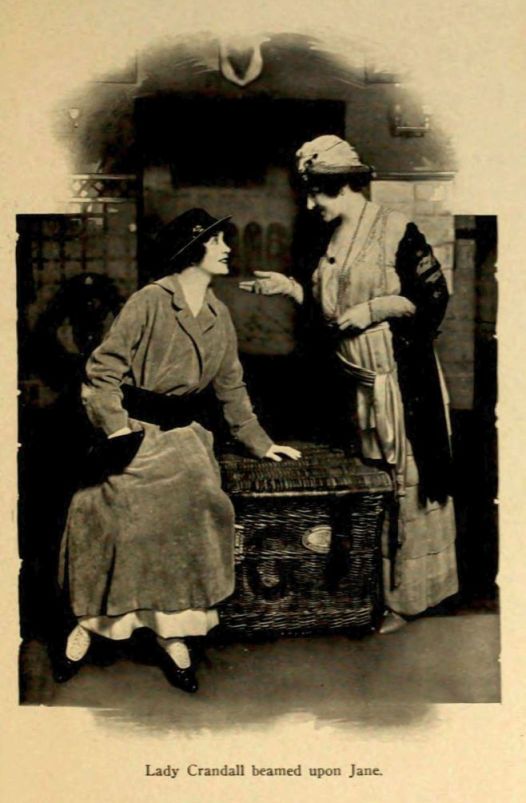
Lady Crandall beamed upon Jane.
Jane's thanks were ignored by the capable
packer who smoothed and straightened the
confections of silk and satin in the osier
hampers. Lady Crandall summoned the porter to
lift the precious freight to the back of her
dogcart, waiting outside. Almer, perturbed at the
kidnaping of his guest, came from behind the
desk.
"You will go to your room now?" he queried
anxiously.
"Not going to take it," Jane answered.
"Have an invitation from Lady Crandall to
visit the State House, or whatever you call it."
"But, pardon me. The room—it was rented,
and I fear one night's lodging is due. Twenty
shillings."
Jane elevated her eyebrows, but handed over
a bill.
"Ah, no, lady. French paper—it is worthless
to me. Only English gold, if the lady
pleases." Almer's smile was leonine.
"But it's all I've got; just came from France,
and——"
"Then, though it gives me the greatest sorrow,
I must hold your luggage until you have
the money changed. Excuse——"
Captain Woodhouse, who had dallied long
over his dinner for lack of something else to
do, came out of the dining-room just then, saw
a woman in difficulties with the landlord, and
instinctively stepped forward to offer his services.
"Beg pardon, but can I be of any help?"
Jane turned. The captain's heart gave a
great leap and then went cold. Frank pleasure
followed the first surprise in the girl's
eyes.
"Why, Captain Woodhouse—how jolly!—To
see you again after——"
She put out her hand with a free gesture of
comradeship.
Captain Woodhouse did not see the girl's
hand. He was looking into her eyes coldly,
aloofly.
"I beg your pardon, but aren't you mistaken?"
"Mistaken?" The girl was staring at him,
mystified.
"I'm afraid I have not had the pleasure of
meeting you," he continued evenly. "But if I
can be of service—now——"
She shrugged her shoulders and turned away
from him.
"A small matter. I owe this man twenty
shillings, and he will not accept French paper.
It's all I have."
Woodhouse took the note from her.
"I'll take it gladly—perfectly good." He
took some money from his pocket and looked
at it. Then, to Almer: "I say, can you split
a crown?"
"Change for you in a minute, sir—the tobacco
shop down the street." Almer pocketed
the gold piece and dodged out of the door.
Jane turned and found the deep-set gray
eyes of Captain Woodhouse fixed upon her.
They craved pardon—toleration of the incident
just passed.
Woodhouse hurried to Jane Gerson's
side and began to speak swiftly and earnestly:
"You are from the States?"
A shrug was her answer. The girl's face
was averted, and in the defiant set of her
shoulders Woodhouse found little promise of
pardon for the incident of the minute before.
He persisted:
"This war means nothing to you—one side
or the other?"
"I have equal pity for them both," she
answered in a low voice.
"We are living in dangerous times," he
continued earnestly. "I tell you frankly, were the
fact that you and I had met before to become
known here on the Rock the consequences would
be most—inconvenient—for me." Jane turned
and looked searchingly into his face. Something
in the tone rather than the words roused
her quick sympathy. Woodhouse kept on:
"I am sorry I had to deny that former meeting
just now—that meeting which has been
with me in such vivid memory. I regret that
were you to allude to it again I would have to
deny it still more emphatically."
"I'm sure I shan't mention it again," the girl
broke in shortly.
"Perhaps since it means so little to you—your
silence—perhaps you will do me that
favor, Miss Gerson."
"Certainly." Woodhouse could see that
anger still tinged her speech.
"May I go further—and ask you
to—promise?" A shadow of annoyance creased her
brow, but she nodded.
"That is very good of you," he thanked her.
"Shall you be long on the Rock?"
"No longer than I have to. I'm sailing on
the first boat for the States," she answered.
"Then I am in luck—to-night." Woodhouse
tried to speak easily, though Jane Gerson's
attitude was distant. "Meeting you
again—that's luck."
"To judge by what you have just said it
must be instead a great misfortune," she
retorted, with a slow smile.
"That is not fair. You know what I mean.
Don't imagine I've really forgotten our first
meeting under happier conditions than these.
I know I'm not clever—I can't make it sound
as I would—but I've thought a great deal of
you, Miss Gerson—wondering how you were
making it in this great war. Perhaps——"
Almer returned at this juncture with the
change, which he handed to Woodhouse. He
was followed in by Lady Crandall, who assured
Jane her hampers were securely strapped
to the dog-cart. Jane attempted an introduction.
"This gentleman has just done me a service,
Lady Crandall. May I present——"
"So sorry. You don't know my name. My
clumsiness. Captain Woodhouse." The man
bridged the dangerous gap hurriedly. Lady
Crandall acknowledged the introduction with a
gracious smile.
"Your husband is Sir George——" he began.
"Yes, Sir George Crandall, Governor-general
of the Rock. And you——"
"Quite a recent comer. Transferred from
the Nile country here. Report to-morrow."
"All of the new officers have to report to the
governor's wife as well," Lady Crandall
rallied, with a glance at Jane. "You must come
and see me—and Miss Gerson, who will be
with me until her boat sails."
Woodhouse caught his breath. Jane Gerson,
who knew him, at the governor's home! But
he mastered himself in a second and bowed his
thanks. Lady Crandall was moving toward
the door. Her ward turned and held out a
hand to Woodhouse.
"So good of you to have straightened out
my finances," she said, with a smile in which
the man hoped he read full forgiveness for his
denial of a few minutes before. "If you're
ever in America I hope——" He looked up
quickly. "I hope somebody will be as nice to
you. Good night."
Woodhouse and Almer were alone in the mongrel
reception room. The hour was late. Almer
began sliding folding wooden shutters across
the back of the street windows. Woodhouse
lingered over the excuse of a final cigarette,
knowing the moment for his
rapprochement with his fellow Wilhelmstrasse spy was
at hand. He was more distraught than he
cared to admit even to himself. The day's
developments had been startling. First the
stunning encounter with Capper there on the very
Rock that was to be the scene of his
delicate operations—Capper, whom he had thought
sunk in the oblivion of some Alexandrian wine
shop, but who had followed him on the
Princess Mary. The fellow had deliberately cast
himself into his notice, Woodhouse reflected;
there had been menace and insolent hint of a
power to harm in his sneering objurgation that
Woodhouse should remember his name against
a second meeting. "Capper—never heard the
name in Alexandria, eh?" What could he
mean by that if not that somehow the little
ferret had learned of his visit to the home of
Doctor Koch? And that meant—why, Capper
in Gibraltar was as dangerous as a coiled cobra!
Then the unexpected meeting with Jane
Gerson, the little American he had mourned as
lost in the fury of the war. Ah, that was a joy
not unmixed with regrets! What did she think
of him? First, he had been forced coldly to
deny the acquaintance that had meant much
to him in moments of recollection; then, he had
attempted a lame explanation, which explained
nothing and must have left her more mystified
than before. In fact, he had frankly thrown
himself on the mercy of a girl on whom he
had not the shadow of claim beyond the poor
equity of a chance friendship—an incident she
might consider as merely one of a day's travel
as far as he could know. He had stood before
her caught in a deceit, for on the occasion of
that never-to-be-forgotten ride from Calais to
Paris he had represented himself as hurrying
back to Egypt, and here she found him still
out of uniform and in a hotel in Gibraltar.
Beyond all this, Jane Gerson was going to
the governor's house as a guest. She, whom
he had forced, ever so cavalierly, into a
promise to keep secret her half knowledge of the
double game he was playing, was going to be
on the intimate ground of association with the
one man in Gibraltar who by a crook of his
finger could end suspicion by a firing squad.
This breezy little baggage from New York
carried his life balanced on the rosy tip of her
tongue. She could be careless or she could be
indifferent; in either case it would be bandaged
eyes and the click of shells going home for
him.
It was Almer who interrupted Woodhouse's
troubled train of thought.
"Captain Woodhouse will report for signal
duty on the Rock to-morrow, I suppose?" he
insinuated, coming down to where Woodhouse
was standing before the fireplace. He made a
show of tidying up the scattered magazines
and folders on the table.
"Report for signal duty?" the other echoed
coldly. "How did you know I was to report
for signal duty here?"
"In the press a few weeks ago," the hotel
keeper hastily explained. "Your transfer from
the Nile country was announced. We poor
people here in Gibraltar, we have so little to
think about, even such small details of
news——"
"Ah, yes. Quite so." Woodhouse tapped
back a yawn.
"Your journey here from your station on
the Nile—it was without incident?" Almer
eyed his guest closely. The latter permitted
his eyes to rest on Almer's for a minute
before replying.
"Quite." Woodhouse threw his cigarette in
the fireplace and started for the stairs.
"Ah, most unusual—such a long journey
without incident of any kind in this time of
universal war, with all Europe gone mad." Almer
was twiddling the combination of a
small safe set in the wall by the fireplace, and
his chatter seemed only incidental to the
absorbing work he had at hand. "How will the
madness end, Captain Woodhouse? What will
be the boundary lines of Europe's nations
in—say, 1932?"
Almer rose as he said this and turned to look
squarely into the other's face. Woodhouse met
his gaze steadily and without betraying the
slightest emotion.
"In 1932—I wonder," he mused, and into his
speech unconsciously appeared that throaty
intonation of the Teutonic tongue.
"Don't go yet, Captain Woodhouse. Before
you retire I want you to sample some of this
brandy." He brought out of the safe a short
squat bottle and glasses. "See, I keep it in the
safe, so precious it is. Drink with me,
Captain, to the monarch you have come to
Gibraltar to serve—to his majesty, King George
the Fifth!"
Almer lifted his glass, but Woodhouse
appeared wrapped in thought; his hand did not
go up.
"I see you do not drink to that toast, Captain."
"No—I was thinking—of 1932."
"So?" Quick as a flash Almer caught him
up. "Then perhaps I had better say, drink to
the greatest monarch in Europe."
"To the greatest monarch in Europe!" Woodhouse
lifted his glass and drained it.
Almer leaned suddenly across the table and
spoke tensely: "You have—something maybe—I
would like to see. Some little relic of
Alexandria, let us say."
Woodhouse swept a quick glance around,
then reached for the pin in his tie.
"A scarab; that's all."
In the space of a breath Almer had seen
what lay in the back of the stone beetle. He
gripped Woodhouse's hand fervently.
"Yes—yes, Nineteen Thirty-two! They have
told me of your coming. A cablegram from
Koch only this afternoon said you would be on
the Princess Mary. The other—the real
Woodhouse—there will be no slips; he will not——"
"He is as good as a dead man for many
months," Woodhouse interrupted. "Not a
chance of a mistake." He slipped easily into
German. "Everything depends on us now,
Herr Almer."
"Perhaps the fate of our fatherland," Almer
replied, cleaving to English. Woodhouse
stepped suddenly away from the side of the
table, against which he had been leaning, and
his right hand jerked back to a concealed
holster on his hip. His eyes were hot with
suspicion.
"You do not answer in German; why not?
Answer me in German or by——"
"Ach! What need to become excited?" Almer
drew back hastily, and his tongue speedily
switched to German. "German is dangerous
here on the Rock, Captain. Only yesterday
they shot a man against a wall because he
spoke German too well. Do you wonder I try
to forget our native tongue?"
Woodhouse was mollified, and he smiled
apologetically. Almer forgave him out of
admiration for his discretion.
"No need to suspect me—Almer. They will
tell you in Berlin how for twenty years I have
served the Wilhelmstrasse. But never before
such an opportunity—such an opportunity.
Stupendous!" Woodhouse nodded enthusiastic
affirmation. "But to business, Nineteen
Thirty-two. This Captain Woodhouse some seven
years ago was stationed here on the Rock for
just three months."
"So I know."
"You, as Woodhouse, will be expected to
have some knowledge of the signal tower, to
which you will have access." Almer climbed a
chair on the opposite side of the room, threw
open the face of the old Dutch clock there, and
removed from its interior a thin roll of blue
drafting paper. He put it in Woodhouse's
hands. "Here are a few plans of the interior
of the signal tower—the best I could get. You
will study them to-night; but give me your
word to burn them before you sleep."
"Very good." Woodhouse slipped the roll
into the breast pocket of his coat. Almer
leaned forward in a gust of excitement, and,
bringing his mouth close to the other's ear,
whispered hoarsely:
"England's Mediterranean fleet—twenty-two
dreadnaughts, with cruisers and destroyers—nearly
a half of Britain's navy, will be here any
day, hurrying back to guard the Channel.
They will anchor in the straits. Our big
moment—it will be here then! Listen! Room D
in the signal tower—that is the room. All the
electric switches are there. From Room D
every mine in the harbor can be exploded in ten
seconds."
"Yes, but how to get to Room D?" Woodhouse
queried.
"Simple. Two doors to Room D, Captain; an
outer door like any other; an inner door of
steel, protected by a combination lock like a
vault's door. Two men on the Rock have that
combination: Major Bishop, chief signal officer,
he has in it his head; the governor-general
of the Rock, he has it in his safe."
"We can get it out of the safe easier than
from Major Bishop's head," Woodhouse put in,
with a smile.
"Right. We have a friend—in the governor's
own house—a man with a number from
the Wilhelmstrasse like you and me. At any
moment in the last two months he could have
laid a hand on that combination. But we
thought it better to wait until necessity came.
When the fleet arrives you will have that
combination; you will go with it to Room D, and
after that——"
"The deluge," the other finished.
"Yes—yes! Our country master of the sea
at last, and by the work of the Wilhelmstrasse—despised
spies who are shot like dogs when
they're caught, but die heroes' deaths." The
hotel proprietor checked himself in the midst
of his rhapsody, and came back to more
practical details:
"But this afternoon—that man from Alexandria
who called you by name. That looked bad—very
bad. He knows something?"
Woodhouse, who had been expecting the
question, and who preferred not to share an
anxiety he felt himself best fitted to cope with
alone, turned the other's question aside:
"Never met him before in my life to my best
recollection. My name he picked up on the
Princess Mary, of course; I won a pool one
day, and he may have heard some one mention
it. Simply a drunken brawler who didn't know
what he was doing."
Almer seemed satisfied, but raised another
point:
"But the girl who has just left here; am I
to have no explanation of her?"
"What explanation do you want?" the captain
demanded curtly.
"She recognized you. Who is she? What
is she?"
"Devilish unfortunate," Woodhouse admitted.
"We met a few weeks ago on a train, while I
was on my way to Egypt, you know. Chatted
together—oh, very informally. She is a
capable young woman from the States—a 'buyer'
she calls herself. But I don't think we need
fear complications from that score; she's bent
only on getting home."
"The situation is dangerous," urged Almer,
wagging his head. "She is stopping at the
governor's house; any reference she might make
about meeting you on a train on the Continent
when you were supposed to be at Wady Halfa
on the Nile——"
"I have her promise she will not mention
that meeting to anybody."
"Ach! A woman's promise!" Almer's eyes
invoked Heaven to witness a futile thing. "She
seemed rather glad to see you again; I——"
"Really?" Woodhouse's eyes lighted.
The Splendide's proprietor was pacing the
floor as fast as his fat legs would let him.
"Something must be done," he muttered again
and again. He halted abruptly before Woodhouse,
and launched a thick forefinger at him
like a torpedo.
"You must make love to that girl, Woodhouse,
to keep her on our side," was his ultimatum.
Woodhouse regarded him quizzically, leaned
forward, and whispered significantly.
"I'm already doing it," he said.
Turning to consider the never-stale
fortunes of one of fate's bean bags——
Mr. Billy Capper, ejected from the Hotel
Splendide, took little umbrage at such
treatment; it was not an uncommon experience,
and, besides, a quiet triumph that would not
be dampened by trifles filled his soul.
Cheerfully he pushed through the motley crowd on
Waterport Street down to the lower levels of
the city by the Line Wall, where the roosts of
sailors and warrens of quondam adventurers
off all the seven seas made far more congenial
atmosphere than that of the Splendide's
hollow pretense. He chose a hostelry more
commensurate with his slender purse than
Almer's, though as a matter of fact the question
of paying a hotel bill was furthest from Billy
Capper's thoughts; such formal transactions
he avoided whenever feasible. The proprietor
of the San Roc, where Capper took a room, had
such an evil eye that his new guest made a
mental note that perhaps he might have to
leave his bag behind when he decamped.
Capper abhorred violence—to his own person.
Alone over a glass of thin wine—the champagne
days, alas! had been too fleeting—Capper
took stock of his situation and conned the
developments he hoped to be the instrument
for starting. To begin with, finances were
wretchedly bad, and that was a circumstance
so near the ordinary for Capper that he
shuddered as he pulled a gold guinea and a few
silver bits from his pocket, and mechanically
counted them over. Of the three hundred
marks Louisa—pretty snake!—had given him
in the Café Riche and the expense money he
had received from her the following day to
cover his expedition to Alexandria for the
Wilhelmstrasse naught but this paltry residue!
That second-cabin ticket on the Princess Mary
had taken the last big bite from his hoard, and
here he was in this black-and-tan town with a
quid and little more between himself and the
old starved-dog life.
But—and Capper narrowed his eyes and
sagely wagged his head—there'd be something
fat coming. When he got knee to knee with
the governor-general of the Rock, and told him
what he, Billy Capper, knew about the identity
of Captain Woodhouse, newly transferred to
the signal service at Gibraltar, why, if there
wasn't a cool fifty pounds or a matter of that
as honorarium from a generous government
Billy Capper had missed his guess; that's all.
"I say, Governor, of course this is very
handsome of you, but I didn't come to tell
what I know for gold. I'm a loyal Englishman,
and I've done what I have for the good
of the old flag."
"Quite right, Mr. Capper; quite right. But
you will please accept this little gift as an
inadequate recognition of your loyalty. Your
name shall be mentioned in my despatches home."
Capper rehearsed this hypothetical dialogue
with relish. He could even catch the involuntary
gasp of astonishment from the governor
when that responsible officer in his majesty's
service heard the words Capper would whisper
to him; could see the commander of the Rock
open a drawer in his desk and take therefrom
a thick white sheaf of bank-notes—count
them! Then—ah, then—the first train for
Paris and the delights of Paris at war-time
prices.
The little spy anticipated no difficulty in
gaining audience with the governor. Before
he had been fifteen minutes off the Princess
Mary he had heard the name of the present
incumbent of Government House. Crandall—Sir
George Crandall; the same who had been
in command of the forts at Rangoon back in
'99. Oh, yes, Capper knew him, and he made
no doubt that, if properly reminded of a
certain bit of work Billy Capper had done back in
the Burmese city, Sir George would recall
him—and with every reason for gratefulness.
To-morrow—yes, before ever Sir George had had
his morning's peg, Capper would present
himself at Government House and tell about that
house on Queen's Terrace at Ramleh; about
the unconscious British officer who was carried
there and hurried thence by night, and the
tall well-knit man in conference with Doctor
Koch who was now come to be a part of the
garrison of the Rock under the stolen name of
Woodhouse.
Capper had his dinner, then strolled around
the town to see the sights and hear what he
could hear. Listening was a passion with him.
For the color and the exotic savor of Gibraltar
on a hot August night Capper had no eye.
The knife edge of a moon slicing the battlements
of the old Moorish Castle up on the
heights; the minor tinkle of a guitar sounding
from a vine-curtained balcony; a Riffian
muleteer's singsong review of his fractious beast's
degraded ancestry—not for these incidentals
did the practical mind under the battered
Capper bowler have room. Rather the scraps of
information and gossip passed from one
blue-coated artilleryman off duty, to another over
a mug of ale, or the confidence of a sloe-eyed
dancer to the guitar player in a tavern; this
was meat for Capper. Carefully he husbanded
his gold piece, and judiciously he spent his
silver for drink. He enjoyed himself in the
ascetic spirit of a monk in a fast, believing
that the morrow would bring champagne in
place of the thin wine his pitiful silver could
command.
Then, of a sudden, he caught a glimpse of
Louisa—Louisa of the Wilhelmstrasse.
Capper's heart skipped, and an involuntary
impulse crooked his fingers into claws.
The girl was just coming out of a café—the
only café aspiring to Parisian smartness
Gibraltar boasts. Her head was bare. Under an
arm she had tucked a stack of cigar boxes.
Had it not been that a steady light from an
overhead arc cut her features out of the soft
shadow with the fineness of a diamond-pointed
tool, Capper would have sworn his eyes were
playing him tricks. But Louisa's features
were unmistakable, whether in the Lucullian
surroundings of a Berlin summer garden or
here on a street in Gibraltar. Capper had
instinctively crushed himself against the
nearest wall on seeing the girl; the crowd had come
between himself and her, and she had not
seen him.
All the weasel instinct of the man came
instantly to the fore that second of recognition,
and the glint in his eyes and baring of his
teeth were flashed from brute instinct—the
instinct of the night-prowling meat hunter.
All the vicious hate which the soul of Billy
Capper could distil flooded to his eyes and
made them venomous. Slinking, dodging,
covering, he followed the girl with the cigar
boxes. She entered several dance-halls,
offered her wares at the door of a cheap hotel.
For more than an hour Capper shadowed her
through the twisting streets of the old
Spanish town. Finally she turned into a narrow
lane, climbed flagstone steps, set the width of
the lane, to a house under the scarp of a cliff,
and let herself in at the street door. Capper,
following to the door as quickly as he dared,
found it locked.
The little spy was choking with a lust to
kill; his whole body trembled under the pulse
of a murderous passion. He had found Louisa—the
girl who had sold him out—and for her
private ends, Capper made no doubt of that.
Some day he had hoped to run her down, and
with his fingers about her soft throat to tell her
how dangerous it was to trick Billy Capper.
But to have her flung across his path this way
when anger was still at white heat in him—this
was luck! He'd see this Louisa and have
a little powwow with her even if he had to
break his way into the house.
Capper felt the doorknob again; the door
wouldn't yield. He drew back a bit and
looked up at the front of the house. Just a
dingy black wall with three unlighted windows
set in it irregularly. The roof projected over
the gabled attic like the visor of a cap.
Beyond the farther corner of the house were ten
feet of garden space, and then the bold rock of
the cliff springing upward. A low wall
bounded the garden; over its top nodded the pale
ghosts of moonflowers and oleanders.
Capper was over the wall in a bound, and
crouching amid flower clusters, listening for
possible alarm. None came, and he became
bolder. Skirting a tiny arbor, he skulked to a
position in the rear of the house; there a broad
patch of illumination stretched across the
garden, coming from two French windows on the
lower floor. They stood half open; through
the thin white stuff hanging behind them
Capper could see vaguely the figure of a girl
seated before a dressing mirror with her hands
busy over two heavy ropes of hair. Nothing
to do but step up on the little half balcony
outside the windows, push through into the room,
and—have a little powwow with Louisa.
An unwonted boldness had a grip on the little
spy. Never a person to force a face-to-face
issue when the trick could be turned
behind somebody's back, he was, nevertheless,
driven irresistibly by a furious anger that
took no heed of consequences.
With the light foot of a cat, Capper straddled
the low rail of the balcony, pushed back
one of the partly opened windows, and stepped
into Louisa's room. His eyes registered
mechanically the details—a heavy canopied bed,
a massive highboy of some dark wood, chairs
supporting carelessly flung bits of wearing
apparel. But he noted especially that just as he
emerged from behind one of the loose curtains
a white arm remained poised over a brown head.
"Stop where you are, Billy Capper!" The
girl's low-spoken order was as cold and tense
as drawn wire. No trace of shock or surprise
was in her voice. She did not turn her head.
Capper was brought up short, as if he felt a
noose about his neck.
Slowly the figure seated before the dressing
mirror turned to face him. Tumbling hair
framed the girl's face, partly veiling the
yellow-brown eyes, which seemed two spots of
metal coming to incandescence under heat.
Her hands, one still holding a comb, lay
supinely in her lap.
"I admit this is a surprise, Capper," Louisa
said, letting each word fall sharply, but
without emphasis. "However, it is like you to
be—unconventional. May I ask what you want
this time—besides money, of course?"
Capper wet his lips and smiled wryly. He
had jumped so swiftly to impulse that he had
not prepared himself beforehand against the
moment when he should be face to face with
the girl from the Wilhelmstrasse. Moreover,
he had expected to be closer to her—very close
indeed—before the time for words should
come.
"I—I saw you to-night and followed
you—here," he began lamely.
"Flattering!" She laughed shortly.
"Oh, you needn't try to come it over me with
words!" Capper's teeth showed in a nasty
grin as his rage flared back from the first
suppression of surprise. "I've come here to have
a settlement for a little affair between you and
me."
"Blackmail? Why, Billy Capper, how true
to form you run!" The yellow-brown eyes
were alight and burning now. "Have you
determined the sum you want or are you in the
open market?"
Capper grinned again, and shifted his
weight, inadvertently advancing one foot a
little nearer the seated girl as he did so.
"Pretty quick with the tongue—as always,"
he sneered. "But this time it doesn't go,
Louisa. You pay differently this time—pay for
selling me out. Understand!" Again one foot
shifted forward a few inches by the accident of
some slight body movement on the man's part.
Louisa still sat before her dressing mirror,
hands carelessly crossed on her lap.
"Selling you out?" she repeated evenly.
"Oh! So you finally did discover that you
were elected to be the goat? Brilliant
Capper! How long before you made up your
mind you had a grievance?"
The girl's cool admission goaded the little
man's fury to frenzy. His mind craved for
action—for the leap and the tightening of
fingers around that taunting throat; but
somehow his body, strangely detached from the fiat
of volition as if it were another's body, lagged
to the command. Violence had never been its
mission; muscles were slow to accept this new
conception of the mind. But the man's feet
followed their crafty intelligence; by fractions
of inches they moved forward stealthily.
"You wouldn't be here now," Louisa coldly
went on, "if you weren't fortune's bright-eyed
boy. You were slated to be taken off the boat
at Malta and shot; the boat didn't stop at
Malta through no fault of ours, and so you arrived
at Alexandria—and became a nuisance." One
of the girl's hands lifted from her lap and
lazily played along the edge of the rosewood
standard which supported the mirror on the
dressing table. It stopped at a curiously
carved rosette in the rococo scroll-work.
Capper's suspicious eye noted the movement. He
sparred for time—the time needed by those
stealthy feet to shorten the distance between
themselves and the girl.
"Why," he hissed, "why did you give me a
number with the Wilhelmstrasse and send me
to Alexandria if I was to be caught and shot at
Malta? That's what I'm here to find out."
"Excellent Capper!" Her fingers were playing
with the convolutions of the carved rosette.
"Intelligent Capper! He comes to a
lady's room at night to find the answer to a
simple question. He shall have it. He
evidently does not know the method of the
Wilhelmstrasse, which is to choose two men for
every task to be accomplished. One—the
'target,' we call him—goes first; our friends
whose secrets we seek are allowed to become
suspicious of him—we even give them a hint
to help them in their suspicion. They seize
the 'target,' and in time of war he becomes a
real target for a firing squad, as you should
have been, Capper, at Malta. Then when our
friends believe they have nipped our move in
the bud follows the second man—who turns
the trick."
Capper was still wrestling with that baffling
stubbornness of the body. Each word the girl
uttered was like vitriol on his writhing soul.
His mind willed murder—willed it with all the
strength of hate; but still the springs of his
body were cramped—by what? Not cowardice,
for he was beyond reckoning results.
Certainly not compassion or any saving virtue of
chivalry. Why did his eyes constantly stray
to that white hand lifted to allow the fingers
to play with the filigree of wood on the mirror
support?
"Then you engineered the stealing of my
number—from the hollow under the handle of
my cane—some time between Paris and
Alexandria?" he challenged in a whisper, his face
thrust forward between hunched shoulders.
"No, indeed. It was necessary for you to
have—the evidence of your profession when
the English searched you at Malta. But the
loss of your number is not news; Koch, in
Alexandria, has reported, of course."
The girl saw Capper's foot steal forward
again. He was not six feet from her now.
His wiry body settled itself ever so slightly
for a spring. Louisa rose from her chair, one
hand still resting on the wooden rosette of the
mirror standard. She began to speak in a
voice drained of all emotion:
"You followed me here to-night, Billy Capper,
imagining in your poor little soul that you
were going to do something desperate—something
really human and brutal. You came in
my window all primed for murder. But your
poor little soul all went to water the instant
we faced each other. You couldn't nerve
yourself to leap upon a woman even. You
can't now."
She smiled on him—a woman's flaying
smile of pity. Capper writhed, and his
features twisted themselves in a paroxysm of
hate.
"I have my finger on a bell button here, Capper.
If I press it men will come in here and
kill you without asking a question. Now you'd
better go."
Capper's eyes jumped to focus on a round
white nib under one of the girl's fingers there
on the mirror's standard. The little ivory
button was alive—a sentient thing suddenly
allied against him. That inanimate object
rather than Louisa's words sent fingers of cold
fear to grip his heart. A little ivory button
waiting there to trap him! He tried to cover
his vanished resolution with bluster, sputtering
out in a tense whisper:
"You're a devil—a devil from hell, Louisa!
But I'll get you. They shoot women in war
time! Sir George Crandall—I know him—I
did a little service for him once in Rangoon.
He'll hear of you and your Wilhelmstrasse
tricks, and you'll have your pretty back
against a wall with guns at your heart before
to-morrow night. Remember—before to-morrow night!"
Capper was backing toward the open window
behind him. The girl still stood by the
mirror, her hand lightly resting where the
ivory nib was. She laughed.
"Very well, Billy Capper. It will be a firing
party for two—you and me together. I'll
make a frank confession—tell all the information
Billy Capper sold to me for three hundred
marks one night in the Café Riche—the story
of the Anglo-Belgian defense arrangements.
The same Billy Capper, I'll say, who sold the
Lord Fisher letters to the kaiser—a cable to
Downing Street will confirm that identification
inside of two hours. And then——"
"And your Captain Woodhouse—your cute
little Wilhelmstrasse captain," Capper flung
back from the window, pretending not to heed
the girl's potent threat; "I know all about him,
and the governor'll know, too—same time he
hears about you!"
"Good night, Billy Capper," Louisa
answered, with a piquant smile. "And au
revoir until we meet with our backs against
that wall."
Capper's head dropped from view over the
balcony edge; there was a sound of running
feet amid the close-ranked plants in the
garden, then silence.
The girl from the Wilhelmstrasse, alone in
the house save for the bent old housekeeper
asleep in her attic, turned and laid her
head—a bit weakly—against the carved standard,
where in a florid rosette showed the ivory tip
of the hinge for the cheval glass.
Government House, one of the Baedeker
points of Gibraltar, stands amid
its gardens on a shelf of the Rock about
mid-way between the Alameda and the signal
tower, perched on the very spine of the lion's
back above it. Its windows look out on the
blue bay and over to the red roofs of Algeciras
across the water on Spanish territory. Tourists
gather to peek from a respectful distance
at the mossy front and quaint ecclesiastic
gables of Government House, which has a distinction
quite apart from its use as the home of the
governor-general. Once, back in the dim ages
of Spain's glory, it was a monastery, one of the
oldest in the southern tip of the peninsula.
When the English came their practical sense
took no heed of the protesting ghosts of the
monks, but converted the monastery into a
home for the military head of the fortress—a
little dreary, a shade more melancholy than
the accustomed manor hall at home, but
adequate and livable.
Thither, on the morning after his arrival,
Captain Woodhouse went to report for duty to
Major-general Sir George Crandall, Governor of
the Rock. Captain Woodhouse was in uniform—neat
service khaki and pith helmet, which
became him mightily. He appeared to have
been molded into the short-skirted, olive-gray
jacket; it set on his shoulders with snug ease.
Perhaps, if anything, the uniform gave to his
features a shade more than their wonted
sternness, to his body just the least addition
of an indefinable alertness, of nervous
acuteness. It was nine o'clock, and Captain
Woodhouse knew it was necessary for him to pay
his duty call on Sir George before the eleven
o'clock assembly.
As the captain emerged from the straggling
end of Waterport Street, and strode through
the flowered paths of the Alameda, he did not
happen to see a figure that dodged behind a
chevaux-de-frise of Spanish bayonet on his
approach. Billy Capper, who had been pacing
the gardens for more than an hour, fear
battling with the predatory impulse that urged
him to Government House, watched Captain
Woodhouse pass, and his eyes narrowed into
a queer twinkle of oblique humor. So Captain
Woodhouse had begun to play the game—going
to report to the governor, eh? The pale soul
of Mr. Capper glowed with a faint flicker of
admiration for this cool bravery far beyond its
own capacity to practise. Capper waited a safe
time, then followed, chose a position outside
Government House from which he could see
the main entrance, and waited.
A tall thin East Indian with a narrow
ascetic face under his closely wound white
turban, and wearing a native livery of the same
spotless white, answered the captain's summons
on the heavy knocker. He accepted the visitor's
card, showed him into a dim hallway hung
with faded arras and coats of chain mail. The
Indian, Jaimihr Khan, gave Captain Woodhouse
a start when he returned to say the governor
would receive him in his office. The
man had a tread like a cat's, absolutely
noiseless; he moved through the half light of the
hall like a white wraith. His English was
spoken precisely and with a curious mechanical
intonation.
Jaimihr Khan threw back heavy double
doors and announced, "Cap-tain Wood-house." He
had the doors shut noiselessly almost
before the visitor was through them.
A tall heavy-set man with graying hair and
mustache rose from a broad desk at the right
of a large room and advanced with hand
outstretched in cordial welcome.
"Captain Woodhouse, of the signal service.
Welcome to the Rock, Captain. Need you
here. Glad you've come."
Woodhouse studied the face of his superior
in a swift glance as he shook hands. A broad
full face it was, kindly, intelligent, perhaps not
so alert as to the set of eyes and mouth as it
had been in younger days when the stripes of
service were still to be won. General Sir
George Crandall gave the impression of a man
content to rest on his honors, though scrupulously
attentive to the routine of his position.
He motioned the younger man to draw a chair
up to the desk.
"In yesterday on the Princess Mary, I presume,
Captain?"
"Yes, General. Didn't report to you on
arrival because I thought it would be quite
tea time and I didn't want to disturb——"
"Right!" General Crandall tipped back in
his swivel chair and appraised his new officer
with satisfaction. "Everything quiet on the
upper Nile? Germans not tinkering with the
Mullah yet to start insurrection or anything
like that?"
"Right as a trivet, sir," Woodhouse
answered promptly. "Of course we're
anticipating some such move by the enemy—agents
working in from Erythrea—holy war of a sort,
perhaps, but I think our people have things
well in hand."
"And at Wady Halfa, your former
commander——" The general hesitated.
"Major Bronson-Webb, sir," Woodhouse
was quick to supply, but not without a sharp
glance at the older man.
"Yes—yes; Bronson-Webb—knew him in
Rangoon in the late nineties—mighty decent
chap and a good executive. He's standing the
sun, I warrant."
Captain Woodhouse accepted the cigarette
from the general's extended case.
"No complaint from him at least, General
Crandall. We all get pretty well baked at
Wady, I take it."
The governor laughed, and tapped a bell on
his desk. Jaimihr Khan was instantly
materialized between the double doors.
"My orderly, Jaimihr," General Crandall
ordered, and the doors were shut once more.
The general stretched a hand across the desk.
"Your papers, please, Captain. I'll receipt
your order of transfer and you'll be a member
of our garrison forthwith."
Captain Woodhouse brought a thin sheaf of
folded papers from his breast pocket and
passed it to his superior. He kept his eyes
steadily on the general's face as he scanned
them.
"C. G. Woodhouse—Chief Signal Officer—Ninth
Grenadiers—Wady Halfa——" General
Crandall conned the transfer aloud, running
his eyes rapidly down the lines of the
form. "Right. Now, Captain, when my
orderly comes——"
A subaltern entered and saluted.
"This is Captain Woodhouse." General
Crandall indicated Woodhouse, who had risen.
"Kindly conduct him to Major Bishop, who
will assign him to quarters. Captain
Woodhouse, we—Lady Crandall and I—will expect
you at Government House soon to make your
bow over the teacup. One of Lady Crandall's
inflexible rules for new recruits, you know.
Good day, sir."
Woodhouse, out in the free air again, drew
in a long breath and braced back his shoulders.
He accompanied the subaltern over the trails
on the Rock to the quarters of Major Bishop,
chief signal officer, under whom he was to
be junior in command. But one regret
marked his first visit to Government House—he
had not caught even a glimpse of the little
person calling herself Jane Gerson, buyer.
But he had missed by a narrow margin.
Piloted by Lady Crandall, Jane had left the
vaulted breakfast room for the larger and
lighter library, which Sir George had
converted to the purpose of an office. This
room was a sort of holy of holies with Lady
Crandall, to be invaded if the presiding genius
could be caught napping or lulled to complaisance.
This morning she had the important
necessity of unobstructed light—not a general
commodity about Government House—to urge
in defense of profanation. For her guest
carried under her arm a sheaf of plans—by such
sterling architects of women's fancies as
Worth and Doeuillet, and the imp of envy
would not allow the governor's wife to have
peace until she had devoured every pattern.
She paused in mock horror at the threshold of
her husband's sanctum.
"But, George, dear, you should be out by
this time, you know," Lady Crandall expostulated.
"Miss Gerson and I have something—oh,
tremendously important to do here." She
made a sly gesture of concealing the bundle
of stiff drawing paper she carried. General
Crandall, who had risen at the arrival of
the two invaders, made a show at capturing
the plans his wife held behind her back. Jane
bubbled laughter at the spectacle of so exalted
a military lion at play. The general possessed
himself of the roll, drew a curled scroll from
it, and gravely studied it.
"Miss Gerson," he said with deliberation,
"this looks to me like a plan of Battery B. I
am surprised that you should violate the
hospitality of Government House by doing spy
work from its bedroom windows."
"Foolish! You've got that upside down for
one thing," Lady Crandall chided. "And besides
it's only a chart of what the lady of
Government House hopes soon to wear if she can
get the goods from Holbein's, on Regent
Street."
"You see, General Crandall, I'm attacking
Government House at its weakest point,"
Jane laughed. "Been here less than twelve
hours, and already the most important
member of the garrison has surrendered."
"The American sahib, Reynolds," chanted
Jaimihr Khan from the double doors, and
almost at once the breezy consul burst into the
room. He saluted all three with an expansive
gesture of the hands.
"Morning, Governor—morning, Lady Crandall,
and same to you, Miss Gerson. Dear,
dear; this is going to be a bad day for me, and
it's just started." The little man was wound
up like a sidewalk top, and he ran on without
stopping:
"General Sherman might have got some real
force into his remarks about war if he'd had
a job like mine. Miss Gerson—news! Heard
from the Saxonia. Be in harbor some time
to-morrow and leave at six sharp following
morning." Jane clapped her hands. "I've
wired for accommodations for all of you—just
got the answer. Rotten accommodations,
but—thank Heaven—I won't be able to hear what
you say about me when you're at sea."
"Anything will do," Jane broke in. "I'm not
particular. I want to sail—that's all."
The consul looked flustered.
"Um—that's what I came to see you about,
General Crandall." He jerked his head around
toward the governor with a birdlike pertness.
"What are you going to do with this young
lady, sir?" Jane waited the answer breathlessly.
"Why—um—really, as far as we're concerned,"
Sir George answered slowly, "we'd be
glad to have her stop here indefinitely. Don't
you agree, Helen?"
"Of course; but——"
"It's this way," the consul interrupted Lady
Crandall. "I've arranged to get Miss Gerson
aboard, provided, of course, you approve."
"You haven't got a cable through regarding
her?" the general asked. "Her passports—lost—lot
of red tape, of course."
"Not a line from Paris even," Reynolds
answered. "Miss Gerson says the ambassador
could vouch for her, and——"
"Indeed he could!" Jane started impulsively
toward the general. "It was his wife arranged
my motor for me and advanced me money."
General Crandall looked down into her eager
face indulgently.
"You really are very anxious to sail, Miss
Gerson?"
"General Crandall, I'm not very good at
these please-spare-my-lover speeches," the girl
began, her lips tremulous. "But it means a lot
to me—to go; my job, my career. I've fought
my way this far, and here I am—and there's
the sea out there. If I can't step aboard the
Saxonia Friday morning it—it will break my
heart."
Gibraltar's master honed his chin thoughtfully
for a minute.
"Um—I'm sure I don't want to break anybody's
heart—not at my age, miss. I see no
good reason why I should not let you go if
nothing happens meanwhile to make me change my
mind." He beamed good humor on her.
"Bless you, General," she cried. "Hildebrand's
will mention you in its advertisements."
"Heaven forbid!" General Crandall cried in
real perturbation.
Jane turned to Lady Crandall and took both
her hands.
"Come to my room," she urged, with an air
of mystery. "You know that Doeuillet evening
gown—the one in blue? It's yours, Lady Crandall.
I'd give another to the general if he'd
wear it. Now one fitting and——"
Her voice was drowned by Lady Crandall's:
"You dear!"
"Be at the dock at five A.M. Friday to see
you and the others off, Miss Gerson," Reynolds
called after her. "Must go now—morning
crowd of busted citizens waiting at the consulate
to be fed. Ta-ta!" Reynolds collided with
Jaimihr Khan at the double doors.
"A young man who wishes to see you, General
Sahib. He will give no name, but he says a
promise you made to see him—by telephone an
hour ago."
"Show Mr. Reynolds out, Jaimihr!" the general
ordered. "Then you may bring the young
man in."
Mr. Billy Capper, who had, in truth,
telephoned to Government House and secured the
privilege of an interview even before the
arrival of Woodhouse to report, and had paced
the paths of the Alameda since, blowing hot
and cold on his resolutions, followed the
soft-footed Indian into the presence of General
Crandall. The little spy was near a state of
nervous breakdown. Following the surprising
and unexpected collapse of his plan to do a
murder, he had spent a wakeful and brandy-punctuated
night, his brain on the rack. His desire
to play informer, heightened now a hundred-fold
by the flaying tongue of Louisa, was almost
balanced by his fears of resultant consequences.
Cupidity, the old instinct for preying,
drove him to impart to the governor-general of
Gibraltar information which, he hoped, would
be worth its weight in gold; Louisa's promise
of a party à deux before a firing squad, which
he knew in his heart she would be capable of
arranging in a desperate moment, halted him.
After screwing up his courage to the point of
telephoning for an appointment, Capper had
wallowed in fear. He dared not stay away
from Government House then for fear of
arousing suspicion; equally he dared not
involve the girl from the Wilhelmstrasse lest he
find himself tangled in his own mesh.
At the desperate moment of his introduction
to General Crandall, Capper determined to
play it safe and see how the chips fell. His
heart quailed as he heard the doors shut
behind him.
"Awfully good of you to see me," he babbled
as he stood before the desk, turning his hat
brim through his fingers like a prayer wheel.
General Crandall bade him be seated. "I
haven't forgotten you did me a service in
Burma," he added.
"Oh, yes—of course," Capper managed to
answer. "But that was my job. I got paid for
that."
"You're not with the Brussels secret-service
people any longer, then?"
The question hit Capper hard. His fingers
fluttered to his lips.
"No, General. They—er—let me go. Suppose
you heard that—and a lot of other things
about me. That I was a rotter—that I
drank——"
"What I heard was not altogether complimentary,"
the other answered judiciously. "I
trust it was untrue."
Capper's embarrassment increased.
"Well, to tell the truth, General Crandall—ah—I
did go to pieces for a time. I've been
playing a pretty short string for the last two
years. But"—he broke off his whine in a
sudden accession of passion—"they can't keep me
down much longer. I'm going to show 'em!"
General Crandall looked his surprise.
"General, I'm an Englishman. You know
that. I may be down and out, and my old
friends may not know me when we meet—but
I'm English. And I'm loyal!" Capper was
getting a grip on himself; he thought the
patriotic line a safe one to play with the commander
of a fortress.
"Yes—yes. I don't question that, I'm sure,"
the general grunted, and he began to riffle
some papers on his desk petulantly.
Capper pressed home his point. "I just want
you to keep that in mind, General, while I talk.
Just remember I'm English—and loyal."
The governor nodded impatiently.
Capper leaned far over the desk, and began
in an eager whisper:
"General, remember Cook—that chap in
Rangoon—the polo player?" The other looked
blank. "Haven't forgotten him, General? How
he lived in Burma two years, mingling with
the English, until one day somebody discovered
his name was Koch and that he was a mighty
unhealthy chap to have about the fortifications.
Surely——"
"Yes, I remember him now. But what——"
"There was Hollister, too. You played
billiards in your club with Hollister, I fancy.
Thought him all right, too—until a couple of
secret-service men walked into the club one day
and clapped handcuffs on him. Remember
that, General?"
The commander exclaimed snappishly that
he could not see his visitor's drift.
"I'm just refreshing your memory, General,"
Capper hastened to reassure. "Just reminding
you that there isn't much difference between a
German and an Englishman, after all—if the
German wants to play the Englishman and
knows his book. He can fool a lot of us."
"Granted. But I don't see what all this has
to do with——"
"Listen, General!" Capper was trembling in
his eagerness. "I'm just in from Alexandria—came
on the Princess Mary. There was an
Englishman aboard, bound for Gib. Name was
Captain Woodhouse, of the signal service."
"Quite right. What of that?" General Crandall
looked up suspiciously.
"Have you seen Captain Woodhouse, General?"
"Not a half hour ago. He called to report."
"Seemed all right to you—this Woodhouse?" Capper
eyed the other's face narrowly.
"Of course. Why not?"
"Remember Cook, General! Remember
Hollister!" Capper warned.
General Crandall exploded irritably: "What
the devil do you mean? What are you driving
at, man?"
The little spy leaped to his feet in his excitement
and thrust his weasel face far across the
desk.
"What do I mean? I mean this chap who
calls himself Woodhouse isn't Woodhouse at all.
He's a German spy—from the Wilhelmstrasse—with
a number from the Wilhelmstrasse!
He's on the Rock to do a spy's work!"
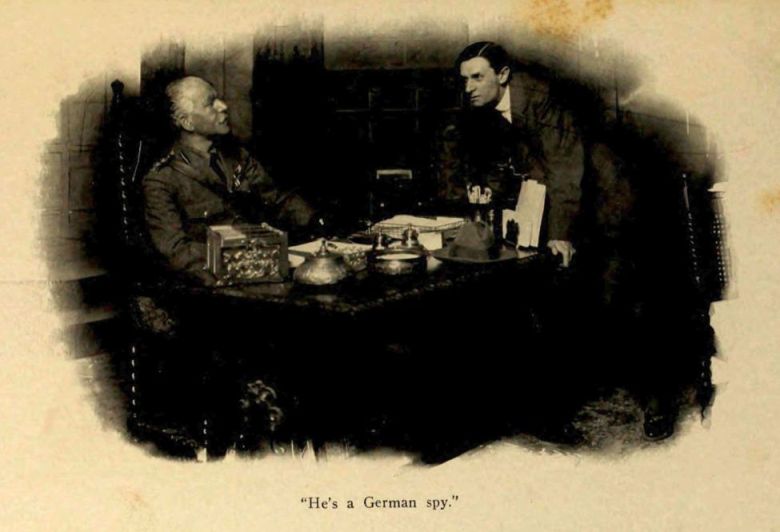
"He's a German spy."
"Pshaw! Why did Brussels let you go?" General
Crandall tipped back in his seat and
cast an amused glance at the flushed face
before him.
Capper shook his head doggedly. "I'm not
drunk, General Crandall. I'm so broke I
couldn't get drunk if I would. So help me, I'm
telling God's truth. I got it straight——"
Capper checked his tumult of words, and did
some rapid thinking. How much did he dare
reveal! "In Alexandria, General—got it
there—from the inside, sir. Koch is the head of the
Wilhelmstrasse crowd there—the same Cook
you knew in Rangoon; he engineered the trick.
The wildest dreams of the Wilhelmstrasse have
come true. They've got a man in your signal
tower, General—in your signal tower!"
General Crandall, in whom incredulity was
beginning to give way to the first faint
glimmerings of conviction as to the possibility of
truth in the informer's tale, rallied himself
nevertheless to combat an aspersion cast on
a British officer.
"Suppose the Germans have a spy in my
signal tower or anywhere here," he began
argumentatively. "Suppose they learn every nook
and corner of the Rock—have the caliber and
range of every gun in our defense; they
couldn't capture Gibraltar in a thousand
years."
"I don't know what they want," Capper
returned, with the injured air of a man whose
worth fails of recognition. "I only came here
to warn you that your Captain Woodhouse is
taking orders from Berlin."
"Come—come, man! Give me some proof to
back up this cock-and-bull story," General
Crandall snapped. He had risen, and was
pacing nervously back and forth.
Capper was secretly elated at this sign that
his story had struck home. He stilled the
fluttering of his hands by an effort, and tried to
bring his voice to the normal.
"Here it is, General—all I've got of the story.
The real Woodhouse comes down from somewhere
up in the Nile—I don't know where—and
puts up for the night in Alexandria to wait
for the Princess Mary. No friends in the town,
you know; nowhere to visit. Three Wilhelmstrasse
men in Alexandria, headed by that
clever devil Cook, or Koch, who calls himself a
doctor now. Somehow they get hold of the
real Woodhouse and do for him—what I don't
know—probably kill the poor devil.
"General, I saw with my own eyes an unconscious
British officer being carried away from
Koch's house in Ramleh in an automobile—two
men with him." Capper fixed the governor
with a lean index finger dramatically. "And
I saw the man you just this morning received as
Captain Woodhouse leave Doctor Koch's house
five minutes after that poor devil—the real
Woodhouse—had been carried off. That's the
reason I took the same boat with him to
Gibraltar, General Crandall—because I'm loyal
and it was my duty to warn you."
"Incredible!"
"One thing more, General." Capper was
sorely tempted, but for the minute his
wholesome fear of consequences curbed his tongue.
"Woodhouse isn't working alone on the Rock;
you can be sure of that. He's got friends to
help him turn whatever trick he's after—maybe
in this very house. They're clever people,
you can mark that down on your slate!"
"Ridiculous!" The keeper of the Rock was
fighting not to believe now. "Why, I tell you
if they had a hundred of their spies inside the
lines—if they knew the Rock as well as I do
they could never take it."
Capper rose wearily, the air of a misunderstood
man on him.
"Perhaps they aren't trying to capture it. I
know nothing about that. Well—I've done my
duty—as one Englishman to another. I hope
I've told you in time. I'll be going now."
General Crandall swung on him sharply.
"Where are you going?" he demanded.
Capper shrugged his shoulders hopelessly.
Now was the minute he'd been counting on—the
peeling of crackling notes from a fat bundle,
the handsome words of appreciation.
Surely General Crandall was ripe.
"Well, General, frankly—I'm broke. Haven't
a shilling to bless myself with. I thought
perhaps——" Capper shot a keen glance at the
older man's face, which was partly turned from
him. The general appeared to be pondering.
He turned abruptly on the spy.
"A few drinks and you might talk," he challenged.
Capper grinned deprecatively. "I don't
know, General—I might," he murmured. "I've
been away from the drink so long that——"
"Where do you want to go?" General Crandall
cut him off. "Of course, you don't want to
stay here indefinitely."
"Well—if I had a bit of money—they tell me
everybody's broke in Paris. Millionaires—and
everybody, you know. You can get a room at
the Ritz for the asking. That would be heaven
for me—if I had something in my pocket."
"You want to go to Paris, eh?" General
Crandall stepped closer to Capper, and his eyes
narrowed in scorn.
"If it could be arranged, yes, General." Capper
was spinning the brim of his bowler between
nervous fingers. He did not dare meet
the other's glance.
"Demmit, Capper! You come here to blackmail
me! I've met your kind before. I know
how to deal with your ilk."
"So help me, General, I came here to tell you
the truth. I want to go to Paris—or anywhere
away from here; I'll admit that. But that had
nothing to do with my coming all the way here
from Alexandria—spending my last guinea on
a steamer ticket—to warn you of your danger.
I'm an Englishman and—loyal!" Capper was
pleading now. All hope of reward had sped and
the vision of a cell with subsequent investigations
into his own record appalled him. General
Crandall sat down at his desk and began
to write.
"I don't know—at any rate, I can't have you
talking around here. You're going to Paris."
Capper dropped his hat. At a tap of the bell,
Jaimihr Khan appeared at the doors, so
suddenly that one might have said he was right
behind them all the time. General Crandall
directed that his orderly be summoned. When
the subaltern appeared, the general handed him
a sealed note.
"Orderly, turn this gentleman over to Sergeant
Crosby at once," he commanded, "and
give the sergeant this note." Then to
Capper: "You will cross to Algeciras, where you
will be put on a train for Madrid. You will
have a ticket for Paris and twenty shillings
for expense en route. You will be allowed to
talk to no one alone before you leave Gibraltar,
and under no circumstances will you be allowed
to return—not while I am governor-general,
at least."
Capper, his face alight with new-found joy,
turned to pass out with the orderly. He
paused at the doorway to frame a speech of
thanks, but General Crandall's back was
toward him. "Paris!" he sighed in rapture,
and the doors closed behind him.
"Do you know, my dear, Cynthia Maxwell
is simply going to die with envy
when she sees me in this!"
The plump little mistress of Government
House, standing before a full-length mirror,
in her boudoir, surveyed herself with intense
satisfaction. Her arms and neck burst startlingly
from the clinging sheath of the incomparable
Doeuillet gown that was Jane Gerson's
douceur for official protection; in the flood
of morning light pouring through the
mullioned windows Lady Crandall seemed a
pink and white—and somewhat florid—lily in
bloom out of time. Hildebrand's buyer, on
her knees and with deft fingers busy with the
soft folds of the skirt, answered through a
mouthful of pins:
"Poor Cynthia; my heart goes out to her."
"Oh, it needn't!" Lady Crandall answered,
with a tilting of her strictly Iowa style nose.
"The Maxwell person has made me bleed more
than once here on the Rock with the gowns a
fond mama sends her from Paris. But,
honestly, isn't this a bit low for a staid
middle-aged person like myself? I'm afraid I'll
have trouble getting my precious Doeuillet
past the censor." Lady Crandall plumed
herself with secret joy.
Jane looked up, puzzled.
"Oh, that's old Lady Porter—a perfect dragon,"
the general's wife rattled on. "Poor old
dear; she thinks the Lord put her on the Rock
for a purpose. Her own collars get higher
and higher. I believe if she ever was presented
at court she'd emulate the old Scotch lady
who followed the law of décolleté, but
preserved her self-respect by wearing a red
flannel chest protector. You must meet her."
"I'm afraid I won't have time to get a look
at your dragon," Jane returned, with a little
laugh, all happiness. "Now that Sir George
has promised me I can sail on the Saxonia
Friday——"
"You really must——" The envious eyes
of Lady Crandall fell on the pile of
plans—potent Delphic mysteries to charm the heart
of woman—that lay scattered about upon the
floor.
Jane sat back on her heels and surveyed the
melting folds of satin with an artist's eye.
"If you only knew—what it means to me to
get back with my baskets full of French
beauties! Why, when I screwed up my courage
two months ago to go to old Hildebrand and
ask him to send me abroad as his buyer—I'd
been studying drawing and French at nights
for three years in preparation, you see—he
roared like the dear old lion he is and said I
was too young. But I cooed and pleaded, and
at last he said I could come—on trial, and
so——"
"He'll purr like a pussy-cat when you get
back," Lady Crandall put in, with a pat on the
brown head at her knees.
"Maybe. If I can slip into New York with
my little baskets while all the other buyers
are still over here, cabling tearfully for money
to get home or asking their firms to send a
warship to fetch them—why, I guess the
pennant's mine all right."
The eternal feminine, so strong in Iowa's
transplanted stock, prompted a mischievous
question:
"Then you won't be leaving somebody
behind when you sail—somebody who seemed
awfully nice and—foreigny and all that? All
our American girls find the moonlight over on
this side infectious. Witness me—a 'finishing
trip' abroad after school days—and see where
I've finished—on a Rock!" Lady Crandall
bubbled laughter. A shrewd downward sweep
of her eye was just in time to catch a flush
mounting to Jane's cheeks.
"Well, a Mysterious Stranger has crossed
my path," Jane admitted. "He was very nice,
but mysterious."
"Oh!" A delighted gurgle from the older
woman. "Tell me all about it—a secret for
these ancient walls to hear."
Jane was about to reply when second
thought checked her tongue. Before her
flashed that strange meeting with Captain
Woodhouse the night before—his denial of
their former meeting, followed by his curious
insistence on her keeping faith with him by
not revealing the fact of their acquaintance.
She had promised—why she had promised she
could no more divine than the reason for his
asking; but a promise it was that she would
not betray his confidence. More than once
since that minute in the reception room of the
Hotel Splendide Jane Gerson had reviewed the
whole baffling circumstance in her mind and
a growing resentment at this stranger's
demand, as well as at her own compliance
with it, was rising in her heart. Still,
this Captain Woodhouse was "different,"
and—this Jane sensed without effort to
analyze—the mystery which he threw about himself
but served to set him apart from the common
run of men. She evaded Lady Crandall's
probing with a shrug of the shoulders.
"It's a secret which I myself do not know,
Lady Crandall—and never will."
Back to the o'erweening lure of the gown
the flitting fancy of the general's lady betook
itself.
"You—don't think this is a shade too young
for me, Miss Gerson?" Anxiety pleaded to
be quashed.
"Nonsense!" Jane laughed.
"But I'm no chicken, my dear. If you
would look me up in our family Bible back in
Davenport you'd find——"
"People don't believe everything they read
in the Bible any more," Jane assured her.
"Your record and Jonah's would both be open
to doubt."
"You're very comforting," Lady Crandall
beamed. Her maid knocked and entered on
the lady's crisp: "Come!"
"The general wishes to see you, Lady
Crandall, in the library."
"Tell the general I'm in the midst of trying
on——" Lady Crandall began, then thought
better of her excuse. She dropped the
shimmering gown from her shoulders and slipped
into a kimono.
"Some stuffy plan for entertaining somebody
or other, my dear"—this to Jane. "The
real burden of being governor-general of the
Rock falls on the general's wife. Just slip
into your bonnet, and when I'm back we'll take
that little stroll through the Alameda I've
promised you for this morning." She clutched
her kimono about her and whisked out of the
room.
General Crandall, just rid of the dubious
pleasure of Billy Capper's company, was pacing
the floor of the library office thoughtfully.
He looked up with a smile at his wife's
entrance.
"Helen, I want you to do something for me,"
he said.
"Certainly, dear." Lady Crandall was not
an unpleasing picture of ripe beauty to look
on, in the soft drape of her Japanese robe.
Even in his worry, General Crandall found
himself intrigued for the minute.
"There's a new chap in the signal service—just
in from Egypt—name's Woodhouse. I
wish you would invite him to tea, my dear."
"Of course; any day."
"This afternoon, if you please, Helen," the
general followed.
His wife looked slightly puzzled.
"This afternoon? But, George, dear, isn't
that—aren't you—ah—rushing this young
man to have him up to Government House so
soon after his arrival?" She suddenly
remembered something that caused her to
reverse herself. "Besides, I've asked him to
dinner—the dinner I'm to give the Americans
to-morrow night before they sail."
General Crandall looked his surprise.
"You didn't tell me that. I didn't know you
had met him."
"Just happened to," Lady Crandall cut in
hastily. "Met him at the Hotel Splendide last
night when I brought Miss Gerson home with me."
"What was Woodhouse doing at the Splendide?"
the general asked suspiciously.
"Why, spending the night, you foolish boy.
Just off the Princess Mary, he was. I believe
he did Miss Gerson some sort of a service—and
I met him in that way—quite informally."
"Did Miss Gerson—a service—hum!"
"Oh, a trifling thing! It seemed she had
only French money, and that cautious Almer
fellow wouldn't accept it. Captain Woodhouse
gave her English gold for it—to pay her bill.
But why——"
"Has Miss Gerson seen him since?" General
Crandall asked sharply.
"Why, George, dear, how could she? We
haven't been up from the breakfast table an
hour."
"Woodhouse was here less than an hour ago
to pay his duty call and report," he explained.
"I thought perhaps he might have met our
guest somewhere in the garden as he was
coming or going."
"He did send her some lovely roses." Lady
Crandall brightened at this, to her, patent
inception of a romance; she doted on romances.
"They were in Miss Gerson's room before she
was down to breakfast."
"Roses, eh? And they met informally at
the Splendide only last night." Suspicion
was weighing the general's words. "Isn't
that a bit sudden? I say, do you think Miss
Gerson and this Captain Woodhouse had met
somewhere before last night?"
"I hardly think so—she on her first trip to
the Continent and he coming from Egypt.
But——"
"No matter. I want him here to tea this
afternoon." The general dismissed the
subject and turned to his desk. His lady's
curiosity would not be so lightly turned away.
"All these questions—aren't they rather
absurd? Is anything wrong?" She ran up to
him and laid her hands on his shoulders.
"Of course not, dear." He kissed her
lightly on the brow. "Now run along and play
with that new gown Miss Gerson gave you. I
imagine that's the most important thing on
the Rock to-day."
Lady Crandall gave her soldier-husband a
peck on each cheek, and slapped back to her
room. When he was alone again, General
Crandall resumed his restless pacing. Resolution
suddenly crystallized, and he stepped to
the desk telephone. He called a number.
"That you, Bishop? ... General Crandall
speaking.... Bishop, you were here on the
Rock seven years ago? ... Good! ... Pretty
good memory for names and faces,
eh? ... Right! ... I want you to come to
Government House for tea at five this afternoon....
But run over for a little talk with me some
time earlier—an hour from now, say. Rather
important.... You'll be here.... Thank
you."
General Crandall sat at his desk and tried to
bring himself down to the routine crying from
accumulated papers there. But the canker
Billy Capper had implanted in his mind would
not give him peace. Major-general Crandall
was a man cast in the stolid British mold;
years of army discipline and tradition of the
service had given to his conservatism a hard
grain. In common with most of those in high
command, he held to the belief that nothing
existed—nothing could exist—which was not
down in the regulations of the war office, made
and provided. For upward of twenty-five
years he had played the hard game of the
service—in Egypt, in Burma, on the broiling
rocks of Aden, and here, at last, on the key
to the Mediterranean. During all those years
he had faithfully pursued his duty, had stowed
away in his mind the wisdom disseminated in
blue-bound books by that corporate paragon of
knowledge at home, the war office. But never
had he read in anything but fluffy fiction of a
place or a thing called the Wilhelmstrasse,
reputed by the scriveners to be the darkest
closet and the most potent of all the secret
chambers of diplomacy. The regulations made no
mention of a Wilhelmstrasse, even though
they provided the brand of pipe clay that
should brighten men's pith helmets and
stipulated to the ounce an emergency ration.
Therefore, to the official military mind at
least, the Wilhelmstrasse was non-existent.
But here comes a beach-comber, a miserable
jackal from the back alleys of society, and
warns the governor-general of the Rock that
he has a man from the Wilhelmstrasse—a spy
bent on some unfathomable mission—in his
very forces on the Rock. He says that an
agent of the enemy has dared masquerade as
a British officer in order to gain admission
inside the lines of Europe's most impregnable
fortress, England's precious stronghold, there
to do mischief!
General Crandall's tremendous responsibility
would not permit him to ignore such a
warning, coming even from so low a source.
Yet the man found himself groping blindly in
the dark before the dilemma presented; he had
no foot rule of precept or experience to guide
him.
His fruitless searching for a prop in
emergency was broken by the appearance of Jane
Gerson in the door opening from Lady Crandall's
rooms to the right of the library. The
girl was dressed for the out-of-doors; in her
arms was a fragrant bunch of blood-red roses,
spraying out from the top of a bronze bowl.
The girl hesitated and drew back in confusion
at seeing the room occupied; she seemed eager
to escape undetected. But General Crandall
smilingly checked her flight.
"I—I thought you would be out," Jane
stammered, "and——"
"And the posies——" the general interrupted.
"Were for you to enjoy when you should
come back." She smiled easily into the man's
eyes. "They'll look so much prettier here
than in my room."
"Very good of you, I'm sure." General
Crandall stepped up to the rich cluster of buds
and sniffed critically. Without looking at the
girl, he continued: "It appears to me as
though you had already made a conquest on
the Rock. One doesn't pick these from the
cliffs, you know."
"I should hardly call it a conquest," Jane
answered, with a sprightly toss of her head.
"But a young man sent you these flowers.
Come—confess!" The general's tone was
bantering, but his eyes did not leave the
piquant face under the chic summer straw hat
that shaded it.
"Surely. One of your own men—Captain
Woodhouse, of the signal service." Jane was
rearranging the stems in the bowl, apparently
ready to accept what was on the surface of
the general's rallying.
"Woodhouse, eh? You've known him for
a long time, I take it."
"Since last night, General. And yet some
people say Englishmen are slow." She
laughed gaily and turned to face him. His
voice took on a subtle quality of polite
insistence:
"Surely you met him somewhere before Gibraltar."
"How could I, when this is the first time
Captain Woodhouse has been out of Egypt for
years?"
"Who told you that?" The general was
quick to catch her up. The girl felt a swift
stab of fear. On the instant she realized that
here was somebody attempting to drive into
the mystery which she herself could not
understand, but which she had pledged herself
to keep inviolate. Her voice fluttered in her
throat as she answered:
"Why, he did himself, General."
"He did, eh? Gave you a bit of his history
on first meeting. Confiding chap, what! But
you, Miss Gerson—you've been to Egypt, you
say?"
"No, General."
Jane was beginning to find this cross-examination
distinctly painful. She felt that already
her pledge, so glibly given at Captain
Woodhouse's insistence, was involving her in
a situation the significance of which might
prove menacing to herself—and one other.
She could sense the beginnings of a strain
between herself and this genial elderly
gentleman, her host.
"Do you know, Miss Gerson"—he was speaking
soberly now—"I believe you and Captain
Woodhouse have met before."
"You're at liberty to think anything you like,
General—the truth or otherwise." Her answer,
though given smilingly, had a sting behind it.
"I'm not going to think much longer. I'm
going to know!" He clapped his lips shut over
the last word with a smack of authority.
"Are you really, General Crandall?" The
girl's eyes hardened just perceptibly. He took
a turn of the room and paused, facing her. The
situation pleased him no more than it did his
breezy guest, but he knew his duty and
doggedly pursued it.
"Come—come, Miss Gerson! I believe you're
straightforward and sincere or I wouldn't be
wasting my time this way. I'll be the same
with you. This is a time of war; you understand
all that implies, I hope. A serious question
concerning Captain Woodhouse's position
here has arisen. If you have met him before—as
I think you have—it will be to your advantage
to tell me where and when. I am in command
of the Rock, you know."
He finished with an odd tenseness of tone that
conveyed assurance of his authority even more
than did the sense of his words. His guest, her
back to the table on which the roses rested and
her hands bracing her by their tense grip on
the table edge, sought his eyes boldly.
"General Crandall," she began, "my training
in Hildebrand's store hasn't made me much of
a diplomat. All this war and intrigue makes
me dizzy. But I know one thing: this isn't my
war, or my country's, and I'm going to follow
my country's example and keep out of it."
General Crandall shrugged his shoulders and
smiled at the girl's defiance.
"Maybe your country may not be able to do
that," he declared, with a touch of solemnity.
"I pray God it may. But I'm afraid your
resolution will not hold, Miss Gerson."
"I'm going to try to make it, anyway," she
answered.
Gibraltar's commander, baffled thus by a
neutral—a neutral fair to look on, in the
bargain—tried another tack. He assumed the
fatherly air.
"Lady Crandall and I have tried to show you
we were friends—tried to help you get home,"
he began.
"You've been very good to me," Jane broke in
feelingly.
"What I say now is spoken as a friend, not
as governor of the Rock. If it is true that you
have met Woodhouse before—and our conversation
here verifies my suspicion—that very
fact makes his word worthless and releases
you from any promise you may have made not
to reveal this and what you may know about
him. Also it should put you on your guard—his
motives in any attentions he may pay you
can not be above suspicion."
"I think that is a personal matter I am perfectly
capable of handling." Jane's resentment
sent the flags to her cheeks.
General Crandall was quick to back-water:
"Yes, yes! Don't misunderstand me. What I
mean to say is——"
He was interrupted by his wife's voice calling
for Jane from the near-by room. Anticipating
her interruption, he hurried on:
"For the present, Miss Gerson, we'll drop
this matter. I said a few minutes ago I
intended shortly to—know. I hope I won't have
to carry out that—threat."
Jane was withdrawing one of the buds from
the jar. At his last word, she dropped it with
a little gasp.
"Threat, General?"
"I hope not. Truly I hope not. But, young
woman——"
She stooped, picked up the flower, and was
setting it in his buttonhole before he could
remonstrate.
"This one was for you, General," she said,
and the truce was sealed. That minute, Lady
Crandall was wafted into the room on the
breeze of her own staccato interruption.
"What's this—what's this! Flirting with
poor old George—pinning a rose on my revered
husband when my back's turned? Brazen miss.
I'm here to take you off to the gardens at once,
where you can find somebody younger—and not
near so dear—to captivate with your tricks.
At once, now!"
She had her arm through Jane's and was
marching her off. An exchange of glances
between the governor and Hildebrand's young
diplomat of the dollar said that what had passed
between them was a confidence.
Jaimihr Khan announced Major Bishop to
the general a short time later. The major, a
rotund pink-faced man of forty, who had the
appearance of being ever tubbed and groomed
to the pink of parade perfection, saluted his
superior informally, accepted a cigarette and
crossed his plump legs in an easy chair near the
general's desk. General Crandall folded his
arms on his desk and went direct to his subject:
"Major, you were here on the Rock seven
years ago, you say?"
"Here ten years, General. Regular rock
scorpion—old-timer."
"Do you happen to recall this chap Woodhouse
whom I sent to you to report for duty in
the signal tower to-day? Has transfer papers
from Wady Halfa."
"Haven't met him yet, though Captain Carson
tells me he reported at my office a little
more than an hour ago—see him after parade.
Woodhouse—Woodhouse——" The major
propped his chin on his fingers in thought.
"His papers—army record and all that—say
he was here on the Rock for three months in
the spring of nineteen-seven," General Crandall
urged, to refresh the other's memory.
Major Bishop stroked his round cheeks, tugged
at one ear, but found recollection difficult.
"When I see the chap—so many coming and
going, you know. Three months—bless me!
That's a thin slice out of ten years."
"Major, I'm going to take you into my
confidence," the senior officer began; then he
related the incident of Capper's visit and repeated
the charge he had made. Bishop sat aghast at
the word "spy."
"Woodhouse will be here to tea this afternoon,"
continued Crandall. "While you and I
ask him a few leading questions, I'll have
Jaimihr, my Indian, search his room in barracks. I
trust Jaimihr implicitly, and he can do the job
smoothly. Now, Bishop, what do you remember
about nineteen-seven—something we can
lead up to in conversation, you know?"
The younger man knuckled his brow for a
minute, then looked up brightly.
"I say, General, Craigen was governor then.
But—um—aren't you a bit—mild; this asking
of a suspected spy to tea?"
"What can I do?" the other replied, somewhat
testily. "I can't clap an officer of his
majesty's army into prison on the mere say-so
of a drunken outcast who has no proof to offer.
I must go slowly, Major. Watch for a slip from
this Woodhouse. One bad move on his part,
and he starts on his way to face a firing squad."
Bishop had risen and was slowly pacing the
room, his eyes on the walls, hung with many
portraits in oils.
"Well, you can't help admiring the nerve of
the chap," he muttered, half to himself.
"Forcing his way on to the Rock—why, he might as
well put his head in a cannon's mouth."
"I haven't time to admire," the general said
shortly. "Thing to do is to act."
"Quite right. Nineteen-seven, eh? Um——"
He paused before the portrait of a young
woman in a Gainsborough hat and with a
sparkling piquant face. "By George, General,
why not try him on Lady Evelyn? There's a
fair test for you, now!"
"You mean Craigen's wife?" The general
looked up at the portrait quizzically.
"Skeleton's bones, Bishop."
"Right; but no man who ever saw her could
forget. I know I never can. Poor Craigen!"
"Good idea, though," the older man
acquiesced. "We'll trip him on Lady Evelyn."
Jaimihr Khan appeared at the double doors.
"The general sahib's orderly," he announced.
The young subaltern entered and saluted.
"That young man, General Crandall, the one
Sergeant Crosby was to escort out of the lines
to Algeciras——"
"Well, what of him? He's gone, I hope."
"First train to Madrid, General; but he left
a message for you, sir, to be delivered after
he'd gone, he said."
"A message?" General Crandall was perplexed.
"As Sergeant Crosby had it and gave it to
me to repeat to you, sir, it was, 'Arrest the
cigar girl calling herself Josepha. She is one of
the cleverest spies of the Wilhelmstrasse.'"
Mr. Joseph Almer, proprietor of the
Hotel Splendide, on Waterport Street,
was absorbed, heart and soul, in a curious task.
He was emptying the powder from two-grain
quinine capsules on to a sheet of white letter
paper on his desk.
It was noon of Wednesday, the day following
the arrival of Captain Woodhouse. Almer was
alone in the hotel's reception room and office
behind the dingy glass partially enclosing his
desk. His alpaca-covered shoulders were close
to his ears; and his bald head, with its stripes
of plastered hair running like thick lines of
latitude on a polished globe, was held far
forward so as to bring his eyes on the work in
hand. Like some plump magpie he appeared,
turning over bits of china in a treasure hole.
A round box of the gelatine cocoons lay at his
left hand; it had just been delivered by an
Arab boy, quick to pick up the street commission
for a tuppence. Very methodically Almer
picked the capsules from the box one by one,
opened them, and spilled the quinine in a little
heap under his nose. He grunted peevishly
when the sixth shell had been emptied. The
seventh capsule brought an eager whistle to
his lips. When he had jerked the concentric
halves apart, very little powder fell out.
Instead, the thin, folded edges of a pellet of rice
paper protruded from one of the containers.
This Almer had extracted in an instant. He
spread it against the black back of a ledger and
read the very fine script written thereon. This
was the message:
"Danger. An informer from Alexandria has
denounced our two friends to Crandall. You
must warn; I can not."
The spy's heart was suddenly drained, and
the wisp of paper in his hand trembled so that
it scattered the quinine about in a thin cloud.
Once more he read the note, then held a match
to it and scuffed its feathery ash with his feet
into the rug beneath his stool. The fortitude
which had held Joseph Almer to the Rock in
the never-failing hope that some day would
bring him the opportunity to do a great service
for the fatherland came near crumbling that
minute. He groaned.
"Our friends," he whispered, "Woodhouse
and Louisa—trapped!"
The warning in the note left nothing open to
ambiguity for Almer; there were but four of
them—"friends" under the Wilhelmstrasse
fellowship of danger—there in Gibraltar:
Louisa, the man who passed as Woodhouse,
and whose hand was to execute the great coup
when the right moment came, himself, and that
other one whose place was in Government
House itself. From this latter the note of
warning had come. How desperate the necessity
for it Almer could guess when he took into
reckoning the dangers that beset any attempt
at communication on the writer's part. So
narrow the margin of safety for this "friend"
that he must look at each setting sun as being
reasonably the last for him.
Almer did not attempt to go behind the note
and guess who was the informer that had
lodged information with the governor-general.
He had forgotten, in fact, the incident of the
night before, when the blustering Capper called
the newly arrived Woodhouse by name. The
flash of suspicion that attached responsibility
to the American girl named Gerson was
dissipated as quickly as it came; she had arrived
by motor from Paris, not on the boat from
Alexandria. His was now the imperative duty
to carry warning to the two suspected, not to
waste time in idle speculation as to the identity
of the betrayer. There was but one ray of
hope in this sudden pall of gloom, and that
Almer grasped eagerly. He knew the
character of General Crandall—the phlegmatic
conservatism of the man, which would not easily
be jarred out of an accustomed line of thought
and action. The general would be slow to leap
at an accusation brought against one wearing
the stripes of service; and, though he might
reasonably attempt to test Captain Woodhouse,
one such as Woodhouse, chosen by the Wilhelmstrasse
to accomplish so great a mission, would
surely have the wit to parry suspicion.
Yes, he must be put on his guard. As for
Louisa—well, it would be too bad if the girl
should have to put her back against a wall;
but she could be spared; she was not essential.
After he had succeeded in getting word of his
danger to Woodhouse, Almer would consider
saving Louisa from a firing squad. The nimble
mind of Herr Almer shook itself free from the
incubus of dread and leaped to the exigency of
the moment. Calling his head waiter to keep
warm the chair behind the desk, Almer retired
to his room, and there was exceedingly busy
for half an hour.
The hour of parade during war time on Gibraltar
was one o'clock. At that time, six days
a week, the half of the garrison not actually in
fighting position behind the great guns of the
defense marched to the parade grounds down
by the race track and there went through the
grilling regimen that meant perfection and
the maintenance of a hair-trigger state of
efficiency. Down from the rocky eminences where
the barracks stood, marched this day block after
block of olive-drab fighting units—artillerymen
for the most part, equipped with the rifle and
pack of infantrymen. No blare of brass music
gave the measure to their step; bandsmen in
this time of reality paced two by two, stretchers
carried between them. All the curl and snap
of silken banners that made the parade a
moving spectacle in ordinary times was absent;
flags do not figure in the grim modern business
of warfare. Just those solid blocks of men
trained to kill, sweeping down on to the level
grounds and massing, rank on rank, for
inspection and the trip-hammer pound-pound-pound
of evolutions to follow. Silent integers
of power, flexing their muscles for the supreme
test that any morning's sun might bring.
Mr. Henry J. Sherman stood with his wife,
Kitty and Willy Kimball—Kimball had developed
a surprising interest in one of these
home folks, at least—under the shade of the
row of plane trees fringing the parade grounds.
They tried to persuade themselves that they
were seeing something worth while. This
pleasing fiction wore thin with Mr. Sherman
before fifteen minutes had passed.
"Shucks, mother! The boys at the national-guard
encampment down to Galesburg fair last
year made a better showing than this." He
pursed out his lips and regarded a passing
battalion with a critical eye.
"Looked more like soldiers, anyway," mother
admitted. "Those floppy, broad-brimmed hats
our boys wear make them look more—more
romantic, I'd say."
"But, my dear Mrs. Sherman"—Willy Kimball
flicked his handkerchief from his cuff and
fluttered it across his coat sleeve, where dust
had fallen—"the guards back in the States are
play soldiers, you know; these chaps, here—well,
they are the real thing. They don't dress
up like picture-book soldiers and show off——"
"Play soldiers—huh!" Henry J. had fire in
his eye, and the pearl buttons on his white linen
waistcoat creaked with the swelling of a
patriot's pride. "You've been a long time from
home, Willy. Perhaps you've forgotten that
your own father was at Corinth. Guess you've
overlooked that soldiers' monument in Courthouse
Square back in little old Kewanee. They
were 'play soldiers,' eh?—those boys who
marched away with your dad in sixty-one.
Gimme a regiment of those old boys in blue, and
they could lick this whole bunch of——"
"Father!" Kitty had flipped her hand over
her parent's mouth, her eyes round with real
fear. "You'll get arrested again, talking that
way here where everybody can hear you.
Remember what that hotel man said last night
about careless remarks about military things
on the Rock? Be good, father."
"There, there!" Sherman removed the monitory
hand and patted it reassuringly. "I forgot.
But when I get aboard the Saxonia and
well out to sea, I'm going to just bust
information about what I think of things in general
over here in this Europe place—their Bottycelly
pictures and their broken-down churches
and—and—— Why, bless my soul! The little
store buyer and that Iowa girl who's married
to the governor here!"
The patriot stopped short in his review of the
Continent's delinquencies to wave his hat at
Lady Crandall and Jane Gerson, who were
trundling down under the avenue of planes in
a smart dog-cart. Lady Crandall answered his
hail with a flourish of her whip, turned her
horse off the road, and brought her conveyance
to a stop by the group of exiles. Hearty
greetings passed around. The governor's wife
showed her unaffected pleasure at the meeting.
"I thought you wouldn't miss the parade,"
she called down from her high seat. "Only
thing that moves on the Rock—these daily
reviews. Brought Miss Gerson down here so
when she gets back to New York she can say
she's seen the defenders of Gibraltar, if not in
action, at least doing their hard training for
it."
"Well, I don't mind tellin' you," Sherman
began defiantly, "I think the national guard of
Illynoy can run circles around these Englishmen
when it comes to puttin' up a show. Now,
Kitty, don't you try to drive a plug in your
dad's sentiments again; Mrs. Crandall's all
right—one of us." A shocked look from his
daughter. "Oh, there I go again, forgettin'.
Lady Crandall, I mean. Excuse me, ma'am."
"Don't you dare apologize," the governor's
wife playfully threatened Mr. Sherman with
her whip. "I love the sound of good,
old-fashioned 'Missis.' Just imagine—married five
years, and nobody has called me 'Mrs. Crandall'
until you did just now. 'Wedded, But Not a
Missis'; wouldn't that be a perfectly gorgeous
title for a Laura Jean novel? Miss Gerson, let's
hop out and join these home folks; they're my
kind."
The burst of laughter that greeted Lady
Crandall's sally was not over before she had
leaped nimbly from her high perch, Henry
J. gallantly assisting. Jane followed, and the
coachman from his little bob seat in the back
drove the dog-cart over the road to wait his
mistress' pleasure. The scattered blocks of
olive-gray on the field had coalesced into a solid
regiment now, and the long double rank of
men was sweeping forward like the cutting arm
of a giant mower. The party of Americans
joined the sparse crowd of spectators at the
edge of the field, the better to see. Jane
Gerson found herself chatting with Willy Kimball
and Kitty Sherman a little apart from the
others. A light touch fell on her elbow. She
turned to find Almer, the hotel keeper, smiling
deferentially.
"Pardon—a thousand pardons for the intrusion,
lady. I am Almer, of the Hotel Splendide."
"You haven't remembered something more I
owe you," Jane challenged bruskly.
"Oh, no, lady!" Almer spread out his hands.
"I happened to see you here watching the
parade, and I remembered a trivial duty I have
which, if I may be so bold as to ask, you may
discharge much more quickly than I—if you
will."
"I discharge a duty—for you?" The girl
did not conceal her puzzlement. Almer's
hand fumbled in a pocket of his flapping alpaca
coat and produced a plain silver cigarette case,
unmonogrammed. She looked at it wonderingly.
"Captain Woodhouse—you met him at my
hotel last night, lady. He left this lying on his
dresser when he quit his room to go to barracks
to-day. For me it is difficult to send a
messenger with it to the barracks—war time,
lady—many restrictions inside the lines. I
came here hoping perhaps to see the captain
after the parade. But you——"
"You wish me to give this to Captain Woodhouse?"
Jane finished, a flicker of annoyance
crossing her face. "Why me?"
"You are at Government House, lady. Captain
Woodhouse comes to tea—all newcomers
to the garrison do that. If you would be so
good——"
Jane took the cigarette case from Almer's
outstretched hand. Lady Crandall had told her
the captain would be in for tea that afternoon.
It was a small matter, this accommodation, as
long as Almer did not insinuate—as he had not
done—any impertinence; imply any over eagerness
on her part to perform so minor a service
for the officer. Almer bowed his thanks and
lost himself in the crowd. Jane turned again
to where Kitty and Kimball were chatting.
"A dun for extra service the landlord forgot
last night, I'll wager," the youth greeted her.
"Oh, no, just a little present," Jane laughed
back at him, holding up the silver case. "With
Almer's compliments to Captain Woodhouse,
who forgot it when he gave up his room to-day.
I've promised to turn it over to the captain and
save the hotel man a lot of trouble and red tape
getting a messenger through to the captain's
quarters."
"By Jove!" Kimball's tired eyes lighted up
with a quick flash of smoker's yearning. "A
life-saver! Came away from my room without
my pet Egyptians—Mr. Sherman yelling at me
to hurry or we'd miss this slow show and all
that. I'm going to play the panhandler and beg
one of your captain friend's smokes. He must
be a good sort or you wouldn't be doing little
favors for him, Miss Gerson. Come, now; in
your capacity as temporary executrix will you
invest one of the captain's cigarettes in a
demand of real charity?"
Keen desire was scarcely veiled under Kimball's
fiction of light patter. Smilingly the girl
extended the case to him.
"Just to make it businesslike, the executrix
demands your note for—um—sixty days, say.
'For one cigarette received, I promise to
pay——'"
"Given!" He pulled a gold pencil from his
pocket and made a pretense of writing the form
on his cuff. Then he lit his borrowed cigarette
and inhaled it gratefully.
"Your captain friend's straight from Egypt;
I don't have to be told that," Willy Kimball
murmured, in polite ecstasy. "At Shepard's,
in Cairo, you'll get such a cigarette as this,
and nowhere else in a barren world. The
breath of the acanthus blossom—if it really
has a breath—never heard."
"Back in Kewanee the Ladies' Aid Society
will have you arrested," Kitty put in
mischievously. "They're terribly wrought up over
cigarettes—for minors."
Kimball cast her a glance of deep reproach.
As he lifted the cigarette to his lips for a
second puff, Jane's eyes mechanically followed the
movement. Something caught and held them,
wonder-filled.
On the side of the white paper cylinder
nearest her a curious brown streak appeared—by
the merest freak of chance her glance fell on it.
As she looked, the thin stain grew darker nearest
the fresh ash. The farther end of the faint
tracing moved—yes, moved, like a threadworm
groping its way along a stick.
"Now what are they all doing out there?"
Kitty Sherman was asking. "All those men
running top speed with their guns carried up
so high."
"Bayonet charge," Kimball answered. "Nothing
like the real thing, of course."
Jane Gerson was watching the twisting and
writhing of that filament of brown against the
white. An invisible hand was writing in
brown ink on the side of the cigarette—writing
backward and away from the burning tip.
It lengthened by seconds—"and Louisa to
Crandall."
So the letters of silver nitrate formed
themselves under her eyes. Kimball took the
cigarette from his lips and held it by his side for
a minute. He and Kitty were busy with each
other's company for the time, ignoring Jane.
She burned with curiosity and with excitement
mounting like the fire of wine to her brain.
Would he never put that cigarette to his lips
again, so she could follow the invisible pen!
So fleeting, so evanescent that worm track
on the paper, wrought by fire and by
fire to be consumed. A mystery vanishing
even as it was aborning! After ages, the
unconscious Kimball set the cigarette again in
his lips.
"—nformer has denounced you and Louisa-t-
—play your game and he will be slow to——"
Again the cigarette came away in Kimball's
hand. Acting on impulse she did not stop to
question, Jane struck it from the young man's
outstretched hand and set her foot on it as it
fell in the dust.
"Oh, I'm clumsy!" She fell lightly against
Kimball's shoulder and caught herself in
well-simulated confusion. "Standing tiptoe to see
what that man on a horse is going to do—lost
my balance. And—and your precious
cigarette—gone!"
The anguish in Jane Gerson's voice was not
play. It was real—terribly real.
Jane Gerson, alone for the first time
since the incident of the cigarette on the
parade ground a few hours back, sat before a
narrow window in her room at Government
House, fighting a great bewilderment. The
window opened on a varied prospect of blooming
gardens and sail-flecked bay beyond. But
for her eyes the riot of color and clash of
contrast between bald cliff and massed green had
no appeal. Her hands locked and unlocked
themselves on her lap. The girl's mind was
struggling to coordinate scattered circumstances
into a comprehensible whole, to grapple
with the ethical problem of her own conduct.
What she knew, or thought she knew—and
what she should do—those were the two saber
points of the dilemma upon which she found
herself impaled.
Could there now be any doubt of what she
felt to be the truth? First, she had met
Captain Woodhouse on the Express du Nord—an
officer in the English army, by his own
statement, returning from leave in England to his
post in Egypt. Then, the encounter of last
night at the Hotel Splendide, Captain Woodhouse
first denying his identity, then admitting
it under the enforced pledge that she should
not reveal the former meeting. Captain
Woodhouse, not in Egypt, but at Gibraltar, and, as
she had soon learned, there with papers of
transfer from an Egyptian post to the garrison
of the Rock. Following this surprise had come
General Crandall's dogged examination of that
morning—his blunt declaration that a serious
question as to the captain's position at
Gibraltar had arisen, and his equally plain-spoken
threat to have the truth from her concerning
her knowledge of the suspected officer.
To cap all, the message on the cigarette! An
informer—she guessed the prefix to the
unfinished word—had denounced "you and Louisa"
to General Crandall. To whom the pronoun
referred was unmistakable—Almer's eagerness
to insure Captain Woodhouse's receiving the
cigarette case plainly defined that. As to
"Louisa," involved with Woodhouse, the girl
from Hildebrand's was sensible only of a passing
flash of curiosity, made a bit more piquant,
perhaps, by a little dart of jealousy, hardly
comprehended as such. A hotel keeper warns
an officer in the Gibraltar garrison that he has
been denounced, but in the same message
adjures him to "play your own game." That was
the single compelling fact.
Jane Gerson flushed—in anger, or was it
through guilt?—when she found her lips
framing the word "spy"!
Now she understood why General Crandall
had put her on the grill—why he, informed,
had leaped to the significance of the gift of
roses and deduced her previous acquaintance
with their donor. Her host was not, after all,
the possessor of magical powers of mind reading.
He was, instead, just the sober, conscientious
protector of the Rock on whom rested
responsibility for the lives of its defenders and
the maintenance of England's flag there. His
duty was to catch—and shoot—spies.
Shoot spies! The girl's heart contracted at
the thought. No, no! She would not—she
could not reveal to the governor the knowledge
she had. That would be to send death to a
man as surely as if hers was the finger at the
trigger.
Jane Gerson was on her feet now, pacing
the room. Over and over again she told herself
that this man who had come into her life,
obliquely enough, had no claim on her; had
brought nothing to her but distress. He had
deceived her even, and then, when caught in
the deception, had wrested from her a promise
that she would help him continue further
deception against others. Against her will he
had made her a party to some deep and audacious
plot, whose purpose she could not guess,
but which must be but a part of the huge
mystery of war.
And soon this Captain Woodhouse was to
come to his trial—the purpose of his invitation
to tea that afternoon flashed clear as white
light. Soon she would be in the same room
with him; would be forced to witness the
spinning of the web set to trap him. He would
come unwarned, unsuspecting. He might leave
that room under guard and with guns at his
back—guns soon to be leveled at his heart. Yet
she, Jane Gerson, possessed the power to save
him—as the warning of the cigarette surely
would be saving, once a clever man were put on
his guard by it.
Would she speak—and betray General Crandall,
her kindly host? Would she lock her lips
and see a man walk blindfolded to his death?
A few minutes before five o'clock, Major
Bishop was announced at Government House
and received by General Crandall in the library.
Before Jaimihr Khan, who had preceded the
visitor through the double doors from the hall,
could retire, his master stopped him.
"One minute, Jaimihr! Have a seat, Bishop;
glad you've come a bit early. Come here, Jaimihr!"
The tall reedlike figure of the Indian glided
to General Crandall's side. His thin ascetic
features were set in their usual mold of
unseeing detachment; only his dark eyes showed
animation.
"Yes, my General," he said, as he stopped
before the Englishman.
"I have a little commission for you, Jaimihr,"
General Crandall began, weighing his
words with care. "The utmost discretion—you
understand?"
"The utmost. I understand." Jaimihr
Khan's lips moved ever so slightly, and his eyes
looked steadily ahead.
"In the course of a few minutes, Captain
Woodhouse, of the signal service, will be here
to tea," the general began. The Indian
repeated mechanically: "Cap-tain Wood-house."
"As soon as you have ushered him into this
room, you will go as quickly as you can to the
West Barracks. His room will be No. 36, on
the second gallery. You will enter his room
with a key I shall give you and search it
from end to end—everything in it. Anything
that is of a suspicious nature—you understand,
Jaimihr, what that might be—you will bring
here to me at once."
"It shall be done, General Sahib."
"No one, officer or man, must suspect your
errand. No one must see you enter or leave
that room."
"No one," the Indian repeated.
General Crandall went to a wall safe set by
the side of the double doors, turned the
combination, and opened it. He took from a drawer
therein a bunch of keys, selected one, and
passed it to Jaimihr Khan.
"The utmost care, remember!" he warned again.
"Is it likely I should fail you this time,
General Sahib, when so many times I have succeeded?"
"Make the search complete." General Crandall
ignored his servant's question. "But return
as quickly as you can. I shall keep Captain
Woodhouse here until you do so. You must
report to me before he leaves this house."
"When the moment arrives, your servant
shall fly, General Sahib," the Indian replied,
and withdrew.
"I say, General, you have a great deal of faith
in your Indian," Bishop ventured, accepting a
cigarette from his superior's case. "Rather a
delicate commission you've given him."
"Absolute faith, yes. Been with me five
years—picked him up in Rangoon—have tried
him many times, and found him loyal as any
officer in the service." General Crandall put
in his words enough emphasis to carry slight
rebuke for the other's implied criticism. But
the pursy little major was too sure of the fine
terms of personal friendship between himself
and his superior to feel embarrassment.
"About that girl, General—that cigar girl,
Josepha, concerning whom your beach-comber
friend sent that warning this morning from
the safe ground of Spain——"
"Obvious thing would have been to clap her
in a cell," the governor answered. "But I have
not, for the very good reason that if there's
anything in this fellow's accusations against
her, as well as against Woodhouse, the game
will be to keep her watched and give our
captain an opportunity to communicate with her.
Minute he does that—why, we've got our proof
against both."
"Then I take it you've put a trailer on the
girl?"
"At eight o'clock to-night I'll know where
she's been every hour of the day," the general
returned confidently. "She can't leave the
town without being arrested. Now, as to our
plan for Woodhouse's reception—this affair of
Craigen's wife; we might as well agree on
points, so that——" He heard his wife's
voice in the room off the library, and broke off
abruptly. "Confound it; the women are
coming! Just step into my room with me, and
we'll go over this little matter, Major."
General Crandall held open a small door at
the left of his desk and followed Bishop
through. Lady Crandall and Jane entered the
library almost at the same time.
"This tea of George's is preposterous," the
lady of Government House was grumbling.
"Said we must have this man from Egypt here
at once."
"If you were English, no tea could be
preposterous," Jane countered, with a brave
attempt at lightness. She felt each passing
moment a weight adding to the suspense of the
inevitable event.
"Well, I'm going to get it through with just
as soon as I can," Lady Crandall snapped.
Then Jaimihr Khan threw open the double
doors and announced: "Cap-tain Wood-house,
my lady!"
"Show him up!" she commanded; then in
complaint to Jane: "Now where do you
suppose that husband of mine went? Just like
him to suggest a tea and forget to make an
appearance."
Captain Woodhouse appeared between the
opened doors in khaki and trim puttees. He
stood very straight for an instant, his eyes
shooting rapidly about the room. Lady
Crandall hurried forward to greet him, and his
momentary stiffness disappeared. The girl
behind her followed slowly, almost reluctantly.
Woodhouse grasped her extended hand.
"It was good of you to send the flowers," she
murmured. The man smiled appreciation.
"Do you know," he said, "after I sent them
I thought you'd consider me a bit—prompt."
"I am learning something every day—about
Englishmen," Jane managed to answer, with a
ghost of a smile.
"Always something good, I hope," Woodhouse
was quick to retort, his eyes eagerly trying
to fathom the cause of the girl's restraint.
Lady Crandall, who had been vainly ringing
for Jaimihr Khan, excused herself on the
necessity of looking after the tea things. Jane
experienced a quick stab of dread at finding
herself alone with this man. Unexpected
opportunity was urging a decision which an hour
of solitude in her room had failed to bring.
Yet she trembled, appalled and afraid to speak,
before the very magnitude of the moment's
exigency. "A spy—a spy!" whispered austere
duty. "He will die!" her heart cried in protest.
"Miss Gerson, it's good to see you again and
know by your handclasp you have forgiven me
for—for what was very necessary at the
moment—last night—our meeting in the
Splendide." Captain Woodhouse was standing before
her now, his grave eyes looking down into hers.
The girl caught a deep note of sincerity and
something else—something vibrantly personal.
Yet her tongue would not be loosed of its burden.
"A very pretty speech," she answered, with
attempted raillery. "I shall think of it on the
boat going home."
"I say, I wish you weren't always in that
horrid state of mind—on your way home
mentally," Captain Woodhouse challenged.
"I shall be so in reality day after to-morrow,
I hope," she replied. "Away from all this
bewildering war and back in comfortable little
New York." The man seemed genuinely
grieved at her announcement.
"New York must be worth while; but I
imagine you have nothing picturesque—nothing
old there. I'll wager you haven't a single
converted monastery like Government House in all
your city."
"Not many things in New York have been
converted," she answered, with a smile. "Our
greatest need is for a municipal evangelist."
False—all false, this banter! She knew it
to be, and so she believed he must read it. And
the man—his ease of manner was either that
of innocence or of supreme nerve, the second
not less to be admired than the first. Could it
be that behind his serious eyes, now frankly
telling her what she dared not let herself read
in them, lay duplicity and a spy's cunning?
"I fancy you New Yorkers suffer most from
newness—newness right out of the shop," she
heard him saying. "But the old things are the
best. Imagine the monks of a long-ago
yesterday toasting themselves before this ancient
fireplace." He waved toward the massive
Gothic mantel bridging a cavernous fireplace.
An old chime bell, green with weathering, hung
on a low frame beside the firedogs.
"You're mistaken; that's manufactured
antiquity," Jane caught him up. "Lady Crandall
told me last night that fireplace is just five
years old. One of the preceding governor's
hobbies, it was."
Woodhouse caught at her answer with a
quick lifting of the brows. He turned again
to feast his eyes on the girl's piquant face,
even more alluring now because of the fleeting
color that left the cheeks with a tea rose's
coldness.
"Miss Gerson, something I have done or
said"—the man was laboring after words—"you
are not yourself, and maybe I am respon——"
She turned from him with a slight shudder.
Her hand was extended in mute appeal for
silence. He waited while his eyes followed the
heaving of her shoulders under the emotion that
was racking her. Suddenly she faced him
again, and words rushed from her lips in an
abandon of terror:
"Captain Woodhouse, I know too much—about
you and why you are here. Oh, more
than I want to! Accident—bad luck, believe
me, it is not my seeking that I know you are
a—a——"
He had started forward at her outburst, and
now he stood very close to her, his gray eyes
cold and unchanging.
"Say it—say the word! I'm not afraid to
hear it," he commanded tensely. She drew back
from him a little wildly, her hands fluttering up
as if to fend him off.
"You—you are in great danger this minute.
You were brought here this afternoon to be
trapped—exposed and made——"
"I was fully aware of that when I came, Miss
Gerson," he interrupted. "The invitation,
coming so suddenly—so pressing—I think I read it
aright."
"But the promise you made me give last
night!" Sudden resentment brushed aside for
the instant the girl's first flood of sympathy.
"That has involved me with you. Oh, that was
unfair—to make me promise I would not allude
to—to our first meeting!"
"Involved you?" He closed one of her hands
in his as if to calm her and force more rational
speech. "Then you have been——"
"Questioned by General Crandall—about
you," she broke in, struggling slightly to free
her hand. "Questioned—and even bullied and
threatened."
"And you kept your promise?" The question
was put so low Jane could hardly catch it. She
slowly nodded.
"Miss Gerson, you will never have cause to
regret that you did." Woodhouse pressed her
hand with almost fierce intenseness, then let it
go. Her face was flaming now under the stress
of excitement. She knew tears stood in her
eyes, and was angered at their being there; he
might mistake them. Woodhouse continued, in
the same suppressed tone:
"You were on the point of using a word a
minute ago, Miss Gerson, which was hard for
you to voice because you thought it an ugly
word. You seemed sure it was the right word
to fit me. You only hesitated out of—ah—decency.
Yet you kept faith with me before General
Crandall. May I hope that means——"
"You may hope nothing!" Quick rebellion at
what she divined to be coming flamed in Jane's
eyes. "You have no right to hope for more from
me than what you forced by promise. I would
not be saying what I have to you if—if I did not
feel I—that your life——"
"You misunderstood," he broke in stiffly. "I
was on the point of saying I hoped you would
not always believe me a——"
"Not believe!" Her hand went to the broad
ribbon belt she wore and brought out the silver
cigarette case. This she passed to him with a
swift gesture.
"Almer, the Hotel Splendide man, gave me
this to-day at parade, urging that I deliver it to
you." She was speaking hurriedly. "By a
miracle—the strangest circumstance in the
world—I learned the message this cigarette case was
to carry to you. Oh, no, innocently enough on
my part—it came by a chance I must not take
the time to explain."
"A message from—Almer to me?" Woodhouse
could not conceal the start her words
gave him. He took a step toward her eagerly.
"Yes, a message. You must have it to
protect yourself. The message was this:
"Informer has denounced you and Louisa
to——"
Her voice died in her throat. Over Captain
Woodhouse's shoulder she saw a door open.
General Crandall and a short fat man in
officer's uniform entered the library.
"Good afternoon, Captain Woodhouse."
General Crandall came forward and
shook the captain's hand cordially. "Miss
Gerson, Major Bishop, of my staff."
Jane acknowledged the introduction. Major
Bishop advanced to the meeting with Woodhouse
expectantly. With an air of ill-assumed
ease, the governor made them known to each
other.
"Major Bishop, your new man in the signal
tower, Captain Woodhouse, from Wady Halfa.
Captain, do you happen to remember the major?
Was a captain when you were here on the
Rock—captain in the engineers."
"I'm afraid we never met," Woodhouse began
easily. "I was here such a short time.
Expected to meet Major Bishop when I reported
at his office this morning, but he was over at
the wireless station, his aid told me."
"Right, Captain!" Bishop chirped, shaking
his subordinate's hand. "I—ah—imagine this
is the first time we've met." He put the least
shade of emphasis on the verb.
Woodhouse met his eyes boldly. Lady Crandall,
bustling in at this minute, directed a maid
where to wheel the tea wagon, while Jane went
to assist her with the pouring. The men soon
had their cups, and the general and major
contrived to group themselves with Woodhouse
sitting between them. Sir George, affecting a
gruff geniality, launched a question:
"Rock look familiar to you, Captain?"
"After a fashion, yes," Woodhouse answered
slowly. "Though three months is so short a
time for one to get a lasting impression."
"Nonsense!" the general reproved gustily.
"Some places you see once you never forget.
This old Rock is one of them; eh, Bishop?"
"I don't know," the chunky little officer
replied. "The powers back home never give me a
chance to get away and forget." There was a
pause as the men sipped their tea. Woodhouse
broke the silence:
"Man can be stationed in worse places than
Gibraltar."
"If you mean Egypt, I agree with you,"
Crandall assented. "There six years."
"Were you, General? What station?" Woodhouse
was coolly stirring his tea, emphatically
at his ease. Jane, her back to the men as she
fussed over the tea wagon, filled her own cup
with hot water inadvertently. She tried to
laugh over the mistake, but her fingers
trembled as she poured the water back into the
kettle.
"Not on the lazy old Nile, as you were—lucky
dog!" the general returned. "Out on the
yellow sands—at Arkowan—a place in the sun,
never fear!"
The women had their cups now, and joined
the men, sitting a little behind. Jane caught
a shrewd sidewise glance from the general—a
glance that sought a quick and sure reading
of her emotions. She poised her cup as if
expecting a question and the glance turned aside.
But it had warned the girl that she was not
altogether a passive factor in the situation. She
set a guard over her features.
"Let me see, Captain Woodhouse"—it was
little Bishop who took up the probe—"you must
have been here in the days when Craigen was
governor—saw your papers have it that you
were here three months in nineteen seven."
"Yes, Craigen was governor then," Woodhouse
answered guardedly.
"You never saw him, General." Bishop
turned to Sir George. "Big, bluff, blustering
chap, with a voice like the bull of Bashan.
Woodhouse, here, he'll recognize my portrait."
Woodhouse smiled—secret disdain for the
clumsy trap was in that smile.
"I'm afraid I do not," he said. "Craigen was
considered a small, almost a delicate, man." He
had recognized the bungling emphasis laid by
Bishop on the Craigen characteristics, and his
answer was pretty safely drawn by choosing the
opposites. Bishop looked flustered for an
instant, then admitted Woodhouse was right. He
had confused Sir David Craigen with his
predecessor, he said in excuse.
"I fancy I ought to remember the man. I had
tea in this very room with him several times,"
Woodhouse ventured. He let his eyes rove as
if in reminiscence. "Much the same here—as—except,
General Crandall, I don't recall that
fireplace." He indicated the heavy Gothic
ornament on the opposite side of the room.
Jane caught her breath under the surge of
secret elation. The resource of the man so to
turn to advantage a fact that she had carelessly
given him in their conversation of a few
moments back! The girl saw a flicker of surprise
cross General Crandall's face. Lady
Crandall broke in:
"You have a good memory, after all, Captain
Woodhouse. That fireplace is just five years
old."
"Um—yes, yes," her husband admitted.
"Clever piece of work, though. Likely to
deceive anybody by its show of antiquity."
General Crandall called for a second slice of
lemon in his cup. He was obviously sparring
for another opening, but was impressed by the
showing the suspected man was making.
Bishop pushed the inquisition another step:
"Did you happen to be present, Captain, at
the farewell dinner we gave little Billy Barnes?
I think it must have been in the spring you
were here."
"There were many dinners, Major Bishop." Woodhouse
was carefully selecting his words,
and he broke his sentences with a sip from his
cup. "Seven years is a long time, you know.
We had much else to think about in Egypt than
old dinners elsewhere."
Bishop appeared struck by an inspiration.
He clapped his cup into its saucer with a
sudden bang.
"Hang it, man, you must have been here in
the days of Lady Evelyn. Remember her, don't
you?"
"Would I be likely to forget?" the captain
parried. Out of the tail of his eye he had a
flash of Jane Gerson's white face, of her eyes
seeking his with a palpitant, hunted look. The
message of her eyes brought to him an instant
of grace in sore trial.
"Seven years of Egypt—or of a hotter
place—couldn't make a man forget her!" The major
was rattling on for the benefit of those who had
not come under the spell of the charmer. "Sir
David Craigen's wife, and as lovely a woman as
ever came out from England. Every man on
the Rock lost his heart that spring. Woodhouse,
even in three months' time you must
have fallen like the rest of us."
"I'd rather not incriminate myself." Woodhouse
smiled sagely as he passed his cup to
Lady Crandall to be refilled.
"Don't blame you," Bishop caught him up.
"A most outrageous flirt, and there was the
devil to pay. Broken hearts were as thick on
the Rock that year as strawberries in May,
including poor Craigen's. And after one young
subaltern tried to kill himself—you'll
remember that, Woodhouse—Sir David packed the
fair charmer off to England. Then he simply
ate his heart out and—died."
"What an affecting picture!" Jane commented.
"One lone woman capturing the garrison
of Gibraltar!"
General Crandall rose to set his cup on the
tea wagon. With the most casual air in the
world, he addressed himself to Woodhouse:
"When Sir David died, many of his effects
were left in this house to await their proper
owner's disposition, and Lady Craigen has
been—er—delicate about claiming them. Among
them was the portrait of Lady Craigen herself
which still hangs in this room. Have you
recognized it, Captain?"
Woodhouse, whose mind had been leaping forward,
vainly trying to divine the object of the
Lady Evelyn lead, now knew, and the knowledge
left him beyond his resources. He
recognized the moment of his unmasking. But the
man's nerve was steady, even in extremity. He
rose and turned to face the rear wall of the
library, against the tapestry of which hung four
oil portraits in their deep old frames of heavy
gold. Three of these were of women. A fourth,
also the likeness of a woman, hung over the
fireplace. Chances were four to one against
blind choice.
As Woodhouse slowly lifted his eyes to the
line of portraits, he noticed that Jane had moved
to place the broad tent shade of a floor lamp on
its tall standard of mahogany between herself
and the other two men so that her face was
momentarily screened from them. She looked
quickly at the portrait over the mantel and
away again. Woodhouse, knowing himself the
object of two pairs of hostile eyes, made his
survey deliberately, with purpose increasing the
tension of the moment. His eyes ranged the
line of portraits on the rear wall, then turned
to that one over the fireplace.
"Ah, yes, a rather good likeness, eh, Major?" He
drawled his identification with a
disinterested air.
Crandall's manner underwent instant change.
His former slightly strained punctiliousness
gave way to naturalness and easy spirits. One
would have said he was advocate for a man on
trial, for whom the jury had just pronounced,
"Not proven." Scotch verdict, yes, but one
acceptable enough to the governor of Gibraltar.
The desk telephone sounded just then, and
General Crandall answered. After listening
briefly, he gave the orders, "Dress flags!" and
hung up the receiver.
"'Fleet's just entering the harbor,' signal
tower reports," he explained to the others.
"Miss Gerson, if you care to step here to the
window you'll see something quite worth while."
Jane, light-hearted almost to the point of
mild hysteria at the noticeable relaxation of
strain denoting danger passed, bounded to a
double French window giving on a balcony
and commanding a view of all the bay to the
Spanish shore. She exclaimed, in awe:
"Ships—ships! Hundreds of them! Why,
General, what——"
"The Mediterranean fleet, young woman,
bound home to protect the Channel against the
German high-seas fleet." Deep pride was in the
governor's voice. His eyes kindled as they fell
on the distant pillars of smoke—scores of them
mounting straight up to support the blue on
their blended arches. Captain Woodhouse could
scarcely conceal the start General Crandall's
announcement gave him. He followed the
others to the window more slowly.
"Wirelessed they'd be in ten hours ago," the
governor explained to his wife. "Rear-admiral
won't make his official call until morning,
however. In these times he sticks by his flagship
after five o'clock."
"Wonderful—wonderful!" Bishop turned in
unfeigned enthusiasm to Woodhouse, behind
him. "There is the power—and the pride—of
England. Sort of thrills a chap, eh?"
"Rather!" Woodhouse replied.
"Well, must get down to the quay to receive
any despatches that may come ashore," the
major exclaimed. "Gad, but it gives me a little
homesick tug at the heart to see these grim old
dogs of war. They represent that tight little
island that rules the waves."
"Ah, London—London—the big, old town
where they pull the strings that make us
dance!" General Crandall, leaning against the
window frame, his eyes on the incoming fleet,
voiced the chronic nostalgia of the man in the
service.
"The town for me!" Woodhouse exclaimed
with fervor. "I'm sick for the sight of her—the
sounds of her—the smells of her: the orange
peel and the asphalt and the gas coming in over
Vauxhall Bridge."
Bishop turned on him admiringly.
"By George, that does hit it off, old man—no
mistake!"
Jane was out on the balcony now with field
glasses she had picked up from the governor's
desk. She called back through the curtains,
summoning Woodhouse to come and pick out
for her the flagship. When he had joined her,
Bishop stepped quickly to his superior's side.
"What do you think, General? By George, it
seems to me it would need an Englishman to
give one that sniff of London this chap just got
off."
"Exactly," the general caught him up crisply.
"And an Englishman's done it—Rudyard Kipling.
Any German who can read English can
read Kipling."
"But what do you think, General? Chap
strikes me as genuine—that portrait of Lady
Evelyn clenched things, I take it."
"Confound it! We haven't absolutely proved
anything, pro or con," General Crandall
grumbled, in perplexity. "Thing'll have to be
decided by the Indian—what he finds, or doesn't
find—in Woodhouse's room. Let you know soon
as I hear."
Bishop hurried to make his adieux to Lady
Crandall and her guest, and was starting for
the doors when Woodhouse, stepping in from
the balcony, offered to join him. The governor
stopped him.
"By the way, Captain, if you'll wait for me a
minute I should like your company down the
Rock."
Bishop had gone, and the general, taking
Woodhouse's agreement for granted, also left
the room.
Woodhouse, suddenly thrown back on his
guard, could find nothing to do but assent. But
when Lady Crandall excused herself on the
score of having to dress for dinner, he welcomed
compensation in being alone with the girl who
had gone with him steadfastly, unflinchingly,
through moments of trial. She stood before the
curtains screening the balcony, hesitant,
apparently meditating flight. To her Woodhouse
went, in his eyes an appeal for a moment alone
which would not be denied.
"You were—very kind to me," he began, his
voice very low and broken. "If it had not
been—for your help, I would have——"
"I could not see you—see you grope blindly—and
fail." She turned her head to look back
through the opened glass doors to the swiftly
moving dots in the distance that represented
the incoming battle fleet.
"But was there no other reason except just
humanity to prompt you?" He had possessed
himself of one of her hands now, and his eyes
compelled her to turn her own to meet their
gaze. "Once when they—were trying to trip
me, I caught a look from your eyes, and—and
it was more than—than pity."
"You are presuming too much," the girl
parried faintly; but Woodhouse would not be
rebuffed.
"You must hear me," he rushed on impetuously.
"This is a strange time for me to say
this, but you say you are going—going away
soon. I may not have another opportunity—hear
me! I am terribly in earnest when I tell
you I love you—love you beyond all believing.
No, no! Not for what you have done for me,
but for what you are to me—beloved."
She quickly pulled her hand free from his
grasp and tried to move to the door. He blocked
her way.
"I can not have you go without a word from
you," he pleaded. "Just a word to tell me I
may——"
"How can you expect—that—I—knowing
what I do——" She was stumbling blindly,
but persisted: "You, who have deceived others,
are deceiving them now—how can I know you
are not deceiving me, too?"
"I can not explain." He dropped his head
hopelessly, and his voice seemed lifeless. "It
is a time of war. You must accept my word
that I am honest—with you."
She slowly shook her head and started again
for the double doors. "Perhaps—when you
prove that to me——." He took an eager step
toward her. "But, no, you can not. I will be
sailing so soon, and—and you must forget."
"You ask the impossible!" Woodhouse
quickly seized her hand and raised it to his lips.
As he did so, the double doors opened noiselessly
and Jaimihr Khan stood between them,
sphinx-like.
Jane, startled, withdrew her hand, and without
a farewell glance, ran across the library and
through the door to Lady Crandall's room.
Jaimihr Khan, with a cold glance at Woodhouse,
moved silently to the door of General Crandall's
room and knocked.
"It is I—Jaimihr Khan," he answered to the
muffled hail from within. "Yes, General Sahib,
I will wait."
He turned and looked toward Woodhouse.
The latter had taken a cigarette from the case
Almer had sent him through Jane, and was
turning it over in his hand curiously. The
Indian, treading like a hunting cat, began lighting
candles. His tour of the room brought him to
the captain's side, and there he stood, motionless,
until Woodhouse, with a start, observed him.
"Cap-tain Wood-house has been most in-discreet,"
he said, in his curious mechanical way
of speech.
Woodhouse turned on him angrily.
"What do you mean?" he snapped.
"Is it that they have ceased to teach
discretion—at the Wilhelmstrasse?" The Indian's
face was a mask.
"I know nothing about the Wilhelmstrasse,"
the white man answered, in a voice suddenly
strained.
"Then it is veree, veree foolish for the captain
to leave in his room these plans." Jaimihr
Khan took from his girdle a thin roll of blue
prints—the plans of the signal tower and
Room D which Almer had given Woodhouse the
night before. He held them gingerly between
slender thumb and forefinger.
Woodhouse recoiled.
"The general sahib has sent me to search
the cap-tain's room," the even voice of Jaimihr
Khan ran on. "Behold the results of my journey!"
Woodhouse sent a lightning glance at the
door leading to the governor's room, then
stepped lightly away from the Indian and
regarded him with hard calculating eyes.
"What do you propose to do—with those plans?"
"What should I do?" The white shoulders
of the Indian went up in a shrug. "They will
stand you before a wall, Cap-tain Wood-house.
And fire. It is the price of in-discretion at a
time like this."
Woodhouse's right hand whipped back to his
holster, which hung from his sword belt, and
came forward again with a thick, short-barreled
weapon in it.
"Give me those plans, you yellow hound!"
"Shoot!" Jaimihr Khan smiled. "Add one
in-discretion to another. Shoot, my youthful
fool!"
The door to General Crandall's room opened,
and the general, in uniform evening dress,
stepped into the library. Woodhouse swiftly
slipped his revolver behind his back, though
keeping it ready for instant use.
"All ready, Captain. Smoke." The general
extended his cigarette case toward Woodhouse.
The latter smilingly declined, his eyes all the
while on the Indian, who stood by the corner
of the general's desk. Between the sleek
brown hands a tiny blue roll of paper was
twisting into a narrower wisp under the
careless manipulation of thin fingers.
"Well, Jaimihr," Crandall briskly addressed
the servant, "have you completed the errand I
sent you on?"
"Yes, General Sahib." The brown fingers
still caressed the plans of the signal tower.
"Have you anything to report?" The general
had his cigarette in his mouth and was
pawing his desk for a match. Jaimihr Khan
slowly lifted the tip of the paper wisp in his
fingers to the flame of a candle on the end of
the desk, then held the burning tip to his
master's cigarette.
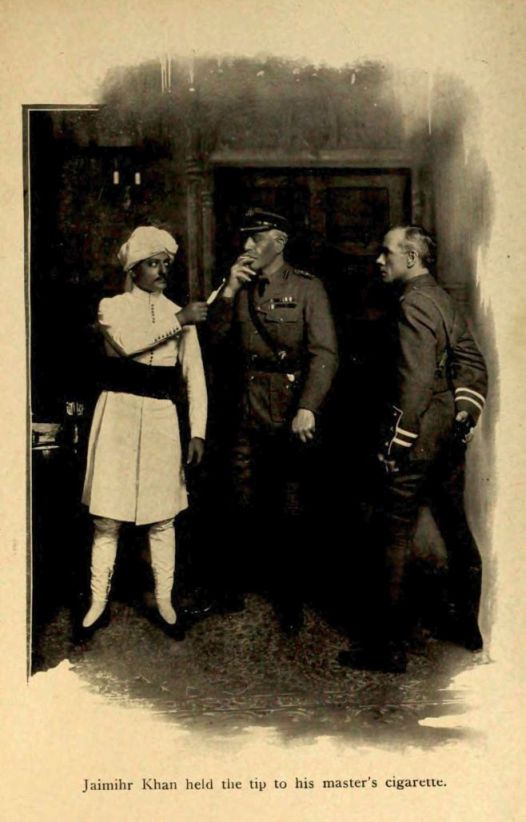
Jaimihr Khan held the tip to his master's cigarette.
"Nothing, General Sahib."
"Very good. Come, Woodhouse; sorry to
have kept you waiting." The general started
for the double doors. Woodhouse followed.
He passed very close to the Indian, but the
latter made no sign. His eyes were on the
burning wisp of paper between his fingers.
The next day, Thursday, was one of hectic
excitement for Gibraltar. Focus of the
concentrated attention of town and Rock was
the battle fleet, clogging all the inner harbor
with its great gray hulks. Superdreadnaughts,
like the standing walls of a submerged Atlantis,
lay close to the quays, barges lashed alongside
the folded booms of their torpedo nets.
Behind them, battle cruisers and scouts formed
a protecting cordon. Far out across the
entrance to the harbor, the darting black shapes
of destroyers on constant guard were shuttles
trailing their threads of smoke through the
blue web of sea and sky. Between fleet and
shore snorting cockleshells of launches
established lanes of communication; khaki of the
Rock's defenders and blue of the fleet's officers
met, passed, and repassed. In wardroom and
club lounge glasses were touched in pledges to
the united service. The high commander of
the Mediterranean fleet paid his official visit
to the governor of Gibraltar, and the governor,
in, turn, was received with honors upon the
quarterdeck of the flagship. But under the
superficial courtesies of fanfare and present
arms the stern business of coaling fleet
progressed at high tension. It was necessary that
all of the fighting machines have their bunkers
filled by noon of the following day. Every
minute that the Channel up under the murky North
Sea fogs lay without full strength of her fleet
protection was added danger for England.
That morning, Captain Woodhouse went on
duty in the signal tower. Major Bishop, his
superior, had summoned him to his office
immediately after breakfast and assigned him to
his tasks there. Sufficient proof, Woodhouse
assured himself, with elation, that he had come
through the fire in General Crandall's library,
tested and found genuine. Through this pretext
and that, he had been kept off duty the day
before, denied access to the slender stone tower
high up on the Rock's crest which was the
motor center of Gibraltar's ganglia of defense.
The small office in which Woodhouse was
installed was situated at the very top of the
tower—a room glassed on four sides like the
lantern room of a lighthouse, and provided with
telescope, a telephone switchboard, range
finders, and all the complicated machinery of
gunfire control. On one side were trestle boards
supporting charts of the ranges—figured areas
representing every square yard of water from
the nearer harbor below out to the farthest
reaching distance of the monster disappearing
guns. A second graphic sheet showed the
harbor and anchorages and the entrance to the
straits; this map was thickly spotted with little,
red, numbered dots—the mines. Sown like a
turnip field with these deadly capsules of
destruction were all the waters thereabouts;
their delicate tendrils led under water and
through conduits in the Rock up to this slender
spire called the signal tower. As he climbed
the winding stairway to his newly assigned
post, Woodhouse had seen painted on a small
wooden door just below the room he was to
occupy the single white letter "D."
Room D—where the switches were, where a
single sweep of the hand could loose all the
hidden death out there in the crowded
harbor—it lay directly below his feet.
Captain Woodhouse's duties were not arduous.
He had as single companion a sergeant of
the signal service, whose post was at the
window overlooking the harbor. The sergeant
read the semaphore message from the slender
signal arm on the flagship's bridge—directions
for the coal barges' movements, businesslike
orders to be transmitted to the quartermaster
in charge of the naval stores ashore, and such
humdrum of routine. These Woodhouse recorded
and forwarded to their various destinations
over the telephone.
He had much time for thought—and much
to think about.
Yesterday's scene in the library of Government
House—his grilling by the two suspicious
men, when a false answer on his part would
have been the first step toward a firing squad.
Yes, and what had followed between himself
and the little American—the girl who had
protected and aided him—ah, the pain of that trial
was hardly less poignant than had been the
terror of the one preceding it. She had asked him
to prove to her that he was not what she
thought him. Before another day was past she
would be out of his life and would depart,
believing—yes, convinced—that the task he had
set himself to do was a dishonorable one. She
could not know that the soldiers of the Hidden
Army have claim to heroism no less than they
who join battle under the sun. But he was
to see Jane Gerson once more; Woodhouse
caught at this circumstance as something
precious. To-night at Government House Lady
Crandall's dinner to the refugee Americans on
the eve of their departure would offer a last
opportunity. How could he turn it to the
desire of his heart?
One more incident of a crowded yesterday
gave Woodhouse a crust for rumination—the
unmasking Jaimihr Khan, the Indian, had
elected for himself at that critical minute when
it lay in his power to betray the stranger in
the garrison. The captain reviewed the incident
with great satisfaction—how of a sudden
the wily Indian had changed from an enemy
holding a man's life in his hand to that "friend
in Government House," of whose existence the
cautious Almer had hinted but whose identity
he had kept concealed. Almer had said that
this "friend" could lay his hand on the
combination to Room D in the signal tower when the
proper moment arrived. Now that he knew
Jaimihr Khan in his true stripe, Woodhouse
made no doubt of his ability to fulfill Almer's
prophecy.
And the proper moment would be this night!
To-night, on the eve of the great fleet's
sailing, what Woodhouse had come to Gibraltar
to do must be accomplished or not at all.
The man's nerves were taut, and he rose to
step to the bayward window, there to look
down on the embattled splendor of England's
defense. Steel forts ranged all in rows, awaiting
but the opportunity to loose their lightnings
of obliteration against the ships of an enemy.
Cardboard ships! Shadows of dreams! In
Room D, just below his feet, a hand on the
switches—a downward push, and then——
Lady Crandall's dinner in Government House
was in full tide of hilarity. Under the heavy
groined ceiling the spread table with its napery
and silver was the one spot of light in the
long shadowed dining-room. Round it sat the
refugees—folk who had eaten black bread and
sausage and called that a meal; who had dodged
and twisted under the careless scourge of a
war beyond their understanding and sympathies,
ridden in springless carts, been bullied
and hectored by military martinets and
beggared by panicky banks. Now, with the first
glimpse of freedom already in sight and
under the warming influence of an American
hostess' real American meal, they were swept off
their feet by high spirits almost childlike.
Henry J. Sherman, Kewanee's vagrant son
returning from painful pilgrimage, sat at the
right of Lady Crandall; his pink face was
glowing with humor. To Consul Reynolds, who
swore he would have to pay for thus neglecting
his consulate for so much as two hours,
had fallen the honor of escorting Mrs. Sherman
to table. Willy Kimball, polished as to shirt
bosom and sleek hair, had eyes and ears for
none but the blithe Kitty. Next to General
Crandall sat Jane Gerson, radiant in a dinner
gown of tricky gauze overlaid on silk. At her
right was Captain Woodhouse, in proper
uniform dinner coat faced with red and gold. Of
the whole company, Woodhouse alone appeared
constrained. The girl by his side had been
cool in her greeting that evening; to his
conversational sallies she had answered with
indifference, and now at table she divided her
favors between General Crandall and the perky
little consul across the table. It seemed to
Woodhouse that she purposely added a lash of
cruelty to her joy at the approaching departure
on the morrow.
"Oh, you must all listen to this!" Kitty
Sherman commanded the attention of the table,
with a clapping of hands. "Go ahead, Will;
he had the funniest accident—tell them
about it."
Young Kimball looked conscious and began
to stammer.
"You're getting us all excited, Willy," Henry
J. boomed from the opposite side of the table.
"What happened?"
"Why—ah—really quite ridiculous, you
know. Hardly a matter to—ah—talk about." Willy
fumbled the rose in the lapel of his
jacket and searched for words. "You see, this
morning I was thinking very hard about what
I would do when I got back to Kewanee—oh,
quite enthusiastic I am about the little town,
now—and I—well, I mean to say, I got into
my bath with my wrist watch on."
Shouts of laughter added to the youth's
confusion. Sherman leaned far across the table
and advised him in a hoarse whisper:
"Buy a dollar Ingersoll, Willy. It floats!"
"Well, you might give him one of yours,
father," Kitty put in, in quick defense.
"Anybody who'd carry two watches around——"
"Two watches?" Lady Crandall was interested.
Henry J. beamed expansively, pulled away
his napkin, and proudly lifted from each
waistcoat pocket a ponderous watch, linked by the
thick chain passing through a buttonhole.
"This one"—he raised the right-hand
time-piece—"tells the time of the place I happen to
be in—changed it so often I guess the works'll
never be the same again. But this one is my
pet. Here's Kewanee time—not touched since
we pulled out of the C., B. & Q. station on the
twentieth of last May." He turned the face
around for the others to read. "Just three in
the afternoon there now. Old Ed Porter's
got the Daily Enterprise out on the street,
and he's tilted back in his office chair,
readin' the Chicago Tribune that's just got in
on the two-five train. The boys at the bank are
goin' out to the country club for golf—young
Pete Andrews wearin' the knickerbockers his
wife cut down from his old overcoat; sort of a
horse-blanket pattern, you might say. The
town's just dozin' in the afternoon sun and—and
not givin' a hang whether Henry J. Sherman
and family gets back or not."
"You're an old dear!" Lady Crandall bubbled.
"Some day Kewanee will erect a statue
to you."
The talk turned to art, and the man from
Kewanee even had the stolid general wiping
the tears from his eyes by his description and
criticism of some of the masters his wife had
trotted him around to admire.
"Willy, you'll be interested to know we got
a painter in Kewanee now," Henry J. cried.
"'Member young Frank Coales—old Henry
Coales' son? Well, he turned out to be an
artist. Too bad, too; his folks was fine
people. But Frank was awfully headstrong about
art. Painted a war picture about as big as
that wall there. Couldn't find a buyer right
away, so he turned it over to Tim Burns, who
keeps the saloon on Main Street. Been busy
ever since, sorta taking it out in trade, you
might say."
Table talk was running at a gay rate when
Mrs. Sherman, who had sent frequent searching
glances at Captain Woodhouse over the
nodding buds of the flower piece in the center
of the board, suddenly broke out:
"Ah, Captain Woodhouse, now I remember
where I've seen you before! I thought your
face was familiar the minute I set my eyes on
you this evening."
Jaimihr Khan, who stood behind the general's
chair, arms folded and motionless,
swiftly lifted one hand to his lips, but
immediately mastered himself again. General
Crandall looked up with a sharp crinkle of interest
between his eyes. Captain Woodhouse, unperturbed,
turned to the Kewanee dowager.
"You have seen me before, Mrs. Sherman?"
"I am sure of it," the lady announced, with
decision. The other diners were listening now.
"Indeed! And where?" Woodhouse was
smiling polite attention.
"Why, at the Winter Garden, in Berlin—a
month ago!" Mrs. Sherman was hugely satisfied
with her identification. She appealed to
her husband for confirmation. "Remember,
father, that gentleman I mistook for Albert
Downs, back home, that night we saw
that—er—wicked performance?"
"Can't say I do," Sherman answered tolerantly.
Woodhouse, still smiling, addressed
Mrs. Sherman:
"Frightfully sorry to disappoint you,
Mrs. Sherman, but I was not in Berlin a month ago.
I came here from Egypt, where I had been
several years." Woodhouse heard Jane at his
elbow catch her breath.
"See, mother, there you go on your old hobby
of recognizin' folks," Sherman chided. Then,
to the others: "Why, she's seen all Kewanee
since she came here to Europe. Even got a
glimpse of the Methodist minister at Monte
Carlo."
"I have never been in Berlin in my life,
Mrs. Sherman," Woodhouse was adding. "So, of
course——"
"Well, I suppose I am wrong," the lady
admitted. "But still I could swear."
The governor, who had kept a cold eye on
his subordinate during this colloquy, now
caught Woodhouse's glance. The captain
smiled frankly.
"Another such unexpected identification,
General, and you'll have me in the cells as a
spy, I dare say," he remarked.
"Quite likely," Crandall answered shortly,
and took up his fork again. A maid stepped
to Lady Crandall's chair at this juncture and
whispered something. The latter spoke to
Woodhouse:
"You're wanted on the telephone in the
library, Captain. Very important, so the
importunate person at the other end of the wire
informs the maid."
Woodhouse looked his confusion.
"Probably that silly ass at the quay who lost
a bag of mine when I landed," he apologized,
as he rose. "If you'll pardon me——"
Woodhouse passed up the stairs and into the
library. He was surprised to find Jaimihr
Khan standing by the telephone, his hand just
in the act of setting the receiver back on the
hook. The Indian stepped swiftly to the double
doors and shut them behind the captain.
"A thousand pardons, Cap-tain"—he spoke
hurriedly—"the cap-tain will stand near the
telephone. They may come from the dining-room
at any minute."
"What is all this?" Woodhouse began. "I
was called on the telephone."
"A call I had inspired, Cap-tain. It was
necessary to see you—at once and alone."
"Tactless! With the general suspecting
me—you heard what that woman from America
said at the table—she has eyes in her head!"
"I think he still trusts you, Cap-tain," the
Indian replied. "And to-night we must act.
The fleet sails at noon to-morrow."
"We?" Woodhouse was on his guard at once.
"What do you mean by 'we'?"
Jaimihr Khan smiled at the evasion.
"Yesterday in this room, Cap-tain, I burned
a roll of plans——"
"Which I had good reason to wish saved,"
Woodhouse caught him up.
"No matter; I burned them—at a moment
when you were—in great peril, Cap-tain."
"Burned them, yes—perhaps to trap me further."
The Indian made a gesture of impatience.
"Oh, excellent discretion!" he cried in
suppressed exasperation. "But we waste time that
is precious. To-night——"
"Before another word is spoken, let me have
your card—your Wilhelmstrasse number,"
Woodhouse demanded.
"I carry no card. I am more discreet
than—some," the other answered insinuatingly.
"No card? Your number, then?"
Jaimihr Khan brought his lips close to the
white man's ear and whispered a number.
"Is that not correct?" he asked.
Woodhouse nodded curtly.
"And now that we are properly introduced,"
Jaimihr began, with a sardonic smile, "may I
venture a criticism? Your pardon, Cap-tain;
but our critics, they help us to per-fection.
Since when have men who come from the
Wilhelmstrasse allowed themselves to make
love in drawing-rooms?"
"You mean——"
"You and the young woman from America—when
I found you together here yesterday——"
"That is my affair," was Woodhouse's hot
response.
"The affair on which we work—this night—that
is my affair, be veree sure!" There was
something of menace in the Indian's tone.
Woodhouse bowed to his demand for an
explanation. "That young woman, as it happens,
must be kept on our side. She saw me in
France, when Captain Woodhouse was
supposed to be in Egypt."
"Ah, so?" Jaimihr inclined his head with a
slight gesture craving pardon. "For that
reason you make a conquest. I did not
un-derstand."
"No matter. The fleet sails at noon."
"And our moment is here—to-night," Jaimihr
whispered in exultation. "Not until
to-day did they admit you to the tower, Cap-tain.
How is it there?"
"A simple matter—with the combination to
the door of Room D."
With a single stride the Indian was over
before the door of the wall safe. He pointed.
"The combination of the inner door—it is
in a special compartment of that safe, protected
by many wires. Before dawn I cut the
wires—and come to you with the combination."
"At whatever hour is best for you," Woodhouse
put in eagerly.
"Let us say three-thirty," Jaimihr answered.
"You will be waiting for me at the Hotel
Splendide with—our friends there. I shall come to
you there, give you the combination, and you
shall go through the lines to the signal tower."
"There must be no slip," Woodhouse sternly
warned.
"Not on my part, Cap-tain—count on that.
For five years I have been waiting—waiting.
Five years a servant—yes, my General; no, my
General; very good, my General." The man's
voice vibrated with hate. "To-morrow, near
dawn—the English fleet shattered and ablaze
in the harbor—the water red, like blood, with
the flames. Then, by the breath of Allah, my
service ends!"
Voices sounded in the hallway outside the
double doors. Jaimihr Khan, a finger to his
lips, nodded as he whispered: "Three-thirty,
at the Splendide." He faded like a white
wraith through the door to General Crandall's
room as the double doors opened and the
masculine faction of the dinner party entered.
Woodhouse rose from a stooping position at the
telephone and faced them. To the general, whose
sharp scrutiny stabbed like thin knives, he
made plausible explanation. The beggar who
lost his bag wanted a complete identification
of it—had run it down at Algeciras.
"I understand," Crandall grunted.
When the cigars were lit, General Crandall
excused himself for a minute, sat at his desk,
and hurriedly scratched a note. Summoning
Jaimihr, he ordered that the note be despatched
by orderly direct to Major Bishop and given to
no other hands. Woodhouse, who overheard his
superior officer's command, was filled with
vague apprehension. What Mrs. Sherman had
said at table—this hurried note to Bishop;
there was but one interpretation to give to the
affair—Crandall's suspicions were all alive
again. Yet at three-thirty—at the Hotel
Splendide——
But when Crandall came back to join the
circle of smokers, he was all geniality. The
women came in by way of Jane Gerson's room;
they had been taking a farewell peek at her
dazzling stock of gowns, they said, before they
were packed for the steamer.
"There was one or two I just had to see
again," Mrs. Sherman explained for the benefit
of all, "before I said good-by to them. One of
them, by Madam Paquin, father, I'm going to
copy when we get home. I'll be the first to
introduce a Paquin into little Kewanee."
"Well, don't get into trouble with the minister,
mother," Henry J. warned. "Some of the
French gowns I've seen on this trip certainly
would stir things up in Kewanee."
Jaimihr served the coffee. Woodhouse tried
to maneuver Jane into a tête-à-tête in an angle
of the massive fireplace, but she outgeneraled
him, and the observant Mrs. Sherman cornered
him inexorably.
"Tell me, Captain Woodhouse," she began, in
her friendly tones, "you said a while ago the
general might mistake you for a spy. Don't
you have a great deal of trouble with spies in
your army in war time? Everybody took us
for spies in Germany, and in France they
thought poor Henry was carrying bombs to
blow up the Eiffel Tower."
"Perhaps I can answer that question better
than Captain Woodhouse," the general put in,
rising and striding over to where Mrs. Sherman
kept the captain prisoner. "Captain
Woodhouse, you see, would not be so likely to
come in touch with those troublesome persons
as one in command of a post, like myself." The
most delicate irony barbed this speech, lost to
all but the one for whom it was meant.
"Oh, I know I'm going to hear something
very exciting," Mrs. Sherman chortled. "Kitty,
you'd better hush up Willy Kimball for a while
and come over here. You can improve your
mind better listening to the general."
Crandall soon was the center of a group. He
began, with sober directness.
"Well, in the matter of spies in war time,
Mrs. Sherman, one is struck by the fact of
their resemblance to the plague—you never can
tell when they're going to get you or whence
they came. Now here on the Rock I have reason
to believe we have one or more spies busy
this minute."
Jane Gerson, sitting where the light smote
her face, drew back into the shadow with a
swift movement of protectiveness. Woodhouse,
who balanced a dainty Satsuma coffee cup on
his knee, kept his eyes on his superior's face
with a mildly interested air.
"In fact," Crandall continued evenly, "I
shouldn't be surprised if one—possibly two
spies—should be arrested before the night is
over. And the point about this that will
interest you ladies is that one of these—the one
whose order for arrest I have already given—is
a woman—a very clever and pretty woman,
I may add, to make the story more interesting."
"And the other, whose arrest may follow, is
an accomplice of hers, I take it, General!" Woodhouse
put the question with easy indifference.
He was stirring his coffee abstractedly.
"Not only the accomplice, but the brains for
both, Captain. A deucedly clever person, I'm
frank to admit."
"Oh, people! Come and see the flagship,
signaling to the rest of the fleet with its funny
green and red lights!" It was Jane who had
suddenly risen and stood by the curtains screening
the balcony windows. "They look like little
flowers opening and shutting."
The girl's diversion was sufficient to take
interest momentarily from General Crandall's
revelation. When all had clustered around the
windows, conversation skipped to the fleet, its
power, and the men who were ready to do battle
behind its hundreds of guns. Mrs. Sherman
was disappointed that the ships did not send
up rockets. She'd read somewhere that ships
sent up rockets, and she didn't see why these
should prove the exception. Interruption came
from Jaimihr Khan, who bore a message for
Consul Reynolds. The fussy little man ripped
open the envelope with an air of importance.
"Ah, listen, folks! Here we have the latest
wireless from the Saxonia. 'Will anchor about
two—sail six. Have all passengers aboard by
five-thirty.'" Excited gurgles from the
refugees. "That means," Reynolds wound up, with
a flourish, "everybody at the docks by five
o'clock. Be there myself, to see you off. Must
go now—lot of fuss and feathers getting
everybody fixed." He paused before Jane.
"You're going home at last, young lady," he
chirped.
"That depends entirely on Miss Gerson
herself." It was the general who spoke quietly but
emphatically.
Reynolds looked at him, surprised.
"Why, I understood it was all arranged——"
"I repeat, it depends entirely on Miss Gerson."
Woodhouse caught the look of fear in Jane's
eyes, and, as they fell for the instant on his,
something else—appeal. He turned his head
quickly. Lady Crandall saved the situation.
"Oh, that's just some more of George's eternal
red tape. I'll snip it when the time comes."
The consul's departure was the signal for the
others. They crowded around Lady Crandall
and her husband with voluble praise for the
American dinner and thanks for the courtesy
they had found on the Rock. Woodhouse, after
a last despairing effort to have a word of
farewell with Jane, which she denied, turned to
make his adieu to his host and hostess.
"No hurry, Captain," Crandall caught him
up. "Expect Major Bishop in every minute—small
matter of official detail. You and he can
go down the Rock together when he leaves."
Woodhouse's mind leaped to the meaning behind
his superior's careless words. The hastily
despatched note—that was to summon Bishop
to Government House; Crandall's speech about
the two spies and the arrest of one of
them—Louisa, he meant—and now this summary order
that he wait the arrival of Bishop—would the
second arrest be here in this room? The man
who carried a number from the Wilhelmstrasse
felt the walls of the library slowly closing in
to crush him; he could almost hear the whisper
and mutter of the inexorable machine moving
them closer—closer. Be alone with the man
whose word could send bullets into his heart!
"A very pleasant dinner—Lady Crandall's,"
Woodhouse began, eager to lighten the
tenseness of the situation.
"Yes, it seemed so." Crandall offered the
younger man his cigarette case, and, lighting a
smoke himself, straddled the hearth, his eyes
keenly observant of Woodhouse's face.
"Rather odd, Americans. But jolly nice." The
captain laughed in reminiscence of the
unspoiled Shermans.
"I thought so—I married one," Crandall retorted.
The ear of Woodhouse's mind could hear more
plainly now the grinding of the cogs; the
immutable power of fate lay there.
"Oh—er—so you did. Very kind she has
been to me. I got very little of this sort of
thing at Wady Halfa."
"By the way, Woodhouse"—Crandall blew a
contemplative puff toward the ceiling—"strange
Mrs. Sherman should have thought she saw you
at Berlin."
"Odd mistake, to be sure," Woodhouse admitted,
struggling to put ease into his voice.
"The lady seems to have a penchant, as her
husband says, for finding familiar faces."
"Major Bishop!" Jaimihr Khan announced at
the double doors. The major in person followed
immediately. His greeting to Woodhouse was
constrained.
"Woodhouse will wait for you to go down the
Rock with him," Crandall explained to the
newcomer. "Captain, excuse us for a minute, while
we go into my room and run over a little matter
of fleet supplies. Must check up with the fleet
before it sails in the morning." Woodhouse
bowed his acquiescence and saw the door to the
general's room close behind the twain.
He was not long alone. Noiselessly the
double doors opened and Jaimihr Khan entered.
Woodhouse sprang to meet him where he stood
poised for flight just inside the doors.
"The woman's prattle of Berlin——" the
Indian whispered.
"Yes, the general's suspicions are all aroused
again."
"Listen! I saw the note he sent to Bishop.
The major is to be set to watch you to-night—all
night. A false step and you will be under
arrest." Jaimihr's thin face was twisted in
wrath. "One man's life will not stand in our
way now."
"No," Woodhouse affirmed.
"Success is veree near. When Bishop goes
with you down the Rock——"
"Yes, yes! What?"
"The pistol screams, but the knife is dumb.
Quick, Cap-tain!" With a swift movement of
his hand the Indian passed a thin-bladed dirk to
the white man. The latter secreted the
sheathed weapon in a pocket of his dinner
jacket. He nodded understanding.
"One man's life—nothing!" Jaimihr breathed.
"It shall be done," Woodhouse whispered.
Jaimihr faded through the double doors like
a spirit in a medium's cabinet. He had seen
what the captain was slower to notice. The
door from Jane Gerson's room was opening. The
girl stepped swiftly into the room, and was by
Woodhouse's side almost before he had seen
her.
"I could not—go away—without—without——"
"Miss Gerson—Jane!" He was beside her
instantly. His hand sought and found one of hers
and held it a willing prisoner. She was trembling,
and her eyes were deep pools, riffled by
conflicting currents. Her words came breathlessly:
"I was not myself—I tried to tell myself you
were deceiving me just—just as a part of this
terrible mystery you are involved in. But when
I heard General Crandall tell you to wait—that
and what he said about the spies—I knew you
were again in peril, and—and——"
"And you have come to me to tell me as
good-by you believe I am honest and that you
care—a little?" Woodhouse's voice trembled with
yearning. "When you think me in danger, then
you forget doubts and maybe—your heart——"
"Oh, I want to believe—I want to!" she whispered
passionately. "Every one here is against
you. Tell me you are on the level—with me, at
least."
"I am—with you."
"I—believe," she sighed, and her head fell
near his shoulder—so near that with alacrity
Captain Woodhouse settled it there.
"When this war is over, if I am alive," he
was saying rapturously, "may I come to
America for you? Will you—wait?"
"Perhaps."
The door to General Crandall's room opened.
They sprang apart just as Crandall and Bishop
entered the library. The former was not blind
to the situation; he darted a swift glance into
the girl's face and read much there.
"Ready, Captain?" Bishop chirped, affecting
not to notice the momentary confusion of the
man and the girl.
Woodhouse gave Jane's hand a lingering
clasp; mutely his eyes adjured her to remember
her plighted troth. In another minute he was
gone.
The general and his guest were alone. Jane
Gerson was bidding him good night when he
interrupted, somewhat gruffly:
"Well, young woman, have you made up your
mind? Do you sail in the morning—or not?"
"I made up my mind to that long ago," she
answered briskly. "Of course I sail."
"Then you're going to tell me what I want
to know. Sensible girl!" He rubbed his hands
in satisfaction.
"What is it you want to know, General
Crandall?" This almost carelessly from her.
"When did you meet Woodhouse before—and
where?"
"How do you know I met him before?" She
attempted to parry, but Crandall cut her short
with a gesture of impatience:
"Please don't try that tack again. Answer
those two questions, and you sail in the morning."
Jane Gerson's eyes grew hard, and she lifted
her chin in defiance.
"And if I refuse——"
"Why should you?" Crandall affected
surprise not altogether unfelt.
"No matter—I do!" The challenge came
crisp and sharp-cut as a new blade. Gibraltar's
governor lost his temper instanter; his face
purpled.
"And I know why!" he rasped. "He's got
round you—made love to you—tricked you! I'd
swear he was kissing you just the minute I
came in here. The German cad! Good lord,
girl; can't you see how he's using you?"
"I'm afraid I can't."
Crandall advanced toward her, shaking a
menacing finger at her.
"Let me tell you something, young woman:
he's at the end of his rope. Done for! No use
for you to stand up for him longer. He's under
guard to-night, and a woman named Josepha,
his accomplice—or maybe his dupe—is already
under arrest, and to-morrow, when we examine
her, she'll reveal his whole rotten schemes or
have to stand against a wall with him. Come,
now! Throw him over. Don't risk your job,
as you call it, for a German spy who's tricked
you—made a fool of you. Why——"
"General Crandall!" Her face was white, and
her eyes glowed with anger.
"I—I beg your pardon, Miss Gerson," he
mumbled. "I am exasperated. A fine girl like
you—to throw away all your hopes and ambitions
for a spy—and a bounder! Can't you see
you're wrong?"
"General Crandall, some time—I hope it will
be soon—you will apologize to me—and to
Captain Woodhouse—for what you are saying
to-night." Her hands clenched into fists, whereon
the knuckles showed white; the poise of her
head, held a little forward, was all combative.
"Then you won't tell me what I want to
know?" He could not but read the defiance in
the girl's pose.
"I will tell you nothing but good-by."
"No, by gad—you won't! I can be stubborn,
too. You shan't sail on the Saxonia in the
morning. Understand?"
"Oh, shan't I? Who will dare stop me?"
"I will, Miss Gerson. I have plenty of
right—and the power, too."
"I'll ask you to tell that to my consul—on the
dock at five to-morrow morning. Until then,
General Crandall, au revoir."
The door of the guest room shut with a spiteful
slam upon the master of Gibraltar, leaving
him to nurse a grievance on the knees of wrath.
Joseph Almer and Captain Woodhouse
sat in the darkened and heavily blinded
office-reception room of the Hotel Splendide.
All the hotel had long since been put to bed,
and the silence in the rambling house was
audible. The hands of the Dutch clock on the wall
were pointing to the hour of three-thirty.
Strain was on both the men. They spoke in
monosyllables, and only occasionally. Almer's
hand went out from time to time to lift a squat
bottle of brandy from the table between them
and pour a tiny glass brimful; he quaffed with
a sucking noise. Woodhouse did not drink.
"It is three-thirty," the latter fretted, with
an eye on the mottled clock dial.
"He will come," Almer assured. A long pause.
"This man Jaimihr—he is thoroughly
dependable?" The man in uniform put the
question with petulant bruskness.
"It is his passion—what we are to do
to-night—something he has lived for—his
religion. Nothing except judgment day
could—— Hah!"
The sharp chirp of a telephone bell, a
dagger of sound in the silence, broke Almer's
speech. He bounded to his feet; but not so
quickly as Woodhouse, who was across the
room in a single stride and had the receiver
to his ear.
"Well, well! Yes, this is the one you
name." Woodhouse turned to Almer, and his lips
framed the word Jaimihr. "Yes, yes; all is
well—and waiting. Bishop? He is beyond
interference—coming down the Rock—I did the
work silently. What's that?" Woodhouse's
face was tensed in strain; his right hand went
to a breast pocket and brought out a pencil.
With it he began making memoranda on the
face of a calendar by his side.
"Seven turns—ah, yes—four to the
left—correct." His writing hand was moving
swiftly. "Press, one to the right. Good! I have
it, and am off at once. Good-by!"
Woodhouse finished a line of script on the
calendar face, hung up the receiver. He
carefully tore the written notes from the calendar
and put them into his pocket.
"Jaimihr says he has work to do at Government
House and can not come down." Woodhouse
turned to Almer and explained in rapid
sentences. "But he's given me the combination—to
Room D—over the wire, and now I'm off!"
Almer was all excitement now. He hovered
lovingly about Woodhouse, patting him on the
shoulder, giving him his helmet, mothering
him with little cooing noises.
"Speed quickly, Nineteen Thirty-two! Up
the Rock to the signal tower, Nineteen
Thirty-two, to do the deed that will boom around
the world. The switches—one pull, my brother,
and the fatherland is saved to triumph over
her enemies, victorious!"
"Right, Almer!" Woodhouse was moving
toward the door. "In eight minutes history
will be made. The minute you hear the blast,
start for Spain. I will try to escape, but I
doubt——"
A knock came at the barred front door—one
knock, followed by three. Both men were
transfixed. Almer, first to recover his
calmness, motioned Woodhouse through the door to
the dining-room. When his companion had
disappeared, he stepped to the door and
cautiously asked: "Who knocks?"
An answer came that caused him to shoot
back the bolts and thrust out his head. A
message was hurriedly whispered into his ear. The
Splendide's proprietor withdrew his head and
slipped the bolt home again. His face was a
thundercloud as he summoned Woodhouse; his
breath came in wheezy gasps.
"My Arab boy comes to the door just now
to tell me of Louisa's fate; she has been
arrested," he said.
"Come, Almer! I am going to the signal
tower—there is still time for us to strike."
Out on to Waterport Street leaped Woodhouse,
and the door closed behind him.
Jane Gerson, tossing on her pillows,
heard the mellow bell of a clock somewhere
in the dark and silent house strike
three. This was the fifth time she had counted
the measured strokes of that bell as she lay,
wide-eyed, in the guest chamber's canopied bed.
An eternity had passed since the dinner guests'
departure. Her mind was racing like some
engine gone wild, and sleep was impossible.
Over and over again she had conned the events
of the evening, always to come at the end
against the impasse of General Crandall's blunt
denial: "You shan't sail in the morning." In
her extremity she had even considered flight
by stealth—the scaling of walls perhaps, and a
groping through dark streets to the wharf,
there to smuggle herself somehow on a tender
and so gain the Saxonia. But her precious
gowns! They still reposed in their bulky
hampers here in Government House; to escape
and leave them behind would be worse than
futile. The governor's fiat seemed absolute.
Urged by the impulse of sheer necessity to
be doing something—the bed had become a rack—the
girl rose, lit a taper, and began to dress
herself, moving noiselessly. She even packed
her traveling bag to the last inch and locked
it. Then she sat on the edge of the bed, hands
helplessly folded in her lap. What to do next?
Was she any better off dressed than thrashing
in the bed? Her yearning called up a picture
of the Saxonia, which must ere this be at her
anchorage, since the consul said she was due
at two. In three short hours tenders would
puff alongside; a happy procession of refugees
climb the gangway—among them the Shermans
and Willy Kimball, bound for their Kewanee;
the captain on the bridge would give
an order; winches would puff, the anchor
heave from the mud, the big boat's prow slowly
turn westward—oceanward—toward New
York! And she, a prisoner caught by the
mischance of war's great mystery, would have to
watch that diminishing column of smoke fade
against the morning's blue—disappear.
Inspiration seized her. It would be something
just to see the Saxonia, now lying amid
the grim monsters of the war fleet. From the
balcony of the library, just outside the door
of her room, she could search the darkness of
the harbor for the prickly rows of lights
marking the merchant ship from her darker
neighbors. The general's marine glasses lay on his
desk, she remembered. To steal out to the
balcony, sweep the harbor with the glasses, and
at last hit on the ship of deliverance—for all
but her; to do this would be better than
counting the hours alone. She softly opened the
door of her room. Beyond lay the dim distances
of the library, suddenly become vast as
an amphitheater; in the thin light filtering
through the curtains screening the balcony
appeared the lumpy masses of furniture and
vague outlines of walls and doors. She closed
the door behind her, and stood trembling; this
was somehow like burglary, she felt—at least
it had the thrill of burglary.
The girl tiptoed around a high-backed chair,
groped her way to the general's desk, and
fumbled there. Her hand fell upon the double
tubes of the binoculars. She picked them up,
parted the curtains, and stepped through the
opened glass doors to the balcony. Not a sound
anywhere but the faint cluck and cackle of
cargo hoists down in the harbor. Jane put the
glasses to her eyes, and began to sweep the
light-pointed vista below the cliff. Scores of
pin-prick beams of radiance marked the fleet
where it choked the roadstead—red and white
beetles' eyes in the dark. She swung the glasses
nearer shore. Ah, there lay the Saxonia, with
her three rows of glowing portholes near the
water; the binoculars even picked out the
double column of smoke from her stacks.
Three brief hours and that mass of shadow
would be moving—moving——
A noise, very slight, came from the library
behind the opened doors. The marine glasses
remained poised in the girl's hands while she
listened. Again the noise—a faint metallic click.
She hardly breathed. Turning ever so slowly,
she put one hand between the curtains and
parted them so that she could look through into
the cavernous gloom behind her.
A light moved there—a clear round eye of
light. Behind it was the faintest suggestion of
a figure at the double doors—just a blur of
white, it was; but it moved stealthily, swiftly.
She heard a key turn in a lock. Then swiftly
the eye of light traveled across the library to
the door leading to General Crandall's room.
There it paused to cut the handle of the door
and keyhole beneath out of darkness. A brown
hand slipped into the clear shaft of whiteness,
put a key into the keyhole, and softly turned it.
The same was done for the locks of Lady Crandall's
door, on the opposite side of the library,
and for the one Jane had just closed behind
her—her own door. Than the circle of light,
seeming to have an intelligence all its own,
approached the desk, flew swiftly to a drawer
and there paused. Once more the brown hand
plunged into the bore of light; the drawer was
carefully opened, and a steel-blue revolver
reflected bright sparks from its barrel as it was
withdrawn.
Jane, hardly daring to breathe, and with the
heavy curtains gathered close so that only a
space for her eyes was left open, watched the
orb of light, fascinated. It groped under the
desk, found a nest of slender wires. There was
a "Snick—snick!" and the severed ends of the
wires dropped to the floor. The burnished dial
of the wall safe, set near the double doors, was
the next object to come under the restless
searching eye. While light poured steadily
upon the circular bit of steel, delicate fingers
played with it, twisting and turning this way
and that. Then they were laid upon the handle
of the safe door, and it swung noiselessly back.
A tapering brown hand, white-sleeved, fumbled
in a small drawer, withdrew a packet of papers
and selected one.
Jane stepped boldly into the room.
"Sahibah!" The white club of the electric
flash smote her full in the face.
"What are you doing at that safe, Jaimihr
Khan?" Jane spoke as steadily as she could,
though excitement had its fingers at her throat,
and all her nerves were twittering. She heard
some sharply whistled foreign word, which
might have been a curse.
"Something that concerns you not at all,
Sahibah," the Indian answered, his voice
smooth as oil. He kept the light fair on her
face.
"I intend that it shall concern me," the girl
answered, taking a step forward.
"Veree, veree foolish, Sahibah!" Jaimihr
whispered, and with catlike stride he advanced
to meet her. "Veree foolish to come here at
this time."
Jane, frozen with horror at the man's approach,
dodged and ran swiftly to the fireplace,
where hung the ancient vesper bell. The flash
light followed her every move—picked out her
hand as it swooped down to seize a heavy poker
standing in its rack beside the bell.
"Sahibah! Do not strike that bell!" The
warning came sharp and cold as frost. Her
hand was poised over the bell, the heavy stub
of the poker a very few inches away from the
bell's flare.
"To strike that bell might involve in great
trouble one who is veree dear to you, Sahibah.
Let us talk this over most calmly. Surely you
would not desire that a friend—a veree dear
friend——"
"Who do you mean?" she asked sharply.
"Ah—that I leave to you to guess!" Jaimihr
Khan's voice was silken. "But certainly you
know, Sahibah. A friend the most important——"
Then she suddenly understood. The Indian
was referring to Captain Woodhouse thus
glibly. Anger blazed in her.
"It isn't true!"
"Sahibah, I am sorry to con-tradict." Jaimihr
Khan had begun slowly to creep toward
her, his body crouching slightly as a stalking
cat's.
"I'll prove it isn't true!" she cried, and
brought the poker down on the bell with a
sharp blow. Like a tocsin came its answering
alarm.
"A thousand devils!" The Indian leaped for
the girl, but she evaded him and ran to put
the desk between herself and him. He had
snapped off the torch at the clang of the bell,
and now he was a pale ghost in the
gloom—fearsome. Hissing Indian curses, he started
to circle the desk to seize her.
"Open this door! Open it, I say!" It was
the general's voice, sounding muffled through
the panels of his door; he rattled the knob
viciously. Jane tried to run to the door, but
the Indian seized her from behind, threw her
aside, and made for the double doors. There
his hand went to a panel in the wall, turned a
light switch, and the library was on the
instant drenched with light. Jaimihr Khan
threw before the door of the safe the bundle
of papers he was clutching when Jane
discovered him and which he had gripped during the
ensuing tense moments. Then he stepped
swiftly to the general's door and unlocked it.
General Crandall, clad only in trousers and
shirt, burst into the room. His eyes leaped
from the Indian to where Jane was cowering
behind his desk.
"What the devil is this?" he rasped. Jane
opened her mouth to answer, but the Indian
forestalled her:
"The sahibah, General—I found her here before
your opened safe——"
"Good God!" General Crandall's eyes blazed.
He leaped to the safe, knelt and peered in. "A
clever job, young woman!"
Jane, completely stunned by the Indian's
swift strategy, could hardly speak. She held
up a hand, appealing for a hearing. General
Crandall eyed her with chilling scorn, then
turned to his servant.
"You have done well, Jaimihr."
"It—it isn't true!" Jane stammered. The
governor took a step toward her almost as if
under impulse to strike her, but he halted, and
his lips curled in scorn.
"By gad, working with Woodhouse all the
time, eh? And I thought you a simple young
woman he had trapped—even warned you
against him not six hours ago. What a fool
I've been!" Jane impulsively stretched forth
her arms for the mercy of a hearing, but the
man went on implacably:
"I said he was making a fool of you—and all
the time you were making one of me. Clever
young woman. I say, that must have been a
great joke for you—making a fool of the
governor of Gibraltar. You make me ashamed of
myself. And my servant—Jaimihr here; it is
left to him to trap you while I am blind. Bah!
Jaimihr, my orderly—at once!" The Indian
smiled sedately and started for the double doors.
Jane ran toward the general with a sharp cry:
"General—let me explain——"
"Explain!" He laughed shortly. "What can
you say? You come into my house as a friend—you
betray me—you break into my safe—with
Woodhouse, whom I'd warned you against,
directing your every move. Clever—clever!
Jaimihr, do as I tell you. My orderly at once!"
Jane threw herself between the Indian and
the doors.
"One moment—before he leaves the room let
me tell you he lies? Your Indian lies. It was
I who found him here—before that safe!"
"A poor story," the general sniffed. "I
expected better of you—after this."
"The truth, General Crandall. I couldn't
sleep. I came out here to the balcony to try to
make out if the Saxonia was in the bay. He
came into the room while I was behind these
curtains, locked the doors, and opened the safe."
"It won't go," the general cut in curtly.
"It's the truth—it's got to go!" she cried.
Jaimihr, at a second nod from his master, was
approaching the double doors. Jane, leaping in
front of them, pushed the Indian back.
"General Crandall, for your own sake—don't
let this Indian leave the room. You may regret
it—all the rest of your life. He still has a
paper—a little paper—he took from that safe. I saw
him stick it in his sash."
"Nonsense!"
"Search him!" The girl's voice cracked in
hysteria; her face was dead white, with hectic
burning spots in each cheek. "I'm not pleading
for myself now—for you. Search him before
he leaves this room!"
Jaimihr put strong hands on her arms to
force her away from the door. His black eyes
were laughing down into hers.
"Let me ask him a question first, General
Crandall—before he leaves this room."
The governor's face reflected momentary
surprise at this change of tack. "Quickly
then," he gruffly conceded. Jaimihr Khan
stepped back a pace, his eyes meeting the girl's
coldly.
"How did you come into the room—when you
found me here?" she challenged. The Indian
pointed to the double doors over her shoulder.
She reached behind her, grasped the knob, and
shook it. "Locked!" she announced.
"Why not?" Jaimihr asked. "I locked them
after me."
"And the general's door was locked?"
"Yes—yes!" Crandall broke in impatiently.
"What's this got to do with——"
"Did you lock the general's door?" she
questioned the Indian.
"No, Sahibah; you did."
"And I suppose I locked the door to Lady
Crandall's room and my door?"
"If they, too, are locked—yes, Sahibah."
"Then why"—Jane's voice quavered almost
to a shriek—"why had I failed to lock the
double doors—the doors through which you came?"
The Indian caught his breath, and darted a
look at the general. The latter, eying him
keenly, stepped to his desk and pressed a button.
"Very good; remain here, Jaimihr," he said.
Then to Jane: "I will have him searched, as
you wish. Then both of you go to the cells
until I sift this thing to the bottom."
"General! You wouldn't dare!" She stood
aghast.
"Wouldn't I, though? We'll see whether—" A
sharp click sent his head jerking around to
the right. Jaimihr Khan, at the door to the
general's room, was just slipping the key into
his girdle, after having turned the lock. His
thin face was crinkled like old sheepskin.
"What the devil are you doing?" Crandall exploded.
"If the general sahib is waiting for that bell
to be answered—he need not wait longer—it
will not be answered," Jaimihr Khan purred.
"What's this—what's this!"
"The wires are cut."
"Cut! Who did that?" The general started
for the yellow man. Jaimihr Khan whipped a
blue-barreled revolver out of his broad sash and
leveled it at his master.
"Back, General Sahib! I cut them. The
sahibah's story is true. It was she who came
in and found me at the safe."
"My God! You, Jaimihr—you a spy!" The
general collapsed weakly into a chair by the
desk.
"Some might call me that, my General." Jaimihr's
weapon was slowly swinging to cover
both the seated man and the girl by the doors.
"No need to search that drawer, General Sahib.
Your pistol is pointing at you this minute."
"You'll pay for this!" Crandall gasped.
"That may be. One thing I ask you to
remember. If one of you makes a move I will
kill you both. You are a gallant man, my
General; is it not so? Then remember."
Crandall started from his chair, but the
uselessness of his bare hands against the
snub-nosed thing of blue metal covering him struck
home. He sank back with a groan. Keeping
them both carefully covered, Jaimihr moved to
the desk telephone at the general's elbow. He
took from his sash a small piece of paper—the
one he had saved from the packet of papers
taken from the safe—laid it on the edge of the
desk, and with his left hand he picked up the
telephone. An instant of tense silence, broken
by the wheezing of the general's breath,
then——
"Nine-two-six, if you please. Yes—yes, who
is this? Ah, yes. It is I, Jaimihr Khan. Is all
well with you? Good! And Bishop? Slain
coming down the Rock—good also!"
Crandall groaned. The Indian continued his
conversation unperturbed.
"Veree good! Listen closely. I can not come
as I have promised. There is—work—for me
here. But all will be well. Take down what I
shall tell you." He read from the slip of paper
on the desk. "Seven turns to the right, four to
the left—press! Two more to the left—press!
One to the right. You have that? Allah speed
you. Go quickly!"
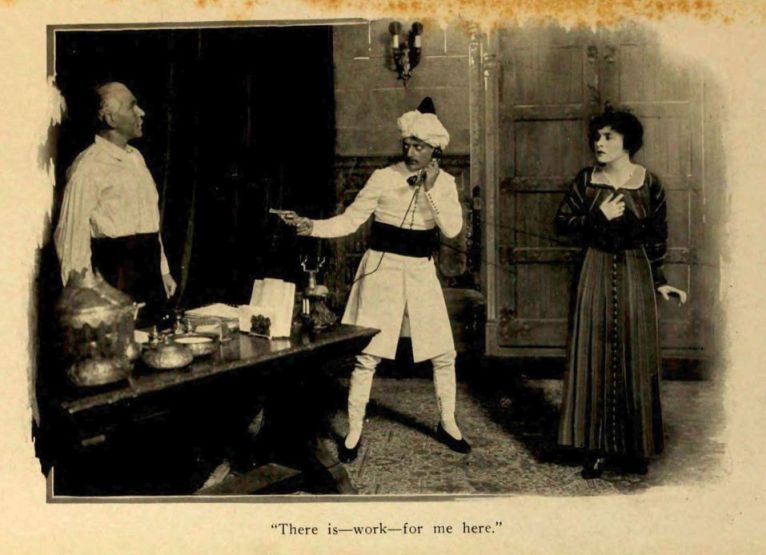
"There is—work—for me here."
"Room D!" Crandall had leaped from his chair.
"Correct, my General—Room D." Jaimihr
smiled as he stepped away from the telephone,
his back against the double doors. The sweat
stood white on Crandall's brow; his mouth
worked in jerky spasms.
"What—what have you done?" he gasped.
"I see the general knows too well," came the
Indian's silken response. "I have given the
combination of the inner door of Room D in the
signal tower to a—friend. He is on his way to
the tower. He will be admitted—one of the
few men on the Rock who could be admitted at
this hour, my General. One pull of the switches
in Room D—and where will England's great
fleet be then?"
"You yellow devil!" Crandall started to rush
the white figure by the doors, but his flesh
quailed as the round cold muzzle met it. He
staggered back.
"We are going to wait, my General—and you,
American Sahibah, who have pushed your way
into this affair. We are going to wait—and
listen—listen."
The general writhed in agony. Jane, fallen
into a chair by the far edge of the desk, had
her head buried in her arms, and was sobbing.
"And we are going to think, my General,"
the Indian's voice purled on. "While we wait
we shall think. Who will General Crandall be
after to-night—the English sahib who ruled the
Rock the night the English fleet was blown to
hell from inside the fortress? How many
widows will curse when they hear his name?
What——"
"Jaimihr Khan, what have I ever done to
you!" The governor's voice sounded hardly
human. His face was blotched and purple.
"Not what you have done, my General—what
the English army has done. An old score,
General—thirty years old. My father—he was a
prince in India—until this English army took
away his throne to give it to a lying brother.
The army—the English army—murdered my
father when he tried to get it back—called it
mutiny. Ah, yes, an old score; but by the
breath of Allah, to-night shall see it paid!"
The man's eyes were glittering points of
white-hot steel. All of his thin white teeth
showed like a hound's.
"You dog!" The general feebly wagged his
head at the Indian.
"Your dog, my General. Five years your dog,
when I might have been a prince. My friend
goes up the Rock—step—step—step. Closer—closer
to the tower, my General. And Major
Bishop—where is he? Ah, a knife is swift and
makes no noise——"
"What a fool I've been!" Crandall rocked in
his chair, and passed a trembling hand before
his eyes. Sudden rage turned his bloodshot
eyes to where the girl was stretched, sobbing,
across the desk. "Your man—the man you
protected—it is he who goes to the signal tower,
girl!"
"No—no; it can't be," she whispered between
the rackings of her throat.
"It is! Only a member of the signal service
could gain admittance into the tower to-night.
Besides—who was it went with Bishop down the
Rock after the dinner to-night? And I—I sent
Bishop with him—sent him to his death. He
was tricking you all the time. I told you he
was. I warned you he was playing with
you—using you for his own rotten ends—using you
to help kill forty thousand men!"
It needed not the sledge-hammer blows of the
stricken Crandall to batter Jane Gerson's heart.
She had read too clearly the full story Jaimihr
Khan's sketchy comments had outlined. She
knew now Captain Woodhouse, spy. The Indian
was talking again, his words dropping as
molten metal upon their raw souls.
"Forty thousand men! A pleasant thought,
my General. Eight minutes up the Rock to the
tower when one moves fast. And my friend—ah,
he moves veree—veree fast. Eight minutes,
and four have already passed. Watch the
windows—the windows looking out to the bay,
General and Sahibah. They will flame—like
blood. Your hearts will stop at the great noise,
and then——"
A knock sounded at the double doors behind
Jaimihr. He stopped short, startled. All
listened. Again came the knock. Without
turning his eyes from the two he guarded, Jaimihr
asked: "Who is it?"
"Woodhouse," came the answer.
Jane's heart stopped. Crandall sat frozen in
his seat. Jaimihr turned the key in the lock,
and the doors opened. In stepped Captain
Woodhouse, helmeted, armed with sword and
revolver at waist. He stood facing the trio, his
swift eye taking in the situation at once. Crandall
half rose from his seat, his face apoplectic.
"Spy! Secret killer of men!" he gasped.
Woodhouse paid no heed to him, but turned to
Jaimihr.
"Quick! The combination," he said. "Over
the phone—afraid I might not have it
right—stopped here on my way to the tower—be there
in less than three minutes if you can hold these
people."
"Everything is all right?" Jaimihr asked suspiciously.
"You mean Bishop? Yes. Quick, the combination!"
Jaimihr picked the slip of paper containing
the formula from the edge of the desk with his
disengaged left hand and passed it to Woodhouse.
The latter stretched out his hand, grasped the
Indian's with a lightning move, and threw it
over so that the latter was off his balance. In
a twinkling Woodhouse's left hand had
wrenched the revolver from Jaimihr's right and
pinioned it behind his back. The whole
movement was accomplished in half a breath.
Jaimihr Khan knelt in agony, and in peril of a
broken wrist, at the white man's feet, disarmed,
harmless. Woodhouse put a silver whistle to
his lips and blew three short blasts.
A tramp of feet in the hallway outside, and
four soldiers with guns filled the doorway.
"Take this man!" Woodhouse commanded.
The Indian, in a frenzy, writhed and shrieked:
"Traitor! English spy! Dog of an unbeliever!"
The soldiers jerked him to his feet and
dragged him out; his ravings died away in the
passage.
Woodhouse brought his hand up in a salute
as he faced General Crandall.
"The other spy, Almer, of the Hotel Splendide,
has just been arrested, sir. Major Bishop
has taken charge of him and has lodged him in
the cells."
A high-pitched scream sounded behind Lady
Crandall's door, and a pounding on the panels.
Jane Gerson, first to recover from the shock of
surprise, ran to unlock the door. Lady Crandall,
in a dressing gown, burst into the library
and flung herself on her husband.
"George—George! What does all this
mean—yells—whistling——"
General Crandall gave his wife a pat on the
shoulder and put her aside with a mechanical
gesture. He took a step toward Woodhouse,
who still stood stiffly before the opened doors;
the dazed governor walked like a somnambulist.
"Who—who the devil are you, sir?" he managed
to splutter.
"I am Captain Cavendish, General." Again
the hand came to stiff salute on the visor of the
pith helmet. "Captain Cavendish, of the signal
service, stationed at Khartum, but lately detached
for special service under the intelligence
office in Downing Street."
The man's eyes jumped for an instant to seek
Jane Gerson's face—found a smile breaking
through the lines of doubt there.
"Your papers to prove your identity!" Crandall
demanded, still in a fog of bewilderment.
"I haven't any, General Crandall," the other
replied, with a faint smile, "or your Indian,
Jaimihr Khan, would have placed them in your
hands after the search of my room yesterday.
I've convinced Major Bishop of my genuineness,
however—after we left your house and when
the moment for action arrived. A cable to Sir
Ludlow-Service, in the Downing Street office,
will confirm my story. Meanwhile I am willing
to go under arrest if you think best."
"But—but I don't understand, Captain—er—Cavendish.
You posed as a German—as an
Englishman."
"Briefly, General, a girl secretly in the pay of
the Downing Street office—Louisa Schmidt,—Josepha,
the cigar girl, whom you ordered
locked up a few hours ago—is the English
representative in the Wilhelmstrasse at Berlin.
She learned of a plan to get a German spy
in your signal tower a month before war was
declared, reported it to London, and I was
summoned from Khartum to London to play
the part of the German spy. At Berlin, where
she had gone from your own town of Gibraltar
to meet me, she arranged to procure me a
number in the Wilhelmstrasse through the
agency of a dupe named Capper——"
"Capper! Good Lord!" Crandall stammered.
"With the number I hurried to Alexandria.
Woodhouse—Captain Woodhouse, from Wady
Halfa—a victim, poor chap, to the necessities of
our plan, fell into the hands of the Wilhelmstrasse
men there, and I gained possession of
his papers. The Germans started him in a
robber caravan of Bedouins for the desert, but I
provided against his getting far before being
rescued, and the German agents there were all
rounded up the day I sailed as Woodhouse."
"And you came here to save Gibraltar—and
the fleet from German spies?" Crandall put
the question dazedly.
"There were only two, General—Almer and
your servant, Jaimihr. We have them now.
You may order the release of Louisa Schmidt."
"The captain has overlooked one other—the
most dangerous one of all, General Crandall." Jane
stepped up to where the governor stood
and threw back her hands with an air of
submission. "Her name is Jane Gerson, of New
York, and she knew all along that this
gentleman was deceiving you—she had met him, in
fact, three weeks before on a railroad train in
France."
The startled eyes of Gibraltar's master
looked first at the set features of the man, then
to the girl's flushed face. Little lines of humor
crinkled about the corners of his mouth.
"Captain Cavendish—or Woodhouse, make
this girl a prisoner—your prisoner, sir!"
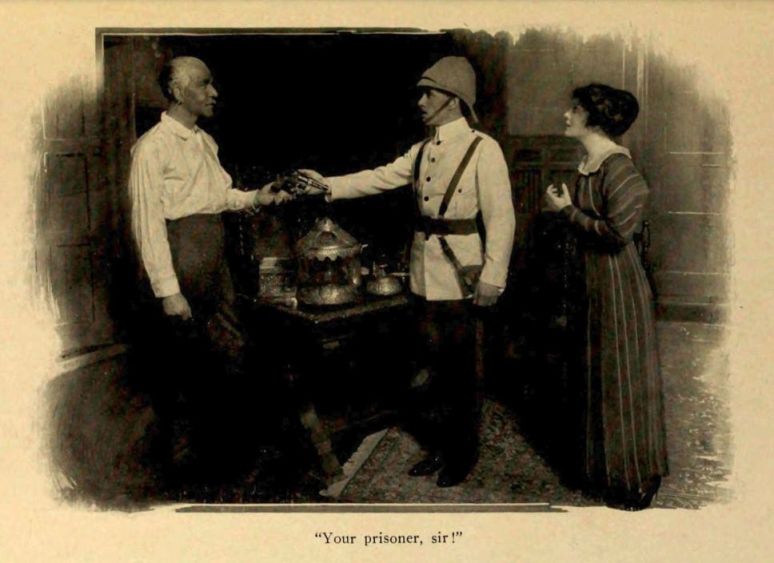
"Your prisoner, sir."
Five o'clock at the quay, and already the
new day was being made raucous by the
bustle of departure—shouts of porters, tenders'
jangling engine bells, thump of trunks dropped
down skidways, lamentations of voyagers vainly
hunting baggage mislaid. Out in the stream
the Saxonia—a clean white ship, veritable ark
of refuge for pious Americans escaping the
deluge.
In the midst of a group of his countrymen
Henry J. Sherman stood, feet wide apart and
straw hat cocked back over his bald spot. He
was narrating the breathless incidents of the
night's dark hour:
"Yes, sir, a soldier comes to our rooms about
three-thirty o'clock and hammers on our door.
'Everybody in this hotel's under arrest,' he
says. 'Kindly dress as soon as possible and
report to Major Bishop in the office.' And we
not five hours before the guests of General and
Lady Crandall at Government House. What
d'you think of that for a quick change?
"Well, gentlemen, we piled down-stairs—with
me minus a collar button and havin' to hold
my collar down behind with my hand. And
what do we find? This chap Almer, with a
face like a side of cream cheese, standing in the
middle of a bunch of soldiers with guns;
another bunch of soldiers surroundin' his Arab
boy, who's as innocent a little fellah as ever you
set eyes on; and this Major Bishop walkin' up
and down, all excited, and sayin' something
about somebody's got a scheme to blow up the
whole fleet out there. Which might have been
done, he says, if it wasn't for that fellah
Woodhouse we'd had dinner with just that very
evening."
"Who's some sort of a spy. I knew it all
the time, you see." Mrs. Sherman was quick
to claim her share of her fellow tourists'
attention. "Only he's a British spy set to watch
the Germans. Major Bishop told me that in
confidence after it was all over—said he'd never
met a man with the nerve this Captain
Woodhouse has."
"Better whisper that word 'spy' soft,"
Henry J. admonished sotto voce. "We're
not out of this plagued Europe yet, and
we've had about all the excitement we can
stand; don't want anybody to arrest us again
just the minute we're sailin'. But, as I was
sayin', there we all stood, foolish as goats,
until in comes General Crandall, followed by
this Woodhouse chap. 'Excuse me, people, for
causing you this little inconvenience,' the
general says. 'Major Bishop has taken his orders
too literal. If you'll go back to your rooms and
finish dressin' I'll have the army bus down
here to take you to the quay. The Hotel
Splendide's accommodations have been slightly
disarranged by the arrest of its worthy
proprietor.' So back we go, and—by cricky,
mother, here comes the general and Mrs. Crandall now!"
Henry J. broke through the ring of passengers,
and with a waving of his hat, rushed to
the curb. A limousine bearing the governor,
his lady and Jane Gerson, and with two bulky
hampers strapped to the baggage rack behind,
was just drawing up.
"Why, of course we're down here to see you
off—and bid you Godspeed to little old
Kewanee!" Lady Crandall was quick to anticipate
the Shermans' greetings. General Crandall,
beaming indulgently on the group of
homegoers, had a hand for each.
"Yes—yes," he exclaimed. "After arresting
you at three o'clock we're here to give you a
clean ticket at five. Couldn't do more than
that—what? Regrettable occurrence and all that,
but give you something to tell the stay-at-homes
about when you get back to—ah——"
"Kewanee, Illynoy, General," Sherman was
quick to supply. "No town like it this side the
pearly gates."
"No doubt of it, Sherman," Crandall heartily
agreed. "A quiet place, I'll wager. Think I'd
relish a touch of your Kewanee after—ah—life
on Gibraltar."
Jane Gerson, who had been standing in the
car, anxiously scanning the milling crowd about
the landing stage, caught sight of a white
helmet and khaki-clad shoulders pushing through
the nearer fringes of travelers. She slipped
out of the limousine unseen, and waited for the
white helmet to be doffed before her.
"I was afraid maybe——" the girl began,
her cheeks suddenly flaming.
"Afraid that, after all, it wasn't true?" the
man she had found in war's vortex finished,
his gray eyes compelling hers to tell him their
whole message. "Afraid that Captain Cavendish
might be as vile a deceiver as Woodhouse?
Does Cavendish have to prove himself all over
again, little girl?"
"No—no!" Her hands fluttered into his, and
her lips were parted in a smile. "It's Captain
Woodhouse I want to know—always; the man
whose pledged word I held to."
"It must have been—hard," he murmured.
"But you were splendid—splendid!"
"No, I was not." Tears came to dim her
eyes, and the hands he held trembled.
"Once—in one terrible moment this morning—when
Jaimihr told us you were going to the signal
tower—when we waited—waited to hear that
awful noise, my faith failed me. I thought
you——"
"Forget that moment, Jane, dearest. A saint
would have denied faith then."
They were silent for a minute, their hearts
quailing before the imminent separation. He
spoke:
"Go back to the States now; go back and
show this Hildebrand person you're a wonder—a
prize. Show him what I've known more
and more surely every moment since that meeting
in Calais. But give him fair warning; he's
going to lose you."
"Lose me?" she echoed.
"Inevitably. Listen, girl! In a year my
term of service is up, and if the war's over I
shall leave the army, come to the States to you,
and—and—do you think I could become a good
American?"
"If—if you have the proper teacher," the
girl answered, with a flash of mischief.
"All aboard for the Saxonia!" It was Consul
Reynolds, fussed, perspiring, overwhelmed
with the sense of his duty, who bustled up to
where the Shermans were chatting with Lady
Crandall and the general. Reynolds' sharp eye
caught an intimate tableau on the other side
of the auto. "And that means you, Miss
Step-lively New York," he shouted, "much as I hate
to—ah—interrupt."
Jane Gerson saw her two precious hampers
stemming a way through the crowd on the
backs of porters, bound for the tender's deck.
She could not let them out of her sight.
"Wait, Jane!" His hands were on her arms,
and he would not let her go. "Will you be my
teacher? I want no other."
"My terms are high." She tried to smile,
though trembling lips belied her.
"I'd pay with my life," he whispered in a
quick gust of passion. "Here's my promise——"
He took her in his arms, and between them
passed the world-old pledge of man and girl.
THE END