Copper has been recognised as a normal constituent of certain
plants for at least a century, so much so that in 1816 Meissner brought
out a paper dealing solely with the copper content of various plant
ashes. The ash of Cardamomum minus, of the root of Curcuma longa,
and of “Paradieskörner[3],” amongst others, were tested and all yielded
copper in very small quantity. Meissner was led to conclude that
copper is widespread in the vegetable kingdom, but that it exists in
such minute traces that its determination in plants is exceedingly
difficult. In 1821 Phillips made an interesting observation as to the
effect of copper on vegetation. Some oxide of copper was accidentally
put near the roots of a young poplar, and soon after the plant began to
fail. The lower branches died off first, but the harm gradually spread
to the topmost leaves. As a proof that copper had been absorbed by
the plant the record tells that the blade of a knife with which a branch
was severed was covered with a film of copper where it had been
through the branch, and the death of the plant was attributed to the
absorbed copper.
After this preliminary breaking of the ground little more seems to
have been done for some sixty years, but from about 1880 till the
present day the association of copper with the vegetable kingdom has
been actively investigated in its many aspects. Dieulafait (1880)
showed that the quantity of copper present in the vegetation is largely
determined by the nature of the soil, which thus affects the ease with
which the element can be detected and estimated. Copper was shown
to exist in all plants which grow on soils of “primary origin” (“roches
de la formation primordiale”), the proportion being sufficient to enable
it to be recognised with certainty in one gram of ash, even by means of
the ammonia reaction. Samples of white oak from the clay soils, and
plants from the dolomitic horizons also gave evidence of copper in one
gram of ash, though less was present than in the first case considered,
but with plants grown on relatively pure chalk 100 grams of ash had
to be examined before copper could be recognised with certainty.
E. O. von Lippman found traces of copper in beets, beet leaves, and
beet products; Passerini estimated as much as ·082% copper in the
stem of chickpea plants, though he regarded this figure as too high;
Hattensaur determined ·266% CuO in the total ash of Molinia cærulea
(·006% of total plant, air-dried).
After this Lehmann (1895, 1896) carried out more exhaustive studies
on the subject of detecting and estimating the copper in various articles
of food: wheat, rye, barley, oats, maize, buckwheat, and also in various
makes of bread; potatoes, beans, linseed, salads, apricots and pears;
cocoa and chocolate. He found that only in those plants which are
grown on soil rich in copper does the copper reach any considerable value,
a value which lies far above the quantity present in an ordinary soil.
Plants from the former soils contained as much as 83–560 mg. Cu
in 1 kilog. dry substance, whereas ordinarily the plants only contained
from a trace to 20 mg. Apparently the species of the plants concerned
seems to be of less importance for their copper content than is the
copper content of the soil. The deposition of copper (in wheat,
buckwheat and paprika) is chiefly in the stems and leaves, little being
conveyed to the fruits and seeds, so that a high content of copper in the
soil does not necessarily imply the presence of much copper in the grain
and seed. The metal is variously distributed among the tissues, the
bark of the wood being the richest of the aerial parts in that substance.
The form in which the copper exists in the plant is uncertain and it is
suggested that an albuminous copper compound possibly exists.
Vedrödi (1893) tackled the problem at about the same time as
Lehmann but from a rather different standpoint. He ratifies the
statement as to the absorption of copper by plants, and going still
further he states that in some cases the percentage of copper found in
the seed may be four times as great as that occurring in the soil on
which the plants grow, quoting one instance in which the soil contained
·051% CuO and the seed ·26% CuO. It is assumed that copper must
play some physiological rôle in the plant, but no explanation of this
action is yet forthcoming. Lehmann criticised Vedrödi’s figures of the
copper content of certain plant ashes, and the latter replied in a further
paper (1896) in which he brings most interesting facts to light. The
quantity of copper in any species of plant varies with the individuals of
that species, even when grown on the same soil, in the same year, and
under similar conditions. The copper content of certain plants is put
forward as a table, the years 1894 and 1895 being compared, and
enormous differences are to be noticed in some cases. A quotation
of the table will illustrate this more clearly than any amount of
explanation.
Milligrams of copper in 1 kilog. dry matter.
| |
1894 |
1895 |
| |
/ |
\ |
/ |
\ |
| “Seeds” |
min. |
max. |
min. |
max. |
| Winter wheat |
80 |
710 |
200 |
680 |
| Summer wheat |
190 |
630 |
190 |
230 |
| Maize |
60 |
90 |
10 |
30 |
| Barley |
80 |
120 |
10 |
70 |
| Oats |
40 |
190 |
40 |
200 |
| Buckwheat |
160 |
640 |
150 |
160 |
| “Fisolen” (Beans) |
160 |
320 |
110 |
150 |
| Linseed |
120 |
150 |
110 |
150 |
| Peas |
60 |
100 |
60 |
110 |
| Soy Beans |
70 |
100 |
70 |
80 |
| Lupins |
80 |
190 |
70 |
290 |
| Mustard seed |
70 |
130 |
60 |
70 |
| Paprika pods |
790 |
1350 |
230 |
400 |
(a) Toxic action of copper compounds alone in water cultures.
The method of water cultures has been largely applied to determine
the relation of copper compounds to plants. Twenty years ago (1893)
Otto discovered the extreme sensitiveness of plants to this poison when
grown under such conditions, as he found that growth was very soon
checked in ordinary distilled water which on analysis proved to contain
minute traces of copper. Controls grown in tap water gave far better
plants, but this superiority was attributed partly to the minute traces
of mineral salts in the tap water, and not only to the absence of the
copper which occurred in the distilled water.
Tests made at Rothamsted have carried this point still further.
Pisum sativum, Phaseolus vulgaris, Triticum vulgare, Zea japonica,
Tropeolum Lobbianum, sweet pea (American Queen), nasturtium, and
cow pea—the first three of these being the species used by Otto—were
grown in (1) ordinary distilled water, which was found to contain
traces of copper, (2) glass distilled water, for about a month, till no
more growth was possible owing to the lack of nutriment. In every
single case the root growth was checked in some degree in the ordinary
distilled water, the roots seeming to the eye to be less healthy and less
well developed. In Pisum, Tropeolum and Zea, the shoot growth of the
coppered plants appeared stronger than that of the controls, and this
was borne out when the dry weights of the plants were obtained. In
every other case the coppered plants were inferior, root and shoot, to
those grown in the pure water. With the first three plants it appears
that while the toxic water has a bad effect on the roots, yet the growth
of the shoots is increased. The idea suggests itself that this apparent
stimulation is in reality the result of a desperate struggle against
adverse circumstances. The roots are the first to respond to the action
of the poison, as they are in actual contact; their growth is checked,
and hence the water absorption is decreased. No food is available in the
water supply from the roots, so the plant is entirely dependent on the
stores laid up in the seed and on the carbon it can derive from the air
by photo-synthesis carried on by the green leaves. The result of the
root checking in these particular cases seems to be so to stimulate the
shoots by some physiological action or other, that this process of photo-synthesis
is hastened, more carbon being converted into carbo-hydrates,
so that the shoot development is increased, yielding a greater weight
of dry matter. In each of the other cases observed the shoot was
obviously not stimulated to increased energy by the poison, and so the
whole plant fell below the normal.
Other experiments showed that barley roots are peculiarly sensitive
to the presence of minute traces of copper, as very little root growth
took place in the copper distilled water, and root growth was also
entirely checked by the presence of one part per million copper
sulphate in the pure glass distilled water. Yet again, one litre of pure
distilled water was allowed to stand on a small piece of pure metallic
copper foil (about 11⁄2″ × 1⁄2″) for an hour, and even such water exercised
a very considerable retarding influence upon the root-growth, checking
it entirely in some instances.
Some years before True and Gies published their results, Coupin
(1898) had grown wheat seedlings in culture solutions with the addition
of copper salts for several days in order to find the fatal concentrations
of the different compounds. Taking toxic equivalent as meaning “the
minimum weight of salt, which, dissolved in 100 parts of water, kills
the seedling,” the results were as follows:
| |
Toxic equivalent |
Containing copper |
| Copper bromide (CuBr2) |
·004875 |
·001387 |
| Copper chloride (CuCl2 . 2aq.) |
·005000 |
·001865 |
| Copper sulphate (CuSO4 . 5aq.) |
·005555 |
·001415 |
| Copper acetate (Cu{C2H3O2}2 . aq.) |
·005714 |
·001820 |
| Copper nitrate (Cu{NO3}2 . 6aq.) |
·006102 |
·001312 |
These numbers appear to be very close, so Coupin considered that it
might be permissible to regard the differences as due to the impurities
in the salts, and to the water of crystallisation which may falsify the
weights, so that under these conditions one may believe that all these
salts have the same toxicity. This is considerable, and is evidently due
to the copper ion, the electro-negative ion not intervening with such
a feeble dose. A recalculation of these toxic equivalents to determine
the actual amount of copper present in each, gives results that are fairly
approximate, but it is difficult to accept this hypothesis in view of other
work in which different salts of the same poison are proved to differ
greatly in their action on plant growth.
Kahlenberg and True (1896), working with Lupinus albus, found
that the various copper salts, as sulphate, chloride and acetate, were
similar in their action upon the roots. Plants placed in solutions of
these salts of varying strengths for 15–24 hours showed that in each
case 1/25,600 gram molecule killed the root, while with 1/51,200 gram
molecule the root was just alive. These workers discuss their results
from the standpoint of electrolytic dissociation, and concur in the opinion
that the positive ions of the toxic salt are exceedingly poisonous.
The toxicity of the positive ion was again set forth by Copeland and
Kahlenberg (1900). Their water culture experiments were carried on
in glass vessels coated internally with paraffin to avoid solution of glass,
and in tests with seedlings of maize, lupins, oats and soy beans it was
found that such metals as copper, iron, zinc and arsenic were almost
always fatal to the growth of plants. As a general rule those metals
whose salts are toxic, themselves poison plants when they are present in
water. The assumption made was that the injury to plants when
cultivated in the presence of pure metals depends on the tendency of
the metal to go into solution as a component of chemical compounds
and on the specific toxicity of the metallic ion when in solution.
(b) Masking effect caused by addition of soluble substances to solutions
of copper salts.
Experiments were carried on with barley, in which the plants were
grown in the various grades of distilled water indicated above, both
with and without the addition of nutrient salts. It was found that the
presence of the nutrients exercises a very definite masking effect upon
the action of the poisonous substance, so that the deleterious properties
of the toxic substance are materially reduced. Later work, in which
known quantities of such toxic salts as copper sulphate were added to
pure distilled water showed that in the presence of nutrient salts a
plant is able to withstand the action of a much greater concentration of
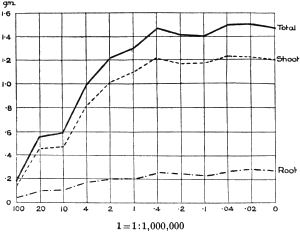
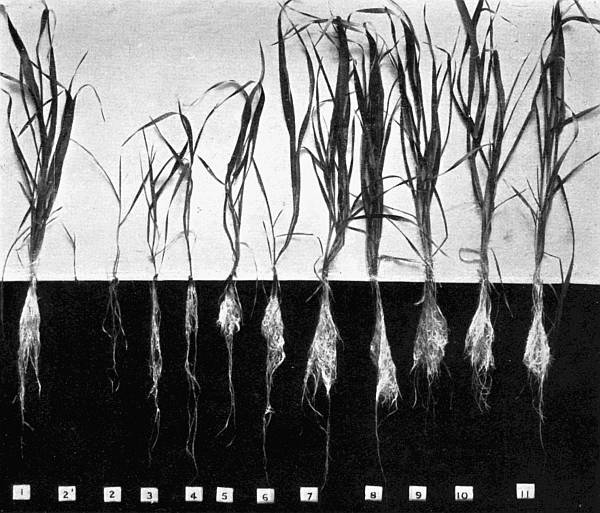
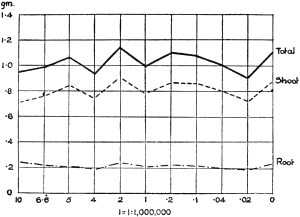
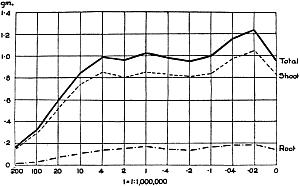
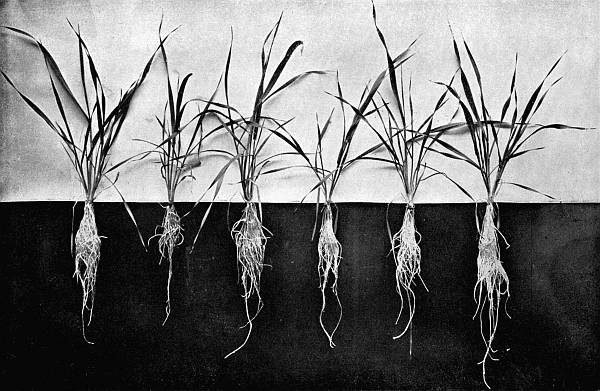
poison. For instance, a concentration of 1:1,000,000 copper sulphate
alone stops all growth in barley, but, if nutrient salts are present, a
strength of 1:250,000 (at least four times as great) does not prevent
growth, though the retarding action is very considerable (Figs. 2 and 3).
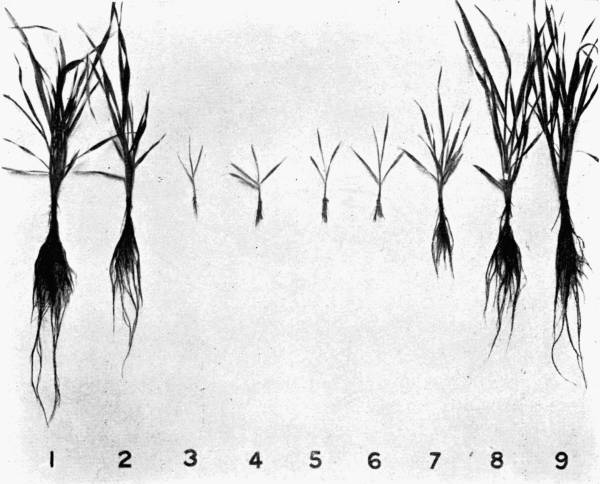
Fig. 2. Photograph showing the action of copper sulphate on barley in the presence
of nutrient salts. (March 5th–April 19th, 1907.)
| 1. |
Glass distilled water. |
| 2. |
Copper distilled water. |
| 3. |
1/12,500 |
copper |
sulphate. |
| 4. |
1/25,000 |
„ |
„ |
| 5. |
1/50,000 |
„ |
„ |
| 6. |
1/100,000 |
„ |
„ |
| 7. |
1/250,000 |
„ |
„ |
| 8. |
1/500,000 |
„ |
„ |
| 9. |
1/1,000,000 |
„ |
„ |
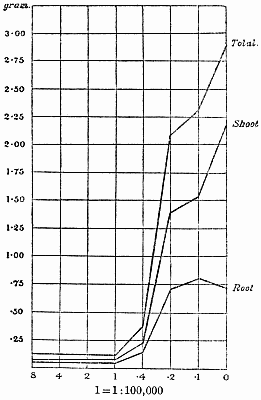
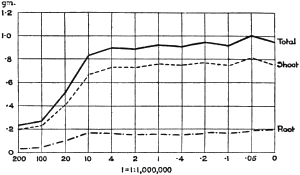
Fig. 3. Curve showing the dry weights of a series of barley plants grown in the presence
of copper sulphate and nutrient salts. (March 13th–May 3rd, 1907.)
Note. In each scale of concentrations represented in the curves a convenient intermediate
strength is selected as a unit, and all other concentrations in the series are
expressed in terms of that unit. Thus, with 1/1,000,000 as the unit a scale of concentrations
might run thus:
| 10 |
1/100,000 |
| 4 |
1/250,000 |
| 2 |
1/500,000 |
| 1 |
1/1,000,000 |
| 0·5 |
1/2,000,000 |
| 0·1 |
1/10,000,000 |
| 0·05 |
1/20,000,000 |
| 0· |
Control. |
These later Rothamsted results fit in very well with those obtained
ten years ago (1903) by True and Gies in their experiments on the
physiological action of some of the heavy metals in mixed solutions.
Plants of Lupinus albus were tested for 24–48 hours with different
solutions in which the roots were immersed. Given the same strength
of the same poison, the addition of different salts yielded varying
results. For instance, with copper chloride as the toxic agent, the
addition of magnesium chloride did not affect the toxicity, calcium
chloride decreased it, while sodium chloride slightly increased the
poisonous action. Calcium sulphate with copper sulphate enabled a
plant to withstand four times as much copper as when the latter was
used in pure solution. Calcium salts in conjunction with those of
copper proved generally to accelerate but not to increase growth, but
with silver salts they did not cause any improvement. Perhaps this
amelioration is in inverse proportion to the activity of the heavy metals.
With a complex mixture consisting of five salts—copper sulphate and
salts of sodium, magnesium, calcium and potassium, all except calcium
being present in concentrations strong enough to interfere with growth
if used alone—it was shown that “as a result of their presence together,
not only is there no addition of poisonous effects, but a neutralisation
of toxicity to such degree as to permit in the mixed solutions a
growth-rate equal to or greater than that seen in the check
culture.” If the concentration of the copper salts was increased, the
other salts remaining the same, the poisonous activity of the copper
became greater than could be neutralised by the other salts. If the
copper remained the same and the other salts were diminished by half
(i.e. below toxic concentration) the neutralising action of the added
salts was markedly less, and the growth rate never exceeded that of the
control. This was apparently due to the action of the unneutralised
copper. The indications are that the conspicuously effective part of
the molecule is the cation or metal, and that the anion plays little or
no part in causing the toxicity; in such great dilutions the metals act
as free ions. The hypothesis is put forward that interior physiological
modifications are responsible for the observed differences in growth rate,
the cell processes being so affected as to bring about different results on
cellular growth; in other words, the growth rate represents the physiological
sum of oppositely acting stimuli or of antagonistic protoplasmic
changes where mixtures of salts occur. This is really an extension of
Heald’s idea that the toxic effect of a poison is due partly to changes in
the turgescence of the cell, a sudden decrease causing retardation or
inhibition of growth, and partly to a direct action on the protoplasm,
which differs in different plants with the same salt. Heald (1896)
went so far as to suggest that the poisonous action is a mere matter
of adaptation and adjustment, since toxic substances are not usually
present in soil, but this assertion is too sweeping to be accepted in its
entirety, although it probably holds good to a certain extent with some
species of plants.
Kahlenberg and True (1896) found that the addition of an organic
substance produced the same effect as the addition of some nutrient
salt, in that it reduced the toxicity of the copper salt, e.g. in the
presence of sugar and potassium hydrate the lupins were able to withstand
a concentration of 1/400 copper sulphate, part of which reduction
of toxicity is attributed to the sugar.
(c) Effect of adding insoluble substances to solutions of copper salts.
Other investigators have shown that the presence of insoluble
substances has a similar effect in reducing toxicity to an even greater
degree. True and Oglevee (1904, 1905) again used Lupinus albus as
a test plant in the presence of solutions of various poisons in pure
distilled water, copper sulphate, silver nitrate, mercuric chloride, hydrochloric
acid, sodium hydroxide, thymol and resorcinol all coming under
consideration. Clean sea sand, powdered Bohemian glass, shredded
filter paper, finely divided paraffin wax and pure unruptured starch
grains were respectively added to the solutions, and seedlings were
suspended over glass rods so that their roots were in the solutions for
24–48 hours. The solids varied in their action on the different poisons;
while the toxic influence of mercuric chloride was reduced by sand
and crushed glass, the action of silver nitrate was modified by nearly
all the solids. Lupin roots proved unable to withstand an exposure of
24 hours to a concentration of copper sulphate of 1 molecular weight
in 60,000 litres of water (i.e. about 1 part by weight CuSO4 . 5H2O in
240·4 parts water), but the addition of solids caused a great decrease
in toxicity. When the amount of copper was diminished an advantage
was regularly obtained in favour of the cultures containing the solid
bodies. On the whole the ameliorating action of solids is more clearly
marked with dilute solutions of strong poisons than with relatively
concentrated solutions of weaker poisons. As a general rule, filter
paper and potato starch grains exert a more marked modifying action
than the denser bodies, such as sand, glass or paraffin.
Breazeale (1906) tested the same point with extracts of certain soils
which proved toxic to wheat seedlings grown in them as water cultures.
The toxicity was wholly or partly removed by the addition of such
substances as carbon black, calcium carbonate or ferric hydrate. Other
experiments showed that the toxic substances of ordinary distilled water
are removed by ferric hydrate and carbon black, and further that the
latter substance will take out copper from copper solutions, rendering
them far less poisonous.
Further corroboration of True and Oglevee’s work was obtained by
Fitch (1906) who worked in a similar way with fungi, arriving at the
general conclusion that insoluble substances in a solution act as agents
of dilution or absorption whereby poisonous ions or molecules are in
some way removed. He found that n/256 of copper sulphate in beet
concoction exercised a stimulating effect on Penicillium glaucum, but
the addition of fine glass to the solution increased the stimulation,
while large or medium sized pieces did not have the same effect.
This action of solid bodies in reducing the deleterious effects of
poisonous solutions is attributed to the process of “adsorption” whereby
a layer of greater molecular density is formed on the surfaces of solids
immersed in solutions. The solids presumably withdraw a certain proportion
of poisonous ions or molecules from the body of the solution
(retaining them in a molecularly denser layer over their own surfaces),
so that the toxic properties of the solution are reduced owing to the
withdrawal of part of the poison from the field of action. In some cases
this reduction may be so great as to relieve the solution of its toxic
properties, or even to cause an abnormal acceleration to replace a
marked retardation. Also, if the solution is of such a dilution as
to cause acceleration of growth in plants, the addition of insoluble
substances may increase this acceleration. The progressive addition of
quantities of solids causes progressive dilution of the toxic medium,
the underlying cause of these results being the gradual removal of
molecules or ions from the solutions by the insoluble body present.
Fitch’s results are also in accordance with the well-known fact that
the physical condition and properties of the added solid play a considerable
part in determining its efficacy as an adsorbing agent.
(d) Effect of copper on plant growth when present in soils.
As has already been shown the toxic property of copper with regard
to plants was recognised almost as soon as that element was found to
occur in the vegetable kingdom, but little notice was taken of the
discovery for many years. In 1882 F. C. Phillips asserted, as the
result of experiments with various cultivated flowering plants, including
geraniums, coleas, ageratum, pansies, &c., that under favourable conditions
plants will absorb small quantities of copper by their roots, and
that such compounds exercise a distinctly retarding influence even if in
very small amount, while if large quantities are present they tend to
check root formation, either killing the plants outright or so far reducing
their vitality as seriously to interfere with nutrition and growth. Two
years later Knop confirmed both the absorption and the toxicity of
copper by his experiments on maize.
Jensen (1907) worked with “artificial” soils, under sterile conditions,
using finely ground quartz flour for his medium and wheat for a test
plant, parallel experiments being carried on with solutions. Every
precaution was taken to ensure sterility—the corks were boiled first in
water and then in paraffin, the seeds were sterilised in 2% copper
sulphate solution for 3⁄4 hour, washed in sterilised water, planted in
sterilised sphagnum, the transplanting being done in a sterile chamber
into sterilised solutions. The criteria used to determine the toxic and
stimulation effects were the total transpiration, average length of sprout,
the green weight and dry weight of plants. The results obtained with
the different substrata showed that it does not follow that a salt highly
toxic in solution is equally so in soil, or that one which holds a relatively
high toxic position in soil should occupy the same relative position in
solution cultures. For instance, while in soil cultures nickel compounds
were the most toxic of all the substances tried, in solution cultures
silver compounds were more poisonous than nickel. The range of concentrations,
both fatal and accelerating, was found to be much greater
in solution than in soil cultures.
In the sand cultures the toxicity of the copper sulphate was found
to decrease as the ratio of the quartz sand to the poisonous solution
increased, provided that a water content suitable for growth was present.
Jensen states that the fatal concentration of copper sulphate in solution
cultures is approximately 1⁄10th that of the fatal concentration in his
artificial soil.
When copper salts are added to soil a complication at once sets in
due to the double decomposition which is always likely to occur when
any soluble salt is added to soil. The reaction may be graphically
expressed as follows, in a much simplified form—
AB + CD = AC + BD.
Haselhoff (1892) extracted several lots of 25 kgm. soil, each with
25 litres of water in which quantities of mixed copper salts varying from
0–200 mg. had been dissolved, the mixture consisting of three parts
copper sulphate and one part copper nitrate. This operation was repeated
15 times, the soils being allowed to drain thoroughly after each treatment,
so that altogether each 25 kgm. soil was extracted with 375 litres
water. The drainage waters were analysed, so that the amount of copper
absorbed by the soils could be estimated. It was found that by extracting
with water containing such soluble copper salts as sulphate and
nitrate, the food salts of the soil, especially those of calcium and potassium,
were dissolved and washed out, copper oxide being retained by the
soil. In this way a double action was manifest, whereby the fertility
of the soil was reduced by the loss of plant food, while its toxicity was
increased by the accumulation of copper oxide. So long as the soil
contained a good supply of undissolved calcium carbonate the harmful
action of the copper-containing water was diminished, but as soon as
the store was exhausted by solution and leaching, the toxic influence
became far more evident.
(e) Mode of action of copper on plants.
Quite early in the investigations on the effect of copper on plants
the question arose as to its mode of activity—whether the toxicity was
merely due to some mechanical action on the root from outside, whereby
the absorptive power of the root was impaired, or whether the poisonous
substance was absorbed into the plant, so acting directly on the internal
tissues. Gorup-Besanez made definite experiments towards ascertaining
the truth of these theories as far back as 1863, endeavouring first
of all to see whether the plants take up any appreciable quantity of
poisons which exist in the soil as mixtures or combinations and which
are capable of solution by the cell-sap. Salts of arsenic, copper, lead,
zinc and mercury were intimately mixed with soil, 30 grams of the
poison being added to 30·7 cubic decimetres of soil, two plants separated
by a partition being grown on this quantity. The test plants were
Polygonum Fagopyrum, Pisum sativum, Secale cereale and Panicum
italicum, and all the plants developed strongly and normally except the
last named. The Panicum developed very badly coloured leaves in
an arsenic-containing soil, and the plants were killed soon after they
started in soils containing copper. After harvesting, the crops were
analysed and no trace of copper was found in any one of the experimental
plants by the methods adopted. Also the absorption capacity of
different soils for different poisons was shown to vary, for basic salts are
absorbed, while acids may pass completely through the soil into the
drainage water.
These results obtained by Gorup-Besanez are possibly not altogether
above criticism, for later workers showed that copper was absorbed to
some extent by plants grown in water cultures, and if that is so it seems
unlikely that no absorption should take place from soil. Nevertheless,
the absorption is very slight, for apparently living protoplasm is very
resistant to copper osmotically. Otto showed that beans, maize and
peas can have their roots for a long time in a relatively concentrated
solution of copper sulphate, and yet take up very little copper indeed,
but analyses do reveal slight traces after a sufficient interval of time
of contact has elapsed. Berlese and Sostegni indicate that the roots of
plants grown in water culture in the presence of bicarbonate of copper
showed traces of copper.
Verschaffelt (1905) devised an ingenious method of estimating the
toxic limits of plant poisons, though it is rather difficult to see how
the method can be put to practical use with water culture and soil
experiments. Living tissues increase in weight when put into water
on account of the absorption of water. Dead tissues do not, as
they have lost their semi-permeable characteristics, so a decrease in
weight takes place owing to part of the water passing out. This
principle is applied by Verschaffelt to determine the “mortal limit”
of external agents in their action on plant tissues. Root of beetroot,
potato tuber, aloe leaves, and parts of other plants rich in sugar all
came under review. The parts were cut into small pieces weighing
about 3–5 grams, dried with filter paper, weighed, and plunged into
solutions of copper sulphate of varying strengths from ·001–·004 gm.
mol. per litre, and left for 24 hours. After drying and again weighing
all were heavier owing to the absorption of water. The pieces were
then immersed in pure water for another period of 24 hours, when
after drying and weighing, those from the weaker strengths of copper
sulphate (·001–·002) had absorbed yet more water, while those from
higher concentrations (·003–·004) had lost weight. So the author
assumes that for such pieces of potato the limit of toxicity lies between
·002 and ·003 gm. mol. copper sulphate per litre.
These experiments may possibly give some indication as to the
action of copper salts on plant roots. So long as the solution of copper
salt is dilute enough, the absorption layer of the root, acting as a semi-permeable
membrane and upheld by the resistant protoplasm, is able
to keep the copper out of the plant and to check its toxicity. As soon
as a certain limit is reached the copper exercises a corrosive influence
upon the outer layer of the root whereby its functions are impaired, so
that it is no longer able efficiently to resist the entry of the poison.
As the concentration increases it is easy to conceive that the harmful
action should extend to the protoplasm itself, so that the vital activities
of the plants are seriously interfered with and growth is entirely or
partially checked, death ensuing in the presence of sufficiently high
concentrations.
The action of copper on the germination of seeds, spores and pollen
grains has attracted a certain amount of attention, and although the
results are apparently contradictory this is probably due to the different
plant organs with which the observers have worked.
(a) Seeds.
Miyajima (1897) showed that the germinating power of such seeds
as Vicia Faba, Pisum sativum, and Zea Mays was partly destroyed
by a 1% solution of copper[4], Zea Mays being the most resistant
and Vicia Faba the least resistant of the three. Micheels (1904–5)
stated that water distilled in a tinned copper vessel was more favourable
for germination than water from a non-tinned vessel. He suggests that
this is due to copper being present in the water in a colloidal form
in which the particles are exceedingly small and maintain themselves
in the liquid by reason of a uniform disengagement of energy in all
directions, to which energy the influence on germinating seeds must be
attributed, the nature of the suspended substance determining whether
the influence be favourable or not. It is questionable, however, whether
Micheels was really dealing with a true colloidal solution of copper
or with a dilute solution of some copper salt produced by oxidation
of the copper vessel from which his distilled water was obtained.
(b) Spores and pollen grains.
Miani (1901) brought fresh ideas to bear upon the problem of the
action of copper on living plant cells, in that he sought to attribute
the toxic or stimulant effects to an oligodynamic action, i.e. spores
and pollen grains were grown in hanging drop cultures in pure glass
distilled water with the addition of certain salts or traces of certain
metals. While the salts are known to be often disadvantageous to
germination, Nägeli had asserted that the latter often exerted an oligodynamic
action. In some cases pure copper was placed for varying times
in the water from which the hanging drop cultures were eventually
made, or tiny bits of copper were placed in the drop itself. Various
kinds of pollen grains were tested, and as a rule, pollen was only taken
from one anther in each experiment, though occasionally it was from
several anthers of the same flower. It was generally found that the
germination of pollen grains or Ustilago spores was not hindered by
the use of coppered water or by the presence of small bits of copper in
the culture solution. The only cases in which some spores or pollen
grains were more or less harmed were those in which the water had
stood over copper for more than two weeks, and even so the deleterious
effect was chiefly noticeable when the pollen itself was old or derived
from flowers in which the anther formation was nearly at an end. As
a rule germination was better in the presence of copper, whether in
pure water or food solution, the stimulus being indicated both by the
greater number of germinated grains and by the regular and rapid
growth of the pollen tubes. Miani attributes this favourable action to
the mere presence of the copper, corroborating Nägeli’s idea of an
oligodynamic action.
From the foregoing review it is evident that it is the toxic action
of copper that is most to the front, so far as the higher plants are
concerned, and that little or no evidence of its stimulative action
in great dilution has so far been discussed. Kanda dealt with this
question, with the deliberate intention of obtaining such evidence,
if it existed. He worked with Pisum sativum, var. arvense, Pisum
arvense, Vicia Faba, var. equine Pers, and Fagopyrum esculentum
Mönch, which were grown in glass distilled water, without any food
salts, so that the plants were forced to live on the reserves in the seeds,
which were carefully graded to ensure uniformity of size. It was found
that in water cultures copper sulphate solutions down to ·00000249%
(about 1 in 40,160,000) are harmful to peas, and still further down to
·0000000249% (about 1 in 4,016,000,000) the copper salts act as a
poison rather than as a stimulant. Against this, however, is the statement
that in certain soils copper sulphate acts as a stimulant when it
is added in solution. Jensen again could obtain no stimulation with
copper sulphate.
The Rothamsted experiments go to uphold Kanda’s statements as
to the failure of copper sulphate to stimulate plants grown in water
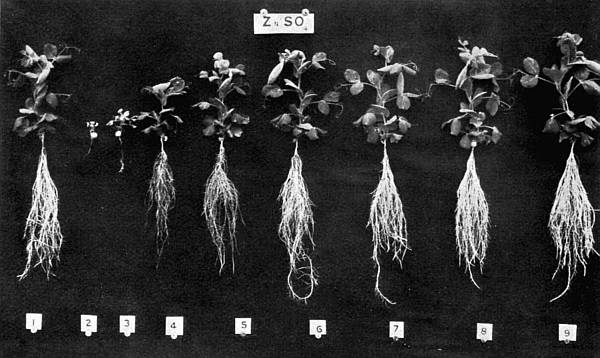
cultures. Peas are perhaps slightly more resistant to the greater
strengths of copper sulphate than are barley and buckwheat, for while
1/100,000 proves mortal to the latter, peas will struggle on and fruit
in 1/50,000, though this strength is very near the limit beyond which no
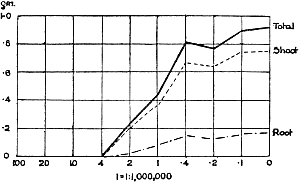
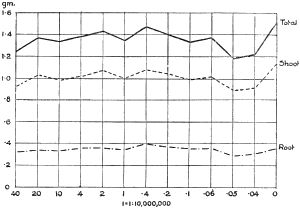
growth can occur (Fig. 4). As a general rule, with barley the depression
caused by the poison is still evident with 1/5,000,000 and 1/10,000,000,
though occasionally these doses act as indifferent doses, no sign of
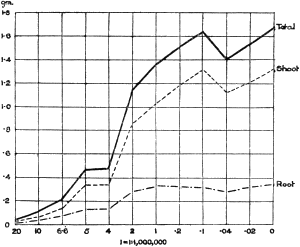
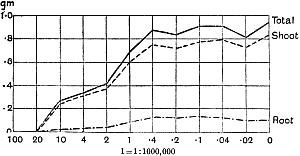
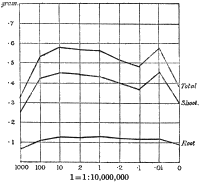
stimulation appearing in any single instance. With peas again, even
1/20,000,000 copper sulphate is poisonous, although to the eye there is
little to choose between the control plants and those receiving poison
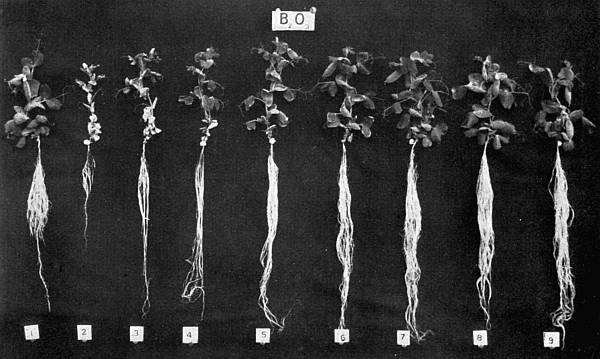
up to a concentration of one part in 21⁄2 million (Fig. 5). In the case
of buckwheat the matter is still undecided, as in some experiments
apparent stimulation is obtained with 1 in 21⁄2 or 1 in 5 million copper
sulphate, while in others a consistent depression is evident, even when
the dilution is carried considerably below this limit. The reason for
the variation with this particular plant is so far unexplained.
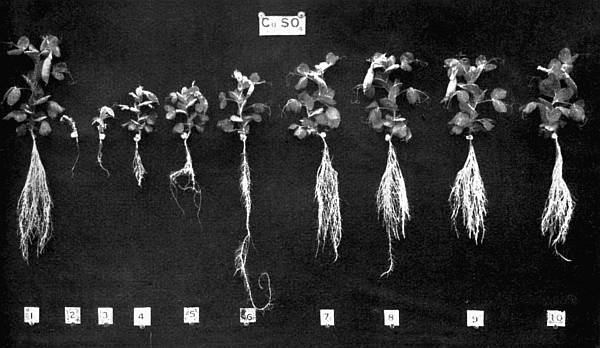
Fig. 4. Photograph showing the action of copper sulphate on pea plants in the
presence of nutrient salts. (Oct. 3rd–Dec. 20th, 1912.)
| 1. |
Control. |
| 2. |
1/50,000 |
copper |
sulphate. |
| 3. |
1/100,000 |
„ |
„ |
| 4. |
1/250,000 |
„ |
„ |
| 5. |
1/500,000 |
„ |
„ |
| 6. |
1/1,000,000 |
„ |
„ |
| 7. |
1/2,500,000 |
„ |
„ |
| 8. |
1/5,000,000 |
„ |
„ |
| 9. |
1/10,000,000 |
„ |
„ |
| 10. |
1/20,000,000 |
„ |
„ |
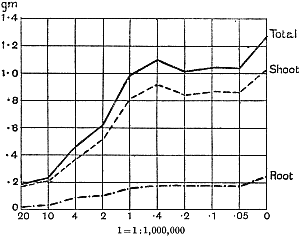
Fig. 5. Curve showing the mean values of the dry weights of four series of pea plants
grown in the presence of copper sulphate and nutrient salts. (Oct. 3rd–Dec. 20th,
1912.)
Yet, in spite of all the accumulated evidence as to the consistent
toxicity of copper salts in great dilution, the possibility still remains
that the limit of toxicity has not yet been reached, and that a stimulating
concentration does exist, so that it is still uncertain whether
beyond the limits of toxicity copper salts act as indifferent or stimulative
agents.
The bulk of the work on the relations of copper with the life-processes
of plants has dealt with those cases in which the metal has
been supplied to the roots in some form or other, and many of the
results may be said to apply more strictly to the theoretical, or rather
to the purely scientific aspects of the matter, than to the practical
everyday life of the community. This statement is hardly correct, in
that the two lines of work are so inextricably interwoven that the one
could not be satisfactorily followed up without a parallel march of progress
along the other. In practice, copper has proved remarkably efficient as
a fungicide when applied as sprays in the form of Bordeaux mixture to
infested plants and trees. Observations on the action of the fungicide
have shown that the physiological processes of the treated plants are
also affected to some degree, and a number of interesting theories and
results have been put forward.
(a) Effect of copper sprays on leaves.
Frank and Krüger (1894) treated potato plants with a 2% Bordeaux
mixture, and obtained a definite improvement in growth, which they
attributed to the direct action of the Bordeaux mixture upon the
activities of the plant. The effect of the copper was most marked in
the leaves, and was chiefly indicated by increase in physiological activity
rather than by morphological changes. The structure of the sprayed
leaves was not fundamentally changed but they were thicker and
stronger in some degree, while their life was lengthened. Apparently,
treatment increased the chlorophyll content, and, correlated with this,
was a rise in the assimilatory capacity, more starch being produced.
Rise in transpiration was also observed. While the leaves were the
organs most affected, a subsidiary stimulation occurred in the tubers,
since the greater quantity of starch produced required more accommodation
for its storage. In different varieties the ratio of tuber
formation on treated and untreated plants was 19:17 and 17:16. In
discussing the meaning of this stimulation these writers, following the
custom then in vogue, were inclined to hold that it was due to a catalytic
rather than to a purely chemical action, an idea similar to one
which later on came much into prominence in connection with the
work of Bertrand’s school on manganese, boron and other substances.
The imputed increase in photo-synthesis seems to have met with
approval and acceptance, but nevertheless it did not pass unchallenged.
Ewert (1905) brought forward a detailed discussion and criticism of the
assumption that green plants when treated with Bordeaux mixture
attain a higher assimilation activity than untreated plants. His experiments
were made to test the effects of differing conditions of life on
plants treated in various ways, and his conclusions lead him to assert
that “instead of the organic life of the plant being stimulated by
treatment with Bordeaux mixture it is rather hindered.”
While Frank and Krüger indicated a rise in transpiration when
copper compounds were applied to the leaves as sprays, Hattori (1901)
attributed part of the toxic effect of copper salts, when applied to
the roots, to a weakening action on the transpiration stream, and
he maintained that the toxic effect of the copper salts is therefore
connected with the humidity of the air. No further confirmation or
refutation of this statement has so far come to light.
In certain plants the application of cupric solutions as sprays causes
a slight increase in the quantity of sugar present in the matured fruits.
Chuard and Porchet (1902, 1903) consider that such a modification in
the ripe fruit during the process of maturation occurs in all plants which
ripen their fruits before leaf-fall begins. Injection of solutions of copper
salts into the tissues of such plants as the vine causes more vigorous
growth, more intense colour and greater persistence of the leaves; in
other words the copper acts as a stimulant to all the cells of the organism.
A similar effect is produced by other metals such as iron or cadmium. By
injecting small quantities of cupric salts into the branches of currants
an acceleration of the maturation of the fruits was caused, identical
with that obtained by the application of Bordeaux mixture to the leaves.
If the quantity of copper introduced into the vegetable organism was
augmented, the toxic action of the metal began to come into play.
These investigators attributed the stimulus, as shown by the earlier
maturation of the fruits, to a greater activity of all the cells of the
organism and not to an excitation exercised only on the chlorophyll
functions.
(b) Effect of solutions of copper salts on leaves.
Treboux (1903) demonstrated the harmful action of solutions of
copper salts on leaves by means of experiments on shoots of Elodea
canadensis. The activity of photo-synthesis was measured by the rate
of emission of bubbles of oxygen. On placing the shoots first in water,
then in N/1,000,000 copper sulphate (·0000159%), there was a reduction
from 20 to 15 or 16 bubbles in 5 minutes. On replacing in water
there was an increase to 18, but not to 20, indicating a permanent
injury. With N/10,000,000 copper sulphate there was little or no reduction
in the number of bubbles. This experiment had an interesting
side issue in that it was noticed that not only the concentration, but
also the quantity of fluid was concerned in the toxic action, indicating
that both the proportion and the actual amount of poison available
play their part. For instance, with a shoot 10 cm. long in 100 c.c.
solution the plants were only slightly affected by ·000015% copper
sulphate, but in 500 c.c. solution the shoots were killed after some
days in ·0000015% copper sulphate, a concentration only one-tenth
as great.
While it is evident that copper sprays have a definite action upon
green leaves, whether favourable or unfavourable, the question arises as
to the means whereby the copper obtains access to the plant in order
to take effect. Dandeno found that solutions of copper sulphate were
absorbed by the leaves of Ampelopsis, forming a brown ring. Generally
speaking inorganic salts in solution are absorbed through both surfaces
of the leaves, whether the leaves are detached or not, provided the surrounding
atmospheric conditions are favourable, the absorption being
usually more ready through the lower surface. Dilute solutions applied
in drops stimulate the leaf tissue in a ring, whereas if the solutions are
concentrated the entire area covered by the drop is affected. Too concentrated
solutions of copper sulphate applied to leaves caused scorching,
but if this was avoided while the solution was still strong enough to
cause a darkening of green colour after a time, Dandeno considered that
the action was probably of the nature of a stimulus to growth, and produced
a better development of chlorophyll and protoplasm in the region
where the tissues appeared dark to the naked eye, a conclusion which
tallies very closely with that of Frank and Krüger.
Amos (1907–8) experimented to see whether the application of
Bordeaux mixture affected the assimilation of carbon dioxide by the
leaves of plants, and whether any stimulation was produced. Brown
and Escombe’s methods and apparatus were used and the summarised
results indicate that the application of Bordeaux mixture to the leaves
of plants diminishes the assimilation of carbon dioxide by those leaves
for a time. The effect gradually passes off, whatever the age of the
leaves may be. The suggestion is made that the stomata are blocked
by the Bordeaux mixture, so that less air diffuses into the intercellular
spaces and less carbon dioxide comes into contact with the absorptive
surfaces. If this hypothesis is correct, the physiological slackening of
assimilation is not due to the toxic action of the copper in the Bordeaux
mixture, but to a mechanical hindrance due to blocking of the stomata.
On turning to the lower plants, especially to some species of fungi,
one notices a striking contrast in their behaviour to that of the higher
plants. Some species of fungi have the power of living and flourishing
in the presence of relatively large quantities of copper compounds, or
even of copper or bronze in the solid state. Dubois (1890) found that
concentrated solutions of copper sulphate, neutralised by ammonia, which
were used for the immersion of gelatine plates used in photography,
showed white flocculent masses resembling the mycelium of Penicillium
and Aspergillus, which grew rapidly and fructified in Raulin’s solution,
but which remained as mycelium in cupric solutions. The mould
proved capable of transforming copper sulphate into malachite in the
presence of a piece of bronze, but it was found that the presence of
the latter was not essential for the conversion into basic carbonate.
The same result was obtained if the culture liquid was put in contact
with a body which prevented it from becoming acid, fragments of
marble acting in this way. Copper sulphate solution in the presence
of the mould produced a green deposit on the marble, while without
the fungus the solution simply evaporated leaving a blue stain of
copper sulphate.
Trabut (1895) found that on treating smutty wheat with a 2%
solution of copper sulphate he obtained a mass of flocculent white
mycelium, whose surface was soon covered with aerial branches bearing
pale rose-coloured spores, and he gave the provisional name of Penicillium
cupricum to the species. On preparing nutritive solutions by steeping
a handful of wheat in water for 24 hours, and then adding various
amounts of copper sulphate to them, Penicillium was found to vegetate
quite well until the amount of copper sulphate reached 91⁄2 grams in
100 c.c., after which the seedings with spores did not develope at all. De
Seynes tested this Penicillium more exhaustively with different culture
media under various conditions and decided that Trabut was right in only
assigning the name P. cupricum provisionally, as the mould reverts to
the form P. glaucum when seeded in a natural medium, indicating that
P. cupricum has not an autonomous existence, but is P. glaucum which
modifies the colour of its conidia under the influence of copper sulphate,
in the same way that it often modifies them in other media. It is
noticeable that the mycelium arising from the germination of conidia of
P. cupricum in a normal medium has a very poor capacity for producing
reproductive organs, but this diminished activity is attributed not to a
special deleterious action of the copper sulphate but to the impulse given
to the vegetative functions, at the expense of the reproductive, when the
spores are seeded in a richer medium than the solutions of copper
sulphate which serve as the soil for P. cupricum.
Ono found that Aspergillus and Penicillium are retarded in growth
in the higher concentrations of copper sulphate, but that they are
stimulated by weaker strengths. The range of stimulating concentrations
is given as from ·0015%–·012%, the biggest crop being obtained
with both moulds in the strongest of these solutions. Hattori gives
the optimum as being considerably lower for the two fungi mentioned,
Penicillium being at its best in a solution of ·008% and Aspergillus in
·004%. A. Richter (1901) opposes this absolutely so far as Aspergillus
niger is concerned. In his experiments copper appears invariably as a
depressant, all concentrations from 1/150 to 1/150,000,000 giving growth
below the normal, no stimulative action ever being observed. Zinc
however proved to be a definite stimulant and in a mixture of copper
and zinc salts in appropriate concentrations the toxic effect of the
copper was completely paralysed by the stimulating action of the zinc,
1/200,000 zinc salt paralysing or overcoming the copper salt at 1/1125.
Ono states that the optimal quantity of such poisons as copper salts
is lower for algae than for fungi, copper failing to stimulate algae at
dilutions which were the most favourable to the growth of fungi.
Bokorny indicates that silver and copper salts work harm in unusually
dilute solutions.
Attempts have been made to utilise the poisonous action of copper
on algae in clearing ponds of those plants. Lindsay (1913) describes
experiments carried on in a reservoir infested with Spirogyra. A
quantity of copper sulphate sufficient to make a solution of 1/50,000,000
was found necessary to kill off the Spirogyra, but it is suggested that
the solution was probably weaker before it reached the algae, owing to
the currents of fresh water. Anaboena needed 1/10,000,000 before it
was killed off, while Oscillatoria is less sensitive still, 1/5,000,000 usually
representing the mortal dose, though 1/4,000,000 was necessary in some
instances. Algae seem to be peculiarly sensitive to the copper sulphate,
far more so than the higher plants, as Nuphar lutea, Menyanthes
trifoliata, and Polygonum amphibium grew in the water unharmed by
the addition of the poisonous substance. For some unexplained reason
it seems that “the concentration of copper sulphate necessary to kill off
the algae in the laboratory is five to twenty times as great as that
needed to destroy the same species in its natural habitat.”
Altogether, after looking at the question from many points of view,
one is forced to the conclusion that under most typical circumstances
copper compounds act as poisons to the higher plants, and that it is
only under particular and peculiar conditions and in very great dilutions
that any stimulative action on their part can be clearly demonstrated.