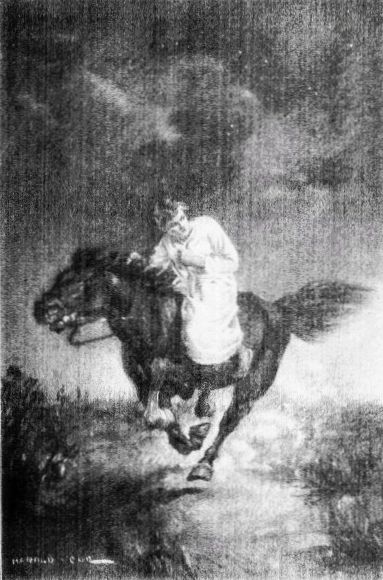
They couldn't shoot him—he was going too fast — THE GOLDEN WEST BOYS — INJUN AND WHITEY TO THE RESCUE
E-text prepared by Juliet Sutherland, Paul Ereaut,
and the Project Gutenberg Online Distributed Proofreading Team
(https://www.pgdp.net/)
Whole book · 29 sections
E-text prepared by Juliet Sutherland, Paul Ereaut,
and the Project Gutenberg Online Distributed Proofreading Team
(https://www.pgdp.net/)
AUTHOR OF
INJUN AND WHITEY
AND INJUN AND WHITEY STRIKE OUT FOR THEMSELVES, Etc.
GROSSET & DUNLAP
PUBLISHERS NEW YORK
Made in the United States of America
COPYRIGHT, 1922, BY WILLIAM S. HART
ALL RIGHTS RESERVED
PRINTED IN THE U.S.A.
In the Boys' Golden West Series I have done my best to present to its readers the West that I knew as a boy.
Frontier days were made up of many different kinds of humans. There were men who were muddy-bellied coyotes, so low that they hugged the ground like a snake. There were girls whose cheeks were so toughened by shame as to be hardly knowable from squaws. There were stoic Indians with red-raw, liquor-dilated eyes, peaceable and just when sober, boastful and intolerant when drunk. And then there were those White Men, those moulders, those makers of the great, big open-hearted West, that had not yet been denatured by nesters and wire fences, men to whom a Colt gun was the court of last appeal and who did not carry a warrant in their pockets until it was worn out, men who faced staggering odds and danger single-handed and alone, men who created and worked out and made an Ideal Civilization,—a country where doors were left unlocked at night and the windows of the mind were always open,—men who were always kind to the weak and unprotected, even if they did have hoofs and horns, men like William B. (Bat) Masterson and Wyatt Earp. They and their kind made the frontier, that Great West which we can now look back upon as the most romantic era of our American History.
I love it; I love all that was ever connected with it; and to all those who are in sympathy with my crude efforts to set forth what little I know, to each and every boy who feels a choke in his throat when he reads the closing lines of "In Memory," I say, I have a choke in my throat too, and I am silently clutching your hand, for that red boy has crossed the Big Divide and gone to the Happy Hunting Grounds and the white boy is saying Farewell.
The Author
| Chapter | Page | |
| I. | An Arrival | 1 |
| II. | A Surprise | 13 |
| III. | Mystery | 26 |
| IV. | Solution | 39 |
| V. | Bunk-House Talk | 51 |
| VI | Boots | 66 |
| VII. | Education and Other Things | 77 |
| VIII. | Injun Talks | 87 |
| IX. | Fish-Hooks and Hooky | 115 |
| X. | A Hard Job | 129 |
| XI. | The T Up and Down | 139 |
| XII. | Felix the Faithless | 150 |
| XIII. | A Fool's Errand | 160 |
| XIV. | The Stampede | 170 |
| XV. | The Cattle-Sheep War | 185 |
| XVI. | "Medicine" | 206 |
| XVII. | "The Pride of the West" | 218 |
| XVIII. | Wonders | 229 |
| XIX. | Threshing-Time | 235 |
| XX. | The Story of the Custer Fight | 247 |
| XXI. | Unrest | 263 |
| XXII. | The New Order | 271 |
| XXIII. | Pioneer Days | 290 |
| XXIV. | "In Memory" | 299 |
There was no doubt that affairs were rather dull on the Bar O Ranch; at least they seemed so to "Whitey," otherwise Alan Sherwood. Since he and his pal, "Injun," had had the adventures incidental to the finding of the gold in the mountains, there had been nothing doing. So life seemed tame to Whitey, to whom so many exciting things had happened since he had come West that he now had a taste for excitement.
It was Saturday, so there were no lessons, and it was a relief to be free from the teachings of John Big Moose, the educated Dakota, who acted as tutor for Injun and Whitey. Not that John was impatient with his pupils. He was too patient, if anything, his own boyhood not being so far behind him that he had forgotten that outdoors, in the Golden West, is apt to prove more interesting to fifteen-year-old youth than printed books—especially when one half the class is of Indian blood.
As Whitey stood near the bunk house and thought of these things, his eye was attracted by a speck moving toward him across the prairie. He watched it with the interest one might have in a ship at sea; as one watches in a place in which few moving things are seen. The speck was small, and was coming toward Whitey slowly.
From around the corner of the bunk house Injun approached. It will be remembered by those who have read of Injun that he was very fond of pink pajamas. As garments, pink pajamas seemed to Injun to be the real thing. It had been hard to convince him that they were not proper for everyday wear, but when he was half convinced of this fact, he had done the next best thing, and taken to a very pink shirt. This, tucked in a large pair of men's trousers, below which were beaded moccasins, was Injun's costume, which he wore with quiet dignity.
"What do you s'pose that is?" asked Whitey, pointing at the speck.
"Dog," Injun answered briefly.
"A dog!" cried Whitey, who, though he had never ceased to wonder at Injun's keenness of sight, was inclined to question it now. "What can a dog be doing out there?"
"Dunno," Injun replied. "Him dog." Injun's education had not as yet sunk in deep enough to affect his speech.
Whitey again turned his eyes toward the object, which certainly was moving slowly, as though tired, and, as the boys watched, sure enough, began to resolve itself into the shape of a dog. Here at last was something happening to break the dullness of the day. A strange dog twenty-five miles from any place in which a dog would naturally be.
Furthermore, when the animal was near enough to be seen distinctly, he furnished another surprise. He was entirely unlike any of the dogs of that neighborhood—the hounds, collies, or terriers. He was white, short, chunky. His head was very large for his size, his jaw undershot, his mouth enormous, and his lower lip drooped carelessly over a couple of fangs on each side. Under small ears his eyes popped almost out of his head, and his snub nose could scarcely be said to be a nose at all. From a wide chest his body narrowed until it joined a short, twisted tail, and his front legs were bowed, as though he had been in the habit of riding a horse all his life.
Injun gazed at this strange being with something as near surprise as he ever allowed himself. "Him look like frog," he declared.
"Why, it's a bulldog, an English bulldog!" exclaimed Whitey, who had seen many of this breed in the East.
"More like bullfrog," Injun maintained solemnly. "What him do—eat bulls?"
The brute's appearance surely was forbidding enough, and if Injun had been subject to fear, which he wasn't, he would have felt it now. He did not know, as many better informed people do not, that beneath this breed's fierce appearance lies the deepest of dog love for a master—and that's a pretty deep love—and that no other "friend of man" holds gentler, kinder feeling for the human race than this queerly shaped animal. And this in spite of the fact that he owes the very queerness of his appearance to man, who has had him bred in that shape, through countless generations, to the end that the poor, faithful beast may do brutal deeds in the bull ring and the dog pit.
Whitey did not know all this—that the wide jaws were designed for a grip on the enemy, the snub nose to permit breathing while that grip was held, the widespread legs to secure a firm ground hold; in short, that he was looking at an animal built for conflict, which had the courage of a lion where his enemies were concerned, and the love of a wild thing for its young where its human friends were concerned.
But Whitey knew the latter part of it—that bulldogs were friendly, and usually misunderstood, and he proceeded to let Injun in on his knowledge. "You needn't be afraid of him," he said.
"No 'fraid, but no go too close," replied the cautious Injun.
Now that this dog was in reach of humans he sat down, opened his cave-like mouth, allowing a few inches of tongue to loll out, panted, and looked amiably at the boys. He certainly was tired.
"He's not only tired, he's thirsty," said Whitey, and ran to the stable for water.
And while he was gone the bulldog and Injun looked at each other—Injun with his bronze skin, his long, straight hair, his calm face, and his steady, dark eyes. This descendant of thousands of fighting men regarded that descendant of thousands of fighting dogs. And what they thought of each other the dog couldn't tell, and Injun didn't, but ever after they were friends.
Presently Whitey returned from the stable with a pan of water, and with Bill Jordan, foreman of the Bar O, Charlie Bassett, Buck Higgins, and Shorty Palmer, all the cowpunchers who happened to be on the place. They all knew bulldogs, and they regarded the newcomer with awe and respect.
Whitey put the water before the dog, who, after favoring him with a grateful glance and a quiver of his stub tail, went to it.
"He's sure awful dry," Bill said. "Ought t' take him up to Moose Lake. Looks like that pan o' water won't even moisten him."
"Where d'ye reck'n he come from?" asked Shorty.
"Dunno."
"Mebbe he was follerin' a wagon, an' got lost," Buck Higgins suggested hopefully.
"Wagon nothin'!" snorted Bill. "Nobody in these parts'd have a dog like that, an' if they did, what would he be doin' follerin' a wagon? He ain't built to run, he's built to fight."
Where the dog had come from was something of a mystery. Neighbors were not near by, in those days, in Montana, the nearest being fourteen miles off, and the railway twenty-two, and nothing there but a water tank. There was some discussion regarding the matter which ended in a deadlock. It was certain that none of the ranchmen in the vicinity owned such a dog, and even so, or if a visitor owned him, how would he get to the Bar O? Walk, with "them legs"?
While the discussion went on, the subject of it gulped down large chunks of beef which Whitey had begged from the cook, and after that he went with the men and boys to the ranch house, where, with an apologetic leer, and a wiggle of his tail, he stretched himself on the veranda, and fell into a deep sleep. He was very grateful, but he was also very tired.
In a lonely ranch house matters are of concern which would create little comment in a city. This dog's coming was in the nature of an event at the Bar O. Bill, the foreman, and all the punchers were ready to neglect work for a considerable time and talk about it. Even Injun occasionally looked interested. But all the talk could not solve the problem of the animal's presence.
The only one who knew lay sleeping on the veranda and couldn't tell. It isn't likely that he dreamed, but if he did it might have been of being tied to the handle of a trunk in an overland limited baggage car; of the train's stopping for water at a lonely tank; of the earthy, wholesome country smell that came through the door, left open for coolness.
There had been a stirring in the grass near the track. A glimpse of an animal that looked something like a fox and something like a wolf, and wasn't either one, a wild animal that was sneaking around the train for the odd bits of food that were sometimes left in its wake. As the pungent scent of this beast reached the bulldog's snub nose, the leash that held him to the trunk became a thing of little worth. With a violent lurch he broke it, leaped from the door, landed sprawling alongside the track, and was off in pursuit of the strange animal.
Now, any one who knows how a bulldog is built and how a coyote is built can imagine how much chance the first has to catch the second. The dog followed by sight, not by scent. With his head held as high as his short neck would allow he dashed on. The coyote didn't bother very much. After getting a good start he doubled on his tracks for a little way, turned aside, and sat down. And if he wasn't too mean to laugh, he may at least have smiled as his enemy rushed forward toward nowhere.
Then that bulldog ran and ran until he couldn't run any more. Then he walked till he couldn't walk any farther. Then he slept all night, while other coyotes howled dismally near by. And in the morning he started off again, thinking he was going toward the train and his sorrowful master, really going in the opposite direction. But there was one thing that man hadn't taught him to do in all the years, and that was to quit, so he kept on. And at last, as any one will who keeps going long enough, he had to arrive somewhere and he reached the Bar O Ranch.
So you and I and the dog know how he got there, but Bill Jordan, the punchers, and the boys didn't, and presently they gave up trying to figure it out.
"'Tain't likely his owner'll show up, so he's ours," said Bill Jordan.
"He's Whitey's," Buck Higgins maintained. "He saw him first."
This law was older than any ranch house, or any cowpuncher, so it held good, and Whitey became the proud owner of the dog. The matter of his name came next in importance. Of course he had one, and he was awakened, and asked to respond to as many dog names as the party could think of. These were many, running from Towser to Nero, but they brought no response from the sleepy animal.
"Must be somep'n unusual," Buck Higgins decided, and he ventured on "Alphonse" and "Julius Cæsar," but they didn't fit.
"Well, we jest nachally got t' give him a name," said Shorty Palmer.
Again the list was gone over, but nothing seemed quite right. "Oughta be somep'n' 'propriate," said Bill Jordan. "How 'bout Moses? He was lost in th' wilderness."
"Wilderness nothin'!" objected Buck. "In the bullrushes. Them ain't prairie grass."
"Besides," said Whitey, "he ought to have a fighting name. Napoleon!"
"'Tain't English."
"Wellington."
"Too long."
As he seemed to have no choice in naming his own dog, Whitey turned in despair to Injun, who had stood solemnly by. "How about you?" Whitey asked. "Haven't you a name to suggest?"
The dog knew that he was the subject of the talk, and possibly felt that he ought to keep awake, for he sat on the veranda and blinked at the humans. Injun gazed at him stolidly.
"Huh!" he grunted. "Sittin' Bull."
"Great!" cried all the others.
This matter settled, the men went away. Sitting Bull stretched himself out on the veranda and again fell asleep, and Whitey told Injun that the dog's coming probably was a good omen. That there ought to be something doing on the ranch now.
It was early morning, and the Bar O Ranch slept, heedless of the keen late-autumn air that had in it just a faint, brisk hint of the fall frosts to come. Whitey came out of the ranch house and moved toward the stable. Sitting Bull trudged after him.
The dog was entirely rested, having slept the better part of two days and nights. He seemed to know that Whitey was his new owner. Dogs have an instinct for that sort of thing. And though Bull was civil and friendly enough with every one else on the ranch, he took to Whitey by selection.
At six o'clock each night Bull sat near the ranch-house front door as though waiting for some one. He waited a long time. Bill Jordan, who prided himself on what he knew about dogs, and men, said that Bull's former owner probably was a city man, and was in the habit of coming home at six; that the dog was waiting for him to appear. Be that as it may, in the days to come Bull gave up this custom. No one knew what he felt about the loss of his old master. He became a Montana dog. The city was to know him no more.
Now he waddled along after Whitey, who was making for a straw stack, near the stable. Among the field mice, gophers, rabbits, and such that thought this stack was a pretty nice place to hang around, were two hens that were of the same opinion. At least they made their nests in the stack and laid their eggs there. And they were the only hens that the Bar O boasted, for hens were scarce in Montana in those days—as Buck said, "almost as scarce as hen's teeth, an' every one knows there ain't no such thing."
It was Whitey's particular business to gather the eggs of those hens, which they saw fit to lay early in the morning. So Whitey came to the stack early, to be ahead of any weasels or ferrets, who had an uncommon fondness for eggs. This morning as he moved around the stack he didn't find any eggs, but he saw something black and pointed sticking out of the straw. Whitey took hold of the object and pulled, and the thing lengthened out in his hands.
And right there a sort of shivery feeling attacked Whitey's spine and moved up until it reached his hair, which straightway began to stand on end, for the object was a boot and in it was a man's leg. The boot came, followed by the leg, followed by a man. From what might be called the twin straw beds, another man emerged. Both sat upright in the straw and rubbed their eyes. Whitey didn't wait to see if any more were coming, or even to think of where he was going. He fled.
Instinct took him toward the ranch house, and good fortune brought Bill Jordan out of the door at the same moment.
"Bill!" yelled Whitey, "there's two men in the straw stack!"
Bill did not appear unduly excited. "They ain't eatin' the straw, are they?" he inquired.
"No, but they look awfully tough, and they nearly gave me heart-disease," Whitey panted.
"If tough-lookin' folks could give me heart-disease, I'd of bin dead long ago," Bill responded. "Let's go an' size 'em up."
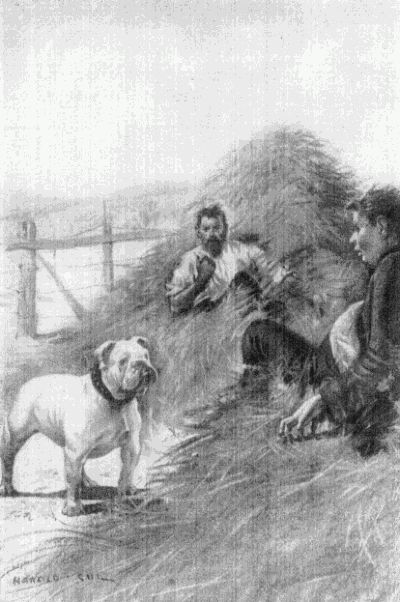
Bill strolled to the stack with Whitey. The two men, now thoroughly awake, were still sitting upright in the straw. In front of them stood Sitting Bull. His lower jaw was sticking out farther than usual, and he was watching the men and awaiting events.
"Hey! Call off yer dog, will ye?" requested one of the men.
"He ain't mine," Bill answered calmly, indicating Whitey. "He's his."
"Well, get him to call him off," said the man. "Every time we move he makes a noise like sudden death."
Whitey summoned Bull, who came to him obediently enough, and the men rose to their feet, and stretched themselves and brushed off some of the straw that clung to their not over-neat attire. They were not as bad-looking as they might have been, neither were they as good-looking. One was tall and slim and wore a dark beard. The other was almost as tall, but, being very fat, did not look his height. He was clean-shaven, or would have been had it not been for about three days' stubbly growth. Their clothes were well-worn, and they wore no collars, but their boots were good.
"What you fellers doin' here?" demanded Bill. "Ain't the bunk house good enough for you?"
"We got in late, an' ev'body was in bed," said the taller of the two. "We're walkin' through for th' thrashin'."
"Well, yer late for that too," said Bill.
The threshing in the early days of Montana was an affair in which many people of all sorts took part, as will be seen later. Bill questioned the men, and their story was brought out. It seemed that they had come from Billings, in search of work at threshing. The taller, thin one was named Hank, but was usually called "String Beans," on account of his scissors-like appearance. He had formerly been a cowpuncher. The other had been a waiter, until he got too fat, then he had become a cook. Originally named Albert, after he had waited in a restaurant for a while he had been dubbed "Ham And," which, you may know, is a short way of ordering ham and eggs. And this name in time was reduced to "Ham."
Bill Jordan did not seem to take the men seriously. Their names may have had something to do with his attitude, and the early West was not over-suspicious, anyway. It had been said that "out here we take every man to be honest, until he is proven to be a thief, and in the East they take every man to be a thief, until he is proven to be honest." You can believe that or not, as you happen to live in the West or in the East. Besides, Bill could make use of the talents of String Beans and Ham. He needed "hands" to work on the ranch.
When Whitey found that his supposed tragedy was turning into a comedy, he felt rather bad about it, especially as Bill was inclined to guy him.
"Lucky you didn't shoot up them two fellers what's named after food," Bill said, when the strangers had retired to the bunk house. "Or knock 'em out with some of them upper-cuts you're so handy in passin' 'round." For a boy, Whitey was an expert boxer.
"What was I to think, finding them that way?" Whitey retorted. "And they don't look very good to me yet."
"Clothin' is only skin deep," said Bill.
Whitey felt called on to justify his alarm. "It's not only their clothes," he said, "but their looks. You noticed that Bull didn't like them, and you know dogs have true instinct about judging people."
"Let me tell you somethin' about dogs," began Bill, who usually was willing to tell Whitey, or anybody else, something about anything. "Dogs is supposed to be democratic, but they ain't. They don't like shabby men. I'm purty fond of dogs, but they got one fault—they're snobs. They don't like shabby men," Bill repeated for emphasis.
As Whitey thought of this he remembered that the dogs he had known had this failing, if it was a failing. He also tried to think of some reason for it, so he could prove that Bill was wrong, but he couldn't. That is, he couldn't think of anything until Bill had gone away and it was too late. Then it occurred to him that it was only the dogs that belonged to the well-dressed that disliked the poorly dressed. That a shabby man's dog loved him just as well as though he wore purple and fine linen, whatever that was. Whitey looked around for Bill to confound him with this truth, but Bill had disappeared—a way he had of doing the moment he got the better of an argument.
If the two men were aching to work, they had not long to suffer; Bill Jordan soon found occupation for them. Slim, the negro cook, had been taken with a "misery" in his side, and Ham was installed in his place. And to do Ham justice he was not such a bad cook. The ranch hands allowed that he couldn't have been worse than Slim, anyway. String Beans did not make so much of a hit as a cowpuncher. Bill watched some of his efforts, and said that though he was a bad puncher he was a good liar for saying he'd ever seen a cow before. So String Beans was sent to the mine to work.
This quartz mine, up in the mountains, was the one near which Injun and Whitey had had so many exciting adventures. Now they owned an interest in it, as has been told, though Mr. Sherwood and a tribe of Dakota Indians were the principal shareholders. During the summer the mine had been undergoing development, and the first shipment of ore was soon to be made.
With String Beans working at the mine, and Ham improving the men's digestion as a cook, it began to look as though Whitey's idea that they were desperate characters was ill-founded. In fact, the thought had almost passed from his mind, and was quite forgotten on a certain Saturday. On that day Injun and Whitey were free from the teachings of John Big Moose, and were out on the plains for antelope. They didn't get an antelope, didn't even see one. All they got were appetites; though Whitey's appetite came without calling, as it were, and always excited the admiration of Bill Jordan. After dinner that evening Whitey went to the bunk house. Some of the cowpunchers were in from the range, and Whitey loved to hear the yarns they would spin.
So he lay in a bunk and listened to a number of stories, and wondered if they were all true—and it is a singular fact that some of them were. But Whitey's day's hunt had been long, and his dinner had been big, and his eyes began to droop.
Buck Higgins was in the midst of a tale about being thrown from his cayuse and breaking his right arm. There was a wild stallion in this story, which every puncher in seven states or so had tried to capture. Now, Buck, with his right arm broken, naturally had to throw his rope with his left, and his manner of doing that took some description. It was during this that in Whitey's mind he, in a mysterious way, changed to Buck, or rather Buck changed to Whitey, and the stallion changed to an antelope, and pretty soon things began to get rather vague generally.
When Whitey awoke, the bunk house was almost dark. How long he had been lying asleep he did not know. The light came from a candle, and presently Whitey heard voices. Three men were seated near by, and Whitey was about to get out of the bunk, when he recognized the voice of String Beans, and something held him back. It was evident that the men did not know that he was there.
Whitey felt something warm stir against him, and, startled, put out his hand and encountered a hairy surface. It was Sitting Bull, who had crawled into the bunk after Whitey had fallen asleep, and crowded in between the boy and the wall. At the sound of String Beans' voice Whitey felt the hair along Bull's neck rise. He remembered the dog's dislike for the two men, and put his hand over Bull's mouth to keep him from growling. Whitey was glad he did not snore. He might now have a chance to learn whether the two were on the level or not.
For the moment Whitey had some qualms about listening, but he soon dismissed them. If these men were open and aboveboard, why were they whispering in the dimly lighted bunk house? Whitey had never been able to overcome the first distrust he had felt for String Beans and Ham. He also had a feeling that he ought to justify that distrust, that in a way it was up to him. So he continued to eavesdrop.
String's tones were low, and did not come to Whitey distinctly. This was unfortunate in one way, but fortunate in another, for had the men been nearer they probably would have seen the boy. Soon another voice broke in, and Whitey knew it as that of "Whiff" Gates, a puncher who was a constant smoker. Then came another voice, that of Ham And.
Whiff Gates did not bear a good reputation, and it was only because of the scarcity of help that Bill Jordan kept him on. As Whitey reflected on this, and the "birds of a feather flock together" idea, he kept very still. His patience was soon rewarded, for as the men grew more earnest in their talk, their tones became louder, though Whitey could not hear as distinctly as he would have liked.
However, he gathered that String had returned from the mine on account of an injury to his foot, caused by a piece of rock falling on it. That there had been some excitement at the mine, owing to a "bug hole" being discovered. Whitey learned afterwards this was a sort of pocket caused by the dripping of water, and containing a small but very rich quantity of ore. Whitey also heard something about a certain date, on which the three were to be at a certain place, but here, to his disgust, the voices were again lowered, as if in caution.
On the whole, though this secret meeting seemed suspicious, the boy did not learn enough to form a basis for action. Presently the men went away, and after waiting until he considered it safe, Whitey left the bunk house, followed by the faithful Bull. Whit ey decided not to tell Bill Jordan what he had heard. Bill probably would only poke fun at him and hand him one of those arguments he couldn't answer.
But the next day he took Injun into his confidence. Injun had no use for String and Ham, and furthermore was a person who could keep a secret. And here was something for the boys to keep to themselves—a mystery,—something to be solved. They would lie low and await events. It made them feel quite important.
Awaiting events did not seem a very thrilling occupation. Of course, there was always John Big Moose's tutoring to fill in the gaps, but that was less thrilling than just waiting, if possible. The teaching took place in the big living-room of the ranch house, a room with a great stone fireplace, the stone for which had been carted down from the mountains; with walls decorated with Indian trophies—tomahawks, bows and arrows, stone pipes and hatchets, knives—and with beadwork, snowshoes, and many other interesting things. All these were enough to take a fellow's mind off his lessons, and besides there was the floor, with its bear and moose and panther skins, each with its history.
And outside, viewed through the big windows, was the rolling prairie, with the touch of early fall on it, sometimes revealed in a light curtain of haze, at which a fellow could gaze and imagine he saw the squaws of the savage tribes gathering the maize for the coming winter's store, while the braves rode off to hunt the buffalo.
Yes, it was rather distracting, but John Big Moose was very patient about the lessons, though he had been eager for knowledge himself. He had worked his way through a Western college, spurred on by the hope of bettering his people, the Dakotas, and he had bettered them. And when Mr. Sherwood, Whitey's father, had gone East, with the understanding that John was to tutor Whitey and Injun, John had resolved to do his best.
But this other Injun, Whitey's pal, was not what you might call eager for knowledge. Reading and writing were all right, and might be put to some practical use, but arithmetic seemed rather useless, and when it came to the "higher branches," geometry and trigonometry, they loomed up to Injun like a bugbear of the future. In his heart Injun pined for his truly loved field of study—the great outdoors.
But presently there came a slight break in the dull routine of words and figures—a half-holiday. The first shipment of ore was to be made from the mine. John Big Moose represented his tribe's interest in this mine, and he was to go and inspect operations. The ore was to come down from the mountain in sacks, loaded on horse and muleback, and to be delivered to the railroad at the Junction, a small settlement about twenty miles south of the ranch.
The boys thought that as they were stock-holders in the mine, they ought to go along and attend to this matter, too, but John couldn't see it that way. He compromised on a half-holiday for them; study in the morning, freedom in the afternoon. So that morning they stuck to their lessons. With John there to oversee them they might neglect their studies. With him away, and the boys placed on their honor, the thing wasn't to be thought of.
And here it might be repeated that Injun had a very strong sense of honor. He had faults, as most of us have, but breaking promises, or what he considered as promises, was not among them.
So that afternoon, as Injun and Whitey could not be with the shipment of ore, they did the next best thing. They rode off into the foothills. And on a grassy hill that commanded a widespread view of the plains, they looked far off over the prairie. And winding across it, clear off near the horizon, they saw tiny specks which represented mules and horses, laden with the sacks of precious ore, and its escort of cowpunchers.
That evening it was lonely at the ranch, Bill Jordan and the other men being at the Junction. String Beans nursed his sore foot, and Ham prepared dinner, which Injun had with Whitey in the ranch house. Time passed and still the men did not return. Evidently they were celebrating the shipment of the mine's first output, or waiting to see it put safely aboard the train at the Junction. So Whitey invited Injun to spend the night, and he accepted willingly, as it gave him a chance to wear the pink pajamas that he loved.
Yawning time had come and passed. Whitey was sleeping soundly and dreamlessly, when he was aroused by a grip on his arm. It was Injun in his pink pajamas.
"Some one come," he said.
"Mebbe it's Bill and the others," Whitey ventured.
"Not Bill—only one man," Injun replied.
The coming of a man didn't seem important to Whitey, but he knew Injun must have had something on his mind, or he wouldn't have waked him, and he waited for his friend to speak more of the words of which he was so sparing. The next speech was not long.
"Look," said Injun, and he went to the window.
Whitey went and looked. There was a faint light in the bunk house, and another down by the horse corral. As the boys watched, a man came out of the bunk house, and even in the dim light Whitey recognized him. He was String Beans.
"Why," whispered Whitey, "I thought he was lame. He doesn't even limp."
"Him get well," Injun replied.
The light at the corral moved toward and joined that at the bunk house, and the two revealed a man leading three horses.
"It's Whiff!" gasped Whitey. "I thought he was with the men at the Junction."
"Him get back," Injun grunted, with meaning.
Absorbed in the scene being enacted before them, the boys watched in silence.
Bill Jordan had said that Injun slept with his mind open; that most Injuns did; that if they hadn't done that all these years there wouldn't be no Injuns—and no doubt Bill was right. But any way you thought about it, it was remarkable that the slight sound outside—the thudding of a horse's hoofs on soft ground, or the letting down of the bars of the corral—should have wakened Injun. It probably was not the sound so much as the sense of something unusual, something threatening. Furthermore, Injun had a different way of figuring things from Whitey. Also he had been awake longer, so his mind had a better start, not being bewildered by sleep.
"They're up to something," said Whitey.
"Um," grunted Injun.
The two men went into the bunk house and soon came out with another man who was fat. It undoubtedly was Ham. Each man carried a saddle, which he put on a horse. Then they mounted and rode away.
A cloud moved away, like a curtain, and a full moon shed its light over the scene and into the window. The hour must have been late, for the moon was low. Whitey turned and looked at Injun, who was stolidly watching the riders disappear.
"Can you beat that?" Whitey demanded. "String Beans walked as well as any one. I'll bet he wasn't hurt at the mine at all. That he was just pretending."
"Uh," muttered Injun.
"Mebbe they've stolen something," continued Whitey.
"No, no come into the house, me hear 'em," said Injun. "In bunk house nothin' to steal."
Suddenly Whitey thought of the negro cook, the only other man on the place, and demanded, "Where's Slim?"
"Dunno," said Injun, and followed Whitey, who shoved his feet into a pair of slippers and ran hastily from the room.
The bunk house was dark, the men having put out their lanterns before they rode away. Whitey groped for matches and, finding one, lighted a lamp. Slim was nowhere to be seen. Whitey looked at Injun in wonder and alarm. Injun looked at Whitey with no expression of any kind.
"Mebbe they've killed Slim!" cried Whitey.
"Mebbe," Injun agreed.
Sitting Bull had silently followed the boys, and while they were investigating with their eyes, he was doing the same with his nose. His search had led him to a bunk, and with his fore paws on its edge, he was gazing into it, his head on one side and a very puzzled expression on his face. Bull rarely barked, except to express great joy, and he never was afraid. His nose had told him what was in that bunk; the curious movements of the object were what puzzled him. Attracted by the dog's interest, Injun and Whitey went to him.
The bedding in the bunk heaved and rolled from side to side. Whitey reached over rather fearfully and pulled down the upper blankets, and Slim was brought to view. Not only was Slim bound and gagged, but a coat was tied around his head, to keep him from hearing. In fact, about the only thing to show that the man was Slim was his black hands.
Injun and Whitey hastily removed the head covering and the gag, and Whitey eagerly asked what had happened. Slim was half choked and very indignant.
"I dunno what happened to nobody, 'ceptin' to me," he gurgled. "Gimme a drink o' watah. I'se burnin' up."
While Whitey held a cup of water to Slim's lips, Injun struggled with his bonds, and with great difficulty succeeded in releasing him. Whitey asked a hundred questions meanwhile, none of which Slim answered. He seemed entirely absorbed in his own troubles, and when he was free, he carefully felt himself all over.
"Dis is fine foh mah misery, fine!" he said bitterly.
As far as Whitey had ever been able to learn, a "misery" was a sort of rheumatism.
"How is your misery?" he asked, despairing of getting him to talk about anything but himself.
"Tehibul, tehibul," groaned Slim; "an' dey tie me wid a rawhide rope, too, dat jest eat into mah flesh." And Slim looked venomously down at the lariat that lay at his feet.
"Who tied you?" Whitey inquired.
"I dunno. Wen I wakes up dis yeah rag is bein' jammed into mah mouf, an' dis yeah coat bein' wrapped round mah haid, an' dat dere rope bein' twisted round mah body, till it cuts mah ahms an' legs somethin' scand'lus. I dunno who dey wuz, but dey suttinly wuz thorough," Slim admitted.
"Then you didn't hear anything?" Whitey demanded.
"Heah? I couldn't 'a' heard a elephant cough," Slim declared.
"Well, Whiff and String Beans and Ham just rode away," said Whitey.
"Dey did?" said Slim. Then an awful thought came to him, and he jumped to his feet. "Wheah's mah watch?" he cried. He hastily fumbled under the bedclothes, and brought to light an enormous, old-fashioned silver watch. Then he heaved a sigh of relief. "An' dat Ham gone, too! Now, how'm I goin' t' cook, wid dat misery wuss'n evah?"
It was very plain to Whitey that all Slim could think about the affair was the way it concerned him personally. Also, there was no doubt in the boy's mind that the absent men were bent on mischief. Bill and the other cowboys were surely making a night of it at the Junction, in celebration of the gold shipment. Whatever was to be done in the matter Whitey and Injun would have to do. By this time Slim was busily rubbing some horse liniment on his arms and legs.
"Injun and I will see what's to be done. You might as well go to sleep," Whitey said to him.
"Sleep! Ah couldn't sleep in Mistah Vanderbilt's bed."
"Well, stay awake, then," said Whitey, as he left the bunk house, followed by Injun.
In spite of Injun's belief that the men had not been in the ranch house, the boys took a look around, but nothing had been disturbed. Then, as they dressed, they talked things over. Whitey was not sorry that Bill Jordan was away. While not one to think ill of people, Whitey always had believed that String and Ham were queer, and the affairs of the night seemed to point to the truth of this. If Whitey could learn what sort of mischief the men were up to, it would be a feather in his cap, and it would give him great satisfaction to say "I told you so" to Bill, who always was so sure of himself. And if he and Injun could prevent the others from committing that same mischief, the boys would be something like heroes.
As Whitey and Injun talked the matter over, Whitey reviewed what took place the night he overheard the whispered conversation in the bunk house.
"They talked about the mine," he said to Injun, "and about meeting on a certain date. What day of the month is it?" he asked.
By a miracle Injun happened to know the date, for John Big Moose had told him the day in September on which the ore was to be shipped, so Injun answered briefly, "Him thirty."
"That was the date!" cried Whitey. "They said the thirtieth of September." Other scraps of the men's whispered talk began to come to Whitey's mind, and to have meaning. "They were to meet on that date, and they did. That's what String Beans was loafin g around here for, pretending to be lame. And they rode south. Don't you see?"
"Don't see nothin'," Injun answered.
"Why," Whitey declared, jumping to his feet, "they've gone toward the railroad; toward the water tank, where all the trains stop. I believe they're going to hold up the gold shipment. Come on, Injun, let's get busy."
The moon was well down toward the western edge of the prairie when the boys rode away from the bunk house. They rode toward the south, in pursuit of the bandits, as they now called Whiff, String, and Ham. Whitey and Injun had settled on this course shortly after Whitey had decided that the men were intent on train robbery. There were several reasons for their choice.
For one thing, it was too late to go and warn Bill and the other punchers at the Junction. And even if it were not, if they did that they would have to share with the ranch men the glory of the pursuit and possible capture of the bandits. It may have been rash of the boys, but after their former adventures they felt capable of taking care of three bandits by themselves—especially if they came on them unawares, which they intended to do. Had Bill been there, it isn't likely that he would have approved of their act, but with him away the boys could find plenty of reasons for doing what they wanted to do.
Slim, the cook, had taken no interest in the affair. He was wrapped up in attending to his misery, and the boys left him in a bunk, soaked with liniment—which by rights was intended for a horse—and trying to sleep and forget his troubles.
As the horses galloped over the rolling plains into the darkness of the south, the boys were thrilled by a glow of excitement. Each had his rifle hanging in a gun-boat from his saddle. The mystery of the night; the fresh, keen stirring of the September air; the spirit of adventure; the easy, swinging motion of the horses—all these made the night's hours worth living for.
For a while, by the moon's light, Injun had easily been able to follow the tracks of the horses of the three men, and as they continued toward the south, Whitey felt sure that he had guessed correctly, so the horses were urged to a swifter pace. Little urging was necessary, however, as Whitey's "Monty" pony and Injun's pinto were fresh and seemed as eager for the chase as their masters.
Whitey's plan for thwarting the bandits was simple. Before reaching the Junction, the boys were to branch off toward the east and intercept the train. They could stand on the track and swing a lantern, which Injun carried for the purpose. When the train came to a standstill, they could get aboard, and warn the train crew. It would be easy to recruit an armed force from among the passengers, for in those days, in the West, there were few men who went unarmed. And when the bandits attempted their hold-up, they would meet with a warm reception.
The train left the Junction at six, and should reach the water tank about three-quarters of an hour later, though it often was late. As the boys had started from the ranch house at two, Whitey figured that they would have time enough, though none to waste.
The hours could not be counted, but perhaps three had passed, and through the scented, velvety darkness there came a touch of gray in the east, which changed to pink, then to opal, as the coming sun tinged the low-lying clouds. The animal and bird life began to stir, preparing to greet the beauty of the dawn, or rather, to start on their affairs of the day, for it is likely that the denizens of the prairie had as little thought for the glory of the sunrise as had Injun and Whitey, whose minds were firmly fixed on train robbers.
When the light was full, the boys drew up, and looked off toward the southwest. Whitey had been depending on Injun's never-failing sense of direction to carry them aright. This ability to point toward any point of the compass, in the dark, was one of Injun's gifts—though he didn't know what a compass was. And sure enough, away off there against the gray of the clouds was a line of high, tiny crosses, telegraph poles, near which stretched the tracks of the road.
When he saw them, Whitey could not resist a whoop of joy. "If we ride straight for them, how far do you think we'll be from the water tank?" he asked.
"Mebbe one mile, mebbe two," replied Injun, who seldom committed himself to an exact answer.
"That's all right, come on!" cried Whitey, and they galloped straight for the railroad.
When they reached the tracks, they dismounted and tied their ponies to neighboring telegraph poles, fearing the effect the noise of the train would have on the spirited animals. Then the boys went to the roadbed to await the coming of the train. The line stretched straight toward the west, until the rails seemed to join in the distance. But toward the east was a curve as the road approached a gully, at the bottom of which was a creek. It was from this creek that the water was drawn for the tank.
The sunrise had seemed to promise a fair day, but the promise failed, for a mist was forming over the plains. The train was not in sight, and Whitey kneeled, and placed an ear to the track, knowing that he could detect the vibration caused by the train before it appeared.
He rose and nodded his head. "I hear it," he said. For once Whitey had it on Injun. He knew about railroads and Injun didn't.
"Light the lantern," said Whitey. Then he began to laugh.
Injun gazed at the lantern, then at Whitey. He could see no cause for laughter.
"I was wise when I suggested that lantern," said Whitey. "I never thought that it would be daylight, and its light wouldn't show."
Injun almost smiled.
"What we ought to have is a red flag," Whitey continued. "That's the proper thing to signal a train with in daytime."
Injun grunted, and Whitey considered the matter. "I have it! Your shirt!" he cried. "It's pink, close enough to red. We'll wave that."
Injun grunted again and looked doubtful. "Me get 'im back?" he asked. Injun didn't care any less for that shirt than he did for his pinto or his rifle—and he cared more for it than for his interest in the gold mine.
"Sure, you'll get it back," said Whitey, and without a word Injun took off the shirt and handed it to Whitey.
The boys gazed anxiously toward the west. Whitey thought of the three armed men, who now probably had handkerchiefs tied over their faces, and were lying in wait in the gully. Then of the oncoming train, with its unsuspecting passengers, and in the express car the bags of ore that were said to assay forty thousand dollars a ton. It wouldn't take much of that to make it worth while for the bandits to hold up the shipment.
Although the mist was getting thicker, it seemed singular that the train did not appear. The inaction of waiting was beginning to get on Whitey's nerves—and would have affected Injun's if he'd had any. At that, they had not been waiting very long, though they did not know it.
"It must be getting near. I'll listen again," said Whitey.
Whitey again placed his ear to the track, then looked up blankly. "It's stopped," he said, "Mebbe there's been an accident."
Injun knew a good deal about plains and woods, and animals and birds, but was rather in awe of trains. He gazed at Whitey's face, which wore the same blank look as his own, and ventured no opinion. Two sharp, faint sounds came from the east—something between the crack of whips and the popping of corks. They were followed by three more.
Injun knew about these. "Him shoot," he said.
The startled expression on Whitey's face gradually gave way to one of understanding and disgust. "They came from the water tank," he said. "Don't you see? We're late, and what I heard was the train going the other way. Then it stopped, and they're holding it up." And Whitey sat down on one of the rails, thoroughly disgusted.
For a while nothing was said. The disappointment was too great for words. The boys' chance for heroism had melted in the fog, which the mist had now become. Injun slowly put on his shirt. It was nothing but a garment now, no heroic rescue signal.
"I'll bet that clock at the ranch was wrong. It always is. I might have known it," Whitey said dejectedly. The thought of the loss of the gold was forgotten in his disappointment at failure. "I hope no one was hurt—I mean none of the trainmen or passengers," he added. "But I guess not. Those bandits had the drop on them, and they couldn't have put up much of a fight. How do you suppose we heard those shots? We must be at least a mile from the tank.
"Him fog," Injun answered. "Hear plain." And it is true that fog has a way of conveying sound.
An idea brought Whitey to his feet with a leap. "What fools we are to be sitting here!" he cried. "We'll follow those robbers. The people on the train won't do that. They've no horses."
Here, indeed, was a brilliant thought. The boys could track the bandits to their hiding-place, and possibly recover the ore. At least, they could return and report where the men had gone. There was a chance to distinguish themselves yet. In a moment they were mounted and dashing down along the track, toward the water tank.
Presently a shrill whistle was followed by the faint rumbling of the train as it resumed its way. "See?" yelled Whitey. "The train's just starting. We won't be very late, and the men's tracks will be plain. Gee! I hope it doesn't rain."
A few minutes' ride brought the boys to the deserted water tank. They dismounted to pick up the trail of the robbers. Near the tank, where the express car must have stood, were the traces of many feet. There were others leading from the cars in the rear. Noting these, Whitey said: "Mebbe they held up the passengers, too. It's likely that they would."
But, singularly enough, most of these tracks led on toward the high bridge which spanned the gully. The boys followed them curiously, and when they reached the bridge Injun stopped.
"Huh! Go back again, too," he muttered. And sure enough in the maze of footprints many seemed to lead back toward the water tank.
"Why do you s'pose they went to the bridge? Prob'ly to see if it was safe; that the robbers hadn't damaged it," Whitey said.
"Mebbe," said Injun, who was figuring things out in his own way and seldom spoke until he had them figured.
From the scramble of footprints near the tank, Injun picked out those of three pairs that diverged from the mass. Injun traced these back toward the gully. Two of the tracks were made by ordinary boots, the other by high-heeled cowboy boots. Whitey left this part of the chase entirely to Injun, and followed, leading the ponies.
Presently Monty gave voice to a shrill neigh, and to Whitey's surprise it was answered from the gully. "Look out!" Whitey called softly to Injun. "They haven't gone. There's one of their horses."
But to Whitey's further surprise Injun paid no heed, but kept calmly on his way, and there was nothing for Whitey to do but to follow. The gully, or little canyon, was about fifty feet deep, and the creek that ran through it about that many feet wide. At the lowest part, near the stream, Injun paused.
"Where are their horses?" Whitey whispered.
"No tied here," Injun answered, which was plainer to see than his reason for knowing that they were not.
Whitey was now greatly puzzled and, he had to confess to himself, not a little alarmed. But as the next impatient question was on his lips he stopped short. A cool breeze had sprung up, and was wafting aside the cloud-like fog. A rift in the fog disclosed a portion of the trestle bridge. And, hanging from it, with noosed lariats around their necks, were three limp, ghastly figures.
In horror, Whitey clutched Injun's arm, and gasped, "The bandits!"
Injun looked stolidly at the horrible sight, as for thousands of years his people had looked on death. "Uh," he said and pointed toward the water tank. "Walk marks go that way. No come back."
About noon that day two sad boys rode into the Bar O Ranch, leading three tired-looking broncos, who had been put through some severe paces since early morning. One of the boys and all the horses were hungry, but the other boy had little desire for food. Whitey had been up against some rough adventures in the West. This was his first taste of the tragedy that was frequent, and often necessary in regulating the affairs of those days.
And while Whitey was far from being a coward, as you know, the sight he had witnessed had left him a bit shaken. He and Injun unsaddled the ponies and horses, put them in the corral, and made their way to the ranch house. Bill Jordan and John Big Moose were in the living-room. Bill was getting the big Indian to help him with his accounts, which always were a puzzle to him. And this morning, after his night of merriment at the Junction, Bill was less inclined toward figures than usual.
"Well, well," said John Big Moose, as the boys entered the room. "You two seem to have extended your holiday to the next morning."
"You look kinda shaky, Whitey," said Bill "You been makin' a night of it, too?"
Without further questioning Whitey sat down and told the story of the adventure, from the boys' awakening to their finding the bodies of the three men hanging from the railroad bridge.
"So you were right about String an' Ham's bein' crooks," Bill said, when the boy had finished.
"Yes, but even so, it seems terrible for them to die that way," Whitey replied.
"The express folks is tired o' havin' their cars robbed, an' if you'd known what I found out at the Junction, you might o' saved yourself some trouble," said Bill. "They was a shipment of a hundred thousand dollars in gold in that there car, an' they was six fellers went along to pertect it. Not detectives, or nothin', just fellers that was hired, an' was dyin' for excitement. I reck'n some o' the passengers was as tired o' bein' held up as those fellers was pinin' for excitement, an' when String an' Ham an' Whiff made their poor little play, they musta thought they'd struck a hornet's nest."
"But to hang them," Whitey protested. "Why didn't they shoot them, if they had to kill them?"
"Well, ye see hangin' makes it look worse for the next fellers what thinks o' holdin' up a train," said Bill. "They'd stole three o' our hosses, anyway, an' that's a hangin' offense."
But Whitey was not inclined to argue about the justice or injustice of the lynching. He went away with Injun, and tried to eat. And he tried, too, to forget the horror of the scene at the bridge. But all his life long he never quite succeeded in doing that.
And that night, in the bunk house, the talk was all about the tragedy of the morning. Bill Jordan and four of the cowboys were there, to say nothing of Slim, the cook. Slim had another grievance, for, now that Ham had gone, he was again forced to cook for the men, misery or no misery.
Whitey loved to sit in the long, half-lighted room, and listen to the talk and yarns of the cowboys, for, "boys" they were called, whether they were eighteen or fifty, and in many ways boys they seemed to have remained.
They had threshed over the lynching. Whitey had answered a thousand questions about his experiences, had been praised and blamed with equal frankness, and now he was glad to see that the subject was to be dropped. For it had reminded Buck Higgins of lariats and their merits, especially for hanging men.
"For all-round use give me a braided linen," said Buck.
He was speaking of a rope that is made as its name suggests, and is very strong. If you have ever been in the West, you probably have seen a mounted cowboy carrying one of these thin but strong ropes coiled at the horn of his saddle, or dragging on the ground behind him to take the kinks out of it.
"Rawhide's purty good," suggested Shorty Palmer.
"Yes, but braided linen for me," Buck declared. "It's got any other kind o' rope beat a mile for strength."
"Ever get stretched with one?" Jim Walker asked, with interest.
"Nope," Buck replied, "but I seen other fellers that did."
"G'wan, spill your yarn about it," said Shorty. "We don't care whether it's true or not."
Buck was inclined to be offended. "Say, you all never heard me tell nothin' but th' truth," he snorted.
"Sure, we didn't," said Jim. "Leastways, your yarns is told about places so far away that we has t' take 'em as true, not knowin' any one to call on for t' verify 'em."
"Well, if they're made up, you c'n make up just as good ones yourselves," said Buck, and he lapsed into silence.
"Your tale interests me strangely," said Bill. "Get to it. You started fine."
"He didn't start at all," Jim said.
"That's what Bill means," explained Shorty.
"Aw, let him tell th' story," said Charlie Bassett. "You fellers that ain't liars yourselves is all jealous."
Whitey would have thought that the tale was to go untold had he not known that every story of Buck's met with this sort of reception, and that nothing short of an earthquake could keep him from talking.
"Well, just to show you fellers you can't queer me, I will tell about this here lynchin'," Buck declared, after a pause.
"'Twas back in Wyomin', 'bout five years ago," Buck began, "an' I was workin' for the Lazy I. An' rustlers was good an' plenty. An' every one knows that there ain't on easier brand to cover up than a lazy I. It was got up by old man Innes, what owned th' ranch, an' lived in Boston, an' was so honest an' unsuspectin' that he'd 'a' trusted Slim, here, with a lead nickel."
Fortunately Slim was asleep, and did not hear this reflection on his character, so Buck continued:
"Well, our stock had been disappearin' in bunches, an' purty soon them bunches begins t' seem more like herds, an' somethin' had t' be did, an' Squeak Gordon, th' manager, wa'n't no man for th' job."
"Squeak!" interrupted Jim. "That's a fine name for a white man."
"'Count of his voice," Buck explained briefly, and went on. "So it was up t' Lem Fisher, th' foreman, an' him an' 'bout seven punchers, includin' me, got th' job. 'Course, we had some idea of where them steers was goin', an' what brands was goin' over ours, but we was wantin' somethin' pos'tive before we c'd get busy.
"I started talkin' 'bout braided linen ropes, not 'bout cattle thieves, so they's no use tellin' you of all th' figurin', an' trailin', an' hard ridin' we did. You know old Mr. Shakespeare sez that levity's th' soul o' wit."
"Brevity," corrected Whitey.
"What's the difference?" demanded Shorty. "Buck don't know what either o' them words means."
"Neither do you," retorted Buck.
"Anyway, they ain't got nothin' t' do with braided linen ropes. G'wan," commanded Bill.
"Well," resumed Buck, "one noon, in th' foothills, we come on what we was after, an' we did some stalkin' t' do it. We ketched three guys red-handed. They was artistic-like re-brandin' some of our calves so's Lazy I'd read Circle W. 'Course, they wa'n't but one thing t' do with them fellers, an' we perceeds to do it. But unfortunate enough they wa'n't a tree within miles of that there spot. It'd seem as though nature hadn't figured on no rus'lers conductin' bizness there, an' gettin' caught.
"We felt purty bad about that, an' knowin' those fellers as we did made us feel worse. They sure didn't deserve shootin'. Then Lem Fisher, who always was handy with his memory, happens t' think of a canyon 'bout three mile away, with a bridge over it. Sort o' like that place at the water tank, where them boys was strung up this mornin', only deeper, an' th' stream under it swifter an' rockier.
"Well, we conducts our three friends to this here canyon. They draw lots t' see who goes first, an' a feller named Red Mike wins—- or loses, rather—as he gets number one. The noose of one of these common manilas is attached to Mike's neck, th' other end is fastened to th' bridge, an' he's dropped over.
"An' would you b'lieve it? When Mike comes to the end of that there rope with a jerk, th' rope breaks, an' Mike goes cavortin' down that swift stream, at th' rate of 'bout thirty miles an hour, bumpin' against th' rocks an' everythin'. An' he sure must 'a' disliked that, for he hated water.
"The next feller on th' programmy was called 'Sure Thing' Jones. You c'n imagine why he was called that. He wouldn't even risk bein' honest. Well, Sure Thing watches perceedin's with a good deal of interest, an' he sees Mike disappear 'round a bend of them rapids, his arms an' legs wavin' somewhat wild.
"Then Sure Thing goes up to Lem, an' he sez, 'Lem, have you got a braided linen rope in the outfit?'
"'Sure,' says Lem. 'Why?'
"'It's my turn next, an' I wish you'd use it on me,' says Sure Thing. 'Ye see what happened t' Mike, an' I don't want t' take no chances. You know I can't swim.'"
"Just the same," said Bill Jordan, determined to have the last word, "with all your advertisin' for braided linen ropes, I'll take old maguey for mine, swimmin' or no swimmin'."
In the midst of the laugh which had followed Buck's grim tale, Sitting Bull, who had been lying near Whitey, rose to a sitting posture, his cave-like mouth open wide and raised at the corners, his eyes twinkling.
"See Bull!" Bill Jordan cried delightedly. "He's laughin' at Buck's story yet. He's sure got a sense o' humor, that dog. He's just about human."
Bull's expression raised another laugh. All the men liked him, but Bill was his especial admirer, and loved to dwell on Bull's wonderful intelligence and tell stories about it.
"Me for bed," said Jim Walker. "After that jamboree las' night I feel's though I c'd sleep a month."
"Wait a minute till I tell you 'bout me havin' Bull down t' th' Junction las' week, an' him chasin' th' fox," Bill said.
"Tell nothin'," Jim answered. "Me for th' hay."
"Aw, g'wan," protested Bill. "'Twon't take a minute, an' you got all 'ternity t' sleep in, as the poet says."
"An' I c'n use it," Jim yawned; "but cut loose, an' make it short."
"Well," Bill began, "las' week Thursday I was goin' down t' th' Junction for feed, an' I takes Bull along. You know how he likes t' ride in a wagon? 'S almost human. Why, that there animal—"
"Here, cut out them side comments," commanded Jim. "We know how smart that dog is, without your tellin' us any further. Get down t' bed rock!"
"Well," Bill continued, "when we gets t' th' store, an' Al Strong's nigger's loadin' th' feed in th' wagon, I allows t' take Bull for a little stroll 'round, so's he c'n stretch his legs. So I ties a halter t' his collar an' starts out. I isn't exactly leadin' Bull, he's sort o' leadin' me, for you all know how strong he is. But we sure needs th' halter t' make Bull keep th' peace. He's had more fights at that there Junction! Say, he's the fightenist dog"—a warning look from Jim kept Bill to the thread of his story.
"We passes th' homes of all Bull's live enemies, an' th' graves of his dead ones, an' gets to a rock, where we c'n sit an' study natur' a bit, before we turns back. An' thinkin' it's safe t' do so, I lets go o' Bull's halter. An' while I'm studyin' an' takin' a nip from a flask I happens t' have in my jeans, I forgets Bull for a minit, an' when I looks up, he's plumb absent.
"I ain't worried none, till I happens t' think we was only 'bout a quarter mile from that Englishman, Barclay's, place, what has that pack o' wolf-hounds that he hunts with. Fox-huntin' he calls it, though what he mostly chases is coyotes. Ain't it funny how when an Englishman comes t' this country he brings his habits with him, or twists ours aroun' t' fit his'n?"
"Say," demanded Jim. "Is this a yarn 'bout a bulldog or a lecture on them foreign habits? 'Cause if it's that last, I—"
"Well, anyway," Bill interrupted hastily, "I looks down th' road, an' Bull's beatin' it hot foot for that Barclay's place, an' I c'n see what happens if he meets up with them hounds. So I follers, swift's I can, spillin' some language to Bull—prayers, an' warnin's an' such. But before I gets there, I sees that pack o' hounds swarm over th' fence into th' road, an' purty soon, there is Bull, right in their midst, as th' feller says.
"For th' rest of th' way I does nothin' but pray, an' see visions of th' biggest dog fight that ever hit Montana, but I keeps movin' rapid, an' when I gets on th' spot, there's Bull, right in th' middle of th' pack. Now all th' tails is waggin', an' that looks purty good, till I comes t' think that Bull always wags his tail before he goes into battle, 'cause he loves to fight so. An' all them hounds is sniffin' 'round, right pert, an' Bull is purty cocky, an' when I gets close enough, I hears Bull say:
"'Hello, d'ye want t' fight?'
"'Fight, no,' says one of th' hounds. 'We're goin' to chase a fox. D'ye want t' go?'
"'Sure,' says Bull.
"An' with that th' whole pack o' 'em leaps over a fence, an' beats it off toward th' hills.
"Well, Bull don't even hesitate. He leaps at that there rail fence an' lands against it with his head, plunk—an' caroms back into th' road. He leaps again, an' comes back th' same way, but at th' third jump he goes through a wider place in th' rails, an' lands on th' other side o' the fence, on that there same head. Then he scrambles to his feet, an' starts off after them hounds.
"Now, you all know that a bulldog ain't built for speed, he's built for war. In th' first place, his fore legs is so far apart they's almost strangers, an' his hind legs is too short, an' th' rest of him's too heavy for all of 'em. But Bull keeps goin', industr'ous. An' he goes so fast that 'bout every thirty yards he stumbles, an' falls on his face, an' his head plows up large chunks of Montana soil.
"By this time them wolf-fox-hounds has flown into them hills, they touchin' th' ground 'bout every hunderd feet. An' Bull ain't one to let no hounds see him quit, an' he plows along, till at last he gets t' them hills an' is lost t' sight but t' mem'ry dear. Well, I goes back t' that rock, an' sits down, sad-like, thinkin' mebbe I never will see Bull again.
"An' p'r'aps it's an hour goes by, when I hears somethin' that sounds like a engine puffin' strong on a upgrade, an' up over one of them hummocks comes Bull, draggin' himself along like he has flatirons tied t' his feet. An' he's all decorated with real estate, an' burrs, an' everythin' loose what would stick to him. An' when he gets to where I sits, he flops down flat on his back. He sure is exhausted; even his paws is limp. But one of his eyes seems t' hold a spark o' life, an' he fixes that on me. An' he asks, weak-like:
"'Say, Bill, what in tarnation is a fox?'"
The company looked at Bill fixedly; not reproachfully, but fixedly. Then slowly the men began to take off their clothes, with the idea of turning in. And Bill Jordan and Whitey started for the ranch house, for the same purpose.
The green of the prairie had given way to brown, and the brown to white, which rolled off to the sky-line and the hills in dazzling billows, in the cold light of the sun. For winter had the Bar O in its grip. And though winter was no gentle thing in Montana, there was a tingle in the cold, sharp air that made a boy want to whoop and to get on his snowshoes and go after rabbits, which wise old Nature had also turned white, so that they could blend in with the color of the landscape and the better avoid their enemies. Not that Injun ever whooped; he never did. His people always had reserved that form of expression for warlike purposes.
There were many things the boys could do in winter, but these were forgotten for a time by Whitey, for a great event was about to take place. His father was to return to the ranch from New York, stopping over at St. Paul, on his way, to buy supplies. And as the snow was not too deep for sleighing, Whitey drove down to the Junction, with Bill Jordan, to meet Mr. Sherwood. And outside Whitey was all wrapped up in a buffalo coat, and inside he was so warm with excitement that the coat seemed hardly necessary.
Now, of course, Whitey was awfully glad to see his father, and to hear the news about his mother and sisters, and about Tom Johnson, and George and Bobby Smith, and others of his boy friends. But after he had heard all this there was another thing that naturally came to his mind. Mr. Sherwood would not come back to the ranch without bringing Whitey some sort of present, and his father was singularly silent about what this was. In fact, he had not said anything about it at all. And it was after supper, and Mr. Sherwood was unpacking his trunk, when he rather carelessly said, "Oh, here's something I brought for you," and gave Whitey a parcel.
Whitey thanked his father, and undid the parcel, and he dropped the things that were in it, and his eyes popped out, and for a moment he could hardly breathe, he was so excited, for they were Boots!
And when Whitey recovered a bit he rushed over and actually hugged his father.
Perhaps you would like to know why a pair of boots would cause all this feeling in Whitey. For one thing, it was because he never had owned any. In New York all the boys wore shoes, and when Whitey had come to the ranch he had worn them, too, until the soles of his feet had become hard enough, like Injun's, for him to go barefoot, which he delighted in doing.
But in the late fall, and the spring, when it was colder, he again followed Injun's lead, and wore moccasins. Buckskin moccasins, with little bead decorations. In the cold of winter, when the snow was deep, and when the big thaws came, Whitey wore heavy, moccasin-like muck-lucks, made of buckskin, which laced high, nearly to his knees, and over the tops of which hung the tops of heavy, woolen socks.
These comprised Injun and Whitey's footwear for the seasons. But there was one thing that Whitey envied the cowboys on the ranch their boots. For you must know that there are two things on which a puncher spends his money extravagantly—his boots and his saddle. Unless he happens to be a Mexican—then he spends it on his hat, too.
So the dream of Whitey's life, the pinnacle of his ambition, the idea of the tip-top of ecstatic happiness that lived in his brain was—Boots. And now he had them. And they were beauties; with tops of soft leather with fancy stitching, inlaid with white enameled leather, and high heels, that a fellow could dig into the ground when he was roping a horse. In short, they were regular boots, that any one might be proud of. And they had been made to order for Whitey!
It would be useless to attempt a description of how Whitey felt about those boots. Shakespeare would have to come back to life to do that, and I doubt if he could have done it. I know that Bacon could not. Whitey's first impulse was to put the boots on, and go out and show them to all the men in the bunk house. His next impulse was to save the surprise till morning, when the decorations on the boots would show better.
But he put them on. And after his father had finished unpacking, Whitey sat in the living-room with him, and it is to be feared that he listened rather absent-mindedly to his father's talk. He would stretch out his legs and admire the boots. Then he would twist his feet about so that he could get a good view of the high heels. Then he would double up his knees, and fairly hug the boots. And if Mr. Sherwood noticed all this he gave no sign. Probably he remembered the day he had his first pair of boots. And that night, though Whitey did not sleep in the boots, he took them to bed with him.
In the morning Whitey restrained his impatience until breakfast-time, then strolled down to the bunk house, wearing the boots. Several of the men were there, just finishing the meal, and rolling their after-breakfast cigarettes. Whitey sat down, sort of offhand and careless-like, and to his pained surprise, no one noticed the boots. Then he crossed his legs and leaned back, with his hands clasped behind his head—and Buck Higgins noticed them.
And Whitey certainly was gratified, for they attracted a great deal of admiration and praise, and there was much discussion about them, and feeling of the leather, and estimating how much they cost. After a while Injun arrived. Now, Injun did not care about boots, though he might have liked a pair had they been made of pink leather. But even Injun was moved to admiration by these boots.
Then Whitey strutted around the ranch buildings and corrals for a while, and the milch cows, and the horses and the pigs—all the stock, in fact—had a good look at the boots. And Sitting Bull admired them so much that he wanted to lick them, but of course that wouldn't do.
Bill Jordan had an errand at the Junction and he drove Whitey and Injun over with him. Al Strong's store was also the postoffice, and every man, woman, and child that happened to be there at mail-time had a fine view of Whitey's boots. That night, when Whitey went to bed, he was quite tired from exhibiting them.
The next day Whitey figured that about every human being and animal in the neighborhood had seen his boots. Then he happened to think of the Indians fishing on the river. I say on the river, for it was frozen over, with its first solid covering of ice. Now, the Indians never fish in the summer-time. Few white people know about it, but the Indians don't like to fish. They only eat fish when they can't hunt much. When the Indian goes into camp for the winter, he has his provisions all stacked to carry him through, but to be sure that these provisions will hold out, he will eat just a little fish.
And this is the Indian's mode of fishing. He puts up a tepee right out on the ice, and puts a blanket inside the tepee. Then he cuts a hole in the ice, and lies down on the blanket and industriously watches the hole. You know that fish are very inquisitive, and when Mr. Inquiring Fish comes along to see about that hole, Mr. Indian spears him just back of the head, pulls him out, and has fried fish for supper.
When Whitey beat it down to the river, to show his boots to a new audience, he was followed by Injun and Sitting Bull. Trouble was following, too,—Harrowing Trouble,—but Whitey didn't know it. On the frozen river were about a dozen tepees, standing up something like big stacks of cornstalks on a field of frosted glass. So there probably were about a dozen Indians, lying on their stomachs, watching as many holes in the ice.
There was not one of those Indians that Whitey thought should miss seeing those boots. In the first tepee his reception was very gratifying. Little Eagle was the owner's name, and he didn't care much about boots, but the decorations on these pleased his taste for the gaudy, and his eyes sparkled as he grunted his praise.
So it went around the little fishing village, until Whitey entered about the eighth tepee, and that was where Trouble was right next to him. Inside the tent it was dark. And Whitey didn't fall into the hole in the ice—he walked into it. His life was not in danger, because he didn't mind a little cold water, and the Indian lying there on his stomach, with his eyes accustomed to the darkness, could see, and he quickly grabbed Whitey by the shoulders and yanked him out—but, oh! the boots!
They were crinkled and soaked and water-logged and shrunken. And it took six Indians to get them off, two pulling on each boot, and two to hold Whitey. And when they were off, Whitey borrowed a pair of moccasins, and raced to the ranch house, with Injun and Sitting Bull.
Now, in the living-room of the Bar O ranch house in winter—and in every other ranch house in that part of the country—was a big stove that held a stick of cordwood three feet long. In fact, it held four or five such sticks of cordwood, which, you can imagine, made a good fire. And straight to this fire went Whitey. He was wet, and he was ashamed. And he put the boots under the stove to dry, without anybody's seeing him. And he didn't say anything to his father about it, because he was ashamed. And he went to bed without saying anything about it.
In the morning Whitey was up with the sun, and went to get his boots. And, oh, ye gods! Why didn't the heavens fall? What once was a pair of proud boots, looked like two little, brown wrinkled apples! It was a tragedy in six acts. It was worse than that, for one can find words for a tragedy. But why dwell on it?
And while Whitey was getting the worst of the first, horrible shock, his father came into the living-room, and not knowing why, Whitey ran, and his father, not knowing why, I suspect, ran after him. Whitey was fleet of foot, and much smaller than his father, so he could make the stairs better. And he ran up and down and around, now slamming this door, and now slamming that one.
And Whitey's father began to get angry. But Whitey had become a frontier boy, and accustomed to standing his ground in the face of a superior enemy—at least, when he couldn't run any farther. When he was finally run down, he backed into a corner, lifted his fists to the proper angle, and, in this boyish fighting attitude, said to his big, strong, wonderful dad, "Don't you hit me!"
If it hadn't been for his father's strong sense of humor, Whitey probably would have been in for a sound trimming. As it was, his father paused and looked at him sternly; then his piercing blue eyes began to soften, and signs of his sense of humor began to appear about his mouth. And he turned on his heel, and walked away, leaving Whitey to his grief.
Winter dragged coldly by, saddened by the lessons of John Big Moose, and brightened by an occasional hunting trip the boys took to the mountains. Sitting Bull did not seem to justify Whitey's first idea of him; that he was a magnet for excitement. Apparently Bull was satisfied to lie by the big living-room stove and sleep, except when the boys were going for game. Then he was eager to go.
"That there dog is like some folks," declared Bill Jordan. "He's powerful smart, but he's got a lot o' false idees 'bout himself. He ain't built for huntin' no more'n he is for runnin'. Why don't you take him along onc't, an' show him his mistake?"
So one day when the snow was light, and snowshoes were not needed, Injun and Whitey took Bull to the hills with them, and he was mad with delight. But all he did was to rush excitedly about and frighten the game, except once, when Whitey had a good but hard shot at a rabbit. Then Bull got between Whitey's legs and tripped him up, so that Whitey missed the shot.
The boys came back without any game, and apparently without convincing Bull that he was no hunter, for the next time they started he was just as eager to go as before.
"You thought he'd be cured of wanting to hunt, but he isn't," Whitey said reproachfully to Bill Jordan. "I don't think he's so smart, after all."
"Smart!" exclaimed Bill. "Why, he's just nachally too clever t' give up. He'd keep on tryin' till he did b'come a great hunter."
This was the usual satisfaction Whitey got out of Bill's arguments, but Bull went hunting no more.
One of the boys' other diversions had to do with a Chinaman named Wong Lee. Wong had succeeded the colored man, Slim, as cook at the Bar O. Slim had thought the Montana winter too severe for his miseries, and had gone South for good, and as Wong was a much better cook, no one felt sorry. Wong was placid, industrious, and very amiable, but beneath all this he must have had nerves, as I suppose Chinamen have, in common with other people.
He slept in a shack near the bunk house, and carried his industry so far that at night he would do all the washing that was to be done at the ranch house, for which he was paid extra. And here was the boys' chance. Injun was like most other boys when it came to mischief, and Whitey taught him the ancient game of tick-tack. In case you don't know it, I'll tell you how it's done.
To make a tick-tack get a long string, the longer the better; meaning the longer the safer. Then get a small fish-hook, and tie it to the end of your string, and tie a little stone about eight inches below your fish-hook. Select a dark night and the window of the person whose nerves you wish to disturb. Then sneak up, and fasten the fish-hook to one of the cross pieces of the window. Then go to the end of your line, and hide behind a wagon or a post. Pull your string, and "tick-tack" goes the stone on the window.
Wong Lee took it all in good part. He had been a boy once, himself, away off in China. And though Wong Lee never had played tick-tack, he probably had played other, Chinese boy games that Injun and Whitey would have been glad to know about, and Wong Lee was of such a disposition that he probably would have told them all about it, had he and the boys come to an understanding in the matter.
Instead of that, when that irritating little sound got on his Chinese nerves, Wong Lee would chase out in answer to the tick-tack, with his pigtail standing straight out in the wind, and pursue the boys from cover to cover. But he was game, and though he must have known who his tormentors were, he never reported them to Mr. Sherwood or to Bill Jordan.
And so, with one thing and another, the winter finally merged into spring, the soft rains melting away the snow, and giving the brown earth its chance to turn to tender green. And the swollen river was dotted with cakes of ice, among which the wild ducks dropped on their way South where, it was to be hoped, Slim had recovered from his miseries. And, as everybody knows, spring is a time that stirs boys and young men to unrest.
Perhaps you have noticed that when a fellow is just swelling up with a desire to do something big in the world, some trifling little thing comes along and knocks his ambition to splinters. When he is burning to kill a bear, he has to go on an errand for his mother—or something like that. Well, here was Whitey, with this spring feeling inciting him to great deeds, instead of making him lazy, as it does some people, and he went to the bunk house, followed by Sitting Bull. And there was Bill Jordan, with a letter in his hand, and something on his mind that he was dying to tell, but would rather die than not take his time about telling.
So Bill proceeded to peddle out his news, a bit at a time. "John Big Moose's goin' t' New York," was the first thing Bill said.
"Hooray!" Whitey cried.
"That's a fine way t' take th' news that you're goin' t' lose your dear teacher," Bill said reproachfully.
"Oh, of course I'm sorry that John is going away, but just think, there'll be no more lessons," Whitey answered.
"O' course," Bill said, and he looked at the boy in a very peculiar way.
But Whitey was too excited to notice the look. "What's John going for?" he asked.
"Your father's sent for him," answered Bill. Mr. Sherwood's business had again taken him to the big city. "An' now that this here gold mine's turnin' out so well," Bill continued, "an' John has some money, your father don't think it's fair t' keep him here teachin' a couple o' kids, when there's a big openin' for John right there in New York. An' it seems your father's got John some job as a chemist, though goin' into a drug store don't seem no big openin' t' me," Bill added thoughtfully.
"John isn't going to be a drug clerk," Whitey said, disgusted at Bill's ignorance. Whitey knew something of the big Indian's ambitions, having heard him discuss them with Mr. Sherwood. "Father probably has heard of an opening in some college, where John can become an instructor in chemistry."
Bill didn't know what that meant, either, but, not wishing to display his ignorance further, he said hastily, "Oh, that's diff'runt."
"When's John going?" demanded Whitey.
"Right off. Gonna drive him t' th' Junction to-day."
"Then no more lessons!" cried Whitey. "We'll be off for a hunting trip. I hear Moose Lake is just loaded with wild geese. Where's Injun? I must run and tell him."
"Wait a minit," cautioned Bill. "There's somethin' more. But first I must tell you how s'prised an' pained you make me by showin' this here dislike for learnin'."
"Surprised nothing," retorted Whitey. "Did you like it when you were a kid?"
"Nope," Bill confessed promptly. "But I'm dern sorry I didn't, now. You ain't got no idea what a handicap a feller's under what ain't got no eddication."
Whitey thought that what Bill had just said had given him a pretty good idea of the handicap, but he was wise enough to say nothing. Bill sat down and began to roll a cigarette.
"O' course, they's a lot of things in life that you can't learn outa books," Bill said. "But th' feller with th' book-learnin' generally has th' upper hand. There's one thing books never rightly teached no boy, an' that's lookin' ahead. I've often wondered why they didn't pay more 'tention t' that, but mostly a boy has t' learn it for himself. If he happens t' be born in the wilderness he just nach'lly has t' learn it, or I reckon he'd die."
Whitey fidgeted about, knowing that Bill was on one of his favorite topics, and wouldn't stop and tell the rest of his news until he was run down.
"Take Injun, f'r instance," Bill went on. "He's got a way o' figurin' out things that's wonderful, an' once in a while that way o' figurin' has saved his life. They's a highbrow word for that stuff, an' it's 'observation.' You just stick to that observation thing, kid, an' you'll find it a heap o' use t' you in this country."
Whitey knew of Injun's wonderful powers of observation which he had often shown on the trail, but could not help thinking that some of his red friend's cleverness was due to the lore inherited from his Indian ancestors, with their knowledge of the wild and of the habits of its beasts and birds. But Bill droned on while Whitey squirmed with impatience, and presently a welcome interruption came in the person of Shorty Palmer, who dashed into the room.
"Say, Bill," Shorty cried, "you got th' new time-table?"
"Sure," said Bill. "Last time I was to the Junction."
"Well, didn't you notice that th' Eastern Express leaves two hours earlier now?"
"No."
"It does, an' you'll have t' burn up th' prairie t' make it, an' Buck's got th' team all hitched, an' John Big Moose's just throwin' things into his trunk, an' you'd best get a move on."
"Jumpin' garter snakes!" cried Bill. "I never—"
"Oh," Whitey interrupted, "this observation thing is great stuff. And you just stick to it, and—"
"Shucks, I ain't got no time t' argue with kids," said Bill, and started for the door.
"Hold on," called Whitey. "What was that other news you were going to tell me?"
"Nothin'," said Bill, "'cept your father writes that now John Big Moose is goin', you an' Injun'll have t' go t' school at th' Forks," and he hurried from the bunk house, followed by Shorty.
Whitey sank down on a stool in despair. Gone were the dreams of adventure, of wild geese and bears just wakening from their winter's sleep. School! And with those few kids at the Forks!
"What's the use of anything?" Whitey muttered dejectedly.
And Bull, who at times was very sympathetic, looked up at him as much as to say, "Nothing."
That night, in the bunk house, Bill Jordan was holding forth to a select few—Jim Walker, Charlie Bassett, Buck Higgins, and Shorty Palmer; all old friends and true, who could dispute and quarrel with one another without the serious results that would have attended such action on the part of strangers.
"Talkin' 'bout Injuns," said Bill, "all I don't know 'bout 'em you c'd write on a hummin'-bird's finger-nail."
"Hummin'-birds don't have no finger-nails," corrected Shorty Palmer.
"Sure they don't," allowed Bill. "But you c'd write it on one if they did."
"They has claws," persisted Shorty. "B'sides, no hummin'-bird ain't goin' t' stay still long enough for you to write on his claw."
"I know that, too," said Bill. "That thing I was sayin' is what's called a figger o' speech. Same as 'independent as a hog on ice,' or 'dead as a door nail.' Ev'body knows them things ain't independent or dead. It's just a fancy way o' expressin' yourself. Can't you give a feller credit for no 'magination?"
"Oh, you got 'magination all right," Shorty agreed. "You ain't in no ways hampered by facts. But, anyway, we wasn't talkin' 'bout Injuns."
"No, but we was goin' to," retorted Bill, "for I was about t' d'rect th' conversation in them channels when you makes them ign'rant interruptions."
"Oh, go on an' talk, Bill," Jim Walker broke in. "Don't pertend that Shorty, nor th' whole United States Army, c'd stop you if you wanted t' chin."
Thus urged Bill began his discourse. "What started my mind workin' on this here Injun question was somethin' that come up to-day," he said. "John Big Moose bein' gone, you know, Mr. Sherwood writes me that Injun an' Whitey is t' go to school over to th' Forks. So on my way back from drivin' John t' th' Junction I stops at that there temple o' knowledge, as th' feller says, t' prepare th' mind o' Jennie Adams, what teaches there, for th' comin' of this bunch of new scholards.
"Y' all know Jennie, old Hog Adams's daughter. Th' one with th' wart on her chin, that was engaged for matrimoney to Sid Gilman till one day they was ridin' t'gether, an' Sid's cayuse slips into a gopher hole, an' Sid falls off an' sprains his ankle, an' lets loose such a string o' cuss words that Jennie—"
"Say, Bill," protested Buck Higgins, "'f you couldn't shoot no straighter'n you c'n talk you'd be a mighty poor risk for a insurance comp'ny. Nev' mind this here Jennie's history from th' time of th' flood. Get down t' th' present day."
"Well," Bill continued reluctantly, "I tells Jennie 'bout Injun an' Whitey's bein' 'bout t' be added to her string o' pupils, an' what d'ye s'pose she responds? That there ain't nothin' doin' with Injun. That Whitey, bein' a paleface, is entitled t' absorb all th' knowledge he c'n hold, but that Injun, bein' copper-colored, has got t' get along with other brunettes of his kind, back in some school east of here, 'specially designated by a patern'l gov'ment."
"Did she say all them words?" demanded Charlie Bassett.
"Just like that," Bill replied. "'S though she knew 'em by heart. Must 'a' bin some circular, or somep'n' she'd learned aforehand."
"Well, what d'ye think o' that?" Jim Walker exploded. "Think o' that John Big Moose, an' all he knows, an' him bein' allowed t' learn folks in some Eastern high school, an' that there Jennie Adams, what don't know enough t' tell time by a kitchen clock, not bein' puhmitted t' learn Injun nothin'. It ain't right."
Bill Jordan leaned back, well satisfied with the effect he had produced. "'Course it ain't right," he said. "Th' reason for it is that th' cemetery o' learnin' where John's goin' t' teach is a private institootion, an' this here shack o' Jennie's is controlled by th' gov'ment. I ain't no anarkiss, but—"
"What's an anarkiss?" interrupted Buck.
"A feller what's ag'in' th' gov'ment," explained Bill. "You can't make me b'lieve that our Injun ain't as good as th' scholards at Jennie's emporium. Take that potato-faced brother Jim of hers, f'r instance, that's a coyote in 'pearance an' a rattlesnake at heart. Why, Injun's a—a—prince of timber buck too compared t' him."
Bill did not know what a Prince of Timbuctoo was, and neither did the other punchers, but it sounded impressive, and served to vent his feelings against a law which affected his friend Injun—for as such Bill, and all the men in the bunk house, regarded the boy.
There may have been reasons why the Indian children were kept from association with whites. But in the minds of these men of the plains, who knew both the bad and the good in the red men, and the bad and the good in the white men of that day and that country, the reasons were not founded on justice. Furthermore, they were conceived by lawmakers far away. So the cowboys vented their feelings against what seemed to them rank injustice.
"But t' get back t' what I know 'bout Injuns," said Bill, after the discussion had gone on for some time. "What d'ye s'pose our Injun thinks 'bout this here rule as says he ain't as good as that pie-faced Jim Adams? He knows 'tain't right, same as we do, an' he thinks to himself, 'Here's another thing I got t' put up with, an' if I rare up an' make a row 'bout it, I'll get th' wuss of it, as my people always has. So what'll I do? I'll lay low, an' say nothin', an' I won't give them white brothers no chance t' see that they've hurt my feelin's. I'll hide my hurt with my pride—one o' th' only things my white brothers has left me.'"
There was silence for a moment in the bunk house. Then Jim Walker spoke. "Well, Injun may think that," he said. "But whatever he thinks you won't never really know. He's that savin' o' speech, like all Injuns."
"They're savin' enough o' speech here, 'mongst us folks," Bill Jordan said. "But with their own people they're great speech-makers."
"G'wan," objected Buck Higgins. "Who ever heard of a Injun talkin' much."
"Yes, siree," Bill declared. "They're great talkers 'mongst folks they knows and trusts. Why, at their pow-wows they're reg'lar orators. Ev'body knows that what's had a lot t' do with 'em, same as me. John Big Moose was easy with white folks, an' look the way he could spill langwidge. 'Most as good as we all."
The others silently agreed to this, thinking what a great advantage it would be to John Big Moose in the Eastern college to talk as well as they did.
"Our Injun boy could talk as well as John Big Moose, if he was usin' his own speech, an' wanted to," continued Bill. "He's rather jerky now 'count of his not knowin' our langwidge very well, for one thing, an' from bein' in th' habit of concealin' his thoughts from white men—like all other Injuns—for another thing."
Now you, who read this, must know by this time how well Bill Jordan liked to tell things and to prove them—if he could; and if he couldn't make the other fellow believe they were true, to think up something the other fellow couldn't answer; and if he couldn't do that, to go away before the other could think of an answer. We all have known boys or men of this sort, and, being human, we don't like to have them assuming that they know more than we do. That is, we don't like it all the time. And this sort of feeling was stirring in that bunk house, at that moment. And finally Charlie Bassett spoke.
"Bill," he said, "you're allus tellin' us somethin' 'bout somethin' what we don't know nothin' 'bout, with th' idee of gettin' us t' think you're a pretty wise feller. Now, all this you've bin tellin' us 'bout Injuns sounds reason'ble, but if you want us to really b'lieve it, you've got t' show us. Ain't that so, fellers?"
The others, thus appealed to, nodded solemnly.
"How'm I goin' t' prove it?" asked Bill, thus driven into a corner.
"By gettin' Injun t' talk," Charlie answered. "An' furthermore I'll betcha a can of peaches or a apple pie for each one of this gang, all 'round, that you can't prove it."
Canned peaches are regarded as a great luxury in the West, or were at that time, to say nothing of apple pies, and Bill considered the matter. Moreover, his reputation was at stake, and that was a bigger thing to him than peaches or apple pie either. After careful thought he spoke.
"I'll have t' go you," he said, "but there's two conditions to this here contest."
"Give 'em a name," said Charlie.
"Th' first is, that Injun's gotta be among friends."
"We're all his friends," Charlie said. "Won't we do?"
"Yes, just us an' Whitey, if he's along," Bill agreed. "The next condition is, that I don't agree t' make Injun talk direct on no subject. F'r instance, if I asks him what he thinks 'bout bein' barred out o' that there school, I don't promise he'll tell me right out. He may spring some tale or yarn that shows what he thinks; mebbe he will, but I don't claim t' get no exact expression of his feelin's in th' matter."
"Them conditions goes," Charlie agreed, "don't they, fellers?"
The "fellers" agreed that they did, and it now only remained to await the coming of Injun. He was Whitey's guest at the ranch house that night, the night of the last day of Whitey's freedom from school. As it was early, no doubt the boys would soon appear at the bunk house, to listen to the sort of Arabian Nights' entertainment that was afforded by the tales of the cowpunchers.
There was a momentary lull in the talk of the men, a lull in keeping with the outer night, which was still and very dark. Presently a faint light flickered across the southern windows of the bunk house, followed by a low rumble in the northeast.
"Storm in th' mountains," volunteered Jim.
Another moment of silence was followed by a brighter glare, as the sky in the south caught the reflection of the northern lightning. The former rumble was succeeded by a more distinct series of crashes, as though the storm gods of Indian belief were warming up to their work.
"Reck'n she's comin' this way," said Bill Jordan.
There was the sighing of a gentle breeze through the cottonwoods, then a glare that shamed the oil lamps, and, so fast that it almost might be said to trip on the light, a crash that caused the men to turn and regard one another, almost in awe.
"Them mountain storms sure comes downhill fast," said Shorty.
As though announced by the breeze a roar of wind tore through the trees, and shook the bunk house windows. The darkness was split by vivid, bluish-green flashes to which the thunder responded in an almost constant cannonading. The door opened, and Injun and Whitey forced their way in, then threw their weight upon it in the effort to close it against the force of the wind. Bill went to their aid.
"Funny how th' wind allus swings 'round with them storms," said Bill, when the door was closed. "Seems t' back up an' get underneath 'em, then push 'em from behind."
"We've missed the rain, anyway," gasped Whitey, sinking down on a bunk.
"Not by much," said Bill, as the swish of a downpouring torrent sounded on the walls and roof and hissed through the bending branches of the cottonwoods.
Gradually the thunder drew grumblingly away. The wind ceased to clamor, and for a time the rain, relieved of the gale's force, fell straight in a steady tattoo on the roof. Then it passed, and a slighter coolness of the air, noticeable even in the closeness of the bunk house, was the only token left of the storm's spurt of fury.
"Them storms is like some folks' money; comes hard and goes easy," said Shorty Palmer.
"Comes quick an' goes quicker's more like it," corrected Bill Jordan.
"Have it your own way," grumbled Shorty. "Not that I have t' tell you that, for you'd have it, anyway."
Now that the momentary interruption of the summer tempest had passed, the minds of the company turned to the subject of Bill and Charlie's wager, with the object of it, Injun, sitting on a cracker box and gazing solemnly at nothing in particular. The other men all looked expectantly at Bill, who fidgeted a moment in his chair, then started, in what he intended for a light, conversational tone.
"Y' all ready for school to-morrow, Whitey?" Bill began, on his roundabout attack.
"Yeh," Whitey replied gloomily.
"Too bad 'bout you, Injun. Kind o' disappointin', their barrin' you out. Kind o' unfair, too."
Injun's response to this was as broad a grin as he ever showed to the world. "Me glad," he said. "No like school."
This was rather a setback to Bill, who had expected to play on Injun's feeling of resentment. He rolled a cigarette and planned a new line of attack. He knew that all the punchers would be glad to see him fail to make Injun talk, and this didn't make Bill any more easy in his mind. It may have been pleasing to him to have worked up a reputation for knowing more than the others, but this reputation was not without its drawbacks. For one thing, it was hard to keep it up; for another, it filled his friends with glee when he failed to keep it up. He puffed hard on his cigarette, and thought harder.
Whitey broke the silence. "Tell us a story, Bill," he suggested.
"I ain't exactly got no story in mind," Bill replied. "We was talkin' 'bout folks, b'fore you an' Injun come, an' how they is apt t' be unjust, 'specially in th' way o' makin' laws an' such, an' it kind o' got me thinkin' serious; kind o' drove stories out o' my head."
"Why, John Big Moose was talking about that the other day," Whitey exclaimed, "and how hard it is for one body of people to understand and sympathize with another, and about that sayin', 'Man's inhumanity to man makes countless thousands mourn.' Of course, you know that saying. Bill?"
"'Course," answered Bill. "My father was allus mentionin' of it."
"Your old man was a blacksmith, wa'n't he, Bill?" Buck Higgins asked.
"Sure."
"Seems t' me 'twould 'a' bin more in the way o' sense if he'd talked 'bout man's unhumanness t' hosses," Buck said lightly.
Bill ignored this, and got back to the serious side of the subject. "It's somethin' t' make a critter think," he declared. "Take white folks an' Injuns, f'r instance. They ain't never rightly understood each other, 'cause they ain't never bin rightly in tune with each other, an' that's another way o' sayin' they ain't bin in symp'thy. An' th' only way they could get that way would be t' tell, outspoke, what they thinks o' each other. Now they's Injun, here. He's bin our friend for some time, an' we bin his, but no one ain't never knowed his real 'pinion of us, an' I think it'd be some help in adjustin' matters all round if we did."
Shielding his mouth with his hand, Shorty Palmer turned to Buck Higgins, and spoke in a hoarse whisper, that could be heard distinctly by everybody. "Bill's like one o' them big express trains you see at th' Junction," Shorty hissed. "Takes him some time t' get started, but he gets somewheres when he does."
Bill tried to look as though he hadn't heard this, and turned to Injun, with what was supposed to be an expression of brotherly frankness on his face. "Just among friends, Injun, d'ye think white folks as a class stacks up perty good?"
Injun stared at Bill. "Huh," he grunted. "Mebbe some good, mebbe some bad."
"O' course," said Bill, "they's good an' bad 'mongst 'em, but I mean t' stack 'em up against Injuns, as a whole tribe, see?"
"Injuns same way. Mebbe some good, mebbe some bad."
This did not seem to be getting anywhere, and Bill became more personal. "Now, Injun, honest," he said, "don't you think your people are underdogs in these here conditions the whites have forced 'em into, an' that they got a constant grouch against most whites?"
"My people good people. Him see straight," Injun replied, with dignity.
Bill was sorry now that he had started on this line of attack. He knew that the Min-i-ko-wo-ju tribe, a branch of the Sioux or Dakotas, of which Injun was a member, had been treated very fairly by Mr. Sherwood, Whitey's father. That largely through the influence of Mr. Sherwood, aided and abetted by John Big Moose, the educated Dakota, the Min-i-ko-wo-jus had come in for their share of the recently discovered gold mine. He also knew that gratitude was a strong factor in the Indian character.
But with all his boasted knowledge of his red brothers, what Bill did not know was what Injun was thinking of, and that was something unconnected with his white brothers, or their justice or injustice to his kind. It was something induced by the stillness of the night, following the storm. Thoughts of another night, when Injun was not in a long, narrow bunk-house room, surrounded by booted cowboy friends, but in a tepee, dimly lighted by a central fire, around which squatted his serious-faced, copper-hued kinsmen, smoking their long pipes, and telling of their deeds and mishaps.
And when his mind was fixed on a subject, Injun—like other Indians—was not to be deflected by the thoughts of others. Bill might talk and talk of justice and injustice, or about cows or cartridges; Injun's mind would stay put, and when he spoke, if it was two hours afterwards, it would be of that night in the tepee.
But it was not that long before the silence that had fallen on the men was broken. Bill was trying to think of another line of argument that would induce Injun to speak at length. Whitey, who knew Injun better than any one else, was looking at him, and realizing that he had something on his mind. "Why don't you tell us a story, Injun?" Whitey asked.
There was another long pause in the bunk house, and nothing could be heard save the ticking of the alarm clock that was Wong's special property, on which he relied to give him his three a.m. call to get the punchers' breakfast ready by sunup. And then Injun spoke, he who rarely talked, save in monosyllables.
"When owl sleep; when thunder don't beat drum; when wind don't make noise like big whistle; when trees stand straight up and don't bend; when everything quick is in hole; when Great Spirit he make sign and everybody him sleep—then I hear my papa tell story about my mamma's brother; how he get 'um fingers worn off on end. My mamma's brother him great buck; call him 'buck' when him brave, before him made Chief.
"My mamma's brother him know white man scout, great friend my mamma's brother. Him talk Indian talk, just like Sioux. My mamma's brother friend him work for army; him watch when Indian go on war path. Him good man. Him like Indian. Him know Indian no bad.
"My mamma's brother friend him say to my mamma's brother him like to bring his friend, White Chief, to Indian war dance. Him say White Chief he no tell what he see. My mamma's brother he say no: White Chief, with much ribbon on clothes, have crooked tongue. My mamma's brother friend he say White Chief he no tell; give word before Great Spirit. My mamma's brother then he say come."
As the clipped sentences fell in soft gutturals from Injun's lips his face remained expressionless, except for his eyes, which gazed back into the dim, smoke-laden tepee and into the face of his father, a great story-teller of a race of great story-tellers; a survivor of the age-old days when the deeds and legends of all men were made history by the voice alone. And the men, their wager forgotten, and Whitey, too, leaned forward and saw the tepee and saw Injun's uncle talking to the scout, whom he trusted, and who trusted the White Chief.
In what followed, Injun left some of the details to the imagination of his hearers, or perhaps thought that they knew of them. Of how, before the great war dance, the chiefs of the tribe assembled in conclave in their council tent. And before these chiefs, who sat as a sort of jury, appeared the young men of the tribe. And each young Indian told of his brave deeds, performed since the last war dance, and according to these deeds the chiefs decided whether the young man was worthy to become a chief.
He needed no witnesses; his word was sufficient—for the Indian spoke only the truth. And the descendant of a chief was held more worthy of honor than another, for brave blood flowed in his veins. But after each young man was deemed worthy, he must prove his bravery at the dance. From a center pole hung a number of rawhide thongs. Through the breast or back of each young brave two slits were cut, and a stick or skewer was passed through them, and a thong tied to each end of the skewer. Then the braves danced around the pole, leaning back and supporting their weight on the skewer, and when this weight tore the skewer from the flesh, the braves were deemed worthy to become chiefs. But should one give up, or faint from pain, he was deemed unworthy. And the torture suffered by all was great—but the torture borne by those through whose backs the skewers were passed was greater.
"White Chief and scout come to Indian war dance," Injun continued. "At dance, when braves make talk and tell how they do things what make 'em chief, my mamma's brother he tell how him ride on prairie and see two white men. Him ride to them quick to show him friend. White men say Injun bad. White men shoot at my mamma's brother. My mamma's brother him shoot at white men. Him kill white men. My mamma's brother him made chief, after him dance with stick through breast until stick break.
"Scout, my mamma's brother friend, and White Chief they go 'way. My mamma's brother friend him say to White Chief, 'You see now why you no tell. Injun him good, no blame. White men they bad, want kill Injun.'
"White Chief him say, 'No, Injun bad. Me tell.'"
"Him go back and—"
The door of the bunk house opened suddenly and a cowboy stalked in, a lean, dark man, rather short and slim, with eyes of that peculiar light, slaty gray that have a staring effect; apparently no depth to them. These, with heavy overhanging brows and an inclination to sneer, gave him a forbidding appearance. His hat and slicker glistened with water. At his entrance Injun ceased speaking abruptly.
"Gee, I got soaked in that rain," said the newcomer. "Stopped at th' Cut on my way back from th' Junction. Th' railroad hands got paid, to-day, an' they're raisin' cain. Wisht I'd stayed there, 'stead o' gettin' soaked."
"I wish you had, too," Bill Jordan murmured to himself, unheard by the other.
This puncher, Henry Dorgan, was a man who was vaguely disliked on the ranch, with nothing in particular on which to hang the cause of the feeling. It was characteristic of him, for one thing, that he had no nickname. In a country where almost every one's name was familiarly shortened into Hank, or Bill, or Jim, or was changed to Kid, or Red, or Shorty, he remained Henry—not even Harry.
He threw off his hat and slicker, stamped to shake off the moisture that clung to his boots, sat down, and prepared to make himself at home.
"Go ahead, Injun," said Jim Walker. "You was just at th' most interestin' part."
Injun rose, walked to a bucket in a corner, poured himself a dipper of water, and drank calmly. Then he returned, sat down and looked straight ahead of him. There was a painful tension, of which Dorgan did not seem to be aware. Buck Higgins tried to dispel it.
"Perceed, Injun," he said. "We're all a-waitin' on you."
Without embarassment, Injun continued to say nothing. Bill Jordan began to show signs of nervousness, which finally broke into speech.
"Had anythin' t' eat, Henry?" he asked.
"Nope. Too busy drinkin' an' things, at th' Cut," replied Dorgan, who, however, showed no signs of intoxication.
"Better go out t' th' kitchen, an' rustle yourself somep'n'," Bill suggested.
"Wong'll get crazy if I monkey with his grub," objected Henry.
"I'll take care o' Wong. G'wan, you don't wanta be hungry," Bill said.
"I c'd do with some beans an' coffee," Dorgan allowed, and took himself off.
After he was gone, there was another period of silence. It was so unusual for Injun to talk at all, and the effort to start him again having failed, it seemed now to occur to everybody that it probably would be better to let him alone until he got in the mood again. Presently Whitey saw Injun's eyes take on their former faraway look, as though they were gazing into his father's tepee fire, or into the red faces of his kinsmen.
"What did the White Chief do when he went back?" Whitey asked softly.
"Him go back and get plenty soldiers," responded Injun. "And come get my mamma's brother, and tie him on pony, with him face looking at pony tail. My mamma's brother him lose much blood where stick break through chest. Him almost died when get to Fort. White Chief put him in log calaboose. Him stay there long, long time; mebbe so twenty, thirty moons.
"Then him dig dirt in floor with hands, and cover up when they bring him bread and water—and he hide his hands all the time, fingers so much bleed. Then when dark and no moon, him dig out last dirt, him come up outside. Him run sixty mile, him come my father, him tell my father."
"My father he say to our people, 'Now, we fight, and we fight heap!'"
Injun paused for a moment, as one considering and about to utter judgment. "White man bad. Injun he no bad," he said.
Injun's story was concluded. He rose and walked from the bunk house.
There was a moment's hush broken by Jim Walker. "Who in thunder d'ye s'pose that White Chief was?" he demanded. "Gee! We sure butted into some real Injun history."
"That's what I'm thinkin'," said Bill Jordan. "An' seein' as how Injun's uncle was old Rain-in-the-Face, an' seein' as how th' old man's fingers was all stubbed off at th' ends, an' seein' as how Lonesome Charlie Reynolds, th' greatest scout what ever lived, was a great friend of th' Injuns, an' spoke their langwidge, an' seein' as how he was scout for General Terry, up at old Fort Buford, an' seein' as how that's where th' Seventh Cavalry was quartered, an' seein' as how Captain Tom Custer was always hated by th' Sioux, an' by old Rain-in-the-Face in partic'ler—by golly, boys!—"
Bill paused, as he and the men were impressed by the important point to which his line of argument was leading, then went on excitedly: "We only have t' reason deflectively t' put our fingers on th' button what caused th' doggonedest Injun fights this country ever knowed!"
"It begins, gee whiz! it begins—we all are all right, boys! It begins in '75, with Injun's tribe. An' in '76, General Custer an' Captain Tom Custer an' two hundred an' sixty-one o' their men was all wiped out. An' them Injuns kep' right on fightin' till '81, when John Gall, th' big Sioux Chief, surrenders at that big fight in th' snow, when it was fifty-two below, an' them Injuns was fightin' in their skins, with no coverin' but a blanket.
"Just think of it, boys. An' sittin' right here in this bunk house, years an' years after, us cowpunchers get th' real cause o' th' whole rumpus, which them Washington folks has bin figurin' out for years, an' couldn't do it none whatever. Didn't I tell you all when a Injun talks he says somethin'?"
There was no disputing this, and the men looked solemn as they considered the series of great tragedies and the chain of circumstances which had led up to them. Then, as the impression made on Bill Jordan began to fade, and thoughts of his own importance to take its place, he turned triumphantly to Jim Walker.
"Well, did I make Injun talk, an' do we get them peaches?" Bill demanded.
"You make him talk!" Jim returned scornfully. "All you did was t' make him shut up. Whitey made him talk."
"G'wan," Bill retorted. "Didn't them suggestions o' mine 'bout white men an' Injuns start him thinkin' 'bout that bad White Chief hombre? An' didn't I get rid o' Henry Dorgan, 'cause Injun's distrustful of him, an' wouldn't chin with him 'round?"
"'F y'ask for my opinion, I don't b'lieve none o' you made him talk," said Shorty Palmer. "I think he just—"
"I didn't ask for your opinion," Bill interrupted. "No feller c'n tell me nothin' 'bout Injuns—"
But if this bunk house argument were followed to its end I should have to write another book. Perhaps you can guess who paid for the peaches.
After breakfast the next morning when Injun and Whitey came out of the ranch house, Whitey was heavy-hearted. The thought of going to that school at the Forks was the cause of his depression. It was like some sort of penalty one must pay for being a boy. Injun was to escort Whitey to the school, as an act of friendship—as one might go to another's funeral.
Sitting Bull was sleeping peaceably on the veranda. Sitting Bull had no regard for the man who said that "early to bed and early to rise makes a man healthy and wealthy and wise," or he never had heard of him. Sitting Bull always slept late. There were other rules that boys must follow to which Bull paid no attention. He did not chew his food carefully, as every one knows that boys should. There were times when Whitey envied Bull, and this first day of school was one of them.
But when the boys started for the corral to get their ponies, Bull roused himself and expressed a wish to go with them. He had a mistaken idea that he could keep up with the horses for nine miles, and it was with some difficulty that Whitey got him to give it up.
"He don't know what he's missing," Whitey said sadly, as he and Injun turned from the disappointed Bull and walked reluctantly to the corral.
It was a beautiful day, too. Did you ever notice that the first day of school always is beautiful? Injun and Whitey's ponies made short work of the nine miles of road that skirted the foothills and led to the Forks, the spirited animals seeming to drink in the bracing morning air that swept down from the mountains as though it were a tonic, which indeed it was.
The Forks was a spot at which a road that led down from the mountains joined the road to the Junction. The mountain road was little more than a trail, seldom traveled, and almost overgrown with grass, and where it joined the other stood the shack which was used as a schoolhouse. This shack had been built by some early homeseeker, who had long ago abandoned it to seek other pastures. It was old and discouraged-looking, and patched in spots with pieces of tin and boards. As a temple of learning it was not an inviting-looking place.
The pupils evidently had assembled in the shack, for tied in the shelter of some maples near by were four cayuses and two weary-looking mules. There were eight scholars, as Whitey knew, so he guessed that the mules carried double. Injun seemed much more cheerful on this occasion than Whitey, who dismounted and tied Monty near the other animals. Then, before entering for the sacrifice, he tiptoed over to the shack and peeped into the window. He tiptoed back to where Injun sat calmly on his pinto. There was a look of horror on Whitey's face.
"Girls!" he whispered.
Bill Jordan had not told Whitey that some of Miss Adams's pupils were of the fair sex. He had left that as a pleasant surprise. And there were just two things in life that Whitey was mortally afraid of—one was girls and the other was school.
Some persons regard the Indians as a cruel and heartless race. I do not hold with this opinion, but I am bound to state what Whitey's friend Injun did now. He grinned—actually grinned. Whitey gave him a sad, reproachful look, and with his package of lunch under his arm, slouched into the schoolhouse.
It is needless to follow Whitey into this seat of learning. If this were a record of the torments and horrors he underwent during his boyhood days, it might be well to describe this period at length. But suffice it to say that Jennie Adams, the teacher, was a young woman who, if given a little time to think, could tell you, without using a paper or pencil, how much six pounds of butter would cost at twelve cents a pound. Also, that the girl pupils, of whom there were four,—those who rode the mules double,—had a habit of tittering, also of leaning over close to each and making whispered remarks about Whitey.
A week of this did not add to Whitey's thirst for knowledge, which was not very strong at best, and it was just a week from this first day that he was again riding toward the schoolhouse, and something happened. It was another bright morning, and Whitey had reached a spot where the road branched up into the foothills to avoid a marsh, when he noticed signs of excitement in his pony, Monty. These signs would have been stronger had the wind been blowing the other way, and had Monty's nose made him aware of the exact danger that lurked near. As it was, his ears, which were much keener than Whitey's, caught sounds of some disturbing presence, and Whitey had difficulty in keeping him in the road.
At a sharp turn, Whitey and Monty were greeted by a roar that was deeper than that of any automobile horn you ever heard, a roar that had menace behind it, and that came from a large brown bear which had risen on its hind legs and was advancing into the road with both front paws extended wide, as though with the intent of embracing both Whitey and Monty.
Monty did not wait for any guiding rein to turn him. He wheeled on a space about as big as a cigar-box, and hit the trail for home, and for some time he and Whitey gave a fair imitation of a runaway train on a down grade. All Whitey could do was to lie low on Monty's neck, digging his moccasins into Monty's ribs, for fear he would change his mind—which he didn't.
And neither Whitey nor Monty knew that that roar came from a mother bear, and that back of the bear was a small cub, with a round, funny little stomach, industriously combing the bushes for berries, and regarding life as one round of pleasure. There was no need for them to know that. Whitey had had experiences with bears, as you may remember. If wireless had been invented, he might possibly have been willing to use it as a means of introduction, but in no way he could think of at the moment was he willing to meet a bear on its native heath.
That settled it. No school that day. Couldn't expect a fellow to go to school when he had to run into bears on the trail. What was an old bear doing near the ranch, anyhow? Didn't seem right. When Monty had toned down his headlong trip away from that bear, or thought he was at a safe distance, Whitey found himself near the river, and idly turned Monty toward its banks. Might as well take a little ride. Fellow didn't learn much at that school, anyway. And so, after the ways of boys and men, Whitey made excuses for not doing what he didn't want to do.
With his mind somewhat at ease, Monty ambled along the shore of the Yellowstone, with Whitey enjoying the scenery as much as his conscience would let him, and his conscience getting weaker every minute. And presently, at some distance, he saw a small huddled-up figure sitting on the bank. Closer inspection proved this figure to be pink, and still closer inspection revealed it to be Injun. Wondering what Injun was doing in that neighborhood, Whitey approached, and was surprised to find that Injun was fishing.
Knowing that Indians never fish except through necessity, Whitey was puzzled. As he drew nearer, Injun turned and regarded him, betraying no surprise at Whitey's being there; at his not being in school. Whitey dismounted and sat near his friend.
"What are you fishing for, Injun?" he asked.
"Fish," Injun replied seriously.
"Of course," said Whitey. "I mean what do you want to catch the fish for?"
"Gum," spoke Injun briefly.
"Gum?" demanded the bewildered Whitey. "You can't make gum out of fish."
Injun said nothing at all. Whitey thought that perhaps he had a bite, but he hadn't. He just didn't ooze information. It had to be dragged from him. So Whitey proceeded.
"Please explain about this fishing for gum," he said politely.
"Gum him chew," Injun replied.
"Oh, chewing-gum!" cried Whitey. A light dawned on him, for he knew that Injun was very fond of chewing-gum. So was Whitey. "You trade the fish for gum."
"No trade; sell 'em; get much gum."
This was the first commercial instinct that Whitey had ever known Injun to show, and he looked at him admiringly. At that moment Injun got a bite. He did not betray any of the excitement a white boy does on such an occasion. He solemnly pulled in his line, and when it was almost in, a good-sized pickerel squirmed off the hook, and flopped back into the water. And now Injun showed no disappointment. He seriously examined the worm on his hook, to see that it was intact, then cast the line into the river again.
Whitey watched him in silence. Injun got another bite, and the same operation was repeated, except that the fish that escaped was larger than the other. Injun patiently rebaited his hook. "Biggest one him get away," he grunted.
Whitey knew something about fishermen and the stories they tell: that it is always the biggest fish that escaped. But in this case it seemed to be true, for strung on a willow twig was Injun's catch, about six small pickerel.
"How long you been fishing here?" Whitey asked.
"Since sunup."
"And that's all you've caught?" Whitey indicated the string of fish.
"Um."
"Let's see your hook," Whitey said, as another pickerel was pulled almost to shore, and then flopped back into its native element.
When Injun displayed the hook, Whitey saw that it was one of the little ones they had used in fastening the tick-tack to Wong's window. "Why, this is too small for pickerel," exclaimed Whitey. "It's for perch. You ought to have a bigger one."
"Yes, me know," said Injun.
Again Whitey was impressed by Injun's patience. There he had sat for several hours, watching those big fish return to the Yellowstone and safety. Whitey knew that he never could have stood it. Finally he questioned him.
"If you knew that the big fish would fall off that hook, and that they are just waiting to be caught, how could you stand just getting the little ones?" Whitey said. "They're not worth much."
"Mebbe after time big fish him swallow hook, then me get him," answered Injun, which was a pretty long speech for him, and explained many matters.
As Whitey sat watching Injun waiting for an accommodating and greedy pickerel to come along, a great idea was born to him—a fishing partnership between him and Injun.
And that was why, if Whitey could have been closely watched, one would have seen him sneaking around the ranch barn every morning, just before it was time to start for school, and slipping things into his pockets. And on examination these things would have been seen to be fishing-lines and hooks of the proper size for pickerel.
And that is why, for about four days a week, Injun and Whitey sat dangling their feet in the Yellowstone River, catching large flocks of pickerel, which they peddled to neighboring ranchmen at two bits a half-dozen. And that is why they were always well supplied with chewing-gum.
Now, it is not my purpose to defend or excuse this conduct of Injun and Whitey's, but simply to record it. If you are looking for a moral in this story, you may find it in what followed on the heels of this fishing partnership. In the first place, no boy without money may display things which cost money without attracting attention, followed by suspicion. Gum costs money, and the chewing of it is a very apparent action.
Soon Bill Jordan was saying to Jim Walker: "Where d'you s'pose them kids get all that gum?"
Jim was answering, "Down t' th' Junction."
"But they ain't got no money," Bill was objecting.
Then Buck Higgins was sauntering up and remarking, "Say, Sid Griggs, over t' th' Diamond Dagger, was tellin' me, t'day, how Injun and Whitey sells him herds o' fine pick'rul at six bits a throw."
"Why don't they bring some home? When do they ketch them pick'rul? That's where they get th' cash!" Bill Jordan was exclaiming, in a rather disconnected manner, thus showing that the putting of two and two together is fatal to wrongdoers.
Then Bill called on Miss Jennie Adams, at her temple of learning, and found that Whitey had spent only a week there, and confirmed his—Bill's—suspicion that school hours had become fishing hours.
Bill Jordan was big and strong enough to lick Whitey, but he felt that he had not the moral right to do so, and he was greatly puzzled. He realized that, as you may lead a horse to the water but you can't make him drink, so you may lead a boy to school but you can't make him study. Most of Bill's own school hours had been spent in hunting, as he didn't care for fishing. Thus, if Bill lectured Whitey, the boy could throw Bill's own ignorance of book-learning in his face.
The more Bill thought over this matter the more undecided he became, and finally he saddled his horse and rode down to the Junction, and resorted to what was, for him, a very unusual action. So later in the day Mr. Sherwood received the following telegram, in his New York office:
Whitey wont learn nothin. Ketches pickrul. What will I do?
William Jordan
You will notice that this message took exactly ten words—which was evidence of more thinking on Bill's part.
Bill waited patiently at the Junction, and late that night received the following answer:
Put the boy at such a hard job that he will be glad to resume his studies.
Sherwood
The next day, as Whitey—all unconscious of the plot against him—returned from the affairs of his fishing partnership, he was met by Bill Jordan.
"Whitey," said Bill, "I got somep'n' for you t' do, an' I'm 'fraid it'll take you out o' school for a while."
Whitey looked sharply at Bill for a trace of suspicion or sarcasm, but Bill's face was as blank as a Chinaman's.
"'S very important," Bill continued, "an' I think your father'd consider me justified in takin' you away fr'm your lessons." Having studied this matter all out beforehand, Bill was using larger words than usual. "I got a letter for t' be delivered t' Dan Brayton, up at th' T Up and Down Ranch, 'bout some business o' your father's. Really, I ought t' go m'self, an' see Dan pussonally, but I ain't got time. Can't spare any o' th' men, 'count o' th' roundup's comin' on. Don't see nothin' t' do, except t' make you th' messenger."
Whitey was delighted. "Where is the T Up and Down?" he asked.
"'Bout a hunderd an' fifteen miles no'thwest o' here, t'other side o' Zumbro Creek," Bill answered.
"Good!" cried Whitey. "I'll take Injun, and—"
"Wouldn't do that," Bill objected. "Dan hates Injuns, an' he'd sure be rambunctious 'bout this one."
"All right," Whitey agreed, rather reluctantly. "If I start early enough, Monty and I ought to make it some time to-morrow night."
If Whitey had been noticing Bill's face at that moment, he would have seen a rather peculiar smile cross it, but he wasn't. Nor did he suspect anything the next morning, when he met Bill at the corral before dawn.
"That Monty hoss o' yours seems sort o' lame, this mornin'," said Bill. "Reck'n one o' th' other cayuses must 'a' kicked him, or somep'n. Dunno as he c'd stand th' trip."
And, sure enough, Monty limped slightly as he moved about the corral. Whitey did not know that a hair tied around a horse's leg, just above the hock, will make the animal limp, and will not be noticeable, nor that as a part of Bill's scheme Monty had been so treated. So Whitey was worried about his pony, but Bill assured him that Monty would probably be all right in a day or so—when it was too late.
"Pshaw, I'll have to ride a strange horse!" Whitey said dejectedly.
"I bin thinkin'," said Bill, "what with our bein' kinda short on stock, just now, an' th' boys needin' all their strings for th' round-up, an' everythin', it might be a good scheme for you t' go in th' stage. Be sort of a change for you. You c'd ride as far as Cal Smith's ranch, an' he'd lend you a hoss t' take you on t' th' T Up and Down."
Again the unsuspecting Whitey was delighted, as every Western boy was, in those days, to ride on the old-fashioned but swift-moving stage-coaches that were still the main means of communication between many places in that sparsely settled country.
At six o'clock Whitey was waiting in the road, with Bill, and when the coach appeared, and was halted, was hoisted up to a seat beside the driver; a seat of honor that did not happen to be occupied that trip. Messenger boys and telephones were unknown on the Frontier at that time. Even the telegraph lines were limited to the course of the big railroad that pointed its nose from St. Paul to the Pacific. So Whitey, with the important letter sewed inside his shirt, thereby became the first messenger boy known to the history of the West.
And he surely enjoyed seeing the driver wield his long whip, and capably handle the six reins that controlled the six spirited horses. And going down grade Whitey would have to put his arm around the driver's middle, because his legs were not quite long enough to reach the dashboard, and if the body of that old-fashioned stage-coach had hit him in the middle of the back, Whitey would have beaten the horses down the hill.
Everything went well for ninety miles, and at a certain trail the driver pulled up and said, "Well, son, here's where you have t' wear out your moccasins. There's your trail, bearing off t' th' right. Follow it for twenty-five miles, an' you'll be where you want t' go."
"Twenty-five miles!" gasped Whitey. "Do you mean to say that I have to walk twenty-five miles?"
"Sure," said the driver. "If you keep goin' good an' lively th' rest o' th' day, you c'n hit th' Zumbro before dark, an' just one mile this side o' th' Zumbro is Cal Smith's ranch. He'll take care o' you overnight, an' you c'n go t' th' T Up and Down in th' mornin'."
"B—but I didn't know I had to walk," Whitey protested.
"Reck'n you do, unless you c'n ketch a jack-rabbit an' ride him," the driver answered.
"I thought the ranch was right on the line of the stage road," Whitey said weakly. "Bill Jordan didn't say anything about walking."
"Well, Bill's a funny cuss, an' mebbe he kept this for you as a sort o' s'prise," the driver allowed, with a grin. "Good-bye. Giddap!" And the coach whirled away, in a cloud of dust, leaving Whitey standing in the lonely road, looking off over the lonelier prairie.
But nothing was to be gained by that, and he started along the trail, which really was a little-used wagon track. And as he walked he thought about Bill Jordan, and his conclusions were none too pleasant. He did not suspect that this was part of a deep-laid plot of Bill's. Rather he thought that, as the driver had said, this was one of Bill's jokes, and he could fancy Bill and Jim Walker and Buck Higgins and the others chuckling over the trick, and Whitey planned how he would get even with Bill when he returned. He little guessed how long it would be before that return, and how many events would intervene to drive thoughts of revenge from his mind.
And Whitey trudged on and on, and the walking was very bad, for there had been a succession of heavy rains, almost cloud-bursts, that had made the road soggy. And for several miles the trail led through rocky hills, and there the walking was even worse, for the rains had washed the earth out of the trails, leaving a series of sharp stones that certainly were hard on moccasin-clad feet. And the harder the trail was, the harder became Whitey's opinion of Bill Jordan and his jokes.
Darkness comes late in that northern country, and it was dusk when Whitey had another unpleasant surprise, for he came to the Zumbro, and a sight met his eyes that would have made almost any grown-up stand back and look a lot. She wasn't a creek, she was a river; no, she wasn't a river, she was a rearing, roaring, raging torrent, owing to the rains and floods that had filled the banks to overflowing.
And this wasn't the worst of it. Where was Cal Smith's ranch, a mile this side of the Zumbro? The driver had told him about that, so it couldn't have been another of Bill Jordan's jokes. Whitey looked back, and saw a line of hills, and realized that the ranch lay behind them, and that he had passed it. And sorrowfully he retraced his steps.
They say that the last mile of a long walk is the worst, and it certainly proved so in this case, for it was dark when Whitey turned off into a side road and the lights of Cal Smith's ranch house met his view.
There may have been more welcome sights to Whitey than the yellow gleams of those window lights, but he could not remember them, as he limped toward the house. Even the sharp barking of a dog, that was stilled by a call from an opening door, sounded good to him. And when he was in the house, where he was welcomed by big, genial Cal Smith, and seated at a table in the kitchen, devouring ham and eggs and home-made bread and pie, and drinking hot coffee, provided by good-natured, motherly Mrs. Cal—why, it was almost worth the tramp to meet such a reception at the end of it.
And friendly and hospitable as were Mr. and Mrs. Cal, there were other and greater attractions in that household for Whitey. There were five young Smiths,—five boys, three older and two younger than, Whitey,—and not a girl in sight. In that company Whitey forgot all about being tired. A new boy, that knew stories, was meat and drink to them—and five boys, that knew stories that were new to Whitey, were meat and drink to him.
Their sleeping quarters were the garret, and while a lantern swung from a beam, and Mr. and Mrs. Cal were asleep, and the boys were supposed to be asleep, those kids just wrote and rewrote a history of the West that would make all the tenderfeet in the world stay at home, and forever hold down the population of the Frontier.
And the smallest boy, named Cal after his father, had a hard time keeping awake, but was bound to do it if it killed him; and the biggest boy, named Abe after Abraham Lincoln, probably knew more about wild animals than any boy in the world; and the smallest boy never had killed any animals, except a stray mole or two, that happened to get out in the daytime, by mistake, but he was goin' to—and—well, there was so much to be told, and it had to be told so fast, that no shorthand writer that ever lived could have put it all down.
But finally, no matter how interesting the company, sleep will come to healthy boys, and just before that time came, and could not be put off any longer, they happened to be talking about dreams. Abe said that if you would tie a rope around your neck, and tie it to a beam, just before you went to sleep, you would sure dream of a hanging. And, of course, Whitey had to try it.
He tied the rope around his neck, he tied the other end around a beam, and he went to sleep. There were six boys in that bed, and there was a whole lot of crowding, and Whitey was sleeping on the outside. And he didn't have to dream about any hanging, because he came so near the real thing. I don't have to tell you how it happened. Bill Jordan's letter came mighty near not being delivered. However, all ended happily, and save for rubbing that part of his anatomy where he wore a collar after he was grown up, Whitey was all right.
The next day Cal Smith said that a joke was all very well, but twenty-five miles was far enough to carry it, and he staked Whitey to a horse to make the rest of the trip with, Whitey to return the horse on his way back. When they reached Zumbro Creek it hadn't gone down a bit, except to go down stream, and it was doing that like the dickens. It certainly was a very bad-tempered-looking creek, but Cal Smith wasn't afraid of it.
He had brought along all his sons, and a couple of ranch hands, and instructed them to stand by with ropes, while he took Whitey about a quarter of a mile up the creek, and the two of them plunged in. Cal Smith was not going to let any kid try to swim a horse across that creek by himself.
It was quite a sight to see all those Smith boys standing in a line on the bank. With the biggest one, Abe, at one end, and the smallest one, Cal, at the other, and the rest of them standing according to their sizes, they looked like a flight of steps. And little Cal was too small to be of any use, but he didn't know that, and some one had given him the end of a lariat to hold, and he clutched it, and looked as anxious and important as any one.
All went well with Cal Smith and Whitey until they got to about the middle of the creek, and then, zowie! the full force of the current hit them, and they went down the stream as though they were a couple of feathers. But the little range ponies were just as game as Cal Smith, and they kept fighting that stream as though they were humans, and kept edging over and edging over until they finally got a footing and scrambled out on the other bank, a full quarter of a mile below the ford. So Zumbro Creek had beat them a whole half-mile down stream, on that trip across.
"So long, son," said Cal Smith. "You've only got about twelve miles to go to reach the T Up and Down, and you'd better stay there a couple of days before you start back, to give this creek a chance to learn how to behave itself."
Then Cal Smith rode back a half-mile up the stream to make the return trip, and Whitey watched, and the flight of steps of Smith boys watched. And when Cal landed safely, and Whitey waved at them all from a distance, as he rode away, he felt, as I think you will feel, that it was no wonder Western men had the reputation of being big-hearted, when a man like Cal Smith would take all that trouble for a boy he never had seen before.
The T Up and Down was a rather small ranch, boasting not over a thousand head of cattle, but its manager, Dan Brayton, proved to be a very large man. That is, he was large around, for he was not tall. He must have weighed nearly three hundred pounds, and when Whitey first saw him, he at once wondered how he ever got on a horse, and then Whitey reflected that it sure would take a mighty strong horse to buck with Dan on it.
When Whitey arrived, Dan was in what he called his office, a small room all fitted up with saddles and bridles, and boots and spurs, and belts and guns, and—oh, yes; there was a little desk almost hidden in the litter, and Dan Brayton was seated at it, his face all wrinkled in the effort to solve some figures written on a piece of paper.
Dan received Whitey cordially, but seemed surprised to hear that he was the bearer of an important letter from Bill Jordan. He held the letter in his hand and looked at it critically, as people do who are not in the habit of receiving many letters, and he asked:
"How is Silent?"
"Silent?" inquired the puzzled Whitey.
"Sure, Silent," replied Dan. "That's what we allus called Bill Jordan back in Wyomin'."
"Why, he talks all the time," said Whitey.
"That's th' reason we called him Silent," Dan answered, chuckling.
Whitey did not know that Bill Jordan hated this nickname, and had done his best to leave it behind when he moved from Wyoming, and that when he came to Montana he only got rid of it by licking several cowpunchers who tried to tack it onto him there. But he answered that Bill was very well. When Dan had looked the letter up and down, and behind and before, and over and back, he finally opened it and read it.
But before he had finished it, he was attacked by a violent fit of coughing and choking, and became almost purple in the face. Whitey feared that he might be about to have a fit of apoplexy, which he had heard that stout people are subject to, but Dan gasped out something about going to get a drink, and hurried from the room, and was gone a long time.
Even then Whitey did not suspect anything. He was so pleased with the journey—barring the twenty-five-mile walk—and with the strange experiences he was having, that his mind had no room in which to harbor suspicious thoughts of Bill Jordan. When Dan returned, he seemed better, though his face was a trifle red. He apologized to Whitey, saying that he was subject to such "spells." Then he inquired how Whitey got along on his trip to the T Up and Down.
Whitey described his journey, and Dan seemed much concerned about Whitey's having had to walk the twenty-five miles, and couldn't understand how Bill Jordan had made the mistake of supposing that Cal Smith's ranch was on the stage road. And when Whitey told him that the driver thought Bill was playing a joke on him, Dan shook his head solemnly, and seemed almost about to have another spell, and allowed that Bill suttinly wouldn't play no joke o' that kind.
Whitey had thought that most fat people were jolly, and was surprised to find Dan Brayton so serious. But he thought maybe it was the letter that made him so, for when he looked at it, he wrinkled up his forehead, and coughed behind his hand, and seemed to be considering it very weightily. At last he spoke.
"This here letter's very important," Dan said, "an' I don't wonder Bill wouldn't trust none o' them fool punchers with it. An' 'course, Bill didn't c'nfide its insides t' you, knowin' how important your father takes all them important matters o' his."
Whitey wondered if Dan didn't know any other long word besides "important," but he said nothing, while Dan thought and thought about the letter, and finally spoke again.
"I bin thinkin'," he said, "that I'll have t' c'nsider this here matter 't some length, 'fore decidin' on no course o' action. You don't mind stayin' overnight, do you?"
Whitey replied that it had been his intention to remain at the T Up and Down for a day or two, if it was agreeable to Dan, so that matter was settled.
"Th' ain't much t' see 'round here, th' country bein' kind o' flat an' uninterestin', an' I reck'n, bein' rather tired, you wouldn't mind just settin' here an' readin', while I go an' c'nsult with my foreman," Dan said, and went away and presently returned with a big thick book, which was very heavy, and gave it to Whitey. "This here's my fav'rut book," Dan continued, "an' is very absorbin'. Set in my chair there, an' read y'self t' death, 'f you feel like it," and Dan took himself off.
So Whitey sat in Dan's chair, which happened to be the only chair in the room, and was extremely uncomfortable, being all sagged down on one side, on account of Dan's weight. The book proved to be a several-years-old copy of the Congressional Record, containing the speeches made before Congress at that time, and in addition to being heavy, it was more than dull. Whitey couldn't understand how Dan found it "absorbin'." Dan certainly must be a serious-minded person, despite his fat. And yet, from over near the bunk house, Whitey heard loud laughter coming from several men. He reflected hopefully that perhaps the hands were not so solemn as Dan Brayton.
But this hope was ill-founded, for later, when Dan took Whitey to the bunk house, he found all the punchers who were there were reading serious-looking books. Whitey supposed that "like master, like man," they must be taking after Dan Brayton. He did not know that some of those cowboys couldn't read at all, and if he had looked close enough he might have seen that some of those who could read were holding their books upside down.
Whitey's stay at the T Up and Down turned out to be as dull as the Congressional Record. There was an old-fashioned melodeon in the living-room of the ranch house, and it was very much out of tune. One of the punchers could play, and he played, and the others sang hymns, and sang them very badly, and when they had finished the hymns, they started on doleful songs like "The Cowboy's Lament," and "Bury Me On the Lone Perare-e-e."
These seemed to be great favorites with the punchers, and Whitey wondered at it. They were getting less popular with him every minute. Afterwards he learned what may have made them please the men; that almost all the songs sung on the ranges are written by the cowboys themselves, and they may be dismal because of being composed during lonely night rides.
One puncher called "Little" Thompson, who was high and narrow in build—shaped something like a lath, with a face something like an undertaker's—sang at length. First a doleful ditty that went like this:
"Oh! my name it is J.W. Wright, I came from Tennessee.
There was a killin' in th' mountains, th' sheriff got his, ye see.
I left my wife an' babies, them kids I loved so well,
An' I'll find a grave on th' lone prairee,
Oh! pardners, ain't it hell?"
After this had dragged out its weary length he got an encore, and responded with this gem:
"We came up over th' long trail,
Three thousand cattle strong.
Ned Saunders needed a hair cut,
Fer his hair was too darned long.
"Oh, th' night was dark an' stormee,
An' the Injuns round did yell,
So we herded into a canyon,
An' th' sons-o'-guns come like hell.
"Ned lost his hair, he didn't care,
Fer he had lots t' spare,
Oh, te-tumity tum-tum,"—and so on.
There were at least a hundred verses of this last, each verse more deadly dull than the one before, and Little was very conscientious; he didn't slight any of them. Long before he was through, Whitey envied the fate of Ned Saunders. But the evening was only mortal, it had to end, and at last it did.
Whitey must have shown signs of wear, for as they parted to go to bed, Dan Brayton said to him, "Cheer up, it may rain to-morrow," and it did!
Now, if there was anything more depressing than the T Up and Down when the weather was fine, it was that same ranch when it rained. How Whitey got through that awful day he never really knew. The most cheerful thing that happened was during dinner, when Dan Brayton told a long yarn about a brother of his, who had small-pox and fleas at one and the same time, and, as Dan said, "was more t' be pitied than scorned." And this might have been a joke, though no one laughed. But at last evening came with another programme of dirges, then night with its blessed sleep.
To Whitey's intense relief the following morning was clear, and he realized, with delight, that at last he would be able to get away from the T Up and Down. He had never been so tired of a place in his life. It was almost worse than school.
After breakfast Dan Brayton took Whitey into his office, and while Whitey sat on a saddle, Dan slouched in his saggy chair and talked business.
"I'm sure glad you bin able t' stay a coupl'a days," he said. "It musta bin a pleasant change for you, an' it's give me a chanst t' think over this here important business o' your father's. I've writ a letter for you t' deliver, t' my friend Walt Lampson, o' the Star Circle, down so'east o' here a piece, for you t' take t' him. Y' see, we can't fill all your dad's r'quir'munts, so I'm callin' on Walt t' sort o' help out with th' balance."
Dan looked impressively at Whitey, who didn't understand much of what he was talking about, and didn't care about anything he was to do, he was so glad to get away from the T Up and Down.
"This'll take you out of your way a bit," Dan went on, "but you won't have t' cross th' Zumbro, an' I'll send back that hoss you borrowed from Cal Smith, by one o' the hands. An' I'll lend you one o' my nags t' take you as far as Willer Bend, where you c'n get another mount. Little Thompson'll go that far with you, an' from there on th' goin's straight."
So, on the borrowed horse, and with the letter sewed inside his shirt, Whitey set forth with Little Thompson, the tall, thin, solemn cowboy who had sung the dismal songs. And glad as he was to leave, Whitey regretted that he did not have a more cheerful companion. For Little's idea of entertainment was to talk about funerals.
He seemed to have enjoyed going to them greatly, and described each individual one at length. Never before had Whitey known what a subject for conversation funerals could make. Little dwelled on the burial of each one of his immediate family, then passed on to his distant relatives, then to his friends, then to his acquaintances. Whitey's nerves were pretty steady, as you know, but after about four hours of this, Little got him so fidgety that he thought he would fall off the horse. Finally he thought Little had changed the subject, and breathed a sigh of relief.
"Drink's a awful evil," Little announced solemnly. "They was a friend o' mine, one o' them two-handed drinkers, what was down to Bismarck, an' got in th' c'ndition what liquor perduces, an' this friend o' mine was standin' on th' sidewalk, an' 'long comes a funeral."
"Here it is again!" muttered Whitey, with a groan.
"An' this friend o' mine," Little continued, "sees this here funeral, an' bein' in th' c'ndition he's in, he thinks it is a percession, an' he waves his hat an' cheers, an' he gets urrested."
Little looked sternly at Whitey as though to drive the moral of this story home, and to warn him never to drink and cheer a funeral. But at this moment "Willer Bend" hove in sight, and the talk turned to other channels.
The Bend was a relief in more ways than one, for it was a beautiful spot on the sharp turn of a narrow creek, whose banks were overhung by weeping-willows, the green of their leaves made vivid by the recent rain. One Chet Morgan, a nester, lived here. Nesters—or small farmers—were not usually popular in the early days of the Western ranges, as they had a way of fencing in the springs, or water-holes, to provide irrigation for their crops. But there was plenty of water in that country, so Chet was welcome to all of it he wanted.
While Whitey sat in the doorway of the small shack, Little had a long talk with Chet, near the stable, and Chet seemed to be nodding his head in agreement to everything the puncher said. They then rested awhile and had dinner with the nester, and after that Little rode away, leading Whitey's borrowed horse. There seemed no reason for Whitey's staying any longer, and Chet again went to the stable, and returned leading what is called a jack, "jack" being short for "jackass."
"Here's your mount, son," said Chet, "an' if you'll keep t' th'—"
"Am I to ride that?" Whitey demanded, pointing at the jack.
"Sure," Chet replied. "Both of my hosses has glanders, but this jack's all right. I've rid him offen. You'll find him gentle an' perseverin' an' good comp'ny. Mebbe he does go a mite faster toward home than away from it, but he allus gets somewhere. His name's Felix, after a uncle o' mine what—"
Followed a personal history of Chet's uncle, to which Whitey did not listen. He was thinking of the figure he would cut arriving at the Star Circle on Felix, and hoped he would get there at night. Chet returned to the subject of the jack, to whose back a blanket was strapped.
"I'm sorry my saddles won't fit him," said Chet, "but you'll find sittin' on this blanket as comf'tbul as your mother's rockin'-chair, an' you've only sixty mile t' go."
"Sixty miles!" gasped Whitey.
"Thassall. Now you keep t' that road, with them hills t' your right, an' when you get t'—"
Chet described at length Whitey's route to the Star Circle Ranch. Sadly Whitey mounted Felix and set forth. Again the road proved little but a grass-grown wagon track through the rolling plain edged by the gray hills. And soon it seemed to Whitey that Chet had been over-enthusiastic when he said that Felix's back was easy as a rocking-chair. At first it might have seemed so, but after awhile it felt more like a rail fence.
And Whitey discovered peculiar traits in Felix. He constantly wanted to turn to the right, and had to be pulled back, and he was cold-jawed. And once in a while he would stop short, and when Whitey urged him on, would start in a despondent way, with his head down and his ears flopping, and would have to be kicked or whipped to be urged to do anything faster than a walk. It was all very discouraging.
Perhaps you never have seen a horse or a jack attached to the end of the pole of one of those old stone grinding-mills, around which he marches and marches, while the grain is ground between the whirling stones in the center. That was Felix's regular job, which accounted for many of his peculiarities—but Whitey never knew about it.
Among the interesting things about animals is their sense of time. Many of them seem to be as accurate as clocks and some of them as useful as calendars. One dog, in particular, comes to my mind, whom his master used to bathe on Sundays. And when this custom was firmly fixed in his—the pup's—mind, he would go away on Friday night and stay away till Monday morning. He got to be the dirtiest dog in town.
And the easiest time for an animal to tell is the time to stop work and eat. Felix was very clever in that regard. At about six o'clock the unsuspecting Whitey dismounted to stretch himself and ease the strain of jouncing up and down on that rocking-chair that had come to feel like a ridge-pole. Naturally his eyes turned away from Felix, to whom he was beginning to take a personal dislike.
Whitey's eyes were brought back with a jerk by the soft thud of little hoofs on the prairie, for Felix was beating it back toward Willer Bend, with a speed that astonished his late rider. Whitey started after him instinctively, but he soon realized that that was useless, and he stood and watched, while Felix became a blurred spot in the distance. Whitey didn't know that it was time to quit for the day at the grinding-mill—and it would not have done him any good if he had.
But he knew that it was lonely on the prairie. And that he had come only about a third of the way to the Star Circle Ranch. So he supposed he must be in for another walk, for he wouldn't go back to Willer Bend for that Felix, not if he died for it. He started determinedly on his course. He might meet some one who would give him a lift. Anyway, it was going to be a moonlight night, and wouldn't be so bad; and walking wasn't much slower than riding Felix, and was far more comfortable.
So Whitey trudged and trudged until dusk came. Then he sat down and ate some of the food he had brought with him. Then darkness came, and a big moon poked its head up over the eastern horizon, and rode up into the sky, where it began to get smaller and more silvery, and to flood the prairie with its light. And Whitey started, and it wasn't so bad to tread the soft road, and to hear the hum of the insects, and to feel the gentle night breeze against his face, and it would be something to tell about afterwards.
Whitey did not know what time it was when he sat down on a hummock to rest. And he must have fallen asleep, for after a while, out of some vague country that seemed like the mountains near the Bar O Ranch, a great giant came rushing down toward him. And the giant had a head like Felix's, but on top of it was a big yellow light—like those lamps miners wear on their heads—that grew brighter and brighter, and the giant roared louder and louder, until he woke Whitey up.
Whitey rubbed his eyes, then pinched himself to make sure he was awake, for the roaring still sounded in his ears, and he looked around and saw two little red and green lights disappearing in the distance. And then he understood that he must have sat down near the track of the railroad, for those lights were on the end of a train, and the big yellow light on the giant's head must have been the engine's headlight.
Well, the road followed the railway for a distance, and it couldn't be such an awful way to the Star Circle Ranch. Should he go on, or should he sleep some more? He might catch cold from the dew, but he could put on his slicker, and—he was awfully tired.
He yawned, he nodded, he was sound asleep before he knew it.
When Whitey arrived at the Star Circle Ranch, at about ten o'clock in the morning, he was still a very tired boy. The Star Circle was a much larger ranch than the T Up and Down, with a much smaller manager, for Walt Lampson, who was also part owner of the place, was not much taller than Whitey, and he was serious-looking, too—didn't look at all like Cal Brayton.
After Whitey had delivered his letter to Walt Lampson and had eaten some breakfast, which the cook had rustled for him, he began to tell Walt of his adventures in coming from the T Up and Down, and he was surprised when Walt roared with laughter. This attracted some of the cowpunchers, and they roared, too. Whitey had to repeat the part about Felix going home. It seemed strange to Whitey that Cal Brayton who looked so merry should be so solemn, and Walt Lampson who looked so solemn should be so merry.
After sleeping for about twelve hours at a stretch for three nights Whitey might be said to be a trifle rested and able to look around and take an interest in his surroundings. And he began to discover things about the character of the men on the Star Circle Ranch. They were given to loud laughter, but he noticed that most of this laughter was at the misfortunes of others. And they were always playing jokes on one another and cutting up tricks; but beneath this playfulness there seemed to be a sort of fierceness—something like the ferocity that lurks beneath the play of a tiger.
He had plenty of time for these reflections and feelings, as Walt Lampson did not seem to be in a hurry about attending to Mr. Sherwood's business, and Whitey caught Walt and the men looking at him in a peculiar way, when they thought he was not noticing them. On the third day after his arrival—an unpleasant, lowering day, for that time of the year, with a cold wind—Walt spoke thus to Whitey:
"I'm havin' some stock cut out, t'day, t' send to your dad. How'd ye like t' go out on th' range an' take a look at it?"
"Is that the business Bill sent me on?" asked Whitey.
"Partly," Walt answered. "What d'ye say? You might as well do that as loaf around here."
"I'll go," said Whitey.
"All right. You c'n go with Hank Dawes. He's startin' pretty soon, an' he'll get you a hoss."
It was some relief to Whitey to be galloping over the prairie, though Hank Dawes was not the man he would have chosen as a companion. Hank's cruelty to his horse turned Whitey against him. Whitey had seen many animals treated unfeelingly, but he never could understand how a man could enjoy torturing one, as Hank seemed to. Finally, after an outburst on Hank's part that included quirting and spurring and swearing, Whitey could hold in no longer.
"If you'd treat your horse better he'd behave better," he said angrily. "You ought to know that."
For a moment Hank looked blankly at Whitey, then burst out laughing. He could not understand any one's having consideration for a horse, and the boy's anger struck him as being funny. Whitey turned from him in disgust, baffled by such a lack of understanding and feeling.
The writer knows many men in the West, and, having been born and raised there, naturally thinks Westerners the finest men in the world. But for him to deny that there are good and bad among them would be idle. As idle to deny that some of them were cruel to their horses. Among these the Indians and Mexicans bear the worst reputations with those who are supposed to know. But, for the sake of truth, the author wishes to say that he found the Indians uniformly kind to their horses. And as for the Mexicans, not only were they always kind and considerate to their mounts, but they were among the greatest horsemen in the world.
Whitey and Hank rode for a time in a silence broken only by Hank's occasional profane mutterings at his patient horse, then Whitey descried two objects moving toward him from the west. At first he mistook them for two horsemen, then discovered that one horse was being led, then that the rider was Injun, and the led horse was Monty. With a whoop of astonishment and joy Whitey galloped toward them.
"Hello, Injun, what's all this?" yelled Whitey when within speaking distance, so glad that he was almost ready to embrace his friend.
Injun, as usual, showed no surprise, but there was a gleam of welcome in his eye. "Monty, him stolen," he said. "Me find him."
Whitey wormed Injun's story from him, in jerky sentences, while Hank Dawes rode up and looked on, and listened indifferently. It seemed that two days before, at the Bar O Ranch Monty had "turned up missing." Injun, who knew Monty's hoofprints as one friend would know the color of another's eyes, had taken it upon himself to follow them. They had led him a long chase, ending at a night camp, many miles west of the spot where he and Whitey met.
Injun had tied his pony some distance from the camp. This that he might not whinney a greeting to Monty. Then Injun had crept up on the camper-thief, and waited patiently until "him snore heap." Then Injun had quietly extracted Monty from that camp, and silently faded away into the night. He was now on his way to the Bar O.
"Didn't you see who the thief was?" asked Whitey.
"Him fire out. Me 'fraid make light," said Injun, unknowingly giving a hint of the time he must have visited at the camp.
Monty was showing his joy at meeting Whitey, who was patting the pony's neck.
"This isn't my saddle!" Whitey cried suddenly.
"Him Bill Jordan's saddle," said Injun, grinning. It seemed to appeal to Injun's peculiar sense of humor that the clever Mr. Jordan should have had his saddle stolen.
"Did Bill suspect any one?" inquired Whitey.
"Guess heap, can't tell," Injun replied. "Henry Dorgan, him leave Monday," Injun added darkly, plainly willing to connect the man he disliked with the theft.
Whitey hardly thought that Dorgan would risk a return to the ranch for Monty, though he always had admired the pony. If Dorgan had stolen Monty, it was pleasant to think that he was now wending his way across the plains on foot.
Another idea occurred to Whitey. "Why don't you stay with me, Injun?" he demanded. "Then we can ride back to the Bar O together."
Injun grinned his agreement to the idea, not saying that he had thought of it first. So Whitey transferred his person to Monty, and, leading the Star Circle horse, he and Injun and Hank Dawes continued on their way. And Mr. Dawes was allowed to ride ahead while Whitey told Injun what had befallen him since leaving the Bar O Ranch, and of his present errand.
Injun cast a knowing eye at the sky. "No cut out cows t'day," he said. "Heap storm comin'."
"What's the difference?" Whitey asked. "Maybe we can ride night herd. It'll be great fun."
Riding night herd was not Injun's idea of fun, but he was so glad to be with Whitey again that he made no objection. He seldom made objections, anyway. It occurred to neither of the boys that after Injun's long pursuit of the horse-thief, it would be a hardship for him to ride all that day and possibly that night. And, of course, Injun wasn't hungry. He had not been fool enough to start out on a long chase without providing himself with food.
So the boys rode on. Even had they known into what they were riding it is unlikely that they would have turned back. Had Walt Lampson known of the coming peril he would not have been at the Star Circle, laughingly telling his men of sending Whitey on a wild-goose chase, that would end with his spending a night in the saddle, facing a blinding storm. Lampson and all the men he could summon would have been heavily armed, dashing at full speed toward the threatened herd.
Buck Milton, the range boss, made a better impression on Whitey than any other man he had seen at the Star Circle. He was tall, blond, sinewy. He was thoughtful and serious, and not ill-natured. He looked like a man who could take a joke which he might not understand any too well, and put up a fight in which he would prove a deadly factor. In short, he was a character you would look at twice, and Whitey was surprised to find him in the Star Circle outfit.
Hank Dawes handed Buck a letter, which Whitey took to be instructions from Walt Lampson, and Buck read it, talked to Hank a moment, and when Buck rode over to where Whitey waited with Injun, he was smiling.
"There won't be no cuttin' out t'day," he said. "Too late, for one thing, and for another it's goin' t' storm. You boys like t' stay with th' herd t'night? Be kinda rough."
"Why, yes. We'd like it immensely. It'll be a sort of adventure," Whitey replied.
"Well, some folks might call it that," said Buck. "You might stick along with me." And he and the boys rode off together.
You must know of the old, old enmity that existed between the cowmen and the sheepmen of those early days of the Western ranges. In the neighborhood in which Whitey found himself, this enmity was particularly bitter, for more and more had the sheep been encroaching on the plains that the cattlemen regarded as their own. And the reason for this enmity: once the white-coated flocks had passed over the land it was dead as a feeding-ground for cattle.
So little wonder that the cattlemen thought of the sheep as pests or vermin, and considered their owners as deadly foes, and in turn were regarded as foes by the sheepmen. The cattlemen were in possession of most of the ranges, and possession was nine points of the law in a country in which there was little law, except that of the gun.
Along the banks of the Yellowstone, where it wended its snakelike course to the Missouri, wandered the massive herds of the Star Circle, and around them rode the cow waddies, the few outriders, keeping their charges from straying, and ever watchful for the dreaded sheep, which had of late sprung up like buffalo grass, and, as Buck Milton expressed it, "in a country that God had made for cows."
And over the range in like peace grazed the enemy; white-fleeced, soft and downy as doves, and as harmless and innocent. Of all weapons ever used in warfare the strangest, these living emblems of innocence. It was a warfare fought far from the public eye. The men who fought the cattle were little like those bull-fighters of Spain who responded to the applause of thousands. They acted in the dark, if they could, and for hire, and yet they may have had hearts—but those who hired them surely had none.
And all unconscious of coming danger the boys rode with the few herders, or by themselves, near the wandering cattle. The storm had held off while twilight faded, but now the sky was cloud-curtained, and the night fell inky black and silent save for sounds from the herd. The soft thudding of hoofs, the occasional low-voiced note, possibly of a cow to its young, seemed to blend into a murmur, strange and fascinating to Whitey, commonplace and tiresome to the men of the range.
Then the storm began to send signals of its approach from air and sky. First the hushing of the wind, then the pale glares from the distant sky where the earth's edge joined it, then the rumble of thunder, growing in volume with the brighter, green flashes of the lightning—all familiar enough to Whitey, but now giving him a thrill because felt in strange surroundings. The nervous stirring of the mass of beasts near by added to the boy's thrill, for a coming storm was never to be taken calmly by the hulking, helpless brutes.
And when the rush of wind and the crashing of the coming tempest sounded, and the herders were renewing their watchfulness, another storm was breeding that they did not dream of. For over beyond, in a gully, the sheepmen were gathered. And each man carried a white garment, like those you may have seen pictured as worn by the old raiders of the South—the Ku-Klux Klan. They were waiting only for the lightning to become blinding, the thunder to become deafening.
And when the electrical storm was at its height, you will know what happened when those white-clad figures went among the thousands of range-bred beasts, guarded by a pitiful handful of men. For range cattle are accustomed to a man only when he is mounted; then he is a part of his horse. It is dangerous for him to go among them on foot; then he is a strange animal. Many a cowboy has dismounted, rescued a steer from the mire—and had to run for his life. Thus were those white-clad figures doubly monstrous and terrifying to the herd.
You may have thought that the cowboy wears his revolver for protection against his human enemies, but it is rather for a protection of the cattle against themselves in that strange panic known as a "stampede." Whitey and Injun, riding near the edge of the herd, and bowing against the fury of the storm, did not need Buck Milton's hoarse shouts of warning to make them swing aside. They were helpless to aid in diverting the mass of maddened animals that swung toward them, and galloping their horses to a point of safety, they turned in their saddles and viewed the strange sight.
Lighted by the almost continuous flashes of the lightning, the bellowing, thundering herd crashed by.... Far behind it, and in safety, were the white figures of the men who had caused the panic, sneaking off into the night. They had been seen by the Star Circle riders, but there was no time to think of them now. At the head of the herd, Whitey could see two men, their horses set at a mad run. Buck Milton was one, and the other a dare-devil young fellow named Tom, who was Buck's closest friend.
And as Buck and Tom rode, Whitey could see them firing their guns almost in the faces of the foremost maddened steers. They were trying to divert the leaders, and thus turn the herd until it would circle in its course, and finally the entire mass of beasts would be running round and round, in a course known as "milling." And there Whitey learned the real use the cowboy has for his gun.
What was going on beyond, Whitey could not see, and he could hear nothing above the uproar of the storm, and the clamor of the stampede, except the faint cracking of the guns of Tom and Buck. As Whitey held the almost fear-maddened Monty in check, the wild-eyed steers, with lowered heads and panting sides, sped by. At their head Whitey saw Tom swing nearer toward the leaders, then he saw Tom no more. There were two dangers to be feared in that mad race; if a steer fell, the others would trip over it, and many of them would die; if a man were caught in the rushing mass, it meant sure death.
Morning came, with the sun graying the low clouds, from which fell a cold drizzle; a setting drear enough for the scene the boys were to witness. A handful of gaunt men, sad but determined, their spent, drooping horses near by, stood facing a shallow grave scooped out of the prairie. Near it lay a blanket-covered figure that the dreaded stampede had crushed into a shape of which Whitey feared to think.
As the cowboys lowered the shape into the grave, Buck Milton turned his head away for a moment. Then he said simply, "Tom was my pardner for nine years." And again, after a pause, "And who's goin' t' tell his gal over on the Little Divide?"
There seemed no need for words just then, for after their grief for their friend the men's faces showed the turn of thought to his murderers, the sheepmen. Whitey never had seen the intent to kill come into men's faces before. It was grim, but not repulsive, for in a way there was justice in it. And poor Tom, who yesterday had been less than a name to Whitey, had now become the central figure in a tragedy.
But no one could have told what Injun thought. He, who came of a race that held vengeance above most things, looked on, seemingly unmoved.
Followed busy days on the Star Circle, during which Walt Lampson probably forgot the existence of Whitey and Injun. It was doubtful to the boys that he even noticed them when they rode back to the ranch house, after the funeral of Buck's friend Tom. Whatever thoughts of revenge were cherished by Walt and Buck had to be held in check while the stampeded herds were rounded up from the many-mile radius of prairie over which they had strayed.
To do this the entire force of the Star Circle was needed. Divided into parties the men rode north, east, south, and west for a distance of about twenty miles. Then they trailed round and round, in a great, narrowing circle that took in that wide radius, and as the cattle were met, in bunches or small herds, they were gathered and driven into a common center until they formed one great herd.
Whitey and Injun managed to go with Buck Milton's men, as Whitey liked Buck better than any of the other punchers, but the death of Tom had left Buck in a gloomy mood, and he spoke but little, either to the men or to the boys. The others were loud in their oaths and threats of vengeance; Buck was silent—and somehow, Whitey could not help feeling that Buck was the most dangerous enemy the sheepmen would have to deal with.
This round-up lasted a full week. During it Walt Lampson had found time to consider his course of action against the stampeders of his herd. So when Whitey and Injun returned, they found that the Star Circle was to be involved in one of the scourges of the time—a range war.
If you had been there would you have wanted to stay and see the thing out? The answer is so simple that you know what Whitey and Injun wanted to do. But Whitey knew that hardened as Walt Lampson was, he would not allow the boys to accompany the coming expedition against the sheepmen, so Injun and Whitey did what you probably would have done, and what Br'er Rabbit did—they lay low. And Walt either forgot to send them home, or thought that they would stay at the Star Circle while the war was on.
For two days after the round-up nothing was done at the ranch, beyond the oiling of guns, and consultations among the men. Walt Lampson seemed to be waiting for something. On the third night there was a meeting in the ranch-house living-room. A meeting which Whitey and Injun attended unseen, by the simple method of hiding. It may have been wrong to listen, but it was worse to die, and Whitey felt that he surely would expire if he didn't know what was going on. Injun had no scruples at all.
A traveler might have thought that all trails led to the Star Circle Ranch, that gloomy night, for from every point of the compass came riders, alone, by twos, and by threes. Desperate, hard men, who had used their bodily strength to conquer the elements and to build up their herds, as mine-owners use machinery to crush the gold out of the ore. For this war of the sheep against the cattle was a common war, and it was to be fought to a finish in that country.
So that was what Walt was waiting for, thought Whitey as he looked into the living-room from a crack in the office door, held slightly ajar. Had Whitey been in a criminal court during the last appeal of opposing counsel, he would have seen in the jury box no more thoughtful, set, and determined faces than those assembled in that ranch-house room.
The decision this court reached was: to catch the culprits and hang them; to drive their sheep over the hills into the deepest canyons to die by thousands; to hunt out the hiding owners, and let Colt guns be both judge and jury. Merciless and hard it seems, doesn't it? But those were merciless and hard days, when "only the strong survived."
"There's just one man I ever knowed who could do this work right," Walt Lampson said. "The greatest two-handed man with a gun that ever was born, an' a fool jury sent him to the pen, five years ago, for brandin' a few calves."
"You mean Mart Cooley," said another ranchman. "There was only one of him. But he done two years at Deer Lodge, an' nobody's ever seen him since."
"Guess again," Walt replied. "I heard o' him. He's been down in the Chinook Country. An' what's more I've got word o' Mart, an' he's comin' here t'night."
Walt's words caused a sensation, and while it is subsiding I may as well explain that in those frontier days there was a vast stretch of mesa or prairie known as the Chinook Country, because of the unseasonable, warm, and soothing winds that blew there. You may have read Bill Jordan's tale about these winds, in the first Injun and Whitey story. They would melt the snow, and cause the cowmen to start out their feeding herds, only to be caught by the northers, that brought the bitter, perishing cold, and killed the stock by thousands. On account of this uncertain condition the Chinook Country was avoided in the early days, save by those who located there for reasons—which no one was ever known to question. And in this desolate place Walt Lampson had heard of Mart Cooley, and from there he had lured him to the Star Circle Ranch.
Whitey waited, almost breathless, for the thrill that was to come at his first sight of the "bad man" of the West; the "two-gun man" who has long since passed into history, but was then a factor of the troublous times.
And you might like to hear a word or two about the ways he handled his gun, for he had more than one way. But first, the way he didn't handle it. Ordinarily, when you are shooting at a mark with a pistol, you cock the weapon, close one eye, and gaze along the barrel with the other until the sight is in line with the mark, and, holding the pistol steady, pull the trigger. That was what the gunman didn't do.
He sighted his weapon much as you throw a stone—by judging with his eye. He filed off the sight, so it wouldn't catch in the holster And he didn't use the trigger at all. That, too, could be taken off. Let us say that he was using both guns. He drew them from their holsters with marvelous speed. As he did so, he flipped back the hammers with his thumbs, and allowed them to fall on the cartridges, thus firing the first shots. The remaining shots were fired by working the hammers in the same way, and the actions caused an up-and-down movement of the guns. Seems a funny way to fire a revolver, doesn't it? But it wasn't funny for the man who was in front of the bad man.
He had another way of not leveling the gun at all, but firing from his hip, the revolver being held there, and the hammer worked with the thumb. Another and very expert way was to fire from the holster, not taking the gun out at all. This was remarkably quick and deadly.
But the strangest way of all, that was sometimes used at close quarters, was called "fanning." The gun was held at the hip, the first shot fired with the thumb-hammer movement. The gunman spread out the thumb and fingers of his other hand, and quickly drawing them across the hammer, one after another, they fired the shots with lightning rapidity. You would be surprised at the speed with which shots can be fired in this way. Try it sometime—with an empty gun.
Whitey, waiting behind the living-room door, had heard in bunk-house talk of these various ways in which the bad man proved himself an artist with his gun—had to prove himself one, if he wanted to remain alive. But when Mart Cooley, the most deadly man of that kind in the West, entered the living-room and faced the ranchmen, Whitey did not get his thrill—at first. For Mart was not a very large, nor a very fierce-looking person, as he stood sidewise to Whitey, and talked to the others.
Not often does crime fail to leave its mark on a man. The mouth, the chin, the forehead; some feature usually shows traces of it. And when Mart Cooley turned and Whitey saw his eyes, he got his thrill. They were a hard, light, steely gray, and they looked out from lowered lids, oh, so steadily. Months of brooding in the prison had helped to harden Mart's eyes, that had needed no help in that way; brooding over imaginary wrongs, for he thought his arrest an injustice. Other men had stolen a few cows, and got away with them, but Mart was made to suffer, and came to think himself a victim.
Out in the barren waste of the Chinook Country, lonely and gloomy, Mart had planned vengeance. But against whom? No one man could fight the Government. Failure was sure to come, and it meant death or worse—further imprisonment. In time Mart had come to regard all humanity as his enemy. Thus does crime and solitude twist the mind of man. Mart was ripe for a killing. And these men were offering him a chance.
Next morning before dawn a determined and desperate band of men rode from the Star Circle Ranch, under the leadership of Mart Cooley. Whitey and Injun were wise enough not to show themselves, Whitey fearing not only that they would be forbidden to go, but that they would be sent home. This would be mortifying, to say the least. But if he were not forbidden—well, we all know the kinds of excuses with which we ease our consciences.
While this was going on in Whitey's mind, Bill Jordan was sleeping at the Bar O. But had Bill known whither his joke on Whitey was leading the boys, it is likely that he would not have slumbered so peacefully.
So they waited until the warlike expedition had disappeared on the rolling prairie, and then they followed at a distance. And that was easy, for Injun could have tracked that mass of horses' hoofprints in his sleep.
Most of the time Injun and Whitey were out of sight of the cattlemen. So in order to make this story run right along, it is necessary to tell what happened to the men while the boys were absent, all of which Injun and Whitey heard about afterwards.
It was well along in the forenoon when in the distance a mass of moving dots, with moving specks on its outskirts, indicated a flock of sheep, and spurring their horses to a gallop the men dashed toward it. And I regret to say that when the flock was reached, the gallop did not end. The men rode straight through that bleating, panic-stricken mass, on the edge of which two hysterical collies vainly tried to exert control of their charges. The cattlemen were looking for the shepherd.
Some distance beyond the flock, or where the flock had been, for the sheep were now rushing across the plain, was a two-horse, canvas-topped wagon, with a stove-pipe protruding through the top at the back. For your sheepherder does not sleep on the ground like the cowboy, but prefers a sheltering wagon. When the men reached this shelter, there was no one in sight. As they reined in, one of the leaders called, "Come out of there, you black-hearted dog!"
There was no response. Twenty guns were drawn from their holsters. There was a moment's pause, and the guns were raised. But the curtains of the wagon were drawn, and a figure appeared and descended to the ground. The guns were held suspended in the hands of their surprised owners—for they faced a woman.
The lynching party drew the line at killing the woman—though she did not know that—but they did not draw the line at making her talk. She was a half-breed, and she spoke English very badly, but with a gun thrust in her face, she spoke enough.
And from what the frightened creature gasped out, and from what Mart Cooley figured in his mind, this is what was learned: Knowing that the cattlemen would seek revenge, but would first round up their scattered herd, the sheepmen had had time to act. They had driven almost all their sheep to the home ranch of the big owners, thinking they could be protected better there. They had gathered all the men available, and these were at the ranch, awaiting an attack. The woman's flock was too far away to be driven in, and she had been left in charge because the sheepmen had thought that the cowmen would not harm her.
With this knowledge gained, the party wasted no more time on the woman or on her scattered sheep, but started off for the bigger game. When Injun and Whitey arrived on the spot, the woman had nothing more to say. She possibly felt that she had talked enough. Besides, she was busy smoking a pipe and waiting for the clever dogs to gather the scattered flock. But the ground was like the page of a book to Injun, and he read there, much better than the woman could have told him, that the sheep had been scattered, and the direction in which the men had gone.
Donald Spellman, the manager of the sheep ranch, was a clever, daring, and resourceful man. His ranch house was situated at the head of a narrow canyon, or coulee, that led up into steep, barren hills down which no horse could go. Into this pocket he had the sheep driven by thousands. Across the narrow entrance his men had built a heavy barbed-wire fence that was not visible from the foothills. In the daytime the pass could be defended from the ranch house. At night, with the sheepmen stationed in the hills, an attempt to break through that wire fence would be more than dangerous. And this was the situation against which Mart Cooley led his determined band.
It was at the end of a hard day's ride, and, late afternoon, when the cattlemen arrived in sight of the enemies' stronghold. They had circled the plains to the west, and ridden down in the shelter of the hills, to avoid coming within rifle range of the house. These western hills were rocky, and at their end a growth of firs, scrub oak, and brush gave the lynchers shelter. They were four or five hundred yards from the house, which was in plain view.
Mart Cooley, Walt Lampson, Buck Milton, and a couple of ranchmen stood in this natural screen and took in the situation.
"Sheep must be up in that coulee," said Walt.
"Sure," Mart replied. "They c'n wait. That there house is sure in a good spot. If it'd bin planned for a fort it couldn't be better." He stood and silently regarded the house, his eyes narrowed more than usual. "How many men d'ye s'pose they've got in there?" he asked finally.
"Reck'n they could scrape up 'bout twenty-five, in th' time they've had," Walt answered.
"An' some o' 'em shepherds, an' rotten shots, an' they's fifty o' us," Buck put in. He was eager for action.
"Well, I come here t' fight, an' I'm paid for it," said Mart Cooley. "But if we go after 'em in th' open an' th' daylight, they'll get a lot of us. We'll wait till night."
"Suits me," said Walt Lampson. "I don't want no sheepman t' get me."
There was a puff of smoke from the house, and a bullet whined over the men's heads. They dropped to the ground. The lynchers raised their rifles and emptied them, but not at the house. Back of it and to the left was a raised water tank, and into the lower part of this the shots were directed. As the men wormed their way back through the scrub, and around the hill, thin streams of water began to trickle from the tank.
"If we have t' stick 'round awhile, we'll leave 'em some thirsty, anyhow," said Walt.
Volleys of harmless shots had followed their creeping course, for at five hundred yards it is hard to hit an object on the ground—especially when it is protected by scrub.
Under cover of the steep hills the cattlemen waited for night. There was no sign of attack from the hills. Evidently the sheepmen were keeping their forces in the house during the daylight hours. After a brief twilight the night fell, cloudy and very dark. And Mart Cooley had formed another plan.
One of the men knew the lay of the canyon. Its only practical outlet was that guarded by the sheepmen. But a short way up the canyon there was a spring in the hills, which found its outlet in a narrow stream that ended in a small waterfall at the edge of a cliff. Mart figured on his force entering the canyon, stampeding the sheep, and driving them over this waterfall. It was as simple as it was cruel, but you may have noticed that it takes clever people to think of simple things, and Mart Cooley was proving almost as clever with his mind as he was with his guns. For Mart also figured on the effect on the sheepmen's nerve when they found their herds gone, and their water from the tank giving out.
Under cover of darkness Mart led about fifteen men around the hill, which they skirted, and, giving the ranch house a wide berth, made their way toward the mouth of the canyon. There was only one thing to guide them on their course. Where the western hills raised their heights toward the sky, their outline showed darker than the surrounding night. From this wall of black, Mart's force steered a diagonal course that would lead to the center of the canyon's mouth. Once in the canyon, out of range of the house and among the sheep, lanterns and fires would provide light enough for the men's purpose.
It is not likely that there was an idea of poetic justice in the mind of Mart Cooley; a thought that in stampeding the sheep he was repaying the sheepmen in their own coin for stampeding the cattle, repaying them with the death of the victims added as interest.
The plan seemed to be working out easily—too easily. Then, from one of the foremost rider's mounts, came the shrill neigh of a horse in pain, and the thudding of the animal's hoofs as it shied violently, for it had collided with the barbed wire fence. This was Mart's first intimation that there was a fence, but he had no time to think that he had been matched in cleverness by Donald Spellman, for things began to happen.
First came the sound of a cowbell. At intervals along the lower strands of barbed wire bells had been hung. Next came a volley of shots, from the hills, which had been sought by the sheepmen under the cover of the night. They were firing toward the sound of the bells. The firing was not well-directed, but it was steady and dangerous.
It is doubtful whether the attackers could have cut their way through the fence, handicapped as they were, but they had no chance to try, for just then a third thing happened. A cloud-obscured moon had been climbing the eastern hills, and at that moment the clouds parted and the entire valley was bathed in moonlight.
The light was peaceful and beautiful, but it brought a deadly effect. Not only did it reveal the cattlemen to their enemies in the hills, but to those in the distant ranch house, as well. The cracking of rifles was almost continuous in that fatal triangle, in which the sheepmen formed two points, and the cowmen the tragic third.
As the trapped fifteen rushed their mounts toward the shelter of the western hills, drawing farther away from their eastern enemies, they were forced to a nearer approach to the ranch house, to run the gantlet of its concealed sharp-shooters. A galloping horse, with its rider, does not offer an easy mark; fifteen of them, the objective of twenty rifles, form a better target. And when Mart Cooley's followers reached the shadows of the farther hills, they did not number fifteen, but eight.
It was into this party of flying horsemen that Injun and Whitey were carried bodily. As darkness had come on, the boys had ridden cautiously in the tracks of the advancing party. They had been attracted by the sound of the shots, and approached as near as they dared, to witness the battle. They were near the corner of the hill when the terrified horses dashed toward them, and to avoid being run down they had spurred their ponies ahead and were swept along with the flying riders.
Well, Mart Cooley had made the mistake of not figuring on the cleverness of Donald Spellman, and the result of this was not only to make him furious with himself, but to add to his, and to all the other men's desire for revenge. All thoughts of starving the enemy out were lost, absorbed in a lust for killing. The excited men paid no attention to the boys. It is doubtful if they even saw them.
Mart took his forty-odd men back to the firs and scrub oaks at the lower point of the western hills, and there they stretched out in the brush, and prepared to bombard the ranch house. The moonlight was now Mart's friend instead of his enemy. The sheepmen were divided. Those on the hills would come in range of the cattlemen's rifles if they attempted to cross the moonlit valley, and in the meantime they were harmless.
A number of volleys were fired into the house, not at the windows, but beneath the window ledges. When men are besieged in a house they must fire from the windows, kneeling by them. Several of the cattlemen's bullets tearing through the wooden wall of the house had caught these kneeling figures, and the fire from the place, never accurate, began to weaken. Mart had another purpose in view, but of that he said nothing. Possibly he was mortified by the failure of his sheep raid.
Knowing Injun and Whitey as you do, you can imagine that they got as near to this dangerous situation as they could. No one ordered them back because no one noticed them. But they fired no shots. The wish to kill any man, no matter how vile, filled no part of Whitey's young life. It would be hard to answer for Injun. Hard to tell what the blood of all his fighting forefathers was prompting him to do.
But Injun couldn't fire a shot if he wanted to. You may remember the Winchester that had been presented to Injun at the Bar O Ranch. He had left the gun at home. Injun knew nothing of the modern silencer, but he had one of his own—his bow and arrows. When he had started out in pursuit of the horse-thief, whom he supposed to be Henry Dorgan, Injun had carried these. No explosive gunshots for him. He expected to have to work silently.
While most of the men had their eyes and the sights of their guns fixed on the house, Mart Cooley kept his eyes on the sky. But despite this Mart noticed that no shots came from two figures near him, and looking closer he saw the crouching Whitey and Injun, the latter with his bow and arrows. Mart was about to speak to them, when a cloud crossed the moon. Mart gave vent to an oath of satisfaction and started forward. Then he thought of something, came back, and grasping Injun by the arm, dragged him forward with him.
It was a large cloud that obscured the moon, so there was a long period of darkness. Whitey stayed where he was. He wondered whether Mart Cooley would come and drag him forward, and rather hoped so. He wondered whether this darkness would give the men on the hills a chance to join their fellows in the ranch house. And Whitey also wondered where Buck Milton was. He hadn't seen him with the party. But Buck was lying out there on the plain; that is, the mortal Buck was. The other Buck was probably with his friend Tom.
At last Whitey's curiosity could hold him back no longer, and he crept forward to the front line of men, keeping well to one side. They had ceased firing, the house was dark. And the sheepmen there had ceased firing too. Their only marks had been the flashes of the cattlemen's guns, and those showed no longer.
All the men were hushed, as though in expectancy. Whitey peered into the darkness, as they were doing. The cloud's ragged edge showed at the lower half of the moon, and the ranch house could be dimly seen. From halfway between it and the men a small light appeared, flickered for a moment, then rising in the air described a graceful half-circle and alighted on the ranch house roof. Another, another, and then others followed. Injun was firing lighted arrows.
The moon came forth, and a volley of shots was poured from the ranch house toward the spot from whence the arrows had come. A volley from the cattlemen penetrated the walls of the house. Whitey trembled for Injun, out there in No Man's Land. He need not have trembled, for that young person was safely crouching behind a boulder.
For the first time Whitey noticed that a breeze was stirring. Just as in the night when you light a match a breeze springs up to put it out, so now wind seemed to come to fan those burning arrows on the ranch house roof. Whitey watched, chilled but fascinated. The men around him were in the whirl of a fight. He was a spectator; one who saw other men being forced out of a trap to their deaths. The arrows burned like tinder. Whitey did not know that they were soaked in oil, brought along for the purpose of firing the house.
There had been no rain for a week, so the roof was dry, and soon narrow, snake-like lines of flame began to creep across it. Whitey thought of the feelings of the imprisoned sheepmen, knowing what was going on overhead, but helpless to prevent it. It seemed that they surely must make some effort. Both sides had ceased firing. Then an idea occurred to Whitey. Why did not the sheepmen escape from the back of the house? A volley of shots from the other side of the valley seemed to answer the question. Under cover of the darkness Mart Cooley had sent half his men to a point that commanded the rear of the ranch house. Their shots sounded continuously for a moment and told a plain story. The sheepmen had tried to escape from the back, and had failed.
These shots told another story. Why were they not answered from the hills? Because the hill men had joined their fellows in the ranch house. All were cooped up there, making their choice of deaths; by fire or by bullets. Anything would be better than the fire. Why didn't they do something? Whitey found himself growing impatient with these doomed men whom he never had seen.
Something was stirring on the ranch house roof and glittered occasionally in the moonlight. The cattlemen watched it intently. It was the head of an axe, forcing its way through from beneath. The cattlemen laughed. When the wielded axe had formed a sufficient opening, the head and shoulders of a man appeared in it, and his hands followed, supporting a bucket of water. Twenty of the attackers' rifles were directed toward the roof, but at an order from Mart Cooley they were lowered. Mart raised his rifle, fired a single shot, and the man's figure disappeared through the opening, the bucket falling from his hands and pitching down over the edge of the roof.
"Now they know what kind o' shootin' t' expect when they come out," said Mart.
So Whitey knew why Mart alone had fired. It was to add to the fears of the sheepmen—if that could be done. Anyway, no other man appeared at the opening in the roof.
Whitey watched the flames creep up and down the roof, growing higher as they stole along. He saw them flicker over the eaves, lap the walls of the house, and finally clasp it like a red, flaring robe. But Whitey did not think of the fire in those terms, but as a thing of horror, of death.
You, who have followed the adventures of Whitey, know that he had been in situations in which he was threatened with death. But then he had been upheld by excitement; by the necessity of protecting himself. And he had even faced death, but then he had come on it unexpectedly, in the case of the hanging train robbers. This was a different matter; waiting to see men burned out and shot down. And it is small wonder that Whitey's nerves quivered, that the burning house began to dance before his eyes, and that he buried his face in his arms, to shut out the sight.
It is unlikely that Walt Lampson had thought of Whitey, until he chanced to see this action. Then he spoke, and not unkindly.
"You'd better get back there behind the hill, kid," Walt said. "This ain't no place for you."
And so Whitey rose, and returned to where Monty was tethered, and he was not ashamed of the fact that he stumbled as he walked. But Injun still crouched out behind the boulder. There was no quivering of his nerves. The only fear he might have had was that if he returned he would be sent to the rear; and he was too wily to take a chance. So most of what followed was seen by Injun, and heard about by Whitey.
There came the time when the surviving sheepmen could no longer remain in the house. Like a wise leader, Donald Spellman divided his forces, and ten crouching figures emerged from the front of the house, and ten from the back, and were outlined against the flames, as they scurried away. How they were harried and followed and shot down would not make pleasant reading, and what happened to those who were captured it is not necessary to write, as you will remember what the cattlemen had sworn to do at their meeting.
After this, if there had been any who doubted Mart Cooley's skill as a gunman, they doubted no longer. And it was the misfortune of Donald Spellman to come under Mart's aim. Or perhaps it was his good fortune to be mortally wounded by a bullet, instead of ending his life as did the captives. But Spellman had something to say before he died, and he said it to Walt Lampson.
"You got us," he gasped, "an' you got us right. An' I only got one thing to tell you, an' to tell you quick. I didn't plan that cattle stampede. It was a dirty trick."
"Who did?" Walter asked eagerly.
And Spellman answered that question with the last words he ever spoke.
It was at this time that Injun, still crouching behind his boulder, saw something like a miracle—a dead man coming to life. The man had fallen at the first volley, and the fight had swung past him. And now he rose, and stole hastily on his moonlit way. Injun watched solemnly. He had no mind to give a warning, and probably get shot for his pains. He might even have admired the trick, if he had not had a closer view of the runaway, who was Henry Dorgan.
When Injun discovered this, he was solemn no longer. He reached for his bow, but there was no arrow to fit in it. The last had been shot at the ranch house. Injun watched Dorgan disappear into the night, and said bitter things—in the Injun language.
So ended the last of this engagement in the cattle-sheep war, except for one incident. The cause of it all was still to be dealt with—the sheep. And here was another picture that Whitey fortunately missed. A tragic picture, seen from the hills at dawn, as the white, panic-stricken creatures, crowding, bleating, and complaining, were forced through the canyon to the bed of the narrow, shallow stream, on their way to the opening in the cliffs, through which the brook fell in a tiny waterfall over the edge of the precipice. These innocent instruments and victims of the greed and passions of man!
These things happened, my friends. Let you and me, and all of those who love America and the West, send up a silent prayer to the Creator that they are of the past, that they may never happen again—to leave such harrowing pictures in the minds of men.
The sun was shining on the Star Circle Ranch. Whitey sat in the doorway of the bunk house, and listened to the talk and laughter of two or three idle punchers inside. Two days had passed since the tragedy. Though the laughing cowboys had not forgotten it, it was already a thing of the past; "all in a day's work." For it was like that in the West, in those times—death one day, laughter the next.
Another being sat in the sunshine near the distant Bar O Ranch house; squat, bow-legged, his face wrinkled with anxiety and expectancy, he looked longingly off at the dusty road along which Whitey had gone, waiting and hoping for his friend's return. Thus sat Sitting Bull, forgotten but not forgetting.
Injun approached Whitey, from the direction of the Star Circle Ranch house. In his hand was an object which he regarded gravely as he walked. Two grunted words at a time he used in telling Whitey the meaning of this object.
The ranchmen had thought that Injun's services on the night of the fight deserved some reward. A messenger had been sent to Jimtown, and had returned with the reward, which had just been presented to Injun. It was a stickpin, a large imitation emerald, in a solid gold setting, to be inserted in one's necktie, the latest thing in fashion in a country where few men wore ties. Whitey looked at the pin, and, glad of the chance, he laughed and laughed. Injun did not laugh. He liked the stickpin. He was proud of it.
Louder sounds of merriment in the bunk house attracted Whitey, and, leaving Injun to gloat over his treasure, Whitey joined the men inside. It may have been that they, too, were glad to have laughter help them to forget the dangers and tragedies of the times. One of them had just told a story—which might have been a story in both senses of the word. Knowing that a yarn usually comes with a cowboy, or a cowboy usually comes with a yarn, Whitey sat down and waited.
I have written that most of the mirth on the Star Circle was aroused by the troubles of others, but that was not true of all of it. On a cracker box sat a dreamy-eyed, short, fat puncher; almost too fat for his job. His nickname was "Single." He had been married five times. So you can see that Single was a man of experiences. Furthermore, he was always willing to talk about them. He gazed thoughtfully at Injun, who, out in the sunlight, was still admiring his stickpin.
"The two funniest things in th' world t' me is mules an' Injuns," Single said.
"Injuns don't never say or do nothin' funny," retorted a sour-looking puncher.
"I mean queer, odd," Single replied.
"What do you know 'bout Injuns?" demanded the other.
"What do I know 'bout 'em!" snorted Single. "My third wife was a half-breed."
"Gosh, Single!" another puncher broke in. "I knew you'd had plenty o' wives, but I never knew you'd had no half wives."
"Th' wa'n't nothin' halfway 'bout her," Single replied bitterly, "'cept th' breed." He seemed lost in gloomy thought, and fearing that he would not talk at all, Whitey spoke.
"That was an inappropriate present to give Injun," he said.
"An inawhat?" asked Single, whose education had been neglected.
"Inappropriate. I mean it was something you wouldn't think he'd like," Whitey explained hastily.
"I dunno," Single answered. "You can't never tell 'bout a Injun. He looks stuck on that there present now," and he nodded toward Injun, who was devouring the stickpin with his eyes. "Mebbe he thinks it's med'cine," Single went on.
"Medicine!" exclaimed Whitey.
"Sure—good luck," said Single. "An' if he does, you couldn't pry it off'n him with a steam dredge."
It had not occurred to Whitey that Injun was superstitious. He never had talked about it—but he never talked much about anything. And an Indian's "medicine" is superstition, pure and simple. He cherishes some object that he has come upon under conditions that make him think it lucky. Sometimes the medicine man of his tribe performs a rite over this object, and that gives a sort of religious flavor to it, making it almost sacred in the owner's view. His belief in it is tribal; has come down from his forefathers. It is very hard to shake an Indian's faith in his medicine.
While Whitey was recalling these facts, which he had heard about, Single's eyes were narrowing—looking inside his head, one might say, to find there a story that fitted in with Injun's interest in his gift.
"Speakin' o' my third wife's half brother," Single broke out, at last.
"What kind o' fambly was that?" interrupted the sour puncher. "Thirds, an' halfs, an' things. Sounds more like 'rithmetic than a fambly."
"It was harder'n 'rithmetic," Single replied darkly. "This here half brother o' my wife's was a Cognowaga" (Caughnawaga).
"Gee, what a fambly!" groaned the other, but Single did not heed him.
"An' his name was Sam Sharp," Single went on. "'Course that wasn't his real name. He was a sportin' gent, an' that was his sportin' name. He was one o' them all-round fellers. Run! Say, he c'd make a jack-rabbit look like a fly in a tub o' butter. He c'd jump higher'n this here roof, an' vault twic't as high. An' them big shots an' weights that they put—I'd hate t' tell you how far he c'd put 'em. You wouldn't b'lieve me."
"We don't b'lieve you, anyhow," muttered one of the boys, but Single didn't seem to hear. He was wrapped up in his story.
"He'd throw th' discus from here down t' th' corral."
"What's a discus?" asked a puncher.
"It doesn't matter, but he c'd throw it," said Single. "An' he was champeen of America; not only that, but champeen of th' whole world."
Now, it didn't make much difference whether Single's story was true or not. One didn't have to believe it to enjoy it. He aimed to astonish, rather than to be truthful. But these statements were too much for the imagination of his hearers—or rather for their lack of it. He was greeted by a chorus of hoots and yells of disbelief, that developed into a volley of boots and spurs and cans and anything that could be thrown, and he was fairly driven from the room.
And the odd part of it was that Single was only a little ahead of his time. For there was an Indian boy living then who afterwards did things as hard to believe, so marvelous that I must tell about him.
His name is Jim Thorpe, and he is a Sac and Fox Indian. His running record for one hundred yards is ten seconds. For one hundred and twenty yards, with three-feet-six-inch hurdles, fifteen seconds; running broad jump, over twenty-three feet; running high jump, over six feet. He put a sixteen-pound shot over forty-three feet, and a fifty-six pound weight in the neighborhood of twenty-eight feet, and made a pole-vault of over twelve feet. He ran a half-mile and a mile at great speed.
When the Olympian Games were held in Sweden, and all the champion athletes of the world took part, it was the ambition of each to win one event, or even to run one-two-three in it. There were five events in the Pentathlon and ten in the Decathlon. Jim Thorpe won them all.
He won the all-round championship of America a couple of times, a feat paled by those he accomplished in the Olympian Games. He is the greatest football player that ever lived, and one of the greatest Major League baseball players, drawing a large salary from one of the clubs, and playing yet. And if you don't believe me, all you have to do is to look at the sporting-records.
Whitey was greatly disappointed when Single was driven out of the bunk house. He wanted to hear the rest of that story about the third wife's half brother. So Whitey went after Single, and tried to coax him to come back.
And the other punchers were sorry that they had been so hasty, for they wanted to see how far Single's imagination would carry him.
Whitey had heard an old yarn about a parrot in a mining camp. A magician was giving a performance at the camp, and after every trick the miners would say, "I wonder what he's going to do next?" One of them was smoking, a spark fell in a keg of powder, and blew the camp away from that place. The parrot landed a quarter of a mile off, most of his feathers gone, his cage was a wreck. And, peering out, he asked, "I wonder what he's going to do next?"
That was the way it was with those cowpunchers, and they joined Whitey, and finally smoothed over Single's feelings, and coaxed him to continue his story—which he wanted to do, anyway.
"Well, this here Sam Sharp had his faults," Single continued, when he was settled again in his seat. "For a feller that c'd move so quick he was s'prisin' lazy; so lazy he'd trip over his feet gettin' out o' his own way. An' drinkin', an' gamblin'!—say, I won't take your time tellin' you all th' things he liked. All you had t' do was t' ast yourself was a thing wrong. If it was, Sam liked it.
"Bein' a champeen, o' course Sam had a manager what made money out o' Sam's stunts, for both o' 'em. This manager was a white man named Gallager, an' his life was made a burden, for he had t' train Sam for them there stunts, an' Sam didn't cotton to trainin' nonesoever. When he oughta be doin' it, he'd be off dancin', or drinkin', or pokerin', or somethin'. An' Gallager got sicker an' sicker of such doin's.
"Well, bein' a Injun, Sam had a med'cine. It was a twig. Where he got it I don't know, but it was firm fixed in Sam's nut that he couldn't run without that there twig was tucked inside his shirt. An' that twig was s'posed t' work both ways. For when Sam was runnin' 'gainst another feller, he'd put th' twig down in one of th' other feller's footprints, an' Sam thought that kept th' other feller back.
"Now, this here twig was one o' Gallager's greatest troubles. For Sam was always losin' it, or leavin' it behind, an' him or Gallager havin' t' go after it, an' races was havin' t' be held back, or put off, for Sam wouldn't run without that twig. So Gallager hated it.
"Along comes a time when Sam is stacked up t' meet a corkin' good runner. An' Sam was off gallivantin' 'round at dances, an' worse things, an' not trainin' none whatever. An' Gallager says t' himself, 'Here's where I cure that Injun of th' twig habit.' You see, Sam was that soft from loafin', he couldn't have beat a mud turtle up a hill, so Gallager figgers Sam'll likely lose th' race, anyway, an' it'll be worth it t' get clear o' that infernal twig. So Gallager lets Sam stay soft.
"Along comes th' day o' th' race, an' Gallager hadn't done nothin' or said nothin', an' Sam runs an' loses, an' after it's all over Gallager goes t' him.
"'Got your twig?' he says.
"'Uh,' grunts Sam.
"'Stick it in th' other feller's footprints?'
"'Uh.'
"'Got it in your shirt?'
"'Uh huh,' says Sam, an' pulls out th' twig.
"'Well, you didn't win, did you?' says Gallager.
"'Um, um,' says Sam, lookin' at th' twig.
"'Then th' twig's no good, is it?' asks Gallager, lookin' Sam firmly in th' eye, an' Sam returnin' th' look.
"'NO!' says Sam, an' he throws th' twig away."
The cowpunchers did not believe this story. They did not think that an Indian can be cured of his medicine. But I know it is true, for I knew the Indian.
It might not be amiss to state here that there is another Indian alive to-day, who was a baby in arms when Sam Sharp lived, who ran in and won thirty-eight Marathon races, when no one else in the world ever finished first, second, or third in over three. His name is Tom Longboat.
Whitey wandered over to the Star Circle Ranch house. He wanted to see Walt Lampson, who had paid little attention to him since the night of the fight. Whitey was getting tired of staying at the Star Circle, and thought Walt might be ready now to ship the cattle to the Bar O, and thus give Whitey something to do.
Walt was not in the living-room, which was a large, untidy place that also served as an office. There was a great, flat desk in one corner, and lying on it—among some dusty papers, reports and stock books—was a six-gun, with its belt and holster, a silver watch, a knife, and other odds and ends. These were the property of poor Buck Milton, waiting till they were claimed, or would be disposed of.
Whitey looked at them sadly. Near the watch lay a crumpled and soiled piece of paper, and as Whitey glanced at it his own name caught his eye. Surprised, he picked the paper up and read it through before he realized what it was—Bill Jordan's letter to Dan Brayton, of the T Up and Down, the letter Whitey had delivered. It ran:
Friend Dan—
Whitey Sherwood, the kid what fetches this here letter, is tired uv school. He had ruther fish. This here letter is sposed to be on importunt business uv his dads, the owner uv this here ranch. The business is to make Whitey tireder out uv school than what he was in it. I started the ball rollin. Kin you keep it goin?
Hopin this will find you the same
Yours truly
Wm Jordan
There were two notations in pencil at the bottom of the letter. One read:
Walt—Im passin the kid along to you. Get busy.
Dan
And the other, Buck's:
Dont kill this kid but come as near to it as you kin.
Walt
A great light broke in on Whitey. So this was the meaning of it all? the twenty-five mile walk to Cal Smith's house; the singular conduct of the men at the T Up and Down; the nester's lending him that jack Felix, that he knew would run home and leave Whitey alone on the plains; and Walt Lampson's sending him out on the range, in the face of a storm. And as a sort of high peak in his mountain range of troubles Whitey remembered Little Thompson's talk about funerals. Whitey buried his head in his hands and groaned at the thought. He had dreamed of funerals ever since. He determined to make a will and put in it that Little Thompson should not be allowed to come to his (Whitey's) funeral.
They had passed him along from one to another, making a fool of him, and laughing behind his back all the time. He knew how rough cowmen often were in their fun, and the only wonder was that they hadn't treated him worse. He supposed that they would have done so had his father not been a ranch-owner. So! they probably thought he was something of a molly-coddle. He was angry enough, but this thought made him angrier—that he hadn't been treated worse. Which goes to show what a reasonable thing anger is!
Whitey went out, sat down behind the cook's shack, and gave way to gloomy reflections. He reviewed his past life for quite a way back, and everything in it seemed to be wrong. He wanted to do big things, and he always was just missing them. If he had been earlier when he followed those train robbers, he might have warned the people on the train, and been a sort of hero. If, if, if—oh, what was the use?
But it certainly is bitter to think you might make yourself a hero, and find that some one else has made a fool of you. Whitey remembered a saying that the first time a fellow is fooled it is the other fellow's fault—and the next time it is his own. They wouldn't fool him again. He'd do something big yet. He'd show them!
The first thing to do was to find Injun. The next thing to do was to leave that Star Circle Ranch. Whitey hated it there, anyway. And the next was a thing not to do—not to go back to the Bar O, and have Bill Jordan and the others laugh at him. The first thing proved easy, and Whitey proceeded to tell Injun his troubles.
"Huh," said Injun. "Better'n him school."
"I know it's better than school," said Whitey, annoyed, as we always are when we seek sympathy and get facts. "I'd rather do 'most anything than go to that awful school. But what I object to is being made a fool of." He was suffering from mortification, which is a sort of ingrowing anger, and the more it sunk in, the angrier he got.
And here was the plan he unfolded to Injun; the plan to get even with Bill Jordan. They would go to Moose Lake, in the foothills of the mountains. You may remember that on the southwestern shore of this lake was a cabin, which had been the scene of some of the boys' former adventures. They would make this cabin their headquarters. Bill Jordan never would suspect that they were there. They would live by fishing and hunting, which were good at that time of year. As for other provisions, Whitey had some money, and they could buy them at Jimtown, on the way. No one knew them there. Whitey even planned getting a message to Bill Jordan that he, Whitey, was dead. Bill would feel pretty sorry then, at the result of his silly trick. And when Whitey thought Bill was sorry enough, he would return, and advise Bill never to be so silly again. You see, he was in a very savage mood. He would get over that, but he didn't realize it then.
As Injun heard these plans, he considered them. He was very well satisfied where he was. There had been fighting there, there might be more, and he liked fighting. Fishing and hunting were all very well, but he'd had a lot of them in his young life, and they were no novelty. It was like asking a sailor to go for a sail, on his day off. And Injun couldn't fully understand Whitey's wanting to do all these things. But do you think he voiced his objections to them? He did not. For in one way Injun was like a faithful dog he accepted things he didn't understand. So one liked his loyalty more than one pitied his ignorance.
No one paid any attention to the boys when they rode away from the Star Circle Ranch. They might be going hunting, or just for a ride, for all the ranchmen knew or cared. They struck off toward the northwest, in which direction lay Jimtown, with Moose Lake far beyond, nestling in the foothills of the Rockies.
It was a beautiful day, with the haze of fall shrouding the distance, a hint of brown tingeing the prairie grass, the sun a bit milder with its rays and paler in its face than in midsummer. And the old sun seemed a trifle lazy, as if lying back awaiting the frost that would nip the rolling mesa, to be followed by the gales that would sweep across it, then by the whirling blizzards that would hold the plains in their frigid grasp. Yes, it was a beautiful day—a day on which it was very hard to stay mad.
Creeping across the northern distance the boys saw two wagons. Evidently they had come from Jimtown. Wagons are as interesting sights on a prairie as they are uninteresting in a city, so the boys shifted their course slightly that they might investigate. And these were the rarest wagons that crawled across the plains, for they carried a show!
During the many months that Whitey had been in the West only one show had come to the Junction, and that at a time when Injun and Whitey had been hunting in the mountains. Lives there a boy with soul so dead that he does not hunger for a show? I leave you to answer that, and to guess how hungry Whitey was for one.
But if you have in your mind any big, gilded wagons, with pictures of beautiful women on their sides, and drawn by many prancing white horses with red plumes on their heads, get that vision right out of your mind. These were "prairie schooners," covered with old, weather-beaten canvas, creaking along on wheels on which mud had long taken the place of paint, and drawn by mules!
And the only things to indicate their character were letters painted on the old canvas sides, where they drooped between the wooden arches that supported them; letters which read: "The Mildini Troupe. Pride of the West." And that was enough. For everybody in that part of Montana knew the Mildinis. They came once a year—if nothing happened to prevent.
There were three in the company—Mr. Mildini, who was short and fat, and had a twinkle in his eye, and had been born Murphy; Mrs. Mildini, who was slim and sharp-featured, and whose eyes were bright, without any twinkle in them; and Signor Antolini, who was of medium height and rather thin, and had a nose like a hawk, and had been born on Mulberry Street, in New York City. Two thirds of this troupe remained the same, year after year, but sometimes Signor Antolini was Signor Somebody Else.
This doesn't seem to offer much chance for entertainment, does it? To Injun it was a wonderful troupe. To Whitey, who had been to all sorts of entertainments in the East, it was a novelty. Perhaps it would be bad enough to be good. Anyway, it was a show. Thoughts of revenge against Bill Jordan could be abandoned for the time being. They would have to wait. Meanwhile, Injun and Whitey would follow the show.
Mr. Mildini, who drove the first wagon, was very friendly, and smoked a pipe. Signor Antolini, who drove the second wagon, was also friendly, and smoked cigarettes. Mrs. Mildini, who slept in the first wagon, expressed no feelings at all. That wagon contained the trunks and chattels of Mildini and wife, and in it they made their home. The other wagon held the instruments and properties of the show, the cooking utensils, and the bed of Signor Antolini. It was all very simple, and very fascinating, when you thought of it, to be traveling around the country in the sunshine, pausing at different places to entertain admiring audiences.
Where were they from? From Jimtown, where they had showed the night before. And where bound? To the Hanley Ranch, a big wheat ranch, about twenty miles east. It was threshing-time there, and there would be plenty of men to make an audience. Mr. Mildini meant plenty from his point of view. A settlement of five houses looked good to him.
Oh, yes, Whitey knew the Hanley Ranch. It was fourteen miles west of the Bar O. Oh, no, Mr. Mildini didn't mind their riding along with the troupe. He was glad of the company. They could have dinner with them, too, if they liked. And perhaps they wouldn't mind helping with the stock, if they didn't make the ranch that day, and had to camp.
Sometimes they had trouble with the wagons; they were old. Sometimes they got stuck in the mud. You never could tell. Yes, the show business was fascinating, but very uncertain. Mr. Mildini was chatty and not a bit stand-offish, as one might think a talented person would be.
So, when that old fall sun sank down toward the west, it outlined two shabby wagons, crawling along the lonely prairie. Near one rode an eager white boy, occasionally leaning over and drinking in the wisdom that fell from the lips of a little Irishman; near the other, a pink-shirted Indian lad, stolid and silent, but in his breast burning the fever that stirs every boy who is going to a show.
Perhaps if you were born in, or have visited, a great Eastern city you have sat in an enormous amphitheater, a fifth of a mile in length, with tiers and tiers of private boxes, and rows and rows of seats. In the sawdust arena you have seen three circus rings, a performance going on in each; acrobats, bare-back riders, trained animals, what not; and around the edge of it all a procession of clowns, doing their merry stunts. And you have craned, strained, and twisted your neck, trying to take it all in. And that is your idea of a show.
In such a place sat Whitey, for that was what a show recalled to his mind, but when he opened his eyes, and came away from that mind circus, he was in a very different place.
Large it was and barren, with rough-boarded sides; with lofts, and stalls, and racks, and farming implements crowded into corners, and an earthen floor, and—well, perhaps you have seen a big Western barn, which answers the purpose of housing many things and animals. Such was the setting in which the Mildini Troupe performed; the Pride of the West!
Each individual of the audience sat on whatever he, or she, could get to sit upon; a saddle, a blanket, a box, a rare chair or two. Perhaps that audience would have proved to you almost as interesting as the performance, for it was made up of many sorts of men that the threshing had brought together—farm-hands, cowpunchers, store-keepers, blacksmiths, bartenders, hold-up men, but no sheepherders. Sheepherders were not welcome among threshers, nor in any other Western community. Of women there were two—the wife of the foreman of the ranch, and one who helped her.
No person on the ranch was absent, for before the performance the Mildinis had given a sort of sample of their talent; of what all were to expect. A tight-rope had been stretched across the Yellowstone River, and on this, clad in pink tights, balance-pole in hand, Signor Antolini had walked, high over the more or less raging flood.
Do you ever tire of shows? I hope you don't. I don't, and offhand I can't think of many people who do. So I'll assume that, with Injun and Whitey, you'd like to see a bit of this poor little troupe's efforts, which were pathetic in a way, though no one thought of that.
Whitey had been wondering what particular talents Mr. Mildini was master of, and he found that they were many. He could and did dance, sing, and tell comic stories in a number of dialects, all convulsing. But tricks were the crowning wonder of Mildini's performance, though he called them "feats of magic."
I'd hesitate to tell you the things he could take out of a silk hat; live rabbits, endless strips of colored paper, jars of imitation goldfish, and many other useless articles. It is true that the silk hat was his, no one in the audience having been able to produce one, when requested to do so but it was passed freely among the crowd to be examined; to convince doubters that there was no "deception." Endless eggs could Mildini take from his mouth, ears, hair, or from the mouth, ears, or hair of any "gent" in the audience.
And every one, from store-keeper to hold-up man, wondered and laughed and was pleasantly deceived. And after one of the most difficult tricks, when a puncher said, "I wonder what he's goin' t' do next?" the people near Whitey were puzzled when he burst into laughter.
Then there was Mrs. Mildini, who, it seemed, was "Mademoiselle Therese," who not only could draw enchanting melodies from a violin, but could make it speak in the language of various barnyard creatures, such as geese, chickens, pigs—oh, almost anything. And the music she could extract from one string—"one string, mind you, ladees and gentlemun!" It was marvelous.
It is true that she introduced an element of sadness in the evening when she played "Home, Sweet Home," and "Way Down upon the Swanee River," reducing even the bartenders and hold-up men almost to tears. But possibly a touch of the serious lends a pleasant contrast to merriment.
There remained Signor Antolini, who was the "World's Greatest Contortionist," and who certainly could contort in a manner to shame an angleworm: could twist his slim body into knots that it would seem almost impossible to untie; and could pass it through a hoop through which any sensible person would be willing to bet it couldn't go.
Whitey had cause to remember this talent of the Signor's, for in after days when Whitey tried to pass his body through a small hoop, it didn't pass. It held Whitey firmly, in a very painful position, all twisted up like that. And as no one happened to be near, it was some time before Whitey's yells brought Bill Jordan, who cut the hoop in two, and instead of applauding, laughed.
And last of all came a little play in which the "entire company" took part, a comic little play, in which Signor Antolini was a professor who was going to teach Mrs. Mildini to be an actress. But they were constantly interrupted by Mr. Mildini, who was a funny darky, all blacked up. And then it appeared that Mr. Mildini could play on many instruments; one of them a long spoon, which he used as a flute. There was no end to that man's talents. And to think he had been so friendly and chatty with Whitey on the plains!
Well, once in a while it's a good thing to forget that you ever were a "city fellow," and saw wonderful performances, and to be able to enjoy a simple show like this. And I suppose the world is a better place for the Mildinis in it, who travel through rough countries, and for a little while make people forget the hardships of their lives; lives sometimes touched by tragedy.
That's the way Whitey felt about it when, for the last time, the troupe had left the small raised platform that had been built at one end of the barn to represent a stage, and had retired to the stalls, which served as dressing-rooms.
The men of the audience were leaving, and most of their faces held traces of the pleasure the Mildinis' efforts had given them; others had returned to their usual hardness. Among the last was one the sight of whom caused Injun to grip Whitey's arm so forcibly that he almost cried out with pain as he was drawn back into the shadows and Injun pointed out Henry Dorgan.
Injun was a being who ran more to feelings, or instincts, than to reasons, and like many persons of that kind his instincts often ran truer to form than the reasons of others. While Dorgan was not a likable man, he was not one whom everybody would distrust; he did not have the word "villain" printed on his face. Yet Injun thought he was one, and if asked for his reasons probably could not have told them.
You know that Injun suspected Dorgan of taking Whitey's pony, and now Whitey learned for the first time that Injun had seen Dorgan stealing away from the sheep ranch on the night of the war. Whitey wondered why Injun had not told him this before, but it was not Injun's way to tell everything he knew, even to Whitey. That was one of Injun's charms.
No one ever had suspected Dorgan of being a sheepman. He might have been at that ranch as a mere visitor. Injun thought he went there on foot, after Monty had been taken away from him. It is well known that in the Old West horse-stealing was considered about the worst crime a man could commit, not only because of the value of the horse, and a man's being so dependent on it, but because the horse helped to steal itself, as all one had to do was to get on it and ride away. It never would do to accuse Dorgan of the crime without pretty good proof.
Of course, it made Whitey wild to think of any one's stealing Monty, and as he and Injun stood in a corner of the barn, and talked the matter over, they decided on the following course: they would stay at the Hanley Ranch for a while; Dorgan had not seen them. If he ran away when he did see them, that would be an indication of guilt, but no proof. But if Dorgan stayed on, the boys might be able to get some proof of his guilt. He was a dangerous man to deal with; that made it all the more interesting. If they had known how dangerous Dorgan really was, they might have considered the matter more seriously.
The next morning the Mildini Troupe went on its way across the lonely prairie, and Whitey watched the departure with regret. He would have liked to travel farther with that troupe.
The owner of the Hanley Ranch seldom came there. He lived in the East, leaving the affairs of the place entirely in the hands of a manager named Gilbert Steele. It was a common saying in that part of the country that "Gil Steele was as hard as his name." He was an ambitious and an active man, and regarded every dollar wrung out of the ranch for its owner as a sort of triumph for himself.
There are men who are successful only when working for others; whose every independent effort is a failure. Steele was such a man, and that made him bitter, but none the less energetic. He acted not only as manager, but as foreman of the ranch, which included two sections, twelve hundred and eighty acres. And he had many enemies.
Perhaps you have wondered at that queer audience in the barn, and why threshing-time should bring it together. In those days in the West threshing-time was an era of prosperity, and twenty-five or thirty men would band together and buy a threshing-machine. They owned plenty of horses, and they would go from ranch to ranch with this machine, and thresh the grain. Now, this threshing-time being of short duration, it drew into it men whose occupations were entirely different at other times of the year. Hence, the bartenders, hold-up men, cowpunchers—whom it would be fatal to ask where they came from—the blacksmiths, and the store-keepers.
Gil Steele had been at the Bar O, so Whitey was known to him, and he supposed that the boy had come merely to see the show. So Gil was rather surprised, the next morning, when Whitey asked for a job for himself and for Injun.
"What do you want to work for?" Steele demanded. "Your father's got plenty o' money."
Whitey's real reason was that he wanted to be among the men to watch Dorgan, but he equivocated—which is a pretty way of saying that he told a white lie.
"Bill Jordan thinks I'm a softy," Whitey replied. "He's trying to make it so hard for me that I'll be glad to go back to school. And I want to show Bill that I'm not afraid of work." You see, there was enough truth in this to keep Whitey's conscience from aching.
"All right," said Steele. "More hands mean quicker work and more money. But I never heard of an Injun wanting to work before."
"Tame Injun," Injun said solemnly, which was as near a joke as he ever came in the years Whitey knew him.
This work came under the head of what a fellow doesn't really have to do, and everybody knows the difference between that and labor that a fellow does have to do—about the same difference that there is between work and fun. The threshing-machine was run by horse power. You remember Felix, the jack that Whitey rode across the prairie, and Felix's job of turning the little grinding-mill? The horses had the same sort of job, except that there were teams of them, revolving around a central pivot, that furnished the power that worked the great machine in whose maw sheaves of wheat were fed, to come out as grain.
Injun and Whitey's jobs were to hold the sacks into which the grain fell. And there they worked, from sunup to sundown, in the heat, and the dust from the chaff, with never a murmur. They were happy because it wasn't work, it was an adventure, with expectancy and danger in it. And Gil Steele was happy, because he was practically getting the work of two men for the pay of two boys.
The sleeping quarters in the Hanley Ranch were altogether taken up by the extra help required to feed the threshers. So the threshers themselves occupied tents, and it was in one of these that Whitey and Injun were bedded, much to their joy. It fitted in with their plans to watch Dorgan, and see if they could learn something that would confirm their suspicions of him.
So far Dorgan had been an utter disappointment. Not only had he refrained from beating it, but he had greeted the boys pleasantly when they met. As far as outward appearances went, Dorgan might have been a Sunday school superintendent. Had he been one at heart, there would be no more story for me to tell.
But there were times when Dorgan could be forgotten. With a crowd like that gathered on the Hanley Ranch, you can imagine the yarns there were to spin in the long evenings, with nothing to do but spin them. Perhaps some of the tales those men didn't dare to tell—the secrets hidden behind their hardened faces, the faults, the crimes, the horrors that could have been revealed—these might have proved more thrilling than the stories that came forth; but that is something that neither you, nor Whitey, nor I will ever know.
The tales that were told there had the proper setting, and if you have thought much about stories you know what that means. You tell a ghost story late at night, seated before a fireplace in an old country house. The only light comes from the flames of the dying fire logs that flicker as the wind howls down the chimney; the only sounds, the beating of the rain on the walls and roof, and—during the creepy pauses in the yarn—the creakings that a lonely house gives out in the night hours. Tell that same story on a sun-lighted June morning, in the orchard, when the trees are all in blossom. Oh, boy! you know the difference.
One night when Whitey had been to the ranch house on an errand, he returned to the tent to find a disturbance going on. Dorgan, who slept in another tent, was a visitor. Somewhere he had obtained liquor; under its influence his pleasant manner had fled, and he was picking on Injun. The dislike that Dorgan concealed during his sober moments had reached the point at which he demanded that Injun be put out of the tent. It was a place for white men, not for Injuns. Injun was not afraid of Dorgan, and had no idea of leaving, so Dorgan was going to put him out. Injun wasn't going to let Dorgan put him out.
At this moment Whitey arrived. What would have happened to an unarmed boy against a drunken, armed man or to two unarmed boys, for Whitey started to interfere, is something else we never shall know, for a cowboy put in his oar.
You know that a cowboy remains a "boy" until he is old enough to die. This one was sixty, he wasn't a typical puncher at all. He had a thin, hawk-like face, steady gray eyes, rather long hair which also was gray like his moustache and goatee. He had been a soldier and an Indian fighter, and he looked it. As Dorgan lurched toward the boys, who stood tense, with flashing eyes, and prepared for resistance, this cowboy stepped between, and spoke to Dorgan.
"I wouldn't do that if I was you," he said, and he spoke in a sort of drawl, but there didn't seem to be any drawl in his cool, gray eyes. In spite of his condition Dorgan appeared to realize this, for he paused uncertainly. "I don't hold myself up as no defender o' Injuns," the old puncher went on calmly, "but I've had a bit o' truck with 'em, fer an' ag'inst, I'm some judge of 'em, an' I reck'n this one c'n stay right here."
Dorgan began to stiffen a little and his fingers clutched, as one's will when one thinks of reaching for a gun. The other man had a gun, too, but he made not the slightest movement toward it, and he spoke even more quietly than before.
"If I was you," he repeated, "bein' in th' c'ndition you're in, I'd beat it. You may have objections for t' state, thinkin' this ain't none o' my business, an' you c'n state 'em now—or f'rever hold your peace."
Dorgan looked around the tent, as if for moral support, but didn't find any. A singular quiet had fallen on the place; a sort of disconcerting quiet. A warning ray of sense must have come into Dorgan's fuddled brain as he looked again at the old puncher, for without a word he stumbled out into the darkness.
"That was mighty fine of you," Whitey said warmly, but the old man didn't seem to hear him.
He sat down and built a cigarette, and when it was lighted began to drawl between puffs. "There's a lot o' folks that don't know nothin' 'bout Injuns, that has a lot o' 'pinions concernin' 'em," he said. "They say you've got t' live with a feller t' know him, but that ain't so. You c'n find out a lot by fightin' him. That's how I got my feelin' for Injuns, an' it's th' kind you have for a good fighter."
The incident with Dorgan seemed to have passed from his mind, though Whitey had lived long enough in the West to know that tragedy had lurked near. The old puncher leaned back, his hands behind his head, and puffed clouds of smoke into the air. He looked at the smoke as though he saw pictures in it. Then he carefully threw the cigarette down and ground his heel into it. As the other men had remained silent while he was talking to Dorgan, they remained silent now.
He was a product of an epic time in the West, a time when the others had been boys. Naturally a quiet man, he had had little to say. He also was known as a dangerous man, and when a quiet and dangerous man seems inclined to talk, it is sometimes worth while to wait. Instead of speaking, he rolled another cigarette, and again looked into the smoke.
But presently the old puncher awoke from his dream and looked at the surrounding faces, some coarse, some wicked, but all attentive, all plainly inviting him to talk.
"Yes, sir, a feller that was in th' Seventh Cavalry, in th' old days, got a good many lessons 'bout Injuns," he began. "An' if you like, I c'n tell you some things 'bout th' biggest Injun fight that ever happened in these parts, 'cause I was there."
So he told the story, and I shall leave out the questions with which it was interrupted.
"You know my bein' with Major Reno is why I'm able t' tell this story, 'cause all th' Old Man's outfit—'Old Man' bein' what we called General Custer—was wiped out.
"Us soldiers didn't know all th' ins an' outs o' what was goin' on, but we did know that th' Old Man was a whole lot dissatisfied. There'd bin a lot o' talk 'bout him havin' gone t' Washington, an' havin' a talk with President Grant, at which interview, so 'twas said, th' President'd told him th' first duty of a soldier was obedience, but we didn't know nothin' 'bout that—whether 'twas true or 'twasn't true. All we knowed was that he was away a long time, an' when he come back he sure had fire in his eye.
"General Terry was in command at old Fort Buford, an' when th' Injuns broke out, he was in command of all th' soldiers in that part of th' country. General Phil Sheridan was his chief, but we never seen him.
"Well, when the Injuns broke loose, Terry he thought as it was th' spring o' th' year, it was a good time t' get 'em. So 'bout th' first o' June, '76, all th' get-ready stuff was gone over, an' all th' good-byes was said with them as had famblies, an' we was loaded onto th' steamer Far West, an' headed down th' old Missouri.
"When we got to th' mouth o' th' Yellowstone it was June twenty-first. We unloaded. An' General Terry says t' our Old Man—don't forget we just called him that; General Custer was only thirty-eight years old—Terry says, 'You take your Seventh men an' scout ahead an' let Charlie Reynolds go ahead o' you.' 'Cause everybody knowed that Charlie Reynolds savvied Injuns an' Injun ways better'n any white man that ever lived—him that was known as 'Lonesome Charlie.'
"An' Terry he says t' Custer, our Old Man, 'When you get t' th' Little Big Horn country you wait for me, as I'm travelin' heavy. I'll be four days makin' it.'
"An' again says Terry t' our Old Man: 'If you see any Injuns in force, halt an' stay there till I come up, but don't start any fight unless they force it on you, an' if they do force it on you, fight on th' defensive'—which, as you all know, is backin' up. 'Fight on th' defensive till I come up with you, an' then we'll give 'em hell.'
"Our Old Man he said, 'You bet,' an' we left.
"General Custer he was in command, and Colonel Benteen an' Major Reno was his officers. After doin' twenty or thirty miles in th' saddle, we was sure a s'prised bunch o' rookies when we didn't stop. We didn't stop. No, siree! We kep' right on a-goin'. We didn't stop when we hit forty miles, nor sixty miles, nor eighty miles. It was ninety miles from where we left Terry when th' Old Man said, 'Coffee an' biscuits,' an' believe me, we wanted 'em bad.
"We'd bin in th' saddle for twenty-two hours, an' if you don't think that's ridin', try it sometime. The hosses was all in. My hoss—'Long Tom' I called him—he layed down as soon as I off-saddled him, an' stuck his face into his nose-bag an' eat layin' down. First time I ever seen a hoss do that.
"Charlie Reynolds, he was ahead, an' he come back an' had a pow-wow with th' Old Man an' Reno an' Benteen, an' we seen 'em workin' th' field glasses overtime. 'Course, we didn't know what was bein' said, or what was goin' on. All we c'd see was that they was mighty excited like. All except Charlie. He musta had his say an' then stopped—Injun like. 'Cause Charlie, he was just a white Injun.
"I got Lieutenant Hodgson to let me have a peep through his glasses. After a ride like that, in a Injun country, a regular c'n be quite on speakin' terms with his officers, an' when I looked through them glasses what I seed didn't mean much t' me. 'Way off, down by th' river, was some tepees an' stuff layin' 'round, just like it was a Injun camp. That's what it looked like t' me, an' that's what I found out afterwards was what it looked like t' th' Old Man.
"Benteen an' Reno, they wasn't expressin' much opinion, as they was expectin' t' stay right where they was an' wait devel'pments, like Terry said they was t' do, but th' Old Man, he said, 'Attack!' An' right there was where Charlie Reynolds come in.
"He says that th' Injun village was a decoy; that he c'd tell by th' stuff, th' buffalo robes an' all, that was layin' 'round; that there was eight thousand fightin' Injuns in that part of th' country, an' that it was a safe bet that seven thousand nine hundred an' ninety-nine was layin' right in behind them hog-backs—low hills—a-waitin' for us.
"But th' Old Man was mad. He was out t' do somethin' an' he was a-goin' t' do it. An' he says, 'You're all wrong, but we're goin' t' attack, anyhow.'
"An' Charlie he says somethin', an' walks away, an' I seen th' Old Man starin' an' glarin', an' I says t' m'self, 'When we git back t' th' Fort it's a court-martial for Charlie, sure.' An' then it all happened.
"Boots an' saddles, an' we that was so all-in we c'd just stretch out an' groan with tiredness, was up an' on th' move. My hoss, Long Tom,—an' he was as game a animal as ever lived,—just wavered an' swayed when I hit th' saddle. Gee, boys! we was sure an all-in bunch!
"Why did th' Old Man do it? How in thunder do I know? He just done it. I'm supposin' he was sort o' smartin' under them stay-back orders he had, an' such like, an' just nachally cut th' cable; same as Admiral Dewey done at Manila Bay, only Dewey, he won out, an' our Old Man—well, that's th' story.
"But just to digress or switch off, or whatever that big word is, for a minute. I want t' say that our Old Man, whatever his faults was,—an' I guess he had a-plenty,—he was game. He was a fighter. He said, 'Come ahead,' every time: he never said, 'Go ahead,' An' if all th' boys layin' out there on th' prairie in their graves c'd tell, I'm bettin' my six-shooter ag'in' what you all know about th' Rooshian langwidge that they'd say as how th' Old Man died with a sword in one hand an' a gun in th' other, a-lookin' right into th' sun.
"Well, we made a wide circle—a detower—an' come up ag'in 'way behind th' village, an' right there th' Old Man made his great mistake. I ain't blamin' him none, but it sure shows how a big man c'n lose his head just by bein' crazy mad an' wantin' t' fight. Even th' rookies, what had seen a lot o' service, knowed that he was makin' himself liable—an' him a general—t' be called up on a drumhead court-martial.
"There he was, a thousand miles from anywhere, dividin' his force in th' face of a superior enemy. An' that enemy th' greatest fighters that ever th' sun shined on. You know we men that fighted Injuns knows what they was made of. All this talk 'bout Injuns not bein' fighters, an' not bein' game, an' one white man bein' as good as ten Injuns, makes me feel like th' organ-grinder Dago what said, 'It makes me sick, an' makes th' monkey sick, too!'
"Well, to git back. Gee, you fellers'll think I'm a Williams J. Bryant runnin' f'r President. Notice I said runnin'! No, I ain't tryin' t' be funny. I just wish I could be. It'd sort o' take th' weight off th' awfulness of what I remember as what happened, an' what I can't tell right 'cause I ain't got eddication an' brains enough.
"Th' Old Man, he split us up, him takin' companies C, E, F, I, and L, givin' Benteen four companies an' Reno three companies. He ordered Reno t' go t' th' left an' cross th' Little Big Horn an' attack, th' Injuns from th' rear. Benteen he told t' go straight ahead, an' he himself took th' right. I was with Reno, an' I saw personal what he was up ag'inst. We crossed th' Little Big Horn an' went right into what seemed a million warriors.
"I was right alongside of Lieutenant Hodgson, Lieutenant McIntosh, an' Doctor De Wolf when they fell, an' I see Charlie Reynolds—he'd refused t' go with th' Old Man—put up a fight that if I was a artist, an' c'd draw pictures, I c'd make a fortune puttin' it on paper. He started with a Springfield, then went to his six-shooter, an' wound up with a knife before he went down with a bullet through his heart an' at least a dozen Injuns piled all 'round him. Suicide, I reck'n it was. He knowed he was right, but he also knowed he'd disobeyed orders, an' he just kept pilin' right in till he got his.
"Reno done th' only thing he could do. He retreated back across th' river, an' got up ag'in a bluff 'bout three hunderd feet high. Reno Hill, they call it now. An' there we fought for five or six hours, when Benteen, who'd bin fightin' in th' center, heard heavy firin' over on his right where Custer was. An' Benteen, he bein' a honest-t'-God Injun fighter, he knowed that Custer was gone, so he fought his way through to us, knowin' that we had th' hill behind us.
"An' for three days we kept goin'—not runnin', just standin' an' layin' down there fightin'. Sure, we stopped firin' at night, but we didn't stop work. We dug all night long, usin' knives, tin cups, an' plates instead o' spades an' picks, makin' breast-works; an' then we started fightin' all over ag'in in th' mornin'.
"Say, boys, I ain't strong f'r prohibition. It'd take me ten years t' git up nerve enough t' put my foot on a brass rail an' order sody-water in a drug store, but let me tell you somethin'. On th' afternoon o' that second day's fightin' there was nothin' on earth to us like water. Th' wounded was beggin' for it. Oh, boys, they was beggin' for it somethin' pitiful, an' we that wasn't wounded, our tongues was all swollen an' our lips was parched till they cracked open. So some of th' boys volunteered t' go to th' river, an' we took canteens an' camp kettles an' started.
"One of us never come back, an' a lot of us got shot up, but we got water. Not much, but we got water. I never will forget how I wanted t' wet my hoss, Long Tom's, tongue, but a wounded bunkie he needed it. That night we went ag'in an' got some for th' stock, an' it was just in time, for they sure was dyin' for it.
"Th' fightin' opened ag'in next mornin', an' kept goin' till th' afternoon. It was th' twenty-seventh o' June, when all at once we seen a panic start among th' Injuns, an' they began t' stampede, leavin' their dead all over th' hills. An' Terry come into sight, an' strong men cried on each other's necks—an' I ain't a bit ashamed t' say that I was one of 'em.
"When Terry got in, an' congratulatin' an' hand-shakin' was all over, Lieutenant Bradley he come in, sayin' he'd found Custer, an' we all dragged ourselves to th' spot.
"There they was, all dead, two hunderd an' sixty-one of 'em. Not one lived t' tell th' tale. Them that'd bin deployed as skirmishers lay as they fell, havin' bin entirely surrounded in an open plain. The men in th' companies fell in platoons, an', like them on th' skirmish line, lay just as they fell, with their officers behind 'em in th' right places.
"Th' Old Man, General Custer, was in th' middle, an' round him lay th' bodies of Captain Tom Custer an' Boston Custer, his brothers, Colonel Calhoun, his brother-in-law, an' young Reed, his nephew. An' right near was Mark Kellogg, th' Bismarck Tribune's newspaper man. He wasn't scalped or touched; just lay as he fell.
"Kellogg savvied Injuns, an' used t' say in his paper, 'Hold on a minute, let's talk this over,' when all th' long-whiskered grangers, what had come in from Illinois, would raise a holler, an' want th' United States soldiers t' kick th' Injuns off th' land what they owned. An' th' Injuns remembered, even when they was crazy with fightin'. An' just th' same as they didn't touch th' White Chief, Custer, just th' same they didn't touch th' feller what shoved a lead pencil an' once in a while said, 'Give 'em a chance.'
"Did they ever find out how many Injuns was there? Not def'nite, but near enough. On th' tenth annivers'ry of th' fight th' survivors held a reunion on th' battle-field, an' bein' as I was line-ridin' for Tracy's Tumble H outfit at th' time, I sneaked off an' went over.
"They'd done a wonderful thing; somethin' that'd never bin done before, an' most likely never'll be done ag'in. Dave Barry—him as th' Injuns called 'th' Shadow Catcher'—was a great friend o' Charlie Reynolds, Barry speakin' Injun talk, an' bein' adopted into th' tribe, an' savvyin' Injun ways just th' same as Charlie did. An' Dave wanted t' get the real dope on th' fight on Charlie's account, an' him bein' also a close friend of old John Gall, th' chief what led th' Injuns in th' big fight.
"Now, Barry he persuaded—nobody knows how he done it—he persuaded John Gall t' go along t' this reunion. An' then, as if one miracle wasn't enough, he pulled another. By golly, he got th' old man t' make a talk. Boys, it sure was some picture, on that June evenin', t' see that Injun when th' blanket fell off his shoulders, standin' like one o' them bronze statutes, with th' settin' sun a-hittin' him. I sure never will forget it. Old Gall, he pointed here an' there, showin' where Rain-in-th'-Face was, an' where Crazy Hoss was, an' where Crow King was—an' all th' rest of th' other chiefs.
"An' then Barry, who was interpretin' for th' old Injun, asked him quiet-like, in th' Injun lingo, 'How many of you was there, John?' An' th' old Injun he paused like, while every one waited t' hear, an' then he pointed to th' ground, an' said some Injun words. An' Barry, he said in that quiet, firm, even voice o' his'n, 'We were like the blades of grass on the ground.' So you see what th' old Seventh was up ag'inst, boys.
"A mighty funny thing happened after th' talk. You all know Will Curley. He's s'posed t' be th' only survivor of Custer's men. No, I ain't sure he is. How should I know? I wasn't there, I was with Reno, two miles away. Well, th' bunch sorta interduced, or tried t' interduce, Old John t' Will Curley.
"Will Curley had somehow got himself a brand-new Stetson, in celebration of th' occasion, an' when Barry said, in Injun talk, 'John, this is Will Curley,' Old John he never moved a muscle, but his eyes looked like forked lightnin'. You know, Curley is a Crow—th' perpetual enemy of th' Sioux—an' in addition t' that, Curley he was a scout for th' whites. Old Gall he walked slowly over t' Curley, with a walk that made me think o' nothin' else on earth but a painter, an' when he got t' Will he paused, with everybody holdin' their breath t' see what'd happen, an' then it did happen!
"Th' old man reached out an' took that brand-new Stetson off Will Curley's head, an' shook it an' knocked it on all sides, an' put it on his own head an' walked away. Insultin'!—all I c'n say is, if it ever happened t' me, it'd be my dyin' wish that I'd have a gun in each hand."
A few moments of silence followed the old cow-puncher's story. In reciting this page from the book of his life he had lost thought of his surroundings, but now he remembered, and seemed startled at having talked so much. He retired within himself, his eyes taking on an introspective look as though, as one of the boys expressed it, "he was tellin' stories t' himself."
He paid no heed to the comments the men made on his story of the Custer fight. It had impressed them because it had rung true. The comments were made in murmurs or whispers. As Injun had sat during the tale he sat now; stolid, expressionless. Now and then Whitey stole a look at him. In his mind Whitey was connecting the old puncher's story with the one Injun had told in the bunk house at the Bar O, and with what Bill Jordan had said afterwards; that Injun had revealed the start or source of the greatest Indian fight the country ever knew.
It had been a hard day, and one by one the men dropped off to sleep, until only Whitey and the old puncher were left, he rolling an occasional cigarette, and living in that past which the events of the night had brought back to him. Whitey realized this, and had to admit that it was a pretty exciting place in which to live. And he wondered if the old puncher would like to have another page in his book of life; a sort of explanatory page, like the key in an arithmetic.
It was almost dark in the tent. Only one lighted lantern hung from a pole. And in low tones, so as not to disturb the sleepers, Whitey told the old man the story of Injun's mamma's brother and his friend the scout; and of the White Chief, and the dance, and the arrest and the escape; and of Injun's father's resolve that "we fight heap!"
The old puncher didn't know who these Indians were of whom Whitey was talking, but he listened politely at first and interestedly at last. And when Whitey had finished the story, he added, "Injun's uncle was old Rain-in-the-Face, and he was a great friend of Charlie Reynolds, the scout."
Then Whitey crept off to bed, and allowed the old man to figure out in his mind—as Bill Jordan had done—the start of "the doggonedest Injun fight this country ever knowed!" And far into the night the old cowpuncher thought of this other page, added to the book that was to entertain him as he went down the steeper side of the hill of life.
The second and last week of the threshing at the Hanley Ranch was well on its way, and nothing had occurred to break the routine of hard work in the daytime and nights spent in a tent, in an atmosphere laden with tobacco smoke and the yarns of rough men.
The boys had not succeeded in confirming their suspicions against Henry Dorgan, and if Dorgan felt any resentment against them, or against the old cowpuncher who had defended them, he failed to show it.
Whitey now discovered a new trait in his friend Injun—persistence. Injun was very determined in his efforts to get something on Dorgan. He had made up his mind that Dorgan had stolen Monty, and his mind was not like a bed that could be unmade easier than it could be made up. At first Whitey thought that this was a phase of the Indian's well-known desire for vengeance, but Injun didn't seem to be vindictive in the matter. He didn't even mention Dorgan's attempt to put him out of the tent. Whitey was interested in this trait of Injun's and liked him the more for it. If Injun was a stick-to-itive fellow, so was Whitey. He would show Bill Jordan that he couldn't make a fool of him and get away with it.
And finally, as a reward of perseverance, Injun did get something on Dorgan, though it didn't amount to much. Injun averred, and it may have been true, that Monty had a deadly fascination for Dorgan; that when Monty was around, Dorgan couldn't keep his eyes off him. And Injun said that he saw Dorgan approach Monty in the corral, probably to admire him more closely, and that Monty showed great hatred for Dorgan; laid back his ears and bit and kicked at Dorgan.
"Him no like um. Him must know um," declared Injun, being firmly convinced that Monty's actions indicated a close acquaintance with Dorgan.
However, Monty couldn't give any spoken evidence that Dorgan had stolen him, so there the matter rested. And there was something else to occupy the boys' minds. There seemed to be a vague feeling of unrest at the ranch. There always had been bad blood between Gil Steele and the workers. He not only was a hard taskmaster, getting the last ounce of work out of the men, but he was close in money matters, and had all sorts of fines and penalties he imposed when the men were late or neglected their work. There was continual wrangling and haggling.
With this sort of thing on the surface you will understand that it would be easy to stir up more serious trouble from underneath, and something of the sort was going on. It was something Whitey couldn't put his hand on, but he could read it in signs shown by some of the men. And there were mysterious meetings and gatherings of the disaffected ones.
Of course, Injun was quick to sense all this, and had no scruples about butting in and finding out all about the trouble. As bad examples are as catching as good ones, and more so, Whitey joined Injun in his investigations. So behold! A dark night on the prairie. A tent showing only a streak of yellow light where the opening folds did not quite meet. Two boys lying on their stomachs near the edge of the tent, industriously listening.
This was not their own tent. There seemed to be few grumblers in that. It was the tent in which Henry Dorgan was housed. And listen as they might, and sharp as Injun's ears were, they heard nothing definite. Just murmurs, an occasional oath or two, and what might have been threats, in louder tones. It was very discouraging. So at last they returned to their own tent, to the yarn-spinning threshers and the silent old cowpuncher.
Whitey soon gave up this form of effort, but Injun did not; possibly because Dorgan was in the other tent. Friday night came, almost the last of the threshing. Injun was absent on his eavesdropping quest, which so far had yielded nothing. The men in Whitey's tent were merrier than usual and, it must be admitted, more profane. Then along came bad luck, in the person of Mrs. Gilbert Steele.
Mrs. Steele, you must know, was one of these motherly women who didn't have anything to mother. She was stout, round-faced, good-natured, and industrious; quite the opposite to her rather cold-blooded husband. And this matter of her not having anything to mother was responsible for many things, as you shall learn. Threshing-time was rush time with her. She had few chances to think of anything except food, but this night she happened to have a little leisure, and had devoted it to consideration of Whitey. "That poor boy out in that tent with all those rough men. Why didn't I think of him before?"
So Mrs. Steele had waddled out to the tent, and had arrived at a moment when there was a particularly strong outburst of profanity on the part of one of the rough men. Though this was nipped in the bud as Mrs. Steele entered the tent, it caused her to reproach herself more bitterly than before. She promptly took Whitey under her wing and told him that, crowded as the ranch house was, a place there should be found for him to sleep.
Whitey was greatly taken aback. Of course he didn't want to go. He thought it made him look foolish in the eyes of the men, and it did. He thought he might get out of it by explaining to Mrs. Steele, and he didn't. Perhaps that lady believed that Injun's morals were swear-proof, or that he didn't have any, for she didn't mention him. And to crown Whitey's annoyance and chagrin, just as he was being led away to the darned old house Injun appeared. And his face was lighted up—for Injun's. And his eyes were shining with an unholy light. For he had heard something!
There would have been another story to tell if Injun had acted differently. But in the first place he was an Indian, and it was not in his blood to follow any fat white woman and rescue a boy from her clutches. In the next place he was Injun; he had his own personality. We Caucasians are apt to think that because the red and yellow people look pretty much alike, they all are alike. Then when we come to know them, and find that they have as many differences as we have, we are rather surprised. This may be conceited of us, but it is natural. You probably know by now that Injun was a very independent person. So he started off to take charge of affairs himself.
Meanwhile Whitey, feeling much like a fool, and possibly looking like one had there been light enough to see, was being led to the ranch house. Arrived there and seated in the living-room, motherly Mrs. Steele apologized for not thinking of him before, and surrounding him with all the comforts of home, away from those vulgar men. She was inclined to be proud of herself for having done so at this late hour. Had she known what Whitey was thinking about the comforts of home and about her, she would not have been so proud.
For a while she entertained Whitey by talking about New York, which she had visited ten years before, when on her honeymoon. She was surprised to learn that Whitey had not even heard of any of the people she had met there, he having been born in New York and having lived there the first fourteen years of his life. Well, well; it was a queer world, anyway. Perhaps you will get the best idea of how unhappy Whitey was by imagining yourself in the same position.
In his misery Whitey formed vague plans for escape. Then a new horror awaited him. He was to sleep in the Steeles' bedroom, in a cot at the foot of their bed! In vain he protested that the living-room floor was good enough for him. Mrs. Steele wouldn't hear of it. So he was shown into the bedroom, and when he was undressed and clothed in one of Gil Steele's long white night-shirts, Mrs. Steele returned and took his clothes away to brush them!
Whitey's cup of bitterness was full. This was a fine position for a hero to be in. He tried the sour-grapes idea: perhaps Injun hadn't learned anything that amounted to anything, after all. But that didn't work. There were no two ways about it, he was an abused being. By golly, this was worse than school! But after working hard all day in the hot sun, even an abused being will get sleepy. So at last the curtain of sleep fell on Whitey; of dreamless sleep—perhaps he was too mad to dream.
At midnight Whitey was awakened; awakened and almost strangled at the same time. A hand was clamped across his mouth, with force enough to push his teeth down his throat. A lamp burned low in the room. Whitey saw Mrs. Steele bending over him. Her face was ashen with fear. Her eyes, bulging from her head, looked to Whitey to be the size of saucers. Whitey struggled vainly in her clutch.
"They're going to kill my husband!" she gasped. "Go, go to your father's ranch. Get the vigilantes. Bring them here quick, for God's sake! They'll murder him, they'll murder him!"
She dragged Whitey from the bed and, half pulling him behind her, groped her way to the side door of the ranch house and into the blackness of the night. Tied to a bush, by a hackamore, was an iron-gray colt, the fastest on the ranch. After that night's work he was known to be the fastest in that part of the country.
Mrs. Steele gave the half-awakened Whitey a "foot up" upon the pony, untied the hackamore, and he was gone. Fortunately for Whitey the horse was turned in the right direction. That pony had been wanting to run ever since he was born. This was the first time he ever had had a chance, and he sure took advantage of it.
Back toward the men's quarters the night was fractured by sounds like those of a healthy young riot. These meant nothing to Whitey, nor did the pung! pung! of bullets, when he started, or rather when the colt started. Perhaps the men were shooting wide, or perhaps the pony was going so fast the bullets couldn't catch him. Be it said for the threshers they didn't know they were shooting at a boy.
You will admit that being wakened from a sound sleep, shot on to the back of an almost wild colt, and borne across a dark prairie at lightning speed does not tend to make one think clearly. Whitey had only one lucid thought during that ride. If any cowpunchers mistook his white-clad figure for a ghost, they couldn't shoot him—he was going too fast. In a vague way he was thankful for this.
The distance was fourteen miles, and it seemed to Whitey as though he made it in thirteen jumps. When the pony arrived at the Bar O Ranch, he still had the boy with him. And when Whitey pulled up the restless colt, and roused the slumbering household, he had another sensation coming, for his father was there.
Mr. Sherwood had intended his coming to the ranch that day as a surprise, and it was. And he had had a surprise coming to him. He had laughed when Bill Jordan told him how he was hazing Whitey. Then Walt Lampson, of the Star Circle, had arrived with Mart Cooley, who was now working for Walt. They had dropped in to see if Whitey had arrived home safely, supposing that he had started for home when he left the Star Circle.
When it was learned that Whitey wasn't at home, and no one knew where he was, Mr. Sherwood had his surprise, and it wasn't pleasant. And Bill Jordan looked crestfallen. They had talked it over till late, and decided to start a search for Whitey in the morning. Then, when Whitey, clad in a large night-shirt and riding a half-wild pony, came to summon the vigilantes—well, it seemed a time for surprises.
The men hastily dressed and armed themselves, summoned all the others on the ranch, and saddled their horses. While this is going on, at the risk of telling you something you already know, a word about the vigilantes. In the Old West various bodies of men were formed to clean up the wilder elements. Sometimes they enforced their law by being lawless themselves. They made a man be good if they had to hang him to do it. The law was weak. By harsh, rough treatment—as a tigress might treat its cub—they made it strong. And when the law was strong and able to care for itself—again like the tigress—they allowed it to do so; the vigilantes disbanded.
The Bar O mustered about ten men. The rider of the fastest horse dashed ahead to the Junction, to get reënforcements to join the ranchmen on their way to the scene of action. And now came bitter, oh, bitter! disappointment for Whitey. He was not to be allowed to go. He had been hero enough. The only clothing that iron-gray pony had on during that fourteen-mile ride was a hackamore, and the only clothing Whitey had on was a night-shirt. He was fit for nothing except to lie face downward and sleep—no attitude for a hero.
Whitey begged, he appealed, he almost wept, but his father was firm. He was willing to risk his own life; he would not risk his son's. So, with tears in his eyes, Whitey stood and watched the party gallop away in the darkness. And beside him, a lantern in his hand, stood the cook, an elderly man who had taken Wong Lee's place. And he watched wistfully, too, for he wanted to go, but he had left one of his legs on a Southern battle-field.
Whitey choked back a sob with which the silence would have been broken. He felt something warm and moist on his hand, and looked down. It was the tongue of Sitting Bull, the faithful—forgotten but not forgetting. And as Whitey gazed at the friendly ugly face of the dog, he noted the determination marked in every feature of it. He could not imagine any one's stopping Bull from going into a fight if he wanted to go into it. And perhaps unconsciously Whitey's under lip and jaw shot out, and his face took on much the expression of Bull's. Whitey would like to see any one stop him from going.
That new, elderly cook not only approved of Whitey's purpose of disobedience or rebellion, he aided him in it; yes, if it cost him his job! There was the iron-gray colt, still restless and as ready for the fourteen-mile ride back as he was for his breakfast. While Whitey limped into the ranch house for some clothing and footwear, the cook had his own troubles getting his own saddle and bridle on that pony.
When Whitey reappeared and was helped into the saddle, he let out a yell of agony and helped himself out again. This would never do. The leather felt like hot iron. A consultation. The cook's blankets were brought out, folded and cinched on the saddle, the stirrups shortened. Again Whitey mounted. The torture was somewhat less. Painfully he galloped away. A last look back showed the lantern on the ground, the cook kneeling beside it, with both arms around Sitting Bull, restraining that warrior from following.
When the Bar O men and Lampson and Cooley were joined by the contingent from the Junction, about forty determined vigilantes dashed over the prairie. Their horses were fresh and they made good speed. The cloudy darkness had given way to starlight that dimly illumined the still night. Mr. Sherwood had aimed at a sufficient force to overawe the threshers, if possible. There was little talk.
They had made perhaps ten miles when there was a distraction. A horse came galloping toward them. A dozen rifles were drawn from their gunboats. When the horse drew near, it made a detour, avoiding them, and eyes accustomed to the darkness could see that it was riderless. With no pause, but commenting on this, they rode on.
About two miles farther on, from the surface of the plain came a flash of flame and the short bark of a forty-five, followed by another and another. The men reined in, but the shots were directed the other way. The marksman was evidently too occupied with his invisible target to notice them. But on their nearer approach he rose to his feet and started to run. A shot over his head, a sharp command, and he halted and was surrounded by the vigilantes, but not before he had slily dropped some object in the grass. One of the men dismounted and struck a match.
"Why, it's Henry Dorgan!" exclaimed Mart Cooley.
Dorgan appeared to be greatly flustered and in pain. His left arm was helpless from a wound in the shoulder, and from the fleshy part of it an arrow protruded. It probably had been less painful to leave it there than to pull it out. It was a home-made arrow.
"What you shootin' at?" demanded Bill Jordan.
"That infernal Injun," whined Dorgan. "He's bin pesterin' me; follerin' me like a shadow."
The vigilantes peered into the darkness, and made out a hummock on the prairie. It was a dead horse, and from behind it Injun rose and came toward the group. He had been reassured by the sound of Bill's voice.
"Lemme go!" cried Dorgan. "I don't want no more truck with him," and he started as if to run, but was roughly held back.
"What's all this rumpus about, Injun?" Bill Jordan demanded, when the boy was within hearing.
Injun indicated Dorgan. "Him steal Monty," he said.
"Is that Monty lying dead over there?" Mr. Sherwood inquired anxiously.
"No. Him run away," Injun replied.
"Then it musta bin Monty that passed us," said Bill Jordan.
Through short, sharp questioning it was developed that Injun had seen Dorgan take Monty from the Hanley Ranch corral, had borrowed a mount for himself, and followed; that he had winged Dorgan with an arrow, the shock of which had jarred him so that he had fallen from the pony. The other arrow in Dorgan's arm was the result of another lucky shot by Injun. When the vigilantes arrived, Dorgan was striving to return the compliment. He had succeeded in killing Injun's borrowed horse, behind which that expert young person had barricaded himself. It took but a minute to tell this story. Again Injun indicated Dorgan and said:
"Him drop something." Running back in the course Dorgan had taken, Injun returned with a small but heavy canvas bag. It was filled with gold and silver coins, the principal currency of the West in those days. This promised interesting developments, but Dorgan, who had fallen into a sullen silence, refused to answer when questioned about the bag.
"What's going on at the Hanley Ranch, Injun?" Mr. Sherwood asked. "Have those threshers killed Gil Steele?"
"Dunno, Make heap noise. Much fire-wa—whiskey," said Injun, suddenly remembering his education. His object had been to "get" Dorgan. His plan had been to watch Monty. The plan had worked. That was all he knew.
"Come, we've lost time enough," said Mr. Sherwood. "Two of you fellows will have to ride double. One take Injun, the other Dorgan. Injun, you take Dorgan's gun, and if he makes a break, plug him."
But Dorgan didn't want to go back to the Hanley Ranch, and suddenly he became very talkative. He could explain about the money and Monty and everything.
"No time for chinning," Bill Jordan said. "Boost him up."
"Would you b'lieve a Injun 'stead o' me?" Dorgan wailed, as he was being boosted onto the horse of a disgusted cowboy.
"Sure—a rattlesnake," declared Bill. And the party started, Injun proudly carrying Dorgan's reloaded six-gun.
Except for the horses bearing double the rest of the ride was made at breakneck speed. When the vigilantes approached the Hanley Ranch house, a noise was heard such as is supposed to come from Donnybrook Fair. They headed for the sounds, but as they arrived the racket had ceased. It was followed by an ominous stillness. This, in turn, was broken by a woman's scream.
Over a score of men, most of them half drunk, were gathered in front of a large barn. From the ridge of this projected a derrick-beam with a pulley through which a rope was roved. One end of the rope was in the hands of several threshers, the other was in a noose around Gil Steele's neck. Mrs. Steele was being bound and gagged by other men. The action of the group came to an abrupt standstill as the vigilantes dismounted and crowded into the foreground.
"Unloose that rope," said Mr. Sherwood. He released Mrs. Steele himself.
The man who seemed to be the thresher's leader glanced around at the vigilantes, their number, their rifles, and their Colt guns. He unloosed the rope.
"Now, what's all this about?" demanded Mr. Sherwood, seeing that danger was averted.
In an instant Babel broke loose. The sober and half-drunken men and Gil Steele began loud and angry explanations. Steele was interrupted by his wife, who staggered and almost fell as she threw herself on his breast and fainted. Thus was the step from tragedy to comedy taken, but no one thought of laughing. The tragedy was too close.
Then came another interruption: the arrival of the double-laden horses with Injun and Dorgan. When the latter was dragged into the group, and the bag of money thrown on the ground in front of him, there was another ominous silence. Gil Steele released himself from his wife, who had recovered. He knelt and with trembling fingers undid the neck of the bag, and displayed its contents of gold and silver. That bag of money was the key to the whole situation. Again Babel broke loose.
In time, out of the yells, curses, threats, and other sounds, this story was extracted: Gil Steele's closeness, not to say meanness, had made him more than unpopular. The threshers who owned the machine worked a percentage of the grain which they carted away to the railroad. Gil had tried to reduce this percentage. The threshers, abetted by Henry Dorgan, had tried to increase it. Dorgan also had told the hired hands that Steele intended to reduce their wages. Steele had become angry and refused to talk to any of the men. In some mysterious way Dorgan had introduced a keg of whiskey into the situation.
The hands had demanded their money, and none was forthcoming. They had attacked Gil Steele, who had wounded one of them and fled. It was then that Mrs. Steele had sent Whitey for aid, as it was certain that the infuriated mob would hang Steele if they found him. Gil was hidden in a most unromantic place; a sort of dugout, one-third dirt, one-third boards, and one-third stone, in which hams were smoked. You know how near he came to going from that place to his death.
And Henry Dorgan had created the disturbance so that under cover of it he might steal the bag containing the money for the men.
When this fact was apparent to the minds of the excited hands, they and Gil Steele made a rush for the cowering Dorgan, but Mr. Sherwood and some of the vigilantes intervened with drawn weapons and forced them back. The vigilantes would see that the law punished Dorgan. There was loud-voiced protest against this, but the attackers were outnumbered and were helpless.
During this Walt Lampson and Mart Cooley had been talking apart, and now Walt stepped forward. "This law business is all well enough," he said, "but I got somethin' t' say about Dorgan." He faced the crowd. "Lots o' you fellers are cowmen, ain't you?" he asked. Most of the men were. "When the Star Circle herd was stampeded by them white-caps," Lampson went on, "an' we got them sheepmen for doin' it, Donald Spellman cashed in, but before doin' so he told me who put up the job. It was this feller Dorgan. Him a cowman, an' he turned ag'in' his kind for money. Are we goin' t' let him get away?"
Henry Dorgan's feeling of relief was gone, and he crouched behind Mr. Sherwood and Bill Jordan, white-faced with fear, as a loud "No!" came from a majority of the men. This turn of events caused a breach in the vigilantes' ranks. The Bar O men stood by Mr. Sherwood, but some of the cattlemen from the Junction hated sheepmen more than they loved the law.
"Better give Dorgan up," Walt Lampson advised Mr. Sherwood.
"No," replied Mr. Sherwood.
A movement began in the crowd. Men ranged themselves on one side or the other. With the Bar O men and those left from the Junction crowd, Mr. Sherwood now headed about twenty vigilantes; they were outnumbered. The old cowpuncher, he of the Custer story, came and stood by Bill Jordan. It being evident that it would take a fight to get Dorgan, Walt Lampson stepped back and Mart Cooley took his place.
"Mart's a bad hombre, boss," Bill Jordan whispered to Mr. Sherwood. "You ain't got no call t' get killed. You better get out o' this."
"Are you going to get out, Bill?" Mr. Sherwood asked, and Bill grinned.
As this Western bad man and this Eastern business man faced each other, they represented not only violence against law, but something else—the old order against the new: the old order that survives only on the printed page and in the memory of man.
"Better give in," Walt Lampson shouted from the crowd. "That skunk Dorgan ain't worth sheddin' blood for."
"The law is," Mr. Sherwood replied determinedly.
His courage seemed to make an impression on the mutineers, as moral courage usually does, but not on Mart Cooley, who was regarding Mr. Sherwood coldly. Mart did not reach for a gun. Your bad man never did—until the gun was to go into action. And there was this silent pause between the two factions, when a word would have meant bloodshed.
Whitey had ridden into the outskirts of the scene, unnoticed, and had seen his father facing Mart Cooley, the man who handed out death so easily and unerringly. As Whitey dismounted and staggered toward the center of the crowd, he was joined by Injun, who was standing near. Whitey's face was ashen and his teeth clenched. He was not going to see his father killed if he could help it, though he had not the slightest idea how he could help it. Mr. Sherwood exclaimed angrily when he saw his son approach with Injun.
Near by stood Mrs. Steele, with clasped hands and staring eyes, helpless with fear. The boys' coming caused a moment's irresolution in the crowd. Mrs. Steele saw her chance, and fear left her. She boldly forced her way to where Injun and Whitey stood, and turned to her husband, who was foremost among the lynchers.
"Gil!" she cried, pointing at Whitey. "You ain't goin' to kill this boy? He saved your life!" She saw a change come in her husband's face and was quick to follow up her advantage. She grasped Injun by the arm. "And this Injun," she called. "See what he did for you. You ain't goin' to fire on him?"
"No, by——, I ain't!" said Steele.
In his thirst for revenge he had been willing enough to oppose his rescuers; indeed, some of them would have been fighting with him; but to fight against the boys was different. He drew his gun from its holster, threw it on the ground, went over to Whitey, and grasped him by the hand.
It would be hard to say what turned the tide of that mob's feelings. Whether it was Whitey's standing by his father, Mrs. Steele's quick wit, or Gil's throwing down his gun, or all three. But the tide was turned. The desire to kill was gone, and no one knew this better than Mart Cooley. As he and Walt Lampson moved toward the horses, he paused and spoke to Mr. Sherwood.
"You got good nerve, all right," he said, "and so has the kid."
Mr. Sherwood smiled, and Mart Cooley went on into the shadows, from which he never came again, as far as the father and son's lives went. And it must be admitted that Whitey's nerves were rather shaken by now, with the excitement of the ride and the fear for his father and all. But it was something to have been the first messenger boy in the West—even if you were started off as a joke—and to help bring about the new order of things.
Injun and Whitey sat on the veranda of the Bar O Ranch house, with Sitting Bull between them. One of Whitey's hands rested on the head of the dog, who leered at him lovingly. Now that Whitey was back, Bull was so full of contentment that it almost gave him indigestion.
"Injun, do you remember the day Bull came?" Whitey asked. "And how I said maybe it was a good omen, and there ought to be something doing on the ranch? Well, there has been something doing—on and off."
"Um," said Injun, looking at Bull, with a gleam of appreciation in his eye. "Him good med'cine."
Whitey's night ride from the Hanley Ranch had created much favorable comment in the neighborhood, and Injun had come in for his share of praise. Some one called them "the rescuing kids." But Whitey found that being a hero wasn't what it was cracked up to be. When any one praised him he was inclined to blush, and that made him sore at himself.
But the extraordinary effect of the affair was the change in Gil Steele. As Bill Jordan said, it had "jarred Gil loose from his meanness." The result of this jarring was that Gil presented Whitey with the iron-gray colt, with a silver-mounted saddle and bridle. The neighborhood gasped at that, and gasped again when Gil gave Injun a pair of gold-mounted six-guns, with an embossed leather cartridge-belt and holsters. You can imagine the figure Injun cut when decorated with these. And he slept with them on.
And, pleasing to relate, Gil prospered more when he was generous than he had when he was mean. In time he became very well off.
Things seemed to be coming Whitey's way, for the school problem was solved, too. Mr. Sherwood brought this news from the East. John Big Moose was to return. Not that John had been unsuccessful in the Eastern college; far from that. He had gained the respect and esteem of the students. It is true that they called him "Big Chief," but there was more affection in the nickname than even the boys suspected.
But John was like many another man—and boy—who, when he gets what he wants, finds that he doesn't want it so much, after all. It was not only that John longed for the greater reaches and the free life of the West; he felt a call to return to and to aid his own people. There were plenty of men to teach in colleges; there were few who could help the Indians as John could.
And he agreed to direct Injun and Whitey's studies until the time came for them to go away to school, which would not be long.
So, with Henry Dorgan safely in jail awaiting trial, and a vacation in prospect, pending John Big Moose's return, something must be done. Wouldn't do for the boys to sit around twirling their thumbs. They began to talk about this, or rather Whitey began to talk and Injun to slip in a grunted word now and then; and suddenly Whitey had an idea.
Often on the plains and in the mountains Whitey had thought of the pioneer days of the West; thoughts such as the country arouses in the minds of all boys and of some men. Whitey could close his eyes and imagine that he saw an old wagon train wending its way across the prairie, its line of white-topped schooners drawn by drooping, tired horses, its outriding guard of scouts, clad in buckskin, alert, keen-eyed, each with a long rifle resting in the hollow of his arm. Or in the mountains he saw an old, fur-capped trapper crouch behind the shelter of a boulder, his single-shot, heavy-barreled rifle directed toward an unconscious, lumbering grizzly, the trapper's life hanging on the accuracy of his one shot. Yes, like all boys Whitey was full of these dreams.
"Injun, we'll take a pioneer hunting trip!" he cried.
It took a little time to explain this matter to Injun, but when it was explained Injun was keen for the plan, too, for his being Injun didn't make him different from any other boy at heart. He was to take his bow and arrows. Whitey would borrow an old-fashioned Springfield rifle, that belonged to his father. There would be no Winchester repeaters, nor trout rods with multiplying reels, nor any of the modern weapons for slaying game or fish. It would be a sort of return to the wild.
And here the first trouble arose with Injun; that of leaving his six-guns behind. It took some time to coax him to do this; to entrust them to the safe in the ranch house. But, that done, it was necessary only to get Mr. Sherwood's permission and to make the preparations. Mr. Sherwood was not in the ranch house, nor in the bunk house, where Bill Jordan was starting one of his lengthy yarns. Whitey paused there for a moment.
"What I don't know about boys a tongue-tied man could tell in half a second," Bill was saying.
"A tongue-tied man couldn't tell nothin' in half a second," objected Shorty Palmer.
"That's just what I mean," Bill said. "There ain't nothin' to tell. Now, 'bout a boy bein' civil. You don't often find one, out West here, and when you do it's mostly accident; mebbe inherited. 'Course you c'n train a boy t' be p'lite, but you got t' be careful, like in trainin' any other animal, an' not take th' spunk outa him. Most folks thinks that when a boy's civil he ain't got nothin' else t' recommend him, but 'tain't allus so. Now, I knowed a boy, onc't—"
But Whitey fled. He could not afford to wait for Bill's story, which probably would take all the morning. He found his father, overcame that gentleman's objections to the pioneer hunting trip, and Injun and Whitey had a busy time gathering the food, weapons, and clothing for their journey to the mountains, where the simple life was to be led.
It was shortly after noon when they rode away, the men on the ranch watching, and perhaps each feeling in his heart a little twinge, as though he'd like to be a kid again, and up to some such boyish prank. Whitey was on Monty, Injun on his pinto, leading a pack-horse laden with their few belongings. From the corral the intelligent eyes of the iron-gray colt regarded them with interest; the colt that was to be trained for racing, and that Whitey hoped to ride in rodeos.
This country was so full of game that all one had to do was to go a mile from any town, in any direction, to find it. Prairie chickens were most prolific; the principal game. They were so plentiful that one could walk through thousands of them and they would part and allow the hunter to move among them, without taking wing.
Of course, one never would dream of shooting at a bird unless it was on the wing. The only time that was excusable was when hunting for partridges among the trees in the foothills. Usually Injun with his bow and arrow would take first shot at the partridge as it perched in the tree branches. If he missed, which he seldom did, Whitey would let go his shot-gun when the partridge was on the wing. And as Injun seldom missed, Mr. Partridge lost both ways. But this day the shot-gun was at home, so Injun bagged all the partridges they needed for food.
The prairie chickens have a peculiar call. First the hens cry, in a high, treble, "Chuck-luck, chuck-a-luck!" and the male replies, in a deep, full sound, "Bomb-bombo-boo!"
In that part of the country there was a rather eccentric character named Charlie Clark. He had been creased on the head by a bullet sometime, somehow, and he was not exactly all there. And Injun and Whitey used to interpret the calls of the prairie chicks to:
"Char-lie—Clar-k—Char-lie—Clar-k—Char-lie—Clar-k—" for the hens, and:
"Darn'd ol-fool—" for the males.
And so the boys went on their merry, heedless way. They expected to camp in the foothills that night, and had made about ten miles in a leisurely way, when Injun happened to look back and saw an object approaching them in an uncertain and wobbly but determined manner. Injun's sharp eyes soon identified it as Sitting Bull. The boys were first surprised, then sorry that Bull should have had such a long pursuit, but that did not keep back Whitey's laughter when Bull staggered up to where they waited for him. He sure was a happy dog, and fatigue did not keep him from showing it, his method being to twist his body into almost a half-circle, wag his stump tail, and prance about gazing delightedly up at the boys.
As a hunting companion he was a frost. Looking at it in that light, and after deep consideration, Injun spoke. "Him must go back," he said.
"How?" asked Whitey.
More profound thought, and Injun spoke again. "Me take him," he decided.
"Oh," said Whitey, "and I wait up in the mountains alone. Perhaps you wouldn't mind sending me daily or hourly reports of Bull's condition while he is recovering from the fatigue of his journey." Injun didn't know whether this was sarcasm, or if he was being kidded, and he didn't care. His was a serious mind that was not easily turned to light thoughts. "No," said Whitey, "he goes with us, I can't bear to disappoint him." And perhaps Injun was better satisfied at this decision, though he did not express himself.
So the journey was resumed. For a time Whitey would carry Bull. When he tired, Injun would carry Bull awhile. When Injun tired, Bull would waddle a way. It was a strange way for a dog to go hunting.
As we are soon to part from Injun and Whitey, there is one more thing I feel that I should tell you about them. In a way I don't like to tell it, in another way I feel that I ought to tell it and—anyway, I'm going to tell it and to call it:
Up in the mountains, about two miles northwest of Moose Lake, was a hole which old Mother Nature had carelessly left there, and afterwards thoughtfully filled with water. The water was blue—probably in imitation of the near-by sky—so the place was called Blue Lake.
At Moose Lake there was a cabin and a canoe, as you may remember, and to Injun and Whitey that had seemed too civilized for a pioneer hunting trip. So they had fished the canoe out of the lake, and had made a portage with it. The canoe was light, and a boy could carry it over his head for quite a distance before he got tired or fell over a rock.
Blue Lake was an ideal place for a wild camp. It was almost circular and nearly a mile in diameter. To the north its shore blended with the heights that led to the peaks; heights clad with a rugged growth of pines and firs that extended toward the timber line. There was nothing gentle or park-like about the Blue Lake.
Its chilly depths were spring-fed, and sheltered trout that were far from logy. They would put up an awful fight for life, and as the boys were using back-to-nature poles, made from the branches of trees, the fish tried the patience even of Injun.
When not tied to a tree Sitting Bull's part in the hunting was to interfere with matters as much as possible. As a hunting dog he had only one advantage; he didn't bark. But he deserved no credit for that. It wasn't his nature to bark. As Bull tore enthusiastically about, Whitey would watch him with a rueful smile, and say, "The only way he could help would be by going home, and of course he can't do that."
"In early October a crisp morning found Injun and Whitey leaving camp to begin what for them was a special day's hunting. They were going for deer. The deer loved the secluded shores of the lake, and some distance from the camp a run led to a spot where the animals came down to drink. This morning the camp was down the wind from that spot; so it was ideal. The boys planned to go in the canoe, and Sitting Bull was securely tied to a tree to await their return. But Bull looked so longing, so lonely, there was so much entreaty in his eyes, that Whitey allowed his heart to overrule his head.
"He can't raise much of a row in the canoe, and he won't bark," Whitey said rather shamefacedly. "Let's take him along."
Injun said nothing, as usual, but he didn't look disapproving. So they got into their canoe and paddled up the wind until near the run, where they found a low, overhanging branch and ran the canoe under it. So masked they waited for Mr. Deer to come and drink.
In about an hour he came and with him was Mrs. Deer, or maybe it was his daughter, and not his wife, for she looked so young and timid one hardly could picture her as the mate of Mr. Deer. He was a big fellow who would weigh about four hundred pounds, and had fourteen points—little branches shooting off his horns.
It was Injun's turn to shoot first, and he pulled back his bowstring and braced himself to let go. Right here it may be said that at thirty yards an arrow propelled by an Indian-made bow is just as deadly as a bullet, if it hits its mark. But Injun shot a little high and caught the buck in the shoulder. He threw up his head and let out a roar of battle, looking every inch the magnificent creature that he was, and just churned the waters of the lake, which he was in up to his knees.
He didn't have very long to bellow his defiance, for Whitey's Springfield rifle spoke. Now Mr. Deer turned almost completely over from the shock, but again the hit was not in a vital spot. The canoe was rocking a little, and Mr. Deer was not exactly posing to be shot at. And there was another excuse that I have mentioned before—buck fever: the disease that comes when a big buck deer jumps up from nowhere, and causes the hunter to lose his head and do the wrong thing.
You would think that Injun and Whitey would have been over that? Well, perhaps they should have been immune, but you will remember that our mighty hunters were just boys, and even frontier boys can be excused for a sudden attack of a complaint that grownups have. And the grownup who says that he never has had it, at some time in his life, that Mr. Grownup has not done any deer hunting, or that Mr. Grownup lies. And what's more, some grownups never get over it.
Perhaps Sitting Bull had given the fever to Injun, for the dog was trembling so that he shook the canoe; each particular hair stood on end, and if any one had stroked Bull, he probably would have got the electric shock of his life. Anyway, Injun sure had buck fever for the first time in his young life, for in bracing himself for his next shot he sat too far back on his left leg, and when he let go his arrow, over went the canoe. All hopes for a successful issue of that battle would have ended right there had not Injun's arrow by a lucky shot gone straight into Mr. Deer's heart. With one mighty lunge in the air he fell back in the water toward the shore, where his horns and part of his body remained above the surface. When the canoe went over, Whitey held his rifle high over his head, so it was still dry and ready for use—a needless precaution in this case.
I hate to write this part of the story. The deer's daughter—she must have been his daughter—had lots and lots of chances to run away, but she didn't do it. She just stood there like the poor, timid, scared thing she was, with every quiver of her graceful body, every look of her big, brown, childlike eyes saying, "Please, why did you kill my father, who was my only protector? And please, please don't hurt me!"
Did you, Mr. or Miss Reader, ever have a helpless animal look at you in that way? If you did, you know it's awful—awful to remember!
Whitey fired. He couldn't miss at that distance. And he ran forward to force Miss Deer to fall on the bank, clear of the water, which she did. She looked at Whitey while he was shoving her over, Whitey nor no one else can ever describe that look, and Whitey, boy as he was, turned away his head as she fell. Injun stood by dripping, silent, his face a mask for his feelings. And Sitting Bull was shivering, but not with cold or excitement; he had caught the dying look of the doe. And Bull's ugly face reflected the feelings of his heart, that was both brave and gentle, for actually, yes, actually! there were tears in Bull's eyes.
The canoe was brought to shore, the water was dumped out of it, the paddles were recovered. Then a rope was fastened to Mr. Deer, and by means of a log lever he was hauled out of the lake and dressed. But Injun didn't talk and Whitey didn't talk. And Bull didn't wander around as usual and smell the scents that gave him so much excitement and delight, and that the boys couldn't smell at all. The deer's head, hide, and some of the meat were put into the canoe. The rest of the meat was tied high in trees, safe from marauding animals. The boys didn't touch Miss Deer. They got into the canoe with Bull and paddled away. They didn't look back.
The rest of the day and evening were spent in a constrained silence. Sitting Bull felt the constraint. He lay on the ground, his great head between his paws, and moodily watched the boys. Several hours had passed; it was night, at the camp-fire; still no words had been spoken. Finally Whitey stopped looking into the fire and stood up straight.
"Injun, where's the spade?" he asked. "I've got something to do."
Injun answered Whitey's question, but asked none of his own. "Me go help," he said.
With Sitting Bull as a passenger, they paddled the canoe back over the moonlit lake until they came to the run. And the two boys dug a grave for Miss Deer, and laid her in that grave just as she fell, and covered it with a pile of stones so the coyotes couldn't touch her. And when the morning sun came up over the hills, Injun and Whitey were in a new camp miles away.
Injun said nothing to Whitey and Whitey said nothing to Injun, but to the day of his death Injun never shot at a Miss Deer again. And although Whitey is now a middle-aged man, to this day he has never again shot at a Miss Deer. Nor has he ever forgotten the look in the eyes of that Miss Deer which those boys buried on the bank of Blue Lake, twenty-six years ago.