Assuming the foregoing origin of the innervation of the skin, I
submit that between this rudimentary process and the building
of sensori-motor arcs in the spinal cord and brain there is a field,
almost unlimited, for initiative in the construction of new forms
of animal life. The former is nothing without the latter. To leave
it without proceeding further is to leave it “in the air” as military
writers say. The formation of Receptors, then, both in the skin
field and in the higher sense-organs, leads of necessity to the formation,
multiplication and co-ordination of reflex arcs. As in an
imperfectly organised telephone service after many a repeated
stimuli or “rings” the messages begin to reach their destinations,
and as by practice the operators better and better learn their
business, so the impulses passing through receptors and nerve-fibrils
become organized into more or less efficient systems of arcs,
and response is secured to them by some effector of gland or muscle.
It is not true of man alone that practice makes perfect.
A certain feature of higher animals which distinguishes them
from lower must be remembered, and that is that among them the
individual becomes increasingly important. Speaking generally,
the latter are born and die in large groups, and their lives resemble
those of their group more closely than in the former. The struggle
of the individual is vividly pictured by Professor Woods Jones in
his description of the baby of the perfected arboreal animals. He
shows how they and the roaming Ungulates and Pelagic Cetacea
cannot indulge in large families, and that it is only those forms which
have a safe retreat for their young which can avoid reduction of the
size of their families, and how the higher apes still more resemble
in these respects mankind, as we know it. For the proper study
of the “synthesis of the individual” organism this essential fact
must be kept in mind.
It will be expected of course that for the claim here advanced
on behalf of the predominant influence of the nervous system in the
initiative of the evolutionary process some experimental or other
evidence should be produced. Before entering upon this, I think
some analogous facts from the story of man, in accordance with the
principle laid down in the first chapter should be stated, so as
to illustrate the line of thought. These will be in the nature of
analogies, and whether or not the accepted accounts of the chosen
examples agree precisely with the last word of the critics is
immaterial, for if not they will equally well serve the purpose of
illustration.
When from his Mesopotamian home an opulent and successful
farmer decided for reasons sufficient to himself that he would leave
his present prosperity for a promised land, and went out not knowing
whither he went, it is manifest that the construction and organization
of Abraham’s cerebral cortex was the motive power which
led to this step so fraught with change to himself, his descendants,
and the world. By his choice he showed the inherited structure
of his brain, its nature, and perhaps its nurture, to be different
from those of his family and tribe. Implicit in this venture was
the introduction of a new group of people into a new environment,
and their reaction to it through many generations is written before
our eyes to-day in indelible characters. It was neither stature,
muscular development, colour of hair, skin or eyes, properties of
digestive or circulatory organs, keenness of sight, hearing, taste,
smell, or touch which led to this result even though without a high
degree of efficiency of these he could never have “arrived” as he did.
The conjunction of environment with a certain organized
complexity of grey matter was hardly ever more important to the
world than that of Mohammed. The powerful frame, abundant
black hair, wonderful dark eyes, and great imposing head may
well have attracted the rich widow who “made his fortune” by
marrying him, and they stood him in good stead in his later adventurous
career. But nothing short of a unique arrangement of his
reflex-arcs, chiefly in the association-areas of his brain, could have
opened up to him the world of Asia and Europe.
Who can doubt that it was ultimately to the inherited structure
of the convolutions of his brain that Columbus owed his great
achievement in opening up a New World; or that to the reactionary
and intense “character” of Philip’s brain the persecutions in the
Netherlands were due; and on the other hand that to the brain
of William of Orange with its liberal and enlightened “character”
the Seven Provinces that resisted Philip owed their freedom; the
results in the two cases being the decay of Spain from that time
forward, and the final success in the struggle for religious liberty.
In such a view of historical facts it is not necessary either to follow
Carlyle in his extreme claims for the influence of great men and
heroes, nor to look upon the hero as an epiphenomenon. It is
certain that eventually some other great man would have arisen
to do what the great Genoese did, if he had not done it, and as it
is claimed that Amerigo di Vespucci did, and it is certain that
Philip was only the last of the Hapsburg sovereigns who determined
the fall of Spain, and that Huss, Jerome, Wycliffe and Luther
in their days initiated the struggle for religious liberty which
Holland brought to success. But the facts referred to can hardly
be disputed, and the men and their “characters” did certainly
determine permanent changes in the world.
Among individual men of modern times none strikes the
imagination as does Napoleon. Without ignoring the tremendous
outburst of the soul of down-trodden France at the Revolution,
it cannot be denied that the “character” or grey matter of brain
of the man of whom it is said “nothing where he had passed was
as it had been before,” was the dominant and natural fact that
changed the face of Europe. What physical quality had Napoleon,
except those of his grey cells, which could have led him to such
results on the environment into which he was cast?
Similar results in nations and tribes can easily be supplied
from the great migrations of the past. The wider movements
are but due to comparatively small aggregates of adventurous men,
in other words to the aggregation of many similar central nervous
systems. The great Western and Southern adventures of the
Scythian Tribes had many contributing causes on which the
historian has much to say, and they were physically highly efficient
for their new career, but, reduced to the simplest elements, it was
neither their great stature, strong muscles, flaxen hair, nor blue
eyes, but the cerebral constitution of a comparatively small group
of them which brought part of the nation to the promised land,
and left another and large part in their homes beyond and along
the Danube. The subsequent story of the latter may well be
compared with the invaders of Gaul and Italy in connection with
initiative in evolution.
The successive invasion of Britain by Low German tribes
in the fifth century, and the Scandinavian hordes of Swedes, Danes,
Norwegians, Letts and Finns in the eighth and ninth teach the
same lesson. The later condition and development of the Northmen
in France, Italy, Spain, Sicily and Britain have only to be compared
for a moment with that of their races who remained in Norway,
Sweden and Denmark and their descendants, to bring clearly
before one’s mind the profound influence exerted by the cerebral
constitution of the original Viking hosts on their career in their
new environments, and, indeed, on the environments themselves;
as in intermarriage with their conquered foes.
These examples have been chosen for the reason that one
feature is common to them all, the introduction of an individual
or group into new environments by reason of the constitution of
their brains, irrespective of the contributing factors. If these
be sound analogies they bear closely on the matter of initiative
in the evolution of new forms of life. The men in question came
to their task, in their day, with a certain equipment of brain derived
from many ancestors and much nurture. Unconscious arbiters
of their fate and that of multitudes who should follow them, they
initiated a course of physical and cerebral evolution of which we
can see much revealed before our eyes. The motive power of their
conduct bears a relation to their physical forms that the engines
of a motor-car do to its varied forms of body. The latter are
modified indefinitely to suit convenience, comfort and grace, but
fundamentally they exist and are energised by the former, just as
structure is modified for the performance of function.
This fact is occasionally brought vividly to the mind of an
observer when he first passes a Rolls-Royce car in all its glory and
magnificence, and then a rough squalid kind of trolly in which the
engine-parts of a similar future Rolls-Royce are out for trial.
In principle it is not a long step from these illustrations to the
diverse environments of animals in which their lot is cast, and
their reaction to them as to behaviour and structural change.
There are two current views as to the present erect posture
of man, one which traces it to the adoption of a new posture by a
pronograde four-footed ancestor, and the other that man’s ancestors
were “never typically pronograde with four supporting limbs,”
but derived from an arboreal stock in which the forelimbs were
mobile rather than stable. Whenever or wherever man became
orthograde he opened up for himself and his descendants immense
regions of structural and functional change and became increasingly
dominant over his environment. Changes in muscles, joints,
bones, bursæ, lungs, heart, and vessels occurred through his employing
in new modes the muscles, joints, bones, bursæ, lungs, heart
and vessels he already possessed, and the resemblance between
these structures of man and the great apes has given to the latter
the name of anthropoid, and this similarity of structures in the
highest Primates has done much to support in the past that Simian
origin of man which is at present questioned. The behaviour of
the apes and early man were sufficiently alike to lead either to
a parallel or genetic similarity. This point is, perhaps, irrelevant
in considering the great field for initiative in the formation of new
physical characters, and chief among these new reflex-arcs which
have built up the marvellous organ of man’s glory and greatness;
but no one can dispute the elementary fact that the ancestor of
man who adopted terrestrial bipedal locomotion and became
orthograde, owed it to his growing brain and the higher integration
of his organs for that function. But besides the new posture he
had adopted he learned to talk articulately, to make tools, and to
use stereoscopic vision. None of these could have been started
on the upward way without a long process of trial and error in the
course of his total experience and practice of his powers. The
results that followed from these three properties of his are inconceivably
great, and it is unnecessary to enlarge on such a theme
or to add to the number of examples.
Leaving, then, the immediate ancestor to work out his own
destiny in his new terrestrial home, we must as before proceed
backward in the history of animal life in the line of Primate ancestry.
It is generally agreed to trace the Primates back to an active
pioneer animal form which took to the trees, and which arose out
of the widely-spread Insectivores. This derivation will probably
satisfy any reasonable genealogist. But, if we may use a parallel
in human families, this active animal was as different from its
congeners as Napoleon was from his four brothers who played a
part in European history, and it is not necessary to say more as to
the significance of this fact than that the relative importance of
“chassis” and “body” is again a useful analogy. But we need to
ask what those congeners did if we are to succeed in understanding
the Napoleon-like course of him who became our Primate ancestor.
From the original widely-spread and plastic raw material of the
Insectivores allied forms took different lines, and their stories are
written at great length in one small and the three other great orders
of Bats, Carnivores, Ungulates, and Rodents. As it has been
pointed out, Carnivores took to attacking larger prey, including
their less fortunate relatives, and stepped into the arena as carnivorous
animals; the Ungulates-to-be became herbivorous and developed
into two great groups of hoofed animals, relying mainly on
flight for safety; Rodents took to burrows for defence, ceased to
trouble much about attack, and became gnawing animals; Bats
adopted an aerial life—a poor form of it indeed like that of the
aeroplane—and acquired a degraded fore-limb. Before leaving
these great orders of animals, whom I do not desire to compare
unfavourably with poor Louis, Jerome, Joseph or Lucien Bonaparte,
it is convenient here to refer to a fact which comes to light immediately
one looks into such a piece of classification as this of the
orders arising out of the loins of the early Insectivores, and that is
the functional conception underlying it. Doubtless pure functional
“characters” could never supply a whole system of classification
in the light of the modern doctrine of descent with modification,
and of zoological affinities. This is shown in a change from division
of six orders of Birds-Running, Swimming, Wading, Climbing,
Predatory and Perching Birds, to that of a few old-fashioned
Ratite Birds, and all the rest, one which seems the best that can be
offered at present.
The grouping of animals by structural characters, and by
affinities which are assumed, though based on almost undeniable
evidence, whether into species, families, classes, phyla or sub-phyla,
has its apotheosis in Mollusca and Insects. As to the second of these
immense groups it has always seemed strange that their colourings
and structural characters should have received such intensive study
from Weismann to the exclusion of Mollusca, when he set out to
prove his stupendous negative, and still more that of Vertebrates,
among which his chief difficulty and desired triumph would seem
to have lain. Mollusca though invertebrate are held by many to be
in the line of ancestry of the highest forms of life, and at any rate
insects are not. They are most fruitful fields indeed in which
Nature has been able to show what she could do by her stern
selective powers, but, from the point of view of descent with
modification, may be fairly compared to a review of an army in time
of peace, or the Kriegspiel of a German military staff. He who
concerns himself with the fundamental difficulties of the problems
at issue in evolution must make his notes of what experts tell him
of such groups as those of Insects, Mollusca and Birds, and pass
on to the higher forms in which on the one hand function becomes
the predominant partner, and on the other individual experience
becomes more and more important. He feels indeed at liberty to
wish the entomologist and ornithologist all success, and to leave
him at peace, in his siding, to pursue his delightful and interminable
studies far from the dust and din of controversy.
The critical territory of vertebrate, and still more of Mammalian
forms, in which the genealogist pictures the five main groups of
Insectivores, looking about them, if one may so speak, in the
world around and pondering which of many paths they shall pursue,
resembles certain centres that may be seen in towns where three,
four, five, or seven different roads are open to the traveller, each
with its incalculable effects on his ultimate career. If one may
change here the metaphor it may be said that the Insectivores are
the watershed of the Five Rivers of higher life. However much
the wayfaring insect-feeders have diverged from this broad centre
in structure, and however much the laws of genetics have widened
this divergence, the facts of function stare one in the face when such
descriptions of three of the four orders outside the Primate stock
are pondered—Flesh-feeders, Herbivorous animals, Burrowers and
Gnawers. These time-honoured names appealed strongly to older
zoologists, and in them is implicit a large body of evidence for
initiative in their evolution by pioneering work on the part of their
ancestors. Though in these days Prototheria include Monotremes,
One-vent animals, Metatheria, Marsupials or pouched animals, and
Eutheria Insect-feeders, and though Mammals derive their indispensable
name from the function by which they feed their young,
the most severe of systematists cannot clear his mind from the old
leaven of function in all these terms. They imply momentous
potentialities prior to new structures, and the modern fails to ban
entirely such functional names. I believe there is here no juggling
with names and words on my part, but a stone in the foundation
of the unambitious building which I am seeking to rear. It is
ultimately connected with a directive power as well as the formation
of sensori-motor arcs in the central nervous system.
Is it possible or probable that the factors which led some group
to the water alone, some to a life in water and on land at different
parts of their lives, some to a crawling life on land and partly in
water, some to the air and trees, some to nocturnal, some to hybernating,
some to burrowing life, some to a diet of flesh, some to one of
plants, some to the trees alone, some to the trees and land, some
to the land by night and trees by day, and some for ever and wholly
to the land—is it probable that any process of selection of suited
structures with countless ages of trial and error, could have determined
these changes of habit and habitat? At least one may
claim that the balance of probabilities is heavily against that view,
and that the forging of reflex-arcs, with all it means to the career
of an individual, affords a more intelligible hypothesis, and that
this is strongly supported by modern discoveries and doctrines
arising from the work of physiologists, as will appear later.
The constitution of the nervous system is conditioned by
conduction, its fundamental and primary function. Its processes
consist in the transmission of impulses from receptive fields to
effective reactions through devious paths in a region which, even
to-day, is a jungle, with many further secrets for physiology to
reveal. From this point of view the nervous system may be looked
at as a clearing-house and storehouse of impulses on their way in,
on their way through, and on their way out. If so, the making of new
reflex-arcs is a process which has gone on simultaneously with the
formation of receptors in the skin, the higher sense-organs and such
deep structures as muscles, and that of effectors of infinite variety—and
these are called conveniently adaptations. When we hear
from Professor Sherrington that the afferent fibres with their
private paths which enter the spinal cord outnumber three times
those which leave it, and that those of the cranial nerves should
be added, so that the afferent fibres may be reckoned as five times
more numerous than the efferent, we get a vivid idea of the fundamental
importance of the formation and compounding of reflex-arcs
into systems. Without that the most sensitive receptors and
the widest range of structures and organs, small and great, would
be as nothing and things of naught.
A neurone is the anatomical, as the reflex-arc is the functional
unit of a central nervous system. Just as it is profitless to consider
apart the engines and body of a motor car, as working machine,
so is it to picture neurones and reflex-arcs separately in the living
nervous system except for the purpose of an ideal construction.
In common with the organs and structures of higher animals they
have to pass, as historical structures, through the stages of initiation,
repetition of rudimentary function, and selection by trial and error,
till the “canalizing force of habit” issues in rudimentary and
increasingly efficient effectors. It is in this final stage where the
triumphs of selection have been won, and where their undeniable
value and interest has led some exponents of the distributional
laws of genetics to disregard, or accept as data, the early and formative
stages. Theirs is a mental state which resembles that of
Darwin, who, for once in a moment of haste, declared the question
of the origin of life to be rubbish.
In the foregoing consideration of the formation of receptors
of the skin it was assumed that certain common stimuli of the
environment hammer out for themselves paths in the nerve-fibrils
of the skin and by ceaseless repetition lay down not only the receptor,
which may be called the terminus a quo, but also the afferent fibres
which ultimately find their way into the grey matter of the cord
and brain. That this is the initial stage of the construction of the
higher nervous system can hardly be denied. But it carries the
problem of the synthesis of the organism but a little way unless
it be coincident with the construction of new reflex-arcs and their
co-ordination into systems. Till this stage be reached in a rudimentary
form the most cunning and exact adaptations and structures,
or, as they may be broadly called effectors, will not advance
the efficiency of the organism in the smallest degree. If the receptor
be the terminus a quo the effector is the terminus ad quem. This is
so obvious that it may be waved aside as a truism not worth the
notice of a zoologist concerned with the major problems of biology.
It may seem to challenge in a highly speculative region and manner
the labours of the biometrician and Mendelian, but, if fairly met
it no more encroaches on their territory than do the labours of the
engineers who invented the first and crudest chassis of a motor
car upon the elaborate and brilliant ingenuity, taste and skill of
the coachbuilders who turn out the “body” of a sumptuous Rolls-Royce
of 1920. But the latter would never have “arrived” if the
former had not made his slow and arduous trials and errors and
final success. So here, as in many other subjects, a truism has its
use. If the biometrician and Mendelian will only abstain from
erecting notice-boards to proclaim “No thoroughfare here,” we
shall not be put down as trespassers or poachers on their ground
and may range at large in certain fields of speculation.
Among numerous phenomena of nervous reactions discovered
by the research of physiologists certain have a close bearing on the
formation of receptors, afferent fibres and reflex-arcs, especially
those of Delay, Summation, Fatigue, Block or Resistance, Localization,
Facilitation and Inhibition.
But of all these important reactions in nervous tissues none
bears so closely on the problem of the formation of reflex-arcs as
that of Facilitation. This is equivalent to the Law of Neural Habit
of the physiological psychologist, and is bound up with the highly
important Law of Forward Direction, which Professor Starling
says might as well be spoken of as the Irreciprocal conduction of
nerve-arcs. The Law of Forward Direction of sensori-motor arcs
is too well known to need here any description. But when this law
is taken into account the phenomenon of Facilitation is seen to
throw a strong light upon the earliest and rudimentary formation
of specialized nerve-fibres, reflex-arcs and Final Common Paths
leading to the effector glands or muscles. Facilitation is described
shortly by Professor Starling as follows. If the passage of a nervous
impulse across a synapse or series of synapses in the central nervous
system be too often repeated, fatigue is produced, and there is an
increase of the block at each synapse. If, however the stimulus
be not excessive and the impulse not too frequently evoked, the
effect of a passage of an impulse once is to diminish the resistance,
so that a second application of the stimulus provokes the reaction
more easily, and he adds that the result of summation of stimuli
is in fact in the direction of removal of block. When an impulse
has passed once through a certain set of neurones to the exclusion
of others it will tend, other things being equal, to take the same
course on a future occasion, and each time it traverses this path
the resistance in the path will be smaller. Education then is the
laying down of nerve-channels in the central nervous system, while
still plastic, by this process of Facilitation along fit paths, combined
with inhibition (by pain) in the other unfit paths. He makes the
important statement that Facilitation is of great interest in connection
with the development of “long paths” in the central
nervous system and, more especially with the acquirement of new
reactions by the higher animals. (Italics not in the original).
The raw materials of higher central nervous systems are
furnished even in lowly Vertebrates by the neurones and their
processes, and the pathways into the grey matter by the “canalizing
force of habit” in the receptors and afferent fibres. Facilitation,
discovered in higher Vertebrates, such as dogs and cats, throws
backwards a light on the earliest struggles towards success and
integration among phyla, sub-phyla and smaller groups, and here
again the well-known may lead to the less-known. We may then
frame a legitimate hypothesis, or at least an ideal construction
of trials and errors and success, if those of lower levels were ever to
be introduced to the career of progress and achievement. But to
make good this claim it is necessary that it be based on the important
doctrine taught by Hughlings Jackson of the three (or more) levels
of sensori-motor arcs—those of the spinal or lowest, of the sensory
or intermediate, and those of the third or highest level, in which
the association-areas of the Primate brain are at once the means
and the title to his primacy, or headship of the sentient world.
The light of this doctrine guides the mind backwards to the frog-stage
of animal evolution with its highly organized congenital
system of arcs of the spinal level, so efficient for its life that, even
when the brain is removed, the frog can execute under certain
stimuli a purposeful complicated movement such as that of trying
to wipe away with its foot an irritant drop of acid applied to its
head or back; or, still more, if touched lightly between the scapulæ,
will “lower its head at the first touch, and again more so at a
second, and at a third will, besides lowering the head, draw the
front half of its trunk slightly backwards; at a fourth the same
movement with stronger retraction; at a fifth give an ineffectual
sweep with its hind or fore-foot; at a sixth a stronger sweep; at
a seventh a feeble jump; at an eighth a free jump, and so on.”
Probably such an animal as the frog has all its reflexes congenitally
organized, whereas a dog, reaching the sensory level, has added
countless reflex-arcs to those inherited from its early ancestors of
the Insectivores which had long emerged from the spinal level,
retaining its old, perfecting its new inheritance, and eliminating
the unfit. Perhaps a faint picture of this long process may be
afforded by watching an experienced mountain guide ascending
an ice-slope with the aid of ice-axe, hand and foot.
Every group of animals in the higher ranks has its own entailed
property of innate reflexes, for example, the reflexes which subserve
the reflex functions of the cord: those of locomotion, muscular
and vascular tone, micturition, defæcation, impregnation and
parturition. These exist in an animal of the spinal level whether
or not it remains purely aquatic, partly aquatic, partly terrestrial,
arboreal or terrestrial. As the progressive groups ascend the ladder
of life they add to this inalienable heritage, gained we need not here
ask how, fresh reflex-arcs by response to new initial stimuli, forging
them by the incident of use. So, the original acquirements in the
past levels serve as starting points for raising the degree of their
nervous integration with growing control over their environments.
The long story from the simple central nervous system of a fish,
with a few or no association-areas, to that of man with his extensive
frontal, parietal, parieto-occipital association-areas, could never
be deciphered, even with the light of the laws of genetics turned
on full, without a protracted process of construction of fresh arcs.
A common illustration of such a series of changes and results may
be seen in the building of a house. Bricks, foundation-stones,
walls and a roof may serve some of the elementary requirements
of a house and much less than these were of use to early man for
his shelter. Without them we cannot call any structure a modern
house; but also without floors, staircases, windows, chimneys,
division into rooms, some degree of decoration by paint or paper,
and a supply of water, we should refuse in these days the name of
house to that rough structure, apart from beauty of design, decoration,
within and without, and some addition of modern appliances
of comfort and convenience. In the history of house-building the
stages of supply of raw materials, adaptation to needs guided by
selection, initiation, trial and error have their counterpart in the
construction of higher animals.
It will be asked what evidence there is for the view here put
forward that such is the order and method of the construction of
the central nervous system. There are two classes of evidence.
The first direct, and the second indirect and resting on inference.
The well-known leads to the less-known and inferred. Direct
evidence of the foundation of new reflex-arcs and their organization
is of course small. The conditions, such as the duration of human
life, preclude any extensive formation under experiment of new
reflex-arcs, but enough is known to enable one to follow the backward
way with some confidence. As to the inheritance of these,
the evidence rests on opinion and tremendous probability, but as
the only problem with which I am concerned here is that of initiative
I think it better to leave the matter of transmission to a dispassionate
consideration of the probability of its occurrence.
The prolonged researches of over twelve years of Professor
Pawlow and his colleagues on dogs afford a body of evidence as to
the possibility of producing new reflexes in the life of an individual
which have never been questioned. In 1913 at Groningen, before
the International Congress of Physiologists, he gave a brief account
of this work. His previous work on the digestive glands carried
on by delicate operations in which the œsophagus was diverted from
the stomach and made to open externally, and in which a portion
of the stomach was diverted from the rest and a new “small
stomach” was formed, gave him the opportunity of immensely
important insight into the factors governing the work of the various
glands of the stomach. The work of others showed similar results
in the pancreas. I only refer to these because they lead up to the
special artificial results with new reflexes which he described in
1913. He states that the nervous system besides the primitive
function of reproducing innate reflexes, possesses another prime
function-namely the formation of new reflexes; and that the
living thing is enabled to respond, by definite and suitable activities
to agencies to which it was formerly indifferent. His experiments
on the formation of “conditional reflexes,” as he calls them rather
than “acquired” as opposed to “innate,” are grouped around the
feeding of the animal and mainly deal with the salivary glands,
because they are in direct connection with the external world and
their reactions are simply and easily observed. An indifferent
stimulus is chosen for the reflexes which it is desired to build up,
and this is applied at the same time as food or acid is introduced
in the mouth. After a few sittings it is found that this indifferent
stimulus alone is now capable of calling forth a secretion of saliva.
“The conditional reflex has been formed; the formerly indifferent
stimulus has now found a path to the requisite part of the central
nervous system. The reflex-arc has now a different afferent
neurone.” He gives a good example of this in the result of the
application of painful stimuli by a strong electrical current to the
skin, systematically accompanying each feeding of the animal.
He finds that the strongest electrical stimuli applied to the skin
give rise merely to the “feeding reaction,” that is, the secretion
of saliva, and no indications of any fright or pain appear. “The
skin of a dog can be subjected to cutting, pinching or burning, and
the only result we shall obtain will be the manifestation of what,
judging from our own experience, we should call the symptoms of
the keenest appetite; the animal follows the experimenter about,
licks himself, and saliva flows in abundance.” This, it must be
remembered, occurs in the absence of the offer or sight of food, at
the time in question. He adds: “In this way we have been able
to divert the impulses from one path to another according to the
conditions, and we cannot avoid the conclusion that the diversion
of an impulse from one path to another represents one of the most
important functions of the highest parts of the central nervous
system.” The presence of certain special conditions, he points out,
causes the indifferent stimulus, which would otherwise be dispersed
in the higher centres, to be directed to a particular focus, and
eventually to lay down for itself a path to that part. A very interesting
detail of such a building of a new reflex is that “the stimuli from
which the new reflex is to be worked out shall be rigidly isolated.”
Therefore to avoid any interference with the certainty of the experiment,
such matters as a personal bodily odour or kind of movement,
or even such a slight fact as a change in the mode of breathing
familiar to the dog on the part of the experimenter, has in the latest
experiments been removed by the application of the stimuli by
mechanical devices worked from another room, with results similar
to the earlier ones. Conditional reflexes can also be obtained from
stimuli arising from the locomotor apparatus, as the joints, eliminating
the stimuli arising from the skin. Also certain parts of the
frontal lobes were extirpated and “when one part is extirpated the
reflex is obtained from the flexion of the joint, but not from the
skin; if a different part be removed we can get the skin-reflex, but
not the reflex from the joint.” He extirpated in one case the
greater portion of the posterior part of the brain and the dog lived
for several years after this in complete health. It was found easy
to obtain a conditional reflex for various intensities of illumination,
also for sound, and even a fine differentiation of tones. In another
dog the anterior half of the brain was removed and all the reflexes
before worked out in this animal disappeared, and yet in this
helpless condition of the dog he could train it to give that response
of the salivary glands which he called the “water-reflex,” in which
first of all an irritating acid was introduced into the mouth and the
subsequent administration of water provoked an abundant secretion
of saliva which does not occur when water is poured into the mouth
of a normal dog. This was confirmed in another example in which
alone the centre for smell had been spared, and yet it was possible
in it to train the smell-reflexes also. I add one striking sentence
from Pawlow’s address which, though an opinion, must be received
with the respect it deserves from such a source. “It is perhaps
not rash to think that some of the newly-formed conditional reflexes
can be transmitted hereditarily and become unconditional thereby.”
From these limited but cogent pieces of evidence I turn to the
larger but confirmatory lines of indirect evidence and inference,
of which such works as those of Professors Sherrington, Bayliss, and
Starling, the notable address of Professor Macdonald at Portsmouth
in 1911, as well as the recent work of Professor Woods Jones on
Arboreal Man, are full. Indeed if the construction of new reflexes
and reflex-arcs in organic evolution “forged by an incident of use”
as Professor Macdonald puts it, were expunged from these works,
their treatment of the physiology of the central nervous system
of higher animals would be emasculated, to say the least of it. And
yet not one of these eminent men is writing ad hoc, or for the confusion
of Weismann and his followers. At this point it may perhaps
gain for the remaining pages a little more consideration from
opponents if I give a few quotations from these writers in support
of the foregoing statement—perhaps the breeze of authority may
then carry my little bark a little further on its perilous voyage.
Professor Sherrington remarks on the first page of his well known
work, in reference to the cell-theory, “with the progress of natural
knowledge, biology has passed beyond the confines of the study
of merely visible form, and is turning more and more to the subtle
and deeper sciences that are branches of energetics. The cell-theory
and the doctrine of evolution find their scope more and more,
therefore, in the problems of function, and have become more and
more identified with the aim and incorporated among the methods
of physiology.” Again, “Mere experience can apart from reason
mould nervous reactions in so far as they are plastic. The ‘bahnung’
(or facilitation) of a reflex exhibits this in germ.” He uses more
than once the pregnant phrase, “The canalizing force of habit”;
again, “Progress of knowledge in regard to the nervous system has
been indissolubly linked with the determination of function in it.”
Speaking of the receptive-field he says of the central nervous system,
“To analyse its action we turn to the receptor organs, for to them
is traceable the initiation of the reactions of the centres”; of the
extero-ceptive field he says, “facing outwards on the general
environment it feels and has felt for countless ages the full stream
of the varied agencies for ever pouring upon it from the external
world,” page 20, and “each animal has experience only of those
qualities of the environment which as stimuli excite its receptors,
it analyses its environment in terms of them exclusively. The
integration of the animal associated with these leading segments
can be briefly with partial justice expressed by saying that the rest
of the animal, so far as its motor machinery goes, is but the servant,
of them. Volitional movements can certainly become involuntary,
and conversely, involuntary movements can sometimes be brought
under the subjection of the will. From this subjection it is but a
short step to the acquisition of co-ordinations which express themselves
as movements newly acquired by the individual,” and,
“The integrating power of the nervous system has, in fact, in the
higher animal more than in the lower, constructed from a mere
collection of organs and segments a functional unity, an individual
of more perfected solidarity,” also “a single momentary shock
produces in the nervous arc a facilitating influence on a subsequent
stimulus applied even 1400σ later.” I will give but one more
statement from this work which seems to tell against my humble
position of initiative in evolution. Professor Sherrington says
at the end of his book, speaking of the adjustments of nervous
reactions in the lifetime of the individual: “These adjustments
though not transmitted to the offspring yet in higher animals
form the most potent internal condition for enabling the species
to maintain and increase in sum its dominance over the environment
in which it is immersed.” A little care in reading the foregoing
chapters will show that this in no way contradicts the views
expressed.
From Professor Starling’s Principles of Human Physiology
I may again quote part of his account of Facilitation or “Bahnung.”
“When an impulse has passed through a certain set of neurones
to the exclusion of others it will tend, other things being equal, to
take the same course on a future occasion, and each time it traverses
this path the resistance in the path will be smaller. Education
is the laying down of nerve-channels in the central nervous system,
while still plastic, by the process of ‘Bahnung’ along fit paths
combined with inhibition (by pain) in the other unfit paths. Memory
itself has the process of facilitation for its neural basis,” again,
“stimulation of one anterior root produces no definite movement
of a group of muscles, but partial contraction of a number of muscles
which do not normally contract simultaneously. Thus, stimulation
of a sensory nerve may provoke either flexion or extension of a
limb, not both simultaneously. Stimulation of the motor roots
will cause simultaneous contraction of both flexor and extensor
muscles. It is this subordination of morphological to physiological
arrangements in the limbs which has necessitated the foundation
of limb-plexuses.” (Italics not in the original). Professor Graham
Kerr in his work on Embryology before mentioned says: “In early
stages of Evolution, whether phylogenetic or ontogenetic, we may
take it that vital impulses flitted hither and thither in an indefinite
manner within the living substance and that one of the features of
progressive evolution has been the gradual more and more precise
definition of the pathways of particular types of impulse, as well
as the transmitting and receiving centres between which they pass.
We may then regard the appearance of neuro-fibrils within the
protoplasmic rudiment of the nerve-trunk as the coming into view
of tracks, along which, owing to their high conductivity, nerve-impulses
are repeatedly passing. It may be that as each successive
passer-by causes a jungle-pathway to become more clearly defined
so each passing impulse makes the way easier for its successors and
makes it less likely for them to stray into the surrounding substance”
(p. 112).
Professor Macdonald, in the Portsmouth address referred to,
speaking of the states of the cells under excitation, rest, and inhibition,
says “excitation is associated with an increase in pressure of
certain particles within the cells; in rest these particles are in their
normal quantity and have their normal number. During inhibition
they are decreased in number or have a retarded motion. Thus
it happens that the excited cell tends to grow in size, on the other
hand the inhibited cell tends to diminish, and the resting cell to
remain unaltered in the nervous system. Structure is everywhere
the outcome of function.” Speaking of the relationship of parts
within the nervous system, “In so far as it is fixed, it is a sign of
the orderly action of circumstance upon the structures of the body,
and the result rather than the cause of the monotony of existence.
I hold it as probable that all the individual structures of the nervous
system, and so in the brain, have just so much difference from one
another in size and shape and in function as is the outcome of that
measure of physical experience to which each one of them has been
subjected; and that the physiological function of each one of them
is of the simplest kind. The magnificent utility of the whole system,
where the individual units have such simplicity, is due to the
physically developed peculiarities of their arrangement in relation
to one another, and to the receptive surfaces and motor-organs of
the body.” As to the lens-system of the eyeball he remarks,
“Surely there is no escape from the statement that either external
agency cognisant of light, or light itself has formed and developed
to such a state of perfection this purely optical mechanism, and that
natural selection can have done no more than assist in this process.”
He applies the same conclusion to the formation of the sound-conducting
and resonant portion of the ear as well as the semi-circular
canals and to the cerebellum. These statements are not
strictly associated with this chapter but bear by analogy very
strongly on the matter at issue. Indeed the whole of this address
might be utilised by a junior counsel for Lamarck if he rested alone
on the authority of a leading physiologist. The same may be said
of the anatomist whose Arboreal Man has attracted so much
attention. Speaking of the arboreal habit in the phylogenetic
history of mammals he asks the question, “How did this factor
enable that particular stock to acquire supremacy?” and says
that it will be answered as far as it is possible, by the study of the
influence of the arboreal habit upon the animal body; which may
be put in another way as the production of reflex-arcs suited thereto
(p. 3.) Of the muscle groups of fore and hind limbs he says, “With
a simple arrangement of anatomical parts a slight shifting of muscular
origins has turned a perfectly mobile second segment into a
supporting segment constructed upon very simple lines: that these
changes are those produced by the demands of support from the
hind-limbs in tree-climbing seems obvious” (p. 6); of the position
of uprightness upon a flexed thigh of an arboreal man, “It is tree-climbing
which makes this posture a possibility” (p. 63). “But
it is not to be doubted that the underlying principle is clear enough,
that the arboreal habit develops the specialised and opposable
thumb and big toe” (p. 71). “Even before the power of grasp
is developed, we may imagine the dawn stages of educational
advances initiated by hand-touch” (p. 159). “Tactile impressions
gained through the hand are therefore perpetually streaming into
the brain of an arboreal animal and new avenues of learning about
its surroundings are being opened up as additions to the olfactory
and snout-tactile routes” (p. 160). He asks also the pertinent
question, and says at least a partial answer to it can be given, “Did
the cerebral advance create the physical adaptations, or did the
physical adaptations make possible a cerebral advance?” (p. 196).
Two more statements from this chapter show what the answer
to this question from the anatomist would be—“and again in the
evolutionary story we are forced back to consider a combination
of seemingly trivial, and apparently chance associations: in this
case the dawning possibilities of neo-pallial developments combined
with the physical adaptations due directly to environmental influences”
(p. 198). I have ventured to underline this passage.
I regret the necessary length of these quotations but, on account
of them, can the better be suffered to finish this study, when I
briefly consider certain well-known nervous reactions in the cat
and dog as to their probable origin. It would be a highly interesting
thing to hear an exposition by an expert of all the reflexes and reflex-arcs
of such a system as those which in a cat, dog, ape, or man are
concerned with the passage of a morsel of food from the mouth
through all its chequered and varied career till it undergoes metabolism
and excretion, but I could not do it if I would, and would
not here if I could, because of their fundamental fixed and innate
character, and I think it simpler and safer to refer to such minor
reflex-arcs as those which govern the scratch-reflex in a dog, the
pinna reflexes in a cat, and a few smaller ones, on the principle of
ex uno disce omnes. Such minor nerve-mechanisms as these in a
pair of well-known domesticated animals will suffice for evidence
on behalf of initiative in evolution.
The scratch-reflex in the dog, which like the tendon-reflex
in man was in my youth a subject for schoolboy tricks, has received
a vast amount of attention and research from physiologists to whom
it has brought valuable fruit. It is a familiar phenomenon in a
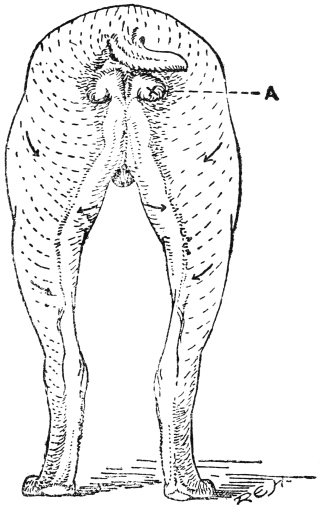
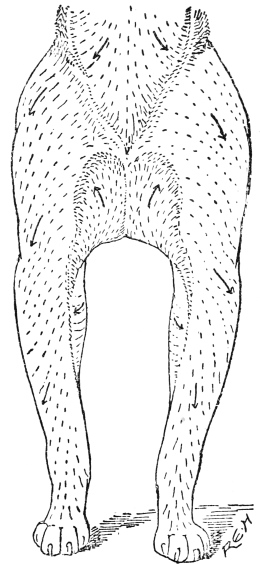
familiar friend of man. There is a saddle-shaped area on the back
of the dog over which it was found empirically that even a light
stimulus when applied rhythmically, produces the “scalptor-reflex”
or a reflex rhythmical action of the flexor muscles of the
leg on the same side, calculated to remove the irritating causes
of the stimulus. This includes a series of receptors in the skin
leading to a spinal segment in the region of the shoulder, a long
neurone in the cord, then a motor neurone, the axon from which
activates the flexor muscles of the leg and produces scratching.
It is described as an efferent arc from receptor to the motor neurone,
from which the Final Common Path supplies the motor apparatus
or effector. Professor Sherrington says that in this reflex a single
stimulus which is far below threshold intensity is found on its
fortieth repetition and nearly four seconds after its first application
to become effective and provoke the reflex and that its frequency
is about 4.5 per second. The reflex movement remains rhythmic
and clonic under the strongest as under weaker stimulation. When
it is easily elicitable the scratch-reflex can be evoked by various
forms of electrical as well as mechanical stimulation, but, when
not easily elicitable, electrical stimulation fails whereas rubbing
or other mechanical forms of stimuli still evoke it, though less
vigorously than usual. This reflex can also be set aside by the
“nociceptive arc from the homonymous foot” or, in other words,
a nocuous stimulus to the leg of that side produces “interferences
which amounts to inhibition.” Empirically it is easy to notice
also that if the “scalptor-reflex” can be elicited on both sides of
the body, the dog when standing will momentarily lose the power
in the hind legs.
Note.—The rhythm of this reflex act is so special even to the
layman that lately I had a singular confirmation of its stereotyped
character, when lying awake at night and being puzzled by a curious
rhythmical scratching sound coming from my next door neighbour’s
back yard. It might have been taken by a wakeful person for
some mechanical work on the part of a burglar, but after listening
repeatedly to the apparently familiar sound I found that it came
from the kennel of a fox terrier kept by my neighbour.
All reflexes being purposive this particular innate reflex is
acknowledged to have for its purpose the grooming or cleaning of
the skin over its hereditary territory. This introduces its connection
with initiative here propounded, and the justification for
its introduction is contained in Professor Sherrington’s statement
that “In the analysis of the animal’s life as a machine in action
there can be split off from its total behaviour fractional pieces
which may be treated conveniently, though artificially, apart,
and among these are the reflexes we have been attempting to
decipher”—scratch-reflexes and others. There seems to be no
reason for the existence and stereotyped character of this reflex
except the need or rather the desire (if one may use a convenient
but inaccurate term) on the part of the dog to remove an irritant
which disturbs its comfort when at rest. Some “minor horrors,”
probably fleas moving across the skin-receptive field of its shoulder
and back, must be assumed to be the irritant in question. This
touches the great question of the initiative of this remarkable
reflex, which seems more fixed and powerful in the dog as we know
him than that other reflex which leads him to turn tail and flee
immediately he sees a boy stoop down as if to pick up a stone.
I dare say a clever advocate on the opposite side might impress a
jury by building up a case under which an adaptation to a protective
need would be conceived as responsible for the rapid flight at the
sight of the threatening attitude of the boy. Such a reconstruction
is not required, for it is perfectly clear that in the history of the
domesticated dog the selection of such an adapted reflex could have
no place. The survival-value of this reflex would be nil, for the
number of dogs killed by a stone or maimed for life would be so
negligible that the production of a specialised reflex for the purpose
by selection or survival of the fittest would not arise. Obviously
the danger would be intermittent and rare; and dead dogs tell
no tales. On the other hand it would be highly unpleasant for
dogs to be hit by stones and educability would lead them to avoid
the stooping attitude associated with missiles.
We are told on high authority that not education but educability
is transmissible, and yet this humble reflex appears in very
young dogs that could hardly if ever have known the impact of a
stone. Incidentally we are compelled to remember how in past
battles of our youth the aim both of “ourselves and the enemy”
was deplorably poor, and not from want of practice. This school-boy-stone
reflex is either an example of educational effects transmitted
or of a minute bit of the unpacking of an original complexity
which it would require the brain of a de Quincey to work out. But
if we suppose the initial stages of such a stimulus as the occasional
impact of a stone in many generations to be slowly ingrained in the
skin-receptors, reflex-arcs and receptors we do not need opium
either for the acceptance of orthodox dogma or to aid us in the
Mendelian alternative to a very simple ideal construction.
This digression bears on the initiative of the more important
scratch-reflex, and it is profitable to ask “are not both of these
reflexes in dogs examples of Evolution of the Indifferent?” Is it
possible to imagine that from its inception to its fully-formed state,
with a specialised territory of skin-receptors accurately mapped out,
with receptor neurones, reflex-arcs and adapted effectors, this
scratch-reflex can have arisen through Germinal Selection or
selective processes within the germ? At no stage can anything
more than a contribution to more or less comfort to the animal be
held to result from its operation. It is strangely reminiscent of the
proceedings of an elderly man after lunch on a hot day when he
protects his head against house-flies with a handkerchief. I am
aware that it is but one of a large number of reflexes produced for
the purpose of grooming the trunk head or limbs of animals as low
down in the scale as the house-fly or grasshopper, many of which
were beautifully described a few years ago by Miss Frances Pitt
in the National Review in an article dealing with small mammals,
chiefly rodents. But I have availed myself here as elsewhere, of
the liberty of doing what Professor Sherrington says we may do,
and consider this scratch-reflex as split off from the rest of the
animal’s behaviour for the purpose of analysis. He also says in
discussing the subject of parasites moving across the receptive
surface of the skin that the ulterior purpose may be the removal
of what “would confuse its function as a receptive surface to more
significant environmental stimuli.” This statement is hypothetical
and the problem obscure; but at any rate we know this that the
removal of the parasite must conduce to the greater comfort of the
dog without any more recondite purpose. The one suggested by
Professor Sherrington would in some possible but very vague
manner be referable to selection, but, whether the suggestion be
valid or not, it is almost impossible to suppose that a saddle-shaped
area of the kind described could be under the guidance of selection.
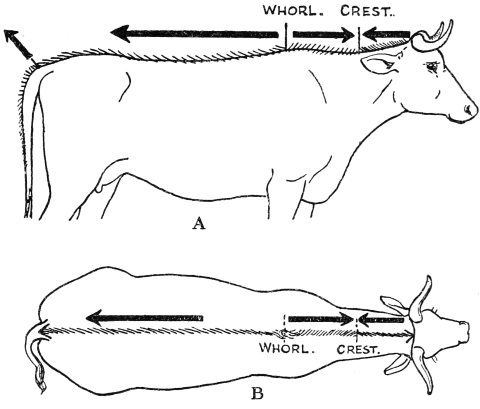
The law of Parcimony forbids. There is a close similarity between
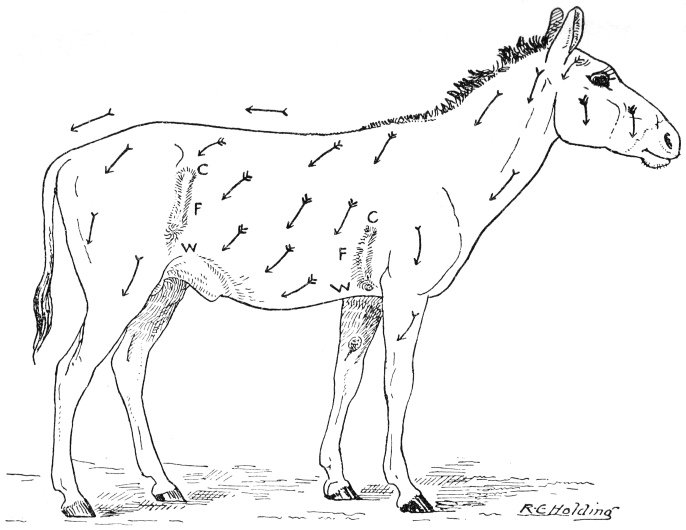
this saddle-shaped area in the dog and that on the cow’s trunk
described in Chapter X. It is difficult to believe that from man
downwards to grasshoppers relief from mild irritating causes such
as this is not enjoyable to the particular animal, and yet indifferent
altogether as to its survival in the struggles of life for food and mates.
The “scalptor-reflex” only reaches the limits of the receptive
field of the scratch-reflex and it is contrary to observed facts that
parasites confine their depredations just to the region where the
formidable scalptor-reflex can reach. The wicked flea knows better
than that. The initiative of this reflex can well be pictured as
taking place in domesticated dogs and their wild ancestors whose
habitats in prehistoric times were probably infested with these
irritants to such a degree that no modern mind can conceive, and
the adequate stimuli, leading to receptors after ages of impact and
consequent hammering out pathways through certain reflex-arcs
until the required weapons of offence or effectors were organised
into a defensive-offensive system—were there in profusion. But a
great and fundamental principle of the evolutionary process such
as Selection is not honoured by being dragged in, even for forensic
purposes, to account for results which owe to the search for
comfort their perfection of organisation. I have personally seen
in some professional invalids of the softer sex nearly as perfect
adaptations to their comfort which in no way contributed to
their length of life. This may be put aside as irrelevant but it
is at least suggestive.
I submit the statement as to the scratch-reflex in the dog that
from beginning to end it is an indifferent mechanism and the probability
is immense that its initial stages were governed alone by
repeated stimuli from parasites which produced receptors, conducting
fibres afferent neurones and efferent neurones, leading
into the Final Common Path controlling the flexors of the hind
limb. It would then come under the Law of Subjective or Hedonic
Selection formulated by Professor Stout in the words: “Lines of
action, if and so far as they are unsuccessful, tend to be discontinued
or varied; and those which prove successful to be maintained.
There is a constant tending to persist in those movements and motor
attitudes which yield satisfactory experiences, and to renew them
when similar conditions recur; on the other hand those movements
and attitudes which yield unsatisfactory experiences tend to be
discontinued at the time of their occurrence, and to be suppressed
on subsequent similar occasions.”
In this connection a statement from Professor McDougall’s
work may be advantageously quoted. He says that “It is characteristic
of those (arcs) of the higher or third level that their organisation,
their interconnections, by means of which the simpler neural
systems of great complexity, is congenitally determined in a very
partial degree only, and is principally determined in each individual
by the course of its experience. The arcs of the higher level thus
constitute the physiological basis or condition of docility, the power
of learning by experience.”88 (My italics)
There is a notable difference between the scratch-reflex of the
dog and that of the cat, especially as to the site of its receptive-field.
That of the dog has been referred to, but it appears to be
generally accepted that the cat has no such saddle-shaped or indeed
other area of skin receptive-field on its back or flanks. I have
repeatedly tried by various mechanical stimuli, applied both
irregularly and rhythmically, to evoke a scratch-reflex in a cat,
young or adult, on the surface corresponding to that of the dog,
and have found no response. This has been tried both when the
animal was awake and when asleep. But the receptive field of the
cat’s scratch-reflex has received careful and elaborate attention,
which is described in a paper by Professor Sherrington in the Journal
of Physiology, Vol. LI. No. 6. By means of delicate stimuli,
mechanical and electrical in a decerebrate cat, the receptive-field
of the scratch-reflex has been accurately delineated in the pinna,
and several other pure reflexes have been obtained. These are
protective of the pinna; some, the retraction and folding reflexes
seem directed against irritant touches, e.g. the settling of fleas—or
against exposure to injury in fighting; others, the cover and
head-shake and scratch-reflexes against the ingress of foreign matter,
such as dust, water, insects, into the meatus and ampulla. The
threshold for their elicitation is extremely low, that is to say, they
require very gentle stimuli to evoke them, while with the exception
of the scratch-reflex they are elicited with difficulty and uncertainty
by electrical stimuli (My italics) to which the animal has been subjected
in the course of its total experience. He adds that the pinnal
reflexes are readily obtained in the normal animal, and I may allude
here to some small observations I made on a normal young cat
during profound sleep, recorded in Nature, Vol. 106, Sept. 2, 1920.
Light mechanical stimuli, applied during this state of deep sleep
to the internal surface of the pinna, especially close to the meatus,
produced first, twitching of the facial muscles on the same side;
second, as this ceased the fore foot was moved irregularly towards
the ear, and third, as this ceased a rhythmical scratching action
of the hind foot took its place, the rate of which seemed to be
exactly the same as that of the scratch-reflex in the dog evoked
from stimulation of the flank and back. I had not then, unfortunately
read more than an abstract of the above paper, but if the
full account be followed it will be seen that the various “territories”
belonging to all the former-reflexes are now known as well as the
frontiers of a European Kingdom. All I was able to do with this
unusual opportunity of a heavy sleep in a normal young cat was
to verify more roughly Professor Sherrington’s observations and
slightly to extend them in respect of a sleeping animal.
In the course of these observations on a young cat I examined
the various regions of the back and flanks with mechanical stimuli
of different degrees of strength. These were applied during sleep
and I found that it was more often during a moderate than a light
or deep sleep that the following results were shown—chiefly under
the stronger stimuli the tail was raised sharply and swept in a
circular way, and this would be repeated according as the stimulus
was applied; but at the same time there was shown a strong,
irregular twitching along the flank, extending forwards to a point
near the level of the shoulder. This latter reflex would appear to
be a reaction on the part of the panniculus carnosus. Both the
reflex of the muscles of the tail and this of the flanks appear to be
connected in their origin with movements of parasites in their
respective territories.
In considering the scratch-reflex in the cat a subtle bit of
adjustment is found. That coarse and simple scratching of its
ear, which we see so often in the cat, must have often astonished
us for its vigour and yet its bloodless character. This action is
of course a purposeful one, for it goes on when the animal is awake.
Here if anywhere this profoundly hedonistic animal shows that
for it the laws of comfort are its laws of conduct. It is clear that
there may be two processes or conditions involved in its bloodless
violence. On the one hand the reflex retractile mechanism of the
claws may be kept in abeyance by another reaction which is pre-potent;
on the other, it is a fact that the hind foot in the cat is
furnished with claws which are much blunter than those of the
fore foot. As far as I have been able to examine cats of different
ages I have found the claws of the hind foot more like the blunt
claws of a dog than the familiar sharp claws of the Felidæ. So in
the violent scratching referred to there may be a double reason
associated in the process. As to the difference in the sharpness of
the fore and hind claws it would appear to be remarkably like a
transmitted bit of adaptation initiated and kept in being by use
and habit in progression, for the hind foot in such animals as the
cat has a larger share in this action than the fore foot. But here
it is difficult as so often to assign to selection its possible share of
the adjustment.
Certain minor but persistent reflexes may be briefly mentioned
in support of this side of the evolutionary process. In the dog and
cat, as we know them, the action of the muscles of the tail by which
it is elevated during the act of defæcation is very suggestive of a
reflex acquired by a very small degree of physical comfort and
repeated in countless individuals, wild and domesticated. I have
seen not only this but a few small scratches made by a cat before
defæcation in a kitten as young as three weeks old. It is also
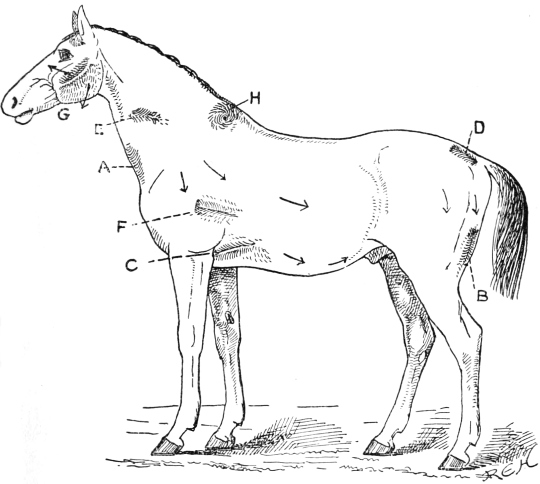
mentioned in illustration of a vestigial character that a horse will
paw the ground with no immediate apparent object, the act being
derived from ancestors which thus cleared away snow from the
ground. This is claimed, doubtfully I think, as a vestige of a
formerly useful habit but seems more probably to be one of these
indifferent reflexes connected with comfort than with survival-value.
It will be observed that in this branch of the case for
Lamarck v. Weismann the indirect evidence from inference far
exceeds in amount that of direct experimental evidence, but
from the nature of the problem under consideration this could
not be otherwise.
If we may again look back in thought over the long series
of animals, from man downwards, we shall picture those of the
spinal level striving (with apologies for the use of an anthropomorphic
word) to reach the sensory level and finding out the fact
that few there be that enter therein. Again we see in vision the
higher creatures of the sensory level reaching forwards to the strait
paths of primate existence, and again finding the difficulty of self-advancement
that their predecessors found. We see the elect few
of these, by a happy combination of nature and nurture, uprearing
to glory and honour the primate stock with its culmination in man.
A long vista indeed and a vision, but assuredly no mere figment
of the imagination, as some of the slender facts and arguments
here would seem to show. With Professor Bateson we personify
Nature in the story, with her wonted coyness betraying the fact
that though she is stern she has her tolerant moods; that she allows
her children, even that “insurgent son” who calls himself Homo
Sapiens, a genial liberty to frame new reflex-arcs which make for
his enjoyment of life in indifferent fields, and that the great neural
process of Facilitation is the leading factor in their constructions and
probably also in more deeply-based systems of sensori-motor arcs.