In studying heredity our attention must often be focused on the ontogenesis
of the different characters, and we are sometimes inclined to regard
the adult character as the product of the course of ontogenesis. But this
is a superficial way of looking at things; the determiners of all characters
are in the germ-plasm and together they direct the development of one
part after another in orderly succession; a modernized form of the pre-formation
doctrine seems logically necessary.
What do we know of the processes that take place in bringing the
fertilized egg, freighted with its specific heredity, to its destination—the
adult form? Modern embryological and cytological studies give us an
insight into many of them. First of all, the egg has a certain organization
that foreshadows something of its fate. Then cell-divisions begin, at first
synchronous, but later becoming accelerated here and retarded there.
Eventually (especially among animals) these cells become arranged into a
membrane whose unequal growth in limited areas produces foldings. The
folding of membranes, their stretching, local thickenings, or thinnings are
largely the result of local inhibitions of water. Sometimes movements of
individual cells occur out of the membranes into and through cavities or
solid yolk-masses, and by the aggregation of such cells massive organs are
sometimes formed. Local absorption of tissues already established may be
effected in later life by such migratory cells. Membranes once established
may form pockets or linear folds, as in gastrulation and gland formation;
they may become perforated; two membranes may fuse along areas or
lines and a perforation may even occur at the region of fusion. Linear
strands or tubules may grow out, making connections, as nerves do, with
distant organs; tubes may unite to form a network, or split lengthwise.
Finally, membranes and masses undergo vacuolization, or masses may split
apart or fuse together. Thus in the ontogeny that is proceeding under the
control of heredity all is motion and change.
What are the factors that control all these movements—for these are
the true factors of heredity? We do not know much about them, but we
know some things. We know that cell-divisions occur at particular times
and places under the influence of preceding division planes; but their
normal occurrence may be interfered with by an abnormal chemical condition
of the environment.
We have reason for concluding that each developmental process is a
"response"—a reaction of the living, streaming protoplasm to changing
environment. The nature of the response to any stimulus probably depends
on the chemical constitution of the protoplasm—and this is hereditary.
In an important sense heredity is the control of ontogeny.
The specific characteristics are mostly those that appear late in ontogeny.
The integumentary folds over the nasal bones of the chick appear
on or about the tenth day. At that time it can be ascertained whether the
comb is median, or multiple, or Y-shaped, or cup-shaped, or consists of 2
papillæ. In the case of the single-comb the fold is linear and single; in the
case of the pea-comb, linear and triple; in the case of the rose-comb, quintuple
or irregularly wrinkled over the whole area; in the case of the Polish-comb,
there is a pair of "pocket folds." In the single-combed fowl the
single linear fold grows quickly to a great height and very thin, while in
the pea-comb, with its additional pair of wrinkles, the median element is
not so high as in typical single-combed races; in the pea-comb there is an
additional folding stimulus and a reduced growth stimulus. In the heterozygote
both stimuli are weakened; the lateral folds are usually much
reduced—"are hard to make out," as I stated in 1906 (p. 35); and the factor
that determines the continued growth (elevation) of the fold is weakened, so
that the pea-comb—although "abnormally high" (1906, p. 35, figs. 20 and
21)—is not nearly as high as the single-comb of the Minorca (1906, fig. 4).
Two results are evident: first, each character in the heterozygous
condition is reduced, and, second, each is much more variable than in the
homozygous condition. Why is the character reduced? If the reaction to
continued growth of the fold is strong in one race and weak in the other,
then in the heterozygote that reaction, whatever its nature, is reduced.
Why is the reduction in the response so variable? There is a variation in
the irritability or other growing factor of the embryonic material that is
destined to form the fold. Even Minorcas vary in the growth of the comb,
and so do the Dark Brahmas. Let G be a constant element of the growth
factor of the Minorca's comb; then G + a or G - a will indicate its variants.
Let g be the growth factor of the Brahma's comb, and g + a and g - a its
variants. Then the hybrids of these two races may be of the following types:
Gg, Gg + a, Gg - a, Gg + 2a,
Gg - 2a. This gives 5 varying conditions
instead of 3 and greater extremes of variation.
In the foregoing case I have assumed that the positive character is
that of increased growth in the Minorca; but the positive character may
be an inhibition to indefinite growth of the pea-comb. Heredity may
be conceived of as exerting at all points a control on developmental processes—sometimes
initiating and continuing this; but often, on the other
hand, slowing down or wholly inhibiting that. The inhibition of a process
is quite as positive a function of heredity as its initiation. The hair of a
young rabbit grows until it attains a certain length and then the growth
ceases. The growing character is a youthful, embryonic one; the new
character is the stoppage of growth. Similarly the young feathers of birds
grow continuously until something intervenes that stops the growth and
dries up the sheath. Now, in Angora rabbits and long-tailed fowl the
epidermal organ continues its embryonic growth indefinitely; the something
that intervenes to stop growth is absent. There is no reason for
regarding the long hair or long feather as a positive condition and short
hair or feather as due to its absence.
Again, Mediterranean fowl have non-feathered shanks; but in Asiatics
the feet are feathered like the rest of the body (except the soles and face).
It has been assumed that boot is an additional character and should be
dominant over absence of boot. But, on the other hand, we may well
think of the capacity of producing feathers as general to the skin. From
this point of view the real question is, what prevents feather production
on the eyelids, comb, wattles, and shank? It seems equally probable that
there is an inhibitor of feather-growth for these few areas as that every
conceivable area of the body has its special stimulus factor for feather
development; or even as that there is such a factor to each separate feather-tract.
In the Minorca, then, the inhibitor of boot is present; in the Silkie
a weak heterozygous inhibition appears; but in the Dark Brahma there is
no inhibitor and feathers extend down from the heel over the whole of
front and sides of the foot and even on the upper surface of the toes—just
as they do over the anterior appendages.
The case of the rumpless fowl is important in relation to the hypothesis
of inhibitors. Either tail-production depends on a special factor TT, which
is diluted, as Tt, in the heterozygote; or else there is a tail inhibitor, II, which
is diluted, as Ii, in the heterozygote. In F2 we expect, on the one hypothesis,
25 per cent tt, giving no tail, and 25 per cent TT, giving tail; on the other
hypothesis 25 per cent ii, giving tail, and 25 per cent II, giving no tail. Actually
we get all tailed in some cases; in others 25 per cent with no tail. Which
hypothesis best fits the facts? Which is the more probable—that the 25 per
cent recessive no-tail should produce a tail (as it were, out of nothing) or
that the 25 per cent dominant tail inhibitor should be ineffective, permitting
the development of a tail? It is clear that the ontogenetic failure of an
inhibitor is easier to understand than the development of a character that
is not represented at all in the germ-plasm. This matter is treated in
another connection in the next section. But the present point is that it is
equally in accord with the facts to regard heredity as initiating and inhibiting
processes. If, indeed, processes were not regularly inhibited, they must,
when once started, go on indefinitely, as do the hairs of Angora goats and
wonder-horses.
As we have seen, ontogeny is not completed at hatching or birth.
Many characters are at that time undeveloped. Hence, not infrequently
the recessive condition is at first seen and is only later replaced by the
dominant condition. The reverse sequence will rarely be followed, because
development rarely, except in cases of degeneration, moves backward.
One of the familiar cases of this sort is human hair-color. In youth this is
frequently flaxen, later it becomes light brown, and eventually it may
become dark brown. Darwin gives a number of examples in his Chapter
XII of Animals and Plants under Domestication. To these I may add
some from my own experience. The hybrids between white and gray Java
sparrows are at first light and later become of a slaty gray like the dark
parent. Many black fowl gain white feathers as they grow older, and every
fancier knows that birds with complex white-and-black patterns can usually
be "exhibited" only once, on account of loss of "standard" coloration
late in life. In these cases the advanced condition in the series of melanic
colors appears only late in ontogeny.[13] Similarly Lang (1908, p. 54) finds
that in snail hybrids often the young shells have the recessive yellow color,
only later in life showing the dominant red color. This is, of course, no
reversal of dominance in ontogeny, but mere ontogenesis of pigmentation.
So in general, since the recessive condition is absence of the character or
its low stage of development and the dominant condition is presence of
the full character, the individual in ontogenesis may exhibit in succession
the recessive and then the dominant character, but not in the reverse order.
If segregation is the cornerstone of modern studies in heredity, dominance
forms an important part, at least, of the foundation. In any case,
a critical examination of dominance is now required; the more so since its
significance and value have often been doubted.
First, how is a dominant character to be defined? It has been defined
both on the basis of visible results in mating and on the basis of its essential
nature. On the basis of visible results in hybridizing dominant characters
may be defined as Mendel (1866, p. 11) defined them: "jene Merkmale,
welche ganz oder fast unverändert in die Hybride-Verbindung übergehen."
Bateson's translation (1902, p. 49) renders this passage: "those characters
which are transmitted entire, or almost unchanged in the hybridization."
On the basis of the essential nature of the dominant character there has
obtained a great diversity of definitions. Thus de Vries (1900, p. 85) suggested
that the "systematically higher" character is the dominating one,
and, again (1902, pp. 33, 145), that the dominant character is the phylo-genetically
older one. Many have suggested that it is the positive or present
character that dominates over the negative, latent or absent. This last
idea has become the prevailing one and its history is worth summarizing.
As early as 1902, Correns used as Mendelian pairs, presence of coloring
material and absence; also modification into yellow and no modification.
In 1905, he extended somewhat this use of present and absent characters,
k (keine) preceding the symbol of a character as a negative. Still he did
not pretend to generalize the relation of dominance and recessiveness to
be that of presence and absence. In 1903 (p. 146) de Vries stated that in
very many cases Mendel's law held when one quality is active and the other
latent, and that the active quality is dominant. His illustrations show
that by activity he meant essentially presence, by latency absence from
the visible soma. Bateson's third report (1906) applies presence and absence
to several additional cases, and, at the International Genetics Conference
of that year, Hurst developed the presence-and-absence hypothesis, favoring
the view that the factor for absence is nothing at all, but finding that certain
cases, such as Angora coat, offer a difficulty. At the same meeting I suggested
that "a variation * * * that is due to abbreviation of the ontogenetic
process, which depends on something having dropped out, will be
recessive," a progressive variation dominant; and in 1908 I expressed
the conclusion that "dominance in heredity appears when a stronger determiner
meets a weaker determiner in the germ. The extreme case is that in
which a strong determiner meets a determiner so weak as to be practically
absent, as when a red flower is crossed with white." I suggested that in
some cases of recessiveness of an apparent advanced condition, like Angora
hair, the dominant factor is an inhibitor. In the last year or two the
presence-and-absence theory has gained wide acceptance, but I still think
the cases where there is dominance of the advanced condition over the less
advanced—of the quantitatively well-developed over the quantitatively less
well-developed—have not been sufficiently considered. In human hair-color
any other hypothesis demands that there are many units in the higher
grades of pigmentation and fewer in the lower grades and that the presence
of the surplus factor in any other higher grade dominates over its absence
in the next lower grade; but there is no evidence in human hair-color of
distinct, discontinuous units in the common yellow-brown series. And,
in ontogeny, the different grades of color form a continuous series whose
development proceeds throughout early life and may even be stimulated
to an advanced stage of darkening by disease. The cessation of color development
may take place at any point, and this seems incompatible with the
theory of unit-characters for the different grades of human hair-color. In
the present paper, on the other hand, the characters dealt with are mostly
unit-characters and their quantitative variations mostly heterozygotic.
Even the case of the Silkie boot (table 31, C) referred to in an earlier paper[14]
as illustrating recessiveness of the less advanced condition proves, on further
analysis, to be a case of heterozygotism. It seems highly probable that the
future will show that many more advanced or progressive conditions are
really due to one or more unit-characters not present in the less advanced
condition. In that case it will appear that there is perfect accord in the two
statements that the progressive condition and the "present" factor are
dominant.
The definition of dominance on the ground of results meets at the
outset with a difficulty the germ of which is observable in Mendel's cautious
statement "ganz oder fast unverändert." Even Mendel observed that the
hybrids between white-flowered and purple-red flowered peas have flowers
less intensely colored than the darker parent. The experiments of the last
seven years have shown that the "dominant" character is often very greatly
changed—indeed, in extreme cases a blending of characters may occur—in
the first generation. Correns (1900 b, p. 110) very early stated that in
a certain set of crosses between good species the hybrids showed the character
of both parents, only reduced, but in varying degrees. Bateson and
Saunders (1902, p. 23) found in crossing two forms of Datura that—
Although the offspring resulting from a cross between any two of the forms
employed are usually indistinguishable from the type which is dominant as regards the
particular character crossed, yet in other cases the intensity of a dominant character
may be more or less diminished either in particular individuals or in particular parts of
one individual. In Tatula-Stramonium cross-breds the corolla is often paler in color than
that of the dominant parent (as has already been noticed by Naudin), but even in the
palest specimens the deep blue color of the unopened anthers leaves no doubt as to the
presence of the dominant color element. * * * The occurrence of intermediate
forms was also occasionally noticeable in the fruits. Among the large number of capsules
examined, there were some of the mosaic type, in which part of the capsule was prickly
and the remainder smooth, while others, suggesting a blend, were more or less prickly
all over, but the prickles were much reduced in size, and often formed mere tubercles.
Bateson and Saunders further showed (1902, p. 123) that in the case
of comb and extra-toe in poultry "the cross-bred may show some blending
and * * * the intensity of the dominant character is often considerably
reduced."
Correns (1905, p. 9) pointed out that there was known, even at that
time, a complete series of cases at one extreme of which one determiner
completely hindered the appearance of the other, while at the opposite end
of the series the hybrid showed an intermediate condition, both determiners
appearing with equal strength.
The following year, in my first report on Inheritance in Poultry, I laid
great stress on the imperfection of dominance, and this phenomenon has
become more striking and clear in the subsequent years, until in the present
paper it is recognized as the key to the explanation of many apparently
anomalous types of heredity.
The first case in the present work in which imperfection of dominance
is considered is that of the hybrids between I and oo comb. Here median
comb is mated with no-median. Each somatic cell of the hybrid—at least
in the comb region—has only half the full determiner for median comb.
The determiner is weakened, and so the median comb is imperfectly developed,
namely, at the anterior end of its proper territory. The weakening
varies much in degree in the heterozygote. The median comb may be
reduced to 70 per cent of its normal length or it may not develop at all.
The second case of imperfection of dominance is that of polydactylism.
Extra-toe mated to normal gives extra-toe in 73 per cent only of the offspring
in the case of the Houdans. Any trace of 6 toes (on one or both feet)
is found in only 12 per cent of the hybrid offspring from a 6-toed Silkie
parent. Certainly dominance here is very like blending.
The third case of imperfection of dominance is that of syndactylism.
No syndactyls were noticed in F1. My first conclusion was that syndactylism
is recessive; but later studies have shown that it is dominant and that
all matings of two syndactyl parents yield about 56 per cent syndactyl
offspring.
Rumplessness gives an illustration of how dominance may be so weak
as to be absent altogether; so that from F1 alone the erroneous conclusion
is drawn that it is recessive; indeed, in one strain, only faint traces of
the character made their appearance in successive generations.
Finally, winglessness is a character which appears not to be inherited
at all. Nevertheless our experience with rumplessness leads us to suspect
that winglessness also is an impotently dominant character.
Looking at the matter frankly and without prejudice, the question
must be answered: Has not the whole hypothesis of dominance become
reductio ad absurdum? What visible criterion of dominance remains, where
dominance fails completely? All the usual statistical landmarks of proportional
appearance in successive generations being lost, can one properly
speak of dominance and recessiveness at all?
Amid the general ruin of criteria, however, one means of detecting
dominance remains. That extracted character which in F2 or subsequent
generations shows in homologous[15] matings in some families a wide range
of variability is dominant, while that extracted character which constantly,
in all homologous matings, shows no or very little variation is recessive.
The reason for this difference in the inheritableness of the two conditions
is easy to understand on the principles enumerated in the last section.
A positive character has a real ontogeny. But, as we have seen, the development
of any character may be interrupted at any stage. Most aberrations
among organisms are due to a retardation or failure of normal development.
In human affairs we recognize this tendency in the terms "degenerates"
and "defectives" (constituting from 2 to 4 per cent of the population).
Indeed, there are few persons who are not defective in some physical or
psychical character. In cases where the commonest form of abnormality
is due to a development in excess it seems probable that a normal restraining
or inhibiting factor is defective or absent. On page 88 I tried to show how
common in ontogeny such restraining and inhibiting factors are. Since ontogenetic
processes are so often cut short by external conditions, we can understand
the variability in the degree of development of positive characters.
On the other hand, whenever the fundamental hereditary stimulus or
the material for a character is absent from the germ-plasm of both parents,
then it can appear in none of the offspring; they will be practically invariable
in respect to this condition. Only the ontogenetic fluctuations of other
real characters may influence the defect. Consequently the absent state
reproduces itself, the "recessive breeds true."
The considerations here presented bear upon the hypothesis of change
of dominance. Bateson and Punnett (1905, p. 114) say of poultry: "The
normal foot, though commonly recessive, may sometimes dominate the
extra-toe character." This idea of occasional change in dominance has been
expressed more than once in the literature. I think the phrase an unfortunate
one. In my earlier report[16] I urged that a characteristic that is
anywhere dominant is so without regard to race or species involved. If this
is so it is clearly improbable that it should vary from individual to individual,
or in the same individual at different times. Rather in view of the imperfection
of dominance we should say that a dominant character sometimes
fails to develop, in which case it is absent from the progeny; that is all.
It is particularly apt to fail of development when dilute—heterozygous.
Perhaps an apology is needed for introducing the much-abused word
"potency"; but there is hardly another that can be so readily adapted to
the precise definition I desire to give to it. The potency of a character
may be defined as the capacity of its germinal determiner to complete its
entire ontogeny. If we think of every character as being represented in the
germ by a determiner, then we must recognize the fact that this determiner
may sometimes develop fully, sometimes imperfectly, and sometimes not
at all. When such a failure occurs in a normal strain a sport results.
Potency is variable. Even in a pure strain a determiner does not
always develop fully, and this is an important cause of individual variability.
But in a heterozygote potency is usually more or less reduced.
When the reduction is slight dominance is nearly complete; but when the
reduction is great dominance is more or less incomplete and, in the extreme
case, may be absent altogether. The series of cases of varying perfection
of dominance described in this work illustrate at the same time varying
potency. The extreme case is that of the rumpless fowl. The character in
this case is an inhibitor of tail development. This character has arisen
among vertebrates repeatedly and has become perpetuated in some amphibia
and primates, including man. In the case of our cock No. 117, the action
of the inhibitor is very weak, so that in the heterozygote the development
of the tail is not interfered with at all and even in extracted dominants it
interferes little with tail development, so that it makes itself felt only in
reduced size of the uropygium and in bent or shortened back. But in No.
116 the inhibiting determiner is strong. It develops fully in about 47 per
cent of the heterozygotes and 2 extracted dominants may produce a family
in all of which the tail's development is inhibited. In the case of the rumpless
condition that arose apparently de novo in my yards, the new inhibitor
showed an intermediate potency completely stopping the tail development
in 1 out of 25 heterozygotes. These three cases afford a striking illustration
of a variation in the potency of the same inhibiting character in
different strains.
Not only is potency variable, but its variations seem, in some cases, to
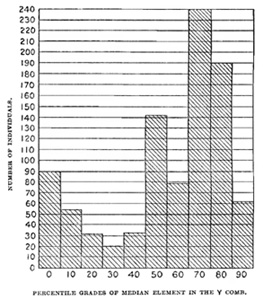
be inheritable. This we have seen to be the case with the Y-comb
(p. 15);
with the extra-toed condition of Houdans (p. 23); and with rumplessness
(cf. offspring of No. 117 as compared with No. 116, p. 40). On the other
hand, the extra-toed condition of Silkies, the grade of clean shank, and the
degree of closure of nostril seem not to be inherited.
The brilliant development of the factor hypothesis, only dimly fore-shadowed
by Mendel[17] (1866, p. 38), clearly expressed by Correns (1892),
applied to animals by Cuénot, and further elaborated by Bateson and Castle
and their pupils, has quite changed the methods of work in heredity. More
forcibly than ever is it brought home to us that the constitution of the
germ-plasm—not merely the somatic character—is the object of our investigation.
With this principle fully grasped the existence of cryptomeres and
the resolution of characters have become clearer. But the most striking
result accomplished has been that of clearing up the whole range of phenomena
formerly placed in the category of "reversion." No idea without a
semblance of inductive explanation has been more generally accepted in
the Darwinian sense both by professed biologists and practical breeders
than this. Not only was the fact of recurrence of ancestral types in domesticated
organisms accepted, but the idea that, in some way, hybridization
per se destroyed the results of breeding under domestication was maintained.[18]
Now we know that, under domestication, many races have been preserved
that are characterized by a deficiency of a character or by a new, additional
one, and that hybridization, by bringing together again those characters
that are found in the ancestral species, may bring about again individuals
of the ancestral type. There is nothing more mysterious about reversion,
from the modern standpoint, than about forming a word from the proper
combination of letters.
In the last few decades the view has been widespread that characters
can be built up from perhaps nothing at all by selecting in each generation
the merely quantitative variation that goes farthest in the desired
direction. I have made two tests of this view, using the plumage color of
poultry.
(1) Increasing the red in the Dark Brahma × Minorca cross.—The Dark
Brahma[19] belongs to the group of poultry that contains a majority of characters
derived from the Aseel type. Nevertheless, its plumage is closely
related to that of the Jungle-fowl, from which it may be derived on the
assumption that the red part of the pattern has become, for the most part,
white. However, a little red remains on the middle of the upper feathers
of the wing-bar. I crossed such a bird with a Black Minorca, and, as reported
in my earlier work,[20] the offspring were all black, except that the males
showed some red on the wing-bar. The amount of red varied in the different
males, and I decided to test the possibility of much increasing the amount
of the red by selection in successive generations. So I chose the reddest
cock to head the pen. In this pen (No. 632) 222 chicks were produced and
grew to a stage in which their adult color could be determined. Of these
222 chicks, 160, or 72 per cent, were black, without red; 24, or 10.8 per cent,
were black with some red; 38, or 11.7 per cent, were typical Dark Brahmas,
and 9 others, or 4.5 per cent, were modified Dark Brahmas.
The following year (pen 732) I bred a cock derived from the last year's
pen, a bird that resembled much the male Dark Brahma (except that it
was somewhat darker), to sundry hens, hybrids between the Dark Brahma
and Minorca—some of the first and some of a later hybrid generation, but
all black except that some of the 1906 birds had a little buff on the breast
and the primaries. The F1 (black) × F2 (Dark Brahma) gave 51 per cent
black offspring, 27 per cent with a black-and-red Game pattern, and 22 per
cent with the Dark Brahma pattern devoid of red. Thus the third generation
suddenly gave me a red-and-black Game-colored bird (plate 12)!
My interpretation of the foregoing results is as follows: The Dark
Brahma gametic formula proves to be CIrnwx, whereas the Black Minorca
is C(IR)Nwx, where (IR) is equivalent to, and merely a further analysis of,
the J of the formula of the Minorca as given in earlier sections. The I
stands for the Jungle pattern without red and R is the red element in that
pattern. Obviously N and R are the differential factors, 4 kinds of gametes
occur in F1, and in every 16 offspring these factors are combined in the
following proportions: 9 NR, 3 Nr, 3 nR, 1 nr (compare the distribution of
color types in the 222 offspring of pen 632). The F2 male selected as father
of the next generation (in pen 732) was an extracted Dark Brahma in
coloration and probably formed only 1 kind of gamete, nr; but the hens
were heterozygous in respect to N and R. Consequently 4 kinds of zygotes
are to be expected in F3; and expectation was realized as indicated in
table 68.
Table 68.
|
NnRr. |
Nnr2. |
n2Rr. |
n2r2. |
|
Black with
traces of
red in male. |
Black. |
Game. |
Brahma
(without red). |
|
P. ct. |
P. ct. |
P. ct. |
| Expectation. |
50 |
25 |
25 |
| Realization. |
51 |
27 |
22 |
In the case where both parents are F2 or F3 it is impossible to summate
results, since the gametic formulæ of the different parents are so diverse;
but the same types of solid blacks, black with trace of red in the males,
Game-colored males and females, and Game with red replaced by white
repeatedly occur. My plan of increasing red in the Dark Brahmas met
with wholly unexpectedly prompt success, but not in the way anticipated.
The result was not due to selection, but to the recombination of the factors
necessary to make the Game plumage coloration.
(2) Production of a buff race by selection.—The second test was directed
toward the production de novo of a new buff race from a Game fowl.
As is well known, all of our red and "buff" races, like the Buff Leghorn,
Rhode Island Red, and others, have been derived from the Buff
Cochin that came to us from China. The fact that a buff bird has, so far
as I have been able to learn, not been produced in western countries indicates
the probability that it can not be so produced at will; but the attempt
seemed worth while.
I began with a Black Breasted Red Game because its plumage color is
that of the primitive ancestor of domesticated poultry, and on that hypothesis
the ancestor of the buff races. If these buff races were produced by
extending the red through selection of the reddest offspring, that should be
possible now as in the past.
A start in the direction of creating a buff bird would seem to require
the elimination of the black. By crossing a black and red Game with a
White Leghorn I got, in 1905, 2 white pullets with red on breast and some
black specks. By crossing a Game Bantam (wingless) with a White Leghorn
I got white birds with red present on wing-bar of male and breast of
females and also some black spots.
In 1906 I mated 2 of these white (+ red) bantam hybrid hens with a
hybrid cock and obtained again red on the wing-coverts of some white
hybrids, while some were without red. From one of the hens I got 4 offspring,
or 20 per cent of all, with buff on hackle-lacing, breast, and wing-coverts.
In 1907 I mated a prevailingly white male of the preceding year, that
had red wing-bar, hackle, and breast, with the reddest females and obtained,
along with pure whites and blacks and barred birds, these colors combined
with red in various degrees, but not clearly in advance of the reddest of
1906. In 1908 I mated a white male, having red as in the Game, with my
reddest hybrids. Again, white and white-and-buff birds appeared, but they
showed no advance, except in one instance, among 138 young. This individual
(No. 7950), derived exclusively from the Black-red Game and White
Leghorn on one side and on the other from the White Leghorn-Game Bantam
cross, had a uniform buff down. Unfortunately the chick quickly died.
The conclusion is that after three years of selection of the reddest offspring
no appreciable increase of the red was observed—except for the
remarkable case of one undeveloped chick with completely buff down. This,
indeed, looks like a sport, or, perhaps, it is due to unsuspected factors.
The experiment will be continued.
So well-nigh universal is heredity that it is justifiable to entertain a
doubt whether any character may fail of inheritance. So far as my experience
goes, non-inheritable characters are such as are weak in ontogeny,
so that they may readily fail of development even when conditions are
propitious; or else they are so complex—so far removed from simple unit-characters—that
their heritability in accordance with established canons
is obscured. The first case is apparently illustrated by the rumpless cock
(No. 117) and the wingless fowl; the second case by lop-comb and by right-and-left
alternatives in general.
Apart from the distinct characters that fall under these two categories
there are the fluctuating quantitative conditions. These depend for the
most part, as already pointed out, on variations in the point at which the
ontogeny of a character is stopped; and the stopping-point is, in turn,
often, if not usually, determined by external conditions which favor or
restrict the ontogeny. Whether or not such quantitative variations are
transmitted is still doubtful. Our experiment in increasing qualities, such
as redness in plumage-color, by selection of quantitative fluctuations have
not been successful in the sense anticipated; neither have selections of
comb, polydactylism, or syndactylism. Recently, prolonged attempts at
the Maine Agricultural Experiment Station to increase egg-yield of poultry
by selection have been without result. Apparently, within limits, these
quantitative variations have so exclusively an ontogenetic signification
that they are not reproduced so long, at least, as environmental conditions
are not allowed to vary widely.
The conclusions which others have reached, and upon which de Vries
has laid the greatest stress, that quantitative and qualitative characters
differ fundamentally in their heritability is supported by our experiments.
The criticism has often been made of modern studies in hybridization
that they are really unimportant for evolution because hybridization is
uncommon in nature. Even at the beginning of the new era it could be
replied that, first, we did not know how common hybridization might
turn out to be in nature, and, second, that certainly in human marriage
and among domesticated animals and plants, intermixing of characters
played a most important part, and, finally, the laws of inheritance of characters
were of such grave physiological import as to deserve study wholly
apart from any question of the rôle of hybridization in evolution.
The last decade of work has made clear many things that were before
uncertain. We now realize that in nature hybridization may and actually
does proceed extensively. Dr. Ezra Brainerd has shown how many wild
"species" of Viola have arisen by hybridization, as may be proved by
extracting from them combinations of characters that are found in the
species that are undoubtedly ancestral to them. In such highly variable
animals as Helix nemoralis and Helix hortensis it is very probable that
individuals with dissimilar characters regularly mate in nature and transmit
diverse combinations of characters to their progeny. Indeed, if one
examines a table of species of a genus or of varieties of a species one is
struck by the paucity of distinctive characters. The way in which species,
as found in nature, are made up of different combinations of the same
characters is illustrated by the following example, taken almost at random.
Among the earwigs is the genus Opisthocosmia, of which the 5 species known
from Sumatra alone may be considered. They differ, among other qualities,
chiefly in the following characters (Bormans and Kraus, 1900):
- Size: A, large; a, small.
- Wing-scale: B, brown; b, yellow.
- Antennal joints: C, unlike in color; c, uniform.
- Forceps at base: D, separated; d, not separated.
- Edge of forceps: E, toothed; e, not toothed.
- Fourth and fifth abdominal segments: F, granular; f, not granular.
The combinations of these characters that are found are as follows:
- Opisthocosmia ornata: AbcDEF.
- insignis: ABcDEf.
- longipes:AbCDEf.
- tenella: AbCdef.
- minuscula:aBCDEf.
Other species occur, in other countries, showing a different combination
of characters, and there are characters not contained in this list,
which is purposely reduced to a simple form; but the same principles apply
generally.
The bearing upon evolution of the fact that species are varying combinations
of relatively few characters is most important. Combined with the
fact of hybridization it indicates that the main problem of evolution is
that of the origin of specific characteristics. A character, once arisen in
an individual, may become a part of any species with which that individual
can hybridize. Given the successive origin of the characters A, B, C, D, E, F,
in various individuals capable of intergenerating with the mass of the species,
it is clear that such characters would in time become similarly combined
on many individuals; and the similar individuals, taken together, would
constitute a new species. The adjustment of the species would be perfected
by the elimination of such combinations as were disadvantageous.
Cold Spring Harbor, New York,
May 20, 1909.
LITERATURE CITED.
Baldamus, A. C. E.
1896. Illustrirtes Handbuch der Federviehzucht. Erster Band: Die Hühnervogel. 3 Aufl. bearbeitet
von O. Grünhaldt. Dresden, 1896. xvi+476 pp., 102 figs.
Barfurth, D.
1908. Experimentelle Untersuchung über die Vererbung der Hyperdactylie bei Hühnern. I.
Mitth. Der Einfluss der Mutter. Arch. f. Entw.-Mech. der Org., XXVI, 631-650.
Bateson, W.
1894. Material for the Study of Variation Treated with Especial Regard to Discontinuity in
the Origin of Species. London, 1894, xvi+598 pp.
1902. Mendel's Principles of Heredity: A Defence. Cambridge (Engl.), 1902, xv+212 pp.
Bateson, W., and Saunders, Miss E. R.
1902. Report I to the Evolution Committee of the Royal Society. London, 160 pp.
Bateson, W., and Punnett, R. C.
1905. Experimental Studies in the Physiology of Heredity—Poultry. Report II to the Evolution
Committee of the Royal Society. pp. 99-131.
Bateson, W., E. R. Saunders, and R. C. Punnett.
1906. Report III to the Evolution Committee of the Royal Society, London, 53 pp.
1908. Report IV to the Evolution Committee of the Royal Society, London, 60 pp.
Bormans, A. de, and Kraus, H.
1900. Forficulidæ und Hemimeridæ. Das Tierreich, 11 Lief. Berlin, XV+142 pp.
Castle, W. E.
1906. The Origin of a Polydactylous Race of Guinea-Pigs. Carnegie Institution of Washington
Publication No. 49 (Papers of the Station for Experimental Evolution at Cold Spring
Harbor, N. Y., No. 5).
Castle, W. E., Mullenix, H. E., and Cobb, S.
1909. Studies of Inheritance in Rabbits. Carnegie Institution of Washington Publication No. 114
(Papers of the Station for Experimental Evolution No. 13).
Correns, C.
1900a. G. Mendel's Regel über das Verhalten der Nachkommenschaft der Rassenbastarde. Ber.
d. D. Bot. Ges., XVIII, 158-167.
1900b. Ueber Levkojenbastarde. Zur Kenntnis der Grenzen der Mendel'schen Regeln. Bot.
Centralblatt, LXXXIV, 97-113. [Oct. 17].
1902. Ueber Bastardirungsversuche mit Mirabilis-Sippen. Ber. d. D. Bot. Ges., XX, 594-608.
1905. Zur Kenntnis der scheinbar neuen Merkmale der Bastarde. Ber. d. D. Bot. Ges., XXIII,
70-85.
1905. Über Vererbungsgesetze. Verhandl. Ges. D. Naturf. u. Arzte. Allg. Teil., 23 pp.
Cuénot, L.
1903. L'hérédité de la pigmentation chez les souris (2me note). Arch. de zool. expér. et gén. (4),
I. Notes et rev., pp. xxxiii-xli.
Darwin, C.
1876. The Variation of Animals and Plants under Domestication. Second edition, revised, vols.
I, II. New York.
Davenport, C. B.
1906. Inheritance in Poultry. Carnegie Institution of Washington Publication No. 52 (Papers
of the Station for Experimental Evolution, No. 7), v+136 pp., 17 plates.
1907. Heredity and Mendel's Law. Proc. Washington Acad. of Sciences, IX, pp. 179-187 (July 31).
1908. Determination of Dominance in Mendelian Inheritance. Proc. Amer. Philos. Soc., XLVII,
59-63 (April).
Davenport, Gertrude C., and C. B.
1909. Heredity of Hair Color in Man. Amer. Nat., XLIII, 193-211 (April, 1909).
de Vries, H.
1900. Das Spaltungsgesetz der Bastarde. Ber. der D. Bot. Ges., XVIII, 83-90 (14 March).
1902. Die Mutationstheorie. Versuche und Beobachtungen über die Entstehung der Arten im
Pflanzenreich, Zweiter Band. I Lieferung, pp. 1-240.
1905. Species and Varieties: Their Origin by Mutation. Ed. by D. T. MacDougal. Chicago, 1905,
xviii+847 pp.
Goodale, H. D.
1909. Sex and its Relation to the Barring Factor in Poultry. Science, XXIX, pp. 1004-1005.
June 25.
Harrison, R. G.
1901. On the Occurrence of Tails in Man, with a Description of the Case reported by Dr. Watson.
Proc. 14th Ann. Sess. Assoc. Amer. Anat., p. 141-158, 5 pls.
Hurst, C. C.
1905. Experiments with Poultry. In Report II to the Evolution Committee of the Royal Society
(by Bateson et al.). London, 154 pp.
Keibel, F., and Abraham, K.
1900. Normentafeln zur Entwicklungsgeschichte der Wirbelthiere. 2 Heft. Normentafel zur
Entwicklungsgeschichte des Huhnes (Gallus domesticus). Jena, 1900, 132 pp., 3 Taf.
Lang, A.
1908. Ueber die Bastarde von Helix hortensis Müller und Helix nemoralis L. Eine Untersuchung
zur experimentellen Vererbungslehre. Jena, 120 pp., 4 Taf.
Larrabee, A. P.
1906. The Optic Chiasma of Teleosts: A Study of Inheritance. Proc. Amer. Acad. Arts and
Sciences, XLII, 217-231 (Oct., 1906).
Lewis, T., and Embleton, D.
1908. Split-hand and Split-foot Deformities, their Types, Origin, and Transmission. Biometrika,
VI, 26-58, pls. I-VII (March).
Lutz, F. E.
1908. The Inheritance of the Manner of Clasping the Hands. Amer. Nat., XLII, 195, 196 (March).
Mendel, G.
1866. Versuche über Pflanzen-Hybriden. Verhandlungen des naturforschen. Vereines in Brünn.
Bd. IV, pp. 47.
Schwalbe, E.
1906. Die Morphologie der Missbildungen des Menschen und der Tiere. I. Th. Allgemeine
Missbildungslehre. Jena, xvi+230 pp.
Spillman, W. J.
1909. The Nature of "Unit" Characters. Amer. Nat., XLIII, 243-248 (April).
Wright, L.
1902. The New Book of Poultry. London, etc., viii+600 pp.
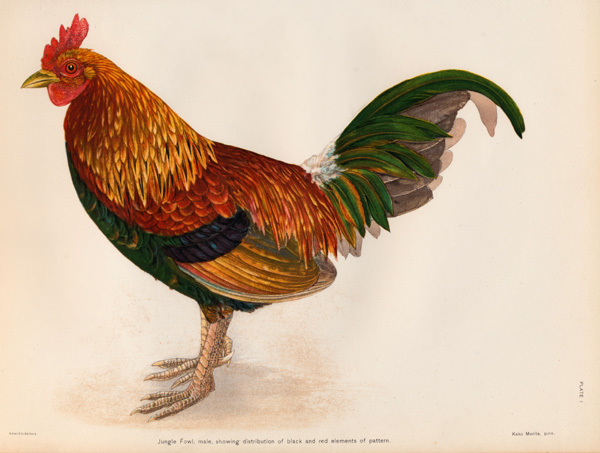
PLATE 1
Jungle Fowl, male, showing distribution of black and red elements of pattern.
A. Hoen & Co. Baltimore.
Kako Morita, pinx.
102
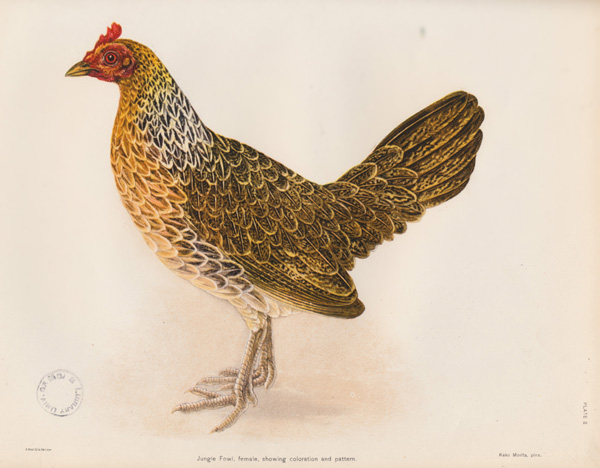
PLATE 2
Jungle Fowl, female, showing coloration and pattern.
A. Hoen & Co. Baltimore.
Kako Morita, pinx.
104
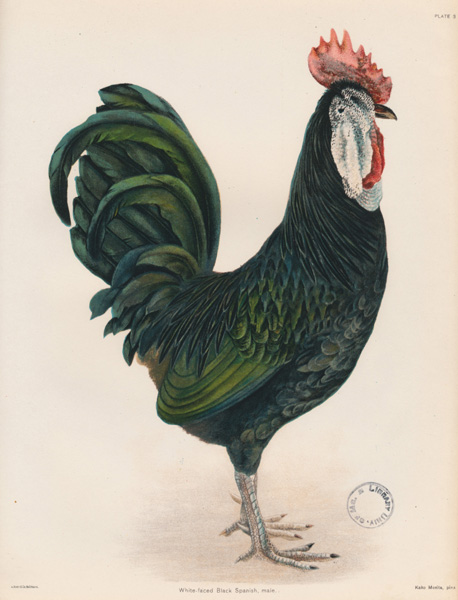
PLATE 3
White-faced Black Spanish, male.
A. Hoen & Co. Baltimore.
Kako Morita, pinx.
106
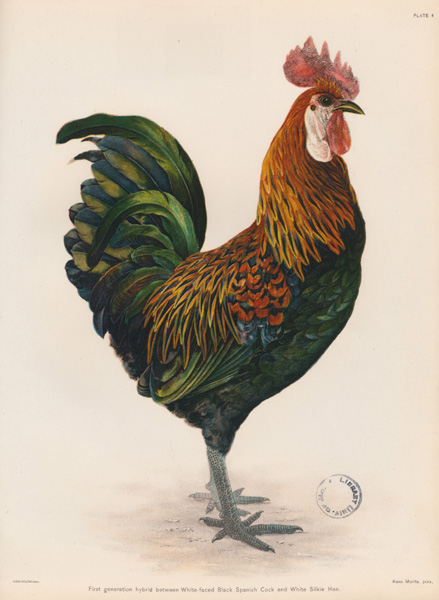
PLATE 4
First generation hybrid between White-face Black Spanish Cock and White Silkie Hen.
A. Hoen & Co. Baltimore.
Kako Morita, pinx.
108
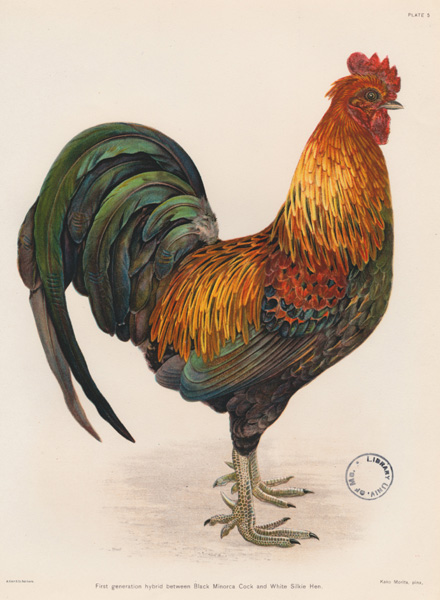
PLATE 5
First generation hybrid between Black Minorca Cock and White Silkie Hen.
A. Hoen & Co. Baltimore.
Kako Morita, pinx.
110
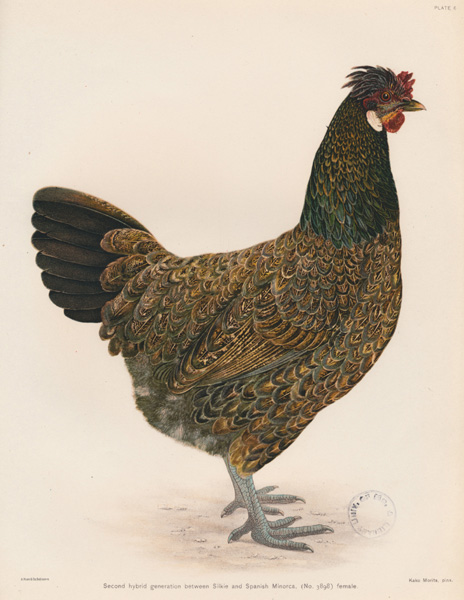
PLATE 6
Second hybrid generation between Silkie and Spanish Minorca, (No. 3898) female.
A. Hoen & Co. Baltimore.
Kako Morita, pinx.
112
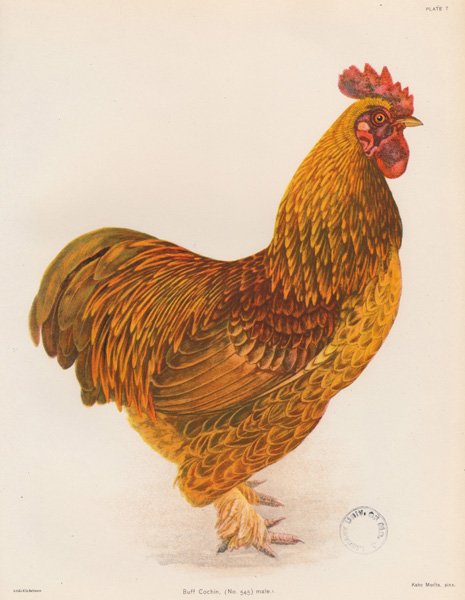
PLATE 7
Buff Cochin, (No. 545) male.
A. Hoen & Co. Baltimore.
Kako Morita, pinx.
114
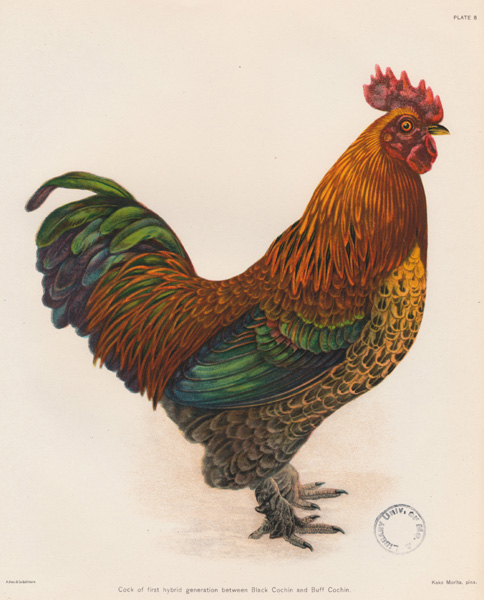
PLATE 8
Cock of first hybrid generation between Black Cochin and Buff Cochin.
A. Hoen & Co. Baltimore.
Kako Morita, pinx.
116
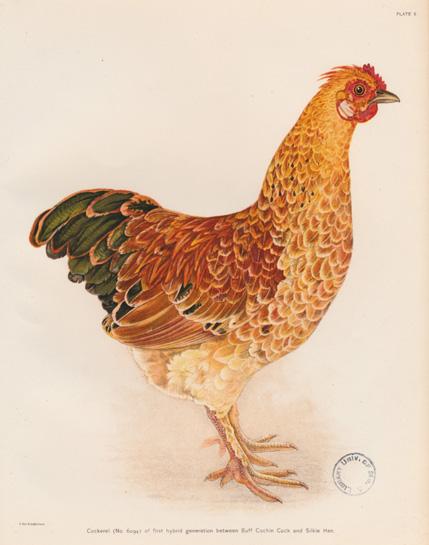
PLATE 9
Cockerel (No. 6094) of first hybrid generation between Buff Cochin Cock and Silkie Hen.
A. Hoen & Co. Baltimore.
118
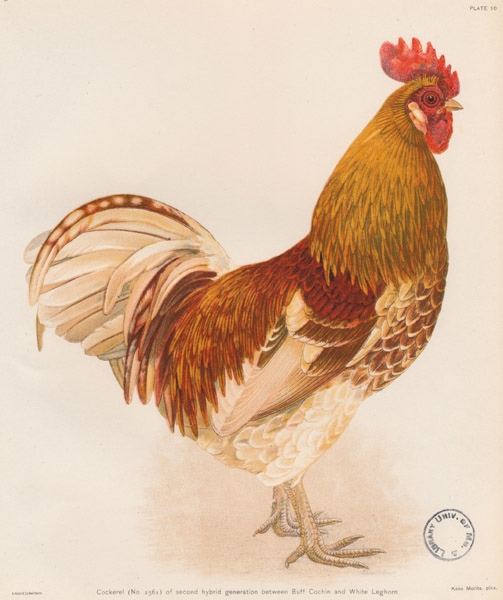
PLATE 10
Cockerel (No. 2561) of second hybrid generation between Buff Cochin and White Leghorn.
A. Hoen & Co. Baltimore.
Kako Morita, pinx.
120
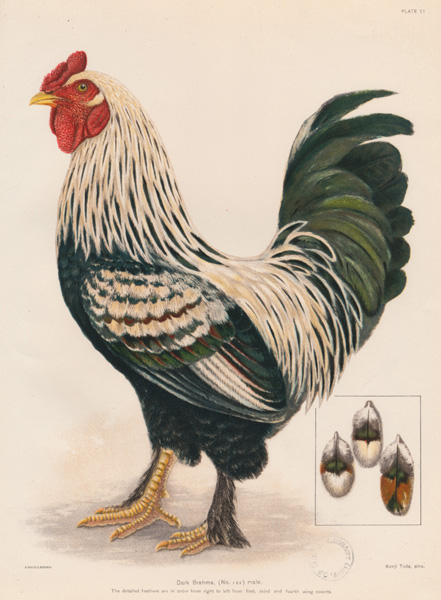
PLATE 11
Dark Brahma, (No. 122) male.
The detailed feathers are in order from right to left from first, third and fourth wing coverts.
A. Hoen & Co. Baltimore.
Kenji Toda, pinx.
122
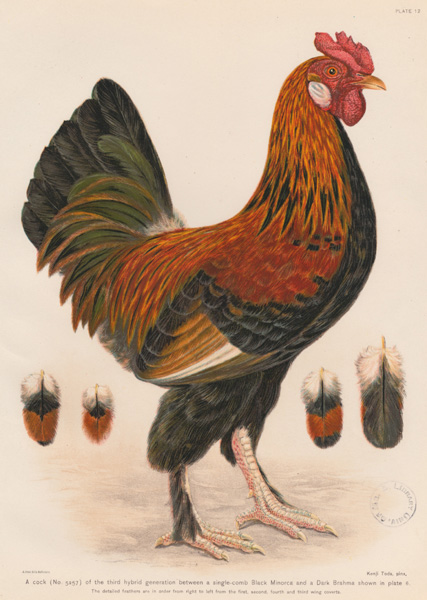
PLATE 12
A cock (No. 5257) of the third hybrid generation between a single-comb Black
Minorca and a Dark Brahma shown in plate 6. The detailed feathers are in order from right to
left from the first, second, fourth and third wing coverts.
A. Hoen & Co. Baltimore.
Kenji Toda, pinx.