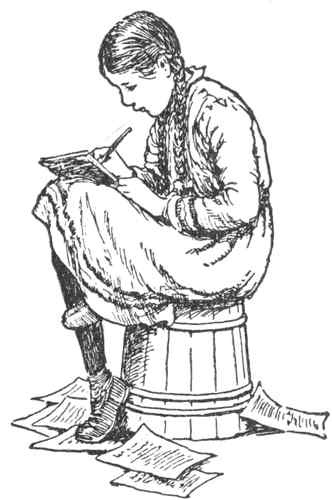
It is certainly comical that I, Inger
Johanne, wrote a book[1] a while ago and that
it was printed, so I (I!) am an author.
Really, it is too funny. I have to laugh whenever
I think of it.
But what I wrote was only scribblings, not
like a real author’s book; for persons who
know how to write can picture everything so
vividly that the readers see it clearly in their
own minds; and I am very sure that you can’t
see our delightful town at all, though my whole
book is about how things are there.
You can’t see the little red and yellow
houses among the gray rocks; the shining blue
water and the big ships ready to start on long
voyages, with the sailors hauling up the anchors,
while on the hill the wives and children
stand waving big handkerchiefs and crying.
They even climb Big Rock and stand
there until the ship is just a little speck far, far
out on the water.
Oh, you can’t know, either, how the fresh
wind feels on your cheeks, or how the heather
brushes against the bottom of your dress, or
how our old house on the hillside looks—or
Peter or Karsten——No, I wrote about it
all so poorly that you can’t have much idea of
any of it.
Before the stories were printed I let Nils
and Peter and Karsten and Massa and Mina
read them, but I shouldn’t have done that, for
I got paid for it well and quickly, I can tell
you.
Karsten thwacked me on the head hard, four
times, because I had written that he was troublesome.
Nils thought I had said too little
about him, so he squirted a lot of water right
in my face.
Peter, the dean’s son, was mightily offended
(and has been ever since) because I told about
his father leading him home by the ear. As
for Massa and Mina, they thought it was so
tedious to read about the children here at home
that they would not even finish the stories.
So, you see, you get something besides
pleasure when you write a book.
But what do you think? My book was
praised in the newspapers! It really was! and
I must say that that was exceedingly pleasant.
I had decided that I would never write another
book, but I have changed my mind; for
when people say I write “so very”—why,
of course I want to write.
At one time I thought that to be head milkmaid
with a large herd of cows in my care
would be the most delightful thing in the
world, but now I know I should rather be an
author. Hurrah!
Yes—I shout, “Hurrah!” because it has
been in the newspaper that “Inger Johanne
is full of talent, has humor and is hearty and
sound.”
Hearty and sound am I, that is sure, for
I have never had anything the matter with me
except that time I broke my arm when I
thought I should be a circus rider. (I told
about that in the other book.)
Every time there was anything in the paper
about me when my book first came out, I
would take the paper and read the notices
aloud to Massa, Mina, and the rest.
“Style, color, and tone are well maintained
throughout Inger Johanne’s book,” I read in
a loud voice. “And the whole is pervaded by
humor that is irresistible.”
While reading, I usually stood on a fence
or a rock, and when I finished, I swung the
paper out in the air and shouted, “Hurrah!”
Naturally the others made fun of me, but I
never bothered myself the least bit about that.
I don’t believe you could find in our whole
town one single other person who has written
a real book. True enough, Candidate Juul
has made a French dictionary for schools, but
that doesn’t mean that he has talent, as the
papers say I have.
However, when the boys and girls laugh at
me too much because I talk about my book, I
go away from them; but I soon come back, for
there is no fun in staying alone, even if you
are “full of talent.”
Most people think that nothing very important
happens in our town, but we girls and
boys always have plenty of fun and excitement,
and that is what I’m going to tell you
about in a minute. But first I want to tell you
about Karsten. He is exactly the same as
ever, thinking of awfully queer things to do
almost every day. One of his plans was quite
a stroke of genius, I must say!
As I walked down-town one morning, I was
surprised to see some peasants and town
boys in the middle of the market-place where
there is almost never anybody. And what do
you think I found when I went to see what was
going on?
There stood Karsten in the middle of the
bunch. He had our smallest bread-basket
with Mother’s carving-knife in it, a half-stick
of sealing-wax, a tooth-brush I had bought the
day before, and a number of other little things
from home.
“Why, Karsten! Are you crazy? What
are you doing?” I called.
“I’m in business, as you can easily see,”
said Karsten grandly. “Go away.”
Imagine it! That foolish child stood there
in the market-place actually trying to sell a
half-stick of sealing-wax and my new tooth-brush!
Some of the other boys had sold postage
stamps and buttons, and so of course
Karsten wanted to sell something.
You may well believe that I took him home
with me in a hurry; and there he got the good
scolding from Father that he deserved.
I could write a much longer letter than this,
but perhaps I had better not, for I have lately
read that the art of writing is to limit yourself,
and so I will close at once.
Thank you for liking my book.
Inger Johanne.
P. S. My dears, you must be sure to praise
this book a little, also, or else I shall be horribly
embarrassed and mortified before Massa,
Mina, and Peter, and the others.
The boat bumped and scraped against the
wharf. We had arrived. Hurrah!
The instant Karsten set foot on the wharf,
he was off and away at full speed up the hill,
and swinging into the avenue that led to the
Parsonage.
On my way up, I happened to think of some
strawberry patches I had known the summer
before, and I simply had to go a little aside on
the hill to look at them. Yes, there they were,
with specks of red shining out between the
leaves and stones. Good!
But now I could see Aunt Magda’s garden
hat at the end of the avenue and I must hurry,
for she would be wondering what had become
of me. I began to run, and soon sprang into
her open arms. I put both my arms around
her and squeezed her frightfully hard till
she shrieked. I always do that with any one
I like awfully well, you see.
On the Parsonage steps sat Uncle’s friend,
the queer old lawyer, Mr. Witt, with his mass
of bristling white hair and his sharp eyes.
And now Great-Aunt came. She is aunt to
Mother and Aunt Magda and is awfully old.
Great-Aunt thinks she knows everything, I do
believe. No matter what incredible thing happens
in the town or in the world, she insists
that she foresaw long ago that it would happen.
“There! Didn’t I know it? No need
to tell me,” says Great-Aunt.
Between you and me, I will own that I
cannot like her; but she is frightfully clever,
and Aunt Magda daren’t do a thing except
just what Great-Aunt wishes.
“Well,” said Great-Aunt, looking me over,
“seems to me you had better stop growing
now. You will soon be so tall that you can
look into people’s second-story windows.”
Great-Aunt is a good half a head taller than
I, so she had better think of her own height;
but I didn’t say that. I only curtsied nicely
and gave her all the proper greetings from
Mother and Father.
Karsten had done nothing but run around
through the rooms without greeting any one,
shouting, “Where is Hedvig? Where is
Dan?” Ugh! that rude Karsten! What
would Mother think of his not greeting anybody,
but just running around asking for the
milkmaid and the dog? I must say it was decidedly
necessary that I should come and behave
properly. When I choose, I can behave
myself charmingly, almost like a grown-up
young lady. I say, “What, please?” or
“I beg your pardon?” to people sometimes
even when I hear perfectly what they say; and
when I drink from a cup or glass I curl my
little finger out in the air, for that is what I
have seen fine ladies do.
Well, there I sat and drank chocolate and
talked grown-up talk; and presently Karsten,
warm and out of breath, came in from the
kitchen.
“My! Hedvig and Dan have grown awfully
little since last summer,” said he.
“Is that so? Has Hedvig, too, grown little?”
asked Great-Aunt.
Yes, Karsten thought she had shrunken remarkably.
Oh, that pleasant old living-room at the
Parsonage! It has a low ceiling, and all the
walls are crowded with pictures. There are
Luther and Melancthon, and the King in
Leire and Gustavus Adolphus and Wellington
and Bishop Gislesen and his wife, and
Skipper Marenssen from down on the shore,
and William of Orange with his crown and
sceptre. Uncle goes around and talks to them
sometimes as if they were alive and could answer
him.
There are green woven pieces over the sofas
and chairs, and the windows are full of
fuchsias, always in bloom. Great-Aunt and
Aunt Magda sit, each on her own side of a table
between the windows.
Great-Aunt has many interesting things in
her work-box, a basket carved from a cherrystone,
a corkscrew as little as a fly, and other
queer things. I look at them when Great-Aunt
is out. I should not dare to at any other
time.
The door stood open, and summer fragrance
was wafted in. Between the white rails of the
garden fence, I could see bunches of currants,
clear and red, and I knew that in the garden
there were raspberries as big as the cook’s
thimble, and garden strawberries so big they
had the distinction of being laid out on pieces
of roof tiles to ripen. Hurrah! What a good
time we should have! Suddenly I sprang up
and for pure joy leaped down the steps four
or five at a time to the grass below.
“See that now!” said the old lawyer still
sitting on the steps. “And I had thought you
a grown-up young lady!” This embarrassed
me a little, but I pretended not to notice it.
The whole of the first day, I went about
visiting the places and the people I had known
the year before. First, I went to the men’s
room to see Jon. He was poorly, he said, and
had a stitch in his side a foot long. It was a
great deal worse because he had had to row out
to the steamer for us,—which he needn’t have
done if children only stayed in their own homes
as was proper, he thought. He was not so
very polite,—he usually isn’t—but I never
trouble myself in the least about that.
“Oh, you’ll be all right soon, Jon,” I said.
“Humph! It would be pretty bad for
other folk if I weren’t,” said Jon, looking
much offended.
Later I was in the henhouse and saw a hen
sitting on her nest, and in the pig-pen where
I scratched a pig’s back with a stick. “Piggy,
piggy, piggy!” “Uf, uf, uf,” said the pig.
Then I went to the cow-house and the barn, and
last of all to the churchyard,—the church is
right near the Parsonage, you see,—where I
went around and read all the verses on the
gravestones, although I knew most of them by
heart.
It is an awfully pleasant churchyard, with
big, plump maple-trees, through which the
sunlight falls in flecks and patches on the tall
grass and sunken graves, where the old sailors
and their wives lie buried. Some have beautiful
gravestones with verses on them which
Uncle wrote. Round the churchyard is a very
broad stone wall. Karsten and I get up on it
and play tag there.
At the very farthest end of the Parsonage
garden I play, all by myself, a most delightful
kind of play. I am awfully fond of cows and
sheep and everything about a farm. That is
why I used to think I would be a milkmaid,
you see, but, as I told you, I have given up that
idea. I prefer to be an author.
Well, far down in the garden where nobody
ever comes, under some old gooseberry-bushes,
I have lots of cattle,—cows and calves and
sheep and lambs! The cows are big round
smooth stones; they stand in their stalls with
fresh green grass before them; the calves—smaller
round stones,—stand in calf-pens.
Everything is nicely arranged, I assure you.
The sheep and lambs are pretty white stones
that I find on the shore.
Near my barns I have built a little bit of a
hut of moss and stone with a tiny piece of
glass in it for a window. Inside the hut there
are two dolls,—the milkmaids who take care of
the cows. Oh, I love all such planning and
arranging and pretending!
But when I happened to speak of it one day,
that horrid old lawyer began to make fun of
me because I at my age could find pleasure in
such make-believe things. And somehow
after that, I began to be tired of my cattle
farm under the gooseberry-bushes. It would
be a different matter if one could have a real
cow to take care of.
In the south meadow that summer there was
a big brown-and-white cow named Brownie.
She was so quarrelsome that she could not be
with the other cows. Great-Aunt told Karsten
and me to look out for ourselves when near
her, because she was very cross. But I used
to go often to look at her, and soon I had a
tremendous desire that Brownie should be my
cow, as it were, and that I should take the entire
care of her myself.
One day I decided that I would put Brownie
in the old smithy that no one used any more;
and there I would feed her and milk her every
day. But first I must have a collar for her;
so I went to the cow-house, where I found an
old one. It was firmly fastened in a stall, but
I jiggled and twisted and jerked and tugged
at it until I finally got it out. Then I hammered
it into the wall of the smithy. The
next thing was to get Brownie into her new
quarters.
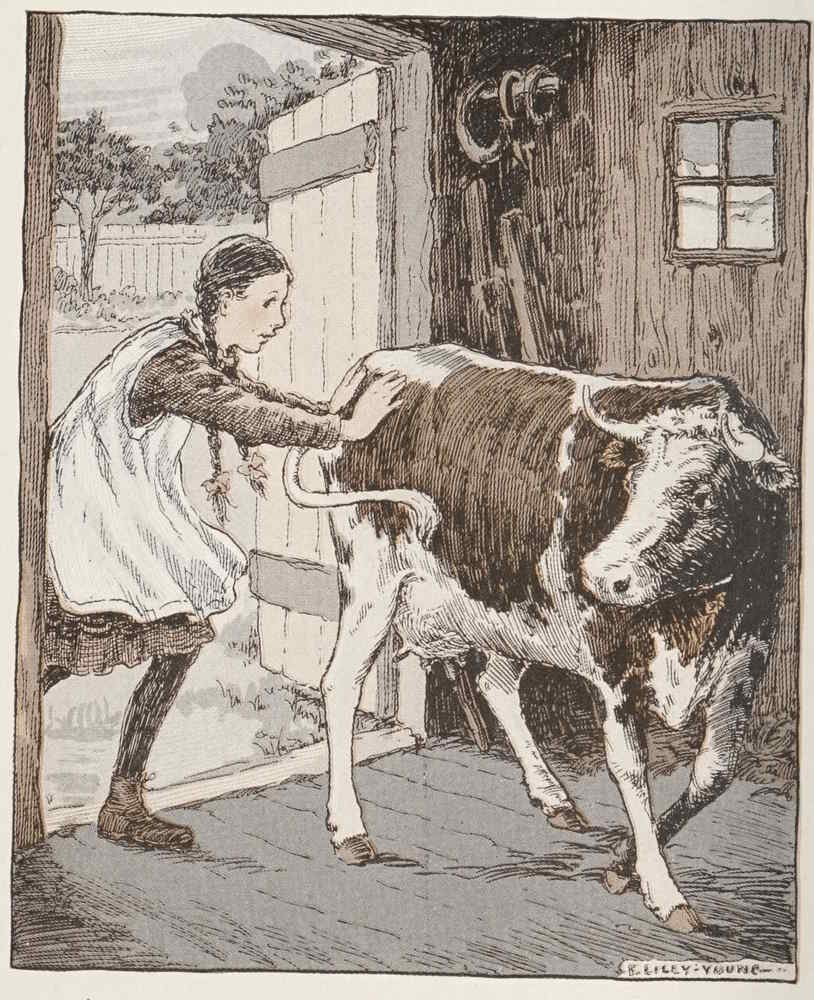
The first time I went near her she gave me
such a forcible push in my chest that I fell
right over. However, I don’t give up very
easily, and I coaxed and pushed and pulled at
Brownie so long that at last I got her into the
smithy and the collar on her neck. Hurrah!
Now I had a cow-house and a cow with a collar
on, just for myself alone. What fun!
I tore up a lot of grass and laid it before
her so that she should not be hungry, and I
fastened the door with a stick. Of course I
must milk her. The milk I could set up on
the shelf there in the smithy; perhaps I could
churn butter! As for cream porridge, there
would be no difficulty at all about having that
now as often as I wished.
I stole into the kitchen to get something I
could milk into, but Great-Aunt came upon me
so suddenly that I couldn’t get hold of anything
but a pint measure. That was pretty
small for the use I had for it, but I must try
to make it do.
I don’t know whether any of you ever tried
to milk a cow, but I can tell you that it isn’t
easy to milk one that kicks and thrashes its tail
about—especially if you have to milk into a
pint measure. At last I got the measure full,
however, and set it up on the shelf. Of course
it was rather sooty and dirty there, but I would
wash the shelf in the morning. I gave
Brownie a new supply of grass and then left
her for the night. I had not said a word about
all my plans for the cow to a single person.
Well! In the evening Hedvig, the milkmaid,
came to the house frightened almost out
of her wits. She couldn’t find Brownie anywhere,
and I could see that she was ready to
believe that the goblins had been at work. Excitement
ran high, especially with Great-Aunt.
“Didn’t I know it? You shall soon both
hear and see that something dreadful has happened
to Brownie,” Great-Aunt said solemnly.
Then I had to tell where Brownie was, and
that it was I who had taken her and put her in
the smithy.
“There now! Did any one ever see such a
girl?” said Great-Aunt. “You ought to be
whipped, big as you are, to put a cow in such
a place and give it neither food nor water.”
O dear! O dear! I had never thought to
give the cow water the whole day!
Well, Hedvig went to the smithy and let
Brownie out; so there was an end to that
amusement. And when I went to get my pint
measure of milk the next day, it had such a
thick layer of soot and dust on it that I gave
it to Dan, the dog, and I had hard work to get
even him to drink it.
When we had been at the Parsonage about
a fortnight, Peter, the dean’s son, came to make
a visit, too. He had grown shyer and more
freckled than ever since I saw him last, I
thought. He spoke never a word when he
was in the living-room, but it was rather jolly
to have him with us, even though I now had
two boys to look after instead of one. There
is always something to see to with such boys,—that
they cut the cheese nicely at the table,
change their shirts often enough, comb their
hair properly, and all such matters.
Great-Aunt was cross about many things,
but one thing made her very angry, and that
was if we ate any of her yellow raspberries.
The red ones we might take a few of, but the
yellow ones we mustn’t even think of touching.
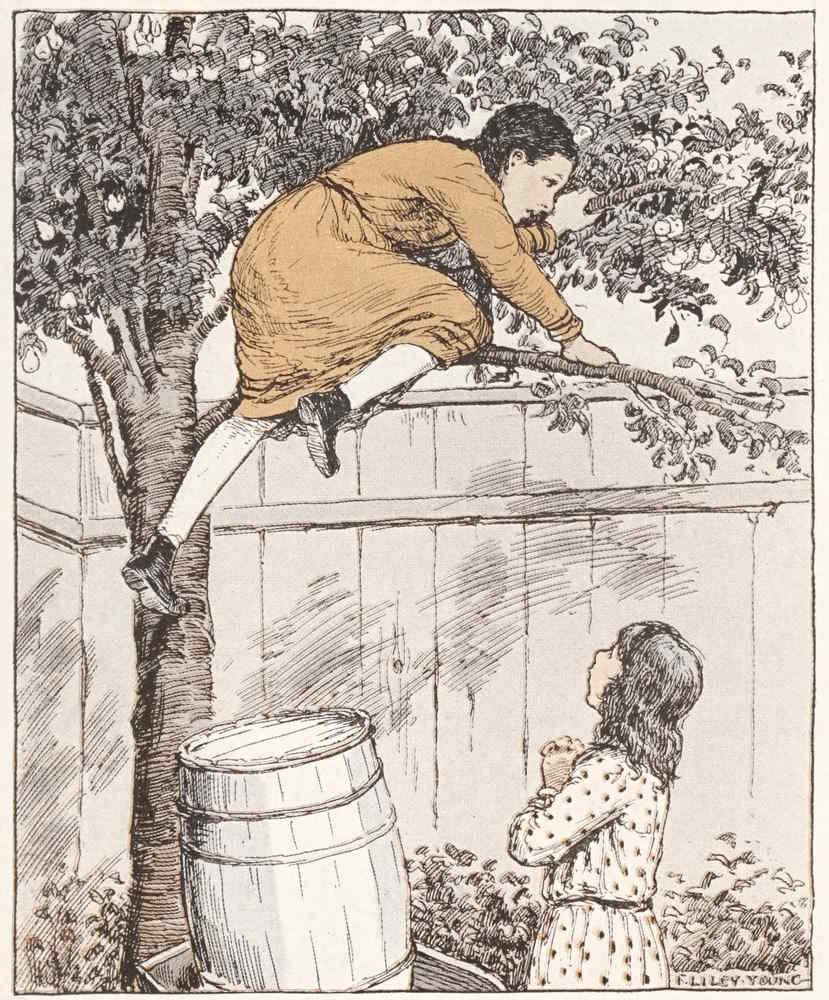
One morning when I lay out on the grass
under the avenue trees reading “Waldemar
the Conqueror,” I heard all at once a mysterious
rustling behind the raspberry-bushes in
the garden. I peeped between the bushes and—wasn’t
it just as I had thought?—there sat
Karsten and Peter picking yellow raspberries
and putting them into their straw hats.
When they heard me, they took to their
heels, over the garden fence and off towards the
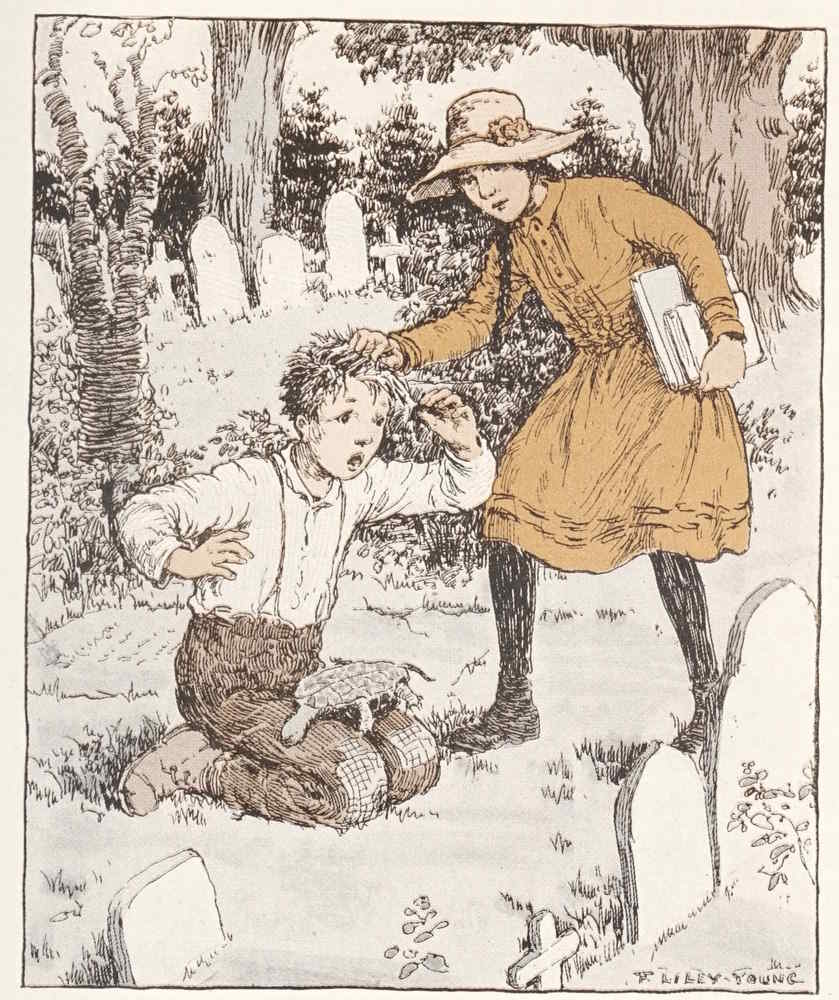
churchyard. As I caught up with them, Peter
said:
“If you’ll promise not to tell on us, Inger
Johanne, you shall have some of the berries.”
Both the boys had their hats half full.
Well, really, it is awfully mean to tattle,
and the raspberries were so tempting, not one
worm-eaten—and why should Peter and
Karsten eat them all, I ask you? So we divided
them equally and sat on one of the gravestones
to eat them.
I had forgotten “Waldemar the Conqueror”
that I had thrown down and left lying
in the grass, and just think! When I
went to get it, Dan was playing with it, and
torn-out leaves were scattered all over the
avenue.
“You bad, bad dog, let go, I say!”
At last I got it away from him, but he had
torn out eight leaves, and crumpled and bitten
several others. You may be sure I was disgusted
with myself and my carelessness, but I
said nothing about the book to any one. I always
looked at it guiltily though, where it
stood in the bookcase, knowing that Aunt
Magda did not dream that anything was
wrong with it. But she was always so very
kind to us, that before I went away I was awfully
sorry about “Waldemar the Conqueror”
and those raspberries. Peter and Karsten
weren’t the least bit sorry, they said, because
the berries they picked were so near the ground
that Great-Aunt, who is old and stout, couldn’t
possibly have picked them or even have seen
them; but I thought it was horrid of us, anyway.
At last I wrote a little bit of a note,—the
paper wasn’t much more than an inch square,—which
I gave to Aunt Magda asking her not
to read it until after I had gone. In the note
I told about the book and the raspberries and
begged her not to be angry, as I was so sorry.
It was now towards the end of vacation.
Soon there would be no more jumping in the
haycocks or riding home on the big loads of
hay, no more raspberries and cream for dessert
at dinner, no more bonny-clabber at supper;
and Saturday would be the last time that I
could be Uncle’s driver this year.
When Uncle goes to the other parish church
or to visit the sick, I am always allowed to
drive him down to the shore. You see they
have to go everywhere by boat from the Parsonage.
Uncle has to ride in a funny way.
He is so awfully stout that he has great difficulty
in getting into a carriage, so he rides in
a single sleigh, scraping over the road on
wooden runners. I sit on the tiny high seat
behind and crack the whip. We don’t go very
fast on the road to the shore because Uncle is
so heavy, but when I go back I sit in the sleigh
and drive so fast that the sand spatters on my
ears. It is great fun.
The day before we were to go home, one of
the Cochin China hens was sick. It may have
eaten some salt that had been spilled outside
of the storehouse. At any rate, it was sick and
ran round and round continually; it was horrid
to see. The trouble must be in its head. I
thought of putting a wet bandage on it, such
as people use when they have headache, but to
put a wet bandage on a hen that is spinning
round and round would be a little difficult.
I ran in to Great-Aunt. “Oh, Great-Aunt,
there is a hen that is sick and that keeps spinning
round and round and round! What shall
we do with it?”
“Oh, it will have to spin till it stops,” said
Great-Aunt.
There was no use. Nobody here at the Parsonage
understood about hens. When I went
away no one would care about that poor sick
thing, or do anything for it, I was sure.
I went out to the barn to speak to the milkmaid.
“Dear Hedvig, if you can’t cure that
Cochin China hen, you must chop its head off,
the minute I have gone.”
“Oh, no! I’d never dare do that unless
Mistress herself said so.”
“Please, please do, Hedvig. No one will
take any care of it when I’m not here.”
“But you know I don’t dare because of the
old lady.” That was Great-Aunt.
“Oh, yes, Hedvig. You are so kind.
Please do it and quickly, too.” I felt as if I
ought to say this even if I didn’t believe she
would do what I told her to do. The poor
sick hen!
Well, our visit at the Parsonage was over
and we were starting for home. Aunt Magda,
Great-Aunt and Uncle and Mr. Witt, the
old lawyer, went to the wharf with us, and
they all stood there and waved and waved.
Uncle waved his cane and Mr. Witt, who
wore a linen dust-coat, waved his long coattails.
Then what shouts from shore and
boat!
“Good-bye!” “Good-bye!” “G-o-o-o-d-by-e!”
Jon was in the best of humors as he rowed
us from the shore to the steamer. I didn’t
know whether it was because he would now be
rid of us for this year or the present of money
I had given him, that made him so pleasant.
“Good luck to all three on your journey,”
called Jon as he shoved his boat from the
steamer.
For a while we could see the church tower
and the roof of the Parsonage between the
trees; then the steamer rounded an island and
we saw them no more.
III THE LOST KEY
Mrs. Polby is the sort of person who stands
on her front steps, with arms akimbo, every
minute when she isn’t working, and talks with
every one who passes by. That is why she
knows all that is going on; and she knows, too,
every single hen in the town and every single
dog and every single person.
One time she blamed me for something
which I hadn’t done at all; and from that very
time we became good friends!
Now you shall hear about it from beginning
to end.
Mrs. Polby has a son named Karl Johan,—a
pale, namby-pamby boy who is offended if
you only look at him. In this, he is like his
mother, who is easily offended, too, but otherwise
they are very different. She is a regular
roly-poly, with round eyes and round, rosy
cheeks, works hard in her vegetable garden,
and talks a great deal, as I have told you.
It is rather unfortunate that Karl Johan is
so namby-pamby when he has such a kingly
name. That’s why we tease him, calling him
Karl Johan Gustavus Adolphus Kristian
Fredrik Julius Cæsar Polby or other grand
names; and he gets so furious that he runs
home and tattles to his mother. Then Mrs.
Polby stands on her steps and holds a Judgment
Day for us, blaming me especially; so
you can understand that she and I have never
been very good friends.
Back of her house, Mrs. Polby has a big
garden where she grows a quantity of cabbages
which she sells in the autumn.
In the farthest end of the garden there is
an old tumble-down building where she stores
the cabbages until they are sold.
Although Mrs. Polby doesn’t know it, we
often play hide-and-seek in that building, for
there are so many closets and bins and little
rooms in it where we can hide. The house is
so old and rickety that there are big cracks
everywhere in the floor and the walls.
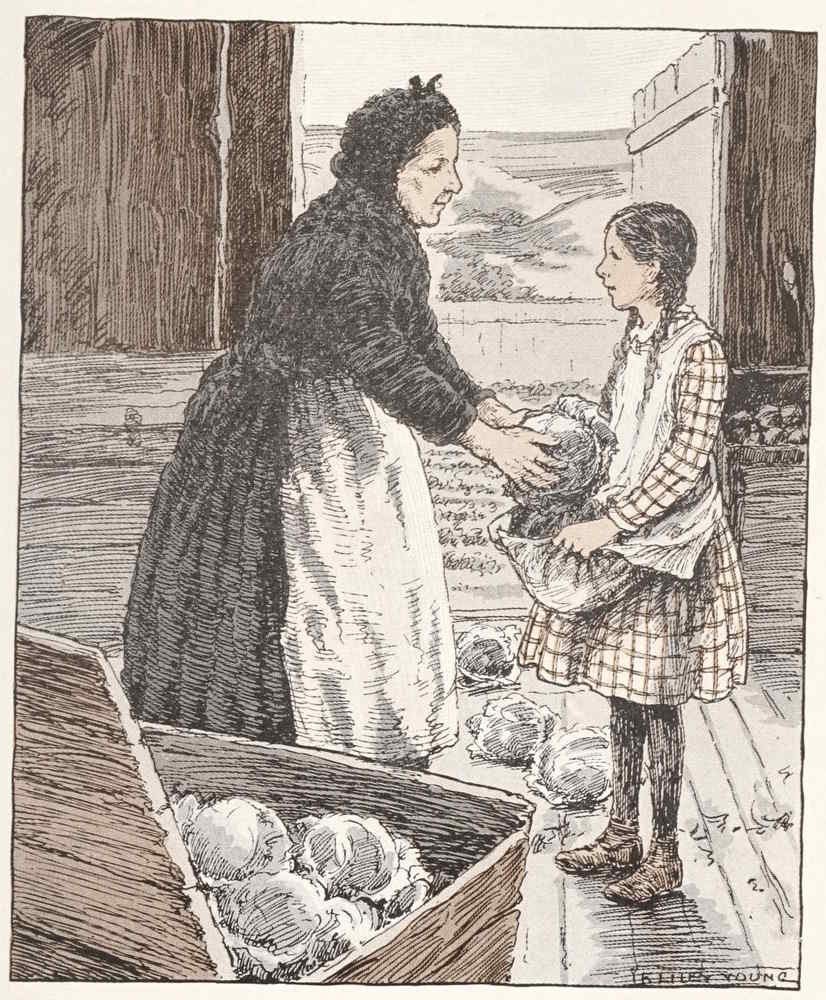
One day Mother said to me, “Run down
and buy two heads of cabbage from Mrs.
Polby.” Off I ran like the wind, as I always
do. Mrs. Polby, for a wonder, was not on her
steps, but Karl Johan sat in the kitchen drinking
coffee out of a big bowl.
“Well, Karl Johan Victor Emmanuel
Clodevig,” said I, “have you any cabbages to
sell?”
He began to scold at a great rate, his face
in the bowl the whole time, but he didn’t answer
my question about cabbages; so I thought
it was best to find Mrs. Polby herself, and I
ran out to the vegetable field.
The door of the shanty stood open, and one
cabbage-head after another came dancing out.
She is in there, I thought, and probably not
in good humor, for the cabbages were being
thrown with a certain wrathful haste. I
couldn’t see Mrs. Polby herself, for she was
farther inside the house.
True enough, there she was, hard at work
in the midst of her cabbages, and very red
in the face; she was throwing out the rotten
ones, and, as I had thought, was not in a very
gentle mood.
“I should like two heads of cabbage, Mrs.
Polby,” I said. “But I must tell you that
your son has been talking horridly to me.”
“Is that so? Well, who is it he learns such
talk from, sauce-box?”
“I don’t know, I’m sure,” said I. “But I
should like the cabbages right away.”
No, she hadn’t any cabbages, she said; they
all rotted and she was sick and tired of the
whole business, and, anyway, she sold no cabbages
to persons who called her Karl Johan
nicknames.
“Do you call Julius Cæsar, and Gustavus
Adolphus and Clodevig nicknames, Mrs.
Polby?” I asked.
“Heathen names and dog names we have no
use for in this country,” she said, “and you
can go your way for you’ll get no cabbages
from me. Tell your mother so, with my compliments.”
With that she went into a little closet at the
back of the shanty, and slammed the door after
her. Probably she slammed it a little harder
than she really meant to, (for she was in a
temper, you know,) and the lock caught. At
the same moment the key tumbled out of the
keyhole, and fell down through a crack in the
floor, vanishing in the depth below.
“The key fell through a crack, Mrs. Polby,”
I called.
Mrs. Polby fumbled at the door, took hold
of it and pulled and pushed till the whole
house shook.
“Will you unlock this door and do it at
once?” she shouted.
“I can’t unlock it. The key fell through a
crack and under the floor,” I shouted back.
Just think! she didn’t believe me!
“Don’t tell me such a thing as that. You
unlock this door this minute!” she screamed.
Nothing I could say would make her believe
that I had not the key. She kept on
beating and pounding at the door and berating
me for not letting her out.
“Oh, I shall suffocate in here. I certainly
shall,—with my asthma!—Oh! Oh!”
It was a very small closet she was in, scarcely
bigger than a wardrobe.
“Put your mouth up to that little hole in
the door and I’ll run after the locksmith,” I
said.
“Oh, no! Don’t go!” shrieked Mrs. Polby.
“I don’t dare to stay here alone.”
What in the world should I do? There
stood Mrs. Polby with her mouth close to the
hole which was about as big as the bunghole
in a barrel.
Sometimes her mouth disappeared while she
cried, “Oh, my asthma! my asthma!”
“Karl Johan,” I shouted from the door.
“Hurry! Come as fast as you can! Your
mother is locked in the closet.”
He came dragging himself slowly along as
if there were no need of haste.
“Hurry! Hurry!” I shouted anxiously.
“She can’t breathe, she says, locked in that
little place.”
“Well, let her out then,” said Karl Johan,
crossly.
O dear! Like his mother, he thought it
was all my doing.
“But I can’t let her out. I can’t! The key
is under the floor,” I cried, stamping my foot
at him. “But you can get it. You are so thin
and small you can creep under the building
easily. The key is right below the closet. Do
go, Karl Johan.”
“Oh, do, my jewel!” cried his mother from
the hole in the door. “Oh, oh, do go!”
But just imagine! He would not go, even
when his mother begged him to.
“It’s full of rats under the floor,” said Karl
Johan. “I don’t want to go there.”
“Then run for the locksmith,” I said.
“Only do hurry.”
Well, Karl Johan went, though he took his
own time about it; but I felt so sorry for poor
Mrs. Polby, who was wailing piteously, that I
couldn’t bear to wait for the locksmith.
“I’ll creep under the house, Mrs. Polby,”
I said. “Just keep calm.”
“Oh, will you? God bless you! This is
the worst thing that ever happened to me,”
she moaned.
So I crept under the house. It was all I
could do to get along, for the ground was wet
and slimy and disgustingly filthy, with old
straw, broken bottles, and every kind of trash.
And Karl Johan was right—rats. Ugh! But
I crept and crept. Mrs. Polby stamped on
the floor and called all the time so that I
should know about where the key would lie.
I fumbled and fumbled in the dark. No, I
could not find it. A rat ran right over my
hand and I only just managed to keep myself
from screaming.
“Can’t you find it?” called Mrs. Polby.
There! my hand touched it! I was so glad
that I shouted loudly, “I’ve got it! I’m coming,
I’m coming!” as I started to creep out.
But you may well believe that it was difficult
to turn one’s self around under that floor; it
was about the hardest of all.
Ah-h! Now I was out in the air again!
My, but it was good! Into the house I
bounded, put the key in the lock and flung the
door wide open.
Mrs. Polby was sitting on the floor, chalk-white
in the face and without power to speak
at first. In a moment, though, she threw her
arms about my neck with such force that I
nearly fell over backward, for she is pretty
heavy, I can tell you; then she began to cry.
“I really didn’t throw the key away,” I
said.
“Oh, no! The keyhole has been bad this
long time—and you have saved my life——Oh!
Oh!”
She kept on coughing and crying and at last
said I should have five cabbages as a present;
and then she cried again.
“Why do you cry now?” I asked. “Here
comes Karl Johan with the locksmith.” True
enough—they were coming at full speed with
a very long pair of tongs.
“So you’ve been sitting under lock and key,
have you?” said the locksmith.
Just imagine! I really did get five heads of cabbage
as a present.
“Don’t talk to me, for I haven’t any
breath,” said Mrs. Polby; but at the same minute
she gave a scolding lecture to Karl Johan
because he would not creep under the floor
after the key.
Just imagine! I really did get five heads of
cabbage as a present—and had my money besides!
So nowadays whenever I see Mrs. Polby
standing on her front steps, I stop and we
have a little chat; for we are the very best of
friends.
IV TOBIESEN’S GRAND PARLOR
So many strange things are always happening
to me. Can you understand why? Some
persons (like my aunt who went to Paris)
never have anything the least bit interesting
happen to them. Why, when she came home,
she said (I heard her with my own ears):
“I suppose I ought to have a great deal to
tell about my trip, but really nothing especial
happened and I haven’t seen or done anything
worth telling of.”
“If that’s so,” said Father, “your trip
wasn’t worth the money it cost,” and I agreed
with him entirely. If I had gone to Paris, I
should have had enough to talk about continually
for a month or more. At home they say
that if I just go out on the front doorstep,
look up and down the street, and come right in
again, I have immediately a great deal to tell.
It may well be, however, that I talk a little
bit too much—but when so many exciting
things are happening all the time, am I to keep
still and not talk about them? No, indeed, I’m
not that kind of person. Talk I must.
Now you shall hear how I came to be in
Tobiesen’s grand parlor where none of the
town folk have ever been; for it was in a curious
way, as you will agree.
Tobiesen is an assistant at the Custom
House—but he doesn’t look like the other officers.
They are all short and stout and red-faced—at
least they are in our town. But it
is not so long ago that Tobiesen came here, so
probably that is why he is so unlike the other
officers. He is very tall and cross-looking;
won’t talk to people and doesn’t associate with
any one. Would you like to know what he
does when he sits alone at home in the evenings?
He embroiders,—works on canvas!
Ingeborg, our maid, says that all men who do
needlework are cross; so it isn’t strange that
Tobiesen looks so glum and disagreeable, since
he sits and sews on canvas every evening.
He is not married, and he lives alone, a little
way out of town over the new road, in a house
that he has bought and made all pretty and
bright with new paint. Tobiesen, as I have
said, never goes anywhere and nobody ever
goes to his house; yet both Mina and I have
sat for a whole hour in his best parlor! and
that without having any idea of doing it! I
was afraid enough that time, I can tell you.
I don’t know whether it is so where you live,—that
a great many wandering Gypsy tribes
come to the town,—but they certainly come to
ours. There are Flintian’s tribe and Griffenfeldt’s
tribe and Long Sarah’s tribe, and many
others.
Most of them come by land with packs on
their backs full of tinware and woven baskets
that they wish to sell; and they always have a
crowd of dirty dark-skinned children and cross
women and cross dogs with them. Some
Gypsies, though, come by boat—but I don’t
know any of those except Lars and Guro, who
belong to Flintian’s tribe. They own a big
boat exactly like a pilot-boat and travel from
town to town and deal in pottery and rags.
They always bring their boat to the wharf near
the market-place.
My, but you should see Lars and Guro!
Both are dark, lively little persons. There is
only this difference between them: Guro wears
as little as she can, while Lars has as much as
possible on him—he is all stuffed out with
clothes and rags.
Guro says that Lars is weak in the head, and
that anything weak must be kept warm, so
Lars wears a heavy fur cap all summer, no
matter how hot the sun is there on the wharf.
Guro attends to the rag business and Lars
to the pottery. He has some savings-banks of
red clay in the form of a bird with a slit in the
back which all the children in town are crazy
to buy. Guro with bare brown legs fairly
wades in the heaps of rags on the deck, and
scolds at the children who stand on the wharf
and watch her.
Perhaps you are wondering what Lars and
Guro have to do with Tobiesen’s grand parlor.
Well, just wait.
The longer Lars and Guro are in town, the
crosser they get at all of us children. At first
they are quite pleasant and let us go down on
the deck where they are and peep into their
cabin—my! but it looks disgusting—but later
no such favors are to be thought of. Whether
this is because Lars and Guro, when their business
has brought them in some money, are always
drunk, or because all the children are so
horrid about teasing them, I don’t know; but
the fact is that when the rag-boat has been at
the wharf about a week, Lars and Guro are so
angry and behave so abominably that a policeman
has to stand on the wharf all day to stop
Guro when she gets too outrageous. Their
visit usually ends with their being told by the
police to get away from our town with their
boat the quickest they can.
The rag-boat had been at the wharf about four
days and Lars and Guro were, even for them,
in an unusually bad humor. Guro had promised
me and the other children a mighty warm
welcome if she once got hold of us. And on
top of that she promised that she would surely
get us in her clutches before she left the town,
for worse children, she said, were not to be
found along the whole coast. That long-legged
one, the Judge’s girl, (that was I) was
the worst of the whole lot. For that matter,
said Guro, she didn’t care whether we were
the children of priest or prophet or magistrate,
she would catch us just the same.
One afternoon Mina and I went for a walk
up on the new road. Not a person was in
sight. Oh, yes, there was; Lars and Guro
were coming down the road towards us. They
walked hand in hand, staggering a little, and
quarreling loudly as they came. Mina and I
did not dare to pass them on that lonely road
with no one else near, so we ran up the hill
and hid while they passed us.
But when they were just below us, Mina
called out, “Raggedy Guro—raggedy Lars!”
From that came all the trouble. I was awfully
provoked with Mina. Really, she might
rather have let them go in peace that time.
But you should have seen and heard the
commotion, then!
Guro and Lars dashed back to where they
could scramble up the bank. They showed
that they could both make good use of their
legs, I can tell you. There was no time to be
lost, for they had almost caught up with us.
Mina and I ran as we had never run in our
lives before, hopped over stones, and ran and
ran. Oh, how afraid I was!
Guro was after us swift as the wind; Lars
had so many clothes on that he was clumsy and
slow in his movements, and was very soon left
behind.
For an instant, I thought it might be safest
to run farther up the hill, but no, my next
thought was that it was best to get to the road
again, so I sprang down five or six feet at one
leap—Mina after me. Guro dared not take
such a leap as that. Luckily for us she had
to run a roundabout way, so we had a little
the start of her.
Not a sound came from Mina or me, but
Guro scolded incessantly. We ran for dear
life. Lars and Guro had both reached the road
now, and the noise they made as they ran could
be heard a long way. Oh! There stood Tobiesen’s
house!
“Come, let us run into Tobiesen’s,” I exclaimed,
panting. In a twinkling we were
through the court and in the hall; we rushed
to a door and found ourselves in a fine, well-furnished
room with white shades pulled down
over the windows. The key was on the inside
of the parlor door and I turned it hastily.
There we stood. But at that instant Lars and
Guro came tramping into the hall; Guro
shrieked and scolded and vowed that she would
find us, sure as fate. I was horribly afraid,
more so than I can describe; Mina sat herself
flat on the floor with her eyes bulging with
terror.
There were hasty steps in the room above us,
and then from the top of the stairs came the
thin, high voice that was surely Tobiesen’s,
calling, “Now, in heaven’s name, what is all
this rumpus?”
“We want to get hold of the girls who came
home just now,” shrieked Guro with the voice
she uses when she is in her most furious rages
on the rag-boat.
“Came home? No one comes home here.”
Tobiesen trudged down the stairs in his
slippers.
“I don’t know what kind of man you are,”
said Guro, “for I’ve never seen your face before;
but it’s that young one of yours I want
to get hold of—the one who came home here
just now with that long-legged girl of the
Judge’s.”
“Are you crazy, folk? I have no young one—I
am not married.”
“When we find them, we’ll break every
bone in their bodies,” Lars’ thick voice growled
from under his fur cap and out of his muffled
throat.
Mina and I looked at each other. What a
frightful position we were in—only a little thin
door between us and that furious Guro and
Lars and with no one to protect us but Tobiesen,
who might be angry with us, too!
Guro screamed louder and louder.
“If you think I am afraid of you, you make
a big mistake,” she shouted. “I’m going to
find them, be sure of that.” She rushed farther
into the hall, and shook one of the doors.
Tobiesen spoke again, his voice sounding perfectly
desperate.
“See here, you two,—here—take this, but
go—only go away.”
Guro’s manner and tone changed at once.
“Thanks and honor—thanks and honor—My,
such a wonderful nice man! Now, truly,
you can’t tell by the outside of folk how they
are inside—such a wonderful nice man!”
Evidently he had given them money to make
them go away.
“Now go,” Tobiesen repeated. “Go away
at once.”
There! They were out of the door and he
turned the key in its lock after them.
“Whew!” Tobiesen gave a long whistle of
relief, but if he had known that we were in his
grand parlor he’d have whistled louder yet!
I had a little hope that he might go up-stairs
again; but no, he went into a room just across
the hall.
“Oh, Mina! How splendid that they have
gone!”
“But I’m almost as afraid of Tobiesen as
I am of Lars and Guro,” whispered Mina,
looking up at me.
“Sh—just keep still. We must wait a little
while.” We listened and listened; not a
sound was to be heard in the whole house.
Perhaps we could steal away now; but,
scared as we were, I simply had to see Tobiesen’s
fancy work.
Everywhere in the room, on the chairs and
on the sofa were placed small white covers that
must surely have embroidered pieces under
them. I went on tiptoe over the floor.
“Why, Mina! Really, his work isn’t so
bad! Come and see.” There was an angel’s
head worked on canvas in white beads on a
sofa-pillow, and a harp among roses on the
back of a chair.
But Mina dared not stir from the door.
“Sh-sh! Don’t talk. Come back again,
Inger Johanne; he will hear you. Ugh! if he
should come——”
I turned the key of the parlor door slowly,
slowly round. It was great good luck for us
that everything in Tobiesen’s house was so well
taken care of, for the lock had just been oiled,
and the key didn’t make a sound. We tiptoed
out into the hall, in dead silence, only
making motions to each other.
We reached the street door, turned that key
as carefully as we had the other, opened the
door quickly—and we were out!
When we had gone three or four steps from
the house I turned and looked back. At the
door stood Tobiesen staring after us. Such
astonishment as his face showed I never saw
on any other face. Mina and I ran down the
street as fast as we could.
Well, that’s the way we escaped from Tobiesen
as well as from Lars and Guro, but tell
me, don’t you think it was a frightful situation
for us?
Ever since that time, when I see Tobiesen
in the distance, I turn and go into another
street, I am so afraid he will recognize me.
In the evening of the same day that Lars
and Guro had chased us, they were sent out
of town for quarreling in the streets, and since
then nothing has been seen of them.
V THE DANCING-SCHOOL
A dancing-master had come to town and
almost all the children were to go to his dancing-school.
He was Swedish, his name was
Baklind, and he had engaged a room at
Madam Pirk’s.
Madam Pirk kept cows and made her living
chiefly by selling milk. She sold cream, too;
but into that she put potato flour so that it
should look thick. She was glad to rent a
room, you may be sure.
It was an immense room on the first floor
and ran the whole length of the house; its big
windows looked out on both the yard and the
street. Under this room was the cellar where
Madam Pirk kept her cows; that must have
been why there was always such a peculiar
odor in the room.
The wall-paper on this drawing-room represented
a countless multitude of green-clad
shepherds who played on golden horns in a
crimson sunset glow. Midway down one of
the long walls stood a monster of an old-fashioned
stove, an enormous bulgy contrivance
with a pipe that went straight up through the
ceiling. To make a fire in that stove would
take half a cord of wood, I do believe!
Fortunately for Madam Pirk and Mr. Baklind,
there was no question of heating the room.
The month of May had come, there was a
south wind, and a constant drip-drip outside
from the melting snow in the roof gutters.
But probably the room was somewhat cold,
for Mr. Baklind always wore his spring coat, I
remember. If we children wished a little more
warmth, the idea was that we should get it by
dancing.
Mr. Baklind was a tall, stout man with long
hair falling down over his neck. It never occurred
to me then, but now I am pretty sure
that he curled his hair with curling-tongs. I
remember scarcely anything else about him but
his legs, which were very thin. He wore
striped stockings and pointed patent-leather
shoes, and came every day with these dancing-shoes
in his pocket, changing to them right
there in the dancing-hall while we stood around
looking at him.
Baklind himself was the whole orchestra; he
played the violin, tramped out the rhythm, and
sang, “Tra-la-la!” or Swedish songs. He was
a happy fellow, that Mr. Baklind! I should
like to know where he waltzes around now.
There were about thirty children who went
to Baklind’s dancing-school. We stood arranged
according to height; girls in a long row
on one side of the room, boys on the other side.
Massa was the tallest girl and I came next.
Nils Trap was the tallest boy, and Massa was
to have him as her partner.
Angemal Terkelsen fell to my lot, a big,
awkward boy who could neither bow nor dance,
and would never swing himself round except
when he came to a corner of the hall, where
he had to turn. At first he danced so poorly,
that he had to practise all alone while the rest
of us sat and watched him. He was stiff as a
poker and looked bored all the time he was in
the class.
I was mightily offended with Baklind because
I had to have Angemal for my partner,
although of course Baklind was not to blame
that Angemal and I were of the same height.
Still, I remember that at that time I thought
it was all his fault. Dance with Angemal I
must, two hours every day for six weeks.
Towards the last, however, he wasn’t so bad.
Whether it was I or Baklind who had improved
him, I don’t know, but he even grew
rather agreeable. He found out one day that
I was awfully fond of chocolate, and always
after that he brought me a thick cake of chocolate,
and sometimes two cakes. Angemal’s father
was a storekeeper. I am afraid that
many pounds of chocolate disappeared from
the shop during those weeks of dancing-school.
Every evening between six and eight o’clock,
Madam Pirk’s garden fence was full of street
urchins who had climbed up there to look in at
us who were dancing. They made a tremendous
rumpus out there, threw each other down
off the fence, laughed and shouted.
In the hall, the floor rocked under our sixty
feet, the cows in the cellar lowed, the old stove
shook and rattled. Baklind played the violin,
struck one and another sinner with his bow,
counted out the time: one-two-three-hop!
one-two-three-hop! I shoved and dragged
Angemal, and the whole hall was in a cloud of
dust that sifted down from the ceiling and out
of the corners and from Madam Pirk’s old
straight-backed chairs.
In the breathing-time between dances, we
sat and rested, like hens gone to roost, on
Madam Pirk’s steep, white-scoured attic stairs;
or else Baklind taught us how we should enter
a room or look out of a window or do something
else in a proper manner. The most
beautiful, but also the most complicated way
to look out of a window was the following:
feet crossed, body in a curve, and arms leaning
lightly on the window-sill. He added also that,
having taken this position, the person ought to
turn his gaze upward. I wonder if Angemal
Terkelsen, or any other of us ever stands and
looks out of the window in that fashion?
Once in a while Baklind would get frantic
over the street boys perching on the garden
fence and peeping in at us. Never in my life
have I seen a person leap as our dancing-master
did, when he dashed out after those boys.
I am not exaggerating when I say that he took
steps five or six feet long. With uplifted cane
and curls flying every-which-way, he literally
stretched himself out flat against Madam
Pirk’s fence. But if Baklind thought he could
get hold of Stian, the watchman’s boy, or
George, the street-sweeper’s, he made a
great mistake. They were up on the hill like
a streak of lightning, pointing their fingers at
him and roaring with laughter. “Such wolf-cubs—I’d
like to break the noses off of those
imps,” said Baklind when he came in all out
of breath.
When dancing-school had lasted for about a
month, the big old stove began to shake and
clatter in a very disquieting manner.
“Poor old thing!” said Baklind. “He
doesn’t care much for all this dancing. I think
we must brace him up a little. We’ll tie a
rope around him!”
Then things were lively for a few minutes.
Angemal ran home for a rope. Baklind put
one chair on another, balanced himself on the
top one and tied the stout rope around the
stove and then to some big nails in the wall.
“There! now I think the old fellow is
happy!” said Baklind as he hopped down from
the chairs and drew back in the hall to see how
the arrangement looked.
But Baklind had that time reckoned without
his hostess. The next evening Madam
Pirk presented herself in the hall, her face
wearing an extraordinarily displeased expression.
“What is that arrangement for?” asked
Madam Pirk pointing to the rope-bound stove.
“I was afraid the old fellow would fall in a
swoon,” said Baklind. “I thought it would be
wise to support him a little.”
“No, thank your majesty! My stove can
stand alone perfectly well.”
“As Madam will,” said Baklind. So he got
up on the chairs again and took down the rope.
Two evenings later, we were dancing the
polka mazurka with great gusto. Baklind
played the violin, the floor rocked, the stove and
even the pipe shook and rattled violently.
At home, I had heard Gunhild, one of the
maids, say that to dance the polka mazurka
“with bumps”—that is, bumping into the
other couples, was the greatest fun in the
world. I suggested to Angemal that we
should dance that way, and he immediately
agreed. We bumped against all the others,
pushed and shoved, and enjoyed ourselves tremendously.
But all at once we heard a crash from the
stove—a crash so loud that it drowned all the
uproar we were making. Every one of us
stopped instantly, and stared in terror at the
big, old stove. And at that very moment—well,
any one who has never seen a stove break
all to pieces can have but a faint idea of it—at
that very moment, it was as if the legs were
struck from under the stove, it sprang apart
in different places, and the big heavy iron
pieces toppled, clanked against each other and
fell with a frightful bang on the floor. The
long stovepipe came last. It pitched far out
in the room amongst us, and an avalanche of
soot spread like thick smoke through the drawing-room.
We all sprang for the door, Baklind
with us. Madam Pirk and her maid came
rushing into the entry. A heavy cloud of soot
was pouring out of the door of the dancing-room.
“What is it?” shrieked Madam Pirk.
“What is going on? Are you tearing the
house down?”
“Oh, the old chap fell over. He wouldn’t
stand there any longer,” said Baklind.
Madam Pirk shrieked and wept and scolded,
scolded Baklind, shrieked to us that we should
pack ourselves off out of her house. She didn’t
wish to see even a shadow of any of us inside
her doors ever again. But she wept over all
the green-robed shepherds around the walls.
It was indeed to be feared that they would
never again play their horns in such rosy red
light as heretofore.
“Well, it isn’t my fault,” said Baklind.
“You wouldn’t let me tie it together.”
At this, all Madam Pirk’s wrath poured out
on Baklind’s curly head.
“Is it work for a grown man to traipse
around, and do nothing but dance? Well, if
you don’t this minute dance out of my house,
I shall call both the mayor and the police.”
Nothing would pacify her. We had danced
for the last time in Madam Pirk’s big room.
During the two weeks that remained of the
course, we had to crowd ourselves together in
Baklind’s room at the hotel; and Angemal and
I were not allowed to dance the polka mazurka
“with bumps” any more.
VI OUR BONFIRE ON ST. JOHN’S NIGHT — FOOTNOTES:
I don’t know anything more delightful than
St. John’s Night,—beautiful, bright St.
John’s Night.
There are, though, three awfully jolly days
in the year: Christmas, my birthday, and St.
John’s or Midsummer Day.
Christmas, particularly Christmas Eve, is
something very special; it stands entirely by
itself, and seems to mean Father and Mother
and all the family. No one should be with
us then except those we are most fond of—those
that belong here at home.
Then my birthday is my very own day.
What I like best about that are the presents I
get and also that I am a year older. For,
really, isn’t it tedious to keep on being twelve
years old everlastingly? Of course, when any
one asked me last year how old I was, I always
said, “In my thirteenth year.” That sounded
older,—not so unspeakably childish.
But St. John’s Day! Then there is pleasure
and sport for everybody. There is no school;
the fields everywhere are bright with spring
flowers, and the houses are decorated outside
with little birch-trees standing beside the doors.
Inside, birch leaves trim the stoves, fresh garlands
hang from the ceiling around the walls,
buttercups and daisies and long waving grasses
are in bouquets in all the rooms.
And perhaps we have cream porridge for
dinner.
Last and best of all, though, are the St.
John’s bonfires in the evening, blazing and
shining wherever you look.
No one stays at home on St. John’s Night
except the very old folks. The other people
of the town row out to the islands with big
lunch-baskets and bottles of fruit-juice.
Many take accordions with them, and the
music, coming over the water, sounds sad and
joyful at the same time. It wouldn’t seem
like St. John’s Night at all if Agent Levorsen
did not play “Sons of Norway” out in the
summer night on Green Island. The sailor
boys at the Point play such tunes as:
On the hills round about in the town the old
people sit among the small houses and look at
the blazing fires and think of the days when
they were young and had jolly times out on the
islands on St. John’s Night.
“Yes, yes!” say the old women, sitting with
their hands under their aprons and wagging
their heads sideways.
One after another the fires are lighted.
“See there!” “And see there!” “And
there!” The air is warm and soft and still.
The islands are swarming with people who eat
cake and drink fruit-juice and laugh and
dance and sometimes fight.
The bonfires crackle and flash up against the
dark sky and the sparks fly around far and
near. Suddenly a piece of board or a charred
butter-firkin tumbles down from the fire and
the boys make wagers as to which of them can
come nearest to the fire without burning himself.
Their faces are so black with soot that
they look like chimney-sweeps.
O bright, jolly St. John’s Night!
But now you shall hear how we celebrated
it once. I shall never forget that celebration,
for it ended in terror.
We shouldn’t have thought of having a bonfire
if it hadn’t been for Andreas, a boy who
came from near Stavanger last spring. His
father, Oscar Eisland, works at the wharf in
Espeviken, and he and his wife and five children
live in a tiny red house on our hill. That
is why I know the family so well.
In their house there are two beds, one bench,
and one table, and nothing more except newspaper
pictures on the walls; pictures of murders,
weddings in Russia, kings, and so on.
Although Oscar and his family are surely
not rich, I have never seen any people as happy
as they are. That is why I like so much to be
up there.
Well, it was Andreas who suggested that
we children who lived on the hill should have a
St. John’s Night bonfire of our very own.
Children where he came from did that, he said;
and my brother Karsten and I thought it
would be awfully good fun.
We were not going to say a word to any one
about it. It was to be a glorious surprise for
the whole town when all at once a big bonfire
blazed out on our hill.
But it wasn’t easy to find things to burn, I
can tell you. All that we collected we were to
hide in a place on the hill that we called “Sahara.”
We had many places on the hill that
we had given names to, “Nagasaki,” “Paris,”
and so on; but “Sahara” was the best for a
hiding-place.
Andreas, Karsten, and I each had our particular
work to do. Karsten was to get kerosene
for us to pour over the fire to make it burn
very briskly. And just think! He took an
empty bottle and went around to all the cooks
on our street and asked them for a few drops
of kerosene. That was stupid, I thought, for
naturally the maids would tattle—but Karsten
said no, cooks never tattled.
I did nothing but spy around in all the
woodsheds and lofts I could get into for things
to burn. You see, we couldn’t expect to get
hold of old boats as the people on the islands
did. A few bits of board I found, of course,
but nothing of any account.
Andreas was the handiest person you can
imagine, swift as a chamois and very strong.
Every day he, with dirty bare legs, appeared
in our hall and asked if there was something
for him to carry up to “Sahara,” for that was
his business; but usually there was nothing.
Day after day went by, and still the store of
fuel up in “Sahara” was not very big. Then
one day my eyes fell on an old bedstead that
stood in Mrs. Petersen’s woodshed. It was
very dirty and had stood there a long time,
surely half a year.
I could not get that bedstead out of my
mind. Mrs. Petersen couldn’t care the least
bit about it, since it had stood in the woodshed
so long. It was very old, and painted red,
and would burn gloriously. Probably Mrs.
Petersen would only be thankful if we took it,
dirty as it was, out of her way.
I consulted with Andreas and Karsten.
“Oh, yes, we’ll take it,” said Andreas. I
rather think Andreas would have taken the two
beds out of his house, if he could, so as to have
something to burn.
“If Mrs. Petersen were only not so severe,
we might ask her for the bed,” said Karsten.
Karsten always says people are “severe”
when they are cross or angry.
No, ask Mrs. Petersen for the bed we dared
not, that was sure. But we couldn’t have a
bonfire without fuel, so if you’ll believe it, we
took the old bedstead one evening without so
much as saying “by your leave” to any one.
Andreas took it apart and carried it all up
to “Sahara” as if it were a feather!
My, but that would make a grand bonfire!
First the bedstead, then a big butter-firkin
filled with heather on top of it, and in the firkin
we fixed a tall pole with an enormous bunch of
heather soaked in kerosene tied on its top.
Now people needn’t plume themselves on
their grand bonfires out on the island, for our
bonfire would be seen as far away as Jomfruland,
that was certain.
The weather wasn’t very good that St.
John’s Night. It had been dingy and gray all
day, getting ready to rain; and that was good
surely, for we hadn’t had rain for four weeks
and the grass was stiff and yellow and the
heather as dry as tinder over the whole hill.
But since the rain had waited so long, it
might as well wait until St. John’s Night was
over. That is what I thought then, at any
rate.
The whole afternoon we stayed up there on
the hill, arranging and improving our pile of
fuel, so that everything should be perfect for
the evening. From that height we could see
over the whole town, into the streets and courtyards.
Men looked about as big as pins, and
children looked like pinheads; yet we knew
every pin and pinhead we saw down there.
We saw the boys rowing out to the islands;
and far beyond the islands we could see
Skagerak, gray and billowy, with tiny white-capped
waves, and with heavy gray air lying
above its waters.
O dear, O dear! How the time dragged before
it grew dark that evening! At last we
could wait no longer but lighted our bonfire
before any others were lighted.
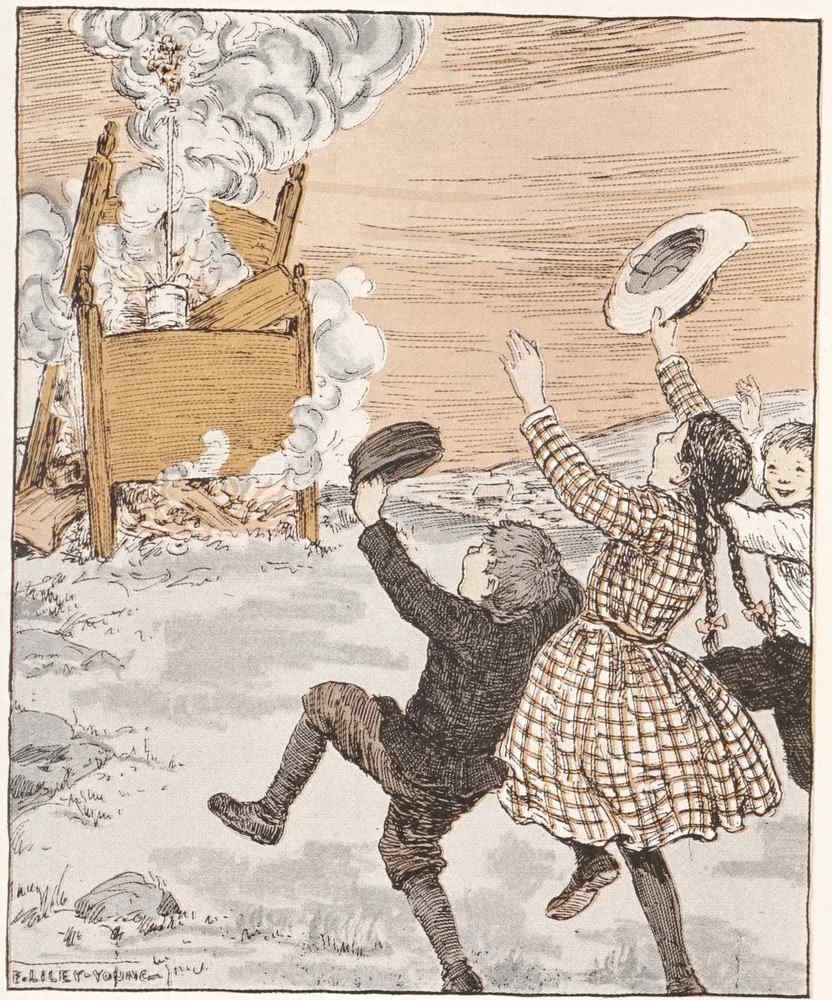
The bunch of heather at the top of the pole
blazed up like a great bouquet of fire. It
looked perfectly magnificent, really.
There! Now Mrs. Petersen’s bedstead had
caught. Hurrah! What fun! Greatest fun
in the world!
We danced and skipped and shouted,
“Hurrah!” looking towards the town all the
time to see whether any one noticed our splendid
bonfire. Hurrah! Hurrah!
The wind began to blow,—to blow very
hard. Sparks flew all over the hill. We could
not stand in the lee of the bonfire, for it would
have been like standing in a sea of flame.
Well, if the townsfolk didn’t see that fire
now, it must be that they had no eyes in their
heads. Andreas turned somersaults in the
heather. Hurrah! Hurrah!
But all at once I noticed some little flames
springing up here and there.
“The heather is on fire!” I shouted.
“Hurrah!” shouted Andreas and Karsten
in high glee.
But at that moment something seemed to
tighten in my chest. I was afraid with a great
sudden fear.
“Now all that will be a St. John’s Night
bonfire,” said Karsten gleefully, pointing towards
the moor.
“Are you crazy? Put it out! Only put it
out!” I shouted.
We danced
and skipped and shouted, “Hurrah!”
The whole hill was covered with heather as
far as one could see, heather as dry as tinder
from the long drought. Suppose it should all
get on fire! I rushed forward, tramped in the
burning heather and beat it with a stick.
“Help me put it out! Help me put it out!”
I cried. The boys were frightened, too, now,
and we all worked frantically; but the sparks
showered down faster and faster and the fire
seemed to blaze up everywhere at the same
instant.
It was terrible. Down in the streets people
stopped and looked up and some began to run.
I was ready to throw myself into the burning
heather, so terrified was I. And the wind
howled and blew and swarms of sparks danced
about in all directions.
Suppose the whole moor should take fire,—and
perhaps the whole world be burnt up—it
would all be our fault. The bonfire crackled
and blazed against the dark sky and the flames
hissed in the heather.
Those moments I cannot write about. I
don’t believe I thought of anything, I was so
overwhelmed by fear.
I tramped, I shrieked, I ran right into the
midst of the burning heather and shouted I
don’t know what.
Over the moor some people came running
swiftly, big, smoke-begrimed men, Constable
Midsen, Alexander Brygga, Herman Dilt,
and many, many others.
“What lawlessness and foolery is this?”
shouted Constable Midsen. “There is hard
punishment, and fines besides, for such doings.
Help here, fellows. Quick!”
The whole of our beautiful bonfire was
thrown down before you could count three,
tramped on and put out, Constable Midsen
giving the orders.
It seems to me I can hear his voice yet,
mingled with the noisy blasts of the wind over
the dark moor where the fire still crackled and
snapped in the heather.
And it was all our fault! Such hard work
as we had had, and such grand fun as we had
expected to have! It would be best for me to
run away at once, I thought; but no, it would
be a shame to do that. Midsen held Karsten
and Andreas as in a vise so that they should
not run away; and it was just as much my
fault as theirs.
I sat on a stone and cried hard; Andreas
choked and cried and dried his eyes on his
jacket-sleeves, first one and then the other; but
Karsten fairly bellowed—his way of crying.
The men kept on tearing up the heather so
as to stop the fire, and scolding us constantly.
I wonder whether you can possibly imagine
how perfectly horrid it was. I shall never
again have a bonfire of my own, if I live to be
a hundred years old.
Suddenly I felt a raindrop—then another
and another—and then it began to pour.
“Well, you may thank the Lord for His
merciful judgment,” said Midsen. “Now the
fire will be put out by the rain.”
And what do you think? I cried harder
than ever then for joy; and in my heart I
thanked God over and over that He had let
the rain come just at that time.
When the fire was entirely out and we
trudged down the hill, it was almost pitch-dark;
water trickled from my clothes, my eyes
smarted from the smoke, my hands were
scorched, but the worst was, I was unspeakably
afraid of what Father would say.
What he said and what came afterward, I
won’t tell of in detail for it was altogether too
horrid. I was dreadfully, dreadfully sorry I
had not asked Mother about having a bonfire,
I can tell you.
Father had to pay Mrs. Petersen for her old
bedstead. What do you think of that! Probably
he had to pay extra for the dirt on it.
And yet, she was so “severe,” as Karsten
would say, that she all but chased me out of her
house with a broom when I went to beg her
pardon.
I had to do that. Father said I must.
Ugh! But of course it was wrong to take
her bedstead.
Now comes the maiden with dress of green.
Oh, heigh, dear! Oh, ho!
VII IN PECKELL’S HAYLOFT — FOOTNOTES:
Every once in a while, a traveling photographer
comes to our town. They take rather
spotty pictures in one or another courtyard
under the open sky, seldom pay for the room
where they have lodged, and are suddenly
gone. Such traveling photographers look almost
alike, usually having black curly hair
with pomade in it, and pale faces; they parade
around in the street, walking quickly as if they
were awfully busy.
But one summer a photographer came who
was altogether different. In the first place,
his name was Cavallius, and he was a little bit
of a man; that is, his legs were very short.
The upper part of his body was big enough,
and his face was large, with a long golden,
curly beard that reached down over his chest;
and the whole time he was in town, he had big
patches of court-plaster behind his ears. He
never looked as if he were busy. He spoke
slowly and never walked fast; and there was a
kind of dignity about him, from the court-plaster
patches to his long golden beard and
even to his short legs, that was quite amazing.
That dignified appearance was a real
achievement for little Cavallius; for truly it
can’t be very easy to appear dignified with almost
no legs and with plasters behind the ears.
The first time I saw Cavallius on the street
I naturally had no idea who he was, so of
course I followed him till I saw that he went
into Stiansen’s bakery. Fortunately I had
two öre[3] in my pocket, so I could make an errand
in the shop. I had an overwhelming desire,
you see, to find out something about this
queer person. Baker Stiansen was in the shop
himself. “Two öre worth of brown barley
sugar, please.”
Stiansen’s barley sugar is never very good,—it
is too soft,—but of course I had to buy
something, since I had gone in.
“Who was that who came in here just now,
Stiansen, a little man with a yellow beard?”
I asked.
“Oh, he is one who takes pictures of people,”
Stiansen answered carelessly.
“What is his name?”
“His name is nothing less than Cavallius.”
That is the way I found out who Cavallius
was. I didn’t like to ask any more questions,
although there was still much I wanted to
know. After this, however, I had a tremendous
desire to peep into Stiansen’s courtyard
to see how the little photographer arranged
things there; but I didn’t dare venture through
the gate, because Stiansen is so cross and disagreeable
if you even stick your nose in his
courtyard.
But one day it suddenly occurred to me that
any one in the loft up in Peckells’ barn would
have the most perfect view over Cavallius in
the courtyard. I went immediately to Massa
Peckell.
“Oh, Massa!” I said, “let’s go up into
your hayloft. Through that round window
there we can look right down on the little photographer
taking pictures in Stiansen’s courtyard.”
Yes, indeed, Massa would go.
Stiansen’s courtyard is a narrow oblong, and
the sun beats down upon it bright and hot.
We had come at a fortunate moment, it
seemed, for Cavallius was just about to photograph
fat Barbara who works for Madam
Pirk.
Barbara sat stiffly upright on a chair. Her
dress was so tight that it looked ready to burst
open any minute. Her big, red hands were
crossed as if they were tied together at the
wrists. Cavallius was arranging the screw she
should have at the back of her neck to hold her
head still.
“Sh, sh!” I whispered. “Keep perfectly
quiet so that he will not notice us.” Massa and
I scarcely stirred, up there at the loft window.
“Will you sit for a full face or for a profile?”
Cavallius asked. He talked in a slow
formal way that corresponded well with his
dignified bearing.
“What’s that?” asked Barbara turning herself
hastily towards him.
“There, there,” said Cavallius, soothingly.
“Will you sit sideways or straight?”
“Straight,” said Barbara. “Talk decent,
you, when you talk to decent folk!”
Cavallius was humming a little to himself
and took hold of her face to place it in the
right position.
He had scarcely put one of his small stumpy
fingers against Barbara’s fat cheek before she
pushed her big working-woman’s fist with such
force against Cavallius’ chest that he tumbled
backward. It was an awfully comical sight.
Both Massa and I forgot ourselves and
shrieked with laughter. Cavallius threw an
astonished glance up at the loft window where
we stood, but he said nothing. Moreover, he
did not lose his air of dignity.
“Are you out of your mind, woman?” asked
Cavallius.
“Just you try that again,” said Barbara,
looking furious.
Cavallius stooped under the black velvet
cloth such as all photographers have over their
cameras.
“Look a little pleasant, now,” he said in a
coaxing voice as if to a child.
“Look pleasant? At you? Humph! I’d
like to catch myself!” Her face was like a
thunder-cloud.
“Oh! Oh! I shall split my sides laughing,”
said Massa. “Oh! Oh!”
“May I ask the ladies up there to indulge
us with their absence?” said Cavallius.
Oh! how we laughed! No, it was altogether
too amusing for us to be willing to leave.
“No, Cavallius, we’re not going; do not imagine
that we are.” Of course we did not dare
to say that aloud.
Repeated exhortations to Barbara from
Cavallius to look pleasant. Barbara looked, if
possible, still more angry, and assured him
most positively that if there was anything in
the world she would not do, it was to look
pleasant “at such a one as you.”
Massa and I laughed till we were worn out
with it.
“That’s right, Barbara,” shouted Massa,
“look more fierce. Don’t give in, Barbara.”
“Go away,” said Cavallius, shaking his little
stumpy hand threateningly towards us.
“Go away, ladies; I will not endure this, on
my honor I will not. Go!”
Just think, he called us “ladies”! We
ducked down behind the window in silent
laughter, then we peeped out again. Cavallius
kept on threatening us.
“Go, I say!” We ducked down but
popped up again the next instant. Cavallius
grew more and more angry. We kept popping
down and up and laughing continually,
but go away we would not, you may be sure.
At last Barbara’s picture was ready.
“Well, my girl,” said Cavallius, “it isn’t
my fault that you look like a lion-tamer in
your picture.”
“What is it I look like?” asked Barbara.
“It’s your fault if it’s a horrid picture.”
“That’s right, Barbara,” called Massa.
“Scowl at him. Of course it is his fault.”
“Go away!” roared Cavallius up at us.
Barbara drew backward towards the door
and bumped into old Mrs. Huus who was just
coming in to be photographed. Mrs. Huus
wore a brown silk dress, gold brooch, gold
chain, gold bracelets, and some quivering
golden ornaments in her hair. People in the
town said that Mrs. Huus stuffed cotton into
her cheeks to fill them out so as to look
younger. I don’t know whether this is true
or not, but Mrs. Huus certainly does speak as
if her mouth were full.
Cavallius conducted her most respectfully to
a chair, but as he went, he shook his fist threateningly
again up towards us in the barn window.
Mrs. Huus did not see us, but I noticed
that she cast a frightened glance at Cavallius
as he shook his fist in the air.
He got down on one knee and arranged the
brown silk dress in careful folds. While he
knelt there, he turned and again made the
threatening gesture towards us. Mrs. Huus
sent an anxious look heavenward; evidently
she thought he was crazy.
Massa and I tumbled over each other below
the window in fits of laughter, although we
choked back the noise. Then we heard Cavallius
talking, and I put my head up cautiously.
Cavallius saw me and threatened again with
both fists, but still Mrs. Huus had not seen a
sign of us, so to her his angry gestures were unaccountable.
“No, no, no,” she said hastily, getting up.
“I don’t think I am very well. I don’t think
I care to be photographed to-day.” With
that she darted, swift as an arrow, out of the
gate without even saying good-bye.
I heard later that she had been mortally
afraid the few minutes she was in Cavallius’
studio, because of his shaking his fists towards
heaven, and she thought herself fortunate to
have come away unharmed.
When Mrs. Huus was gone, Cavallius, with
hands at his side, looked up at us.
“There now, ladies, whose fault was that?
Whose fault was it, I ask, that that fine lady
would not let herself be photographed to-day?
It was your fault. I saw that she looked up
at you again and again. As true as my name
is Isaiah Cavallius, I won’t stand this any
longer. If you ladies don’t make yourselves
scarce this instant,”—again he shook his fist
at us,—“I have something that will make you
go, I warn you.”
Massa and I disappeared from the window
quick as lightning.
“We mustn’t tease him any more,” said
Massa. “He’s too angry.”
“Oh, but it is such fun; so awfully comical.”
“Well, I’m scared; suppose he should shoot
up here at us.”
“Nonsense, Massa. Let’s peep out once
more.”
There were voices in the courtyard again.
I put one eye to the window and saw, if you’ll
believe it, Herman Nibb, the storekeeper, who
had come to be photographed. Oh, what
fun! That queer Nibb! No, we couldn’t
go now; it was impossible, with such a
prospect of amusement ahead. Cavallius
couldn’t get hold of us up here, and if he tried,
we could run like the wind.
Nibb came into the courtyard, bowing and
bowing. He always walks with a dancing step
in the street, as if he were on springs. He is
surely very vain, for in one day I have seen
him wear as many as seven different hats.
That is absolutely true. Nibb always has
something to do with bankruptcy; either he
has just gone bankrupt or is just about to do
so. There is never anything in his shop-window
but a bunch of shoe-lasts, and he sells
only kerosene. Often I should like to go into
his shop because he is so queer, but since one
can scarcely ask for a sample of shoe-lasts or
kerosene, I can’t make any errand in there.
“Be so kind as to take a seat,” said Cavallius.
“Vignette or the whole figure?”
“Is it any dearer with legs than without
legs?” asked Nibb.
“The price is the same for the whole figure,”
was the satisfactory answer.
Nibb placed himself in position. He looked
as blank as if he didn’t know enough to count
four, as he stood there.
“That is a fine expression you have now,”
said Cavallius. “Don’t lose that expression
and you will have a beautiful picture; don’t
lose it. Pshaw! You let it go, after all.”
Nibb strove in vain to re-capture the beautiful
expression.
“How was it I looked?” he asked.
I can’t tell you how Massa and I laughed.
“We must go, Massa, or I shall die of laughing.”
Nevertheless, we did not go.
“Are you there again?” shouted Cavallius.
“On my honor, I will not stand this any
longer.” With that he went into the house,
leaving Nibb alone.
Nibb made an elegant bow to us, whom he
saw in the loft window.
“Beautiful weather, little girls,” he observed
politely.
“Oh, yes.” We felt as if we were in an
oven, it was so hot, and Nibb wiped his forehead
every minute.
“Perhaps it is rather temperate,” he continued,
bowing to us again.
“It wouldn’t matter if it were a little more
temperate,” I said.
Nibb made no reply to this, but remarked,
“A queer man, that one,” pointing over his
shoulder after Cavallius.
Yes, Massa and Nibb and I could all agree
as to that.
But what in the world had become of Cavallius?
Could he be looking for us?
“O dear! Suppose he is standing inside behind
a curtain and shoots us with a gun!” said
Massa. “He said he had something that
would make us go away, you know.”
The situation began to be rather uncomfortable;
perhaps we had better go away, notwithstanding
the fun. At that instant, we heard
a strange, short, labored breathing from the
loft stairway. We both turned,—the stairs
were just outside the door,—a yellow beard
showed in the dim light. True as gospel, it
was Cavallius! If I live to be as old as Methusaleh,
I shall never forget how terribly
Massa shrieked. She shrieked as if beside herself,
or as if some one had stuck a knife into
her.
I did not scream, but I must own that I
wasn’t at all comfortable. However, this was
no time for any long meditation.
Cavallius’ little legs straddled over the high
doorsill, and now his whole body was in the
loft. There was only one door, the door by
which he had entered; our “peep-hole” was
the only window.
Not a word was exchanged between Massa
and me, but with a common impulse, we sprang
over to the trap-door in the corner through
which the hay was thrown down into the stable
below.
Plump! Massa was down. Plump! I was
down. Both of us landed on a big heap of hay
that lay just under the trap-door.
I glanced up to see whether Cavallius were
coming down the way we did, but I saw nothing
of him. We rushed to the stable door, out
to the Peckells’ courtyard, out to the street,
but not even here dared we stop. The safest
place at that moment seemed to us to be the
dean’s garden, so in there we dashed, fastening
the high garden gate after us. There! Out
of danger! Massa was chalk-white with terror.
Looking through the picket fence a moment
after, we saw Cavallius with more than usual
dignity come out of Peckells’ yard and disappear
through Stiansen’s gate.
But how in the world Cavallius, a perfect
stranger in the town, found the way all by
himself up to Peckells’ hayloft that day, will
always remain a mystery to me.
Madam Igland has an enormous garden
with a high board fence around it. To call it
a beautiful garden would be a sin and a shame.
The whole place is filled with beds of carrots,
parsley, cabbages, onions and such things;
while at one end there is a row of currant-bushes
and an old tumble-down summer-house
that stands with one side on the street.
Madam Igland is a market-gardener, you see,
and sells vegetables to the townsfolk. However,
I say wrong when I say she is a gardener,
for she can’t even walk, but sits all day long
in a wheel-chair by the window. She has a
“spy-mirror” there which reflects a part of
the street she could not see otherwise.
No, it is not Madam Igland, it is Oline, who
is really the gardener and the ruler over the
garden. Oline is an old servant, awfully old
and with only one tooth in her mouth; but
that one is frightfully long and white.
I used to think that if I were in Oline’s
place, I should have that tooth pulled out, for
I thought that, being so very long, it must be
in the way. Once I asked Oline why she didn’t
do that.
“No, indeed, I sha’n’t do that,” said Oline.
“For if I hadn’t that tooth, I couldn’t nourish
myself.” Since that time I have looked at it
with more respect, considering it is all that
keeps Oline alive.
Oline is frightfully deaf, yet it is she who
sells the garden stuff to people. All the money
she gets for parsley, onions, or anything, she
puts in an enormous pocket which she wears
under the front of her apron.
Ola Silnes helps her in the garden. He always
wears filthy white canvas trousers and
jacket, has a very red face, and when he talks,
grunts out something you can hardly understand
from deep down in his throat.
All through the long summer day, Oline
with her bare, brown weather-beaten legs is in
the carrot-bed weeding. If you want five cents’
worth of onion tops, or anything, you have to
go right up to her and take hold of her, for
she doesn’t hear a thing. But I can tell you
it isn’t advisable to steal into the garden when
you don’t want to buy anything, for that makes
her fly into a rage.
The board fence isn’t altogether tight at the
back of the garden. There are little cracks
between the boards, just big enough to stick
your nose through and look in with one eye
at a time; but through the cracks you can see
lots of big, delicious-looking currants. O
dear! There’s no pleasure in standing and
looking through a crack at big, juicy, red currants
when you can’t get any of them.
Our currants were gone long ago. Karsten
eats them when they are a little red on one
side, and the few that are left shrivel up in the
roasting hot sun; for our garden is awfully
sunny, you see. But Madam Igland’s garden,
being on lower ground, is always cool and
fresh, with a sweetish, spicy smell of cabbage
and herbs and onion and newly-turned soil,
and stiff, tall grasses in the outer corners of
the garden.
I had long known that there was a loose
board in the fence,—well, not entirely loose,
but very shaky, you know. If you should just
pull a little hard on it, it would come loose,
that was certain.
One afternoon Mina and I hadn’t a thing to
do. We couldn’t play up on the hilltop, it
was so unbearably hot there. To play ball in
such heat was utterly impossible; besides,
Karsten had lost our best ball. The flat church
steps which are so exactly suitable for playing
jackstones on, and where Mina and I play almost
every afternoon, were packed full of
street boys who were playing with buttons.
Pshaw! There wasn’t a thing for us to do.
All at once, something flashed into my mind.
“Let’s go down to Madam Igland’s garden
and see whether there are many currants
there,” said I.
Mina agreed instantly.
Soon we stood with our noses through the
cracks. My! so big as those currants were to-day,
currants had surely never been before!
And oh, how ripe! The branches were so full
that they drooped right down to the ground.
Ola Silnes was nowhere to be seen. Oline was
in the carrot-bed weeding. On her head she
had a towel, pulled far forward to keep the sun
off of her face.
“Oh, Mina! Do you know there is a board
loose over there?”
I went to it to show her. Yes, it was very,
very shaky; almost ready to come out.
“Mina, shall we pull the board away and
creep through and eat a few currants? Oline
can’t hear even a gun-shot, you know.”
First a slight jerk at the board, then a
longer pull; it creaked a little and we peeped
in, frightened. Oline’s toweled head had not
moved. She was still weeding in the burning
hot sun.
“Come on, now.” I was already in the garden.
Mina came quickly after. We ran along
beside the fence, hopped through some cabbage-beds,
and got behind the currant-bushes.
My, but those were currants! There were
as many as fourteen on each string. How we
did eat and eat! Our mouths really felt sore
at last from eating so many. Now and then
we peeped out at Oline, who still stayed among
the carrots, weeding and weeding.
“Can you understand how she can keep on
in such heat?” said Mina.
“No, I can’t; but my, haven’t we had a
jolly feast? It doesn’t show a bit that any
currants are gone, and think what a quantity
we have eaten!”
Neither of us could eat another one.
All at once we heard a shout outside the
fence and some one called, “Well, I declare!
Is this where you are?”
It was Karsten. We looked anxiously along
the fence, for at first we couldn’t judge where
the sound came from.
“Sh! Karsten. Sh!” He was tramping
along outside the fence. Evidently he, too,
knew about the loose board. He pulled it
away, and was half inside the garden when—of
all things!—Oline saw him.
“Out with you or I’ll make you stir your
stumps, you scamp, you good-for-nothing!”
“Well, some girls are behind the currant-bushes,
Oline,” shouted Karsten.
Oline didn’t hear a word he said, but she
pushed him out through the hole in the fence.
“Somebody is stealing your currants,”
shouted Karsten from the outside.
“Yes, you’ll catch it, you scamp.”
“Look behind the currant-bushes and you’ll
see——”
“If you don’t go away and that
quickly——”
We were on pins and needles, but Oline did
not know what he said, of course.
There was Karsten outside the fence near
where we were crouching.
“You’ll get paid for this, Inger Johanne,
depend upon it. You’ll get paid. Shame on
you! I shall tell about it at home.” And off
he ran.
Mina and I felt that the prospect was anything
but pleasant,—horrid, in fact. Ugh!
Ola Silnes came into the garden, and Oline
called to him, telling about Karsten. Ola’s
red face looked very thoughtful. They both
went to the fence and inspected the loose board
very particularly. Then—who’d have thought
it?—Ola Silnes, who evidently carried a lot of
big nails in his pocket, took some out and with
a big stone for a hammer, whack! whack! he
nailed the board fast!
Mina and I stared at each other. We were
in a pretty fix. We couldn’t possibly get out
through the gate without being seen, as long
as Ola Silnes stayed in the garden. Our only
hope was that he might go out on some errand.
We crouched there behind the currant-bushes
and kept peeping out at Ola. Apparently
he had no thought of leaving the garden.
He wheeled away one wheelbarrowful of weeds
after another, and emptied them out not far
from us. We sat with our hearts in our
mouths each time until we saw the back of his
canvas jacket. Ugh! How afraid we were
that he would see us!
The time dragged on endlessly.
“Come, let’s go out,” said Mina almost in
tears. “It’s your fault. You’re the one who
thought of it. I can’t sit here any longer, and
I’m so afraid of Ola.”
“Oh, wait, Mina! Sit still, just sit still a
little longer.”
At last, Oline seemed to have finished for
the day. She put on her wooden shoes and
straightened the towel on her head. Ola had
nothing to arrange about his clothes, but the
two stood a long time at the gate. Oline
screeched higher and higher. She was talking
of Karsten.
“And that boy,” said Ola, “is a child out of
a fine family!” He spat as far as he could
just to show his scorn.
Well, they finally went. I had had a little
hope that they might forget to fasten the gate.
Far from it. No such good luck for us. I
heard the lock click as the key turned.
Mina and I crept out from behind the
bushes. We were stiff from sitting so long in
one position. It was good to stir yourself.
Pooh! There wouldn’t be any difficulty about
getting out of the garden now, since Oline and
Ola were both gone. You can always find one
board or another loose in a fence. We ran
along and tugged at every single board. No,
they were all tight, as if they were nailed fast,
as of course they were; not a single board was
even a bit shaky.
Ugh! That horrid Ola Silnes, who went
about with nails in his pocket! To climb over
the fence was impossible for us; it was several
feet higher than I was tall. What in the world
could we do? If we knocked on the gate, people
would come from the street and every one
would have to know what we had been doing.
Once again we went around the fence. No,
it was absolutely impossible to get out that
way. And how hungry we were! We had certainly
been in the garden for four hours.
What could we eat? Not currants, no, not
one more. What about carrots? Pshaw!
They were too small, not bigger than my little
finger; but we ate some of them, anyway, or
perhaps we might have starved.
We went into the summer-house which had
eight corners and a pointed roof. Such air as
there was in there,—stifling hot and full of
dust. The light-green paint on the walls was
old and cracked; there was nothing in the room
but a pile of bean-poles at one side. The windows
were of colored glass.
Mina and I peeped out at the street through
the red and blue and yellow panes and disputed
as to which was the prettiest. What if a blood-red
light such as there is when you look
through red glass should come suddenly over
the whole world, how awfully frightened people
would be!
Really, it was rather cosy in the summer-house.
“Suppose we should have to stay here all
night,” said I. “We could lie on that heap
of bean-poles and it wouldn’t be so very bad,
Mina.”
“Oh, no! I want to get out,” said Mina.
The sun was now almost gone from the garden.
“If you won’t knock on the gate now, I will.
I will not stay here any longer.”
“No, no, Mina. Wait a minute.” I looked
anxiously about for some way of escape.
Perhaps—perhaps we could climb the pear-tree
in the corner, creep carefully along the
branch and jump down outside the fence; but
the branches began very high up on the tree-trunk.
First we pushed Ola’s wheelbarrow under
the tree. O dear! Even on the wheelbarrow
I couldn’t reach anywhere near high enough.
By the summer-house stood an old barrel; we
rolled this over to the tree, and put it on top
of the wheelbarrow. Mina held me and
steadied me. Hurrah! There I was on the
slender branch. I shoved myself along very
slowly and carefully.
“If it only doesn’t break,” cried Mina.
“Oh, it is breaking, it is breaking!”
No, it didn’t break. I was soon on the fence,
hung there by my arms a minute and then
dropped down on the outside.
“Now you come, Mina,” I shouted.
I could hear how she tried and tried, but
finally when the barrel rolled off of the wheelbarrow,
she burst out crying.
“No, I can’t! I can’t climb up to that
branch.”
Well there! It would have been better if
Mina had climbed up first.
“Mina, don’t cry! Just wait. I’ll run and
get a ladder, and be back in a jiffy.”
I dashed up the street hoping to find Karsten
or some of the other boys. No, Karsten
was probably out sailing and none of the others
were to be seen. The ladder I had expected
to get was altogether too heavy for me to carry
without help. I ran back to Madam Igland’s
garden.
“Mina! Mina!”
“If it only doesn’t break!”
cried Mina.
Not a sound from inside. I peeped through
the cracks. No Mina was to be seen.
“Mina dear! Oh, Mina!”
No, she must certainly have got out, but
how? Or perhaps she was lying in the summer-house
in a faint from all the excitement.
I was perfectly disgusted with myself for having
left her, and ran around the garden to the
gate. Far down the street I saw Mina’s blue
dress. I rushed after her.
“How in the world did you get out?”
“Why, when you were gone I got so desperate
because I was alone, that I banged and
hammered on the gate as hard as I could; and
some one went after Oline and she came and
unlocked the gate.”
“Was she angry?”
“Yes, frightfully angry.”
When I reached home, Karsten had come
back from his sailing and had told of seeing
Mina and me behind the currant-bushes in
Madam Igland’s garden, eating currants.
That wanted to get in there himself, he said
not a word about, the rascal!
Mother scolded me. It is distressing when
Mother scolds; not because of what she says,
exactly,—though that hurts, too,—but she
looks so grieved that it makes you unspeakably
sad to see her.
“And of course, Inger Johanne, you must
go to Madam Igland and beg her pardon.”
When I came home from school the next
day, Oline was standing in the hall. “O dear!
O dear! What is coming now?” I thought.
Her errand was to ask me to call at Madam
Igland’s when I was passing by there.
That afternoon Mina and I went to Madam
Igland’s house; through the courtyard, over
the high threshold into the tiny blue-painted
hall that led into her room.
“You must knock,” Mina whispered.
“No, you,” said I. Finally I had to knock
at the door.
“Come in,” said a pleasant voice.
“Shall we run away?” whispered Mina.
But I had already lifted the latch, and there
we were—in Madam Igland’s room. I had
never been in there before and the only thing
I saw now was Madam Igland in her wheel-chair
by the window. She turned her face towards
us.
“Come right in, children. Why! Is it
these two nice little girls who would steal from
a lame old woman’s garden when that is all she
has to live on?”
We began to cry, both of us.
“No, no! Don’t cry. It’s nothing to cry
about. Come and sit here.”
“Uh-hu-hu!” sobbed Mina. “Have you
nothing to live on but currants and parsley,
Madam Igland?”
“Oh, I live on the money I get for them, you
know.”
“We’ll never, never do it again, Madam
Igland,” I promised.
“No, no. You surely will not. But sit here
now and talk a little with me.”
So there we sat, each on her chair and
Madam Igland in her immense wheel-chair by
the window where the “spy-mirror” was. In
her lap she had a black cat and on the window-sill
sat another, blinking its green eyes.
“Isn’t it awfully tedious to sit here all day
long and only look out of the window?” I
asked when we had composed ourselves a little.
“Oh, no! One gets used to anything. It
will soon be fifteen years since the Lord took
the use of my legs from me. First, I sat in
the corner by the bed for twelve years, but I
got very tired of that. I knew every nail-head
in the floor and every dot in the wall-paper.
So I moved over to the window and have sat
here for three years; and it is much better.”
Think of it! She had sat in her chair much
longer than I had lived! How terribly sad it
was!
“But how do you get to bed, Madam
Igland?” I asked.
“Oh, Oline helps me. She’s a kind person,
I can tell you. The good Lord sent her to me,
you see. Yes, and then there are all the kind
people who come often to see me, old and lame
as I am.”
Only think! The good Lord had sent Oline
to Madam Igland! How many queer things
there are in the world! It had never occurred
to me that God thought about Oline.
“Yes, she is faithful, she is faithful,” said
Madam Igland with a happy face, rocking herself
back and forth.
Who would have supposed there was any
one who rejoiced over queer old Oline?
I really liked being in there with Madam
Igland.
“I ought to have something to treat you
with,” said Madam Igland at last. “It’s a
shame that I haven’t anything. But you must
come in again, for there will soon be some kittens
here, and perhaps I may then have some
good little treat for you.”
I had sat and pondered over something I
wanted to say, but I couldn’t get it out until
we were at the door.
“Madam Igland, won’t you let me come in
and help you sometimes? Help you get to bed
or whatever you like?”
“Oh, no, child. I am heavy, very heavy.
No, the good Lord managed wonderfully well
for me when He sent me Oline; and He won’t
forget you, who have a heart for one who is old
and lame. Adieu, adieu, children.”
Ever since that time, whenever we pass her
house, Madam Igland nods to us and we smile
and wave to her. One day she tapped on the
window. The kittens had come.
IX ON BOARD THE SEVEN STARS
I love the sea. I know nothing else I delight
in so much. Just to get the smell of seaweed,
or to see the white spray dashing over a
bare island, makes me happy. Poor naked
hills and rocks, the salty sea air, old wharves,
rocking boats, ships that have been on long
voyages and are now laid up in the harbor,—all
such things are the pleasantest to be found
anywhere in the world. If you don’t think so,
you can’t ever have known them, I am sure.
Sometimes I think that the sea is most beautiful
in summer, when it lies like a polished
mirror and the yellow seaweed sways lazily and
silently against the steep gray shore; when the
sun glitters out over Skagerak so that it hurts
your eyes; when the sloops lie becalmed with
loose sails and stay in one spot while the big
steamers hurry past, bound for some foreign
land, and their smoke makes a straight black
streak in the sunshine.
But when the southwest wind rushes in and
puts white-caps everywhere on the sea, and
the sky is so clear and so blue; and the pilot-boat
with the broad red stripe in its sail seems
to hop over the waves, while the boat we are
rowing in rocks and bobs up and down, and
our hair blows all over our faces,—oh, then I
think that is the very jolliest time on the sea,
after all!
In the autumn when the sea moans and
roars, and the water looks black while the
spray rises like great white ghosts out on the
islands, the sea often seems grim and terrible;
for there is always some one on the water we
are afraid will not come back,—there are so
many wrecks in the autumn.
One summer I was on the sea almost every
day, although we had no boat of our own. Father
says that if he bought us a boat we would
certainly get drowned, all of us. However, I
could always manage to get a boat some way.
If there were no other to be had, it was usually
easy to get hold of Sorensen’s old skiff; just
climb over two fences, creep around behind a
little mound, and then jump right down the
steep bank on to Sorensen’s wharf, where the
boat is tied.
Once, however, it happened that I jumped
almost on old Sorensen’s head as he stood looking
out over the sea and talking to himself.
Then I was in a bad fix, for he is not a person
to joke with.
Another time I had just untied the boat and
rowed a few strokes, when an old cracked
voice called out:
“Let that skiff alone, drat you!” It was
Sorensen’s, so of course I had to row back to
land and tie the boat fast again, and he came
down to the wharf and nearly scolded my head
off,—he was so angry.
But I happened to get acquainted with his
granddaughter Louisa, and then everything
was as smooth as butter. It was that summer
I was on the water almost every day.
The equal of Sorensen’s good old rowboat
I’ve never seen in all my days, and I’ve seen
plenty of rowboats, I can tell you. It was
pretty old and water-soaked, but for all that,
it was a remarkably comfortable boat, and easy
to row.
Louisa wasn’t so bad, either. Bright red
hair, freckled to the tips of her ears, and with
white eyelashes—that’s the way she looked; but
search Norway over and you wouldn’t find any
one to match her at rowing and paddling and
such things. She was lively and jolly, too, and
full of all kinds of marvelous stories about
mermaids and ghosts and many other queer
things that had been seen on the sea. Louisa
believed in these stories as if they were gospel
truth.
Well, I attached myself to her that summer
and fun enough we had every single day. I
would take luncheon for both of us and Louisa
would take the rowboat.
If her grandfather objected, we had
only to promise to whittle some pitch-pine firelighters
for him and he would let us have the
boat at once.
We would stay on the water the whole afternoon
rowing out to the islands or away off in
Dams bay, fishing, catching crabs and mussels,
talking, laughing, and having the jolliest kind
of times.
But once something frightful happened to
us, and that is what I shall tell you of now.
We seldom rowed out as far as Bird Island,
for the open sea was right outside of that, and
there was always a heavy swell there, even
when the weather was not rough.
But one afternoon we were tired of splashing
around near the land and we decided that we
would row out to Bird Island and just make a
flying visit. Louisa knew a woman who lived
in the only house on the island and it would
be great fun to see how everything was out
there.
A light breeze blew from the southeast, the
sun was shining gaily, the skiff was as dry as
a floor, for we had just emptied it; and I had
four pieces of rye cake, spread with extra good
Danish butter, in my pocket.
Oh, everything was splendid! Louisa told
sea stories and we bent to our oars with a will.
“Grandfather says,” announced Louisa,
“that you may be all by yourself on the sea
on board a schooner or a yacht or whatever,
and you think that you are alone, and you are
not, for the sea-spirits are with you.”
“Ugh, Louisa! that would be horrid.”
“And Grandfather says,” continued Louisa,
“that they can take different forms. It may
happen that one shows itself as a big flapping
bird or a gray maiden. Grandfather himself
has seen a spirit in the form of a cloud of fire.”
“Oh, come now, Louisa! You’re talking
nonsense.”
“If it isn’t true, you may chop my head
off,” said Louisa. “Grandfather was just
outside of Dröbak in his yacht; it was in the
middle of the night in late autumn, and all at
once as he sat there, a queer shape of fire glided
close to him.”
“Don’t talk of spirits, Louisa—don’t. I
won’t listen any more.”
“Well, there are sea-spirits and they are
ugly, too,” insisted Louisa.
It was farther to Bird Island than we had
counted on, and we rowed and rowed till our
arms were tired and weak with rowing so far;
but at last our boat scraped against the little
wharf.
Andrea’s house stood lonely and forlorn on
the rocky island. It was a two-story house
painted red, with big vacant windows, up-stairs
and down.
“Andrea’s husband is a sailor, and I saw her
and her son in town to-day with fish to sell,”
said Louisa.
We went everywhere around the locked-up,
forlorn house. In front was the open sea,
gulls and other sea-birds flapped their wings
over our heads, bare rocks and stones were
everywhere.
“Really, it must be jolly to live here,—like
Robinson Crusoe on a desert island,” said I.
“To do everything for yourself, live on fish
and go in a boat whenever you like.”
“Oh, no!” said Louisa. “No, I should
be afraid to live here. Hush, keep still! Hear
what a sighing comes from the sea.”
A green yacht was moored down in front of
the house. There was no one on board and it
lay dipping slowly up and down in the swell
of the sea. On the stern was painted the name
of the yacht in yellow letters on a black
ground,—Seven Stars.
“Oh, let’s row out to the yacht and go on
board and look it over,” said I. Louisa made
no objection though she said stoutly:
“But you can say what you will, there are
spirits here on the island in the afternoons.”
This was not particularly comfortable to
hear just then, but I pretended not to notice
it. Twenty or thirty strokes would take us to
the Seven Stars,—not many more, at any rate.
It was difficult to climb on board, but
Louisa, whose arms were very strong, pulled
herself up first and drew me up after her.
Then we discovered that a frightful thing
had happened. We had let go the rope to the
skiff! Whether Louisa had had hold of it or
I, or neither of us, I don’t know. I only know
that as Louisa drew me up after her, I chanced
to kick the rowboat; it glided away and in the
same moment was several feet from the Seven
Stars.
I can’t say that I was awfully afraid just
then. We must be able to get hold of the boat
one way or another, I thought; but it drifted
farther and farther out and there we stood.
Then we began to quarrel.
“It was your fault, Louisa; you pulled me
so hard.”
“Why, the idea! It was you who kicked
it away.”
“But you should have held on to the rope.”
“No, you should have held it.”
The boat drifted, drifted, farther and farther
away. Neither of us could swim. What
in the world should we do?
Not a person on Bird Island. Not a person
on the other islands. Far, far back in the bay
lay the town. Not a boat was to be seen—nothing,
in fact, but gulls and sea-swallows
flapping their white wings and whirling
swiftly about in the air.
Louisa, with her freckled face and her white
eyelashes, looked at me.
“Suppose Andrea stays in town over night
at her married daughter’s,—she does that
sometimes,—then no one would come here until
morning.”
“But her son August will come, you know,”
I said.
“Well, I’m afraid, I am,” said Louisa.
“Oh, no, Louisa, dear. We are perfectly
safe here, you know.”
“But there are so many sounds, and it’s so
lonely and strange, it’s uncomfortable to be
here; and if there are spirits anywhere, they
will be here, you may depend upon it.”
Louisa whispered the last, although we stood
absolutely alone on the Seven Stars, alone on
the wide sea.
The skiff, bobbing and rocking, had now
drifted quite a distance beyond Bird Island.
“It’s drifting out to sea!” shouted Louisa,
despairingly. “Oh, deliver me from Grandfather!
He’ll be so angry about his boat.”
O dear! O dear! How worrisome it was!
And now the sun had gone and it would soon
begin to grow dark. We had not had time to
look about on the yacht yet, and it seemed as
if we must prepare ourselves to stay there for
a while. But the doors were locked and nothing
did we find on the deck but a man’s old
weather-worn hat.
What should we do? Stay on the open deck
all night? There was no use in shouting for
help out in this solitude.
Louisa had gone to the stern, but came running
back, with her eyes starting out of her
head.
“Oh, Inger Johanne! Some one is groaning
in the cabin!”
“What nonsense!”
“No, no, it’s true, it’s true.” Louisa was
almost beside herself. “Some one is groaning
and sighing, I tell you.”
We listened and yes,—think of it! A queer,
heavy sound did come from the locked cabin,
a strange sound, as if from the bottom of the
sea, it seemed to us.
I thought Louisa had gone out of her senses,
she was so afraid; for imagine! she wanted to
jump overboard.
“It is the spirits,” she whispered. “I’d
rather jump into the sea—I will jump, I will.”
I was afraid enough, but it was all very exciting,
too. I kept hold of Louisa’s dress.
“Don’t be so stupid as to jump overboard,”
I said.
But at that instant fear overwhelmed me,
too. Everything was so still, so unspeakably
quiet, only the sound of the waves washing
against the island, spurting up a little, then
falling back; the wide silent sky over us, the
town far, far away.
From beneath the deck, however, the strange
sound came louder and louder. There really
must be something queer down there. Louisa
was right—it must be sea-spirits. Fear
clutched at my heart.
If only the gray maiden does not come—for
she is the worst of all. Suppose a gray
figure glided noiselessly up from the
cabin——
We were both ready to jump overboard
now. I did not know what I was doing, I was
so possessed by fear. Not a boat to be seen,
only the gray, boundless sea!
Oh, that horrible Seven Stars!
Louisa sat with both legs outside of the railing;
it would not take an instant for her to
jump down.
The sound from below grew louder, and it
was as if some one were walking there with a
slow, dragging step. We caught hold of each
other’s hands and stared horror-stricken at the
cabin door. Some one tried to open it from
the inside, turned the key—and a big tousled,
carroty head peeped out.
I drew a deep sigh of relief. The head was
Singdahlsen’s, crazy Singdahlsen who imagined
that his legs had grown together down
to his knees. He was somewhat ill-tempered
and particularly ugly when he was teased.
Often and often he would be on the chase after
boys who had plagued him. His pursuit was
not swift, however, as you can understand,
since he thought he could only move his legs
from the knees down.
Oh, what a relief that it was Singdahlsen
and not a ghostly gray maiden! Louisa and
I let go of each other’s hands and went over
to him.
“Was it you who sang the Columbia
Song?” he asked with a threatening look.
No, indeed. We could certainly declare
ourselves innocent on that score. Nothing
could have been farther from our thoughts
than singing.
“Well, if it had been you, I’d have hurled
you into the sea, both of you.”
Singdahlsen had once been to America and
ever since then the worst thing any one could
do was to sing an American song to him. He
took it as a personal insult, though nobody
knew why.
Pooh! We could get along with him perfectly
well.
“How did you come here, Singdahlsen?”
asked Louisa. Evidently she should not have
asked that, for he looked angry at once.
“How did you come here on my boat?” he
retorted quickly.
“It is an awfully pretty yacht, this Seven
Stars,” I said.
“Yes, when I once get it gilded over, and
set a diamond as big as that (measuring with
his hands) upon the mast, then it will be as it
should be.”
“Oh, yes! Then it will be charming,” we
both said.
“Really, I ought to be king of the seas,”
said Singdahlsen.
“Yes, you ought; and have a crown upon
your head.”
“No, indeed! I’ll have no crown upon my
head.” And there he was, as mad as a hornet
again.
We kept on talking with him, though. One
time he was so angry that he tramped after us
around the whole deck with his legs squeezed
tight together. But we were not a bit afraid
of him even then, for we were so mightily glad
he was not a ghost.
Our rowboat showed now only like a thin
black streak far away from Bird Island.
What if Louisa and I should have to stay out
here on the Seven Stars all night with crazy
Singdahlsen? It would be horrible.
Suddenly he shouted: “Up the mast with
you! Both of you!”
We tried to turn his mind from that, but no,
indeed; we must climb the mast, he said, or he
would throw us into the sea.
“I’m sick and tired of you now, so up the
mast with you, I say.”
I can’t deny that I began to be a little afraid
of him. We tried our best to be agreeable and
talked of diamonds and gold-pieces,—things
which he usually liked to talk of; but it was of
no use.
“Now I shall count twelve,” said crazy
Singdahlsen. “And if you are not at the top
of the mast when I say twelve, out you go into
the sea.”
Oh! Oh! What should we do? I cast a
terrified glance over the lonely sea.—Just
think! A boat was at that instant rounding
the point and in it was Andrea! We knew
her by the plaid kerchief on her head.
Oh, how glad, how glad we were! All fear
left us at the sight of her.
“Andrea! Andrea!” we shouted. We
were almost crying, the relief was so great.
Five minutes after, we were in her boat and
then we did cry, cried as if we had been
whipped. Andrea knew nothing one way or
another, but it was plain that she believed
Singdahlsen was wholly to blame.
While rowing us home, she told us that he
was in her care for board and lodging; and
that when she went to town with fish, she put
him on the yacht so that he should not do any
mischief while she was gone.
You may well believe that Louisa’s grandfather
wasn’t at all pleasant to meet when we
went back without his rowboat. However, a
pilot from Krabbesund found it and brought
it home the next day; so Grandfather didn’t
have to worry long.
X A MOLASSES CAKE STORY
Every one in our town says that Mrs.
Simonsen’s molasses cakes are the best in the
world,—they are so thick and soft and extraordinarily
tasty. Mrs. Simonsen doesn’t make
them herself,—Heinrich Schulze, the head
baker, does that. How in the world could she
ever have learned to make such good cakes?
But she stands behind the counter in her shop
and sells them every single day.
Mrs. Simonsen came from Telemarken.
When I was a little bit of a girl she was the
servant in Madam Land’s house, at the foot
of our hill. At that time she was Sigrid—something
or other—some queer surname that
I’ve forgotten. She had azure-blue eyes and
golden hair that lay in small curly waves just
as if she didn’t do a thing all day in Madam
Land’s kitchen but crimp her hair! Sigrid
married the baker Simonsen, and he died; and
ever since then Heinrich Schulze has been the
head baker.
Although I had known Madam Simonsen
such a long time there was no use in going into
her shop without money, you may be sure; but
whenever I have money, I go there and buy
molasses cakes. If I have no money I go in
the back way through the gate and beg from
Heinrich Schulze. As a matter of fact, I go
oftenest the back way.
I can always find him in the yard there. He
is usually hurrying to and fro between the
shop and the bakery, and often the molasses
cake dough hangs over his shoulder like a long
sausage. Schulze says that good molasses cake
dough should be so tough that it will hang over
one’s shoulder without breaking. Some people
think it is disgusting for him to carry the
dough that way, but I don’t. I even eat it
raw, right from his shoulder, very often.
For Schulze and I are great friends, let me
tell you. He is German, rather old and small,
has black eyes and is very wide-awake, and
quick in his motions.
One day I got him to give me his photograph.
On the back of the picture is written,
“Heinrich Schulze, geboren in Halle.” So I
know exactly how his name is spelled. I am
delighted to have his photograph, for it is so
amusing and so “grown-up” to have a good
many pictures in your album. Heinrich
Schulze’s is the nicest one I have. He looks
so free and easy, standing with his legs crossed,
beside a curtain. I have an old picture of
Father, and one of Grandfather, but that has
his legs torn off. Then I have a picture of
Mrs. Huus’s little dog; I begged that from the
photographer because it was so sweet. And
finally I have Marie Lokke’s lover. She
wouldn’t keep his picture any longer, because
he had become engaged to another girl without
her knowing anything about it; so she gave
his photograph to me. These are all the pictures
I have,—few enough, it seems to me,—and
Schulze’s is the very nicest. So you see
that is why I am so friendly with him. If we
had not been such good friends, there would
not have been any molasses cake story.
I know just exactly the days when he bakes
molasses cakes; and on those days I hang
around the door and tease and tease.
“Give me a little dough, Schulze, just a
little piece, Schulze.” And he almost always
gives me some.
One Thursday afternoon, (my, how vividly
I remember it!) Schulze, with the dough over
his shoulder, came swinging out into the back
yard where I sat on a barrel waiting. It happened
that I had in my hand a tiny china doll,
one of those little “bath dolls” without any
clothes on.
Schulze was in grand good humor that day.
“It may happen that I shall be the master
of this bakery here in the town. Then Heinrich
Schulze will be on top and can snap his
fingers at the whole world,” said Schulze, with
the dough over his shoulder and snapping his
fingers in the air as he spoke. I think that
what made him so happy was that Mrs. Simonsen
had been extra kind to him and he thought
she would probably marry him; then he would
be the master of the bakery.
I don’t know how I happened to think of it,
but while Schulze stood there talking, I stuck
that little china doll right into the dough.
Schulze didn’t notice what I was doing. I
smoothed over the place where I had poked the
doll in and a moment after, Schulze vanished
in the bake-house.
Ha, ha, ha! What fun it will be when he
finds the doll in the dough! He won’t be the
least bit angry; he will only laugh. So I sat
still on the barrel and waited, but he didn’t
come back.
Oh, well, he just wanted to fool me, I was
sure; for of course he must have found the doll.
I stole over to the bake-house door. The
molasses cakes were in the pans, ready to be
put into the oven that minute.
Schulze never likes to have any one come
into the bake-house, so I dared not go farther
than the door. Not a word did he say about
the doll. He was surely trying to fool me into
thinking he had not found it. Suddenly I remembered
that I had not studied my lessons;
so I at once started on a run for home.
That whole evening I laughed to myself
every time I thought of the doll in the cakedough.
I would get the little thing back from
Schulze in the morning. But he said not a
word about it then, either; nor was he the least
bit roguish or joky.
Suppose he hadn’t found the doll! Suppose
it was baked in a cake and sold, and
should get into some one’s stomach and the
person should die of it!
That was a dreadful thought, and I grew so
frightened, oh! so frightened; but I didn’t dare
say a word to any one about it. Mrs. Simonsen
and Schulze would both be furious, and
perhaps some one in the town was dying to-day—it
might be just now—some one dying
from that molasses cake with my little china
doll in it!
Oh, how I did suffer that day! I begged
Father for twenty öre and spent it all on molasses
cakes, for perhaps the little doll might
be in one of those I bought. No such good
luck. I ate so many molasses cakes, I got perfectly
sick of them; I ate them with despair in
my heart.
At last I stationed myself beside the steps
of Mrs. Simonsen’s shop and stared at every
one who came out who had bought molasses
cakes. “Perhaps it is you who will get the
doll in your stomach,—or perhaps it is you,” I
kept thinking. But if it had been to save my
life, I could not have said anything to them
even though I was so worried.
When children bought the cakes, however,
I took their cakes without any ceremony and
squeezed them to find out whether the doll was
inside. No, I did not find it.
At last I was really sick, I was so anxious.
Several times I was on the point of going in
and telling Mrs. Simonsen; but it would be so
difficult and so frightfully embarrassing.
Anyway, I couldn’t muster up courage enough
to do it.
The day dragged on. At night I dreamed
of the doll in the cake and in the afternoon
when I came from school, I sat again on the
steps of the bakery. Mrs. Simonsen stood in
the doorway, sunning herself.
“It is warm and pleasant these days,” said
Mrs. Simonsen.
Yes, I, too, thought it was warm. Indeed,
I broke into a perspiration whenever I thought
of the molasses cake with the doll in it.
“Why, true as you live, if there isn’t the
Collector of the Port himself coming here,”
exclaimed Mrs. Simonsen. “He’s even coming
into the shop, I declare! Go away from
the steps, child.”
Yes, it was really the old Collector himself,
with his keen face, his bent back and his cap
with broad gold braid on it. He stopped beside
the steps, stuck his cane between the pavingstones
and looked up at Mrs. Simonsen in the
doorway.
“Is this Mrs. Simonsen who sells molasses
cakes?”
Mrs. Simonsen curtsied.
“Yes, your honor,” she answered, respectfully.
The old wooden steps creaked under the
Collector’s heavy tread. Now he was in the
shop. I peeped in at the door.
“May I then ask you, my good woman,”
continued the Collector, “what you call this?”
He searched in one vest pocket, searched a
long time,—searched in the other vest pocket;
then oh! wonder of wonders! Between his
crooked thumb and big pointer finger, he held
high in the air my little china doll!
The instant I saw it, I was awfully, awfully
glad, for now I knew that no one had swallowed
it, that it wasn’t lying in any one’s stomach
causing pain if not death.
“What do you call this?” repeated the Collector,
staring in a terrifying way at Mrs.
Simonsen from under his bushy eyebrows.
There was utter vacancy in Mrs. Simonsen’s
sky-blue eyes as she looked from the doll to
the Collector and from the Collector to the
doll. He had to ask her three times before she
answered.
“That—that is a—a doll,” said Mrs. Simonsen
at last, so frightened that she was ready to
sink to the floor.
“Yes, perfectly true—a doll. But then
may I ask what a doll has to do in my molasses
cake? What has it to do there, I ask you?”
“In your molasses cake?” exclaimed Mrs.
Simonsen in the utmost astonishment. It
seemed, however, as if she were a little braver
now that the talk came to molasses cakes.
There she felt herself surer.
“Yes, right in the molasses cake,” snapped
the Collector. “I sat drinking my coffee and
eating my cake, when I suddenly felt something
sc-r-runch between my teeth. I came
within a hair’s breadth of getting it in my
throat and choking to death,—giving up the
ghost instanter; and that molasses cake came
from you,” concluded the Collector, putting
his silver-mounted cane right against Mrs.
Simonsen’s breast as if it were a pistol.
“Has the Collector found a doll in his molasses
cake?” cried Mrs. Simonsen in dismay.
“Exactly, my much respected Mrs. Simonsen,—a
doll in my molasses cake.”
Then there was a great to-do! Schulze was
called from the bake-house and in his baker’s
cap and apron stood there talking German and
insisting that he knew nothing about the doll.
The Collector scolded and fumed, and Mrs.
Simonsen never got any further than to say,
“But, your honor, your esteemed highness——”
before the Collector interrupted
her:
“Keep still, I say. It is I who will talk.”
Oh, how frightened I was! Several times I
was about to spring in and say that the doll
was mine and that it was I who had put it in
the dough; but I didn’t dare.
“I will just give you notice, my good
woman, that hereafter no cakes for me shall be
purchased here;” and the Collector struck his
cane on the floor many times with great emphasis.
When he said that, I felt so sorry for Mrs.
Simonsen and nice kind Heinrich Schulze that
before I knew it, I was in the bakery.
“Oh, it was I who did it! It was I who put
the doll into the dough,—just for fun,—just
for a joke on Schulze. Oh, I have been so
sorry about it—uh, hu, hu!” I threw myself
down across the counter and lay there, crying
and sobbing; but it was a relief to have told
at last.
“Well, I must say!” exclaimed the Collector,
but his tone and manner had changed.
“Is it here we have the sinner? And you did
that for fun? for fun?”
“Yes, I thought Schulze would find it right
away,” I sobbed.
“Whose child are you?” asked the Collector.
I told him through all my tears and
without raising my head from the counter.
“H’m, h’m.” The Collector cleared his
throat. “Well, well. Let it pass, my good
Mrs. Simonsen. I shall, after all, continue to
buy my molasses cakes here; they are exactly
to my taste. And you, child,”—he tapped my
head with the silver head of his cane,—“you
must find some other kind of fun than putting
dolls into molasses cakes for people to choke
on.” With that the Collector stamped heavily
out of the shop.
Mrs. Simonsen was angry with me and so
was Schulze; but I was so glad to have the
doll in my hands again, so glad that no one
had died from it, and that I had eased my
conscience by confessing,—oh, I can’t express
how glad I was!
“Please don’t be angry. I did it just for
a joke, you know. I will never, never do anything
like that again. No, indeed, indeed I
will not.”
But what do you think? Somehow, since
that time, I don’t feel like going as often as I
used to into Mrs. Simonsen’s shop or into the
back yard to see Schulze; and I scarcely ever
get a bit of molasses-cake dough any more.
I was perfectly disgusted that my splendid
joke should have turned out not to be funny
at all; but the doll that was baked in a molasses
cake and all but swallowed by the Collector of
the Port, I still treasure.
XI MADAM KNOLL’S TORTOISE
Up in the attic of Lindquist, the tailor, lives
a comical person, Madam Knoll. She is big
and broad and very rheumatic, but she laughs
at almost everything, although she can get
angry enough, too, as you shall hear.
But my, how Madam Knoll can laugh! She
shakes all over and makes scarcely a sound
except a couple of hoarse cackles at the last
when her breath gives out. It is rather alarming
until she catches her breath again and hurries
on with her talk just where she left off.
For Madam Knoll can talk, too, I assure
you. She says that because she is alone so
much, words get all tangled up for her and
she forgets how to use speech; but I’ve never
noticed this, not yet, at any rate.
“Uf!” says Madam Knoll when I go to
see her. “I’ve had no one to speak to all day
and I’m perishing for talk; it is good to have
you come.”
To tell the truth, I go up there because there
is so much to amuse myself with. In the first
place, Madam Knoll has a toy shop. Two
great wide tables are packed full of all kinds
of toys. On the walls hang jumping-jacks
and red-cheeked dolls that shine and simper in
the sun; and from the ceiling hang small birdcages
and brownies and every such thing that
can in any way be made to hang from a ceiling.
I am allowed to go about and play with anything
and everything. I wind up the music-boxes
till our ears ring with opera melodies. I
wind the tops, too, and get a whole crowd of
them spinning on the floor at once. Oh, there
is plenty of fun to be had up in Madam Knoll’s
attic room, I assure you. And Madam Knoll
sits on the little platform beside the window,
singing in a quavering voice and sewing on
shirts, for she sells them as well as toys.
However, few customers climb the steep
stairs up to Madam Knoll’s room. Many days
can pass when I am the only customer, and
of course, I never buy anything.
Madam Knoll had married a Danish glazier,
but the name, Knoll, had always been a thorn
in the flesh to her, so, all of her own accord,
she began to call herself Madam Hansen, for
she thought Hansen an extremely pretty
name. On one side of the tailor’s front door
there is a green sign with white letters which
says:
“Shirts Made at Any Time by Madam
Hansen”
and on the other side of the entrance:
“Newest Toys for Sale. Madam
Hansen”
People read the signs, then go in and ask
for Madam Knoll.
It is not true that the newest toys are to be
bought at her shop, though; for, between you
and me, she never buys any new ones.
“I should be pretty stupid if I bought new
things before I had sold out the old ones,” says
Madam Knoll. But it is stupid of her not to,
I think.
Well, besides the toys there is the big tortoise.
That was brought home by a sailor
many years ago, and has now crept and
crawled over Madam Knoll’s floor for at least
ten years. It is slow and clumsy about turning
around, but it has lively little black eyes.
Sometimes when I sit and look at the tortoise
I think how dreadful for it just to crawl about
in the half-darkness between the chair legs
when it had been used to glorious sunshine and
soft warm white sand and sea-water thoroughly
warmed by the sun, down on the coast
of Guinea where it came from.
But Madam Knoll does not like me to say
that the tortoise does not enjoy itself with her.
“I should be thankful, if I were a tortoise,
to walk about in quietness on a clean, scoured
floor, instead of being swallowed by a shark
or roasted by the sun,” says Madam Knoll.
But I am not sure that the tortoise would have
the same opinion as she about its home.
However, Madam Knoll takes great pleasure
in the tortoise. “Its eyes are so much like my
man Knoll’s eyes,” she says.
Lindquist, the tailor, owns the house and
lives on the first floor. He has one son, Kalle,
an idle good-for-nothing boy who has a great
habit of sitting on the stairs leading to Madam
Knoll’s room; and on that account, she and
Kalle live in continual warfare. She says that
he keeps customers away, because he is always
sitting on her stairs. Time after time she limps
to the hallway and peers down to see whether
he is there. She keeps an old broom in the
corner just to have something at hand to
thump Kalle’s head with if he won’t go off her
stairs.
“Now be a good boy, Kalle,” says Madam
Knoll, holding the broom behind her, “and go
away when I tell you to.”
“No,” says Kalle from the stairs.
“Are you defying me, you impudent lazybones?
Go away—and that quickly.” A
warning thump with the broom on Kalle’s
head. “Do you think it is any help to me to
have you sit there?” Thump, thump. “Do
you think folk will take the trouble to jam
themselves against the wall past you when
they want to come up to do some business with
an old friend?” A heavy thump on Kalle’s
red head.
“No,” says Kalle, not stirring.
“Well, then, I shall knock on the floor for
your father.” Since Madam Knoll has had
the rheumatism, it hurts her to go up and
down stairs, so she calls Lindquist that way.
He knows well what it means, darts out to the
stairs and hauls Kalle by force into his room.
This happens quite often, but really not many
more customers come to Madam Knoll when
Kalle isn’t sitting on the stairs than when he is.
Madam Knoll has lived in the tailor’s attic
for seventeen years. She has thought of giving
up her lodging every day in all these years,
she says; but there is one thing that keeps her
from moving, and that is that nowhere in the
whole town could she find such a good warm
floor for her own feet and for the tortoise’s,
because Lindquist keeps a good fire both summer
and winter to heat his irons for pressing.
One day, to my great astonishment, I met
Madam Knoll and Policeman Weiby away up
in Grand Street. Madam Knoll, you see, almost
never goes down-stairs, even. Her face
was as red as a boiled lobster and she talked
incessantly as she limped along. Policeman
Weiby’s under lip stuck out, and he toddled
beside her with short mincing steps, for he’s
an old man. Naturally, I joined them at once.
“They have stolen my tortoise,” said
Madam Knoll. “Oh, that beautiful, poor,
dear creature!”
“Who stole it?” I asked.
“Well, if I knew that,” said Madam Knoll
angrily, “I shouldn’t have needed to get a
policeman. Haven’t I walked with my bad
legs all the way over here after Weiby?”
When we arrived at the house Weiby
searched the whole attic, poked his cane under
the bed and the commode and shook the mat
the tortoise usually lay on.
“I’ve done all that myself,” said Madam
Knoll angrier than ever.
“Yes, the turtle is gone,” said Weiby.
“Turtle!” said Madam Knoll, so indignant
that she could scarcely get the word out.
“We must advertise it,” said Weiby.
“Advertise? Much good that would do!”
sniffed Madam Knoll.
“What did you call the police for, Madam
Knoll, if you won’t do what he says?” Weiby
was angry, too, now.
“Call me Madam Hansen, as my name is,”
said Madam Knoll. “However, you may as
well go. I can see that you would never find
the tortoise if you stumbled over it.” And
now she and the policeman were decidedly at
loggerheads.
The end was that Weiby stamped down the
stairs promising that it would be a long time
before he would come there again.
“What is such a man good for?” said
Madam Knoll. “Shake the mat and look under
the bed as if he had thought of something
brand-new, when he might know that I had
done all that; he’d never find my tortoise, not
if he walked on his head all over town, I could
see that by his whole make-up. Oh, the poor
lost tortoise! Do you think that whoever has
taken it knows that it has four raisins every
day,—uh, hu, hu!—and a carrot? Well, I’ll
say this,” concluded Madam Knoll, drying
her eyes; “if you find the tortoise, you shall
have the music-box that plays, ‘Bim bam!
Bilibum, bum, bum,’ and my thanks besides.”
Oh-h! Wonder of wonders! That charming
music-box for my own!
And so began the time when I hunted for
the tortoise. It was really great fun, you
know,—exactly as if I were a detective; though
people said I would never make a detective,
for I was too indiscreet and talked too much.
My! The places I went to, to inquire about
that tortoise! Into yards and barns and sheds
of all sorts, down in the town, and up on the
hill; and I talked with every man, woman and
child about the lost tortoise. But no. No one
had seen anything a bit like such a creature.
“Well?” Madam Knoll would say questioningly,
looking over her spectacles, the minute
I opened the door. “Have you found any
trace of my dear, beautiful tortoise?”
It began to look as if there were little hope
of my getting the music-box that played,
“Bim bam! Bilibum, bum, bum.”
Eight days had passed since the tortoise had
disappeared. Shame on me, I scarcely thought
of it any more; but a person can’t go on thinking
of one thing forever.
One day, though, when I went home from
school, past the cemetery, I suddenly wanted
awfully to play hop-scotch on Peter Bertzen’s
gravestone, it is so remarkably flat and broad,
just the thing for hop-scotch. While I was
hopping there, something moved among the
barberry-bushes over by the stone wall. When
I went to find out what it was, I saw Kalle
Lindquist squatting on the ground, handling
something. I crept softly up to him—and
just think! It was the tortoise! It had been
lying in the stone wall, I could see, for Kalle
had taken out some stones from there.
“Kalle, you rascal!”
I said, grabbing him by the hair.
“Kalle, you rascal!” I said, grabbing him
by the hair.
“Let me go! Let me go!” screamed Kalle.
But I had no idea of doing that until I had
got the tortoise from him.
The tortoise was dead; I saw that instantly.
The little black eyes usually so lively were
half-shut and dim.
“Oh, you cruel Kalle!” I said. “You put
the poor thing in the stone wall and let it starve
to death. You’d better look out for Madam
Knoll. You’ll catch it from her!”
Kalle only laughed and dug in the dirt with
a stick.
I took the tortoise in my apron and ran full
gallop to Madam Knoll’s. I forgot my schoolbooks
altogether and left them in their strap
on Peter Bertzen’s gravestone.
“Well?” said Madam Knoll as usual, looking
over her spectacles as soon as I appeared
at the door.
I was so out of breath that I couldn’t speak;
I just showed her what I had in my apron.
Madam Knoll struck her hands together,
but when she saw that the tortoise was dead,
she began to cry.
“It was Kalle who took it,” said I.
“Kalle!” shouted Madam Knoll. “Give
me the broom!” she shouted even louder.
When she got the broom, she pounded on the
floor and called “Lindquist!” so that people
heard her far up the street. Lindquist came
hastily up, his tailor’s sewing-ring on his finger
and holding a needle with a long thread trailing
from it. He must have thought that the
house was on fire, he looked so frightened.
“See here!” said Madam Knoll in a quivering
voice. “See here what your bad boy has
done.” She laid the tortoise on its back and
presented it to him in that manner, so that
Lindquist should see at once how dead it was.
“What—what does this mean?” asked
Lindquist, bewildered.
“Mean?” cried Madam Knoll. “It means
that I shall move from here to-morrow, Lindquist,
understand that. It means that your
son has killed my tortoise.”
Madam Knoll talked louder and louder as
she threatened Lindquist with both the police
and the Parliament. Lindquist was utterly
unable to make himself heard when he tried to
speak, for Madam Knoll entirely out-talked
him. My, but there was a hullabaloo in her
attic that day!
But Madam Knoll did not move from his
house as she had threatened to, after all, for
she lives there even now.
Although the tortoise was dead when I
found it, I got the music-box, nevertheless.
It stands beside my bed. In the mornings
everything has to go in such a tearing hurry
that I have no time to think of music-boxes;
but every night when I undress, I wind it up
and then fall asleep while it plays, oh, so delicately
and prettily, “Bim, bam! Bilibum,
bum, bum!”
XII PLAY ACTING — FOOTNOTES:
Oh, I am so angry with Otto, the woodcutter!
for it was all his fault. Just because
he was cross over Father’s having bought so
much green wood, he had to——Well, I’m
going to tell you all about it.
A better theater than our woodshed is not
to be found in the whole town. Emil Rasmussen’s
hall, where all the traveling actors play,
can’t come up to our woodshed, that is certain.
Of course I mean in the summer when there
isn’t any wood there.
The little platform over in the corner, where
the heavy old baby-carriage stands and old
boxes and all the other rubbish, is the most
magnificent stage any one could wish; and the
long, narrow woodshed is a fine place for the
spectators. There is also a dressing-room for
the actors in the old carriage-house. True, you
have to creep through a hole rather high up in
the wall to get in there from the woodshed, but
that is a small matter. What is worse is that
a box of red ochre stands right under the hole
and there’s always danger of falling into it.
Except for that the carriage-house is a capital
dressing-room.
There are no windows in the woodshed.
When we shut the door, the only light is what
comes through cracks and holes and sifts down
between the tiles in the roof; but there are so
many cracks and openings that there is more
than enough light, anyway.
All the year round, Otto, the woodcutter,
stands in the woodshed with sawdust in his hair
and chops and saws with his rough purplish
hands.
I often sit on a chopping-block near him and
tell him fairy tales that I invent myself. Little
reward do I get for my trouble, for Otto
says never a word about my stories, though I
make them as exciting as ever I can.
Well, once we girls decided that we would
act a play.
“Warburg’s Company” had just been in
town and played “Cousin Lottie” and “Adventures
on a Walking Tour.” We had had
free tickets every evening and I had sat in the
front row and been in the seventh heaven of
ecstasy.
Oh, you should have seen Warburg! Such
eyes! Such a beautiful nose! And he spoke
so charmingly! All the girls in our class went
to the wharf to see him off when he left town,
and Karen Jensen cried because she would not
see him any more. She will not own up now
that she cried, but I distinctly saw tears shining
in her eyes.
It was when we went home from the wharf
that time, that we decided we would act a play.
There were Massa, Mina, Karen, Lolla, and
I. We should need Karsten, but not any of
the other boys,—they are all so disgusting
nowadays. They whistle through keys and
laugh and whisper when we go past them, and
I call such behavior disgusting.
But we must have Karsten, because he sings
so charmingly. His voice is so clear, so clear!
When he sings:
it always makes the shivers go down my back;
and old Miss Weyergang says that is a sign
of the “highest artistic enjoyment” any one
can have. Miss Weyergang was in Berlin
once and heard “Lucca” sing, and she felt as
if one pail of cold water after another were
emptied over her; and nothing could have been
more delightful, Miss Weyergang says.
So we must have Karsten. I can’t sing a
bit. When I try to take a high note, there
comes out the queerest sound. It is like the
noise Karsten makes when I have shut him in
the big empty meal-chest, and he screeches so
frightfully from inside there.
But if you imagine Karsten is willing to
help us with our performance, you make a
great mistake.
“Do you think I will come and play with
you girls? Be the only boy? No, thank you.
Perhaps you can get such a girl-boy as Peter,
the dean’s son, to do that, but not me. Very
likely you’d dress me up as you used to when
I was little. Humph! No, indeed. I’m a
chap who has outgrown all that sort of thing.”
Well, this was going to cost us dear. To
try to force Karsten would be of no use. We
must coax him.
“If you will be in our theatricals, Karsten,
I’ll rip off the two big buttons from the back
of my winter coat and give them to you;
crocheted buttons, you know.”
“We-ell, you’ll have to give me the two that
are on the front of the coat, too.”
“Yes, yes; but then you must sing four
times,—once for each button.”
Karsten grumbled a little at this, but Massa
promised him a cornucopia full of plums from
their shop, and so he gave in.
At school the next day, off in a corner of the
class-room, we wrote the program. All the
other girls crowded about us, wishing to know
what the secret was. Massa and I stood in
front and pushed them away, while behind us
Mina and Karen wrote as fast as they could
on the program. Such an excitement!
The principal came to the door, displeased
at the noise; and Anna Brynildsen went and
tattled, saying that I had pulled Kima Pirk’s
hair. Well, it was true that I had clutched
Kima by that red-brown hair of hers, but it
was purely in self-defense, for Kima is much
stronger than I.
At last the program was all written out.
Here it is:
FIRST APPEARANCE OF THE
GIOJA COMPANY
In the Judge’s Woodshed
Saturday, the 12th
1. Ja, vi elsker - Sung by Young Gioja
(That was Karsten.)
2. Declamation - - Miss Ella Gioja
(That was I.)
3. The Play, “Cousin Lottie.” Freely rendered
from memory. By the whole Gioja Company.
4. “The Wild Duck Swims in Silence,” Young Gioja
5. Perhaps two extra numbers.
Entrance fee: What you please, but
not less than one öre for each person.
It was certainly a magnificent program and
a great deal for the money. In the next recess
we put the program up on the wall so that
every one could see it. They all said they
would come.
Right after dinner on Saturday Mina and
I cleared up the woodshed. You may well
believe we worked hard. Chopping-blocks,
boards, shavings, axes, and saws,—away into
the corners with them all. We swept and
swept and arranged and rearranged; but we
made it look awfully nice, you may depend
upon that.
We wouldn’t try to have scenery or
“wings.” To fix up such theater contrivances
is tremendously troublesome. No, we
could creep in and out of the hole in the wall;
that was much more convenient.
When it came to the point, Karsten was
determined that he would not dress in costume,
and of course he must, or it wouldn’t be like a
real theater.
More coaxing of Karsten, a promise of another
button from my winter coat, and a very
rare Rio Janeiro stamp,—and at last he
yielded. We took off his jacket, put a red
scarf over one shoulder, slanting down to his
waist, and set an old peaked felt hat on his
head. His face was awfully red and angry,—he
hated the whole thing, you see,—but he
couldn’t resist that rare Rio Janeiro stamp.
Now the spectators began to come. We
peeped through the hole to see them, and my
goodness! how quickly the woodshed was filled!
Pshaw! There were the boys, Nils and Anton
and Ezekiel and all. Ugh! Massa stood
at the door and took the money and I saw her
shove some boys out who were trying to get in
without paying.
It was five o’clock, the time for the performance
to begin.
I rang a little cow-bell and Karsten crept
through the hole in the wall in full costume. I
followed him with an accordion for I was to
play an accompaniment, you see. I can’t play
the accordion very well but I hoped I might
get along all right, nevertheless.
“Ja, vi elsker,” began Karsten, and I accompanied
him as well as I could but he sang
faster than I played, so I kept several notes
behind him.
“You’re playing wrong,” said Karsten,
stopping short in the song.
“I’m not, either. We’ll soon get together.
You just keep on singing.”
We went at it again.
“If you can’t play properly I won’t sing
any more,” said Karsten after a few more
notes.
“Oh, you horrid thing! Keep on singing.
I’ll catch up.”
But Karsten sprang at me and thumped me
over the head two or three times. I grabbed
him by both ears but he wrenched himself
away. There was a roar of laughter throughout
the whole woodshed, and the boys shouted,
“Bravo! Bravo!”
O pshaw!
Karsten had already clambered back
through the hole. I saw only his legs when I
turned around. Under the circumstances,
there was nothing for me to do but to creep
after him.
In the woodshed, the spectators whistled
through their fingers, shouted and screeched.
After draping a black shawl over my head I
again made my entrée in as dignified a manner
as was possible through the hole.
Until the very moment I stepped forward
on the stage, I was in the most horrible uncertainty
as to what I should recite. It was
impossible for me to decide whether it should
be “Terje Vigen,” or “The Church Clock in
Farum,” or “Little squirrel sat,” or what.
The room was now still as death.
“Ahem! h’m!” I kept clearing my throat.
O dear me! Which poem should I choose?
But of all things in the world! There, at
the woodshed door, stood Otto, the woodcutter,
looking frightfully cross.
“What’s all this?” he called in a rough,
angry voice.
I saw danger ahead, and spoke from the
stage as mildly and soothingly as I could.
“This is a theater, Otto. We’re acting—having
awfully good fun.” Almost before I
had finished speaking, the spectators shouted
in chorus:
“Theater, Otto! Theater!” and rushed at
him, snatching at his jacket from behind, while
Nils set up a blood-curdling Indian howl, such
as only he can give; and everything was in a
hullabaloo in no time.
Suddenly I saw Otto stride over to a heap
of wood in the corner and grab a stick.
“Such trash! Such foolishness!” he
shouted, swinging the stick in the air. “There
must be a stop put to this, I tell you! Such
goings on in a regular woodshed! Out with
you!” He was like a furious savage.
“Look out! He harms people when he is
so angry,” shouted Karsten from the hole.
All the spectators ran for the door, tumbling
and scrambling over each other. I retired as
hastily as possible through the hole, and darted
out of the carriage-house door; and up the hill
sprang spectators and actors in a wild rush.
All the rest of the day Otto went rummaging
and ransacking around in the woodshed
and scolding over wicked children, the foolishness
of the world, and the misery of having
green wood to cut up.
He was in a bad humor over the affair the
whole summer, and will surely never forget it.
The next day at school, all the spectators
came to us and wanted their money back. I
thought that was mean, but, anyway, they
didn’t get it; for of course we had immediately
spent it on lemon-drops.
[4] National Song of Norway. (“Yes, we love this land.”)
XIII A DAY AT SCHOOL
Sometimes it is rather pleasant to go to
school; a little tedious, oh yes, but often jolly
good fun.
What makes it horrid is that one has to go
to school in all kinds of weather. When there
is sunshine and such fresh, crisp, clear air that
it tingles through your whole body even to
your finger-tips, and you have to go to school
and sit there three, four, five hours, then I
really think it is disgusting. Yes, I allow myself
to say that then it truly is disgusting.
But when there is a drizzling rain and I
know my lessons, it is not so bad to go to
school, after all. I almost always know my
lessons, for that matter. When I study them
twice over and then shut my eyes and hear myself,
I know them. When there is something
very difficult in our “History of the World,”
such as the French Revolution, the Legislative
Assembly, the Representative Assembly,
and all that, why, then I have to study the lesson
over three times.
I am at the head of the class, and always
have been, as far back as I can remember.
So the other girls plague me to translate for
them till I am often bored. I scarcely get inside
the class-room door in the mornings before
they rush at me, each with her book in her
hand, and draw me to a window or a corner
to translate the German lesson or the English
lesson for them.
There is only one girl that I am afraid might
get above me in the class and take my place
away from me. That is Anna Brynildsen.
From the moment she came into the school, and
being a new pupil was put at the foot of the
class, I have been afraid of her, because people
said she was frightfully clever. She has already
crept up so that her seat is the second
from the head.
There is something awfully exasperating to
me about Anna Brynildsen. I don’t like her
looks, I don’t like her clothes or anything.
Antoinette Wium says I’d like her better if
she weren’t so clever. Well, I don’t like the
glib way she recites, as if everything were as
easy as A B C; and that self-satisfied look she
wears is enough to exasperate any one, I think.
She almost never talks but when she does say
anything, every word is so sensible that she
might as well be eighty years old.
Ugh! that Anna Brynildsen!
Now I will tell you how a day at school goes
with us. One only time in all my life have I
cheated at school, and it is that particular day
I am going to tell about.
I must begin at the beginning, and that is
old Ingeborg who cleans the schoolroom,
wipes up the dust, puts wood in the stove, and
so on. But old Ingeborg is so old that she
can’t see the dust, and when we come to school
it is lying thick everywhere. That is why I
began to do the dusting.
In the first hour, we always have a student
from a Normal School, Mr. Bu, as teacher.
Did you ever hear such a name? But he is
not half bad, Mr. Bu; he is exceedingly kind.
You see, very often I don’t get the dusting and
arranging done in time, but he doesn’t say anything
if I, once in a while, keep on dusting
after the lesson begins.
“It is absolutely necessary, Mr. Bu,” I say.
And it really is. All the desks, the window-sills,
the maps, even up on the platform around
Mr. Bu’s elbows on his desk, I have to dust.
It was only once I did that, however.
At recess I clean the ink-wells. I think it
is fun to do such things. Sometimes I dust
the ledges of the logs that make the walls, so
that the dusting shall last as long as possible;
for it is much pleasanter to go about dusting
than to sit still at your desk.
Well, it was one summer day just before
vacation. Such sunshine you never saw. The
sea was one mass of sparkles; two or three
mackerel boats lay outside the islands. Oh,
to row out there now, to sit in the boat and
dabble in the blue-green water, to land on
Marcussen’s Island, and run up on the hill
there and shout and play and enjoy yourself!
But no. I must go to school; and I didn’t
know a word of my lesson which was about
Olaf Kyrre. I had been certain the evening
before that I should have time to study my
“History of Norway” in the morning; but
let me tell you, it isn’t safe to depend on time
ahead that way. There wasn’t a minute. I
had to dash down the hill through the dean’s
garden to get to school in time, and even then
I only just got there before the bell rang.
The dust lay thick everywhere. It was
highly necessary for me to be on hand, that
was evident. But would you believe it? Antoinette
Wium had taken it upon herself to
begin to put the room in order and manage
things; but she soon found out her mistake.
“No, Miss,” said I. “Be so good as to sit
down. It is I who shall do this. Do you suppose
Mr. Bu wants so much confusion here?
Be so good as to take your seat and keep
quiet.”
So Antoinette had to go back to her desk.
Mr. Bu said nothing but I could see plainly
that he agreed with me. Of course there
should be order and quiet in the class-room.
Mr. Bu is rather queer, however. When the
weather is fine, he leans out of the window the
whole lesson hour, asks the questions out in the
air and we answer from where we sit, back in
the room. We get awfully lively, you may be
sure, but when there is too much noise behind
him, he comes in from the window, very angry.
“You’ll get marked for this; you’ll get
marked for such behavior,” he says, shaking
his forefinger at us and glaring fiercely around
the class-room. But we know very well that
he won’t give us any marks, for Mr. Bu is
after all very easy-going.
Antoinette Wium was highly offended with
me because I would not allow her to attend to
the class-room. While Mr. Bu was hanging
out of the window, a ball of paper hit me suddenly
on the head. On the inside of the paper
was written:
“There ought to be a limit to self-conceit
as well as to other things. You are the most
conceited person in the whole world, Inger
Johanne High-and-Mighty. Mother says so,
too.”
Pooh! That fat Mrs. Wium who goes
through the streets with her market-basket,
and the neck of her dress unfastened! As if
I cared the least bit for her. I wrote a note in
reply immediately:
“Whether your mother likes me or not is
for me a bagatelle.”
I really must ask if you don’t think that
that was well said?
The bell rang, Mr. Bu came in from the
window, assigned our new lesson and the class
was dismissed.
Well, that was good. In this recess I must
learn what I could about Olaf Kyrre, for I
didn’t know the least speck about him. But
there was no studying for me, I assure you,
for the instant Mr. Bu shut the door, Antoinette
came at me, angry as could be because
I had called her mother a bagatelle, she said.
“It may easily be that your mother is a
bagatelle,” said I. “But I never called her
that.”
“Yes, you did,” said Antoinette.
“No, I didn’t,” said I.
We kept on disputing that way the whole
recess. I held my “History of Norway” in
my hand but didn’t get a chance to see a word
in it.
Pshaw! Now we must have arithmetic.
There stood Mr. Holmesland at the door.
“Mental arithmetic! Mental arithmetic!”
shouted the class. “Let us have mental arithmetic.”
Mr. Holmesland is a stout man with sleepy-looking
eyes and a reddish beard. He said
never a word, but walked up to his desk and
sat down with his hand under his cheek as
usual.
“Written arithmetic,” he said emphatically
when he was well settled.
“Oh, no, Mr. Holmesland! Mental arithmetic,
mental——”
“When I was outside the door,” said Mr.
Holmesland, “I thought that we should have
mental arithmetic to-day, but since you
shouted and screamed so, I decided that you
should not have it.”
A grumbling murmur came from all the
desks.
“Written arithmetic,” said Mr. Holmesland
again. His water-blue eyes looked as if
they would shut any minute.
As far as I am concerned, it is absolutely
the same whether it is mental or written arithmetic,
for I am equally poor in both.
Isn’t it remarkable that I cannot do anything
with numbers? Just think, I believe it
would be perfectly impossible for me to do a
“rule of three” example correctly! How I
shall manage when I come to higher mathematics
I can’t imagine, especially if we have
Mr. Holmesland. He only looks heavily
down at you and lets it go, and one can’t learn
a great deal that way. At any rate I can’t,
I’m sure of that. But the most elaborate and
difficult problems in arithmetic are just “rat
for cat” to Anna Brynildsen. She gets every
one correct to the last dot. That’s the kind
of head she has.
When she goes up to Mr. Holmesland’s
desk, gets “Correct” on all her examples, and
comes down again with that unspeakably self-satisfied
look of hers, she is so exasperating to
me that I feel like flying right at her and
knocking her over. My! Suppose I should
do it some day!
I worked out four examples that hour. One
I really thought was right, but the others I
had no hope of.
“Wrong, wrong, wrong, wrong,” said Mr.
Holmesland, as he drew a heavy mark through
them all.
Pshaw!
“You are most remarkably incapable as an
arithmetician,” said Mr. Holmesland. “I believe
if any one asked you how many eyes you
had, you would make a mistake in counting
them.”
“Ha, ha, ha!” laughed the pupils at their
desks, Anna Brynildsen with them—she who
seldom laughs at anything. She laughed so
exasperatingly, too, keeping her mouth tight
shut, and not making any sound except “h’m,
h’m, h’m.”
At last the bell rang and I rushed around
opening windows. Fresh air I must have.
Anna Brynildsen took up her lunch-box and
began to eat her sandwiches, made with sausage.
She spends the whole recess eating.
This was the time to study my history lesson;
but as I threw open the farthest window,
the one that looks out on a little grassy place,
I suddenly had an irresistible desire to jump
out into that green grass. Although our class-room
is on the first floor, it is quite far from
the ground, because the foundation of the
building is so high. Massa wanted to jump
out, too, so out we went, I with my history
book in my hand. Thump, thump! It was
lots of fun. Other girls jumped out after us,
thump, thump, thump!
Anna Brynildsen was the only one of the
class who didn’t jump out. She stood at the
window eating her bread and sausage.
We stormed back into the room, out of the
window again, every one of us. What uproarious
fun we had!
And then, my gracious, if recess wasn’t
over!
Ugh! Olaf Kyrre. I read hastily as we
went into the class-room. Mr. Juul, who
teaches our history class, was already there.
Such a beautiful nose as he has! It could be
a model for a sculptor, it is so finely shaped.
Mr. Juul swung himself up to his chair on
the platform.
“Close the windows,” he said.
“Oh, Mr. Juul! Let us have one open;
just one!”
“Close the windows, I say.”
Pshaw! We have to sit as if in a box with
the lid on when Mr. Juul has the class.
Now for the lesson. How in the world
should I get along when I didn’t know anything
at all about him,—that bothersome old
Olaf Kyrre.
I had a faint hope that Mr. Juul might forget
to call on me. I wouldn’t even look at
him for fear that might remind him of me; and
I made myself as small as possible and sat as
still as a stone.
“Kima Pirk, please begin.”
Kima stood up and began to rattle off something.
She almost never knows the lesson,
but when she is called upon to recite, she swallows
and mutters and stutters and uses her
mouth so queerly that it is almost impossible
to understand anything she says.
For once, I was glad to hear her. Mr. Juul
always calls on us in regular order, and since
he had begun with Kima, who sat at the farthest
end of the class from me, I should escape.
Oh, what a relief!—that I should not be
called upon to recite.
Kima sputtered and stammered. Meanwhile
I made a beautiful chicken out of paper,
under my desk.
“What kind of a king was Olaf Kyrre?—Inger
Johanne.”
I jumped up.
“He was—he was very bloodthirsty.”
“Is that so?”
“Oh, no,—he was very brave—only a little
bloodthirsty.”
Mr. Juul went over to the window to get
himself a glass of water.
Quick as a flash, I opened my history, placing
another book so as to hide it. When Mr.
Juul was in his seat again, I read a whole half
page as if I knew it by rote.
I cast a glance at Mr. Juul. He was looking
intently at me with those brown eyes of
his.
“Inger Johanne! If I had not seen it myself,
I should never have believed it, never—that
you would cheat!”
“Inger Johanne cheated?” “Inger Johanne?”
“Cheated?” different voices called
in loud whispers from the desks as all the class
turned and stretched their necks to look at me.
Oh, how sorry, how sorry I was! How I
wished I had not done it. Sorry, ashamed,
disgraced!
“You may go out into the hall, Inger Johanne,
and stay there the rest of the hour,”
said Mr. Juul in a deep voice.
I went out, every one in the class still staring
at me.
I had been sent out into the hall before, but
that was because I had been too lively; never
for cheating. Never in my life for cheating.
Oh, what a disgrace! What a disgrace! It
was the very worst thing I could have done.
What would Father say when he saw the
marks in my report book? For I should
surely be marked; I saw that by Mr. Juul’s
manner. Oh, I should never in the world be
happy again, never! How could I be?
I don’t know whether any of you ever stood
out in the hall a whole hour, thinking of the
marks you would get and the scoldings. Well,
it is not at all comfortable. As the time
dragged on, I could think of nothing to do
but to reach up as far as I could on the walls
and destroy the spider webs, setting free the
captured flies that hung in the webs, buzzing.
At last the hour came to an end. All the
class looked hard at me when I went back into
the room. No one said anything, they only
stared.
“Pooh!” said I, tossing my head and pretending
there was nothing the matter; but I
had to own to myself that it was frightfully
embarrassing.
I would not go out at recess; no, not for
anything would I go out. I sat at my desk
the whole time and sketched pen-and-ink heads
on a new blotting-paper. I felt as if I should
never play any more, I was so disgusted with
myself. Oh, no one should ever, ever cheat!
How remorseful I was, and how miserable,
as I sat there alone that recess, while the girls
were chattering and laughing and having a
jolly time together out-of-doors!
During the last two hours of school we have
Norwegian composition with the school principal.
We had written compositions upon
“Our Country’s Productions,” and they were
to be returned to us on this day. Usually the
hours with the principal are the pleasantest
any one could have, but to-day everything was
horrid for me.
Mr. Juul had, of course, told him that I had
been cheating. I scarcely dared look at him.
When the lesson time came to an end, the
principal said, “Inger Johanne, come with me
to my office.”
What he said to me in there I shall never
tell. It made me terribly unhappy and I
cried and cried. Never, oh! never in my life
would I cheat again. Probably the principal
was sure of that, too, because he did not put
any bad mark in my report-book.
As soon as I got home, however, I told
Mother what I had done, for everything is
easier to bear, somehow, no matter what it is,
if I only tell Mother.
XIV THE TIME I NEARLY DROWNED
Oh yes—that time——
In reality, this story isn’t much to my credit,
but you shall hear it nevertheless.
You ought to see how many queer persons
there are in our town. I mean persons who
are not exactly right in their minds, but who
are allowed to go about because they never do
any harm. I used to think it was great fun
to run after them and tease them, but I never
do that any more; and the reason I do not is
just what I am going to tell you about.
Well, Mrs. Lennertsen is one of these queer
persons. She is awfully dressy, wears a
French shawl that trails on the ground and
carries a blue silk parasol with a jointed handle
so that it can be turned at different angles.
When any one greets her, she stands stockstill
and makes a grand curtsey such as we
learn at dancing-school. She is so old that
there are criss-cross wrinkles all over her face.
With every single ship that comes in Mrs.
Lennertsen expects seven barrels of gold,
neither more nor less. Under her shawl she
carries a whip and is not at all slow in bringing
it out to use if any one teases her; and she is
awfully comical then. But I never tease her
any more, I really don’t.
Well, then there is Jens Julsen, with a
humpy nose such as the ancient kings of
Oldenborg had. He wears a worn-out silk
hat and sings songs, one after the other, incessantly.
After each song he says, “Finis,”
and immediately starts a new one.
But never mind about Jens Julsen now.
Evan “Henny-Penny” (I don’t know his
real last name) is the one this story is about.
He is small and rosy-cheeked and wears a gray
coat that reaches down to his shoes; and he
carries a big staff that is much longer than
himself. It is really a big, stout fence rail,
and you can understand what a long way he
can reach and hit with that. He was once a
school-teacher, but now he lives at the old yellow
poorhouse, although he usually spends
the whole day on the wharf. There is no one
that all of us children have been so horrid to as
to Evan Henny-Penny.
Whenever he showed himself at the street
corner we were after him, shouting, teasing,
and snatching at his coat. The rough boys
from the Point may have treated him shamefully,
but among the children in our part of
the town, I believe I was the worst.
Every single day I thought of some new
way to tease him. Of course, at that time, it
seemed mighty good fun; now it makes me
loathe myself to think how I plagued him,
for if it had not been for that queer little
Evan——
It was one afternoon in October. The
weather was just the kind that I like so much,
a strong gale blowing from the sea, high tide
washing over the wharf, and a rumbling, roaring
sound like thunder in the air. The big
ash-trees near the church writhed and creaked
and groaned; the weather-vane turned round
and round, squeaking every minute. All that
blowing and stir and noise everywhere suits
me exactly. I just love it.
But I could never get any of my friends to
enjoy it with me.
“Ugh! No.—Are you going out in such
weather?” they say when I ask them to go.
“Ugh! Such frightful weather.”
So I go alone, up on the hills, or down on
the wharf, or anywhere.
That day, too, I was alone. I had gone to
the big ice-house at South Bay, because some
one had said that a big ship was adrift out
there and I wanted to see it. But, if you
please, that was all bosh—there was neither
ship nor anything else worth looking at in
South Bay.
When I go off alone that way I think of
tremendously entertaining things. I think of
families with ever so many children and the
jolly times they have. I know how all the
people I invent look, and what they say, and
what they do; and they travel over the whole
wide world. I decide everything for them. I
am queen over them all. To invent this way
is the most entertaining thing in the world.
Sometimes I tell Karen and Mina about it,
but I can see plainly that they don’t understand
at all what I mean.
“Do you know these people?” asked Karen
once.
“No, I just invent them, you know.”
“Can there be any fun in that?” sniffed
Karen, scornfully. Since then I never talk
about what I think of when I am alone.
I remember well that as I walked to the icehouse
at South Bay that afternoon I made up
a story about two little girls who traveled
alone all the way to Egypt to visit an awfully
rich uncle.
Since there was no ship or anything interesting
to be seen, I sat down on the edge of
the wharf, thinking it would be fun to see
whether the waves would dash high enough to
wet my legs if I stretched them far down.
One wave after another came rolling in, black
but topped with white foam. Whack!—splash!—one
struck against the wharf. No,
it did not reach me. Now another wave,—an
enormous one—but that did not reach me
either.
Some one came pattering along behind me.
I turned around and saw Evan Henny-Penny
with his long staff.
“Is that you, Henny-Penny?” I called.
“You’ll fall into the water if you sit there,”
said Evan.
“Shall I really, Henny-Penny?”
He came nearer, right to where I was sitting.
I got up hastily. I am not in the least
afraid of Evan, but for all that, it made me
feel queer to have him come so close to me with
that long staff of his.
As you can well understand, I hadn’t a clear
conscience with regard to Evan, so horrid as I
had always been to him with my teasing and
calling him names.
When I had run a few steps away from him,
I got hold of a little stick and began to tease
him. I danced round and round him, poked
him with the stick and sang a nonsense song
that always made him frightfully angry:
“Anna Pelanna with light blue beard,
If you live till summer
You’ll lay an egg,
You’ll lay an egg——”
“If I once get hold of you, you young villain,”
said Evan Henny-Penny.
He tried to hit me with his stick, time after
time, while I kept on dancing round and round
him and chanting, “You’ll lay an egg. You’ll
lay——”
Without knowing it, I had danced to the
very edge of the wharf and—splash! over I
went, down into the black water.
Never to my dying day shall I forget that
moment. To fall and fall, to feel the ice-cold
water covering me, nothing to catch hold of,
knowing myself sinking—— The water
seemed to freeze my very heart. I tried to
scream, but could not; the water thundered in
my ears. I clutched with both hands—everything
failed me—only ice-cold water—I sank—sank——
I came up again. Oh, there was the wharf!
I gave a piercing shriek, then—what was that?
Something was let down from the wharf,
something that moved. I grabbed it, and recognized
it as Evan Henny-Penny’s staff.
Keeping tight hold with both hands, I felt the
staff pulled from above. How little Evan
managed it, I can’t understand. People who
heard about it afterward said it was a perfect
miracle, but up to the wharf he drew me, till I
could catch hold of the edge. Then he grasped
my arms, pulled and pulled with all his might,
and there I was on the wharf.
“Oh, Evan—Evan! Don’t be angry,
Evan,” were the first words I said.
“I got you up,” said Evan, with a sly smile.
“You screamed horribly there by the wharf.”
“Come home with me, Evan,” I said.
“Please do.”
I felt the staff pulled from above.
I felt that I must have him go home with
me or I couldn’t thank him enough.
“Not a bit of it. You needn’t think I’ll do
that,” answered Evan Henny-Penny.
So I had to run home alone, in my dripping
clothes. My teeth chattered, I was so cold. I
ran all the way, and right up-stairs to Gunhild,
who put me to bed and sent some one to call
Mother.
Oh, how I cried when I got to bed—because
it was Evan Henny-Penny who had saved me;
Evan, whom I had teased and been so horrid
to, always, always!
“Oh, Mother, Mother! You must give
Evan a lot to eat—lots of good things!”
“Yes, child, you may be sure I shall; but
you must beg his pardon for behaving so outrageously
to him, Inger Johanne; and you
must never tease him or any other such poor
creatures again.”
Since that October afternoon Evan has had
dinner at our house every single day. When
we have anything especially good, I am glad
for his sake. I always look out that the best
isn’t all eaten up at our table, but that Evan,
out in the kitchen, gets a good big portion.
And now I never tease any of them any
more, never,—Mrs. Lennertsen, Jens Julsen,
or Evan; and if anybody else attempts it when
I am around, I put an end to it pretty quickly,
you may depend upon that. I run after a policeman
immediately. Not after Mr. Weiby,
who would only say, “Well, well. Off with
you!” but after Mr. Skarnes, who takes them
by the neck and strikes out with his club. Of
course, all the children are terribly afraid of
him, so teasing is getting out of fashion in our
town, I am happy to say.
XV SURPRISING THE CLOCKMAKER
Never in my life have I liked Clockmaker
Krause, and for that I have three good reasons.
The first is that he never bows to me,
although Consul Gjertz and the Chief of Police
take off their hats to me when I curtsey—and
he also might do as much as that, I think.
The second reason is that I can’t bear the
way he carries himself when he walks. Some
persons stoop forward, but Clockmaker
Krause leans over back. From his heels to
the top of his head, his figure makes a slanting
line backward just like the mast of a sailboat
in a heavy sea. He carries himself that way
just because he thinks himself of so much consequence.
The third reason for my not liking him is
that he has nailed some boards together in the
fence around his yard, so that we can’t run
through that short way when the clock says
ten minutes to nine and we are rushing to
school in a hurry. It is really awfully mean
of Clockmaker Krause to do that, for it can’t
hurt him a mite if we run through his yard two
or three times a day.
Clockmaker Krause is never out except in
the evening, when there is moonlight; and he
never walks farther than from his own steps to
the deacon’s fence—from the deacon’s fence to
his own steps;—that’s the way he keeps on,—and
he looks like a thin slanting streak in the
moonlight.
I really believe it was Teresa Billington’s
fault that the fence was nailed together. Yes,
I’m sure we can thank her for that. Teresa is
housekeeper for Clockmaker Krause, and she
is even more exasperating to me than he is.
She is fat and pale and the expression of her
face never changes; and when people are consequential
like Krause and with such a set face
as Teresa’s, I call it exasperating. She has
nothing to feel high and mighty about. She is
not from our town.
Although her expression is so set, I made
her change it once, at any rate. It was one
summer evening when I was allowed to ride
the truckman’s horse home. This man lived a
little outside of the town; and there were many
persons on the road taking a walk in the twilight.
As I rode along, I suddenly saw Teresa
Billington with her red parasol and her
disgustingly haughty air. “Now I’ll just see
if I can’t make that set expression change,” I
thought, and with that I turned the big horse
towards her and rode right close to her.
Goodness gracious! You may well believe
that her face took on a different look. The
red parasol dropped into the road, Teresa Billington
opened her mouth wide and shrieked
and stretched her arms up against the steep
hillside. It was impossible for her to go anywhere,
you see, for the bank was straight up
and down like a wall. But I very calmly
turned the horse and rode on my way.
Another time that Teresa was angry with
me was about the kittens, but that time I was
innocent. It was Mrs. Pussy’s fault. Our
dear delightful Mrs. Pussy had four little kittens
and I put them in a basket in our attic.
It was a fine basket, beautifully trimmed with
lace and with a doll’s blanket in the bottom of
it; but, only think! Mrs. Pussy wouldn’t stay
there.
Clockmaker Krause lives a little way from
us, back on the hill. In his yard there is a
tumble-down woodshed and in its attic, yes,
there, if you please, was where Mrs. Pussy
wanted to keep her kittens. One by one she
carried them, holding them by the neck, from
that lace-trimmed basket in our attic, up the
hill and into the loft of that rickety woodshed
of Krause’s. Naturally I followed her, and,
sure enough, on a heap of rags in a corner lay
Mrs. Pussy purring, with all the four black,
silky-soft kittens scrambling over her.
The very minute I got up there Teresa Billington
came also.
“What are you doing here?” she asked, her
voice quivering, for she was in a regular rage.
“I am just taking our kittens away,” I said,
gathering them up in my apron.
“Such alley-cats that go into other folks’
houses—it would serve them right if they had
their heads chopped off,” said Teresa. “And
such gad-about children, too,” she shouted
down the ladder after me. “Children that
grow up to be nothing but nuisances to other
folks.”
Well, later came the time that I planned the
surprise for Clockmaker Krause. One moonlight
night he was walking up and down the
street as usual. Karen and I went past him
again and again and curtsied every time, but
he looked only at the moon. Then we took a
great notion to play some joke on him; and do
you know what we did?
The clocks in his shop had struck seven almost
at one and the same instant. Some
boomed slowly in deep muffled tones, some
rang delicate quick strokes. It sounded like
chimes when all his clocks were striking.
The clockmaker had just gone away from
his steps, and we knew that there was no one
in the shop when he took these little walks.
“I’m going to run in and move the hands of
all the clocks around to eight,” said I. “So
the next time Krause comes to his shop door,
they will strike again. My! What a surprise
it will be for him, won’t it?”
Karen was to stand outside and whistle
through her fingers if Krause came down the
street sooner than we expected.
I dashed up the high flight of stone steps
into the shop and shoved the hands quickly
around on five clocks. Just then Karen whistled
furiously through her fingers—right under
the window—and I heard Krause on the
stone steps.
Never shall I forget my fright. I ducked
down behind the counter in the darkest corner,
and there I lay. Sin brought its own punishment
that time, I can tell you, for it was horrible
lying there expecting every minute to be
discovered. Krause busied himself with something
over on a table; then two of the clocks
whose hands I had moved began to strike, and
the strokes rang out sharp and clear in the
stillness. Krause turned hastily around.
“What’s that?” he exclaimed aloud. Another
clock began to strike, then another and
another. I can’t describe how I felt as I lay
there and heard them.
Krause could scarcely believe his own ears.
“What in the world is the matter?” he exclaimed.
“The clocks are all striking eight,
five minutes after they have struck seven!”
Just then Karen whistled again under the
window.
“It’s those rascally young ones who have
been doing mischief here!” shouted Krause
suddenly, and he rushed headlong out-of-doors.
That was my salvation; for Krause naturally
thought that whoever had meddled with
his clocks was out in the street. He had no
idea that I was lying behind his counter.
When he had dashed out, it didn’t take me
long to get out either, I can tell you! Down
the stone steps in two hops, up the street and
around Mrs. Milberg’s corner; and there I was—safe.
Karen came breathlessly the other
way through Miss Fretteland’s garden.
Krause had not seen her, either, and joyful indeed
were we at our escape.
A little later we, with a most innocent air,
walked up and down past Clockmaker Krause,
who stood in his doorway watching. But
would you believe it? I was found out after
all! Now you shall hear.
The next morning when I was on my way to
school, Teresa stood at the clockmaker’s door.
“Are not these yellow gloves yours?” she
asked.
Yes, of course they were mine. They were
deep yellow and very stylish, and I made a
great display of them whenever I had them on.
“Well, well. They are yours, are they?
They lay on the floor in the shop, so perhaps
you know who it was went in there and ruined
all the clocks for Krause.”
“Ruined them?” I said aghast, looking up
at Teresa in real fright.
“Krause, Krause!” called Teresa. “Come
out here.”
But I dared not stay any longer to talk with
Teresa, for it was late and I must hurry to
school; so I took to my heels and ran away,
not sorry to avoid meeting the clockmaker.
At school I felt all the time that there was
something weighing upon me, something disagreeable.
Nothing was pleasant. I got
“one” on my composition about “Love of
Country,” but even that did not cheer me.
What Teresa had said,—that I had ruined the
clocks,—was too dreadful.
Suppose Krause said I must pay for those
five big clocks! Ugh! I was so upset that
my heart was in my mouth all day.
By now Krause had probably been up to see
Father. For a moment I thought I would
not go home that day; I would go up on the
hill and eat frozen whortleberries for dinner,—or
stay down on the wharf all day and sleep in
our old barn, and never go home any more,—or
go off in a steamship. Oh, what should I
do? What should I do?
When school was over I went around by the
wharf to drag out the time. Every one had
gone home to dinner but myself and Constable
Stiksrud, and it was absolutely still over the
whole market-place. A dog barked up by the
corner and Stiksrud turned around quickly
with an angry face. Everything is to be
very quiet and orderly at the market-place in
our town, you see.
“Aren’t you going home to your dinner?”
asked Stiksrud, at last. So of course I had to
go.
As soon as I got home I had a suspicion that
they knew what I had done. There was a
heavy feeling in the air at the dinner table.
Everybody was so silent—so silent! I ate all
the soup from my plate—something I seldom
do. I didn’t believe Father was silent because
he knew about the clocks, for he always keeps
still at meals; but Mother usually talks, and
to-day there wasn’t a word breathed from behind
the soup tureen.
After we had finished dinner, the blow came.
Mother called me into the pantry.
“Clockmaker Krause’s housekeeper has
been up here, Inger Johanne. You have been
doing something wrong again, haven’t you?”
“No, Mother—I don’t believe I ruined the
clocks—I only—I only shoved the hands
around—very quickly, you know——”
“Shoved the hands, you say?”
“Yes—just for fun, Mother—don’t be
angry—just so that the clocks should strike
again—Krause would be so surprised.”
Mother looked thoughtfully out of the pantry
window.
“Well, we shall have to see about finding
a way out of all this; perhaps we ought to send
you to boarding-school in Germany, for you
are really as wild as the worst boy.”
“No, no, Mother. Don’t send me away—I’ll
never think of any more mischief—I’ll be
so good——”
“The heart is good enough,” said Mother,
opening the pantry door. “But, my dear
Inger Johanne, don’t let me hear any more
complaints about you.”
Ugh! They always threaten me with these
horrid boarding-schools, where I should learn
to behave properly. When I have done something
that is a little bad, then I am to go to
boarding-school in Sondfjord, but when I have
been perfectly wild, as Mother calls it—then
I am to go to Germany or to Pommeren,
wherever that is.
However, none of the clocks were damaged
at all. Teresa had only said they were ruined
to frighten me. But just think! I never got
my yellow gloves back. Teresa kept them and
I couldn’t bear to ask her for them.
Well, that’s the way I surprised Clockmaker
Krause, and I got more trouble than fun out
of it. However, I shall never curtsey to him
any more; he may depend upon that.
XVI GHOSTS
All the people in the town think that our
house is haunted. They say that old Customs
Officer Borgen, who used to own the house and
who has been dead for many, many years is
the ghost that haunts it.
The house is awfully old, with a tremendously
long sloping roof, a big garret, lots of
closets and poke-holes under the eaves, and a
pitch-dark hall with unexpected steps, over
which people who don’t know about them tumble
head over heels.
Above the big garret, in the high peak of
the roof, there are two lofts, one above the
other; and it is in the topmost loft that the
old customs officer walks about and busies himself;
at least, so people say.
“V-s-s-s,” sounds from up there, and a little
while after, “Bum, bum, bum.” It may be
the wind in under the roof-tiles that says,
“V-s-s-s,” but no one can explain the “Bum,
bum, bum.” That must be the customs officer,
you see.
The maids are always afraid to go to the
uppermost loft after dark, and really it isn’t
pleasant to go up there when it is light, either.
It seems so queer, somehow, as if some one
stood behind you all the time who would grab
hold of your dress or your braids. Karsten is
just as afraid as I am, but he will never own
it; he just brags.
“Pooh! It’s nothing. Girls and women
are afraid of everything. Well, here’s the boy
so strong that he could and would throttle
seven customs officers, if necessary.”
Ugh! Karsten has grown so conceited
lately that he is beyond everything. He is always
saying that I am nothing but a girl, but
that he is a boy, he is. (Oh, you wait, Karsten
Cocky-cub; you’ll get paid for such talk,
depend upon it.)
The thought of the customs officer wouldn’t
bother me much if I didn’t need now and then
to go into the top loft, but I do need to, you
see. Up there in one corner lies a great heap
of papers that old Mr. Borgen left in the
house, stiff yellow papers with accounts on
them. Whenever Karsten and I want any
paper,—and that is almost every day, you
know,—we are allowed to take what we need
from that heap.
Mother doesn’t like us to bring too much of
the old dusty paper down at one time, and
that’s why I have to go up often for it. But
I go like the wind up and back again. Not
that I have ever seen old Mr. Borgen there,
but it isn’t pleasant to think that he rambles
around the loft in his felt shoes and with a
shade over his eyes. That’s the way he looks,
people say.
One evening Father and Mother were going
out to a party, and Karsten and I would be
alone at home, except that I was to have
Massa and Mina to supper. The weather was
perfectly horrid that night. The wind wrestled
with the old maple-trees around the house,
pulled and tugged at them till they creaked.
The branches of the pear-tree outside the
drawing-room windows swayed to and fro and
struck against the panes.
We had been romping at a great rate all
the afternoon before dark, and had danced so
hard that the drawing-room floor shook, and
Ingeborg, the cook, had come up from the
basement to know whether we were going to
tear the house down. But we didn’t bother
ourselves about what she said, for she is always
fussy.
Later we teased Karsten, chasing him
through all the rooms, the parlor, the little
room, dining-room, living-room and out
through the kitchen; and we kept shouting at
him:
“Karsten Cocky-Cub,
In a half butter-tub.”
The boys at school call him that, and it always
makes him furious. His white hair was
standing straight up, his face was fiery red.
Suddenly he turned and sprang towards us,
waving a piece of knotted rope which he said
was a Russian “knout.” Massa, Mina, and I
screeched like locomotive whistles, hid behind
doors and shrieked again in terror when Karsten
caught us.
Just then Ingeborg appeared again and
said in her scolding voice, “Now, children,
don’t you know you shouldn’t race and romp
like this so late in the evening, and here in this
house where it isn’t safe, and in such weather?”
“Look out for the customs officer, Ingeborg;
he’ll soon be here,” shouted Karsten.
Ingeborg shook her fist at him. “Don’t talk
ugly, boy; he may come before you think.”
I don’t know why it was, but suddenly I lost
all desire for noisy fun. I proposed that we
go into the drawing-room again. Great,
broken clouds hurried over the sky, the moon
shone out now and then and gleamed into the
room, bright and clear between the leafless,
swaying branches.
I should much rather have had the lamps
lighted, but since the others preferred sitting
in the dark I said nothing. We packed ourselves
together on a sofa in a corner. The
moon had gone behind a cloud now, the
branches kept tapping, tapping, the big room
was perfectly dark and had grown cold, too.
“Let’s tell ghost-stories,” suggested Massa.
“I suppose you have heard about Eyvind who
met a ghost in the churchyard once.”
“Oh, Massa! don’t tell that. I’m so afraid
I’m going to put my feet up on the sofa,”
said Mina.
All of us must have our feet up, even Karsten
the braggart.
“Well, people say, you know, that the attic
in this house is haunted,” said Massa.
“Yes, but that is only nonsense,” said Karsten
scornfully.
“Don’t you be so superior, Karsten boy,”
I said. “You would not dare to go up in the
top loft, not for a million dollars.”
“Yes, indeed, I dare.”
“Well, go then.”
“That would be the easiest thing in the
world for me,” Karsten announced; “but
there is nothing brave about going up there
now.”
“Oh, he’s afraid!” “Shame on him!”
“It’s a disgrace for a boy to be afraid.”
We taunted and teased him, all three of us,
and pointed scornful fingers at him.
“Sha-a-me!”
“I’d just as soon go up there this very minute,
if that’s what you want,” said Karsten,
stoutly.
Yes, it was exactly what we wanted. Another
long argument from him, more and more
teasing from us; at last he was sick of it.
“Well, I’m going. You shall see I’m no
’fraid-cat, not I.” And out of the door he ran.
We heard him tramp up the attic stairs, and
stumble around making all the noise he could
as he crossed the long garret.
Never had I admired Karsten so much. He
isn’t anything to admire in daily life, more’s
the pity, but when he ran up to that haunted
attic I had to admire him.
Down-stairs on the sofa we listened with
nerves on edge. The wind whined and roared;
there came a sudden, violent blast down the
chimney, but we heard not a sound from Karsten.
Oh, how terror-stricken I was! Suppose
the ghost was choking Karsten that moment,
and it was I who had teased him into
going up there.
I sprang to the door. “Oh, Karsten, Karsten,
come down! Come down!”
“Bum, bum, bum!” sounded with frightful
distinctness from the loft.
“Did you hear that? Oh, oh, oh, Karsten,
Karsten!”
A fresh blast of wind came, the hall door
blew open, and in the very same instant there
was such a bang and a crash up in the attic as
I never heard the equal of. It sounded exactly
like an earthquake. It’s true there’s
never been an earthquake in our town and I
don’t know what kind of noise it would make,
but I imagine it would be just about as loud
and terrifying as that thundering commotion
in the loft. I thought I should die of fright.
Massa, Mina, and I clung to each other.
“Oh, I shall die! My heart is thumping
dreadfully,” I said.
Just then we heard Karsten. He darted
through the hall in a flash, wild with fright.
“Oh, oh, oh, the customs officer said
‘V-s-s-s’ right in my ear!”
We took no long time to think, I assure you,
but rushed all together to the door of the drawing-room
that led into Father’s office. We did
not dare run through the hall, for the customs
officer was surely right on Karsten’s heels. It
was perfectly pitch-dark in the office. Mina
upset a chair as she ran, Massa dashed into a
bookcase and screamed. My knees shook so
that my legs would scarcely carry me when
I got to the office entry.
There is only one door from the office to the
courtyard. The important thing now was to
unbolt this outside door quickly. Oh, how I
pulled! At last I got the door open and the
cold outside air struck us. I felt that we were
saved as we rushed out into the black night.
“Let’s run home to my house,” said Massa.
So down the hill we all sprang in desperate
haste, Karsten leading. How the wind blew!
Not a person was to be seen on the whole street
down which we ran as if for our lives.
We came within an inch of frightening the
wits out of Massa’s mother when we rushed in
upon her, white as a sheet and panting for
breath. We could scarcely speak we were so
terrified.
“Oh! Oh! Such a terrible noise, Mrs.
Peckell,” I exclaimed. “Exactly like Pompeii.”
I meant “Vesuvius,” but I didn’t remember
the right name that minute.
When we had quieted down and had eaten
some fig-cake and sweetmeats, we found to our
amazement that Karsten denied positively that
he had been afraid.
“I ran because you ran,” said he. “And it
was just because it was so dark up there that
I ran down from the loft. I am not a cat to
see in the dark. The rumbling was terrible
and something whispered ‘V-s-s-s’ close to my
ears; but if the customs officer himself had
come he’d have got a warm welcome. Here’s
the boy to manage him,” said Karsten.
After a while Ingeborg, with a most bewildered
face and carrying our outside things,
came to Mrs. Peckell’s to inquire whether we
were there.
When she couldn’t find us in any of the
rooms and discovered the office door wide open
she understood that we had gone out. She had
been frightfully worried and had searched for
us a long time, and now she was very angry.
“Who ever saw the like of you children?
Such outrageous behavior!” grumbled Ingeborg,
hurrying us home.
We were the ones who got the “warm welcome,”
as Karsten calls it, when Father heard
about the ghost. He immediately got a light
and we had to go with him up into the loft.
Right near the last flight of stairs lay the
heavy old folding screen on top of a big tin
bath-tub.
“Here is your earthquake, Inger Johanne,”
said Father. “Don’t you remember that the
tub hung here and the screen stood there?
Karsten must have knocked them both down
in his fright.”
“Yes, I did run against something,” said
Karsten.
“You were the ghost yourself,” said Father.
“And as for the other remarkable sounds
that you tell of, I shall have a man up on the
roof to-morrow to see to the tiles. He’ll put
a stop to strange noises, I’ll warrant.”
Just think of its being only the big screen
and the bath-tub that we had been so awfully
frightened by! Karsten was extremely embarrassed.
Mother did not scold us or laugh at us. She
said that those who had died were so happy
and so much better off in heaven that they
would not wish to come back here.
“Here
is your earthquake, Inger Johanne,” said Father.
And that is surely true. For, really, when
you come to think of it, what pleasure could it
be for an old customs officer to go wandering
about in the dark up in a loft?
XVII A SNOW FIGHT
I wonder if you ever knew anything to
equal the wonderful winter weather we had
that day. It had been snowing until all the
mountains and rocks around our old house had
vanished, and instead of them, there were only
beautiful mounds so soft-looking that you
wanted awfully to turn somersaults in them.
The day before, there had been a very slight
thaw, but during the night everything was
frozen hard again, and when the sun came out
that morning, thousands and tens of thousands
of diamonds were scattered everywhere,
sparkling, glittering, flashing, so that the
brightness hurt your eyes.
On the old trees down the hillside bits of
frozen, glistening snow shone out against the
blue sky; the sky was wonderfully blue that
day, I remember.
How a sudden overwhelming gladness can
sometimes take possession of one! Not necessarily
because there is anything especial to be
happy over. For that matter, such sudden joy
can come simply because it is fine, bright
weather, and can be so exciting that you want
to shout at the top of your lungs, throw out
your arms, or turn somersaults, just because
it is so good to be alive!
Exactly that way did I feel the morning I
am telling you about. Our month’s vacation
had begun. I stood on the front steps with
my hat and coat on, for I was going to see
Massa and Mina, and I was in such high glee
over nothing that I had a great mind to jump
up into the shining air. But I controlled myself,
for through the window of Father’s office
I could see Policeman Weiby’s purple nose,
and he would certainly think I was crazy if
I behaved that way.
When it is frightfully icy on the hill Policeman
Weiby always wears boots with sharp
nails on the soles when he comes up to see Father.
Once inside the house the dumpy old
policeman lifts first one foot and then the
other so that the nails won’t go into the floor
and fasten him there. My! I wish that might
happen some day!
I buttoned my light brown gloves very
nicely,—they go away up over my wrists,—held
my muff straight down, and pushed my
chest out and my stomach in, as the grown-up
ladies do when they walk about the street.
Policeman Weiby probably had wit enough to
see now that I was almost grown up.
A long steep slope with trees on both sides
leads up to our house. At the bottom of the
hill Karsten was toiling and struggling with a
great big box which he kept turning over and
over so as to get it up the icy hill which was
smooth as glass.
The ear-tabs on his fur cap were unfastened
and stuck straight out in the air, and his ears,
fiery red, looked like two big handles. With
his thick fur cap and his hard work, he was
dripping with sweat; and on his hands he had
big white mittens that were frozen stiff.
“Come and help me,” he called.
I looked at my light brown, tight-fitting
gloves.
“No, I thank you,” I said.
“You ought to see what fun it is to coast
down on this box; it bumps and makes such a
rattlety-bang noise—it’s awfully jolly.”
I suddenly had a burning desire to try this
sport, forgot completely that the chest should
be held out and the stomach in, took good hold
of the box and pulled,—and there it was, up
the hill. Then Karsten sat on the front of the
box, I back of him and down the hill we went.
It might well be said that we bumped and
thumped along. I felt as if I were being
shaken to pieces, especially where the road
turned at an angle half-way down the hill.
Whether that turn caused it or not, smash
went the box and thud! Out I tumbled on one
side, Karsten on the other, while the remains
of the box sped down and hit against Madam
Land’s woodshed with a violent whack. My
hands had struck the road with such force that
both my light brown gloves had burst right
across the middle of the palm and my left knee
had such a horrid pain in it that I could
scarcely get up.
The red-cheeked old woodchopper came out
of Madam Land’s woodshed, hitching up his
trousers.
“Did she fall off?” he asked. I did not
deign to answer him.
Karsten was furious.
“It was your fault, you are so heavy and
clumsy; and now the box is smashed that we
were to use this afternoon in the snow-fight.”
“A fight? With whom?”
“With the boys at Tangen, of course. Why
should they have that grand big coast all to
themselves? We boys from the town never go
there with a sled without their coming at us
and hitting us; and we have only this miserable
little hill to coast on.”
“Miserable little hill? This?”
“Yes, I call it a miserable little hill to coast
down when Madam Land’s woodshed is right
at the foot, blocking the way so that you have
to twist your legs off, almost, to steer around
on to the church green. But we have had a
council of war, and this afternoon we shall
thrash those Tangen boys thoroughly and take
the hill for our use.”
This sounded frightfully interesting.
“What time are you going to fight?”
“Oh, you needn’t think that we’ll have you
girls with us. You may be mighty sure we
won’t.”
Karsten always pretends that he knows
everything the bigger boys plan among themselves.
As a matter of fact, they simply order
him around as much as they please, but he
will never acknowledge that.
“We were going to have that box to put
our balls in,—snowballs, you know. We were
going to make lots of them right after dinner,
and then drag the box full of snowballs
through Main Street and up Back Gorge and
there we would be—right behind Tangen in a
jiffy.”
I limped up the hill with my bruised knee
aching, but I determined that I would go out
to Tangen that afternoon to see the snow-fight,
no matter how painful my knee was.
In the living-room all through the noon-hour
I could hear Karsten in the woodshed,
pounding and hammering at the box. Naturally
I had wormed out of him that the fight
was to begin at half-past three precisely.
I said nothing about having hurt my knee,
and a little past three o’clock went down to the
town after Massa and Mina. Yes, indeed,
they were crazy to go to the fight, even if the
boys didn’t want us; and we knew a short cut
through Terkelsen’s garden, so off we ran.
By this short cut, we reached the top of the
Tangen hill in no time. Oh, but it was a splendid
hill! Very steep to begin with, so that it
gave you a great send-off—tremendous speed
at the start—then a long, long even stretch.
You sometimes go as far as away out to Landvigen;
but it is only our old blue sled
“Seagull” and Nils Trap’s “Racer” that go
that distance. That is because they are the
best sleds in town.
Only very poor people live at Tangen, pilots
and fishermen and laborers. The small houses
are scattered about irregularly, one little hut
on a height, and another in a hollow.
The whole hill was swarming with children
that day,—boys and girls, big and little, and the
air rang with their shouting and laughter and
jollity. Not many of the children had real
sleds; they coasted mostly on a long board,
six or eight of them on it at a time. What of
that? Hey hurrah! how they went! Some
stood on skiis, the kind they make themselves
out of barrel-hoops. They whizzed down the
hill, bow-legged, bent way over, but they kept
on their feet, anyway.
One child had a forlorn sled with a broken
runner; and far below on the slope a wee little
boy with a kerchief tied round his head, was
dragging a stick of wood after him by a string.
That was his sled.
None of our boys were to be seen yet. Our
appearance on the hill caused great astonishment.
Those who were coming up stood still,
whispered together and went a little to one
side. At that moment a big sailor boy came
up—a regular broad-shouldered square-built
fellow.
“Come, now!” he shouted to us. “What
are you staying around here for? We have a
right to coast down our own hill even if some
elegant city flies stand and look at us.” His
voice was changing, and he talked as loud as
if he were in the worst kind of a storm at sea.
At that moment Nils Trap’s crooked nose
appeared from behind the slope, and there
were the boys, Angemal Terkelsen, Jens Stub,
Peter, the dean’s son, Axel Wasserfall, and a
whole bunch of boys besides. I saw Karsten
bringing up the rear with the box heaping full
of snowballs. Ugh! I almost had palpitation
of the heart at the thought of what was coming
but I couldn’t bear to leave.
“What do you want?” asked the young
sailor.
“We want this slope to coast on,” said Axel
Wasserfall. “You must pack yourselves off,
every one of you, or——”
The young sailor had come close up to Axel,
turning sideways and holding his arms out as
boys do when they wish to pick a quarrel with
any one, and staring the whole time straight
into Axel’s eyes.
“Pack yourselves off, did you say? Pack
yourselves off? I’ll give you ‘pack yourselves’—mass
of herring-bones that you are!”
And before Axel could catch his breath, the
young sailor’s fist struck him in the chest, and
he was lying in the snowdrift with the sailor
over him; but at the same instant Nils Trap
and Angemal Terkelsen jumped on the sailor’s
back. Then there was such a tussle that
the snow flew in all directions.
A crowd of Tangen boys came storming up
the hill, but now Karsten and the rear-guard
pressed forward with the snowballs.
Massa, Mina, and I were thoroughly scared
and went off to one side. The air was filled
with the fast-flying icy snowballs, which hurt
wherever they hit, as I myself can bear witness,
for one hit me on the cheek and I had to hold
my handkerchief there the whole time, it hurt
me so much.
My, but it was exciting! They shouted and
they screamed; they did not keep to the coast
any longer, but struggled and fought out in
the deep snow beside the road while fast as
ever, without a pause, came the snowballs from
the rear-guard whistling past one’s ears.
The women from the houses around flocked
out on their stone steps with babies in their
arms and kept calling out something to which
no one listened.
Our boys had naturally the better position
the whole time, for they stood on the hilltop
and threw their snowballs down, while the
Tangen boys stood below and had to throw
theirs up. It was not many minutes before the
Tangen boys had to take to their heels and run
for shelter among the houses.
One and another lonely snowball still came
whizzing up in a long curve, but it was easy
to see that the Tangen boys felt themselves
beaten.
Axel and Ludvig on our old broad “Seagull”
coasted down first; and after them the
others in a long row. My! how they laughed
and shouted.
Angemal Terkelsen threw himself on his
stomach on a sled—he always wants to be so
bold—and Jens Stub sat astride his back.
Peter, the dean’s son, started off with his
flat red sled. It was made in the country and
goes so slowly that the other boys call it the
“Snail.” Then Peter gets offended, for he is
the kind of boy who never gets angry, but only
offended.
But in the midst of all the fun and hurrahing,
I began to hear a pitiful sound of crying.
When I looked about, I found it came from
the little boy with the kerchief on his head, the
child I had noticed dragging a stick of wood
by a string. It was Tollef, our washerwoman’s
little boy.
A snowball had hit him in the eye, he had
lost his stick of wood, and he was crying and
crying. He knocked on the door of a little
house, but his mother had gone out and the
door was locked.
In the house next to the one outside of which
Tollef stood crying, lived a man whom the
whole town called Jack-of-all-trades, because
he fixed lamps, soldered old teakettles, and
mended all sorts of things. He was a little,
grimy man and was now standing out on his
front steps.
“Will you take away even this little bit of
pleasure from the poor folks’ children?” asked
Jack-of-all-trades. He looked at our boys
laughing and shouting as they coasted down
the long hill. His black eyes flashed and I
came pretty near being afraid of him as I stood
there. And all at once it struck me what a
shame it was and what a horrid, mean thing
we had done when we drove those poverty-stricken
children from that hill of theirs. I
rushed to the snowball box, tipped it over and
trampled what snowballs there were left into
the snow with all my might.
I remember that I began to cry when I got
home; I told Mother that my knee pained me
from the knock it got when I coasted on the
box, and that was true; but really my crying
was more because of what Jack-of-all-trades
had said, and because we had spoiled the fun
of poor little bow-legged Tollef.
However, the Tangen boys got their hill
back again before long, you may be sure of
that! And I’m glad to say that our boys have
let them alone ever since.
XVIII A CHRISTMAS VISIT — Transcriber’s Notes
A few days before Christmas, whether because
Mother was sick or for some other reason,
it was decided that Karsten and I should
be sent to the Parsonage for a short visit.
Peter Olsen, from Uncle’s parish, was just
then in town, so a message was sent to him,
asking if he would take us with him in his
sleigh. All waters were frozen, even the
fjord, so we could drive the whole distance.
Indeed, Peter Olsen had not the least objection
to taking us, and late in the evening two
days before Christmas the sleigh and two big
horses stood before our door. I always like
to sit where I can see the horses, so I sat in
front with the driver and Karsten sat behind
with Peter Olsen.
Karsten was so stuffed out with wraps that
people in town, as I heard later, thought that
he was Peter’s wife. For a long time afterward,
when I wished to tease Karsten, I would
call him Mrs. Peter Olsen, for that made him
furious.
We drove along in the moonlight over hills
and frozen ponds, and through groves where
the branches hung so low that they hit our
heads and sent an avalanche of soft wet snow
down our necks.
On Sandy-point fjord, the moonlight shed
its silver radiance over the ice; and the ice gave
forth a hollow roaring sound under the big
sleigh and the heavy feet of the horses. Peter
Olsen was known as a regular dare-devil on
the ice but perhaps even he felt that the fjord
was not wholly to be trusted that night, for
all at once he stood up to his full height in the
sleigh, struck out with his arms and called
loudly to the horses in both German and
French.
“Allons!” shouted Peter with all the power
of his lungs. His red, curly beard showed
clearly in the moonlight. Sharp particles of
frozen snow whizzed about our ears; and bits
of ice and lumps of snow were thrown upon us
as the horses dashed swiftly along. Now we
were nearing the shore. Peter called to the
driver that he must throw himself out of the
sleigh to lighten it; he himself, still standing
upright, seized the reins in his powerful
hands. The ice groaned and creaked. Peter
kept on shouting to the horses. There! At
last they had firm ground under their feet.
The driver came trudging along, and Peter
Olsen turned to look back at the breaking ice.
“Well! We managed that fine!” said he,
chuckling and laughing.
Farther up the slope, we overtook a little
schoolmaster who was allowed to stand on the
runners at the back of the sleigh. The road
was only a wood-road and very rough with
naked tree-roots, stones and lumps of ice.
“This isn’t as flat as a pancake, is it?” remarked
the little schoolmaster.
Far off in the forest some beast gave an ugly
howl. Peter said it was a wolf, but I was not
the least bit scared. It was impossible to be
afraid, when you were with Peter Olsen, so
stout and strong and trustworthy.
At a sharp turn in the road, the little schoolmaster
fell off his perch on the runners of the
sleigh and lay flat in the road.
“Now we have discharged the teacher,” said
Peter Olsen. We had to wait quite a while in
the darkness under the trees before he caught
up with us.
Nothing a bit interesting happened during
the rest of the long ride, and at half-past
twelve we drew up at the Parsonage.
I had rejoiced at the prospect of going to
the Parsonage at Christmas time, but now that
I was there, it wasn’t just as I had expected it
to be.
It looked so altogether different in winter
from what it did in summer,—so old and gray,
almost hidden in snow, and as if crouching under
the hill. In the second story where the
rooms were not used in winter, all the windows
were entirely covered with white frost. The
courtyard was one expanse of ice, with narrow
black paths, where ashes had been strewn, leading
from one building to another. The maids
stepped cautiously along these ash paths, but
even so, one or another maid would suddenly
sit down with a resounding thwack.
Great-Aunt was at the door and seemed
glad enough to see us. She was pretty good
to us children, though she never liked any of
our fun or play, no matter what it was. Karsten
was her especial favorite. He amused
her mightily because he exaggerated so much.
She would listen with a most serious face to
Karsten’s yarns.
“We have a cat at home,” Karsten told her,
“that is the wickedest cat in the whole town.
No other cat dares come into our yard, for our
cat either bites its head off or kills it at once.”
“That must be a bad cat,” said Great-Aunt.
“Yes, and it is so big, too. Why, really, if
you see it a little way off, you would think it
was a calf; yes, some have thought it was a
cow.”
“Ugh! That must be a horrid town to live
in, with such cats around,” said Great-Aunt.
“But I suppose there are some big, strong
men there, too.”
“Oh, yes! You may be sure of that. One
man at home is so strong that he carried a
barrel of wheat, full of water besides, up a hill
that was as steep as the wall of this room.”
That is the way Karsten would go on, and
Great-Aunt was tremendously amused by it.
But now I must tell you how things went
during Christmas tide.
The whole place was in perfect order, freshly
cleaned from cellar to attic, shining and beautiful.
When we came down-stairs in the
morning, the regular Christmas Eve dinner
was already under way. I sat on the kitchen
bench and ate various Christmas goodies.
Later, I went to the barn and stable and to
see the pigs and the poultry.
When evening came, it wasn’t as cosy and
delightful as Christmas Eve at home always
is, but it wasn’t so bad, after all. Karsten
never behaves himself anything extra when he
is away from home, and he didn’t this time.
First, he slept while Uncle preached, and
nodded so that he nearly fell off his chair several
times. Then he was sick in the night because
he had eaten too much, as he has done
every single Christmas as far back as I can remember.
Uncle gave me a gold-piece,—an English
sovereign. Aunt Magda gave me a religious
book in red binding and with gilt edges that
will look very bright and handsome in my
bookcase; and Great-Aunt gave me a charming
little brooch of silver filigree.
It was really a pleasant Christmas Eve,
after all; but when I had gone to bed, I lay
awake and thought of Mother, and at last I
couldn’t help crying. I smothered my crying
in the blankets, however, so that Karsten
should not hear, for if he heard me crying, he
would begin; and he roars so when he cries that
he would have aroused the whole house.
Well, what do you think? On Christmas
morning it rained! Yes, a fine drizzling rain
with fog out over the sea and up on the hill.
When the church bells rang, they sounded
like big muffled cow-bells through the fog.
From the shore came the church folk, walking
slowly in large groups. They did not go into
the church but stood out in the drizzling rain,
by the door or by the stone wall of the churchyard,
waiting for the minister to go in first.
Uncle in his cassock was walking up and
down the living-room floor talking with the
deacon. The deacon was a big, fat man in a
frock coat that was too narrow for him and
pinched at the armholes. Everything about
Deacon Vebjornsen was unusually large—except
his frock coat. His mouth was big, his
smile was big and his neck was very, very big.
“Well, well!” said Uncle.
“Well, well! Well, well!” said the deacon.
The church in another part of the parish
was being repaired, so the people from there
came to the service in Uncle’s church in Sandvaag.
Their deacon came, too, and Deacon
Vebjornsen and he tried to see which could
sing loudest. Neither would give up. Never
in my life have I seen or heard any one sing
as the two deacons did that Christmas day in
Sandvaag church. They stood erect in the
pew, both with their mouths stretched wide
open. I expected every minute that they
would burst something inside of them.
Above the piercing sounds the two deacons
made, came Uncle’s dear voice from the pulpit,
sweet and mellow and kind.
It made me think of Mother, and I had to
try with all my might to keep from crying.
I couldn’t bear that any one should see me
crying in church.
Uncle invited ever so many to go to the
Parsonage to dinner; —two sailors with their
wives, three school-teachers and a widow with
three children. Great-Aunt stood out in the
kitchen, crimson in the face, and awfully provoked
at Uncle.
“Did you ever see such a man?” she burst
out. “He goes and invites eleven strangers to
dinner without my having any idea of it; and
the roast will be too small. The three teachers
are equal to eating up all the princess pudding,
just themselves alone, and—oh, I wish I
were thirty feet under ground!—But I could
have told you beforehand that this would happen.
I could have told you!”
Aunt Magda had to go out to comfort her,
and it took much coaxing to get Great-Aunt
to go to the dinner-table.
“There are people enough there already,”
she said.
When she was at the table she kept urging
and insisting that the three teachers should eat
more and more of the French beans for she
knew there were plenty of them.
I should like to tell you that we had a pleasant
time after dinner that Christmas Day; but
to tell the plain truth, I was perfectly bored.
The ladies sat in the big parlor, drank coffee
and talked old-granny fashion about every
possible kind of sickness; so I knew it would
be much pleasanter in the sitting-room with
Uncle and the sailors and the three teachers.
I had just sat down in there to listen to them
when Aunt Magda came and asked me to go
and amuse the strange little boys.
Karsten and the oldest boy were out on the
front steps.
“Have you good muscle in your arms?”
asked Karsten.
“No, I don’t think so,” answered the
strange boy.
“Look here,—here you can see”—Karsten
stretched out his arm. “That’s the way an
arm should be, the muscle standing up in a
curve; feel of this and you’ll know what muscle
is.”
The boy felt of Karsten’s arm.
“You feel of it, too,” said Karsten to the
two smaller boys. “Exactly like lignum
vitæ, and lignum vitæ is the hardest thing in
the world.”
All the boys admired Karsten’s muscle tremendously,
that was easy to see.
It still rained steadily, so I suggested that
we go into the inner hall. Oh, that dear old
Parsonage hall, where there was always a smell
of old cheese and such things. Yes, the front
hall smelled of rose-leaves, but the inner hall
of old cheese. In the front hall, we bowed
and curtsied nicely and were well-behaved;
but in the other hall we played and romped
and had great fun.
For the moment, I couldn’t think of anything
to do there but slide down the banisters.
You know what jolly fun that is, sliding so
frightfully fast, especially where the banister
curves. I went ahead up the stairs, the four
boys after me, away up to the attic, then
whizz! down the banisters! The whole troop
tramped up the stairs again, whizz! down
again. My! this was getting to be great fun—there
stood Great-Aunt at the door.
“Are you crazy, you children? Will you
tear the house down over our heads? Out with
you! Out, I say.”
So there we were. What should we do now?
“Let’s put up a swing in the woodshed,” I
suggested.
The others agreed instantly. Karsten ran
to the harness-room to get a rope. I climbed
up one side of the woodshed and Karsten the
other; we tied and knotted the rope around a
beam and made a perfectly splendid swing.
When we swung very high, we went through
the doorway right out into the air. To be so
awfully high up gave me a tickle-y feeling in
my stomach, but I liked it.
We took turns. The littlest boy was afraid.
He clung tight to the rope and screamed!
“Fie for shame! A boy that doesn’t dare
to swing!” I said. So he got into the swing
and we pushed him; but suddenly, when he was
at the very highest, he let go and fell whack!
on the woodshed floor.
I was terribly scared, for it was really my
fault that he had got into the swing. He
sobbed and cried, poor little thing, and had a
big blue bump on his forehead. I picked up a
lump of ice and held it to the bump. The
other children kept on swinging as high as
they could.
Just then Great-Aunt appeared, with a purple
handkerchief over her head.
“There! Didn’t I know there was something
crazy going on again? It would be a
fine thing if you made all the wood here tumble
down on you, wouldn’t it? And he has
fallen and hurt himself. Well, it is a wonder
to me that you are all alive as yet. Take that
down,” concluded Great-Aunt in her crossest
tone. “Take that swing down this moment,
Inger Johanne.” Great-Aunt turned to me.
“For it is certainly you who are responsible
for this whole business.” Karsten and I had
to climb and untie the rope.
“And now come with me into the big parlor,
every one of you,” said Great-Aunt. “I
can’t be easy a minute unless I have you sitting
right under my eyes.”
Well! There we had to sit, five of us in a
row, as stiff as posts the whole long afternoon.
Ugh! how angry I was at Great-Aunt.
The next day there was service in the church
again, and the two deacons tried as hard as
ever to out-sing each other; but Uncle did not
invite any one home to dinner. I suppose he
didn’t wish to displease Great-Aunt again.
“There now! To-day he might have invited
half the town,” said Great-Aunt, “for to-day
I have plenty of food.”
It rained and it rained. What in the world
should Karsten and I do? Slide down the
banisters we mustn’t, swing in the woodshed
we mustn’t; but to lay a board across the chopping
block and play seesaw, surely there could
be no harm in that.
We found a board and seesawed up and
down, up and down, until Nella, the parlor
maid, came out with the message that we were
to stop. We might pinch our fingers, Great-Aunt
thought!
“Well, let’s go and jump in the hay in the
barn,” suggested Karsten. “That’s awfully
good fun.”
I had just got Karsten in the hay under me
and heaped so much hay on top of him that he
could scarcely breathe, when we heard Aunt
Magda’s sweet, gentle voice from the barn
door.
“Oh, you dear, dear children! Don’t do
that! Great-Aunt says that you might lose a
pin in the hay that a cow would eat, and the
pin might stick in her insides. Come, dears, be
good children and don’t play in the hay any
more.”
“Oh, no, Aunt Magda! Don’t say that.
Just come and see what fun it is. I haven’t a
single pin about me, Aunt Magda.”
“Well, but you might lose a button, Great-Aunt
says, and a cow might get it in her throat
and choke on it; so come now, like good children.”
Of course there was nothing else to do. Out
of the hay must we come. Karsten was perfectly
desperate with boredom.
“I’m going home,” he said. “I won’t stay
here any longer, and I’m never, never in the
world coming here again. They can eat their
good food themselves for all of me.”
I wouldn’t tell Karsten so, but I felt just as
he did; and every night when I had gone to
bed, I had a dreadful longing for home. I
felt as if something heavy lay on my heart
and clutched it. Why are they so afraid and
won’t let us do anything? How queer old
people are! When I am old I am not going to
be like Great-Aunt, I’m sure of that.
We had been at the Parsonage four days
and still had to stay over Thursday, Friday,
Saturday and Sunday.
I didn’t believe I should ever see Father
and Mother again. And people said it was so
pleasant to go visiting! No, it wasn’t; it was
horrid, it was very, very sad. I thought that
if I ever got home again,—if I ever did,—I’d
never, never go away from Father and Mother
any more.
When I awoke next morning and saw Nella
at my bedside with a tray of coffee and little
cakes, I found myself, strangely enough, in
much better spirits. It was rather pleasant,
after all, to go visiting.
“What kind of weather is it, Nella?”
“Delightful and warm,” said Nella.
Karsten and I would rather have had good
ice for skating and hard snow for coasting, so
we couldn’t agree with Nella that the weather
was delightful when the wind was warm and
the roofs dripping.
However, we were in brilliant good humor
that morning, Karsten and I. If I had imagined
then what the day would bring——
Great-Aunt had not forbidden us to go into
the sheep-barn, and so we were there early and
late. How cosy and snug it is in a sheep-barn
and what a good smell there is of sheep’s wool
and dry leaves and hay!
Almost all the sheep were afraid of us, and
they crowded themselves together and pushed
and squeezed each other away off to a corner,
looking at us with innocent eyes. There was
just one sheep that was not afraid of people
and liked to be petted. It squeezed itself up
against me and lay close beside me when I sat
down. My! How I did love that sheep!
Before we went down there that morning,
Karsten suggested that we get some boiled
potatoes from those that had been cooked for
breakfast and take them to the sheep. I
thought this was an excellent idea. It happened
that there was no one in the kitchen
when I went in; I supplied myself with a heaping
plateful of big potatoes and went my way.
When the sheep had once tasted the potatoes,
I thought they had gone crazy. They
jumped over each other, pushed and jammed
and pressed themselves forward, trying to get
at the plate. I held it high above my head.
Oh-h! All the potatoes tumbled off and rolled
among the sheep. They butted each other,
scrambled for the potatoes, snatched and ate
in haste.
“Oh, see that sheep of yours!” said Karsten
suddenly. “How queerly it behaves!
Did you ever see anything like it?”
Oh-h! All the
potatoes tumbled off and rolled among the sheep.
I looked. Yes, I had to agree with him,
that the sheep he pointed to, my dear pet
sheep, was behaving in a most peculiar manner.
It went backward round and round a couple
of times with wide-open mouth; suddenly it
fell on its side, kicked a little, stretched its legs
out to their full length and then lay perfectly
still.
Oh, how frightened I was!
“What is it, Karsten? What is the matter
with it? Help me to get it up. Oh, my sweet,
dear sheep! Go after the milkmaid, Karsten,”
I said.
He was gone an eternity it seemed to me,
but at last came back with the milkmaid.
“What have you done, child?” she asked in
terror. “The sheep is dead. You’ll catch it
from old Miss.” (She meant Great-Aunt.)
“You gave it a whole potato and that stuck in
its throat, you see, and choked it so it couldn’t
breathe. O me! O me! What a misfortune!”
I ran out of the sheep-barn; Karsten was
right at my heels and we rushed into the
kitchen where Great-Aunt stood at the stove
cooking something.
“Oh, Great-Aunt! I have killed a sheep
with a potato!”
If I live a hundred years, I shall never forget
how Great-Aunt looked as she turned towards
me.
“There! Didn’t I know it would be so?”
Words came at last. “Trouble-maker that
you are! Why in the world did you come
here? Children should stay at home, I
think——”
I heard no more, for I ran out—ran I did
not know where, but at last I found myself
sitting in a dark corner of the barn behind the
hay-cutter.
O dear! O dear! How horrid it was! I
should never be happy again, never, never!
Why did we have to come here this Christmas?
Why did the sheep get the potato in its throat?
I meant to give them all a treat. And now
Uncle and Aunt Magda would be furiously
angry with me, and perhaps Father and
Mother would be too. I cried and sobbed as
if my heart would break.
How long I sat there I do not know, but it
must have been for hours. I heard them call
me many times, but I kept still; the thought
of seeing any one was unbearable.
Little by little my crying stopped and I
began to follow a new train of thought. I
would stay in this corner all my life—yes, and
starve to death—perhaps steal out at night and
get a little food—but no one should know that
I lay in hiding here; and when many years
later they found me behind the hay-cutter, lying
dead with a tear-stained face—then horrid
Great-Aunt would be sorry enough.
Suddenly I heard Aunt Magda’s voice right
near me.
“Oh, my dear, blessed child! Are you lying
here? We’ve been looking everywhere for
you.”
“Are you very angry about the sheep,
Auntie?”
“Oh, far from it! You didn’t mean to do
any harm. Great-Aunt is very hasty, you
know.”
“And Uncle?”
“Oh, Uncle will understand,” said Aunt
Magda, comfortingly. “And now, my jewel,
don’t think of it any more.”
Oh, how I loved Aunt Magda! How unspeakably,
unspeakably! The whole afternoon
I sat close beside her or followed her
about. I would not leave her for an instant.
At last the day came for us to go home,
traveling this time by the steamer.
Great-Aunt gave us a big package of fig-cakes
and raisins and almonds, and when we
said good-bye, she patted us on the shoulder
and asked us to come again soon. So she
wasn’t so bad, after all!
When the steamer reached our town, Karsten
and I were the first on the wharf. We
leaped up the hill to our home in just about one
bound, and up the steps. We hadn’t time to
shut the doors after us, but left them standing
open all the way to Mother’s room. There
sat Mother in an easy-chair, reaching out her
arms to us.
“Oh, Mamma! Mamma! Mamma!”
And Mother took us in her arms, pressing us
close to her breast.
“Oh, my dear, dear children!”
There is nothing in the world so delightful
as to come home.
pg 119 Changed: we were tired of plashing to: we were tired of splashing