Printed for His Majesty’s Stationery Office,
BY HARRISON AND SONS, ST MARTIN’S LANE, Printers in Ordinary to His Majesty.
And to be purchased, either directly or through any Bookseller, from
WYMAN AND SONS, Ltd., Fetter Lane, E.C., or
OLIVER AND BOYD, Edinburgh; or
E. PONSONBY, 116, Grafton Street, Dublin.
Price One Shilling
(Wt. w 27691 150,000 2 | 05—H & S 5749)
This Manual is issued by order of the Army Council, for the guidance of
all concerned.
EWD Ward
Secretary, Army Council.
War Office,
1st February, 1905.
CORRIGENDA.
Part IV., S. 163 (1), line 2, for “defence” read “attack.”
As A.F.B 214 need not in future be kept up, Part V., S. 181 (6),
Returns is cancelled.
Any straight line on which a body of troops is formed, or is to form.
Battalion.
The administrative unit of infantry, consisting generally of eight
companies.
Brigade.
Four battalions (normally), with certain additional administrative
units.
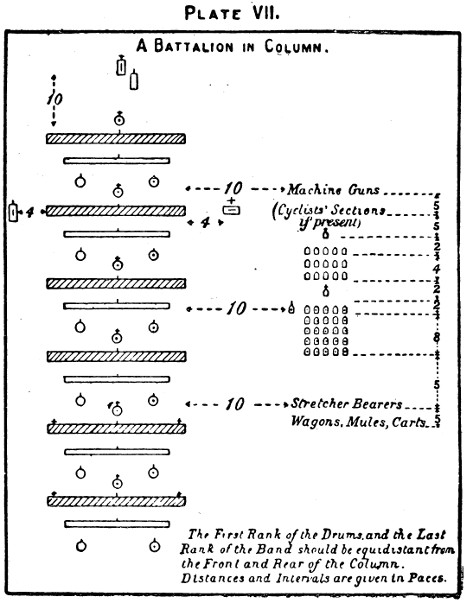
Column.
Bodies of troops on parallel and successive alignment, at a distance
from one another equal to their own frontage.
Company Column.
A company in column of sections.
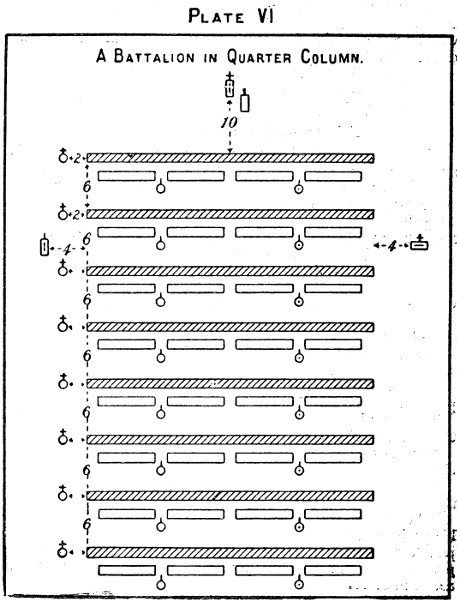
Quarter Column.
Companies on parallel and successive alignments, at a distance from one
another of six paces.
Company.
The tactical unit of infantry. It is divided into two half-companies,
each of which is again divided into two sections.
A squad is the half of a section, formed under a selected leader, for
purposes of discipline and manœuvre.
Covering.
The act of one or more men placing themselves correctly in rear of one
another.
Defile.
A portion of the route which troops can only traverse on a narrow
front; e.g., a mountain pass, a bridge, an embankment.
To Deploy.
To change formation from column or quarter column into line on the same
alignment.
Depth.
The space occupied by a body of troops from front to rear.
Distance.
The space between men or bodies of troops, from front to rear.
Division.
Two brigades with certain divisional troops.
Direction, battalion (company, section or file) of.
The battalion, company, section, or file, responsible for keeping the
direction of the line of march.
To Dress.
To take up the alignment correctly.
Drill.
The execution of movements in unison. Drill is of two kinds.
Close order drill teaches the formations and movements suitable
to the assembly, the march, to many phases of savage warfare, and to
ceremonial parades. In close order the troops are formed and move in
accordance with the instructions laid down in this manual; the words of
command are prescribed, and the rank and file have only to obey orders.
Skirmishing drill is the foundation of the formations and
movements suitable to battle and reconnaissance. Very few rules can be
prescribed, and all ranks must act to a large extent independently in
carrying out orders.
Echelon.
A formation of successive and parallel units facing in the same
direction; each on a flank and to the rear of the unit in front of it.
File.
A front rank man and his rear rank man.
Fire unit.
Any number of men firing by the executive command of one man.
Flank, directing.
That by which units march or dress.
Flank, inner.
That nearer to the point of formation or direction.
Flank, outer.
That opposite to the inner or directing flank.
Frontage.
The extent of ground covered laterally by troops.
Interval.
The lateral space between men, units, or corps, measured from flank to
flank.
Interval, deploying.
The lateral space between units in quarter column or in column, on the
same alignment, the space being equal to the frontage of a unit in line.
Line.
Troops formed on the same alignment.
Mass.
Battalions in quarter column, on parallel and successive alignments
with any named distance between battalions.
Patrol.
A body of men sent out to reconnoitre or to guard against surprise.
Point of formation.
The point on which a formation is based.
Position, change of.
A movement by which a body of troops takes up a new alignment.
Rank.
A line of men, side by side.
Reconnaissance.
Searching for information of the enemy, or as to the nature of the
ground.
Section.
The quarter of a company.
Section of Defence.
A portion of a defensive position which is allotted to a distinct body
of troops.
Squad.
The half of a section, or a small number of men, formed for drill, or
for work.
Super-numeraries.
The non-commissioned officers, &c., forming the third rank.
Wheeling.
A movement by which a body of troops brings forward a flank on a fixed
or moving pivot.
PART I. — TRAINING OF THE RECRUIT. — Syllabus of Training. — Instructions. — Lectures by Squad Instructors. — SQUAD DRILL. — Squad drill, with Intervals. — Marching. — Squad drill, in single rank. — Squad drill, in two ranks. — SKIRMISHING.
INFANTRY TRAINING.
1.Preliminary remarks.
1. The object of the recruits course of training at the depôt is to fit
the soldier to take his place in the ranks of his company on joining
his battalion.
For this purpose the recruit must be developed by physical exercises,
and be trained in squad drill, rifle and firing exercises, in the
estimation of ranges, and in skirmishing.
2.Syllabus of Training.
The following syllabus for the training of the recruit at the depôt is
given as a guide, but it need not be rigidly adhered to:—
I.
60 days of 4 hours each.
Employment.
Hours.
Remarks.
First Fortnight.
—
Equipment to be issued on joining.
Physical training
10
Physical Training, Sections 1 to 11 inclusive under Serjeant Instructor.
Physical training
10
Physical Training, Sections 1 to 11 under Squad Instructor.
Squad drill
16
Sections 5 to 23.
Lectures and catechism
4
Second Fortnight.
—
Rifle to be issued.
Physical training
8
Physical training with apparatus under Serjeant Instructor.
Physical training
8
Physical Training, Sections 1 to 11 under Squad Instructor.
Squad drill
7
To Section 39.
Rifle exercises
5
Musketry exercises
7
Musketry Exercises, Sections 1 to 3.
Lectures
4
Marching order
1
Third Fortnight.
Physical training
8
Physical training with apparatus under Serjeant Instructor.
Physical training
6
Physical Training, Sections 1 to 11 (Dummy Rifles to be used)
under Squad Instructor.
Squad drill
6
To Section 44.
Rifle exercises
5
Musketry exercises
5
Musketry Exercises to Section 9.
Skirmishing
7
Sections 45 to 49.
Lectures
2
Marching order
1
Fourth Fortnight.
Physical training
7
Commence Dumb-bell Exercises, Physical training, Sections 27
to 33, under Serjeant Instructor.
Physical training
6
Physical Training, Sections 1 to
11 (Rifles to be used) under Squad Instructor.
Squad drill
5
To Section 44.
Rifle exercises
4
Skirmishing
9
Sections 45 to 57.
Musketry exercises
5
Musketry Exercises to Section 14.
Lectures
2
Marching order
1
Fifth Fortnight.
Physical training
7
Physical training with apparatus
and bayonet fighting under Serjeant Instructor.
Physical training
6
Physical Training to Section 19 under Squad instructor.
Squad drill
6
To Section 44.
Rifle exercises
2
Skirmishing
7
Sections 45 to 57.
Guards and sentries
2
Musketry exercises
7
Musketry Exercises to Section 14 and 18 to 21.
Lectures
2
Marching order
1
Sixth Fortnight.
Physical training
7
Physical training with apparatus
and bayonet fighting under Serjeant Instructor.
Physical training
6
Physical Training to Section 19 under Squad Instructor.
Squad drill
4
To Section 44.
Rifle exercises
2
Skirmishing
10
Sections 45 to 57.
Guards and sentries
2
Musketry exercises
6
Musketry Exercises to Section 14 and 18 to 21.
Lectures
2
Marching order
1
Note.—The course of instruction of the recruit in musketry
training, rifle exercises, bayonet fighting, and physical training will
be found in “The Appendix to Training Manuals.”
II.
1. Recruits will be formed for instructional purposes in squads, the
maximum number of men in each squad should not exceed twenty.
2. The squad instructors will be most carefully selected. They must
be energetic, thoroughly well trained in the art of instruction, and
intelligent. They will remain with the same squad throughout the period
of training, and will carry out the whole of the instruction, in
physical training, drill, rifle and firing exercises, and skirmishing,
except as noted in above table.
3. Training in drill, physical exercises, rifle and firing exercises,
and skirmishing, is to be as varied as possible; the work for each
morning or afternoon should include more than one of these subjects.
4. Equipment will be issued on joining, but will not be worn on parade
for the first month. Riffles will be issued as soon as the commanding
officer directs, certainly not later than the first fortnight.
5. Marching will be carried out at the discretion of the commanding
officer, and, as a rule, in connection with skirmishing practices.
6. At the conclusion of a recruit’s course the officer commanding the
regimental district will inspect the recruits in all the branches of
instruction. In conjunction with a medical officer he will examine
all men considered too weak or awkward to join battalions, and
submit a detailed report to the general officer commanding, with a
recommendation as to whether such men be retained at the depôt for
further instruction, or discharged.
7. The system of the training of the recruit is intended to develop
gradually his mental and physical powers, officers commanding will,
therefore, be held responsible that the principles of training herein
laid down are complied with, and that instruction in musketry and
skirmishing is not curtailed in favour of less essential practices.
8. The following directions in connection with the progress of
the recruit are given for guidance of instructors and supervising
officers:—
Doubling: this should not exceed—
Up to the end of the
first month,
600
yards.
„ „
second „
1,200
„
„ „
third „
1,760
„
At the end of the First Month.
Horizontal bar.—He should be able to pull to the chest twice,
hands reversed, without assistance.
Parallel bars.—He should be able to press up six times running.
At the end of the Second Month.
Horizontal bar.—He should be able to pull to the chest at least
six times, hands reversed.
Parallel bars.—He should be able to press up at least ten times.
Jumping.—Correct style of taking off (with either foot) and
alighting is required. This is of more importance, up to this time,
than great height or width of jump.
At the end of the Third Month.
Horizontal bar.—He should be able to pull to the chest at least
ten times, hands reversed.
Parallel bars.—He should be able to press up at least fourteen
times.
Jumping.—He should be able to jump a height of at least three
feet.
III.
[To be invariably attended by an officer.]
First Fortnight.
1. Barrack room duties. Cleanliness and smartness expected from the
soldier. Dress and clothing. Local orders. Good name of the regiment.
2. Fitting equipment. Laying down kits. Conduct in town. Position of
provost; duty to obey and support him.
3. Names, rank, and position of officers. Saluting. Manner of making
a complaint. Reporting sick and hospital rules. Church parade and
behaviour in church.
4. Lectures are to be given to recruits on the fact that their
prospects of civil employment in after life depends entirely on their
conduct whilst in the army, and that no man can be registered for
employment who is not discharged with a good character, and that
preference will be given to such as have exemplary or very good ones,
while for police or post office employment an additional certificate of
absolute sobriety is necessary.
Second Fortnight.
1. The rifle. Names and use of its different parts. Cleaning and care
of rifle.
2. Marching order, &c.
3. Hints on marching; boots, socks, clean feet, treatment of blisters.
Drinking on the march. Falling out. Instances of long marching and
endurance on part of the regiment.
Third Fortnight.
Skirmishing and marching.
Fourth Fortnight.
Skirmishing and use of the rifle.
Fifth Fortnight.
Skirmishing, and duties on guard,
Sixth Fortnight.
Recapitulation of previous instruction.
During the lecture hour, some time should be allowed for catechism on
preceding week’s instruction.
The lectures on the principles of skirmishing and marching should
always, if possible, be illustrated by incidents taken from actual
warfare.
The Recruit on joining his Company.
A recruit after a course of three months’ training at the depôt should
be sufficiently trained to be able to take his place in the ranks
of his company, but until he has acquired a thorough knowledge of
musketry, and can handle his rifle with skill and confidence under all
conditions and in all positions, his daily instruction in musketry will
be continued.
The following will be the course:—
(a) Care of arms.
(b) Instruction in aiming.
(c) The firing exercises.
(d) Instruction and practice in judging distance and in
improvement of eyesight. A short exercise daily.
(e) Instruction in firing from behind cover, and in
snap-shooting.
(f) Instruction in the theory, powers, and mechanism of
the rifle and its ammunition.
(g) Course of lectures and examinations on the whole of
the above subjects.
3.Method of Instruction of the Recruit.
1. When once the various motions have been learnt, it will be the
exception and not the rule, especially with auxiliary forces, to
instruct recruits by numbers.
2. The instructor muse be clear, firm, and concise in giving his
directions. He must be patient, making allowance for the different
capacity of the men whom he is training; and always bearing in mind
that careful individual instruction is the best means of developing the
intelligence, and therefore the foundation of military efficiency.
3. The instructor, who will invariably carry a whistle and, if the
squad is receiving rifle instruction, a rifle, will teach as much as
possible by illustration, either performing the movements himself, or
causing them to be performed by a smart recruit, placed facing the
squad. He will be careful, in order to stimulate the intelligence and
interest of the recruits, to explain clearly, in simple terms, the
reason of every movement and formation, and its application in the
field.
4. Instructors should be encouraged, in giving the details of the
different movements, to use their own words. So long as the instruction
is clearly understood by the men it is quite immaterial whether the
phrasing of this manual is adhered to.
5. When first taught his positions, the recruit should be properly
placed by the instructor; when more advanced, he should not be touched,
but made to correct himself when admonished. He should not be kept
too long at any one exercise. Squad drill should be intermixed with
instruction in the handling of the rifle and with physical training,
and close order drill with skirmishing.
6. Short and frequent drills are preferable to long lessons, which
exhaust the attention both of the instructor and recruit. Recruits
should be advanced progressively from one exercise to another, and
should not be kept back by men of inferior capacity, who should be
moved into a less advanced squad.
4.Words of Command.
1. Every command must be distinctly pronounced and sufficiently loud to
be heard by all concerned.
2. Every command that consists of one word must be preceded by a
caution. The caution, or cautionary part of a command, must be given
deliberately and distinctly; the last or executive part, which, in
general, should consist of only one word or syllable, must be given
sharply; as A pause
will invariably be made between the caution and the executive word.
3. When the last word of a caution is the signal for any preparatory
movement, it will be given as an executive word, and separated from
the rest of the command by a pause; thus,
as though there were two separate commands, each with
its caution and executive word.
4. When the men are in motion, executive words must be completed as
they are commencing the pace which will bring them to the spot on
which the command has to be executed. The caution, therefore, must be
commenced accordingly.
5. Young officers and non-commissioned officers will be frequently
practised in giving words of command. They should always, even when
on fatigue duty, bear in mind the obligation of setting an example of
soldierly smartness to those beneath them. Slovenly and indistinct
words of command result in slackness and hesitation on the part of the
men.
6. The cautions and commands in this manual are, as a rule, given with
regard to one flank only, but the same principle applies equally to
movements to the other flank, which should also be practised.
In squad drill the words printed in italics in the margin are the
commands to be given by the instructor.
5.Formation of squads.
1. A few men will be placed in single rank at arm’s length apart; while
so formed, they will be termed a squad with intervals.
2. If necessary, the squad may consist of two ranks, in which case the
men in the rear rank will cover the intervals between the men in the
front rank, so that in marching they may take their own points, as
directed in S. 13.
3. Recruits will, in the first instance, be placed by the instructor
without any dressing; when they have learned to dress, as directed in
S. 8, they will be taught to fall in, as above described, and
then to dress and to correct their intervals. After they have been
instructed as far as S. 23, they may fall in as directed in S.
24.
4. Recruits formed into a squad will be directed to observe the
relative places they hold with each other; while resting between the
exercises they will be permitted to fall out and move about; they will
be instructed on the words Fall in to fall in as they stood at
first. This should be constantly practised.
Recruits will be instructed singly as well as together in all exercises
as far as S. 23.
6.Position of Attention.
The exact squareness of the shoulders and body to the front is the
first principle of the position of Attention. The arms should
hang easily from the shoulder, elbows to the rear; the fingers
together, slightly bent, and their tips touching the thigh lightly,
behind the seam of the trousers; the hips drawn back, and the chest
advanced, but without constraint. The heels must be in line and closed;
the knees well braced back; the toes turned out so that the feet may
form an angle of 45 degrees; the weight of the body on the fore part
of the feet. The head is to be held erect, but not thrown back; the
chin to be slightly drawn in; and the eyes looking straight to the
front.
Carry the left foot about ten inches to the
left, at the same time grasp the right hand
with the left behind the back, allowing the
arms to hang to their full extent; both legs to be straight.
When the recruit falls in for instruction he will be taught to place
himself in the position above described.
Squad, Atten—tion.
On the word Attention, spring up to the
position described in S. 6.
No deviation from the position of Stand at ease will be
permitted unless the command Stand—easy is given, when the
men will be permitted to move their limbs, but without quitting their
ground, so that on coming to Attention there will be no loss of
dressing.
When there is no special reason for ordering Stand at ease
before Stand—easy, the order to Stand—easy will be
given without it. On the caution Squad being given to men
standing easy, every soldier will at once assume the position of
standing at ease.
8.Dressing a squad with intervals.
Right—Dress.
On the word Dress, each recruit, except the
right-hand man, will turn his head and eyes to
the right and will then extend his right arm,
back of the hand upwards, finger tips touching
the shoulder of the man on his right. At the
same time he will take up his dressing in line
by moving, with short quick steps, till he is
just able to distinguish the lower part of the
face of the second man beyond him. Care must
be taken that he carries his body backward or
forward with the feet, keeping his shoulders
perfectly square in their original position.
Eyes—Front.
On the word Front, the head and eyes will be
turned smartly to the front, the arm dropped,
and the position of Attention, as described in
S. 6, resumed.
A line will similarly be dressed by the left.
9.Turnings.
Right—Turn.
On the word Turn, keeping both knees well
braced back and the body erect, turn to the
right on the right heel and left toe, raising the
left heel and right toe in doing so.
On the completion of the preliminary movement,
the right foot must be flat on the ground
and the body raised on the left toe, both legs braced up.
Two.
On the word Two, bring the left heel smartly
up to the right.
Left—Turn.
On the word Turn, keeping both knees well
braced back and the body erect, turn to the left
on the left heel and right toe, raising the right
heel and left toe in doing so.
On the completion of the preliminary movement,
the left foot must be flat on the ground
and the body raised on the right toe, both legs
braced up.
Two.
On the word Two, bring the right foot
smartly up to left.
About—Turn
As detailed in the Right Turn, except that
the body will be turned about to the right.
Two.
As before detailed.
Right (or Left)—Incline.
As before detailed, turning half right.
Two.
As before detailed.
10.Saluting.
(A) Saluting to the front.
Caution.—Salute, by numbers.
One.
On the word One, bring the right hand
smartly, with a circular motion, to the head,
palm to the front, fingers extended, point of the
forefinger one inch above the right eye, thumb
close to the forefinger; elbow in line, and
nearly square, with the shoulder.
Two.
On the word Two, cut away the arm smartly to the side.
Caution.—Salute, judging the time.
Salute.
On the word Salute, go through the motions
as in One, and after a pause, equal to two paces
in quick time, cut away the arm as in Two.
(B) Saluting to the side.
Cautions.—Right (or Left) hand salute.
The salute will always be with the hand further from the person saluted.
The procedure will be as described in (A), except that as the
hand is brought to the salute, the head will be turned towards the
person saluted.
Recruits should be practised in marching two or three together,
saluting points being placed on either side. When several men are
together, the man nearest to the point will give the time.
When a soldier passes an officer he will salute on the third pace
before reaching him, and will lower the hand on the third pace after
passing him; if carrying a cane he will place it smartly under the
disengaged arm, cutting away the hand before saluting.
A soldier, if sitting when an officer approaches, will rise, stand
at attention, and salute; if two or more men are sitting or standing
about, the senior non-commissioned officer or oldest soldier will call
the whole to Attention and alone will salute.
When a soldier addresses an officer, he will halt two paces from him,
and salute as in (A). He will also salute before withdrawing.
When appearing before an officer in a room, he will salute without
removing his cap.
A soldier, without his cap, or when carrying anything that prevents him
from saluting, will, if standing still, come to attention as an officer
passes; if walking, he will turn his head smartly towards the officer
in passing him.
A soldier, when riding a bicycle, will turn his head smartly towards an
officer in passing him.
Warrant and non-commissioned officers who wear the sword will always
salute with the right hand.
11.Length of pace, and time.
1. Length of pace.—In slow and quick time the length
of a pace is 30 inches. In stepping out, it is 33 inches, in
double time, 40, in stepping short, 21, and in the
side step, 15 inches.
When a soldier takes a side pace to clear or cover another, as in
forming fours, S. 40, the pace will be 30 inches.
2. Time.—In slow time, 75 paces are taken in a minute.
In quick time, 120 paces, equal to 100 yards in a minute, or 3
miles 720 yards in an hour. In double time, 180 paces, equal to
200 yards a minute. The time of the side step is the same as for
the quick step.
Distances of 100 and 200 yards will be marked on the drill ground, and
non-commissioned officers and men practised in keeping correct time,
and length of pace.
Marching in slow time will be practised only when required for
ceremonial purposes.
12.The drum, and pace stick.
No recruit, or squad of recruits, is to be taught to march without the
constant use of the drum, and pace stick.
The drum will first beat the time in which the men are to march, when
the squad is halted; then, from time to time, when it is in motion.
While the drum is beating, at the halt, the men will give their
attention to the time; when it ceases, the instructor will put the
squad in motion.
In order to ascertain whether the time is beaten correctly, a pendulum
should be used.
The length of the pace in marching will be corrected with the pace
stick, the accuracy of which should occasionally be tested by
measurement.
13.Position in marching.
In marching, the soldier must maintain the position of the head and
body, as directed in S. 6, with the weight on the fore part of
the feet. He must be well balanced on his limbs. In slow time his arms
and hands must be kept steady by his sides, care being taken that the
hand does not partake of the movement of the leg, and the toes must be
pointed downwards. In quick time his arms will swing naturally from
the shoulder, the right arm swinging forward with the left leg, and
the left arm with the right leg. The hand must not be swung in advance
of the leading foot, across the body, nor be raised higher than the
waistbelt. The movement of the leg must spring from the haunch, and be
free and natural.
Both knees must be kept straight, except while the leg is being carried
from the rear to the front, when the knee must necessarily be a little
bent, to enable the foot to clear the ground. The foot must be carried
straight to the front, and, without being drawn back, placed firmly on
the ground, but so as not to jerk or shake the body.
Although several recruits may be drilled together in a squad with
intervals, they must act independently, precisely as if they were being
instructed singly. They will thus learn to march in a straight line,
and to take a correct pace, both as regards length and time, without
reference to the other men of the squad.
Before the squad is put in motion, the instructor will take care that
the men are square individually and in correct line with each other.
Each recruit must be taught to take a point straight to his front,
by fixing his eyes upon some distant object, and then observing some
nearer point in the same straight line, such as a stone, tuft of grass,
or other object.
14.The Quick March.
Quick—March.
The time having been given on the drum,
on the word March the squad will step off
together with the left foot, in quick time,
observing the rules in S. 13.
15.The Halt.
Squad—Halt.
On the word Halt, the moving foot will complete
its pace, and the other will be brought
smartly up in line with it.
16.Stepping Out.
Step—Out.
When marching, on the word Out, the
moving foot will complete its pace, and the
soldier will lengthen the pace by 3 inches,
leaning forward a little, but without altering
the cadence.
This step is used when a slight increase of speed, without an
alteration of cadence, is required; on the command Quick—March
the usual pace will be resumed.
17.Stepping short.
Step—Short.
On the word Short, the foot advancing will
complete its pace, after which each soldier will
shorten the pace by 9 inches until the command
Quick—March is given, when the quick
step will be resumed.
18.Marking time.
Mark—Time.
On the word Time, the foot then advancing
will complete its pace, after which the time
will be continued, without advancing, by
raising each foot alternately about six inches,
keeping the feet almost parallel with the ground,
the knees raised to the front, the arms steady
at the sides, and the body steady. On the word
Forward, the pace at which the men were
moving will be resumed.
At the halt, the word of command will be Quick, Mark—Time.
19.Stepping back.
—Paces,Step Back—March.
In stepping back, soldiers must be taught to
take a quick pace of 30 inches straight to the
rear, preserving their shoulders square to the
front and their bodies erect. In halting, the
foot in front will be brought back square with
the other.
The step back should not exceed four paces.
20.Changing step.
Change—Step.
To change step in marching, the advancing
foot will complete its pace, and the ball of the
rear foot will be brought up to the heel of the
advanced one, which will make another step
forward, so that the time will not be lost, two
successive steps being taken with the same foot.
This may be required when any part of a squad, or a single soldier, is
stepping with a different foot from the rest.
To change step when marking time, two successive beats will be made
with the same foot.
21.The Double March.
Double—March.
The time having been given on the drum, on
the word March, the men will step off together
with the left foot, doubling on the fore part of
the foot, care being taken that the heels do not
touch the ground. At the same time they will
raise their hands as high as the waist, fists
clenched, the flat part of the wrist inwards.
The arms must move with freedom at the shoulder
with the action of the legs and be kept close
to the sides. The head must be kept erect
and the shoulders square to the front. There
must be no stiffness in the movement of the legs;
thigh, knee, and ankle joints all working freely.
The feet must be picked up cleanly from the
ground at each pace, and the body inclined slightly
forward. As the foot leaves the ground it
should be carried straight to the front, care
being taken that the heels are not raised towards
the seat.
Squad—Halt.
As in S. 15, at the same time dropping and
partly opening the hands.
The recruit will be taught to mark time in double time, the hands being
raised and the fists clenched as when marching in double time, but the
arms kept steady. From the halt, the word of command will be Double,
Mark—Time.
22.The Side step.
Caution.—Right (or Left) close.
Right (or Left) Close,
—March. or —Paces, Right (or Left)
Close,—March.
On the word March, each man will carry his
right foot 15 inches direct to the right, and
instantly close his left foot to it, thus completing
the pace; he will proceed to take the next pace
in the same manner. Shoulders to be kept
square, knees not bent, unless on rough or broken
ground. The direction must be kept in a straight
line to the flank.
Squad—Halt.
On the word Halt, which will be given when
the number of paces has not been specified, the
men will complete the pace they are taking, and
remain steady.
Soldiers should not usually be moved to a flank by the side step more
than twelve paces.
23.Turning when on the march.
Right—Turn.
1. Turning to the right, and back into squad.—On
the word Turn, which should be given as the
left foot is coming to the ground, each soldier
will turn in the named direction, and move on
at once, without checking his pace.
Left—Turn.
On the word Turn, which should be given as
the right foot is coming to the ground, each
soldier will turn again to the left, and move on
without checking his pace.
2. A soldier will always turn to the right on the left foot; and to the
left on the right foot. If the word Turn is not given as the
proper foot is coming to the ground, the soldier will move on one pace
and then turn.
3. Making a half turn to the right, or left.—Recruits will
also be practised in making a half turn to the right or left on the
words Right or Left—Incline, and then moving on (without
checking their pace) in a diagonal direction, taking up fresh points,
at once, to march on, and turning in the original direction on the word
Left or Right—Incline.
4. Turning about.—On the command About turn, recruits
will also be taught to turn about, which must be done by each man
on his own ground, in three paces, without losing the time. Having
completed the turn about, the soldier will at once move forward, the
fourth pace being a full pace of 30 inches.
24.Formation of the squad in single rank.
At this stage of the instruction a few recruits will be formed in
single rank, each man being allowed a space of 30 inches. The accuracy
of the spacing should be frequently tested by the instructor.
Number.
The squad will then be ordered to number from the right.
Odd Numbers, Two Paces
Forward,—March.
When a squad in single rank is required to
drill with intervals, the instructor will direct
the odd numbers to take two paces forward.
Reform Single Rank—March.
To re-form single rank the odd numbers will
step back two paces, when the squad will correct
the dressing from the right or left.
25.Dressing when halted.
When soldiers are on the alignment they have to occupy, and it is
necessary to correct their dressing, the command Right (or
Left)—Dress will be given, on which each man will look
towards the flank by which he is ordered to dress with a smart turn
of the head, as described in S. 8. Each man will then move up
or back to his place successively, commencing with the man nearest
the named flank, carrying his body backward or forward with the feet,
moving to his dressing with short quick steps, without bending backward
or forward. His shoulders must be kept perfectly square, and the
position of Attention, retained throughout.
The instructor should invariably fix upon some object on which to dress
his line.
It will be found useful to accustom men to dress on an alignment
oblique to any well-defined adjacent line.
26.Turnings.
The recruit will next practice in single rank, judging the time,
without any pause between the motions, the turnings he has been taught
by numbers.
27.Marching in Squad.
Before a squad is ordered to march, the directing flank or man must
be indicated by the caution, By the right, By the left,
or By No.-. During the march, the shoulders must be kept
perfectly square to the front, the body steady, eyes off the ground.
Each man will preserve his position in the general alignment by an
occasional glance towards the directing man.
The squad will first be taught to march straight to the front, by the
right, by the left, or by any man. It will then be practised in all the
varieties of step in quick time, and in marking time, after which it
will be exercised in double time.
The recruit will be practised in changing the pace, without halting,
from quick to double, on the command Double—March, and from
double to quick. In breaking from double into quick time, on the
command Quick—March, the arms will be dropped to their usual
position.
The instructor will ensure that the recruit on the flank, or the named
number, according to the caution, selects two distant points to march
on, and before approaching the first takes another in advance on the
same line, and so on. By occasionally remaining halted in rear of
the directing man, and fixing his eyes on the distant objects, the
instructor can ascertain if the squad is marching in the original
direction.
When a soldier finds himself a little behind, or before, the other
men of his squad, he must be taught to recover his place in the rank
gradually, and not to rush to it.
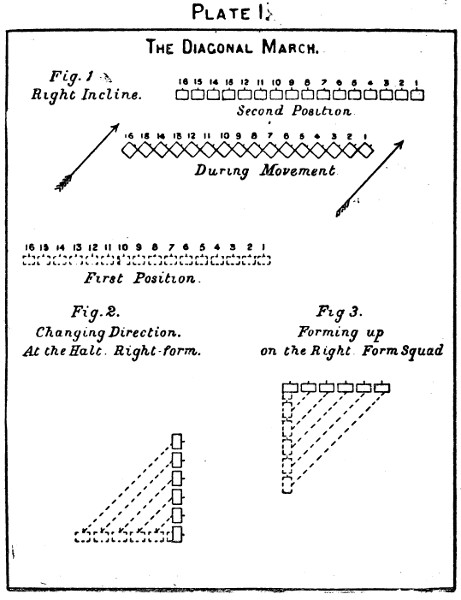
28.The Diagonal March. (Plate I, Fig. 1.)
Right—Incline.
When the squad is on the march in line, and
is required to move in a diagonal direction to
the right, the command Right—Incline will be
given, upon which the men will turn half right,
and move diagonally in that direction, each
regulating his pace so that his own shoulders
are parallel with the shoulders of the man on
his right. This man’s head should conceal the
heads of the other men towards the right. The
right hand man will direct, and must therefore
pay particular attention to the direction and pace.
Left—Incline.
When it is intended to resume the original
direction, the word Left—Incline will be given,
on which every man will move forward in the
original direction without checking his pace.
The Diagonal March.
The diagonal march may, if necessary, be taught from the halt.
If the diagonal march has been properly performed, the squad when
halted, or after the words Left—Incline, will be found to be in
a line parallel to its original position.
The diagonal march will also be practised in double time.
29.Changing Direction. (Plate I, Fig. 2.)
At the Halt. Right—Form (or
Half Right—Form).
1. From the Halt.—On the word Form, the
right-hand man will make a full turn, and
the remainder a partial turn in the required direction.
Quick—March.
On the word March, all except the right-hand
man will step off; and, glancing to the right,
will move by the shortest line to their places
on the new alignment, halt, and take up their
dressing independently.
2. The squad will also practise forming at any angle.
3. When it is intended to move forward in the new direction after
forming, the words At the Halt will be omitted, the men will
mark time when formed, and the word Forward will follow.
4. On the March.—On the command Right—Form, the
right-hand man will turn in the required direction, and mark time,
while the remainder will make a partial turn, and move by the shortest
line to their places on the new alignment. As each man arrives in his
place he will mark time and take up his dressing independently.
As soon as the squad is formed, the command Forward will be
given.
5. If it is desired to form at the halt when on the march, on the
command At the Halt—Right—Form, the right-hand man will turn
in the required direction and then halt; the remainder will act as in
1.
30.Marching as in file.
Right—Turn.
1. From the halt.—Soldiers, when standing as
in file, must be instructed to cover each other
exactly. The head of the man immediately in
front of each soldier, when he is correctly
covered, will conceal the heads of all the others
before him.
Quick—March.
On the word March, the whole will step off
together, and will continue to step a full pace,
without increasing or diminishing the distance
between each other. No looking down, nor
leaning back is to be allowed. The leader is to
be directed to march straight forward on some
distant object, the remainder of the men covering
correctly during the march.
Squad, Halt, Left—Turn.
On the words Halt, Left (or Right) Turn,
the soldiers will halt, and turn in the required
direction. If the marching has been properly
performed, their dressing will be found correct.
Right—Turn.
2. On the march.—On the word Turn, the
soldier will turn to the right, and move on as in file.
Left—Turn.
On the word Left (or Right) Turn, the soldier
will turn in the required direction, and then
move on in line.
31.Changing direction as in file.
Right—Wheel.
The squad, when marching as in file, will be
taught to change direction. The leading man
will move round a quarter of the circumference
of a circle having a radius of four feet. The
other men, in succession, will follow on his footsteps
without increasing or diminishing their
distances from each other or altering the time, but
shortening the pace a little with the inner foot.
If a squad is ordered to halt, mark time, or step short, when a part of
the men only have wheeled into the new direction, the remainder should
be instructed to cover off, if required, by the diagonal march, on the
command, Rear Files—Cover.
32.Men marching as in file forming up into squad.
(Plate I, Fig. 3.)
On the Right (or Left), Form—Squad.
1. Forming up into Squad.—When the squad,
marching as in file to the left or right, is
ordered to form up either to the right or left,
the leading man will mark time, the remainder
will make a partial turn in the named direction
and form upon him, marking time as they
come into the alignment, and taking up their dressing.
Squad—Forward, by the Left (or Right).
As soon as the squad is formed, the command
Forward will be given.
2. If it is intended to halt at the place where the movement is
commenced, the caution At the Halt will be given, and the
leading man will halt instead of marking time, the remainder doing the
same as they reach their places, and taking up their dressing.
33.Marching with arms.
Squads with arms will be practised in the different marches, and
variations of step, described in the foregoing sections. During these
practices, the closest attention must be paid to the position of each
individual recruit.
The disengaged arm will be allowed to swing naturally, except when
doubling with arms at the slope, when it will be bent as in the double
march S. 21.
When men parade with arms they will invariably fall in at the
Order, each man occupying 30 inches, and Stand at Ease.
Coming to Attention.—The squad, when standing easy, will
stand at ease on the caution Squad, and will come to attention
and slope arms on the command Slope—Arms; it will order arms
from the Slope, stand at ease, and stand easy, on the command
Stand—Easy.
34.Formation of a squad in two ranks.
The squad will now be formed for drill in two ranks. The men will take
their places in succession, commencing from the flank on which they
are ordered to form, and each occupying a space of 30 inches. Each man
of the rear rank will be placed 60 inches from the man in front of
him, measuring from heel to heel, and will cover him correctly, the
two men thus placed forming a File. The squad will be numbered
from right to left; when it consists of an uneven number of men, the
third man from the left of the front rank will be a Blank (or
incomplete) File, that is, he will have no rear rank man.
If the squad is required to drill with intervals, it will be numbered
from the right, and will then receive the command Odd numbers of the
front rank two paces forward, even numbers of the rear rank two paces
step back—March.
To re-form the squad, on the command Reform Ranks—March, the
odd numbers of the front rank will step back two paces, and the even
numbers of the rear rank step forward two paces.
35.Dressing.
The front rank will dress as described in S. 25. The rear rank
men will continue looking to their front, and will cover and correct
their distances, as the men of the front rank take up their dressing.
36.Marching in squad, and in file.
A squad in two ranks will be practised in the marches and variations of
step taught in single rank.
Blank File.—A blank file will always be with the leading rank.
He will move up into his place on the words About Turn at the
halt, or will step out to take his place in the leading rank when the
squad is turned about on the march.
Covering and Distance.—While marching in line, the men of the
rear rank must accurately preserve their covering and distance.
Marching in file.—Marching and changing direction in file will
be practised as laid down in S. 30 and S. 31, care being
taken that the men in the rear rank dress correctly by the men of the
front rank.
37.Changing Ranks.
When a squad turns about, the ranks are thereby changed, i.e.,
the former rear rank becomes the front rank, the former front rank the
rear rank.
The exception is when it is required to fall back for a short distance
only, with a view of again turning in the original direction. The
command About—Turn is then preceded by the caution The Squad
will Retire. The squad will turn in the original direction on the
command The Squad will Advance, About—Turn.
38.The Diagonal March.
The diagonal march will be practised in two ranks, in the manner
described in S. 28. In addition to the instructions there given,
the men in the rear rank must be cautioned to preserve their relative
positions with the men of the front rank, in order that they may cover
correctly when they are halted in line.
39.Changing direction, and forming up.
A squad will change direction or form up according to the instructions
laid down in S. 29 and S. 32. The rear rank will not turn
on the caution, but in forming will conform to the movements of the
front rank.
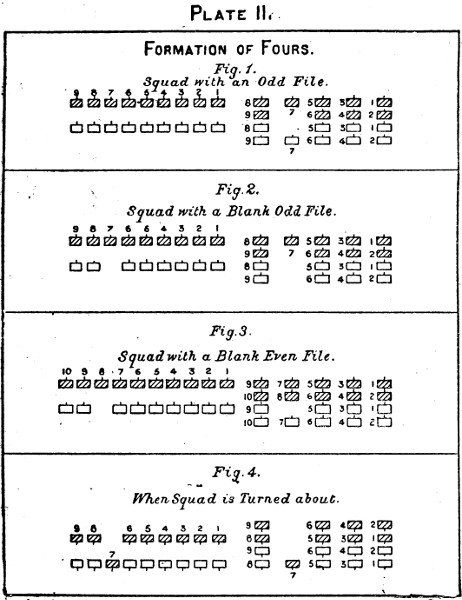
40.The formation of fours. (Plate II.)
Fours are the ordinary marching formation of infantry, and the
greatest attention should be paid to training the recruit to keep the
prescribed distance from the man in front. Order, comfort, and the
reduction of fatigue, depend on the maintenance of exact distance by
the sections of fours.
Test of marching.—The test of marching in fours is the
position of the men when they turn into line. If there are no gaps or
irregularities in the line, and the squad occupies the same frontage
as before it formed fours, the marching is good. This test should
be frequently applied during the instruction of recruits, and the
slightest carelessness as regards the maintenance of the exact distance
should be checked at once.
It must be explained to the men that odd numbers are right files, and
even numbers left files.
In order that the left four may always be complete, the file on the
left of a squad will invariably move back, and the second file from the
left always stand fast in forming fours.
Form—Fours.
1. When in line at the halt.—On the word
Fours, the left files will take a pace of 30 inches
back, and then a side pace of 30 inches so as to
cover their right files, the first pace being taken
with the foot furthest from the right files. In
this formation the squad will stand in fours.
Form—Two-deep.
On the word Two-deep the left files will move
to their original position in line by taking a side
pace of 30 inches, and a pace forward of 30
inches; or if the squad has been turned about
while in fours, a side pace and a pace back.
Formation of Fours.
2. Forming Fours to the Right (or Left).
Form—Fours.
As already described.
Right (or Left).
The squad will turn as ordered.
Left (or Right)—Turn.
The squad will turn as ordered, and then form
two-deep, as already described.
If it is required to remain in fours, the word of command will be In
Fours. Left (or Right)—Turn.
A squad moving to a flank in fours, on receiving the command
Right (or Left)—Turn, will turn in the required
direction and form two-deep without any further word of command. On
receiving an order to incline to the right or left, the squad will
remain in fours.
3. On the march.—A squad marching in line, or by the diagonal
march, will be taught to form fours precisely as when forming from the
halt; the right files marking time two paces whilst the left files are
moving to their places. Should the word Right or Left or
Right or Left Incline follow, the squad will turn in the
direction ordered.
4. When in file.—Fours will be formed by the left files, moving
forward or back into their position in Fours, right files if on
the move marking time two paces.
5. When moving in fours, the squad may be turned in any direction,
diagonal or otherwise.
6. When moving in fours, the squad may be ordered to form two-deep; on
the command, Form—Two-deep, the left files will step up or fall
back into their places in two-deep formation, the right files marking
time two paces.
7. When from line a squad is turned to the right or left in fours, if
to the right the left will direct, and if to the left the right will
direct without any further word of command, and each section of fours
will dress by that flank.
8. A squad moving to a flank in fours by the diagonal march, will form
two-deep on being turned into line.
41.Fours changing direction, and forming squad.
1. Changing direction.—A squad moving in fours, will change
direction to the right, in the same manner as in file: each four
wheeling successively round the same point as described in S. 31.
If the squad be ordered to halt, or mark time, when a part of the
fours only have wheeled, the remainder will be instructed to cover
off, if required, by the diagonal march, on the command Rear
fours—Cover.
2. Forming squad.—When a squad moving in fours is ordered to
form squad either on the right or left, it will re-form two-deep, and
then proceed as in S. 32, the men taking up their proper places
as they come up to the alignment.
42.Passage of a Defile.
If a squad in line has to pass a defile, it will be formed into fours,
or turned into file, either to a flank or inwards, and pass the defile
in this formation, line being reformed as soon as the defile is passed.
43.Obstacles.
When a stream, ditch, or bank is to be crossed it will be generally
found best to increase rather than diminish the front, by causing the
men to gradually open out before they arrive at the obstacle. If an
obstacle such as a tree or a bush has to be passed, the men concerned
will drop back, clear the obstacle, and then resume their original
formation.
44.Dismissing with or without arms.
Dis-miss.
The squad will turn to the right, and after a
pause, break off quietly, and leave the parade
ground with sloped arms.
45.General Rules.
1. Skirmishing implies extended order, in which each individual acts
and thinks for himself, and makes use of all his powers, mental and
physical, to attain a common object. It is absolutely essential, then,
that in this part of his training, the intelligence of each recruit
should be developed by every possible means, and that a spirit of
independent action, subject to the control and general directions of
the section and squad commanders, should be sedulously encouraged.
2. Even after the soldier has acquired the habit of prompt obedience
to the word of command, and of concentrating his whole attention
on the work in hand, and has learnt to march and shoot, he will,
notwithstanding, be insufficiently trained for service unless he can
use his wits as well as his physical strength, and is a skilful,
active, and resourceful skirmisher.
3. Skirmishing is the all important formation in warfare against a
well-armed enemy. The instruction of the recruit in such exercises
must therefore, be considered as one of the most important portions
of his training, and should receive very careful attention. It should
commence as soon as he is sufficiently advanced to be able to carry out
movements in two ranks and to perform correctly the various motions
required to fire the rifle, and should be continued throughout his
training.
46.Course of Training.
The course of instruction of the recruit in skirmishing will be divided
into two parts:—
(i) Preliminary Training.—This, which should be as brief
as possible, may be carried out on level ground; it will include
instruction in the methods of extending and closing, advancing and
retiring, wheeling and changing direction, &c., and in the use of
signals.
(ii) Practical Skirmishing.—This will take the form of simple
exercises, such as advancing or retiring, &c., over broken ground.
During this period the recruit should be individually instructed in
the use of cover, the elementary lessons in the application of fire,
and the practical methods of carrying out the principles learnt during
preliminary training.
47.Preliminary Training.
1. In order that the recruit may be accustomed to use his intelligence
and initiative from the commencement of his training as a skirmisher,
it will be explained to him that skirmishing is a tactical exercise
and not a drill, that the object of it is to teach him the practical
methods of advancing and retiring, the use of cover, and the
application of fire, &c.; and that mechanical precision in performing
the various movements is not to be aimed at.
2. A squad of recruits with arms will be formed up under a capable
instructor, who should be a skilful skirmisher; he will train the
individual recruit in the method of extending, &c., S. 46 (i).
3. Skirmishers will move in single rank at the trail. Correct dressing
and keeping step are to be dispensed with. When halted each man will
turn towards the direction of the supposed enemy, and will either lie
down or will take up such a position behind natural cover as will
afford him sufficient protection, and enable him to use his rifle with
effect. At preliminary training on the parade ground, recruits may
stand easy instead of lying down when the squad halts.
4. In all skirmishing exercises the instructor will point out the
position of the enemy, and he will see that the squad acts throughout
with reference to that position.
5. Although words of command are given for preliminary drill purposes,
it is to be distinctly understood that in skirmishing all orders,
as far as is possible, are to be conveyed by signal. During the
preliminary training the words of command may be used, but they are
invariably to be preceded by the whistle sound, and to be accompanied
by the corresponding signal, S. 49. The instructor will ensure
that every man looks to him on the sound of the whistle. He will
give neither command nor signal until they do so, as it is of great
importance that in the field all should at once look to the commander
on the whistle sounding.
48.Method of Extending and Closing, &c.
1. Extending from line.—On the command To ——
paces—Extend, if on the move, the front rank man of the centre
file will continue to advance, the remaining files will turn outwards
and will extend at the double, each man breaking into quick time and
advancing in the original direction on reaching his position. The rear
rank men will form on the left of their front rank men. Arms will be
carried at the short trail until there is sufficient room to trail. If
it is desired to extend to one flank, the command To the Right
(or Left) will precede the above command, when the extension
will be performed on the same principle as from the centre. If the
squad is halted, the extension will be carried out by the front rank
man of the centre or flank file lying down, whilst the remainder will
turn in the required direction and extend as above in double time,
each man halting and lying down as soon as he has got his extension.
(When on the barrack square recruits may be permitted to stand at ease
instead of lying down.)
Note.—The centre file of the squad should be indicated
by the instructor.
2. Extending from column of fours.—On the command To the
Right (or Left) to —— paces—Extend, the whole
will form two deep. If the extension is to the right, the left man
of the leading file will continue to advance, the other man of the
file extending, whilst the remainder will make a partial turn in the
required direction, and will double into their position, breaking into
quick time, and continuing the advance in the original direction as
soon as they have done so. If the extension is to the right, the left
man of each file will form on the left of the other man of the same
file, and vice versâ. If, when working with two squads, it is
desired to extend outwards, one squad should be ordered to extend to
the right and the other to the left.
3. Should it be required to form in a direction obliquely to the line
of advance, the command Half (or Quarter), Right
(or Left) will precede the command in 1 or 2.
4. If it is desired to increase or decrease the extension, the command
will be To —— paces—Extend (or Close), when the men
will extend or close on the centre, unless one flank is named.
5. Skirmishers will be practised in inclining and in changing
direction. The change of direction should be carried out without
checking the pace, skirmishers gaining their position at the double.
6. In all movements in extended order the centre will direct unless
otherwise ordered; the point on which the centre man is to move should
be clearly pointed out.
7. On the command, or signal, Close, squads will close in quick
time on their centre file, which will halt, if the squad is not already
halted. The men of the original rear rank forming up in rear of their
original front rank men, each man halting and standing at ease as he
resumes his position in line.
49.Signals and Whistle Blasts and War Calls.
1. All movements of skirmishers will be controlled by the whistle and
signal, for which purpose the following whistle blasts and signals have
been adopted:—
2. The whistle will be used—
(a) To draw attention to a signal about to be made—“a
short blast.”
(b) To denote “Cease fire”—“a long drawn out blast.”
(c) To denote “Rally,” in wood, bush, fog or darkness,
when the signal cannot be seen—“a succession of short blasts.”
(d) To denote “Alarm”—“a succession of alternate long
and short blasts.”
3. On a short blast being blown on the whistle, skirmishers will turn
towards their commander and will remain looking at him until he gives
the executive signal.
Signal.
To Indicate
(a) Arm swung from rear to front below the shoulder
“Advance” or “Forward.”
(b) Arm circled above the head
“Retire.”
(c) Hand raised in line with the shoulder, elbow bent
“Quick time.”
(d) Clenched hand moved up and down between thigh and shoulder
“Double.”
(e) Arm raised at full extent above the head
“Halt.”
(f) Body or horse turned in the required
direction and arm extended in line with the shoulder
“Incline.”
(g) Circular movement of the extended arm in
line with the shoulder in the required direction
“Wheel.”
(h) Two or three slight movements of the open
hand towards the ground
“Lie down.”
(i) Arm at full extent over head and waved a
few times slowly from side to side, the hand to be open and to come down as
low as the hips on both sides of the body[3]
(k) Hand placed on the top of the head, the
elbow to be square to the right or left,
according to which hand is used[4]
“Close.”
(l) Arm swung from rear to front above the shoulder
“Reinforce.”
(m) Weapon held up above, and as if guarding the head
“Enemy in sight in small numbers.”
(n) As in (m), but weapon raised and lowered frequently
“Enemy in sight in large numbers.”
(o) Weapon held up at full extent of arm,
point, or muzzle, uppermost
“No enemy in sight.”
4. War bugle calls.—Charge. Alarm.
No other calls are to be used. For the Cease Fire the whistle only is
to be used.
50.Practical Skirmishing.
1. As soon as the preliminary training is completed, the practical
application of the principles inculcated will be taught on broken
ground. Without constant practice over undulating, wooded, hilly,
mountainous, or rocky country, men can never become efficient
skirmishers.
2. Skirmishers must always be on the alert for the appearance of
the enemy, as well as for orders, whistle, or signal. To this end,
therefore, silence and attention must be as strictly maintained as in
close order, and although uniformity of action is not to be demanded,
each man should move with the utmost smartness and alacrity.
3. Neither on the move nor at the halt need a regular line be
preserved, nor should too much attention be paid to exact maintenance
of intervals between men.
4. Frequent opportunities will be taken of impressing on the recruit
that troops are formed as skirmishers in order that they may not
present a favourable target to the enemy’s fire, and may be enabled to
take full advantage of cover.
5. Advances may be made by rushes, at the double, in quick time, or
even by crawling, but the pace and method will depend on whether the
skirmishing line is under cover or not, on the volume of the fire to
which they are supposed to be exposed, and on the distance from the
enemy.
6. Orders are to be conveyed either by signal, S. 49, or else
passed along the line of skirmishers, S. 54.
51.Cover.
1. The paramount importance of concealment must be impressed on all
ranks. Anyone showing himself may betray the fact that a position is
occupied; or that an outflanking movement is in progress. Officers and
non-commissioned officers must be careful to set an example in this
respect, and see that it is followed by the men.
2. The recruit should be trained to look for a covered line of advance,
and to select such halting places as will shelter him from the view and
fire of the enemy. He should move as nearly as possible in a direct
line forward, so as not to mask the fire of his comrades.
3. Cover to be efficient must fulfil the following conditions:—
(i) Afford a good view of the ground to the front. (If the
soldier is to shoot with effect he must never lose sight of the
target.)
(ii) Permit the free use of the rifle.
(iii) Give concealment to the firer.
(iv) Provide protection against the enemy’s fire.
4. It is more advantageous to fire from the side of cover than over
it, for though the exposure is in both cases practically identical,
a soldier when firing over cover is more visible than when firing
round it, and therefore offers a better mark for the enemy’s aim; in
addition, his movements when preparing to do so are more likely to
catch the eye. On the other hand, better view and command of ground are
obtained when firing over cover.
5. Cover gives protection in proportion to the closeness with which
the soldier’s body is brought to it. Bullets which just pass over the
top of cover, particularly if their angle of descent is abrupt, search
ground within a very few feet.
6. Whenever possible, fire should be delivered from the lowest part of
the right side of any obstacle. For example, the soldier should lie
down at the foot of a tree and fire to the right of it; or when behind
a boulder, he should fire round the lower edge of it, and not over the
top.
Men must necessarily fire over a continuous wall, bank, ditch, high
grass, crops, or similar features.
In this case, until the rifle is brought to the firing position only
the portion of the head from the eyes upwards should be visible above
the cover.
7. When teaching the use of cover, the instructor will explain that the
first principle is so to adapt the position to it that the rifle can be
fired with the minimum of exposure. He will then state the advantages
and disadvantages of various kinds of cover, and will point out that a
firer behind a rock or stone wall may be wounded by splinters; that a
certain thickness of earth or brick is necessary to resist a bullet;
that a tree affords only moderate protection; that an isolated tree,
bush or hedgerow should be avoided as it will probably draw fire; that
even the smallest fold of ground gives cover from view and protection
from fire, &c. Finally, he will, so far as cover is available,
practically show how each can best be utilised.
The men will observe his position both from behind and from the front,
and the instructor will emphasise the danger of undue exposure. Each
man will then be directed to take cover, and his actions and position
criticised by the instructor from the enemy’s point of view as well as
from behind.
8. If a skirmisher finds that there is no cover near his line of
advance, or that the cover which exists is already occupied, he must
throw himself down in the open, and lie as flat as possible.
9. Skirmishers must never expose themselves on the sky-line, or
against a background which would show them up; they must never in any
circumstances crowd together.
10. It will be found of great value during instruction to make each
individual man skirmish independently over a piece of unknown ground
against the rest of the squad, and to invite their criticism on his
action.
11. In training skirmishers it is by no means sufficient to point out
mistakes, but, in every case, the correct method of action, and the
reasons for it, should be carefully and patiently explained, and the
exercise repeated.
52.Blank Ammunition.
Blank ammunition should occasionally be used, and the enemy should be
represented by either another squad, or a few men; light canvas, paper,
or wooden targets, in the form of men kneeling, cavalry, a gun, &c.,
&c.; or a line of old helmets or khaki hats.
53.Fire Effect.
1. In skirmishing the unit of fire will usually be the section or squad.
2. The squad leader will be careful that no man who cannot see the mark
fires.
3. The instructor should constantly inspect the recruits when firing
from behind cover, direct them to correct their positions, and make
certain that they recognise the target at which they have been ordered
to aim.
It will be explained to the recruits that—
(i) Fire is only effective when the mark can be seen, and when
it is steadily delivered.
(ii) It is useless to fire merely for the sake of firing, when
no enemy is visible, and his position is unknown.
(iii) Battles are won mainly by the accurate fire of individuals
at decisive range. Long range fire should rarely be opened
without special directions from a superior; in the absence of
orders, however, it may be directed against large bodies, such
as half a battalion in close order.
(iv) In crises, and against large and conspicuous targets, fire
should be as rapid as is compatible with accuracy, in order
that as great loss may be inflicted as possible. In ordinary
circumstances fire should be slow.
(v) The moral and material effect of concentrated fire, when
every rifle is directed against one portion of the enemy’s line,
is far greater than when each man fires at a mark of his own
selection.
(vi) Oblique fire (that is fire delivered at an angle to the
hostile line) will give better results than frontal, because the
surface exposed by the enemy will be greater.
(vii) Enfilade fire (that is, fire directed along the enemy’s
line) will be more effective than frontal, because errors in
estimation of range should be of less importance, and its moral
effect is greater.
(viii) The surest way of checking the enemy’s advance, or
bringing about his retirement, is to shoot down his leaders.
(ix) Great results may be obtained from fire delivered
unexpectedly at short range, and men should always be on the
watch for opportunities of this nature.
(x) Well concealed, a few bold men, extended at wide intervals,
can, by rapid fire, deceive the enemy as to the strength of the
force by which he is opposed, may delay him for a considerable
time, and before withdrawing inflict serious loss.
54.Reporting and passing Orders.
Skirmishers should be taught to report to their leaders anything they
may observe of the dispositions of their enemy, to call their attention
to all signals and to the movements of other units, and to pass orders,
messages or information along the line in a clear and intelligible
manner, without shouting.
55.Intervals.
The intervals between skirmishers depend on the nature of the ground,
and on the character of the operation, and on the volume of fire it is
sought to bring to bear on the enemy. They may vary considerably; but
it should be clearly recognised that over-extension results in loss of
control, and in diminishing the volume of fire. In close country and
woods, and whenever counter-attack is probable, over-extension is very
dangerous.
It is essential, therefore, before extending, that the length of front
to be occupied should be carefully considered; and the commander of
a party of skirmishers must always be able to give a reason for the
interval at which his men are extended.
56.Reinforcing.
It is inevitable in the heat of battle that battalions, companies,
sections, and even squads will become mixed up. It is of very great
importance to accustom the men to such conditions, and to make
them understand that if they use their intelligence and their eyes,
confusion may be readily reduced to order. The squad should be
practised in reinforcing to the front. For this purpose two squads may
be extended in two lines. On the word or signal Reinforce, the
rear squad will advance as directed by the commander, and will carry
forward the leading line of skirmishers, the intervals of which it will
occupy, no regard being paid to the order in which the men may place
themselves. But great attention should be paid to the following:—
(i) The men, whether they receive orders or not, should at once
look for the nearest squad commander, and place themselves under
his control.
(ii) Skirmishers should be ordered to re-organise when the cover
is so good as to afford a favourable opportunity, and the men
should always be on the look out for such chances to rejoin
their squads.
(iii) Troops who are being reinforced should be careful to cover
the advance of the reinforcements by directing a rapid fire on
the enemy’s position.
Squads should also be practised in reinforcing on either flank. On
the word or signal Reinforce the squad in rear will advance as
directed by its commander, and prolong the leading line to the right or
left.
57.Assembly after Dispersal.
The squad will be dispersed, and the men taught to assemble on their
commander on the command Assemble, forming at the double in two
ranks in their original position on his right.
58.Inspection of Skirmishers.
In testing the efficiency of a section of skirmishers, officers will
carefully avoid a stereotyped catechism. Question and answer in the
exact words of the manual result in a mere parrot-like knowledge,
of no value in the field. Skirmishers should be questioned during a
series of exercises on broken ground, and their replies should either
be in the form of practical illustrations; for example, occupation
of cover, approach of a position, crossing a sky-line, &c., &c.; or
of explanations as to how they would act, or what they would report,
in circumstances that might arise out of the exercise in progress.
Furthermore, in attack and defence, in order to prevent the inspection
becoming a repetition of operations already rehearsed, the officer
will direct where the targets are to be placed, or give instructions
to the men representing the enemy; and in all exercises—attack,
reconnaissance, retirement, or defence—he will set the task for the
squad to carry out.
PART II — THE TRAINING OF THE COMPANY. — Drill. — SKIRMISHING. — Attack Practice. — 90. SHELTER TRENCH EXERCISE.
59.Preliminary Remarks.
1. The Recruit.—When the recruit has been thoroughly instructed
in the elements of drill and skirmishing, he will take his place in the
ranks of his company.
2. The Company as the School of Instruction.—The company, from
its size and organisation, is the best school of instruction in all
field duties, and in it both officers and non-commissioned officers
will be trained to accept responsibility, and to use initiative with
judgment. It is the largest unit that can be directly controlled
under fire by one man, and is the most important link in the chain
of co-operation in battle. The training of the company exerts an
influence on the efficiency of infantry on service which it is
impossible to overrate; it is to be carried out by its own officers and
non-commissioned officers, without undue interference on the part of
their superiors.
The battalion commander is responsible that the company commanders are
thoroughly instructed, and he supervises, but should not lay down,
the methods which they employ to train their companies. The company
commanders, assisted by their subalterns and non-commissioned officers,
are directly responsible for the efficiency of the rank and file, and
their advancement in the service will depend on their success.
3. Organisation of the Company.—A company is permanently
divided into two half-companies, the right and left, each under a
subaltern, when available. Each half-company is permanently divided
into two sections, each under a non-commissioned officer. They will be
numbered from one to four.
A section is permanently divided into two squads, each under a
non-commissioned officer or selected private. They will be numbered
from one to eight.
This organisation will be maintained both in barracks and in the field.
The men will thus acquire the spirit of true comradeship, and learn to
repose confidence in each other; while the non-commissioned officers
will be accustomed to command, and to act when necessary on their own
judgment. By such means the fighting value of the company will be fully
developed; and its proper direction and command under hostile fire,
when superior control becomes impossible, be maintained.
4. Duty of Officer Commanding a Battalion.—It is the duty of
the commanding officer to see that all ranks are thoroughly trained
in field duties, that co-operation in action is ensured, and that
the self-reliance and good-will of officers and non-commissioned
officers is so carefully cultivated as to render them zealous and
intelligent assistants, in peace as well as on service, and not mere
passive executants of definite orders. This can only be accomplished
by giving the company commanders a free hand, and ample opportunities
of exercising their men. In other words the battalion commander does
not lead in the field one unit. His duty is to direct and supervise the
action of eight independent tactical units.
5. Object of Company Drill.—The object of company drill
is:—First, to enable the company, when it takes its place in the
battalion, to carry out any movement or formation the commanding
officer may prescribe, whether laid down in this manual, or improvised
to meet the circumstances of the moment, without hesitation or
confusion. Second, to render the company capable of independent action
when detached from the battalion.
Positions of Commanders, etc.,in a Company.
Positions of Commanders, etc., in Company Column.
A Company Fallen in for Inspection by its Commander.
60.General Rules.
1. The company may be formed as follows:—
(i) In line, Plate III, Fig. 1.
(ii) In company column (i.e., column of sections), Plate IV.
(iii) In column of half-companies, Plate III, Fig. 2.
(iv) In column of fours.
Company column is the normal formation for a company when acting alone
or at an interval from other companies.
Formation into and from column of half-companies is carried out in the
same manner as into and from company column, the words column of
half-companies being substituted for company column.
In line the left squad commander of the half-company on the right is
the centre of the company.
2. Position and duties of the leaders. (i) The company commander.—When
the company is acting alone or at an interval from other companies,
the company commander will place himself where he can best exercise
supervision.
In the absence of the company commander, his place will be taken by the
next in rank; a similar rule will be followed within the half-company,
section, and squad.
(ii) The subalterns.—When the company is in line, each half-company
commander will, as a rule, be three paces in rear of the centre of his
half-company. (Plate III, Fig. 1.)
When in column of half-companies he will be three paces in front of the
centre of his half company. (Plate III, Fig. 2.)
When in column of fours he will retain his position as in line.
When in company column he will, as a rule, be two paces from the centre
of his half-company on the directing flank. (Plate IV.)
(iii) Section commanders will be two paces in front of the centre of
their sections in company column; in all other formations they will
retain the positions shown in Plate III, Fig. 1. Squad commanders will
be on the flanks of their squads as shown in Plate III, Fig. 1.
The drummers will be two paces in rear of the first and seventh squads
respectively unless the company is acting independently, when one
drummer always goes with the company commander; the pioneer will be two
paces in rear of the fifth squad. The signallers will be two paces in
rear of the second, fourth, sixth and eighth squads.
In fours or file, the squad commanders will be on the directing flank
of the leading and rear fours or files of their section. The remaining
supernumeraries will retain their places.
Super-numeraries will conform to all orders given to the company as
regards the carrying of their arms, with the exception that they fix
bayonets only when escorting the colours, or when the men fix bayonets
for attack or defence, and order arms when the men fire in close order.
Squad commanders will conform to the movements of the men.
No change in the command of sections or squads will take place except
by the direct order of the captain.
3. Changes of formation can usually be carried out:—
(i) From the halt, halting on completion of the movement.
(ii) On the move, halting on completion of the movement.
(iii) From the halt, moving forward on completion of the
movement.
(iv) On the move, moving forward on completion of the movement.
The principle is the same in all cases, but the words of command differ
slightly.
When movements are to be performed as in (i) and (ii), the command will
be preceded by the caution AT THE HALT, unless the section of
formation stands fast as in Section 64 (i). As soon as movements as
in (iii) and (iv) are completed, the command FORWARD will be
given.
In the following detail the cautions and commands are given only for
the movements in the form in which they are generally used, but this
does not preclude the use of the other forms detailed in (i) (ii) (iii)
and (iv) when applicable.
4. Movements will be carried out in quick time unless ordered at the
double, in which case the command DOUBLE—MARCH will be used
instead of QUICK—MARCH.
5. The commander of the company gives the executive command when the
whole company, or the whole company except the section of formation,
is required to act; when sections act independently they receive the
executive commands from their own commanders.
6. All movements and formations in fours can also be performed in file.
7. A company should be frequently exercised in close order over hilly,
wooded, and broken ground, and should be constantly turned about, in
order that every man may be equally competent to act in either rank.
8. Before any movement in close order is carried out, arms will be
sloped by word of command.[5] Arms will be retained at the slope until
the command Order Arms, Stand at Ease, or Stand
Easy is given.
9. Great pains must be taken to accustom the men to remedy quickly, of
their own accord, any derangement in the order in which they fell in
on parade. Sections will not be re-numbered when a change of formation
alters their relative position.
10. Squad commanders, marching on the directing flanks of
half-companies, or sections, must always cover each other; they are
responsible that the correct distance is maintained. When the column is
formed at the halt, they should take up their covering immediately the
word Halt is given.
11. Except at ceremonial drill, the men will take up their own dressing
in all formations.
12. Unless otherwise ordered, men moving to the right in fours or file
will march by the left, and when moving to the left, by the right. A
company column or column of half-companies will dress and march by the
left unless otherwise ordered. In all other formations the flank by
which men are to dress and march will be named.
13. The cautions and words of command printed in CAPITALS
are given by the company commander, those in italics by the
subordinate leaders.
61.Inspection and telling-off.
The company will fall in by the left for inspection on its private
parade ground as in Plate V. The company commander will give the order
Tell off by Sections, when the section commanders will number
off their commands from the leading section. On the command Tell
off by Squads, the squad commanders will number off their squads
consecutively from No. 1, the right squad of the leading section, to
No. 8, the left squad of the rear section.
Fix—Bayonets.
The inspecting officer will pass down the ranks to see that the
appointments, clothing, &c., are clean, and in good order.
Unfix—Bayonets. For Inspection. Port—Arms.
The officer will inspect the breech action, and here and there examine
a barrel by looking down it, the men acting as laid down in the Rifle
Exercises,[6] S. 12. On the completion of the inspection the
right squad commanders will close their squads on to the left squads.
The company will then be proved as follows:—
By Sections—Number.
Form—Fours. Form—Two-Deep.
The company will be turned about and proved as above. When proved, it
will be again turned about.
If the company is to drill in battalion it will then be marched to the
battalion place of assembly.
62.The formation of fours.
In forming fours, the men will move as in Squad Drill, S. 40.
On the word Right (orLeft) the subalterns
and supernumeraries will turn in the required direction, and the squad
commanders will place themselves on the directing flank on the leading
and rear sections of fours of their sections.
63.Changing ranks.
When the company turns about the ranks are thereby changed, as in
Squad Drill, S. 37, but sections are not to be retold off. The
commander will gain his position by moving round the outer flank.
Super-numeraries will conform, passing through the ranks by the outer
flanks of their sections, the squad commanders making way by placing
themselves between the men of the files on their right and left; at
the halt this will be done by taking a pace to the rear and a pace
outwards; if on the march by checking the pace slightly and taking a
pace outwards.
Ranks will not be changed, when it is required to fall back for a
short distance only, with a view of turning again in the original
direction; in this case the order ABOUT TURN will be preceded
by the caution, THE COMPANY WILL RETIRE, and the commanders
and supernumeraries retain their positions. To turn in the original
direction the command will be, THE COMPANY WILL ADVANCE, ABOUT
TURN.
64.A company column forming into line.
1. When it is required to increase the frontage from company column to
company in line, the caution, if the column is halted, will be ON
THE LEFT (orRIGHT), FORM COMPANY; on the
command REMAINDER LEFT (orRIGHT) INCLINE,
QUICK—MARCH, the leading section will stand fast, the sections in
rear will move into line with the leading section in quick time, being
inclined to the right (or left), and halted by their section commanders
when in line with the leading section. If on the march, unless the
caution AT THE HALT is given, the sections in rear will be
ordered by the company commander to move up in double time, and will be
successively ordered to incline to the right (or left), and to quick
march by their section commanders on reaching their position in company.
2. A company column may form line to a flank on the company commander’s
command SECTIONS RIGHT (orLEFT) FORM,
QUICK—MARCH, when the men will act as in Squad Drill, S.
29 (3); this will be followed by the command FORWARD, BY
THE RIGHT (orLEFT), as soon as the formation is
complete.
3. A company column moving in fours may form column of fours on
the right or left section. On the company commander’s command
RIGHT (orLEFT) SECTION TO THE FRONT,
REMAINDER RIGHT (orLEFT) WHEEL, the
named section will continue to move forward, the remaining sections
will wheel to the right (or left), and, on reaching the line of advance
of the leading section, will wheel to the left (or right) and follow it
in column of fours.
4. A company column moving in fours may form line facing the
same direction on the command ON THE RIGHT (orLEFT) FORM SECTIONS, followed by the command
FORWARD, BY THE RIGHT (orLEFT) as soon as the
formation is complete, sections acting as in Squad Drill, S. 32.
5. In forming line from company column, section commanders will take
post in rear of their sections as soon as the movement is commenced,
moving by the outer flank, or in rear, of their sections.
65.Marching in line.
BY THE RIGHT (orLEFT).
QUICK—MARCH.
1. On the caution BY THE RIGHT (orLEFT)
the commander of the right (or left) squad will select points to march on.
2. When the company is turned about, the squad commanders, on the
command ABOUT TURN, will turn about and take two paces
forward, and align themselves with the leading rank.
66.A company in line forming to the right or left.
RIGHT (orLEFT)—FORM, QUICK—MARCH, FORWARD, BY THE RIGHT
(orLEFT).
1. From the halt.—As in Squad Drill, S. 29 (3).
The commander of the inner squad will act as the right (or left) hand man.
67.A company in line, or moving in fours, forming company
column.
ADVANCE IN COMPANY COLUMN, ON THE RIGHT
(orLEFT),
REMAINDER RIGHT (orLEFT) TURNQUICK—MARCH.
1. From company in line at the halt.—On the
command RIGHT (orLEFT) turn, the whole company,
except the section of formation, will turn in the required direction. On the command
QUICK—MARCH the right (or left) section will
advance, the remainder will mark time two paces, and then lead on. When the leading file of each
successive section is in rear of the centre of the section in front of it, the section commander will
order it to incline to the left (or right), and when its rear file, in the case of a formation on the
right (or leading file, in the case of a formation on the left) is in rear of the left file of the section
in front of it, he will order it to advance by the command left (or right) incline.
2. From company in line on the march.—If when on the march it
is desired to form company column from company in line, the command
will be COMPANY COLUMN ON THE RIGHT (orLEFT),
REMAINDER RIGHT (orLEFT) TURN, when
the sections will act as in para. 1.
When a company in line on the march is required to form company column
at the halt, the caution AT THE HALT will precede the caution
in para. 2. The section on which the formation is to be made will
advance two paces and then halt, the remaining sections will mark time
two paces and then be led by the squad commanders nearest the section
of formation into their positions in column, and will then be halted,
and turned to the left or right, by order of their commanders.
3. A company in line forming company column to a flank.—A
company in line may move to a flank in company column, on the
principles laid down in Squad Drill, S. 29 (3). The command
is, SECTIONS RIGHT (orLEFT) FORM,
QUICK—MARCH, followed by FORWARD, as soon as the
formation is complete.
4. A company in fours forming company column.—A company moving
in fours may form company column in fours on the right or left of the
leading section. On the command of the company commander, COMPANY
COLUMN ON THE LEADING SECTION, REMAINDER RIGHT (orLEFT) INCLINE, DOUBLE—MARCH, the leading section
will continue to advance, the remaining sections will incline to the
right (or left), and will double to their positions in company column,
each section, as soon as its leading file is at section interval from,
and in line with, the leading file of the section on its left or right,
being successively ordered to left (or right incline) and quick march
by its commander. The section on which the formation is made will
direct, unless otherwise ordered.
A company moving in fours will form forward into company column,
on the company commander’s order, ON THE RIGHT (orLEFT) FORM SECTIONS, followed by the command
FORWARD when the formation is complete, sections will act as
in Squad Drill, S. 41 (2).
5. In forming company column from company in line, section commanders
will take post in front of their sections as soon as the movement is
commenced, moving by the outer flank, or in rear, of their sections.
68.When marching in fours or file, forming up into line.
These formations will be made as described in Squad Drill, S. 41
(2), on the command ON THE RIGHT (orLEFT),
FORM COMPANY, followed by FORWARD BY THE LEFT
(orRIGHT), as soon as the formation is completed.
Should a company, marching to the right in fours, be ordered to form
company on the right, or vice versâ, thereby changing ranks, the
officers and section commanders will at once gain their positions as in
S. 63.
69.A column changing direction.
A company column will change direction by successive formation of
sections, round the same point on the principles laid down in Squad
Drill, S. 29 (4), the caution, CHANGE DIRECTION RIGHT
(orLEFT), being given by the company commander, and
the command Right (or Left) Form—Forward by the
Left being given successively by each section commander.
70.Movements in line (or lines) of sections.
This formation affords many advantages when moving through a wooded or
broken country, when exposed to distant artillery fire, or preparatory
to extension into a line or lines of skirmishers.
The advance may be made in line of half-companies or in one or more
lines of sections. These bodies may move in line, in column, in
fours, or in file. The intervals and distance may vary according to
circumstances.
The line may be formed as follows:—The company commander having
assembled the half-company and section commanders, will inform them
of the number of lines and the relative position of their commands;
he will then issue his instructions and assign an objective. The
half-company or section commanders will move their commands into
position on the company commander’s order MOVE.
Half-companies or sections will then be moved off by their commanders
by the shortest route, each unit as it reaches its position, halting.
If two lines are to be formed, the requisite distance will be obtained
by advancing the first line.
This formation may also be carried out on the command LINE OF
SECTIONS AT — PACES INTERVAL, orLINES OF SECTIONS ON
NOS. — AT — PACES INTERVAL, AT — PACES DISTANCE. If in line,
sections will move outwards to obtain the necessary interval; if in
column the even numbered sections will move to the left and the odd
numbered sections to the right. A section of direction will be named.
The subalterns will place themselves where they can best direct and
superintend the movements of their half-companies.
Whilst advancing in this formation, half-companies and sections may
decrease or exceed the named intervals in order to take advantage of
cover, or to avoid obstacles. But they should regain them as soon as
possible, and the greatest attention should be paid to the maintenance
of direction, a matter of much difficulty in close country, on
mountains, and in woods.
Changes of position and direction should be practised in the above
formations, the orders being conveyed by signal, S. 49; the
unit on which the formation is made, and each unit in succession on
reaching its new position will halt until the whole has conformed to
the new direction, interval or distance, when the line will continue
the advance.
In all formations of this character, scouts will cover the movement
and protect the flanks. The company commander will either give the
necessary directions, or in default of orders from him, half-company
commanders will send out scouts, using their own discretion as to
numbers.
71. Drill in single rank.
All the movements in company drill should be practised in single rank,
and it will generally be found convenient to form two companies, one
from each rank, or the right half-company becoming No. 1 company, the
left No. 2. It will be unnecessary to form new sections and squads.
This exercise is also of great use in training the subalterns to habits
of independent action, and should therefore be frequently practised.
72.Fire action.
1. Fire action is the aim of all manœuvres in war, and should therefore
be the climax of all manœuvres in peace. For this purpose drill and
fire action should be combined on all parades. Thus, after a change of
position or direction, or when marching in fours, the company commander
should point out some objective, moving or stationary, and order the
company or any portion of it to open fire, extending if necessary.
The half-company commanders may repeat the orders, but the section
commanders should give the executive commands. This practice will not
only give a meaning to many movements, which they would otherwise lack,
but will exercise all ranks in judging distance, extending, and opening
fire with rapidity. The whistle should be used to control the fire, S.
49.
2. The company should also be exercised in meeting sudden rushes, such
as charges by cavalry, savage swordsmen, or fanatics, S. 85.
This practice should be carried out on every description of ground,
especially in woods. Warning may be given by some pre-arranged signal.
3. When the company is moving in line (or lines) of sections, the
fire-tactics best adapted to meet sudden attacks by cavalry or
swordsmen, may be practised with very great benefit to the efficiency
of all ranks. The half-companies or sections should be left to their
own commanders, who will move them to favourable ground, securing,
if possible, a clear field of fire, adopt suitable formations, and
regulate the firing; habits of quick decision and alertness, as well as
an eye for ground, will thus be cultivated.
73.When dispersed, re-assembling.
The commander will place the left squad commander of No. 1 section
with sloped arms on the left of the alignment on which he intends the
company to form. The left squad commanders of the remaining sections
will cover off at column distance. On the command ASSEMBLE,
the men will fall in on the right of these squad commanders, ordering
arms, taking up their dressing and standing at ease.
74. Dismissing.
The officers having been ordered to fall out, a company will be
dismissed as in Squad Drill, S. 44.
75.Inspection in close order drill.
1. The inspection of the company in close order formations is
carried out with a view of testing the readiness of the officers,
non-commissioned officers, and squad leaders in changing from one
formation to another, and adapting formations to the ground; in
utilising the fire of their commands in the most effective manner;
in controlling the fire; in giving clear and concise orders; and in
maintaining direction, interval, and distance. Particular attention
should be directed to the following:
(i) The rapidity with which fire was opened, manner in which it
was controlled and distributed, and the positions of the men.
(ii) The attention and steadiness of the men, and the precision
of all movements.
(iii) The preservation of dressing, direction, interval, and
distance, especially when in lines of sections.
(iv) The length of pace and cadence in quick and double time.
(v) The readiness with which the company forms line of
half-companies or sections.
(vi) The manner in which words of command are given.
(vii) The closeness with which the principles and instructions
contained in this manual are followed.
76.General Remarks.
The training of the company in skirmishing will be confined to tactical
exercises on broken ground, and will be carried out in accordance with
the principles laid down in 45–57.
The commander should decide whether ground should be crossed by
simultaneous rushes; by rushing man by man; by crawling in succession,
or independently; or in quick time.
Occasions may arise when a strict adherence to the directions laid down
in Part I, for extending, changing direction, &c., would be undesirable.
Company training should embrace a variety of rough and ready
expedients, calculated to enable a fighting front to be shown with the
least possible delay in any required direction:—
For instance, a company marching north in fours is required to suddenly
extend facing north-west; or troops lying down firing are required
to rapidly line a bank to their right, to forestall its occupation
by an enemy; or a company advancing in extended order arrives at an
impassable obstacle of limited extent, or perhaps encounters water
which can only be crossed by a bridge, and the commander wishes to
avoid closing and re-extending.
To meet contingencies, the following methods are suggested. Other
expedients should be improvised by commanders in order to educate their
men to meet a particular exigency:—
(i) To change direction; or to occupy a position rapidly.
When in extended order, the command may be:—Line that bank
(ditch, hedge, &c.)—Double.
When in close order:—Line that bank (hedge, ditch,
&c.)—Extend.
In the latter case the intervals between men are immaterial.
(ii) From behind an obstacle such as a bog, or pond, to occupy
the ground on the far side in extended order. The new position
having been pointed out to the men, the word of command may
be Man by Man (or By Files, By Fours),
From the Right (Left, or Both Flanks),
To—paces, Extend (or Advance, or Double).
The men will move off from one or both flanks, and occupy in
extended order the position pointed out, the squad commander
leading.
This method may also be used for extending from behind cover, such as
a wall, bank, &c., into the open under fire; or for crossing a bridge
when under fire; or when it is desired not to attract attention.
Men may also be extended in prolongation of any alignment on the above
principles.
(iii) From behind cover, when in close order, to occupy a
frontage, the flanks of which are defined by fixed points such
as trees, bushes, buildings, &c. Three points, one in the
centre, and one on each flank, are selected and pointed out
to the centre man and flank men respectively. These men move
off, and when at a suitable distance the order Extend
is given, on which the remainder advance at the double, and,
opening out like a fan, divide the distance between them.
This method may be practised without fixed points, an approximate
interval right and left of the centre man being indicated to the two
flank men.
77.General Rules.
1. A well-armed enemy can only be driven from a strong position by
partly enveloping his front, or by overwhelming him with a heavier
and more accurate fire than his own at decisive range, and eventually
charging with the bayonet.
To reach a decisive range under heavy fire is, however, a long and
difficult operation. The advance will be covered by scouts, S.
132; when these can move forward no further, they will lie
still until absorbed by the first line of skirmishers, which in
turn will gradually be reinforced by lines in rear as it becomes
necessary to increase the volume of fire, until a strong firing line
is established. Further advance can usually be effected only when the
advance of one body is covered by the fire of the remainder, and when
the ground is gained by a few men at a time, or by successive rushes
from point to point. How these advances are to be made must be left to
the intelligence of the leaders.
2. In this practice, the following rules will be observed:—
(i) All extensions will be made, if possible, under cover;
and the preliminary instructions as to scouting, direction,
objective, outflanking the enemy, &c., &c., will be given before
extension.
(ii) The intervals, in the preliminary stages of the attack, may
vary from five to fifteen paces; these will gradually be reduced
as the lines in rear reinforce the firing line.
(iii) Skirmishers must maintain the general direction in which
their section has been ordered to advance; but they may deviate
to the right and left in order to take advantage of cover,
provided that they resume their intervals before crossing
exposed ground, and that when halted they do not crowd so
closely on one another as to interfere with the free use of the
rifle.
(iv) In order to take advantage of a well-sheltered approach
from one position to another, skirmishers may move in file, but
only when ordered to do so by the section leaders.
(v) Exposed ground will, if the enemy’s fire is heavy and
accurate, be crossed by rushes at the quickest possible pace.
Rushes, over open ground, should not exceed eighty or one
hundred yards, and should rarely reach this limit. At decisive
ranges a rush should not be so long that the enemy has time for
aimed fire, and can only be continued whilst the surprise lasts.
If cover exists they should be made from one shelter to the next.
Ground which affords slight cover may be crossed by the men
running, creeping, or crawling forward by ones or twos, each,
if possible, selecting a different course, and starting at
different times from different points of the line.
(vi) Either before or during a forward movement each skirmisher
should mark out for himself the new position he intends to
occupy. This position should be as nearly as possible in a
direct line forward, and should be such as not to mask or
interfere with the fire of his comrades.
(vii) The fire of a widely extended line is very ineffective.
Under such circumstances, therefore, fire should rarely be
opened, the advance being covered by the fire of the supporting
troops.
(viii) If the distance from cover to cover is too great to be
crossed without halting, skirmishers, at the end of the first
rush, will throw themselves down in the open, and lie perfectly
motionless without firing, until they recover their wind.
(ix) In the final advance against the position, after bayonets
have been fixed, the skirmishers will either advance by rushes
from cover to cover, or, if possible, in a general line.
(x) The men of a squad, and the squads of a section, must always
if possible keep together.
3. When two or more sections are advancing in a general line, and it is
assumed to be no longer possible, owing to the intensity of the enemy’s
fire, to advance in this formation, the advance will be conducted by
alternate rushes. The commander of the section indicated, without
rising or exposing himself, will warn the squad of his intention to
advance, and will himself lead the way. When the commander halts, the
section will at once conform to his movements and reopen fire.
The section behind, which has been firing in order to cover the advance
of the leading squad, will now rush forward, pass beyond, or align
itself with, the leading section, halt, and open fire.
4. Bayonets will be fixed before the final advance from the fire
position.
78.Position of the commanders.
Section and squad commanders will place themselves where they can best
carry out their duties. In open ground, when the line is halted, and
when the enemy’s fire is heavy, it is not possible for them to move
about. In such circumstances the commanders must lie down, either on
the flank or among the men.
79.Casualties.
Officers, non-commissioned officers, and squad leaders, should
frequently be ordered to fall out, and the men allowed to carry on the
practice without interference, in accordance with the instructions
originally issued.
80.Instructions for commanders.
1. So far as possible, all orders are to be communicated by signal. A
well-trained squad, except when passing orders or reports, should work
in absolute silence.
2. Commanders should not expose themselves unnecessarily.
3. Each leader who receives an order either by signal or word of
command will acknowledge it by a salute with the hand.
4. Commanders must be prepared to instantly assume the duties of their
immediate superiors who may be disabled.
5. Section commander.
(i) Before the section advances, to explain clearly, so that
every man may hear and understand, the objective of the manœuvre
about to be carried out, and how he intends to reach it. The
secret of good and intelligent skirmishing lies in the clearness
of the instructions the men receive.
(ii) To select the successive halting-places of the section.
(iii) To determine the method of advance.
(iv) To see that the general direction is maintained.
(v) To prevent crowding.
(vi) To concentrate the fire against a particular objective,
point out and describe the position of the target, give the
range, and observe the fire.
(vii) To control the expenditure of ammunition, to see that the
ammunition of men disabled is collected and distributed, and to
inform the half-company commander when the ammunition is running
short.
(viii) To show the way from cover to cover, and to do everything
in his power to assist the advance of neighbouring sections
by directing a vigorous fire on the enemy whilst they are in
movement.
(ix) To transmit intelligence of the enemy’s movements.
6. Squad commander.
(i) To repeat all signals, and ensure that all orders and
reports are quickly and correctly passed along the line.
(ii) To ensure that the orders of the section leader are
promptly and energetically obeyed:
(iii) that the general direction is maintained:
(iv) that the squad maintains connection with the remainder of
the section.
(v) When under cover, or in the open if the enemy’s fire is not
heavy, to see the men place themselves in position to use their
rifles effectively; that they recognise the target, and adjust
their sights; and that there is no wild firing.
(vi) To assist the advance of neighbouring squads by covering
them with their fire whilst they are in movement.
81.Duty of the Skirmisher.
It should be impressed upon the men that combined action is always more
likely to be successful than isolated efforts, because skirmishers
who are fighting under the control of their leaders, and are beside
their own comrades, feel much more confidence, and co-operate more
effectively, than when each man advances, retires, or halts as seems
best to himself.
It is to be recognised, however, that when the section is extended at
wide intervals, and also when it is under heavy fire, section, and
even squad commanders cannot always exercise direct control. Hence the
men must learn to act independently and must be taught their duty,
first by clear explanations, then by practice, accompanied by constant
questioning, until every individual knows exactly what is expected of
him when left to himself, viz.:—
(i) Continue fighting, and do his best to carry out his
commander’s intentions indicated in the original instructions.
(ii) Estimate the range, fire deliberately, and husband
ammunition.
(iii) Place himself, if possible, under the orders of the oldest
soldier in his neighbourhood, and form one of a new squad.
(iv) As soon as reinforcements arrive to take the orders of the
nearest officer or non-commissioned officer.
82.Defence Practice.
1. The chief points to be attended to in the occupation of a post or
position are: first, that each skirmisher can command the ground over
which the enemy is expected to advance, and is so placed that he can
use his rifle effectively; second, invisibility and cover from fire;
third, that natural rests are properly utilised or artificial rests
provided; fourth, that ranges have been ascertained and are known to
everyone; and fifth, that all cover which the enemy could utilise is
cleared away from the front and flanks; and sixth, that each man has
ample ammunition.
2. The company should be practised in changing its position, creeping
or crawling under cover to do so; also in delivering counter attacks,
by some covered line of approach, against the flanks of an attacking
party. The flanks of a company on the defensive must always be watched
by scouts.
83.Reconnaissance Practice.
The squad may be practised in forming a chain of groups of scouts to
feel the way for a larger body, and in working as a patrol sent out to
obtain information of the enemy or the ground.
It is impossible to lay down precise rules for these most important
duties.
All that can be said is that the intervals would be far greater than is
usual in the Attack Practice; and that much more latitude should
be granted to the men.
In reconnoitring the enemy or the ground the men should be made to
understand clearly the nature of the information required.
84.Retirements.
Retirements in face of the enemy must be conducted with the greatest
circumspection. In retiring under fire, skirmishers, if well in hand,
may move from cover to cover at the quickest possible pace, a few men,
preferably the most active, being left behind for a short time at each
halt to cover the retirement of the remainder. Sections will also be
taught to retire alternately, affording each other mutual support by
taking up successive fire positions; a section, after delivering its
fire, will retire as rapidly as possible beyond the other section which
will then open fire. If, however, the men are at all shaken, as when an
attack has failed, the retirement must be in quick time; and all ranks
should exert themselves to the utmost to ensure that it is carried out,
notwithstanding losses, with steadiness and precision. A rapid retreat,
in such conditions, is not only a fruitful source of panic, but a very
great encouragement to the enemy. A steady, deliberate movement, on
the other hand, carried out in silence and good order, pulls the men
together and imposes respect and caution on the enemy.
85.Meeting an attack by cavalry.
1. It should be impressed upon the men that on open ground foot
soldiers have little to fear from individual troopers, provided that
they keep cool, and have plenty of ammunition; and that on broken
ground the advantage is altogether on their side.
2. Charges of cavalry against the front can usually be met by rapid
fire without changing the formation. If for any particular reason,
a close formation is deemed advisable, the men of the section will
close upon their leader, and fix bayonets, the word of command being
Cavalry, Close. It is to be remembered, however, that close
formations may give the enemy’s artillery the opportunity which his
cavalry have been seeking to create.
3. An attack by cavalry in flank should be checked by the fire of the
supports, but may, if necessary, be met by the section nearest the
threatened flank changing direction in the quickest possible time, each
man closing independently on the file nearest the point from which
the cavalry is approaching, and fixing bayonets. This will be carried
out on the command Cavalry Right (Half-right, Left, &c.). In
reforming, the men will be ordered to cease fire, or unload and unfix
bayonets, and the men will resume their former order, moving by the
shortest line.
4. It is when ammunition is running short, when troops are retiring
under a heavy fire, when the flanks of a line of skirmishers are not
protected by other troops in rear, or in fog, dust, or heavy rain, that
cavalry will find their opportunity.
No hard and fast rules can be laid down as to the action of skirmishers
in such circumstances. Everything will depend on the nerve and
resourcefulness of the leaders and of the men, who should be taught
that swordsmen moving at speed can inflict but little damage on men
who throw themselves down on the ground as the horsemen close on them.
It may be laid down, moreover, that a sound system of scouting will do
much to reduce the danger of surprise, and that in a thick atmosphere,
which renders the enemy’s artillery useless, squads, and larger bodies
also, may safely move in close order.
86.Scouting.
1. It is an invariable rule that all bodies of infantry in the field
should feel the way, and at the same time protect themselves from
surprise, by means of scouts, who should be pushed out several hundred
yards in advance and to the flanks. In skirmishing practice the
scouts will examine all ground which might be held by the enemy, and
report, usually by signal, all clear or otherwise. They will receive
instructions from their commanders as to their action when they
discover the enemy, and they must be careful to expose themselves as
little as possible.
2. The day’s work will be rendered more interesting, and the men
receive useful training in scouting, if ambushes are laid, and
counter-attacks delivered.
3. In every company of infantry at least one man per squad, in addition
to one non-commissioned officer in each half-company, should receive a
special training as scouts.
4. Scouts are to be selected for their activity, intelligence, and
eyesight. They must be good shots and judges of distance, expert
skirmishers, and be able to communicate by semaphore. The special
training should be such as to cultivate these qualities, to develop an
eye for country, and to teach what to observe and how to report it.
87.Duties of Scouts.
1. In attack.
To precede the advance, reconnoitre the ground, look out for
ambushes, to watch the flanks, report all obstacles to movement,
ascertain the enemy’s position, and observe his dispositions.
2. In defence.
To observe the enemy’s approach, to report his strength and the
direction of his march; to watch the flanks, and to observe the
enemy’s movements.
3. As Ground Scouts.
To ascertain the best ground for an advance.
To look for obstacles to an advance.
To find accessible routes.
To find cover for an advance.
4. Reconnaissance.
To act as the eyes and ears of the army, especially in
mountainous and wooded country.
To obtain information of the enemy’s position and strength, the
whereabouts of his guns, the nature of his entrenchments, &c.
5. In night operations.—To precede the advance.
6. Special purposes.—For special purposes, the scouts of
several companies may be combined in one body under a selected officer
or officers.
To keep down the fire of the enemy’s scouts and snipers, to
ambush them, and to drive them off.
To rapidly seize points of importance.
To cover retirement from difficult positions.
To act on ground that is too difficult for ordinary infantry.
88.Training of Scouts.
1. The training of scouts will, as a rule, be carried out by a selected
officer in each company.
2. Scouts should be able to find their way across country both by
day and night. They should be able to read a map, and to work by sun
and compass, by observation of landmarks, and by the direction of
watersheds and streams.
3. They should be constantly practised in transmitting information by
semaphore, by written message, and by word of mouth.
4. They should be trained to cover long distances at the double, and
also to climb steep hills.
5. Scouts will generally work in pairs or in groups of four, including
a non-commissioned officer or selected group leader.
6. Scouts must remember that the less they are seen or heard the
better. They are not intended, except in special cases, for fighting
purposes; and, as a rule, they should not fire except to defend
themselves, or possibly to prevent the enemy’s scouts from obtaining
information.
7. Scouts must always be careful to keep touch with the troops they are
covering.
89.The Inspection in Skirmishing.
1. The inspection will invariably take the form of a tactical exercise
based on a scheme, set by the inspecting officer, in which an enemy
will be represented by another unit.
2. The inspecting officer will pay particular attention to the
following:—
(i) The orders issued.
(ii) The suitability of the formations to the ground and to the
tactical situation.
(iii) Fire discipline.
(iv) The aptitude of the men in making use of cover.
(v) The readiness of the half-company, section, and squad
leaders in adapting formations to the ground in occupying
suitable fire positions, and in covering the advance of other
half-companies, &c., by fire.
(vi) The accuracy and promptitude in passing orders and reports.
(vii) The work of the scouts.
(viii) The initiative shown by the subordinate leaders.
(ix) The acquaintance of all ranks with signals.
Full information on the subject of extemporised cover in the field is
contained in Part I of the Manual of Military Engineering.
Instruction of Troops.—Troops should be practised in the use
of the pick and shovel, until they can excavate without difficulty
the tasks mentioned below. Men unaccustomed to digging should, if
possible, be trained at first in sand or very light soil, until they
are accustomed to handling the shovel. When the troops practise
entrenching, the task set them should require not less than four hours’
actual work, according to the nature of the soil (M.M.E.,
Section IV).
It will be well to arrange for a portion of the working party with a
cart to draw the tools and convey them to the site of the trenches, so
that no time may be lost in beginning work.
Tools.—1. Each man will usually require a pick and a shovel,
but it may sometimes be desirable to allot two men to each task, in
which case the front rank man will carry the pick and the rear rank man
the shovel.
2. The tools will, as a rule, be placed in heaps on the ground, picks
in one heap, shovels in another. The working party, with arms slung,
will pass between the heaps in single file, each man taking a pick in
his left hand and a shovel in his right as he passes the heaps. Tools
should be carried at the trail, point of the pick down, and the hollow
of the shovel towards the thigh.
3. It is important that soldiers should be taught to handle their tools
without noise. In the event of a working party turning into file (or
about), the handles of the tools will before turning be brought into a
vertical position by lowering the iron part of the pick, and raising
the iron part of the shovel, resuming the trail when the turn is
complete. When marching in file, the handles will incline outwards.
4. Extension.—Working parties will be extended by one of the
following methods:—
(i) The party will be extended to such interval as may be
required, about 12 paces in rear of the proposed trench. It will
then be advanced and halted, while an officer paces along the
front, halting at the limit of each man’s task.
(ii) The party will be brought up about 3 paces in rear of one
of the flanks of the proposed trench in file or single file,
according as one or two men are allotted to each task. An
officer will pace along the front, halting at the limit of each
task, the party moving off at the same time and wheeling to the
right or left, the men forming on the alignment in succession in
extended order by file, or single file, as ordered. This method
is especially suitable to night work.[7]
(iii) The right or left of each task will be marked by driving
in the pick according as the extension is from the right or
left. The shovel will be placed on the ground at right angles to
the pick (blade to the left). Each task will be “spitlocked,”
i.e., marked out by the pick, as soon as the directing
officer has fixed the outer limit of the task.
5. The men will, without word of command, turn about and take 4 paces
to their rear, ground arms, take off their accoutrements, and lie down
until ordered to begin work.
6. To avoid accidents every man must commence digging on the left of
his task, and work from left to right.
Filling in trenches.
Trenches should never be filled in on the day on which they have been
made, but a fatigue party should be sent out later for the special
purpose of levelling them. Defaulters might be employed on this duty.
In one hour a man should be expected to fill in about 40 cubic feet.
PART III. — BATTALION DRILL. — BRIGADE AND DIVISION DRILL. — FORMATIONS APPLICABLE TO SAVAGE WARFARE. — BRIGADE DRILL.
BATTALION, BRIGADE, AND DIVISION DRILL.
91.General Rules.
1. Object of battalion drill.—The instruction of the soldier is
brought to a conclusion in the ranks of the company. It is necessary,
however, that the companies should be drilled in battalion in order
that the officers commanding companies may learn to work in unison.
2. Application of company drill.—Battalion movements are
carried out by combination of companies, moving as described in Company
Drill.
3. Mounted officers.—The commanding officer, the second in
command, and the adjutant will be mounted.
When the battalion is acting independently, the commanding officer,
accompanied by the adjutant, who will act as his orderly officer, will
place himself where he can best exercise supervision.
When the battalion is in brigade in column or quarter column the
commanding officer will be ten paces in advance of the centre of the
leading company, the adjutant being one-and-a-half horse’s lengths in
rear, and half a horse’s length to the right of the commanding officer.
In all movements the second in command will be responsible for the
direction and covering; he (and the serjeant-major, if no ammunition
carts are present) will generally assist the commanding officer. If a
third field officer be present he should generally assist the second
in command, unless detailed by the commanding officer for any other
purpose.
When a battalion is on the move, the second in command will place
himself in a position from which he can best superintend the direction
of the advance and the covering of the squad commanders on the
directing flanks.
4. Ranks will be changed as in Company Drill, S. 63.
5. Except where laid down, the double march is not to be used by
companies during the interior movements of a battalion, unless ordered
by the commanding officer.
6. If companies move into column or quarter column from both flanks
they will pass each other left arm to left arm.
7. In order to practise the battalion in brigade movements, and to
give the field officers experience in handling several companies, the
battalion will occasionally be divided into two battalions, each of
four companies, or of eight companies in single rank.
8. In action, in high wind, and at all times when indistinctly heard,
the commanding officer should indicate his orders by signal, where
possible (S. 49); such signals should be repeated by as many
officers and non-commissioned officers as may be necessary to ensure
the transmission of the order.
In battalion movements the orders given by the commanding officer
are printed in CAPITALS; those by officers commanding companies in
italics. The cautions may be applied to either the right or the
left flank although only the former is referred to.
9. Where cautions and commands are given for formations to, or from,
one flank only, the same rule applies when forming to, or from the
other flank, which will also be practised.
10. Fire action should be practised as directed in S. 72, para.
1.
11. The principles laid down in company drill, S. 60 (3), (4)
and (5), apply equally to battalion drill.
12. Companies will be told off again when a change of formation alters
their relative position.
92.Formations.
1. The following formations will be employed in battalion drill:—
(i) Quarter column.—This is a convenient formation in
which to move battalions, either singly or in brigade, when not
exposed to the enemy’s fire.
(ii) Column.—This is essentially a march formation,
but will be used for the purpose of forming up preparatory to
closing to quarter column, or moving off in column of fours.
(iii) Line (or Lines) of company
columns.—This formation will usually be adopted by the
battalion at distant artillery ranges, preparatory to extending
for the attack. It allows of full control being exercised by the
battalion commander, whilst at the same time enabling companies
to take advantage of natural cover, and to conveniently advance
over broken or intersected ground.
(iv) Column of fours.—This is a convenient march
formation when a narrow front is necessary, such as passing a
defile, and will usually be adopted when on the march.
Against an enemy armed with the breech-loader, close order formations
in battalion and brigade are applicable only for assembly, for marches
and during the preparatory stages of the fight.
2. Attacks by savages armed with spears and swords must, however,
usually be met in close order; and for this purpose, in addition to the
formations mentioned in para. 1, the following will be practised, but
only by troops which are likely to be called upon to take part in such
warfare:—
(i) Line.
(ii) Echelon.
(iii) Square.
93.A battalion in quarter column. Plate VI.
The companies of a battalion, after having been inspected on their
private parades or in column, will form up in quarter column as
shown in Plate VI. On the commanding officer’s order TELL OFF
BY COMPANIES, the companies will be numbered from the leading
company. When the companies are numbered, the commanding officer will
divide the battalion thus:—
No. 1 to No. — RIGHT HALF-BATTALION.
No. — to No. — LEFT HALF-BATTALION.
If the number of companies is uneven, the right half-battalion will be
stronger by one company than the left.
Unless otherwise ordered a battalion in quarter column will assemble
and move by the left.
The machine guns, drums and band, mules, wagons and stretcher bearers
will usually be on the outer flank of the battalion, as when in column,
see Plate VII (cyclist sections, if present, will be in rear of
machine guns).
The second in command will be four paces from the centre of the
directing flank of the leading half-battalion.
If a third field officer be present, he will be four paces from the
centre of the directing flank of the rear half-battalion.
The position of the company commanders and serjeant-major are shown in
Plate VI.
When ranks are changed, the second in command will gain his position by
moving round in rear of the battalion. Company commanders will move in
rear of their companies. Company officers and section commanders and
supernumeraries will act as in S. 63.
A Battalion in Quarter Column.
94.Movements in quarter column.
THE BATTALION WILL ADVANCE. QUICK—MARCH.
1. On the word MARCH the whole will step
off together. The squad commander on the
directing flank of the leading company (i.e., on
the left unless otherwise ordered) selecting points to march on.
RIGHT—INCLINE.
2. The whole will act as in Squad Drill, S. 28.
On the command LEFT—INCLINE the battalion
will resume its original direction.
FORM FOURS—RIGHT, NO. — WILL DIRECT.
3. A flank company will be ordered to direct,
the remainder being led by the leading squad
commanders on the flank nearer the company of direction.
The second in command will post himself on
the flank of the directing company in line with
the leading section of fours.
95.A quarter column wheeling.
CHANGE DIRECTION RIGHT. RIGHT—WHEEL.
1. On the command RIGHT—WHEEL, the battalion,
excepting the leading company, will make a partial turn to the outer flank, the front rank
of the leading company will glance towards the inner flank on which they will wheel, the second
in command superintending on the inner flank and the adjutant regulating the pace on the
outer flank; the outer flank will direct, but when companies are of unequal strength they
will retain the same relative positions they held before the wheel. Each man will move round
on the circumference of a circle of which the inner squad commander of the leading company
is the centre. The adjutant in regulating the pace must watch the squad commander of the
outer flank of the rear company, who will continue to march at a full pace throughout the
wheel, and on whose movement the march of every man in the quarter column should be
made to depend. When the battalion has circled round to the required angle, the command
FORWARD will be given. This may be preceded
by MARK—TIME should all the companies not be
in their correct positions.
2. A quarter column moving in fours will wheel as in 1, the leading
fours of each company wheeling in the same manner as the leading
company in 1, the sections of fours in rear making a partial turn
outwards and following round after the leading fours, the leading squad
commanders changing to the inner flank if not there already.
96.A battalion at the halt opening to column from quarter
column.
ADVANCE IN COLUMN.
1. On the caution ADVANCE IN COLUMN, the
leading company will be moved off by its commander, who will give the command By the{ Left, Quick—March; the other companies will
follow in succession at company distance by
order of their commanders, and will conform to
the movements of the leading company. Unless
otherwise ordered column will move and dress by the left.
When halted in column the second in command will be four paces from the
centre of the directing flank of the leading half-battalion; a third
field officer, if present, will be four paces from the centre of the
directing flank of the rear half battalion.
The position of the company officers and section commanders will be as
when in company; the machine guns, drums and band, &c., will be on the
outer flank, see Plate VII.
A Battalion in Column.
2. A battalion in column will move either in fours or by the diagonal
march, on the same principles and on the same words of command as from
quarter column. S. 94.
97.A battalion in column on the march closing to quarter
column.
AT THE HALT, QUARTER COLUMN.
1. The leading company will be at once
halted by its commander. The remaining companies will continue to advance, and will be
successively halted by their commanders on reaching their position in quarter column.
QUARTER COLUMN. REMAINDER—DOUBLE MARCH.
2. Should it be necessary to form quarter
column on the march, on the battalion commander’s order REMAINDER—DOUBLE—MARCH,
the whole will break into double time, except the leading company, which will continue
to advance in quick time; the commanders of the companies in rear will order them to break
into quick time as soon as they have reached their position in quarter column.
3. Should it be necessary to form quarter column from column from the
halt, the command in 1 will be followed by the words, REMAINDER,
QUICK—MARCH, when the leading company will stand fast, the
remainder will act on the same principle as in 1.
4. Quarter column will usually be formed on the leading company.
98.A battalion in column or quarter column advancing in
fours, or vice versâ.
IN SUCCESSION ADVANCE IN FOURS FROM
THE RIGHT OF COMPANIES.
1. Column of fours from column on the
march.—This caution will be given when a column
is required to defile, on which the leading company
commander will give the command Form fours,
right, Left—wheel, each company forming
successively on reaching the same point.
If companies are to advance in fours simultaneously, the battalion
commander will give the command FORM FOURS, RIGHT, COMPANIES,
LEFT—WHEEL.
2. Column from column of fours on the march.—If the column is
to be reformed immediately on clearing the defile, the caution will be
IN SUCCESSION ON THE LEFT FORM COMPANIES, on which the company
commanders will act as in S. 68, each company successively
forming into column.
Column may also be formed when the whole has cleared the defile,
on the battalion commander’s order ON THE LEFT FORM COMPANIES,
FORWARD, companies acting as in S. 68.
3. Column of fours from quarter column from the halt.—The
battalion commander will give the caution IN SUCCESSION ADVANCE IN
FOURS FROM THE RIGHT OF COMPANIES, on which the commander of the
leading company will give the command Form fours, right, left wheel,
Quick—march, each company in rear being moved off in a similar
manner as soon as its front is clear. If on the march the quarter
column must be halted before defiling.
4. Quarter column from column of fours on the march.—Quarter
column will be formed from column of fours by first forming column as
in 2, and then forming quarter column as in S. 97 (2).
5. Column or quarter column from column of fours on the
march.—A battalion moving in fours may form quarter column or
column on the leading company facing at right angles to the line of
advance, on the caution AT THE HALT, FACING RIGHT, COLUMN
(orQUARTER COLUMN) ON THE LEADING COMPANY,
on which the leading company will be at once halted and turned to its
right by its commander, the remaining companies forming in rear of it.
Note.—When in column of fours on the march, drums and band will
be twenty paces in front of the leading company; mules will follow
in rear of the companies to which they are attached; machine guns,
stretcher bearers, carts and wagons will be in rear of the battalion;
the whole in the above order. Cyclist section, if present, will precede
the machine guns. The second in command will usually be in rear of the
battalion. The adjutant will accompany the commanding officer, who
will be between the band and the leading company. The serjeant-major
will be in front of the leading company.
99.A battalion in column changing direction.
CHANGE DIRECTION RIGHT.
On the battalion commander’s caution, each
company commander will successively form his
company round the same point by giving the
command Right form followed by Forward, by
the Left, as soon as the formation of his company
is complete. S. 66.
100.Movements in line, or lines, of company columns from
column or quarter column.
1. These are of very great importance, as particularly applicable to
the vicinity of the battlefield, and should therefore be practised on
broken ground. They enable full advantage to be taken of cover afforded
by folds in the ground, &c., and admit of rapid extension into lines of
skirmishers.
2. One, two, or three lines may be formed, at varying distances and
intervals, with a different number of companies in each, if desired.
3. The battalion forms a line, or lines, of company columns,
preparatory to advancing to the attack, or when exposed to distant
artillery fire. The precision of such movements will depend almost
entirely on the clearness and completeness of the explanations and
orders given by the commanding officer. The commanding officer will
usually assemble the company commanders, and will inform them of the
number of lines to be formed, and the relative positions of their
companies; he will then issue his instructions and assign an objective.
Companies will be moved into their positions on the battalion
commanders order MOVE.
This formation may also be carried out on the command LINE OF
COMPANY COLUMNS AT —— PACES INTERVAL, orLINES OF
COMPANY COLUMNS ON NOS. ——; AT —— PACES INTERVAL, AT —— PACES
DISTANCE. In the case of one line, the right companies will move
to the right and the left companies to the left of the leading company;
in the case of two or more lines, companies will similarly move to the
right or left of the named company in front of them. Distances will be
usually be obtained by advancing the leading line or lines. In moving
into position company column will be formed on the march as soon as
space is available S. 67 (4).
4. A company of direction will be named, and an objective pointed out
on which the line (or lines) will march.
5. Changes of direction during such movements should be practised, and
fire should be opened on some named object.
6. Attention must be paid to the maintenance of direction, interval,
and distance, and there must be no increase or decrease of the original
frontage assigned to the battalion. In broken ground companies may
deviate to one flank or the other to avoid obstacles or to take
advantage of cover, and they may change their formations in order to
adapt them to the ground; but they must resume their intervals as soon
as the ground permits.
7. The duties of the second in command during these movements will be
assigned by the commanding officer.
8. The machine guns, band, ammunition carts, &c., will follow in rear
of the battalion, unless they receive other orders.
9. The battalion should also be constantly practised in various
formations of a similar nature to those described in this section,
cautions being extemporised for the purpose.
10. In all formations of this character scouts will cover the movement
and protect the flanks.
101.When dispersed, re-assembling.
Each company will be assembled by its commander, and will then be moved
into any formation ordered by the commanding officer. This should be
frequently practised. On the signal to close, a company on which the
battalion is to be formed will be indicated by the commander. Each
company commander will then assemble his company and move it into its
position.
102.Inspection of a battalion.
(a) In close order.
1. A regular battalion will be inspected in some of the movements
prescribed for savage warfare, particular attention being paid to fire
discipline when in close order. The inspection of a regular battalion
in close order formations will be more searching than for a battalion
of auxiliary forces. A few movements in lines of columns, preparatory
to a. tactical exercise, will be a sufficient test of the drill of one
of these latter battalions.
2. In close order movements particular attention should be directed to
the following:—
(i) The attention and steadiness of the men.
(ii) The precision of all movements.
(iii) The preservation of direction, distance, and interval
during the march, especially when in lines of columns.
(iv) The readiness of a battalion in forming lines of columns.
(b) In attack and defence.
3. The inspection will invariably take the form of a tactical scheme,
set by the inspecting officer and given out on the ground, in which the
enemy will be represented by another battalion or part of a battalion,
or by a company or section with flags.
4 The inspecting officer will pay particular attention to the
following:—
(i) The orders of the battalion commander.
(ii) The co-operation of the companies.
(iii) The initiative and readiness of the company leaders.
(iv) The suitability of the formations adopted by the company
leaders.
(v) The precautions taken against counter-attack.
(vi) The measures for delivering a counter-attack.
(vii) The employment of covering fire, and the compliance with
the principle of mutual support.
(viii) The rallying of the companies after an assault.
103.General Rules.
1. Movements in brigade and division are practised in order to accustom
the battalions to assemble rapidly and without confusion; and to train
them to march in mass, without losing distance or interval.
2. The brigade or division commander may give his orders verbally, but
on service and at manœuvres orders may be written, and the object of
every important movement or formation should invariably be explained to
the battalion commanders, and, in case of a division, to the brigadiers.
3. Instructions given by the commander of a parade will be passed by
commanding and mounted officers, who are responsible that they are
distinctly conveyed to, and understood by, the next unit.
On receiving their instructions, commanding officers will give all
necessary orders and be prepared to march off their battalions together
on the signal or order of the brigadier. The cautions and commands
given by commanding officers will be as in Battalion Drill.
When the progress of an order is interrupted, commanding officers will
conform, as quickly as possible, to the movement they see in execution.
4. Intervals and distances of thirty paces between battalions and
brigades, and sixty between divisions, will be preserved in all
formations, unless otherwise ordered.
5. A battalion will always be named to direct, the remaining battalions
preserving their intervals from that battalion.
6. In brigade and division drill, battalions will be in quarter column
unless otherwise ordered.
7. In all interior movements of a brigade, battalions will move to
their places by the shortest lines, moving, when possible, by the
diagonal march.
8. Division drill.—The principles laid down for brigade drill
are equally applicable to division drill.
104.A brigade wheeling from mass into line of battalions and
vice versâ.
A brigade can be wheeled into line of battalions from mass and vice
versâ, by the battalions wheeling as in Battalion Drill, 95.
The above movements may be performed either at the halt or on the move.
105.A mass deploying into line of battalions and vice
versâ.
The battalion which is the point of formation stands fast. The
remaining battalions will be moved by their commanding officers by the
shortest line to the spot where their inner flank will rest, this spot
being marked by the second in command.
If the deployment is in an oblique direction, the battalion of
formation will be formed on the required alignment by its commanding
officer, in accordance with the instructions of the brigadier. The
deployment will then be carried out as already described.
Mass will be formed from line of battalions in a similar manner.
In forming mass on a central battalion, the battalions on the right and
left will pass into mass left arm to left arm.
A line of battalions changing position.
A line of battalions will change position on a flank battalion as
follows:—The battalion of formation will be wheeled into the required
alignment, the others forming on it, the seconds in command marking the
spots where the inner flanks will rest.
106.Marching in line of battalions either in column or
quarter column.
When a brigade marches in line of battalions, a battalion of direction
will be named. The remaining battalions will march by their inner
flanks, the seconds in command riding on the flank next to the
regulating battalion, and notifying to the commanding officers whether
interval is being correctly kept or not. Signals should be agreed on
for this purpose; the commanding officer should watch for them, and
direct the movement of the battalion accordingly.
When it is necessary to advance in echelon of battalions, intervals
will be preserved on the principles described in 117.
107.General Rules.
1. The following formations, i.e., line, echelon, and square,
are suitable against attacks of ill-armed savages. They will
occasionally be practised, but only by troops likely to take part in
such warfare.
2. The battalion forms or deploys into line, echelon or square in order
to come into action, and these movements must therefore be executed as
rapidly as is compatible with steadiness. The main object is to develop
a broad front of fire, and enable every man to use his rifle with
effect.
3. When a movement is to be executed as rapidly as possible, the
commanding officer will order it to be performed at the double.
4. The combination of fire-tactics and drill movements is of the
greatest importance in savage warfare, and should be constantly
practised; the fire unit will usually be the section.
5. Company commanders will employ whatever description of fire the
circumstances may require.
108.A battalion in line.
1. Arrangement of companies.—Each company will be in line, as
in Company Drill, the captains will be three paces in front of the
centre of their companies; when firing, three paces in rear.
2. Correction of intervals.—After forming into line the
intervals will be corrected by the company commanders. The right centre
company, or in deployment the first formed company, of the battalion
should remain unmoved.
3. A battalion in line moves and dresses by the centre unless otherwise
ordered.
4. The battalion in line will be formed up on the same principle as in
Plate IX Ceremonial, with the exception that the second in command will
be six paces in rear of the centre of the battalion, and the adjutant
will accompany the commanding officer.
5. In deployments into line, or in changing position, the second in
command will mark the inner flank, and the adjutant the outer flank of
the battalion; in deployments outwards the second in command will mark
the left, and the adjutant the right flank of the battalion.
109.A quarter column or column deploying into line.
Deployments will be made on the leading company of a battalion.
DEPLOY TO THE LEFT. REMAINDER, FORM
FOURS, LEFT, QUICK—MARCH.
1. To a flank.—The company of formation will stand fast.
The remaining companies will form fours
and move by the shortest line to the spot
where their inner flank will rest. Each will
then move parallel to the alignment, and when
opposite to its place in line will be halted and
turned to the right.
2. To both flanks.—The deployment will be made on the
principle above described. The command will be DEPLOY OUTWARDS,
ONE COMPANY (orTWO, orMORE
COMPANIES) TO THE RIGHT, REMAINDER FORM FOURS, OUTWARDS.
QUICK—MARCH. The company or companies, next in succession from
the front, will move to the named flank.
3. In an oblique direction.—On the battalion commander’s
caution, QUARTER (HALForTHREE
QUARTERS) RIGHT preceding the caution in 1 or 2, the
Company of Formation Will Be Formed on the required alignment by
its commander in accordance with the instructions of the commanding
officer. The deployment will then be carried out as already described.
4. On the March.—A battalion may be ordered to deploy while
advancing towards an intended alignment, on the command as in 1, 2,
or 3, the leading company being halted and, if necessary, formed in
the required direction by its commander when the remainder have formed
fours and turned towards their position in line.
A battalion moving in column or quarter column to a flank in fours may
deploy in the direction towards which it is moving. On the caution,
FACING RIGHT, DEPLOY, the company on the right will be halted
by its commander and turned to its right, the remaining companies
will continue to move forward and will deploy into line as in 1. This
movement may also be performed in an oblique direction as in 3.
5. To ensure the alignment being kept clear, companies will be formed
or halted four paces in rear of it.
110.Marching in line.
THE BATTALION WILL ADVANCE. QUICK—MARCH.
1. On the caution THE BATTALION WILL ADVANCE,
the second in command will select
points for the left squad commander of
the right centre company to march on. The
remaining companies will march by their
inner flanks.
BATTALION—HALT.
2. Marching with changed ranks.—The second in command, on
the words ABOUT TURN, will pass through the ranks in order
to superintend the direction, the files opposite him making way by
covering the files on their right and left, after turning about.
111.A line changing position, from the halt, on a flank
company.
On the caution, No. 1 company will be
formed in the required direction as described
in S. 66, and the remainder will receive the
command FORM—FOURS, &c., on which each
company will move direct on the outer flank
of the company formed before it. Each company
will be ordered by its commander to form
up at the halt into the new alignment.
112.A battalion in line forming column or quarter column.
COLUMN OR QUARTER COLUMN ON NO. —.
REMAINDER, FORM FOURS, RIGHT (or LEFT, or
INWARDS), QUICK—MARCH.
1. All formations of columns from line will be
made in rear of the named company on the command
COLUMN OR QUARTER COLUMN ON NO. —
REMAINDER, FORM FOURS, RIGHT (orLEFT, orINWARDS), QUICK—MARCH, the company of formation
will stand fast, the remainder will move by the shortest line to their positions. As each
company arrives in its place in column, or quarter column, its commander will give the word,
Halt. Right (or Left) Turn. (S. 91 (6)).
2. If it is desired to form at an angle to the alignment, the
caution QUARTER (orHALForTHREE-QUARTERS) RIGHT will precede the caution in 1,
on which the company will be formed in the required direction by order
of its commander, the remainder then receiving the executive command to
form fours and turn in the required direction.
3. If it is desired to form by the right, the words BY THE
RIGHT should follow the words COLUMN OR QUARTER COLUMN.
113.A line passing obstacles, or moving over broken
ground.
A line will pass obstacles by the commander of the company encountering
the obstacle forming his company into company column or column of
fours. In broken ground, or in line movements of any length the whole
battalion may break into fours. The command will be FORM FOURS,
RIGHT, COMPANIES LEFT WHEEL, NO. — WILL DIRECT. The squad
commanders, if not already there, will change to that flank of the
fours which is nearer the company of direction. The second in command
will lead the battalion on the directing flank of company of direction.
A line may be reformed on the command ON THE LEFT, FORM COMPANIES,
FORWARD, when companies will act as in S. 68.
114.A line forming column to the right or left.
1. COMPANIES, RIGHT FORM, QUICK—MARCH, FORWARD.
Each company will form as in S. 66.
A column forming into line to the right or left.
2. COMPANIES, LEFT FORM,
QUICK—MARCH, FORWARD.
Each company will form as in S. 66.
3. The movements in 1 and 2 may also be performed at the halt.
115.A line advancing in column.
ADVANCE IN COLUMN, ON THE RIGHT.
REMAINDER, FORM FOURS, RIGHT, QUICK—MARCH.
1. Advancing in column.—This movement will
be performed on a flank company; the named
company will advance. The remainder will form
fours and step off, and each in succession, as
soon as its leading four is in rear of the centre
of the preceding company, will be ordered by its
commander to incline to the left, and will again
be ordered to incline to the left when in column.
2. This movement may be executed on the
march, the words ADVANCE IN being omitted.
116.A quarter column on the march forming line to a
flank.
AT THE HALT, LINE TO THE RIGHT.
The commander of the rear company will at
once form his company at the halt in the
required direction as in S. 66. Each of the
other commanders will form his company into
line in like manner as it gains its proper interval.
117.Echelon movements, from line, column or quarter
column.
In certain circumstances it may be desirable to advance or retire in
echelon from any named company or companies. The commanding officer
will give instructions as to the number of companies to be formed
in echelon, and the distance or distances to be preserved between
them; and on his caution ADVANCE (orABOUT TURN,
ADVANCE) IN ECHELON AT — PACES DISTANCE FROM THE RIGHT,
or No. — or Nos. — —, the named company or companies
will advance by order of their commanders, and the remainder, if
necessary, will be moved into their places by the shortest route, and
will march by the inner flank.
A battalion in column or quarter column suddenly threatened will be
required to develop a maximum fire with the least possible delay; this
will be accomplished by forming echelon. On the command ECHELON TO
THE RIGHT, REMAINDER FORM FOURS RIGHT, DOUBLE—MARCH, the leading
company will stand fast; the remainder will move in echelon direct to
a flank, being halted and turned to the front by their commander on
reaching their position.
Echelon may also be formed outwards on the command ECHELON
OUTWARDS, REMAINDER FORM FOURS OUTWARDS, DOUBLE—MARCH, left or
even-numbered companies forming to the left, and right or odd-numbered
companies forming to the right, the leading company standing fast.
Echelon may be formed on a centre company on the command ECHELON
FROM NO. —, COMPANIES IN FRONT TO THE RIGHT, COMPANIES IN REAR TO THE
LEFT, FORM FOURS OUTWARDS, DOUBLE—MARCH.
Line or column will be reformed on the same principles, the caution
being LINE ON NO. —, orCOLUMNorQUARTER COLUMN ON NO. —, on which the named company if in
movement, will be halted.
118.Meeting an attack by cavalry or swordsmen.
When a battalion in line is threatened by cavalry or swordsmen in
force, it may sometimes be desirable to dress back the threatened flank
and to dress up the unmenaced flank, the battalion commander giving the
order BACK, NO. —, UP, NO. —.
119.Formation of Squares.
1. In savage warfare, it may often be necessary to form a square two
deep. This can be formed from line on the two centre companies, the
companies further to the flanks forming the side faces, and the flank
companies the rear face, all, except the companies nearest the two
centre companies, moving into position by fours. On the caution ON
THE TWO CENTRE COMPANIES FORM—SQUARE, the commanders of the two
centre companies will take post for firing. Nos. 3 and 6 will turn
about, and at the halt right and left form at the double, and turn
about by order of their commanders. The remaining companies, by order
of their commanders, will form fours inwards, and the commanders of
the two centre companies will order their companies to fix bayonets.
Nos. 2, 7 will then be moved at the double to the points where their
flanks will rest in square, on the left or right form up at the
halt, turn about. Nos. 1 and 8 will halt and turn to the left and
right respectively to form the rear face. The company officers and
supernumeraries who are outside will pass into the square. Each company
as it reaches its position will be ordered to fix bayonets. The company
commanders will give orders as to firing, subject to directions from
the commanding officer.
If there are an odd number of companies, that next to the right flank
company should double inside the square, form column of half-companies,
and fix bayonets.
Line may be reformed by reversing the above movements. On the command
REFORM—LINE, the company commanders will give the order to
unfix bayonets, and form or march their companies on to the original
alignment at the double; Nos. 3 and 6 receiving the word Left
and Right Form respectively, the remainder forming fours.
2. Square will be formed from column as follows:—On the word
FORM—SQUARE, the leading company, if on the march will be
halted, and bayonets will be fixed. The remainder will be moved at the
double by order of their commanders, and those which are to form the
side faces will be formed successively to the right and left, the last
company forming the rear face. Each company as it reaches its position
will be ordered to fix bayonets. If there is an uneven number of
companies in the battalion, the rear company but one will form company
column on the march, halt inside the square and fix bayonets.
Column will be reformed by reversing the above movements. On the
caution FORM COLUMN, bayonets will be unfixed, and the
companies forming the side faces will be turned about by their
commanders. The company in rear will then step off at the double
by word of its commander, while the commander of the next company
will give the word Right—Form, Double—March; the remaining
companies will move off in succession. If the number of companies
be uneven, the rear company but one, which will turn about with the
side faces, will follow the rear company and re-form company on the
march. The second in command will mark the point where the flank of
the last company of the column will rest, and when the company reaches
this point, its commander will order it to halt and turn about. The
remaining companies will be halted and turned about at company distance
from the company preceding.
3. A square may be moved in any direction, the commanding officer
indicating the direction in which the square is to move. On the command
THE SQUARE WILL ADVANCE—SLOPE ARMS, SIDE FACES, FORM—FOURS
INWARDS the officer or officers commanding the company, or
companies, facing in the opposite direction, will turn it, or them,
about. The flank to direct should be named before the order QUICK
MARCH is given. On the command BATTALION—HALT, the side
faces will turn outwards and the company or companies which are to form
the rear face will turn about.
120.Deployments.
Lines of battalions in quarter column or in column, at any interval,
will deploy into line, each battalion in succession following the
procedure in S. 109, and commencing its deployment on reaching a
point thirty paces from the mounted officer on the outer flank of the
battalion next to it in line.
If a brigade in mass is to deploy into line, the leading battalion will
deploy at once; the remaining battalions will move by the shortest
lines to the points where their inner flanks are to rest in the line,
and will then deploy in the usual manner.
121.Marching in line.
When a brigade is required to march in line, each battalion will march
by its centre. A mounted officer of each battalion, not directing,
will ride on the inner flank to ensure that the correct interval is
maintained.
122.A brigade in line advancing in columns, or quarter
columns.
Line of columns or of quarter columns will be formed as in S.
112.
123.A brigade forming square.
For the protection of a convoy, or wounded men, it may be necessary
to form brigade square. The angles of a square are its weak points;
in order, therefore, to obtain the greatest amount of resistance to
resolute savages, the flanks of battalions should not meet at an angle.
The square may move in any direction on the same principles as a
battalion square.
PART IV. — INFANTRY IN ATTACK AND DEFENCE. — THE ATTACK. — Nature of an Offensive Action. — THE COMPANY IN ATTACK. — THE BATTALION IN ATTACK. — THE BRIGADE IN ATTACK. — THE DIVISION IN ATTACK. — THE DEFENCE. — THE COMPANY IN DEFENCE. — THE BATTALION IN DEFENCE. — THE BRIGADE AND DIVISION IN DEFENCE. — SUPPLY AND TRANSPORT OF S.A. (·303-INCH) AMMUNITION IN THE FIELD.
124.General Principles.
1. It is impossible to lay down a fixed and unvarying system of attack
or defence. Although such system might appear capable of modification
to meet different conditions, yet constant practice in a stereotyped
formation inevitably leads to want of elasticity, accustoms all ranks
to work by rule rather than by the exercise of their wits, and cramps
both initiative and intelligence. In peace exercises, where blank
cartridges take the place of bullets, the inherent and paralysing
defects of a normal system may easily escape notice; in war they betray
themselves in waste of life and failure.
It is therefore strictly forbidden either to formulate or to practise a
normal form of either attack or defence. To the training of the troops
in movements before the enemy, general principles and broad rules alone
are applicable; and the practical knowledge of these principles and
rules can only be instilled by intelligent instruction and constantly
diversified exercises on broken ground.
2. In no two military operations is the situation exactly the same. The
character of the ground, the extent of the co-operation of the other
arms, the strength and moral of the opposing forces, their
physical condition, and the objects they wish to achieve must always
differ.
3. The attitude originally assumed by either, or both, of the opposing
forces, may be reversed during an engagement. A vigorous counter-attack
by an army offering battle in a defensive position may throw the
adversary on the defensive; or an assailant may fight a delaying or
retaining action in one part of the field, while in another part his
action may be essentially offensive; but these and other variations in
a combat resolve themselves in every case into attack and defence.
4. Since the conditions of modern warfare render decentralisation of
command in action an absolute necessity, no good results are to be
expected unless the subordinate leaders have been trained to use their
intelligence, and unless they have been given ample opportunities
of acting on their own judgment in attack and defence, and have
constantly, in peace practices, been called upon to consider the
necessity of departing from their original orders.
Nor can the results be good if commanding officers fail to realise
the very limited extent to which they are able to exert their powers
of command under fire, and if, in peace, they attempt to exercise a
personal control which would be impossible in action. They should
be most careful, therefore, to act in peace practices exactly as
they would in war, and abstain from all interference which would be
impracticable under fire.
5. During the combat, as at all other times, the commander of every
body of troops is responsible for the local protection of his command
against surprise.
6. Ample information, both before and during an engagement, is so
exceedingly important that methodical and complete arrangements should
be made to obtain it. Nothing should be left to chance. All available
means should be employed. In every command some simple method of
collecting and transmitting reports should be established and the
system should have been practised beforehand.
125.Position and Duties of Leaders in Action.
1. The difficulties of command are much increased by the fact that the
leader can no longer personally control and direct all ranks by word of
mouth, and that even under long range fire the mounted officers must
often dismount.
2. During the fight, the commander of a considerable body of infantry
can only influence the course of the action by the employment of his
reserve. Nevertheless, the influence of the commander, if exerted in
the proper manner, viz., by means of clear, comprehensive, and concise
orders, framed after careful reconnaissance, made known to all the
subordinate leaders, and providing for the combined and simultaneous
action of his whole force, will be very great.
3. The commander’s position will, as a rule, be selected so that
he can obtain an extensive view. It should be sufficiently central
to facilitate the receipt of reports and the issue of orders. The
subordinate leaders will take post where they can best exercise
supervision over their commands, watch the enemy, and receive and
transmit orders.
4. Keeping in view the paramount importance of decentralisation of
command, it is essential that superior officers, including battalion
commanders, should never trespass on the proper sphere of action of
their subordinates. Personal example has undoubtedly an extraordinary
influence, especially under heavy fire, and there are times when every
other consideration must be sacrificed to leading or steadying the
troops. But any attempt to exercise personal control over all portions
of the force must inevitably lead to the neglect of other duties, such
as feeding the firing line at the right place and time, protecting the
flanks, meeting counter-attacks, reporting to, or communicating with,
the superior commander, and maintaining connection with adjoining
units. Moreover, all unnecessary changes of position by an officer
commanding any considerable body of troops are to be deprecated, as
interfering with the timely reception and transmission of reports and
orders.
5. No great success can be expected in war, nor is it possible to
develop the powers of judgment in peace, unless each leader is allowed
ample latitude in choosing the means that he considers best adapted
for dealing with tactical situations. It is only when his methods are
manifestly wrong that there should be interference; and it is always to
be remembered, in peace practice, that while negligence, forgetfulness,
and disobedience call for the severest censure, errors of judgment
should be treated differently. It is through mistakes, pointed out and
explained by competent authority, that future error is avoided and a
capacity for correct and rapid decision is developed.
On the other hand, independence which neglects the object indicated in
the orders of the superior, disregards the importance of co-operation,
and imperils, without reason, the unity of command, must be firmly
repressed.
126.Fire Action.
1. The attainment of superiority of fire is a necessary preliminary
to the achievement of decisive success. Fire superiority may be
obtained, other factors being equal, by superiority of numbers, better
leadership, more perfect armament, greater accuracy of fire; better use
of cover; surprise.
Troops should, as a general principle, seek to secure superiority of
fire by accuracy rather than rapidity, but as rapid fire can produce
great results in a short space of time, circumstances will often occur
which will justify the large expenditure of ammunition which its
employment demands.
2. An intelligent distribution of fire is of the first importance. For
example, concentration of fire is of great value, and when there is a
choice of targets, preference should be given to that which, at the
moment, is of the greatest tactical importance.
The great ranging power of the rifle will also frequently afford
opportunities of concentrating fire from a wide frontage on to
important localities, and of directing an effective oblique or enfilade
fire against portions of the enemy’s line.
Even when the enemy is invisible he may be subjected to considerable
loss by directing fire so as to sweep the ground of which he is known
to be in possession.
3. The longer the range the greater will be the volume of fire
necessary to produce effect, and the more important will be an accurate
knowledge of the distance.
4. Economy of ammunition should be effected not by limiting fire
when needed, but by judiciously timing its use, and by reserving
it altogether if no advantage is to be gained. Pauses in fire are
necessary both for the purpose of maintaining control, and for the
regulation of expenditure of ammunition; moreover, sudden bursts of
fire will produce greater results than slow continuous fire.
5. The control of fire is in the hands of the company commanders and
their subordinates. To the company commander, as a general rule,
must be left the choice of the moment of opening fire, but to the
half-company, section and squad leaders, who will be in the firing
line, must be left the choice of targets. They should always bear in
mind, however, that if an exceptionally favourable target presents
itself fire should at once be opened, notwithstanding the fact that
no orders have been received. The only exception to this rule is when
orders have been given that fire is to be withheld until the enemy
comes within a certain range.
127.Fire Discipline.
Fire discipline means strict attention to the signals and orders of
the commander, combined with intelligent observation of the enemy. It
ensures the careful adjustment of the sight, deliberate aim, economy of
ammunition, and prompt cessation of fire when the target disappears, or
the leader sounds his whistle.
It requires of the men endurance of the enemy’s fire, even when no
reply is possible; and, when superior control no longer exists, a cool
and intelligent use of the rifle.
128.Ranges.
Terms applied to ranges.
Rifle.
Field Art.
Heavy Batteries.
Yards.
Yards.
Yards.
Distant
2,800 to 2,000
6,000 to 4,500
10,000 to 6,000.
Long
2,000 to 1,400
4,500 to 3,500
6,000 to 4,000.
Effective
1,400 to 600
3,500 to 2,000
4,000 to 2,500.
Decisive
600 and under
2,000 and under
2,500 and under.
The extreme width of the area of ground struck by the bullets of an
effective shrapnel is about 25 yards.
The limit of the forward effect of shrapnel at effective range on level
ground is about 300 yards.
The radius of the explosion of a high explosive shell is about 25 yards.
The normal type of an offensive battle is a methodical progression from
point to point, each successive capture weakening the enemy’s hold
on his main position, and paving the way for a further advance; and
each successive advance being deliberately prepared and systematically
carried out.
129.Distribution of Infantry in the Attack.
1. Infantry, whether in the holding or in the main attack, is formed
into three bodies, distributed in depth:—
The first to develop the attack. This portion will be divided
into Scouts and Firing Line, portions of which may
be kept back as Supports until required.
The second to reinforce, and, if possible, to complete the
attack. This portion will consist of Reserves in the
hands of battalion, brigade and other commanders.
The third to be employed, if necessary, in completing an attack,
to confirm a success, or meet an unforeseen emergency. This
portion is termed the General Reserve, and remains at the
disposal of the commander of the whole force.
2. The General Reserve should only in very special circumstances fall
short of a quarter of the body to which it belongs.
On the other hand, the leading body of infantry should be as small
as possible, and, exclusive of the supports, should seldom exceed a
quarter of the whole.
130.Preliminary Measures.
1. While the commander, under cover of the advanced guard, is
reconnoitring the position, the infantry of the main body will receive
orders from him to occupy a position of assembly (i.e., a
position out of range, and if possible, out of sight), and will assume
a preparatory formation.
2. As a general rule, a portion of the force will be told off to
hold the enemy, another portion to deliver the decisive attack, and
sometimes a third portion to distract the enemy’s attention by feints.
3. It is generally essential that attacks should be delivered against
front and flank simultaneously.
The moral effect of a flank attack is so great that the main effort
will usually be made against the flank.
4. It is advisable that the arrangements for the flank attack should
be made as soon as the enemy’s position has been reconnoitred, and the
force detailed for the operation moved off to a position of assembly
whence it can move directly on the objective.
Surprise is so important an element in outflanking attacks, that every
advantage should be taken of the ground to conceal the movement to this
position of assembly even if the march be somewhat lengthened. The
scouts should be instructed to be more than usually careful to keep out
of sight.
5. The orders for the attack will usually be issued when the troops are
in the position of assembly; more rarely when they are in column of
route. In both cases the procedure will be the same. The subordinate
commanders will be called up and receive their instructions; and
the force told off into three distinct bodies, as laid down in S.
129.
6. The modern conditions which obtain on the battlefield tend to
prolong the duration of an action, and it may be several days before
either side can gain a substantial advantage over its adversary.
In such cases arrangements will have to be made for strengthening
localities gained, sending up ammunition, food, and water to the firing
line, and for replacing exhausted troops during the night.
131.Issue of Orders.
1. Before assuming formation for attack every commander will carefully
explain to his subordinates what their particular task is.
The officer commanding will draw attention to any positions or
peculiarities of ground he intends to turn to account during the
advance, indicate the arrangements to be made for a covering fire, and
prescribe, when necessary, which portion of the force is to direct. He
will point out any ground which might favour counter-attack.
2. Verbal explanations should, if possible, be given when the enemy’s
position first comes within view, and the commanders of all ranks
given an opportunity of being shown their objectives, of scrutinising
the ground, and explaining the situation to their subordinates.
3. When the objectives cannot be seen from the spot where the troops
receive their orders, or where, from the character of the intervening
country the objectives cannot be clearly seen through the advance, or
when detours to avoid impassable ground have to be made, the direction
of the attack should be distinctly stated by reference to a map when
possible, and the compass bearing of it given. Staff officers, or
others acquainted with the ground may also be employed to guide the
columns.
4. For further instructions on this subject see “Combined Training,” S.
115.
5. It is important that a complete system of signalling between
all parts of an attacking force, in addition to other methods of
communication, should be arranged, S. 124 (6).
132.Duties of the several bodies.
1. Scouts, Firing Line and Supports.—The duties of the scouts
are detailed in S. 87.
When scouts can advance no farther they will lie still until absorbed
by the advancing firing line.
The duties of the firing line are to gain ground to the front, and, if
checked by a superior fire, to hold on until reinforced.
The supports reinforce the firing line as soon as the latter can make
no further progress.
It is undesirable that all the supports should be thrown into the
firing line simultaneously. It will very often happen that only certain
portions of the firing line are hard pressed or unable to advance,
whilst during the advance to decisive range a crowd of men in the
firing line is always to be avoided. On the other hand, in certain
conditions, especially on very open ground, to hold back at the outset
portions of the force allotted to the firing line may result in their
not being able to go forward at all when required to reinforce, or in
serious losses when doing so.
2. The Reserves.—The reserves provide the reinforcements
required to bring the firing line up to its maximum density of one
rifle per yard, and to maintain it at such until a superiority of fire
over the defence has been gained; a portion of the reserves should be
held in hand, if possible, to furnish the further reinforcements and
impetus necessary to deliver the assault, S. 137.
The reserves will also cover the advance of the firing line by long
range fire, wherever the ground will admit of it; when opportunity
occurs they bring an outflanking fire on the enemy’s position; they
protect the flanks against counter-attack; and, in addition, may be
called on to supply a fresh firing line after a successful assault,
should the enemy take up a second position.
3. The General Reserves.—This force, which is under the direct
control of the commander of the whole force, is to be employed to
meet eventualities; it should be prepared to meet counter-attacks,
and in the case of success to march rapidly to the front to take up
the pursuit; in the case of a reverse the general reserves may serve
as a rallying point, but before deciding to hold back such portion of
his force for this purpose, the commander must consider whether he
cannot achieve success by employing the whole of his available force in
breaking down the defence.
A commander can only exercise a direct influence on his command so
long as he retains at his disposal a portion of his force with which
to meet the varying contingencies of an engagement. If he keeps in
his own hands a strong reserve, he will have it in his power to take
instant advantage of any mistake the enemy may commit, to restore the
battle should the leading troops meet with a serious check, to meet a
counter-attack, or, in case of need, to provide the additional strength
required to drive the attack home.
133.Infantry Formations with Regard to Fire.
1. Beyond distant ranges formations in lines of columns are
generally convenient for infantry about to attack.
At long ranges infantry in large deep columns offer a better
target to hostile fire than when in line. But troops in lines of small
columns are less vulnerable than when in line, as they are able to take
more advantage of the ground.
At effective ranges troops in any formation except lines of
skirmishers will suffer heavy losses.
At decisive ranges the extended line must be considerably
reinforced in order to bring an effective fire to bear against the
defence, for no advance can be made within this zone until the enemy’s
fire is greatly shaken.
2. It may be concluded, then, that infantry attacking a well armed
enemy across open ground will, in the initial stages of the attack,
be in lines of company columns, which, as effective ranges are
approached, will give way to lines of skirmishers widely extended;
and that as decisive ranges are approached and it becomes necessary
to break down the enemy’s fire, to enable any further advance to be
made without undue loss, the firing line will have to be reinforced
until eventually, in order to obtain the maximum fire effect and thus
establish a superiority of fire, it contains as many men as can use
their rifles effectively.
134.Fire.
1. As a general principle troops should, if possible, not be launched
to the decisive attack unless their movements can be covered by the
fire action of other bodies specially told off for this purpose, and
posted in such a position that they can watch the progress of the
attack. The fire of such bodies will necessarily be delivered at long
range. The firing line, however, should endeavour before opening fire
to advance as close to the enemy’s position as possible consistent
with not suffering undue losses. The actual distance at which fire
should be opened must depend on the effect of the enemy’s fire. Minor
losses may be accepted, but sooner or later, according as the ground
is favourable or unfavourable, the severity of the enemy’s fire will
render a reply imperative.
2. To enable the attack to be prosecuted it is clear that from
this moment the hostile fire must be met by fire of greater power,
its intensity and duration being dependent on the effect produced.
Moreover, from this point forward movement will, as a rule, be
contingent on the mutual fire support afforded to one another by
neighbouring bodies, and on the effects produced by the covering fire
brought to bear on the enemy’s line whenever the ground admits of such
action, by supports, reserves and the troops specially told off for
this purpose.
Covering fire should be delivered so as to strike the enemy, disturb
his aim, and compel him to seek shelter when the assailant is exposed
or in difficulties. In such circumstances intensity of fire is of the
first importance; but fire should be reserved when the assailant’s
progress is satisfactory, or when he is under cover.
3. It has been stated that the assailant in a decisive attack should,
except in the case of troops detailed for covering fire, reserve
his fire for those ranges at which fire action is likely to be most
effective, but in certain circumstances it may be advantageous to
commence firing at long range.
For example:—
(i) By troops engaged in a flank attack, in order to secure the
advantages of enfilade fire.
(ii) When a favourable target presents itself.
(iii) In a holding, or demonstrative action, to prevent the
enemy from changing his position, or to deceive him as to the
true objective.
(iv) To concentrate a powerful fire from an extended frontage on
an important locality in the hostile position.
(v) To oblige the enemy to expose his dispositions.
(vi) In pursuit.
(vii) In siege warfare, to harass the enemy.
4. Long range fire requires a large expenditure of ammunition, and
it is necessary, if it is to produce a corresponding effect, and if
waste of cartridges is to be avoided, that it should be carefully
controlled and concentrated, and that the distance should be accurately
ascertained; or if this is not possible, that a considerable depth of
ground should be evenly swept by fire by the use of combined sights.
135.Co-operation between Artillery and Infantry in the
Attack.
1. Both in attack and defence the most intimate co-operation between
the artillery and infantry must be aimed at, if the latter are to
derive the full advantage of the support of the former. In the
preliminary stages of the attack the advance of the infantry will draw
the fire of the defence and thus find a target for the artillery,
whilst the fire of the latter, combined with that of other covering
bodies, will enable the firing line to approach in extended order
towards the enemy’s position without undue loss.
2. In the subsequent fire action the artillery and infantry must
co-operate in shaking the fire of the defence so as to admit of the
further advances of the firing line, which should take advantage of the
slackening of the fire of the defence, caused by the fire of the quick
firing artillery covering the advance, to push in closer to the enemy’s
position.
3. At the crisis of the engagement, preparatory to the assault, the
artillery and infantry must combine to bring the heaviest possible
fire to bear against the point or points against which it is proposed
to drive home the attack, in order that a superiority of fire over the
defence may be rapidly established; and at no other time is the close
co-operation so important, if the full effect of the two arms is to be
obtained.
136.The Decisive Attack.
The procedure of the troops engaged in the decisive attack is governed
by the following principles:—
1. Success largely depends on the close and intelligent co-operation of
all parts of the force engaged, and the attacks delivered by different
portions of the force should as a rule be simultaneous, for this
purpose communication between them must be carefully maintained.
2. The main object of the attack is to attain a superiority of fire by
establishing the strongest possible firing line, on good fire positions
within decisive range of each objective, preparatory, if necessary, to
capturing it by an assault. Whether the objective be the defenders main
position, or an advanced position, the attack will be conducted on the
same principle.
3. To reach decisive range with as little loss as possible, the
advance, which will be covered by the fire of the artillery and
reserves, should be rapid and energetic, and be made in successive
lines of skirmishers widely extended and preceded by scouts; the firing
line should avoid opening fire until either the defenders, or their
position, can be clearly distinguished, if the results are to justify
the delay and expenditure of ammunition entailed; when once this point
is reached, the first line of skirmishers should be reinforced in order
that the fire may be effective, S. 134 (2).
The further advance will now be a matter of the greatest difficulty,
for the reinforced firing line will offer a considerable target to the
defenders, and that at decisive range; it will only be possible to
approach closer to the enemy when the movement of one portion of the
firing line is supported by the fire of the remainder, but whether the
advance to the next fire positions is to be made by alternate rushes
of complete portions of the firing line, or by pushing forward a few
extended men as from a fresh starting point, covered by the fire of
the rest, and gradually reinforcing them, thus building up a fresh
firing line, must depend on varying circumstances such as the nature
of the ground and the volume of the enemy’s fire, and the choice of
method must therefore be left to subordinate commanders, who alone will
possess any control at this stage of the fight.
4. On open ground and at effective ranges long lines of men rising
simultaneously, and making even short rushes forward, will generally
suffer heavier losses than small bodies suddenly moving forward, as the
latter surprise the enemy, and thus for a time avoid his aimed fire.
The rush should be continued only as long as the surprise lasts. The
closer the ranges, the shorter should be the rushes.
5. It is by no means necessary that the firing line should be
everywhere of the same density. It is from covered positions that fire
is most effective; and it is at these points, therefore, that force
should be concentrated.
6. The firing line, which will be continually strengthened by
successive reinforcements, will thus fight its way forward until the
immediate objective is enveloped, or partially enveloped, at the
closest range by a strong firing line, which, in combination with the
artillery will bring as powerful a fire as possible to bear against
the defence, in order to rapidly establish a superiority of fire
preparatory to the assault.
7. Positions affording cover in advance of the enemy’s main position,
which may be seized or occupied, should, if necessary, be put in a
state of defence; here the troops will re-form and a further advance
made by repeating the process of attack against the next objective, as
from a fresh starting point.
137.The Assault.
As soon as it becomes evident that superiority of fire has been
attained, which is generally made known by movements to the rear along
the enemy’s line, or by the decreasing accuracy and volume of his fire,
the troops detailed to drive home the attack will close in on the
firing line, and carry it forward to the assault.
The signal for this decisive movement should, as a rule, come from the
senior officers present, and be sounded on the bugle. But the method of
advance must be left to the company officers, for at such short range
it is not possible to transmit the necessary orders all along the line.
During the delivery of the assault on the enemy’s position, the men
will cheer, bugles be sounded, and the pipes played.
If the assault is successful, the attacking troops should pursue the
enemy with their fire and re-form for a further advance.
138.Rallying and Redistribution.
After each successful assault, the task of rallying the men, and
of forming a defensive line until the advance can be resumed,
will generally fall to the subordinate leaders. This will be much
facilitated if there are bodies in rear, well in hand, which can be
sent forward to carry on the attack, and, as may sometimes be possible,
rush the enemy’s second position before he has recovered from the loss
of the first.
All important points won should be at once placed in a state of
defence, with a view to serving as supporting points for a fresh
advance, S. 136 (7), and “Combined Training,” S. 122.
139.Holding Attacks.
1. In order to prevent the enemy from reinforcing that portion of his
line against which it is intended to drive home the decisive attack,
other portions of his line, and particularly that portion near which
his reserves are believed to be, must be threatened or held by a
display of force. In order to mislead the enemy as to the direction
of the main attack, and to prevent him, when the crisis of the fight
approaches, from thinning those portions of the line which are only
threatened, and meeting the decisive attack with nearly his whole
strength, the troops engaged in the holding attack must act with
vigour when the attack develops, and be prepared to convert their
demonstration into a real attack as soon as the right moment arrives.
2. These troops must therefore be in sufficient strength to enable them
to advance against the enemy’s position with a good chance of success.
As a rule, it will be advisable in the preliminary stages of the action
to extend the firing-line at wide intervals, to keep the reinforcing
lines well back, and, owing to the danger of a counter-attack, not to
permit the firing-line, unless the ground is peculiarly favourable, to
advance within decisive range, S. 145 (2). Sudden outbursts of
heavy fire at different points, and the use of machine guns, will give
effect to demonstrations.
140.Feints.
Feints are in their nature much like holding attacks, but are usually
carried out by small forces which have little offensive power. The
feint should not be made prematurely, otherwise its true character will
become apparent to the enemy too soon.
The endeavour of the commander of a party told off to feint will be
to divert the enemy’s attention from the locality whence the decisive
attack will be launched. He should be allowed great independence in
action.
141.Flank Attacks.
Troops told off to outflank the enemy will generally act on identically
the same lines as those detailed to assail the front, for, as a rule,
flank attacks are locally frontal attacks. The very fact that he is
being attacked simultaneously from two different directions, that his
line of retreat is threatened, and that a part of his force is exposed
to enfilade fire, must have a most serious effect on the enemy’s
moral, and consequently on the accuracy of his aim, and the
promptitude of his manœuvres; whilst the new front will probably not be
so strong naturally as the main front. The flank of a position should,
therefore, be the object of particular attention. If the force detailed
for an outflanking movement actually succeeds in placing itself in
prolongation of the enemy’s line, before he can change position, or
while he is in the act of changing position, a surprise will have
been effected, and if the opportunity is utilised with due vigour, an
immediate and overwhelming success should be the result.
142.Surprises.
If the enemy is surprised, it is of the utmost importance to
reach decisive range as rapidly as possible, and to increase the
demoralisation which the surprise will have already produced by
pressing forward to close quarters with the greatest energy. In such
conditions, the deliberate advance from cover to cover, and the gradual
building up, by means of successive reinforcements, of a powerful
firing-line, should be discarded, and the firing-line be strong from
the very first. Nevertheless, it will still be necessary to retain a
portion of the attacking force in reserve to meet counter-attacks and
unforeseen contingencies.
143.Local flanking fire.
The incidents of a battle and the nature of the ground constantly offer
opportunities, even to troops engaged in a frontal attack, for bringing
an enfilade or oblique fire to bear upon part of the enemy’s line, thus
facilitating the advance of other portions of the attacking force, or
even causing the evacuation of some important post. Commanders of all
ranks, therefore, however small the parties they command, must always
be on the look-out for such opportunities of lightening the task of
their comrades.
144.Formations.
1. The preparatory formation of infantry is line, or lines, of
battalions in lines of company columns at varying intervals and
distances.
2. After leaving the position of assembly, formations will be regulated
by commanders in conformity with the rules laid down in S. 133.
3. The firing line will, except in the preparatory stages of the
attack, be in skirmishing order, though in the final stages of the
attack, preparatory to the assault, the men may be as close to one
another as will admit of them using their rifles effectively. In open
ground the bodies in rear will also be in skirmishing order; but during
a protracted fight, when the firing-line is making slow progress,
officers commanding bodies in rear of the firing-line should utilise
all cover, closing them sufficiently to enable them to execute any
manœuvre that may be ordered without confusion or delay.
4. In wooded or close country, or when there is no chance of coming
under unexpected fire, the bodies in rear of the firing-line may move
in lines of company columns.
5. These bodies should move in as compact a formation as the nature
of the ground allows; but the importance of a rapid extension to the
front should always be held in view. Battalions or companies echeloned
to the rear in order to protect a flank should adopt a formation which
will enable them to change direction in order to meet cavalry or
counter-attack with the utmost rapidity.
145.Frontage.
1. The frontage occupied in attacking, having regard to the fact that
the position should be enveloped, must as a rule be greater than that
of the defence. It is unnecessary, however, that the attacking force
should be in equal strength along the whole front. Those portions of
the position against which the main attack is not directed should be
engaged by a holding attack, and the flank which is not to be seriously
attacked may be observed or merely threatened by a feint. Troops
engaged in holding attacks and feints should try to deceive the enemy
as to their real strength. They may occupy, therefore, a comparatively
wider front than the troops detailed for the decisive attack.
2. Troops engaged in a decisive attack must follow a different
procedure. The object is to establish the strongest possible
firing-line at decisive range from the position, S. 153 (1).
Against a weak enemy, however, or an enemy holding an exposed position,
or when the advance is covered by a very superior artillery fire, the
frontage allotted to a battalion may be greater than under normal
conditions. But it is always to be borne in mind that troops extended
at very wide intervals are peculiarly susceptible to counter-attack,
and that their attack is certain to lose in vigour and resolution.
3. In the case of a company, or small force, attacking independently
the men need not be so close as in the case of larger forces.
146.Distances.
1. The distances between the several bodies in which troops are
distributed for attack depend upon the nature of the ground, and
the weapons of the enemy, and they must be fixed by the officers in
immediate command.
2. The scouts should be sufficiently far in advance of, and on the
exposed flanks of, the firing-line, to protect it from surprise.
In close or undulating country it will be necessary to provide for
connecting links in order that there may be no danger of touch with
the advanced scouts being lost, and of reports, verbal or by signal,
failing to reach the commanders of the firing-line. In wooded country
the distance may be decreased.
3. In close country, and in wood-fighting, the distances between the
several bodies into which an attacking force is divided should seldom
exceed 200 yards. In open ground greater distances are necessary,
except against a badly-armed enemy.
4. The distance of the general reserve should be usually greater than
that between the other bodies in order that it may not be prematurely
drawn into the fight.
5. The general rule is that the troops in rear should be brought closer
to the firing-line, the nearer the moment for the assault approaches.
147.Intervals.
An arbitrary rule as regards intervals is undesirable. Each portion of
the force engaged will generally be told off to attack a particular
section of the enemy’s line, and the frontage to be occupied by each
left to the discretion of their commanding officers. It is essential
that there should be a clear understanding as to responsbility for
searching, and, if necessary, clearing, all dangerous ground which lies
between units. This should be notified in the orders for attack.
148.Direction and Pace.
1. Each unit should be given a point to move on. Nevertheless, in
moving through woods, or over ground so close that it is impracticable
to fix a point to march upon, a unit of direction, which should march
by compass bearing, or by some well-defined landmark, such as a road
or stream, is the only means of avoiding confusion and delay, S.
131 (3).
2. A change in the direction of the line of march is effected by giving
a fresh point or points to move on.
3. When once a firing-line has been formed, a change of direction
under fire will be effected either as described in S. 48, or by
forming a new firing-line in the required direction from the troops in
rear, the old firing-line being withdrawn.
4. Undue rapidity tends to exhaust the men, and thus impair the
accuracy of their fire. During the earlier stages of the attack, the
ordinary pace should, therefore, be maintained.
5. When the defender’s fire begins to tell seriously the advance must
be continued according to circumstances as laid down in S. 136
(3).
149.Machine Guns.
1. The effective use of a machine gun depends on the promptitude of its
commander in utilising opportunities which are, as a rule, very brief.
2. Machine guns form an integral part of the battalion to which
they belong, and will, as a rule, be employed under the orders of
its commander. This should not, however, prevent general officers
commanding brigades from detaching machine guns from their battalions,
especially in the case of reserve battalions, and employing them either
massed or in groups should the tactical situation so demand. It must
be remembered, however, that when massed their position will be more
easily discovered, and they will form a large and vulnerable target for
the enemy’s fire.
3. Machine guns may be employed with advantage in the attack in the
following conditions:—
(i) To cover the advance of the firing line by engaging the
enemy from positions in close support of it.
The gun should generally be regarded as a long range weapon and
in ordinary open ground it would rarely be advisable to push it
into the firing line, where it would offer a conspicuous target
to the fire of the enemy, but in a broken or enclosed country,
where the gun could be brought up under cover, occasions may
arise where it could be usefully employed in a forward position.
When the ground is favourable, the gun would with advantage
accompany that portion of the reserves told off to cover the
advance of the remainder by long-range fire.
(ii) To bring a concentrated fire on any particular spot.
(iii) To assist in repelling counter-attacks to which the firing
line may suddenly become exposed, and in the protection of the
flanks against cavalry or counter-attack.
(iv) To bring fire to bear upon an enemy from a position on a
flank of the battalion. The gun would, when so placed, be less
liable to draw the fire of the enemy upon the infantry which it
is supporting.
(v) To give effect to holding attacks by sudden outbursts of
fire.
(vi) To establish possession of points gained.
4. The machine gun commander must be fully acquainted with the orders
given to the infantry he is acting with and with all subsequent orders
issued. It is his business to watch his infantry, and conform to their
movements and keep touch generally. He should be allowed great liberty
of action.
5. Especial care must be exercised to bring the gun into action without
exposing it, and to screen it when in action. Machine guns should
generally be used singly, though occasions may occur when it may be
advisable to use them in pairs.
150.General Rules.
1. In executing an attack independently, the company commander will
employ his four sections in accordance with the principles laid down
in the preceding pages. He will see that his advance is protected by
scouts; and after as thorough a reconnaissance as his means permit, he
will carefully explain to the subordinate leaders and men the object
to be attained and the plan of action, and will make certain that all
understand what is expected of them. He will tell off the company into
firing-line and support, arrange, if possible, for outflanking the
enemy, keep a small reserve in his own hand, and act generally in the
same manner as the commander of a considerable force.
2. In executing an attack in conjunction with the remainder of the
battalion, the company commander must explain to his subordinates and
men the orders he has received, and the method in which he intends to
carry them out. During the advance he should place himself where he can
best watch the firing-line and the enemy, and at the same time issue
orders to his support. His duties in action are as follows:—
(i) He will detach scouts to the front, and if necessary to the
flanks, to cover his advance.
(ii) He will be careful to co-operate with the companies on his
flanks, to cover their advance by fire, and to maintain the
direction.
(iii) He will keep the battalion commander acquainted with any
change in the dispositions of the enemy, and pass on any useful
information received from the scouts.
(iv) He is responsible that his supply of ammunition is
complete, and will make the necessary arrangements to bring up
a further supply; he will also ensure that the ammunition of
disabled men is collected and distributed.
(v) He will exercise a general control over the fire of his
company.
(vi) He will, if opportunity offers, lend aid to other companies
by enfilading, or firing obliquely on, a portion of the enemy’s
line.
(vii) He will lead his company in the assault.
(viii) If the assault succeeds, he will lose no time in rallying
and reforming his company, in replenishing ammunition, and if
necessary securing the position against counter-attack by means
of entrenchments.
3. When two or more officers are present with a company, one will
always be with the firing line.
4. Half-company commanders in the firing line will place themselves
where they can best supervise the skirmishers. Their duties in action
are as follows:—
(i) They must be constantly on the look out for the signals of
the company commander, and of the scouts.
(ii) They must maintain the direction.
(iii) They will see that fire is not wasted, and that it is
concentrated on important targets.
(iv) They will observe the enemy’s movements, and report at once
to the company commander.
(v) If the assault succeeds, they will lose no time in rallying
and reforming their half-companies.
(vi) During the advance they will take all leaderless men of
other companies and corps under their command, and keep them
until the action is over, or the force re-forms.
5. The frontage occupied by a company acting independently depends on
the nature of the operation. There may be a considerable gap between
the frontal and the flank attacks; and a portion of the company,
extended at wide intervals, may be told off merely to hold the enemy,
while the remainder, at closer intervals, make the decisive attack.
The rule that a strong firing-line should be established in a good
fire-position at a decisive range must always be observed by the
portion of the company which is told off for the decisive attack; and
although the men need not be so close as in the case of larger forces,
still, to dislodge an enemy of nearly equal strength, the firing-line,
at decisive range, should not be weaker than one rifle to every two or
three yards of front.
6. When the company is acting in concert with the remainder of the
battalion, its frontage, as a rule, will be assigned by the battalion
commander.
7. The company commander must always be guided by circumstances in
deciding on the strength of his firing-line, and on the formation of
the remainder. The general procedure will be to gradually reinforce
the scouts, when they are checked by the enemy’s fire, and thus build
up a firing line, which, at decisive range, shall be strong enough to
gain superiority over the enemy’s fire. This procedure is, however,
by no means to be regarded as invariable. It might be desirable, for
instance, to deploy the whole company at once in the firing line.
S. 153 (3). This may sometimes be advisable on open ground
without cover, when less loss would be incurred than by gradually
reinforcing a weaker firing-line.
8. In order that tactical unity may be maintained as long as possible,
it will usually be advisable that complete squads or sections be
extended on the first advance, further reinforcements being furnished
by the other squads of the same sections, or other sections of the same
half company.
151.General Rules.
1. The battalion commander is practically in the same position as the
commander of a brigade, with the exception that he has under him eight
small units instead of four large units.
2. Nevertheless, so limited are his powers of personal control upon the
field of battle, that success, as a rule, will depend on the clearness
and comprehensiveness of the order which commits his companies to the
attack, as well as on the manner in which he has trained his company
leaders. It is of importance, therefore, that the battalion should
never be hurried into action; but that time should be taken for a
survey of the ground, for the issue of orders, and for the instructions
to be given by the company leaders to their subordinates and the men.
3. A battalion, whether acting alone or forming part of a larger force
engaged in an attack, will be sub-divided into three bodies, viz.,
firing-line, supports and reserves, on the same principle as laid down
in S. 129. The firing-line, which in the first instance will
not exceed a quarter of the whole battalion, will usually be furnished
by the same companies as the supports, whilst the reserves will be
supplied by the remainder, and be under the direct control of the
battalion commander.
When the battalion forms part of a larger force, the commander will
employ his reserves in strengthening such portions of his firing-line
as most require reinforcement, the whole battalion, as a rule, being
eventually absorbed into the firing-line.
4. When the battalion is acting independently, the commanding officer
will act on the same principles as the commander of a larger force.
He will detail certain companies for the flank attack, and others
if necessary, for a holding attack, or for a feint. He will make
arrangements from the companies of the reserve for the protection of
the flanks against counter-attack, and if the ground permits, for
covering the advance by long-range fire. He will retain a portion of
his battalion as a general reserve at his own disposal; and select a
portion of the enemy’s line against which the decisive attack will be
pressed home.
He will assign a portion of the objective to each company that forms
part of the firing-line; but it should seldom be necessary for him, if
his company leaders are well trained, to indicate the formation to be
adopted.
5. The battalion, on reaching the zone of distant fire, will form lines
of company columns, preceded, and, if necessary, flanked by scouts.
6. It is impossible to lay down any rule as to the number of companies
in the firing-line. But it is always advisable, when the battalion
first forms for attack, whether it is acting alone or with others, to
put in no more than are actually required at the moment; the remainder
being kept well in hand, but in such formations as will enable them to
take advantage of cover, and avoid unnecessary loss.
Before the enemy’s exact position is ascertained, the advance must be
cautious and deliberate, and it is dangerous in such circumstances to
place several companies alongside one another on a broad frontage.
152.Orders.
The orders issued to a battalion will differ in degree but not in
principle from those given to a larger force, S. 131; as a rule
they will be issued verbally, but in any case they should be personally
explained by the commanding officer when the position comes into view.
153.Distribution of the companies in the decisive attack.
1. In order to establish a strong firing-line within decisive range
of the enemy’s position, it is desirable that, making allowance for
losses, there should be, at the commencement of the attack, at least
125 rifles to every 100 yards of front, exclusive of that portion of
the reserves which will furnish the final reinforcement necessary to
deliver the assault. These 125 men are disposed in several bodies, the
bodies in rear, i.e., the supports and reserves, supplying the
successive reinforcements which gradually build up the firing-line to
its maximum strength.
2. Whether these 125 rifles are furnished by two or more companies must
be determined by the commanding officer.
3. To extend whole companies in the firing-line at the outset, the
supports being formed from other companies, is a proceeding which can
seldom be justified; leading as it must to a premature admixture of
tactical units, and to the surrender, at an unnecessarily early period,
of the control of the firing-line. The rule that all reinforcements
should be furnished as long as possible by the same unit should never
be infringed.
4. When the battalion is acting in concert with other units, the
frontage assigned to it, if the attack is intended to be decisive, must
be in proportion to its strength.
5. Battalions should be constantly exercised in forming for the attack
from a position of assembly, the frontage being always varied, and
a different number of companies told off to the firing-line and the
reserve. It is only by practice that a commanding officer can acquire
the facility of recognising at once how many companies should be
extended in firing-line, and how many allotted to the reserve.
154.The firing-line and supports.
The formation of the firing-line and supports, and the distance of
the latter from the firing-line, will be determined by the company
commanders. There is no necessity that these should be the same in
every company so long as the general principles laid down for the
attack are intelligently applied.
155.The reserve.
1. Next to the conception of a sound plan of attack, and the issue
of clear and comprehensive orders to the company commanders, the
most important duty of the officer commanding a battalion is the
handling of his reserve. It is by means of the reserve that he makes
his influence felt in action, and by reinforcing the firing-line at
the right time and at the right place keeps the attack moving and
eventually attains the superiority of fire. But judicious feeding of
the firing-line is not all that is required. Not only must its flanks
be protected, and its advance covered by long-range fire; but if the
enemy is well-trained, counter-attack is always to be apprehended;
and—what is also dangerous—a sudden reinforcement of the defence,
when the struggle for fire-superiority is at its height may take
place. It should be the aim, then, of the officer commanding, so to
husband his reserve, that while prosecuting the attack with vigour by
means of timely reinforcements, he may still have a sufficient force
at his disposal to meet emergencies. From first to last, therefore,
he should retain at least a portion of the reserve in his own hand,
for even a half-company may be of the greatest service in repelling a
sudden counter-attack, or in forming a rallying point if the attack is
repulsed.
2. If heavy losses are to be expected before a strong firing-line can
be established within decisive range of the enemy’s position, the
reserve should be stronger than the firing-line and supports. If,
on the other hand, the opposition is weak, or decisive range can be
reached under cover, the reserve may be of the same strength as the
firing-line and supports. It is to be observed, however, that the
firing-line and supports here alluded to are those engaged in the
decisive attack; companies engaged in a holding attack, or in a feigned
or false attack, are not to be counted when calculating the strength of
the reserve.
3. It may be advisable to divide the reserve into two distinct bodies,
one following the flank attack, the other the frontal attack.
4. When the flanks (or flank) of the battalion are exposed, a portion
of the reserve will be told off as a protection against counter-attack
and for extended patrolling.
5. On open ground, in order to avoid unnecessary loss, the reserve must
advance in several lines of skirmishers. In close country, the reserve
should move in as compact a formation as the ground will permit, due
regard being paid to the protection of the flanks.
6. The initial formation of the companies in reserve will be decided
by the officer commanding, and will depend altogether upon the
ground. Wide intervals are not so essential as for the firing-line
and supports, and on ground which is little exposed to fire company
columns, or columns of fours may be resorted to with advantage. It will
seldom be necessary, however, that the formation of each successive
line should be identical; and, during the advance, the formation of
each company will be altered, in order to take advantage of cover or to
avoid shot-swept spaces, at the discretion of its own commander.
156.Holding Attack.
The holding attack will be carried out by a battalion in accordance
with the principles already laid down; the frontage being larger, and
the reserve smaller than in a decisive attack, S. 139.
157.Instruction.
It is always advisable, in instructing a battalion, to hand over
the entire control of the companies in firing-line or reserve,
with the exception of the portion retained at the disposal of the
officer commanding, to their own leaders, and to give each of the
latter a free hand in carrying out the task assigned to him. Such a
method, with inexperienced company officers, may at first lead to
mistakes and misunderstandings; but as soon as these officers gain
confidence, become accustomed to working in concert, and understand
what is required of them, energetic combination will take the place
of hesitation and bewilderment, and the officer commanding will find
himself supported by a body of zealous and self-reliant assistants,
capable of executing his intentions without depending on continual
instructions.
Moreover, the practice of carrying out an attack by the co-operation
of several independent units is the only method possible in a hotly
contested action.
It must be made clear whether the battalion is supposed to be acting
alone or in conjunction with other troops.
158.General Rules.
1. The rules for the battalion in attack apply in all respects to the
brigade, and even to larger forces of infantry, with the exception that
in the position of assembly the brigade or division will usually be
drawn up in line, or lines, of battalions in quarter column or lines of
company columns, and will advance as far as the zone of distant fire in
this formation. The commander assigns to the battalion leaders their
respective tasks, leaving them perfect freedom as to the manner of
execution, and the way in which they form their commands.
2. The frontage of the brigade will depend on the situation, as also
the strength of the brigade reserve. The latter should always consist
of a complete unit or units, of which a small portion may be kept
back at the crisis of the attack to form a rallying point in case of
reverse, S. 132 (3).
3. The orders issued by the brigadier will be in the same form as those
issued by the officer commanding a larger force, S. 131.
4. The brigadier will be accompanied by signallers, who will maintain
communication with all the battalions of the brigade during the attack.
159.General Rules.
1. The best battle-formation for the infantry of a division engaged
in a decisive attack, and, generally speaking, in all attacks, is the
two brigades placed alongside each other, dividing the front, and
regulating their own reserves. If the division is acting alone, it is
important that, as a general rule, the divisional commander should
retain two complete battalions as general reserve. During the action
the divisional commander should be accompanied by a party of mounted
signallers.
2. The divisional commander assigns to the brigadiers their respective
tasks, leaving them perfect freedom as to the manner of execution.
3. The orders issued by the divisional commander will be drawn up
and issued as directed in S. 131, and “Combined Training,” S.
115.
4. If the divisional commander finds it necessary to detach a
battalion, or in an unforeseen contingency to give an individual
battalion direct orders for the execution of some movement, he should
at once inform the brigadier to whom the battalion belongs.
5. In the instruction of the brigade or division a most useful exercise
is to practice deployments for attack under different suppositions,
such as an enemy occupying different extents of front, an enemy
suddenly discovered in position half-right, half-left, or flanking the
line of march.
160.Distribution of Infantry for defence.
1. Infantry detailed for the defence of the entrenchments will
generally be distributed in two bodies, viz.,
(i) Firing Line and Supports.
(ii) Local Reserves.
For the decisive counter-attack, a separate body, The General
Reserve, which has nothing to do with the immediate defence of the
entrenchments, will be retained in the hands of the officer commanding.
2. The strength of the firing line will depend entirely on the extent
of the field of fire and the character of the cover. If the conditions
are favourable to the defence a few men can easily protect a wide
front. If there is any chance of a surprise, or of the position being
attacked by a sudden rush, the firing line should be as dense as is
compatible with the free use of the rifle by every man engaged.
3. The duty of the supports is to replace casualties in the firing
line, and they should therefore be posted near at hand and under cover.
In strong positions very small supports will be quite sufficient, or
they may even be dispensed with altogether.
4. The duties of the local reserves are to deliver local
counter-attacks, to reinforce the firing line at critical moments, and
to protect the flanks; they will also furnish the outposts and supply
detachments to occupy temporary positions, either in front or beyond
the flanks of the entrenchments. S. 161 (7), also “Combined
Training,” 125 (4). Local reserves should be well covered,
especially from artillery fire; but there should be no obstacle to
their being brought rapidly to the front.
161.Occupation of the position.
1. It is far more important that every man should see well to the
front, and be well covered, than that the front should be regular and
continuous.
Each section, or even each squad, may have its own entrenchment. These
entrenchments will not necessarily be in one general line. The main
consideration is a good field of fire and provision of oblique or
enfilade fire to support other parts of the line.
2. Weak points should be strongly held. Between the points held spaces
may be left unoccupied, provided they can be swept by an effective
cross-fire.
3. When there is no time to entrench every man must improvise cover for
himself, and this should be constantly practised in peace. When the
troops occupy entrenchments every man should see that he can use his
rifle effectively, and if necessary make the improvements necessary to
enable him to do so.
4. The distance of all prominent objects and exposed points on the
probable lines of attack should be carefully ascertained, noted and
communicated to the men.
If time permit, these distances should be defined by marks.
5. If possible, objects which might assist the enemy in finding the
range should be removed, and all works and entrenchments should be
hidden with bushes, grass, &c.
6. Arrangements should be made to ensure that men, if suddenly called
on at night to man the entrenchments, fire in the required direction.
This can best be done by so designing parapets, loopholes, &c., that
the line of fire of a rifle resting on them grazes the ground in
advance for some distance.
7. In addition to the outposts, which will protect the front and flanks
of the position, troops may be specially detailed to take up temporary
positions to mislead the enemy, embarrass his reconnoitring patrols and
delay his advance, S. 160 (4); such troops should be withdrawn
before they become seriously engaged, care being taken not to mask the
fire of the main position during the retirement.
162.Entrenching a Position.
1. Trenches on the sky-line afford so excellent a target, that such a
position, especially if the enemy has good artillery, should always be
avoided. They may, however, be constructed on the sky-line and left
unoccupied for the purpose of deceiving the enemy.
2. When placed at the foot of slopes that trend towards the enemy they
have the advantage that fire from them is more grazing than it would
be if they were placed higher up the slope, but a retreat under fire
from them will probably involve heavy loss. It is, as a rule, easy to
conceal them in such a position. On the other hand, the field of fire
from low-lying trenches is often very limited, and it is generally more
easy to open up communication with the rear when trenches are close to
the crest-line than when they are much in advance of it.
3. Trenches which can bring fire to bear at decisive range on to the
ground over which the attack must pass, and which are themselves
concealed from the attackers in the early stages, are most valuable in
surprising the enemy at the most critical period of the attack.
4. Trenches should always be concealed and head cover provided when
possible, covered communication from the rear should also be provided
when time is available.
5. Important tactical points and such others which, owing to the dead
ground in their vicinity, constitute a weakness to position, should be
further strengthened by placing barbed wire entanglements or abattis
in front of them, trenches being so placed as to bring an effective
fire to bear on such obstacles.
6. When time admits, deep trenches just in rear of the crest-line may
be usefully provided to give cover to the supports or the garrisons of
the advanced trenches till they are required.
163.Fire.
1. As the difficulties of ammunition supply and want of knowledge of
ranges are not so great as in the attack, it will often be expedient to
open fire at long ranges in order to oblige the assailant to deploy and
adopt a definite course of action which it will be difficult for him to
rectify when exposed to fire.
Long-range fire may also be used to deceive the enemy as to the
dispositions and strength of the defender, and to check the advance of
reinforcements.
The employment of long-range fire must, however, be regulated by the
effect produced on the enemy. If this is observed to be small, it will
be wiser to reserve ammunition for closer ranges where better results
may be expected, and on occasion it may be advisable to encourage the
enemy’s advance by a weak fire or by withholding it entirely, and to
receive him at decisive ranges with a fire of the greatest intensity
possible.
164.Machine Guns.
1. In defence, as in attack, machine guns may be employed singly, or in
pairs.
2. They should not be isolated, and are not adapted for use against
lines of widely extended skirmishers, but are most suitable to protect
flanks, to flank salients or portions of the line, to cover obstacles,
to deny the passage of defiles to the enemy, or to bring a heavy fire
to bear from ground which, owing to its narrow frontage, is unsuited
for the deployment of infantry. If employed in the firing line, they
should be carefully concealed. Alternative positions connected by a
covered communication should be prepared, if possible, for use in case
they come under effective artillery fire.
3. If not utilised for these purposes they should be retained as a
reserve of fire, either in the hands of the battalion commander or
brigadier, to be used to check the advance of hostile reinforcements,
to meet turning movements, to support the firing-line in crises, to
prepare and cover the counter-attack, or against close deep formations
at long range.
4. In pursuit they should endeavour to operate against the flanks of
the enemy from decisive range.
165.Position of the Reserves.
1. The local reserves will be in their respective sections. For the
protection of the flanks they will be echeloned in rear of the flanks
or of one flank if the other is unassailable. If the flanks are secure,
the most suitable position for them, if it provides good cover, is in
rear of the centre of the section to which they belong.
2. The general reserve will usually be posted in rear of the centre of
the position, until the direction of the counter-attack can be decided;
but in certain cases, as when, for instance, the defender is equal or
superior in numbers, it may be echeloned in rear of that flank where
the ground offers the greatest facilities for the counter-attack.
3. The reserves should be most carefully hidden until the moment for
action arrives. If no natural cover is available, artificial cover
should, if possible, be provided for them.
166.Duties of Officers Commanding Reserves.
1. The officers commanding the reserves, whether local or general, must
make themselves acquainted with all ground over which they may have to
act. They should know the direction of all roads and tracks; and they
must keep a watch, by means of staff officers and patrols, on the
progress of the engagement, so that they may anticipate orders, and
have their troops formed up ready to move as soon as they are called
for.
167.Local Counter-attacks.
1. Local counter-attacks, which are the special duty of the local
reserves, may be made at any moment. Should the enemy gain some local
success either in the position itself, or on ground close to it,
whence he could seriously threaten the defence of the position, the
necessity for counter-attack becomes imperative. In such cases, the
sooner the attack is delivered the better, so that the enemy may have
no opportunity of strengthening the ground he has gained.
2. Local counter-attacks are delivered on the initiative of the
officers in charge of sections of the defensive line. They should
seldom be carried far in advance of the entrenchments; and directly
the enemy’s firing-line falls back, the troops should be reformed as
rapidly as possible.
4. Local counter-attacks should also be delivered when the enemy
advances to the assault. Bayonets will be fixed when his line arrives
within a few hundred yards of the position, every available man brought
up into the firing-line, and the charge met with rapid fire, and if
that fails to stop him, with a counter-charge. In this counter-charge,
which should be practised at all manœuvres, the men will cheer, bugles
be sounded, and pipes played.
168.Decisive Counter-attack.
1. The decisive counter-attack will be delivered by the general
reserve, it will usually be directed against the enemy’s flanks,
and in such a manner as to threaten his line of retreat, although
opportunities for breaking the centre may sometimes occur. The
counter-attack should come, if possible, in the form of a surprise, and
should be carried through with the utmost vigour and resolution; all
ranks should understand that they must press forward until the last
reserve has been thrown in.
2. To judge the right time for the decisive counter-attack is as
difficult as it is important. The most favourable moment is when
the enemy has expended his reserves in endeavouring to storm the
entrenchments. If, however, the defending force is carefully concealed,
or if the enemy is led to believe that the front is much longer than
it really is, he may commit mistakes such as exposing a portion of
his force without hope of support from the remainder, extending his
front so far that the greater part of his force is in the firing-line,
exposing his flanks, or posting his reserves in the wrong place; and
these mistakes, all of which are favourable to the counter-attack, may
occur at any period of the engagement—. It is important, therefore,
that the course of the action should be closely watched, that the
staff should make arrangements for incessant patrolling, constant
observation, and the rapid transmission of reports, and that the
general reserve should be prepared for immediate action throughout the
fight.
3. When launched to the attack the firing-line, as a rule, should
be thicker than at the commencement of an ordinary attack, and it
is unnecessary that it should be preceded, though it must always be
flanked, by scouts. A portion of the force should be echeloned in rear,
in order to deal with the enemy’s reserves.
4. The formation in which the general reserve will carry out the
counter-attack cannot be laid down; but care should be taken that the
troops composing it are formed up in such a manner as to be able to
advance and come into action in any direction with the least possible
delay.
5. It is possible that there will be little time for issuing detailed
orders, but the direction and manner of carrying out the counter-attack
should be carefully pointed out to all subordinate commanders, who will
explain the same to the troops, and impress on them the importance of
getting to close quarters as quickly as possible.
169.General Rules.
1. When acting independently the company will act in accordance with
the principles enumerated in S. 160. The reserve will, as a
rule, undertake the defence of the flanks, in addition to its other
duties. It may often be conveniently placed in rear of the centre.
To deceive the enemy as to the extent of the position scouts must be
employed in place of larger bodies, and they should be encouraged
to use all sorts of stratagems, such as constantly changing their
positions, opening rapid fire, &c., &c., in order to effect their
purpose. Concealment is imperative.
All dead ground in front or on the flanks of the position should be
carefully observed.
2. When acting in battalion, a company told off to furnish a portion
of the firing-line will usually keep a part in support. But it will
often be advisable to extend only a few men at first, and to retain the
remainder in rear until the enemy’s infantry advance to the attack, but
they should be able to reach their places in the firing line without
being observed by the enemy.
3. The occupation of the ground allotted to a company will be carried
out in accordance with S. 161.
170.Duties of the Subalterns, Section, and Squad Leaders.
1. They are responsible that communication is maintained between the
different portions of the company, that all movements of the company
are at once reported, that the fire is kept under control, that the men
aim at the targets pointed out to them, and that all instructions as
regards cover, concealment, ranges, and water are scrupulously observed.
2. They will see:—
(i) That every man has good cover.
(ii) That the firing-line is well hidden, the existence of
entrenchments concealed, and every man is in such a position
that he can use his rifle.
(iii) That ranges are taken and communicated to the men.
(iv) That every man has plenty of ammunition and a full
water-bottle, and that the ammunition from the killed and
wounded is collected and distributed.
(v) That the support knows the position of the firing-line.
3. They will ascertain the position of the dressing station and of the
reserve ammunition.
4. They will report to the company commander all movements of the enemy
and any opportunity which appears to be favourable to counter-attack.
5. They will see that their flanks, if exposed, are protected by scouts.
6. They will be careful to keep in communication with the companies or
either flank.
171.Duties of the Company Leader.
Nothing in the previous section is intended to relieve the company
commander of his responsibility in all that concerns his command.
He will make arrangements for the distribution of fresh supplies
of ammunition, but it is important he should not allow himself to
become too much engrossed in details which should be looked to by his
subordinates.
In defence, the occupation, to the best advantage, of the ground
allotted to him, is the company commander’s first duty.
172.General Rules.
1. If the front is very extended, or if it runs through close or broken
country, it may be broken up into sections of defence.
2. When acting independently the officer commanding will himself give
the signal for the decisive counter-attack. This attack will, as a
rule, be commanded by the officer specially detailed to command the
general reserve.
173.Duties of the Commanding Officer.
1. He will see that the reserve ammunition is conveniently placed.
2. He will ensure that communication is maintained with the troops on
either flank.
3. He will report all movements of the enemy.
4. If he commands a section of the defence, he will watch for
opportunities for local counter-attack.
5. He will keep up communication by means of his signallers with his
brigadier.
6. He will fix on some central position, where he can receive reports,
and communicate rapidly with all portions of his force.
7. He will arrange for first treatment of casualties on the spot, and
for their transfer to the dressing station of the bearer company.
8. He will make himself acquainted with the best line of retirement to
the rallying position.
174.General Rules.
1. The duties of a brigade or divisional commander are practically the
same as those of the officer commanding a battalion.
It may be repeated, however: (i) that the rule of detailing a complete
unit, with an adequate staff, for the delivery of the decisive
counter-attack, should always be observed; (ii) that the position of
the officer commanding should be carefully selected.
2. On an extended field of battle, and particularly in broken country,
it is not always easy to find a place where the firing-line can be
supervised, and the opportunities for counter-attack observed before
it is too late to take advantage of them; and in some cases, the
officer commanding will have to rely entirely on the reports of his
staff officers and the subordinate commanders. It is essential, then,
that the system of collection and transmission of information should
be complete and thoroughly understood; in peace exercises as much
attention should be paid to this most important point as to training
officers and men to make clear, concise and useful reports.
175.Supply and transport of ammunition in the field.
1. Service ammunition and regimental reserve.—A battalion takes
with it into the field, in regimental charge,
Service ammunition.
100 rounds per rifle, carried by the soldier;
4,000 rounds packed on the carriage of the machine gun[8];
Regimental reserve.
2 boxes on each of eight pack animals (i.e.,
one pack animal per company); and 16 boxes in each of five S.A.A. carts, also
6,600 rounds per machine gun in one S.A.A. cart. (1,000 rounds for Short L.E.
rifle and for machine gun, and 1,100 rounds for L.M. or L.E. rifle are carried
in each box).
On the march one pack animal will be in rear of each company; four
S.A.A. carts (including that carrying the machine gun ammunition),
will be in rear of the battalion; the remaining two carts will form a
brigade reserve.
Officers commanding battalions will arrange for the replenishment of
this ammunition at every favourable opportunity. They are responsible
that the ammunition carried by the men is complete, and that when
ammunition is expended, it is replaced with the least possible delay.
2. Brigade Reserve.—A brigade reserve of small arms ammunition
will be formed by two S.A.A. carts being detached from each battalion,
these will follow in rear of the brigade. Each brigadier will detail a
mounted officer to take charge of the brigade reserve.
3. Divisional Reserve.—A divisional reserve of 100 rounds per
rifle and 8,800 rounds per machine gun is carried in the small arms
ammunition section of the ammunition columns of brigades of divisional
artillery, each of which will supply one of the infantry brigades of
the division to which they belong. The same number of rounds for corps
troops is carried in the special section attached to the ammunition
column of the horse artillery brigade. The divisional reserves are in
artillery charge.
4. Ammunition Park.—Fifty rounds per rifle and 9,000 rounds per
machine gun.
5. General arrangements in the action.—In action the ammunition
pack animals will be advanced as close as possible to their respective
companies, every advantage of cover being taken in doing so; two S.A.A.
carts will follow as close in rear of the supports to the firing-line
as the hostile fire will permit, one being usually in rear of each
wing; the remaining cart will follow in rear of the battalion reserve.
The cart carrying the machine gun ammunition will move as directed
by the officer commanding the machine guns. During an action the
regimental reserve ammunition carried in the carts will be in charge
of the serjeant-major, who should get into communication with the
supports and also the brigade reserve by means of signallers.
The brigade reserve of ammunition will follow in rear of the centre of
the brigade, or as the General Officer Commanding may direct. It should
be accompanied by signallers, who should maintain communication with
the various regimental reserves.
When a S.A.A. cart with the supports is emptied, it will be replaced
by a full cart from the regimental reserve, the empty cart being sent
back to the brigade reserve, when it will be replaced by a full one.
As soon as there are four empty S.A.A. carts with the brigade reserve
the officer in charge will send a message as follows to the officer in
charge of the divisional reserve: “Send up four S.A.A. carts to the
—th brigade.” It is, however, unnecessary to wait till four carts are
empty, if ammunition is urgently required.
On the arrival of the carts from the divisional reserve, the horses
will be unhooked and changed, and empty carts sent back to the
divisional reserve.
In the event of a brigade in action being ordered to advance through
woods or over broken ground where communication cannot be maintained,
the S.A.A. carts of the brigade reserve may be distributed between
battalions, and the divisional reserve would conform to the general
movement.
In the case of a battalion being detached to any distance a similar
course would be pursued, a brigade reserve being reformed as soon as
possible.
6. Instructions for the officer in charge of the brigade reserve of
ammunition.
(i) He will as soon as possible open up communication with the
divisional reserve and also with the various regimental reserves.
(ii) A mounted orderly will be sent to him from the divisional
reserve to be used only for the purpose of communicating with
the divisional reserve. He will communicate with the regimental
reserves by means of signallers.
(iii) The earliest opportunity is to be taken (when four S.A.A.
carts are empty, or sooner if necessary) to fill up empty
carts from the divisional reserve. The brigade reserve should
be regarded as available for the brigade generally, and also
in case of necessity it will supply ammunition to any troops
engaged.
(iv) Men and horses belonging to the brigade reserve are not to
be sent to the divisional reserve.
Men and horses belonging to the divisional reserve are
not to be sent further to the front than the brigade
reserve, except in a case of emergency.
(v) Empty S.A.A. carts are to remain with the brigade reserve
until they are replaced by full ones.
(vi) Receipts prepared by the officer in charge of the
divisional reserve will be signed by the officer in charge of
the brigade reserve for the number of full carts received by him.
(vii) After an action or during a pause in the engagement all
deficiencies of ammunition must be made good from the divisional
reserve.
7. Battalion arrangements for issuing extra ammunition.—Each
company commander will detail one non-commissioned officer and two
privates to act as ammunition carriers (if the company is strong, three
privates should be detailed). Only men of strength and activity should
be selected for this duty, the importance of which cannot be overrated.
Whenever a serious engagement is imminent, officer commanding
battalions will issue to the men 50 rounds from the S.A.A. carts, so
that, if possible, every man shall carry 150 rounds on his person. The
extra ammunition should generally be issued before leaving the halting
place of the previous night.
During an action every opportunity will be taken for supplying
ammunition to the firing line by sending some up by carriers or with
reinforcements. The carriers bring the ammunition from the pack animals
(or from the S.A.A. carts) in canvas ammunition bags, and distribute it
to the men in the ranks. The bags, when not in use, are carried on the
pack animals. The loads are not to exceed 600 rounds to each carrier.
When more ammunition is required by the firing-line it will be taken
forward by any men at hand, acting as carriers.
The carriers will move direct to the companies for which they are
destined. If there is a difficulty in their getting back they may be
retained in their ranks till the action is over.
It is the duty of section and squad commanders to make sure that all
ammunition from the killed and wounded is collected and distributed.
The system of carrying ammunition by hand, here provided for, is not
to prevent every endeavour being made to push the S.A.A. carts as far
forward as practicable. They ought, in ordinary circumstances, to get
within 1,000 yards of the firing-line, and in broken and undulating
ground considerably nearer. With pack animals, it should be practicable
to get within 500 yards of the firing-line.
The immense importance of having a supply of ammunition out of sight of
the enemy, and yet within easy reach of the firing-line, will justify
great risks being incurred in getting it to such a position.
176.Entrenching Tools.
1. The entrenching tools of a battalion are carried on two tool carts
and on eight pack animals (i.e., one per company).
A brigade reserve of entrenching tools is carried on one G.S. wagon.
2. On the march, the pack animals carrying the tools will be with those
carrying the ammunition, i.e., one in rear of each company.
3. In action, the pack animal carrying the tools will keep as close to
its company as the enemy’s fire will admit, but the driver must use
his discretion in doing so; for instance, on bare open country it will
seldom be advisable to advance the animals close to the firing line,
whereas when advanced positions have been secured, it will usually be
necessary to take tools at once up to the firing line, in order that
the position may be strengthened against counter-attacks.
The tool carts will usually accompany the ammunition cart with the
reserve, and will be under the serjeant-major, the tools, if necessary,
being carried forward when required by men from the reserve.
The brigade reserve of tools will remain with the brigade ammunition
reserve, and will be under the orders of the officer in charge of the
latter.
PART V. — ANNUAL COURSE OF TRAINING. — SPECIAL TRAINING OF NON-COMMISSIONED OFFICERS.
177.Description of Course.
1. The annual training of the soldier[9] will be conducted on
systematic and progressive principles. Militia and volunteer battalions
will, as far as circumstances permit, observe the spirit of these
instructions.
2. At home it will commence on the 1st March, and terminate on the
31st October. At tropical or semi-tropical stations the course may be
modified to suit climatic and other conditions; but these instructions
will be observed as closely as possible.
3. The course will commence with company training, continue with
battalion training, which will be followed by brigade and division
training, and terminate with combined manœuvres of all arms.
4. Exercises in the field will as a rule be carried out in service
conditions as regards equipment.
5. Musketry classification practices will be carried out as may be
ordered by the general officer commanding; field practices will be
carried out periodically throughout the course.
178.Detail of the Course.
1. Company Training.—The first period of the annual training
will be exclusively devoted to company training. During this period
each company will be struck off all duties for 36 consecutive working
days.
After a brief revision of elementary work the instruction of trained
soldiers will for the most part consist of exercises in the field to
practise subordinate leaders in the art of command and the handling of
men in all service conditions.
Company training will invariably conclude with a practical inspection
by the commanding officer.
2. Battalion Training.—As soon as the company training is
completed, battalion training will commence, for which purpose each
battalion, or portion of a battalion, will be struck off all duties,
and be at the disposal of its commander for at least 18, and if
possible 24, consecutive working days. The training will mainly consist
of exercises in the field, including firing, marching, &c.
(i) In the earlier portion of this period battalions may, if
their commanders consider it expedient, be sub-divided, and
exercised under arrangements similar to those laid down for the
company.
(ii) At stations where single battalions are quartered, or where
detachments are formed, the spirit of the above instructions
will be observed.
(iii) The General Officer Commanding will hold his inspection
towards the conclusion of the training.
3. Brigade and Division Training and Manœuvres.—Brigade and
division training and manœuvres will take place during the remaining
months of the annual course, the time allotted to each being decided by
the General Officer Commanding.
4. In carrying out the course it is open to General Officers
Commanding, while conforming to the spirit of the above detail, to
modify it to suit the circumstances of any particular command. Thus in
some cases it may be more convenient to strike off for training each
company or battalion for three days during each week; or, at stations
where brigade and division training and combined manœuvres cannot take
place, more time may be allotted to company and battalion training
respectively. It will, however, be exceptional for a battalion not to
be trained annually with its own and other arms of the service.
5. During the furlough season every facility is to be given to well
conducted men to visit their friends; but this period will be occupied
by such officers and men as are present with the battalion in:—
The training of officers in professional duties (see King’s
Regulations, para. 676, and “Combined Training,” S. 180.)
The special training of subaltern officers of companies as
instructors and leaders.
The special training of non-commissioned officers.
Instruction of scouts.
Company officers, non-commissioned officers and men should have
at least two hours physical training every week during the
furlough season.
Obstacle training.
Drill.
Visual training (see S. 18, Musketry Exercises).
Training and inspection of signallers.
Training of machine gun detachments, and range takers.
Training in semaphore signalling. All officers and
non-commissioned officers and 20 per cent. of the men to be
trained.
179.Annual Course of Training of Auxiliary Forces.
1. The annual training of units will be carried out on the same
systematic and progressive principles as have been laid down for the
Regular Forces.
2. It is not possible for the Auxiliary Forces in the limited time
for training at their disposal to carry out the provisions of the
annual course as laid down for the Regular Army, but the spirit of the
instructions will be observed.
3. The annual training in camp will be confined to tactical exercises
and fire discipline, &c., except in the case of the Militia, by whom
drill may, in addition, in very exceptional circumstances be practised.
180.General rules for annual training.
1. All ranks to be instructed.—Every available officer,
non-commissioned officer, and man, with the exception of private
soldiers of more than fifteen years’ service, bandsmen, pioneers,
and such as are exempted from the annual course of musketry, will be
present, and will be relieved of all other duties. Leave or furlough
will, on days of instruction, be granted only in very exceptional
circumstances.
2. During the course the battalion should, if practicable, go into
camp or bivouac in service conditions for four days; this may be done
separately by companies if more convenient.
181.Company training.
1. Method of instruction.—The duty of the officer commanding
the battalion is to supervise the training of the company and give
company leaders the benefit of his experience, but he should not lay
down the method to be employed in the training of companies. The
training must be carried out by the officers of the company without
undue interference on the part of superiors. It is only when the
methods are manifestly wrong, and would work harm, that there should be
interference.
Particular attention must be paid to the individual instruction of the
soldier, and to the improvement of his capacity to think and act for
himself. This can best be attained by explanation previous to and
during an exercise, and by repetition of the practice when necessary;
it should be remembered, however, that the interest of the men is apt
to flag if they are kept too long at one subject.
The basis of the whole system of training is careful individual
instruction, and gradual progression from the simple to the more
difficult.
During instruction in elementary principles companies should act alone,
or against a marked enemy and the company commander should concentrate
his attention on the individual instruction of his men; but in many
of the advanced exercises an opposing body gives not only increased
interest to the practice, but also makes it more instructive.
When companies act as opposing forces, each practice should be based
on a definite supposition and object, a scheme should be drawn up and
executed as far as is possible in conditions of actual warfare, and a
mounted officer should be detailed to act as umpire.
The greatest attention must be paid to the development of section and
squad command. The capable leading of smaller units is an important
item of success in the attack.
During inclement weather, instruction will be given in the drill shed
or barrack room by means of lectures, explanations, &c.
Each day’s work should be carefully prepared by company commanders, and
short lectures of about 20 minutes on the exercises to be carried out,
given to all ranks.
At the practice of outpost duties a broad distinction should be drawn
between individual instruction and tactical training. During the
former every private should be posted as sentry, the company should be
exercised in the rudiments of outpost work, and the prescribed duties
should be carried out without reference to the tactical situation,
or the employment of the minimum number of men in the sentry line;
the main body of the piquet may, in order to save time and give more
practice in sentry and patrol duty, be indicated by a flag. Daring
tactical training outposts should be placed in accordance with a
scheme, strictly in service conditions.
2. Examination by the commanding officer.—At the end of the
course the officer commanding the battalion will devote one day to an
examination of the company. The scheme for this day should be drawn up
either under the direction of the general officer commanding, or by the
commanding officer.
3. General officers commanding.—They will personally
supervise the companies under training as much as possible, and when
circumstances permit be present at the examination by the commanding
officer.
4. Musketry course to be combined.—The field practices which
can be combined with training, should be carried out as part of a
tactical exercise.
In field practices in which the whole company fires at one time,
the exercise may, in the first instance, be practised with blank
ammunition, and afterwards be carried out with ball cartridge. During
the exercise the manner in which the men take advantage of cover, and
how they adapt the firing position to the irregularities of the ground,
will be carefully watched by the company instructor.
5. Equipment for instruction.—The tents and tools authorised
Equipment Regulations, Part I, S. X, “Camp Equipment and Intrenching
Tools,” and the bridging stores laid down in Regulations for Engineer
Services, will, in ordinary circumstances, be sufficient for the
instruction. Should any increased issue be required, a special
application will be made through the general officer commanding.
6. Returns.—To ensure that every man is accounted for, A.F.
B 214 will be kept during the annual training and produced for the
inspection of the general officer commanding, if he desires.
5. Night Operations.—On days when night operations are to
be carried out the work during the day should be of a light nature,
although not suspended altogether.
Night outposts should be practised on four occasions at least.
6. Intrenched posts, &c.—Arrangements will, whenever possible,
be made by general officers commanding for a post to be placed in a
state of defence in order that the defences and obstacles mentioned in
para. 8 (vii) may be shown to the men. They should occasionally place
the services of an officer of the Royal Engineers at the disposal of
company commanders to give technical advice on the entrenchments and
field work executed by the company.
7. Blank ammunition.—Blank ammunition will be used in
practising the more advanced exercises.
8. Syllabus of Instruction.—The Syllabus of Instruction is
given as a guide; the captain being held responsible that his company
is thoroughly instructed. To ensure this it may be necessary to repeat
many, and combine some of the practices.
(i) Attack and defence; general principles; control of fire;
effect of fire; fire discipline; infantry formations with
regard to fire; protection of flanks; duties of half company,
section, and squad commanders. Infantry in attack; general
rules; distribution; duties of several bodies; the decisive
attack; the assault; rallying and redistribution; measures to
secure a position won; holding attacks; feints; flank attacks;
surprises; issue of orders; formations generally and formations
to meet emergencies; frontage, direction, pace; utilisation of
cover and adapting formations to ground; fire positions and
mutual support of units, by fire, to cover advances; practice
of casualties. Infantry in defence; distribution; occupation of
a position; counter-attacks. Attack and defence of positions,
woods, defiles, bridges, houses, &c. Retirements. Action against
cavalry and artillery. Escort to guns. Supply of ammunition.
(ii) Composition, formation and action of advanced, rear and
flank guards, by day and night, in various circumstances.
(iii) Scouting. Conduct of patrols by day and night in varying
country. Reconnoitring positions, woods, defiles, villages.
Importance of observing and reporting accurately what is seen.
Necessity of transmitting information. Ambuscades.
(iv) Outposts, general principles; importance of vigilance of
change from day to night positions; attack by day and night.
Opportunity must be given for locating sounds and estimating
their distance by night. Night marching to be combined with
surprise attacks on the outpost line.
(v) Convoys; their escort, attack and defence.
(vi) Use of pick and shovel; marking out and execution of tasks;
extension of working parties by day and night. Execution of
shelter trenches and a portion of a field work; selection of
site, profile, construction by day and under cover of darkness.
(vii) Defence of hedges, banks, ditches, posts, houses, &c.
Obstacles. Construction of loopholes. Use of cutting tools.
Revetments. Penetration of bullets.
(viii) Knotting and lashing. The loading of pack animals Method
of packing wheeled transport.
(ix) Camping. Pitching, striking, unpacking and packing tents
in the valise. Telling off camp parties. Bivouacs. Sanitary
precautions in camp and on the line of march; position and
construction of latrines. Field kitchens; cooking in mess tins;
kneading and baking bread and chupatties; cooking of ration
biscuits. Orders concerning water supply and boiling of water.
Expedients for increase of men’s comfort in the field; care of
feet.
182.Battalion Training.
1. Method of instruction—
The training of the battalion will be carried out on the principles
that have been laid down for the company.
183.Method of Instruction.
The non-commissioned officers of companies, and privates likely to
become non-commissioned officers, will be instructed by the officers
of the company in the following subjects. The value of the instruction
given to non-commissioned officers, and their knowledge in map reading,
&c., will be tested by general and commanding officers.
1. Subjects—
(i) Map reading.
(ii) Duties as commanders of sections and squads.
(iii) Duties on outposts.
(iv) Duties on advanced, rear and flank guards.
(v) Scouting and the development of powers of observation.
(vi) Duties as commanders of patrols.
(vii) Writing brief reports of information gained.
(viii) Defence of small posts.
2. Method of instruction—
The training in the subjects enumerated in para. 1 will be carried out
partly by lectures, but chiefly in the field. The following points may
be mentioned to show the line which should be adopted in carrying out
the instruction.
(i) Map reading.—Having received theoretical instruction in
this subject, non-commissioned officers should be shown how to fix
their position on a map, how to identify places by means of it, and
how to use it in a strange country. They should next be assembled at
a point in the vicinity of the station; each provided with a map, and
directed to meet the officer at some other point at a given hour, to
move by a different road, and to march at a given rate.
(ii) Outposts.—By small outpost schemes, when the
non-commissioned officers’ knowledge of the subjects should be tested
by questions as to the positions they would suggest for the various
portions of the outposts.
(iii) Reconnaissance.—By sending the non-commissioned officers
out from an imaginary outpost line as commanders of patrols and
directing them to furnish short reports.
PART VI. — CEREMONIAL. — Reviews. — GUARDS. — 208. PRESENTATION OF COLOURS. — 209. FIRING A FEU-DE-JOIE. — 210. FUNERALS.
184.General Rules.
1. Except when it may be necessary to line the streets for ceremonies,
the instructions given in this Part are to be confined exclusively to
the occasions mentioned.
2. Formation of companies.—Companies will fall in in line,
be equalized and sized from flanks to centre, numbered from right to
left, and told off into half companies and sections. Squad commanders
will be in the ranks. The commanders of the outer sections will be on
the flanks of the front rank; they will carry out the duties laid down
in Part II for squad commanders in a similar position, and will dress
the company if required; they will fix bayonets when the men do. In
other respects the instructions in Parts II and III are applicable to
the formation of companies, and to the position of supernumeraries.
Signallers and pioneers will remain in the supernumerary rank of their
companies. When a non-commissioned officer is in command of a company,
he will, in marching past in column, or column of double companies,
take post three paces in rear of the centre of the company.
3. Posts of mounted officers.—In line, the commanding officer
will place himself twenty paces in front of the centre of the line.
The second in command will be on the right, and the adjutant on the
left of the line of company commanders.
A third field officer, if present, will be on the right of the adjutant.
In column or quarter column the mounted officers will be in the same
positions as in Part III, with the exception that the adjutant will
be four paces from the centre of the directing flank of the rear
half-battalion.
When a column or quarter column is on the move, the second in command
will place himself in a position from which he can best superintend the
direction of the advance and the covering of the section commanders on
the directing flanks.
4. Posts of other officers.—The position of the other officers
is as detailed in Parts II and III, except that in marching past in
quarter column, in line of quarter columns, or in mass, the company
commanders will, when on the saluting base, take post on the directing
flank of their companies, covered by the section commander (aligned
with the rear rank).
5. The Colour party.—In line the Colours, each carried by
an officer (as directed in the King’s Regulations), will be placed
between the two centre companies; the King’s Colour on the right, the
Regimental Colour on the left, with a serjeant between them and two
non-commissioned officers or selected privates, covering them in line
with the rear rank. The officer carrying the King’s Colour will command
the party.
If the line is ordered to retire the Colour party will turn about, and
the centre serjeant, stepping forward two paces, will align himself
with the rear rank.
In column or quarter column, the Colour party will be in rear of the
leading centre company, its front rank aligned with the supernumerary
rank covering the fourth, fifth, and sixth files from the directing
flank.
In quarter column, as above, but the two non-commissioned officers in
the rear rank will move up respectively on the right and left of the
Colours.
In column of double companies the Colour party will be in rear of the
centre of the second double company.
6. Posts of staff officers, &c.—Posts of staff officers and
staff serjeants, band and drams (or bugles), machine gun, regimental
transport and stretcher bearers and cyclists, when present, are shown
in Plates IX and X.
7. Officers’ swords, when to be drawn and returned.—On
ceremonial parades, officers will draw their swords as they fall in;
the commander of a parade will not draw his sword unless a senior
officer be present on parade. Swords will be at the Carry when
colours are at the Carry, S. 189, on other occasions they
will be at the Slope.
8. Marking points and markers.—Flags or posts may be set up to
mark the line on which troops are to form, or the line may be picked
out, or marked by whitewash.
The section commanders of the inner sections of a company are available
to act as markers, and one or both may be employed, if desired. The
words ON MARKERS should precede the command given when it
is required to dress on markers. Markers in giving points should
turn towards the point of formation at arm’s length in front of the
alignment, with arms at the slope on the shoulder furthest from the
alignment. When the men approach they will extend their inner arm at
right angles to the body with the fist clenched, on which the line
will dress. When the dressing is completed markers will resume their
positions on the command STEADY.
185.Sizing a Company.
Companies will be sized in the following manner.
TALLEST ON THE RIGHT, SHORTEST ON
THE LEFT. IN SINGLE RANK.—SIZE.
The whole will break off and arrange
themselves according to their size in single
rank, the tallest on the right and the shortest
on the left, carrying their rifles at the short
trail, and take up their dressing by the right.
NUMBER.
From right to left of the whole company.
SLOPE ARMS. ODD NUMBERS ONE PACE
FORWARD. EVEN NUMBERS ONE PACE STEP BACK.—MARCH.
The odd numbers will take one pace forward,
and the even numbers will step back one pace.
NUMBER ONE STAND FAST.
RANKS, RIGHT AND LEFT—TURN.
The odd numbers, with the exception of
Number One, will turn to the right, the even numbers to the left.
FORM COMPANY. QUICK MARCH.
The whole will step off, the even numbers
wheeling round to the right and following the left hand man of the odd numbers. No. 3
will form up two paces in rear of No. 1; No. 5 on the left of No. 1; No. 7 in rear of
No. 5; No. 9 on the left of No. 5, and so on. The leading men of the even numbers will
always form in the rear rank and the next man in the front rank. As the men arrive
in their places they will turn to the left, order arms, and take up their dressing.
FIX—BAYONETS. SLOPE—ARMS.
GENERAL SALUTE. PRESENT—ARMS.
On the command PRESENT ARMS, the company
commander will recover his sword with the first motion of the rifles, and at the third
motion his sword will be smartly lowered to the salute, point to be twelve inches from the
ground and directed to the front, edge to the left; the arm to be straight, hand just behind
the thigh, the thumb flat on the handle of the sword. The supernumerary rank and outer
section commanders present arms with the men.
SLOPE—ARMS.
The company commander will recover his sword with the first, carry with the second
motion of the rifles. Swords will be sloped when the men order arms.
Arms will then be ordered and bayonets unfixed.
187.A Company marching past.
For this practice the company will be formed as a company in line; arms
will be at the Order.
Four points, numbered 1, 2, 3, and 4 (Plate VIII), will be placed
marking the angles of an oblong, of which the long sides will be one
hundred paces in length, and the short sides forty.
The company will be in the centre of one of the long sides; the side
opposite to the saluting base.
A point, termed the saluting point, will be placed ten paces outside
the centre of the saluting base, turned towards the company; and a
point, lettered “A,” turned in like manner, on the saluting base, at
ten paces to the left of the saluting point. As a rule all these points
should be marked by camp colours.
PLATE VIII.
A Company Marching Past.
FIX—BAYONETS. SLOPE—ARMS. MARCH PAST.
FORM—FOURS, RIGHT. BY THE LEFT, QUICK—MARCH, LEFT—WHEEL.
The company will step off, and will change
direction to the left round the first point.
COMPANY—HALT, LEFT TURN. RIGHT—DRESS, Eyes—Front.
When the right of the company arrives on
the saluting base, the commander will order it
to HALT, LEFT TURN, and RIGHT DRESS,
when it will be dressed by the right section commander.
BY THE RIGHT, QUICK—MARCH. EYES—RIGHT.
The commander, posted as in line, i.e., three
paces in front of the centre of the company, will
then give the command BY THE RIGHT, QUICK—MARCH.
On reaching the point “A” he will give
EYES—RIGHT, upon which all, except the right
section commander, will turn their heads and eyes well to the right, looking the inspecting
officer in the face, and the commander will salute in four paces, thus:—The sword is raised by
extending the arm to the right, and by a circular motion brought to the Recover; then continuing
the motion to the right shoulder, from whence the sword is lowered to the same
position as for the salute when the men present arms. These four motions are to be combined
into one easy movement, the salute being completed in four paces. The head will be turned
towards the reviewing officer.
EYES—FRONT.
When the company is ten paces beyond the
saluting point the commander will give EYES—FRONT
upon which all will turn their heads and
eyes to the front, and the commander will
Recover his sword, make a pause of a pace, and
then come to the Carry.
Officers will never salute more than once in marching past, except when
practising the salute.
The company, if required to resume its position on the original
alignment, will be moved there from the second or third point in any
convenient formation.
188.Formations to be practised.
Battalions that do not execute the formations for savage warfare will,
before taking part in reviews, practise forming line from quarter
column, S. 109 (1), quarter column from line, S. 112 (1),
also advancing in line, S. 110.
189.The Colours.
1. On all ceremonial parades the following rules as to the carrying
of Colours will be observed. When at the halt, Colours will never be
sloped; they will be carried at the Carry or the Order,
according as the troops are at the Slope or the Order.
When on the move Colours will always be carried at the Slope,
except when on the saluting base, when advancing in review order, and
when marching in slow time down the ranks whilst trooping the Colour,
they will then be at the Carry.
At the Carry the Colour staff will be carried perpendicularly in
the belt, which will be worn over the left shoulder; the corner of the
Colour will be held in the right hand, which will also grasp the staff
level with the forehead.
When at the Order the Colours will then be placed
perpendicularly on the ground at the right side.
2. The Colours will be let fly:—
As the caution is given for a Royal or general salute, and in
marching past on reaching point “A.”
The Colours will be lowered:—
To those entitled to the compliment, as the men present arms.
(See K. R. 45.)
3. Mounted officers, with swords drawn, in passing uncased Colours,
will remain at the Carry, turning the head, and glancing towards
the Colours until they have passed them. If at the Slope they
will Carry while passing the Colours, returning afterwards to
the Slope. Officers whose swords are not drawn will salute the
Colours with the right hand. Cased Colours will not be saluted.
190.Review of a battalion.
1. Formation.—The battalion will be drawn up in line as in
Plate IX; bayonets will be fixed and arms sloped.
When the colonel of the regiment is present he will be ten paces
in front of the officer commanding the battalion. Should the
colonel-in-chief be also present, he will be ten paces in front of the
former.
2. Receiving the reviewing officer.
GENERAL SALUTE. PRESENT—ARMS.
When the reviewing officer reaches a point
about sixty paces in advance of the centre of
the battalion, he will be received with a salute,
the men presenting arms, the band playing the
first part of a slow march, and the drums beating.
Mounted officers will salute in the same
manner and time as the company commanders,
except that at the Salute the blade of the sword
will be kept in line with the knee, hand directly under the shoulder.
SLOPE—ARMS.
PLATE IX.
A Battalion in Line.
A Battalion in Column.
3. Receiving the Sovereign, or a Royal Personage.
ROYAL SALUTE. PRESENT—ARMS.
As in preceding paragraph (see also S. 189),
but the band will play the National Anthem,
or the first six bars of it (see K. R. 45).
SLOPE—ARMS.
4. Inspection in line.
The reviewing officer, accompanied by the commanding officer of the
battalion, who will ride on the side further from the troops, will then
pass down the line from right to left, returning along the rear, the
men standing with sloped arms.
The band will play a march until he returns to the right of the line.
The reviewing officer will then give orders for the march past.
5. Inspection in column. (Plate X.)
When a battalion is reviewed in column, the reviewing officer will
be received as in S. 190 (2) or (3); he will then inspect
the companys in column, each company commander receiving him with a
salute, and following him during the inspection of his company, the men
standing with sloped arms and bayonets fixed. After the inspection of
the company, the commander will unfix bayonets and stand at ease.
191.Battalion marching past.
1. Points will be placed on the principles described in S. 187;
the points marking the saluting base will be covered in a line at a
convenient distance from the saluting point.
2. In Column.—Bayonets having been fixed, and quarter column
by the right having been formed on No. 1, the battalion will move to
the right in fours; on reaching the first point it will wheel a quarter
circle to the left, moving on as soon as the change is completed;
it will be halted and turned to the left on the saluting base by the
commanding officer. The right section commanders will turn about and
be covered by the adjutant, and on the commanding officer’s order
BATTALION, RIGHT—DRESS, they will dress their companies, and
give the word Eyes—Front.
ADVANCE IN COLUMN BY THE RIGHT.
The commanding officer will give the caution
to advance in column.
No. 1. By the Right, Quick—March.
The commander of No. 1 will then march it off,
the remaining companies following in succession
at company distance, and acting as in S. 187.
3. In quarter column.—If the battalion be required to march
past in quarter column, the leading company will be halted when it has
moved to forty-five paces beyond the third point. Quarter column will
be formed by order of the second in command, who will superintend the
covering.
The column will change ranks, order arms, and on the command LEFT
DRESS, the directing section commanders will step back two paces,
aligning themselves with the rear rank, and the company commanders will
take post on the left of the front rank, and the companies will dress
by the left.
The battalion will then be ordered to slope arms and march past
in quarter column. The commanding officer will give the word
EYES—LEFT when at ten paces from the saluting point, and
EYES—FRONT when the rear company has passed the inspecting
officer. Company commanders will not look to the left.
If required to resume its position on the original alignment, the
battalion will be moved there from the second or third point in the
most convenient and quickest formation. As the battalion moves off the
saluting base, company commanders and section commanders will resume
their respective posts in quarter column.
4. Mounted Officers.—When marching past the inspecting
officer, the Commanding officer will be ten paces in front of the
centre section of the leading company nearer the saluting base, the
second in command in front of the other centre section in line with the
commanding officer. If the colonel of the regiment be present he will
be twenty paces in front of the centre of the leading company. Should
the colonel-in-chief be also present, he will be ten paces in front of
the colonel. The adjutant will follow ten paces behind the centre of
the rear company, if a third field officer is present he will be ten
paces behind the second section of the rear company, and the adjutant
ten paces in rear of the third section. All mounted officers will
commence their salute when they arrive at point “A.” The commanding
officer, after he has saluted, will move out and place himself on the
right of the inspecting officer, and remain there till the battalion
has passed; the second in command assuming command.
5. Mounted officers salute in marching past.—The salute will be
performed in four slow motions as follows:—
First: Carry the sword direct to the right to the full extent of the
arm, hand as high as the shoulder, back of the hand to the rear, blade
perpendicular.
Second: Bring the sword by a circular motion to the Recover,
keeping the elbow as high as the shoulder.
Third: Still keeping the elbow the height of the shoulder, bring the
hilt to the right shoulder, hand as high as the elbow; during this
motion let the finger nails come in line with the edge of the sword.
Fourth: Lower the sword to the front to the full extent of the arm, the
blade in line with the knee, edge to the left, thumb extended in the
direction of the point, hand directly under the shoulder.
The above four motions should be gradually and slowly combined into one
easy movement.
The head should be turned well towards the reviewing officer whilst
passing him, and ten paces beyond that officer, the sword is
Recovered, carrying it well to the front in doing so, and then
brought to the Carry.
When the sword is at the Carry, the position is with the hilt
resting on the right thigh, the blade perpendicular, the wrist rounded
so as to incline the edge slightly to the left, the grasp of the lower
fingers slightly relaxed, the little finger in rear of the hilt.
6. Officers to salute once only.—Officers, whether mounted or
dismounted, will salute only on the first occasion of marching past;
mounted officers only will salute when marching past in quarter column.
7. Battalion staff officers.—The staff officers, excepting the
adjutant, do not march past, and will place themselves in rear of the
saluting point; but the assistant adjutant will march past with the
company to which he belongs.
8. Warrant officers and staff serjeants.—The serjeant-major
will be two paces in column, and one pace in quarter column, in rear
of the centre of the colour party; the staff serjeants will not be
required to march past. The bandmaster and serjeant drummer (carrying
his staff at the Trail, as he passes the saluting point), will
salute with the outer hand on the first occasion of marching past.
9. Drums and band.—For marching past, the band and drums (or
bugles) will move up to fifty paces in advance of the leading company,
both formed in two or more ranks. The band will commence playing as
soon as the leading company advances on the saluting base. When it
arrives in front of the saluting point it will turn to the left, change
direction to the right, and halt and turn to the right opposite to the
saluting point, continuing to play until the rear of the battalion has
passed. The band master will face the saluting point.
10. In marching past signallers, who will be in the supernumerary rank
of their companies, will carry their flags at the Trail and
their rifles slung.
11. Machine guns, cyclist sections, and stretcher bearers will march
past five paces in rear of the battalion. Cyclist section nearest the
saluting base and on foot on the left of their cycles. Machine guns in
the centre, stretcher bearers on the outer flank. Should there be more
than one section, cyclists will march past in column of sections ten
paces behind the machine guns, &c.
12. Regimental transport.—Will march past twenty paces in rear
of the battalion, carts nearest the saluting base, mules in centre,
transport wagons on the outer flank.
192.A battalion advancing in review order.
If required, the battalion will be formed in line with bayonets fixed
and arms sloped, and on the command ADVANCE IN REVIEW ORDER,
QUICK—MARCH, it will advance by the centre, the band and drums
playing till within thirty paces of the inspecting officer, when
it will be halted and ordered to salute in the same manner as when
receiving him; after which it will be directed to order arms, and will
wait for orders (see also S.] 189).
193.Review of a Brigade.
1. Formation.—The brigade may be formed with battalions in line
at any ordered interval, and proceed in the same manner as a single
battalion, or, in line of quarter columns, as in Plate XI, at any
ordered interval with bayonets fixed.
2. Receiving the reviewing officer in line of quarter columns.—
OFFICERS AND COLOURS WILL TAKE POST IN REVIEW ORDER.Officers and Colours.—Quick—March.
On the word March from their commanders,
colours will be brought to the Slope, the officers
of each battalion will slope swords and will
place themselves three paces in front of the front
rank of the leading company, sized from flanks
to centre, at equal distances from each other,
Colours in the centre; officers of right companies
moving out by the right flank, and of
left companies by the left flank, Colours by
the directing flank. The second in command
will be on their right, and the adjutant (and
third field officer) on their left. The line of
officers will be dressed by the second in command
of the right battalion of the brigade.
The commanding officer will be ten paces in
front of the leading company.
The brigadier will place himself forty paces in front of the
centre of his brigade; the brigade staff will be ten paces in rear
of the brigadier, the brigade major ten paces on the right, the
A.D.C. or orderly officer ten paces on the left.
As the reviewing officer approaches, the infantry will slope arms, and
he will be saluted, the men presenting arms the officers saluting,
Colours flying, and the bands playing. After the salute the infantry
will be ordered to slope arms, and the inspecting officer will go down
the line, accompanied by the brigadier on his outer hand.
OFFICERS AND COLOURS WILL TAKE POST.Officers and Colours take Post. Quick —March.
On the word Post, the officers of each battalion
will turn outwards from the centre, the
officers carrying the Colours turning to the
directing flank, and on the word March, the
whole will move to their places.
3. Inspection of a Brigade in line.
When troops are drawn up in line for review by an officer superior
to the brigadier, after the salute has been given, the brigadier,
accompanied by his staff, will post himself on that flank of his
command to which the inspecting officer repairs; he will receive him
and accompany him to the limit of his command; the brigade staff, while
passing down the line, will precede the brigadier by two horses’ length.
4. Drums and band.
When drums and bands are massed they will each be in four ranks.
PLATE XI.
Review of a Brigade.
194.A Brigade marching past.
1. Points will be placed on the principles prescribed for a battalion,
and the brigade will march past as the general officer commanding may
direct.
MARCH PAST.
In column, from line of quarter columns.—On
the caution from the brigadier, commanding
officers will order their battalions to form fours
to the right, and they will move off on his signal.
Each battalion in succession, when it reaches the first point, will
wheel to the left at the double by order of its commander, moving
forward and changing the time when it has advanced sufficiently not
to check the battalion in rear; when the leading battalion reaches
the saluting base, it will be halted, turned to the left, and dressed
by the right. The remaining battalions will form mass in rear of the
leading battalion, moving by the shortest lines.
The march past will be performed on the principles described in S.
191 (2).
2. In double companies.—When a brigade drawn up in line of
quarter columns is to march past in double companies, the following
method will be adopted:—The battalions will move to the right in
fours, and wheel to the left at the double, in succession, as they
reach the first point, receiving the word FORWARD followed
by QUICK—MARCH, when that pace will not check the battalion
in rear. When about half way to the second point, the first battalion
will form double companies, thus:—The commanding officer having given
the command QUARTER COLUMN OF DOUBLE COMPANIES, LEFT COMPANIES,
MARK TIME, LEFT—INCLINE, the left companies will mark time, and
the right companies will close when clear to quarter column on No. 1,
the left companies receiving the word Forward, Right—Incline
from their commanders so as to join the right. The remaining battalions
having formed double companies will move into mass.
Each battalion will march past as directed for a battalion in column,
the word of command to each double company being given by the company
commander on the right. The double companies will march off at company
distance.
When the rear double company is twenty-five paces beyond the saluting
point the second in command will give the words LEFT COMPANIES,
MARK—TIME, RIGHT—INCLINE, DOUBLE, the officers commanding those
companies giving Left Incline, Quick—March By the Right,
when in column. The column will then be closed on the march to
quarter column; and the brigade will be closed to mass on the leading
battalion, which will have changed ranks, ordered arms and dressed;
each of the remaining battalions will act in like manner. If the
brigade is to return in mass, sufficient distance will be allowed for
the rear company of the rear battalion to reach the third point.
In mass of quarter columns.—If required, the brigade may then
return in mass.
When marching past in column or in column of double companies, or in
mass, thirty paces’ distance will be preserved between battalions,
&c., such distance to be reckoned from the last item of a preceding
battalion to the head of the commanding officer’s horse of a following
one.
In line of quarter columns.—The brigade may be formed into line
of quarter columns, with intervals of eight paces between battalions,
as follows: The leading battalion will advance till its rear company
reaches the required point on the saluting base, it will then be
ordered to halt, change ranks, order arms, and dress. As the rear of
each succeeding battalion arrives at twenty-five paces beyond the
saluting point, it will be moved by the diagonal march to its position
on the outer flank of the leading battalion in the new alignment.
Great care must be taken that the line of quarter columns is dressed
exactly at right angles to the saluting base before moving off; the
commanders of companies of the outer battalions looking inwards and
dressing on the corresponding companies of the battalion nearest the
saluting base.
In a brigade composed of battalions with an unequal number of
companies, the rear companies and Colour parties of the weaker
battalions are to be aligned with the rear companies and Colour parties
of the stronger.
Commanding officers will be ten paces in front of the centre of their
leading companies, all other mounted officers ten paces in rear of
their respective battalions, the whole dressing by the directing flank.
In this march past the brigadier will give the executive word to move
off, i.e., BRIGADE, BY THE—, QUICK—MARCH.
3. Supply column, field hospital and bearer company will not march past
in mass or line of quarter columns.
4. Brigadiers, staffs &c.—When a brigade marches past an
inspecting officer superior to the brigadier, the latter officer
(accompanied by his aide-de-camp or orderly officer) will fall out
after saluting, and will place himself on the right of the inspecting
officer.
The brigadier will be twenty paces in front of the mounted officers
of the leading battalion, or in line of quarter columns in front of
the centre of the brigade, preceded at a distance of ten paces by his
staff, who will be in line; ten paces apart, the brigade major next the
saluting base.
5. Drums and bands, &c.—Before marching past, the massed drums
and bands will move to the head of the brigade.
When marching past in column, or in column of double companies, the
massed drums and bands preceding the brigade staff will, on arriving
in front of the saluting point, form opposite to it, and play till
the rear of the brigade has passed. They must be moved off at such a
distance in front of the brigade staff as will allow of their clearing
the front when opposite the saluting point, without checking the
mounted officers following them.
When marching past in mass, the massed drums and bands will advance on
the outer flank of the mass parallel with the leading company, halting
opposite the saluting point; they will play the mass past, and move on
again opposite the centre of the rear battalion. The wagons and machine
guns will be massed twenty paces in rear of the rear battalion, machine
guns nearer the saluting base. Mules, cyclists, and stretcher bearers
will not be massed.
When marching past in line of quarter columns, the massed drums and
bands will be in front of the centre of the brigade, preceding the
brigade staff by ten paces. In marching past in this formation, drums
and bands will move straight on, the bands ceasing to play when the
rear of the brigade has passed the saluting point. The machine guns
will be massed twenty paces in rear of the battalion nearest the
saluting base. Wagons, mules, cyclist and stretcher bearers will not be
massed.
195.A brigade advancing in review order.
If required to advance in review order by the inspecting officer,
battalions may be formed in line of quarter columns at any interval,
arms at the Slope, and the officers and Colours in front, as
described in S. 193 (2).
The line of quarter columns will then advance, the bands and drums
playing, and when at a convenient distance from the reviewing officer
it will be halted and ordered to salute, after which it will be
directed to order arms, and will wait for orders.
Supply columns, field hospitals, and bearer-companies will not advance
in review order.
196.Review of a division.
1. Formation.—A division may be formed up for review as in
Plate XII, and proceed as described in S. 193.
PLATE XII.
Review of a Division.
2. Position of the general, the staff, &c.—The general will
be in front of the centre of his division, thirty paces from the
brigadiers; the brigadiers being posted as in S. 193 (2); and
officers commanding artillery and engineers at similar distances in
front of their commands; the divisional staff will be drawn up in
three lines, ten paces in rear of the general officer commanding the
division, distances and intervals ten paces, thus:—
G.O.C. A.D.C.
D.A.A. and OFFICER,
Q.M.G. GENERAL STAFF.
3. When the reviewing officer moves to the right of the line, the
divisional general, accompanied by his staff, will act as in S.
193 (3), brigadiers will remain in position in front of their
brigades.
4. The bands of the division should be massed in rear of its centre to
play a Royal or other salute, and then resume their position in rear of
their respective brigades as soon as the Royal Personage or reviewing
officer moves to the right of the line.
5. The order of march of the staff when passing down the line will be
as follows, the distances and intervals being ten paces:—
A.D.C.
D.A.A. and OFFICER,
Q.M.G. GENERAL STAFF.
G.O.C.
197.A division marching past.
1. A division will march past as the general officer commanding may
direct, and on the principles laid down for a brigade.
2. Generals, Brigadiers, &c.—When a division marches past,
the general of the division only will move to the saluting point,
accompanied by his senior staff officer.
3. Position of Staff.—The general and staff will march past
thirty paces in front of the commander (or staff) of the leading unit
in the following order, distances and intervals ten paces:—
A.D.C.
OFFICER, D.A.A. and
GENERAL STAFF. Q.M.G.
G.O.C.
No officers other than the above will join the divisional staff.
4. Distances will be as follows, or as the general officer
commanding may direct:—When marching past in column, column of double
companies, or mass, sixty paces will be preserved between arms and
brigades. When in line of quarter columns, there will be one hundred
and fifty paces between brigades; the other arms will march past in
column only.
5. The bands of the leading brigade will commence playing as the
brigade moves off, those of succeeding brigades as soon as the band of
the brigade in front of them ceases to play.
198.Review of any larger body of troops than a division.
1. Formation.—The troops will be formed up for review as in
Plate XIII, or as the general officer commanding may direct.
2. Position of Generals and Staffs.—Officers commanding
infantry brigades, &c., with their respective staffs, will be posted as
in S. 193 (2); general officers commanding divisions, with their
staffs, will take post as laid down in S. 196 (2).
The general officer commanding will be in front of the centre of the
line, fifty paces from general officers commanding divisions; the staff
will be drawn up in two lines, ten paces in rear of the general officer
commanding, at intervals of ten paces, ten paces being preserved
between lines, thus—
G.O.C.
G.O. IN CHARGE OF ADMINISTRATION.
A.D.C. OFFICER, A.M.S. OFFICER, A.D.C.
GENERAL STAFF. GENERAL STAFF.
A.Q.M.G.D.A.A. and Q.M.G.A.A.G.
No other officers will join the staff; officers attached to the staff
will form up behind the saluting flag, or at any other convenient point.
PLATE XIII.
Review of any Larger Body of Troops than a Division.
3. Bands will be massed in rear of the centre to play a Royal or
other salute, and resume their positions in rear of their respective
divisions as soon as the Royal personage, or reviewing officer, moves
to the right of the line.
4. When the inspecting officer moves to the right of the line the
general officer commanding, accompanied by his staff, will act as in S.
196 (3); general officers commanding divisions and brigades will
remain in position in front of their commands.
5. Order of march when passing down the line.—The order of
march when passing down the line will be as follows, distances and
intervals, as in (2):—
D.A.A. and Q.M.G.
A.Q.M.G. A.A.G.
G.O. IN CHARGE OF ADMINISTRATION.
A.D.C. A.M.S. A.D.C.
OFFICER, OFFICER,
GENERAL STAFF. GENERAL STAFF.
G.O.C.
199.A larger body of troops than a Division marching
past.
1. The troops will march past on the principles laid down for the
division, and in such order as the general officer commanding may
direct. Distances, one hundred paces between corps troops and divisions
when in column or mass, two hundred paces between divisions when in
line of quarter columns. Corps[11] troops will march past in column
only.
2. The general officer commanding and his staff will march past at the
head of the corps troops, thirty paces in front of the commander (or
staff) of the leading unit, as laid down in S. 198 (5).
3. The general officer commanding will move out to the saluting point
accompanied by his administrative general. General officers commanding
divisions or brigades will not fall out.
200.Royal Review.
Order of March.
1. Detachment of Household or other cavalry, preceded by a staff
officer.
2. The Sovereign’s led horses.
3. Aides-de-camp to the Inspector-General to the Forces.
4. Aides-de-camp to Princes of the Blood.
5. Equerries in waiting to Princes of the Blood.
6. Aides-de-camp to the Sovereign.
7. Equerries in waiting to the Sovereign.
8. Adjutant-general, quartermaster-general, master-general of the
Ordnance.
9. Chief of the general staff.
10. Inspector-General to the Forces.
11. The Sovereign.
12. Princes of the Blood.
13. Gold Stick in waiting, Master of the Horse (if present).
14. Foreign general officers and Military Attaches of Foreign Powers.
15. General officers and colonels, in successive order according to
rank and seniority.
16. Equerries and attendants upon Foreign Princes.
17. Staff officers of general officers present.
18. Royal carriages.
19. Detachment of cavalry.
201.General Rules.
1. When guards turn out they will fall in with sloped arms, When the
guard is commanded by an officer, he will be three paces in front of
the centre of guard, other officers will take post as in line; when by
a non-commissioned officer, he will fall in on the right of the guard.
2. The officer carrying the Colour, when present, will march in the
centre of the guard.
Guards, including reliefs, rounds and patrols, will march with sloped
arms and bayonets fixed. In wet weather arms will be carried at the
Secure. Sentries are to patrol with arms at the Slope.
3. Guards will not turn out after retreat or before reveille, except at
tattoo, on the approach of a body of troops, in cases of alarm, or to
receive grand or visiting rounds, nor will they during this period pay
any compliments, except to grand rounds, to whom they will present arms.
4. Sentries will not present arms to any officer or armed party (except
grand rounds) after sunset; but as long as they can discern an officer,
they will come to their front on his approach, and stand steady with
the rifle at the slope till he has passed.
5. Sentries in their sentry boxes will salute by coming smartly to
attention.
6. The honours and salutes paid by guards and sentries are detailed in
the King’s Regulations.
Parties marching with arms at the secure, and parties with side arms,
will pay and return compliments as unarmed parties.
7. All guards will turn out at the commencement of Reveille,
Retreat, and Tattoo sounding, the commanders will then carefully
inspect them for further instructions, see K.R. 259–272.
202.Relieving or posting a guard.
1. When the ground admits, a new guard will advance in line towards
the front of the old guard, and will be drawn up when possible fifteen
paces in front, or when not possible, six paces from the left of the
old guard.
2. As soon as this is completed, the old guard will present arms, and
the new guard will return the salute.
3. Both guards will in like successive manner slope arms, order arms,
and stand at ease.
4. The guard will then be told off and the first relief sent out. When
the first relief of a new guard is sent out, a corporal belonging to
the old guard will accompany it, to bring in the relieved sentries.
If the relief moves in line, he will be on the left flank, if in file
(or as in file) he will be at the head of the front rank of files (or
rank). As soon as all the sentries are relieved, the two corporals will
change places, and the corporal of the old guard will assume command.
While the relief is marching round, the commander will take over the
property in charge of the guard according to the list in the old guard
report.
5. When the reliefs have returned, and all the men of the old guard
have fallen in, both guards will be called to attention, and ordered to
slope arms,
6. The old guard will then move off in fours or file the new guard
presenting arms.
7. When the old guard is clear of the ground, the new guard will slope
arms, and if not already there, will move on to the same alignment
occupied by the old guard. Arms will then be ordered, and the commander
of the guard will read and explain the orders of the guard to his men;
these orders will also be read and explained to the men forming the
first relief when they come off sentry. The men of the guard will then
be dismissed to the guard room.
203.Relieving and posting sentries, and marching reliefs.
1. On the approach of the relief, the sentry, with rifle at the
Slope, will place himself in front of the sentry box. The
corporal of the relief will proceed as follows:—
Relief, Halt.
At about six paces from the sentry.
The new sentry will then move out from the relief and fall in on the
left of the old sentry, facing in the same direction; the old sentry
will then give over his orders, the corporal seeing they are correctly
given and understood.
Pass.
The old sentry will move to his place in the
relief, and the new sentry will close two paces to his right.
Relief, Quick—March.
The relief will be marched off.
2. When a sentry who is to be posted on a new post has reached the
post assigned to him, he will be ordered to halt and face in required
direction. The corporal will then read and explain the orders to him.
3. The object for which he is posted, the front of his post, and the
extent of his beat, will be clearly pointed out to a sentry when first
posted.
Sentries must not quit their arms, lounge or converse with anyone on
any pretence, nor may they stand in their sentry boxes in good, or even
in moderate weather.
Sentries moving about on their post will always turn outwards when
turning about.
4. Marching Reliefs.—Reliefs of fewer than four men will be
formed in single rank, when of four men, or upwards, they will be
formed into two ranks. (In streets, or narrow places, reliefs should
always be marched in single rank.) When marching in line, the corporal
will be on the right; when in file (or as in file) he will be on the
right of the rear file (or man).
204.Sentries challenging.
1. When it becomes dark the sentries will challenge in the following
manner: On the approach of a person the sentry will call out in
a sharp tone, Halt. Who comes there? when on a post where
a sudden rush could be made upon him, he will at once come to the
“Engage,”[12] but without drawing back the right foot, if the
person approaching gives a satisfactory reply, the sentry will say
Pass friend; All’s well, remaining at the Engage till he
has passed. If the person approaching answers GRAND (orVISITING) ROUNDS, the sentry, if there is no
countersign, will say Pass grand (or visiting) rounds:
All’s well; presenting arms as they pass if they are grand rounds.
But if there is a countersign he will say Stand grand (or
visiting) rounds: Advance one and give the countersign,
at the same time coming down to the Engage. In this position he
will receive the countersign; and if it is correct will say Pass
grand (or visiting) rounds; All’s well; and proceed
as above described.
2. If the sentry is on or near the guard-room door, he will proceed as
in 205.
205.Guards turning out at night.
The following form will be observed when a guard is visited by the
field officer or captain of the day, termed grand or visiting rounds:—
On their approach the sentry at or near the guard-room door will
challenge: Halt; who comes there? The officer will reply,
GRAND (orVISITING) ROUNDS; the
sentry will then call: Guard—turn out. The guard will fall in
with bayonets fixed and arms sloped, and, if there is no countersign,
the commander will call out: Advance, grand (or visiting)
rounds; All’s well; to grand rounds he will present; to visiting
rounds he will remain at the slope.
If there is a countersign to be given, a corporal or serjeant
with a flank file of the guard will double out, and when about
ten paces from the rounds will order the file to halt; bring them
to the Engage, and will then repeat the challenge: Who
comes there? The reply will again be, GRAND (orVISITING) ROUNDS; the non-commissioned officer
calling: Stand, grand (or visiting) rounds. Advance
one and give the countersign. Rounds will then in a low voice give
the countersign, which the non-commissioned officer alone will carry,
in double time, for verification to the commander of the guard. If
correct the commander of the guard will call out, Advance, grand
(or visiting) rounds. All’s well. The file will then
double back to the guard, and rounds will advance to the guard, which
will present arms to grand rounds.
206.Guards of Honour.
Whenever a guard of honour forms up the commander will be three paces
in front of the second file from the right, or, in a confined space,
from the flank by which the personage for whom the guard is mounted
will approach, the officer carrying the Colour three paces in front of
the centre; if there is a third officer he will be three paces in front
of the second file from the other flank. When the guard is inspected,
the commander will invariably accompany the personage for whom it is
mounted, walking next to him round the ranks.
207.Trooping the Colour.
1. At the hour appointed for this ceremony, points will be placed for
marching past, and the guards composed of companies of the necessary
number and strength, formed into line facing the saluting base, with
unfixed bayonets, by the adjutant of the day.
2. The senior serjeant with each guard will take command of it, posted
on the right of the front rank. The Colour will be placed at a distance
of about two guards in front of the left of the line, in charge of a
serjeant and a double sentry. The beat of these sentries will be at
right angles to the line, with their front inwards; they will be posted
at three paces right and left of the Colour, and act with the men in
the line. The serjeant and sentries will be taken from the right guard,
and the latter will be its right file. The sentries turn outwards at
three paces from the Colour and inwards at ten paces from it, working
together, the time being taken from the front rank man of the file, who
will be on the right. They resume their places with the right guard,
while it is forming to the left after receiving the Colour, as will be
described hereafter.
3. The band will be formed in front of the right of the line, facing
the Colour. The drums will be drawn up in front of the Colour, turned
towards the band.
4. The adjutant will order the guards to slope arms, and the duties
will be handed over by him to the brigade major. The adjutant will then
take post on the left of the line.
5. The brigade major will take command, and, after inspecting the
guards, will give the words ORDER ARMS and STAND AT
EASE.
NON-COMMISSIONED OFFICERS COMMANDING
GUARDS, TO THE FRONT.
All the serjeants commanding guards will
slope arms and move out two paces in front of
the line, the right-hand men of the rear-ranks
of guards filling up the intervals left by their commanders.
QUICK—MARCH. INWARDS—TURN.
The drums will play a quick march. The
serjeants will step off, and when near the saluting base on which the guards are to
march past, they will receive the words INWARDS—TURN,
on which the serjeant in the centre will halt, and turn about. The remaining
serjeants will turn inwards, and will halt and turn towards the line after closing on the
centre serjeant. The drums will cease playing
before the command INWARDS TURN is given.
ORDER—ARMS. STAND AT—EASE.
The guards and serjeants will then be
directed to order arms and stand at ease.
6. The drums will beat the assembly, marching across the parade; they
will march through the intervals of the band, countermarch, and halt in
rear of it.
7. As the assembly commences, the officers for duty will fall in three
paces in front of the serjeants, and about three paces from each other,
with carried swords. The brigade major will then deliver the parole and
countersign to the commanders of guards, and point out the guards they
are respectively to command.
8. When sufficient officers are present for duty, there should be a
captain and lieutenant, besides the lieutenant to carry the Colour,
with the right guard, which will form the escort to receive the Colour.
When there are not sufficient officers, the captain and lieutenant
for the Colour only will be with the right guard; and the lieutenant
commanding the second guard will take command of the escort when it
goes for the Colour, moving in front of the centre of the first guard.
The other officers will be distributed among the remaining guards; and
the captain or other officer commanding a guard will be three paces in
front of the second file from the right; the lieutenant to carry the
Colour three paces in front of the centre; if another lieutenant be
present, he will be in a similar position in front of the left.
9. The brigade major having called the guards to attention, will order
them to fix bayonets, slope arms. He will then hand the detail of
duties over to the field officer of the day, who will take the command
of the parade, and proceed as follows:—
OFFICERS AND NON-COMMISSIONED
OFFICERS OUTWARDS TURN.
The officers and serjeants will turn outwards,
the former recovering swords, the latter at the slope.
TAKE POST IN FRONT OF YOUR GUARDS. QUICK—MARCH.
The officers and serjeants will step off; halting
and turning towards the line opposite their
proper posts; the former will carry swords as they halt.
TO YOUR GUARDS. SLOW—MARCH.
On the word MARCH, the officers and serjeants
will step off in slow time, the former recovering swords as they take the first pace. The band
will play a slow march as the officers and serjeants march to the line, and cease playing as the
latter arrive at their places. When the officers are three paces from the line they will mark
time; the serjeants will mark time when on the right of their guards.
HALT, ABOUT—TURN.
The officers and serjeants will halt and turn about, the former carrying swords.
The field officer will take post fifteen paces in front of the centre
of the line, give the command ORDER—ARMS, and signal to the
band.
10. The band and drums will play a Troop, marching in time to
the music from the right to the left of the line. On arriving near the
Colour they will countermarch, halt, and cease playing. They will then
play a Quick March, and move from left to right, countermarch,
halt, and cease playing when in front of the right of the line.
11. The Drummer’s Call will beat. On the first tap of the call
the captain and lieutenant of the right guard will recover swords and
turn inwards, and will move across in quick time; the captain placing
himself three paces in front of the right file of the second guard, the
lieutenant three paces in front of the lieutenant for the Colour, who
will be three paces in front of the centre of the escort.
If there are only two officers with the right guard the escort will be
commanded by the subaltern from the second guard. The band and drums
will be placed in front of the right guard, and the serjeant-major will
fall in four paces in rear of the centre file of the escort, and draw
his sword.
12. The field officer will then give the command, escort for the
Colour, slope—arms. remainder, stand at—ease; the sentries on
the Colour remaining with ordered arms.
Escort, By the Left. Quick—March. Left—Form.
Forward by the Centre.
The escort, preceded by the band and drums
playing the “British Grenadiers,” will move out the distance of a guard and a half from
the line, then form to the left, and march straight to the Colour.
The escort will be halted at rather more than forming distance from the
Colour.
The band and drums, when near the Colour, will change direction to the
left, clear the escort, cease playing, halt, and turn about.
The guards will be called to attention and ordered to slope arms by the
field officer.
13. The serjeant-major will advance by the left flank to the front,
receive the Colour, and return towards the escort. The lieutenant for
the Colour will at the same time move out, four paces in front of the
commander of the escort, passing by his right, and, having saluted the
Colour as the serjeant-major brings it up to him, and then returned
his sword, will receive the Colour, place it in his belt, and turn
about. The escort will be ordered to present arms, the serjeant-major
saluting, the serjeants on the flanks of the escort turning outwards,
and coming to the Port, but without opening the breach of the
rifle, and the sentries presenting arms. The band and drums will play
“God save the King” when the King’s Colour is being trooped, or the
first part of a Troop if the Regimental Colour.
Slope—Arms.
14. The escort will slope arms, the lieutenant
with the Colour will take post three paces in rear of the commander of the escort, passing by
his left, the serjeant-major will resume his post, still keeping his sword drawn, the serjeant who
had charge of the Colour and the sentries on the Colour will join the escort, and the band will
turn about.
Left—Form, Slow—March. Forward. By the Left.
The escort will step off and form to the left,
preceded by the band playing the “Grenadiers’ March.”
15. When the band and drums approach the left of the line they will
wheel to the left, and move in front of the officers commanding guards.
The band and drums will, if necessary, mark time until the escort
reaches them.
Right—Turn. Left—Wheel.
Left—Wheel.
16. The lieutenant when at four paces from the
line of commanders of guards will give the words
Right—Turn, Left—Wheel, (on which the band
and drums will cease playing), and on the leading
file of the escort arriving at the left hand man
of the front rank of the line, will repeat the command, Left—Wheel.
GUARDS, PRESENT—ARMS.
As soon as the commander of the escort has
given the second word, Wheel, the field officer will order the guards to present arms, and the band
and drums will recommence playing.
The commander of the escort will move along the front of the line of
commanders of guards abreast of the second file from the right of the
escort; the lieutenant carrying the Colour following him, abreast of
the centre. The front rank of the escort will his between the ranks of
the guards, and the rear rank between the rear and supernumerary ranks.
When the head of the escort arrives at the right of the line, the
captain will take the place of the lieutenant, and move on with the
guard. The lieutenant will mark time when at his original post, and the
lieutenant with the Colour will move on.
When the escort has cleared the line, the lieutenant will give the
words, Halt, Left—Turn, Left—Dress, and take post three paces
in front of the second file from the left of the escort. The captain
will then give the words Present—Arms. The band and drums will
cease playing before the escort halts, and will then form up on the
right of the line.
17. The field officer will then order the guards to slope arms, and if
a general officer is present the field officer will order a general
salute.
18. After this, the officers will move to their places, the Colour will
take post in rear of the fourth file from the left of the right guard,
the serjeant-major placing himself in rear of it, and one serjeant on
each side. Subalterns not commanding guards will take post three paces
in rear of their guards.
19. The guards will then change ranks, form column, and change ranks
again (the supernumeraries retaining their positions), and march past
in quick time (or, if required, in slow time), with sloped arms, as a
battalion in column, and then form into line on the original alignment.
20. One non-commissioned officer of each guard will then be called
out by the brigade-major, and when they are covered in column by the
serjeant-major, the order will be given FORM—GUARDS.
21. The guards having been formed, and the non-commissioned officers in
command of guards having been given the countersign, the field officer
will give the command:—
FORM—FOURS—RIGHT. TO YOUR
GUARDS—QUICK—MARCH.
All guards (except those of fewer than four
files, which will move to their front in line, or turn and move off in file) will form fours, and
march off to their posts.
1. The battalion, except the Colour party, band and drums, will be
drawn up in line.
The place for the Colour party will be preserved by three
non-commissioned officers. The old Colours, with the serjeant and two
coverers, S. 184 (5), of the Colour party and double sentries,
will be in front of the left of the line, at right angles to it, and
the band and drums placed as for trooping.
The lieutenants of the Colour party will be with the escort (the right
company), which in this case will be commanded by a captain.
The new Colours, cased, will be in rear of the centre, in charge of two
senior colour serjeants.
2. The old Colours will be trooped. On reaching the right of the line,
the old Colours will take post in front of the escort, which will then
advance about ten paces, form to the left, and in that order proceed to
the left of the line, the band will follow, playing “Auld Lang Syne.”
The escort will return to its place by the rear; the old Colours,
cased, being left in rear of the battalion in charge of two colour
serjeants.
The battalion will then form three sides of a square.
The drums will be piled in the centre; the new Colours will be brought
up from the rear by the colour serjeants in charge, and placed against
the pile of drums, one on each side, the King’s Colour on the right.
The second in command and senior lieutenant will then take charge of
the King’s Colour; the next senior officer and next senior lieutenant
of the Regimental Colour. These officers will uncase the Colours and
replace them against the drums.
3. The consecration will then proceed.
After the consecration, the second in command will hand the King’s
Colour to the person presenting the Colours, from whom the senior
lieutenant will receive it, sinking on the right knee; the Regimental
Colour will in like manner be handed by the next senior officer, and
received back by the second senior lieutenant; both lieutenants will
then rise.
4. Any address intended to be made will now follow. Line will then be
reformed, the Colours, unfurled and turned towards the centre of the
line, will be given a general salute. The Colour party will then march
in slow time to its place in line, the band playing “God save the King.”
5. The battalion will march past, the old Colours following in rear of
the column.
1. The troops will be drawn up in line, at the slope, officers at
the Carry; bayonets will not be fixed. The commander of the
parade and his staff will be posted in front of the line, at such
distance as he may decide, and turned towards it if desired; all other
mounted officers will be in rear of the line. Three rounds of blank
cartridge will be fired. If artillery are present and are ordered to
fire twenty-one guns, seven will be fired before each round. For the
first round of the Feu-de-Joie all commanding officers will give the
command Load immediately the artillery commences firing, and the
word Present directly the seventh gun has fired, the commanding
officer of the right battalion giving the command Commence
immediately after the word Present.
Feu-de-Joie.
Company commanders will step forward three
paces, and the rear rank, supernumeraries and subalterns will step back two paces.
Load.
The outer section commanders and men will
load, by drawing back the bolt, laying a cartridge, in front and forcing the bolt home. The muzzles
of the rifles to be inclined upwards, so as to clear the heads of the men in front. Supernumerary
rank will stand with arms at the order.
Present.
Rifles will be brought to the position for firing,
but elevated at an angle of 45 degrees.
Commence.
The right-hand man of the front rank will commence
the fire, which will run down the front and up the rear as quickly as possible.
When the right-hand man of the rear rank has fired, the band will
play the first part of “God save the King,” the men remaining at the
Present. On the last note of the band the commanding officer
will give the word of command Load, when the men will come to
the loading position; the artillery will fire seven guns, and the
infantry proceed as above described.
Two more rounds will be similarly fired. When the third round is fired,
the band will play “God save the King,” at the conclusion of which the
commanding officer will give the order Unload, when the men will
carry out the motions, and come to the order, the Colours being brought
to the order by command of the senior officer of the Colour party.
The mounted officers will then move to their positions as in SS.
184, 193 (2), 196, the company commanders will
step back three paces and the commanding officer will give the
following commands (on parades of large bodies working on the signal of
the general of the division or brigadier):—
Fix Bayonets.
Slope—Arms.
Royal Salute.
Present—Arms.
Slope—Arms.
Order—Arms.
Remove Head-dresses.
Three Cheers will be given.
Unfix Bayonets.
Close Ranks—March.
2. If a march past has been ordered to follow the firing of the
Feu-de-joie, bayonets will not be unfixed.
For Rank and File.
The firing party, consisting of 1 serjeant, 1 corporal and 12 privates,
will be drawn up two deep, one pace interval between files, facing the
building where the body is placed. The corporal will be on the right
of the front rank. The serjeant will give all words of command, and be
posted in rear of the centre. Arms will be at the slope.
The pall-bearers will see that the flag, head-dress and side-arms are
properly arranged on the coffin. The head-dress should be tied to the
side-arms to prevent the former falling.
As the body is brought out the serjeant will give the command
PRESENT—ARMS, and when the coffin has been placed on the
gun-carriage, REVERSE—ARMS. RIGHT—TURN (the
corporal will now take up his place two paces in front and midway
between the ranks). SLOW—MARCH.
The mourners and band and drummers with drums muffled will have formed
up in two ranks at two paces interval and eight paces from each other,
facing inwards, through which the firing party will pass in the
following order:—Firing party; band and drummers (moving in their
proper formation as soon as the firing party has passed); body and
bearers; chief mourners (if any); mourners. The latter will move in
fours made up by two and two, front and rear rank, commencing on the
inner flank.
The drums will play the “Dead March” when about 300 yards from the
hospital, and continue for such a distance as the officer in charge may
have ordered before marching off.
When the drums cease playing the firing party will break into “quick
time,” the remainder conforming. Rifles will be carried at the trail,
butt leading, sling uppermost. During the march arms may be changed,
but the party will not be allowed to “march at ease.”
When at a convenient distance from the cemetery the party will break
into “slow time,” the men will “reverse arms,” and the band will play.
When the head of the procession arrives near the ground where it
is to meet the clergyman, the ranks will open out to six paces
distance and the serjeant will give the command HALT.
INWARDS—TURN (the ranks will face each other). REST ON
YOUR ARMS—REVERSED. STAND AT EASE. (The whole working by the
corporal, who will perform the exercise.)
The coffin will now be removed by the bearers and carried feet-end
foremost, and placed on the right of the grave. The flag, head-dress
and side-arms will then be removed and the coffin lowered.
The mourners will file round the grave, halt and turn inwards without
word of command.
The firing party will follow the mourners, the serjeant giving the
command ATTENTION. REVERSE—ARMS. RANKS, RIGHT AND LEFT—TURN.
SLOW—MARCH. And on arriving near the grave HALT. LEFT—TURN.
REST ON YOUR ARMS—REVERSED. STAND AT EASE.
When the service commences the head-dress will be removed (except
firing party) and replaced when the service is ended, previous to the
volleys being fired.
At the end of the service the serjeant will give:—Firing party
ATTENTION. PRESENT—ARMS. SLOPE—ARMS. VOLLEYS (with blank
cartridges)—LOAD. PRESENT. FIRE. A second and third volley
will be fired. The serjeant will then give UNLOAD. FIX—BAYONETS.
SLOPE—ARMS. PRESENT—ARMS. SLOPE—ARMS. FORM—FOURS. RIGHT.
QUICK—MARCH.
The band will lead, followed by the firing party and mourners, who will
form fours as they march off without word of command.
Bayonets will be unfixed after leaving the place of burial at the
discretion of the officer in charge. The band is not to play, nor the
drums to beat, until the party is entirely clear of the burial ground.
2. Funerals of officers, warrant officers and serjeants will be
conducted in a similar manner to para. 1, the troops being detailed
for the escort according to the rank of the deceased. Officers’ swords
are reversed under the right arm, the point downwards, the hilt being
grasped with the right hand, blade uppermost, the left hand grasping
the blade behind the back.
3. Large escorts will march by companies, in fours, at the head of the
procession.
4. In the funerals of senior officers the arrangements will be made
under the supervision of the general officer commanding.
Note.—To fire three volleys over the grave the following
procedure will be adopted:—
When the men, after presenting arms, have sloped arms, the commander
will give the following commands:—
Volleys—Load.
The men will act as in the Feu-de-joie.
Present.
As in the Feu-de-joie.
Fire.
Each man will at once press the trigger, and
after a slight pause return to the position for loading.
This will be repeated until the volleys are completed, when the men
will Unload as in Feu-de-joie.
LONDON:
PRINTED FOR HIS MAJESTY’S STATIONERY OFFICE,
BY HARRISON AND SONS, ST. MARTIN’S LANE, PRINTERS IN ORDINARY TO HIS MAJESTY.
(Wt. w 27691 150,000 2 | 05—H & S 5749)
[1] In marching order without the rifle the arms will be
retained as in the position of Attention.
[2] The number of paces to which men are to extend is to be
communicated by word of mouth.
[3] This signal denotes extension from the centre. If the
extension is to be made to the right, finish the signal by pointing
to the right. If the extension is to be made to the left, finish the
signal by pointing to the left.
[4] This signal denotes “Close on the centre.” If it is
desired to close on the right, finish the signal by pointing to the
right. If the close is to be on the left point to the left.
Note.—All signals should be made with whichever arm will show
most clearly what is meant.
[5] Rifle regiments will drill in close order at the
Trail. On the command QUICK (or DOUBLE)
MARCH, the men will Trail arms without further word
of command, and will halt and stand at ease on the word or signal
Halt.
[6] When a company without arms is inspected, section
commanders will close up the rear rank on completion of inspection
of their sections, giving the command CLOSE RANKS.
MARCH.
[7] When constructing trenches by night, tracing tapes are
used to show the line of the proposed trench.
[8] With tripod equipment, the machine gun detachment
will include two pack animals, each of which will carry 7 boxes of
ammunition (250 rounds to the box).
[9] Recruits, as soon as their training as such is completed,
are to take their place in the ranks irrespective of the season of the
year.
[10] In the following sections dealing with ceremonial,
including guard duties, the command to slope arms and fix bayonets
will not apply to men of Rifle Regiments, who will remain at the
Order when halted, will present arms from the Order
without fixing bayonets, and will march past at the Trail.
[11] The term “corps,” when used with reference to troops, is
intended to designate troops which are not allotted to any particular
field unit.
[12] In coming to the Engage from the Slope,
seize the rifle with the right hand at the small and come to the
Engage.
Transcriber’s Notes:
1. Obvious printers’, punctuation and spelling errors have been
corrected silently.
2. Where hyphenation is in doubt, it has been retained as in the
original.
3. Some hyphenated and non-hyphenated versions of the same words have
been retained as in the original.







 A pause
will invariably be made between the caution and the executive word.
 as though there were two separate commands, each with
its caution and executive word.