159. The captain is responsible for the theoretical and practical
instruction of his officers and noncommissioned officers, not only in
the duties of their respective grades, but in those of the next higher
grades.
160. The company in line is formed in double rank with the men
arranged, as far as practicable, according to height from right to
left, the tallest on the right.
The original division into squads is effected by the command: COUNT
OFF. The squads, successively from the right, count off as in the
School of the Squad, corporals placing themselves as Nos. 4 of the
front rank. If the left squad contains less than six men, it is either
increased to that number by transfers from other squads or is broken
up and its members assigned to other squads and posted in the line of
file closers. These squad organizations are maintained, by transfers
if necessary, until the company becomes so reduced in numbers as to
necessitate a new division into squads. No squad will contain less
than six men.
161. The company is further divided into two, three, or four platoons,
each consisting of not less than two nor more than four squads. In
garrison or ceremonies the strength of platoons may exceed four
squads.
162. At the formation of the company the platoons or squads are
numbered consecutively from right to left and these designations do
not change.
For convenience in giving commands and for reference, the
designations, right, center, left, when in line, and leading,
center, rear, when in column, are applied to platoons or squads.
These designations apply to the actual right, left, center, head, or
rear, in whatever direction the company may be facing. The center
squad is the middle or right middle squad of the company.
The designation "So-and-so's" squad or platoon may also be used.
163. Platoons are assigned to the lieutenants and noncommissioned
officers, in order of rank, as follows: 1, right; 2, left; 3, center
(right center); 4, left center.
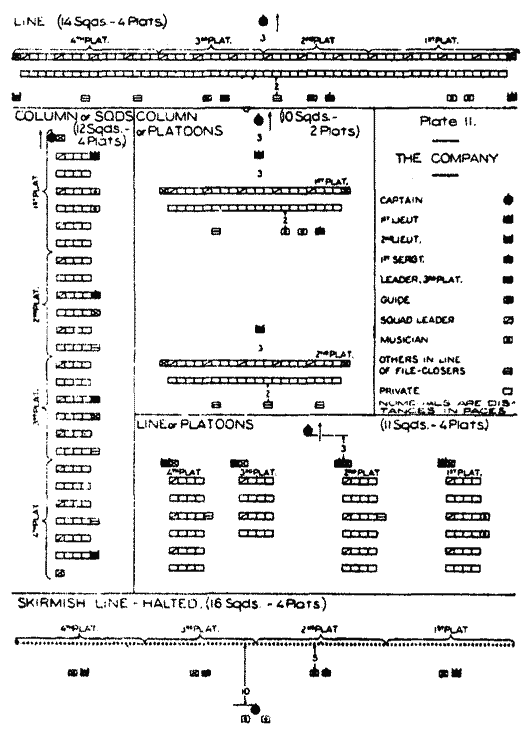
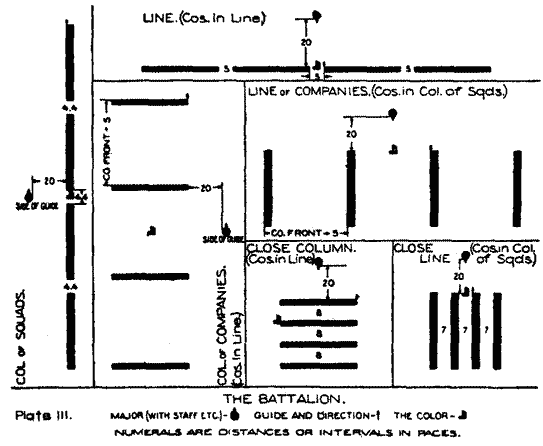
Plate II. THE COMPANY.
[Enlarge]
The noncommissioned officers next in rank are assigned as guides, one
to each platoon. If sergeants still remain, they are assigned to
platoons as additional guides. When the platoon is deployed, its
guide, or guides, accompany the platoon leader.
During battle, these assignments are not changed: vacancies are filled
by noncommissioned officers of the platoon, or by the nearest
available officers or noncommissioned officers arriving with
reenforcing troops.
164. The first sergeant is never assigned as a guide. When not
commanding a platoon, he is posted as a file closer opposite the third
file from the outer flank of the first platoon; and when the company
is deployed he accompanies the captain.
The quartermaster sergeant, when present, is assigned according to his
rank as a sergeant.
Enlisted men below the grade of sergeant, armed with the rifle, are in
ranks unless serving as guides; when not so armed, they are posted in
the line of file closers.
Musicians, when required to play, are at the head of the column. When
the company is deployed, they accompany the captain.
165. The company executes the halt, rests, facings, steps and
marchings, manual of arms, loadings and firings,
takes intervals and distances and assembles, increases and
diminishes intervals, resumes attention, obliques, resumes the
direct march, preserves alignments, kneels, lies down, rises,
stacks and takes arms, as explained in the
Schools of the Soldier
and the Squad, substituting in the commands company for squad.
The same rule applies to platoons, detachments, details, etc.,
substituting their designation for squad in the commands. In the
same manner these execute the movements prescribed for the company,
whenever possible, substituting their designation for company in the
commands.
166. A company so depleted as to make division into platoons
impracticable is led by the captain as a single platoon, but retains
the designation of company. The lieutenants and first sergeant assist
in fire control; the other sergeants place themselves in the firing
line as skirmishers.
167. The guides of the right and left, or leading and rear, platoons,
are the right and left, or leading and rear, guides, respectively, of
the company when it is in line or in column of squads. Other guides
are in the line of file closers.
In platoon movements the post of the platoon guide is at the head of
the platoon, if the platoon is in column, and on the guiding flank if
in line. When a platoon has two guides their original assignment to
flanks of the platoon does not change.
168. The guides of a column of squads place themselves on the flank
opposite the file closers. To change the guides and file closers to
the other flank, the captain commands: 1. File closers on left
(right) flank; 2. MARCH. The file closers dart through the column;
the captain and guides change.
In column of squads, each rank preserves the alignment toward the side
of the guide.
169. Men in the line of file closers do not execute the loadings or
firings.
Guides and enlisted men in the line of file closers execute the manual
of arms during the drill unless specially excused, when they remain at
the order. During ceremonies they execute all movements.
170. In taking intervals and distances, unless otherwise directed,
the right and left guides, at the first command, place themselves in
the line of file closers, and, with them, take a distance of 4 paces
from the rear rank. In taking intervals, at the command march, the
file closers face to the flank and each steps off with the file
nearest him. In assembling the guides and file closers resume their
positions in line.
171. In movements executed simultaneously by platoons (as platoons
right or platoons, column right), platoon leaders repeat the
preparatory command (platoon right, etc.), applicable to their
respective platoons. The command of execution is given by the captain
only.
172. At the sounding of the assembly the first sergeant takes position
6 paces in front of where the center of the company is to be, faces
it, draws saber, and commands: FALL IN.
The right guide of the company places himself, facing to the front,
where the right of the company is to rest, and at such point that the
center of the company will be 6 paces from and opposite the first
sergeant; the squads form in their proper places on the left of the
right guide, superintended by the other sergeants, who then take their
posts.
The first sergeant commands: REPORT. Remaining in position at the
order, the squad leaders, in succession from the right, salute and
report: All present; or, Private(s) —— absent. The first
sergeant does not return the salutes of the squad leaders; he then
commands: 1. Inspection, 2. ARMS, 3. Order, 4. ARMS, faces
about, salutes the captain, reports: Sir, all present or accounted
for, or the names of the unauthorized absentees, and, without
command, takes his post.
If the company can not be formed by squads, the first sergeant
commands: 1. Inspection, 2. ARMS, 3. Right shoulder, 4. ARMS,
and calls the roll. Each man, as his name is called, answers here
and executes order arms. The sergeant then effects the division into
squads and reports the company as prescribed above.
The captain places himself 12 paces in front of the center of, and
facing, the company in time to receive the report of the first
sergeant, whose salute he returns, and then draws saber.
The lieutenants take their posts when the first sergeant has reported
and draw saber with the captain. The company, if not under arms, is
formed in like manner omitting reference to arms.
173. For the instruction of platoon leaders and guides, the company,
when small, may be formed in single rank. In this formation close
order movements only are executed. The single rank executes all
movements as explained for the front rank of a company.
174. Being in line at a halt, the captain directs the first sergeant:
Dismiss the company. The officers fall out; the first sergeant
places himself faced to the front, 3 paces to the front and 2 paces
from the nearest flank of the company, salutes, faces toward opposite
flank of the company, and commands: 1. Inspection, 2. ARMS, 3.
Port, 4. ARMS, 5. DISMISSED. (C.I.D.R., No. 2.)
175. The alignments are executed as prescribed in the
School of the
Squad, the guide being established instead of the flank file. The
rear-rank man of the flank file keeps his head and eyes to the front
and covers his file leader.
At each alignment the captain places himself in prolongation of the
line, 2 paces from and facing the flank toward which the dress is
made, verifies the alignment, and commands: FRONT.
Platoon leaders take a like position when required to verify
alignments.
176. Being in line, to turn the company: 1. Company right (left), 2.
MARCH, 3. Company, 4. HALT; or, 3. Forward, 4. MARCH.
At the second command the right-flank man in the front rank faces to
the right in marching and marks time; the other front-rank men oblique
to the right, place themselves abreast of the pivot, and mark time; in
the rear rank the third man from the right, followed in column by the
second and first, moves straight to the front until in rear of his
front-rank man, when all face to the right in marching and mark time;
the remaining men of the rear rank move straight to the front 4 paces,
oblique to the right, place themselves abreast of the third man, cover
their file leaders, and mark time; the right guide steps back, takes
post on the flank, and marks time.
The fourth command is given when the last man is 1 pace in rear of the
new line.
The command halt may be given at any time after the movement begins;
only those halt who are in the new position. Each of the others halts
upon arriving on the line, aligns himself to the right, and executes
front without command.
177. Being in line, to form column of platoons, or the reverse: 1.
Platoons right (left), 2. MARCH, 3. Company, 4. HALT; or 3.
Forward, 4. MARCH.
Executed by each platoon as described for the company.
Before forming line the captain sees that the guides on the flank
toward which the movement is to be executed are covering. This is
effected by previously announcing the guide to that flank.
178. Being in line, to form column of squads, or the reverse; or,
being in line of platoons, to form column of platoons, or the reverse:
1. Squads right (left), 2. MARCH; or, 1. Squads right (left), 2.
MARCH, 3. Company, 4. HALT.
Executed by each squad as described in the School of the Squad.
If the company or platoons be formed in line toward the side of the
file closers, they dart through the column and take posts in rear of
the company at the second command. If the column of squads be formed
from line, the file closers take posts on the pivot flank, abreast of
and 4 inches from the nearest rank. (C.I.D.R., No. 2.)
179. Being in line, to change direction: 1. Right (Left) turn, 2.
MARCH, 3. Forward, 4. MARCH.
Executed as described in the School of the Squad, except that the men
do not glance toward the marching flank and that all take the full
step at the fourth command. The right guide is the pivot of the front
rank. Each rear-rank man obliques on the same ground as his file
leader.
180. Being in column of platoons, to change direction: 1. Column
right (left), 2. MARCH.
At the first command the leader of the leading platoon commands:
Right turn. At the command march the leading platoon turns to the
right on moving pivot; its leader commands: 1. Forward, 2. MARCH,
on completion of the turn. Rear platoons march squarely up to the
turning point of the leading platoon and turn at command of their
leaders.
181. Being in column of squads, to change direction: 1. Column right
(left), 2. MARCH.
At the second command the front rank of the leading squad turns to the
right on moving pivot as in the School of the Squad; the other ranks,
without command, turn successively on the same ground and in a similar
manner.
182. Being in column of squads, to form line of platoons or the
reverse: 1. Platoons, column right (left), 2. MARCH.
Executed by each platoon as described for the company.
183. Being in line, to form column of squads and change direction: 1.
Squads right (left), column right (left), 2. MARCH; or, 1. Right
(Left) by squads, 2. MARCH.
In the first case the right squad initiates the column right as soon
as it has completed the squad right.
In the second case, at the command march, the right squad marches
forward; the remainder of the company executes squads right,
column left, and follows the right squad. The right guide, when he
has posted himself in front of the right squad, takes four short
steps, then resumes the full step; the right squad conforms.
184. Being in line, to form line of platoons: 1. Squads right (left),
platoons, column right (left), 2. MARCH; or, 1. Platoons, right
(left) by squads, 2. MARCH.
Executed by each platoon as described for the company in the
preceding
paragraph.
185. Being in line, line of platoons, or in column of platoons or
squads, to face or march to the rear: 1. Squads right (left) about,
2. MARCH; or, 1. Squads right (left) about, 2. MARCH, 3.
Company, 4. HALT.
Executed by each squad as described in the School of the Squad.
If the company or platoons be in column of squads, the file closers
turn about toward the column, and take their posts; if in line, each
darts through the nearest interval between squads. (C.I.D.R., No.
2.)
186. To march to the rear for a few paces: 1. About, 2. FACE, 3.
Forward, 4. MARCH.
If in line, the guides place themselves in the rear rank, now the
front rank; the file closers, on facing about, maintain their relative
positions. No other movement is executed until the line is faced to
the original front.
187. Being in column of platoons or squads, to form line on right or
left: 1. On right (left) into line, 2. MARCH, 3. Company, 4.
HALT, 5. FRONT.
At the first command the leader of the leading unit commands: Right
turn. The leaders of the other units command: Forward, if at a
halt. At the second command, the leading unit turns to the right on
moving pivot. The command halt is given when the leading unit has
advanced the desired distance in the new direction; it halts; its
leader then commands: Right dress.
The units in rear continue to march straight to the front; each, when
opposite the right of its place in line, executes right turn at the
command of its leader; each is halted on the line at the command of
its leader, who then commands: Right dress. All dress on the first
unit in line.
If executed in double time, the leading squad marches in double time
until halted.
188. Being in column of platoons or squads, to form line to the front:
1. Right (Left) front into line, 2. MARCH, 3. Company, 4.
HALT, 5. FRONT.
At the first command the leaders of the units in rear of the leading
one command: Right oblique. If at a halt, the leader of the leading
unit commands: Forward. At the second command the leading unit moves
straight forward; the rear units oblique as indicated. The command
halt is given when the leading unit has advanced the desired
distance; it halts; its leader then commands: Left dress. Each of
the rear units, when opposite its place in line, resumes the original
direction at the command of its leader; each is halted on the line at
the command of its leader, who then commands: Left dress. All dress
on the first unit in line.
189. Being in column of squads to form column of platoons, or being in
line of platoons, to form the company in line: 1. Platoons, right
(left) front into line, 2. MARCH, 3. Company, 4. HALT, 5.
FRONT.
Executed by each platoon as described for the company. In forming the
company in line, the dress is on the left squad of the left platoon.
If forming column of platoons, platoon leaders verify the alignment
before taking their posts; the captain commands front when the
alignments have been verified.
When front into line is executed in double time the commands for
halting and aligning are omitted and the guide is toward the side of
the first unit in line.
190. The column of squads is the habitual column of route, but route
step and at ease are applicable to any marching formation.
191. To march at route step: 1. Route step, 2. MARCH. Sabers are
carried at will or in the scabbard; the men carry their pieces at
will, keeping the muzzles elevated; they are not required to preserve
silence, nor to keep the step. The ranks cover and preserve their
distance. If halted from route step, the men stand at rest.
192. To march at ease: 1. At ease, 2. MARCH.
The company marches as in route step, except that silence is
preserved; when halted, the men remain at ease.
193. Marching at route step or at ease: 1. Company, 2. ATTENTION.
At the command attention the pieces are brought to the right
shoulder and the cadenced step in quick time is resumed.
194. Being in column of squads: 1. Right (left) by twos, 2. MARCH.
At the command march all files except the two right files of the
leading squad execute in place halt; the two left files of the
leading squad oblique to the right when disengaged and follow the
right files at the shortest practicable distance. The remaining squads
follow successively in like manner. (C.I.D.R., No. 2.)
195. Being in column of squads or twos: 1. Right (left) by file, 2.
MARCH.
At the command march, all files execute in place halt except the
right file of the leading two or squad. The left file or files of the
leading two or squad oblique successively to the right when disengaged
and each follows the file on its right at the shortest practicable
distance. The remaining twos or squads follow successively in like
manner. (C.I.D.R., No. 2.)
196. Being in column of files or twos, to form column of squads; or,
being in column of files, to form column of twos: 1. Squads (Twos),
right (left) front into line, 2. MARCH.
At the command march, the leading file or files halt. The remainder
of the squad, or two, obliques to the right and halts on line with the
leading file or files. The remaining squads or twos close up and
successively form in rear of the first in like manner.
The movement described in this paragraph will be ordered right or
left, so as to restore the files to their normal relative positions
in the two or squad.
197. The movements prescribed in the three preceding paragraphs are
difficult of execution at attention and have no value as disciplinary
exercises.
198. Marching by twos or files can not be executed without serious
delay and waste of road space. Every reasonable precaution will be
taken to obviate the necessity for these formations.
199. The command guide right (left or center) indicates the base
squad for the deployment; if in line it designates the actual right
(left or center) squad; if in column the command guide right
(left) designates the leading squad, and the command guide center
designates the center squad. After the deployment is completed, the
guide is center without command, unless otherwise ordered.
200. At the preparatory command for forming skirmish line, from either
column of squads or line, each squad leader (except the leader of the
base squad, when his squad does not advance), cautions his squad,
follow me or by the right (left) flank, as the case may be; at the
command march, he steps in front of his squad and leads it to its
place in line.
201. Having given the command for forming skirmish line, the captain,
if necessary, indicates to the corporal of the base squad the point on
which the squad is to march; the corporal habitually looks to the
captain for such directions.
202. The base squad is deployed as soon as it has sufficient interval.
The other squads are deployed as they arrive on the general line; each
corporal halts in his place in line and commands or signals, as
skirmishers; the squad deploys and halts abreast of him.
If tactical considerations demand it, the squad is deployed before
arriving on the line.
203. Deployed lines preserve a general alignment toward the guide.
Within their respective fronts, individuals or units march so as best
to secure cover or to facilitate the advance, but the general and
orderly progress of the whole is paramount.
On halting, a deployed line faces to the front (direction of the
enemy) in all cases and takes advantage of cover, the men lying down
if necessary.
204. The company in skirmish line advances, halts, moves by the
flank, or to the rear, obliques, resumes the direct march,
passes from quick to double time and the reverse by the same
commands and in a similar manner as in close order; if at a halt, the
movement by the flank or to the rear is executed by the same
commands as when marching. Company right (left, half right, half
left) is executed as explained for the front rank, skirmish intervals
being maintained.
205. A platoon or other part of the company is deployed and marched in
the same manner as the company, substituting in the commands,
platoon (detachment, etc.) for company.
206. Being in line, to form skirmish line to the front: 1. As
skirmishers, guide right (left or center), 2. MARCH.
If marching, the corporal of the base squad moves straight to the
front; when that squad has advanced the desired distance, the captain
commands: 1. Company, 2. HALT. If the guide be right (left), the
other corporals move to the left (right) front, and, in succession
from the base, place their squads on the line; if the guide be center,
the other corporals move to the right or left front, according as
they are on the right or left of the center squad, and in succession
from the center squad place their squads on the line.
If at a halt, the base squad is deployed without advancing; the other
squads may be conducted to their proper places by the flank; interior
squads may be moved when squads more distant from the base have gained
comfortable marching distance.
207. Being in column of squads, to form skirmish line to the front: 1.
As skirmishers, guide right (left or center), 2. MARCH.
If marching, the corporal of the base squad deploys it and moves
straight to the front; if at a halt, he deploys his squad without
advancing. If the guide be right (left), the other corporals move to
the left (right) front, and, in succession from the base, place
their squads on the line; if the guide be center, the corporals in
front of the center squad move to the right (if at a halt, to the
right rear), the corporals in rear of the center squad move to the
left front, and each, in succession from the base, places his squad on
the line.
The column of twos or files is deployed by the same commands and in
like manner.
208. The company in line or in column of squads may be deployed in an
oblique direction by the same commands. The captain points out the
desired direction; the corporal of the base squad moves in the
direction indicated; the other corporals conform.
209. To form skirmish line to the flank or rear the line or the column
of squads is turned by squads to the flank or rear and then deployed
as described.
210. The intervals between men are increased or decreased as described
in the School of the Squad, adding to the preparatory command, guide
right (left or center) if necessary.
211. The captain takes his post in front of, or designates, the
element on which the company is to assemble and commands: 1.
Assemble, 2. MARCH.
If in skirmish line the men move promptly toward the designated point
and the company is re-formed in line. If assembled by platoons, these
are conducted to the designated point by platoon leaders, and the
company is re-formed in line.
Platoons may be assembled by the command: 1. Platoons, assemble, 2.
MARCH.
Executed by each platoon as described for the company.
One or more platoons may be assembled by the command: 1. Such
platoon(s), assemble, 2. MARCH.
Executed by the designated platoon or platoons as described for the
company.
212. The advance of a company into an engagement (whether for attack
or defense) is conducted in close order, preferably column of squads,
until the probability of encountering hostile fire makes it advisable
to deploy. After deployment, and before opening fire, the advance of
the company may be continued in skirmish line or other suitable
formation, depending upon circumstances. The advance may often be
facilitated, or better advantage taken of cover, or losses reduced by
the employment of the platoon or squad columns or by the use of a
succession of thin lines. The selection of the method to be used is
made by the captain or major, the choice depending upon conditions
arising during the progress of the advance. If the deployment is found
to be premature, it will generally be best to assemble the company and
proceed in close order.
Patrols are used to provide the necessary security against surprise.
213. Being in skirmish line: 1. Platoon columns, 2. MARCH.
The platoon leaders move forward through the center of their
respective platoons; men to the right of the platoon leader march to
the left and follow him in file; those to the left march in like
manner to the right; each platoon lender thus conducts the march of
his platoon in double column of files; platoon guides follow in rear
of their respective platoons to insure prompt and orderly execution of
the advance.
214. Being in skirmish line: 1. Squad columns, 2. MARCH.
Each squad leader moves to the front; the members of each squad
oblique toward and follow their squad leader in single file at easy
marching distances.
215. Platoon columns are profitably used where the ground is so
difficult or cover so limited as to make it desirable to take
advantage of the few favorable routes; no two platoons should march
within the area of burst of a single shrapnel.[1] Squad columns are
of value principally in facilitating the advance over rough or
brush-grown ground; they afford no material advantage in securing
cover.
216. To deploy platoon or squad columns: 1. As skirmishers, 2.
MARCH.
Skirmishers move to the right or left front and successively place
themselves in their original positions on the line.
217. Being in platoon or squad columns: 1. Assemble, 2. MARCH.
The platoon or squad leaders signal assemble. The men of each
platoon or squad, as the case may be, advance and, moving to the right
and left, take their proper places in line, each unit assembling on
the leading element of the column and re-forming in line. The platoon
or squad leaders conduct their units toward the element or point
indicated by the captain, and to their places in line; the company is
re-formed in line.
218. Being in skirmish line, to advance by a succession of thin lines:
1. (Such numbers), forward, 2. MARCH.
The captain points out in advance the selected position in front of
the line occupied. The designated number of each squad moves to the
front; the line thus formed preserves the original intervals as nearly
as practicable; when this line has advanced a suitable distance
(generally from 100 to 250 yards, depending upon the terrain and the
character of the hostile fire), a second is sent forward by similar
commands, and so on at irregular distances until the whole line has
advanced. Upon arriving at the indicated position, the first line is
halted. Successive lines, upon arriving, halt on line with the first
and the men take their proper places in the skirmish line.
Ordinarily each line is made up of one man per squad and the men of a
squad are sent forward in order from right to left as deployed. The
first line is led by the platoon leader of the right platoon, the
second by the guide of the right platoon, and so on in order from
right to left.
The advance is conducted in quick time unless conditions demand a
faster gait.
The company having arrived at the indicated position, a further
advance by the same means may be advisable.
219. The advance in a succession of thin lines is used to cross a wide
stretch swept, or likely to be swept, by artillery fire or heavy,
long-range rifle fire which can not profitably be returned. Its
purpose is the building up of a strong skirmish line preparatory to
engaging in a fire fight. This method of advancing results in serious
(though temporary) loss of control over the company. Its advantage
lies in the fact that it offers a less definite target, hence is less
likely to draw fire.
220. The above are suggestions. Other and better formations may be
devised to fit particular cases. The best formation is the one which
advances the line farthest with the least loss of men, time, and
control.
221. The principles governing the advance of the firing line in attack
are considered in the School of the Battalion.
When it becomes impracticable for the company to advance as a whole by
ordinary means, it advances by rushes.
222. Being in skirmish line: 1. By platoon (two platoons, squad,
four men, etc.), from the right (left), 2. RUSH.
The platoon leader on the indicated flank carefully arranges the
details for a prompt and vigorous execution of the rush and puts it
into effect as soon as practicable. If necessary, he designates the
leader for the indicated fraction. When about to rush, he causes the
men of the fraction to cease firing and to hold themselves flat, but
in readiness to spring forward instantly. The leader of the rush (at
the signal of the platoon leader, if the latter be not the leader of
the rush) commands: Follow me, and, running at top speed, leads the
fraction to the new line, where he halts it and causes it to open
fire. The leader of the rush selects the new line if it has not been
previously designated.
The first fraction having established itself on the new line, the next
like fraction is sent forward by its platoon leader, without further
command of the captain, and so on, successively, until the entire
company is on the line established by the first rush.
If more than one platoon is to join in one rush, the junior platoon
leader conforms to the action of the senior.
A part of the line having advanced, the captain may increase or
decrease the size of the fractions to complete the movement.
223. When the company forms a part of the firing line, the rush of the
company as a whole is conducted by the captain, as described for a
platoon in the preceding paragraph. The captain leads the rush;
platoon leaders lead their respective platoons; platoon guides follow
the line to insure prompt and orderly execution of the advance.
224. When the foregoing method of rushing, by running, becomes
impracticable, any method of advance that brings the attack closer to
the enemy, such as crawling, should be employed.
For regulations governing the charge, see paragraphs 318 and
319.
225. To enable it to follow or reach the firing line, the support
adopts suitable formations, following the principles explained in
paragraphs 212–218.
The support should be kept assembled as long as practicable. If after
deploying a favorable opportunity arises to hold it for some time in
close formation, it should be reassembled. It is redeployed when
necessary.
226. The movements of the support as a whole and the dispatch of
reenforcements from it to the firing line are controlled by the major.
A reenforcement of less than one platoon has little influence and will
be avoided whenever practicable.
The captain of a company in support is constantly on the alert for the
major's signals or commands.
227. A reenforcement sent to the firing line joins it deployed as
skirmishers. The leader of the reenforcement places it in an interval
in the line, if one exists, and commands it thereafter as a unit. If
no such suitable interval exists, the reenforcement is advanced with
increased intervals between skirmishers; each man occupies the nearest
interval in the firing line, and each then obeys the orders of the
nearest squad leader and platoon leader.
228. A reenforcement joins the firing line as quickly as possible
without exhausting the men.
229. The original platoon division of the companies in the firing line
should be maintained and should not be broken up by the mingling of
reenforcements.
Upon joining the firing line, officers and sergeants accompanying a
reenforcement take over the duties of others of like grade who have
been disabled, or distribute themselves so as best to exercise their
normal functions. Conditions will vary and no rules can be prescribed.
It is essential that all assist in mastering the increasing
difficulties of control.
230. In general, the company, when acting alone, is employed according
to the principles applicable to the battalion acting alone; the
captain employs platoons as the major employs companies, making due
allowance for the difference in strength.
The support may be smaller in proportion or may be dispensed with.
231. The company must be well protected against surprise. Combat
patrols on the flanks are specially important. Each leader of a flank
platoon details a man to watch for the signals of the patrol or
patrols on his flank.
232. Ordinarily pieces are loaded and extra ammunition is issued
before the company deploys for combat.
In close order the company executes the firings at the command of the
captain, who posts himself in rear of the center of the company.
Usually the firings in close order consist of saluting volleys only.
233. When the company is deployed, the men execute the firings at the
command of their platoon leaders; the latter give such commands as are
necessary to carry out the captain's directions, and, from time to
time, add such further commands as are necessary to continue, correct,
and control the fire ordered.
234. The voice is generally inadequate for giving commands during fire
and must be replaced by signals of such character that proper fire
direction and control is assured. To attract attention, signals must
usually be preceded by the whistle signal (short blast). A fraction of
the firing line about to rush should, if practicable, avoid using the
long blast signal as an aid to cease firing. Officers and men behind
the firing line can not ordinarily move freely along the line, but
must depend on mutual watchfulness and the proper use of the
prescribed signals. All should post themselves so as to see their
immediate superiors and subordinates.
235. The musicians assist the captain by observing the enemy, the
target, and the fire effect, by transmitting commands or signals, and
by watching for signals.
236. Firing with blank cartridges at an outlined or represented
enemy at distances less than 100 yards is prohibited.
237. The effect of fire and the influence of the ground in relation
thereto, and the individual and collective instruction in
marksmanship, are treated in the Small-Arms Firing Manual.
238. For convenience of reference ranges are classified as follows:
0 to 600 yards, close range.
600 to 1,200 yards, effective range.
1,200 to 2,000 yards, long range.
2,000 yards and over, distant range.
239. The distance to the target must be determined as accurately as
possible and the sights set accordingly. Aside from training and
morale, this is the most important single factor in securing effective
fire at the longer ranges.
240. Except in a deliberately prepared defensive position, the most
accurate and only practicable method of determining the range will
generally be to take the mean of several estimates.
Five or six officers or men, selected from the most accurate
estimators in the company, are designated as range estimators and
are specially trained in estimating distances.
Whenever necessary and practicable, the captain assembles the range
estimators, points out the target to them, and adopts the mean of
their estimates. The range estimators then take their customary posts.
(C.I.D.R., No. 17.)
241. Volley firing has limited application. In defense it may be
used in the early stages of the action if the enemy presents a large,
compact target. It may be used by troops executing fire of position.
When the ground near the target is such that the strike of bullets can
be seen from the firing line, ranging volleys may be used to correct
the sight setting.
In combat, volley firing is executed habitually by platoon.
242. Fire at will is the class of fire normally employed in attack
or defense.
243. Clip fire has limited application. It is principally used: 1.
In the early stages of combat, to steady the men by habituating them
to brief pauses in firing. 2. To produce a short burst of fire.
244. Ordinarily the major will assign to the company an objective in
attack or sector in defense; the company's target will lie within the
limits so assigned. In the choice of target, tactical considerations
are paramount; the nearest hostile troops within the objective or
sector will thus be the usual target. This will ordinarily be the
hostile firing line; troops in rear are ordinarily proper targets for
artillery, machine guns, or, at times, infantry employing fire of
position.
Change of target should not be made without excellent reasons
therefor, such as the sudden appearance of hostile troops under
conditions which make them more to be feared than the troops
comprising the former target.
245. The distribution of fire over the entire target is of special
importance.
The captain allots a part of the target to each platoon, or each
platoon leader takes as his target that part which corresponds to his
position in the company. Men are so instructed that each fires on
that part of the target which is directly opposite him.
246. All parts of the target are equally important. Care must be
exercised that the men do not slight its less visible parts. A section
of the target not covered by fire represents a number of the enemy
permitted to fire coolly and effectively.
247. If the target can not be seen with the naked eye, platoon leaders
select an object in front of or behind it, designate this as the
aiming target, and direct a sight setting which will carry the cone
of fire into the target.
(C.I.D.R., No. 17.)
248. When the company is large enough to be divided into platoons, it
is impracticable for the captain to command it directly in combat. His
efficiency in managing the firing line is measured by his ability to
enforce his will through the platoon leaders. Having indicated clearly
what he desires them to do, he avoids interfering except to correct
serious errors or omissions.
249. The captain directs the fire of the company or of designated
platoons. He designates the target, and, when practicable, allots a
part of the target to each platoon. Before beginning the fire action
he determines the range, announces the sight setting, and indicates
the class of fire to be employed and the time to open fire.
Thereafter, he observes the fire effect, corrects material errors in
sight setting, prevents exhaustion of the ammunition supply, and
causes the distribution of such extra ammunition as may be received
from the rear.
250. In combat the platoon is the fire unit. From 20 to 35 rifles
are as many as one leader can control effectively.
251. Each platoon leader puts into execution the commands or
directions of the captain, having first taken such precautions to
insure correct sight setting and clear description of the target or
aiming target as the situation permits or requires; thereafter, he
gives such additional commands or directions as are necessary to exact
compliance with the captain's will. He corrects the sight setting when
necessary. He designates an aiming target when the target can not be
seen with the naked eye.
(C.I.D.R., No. 17.)
252. In general, platoon leaders observe the target and the effect
of their fire and are on the alert for the captain's commands or
signals; they observe and regulate the rate of fire. The platoon
guides watch the firing line and check every breach of fire
discipline. Squad leaders transmit commands and signals when
necessary, observe the conduct of their squads and abate excitement,
assist in enforcing fire discipline and participate in the firing.
253. The best troops are those that submit longest to fire control.
Loss of control is an evil which robs success of its greatest results.
To avoid or delay such loss should be the constant aim of all.
Fire control implies the ability to stop firing, change the sight
setting and target, and resume a well directed fire.
254. "Fire discipline implies, besides a habit of obedience, a control
of the rifle by the soldier, the result of training, which will enable
him in action to make hits instead of misses. It embraces taking
advantage of the ground; care in setting the sight and delivery of
fire; constant attention to the orders of the leaders, and careful
observation of the enemy; an increase of fire when the target is
favorable, and a cessation of fire when the enemy disappears; economy
of ammunition." (Small-Arms Firing Manual.)
In combat, shots which graze the enemy's trench or position and thus
reduce the effectiveness of his fire have the approximate value of
hits; such shots only, or actual hits, contribute toward fire
superiority.
Fire discipline implies that, in a firing line without leaders, each
man retains his presence of mind and directs effective fire upon the
proper target.
255. To create a correct appreciation of the requirements of fire
discipline, men are taught that the rate of fire should be as rapid as
is consistent with accurate aiming; that the rate will depend upon the
visibility, proximity, and size of the target; and that the proper
rate will ordinarily suggest itself to each trained man, usually
rendering cautions or commands unnecessary.
In attack the highest rate of fire is employed at the halt preceding
the assault, and in pursuing fire.
256. In an advance by rushes, leaders of troops in firing positions
are responsible for the delivery of heavy fire to cover the advance of
each rushing fraction. Troops are trained to change slightly the
direction of fire so as not to endanger the flanks of advanced
portions of the firing line.
257. In defense, when the target disappears behind cover, platoon
leaders suspend fire, prepare their platoons to fire upon the point
where it is expected to reappear, and greet its reappearance instantly
with vigorous fire.
















![[Enlarge]](images/plate2lg.png)
![[Enlarge]](images/plate3lg.png)
![[Enlarge]](images/plate4lg.png)
![[Enlarge]](images/plate5lg.png)