The chemical industry offers naturally a wide field for the
occurrence of industrial poisoning. Daily contact with the
actual poisonous substances to be prepared, used, stored, and
despatched in large quantity gives opportunity for either
acute or chronic poisoning—in the former case from sudden
accidental entrance into the system of fairly large doses,
as the result of defective or careless manipulation, and, in the
latter, constant gradual absorption (often unsuspected) of
the poison in small amount.
The industry, however, can take credit for the way in
which incidence of industrial poisoning has been kept down
in view of the magnitude and variety of the risks which often
threaten. This is attributable to the comprehensive hygienic
measures enforced in large chemical works keeping abreast of
modern advance in technical knowledge. A section of this
book deals with the principles underlying these measures.
Nevertheless, despite all regulations, risk of poisoning cannot
be wholly banished. Again and again accidents and illness
occur for which industrial poisoning is responsible. Wholly
to prevent this is as impossible as entirely to prevent accidents
by mechanical guarding of machinery.
Owing to the unknown sources of danger, successful
measures to ward it off are often difficult. The rapid advance
of this branch of industry, the constant development of new
processes and reactions, the frequent discovery of new materials
(with properties at first unknown, and for a long time insufficiently
understood, but nevertheless indispensable), constantly
give rise to new dangers and possibilities of danger, of which
an accident or some disease with hitherto unknown symptoms
is the first indication. Further, even when the dangerous
effects are recognised, there may often be difficulty in devising
appropriate precautions, as circumstances may prevent immediate
recognition of the action of the poison. We cannot
always tell, for instance, with the substances used or produced
in the processes, which is responsible for the poisoning, because,
not infrequently, the substances in question are not chemically
pure, but may be either raw products, bye-products, &c.,
producing mixtures of different bodies or liberating different
chemical compounds as impurities.
Hence difficulty often arises in the strict scientific explanation
of particular cases of poisoning, and, in a text-book such
as this, difficulty also of description. A rather full treatment
of the technical processes may make the task easier and help
to give a connected picture of the risks of poisoning in the
chemical industry. Such a procedure may be especially
useful to readers insufficiently acquainted with chemical
technology.
We are indebted to Leymann1 and Grandhomme2 especially
for knowledge of incidence of industrial poisoning in
this industry. The statistical data furnished by them are the
most important proof that poisoning, at any rate in large
factories, is not of very frequent occurrence.
Leymann’s statistics relate to a large modern works in
which the number employed during the twenty-three years of
observation increased from 640 in the year 1891 to 1562 in
1904, giving an average of about 1000 yearly, one-half of whom
might properly be defined as ‘chemical workers.’ The factory
is concerned in the manufacture of sulphuric, nitric, and hydrochloric
acids, alkali, bichromates, aniline, trinitro-phenol,
bleaching powder, organic chlorine compounds, and potassium
permanganate.
These statistics are usefully complemented by those of
Grandhomme drawn from the colour works at Höchst a-M.
This large aniline works employs from 2600 to 2700 workers;
the raw materials are principally benzene and its homologues,
naphthalene and anthracene. The manufacture includes the
production of coal-tar colours, nitro- and dinitro-benzene,
aniline, rosaniline, fuchsine, and other aniline colours, and
finally such pharmaceutical preparations as antipyrin, dermatol,
sanoform, &c. Of the 2700 employed, 1400 are chemical
workers and the remainder labourers.
These two series of statistics based on exact observations
and covering allied chemical manufacture are taken together.
They seek to give the answer to the question—How many and
what industrial poisonings are found?
The figures of Leymann (on an average of 1000 workers
employed per annum) show 285 cases of poisoning reported
between the years 1881 and 1904. Of these 275 were caused
by aniline, toluidine, nitro- and dinitro-benzene, nitrophenol,
nitrochloro and dinitrochloro benzene. Three were fatal and
several involved lengthy invalidity (from 30 to 134 days, owing
to secondary pneumonia). Included further are one severe
case of chrome (bichromate) poisoning (with nephritis as a
sequela), five cases of lead poisoning, three of chlorine, and one
of sulphuretted hydrogen gas. In the Höchst a-M. factory
(employing about 2500 workers) there were, in the ten years
1883-92, only 129 cases of poisoning, of which 109 were
due to aniline. Later figures for the years 1893-5 showed
122 cases, of which 43 were due to aniline and 76 to lead
(contracted mostly in the nitrating house). Grandhomme
mentions further hyperidrosis among persons employed on
solutions of calcium chloride, injury to health from inhalation
of methyl iodide vapour in the antipyrin department, a fatal
case of benzene poisoning (entering an empty vessel in which
materials had previously been extracted with benzene), and
finally ulceration and perforation of the septum of the nose
in several chrome workers.
The number of severe cases is not large, but it must be
remembered that the factories to which the figures relate are
in every respect models of their kind, amply provided with
safety appliances and arrangements for the welfare of the
workers. The relatively small amount of poisoning is to be
attributed without doubt to the precautionary measures taken.
Further, in the statistics referred to only those cases are
included in which the symptoms were definite, or so severe as
to necessitate medical treatment. Absorption of the poison
in small amount without producing characteristic symptoms,
as is often the case with irritating or corrosive fumes, and such
as involve only temporary indisposition, are not included.
Leymann himself refers to this when dealing with illness
observed in the mineral acid department (especially sulphuric
acid), and calls attention to the frequency of affections of the
respiratory organs among the persons employed, attributing
them rightly to the irritating and corrosive effect of the acid
vapour. Elsewhere he refers to the frequency of digestive
disturbance among persons coming into contact with sodium
sulphide, and thinks that this may be due to the action of
sulphuretted hydrogen gas.
Nevertheless, the effect of industrial poisons on the health
of workers in chemical factories ought on no account to be
made light of. The admirable results cited are due to a proper
recognition of the danger, with consequent care to guard
against it. Not only have Grandhomme and Leymann[A]
rendered great services by their work, but the firms in question
also, by allowing such full and careful inquiries to be undertaken
and published.
Manufacture.—Sulphur dioxide, generally obtained by
roasting pyrites in furnaces of various constructions, or, more
rarely, by burning brimstone or sulphur from the spent oxide
of gas-works, serves as the raw material for the manufacture
of sulphuric acid. Before roasting the pyrites is crushed, the
‘lump ore’ then separated from the ‘smalls,’ the former
roasted in ‘lump-burners’ or kilns (generally several roasting
furnace hearths united into one system), and the latter
preferably in Malétra and Malétra-Schaffner shelf-burners
(fig. 1) composed of several superimposed firebrick shelves.
The pyrites is charged on to the uppermost shelf and gradually
worked downwards. Pyrites residues are not suitable for direct
recovery of iron, but copper can be recovered from residues
sufficiently rich in metal by the wet process; the residues
thus freed of copper and sulphur are then smelted for
recovery of iron.
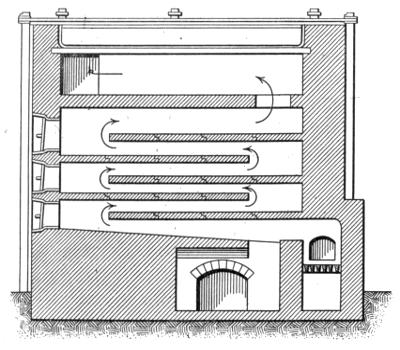
Fig. 1.—Pyrites Burner for Smalls (after Lueger)
Utilisation for sulphuric acid manufacture of the sulphur
dioxide given off in the calcining of zinc blende (see Spelter
works), impracticable in reverberatory furnaces, has been
made possible at the Rhenania factory by introduction of
muffle furnaces (several superimposed), because by this means
the gases led off are sufficiently concentrated, as they are not
diluted with the gases and smoke from the heating fires.
This method, like any other which utilises the gases from
roasting furnaces, has great hygienic, in addition to economical,
advantages, because escape of sulphur dioxide gas is avoided.
Furnace gases, too poor in sulphur dioxide to serve for direct
production of sulphuric acid, can with advantage be made to
produce liquid anhydrous sulphur dioxide. Thus, the sulphur
dioxide gas from the furnaces is first absorbed by water, driven
off again by boiling, cooled, dried, and liquefied by pressure.
The gaseous sulphur dioxide obtained by any of the
methods described is converted into sulphuric acid either by
(a) the chamber process or (b) the contact process.
In the lead chamber process the furnace gases pass through
flues in which the flue dust and a portion of the arsenious acid
are deposited into the Glover tower at a temperature of about
300° C., and from there into the lead chambers where oxidation
of the sulphur dioxide into sulphuric acid takes place, in the
presence of sufficient water, by transference of the oxygen of
the air through the intervention of the oxides of nitrogen.
The gases containing oxides of nitrogen, &c., which are drawn
out of the lead chambers, have the nitrous fumes absorbed in
the Gay-Lussac tower (of which there are one or two in series),
by passage through sulphuric acid which is made to trickle
down the tower. The sulphuric acid so obtained, rich in
oxides of nitrogen, and the chamber acid are led to the Glover
tower for the purpose of denitration and concentration, so
that all the sulphuric acid leaves the Glover as Glover acid of
about 136-144° Tw. Losses in nitrous fumes are best made
up by addition of nitric acid at the Glover or introduction
into the first chamber. The deficiency is also frequently made
good from nitre-pots.
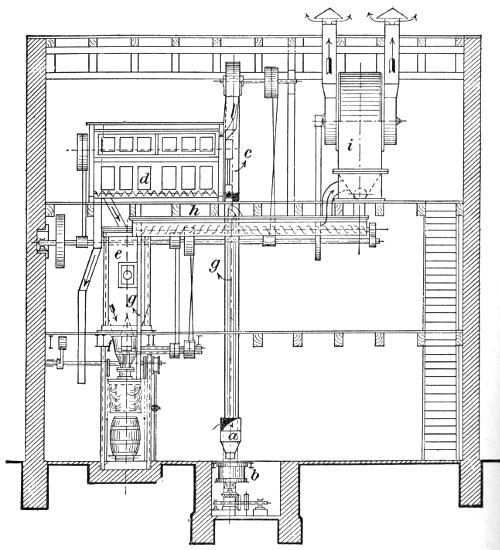
The lead chambers (fig. 2) are usually constructed entirely—sides,
roof, and floor—of lead sheets, which are joined together
by means of a hydrogen blowpipe. The sheets forming the
roof and walls are supported, independent of the bottom, on
a framework of wood. The capacity varies from 35,000 to
80,000 cubic feet. The floor forms a flat collecting surface for
the chamber acid which lutes the chamber from the outer air.
The necessary water is introduced into the chamber as steam
or fine water spray.
The Glover and Gay-Lussac towers are lead towers. The
Glover is lined with acid-proof bricks and filled with acid-proof
packing to increase the amount of contact. The Gay-Lussac
is filled with coke over which the concentrated sulphuric
acid referred to above flows, forming, after absorption
of the nitrous fumes, nitro-sulphuric acid.
Fig. 2a.—Lead Chamber System—Section through X X (after Ost)
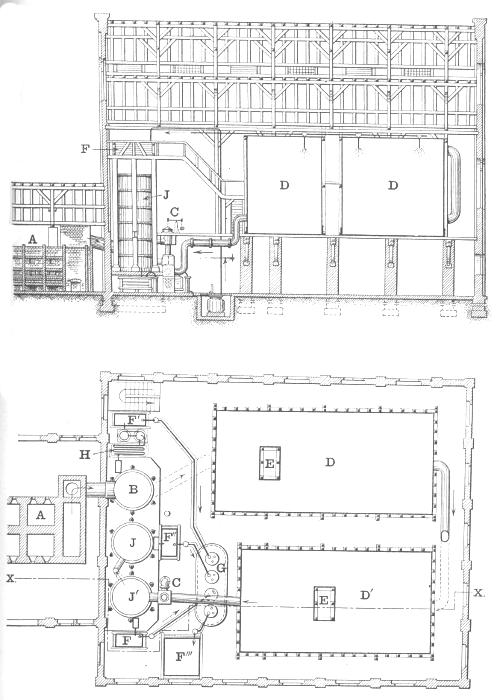
Fig. 2b.—Lead Chamber System—Plan
- A Pyrites Burner
- B Glover Tower
- C Draft Regulator
- D, D´ Lead Chambers
- E Air Shaft
- F, F,´ F,´´ F´´´ Acid Reservoirs
- G Acid Egg
- H Cooler
- J Gay-Lussac Tower
As already stated, two Gay-Lussac towers are usually
connected together, or where there are several lead-chamber
systems there is, apart from the Gay-Lussac attached to each,
a central Gay-Lussac in addition, common to the whole series.
The introduction of several Gay-Lussac towers has the advantage
of preventing loss of the nitrous fumes as much as possible—mainly
on economical grounds, as nitric acid is expensive.
But this arrangement is at the same time advantageous on
hygienic grounds, as escape of poisonous gases containing
nitrous fumes, &c., is effectually avoided. The acids are
driven to the top of the towers by compressed air. The whole
system—chambers and towers—is connected by means of
wide lead conduits. Frequently, for the purpose of quickening
the chamber process (by increasing the number of condensing
surfaces) Lunge-Rohrmann plate towers are inserted in the
system—tall towers lined with lead in which square perforated
plates are hung horizontally, and down which diluted sulphuric
acid trickles.
To increase the draught in the whole system a chimney is
usual at the end, and, in addition, a fan of hard lead or earthenware
may be introduced in front of the first chamber or
between the two Gay-Lussac towers. Maintenance of a
constant uniform draught is not only necessary for technical
reasons, but has hygienic interest, since escape of injurious
gases is avoided (see also Part III).
The chamber acid (of 110°-120° Tw. = 63-70 %) and the
stronger Glover acid (of 136°-144° Tw. = 75-82 %) contain
impurities. In order to obtain for certain purposes pure
strong acid the chamber acid is purified and concentrated.
The impurities are notably arsenious and nitrous acids (Glover
acid is N free), lead, copper, and iron. Concentration (apart
from that to Glover acid in the Glover tower) is effected by
evaporation in lead pans to 140° Tw. and finally in glass balloons
or platinum stills to 168° Tw. (= 97 %). The lead pans are
generally heated by utilising the waste heat from the furnaces
or by steam coils in the acid itself, or even by direct firing.
Production of sulphuric acid by the contact method depends
on the fact that a mixture of sulphur dioxide and excess of
oxygen (air) combines to form sulphur trioxide at a moderate heat
in presence of a contact substance such as platinised asbestos
or oxide of iron. The sulphur dioxide must be carefully
cleaned and dried, and with the excess of air is passed through
the contact substance. If asbestos carrying a small percentage
of finely divided platinum is the contact substance, it is
generally used in the form of pipes; oxide of iron (the residue
of pyrites), if used, is charged into a furnace. Cooling by a
coil of pipes and condensation in washing towers supplied with
concentrated sulphuric acid always forms a part of the process.
A fan draws the gases from the roasting furnaces and drives
them through the system. The end product is a fuming
sulphuric acid containing 20-30 per cent. SO₃. From this by
distillation a concentrated acid and a pure anhydride are
obtained. From a health point of view it is of importance
to know that all sulphuric acid derived from this anhydride
is pure and free from arsenic.
The most important uses of sulphuric acid are the following:
as chamber acid (110°-120° Tw.) in the superphosphate,
ammonium sulphate, and alum industries; as Glover acid
(140°-150° Tw.) in the Leblanc process, i.e. saltcake and
manufacture of hydrochloric acid, and to etch metals; as
sulphuric acid of 168° Tw. in colour and explosives manufacture
(nitric acid, nitro-benzene, nitro-glycerine, gun-cotton,
&c.); as concentrated sulphuric acid and anhydride for the
production of organic sulphonic acids (for the alizarin and
naphthol industry) and in the refining of petroleum and
other oils. Completely de-arsenicated sulphuric acid is used
in making starch, sugar, pharmaceutical preparations, and
in electrical accumulator manufacture.
Effects on Health.—The health of sulphuric acid workers
cannot in general be described as unfavourable.
In comparison with chemical workers they have, it is said,
relatively the lowest morbidity. Although in this industrial
occupation no special factors are at work which injure in
general the health of the workers, there is a characteristic
effect, without doubt due to the occupation—namely, disease
of the respiratory organs. Leymann’s figures are sufficiently
large to show that the number of cases of diseases of the
respiratory organs is decidedly greater in the sulphuric acid
industry than among other chemical workers. He attributes
this to the irritating and corrosive effect of sulphur dioxide
and sulphuric acid vapour on the mucous membrane of the
respiratory tract, as inhalation of these gases can never be
quite avoided, because the draught in the furnace and chamber
system varies, and the working is not always uniform.
Strongly irritating vapours escape again in making a high
percentage acid in platinum vessels, which in consequence
are difficult to keep air-tight. Of greater importance than
these injurious effects from frequent inhalation of small
quantities of acid vapours, or employment in workrooms
in which the air is slightly charged with acid, is the accidental
sudden inhalation of large quantities of acid gases, which
may arise in the manufacture, especially by careless attendance.
Formerly this was common in charging the roasting furnaces
when the draught in the furnace, on addition of the pyrites,
was not strengthened at the same time. This can be easily
avoided by artificial regulation of the draught.
Accidents through inhalation of acid gases occur further
when entering the lead chambers or acid tanks, and in emptying
the towers. Heinzerling relates several cases taken from
factory inspectors’ reports. Thus, in a sulphuric acid factory
the deposit (lead oxysulphate) which had collected on the
floor of a chamber was being removed: to effect this the lead
chambers were opened at the side. Two of the workers, who
had probably been exposed too long to the acid vapours
evolved in stirring up the deposit, died a short time after they
had finished the work. A similar fatality occurred in cleaning
out a nitro-sulphuric acid tank, the required neutralisation
of the acid by lime before entering having been omitted. Of
the two workers who entered, one died the next day; the other
remained unaffected. The deceased had, as the post mortem
showed, already suffered previously from pleurisy. A fatality
from breathing nitrous fumes is described fully in the report
of the Union of Chemical Industry for the year 1905. The
worker was engaged with two others in fixing a fan to a lead
chamber; the workers omitted to wait for the arrival of the
foreman who was to have supervised the operation. Although
the men used moist sponges as respirators, one of them inhaled
nitrous fumes escaping from the chamber in such quantity
that he died the following day.
Similar accidents have occurred in cleaning out the Gay-Lussac
towers. Such poisonings have repeatedly occurred
in Germany. Fatal poisoning is recorded in the report of
the Union of Chemical Industry, in the emptying and cleaning
of a Gay-Lussac tower despite careful precautions. The
tower, filled with coke, had been previously well washed with
water, and during the operation of emptying, air had been
constantly blown through by means of a Körting’s injector.
The affected worker had been in the tower about an hour;
two hours later symptoms of poisoning set in which proved
fatal in an hour despite immediate medical attention. As
such accidents kept on recurring, the Union of Chemical
Industry drew up special precautions to be adopted in the
emptying of these towers, which are printed in Part III.
Naturally, in all these cases it is difficult to say exactly
which of the acid gases arising in the production of sulphuric
acid was responsible for the poisoning. In the fatal cases
cited, probably nitrous fumes played the more important part.
Poisoning has occurred in the transport of sulphuric acid.
In some of the cases, at all events, gaseous impurities, especially
arseniuretted hydrogen, were present.
Thus, in the reports of the German Union of Chemical
Industry for the year 1901, a worker succumbed through
inhalation of poisonous gases in cleaning out a tank waggon
for the transport of sulphuric acid. The tank was cleaned of
the adhering mud, as had been the custom for years, by a
man who climbed into it. No injurious effects had been
noted previously at the work, and no further precautions were
taken than that one worker relieved another at short intervals,
and the work was carried on under supervision. On the
occasion in question, however, there was an unusually large
quantity of deposit, although the quality of the sulphuric
acid was the same, and work had to be continued longer.
The worker who remained longest in the tank became ill on his
way home and died in hospital the following day; the other
workers were only slightly affected. The sulphuric acid used
by the firm in question immediately before the accident came
from a newly built factory in which anhydrous sulphuric
acid had been prepared by a special process. The acid was
Glover acid, and it is possible that selenium and arsenic
compounds were present in the residues. Arseniuretted
hydrogen might have been generated in digging up the mud.
Two similar fatalities are described in the report of the same
Union for the year 1905. They happened similarly in cleaning
out a sulphuric acid tank waggon, and in them the arsenic in
the acid was the cause. Preliminary swilling out with water
diluted the remainder of the sulphuric acid, but, nevertheless,
it acted on the iron of the container. Generation of hydrogen
gas is the condition for the reduction of the arsenious acid
present in sulphuric acid with formation of arseniuretted
hydrogen. In portions of the viscera arsenic was found.
Lately in the annual reports of the Union of Chemical Industry
for 1908 several cases of poisoning are described which were
caused by sulphuric acid. A worker took a sample out of a
vessel of sulphuric acid containing sulphuretted hydrogen gas.
Instead of using the prescribed cock, he opened the man-hole
and put his head inside, inhaling concentrated sulphuretted
hydrogen gas. He became immediately unconscious and
died. Through ignorance no use was made of the oxygen
apparatus.
Another fatality occurred through a foreman directing
some workers, contrary to the regulations against accidents
from nitrous gases, to clean a vessel containing nitric and
sulphuric acids. They wore no air helmets: one died shortly
after from inhalation of nitrous fumes. Under certain circumstances
even the breaking of carboys filled with sulphuric acid
may give rise to severe poisoning through inhalation of acid
gases. Thus a fatality1 occurred to the occupier of a workroom
next some premises in which sulphuric acid carboys had been
accidentally broken. Severe symptoms developed the same
night, and he succumbed the next morning in spite of treatment
with oxygen. A worker in the factory became seriously
ill but recovered.
A similar case is described2 in a factory where concentrated
sulphuric acid had been spilt. The workers covered the spot
with shavings, which resulted in strong development of sulphur
dioxide, leading to unconsciousness in one worker.
The frequent observation of the injurious effect of acid
gases on the teeth of workers requires mention; inflammation
of the eyes of workers also is attributed to the effects of
sulphuric acid.
Leymann’s statistics show corrosions and burns among
sulphuric acid workers to be more than five times that among
other classes. Such burns happen most frequently from
carelessness. Thus, in the reports of the Union of Chemical
Industry for 1901, three severe accidents are mentioned
which occurred from use of compressed air. In two cases the
acid had been introduced before the compressed air had been
turned off; in the third the worker let the compressed air
into the vessel and forgot to turn off the inlet valve. Although
the valves were provided with lead guards, some of the acid
squirted into the worker’s face. In one case complete blindness
followed, in a second blindness in one eye, and in the third
blindness in one eye and impaired vision of the other.
Besides these dangers from the raw material, bye-products,
and products of the manufacture, lead poisoning has been
reported in the erection and repair of lead chambers. The
lead burners generally use a hydrogen flame; the necessary
hydrogen is usually made from zinc and sulphuric acid and
is led to the iron by a tube. If the zinc and sulphuric acid
contain arsenic, the very dangerous arseniuretted hydrogen is
formed, which escapes through leakages in the piping, or is
burnt in the flame to arsenious acid.
Further, the lead burners and plumbers are exposed to the
danger of chronic lead poisoning from insufficient observance
of the personal precautionary measures necessary to guard
against it (see Part III). Those who are constantly engaged
in burning the lead sheets and pipes of the chambers suffer
not infrequently from severe symptoms. Unfortunately, the
work requires skill and experience, and hence alternation of
employment is hardly possible.
Finally, mention should be made of poisoning by arseniuretted
hydrogen gas from vessels filled with sulphuric acid containing
arsenic as an impurity, and by sulphuretted hydrogen
gas in purifying the acid itself. In the manufacture of liquid
sulphur dioxide, injury to health can arise from inhalation of
the acid escaping from the apparatus. The most frequent
cause for such escape of sulphur dioxide is erosion of the walls
of the compressor pumps and of the transport vessels, in
consequence of the gas being insufficiently dried, as, when
moist, it attacks iron.
Sulphur dioxide will come up for further consideration
when describing the industrial processes giving rise to it, or in
which it is used.
Manufacture.—The production of hydrochloric acid
(HCl), sodium sulphate (Na₂SO₄), and sodium sulphide (Na₂S)
forms part of the manufacture of soda (Na₂CO₃) by the Leblanc
process. The products first named increase in importance,
while the Leblanc soda process is being replaced more and more
by the manufacture of soda by the Solvay ammonia process,
so much so that on the Continent the latter method predominates
and only in England does the Leblanc process hold
its ground.
Health interests have exercised an important bearing on
the development of the industries in question. At first, in the
Leblanc process the hydrochloric acid gas was allowed to
escape into the atmosphere, being regarded as a useless bye-product.
Its destructive action on plant life and the inconvenience
caused to the neighbourhood, in spite of erection of
high chimneys, demanded intervention. In England the evils
led to the enactment of the Alkali Acts—the oldest classical
legislative measures bearing on factory hygiene—by which the
Leblanc factories were required to condense the vapour by
means of its absorption in water, and this solution of the acid
is now a highly valued product. And, again, production of
nuisance—inconvenience to the neighbourhood through the
soda waste—was the main cause of ousting one of the oldest
and most generally used methods of chemical industrial production.
Although every effort was made to overcome the
difficulties, the old classical Leblanc process is gradually but
surely yielding place to the modern Solvay process, which
has no drawback on grounds of health.
We outline next the main features of the Leblanc soda
process, which includes, as has been mentioned, also the manufacture
of hydrochloric acid, sodium sulphate and sulphide.
The first part of the process consists in the production of the
sulphate from salt and sulphuric acid, during which hydrochloric
acid is formed; this is carried out in two stages
represented in the following formulæ:
- 1. NaCl + H₂SO₄ = NaHSO₄ + HCl.
- 2. NaCl + NaHSO₄ = Na₂SO₄ + HCl.
The first stage in which bisulphate is produced is carried
out at a moderate heat, the second requires a red heat. The
reactions, therefore, are made in a furnace combining a pan and
muffle furnace.
This saltcake muffle furnace is so arranged that the pan can
be shut off from the muffle by a sliding-door (D). The pan
(A) and muffle (E) have separate flues for carrying off the
hydrochloric acid developed (B, F). First, common salt is
treated with sulphuric (Glover) acid in the cast-iron pan. When
generation of hydrochloric acid vapour has ceased, the sliding-door
is raised and the partly decomposed mixture is pushed
through into the muffle, constructed of fire-resisting bricks and
tiles, and surrounded by the fire gases. While the muffle is
being raised to red heat, the sulphate must be repeatedly
stirred with a rake in order, finally, while still hot and giving off
acid vapour, to be drawn out at the working doors into iron
boxes provided with doors, where the material cools. The acid
vapour given off when cooling is drawn through the top of the
box into the furnace.
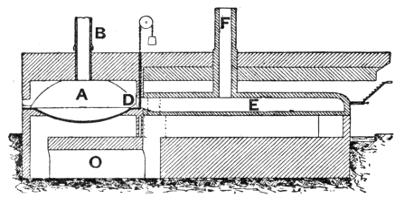
Fig. 3.—Saltcake Muffle Furnace—Section (after Ost)
A Pan; B, F Pipes for hydrochloric acid vapour; D Shutter; E Muffle,
O Coke fire.
Mechanical stirrers, despite their advantage from a health
point of view, have not answered because of their short life.
The valuable bye-product of the sulphate process, hydrochloric
acid, is led away separately from the pan and the
muffle, as is seen, into one absorption system. The reason of
the separation is that the gas from the pan is always the more
concentrated. The arrangement of the absorbing apparatus
is illustrated in fig. 4.
Fig. 4a.—Preparation of Hydrochloric Acid—Plan (after Lueger)
- A, A´ Earthenware pipes
- B, B´ Sandstone cooling towers
- C, C Series of Woulff’s bottles
- D, E Condenser wash towers
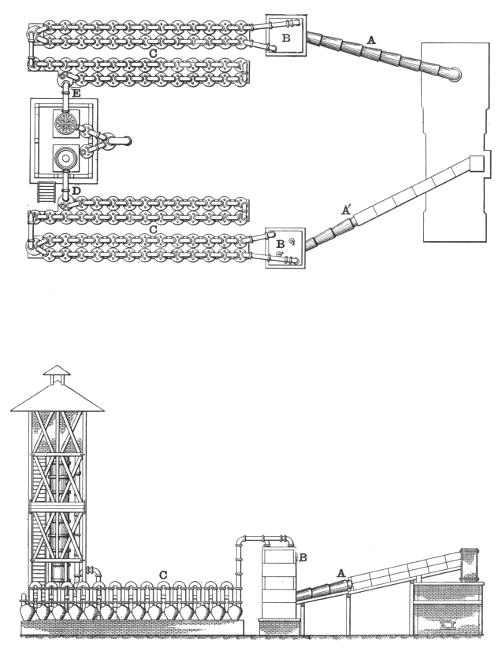
Fig. 4b.—Elevation
The gases are led each through earthenware pipes or
channels of stone pickled with tar (A´), first into small towers
of Yorkshire flags (B), where they are cooled and freed from flue
dust and impurities (sulphuric acid) by washing. They are
next led through a series (over fifty) of Woulff bottles (bombonnes)
one metre high, made of acid-resisting stoneware.
The series is laid with a slight inclination towards the furnace,
and water trickles through so that the gases coming from the
wash towers are brought into contact with water in the one
case already almost saturated, whilst the gas which is poorest
in hydrochloric acid meets with fresh water. From the bombonne
situated next to the wash tower the prepared acid is
passed as a rule through another series. The last traces of
hydrochloric acid are then removed by leading the gases from
the Woulff bottles up two water towers of stoneware (D and E),
which are filled partly with earthenware trays and partly with
coke; above are tanks from which the water trickles down over
the coke. The residual gases from both sets of absorbing
apparatus now unite in a large Woulff bottle before finally
being led away through a duct to the chimney stack.
Less frequently absorption of hydrochloric acid is effected
without use of Woulff bottles, principally in wash towers such
as the Lunge-Rohrmann plate tower.
In the purification of hydrochloric acid, de-arsenicating by
sulphuretted hydrogen or by barium sulphide, &c., and separation
of sulphuric acid by addition of barium chloride, have to be
considered.
Another method for production of sulphate and hydrochloric
acid, namely, the Hargreaves process, is referred to later.
We return now to the further working up of the sodium
sulphate into sulphide and soda. The conversion of the
sulphate into soda by the Leblanc method is effected by
heating with coal and calcium carbonate, whereby, through the
action of the coal, sodium sulphide forms first, which next
with the calcium carbonate becomes converted into sodium
carbonate and calcium sulphide.
The reactions are:
- Na₂SO₄ + 2C = Na₂S + 2CO₂
- Na₂S + CaCO₃ = Na₂CO₃ + CaS
- CaCO₃ + C = CaO + 2CO.
The reactions are carried out in small works in open
reverberatory furnaces having two platforms on the hearth, and
with continuous raking from one to the other which, as the
equations show, cause escape of carbonic
acid gas and carbonic oxide.
Such handworked furnaces, apart
from their drawbacks on health
grounds, have only a small capacity,
and in large works their place is
taken by revolving furnaces—closed,
movable cylindrical furnaces—in which
handwork is replaced by the mechanical
revolution of the furnace and from
which a considerably larger output
and a product throughout good in
quality are obtained.
The raw soda thus obtained in
the black ash furnace is subjected to
lixiviation by water in iron tanks in
which the impurities or tank waste
(see below) are deposited. The crude
soda liquor so obtained is then further
treated and converted into calcined
soda, crystal soda, or caustic soda.
In the production of calcined soda
the crude soda liquor is first purified
(‘oxidised’ and ‘carbonised’) by
blowing through air and carbonic acid
gas, pressed through a filter press, and
crystallised by evaporation in pans
and calcined, i.e. deprived of water by
heat.
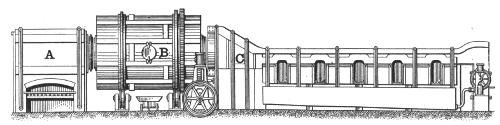
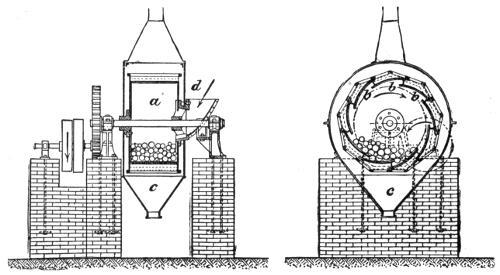
Fig. 5.—Revolving Black Ash Furnace—Elevation (after Lueger)
A Firing hearth; B Furnace; C Dust box.
Crystal soda is obtained from well-purified
tank liquor by crystallising in
cast-iron vessels.
Caustic soda is obtained by introducing lime suspended in
iron cages into the soda liquor in iron caustic pots, heating with
steam, and agitating by blowing in air.
The resulting clear solution is drawn off and evaporated in
cast-iron pans.
As already mentioned, the tank waste in the Leblanc process,
which remains behind—in amount about equal to the soda
produced after lixiviation of the raw soda with water—constitutes
a great nuisance. It forms mountains round the
factories, and as it consists principally of calcium sulphide
and calcium carbonate, it easily weathers under the influence
of air and rain, forming soluble sulphur compounds and
developing sulphuretted hydrogen gas—an intolerable source
of annoyance to the district.
At the same time all the sulphur introduced into the
industry as sulphuric acid is lost in the tank waste. This loss
of valuable material and the nuisance created led to attempts—partially
successful—to recover the sulphur.
The best results are obtained by the Chance-Claus method,
in which the firebrick ‘Claus-kiln’ containing ferric oxide
(previously heated to dull redness) is used. In this process
calcium sulphide is acted on by carbonic acid with evolution of
gas so rich in sulphuretted hydrogen that it can be burnt to
sulphur dioxide and used in the lead chambers for making sulphuric
acid. Sulphur also as such is obtained by the method.
These sulphur-recovery processes which have hardly been
tried on the Continent—only the United Alkali Company in
England employs the Chance-Claus on a large scale—were, as
has been said, not in a position to prevent the downfall of the
Leblanc soda industry. Before describing briefly the Solvay
method a word is needed as to other processes for manufacture
of sulphate and hydrochloric acid.
Hargreaves’ process produces sodium sulphate (without
previous conversion of sulphur dioxide into sulphuric acid)
directly by the passage of gases from the pyrites burners, air
and steam, through salt blocks placed in vertical cast-iron
retorts, a number of which are connected in series. A fan draws
the gases through the system and leads the hydrochloric acid
fumes to the condenser.
Sodium sulphate is used in the manufacture of glass,
ultramarine, &c. Further, the sulphate is converted into
Glauber’s salts by dissolving the anhydrous sulphate obtained
in the muffle furnace, purifying with lime, and allowing the
clear salt solution to crystallise out in pans.
A further use of the sulphate is the preparation of sodium
sulphide, which is effected (as in the first part of the Leblanc
soda process) by melting together sulphate and coal in a
reverberatory furnace. If the acid sulphate (bisulphate) or
sulphate containing bisulphate is used much sulphur dioxide
gas comes off.
The mass is then lixiviated in the usual soda liquor vats
and the lye either treated so as to obtain crystals or evaporated
to strong sodium sulphide which is poured like caustic soda
into metal drums where it solidifies.
In Solvay’s ammonia soda process ammonia recovered from
the waste produced in the industry is led into a solution of
salt until saturation is complete. This is effected generally in
column apparatus such as is used in distillation of spirit. The
solution is then driven automatically by compressed air to
the carbonising apparatus in which the solution is saturated
with carbonic acid; this apparatus is a cylindrical tower
somewhat similar to the series of vessels used for saturating
purposes in sugar factories through which carbonic acid gas
passes. In this process crystalline bi-carbonate of soda is
first formed, which is separated from the ammoniacal mother
liquor by filtration, centrifugalisation, and washing. The
carbonate is then obtained by heating (calcining in pans),
during which carbonic acid gas escapes, and this, together
with the carbonic acid produced in the lime kilns, is utilised
for further carbonisation again. The lime formed during
the production of carbonic acid in the lime kilns serves to drive
the ammonia out of the ammoniacal mother liquor, so that the
ammonia necessary for the process is recovered and used over
and over again. The waste which results from the action of
the lime on the ammonium chloride liquor is harmless—calcium
chloride liquor.
The electrolytic manufacture of soda from salt requires
mention, in which chlorine (at the anode) and caustic soda
(at the cathode) are formed; the latter is treated with carbonic
acid to make soda.
Effects on Health.—Leymann’s observations show that
in the department concerned with the Leblanc soda process
and production of sodium sulphide, relatively more sickness
is noted than, for example, in the manufacture of sulphuric
and nitric acids.
In the preparation of the sulphate, possibility of injury to
health or poisoning arises from the fumes containing hydrochloric
or sulphuric acid in operations at the muffle furnace;
in Hargreaves’ process there may be exposure to the effect
of sulphur dioxide. Hydrochloric and sulphuric acid vapours
can escape from the muffle furnace when charging, from
leakages in it, and especially when withdrawing the still hot
sulphate. Large quantities of acid vapours escape from the
glowing mass, especially if coal is not added freely and if it
is not strongly calcined. Persons employed at the saltcake
furnaces suffer, according to Jurisch, apart from injury to
the lungs, from defective teeth. The teeth of English workers
especially, it is said, from the practice of holding flannel in
their mouths with the idea of protecting themselves from the
effect of the vapours, are almost entirely eroded by the action
of the hydrochloric acid absorbed by the saliva. Hydrochloric
acid vapour, further, can escape from the absorbing apparatus
if this is not kept entirely sealed, and the hydrochloric acid
altogether absorbed—a difficult matter. Nevertheless, definite
acute industrial poisoning from gaseous hydrochloric acid is
rare, no doubt because the workers do not inhale it in concentrated
form.
Injury to the skin from the acid absorbed in water may
occur in filling, unloading, and transport, especially when in
carboys, but the burns, if immediately washed, are very slight
in comparison with those from sulphuric or nitric acids.
Injury to health or inconvenience from sulphuretted hydrogen
is at all events possible in the de-arsenicating process by means
of sulphuretted hydrogen gas. At the saltcake furnace when
worked by hand the fumes containing carbonic oxide gas may
be troublesome. In the production of caustic soda severe
corrosive action on the skin is frequent. Leymann found that
13·8 per cent. of the persons employed in the caustic soda
department were reported as suffering from burns, and calls
attention to the fact that on introducing the lime into the hot
soda lye the contents of the vessel may easily froth over.
Heinzerling refers to the not infrequent occurrence of eye
injuries in the preparation of caustic soda, due to the spurting
of lye or of solid particles of caustic soda.
The tank waste gives rise, as already stated, to inconvenience
from the presence of sulphuretted hydrogen. In the recovery
of the sulphur and treatment of the tank waste, sulphuretted
hydrogen and sulphur dioxide gases are evolved. According
to Leymann, workers employed in removing the waste and
at the lye vats frequently suffer from inflammation of the
eyes. Further, disturbance of digestion has been noted in
persons treating the tank waste, which Leymann attributes
to the unavoidable development of sulphuretted hydrogen
gas.
In the manufacture of sodium sulphide similar conditions
prevail. Leymann found in this branch relatively more
cases of sickness than in any other; diseases of the digestive
tract especially appeared to be more numerous. Leymann
makes the suggestion that occurrence of disease of the digestive
organs is either favoured by sodium sulphide when swallowed
as dust, or that here again sulphuretted hydrogen gas plays a
part. Further corrosive effect on the skin and burns may
easily arise at work with the hot corrosive liquor.
In the Solvay ammonia process ammonia and carbonic acid
gas are present, but, so far as I know, neither injury to health
nor poisoning have been described among persons employed
in the process. Indeed, the view is unanimous that this method
of manufacture with its technical advantages has the merit
also of being quite harmless. As may be seen from the preceding
description of the process there is no chance of the
escape of the gases named into the workrooms.
Ultramarine is made from a mixture of clay, sulphate
(Glauber’s salts), and carbon—sulphate ultramarine; or clay,
sulphur, and soda—soda ultramarine. These materials are
crushed, ground, and burnt in muffle furnaces. On heating
the mass in the furnace much sulphur dioxide escapes, which
is a source of detriment to the workmen and the neighbourhood.
Sulphonal (CH₃)₂C(SO₂C₂H₅)₂, diethylsulphone dimethylmethane,
used medically as a hypnotic, is obtained from
mercaptan formed by distillation of ethyl sulphuric acid with
sodium or potassium sulphide. The mercaptan is converted
into mercaptol, and this by oxidation with potassium permanganate
into sulphonal. The volatile mercaptan has a most
disgusting odour, and clings for a long time even to the clothes
of those merely passing through the room.
Diethyl sulphate ((C₂H₅)₂SO₄).—Diethyl sulphate obtained
by the action of sulphuric acid on alcohol has led to poisoning
characterised by corrosive action on the respiratory tract.1 As
the substance in the presence of water splits up into sulphuric
acid and alcohol, this corrosive action is probably due to the
acid. It is possible, however, that the molecule of diethyl
sulphate as such has corrosive action.
Contact with diethyl sulphate is described as having led to
fatal poisoning.2
A chemist when conducting a laboratory experiment
dropped a glass flask containing about 40 c.c. of diethyl
sulphate, thereby spilling some over his clothes. He went on
working, and noticed burns after some time, quickly followed
by hoarseness and pain in the throat. He died of severe inflammation
of the lungs. A worker in another factory was dropping
diethyl sulphate and stirring it into an at first solid, and later
semi-liquid, mass for the purpose of ethylating a dye stuff. In
doing so he was exposed to fumes, and at the end of the work
complained of hoarseness and smarting of the eyes. He died
of double pneumonia two days later. Post mortem very
severe corrosive action on the respiratory tract was found,
showing that the diethyl sulphuric acid had decomposed
inside the body and that nascent sulphuric acid had given
rise to the severe burns. The principal chemist who had
superintended the process suffered severely from hoarseness
at night, but no serious consequences followed.
It is stated also that workmen in chemical factories coming
into contact with the fumes of diethyl sulphate ester suffer
from eye affections.3
Manufacture.—The older processes depend on the preparation
of chlorine and hydrochloric acid by an oxidation
process in which the oxidising agent is either a compound rich
in oxygen—usually common manganese dioxide (pyrolusite)—or
the oxygen of the air in the presence of heated copper
chloride (as catalytic agent). The former (Weldon process)
is less used now than either the latter (Deacon process) or the
electrolytic manufacture of chlorine.
In the Weldon process from the still liquors containing
manganous chloride the manganese peroxide is regenerated,
and this so regenerated Weldon mud, when mixed with fresh
manganese dioxide, is used to initiate the process. This is
carried out according to the equations:
- MnO₂ + 4HCl = MnCl₄ + 2H₂O
- MnCl₄ = MnCl₂ + Cl₂.
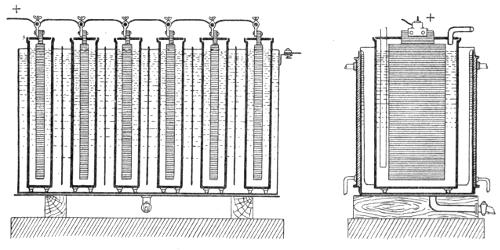
Fig. 6.—Preparation of Chlorine—Diaphragm Method (after Ost)
Hydrochloric acid is first introduced into the chlorine still
(vessels about 3 m. in height, of Yorkshire flag or fireclay),
next the Weldon mud gradually, and finally steam to bring the
whole to boiling; chlorine comes off in a uniform stream.
The manganous chloride still liquor is run into settling tanks.
The regeneration of the manganous chloride liquor takes
place in an oxidiser which consists of a vertical iron cylinder
in which air is blown into the heated mixture of manganous
chloride and milk of lime. The dark precipitate so formed,
‘Weldon mud,’ as described, is used over again, while the
calcium chloride liquor runs away.
The Deacon process depends mainly on leading the stream
of hydrochloric acid gas evolved from a saltcake pot mixed
with air and heated into a tower containing broken bricks of
the size of a nut saturated with copper chloride. Chlorine is
evolved according to the equation:
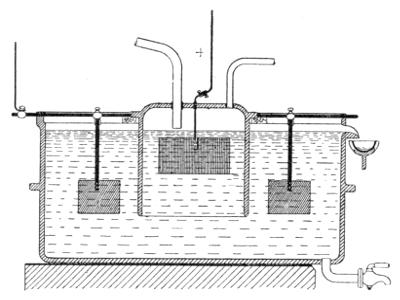
Fig. 7.—Preparation of Chlorine—Bell Method
(after Ost)
The electrolytic production of chlorine with simultaneous
production of caustic alkali is increasing and depends on the
splitting up of alkaline chlorides by a current of electricity. The
chlorine evolved at the anode and the alkaline liquor formed at
the cathode must be kept apart to prevent secondary formation
of hypochlorite and chlorate (see below). This separation is
generally effected in one of three ways: (1) In the diaphragm
process (Griesheim-Elektron
chemical
works) the anode
and cathode are kept
separate by porous
earthenware diaphragms
arranged as
illustrated in fig. 6.
The anode consists
of gas carbon, or is
made by pressing
and firing a mixture
of charcoal and tar;
it lies inside the
diaphragm. The
chlorine developed
in the anodal cell is carried away by a pipe. The metal
vessel serves as the cathode. The alkali, which, since it contains
chloride, is recovered as caustic soda after evaporation
and crystallisation, collects in the cathodal space lying
outside the diaphragm. (2) By the Bell method (chemical
factory at Aussig) the anodal and cathodal fluids, which keep
apart by their different specific weights, are separated by a
stoneware bell; the poles consist of sheet iron and carbon.
The containing vessel is of stoneware. (3) In the mercury
process (England) sodium chloride is electrolysed without
a diaphragm, mercury serving as the cathode. This takes
up the sodium, which is afterwards recovered from the
amalgam formed by means of water.
If chlorate or hypochlorite is to be obtained electrolytically,
electrodes of the very resistant but expensive platinum iridium
are used without a diaphragm. Chlorine is developed—not
free, but combined with the caustic potash. The bleaching
fluid obtained electrolytically in this way is a rival of bleaching
powder.
Bleaching powder is made from chlorine obtained by the
Weldon or Deacon process. Its preparation depends on the
fact that calcium hydrate takes up chlorine in the cold with
formation of calcium hypochlorite after the equation:
- 2Ca(OH)₂ + 4Cl = Ca(ClO)₂ + CaCl₂ + 2H₂O.
The resulting product contains from 35 to 36 per cent.
chlorine, which is given off again when treated with acids.
The preparation of chloride of lime takes place in bleaching
powder chambers made of sheets of lead and Yorkshire flagstones.
The lime is spread out on the floors of these and
chlorine introduced. Before the process is complete the lime
must be turned occasionally.
In the manufacture of bleaching powder from Deacon
chlorine, Hasenclever has constructed a special cylindrical
apparatus (fig. 8), consisting of several superimposed cast-iron
cylinders in which are worm arrangements carrying the lime
along, while chlorine gas passes over in an opposite direction.
This continuous process is, however, only possible for the
Deacon chlorine strongly diluted with nitrogen and oxygen
and not for undiluted Weldon gas.
Liquid chlorine can be obtained by pressure and cooling
from concentrated almost pure Weldon chlorine gas.
Potassium chlorate, which, as has been said, is now mostly
obtained electrolytically, was formerly obtained by passing
Deacon chlorine into milk of lime and decomposing the calcium
chlorate formed by potassium chloride.
Chlorine and chloride of lime are used for bleaching;
chlorine further is used in the manufacture of colours; chloride
of lime as a mordant in cloth printing and in the preparation of
chloroform; the chlorates are oxidising agents and used in
making safety matches. The manufacture of organic chlorine
products will be dealt with later.
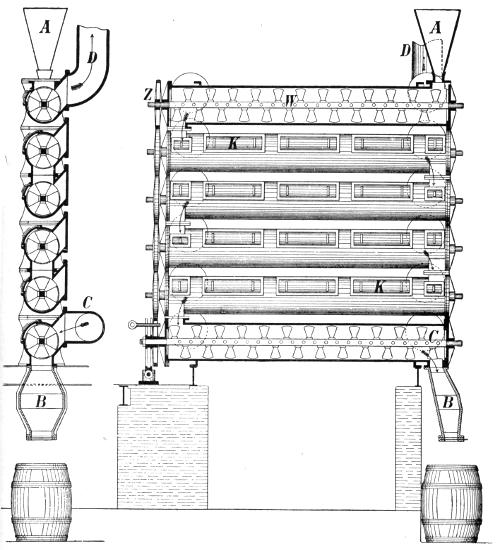
Fig. 8.—Preparation of Bleaching Powder. Apparatus of Hasenclever (after Ost)
A Hopper for slaked lime; W Worm conveying lime; Z Toothed wheels;
K Movable covers; C Entrance for chlorine gas; D Pipe for escape of
chlorine-free gas; B Outlet shoot for bleaching powder
Effects on Health.—In these industries the possibility
of injury to health and poisoning by inhalation of chlorine
gas is prominent. Leymann has shown that persons employed
in the manufacture of chlorine and bleaching powder suffer
from diseases of the respiratory organs 17·8 per cent., as contrasted
with 8·8 per cent. in other workers: and this is without
doubt attributable to the injurious effect of chlorine gas, which
it is hardly possible to avoid despite the fact that Leymann’s
figures refer to a model factory. But the figures show also
that as the industry became perfected the number of cases of
sickness steadily diminished.
Most cases occur from unsatisfactory conditions in the
production of chloride of lime, especially if the chloride of
lime chambers leak, if the lime is turned over while the
chlorine is being let in, by too early entrance into chambers
insufficiently ventilated, and by careless and unsuitable
methods of emptying the finished bleaching powder.
The possibility of injury is naturally greater from the
concentrated gas prepared by the Weldon process than from
the diluted gas of the Deacon process—the more so as in the
latter the bleaching powder is made in the Hasenclever closed-in
cylindrical apparatus in which the chlorine is completely
taken up by the lime. The safest process of all is the electrolytic,
as, if properly arranged, there should be no escape of
chlorine gas. The chlorine developed in the cells (when carried
out on the large scale) is drawn away by fans and conducted in
closed pipes to the place where it is used.
Many researches have been published as to the character
of the skin affection well known under the name of chlorine
rash (chlorakne). Some maintain that it is not due to chlorine
at all, but is an eczema set up by tar. Others maintain that
it is due to a combined action of chlorine and tar. Support to
this view is given by the observation that cases of chlorine rash,
formerly of constant occurrence in a factory for electrolytic
manufacture of chlorine, disappeared entirely on substitution
of magnetite at the anode for carbon.1 The conclusion
seems justified that the constituents of the carbon or of the
surrounding material set up the condition.
Chlorine rash has been observed in an alkali works where
chlorine was not produced electrolytically, and under conditions
which suggested that compounds of tar and chlorine were the
cause. In this factory for the production of salt cake by the
Hargreaves’ process cakes of rock salt were prepared and, for
the purpose of drying, conveyed on an endless metal band
through a stove. To prevent formation of crusts the band
was tarred. The salt blocks are decomposed in the usual
way by sulphur dioxide, steam, and oxygen of the air, and
the hydrochloric acid vapour led through Deacon towers in
which the decomposition of the hydrochloric acid into chlorine
and water is effected by metal salts in the manner characteristic
of the Deacon process. These salts are introduced in small
earthenware trays which periodically have to be removed and
renewed; the persons engaged in doing this were those affected.
The explanation was probably that the tar sticking to the salt
blocks distilled in the saltcake furnaces and formed a compound
with the chlorine which condensed on the earthenware
trays. When contact with these trays was recognised as the
cause, the danger was met by observance of the greatest cleanliness
in opening and emptying the Deacon towers.
Leymann2 is certain that the rash is due to chlorinated
products which emanate from the tar used in the construction
of the cells. And the affection has been found to be much
more prevalent when the contents of the cells are emptied
while the contents are still hot than when they are first
allowed to get cold.
Lehmann3 has approached the subject on the experimental
side, and is of opinion that probably chlorinated tar derivatives
(chlorinated phenols) are the cause of the trouble. Both he and
Roth think that the affection is due not to external irritation
of the skin, but to absorption of the poisonous substances into
the system and their elimination by way of the glands of the
skin.
In the section on manganese poisoning detailed reference
is made to the form of illness recently described in persons
employed in drying the regenerated Weldon mud.
Mercurial poisoning is possible when mercury is used in
the production of chlorine electrolytically.
In the manufacture of chlorates and hypochlorite, bleaching
fluids, &c., injury to health from chlorine is possible in the
same way as has been described above.
Chlorine is used for the production of a number of organic
chlorine compounds, and in the manufacture of bromine and
iodine, processes which give rise to the possibility of injury
to health and poisoning by chlorine; further, several of the
substances so prepared are themselves corrosive or irritating
or otherwise poisonous. Nevertheless, severe poisoning and
injurious effects can be almost entirely avoided by adoption
of suitable precautions. In the factory to which Leymann’s
figures refer, where daily several thousand kilos of chlorine
and organic chlorine compounds are prepared, a relatively
very favourable state of health of the persons employed was
noted. At all events the preparation of chlorine by the electrolytic
process takes place in closed vessels admirably adapted
to avoid any escape of chlorine gas except as the result of
breakage of the apparatus or pipes. When this happens,
however, the pipes conducting the gas can be immediately
disconnected and the chlorine led into other apparatus or
into the bleaching powder factory.
As such complete precautionary arrangements are not
everywhere to be found, we describe briefly the most important
of the industries in question and the poisoning recognised in
them.
Chlorides of phosphorus.—By the action of dry chlorine
on an excess of heated amorphous phosphorus, trichloride is
formed (PCl₃), a liquid having a sharp smell and causing lachrymation,
which fumes in the air, and in presence of water decomposes
into phosphorous acid and hydrochloric acid. On heating
with dry oxidising substances it forms phosphorus oxychloride
(see below), which is used for the production of acid chlorides.
By continuous treatment with chlorine it becomes converted
into phosphorus pentachloride (PCl₅), which also is conveniently
prepared by passing chlorine through a solution of phosphorus
in carbon bisulphide, the solution being kept cold; it is crystalline,
smells strongly, and attacks the eyes and lungs. With
excess of water it decomposes into phosphoric acid and hydrochloric
acid: with slight addition of water it forms phosphorus
oxychloride (POCl₃). On the large scale this is prepared by
reduction of phosphate of lime in the presence of chlorine with
carbon or carbonic oxide. Phosphorus oxychloride, a colourless
liquid, fumes in the air and is decomposed by water into
phosphoric acid and hydrochloric acid.
In the preparation of chlorides of phosphorus, apart
from the danger of chlorine gas and hydrochloric acid, the
poisonous effect of phosphorus and its compounds (see Phosphorus)
and even of carbon disulphide (as the solvent of
phosphorus) and of carbonic oxide (in the preparation of
phosphorus oxychloride) have to be taken into account.
Further, the halogen compounds of phosphorus exert
irritant action on the eyes and lungs similar to chloride of
sulphur as a result of their splitting up on the moist mucous
membranes into hydrochloric acid and an oxyacid of phosphorus.4
Unless, therefore, special measures are taken, the persons
employed in the manufacture of phosphorus chlorides suffer
markedly from the injurious emanations given off.5
Leymann6 mentions one case of poisoning by phosphorus
chloride as having occurred in the factory described by him.
By a defect in the outlet arrangement phosphorus oxychloride
flowed into a workroom. Symptoms of poisoning
(sensation of suffocation, difficulty of breathing, lachrymation,
&c.) at once attacked the occupants; before much gas had
escaped, the workers rushed out. Nevertheless, they suffered
from severe illness of the respiratory organs (bronchial catarrh
and inflammation of the lungs, with frothy, blood-stained
expectoration, &c.).7
Chlorides of sulphur.—Monochloride of sulphur (S₂Cl₂) is
made by passing dried, washed chlorine gas into molten
heated sulphur. The oily, brown, fuming liquid thus made
is distilled over into a cooled condenser and by redistillation
purified from the sulphur carried over with it. Sulphur monochloride
can take up much sulphur, and when saturated is
used in the vulcanisation of indiarubber, and, further, is used
to convert linseed and beetroot oil into a rubber substitute.
Monochloride of sulphur is decomposed by water into sulphur
dioxide, hydrochloric acid, and sulphur. By further action
of chlorine on the monochloride, sulphur dichloride (SCl₂) and
the tetrachloride (SCl₄) are formed.
In its preparation and use (see also Indiarubber Manufacture)
the injurious action of chlorine, of hydrochloric acid,
and of sulphur dioxide comes into play.
The monochloride has very irritating effects. Leymann cites
an industrial case of poisoning by it. In the German factory
inspectors’ reports for 1897 a fatal case is recorded. The
shirt of a worker became saturated with the material owing
to the bursting of a bottle. First aid was rendered by pouring
water over him, thereby increasing the symptoms, which proved
fatal the next day. Thus the decomposition brought about by
water already referred to aggravated the symptoms.
Zinc chloride (ZnCl₂) is formed by heating zinc in presence of
chlorine. It is obtained pure by dissolving pure zinc in hydrochloric
acid and treating this solution with chlorine. Zinc
chloride is obtained on the large scale by dissolving furnace
calamine (zinc oxide) in hydrochloric acid. Zinc chloride is
corrosive. It is used for impregnating wood and in weighting
goods. Besides possible injury to health from chlorine and
hydrogen chloride, risk of arseniuretted hydrogen poisoning
is present in the manufacture if the raw materials contain
arsenic. Eulenburg considers that in soldering oppressive
zinc chloride fumes may come off if the metal to be soldered is
first wiped with hydrochloric acid and then treated with the
soldering iron.
Rock salt.—Mention may be made that even to salt in
combination with other chlorides (calcium chloride, magnesium
chloride, &c.) injurious effects are ascribed. Ulcers
and perforation of the septum of the nose in salt-grinders
and packers who were working in a room charged with salt
dust are described.8 These effects are similar to those produced
by the bichromates.
Carbon oxychloride (COCl₂, carbonyl dichloride, phosgene)
is produced by direct combination of chlorine and carbonic
oxide in presence of animal charcoal. Phosgene is itself a very
poisonous gas which, in addition to the poisonous qualities of
carbonic oxide (which have to be borne in mind in view of
the method of manufacture), acts as an irritant of the mucous
membranes. Commercially it is in solution in toluene and
xylene, from which the gas is readily driven off by heating.
It is used in the production of various colours, such as crystal
violet, Victoria blue, auramine, &c.
A fatal case of phosgene gas poisoning in the report
of the Union of Chemical Industry for 1905 deserves
mention. The phosgene was kept in a liquefied state in iron
bottles provided with a valve under 2·3 atm. pressure. The
valve of one of these bottles leaked, allowing large escape into
the workroom. Two workers tried but failed to secure the
valve. The cylinder was therefore removed by a worker, by
order of the manager, and placed in a cooling mixture, as
phosgene boils at 8° C. The man in question wore a helmet
into which air was pumped from the compressed air supply in
the factory. As the helmet became obscured through moisture
after five minutes the worker took it off. A foreman next put
on the cleaned mask, and kept the cylinder surrounded with
ice and salt for three-quarters of an hour, thus stopping the
escape of gas. Meanwhile, the first worker had again entered
the room, wearing a cloth soaked in dilute alcohol before his
mouth, in order to take a sack of salt to the foreman. An
hour and a half later he complained of being very ill, became
worse during the night, and died the following morning.
Although the deceased may have been extremely susceptible,
the case affords sufficient proof of the dangerous nature of
the gas, which in presence of moisture had decomposed into
carbonic acid and hydrochloric acid; the latter had acutely
attacked the mucous membrane of the respiratory passages
and set up fatal bronchitis. Further, it was found that
the leaden plugs of the valves had been eroded by the
phosgene.
Three further cases of industrial phosgene poisoning have
been reported,9 one a severe case in which there was bronchitis
with blood-stained expectoration, great dyspnœa, and weakness
of the heart’s action. The affected person was successfully
treated with ether and oxygen inhalations. Phosgene may
act either as the whole molecule, or is inhaled to such degree
that the carbonic oxide element plays a part.
In another case of industrial phosgene poisoning the
symptoms were those of severe irritation of the bronchial
mucous membrane and difficulty of breathing.10 The case
recovered, although sensitiveness of the air passages lasted a
long time.
Carbon chlorine compounds (aliphatic series).—Methyl
chloride (CH₃Cl) or chlormethane is prepared from methyl
alcohol and hydrochloric acid (with chloride of zinc) or methyl
alcohol, salt, and sulphuric acid. It is prepared in France on a
large scale from beetroot vinasse by dry distillation of the
evaporation residue. The distillate, which contains methyl
alcohol, trimethylamine, and other methylated amines, is
heated with hydrochloric acid; the methyl chloride so obtained
is purified, dried and compressed. It is used in the preparation
of pure chloroform, in the coal-tar dye industry, and in surgery
(as a local anæsthetic). In the preparation of methyl chloride
there is risk from methyl alcohol, trimethylamine, &c. Methyl
chloride itself is injurious to health.
Methylene chloride (CH₂Cl₂, dichlormethane) is prepared in
a similar way. It is very poisonous.
Carbon tetrachloride (CCl₄, tetrachlormethane) is technically
important. It is prepared by passing chlorine gas into carbon
bisulphide with antimony or aluminium chloride. Carbon
tetrachloride is a liquid suitable for the extraction of fat or
grease (as in chemical cleaning), and has the advantage of being
non-inflammable. Carbon tetrachloride, so far as its poisonous
qualities are concerned, is to be preferred to other extractives
(see Carbon Bisulphide, Benzine, &c.); for the rest it causes
unconsciousness similar to chloroform.
When manufactured industrially, in addition to the poisonous
effect of chlorine, the poisonous carbon bisulphide has also
to be borne in mind.
Ethyl chloride (C₂H₅Cl) is made in a way analogous to
methyl chloride by the action of hydrochloric acid on ethyl
alcohol and chloride of zinc. It is used in medicine as a
narcotic.
Monochloracetic acid.—In the preparation of monochloracetic
acid hydrochloric acid is developed in large quantity.
From it and anthranilic acid artificial indigo is prepared
(according to Heuman) by means of caustic potash.
Chloral (CCl₃CHO, trichloracetaldehyde) is produced by
chlorinating alcohol. Chloral is used in the preparation of
pure chloroform and (by addition of water) of chloral hydrate
(trichloracetaldehyde hydrate), the well-known soporific.
Chloroform (CHCl₃, trichlormethane).—Some methods for
the preparation of chloroform have been already mentioned
(Chloral, Methyl Chloride). Technically it is prepared by
distillation of alcohol or acetone with bleaching powder. The
workers employed are said to be affected by the stupefying
vapours. Further, there is the risk of chlorine gas from use of
chloride of lime.
Chloride of nitrogen (NCl₃) is an oily, volatile, very explosive,
strongly smelling substance, which irritates the eyes and nose
violently and is in every respect dangerous; it is obtained
from the action of chlorine or hypochlorous acid on sal-ammoniac.
The poisonous nature of these substances may
come into play. Risk of formation of chloride of nitrogen
can arise in the production of gunpowder from nitre containing
chlorine.
Cyanogen chloride (CNCl).—Cyanogen chloride is made
from hydrocyanic acid or cyanide of mercury and chlorine.
Cyanogen chloride itself is an extremely poisonous and irritating
gas, and all the substances from which it is made are
also poisonous. According to Albrecht cyanogen chloride
can arise in the preparation of red prussiate of potash (by
passage of chlorine gas into a solution of the yellow prussiate)
if the solution is treated with chlorine in excess; the workers
may thus be exposed to great danger.
Chlorobenzene.—In his paper referred to Leymann cites
three cases of poisoning by chlorobenzene, one by dinitrochlorobenzene,
and, further, three cases of burning by chlorobenzene
and one by benzoyl chloride (C₆H₅COCl). The last
named is made by treating benzaldehyde with chlorine, and
irritates severely the mucous membranes, while decomposing
into hydrochloric acid and benzoic acid.11 Benzal chloride
(C₆H₅CHCl₂), benzo trichloride (C₆H₅CCl₃), and benzyl chloride
(C₆H₅CH₂Cl) are obtained by action of chlorine on boiling
toluene. The vapours of these volatile products irritate the
respiratory passages. In the manufacture there is risk from
the effect of chlorine gas and toluene vapour (see Benzene,
Toluene).
Leymann12 describes in detail six cases of poisoning in
persons employed in a chlorobenzene industry, of which two
were due to nitrochlorobenzene. Symptoms of poisoning—headache,
cyanosis, fainting, &c.—were noted in a person
working for three weeks with chlorobenzene.13
In Lehmann’s opinion chlorine rash, the well-recognised
skin affection of chlorine workers, may be due to contact with
substances of the chlorbenzol group.14
Iodine and iodine compounds.—Formerly iodine was obtained
almost exclusively from the liquor formed by lixiviation
of the ash of seaweed (kelp, &c.); now the principal sources are
the mother liquors from Chili saltpetre and other salt industries.
From the concentrated liquor the iodine is set free by means
of chlorine or oxidising substances and purified by distillation
and sublimation. Iodine is used for the preparation of photographic
and pharmaceutical preparations, especially iodoform
(tri-iodomethane, CHI₃), which is made by acting with iodine
and caustic potash on alcohol, aldehyde, acetone, &c.
Apart from possible injurious action of chlorine when used
in the preparation of iodine, workers are exposed to the possibility
of chronic iodine poisoning. According to Ascher15
irritation effects, nervous symptoms, and gastric ulceration
occur in iodine manufacture and use. He considers that
bromide of iodine used in photography produces these irritating
effects most markedly. Layet and also Chevallier in older
literature have made the same observations.
The Swiss Factory Inspectors’ Report for 1890-1 describes
two acute cases of iodine poisoning in a factory where organic
iodine compounds were made; one terminated fatally (severe
cerebral symptoms, giddiness, diplopia, and collapse).
Bromine and bromine compounds.—Bromine is obtained
(as in the case of iodine) principally from the mother liquors of
salt works (especially Stassfurt saline deposits) by the action
of chlorine or nascent oxygen on the bromides of the alkalis
and alkaline earths in the liquors. They are chiefly used in
photography (silver bromide), in medicine (potassium bromide,
&c.), and in the coal-tar dye industry.
The danger of bromine poisoning (especially of the chronic
form) is present in its manufacture and use, but there is no
positive evidence of the appearance of the bromine rash among
the workers. On the other hand, instances are recorded of
poisoning by methyl bromide, and the injurious effect of
bromide of iodine has been referred to.
Methyl iodide and methyl bromide.—Methyl iodide (CH₃I),
a volatile fluid, is obtained by distillation of wood spirit with
amorphous phosphorus and iodine; it is used in the production
of methylated tar colours and for the production of various
methylene compounds. Grandhomme describes, in the paper
already referred to, six cases, some very severe, of poisoning
by the vapour of methyl iodide among workers engaged in the
preparation of antipyrin, which is obtained by the action of
aceto-acetic ether on phenyl hydrazine, treatment of the pyrazolone
so obtained with methyl iodide, and decomposition of the
product with caustic soda. A case of methyl iodide poisoning
is described in a factory operative, who showed symptoms
similar to those described for methyl bromide except that the
psychical disturbance was more marked.16
Three cases of methyl bromide (CH₃Br) poisoning are
described in persons preparing the compound.17 One of these
terminated fatally. There is some doubt as to whether
these cases were really methyl bromide poisoning. But later
cases of methyl bromide poisoning are known, and hence the
dangerous nature of this chemical compound is undoubted.
Thus the Report of the Union of Chemical Industry for
1904 gives the following instance: Two workers who had to
deal with an ethereal solution of methyl bromide became ill
with symptoms of alcoholic intoxication. One suffered for a
long time from nervous excitability, attacks of giddiness, and
drowsiness. Other cases of poisoning from methyl bromide
vapour are recorded with severe nervous symptoms and even
collapse.
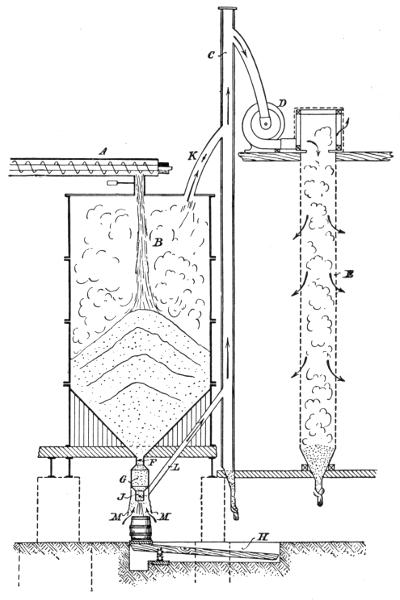
Fluorine compounds.—Hydrogen fluoride (HFl) commercially
is a watery solution, which is prepared by decomposition
of powdered fluorspar by sulphuric acid in cast-iron
vessels with lead hoods. The escaping fumes are collected in
leaden condensers surrounded with water; sometimes to get
a very pure product it is redistilled in platinum vessels.
Hydrogen fluoride is used in the preparation of the fluorides
of antimony, of which antimony fluoride ammonium sulphate
(SbFl₃(NH₄)₂SO₄) has wide use in dyeing as a substitute for
tartar emetic. It is produced by dissolving oxide of antimony
in hydrofluoric acid with addition of ammonium sulphate and
subsequent concentration and crystallisation. Hydrofluoric
acid is used for etching glass (see also Glass Industry).
In brewing, an unpurified silico-fluoric acid mixed with
silicic acid, clay, oxide of iron, and oxide of zinc called Salufer
is used as a disinfectant and preservative.
Hydrofluoric acid and silicofluoric acid (H₂SiFl₆) arise
further in the superphosphate industry by the action of
sulphuric acid on the phosphorites whereby silicofluoric acid
is obtained as a bye-product (see also Manufacture of Artificial
Manure). Hydrofluoric acid and its derivatives both in their
manufacture and use and in the superphosphate industry
affect the health of the workers.
If hydrogen fluoride or its compounds escape into the
atmosphere they attack the respiratory passages and set up
inflammation of the eyes; further, workers handling the
watery solutions are prone to skin affections (ulceration).
The following are examples of the effects produced.18 A
worker in an art establishment upset a bottle of hydrofluoric
acid and wetted the inner side of a finger of the right hand.
Although he immediately washed his hands, a painful inflammation
with formation of blisters similar to a burn of the second
degree came on within a few hours. The blister became
infected and suppurated.
A man and his wife wished to obliterate the printing on the
top of porcelain beer bottle stoppers with hydrofluoric acid.
The man took a cloth, moistened a corner of it, and then rubbed
the writing off. After a short time he noticed a slight burning
sensation and stopped. His wife, who wore an old kid glove
in doing the work, suffered from the same symptoms, the pain
from which in the night became unbearable, and in spite of
medical treatment gangrene of the finger-tips ensued. Healing
took place with suppuration and loss of the finger-nails.
Injury of the respiratory passages by hydrofluoric acid has
often been reported. In one factory for its manufacture the
hydrofluoric acid vapour was so great that all the windows to a
height of 8 metres were etched dull.
Several cases of poisoning by hydrofluoric acid were noted
by me when examining the certificates of the Sick Insurance
Society of Bohemia. In 1906 there were four due to inhalation
of vapour of hydrofluoric acid in a hydrofluoric acid factory,
with symptoms of corrosive action on the mucous membrane of
the respiratory tract. In 1907 there was a severe case in the
etching of glass.19
Manufacture and Uses.—Nitric acid (HNO₃) is obtained
by distillation when Chili saltpetre (sodium nitrate) is decomposed
by sulphuric acid in cast-iron retorts according to the
equation:
- NaNO₃ + H₂SO₄ = NaHSO₄ + HNO₃.
Condensation takes place in fireclay Woulff bottles connected
to a coke tower in the same way as has been described in
the manufacture of hydrochloric acid.
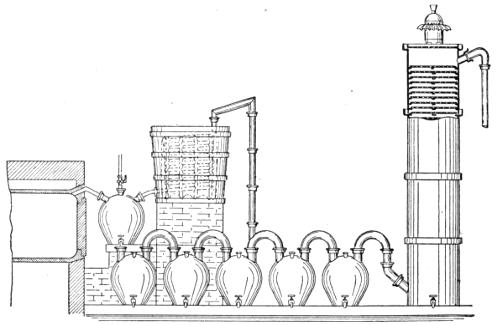
Fig. 9.—Preparation of Nitric Acid (after Ost)
Lunge-Rohrmann plate towers are also used instead of the
coke tower. Earthenware fans—as is the case with acid gases
generally—serve to aspirate the nitrous fumes.
To free the nitric acid of the accompanying lower oxides of
nitrogen (as well as chlorine, compounds of chlorine and other
impurities) air is blown into the hot acid. The mixture of
sodium sulphate and sodium bisulphate remaining in the
retorts is either converted into sulphate by addition of salt or
used in the manufacture of glass.
The nitric acid obtained is used either as such or mixed with
sulphuric acid or with hydrochloric acid.
Pure nitric acid cannot at ordinary atmospheric pressure
be distilled unaltered, becomes coloured on distillation, and
turns red when exposed to light. It is extremely dangerous to
handle, as it sets light to straw, for example, if long in contact
with it. It must be packed, therefore, in kieselguhr earth,
and when in glass carboys forwarded only in trains for transport
of inflammable material.
Red, fuming nitric acid, a crude nitric acid, contains much
nitrous and nitric oxides. It is produced if in the distillation
process less sulphuric acid and a higher temperature are
employed or (by reduction) if starch meal is added.
The successful production of nitric acid from the air must be
referred to. It is effected by electric discharges in special
furnaces from which the air charged with nitrous gas is led into
towers where the nitric oxide is further oxidised (to tetroxide),
and finally, by contact with water, converted into nitric acid.
Nitric acid is used in the manufacture of phosphoric acid,
arsenious acid, and sulphuric acid, nitro-glycerin and nitrocellulose,
smokeless powder, &c. (see the section on Explosives),
in the preparation of nitrobenzenes, picric acid, and other
nitro-compounds (see Tar Products, &c.). The diluted acid
serves for the solution and etching of metals, also for the preparation
of nitrates, such as the nitrates of mercury, silver, &c.
Effects on Health.—Leymann considers that the average
number of cases and duration of sickness among persons employed
in the nitric acid industry are generally on the increase;
the increase relates almost entirely to burns which can hardly
be avoided with so strongly corrosive an acid. The number of
burns amounts almost to 12 per cent. according to Leymann’s
figures (i.e. on an average 12 burns per 100 workers), while
among the packers, day labourers, &c., in the same
industry the proportion is only 1 per cent. Affections
of the respiratory tract are fairly frequent (11·8 per cent.
as compared with 8·8 per cent. of other workers), which is no
doubt to be ascribed to the corrosive action of nitrous fumes
on the mucous membranes. Escape of acid fumes can occur
in the manufacture of nitric acid though leaky retorts, pipes,
&c., and injurious acid fumes may be developed in the workrooms
from the bisulphate when withdrawn from the retorts,
which is especially the case when excess of sulphuric acid
is used. The poisonous nature of these fumes is very
great, as is shown by cases in which severe poisoning has
been reported from merely carrying a vessel containing fuming
nitric acid.1
Frequent accidents occur through the corrosive action of
the acid or from breathing the acid fumes—apart from the
dangers mentioned in the manufacture—in filling, packing,
and despatching the acid—especially if appropriate vessels
are not used and they break. Of such accidents several are
reported.
Further, reports of severe poisoning from the use of nitric
acid are numerous. Inhalation of nitrous fumes (nitrous
and nitric oxides, &c.) does not immediately cause severe
symptoms or death; severe symptoms tend to come on some
hours later, as the examples cited below show.
Occurrence of such poisoning has already been referred to
when describing the sulphuric acid industry. In the superphosphate
industry also poisoning has occurred by accidental
development of nitric oxide fumes on sodium nitrate mixing
with very acid superphosphate.
Not unfrequently poisoning arises in pickling metals
(belt making, pickling brass; cf. the chapter on Treatment
of Metals). Poisoning by nitrous fumes has frequently
been reported from the action of nitric acid on organic substances
whereby the lower oxides of nitrogen—nitrous
and nitric oxides—are given off. Such action of nitric
acid or of a mixture of nitric and sulphuric acid on organic
substances is used for nitrating purposes (see Nitroglycerin;
Explosives; Nitrobenzol).
Through want of care, therefore, poisoning can arise in these
industries. Again, this danger is present on accidental contact
of escaping acid with organic substances (wood, paper, leather,
&c.), as shown especially by fires thus created.2
Thus, in a cellar were five large iron vessels containing a
mixture of sulphuric and nitric acids. One of the vessels was
found one morning to be leaking. The manager directed that
smoke helmets should be fetched, intending to pump out
the acid, and two plumbers went into the cellar to fix
the pump, staying there about twenty-five minutes. They
used cotton waste and handkerchiefs as respirators, but
did not put on the smoke helmets. One plumber suffered
only from cough, but the other died the same evening with
symptoms of great dyspnœa. At the autopsy severe inflammation
and swelling of the mucous membrane of the palate,
pharynx and air passages, and congestion of the lungs were
found.
Two further fatal cases in the nitrating room are described
by Holtzmann. One of the two complained only a few hours
after entering the room of pains in the chest and giddiness.
He died two days later. The other died the day after entering
the factory, where he had only worked for three hours. In
both cases intense swelling and inflammation of the mucous
membrane was found.
Holtzmann mentions cases of poisoning by nitrous fumes in
the heating of an artificial manure consisting of a mixture of
saltpetre, brown coal containing sulphur, and wool waste.
Fatalities have been reported in workers who had tried to
mop up the spilt nitric acid with shavings.3 We quote the
following other instances4 :
(1) Fatal poisoning of a fireman who had rescued several
persons from a room filled with nitrous fumes the result of a
fire occasioned by the upsetting of a carboy. The rescued
suffered from bronchial catarrh, the rescuer dying from inflammation
and congestion of the lungs twenty-nine hours after the
inhalation of the gas.
(2) At a fire in a chemical factory three officers and fifty-seven
firemen became affected from inhalation of nitrous
fumes, of whom one died.
(3) In Elberfeld on an open piece of ground fifty carboys
were stored. One burst and started a fire. As a strong wind
was blowing the firemen were little affected by the volumes
of reddish fumes. Soon afterwards at the same spot some
fifty to sixty carboys were destroyed. Fifteen men successfully
extinguished the fire in a relatively still atmosphere in less
than half an hour. At first hardly any symptoms of discomfort
were felt. Three hours later all were seized with violent
suffocative attacks, which in one case proved fatal and in the
rest entailed nine to ten days’ illness from affection of the
respiratory organs.
The Report of the Union for Chemical Industry for 1908
describes a similar accident in a nitro-cellulose factory.
Of those engaged in extinguishing the fire twenty-two were
affected, and in spite of medical treatment and use of the
oxygen apparatus three died.
From the same source we quote the following examples:
In a denitrating installation (see Nitro-glycerin; Explosives)
a man was engaged in blowing, by means of compressed air,
weak nitric acid from a stoneware vessel sunk in the ground
into a washing tower. As the whole system was already under
high pressure the vessel suddenly exploded, and in doing so
smashed a wooden vat containing similar acid, which spilt on
the ground with sudden development of tetroxide vapours.
The man inhaled much gas, but except for pains in the chest
felt no serious symptoms at the time and continued to work
the following day. Death occurred the next evening from
severe dyspnœa.
A somewhat similar case occurred in the nitrating room of
a dynamite factory in connection with the cleaning of a waste
acid egg; the vessel had for several days been repeatedly
washed out with water made alkaline with unslaked lime.
Two men then in turn got into the egg in order to remove
the lime and lead deposit, compressed air being continuously
blown in through the manhole. The foreman remained
about a quarter of an hour and finished the cleaning
without feeling unwell. Difficulty of breathing came on
in the evening, and death ensued on the following day.
In another case a worker was engaged in washing nitroxylene
when, through a leak, a portion of the contents collected in
a pit below. He then climbed into the pit and scooped the
nitroxylene which had escaped into jars. This work took
about three-quarters of an hour, and afterwards he complained
of difficulty of breathing and died thirty-six hours later.5
A worker again had to control a valve regulating the
flow to two large vessels serving to heat or cool the nitrated
liquid. Both vessels were provided with pressure gauges and
open at the top. Through carelessness one of the vessels ran over,
and instead of leaving the room after closing the valve, the
man tried to get rid of the traces of his error, remaining in the
atmosphere charged with the fumes,6 and was poisoned.
When dissolving in nitric acid the substances necessary for
making the various nitrates, nitric and nitrous oxides escape.
In certain cases nitric and hydrochloric acids are used together
to dissolve metals such as platinum and gold and ferric oxides,
when chlorine as well as nitrous oxide escapes. Mention is
necessary of the following:
Barium nitrate (Ba(NO₃)₂) is prepared as a colourless
crystalline substance by acting on barium carbonate or barium
sulphide with nitric acid. Use is made of it in fireworks
(green fire) and explosives. In analogous way strontium
nitrate (Sr(NO₃)₂) is made and used for red fire.
Ammonium nitrate (NH₄NO₃), a colourless crystalline substance,
is obtained by neutralising nitric acid with ammonia
or ammonium carbonate, and is also made by dissolving
iron or tin in nitric acid. It is used in the manufacture of
explosives.
Lead nitrate (Pb(NO₃)₂), a colourless crystalline substance,
is made by dissolving lead oxide or carbonate in nitric acid.
It is used in dyeing and calico printing, in the preparation
of chrome yellow and other lead compounds, and mixed with
lead peroxide (obtained by treatment of red lead with nitric
acid) in the manufacture of lucifer matches. Apart from risk
from nitrous fumes (common to all these salts) there is risk
also of chronic lead poisoning.
Nitrate of iron (Fe(NO₃)₂), forming green crystals, is made
by dissolving sulphide of iron or iron in cold dilute nitric acid.
The so-called nitrate of iron commonly used in dyeing consists
of basic sulphate of iron (used largely in the black dyeing of
silk).
Copper nitrate (Cu(NO₃)₂), prepared in a similar way, is
also used in dyeing.
Mercurous nitrate (Hg₂(NO₃)₂) is of great importance
industrially, and is produced by the action of cold dilute
nitric acid on an excess of mercury. It is used for ‘carotting’
rabbit skins in felt hat making, for colouring horn, for
etching, and for forming an amalgam with metals, in making
a black bronze on brass (art metal), in painting on porcelain, &c.
Mercuric nitrate (Hg(NO₃)₂) is made by dissolving mercury
in nitric acid or by treating mercury with excess of warm
nitric acid. Both the mercurous and mercuric salts act as
corrosives and are strongly poisonous (see also Mercury and
Hat Manufacture).
Nitrate of silver (AgNO₃) is obtained by dissolving silver
in nitric acid and is used commercially as a caustic in the well-known
crystalline pencils (lunar caustic). Its absorption into
the system leads to accumulation of silver in the skin—the
so-called argyria (see Silver). Such cases of chronic poisoning
are recorded by Lewin.7 Argyria occurs among photographers
and especially in the silvering of glass pearls owing to introduction
of a silver nitrate solution into the string of pearls by
suction. In northern Bohemia, where the glass pearl industry
is carried on in the homes of the workers, I saw a typical case.
The cases are now rare, as air pumps are used instead of the
mouth.
Sodium nitrite (NaNO₂) is obtained by melting Chili saltpetre
with metallic lead in cast-iron vessels. The mass is
lixiviated and the crystals obtained on evaporation. The
lead oxide produced is specially suitable for making red
lead. Cases of lead poisoning are frequent and sometimes
severe. Roth8 mentions a factory where among 100 employed
there were 211 attacks in a year.
Amyl nitrite (C₅H₁₁NO₂) is made by leading nitrous fumes
into iso-amyl alcohol and distilling amyl alcohol with potassium
nitrite and sulphuric acid. It is a yellowish fluid, the fumes
of which when inhaled produce throbbing of the bloodvessels
in the head and rapid pulse.
For other nitric acid compounds see the following
section on Explosives and the section on Manufacture of Tar
Products (Nitro-benzene, &c.).
Numerous explosives are made with aid of nitric acid or a
mixture of nitric and sulphuric acids. Injury to health and
poisoning—especially through development of nitrous fumes—can
be caused. Further, some explosives are themselves
industrial poisons, especially those giving off volatile fumes
or dust.
The most important are:
Fulminate of mercury (HgC₂N₂O₂) is probably to be
regarded as the mercury salt of fulminic acid, an isomer
of cyanic acid. It is used to make caps for detonating
gunpowder and explosives, and is made by dissolving
mercury in nitric acid and adding alcohol. The heavy white
crystals of mercury fulminate are filtered off and dried.
Very injurious fumes are produced in the reaction, containing
ethyl acetate, acetic acid, ethyl nitrate, nitrous acid, volatile
hydrocyanic acid compounds, hydrocyanic acid, ethyl cyanide,
cyanic acid; death consequently can immediately ensue on
inhalation of large quantities. The fulminate is itself poisonous,
and risk is present in filtering, pressing, drying, and granulating
it. Further, in filling the caps in the huts numerous cases of
poisoning occur. Heinzerling thinks here that mercury fumes
are developed by tiny explosions in the pressing and filling.
In a factory in Nuremburg 40 per cent. of the women employed
are said to have suffered from mercurial poisoning. Several
cases in a factory at Marseilles are recorded by Neisser.9
In addition to the risk from the salt there is even more
from nitrous fumes, which are produced in large quantity in the
fulminate department.
Nitro-glycerin (C₃H₅(O—NO₂)₃, dynamite, explosive gelatine).—Nitro-glycerin
is made by action of a mixture of nitric
and sulphuric acids on anhydrous glycerin. The method of
manufacture is as follows (see fig. 10): glycerin is allowed
to flow into the acid mixture in leaden vessels; it is agitated
by compressed air and care taken that the temperature remains
at about 22° C., as above 25° there may be risk. The liquid is
then run off and separates into two layers, the lighter nitro-glycerin
floating on the top of the acid. The process is watched
through glass windows. The nitro-glycerin thus separated is run
off, washed by agitation with compressed air, then neutralised
(with soda solution) and again washed and lastly filtered. The
acid mixture which was run off is carefully separated by standing,
as any explosive oil contained in it will rise up. The waste
acid freed from nitro-glycerin is recovered in special apparatus,
being denitrified by hot air and steam blown through it.
The nitrous fumes are condensed to nitric acid. The sulphuric
acid is evaporated.
Dynamite is made by mixing nitro-glycerin with infusorial
earth previously heated to redness and purified.
Blasting gelatine is made by dissolving gun cotton (collodion
wool, nitro-cellulose) in nitro-glycerin. Both are pressed into
cartridge shape.
Nitro-glycerin itself is a strong poison which can be
absorbed both through the skin
and from the alimentary canal.
Kobert describes a case where
the rubbing of a single drop
into the skin caused symptoms
lasting for ten hours. Workmen
engaged in washing out
nitro-glycerin from the kieselguhr
earth, having in doing so
their bare arms immersed in
the liquid, suffered. Although
it be granted that nitro-glycerin
workers become to a large
extent acclimatised, cases of
poisoning constantly occur in
explosives factories referable to
the effect of nitro-glycerin.
Persons mixing and sieving
dynamite suffer from ulcers
under the nails and at the
finger-tips which are difficult to
heal. Further, where the apparatus
employed is not completely
enclosed nitrous fumes
escape and become a source of
danger. Formerly this danger
was constantly present in the
nitrating house where nitration
was effected in open vessels. Now that this is usually done
in closed nitrating apparatus with glass covers the danger
is mainly limited to the acid separating house, wash house,
and especially the room in which denitration of the waste
acids is effected.
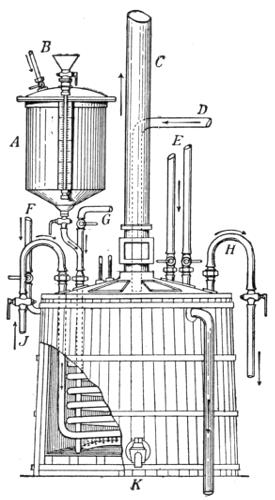
Fig. 10.—Preparation of Nitro-glycerin.
Nitrating Vessel (after Guttmann)
A Glycerine reservoir; C Fume
flue; D Acid supply pipe; E, G Compressed
air supply; H, J Cooling coil.
A fatal case in a nitro-glycerin factory was reported in
1902 where, through carelessness, a separator had overflowed.
The workman who tried to wash away the acid with water
inhaled so much of the nitrous fumes that he succumbed
sixteen hours later.
Other cases of poisoning by nitrous fumes occurring in the
denitrating department are described in detail in the section
on the use of nitric acid.
One of these occurred to a man forcing dilute nitric acid
from an earthenware egg by means of compressed air into a
washing tower. The egg burst and broke an acid tank. The
workman died on the following day.
A fatal case occurred in a dynamite factory in cleaning out a
storage tank for waste acid in spite of previous swilling and
ventilation.
Gun cotton (pyroxyline) and its use.—Pyroxyline is the
collective name for all products of the action of nitric acid on
cellulose (cotton wool and similar material); these products
form nitric acid ester of cellulose (nitro-cellulose).
Gun cotton is formed by the action of strong nitric acid on
cellulose (cotton wool). A mixture of sulphuric and nitric
acids is allowed to act on cotton wool (previously freed from
grease, purified, and dried), with subsequent pressing and
centrifugalising. In the nitrating centrifugal machine (in the
Selvig-Lange method) both processes are effected at the same
time.
The interior of this apparatus is filled with nitric
acid, cotton wool is introduced, the acid fumes exhausted
through earthenware pipes, and the remainder of the acid
removed by the centrifugal machine; the nitrated material is
then washed, teazed in teazing machines, again washed,
neutralised with calcium carbonate, again centrifugalised, and
dried. Since drying in drying stoves is a great source of danger
of explosion, dehydration is effected with alcohol, and the gun
cotton intended for the production of smokeless powder carried
directly to the gelatinising vessels (see Smokeless Powder).
Gun cotton, apart from its use for smokeless powder, is
pressed in prisms and used for charging torpedoes and sea
mines.
Collodion cotton is a partially nitrated cellulose. It is
prepared generally in the same way as gun cotton, except that
it is treated with a more dilute acid. It is soluble (in contradistinction
to gun cotton) in alcohol-ether, and the solution
is known as collodion (as used in surgery, photography, and to
impregnate incandescent gas mantles). Mixed with camphor
and heated collodion forms celluloid.
In Chardonnet’s method for making artificial silk collodion
is used by forcing it through fine glass tubes and drawing
and spinning it. The alcohol-ether vapours are carried away
by fans and the spun material is de-nitrated by ammonium
sulphide.
Smokeless powder is a gun cotton powder—that is gun
cotton the explosive power of which is utilised by bringing it
into a gelatinous condition. This is effected by gelatinising
the gun cotton with alcohol-ether or acetone (sometimes with
addition of camphor, resin, &c.). A doughy, pasty mass results,
which is then rolled, washed, dried, and pressed into rods.
Nobel’s nitroleum (artillery powder) consists half of nitro-glycerin
and half of collodion cotton. In the production of
gun cotton and collodion cotton the workers are affected and
endangered by nitric and nitrous fumes unless the nitrating
apparatus is completely airtight.
Erosion of the incisor teeth is general, but use of the new
nitrating apparatus, especially of the nitrating centrifugal
machines already described, has greatly diminished the
evil. In making collodion, celluloid and artificial silk, in addition
to the risks referred to in the production of gun cotton,
the vapour from the solvents, ether, alcohol, acetone, acetic-ether,
and camphor, comes into consideration, but there is no
account of such poisoning in the literature of the subject.
Other explosives which belong to the aromatic series are
described in the chapter on Tar Derivatives, especially picric
acid.
The total production of phosphorus is not large. Formerly it
was prepared from bone ash. Now it is made from phosphorite,
which, as in the super-phosphate industry, is decomposed
by means of sulphuric acid, soluble phosphate and calcium
sulphate being formed; the latter is removed, the solution
evaporated, mixed with coal or coke powder, distilled in clay
retorts, and received in water.
Phosphorus is also obtained electro-chemically from a
mixture of tricalcium phosphate, carbon, and silicic acid,
re-distilled for further purification, and finally poured under
water into stick form.
Red phosphorus (amorphous phosphorus) is obtained by
heating yellow phosphorus in the absence of air and subsequently
extracting with carbon bisulphide.
Phosphorus matches are made by first fixing the wooden
splints in frames and then dipping the ends either into paraffin
or sulphur which serve to carry the flame to the wood. Then
follows dipping in the phosphorus paste proper, for which
suitable dipping machines are now used. The phosphorus
paste consists of yellow phosphorus, an oxidising agent (red
lead, lead nitrate, nitre, or manganese dioxide) and a binding
substance (dextrine, gum); finally the matches are dried and
packed.
Safety matches are made in the same way, except that
there is no phosphorus. The paste consists of potassium
chlorate, sulphur, or antimony sulphide, potassium bichromate,
solution of gum or dextrine, and different admixtures such as
glass powder, &c. These matches are saturated with paraffin
or ammonium phosphate. To strike them a special friction
surface is required containing red phosphorus, antimony
sulphide, and dextrine. In the act of striking the heat
generated converts a trace of the red phosphorus into the
yellow variety which takes fire.
Danger to health arises from the poisonous gases evolved
in the decomposition of the calcined bones by sulphuric
acid. When phosphorus is made from phosphorite the same
dangers to health are present as in the production of super-phosphate
artificial manure, which is characterised by the
generation of hydrofluoric and fluosilicic acids. In the
distillation of phosphorus phosphoretted hydrogen and phosphorus
fumes may escape and prove dangerous.
Industrial poisoning from the use of white phosphorus in
the manufacture of matches has greater interest than its
occurrence in the production of phosphorus itself. Already
in 1845 chronic phosphorus poisoning (phosphorus necrosis)
had been observed by Lorinser, and carefully described by Bibra
and Geist in 1847. In the early years of its use phosphorus
necrosis must have been fairly frequent in lucifer match
factories, and not infrequently have led to death. This
necessitated preventive measures in various States (see Part III);
cases became fewer, but did not disappear altogether.
Especially dangerous is the preparation of the paste,
dipping, and manipulations connected with drying and filling
the matches into boxes. According to the reports of the
Austrian factory inspectors there are about 4500 lucifer match
workers in that country, among whom seventy-four cases of
necrosis are known to have occurred between the years 1900
and 1908 inclusive.
Teleky1 considers these figures much too small, and from
inquiries undertaken himself ascertained that 156 cases
occurred in Austria between 1896 and 1906, while factory
inspectors’ reports dealt with only seventy-five. He was of
opinion that his own figures were not complete, and thinks
that in the ten years 1896 to 1905 there must have been from
350 to 400 cases of phosphorus necrosis in the whole of Austria.
Despite strict regulations, modern equipment of the factories,
introduction of improved machinery, and limitation of the white
phosphorus match industry to large factories, it has not been
possible to banish the risk, and the same is true of Bohemia,
where there is always a succession of cases. Valuable statistics
of phosphorus necrosis in Hungary are available.2 In 1908
there were sixteen factories employing 1882 workers of whom
30 per cent. were young—children even were employed. The
industry is carried on in primitive fashion without hygienic
arrangements anywhere. It is strange that, notwithstanding
these bad conditions, among a large number of the workers
examined only fourteen active cases were found, in addition
to two commencing, and fifteen cured—altogether thirty-one
cases (excluding fifty-five cases in which there was some
other pathological change in the mouth). Altogether ninety-three
cases since 1900 were traced in Hungary, and in view
of the unsatisfactory situation preventive measures, short
of prohibition of the use of white phosphorus, would be
useless.
In England among 4000 lucifer match workers there were
thirteen cases in the years 1900 to 1907 inclusive. Diminution
in the number was due to improved methods of manufacture
and periodical dental examination prescribed under Special
Rules.
Phosphorus necrosis is not the only sign of industrial
phosphorus poisoning, as the condition of fragilitas ossium is
recognised.3 From what has been said it is evident that
preventive measures against phosphorus poisoning, although
they diminish the number, are not able to get rid of phosphorus
necrosis, and so civilised States have gradually been driven to
prohibit the use of white phosphorus (for the history of this
see Part III).
Use of chrome salts (especially potassium bichromate) in
the preparation of the paste causes risk of poisoning in premises
where ‘Swedish’ matches are made. Attention has been called
to the frequency of chrome ulceration.4 The paste used consists
of 3-6 per cent. chrome salt, so that each match head contains
about ½ mg. Wodtke found among eighty-four workers early
perforation of the septum in thirteen. Severe eczema also
has been noted.
It is even alleged that red phosphorus is not entirely free
from danger. Such cachexia as has been noted may be
referable to the absorption of potassium chlorate.
Other Uses of Phosphorus and Compounds of Phosphorus
Isolated cases of phosphorus poisoning have been observed
in the manufacture of phosphor-bronze. This consists of
90 parts copper, 9 parts tin, and 0·5 to 0·75 phosphorus.
Sulphides of phosphorus (P₂S₅, P₄S₃, P₂S₃) are made by
melting together red phosphorus and sulphur. They make a
satisfactory substitute for the poisonous yellow phosphorus
and are considered non-poisonous, but the fact remains that
they give off annoying sulphuretted hydrogen gas.
Phosphoretted hydrogen gas (PH₃) rarely gives rise to
industrial poisoning. It may come off in small amounts in
the preparation of acetylene and in the preparation of, and
manipulations with, white phosphorus. It is stated that in
acetylene made of American calcium carbide 0·04 per cent. of
phosphoretted hydrogen is present, and in acetylene from
Swedish calcium carbide 0·02 per cent.; Lunge and Cederkreutz
found an acetylene containing 0·06 per cent. These
amounts might cause poisoning if the gas were diffused in
confined spaces. Poisoning, in part attributable to phosphoretted
hydrogen gas, is brought about through ferro-silicon
(see under Ferro-silicon).
Superphosphate and Artificial Manure
Superphosphate, an artificial manure, is prepared from
various raw materials having a high proportion of insoluble
basic calcium phosphate (tricalcium phosphate), which by
treatment with sulphuric acid are converted into the soluble
acid calcium phosphate (monocalcium phosphate) and calcium
sulphate. Mineral substances such as phosphorites, coprolites,
guano, bone ash, &c., serve as the starting-point. Chamber
acid, or sometimes the waste acid from the preparation of
nitro-benzene or purification of petroleum, are used in the
conversion. The raw materials are ground in closed-in apparatus,
under negative pressure, and mixed with the sulphuric
acid in wooden lead-lined boxes or walled receptacles. The
product is then stored until the completion of the reaction
in ‘dens,’ dried, and pulverised in disintegrators.
In the manufacture of bone meal extraction of the
fat from the bones with benzine precedes treatment with
acid.
A further source of artificial manure is basic slag—the slag
left in the manufacture of steel by the Gilchrist-Thomas
method—which contains 10-25 per cent. of readily soluble
phosphoric acid. It requires, therefore, only to be ground into
a very fine powder to serve as a suitable manure.
Owing to the considerable heat generated by the action
of the sulphuric acid when mixed with the pulverised raw
materials (especially in the conversion of the phosphorites)
hydrofluoric and silicofluoric acid vapours are evolved in
appreciable amount, and also carbonic and hydrochloric
acid vapours, sulphur dioxide, and sulphuretted hydrogen gas.
These gases—notably such as contain fluorine—if not effectually
dealt with by air-tight apparatus and exhaust ventilation—may
lead to serious annoyance and injury to the persons
employed. Further, there is risk of erosion of the skin from
contact with the acid, &c.
A case is described of pustular eczema on the scrotum
of a worker engaged in drying sodium silicofluoride, due
probably to conveyance of irritating matter by the hands.
After the precaution of wearing gloves was adopted the
affection disappeared.
A marked case of poisoning by nitrous fumes even is
recorded in the manufacture of artificial manure from mixing
Chili saltpetre with a very acid superphosphate.
Injurious fumes can be given off in the rooms where
bones are stored and, in the absence of efficient ventilation,
carbonic acid gas can accumulate to an amount that may be
dangerous.
The fine dust produced in the grinding of basic slag has,
if inhaled, a markedly corrosive action on the respiratory
mucous membrane attributed by some to the high proportion
(about 50 per cent.) in it of quicklime. As a matter of fact
numerous small ulcers are found on the mucous membranes of
basic slag grinders and ulceration of the lung tissue has been
observed. The opinion is expressed that this is due to corrosive
action of the dust itself, and not merely to the sharp, jagged
edged particles of dust inhaled. And in support of this view is
cited the frequency with which epidemics of pneumonia have
been noted among persons employed in basic slag works.
Thus in Nantes thirteen cases of severe pneumonia followed one
another in quick succession. And similar association has been
noted in Middlesbrough, where the action of the basic slag dust
was believed to injure the lung tissue and therefore to provide
a favourable soil for the development of the pneumonia
bacillus. Statistics collected by the Imperial Health Office
showed that in the three years 1892, 1893, and 1894, 91·1 per
cent., 108·9 per cent., and 91·3 per cent. respectively of the
workers became ill, the proportion of respiratory diseases
being 56·4 per cent., 54·4 per cent., and 54·3 per cent. respectively.
A case of severe inflammation of the lungs is described
in a labourer scattering basic slag in a high wind which drove
some of it back in his face.
Lewin has described a case in which a worker scattering a
mixture of basic slag and ammonium superphosphate suffered
from an eczematous ulceration which, on being scratched by
the patient, became infected and led to death from general
blood poisoning. Lewin regarded the fatal issue as the
sequela of the scattering of the manure.
Inflammation of the conjunctiva and of the eyelids has
been recorded.
Chrome ironstone, lime, and soda are ground and intimately
mixed. They are next roasted in reverberatory furnaces,
neutral sodium chromate being formed. This is lixiviated and
converted into sodium bichromate (Na₂Cr₂O₇) by treatment
with sulphuric acid. Concentration by evaporation follows;
the concentrated liquor is crystallised in cast-iron tanks.
The crystals are centrifugalised, dried, and packed. Potassium
bichromate may be made in the same way, or, as is
usually the case, out of sodium bichromate and potassium
chloride.
The bichromates are used in the preparation and oxidation
of chrome colours, but their principal use is in dyeing and
calico printing, bleaching palm oil, purifying wood spirit and
brandy, in the preparation of ‘Swedish’ matches, in the
manufacture of glass, in photography, in dyeing, in tanning,
and in oxidation of anthracene to anthraquinone.
Lead Chromate and Chrome Colours
Chrome yellow is neutral lead chromate (PbCrO₄). It is
obtained by precipitating a solution of potassium bichromate
with lead acetate or lead nitrate, or by digesting the bichromate
solution with lead sulphate, and is used as a paint and in
calico and cloth printing. With Paris or Berlin blue it forms
a chrome green. Chrome orange, i.e. basic lead chromate
(PbCrO₄Pb(OH)₂) is made by adding milk of lime to lead
chromate and boiling.
Chromium and chromic acid salts are widely used in dyeing
and printing, both as mordants and oxidising agents and
as dyes (chrome yellow, chrome orange). In mordanting
wool with potassium chromate the wool is boiled in a
potassium chromate solution to which acids such as sulphuric,
lactic, oxalic, or acetic are added.
In dyeing with chrome yellow, for instance, the following
is the process. Cotton wool is saturated with nitrate or
acetate of lead and dried, passed through lime water, ammonia,
or sodium sulphate, and soaked in a warm solution of potassium
bichromate. The yellow is converted into the orange colour by
subsequent passage through milk of lime.
Chrome tanning.—This method of producing chrome
leather, first patented in America, is carried out by either the
single or two bath process.
In the two bath process the material is first soaked in a
saturated solution of bichromate and then treated with an acid
solution of thiosulphate (sodium hyposulphite) so as to reduce
completely the chromic acid. The process is completed even
with the hardest skins in from two to three days.
In the single bath method basic chrome salts are used in
highly concentrated form. The skins are passed from dilute
into strong solutions. In this process also tanning is quickly
effected.
Effects on Health.—Among the persons employed in
the bichromate factory of which Leymann has furnished
detailed particulars, the number of sick days was greater
than that among other workers.
Further, erosion of the skin (chrome holes) is characteristic
of the manufacture of bichromates. These are sluggish
ulcers taking a long time to heal. This is the main cause of
the increased general morbidity that has been observed. The
well-known perforation of the septum of the nose without,
however, causing ulterior effects, was observed by Leymann in
all the workers in the factory. This coincides with the opinion
of others who have found the occurrence of chrome holes, and
especially perforation of the septum, as an extraordinarily
frequent occurrence. Many such observations are recorded,1
and also in workers manufacturing ‘Swedish’ matches. Thus
of 237 bichromate workers, ulcers were present in 107 and
perforation in 87. According to Lewin, who has paid special
attention to the poisonous nature of chromium compounds, they
can act in two ways: first, on the skin and mucous membrane,
where the dust alights, on the alimentary tract by swallowing,
and on the pharynx by inhalation. Secondly, by absorption
into the blood, kidney disease may result.
The opinion that chromium, in addition to local, can have
constitutional effect is supported by other authorities. Leymann
describes a case of severe industrial chrome poisoning
accompanied by nephritis in a worker who had inhaled and
swallowed much chromate dust in cleaning out a vessel.
Regulations for the manufacture of bichromates (see Part III)
have no doubt improved the condition, but reports still show
that perforation of the septum generally takes place.
It must be borne in mind that practically all chromium
compounds are not alike poisonous. Chrome ironstone is
non-poisonous, and the potassium and sodium salts are by far
the most poisonous, while the neutral chromate salts and
chromic oxide are only slightly so. Pander found that
bichromates were 100 times as poisonous as the soluble
chromium oxide compounds, and Kunkel is of opinion that
poisonous effect shown by the oxides is attributable to traces
of oxidation into chromic acid.
Lewin, on the other hand, declares in a cautionary notice
for chrome workers generally that all chromium compounds
are poisonous, and therefore all the dyes made from them.2
In the manufacture of bichromates, chance of injury to
health arises partly from the dust, and partly from the steam,
generated in pouring water over the molten mass. The steam
carries particles of chromium compounds with it into the air.
In evaporating the chromate solutions, preparation of the
bichromate, breaking the crystals, drying and packing, the
workers come into contact with the substance and the liquors.
Chrome ulceration is, therefore, most frequently found among
those employed in the crystal room and less among the furnace
hands.
From 3·30 to 6·30 mg. of bichromate dust have been found
in 1 c.m. of air at breathing level in the room where chromate
was crushed, and 1·57 mg. where it was packed. Further,
presence of chromium in the steam escaping from the hot
chrome liquors has been proved.3
Poisoning from use of chrome colours is partly attributable
to lead, as, for example, in making yellow coloured tape
measures, yellow stamps, and from the use of coloured
thread. Gazaneuve4 found 10 per cent. of lead chromate
in such thread, in wool 18 per cent., and in the dust of
rooms where such yarn was worked up 44 per cent.
Use of chrome colours and mordants is accompanied by
illness which certainly is referable to the poisonous nature of
the chrome. In France use of chromic and phosphoric acid in
etching zinc plates has caused severe ulceration.
Bichromate poisoning has been described among photographers
in Edinburgh in the process of carbon printing, in
which a bichromate developer is used.5
There is much evidence as to occurrence of skin eruptions
and development of pustular eczema of the hands and forearms
of workers in chrome tanneries.6 In a large leather factory
where 300 workers were constantly employed in chrome
tanning nineteen cases of chrome ulceration were noted within
a year. Injury to health was noted in a chrome tannery in
the district of Treves, where the two bath process was used,
from steam developed in dissolving the chromate in hot
water.
Finally, I have found several records in 1907 and 1908 of
perforation of the septum in Bohemian glass workers.
The raw material of the manganese industry is hausmannite
(manganese dioxide, MnO₂). This is subjected to a crushing
process, sorted, sieved, finely ground, washed, and dried.
The pure finely ground manganese dioxide is much used in the
chemical industry, especially in the recovery of chlorine in
the Weldon process and in the production of potassium permanganate,
which is obtained by melting manganese dioxide with
caustic soda and potassium chlorate or nitre, lixiviation and
introduction of carbonic acid, or better by treatment with
ozone.
Manganese is also used in the production of colours: the
natural and artificial umbers contain it; in glass works it is used
to decolourise glass, and also in the production of coloured
glass and glazes; in the manufacture of stove tiles, and in
the production of driers for the varnish and oil industry.
Manganese and compounds of manganese are dangerous when
absorbed into the system as dust.
Already in 1837 nervous disorders had been described in
workmen who ground manganese dioxide.1 The malady was
forgotten, until Jaksch2 in Prague in 1901 demonstrated several
such cases in persons employed in a large chemical factory in
Bohemia, from the drying of Weldon mud. In the same
year three similar cases were also described in Hamburg.3 In
1902 Jaksch observed a fresh case of poisoning, and in the
factory in question described a condition of manganophobia
among the workers, obviously hysterical, in which symptoms
of real manganese poisoning were simulated. In all some
twenty cases are known. Jaksch is of opinion that it is
manganese dust rich in manganese protoxide that is alone
dangerous, since, if the mud has been previously treated with
hydrochloric acid, by which the lower oxides are removed, no
illness can be found. The most dangerous compounds are
MnO and Mn₃O₄.
Occurrence and Uses.—Crude petroleum flows spontaneously
from wells in consequence of high internal pressure of
gas or is pumped up. In America and Russia also it is conveyed
hundreds of miles in conduits to the ports to be led
into tank steamers.
The crude oil is a dark-coloured liquid which, in the case
of Pennsylvanian mineral oil, consists mainly of a mixture of
hydrocarbons of the paraffin series, or, in Baku oil, of those of
the naphtha series. There are in addition sulphur compounds,
olefines, pyridin, &c. The crude oil is unsuitable for illuminating
purposes and is subjected to a distillation process. It is
split up into three fractions by a single distillation, namely,
(a) benzines (boiling-point 150° C.), (b) lighting oil (boiling-point
150°-300° C.); at a temperature of 300° C. the distillation is
stopped so that (c) the residuum boiling above 300° C. remains.
Distillation is effected (in America) in large stills, in which
periodically benzine and lighting oil up to 300° C. is distilled and
the residuum run off. In Baku continuously working batteries
of so-called cylindrical boilers are used, into which the crude
oil streams. In the first set of boilers, the temperature in
which rises to 150° C., the benzine is distilled off, and in the
succeeding ones, heated to 300° C., the illuminating petroleum
oils (kerosine), the residuum flowing continually away.
The mineral oil residues are used as fuel. Heating by
this means, tried first only in Russia, is spreading, especially
for the heating of boilers, in which case the liquid fuel is
blown in generally as a spray. The combustion if rightly
planned is economical and almost smokeless.
The American oil residuum, rich in paraffin, is distilled, the
distillate is cooled and separated by pressure into solid paraffin
and liquid oil. The latter and the Russian mineral oil residues
which are free from paraffin are widely used as lubricants.
In the production of lubricants the residues are distilled at
low temperature (in vacuo or by aid of superheated steam) and
separated into various qualities by fractional cooling, are then
purified with sulphuric acid, and finally washed with caustic
soda solution.
In the preparation of vaseline the residum is not distilled,
but purified only with fuming sulphuric acid and decolourised
with animal charcoal.
The illuminating oil is next subjected to a purifying process
(refining); it is first treated with sulphuric acid and well
agitated by means of compressed air. The acid laden with the
impurities is drawn off below, and the oil freed from acid by
washing first with caustic soda and subsequently with water.
It is then bleached in the sun. For specially fine and high
flash point petroleum the oil undergoes a further distillation
and purification with acid.
The fractions of crude petroleum with low boiling-point
(under 150° C.) are known commercially as raw benzine or
petrol naphtha. It is used for cleaning, in extraction of fats
and oils, and for benzine motors.
Frequently raw benzine is subjected to a purifying process
and to fractional distillation. Purification is carried out by
means of sulphuric acid and soda liquor and subsequent
separation into three fractions and a residue which remains in
the retort—(a) petroleum ether (called gasoline, canadol, and
rhigoline), which comes over between 40° and 70° C., and serves
for carburetting water gas and other similar gases, as a solvent
for resin, oil, rubber, &c.; (b) purified benzine (70°-120° C.) is
used as motor spirit and in chemical cleaning; (c) ligroine
(120°-135° C.), used for illuminating purposes; and (d) the
residual oil (above 135° C.) serves for cleaning machinery and,
especially, as a solvent for lubricating oil, and instead of
turpentine in the production of lacquers, varnishes, and oil
colours.
In chemical cleaning works benzine is used in closed-in
washing apparatus, after which the clothes are centrifugalised
and dried. In view of the risk of fire in these manipulations,
originating mainly from frictional electricity, various substances
are recommended to be added to the benzine, of which
the best known is that recommended by Richter, consisting of
a watery solution of oleate of sodium or magnesium.
Effects on Health.—Industrial poisoning in the petroleum
industry is attributable to the gases given off from
crude petroleum or its products and to inhalation of naphtha
dust. Poisoning occurs principally in the recovery of petroleum
and naphtha from the wells, in storage and transport (in
badly ventilated tanks on board ship, and in entering petroleum
tanks), in the refinery in cleaning out petroleum stills
and mixing vessels, and in emptying out the residues. Further
cases occur occasionally from use of benzine in chemical
cleaning.
In addition to poisoning the injurious effect of petroleum
and its constituents on the skin must be borne in mind.
Opinion is unanimous that this injurious action of mineral oil
is limited to the petroleum fractions with high boiling-point
and especially petroleum residues.
Statistics officially collected in Prussia show the general
health of petroleum workers to be favourable. These statistics
related to 1380 persons, of whom forty-three were suffering
from symptoms attributable to their occupation. Of these
forty-three, nine only were cases of poisoning, the remainder
being all cases of petroleum acne.
The conditions also in French refineries from statistics
collected in the years 1890-1903 seem satisfactory. Eighteen
cases of petroleum acne were reported, eleven of which occurred
at the paraffin presses, five in cleaning out the still residues,
and two were persons filling vessels.
The conditions are clearly less favourable in the Russian
petroleum industry.1
The workers at the naphtha wells suffer from acute and
chronic affections of the respiratory organs. Those suffer
most who cover the wells with cast iron plates to enable the
flow of naphtha to be regulated and led into the reservoirs.
In doing this they inhale naphtha spray.
Lewin2 describes cases of severe poisoning with fatal issue
among American workers employed in petroleum tanks. One
man who wished to examine an outlet pipe showed symptoms
after only two minutes. Weinberger describes severe poisoning
of two workers engaged in cleaning out a vessel containing
petroleum residue.
Interesting particulars are given of the effect of petroleum
emanations on the health of the men employed in the petroleum
mines of Carpathia, among whom respiratory affections were
rarely found, but poisoning symptoms involving unconsciousness
and cerebral symptoms frequently. These experiences
undoubtedly point to differing physiological effects of different
kinds of naphtha.
This is supported by the view expressed by Sharp in
America that different kinds of American petroleum have
different effects on the health of the workers, which can be
easily credited from the different chemical composition of crude
naphthas. Thus in Western Virginia, where a natural heavy
oil is obtained, asphyxia from the gas is unknown, although
transient attacks of headache and giddiness may occur, whereas in
Ohio, where light oils are obtained, suffocative attacks are not
infrequent. And it is definitely stated that some naphtha
products irritate the respiratory passages, while others affect
the central nervous system.3
The authors mentioned refer to occurrence of cases of
poisoning in the refining of naphtha from inhalation of the
vapour of the light oils benzine and gasoline. Fatal cases have
been recorded in badly ventilated workrooms in which the
products of distillation are collected. Workers constantly
employed in these rooms develop chronic poisoning, which
is reported also in the case of women employed with
benzine. Intoxication is frequently observed, it is stated,
among the workmen employed in cleaning out the railway
tank waggons in which the mineral oils and petroleum are
carried.
Foulerton4 describes severe poisoning in a workman who
had climbed into a petroleum reservoir, and two similar cases
from entering naphtha tanks are given in the Report of the
Chief Inspector of Factories for 1908. Two fatal cases are
reported by the Union of Chemical Industry in Germany in
1905 in connection with naphtha stills. Such accidents are
hardly possible, except when, through insufficient disconnection
of the still from the further system of pipes, irrespirable
distillation gases pass backwards into the opened still where
persons are working. Ordinary cocks and valves, therefore, do
not afford sufficient security. Thus, several workers engaged
in repairing a still were rendered unconscious by gases drawn
in from a neighbouring still, and were only brought round after
oxygen inhalation.
Gowers describes a case of chronic poisoning following on
frequent inhalation of gases given off from a petroleum motor,
the symptoms being slurring speech, difficulty of swallowing, and
weakness of the orbicularis and facial muscles. Gowers believed
this to be petroleum gas poisoning (from incomplete combustion),
especially as the symptoms disappeared on giving up
the work, only to return on resuming it again.5
Girls employed in glove cleaning and rubber factories are
described as having been poisoned by benzine.6 Poisoning
of chauffeurs is described by several writers.7
Recent literature8 tends to show marked increase in the
number of cases of poisoning from greater demand for benzine
as a motive power for vehicles. Such cases have been
observed in automobile factories, and are attributable to the
hydrocarbons of low boiling-point which are present as
impurities in benzine.
A worker in a paraffin factory had entered an open benzine
still to scrape the walls free of crusts containing benzine. He
was found unconscious and died some hours later. It appeared
that he had been in the still several hours, having probably been
overcome to such an extent by the fumes as to be unable
to effect his escape.
Attempt to wipe up benzine spilt in the storage cellar of a
large chemical cleaning works resulted in poisoning.
A night worker in a bone extracting works having turned
on the steam, instead of watching the process fell asleep on a
bench. In consequence the apparatus became so hot that the
solder of a stop valve melted, allowing fumes to escape. The
man was found dead in the morning. In a carpet cleaning
establishment three workers lost consciousness and were found
senseless on the floor. They recovered on inhalation of oxygen.
One further case reported from the instances of benzine
poisoning collected recently9 is worth quoting. A worker in a
chemical factory was put to clean a still capable of distilling
2500 litres of benzine. It contained remains of a previous
filling. As soon as he had entered the narrow opening he
became affected and fell into the benzine; he was carried
unconscious to the hospital, his symptoms being vomiting,
spastic contraction of the extremities, cyanosis, weak pulse,
and loss of reflexes, which disappeared an hour and a half later.
The occurrence of skin affections in the naphtha industry
has been noted by several observers, especially among those
employed on the unpurified mineral oils. Eruptions on the
skin from pressing out the paraffin and papillomata (warty
growths) in workers cleaning out the stills are referred to by
many writers,10 Ogston in particular.
Recent literature refers to the occurrence of petroleum
eczema in a firebrick and cement factory. The workers
affected had to remove the bricks from moulds on to which
petroleum oil dropped. An eczematous condition was produced
on the inner surface of the hands, necessitating abstention
from work. The pustular eczema in those employed only
a short time in pressing paraffin in the refineries of naphtha
factories is referred to as a frequent occurrence. Practically
all the workers in three refineries in the district of
Czernowitz were affected. The view that it is due to
insufficient care in washing is supported by the report of the
factory inspector in Rouen, that with greater attention in this
matter on the part of the workers marked diminution in its
occurrence followed.
Recovery and Use.—Sulphur, which is found principally
in Sicily (also in Spain, America, and Japan), is obtained by
melting. In Sicily this is carried out in primitive fashion by
piling the rock in heaps, covering them with turf, and setting
fire to them. About a third of the sulphur burns and escapes
as sulphur dioxide, while the remainder is melted and collects
in a hole in the ground.
The crude sulphur thus wastefully produced is purified by
distillation in cast-iron retorts directly fired. It comes on the
market as stick or roll sulphur or as flowers of sulphur.
Further sources for recovery of sulphur are the Leblanc
soda residues (see Soda Production), from which the sulphur
is recovered by the Chance-Claus process, and the gas purifying
material (containing up to 40 per cent.), from which the sulphur
can be recovered by carbon bisulphide (see Illuminating Gas
Industry).
The health conditions of the Sicilian sulphur workers are
very unsatisfactory, due, however, less to the injurious effect
of the escaping gases (noxious alike to the surrounding vegetation)
than to the wretched social conditions, over exertion, and
under feeding of these workers.
Of importance is the risk to health from sulphuretted
hydrogen gas, from sulphur dioxide in the recovery of sulphur
from the soda residues, and from carbon bisulphide in the
extraction of sulphur from the gas purifying material.
Sulphuretted hydrogen gas is used in the chemical industry
especially for the precipitation of copper in the nickel and
cobalt industry, in de-arsenicating acid (see Hydrochloric and
Sulphuric Acids), to reduce chrome salts in the leather industry,
&c. In addition it arises as a product of decomposition in
various industries, such as the Leblanc soda process, in the
preparation of chloride of antimony, in the decomposition of
barium sulphide (by exposure to moist air), in the treatment
of gas liquors, and in the preparation of carbon
bisulphide: it is present in blast furnace gas, is generated in
mines (especially in deep seams containing pyrites), arises
in tar distillation, from use of gas lime in tanning, and in
the preparation and use of sodium sulphide: large quantities
of the gas are generated in the putrefactive processes
connected with organic sulphur-containing matter such as glue
making, bone stores, storage of green hides, in the decomposition
of waste water in sugar manufacture and brewing,
in the retting of flax, and especially in sewers and middens.
Both acute and chronic poisoning are described.
The following case is reported by the Union of Chemical
Industry in 1907: Three plumbers who were employed on the
night shift in a chemical factory and had gone to sleep in a
workroom were found in a dying condition two hours later.
In the factory barium sulphide solution in a series of large
saturating vessels was being converted into barium carbonate
by forcing in carbonic acid gas; the sulphuretted hydrogen
gas evolved was collected in a gasometer, burnt, and utilised
for manufacture of sulphuric acid. In the saturating vessels
were test cocks, the smell from which enabled the workers to
know whether all the sulphuretted hydrogen gas had been
driven out. If this was so the contents of the retort were
driven by means of carbonic acid gas into a subsidiary vessel,
and the vessel again filled with barium sulphide liquor. From
these intermediate vessels the baryta was pumped into filter
presses, the last remains of sulphuretted hydrogen gas being
carried away by a fan into a ventilating shaft. The subsidiary
vessel and ventilating shaft were situated in front of the
windows of the repairing shop. On the night in question a
worker had thoughtlessly driven the contents out of one
saturating vessel before the sulphuretted hydrogen gas had
been completely removed, and the driving belt of the fan
was broken. Consequently, the sulphuretted hydrogen gas
escaping from the subsidiary vessel entered through the
windows of the workshop and collected over the floor where
the victims of the unusual combination of circumstances slept.
In another chemical works two workers suffered from
severe poisoning in the barium chloride department. The
plant consisted of a closed vat which, in addition to the
openings for admitting the barium sulphide liquor and sulphuric
acid, had a duct with steam injector connected with
the chimney for taking away the sulphuretted hydrogen gas.
Owing to a breakdown the plant was at a standstill, as a
result of which the ventilating duct became blocked by ice.
When the plant was set in motion again the sulphuretted
hydrogen gas escaped through the sulphuric acid opening.
One of the workers affected remained for two days unconscious.1
The report of the Union of Chemical Industry for 1905
cites a case where an agitating vessel, in which, by action
of acid on caustic liquor, sulphuretted hydrogen gas was given
off and drawn away by a fan, had to be stopped to repair one of
the paddles. The flow of acid and liquor was stopped, and the
cover half removed. The deposit which had been precipitated
had to be got rid of next in order to liberate the agitator. The
upper portion of the vessel was washed out with water, and
since no further evolution of sulphuretted hydrogen was
possible from any manufacturing process, the work of removing
the deposit was proceeded with. After several bucketfuls had
been emptied the man inside became unconscious and died.
The casualty was no doubt due to small nests of free caustic
and acid which the spading brought into contact and subsequent
developement of sulphuretted hydrogen afresh. A case
is reported of sulphuretted hydrogen poisoning in a man
attending to the drains in a factory tanning leather by a quick
process. Here, when sulphurous acid acts on sodium sulphide,
sulphuretted hydrogen is given off. In cleaning out a trap
close to the discharge outlet of a tannery two persons were
rendered unconscious, and the presence of sulphuretted hydrogen
was shown by the blackening of the white lead paint
on a house opposite and by the odour.2
In the preparation of ammonium salts Eulenberg3 cites
several cases where the workers fell as though struck down,
although the processes were carried on in the open air. They
quickly recovered when removed from the spot.
Oliver cites the case where, in excavating soil for a dock,
four men succumbed in six weeks; the water contained 12 vols.
per cent. of sulphuretted hydrogen.
Not unfrequently acute poisoning symptoms result to
sewer men. Probably sulphuretted hydrogen gas is not wholly
responsible for them, nor for the chronic symptoms complained
of by such workers (inflammation of the conjunctiva, bronchial
catarrh, pallor, depression).
In the distillation processes connected with the paraffin
industry fatalities have been reported.
Manufacture.—Carbon bisulphide is prepared by passing
sulphur vapour over pure coal brought to a red heat in cast-iron
retorts into which pieces of sulphur are introduced. The
crude carbon bisulphide requires purification from sulphur,
sulphuretted hydrogen, and volatile organic sulphur compounds
by washing with lime water and subsequent distillation.
Use is made of it principally in the extraction of fat and
oil from bones and oleaginous seeds (cocoanut, olives, &c.),
for vulcanising, and as a solvent of rubber. It is used also
to extract sulphur from gas purifying material and for the
preparation of various chemical substances (ammonium
sulphocyanide, &c.), as well as for the destruction of pests
(phylloxera and rats).
Fat and oil are extracted from seeds, bones, &c., by carbon
bisulphide, benzine, or ether, and, to avoid evaporation, the
vessels are as airtight as possible and arranged, as a rule, for
continuous working.
Vulcanisation is the rendering of rubber permanently
elastic by its combination with sulphur. It is effected by
means of chloride of sulphur, sulphide of barium, calcium,
or antimony, and other sulphur-containing compounds, heat
and pressure, or by a cold method consisting in the dipping
of the formed objects in a mixture of carbon bisulphide
and chloride of sulphur. The process of manufacture is
briefly as follows: The raw material is first softened and
washed by hot water and kneading in rolls. The washed
and dried rubber is then mixed on callender rolls with various
ingredients, such as zinc white, chalk, white lead, litharge,
cinnabar, graphite, rubber substitutes (prepared by boiling
vegetable oils, to which sulphur has been added, with chloride
of sulphur). In vulcanising by aid of heat the necessary
sulphur or sulphur compound is added. Vulcanisation with
sulphur alone is only possible with aid of steam and mechanical
pressure in various kinds of apparatus according to the
nature of the article produced. In the cold vulcanisation
process the previously shaped articles are dipped for a few
seconds or minutes in the mixture of carbon bisulphide and
chloride of sulphur and subsequently dried in warm air as
quickly as possible.
In view of the poisonous nature of carbon bisulphide,
benzine is much used now. In the cold method use of chloride
of sulphur in benzine can replace it altogether.
Instead of benzine other solvents are available—chlorine
substitution products of methane (dichlormethane, carbon
tetrachloride). In other processes rubber solvents are largely
used, for instance, acetone, oil of turpentine, petroleum
benzine, ether, and benzene. Rubber solutions are used for
waterproofing cloth and other materials.
Similar to the preparation and use of rubber is that of
guttapercha. But vulcanisation is easier by the lead and
zinc thiosulphate process than by the methods used in the
case of rubber.
Effects on Health of CS₂ and Other Dangers to
Health in the Rubber Industry.—In the manufacture of
carbon bisulphide little or no danger is run either to health
or from fire.
In the rubber trade the poisonous nature of benzine and
chloride of sulphur have to be borne in mind, and also the
considerable risk of lead poisoning in mixing. Cases of plumbism,
especially in earlier years, are referred to.1
Benzine poisoning plays only a secondary part in the rubber
industry. No severe cases are recorded, only slight cases
following an inhalation of fumes.
Cases of poisoning are recorded in a motor tyre factory
in Upsala.2 Nine women were affected, of whom four died.
Whether these cases were due to benzene or petroleum
benzine is not stated. It is remarkable that two such very
different substances as benzene and benzine should be so easily
confused.
But that in the rubber industry cases of benzene poisoning
do actually occur is proved by the following recent cases:
Rubber dissolved in benzol was being laid on a spreading
machine in the usual way. Of three men employed one was
rendered unconscious and died.3
In a rubber recovery process a worker was rendered unconscious
after entering a benzol still, also two others who sought
to rescue him. Only one was saved.
Cases of aniline poisoning are reported where aniline is
used for extracting rubber.4
Chloride of sulphur, by reason of its properties and the
readiness with which it decomposes (see Chloride of Sulphur),
causes annoyance to rubber workers, but rarely poisoning.
Much importance attaches to chronic carbon bisulphide
poisoning in the rubber industry. Many scientists have
experimented as to its poisonous nature (see especially on this
Part II, p. 194).
Lehmann’s5 experiments show that a proportion of 0·50-0·7
mg. of CS₂ per litre of air causes hardly any symptoms;
1·0-1·2 mg. slight effects which become more marked on
continued exposure; 1·5 mg. produces severe symptoms.
About 1·0 mg. per litre of air is the amount which may set up
chronic effects. In vulcanising rooms this limit may easily be
exceeded unless special preventive measures are adopted.
Laudenheimer6 has made several analyses of the proportion
of CS₂ in workrooms. Thus 0·9-1·8 mg. per litre of air were
found in a room where pouches were vulcanised; 0·5-2·4 mg.
were aspirated one-half metre distant from the dipping vessels;
and 0·18-0·27 mg. in the room for making ‘baby comforters.’
In analyses made some years ago proportions of 2·9-5·6 mg.
were obtained.
Although literature contains many references to CS₂
poisoning, too much importance ought not to be attached to
them now in view of the arrangements in modern well-equipped
vulcanising premises. Laudenheimer has collected particulars
of 31 cases of brain, and 19 of nervous, diseases among 219
persons coming into contact with CS₂ between 1874 and
1908, all of whom had been medically attended. In the last
ten years, however, the psychical symptoms were seven times
less than in the preceding period. Between 1896 and 1898 the
average proportion of brain disease in the vulcanising department
was 1·95 per cent., and of nervous diseases 0·22 per
cent., as compared with 0·92 per cent. and 0·03 per cent. in
the textile. Moreover, he maintains that practically all
workers who come at all into contact with CS₂ must be to
some extent affected injuriously by it.
Studies on the injurious nature of CS₂ date from the years
1851-60, when the French writers Pazen, Duchenne, Beaugrand,
Piorry, &c., came across cases from the Parkes’ process
(cold vulcanisation by means of CS₂ and SCl₂). Delpech7
published in 1860 and 1863 details of twenty-four severe cases
in rubber workers, some of which were fatal, and at the same
time described the pitiable conditions under which the work
was carried on.
In Germany Hermann, Hirt and Lewin, and Eulenberg
dealt with the subject, but their work is more theoretical in
character; and in Laudenheimer’s work referred to the
histories of several cases are given in detail.
Mention should be made of the injury caused to the skin
by the fluids used in extraction of fat and in vulcanising—especially
by benzine and carbon bisulphide. Perrin considers
the effect due partly to the withdrawal of heat and
partly to the solvent action on the natural grease, producing
an unpleasant feeling of dryness and contraction of the skin.
Illuminating gas is obtained by the dry distillation of coal.
The products of distillation are subjected on the gasworks to
several purifying processes, such as condensation in coolers,
moist and dry purifying, from which valuable bye-products
(such as tar, ammonia, cyanogen compounds) are obtained.
The purified gas is stored in gas holders containing on an
average 49 per cent. hydrogen, 34 per cent. methane, 8 per cent.
carbonic oxide, 1 per cent. carbon dioxide, 4 per cent. nitrogen,
and about 4 per cent. of the heavy hydrocarbons (ethylene,
benzene vapour, acetylene, and their homologues) to which the
illuminating properties are almost exclusively due.
The most important stages in its preparation will be shortly
described. Distillation is effected in cylindrical, usually horizontal,
fireclay retorts placed in a group or setting (fig. 11),
which formerly were heated by coke but in modern works
always by gas. Charging with coal and removal of the coke
takes place about every four hours, often by means of
mechanical contrivances.
Iron pipes conduct the products of distillation to the
hydraulic main. This is a long covered channel extending the
entire length of the stack and receiving the gas and distillate
from each retort. In it the greater part of the tar and of
the ammoniacal water condense and collect under the water
which is kept in the main to act as a seal to the ends of the dip
pipes, to prevent the gas from passing back into the retort
when the latter is opened. While the liquid flows from the
hydraulic main into cisterns, the gas passes into coolers or
condensers, tall iron cylinders, in which, as the result of air
and water cooling, further portions of the tar and ammoniacal
liquor are condensed. To free it still more from particles
of tar the gas passes through the tar separator.
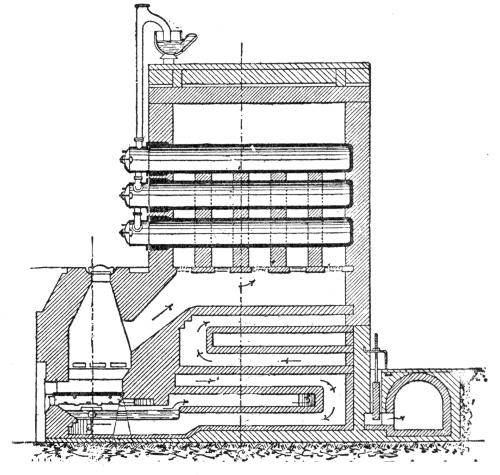
Fig. 11.—Manufacture of Illuminating Gas. Horizontal fireclay retorts placed in
a setting and heated by gas(after Ost)
The tar which remains behind flows through a tube to the
cistern. From the tar separator the gas goes through scrubbers
(fig. 12), where the gas is washed free of ammonia and part of
the sulphuretted hydrogen and carbon dioxide with water.
The scrubbers are tower-like vessels filled with coke or charcoal
through which the gas passes from below upwards, encountering
a spray of water. Several scrubbers in series are used, so that
the water constantly becomes richer in ammonia. Mechanical
scrubbers are much used, so-called standard washers; they are
rotating, horizontal cylinders having several chambers filled
with staves of wood half dipping in water. In them the same
principle of making the gas meet an opposing stream of water
is employed, so that the last traces of ammonia are removed
from the gas.
The various purifying apparatus through which the gas has
to pass cause considerable resistance to its flow. Escape in
various ways would occur had the gas to overcome it by its own
pressure, and too long contact of the gas with the hot walls
of the retorts would be detrimental. Hence an exhauster is
applied to the system which keeps the pressure to the right
proportion in the retorts and drives on the gas.
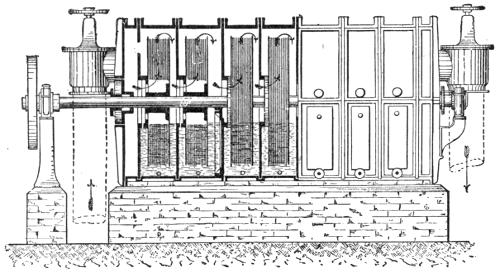
Fig. 12.—Washer or Scrubber
After purification in the scrubbers dry purification follows,
having for its object especially removal of compounds of sulphur
and cyanogen and carbon dioxide. To effect this several
shallow receptacles are used, each having a false bottom
upon which the purifying material is spread out. The boxes
are so arranged that the gas first passes through purifying
material which is almost saturated and finally through fresh
material, so that the material becomes richer in sulphur and
cyanogen compounds. The gas purifying material formerly
used was slaked lime, and it is still frequently used, but more
generally bog iron ore or artificially prepared mixtures are used
consisting mostly of oxide of iron. The saturated purifying
material is regenerated by oxidation on spreading it out in the
air and turning it frequently. After having been thus treated
some ten times the mass contains 50 per cent. sulphur, and
13 to 14 per cent. ferrocyanide.
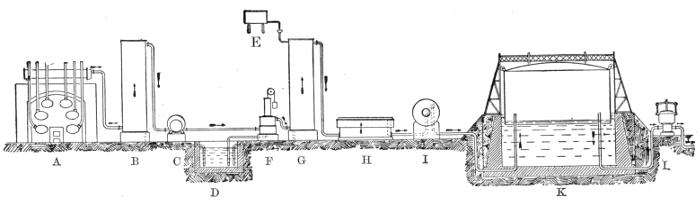
Fig. 13.—Manufacture of Illuminating Gas. Diagrammatic view (after Lueger)
A Retort setting and hydraulic main; B Condensers and coolers; C Exhauster; D Well; E Water
tank; F Tar extractor; G Scrubber; H Purifier; I Station meter; K Gas holder; L Pressure regulator.
The naphthalene in illuminating gas does not separate in
the condenser, and therefore is generally treated in special
apparatus by washing the gas
with heavy coal tar.
The gas purified, as has
been described, is measured by
a meter and stored in gasometers.
These are bells made
up of sheet iron which hang
down into walled receptacles
filled with water to act as a
water seal, and are raised by
the pressure of the gas which
streams into them. The gas
passes to the network of
mains by pressure of the
weight of the gasometer, after
having passed through a pressure
regulating apparatus.
As to recovery of bye-products
in the illuminating gas
industry, see the sections on
Ammonia, Cyanogen Compounds,
Tar, Benzene, &c.
Effect on Health.—Opinions
differ as to the effect
on health which employment
in gas works exerts. This is
true of old as well as of modern
literature.
Hirt1 maintains that gas
workers suffer no increase in
illness because of their employment.
They reach, he says, a
relatively high age and their mortality he puts down at from
0·5 to 1 per cent. (my own observations make me conclude that
the average mortality among persons insured in sick societies
in Bohemia is 1 per cent., so that Hirt’s figure is not high).
Layet2 agreed with Hirt, but was of opinion that gas
workers suffered from anæmia and gastro-intestinal symptoms
attributable to inhalation of injurious gases. The sudden
symptoms of intoxication, ‘exhaustion and sinking suddenly
into a comatose condition,’ which he attributes to the effect of
hydrocarbons and sulphuretted hydrogen gas, may well have
been the symptoms of carbonic oxide poisoning.
Goldschmidt3 in recent literature considers manufacture
of illuminating gas by no means dangerous or unhealthy, and
speaks of no specific maladies as having been observed by him.
Nevertheless, he admits with Layet that the men employed
in the condensing and purifying processes are constantly in an
atmosphere contaminated by gas, and that the cleaning and
regeneration of the purifying mass is associated with inflammation
of the eyes, violent catarrh, and inflammation of the
respiratory passages, since, on contact of the purifying mass
with the air, hydrocyanic acid gas, sulphocyanic acid gas,
and fumes containing carbolic, butyric, and valerianic acids
are generated.
Other writers4 refer to the injurious effects from manipulating
the purifying material. In general, though, they
accept the view, without however producing any figures,
that work in gas works is unattended with serious injury
to health and that poisonings, especially from carbonic oxide,
are rare. Such cases are described,5 but the authors are not
quite at one as to the healthiness or otherwise of the industry.
The one opinion is based on study of the sick club reports for
several years of a large gas works employing some 2400 workers
(probably Vienna).6 The average frequency of sickness
(sickness percentage), excluding accidents, was 48·7 per cent.
The conclusion is drawn that the health conditions of gas
workers is favourable. It is pointed out, however, that
diseases of the respiratory and digestive organs (12·8 and 10·16
per cent. of the persons employed) are relatively high, and
that the mortality (1·56 per cent.) of gas-workers is higher
than that of other workers. This is attributed to the constant
inhalation of air charged with injurious gases. Work at the
retorts, coke quenching, and attending to the purifying plant
are considered especially unhealthy.
The other figures relate to the Magdeburg gas works;
they are higher than those quoted. The morbidity of the gas
workers was found to be 68·5 per cent., of which 18 per cent.
was due to disease of the digestive system, 20·5 per cent. to
disease of the respiratory organs, and 1 per cent. to poisoning.
No details of the cases of poisoning are given. Carbonic oxide
poisoning is said to be not infrequent, the injurious effect
of cleaning the purifiers is referred to, and poisoning by inhalation
of ammonia is reported as possible.
Still, no very unfavourable opinion is drawn as to the
nature of the work. The sickness frequency in sick clubs is
about 50 per cent., and even in well-managed chemical works
Leymann has shown it to be from 65 to 80 per cent. The
recently published elaborate statistics of sickness and mortality
of the Leipzig local sickness clubs7 contain the following
figures for gas workers: Among 3028 gas workers there were
on an average yearly 2046 cases of sickness, twenty deaths,
and four cases of poisoning. The total morbidity, therefore,
was 67·57 per cent., mortality 0·66 per cent., and the morbidity
from poisoning 0·13 per cent. Diseases of the respiratory
tract equalled 10·63 per cent., of the digestive tract 10·87
per cent., of the muscular system 13·10 per cent., and from
rheumatism 11·10 per cent. These figures, therefore, are not
abnormally high and the poisoning is very low.
Still, industrial cases of poisoning in gas works are recorded.
Of these the most important will be mentioned. Six persons
were employed in a sub-station in introducing a new sliding
shutter into a gas main, with the object of deviating the gas for
the filling of balloons. A regulating valve broke, and the gas
escaped from a pipe 40 cm. in diameter. Five of the men
were rendered unconscious, and resuscitation by means of
oxygen inhalation failed in one case. In repairing the damage
done two other cases occurred.8 In emptying a purifier a
worker was killed from failure to shut off the valve.
Besides poisoning from illuminating gas, industrial poisoning
in gas works is described attributable, in part at least, to
ammonia. Thus the report of the factory inspectors of
Prussia for 1904 narrates how a worker became unconscious
while superintending the ammonia water well, fell in, and was
drowned.
A further case is described in the report of the Union
of Chemical Industry for 1904. In the department for concentrating
the gas liquor the foreman and an assistant on the
night shift were getting rid of the residues from a washer
by means of hot water. The cover had been removed, but,
contrary to instructions, the steam had not been shut off.
Ammonia fumes rushed out and rendered both unconscious,
in which condition there were found by the workmen coming
in the morning.9
In the preparation of ammonium sulphate, probably in
consequence of too much steam pressure, gas liquor was
driven into the sulphuric acid receiver instead of ammonia gas.
The receiver overflowed, and ammonia gas escaped in such
quantity as to render unconscious the foreman and two men
who went to his assistance.10
The use of illuminating gas in industrial premises can give
rise to poisoning. Thus the women employed in a scent
factory, where so-called quick gas heaters were used, suffered
from general gas poisoning.11
In Great Britain in 1907 sixteen cases of carbonic
oxide poisoning from use of gas in industrial premises were
reported.
Coke is obtained partly as a residue in the retorts after
the production of illuminating gas. Such gas coke is unsuitable
for metallurgical purposes, as in the blast furnace. Far
larger quantities of coal are subjected to dry distillation for
metallurgical purposes in coke ovens than in gas works. Hence
their erection close to blast furnaces. In the older form of
coke oven the bye-products were lost. Those generally used
now consist of closed chambers heated from the outside, and
they can be divided into coke ovens which do, and those which
do not, recover the bye-products. These are the same as
those which have been considered under manufacture of
illuminating-gas—tar, ammonia, benzene and its homologues,
cyanogen, &c. In the coke ovens in which the bye-products
are not recovered the gases and tarry vapours escaping
on coking pass into the heating flues, where, brought
into contact with the air blast, they burn and help to
heat the oven, while what is unused goes to the main chimney
stack.
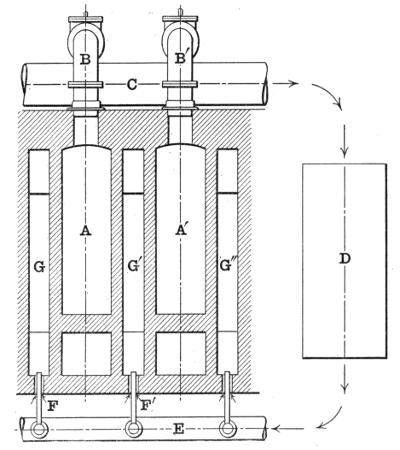
Fig. 14.—Distillation Coke Oven (after Lueger)
A, A´ Coal to be coked; B, B´ Standpipes; C Hydraulic main; D Condensing
apparatus; E Purified gas: F, F´ Air inlets; G G,´ G´´ Combustion
chambers.
In the modern distillation ovens with recovery of the bye-products
the gases escaping from the coal are led (air being
cut off as completely as possible) through ascending pipes into
the main collector, where they are cooled, and the tarry ingredients
as well as a part of the ammonia are absorbed by
water; subsequently the gases pass through washing apparatus
with a view to as complete a recovery of the ammonia and
benzene as possible. The purified gases are now again led
to the ovens and burnt with access of air in the combustion
chambers between two ovens. Generally these ovens are so
constructed as to act as non-recovery ovens also (especially in
starting the process).
The coal is charged into the ovens through charge holes on
the top and brought to a level in the chambers either by hand
or mechanically. Removal of the coke block after completion
of the coking operation is done by a shield attached to a rack and
pinion jack. Afterwards the coke is quenched with water.
Recovery of the bye-products of coke distillation ovens is
similar to the method described for illuminating gas, i.e.
first by condensation with aid of air or water cooling, then
direct washing with water (generally in scrubbers), whereby
tar and ammonia water are recovered. Recovery of benzene
and its homologues (see Benzene later) depends on the fact
that the coke oven gases freed from tar and ammonia are
brought into the closest possible contact with the so-called
wash oils, i.e. coal tar oils with high boiling-point (250-300° C.).
For this purpose several washing towers are employed. The
waste oil enriched with benzene is recovered in stills intermittently
or continuously and used again.
Effects on Health.—Injury to health from work at coke
ovens is similar to that in the manufacture of illuminating
gas. There is the possibility of carbonic oxide poisoning from
escape of gas from leakage in the apparatus. As further
possible sources of danger ammonia, cyanogen and sulpho-cyanogen
compounds, and benzene have to be borne in mind.
In the distillation of the wash oil severe poisoning can
arise, as in a case described, where two men were fatally
poisoned in distilling tar with wash oil.1
The details of the case are not without interest. The
poisoning occurred in the lavatory. The gases had escaped
from the drain through the ventilating shaft next to the closet.
The gases came from distillation of the mixture of tar and
wash oil, and were driven by means of air pumps in such a
way that normally the uncondensed gases made their way to the
chimney stack. On the day of the accident the pumps were
out of use, and the gases were driven by steam injectors into the
drain. Analysis showed the gases to contain much sulphuretted
hydrogen. When this was absorbed, a gas which could be
condensed was obtained containing carbon bisulphide and
hydrocarbons of unknown composition (? benzene). Only
traces of cyanogen and sulpho-cyanogen compounds were
present. Physiological experiment showed that poisoning
was attributable mainly to sulphuretted hydrogen gas, but
that after this was removed by absorption a further poisonous
gas remained.
Producer gas or generator gas.—Manufacture of producer gas
consists in dealing separately with the generation of the gas
and the combustion of the gases which
arise. This is effected by admitting only
so much air (primary air supply) to the
fuel as is necessary to cause the gases to
come off, and then admitting further air
(secondary supply) at the point where
the combustion is to take place; this
secondary supply and the gas formed in
the gas producer are heated in regenerators
before combustion by bringing
the gases to be burnt into contact with
Siemens’s heaters, of which there are
four. Two of these are always heated
and serve to heat the producer gas and
secondary air supply.
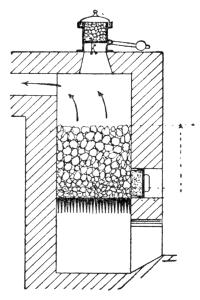
Fig. 15.—Horizontal
Regenerative Grate (after
Lueger)
A producer gas furnace, therefore, consists of a gas
producer, a gas main leading to the
furnace hearth, the heater, and the
chimney.
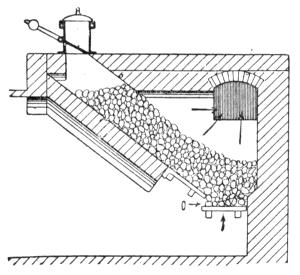
Fig. 16.—Step Regenerative
Grate (after Lueger)
The gas producer is a combustion
chamber filled with coal in
which the coal in the upper layer
is burnt. Generators may have
horizontal or sloping grate (see
figs. 15 and 16). The Siemens’s
heaters or regenerators are chambers
built of, and filled loosely with, fireclay
bricks and arranged in couples.
Should the gas producers become
too hot, instead of the chambers subdivided air heaters are
used, whereby the hot furnace gases are brought into contact
with a system of thin-walled, gastight fireclay pipes, to
which they give up their heat, while the secondary air supply
for the furnace is led beside these pipes and so becomes
heated indirectly. Previous heating of the producer gas is
here not necessary; no valves are needed because the three
streams of gas all pass in the same direction.
Fig. 17a.—Siemens’s Regenerative Furnace
L Air; G Gas
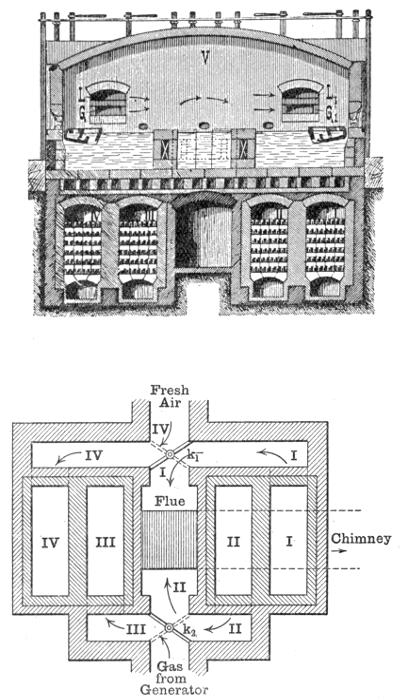
Fig. 17b.—Siemens’s Regenerative Furnace
Such air heating arrangements are used for heating the
retorts in gas works, for melting the ‘metal’ in glass works, and
very generally in other industries, as they offer many technical
and hygienic advantages. Generator gas from coke contains
34 per cent. carbonic oxide, 0·1 per cent. hydrogen, 1·9 per
cent. carbon dioxide, and 64 per cent. nitrogen.
Blast furnace gas.—Blast furnace gas is formed under the
same conditions as have been described for generator gas;
it contains more carbon dioxide (about 10 per cent.). (Further
details are given in the section on Iron—Blast Furnaces.)
Water gas.—Water gas is made by the passage of steam
through incandescent coal, according to the equation:
The iron gas producer, lined with firebrick, is filled with
anthracite or coke and heated by blowing hot air through it.
This causes producer gas to escape, after which steam is blown
through, causing water gas to escape—containing hydrogen and
carbonic oxide to the extent of 45-50 per cent., carbon
dioxide and nitrogen 2-6 per cent., and a little methane.
The blowing of hot air and steam is done alternately, and
both kinds of gas are led away and collected separately, the
water gas being previously purified in scrubbers, condensers,
and purifiers. It serves for the production of high temperatures
(in smelting of metals). Further, when carburetted and
also when carefully purified in an uncarburetted state, it
serves as an illuminant. The producer gas generated at the
same time is used for heating purposes (generally for heating
boilers).
Dowson gas.—Dowson gas is obtained by collecting and
storing together the gases produced in the manner described
for water gas. Under the grating of the wrought-iron gas
producer (lined with firebrick and similarly filled with coke or
anthracite) a mixture of air and steam, produced in a special
small boiler, is blown through by means of a Körting’s
injector.
Before storage the gas is subjected to a purifying process
similar to that in the case of water gas. The mixed gas
consists of 1 vol. water gas and 2-3 vols. producer gas, with
about 10-15 vols. per cent. H, 22-27 vols. per cent. CO,
3-6 per cent. CO₂, and 50-55 per cent. N. It is an admirable
power gas for driving gas motors (fig. 18).
Mond gas similarly is a mixed gas obtained by blowing
much superheated steam into coal at low temperature.
Ammonia is produced at the same time.
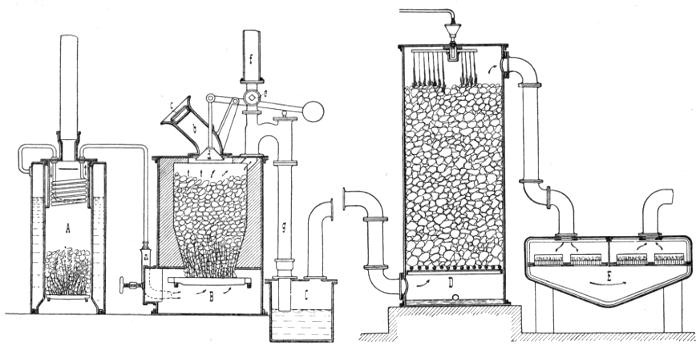
Fig. 18.—Power Gas Installation (after Lueger)
- A Steam boiler
- a Steam injector
- B Furnace
- b Charging hopper
- c Cover g
- d Valve C
- e Cock D
- f Vent pipe
- g Steam Pipe
- C Washer
- D Coke tower
- E Sawdust purifier
Suction gas.—In contradistinction to the Dowson system,
in which air mixed with steam is forced into the producer by a
steam injector, in the suction gas plant the air and steam are
drawn into the generator by the apparatus itself. The whole
apparatus while in action is under slight negative pressure. A
special steam boiler is unnecessary because the necessary steam
is got up in a water container surrounding or connected with
the cover of the generator. The plant is set in motion by
setting the fire in action by a fan.

Fig. 19.—Suction Gas Plant (after Meyer)
Fig. 19 shows a suction gas plant. B is the fan. Above
the generator A and at the lower part of the feed hopper is an
annular vessel for generating steam, over the surface of which
air is drawn across from the pipe e, passing then through the
pipe f into the ash box g, and then through the incandescent
fuel. The gas produced is purified in the scrubber D, and
passes then through a pipe to the purifier containing sawdust
and to the motor.
Carburetted gas.—Gas intended for illuminating purposes is
carburetted to increase its illuminating power, i.e. enriched
with heavy hydrocarbons. Carburetting is effected either by a
hot method—adding the gases distilled from mineral or other
oils—or by a cold method—allowing the gas to come into contact
with cold benzol or benzine. Coal gas as well as water gas
is subjected to the carburetting process, but it has not the same
importance now in relation to illuminating power, as reliance
is more and more being placed on the use of mantles.
ACETYLENE
Calcium carbide.—Acetylene is prepared from calcium
carbide, which on contact with water gives off acetylene.
Calcium carbide is prepared electro-chemically. A mixture
of burnt lime and coke is ground and melted up together at
very high temperature in an electric furnace, in doing which
there is considerable disengagement of carbonic oxide according
to the equation:
The furnaces used in the production of calcium carbide are of
different construction. Generally the furnace is of the nature
of an electric arc, and is arranged either as a crucible furnace for
intermittent work or like a blast furnace for continuous work.
Besides these there are resistance furnaces in which the heat
is created by the resistance offered to the passage of the current
by the molten calcium carbide.
The carbonic oxide given off in the process causes
difficulty. In many furnaces it is burnt and so utilised for
heating purposes. The calcium carbide produced contains
as impurities silicon carbide, ferro-silicon, calcium sulphide,
and calcium phosphide.
Acetylene (C₂H₂), formed by the decomposition of calcium
carbide by means of water (CaC₂ + 2H₂O = Ca(OH)₂ + C₂H₂),
furnishes when pure an illuminating gas of great brilliancy and
whiteness. Its production is relatively easy. Used for the
purpose are (1) apparatus in which water is made to drop on
the carbide, (2) apparatus in which the carbide dips into water
and is removed automatically on generation of the gas, (3)
apparatus in which the carbide is completely immersed in
water, and (4) apparatus in which the carbide in tiny lumps
is thrown on to water. These are diagrammatically represented
in figs. 20a to 20d .
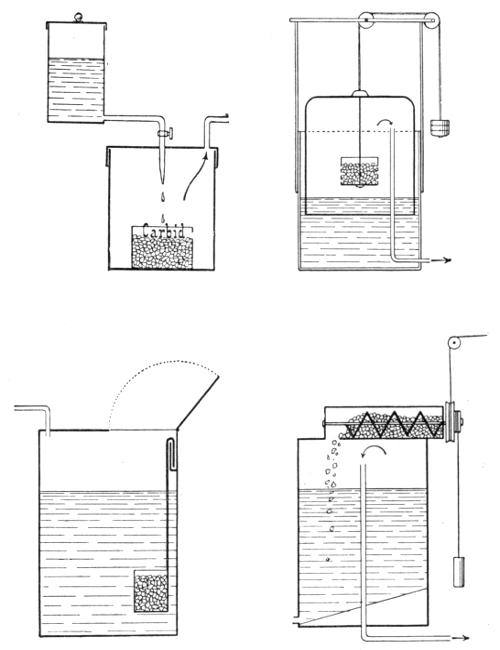
Acetylene Apparatus—diagrammatic (after Lueger)
A Dripping; B Dipping; C Submerging; D Throwing in
The most important impurities of acetylene are ammonia,
sulphuretted hydrogen gas, and phosphoretted hydrogen.
Before use, therefore, it is subjected to purification in various
ways. In Wolf’s method the gas is passed through a washer
(with the object of removing ammonia and sulphuretted
hydrogen gas) and a purifying material consisting of chloride
of lime and bichromate salts. In Frank’s method the gas
passes though a system of vessels containing an acid solution
of copper chloride, and also through a washer. Chloride of
lime with sawdust is used as a purifying agent. Finally, the
gas is stored and thence sent to the consumer (see fig. 21).
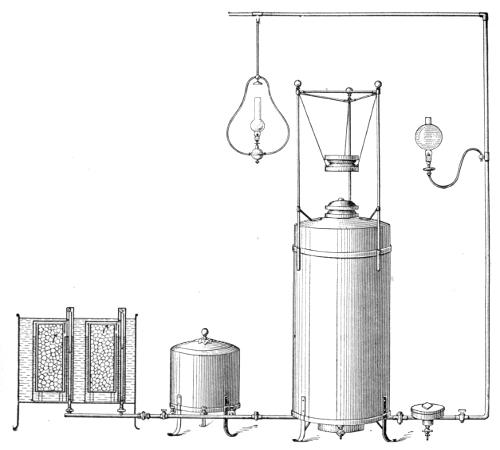
Fig. 21.—Acetylene Gas Apparatus (after Lueger)
Effects on Health.—Almost all the poisoning caused in
the industries in question is due to carbonic oxide gas, of which
water gas contains 41 per cent., generator gas 35 per cent., and
suction and Dowson gas 25 per cent.
That industrial carbonic oxide poisoning is not rare the
reports of the certifying surgeons in Great Britain sufficiently
show. In the year 1906 fifty-five persons are referred to as
having suffered, with fatal issue in four. In 1907 there were
eighty-one, of which ten were fatal. Of the 1906 cases twenty
resulted from inhalation of producer, Mond, or suction gas,
sixteen from coal gas (in several instances containing
carburetted water gas), seventeen from blast furnace gas,
and one each from charcoal fumes from a brazier, and from
the cleaning out of an oil gas holder.
As causes of the poisoning from suction gas were (1) improper
situation of gas plant in cellar or basement, allowing gas to
collect or pass upward; (2) defective fittings; (3) starting the
suction gas plant by the fan with chimney valve closed; (4)
cleaning out ‘scrubbers’ or repairing valves, &c.; (5) defective
gasometer. In the seventeen cases due to blast furnace gas
six were due to conveyance of the gas by the wind from a
flue left open for cleaning purposes into an engineering shed,
two to charging the cupola furnace, two to entering the
furnace, and four to cleaning the flues.
The following are instances taken from recent literature
on gas poisoning1 : Several cases of poisoning by water gas
occurred in a smelting works. The poisoning originated
when a blowing machine driven by water gas was started.
Owing to premature opening of the gas valve two men
employed in a well underneath the machine were overcome.
The attendant who had opened the valve succeeded in lifting
both from the well; but as he was trying to lift a third man
who had come to his assistance and fallen into the well he
himself fell in and was overcome. The same fate befell the
engineer and his assistant who came to the rescue. All efforts
to recover the four men by others roped together failed, as all
of them to the number of eight were rendered unconscious.
With the aid of rescue appliances (helmets, &c.) the bodies
were recovered, but efforts at artificial respiration failed.
A workman was killed by suction gas while in the water-closet.
It appeared that some time previously when the plant
was installed the ventilating pipe between the purifier and
motor, instead of being led through the roof, had been led
out sideways on a level with the floor immediately above the
closet.
In another case the suction gas attendant had taken out
the three-way cock between the generator and motor for repairs
and had not reinserted it properly, so that when effort was
made to start the motor this failed, as gas only and no air was
drawn in. The motor was thought to be at fault, and the fan
was worked so vigorously that the gas forced its way out
through the packing of the flange connections and produced
symptoms of poisoning in the persons employed.
More dangerous than suction gas plants, in which normally
no escape takes place, are installations depending on gas
under pressure. Such an installation was used for heating gas
irons in a Berlin laundry. The arrangements were considered
excellent. The gas jets were in stoves from which the fumes
were exhausted. The gas was made from charcoal and contained
13 per cent. of hydrogen. No trace of carbonic oxide
was found in the ironing room on examination of the air.
After having been in use for months the mechanical ventilation
got out of order, with the result that twelve women suffered
severely from symptoms of carbonic oxide poisoning, from
which they were brought round by oxygen inhalation. The
laundry reverted to the use of illuminating gas. The conclusion
to be drawn is that installations for gas heating are to be used
with caution.2
Industrial poisoning from blast furnace gas is frequent.
Two fatal cases were reported3 in men employed in the gas
washing apparatus. They met their death at the manhole
leading to the waste-water outlet. In another case a workman
entered the gas main three hours after the gas had been
cut off to clear it of the dust which had collected. He succumbed,
showing that such accumulations can retain gas for a
long time. Steps had been taken three hours previously to
ventilate the portion of gas main in question.
A fatal case occurred in the cleaning out of a blast furnace
flue which had been ventilated for 1½ hours by opening all
manholes, headplates, &c. The foreman found the deceased
with his face lying in the flue dust; both he and a helper were
temporarily rendered unconscious.
Cases of poisoning by generator gas are described.4 A
workman who had entered a gasometer containing the gas
died in ten minutes, and another remained unconscious for
ten days and for another ten days suffered from mental disturbance,
showing itself in hebetude and weakness of memory.
Acetylene is poisonous to only a slight extent. Impurities
in it, such as carbon bisulphide, carbonic oxide (present to the
extent of 1-2 per cent.), and especially phosphoretted hydrogen
gas, must be borne in mind.
American calcium carbide5 yields acetylene containing
0·04 per cent. of phosphoretted hydrogen; Lunge and Cederkreutz
have found as much as 0·06 per cent. in acetylene.
Preparation.—Ammonia and ammonium salts are now
exclusively obtained as a bye-product in the dry distillation of
coal, from the ammonia water in gas works, and as a bye-product
from coke ovens.
The ammonia water of gas works contains from 2-3 per
cent. of ammonia, some of which can be recovered on boiling,
but some is in a non-volatile form, and to be recovered the
compound must be decomposed. The volatile compounds
are principally ammonium carbonate and, to a less extent,
ammonium sulphide and cyanide; the non-volatile compounds
are ammonium sulphocyanide, ammonium chloride, sulphate,
thiosulphate, &c. Other noteworthy substances in ammonia
water are pyridine, pyrrol, phenols, hydrocarbons, and tarry
compounds.
Decomposition of the non-volatile compounds is effected
by lime. Hence the ammonia water is distilled first alone,
and then with lime. The distillate is passed into sulphuric
acid, ammonium sulphate being formed. Distillation apparatus
constructed on the principle usual in rectifying spirit
is used, so that continuous action is secured; the ammonia
water flows into the apparatus continuously and is freed of
the volatile compounds by the steam. At a later stage milk
of lime is added, which liberates the ammonia from the nonvolatile
compounds.
Of the ammonium salts there require mention:
Ammonium sulphate ((NH₄)₂SO₄), which serves for the production
of other ammonium salts. It is usually centrifugalised
out from the sulphuric acid tank previously described.
Ammonium chloride (sal-ammoniac, NH₄Cl) is formed by
bringing the ammonia fumes given off in the process described
in contact with hydrochloric acid vapour. The crude salt
so obtained is recrystallised or sublimed.
Ammonium phosphate ((NH₄)₂HPO₄) is made in an analogous
manner by leading ammonia into phosphoric acid. It is
useful as an artificial manure.
Ammonium carbonate is made either by bringing together
ammonia vapour and carbonic acid or by subliming ammonium
sulphate with calcium carbonate. It is very volatile. The
thick vapour is collected and purified in leaden chambers.
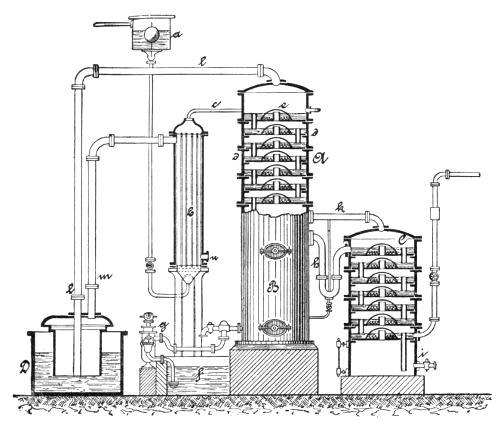
Fig. 22.—Preparation of Ammonia. Column Apparatus of Feldman (after Ost)
A, B, C Columns; D Saturator; (a) Settling tank and regulator for flow of
ammonia; (b) Economiser; (f) Milk of lime; (g) Pump
Caustic ammonia is prepared either from gas liquor or, more
usually, from ammonium sulphate by distillation with caustic
alkali in a continuous apparatus.
Use of Ammonia.—Ammonia is used in laundries and
bleaching works in dyeing and wool washing. It is used
especially in making ammonium salts, in the preparation of
soda by the Solvay process (see Soda Manufacture), and in
making ice artificially.
It is used also in the preparation of indigo, in lacquers and
colours, and the extraction of chloride of silver, &c.
Effects on Health.—Industrial ammonia poisoning is
rare. It occurs most frequently in gas works and occasionally
in its use, especially the manufacture of ammonium salts. Those
engaged in subliming ammonium carbonate incur special
risk, but often it is not the ammonia vapour so much as the
escaping evil-smelling gases containing carbon bisulphide and
cyanogen compounds which are the source of trouble.
Occasionally in the production of ice through leakage or
by the breaking of carboys of ammonia accidental poisoning
has occurred.
Some cases are cited from recent literature:
A worker was rendered unconscious and drowned in an
ammonia water well.1 Two workers were poisoned (one
fatally) in the concentration of gas liquor. Three workers were
gassed (one fatally) in the preparation of ammonium sulphate
in a gas works. Probably as the result of excessive steam
pressure gas water was driven over with the ammonia into
the sulphuric acid vessel.2
Eulenberg3 reports the occurrence of sulphuretted hydrogen
gas poisoning in the production of ammonium salts. The
workers succumbed as though shot, although work was being
carried on in the open air. They recovered when removed
from the poisonous atmosphere.
In a large room of a chemical factory phosphoric acid was
being saturated with ammonia gas water in an iron lead-lined
vessel. Carbonic acid gas and hydrogen gas were
evolved, but not to such extent as to be noticeable in the large
room. A worker not employed in the room had to do something
close to the vessel, and inhaled some of the fumes given
off. A few yards from the vessel he was found lying unconscious,
and although removed into the open air failed to respond
to the efforts at artificial respiration.4
Lewin, in an opinion delivered to the Imperial Insurance
Office, describes poisoning in a man who during two days had
been employed repairing two ammonia retorts in a chemical
factory. On the evening of the second day he suffered from
severe symptoms of catarrh, from which he died five days
later. Lewin considered the case to be one of acute ammonia
poisoning.5
Ammonia is frequently used in fulling cloth, the fumes
of which collect on the surface after addition of sulphuric acid
to the settling vats. This is especially liable to occur on a
Monday, owing to the standing of the factory over the Sunday,
so that entrance into the vats without suitable precautions
is strictly forbidden. Despite this, a worker did go in to fetch
out something that had fallen in, becoming immediately unconscious.
A rescuer succumbed also and lost his life. The first
worker recovered, but was for long incapacitated by paralytic
symptoms.
Cases of poisoning in ice factories and refrigerator rooms
from defective apparatus are reported.
Acute and chronic poisoning among sewer men are due
mainly to sulphuretted hydrogen gas and only partly to
ammonia. The more ammonia and the less sulphuretted
hydrogen sewer gases contain the less poisonous are they.
Treatment of the Materials used in Gas purifying.—Cyanogen
compounds are still sometimes prepared by the
original method of heating to redness nitrogenous animal
refuse (blood, leather, horn, hair, &c.) with potash and iron
filings; potassium cyanide is formed from the nitrogen, carbon,
and alkali, and this with the sulphur and iron present is easily
converted into potassium ferrocyanide (yellow prussiate of
potash, K₄FeC₆N₆) by lixiviation of the molten mass. It
crystallises out on evaporation.
Cyanogen compounds are obtained in large quantity from
the material used in purifying the gas in gas works. This
saturated spent material contains, in addition to 30-40 per
cent. of sulphur, 8-15 per cent. of cyanogen compounds and
1-4 per cent. of sulphocyanogen compounds.
By lixiviation with water the soluble ammonium salts are
extracted from the purifying material. This solution furnishes
sulphocyanide of ammonium, from which the remaining unimportant
sulphocyanide compounds are obtained (used in cloth
printing). The further treatment of the purifying material
for potassium ferrocyanide is rendered difficult because of
the sulphur, which is either removed by carbon bisulphide
and the ferrocyanide obtained by treatment with quicklime
and potassium chloride, or the mass is mixed with quicklime,
steamed in closed vessels, lixiviated with water, and decomposed
by potassium chloride; ferrocyanide of potassium and
calcium separates out in crystals, and this, treated with
potash, yields potassium ferrocyanide.
The well-known non-poisonous pigment Prussian blue is
obtained by decomposing ferrocyanide of potash with chloride
or oxide of iron in solution.
Potassium cyanide (KCN) is prepared from potassium
ferrocyanide by heating in absence of air, but it is difficult to
separate it entirely from the mixture of iron and carbon which
remains. All the cyanogen is more easily obtained in the form
of potassium and sodium cyanide from potassium ferrocyanide
by melting it with potash and adding metallic sodium.
The very poisonous hydrocyanic acid (prussic acid, HCN)
is formed by the action of acids on potassium or sodium
cyanide; small quantities indeed come off on mere exposure
of these substances to the air. The increasing demand for
potassium cyanide has led to experimental processes for
producing it synthetically.
One method consists in the production of potassium
cyanide from potash and carbon in a current of ammonia gas.
Small pieces of charcoal are freed from air, saturated with a
solution of potash, dried in the absence of air, and heated in
upright iron cylinders to 100° C., while a stream of ammonia
gas is passed through.
Again, sodium cyanide is prepared from ammonia, sodium,
and carbon by introducing a definite amount of sodium and
coal dust into melted sodium cyanide and passing ammonia
through. The solution is then concentrated in vacuo and
sodium cyanide crystallises out on cooling.
Use of Cyanides.—Potassium cyanide is principally used
in the recovery of gold, in gold and silver electroplating, in
photography, for soldering (it reduces oxides and makes
metallic surfaces clean), for the production of other cyanogen
compounds, for the removal of silver nitrate stains, &c. Hydrocyanic
acid gas is given off in electroplating, photography, in
smelting fumes, in tanning (removing hair by gas lime), &c.
Effects on Health.—Industrial cyanogen poisoning is
rare. Weyl1 states that he could find no case in any of the
German factory inspectors’ reports for the twenty years prior
to 1897, nor in some twenty-five volumes of foreign factory
inspectors’ reports. I have found practically the same in my
search through the modern literature.
Of the very few references to the subject I quote the most
important.
A case of (presumably) chronic hydrocyanic acid poisoning
is described in a worker engaged for thirteen years in silver
electroplating of copper plates.2 The plates were dipped in a
silver cyanide solution and then brushed. After two years
he began to show signs of vomiting, nausea, palpitation, and
fatigue, which progressed and led to his death.
A case of sudden death is described3 occurring to a worker
in a sodium cyanide factory who inhaled air mixed with hydrocyanic
acid gas from a leaky pipe situated in a cellar. The
factory made sodium cyanide and ammonium sulphate from
the residue after removal of the sugar from molasses. This is
the only definite case of acute cyanogen poisoning in a factory
known to me. I believe that under modern conditions, in
which the whole process is carried on under negative pressure,
chance of escape of cyanogen gases is practically excluded.
It should be mentioned that hydrocyanic acid vapour is
given off in the burning of celluloid. In this way eight persons
were killed at a fire in a celluloid factory.4
Skin affections are said to be caused by contact with fluids
containing cyanogen compounds, especially in electroplating.
It is stated that workers coming into contact with solutions
containing cyanides may absorb amounts sufficient to cause
symptoms, especially if the skin has abrasions. Such cases
are described.5 In electroplating, further, in consequence of
the strong soda solutions used, deep ulceration and fissures of
the skin of the hand can be caused.
Of the products of the illuminating gas industry tar has
considerably the most importance. Coal tar as such has
varied use in industry, but far greater use is made of the products
obtained by fractional distillation from it such as benzene,
toluene, naphthalene, anthracene, carbolic acid, pyridine, and
the other constituents of tar, a number of which form the
starting-point in the production of the enormous coal-tar dye
industry. Especially increasing is the consumption of benzene.
In Germany alone this has increased in ten years from 20 to
70 million kilos. This is partly due to the need of finding
some cheap substitute for benzine, the consumption and cost
of which has increased, and it has in many respects been found
in benzene.
Besides benzene and its homologues, toluene, anthracene, and
naphthalene are valuable. Anthracene is used in the manufacture
of alizarine and naphthalene in that of artificial indigo
and of the azo-colours. Carbolic acid (phenol) and the homologous
cresols serve not only as disinfectants but also in
the manufacture of numerous colours and in the preparation
of picric acid and salicylic acid. Further, a number of pharmaceutical
preparations and saccharin are made from the
constituents of tar.
The important constituents of tar are:
1. Hydrocarbons of the methane series: paraffins, olefines;
hydrocarbons of the aromatic series: benzene and its homologues,
naphthalene, anthracene, phenanthrene, &c.
2. Phenols (cresols, naphthols).
3. Sulphides: sulphuretted hydrogen, carbon bisulphide,
mercaptan, thiophene.
4. Nitrogen compounds: ammonia, methylamine, aniline,
pyridine, &c.
5. Fifty to sixty per cent. of tar consists of pitch constituting
a mixture of many different substances which
cannot be distilled without decomposition.
Crude tar, i.e. tar which separates in the dry distillation of
coal, is employed as such for preserving all kinds of building
materials, for tarring streets, as plastic cement, as a disinfectant,
in the preparation of roofing paper or felt, lampblack,
briquettes, &c.
Brattice cloth and roofing felt are made by passing the
materials through hot tar and incorporating sand with them;
in doing this heavy fumes are given off.
Lampblack is made by the imperfect combustion of tar or
tar oil by letting them drop on to heated iron plates with as
limited an air supply as possible; the burnt gases laden with
carbon particles are drawn through several chambers or sacks
in which the soot collects.
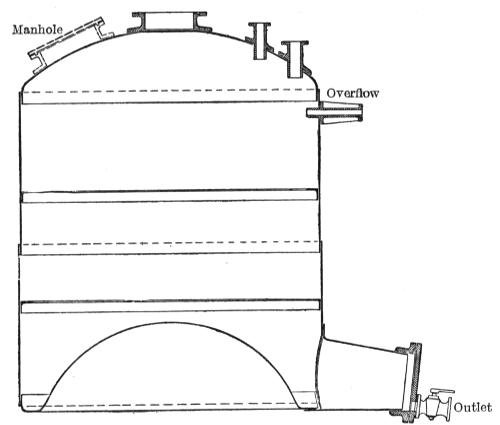
Fig. 23.—Tar Still (after Krämer)
Briquettes (patent fuel) are made by mixing small coal (coal
dust) with tar or pitch and then pressing them in moulds.
The separation and recovery of the valuable ingredients is
effected by fractional distillation. This is carried out by heating
the tar at gradually increasing temperature in a wrought-iron
still, the bottom of which is arched and having a cast-iron
still head, or in horizontal boilers by direct fire. Before
commencing the distillation the tar is freed as far as possible
of water by storage. On gradual increase of temperature the
volatile constituents, the so-called ‘light oil,’ and later the
heavier volatile constituents come over. The constituents
are liberated in a gaseous state and are collected in fractions.
The pitch remains behind in the still. Considerable quantities
of coal tar are not distilled for pitch. Often the light oils
and a portion of the heavy oils are collected, when soft pitch
remains, or, if the light oils and only a very small portion of
the heavy oils are collected, asphalt remains behind, this residue
being used as a basis for the manufacture of roofing felt.
The vapours are condensed in iron coils round which cold
water circulates. The receivers in which the distillate is caught
are changed at definite times as the temperature gradually
rises. If five fractions have come over they are called (1) first
runnings, (2) light oil to 170° C., (3) middle oil (carbolic oil to
230° C.), (4) heavy oil to 270° C., and lastly (5) anthracene
oil, which distills at over 270° C.; the pitch remaining behind
is let out of the still by an opening at the bottom.
We will briefly sketch the further treatment and use of
these fractions, so far as a knowledge of the most important
processes is necessary for our purpose.
1. The light oils (including first runnings) coming over
up to 170° C. are again distilled and then purified with
sulphuric acid in lead-lined cast-iron or lead-lined wooden
tanks. The dark-coloured acid used for purifying after
dilution with water, which precipitates tarry matters, is treated
for ammonium sulphate; the basic constituents of the light
oils extracted with sulphuric acid and again liberated by lime
yield pyridine (C₅H₅N) and the homologous pyridine bases, a
mixture of which is used for denaturing spirit. After the
light oils have been washed with dilute caustic soda liquor,
whereby the phenols are removed, they are separated by
another fractional distillation into (a) crude benzol (70°-130° C.)
and (b) solvent naphtha (boiling-point 130°-170° C.).
Crude benzol (70°-140° C.) consists chiefly of benzene and
toluene and is separated into its several constituents in
special rectifying apparatus. For this production of pure
benzene (boiling-point 80°-82° C.) and pure toluene (boiling-point
110° C.) fractionating apparatus is used (fig. 24).
The commercial products in use which are obtained from
the fractional distillation of the light oil are:
(a) Ninety per cent. benzol, so called because in the
distillation 90 per cent, should come over at a temperature
of 100° C. It is
made up of 80-85
per cent. benzene,
13-15 per cent.
toluene, 2-3 per
cent. xylene, and
contains, as impurities,
traces of
olefines, paraffins,
sulphuretted hydrogen,
and other
bodies.
(b) Fifty per
cent. benzol contains
50 per cent.
of constituents
distilling at 100°
C. and 90 per cent.
at 120° C.; it is
a very mixed product,
with only
40-50 per cent. of
benzene.
(c) Solvent
naphtha, so called
because it is largely
used for dissolving
rubber, is free
from benzene, but
contains xylene
and its homologues
and other
unknown hydrocarbons.
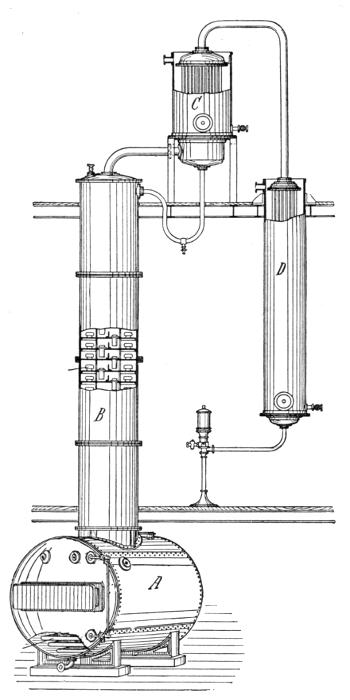
Fig. 24.—Column Apparatus of Hickman for Distillation
of Benzene (after Ost)
A Still body; B Analysing column; C Cooler; D Condenser
for pure distillate.
Benzol is widely
used. Ninety
per cent. benzol
is largely used in
the chemical industry,
serving
for the preparation of dye stuffs, pharmaceutical preparations,
scents, &c. In other industries it took the place of
benzine and also of turpentine oil, especially in the paint
industry, since it evaporates quickly and readily dissolves
resins. Hence it is used in the preparation of quick drying
ship’s paints, as a protection against rust, and as an isolating
lacquer (acid proof colours) for electrical apparatus, in the
production of deck varnishes, and as a solvent of resins.
This use of benzol in the paint industry is by no means
unattended with danger, as benzol is poisonous. Far less
harmful, if not altogether without risk, is use of benzol free
solvent naphtha—but this evaporates only slowly and hence
cannot take the place of benzol.
Benzol serves further for fat extraction from bones in
manure factories and of caffein from coffee beans.
Again, it is used as a motive power in motor vehicles.
The solvent naphtha above mentioned with boiling-point
above 140° C. and all the light oils are employed in chemical
cleaning and for dissolving indiarubber (see Indiarubber).
These are known in the trade erroneously as ‘benzine,’
which unfortunately often leads to confusion with petroleum
benzine (see Petroleum) and to mistakes in toxicological
accounts of poisoning.
2. Between 150° and 200° C. the middle oil comes over, from
which on cooling naphthalene (C₁₀H₈) crystallises out, and is
subsequently washed with caustic soda liquor and with acid;
it is re-distilled and hot pressed. The remaining liquor yields,
when extracted with caustic soda, phenol (carbolic acid, C₆H₅OH),
which, on addition of sulphuric acid or carbonic acid, separates
from the solution and then—generally in special factories—is
obtained pure by distillation and special purifying
processes.
From the sodium salt of carbolic acid (sodium phenolate)
salicylic acid (C₆H₄OH.COOH) is obtained by combination
with compressed CO₂ at a temperature of 150° C. Picric acid
(trinitrophenol, C₆H₂OH.(NO₂)₃) is obtained by treating phenol
with a mixture of sulphuric and nitric acids (nitration). The
yellow crystals of this explosive which separate are carefully
washed, recrystallised, centrifugalised, and dried.
3. The heavy oils which come over between 200° and 300° C.
containing cresols, naphthols, naphthaline, quinoline bases,
fluid paraffins, &c., are seldom separated further. The disinfectants
lysol, sapocarbolic, &c., are obtained from such
fractions.
The heavy oils are much in use for impregnating wood
(piles, railway sleepers, &c.), to prevent rotting. This is
done in special creosoting installations. The wood is first
freed from moisture under vacuum and lastly the heavy oil
forced in. This is a better means of preserving timber than
the analogous method by means of chloride of zinc.
4. Anthracene oil or ‘green oil’ comes over between 300°
and 400° C. and contains the valuable anthracene which
crystallises out, is separated from the oil in filter presses, or
dried in centrifugal machines. Alizarin dyes are made from
it. Raw anthracene oil further is used commercially as a paint
under the name of carbolineum for preserving wood.
5. The pitch remaining behind in the still serves (like tar)
for making varnishes, patent fuel, &c. For our purpose use of
pitch in the preparation of iron varnishes which adhere to
metals and protect them from oxidation have interest. Pitch
and the heavy oils are melted together or, if for thin varnishes,
dissolved in solvent naphtha. The volatile constituents
evaporate after the coat has been applied.
Effects on Health.—Severe injury to health or poisoning
cases scarcely arise through manipulations with or use of tar.
Inhalation, however, of large quantities of tar vapour is
without doubt unpleasant, as a number of poisonous substances
are contained in the fumes. And the ammonia water
which separates on standing can give off unpleasantly
smelling odours from the sulphur compounds in it, especially
if it comes into contact with waste acids, with consequent
development of sulphuretted hydrogen gas.
I could not find in the literature of the subject references
to any clearly proved case of poisoning from tar emanations.
But deserving of mention in this connection are the effects
on the skin caused by tar.
Workers coming into contact with tar suffer from an
inflammatory affection of the skin, so-called tar eczema, which
occasionally takes on a cancerous (epithelioma) nature similar
to chimney-sweep’s cancer, having its seat predominantly on
the scrotum. In lampblack workers who tread down the
soot in receptacles the malady has been observed to affect the
lower extremities and especially the toes.
In tar distillation and in the production and use of benzene
industrial poisoning frequently occurs. Many cases are recorded,
but in several the immediate exciting cause is doubtful, and
consequently it is often difficult to classify the cases.
Most frequently the manufacture and use of benzene come
in question. Besides this, in tar distillation poisoning may be
caused by other substances, such as sulphuretted hydrogen gas,
carbonic oxide gas, &c. In the production of antipyrin,
aspirin, &c., and in the preparation and use of anthracene injury
to health is recognised.
From the list of recognised cases of these forms of poisoning
the most characteristic are chosen from the recent literature on
the subject.
The Prussian factory inspectors’ reports for 1904 describe
the following: In cleaning out a tar still two workers were
killed by inhalation of gas. The nature of the gas was not
ascertained. But what probably happened was that the cock
on the foul gas pipe collecting the gases from the stills leaked
and allowed fumes to pass over from one still to another.
A foreman and worker were rendered unconscious on
entering a receiver for heavy oil for cleaning purposes. On
treatment with oxygen gas they speedily recovered.
Industrial benzene poisoning is especially frequent now in
view of the increasing use to which it is put. Several cases
have proved fatal.
A worker, for instance, forgot to open the cock for the water
to cool the condenser, so that some of the benzene vapour
remained uncondensed. The case proved fatal.
The Report of the Union of Chemical Industry for 1905
stated that a worker on night duty, whose duty it was to
regulate the introduction of steam and the cooling of the benzol
plant, was found lying dead in front of the building. Inquiry
showed that he had not opened the valve for running the
distillate into the appropriate receiver. Eight thousand
litres overflowed.
In an indiarubber extracting factory a worker was rendered
unconscious while inspecting a benzol still; before entering he
had omitted to observe the instructions to drive steam through
and have a mate on watch at the manhole. Two other workmen
were similarly affected who went to the rescue without
adoption of precautions. Only one survived.
In a further accident (already mentioned under ‘Coke
Furnaces’) two workmen were killed. In the factory in question
the thick tar from the coke ovens was being distilled under
slight pressure. The air pumps, however, were out of order,
and temporary use was being made of Körting’s injectors,
whereby the steam and tar constituents were cooled and led
into the drain in front of the closet, near to which was a ventilating
shaft. Probably, in addition to benzene and its homologues,
sulphuretted hydrogen and cyanogen compounds were
present in the poisonous gases.
In cleaning out a benzene extracting apparatus a workman
was killed by the stagnant fumes in it.
A similar case of benzene poisoning occurred in a
naphthalamine works through inspecting an extracting vessel
which had contained benzene and naphthalamine and had
to be cleaned. The vessel had been empty for twenty-two
hours and had been washed and ventilated, but through a
leaking pipe benzene had dropped down into it. The workman
engaged was rendered unconscious inside the retort,
but was rescued by an engineer equipped with a breathing
helmet. Others who without such apparatus tried to effect a
rescue were overcome, and one who had entered the retort
succumbed.1
Benzene poisoning has often occurred in the cleaning of
tanks, &c., for the transport and storage of the substance.
The following examples are taken from the Reports of the
Union of Chemical Industry.
A worker during the pause for breakfast had, unknown to
his employer, cleaned out an empty truck for crude benzol.
Later he was with difficulty removed unconscious through the
manhole and could not be resuscitated. Only a short time
previously a similar occurrence had taken place in the same
factory.
Two further fatal cases were reported in 1908 in the cleaning
out of railway tank waggons. The tank had previously been
thoroughly sprayed with water. The partition plates which are
required in such tanks increase the difficulty of cleaning from
the manhole. After the foreman had tested the air by putting
his head inside and considered it free from danger, a man
entered to clean out the deposit; another man on watch
outside had evidently gone in for rescue purposes. Resuscitation
in both cases failed.
A worker died and several were affected in the cleaning out
of a benzol storage tank in a tar distillery. The tank had
had air blown through it several weeks before, and had been
thoroughly cleaned by steam and water. Also in the inspection
the greatest care was taken in only permitting work for
short spells. This shows that, notwithstanding great care,
the last traces of benzol cannot be entirely removed and that
quite small quantities are sufficient to cause severe and even
fatal poisoning. Workers should only clean out tanks,
therefore, when properly equipped with helmets.
In the German factory inspectors’ reports for 1902 a case
of intoxication is described in a man who was engaged painting
the inside of an iron reservoir with an asphalt paint dissolved in
benzol.
Of special interest is a fatal case from inhalation of benzol
fumes in a rubber factory. Rubber dissolved in benzol was
being rubbed into the cloth on a spreading machine in the
usual way. The cloth then passes under the cleaning doctor
along the long heated plate to the end rolls. Of the three men
employed at the process one was found to be unconscious and
could not be brought round again.
The cases described2 of poisoning with impure benzol in
a pneumatic tyre factory in Upsala are, perhaps, analogous.
Here nine young women had severe symptoms, four of whom
died.
In reference to the cases which occurred in rubber
factories it is conceivable that carbon bisulphide played a
part, since in such factories not only are mixtures of benzol
and carbon bisulphide used, but also frequently the ‘first
runnings’ of benzol, which, on account of the high proportion
(sometimes 50 per cent.) of carbon bisulphide in them, make an
excellent solvent for rubber.
From some coke ovens crude benzol was collected in two
large iron receivers. They were sunk in a pit projecting very
little above the ground. To control the valves the workmen
had to mount on the receiver, the manholes of which were kept
open during filling. The pit was roofed over and two wooden
shafts served both for ventilation and as approaches to the
valves. One summer day benzol had been blown in the usual
way into a railway truck and a worker had entered the space
to control the valves. Some time afterwards he was found in a
doubled-up position on the receiver, grasping the valves, from
which later he fell off down to the bottom of the pit. Three
rescuers entered, but had to retire as they became affected. A
fourth worker, in the presence of the manager, was let down
by a rope, but succumbed immediately and was dragged up
a corpse. Finally, equipped with a smoke helmet, a rescuer
brought up the lifeless body of the first man. It was believed
that the benzol had distilled over warm and had evaporated
to such an extent as to fill with fumes the unsuitably arranged
and inadequately ventilated space. Possibly other volatile
compounds were responsible for the poisoning.3
A similar though less serious accident occurred to a foreman
who forgot to set the cooling apparatus at work at the commencement
of distillation, and became unconscious from the
escaping fumes, as also did a rescuer. The latter was brought
round by oxygen inhalation, but the former, although alive
when recovered, succumbed despite efforts at artificial
respiration.
A fatal case occurred in an aniline factory where benzol
fumes had escaped owing to faulty arrangement of the valves.
The worker, although ordered at once to leave the room, was
found there ten minutes later dead.
Interesting are the following cases of accidents due to use
of paints containing benzol.
In painting a retort with an anti-corrosive paint called
‘Original Anti-corrosive,’ unconsciousness followed on completion
of the painting, but by prompt rescue and medical
assistance life was saved. The accident was attributed to
benzol fumes from the paint insufficiently diluted by the air
coming in at the open manhole. A similar case arose from use
of a rust-preventing paint—‘Preolith’—and only with difficulty
was the man using it pulled out from the inside of the steam
boiler. Although resuscitated by oxygen inhalation, he was
incapacitated for eight days. Crude benzol was a constituent
of ‘Preolith.’ Obviously use of such paints in closely confined
spaces is very risky.
The frequency of such poisonings caused Schaefer,4 Inspector
of Factories in Hamburg, to go fully into the question. He
lays stress on the dangerous nature of paints containing a high
proportion of benzol, but considers use of unpurified constituents
with boiling-point between 130°-170° C., such as solvent naphtha,
as free from risk (cf. in Part II the experiments on benzene and
the commercial kinds of benzol). Schaefer mentions that in
1903 and 1904 cases of unconsciousness from painting the
inside of boilers were numerous. The proportion of benzol
in the paints was 20-30 per cent. In 1905 and 1906 the cases
were attributable rather to inhalation of hydrocarbons in
cleaning of apparatus. Use of ‘Dermatin’ affected two
painters. One case in 1906 happened to a man painting the
double bottom of a ship in Hamburg harbour with ‘Black
Varnish Oil’ through the manhole, in doing which he inhaled
much of the fumes. This paint consisted of coal-tar pitch in
light coal-tar oil, the latter constituent (distilling at 170° C.)
amounting to 31-33 per cent. Investigation showed further
that the bulk of the tar oil volatilised at ordinary temperatures
and so quickly dried. Sulphuretted hydrogen gas was given
off on slight warming. The person after using it for some
time felt poorly, and then became ill with severe inflammation
of the respiratory passages, which proved fatal after twenty-four
days.
Several similar cases occurred in 1908 and 1909. Painting
the inside of a boiler with ‘Auxulin’ caused unconsciousness
in four persons, of whom three were rescuers. A fatal case
was due to use of a patent colour containing 30-40 per cent.
benzol in an entirely closed-in space (chain-well), although
the worker was allowed out into fresh air at frequent
intervals.
A case of chronic industrial xylene poisoning is described
in a worker using it for impregnating indiarubber goods. The
symptoms were nervous, resembling neurasthenia.
Some of the cases of poisoning, especially when severe and
fatal, in the production of distillation constituents of coal tar
are doubtless attributable to sulphuretted hydrogen gas. Thus
in England, in the years 1901-3, there were eleven fatal and
as many other severe cases reported from tar distilleries, of
which the majority were due to sulphuretted hydrogen gas.
One case of carbonic oxide poisoning in coal-tar distillation
is described.5 In cleaning out pitch from a still fourteen days
after the last distillation a workman succumbed to carbonic
oxide poisoning. This is at all events a rare eventuality,
since no other case is to be found in the literature of the subject,
but it is a proof that in the last stage of coal-tar distillation
carbonic oxide plays a part.
Mention must be made of the frequent occurrence of
severe skin affections in anthracene workers; they take the
form of an eruption on the hands, arms, feet, knees, &c., and
sometimes develop into cancer.
Observations in a chemical factory since 1892 showed that
of thirty thus affected in the course of ten years twenty-two
came into contact with paraffin.
Artificial Organic Dye Stuffs (Coal-tar Colours)
Manufacture.—The starting-points for the preparation of
artificial coal-tar dyes are mainly those aromatic compounds
(hydrocarbons) described in the preceding section. Besides
these, however, there are the derivatives of the fatty series such
as methyl alcohol (wood spirit), ethyl alcohol, phosgene, and,
latterly, formaldehyde.
The hydrocarbons of the benzene series from tar distillation
are delivered almost pure to the colour factory. Of these
benzene, toluene, xylene, naphthalene, anthracene, and the
phenols, cresols, &c., have to be considered.
Further treatment is as follows:
1. Nitration, i.e. introduction of a nitro-group by means of
nitric acid.
2. Reduction of the nitrated products to amines.
3. Sulphonation, i.e. conversion to sulphonic acids by
means of concentrated sulphuric acid.
4. The sulphonic acids are converted into phenols by
fusing with caustic soda.
5. Introduction of chlorine and bromine.
Nitro-derivatives are technically obtained by the action of
a mixture of nitric and concentrated sulphuric acids on the
aromatic body in question. The most important example is
nitrobenzene.
Benzene is treated for several hours in cylindrical cast-iron
pans with nitric and concentrated sulphuric acids. The vessel
is cooled externally and well agitated. A temperature of
25° C. should not be exceeded.
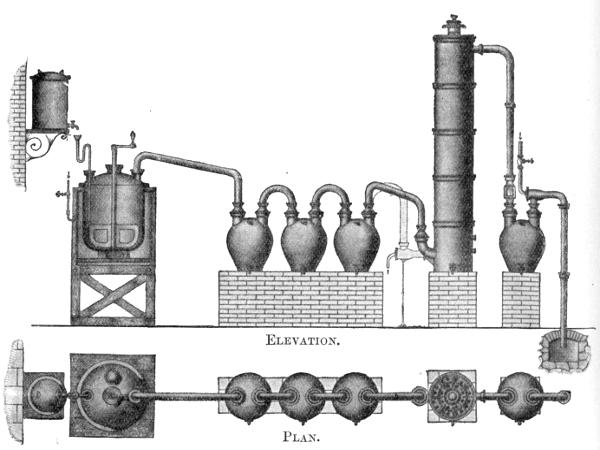
Fig. 25.—Preparation of Intermediate Products in the Aniline Colour Industry
(Closed Apparatus), showing Arrangement for Condensation (after Leymann)
On standing the fluid separates into two layers: the lower
consists of dilute sulphuric acid in which there is still some
nitric acid, and the upper of nitrobenzene. The latter is freed
of remains of acid by washing and of water by distillation.
Toluene and xylene are nitrated in the same way. Dinitro
products (such as metadinitrobenzene) are obtained by further
action of the nitro-sulphuric acid mixture on the mononitro-compound
at higher temperature.
For conversion of phenol into picric acid (trinitrophenol)
the use of a nitro-sulphuric acid mixture is necessary.
The aromatic bases (aniline, toluidine, xylidine) are obtained
by reduction of the corresponding nitro-compound by means
of iron filings and acid (hydrochloric, sulphuric, or acetic).
Thus in the case of aniline pure nitrobenzene is decomposed
in an iron cylindrical apparatus, provided with agitators and
a condenser, and avoidance of a too violent reaction, by means
of fine iron filings and about 5 per cent. hydrochloric acid.
After completion of the reaction the contents are rendered
alkaline by addition of lime and the aniline distilled over.
Manufacture of toluidine and xylidine is analogous.
Dimethylaniline is obtained by heating aniline, aniline
hydrochloride, and methyl alcohol.
Diethylaniline is prepared in an analogous way with the
use of ethyl alcohol.
By the action of nitrous acid (sodium nitrite and hydrochloric
acid) on the acid solution of the last-named compound
the nitroso compounds are formed.
Sulphonic acids arise by the action of concentrated or fuming
sulphuric acid on the corresponding bodies of the aromatic
series: benzene disulphonic acid from benzene and fuming
sulphuric acid, &c.
Phenols and cresols are obtained pure from tar distillation.
The remaining hydroxyl derivatives (resorcin, α- and β-naphthol,
&c.), are generally obtained by the action of concentrated
caustic soda on aromatic sulphonic acids.
The most important aromatic aldehyde, benzaldehyde,
is obtained from toluene; on introducing chlorine at boiling
temperature benzyl chloride is first formed, then benzal-chloride
and finally benzo-trichloride. In heating benzal-chloride
with milk of lime (under pressure) benzaldehyde is
formed (C₆H₅COH).
Picric acid and naphthol yellow belong to the nitro dyestuffs;
the last named is obtained by sulphonating α-naphthol with
fuming sulphuric acid and by the action of nitric acid on
the sulphonated mixture.
Nitroso derivatives of aromatic phenols yield (with metal
oxides) the material for production of nitroso dyestuffs. To
these belong naphthol green, &c.
The most important azo dyestuffs technically are produced
in principle by the action of nitrous acid on the aromatic
amines. The amido compound is converted into the diazo
salt by treatment with sodium nitrite in acid solution. Thus
diazo-benzene is made from aniline. Diazo compounds are
not usually isolated but immediately coupled with other
suitable compounds—amido derivatives, phenols—i.e. converted
into azo compounds.
Fig. 26.—Nitrating Plant (after Leymann)
- I Nitric acid
- II Balance
- III Storage tank
- IV Nitrating pan
- V Waste acid tank
- VI Acid egg
- VII Hydrocarbon
- VIII Balance
- IX Storage tank
- X Washing vessel
- XI Centrifugal machine
- XII Egg
- - - - Exhaust ventilation pipe.
The combination of the two constituents takes place at
once and quantitatively. The colour is separated from the
aqueous solution by salting-out, and is then put through a
filter press. The reactions are carried out generally in wooden
vats arranged in stages. Besides a second, a third constituent
can be introduced, and in this way naphthol—and naphthylamine
sulphonic acids yield a large number of colouring matters.
A very large number of azo dyestuffs can thus be produced
by the variation of the first component (the primary base)
with the second and again with the third component, but it
would carry us too far to deal further with their preparation.
Anthracene colours—yielding so-called direct dyes—are prepared
from anthracene, which is converted into anthraquinone
by the action of bichromate and dilute sulphuric acid when
heated; the crude ‘quinone’ is purified with concentrated
sulphuric acid and converted into anthraquinone monosulphonic
acid to serve in the preparation of alizarin, which is made from
it by heating for several days with concentrated caustic soda
to which sodium chlorate is added. The process is carried on
in cast-iron pans provided with agitators.
Alizarin is the starting-point for the alizarin dyes, but of
their production we will not speak further, as they, and indeed
most of the coal-tar dyes, are non-poisonous.
Indigo to-day is generally obtained by synthesis. It
is prepared from phenylglycine or phenylglycine ortho-carboxylic
acid, which on heating with sodamide becomes
converted into indoxyl or indoxyl carboxylic acid. These in
presence of an alkali in watery solution and exposure to the
oxygen of the air immediately form indigo. The necessary
glycine derivatives are obtained by the action of monochloracetic
acid on aniline or anthranilic acid, which again are derived
from naphthalene (by oxidation to phthalic acid and treatment
of phthalimide with bleaching powder and soda
liquor).
Fuchsin belongs to the group of triphenylmethane dyestuffs,
with the production of which the epoch of coal-tar colour
manufacture began, from the observation that impure aniline
on oxidation gave a red colour. The original method of
manufacture with arsenic acid is practically given up in
consequence of the unpleasant effects which use and recovery
of large quantities of arsenic acid gave rise to. The method
consisted in heating a mixture of aniline and toluidine with
a solution of arsenic acid under agitation in cast-iron cylinders.
The cooled and solidified mass from the retorts was boiled,
and from the hot solution, after filtration, the raw fuchsin was
precipitated with salt and purified by crystallisation.
Now by the usual nitrobenzene process, aniline, toluidine,
nitrobenzene, and nitrotoluene are heated with admixture of
hydrochloric acid and some iron protochloride or zinc chloride.
Further treatment resembles the arsenic process.
By alkylation, i.e. substitution of several hydrogen atoms of
the amido-groups by ethyl, &c., through the action of alkyl
halogens and others, it was found possible to convert fuchsin
into other triphenylmethane colours. But it was soon found
simpler to transfer already alkylated amines into the colours in
question. Thus, for example, to prepare methyl violet dimethyl
aniline was heated for a long time with salt, copper chloride,
and phenol containing cresol in iron mixing drums. The
product is freed from salt and phenol by water and calcium
hydrate, subsequently treated with sulphuretted hydrogen
or sodium sulphide, and the colour separated from copper
sulphide by dissolving in dilute acid.
Mention must be made, finally, of the sulphur dyes obtained
by heating organic compounds with sulphur or sodium
sulphide. For the purpose derivatives of diphenylamine, nitro- and
amido-phenols, &c., serve as the starting-point.
Effects on Health.—From what has been said of the
manufacture of coal-tar dyes it is evident that poisoning
can arise from the initial substances used (benzene, toluene,
&c.), from the elements or compounds employed in carrying
out the reactions (such as chlorine, nitric acid, sulphuric acid,
arsenious acid, sodium sulphide, and sulphuretted hydrogen
gas), from the intermediate bodies formed (nitro and amido
compounds, such as nitrobenzene, dinitrobenzene, aniline,
&c.), and that, finally, the end products (the dyes themselves)
can act as poisons. It has already been said that most of
the dyes are quite harmless unless contaminated with the
poisonous substances used in their manufacture.
We have seen that many of the raw substances used in the
manufacture of coal-tar dyes are poisonous, and we shall learn
that several of the intermediate products (especially the nitro
and amido compounds) are so also.
According to Grandhomme,1 of the raw materials benzene
is the one responsible for most poisoning. He describes two
fatal cases of benzene poisoning. In one case the worker was
employed for a short time in a room charged with benzene
fumes, dashed suddenly out of it, and died shortly after. In
the other, the workman was employed cleaning out a vessel in
which lixiviation with benzene had taken place. Although
the vessel had been steamed and properly cooled, so much
benzene fume came off in emptying the residue as to overcome
the workman and cause death in a short time.
Grandhomme describes no injurious effect from naphthalene
nor, indeed, from anthracene, which he considered was without
effect on the workers.
Similarly, his report as to nitrobenzene was favourable.
No reported case of poisoning occurred among twenty-one men
employed, in some of whom duration of employment was from
ten to twenty years. Aniline poisoning, however, was frequent
among them. In the three years there was a total of forty-two
cases of anilism, involving 193 sick days—an average
of fourteen cases a year and sixty-four sick days. None
was fatal and some were quite transient attacks.
In the fuchsin department no cases occurred, and any evil
effects in the manufacture were attributable to arsenic in the
now obsolete arsenic process. Nor was poisoning observed in
the preparation of the dyes in the remaining departments—blues,
dahlias, greens, resorcin, or eosin. In the manufacture
of methylene blue Grandhomme points out the possibility of
evolution of arseniuretted hydrogen gas from use of hydrochloric
acid and zinc containing arsenic. Poisoning was
absent also in the departments where alizarine colours and
pharmaceutical preparations were made.
Among the 2500-2700 workers Grandhomme records
122 cases of industrial sickness in the three years 1893-5,
involving 724 sick days. In addition to forty-two cases of
anilism there were seventy-six cases of lead poisoning with 533
sick days. Most of these were not lead burners, but workers
newly employed in the nitrating department who neglected
the prescribed precautionary measures. Lastly, he mentions
the occurrence of chrome ulceration.
The frequency of sickness in the Höchst factory in each of
the years 1893-5 was remarkably high: 126 per cent., 91 per
cent., and 95 per cent. Much less was the morbidity in the
years 1899-1906—about 66 per cent.—recorded by Leymann2 —probably
the same Höchst factory with 2000 to 2200
employed. And the cases of industrial poisoning also
were less. He cites only twenty-one in the whole of the
period 1899-1906. Of these twelve were due to aniline,
involving thirty sick days, only five to lead poisoning, with
fifty-four sick days, one to chrome ulceration, one to
arseniuretted hydrogen gas (nine sick days), and one
fatal case each from sulphuretted hydrogen gas and from
dimethyl sulphate. In 1899, of three slight cases of aniline
poisoning one was attributable to paranitraniline (inhalation
of dust), and the two others to spurting of aniline oil on
to the clothing, which was not at once changed. Of the
four cases in 1900, one was a plumber repairing pipes
conveying aniline and the others persons whose clothes had
been splashed.
In 1903 a worker employed for eleven and a half years in
the aniline department died of cancer of the bladder. Such
cancerous tumours have for some years been not infrequently
observed in aniline workers, and operations for their removal
performed. Leymann thinks it very probable that the
affection is set up, or its origin favoured, by aniline. This
view must be accepted, and the disease regarded as of industrial
origin. Three slight cases in 1904 and 1905 were due partly to
contamination of clothing and partly to inhalation of fumes.
Of the five cases of lead poisoning three were referable to
previous lead employment. Perforation of the septum of the
nose by bichromate dust was reported once only. A fatal
case from sulphuretted hydrogen gas and a case of poisoning
by arseniuretted hydrogen gas occurred in 1906, but their
origin could not be traced.
In large modern aniline dye factories, therefore, the health
of the workers is, on the whole, good and industrial poisoning
rare. Comparison of the two sets of statistics show that
improvement in health has followed on improved methods of
manufacture. Such cases of aniline poisoning as are reported
are usually slight, and often accounted for by carelessness on
the part of the workers.
Data as to the health of workers in factories manufacturing
or using nitro compounds are given in the English factory
inspectors’ reports for 1905. Even with fortnightly medical
examination in them, more than half the workers showed
signs of anæmia and slight cyanosis. Two men in a factory
employing twelve men in the manufacture of nitro compounds
were treated in hospital for cyanosis, distress of breathing,
and general weakness. One had only worked in the factory
for nine days. In another badly ventilated factory, of
twenty persons examined fourteen showed bluish-grey coloration
of the lips and face, ten were distinctly anæmic, and six
showed tremor and weakness of grasp.
Nitrobenzene poisoning arises from the fumes present in
aniline and roburite factories. Acute and chronic poisoning
by nitro compounds of the benzene series are described,
brought about by accident (fracture of transport vessels)
and by carelessness (splashing on to clothes). Cases of
optic neuritis (inflammation of the optic nerve) as a result
of chronic nitrobenzene poisoning are described.
Dinitrobenzene and other nitro and dinitro compounds
are present in safety explosives. Thus roburite and bellite
consist of metadinitrobenzene and ammonium nitrate;
ammonite of nitronaphthalene and ammonium nitrate;
securite of the materials in roburite with ammonium oxalate
in addition. In roburite there may be also chlorinated nitro
compounds.
Leymann,3 describing accidents in the preparation of nitrophenol
and nitrochloro compounds, mentions four fatal cases
occurring in the manufacture of black dyes from mono- and
di-nitrophenols as well as mono- and di-nitrochlorobenzene and
toluene. In three of the cases dinitrophenol was the compound
at fault owing to insufficient care in the preparation,—the
result of ignorance until then of risk of poisoning from
mono- and tri-nitrophenol. One of the men had had to empty a
washing trough containing moist dinitrophenol. He suddenly
became collapsed, with pain in the chest, vomiting, fever, and
convulsions, and died within five hours. Another suffered from
great difficulty of breathing, fever, rapid pulse, dilatation of
the pupils, and died within a few hours in convulsions. Two
further cases of nitrochlorobenzene poisoning are referred to,
one of which was fatal. Four chlorobenzene workers after a
bout of drinking were found unconscious in the street, and
only recovered after eight to ten hours in hospital. The
symptoms were grey-blue colour of the skin, pallor of mucous
membranes, lips, nose, and conjunctivæ, and peculiar chocolate-coloured
blood.
Many cases of poisoning from roburite are recorded.4 In
the Witten roburite factory it is stated that during the years
1890-7 almost all the workers had been ill.5 Only three
looked healthy—all the others suffered from more or less
pallor, blue lips, and yellowish conjunctivæ.
A case of chlorobenzene poisoning was reported with
symptoms of headache, cyanosis, fainting attacks, difficulty
of breathing, &c., in a man who had worked only three weeks
with the substance.6
In the nitrotoluene department of an explosives factory
a number of the workmen suffered from symptoms of distress
in breathing, headache, &c., of whom two, employed only a
short time, died. The poisoning was attributed, partly to
nitrotoluene and partly to nitrous fumes. As a contributing
cause it was alleged that in view of shortage of hands unsuitable
persons were engaged who neglected precautions.7
Nitronaphthalene is said to cause inflammation and
opacity of the cornea,8 attributable either to long-continued
exposure (four to eight months) to nitronaphthalene vapour
or to spurting of the liquid into the eye.
I could not find reference in literature to actual cases of
poisoning by picric acid. They are referred to in a general
way only as causing skin affections.
Aniline poisoning arises generally from inhalation, but
absorption through the skin and less frequently inhalation of
dust of aniline compounds cause it. We have already laid
stress on the frequently severe cases resulting from carelessness
in spilling on to or splashing of, clothes without at once
changing them, breaking of vessels containing it, and entering
vessels filled with the vapour. In literature of old date many
such cases have been described, and it was stated that
workers were especially affected on hot days, when almost
all showed cyanosis. Such observations do not state fairly
the conditions to-day in view of the improvements which
Grandhomme and Leymann’s observations show have taken
place in aniline factories. Still, cases are fairly frequent.
Thus in a factory with 251 persons employed, thirty-three
cases involving 500 days of sickness were reported.
The Report of the Union of Chemical Industry for 1907
cites the case of a worker who was tightening up the leaky
wooden bung of a vessel containing aniline at a temperature of
200° C. He was splashed on the face and arms, and although
the burns were not in themselves severe he died the next day
from aniline absorption.
Cases of anilism are not infrequent among dyers. The
reports of the Swiss factory inspectors for 1905 describe a
case where a workman worked for five hours in clothes on to
which aniline had spurted when opening an iron drum. Similar
cases are described in the report of the English factory
inspectors for the same year. Aniline black dyeing frequently
gives rise to poisoning, and to this Dearden9 of Manchester
especially has called attention.
Typical aniline poisoning occurred in Bohemia in 1908
in a cloth presser working with black dyes. While crushing
aniline hydrochloride with one hand, he ate his food with the
other. That the health of persons employed in aniline black
dyeing must be affected by their work is shown by medical
examination. For instance, the English medical inspector of
factories in the summer months of 1905 found among sixty
persons employed in mixing, preparing, and ageing 47 per cent.
with greyish coloration of lips and 57 per cent. characteristically
anæmic. Further, of eighty-two persons employed in padding,
washing, and drying, 34 per cent. had grey lips, 20 per cent.
were anæmic, and 14 per cent. with signs of acute or old effects
of chrome ulceration. Gastric symptoms were not infrequently
complained of. The symptoms were worse in hot
weather.
Use of aniline in other industries may lead to poisoning.
Thus in the extraction of foreign resins with aniline seventeen
workers suffered (eleven severely). Interesting cases of
poisoning in a laundry from use of a writing ink containing
aniline have been recorded.10
Reference is necessary to tumours of the bladder observed
in aniline workers. The first observations on the subject were
made by Rehn of Frankfurt, who operated in three cases.
Bachfeld of Offenbach noticed in sixty-three cases of aniline
poisoning bladder affections in sixteen. Seyberth described
five cases of tumours of the bladder in workers with long
duration of employment in aniline factories.11 In the Höchst
factory (and credit is due to the management for the step)
every suspicious case is examined with the cystoscope. In
1904 this firm collected information from eighteen aniline
factories which brought to light thirty-eight cases, of which
eighteen ended fatally. Seventeen were operated on, and of
these eleven were still alive although in three there had been
recurrence.
Tumours were found mostly in persons employed with
aniline, naphthylamine, and their homologues, but seven
were in men employed with benzidine.
Cases of benzene and toluidine poisoning in persons
superintending tanks and stills have been described.
Industrial paranitraniline poisoning has been described, and
a fatal case in the Höchst dye works was attributed by Lewin
(as medical referee) to inhalation of dust. Before his death
the workman had been engaged for five hours in hydro-extracting
paranitraniline.
Paraphenylene diamine leads not unfrequently to industrial
poisoning from use of ursol as a dye. It produces skin eruptions
and inflammation of the mucous membrane of the
respiratory passages.12 No doubt the intermediate body
produced (diimine) acts as a powerful poison.
A case of metaphenylene diamine poisoning is quoted
in the Report of the Union of Chemical Industry for 1906.
A worker had brought his coffee and bread, contrary to the
rules, into the workroom and hidden them under a vessel containing
the substance. Immediately after drinking his coffee
he was seized with poisoning symptoms, and died a few days
later. Some of the poison must have dropped into his coffee.
Few instances of poisoning from pure aniline colours are
recorded.
At first all tar colours were looked upon as poisonous, but
as they were mostly triphenylmethane colours they would
contain arsenious acid. When the arsenic process was given
up people fell into the other extreme of regarding not only
the triphenylmethane colours but all others as non-poisonous,
until experience showed that production and use of some of
the tar colours might affect the skin.
Finally, mention must be made of inflammation of the
cornea caused by methyl violet dust. The basic aniline
dyes are said to damage the eye. As opposed to this view is
the fact that methyl violet and auramine are used as anti-bactericidal
agents, for treatment of malignant tumours, and
especially in ophthalmic practice.
OCCURRENCE OF INDUSTRIAL LEAD POISONING IN GENERAL
Chronic lead poisoning plays the most important rôle in
industrial metallic poisoning, and indeed in industrial poisoning
generally. The result everywhere where inquiry into industrial
poisoning has been instituted has been to place the number
of cases of lead poisoning at the top of the list; for one case
of other forms of industrial poisoning there are twenty of
lead.
In the last few years a very extensive literature and one
not easily to be surveyed has grown up on the subject of
chronic industrial lead poisoning. I cannot attempt as I have
done with other forms of poisoning to do justice to all sources
of literature on this subject.
As there is no obligation to notify industrial lead
poisoning[B]—or indeed any form of industrial poisoning—in
many countries, the most important source of information
is wanting. Nevertheless more or less comprehensive
inquiries as to the extent of the disease in general have been
made in different countries and large cities which furnish
valuable data.
An idea of the yearly number of cases of lead poisoning
occurring in Prussia is given in the following statistics of cases
treated in Prussian hospitals for the years 1895-1901:
| Year. |
Males. |
Females. |
Total. |
| 1895 |
1120 |
43 |
1163 |
| 1899 |
1601 |
23 |
1624 |
| 1900 |
1509 |
14 |
1523 |
| 1901 |
1359 |
24 |
1383 |
The occupation of these cases was as follows:
| Year. |
Metallic Lead. |
White Lead. |
Painters. |
| 1895 |
364 |
312 |
347 |
| 1899 |
551 |
310 |
460 |
| 1900 |
516 |
360 |
378 |
| 1901 |
498 |
282 |
339 |
About half the cases, therefore, are caused by use of white
lead. The report of the sick insurance societies of the Berlin
painters gives information as to the proportion treated in
hospital to those treated at home, which was as 1:4.
The industries may be classified according to risk as
follows1 :
White lead workers, 33 per cent.; red lead workers, 32 per
cent.; shot and lead pipe workers, 20 per cent.; painters,
7-10 per cent.; lead and zinc smelters, 8-9 per cent.; printers,
0·5 per cent.
In Austria through the Labour Statistical Bureau comprehensive
information is being collected as to the occurrence of
lead poisoning in the most dangerous trades, but is not yet
published. The reports of the factory inspectors give a very
incomplete picture; for example, in 1905 only fifteen cases are
referred to. In the most recent report (1909) information of
lead poisoning is only given for thirty works. Teleky has
made a general survey of the occurrence of lead poisoning
from the reports of the Austrian sick insurance societies.2
From this we gather that in Vienna, with an average
membership of 200,000, there were, in the five year period
1902-6, 634, 656, 765, 718, 772 cases of illness involving
incapacity from mineral poisons, which Teleky assumes were
practically all cases of lead poisoning. By circularising
Austrian sick insurance societies outside Vienna with a
membership of about 400,000, Teleky obtained information
of 189 cases, which he considers too few.
In 1906-1908 inquiry was made by the sick insurance
societies in Bohemia as to the extent of lead poisoning. With
an average number employed of from 700,000 to 850,000 information
was obtained of 91, 147, and 132 cases in the three years
in question. The increase in 1907 was probably accounted for
by the greater attention paid to the subject.3 The number of
ascertained cases of lead poisoning treated by the societies
of Hungary was 225 in 1901 and 161 in 1902. Teleky again
considers these figures too low, which is proved by Toth’s
publications as to lead poisoning in Hungarian lead smelting
works, and especially Chyzer’s on lead poisoning among
Hungarian potters. Legge has reported fully in the second
International Congress for Industrial Diseases in Brussels
(September 1910) on occurrence of industrial lead poisoning in
Great Britain in the years 1900 to 1909. During that period
6762 cases with 245 deaths occurred. The number of cases in
the course of the ten years had diminished by 50 per cent.
These figures appear remarkably small, but it has to be borne
in mind that the statistics referred to related only to cases
occurring in factories and workshops, and do not include cases
among house painters and plumbers. The number of such
cases which came to the knowledge of the Factory Department
in 1909 was 241 (with 47 deaths) and 239 in 1908 (with
44 deaths).
LEAD, SILVER, AND ZINC SMELTING
Lead is obtained almost entirely from galena by three
different processes. In the roast and reaction process galena
is first roasted at 500°-600° C. and partially converted into
lead oxide and lead sulphate: on shutting off the air supply
and increase of temperature the sulphur of the undecomposed
galena unites with the oxygen of the lead oxide and sulphate to
form sulphur dioxide, while the reduced metallic lead is tapped.
In the roast and reduction process the ore is completely calcined
so as to get rid of sulphur, arsenic, and antimony. The oxides
(and sulphates) formed are reduced by means of coke in a blast
furnace. This process is generally applicable and is, therefore,
that most in use. The precipitation process consists chiefly in
melting galena with coke and iron flux, whereby the lead is
partly freed from the sulphur, and, in addition to lead, iron
sulphide is formed, which acts on the remaining lead sulphide,
producing a lead matte which can be further treated.
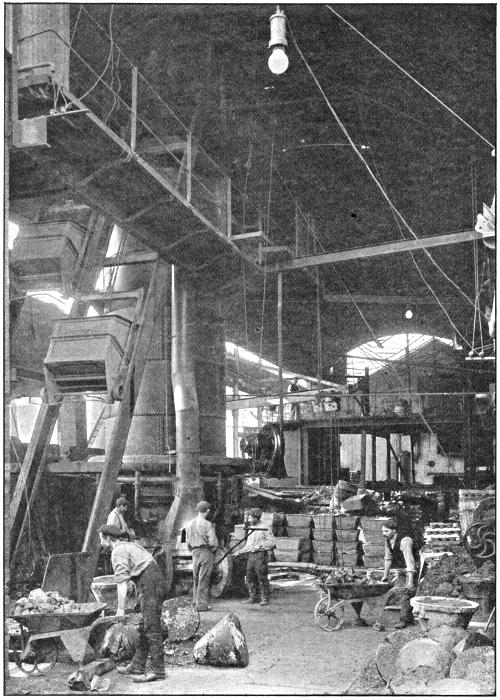
Fig. 27.—Smelting Furnace, showing mechanical charging and exhaust ventilation
applied to slag runs, &c. (Locke, Lancaster & W. W. & R. Johnson &
Sons, Ltd. By permission of the Controller of H.M. Stationery Office.)
The roast and reaction process is carried out in specially
constructed reverberatory furnaces; small furnaces with small
amounts of ore and at as low a temperature as possible are the
rule in the Kärntner process. In the English process large
amounts of ore are melted in large furnaces at high temperatures
so as to oxidise the material. The so-called Tarnowitz process
combines these two—large amounts of ore are roasted in
large furnaces at a moderate temperature. In the roast and
reduction process it depends on the nature of the ore whether
the roasting is done in reverberatory or blast furnaces.
Generally the ore is in the form of powder—less often in pieces.
Pyritic ore (ore with much sulphur) is almost always roasted in
blast furnaces, and the sulphur dioxide evolved can be used in
the manufacture of sulphuric acid. Open-hearth furnaces are
rarely used now. Reverberatory furnaces are employed most
frequently.
The lead thus obtained contains several other metals,
especially silver, copper, arsenic, antimony, iron, zinc, bismuth,
and tin. Lead containing silver (work-lead) is next de-silverised,
after which follows refining to get rid of the other impurities.
For de-silverising work-lead rich in silver (containing about
10 per cent.) cupellation is practised, in which the silver lead is
melted and oxidised so that the lead is converted into litharge,
metallic silver remaining behind. In a cupellation furnace
the flame strikes on the top of the lead bath, and at the same
time air under slight pressure is driven in; the litharge which
forms is removed through suitable openings. The litharge
that is first formed contains silver and is treated again; the
remainder is ready for market. After the litharge has run
off silver appears, containing still 5-10 per cent. of lead,
and it is again submitted to an analogous refining process.
Work-lead which does not contain enough silver to be
cupelled at once is generally treated first by either the
Pattinson or the Parkes’ process.
In the Pattinson crystallising process work-lead is melted in
open semi-circular pots: as the pots cool crystals of lead poor
in silver form on the surface and are transferred by a perforated
ladle into the next pot: the silver collects in the small amount
of molten lead remaining behind. Lead that has become
enriched by repeated crystallisation contains a high percentage
of silver and is cupelled. The Parkes’ process or zinc
de-silverisation depends on the formation of a lead-zinc alloy
which is less fusible than lead. Work-lead is melted and
agitated with addition of pure zinc. The crust which first
rises on cooling contains gold, copper, zinc, and lead, and
is removed. Further addition of zinc is then made: the
rich silver crust which separates is subsequently freed from
lead by gradual heating in a reverberatory furnace, and from
zinc, in a zinc distilling retort. Other impurities are got rid
of by oxidising in reverberatory or other furnaces. Small
quantities of antimony and arsenic are removed by stirring with
fresh green sticks.
Zinc is obtained principally from blende (sulphide of zinc)
and from calamine (carbonate of zinc). The process of zinc
recovery depends on the production of zinc oxide and reduction
of this by carbon to metallic zinc.
Conversion of the ore to zinc oxide is effected by roasting.
Since the temperature at which reduction takes place is higher
than the melting-point of zinc the latter is volatilised (distilled)
and must be condensed in suitable condensers.
Calamine is calcined in a blast furnace. Blende was
formerly roasted in reverberatory furnaces, but such nuisance
arose to the neighbourhood from sulphur dioxide vapour
that now Hasenclever-Helbig calcining furnaces are used.
These furnaces furnish a gas so rich in sulphur dioxide that
they serve at once for the production of sulphuric acid. The
Hasenclever furnaces consist of muffles placed one above
another: the finely ground ore is charged through hoppers
above and then raked down from muffle to muffle.
Reduction is carried out in the Belgian or Silesian process
by strongly heating calcined matte with coal in retorts. The
zinc as it distils is caught in special condensing receptacles
(prolongs). After distillation is complete the residue is raked
out of the muffle and the furnace charged afresh. As zinc ores
generally contain much lead, the work-zinc is therefore refined
by remelting in a reverberatory furnace, during which process
the impurities collect on the zinc as dross and are removed by
agitation with sal-ammoniac or magnesium chloride.
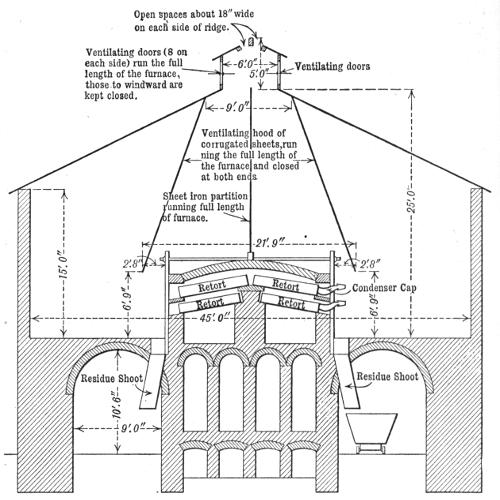
Fig. 28.—Arrangement of Spelter Furnace showing Ventilating Hood.
Risk of Poisoning in Lead, Silver, and Zinc Smelting.—As
the description of the manipulations in smelting
processes shows, all involve risk of lead poisoning. As a matter
of fact in lead smelting much lead passes into the atmosphere.
In the smelting works at Tarnowitz yearly some 36,000 kilos
of oxidised lead escape.
Estimations4 of the amount of lead in air samples collected
in lead smelting works have been made. Thus in a cubic
metre of air immediately over the slag run from 0·0029 to
0·0056 g. of lead were found, so that a worker in a ten-hour
day would inhale from 0·013 to 0·025 g. of lead. In a
cubic metre of air immediately above the Parkes’ melting-pot
from 0·0056 to 0·0090 g. were found, so that a worker would
inhale daily from 0·0252 to 0·0405 g. if he kept constantly
close to the pot. On the handles of a de-silveriser 0·112 g.
were found. In Hungarian lead-smelting works the water in
which the hands had been washed was found to contain
1·27 g. of lead per litre. The hands of litharge grinders
and sifters showed the highest amounts.
Work carried on in lead-smelting works may be divided
into five classes according to risk. Those most exposed to risk
are the smelters at lead hearths and reverberatory furnaces,
persons employed at the lead and slag runs, flue cleaners, and
in crushing and packing flake litharge. Next come those
employed at the refining furnaces, those breaking up the
roasted ore, blast furnace workers, and those employed at the
cupellation process. Attended with danger also is the removal
of lead ashes and distillation of the zinc crust. Less dangerous
are transport of material, crushing and mixing the ore, refining
the work-lead and zinc crust, and work at the Pattinson
and Parkes’ processes.
In zinc smelting risk of lead poisoning is great, no matter
which process is in question, because of the high proportion of
lead in the ore and work-zinc. Swedish blende contains as
much as 9 per cent. of lead, and Upper Silesian 2½ per cent. or
less. There is risk in calcination, but it is much less than in
the distillation process.5
There are no quite satisfactory statistics as to the number
of cases of lead poisoning in smelting works. Nevertheless,
a number of recent publications give valuable
data for certain smelting works in Germany, Austria, and
Hungary.
From details6 of lead poisoning at Tarnowitz it would
appear that the conditions have materially improved since
1884, the cases having declined from 32·7 per 100 employed in
1884 to 6·2 in 1894 and 1895. The following figures show the
proportion affected in the different processes in the years 1901
and 1902:
| Process. |
Year. |
No. Employed. |
Cases. |
Per Cent. |
| Reverberatory Furnace |
{ |
1901 |
131 |
11 |
8·3 |
| { |
1902 |
111 |
4 |
3·6 |
| Blast Furnace |
{ |
1901 |
152 |
47 |
30·9 |
| { |
1902 |
187 |
21 |
11·1 |
| Cupelling Furnace |
{ |
1901 |
12 |
1 |
8·3 |
| { |
1902 |
12 |
1 |
8·3 |
| De-silverising |
{ |
1901 |
32 |
10 |
31·2 |
| { |
1902 |
34 |
7 |
20·6 |
| Other Employment |
{ |
1901 |
300 |
7 |
2·3 |
| { |
1902 |
350 |
2 |
0·6 |
In one smelting works the percentage attack rate was 17·8
in 1901, and 27·1 in 1902. Here the number of workers had
increased from 73 in 1901 to 129 in 1902, and the absolute and
relative increase probably has relation to the well-known fact
that newly employed untrained workers become affected.
Similar incidence according to process can be given for the
Friedrich’s smelting works during the years 1903-1905:
| Process. |
Year. |
No. Employed. |
Cases. |
Per Cent. |
| Reverberatory Furnace |
{ |
1903 |
86 |
12 |
13·9 |
| { |
1904 |
87 |
8 |
9·2 |
| { |
1905 |
83 |
11 |
13·3 |
| Blast Furnace |
{ |
1903 |
267 |
59 |
22·1 |
| { |
1904 |
232 |
24 |
10·3 |
| { |
1905 |
247 |
27 |
10·9 |
| De-silverising |
{ |
1903 |
56 |
12 |
21·4 |
| { |
1904 |
73 |
4 |
5·5 |
| { |
1905 |
75 |
4 |
5·3 |
| Cupelling |
{ |
1903 |
16 |
4 |
25·0 |
| { |
1904 |
15 |
1 |
6·7 |
| { |
1905 |
14 |
1 |
7·1 |
| Other Employment |
{ |
1903 |
330 |
5 |
1·5 |
| { |
1904 |
309 |
4 |
1·3 |
| { |
1905 |
347 |
7 |
2·0 |
Among 3028 cases of lead poisoning treated between 1853
and 1882 in smelting works near Freiberg (Saxony) gastric
symptoms were present in 1541, rheumatic pains in 215,
cerebral symptoms in 144, paralysis in 58, and lead colic in 426.
The recent reports of the German factory inspectors
point still to rather high incidence in many lead smelting
works. Thus in the district of Aix la Chapelle in 1909 there
were sixty cases involving 1047 sick days, as compared with
58 and 878 in 1908.
In a well-arranged smelting works near Wiesbaden fifty-two
and forty-two cases were reported in 1908 and 1909 respectively,
among about 400 persons employed. This relatively high
number was believed to be closely connected with frequent
change in the personnel. Introduction of the Huntingdon-Heberlein
method is thought to have exercised an unfavourable
influence.
Other smelting works in Germany appear to have a relatively
small number of reported cases. Thus in 1909 among
550 workers employed in four smelting works in the Hildesheim
district only four cases were reported, and in the district of
Potsdam among 600 smelters only five were found affected on
medical examination. There is no doubt that many of the
cases described as gastric catarrh are attributable to lead.
Full information as to the conditions in Austria is contained
in the publication of the Imperial Labour Statistical Bureau.
In this comprehensive work the conditions in smelting works
are described. In the lead smelting works at Przibram the
cases had dropped from an average of 38·2 among the 4000-5000
persons employed to twenty-two in 1894 and to six in
1903, but only the severer cases are included. No single case
has occurred among the 350-450 persons engaged in mining
the ore, as galena (lead sulphide) is practically non-poisonous.
It was found, for example, that 50 per cent. of the furnace men
had (according to their statement) suffered from lead colic.
Of eight employed in the Pattinson process, seven stated they
had suffered from colic. The lead smelting works in Gailitz
showed marked frequency of lead poisoning—here the appointed
surgeon attributed anæmia and gastric and intestinal catarrh
to lead:
| Year. |
No. Employed. |
Lead Colic. |
Illness of Saturnine Origin. |
Total Lead Sickness. |
Total Sickness. |
Per Cent. due to Lead. |
| Anæmia. |
Gastric Catarrh. |
Intestinal Catarrh. |
| 1899 |
61 |
14 |
2 |
76 |
16 |
108 |
178 |
60·0 |
| 1900 |
57 |
6 |
2 |
16 |
5 |
29 |
80 |
36·2 |
| 1901 |
48 |
4 |
2 |
17 |
1 |
24 |
60 |
40·0 |
| 1902 |
47 |
— |
— |
24 |
6 |
30 |
56 |
53·5 |
| 1903 |
49 |
— |
3 |
11 |
4 |
18 |
57 |
31·6 |
The diminution in the number of cases, especially of colic,
is attributable to the efforts of the appointed surgeon.
At Selmeczbanya a diminution from 196 cases in 1899
(50·7 per cent.) to six (2·2 per cent.) in 1905 had taken place.
These figures point clearly to the success of the hygienic
measures adopted in the last few years.
In the large spelter works of Upper Silesia during the years
1896-1901, among 3780 persons employed, there were eighty-three
cases of lead colic and paralysis, that is, about 2·2 per
cent. each year. The following tables show the incidence
among spelter workers in the works in question from 1902 to
1905:
Illness among Zinc Smelters
| Year. |
Lead Colic and Lead Paralysis. |
Kidney Disease. |
Gastric Catarrh. |
Anæmia. |
Rheumatism. |
No. Employed. |
| 1902 |
29 |
18 |
137 |
18 |
448 |
4417 |
| 1903 |
28 |
21 |
151 |
24 |
470 |
4578 |
| 1904 |
44 |
23 |
181 |
35 |
596 |
4677 |
| 1905 |
50 |
18 |
223 |
40 |
612 |
4789 |
| Average |
0·8% |
0·5% |
3·7% |
0·6% |
11·5% |
4615 |
Illness among Calciners
| Year. |
Lead Colic and Lead Paralysis. |
Kidney Disease. |
Gastric Catarrh. |
Anæmia. |
Rheumatism. |
No. Employed. |
| 1902 |
— |
— |
5 |
1 |
78 |
1149 |
| 1903 |
— |
— |
9 |
— |
112 |
1087 |
| 1904 |
2 |
— |
68 |
1 |
136 |
1140 |
| 1905 |
1 |
2 |
47 |
2 |
134 |
1159 |
| Average |
0·08% |
0·05% |
2·6% |
0·1% |
10·2% |
1134 |
In thirty-two spelter works in the district of Oppeln in the
year 1905, among 4789 spelter workers proper, there were
50 cases of colic, 18 of kidney disease, 223 of gastric and
intestinal catarrh, 40 of anæmia, and 612 of rheumatism, and
among 1159 calciners 1 case of colic, 2 of kidney disease,
47 of gastric catarrh, 2 of anæmia, and 134 of rheumatism.
Cases are much more numerous in spelter works where
Swedish blende containing lead is worked. It is remarkable,
however, that in large spelter works in Upper Silesia, where
for years no cases of lead poisoning were reported, medical
examination showed that 20·5 per cent. had signs of lead
absorption.
White Lead and Lead Colours
Manufacture.—The primitive Dutch process consisted in
placing lead grids in earthenware pots containing dilute
acetic acid and covering them with tan bark. Fermentation
ensued with evolution of carbonic acid gas and increase in
temperature. The acetic acid vapour forms, with aid of
atmospheric oxygen, first basic lead acetate, which, by the
action of the carbonic acid gas, becomes converted into white
lead and neutral lead acetate. The product is crushed, sieved,
and dried. In the German or Austrian process thin sheets of
metallic lead are hung saddle-wise in chambers. Acetic acid
vapour and carbonic acid gas (produced by burning coke)
are led in from below. The chamber is then sealed and kept
so for a considerable time. When the chamber is ‘ripe’ the
white lead that has formed is taken out, freed from uncorroded
lead by spraying, dried, finely ground, and packed. White
lead comes on the market either as a powder or incorporated
with oil. Of the remaining lead colours, red lead (Pb₃O₄) is
much used. It is produced by heating lead oxide in reverberatory
furnaces with access of air and stirring.
Lead Poisoning in the Manufacture of White Lead and
Lead Colours
The manufacture by the German process may be divided
into three categories according to the degree of risk run:
1. The most dangerous processes are hanging the plates
in the chambers, work at the filter press, drying, pulverising,
and packing by hand.
2. Less dangerous are transport to the washer, washing, and
grinding.
3. Relatively the least dangerous are casting the plates,
transport of them to the chambers, drying, mechanical packing,
and mixing with oil.
The number of cases of lead poisoning in white lead factories
is often relatively great despite regulations. Casual labourers
especially run the greatest risk. This is frequently brought
out in the reports of the German factory inspectors, who
connect the high proportion of cases directly with the large
number of unskilled workers. Regulations are really only
successful in factories with regular employment.
This has been found also in Great Britain, where the Medical
Inspector of Factories showed that the cases among regular
workers numbered 6 per cent. and among casual workers
39 per cent.
The following table gives particulars as to the occurrence of
lead poisoning in the white lead factories in the district of
Cologne in 1904, some of which have admirable hygienic
arrangements:
| Place. |
Manufacture. |
No. Employed. |
Cases of Lead Poisoning. |
No. of Cases of Gastric Catarrh. |
| Regular |
Casual |
Average |
Regular |
Casual |
Total |
| Cologne I. |
White lead |
{ |
46 |
59 |
32 |
9 |
16 |
25 |
16 |
| { |
173 |
95 |
127 |
13 |
17 |
30 |
22 |
| ” I. |
Litharge and red lead |
{ |
46 |
4 |
38 |
5 |
1 |
6 |
7 |
| { |
76 |
62 |
49 |
3 |
4 |
7 |
15 |
|
Chromate |
{ |
14 |
2 |
11 |
— |
— |
— |
5 |
| { |
43 |
72 |
33 |
— |
— |
— |
7 |
| Cologne II. |
White lead, litharge, and red lead |
{ |
107 |
332 |
91 |
6 |
34 |
40 |
30 |
| { |
102 |
332 |
76 |
9 |
19 |
28 |
38 |
It is worth noting that cases of lead poisoning have been
reported in the manufacture of zinc white, as, for example, in
Bohemia in 1907 and 1908.
USE OF LEAD COLOURS AND PAINTS (HOUSE PAINTERS,
DECORATORS, ETC.)
Use of lead colours, especially by painters and decorators,
causes relatively much lead poisoning. Apart from ignorance
of danger on the part of the worker, and lack of personal
cleanliness, unsuitable methods of working add to the danger,
especially dry rubbing of painted surfaces, which gives rise to
much dust containing lead. Again, the crushing and mixing
of lumps of white lead and rubbing lead colours with the
hand are very dangerous.
The following German and Austrian figures enable conclusions
to be drawn as to the frequency of lead poisoning among
painters. In the sick insurance societies of Frankfurt-a-M.
in 1903 of every 100 painters 11·6 suffered from an attack of
lead poisoning. The similar sick insurance society of painters
in Berlin has kept useful statistics which are given in the
following table for the ten years 1900-9:
| Year. |
No. of Members. |
No. of
Cases of
Lead Poisoning. |
Cases per
100 Members. |
| 1900 |
3889 |
357 |
9·18 |
| 1901 |
3616 |
335 |
9·26 |
| 1902 |
3815 |
308 |
8·07 |
| 1903 |
4397 |
470 |
10·69 |
| 1904 |
5029 |
516 |
10·26 |
| 1905 |
5328 |
471 |
8·84 |
| 1906 |
5355 |
347 |
6·48 |
| 1907 |
5173 |
379 |
7·32 |
| 1908 |
4992 |
298 |
5·97 |
| 1909 |
4781 |
285 |
5·96 |
| Average |
4637 |
376·6 |
8·11 |
This shows that lead poisoning among the painters of
Berlin is happily diminishing, which may be attributed to
recent regulations. The society, however, complains in its
reports that not all cases of lead appear as such in their statistics,
and believes that all diseases entered as rheumatism, gastric
catarrh, nervous complaints, heart and kidney disease, should
be regarded as associated with lead. The kinds of work in
which painters suffer most are painting iron girders and
machines, sheet metal and iron furniture, railway waggons,
agricultural implements, coach painting, cabinet-making, shipbuilding,
and the use of red and white lead. The use of
lead colours, lead acetate, and lead chromate often give rise to
lead poisoning. Colours containing lead are not infrequently
used in the textile industry in dyeing, printing, and finishing.
White lead has been used for weighting the weft.
Teleky has described cases of lead poisoning in which silk
thread was weighted with acetate of lead. As a consequence
a number of women engaged in sewing on fringes with the
thread suffered. The English factory inspectors’ reports
describe cases from manipulating yarn dyed with chromate of
lead.7
Chromate of lead and white lead are used in colouring oil-cloth,
artificial flowers, paper, rubber goods, pencils, penholders,
socks, sealing-wax, candles, and stamps.
USE OF LEAD IN THE CHEMICAL INDUSTRY
Lead poisoning has been frequently observed in such
branches of the chemical industry as require large leaden or
lead-lined vessels and pipes: the persons affected are principally
those engaged in lead burning.
Risk is considerable in manufacture of lead acetate. The
most dangerous processes are drying and packing the crystals.
The manufacture of accumulators begins with the casting
of lead plates, which are then polished and dressed. Next
follows ‘pasting,’ that is, smearing the negative plate with a
paste of litharge, the positive plate being ‘formed’ by having an
electric current passed through so that the lead is converted
into spongy peroxide. The wooden boxes in which the plates
are assembled are lead-lined.
The most dangerous processes are casting, wire-brushing,
and pasting—the latter especially when done by hand.
In the years 1908 and 1909 among about 761 workers
employed in the accumulator factories of Cologne there were
fifty-six cases of lead colic and seventy-nine of gastric and
intestinal catarrh. Further figures for German accumulator
works show that in the two largest accumulator factories in
the district of Potsdam employing 142 workers there were
fifteen cases in 1904. In Great Britain, in the ten years 1900-1909,
285 cases were reported—an average of about thirty a
year.
Risk is present in several branches of the ceramic industry.
It is greatest in glazing earthenware, but not infrequent
also in the porcelain and glass industries. It is impossible
to deal with the extensive literature on this subject exhaustively.
A comprehensive and detailed survey of lead
poisoning in the ceramic industry on the Continent is that by
Kaup. Distinction is made between leadless glazes which melt
at high temperature and lead glazes which have the advantage
of a low melting-point. Galena and litharge are used in the
preparation of glazes for common earthenware and red and
white lead for ware of better quality. Distinction has to be
made between a lead silicious glaze for pottery ware, a lead and
boric acid glaze for stoneware, and a lead and zinc oxide glaze
for ordinary faience and stoneware. Seegar, the celebrated
expert, praises the advantage of lead glaze and the use of lead
in the ceramic industry—it is indeed practically indispensable—and
speaks of the poisonous nature of lead as its only fault.
The components of the glaze must have definite relation to
the hardness or softness of the body. The higher the proportion
of silicic acid in the glaze the harder the firing it will
stand; the more the flux materials are in excess the lower will
the melting point be.
The most important flux materials are, arranged in order of
decreasing fusibility, lead oxide, baryta, potash, soda, zinc
oxide, chalk, magnesia, and clay.
The glaze is made by first mixing the ingredients dry, and
then either fritting them by fluxing in a reverberatory furnace
and finally grinding them very finely in water or using the
raw material direct. In the fritting process in the case of the
lead glazes the soluble lead compounds become converted
into less soluble lead silicates and double silicates.
The glaze is applied in different ways—dipping, pouring,
dusting, blowing, and volatilising. Air-dried and biscuited
objects are dipped; pouring the glaze on is practised in coarse
ware, roofing-tiles, &c.; dusting (with dry finely ground glaze,
litharge, or red lead) also in common ware; glaze-blowing
(aerographing) and glaze dusting on porcelain. In these
processes machines can be used. Bricks are only occasionally
glazed with glazes of felspar, kaolin, and quartz, to which lead
oxide is often added in very large quantity. Lead poisoning in
brick works in view of the infrequent use of lead is not common,
but when lead is used cases are frequent. Kaup quotes several
cases from the factory inspectors’ reports: thus in three roof-tiling
works examination by the district physician showed
that almost all the workers were affected.
Coarse ware pottery is made of pervious non-transparent
clay with earthy fracture—only a portion of this class of ware
(stoneware) is made of raw materials which fire white. Such
ware generally receives a colourless glaze. The clay is shaped
on the potter’s wheel, and is then fired once or, in the better
qualities, twice.
Grinding the ingredients of the glaze is still often done in
primitive fashion in mortars. The glaze is usually composed
of lead oxide and sand, often with addition of other lead compounds
as, for example, in quite common ware, of equal parts
of litharge, clay, and coarse sand. Sometimes, instead of
litharge, galena (lead sulphide) or, with better qualities of
ware, red lead or ‘lead ashes’ are used.
The grinding of the glazes in open mills or even in mortars
constitutes a great danger which can be prevented almost
entirely by grinding in ball mills. The glaze material is next
mixed with water, and the articles are either dipped into
the creamy mass or this is poured over them. In doing
this the hands, clothes, and floors are splashed. The more
dangerous dusting-on of glaze is rarely practised. Occasionally
mechanical appliances take the place of hand dipping. Placing
the ware in the glost oven is done without placing it first in
saggars.
In the better qualities of pottery cooking utensils, which are
fired twice, a less fusible fritted lead glaze is generally used.
Coloured glaze contains, besides the colouring metallic oxides,
30-40 per cent. of litharge or red lead.
As Kaup shows, Continental factory inspectors’ reports
make only isolated references to occurrence of lead poisoning
in potteries. Insight into the conditions in small potteries is
obtained only from the Bavarian reports. In Upper Bavaria
ninety-three potteries employ 157 persons who come into
contact with lead glaze. Eleven cases were known to have
occurred in the last four years. Teleky found thirty-six cases
of lead poisoning (mostly among glostplacers) in the records
of the Potters’ Sick Insurance Society of Vienna.
Chyzer has described the striking conditions in Hungary.
There there are about 4000 potters, of whom 500 come into
contact with lead glaze. Chronic lead poisoning is rife
among those carrying on the occupation as a home industry.
Members of the family contract the disease from the dust in
the living rooms. This dust was found to contain from
0·5 to 8·7 per cent. of lead.
In the china and earthenware factories in Great Britain, in
the ten years 1900-9, 1065 cases with fifty-seven deaths were
reported.
Manufacture of stove tiles.—The application of glaze to
stove tiles is done in different ways. The two most important
kinds are (1) fired tiles and (2) slipped tiles. In the production
of fired tiles a lead-tin alloy consisting of 100 parts lead and
30-36 parts tin—so-called ‘calcine’—are melted together in fireclay
reverberatory or muffle furnaces and raked about when at
a dull red heat so as to effect complete oxidation. The material
when cool is mixed with the same quantity of sand and
some salt, melted in the frit kiln, subsequently crushed,
ground, mixed with water, and applied to the previously fired
tiles. In this process risk is considerable. Presence of lead in
the air has been demonstrated even in well-appointed ‘calcine’
rooms. In unsuitably arranged rooms it was estimated that
in a twelve-hour day a worker would inhale 0·6 gramme of
lead oxide and that 3-8 grammes would collect on the clothes.
Slipped tiles are made in Meissen, Silesia, Bavaria, and
Austria by first applying to them a mixture of clay and china
clay. The glaze applied is very rich in lead, containing 50-60
parts of red lead or litharge. Generally the glaze is applied
direct to the unfired tiles and fired once. Figures as to occurrence
of poisoning in Germany are quoted by Kaup from the
towns of Velten and Meissen. Among from 1748 to 2500
persons employed thirty-four cases were reported in the five
years 1901-5. Thirteen cases were reported as occurring in
the three largest factories in Meissen in 1906.
From other districts similar occurrence of poisoning is
reported. In Bohemia in a single factory in 1906 there were
fourteen cases with one death, in another in 1907 there were
fourteen, and in 1908 twelve cases; eight further cases occurred
among majolica painters in 1908.
Stoneware and porcelain.—Hard stoneware on a base of
clay, limestone, and felspar has usually a transparent lead glaze
of double earth silicates of lead and alkalis, with generally boric
acid to lower the fusing-point; the lead is nearly always added
in the form of red lead or litharge. The portion of the glaze
soluble in water is fritted, and forms, when mixed with the insoluble
portion, the glaze ready for use. The frit according to
Kaup contains from 16 to 18 per cent. of red lead, and the added
material (the mill mixing) 8-26 parts of white lead; the glaze
contains from 13 to 28 parts of lead oxide. The ware is dipped
or the glaze is sometimes aerographed on. Ware-cleaning by
hand (smoothing or levelling the surface with brushes, knives,
&c.) is very dangerous work unless carried out under an
efficient exhaust. Colouring the body itself is done with
coloured metal oxides or by applying clay (slipping) or by the
direct application of colours either under or over the glaze.
Some of the under-glaze colours (by addition of chrome yellow
or nitrate of lead or red lead) contain lead and are applied
with the brush or aerograph or in the form of transfers.
Plain earthenware is either not glazed or salt glazed; only
when decorated does it sometimes receive an acid lead glaze.
Porcelain receives a leadless glaze of difficultly fusible
silicate (quartz sand, china clay, felspar). Risk is here confined
to painting with lead fluxes (enamel colours) containing
lead. These fluxes are readily fusible glasses made of
silicic acid, boric acid, lead oxide, and alkalis, and contain
much lead (60-80 per cent. of red lead).
In the glass industry lead poisoning may occur from use of
red lead as one of the essential ingredients. In Great Britain,
in the years 1900-9, forty-eight cases were reported in glass
polishing from use of putty powder.
Type metal consists of about 67 per cent. lead, 27 per cent.
antimony, and 6 per cent. tin, but sometimes of 75 per cent.
lead, 23 per cent. antimony, and 2 per cent. tin.
The actual printer comes least of all in contact with lead.
Use of lead colours (white lead, chromate of lead, &c.) may
be a source of danger, especially in the preparation of printing
inks from them and in cleaning the printing rolls. A further,
if slight, danger arises from the use of bronze powder consisting
of copper, zinc, and tin. The two last-named metals contain
from 0·1 to 0·5 per cent. of lead, and in the application and
brushing off of the bronze there is a slight risk.
The compositor is exposed to constant danger from handling
the type and disturbing the dust in the cases. This dust may
contain from 15 to 38 per cent. of lead. Blowing the dust out
of the cases with bellows is especially dangerous, and want of
cleanliness (eating and smoking in the workroom) contributes
to the risk.
Type founders and persons engaged in rubbing and preparing
the type suffer. Introduction of type-casting machines
(linotype, monotype) has lessened the danger considerably.
No lead fumes are developed, as a temperature sufficiently
high to produce them is never reached. In all the processes,
therefore, it is lead dust which has to be considered.
The following figures of the Imperial Statistical Office as
to occurrence of lead poisoning among printers in Vienna
indicate the relative danger:
| Occupation. |
Average No. of Members, 1901-1906. |
Average No. of Cases, 1901-1906. |
Percentage of Cases, 1901-1906. |
| Compositors |
3182 |
90·3 |
2·8 |
| Printers |
809 |
20·3 |
2·4 |
| Casters and Stereotypers |
241 |
15·8 |
6·6 |
| Females employed in casting |
74 |
8·17 |
10·8 |
In Bohemia there is reference to thirty-eight cases in letterpress
printing in 1907 and twenty-seven in 1908.
Among 5693 persons treated for lead poisoning between
the years 1898 and 1901 in hospitals in Prussia, 222 were letterpress
printers.
Between 1900 and 1909 in Great Britain 200 cases of lead
poisoning were reported.
The number of industries using lead is very large. Layet
as long ago as 1876 enumerated 111. We, however, limit ourselves
to those in which the risk is considerable.
Use of lead beds in file-cutting has given rise to many cases.
Further, to harden the file it is dipped into a bath of molten
lead. From 3 to 6 per cent. of lead has been found in the dust
in rooms where hardening is done.
Of 7000 persons employed in file-cutting in the German
Empire in the years 1901-5 on an average 30·5 or 0·43 per
cent. were affected yearly. In Great Britain 211 cases were
reported in the years 1900-9.
In polishing precious stones formerly many cases of lead
poisoning occurred, the reason being that the polishers come
into contact with particles of lead and fix the diamonds to be
polished in a vice composed of an alloy of lead and tin. Danger
is increased when the stones are actually polished on revolving
leaden discs. In Bohemia granite polishing used to be done in
this way, but is now replaced in many factories by carborundum
(silicon carbide).
Musical instrument making in Bohemia in the years
1906-8 was found regularly to give rise to cases of lead
poisoning from use of molten lead in filling them with a view to
shaping and bending. In lead pipe and organ pipe works,
lead burning, plumbing, &c., considerable risk is run.
Often the causes of lead poisoning are difficult to discover,
and, when found, surprising. Thus shoemakers have suffered
from holding leaden nails in the mouth. Again, cases in women
have been reported from cutting out artificial flowers or paper
articles with aid of lead patterns, or counting stamps printed
in lead colours.8
As metallic mercury gives off vapour even at ordinary
temperatures, poisoning can occur not only in the recovery of
the metal from the ore, but also in all processes in which it is
used.
Chronic industrial poisoning occurs principally in the
preparation and use of mercury salts, in recovery of the metal
itself and of other metals with use of an amalgam, in water
gilding, from use of nitrate of mercury in the preparation of
rabbit fur for felt hat making, from use of mercury pumps
in producing the vacuum in electric filament lamps, and in
making barometers and thermometers.
Preparation.—Mercury is obtained by roasting cinnabar
(sulphide of mercury). When cinnabar is heated with access
of air the sulphide burns to sulphur dioxide and the mercury
volatilises and is subsequently condensed. Formerly the
process was carried on in open hearths; now it is done usually
in blast furnaces. The mercury is condensed in Idria in large
chambers cooled with water, while at Almaden in Spain it is
collected in a series of small earthenware receptacles (aludels),
from small openings in which the mercury flows in gutters and
collects. The mercury so recovered is usually redistilled.
On the walls of the condensers a deposit of sulphide and
oxide of mercury collects, removal of which is one of the
operations most attended with risk.
Recovery of silver or gold by amalgamation with mercury
is carried on only in America. The metallic silver or gold
is taken up by the mercury, from which it is recovered by
distillation.
The conditions in the quicksilver mines of Idria in Austria
have improved of late years. Thus in the five years prior to
1886 of 500 cases of illness more than 11 per cent. were due
to chronic mercurial poisoning. In 1906, 209 persons were
employed, of whom only one-third were permanent hands.
Among these the sickness rate was very high (95-104 per
cent.). Of 741 cases of illness among the miners there were
six of mercury poisoning, and of 179 among persons employed
in recovery of the metal, twelve cases.1
The conditions of employment in the cinnabar mines of
Monte Amiata in Italy have recently been described in detail.2
Here, although the recovery of the metal is carried out in
modern furnaces, thus greatly reducing the danger, nevertheless
nearly all the furnace workers suffer from chronic poisoning.
In silvering of mirrors the leaf of tinfoil was spread out
on an inclined table; mercury was poured over it and the
sheet of glass laid on the top with weights. The superfluous
mercury was squeezed out and ran away owing to the sloping
position of the table. Now this process, even in Fürth, is
almost entirely replaced by the nitrate of silver and ammonia
process. Years ago the number of cases of poisoning was
very serious in places where, as in Fürth, the work was
carried on as a home industry.
In the production of incandescent electric bulbs danger arises
from breaking of the glass pipes of the pumps and scattering
of mercury on the floor of the workrooms. Since there is
a growing tendency to replace mercury pumps by air pumps
such cases ought to become rare.
In water gilding—a process little employed now—the
metal objects (military buttons, &c.) to be gilded, after treatment
with a flux, are brushed over with the mercury amalgam,
and subsequently fired to drive off the mercury. Unless
careful provision is made to carry away the vapour chronic
poisoning cannot fail to occur. Even sweeps have been affected
after cleaning the chimneys of water gilders’ workshops. In
Great Britain, between 1899 and 1905, six cases were reported
among water gilders.
In the manufacture of barometers and thermometers mercury
poisoning is not infrequent. Between 1899 and 1905 sixteen
such cases were reported in England; during the same period
there were seventeen cases among those putting together
electrical meters.
Risk of mercurial poisoning is constantly present in hatters’
furriers’ processes and in subsequent processes in felt hat
factories. The risk from use of nitrate of mercury is considerable
to those brushing the rabbit skins with the solution
(carotting), and subsequently drying, brushing, cutting,
locking, and packing them. According to Hencke in 100
kilos of the carotting liquid there are 20 kilos of mercury.
In England, in the years 1899-1905, thirteen cases of
mercurial poisoning were reported in hatters’ furriers’ processes.
Among eighty-one persons so employed the medical
inspector found twenty-seven with very defective teeth as
the result of the employment, and seventeen with marked
tremor.
In the manufacture of mercurial salts poisoning occurs
chiefly when they are made by sublimation, as in the
manufacture of vermilion, of corrosive sublimate (when
mercurous sulphate is sublimed with salt), and in the preparation
of calomel (when sublimate ground with mercury or
mercurous sulphate mixed with mercury and salt is sublimed).
Between 1899 and 1905 in England seven cases were
reported from chemical works. As to occurrence of mercury
poisoning from fulminate of mercury, see the chapter on
Explosives.
Chronic industrial arsenical poisoning, both as to origin and
course, is markedly different from the acute form.
The chronic form arises mainly from inhalation of minute
quantities of metallic arsenic or its compounds in recovery from
the ore, or from the use of arsenic compounds in the manufacture
of colours, in tanyards, and in glass making. Acute
industrial arseniuretted hydrogen poisoning is especially likely
to occur where metals and acids react on one another and
either the metal or the acid contains arsenic in appreciable
amount. Further, arseniuretted hydrogen may be contained
in gases given off in smelting operations and in chemical
processes.
Recovery of Arsenic and White Arsenic.—Pure
arsenic is obtained from native cobalt and arsenical pyrites
by volatilisation on roasting the ore in the absence of air.
After the furnace has been charged sheet iron condensing tubes
are affixed to the mouths of the retorts, which project out of
the furnace, and to these again iron or earthenware prolongs.
Arsenic condenses on the sides of the sheet metal tubes and
amorphous arsenic, oxides, and sulphides in the prolongs.
After sublimation has been completed the contents of the
prolongs are removed and used for production of other arsenic
compounds; the (generally) argentiferous residues in the retorts
are removed and further treated in silver smelting works;
finally, the crusts of crystalline arsenic (artificial fly powder)
are knocked out from the carefully unrolled sheet iron tubes.
As can be readily understood from the description opportunity
of poisoning from volatilisation of arsenic and of
arsenic compounds is considerable. Metallic arsenic is used
for making hard shot, and for increasing the brilliancy and
hardness of metal alloys (type metal, &c.).
White arsenic (arsenic trioxide) is obtained by roasting
with access of air in reverberatory furnaces arsenical ores and
smelting residues. The vapours of white arsenic sublime
and are condensed as a powder in long walled channels or
in chambers, and are resublimed in iron cylinders. White
arsenic is used in making colours, in glass (for decolourising
purposes), as an insecticide in the stuffing of animals, &c.
Industrial Arsenic Poisoning.—In the extraction of
arsenic and preparation of arsenious acid danger is present.
But reliable accounts in literature of poisoning among those
engaged in arsenic works are wanting.
Those engaged in roasting operations and packing suffer
much from skin affections. Similar poisoning is reported in
the smelting of other arsenical ores—nickel, cobalt, lead,
copper, iron, and silver, from arsenic compounds present in
the fumes. This is especially the case in the smelting of
tin, which generally contains arsenical pyrites.
Danger is present also in unhairing (i.e. removing the
wool from sheep skins), since the skins imported from Buenos
Aires and Monte Video are treated with a preservative which,
in addition to sodium nitrate, soda, and potash, contains
generally arsenious acid.
In tanneries a mixture of arsenic sulphide (realgar) and lime
is used for unhairing. Arsenic is used also for preserving
and stuffing animal furs; but although affections of the skin are
described I cannot find reference to arsenical poisoning.
The inspector for East London in 1905 refers to severe
eczematous eruptions on face, neck, and hands, affecting
workers in a sheep dip works—mainly in the packing of the
light powder in packets.
Formerly the use of arsenic in the manufacture of colours
was great, especially of emerald (Schweinfurter) green. This
is made by dissolving arsenious acid in potash with addition of
acetate of copper. Drying and grinding the material constitute
the main danger. Scheele’s green is another arsenical colour.
Use of arsenic colours is becoming less and less. But in
colour printing of paper and colouring of chalk they are still
employed. They are used, too, as mordants in dyeing, but
cases of poisoning from these sources in recent years are not
to be found.
The dust in many glass works contains, it is stated, as much
as 1·5 per cent of white arsenic.
Despite the numerous opportunities for arsenical poisoning
in industries it is rare or, at any rate, is only rarely reported.
Arseniuretted Hydrogen Poisoning.—Industrial poisoning
from arseniuretted hydrogen is caused mostly by inhalation
of the gases developed by the action on one another of acids
and metals which contain arsenic. Hydrogen gas as usually
prepared for filling balloons gives occasion for poisoning.
In Breslau in 1902 five workmen became affected, of whom
three died from inhalation of arseniuretted hydrogen gas in
filling toy balloons.1
Further, use of hydrogen in lead burning may expose to
risk, and also preparation of zinc chloride flux.
Of thirty-nine recorded cases of arseniuretted hydrogen
poisoning twelve were chemists, eleven workers filling toy
balloons, seven aniline workers, five lead smelters, three balloonists,
and in one the origin could not be traced. Nineteen of
these proved fatal within from three to twenty-four days.2
Cases are recorded (1) in the reduction of nitroso-methylaniline
with zinc and hydrochloric acid; (2) in the preparation
of zinc chloride from zinc ashes and hydrochloric acid;
(3) from manufacture of zinc sulphate from crude sulphuric
acid and zinc dust; (4) in spelter works in the refining of
silver from the zinc crust with impure hydrochloric acid; and
(5) in the formation room of accumulator factories.
The English factory inspectors’ report describes in 1906
occurrence of three cases in an electrolytic process for the
recovery of copper in which the copper dissolved in sulphuric
acid was deposited at the cathode, and hydrogen at the lead
anode. In the 1907 report mention is made of two cases, one
affecting a chemist separating bismuth from a solution of
bismuth chloride in hydrochloric acid, and the other (which
proved fatal) a man who had cleaned a vitriol tank.
The poisoning resulting from ferro-silicon is in part referable
to development of arseniuretted hydrogen gas.
It seems doubtful if industrial poisoning can really be
traced to antimony or its compounds; generally the arsenic
present with the antimony is at fault. Erben1 considers that
industrial antimony poisoning occurs among workmen employed
in smelting antimony alloys in making tartar emetic through
inhalation of fumes of oxide of antimony.
A case is cited of a workman in Hamburg engaged in pulverising
pure antimony who was attacked with vomiting
which lasted for several days, and the inspector of factories
noted epistaxis (nose bleeding) and vomiting as following on
the crushing of antimony ore.
Compositors in addition to chronic lead poisoning may
suffer, it is alleged, from chronic antimony poisoning, showing
itself in diminution in the number of white blood corpuscles
and marked eosinophilia. These changes in the blood could
be brought about experimentally in rabbits. Antimony was
found by the Marsh test in the stools of those affected.
Pig iron is obtained by smelting iron ores in blast furnaces
(fig. 29), through the upper opening of which charges of ore,
limestone or similar material to act as a flux, and coke are
fed in succession. The furnaces are worked continuously,
using a blast of heated air; carbon monoxide is produced
and effects the reduction of the ore to molten iron. The
latter accumulates in the hearth and is covered with molten
slag; this flows constantly away through an opening and is
collected in slag bogies for removal, or is sometimes cooled in
water.
The crude iron is tapped from time to time, and is led in
a fluid condition into moulds called ‘pigs,’ in which it
solidifies. Cast iron is occasionally used direct from the blast
furnace for the purpose of making rough castings, but
generally it is further refined before being used in a foundry
by remelting with cast iron scrap in a cupola furnace.
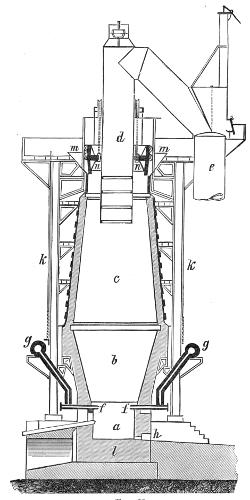
Fig. 29.
a Hearth; b Bosh; c Shaft; d Gas uptake; e Down-comer; f Tuyères with
water cooling arrangement; g Blast pipes; h Tapping hole; k Supporting
columns; l Furnace bottom; m Charging hopper; n Bell with raising and
lowering arrangement.
Wrought iron is made by treating pig iron in refinery and
puddling furnaces; in these much of the carbon is removed
as carbon monoxide, and from the puddling furnace the iron
is obtained as a pasty mass which can be worked into bars,
rods, or plates.
Steel is made in various ways. The Acid Bessemer process
consists in forcing compressed air in numerous small streams
through molten cast iron, in iron vessels (converters) which
are lined with ganister, a silicious sandstone. These can
be rotated on trunnions. Basic Bessemer steel is made in
similar converters by the Thomas-Gilchrist or basic process,
which can be applied to pig irons containing phosphorus.
The latter is removed by giving the converter a basic lining
of calcined magnesium limestone mixed with tar.
In the Martin process steel is obtained by melting together
pig iron with steel scrap, wrought iron scrap, &c., on the
hearth of a Siemens regenerative furnace with a silicious
lining.
In iron smelting the most important danger is from blast
furnace gas rich in carbonic oxide. Sulphur dioxide, hydrocyanic
acid, and arseniuretted hydrogen gas may possibly be
present.
When work was carried out in blast furnaces with open tops
the workers engaged in charging ran considerable risk. But
as the blast furnace gas is rich in carbonic oxide and has high
heating capacity these gases are now always led off and utilised;
the charging point is closed by a cup (Parry’s cup and cone
charger) and only opened from time to time mechanically,
when the workers retire so far from the opening as to be
unaffected by the escaping gas. The gas is led away (fig. 29)
through a side opening into special gas mains, is subjected to
a purifying process in order to rid it of flue dust, and then used
to heat the blast, fire the boilers, or drive gas engines.
Severe blast furnace gas poisoning, however, does occur in
entering the mains for cleaning purposes. Numerous cases of
the kind are quoted in the section on Carbonic oxide poisoning.
The gases evolved on tapping and slag running can also
act injuriously, and unpleasant emanations be given off in
granulating the slag (by receiving the fluid slag in water).
In the puddling process much carbonic oxide is present.
Other processes, however, can scarcely give rise to poisoning.
The basic slag produced in the Thomas-Gilchrist process is a
valuable manure on account of the phosphorus it contains;
it is ground in edge runners, and then reduced to a very fine
dust in mills and disintegrators. This dust has a corrosive
action already referred to in the chapter on Phosphorus and
Artificial Manures.
The poisoning caused by ferro-silicon is of interest. Iron
with high proportion of silicon has been made in recent years
on a large scale for production of steel. Some 4000 tons of
ferro-silicon are annually exported to Great Britain from
France and Germany. It is made by melting together iron ore,
quartz, coke, and lime (as flux) at very high temperature in
electrical furnaces. The coke reduces the quartz and ore to
silicon and metal with the production of ferro-silicon. Certain
grades, namely those with about 50 per cent. silicon, have
the property of decomposing or disintegrating into powder
on exposure for any length of time to the air, with production
of very poisonous gases containing phosphoretted and
arseniuretted hydrogen. The iron and quartz often contain
phosphates, which in presence of carbon and at the high
temperature of the electrical furnace would no doubt be
converted into phosphides combining with the lime to form
calcium phosphide; similarly any arsenic present would yield
calcium arsenide. These would be decomposed in presence of
water and evolve phosphoretted and arseniuretted hydrogen
gas. In addition to its poisonous properties it has also given
rise to explosions.
[In January 1905 fifty steerage passengers were made
seriously ill and eleven of them died. In 1907 five passengers
died on a Swedish steamer as the result of poisonous gases given
off from ferro-silicon, and more recently five lives were lost
on the steamer Aston carrying the material from Antwerp to
Grimsby.[C] This accident led to full investigation of the
subject by Dr. Copeman, F.R.S., one of the Medical Inspectors
of the Local Government Board, Mr. S. R. Bennett, one of
H.M. Inspectors of Factories, and Dr. Wilson Hake, Ph.D.,
F.I.C., in which the conclusions arrived at are summarised as
follows:
1. Numerous accidents, fatal and otherwise, have been caused
within the last few years by the escape of poisonous and explosive
gases from consignments of ferro-silicon, which, in every
instance, have been found to consist of so-called high-grade
ferro-silicon, produced in the electric furnace.
2. These accidents, for the most part, have occurred during
transport of the ferro-silicon by water, whether in sea-going
vessels or in barges and canal-boats plying on inland waters.
3. These accidents have occurred in various countries and
on vessels of different nationalities, while the ferro-silicon
carried has, in almost every instance, been the product of a
different manufactory.
4. Ferro-silicon, especially of grades containing from 40 per
cent. to 60 per cent. of silicon, is invariably found to evolve
considerable quantities of phosphoretted hydrogen gas, and,
in less amount, of arseniuretted hydrogen, both of which are
of a highly poisonous nature. A certain amount of the gas
evolved is present, as such, in the alloy, being ‘occluded’ in
minute spaces with which its substance is often permeated.
5. As the result of careful investigation, it has been shown
that certain grades of ferro-silicon—notably such as contain
about 33 per cent., 50 per cent., and 60 per cent. of silicon—even
when manufactured from fairly pure constituents, are
both brittle and liable to disintegrate spontaneously, this latter
characteristic being apt to be specially marked in the case of the
50 per cent. grade.
All these grades are commonly employed at the present time.
6. In the event of disintegration occurring, the amount of
surface exposed will, obviously, be greater than if the mass were
solid.
7. Evolution of poisonous gases is greatly increased by the
action of moisture, or of moist air, under the influence of which
phosphoretted hydrogen is generated from calcium phosphide,
which, in turn, is formed, in large part, at any rate, from the
calcium phosphate present in anthracite and quartz, at the high
temperature of the electric furnace. If spontaneous disintegration
of the alloy also occurs, much larger quantities of gas
would be given off from such friable and unstable material,
other conditions being equal. The greater or less tendency of
a given sample to evolve poisonous gases, and even a rough
estimate of their probable amount may be arrived at by the use
of test-papers prepared with silver nitrate.
8. There is no evidence that low-grade ferro-silicon (10 to
15 per cent.), produced in the blast-furnace, has ever given rise
to accidents of similar character to those known to have been
caused by the high-grade electrically produced alloy. Blast-furnace
ferro-silicon does not evolve poisonous gases even in
presence of moisture.
9. As regards ferro-silicon produced in the electric furnace,
the evidence available goes to show that certain percentage
grades are practically quite innocuous. This statement applies
to grades of alloy of a silicon content up to and including 30 per
cent., and probably also, though in considerably less degree, to
those of 70 per cent. and over.
10. In view of the fact that the use of ferro-silicon of grades
ranging between 30 per cent. and 70 per cent. apparently is not
essential in metallurgical operations, with the possible exception
of basic steel manufacture, it will be advisable that the production
of this alloy of grades ranging between these percentages
should be discontinued in the future.
11. The proprietors of iron and steel works making use of
ferro-silicon will assist in the protection of their workpeople,
and at the same time act for the public benefit by restricting
their orders to grades of this material, either not exceeding
30 per cent., or of 70 per cent. and upwards, according to the
special nature of their requirements.
12. But as, pending international agreement on the question,
intermediate percentages of ferro-silicon will doubtless continue
to be manufactured and sold, the issue, by the Board of Trade, of
special regulations will be necessary in order to obviate, so far as
may be possible, chance of further accidents during the transport
of this substance.
Inter alia, these regulations should require a declaration of
the nature, percentage, date of manufacture, and place of origin
of any such consignment.
The suggested regulations are printed on p. 291.]
Industrial poisoning from zinc is unknown. The chronic
zinc poisoning among spelter workers described by Schlockow
with nervous symptoms is undoubtedly to be attributed to
lead.
Occurrence of brass-founder’s ague.—Opinion is divided as
to whether pure copper is poisonous or not. Lehmann has
at any rate shown experimentally that as an industrial poison
it is without importance.
Occurrence, however, of brass-founder’s ague is undoubtedly
frequent. Although neither pure zinc nor pure copper give rise
to poisoning, yet the pouring of brass (an alloy of zinc and
copper) sets up a peculiar train of symptoms. As the symptoms
are transient, and medical attendance is only very rarely
sought after, knowledge of its frequency is difficult to obtain.
Sigel,1 who has experimented on himself, believes that the
symptoms result from inhalation of superheated zinc fumes.
In large well-appointed brass casting shops (as in those of
Zeiss in Jena) incidence is rare.
Lehmann2 very recently has expressed his decided opinion
that brass-founder’s ague is a zinc poisoning due to inhalation
of zinc oxide and not zinc fumes. This conclusion he came to
as the result of experiments on a workman predisposed to
attacks of brass-founder’s ague. Lehmann’s surmise is that the
symptoms are due to an auto-intoxication from absorption
of dead epithelial cells lining the respiratory tract, the cells
having been destroyed by inhalation of the zinc oxide. He
found that he could produce typical symptoms in a worker
by inhalation of the fumes given off in burning pure zinc.
Metal pickling.—The object of metal dipping is to give
metal objects, especially of brass (buckles, lamps, electric
fittings, candlesticks, &c.), a clean or mat surface and is
effected by dipping in baths of nitric, hydrochloric, or sulphuric
acid. Generally after dipping in the dilute bath the articles go
for one or two minutes into strong acid, from which injurious
fumes, especially nitrous fumes, develop with occasionally
fatal effect (see the chapter on Nitric Acid). Unfortunately,
there are no references in the literature of the subject as to
the frequency of such attacks.
Recovery of gold and silver has been already referred to
in the chapters on Mercury, Lead, and Cyanogen.
Mention must be made of argyria. This is not poisoning in
the proper sense of the word, as injury to health is hardly
caused. Argyria results from absorption of small doses of silver
salts which, excreted in the form of reduced metallic silver, give
the skin a shiny black colour. Cases are most frequently seen
in silverers of glass pearls who do the work by suction.
Local argyria has been described by Lewin in silvering of
mirrors and in photographers.
The most important facts have now been stated as to the
occurrence of poisoning in industry, and there remain only a
few gaps to fill in and to survey briefly the risks in certain
important groups of industry.
Lime Burning: Glass Industry
Lead poisoning in the ceramic industry (earthenware,
porcelain, glass, polishing of precious stones, &c.) has been
dealt with in detail in the chapter on Lead. There is further
the possibility of chrome-ulceration, of arsenic poisoning, and
conceivably also of manganese. Further, poisoning by carbonic
oxide and carbon dioxide may occur from the escape of furnace
gases where hygienic conditions are bad. In charging lime
kilns poisoning by carbonic oxide has occurred. The report
of the Union of Chemical Industry in 1906 describes the case
of a workman who was assisting in filling the kiln with limestone.
As the furnace door was opened for the purpose gas
escaped in such amount as to render him unconscious. He
was picked up thirty minutes later, but efforts at resuscitation
failed.
Carbonic oxide poisoning, again, may arise from the use
of Siemens regenerative furnaces, especially glass furnaces:
details are given in the chapter on Illuminating Gas.
Hydrofluoric acid is present as an industrial poison in
glass etching (see Fluorine Compounds). Persons employed in
this process suffer from inflammation of the respiratory tract
and ulceration of the skin of the hands. I could not find any
precise statement as to the frequency of the occurrence of
such injuries. Use of sand-blasting to roughen the surface of
glass has to some extent taken the place of etching by hydrofluoric
acid.
In tanning use of arsenic compounds for detaching the
wool from skins and of gas lime for getting rid of hair may
cause injury to health. With the latter there is possibility
of the action of cyanogen compounds (see the chapters on
Arsenic and Cyanogen).
In fermentation processes as in breweries and the sugar
industry accumulations of carbonic acid gas occur, and suffocation
from this source has been repeatedly described. Mention in
this connection should be made of the use of salufer containing
some 2 per cent. of silicofluoric acid as a preservative and antiseptic
in beer brewing. In the sulphuring of hops, wine, &c.,
the workers may run risk from the injurious action of sulphur
dioxide. Arsenic in the sulphuric acid used for the production
of dextrine may set up industrial poisoning. Poisoning from
ammonia gas can occur in cold storage premises. Industrial
poisoning from tobacco is not proved, but the injurious effect
of the aroma and dust of tobacco—especially in women—in
badly arranged tobacco factories is probable.
Injurious woods.—In recent literature there are several
interesting references to injury to health from certain poisonous
kinds of wood—skin affections in workers manipulating satinwood,
and affections of the heart and general health in workers
making shuttles of African boxwood. Details of these forms
of poisoning are reported from England and Bavaria. The
wood used for making the shuttles was West African boxwood
(Gonioma Kamassi). It appears that the wood contains an
alkaloidal poison which affects the heart’s action. The
workers suffered from headache, feeling of sleepiness, lachrymation,
coryza, difficulty of breathing, nausea, and weakness.
Four workers had to give up the work because of the difficulty
in breathing. Inquiry was made by Dr. John Hay of
Liverpool in 1908 and by the medical inspector of factories
in 1905. The following table shows the symptoms found:
Symptoms.
(1) |
Persons Examined. |
| 1905. |
1907-1908. |
Number.
(2) |
Per cent.
(3) |
Number.
(4) |
Per Cent.
(5) |
| Headache |
27 |
24·1 |
18 |
22·8 |
| Feeling of somnolence |
10 |
9·0 |
17 |
21·5 |
| Running of eyes |
13 |
11·6 |
9 |
11·3 |
| Running of nose |
28 |
25·0 |
20 |
28·0 |
| Breathing affected |
34 |
30·4 |
13 |
16·4 |
| Nausea or sickness |
13 |
11·6 |
3 |
3·8 |
| Faintness or weakness |
11 |
9·6 |
1 |
1·2 |
The later inquiry shows considerable diminution in the
amount of complaint as to respiratory trouble. This may have
been due to the improved conditions of working, freely acknowledged
by the men. Men were examined who had complained
of the effects of the wood in 1905, and had continued uninterruptedly
at the same kind of work during the interval
without any obvious further injury to their health, although
they preferred working on other woods.
East Indian boxwood had to be discarded in the shuttle
trade owing to its irritant action on the eyes. Sabicu wood
from Cuba was stated to give off ‘a snuffy dust under the
machine and hand planes, the effect of which upon the worker
is to cause a running at the eyes and nose, and a general feeling
of cold in the head. The symptoms pass off in an hour or so
after discontinuance of work.’ Reference was made in the
report for 1906 to eczematous eruptions produced by so-called
Borneo rosewood, a wood used owing to its brilliant
colour and exquisite grain in fret-saw work. The Director
of the Imperial Institute experimented with this wood, but
failed to discover injurious properties in it. At the same time
experiments with the wood and sawdust of East and West
Indian satinwood were undertaken, but also without result.
From inquiries subsequently made it appeared that much
confusion existed as to the designation ‘satinwood,’ as under
this name were classed both East and West Indian satinwood
and also satin walnut. The evidence was clear that East
Indian satinwood was more irritating than West Indian.
Satin walnut wood is apparently harmless. In the shipbuilding
yards of East London, Glasgow, and Bristol affections
of the skin were recognised, but susceptibility to the wood
varied. One man asserted that merely laying a shaving on
the back of his hand would produce a sore place. The injurious
effects here seem to disappear quickly. Exhaust ventilation is
applied, but there is a tendency to give up the use of the wood.
Isolated cases of illness have been ascribed to working teak
and olive wood. In Sheffield the following are held to be
irritating: ebony, magenta rosewood, West Indian boxwood,
cocos wood. Some kinds of mahogany are said to affect the
eyes and nose.
Use of methylated spirit in polishing furniture is said to
lead to injury to health although not to set up actual poisoning.
Lead poisoning can occur from the sand-papering of coats of
paint applied to wood.
In impregnating wood with creosote and tar the effects on
the skin noted in the chapter on Tar are observed.
In getting rid of the grease from animal wool carbon
bisulphide or benzine may be used.
The process of carbonising in the production of shoddy may
give rise to injury to health from acid fumes. Lead poisoning
used to be caused by the knocking together of the leaden
weights attached to the Jacquard looms. This is a thing of
the past, as now iron weights are universal.
Opportunity for lead poisoning is given in the weighting of
yarn—especially of silk with lead compounds.
In bleaching use of chlorine and sulphur dioxide has to be
borne in mind.
In chemical cleaning poisoning by benzine may occur.
In dyeing and printing use of poisonous colours is lessening,
as they have been supplanted by aniline colours. On occurrence
of aniline poisoning in aniline black dyeing see the section on
Aniline. Use of lead colours and of chromate of lead are dealt
with in special sections.