Indo-China and its Primitive
People
General characteristics of the Moï—A legend as to their selection of a
home—The part played by ocean currents in the distribution of races—Had
primitive peoples a sense of direction?—Features of daily life—The
hut—The village—Clothing and ornaments—A primitive method of kindling a fire
The half-civilized races who inhabit the mountains
and uplands of Indo-China are known
by different names among their neighbours. The
Birmans call them "Karens," the Laotians, "Kha,"
the Cambodians, "Stieng," or "Pnong," the Annamites,
"Man," or "Moï." "Moï," which can
be translated by "savage," is perhaps the most
convenient label for the whole complex of these
primitive folk.
Their number is not capable of exact computation
but probably approaches 400,000, divided between
tribes of different names. They are to be found
scattered between the eleventh and the twentieth degrees of latitude, from the frontiers of China to
the boundaries of Cambodia and Cochin-China.
From the earliest times they have made their
homes in the wooded uplands at an altitude which
secures them from the fear of inundation. Their
love of mountain and forest is a primitive and unchangeable
instinct and all attempts to acclimatize
them to the plains have ended in failure. Further,
this instinct is reinforced by their religious beliefs
and their respect for ancestral tradition. According
to a charming legend this domain was the gift of Eve
herself.
"The first human family had offspring so numerous
that the land of their birth could no longer sustain
them. The mother resolved that they should scatter
to people other portions of the earth. Before the
separation she called them all together for the last
time and made a great feast in their honour. All
did credit to her bounty with the exception of one,
who took nothing but some red pimento.
"This self-restraint was not lost on Eve. She
recommended those of her sons who appreciated good
cheer to share the fertile plains, and giving a bow and
arrows to her sober guest, promised him the kingdom
of the mountains where the beasts rove the forests.
"He was the father of the Moï. His descendants
share his frugality, and, like his, their wants are
few."
These characteristics distinguish them to-day.
Our first discovery on arrival among them was that the use of money is unknown. They value an empty
bottle more highly than a piastre, and if by chance
they accept some such coin it is only to cut it in pieces
for an ornament. Though their disposition is
generally peaceful, some tribes are extremely jealous
of their independence and receive an intruder,
however innocent, with showers of arrows. In this,
as in all other respects, the people reflect the character
of their surroundings.
As the national costume consists of the absence of it
there is no obstacle to the observation of their
physical forms. The European on his first arrival
in this country will think himself in a museum of
classical statuary! Simplicity, harmony, virility and
grace are all exhibited in perfect combination.
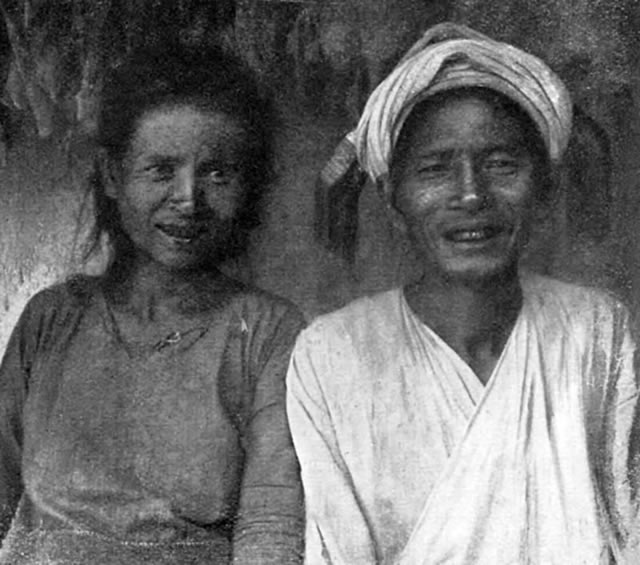
An average figure measures five feet five inches in
height. Few of the natives are more than five feet
nine inches, or less than five feet one inch. The torso
is faultless, the line of the loins elegant. Sometimes
the lower limbs are rather frail. The big toe, while
preserving its prehensile faculty (the feature of all
races of the far East), is not detached from the
other toes. In this respect the Moï differ from the
Annamites, who have gained the nickname of
"Giao-Chi" (detached toe).
The adipose tissue is so fine that obesity is rare.
Generally speaking the skin is of the colour of earth
and varies between reddish brown and dark yellow.
It has a characteristic odour resembling that of
a wild beast in good condition. There is an abundance of coarse black hair, which is generally
rolled up in a knot at the back and fastened with
a comb or band of stuff. In case of illness the
patient lets his hair fall loose to conceal his
face. The forehead is low and narrow and sometimes
terminates in a point. The expression of the
eyes, which are frequently oblique, is one of fearless
frankness. The thick chin is the characteristic prognathous
feature. The lips are fleshy and colourless.
The prominence of the cheek-bones give the face the
appearance of a pentagon with the chin as its apex.
The long and narrow skull places the type among the
dolichocephalic races.[1] These are the broad
characteristics of all branches of the Indonesian race
and are especially to be remarked among the peoples
of the Asiatic archipelago, the Battaks of Sumatra,
the Dyaks of Borneo and the Alfurs of the Celebes,
who show the least alteration from the original type.
It is well known that these primitive peoples were
aware of the existence of ocean currents and used
them for their own purposes. No other theory can
account for the distribution of the Malayo-Polynesian
races among the swarm of islands, some of them
hundreds of leagues apart. It demonstrates beyond
doubt the importance of the influence of currents
on the dispersion of the human race over the surface
of the globe.
The existence of a large number of legends common
to the two peoples reinforces the physiological
resemblance between the Moï and the primitive
races of the Malay Archipelago. The folklore of
all of them speaks of the existence of human beings
reputed to have had a tail like a monkey's, and,
what is even more extraordinary, a razor-edged
membrane on the forearm which was used to cut
down branches obstructing their path.
Curiously enough Borneo possesses a people, the
Murut, who habitually wear the skin of a long-tailed
monkey. At a distance this appendage seems to
belong to the wearer rather than to the garment.
In the same way it may be that the custom of
carrying a wooden knife, practised by forest-roving
peoples, is responsible for the illusion which confuses
the weapon with the arm which wields it.
The Moï have a wonderful memory for places
and a marked sense of direction. The latter faculty
is attributed mainly to a peculiarly highly-developed
sensibility to physical contact. Like all peoples
who spend most of their time in the open air they are
constantly noting the direction of the wind. They
know the exact hour at which, according to the
season, the wind will rise or fall. However light, a
breeze will induce a sensation of freshness immediately
recorded by their bodies, especially when moist
with exertion. As they walk or run they note carefully
every movement which obstacles oblige them to
make. According to Doctor Ouzilleau, this sixth sense is localized in the ampullæ of the semicircular
canals. A movement of the head causes the displacement
of the endolymph which acts on the
auditory nerves.
Further, the Moï possess keen vision and a highly-developed
sense of smell which bring to their notice
objects which would remain unobserved by Europeans.
A small drop of blood is on a leaf. It is the evacuation
of a wild boar whose lair is close at hand.
As is well known, instinct prompts almost all the
actions of the semi-savage. Accordingly the psychology
of the Moï is not easy to describe. Is he
capable of altruism, pity, or gratitude? With few
exceptions these virtues are almost completely unknown.
But he will learn them, like anyone else, as
soon as civilization has given him more favourable
conditions than under his present precarious existence.
To-day he falls an easy victim to injustice, intrigue
and exaction. So if Europeans arrive in force they
are treated as an enemy to be feared and therefore
worthy of respect, but a casual foreigner may easily
pay for his rashness with his life.
Like all men of weak character, the Moï is very
revengeful and awaits with patience the day of
redress. Months and years may pass without effacing
the least detail of his wrong. I was frequently called
upon to compose their quarrels and it was seldom
that the injury was not one of long standing.
"But why," I asked, "wait so long before taking
action?"
"I had other things to do," came the answer.
"What other things, you idler?"
"Oh, invitations to share a flask of spirits of rice
or a fat pig."
Nothing, not even the most imperious necessity,
can overcome their inveterate laziness.
I shall never forget the curious impression produced
on me by my first entry into a Moï village.
The village in question was Dran on the Da-Nhim,
whose narrow valley marks the outposts of the great
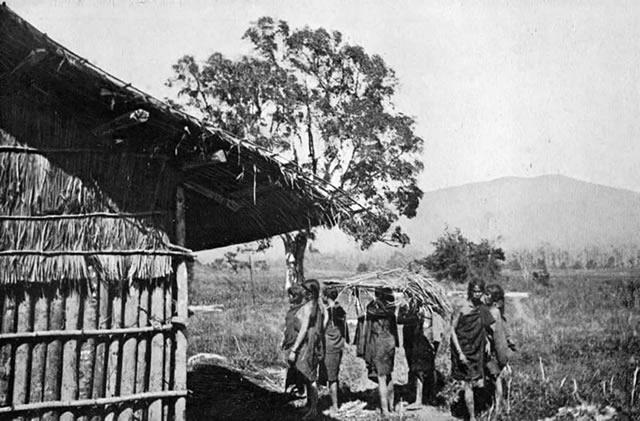
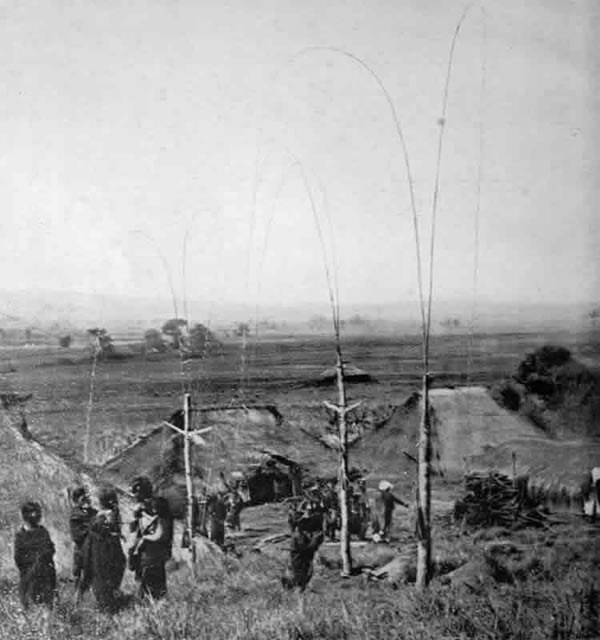
Annamite chain. Five or six straw huts had been
erected on stakes some ten feet above the earth, less
to avoid dampness than to secure immunity from the
raids of wild beasts.
Some women were pounding paddy (a preparation
of rice) for the evening meal in mortars of ironwood.
The measured beat of a metronome and the regular
thuds of the pestles set the time for the wailing chant
with which the women beguiled their work. On
seeing me they looked up startled. A single piece
of flimsy cloth draped from the waist to the knee
revealed the outline of many a full and graceful
thigh and emphasized rather than concealed their
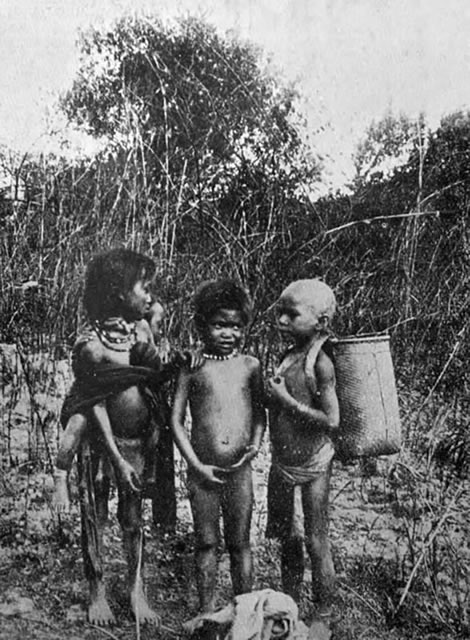
sinuous movements. The children played around
or pretended to help in lifting the heavy pestles.
At the top of a pole a rude figure had been carved
of the genius of the village armed with a murderous-looking
cross-bow. He was the tutelary deity of the
place.
The supports of the houses are built of ironwood, the other portions being of plaited bamboo sticks.
The roof is open to the sky and overhangs both the
farmyard and the pigsty. We had no difficulty in
conjuring up the discomforts that awaited us should
we ever be compelled to lodge in such a place. The
thin wattled walls would not spare us the least noise
nor the slightest odour.
My unwonted appearance still continued to excite
demonstrations of alarm, but it seems my beard was
mainly responsible for the indiscriminate flight which
ensued. One old woman only was brave enough to
remain seated in her doorway. I asked her for permission
to inspect her dwelling, accompanying my
request with a gift of a large packet of tobacco. She
acceded, not without hesitation and a look of infinite
distrust in her eyes. A rude wooden approach with
apologies for steps led up to the interior. The rooms,
one of which is assigned to each distinct family, were
about the size of a horse-box, but a special apartment
was reserved for strangers and solemn occasions such
as a general reunion. The hearth, raised a few inches
above the level of the floor, consisted of a platform
on which three fires were burning and an appetizing
and harmonious murmur proceeded from three pots
in which rice, the evening meal, and the food for the
pigs were being prepared. There was no chimney,
for the duty of the smoke is to keep off the mosquitoes,
which are such a plague in these regions. Accordingly
every object in the place was covered with a
thick layer of soot, and no window was to be seen.
The inhabitants of this particular village were
poor and the huts were very small, but in some of the
more fortunate villages the houses sometimes attain
a length of two hundred yards.
Huge blocks of wood served as beds to a people
usually too tired to be critical. The walls of the
partitions were hung with a medley of gongs, tom-toms,
weapons and domestic utensils. The spirit
flask, without which no family celebration is complete,
was suspended from a post adorned with rude carving.
The frightened inhabitants eyed us askance and
behaved like whipped curs. The children squalled
and hid under any convenient object, nor could I
gain their confidence by emptying my pockets of all
the tempting trifles I had brought with me for the
purpose.
Seen from a distance there was nothing to point to
the presence of a village. It was perched on the side
of a ravine with the forest behind it, and thick brushwood
in front protected it from the gaze of the inquisitive.
The only entrance, known to the initiated
alone, was that furnished by two narrow passages.
Even when the entrance has been found, another
dark passage has to be traversed which is designed
for easy defence in case of attack. A small number
of determined warriors would be quite sufficient
to repel invaders.
The open space in the centre of the village was
adorned with two public buildings, a large hut
reserved for the boys who had just attained the age of puberty and another which contained the last
harvest. The door of this public granary was secured
in a manner which demonstrated to perfection the
naïve simplicity of these folk. The lock consisted of
a rattan thread passed through an empty egg-shell.
Of course it was impossible to touch the thread
without breaking the shell, and as all are equally
interested in the preservation of the precious grain
supply, each man thus became policeman to his
neighbour.
The Moï is not nomadic by nature, but moves
his habitation periodically as soon as he has exhausted
the natural resources of the soil he occupies. Other
causes of this periodical exodus are serious misfortunes,
such as a fire, an epidemic, or unpleasantly
frequent raids by the tiger. Such mishaps are
invariably attributed by the Moï to the evil influence
of the genius of the place. To dispute the possession
of the ground with so powerful a divinity would
be sheer madness, and accordingly he yields with
grace and betakes himself elsewhere without regret.
The choice of the next habitation is not a mere
matter of chance. The Geomancer is called in to
consult the omens, and no selection is made until
after ripe reflection.
But I am forgetting the mild adventure which
was the occasion for these general observations.
After some time I became aware that my visit could
not be prolonged without a breach of etiquette and
that I was trespassing on the time of my hostess. She herself recalled me to good manners by resuming
her multifarious household duties. Accordingly I
bade her farewell and left her surrounded by a
crowd of the feathered tribe who assembled in
answer to her guttural cry of "loc-loc," the usual
signal for a generous distribution of maize.
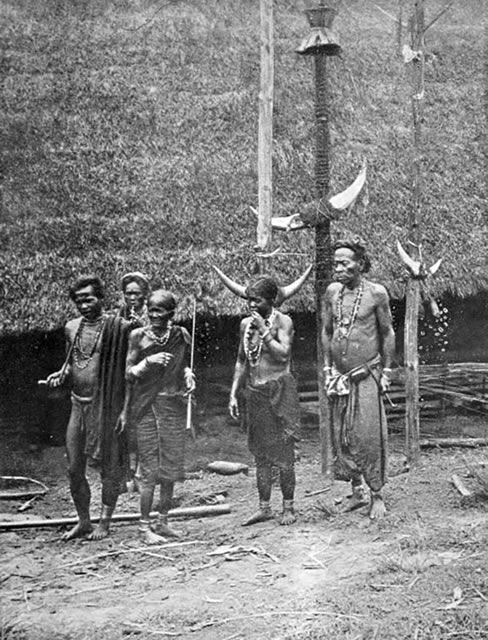
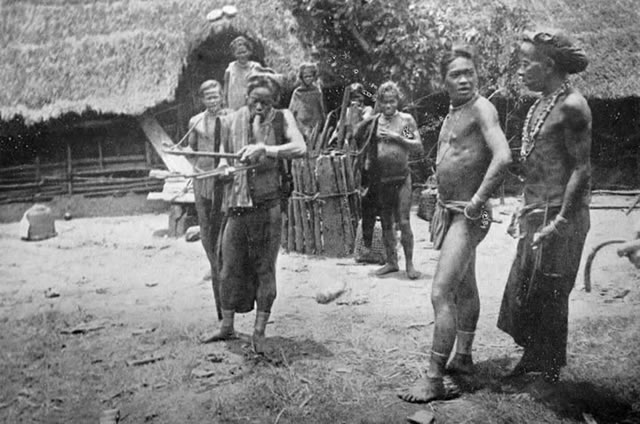
The national costume is marked by an almost
evangelical simplicity. The men may truly be
described as clothed in sunbeams, for a flimsy piece
of cloth draping the waist can hardly be dignified
with the name of dress. A knife in a leather or
wooden sheath is the only weapon carried, though
another small knife is frequently fastened in the
hair, which is twisted into a knot and secured by
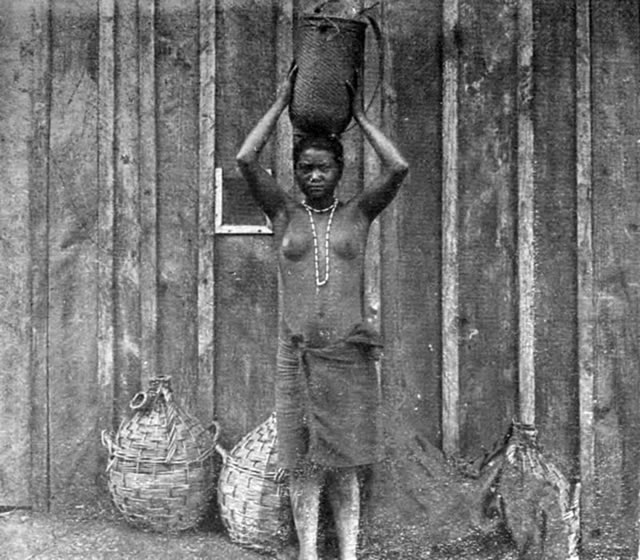
a comb. The women have a clinging skirt, which
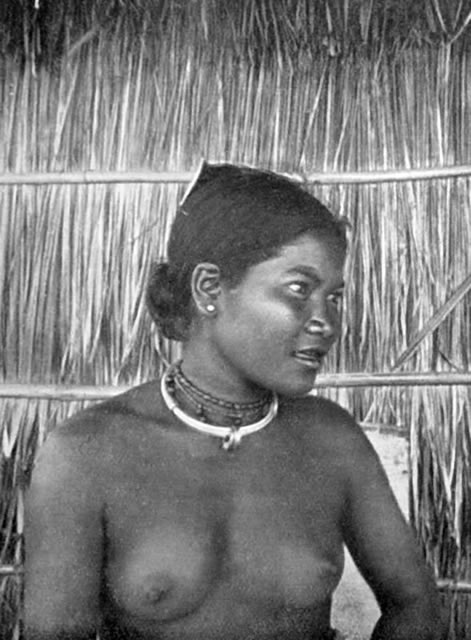
does full justice to their graceful figures. The bust
is seldom covered at all, but in cold weather a large
piece of cloth is draped round the waist. Both
sexes sometimes wear a rough cloak trimmed at
the edge with a variegated fringe, but in spite of
such precautions they are very liable to affections
of the throat.
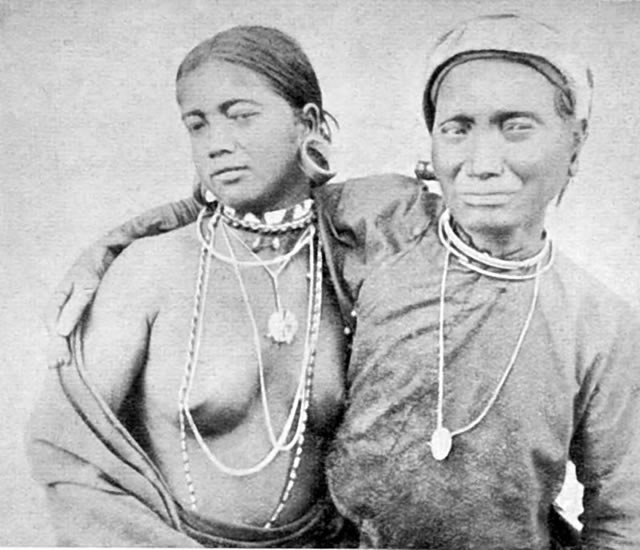
The chief peculiarity, however, which distinguishes
them from the other groups of Indo-China is their
inordinate love of personal decoration. The passion
for finery gives rise to the most embittered rivalry
among the women, and takes many curious forms,
such as the artificial elongation of the lobe of the
ear, in which various ornaments are introduced.
This painful process begins in infancy, when the ears are pierced with a sharpened bamboo rod. A
wooden ring is inserted in the hole thus made, and
weights hung from it, at first small, then increasing
in size. The lobe, unnaturally distended, sometimes
reaches the shoulder, in which case it is
accounted a feature of the greatest beauty, and a
husband with every talent and virtue is assured to
its fortunate possessor. But it is of prime importance
that the ear should remain unbroken. Should
the skin give way, the two hanging pieces will be
an eternal reproach. No husband will want a
woman thus degraded, and a hopeless spinsterhood
will be her lot in life.
The men are addicted to the same practice, but
with rather more discretion. They confined themselves
to filling the holes in their ears with our champagne
corks, which were quite at a premium on the
market and shared the honours with our boxes of
Swedish matches. Sometimes, too, their taste turned
to an ivory serviette ring or even a simple drawing
pencil. Another fashionable masculine ornament is
a brass collar, consisting of a number of spiral rings.
We never satisfied ourselves as to whether this was
pure decoration or served some ulterior purpose,
such as protection against affections of the throat.
Copper and brass bangles adorned the wrists and
ankles, but he who wished to touch the supreme
height of fashion wrapped his head in one of the towels
with which we rewarded our more industrious coolies.
I brought from Paris a supply of beads, in the hope of finding them useful as a medium of exchange.
To my surprise the natives took no interest in them
at all and they proved almost worthless. The Moï,
like the European, follows the caprice of fashion,
and our beads, it seemed, were too heavy and not
gay enough for his taste. Besides, they were not
the mode of the moment.
It was thus sufficiently demonstrated that the
wearing of clothes is not even essential for the display
of feminine vanity and coquetry. Artifice can
dispense with clothing, and if the sexes in this strange
land attract each other by means that seem curious
and unaccountable to us, the end in view is always
and among all peoples the same, the continuance
of the race.
It must be remembered, too, that the development
of a fashion is similar to the development of
a living organism. A certain form of dress or style
of decoration undergoes successive transformations,
the stages being generally exaggeration, diminution
and ultimate disappearance. For illustration we
need go no further afield than the recent vagaries
of fashion in Europe which seem to oscillate between
the bell and the asparagus, but perhaps a more
striking example is the long, pointed shoes of the
Middle Ages. At first the points were quite reasonably
short. Then little by little each man tried to
sort himself out of the common ruck of his neighbours
by having longer points, and after about a century
the fashion culminated in the absurd extravagance of the shoe with points long enough to be drawn
upwards and fastened to the knee. The mode first
saw the light in the middle of the thirteenth century
and disappeared abruptly in 1428. The same
evolution can be traced in the progress of the ruff
of the fifteenth century and the crinoline of the
nineteenth.
It is at least open to belief that ethnical transformations
are governed by similar laws. This
distension of the lobe must be traced to the practice
of continually adding to the number of ornaments
with which the ear was overloaded.
Every individual tends to overrate the feature
which is considered the characteristic of his race.
"Le beau pour le crapaud c'est sa crapaude," said
Voltaire, and the natural instinct of the savage is
to exaggerate what he regards as the most worthy
of admiration. This instinct is indubitably responsible
for most of the mutilation practised by primitive
peoples. Thus the negresses of Africa produce an
artificial elongation of the nipple by the sting of a
certain insect, and the platyrrhine Malays make their
flat noses even flatter, while the Persians take the
most elaborate pains to induce an extreme hook on
a nose already aquiline. This theory of exaggeration
inherent in our nature can alone explain certain
customs which are otherwise unaccountable.
I ought perhaps, before leaving the subject, to
enumerate three other methods of decoration
practised by the leaders of fashion among the Moï. The women powder their hair with an odorous
substance obtained from the berries of the vetiver.
Both men and women smear their teeth with a kind
of lacquer to protect the enamel from the action of
lime, the principal ingredient of the betel leaf.
Finally the society ladies dye their nails a vivid
vermilion with the sap of the plant "Semrang."
As I said above, our matches soon went to a
premium as a medium of exchange, but the Moï
already employed two methods of kindling a fire.
One was by striking a flint against a piece of pyrite
of iron, the other by simply rubbing together two
pieces of wood. The process is as follows. A very
dry bamboo is split at one end for about five inches
of its length. The two sections are kept apart by
the insertion of a wooden wedge. In this way a
rude ventilating chimney is made under which the
operator piles up some dead leaves, bamboo cuttings
and moss. He now passes a long cane under the
apparatus (which he keeps steady with his foot) and
rubs it rapidly backwards and forwards until a spark
appears, which is usually within a minute. The
movement closely resembles that of sawing.
This last method is only practised in the bush,
for in the villages the fires are carefully preserved
under the ashes and seldom allowed to go out. This
preservation of fire is a phenomenon which
characterizes all primitive peoples in every clime.
Agriculture—Industries—Weaving, iron and copper mining—Commerce
and industrial products—Food supplies—Fishing—How we once
fished with dynamite—Hunting—Various methods of big-game hunting—My
first elephant hunt—Some useful hints to big-game hunters—Poisons—Arms
and weapons of defence—The tiger, a dangerous
neighbour—A bathing tragedy.
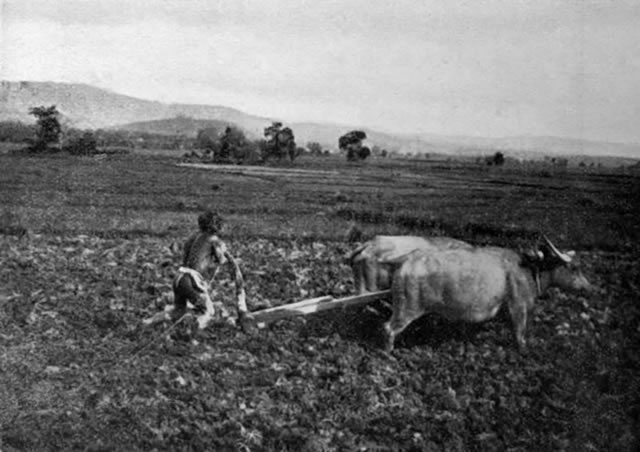
The principal industry of the Moï is the
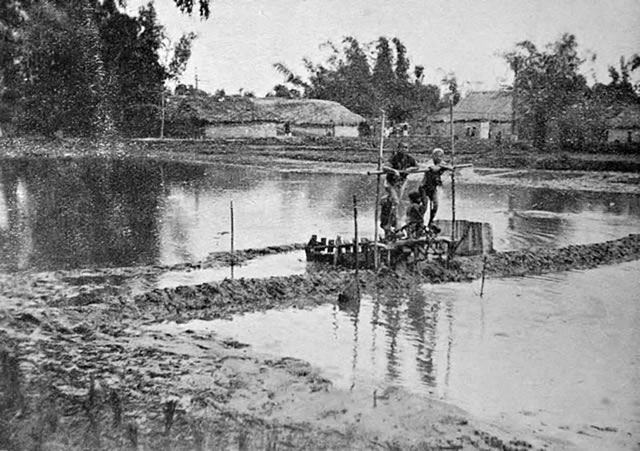
cultivation of rice. The method adopted,
however, is unlike that of the Annamites of the
plains. Instead of cultivating a rice-field by continuous
irrigation which produces three crops a
year, the Moï wait until November, the end of the
rainy season. They then clear a portion of the
forest large enough to raise a crop for the entire
population of the village. In April they set fire
to the fallen trunks which the sun has dried. For
several days the whole mountain is illuminated by
these immense braziers and the crackling of the
timbers can be heard for miles around. Finally
the ground is covered with a layer of fine ashes, which
are washed into the soil by the first rains. Then
begins the sowing.
Armed with a pointed stick the women hollow
trenches in the soil and throw in the seed. The
rains first and then the soil itself complete their
work. The baskets are soon full and the public
granaries stocked with the precious cereal. Good
as a harvest may be, however, it is seldom that a
crop is sufficient to support the population till the
next. More often the supply runs short and the
tribe has to subsist for several weeks on bamboo
shoots and forest roots.
Several times during my visit I tried to inculcate
in the natives some elementary notions of thrift
and foresight. A "Pholy," or village chief, once
showed me in a word the weak point of my counsels.
"If I were to start putting by a store," he gravely
told me, "my elder brother, the white warrior,
would take it from me to feed his escort."
I vigorously denied in the name of my kind any
such evil intentions.
"In that case," he continued, "my younger
brothers in the neighbourhood would seize it. So
I am prudent and keep no store at all."
Now what answer could I have returned to
that?
However, whether the Moï blames civilization or
his very human neighbours, it is certain that he is
happy-go-lucky by nature and lives from hand to
mouth. His ignorance of economy may be ascribed
to two causes, one that he possesses nothing of his
own, since all property is held in common by the tribe, the other that Nature is so bountiful as to
render foresight generally unnecessary.
Quite otherwise is the character of the Annamite,
who spares no pains over the cultivation and improvement
of his ricefields. His barn is never empty.
The Emperor of Annam himself sets the example
and takes part each year in sowing the grain which is
destined for religious sacrifices. By a long series
of proclamations the Government has raised the
status of the tiller of the soil, for it is generally accepted
that the prosperity of the country depends more on
its agriculture than on the expansion of its commerce.
As for the profession of arms, it has long been regarded
as a relic of ancient barbarism.
Here is an example of one of these proclamations:
"The tiller of the soil is a man of worth. The
police shall never molest him. But he who bears
arms is a brigand and my sbires will treat him as
such."
This is no doubt the origin of the popular scorn of
the military profession. A parallel is offered by
France in the time of Sully, when the interests of
agriculture were the special concern of the legislature.
Throughout the territories occupied by the Moï
the cultivation of rice is carried on alternatively with
that of maize. In the fertile soil this latter grows
to an enormous size. On the plateau of Langbian
it is quite usual to find stalks thirteen to seventeen
feet high.
Every household grows its own tobacco. Cigarettes are made by rolling up tobacco in the dried leaves of
the banana tree. In shape they resemble an extended
cone of which the small end is put in the
mouth. The pipes are of copper and have a long
stem. An inner shell of bamboo fibres is attached
to the bottom of the bowl and the more this is impregnated
with nicotine the more it becomes an
object of desire, especially to the women. Even
the babies play their part in this little comedy, for
they compete eagerly for a suck at the stick which
serves their fathers as a pipe-cleaner.
Industry is in its infancy and is confined to the
manufacture of simple objects of daily use, such as
stout wicker baskets and glazed pottery. These
vessels are not baked in a furnace but dried in the sun,
and are consequently very brittle. Another staple
manufacture is the three-foot chandelier, surmounted
by a torch of resin. The women weave various
coarse cloths of cotton. Their sole implement is a
weaving frame consisting of two pieces of wood
between which are stretched two sets of threads.
The shuttle is worked by hand with a fair degree of
skill.
Without professing any great knowledge of the
art of dyeing the women are quite familiar with the
properties of certain substances, of which they take
full advantage. Thus indigo furnishes black as well
as two shades of blue, a colour more highly esteemed.
Yellow is obtained from the saffron. Alum and
filtered cinders are put to a similar use.
Cotton is bleached by soaking the material in a
concoction of rice-water boiled for several hours.
The needles which we bestowed on the most skilful
of the housewives were accepted and preserved by
them as precious objects of art. These ladies, as
guardians of the ancient traditions, remained faithful
to ancestral custom and preferred to use a blunt
brass pin, which dispenses with the necessity for a
thimble, the manipulation of which passes their
understanding.
Iron, though found almost everywhere in its
natural state, is worked by only a few tribes which
have specialized in the industry. The anvil consists
either of a huge stone or of a block of metal encased
in a wooden armature. The hammer is fairly long and
has a bamboo handle. Bamboo cylinders convey
the draught to the furnace. This rudimentary
equipment produces lances and knives of the greatest
efficacy.
The extraction of iron is carried on by the Catalan
method. The mineral in its natural state is first
mixed with a large quantity of charcoal and then
covered over with clay and collected into a kind of
circular bin made of bricks. The mixture is then
stirred vigorously for twenty-four hours, at the end
of which it liquefies and falls into three layers. The
lower part is composed of iron of a very poor quality,
the upper mainly of ashes. The middle layer alone
is of the desired temper and can be prepared for all
purposes by a vigorous hammering.
All these operations are accompanied by a series
of religious sacrifices, for the genii of the mine must
be propitiated, and copious libations alone can humour
their caprice. A special day, the fourth of the
month, is devoted to an annual festival in their
honour.
A few groups manufacture gongs of copper, which
is found just below the surface of the soil. It seems
to be the practice among these tribes, as soon as
copper-bearing lands have been discovered, to secure
seclusion and freedom from interference by expelling
all the inhabitants of the country around. This is
certainly one explanation of the weird stories which
the evicted competitors tell of their successful rivals.
If the vanquished are to be believed, the industry is
carried on by the women, who live alone except for
one annual visit to their husbands. These women
are not merely unnatural wives, but also unnatural
mothers, for they slay all their male children, keeping
only the girls. Their other characteristics are
hardly less formidable. They wield the lance with a
skill and vigour of which any man might be envious.
They are always accompanied by dogs, and finally
(for a touch of the supernatural is inevitable), the
legend runs that their spinal column terminates in a
short tail.
I was extremely curious to make the acquaintance
of these Amazons, but my informant invariably took
refuge in silence when I pressed him for information
of their whereabouts.
Whatever may be the value of these stories, it is
well known that in this country, where money is
unknown, gongs, pots and jars serve as the medium
of exchange. The measure of value is the antiquity
of the particular object. If it has several centuries
behind it, its price reaches a truly fantastic figure.
Perhaps the Moï recognize that the arts are on the
decline and that modern productions, if more attractive,
are far less beautiful than those of bygone ages.
It is very unlikely, for their æsthetic sense is still in
an early stage of development.
The value of a red earthenware jar three feet in
height and two hundred years old is equal to that of
thirty buffaloes. Another vessel known as "The
Mother and Child," which is composed of two jars
of different sizes joined after the manner of the
Siamese twins, is worth fifty buffaloes. At the top
of the scale stands a vase worth one hundred buffaloes,
partly because it enjoys the reputation of being unique
and partly because it is adorned with the figure of a
shapeless and mysterious human being.
The same curious standards of taste are revealed in the
sets of gongs and tom-toms. These instruments are
designed to give three or five concords, by the blending
of which every variant of the Moï scale may be produced.
There is also a flourishing industry in the cultivation
of cinnamon, both for the home market and for
export to China, which is the largest customer for that
product.
The hunters make long journeys for the purpose
of exchanging elephants' tusks and feet and rhinoceros
horn. A horn of the latter animal is ordinarily worth
ten buffaloes among the Moï, but one which is new and
flawless has been known to fetch the enormous sum
of five hundred piastres, or fifty pounds in English
money. The Annamites are the most successful
hunters and dealers. Every power aiming at colonial
expansion should concentrate its efforts on developing
commercial relations with the natives. Trade is
the most potent agent of conquest and the only one
which brings prosperity and security in its train.
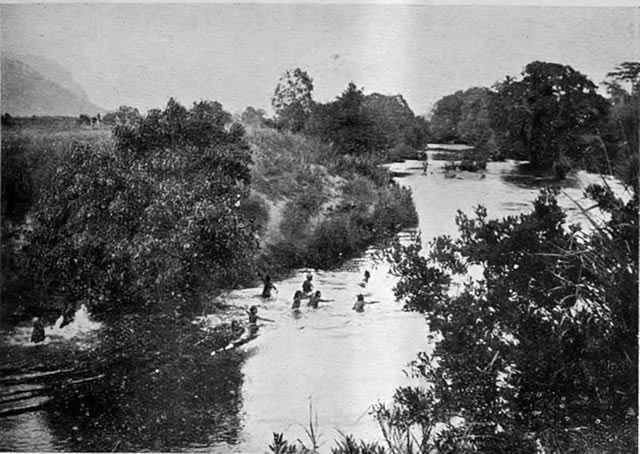
We found fishing with dynamite another means
of peaceful penetration into these regions, though
available only in places watered by a stream or river.
We made a point of inviting all the inhabitants of
the villages in the neighbourhood of our camp and
it was seldom that the audience was not large and
representative, so great was the interest roused by this
operation. Judging by the horde of women which
issued from every hamlet and the enormous baskets
brought by the children we might have been setting
out to clear the river of every living creature in it.
The men, who fish both for food and sport, showed
themselves very willing to indicate the favourite
haunts of our prey.
Curiosity was roused to the highest pitch by the
preparation of the charge and the Bickford train was
an object of interest almost approaching reverence.
I fired a few inches of this and astonishment knew no bounds. The younger members of my audience
spoke openly of sorcery, while the elder smiled in a
knowing manner but kept at a safe distance.
At length the charge was ready. I fired the end
of the train and threw the infernal machine, weighted
with a stone, into the middle of the water. The
stone described a long parabola and fell into the dark
depths carrying the instrument of destruction after
it. For some seconds there was a deathly silence.
Then a terrific explosion rent the air and a column
of smoke and steam rose from the surface of the water
to the height of the highest trees. There was a
whirr of wings as the birds scattered from the branches.
The Moï gaped at each other in amazement and
prostrated themselves on the ground. Screams of
fear from the children announced their conviction
that the genius of the river, enraged at this intrusion
on his dominions, was coming to carry them off.
Soon the cloud vanished, transformed into a
shower of refreshing rain. Calm replaced the storm.
The startled doves cautiously returned to their
nests. The stream flowed on, unruffled, forgetful.
Suddenly a few white specks appeared on the
surface, vanished and reappeared in ever-increasing
numbers until the waters seemed alive. These were
the fish, their air-bladders burst by the force of the
explosion and now floundering helplessly at the
mercy of the swift current. The crowning moment
had arrived. With one accord the spectators dived
into the stream to secure their easy prey. The more wary had armed themselves with a liane, to
which they fastened their victims by the gills. The
booty was then easily towed between their teeth.
The women and children were in the very forefront
of the fray, and there are few more entertaining
spectacles than that of all these babies racing each
other amid screams of delight. In a few moments
the water was cleared of its shouting, struggling
invaders, whose bronze skins glistened beneath a silver
film of pearly drops. One by one, after adjusting
their simple garb, they advanced to lay their booty
in a large basket at my feet, then withdrew with a
delightful affectation of indifference as to my intentions.
Then began the ceremony of distribution. The
basket raised on a mound of earth became the centre
of a circle. The children advanced in single file,
the youngest first. At the head of the procession
was a youngster of less than six years of age, who had
no difficulty in selecting the largest fish, which he
dragged away by the tail stammering with excitement.
The mothers followed, more modest in their desires.
In a few moments I was left alone, a dismal survival
of the merry throng.
Fish is the favourite food of the people in these
regions and every river contains an apparently inexhaustible
supply of it. The three current methods
of fishing are with line, net, and spear. The nets
are spread across the narrow channel, which is always
left in the middle of the bamboo dams. The bait
consists of the stalks of certain weeds and plants, which are treated to form a soft paste. When a haul
has been particularly successful the fish is smoked
and preserved for several months. For this purpose
it is pounded with salt and pimento and stored in
bamboo tubes. In this state it is a favourite
condiment.
There is little change of diet, for the food supply
is virtually restricted to the products of fishing and
hunting. Domestic animals are never used for food
except upon special occasions such as religious
sacrifices.
Traps are preferred to weapons for keeping down
the wild beasts which swarm in the forests. Both
in devising and constructing snares the natives
display a high degree of invention and skill. We
found apparatus of different kinds all over the country,
its form being apparently determined by the seasons
of the year and the particular region. For example,
the following method is employed in a thickly-wooded
country where the presence of beasts of
prey is only known by the tracks leading to their
watering-places.
The hunters select a young tree, supple but yet
sufficiently strong for their purpose. The top is
forced over and secured to the ground by means
of a tough fibre in which a noose is made. The
long grass conceals all these traces of human intervention.
Now the monster, tiger or panther,
approaches. It cannot pass the spot without disturbing
the simple mechanism which the least shock would set in motion. The sapling, suddenly released,
flies back, and the unfortunate captive finds its
neck or paw firmly gripped by the noose. The
more it struggles the tighter becomes the knot,
and if not actually strangled, it soon becomes exhausted
by its agonized efforts to escape, and hangs,
a miserable object, on this improvised gallows.
Another method is to dig a pit in a track the
course of which has been carefully noted. Animals
have fixed habits according to the season of the
year. Shortly before nightfall they emerge from
their lairs on an expedition to secure an evening
meal. The pit must be both narrow and deep, and
its dimensions calculated so nicely that the movements
of the prisoner will be hampered in every
direction. This object is further secured by driving
stakes into the ground at the bottom so that the
mere act of falling in will inflict the most severe
injuries. The place is then concealed by a layer
of branches, a part of the operation which needs
the greatest care if the trap is not to be detected.
A little earth from the excavation lying on the ground
at the side is quite enough to warn some animals
of the presence of danger and the condition of the
grass and branches, which quickly decay, is in itself
a suspicious circumstance. The tiger is one of the
most wary and observant of beasts and is seldom
captured in this manner, except when being pursued,
when it has not the time to take its usual precautions.
Deer, on the other hand, seem much less suspicious and frequently fall a victim to this
particular wile.
There is another trap which requires equal care
in construction, and closely resembles the eel traps
which are common in Europe. It is a cage, circumscribed
by a double row of bamboos as a palisade.
The beast has to penetrate a hedge of bamboos to
find the entrance which leads to an open space where
a pig or goat rewards its curiosity. Once inside,
however, its retreat is cut off, for the bamboos spring
back to their natural position, thus closing up the
entrance, and the palisade is quite strong enough
to resist attack, however fierce.
It will be recognized that the construction of
these snares calls for a degree of skill and experience
to which few Europeans can attain. Sometimes
the pits were so cunningly dug that it was
almost impossible to detect their presence and we
were in serious danger of falling in ourselves. As
a rule the natives indicate the proximity of a trap
by some signal such as a broken branch, a spear driven
into a tree, or a stalk twisted in a certain manner;
but, of course, the purport of these signs is known
only to the initiated, and at the beginning of our
expedition we had much more to fear from the tiger-traps
than from the chances of an encounter with
the beast for which they were intended.
It must not be imagined that the Moï confine
themselves to the destruction of wild beasts only,
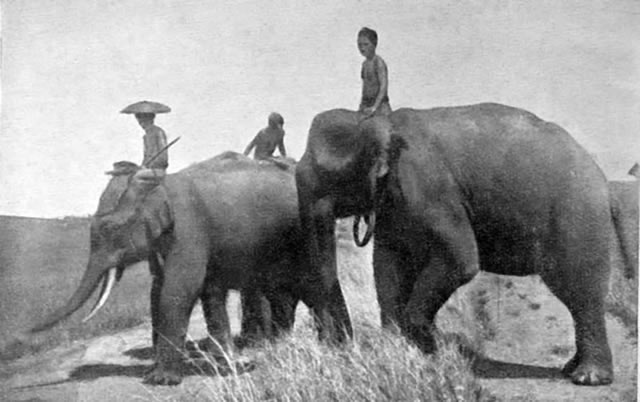
or merely those which threaten their safety. Elephants are slaughtered ruthlessly for the sake
of their ivory. The elephants haunt the damp and
sandy regions of this country. During the dry
season from November to March herds consisting
of anything from ten to twenty beasts make their
way to the forests both for shelter from the heat
and for the pools which have not yet dried up. It
is generally at watering-time that the creature
makes itself heard with loud trumpetings which
are audible at an immense distance and betray
its presence to its human enemy. When the
elephant is undisturbed its progress is sedate and
leisurely and it stops every now and then to pluck
a branch either for recreation or to serve as a fly-swish.
It is this last habit, well known to the native
hunter, which betrays it and leads to its downfall.
The first time I took part in an elephant-hunt
I was amazed to see that the native who was guiding
me kept his eyes fixed upwards all the time. I should
have thought it was obvious that we needed no
other guide than the enormous footprints left by
the unwieldy beasts, and told him so. I was not
long left in error. Without relaxing his efforts he
soon showed me that these tracks were very unreliable,
that they frequently pointed different ways,
cut across each other, and sometimes, in fact, disappeared
altogether. He told me also that the
evacuations of the creature are liable to be misleading
unless quite fresh, still viscous, and unaffected by insects. A trail in a forest must then be sought
not on the ground but in the branches of the trees.
It is by the broken branches, the appearance of the
severed ends, and the consistency of the gum which
escapes, that the experienced hunter can deduce
the more or less recent passage of a herd.
I smile now when I think of the succession of
surprises I experienced on that first hunting adventure
and the ignorance I must have exhibited. We
came to some swampy ground where my guide
stopped short before some tracks that seemed to
him the most fresh we had yet encountered. He
carefully made some fresh tracks at the side with his
feet and then lay at full length on the ground to
compare the two sets of footprints. After a most
minute examination of their respective appearances
he calculated that less than half an hour had elapsed
since the animals had passed by and went on his
way without comment.
We had started out at sunrise, which is the orthodox
and best time. To set out earlier is to court
failure, for it is impossible to be sure of the traces
in the darkness. At first we had directed ourselves
by the pools, and on reaching a third pond were
overjoyed to observe some traces obviously quite
fresh. It is usually hopeless to start on a trail which
is several days old, for a track made only the previous
evening may easily take one much farther than is
agreeable. Hunters who say that they have tracked
elephants for weeks show more perseverance than intelligence. As it was, my companion lost the
trail several times, but never took a short cut in the
wild hope of picking it up farther on. He might
as well have started hunting for shadows. Every
time this mishap occurred he retraced his steps to
the point of departure and looked again. He was
not to be deflected from his purpose even by the
trumpetings of the elephants themselves, though
these were quite audible at times.
"Ong Bioi (Mr. Elephant) would make a liar of
me," he explained in his picturesque jargon.
He was quite right, for in tracking these monsters
the only safe rule is to follow the trail and leave
short cuts severely alone. Besides, this hunting
sense, if I may so call it, is only a practical application
of that sense of direction of which I have spoken
before, and which seems almost to be an instinct
with some people. It is something analogous to the
sense of danger which is found in certain specially constituted
individuals who can foretell the presence of a
danger by the twitching of the muscles of the back.
Soon, without any apparent reason, my guide
signalled to me to relieve myself, and as I did not
comply at once, he repeated his order with a gesture
that left no doubt as to his wishes. He knew from
long experience of big-game hunting how dangerous
a nervous contraction, such as that of an overcharged
bladder, can be at a moment when the accuracy of
a shot may make all the difference between life and
death.
He then took off my colonial helmet, which in all
its khaki glory was a somewhat conspicuous object,
and replaced it by his own head-gear, a muddy-coloured
turban, quite unnameable, which certainly
harmonized better with our surroundings. I was
dressed in a suit of Chinese linen, slate grey in colour,
which seemed to meet with his approval, while, for
himself, he carried his whole wardrobe, consisting
of a thin woollen cloth, lightly wrapped round his
waist.
He then picked up a handful of dust and threw it
up in the air to observe the direction of the wind.
This is the most indispensable precaution, for if the
elephant is not blessed with keen sight, its hearing
is extremely acute and can detect an unwonted sound
at a great distance. It must be approached, therefore,
against the wind.
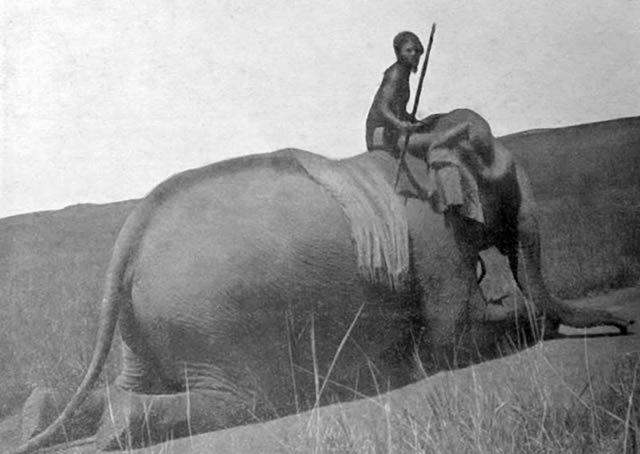
During the hottest part of the day the elephant
either stands with its trunk wound round the lower
branch of a tree, or else lies down, sometimes with
its legs folded under it and sometimes at full
length on its side, just like a horse. In none of these
positions does it need the assistance of a mound of
earth or a tree trunk to rise, though some travellers
would have us believe it. In spite of its immense
bulk it can get up unaided at the first hint of danger.
M. Millet, of the Woods and Forests Department
of Indo-China, who was also a member of our party
was a specialist in this form of sport, and gave me
the benefit of his fifteen years' experience.
It must be understood that though the preliminary
stalking is usually done by the natives the honour
of executing the sentence of death is reserved for the
European. This would naturally seem the easiest
part of the operations, for it would appear impossible
to miss so vast an object at short range. The
uninitiated always fall into the error of underrating
the difficulties involved in killing these creatures,
but the error rarely survives the first experience.
To begin with, the hunter who wishes to kill with
the first shot must have a considerable knowledge
of the beast's anatomy. Otherwise he exposes himself
to a furious charge or to the mortification of seeing
his bullet reach a non-vital spot and his prey vanish
into the forest unharmed. A knowledge of the
structure of the skull is, in fact, indispensable, for a
miss by a hair's-breadth in that region will change a
wound that might have been mortal into an insignificant
scratch. The natives are notoriously ignorant
of such matters, and, in consequence, usually aim at
the shoulder and lose half the animals they hunt.
The vulnerable spot to which all experienced shots
direct their attention is the temple, or rather a spot
about one third of an inch above the ear-hole. If
the hunter can find some eminence which puts him
at the level of this vital place his bullet will pass
straight through the brain and out at the other ear.
Death occurs instantaneously. The creature sinks
down, its fore legs bent under him, its back legs
stretched out, while its head and body remain rigid. The same result is obtained by aiming behind the
ear. On the other hand it is almost useless to fire
straight into the advancing creature or hit it at
the base of the trunk, especially with rifles of small
bore.
It was this last shot that I attempted on this first
elephant hunt when I was still in the depths of
ignorance. The creature uttered a roar of agony,
raised its trunk in the air and charged straight at me,
covering thirty yards in a flash. I thought myself
lost, but when almost on me it suddenly made a half
turn on its haunches with as much agility as a circus
pony and dashed off at a tangent smashing every
obstacle in its path. My tracker had also fired
with his Laotian rifle, and both shots were, in fact,
mortal, though quite incapable of arresting its mad
career. Only next day we came upon its carcase,
already in a state of putrefaction and half devoured
by white ants.
No less important for big-game hunting of this
character is the choice of a rifle.
Fired by an expert a Winchester bullet not more
than seven millimetres in diameter and fourteen
grammes in weight is quite sufficient for all purposes,
but a beginner should never start with anything
less than ten millimetres in diameter and
nineteen grammes in weight when hunting the tiger
or any larger animal. Such a ball, projected at an
initial velocity of 650 metres to the second, will
stop any animal if it strikes either the shoulder or the breast. The Moï, of course, are not armed with our
modern rifles. In fact, few of them possess a rifle
at all, but the more fortunate among them buy the
rustic Laotian rifles, a kind of blunderbuss which
kicks and not infrequently knocks them down. The
projectile used is not a bullet but a poisoned arrow
made from an extremely hard wood.
Among the Moï the sorcerers alone know the
secret processes which are employed in the manufacture
of two extremely powerful cardiac poisons, antiarin
and strophanthin, though these are also in use among
the Dyaks of Borneo. No one else is allowed to be
present when their preparation is taking place, but
fortunately one of my compatriots in the mission,
M. Odera, who was in the Woods and Forests Departments
and had thirty elephants killed or captured to
his credit, was once honoured by an invitation to be
present at the ceremony.
A moonlight night is chosen. The novice first
invokes the genii of the forest and then cuts a portion
of the creeper strophantus giganteus, strips off the
bark, grinds it up in a mortar and boils it over a fire
until it attains the consistency of gum. This operation
takes place at a great distance from the village,
for the fumes are supposed to be noxious. To ascertain
whether the required strength has been attained
they cut off part of a lizard's tail and put a drop of
the concoction on the severed end. Death ought
to be immediate.
The second poison is obtained from the antiaris toxicaria without any special preparation. An incision
is made in the bark of the tree. In some
regions the arrows are poisoned by the simple expedient
of sticking them into the trunk of the poison-bearing
tree and leaving them in this novel pincushion
until required.
It is a curious fact that game killed by poisoned
arrows is perfectly wholesome if the wound is carefully
washed at once. The young plants also of the antiaris toxicaria supply an absorbent poison. Their
sap is not as powerful as that of the full-grown trees,
but on the other hand has neither its bitterness nor
repulsive smell.
Both the strophantus giganteus and the antiaris are found all over the Indo-Chinese and Malay
peninsulas. The effect of antiaris is the same whether
introduced into the digestive organs or applied to
the cellular tissue, but in the former case the dose
must be considerably stronger to produce the same
result. It is pleasant to record that there is little
data on which to base observations on the effect of
the Moï poisons on human beings. Our own experience
furnished one or two illustrations, however.
While we were in Nhe-An, a province of Annam, one
of our captains was wounded by two arrows and,
though they were taken out at once, he died twenty-two
days later in fearful agony. Another officer
was struck by a poisoned missile and after a few
minutes went mad and committed suicide. The
danger of attack by the rebellious Moï was always present to our minds during the expedition. Two
officers, MM. Canivey and Barbu, were wounded by
several arrows. As there was no post where medical
assistance could be obtained within several days'
march and no doctor among us, I undertook a rational
cure. All the symptoms pointed to poison. The
nervous tremours, the alternating phases of excitement
and lethargy, the dilation of the pupil, the feeble
voice and the subnormal temperature left no doubt
as to the nature of the malady. For a long time it
seemed that recovery was impossible, for the arrow
heads had not been immediately extracted; but
events took a happier turn and in four weeks they
were both well again. I can only conclude that the
poison cannot have been fresh and consequently had
lost much of its strength. The natives treat a patient
for poison by first making the wound bleed, then
washing it in water impregnated with sea salt and
calcined alum, and finally inducing a heavy perspiration
by making him drink an infusion of mulberry
leaves.
Most of the Moï arm themselves with the cross-bow,
which is a deadly weapon at a range of not
more than forty yards. At half that distance the
arrow will easily penetrate through two inches of the
hardest wood. The arrow head is made of iron or
wood, around which is wound a thread impregnated
with the poisonous substance. It is fashioned with
a notch at the base to make its extraction from a
wound difficult, if not impossible.
The manipulation of the cross-bow requires no
little strength. The bowman props the cross against
his body and holds the bow firm on the ground with
his foot. The strain of fixing the arrow is so great
that it has been known to burst the bladder.
When the Moï goes to war with his neighbours
he generally swathes his body in a multitude of thick
wrappings to give him protection against such weapons
as knives and daggers. His shield is of stout cane or
buffalo hide and usually ornamented with the insignia
of his tribe. Finally his panoply is completed by a
spear with a handle of mahogany or sometimes by a
two-handed sword. He is also ingenious at constructing
subsidiary defences. On the outbreak of
hostilities the neighbourhood of a village is thickly
studded with small bamboo javelins, which are
extremely difficult to distinguish from the grass and
brushwood. Some of our party received grievous
wounds from these concealed weapons.
The forests we encountered during our topographical
survey are the home of a certain kind of
buffalo of immense size. This species, which is
very rare and not found elsewhere, is no other than
the Aurochs, which are called "Con-minh" by the
Annamites and "Co-bay" by the Moï. These
animals are bay in colour and have a short and scanty
coat, with the longest hairs under the belly and at
the throat. They have white spots on all four feet,
and resemble the wild buffalo in not being dewlapped.
They are formidable foes and never wait to be attacked, but charge with lowered head at a prodigious speed.
The tiger seems to have no terrors for them and many
are the stories of their triumphs over the king of the
forest himself.
Now, as a rule, a tiger is not dangerous unless it
takes the initiative itself, which it seldom fails
to do in these regions, where its supremacy has hardly
yet been seriously challenged. Hence the saying
which experience has abundantly justified: "In
Indo-China the tiger is the hunter and man the
hunted."
Of course, it is very unusual to meet this ferocious
creature by daylight, even in regions where its
ravages are the most frequent. Every traveller will
pass by its lair in the bamboo groves, but it is quite
exceptional to see the beast itself, except at nightfall,
when it comes forth to seek its prey. Once a
tiger has tasted human flesh it prefers it to all other
food. Accordingly, the natives live in a state of
chronic fear of the man-eater and will willingly
abandon their villages rather than make the least
effort to rid themselves of the pest. As I shall show
later, they endow their enemy with human qualities
and frequently refuse to destroy it when at their
mercy for fear of arousing the vengeance of the whole
species.
One of our party once witnessed the following
scene. A tiger had fallen into a pit which had been
laid for some deer. It had not been wounded, but
the space was so cramped that it was quite unable to move. The natives were terrified lest it should
die, in which case its spirit would never cease to
molest them; so they decided to set it free. They
made a cage without a floor, lowered it into the pit
and then raised it up again by means of ropes passed
under the creature. Perched on the neighbouring
trees they pulled away the prison and let the captive
go, offering it their humble apologies for having
already detained it so long! Our representative
had been compelled to promise his acquiescence,
and, lest he should repent and show fight, his rifle
was carefully left behind in the village.
I myself saw tigers on several occasions and often
under circumstances when I wished them at the
bottom of the deepest pit that human ingenuity
could devise. One such occasion has left so vivid
an impression on my mind by reason of its tragic
outcome that I shall relate it here.
It was during the hot season when Sergeant
Valutioni and I were in charge of a reconnoitring
party sent forward to report on a region which he
assured me was infested with tigers. In fact on the
day in question he had gone so far as to bet me
that we would meet a man-eater before nightfall.
Now during the whole of my ten months' residence
in Annam I had frequently passed through alleged
tiger-stricken provinces but had never seen a single
tiger, though at every station I was literally shot
through and through with stories of their wholesale
depredations. According to my colleagues every step was accompanied by the probability of immediate
destruction. I became more and more sceptical
and finally persuaded myself that the fearsome tales
were spread by the old colonists with a view to discouraging
newcomers. Accordingly I dismissed
Valutioni's sinister predictions with a knowing smile.
Our way led through a magnificent forest. The
sun grew hotter with every step, the ground harder
as the carpet of moss and ferns dried up and withered.
The trees became more stunted and their branches,
almost denuded of leaves, took on strange fantastic
shapes. Such foliage as there was seemed burnt up
and ready to fall at the first breath of wind. Now
and then a huge ant-heap broke the level sky-line
and blended bewitchingly with the reddening trunks.
A deathlike silence reigned, unchallenged even by a
bird, over this realm of ill-omen.
Sao, the nephew of the chief of our escort, was
walking a few yards ahead of me carrying my rifle.
He was an intelligent boy about twelve years of
age, with a peculiarly frank and pleasant expression,
and I had had considerable hesitation in bringing
him with us on an expedition which was bound to
be long and trying, if not actually dangerous. His
urgent request to join the party, however, overcame
my reluctance, and I was also tempted by the knowledge
that the young Moï is more tough and reliable
than his elders.
He busied himself with cutting down the low
projecting branches which impeded my progress and enlivened our march by humming a plaintive
native melody in honour of the great Spirit who
keeps watch and ward over the tigers. About midday
we found a thick bamboo grove which offered
welcome shelter against the torrid heat. Sao now
took on the duties of scullion and rendered invaluable
aid to my boy in preparing our bushman's lunch.
Valutioni lost no time in attacking a consommé of
parrakeet, while a salmi of rat met with universal
approval, and this sumptuous feast was crowned with
a cup of mocha in St. Galmier water, which accompanies
every expedition, as the forest pools are both
few and foul.
Meanwhile our Moï escort were preparing and
taking their more frugal meal. They made a fire
and cooked a kind of pancake, of which rice is the
chief constituent. The thick paste swells up rapidly
looking like a piece of bread soaked in water. Sao
made a hearty meal, showing a healthy contempt
of European delicacies.
When we resumed our journey the sun was more
cruel than ever. Not a breath of wind stirred the
parched air, which almost burnt our nostrils. The
bearers were hindered in their march by a thick carpet
of dried branches and the necessity of stopping at
frequent intervals to remove the thorns from their
feet.
These delays were particularly aggravating, as we
had resolved to make our night quarters at Song-Phan,
where the river promised us a welcome bathe and an ideal spot for a camp. Also the horses,
tormented by the flies, became so restive as to be
almost unmanageable.
At length the sound of the torrent broke the
silence, and presently a sheet of water gleaming like
burnished steel appeared between two gaunt bluffs.
In a few minutes our men had felled two large trunks
to serve as a bridge from one bank to the other, and
in a few more the fires were burning brightly.
Valutioni insisted on my taking some precautions
against the attacks of wild beasts and I issued an
order that no one should go to find water without
some escort.
One who has never experienced the pangs of a
tropical thirst cannot imagine the delirious delight
of a "bushman" when a chance is presented of a
drink of pure water. How much greater is his
ecstasy when the opportunity of a bathe is added!
We threw prudence to the winds and took to the
water like ducks in spite of Valutioni's solemn warning
that the hour was late and none other than that
selected by the tiger for its evening work.
Soon night came down, unheralded by twilight,
and shrouded the earth in a thick mantle of darkness.
We felt somewhat awed and dressed ourselves in
silence. The way back to the camp took us by a
narrow path cut in an impenetrable bamboo thicket.
A party of water-carriers passed us, Sao bringing up
the rear swinging his heavy gourd and singing the
same melancholy chant. He looked so happy that I could not resist giving him a friendly pat on the
cheek as he went by.
I had not advanced five yards when a heart-rending
scream made me turn round sharply just
in time to see the boy in the grip of a huge tiger and
still struggling feebly. I snatched my rifle, raised
it and took aim. At what? With one bound the
monster had cleared the stream, bearing its prey
in its fearful jaws, and vanished into the jungle.
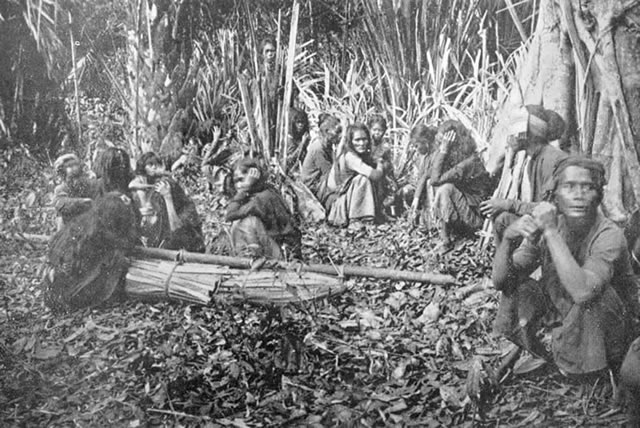
A hoarse roar of horror and dismay broke the
silence. All the Moï of our escort were screaming
frantically as if suddenly stricken with madness.
"The Lord Tiger," they yelled, waving their
long bamboo poles in the air.
My companion and I gazed at each other dumbfounded.
What was to be done? The night was
now black, the jungle impenetrable. Pursuit under
such circumstances would be the height of folly.
Realizing that we must wait for daylight and raging
at our impotence, we returned to the camp fires
thinking of the ghastly tragedy that was being enacted
behind that barricade of brambles, perhaps only
a few yards away.
I called up the unhappy uncle to offer what consolation
I could. He was almost dumb with weeping,
but managed to inform me amid his tears that the
same evil fate had befallen both the father and mother
of the poor boy.
"My brother should know," he added gravely,
"that the spirits of my relations who never received burial nor the rites that were their due have long
demanded another companion."
At that time I was profoundly ignorant of beliefs
and superstitions which came to my notice later,
and I attributed his words to the raving of a madman.
Valutioni soon enlightened me, however, and showed
me that not only the Moï but most of the Annamites
also entertain the most curious beliefs on this subject.
They believe that the spirit of a tiger's victim
is compelled to ride on the back of his murderer and
guide it. Accordingly, when a trap is being laid
the natives are careful to sprinkle a quantity of roasted
maize around the place. When the monster
approaches the spirit smells the grain, is warned
of the impending danger, and leaps off in time to
avoid falling with the tiger into the snare.
The story may raise an incredulous smile but is
not so fanciful as it sounds. The attacks of the
tiger on the Moï are so frequent, ruthless, and calculated
that a savage naturally ascribes them to the
direct instigation and assistance of some supernatural
power. All Europeans will testify to the ferocious
malevolence of the creatures, and many a traveller
has paid for his ignorance or carelessness with his
life. It was probably pure chance that Sao's evil
fate did not befall my companion or myself.
It was evident that while we were enjoying our
reckless bathe the tiger must have been watching
us from the thicket, awaiting a favourable moment
to spring. With its usual cunning it selected the weakest for its prey, and neither rifles nor knives
would have barred its path. The slightest wound
from its paw filled with putrefying matter is calculated
to bring tetanus and an agonizing death.
Such was the course of our melancholy reflections
when our attention was aroused to the presence of
a new danger by the voices of a number of coolies
who were arguing in undertones. We pretended
to be asleep but listened carefully. They were
talking of flight.
Someone was seeming reluctant, suggesting that
the country was strange, the tigers at large. The
whites had angered the spirits and brought all this
evil upon them. It would be better to wait till the
morning and steal away at daybreak.
We realized that vigorous measures were called
for to avert a crisis. The nearest station was more
than a hundred miles away and the country was
absolutely without resources. If our escort fled
we should have to give up the expedition. Fortunately
the chief remained faithful to us. I ordered
him to collect all the identification cards which
every coolie carries with him in accordance with the
regulations. Each card recites the length of the
finger-joints of its owner and is stamped with each
of his finger-prints.
Deprived of their cards, our men became as meek
as sheep. The prospect before them was not inviting.
They would have to pay the native equivalent of
three piastres and produce satisfactory evidence of identity in the capital of the province before a
duplicate would be supplied, and happily a coolie
with three piastres is a rare phenomenon.
This danger disposed of, we attempted to sleep,
but all in vain. The dog trembled and whined as
if scenting evil. The tiger must have been watching
us!
At dawn we beat out the thickets and at length
came upon the tiger's lair where, among a mass of
unrecognizable remains, we distinguished the corpse
of the last victim. Not a fragment of flesh was to
be seen on the skull which looked like an ivory ball.
The animal's rough tongue had literally scraped it
clean. A few paces away was a path, access to which
was barred by the fallen trunk of an immense banian
struck by lightning. It was plain that persons using
this path had been unable to pass this obstacle and
had been compelled to make a detour through the
thicket. Hidden behind its bamboo barrier the
tiger had watched them threading their way, and
fallen upon them at the moment they presented
their backs to it. We saw several fragments of
human clothing and many bones to prove, if proof
were needed, that we were on the site of a veritable
man-trap.
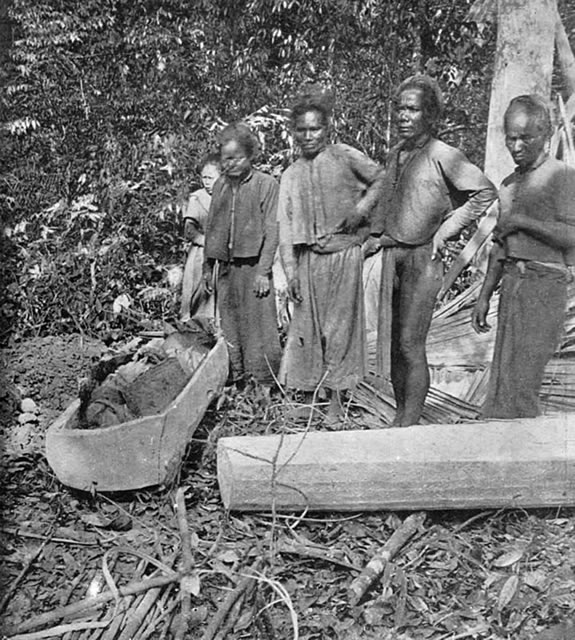
We proceeded to give the poor boy as decent a
burial as time and the circumstances permitted.
His corpse was reverently laid in a shroud of latania
leaves and buried in a grave at the very spot on which
he had met his death. His uncle asked me for a piece of drawing paper, on which he traced the rude
figure of a tiger with a pencil. He then drew three
figures on the tiger's back. He explained to me
that as the boy's parents were both very big, only
a small place remained on the beast's back, quite
near the tail.
"That is the reason," he added, "that my brother,
the White Mandarin, has not been devoured. The
tiger loves the flesh of a white man far more than
that of my countrymen, and if there had been room
he would doubtless have taken my brother for his
victim."
I could say nothing to turn him from this conviction,
and indeed I knew that my imprudence in
bathing at so dangerous a time might very well have
proved fatal.
The old man finished his drawing and then
solemnly burnt it, scattering the fine ashes over
the tomb to the accompaniment of many prayers.
When the soil had all been returned the grave-diggers
strode several times round the grave crying
to the High and Mighty One to seek no more victims.
The moral effect of this tragedy was so great on
the Moï of our escort that it seemed to me wiser
to suspend the expedition with a view to avenging
the boy's death and restoring confidence. Unfortunately
the Moï were even more terrified at this
suggestion and spared no efforts to dissuade me.
They feared the vengeance of the tiger, but I was
not to be turned from my purpose.
I took up my station in a tree and secured a fine
young roebuck as bait. For fourteen nights I waited
for the tiger to come within range, but it never
came. It ravaged the neighbourhood frequently,
startling the forest with its roars, but we never had
a glimpse of it. At the end of the period the
escort became restive and I acceded to the general
desire to strike our camp and retreat before the
enemy.
A few months later Lieutenant Gautier, another
member of the mission, was devoured on the same
spot.
Diseases and their cure—Betrothal and marriage—Adultery—Divorce—A
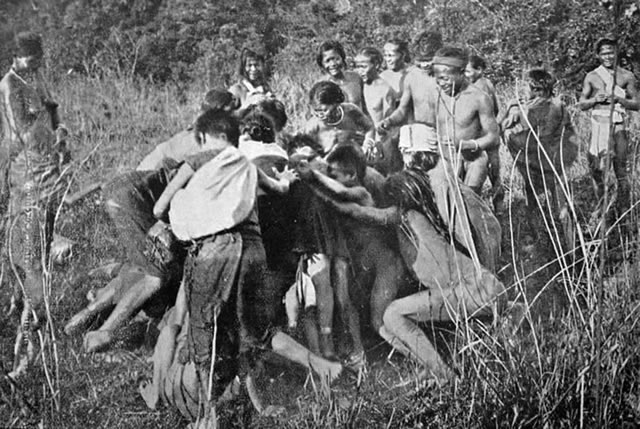
Moï wedding—Birth—Childhood—The game of Pig-Snatcher.
No one with the least experience of the savage,
no matter to what race he may belong, will
deny that the best way to win his friendship is to
cure his ailments.
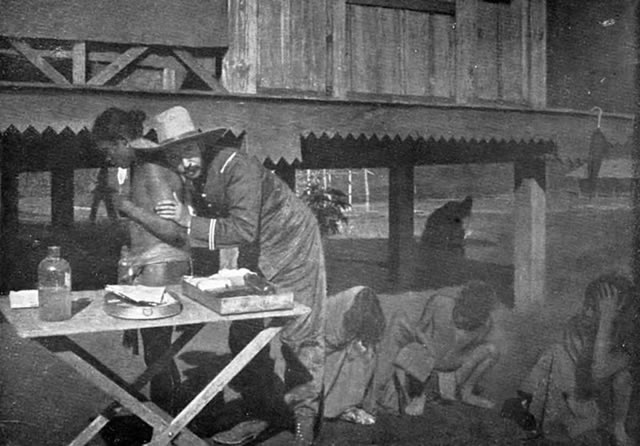
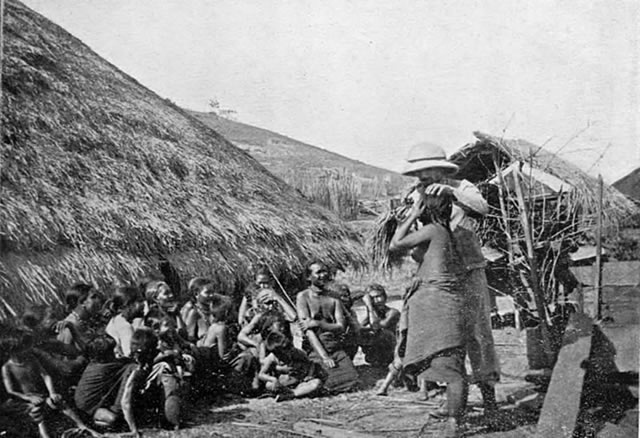
Speaking for myself I habitually relied on my
medical knowledge as a passport to the approval of
the Moï, and I was rarely disappointed, for invalids
of all sorts and conditions came daily to invoke the
aid of my medicine chest. Most of them suffered
from ailments caused by sudden changes of temperature,
and their scanty clothing is a prolific source of
bronchial affections. They always came up with
their hair in disorder, hiding their faces as a sign of
distress, putting out their tongues, and striking themselves
on the breast to draw my attention to the seat
of all their woe. They could hardly contain their
glee when I painted the affected part with iodine.
Their bronzed skins assumed a violet hue, then turned
to browny red, assisted by their vigorous scratching.
Some came from immense distances for auscultation,
and my patients included a large number of
women, inspired, I think, more by curiosity than
any immediate necessity, for I usually presented a
mirror to each new patient. A few brought me their
aged parents, under the impression that I was quite
capable of restoring them to youth. A man with
one arm came to ask for another, a man with one eye
seemed astounded when I repeated my refusal to
get him a new one. I remember once a patient
appearing who was shivering with fever. I gave
him a few grains of quinine and a glass of water to
wash it down.
"Now whistle, my boy."
He whistled at once under the impression that
this musical exercise was part of the treatment,
whereas in truth my only object was to make sure
that the drug had really been swallowed. Its bitterness
had no deterrent effect whatever, for he stretched
out his hands, accompanying the movement with a
wink which means in all languages; "I can do with
as much as you like."
In another case a chronic bronchitis demanded
treatment by wet-cupping. A thick plank which
happened to be handy took the place of an operating-table,
while an empty Madeira glass had to perform
the functions of the cupping-glasses of which I was
destitute.
Lack of cleanliness and ordinary precautions is
mainly responsible for the fatal outcome of so many of the more serious complaints. Even the most
trifling ailments last an abnormal time, but I soon
proved that with reasonable treatment the adult
Moï easily shakes off quite virulent diseases. The
race is, in fact, submitted to a process of strict selection
by the mortality among the infants, which is
very high. Only the hardiest specimens survive
their childhood and are all the more fitted to resist
the attacks of disease.
Infants are fed in the most ignorant and reckless
manner, hence the prevalence of gastro-enteritis
and rickets. On the other hand, the Moï suffer
considerably less from malaria than the Annamites
and the Chinese. Tuberculosis is uncommon and
where found carries off its victims with incredible
rapidity.
The use of simples is not unknown and some of
the less complicated ailments have been successfully
treated by this method. In general, however, all
diseases are attributed to the displeasure of the Spirits,
a superstition which the Sorcerer habitually turns
to his own advantage.
At first we had the greatest difficulty in inducing
the natives to submit to vaccination. The story
was busily circulated that the mark left by inoculation
was a badge of servitude, and it was some time
before we succeeded in exposing the fallacy.
Among certain Moï groups, such as the Sedang,
Djarai and Rognao of the lower lakes, it is usual for
the boys to sleep in a special hut after puberty has been reached. The primary purpose of this custom
is to prevent sexual intercourse before marriage, but
it is quite ineffectual to prevent the girls from meeting
their lovers on the sly. The usual result is that the
mother generally kills her firstborn, as no one comes
forward to claim the fatherhood.
It is not too much to say that the Moï seems to
attach no importance to feminine chastity. Marriage
is only the consecration of a cohabitation of long
standing, and sometimes there are several children
of the union before either party thinks of putting
it on a legal footing.
As a rule, a man must take his wife from the same
group, or, in other words, endogamy is de rigueur.
The only connecting links with other groups are
the alliances with female slaves, to which the woman
need not be a consenting party. The consequence
is that all the inhabitants of a region are related.
We have often tried to decide the vexed question as
to whether this consanguinity exercises a good or
bad influence on the progress of the race, but it is
impossible to say more than that the evidence is
inconclusive.
Some European travellers, who, like myself, have
resided among the Moï, say that marriages are forbidden
between first cousins on the mother's side.
They deduce from this fact that the natives consider
the part played by the mother in the transmission
of hereditary qualities more important than that
of the father.
This theory, interesting and valuable as it might
be if it applied to a race in a higher stage of development,
is probably unsound with regard to the Moï,
the phenomenon on which it is based being probably
merely the effect of coincidence. There has been
an increasing tendency of late years to attribute to
half-civilized races scientific knowledge which we
have only recently acquired ourselves, and to consider
certain customs and beliefs primitive merely because
they are ignorant and coarse. Both tendencies are
liable to lead to error and require careful watching.
In nine cases out of ten such customs are not inspired
by any exact knowledge of physiological phenomena
at all.
Only a few groups permit exogamy, that is marriages
with others than members of the clan, and even where
the system persists it does not seem to be due to any
defined totemic rule.
Totemism is a semi-magical, semi-religious system
which is based on the belief in a bond of relationship
between a group of human beings and some species
of animal regarded as protector, "totem." It has
been noticed that a characteristic feature of totemism
is the prohibition of marriages between men and
women with the same totem and therefore belonging
to the same clan.
The Moï are a strictly monogamous people, for
the very natural reason that the males outnumber
the females, and this again for the equally natural
reason that the men are hardier and more able to survive the manifold mischances of infancy. Another
contributory cause to their moderation in the matter
of wives is their financial disability to keep more than
one. But it is not a matter of principle, and a man
would not hesitate to add to his stock if a sudden
windfall made it possible.
A woman's commercial value depends on her
age and social condition and varies also in different
localities. In most cases she is paid for in instalments
to her parents, for the future husband is too
poor to give the presents which constitute the purchase
price, and his only resource is to sell his labour
to pay off the debt. Accordingly there is a stage
more or less prolonged during which the young man
combines wooing and the duties of maid-of-all-work
in the home of his beloved. No arrangement could
be happier in this country where labour is scarce.
The real object, however, of this cohabitation on
trial is to make sure that the characters of the two
young people will harmonize and that their affections
will survive continuous personal contact. Here, as
elsewhere, there are cynics who say that familiarity
breeds contempt.
If the engagement is broken off the man must
pay an indemnity fixed beforehand. He pays his
pig and takes his leave.
This custom is also in vogue among the Annamites,
who call it "The Son-in-Law in the making." A
similar institution is found even to-day in France,
in certain villages of Haute-Savoie. The future son-in-law comes to reside with his future wife's
parents. In popular phraseology he "makes the
goat's marriage." The allusion becomes clear when
we know that in this country it is usual to lead the
he-goat to the she-goat, whereas in the case of other
animals, such as bulls and horses, the female is always
taken to the male.
Returning to the question of a woman's commercial
value, I made inquiries in every province we visited,
but found it seldom higher than the equivalent of
fifty francs.
The final act that seals the marriage compact is
a reciprocal scratching. While I was still in ignorance
of this custom I received a severe rebuff from
a girl to whom I offered some ointment for the
scratches that disfigured her face. She refused it
with scorn, for the nail-marks with which her lover
had adorned her cheeks were, in her eyes, no other
than his signature to the marriage-contract.
The rites and customs relative to betrothal and
marriage vary greatly in different parts of the country
and among different groups. One rule, however,
is universal, and that is that the first step must be
taken by the man's parents, who approach those of
the girl, not without trepidation at the outset, for
nothing is more humiliating than to be rejected.
Accordingly the first interview is popularly dubbed
the "Visit of the little gift of betel to the little
garden gate."
If the parents' advances are received with favour a second visit follows and the presents are more
valuable than on the first occasion, generally including
chickens, rice, and still more betel. This last substance
is considered throughout the Far East as the
emblem of fidelity.
The dowry is met with only among the more
prosperous groups. Of course it is the future
husband who provides it, a far more reasonable
arrangement than that with which we are familiar
in Europe. In this happy land worldly considerations
count for nothing; dressmakers and fashion-plates
are unknown. The most expensive jewellery is of
copper, the finest coiffures are the superb orchids
which abound in the forests. There is no need to
save up for the children to come. Books are unknown.
The sons will learn to hunt, their sole education,
and the girls will be taught to spin and weave. Far
from being a burden to her husband a wife is his
most valuable assistant, so it is only fair that the
husband should make some compensation to her
parents for the loss he occasions to them.
The Moï, thanks to the kindly influences of the
Laotians, have a much higher idea of the status of
womanhood than their neighbours the Annamites.
The husband always takes his wife into his confidence
and consults her in all the crises of life, and the wives
reward their husbands with a very high degree of
fidelity. I remember one occasion when I offered
a trifling gift to the wife of one of our coolies. She
refused it point blank with the one word "bao" ("I am married"). She was not familiar with our
gallant European manners, and regarded the acceptance
of a present from a man as the first step towards
the rupture of the marriage tie.
The penalty of adultery is renowned for its
severity. There was a woman in our camp who
was feeding her new-born baby. One night I was
roused by a succession of screams, and thinking that
a fire must have broken out, I called my boy and
asked him the cause of the disturbance. He adopted
a tone of lofty cynicism and told me that a husband
was thrashing his unfaithful wife. Next day the
woman was unable to go to work and the child was
nowhere to be seen. It seems that her husband had
suddenly conceived doubts as to its paternity, and,
suspecting his wife of adultery with an Annamite
soldier who was in our escort, he had turned himself
into an instrument of justice, beaten her without
pity and cut the baby's throat. I complained of
his conduct to the Pholy (village chief), but far from
taking any proceedings he delivered himself in these
words: "My only regret is that the betrayed husband
did not kill both the adulteress and her paramour."
I learnt thereby that the Moï regard an act which
may enfeeble the race as a crime against the community
and punishable with the utmost severity.
The Annamites take a similar view, for their code
provides no punishment for a husband who kills
an adulterous wife and her paramour if caught in
the act. The other alternative is to arraign them before the provincial tribunal, which usually means
a sentence of ninety strokes with the lash. In most
cases this severe penalty has fatal results, but it may
always be compounded at the price of one franc per
stroke, the redemption money being paid to the
husband as damages.
Divorce is easy and can be demanded at the
instance of either party or by mutual consent. The
village elders meet to hear the charges and complaints
and assess the amount of compensation. If the
dissolution of the marital tie is the wish of both,
the care of the younger children is confided to the
mother, that of the elder to the father. Divorces,
however, are uncommon. The husband does not
want one, for it will be difficult to replace the partner
who represents half his capital and perhaps all his
labour. The wife is equally reluctant whatever
her sorrows may be, for any change may easily
be for the worse. If she marries another she will
be little more than his humble slave. All the heavy
farm and household work falls on her shoulders,
including arduous duties which in civilized countries
are assigned exclusively to men. She crushes the
rice, shells the corn, attends to the harvest and assists
in clearing the brushwood. Pregnancy makes no
difference to the burden of her daily tasks except
for the entirely inadequate period essential to delivery.
If the husband's means permit she will have no
objection to his taking a companion to himself.
On the contrary, the new-comer will be an addition to the household staff to whom she will assign the
largest burdens. She knows that as first wife her
position will never be seriously challenged, and as
undisputed mistress of the household she will
exercise authority over the other "wives." This
unwritten law prevails throughout the Far East.
A widow has little difficulty in remarrying, as the
area of choice is extensive, owing to the numerical
superiority of the men.
I was once honoured with an invitation to a Moï
wedding. It was in the village of Lebouy where I
resided for some time, and my host was no other
than the chief himself, who couched his request in
the following terms:
"My elder brother, the great Giver of Tobacco"
(this being the name under which I was popularly
known), "will, I hope, do me the honour of sharing a
buffalo which I propose to offer up at the marriage
of my daughter."
It would have been ungracious to decline an invitation
expressed in terms of such old-world courtesy.
I exhibited my appreciation of the honour by offering
him a large glass of Madeira. He hesitated at first,
then squatted on the ground as a compliment to the
excellence of the liquor, took the glass gingerly
in his hand and slowly emptied it. The slaves who
formed his bodyguard watched him with evident
admiration.
The evening before the wedding the bride-elect
went to the banks of the Da-Nhim, a river which flows at a distance of a few hundred yards from the
village. All her relations formed themselves into
an escort, for it is absolutely imperative that the
whole family should be present at the kind of ritual
bathe on which she was bent. The entire company
plunged into the water, and after a few seconds of
merry splashing emerged and dried in the sun.
The opening item of the next day's festivities was
the slaughter of the buffalo which is, so to speak,
the foundation of the feast. The young warriors
of the village armed with lances formed a circle
round the victim and hurled their weapons in turn,
until at length one struck a vital part and the beast
fell over dead. The carcase was dragged to the
foot of a pole wreathed round with bamboo-shoots,
and the amateur butchers proceeded to cut it up
into strips, of which some were reserved to be smoked
at a later stage.
The nuptial ceremony proper then began and
was marked by an extreme simplicity. The Guru,
or Sorcerer, placed the couple and their parents
before a row of lofty posts adorned with the horns
of recently killed buffaloes. With great solemnity
he then drew his knife, seized a white cock and cut
off its head, throwing the body over his right shoulder.
The headless bird struggled for a moment, flapped
its wings in a last spasm, and finally remained motionless
on its breast on the ground. The Sorcerer spat
into a copper vase, not so much to relieve his feelings
as in satisfaction, for the victim's position foretold a numerous posterity to the young couple. He
then took a cotton thread and bound the right hand
of the man to the left hand of the woman. This
act made them man and wife and was of the same
force as the exchange of rings in our own country.
A rapid invocation to the Spirits of the Hearth
followed, and then the feast began.
First I was requested to take my place on a rush
mat under a huge shed built for the occasion. A
number of women appeared bringing fried locusts,
spices, bitter oranges, spirits of rice and meat, almost
raw and cut into strips. The newly married couple
overwhelmed each other with attentions, filled each
other's mouths with rice and accepted in good part
the food which all their friends and relations thought
it necessary to offer them. Perhaps this rite is a
symbol of the principle of mutual help which ought
to actuate not merely a family but also tribes and
nations.
Meanwhile a woman was conducting an orchestra
of four all but naked boys who beat a tattoo on huge
gongs. Lest this should become monotonous a
musician played a melody in the minor mode and not
without a strange haunting charm. The instrument
was a large empty gourd on which three bamboo
tubes were fastened. The range of this original organ
was confined to five notes, but the tones blended
pleasantly and in spite of the dragging time the tune
was anything but discordant.
We encouraged this artist with an offer of some cigarettes, and presently he began to play for a dance,
of which the principal movements seemed to be
raising the feet in turn, and striking the ground with
the heels or a stick. These operations became more
rapid and ended with a tremendous contortion of the
whole body. It reminded me forcibly of the well-known
"bear dance," and is not peculiar to the Moï,
being also popular in Thibet.
Both the musician and the dancer were rewarded
with the most unstinted applause and invited to take
a well-earned rest in view of the orgy which now
followed. On such an occasion the Moï regard sobriety
as an insult to the host, and indeed the charge
could not have been levelled at any of the guests
then assembled. The last stage of the proceedings
was the distribution of presents, for interest can
always seal the bonds of friendship. At a given signal
the husband flung lemons, mangoes, areca nuts and
other fruits among the crowd, who scrambled for
them without the least regard for order or good
manners. For some moments a free fight seemed
imminent, but good humour finally prevailed and
the combatants dispersed chewing the inevitable
betel and bidding each other an inebriated farewell.
Among the Moï, as everywhere else, the birth of
a child is an occasion for rejoicing both to the family
and the village. Such is the fear that malevolent
spirits will assail the mother during the critical period
that a special hut is made for her accommodation
and all strangers are forbidden to enter the village itself. This prohibition, or "taboo," is known as
"Dieng" in some regions and as "Calam" in others.
The experienced traveller will never dream of
attempting to evade it and expose himself to a summary
vengeance at the hands of the inhabitants, who are
under orders to see it enforced. Foreigners stand
in no privileged position and we ourselves had frequent
occasion to bewail this absurd regulation. Imagine
our rage after a hard day's march under a tropical
sun or soaked by torrential rains when we found ourselves
condemned to spend the night perched in trees
for fear of tigers, with the fires of a tabooed village
burning almost under our noses! The punishment
of Tantalus was nothing to this, and little consolation
is to be derived from inveighing against the ignorance
which is the offspring of such blind superstition.
The house in which the mother-to-be is lodged is
distinguished from the others by a tuft of pompelmoose
and a piece of charcoal suspended from the
roof. About the time when the happy event is to
take place all the inhabitants forgather in a special
place to await the good news.
Even to-day in certain European countries custom
forbids the husband and family to be present during
labour.
If the group is not altogether destitute, sacrifices
must be offered to conciliate the Spirits, especially
if it seems likely that complications are threatening.
Of course, the villagers offer no more than they can
help. The bidding, so to speak, for divine favour generally starts with an egg and rises if the complications
continue. The egg will be followed by a
chicken, then a goat, then a pig, and finally an ox in
cases of extreme necessity.
Only the woman's nearest relations are allowed to
be present at the accouchement, for which she assumes
a sitting position. As soon as labour begins they rub
her stomach from top to bottom with tiger's gut
and make her lean against the knees of a female nurse.
This is not a universal practice, for in the North,
among the Tho, for example, the woman stands
supported by two cords passed under her armpits.
Immediately after the birth the child is washed
and anointed with cocoa-nut oil. The navel-string
is then cut with a sharpened bamboo and the severed
end tied up with a cotton thread or a blade of long
grass. The placenta is buried either in the house
itself or in some place adjacent.
It is interesting to compare these rites with those
which accompany the same event among certain
African races. Among the Bushongo of the Belgian
Congo the woman adopts a sitting position and is
supported by the knees of a midwife. The placenta
is likewise buried and also, at a later stage, the foreskin
of the child, if male. In Mandeling (on the
western frontier of Sumatra) the child is first washed
and then kept in confinement in the house, the natives
claiming that this procedure secures the child against
evil influences.
After delivery the Moï woman lies on a low bed and a fire is kept burning at her side day and night,
the ashes from which are left smouldering in earthenware
vases to keep the room at an even temperature.
The smoke is supposed to act as an antiseptic. All
the young woman's friends demonstrate their devotion
by bringing wood for the fire, taking care to select
the dead branches of certain species of trees. Drifting
logs from a river must on no account be used.
They bring fearful convulsions and certain death to
the child.
A potion composed of simples which stimulate the
circulation is now administered to the invalid and
the effect is augmented by rubbing her all over with
ginger. Her first meal consists of ginger, eggs and
rice. She is allowed to drink a concoction made
from the horns of a young stag. Strange as it may
sound, this beverage is a valuable tonic, which we
ourselves used at times with great effect.
Ten or fifteen days after the birth the woman
resumes her usual arduous occupations. The baby
is hung on her back in a little cloth sack, secured
over her shoulders to her girdle. His feet dangle
on each side of her, and in this position he passes the
days cradled by his nurse's movements.
The child is fed at the breast until between two or
three years of age, a custom which is a great strain
on the mother. To lessen this she gives him manioc
and rice, taking care to soften them in her own mouth
first. The net result is that the baby's stomach
attains an unnatural size and his digestive organs suffer.
The nursling's first meal is the occasion of a special
ceremony. The mother is not yet ready to feed him
herself, so the duty falls on one of her attendants,
who takes her seat on an upturned earthenware jar.
The position of this jar is highly significant in the
eyes of the Moï. A jar so placed can hold no water.
Similarly a child's stomach can hold no food, for it
empties itself as fast as it is filled. Dyspepsia, it would
appear, is unknown among this fortunate people!
After this first meal an attendant goes through the
pretence of flattening the child's head against the
centre pole of the hut. This is to ensure that the
head may not become pointed later on, a physical
peculiarity which is regarded as a sign of bad
character. Another favourite superstition in these
regions is that certain odd numbers are lucky and
certain even numbers unlucky. Every mother hopes
to give birth to a three or a seven. Her fear is that
the birth may occur during the last quarter of the
moon. As everyone knows, this belief in the efficacy
of certain numbers is almost universal and dates from
remote times. The Hebrews and Egyptians furnish
many examples, and many more are met with among
the peoples of the Far East. Thus the Brahminic
Trinity comprises three persons, Brahma, Vishnu
and Siva. Angkor was built in seven days, as the
Bible tells. The stars which the faithful of Asia
worship are seven in number.
The child is not named for the first two years of
his life and is doubtless happy enough to be called "Con-Nie," which to all intents and purposes
corresponds to our term "baby." Both the Moï
and the Annamites regard the naming of a child as
a matter of great moment, for the future depends
on a fortunate choice. Nothing can be done before
the Sorcerer has been called in to consult the Spirits.
This official suggests a name, which is usually whispered
into his ear by the mother or the person who presided
at the birth. The popular name for a boy is
"Squirrel," for a girl "Mouse." A large bowl
filled with rice is brought in. The Sorcerer empties
it, taking out the grains two at a time. If at the
end of this operation only one grain is left at the
bottom the proceedings must be repeated until that
ill-omened result does not recur. It is not surprising,
therefore, that occasionally several days elapse before
the ceremony can be continued. The Sorcerer has
an interest in the prolongation of these rites, for
throughout the whole time he is the guest of the
family. If the child dies or is attacked by one of
the infantile affections so common in this treacherous
climate the mischance is attributed to the choice of
an unlucky name. The only hope is to change it at
once, which involves a repetition of the ritual
rigmarole.
When the child is old enough to bear a light burden
he will carry on his back a basket, or even a younger
brother, securely rolled up in a kind of sack. Nothing
could be more amusing than the solemnity with which
the youngster performs his function of dry nurse.
Among certain groups the children's hair is always
kept short except for a long wisp at the crown,
which gives them a curiously old look.
Clothing is forgotten, as a rule, till the sixth year
is past. Sometimes a metal disc is hung from a cord
round the waist, and a favourite ornament is an
anklet of iron with a small bell attached, which is
made and fitted by the village blacksmith. It is a
badge of servitude, for henceforth the child is devoted
to the service of the Spirits, who, in return, make him
an object of their peculiar care.
During their early years the boys are active and
intelligent and readily absorb knowledge of all kinds,
but as manhood approaches they become apathetic,
lazy and incapable of sustained effort. I once undertook
the experiment of training a boy to act as my
servant. He was about twelve years old, with a remarkably
bright face, and very quick and graceful
in his movements. In a short time he had learnt
to read and count. His eyesight was so good that
we always used him when taking sights for our
geodetical instruments. He was never happier than
when I gave him a rifle to carry during our shooting-parties.
After a year, however, his character changed
completely. He became intractable and moody, and
fiercely resented any criticism. We were a long way
from his tribe and he could not return home except
through a forest infested with tigers. The prospect
of a long and dangerous journey seemed to have no
terrors for him. He begged me to let him go, and jumped with joy when I gave my permission. In a
twinkling he was out of his European clothes and
had donned the old loin-cloth, which he had preserved
with the greatest care as a mark of race. He
bowed three times, took up his basket and disappeared
with every expression of jubilation. His obvious
glee was some consolation for the annoyance his
departure caused me, for I had set my heart on
softening his savage nature and winning his affection.
It was with real regret that I confessed myself beaten.
On the other side of the account must be placed the
feat of Madame Cunhac, the wife of one of our
governors, who successfully brought up a Moï girl.
The child grew to have an unshaken belief in her
mistress and followed her about like a faithful dog,
showing her affection and gratitude on every possible
occasion, nor could she be induced to return to her
village by threats or bribes.
A child receives nothing that can be dignified
with the name of education. His incessant occupation
consists of playing all day with his little companions.
Many of the games played are extremely
interesting and we spent many an hour in the evening
watching them. Perhaps the favourite is a game
they call "The Pig-Snatcher," in which there are
three principal dramatis personæ, the Snatcher, the
Shopkeeper and the Pig. The greatest competition
is for the position of the two former, so the candidates
are subjected to a preliminary trial. They all take
turns at catching a twig on a long pole and balancing it, and the two most expert are rewarded with the
rôles of Shopkeeper and Snatcher respectively. The
next plays the part of the Pig, which consists of saying
nothing, but grunting vigorously at intervals.
The unsuccessful candidates join hands and make
a ring round the lucky three.
The Snatcher now approaches with slow steps and
interrogates the Shopkeeper as follows:
"Hello, maternal aunt! Please give me some fire."
"O elderly brother, the fire is under the ashes."
"Well, then, give me a gourd of water."
"The water is at the bottom of the well."
"Then give me a guava."
"The guava is still on the tree."
Feigning dismay at these repeated rebuffs the
Snatcher takes a few steps backwards and suddenly
stops, for the Pig, in the person of a small urchin
of barely five years old, gives forth a timid grunt.
"What is the animal I hear in your stable?"
"It is a spotted pig."
"What kind of spots has it?"
"Red on its paws and white on its tail. It has
every perfection, and the less I feed it the fatter
it gets."
"Really! Will you take a Mat for it?" (A
Mat is a piece of iron which is used for exchange
and worth about a penny.)
"No, it is not for sale."
The dialogue continues, the Snatcher increasing
his offer up to a set of gongs, but the Shopkeeper is not to be tempted. At length the Snatcher is
weary and pretends to leave the shop. The game
seems to be over, but the children enjoy it too much
to allow it to be cut short; so there is a general burst
of laughter when the Shopkeeper in her most
wheedling voice recalls the customer before he has
proceeded very far.
"Here, Pig-Snatcher, come in! I have changed
my mind and I will sell it to you for a broken cup."
The Snatcher, delighted at this unexpected turn
of events, hastens to secure his prize, but is prevented
from moving out of the circle formed by the children.
He clasps a girl of about twelve who represents one
of the doors of the house and shakes her by the
shoulders.
"What is this door made of?" he asks.
"It is of ironwood," replies the Shopkeeper.
Burglary in that quarter is doomed to failure, he
thinks, and finds a younger girl.
"Of what wood is this one?"
"Teak."
"Still too strong. What of this third?"
"It is made of rotten fibres," the Shopkeeper
cries.
On that the encircling chain snaps suddenly.
The Snatcher, who is no other than the Tiger in
human form, darts at the Pig. Despairing squeals.
A savage roar. The village dogs appear upon the
scene, and amid peals of merry laughter the game
comes to an end.
Property—Slavery—Utilitarian morals—A bashful race—The Levirate—Law
and custom—An amateur arbitrator—Principles and practice
of the Ordeal.
The Moï who inhabit the more northerly portion
of this country have largely fallen under the
domination of their neighbours the Laotians. In
the south, however, in spite of their proximity to
the warlike and powerful Annamites, the Moï have,
to a large degree, resisted absorption and preserved
their independence. Consequently their immemorial
institutions have survived the chances and changes
of the centuries without appreciable modification.
The unit of administration is the village, which
forms a kind of anarchical republic with a nominal
chief who is elected. As a general rule these shadow
potentates are chosen either for their physical prowess
or reputed moral superiority. The Chief's powers
are not transferable and lapse on his death.
It sometimes happens that several villages of the
same region are united by community of interests
or family alliances. The union is then cemented by the formation of a league with a view to defence
against common enemies. From such associations
for mutual insurance the tribe takes its origin. In
many cases one of the first signs that this new organization
has become a social or political entity is the
appearance of an obligation on its members to
intermarry.
It is well known that in the primitive ages of the
Aryan races the tribesmen were not only shepherds
rather than warriors but also essentially nomadic in
habit. It was in the character of owners-in-common
that they held the land on which they pastured
their flocks. Later, when they began to settle in
defined localities to till the soil, the ownership of
property ceased to be collective. As population
and the area under cultivation increased, private
property appeared at first as the right of the family
and finally as the right of the individual.
Even to-day, however, we see traces of such primitive
collectivism in the "Mir" of Russia, the
"Dessa" of Java, and the "Zadruga" of Bulgaria.
The peculiarity of the Moï is that they exhibit the
three forms of ownership, collective, family, and
individual, in conjunction.
Evidence of the communistic basis of their proprietary
system is plentiful and cumulative. The
whole group takes part in the acquisition and development
of a tract of land sufficient to satisfy all their
needs. The trophies of war, the spoils of the chase
and the harvests are divided equally among those entitled to them. Inequality of distribution is
almost unknown. The Chief reserves a portion in
addition to his own to offer as a sacrifice to the
Spirits or to dispense in hospitality to strangers.
There is equally strong evidence of the system
of family ownership of property. Every family has
its private residence and household implements.
This economic dispensation accounts for differences
of wealth and station among members of the same
communal group. For example a family in which
there are many grown-up girls will become rich on
the proceeds of their skill in weaving, pot-making,
and other spheres of activity.
The individual ownership of property seems to be
confined to jewellery, pipes, weapons, and similar
objects which any man can make for himself. Further,
any member of the group is entitled to do what
he likes with the portion of food distributed to him.
In most cases if he does not consume it himself he
will lend it to some less thrifty neighbour who finds
his store exhausted. If the day for repayment
comes round and the liability is not discharged, the
borrower, his wife and children, become the absolute
property of the lender whose sole obligation is to
support them. The debtor thus becomes a slave,
or rather, to speak more accurately, a servant for life.
It is not at all unusual in times of great scarcity for
the Moï to sell both themselves and their families
when faced with the prospect of starvation. These
facts are well known to our Government, which is powerless to prevent such evils so long as the
imperfect means of communication prevent the
easy transport of food supplies from a fertile region
to a famine-stricken province.
Trading in slaves is prohibited, but there is no
doubt that it goes on in secret.
In principle the debtor-slave can procure his own
redemption by his own labour. But the value of
that labour is calculated by the master and at so
ridiculous a figure that in practice hardly any slave
earns his freedom before his death. The annual
value of the labour of a strong man is reckoned at
about five francs more than the cost of his support.
Further, if a slave does not satisfy his master he may
be resold at a price which represents an increase of
twenty-five per cent. on the original debt.
The system may truly be described as in every
sense an exploitation of human misery. At the
current rate of calculation it may take several generations
of sufferers to pay off the first debt.
In theory there is another mode of redemption.
On his master's death a slave can recover his liberty
by sacrificing a buffalo and placing a small portion
of the flesh in the mouth of the deceased. The
mere idea of a debtor-slave having the means to
buy a buffalo is one to provoke bitter mirth!
Any reform should aim at an equitable calculation
of the value of the services rendered and the rate of
interest should be drastically revised. This rate,
which is extremely exorbitant, soon trebles and even quadruples the amount of the original debt.
It is to be noted, however, that a slave shares in
the family life, is consulted in any crisis that may
arise, and, if a woman, may inherit. Cruelty and
ill-usage are rare, and even where they exist there
is some safeguard in the slave's right of appeal to
the village Elders.
A female slave is protected against any abuse of
authority by her master. If he violates her she is
freed at once by the act.
In Babylon the law was equally favourable to
slaves and even went so far as to permit them to
contract independently of their masters under the
ingenious system of peculium. It was also quite
usual for anyone to escape from an embarrassing
financial position by entering on a kind of voluntary
servitude which could be terminated in time by
payment of a sum for redemption out of the earnings
of the service. Further, it was enacted by Hammurabi's
code, two thousand years before the Christian
era, that a creditor, after three years, must set free
the wife or daughter of his debtor if he had accepted
them as sureties for the debt.
The laws of the Hebrews likewise permitted an
insolvent debtor to sell himself and his family into
bondage to extinguish a debt. A peculiar feature
in this case was the debtor's right to sell his wife or
daughters and himself retain his liberty.
The laws of the Annamites forbid this same
transaction, but there is no doubt that it frequently takes place. Custom in these matters is of far more
force than the law, and the actual nature of the
contract is concealed under various disguises.
The Chinese code contains a special provision
relating to "The letting on hire of wives or
daughters."
Another force working to the same end is the fact
that in countries in which individualistic ownership
of land prevails, and where labour is scarce the owner
stops at nothing to increase the number of hands
on his estate. This necessity is the mother of all
manner of abuses, to which the weakest naturally
fall victims.
The Sorcerers, for example, impose the most
exorbitant fines on those who have failed to carry
out the least detail of the rites. A penalty thus
inflicted constitutes the delinquent to all intents
and purposes a slave of the offended Spirit. He
has to place himself at the disposal of the Sorcerer,
the representative of the deity. Another species of
slavery is created by the capture of prisoners of war.
There are no provisions in law or custom for their
redemption or liberation except by way of exchange.
Otherwise the servitude is deemed perpetual.
The independent Moï have recourse to a raid on
their neighbours, the Annamites, when their stock
of slaves falls low. The prisoner of war is considered
as belonging to an inferior order of creation with no
status and few rights. A woman may not marry
and neither male nor female may inherit; but the law contemplates the case of a free woman marrying
a male prisoner of war. The father and the male
children become the slaves of the woman. Female
children are freed. If the children are all boys or
all girls they are divided and one half become the
slaves of the other.
In short, although less cruel and inhuman than
wholesale slaughter, slavery is one of the most blighting
institutions in these barbarous regions. The
Moï prefer the milder to the more drastic treatment,
not from any motives of altruism but solely from
considerations of self-interest. The death of an
individual for religious disobedience or even the
commission of a crime profits no one, but material
benefits accrue both to the private citizen and to the
state from the fine imposed or the services exacted as
punishment. The most superficial investigation reveals
the essential utilitarianism of the conception of justice
which obtains among the Moï.
No less utilitarian is their conception of morality.
They never ask whether an act is good or bad in
itself, for abstract standards of right and wrong are
unknown to them. They merely ask whether the
act is prejudicial to private or public well-being. It
follows from this that crimes against the individual
are punished far less severely than crimes against the
state, and further that the most serious offences are
those which touch material prosperity and enjoyment.
A theft of rice from the public granary is
punished by enslavement, for rice is the staple food and an indispensable necessity to the whole group.
The same theft from a private individual is regarded
only as a minor offence punishable summarily by
fine. In this case Society does not suffer, or at
least only indirectly and to an imperceptible degree.
In the same way a murderer receives no punishment
if his act is one of vengeance for a similar crime. He
is exacting the price of blood, and the blood-feud is
recognized and approved. It is highly meritorious
to kill a foreigner or a public enemy, and the slayer
becomes ipso facto a popular hero.
This conception of morality is the production of
tradition and has been influenced in various ways by
the jurisdiction of the Sorcerers over a number of
offences, especially those relating to sex and ritual.
It has long been popularly supposed that races in
a rudimentary stage of civilization enjoy absolute
immunity from regulation in the matter of sexual
relations. Nothing could be further from the truth,
the evidence all pointing the other way. Indeed,
paradoxical as it may seem, it is none the less true
that sexual relations of primitive peoples are more
restricted, more bound round by various interdictions,
than those of peoples which have reached a higher
stage of development. It is plain that we have often
confused complete sexual licence with the exercise
of perfectly limited and defined rights which are only
permitted during certain public festivals. It is only
necessary in this connection to remind ourselves of
the Saturnalia in Rome.
The same error appears in the popular attitude
towards polyandry, which is frequently attributed
to the moral abandonment of the women. In reality
the system is no less organized and regulated than
that of polygamy. Further, all educated travellers
who have lived long enough among primitive races
to attain some degree of intimacy have expressed
surprise at their reticence in speaking of these matters.
They display the most marked repugnance to give
any information about their women, and if pressed
to answer questions, take refuge in evasion or refuse
to continue the conversation.
It is only after years spent amongst them, and,
after winning their confidence, mainly by medical
services, that a European can penetrate at all into that
region of mystery from which he is jealously excluded.
Some of the following observations are the result
of personal investigation. Others are made on the
authority of several of my countrymen with the
experience of a long residence in the country behind
them, while others again are founded on information
supplied by the natives which I have myself verified.
Some of my remarks apply only to a tribe or a
particular region, but in many cases they hold
good of the whole group, and even of a wider circle,
for it must never be forgotten that resemblances
are encountered everywhere between the customs of
these folk and those, not only of other peoples of the
Far East, but also of the semi-savages of Africa and
Polynesia.
I have had occasion to speak before of the custom,
practised by several of the Moï tribes, of killing the
firstborn if no one comes forward to claim the
paternity. Thanks to this convenient institution,
it is quite usual for a young girl to become a mother
solely to prove her fertility.
We find this same custom among the Bohindu of
the Belgian Congo, where the girls indulge in promiscuous
prostitution until conception takes place.
This event guarantees them a husband, for sterility
is a ground for divorce, and the man looks upon fertility
as the highest virtue in a woman. Thus, calculated
prostitution, if I may use the phrase, is not regarded
with disfavour by some primitive peoples. Where
the motive is other than the desire for maternity
it is regarded merely as mental aberration or weakness
of mind. If a woman gives herself without love,
she is not a criminal but an idiot. The same attitude
is displayed by the Abahua of the Belgian Congo.
Each time that we made the acquaintance of a Moï
tribe the Chief was careful to demonstrate his
hospitality by the offer of some female slaves instructed
to put themselves at our disposal. It seems
that this act of courtesy is invariably extended to
strangers of their own race, and consequently their
astonishment was all the greater when we declined
the honour.
This magnanimous custom is also found among
several of the races which inhabit equatorial Africa,
notably the Medgé and the Mangbetù.
Incestuous relationships are by no means uncommon
among the Moï. I once spent several months in the
village of Lebouy, where the chief was the father of
his daughter's children. Nor was any exception
taken to his action, which was regarded merely as the
exercise of a right which immemorial precedent had
sanctioned.
These incestuous connections are by no means
confined to the eastern archipelago, but are constantly
met with in Africa also. I need only mention
the Avura-Gura of the Congo as an example. It is
a mere matter of history that incest was practised
and recognized by the royal family in ancient Egypt.
The most usual instance was a union between sisters
and brothers. The object, of course, was to ensure
that the royal blood should be transmitted from
generation to generation without any admixture
of alien strains, and thus preserve its identity with
its true and first origin the union of a god and some
creature, such as the hawk or gryphon. The example
of the princes soon found imitators among their
subjects, and after being confined to the nobility
and ruling classes, it spread among all orders of
society. We possess an accumulation of proof,
which places the matter beyond doubt, in the documents
and inscriptions which archæological research
has brought to light.
By way of contrast, a custom obtains among certain
groups in Indo-China (though almost unknown elsewhere),
especially the Man Coc, and Man Pa Tong, which formally prohibits intercourse between a woman
and her father-in-law or uncles, and likewise between
a man and his mother-in-law, his aunts, or his sisters-in-law.
I shall have occasion further on to investigate
this peculiar veto which is enforced by certain
African tribes also.
The Levirate (from "Levir," a brother-in-law,
in Sanscrit dêvar) is also found operating as a
stringent injunction.
This, as everyone knows, takes its name from that
law of Moses which commanded a brother-in-law to
marry his deceased brother's widow (in cases where
there had been no issue) in order to provide an heir
to the family and to perpetuate his name. It was a
species of "adoption beyond the tomb."
In the same way, there are laws among certain of
the Moï tribes, such as the Radé, by which a widow
is compelled to remarry with some member of her
husband's family. Various reasons are assigned for
this injunction, but primarily it is dictated by a desire
to secure the inheritance to the family of the deceased.
I was told of several cases of bestiality which
seemed to me, even if proved, to present no features
worthy of comment. Sexual perversions of this
character are not confined to any one country nor
any one period, and it is sufficient to remark that
nearly every race has legends of gods changing themselves
into animals with the aim of uniting themselves
with mortals. These fables are not mere fictions of
a poet's brain but reminiscences of a distant period when Egyptians and Greeks worshipped animal-gods
whom superstition had endowed with mortal offspring.
One fact which I was able to prove to my own
satisfaction was the dietary regulations to which
pregnant women are subjected. Among the prohibited
foods at that period figures the flesh of all
male animals which have not been castrated. Here,
without doubt, is an analogy with the law of the
Man-Coc that no sexual intercourse may take place
after the third month of pregnancy. In particular,
the mother-to-be must abstain from fat and green
vegetables. She may undertake no kind of work,
not even the most trivial of household duties.
Like other races with a low degree of civilization,
the Moï attribute to physical excess of all kinds a
loss of force which puts an individual at a disadvantage
in his contest with the powers of the earth or the
air. On this belief are based the rules which prescribe
the preparations of one who is about to face some
judicial test or ordeal. He must pass the previous
night in a state of complete abstinence, so that his
moral and physical condition shall be perfect for the
trial he is to undergo. The golden rule is summed
up in a motto of the Adio of Central Africa: "No
man may face the ordeal if not pure in body and
mind, sinless and unstained." It seems doubtful
whether the origin of this belief is religious or experimental.
We know that it flourished among the
Egyptians from an early period.
It is impossible to obtain even the most superficial understanding of many Moï laws and institutions
without investigating the peculiar conceptions of
morality on which they are based.
A Moï woman appears before the Council of the
Ancients with a charge that some man has touched
her without her consent. A fine is inflicted on the
accused varying in amount with the importance of
the part of the body which he touched. If there
has been complete seduction and the seducer refuses
to marry the complainant the fine is doubled.
Perhaps it is a husband who complains that his
wife has committed adultery on three different
occasions with three different men. He himself
will be punished, and the sentence will be accompanied
by some withering reflections on his incompetence
and complacence, hardly flattering to his
vanity. I ought to add that this curious judicial
perversion is met with only on the shores of the
great lakes, where morals are less rigid than in other
parts of Indo-China.
I was told that among a few groups adultery is
not considered criminal if the woman's accomplice
is a relation of her husband. The Batua of the Congo
also seem to regard this as an extenuating circumstance,
but their neighbours, the Medgé and the Mangbetù,
take a precisely opposite view and rigorously forbid
brothers to seduce each other's wives. All the Moï
consider it a gross aggravation of the offence if
the seducer takes advantage of the husband's absence
in war or the hunting-field.
I have already recorded that I was frequently
prevailed on by the Moï to act as arbitrator in their
disputes. I have the gravest misgivings that my
judgments did more credit to my kindly intentions
than to my legal knowledge.
I always made a point of using all my resources
to impress the litigants with a due sense of the importance
of the occasion and the dignity of the
tribunal.
A scarlet cloth is thrown over my folding table.
Next the huge blue-cotton umbrella, whose humble
function is to protect our theodolite from the sun's
rays, is commandeered to shelter the miserable packing-case
which serves me for my curule chair. I don a
wide-brimmed Boer hat and my revolver-case is
reverentially attached to my belt by my boy, who is
crier, clerk, and usher all in one.
To-day the case in the list is:
"Annamite v. Moï."
It would be altogether a miracle if the plaintiff
did not herald his appearance with a present of some
kind, in this case chickens, eggs and bananas. He
is convulsed with astonishment when, incorruptible,
I reject his bribes. His ordinary judges, the Mandarins,
have other and better manners. They have
not prepared him for such a rebuff.
The Moï, on the other hand, has brought nothing
with which to seek my favour. Perhaps he is too poor or perhaps he has already sufficient faith in my
impartiality.
The case opens with a recital of the facts in issue.
The Annamite tells his story first.
He bows three times, kisses the ground and remains
on his knees throughout the hearing in accordance
with the procedure prescribed for the plaintiff.
"I am a dealer in pigs," he tells me, "and I was
bringing four of them to market in the hills.
"While passing through this Moï village the heat
and my weariness compelled me to break my journey;
so I sought out the Pholy with a request for hospitality
and the shelter of my pigs in his sty. You may
imagine my amazement when, on resuming my
journey, I discovered that my fine animals, all more
than two years old, were nowhere to be seen and
had been replaced by four miserable creatures which
are hardly six weeks old.
"I demand therefore that the great soldier Mandarin
shall restore to me what is my own."
Questioned in turn, the defendant swears by the
Spirit of the Hearth that the plaintiff's story is a
mere tissue of lies. His version is that the Annamite
took advantage of the previous night to steal some of
his young pigs which had got loose in the neighbourhood,
and that, failing to procure sufficient food for
them, he had attempted to exchange them legally
for animals of greater value.
Under these perplexing circumstances I find
Solomon's mantle weighing heavily upon me.
Suddenly an inspiration comes to me, doubtless
a gift from the Spirit of the Hearth.
If the animals have really been stolen from the
village they will surely be able to return to their
homes by themselves. They have fasted since the
morning and it will be strange if their empty stomachs
cannot spur their memories to something more than
normal activity.
Accordingly with the becoming solemnity of a
just and wise judge, I order the plaintiff to drive
the four animals in dispute before him through every
street in the village. The procession forms up, the
Tribunal, strangely nervous as to the result of its
experiment, bringing up the rear.
The Annamite assumes a swaggering air and
brandishes his whip like a man sure of his facts, but a
significant contraction of his eyebrows gives me the
impression that he is not wholeheartedly in agreement
with my plan. Sure enough, before the troupe
has progressed more than a few hundred yards, one
of the pigs hesitates, sniffs suspiciously, and wags
its tail, then, uttering a vigorous grunt, dashes into
a stable with a certitude that leaves no doubt of its
familiarity.
A few steps farther on a second animal repeats
the comedy, with the same features of hesitation,
recognition, and precipitation. The Annamite
thrashes the air with his whip and swears by Buddha
that he is the victim of a pernicious conspiracy. All
in vain. Soon all the pigs have recovered their native haunts and there is nothing left for him to
drive. The Ministry of Justice has an easy task in
constructing a case against him and the impudent
rascal is unanimously convicted of theft, aggravated
by abuse of hospitality. He thinks himself lucky to
escape with the loss of one of his gold rings as a fine
and compensation to the Head of the village.
I wonder if I was right?
Happily for my reputation as judge, this cause
célèbre was positively my last appearance in the rôle.
A few days afterwards I was a spectator, by official
invitation and on the principle of reciprocity, at one
of the native trials.
No luxurious court-house, no gilt and trappings
here! The Pholy, following the example of St.
Louis, administers justice beneath a sacred fig-tree—the
most majestic object conceivable—beneath whose
all-embracing branches a concourse, vaster than any
that throngs our courts at a sensational trial, could
find shelter. The chiefs surround their President
and form a truly imposing tribunal. The Sorcerer,
too, is there, and he will play the chief part to-day.
Some cattle have been stolen a week or so ago and
every man suspects his neighbour of the crime. The
real malefactor, however, is known only to the Spirits,
and they alone can expose him. As their cares and
interests are too multifarious to permit them to
appear in person on the earth, our Sorcerer declares
that they have assigned to him their powers and
functions for the occasion. To-day he will be their mouthpiece. He takes an egg lightly between his
thumb and first finger, pressing the ends with two
other fingers. At his request a young assistant proclaims
in a wailing voice the names of all the neighbouring
lands. He cannot believe, he tells us, that
a fellow countryman should be guilty of so dastardly
an outrage. But the recital is over and the egg has
not trembled. There is nothing left but to call out
the name of his own village. Alas! No sooner
are the words uttered than an ominous crack is
heard and a sticky yellow fluid issues from the shell,
now broken in two. Recourse must now be had to
the evidence. The circle of inquiry is narrowed and
it only remains to discover the guilty individual.
The first experiment has proved far too successful
to be discarded in favour of any innovation. An
egg, balanced in the same way as before, will be the
sole cost of the continued investigation. The same
unsophisticated youth now proceeds to recite the
names of all the inhabitants of the village. In most
cases he designates them by their nicknames. The
"Squirrel," the "Pagoda Cock" and the "Marabout"
are at present white as snow. They all appear to
heave an immense sigh of relief as their names are
called out without any sign of expostulation from
the egg. It is plain that their belief in the justice
of the Spirits is far from profound. They lose no
time in vanishing from the scene.
Suddenly, just as the youthful voice proclaims
"The Scorpion," the egg unmistakably collapses. The malefactor thus indicated is a broken-down old
man, an object more of sympathy than of suspicion.
His rickety frame is supported with considerable
difficulty by his legs, which are swollen to an unnatural
degree by gout. But the eye of the Spirits
is piercing, their justice unfailing. No escape for
the guilty is possible. However, as the accused
protests his innocence with all the emphasis at his
command, the Pholy condescends to allow him to
prove it by submitting to the ordeal prescribed by the
Gods. Two alternatives are offered to him, the ordeal
by water and that by boiling resin, in which an innocent
man may plunge his hand and withdraw it
unharmed.
"The Scorpion" is not slow to choose the former.
The divine instrument of trial is near at hand in
the shape of a river which flows within a short distance
of the sacred judgment tree. While the preparations
for the ordeal are going forward, the accused asks
for permission to make a preliminary statement. If
he can associate an accomplice with him in the
crime it will doubtless mitigate his punishment.
Accordingly he formally names another villager as
his partner in transgression. The alleged partner's
vigorous denials are followed by immediate arrest.
The question now is as to the respective degrees of
guilt, a point which the river will ultimately settle.
Two stakes are driven into the middle of the stream
at a point where the depth is about ten feet. The
unfortunate victims are conveyed by canoe to the spot and left clinging desperately to the stakes while
trying to keep their heads under water as long as
possible. The test is quite simple. The one who
loses his breath and comes up to the surface first
stands convicted of being the principal in the theft,
while his larger-lunged rival is cleared of everything
save the charge of complicity.
In a few seconds the performance is over, for the
unhappy "Scorpion," already paralysed by fear of
the immersion, cannot hold his breath at all, and
bobs up to the surface immediately, half asphyxiated.
The Sorcerer, delighted at the result of his experiment,
expresses his appreciation in a series of approving
gestures.
The principle of the ordeal rests on the belief,
prevalent among the great majority of half-civilized
races, that the tutelary deity of any individual withdraws
his protection and assistance if his "ward"
has violated any of the fundamental principles of
morality, or neglected the rites and ceremonies enjoined
by his religion.
This notion of loss of protection of a higher power
may possibly be associated with the vague idea of
a conscience. It is certainly one of the most curious
conceptions which research into the science of
divination has brought to our notice. The submission
of a suspected criminal to trial by ordeal is
an invitation to the Spirits to give a manifestation
of their desires.
There are many forms of this species of divine interrogatory, varying in number and character in
different parts of the world. Fifty varieties at least
are met with in Africa. It is not to be believed,
however, that every ordeal is dangerous or even
necessarily harmful. Many forms are known far
less cruel than those which arrest the imagination
of the traveller by virtue of their more inhuman
incidents, such as the ordeal by boiling water, molten
lead, or poison dropped into the eyes.
Thus, among the Moï, a favourite ordeal is to
compel the accused to drink an excessive quantity
of water or alcohol resulting in temporary discomfort
without danger or permanent injury.
In Africa cases are known where an ordeal is carried
through without the suspected criminal knowing of
it. For example, it has been considered sufficient
to observe the direction in which the smoke of a
chimney is blown, or to set a trap in some place
known to be frequented by rats. The innocence
or guilt of the accused will be determined according
to whether a rat is caught or not.
To judge by the enormous quantity of spirits
consumed by the Moï I should have said that this
form of ordeal was the most frequent incident of
daily life. My flask of ammonia was in perpetual
requisition after I had, in an evil moment, revealed
to them the peculiar property of ammonia gas, which
dissipates the fumes of alcohol.
Perhaps I am doing my friends an injustice.
Perhaps there was a more edifying explanation of the run on my flask. May it not be that it furnished a
magic potion to some lover of the "bottle" with
which to renew his stock of dreams?
A psychologist friend of mine once said that
man cannot do without his "dream-world."
The Moï is no exception. He, too, needs an
artificial paradise and finds it in the bottle. He
drinks to see life rosy!
Similarity between the philosophical conceptions of uncivilized races—Most
of the ritual derived from magic—Dualism—Private and public
talismans—The Pi—The Legend of the Dog-King—Totemism—Sorcery—Rebel
Moï.
A study of the general history of mankind
reveals many striking resemblances between
the crude ideas which pass for philosophical conceptions
among nations in their infancy.
Whether the Moï is considered as an undeveloped
or a degenerate being (and the consideration will
be determined by the school of thought to which
the inquirer adheres) it is beyond dispute that he
must be classed among the half-civilized portion of
mankind, if only because his ideas of the supernatural
are those which the brain of the savage has evolved
at all times and in all places. Unlike the civilized
races, he has never been able to distinguish the
natural from the supernatural. He still believes
that the world is controlled by invisible forces set
in motion by Spirits constituted like himself, susceptible
to emotions and passions like his own, and ready to shape their actions at the dictates of humour
or caprice.
This belief is the foundation of the multifarious
rites which accompany the most trivial daily act of
the group which we are now studying.
Since the invisible Beings who thus direct and
sway the fortunes of men are susceptible of love,
pity, and even, it seems, of fear, it is both possible
and advisable to appeal to these emotions to secure
their assistance, or, at least, their neutrality.
It will readily be accepted that experience of
life does little or nothing to shake this belief in the
perpetual intervention of the supernatural, for
naturally it is seldom that the desired event does
not follow, sooner or later, the particular ceremony
in which that desire finds expression.
For example, a great sacrifice is celebrated to
secure a cessation of drought. Even if there is no
rain for several weeks afterwards, it will still be
regarded as an answer to supplication.
The Moï is still in utter ignorance of the connection
between cause and effect, largely because he has
only the most elementary notions of time and space.
It is an almost universal rule that from the earliest
times religion grew out of a belief in magic. Indeed
it is worthy of remark at this point that most of the
customs and traditions found among civilized races
are in essence forms of ancient magical rites which
have been adapted to changing conditions.
The most recent investigations by the most eminent ethnologists confirm the view that a great
number of ritualistic ceremonies are founded on the
principles of imitative or sympathetic magic. This
fact must be kept in mind.
Imitative magic is based on a belief which obtains
general currency that the effect resembles the cause
which produces it. The rudimentary intelligence
of the savage infers from this that it is possible to
bring about the commission of some act merely by
imitating it.
Suppose a Moï desires success in the chase. Before
starting on his expedition he will prick himself with
one of his arrows, or else he will go through a series
of contortions resembling the struggles of an animal
caught in his net. He never doubts for a moment
that by imitating his action, his prey will become
an easy victim to his toils.
"Sympathetic" magic is based on another equally
prevalent belief that objects which have once been
in contact will continue to influence each other after
the contact has ceased and that such continuance of influence
remains unaffected either by time or distance.
It follows as a logical conclusion from this belief
that all that is necessary to obtain or maintain
influence over any person or object is to get possession
of some part of that person or object. Accordingly
the Sorcerer's first task is to secure some portion of
his intended victim, a few hairs, perhaps, or some
blood, or a piece of nail. By tormenting the image
he will inflict the same sufferings on the original. In the same way a rejected lover will dress a burnt-clay
figure in a fragment of the robe of his mistress
and by supplications addressed to her representative
seek to turn her hard heart towards himself.
Thanks to the new light thrown on these fundamental
principles by the untiring efforts of Frazer,
van Gennep and other eminent ethnologists, analysis
of the better known beliefs of the Moï has become
both practicable and intelligible. We can at any
rate distinguish their salient characteristics.
As the Spirits are susceptible to human passions
their natural inclination is to be malevolent towards
man, for passions excite to ill-will and ill-doing
rather than to benevolence. To counteract this
baneful tendency it is highly desirable to incite the
supernatural powers to turn their anger upon one
another, and this is the more easy of accomplishment
because they are numerous, jealous, and have each
their particular domain.
To this origin must we assign the idea of provoking
a supernatural conflict—dualism—which inspires
the accomplishment of certain rites.
Further, it is impossible to secure either the assistance
or even the neutrality of the superior powers
without a talisman. The Sorcerer supplies these
indispensable instruments, of which he enjoys the
monopoly. Their nature and appearance vary with
the object which their wearer has in view. If a
native fears the attack of some particular animal
his talisman will be some part of the object of his fears. The teeth of wild animals, the claws of tigers,
the tongues of serpents, figure frequently among
the talismans of those who fear an encounter with
these formidable enemies. As a rule they are enclosed
in a small wallet and suspended round the neck.
In a sense this is as natural an instinct as that
which prompts savages of all races to make a protective
amulet of the object of their fears, for, by
an analogous association of ideas, they have frequently
found the remedy in the apprehended evil itself.
Anyone who has lived in the bush knows that
immunity from the ill effects of a scorpion's bite
can be obtained by injecting under the skin a paste
made from the tails of those venomous creatures.
Some of these talismans are valueless to all save
their original owner, and sometimes even to him
only so long as he remains attached to his tribe and
village. They are, so to speak, personal and not
transferable.
On the other hand there are what I may call
"collective" talismans endowed with powers to
protect a family, a community, or even a whole
tribe. They are displayed in some prominent
position, hung on the door-post, a sacred tree, the
mast of a canoe, or the palisade of a village.
Others are endowed with medicinal properties
and are alleged to cure fevers and dysentery. Our
portable chemist's shop was regarded as a very sacred
grove of the Spirits of Healing. These august deities
consented to appear in the form of a white powder (quinine) or of fire-water (tincture of iodine) to allay
human ills. A bottle of chlorodyne which I used
frequently in the many cases of dysentery and cholera
was elevated to the rank of a deity.
I must confess also that there were many occasions
on which I took advantage of their credulity in these
matters. There were times when my request for
food and lodging for our party met with hesitation
and even point-blank refusal. In such circumstances
a simple threat to grind them all to powder produced
a prompt compliance with our wishes.
The Moï apply the generic term of "Pi" to all
the occult powers whose intervention in human
affairs is a matter of daily terror. The word "Pi"
roughly denotes the idea of supernatural action.
It corresponds to the "Orenda" of the Iroquois
and the "Mana" of the savage tribes of Polynesia.
The Spirits who claim sway over the region of the
forest-clad mountains are both numerous and quarrelsome.
Those whose intentions towards men are
known to be beneficent are neglected while worship
and sacrifice are concentrated on the propitiation
of the malevolent ones.
The "Chicken-Devil" is an object of the greatest
terror to women. Legend relates that once upon
a time he was imprisoned within the body of an
ogress by whose murder he was restored to liberty.
The malevolent disposition of this Spirit is displayed
by his habit of poisoning the breath of all
the women who cross his path. A woman thus contaminated poisons every particle of food with
which she comes in contact.
No less dangerous are the Spirits which have been
liberated from bondage by the violent death or
suicide of their masters. Woe betide the traveller
who encounters them on his journey. If his escort
be not large and his weapons of the latest pattern
he will go to swell the already lengthy list of victims
of the powers of evil.
Farther on lurks a fresh horror.
The road is long, the sun overpowering, the earth
a burning carpet. Suddenly a tree offers welcome
rest and shelter to the weary traveller. He loses
no time in seeking its grateful shade and, selecting
a suitable branch for a fly-swish, prepares to cut it
with his knife.
Heaven help him if he carries out his intention.
The tree is haunted by the spirit of a chief slain
in war. It will snatch up the sacrilegious criminal
and bear him to the great Beyond.
It is a horrible catastrophe to meet with certain
Ghouls, whose method of progression is a rolling
motion like that of a barrel, and who devour all the
refuse of the roads. If a woman is with you their
vengeance will fall upon her. She will become
barren and gradually rot away.
On moonlight nights young warriors often meet
with ravishing nymphs who beckon them to follow
into the depths of the forest. The loveliness and
wiles of these mystic temptresses soon overpower the strongest will and the young men yield to the
spell and disappear in the darkness. Soon the vision
vanishes. The victims, terror-stricken, walk round
in fruitless circles until dawn. Their tormentors
are malignant spirits who assume the form of lovely
nymphs solely to gratify their cunning spite by
hindering and terrorizing their victims.
Among the numerous uncivilized groups of Indo-China
it is curious that only one offers the peculiar
characteristic of possessing a totem. The "Man" or
"Yaos" believe that their first ancestor was a dog.
Accordingly, their veneration for that animal is profound,
and it is strictly forbidden to use its flesh for food.
If we are to believe one legend which at least has
the sanction of general acceptance, about 525 B.C. Pen Hung, who was at that time ruler of the Chinese
province of Su, promised his daughter's hand and the
half of his kingdom to the hero who should rid him
of the conquering marauder Cu-Hung, who was
menacing his security. The invader's reputation
for valour had preceded him and was such that no
man dared cross swords with him. When all
seemed lost a dog named Phan-Hu undertook the
task of destroying the enemy, and, having succeeded
in slaying Cu-Hung in mortal combat, he returned
to claim from the King the fulfilment of his promise.
The King gave his daughter to the victor, but in
order to keep to himself the more fertile portion of
his kingdom, he assigned only the uncultivated
mountain-tops as the dog's share. This unfairness was resented by the Dog-King, and to remedy it
special concessions were granted to his descendants.
The copy of a charter in which these privileges
are set forth is still preserved among what we may
call the archives of the "Man." This apocryphal
document has been translated by Colonel Bonifacy
of the Colonial Infantry, who was the first to call
the attention of Europeans to its existence. On
the other hand, if we are to believe the twelfth-century
historian Fan-Chi-Hu, the dog Phan-Hu
was no other than a savage who took that name and
did in fact marry a princess as the prize for a very
remarkable triumph in a personal combat.
However that may be, it is incontestable that
individuals are found in every country whose excessive
hairiness suggests a striking resemblance to the
dog, especially as regards the face. The Toda of
India and the Birmans have recently furnished several
striking examples of the freak which is popularly
known as the "dog-faced man." But to return to
the legend, we may at least conclude that the marriage
took place at a much earlier period than that suggested.
The "Man," the issue of this union, have shown
a marked tendency to expand. From the mountain-tops
which formed their original kingdom they have
penetrated into Tonkin, Annam and the region of
the lakes. They seem to have made ample use of
a provision in their ancient Charter which entitled
them to set fire to any forest which impeded their
progress. They claim that this authority is still valid and subsisting, and we had the greatest difficulty
in enforcing obedience to our forest regulations.
The most interesting feature of this ethnical group
is that it shows undoubted traces of the existence
of an alliance formed in immemorial times with some
species of animal. Now the underlying idea of
totemism is that of a compact between an aggregation
(family, or group) of human beings and some
animal species from which has sprung a relationship at
once physical and social.
The recent controversy over the definition of
totemism seems to make it both redundant and
impertinent for me to enlarge on a subject which
is still fresh in the memory of all. Nor is the matter
of great moment, for I am convinced that, with few
exceptions, if the peoples whom I am studying have
any connection with these quite special phenomena,
that connection is too remote to be regarded as a
basis for any satisfactory deductions.
Besides, it is well known that competent observers
have frequently confused totemic practices with
certain customs whose origin is rather to be looked
for in zoolatry or theriolatry (thēr, a wild beast).
Theriolatry embraces such curiosities as tiger
and crocodile-worship, while zoolatry signifies the
worship of the domestic animals. It must be
admitted that when the totem of a group is a wild
beast the totemism is probably theriolatric, but it
is impossible to dispute van Gennep's statement
that all theriolatry is not necessarily totemic.
Organization in groups or totemic clans is only
found among races that are just emerging from
barbarism, and proof is not lacking that several peoples
in classical antiquity had passed through that stage of
progress before the period of recorded history begins.
Sorcerers, among the Moï, fall into two categories,
those who are gifted with the faculty of divination
whereby the guilty can be detected, and those whose
exorcisms are confined and directed to the healing
of disease.
As a rule the Spirit himself selects the individual
whom he proposes to endow with these divine
functions.
The first intimation to the happy mortal on whom
the choice of Heaven has thus fallen is a feeling of
violent colic or sickness of a peculiar kind which
leaves no doubt as to its message or mission. The
sufferer suffers gladly.
It is by no means the rule that initiation is followed
by an immediate assumption of the divine functions.
In most cases a prolonged interval elapses, for a
candidate who feels unequal to the rôle thus suddenly
thrust upon him will prefer exile rather than a return
to the ranks of common mortals, a set-back which
would make him a public laughing-stock.
Among the Djarai, one of the most important of
the Indo-Chinese groups, there are two sorcerers of
the greatest renown, known as the "King of Fire"
and the "King of Water."
It is probable that these mythological names originally personified the incarnation of Agni, God
of Fire, and Varouna, God of Water, and are themselves
traces of Brahminism which at one time
exercised immense influence over the southern Indo-Chinese
peoples and which cannot be said to be
entirely defunct to-day.
The Hindu god Agni is always represented as
armed with a lance. The "King of Fire" carries,
not a lance, but a sword, to which an extraordinary
magical power is attributed. If its guardian were
to draw it merely an inch or two from its scabbard
the sun would cease to illumine the earth. If he
drew it out altogether a paralysing lethargy would
settle upon his subjects.
Hardly less astonishing are the powers ascribed to
the two fetishes which are in the official keeping of
the "King of Water." One is the fruit of a creeper
which shows not the slightest trace of decay though
it was plucked at the time of the Deluge. The other
is a sacred rattan which, though of immemorial
antiquity, looks as fresh as on its first day of existence.
The owner of these talismans has only to utter a
word and the universe will disappear beneath the
celestial cataracts.
The Cambodians and the Cham assert that these
talismans formerly belonged to their kings and were
stolen from them by treachery. More than once they
have organized expeditions to recover their treasure,
but the Spirits have willed otherwise, and the Djarai
have never had any difficulty in repelling the invaders.
The predecessors of Norodom, as long as they
held sway and directed the destinies of Cambodia,
brought presents each year to their cousins, the
Kings of the Savage Lands. These gifts took the
form of an elephant gorgeously caparisoned, a quantity
of brass and some superb pieces of silk destined for
the sheath of the sacred sword. As a fitting reply
to this act of homage, the King of Fire condescended
to leave the imprint of his august finger on a cake
of wax, which was then sent to Pnom-Penh, and
on two gourds filled with rice.
India, as well as Cambodia, is familiar with the
custom of preserving the print of the foot or hand
of anyone who has become an object of veneration.
Oil of sesame figures frequently in ritual sacrifices,
especially when offered by those guilty of intemperance.
It is said to purify the worshipper and be
grateful to the outraged Spirit.
Wax and corn are alleged to have a remarkably
soothing effect on Spirits with a tendency to active
malevolence.
But to return to the two Potentates, it must be
admitted that they have no effective political
authority, though their influence in the sphere of
religion is unchallenged.
Their residences lie at a distance of several miles
from each other on opposite sides of the watershed
between the rivers of Annam and the lakes.
Their offices are hereditary and, if we are to believe
the current legend, the family are always present at the death of a pontiff to assist his passage to the
next world. This is not from any urgent desire to
succeed him but to accomplish a traditional rite.
The next step in the proceedings is remarkable.
The individual on whom the mantle of the deceased
has fallen by hereditary right takes refuge in flight.
He is pursued and caught, and in spite of his repeated
refusals is compelled to continue the dynasty.
This solemn mockery, parading as a custom, is
by no means confined to the group of which I am
speaking. In all lands and all periods men are to be
found who meet their appointment to places of high
honour with sincere or insincere refusals. For one
case of genuine apprehension of unfitness there are
ten of mock-modesty.
In many cases, it must be admitted, the office of
Chief is both onerous and precarious. Sometimes
the Chief is only the titular head of the tribe, bound
hand and foot by custom and tradition and held
responsible for all the misfortunes that overtake his
country during his reign. In these circumstances
it is hardly to be wondered at that there is some
misgiving among those elected to the burdensome
office. The Princes of Loango, the Sheik of Gardaia,
and the King of the Hobbé in Central Nigeria all
take to ignominious flight when their turn comes
to assume the reins of government.
In most cases, however, the refusal has become a
tradition, whether spontaneous in its origin or not.
The Moslem is doing no more than to imitate Mahomet's modest denials when the angel Gabriel
came to announce his selection as the prophet of
Allah. Even in our days, how many times have we
not seen the good citizen professing his unworthiness
of a proffered honour and accepting under the
pretence of compulsion that on which his heart has
long been set!
We have an interesting account of a visit to the
"King of Fire" from the lips of Commandant
Cupet of the Pavie mission. The Potentate put
every conceivable obstacle in the way of the expedition
and spared no pains to make their residence in the
country as uncomfortable as possible. Having surmounted
these obstacles, however, the explorers
were faced with a flat refusal to allow them to depart.
The situation was becoming extremely strained when
a happy accident relieved it. The Pontiff chanced
to see a compass, and was so impressed by the movements
of the magnetic needle, which he attributed
to some magic power, that he withdrew his opposition
and allowed the expedition to proceed unmolested.
Tragically otherwise was the experience of my
friend Prosper Odend' Hal, Director of the Indo-Chinese
Civil Service, during the archæological and
ethnographical mission of 1904.
Some days before the departure of his expedition
under the auspices of the French School in the Far
East, he came to ask me if I would lend him my
Moï vocabularies, which he wished to complete during
the journey. In the course of our conversation he told me of his intention to dispense with an escort
other than an interpreter and a few boys, with a
view to facilitating movement and saving time. I
had already had sufficient experience of the insecurity
of the regions he proposed to explore to know
the danger of such a course, and I exhausted every
argument to turn him from his purpose. The
country was far from pacified and the guerilla warfare
which detached bodies of the Moï carried on against
us seemed likely at any moment to break out in open
conflict. Nothing appeared to me more foolhardy
than to go among them defenceless at a time when
force was the only argument they could appreciate.
Unhappily Odend' Hal remained firm in his conviction
that a mark of confidence would fire their
imaginations and touch their hearts. He professed
a high regard for these unregenerate savages and
endowed them, quite gratuitously, with all manner
of virtues.
This blind confidence was the cause of his undoing.
He started from Phan-Rang at the end of March,
crossed the Annamite range, the mountains of Langbian
and the plateau of the Darlac, then penetrated
into the interior of Phuyen (Annam), the land of the
"King of Fire."
It seems that from the first he had made up his
mind to see the renowned sacred sword. After
much negotiation, its royal owner had intimated
his pleasure to gratify the desire and invited the
explorer to a great banquet to be given in his house.
On the seventh of April Odend' Hal attended,
accompanied only by his interpreter and unarmed,
to demonstrate his confidence in the loyalty of his
host. Some hours later his servants were aroused
by a report of fire. In an isolated hut, already
wrapped in flames, they found the bodies of the two
victims pierced through and through with spears.
Odend' Hal was a senior officer of the same standing
as myself. He had taken part in our earliest expeditions
at the time of the conquest, and lived more
than twenty years in the country, where his kindness
and outstanding ability had won universal respect.
More than one punitive expedition had to be
sent out after this outrage, and some of them met
with open and unremitting hostility from detached
bodies of the Moï. I have mentioned before that
even during the mission on which I was engaged
MM. Canivey and Barbu, who were in command of
the Militia, had to organize a flying column to operate
to the north of Langbian, where we were then engaged
on a topographical survey. These two officers
themselves commanded the force, which was composed
of fifty militiamen and the same number of coolies.
They left Dalat, where we had made our headquarters,
and marched in the direction of the Darlac.
Within a few days they were in touch with the rebels,
who pursued the policy of retiring before their
advance, abandoning their villages and attempting
to draw the column into the forest-clad mountains,
where numerous defiles offered special advantages for guerilla warfare. Captain Canivey was not to be
deceived by such tactics, and advisedly gave the order
for retreat, leaving the subjugation of the rebels to
a later occasion.
When the first stage of the return journey was
almost completed the advance-guard reported
towards evening that their progress was impeded
by small bamboo stakes fixed into the ground. Rifle
in hand Canivey at once went forward, suspecting
an ambush. Behind the palisade of thorny bamboo
he thought he detected several dark dots moving
hither and thither. Suddenly two arrows, then a
third, struck him, and a fourth followed. Captain
Barbu, who rushed to the rescue, was received by a
shower of missiles.
The Linhs, or native soldiers, threw themselves
flat on the ground and fired volley after volley in the
direction of the attack. The Moï replied with an
avalanche of arrows and javelins, but the rapidity of
our fire soon proved too much for them and, after
their ranks had been seriously depleted, they gave
way and fled, leaving all but a few of their wounded.
We made prisoners of all the rebels thus left to
their fate and buried the corpses in an effective, if
summary, manner.
It was long before MM. Canivey and Barbu recovered
from their wounds, but after many anxious
moments their natural vitality triumphed, and within
a short time a new expedition was organized which
proved a complete success.
Tribal and proprietary signs—Tattooing and mutilation—Principles and
practice of the taboo—Its survival in modern Europe—The incarnation
of Spirits in stones, trees and animals—Belief in the magic powers
of the tiger—Animal poison—Bones as a charm—A protecting ear—Ex-votos
offered to the Spirit of the tiger—Superstitions about
monkeys—Hunting rites
Most of the barbarous races of all countries
seek to preserve their identity and distinguish
themselves from their neighbours by some marked
peculiarity either of dress, jewels and ornaments, or
even by some particular mutilation of the body.
Africa shows a wonderful variety of tribal symbols.
Among the most general of these are the elliptical
or concentric marks of a red-hot iron on the face and
breast which are considered such an embellishment
by the Bangendi of the Belgian Congo. Another
common form is the artificial elongation of the
breasts caused by cords or the weight of heavy
ropes of pearls. This fashion is in vogue mainly
among the Isambo of the same region. Then again
it is quite usual for certain classes to dye their hair
red, shave off their eyebrows and tear out their eye-lashes
and moustaches. The most widely practised form of mutilation, however, is that of the jaw.
The Bushongo, also of the Belgian Congo, extract
the two incisors of the upper jaw, and some of the
women have the lower incisors cut in such a way
as to form a hollow in the centre.
Some of these practices are found among the Moï
and more particularly the elongation of the ears
and breasts and the extraction or pointing of the
teeth. This last mutilation takes place at the age
of puberty, a fact which suggests that it forms part
of the complex of rites which mark the passing of
the young from one state to another, or which celebrate
their initiation into the full status of membership
of the group. If so, it merely follows a custom
which is encountered in all latitudes.
Among the Moï the operation of filing lasts from
ten to fifteen days. The instrument employed is a
hard stone, which is found in the bed of certain rivers,
notably the river of Phanrang. It is the subject of a
flourishing export trade to the tribes of the interior.
The incisors of the lower jaw are filed to resemble a
triangle, or perhaps the teeth of a cat, those of the
upper jaw are cut in the form of a semicircle or
filed down to the level of the gums. Although this
mutilation is extremely painful, so great is the influence
of tradition that no man would dream of
dispensing with it. For as the piercing of the lobe
of the ear devotes a woman to perpetual spinsterhood,
so the neglect to be filed deprives a man of the
right to found a family.
In Australia the young men submit to the extraction
of several of their teeth at the moment of
initiation. Sometimes the teeth thus removed are
hidden under the bark of a tree unknown to their
late owner. If he dies the tree is dried by fire and
becomes a monument to perpetuate the memory of
the deceased. This is a striking example of sympathetic
magic, of which I have spoken before.
In Africa the village blacksmith is the appointed
minister to perform the rite of dressing the teeth.
He places a small iron ring against the tooth and
strikes it with a light hammer. It would be natural
to suppose that this process would be even more
painful than the filing. What matter! In the eyes
of the savage the suffering involved is the most meritorious
part of the operation. Our coolies could
hardly contain their indignation at the suggestion that
an anæsthetic should first be administered. Painless
filing would be a stigma to man, an outrage to Heaven!
In Africa the practice is extended to women as
well as men in several groups, though only after
marriage, but in Indo-China I never met any
women who had undergone the treatment.
It is well known that mutilations of this kind
are not the only badge of race which distinguishes
one group from another, for it seems plain that
tattooing also originated in a desire to serve the
same purpose.
The islanders of Timor employ hereditary marks
tattooed on the cheeks, the chin, or the breasts of the women, to distinguish the different families.
The same custom is followed in New Guinea. Most
of these symbols are compounded of an ideograph
and a letter of the alphabet. Their use is extended
to distinguish owners of such things as shields and
weapons. Here they form a kind of trade-mark of
which the owner alone knows the meaning, and
which all others are prohibited from infringing. (If
I had known of this peculiarity during my travels
among the Moï, I should have been more careful in
noting the tattoo marks which are to be met with
among the dwellers by the lakes and also the signs
which are engraved on various objects. As it was
I merely observed the blue markings which adorned
the legs of the men and the curious red hieroglyphics
inscribed in rectangles on their arms and backs. It
is very likely that these were also the symbols of
relationship or ownership.)
It is well to remind ourselves that the custom
exists even in Europe to-day. Some of the Catholic
women of Bosnia still practise the tattooing of the
forearm or chest with the form of a Latin cross. The
practice seems to date from the twelfth century and
to be inspired by a desire for a visible sign of their
religious isolation, for they live among a Mohammedan
population which has never been distinguished for
its tolerance.
In whatever manner the custom came into being
there is little variety in the substance used in the
process. The skin is firmly stretched and the figure lightly sketched upon it. Then a number of punctures
very close together are made with a needle dipped in
the staining matter and wrapped in cotton almost up
to the point. The part is then bandaged until the
lapse of a fixed period, after which all covering is
taken off and the indelible traces, changed in colour
to a Prussian blue, remain on the skin.
Of course the operation is attended with all manner
of prayers and ceremonial. It may not take place
on certain days which are regarded as unfavourable,
and never without the approval and assistance of
the Sorcerer. This again recalls the custom of the
Catholics of Bosnia, who invariably select Sunday or
some other holy day for the ceremony of engraving
the sacred sign.
Like the Moï, the youths of the lower Congo reside
in a specially reserved dwelling when the time has
come for them to undergo the rites associated with
initiation into full citizenship. In Africa, however,
this residence is always outside the village and the profane
are prohibited from entering under pain of death.
Further, its principal function is to accommodate
those who intend to enter the sect of the "Nkimba"
(meaning "initiation"), members of which take the
name of "Nkissi" ("enchanted"). Sometimes this
voluntary retirement lasts as long as a year.
A widespread, but unfounded, belief prevails that
races in a rudimentary state of civilization enjoy greater
licence than those which have advanced further along
the path of progress. On the contrary, the savage is subject to all manner of restrictions which make
freedom of will almost a mockery. Not alone his
acts but even his feelings and desires are hedged about
with repressive regulations. The simple explanation
is that he sees the supernatural in a very different
light from us and brings it into the smallest action
of his daily life. Once granted that he is not a free
agent, and that unseen powers have to be consulted
at every end and turn, it follows logically that a
number of prohibitions arise which it is convenient
to refer to in this book as "Taboos," a generic term
which has been used by the Polynesians and now
adopted almost universally by ethnologists.
Taboos are of every conceivable kind, royal,
sacerdotal, sexual, proprietary, and they all spring
from the fundamental notion that it is necessary to
regulate every action in accordance with the probability
of arousing or conciliating divine displeasure.
Some of them follow as a corollary to the belief in
the effect of magic by imitation or contact.
Thus, since in time of drought rain can be caused
by spilling water on the ground, it is taboo to perform
that operation at a period when a cessation from
rain is required.
Other taboos are prophylactic. Thus certain
persons, contact with whom is considered to be
prejudicial to morals, are isolated to preserve the
virtue of the others.
I have already recounted the prohibitions of every
kind which regulate the behaviour of a woman during pregnancy. Here again the motive is the same.
The rules as to isolation and the restriction of diet
have no other object than to preserve her from
dangers which are ever hovering around.
Other taboos are directed towards the preservation
of health and physical strength, and apply largely
to kings, chiefs and officials. Thus in Japan
princes were never permitted to put their feet on
the ground. The Mikado was compelled to spend
several hours motionless on the throne. He violated
the injunction if he even turned his head. The sun
must never shine on his face, and on no account
must he cut his nails, hair, or beard. Even to-day
the King of Cambodia is not allowed to be in a house
of more than one story lest some human being
should pass over his head. Accordingly the ceilings
of his palace are made of glass so that no one shall
commit such an act of treason unobserved.
These curious regulations become more intelligible
when we remember that the chief of a savage tribe
is regarded as the depository of the health and
strength of the whole group, which is thus directly
interested in the preservation of its ruler from every
form of malady and mischance. It is possible that
this very ancient idea is the origin of many of the
rules of etiquette which are so punctiliously observed
by the Courts of certain States.
An explanation of many of these taboos may also
be sought in an examination of the religious systems
on which they are based. For example, in totemic groups unions between persons who have entered
into a compact with the same totem are invariably
prohibited. Accordingly we should expect to find,
and do in fact find, that exogamy is the rule among
members of the same clan.
The most superficial observation of the religious
systems of all nations reveals the existence of taboos
in some form or another. They appear in Christianity
as in Buddhism, Brahminism, and others which
dispute among themselves the title of the true faith.
Even outside the sphere of religious observance
we know that certain acts, insignificant in themselves,
are habitually avoided. This can only be attributed
to a traditional prohibition dating from ancient
times. I myself know many devout Christians who
would gaze at me in astonishment if I told them
that many of their most cherished beliefs can trace
their descent from the precepts of pagans. But I
spare them any such inward perplexity and merely
smile to myself when I see them hasten to put out
one of three lights burning in a room, or ostentatiously
separate two forks which some clumsy servant has
put crosswise on the table.
But besides all these taboos which apply without
distinction to all the members of a group, there are
others which concern one or other of the sexes, such
as the regulation which appoints certain occupations
and pursuits as proper for women only, and vice versâ.
Thus, among the Moï the women do all the work
about the farms and in the fields, though this would seem to be the natural province of the men. It is
easy to suggest laziness as the reason for this reversal
of the natural order, but probably the origin is to
be sought in some ancestral tradition long since
forgotten. More noble occupations, such as war
and the chase, are reserved to the men, and their
wives, proud of their husbands' glorious duties, are
quite content to play the part of beast of burden.
The difference is illustrated in many humble actions.
A woman must carry a burden on her head or her
back. A man submits to no such indignity. He
divides the load into two parts, hangs one on each
end of a bamboo pole and balances them across his
shoulder. It is again necessary to recall that Europe
shows traces of this conception which have hitherto
remained unexplained. Why is it natural for a woman
in Austria to act as a mason's labourer, while in
France it would be deemed an outrage to impose such
laborious duties? Why is the office of lemonade-seller
confined to men in France, while in Austria
that rôle is invariably played by women? The list of
these anomalies is lengthy and would furnish evidence
for a plausible argument that the feminist movement
is no more than the belated revenge of a sex whose
activities have been too long checked by the arbitrary
prohibitions of man.
We have now seen that certain persons, natural
and supernatural, certain objects, and even actions,
are deemed harmful and to be avoided at all costs.
It is therefore not altogether surprising that the truly righteous avoid even referring to those persons,
objects, or actions.
The Moï, for example, will never utter the word
"Tiger," an animal he regards with a kind of holy
awe, and which has been raised to the rank of a deity.
If he must refer to the creature he calls it "The
Master" or "The Lofty One," or else uses some
obvious paraphrase the sense of which escapes no one.
Hunting one day in the forest, I happened to
meet a little girl who was gathering bamboo shoots
for the family meal. I chanced to ask her whether
peacocks and heath-cocks were to be found in those
regions.
"Oh, yes," she replied, "there were several here
just now, but they have gone.... There is no peace
among us," and a few moments after, "We fear."
I had little difficulty in guessing the object of
her terror though she dared not put it into words,
but to convince myself, and partly, I fear, from an
unmannerly enjoyment of her confusion, I feigned
ignorance and asked again:
"But what do you fear?"
She hesitated a moment, half paralysed with fear
at the thought of uttering the dread name, then
recovered her composure and with sly malice replied:
"We fear Heaven."
Heaven, that was the Tiger without doubt! The
following week I learnt with tragic force how natural
were her fears, for she fell a victim, by no means
the first, to the terrible enemy.
The incident remains engraved on my memory
both for the melancholy interest attaching to it,
and also because it was the first time I had come into
actual contact with the taboo which forbids certain
names to be uttered or requires the employment of
a special language when prohibited subjects are to
be referred to.
Explanations have often been attempted of the
belief commonly held by savages in the incarnation
of Spirits in forms other than that of a human being.
The most natural theory is probably the most obvious.
Since the world began all peoples have noticed that
man is one of the most perishable of the objects
about them. Is it likely, they ask, that the Spirits
would choose so destructible a home for their earthly
habitation? Surely they would select a place with
greater chances of permanence, a stone, for example,
or a tree? Hence the worship of these objects,
not for any intrinsic value, but because they are
housing Spirits.
Among the Bahnar, a Moï group, certain flints
of immense age are objects of the greatest veneration.
Frequently one of these stones is raised on high on
a pedestal of bamboos and the more curious they
are in appearance, the more reverence is bestowed
upon them. The conception of the incarnation of
a deity in an animal must be traced back to the same
idea. Primitive man naturally attributed to animals,
which sometimes preyed upon him, powers superior to
his own. He was far from thinking himself the lord of creation and ascribed that superiority to the
presence of a Spirit incarnated in the animal and
directing its actions. The Egyptians worshipped
the crocodile under various names, such as "Lord
of the Waters," and "The Devourer." If such a
belief prevailed among an advanced people such as
these, it is hardly surprising that the barbarous
races of Indo-China should fall into the same error.
We find, in fact, among these races clear traces of
litholatry (from the Greek lithos, a stone), dendrolatry
(dendron, a tree), and theriolatry (thēr, a wild beast).
It is quite usual to find some hoary guardian, such
as a fig-tree or ebony tree, stationed at the entrance
of a village. It shelters with its spreading foliage a
minute house raised on piles and dedicated to the
Genius of the Soil or the Master of the Earth.
Within this pagoda is a brazier from which the fumes
of incense are always rising. The offerings which
are brought will call down the blessing of Heaven on
the harvest, and in particular will inspire the Genius
to wreak vengeance on thieves who attempt to rob
the public granary. A few canes hung on the walls
of this little building serve to put a holy fear in the
less imaginative visitors. They are the symbol of
the punishment which will be meted out to robbers.
Unfortunately, the harvest has to encounter not
merely the depredations of the evilly-disposed, but
also the attacks of animal enemies such as the boar
and the deer. To ward off this class of mischance
a stretched bow is hung on the roof, threatening with its arrow any animal bold enough to approach, I
may add that the farmers frequently use this hut
as a lair from which to shoot the marauders. By
thus doing the work of the Genius they augment
his reputation and benefit themselves, a very
satisfactory arrangement.
Similar rites are to be found in every part of the
world from the earliest times. In ancient Egypt
the festival of Sokari (the hawk-headed Osiris) at
Memphis always concluded with the erection of a
pillar called "Tat" or "Ded" in the form of a
tree without foliage. The same custom obtains
among the Siamese, the Cambodians, and the
Laotians, where the "Tat" is often to be seen.
Its origin is plainly ritual. In the region of the
lakes the "Tats" are to be found placed so close
together as to look like a nursery garden. As a rule
these monuments are made of simple hewn masonry
and vary greatly in size. The same variety is to be
observed in their form and design, which seems to be
determined by the individual caprice of the architect
rather than by any conformity to established custom.
They generally resemble a pyramid in shape, the
base being either circular or square, the apex assuming
the form sometimes of a Byzantine roof or that of
a spire. Their erection is usually the fulfilment of
a vow or the commemoration of some fortunate
occurrence in the family. Among the Laotians the
number of "Tats" which a man raises is considered
the measure of his piety.
In Europe the same conception appears in the
familiar festivities of the maypole.
It sometimes happened in the course of our geodetical
survey that we were compelled to cut down
a tree which interrupted the field of view of our
instruments. A most interesting scene preceded
the act of destruction. The "foreman" of our
Moï coolies approached the condemned tree and
addressed it much as follows:
"Spirit who hast made thy home in this tree,
we worship thee and are come to claim thy mercy.
The white mandarin, our relentless master, whose
commands we cannot but obey, has bidden us to
cut down thy habitation, a task which fills us with
sadness and which we only carry out with regret.
I adjure thee to depart at once from the place and
seek a new dwelling-place elsewhere, and I pray
thee to forget the wrong we do thee, for we are not
our own masters."
This harangue, accompanied by spitting and an
immense obeisance, being concluded, the foreman
addressed another in very similar terms to the Lord
Tiger, which in its character of undisputed King of
the Forest has jurisdiction over every tree within it.
The tiger, indeed, thanks to its fearful ravages
in this land of hilly jungle, is easily first among the
animals which popular superstition has endowed
with supernatural powers. Nor is this to be wondered
at, for Europeans who live in the country are frequently
obliged to confess themselves thwarted and even driven away by the depredations of this ferocious
beast. I have already mentioned an occasion on
which, after fourteen nights of inactivity, I was
compelled to withdraw and abandon the place to
a tiger which had carried off one of my natives before
my very eyes. It was during this same fruitless
attempt to get rid of the pest that I learnt from my
escort the popular superstitions concerning the
powers of this formidable foe.
In the first place their beliefs are determined by
terror. Everything concerning the creature is
fantastic, mysterious, marvellous.
A fearsome natural power resides in its whiskers,
which produce the awful thing known as animal-poison.
The right and ability to invoke this phenomenon
pertain to the Sorcerer who proceeds in this
wise. As soon as a tiger has been killed or captured
he pulls out its whiskers and encloses them with the
utmost care in a hollow bamboo stick. A hundred
watches later a snake emerges from this prison and
takes refuge in the garden. The Sorcerer seeks out
the place where it lies hidden and once a year on the
fifteenth day of the seventh moon he takes it a few
grains of maize, which constitute its sole nourishment.
The creature rises from its hole, rears itself aloft,
swallows the gift, and if it finds it to its taste
leaves a few drops of poison on the ground as a sign
of gratitude. The Sorcerer collects these carefully
in a saucer. According to the rites he must use
this poison before the year is over under penalty of himself becoming impotent. His duty is to mingle
it with the food of certain persons whom the Spirits
will designate.
After a short time disturbing symptoms make their
appearance. The patient is seized with a trembling
fit which agitates his whole frame. Convulsions
follow, or else he loses his sight, or hearing, or sense
of smell, while his stomach swells in a manner alarming
to behold. The disease soon defies all treatment
and the wretched victim expires amidst the most
atrocious sufferings.
It is easy to scoff, but every traveller in these regions
has known cases of sudden attacks of a particularly
virulent form of fever which manifests itself in most
alarming forms, such as suicidal mania, epilepsy, pronounced
deafness, or swelling of the abdomen.
I myself had an unpleasant practical illustration
of the unshakable belief in animal-poisons and their
baneful effect. There was a native member of the
mission who believed himself bewitched in this
manner. Although he was in a high fever, he
stolidly refused all medical assistance and immediately
coughed up the mixture which I attempted to force
down his throat. Within four days he was dead, a
victim to his own superstitious ignorance. The most
unfortunate effect of the tragedy, however, was that
it only served to confirm his companions in their belief.
It must not be believed that everything pertaining
to the tiger is necessarily harmful. On the contrary
certain parts of its body are credited with some remarkably beneficial properties. Thus some small
bones of the shoulder are frequently carried about
as a charm against the attacks of the animal itself,
and also to give their owner physical superiority
over his foes and preserve him against an unfavourable
result of the ordeal, should he be called on to face
that trial. It is therefore little surprising that
competition for this talisman is often bitter and
bloody and that its market value sometimes exceeds
that of a buffalo.
Another widespread superstition is that a tiger
which, in springing upon its prey, is clumsy enough
to damage the ear, will abandon its victim immediately
and never return to devour it. Curiously enough we
received from the mouths of two members of the
mission, M. Millet and Sergeant Valutioni, proof that
this belief is not altogether devoid of foundation.
The former once spent four days watching over
the corpse of a buffalo with a torn ear which had
been killed by a tiger. The animal never returned
to carry away its prey. Now we know that the
habit of this carnivorous beast is to return nightly
to devour its victims when their weight is too great
to permit of their being carried off immediately to
its lair. So was it simple caprice which prompted
this strange behaviour or had the tiger perhaps been
wounded in the encounter? It is impossible to
bring the question out of the realm of surmise.
The Sergeant's experience was somewhat similar.
He was riding at nightfall when his horse suddenly swerved and nearly threw him out of the saddle.
Picking himself up, he saw a huge tiger leap upon
his horse, only to abandon it immediately and disappear
into the jungle. He examined his mount
for injuries and discovered that the only damage was
that a piece of its ear had been torn off. The natives
who had witnessed the attack manifested no sign
of astonishment and recounted the numerous occasions
on which they had observed a similar occurrence.
Whatever the truth may be, it is in virtue of incidents
such as these that the Moï attribute to the
tiger the faculty of reasoning out all its acts. It is
considered the most vindictive of creatures, and rather
than expose themselves to its vengeance they will
let all its misdeeds go unpunished, contenting themselves
with a philosophical resignation to fate. Sometimes
the inroads of tigers cause the abandonment
of an entire village, the natives preferring exile to
gradual decimation. Sometimes, however, they resort
to charms to ward off the dread plague. For instance,
they will place a box, on one side of which the figure
of a tiger is rudely carved, in front of the principal
house. This is a favourite device of the Annamites,
among whom these ex-votos distinguish a region infested
by the pest. Every time a stranger passes
the spot it is his duty to leave a stone or a twig
in honour of "Duc-Thay" the Noble Master, the
Spirit which has jurisdiction over the tigers, perhaps
the tiger itself.
A supernatural character is also attributed to the monkey, largely on account of its agility, its imitative
ability, and its cunning in escaping from its pursuers.
The creature is held in high esteem by many peoples,
and it will be remembered that the Hindoos regard
it as an incarnation of Vishnu. The white gibbon
with black whiskers is regarded with great veneration.
One of my colleagues once tamed one of this species
and taught it to perform various domestic duties.
The creature made his bed, washed up and waited at
table. But it was extremely jealous and went into
transports of anger if any stranger seemed to monopolize
its master. Of course, the natives attributed
these accomplishments to the presence of a Spirit, so
my colleague was baulked of the credit due to his
patience. Among the Phuyen, an orang-outang of
about human proportions enjoyed a most unenviable
reputation. It was supposed to snatch the unwary
traveller in its huge, hairy arms and shake the breath
out of him while uttering screams of fiendish glee.
To escape such an embarrassing encounter the natives
who inhabit the forests in which the creature lives
always carry an armful of long bamboo shoots. If
they are attacked the shoots prevent the orang-outang
from getting a proper grip of its victim, who thus
escapes without difficulty.
A widely prevalent superstition in Langbian is
that certain monkeys of the species known as semnopithecus never put foot to ground. They are
supposed to progress by hanging on to each other
and thus forming a living chain, one end of which is attached to a tree overhanging a stream. I can
myself bear witness to having frequently seen them
bridge the space between two trees in this manner
and accomplishing the most astonishing acrobatic
feats on a trapeze consisting of their companions.
Hunting rites are numerous and for the most
part rest on the same conception which we have
noticed before in relation to other rites, namely the
belief in the power of imitative or sympathetic
magic.
Thus a hunter never eats the flesh of the hare or
deer for fear of becoming as timorous as these
creatures. This species of food is only permitted
to old men, women and children. If a wild-boar
hunt is in prospect the hunters taking part must
abstain from fat and oil. Without this precaution
the animal would undoubtedly slip through the
meshes of their nets and escape its pursuers. When
the Laotians slaughter elephants for the sake of
their ivory the women are absolutely forbidden to
cut their hair or nails, otherwise the monsters would
infallibly break the stakes of the palisade in which
they are entrapped. So long as an elephant-hunt
lasts the hunters may only communicate in a special
language which has conventional terms for objects
of common use. (We shall see later that a special
language is also employed by the Cham on their
annual expeditions in search of eagle-wood.)
Another regulation concerns the chief of the
hunting-party, who may not set foot to ground. If the necessity arises that he must leave his elephant
a carpet of leaves is spread beneath his feet.
Whenever we killed an elephant the natives flung
themselves upon the victim. The first-comer drank
its blood with relish and the others had to rest content
with the great drops which reached the ground.
The next step was to cut off the little triangle in
which the trunk terminates. This object is a much
prized amulet. Next the genital organs are severed
for the evening meal, and finally, as something is due
to us for presenting such booty, they offer us hairs
from the animal's tail for toothpicks. To be offered
these hairs is the equivalent of being presented with
the brush in Europe.
Another widespread superstition among the Moï
is that the urine of savage dogs is able to blind the
prey that they pursue. M. Millet tells us that in
the province of Tay-Nhinh he saw wild dogs tear
out the eyes of a boar, pin it against a tree and rip
it in pieces. One of them seemed to be told off to
distract the victim during these operations, the distraction
consisting of biting the creature's head to
prevent it from turning round and goring its foes
with its tusks. The combination of ferocity and
system displayed by these wild dogs has always greatly
impressed the Moï, who believe that it is quite impossible
to kill or capture them. We must admit that,
though during our operations we killed almost every
kind of wild animal, we never did anything to shake
that belief. A wild dog was never in the day's bag.
Agrarian rites—How Me-Sao, King of the Moï, opens the jar—Rites of
initiation and "coming of age."
The Moï being essentially an agricultural people it
is not difficult to believe that a large number
of agrarian rites enliven the monotony of their daily
life. We must also remind ourselves that these rites
are generally based on a belief in imitative or sympathetic
magic. They are seldom propitiatory in
character.
Thus before each harvest the Mnong plant bulbous
or fibrous-rooted plants in the corners of their rice or
maize fields and water them with spirits. At sowing
time they cast some of the leaves of these plants
among the seed in the hope of thus attracting the
Spirit of the grain. The ceremony is completed
by sacrificing a pig or chicken, and the proceedings
terminate with a great feast. This method of celebrating
sowing-time with a feast was famous in
antiquity. The sower assumes that by filling his
own body with food he can stimulate the fertility
of the grain. The place and time selected is the largest plantation the sower can find and the season
of the new moon, as if to invite the harvest to coincide
with the last quarter. If the sower is a woman
she will let her hair hang loose, in order that the stalk
of the cereal may, by imitation, be as long as possible.
At harvest time she will clothe herself very lightly,
and the ball of rice, in imitation of her slender form,
will be small, and accordingly of better quality.
Reasoning along these lines the savage often
believes that the sexual act during seed-time will
have a great influence on the harvest to come. Sometimes
this influence is considered beneficent, and
accordingly the work of sowing is accompanied by
the most licentious orgies. Sometimes, on the contrary,
this influence is regarded as baneful, and
chastity is recommended, or even ordered. The
famous ethnologist Frazer considers that to this
order of ideas must be traced the rigid abstinence
observed by Catholics during Lent.
Even to-day the Karens believe that illicit love
affairs bring a bad harvest to the guilty parties.
In this connection it is only necessary to observe
that ancient history has much to tell us of lascivious
festivals in which the laws of morality and decency
were relaxed almost to the point of extinction during
the sowing-time. The Saturnalia of ancient Rome,
taking their name from Saturn, the god of agriculture,
are an example which occurs readily to the mind, and
modern equivalents are to be found in certain half-pagan,
half-religious ceremonies of eastern Europe.
It is also not without a certain significance that
all these agrarian rites, no matter the group which
practise them, are celebrated in the open air and
not in a temple, and that their observance is not the
function of a professional priestly class, but the duty
of all, from the highest magnate to the humblest slave.
The Moï preface every religious ceremony with
the opening of a jar of spirits of rice. To omit this
prelude would be to invite disaster. In the dead
of night the discordant voice of the tom-tom suddenly
breaks upon the stillness, and, as often as not, its
message is one of invitation to the opening of a jar.
We obeyed the summons at first mainly out of
curiosity, but finding the proceedings monotonously
similar, we soon came to take no further interest.
One of the best-known chiefs, Me-Sao, who enjoyed
the title of "King of the Moï," had a grandiloquent
manner on these occasions which is worthy of record.
His house, or rather conglomeration of huts, was
certainly not less than a hundred yards in length.
The stage was thus fully worthy of the scene to be
presented. As the guests arrive, the host invites
them to be seated on a row of stools, very large but
so low as to give the impression of sitting on the
ground. A number of attendants immediately take
off the visitors' shoes, anoint their feet with various
oils, after which the guests rest their legs on a low,
iron railing fixed in the ground and worked into a
rude pattern. In front of the audience is a post
to which is fixed an enormous jar containing perhaps twenty-five to thirty litres of spirits of rice. A
Moï seated before the post recites our praises in a
drawling voice. Our skill in the hunting-field, our
physical strength, the efficacy of our medicines form
a theme on which the bard lets his fancy play freely.
When he has recounted our individual virtues,
another warrior imprisons our right wrists in a
thick copper bracelet, an act which signifies the
conclusion of a compact and an oath of blood-brotherhood.
The great jar is then solemnly decanted
after an invocation to the spirits. The King of
the Moï introduces a long hollow straw into the
liquid, draws up a mouthful, and graciously offers
the other end to those whom he deigns to honour
with his friendship. It would be the height of ill-breeding
to decline this mark of friendship, and there
is no alternative but submission. One by one we
take a sip from the stalk, which is kept filled from a
small drinking-horn with a hole in the middle to
regulate the flow of the liquid. Those who drink
first are the most to be pitied, for the jar is corked
with a mixture of glazed earth and bran, and in spite
of the cup-bearer's skill some of the solid matter
always gets into the tube. By a happy convention
there is nothing to prevent the guest from spitting
out his dose, in fact the action is regarded as a high
compliment to the character of the vintage. This
ceremony frequently lasts all night to the accompaniment
of selections by the band of native musicians
on enormous gongs. When the distinguished strangers have been thus honoured the tribesmen,
in order of rank, take the tube in turn, and after
them the women also, by which time the liquid has
become perfectly innocuous, thanks to its successive
dilutions.
The offer of a jar to a guest of rank is a mark of
respect and allegiance in all these parts. Wherever
we went we were always received by the chiefs with
a preliminary greeting of this kind.
Spirits of rice consist of a mixture of paddy and
water which is allowed to ferment for not less than
ten days and not more than three moons. Another
favourite offering was that of a white cock flanked
by an odd number of eggs and served on a kind of
cane tray, of which the bottom was sprinkled with
a layer of snow-white rice. In exchange for these
courtesies we returned presents of brass needles,
and, if our reception had been particularly cordial,
mirrors, which the women almost tore from our
hands. This exchange of presents was the sign of
an alliance and was seldom followed by any act of
treachery. We soon came to realize that we had
little to fear from groups who gave and received these
hostages.
Superficial observers often attribute to superstitions
certain modern customs of which the origin
is to be sought in moral or legal decrees. Many of
these customs which seem without significance become
quite intelligible when viewed in the light of recent
research into the institutions and ways of life of societies which have long since disappeared. In the
same way our opinion will be sensibly modified by a
close examination of the customs of primitive peoples
whose rites and ceremonies we are apt to attribute
too readily to abstract symbolism.
For example, research into the origin of the
practice of circumcision has brought some authorities
to the view that this custom has at some time been
substituted for that of human sacrifice when the
victor offered the body of the vanquished as a gift
to the gods. When David came to Saul to demand
the hand of his daughter, the King replied that the
only dowry he required was a hundred foreskins of
the Philistines. In other words, Saul's conditions
were the sacrifice of a hundred of his enemies, and
do not seem to be unreasonable under the circumstances.
Again the Dyaks of Borneo are not allowed
to take a wife until they have at least one scalp of
their foes to their credit. Later, by a prolonged
process of substitution, circumcision of the boys
and excision of the girls have taken their place as
rites which mark the admission of the young people
into the full privileges and fellowship of the
community and signify the passing of childhood.
Most of the groups which practise these rites set
apart a special hut for the accommodation of the boys
and girls during the celebration. No one is allowed
to enter, and the novices are subject to a multitude
of disciplinary regulations which are designed to
promote physical courage and endurance, obedience to superiors, and respect for established tradition.
Certain kinds of food are rigorously prohibited during
this period of seclusion, which lasts until the wounds
made by the operation are healed, an event celebrated
with great pomp.
These ceremonies are only consistent with the
theory that among certain races circumcision is
not a piece of pure symbolism but an act of physical
and social initiation. The candidate for admission
to the full rights of citizenship must be instructed in
the duties and responsibilities of his new status.
He must be initiated into the traditions of his clan.
In nearly every case some distinctive feature of dress
or hair, or some tribal mark, such as tattooing, deformation,
or mutilation indicates the critical period. In
Rome the young man put on the toga to indicate
his assumption of the rights of manhood.
It must not be imagined that the attainment of
puberty in a physiological sense coincides with
admission into full membership of the tribe. It
is possible for these events to be separated by a long
period, though many observers have fallen into error
in ignorance of the fact.
The Catholics regard the first communion as the
point at which the innocence of childhood passes,
and manhood, with its burden of temptation, begins.
Accordingly the communicant-to-be is prepared for
this ceremony by a period of initiation, during which
he makes a reverent study of the traditions of his
faith and the articles of his creed.
The Moï, too, celebrate the attainment of puberty
by a series of rites and festivals. The period of
seclusion in a special house which no one may enter
points clearly to a belief in the necessity of a period
of initiation, during which the candidate prepares
himself for the new life.
The Moï also exhibit traces of usages regulating
the sexual relation which are of very ancient origin.
We have already noticed the innumerable prohibitions
obligatory during pregnancy. The rites to
be observed during the menstrual period, and particularly
at the time of the first menstruation, are no
less rigorous and complicated. A woman must not
touch meat at that period, and must be particularly
careful to avoid contact with either of her parents.
The girls of the Lolo, a people on the Chinese
frontier, as soon as they have reached a marriageable
age, are subjected to a vegetarian diet and have
their food, from which every particle of meat and
fat is carefully excluded, cooked in special pots.
On the other hand the Moï seem to have no special
rites to mark the menopause.
Similar customs are to be found among most of
the races in the Far East. The Blimyar, a Dravidian
people from southern Mirzapore, reserve a certain
part of their houses, under the outer verandah, for
the women during the menstrual period. The
Parsees forbid their women to look on flame. Europe
itself is familiar with regulations of the same type.
In the country districts of France the peasants think that the presence of a woman in the condition in
question is enough to turn the beer, convert the
wine into vinegar or even ruin a whipped cream or
mayonnaise! The belief seems to spring, like so
many others, from the long accepted convention
that contact with blood is a cause of impurity.
Another very curious rite is that which ethnologists
have agreed to call "avoidance," which means the
prohibition imposed on both parties to a marriage
to touch, in the case of the husband, his mother-in-law,
and, in the case of the wife, her father-in-law.
Colonel Diguet of the Colonial Infantry deposes
that this taboo is found also among the Man-Coc
and the Man-Pa-Teng, tribes of mountaineers near
Tonkin, whose customs bear strong resemblances
to those of the Moï. Speaking for myself, I can
advance the case no further, for to all my questions
on the subject the natives answered with that
obvious reticence which is the sign of their dislike
to be catechized on sexual matters.
Africa and Australia furnish many examples of
"avoidance." The Bovandik of South Australia
even have a special language for conversation between
a husband and his wife's mother, or a wife and her
husband's father. In Uganda a son-in-law may
not look at his mother-in-law and not even speak to
her except through a partition or carefully closed
door. Madagascar provides examples of the separation
of the sexes. The Mahafaly and the Sakalava
build their houses with two doors, one facing north for the husband and another facing west for the
wife. The woman may eat hot foods but the man
may not. On the other hand, the wife may not
sit on the same mat with her husband during his
meals. This practice of eating apart is common
throughout the East. The Moï are no exception,
and even carry it to the length of taking their meals
in groups, each group consisting of members of
the same clan or village. We had the most bitter
experience of this custom and its resulting inconvenience
during the expedition. It was our practice
as a rule to have the midday meal in the open at
any place where we happened to be at the moment,
and the time was naturally short. But however
short the interval, the coolies never failed to waste the
larger part of it in sorting themselves out into clans.
Primitive peoples regard the fertility of their
women as a national asset, and all kinds of rites are
celebrated to avert the crowning disaster of sterility,
which is neither more nor less than a public calamity.
The Laotians, who cannot truly be described as
primitive, make family pilgrimages to a temple in
which there is a famous statue, probably of the goddess
Kâli. The figure is of a woman of a black race standing
with a linga in her hand. Each day she receives
a large number of visitors, who show their devotion
by sprinkling her lips with cocoa-nut oil in the hope
of gaining her favour, and thereby assuring to themselves
a numerous posterity. The walls of the temple
are hung with votive offerings, the nature of which leaves no doubt as to the character of the requests
made to the divinity. In this connection it may
be mentioned that a similar practice obtains in
certain villages of the Italian Tyrol, Bavaria, and
Rhenish Prussia, where the traveller will find the
votive offerings, consisting of a spiked ball, a symbol
of the matrix, directed to the same end.
In lands less enlightened, where sculpture is but
in its infancy, this act of devotion is replaced by a
ceremony enacted by the Sorcerer. The Tho, for
example, make a small model bridge of bamboo and
place it near the house of the childless family. The
bridge is a standing invitation to the Spirit of Fertility
to enter the house and accept the hospitality
of the inmates, rewarding them by granting their
request.
Among other tribes the Sorcerer makes a small
figure of the barren woman and adjures it to submit
to the yoke of maternity. It will be remembered
that the rite of envoûtement (casting a spell on a
person by transfixing an image of him) is based on
sympathetic magic, so that it is essential that the
operator should possess some portion of the person
on whose behalf the ceremony is performed. A
piece of hair, some nail-parings, or, best of all, some
of the menstrual blood, are most commonly used on
these occasions. This rite is practised by almost
all savage tribes, but generally with a view to accomplishing
the destruction of the original of the model
rather than obtaining favours for him.
Among the Moï certain plants which they call
"Begand" are endowed with magical properties,
malevolent or otherwise. All these roots belong to
the family of the Zingiberacae. Sometimes all
that is required of the sick man is to rub himself
with the herb. The spirit which has caused his illness
will then acknowledge the efficacy of the treatment
and withdraw. Sometimes, on the contrary, a single
leaf mixed with food is quite sufficient to cause a
mortal disease. When mixed with tobacco the
"Begand" acts either as a love philter or as a means
of procuring an abortion. Among other tribes the
species is known as "Magan," and the Sorcerer alone
is allowed to cultivate it, since it forms one of the
principal ingredients in the small figures of friends
or enemies which play so large a part in magical
ceremonies. This rhizome is also reputed to have a
powerful effect upon animals, and a few leaves are
invariably placed in traps and nets to ensure a
successful catch.
The missionary Father Durand, who laboured for
years among the Moï, says that the Magan is
worshipped as if it were a god, and confirms the view
that it possesses valuable therapeutic properties.
While on this subject it is interesting to recall
that all the research of modern travellers has so far
failed to discover the plant which furnished "Soma"
to the Vedic tribes and "Hom" to the Iranians. If
this discovery is ever made it will set at rest any
doubts which may exist as to the original seat of the most ancient religion of the Indo-Iranian race. The
only Soma of which we know anything is that of
the Brahmins, and this, indeed, differs in vital respects
from the sacred beverage celebrated in the Hymns,
for, instead of producing inebriation, it seems to have
acted as an emetic. The "Hom" of the Kirman
Parsees, or rather the "Nireng," which is a mixture
of "Hom" and cows' urine, likewise possesses the
properties of an emetic. This is perhaps merely a
coincidence of the kind which is frequently observed
among different groups among whom religion is little
more than sorcery.
It has always been my regret that I never had an
opportunity of witnessing the ceremony of envoûtement.
M. Millet, however, of the Woods and Forests
Department of Indo-China, saw it more than once
and gave me the following graphic account.
A Moï who has some cause of complaint against
one of his fellow tribesmen observes his tracks and
follows him until he reaches the spot where his enemy
has relieved himself. He marks the place with a
short bamboo inserted in the ground. A short time
after, perhaps, his enemy falls ill, and then he visits
the place at frequent intervals and either thrusts the
bamboo deeper into the ground or else draws it out,
according to his desire to aggravate or diminish the
malady.
It may be, of course, a pure coincidence that the
illness follows the ceremony I have related, but it is
at least open to conjecture that the victim hears of what has been done and fear of coming vengeance
unnerves him and produces the evil physical effects
he expects. Everyone knows how human beings,
especially highly strung and nervous human beings,
can make themselves ill by anticipating an evil which
they dread.
M. Millet was also responsible for the following
account of an hallucination of which he was the victim,
and as he is a gentleman of unimpeachable veracity,
and neither weak nor superstitious, I see no reason to
hesitate in accepting his statements.
"I was stationed at Djiring in Annam and the
night in question was dark and rainy. I was sleeping
in a hut of straw which, by exception in these tiger-stricken
regions, was not raised on piles. About
midnight I was awakened by the sound of a prowling
tiger, a sound which left no doubt of its origin. It is
quite impossible to mistake the short 'cop-cop,'
the tiger's hunting signal, as recognizable as that of
a motor-horn. I got up, seized my rifle and prepared
for the intruder. The walls of the hut were
made of a network of palm leaves and so flimsy that
the beast could have burst through at a bound. I
waited in silence and in a few seconds heard a noise
as of a heavy body falling, followed by the piercing
cry of the victim, a young fawn, I surmised. The
tiger growled and then gave vent to its feelings of
satisfaction in a series of curious mewings. I went
out, and though it was too dark to see more than a
yard ahead of me I made for the spot from which the sound proceeded and fired point blank. There was
an unmistakable sound of a huge creature springing
up and bounding away, then silence.
"At daybreak I searched the neighbourhood for
footprints and traces of the struggle. The ground
was of clay and had been soaked by the rain. It was
bound to reveal marks of the presence of any animal,
however light. To my amazement the only footprints
visible were those I had made myself! I
repeat that I could not possibly have mistaken the
sounds I had heard, for I had distinguished even the
noise made by a large animal passing through the
bushes.
"The explanation of my Moï attendants to whom
I related this adventure was very simple and plausible.
The Spirits were responsible for the trick played on
me!"
Colonel Diguet relates a case of indirect envoûtement which he observed among the Man.
If a native has a serious complaint against another
he commits the cause of action to paper, or rather
the native equivalent of paper, along with the name
of the accused and his village. He then rolls this
up into a ball and thrusts it down the mouth of a
goat, which he afterwards suspends by bands from the
branches of a tree. He then beats the unfortunate
creature with a cane, not without many apologies
for the evil treatment which circumstances compel
him to mete out. One by one he recites to the
animal the matters of which he complains and begs it to plead his cause with the Spirits. To ensure a
proper zeal on the part of the advocate he enumerates
a series of torments which await it in the next
world should it fail in its mission. He then departs
in the sure and certain hope that his prayers, and
especially his threats, will have the desired effect.
The unhappy goat is then left to die of starvation.
It will be remembered that from the most ancient
times the ceremony which has for its object the
expulsion of a disease from an individual, or the
transference of that disease from his body to that
of another, is effected by means of an intermediary,
generally a goat, which has come to be known as the
"scapegoat" by reason of the part it plays on these
occasions. He who performs the ceremony is
supposed to have lodged in the body of the animal
the evil thing which he wishes to expel or transfer.
The comparison of this practice which, as I have said,
dates from a remote antiquity, with the curious
proceedings among the Man of which Colonel Diguet
speaks is thus very striking.
The practice of direct envoûtement is also met
with among the Man. It takes the form of making
an image in rice-paper of your enemy and piercing
it with arrows or spears.
Something very similar was practised in the Middle
Ages, for there is hardly a museum of archæology or
ethnography which has no show-case of small figures
transfixed with nails, especially in the region of the
heart.
The museum of Tervueren in Belgium is peculiarly
rich in specimens of this kind, most of which were
collected by the ethnographical expedition sent
out from England to the Congo in 1907, under
the direction of Mr. E. Torday, of the Anthropological
Institute of Great Britain and Ireland.
The method of investigation followed by the explorers
is worthy of note, for the leader, thanks to his
unrivalled knowledge of the dialects, was enabled to
dispense with the services of an interpreter. The
information which the natives willingly supplied as
to their rites and superstitions has thus come to us
unadulterated by translation, since it was immediately
transmitted to Mr. T. A. Joyce, the Honorary
Secretary of the Institute in England, who forwarded
a series of supplementary questions to Mr. Torday
when a point seemed to require further elucidation.
Mr. M. W. Hilton Simpson, and the artist, Norman
H. Hardy, were also members of this mission, of which
the results were such as to deserve special mention.
The expulsion or transference of evil spirits is not
always effected by indirect means such as that of
the scapegoat. In the majority of cases the method
followed is the direct one of exorcism. The rites
of exorcism vary greatly according to the beliefs and
traditions of the different tribes. It is generally
accompanied by flagellation, which has for its object
to purify the voluntary victim from the stain of sin.
The Spirit which torments him, finding that the
repeated blows make his habitation untenantable, resolves to evacuate the place. It is plain that this
is the true and original purpose of this chastisement
and that the idea of purification by pain only crept
in later.
Like all peoples in an early stage of civilization the
Moï attribute disease and even death not to any
natural cause but to the presence of malevolent
spirits, the "Pi." All efforts must then be concentrated
on persuading the harmful intruder to
depart, if not by bribes then by threats. If the illness
seems likely to terminate fatally, the Sorceress
is called on to expel the evil spirit by incantations
and sacrifices. This ceremony has many features
of note, and I witnessed it on several occasions in spite
of the inveterate reluctance of the Moï to allow us
to take any part in their public life.
The Sorceress is a priestess who enters the house
of the dying person clad only in a full, white loin-cloth.
A rough plank serves for an altar and on it
she places a bowl of rice and six small candles, which
she lights. Then to the accompaniment of a series
of peculiar writhing movements she chants a litany,
which gets quicker and quicker as the candles get
smaller. Her contortions also become more rapid
and violent and in the end she is seized with a fit
of hysterics, which signifies the frantic struggles of
the "Pi" before they yield to the power of the
incantation. All at once her movements cease and
she commences to indicate the hour in which the
cure will take place. This is done after consultation with the Spirits, during which she takes the rice
out of the bowl at the rate of three grains at a time.
Then she takes a mouthful of water, which she returns
over the patient's body in driblets while she presses
his stomach as if she were attempting to squeeze the
life out of something. Just as the last of the candles
is on the point of going out she utters a cry of
triumph and holds up a stone of about the size of a
nut before the eyes of her astonished and admiring
audience.
The cause of the malady has gone! The "Pi"
have departed, leaving this trophy of victory to the
conqueror who seems so exhausted by her efforts
that several gourds of spirits of rice are necessary to
restore her strength.
It sometimes happens that the patient takes a
good turn after this ceremony, either as a reward for
faith or else by pure coincidence. But if the reverse
occurs and the patient dies shortly after the exorcism,
the unfortunate result is attributed solely to the
parsimony and ingratitude of the deceased, whose
offerings were not deemed sufficient by the Spirits.
As I have said, the method of exorcism varies with
different groups. For instance, it takes the following
form among the Tho of Tonkin. The priest addresses
himself to the Chicken Devil who is in possession of
the patient, first inviting him to take the food which
has been prepared for him and extending the invitation
to all the Chicken Devils of the five cardinal
points. (Throughout the Far East the centre of the earth is regarded as a fifth cardinal point.) He then
throws two coins into a cup of rice and calls on the
Male Element and the Female Element to make
the first come up heads and the second tails. Whether
the operation succeeds or not the Sorcerer then lights
several sticks of eagle-wood, pours some spirits of rice
into a cup, and addresses all the Chicken Devils in the
following words:
"I beg to inform you that the patient I am about
to cure has been brought to his present condition by
the malevolent intervention of one of your number.
I adjure you to command your brother to leave the
place and torment my patient no longer. Let each
of you return to the cardinal point from which he
came; otherwise you shall not partake of the feast
which we have spread for you...."
The Chicken Demons, however, are slow to take
the hint, for the patient's condition shows no sign
of improvement. The spokesman betrays no sign
of annoyance at this obstinacy, but his tone changes
from one of studious moderation and politeness to
one of command.
He continues:
"I am an intimate friend of the Emperor of Jade
and on the best of terms with Lao-Quan. It is they
who speak by my mouth, and at your peril you refuse
to obey the behests of these holy and powerful
persons."
His speech now becomes more rapid and his
gestures more agitated.
"I hear the approach of the four sacred animals,
the Dragon, the Unicorn, the Phoenix, and the
Tortoise.... I hear the voices of the fearful Spirits
they are bringing to fight you, I see the armed
warriors that escort them.... Fly!... Fly
quickly, lest they slay you for your obstinacy!..."
By this time the speech-maker is quite out of
breath and can do no more than ring his bells, while
his companions rouse the whole neighbourhood with
their gongs and tom-toms. This ear-shattering
symphony is intended to imitate the titanic contest
which now takes place between the Chicken Devils
and the sacred animals, who finally rout their enemies
and drive them away in confusion.
In Babylon also, exorcism was practised in cases
of illness, which was invariably attributed to the
flight of the soul and the possession of the body by a
demon. The first step was to interrogate the patient
so that the priest should know for what reason his
soul had abandoned him. The patient related all his
acts and the priest enumerated all the sins he might
have committed. The list of sins is interesting to
anyone familiar with ancient civilizations.
There were the usual transgressions against oneself
and one's neighbour, adultery, murder, theft,
injustice, but there were also sins against the code
of commercial morality. To judge by the number
of these last, offences against good faith such as the
use of fraudulent balances and false money were
extremely common.
Analogous lists of forbidden sins have been found
in some of the Egyptian tombs.
It is to be noticed that the divinities of primitive
groups are thought to punish only those crimes which
touch their own dignity and worship. They take
no account of offences which cause no loss to themselves.
When the group advances along the path
of progress we find that their gods are supposed to
be angry at any act which may be prejudicial to the
interests of the whole community. We also find that
their vengeance consists of withdrawing their magic
protection from the delinquent. It seems plain,
therefore, that in the earlier period religion is considered
as a thing apart from morals, while in the
later the two conceptions blend and intermingle.
This would certainly support the theory that law
has grown up from ancient prohibitions which in
origin were no more than ritual.
The apparatus of the Moï sorcerers and sorceresses
is simple and scanty. No special clothing is worn,
consisting as it does of bands of coarse cloth, perhaps
two inches wide, which they strap over their shoulders
and about their loins much like rustic braces. The
mountaineers of Tonkin, whose rites are more complicated,
have more elaborate ceremonies.
Among the Man-Tien, for example, the sorcerer-priests
wear a most remarkable costume when they
perform their sacerdotal functions. It consists of
an apron of unbleached cloth, a kind of embroidered
bandolier, and a head-dress resembling the helmet of a French cuirassier and made of a framework of
bamboo covered with a piece of cloth dyed indigo
blue.
The accessories to ritual ceremonies are generally
the following:
A short cane of wood with a veneer of red lacquer
and prismatic in shape.
A sword made of coins threaded together in such
a way as to cause a jangle whenever it is moved.
Some seals to resemble those which are found on
the books of magic to demonstrate their authenticity
in the next world.
A number of images on cloth or paper with which
the Sorcerer adorns the house of the person who has
invited his assistance.
In every place and among all tribes no ceremony
takes place without the harsh discord of incidental
music made by gongs, tom-toms and cymbals.
It would not be fair to leave this topic without
paying my tribute to the extreme fervour and conviction
which are displayed by all who take part
in these ceremonies. On the various occasions on
which I was a witness I was always impressed with
the fact that a belief based on faith only is
entitled to respect, and I hesitate to regard
as mere superstition anything which seems incomprehensible
to me. Even in Brittany there are
many sanctuaries where rites are practised which
have in view the expulsion of evil, and Doctor Hébert
has made a detailed report of an occurrence, one of thousands, which took place at the celebrated sanctuary
of Saint Goulien at the Point du Raz. Here
believers resort in immense numbers in the belief
that they can obtain a cure for neuralgia by having
the little bell (which was used by the saint to summon
the catechumens) placed on their heads by the
sacristan, who then rings it furiously. The sound
of this bell is supposed to drive away the malady and
restore the patient to health. If the desired effect
is not produced, the failure is attributed to the pilgrim's
want of faith or else to the sins which still
hamper his soul. He must therefore purify himself
and entrust his recovery to one of the innumerable
saints whose sanctuaries are scattered throughout
this region. At the worst he has had a pleasant
tour in one of the most curious and interesting parts
of France, an event which contains in itself some
elements of a cure.
The origin and observance of funeral rites—The ceremony of the Commemoration
of the Dead—Burial rites and various methods.
All students of primitive man have observed
that egoism is one of his most prominent
characteristics. Hence it is not difficult to believe
that the extravagant attention he pays to the dead
is due not so much to any sentiment of reverence
as to the necessity of looking after his own interests.
Among primitive races the general idea is that
after death man has exactly the same feelings and
necessities as during life. Accordingly, his spirit
will have to seek food for itself if the living fail to
provide it, and this will always be the case where the
deceased has been buried without the proper funeral
rites. The dead man must then take by force what has
been denied him. In this way many common thefts
are accounted for. The loss to the owner is a vivid
reminder that he has been neglecting his duties
and a warning that further disaster will overtake
him unless he mends his ways for the future. The
fact is that the spirit has not yet been received into the society of the dead because the deceased has
not yet been officially buried, and, on the other hand,
he has ceased to belong to the company of the living.
In this painful and anomalous position he conceives
a great hatred of those who are responsible for it
and wages war on them.
The folklore of all countries shows traces of this
belief. In every country the most fearsome ghosts
are the spirits of those who have died a violent death,
for example by fire or drowning.
At a later stage, fear of the vengeance of the dead
is a less powerful motive to the living than the hope
of obtaining favours from those who regard their
late companions with a feeling of gratitude, a feeling
which the departed spirit manifests by granting his
protection to the living and interceding for them
with the gods.
In Egypt the development of this last idea coincides
with the inception of the practice of building the
immense tombs in which we find innumerable
inscriptions detailing the end in view.
"He who guards and cherishes my double shall
find favour in the sight of the Great God, and shall
become a liegeman. He shall not die save in the
plenitude of years." (Dehasheh, Fifth Dynasty.)
From that time forward the living believed that
material prosperity on earth was a reward for their
devotion to the departed, and they spared no pains
to make them as comfortable as possible in the life
beyond. We have abundant proof of this in the objects found in the tombs. Nothing that could
conduce to the well-being of the deceased has been
omitted. He was supplied not only with all the
luxuries to which he was accustomed in life, but
also with companions of both sexes, attendants, slaves,
and even women of the harem. As these persons
were unable to enter the abode of the Spirits, they
were ruthlessly sacrificed in order that their double
might rejoin their master and be at his service in
the new existence. This idea of the necessity of a
change of state before entering the spirit world
was so fundamental that even the domestic utensils
destined to the service of the deceased were broken
to signify a symbolic death.
In Egypt also, as in many other countries at a
similar stage of development, we find the practice
of offering up sacrifices of animals and fruits which
were intended as nourishment for the dead. By
degrees the sacrifice is replaced by a symbol, and
finally gives way to the mere recital of a set formula,
which is considered to have as much validity as the
original ceremony. This seems obvious from the
fact that at this later period a word or a look was
reputed to have special magic powers. Thus eyes
are painted on the sides of the coffins to ward off
malevolent spirits, and even to-day no Chinese
junk that sails the seas is without an enormous eye
painted on each side of the prow to protect it from
the attack of the Dragon.
There are some names which no man may utter, such is the magical power attributed to them. In
Egypt, for example, even the gods themselves
refrained from pronouncing the dread words "Ra"
or "Osiris."
Our knowledge of ancestor-worship in Egypt is
singularly full, thanks to a century of archæological
research, and we should be fortunate if even half
the efforts had been expended on investigating the
same phenomenon in the Far East. In the circumstances
it is impossible to advance any conclusions
as final, though it is certain that ancestor-worship
throughout the Far East plays a part, the importance
of which it is difficult to overestimate. Indeed, it
is not too much to say that in all probability it has
been the basis of most of the religions to be met
with in this region. At the moment ethnologists
are in doubt as to the exact nature and extent of
the native belief in the physical needs of the dead.
They have not even settled on the precise location
of the spirit world, nor on the amount of influence
exercised by the dead over the acts of the living. It
has been established beyond dispute, however, that
certain funeral rites in the Far East are based upon
the same conceptions as those we have seen obtaining
in the West.
Thus, for example, we find food and domestic
utensils left in the tombs for the use of the deceased,
and the same fear of being deprived of proper burial.
What further proof could be required that man is
regarded as possessing a double personality and that the soul is not deprived of physical needs by its
separation from the body?
Even in the details of the burial ceremonies
in Indo-China we find striking resemblances to
those with which we are familiar in civilizations now
vanished. The sacrifice made in honour of the
deceased, and obviously with the end of furnishing
him with the means of existence in his new life, is
still observed by the Moï in a manner almost identical
with that which prevailed in the land of the
Pharaohs.
The Egyptian sacrifice was attended by the
following circumstances.
The animal was first caught with the lasso, a
method which does not imply that it was wild, for
at that period the herds were allowed to roam at
large, and even domestic animals had to be taken
in this fashion. The victim was secured by an
approved method and its carotid artery severed,
invariably in the same manner and with the same
instrument. The blood which flowed from the
wound was carefully collected in a jar which an
assistant then handed to the "Sounou" (doctor)
with these words:
"Taste this blood."
The Sounou wetted his lips with it and answered:
"It is pure."
This tasting of the blood was necessary to demonstrate
that the beast had been well chosen. Finally
the animal was cut in pieces, beginning at the thigh, which was considered the choicest part, and to crown
the occasion its lungs and intestines were removed.
I myself can bear witness, after seeing many similar
ceremonies observed by the Moï during their festival
of the Commemoration of the Dead, that the proceedings
show no substantial variation from those I have
just recounted. The fifty centuries which have
intervened might as well be fifty days, so perfect
is the resemblance.
All religions afford many illustrations of the
ability of certain rites to defy the hand of time.
Among the ethnographical collections in the British
Museum are a large number of instruments of stone
used for the purpose of sacrifice by peoples who had
long since abandoned stone as a material for all other
weapons.
The great festival of the Commemoration of the
Dead is celebrated by the Moï in June of every year,
in a manner which varies little in the different tribes.
I was always invited on these occasions and never
failed to attend, for the occasion is one of the highest
interest.
The previous eight days are spent by the women
and children in collecting bamboos on which to
hang garlands of leaves and flowers. At intervals
tall poles are erected from which various trophies
are suspended, and the whole village exchanges its
usual dirt and squalor for an appearance of irresponsible
gaiety. The thatched roofs of the huts are
the only sombre note in the variegated colour-scheme. The small canals which intersect the plain
seem to be engaged in a perpetual chase and in the
distance the lofty Annamite chain rears its proud
head as if to shut off this smiling land from the
rest of the world.
As soon as the day breaks every family rises and
proceeds in Indian file along the high banks guarding
the ricefields to the family tomb, where the loved
dead are resting. The sepulchre is a small building
not unlike a hut from a distance, but distinguished
from it by the line of the roof, which is curved instead
of straight, a peculiarity which produces the form of
a pagoda. The relatives renew the thatch of the
tomb where necessary, sweep the floor with the
most elaborate care and replenish the store of victuals
with fresh supplies. A few prayers are uttered and
then they continue in silence to the place of sacrifice.
This is a vast clearing on which several lofty poles
have been erected. Securely tied to the foot of
each pole is a young buffalo, selected by the warriors
from the tribal herd. The number of victims to be
sacrificed is determined by the number of males
who have died in the previous year, the loss of females
being reckoned, with true oriental gallantry, as a
matter of no moment.
The moment the sun appears from behind the
curtain of mountains four assistants drag one of
the clumsy beasts to the ground in such a way as
to expose its throat to the priestly executioner, a
man of great size, who promptly thrusts in a long, shining blade. The blood spurts into a wide-necked
copper jar, produced for the occasion. The sword
flashes once more and a groan escapes from the victim
in its death agony. The great body oscillates and
falls to the ground with a thud. The ceremony is
consummated. One of the assistants now dips a small
broom in the jar and takes up some of the blood, and
the members of the family gather round the carcase.
The women crouch on the ground with their hands
before their faces and utter hollow groans. The
dead beast is now covered with the clothing of the
deceased, consisting of the cloak, the skirt, a pipe,
or some other object he has cherished in life. The
Sorcerer in the role of High Priest advances and
commences to recite the virtues of the dead hero in
a hollow voice.
"He was strong."
"Strong," repeat the company in chorus.
"His arrow was both swift and sure."
"Swift and sure," comes the echo.
Each time the Sorcerer's words are repeated a
terrific bang on a gong makes the distant mountains
ring. The litany proceeds until the catalogue of
the great departed's deeds is complete.
This ceremony recurs without variation until all
the victims have perished.
The first time I witnessed such a scene no less
than nine animals were sacrificed, though the village
boasted of only twenty-five families.
When the last rite has been accomplished the assistants drag away the carcases and proceed to
the distribution of the haunches and intestines, after
which the remains are hoisted to poles adorned with
garlands. The horns are severed from the base of
the skull and suspended from the sacrificial post
until the same ceremony in the next year.
The only variation I have ever been able to discover
on these occasions is the following. Among certain
groups the buffalo is stricken down by the warriors
who stand round it in a ring and hurl their javelins
in turn. Once down, however, the death-blow is
administered exactly as I have described above, and
the blood allowed to flow to the last drop. This
last incident is of the utmost importance in all ritual
sacrifices, for all primitive races agree in regarding
blood as the most acceptable offering to the gods.
Ceremonies of a ritualistic character also take
place when a death occurs. The corpse is immediately
propped up against one wall of the hut, a little
rice is thrust into its mouth, and each member of
the family bawls into its ears in turn. One of the
women goes out to the nearest stream with a jar
and brings back some holy water. The body is
then laid out in a somewhat summary manner and
sewn up in a sack of coarse cloth which serves for
shroud, after which a few branches are strewn over
it. The children begin a melancholy chant accompanying
themselves on gongs and wailing women
take up the refrain. The house is lit day and night
by torches which emit a strong resinous odour. If the dead man is a person of importance the inhabitants
of the neighbouring villages are invited
and the funeral ceremonies may last several days.
A huge metal pot is then placed under the open piles
on which the hut stands. Its purpose is to catch
the liquids which may exude from the putrefying
corpse, for the belief is general that malevolent Spirits
are particularly fond of this form of nourishment.
When all the mourners are assembled the interment
proper begins. With the first signs of day the
bearers take up the body, convey it rapidly through
every room of the house, and after wrapping it in
large palm leaves secure it to a stout bamboo pole.
The next matter is to get it out of the house in such
a way that it will never know the point of exit. Otherwise
the Spirit will surely find its way back and continue
to haunt the living. Accordingly, an opening
is very carefully made in the thatched walls or roof,
so that the breach will close of itself when the corpse
has passed through. The next stage is the procession
to the burial ground. The mourners and relatives
form up in Indian file and the whole party proceeds
in a direct line westwards. After marching a few
miles the bearers stop short in the depths of the
forest. They proclaim that the corpse has suddenly
become heavier by way of asserting its predilection
for that particular spot. In truth and fact this
piece of pantomime is merely set form, for in nearly
every case the presence of several newly-made graves
indicates that the family burial-place has been reached. The bearers now choose a tree, which they proceed
to cut down, hollow out, and transform into a rude
coffin. At the same time others of the party dig
the grave itself, which is only deep and wide enough
to accommodate the bier. The body is always
placed in such a way that the head points westwards.
The women gather round the corpse, crouching
on the ground, wailing and tearing their hair. The
men stand about, affecting an air of utter indifference.
The deceased is now placed in one half of the
hollowed trunk, into which the relatives throw
amulets, domestic utensils (carefully broken first),
rice, maize and various kinds of fruit. Sometimes
a hollow cane is passed through the lid of the coffin
and the earth above, ending in a small funnel through
which liquids can be poured.
As soon as the earth has been returned the bearers
stamp it down with their feet and cover the spot with
brambles to keep off marauding beasts. A kind of
roof of palm leaves is erected over the tomb and on
this are placed the broken pieces of the deceased's
cooking-pot and cup and a further supply of provisions
which are renewed at each new moon during
the first year but less frequently afterwards. The
mourners now leave and strive to forget their grief
in a feast which varies in magnificence with the
influence and social position of the departed brother.
Apart from the renewal of the provisions and the
annual commemorative festival, I noticed no other
particular mortuary observances among the Moï. The individual gravestone which is met with everywhere
in China and Annam seems to be unknown
among the uncivilized groups of Indo-China.
The chief sign of mourning is to keep the hair
cropped quite close for a period varying from one
to five years. The return to ordinary life is marked
by a ceremony, in the course of which some animal is
sacrificed. The liberated mourner boils its head
and carries it to lay on the tomb of the deceased,
after which all are at liberty to make short work of
the rest of the animal.
It is hardly surprising that mourning is not expressed
by any change of dress, for the scanty supply
of flimsy wrappings does not permit of much variation.
This is perhaps a convenient moment to mention
certain burial rites, which seem peculiar to the savage
tribes of Tong-King, where the influence of Chinese
customs and manners is easily traceable.
When a Tho dies the family strew the floor of the
house with a vast number of minute pieces of gold
and silver paper. These baubles attract the Spirits,
which can then be easily captured. A cloth mask is
placed over the dead man's face and goose feathers are
fastened into his clothing to enable him to soar over
the rivers which might otherwise impede his progress
in the world beyond. A complete set of writing
materials is put in the coffin so that he may
have no difficulty in communicating his ideas and
experiences to the living. The Sorcerer furnishes
the deceased with a passport and complete directions as to his behaviour in the new existence. The grave
is not dug until the Geomancer has determined the
exact spot by means of two sticks and a piece of cord.
An immense catafalque painted in five colours is
raised over the corpse, and under this imposing arch
the dead man's sons pass in procession, leaning on
their "Weeping Sticks" and preceded by an attendant
who throws handfuls of maize into the air to
distract the attention of evil Spirits.
When the interment is over the Sorcerer proceeds
to burn the catafalque, which, being no more than a
slender framework of bamboo covered with sheets
of paper or flimsy material, offers no resistance.
A few days after this ceremony those of the dead
man's sons who have founded a household of their
own raise a small hut near their own establishment
to accommodate the personal belongings of the
deceased.
Lest the soul should grow weary in its new abode
pipes of opium are constantly prepared for it and
placed in this hut. Further, occasional diversion is
provided by organizing a ritual dance, in which many
persons take part. To complete the entertainment
of the Spirit, the dancers wear quite special costume,
consisting of a mask representing the marabout
stork. From this mask falls a long veil which completely
conceals the dancer's body and produces a
resemblance lively enough to give to this ceremony
the name of "The Dance of the Marabouts."
The burning of the catafalque by the Tho calls to mind a curious burial rite observed in some places
in France. When a Savoyard dies his relations put
on gloves, fasten an armlet on their sleeves, and
themselves carry the coffin to the cemetery. Before
the earth is returned to the grave they throw these
gloves and armlets into the bier and take back the
pall to the curé, who burns it. If this custom is
originally due to the fear of contagion from anything
which has come into contact with the coffin it can
hardly be disputed that we are face to face with a
true prophylactic rite.
Among the Meo, when a man dies the relatives
tie a lacquer dog to the end of a string, which is put
in his hand. The reason for this is the belief that
the animal will lead its master through the tangled
by-paths of his new domain. The corpse is taken
to the tomb seated in a chair. A plank is laid at the
bottom of the grave and the body lowered on to it.
A similar custom is found among the Indians of
British Columbia, who believe that the dead warrior
must never be put in his coffin in the house, lest the
relatives should lose their souls which would be
attracted by the bier and try to get into it. They
also follow the practice I have described above of
taking the corpse out through the roof or a hole made
in the walls.
Another custom popular in Tong-King is for the
mourners, as soon as the funeral rites are accomplished,
to walk through a narrow passage made between
trees or bushes set very close together. By rubbing themselves against these obstacles they shake off any
Spirit which might have attached itself to them
during the interment.
The direction in which the corpse faces is everywhere
considered a matter of the utmost importance.
Certain races of the Congo, for example the Bongo,
have one rule for the men and another for the women,
the former facing north, the latter south.
The Moï cemeteries vary greatly in different
regions. Some tribes favour a kind of family burial
hut, on the floor of which the coffins are laid in rows.
The interstices of the coffin are then carefully filled
up with cement made of clay and pulped leaves.
This mausoleum is always in the middle of a rice
or maize field at a convenient distance from the
village. As a rule the edifice has no distinct decorative
features, but is usually surrounded by a wooden
palisade carved with rough figures. A circular ditch,
a yard wide and two yards deep, is dug round the
cemetery. The earth thus removed is accumulated
on one spot and gradually forms a conical mound.
I have occasionally seen such a mound surrounded
by a palisade of which each post had received individual
artistic treatment.
A common feature of all cemeteries is a wooden
shanty looking like a European pigeon-house, in
which are stored the bones of the victims offered up
in sacrifice for the dead. These charnel houses
are often painted with the blood of slaughtered animals.
A funeral pyre is reserved only for the Kings of Fire and Water. Burial in the earth is the rule
among all branches of this group. Among a few
tribes the coffins are hoisted to the branches of trees
and secured with rattan threads. Pieces of coarse
cloth wrapped round the corpse are considered
sufficient to protect it from the weather. These
aerial cemeteries are also found in Borneo.
In all parts of the country the natives displayed
the greatest anxiety that we should not disturb their
tombs. We paid due regard to their susceptibilities,
carrying our respect for their customs even to the
length of abandoning a valley which seemed an ideal
site for the track of the Trans-Indo-Chinese railway,
but which was honeycombed with graves.
The relation between the evolution of artistic expression and social development
as illustrated by the Moï and the Laotians—The intimate connection
between Music, Dance and Stage—A Moï orchestra and war
dance—Deficiencies in the sense of sound due to lack of artistic
education—The effect of a gramophone—Predominance of the analytical
over the synthetic faculty—Exaggerated respect for form—Impression
produced by the stereoscope—Decorative arts—Sports,
fêtes, and public amusements—Extensive use of marks for ritual and
other purposes.
It has often been said that the craving for æsthetic
expression, inherent in human nature, lies dormant
until men have taken their first steps in the
path of civilization, but that after that stage has
been passed its own growth is commensurate with
the advance that is made.
Whatever may be the truth of this, it is undoubtedly
illustrated by a comparison between the artistic
intelligence of the uncivilized Moï of Annam and
that of his immediate neighbour, the Laotian.
The former, living among a society which exhibits
few traces of organization or corporate existence,
seems totally innocent of any desire to exploit his
æsthetic emotions for the benefit of others. If he sings, it is for the good of his own soul, not for the
entertainment of his neighbours. His song consists
of a rhythmic cadence produced either by a series
of inarticulate sounds or by a meaningless repetition
of an interjection, a syllable, or a word. He is not
sociable, much less altruistic. Why, then, should he
give himself the trouble of manœuvring his feet or
acting a scene for the sole benefit of the spectators?
Accordingly these two artistic manifestations, dancing
and music, are almost unknown among the Moï.
The Laotian, on the other hand, is a gregarious
animal and likes nothing better than to express his
sociable instincts in public rejoicings of all kinds.
He is not satisfied with song by itself but accompanies
his outbursts with pantomime of various
kinds, and also dances which are intended to recall
the past or provoke desire. The favourite scenes
which are represented are an elephant hunt or a
combat, if the feelings to be relieved are particularly
warlike. If, however, the singer-dancer-actor is in
peaceful mood the scenes enacted will be those of
ploughing, sowing and harvest. These mock plays
vary greatly with the degree of civilization to which
each group has arrived.
It has been said that music usually excites the
listener to movement or action. This is probably
because, originally, music was always associated with
miming and dance, and the effect is still felt after the
cause has disappeared. However that may be, music
has always inspired to high deeds, whether by acting as an intellectual stimulant to the listener whose
brain dwarfs his muscles, or as a physical stimulant to
the listener in whom matter dominates mind. Music
inspired Dante to some of his greatest poems and
John Stuart Mill to some of his profoundest and
most original philosophical speculations.
One explanation of the fact that song is the first
artistic manifestation of primitive man is the probability
that his first articulate utterances were either
cries or actually sung. Even to-day a child which is
completely isolated from birth will be able to sing
but will never learn to talk. All mothers know that
a child's first cries are attempts to sing. Only after
the lapse of a year does it accustom itself to employ
the speaking voice. It does not seem altogether
presumptuous, therefore, to believe that in the
infancy of man Music was the æsthetic imitation of
his first vocal utterances.
Later, man realized that it was possible to add
volume and variation by accompanying the sounds
with rhythmical beats produced by some object
within reach. Of such objects are the familiar stick,
with which the aborigines of Australia mark time, and
the heel of the Moï dancer which sets the measure for
a warlike march with its regular taps on the ground.
Soon other embellishments follow. The gourd
finds itself the rustic tom-tom, a popular instrument
among the Moï as among the native races of Africa.
The hollow bamboo stalk appears in all the glory of
a flute. Finally, the orchestra makes its bow with the invention of stringed instruments and gradually
supersedes the human voice, which it was originally
only designed to accompany.
The evolution I have outlined was brilliantly
illustrated in Greece, where we can easily follow the
successive stages by which Music liberated itself
from the trammels of Dance and Pantomime and
emerged as a self-contained art of its own.
There is little to be said about the Moï dancing,
which shows lack of imagination and invention.
The funeral and war-dances are characterized by
conventional steps with few features of distinction, a
fact which corroborates the view expressed above
that artistic development follows in the path of
civilization.
The orchestra comprises various instruments which
can be used both for purposes of solo and accompaniment.
The lower parts are entrusted to a wooden
box measuring a yard across, with a series of holes
over which a buffalo skin is tightly stretched. The
volume of sound is augmented by metal buttons
secured to nails distributed over the surface of the
instrument, as also by bells of different sizes. This
discordant and formidable sound-box is vigorously
thumped with a mallet and accompanied by brass
or copper gongs, which are frequently hung from the
roof and played like bells. The "Radé" and
"Djarai" groups also use wooden or metal discs
joined in pairs, which are clashed together after the
manner of cymbals.
The instruments to accompany the voice are
various species of fifes and flutes, of which the most
popular consists of five or six bamboo tubes of different
lengths soldered with clay to a large gourd.
Each district has its favourite tunes which gradually
become recognizable to the European ear and, though
at first they seem devoid of all musical qualities, it
is surprising how soon a particular rhythm or melody
fixes itself on the mind and tickles the fancy.
Singing seems to be a form of diversion confined
to the women. On the other hand, a woman in an
orchestra is an exceptional phenomenon, and it is
only on rare occasions that she is allowed to take
part even in a dance. The song seems to be nothing
more than an emission of sounds having no musical
relation to each other whatever. It is a monotonous
recitative, broken only by more or less passionate
interjectional explosions. The series of notes is
dependent solely on the singer's sweet will. She
seems to have no idea of what she is singing, for
frequently when a particular phrase caught our
fancy and we asked for it again she confessed her
utter inability to repeat it. The sounds are harsh and
piercing, and usually recall the cries of wild beasts.
Strange though it may sound, it is nevertheless
true that the hearing of the Moï is extremely quick
and well trained. He can recognize the ticking of
a watch ten yards away and the sound of a rifle at a
distance of four miles. Of course there is all the
difference between having quick hearing and a good ear for music. The latter quality depends, not on
the physical construction of the organ, but on artistic
education, in which the Moï have always remained
lacking.
It is an old saying that the savage always prefers
something which appeals to him by its violence.
The more harsh and strident are the sounds the
more they will appeal to his musical taste. To
put this theory to the proof we frequently tested the
native preferences with our gramophone.
No one could imagine the curiosity aroused in
the village the first time we gave a concert on this
instrument. Our geodetical operations were in full
swing and, apart from the interest created by these,
we had gathered huge audiences of women and
children by filling up the intervals of our work with
impromptu performances for their benefit. Our main
"turns," which never varied, but of which they
never seemed to grow weary, were as follows. We
used to light a cigarette from a distance by means
of a magnifying glass, or show them a compass of
which the needle seemed to move exactly where
and when we pleased. Other objects of immense
popular interest were our watches with their
mysterious ticking, the cork-screw of a wonderful
eight-bladed knife, and, marvel of marvels, the
astronomical telescope which made it possible to
recognize a friend at a distance of more than three
hundred yards and which compelled him to walk
on his head!
In view of these wonders our fame spread abroad,
and when our concert was announced each man
told his neighbour that a trick yet more marvellous
than any yet seen was about to be performed by
the bearded strangers with pockets bulging with
tobacco!
In a very short time the huts were empty though
the heat was appalling. Even the village sluggards
left their perpetual siesta, and in many cases women
and children brought their menfolk by main force.
No one was allowed to remain behind on so important
an occasion. Soon the audience was gathered round
us, the children in front, the mothers squatting in
groups, the warriors standing about with an affected
air of lofty indifference. A lively dispute as to
the choice of records roused public interest to fever
heat, and as no two of us thought alike, each holding
out for his favourite piece, we settled the vexed
question by drawing lots. The choice fell on the
"Spring Song," which, however, met with little
favour. The audience evidently had no opinion of
Mendelssohn. The small children made for their
mother's arms in terror and were only consoled with
difficulty. The general feeling was one of astonishment
passing to displeasure. We hastily took off
that record and replaced it by a hunting-chorus
well sprinkled with the blare of horns. This met
with a most enthusiastic reception.
The standard and canons of musical taste among
the Moï were thus brutally revealed to us. We took the hint at once. The beautiful collections of
chamber-music which had so often charmed our
ill-temper with its memories of far-away France
were hastily dismissed to the bottom of the box.
We put on all the loudest band records we had and
then raided our stock for selections on all the noisiest
instruments. The neighbouring forest was soon
echoing the strident notes of xylophone, banjo,
ocarina and trombone. We went to the music-halls
and called on the singers and whistlers, and when
the interval was announced after "Fou Rire," the
entire audience went off almost convulsed with
attempts to imitate it.
Quite recently we prevailed on the Chief of a
neighbouring tribe to allow us to make a record of
his speeches at a wedding-feast to which we had
been invited. Without giving any warning we
then turned on the disc. The audience pricked
up its ears and seemed intensely interested to hear
the well-known voice under such novel circumstances.
Suddenly, before the record was half-way
through, a slave seized hold of a jar of spirits and
tried to empty its contents down the trumpet of the
instrument. It took all my strength and eloquence
to dissuade him from this fell purpose. The audience,
however, seemed to take his intervention as a matter
of course. The explanation of this unforeseen
attack was simple. The gramophone, faithfully
recording the utterances of the chief, had demanded,
on its own behalf, something to drink!
After this, of course, we had to go through our
repertoire, at the end of which an escort appeared to
take the marvellous apparatus home. The grateful
audience surpassed by smothering it with wrappings
of all kinds. They would rather have died than
allow such angelic voices to run the risk of catching
cold.
Another explanation of their tastes in music is
the love of exaggeration in any and every form which
seems to sway the savage. The sound that pleases
him must be explosive. A colour must be brilliant,
an outline striking or grotesque. The more we
examined examples of their decorative art, a branch
of activity for which the Moï display real aptitude,
the more we realized their over-emphasis of the
dominant lines. Another characteristic, common
among all races with a low standard of culture, is
their repugnance to leave bare places in a scheme of
decoration. There are no such things as contrast,
foil, or background. Each part of the design has
as much importance as any other. If they decorate
a room, for example, they do not leave the smallest
space without treatment of some kind. It follows
from this that the Moï, as critic, is concerned solely
with details and has no thought of the inward
meaning or larger significance of a composition.
I frequently demonstrated the truth of this observation
by the following experiment. When I visited
a new group I used to make a bid for popular favour
by a generous distribution of tobacco to the few children who overcame their alarm at my beard and
strange costume. Thus encouraged, they soon flocked
round when I drew out my pocket stereoscope and a
box of slides consisting of photographs of children
of the neighbouring tribes, taken at a moment when
these restless rascals were still. The astonished
exclamations of my juvenile audience soon brought
their mothers, grandfathers, and even some of the
less shy sisters on the scene. The men, of course,
were either out hunting or busy with a siesta which
must on no account be interrupted. A circle was
formed round me and every one had a look in
turn.
"What a big nose!" said number one. "There's
the red mark of betel on his mouth," he continued.
"Look at the lovely white ring in his ear! Why,
it's a whole head! I believe it's 'Little Buffalo'
who came here with his father for the last harvest!"
He was right. It was indeed "Little Buffalo,"
whose resemblance was thus not established before
our savage had examined every detail of his face.
Shouts of laughter greeted the discovery and it was
plain that they all really thought "Little Buffalo" was
there in the flesh. They all put out their hands
to feel him, and great was the amazement when they
only touched the back of the card. My box of slides
soon acquired a baneful reputation as the abode
of Spirits.
One day a woman came to see me to announce
that her baby had died a few days after I had taken its photograph. I was hardly surprised, for the
child was very ill at the time.
"Great Master," she said, "my baby is in your
box. Please give me another at once, but this time
it must be one already brought up."
She was astounded when, to grant her request, I
sent her off to her husband!
Doctor O. Munsterberg, in an interesting study,
has advanced the view that in its origin art is nothing
but realism. It is undoubtedly true that the savage
mind seems entirely preoccupied with the concrete,
and entirely incapable of comprehending abstract
ideas. It is equally true that we have changed our
methods of teaching the natives in the light of this
discovery and that the results obtained illustrate the
inevitable failure of our old system. No one doubts
that a child learns to reproduce a drawing of some
familiar object far more easily than a symbol, such
as a letter of the alphabet, which is not identified
with anything having a concrete existence.
The art of the Moï is nothing if not realistic. It
is also solely and totally utilitarian, since it is confined
to industrial use. The figures employed for
ornamentation are invariably taken from the animal
or vegetable world with which they are familiar.
For instance, popular subjects for reproduction (not
without remarkable transformations) are the tracks
of a hen in the dust, the marks on the skin left by
the bristles of a boar, the teeth of a saw, the scales
of a turtle, or the crested ridge of a fish's back. It will be recalled in this connection that many of
these signs are adopted as tribal or proprietary
symbols.
The favourite objects for decoration are pipes,
quivers and drinking horns. When the artist has
finished his design he smears blood over the subject,
both to throw up the outlines of the figure and also
to add a touch of violent colour.
Sculpture is still in its infancy. In many of the
cemeteries the traveller will find figures of seated
women, their hair lank and dirty, supporting their
elbows on their knees and covering their faces with
their hands. These are the widows, who, in a truly
life-like attitude of desolation, weep for the departed.
The impression of reality is heightened by covering
their heads with human hair and their bodies with
ragged clothing.
There is a close kinship between the art of the
Moï and that of the uncivilized peoples of the Malay
Peninsula, another proof that all these races are
branches of the same stock. Their art exhibits the
same sense of proportion, the same boldness of
design, the same horror of empty spaces which is
revealed by the overloading of ornament and
exaggeration of form.
The Moï by nature is easy-going and idle and
displays such energy as he has in devising fresh amusements.
The prime distraction for him, however,
remains the opening of a jar of spirits of rice.
Certain games of skill are in vogue, of which the most interesting is a form of fencing in which
skill seems to blend with a good deal of flourish. The
two combatants are armed with wooden sabres,
smeared on the sharper edge with buffalo's blood so
as to leave a mark wherever it touches. The point
is blunted and cannot be used by the laws of the
game. Unlike the European rules, it is not prohibited
to strike the lower half of the adversary's body.
Accordingly, the fencers do not maintain any fixed
stance, but revolve about a central point and use
their legs to ward off hostile passes. It is quite
usual to see all four limbs requisitioned in an emergency.
A high standard of acrobatic agility and
sureness of eye and hand is attained.
A few of the Moï who have lived among the
Laotians have brought back to their countrymen
various borrowed amusements and, among them,
primitive stage-plays. Of the plots of these, which
are destitute of imagination or construction, the
following is typical.
A few girls walk about under the watchful eyes
of their parents. A stranger appears and tries to
carry off an unsuspecting damsel. A free fight
ensues, in the course of which the ravisher is vanquished
and pretends to fly, but as soon as the pursuit
slackens he returns, waits for a favourable moment,
and catches his prey round the waist.
Shrieks for help! The lady faints!
The evil deed seems about to be crowned with
success when a Spirit appears, strikes the bold wrongdoer to the ground, and leaves him lifeless at his
intended victim's feet.
The women's parts are taken by boys in accordance
with the unwavering rule throughout the Far East
that females may not appear in any dramatic
representation.
The Moï celebrate New Year's Day with a festival
that lasts at least seven days. During this period
etiquette requires that seven buffaloes, seven pigs,
seven goats and seven white cocks should be consumed
and this formidable fare is washed down,
in accordance with the rites, with the contents of
seven jars.
All the neighbours of the Laotians follow that
race in the details of their observance of these ceremonies,
which are called by their Laotian name of
"the Festival of the Dead Year." The participants
are formed up in a long procession. The girls sprinkle
perfumed water on the boys they like and throw
mud at those they dislike. Both the favoured and
the despised recipients of these attentions take them
with good humour as being part of the day's work.
Actors then appear dressed to represent our First
Parents. According to legend these two worthies,
in the beginning of the world, were covered with
thick hair like the beasts. Accordingly, the performers
wear a covering made of innumerable strips
of bamboo.
The actors who play Adam, Eve, and the Dragon,
cover their heads with black wooden masks representing grinning devils with horrible fangs, enormous
ears and a tangled mane reaching the ground. So
far from exciting fear or even curiosity, however,
these blood-curdling apparitions are greeted with
a universal shout of merriment. A curious pantomime
follows. The three performers fall on their
knees, raise their right arms, and manipulate the
movable lower jaw of their masks while delivering
in concert a wonderful harangue, in the course of
which they extol the virtues and voice the most
intimate desires of each member of the audience.
The last words are a wish for a Happy New Year to
the village and every living creature within it.
Amid the riotous plaudits of the crowd the
actors then retire with a profusion of bows and
capers.
All savage races are familiar with the use of horrifying
masks to heighten the effects of religious rites.
The fetish worshippers of Africa regard them as an
indispensable accessory to the due performance of
the ceremonies, and every traveller has seen the
performers in ritual dances adorned with their
grotesque headgear.
Sometimes the masks have special characteristics
to connote the racial peculiarities of those who wear
them. The Moï masks, for example, are remarkable
for their long flowing hair and it may well be
because this people believe that their ancestors were
a hairy race.
It is quite usual for the masks to commemorate some ethnical peculiarity which distinguishes the
group.
In Egypt the King usually adorned himself with
a mask of the animal-god from whom he claimed
descent.
The visitor to the Trocadero in Paris will see
statues of the Kings of Dahomey represented as
sharks, their bodies covered with scales. The British
Museum contains a number of bronze reliefs whereon
the King of Benin appears as half shark and half man.
In short, in countries savage or civilized, masked
dances are nothing but crude attempts to dramatize
popular myths, and accordingly the actors play
the rôles either of animals or the legendary heroes
with whom they battled.
The relations between the development of language and social evolution—An
enigmatic system of writing—Knotted cords, knotches in sticks,
and their accessories—The evolution of literature among primitive
races—Length of memory among races that have no written records—Historical
value of legends transmitted by oral tradition—Nature of
the more usual alterations to be met with in documentary folklore—The
most general legends, fables and proverbs of the Moï.
The main fact which differentiates primitive
groups among themselves is diversity of
language. To this rule the Moï present no exception,
for they offer the choice of a considerable number
of dialects. There are very nearly as many dialects
as tribes, and, what at first seems even more extraordinary,
the dialect of one village is usually
unintelligible to the inhabitants of any other. But
this singularity vanishes when we investigate more
closely, and for these reasons.
The development of a language is intimately connected
with the simultaneous intellectual and social
evolution of the race which employs it. Now the
civilization of the Moï has been stationary, if not
actually retrogressive, for a prolonged period, and accordingly it is to be expected that their language,
far from consolidating itself, should be subject to all
the influences which flow from contact with neighbouring
populations.
The learned philologist Cabaton has classified
the Moï dialects into three broad divisions, according
to the degree in which they have been modified by
the tongues spoken by neighbouring peoples who have
advanced to a higher stage of civilization. These
three divisions comprise:
(a) Dialects of Malayo-Polynesian origin.
(b) Dialects of Kmer origin.
(c) Dialects of Thibeto-Birman, Taî or Chinese
origin.
This diversity of dialects is responsible for the
fact that the word "Moï" has no ethnical sense at
all and that it is a mere generic term which, as I have
explained before, can conveniently be used to describe
the whole complex of barbarous groups which dwell
in the mountain uplands of Indo-China. The word
does not signify an autonomous entity with clearly
defined characteristics, but merely a medley of various
elements, of which many have lost all trace of common
origin.
It is even more difficult to catalogue the different
races which go to make up the inhabitants of Indo-China
than to catalogue the dialects. At first sight
some of them seem to be pure, but closer inquiry
soon dispels the illusion. There are many reasons
to account for this, among which may be cited the prevalence of polygamy and the perpetual inter-tribal
conflicts in the course of which the vanquished,
after a short period, are absorbed by the victors, to
the evident advantage of the latter.
If the dialects are innumerable, there is virtually
only one method, employed by all the groups, of
communicating ideas or transmitting thought. It
consists of the use of certain conventional signs. The
more common of these are triangular or hexagonal
figures of bamboo or rattan, measuring one foot
eight inches in their greater dimension and hung in
some conspicuous place. These geometrical forms
warn the traveller of impending danger or notify
a prohibition to cross the boundary of a "taboo"
village.
Another method of communication is by means
of a string with a series of knots. This practice recalls
the quipos which were in use among the Peruvians
and Mexicans to record important events and as a
medium for the transmission of thought.
Suppose two friends want to arrange an appointment
to meet in several days' time. They present
each other with threads which have the same number
of knots and as many knots as there are days to elapse
before the meeting. Every day at sunrise each of
them unties one of the knots. When at length there
are no knots left they know that the appointed day
has arrived.
It is very curious that the Moï, whose recollection
of facts is almost infallible, are unable to recall either figures or dates without the assistance of mechanical
aids to memory.
Doctor Noël Bernard, of the Colonial Forces,
tells a very interesting story in his exhaustive monograph
on the Kha.
"In a village situated in the plateau of Boloven
I found the inhabitants stricken with terror. They
informed me that a malevolent Genius had been
enraged with them for more than a year and was
decimating the population. To remedy their ill-fortune
they rebuilt the village in a new place, and
the death-rate decreased. I happened to ask them
the number of the victims in that fatal year. They
could not tell me. I renewed the question and the
village chief gave me the figures in a highly novel
manner. As he called out each victim by name he
laid a small stick down at his feet. When the counting
was completed the old man summed up as follows:
'Two died during seed time, three during harvest,
four at the beginning of the rains,' and so on, concluding
with a tragic, 'What a number!' But
not a single native present could calculate that
number, though there were only thirteen sticks at
the feet of the incompetent arithmeticians!"
M. A. Gaultier de Claubry, when he was Director
of Public Instruction in Indo-China, had opportunities
of making observations which throw light on the
incident just related. He used to teach French to
twenty-two natives between the ages of twelve and
twenty and wished to follow the ordinary rational method of explaining the meaning of a lesson first
and asking his pupils to learn it by heart only after
that meaning had become clear in their minds.
After a period devoted to repeated attempts along
these lines he had to confess himself beaten and that
the method was impracticable so far as these particular
scholars were concerned, for the more clearly
they grasped the meaning of the words the greater
was their difficulty in committing them to memory.
Contrary to all the recognized precepts of sound
teaching, the Professor resolved to reverse the process,
make his pupils first learn the lesson by heart and
only proceed to its translation and explanation when
they could recite the words without a slip. The
results were even more unexpected, for the more
quick and certain their memories became the greater
was their difficulty in understanding the meaning of
the words.
The Professor repeated this experiment from time
to time and the same phenomena always recurred.
It seems, therefore, clearly arguable that in certain
individual cases connection between the thinking
and memorizing faculties is either missing or only
imperfectly established. They seem unable to
perform their functions simultaneously. The
memory cannot work properly unless all other mental
processes are suspended.
But to return to arithmetic, the custom of employing
pieces of wood to assist calculation is to be
found everywhere in the savage world. Our coolies were collected from many different quarters, but they
all carried a bamboo in which each evening they
cut a notch to reckon up the number of days of service.
On pay days they lined up solemnly side by
side and each produced his stick from his loin-cloth
and presented it for inspection. It was very rarely
that our accountants found any error in the number
of the notches.
As will have been gathered from the answers of
the Moï chief to Doctor Bernard, the estimation of
time by years of twelve months is unknown in these
regions. Savages date all the events of their lives
by their relation to the occurrences which affect
them most, that is to say, the variations of the
monsoon and the forward or backward condition of
the crops.
No one knows his age, for no practical benefit accrues
from the attainment of that piece of knowledge.
The use of sticks is not limited to the purpose I
have mentioned but extends to the transmission of
orders or information. In the last case notches are
cut on both sides of the stick and of various forms and
depths. Also they will be separated by spaces of
varying lengths. Each of these details has thus a
special significance.
This is the method employed by one village to
convey a declaration of war to another. Its general
terms will be much as follows:
"Twelve days hence we shall seize any man who
crosses our boundary. We will not release him except or ransom, four strong oxen which have already
worked in the ricefields, or, failing them, two sets of
gongs at least ten years in the making. Our tribe
counts more than thirty young warriors trained to
the bow, and a great number of old men, women and
children."
Before being entrusted to the messenger charged
with delivering it to the foe this ultimatum-stick is
decorated, according to immemorial usage, with some
egret's feathers, a burnt bamboo, and red pimento.
The symbolical significance of these accessories is
as follows:
"Messenger! Thou must be as swift as the bird
whose feather you bear. Thou shalt not stop by day
or night, and this bamboo will point thy pathway in
the hours of darkness. Thou shalt not fear if thou
neglectest not to eat some pimento such as this."
I have often met women or old men with these
notched laths hung round their necks. On inquiry they
informed me that each notch represented a goat or
chicken promised to the Pi of the forest in return for
protection from the Tiger. As their slender means
did not unable them to make a sacrifice in advance
they were postponing the redemption of the promise
until the next harvest.
I was indiscreet enough to inquire what would
become of them if by any chance the vow was never
fulfilled, but they looked at me in blank astonishment
and indignantly denied that there could be any
compromise with conscience. One of them, however, took me into his confidence. "I was unable to fulfil
a certain vow during the last harvest, which was a
particularly bad one, so instead of the five chickens
which I first promised the Pi I now owe them one
goat. If the next harvest is not better than the last,
the goat will have to be replaced by a pig."
It sometimes happened that when we had broken
up our encampment and were advancing to a new
site some particularly well-inclined Chief dispatched
a warrior-herald before us to announce our arrival
by means of a notched stick. The contents of the
message were such that before we had appeared the
rice necessary for our escort and the paddy for our
horses had all been prepared.
I must add that I speak of exceptional occurrences.
The rule was that no herald preceded us, or if he
did his message was of very different tenor. In
such cases, the great majority, we could do nothing
but seize by force of arms what ought to have been
conceded with good grace.
The Moï regarded our written characters as a
species of magical invention. Accordingly the powers
thus attributed to the letters themselves were speedily
extended to the paper on which they were written.
They began to furnish themselves with a "Sra," or
sheet of paper, whenever they set out on a journey,
in the belief that it would guarantee them against
delay or mishap en route. A courier would always
carry an envelope, generally empty and unaddressed.
Armed with this talisman he was secured against the attacks of tigers and evil spirits and freed from all
anxiety as regards what La Fontaine has described
as "bon souper, bon gîte, et ... le reste."
This use of notches as written symbols is also
found among certain peoples of southern China.
Father Crabouillet tells us something of this in his
writings. In the course of his missionary work he
discovered that the natives are able to represent by
these means not only concrete objects but also abstract
ideas. They were familiar with the ideographic
characters of the Chinese, yet they preferred to use
their own enigmatic system for the transaction of
business.
We can only conclude that their object is to
keep their affairs private from their neighbours the
Celestials, whom they have particular reason to
distrust.
The literary evolution of primitive peoples follows
soon after their musical evolution, to which I have
already referred. In the first stages, poetry, song
and dance are inextricably associated. The spoken
word plays a quite subordinate part in this æsthetic
trinity. It serves to explain the meaning of the
rhythmical movements but cannot be dissociated
from them. The form of this rudimentary poetry
is frequently a simple exclamation, a cry or imitative
call. The interjectional refrains which we find to-day
among savage tribes are only the relics of
those wordless romances which preceded spoken verse
in the first stage.
Metre is none other than the outcome of man's
natural leaning to measured sounds. The verse of
primitive folk is accordingly distinguished by the
shortness of its lines. There is no rhyme except
that which results from the combination of assonances.
The length of a line may be used as a test of the
standard of civilization to which a people has attained,
for it only reaches appreciable dimensions when
rules of metre and prosody have been formulated
and enforced.
In China there is a mass of documentary evidence
which throws light on this process of evolution. The
line in that country was originally of four feet only,
and did not attain to seven feet for a very considerable
period. In India the Sanscrit line is very short in
the Rig-Veda and gradually lengthens in the Epics,
concluding with the dimensions of fifteen syllables
divided by a hemistich, the relic of an earlier period
in which the line was very short.
At the peril of seeming paradoxical I have lingered
over the sense of rhythm among primitive peoples
because so many travellers have expressed surprise
at the immense impression which can be produced
on a savage by uttering a poetic phrase or merely
inserting a line of verse in ordinary conversation.
One of our party, a poet in his own way, frequently
took advantage of the impression thus produced.
He always addressed our coolies in verse, and though
his knowledge of the language was only elementary,
he was better understood and more speedily obeyed than others of us who spoke the dialects fluently.
He united with this gift of rhyme a facility of metaphor
which was remarkable. His conversation was
sown thick with images, many of them quite ridiculous,
but yet not so absurd as to prevent even our
appreciation of them.
I have already remarked that in the infancy of
society æsthetic manifestations were confined to
choral dances representing simple subjects of an
impersonal character, and no more than the reflection
of the current life and thought of the group. But
in course of time that way of life and thought became
profoundly modified by new influences and movements,
resulting from conflicts between rich and
poor, master and slave. A new literature arose
which expressed other feelings and aspirations, a
literature which found voice in the popular artists
who invented a new profession in all countries. The
rhapsodists of Greece, the scalds of Scandinavia,
and the Celtic bards, furnish familiar examples.
Everywhere these wandering minstrels presented
the vague popular traditions in set forms. Their
works reflect quite faithfully the movements and
aspirations of their own day, and being transmitted
by oral tradition, they form to-day a body of material
which is virtually our only source of information as
to the folklore of primitive races.
Accordingly, no study of a group can be complete
which takes no account of its legends, myths and
fables; if a group has no written records they form our only historical evidence. It has often been remarked
that the non-existence of such records has
served the purpose of improving the memories of
those who have only oral tradition to rely on.
Recent research among primitive peoples in this
very subject has demonstrated that the average
duration of the recollection of an event is six generations,
or about one hundred and fifty years. During
that period, if the event is one of importance but
yet in the natural order of things such as an earthquake
or a flood, or even a political occurrence, such
as a change of dynasty or a revolution, its memories
will remain practically unmodified. Of course this
applies only to groups among which the use of
writing is unknown. Otherwise, the absence of
any necessity for oral tradition greatly diminishes the
length of its life. During our expedition we had
many occasions to observe the ease with which the
Moï Chiefs recollected events long since past and
generally forgotten. Father Durand made the same
discovery during his long residence in Annam. He
told me of historical events in the eighteenth century
of which the Moï had spoken to him with the most
circumstantial detail. For example, they remembered
the revolt of Thang Khoi in 1834 as if it had been
an occurrence of only yesterday, and recounted an
exploit, long since forgotten, of two Cochin-Chinese
adventurers.
These pirates, some years before the capture of
Saigon, managed to force the barrier and enter the Imperial palace under fire from the guns of the
citadel of Hué, while the Emperor Tu Duc fled in
terror.
The Annamites have a great regard for this retentiveness
of memory and their consistent hostility
towards all their neighbours robs that regard of all
taint of partiality. However, once the fact is established,
it follows that many legends founded on actual
occurrences but transmitted orally from generation
to generation in default of any written record may
have as much authority for ethnography as if their
authenticity had been established by documentary
proof. But it cannot be denied that the imagination
of the Moï has equally played a part in the composition
of some of the current stories which were
originally true statements of fact. Like all other
peoples they have been subject to those influences
which silently introduce elements of the apocryphal
into the well of truth. Their folklore exhibits the
same phenomena which can be studied at all times
in similar groups. For example they transform
the hero of some particular locality into a hero of
the whole group, or, in other words, make a national
property of what is strictly a local possession. To
the same end they substitute the name of their
country for the name of the place where great events
have taken place. In these ways all get credit for
what only the few deserve, and in the end they have
a fine collection of heroes and adventures filched
from every source. But in spite of these alterations, the motive of which seems to be the ambition to
have more great men and stirring deeds than their
neighbours, it is patent that these legends faithfully
reflect the principal conceptions of these primitive folk.
As the prevalent superstitions vary in different
localities it would be absurd to suppose that all the
legends, myths and fables which I am about to speak
of enjoy universal currency. On the contrary, some
circulate in one part of the country, others elsewhere.
But I have attempted in making a selection
to confine myself to those which are most widely
known. Some of them originated among the Laotians
or Annamites. Very few are of native origin, for the
imagination of this group has always been undeveloped.
The biblical account of the early history of the
world has been curiously adapted and transformed.
The great deluge, for example, appears under the
following guise.
In the beginning a Genius incarnated in a kite
disputed with one of his colleagues incarnated in
a crab, and a lively quarrel ensued, in the course of
which the latter had his shell broken by the beak
of the bird, an insult of which he bears the mark
to-day. Casting about for some means of revenge,
the Crab-Genius conceived the idea of raising the
waters of the sea until they covered the high mountain
on which the Kite-Genius was perched. Every
human being perished with the exception of a young
couple, brother and sister, who saved their lives by
taking refuge in a huge pumpkin. This original boat deposited them safe and sound on the top of
the highest mountain. The rescued couple at once
sought far and wide for any other survivors of the
human race, but all in vain. Their fellow beings had
all perished. A tortoise which they met with
advised them to marry to ensure the continuance
of the race. The young man, horrified at the suggestion,
cut the creature in pieces as a punishment,
but the pieces quickly reunited, a marvel of which
the tortoise has ever since borne the traces. The
couple then renewed their wanderings and soon
met a bamboo which offered the same advice, and
was treated in the same way. Again the pieces
reunited, and from that day to this the bamboo has
always had knots. Finally, a Spirit descended to
earth to terminate so embarrassing a situation. He
offered the girl eight beans, promising her that if
she ate one each year she would conceive on each
occasion. In delight at the gift and the prospective
fulfilment of all her hopes, she hastened to put the
beans in her mouth, and, forgetting her instructions,
swallowed them all at once! What the Spirit foretold
then came to pass. She produced eight
children at a birth and these founded the principal
human families.
The tradition of the dispersion of the human
race is also perpetuated. The Djarai Moï, for
example, give the following description of the event.
"Our own land was the centre of the earth where
the peoples of mankind, having outgrown their resources, built the Tower of Separation before
scattering over the surface of the globe. The tower
was so lofty that the topmost story could only be
secured by bands of strong fibre which the workmen
fastened by clinging to them with all their weight.
Perched on the very top was one who thus surveyed
the whole expanse of earth spread out before him.
His duty was to indicate to those below the paths
which led to the most fertile portions. After a
short survey he called out to the workmen who were
holding the ropes: 'To the Eastward I see a
wondrous plain washed by the ocean, to the Westward
a rich valley watered by a great river.' Before
he could continue, however, an ominous rumbling
was heard, the tower trembled for the space of a
moment, and then fell to the earth with a crash,
burying him under its ruins. The Annamites and
Laotians were the unkind workmen who had all let
go in their frantic haste to find the prosperous regions
so eloquently described! As for the Moï, they were
far too lazy to enter into an exhausting competition,
so they remained on the forest-clad mountains which
no one envied them."
The story of Joshua stopping the sun is replaced
by that of a Spirit exhibiting the same powers.
"In the beginning there dwelt in the land of
the Moï-Bahnar a valiant chieftain named Diong,
whom the gods themselves were unable to subdue.
So great was the fame of his exploits that women
frequently deserted their husbands in order to follow him. One of these offenders was the wife of the
chief of the Moï-Djarai, who resolved to punish the
author of his wrong, and declared war on him. The
two tribes composed of equal numbers of skilled
warriors fought with the utmost desperation, but
fortune finally favoured Diong, who ended the day
by slaying the injured husband with his own hand.
Firmly convinced that his triumph was only due to
celestial intervention, the victor begged the Spirits
to put back the course of the sun in order to allow
him time to annihilate his foes. His prayer was
answered, for the gods drew back the sun and started
it again at midday."
Most of these legends have been collected by the
Catholic missionaries, whose work among the people
of Bahnar has met with a large measure of success.
It is possible that the higher standard of education
to which the people of this region have attained has
made possible the investigation of these biblical
stories. Other groups, when questioned on the
subject, can give no account of their legends whatever.
I ought to say, however, that the story of
the pumpkin saving the human race at the time of
the deluge is well known among all the semi-savage
peoples of Indo-China.
Sometimes the individual characteristics of a group
are illuminated by a legend or fable which explains
their origin. For example, the origin of the Moï
practice of filing the teeth may be sought in a
Cambodian fable.
When Buddha dwelt among men he was fed by
each of his faithful disciples in turn. He visited the
Moï and after them the Cambodians and asserted
that the meats offered him by the former were much
inferior to those of the latter. The reason for
the difference was then made clear to him. The
Moï were too lazy to pound the rice and contented
themselves with grinding it in their teeth. The
Master was greatly incensed at this lack of respect
towards himself and condemned them to file their
teeth in such a way that a repetition of the offence
would be impossible. Further they were compelled
to wear in their hair the small sticks which
served for cooking utensils and, to add to their shame,
he pierced their ears and forbade them to wear anything
but the plainest clothing. The Moï found
these restrictions more than they could bear and
they fled to the mountains, leaving the plains to
the Cambodians who dwell there to this day.
The extraordinary configuration of the regions
inhabited by the Moï was bound to give birth to
many legends which would furnish them with some
satisfactory explanation of the phenomenon. The
chief characteristics of these stories will be illustrated
by the following examples, which I have selected at
random.
The highest point of the great Annamite chain is
a lofty mountain with a curious needle-shaped peak.
The summit is inaccessible, and our surveyors had to
be content with establishing their geodetical station at its foot. The peak is a well-known landmark
and, according to the Moï, none other than the wife
of a Spirit, who turned her into stone. In the
beginning of creation a company of demigods dwelt
on this spot. One day the husband went to get food,
leaving his wife at home. She took advantage of
his absence to deceive him, and in the fulness of time
became pregnant. On his return the Spirit learned
of the injury he had suffered and turned on the
accomplice who took to flight. The husband gave
chase, came up with his rival as he was on the point
of casting himself into a river, seized him, cut off
his head and turned his corpse into a stone.
Unsatisfied with this act of vengeance the murderer
retraced his steps and likewise turned into stone
everyone who had assisted the flight of his rival. On
entering his palace he observed a crowd gathering
round his wife who, in the throes of childbirth, had
summoned a midwife and all her friends. The sight
maddened him, and with a wave of his hand he transformed
every living creature within reach into a
mountain. Even the elephants, which in this
country serve as transport animals, did not escape
his vengeance. That is why this massive group of
peaks is known as "The Mother and Child," a name
preserved even by our cartographers.
Even more general than legends are ballads, fables
and popular songs. Some of the chants which approximate
to liturgical psalms are only known to a few select
spirits who sing them together on special occasions.
Henri Maître, the commissioner, has translated
one of these rhapsodies which he discovered in the
course of his ethnographical researches. A few
extracts will illustrate the halting simplicity which
characterizes these compositions.
"The Gods created the Earth and the trees. That
is why men know how to make gongs and tom-toms
with which they accompany their sacrifices to the
Spirits....
"Men create jars for spirits and the hollow bamboo
tubes through which they suck up the liquid....
"Parents bring children into the world and feed
them until they are able to look after themselves....
"Thanks to the protecting care of the Spirits,
the children grow up hardy and splendid like a tall
tree or a great river....
"Later, they too will marry."...
By the side of such outpourings with their sprinkling
of archaic words and their more or less religious
flavour there are also numbers of jovial popular
songs which the young men hum at work or sing to
the girls who catch their fancy. If the lady deigns
to reply these songs develop into a kind of choral
repartee. This practice is confined to the Laotians
and their immediate neighbours.
The Laotians also still preserve the Court of Love,
which has many features in common with the celebrated
European institution of the Middle Ages.
At the period of the year when the rice harvest
has been gathered in and work in the fields is temporarily suspended the chief occupation of the young
men is to court the girls. Stages are erected
on which the Laotian ladies in search of a husband
assemble. At their feet burn lamps, by the light of
which every detail of form or costume is discreetly
brought to the notice of the swains. A plate of betel
and a bamboo spittoon pass from hand to hand.
Squatting in a row before their lady-loves the young
men compose verses in their honour, and the ladies
reply according to the burden of their hearts. Each
couple keeps up the interchange of vocal repartee
before a public only too ready to record its approval
when one party or the other scores a point. The
couples are not allowed to touch each other. If
the burden of a song requires the performance of
this act the singer symbolically touches himself.
Both the singing and acting are accompanied by
measured music, which adds to their charm.
The Malays also frequently improvise rhapsodical
poems called "Pantouns," in which two persons
converse together. The Malayan literary tournaments
have acquired a widespread reputation.
The following is an excellent example of a love-poem
sung by a Moï man and girl:
"Hallo, pretty girl. You smell sweeter than an
orchid!...
"Your legs and bosom are like ivory!
"Your body is so white that it might have been
shaved!...
"Your figure is as sinuous as that of a serpent!...
"If you walked in the forest to gather moss and
batatas, I should wish to meet you alone to offer you
some betel! (That being the emblem of accepted
love.)
"If you will marry me I can give you a large rice-bowl,
a warm coverlet for the cold nights, and an ox
from my stables!...
"At night we will lie on the same mat as close
together as the legs of a shackled elephant!"...
The girl's answer is cruel:
"If you could give me ten silver necklaces and
five ropes of white pearls I would have none of you
or your offerings, but tell your brother, the swift
hunter, that he can have me for a green banana!"...
I have already dwelt on some of the superstitions
which have gathered round certain animals, and it
only remains to say that there is hardly a creature
which is not the subject of a legend, a fable, or, at
least, a popular saying. From a comparison of the
relative importance of these legends or fables, it is
plain that the Moï believe in a regular hierarchy in
which each species has its place. This belief is
shared by the Annamites, and its existence was clearly
demonstrated by the following tragic incident.
One morning one of our engineers, a man named
Petaud, was found crushed to death by elephants
while engaged in tachymetrical operations. He was
quite unrecognizable and it was plain that one of
the infuriated monsters had flung him to the ground
and the whole herd had then stamped his body into dust. We were quite unable to assign a cause for
this terrible catastrophe. The only plausible explanation
was that the unfortunate victim had been
so preoccupied with his observations that he had
stumbled into the midst of a sleeping herd and had
taken them for rocks. The part of the forest in
which he was found was, in fact, studded with huge
granite boulders, many of which resembled elephants
in colour and form. Without loss of time we set
to work to clear the neighbourhood of the dangerous
foe. Many of the monsters fell beneath our bullets
and it occurred to us to send the feet to one of our
countrymen on the coast, with a request to send
them by an Annamite junk to Saigon. We knew
of a naturalist in that town who makes elephants' feet
into stands for flower-pots. Our discomfiture was
complete when we were informed that no one would
undertake the carriage of the booty to the coast at
any figure we named. The following reason was
advanced for this refusal.
"The elephant is the highest of the animals which
reign on earth, but his powers can only be exercised
on land. At sea the whale is mistress and she is very
jealous of any encroachment on her prerogative.
Accordingly, if we took any part of an elephant into
her domain she would manifest her displeasure by
capsizing our vessel."
Our prospective flower-pot stands had to wait
for the arrival of a European ship!
Wild beasts and, in fact, all animals which may be harmful to man are given high-sounding titles by
the Moï in the hope of tickling their vanity and
thus earning their gratitude. On the other hand,
harmless creatures, especially those which cannot be
used for food and are therefore useless to mankind,
are given names of derision or contempt. Further,
certain species whose wiles defy all attempts at capture
are considered as being emanations of the spirits
themselves. Suppose a rat has the impertinence
not merely to avoid all the traps, but also to defy
the Chief of the tribe and watch from a beam while
a jar is being opened. Its ordinary name is immediately
transformed. Henceforth, everyone refers
to it as "the gentleman with magic powers." The
same title is extended to the termite ants who
succeed in making a home in cooking utensils in spite
of all efforts to keep them out.
Other insects, such as the spider, are considered
by their presence to incite married persons to infidelity.
Accordingly a wife never goes to bed
without making a thorough search for the malignant
creature. If a spider fell from the ceiling between
husband and wife the lady would know for a certainty
that her spouse had torn up the marriage contract.
Popular fancy has also fastened on certain products
of the vegetable kingdom. When the millet or rice
is in flower no one is allowed to pass by who carries a
truss of hay, for these plants are very sensitive and
would invariably follow the example of the hay,
which bears no grain.
If a pregnant woman were stupid enough to eat a
double banana she would infallibly give birth to
twins whose fingers would be knotted together.
There are numbers of nursery tales for children,
many of which bear strong traces of Hindu influence.
The following are good specimens:
The Rabbit, the Tiger and the Elephant
One day the Rabbit met the Elephant, who
looked very distressed. The small quadruped asked
the big one the cause of his trouble.
The Elephant, grateful for the sympathetic
inquiry, made reply:
"I have wagered my life with the Tiger and lost
the wager. To-morrow I must put myself at his
disposal and he will eat me, but he has given me one
day in which to bid farewell to my children."
The Rabbit thought a moment and then told
his friend to take heart for he had frequently found
a way out of much more formidable complications.
The Elephant believed in the assurances of his friend,
and they separated after fixing a rendezvous for the
next day.
The monster turned up punctually to the moment
and found the Rabbit already waiting for him. The
Rabbit told him to lie at full length on the ground.
When the Tiger was heard bounding through the
forest the Rabbit jumped on the Elephant's back
and began to cry out at the top of his voice:
"I have just had an elephant for my dinner but I
really don't feel equal to a tiger for dessert."
Terrified at such a miracle the King of the Jungle
covered eight yards at a bound and vanished in a
twinkling into the depths of the forest.
The Tiger and the Tortoise
One evening when the Tortoise was slowly walking
up a mountain path she was brusquely ordered out
of the way by a Tiger who wished to drink at the
river.
"Out of my way, Tortoise! You are only hindering
me and you know I can run faster than you!"
"Run faster than I!" exclaimed the Tortoise
indignantly; "it's a lie!"
"Will you bet on it?" queried the Tiger.
"Certainly. You see these twelve hills. I bet
you I will climb them all before you."
"Done!"
As it was then getting late they agreed to postpone
the trial of speed to the next day. The Tortoise,
however, was not idle during the night, but called
together twelve of her sisters, to whom she gave
instructions to take up their stations on the top of
each of the twelve hills and to pretend to the Tiger
that it was his rival whom he found waiting for
him.
Her instructions were carried out to the letter
and daybreak found each of the tortoises at her post.
The race began at once. The Tiger started off,
covering yards at each bound. When he reached
the top of the first hill he looked back in contempt
for the Tortoise.
"Where are you, Tortoise?"
"Here I am," replied the first Tortoise. "Don't
waste time chattering but get on your way."
Astounded that his competitor had displayed such
a fine turn of speed the Tiger resumed the race
without a moment's delay. In a few bounds he
had reached the next hill, only to find (as he thought)
the Tortoise waiting for him with a few mocking
words for his slothfulness.
The Tiger lost heart and leapt forward in desperation,
but the effort was too much for him. He was
soon out of breath and collapsed in a heap long before
his goal was in sight.
The fable of the Tiger and the Toad is very similar
to the foregoing.
One day the Toad said to the Tiger:
"Will you run a race with me?"
"Don't be a fool," replied the Tiger.
"Come on all the same. I feel myself possessed
by an invisible force and I am sure I can beat you."
"Very well then, but what's to be the stake?"
They agreed that the winner should eat the loser.
A tortoise who chanced to pass by was selected as
judge and performed the office of starter. The
Tiger, with his customary astuteness, claimed that he need only touch the starting-post with the end
of his tail. The Toad was up to this and promptly
caught hold of his rival's tail and refused to be shaken
off during the race. When within a few paces of
the goal the Tiger suddenly stopped short and the
Toad shot over his head. He was greatly chagrined
to see the Toad thus arrive before him and complained
bitterly to a monkey who had witnessed the
contest.
"I saw it all," the monkey said. "The Toad
owes his success to a trick. He caught hold of your
tail and it was your sudden stop that precipitated
him in front of you. Try to get him to run another
race with you, and this time be careful to tie a stone
to your tail to prevent a repetition of his underhand
behaviour."
The Tiger was delighted with this advice and
invited the Toad to a second trial of speed, offering
his wife as an additional prize.
The monkey induced the Toad to agree and both
watched the Tiger start off. He had not gone far,
however, before he plunged into a stream which
crossed the course. The weight of the stone dragged
him down, and in spite of his struggles he perished
miserably.
The monkey, tortoise and Toad were highly
delighted.
The Toad and the King of Water
In the beginning of things a drought of several
months completely dried up a marsh in which a Toad
dwelt. By reason of this catastrophe the Toad could
not bring up his young, so he decided to make a
complaint in person to the King of Water.
To give greater weight to his plea he begged the
Fox, the Bear and the Tiger to go with him.
The journey was long and wearisome, but at length
the four animals, marching in single file, left behind
them the narrow path which leads to heaven, and
reached the gate.
A tom-tom was hung there, and the Toad banged
it vigorously to announce his presence, while his
companions discreetly drew aside.
Hearing the noise, the King of Water sent a genius
to find out who the new-comer was.
"It is only a miserable toad," the messenger
reported. "What must I do with him?"
The King ordered the cocks to put the intruders
to flight, but the Fox flew at them and made a
mouthful of them.
The King ordered the dogs to seize and punish
the Fox, but then it was the Bear's turn to give them
his deadly embrace. The King became more and
more angry and ordered his archers to shoot the
Bear with poisoned arrows.
With one bound the Tiger laid low the warriors
before they could even stretch their bows, and torn
by his fangs and claws they soon took to their heels.
The King, seeing himself thus at the end of his
resources and tired of war, had the Toad brought
into his presence, and inquired the object of his visit.
"I salute thee humbly, Sire," said the Toad, "and
would make an urgent supplication before thee.
The great heat hath turned the ground to stone,
since thou hast forgotten to send rain for many weary
months. I can no longer feed my children who are
on the point of death through thy neglect."
Touched at the story, the King acknowledged his
remissness and at his command a refreshing shower
immediately fell upon the earth, which soon revived.
Since that fortunate interview, whenever there is
a drought men hear the toad croaking his petition
and rain falls without further delay.
It will be noticed in these fables how careful the
Moï is to give the Tiger, his dreaded foe, the rôle of
the vanquished. They also show signs of education
in the habits of the animal world. It is just because
the croaking of the toad coincides with a change in
the atmosphere that the Moï attributes to that
plaintive sound the power to bring down rain.
Is it not equally true that the illustrious chanticleer
had only to utter his morning call to cause the sun to
rise?
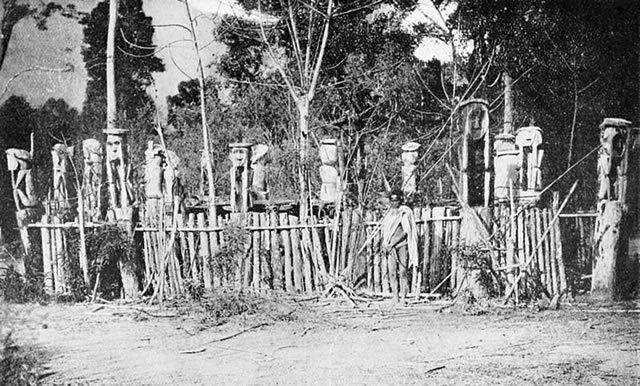 Photo by L. de Layougune.